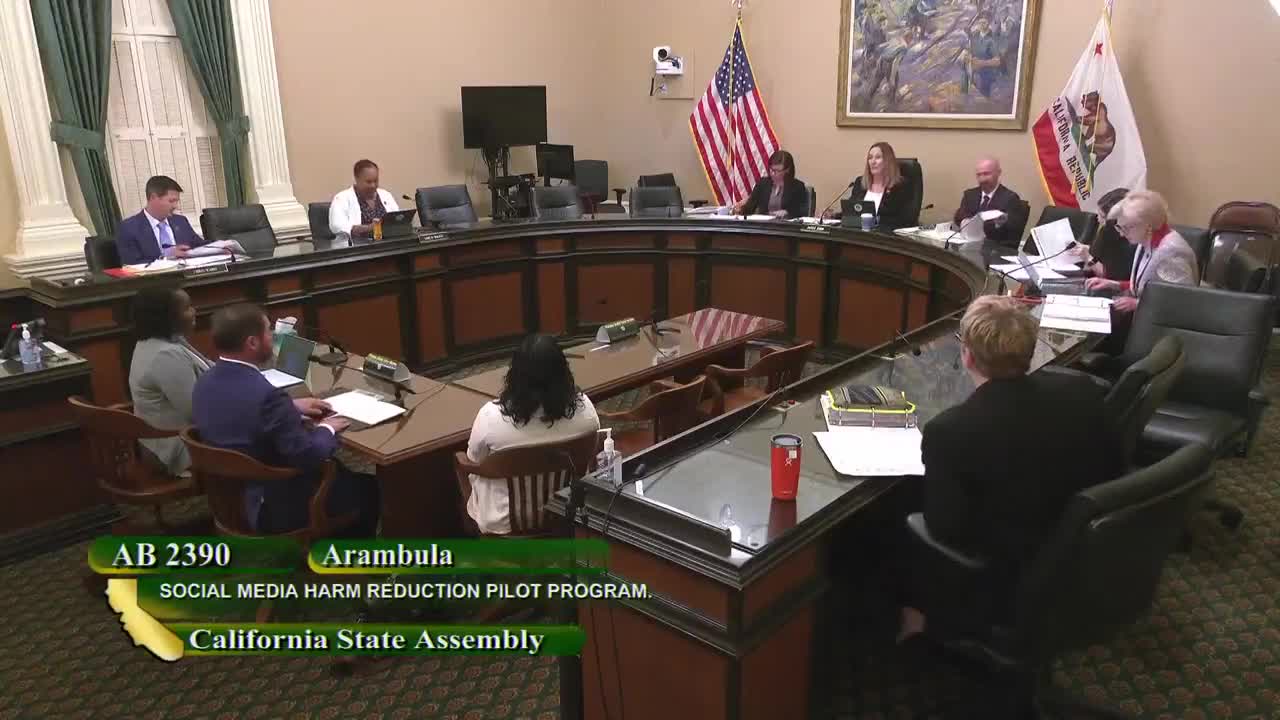
AB 2390: Social Media Harm Reduction Pilot Program.
- Session Year: 2023-2024
- House: Assembly
- Latest Version Date: 2024-03-21
Current Status:
Failed
(2024-05-16: In committee: Held under submission.)
Introduced
In Committee
First Chamber
In Committee
Second Chamber
Enacted
Existing law regulates social media platforms, through various acts, including the Cyberbullying Protection Act, that requires a social media platform to, among other things and subject to specified exceptions, disclose all cyberbullying reporting procedures in the terms of service and the Online Violence Prevention Act that requires a social medial platform to, except as specified, clearly and conspicuously state whether it has a mechanism for reporting violent posts that is available to users and nonusers of the platform.
This bill would establish the Social Media Pilot Program, and would require the program to identify the causes of adverse mental health impacts on the users of online social networks, test methods to mitigate the harms of those networks, and develop collection and reporting methods to track both the impacts and the causes of impacts of online social networks.Existing law establishes the California Health and Human Services Agency, which includes various state departments charged with the administration of health, social, and other human services.
This bill would establish, until December 31, 2029, the Social Media Harm Reduction Pilot Program and would require the California Health and Human Services Agency to designate a nonprofit organization to undertake the responsibilities of the program. The bill would require the program to do various specified tasks, including recommending statewide standards for the use of online social networks by kindergarten and grades 1 to 12 pupils, inclusive, and would require the program to coordinate with existing laws regulating social media platforms to ensure consistency and avoid duplication of effort.
Existing law regulates social media platforms, through various acts, including the Cyberbullying Protection Act, that requires a social media platform to, among other things and subject to specified exceptions, disclose all cyberbullying reporting procedures in the terms of service and the Online Violence Prevention Act that requires a social medial platform to, except as specified, clearly and conspicuously state whether it has a mechanism for reporting violent posts that is available to users and nonusers of the platform.
This bill would establish the Social Media Pilot Program, and would require the program to identify the causes of adverse mental health impacts on the users of online social networks, test methods to mitigate the harms of those networks, and develop collection and reporting methods to track both the impacts and the causes of impacts of online social networks.
(a)The Legislature finds and declares both of the following:
(1)Despite the potential benefits to society of online social networks, there is substantial evidence that tools designed to increase time spent on these networks result in adverse mental health impacts, especially among elementary and middle school pupils.
(2)It is the intent of the Legislature to establish the Social Media Harm Reduction Pilot Program to comprehensively examine the adverse mental health impacts associated with the use of online social networks by kindergarten and grades 1 to 12 pupils, inclusive, and to intervene as needed to prevent or mitigate those impacts.
(b)The Social Media Harm Reduction Pilot Program is hereby established.
(c)The California Health and Human Services Agency shall designate a nonprofit organization to undertake the responsibilities of the program.
(d)The program shall do all of the following:
(1)Develop model educational materials and methods to leverage existing peer-to-peer support programs to inform pupils about the harms of social media, foster the development of healthy social media habits among pupils, and create a supportive environment in which they may do so.
(2)Evaluate the impact of those educational materials and methods and the peer-to-peer support program through the establishment of statewide learning communities.
(3)Recommend statewide standards for the use of online social networks by kindergarten and grades 1 to 12 pupils, inclusive.
(4)Define best practices for expansion of the program.
(e)The program shall coordinate with existing laws regulating social media platforms, including, but not limited to, the Cyberbullying Protection Act (Chapter 22.2.9 (commencing with Section 22589) of Division 8 of the Business and Professions Code) and the Online Violence Prevention Act (Title 1.81.46 (commencing with Section 1798.99.20) of Part 4 of Division 3 of the Civil Code), to ensure consistency and avoid duplication of effort.
(f)This division shall remain in effect only until December 31, 2029, and as of that date is repealed.
SECTION 1.Division 21 (commencing with Section 27000) is added to the Health and Safety Code, to read:21.Social Media27000.(a)The Legislature finds and declares that despite the potential benefits to society of online social networks, there is substantial evidence of adverse mental health impacts on the users of the many tools designed to increase time spent on these networks.(b)There is hereby established the Social Media Pilot Program.(c)The pilot program shall identify the causes of adverse mental health impacts on the users of online social networks, test methods to mitigate the harms of those networks, and develop collection and reporting methods to track both the impacts and the causes of impacts of online social networks.(a)The Legislature finds and declares that despite the potential benefits to society of online social networks, there is substantial evidence of adverse mental health impacts on the users of the many tools designed to increase time spent on these networks.
(b)There is hereby established the Social Media Pilot Program.
(c)The pilot program shall identify the causes of adverse mental health impacts on the users of online social networks, test methods to mitigate the harms of those networks, and develop collection and reporting methods to track both the impacts and the causes of impacts of online social networks.
|
Date
|
Status
|
|---|---|
| May 16, 2024 | In committee: Held under submission. |
| May 16, 2024 | Joint Rule 62(a), file notice suspended. (Page 5215.) |
| May 15, 2024 | In committee: Set, first hearing. Referred to APPR. suspense file. |
| Apr 24, 2024 | From committee: Do pass and re-refer to Com. on APPR. (Ayes 10. Noes 0.) (April 23). Re-referred to Com. on APPR. |
| Apr 10, 2024 | From committee: Do pass and re-refer to Com. on P. & C.P. (Ayes 15. Noes 0.) (April 9). Re-referred to Com. on P. & C.P. |
| Apr 1, 2024 | Re-referred to Com. on HEALTH. |
| Mar 21, 2024 | From committee chair, with author's amendments: Amend, and re-refer to Com. on HEALTH. Read second time and amended. |
| Mar 21, 2024 | Referred to Coms. on HEALTH and P. & C.P. |
| Feb 13, 2024 | From printer. May be heard in committee March 14. |
| Feb 12, 2024 | Read first time. To print. |
|
Date
|
Description
|
Location
|
Votes
|
|
|---|---|---|---|---|
| Apr 23, 2024 | Do pass and be re-referred to the Committee on [Appropriations] | Assembly Standing Committee on Privacy and Consumer Protection |
Passed |
|
| Apr 9, 2024 | Do pass and be re-referred to the Committee on [Privacy and Consumer Protection] | Assembly Standing Committee on Health |
Passed |
This list shows positions taken on this bill by organizations on the date displayed, which is linked to the original source.
Positions by individuals are not included.
|
Organization
|
Position
|
Date
|
|---|---|---|
| Children Now | ** Support | |
| Oakland Privacy | ** Support | |
| Public Health Advocates | ** Support | |
| Youth Leadership Institute | ** Support |
Date of Hearing: May 15, 2024
ASSEMBLY COMMITTEE ON APPROPRIATIONS
Buffy Wicks, Chair
ABPCA Bill Id:AB 2390
Author:(Arambula) – As Amended Ver:March 21, 2024
Policy Committee: | Health | Vote: | 15 - 0 |
Privacy and Consumer Protection | 10 - 0 | ||
|
|
Urgency: No State Mandated Local Program: No Reimbursable: No
SUMMARY:
This bill establishes the Social Media Harm Reduction Pilot Program (program) to develop model educational materials and methods to leverage existing peer-to-peer support programs. The bill requires the California Health and Human Services Agency (CalHHS) to designate a nonprofit organization to implement the program.
The bill requires the program to:
- Develop model educational materials and methods to leverage existing peer-to-peer support programs to inform pupils about the harms of social media, foster the development of healthy social media habits among pupils, and create a supportive environment for social media use.
- Evaluate the educational materials and methods and the peer-to-peer support program through the establishment of statewide learning communities.
- Recommend statewide standards for the use of online social networks by pupils in kindergarten and grades one through 12.
- Define best practices for expansion of the program.
- Coordinate with existing laws regulating social media platforms to ensure consistency and avoid duplication of effort.
- Sunset on December 31, 2029.
FISCAL EFFECT:
CalHHS estimates limited-term, annual General Fund costs of approximately $3.5 million for each fiscal year from (FY) 2025-26 through FY 2028-29 and $1.8 million for the first six months of FY 2029-30 to implement the provisions of the bill. These funds would be used for three full-time, limited-term staff positions to support the nonprofit organization in implementing and evaluating the program and the contract with the organization to develop and implement program activities.
COMMENTS:
- Purpose. This bill is sponsored by Public Health Advocates and the Youth Leadership Institute.
According to the author:
The promise of social media was to build virtual communities that would bring people together to share information and ideas. In many ways, this promise has been fulfilled. Some platforms have billions of users and act as a digital thread connecting friends and families.
Unfortunately, social media companies have abused their position as facilitators of some of the most personal human interactions by prioritizing screen time and profits over the mental health of their users. Social media’s addictive design exacerbates compulsive and obsessive behaviors detracting from real-world in-person engagement and contributing to social isolation.
Children and adolescents who use social media should be safe from harm. AB 2390 will address the mental health impacts resulting from the intentionally addictive design of social media platforms by establishing a pilot program to develop methods to mitigate the harm to youth and adolescents caused by modern social media platform design.
- Background. A recent meta-analysis revealed that “while social media can create a sense of community for the user, excessive and increased use of social media, particularly among those who are vulnerable, is correlated with depression and other mental health disorders.” In 2022, concerns about children’s health and its connection to their online activity prompted the Assembly Committee on Privacy and Consumer Protection and the Committee on Arts, Entertainment, Sports, and Tourism to hold a joint informational hearing on “Protecting Kids Online: Challenges & Opportunities in a Digital World.” One of the most notable points made in the informational hearing background paper was the difficulty of disentangling the benefits and harms of youths’ online activity, and the consequent nuance that is required when policymaking in this area.
- Related Legislation.
- AB 1282 (Lowenthal) requires the Mental Health Services Oversight and Accountability Commission, on or before July 1, 2026, to report to the relevant policy committees of the Legislature a statewide strategy to understand, communicate, and mitigate mental health risks associated with the use of social media by children and youth. AB 1282 is on the Senate Inactive File.
- AB 2657 (Arambula) establishes the Social Media Commission to provide recommendations for regulation of social media as it relates to child and adolescent mental health and well-being. AB 2657 is pending in this committee.
- AB 1282 (Lowenthal) requires the Mental Health Services Oversight and Accountability Commission, on or before July 1, 2026, to report to the relevant policy committees of the Legislature a statewide strategy to understand, communicate, and mitigate mental health risks associated with the use of social media by children and youth. AB 1282 is on the Senate Inactive File.
Analysis Prepared by: Allegra Kim / APPR. / (916) 319-2081
Date of Hearing: April 23, 2024
ASSEMBLY COMMITTEE ON PRIVACY AND CONSUMER PROTECTION
Rebecca Bauer-Kahan, Chair
ABPCA Bill Id:AB 2390 (
Author:Arambula) – As Amended Ver:March 21, 2024
SYNOPSIS
A recent report by the Centers for Disease Control points to a significant deterioration in high school students’ mental health in the decade between 2011 and 2021. During that time, the percentage of male high school students who had experienced persistent feelings of sadness or hopelessness during the past year increased from 21% to 29%. For female students, the increase over the same period was tragically higher, from 36% to 57%. A number of studies suggest that social media use may be a contributing factor to young people’s deteriorating mental health.
This bill would, until December 31, 2029, establish the Social Media Harm Reduction Pilot Program. The bill would require the California Health and Human Services Agency to designate a nonprofit organization to (1) establish a pilot peer-to-peer program to develop educational materials and methods related to social media harms, (2) evaluate those materials and methods, (3) recommend statewide standards for pupil use of social media, and (4) define best practices for expansion of the program.
The bill is co-sponsored by Public Health Advocates and Youth Leadership Institute. There is no opposition on file. This bill was previously heard by the Assembly Health Committee, where it passed 15-0.
SUBJECT: Social Media Harm Reduction Pilot Program
SUMMARY: Establishes, until December 31, 2029, the Social Media Harm Reduction Pilot Program, which would designate a nonprofit organization to manage a program related to pupils and social media use. Specifically, this bill:
- Establishes the Social Media Harm Reduction Pilot Program.
- Requires the California Health and Human Services Agency to designate a nonprofit organization to undertake the responsibilities of the program.
- Requires the program to do the following:
- Develop model educational materials and methods to leverage existing peer-to-peer support programs to inform pupils about the harms of social media, foster the development of healthy social media habits among pupils, and create a supportive environment in which they may do so.
- Evaluate the impact of those educational materials and methods and the peer-to-peer support program through the establishment of statewide learning communities.
- Recommend statewide standards for the use of online social networks by kindergarten and grades 1 to 12 pupils, inclusive.
- Define best practices for expansion of the program.
- Requires the program to coordinate with various specified existing laws to ensure consistency and avoid duplication of effort.
- Provides that its provisions remain in effect only until December 31, 2029.
EXISTING LAW:
- Establishes the California Health and Human Services Agency. (Gov. Code § 12806.)
- Defines “social media platform” as a public or semipublic internet-based service or application that has users in California and that meets both of the following criteria:
- A substantial function of the service or application is to connect users in order to allow them to interact socially with each other within the service or application. (A service or application that provides email or direct messaging services does not meet this criterion based solely on that function.)
- The service or application allows users to do all of the following:
- Construct a public or semipublic profile for purposes of signing into and using the service or application.
- Populate a list of other users with whom an individual shares a social connection within the system.
- Create or post content viewable by other users, including, but not limited to, on message boards, in chat rooms, or through a landing page or main feed that presents the user with content generated by other users. (Bus. & Prof. Code § 22675(e).)
FISCAL EFFECT: As currently in print the bill is keyed fiscal.
COMMENTS:
1) Background. When the Centers for Disease Control released its Youth Risk Behavior Survey Data Summary & Trends Report 2011-2021 earlier this year, the report’s findings resonated nationwide. Among the most concerning results were the following:
- In the decade between 2011 and 2021, the percentage of male high school students who had experienced persistent feelings of sadness or hopelessness during the past year increased from 21% to 29%. For female students, the increase over the same period was tragically higher, from 36% to 57%.
- In 2021, 22% of high school students reported seriously considering attempting suicide during the past year.
- In 2021, 42% of high school students felt so sad or hopeless almost every day for at least two weeks in a row that they stopped doing their usual activities. Female students were more likely than male students to experience persistent feelings of sadness or hopelessness.[1]
The connection between findings such as these and teens’ increased use of technologies such as smartphones and social media applications is increasingly the subject of both research and legislation. A meta-analysis of 20 research studies published worldwide between January 2010 and June 2020 revealed that “while social media can create a sense of community for the user, excessive and increased use of social media, particularly among those who are vulnerable, is correlated with depression and other mental health disorders.”[2] And regulation of social media platforms, with an eye to ensuring children’s well-being online, has been a topic of significant bipartisan interest in the Legislature for several years.
In 2022, concerns about children’s health and its connection to their online activity prompted this Committee and the Assembly Arts, Entertainment, Sports, and Tourism Committee to hold a joint informational hearing on the topic of “Protecting Kids Online: Challenges & Opportunities in a Digital World.” One of the most notable points made in the informational hearing background paper was the difficulty of disentangling the benefits from the harms of youths’ online activity, and the consequent nuance that is required when policymaking in this area:
Though the harms of digital technology are substantial, they are not insurmountable, and are particular to certain types of content, patterns of internet use, and design features. Adequately addressing online media that are problematic to the wellbeing of young people could accordingly allow children to utilize the considerable advantages online media provide over traditional media without endangering their mental and physical health.[3]
2) Author’s statement. According to the author:
The promise of social media was to build virtual communities that would bring people together to share information and ideas. In many ways, this promise has been fulfilled. Some platforms have billions of users and act as a digital thread connecting friends and families.
Unfortunately, social media companies have abused their position as facilitators of some of the most personal human interactions by prioritizing screen time and profits over the mental health of their users. Social media’s addictive design exacerbates compulsive and obsessive behaviors detracting from real-world in-person engagement and contributing to social isolation.
Children and adolescents who use social media should be safe from harm. AB 2390 will address the mental health impacts resulting from the intentionally addictive design of social media platforms by establishing a pilot program to develop methods to mitigate the harm to youth and adolescents caused by modern social media platform design.
3) Social media harm reduction program. This bill requires HHS to designate a nonprofit organization that until December 31, 2029, will (1) establish a pilot peer-to-peer program to develop educational materials and methods related to social media harms, (2) evaluate those materials and methods, (3) recommend statewide standards for pupil use of social media, and (4) define best practices for expansion of the program. The purpose of the bill is to comprehensively examine the adverse mental health impacts associated with the use of social media by pupils.
Supporters point to the importance of incorporating youth perspective into such programs. Youth Leadership Institute, for instance, writes:
AB 2390 establishes a pilot program to develop methods to mitigate the harm to youth and adolescents caused by modern social media platform design. By implementing this approach, this bill will create a culture at school to talk openly about screen time usage and their experience navigating social media. We witnessed firsthand that by creating peer-to-peer programs and uplifting youth stories, youth will imagine how they would design the platform to meet the needs of young people online.
Oakland Privacy adds:
The pilot is an opportunity to address social media harms on youth through a holistic approach, with engagement from various stakeholders, including youth, that will propel data-driven policy. Youth’s perspectives and participation in the discussions and decision-making process is essential and has been implemented in other systems that can impact youth, such as foster youth in the child-welfare system.
4) Related legislation. AB 2657 (Arambula, 2024) would establish the Social Media Commission and tasks it with producing a comprehensive report for regulating social media as it relates to child and adolescent mental health and well-being. The bill is pending in this Committee.
AB 1282 (Lowenthal, 2023) requires the Mental Health Services Oversight and Accountability Commission on or before July 1, 2026 to report to the relevant policy committees of the Legislature a statewide strategy to understand, communicate, and mitigate mental health risks associated with the use of social media by children and youth. The bill is pending on the Senate Inactive File.
ARGUMENTS IN SUPPORT:
Co-sponsor Pubic Health Advocates writes:
Social media is a new platform of engagement that has contributed to a major restructuring of social engagement and information sharing. It allows people to find and join communities with shared interests or identities with members beyond their immediate geographic setting. Most people will have a positive experience on the platforms; however, there are also risks. Young people spend considerable time daily on social media – averaging 4.8 hours per day – and through a combination of the content they encounter and social media replacing or competing with other activities, many young people describe social media as a major and direct contributor to depression and anxiety. Therefore, it is incumbent upon the state to develop strategies to protect young people online; parental support for efforts to improve safety online is high and bipartisan, with parents seeking guidance for how to help their children appropriately and safety navigate their online activity.
AB 2390 establishes a pilot program using peer leadership to develop methods to maximize the benefits and minimize the harms to youth and adolescents. This bill is unique in focusing on the experience and leadership of young people to develop the safety standards to keep themselves and their peers safe.
Children Now write:
The promise of social media was to build virtual communities that would bring people together to share information and ideas. Unfortunately, social media companies have abused their position as facilitators of some of the most personal human interactions by prioritizing screen time and profits over the mental health of their users.
Because of the drastic increase in social media usage, today’s teens and adolescents are in crisis at epidemic levels. Fifty percent of teens report at least one symptom of clinical dependency on social media, including restlessness, withdrawal from friends and family, neglecting responsibilities, and increasingly relying on social media as a coping mechanism. AB 2390 establishes a pilot program to develop methods to mitigate the harm to youth and adolescents caused by modern social media platform design
REGISTERED SUPPORT / OPPOSITION:
Support
Public Health Advocates (co-sponsor)
Youth Leadership Institute (co-sponsor)
Children Now
Oakland Privacy
Opposition
None on file.
Analysis Prepared by: Josh Tosney / P. & C.P. / (916) 319-2200
The full report may be found at https://www.cdc.gov/healthyyouth/data/yrbs/pdf/YRBS_Data-Summary-Trends_Report2023_508.pdf. ↑
Ulvi, et al., Social Media Use and Mental Health: A Global Analysis, Epidemologia (Jan. 11, 2022), available at https://pubmed.ncbi.nlm.nih.gov/36417264/. ↑
The background paper for the informational hearing (background paper), is available at https://privacycp.assembly.ca.gov/sites/privacycp.assembly.ca.gov/files/Background_032922pdf.pdf. ↑
Date of Hearing: April 9, 2024
ASSEMBLY COMMITTEE ON HEALTH
Mia Bonta, Chair
ABPCA Bill Id:AB 2390
Author:((Arambula) – As Amended Ver:March 21, 2024
SUBJECT: Social Media Harm Reduction Pilot Program.
SUMMARY: Establishes the Social Media Harm Reduction Pilot Program. Specifically, this bill:
- Establishes the Social Media Harm Reduction Pilot Program (program). Requires the California Health and Human Services Agency to designate a nonprofit organization to undertake the responsibilities of the program.
- Requires the program to:
- Develop model educational materials and methods to leverage existing peer-to-peer support programs to inform pupils about the harms of social media, foster the development of healthy social media habits among pupils, and create a supportive environment in which they may do so;
- Evaluate the impact of those educational materials and methods and the peer-to-peer support program through the establishment of statewide learning communities;
- Recommend statewide standards for the use of online social networks by kindergarten and grades one to 12 pupils, inclusive; and,
- Define best practices for expansion of the program.
- Requires the program to coordinate with existing laws regulating social media platforms to ensure consistency and avoid duplication of effort.
- Sunsets the program on December 31, 2029.
EXISTING LAW:
- Establishes the Federal Children’s Online Privacy Protection Act providing parents tools to control what information is collected from their children online. Requires the Federal Trade Commission to develop regulations requiring operators of commercial websites and online services directed to children under 13 or knowingly collecting personal information from children under 13 to: notify parents of their information practices; obtain verifiable parental consent for the collection, use, or disclosure of children’s personal information; let parents prevent further maintenance or use of, or future collection of their child’s personal information; provide parents access to their child’s personal information; not require a child to provide more personal information that is reasonably necessary to participate in activities; and, maintain reasonable procedures to protect the confidentiality, security and integrity of the personal information. [15 United States Code §6501-6506]
- Establishes the California Age-Appropriate Design Code Act requiring a business that provides an online service, product, or feature likely to be accessed by children to comply with specified requirements, including a requirement to configure all default privacy settings offered by the online service, product, or feature to the settings that offer a high level of privacy, unless the business can demonstrate a compelling reason that a different setting is in the best interests of children, and to provide privacy information, terms of service, policies, and community standards concisely, prominently, and using clear language suited to the age of children likely to access that online service, product, or feature. [Civil Code (CIV) §1798.99.28, et seq.]
- Requires a business that provides an online service, product, or feature likely to be accessed by children to complete a Data Protection Impact Assessment for any new, publicly offered, online service, product, or feature likely to be accessed by children and maintain documentation of this assessment as long as the online service, product, or feature is likely to be accessed by children. Requires a business to biennially review all Data Protection Impact Assessments. [CIV §1798.99.31]
- Requires the business’ Data Protection Impact Assessment to identify the purpose of the online service, product, or feature, how it uses children’s personal information, and the risks of material detriment to children that arise from the data management practices of the business, including:
- Whether the design of the online product, service, or feature could harm children, including by exposing children to harmful, or potentially harmful, content on the online product, service, or feature;
- Whether the design of the online product, service, or feature could lead to children experiencing or being targeted by harmful, or potentially harmful, contacts on the online product, service, or feature;
- Whether the design of the online product, service, or feature could permit children to witness, participate in, or be subject to harmful, or potentially harmful, conduct on the online product, service, or feature;
- Whether the design of the online product, service, or feature could allow children to be party to or exploited by a harmful, or potentially harmful, contact on the online product, service, or feature;
- Whether algorithms used by the online product, service, or feature could harm children;
- Whether targeted advertising systems used by the online product, service, or feature could harm children;
- Whether and how the online product, service, or feature uses system design features to increase, sustain, or extend use of the online product, service, or feature by children, including the automatic playing of media, rewards for time spent, and notifications; and,
- Whether, how, and for what purpose the online product, service, or feature collects or processes sensitive personal information of children. [CIV §1798.99.31]
- Establishes the California Children’s Data Protection Working Group, as specified, which is required to deliver a report every two years to the Legislature with recommendations on, at minimum, the following:
- Identifying online services, products, or features likely to be accessed by children;
- Evaluating and prioritizing the best interests of children with respect to their privacy, physical health, and mental health and well-being and evaluating how those interests may be furthered by the design, development, and implementation of an online service, product, or feature;
- Ensuring that age assurance methods used by businesses that provide online services, products, or features likely to be accessed by children are proportionate to the risks that arise from the data management practices of the business, privacy protective, and minimally invasive;
- Assessing and mitigating risks to children that arise from the use of an online service, product, or feature;
- Publishing privacy information, policies, and standards in concise, clear language suited for the age of children likely to access an online service, product, or feature; and,
- How the working group and the Department of Justice may leverage the substantial and growing expertise of the California Privacy Protection Agency in the long-term development of data privacy policies that affect the privacy, rights, and safety of children online. [CIV §1798.99.32]
- Establishes the California Consumer Privacy Act of 2018, which grants to a consumer various rights with respect to personal information, as defined, that is collected by a business, as defined, including the right to request that a business delete personal information about the consumer that the business has collected from the consumer. Authorizes a minor to disaffirm a contract before majority or within a reasonable time afterwards or, in case of the minor’s death within that period, by the minor’s heirs or personal representative. [CIV § 1798.199.10]
- Establishes the Privacy Rights for California Minors in the Digital World which prohibits an operator of an internet website, online service, online application, or mobile application from the following:
- Marketing or advertising specified products or services, such as firearms, cigarettes, and alcoholic beverages, on its internet website, online service, online application, or mobile application that is directed to minors;
- Marketing or advertising such products or services to minors who the operator has actual knowledge are using its site, service, or application online and is a minor, if the marketing or advertising is specifically directed to that minor based upon the personal information of the minor; and,
- Knowingly using, disclosing, compiling, or allowing a third party to use, disclose, or compile, the personal information of a minor with actual knowledge that the use, disclosure, or compilation is for the purpose of marketing or advertising such products or services to that minor, where the website, service, or application is directed to minors or there is actual knowledge that a minor is using the website, service, or application. [Business & Professions Code §22580]
FISCAL EFFECT: Unknown. This bill has not yet been analyzed by a fiscal committee.
COMMENTS:
- PURPOSE OF THIS BILL. According to the author, the promise of social media was to build virtual communities that would bring people together to share information and ideas. The author argues that in many ways, this promise has been fulfilled as some platforms have billions of users and act as a digital thread connecting friends and families. The author continues that unfortunately, social media companies have abused their position by prioritizing screen time and profits over the mental health of their users through their addictive design that exacerbates compulsive and obsessive behaviors detracting from real-world in-person engagement and contributing to social isolation The author continues that teens and adolescents who use social media should be safe from harm. The author concludes that this bill will address the mental health impacts resulting from the intentionally addictive design of social media platforms by establishing a pilot program to develop methods to mitigate the harm to youth and adolescents caused by modern social media platform design.
- BACKGROUND. According to the United States Surgeon General, mental health challenges are the leading cause of disability and poor life outcomes in young people. Research indicates that half of all mental health conditions begin by the age of 14 and more than 75% of mental health challenges develop before a person reaches the age of 24.
- US Centers for Disease Control and Prevention (CDC)’s Youth Risk Behavior Survey Data Summary & Trends Report 2011-2021 (YRBS): According to the YRBS, in 2021, 16% of high school students were electronically bullied, including through texting, Instagram, Facebook, or other social media, during the past year. Female students were more likely than male students to be electronically bullied. American Indian or Alaska Native and white students were more likely than students from most other racial and ethnic groups to be electronically bullied. LGBTQ+ students and students who had any same-sex partners were more likely than their peers to be electronically bullied. The percentage of male students who were electronically bullied increased from 2011 to 2021. The YRBS also reported that in 2021, 42% of high school students felt so sad or hopeless almost every day for at least two weeks in a row that they stopped doing their usual activities. Female students were more likely than male students to experience persistent feelings of sadness or hopelessness. Hispanic and multiracial students were more likely than Asian, Black, and white students to experience persistent feelings of sadness or hopelessness. LGBTQ+ students and students who had any same-sex partners were also more likely than their peers to experience persistent feelings of sadness or hopelessness. Additionally, the survey found that 29% of high school students experienced poor mental health during the past 30 days. Female students were more likely than male students to experience poor mental health. Asian and Black students were less likely than Hispanic and multiracial students to experience poor mental health. Asian students were also less likely than white students to experience poor mental health. LGBTQ+ students and students who had any same-sex partners were more likely than their peers to experience poor mental health. Finally, the survey found that, in 2021, 22% of high school students seriously considered attempting suicide during the past year, 18% of high school students made a suicide plan during the past year, and 10% of high school students attempted suicide one or more times during the past year.
- Impact on Young Girls. In reporting out the YRBS, the CDC stated that teen girls specifically are “engulfed in a growing wave of violence and trauma” experiencing record high levels of violence, sadness, and suicide risk amid significant and “heartbreaking” declines in youth health and wellbeing overall. Overall, the number of psychiatric-related hospital visits among young people increased 31% last year. For young women this number was far more grievous. Suspected suicide attempts in girls increased 50.6% compared to a 3.7% increase in young men. An August 2016 report in the Harvard Health Publication reported that between 1999 and 2014 deaths as a result of suicide rose by 200% among girls age 10 to 14 rising most sharply from 2006 on. According to a researcher with the CDC, "There is no question from this data young people are telling us that they are in crisis. There is this growing wave of violence and trauma that's affecting young people, especially teen girls and LGBTQ+ youth. Social media plays a major role stating that for girls and their social networks, even when they're socializing, they are not socializing in person, they are socializing through their phone or through some type of device rather than in-person.” Social media also exposes girls to all kinds of negative social pressures. Body type expectations and the images that they're shown with the flood of information that we have available to us has detrimental effects and they are being exposed to them earlier and earlier in their lives when their brains are not prepared to deal with this information and know what to do with it.
- Prevalence and Effect of Cyberbullying on Children and Young People: A Scoping Review of Social Media Studies. A literature review of existing publications that examine the health-related effects of cyberbullying via social media among children and adolescents was conducted in 2015. Eleven electronic databases were searched with studies screened by two independent reviewers. The findings included 36 studies in 34 publications. Most were conducted in the United States and sampled middle and high school populations and included adolescents who were 12 to 18 years of age. The review concluded that there is a consistent relationship across studies between cyberbullying and depression among children and adolescents; however the evidence further reflected the effect of cyberbully on other mental health conditions is inconsistent.
- Why Social Media Addiction is a Real Thing and the Dangers Associated with it. A June 10, 2022, publication from Excelsior University reported that the majority of the dangers associated with social media stem from the idea that social media, like recreational drugs, sugar, etc., can be addicting.
- Attachment Styles. Social media allows humans to interact and form relationships on a grander level than ever before possible, connecting users across the globe in real-time. Relationships, whether in person or parasocial, (a one-sided relationship that a media user engages in with a media persona) are based on an individual’s attachment style. Attachment theory is a psychological theory that was developed in the 1950s and hypothesizes that the “affectional tie that individuals develop between themselves and another specific person is not based solely on food, safety, and other survival needs. Humans and other social animals need more—mainly love, affection, and acceptance.” There have been numerous studies that suggest that how people use social media and how much information they make publicly available relates to their attachment style in relationships. If an individual is in healthy and secure relationships, they use social media very differently from those who are in more unhealthy circumstances. Those who have toxic attachment styles use social media in vastly different ways even from each other. If someone has high attachment anxiety, they struggle with abandonment, are overwhelmed by emotion, tend to pursue someone emotionally unavailable, and will likely be over sharers on social media and try to compensate for what they do not find in in-person relationships. Those who have high attachment avoidance, who avoid intimacy, who push others away, and tend to not trust, are not typically active social media users. Both types of attachment anxiety have shown a significant positive association between the attachment and a dysfunctional use of the internet and social media sites. Based on attachment styles, it is fair to assume that those who do not have healthy interpersonal relationships seek them out on the internet, and thus are more susceptible to the dangers that can be associated with parasocial relationships.
- Social Media Addiction and Cyberbullying. The same studies that look at attachment theory as it relates to social media use can also be used to predict social media addiction. Those who are deeply preoccupied about relationships tend to use social media as a therapy tool, a place where they can find the emotional support lacking in their day-to-day lives. When this many people who are like-minded use a platform such as TikTok, where they crave the immediate response and attention you can get uniquely from social media. The age group at risk for social media addiction is young adults and preteens, and given the increased access to technology and social media that this age group has, social media also creates a bigger risk for cyberbullying and mental health concerns. Prior to the rise of social media, cyberbullying existed but was not as widespread. Social media amplifies the effect of cyberbullying. Interestingly, a study by the University of Georgia, published in March of 2021 entitled, “Social Media Addiction Linked to Cyberbullying” suggests that increased hours spent online, and on social media platforms, results in higher social media addiction scores (at least in males), significantly predicting perpetration of cyberbullying.
- Social Media Culture for Youth. Social media is an entirely different culture for many, particularly youth. There is a separate set of societal norms associated with interacting with their peers on social media as opposed to in person. With the anonymity of social media and the ability to avoid retaliation, perpetrators feel less remorse for their actions and are held less accountable with consequences for their behavior. Many feel rewarded from the likes, comments, and shares that their actions on social media receive, even if they are aggressive or bullying in nature, which in turn will cause them to want to continue the behavioral pattern, and this can border on an addiction. In addition, individuals who have certain psychiatric conditions may be more susceptible to internet addiction, and in particular, social media addiction. Individuals with conditions such as obsessive compulsive disorder (OCD), attention hyperactivity deficit disorder (ADHD), or other mood disorders are more likely to report excessive use of social media than their neurotypical peers. A study conducted in Norway suggests that those with ADHD are more likely to engage in excessive social networking as a form of self-medication, similar to those with anxious attachment styles. Whereas, those with OCD are driven to addictive social media use due to a “constant urge to check their networks for updates or fear of missing out.
- School Districts Sue Social Media Companies. Education Week reported on January 31, 2024 that over 200 school districts have sued more than a dozen social media companies over the youth mental health crisis. In California, the San Mateo County School Board was the first of many California school boards and districts to file suit against the tech companies that run Facebook, Instagram, TikTok, Snapchat, WhatsApp, YouTube, and Google. According to a Calmatters report, the plaintiffs argue these platforms – and the algorithms designed to keep kids hooked – have caused unprecedented levels of anxiety, depression, bullying, eating disorders and suicidal ideation. The litigation points to research that has found a host of poor health, behavioral, and emotional outcomes associated with heavy social media use, such as depression, low self-esteem, cyberbullying, eating disorders, sleep deprivation, and more. The social media companies, in response to The San Diego Union-Tribune said they have taken many steps to regulate content for the sake of safety and well-being of their users. This is not the first issue over which school districts have engaged in mass litigation against corporate giants, alleging harm against their students. Hundreds of school districts nationwide had previously sued Juul Labs for its role in the youth vaping epidemic. Juul agreed to a nearly half-billion dollar settlement with six states, including California.
- California’s Children and Youth Behavioral Health Initiative (CYBHI). The CYBHI is a five-year, $4.6 billion initiative intended to transform the way California meets the behavioral health needs of children, youth and families. Launched in 2021, this five-year initiative is core to Governor Newsom’s Master Plan for Kids’ Mental Health. CYBHI is moving initiatives across four core strategies: Workforce Training and Capacity, Behavioral Health Ecosystem Infrastructure, Coverage, and Public Awareness.
In 2022, CYBHI executed a contract with The Children’s Partnership, who convened an advisory board to inform the design of the peer-to-peer youth mental health pilot program. Requests for applications to identify high schools for the demonstration pilot, an $8 million effort to support eight sites across the state, closed on March 24, 2024. The Children’s Partnership stated their commitment to a collaborative partnership with the eight high school grantees, desiring to identify best practices for peer-to-peer programs that can be implemented statewide and serve as a model for national effort. The author has stated that this bill is intended to model this recent effort and the proven successful peer-to-peer models.
- RELATED LEGISLATION.
- AB 1282 (Lowenthal) requires the Mental Health Services Oversight and Accountability Commission on or before July 1, 2026 to report to the relevant policy committees of the Legislature a statewide strategy to understand, communicate, and mitigate mental health risks associated with the use of social media by children and youth. AB 1282 is currently pending on the Senate Inactive File.
- AB 2657 (Arambula) establishes the Social Media Commission for the purpose of bringing together a diverse group of experts and invested stakeholders to provide a comprehensive report with formal recommendations for regulation of social media as it relates to child and adolescent mental health and well-being. AB 2657 is currently pending in Assembly Health Committee.
- SB 764 (Padilla) provides protections to children performing in “vlogs,” monetized content appearing on online platforms, as specified. This includes the establishment of trust accounts for the benefit of those minors and specified accounting practices. SB 764 is pending referral in the Assembly Rules Committee.
- PREVIOUS LEGISLATION.
- AB 1394 (Wicks), Chapter 579, Statutes of 2023, requires social media platforms to provide a mechanism for users to report child sexual abuse material in which they are depicted; provides platforms 30 to 60 days after receiving a report to verify the content of the material and block it from reappearing. Also provides victims of commercial sexual exploitation the right to sue social media platforms for having deployed features that were a substantial factor in causing their exploitation.
- SB 287 (Skinner) of 2023 would have subjected social media platforms to civil liability for damages caused by their designs, algorithms, or features, as provided. This bill would have provided a safe harbor where certain auditing practices are carried out. SB 287 was held on the Senate Floor.
- AB 2273 (Wicks), Chapter 320, Statutes of 2022, establishes the California Age-Appropriate Design Code Act which generally requires businesses that provide online services, products, or features likely to be accessed by children to comply with specified standards.
- AB 2408 (Cunningham) of 2022 would have created the Social Media Platform Duty to Children Act prohibiting a social media platform, as defined from using a design, feature, or affordance that the platform knew, or by the exercise of reasonable care should have known, causes a child user, as defined, to become addicted to the platform. AB 2408 was held on the Senate Appropriations suspense file.
- AB 1628 (Ramos), Chapter 432, Statutes of 2022, requires until January 1, 2028, and subject to specified exceptions, a social media platform, as defined, that operates in the state to create and publicly post a policy statement that includes, among other things, the platform’s policy on the use of the platform to illegally distribute a controlled substance, as defined, and a link to the platform’s reporting mechanism for illegal or harmful content or behavior if one exists.
- AB 2879 (Low), Chapter 700, Statutes of 2022, requires a social media platform to disclose all cyberbullying reporting procedures in the platform’s terms of service, and would require a platform to establish a mechanism within its internet-based service that allows an individual, whether or not that individual has a profile on the internet-based service, to report cyberbullying or any content that violates the existing terms of service, as specified.
- DOUBLE REFERRAL. This bill is double referred, upon passage of this Committee it will be referred to the Assembly Committee on Privacy and Consumer Protection.
- POLICY COMMENT. This bill has overlapping goals with other proposals that this author has before the Committee. In order to streamline efforts, the author may wish to combine these proposals to ensure the Legislature is taking a coordinated and intentional approach to this important issue.
REGISTERED SUPPORT / OPPOSITION:
Support
None on file.
Opposition
None on file.
Analysis Prepared by: Riana King / HEALTH / (916) 319-2097
Discussed in Hearing
 9MIN
Assembly Standing Committee on Privacy and Consumer Protection
 10SEC
Assembly Standing Committee on Privacy and Consumer Protection
 31SEC
Assembly Standing Committee on Privacy and Consumer Protection
 13MIN
Assembly Standing Committee on Health
Bill Author

Bill Co-Author(s):