AB 2406: Crimes: theft.
- Session Year: 2023-2024
- House: Assembly
- Latest Version Date: 2024-04-15
Current Status:
Failed
(2024-04-30: From committee: Without further action pursuant to Joint Rule 62(a).)
Introduced
In Committee
First Chamber
In Committee
Second Chamber
Enacted
Existing law makes theft a crime. Existing law makes it a crime to knowingly promote, employ, use, persuade, induce, or coerce a minor under 18 years of age to engage in specified conduct.
This bill would make it a crime to cause, promote, employ, use, persuade, induce, or coerce a minor under 18 years of age to engage in specified theft-related offenses. The bill would make this crime punishable as a misdemeanor or a felony, as specified. Because the bill creates a new crime, the bill would impose a state-mandated local program.
Existing law authorizes a court to sentence an eligible person convicted of a felony to probation. Existing law prohibits the granting of probation to a person convicted of specified offenses except in unusual cases in which the interests of justice would best be served if the person is granted probation.This bill would prohibit the granting of probation to a person convicted of the crime above.The California Constitution requires the state to reimburse local agencies and school districts for certain costs mandated by the state. Statutory provisions establish procedures for making that reimbursement.
This bill would provide that no reimbursement is required by this act for a specified reason.
Existing law makes theft a crime. Existing law makes it a crime to knowingly promote, employ, use, persuade, induce, or coerce a minor under 18 years of age to engage in specified conduct.
This bill would make it a crime to knowingly cause, promote, employ, use, persuade, induce, or coerce 2 or more minors a minor under 18 years of age to engage in specified theft-related offenses. The bill would make this crime punishable as a misdemeanor or a felony, as specified. Because the bill creates a new crime, the bill would impose a state-mandated local program.
Existing law authorizes a court to sentence an eligible person convicted of a felony to probation. Existing law prohibits the granting of probation to a person convicted of specified offenses except in unusual cases in which the interests of justice would best be served if the person is granted probation.
This bill would prohibit the granting of probation to a person convicted of the crime above.
The California Constitution requires the state to reimburse local agencies and school districts for certain costs mandated by the state. Statutory provisions establish procedures for making that reimbursement.
This bill would provide that no reimbursement is required by this act for a specified reason.
Existing law makes theft a crime. Existing law makes it a crime to knowingly promote, employ, use, persuade, induce, or coerce a minor under 18 years of age to engage in specified conduct.
This bill would make it a crime to knowingly promote, employ, use, persuade, induce, or coerce 2 or more minors under 18 years of age to engage in specified theft-related offenses. Because the bill creates a new crime, the bill would impose a state-mandated local program.
Existing law authorizes a court to sentence an eligible person convicted of a felony to probation. Existing law prohibits the granting of probation to a person convicted of specified offenses except in unusual cases in which the interests of justice would best be served if the person is granted probation.
This bill would prohibit the granting of probation to a person convicted of the crime above.
The California Constitution requires the state to reimburse local agencies and school districts for certain costs mandated by the state. Statutory provisions establish procedures for making that reimbursement.
This bill would provide that no reimbursement is required by this act for a specified reason.
(a)A person who causes, promotes, employs, uses, persuades, induces, or coerces a minor under 18 years of age to commit a theft-related offense shall be punished pursuant to subdivision (b).
(b)A violation of this section is punishable by imprisonment in the county jail not exceeding one year or imprisonment pursuant to subdivision (h) of Section 1170.
(b)A violation of this section is punishable as follows:(1)By imprisonment in the county jail not exceeding one year or imprisonment pursuant to subdivision (h) of Section 1170, if the theft-related offense is a violation of any of the following:(c)For the purposes of this section, theft-related offense means any of the following:
(A)(1)Shoplifting, in violation of Section 459.5.
(B)(2)Petty theft, in violation of Sections 484 or 490.2.
(C)(3)Organized retail theft, in violation of paragraph (2) of subdivision (b) of Section 490.4.
(2)By imprisonment pursuant to subdivision (h) of Section 1170 for two, four, or six years, if the theft-related offense is a violation of any of the following:(A)(4)Grand theft, as described in Section 487, 487h, and in Chapter 5 (commencing with Section 484) of Title 13.
(B)(5)Theft from an elder or dependent adult, as described in Section 368.
(C)(6)The theft or unauthorized use of a vehicle, as described in Section 10851 of the Vehicle Code.
(D)(7)Burglary, as described in Section 459.
(E)(8)Carjacking, as described in Section 215.
(F)(9)Robbery, as described in Section 211.
(G)(10)Receiving stolen property, as described in Section 496.
(H)(11)Identity theft and mail theft, as described in Section 530.5.
(c)(d)(1)This section does not prevent punishment pursuant to any other provision of law that imposes a greater or more severe punishment.
(2)This section does not prevent punishment for the commission, attempted commission, or conspiracy to commit a theft-related offense.
(e)This section does not apply to a child under 18 years of age who is alleged to have engaged in conduct that would, if committed by an adult, violate this section.
SEC. 2.Section 1203 of the Penal Code is amended to read:1203.(a)As used in this code, probation means the suspension of the imposition or execution of a sentence and the order of conditional and revocable release in the community under the supervision of a probation officer. As used in this code, conditional sentence means the suspension of the imposition or execution of a sentence and the order of revocable release in the community subject to conditions established by the court without the supervision of a probation officer. It is the intent of the Legislature that both conditional sentence and probation are authorized whenever probation is authorized in any code as a sentencing option for infractions or misdemeanors.(b)(1)Except as provided in subdivision (j), if a person is convicted of a felony and is eligible for probation, before judgment is pronounced, the court shall immediately refer the matter to a probation officer to investigate and report to the court, at a specified time, upon the circumstances surrounding the crime and the prior history and record of the person, which may be considered either in aggravation or mitigation of the punishment.(2)(A)The probation officer shall immediately investigate and make a written report to the court containing findings and recommendations, including recommendations as to the granting or denying of probation and the conditions of probation, if granted.(B)Pursuant to Section 828 of the Welfare and Institutions Code, the probation officer shall include in the report any information gathered by a law enforcement agency relating to the taking of the defendant into custody as a minor, which shall be considered for purposes of determining whether adjudications of commissions of crimes as a juvenile warrant a finding that there are circumstances in aggravation pursuant to Section 1170 or to deny probation.(C)If the person was convicted of an offense that requires that person to register as a sex offender pursuant to Sections 290 to 290.023, inclusive, or if the probation report recommends that registration be ordered at sentencing pursuant to Section 290.006, the probation officers report shall include the results of the State-Authorized Risk Assessment Tool for Sex Offenders (SARATSO) administered pursuant to Sections 290.04 to 290.06, inclusive, if applicable.(D)The probation officer may also include in the report recommendations for both of the following:(i)The amount the defendant should be required to pay as a restitution fine pursuant to subdivision (b) of Section 1202.4.(ii)Whether the court shall require, as a condition of probation, restitution to the victim or to the Restitution Fund and the amount thereof.(E)The report shall be made available to the court and the prosecuting and defense attorneys at least five days, or upon request of the defendant or prosecuting attorney nine days, prior to the time fixed by the court for the hearing and determination of the report, and shall be filed with the clerk of the court as a record in the case at the time of the hearing. The time within which the report shall be made available and filed may be waived by written stipulation of the prosecuting and defense attorneys that is filed with the court or an oral stipulation in open court that is made and entered upon the minutes of the court.(3)At a time fixed by the court, the court shall hear and determine the application, if one has been made, or, in any case, the suitability of probation in the particular case. At the hearing, the court shall consider any report of the probation officer, including the results of the SARATSO, if applicable, and shall make a statement that it has considered the report, which shall be filed with the clerk of the court as a record in the case. If the court determines that there are circumstances in mitigation of the punishment prescribed by law or that the ends of justice would be served by granting probation to the person, it may place the person on probation. If probation is denied, the clerk of the court shall immediately send a copy of the report to the Department of Corrections and Rehabilitation at the prison or other institution to which the person is delivered.(4)The preparation of the report or the consideration of the report by the court may be waived only by a written stipulation of the prosecuting and defense attorneys that is filed with the court or an oral stipulation in open court that is made and entered upon the minutes of the court, except that a waiver shall not be allowed unless the court consents thereto. However, if the defendant is ultimately sentenced and committed to the state prison, a probation report shall be completed pursuant to Section 1203c.(c)If a defendant is not represented by an attorney, the court shall order the probation officer who makes the probation report to discuss its contents with the defendant.(d)If a person is convicted of a misdemeanor, the court may either refer the matter to the probation officer for an investigation and a report or summarily pronounce a conditional sentence. If the person was convicted of an offense that requires that person to register as a sex offender pursuant to Sections 290 to 290.023, inclusive, or if the probation officer recommends that the court, at sentencing, order the offender to register as a sex offender pursuant to Section 290.006, the court shall refer the matter to the probation officer for the purpose of obtaining a report on the results of the State-Authorized Risk Assessment Tool for Sex Offenders administered pursuant to Sections 290.04 to 290.06, inclusive, if applicable, which the court shall consider. If the case is not referred to the probation officer, in sentencing the person, the court may consider any information concerning the person that could have been included in a probation report. The court shall inform the person of the information to be considered and permit the person to answer or controvert the information. For this purpose, upon the request of the person, the court shall grant a continuance before the judgment is pronounced.(e)Except in unusual cases in which the interests of justice would best be served if the person is granted probation, probation shall not be granted to any of the following persons:(1)Unless the person had a lawful right to carry a deadly weapon, other than a firearm, at the time of the perpetration of the crime or the persons arrest, a person who has been convicted of arson, robbery, carjacking, burglary, burglary with explosives, rape with force or violence, torture, aggravated mayhem, murder, attempt to commit murder, trainwrecking, kidnapping, escape from the state prison, or a conspiracy to commit one or more of those crimes and who was armed with the weapon at either of those times.(2)A person who used, or attempted to use, a deadly weapon upon a human being in connection with the perpetration of the crime of which that person has been convicted.(3)A person who willfully inflicted great bodily injury or torture in the perpetration of the crime of which that person has been convicted.(4)A person who has been previously convicted twice in this state of a felony or in any other place of a public offense which, if committed in this state, would have been punishable as a felony.(5)Unless the person has never been previously convicted once in this state of a felony or in any other place of a public offense which, if committed in this state, would have been punishable as a felony, a person who has been convicted of burglary with explosives, rape with force or violence, torture, aggravated mayhem, murder, attempt to commit murder, trainwrecking, extortion, kidnapping, escape from the state prison, a violation of Section 286, 287, 288, or 288.5, or of former Section 288a, or a conspiracy to commit one or more of those crimes.(6)A person who has been previously convicted once in this state of a felony or in any other place of a public offense which, if committed in this state, would have been punishable as a felony, if that person committed any of the following acts:(A)Unless the person had a lawful right to carry a deadly weapon at the time of the perpetration of the previous crime or the persons arrest for the previous crime, the person was armed with a weapon at either of those times.(B)The person used, or attempted to use, a deadly weapon upon a human being in connection with the perpetration of the previous crime.(C)The person willfully inflicted great bodily injury or torture in the perpetration of the previous crime.(7)A public official or peace officer of this state or any city, county, or other political subdivision who, in the discharge of the duties of public office or employment, accepted or gave or offered to accept or give any bribe, embezzled public money, or was guilty of extortion.(8)A person who knowingly furnishes or gives away phencyclidine.(9)A person who intentionally inflicted great bodily injury in the commission of arson under subdivision (a) of Section 451 or who intentionally set fire to, burned, or caused the burning of, an inhabited structure or inhabited property in violation of subdivision (b) of Section 451.(10)A person who, in the commission of a felony, inflicts great bodily injury or causes the death of a human being by the discharge of a firearm from or at an occupied motor vehicle proceeding on a public street or highway.(11)A person who possesses a short-barreled rifle or a short-barreled shotgun under Section 33215, a machinegun under Section 32625, or a silencer under Section 33410.(12)A person who is convicted of violating Section 8101 of the Welfare and Institutions Code.(13)A person who is described in subdivision (b) or (c) of Section 27590.(14)A person who is convicted of violating Section 272.5.(f)When probation is granted in a case which comes within subdivision (e), the court shall specify on the record and shall enter on the minutes the circumstances indicating that the interests of justice would best be served by that disposition.(g)If a person is not eligible for probation, the judge shall refer the matter to the probation officer for an investigation of the facts relevant to determination of the amount of a restitution fine pursuant to subdivision (b) of Section 1202.4 in all cases in which the determination is applicable. The judge, in their discretion, may direct the probation officer to investigate all facts relevant to the sentencing of the person. Upon that referral, the probation officer shall immediately investigate the circumstances surrounding the crime and the prior record and history of the person and make a written report to the court containing findings. The findings shall include a recommendation of the amount of the restitution fine as provided in subdivision (b) of Section 1202.4.(h)If a defendant is convicted of a felony and a probation report is prepared pursuant to subdivision (b) or (g), the probation officer may obtain and include in the report a statement of the comments of the victim concerning the offense. The court may direct the probation officer not to obtain a statement if the victim has in fact testified at any of the court proceedings concerning the offense.(i)A probationer shall not be released to enter another state unless the case has been referred to the Administrator of the Interstate Probation and Parole Compacts, pursuant to the Uniform Act for Out-of-State Probationer or Parolee Supervision (Article 3 (commencing with Section 11175) of Chapter 2 of Title 1 of Part 4).(j)In any court in which a county financial evaluation officer is available, in addition to referring the matter to the probation officer, the court may order the defendant to appear before the county financial evaluation officer for a financial evaluation of the defendants ability to pay restitution, in which case the county financial evaluation officer shall report the findings regarding restitution and other court-related costs to the probation officer on the question of the defendants ability to pay those costs.An order made pursuant to this subdivision may be enforced as a violation of the terms and conditions of probation upon willful failure to pay and at the discretion of the court, may be enforced in the same manner as a judgment in a civil action, if any balance remains unpaid at the end of the defendants probationary period.(k)Probation shall not be granted to, nor shall the execution of, or imposition of sentence be suspended for, a person who is convicted of a violent felony, as defined in subdivision (c) of Section 667.5, or a serious felony, as defined in subdivision (c) of Section 1192.7, and who was on probation for a felony offense at the time of the commission of the new felony offense.(l)For a person granted probation prior to January 1, 2028, at the time the court imposes probation, the court may take a waiver from the defendant permitting flash incarceration by the probation officer, pursuant to Section 1203.35.(m)A person who is granted probation is subject to search or seizure as part of their terms and conditions only by a probation officer or other peace officer.SEC. 3.SEC. 2.No reimbursement is required by this act pursuant to Section 6 of Article XIIIB of the California Constitution because the only costs that may be incurred by a local agency or school district will be incurred because this act creates a new crime or infraction, eliminates a crime or infraction, or changes the penalty for a crime or infraction, within the meaning of Section 17556 of the Government Code, or changes the definition of a crime within the meaning of Section 6 of Article XIIIB of the California Constitution.
(a)A person who, with knowledge that the persons are minors under 18 years of age, or who, while in possession of any facts on the basis of which they should reasonably know that the persons are minors under 18 years of age, knowingly who causes, promotes, employs, uses, persuades, induces, or coerces two or more minors a minor under 18 years of age to commit a theft-related offense is guilty of a felony, punishable by imprisonment in the state prison for two, four, or six years. shall be punished pursuant to subdivision (b).
(b)For purposes of this section, theft-related offense means a violation of any of the following:(1)Shoplifting, in violation of Section 459.5.(2)Burglary, in violation of Section 460.(3)Theft, in violation of Section 484.(4)Cargo theft, in violation of Section 487h.(5)Organized retail theft, in violation of Section 490.4.(b)A violation of this section is punishable as follows:
(1)By imprisonment in the county jail not exceeding one year or imprisonment pursuant to subdivision (h) of Section 1170, if the theft-related offense is a violation of any of the following:
(A)Shoplifting, in violation of Section 459.5.
(B)Petty theft, in violation of Sections 484 or 490.2.
(C)Organized retail theft, in violation of paragraph (2) of subdivision (b) of Section 490.4.
(2)By imprisonment pursuant to subdivision (h) of Section 1170 for two, four, or six years, if the theft-related offense is a violation of any of the following:
(A)Grand theft, as described in Section 487, 487h, and in Chapter 5 (commencing with Section 484) of Title 13.
(B)Theft from an elder or dependent adult, as described in Section 368.
(C)The theft or unauthorized use of a vehicle, as described in Section 10851 of the Vehicle Code.
(D)Burglary, as described in Section 459.
(E)Carjacking, as described in Section 215.
(F)Robbery, as described in Section 211.
(G)Receiving stolen property, as described in Section 496.
(H)Identity theft and mail theft, as described in Section 530.5.
(c)(1)This section does not prevent punishment pursuant to any other provision of law that imposes a greater or more severe punishment.
(2)This section does not prevent punishment for the commission, attempted commission, or conspiracy to commit a theft-related offense.
SEC. 2.Section 1203 of the Penal Code is amended to read:1203.(a)As used in this code, probation means the suspension of the imposition or execution of a sentence and the order of conditional and revocable release in the community under the supervision of a probation officer. As used in this code, conditional sentence means the suspension of the imposition or execution of a sentence and the order of revocable release in the community subject to conditions established by the court without the supervision of a probation officer. It is the intent of the Legislature that both conditional sentence and probation are authorized whenever probation is authorized in any code as a sentencing option for infractions or misdemeanors.
(b)(1)Except as provided in subdivision (j), if a person is convicted of a felony and is eligible for probation, before judgment is pronounced, the court shall immediately refer the matter to a probation officer to investigate and report to the court, at a specified time, upon the circumstances surrounding the crime and the prior history and record of the person, which may be considered either in aggravation or mitigation of the punishment.
(2)(A)The probation officer shall immediately investigate and make a written report to the court containing findings and recommendations, including recommendations as to the granting or denying of probation and the conditions of probation, if granted.
(B)Pursuant to Section 828 of the Welfare and Institutions Code, the probation officer shall include in the report any information gathered by a law enforcement agency relating to the taking of the defendant into custody as a minor, which shall be considered for purposes of determining whether adjudications of commissions of crimes as a juvenile warrant a finding that there are circumstances in aggravation pursuant to Section 1170 or to deny probation.
(C)If the person was convicted of an offense that requires that person to register as a sex offender pursuant to Sections 290 to 290.023, inclusive, or if the probation report recommends that registration be ordered at sentencing pursuant to Section 290.006, the probation officers report shall include the results of the State-Authorized Risk Assessment Tool for Sex Offenders (SARATSO) administered pursuant to Sections 290.04 to 290.06, inclusive, if applicable.
(D)The probation officer may also include in the report recommendations for both of the following:
(i)The amount the defendant should be required to pay as a restitution fine pursuant to subdivision (b) of Section 1202.4.
(ii)Whether the court shall require, as a condition of probation, restitution to the victim or to the Restitution Fund and the amount thereof.
(E)The report shall be made available to the court and the prosecuting and defense attorneys at least five days, or upon request of the defendant or prosecuting attorney nine days, prior to the time fixed by the court for the hearing and determination of the report, and shall be filed with the clerk of the court as a record in the case at the time of the hearing. The time within which the report shall be made available and filed may be waived by written stipulation of the prosecuting and defense attorneys that is filed with the court or an oral stipulation in open court that is made and entered upon the minutes of the court.
(3)At a time fixed by the court, the court shall hear and determine the application, if one has been made, or, in any case, the suitability of probation in the particular case. At the hearing, the court shall consider any report of the probation officer, including the results of the SARATSO, if applicable, and shall make a statement that it has considered the report, which shall be filed with the clerk of the court as a record in the case. If the court determines that there are circumstances in mitigation of the punishment prescribed by law or that the ends of justice would be served by granting probation to the person, it may place the person on probation. If probation is denied, the clerk of the court shall immediately send a copy of the report to the Department of Corrections and Rehabilitation at the prison or other institution to which the person is delivered.
(4)The preparation of the report or the consideration of the report by the court may be waived only by a written stipulation of the prosecuting and defense attorneys that is filed with the court or an oral stipulation in open court that is made and entered upon the minutes of the court, except that a waiver shall not be allowed unless the court consents thereto. However, if the defendant is ultimately sentenced and committed to the state prison, a probation report shall be completed pursuant to Section 1203c.
(c)If a defendant is not represented by an attorney, the court shall order the probation officer who makes the probation report to discuss its contents with the defendant.
(d)If a person is convicted of a misdemeanor, the court may either refer the matter to the probation officer for an investigation and a report or summarily pronounce a conditional sentence. If the person was convicted of an offense that requires that person to register as a sex offender pursuant to Sections 290 to 290.023, inclusive, or if the probation officer recommends that the court, at sentencing, order the offender to register as a sex offender pursuant to Section 290.006, the court shall refer the matter to the probation officer for the purpose of obtaining a report on the results of the State-Authorized Risk Assessment Tool for Sex Offenders administered pursuant to Sections 290.04 to 290.06, inclusive, if applicable, which the court shall consider. If the case is not referred to the probation officer, in sentencing the person, the court may consider any information concerning the person that could have been included in a probation report. The court shall inform the person of the information to be considered and permit the person to answer or controvert the information. For this purpose, upon the request of the person, the court shall grant a continuance before the judgment is pronounced.
(e)Except in unusual cases in which the interests of justice would best be served if the person is granted probation, probation shall not be granted to any of the following persons:
(1)Unless the person had a lawful right to carry a deadly weapon, other than a firearm, at the time of the perpetration of the crime or the persons arrest, a person who has been convicted of arson, robbery, carjacking, burglary, burglary with explosives, rape with force or violence, torture, aggravated mayhem, murder, attempt to commit murder, trainwrecking, kidnapping, escape from the state prison, or a conspiracy to commit one or more of those crimes and who was armed with the weapon at either of those times.
(2)A person who used, or attempted to use, a deadly weapon upon a human being in connection with the perpetration of the crime of which that person has been convicted.
(3)A person who willfully inflicted great bodily injury or torture in the perpetration of the crime of which that person has been convicted.
(4)A person who has been previously convicted twice in this state of a felony or in any other place of a public offense which, if committed in this state, would have been punishable as a felony.
(5)Unless the person has never been previously convicted once in this state of a felony or in any other place of a public offense which, if committed in this state, would have been punishable as a felony, a person who has been convicted of burglary with explosives, rape with force or violence, torture, aggravated mayhem, murder, attempt to commit murder, trainwrecking, extortion, kidnapping, escape from the state prison, a violation of Section 286, 287, 288, or 288.5, or of former Section 288a, or a conspiracy to commit one or more of those crimes.
(6)A person who has been previously convicted once in this state of a felony or in any other place of a public offense which, if committed in this state, would have been punishable as a felony, if that person committed any of the following acts:
(A)Unless the person had a lawful right to carry a deadly weapon at the time of the perpetration of the previous crime or the persons arrest for the previous crime, the person was armed with a weapon at either of those times.
(B)The person used, or attempted to use, a deadly weapon upon a human being in connection with the perpetration of the previous crime.
(C)The person willfully inflicted great bodily injury or torture in the perpetration of the previous crime.
(7)A public official or peace officer of this state or any city, county, or other political subdivision who, in the discharge of the duties of public office or employment, accepted or gave or offered to accept or give any bribe, embezzled public money, or was guilty of extortion.
(8)A person who knowingly furnishes or gives away phencyclidine.
(9)A person who intentionally inflicted great bodily injury in the commission of arson under subdivision (a) of Section 451 or who intentionally set fire to, burned, or caused the burning of, an inhabited structure or inhabited property in violation of subdivision (b) of Section 451.
(10)A person who, in the commission of a felony, inflicts great bodily injury or causes the death of a human being by the discharge of a firearm from or at an occupied motor vehicle proceeding on a public street or highway.
(11)A person who possesses a short-barreled rifle or a short-barreled shotgun under Section 33215, a machinegun under Section 32625, or a silencer under Section 33410.
(12)A person who is convicted of violating Section 8101 of the Welfare and Institutions Code.
(13)A person who is described in subdivision (b) or (c) of Section 27590.
(14)A person who is convicted of violating Section 272.5.
(f)When probation is granted in a case which comes within subdivision (e), the court shall specify on the record and shall enter on the minutes the circumstances indicating that the interests of justice would best be served by that disposition.
(g)If a person is not eligible for probation, the judge shall refer the matter to the probation officer for an investigation of the facts relevant to determination of the amount of a restitution fine pursuant to subdivision (b) of Section 1202.4 in all cases in which the determination is applicable. The judge, in their discretion, may direct the probation officer to investigate all facts relevant to the sentencing of the person. Upon that referral, the probation officer shall immediately investigate the circumstances surrounding the crime and the prior record and history of the person and make a written report to the court containing findings. The findings shall include a recommendation of the amount of the restitution fine as provided in subdivision (b) of Section 1202.4.
(h)If a defendant is convicted of a felony and a probation report is prepared pursuant to subdivision (b) or (g), the probation officer may obtain and include in the report a statement of the comments of the victim concerning the offense. The court may direct the probation officer not to obtain a statement if the victim has in fact testified at any of the court proceedings concerning the offense.
(i)A probationer shall not be released to enter another state unless the case has been referred to the Administrator of the Interstate Probation and Parole Compacts, pursuant to the Uniform Act for Out-of-State Probationer or Parolee Supervision (Article 3 (commencing with Section 11175) of Chapter 2 of Title 1 of Part 4).
(j)In any court in which a county financial evaluation officer is available, in addition to referring the matter to the probation officer, the court may order the defendant to appear before the county financial evaluation officer for a financial evaluation of the defendants ability to pay restitution, in which case the county financial evaluation officer shall report the findings regarding restitution and other court-related costs to the probation officer on the question of the defendants ability to pay those costs.
An order made pursuant to this subdivision may be enforced as a violation of the terms and conditions of probation upon willful failure to pay and at the discretion of the court, may be enforced in the same manner as a judgment in a civil action, if any balance remains unpaid at the end of the defendants probationary period.
(k)Probation shall not be granted to, nor shall the execution of, or imposition of sentence be suspended for, a person who is convicted of a violent felony, as defined in subdivision (c) of Section 667.5, or a serious felony, as defined in subdivision (c) of Section 1192.7, and who was on probation for a felony offense at the time of the commission of the new felony offense.
(l)For a person granted probation prior to January 1, 2028, at the time the court imposes probation, the court may take a waiver from the defendant permitting flash incarceration by the probation officer, pursuant to Section 1203.35.
(m)A person who is granted probation is subject to search or seizure as part of their terms and conditions only by a probation officer or other peace officer.
SEC. 3.No reimbursement is required by this act pursuant to Section 6 of Article XIIIB of the California Constitution because the only costs that may be incurred by a local agency or school district will be incurred because this act creates a new crime or infraction, eliminates a crime or infraction, or changes the penalty for a crime or infraction, within the meaning of Section 17556 of the Government Code, or changes the definition of a crime within the meaning of Section 6 of Article XIIIB of the California Constitution.
(a)A person who, with knowledge that the persons are minors under 18 years of age, or who, while in possession of any facts on the basis of which they should reasonably know that the persons are minors under 18 years of age, knowingly promotes, employs, uses, persuades, induces, or coerces two or more minors under 18 years of age to commit a theft-related offense is guilty of a felony, punishable by imprisonment in the state prison for two, four, or six years.
(b)For purposes of this section, theft-related offense means a violation of any of the following:
(1)Shoplifting, in violation of Section 459.5.
(2)Burglary, in violation of Section 460.
(3)Theft, in violation of Section 484.
(4)Cargo theft, in violation of Section 487h.
(5)Organized retail theft, in violation of Section 490.4.
(c)(1)This section does not prevent punishment pursuant to any other provision of law that imposes a greater or more severe punishment.
(2)This section does not prevent punishment for the commission, attempted commission, or conspiracy to commit a theft-related offense.
SEC. 2.Section 1203 of the Penal Code is amended to read:1203.(a)As used in this code, probation means the suspension of the imposition or execution of a sentence and the order of conditional and revocable release in the community under the supervision of a probation officer. As used in this code, conditional sentence means the suspension of the imposition or execution of a sentence and the order of revocable release in the community subject to conditions established by the court without the supervision of a probation officer. It is the intent of the Legislature that both conditional sentence and probation are authorized whenever probation is authorized in any code as a sentencing option for infractions or misdemeanors.
(b)(1)Except as provided in subdivision (j), if a person is convicted of a felony and is eligible for probation, before judgment is pronounced, the court shall immediately refer the matter to a probation officer to investigate and report to the court, at a specified time, upon the circumstances surrounding the crime and the prior history and record of the person, which may be considered either in aggravation or mitigation of the punishment.
(2)(A)The probation officer shall immediately investigate and make a written report to the court containing findings and recommendations, including recommendations as to the granting or denying of probation and the conditions of probation, if granted.
(B)Pursuant to Section 828 of the Welfare and Institutions Code, the probation officer shall include in the report any information gathered by a law enforcement agency relating to the taking of the defendant into custody as a minor, which shall be considered for purposes of determining whether adjudications of commissions of crimes as a juvenile warrant a finding that there are circumstances in aggravation pursuant to Section 1170 or to deny probation.
(C)If the person was convicted of an offense that requires that person to register as a sex offender pursuant to Sections 290 to 290.023, inclusive, or if the probation report recommends that registration be ordered at sentencing pursuant to Section 290.006, the probation officers report shall include the results of the State-Authorized Risk Assessment Tool for Sex Offenders (SARATSO) administered pursuant to Sections 290.04 to 290.06, inclusive, if applicable.
(D)The probation officer may also include in the report recommendations for both of the following:
(i)The amount the defendant should be required to pay as a restitution fine pursuant to subdivision (b) of Section 1202.4.
(ii)Whether the court shall require, as a condition of probation, restitution to the victim or to the Restitution Fund and the amount thereof.
(E)The report shall be made available to the court and the prosecuting and defense attorneys at least five days, or upon request of the defendant or prosecuting attorney nine days, prior to the time fixed by the court for the hearing and determination of the report, and shall be filed with the clerk of the court as a record in the case at the time of the hearing. The time within which the report shall be made available and filed may be waived by written stipulation of the prosecuting and defense attorneys that is filed with the court or an oral stipulation in open court that is made and entered upon the minutes of the court.
(3)At a time fixed by the court, the court shall hear and determine the application, if one has been made, or, in any case, the suitability of probation in the particular case. At the hearing, the court shall consider any report of the probation officer, including the results of the SARATSO, if applicable, and shall make a statement that it has considered the report, which shall be filed with the clerk of the court as a record in the case. If the court determines that there are circumstances in mitigation of the punishment prescribed by law or that the ends of justice would be served by granting probation to the person, it may place the person on probation. If probation is denied, the clerk of the court shall immediately send a copy of the report to the Department of Corrections and Rehabilitation at the prison or other institution to which the person is delivered.
(4)The preparation of the report or the consideration of the report by the court may be waived only by a written stipulation of the prosecuting and defense attorneys that is filed with the court or an oral stipulation in open court that is made and entered upon the minutes of the court, except that a waiver shall not be allowed unless the court consents thereto. However, if the defendant is ultimately sentenced and committed to the state prison, a probation report shall be completed pursuant to Section 1203c.
(c)If a defendant is not represented by an attorney, the court shall order the probation officer who makes the probation report to discuss its contents with the defendant.
(d)If a person is convicted of a misdemeanor, the court may either refer the matter to the probation officer for an investigation and a report or summarily pronounce a conditional sentence. If the person was convicted of an offense that requires that person to register as a sex offender pursuant to Sections 290 to 290.023, inclusive, or if the probation officer recommends that the court, at sentencing, order the offender to register as a sex offender pursuant to Section 290.006, the court shall refer the matter to the probation officer for the purpose of obtaining a report on the results of the State-Authorized Risk Assessment Tool for Sex Offenders administered pursuant to Sections 290.04 to 290.06, inclusive, if applicable, which the court shall consider. If the case is not referred to the probation officer, in sentencing the person, the court may consider any information concerning the person that could have been included in a probation report. The court shall inform the person of the information to be considered and permit the person to answer or controvert the information. For this purpose, upon the request of the person, the court shall grant a continuance before the judgment is pronounced.
(e)Except in unusual cases in which the interests of justice would best be served if the person is granted probation, probation shall not be granted to any of the following persons:
(1)Unless the person had a lawful right to carry a deadly weapon, other than a firearm, at the time of the perpetration of the crime or the persons arrest, any a person who has been convicted of arson, robbery, carjacking, burglary, burglary with explosives, rape with force or violence, torture, aggravated mayhem, murder, attempt to commit murder, trainwrecking, kidnapping, escape from the state prison, or a conspiracy to commit one or more of those crimes and who was armed with the weapon at either of those times.
(2)Any A person who used, or attempted to use, a deadly weapon upon a human being in connection with the perpetration of the crime of which that person has been convicted.
(3)Any A person who willfully inflicted great bodily injury or torture in the perpetration of the crime of which that person has been convicted.
(4)Any A person who has been previously convicted twice in this state of a felony or in any other place of a public offense which, if committed in this state, would have been punishable as a felony.
(5)Unless the person has never been previously convicted once in this state of a felony or in any other place of a public offense which, if committed in this state, would have been punishable as a felony, any a person who has been convicted of burglary with explosives, rape with force or violence, torture, aggravated mayhem, murder, attempt to commit murder, trainwrecking, extortion, kidnapping, escape from the state prison, a violation of Section 286, 287, 288, or 288.5, or of former Section 288a, or a conspiracy to commit one or more of those crimes.
(6)Any A person who has been previously convicted once in this state of a felony or in any other place of a public offense which, if committed in this state, would have been punishable as a felony, if that person committed any of the following acts:
(A)Unless the person had a lawful right to carry a deadly weapon at the time of the perpetration of the previous crime or the persons arrest for the previous crime, the person was armed with a weapon at either of those times.
(B)The person used, or attempted to use, a deadly weapon upon a human being in connection with the perpetration of the previous crime.
(C)The person willfully inflicted great bodily injury or torture in the perpetration of the previous crime.
(7)Any A public official or peace officer of this state or any city, county, or other political subdivision who, in the discharge of the duties of public office or employment, accepted or gave or offered to accept or give any bribe, embezzled public money, or was guilty of extortion.
(8)Any A person who knowingly furnishes or gives away phencyclidine.
(9)Any A person who intentionally inflicted great bodily injury in the commission of arson under subdivision (a) of Section 451 or who intentionally set fire to, burned, or caused the burning of, an inhabited structure or inhabited property in violation of subdivision (b) of Section 451.
(10)Any A person who, in the commission of a felony, inflicts great bodily injury or causes the death of a human being by the discharge of a firearm from or at an occupied motor vehicle proceeding on a public street or highway.
(11)Any A person who possesses a short-barreled rifle or a short-barreled shotgun under Section 33215, a machinegun under Section 32625, or a silencer under Section 33410.
(12)Any A person who is convicted of violating Section 8101 of the Welfare and Institutions Code.
(13)Any A person who is described in subdivision (b) or (c) of Section 27590.
(14)A person who is convicted of violating Section 272.5.
(f)When probation is granted in a case which comes within subdivision (e), the court shall specify on the record and shall enter on the minutes the circumstances indicating that the interests of justice would best be served by that disposition.
(g)If a person is not eligible for probation, the judge shall refer the matter to the probation officer for an investigation of the facts relevant to determination of the amount of a restitution fine pursuant to subdivision (b) of Section 1202.4 in all cases in which the determination is applicable. The judge, in their discretion, may direct the probation officer to investigate all facts relevant to the sentencing of the person. Upon that referral, the probation officer shall immediately investigate the circumstances surrounding the crime and the prior record and history of the person and make a written report to the court containing findings. The findings shall include a recommendation of the amount of the restitution fine as provided in subdivision (b) of Section 1202.4.
(h)If a defendant is convicted of a felony and a probation report is prepared pursuant to subdivision (b) or (g), the probation officer may obtain and include in the report a statement of the comments of the victim concerning the offense. The court may direct the probation officer not to obtain a statement if the victim has in fact testified at any of the court proceedings concerning the offense.
(i)A probationer shall not be released to enter another state unless the case has been referred to the Administrator of the Interstate Probation and Parole Compacts, pursuant to the Uniform Act for Out-of-State Probationer or Parolee Supervision (Article 3 (commencing with Section 11175) of Chapter 2 of Title 1 of Part 4).
(j)In any court in which a county financial evaluation officer is available, in addition to referring the matter to the probation officer, the court may order the defendant to appear before the county financial evaluation officer for a financial evaluation of the defendants ability to pay restitution, in which case the county financial evaluation officer shall report the findings regarding restitution and other court-related costs to the probation officer on the question of the defendants ability to pay those costs.
AnyAn order made pursuant to this subdivision may be enforced as a violation of the terms and conditions of probation upon willful failure to pay and at the discretion of the court, may be enforced in the same manner as a judgment in a civil action, if any balance remains unpaid at the end of the defendants probationary period.
(k)Probation shall not be granted to, nor shall the execution of, or imposition of sentence be suspended for, any a person who is convicted of a violent felony, as defined in subdivision (c) of Section 667.5, or a serious felony, as defined in subdivision (c) of Section 1192.7, and who was on probation for a felony offense at the time of the commission of the new felony offense.
(l)For any a person granted probation prior to January 1, 2028, at the time the court imposes probation, the court may take a waiver from the defendant permitting flash incarceration by the probation officer, pursuant to Section 1203.35.
(m)A person who is granted probation is subject to search or seizure as part of their terms and conditions only by a probation officer or other peace officer.
SEC. 3.No reimbursement is required by this act pursuant to Section 6 of Article XIIIB of the California Constitution because the only costs that may be incurred by a local agency or school district will be incurred because this act creates a new crime or infraction, eliminates a crime or infraction, or changes the penalty for a crime or infraction, within the meaning of Section 17556 of the Government Code, or changes the definition of a crime within the meaning of Section 6 of Article XIIIB of the California Constitution.
|
Date
|
Status
|
|---|---|
| Apr 30, 2024 | From committee: Without further action pursuant to Joint Rule 62(a). |
| Apr 23, 2024 | In committee: Set, final hearing. Failed passage. |
| Apr 16, 2024 | In committee: Set, second hearing. Hearing canceled at the request of author. |
| Apr 16, 2024 | Re-referred to Com. on PUB. S. |
| Apr 15, 2024 | From committee chair, with author's amendments: Amend, and re-refer to Com. on PUB. S. Read second time and amended. |
| Apr 9, 2024 | In committee: Set, first hearing. Hearing canceled at the request of author. |
| Apr 2, 2024 | Re-referred to Com. on PUB. S. |
| Apr 1, 2024 | From committee chair, with author's amendments: Amend, and re-refer to Com. on PUB. S. Read second time and amended. |
| Feb 26, 2024 | Referred to Com. on PUB. S. |
| Feb 13, 2024 | From printer. May be heard in committee March 14. |
| Feb 12, 2024 | Read first time. To print. |
|
Date
|
Description
|
Location
|
Votes
|
|
|---|---|---|---|---|
| Apr 23, 2024 | Do pass and be re-referred to the Committee on [Appropriations] | Assembly Standing Committee on Public Safety |
Failed |
This list shows positions taken on this bill by organizations on the date displayed, which is linked to the original source.
Positions by individuals are not included.
|
Organization
|
Position
|
Date
|
|---|---|---|
| Aclu California Action | ** Against | |
| Arcadia Police Officers' Association | ** Support | |
| Burbank Police Officers' Association | ** Support | |
| California Alliance for Youth and Community Justice | ** Against | |
| California Association Of Highway Patrolmen | ** Support | |
| California Attorneys For Criminal Justice | ** Against | |
| California Coalition of School Safety Professionals | ** Support | |
| California District Attorneys Association | ** Support | |
| Californians for Safety and Justice | ** Against | |
| Californians United for a Responsible Budget | ** Against | |
| California Problem Solvers Caucus | ** Support | |
| California Public Defenders Association | ** Against | |
| California Reserve Peace Officers Association | ** Support | |
| Children's Defense Fund - CA | ** Against | |
| CLAREMONT POLICE OFFICERS ASSOCIATION | ** Support | |
| Communities United for Restorative Youth Justice | ** Against | |
| Corona Police Officers Association | ** Support | |
| Culver City Police Officers' Association | ** Support | |
| Deputy Sheriffs Association of Monterey County | ** Support | |
| Ella Baker Center For Human Rights | ** Against | |
| Fair Chance Project | ** Against | |
| Felony Murder Elimination Project | ** Against | |
| Fullerton Police Officers' Association | ** Support | |
| Initiate Justice | ** Against | |
| Initiate Justice Action | ** Against | |
| LA Defensa | ** Against | |
| League Of California Cities | ** Support | |
| Los Angeles School Police Management Association | ** Support | |
| los angeles school police officers association | ** Support | |
| Murrieta Police Officers' Association | ** Support | |
| National Federation Of Independent Business | ** Support | |
| Newport Beach Police Association | ** Support | |
| Novato Police Officers Association | ** Support | |
| Palos Verdes Police Officers Association | ** Support | |
| Peace Officers Research Association Of California | ** Support | |
| Placer County Deputy Sheriffs' Assocation | ** Support | |
| Pomona Police Officers' Association | ** Support | |
| RIVERSIDE POLICE OFFICERS ASSOCIATION | ** Support | |
| Riverside Sheriffs' Association | ** Support | |
| San Francisco Public Defender | ** Against | |
| Santa Ana Police Officers Association | ** Support | |
| Silicon Valley De-Bug | ** Against | |
| Smart Justice California, a project of Tides Advocacy | ** Against | |
| Team Justice | ** Against | |
| Uncommon Law | ** Against | |
| Upland Police Officers Association | ** Support | |
| Vera Institute Of Justice | ** Against | |
| Young Women's Freedom Center | ** Against |
Date of Hearing: April 23, 2024
Counsel: Liah Burnley
ASSEMBLY COMMITTEE ON
Kevin McCarty, Chair
ABPCA Bill Id:
Author:() – As Ver:
SUMMARY:
Creates a new crime of persuading a minor to commit theft, as specified. Specifically, this bill:
- Makes it a crime to promote, employ, use, persuade, induce, or coerce a minor to commit a theft-related offense.
- Provides that this new crime shall be punishable as a misdemeanor, by imprisonment in the county jail not exceeding one year or, as a felony, by imprisonment in the county jail for 16 months, or two or three years, if the theft-related offense is any of the following:
- Shoplifting;
- Petty theft;
- Organized retail theft;
- Grand theft;
- Cargo theft;
- Theft from an elder or dependent adult;
- The theft or unauthorized use of a vehicle;
- Burglary;
- Carjacking;
- Robbery;
- Receiving stolen property; or,
- Identity theft and mail theft.
- Shoplifting;
- Provides that this new crime does not apply to a person under 18.
EXISTING LAW:
- Provides that all persons counseling, advising, or encouraging children under the age of fourteen years, to commit any crime, or who, by threats, menaces, command, or coercion, compel another to commit any crime, are principals in any crime so committed. A person who aids and abets in any crime faces the same punishment at the person who directly commits the crime. (Pen. Code, § 31.)
- Provides that every person who contributes to the delinquency of any person under the age of 18 is guilty of a misdemeanor, punishable by a fine not exceeding $2,500, imprisonment in the county jail for not more than one year, or both, or may be released on probation for a period not exceeding five years. (Pen. Code, § 272, subd. (a)(1).)
- States that a parent or legal guardian to any person under the age of 18 years shall have the duty to exercise reasonable care, supervision, protection, and control over their minor child. (Pen. Code, § 272, subd. (a)(2).)
- Provides that it is conspiracy if any two or more people conspire to commit any crime. If they conspire to commit a felony, the offense is punishable in the same manner and to the same extent as is provided for the punishment of that felony. If they conspire to commit any other crime, the conspiracy shall be punishable as a misdemeanor by imprisonment in a county jail for not more than one year, or as a felony, punishable by imprisonment in the county jail for 16 months, or two or three years, or by a fine not exceeding $10,000, or by both. (Pen. Code, § 182.)
- Defines “shoplifting” as entering a commercial establishment with intent to commit larceny while that establishment is open during regular business hours, where the value of the property that is taken or intended to be taken does not exceed $950. Shoplifting is. Shoplifting shall be punished as a misdemeanor. (Pen. Code, § 459.5.)
- Defines “burglary” as entering a structure, as defined, with intent to commit theft or any felony offense and divides burglary into two degrees, first and second. (Pen. Code, §§ 459, 460.)
- Provides that first degree burglary is burglary of building, inhabited for dwelling purposes, as specified, or vehicle inhabited for dwelling purposes, as specified. First degree burglary is punishable by imprisonment in the state prison for two, four, or six years. (Pen. Code, §§ 459, 460, 461.)
- Provides that all other burglary is burglary in the second degree. Entering a commercial establishment to steal property exceeding $950 is burglary in the second degree. Burglary in the second degree is punishable as a misdemeanor, by imprisonment in the county jail not exceeding one year, or as a felony by imprisonment in the county jail for in the county jail for 16 months, two years, or three years. (Pen. Code, §§ 459.5, 460, 461.)
- States that every person who steals, takes, carries, leads, or drives away the personal property of another, or who fraudulently appropriates property which has been entrusted to them, or who knowingly and designedly, by any false or fraudulent representation or pretense, defrauds any other person of money, labor or real or personal property, is guilty of theft. Divides theft into two degrees, petty theft and grand theft. (Pen. Code §§ 484, subd. (a), 486.)
- Defines grand theft as when the money, labor, or real or personal property taken is of a value exceeding $950 dollars, except as specified; other cases of theft are petty theft. Grand theft is punishable as a misdemeanor, by imprisonment in the county jail not exceeding one year, or as a felony by imprisonment in the county jail for in the county jail for 16 months, two years, or three years. (Pen. Code §§487-488.)
- Punishes petty theft as a misdemeanor, punishable by fine not exceeding $1,000, or by imprisonment in the county jail not exceeding six months, or both. (Pen. Code §490.)
- States that a person who commits any of the following acts is guilty of organized retail theft:
- Acts in concert with one or more persons to steal merchandise from one or more merchant’s premises or online marketplace with the intent to sell, exchange, or return the merchandise for value;
- Acts in concert with two or more persons to receive, purchase, or possess merchandise knowing or believing it to have been stolen;
- Acts as an agent of another individual or group of individuals to steal merchandise from one or more merchant’s premises or online marketplaces as part of an organized plan to commit theft; or,
- Recruits, coordinates, organizes, supervises, directs, manages, or finances another to undertake any of these acts or any other statute defining theft of merchandise. (Pen. Code, § 490.4, subd. (a).)
- Punishes organized retail theft, as follows:
- If violations of the provisions directed at acting in concert or as an agent are committed on two or more separate occasions within a one-year period, and if the aggregated value of the merchandise stolen, received, purchased, or possessed within that period exceeds $950, the offense is punishable as an alternate felony-misdemeanor (a “wobbler”);
- Any other violation of the provisions directed at acting in concert or as an agent is punishable as a misdemeanor by imprisonment in a county jail not exceeding one year; and,
- A violation of the recruiting, coordinating, organizing, supervising, directing, managing, or financing provision is punishable as a wobbler. (Pen. Code, § 490.4, subd. (b).)
- Provides that every person who steals, takes, or carries away cargo of another, if the cargo is taken of a value exceeding $950, is guilty of grand theft. (Pen. Code, § 487h, subd. (a).)
- Prohibits elder theft. Elder theft is punishable as a misdemeanor by a fine not exceeding $2,500, by imprisonment in a county jail not exceeding one year, or by both, or as a felony, by a fine not exceeding $10,000, or by imprisonment in county jail for two, three, or four years, or by both, if the property taken or obtained is of a value exceeding $950. (Pen. Code, § 368.)
- States that any person who drives or takes a vehicle not their own, without the consent of the owner, and with intent to permanently or temporarily deprive the owner thereof, shall be punished with a misdemeanor by imprisonment in a county jail for not more than one year or with a felony by imprisonment in a county jail for a term of two, three, or four years, or by a fine of not more than $5,000, or by both. (Veh. Code, § 10851.)
- Provides that carjacking is the taking of a motor vehicle in the possession of another from their person or immediate presence. Carjacking is a felony, punishable by imprisonment in the state prison for a term of three, five, or nine years. (Pen. Code, § 215.)
- States that robbery is the felonious taking of personal property in the possession of another, from his person or immediate presence, and against his will, accomplished by means of force or fear. Robbery is a felony punishable by imprisonment in the state prison for two, three or five years. If the defendant acts in concert with two or more person to commit robbery, as specified, the offense is punishable by imprisonment in the state prison for three, six, or nine years. (Pen. Code, § 211.)
- Makes it a crime to receive stolen property. If the value of the property is less than $950, the offense is a misdemeanor punishable by imprisonment in county jail for one year. If the value of the property is over $950, the offense is a misdemeanor, punishable by imprisonment in a county jail for not more than one year, or as a felony punishable by imprisonment in the county jail f for 16 months, or two or three years. (Pen. Code, § 496.)
- Prohibits mail theft. This offense is a misdemeanor punishable by a fine, by imprisonment in a county jail not to exceed one year, or by both. (Pen. Code, § 530.5.)
FISCAL EFFECT:
Unknown
COMMENTS:
- Author's Statement: According to the author, “Organized retail theft rings have caused untold harm and mayhem in our communities. The ringleaders of these criminal syndicates have reached new lows in attempting to recruit and coerce minors to participate and take part in these crimes. AB 2406 is a common-sense measure to ensure we start holding these people accountable. California needs to send a strong signal that anyone who attempts to use a minor in a commission of one of these crimes will be held accountable and it will no longer be considered a “slap-on-the-wrist” offense.”
- Effect of this Bill: The background material provided by the author contains no information or data whatsoever to suggest that there is a rising trend among adults enticing minors to steal. However, this bill would treat low-level theft offenses like shoplifting and petty theft, as a felony if a minor is involved.
This bill ignores the dynamics of theft and poverty. Desperation and inequality lead to an increase in stealing.[1] This bill would create draconian penalties for petty theft and shoplifting, without regard to the value of the property stolen. To be clear, an impoverished parent who encouragers their hungry child to steal a loaf of bread from the supermarket, could, under this bill be guilty of a felony, and could be sentenced to a term of imprisonment for up to three years. Under this bill, a 19 year old who dares a 16 year old to steal a pack of gum from the store could be imprisoned for a felony.
Further, contrary to the author’s contentions that using a minor in the commission of a crime is “considered a ‘slap-on-the-wrist’,” there are significant penalties for using a minor in the commission of a crime. Anyone who aids and abets in any crime, including encouraging children under the age of fourteen years to commit a crime, can be charged as a principal in the crime and therefore punished to the same extent as if they committed the underlying offense. (Pen. Code, § 31.) Additionally the person could be charged with felony conspiracy for this conduct. (Pen. Code, § 182.) Also, it is a misdemeanor to contribute to the delinquency of any person under the age of 18, punishable by a $2,500 fine, imprisonment in the county jail for not more than one year, or both, or probation for up to five years. (Pen. Code, § 272, subd. (a)(1).)
Another alternative fact touted by proponents of this bill that the law is “vastly more lenient on our youth.” Indeed, the purpose of the juvenile justice system is to provide youth care, treatment, and guidance that is consistent with their best interest, and to “hold them accountable for their behavior” in a way “that is appropriate for their circumstances.” (Welf. & Inst. Code, § 202, subd. (b).) However, even when a theft offense is handled in the juvenile court, minors and their families still face significant penalties, ranging from substantial fines and fees, to probation, and in some instances formal commitments. Further, for serious “707(b)” offenses, including robbery, minors can be tried as adults. (Welf. & Inst. Code, § 707, subd. (b).)
- This Bill Would Create a New Felony: A person convicted of the new felony created by this bill could serve a term of imprisonment ranging from sixteen months to three years, even for petty theft. Unduly long sentences, like those proposed by this bill, are counterproductive for public safety and contribute to the dynamic of diminishing returns as the incarcerated population expands.[2]Increasingly punitive sentences add little to the deterrent effect of the criminal justice system; and mass incarceration diverts resources from program and policy initiatives that hold the potential for greater impact on public safety. (Ibid.)
Research shows that increasing the severity of the punishment does little to deter the crime. According to the National Institute of Justice, laws and policies designed to deter crime by focusing mainly on increasing the severity of punishment are ineffective partly because criminals know little about the sanctions for specific crimes. More severe punishments do not “chasten” individuals convicted of crimes, and prisons may exacerbate recidivism. Studies show that for most individuals convicted of a crime, short to moderate prison sentences may be a deterrent but longer prison terms produce only a limited deterrent effect. In addition, the crime prevention benefit falls far short of the social and economic costs.[3]
This finding makes intuitive sense. Consider a person who is thinking about stealing a car or burglarizing a local business. If he is thinking rationally, he will take into account a variety of factors when considering how to commit the crime, including time of day, ease of entry, presence of security personnel or technology, or his ability to leave the crime scene. He does this to avoid being caught in the act because being arrested and prosecuted will impose significant burdens on him. Additionally, because he is not planning on being apprehended, he is unlikely to be thinking about how much time he might spend in prison and whether his sentence will be three, five, or seven years.
Notably, this example looks at the behavior of a rational person, which rarely fits the picture of a substantial portion of those who actually commit a crime. Many are teenagers seeking peer approval for their illegal behavior, individuals under the influence of alcohol or drugs at the time of the offense, or are motivated by economic challenges. Many of these individuals are not even thinking about the risk of being caught, let alone know how much prison time they may face.
The limited impact of extending sentence length becomes even more attenuated for long-term incarceration. If the penalty for a second robbery conviction is twenty years and a legislative body increases that penalty to twenty- five, few would-be robbers undeterred by the prospect of “only” a twenty year sentence would balk at an additional five years.
Again, there are multiple possible reasons for imposing a given prison term, depending on the circumstances of the crime. But policymakers and judges should be cognizant of the evidence to support any particular goal of sentencing. If the length of a prison term has little deterrent value, it may be time to forego the rationale of “sending a message.”[4]
An analysis of 116 studies showed that incarceration does not deter people from committing future crimes and, in fact, incarceration can actually make someone more likely to be arrested and commit crimes later (due to heightened barriers to securing employment, identification, housing, and other basic services necessary to successfully reenter society).[5] These findings are consistent with other research from national institutions of renown.[6]
Not only would the incarceration provided for in this bill fail to deter crime, it would come at a significant expense to the State. According to the Legislative Analyst’s Office (LAO), it costs taxpayers $106,131 to incarcerate a person in state prison for one year.[7]
This bill would allow a person convicted of a felony created by this bill to serve a term of imprisonment ranging of up to three years. Could money spent to incarcerate a person be better spent on strategies proven to deter crime?
- Reports of Exaggerated Losses by Retailers – Separating Fact from Fiction: Some complaints of retail theft were overstated. For example, in 2021, Walgreens closed five stores in San Francisco purportedly due to retail theft. However, the San Francisco Police Department’s data on shoplifting did not support this explanation for the closures. Recently, the chief financial officer of Walgreens acknowledged the shoplifting threat had probably been overstated. The company likely spent too much on security measures and mischaracterized the amount of theft at stores. In fact, shrinkage (the inventory that was bought but could not be sold primarily due to shoplifting) actually decreased to around 2.5 to 2.6 percent of sales, compared to 3.5 percent the prior year.[8]
Others say retail theft, while an issue, might be overstated as an excuse to write off mediocre sales and historic inflation might be a key reason why we’re seeing any theft bump at all Things have become expensive – “we are in an economy right now where some everyday staples have risen in price six times faster than the overall rate of inflation. Until July of this year, American paychecks grew at a slower rate than inflation as a whole.” Some retailers lump theft in with heavy discounting, soft sales and macroeconomic conditions as other factors that cut into their margins.[9]
What’s more, the National Retail Federation has not solidified any data around increased rates of organized retail theft or what percentage of external theft is organized crime. Retailers are not required to break down how much they actually lose to theft. “Retailers and trade associations are increasingly using their positions to influence lawmakers to pass new legislation that benefits them, hurts competitors and could disproportionally affect marginalized people.” [10]
Additionally, the Federal Trade Commission recently reported that retail stores likely inflated prices to accommodate for lost revenue resulting from the pandemic. The FTC states, in summary, that:
Notably, consumers are still facing the negative impact of the pandemic’s price hikes, as the Commission’s report finds that some in the grocery [including drug stores] retail industry seem to have used rising costs as an opportunity to further raise prices to increase their profits, which remain elevated today.
Retail stores actually saw significant profits over the past few years despite claims that stores are losing profits as a result of theft and other market forces.
“In the first three-quarters of 2023, retailer profits rose even more, with revenue reaching 7% over total costs, casting doubt on the assertions of some companies that rising prices at the grocery store are the result of retailers’ own rising costs.” (Federal Trade Commission, “Feeding America in a Time of Crisis, The United States Grocery Supply Chain and the COVID-19 Pandemic” (March 21, 2024).
Finally, the Federal Bureau of Investigation (FBI) data on crime statistics reports that crime is actually down nationwide by a significant margin – contributing to the conclusion that the crime rate was a temporary phenomenon brought on by the pandemic and rapidly escalating costs for basic goods and services.
The new fourth-quarter numbers [for 2023] show a 13% decline in murder in 2023 from 2022, a 6% decline in reported violent crime and a 4% decline in reported property crime.
After a terrible period of underfunding and understaffing caused by the pandemic, local governments have, by most measures, returned to pre-pandemic levels,” wrote John Roman, a criminologist at the University of Chicago. In an interview, Roman said, ‘The courts were closed, a lot of cops got sick, a lot of police agencies told their officers not to interact with the public. Teachers were not in schools, not working with kids.[11]
Given that claims of massive retail theft appear to be inconsistent with the data, the Legislature should consider evidence-based solutions to address property crimes.
- Immigration and Other Collateral Consequences: A conviction for any crime where the penalty following conviction is a year or more and specified crimes “of moral turpitude” will likely bar a person from receiving lawful permanent residence status and may result in deportation.[12] Hence, undocumented Californians may potentially be uniquely penalized because an arrest or conviction for this crime may result in deportation or other serious immigration consequences. Additionally, if a person is unlawful at entry, they will likely be immediately deported in summary proceedings. According to the American Immigration Council in August of 2021:
Tens of thousands of migrants and asylum seekers are subjected to criminal prosecution for these crimes every year. Prosecutions for entry-related offenses reached an all-time high of 106,312 in Fiscal Year (FY) 2019, near the end of the Trump administration, before falling to 47,730 in FY 2020 after the government began rapidly expelling most people crossing the border in March 2020 rather than referring them for prosecution.[13]
Any time an undocumented person interacts with law enforcement, the risk of incarceration and deportation is significant.[14]
Further, the collateral consequence of a felony are substantial. A criminal conviction exposes individuals to thousands of collateral consequences that will follow them long after the successful completion of their sentence. These collateral consequences serve as substantial, lifelong barriers to stability. A recent survey found that 76% of individuals with a criminal conviction report instability in finding a job or housing, obtaining a license, paying for fines or fees, and having health issues. A National Institute of Justice study found that having a criminal record reduced the chance of getting a job offer or callback.[15]
- Argument in Support: According to the National Federation of Business (NFIB), “AB 2406 (Davies) addresses head on, a particularly pernicious aspect of retail theft: the exploitation of underaged kids. Organized retail theft rings are recruiting minors to steal on their behalf, understanding that the law is vastly more lenient on our youth. Collectively, we as Californians do not tolerate the exploitation of children in any way and the time is now to send a strong message that it will not be tolerated in the retail theft space either.
“NFIB supports the robust penalties in AB 2406 for those who recruit, organize, supervise, direct, manage or finance another to act in concert with another to steal merchandise from one or more merchant’s premises or who acts in concert with two or more to receive or purchase stolen property. Not only will the implementation of this bill as law send a strong message to those exploiting California’s youth and assist small business owners in preserving their ability to conduct business in California, but it will also help to prevent our youth from committing that first crime that might lead them down the perilous path of potential recidivism.”
- Argument in Opposition: According to the Vera Institute of Justice, “while retailers claim that retail theft is a massive and urgent crisis, experts and journalists have repeatedly noted that false and inflated claims are driving an exaggerated sense of panic, and retailers are struggling with other issues more responsible for financial challenges. In particular, many concerns around “organized retail crime” have been driven by the National Retail Federation’s now-redacted claim that it was responsible for half of all inventory losses in 2021, which was based on incorrect data.
“When we blame the wrong problems, we miss the right solutions. As sensational claims about organized retail theft have been debunked and data shows that retail theft is not rising statewide, responses need to be tailored to the facts. The legislature should respond to concerns from the community and local businesses with evidence-backed solutions.
“Increasing penalties for non-violent offenses like retail theft will do little to make our communities safer. Study after study has shown that neither lengthening sentences nor increasing charges and punishments based on a second or third offense meaningfully deters crime. And unlike the community-based programs funded by Proposition 47, which have reduced recidivism, sending people to jail and prison makes them more likely to reoffend, while costing taxpayers dearly amid abudget deficit. Finally, evidence indicates that AB 2406 is likely to worsen racial disparities in California’s criminal system by sending more Black and Latinx people to prison.
“To deter and address retail theft, we need to take on its drivers. When people shoplift as part of an organized retail theft operation, law enforcement should investigate and hold accountable the people who profit most from these sophisticated operations. However, we know from the War on Drugs that threatening low-level offenders with harsh punishment to find those driving sophisticated organized retail theft will not be particularly successful. Legislators can also help by regulating online marketplaces to make it harder to sell stolen goods. Supporting retail workers by enhancing pay, increasing staffing (instead of using self-checkout or surveillance based technology), and providing training can also help.
“When people are arrested for stealing out of need—whether in cooperation with an organized operation or not—we need to make sure they don’t need to do it again. Instead of reducing public safety through unnecessary and often counterproductive incarceration, we can effectively intervene by meeting their needs and connecting them to stable housing, jobs, and other treatment and services. Cities around the country have effectively employed this model, while similar models have proved effective in California thanks to community funding created by Prop 47.
“It is long past time to reject the reach for ‘tough’ policies in favor of real solutions.”
- Related Legislation:
- AB 1802 (Jones-Sawyer), would eliminate the sunset date for organized retail theft and the operation of CHP’s regional property crimes task force. AB 1802 is pending in Assembly Appropriations Committee.
- AB 1960 (Soria), would reenact sentence enhancement for theft offenses when the loss exceeds specified dollar amounts. AB 1960 is pending in Assembly Appropriations Committee.
- AB 1990 (W. Carrillo), would authorize peace officers to make a warrantless arrest for misdemeanor shoplifting, as specified. AB 1990 is pending in Assembly Appropriations Committee.
- AB 1779 (Irwin), would allow, a prosecutor to bring a case in any county where theft offenses occurred for offenses that occur in multiple jurisdictions, as specified. AB 1779 is pending in Assembly Appropriations Committee.
- AB 1787 (Villapudua), would among other things, repeal the sunset provision in the organized retail theft statute. AB 1787 is pending in Assembly Appropriations Committee.
- AB 1794 (McCarty), would clarify aggregation requirements for grand theft, among other things. AB 1794 is pending in Assembly Appropriations Committee.
- AB 2438 (Petrie-Norris), would make any person who acts in concert to take, damage, or destroy any property in the commission of a felony punishable by an additional and consecutive term of imprisonment. AB 2438 failed passage in this Committee.
- AB 2790 (Pacheco), would define organized retail theft to include acting in concert with one or more persons to steal specified types of merchandise, including infant formula, baby food, over-the-counter medications, and blood glucose testing strips, with the intent to sell those items. AB 2790 is pending in this Committee.
- AB 2943 (Zbur), would, among other things, extend the organized retail theft statute until January 2031, and make it a crime for any person to possess property unlawfully that was acquired through one or more acts of shoplifting, theft, or burglary from a retail business, if the property is not possessed for personal use. AB 2943 is pending in Assembly Appropriations Committee.
- AB 1802 (Jones-Sawyer), would eliminate the sunset date for organized retail theft and the operation of CHP’s regional property crimes task force. AB 1802 is pending in Assembly Appropriations Committee.
- Prior Legislation:
- AB 329 (Ta), of the 2023-2024 Legislative Session, would have expanded the territorial jurisdiction in which the Attorney General can prosecute specified theft offenses and associated offenses connected together in their commission to include cargo theft. AB 329 failed passage in this Committee.
- AB 335 (Alanis), of the 2023-2024 Legislative Session, would have required the Little Hoover Commission to submit a report to the Legislature describing the reported retail thefts, as specified. AB 335 was held under submission in Assembly Appropriations Committee.
- AB 331 (Jones-Sawyer), Chapter 113, Statutes of 2021, extended the sunset date for organized retail theft through January 1, 2026.
- AB 23 (Muratsuchi), of the 2023-2024 Legislative Session, would have decreased the threshold amount for grand theft from $950 to $400. The hearing on AB 23 was canceled the request of the author.
- AB 329 (Ta) would have imposed higher penalties for shoplifting and petty theft if the crime is committed by a non-citizen of the state of California. AB 329 failed passage in this committee.
- AB 2294 (Jones-Sawyer), Chapter 856, Statutes of 2022, authorized the misdemeanor arrest of a person that has a prior arrest, citation or conviction for theft, as specified, and authorized a city or county prosecuting authority or county probation department to create a diversion or deferred entry of judgment program for persons who commit a theft offense or repeat theft offenses.
- AB 2356 (Rodriguez), Chapter 22, Statues of 2022, expanded the definition of “grand theft” where the aggregate amount taken by all participants exceeds $950.
- AB 1603 (Salas), of the 2021-2022 Legislative Session, would have reduced the threshold amount for petty theft and shoplifting to be punished as a misdemeanor from $950 to $400. AB 1603 failed passage in this Committee.
- AB 2390 (Muratsuchi), of the 2021-2022 Legislative Session, would have authorized the aggregation of the value of property from one or more acts of theft or shoplifting, as specified. AB 2390 failed passage in this Committee.
- AB 1065 (Jones-Sawyer), Chapter 803, Statutes of 2018, created the crime of organized retail theft and expanded jurisdiction to prosecute cases of theft or receipt of stolen merchandise.
- AB 329 (Ta), of the 2023-2024 Legislative Session, would have expanded the territorial jurisdiction in which the Attorney General can prosecute specified theft offenses and associated offenses connected together in their commission to include cargo theft. AB 329 failed passage in this Committee.
REGISTERED SUPPORT / OPPOSITION:
Support
Arcadia Police Officers' Association
Burbank Police Officers' Association
California Association of Highway Patrolmen
California Coalition of School Safety Professionals
California District Attorneys Association
California Reserve Peace Officers Association
Claremont Police Officers Association
Corona Police Officers Association
Culver City Police Officers' Association
Deputy Sheriffs' Association of Monterey County
Fullerton Police Officers' Association
League of California Cities
Los Angeles School Police Management Association
Los Angeles School Police Officers Association
Murrieta Police Officers' Association
National Federation of Independent Business (NFIB)
Newport Beach Police Association
Novato Police Officers Association
Palos Verdes Police Officers Association
Peace Officers Research Association of California (PORAC)
Placer County Deputy Sheriffs' Assocation
Pomona Police Officers' Association
Riverside Police Officers Association
Riverside Sheriffs' Association
Santa Ana Police Officers Association
Upland Police Officers Association
Oppose
ACLU California Action
California Alliance for Youth and Community Justice
California Attorneys for Criminal Justice
California Public Defenders Association
Californians for Safety and Justice
Californians United for A Responsible Budget
Children's Defense Fund - CA
Communities United for Restorative Youth Justice (CURYJ)
Ella Baker Center for Human Rights
Fair Chance Project
Felony Murder Elimination Project
Initiate Justice
Initiate Justice Action
LA Defensa
San Francisco Public Defender
Silicon Valley De-bug
Smart Justice California, a Project of Tides Advocacy
Team Justice
Uncommon Law
Vera Institute of Justice
Young Women's Freedom Center
Analysis Prepared by:
Radkani S, Holton E, de Courson B, Saxe R, Nettle D., Desperation And Inequality Increase Stealing: Evidence From Experimental Microsocieties (July 19, 2023). Available at: <https://www.ncbi.nlm.nih.gov/pmc/articles/PMC10354492/>. ↑
Long-Term Sentences: Time to Reconsider the Scale of Punishment, 87 UMKC L. Rev., 1 (Nov. 5, 2018). ↑
National Institute of Justice, Five Things about Deterrence <https://www.ojp.gov/pdffiles1/nij/247350.pdf>. ↑
Long-Term Sentences: Time to Reconsider the Scale of Punishment, 87 UMKC L. Rev., 1 (Nov. 5, 2018) (citations omitted). ↑
Brookings, Retail Theft In US Cities: Separating Fact from Fiction (March 6, 2024). Available at: <https://www.brookings.edu/articles/retail-theft-in-us-cities-separating-fact-from-fiction/>. ↑
National Research Council of the National Academies of Sciences, Engineering, and Medicine, The Growth of Incarceration in the United States: Exploring Causes and Consequences, (April 2014) at pp. 130 -150. Available at: <https://academicworks.cuny.edu/cgi/viewcontent.cgi?article=1026&context=jj_pubs>. ↑
LAO, How Much Does it Cost to Incarcerate an Inmate? (2022). Available at <https://lao.ca.gov/policyareas/cj/6_cj_inmatecost>. ↑
See New York Times, Walgreens Executive Says Shoplifting Threat Was Overstated (Jan. 6, 2023) <https://www.nytimes.com/2023/01/06/business/walgreens-shoplifting.html> ; see also Los Angeles Times, Retailers Say Thefts Are at Crisis Level. The Numbers Say Otherwise (Dec. 15, 2021) <https://www.latimes.com/business/story/2021-12-15/organized-retail-theft-crime-rate>; CNN Business, ‘Maybe We Cried Too Much’ Over Shoplifting, Walgreens Executive Says (Jan. 7, 2023) <https://www.cnn.com/2023/01/06/business/walgreens-shoplifting-retail/index.html>; The Atlantic, The Great Shoplifting Freak-Out (Dec. 203, 2021) <https://www.theatlantic.com/health/archive/2021/12/shoplifting-holiday-theft-panic/621108/>.) ↑
(Freight Waves, What’s Behind the Reports of ‘Unprecedented’ Retail Theft (Oct. 2023). Available at: <https://www.freightwaves.com/news/whats-behind-the-reports-of-unprecedented-retail-theft>; see also Bloomberg, Thieves Target Donuts and Ham as Food Prices Jump (Feb. 2024). Available at: <https://www.bloomberg.com/news/newsletters/2024-02-23/supply-chain-latest-food-theft-rises-on-grocery-inflation>. ↑
CNBC, Companies say organized retail crime is on the rise, but there’s no data to prove it. (Aug. 2023). Available at < https://www.cnbc.com/2023/08/09/claims-about-organized-retail-theft-are-nearly-impossible-to-verify.html>. ↑
FTC, Report on Grocery Supply Chain Disruptions (March 2024). Available at: <https://www.ftc.gov/news-events/news/press-releases/2024/03/ftc-releases-report-grocery-supply-chain-disruptions>. ↑
Dadhania, Deporting Undesirable Women (2018) 9 U.C. Irvine L.Rev. 53, 56. ↑
American Immigration Council Fact Sheet, Prosecuting People for Coming to the United States. Available at: <https://www.americanimmigrationcouncil.org/research/immigration-prosecutions>. ↑
L.A. Times, Orange County Sheriff’s cooperation with ICE sees spike in inmate transfers, (Mar. 26, 2024) Available at: <https://www.latimes.com/socal/daily-pilot/entertainment/story/2024-03-26/orange-county-sheriffs-cooperation-with-ice-sees-spike-in-inmate-transfers>. ↑
SAMHSA, Survey of California Victims and Populations Affected by Mental Health, Substance Issues, and Convictions. Available at: <https://www.samhsa.gov/data/sites/default/files/reports/rpt32885/2019NSDUHsaeSpecStates/NSDUHsaeCalifornia2019.pdf>; see also National Inventory of Collateral Consequences of Conviction. Available at: <https://niccc.nationalreentryresourcecenter.org/consequences>; Brennan Center, Employment after Incarceration: Ban the Box and Racial Discrimination. Available at: <https://www.brennancenter.org/our-work/analysis-opinion/employment-after-incarceration-ban-box-and-racial-discrimination>.
↑
Date of Hearing: April 9, 2024
Counsel: Liah Burnley
ASSEMBLY COMMITTEE ON
Kevin McCarty, Chair
ABPCA Bill Id:
Author:() – As Ver:
SUMMARY:
Creates a new crime if any person, including any minor, persuades two or more minors to commit theft, as specified. Specifically, this bill:
- Makes it a crime to knowingly promote, employ, use, persuade, induce, or coerce two or more minors to commit a theft-related offense.
- Provides that this new crime shall be punishable as follows:
- As a misdemeanor, by imprisonment in the county jail not exceeding one year or, a felony, by imprisonment in the county jail for 16 months, or two or three years, if the theft-related offense is any of the following:
- Shoplifting;
- Petty theft; or,
- Organized retail theft, as specified.
- Shoplifting;
- By imprisonment pursuant in the county jail for two, four, or six years, if the theft-related offense is any of the following:
- Grand theft;
- Cargo theft;
- Theft from an elder or dependent adult;
- The theft or unauthorized use of a vehicle;
- Burglary, as;
- Carjacking;
- Robbery;
- Receiving stolen property; or,
- Identity theft and mail theft.
- Grand theft;
- As a misdemeanor, by imprisonment in the county jail not exceeding one year or, a felony, by imprisonment in the county jail for 16 months, or two or three years, if the theft-related offense is any of the following:
- Provides that probation shall not be granted to a person convicted of this new crime, except in unusual cases in which the interest of justice would be served.
- Requires, to be convicted of this offense, “knowledge that the persons are minors under 18 years of age”, or possession of “facts on the basis ow which they should reasonably know that the persons are minors under 18 years of age.”
EXISTING LAW:
- Provides that all persons counseling, advising, or encouraging children under the age of fourteen years, to commit any crime, or who, by threats, menaces, command, or coercion, compel another to commit any crime, are principals in any crime so committed. A person who aids and abets in any crime faces the same punishment at the person who directly commits the crime. (Pen. Code, § 31.)
- Provides that every person who contributes to the delinquency of any person under the age of 18 is guilty of a misdemeanor, punishable by a fine not exceeding $2,500, imprisonment in the county jail for not more than one year, or both, or may be released on probation for a period not exceeding five years. (Pen. Code, § 272, subd. (a)(1).)
- States that a parent or legal guardian to any person under the age of 18 years shall have the duty to exercise reasonable care, supervision, protection, and control over their minor child. (Pen. Code, § 272, subd. (a)(2).)
- Provides that it is conspiracy if any two or more people conspire to commit any crime. If they conspire to commit a felony, the offense is punishable in the same manner and to the same extent as is provided for the punishment of that felony. If they conspire to commit any other crime, the conspiracy shall be punishable as a misdemeanor by imprisonment in a county jail for not more than one year, or as a felony, punishable by imprisonment in the county jail for 16 months, or two or three years, or by a fine not exceeding $10,000, or by both. (Pen. Code, § 182.)
- Defines “Shoplifting” as entering a commercial establishment with intent to commit larceny while that establishment is open during regular business hours, where the value of the property that is taken or intended to be taken does not exceed $950. Shoplifting is. Shoplifting shall be punished as a misdemeanor. (Pen. Code, § 459.5.)
- Defines “burglary” as entering a structure, as defined, with intent to commit theft or any felony offense and divides burglary into two degrees, first and second. (Pen. Code, §§ 459, 460.)
- Provides that first degree burglary is burglary of building, inhabited for dwelling purposes, as specified, or vehicle inhabited for dwelling purposes, as specified. First degree burglary is punishable by imprisonment in the state prison for two, four, or six years. (Pen. Code, §§ 459, 460, 461.)
- Provides that all other burglary is burglary in the second degree. Entering a commercial establishment to steal property exceeding $950 is burglary in the second degree. Burglary in the second degree is punishable as a misdemeanor, by imprisonment in the county jail not exceeding one year, or as a felony by imprisonment in the county jail for in the county jail for 16 months, two years, or three years. (Pen. Code, §§ 459.5, 460, 461.)
- States that every person who steals, takes, carries, leads, or drives away the personal property of another, or who fraudulently appropriates property which has been entrusted to them, or who knowingly and designedly, by any false or fraudulent representation or pretense, defrauds any other person of money, labor or real or personal property, is guilty of theft. Divides theft into two degrees, petty theft and grand theft. (Pen. Code §§ 484, subd. (a), 486.)
- Defines grand theft as when the money, labor, or real or personal property taken is of a value exceeding $950 dollars, except as specified; other cases of theft are petty theft. Grand theft is punishable as a misdemeanor, by imprisonment in the county jail not exceeding one year, or as a felony by imprisonment in the county jail for in the county jail for 16 months, two years, or three years. (Pen. Code §§487-488.)
- Punishes petty theft as a misdemeanor, punishable by fine not exceeding $1,000, or by imprisonment in the county jail not exceeding six months, or both. (Pen. Code §490.)
- States that a person who commits any of the following acts is guilty of organized retail theft:
- Acts in concert with one or more persons to steal merchandise from one or more merchant’s premises or online marketplace with the intent to sell, exchange, or return the merchandise for value;
- Acts in concert with two or more persons to receive, purchase, or possess merchandise knowing or believing it to have been stolen;
- Acts as an agent of another individual or group of individuals to steal merchandise from one or more merchant’s premises or online marketplaces as part of an organized plan to commit theft; or,
- Recruits, coordinates, organizes, supervises, directs, manages, or finances another to undertake any of these acts or any other statute defining theft of merchandise. (Pen. Code, § 490.4, subd. (a).)
- Punishes organized retail theft, as follows:
- If violations of the provisions directed at acting in concert or as an agent are committed on two or more separate occasions within a one-year period, and if the aggregated value of the merchandise stolen, received, purchased, or possessed within that period exceeds $950, the offense is punishable as an alternate felony-misdemeanor (a “wobbler”);
- Any other violation of the provisions directed at acting in concert or as an agent is punishable as a misdemeanor by imprisonment in a county jail not exceeding one year; and,
- A violation of the recruiting, coordinating, organizing, supervising, directing, managing, or financing provision is punishable as a wobbler. (Pen. Code, § 490.4, subd. (b).)
- Provides that every person who steals, takes, or carries away cargo of another, if the cargo is taken of a value exceeding $950, is guilty of grand theft. (Pen. Code, § 487h, subd. (a).)
- Prohibits elder theft. Elder theft is punishable as a misdemeanor by a fine not exceeding $2,500, by imprisonment in a county jail not exceeding one year, or by both, or as a felony, by a fine not exceeding $10,000, or by imprisonment in county jail for two, three, or four years, or by both, if the property taken or obtained is of a value exceeding $950. (Pen. Code, § 368.)
- States that any person who drives or takes a vehicle not their own, without the consent of the owner, and with intent to permanently or temporarily deprive the owner thereof, shall be punished with a misdemeanor by imprisonment in a county jail for not more than one year or with a felony by imprisonment in a county jail for a term of two, three, or four years, or by a fine of not more than $5,000, or by both. (Veh. Code, § 10851.)
- Provides that carjacking is the taking of a motor vehicle in the possession of another from their person or immediate presence. Carjacking is a felony, punishable by imprisonment in the state prison for a term of three, five, or nine years. (Pen. Code, § 215.)
- States that robbery is the felonious taking of personal property in the possession of another, from his person or immediate presence, and against his will, accomplished by means of force or fear. Robbery is a felony punishable by imprisonment in the state prison for two, three or five years. If the defendant acts in concert with two or more person to commit robbery, as specified, the offense is punishable by imprisonment in the state prison for three, six, or nine years. (Pen. Code, § 211.)
- Makes it a crime to receive stolen property. If the value of the property is less than $950, the offense is a misdemeanor punishable by imprisonment in county jail for one year. If the value of the property is over $950, the offense is a misdemeanor, punishable by imprisonment in a county jail for not more than one year, or as a felony punishable by imprisonment in the county jail f for 16 months, or two or three years. (Pen. Code, § 496.)
- Prohibits mail theft. This offense is a misdemeanor punishable by a fine, by imprisonment in a county jail not to exceed one year, or by both. (Pen. Code, § 530.5.)
- Defines “probation” as the suspension of the imposition or execution of a sentence and the order of conditional and revocable release in the community under the supervision of a probation officer. (Pen. Code, § 1203, subd. (a).)
- Requires, if a person is convicted of a felony and is eligible for probation, the court to refer the matter to a probation officer to investigate and make a written report to the court containing findings and recommendations, including recommendations as to the granting or denying of probation and the conditions of probation, if granted. (Pen. Code, § 1203, subd. (b).)
- Requires the probation officer to include in the report any information gathered by a law enforcement agency relating to the taking of the defendant into custody as a minor, which shall be considered for purposes of determining whether adjudications of commissions of crimes as a juvenile warrant a finding that there are circumstances to deny probation. (Pen. Code, § 1203, subd. (b).)
- States that, if the court finds that the ends of justice would be served by granting probation to a person convicted of a felony, it may place the person on probation. (Pen. Code, § 1203, subd. (b)(3).)
- Requires, if a person is convicted of a misdemeanor, the court to either refer the matter to the probation officer for an investigation and a report or summarily pronounce a conditional sentence. (Pen. Code, § 1203, subd. (c).)
- States that, except in unusual cases in which the interests of justice would best be served if the person is granted probation, probation shall not be granted in specified circumstances, including:
- Any person who has been convicted of arson, robbery, carjacking, burglary, burglary with explosives, rape with force or violence, torture, aggravated mayhem, murder, attempt to commit murder, trainwrecking, kidnapping, escape from the state prison, or a conspiracy to commit one or more of those crimes and who was armed with the weapon;
- Any person who used, or attempted to use, a deadly weapon upon a human being in connection with the perpetration of the crime of which that person has been convicted;
- Any person who willfully inflicted great bodily injury or torture in the perpetration of the crime of which that person has been convicted;
- Any person who has been previously convicted twice in this state of a felony or in any other place of a public offense which, if committed in this state, would have been punishable as a felony;
- Unless the person has never been previously convicted once in this state of a felony or in any other place of a public offense which, if committed in this state, would have been punishable as a felony, any person who has been convicted of burglary with explosives, rape with force or violence, torture, aggravated mayhem, murder, attempt to commit murder, trainwrecking, extortion, kidnapping, escape from the state prison, and specified sex offenses, or a conspiracy to commit one or more of those crimes;
- Any person who has been previously convicted once in this state of a felony or in any other place of a public offense which, if committed in this state, would have been punishable as a felony, if that person committed any of the following acts:
- The person was armed with a weapon;
- The person used, or attempted to use, a deadly weapon upon a human being in connection with the perpetration of the previous crime; or,
- The person willfully inflicted great bodily injury or torture in the perpetration of the previous crime.
- The person was armed with a weapon;
- Any public official or peace officer of this state or any city, county, or other political subdivision who, in the discharge of the duties of public office or employment, accepted or gave or offered to accept or give any bribe, embezzled public money, or was guilty of extortion;
- Any person who knowingly furnishes or gives away phencyclidine;
- Any person who intentionally inflicted great bodily injury in the commission of arson or who intentionally set fire to, burned, or caused the burning of, an inhabited structure or inhabited property;
- Any person who, in the commission of a felony, inflicts great bodily injury or causes the death of a human being by the discharge of a firearm from or at an occupied motor vehicle proceeding on a public street or highway;
- Any person who possesses a short-barreled rifle or a short-barreled shotgun; and,
- Specified firearm offenses. (Pen. Code, § 1203, subd. (e).)
- Any person who has been convicted of arson, robbery, carjacking, burglary, burglary with explosives, rape with force or violence, torture, aggravated mayhem, murder, attempt to commit murder, trainwrecking, kidnapping, escape from the state prison, or a conspiracy to commit one or more of those crimes and who was armed with the weapon;
- Provides that, if probation is granted in any of the above-listed cases, the court is required to specify on the record the circumstances indicating that the interests of justice would best be served by granting probation. (Pen. Code, § 1203, subd. (f).)
FISCAL EFFECT:
Unknown
COMMENTS:
- Author's Statement: According to the author, “Organized retail theft rings have caused untold harm and mayhem in our communities. The ringleaders of these criminal syndicates have reached new lows in attempting to recruit and coerce minors to participate and take part in these crimes. AB 2406 is a common-sense measure to ensure we start holding these people accountable. California needs to send a strong signal that anyone who attempts to use a minor in a commission of one of these crimes will be held accountable and it will no longer be considered a “slap-on-the-wrist” offense.”
- This Bill Would Apply to Minors: Given that the background material provided by the author contains no information or data whatsoever to suggest that there is a rising trend among adults enticing minors to steal, the most likely scenario is that this bill, should it go into effect, would be used to prosecute minors who steal with other minors.
Minors steal for a number of reasons. “Sometimes, a child may steal as a show of bravery to friends, or to give presents to family or friends or to be more accepted by peers. Children may also steal because they might not want to depend on anyone, so they take what they feel they need. Children in this age group may continue to steal because of several factors, including they may feel peer pressure and the need to fit in, low self-esteem, and that they may be trying to ‘buy’ their friends.” (John Hopkins Medicine, Lying and Stealing. Available at: <https://www.hopkinsmedicine.org/health/conditions-and-diseases/lying-and-stealing>.) As the United States Supreme Court has stated, juveniles are more vulnerable or susceptible to peer pressure, and their characters are “not as well formed.” (Graham v. Florida (2010) 560 U.S. 48.) Accordingly, “juvenile offenders cannot with reliability be classified among the worst offenders.” (Ibid.) A juvenile is not absolved of responsibility for his actions, but his transgression “is not as morally reprehensible as that of an adult.” (Ibid.)
Not only does this bill fail to account for child and adolescent development as it applies to minors, it also ignores the dynamics of theft and poverty. Desperation and inequality lead to an increase in stealing. (Radkani S, Holton E, de Courson B, Saxe R, Nettle D., Desperation And Inequality Increase Stealing: Evidence From Experimental Microsocieties (July 19, 2023). Available at: <https://www.ncbi.nlm.nih.gov/pmc/articles/PMC10354492/>.) This bill would create draconian penalties for petty theft and shoplifting, without regard to the value of the property stolen. To be clear, an impoverished parent who encouragers their hungry children to steal a loaf of bread from the supermarket, could, under this bill be guilty of a felony, and could be sentenced to a term of imprisonment for up to three years, without the opportunity for probation.
Further, contrary to the author’s contentions that using a minor in the commission of a crime is “considered a ‘slap-on-the-wrist’,” there are significant penalties for using a minor in the commission of a crime. Anyone who aids and abets in any crime, including encouraging children under the age of fourteen years to commit a crime, can be charged as a principal in the crime and therefore punished to the same extent as if they committed the underlying offense. (Pen. Code, § 31.) Additionally the person could be charged with felony conspiracy for this conduct. (Pen. Code, § 182.) Also, it is a misdemeanor to contribute to the delinquency of any person under the age of 18, punishable by a $2,500 fine, imprisonment in the county jail for not more than one year, or both, or probation for up to five years. (Pen. Code, § 272, subd. (a)(1).)
Another alternative fact touted by proponents of this bill that the law is “vastly more lenient on our youth.” Indeed, the purpose of the juvenile justice system is to provide youth care, treatment, and guidance that is consistent with their best interest, and to “hold them accountable for their behavior” in a way “that is appropriate for their circumstances.” (Welf. & Inst. Code, § 202, subd. (b).) However, even when a theft offense is handled in the juvenile court, minors and their families still face significant penalties, ranging from substantial fines and fees, to probation, and in some instances formal commitments. Further, for serious “707(b)” offenses, including robbery, minors can be tried as adults. (Welf. & Inst. Code, § 707, subd. (b).)
- This Bill Would Create a New Felony and Prohibit Probation: A person convicted of the new felony created by this bill would be required to serve a term of imprisonment ranging from sixteen months to six years. Anyone convicted of this new crime, misdemeanor or felony, would be categorically prohibited from probation, except in unusual cases in which the interest of justice would be served.
Unduly long sentences, like those proposed by this bill, are counterproductive for public safety and contribute to the dynamic of diminishing returns as the incarcerated population expands. (Long-Term Sentences: Time to Reconsider the Scale of Punishment, 87 UMKC L. Rev., 1 (Nov. 5, 2018).) Increasingly punitive sentences add little to the deterrent effect of the criminal justice system; and mass incarceration diverts resources from program and policy initiatives that hold the potential for greater impact on public safety. (Ibid.)
Research shows that increasing the severity of the punishment does little to deter the crime. According to the National Institute of Justice, laws and policies designed to deter crime by focusing mainly on increasing the severity of punishment are ineffective partly because criminals know little about the sanctions for specific crimes. More severe punishments do not “chasten” individuals convicted of crimes, and prisons may exacerbate recidivism. Studies show that for most individuals convicted of a crime, short to moderate prison sentences may be a deterrent but longer prison terms produce only a limited deterrent effect. In addition, the crime prevention benefit falls far short of the social and economic costs. (National Institute of Justice, Five Things about Deterrence <https://www.ojp.gov/pdffiles1/nij/247350.pdf> [as of Feb. 15, 2023].)
This finding makes intuitive sense. Consider a person who is thinking about stealing a car or burglarizing a local business. If he is thinking rationally, he will take into account a variety of factors when considering how to commit the crime, including time of day, ease of entry, presence of security personnel or technology, or his ability to leave the crime scene. He does this to avoid being caught in the act because being arrested and prosecuted will impose significant burdens on him. Additionally, because he is not planning on being apprehended, he is unlikely to be thinking about how much time he might spend in prison and whether his sentence will be three, five, or seven years.
Notably, this example looks at the behavior of a rational person, which rarely fits the picture of a substantial portion of those who actually commit a crime. Many are teenagers seeking peer approval for their illegal behavior, individuals under the influence of alcohol or drugs at the time of the offense, or are motivated by economic challenges. Many of these individuals are not even thinking about the risk of being caught, let alone know how much prison time they may face.
The limited impact of extending sentence length becomes even more attenuated for long-term incarceration. If the penalty for a second robbery conviction is twenty years and a legislative body increases that penalty to twenty- five, few would-be robbers undeterred by the prospect of “only” a twenty year sentence would balk at an additional five years.
Again, there are multiple possible reasons for imposing a given prison term, depending on the circumstances of the crime. But policymakers and judges should be cognizant of the evidence to support any particular goal of sentencing. If the length of a prison term has little deterrent value, it may be time to forego the rationale of “sending a message.”
(Long-Term Sentences: Time to Reconsider the Scale of Punishment, 87 UMKC L. Rev., 1 (Nov. 5, 2018) (citations omitted).) An analysis of 116 studies showed that incarceration does not deter people from committing future crimes and, in fact, incarceration can actually make someone more likely to be arrested and commit crimes later (due to heightened barriers to securing employment, identification, housing, and other basic services necessary to successfully reenter society). (Brookings, Retail Theft In US Cities: Separating Fact from Fiction (March 6, 2024). Available at: <https://www.brookings.edu/articles/retail-theft-in-us-cities-separating-fact-from-fiction/>.) These findings are consistent with other research from national institutions of renown. (National Research Council of the National Academies of Sciences, Engineering, and Medicine, The Growth of Incarceration in the United States: Exploring Causes and Consequences, (April 2014) at pp. 130 -150. Available at: <https://academicworks.cuny.edu/cgi/viewcontent.cgi?article=1026&context=jj_pubs>.)
Not only would the incarceration provided for in this bill fail to deter crime, it would come at a significant expense to the State. According to the Legislative Analyst’s Office (LAO), it costs taxpayers $106,131 to incarcerate a person in state prison for one year. (LAO, How Much Does it Cost to Incarcerate an Inmate? (2022). Available at <https://lao.ca.gov/policyareas/cj/6_cj_inmatecost>.) This bill would require a person convicted of a felony created by this bill to serve a term of imprisonment ranging of up to six years and would disqualify any defendant convicted of this offense from probation. Could money spent to incarcerate a person be better spent on strategies proven to deter crime?
- Reports of Exaggerated Losses by Retailers – Separating Fact from Fiction: Some complaints of retail theft have been overstated. For example, in 2021, Walgreens closed five stores in San Francisco purportedly due to retail theft. However, the San Francisco Police Department’s data on shoplifting did not support this explanation for the closures. Recently, the chief financial officer of Walgreens acknowledged the shoplifting threat had probably been overstated. The company likely spent too much on security measures and mischaracterized the amount of theft at stores. In fact, shrinkage (the inventory that was bought but could not be sold primarily due to shoplifting) actually decreased to around 2.5 to 2.6 percent of sales, compared to 3.5 percent the prior year. (See New York Times, Walgreens Executive Says Shoplifting Threat Was Overstated (Jan. 6, 2023) <https://www.nytimes.com/2023/01/06/business/walgreens-shoplifting.html> ; see also Los Angeles Times, Retailers Say Thefts Are at Crisis Level. The Numbers Say Otherwise (Dec. 15, 2021) <https://www.latimes.com/business/story/2021-12-15/organized-retail-theft-crime-rate>; CNN Business, ‘Maybe We Cried Too Much’ Over Shoplifting, Walgreens Executive Says (Jan. 7, 2023) <https://www.cnn.com/2023/01/06/business/walgreens-shoplifting-retail/index.html>; The Atlantic, The Great Shoplifting Freak-Out (Dec. 203, 2021) <https://www.theatlantic.com/health/archive/2021/12/shoplifting-holiday-theft-panic/621108/>.)
Others say retail theft, while an issue, might be overstated as an excuse to write off mediocre sales and historic inflation might be a key reason why we’re seeing any theft bump at all Things have become expensive – “we are in an economy right now where some everyday staples have risen in price six times faster than the overall rate of inflation. Until July of this year, American paychecks grew at a slower rate than inflation as a whole.” Some retailers lump theft in with heavy discounting, soft sales and macroeconomic conditions as other factors that cut into their margins. (Freight Waves, What’s Behind the Reports of ‘Unprecedented’ Retail Theft (Oct. 2023). Available at: <https://www.freightwaves.com/news/whats-behind-the-reports-of-unprecedented-retail-theft>; see also Bloomberg, Thieves Target Donuts and Ham as Food Prices Jump (Feb. 2024). Available at: <https://www.bloomberg.com/news/newsletters/2024-02-23/supply-chain-latest-food-theft-rises-on-grocery-inflation>.)
What’s more, the National Retail Federation has not solidified any data around increased rates of organized retail theft or what percentage of external theft is organized crime. Retailers are not required to break down how much they actually lose to theft. “Retailers and trade associations are increasingly using their positions to influence lawmakers to pass new legislation that benefits them, hurts competitors and could disproportionally affect marginalized people.” (CNBC, Companies say organized retail crime is on the rise, but there’s no data to prove it. (Aug. 2023). Available at < https://www.cnbc.com/2023/08/09/claims-about-organized-retail-theft-are-nearly-impossible-to-verify.html>.)
From 2020 to 2021, the number of news stories covering smash-and-grab incidents nearly doubled. However, the information available does show that the vast majority of shoplifting is not committed by mobs of people. (Council on Criminal Justice, Shoplifting Trends: What You Need to Know (Nov. 2023) Available at: <https://counciloncj.org/shoplifting-trends-what-you-need-to-know/>.)
Additionally, the Federal Trade Commission recently reported that retail stores likely inflated prices to accommodate for lost revenue resulting from the pandemic. The FTC states, in summary, that:
Notably, consumers are still facing the negative impact of the pandemic’s price hikes, as the Commission’s report finds that some in the grocery [including drug stores] retail industry seem to have used rising costs as an opportunity to further raise prices to increase their profits, which remain elevated today.
Retail stores actually saw significant profits over the past few years despite claims that stores are losing profits as a result of theft and other market forces.
“In the first three-quarters of 2023, retailer profits rose even more, with revenue reaching 7% over total costs, casting doubt on the assertions of some companies that rising prices at the grocery store are the result of retailers’ own rising costs.” (Federal Trade Commission, “Feeding America in a Time of Crisis, The United States Grocery Supply Chain and the COVID-19 Pandemic” (March 21, 2024).
Finally, the Federal Bureau of Investigation (FBI) data on crime statistics reports that crime is actually down nationwide by a significant margin – contributing to the conclusion that the crime rate was a temporary phenomenon brought on by the pandemic and rapidly escalating costs for basic goods and services.
The new fourth-quarter numbers [for 2023] show a 13% decline in murder in 2023 from 2022, a 6% decline in reported violent crime and a 4% decline in reported property crime.
After a terrible period of underfunding and understaffing caused by the pandemic, local governments have, by most measures, returned to pre-pandemic levels,” wrote John Roman, a criminologist at the University of Chicago. In an interview, Roman said, ‘The courts were closed, a lot of cops got sick, a lot of police agencies told their officers not to interact with the public. Teachers were not in schools, not working with kids.
(FTC, Report on Grocery Supply Chain Disruptions (March 2024). Available at: <https://www.ftc.gov/news-events/news/press-releases/2024/03/ftc-releases-report-grocery-supply-chain-disruptions>.) Given that claims of massive retail theft appear to be inconsistent with the data, the Legislature should consider evidence-based solutions to address property crimes.
- Immigration and Other Collateral Consequences: A conviction for any crime where the penalty following conviction is a year or more and specified crimes “of moral turpitude” will likely bar a person from receiving lawful permanent residence status and may result in deportation. (Dadhania, Deporting Undesirable Women (2018) 9 U.C. Irvine L.Rev. 53, 56.) Hence, undocumented Californians may potentially be uniquely penalized because an arrest or conviction for this crime may result in deportation or other serious immigration consequences. Additionally, if a person is unlawful at entry, they will likely be immediately deported in summary proceedings. According to the American Immigration Council in August of 2021:
Tens of thousands of migrants and asylum seekers are subjected to criminal prosecution for these crimes every year. Prosecutions for entry-related offenses reached an all-time high of 106,312 in Fiscal Year (FY) 2019, near the end of the Trump administration, before falling to 47,730 in FY 2020 after the government began rapidly expelling most people crossing the border in March 2020 rather than referring them for prosecution.
(American Immigration Council Fact Sheet, Prosecuting People for Coming to the United States. Available at: <https://www.americanimmigrationcouncil.org/research/immigration-prosecutions>.) Any time an undocumented person interacts with law enforcement, the risk of incarceration and deportation is significant. (L.A. Times, Orange County Sheriff’s cooperation with ICE sees spike in inmate transfers, (Mar. 26, 2024) Available at: <https://www.latimes.com/socal/daily-pilot/entertainment/story/2024-03-26/orange-county-sheriffs-cooperation-with-ice-sees-spike-in-inmate-transfers>.)
Further, the collateral consequence of a felony are substantial. A criminal conviction exposes individuals to thousands of collateral consequences that will follow them long after the successful completion of their sentence. These collateral consequences serve as substantial, lifelong barriers to stability. A recent survey found that 76% of individuals with a criminal conviction report instability in finding a job or housing, obtaining a license, paying for fines or fees, and having health issues. A National Institute of Justice study found that having a criminal record reduced the chance of getting a job offer or callback. (SAMHSA, Survey of California Victims and Populations Affected by Mental Health, Substance Issues, and Convictions. Available at: <https://www.samhsa.gov/data/sites/default/files/reports/rpt32885/2019NSDUHsaeSpecStates/NSDUHsaeCalifornia2019.pdf>; see also National Inventory of Collateral Consequences of Conviction. Available at: <https://niccc.nationalreentryresourcecenter.org/consequences>; Brennan Center, Employment after Incarceration: Ban the Box and Racial Discrimination. Available at: <https://www.brennancenter.org/our-work/analysis-opinion/employment-after-incarceration-ban-box-and-racial-discrimination>.)
- Argument in Support: According to the National Federation of Business (NFIB), “AB 2406 (Davies) addresses head on, a particularly pernicious aspect of retail theft: the exploitation of underaged kids. Organized retail theft rings are recruiting minors to steal on their behalf, understanding that the law is vastly more lenient on our youth. Collectively, we as Californians do not tolerate the exploitation of children in any way and the time is now to send a strong message that it will not be tolerated in the retail theft space either.
“NFIB supports the robust penalties in AB 2406 for those who recruit, organize, supervise, direct, manage or finance another to act in concert with another to steal merchandise from one or more merchant’s premises or who acts in concert with two or more to receive or purchase stolen property. Not only will the implementation of this bill as law send a strong message to those exploiting California’s youth and assist small business owners in preserving their ability to conduct business in California, but it will also help to prevent our youth from committing that first crime that might lead them down the perilous path of potential recidivism.”
- Argument in Opposition: According to the Vera Institute of Justice, “while retailers claim that retail theft is a massive and urgent crisis, experts and journalists have repeatedly noted that false and inflated claims are driving an exaggerated sense of panic, and retailers are struggling with other issues more responsible for financial challenges. In particular, many concerns around “organized retail crime” have been driven by the National Retail Federation’s now-redacted claim that it was responsible for half of all inventory losses in 2021, which was based on incorrect data.
“When we blame the wrong problems, we miss the right solutions. As sensational claims about organized retail theft have been debunked and data shows that retail theft is not rising statewide, responses need to be tailored to the facts. The legislature should respond to concerns from the community and local businesses with evidence-backed solutions.
“Increasing penalties for non-violent offenses like retail theft will do little to make our communities safer. Study after study has shown that neither lengthening sentences nor increasing charges and punishments based on a second or third offense meaningfully deters crime. And unlike the community-based programs funded by Proposition 47, which have reduced recidivism, sending people to jail and prison makes them more likely to reoffend, while costing taxpayers dearly amid abudget deficit. Finally, evidence indicates that AB 2406 is likely to worsen racial disparities in California’s criminal system by sending more Black and Latinx people to prison.
“To deter and address retail theft, we need to take on its drivers. When people shoplift as part of an organized retail theft operation, law enforcement should investigate and hold accountable the people who profit most from these sophisticated operations. However, we know from the War on Drugs that threatening low-level offenders with harsh punishment to find those driving sophisticated organized retail theft will not be particularly successful. Legislators can also help by regulating online marketplaces to make it harder to sell stolen goods. Supporting retail workers by enhancing pay, increasing staffing (instead of using self-checkout or surveillance based technology), and providing training can also help.
“When people are arrested for stealing out of need—whether in cooperation with an organized operation or not—we need to make sure they don’t need to do it again. Instead of reducing public safety through unnecessary and often counterproductive incarceration, we can effectively intervene by meeting their needs and connecting them to stable housing, jobs, and other treatment and services. Cities around the country have effectively employed this model, while similar models have proved effective in California thanks to community funding created by Prop 47.
“It is long past time to reject the reach for ‘tough’ policies in favor of real solutions.”
- Related Legislation:
- AB 1802 (Jones-Sawyer), would eliminate the sunset date for organized retail theft and the operation of CHP’s regional property crimes task force. AB 1802 is pending in this Committee.
- AB 1960 (Soria), would reenact sentence enhancement for theft offenses when the loss exceeds specified dollar amounts. AB 1960 is pending in this Committee.
- AB 1990 (W. Carrillo), would authorize peace officers to make a warrantless arrest for misdemeanor shoplifting, as specified. AB 1990 is pending in this Committee.
- AB 1779 (Irwin), would allow, a prosecutor to bring a case in any county where theft offenses occurred for offenses that occur in multiple jurisdictions, as specified. AB 1779 is pending in this Committee.
- AB 1787 (Villapudua), would among other things, repeal the sunset provision in the organized retail theft statute. AB 1787 is pending in this Committee.
- AB 1794 (McCarty), would clarify aggregation requirements for grand theft, among other things. AB 1794 is pending in this Committee.
- AB 2438 (Petrie-Norris), would make any person who acts in concert to take, damage, or destroy any property in the commission of a felony punishable by an additional and consecutive term of imprisonment. AB 2438 is pending in this Committee.
- AB 2790 (Pacheco), would define organized retail theft to include acting in concert with one or more persons to steal specified types of merchandise, including infant formula, baby food, over-the-counter medications, and blood glucose testing strips, with the intent to sell those items. AB 2790 is pending in this Committee.
- AB 2943 (Zbur), would, among other things, extend the organized retail theft statute until January 2031, and make it a crime for any person to possess property unlawfully that was acquired through one or more acts of shoplifting, theft, or burglary from a retail business, if the property is not possessed for personal use. AB 2943 is pending in this committee.
- SB 923 (Archuleta), would revise the definition of shoplifting to require an intent to steal retail property or merchandise and would require a person convicted of petty theft or shoplifting, if the person has two or more prior convictions for specified theft-related offenses, to be punished by imprisonment in the county jail for up to one year, or for 16 months, or two or three years. SB 923 is pending in Senate Public Safety Committee.
- SB 928 (Niello), would remove the sunset date for organized retail theft. SB 928 is pending in Senate Public Safety Committee.
- SB 982 (Wahab), would remove the sunset date for organized retail theft. SB 982 is pending in Senate Appropriations Committee.
- SB 1416 (Newman), would create sentencing enhancements for selling, exchanging, or returning for value, or attempting to sell, exchange, or return for value, any property acquired through one or more acts of shoplifting, theft, or burglary from a retail business, if the property value exceeds specified amounts and would make these enhancements apply to any person acting in concert with another person to commit these offenses. SB 1416 is pending in Senate Public Safety Committee.
- AB 1802 (Jones-Sawyer), would eliminate the sunset date for organized retail theft and the operation of CHP’s regional property crimes task force. AB 1802 is pending in this Committee.
- Prior Legislation:
- AB 329 (Ta), of the 2023-2024 Legislative Session, would have expanded the territorial jurisdiction in which the Attorney General can prosecute specified theft offenses and associated offenses connected together in their commission to include cargo theft. AB 329 failed passage in this Committee.
- AB 335 (Alanis), of the 2023-2024 Legislative Session, would have required the Little Hoover Commission to submit a report to the Legislature describing the reported retail thefts, as specified. AB 335 was held under submission in Assembly Appropriations Committee.
- AB 331 (Jones-Sawyer), Chapter 113, Statutes of 2021, extended the sunset date for organized retail theft through January 1, 2026.
- AB 23 (Muratsuchi), of the 2023-2024 Legislative Session, would have decreased the threshold amount for grand theft from $950 to $400. The hearing on AB 23 was canceled the request of the author.
- AB 329 (Ta) would have imposed higher penalties for shoplifting and petty theft if the crime is committed by a non-citizen of the state of California. AB 329 failed passage in this committee.
- AB 2294 (Jones-Sawyer), Chapter 856, Statutes of 2022, authorized the misdemeanor arrest of a person that has a prior arrest, citation or conviction for theft, as specified, and authorized a city or county prosecuting authority or county probation department to create a diversion or deferred entry of judgment program for persons who commit a theft offense or repeat theft offenses.
- AB 2356 (Rodriguez), Chapter 22, Statues of 2022, expanded the definition of “grand theft” where the aggregate amount taken by all participants exceeds $950.
- AB 1603 (Salas), of the 2021-2022 Legislative Session, would have reduced the threshold amount for petty theft and shoplifting to be punished as a misdemeanor from $950 to $400. AB 1603 failed passage in this Committee.
- AB 2390 (Muratsuchi), of the 2021-2022 Legislative Session, would have authorized the aggregation of the value of property from one or more acts of theft or shoplifting, as specified. AB 2390 failed passage in this Committee.
- AB 1065 (Jones-Sawyer), Chapter 803, Statutes of 2018, created the crime of organized retail theft and expanded jurisdiction to prosecute cases of theft or receipt of stolen merchandise.
- AB 329 (Ta), of the 2023-2024 Legislative Session, would have expanded the territorial jurisdiction in which the Attorney General can prosecute specified theft offenses and associated offenses connected together in their commission to include cargo theft. AB 329 failed passage in this Committee.
REGISTERED SUPPORT / OPPOSITION:
Support
Arcadia Police Officers' Association
Burbank Police Officers' Association
California Association of Highway Patrolmen
California Coalition of School Safety Professionals
California District Attorneys Association
California Problem Solvers Caucus
California Reserve Peace Officers Association
Claremont Police Officers Association
Corona Police Officers Association
Culver City Police Officers' Association
Deputy Sheriffs' Association of Monterey County
Fullerton Police Officers' Association
League of California Cities
Los Angeles School Police Management Association
Los Angeles School Police Officers Association
Murrieta Police Officers' Association
National Federation of Independent Business (NFIB)
Newport Beach Police Association
Novato Police Officers Association
Palos Verdes Police Officers Association
Peace Officers Research Association of California (PORAC)
Placer County Deputy Sheriffs' Association
Pomona Police Officers' Association
Riverside Police Officers Association
Riverside Sheriffs' Association
Santa Ana Police Officers Association
Upland Police Officers Association
Oppose
California Public Defenders Association
Californians for Safety and Justice
Californians United for A Responsible Budget
Ella Baker Center for Human Rights
Initiate Justice
Initiate Justice Action
San Francisco Public Defender
Smart Justice California, a Project of Tides Advocacy
Vera Institute of Justice
Analysis Prepared by:
Discussed in Hearing
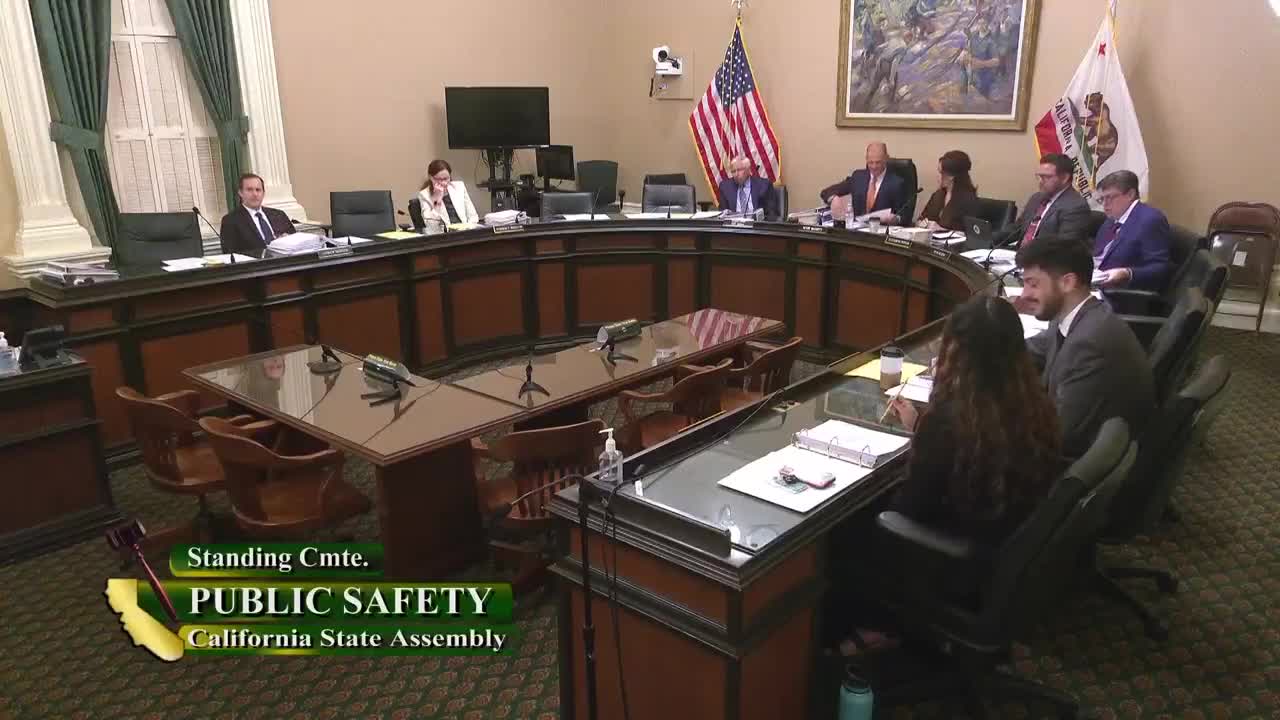 40SEC
Assembly Standing Committee on Public Safety
 29MIN
Assembly Standing Committee on Public Safety
 3MIN
Assembly Standing Committee on Public Safety
 2MIN
Assembly Standing Committee on Public Safety
Bill Author