AB 2424: Mortgages: foreclosure.
- Session Year: 2023-2024
- House: Assembly
- Latest Version Date: 2024-09-20
Current Status:
Passed
(2024-09-20: Chaptered by Secretary of State - Chapter 311, Statutes of 2024.)
Introduced
In Committee
First Chamber
In Committee
Second Chamber
Enacted
Existing law imposes various requirements to be satisfied before exercising a power of sale under a mortgage or deed of trust, including recording a notice of default, providing a mortgagor or trustor a copy of the recorded notice of default, providing notice of the time and place scheduled for the public auction sale of the real property and other notices related to the sale, determining the fees and expenses that may be paid from the sale, determining who may conduct the sale and act in the sale as an auctioneer for the trustee, determining the time and place where the auction sale may occur, and specifying how bids may be made and accepted at the auction sale.
This bill would require a notice be provided by and to specified parties that a third party, such as a family member, HUD-certified housing counselor, or attorney, may record a request to receive copies of any notice of default and notice of sale at specified times in the loan and foreclosure process and that receiving a copy of these documents may allow the third party to assist the borrower in avoiding foreclosure, as specified.
This bill would prohibit a foreclosure sale until the expiration of 45 days if the trustee receives, at least 5 business days before the scheduled date of sale, from the mortgagor or trustor a listing agreement for the sale of the property subject to the power of sale, as specified. If a scheduled date of sale has been postponed pursuant to that provision and the trustee receives, at least 5 business days before the scheduled date of sale, from the mortgagor or trustor a copy of a purchase agreement for the sale of the property, the bill would require the trustee to postpone the scheduled date of sale to a date that is at least 45 days after the date on which the purchase agreement was received by the trustee, as specified.
This bill would require the mortgagee, beneficiary, or authorized agent to provide to the trustee the fair market value of the property, as defined, at least 10 days prior to the initially scheduled date of sale, and would prohibit the trustee from selling the property at the initial trustees sale for less than 67% of the amount of that fair market value of the property. If the property remains unsold after the initial trustees sale, the bill would require the trustee to postpone the sale for at least 7 days, and would authorize the property to be sold thereafter to the highest bidder, as specified.
Existing law imposes various requirements to be satisfied before exercising a power of sale under a mortgage or deed of trust, including recording a notice of default, providing a mortgagor or trustor a copy of the recorded notice of default, providing notice of the time and place scheduled for the public auction sale of the real property and other notices related to the sale, determining the fees and expenses that may be paid from the sale, determining who may conduct the sale and act in the sale as an auctioneer for the trustee, determining the time and place where the auction sale may occur, and specifying how bids may be made and accepted at the auction sale.
This bill would require a notice be provided by and to specified parties that a third party, such as a family member, HUD-certified housing counselor, or attorney, may record a request to receive copies of any notice of default and notice of sale at specified times in the loan and foreclosure process and that receiving a copy of these documents may allow the third party to assist the borrower in avoiding foreclosure, as specified.
This bill would prohibit a foreclosure sale until the expiration of 45 days if the trustee receives, at least 5 business days before the scheduled date of sale, from the mortgagor or trustor a listing agreement for the sale of the property subject to the power of sale, as specified. If a scheduled date of sale has been postponed pursuant to that provision and the trustee receives, at least 5 business days before the scheduled date of sale, from the mortgagor or trustor a copy of a purchase agreement for the sale of the property, the bill would require the trustee to postpone the scheduled date of sale to a date that is at least 45 days after the date on which the purchase agreement was received by the trustee, as specified.
This bill would require the mortgagee, beneficiary, or authorized agent to provide to the trustee the fair market value of the property, as defined, at least 10 days prior to the initially scheduled date of sale, and would prohibit the trustee from selling the property at the initial trustees sale for less than 67% of the amount of that fair market value of the property. If the property remains unsold after the initial trustees sale, the bill would require the trustee to postpone the sale for at least 7 days, and would authorize the property to be sold thereafter to the highest bidder, as specified.
Existing law imposes various requirements to be satisfied before exercising a power of sale under a mortgage or deed of trust, including recording a notice of default, providing a mortgagor or trustor a copy of the recorded notice of default, providing notice of the time and place scheduled for the public auction sale of the real property and other notices related to the sale, determining the fees and expenses that may be paid from the sale, determining who may conduct the sale and act in the sale as an auctioneer for the trustee, determining the time and place where the auction sale may occur, and specifying how bids may be made and accepted at the auction sale.
This bill would require a notice be provided by and to specified parties that a third party, such as a family member, HUD-certified housing counselor, or attorney, may record a request to receive copies of any notice of default and notice of sale at specified times in the loan and foreclosure process and that receiving a copy of these documents may allow the third party to assist the borrower in avoiding foreclosure, as specified.
This bill would prohibit a foreclosure sale until the expiration of 45 days if the trustee receives, at least 5 business days before the scheduled date of sale, from the mortgagor or trustor delivers to the trustee and mortgage servicer a listing agreement for the sale of the property subject to the power of sale at least 5 business days before the sale, as specified. If a scheduled date of sale has been postponed pursuant to that provision and the trustee receives, at least 5 business days before the scheduled date of sale, from the mortgagor or trustor delivers to the trustee and mortgage servicer a copy of a purchase agreement for the sale of the property, the bill would require the trustee to postpone the scheduled date of sale to a date that is at least 45 days after the date on which the purchase agreement was received by the trustee, as specified.
This bill would require the mortgagee, beneficiary, or authorized agent to provide to the trustee the fair market value of the property, as defined, at least 10 days prior to the initially scheduled date of sale, and would prohibit the trustee from selling the property at the initial trustees sale for less than 67% of the amount of that fair market value of the property. If the property remains unsold after the initial trustees sale, the bill would require the trustee to postpone the sale for at least 7 days, and would authorize the property to be sold thereafter to the highest bidder, as specified.
Existing law imposes various requirements to be satisfied before exercising a power of sale under a mortgage or deed of trust, including recording a notice of default, providing a mortgagor or trustor a copy of the recorded notice of default, providing notice of the time and place scheduled for the public auction sale of the real property and other notices related to the sale, determining the fees and expenses that may be paid from the sale, determining who may conduct the sale and act in the sale as an auctioneer for the trustee, determining the time and place where the auction sale may occur, and specifying how bids may be made and accepted at the auction sale.
This bill would require a notice be provided by and to specified parties that a third party, such as a family member, HUD-certified housing counselor, or attorney, may record a request to receive copies of any notice of default and notice of sale at specified times in the loan and foreclosure process and that receiving a copy of these documents may allow the third party to assist the borrower in avoiding foreclosure, as specified.
This bill would prohibit a foreclosure sale until the expiration of 45 days if the mortgagor or trustor delivers to the trustee and mortgage servicer a listing agreement for the sale of the property subject to the power of sale at least 5 business days before the sale, as specified. If a scheduled date of sale has been postponed pursuant to that provision and the mortgagor or trustor delivers to the trustee and mortgage servicer a copy of a purchase agreement for the sale of the property, the bill would require the trustee to postpone the scheduled date of sale to a date that is at least 45 days after the date on which the purchase agreement was received by the trustee, as specified.
This bill would require the mortgagee, beneficiary, or authorized agent to provide to the trustee the fair market value of the property, as defined, at least 10 days prior to the initially scheduled date of sale, and would prohibit the trustee from selling the property at the initial trustees sale for less than 67% of the amount of that fair market value of the property. If the property remains unsold after the initial trustees sale, the bill would require the trustee to postpone the sale for at least 7 days, and would authorize the property to be sold thereafter to the highest bidder, as specified.
Existing law imposes various requirements to be satisfied before exercising a power of sale under a mortgage or deed of trust, including recording a notice of default, providing a mortgagor or trustor a copy of the recorded notice of default, providing notice of the time and place scheduled for the public auction sale of the real property and other notices related to the sale, determining the fees and expenses that may be paid from the sale, determining who may conduct the sale and act in the sale as an auctioneer for the trustee, determining the time and place where the auction sale may occur, and specifying how bids may be made and accepted at the auction sale.
This bill would require a notice be provided by and to specified parties that a third party, such as a family member, HUD-certified housing counselor, or attorney, may record a request to receive copies of any notice of default and notice of sale at specified times in the loan and foreclosure process and that receiving a copy of these documents may allow the third party to assist the borrower in avoiding foreclosure, as specified.
This bill would prohibit a foreclosure sale until the expiration of a specified time period 45 days if the mortgagor or trustor provides delivers to the trustee and beneficiary with mortgage servicer a listing agreement placed in a publicly available multiple listing service, as defined, for the sale of the property subject to the power of sale at least 5 days prior to the initial scheduled date of sale. business days before the sale, as specified. If a scheduled date of sale has been postponed pursuant to that provision and the mortgagor or trustor provides delivers to the trustee and beneficiary with mortgage servicer a copy of a purchase agreement for the sale of the property that is subject to a power of sale within that time period, property, the bill would require the trustee to postpone the initially scheduled date of sale to a date that is at least 35 45 days after the date on which the purchase agreement was entered into by the borrower. received by the trustee, as specified.
This bill would require the mortgagee, beneficiary, or authorized agent to provide to the trustee the fair market value of the property, as defined, at least 10 days prior to the initially scheduled date of sale, and would prohibit the trustee from selling the property at the initial trustees sale for less than 75% 67% of the amount of that fair market value of the property. If the property remains unsold after the initial trustees sale, the bill would require a 2nd trustees sale be held, the trustee to postpone the sale for at least 7 days, and would authorize the property to be sold thereafter to the highest bidder. The bill would prohibit a 2nd trustees sale from being held until at least 7 days after the initial trustees sale. bidder, as specified.
Existing law imposes various requirements to be satisfied before exercising a power of sale under a mortgage or deed of trust, including recording a notice of default, providing a mortgagor or trustor a copy of the recorded notice of default, providing notice of the time and place scheduled for the public auction sale of the real property and other notices related to the sale, determining the fees and expenses that may be paid from the sale, determining who may conduct the sale and act in the sale as an auctioneer for the trustee, determining the time and place where the auction sale may occur, and specifying how bids may be made and accepted at the auction sale.
This bill would require a notice be provided by and to specified parties that a third party, such as a family member, HUD-certified housing counselor, or attorney, may record a request to receive copies of any notice of default and notice of sale at specified times in the loan and foreclosure process and that receiving a copy of these documents may allow the third party to assist the borrower in avoiding foreclosure, as specified.
This bill would prohibit a foreclosure sale until the expiration of a specified time period if the mortgagor or trustor provides the trustee and beneficiary with a listing agreement placed in a publicly available multiple listing service, as defined, for the sale of the property subject to the power of sale at least 5 days prior to the initial scheduled date of sale. If the trustor provides the trustee and beneficiary with a copy of a purchase agreement for the sale of the property that is subject to a power of sale within that time period, the bill would require the trustee to postpone the initially scheduled date of sale to a date that is at least 35 days after the date on which the purchase agreement was entered into by the borrower.
This bill would require the mortgagee, beneficiary, or authorized agent to provide to the trustee the fair market value of the property, as defined, at least 10 days prior to the initially scheduled date of sale, and would prohibit the trustee from selling the property at the initial trustees sale for less than 75% of the amount of that fair market value of the property. The bill would prescribe procedures for that sale. If the property remains unsold after the initial trustees sale, the bill would require a 2nd trustees sale be held, and would authorize the property to be sold to the highest bidder. The bill would prohibit a 2nd trustees sale from being held until at least 7 days after the initial trustees sale.
Existing law imposes various requirements to be satisfied before exercising a power of sale under a mortgage or deed of trust, including recording a notice of default, providing a mortgagor or trustor a copy of the recorded notice of default, providing notice of the time and place scheduled for the public auction sale of the real property and other notices related to the sale, determining the fees and expenses that may be paid from the sale, determining who may conduct the sale and act in the sale as an auctioneer for the trustee, determining the time and place where the auction sale may occur, and specifying how bids may be made and accepted at the auction sale.
This bill would require a notice be provided by and to specified parties that a third party, such as a family member, HUD-certified housing counselor, or attorney, may record a request to receive copies of any notice of default and notice of sale at specified times in the loan and foreclosure process and that receiving a copy of these documents may allow the third party to assist the borrower in avoiding foreclosure, as specified.
This bill would prohibit a foreclosure sale until the expiration of a specified time period if the mortgagor or trustor provides the trustee and beneficiary with a listing agreement placed in a publicly available multiple listing service, as defined, for the sale of the property subject to the power of sale at least 5 days prior to the initial scheduled date of sale. If the trustor provides the trustee and beneficiary with a copy of a purchase agreement for the sale of the property that is subject to a power of sale within that time period, the bill would require the trustee to postpone the initially scheduled date of sale to a date that is at least 35 days after the date on which the purchase agreement was entered into by the borrower.
This bill would require the mortgagee, beneficiary, or authorized agent to provide to the trustee the fair market value of the property, as defined, at least 10 days prior to the initially scheduled date of sale, and would prohibit the trustee from selling the property at the initial trustees sale for less than 75% of the amount of that fair market value of the property. The bill would prescribe procedures for that sale. If the property remains unsold after the initial trustees sale, the bill would require a 2nd trustees sale be held, and would authorize the property to be sold to the highest bidder. The bill would prohibit a 2nd trustees sale from being held until at least 7 days after the initial trustees sale.
Existing law prescribes various requirements to be satisfied before the exercise of a power of sale under a mortgage or deed of trust and prescribes a procedure for the exercise of that power. Existing law establishes the order of priority for the distribution of proceeds following a sale.This bill would state the intent of the Legislature to enact subsequent legislation relating to home equity protection during the foreclosure process for the purpose of protecting consumers from losing home equity.Existing law prescribes various requirements to be satisfied before the exercise of a power of sale under a mortgage or deed of trust and prescribes a procedure for the exercise of that power. Existing law establishes the order of priority for the distribution of proceeds following a sale.
This bill would state the intent of the Legislature to enact subsequent legislation relating to home equity protection during the foreclosure process for the purpose of protecting consumers from losing home equity.
(a)(1)A mortgage servicer, mortgagee, trustee, beneficiary, or authorized agent shall not record a notice of default pursuant to Section 2924 until both of the following:
(A)Either 30 days after initial contact is made as required by paragraph (2) or 30 days after satisfying the due diligence requirements as described in subdivision (e).
(B)The mortgage servicer complies with paragraph (1) of subdivision (a) of Section 2924.18, if the borrower has provided a complete application as defined in subdivision (d) of Section 2924.18.
(2)(A)A mortgage servicer shall contact the borrower in person or by telephone in order to assess the borrowers financial situation and explore options for the borrower to avoid foreclosure. During the initial contact, the mortgage servicer shall advise the borrower that the borrower has the right to request a subsequent meeting and, if requested, the mortgage servicer shall schedule the meeting to occur within 14 days. The assessment of the borrowers financial situation and discussion of options may occur during the first contact, or at the subsequent meeting scheduled for that purpose. In either case, the borrower shall be provided the toll-free telephone number made available by the United States Department of Housing and Urban Development (HUD) to find a HUD-certified housing counseling agency. Any meeting may occur telephonically.
(B)The mortgage servicer shall notify the borrower during the initial contact required pursuant to subparagraph (A) that a third party, such as a family member, HUD-certified housing counselor, or attorney, may record a request to receive copies of any notice of default and notice of sale pursuant to the process described in Section 2924b and that receiving a copy of these documents may allow the third party to assist the borrower in avoiding foreclosure.
(b)A notice of default recorded pursuant to Section 2924 shall include a declaration that the mortgage servicer has contacted the borrower, has tried with due diligence to contact the borrower as required by this section, or that no contact was required because the individual did not meet the definition of borrower pursuant to subdivision (c) of Section 2920.5.
(c)A mortgage servicers loss mitigation personnel may participate by telephone during any contact required by this section.
(d)A borrower may designate, with consent given in writing, a HUD-certified housing counseling agency, attorney, or other advisor to discuss with the mortgage servicer, on the borrowers behalf, the borrowers financial situation and options for the borrower to avoid foreclosure. That contact made at the direction of the borrower shall satisfy the contact requirements of paragraph (2) of subdivision (a). Any loan modification or workout plan offered at the meeting by the mortgage servicer is subject to approval by the borrower.
(e)A notice of default may be recorded pursuant to Section 2924 when a mortgage servicer has not contacted a borrower as required by paragraph (2) of subdivision (a) provided that the failure to contact the borrower occurred despite the due diligence of the mortgage servicer. For purposes of this section, due diligence shall require and mean all of the following:
(1)(A)A mortgage servicer shall first attempt to contact a borrower by sending a first-class letter that includes the toll-free telephone number made available by HUD to find a HUD-certified housing counseling agency.
(B)The mortgage servicer shall notify the borrower in the first-class letter described in subparagraph (A) that a third party, such as a family member, HUD-certified housing counselor, or attorney, may record a request to receive copies of any notice of default and notice of sale pursuant to the process described in Section 2924b and that receiving a copy of these documents may allow the third party to assist the borrower in avoiding foreclosure.
(2)(A)After the letter has been sent, the mortgage servicer shall attempt to contact the borrower by telephone at least three times at different hours and on different days. Telephone calls shall be made to the primary telephone number on file.
(B)A mortgage servicer may attempt to contact a borrower using an automated system to dial borrowers, provided that, if the telephone call is answered, the call is connected to a live representative of the mortgage servicer.
(C)A mortgage servicer satisfies the telephone contact requirements of this paragraph:
(i)If it determines, after attempting contact pursuant to this paragraph, that the borrowers primary telephone number and secondary telephone number or numbers on file, if any, have been disconnected.
(ii)If the borrower or the borrowers authorized agent notifies the mortgage servicer in writing to cease further communication with the borrower. The cease communication notification shall explicitly pertain to the mortgage loan account to be effective. The cease communication notification shall be effective until the borrower or the borrowers authorized agent rescinds it in writing.
(3)If the borrower does not respond within two weeks after the telephone call requirements of paragraph (2) have been satisfied, the mortgage servicer shall then send a certified letter, with return receipt requested.
(4)The mortgage servicer shall provide a means for the borrower to contact it in a timely manner, including a toll-free telephone number that will provide access to a live representative during business hours.
(5)The mortgage servicer has posted a prominent link on the home page of its internet website, if any, to the following information:
(A)Options that may be available to borrowers who are unable to afford their mortgage payments and who wish to avoid foreclosure, and instructions to borrowers advising them on steps to take to explore those options.
(B)A list of financial documents borrowers should collect and be prepared to present to the mortgage servicer when discussing options for avoiding foreclosure.
(C)A toll-free telephone number for borrowers who wish to discuss options for avoiding foreclosure with their mortgage servicer.
(D)The toll-free telephone number made available by HUD to find a HUD-certified housing counseling agency.
(f)This section shall apply only to mortgages or deeds of trust described in Section 2924.15.
(g)This section shall apply only to entities described in subdivision (b) of Section 2924.18.
SEC. 2.Section 2923.55 of the Civil Code is amended to read:2923.55.(a)A mortgage servicer, mortgagee, trustee, beneficiary, or authorized agent shall not record a notice of default pursuant to Section 2924 until all of the following:
(1)The mortgage servicer has satisfied the requirements of paragraph (1) of subdivision (b).
(2)Either 30 days after initial contact is made as required by paragraph (2) of subdivision (b) or 30 days after satisfying the due diligence requirements as described in subdivision (f).
(3)The mortgage servicer complies with subdivision (c) of Section 2923.6, if the borrower has provided a complete application as defined in subdivision (h) of Section 2923.6.
(b)(1)As specified in subdivision (a), a mortgage servicer shall send the following information in writing to the borrower:
(A)A statement that if the borrower is a servicemember or a dependent of a servicemember, the borrower may be entitled to certain protections under the federal Servicemembers Civil Relief Act (50 U.S.C. Sec. 3901 et seq.) regarding the servicemembers interest rate and the risk of foreclosure, and counseling for covered servicemembers that is available at agencies such as Military OneSource and Armed Forces Legal Assistance.
(B)A statement that the borrower may request the following:
(i)A copy of the borrowers promissory note or other evidence of indebtedness.
(ii)A copy of the borrowers deed of trust or mortgage.
(iii)A copy of any assignment, if applicable, of the borrowers mortgage or deed of trust required to demonstrate the right of the mortgage servicer to foreclose.
(iv)A copy of the borrowers payment history since the borrower was last less than 60 days past due.
(2)(A)A mortgage servicer shall contact the borrower in person or by telephone in order to assess the borrowers financial situation and explore options for the borrower to avoid foreclosure. During the initial contact, the mortgage servicer shall advise the borrower that the borrower has the right to request a subsequent meeting and, if requested, the mortgage servicer shall schedule the meeting to occur within 14 days. The assessment of the borrowers financial situation and discussion of options may occur during the first contact, or at the subsequent meeting scheduled for that purpose. In either case, the borrower shall be provided the toll-free telephone number made available by the United States Department of Housing and Urban Development (HUD) to find a HUD-certified housing counseling agency. Any meeting may occur telephonically.
(B)The mortgage servicer shall notify the borrower during the initial contact required pursuant to subparagraph (A) that a third party, such as a family member, HUD-certified housing counselor, or attorney, may record a request to receive copies of any notice of default and notice of sale pursuant to the process described in Section 2924b and that receiving a copy of these documents may allow the third party to assist the borrower in avoiding foreclosure.
(c)A notice of default recorded pursuant to Section 2924 shall include a declaration that the mortgage servicer has contacted the borrower, has tried with due diligence to contact the borrower as required by this section, or that no contact was required because the individual did not meet the definition of borrower pursuant to subdivision (c) of Section 2920.5.
(d)A mortgage servicers loss mitigation personnel may participate by telephone during any contact required by this section.
(e)A borrower may designate, with consent given in writing, a HUD-certified housing counseling agency, attorney, or other adviser to discuss with the mortgage servicer, on the borrowers behalf, the borrowers financial situation and options for the borrower to avoid foreclosure. That contact made at the direction of the borrower shall satisfy the contact requirements of paragraph (2) of subdivision (b). Any foreclosure prevention alternative offered at the meeting by the mortgage servicer is subject to approval by the borrower.
(f)A notice of default may be recorded pursuant to Section 2924 when a mortgage servicer has not contacted a borrower as required by paragraph (2) of subdivision (b), provided that the failure to contact the borrower occurred despite the due diligence of the mortgage servicer. For purposes of this section, due diligence shall require and mean all of the following:
(1)(A)A mortgage servicer shall first attempt to contact a borrower by sending a first-class letter that includes the toll-free telephone number made available by HUD to find a HUD-certified housing counseling agency.
(B)The mortgage servicer shall notify the borrower in the first-class letter described in subparagraph (A) that a third party, such as a family member, HUD-certified housing counselor, or attorney, may record a request to receive copies of any notice of default and notice of sale pursuant to the process described in Section 2924b and that receiving a copy of these documents may allow the third party to assist the borrower in avoiding foreclosure.
(2)(A)After the letter has been sent, the mortgage servicer shall attempt to contact the borrower by telephone at least three times at different hours and on different days. Telephone calls shall be made to the primary telephone number on file.
(B)A mortgage servicer may attempt to contact a borrower using an automated system to dial borrowers, provided that, if the telephone call is answered, the call is connected to a live representative of the mortgage servicer.
(C)A mortgage servicer satisfies the telephone contact requirements of this paragraph:
(i)If it determines, after attempting contact pursuant to this paragraph, that the borrowers primary telephone number and secondary telephone number or numbers on file, if any, have been disconnected.
(ii)If the borrower or the borrowers authorized agent notifies the mortgage servicer in writing to cease further communication with the borrower. The cease communication notification shall explicitly pertain to the mortgage loan account to be effective. The cease communication notification shall be effective until the borrower or the borrowers authorized agent rescinds it in writing.
(3)If the borrower does not respond within two weeks after the telephone call requirements of paragraph (2) have been satisfied, the mortgage servicer shall then send a certified letter, with return receipt requested, that includes the toll-free telephone number made available by HUD to find a HUD-certified housing counseling agency.
(4)The mortgage servicer shall provide a means for the borrower to contact it in a timely manner, including a toll-free telephone number that will provide access to a live representative during business hours.
(5)The mortgage servicer has posted a prominent link on the home page of its internet website, if any, to the following information:
(A)Options that may be available to borrowers who are unable to afford their mortgage payments and who wish to avoid foreclosure, and instructions to borrowers advising them on steps to take to explore those options.
(B)A list of financial documents borrowers should collect and be prepared to present to the mortgage servicer when discussing options for avoiding foreclosure.
(C)A toll-free telephone number for borrowers who wish to discuss options for avoiding foreclosure with their mortgage servicer.
(D)The toll-free telephone number made available by HUD to find a HUD-certified housing counseling agency.
(g)This section shall not apply to entities described in subdivision (b) of Section 2924.18.
(h)This section shall apply only to mortgages or deeds of trust described in Section 2924.15.
SEC. 3.Section 2924f of the Civil Code, as amended by Section 14 of Chapter 131 of the Statutes of 2023, is amended to read:2924f.(a)As used in this section and Sections 2924g and 2924h, property means real property or a leasehold estate therein, and calendar week means Monday through Saturday, inclusive.
(b)(1)Except as provided in subdivision (c), before any sale of property can be made under the power of sale contained in any deed of trust or mortgage, or any resale resulting from a rescission for a failure of consideration pursuant to subdivision (c) of Section 2924h, notice of the sale thereof shall be given by posting a written notice of the time of sale and of the street address and the specific place at the street address where the sale will be held, and describing the property to be sold, at least 20 days before the date of sale in one public place in the city where the property is to be sold, if the property is to be sold in a city, or, if not, then in one public place in the county seat of the county where the property is to be sold, and publishing a copy once a week for three consecutive calendar weeks.
(2)The first publication to be at least 20 days before the date of sale, in a newspaper of general circulation published in the public notice district in which the property or some part thereof is situated, or in case no newspaper of general circulation is published in the public notice district, in a newspaper of general circulation published in the county in which the property or some part thereof is situated, or in case no newspaper of general circulation is published in the public notice district or county, as the case may be, in a newspaper of general circulation published in the county in this state that is contiguous to the county in which the property or some part thereof is situated and has, by comparison with all similarly contiguous counties, the highest population based upon total county population as determined by the most recent federal decennial census published by the Bureau of the Census. For the purposes of this section, publication of notice in a public notice district is governed by Chapter 1.1 (commencing with Section 6080) of Division 7 of Title 1 of the Government Code.
(3)A copy of the notice of sale shall also be posted in a conspicuous place on the property to be sold at least 20 days before the date of sale, where possible and where not restricted for any reason. If the property is a single-family residence the posting shall be on a door of the residence, but, if not possible or restricted, then the notice shall be posted in a conspicuous place on the property; however, if access is denied because a common entrance to the property is restricted by a guard gate or similar impediment, the property may be posted at that guard gate or similar impediment to any development community.
(4)The notice of sale shall conform to the minimum requirements of Section 6043 of the Government Code and be recorded with the county recorder of the county in which the property or some part thereof is situated at least 20 days prior to the date of sale.
(5)The notice of sale shall contain the name, street address in this state, which may reflect an agent of the trustee, and either a toll-free telephone number or telephone number in this state of the trustee, and the name of the original trustor, and also shall contain the statement required by paragraph (3) of subdivision (c). In addition to any other description of the property, the notice shall describe the property by giving its street address, if any, or other common designation, if any, and a county assessors parcel number; but if the property has no street address or other common designation, the notice shall contain a legal description of the property, the name and address of the beneficiary at whose request the sale is to be conducted, and a statement that directions may be obtained pursuant to a written request submitted to the beneficiary within 10 days from the first publication of the notice. Directions shall be deemed reasonably sufficient to locate the property if information as to the location of the property is given by reference to the direction and approximate distance from the nearest crossroads, frontage road, or access road. If a legal description or a county assessors parcel number and either a street address or another common designation of the property is given, the validity of the notice and the validity of the sale shall not be affected by the fact that the street address, other common designation, name and address of the beneficiary, or the directions obtained therefrom are erroneous or that the street address, other common designation, name and address of the beneficiary, or directions obtained therefrom are omitted.
(6)The term newspaper of general circulation, as used in this section, has the same meaning as defined in Article 1 (commencing with Section 6000) of Chapter 1 of Division 7 of Title 1 of the Government Code.
(7)The notice of sale shall contain a statement of the total amount of the unpaid balance of the obligation secured by the property to be sold and reasonably estimated costs, expenses, advances at the time of the initial publication of the notice of sale, and, if republished pursuant to a cancellation of a cash equivalent pursuant to subdivision (d) of Section 2924h, a reference of that fact; provided, that the trustee shall incur no liability for any good faith error in stating the proper amount, including any amount provided in good faith by or on behalf of the beneficiary. An inaccurate statement of this amount shall not affect the validity of any sale to a bona fide purchaser for value, nor shall the failure to post the notice of sale on a door as provided by this subdivision affect the validity of any sale to a bona fide purchaser for value.
(8)(A)On and after April 1, 2012, if the deed of trust or mortgage containing a power of sale is secured by real property containing from one to four single-family residences, the notice of sale shall contain substantially the following language, in addition to the language required pursuant to paragraphs (1) to (7), inclusive:
NOTICE TO POTENTIAL BIDDERS: If you are considering bidding on this property lien, you should understand that there are risks involved in bidding at a trustee auction. You will be bidding on a lien, not on the property itself. Placing the highest bid at a trustee auction does not automatically entitle you to free and clear ownership of the property. You should also be aware that the lien being auctioned off may be a junior lien. If you are the highest bidder at the auction, you are or may be responsible for paying off all liens senior to the lien being auctioned off, before you can receive clear title to the property. You are encouraged to investigate the existence, priority, and size of outstanding liens that may exist on this property by contacting the county recorders office or a title insurance company, either of which may charge you a fee for this information. If you consult either of these resources, you should be aware that the same lender may hold more than one mortgage or deed of trust on the property.
NOTICE TO PROPERTY OWNER: The sale date shown on this notice of sale may be postponed one or more times by the mortgagee, beneficiary, trustee, or a court, pursuant to Section 2924g of the California Civil Code. The law requires that information about trustee sale postponements be made available to you and to the public, as a courtesy to those not present at the sale. If you wish to learn whether your sale date has been postponed, and, if applicable, the rescheduled time and date for the sale of this property, you may call [telephone number for information regarding the trustees sale] or visit this internet website [internet website address for information regarding the sale of this property], using the file number assigned to this case [case file number]. Information about postponements that are very short in duration or that occur close in time to the scheduled sale may not immediately be reflected in the telephone information or on the internet website. The best way to verify postponement information is to attend the scheduled sale.
NOTICE TO TENANT: You may have a right to purchase this property after the trustee auction pursuant to Section 2924m of the California Civil Code. If you are an eligible tenant buyer, you can purchase the property if you match the last and highest bid placed at the trustee auction. If you are an eligible bidder, you may be able to purchase the property if you exceed the last and highest bid placed at the trustee auction. There are three steps to exercising this right of purchase. First, 48 hours after the date of the trustee sale, you can call [telephone number for information regarding the trustees sale], or visit this internet website [internet website address for information regarding the sale of this property], using the file number assigned to this case [case file number] to find the date on which the trustees sale was held, the amount of the last and highest bid, and the address of the trustee. Second, you must send a written notice of intent to place a bid so that the trustee receives it no more than 15 days after the trustees sale. Third, you must submit a bid so that the trustee receives it no more than 45 days after the trustees sale. If you think you may qualify as an eligible tenant buyer or eligible bidder, you should consider contacting an attorney or appropriate real estate professional immediately for advice regarding this potential right to purchase.
(B)A mortgagee, beneficiary, trustee, or authorized agent shall make a good faith effort to provide up-to-date information regarding sale dates and postponements to persons who wish this information. This information shall be made available free of charge. It may be made available via an internet website, a telephone recording that is accessible 24 hours a day, seven days a week, or through any other means that allows 24 hours a day, seven days a week, no-cost access to updated information. A disruption of any of these methods of providing sale date and postponement information to allow for reasonable maintenance or due to a service outage shall not be deemed to be a violation of the good faith standard.
(C)Except as provided in subparagraph (B), nothing in the wording of the notices required by subparagraph (A) is intended to modify or create any substantive rights or obligations for any person providing, or specified in, either of the required notices. Failure to comply with subparagraph (A) or (B) shall not invalidate any sale that would otherwise be valid under this section.
(D)Information provided pursuant to subparagraph (A) does not constitute the public declaration required by subdivision (d) of Section 2924g.
(E)For purposes of a property subject to this paragraph and of satisfying the requirements of Section 2924m, a trustee or an authorized agent shall maintain an internet website and a telephone number to provide information on applicable properties to persons who wish the information. In addition to any other information required by subparagraph (B), a trustee or an authorized agent shall provide information regarding the sale date, amount of the last and highest bid, and the trustees address, to be accessible using the file number assigned to the case and listed on the NOTICE TO TENANT required by subparagraph (A). This information shall be made available free of charge and shall be available 24 hours a day, seven days a week.
(9)If the sale of the property is to be a unified sale as provided in subparagraph (B) of paragraph (1) of subdivision (a) of Section 9604 of the Commercial Code, the notice of sale shall also contain a description of the personal property or fixtures to be sold. In the case where it is contemplated that all of the personal property or fixtures are to be sold, the description in the notice of the personal property or fixtures shall be sufficient if it is the same as the description of the personal property or fixtures contained in the agreement creating the security interest in or encumbrance on the personal property or fixtures or the filed financing statement relating to the personal property or fixtures. In all other cases, the description in the notice shall be sufficient if it would be a sufficient description of the personal property or fixtures under Section 9108 of the Commercial Code. Inclusion of a reference to or a description of personal property or fixtures in a notice of sale hereunder shall not constitute an election by the secured party to conduct a unified sale pursuant to subparagraph (B) of paragraph (1) of subdivision (a) of Section 9604 of the Commercial Code, shall not obligate the secured party to conduct a unified sale pursuant to subparagraph (B) of paragraph (1) of subdivision (a) of Section 9604 of the Commercial Code, and in no way shall render defective or noncomplying either that notice or a sale pursuant to that notice by reason of the fact that the sale includes none or less than all of the personal property or fixtures referred to or described in the notice. This paragraph shall not otherwise affect the obligations or duties of a secured party under the Commercial Code.
(c)(1)This subdivision applies only to deeds of trust or mortgages which contain a power of sale and which are secured by real property containing a single-family, owner-occupied residence, where the obligation secured by the deed of trust or mortgage is contained in a contract for goods or services subject to the provisions of the Unruh Act (Chapter 1 (commencing with Section 1801) of Title 2 of Part 4 of Division 3).
(2)Except as otherwise expressly set forth in this subdivision, all other provisions of law relating to the exercise of a power of sale shall govern the exercise of a power of sale contained in a deed of trust or mortgage described in paragraph (1).
(3)If any default of the obligation secured by a deed of trust or mortgage described in paragraph (1) has not been cured within 30 days after the recordation of the notice of default, the trustee or mortgagee shall mail to the trustor or mortgagor, at their last known address, a copy of the following statement:
YOU ARE IN DEFAULT UNDER A |
, |
(Deed of trust or mortgage) |
|---|
DATED____. UNLESS YOU TAKE ACTION TO PROTECT |
(4)All sales of real property pursuant to a power of sale contained in any deed of trust or mortgage described in paragraph (1) shall be held in the county where the residence is located and shall be made to the person making the highest offer. The trustee may receive offers during the 10-day period immediately prior to the date of sale and if any offer is accepted in writing by both the trustor or mortgagor and the beneficiary or mortgagee prior to the time set for sale, the sale shall be postponed to a date certain and prior to which the property may be conveyed by the trustor to the person making the offer according to its terms. The offer is revocable until accepted. The performance of the offer, following acceptance, according to its terms, by a conveyance of the property to the offeror, shall operate to terminate any further proceeding under the notice of sale and it shall be deemed revoked.
(5)In addition to the trustee fee pursuant to Section 2924c, the trustee or mortgagee pursuant to a deed of trust or mortgage subject to this subdivision shall be entitled to charge an additional fee of fifty dollars ($50).
(6)This subdivision applies only to property on which notices of default were filed on or after the effective date of this subdivision.
(d)With respect to residential real property containing no more than four dwelling units, a separate document containing a summary of the notice of sale information in English and the languages described in Section 1632 shall be attached to the notice of sale provided to the mortgagor or trustor pursuant to Section 2923.3.
(e)(1)With respect to residential real property containing no more than four dwelling units that is subject to a power of sale contained in any deed of trust or mortgage, a sale of the property under the power of sale shall not be conducted until the expiration of an additional 45 days following the scheduled date of sale pursuant to subdivision (a) or (c) of Section 2924g if the trustee receives, at least five business days before the scheduled date of sale, from the mortgagor or trustor, by certified mail with the United States Postal Service or by another overnight mail courier service with tracking information that confirms the recipients signature and the date and time of receipt and delivery, a listing agreement with a California licensed real estate broker to be placed in a publicly available marketing platform for the sale of the property at least five business days before the scheduled date of sale. The provisions of this paragraph shall not be used to postpone the scheduled sale date more than once.
(2)If a scheduled date of sale is postponed pursuant to paragraph (1), the trustors or mortgagors right to reinstate the account shall be extended, calculated pursuant to subdivision (e) of Section 2924c based on the new scheduled date of sale.
(3)If a scheduled date of sale has been postponed pursuant to paragraph (1) and the trustee receives, at least five business days before the scheduled date of sale, from the mortgagor or trustor, by certified mail with the United States Postal Service or by another overnight mail courier service with tracking information that confirms the recipients signature and the date and time of receipt and delivery, a copy of a purchase agreement for the sale of the property at least five business days before the scheduled sale, the trustee shall postpone the scheduled date of sale to a date that is at least 45 days after the date on which the purchase agreement was received by the trustee. The provisions of this paragraph shall not be used to postpone the scheduled sale date more than once.
(4)For purposes of this subdivision, purchase agreement means a bona fide and fully executed contract for the sale of the property that is subject to a power of sale with a purchase price amount equal to or greater than the amount of the unpaid balance of all obligations of record secured by the property that includes the name of the buyer, the sales price, the agreed closing date, and acceptance by the designated escrow agent.
(f)(1)With respect to residential real property containing no more than four dwelling units that is subject to a power of sale contained in a first lien deed of trust or mortgage, the mortgagee, beneficiary, or authorized agent shall provide to the trustee a fair market value of the property at least 10 days prior to the initially scheduled date of sale, and the trustee shall not sell the property at the initially scheduled date of sale for less than 67 percent of that fair market value of the property. The trustee may rely on the fair market value provided pursuant to this paragraph, and shall not have a duty to verify the source or accuracy of the valuation.
(2)If the property remains unsold after the initial trustees sale pursuant to paragraph (1), then the trustee shall postpone the sale for at least seven days, and the property may be sold to the highest bidder.
(3)For purposes of this subdivision, fair market value of the property means an estimate of the fair market value of the property made within six months of the initially scheduled date of sale and determined by an opinion of a licensed real estate broker, an appraisal from a licensed appraiser, a value from a commercially utilized automated valuation model, or a value from a computerized property valuation system that is used to derive a real property value.
(4)A failure to comply with the provisions of paragraph (1) shall not affect the validity of a trustees sale or a sale to a bona fide purchaser for value.
(5)The provisions of this subdivision shall apply to the initial trustees sale for each notice of sale issued pursuant to subdivision (b) of Section 2924f.
(g)This section shall remain in effect only until January 1, 2031, and as of that date is repealed, unless a later enacted statute that is enacted before January 1, 2031, deletes or extends that date.
SEC. 4.Section 2924f of the Civil Code, as amended by Section 15 of Chapter 131 of the Statutes of 2023, is amended to read:2924f.(a)As used in this section and Sections 2924g and 2924h, property means real property or a leasehold estate therein, and calendar week means Monday through Saturday, inclusive.
(b)(1)Except as provided in subdivision (c), before any sale of property can be made under the power of sale contained in any deed of trust or mortgage, or any resale resulting from a rescission for a failure of consideration pursuant to subdivision (c) of Section 2924h, notice of the sale thereof shall be given by posting a written notice of the time of sale and of the street address and the specific place at the street address where the sale will be held, and describing the property to be sold, at least 20 days before the date of sale in one public place in the city where the property is to be sold, if the property is to be sold in a city, or, if not, then in one public place in the county seat of the county where the property is to be sold, and publishing a copy once a week for three consecutive calendar weeks.
(2)The first publication to be at least 20 days before the date of sale, in a newspaper of general circulation published in the public notice district in which the property or some part thereof is situated, or in case no newspaper of general circulation is published in the public notice district, in a newspaper of general circulation published in the county in which the property or some part thereof is situated, or in case no newspaper of general circulation is published in the public notice district or county, as the case may be, in a newspaper of general circulation published in the county in this state that is contiguous to the county in which the property or some part thereof is situated and has, by comparison with all similarly contiguous counties, the highest population based upon total county population as determined by the most recent federal decennial census published by the Bureau of the Census. For the purposes of this section, publication of notice in a public notice district is governed by Chapter 1.1 (commencing with Section 6080) of Division 7 of Title 1 of the Government Code.
(3)A copy of the notice of sale shall also be posted in a conspicuous place on the property to be sold at least 20 days before the date of sale, where possible and where not restricted for any reason. If the property is a single-family residence the posting shall be on a door of the residence, but, if not possible or restricted, then the notice shall be posted in a conspicuous place on the property; however, if access is denied because a common entrance to the property is restricted by a guard gate or similar impediment, the property may be posted at that guard gate or similar impediment to any development community.
(4)The notice of sale shall conform to the minimum requirements of Section 6043 of the Government Code and be recorded with the county recorder of the county in which the property or some part thereof is situated at least 20 days prior to the date of sale.
(5)The notice of sale shall contain the name, street address in this state, which may reflect an agent of the trustee, and either a toll-free telephone number or telephone number in this state of the trustee, and the name of the original trustor, and also shall contain the statement required by paragraph (3) of subdivision (c). In addition to any other description of the property, the notice shall describe the property by giving its street address, if any, or other common designation, if any, and a county assessors parcel number; but if the property has no street address or other common designation, the notice shall contain a legal description of the property, the name and address of the beneficiary at whose request the sale is to be conducted, and a statement that directions may be obtained pursuant to a written request submitted to the beneficiary within 10 days from the first publication of the notice. Directions shall be deemed reasonably sufficient to locate the property if information as to the location of the property is given by reference to the direction and approximate distance from the nearest crossroads, frontage road, or access road. If a legal description or a county assessors parcel number and either a street address or another common designation of the property is given, the validity of the notice and the validity of the sale shall not be affected by the fact that the street address, other common designation, name and address of the beneficiary, or the directions obtained therefrom are erroneous or that the street address, other common designation, name and address of the beneficiary, or directions obtained therefrom are omitted.
(6)The term newspaper of general circulation, as used in this section, has the same meaning as defined in Article 1 (commencing with Section 6000) of Chapter 1 of Division 7 of Title 1 of the Government Code.
(7)The notice of sale shall contain a statement of the total amount of the unpaid balance of the obligation secured by the property to be sold and reasonably estimated costs, expenses, advances at the time of the initial publication of the notice of sale, and, if republished pursuant to a cancellation of a cash equivalent pursuant to subdivision (d) of Section 2924h, a reference of that fact; provided, that the trustee shall incur no liability for any good faith error in stating the proper amount, including any amount provided in good faith by or on behalf of the beneficiary. An inaccurate statement of this amount shall not affect the validity of any sale to a bona fide purchaser for value, nor shall the failure to post the notice of sale on a door as provided by this subdivision affect the validity of any sale to a bona fide purchaser for value.
(8)(A)On and after April 1, 2012, if the deed of trust or mortgage containing a power of sale is secured by real property containing from one to four single-family residences, the notice of sale shall contain substantially the following language, in addition to the language required pursuant to paragraphs (1) to (7), inclusive:
NOTICE TO POTENTIAL BIDDERS: If you are considering bidding on this property lien, you should understand that there are risks involved in bidding at a trustee auction. You will be bidding on a lien, not on the property itself. Placing the highest bid at a trustee auction does not automatically entitle you to free and clear ownership of the property. You should also be aware that the lien being auctioned off may be a junior lien. If you are the highest bidder at the auction, you are or may be responsible for paying off all liens senior to the lien being auctioned off, before you can receive clear title to the property. You are encouraged to investigate the existence, priority, and size of outstanding liens that may exist on this property by contacting the county recorders office or a title insurance company, either of which may charge you a fee for this information. If you consult either of these resources, you should be aware that the same lender may hold more than one mortgage or deed of trust on the property.
NOTICE TO PROPERTY OWNER: The sale date shown on this notice of sale may be postponed one or more times by the mortgagee, beneficiary, trustee, or a court, pursuant to Section 2924g of the California Civil Code. The law requires that information about trustee sale postponements be made available to you and to the public, as a courtesy to those not present at the sale. If you wish to learn whether your sale date has been postponed, and, if applicable, the rescheduled time and date for the sale of this property, you may call [telephone number for information regarding the trustees sale] or visit this internet website [internet website address for information regarding the sale of this property], using the file number assigned to this case [case file number]. Information about postponements that are very short in duration or that occur close in time to the scheduled sale may not immediately be reflected in the telephone information or on the internet website. The best way to verify postponement information is to attend the scheduled sale.
(B)A mortgagee, beneficiary, trustee, or authorized agent shall make a good faith effort to provide up-to-date information regarding sale dates and postponements to persons who wish this information. This information shall be made available free of charge. It may be made available via an internet website, a telephone recording that is accessible 24 hours a day, seven days a week, or through any other means that allows 24 hours a day, seven days a week, no-cost access to updated information. A disruption of any of these methods of providing sale date and postponement information to allow for reasonable maintenance or due to a service outage shall not be deemed to be a violation of the good faith standard.
(C)Except as provided in subparagraph (B), nothing in the wording of the notices required by subparagraph (A) is intended to modify or create any substantive rights or obligations for any person providing, or specified in, either of the required notices. Failure to comply with subparagraph (A) or (B) shall not invalidate any sale that would otherwise be valid under this section.
(D)Information provided pursuant to subparagraph (A) does not constitute the public declaration required by subdivision (d) of Section 2924g.
(9)If the sale of the property is to be a unified sale as provided in subparagraph (B) of paragraph (1) of subdivision (a) of Section 9604 of the Commercial Code, the notice of sale shall also contain a description of the personal property or fixtures to be sold. In the case where it is contemplated that all of the personal property or fixtures are to be sold, the description in the notice of the personal property or fixtures shall be sufficient if it is the same as the description of the personal property or fixtures contained in the agreement creating the security interest in or encumbrance on the personal property or fixtures or the filed financing statement relating to the personal property or fixtures. In all other cases, the description in the notice shall be sufficient if it would be a sufficient description of the personal property or fixtures under Section 9108 of the Commercial Code. Inclusion of a reference to or a description of personal property or fixtures in a notice of sale hereunder shall not constitute an election by the secured party to conduct a unified sale pursuant to subparagraph (B) of paragraph (1) of subdivision (a) of Section 9604 of the Commercial Code, shall not obligate the secured party to conduct a unified sale pursuant to subparagraph (B) of paragraph (1) of subdivision (a) of Section 9604 of the Commercial Code, and in no way shall render defective or noncomplying either that notice or a sale pursuant to that notice by reason of the fact that the sale includes none or less than all of the personal property or fixtures referred to or described in the notice. This paragraph shall not otherwise affect the obligations or duties of a secured party under the Commercial Code.
(c)(1)This subdivision applies only to deeds of trust or mortgages which contain a power of sale and which are secured by real property containing a single-family, owner-occupied residence, where the obligation secured by the deed of trust or mortgage is contained in a contract for goods or services subject to the provisions of the Unruh Act (Chapter 1 (commencing with Section 1801) of Title 2 of Part 4 of Division 3).
(2)Except as otherwise expressly set forth in this subdivision, all other provisions of law relating to the exercise of a power of sale shall govern the exercise of a power of sale contained in a deed of trust or mortgage described in paragraph (1).
(3)If any default of the obligation secured by a deed of trust or mortgage described in paragraph (1) has not been cured within 30 days after the recordation of the notice of default, the trustee or mortgagee shall mail to the trustor or mortgagor, at their last known address, a copy of the following statement:
YOU ARE IN DEFAULT UNDER A |
, |
(Deed of trust or mortgage) |
|---|
DATED____. UNLESS YOU TAKE ACTION TO PROTECT |
(4)All sales of real property pursuant to a power of sale contained in any deed of trust or mortgage described in paragraph (1) shall be held in the county where the residence is located and shall be made to the person making the highest offer. The trustee may receive offers during the 10-day period immediately prior to the date of sale and if any offer is accepted in writing by both the trustor or mortgagor and the beneficiary or mortgagee prior to the time set for sale, the sale shall be postponed to a date certain and prior to which the property may be conveyed by the trustor to the person making the offer according to its terms. The offer is revocable until accepted. The performance of the offer, following acceptance, according to its terms, by a conveyance of the property to the offeror, shall operate to terminate any further proceeding under the notice of sale and it shall be deemed revoked.
(5)In addition to the trustee fee pursuant to Section 2924c, the trustee or mortgagee pursuant to a deed of trust or mortgage subject to this subdivision shall be entitled to charge an additional fee of fifty dollars ($50).
(6)This subdivision applies only to property on which notices of default were filed on or after the effective date of this subdivision.
(d)With respect to residential real property containing no more than four dwelling units, a separate document containing a summary of the notice of sale information in English and the languages described in Section 1632 shall be attached to the notice of sale provided to the mortgagor or trustor pursuant to Section 2923.3.
(e)(1)With respect to residential real property containing no more than four dwelling units that is subject to a power of sale contained in any deed of trust or mortgage, a sale of the property under the power of sale shall not be conducted until the expiration of an additional 45 days following the scheduled date of sale pursuant to subdivision (a) or (c) of Section 2924g if the trustee receives, at least five business days before the scheduled date of sale, from the mortgagor or trustor, by certified mail with the United States Postal Service or by another overnight mail courier service with tracking information that confirms the recipients signature and the date and time of receipt and delivery, a listing agreement with a California licensed real estate broker to be placed in a publicly available marketing platform for the sale of the property at least five business days before the scheduled date of sale. The provisions of this paragraph shall not be used to postpone the scheduled sale date more than once.
(2)If a scheduled date of sale is postponed pursuant to paragraph (1), the trustors or mortgagors right to reinstate the account shall be extended, calculated pursuant to subdivision (e) of Section 2924c based on the new scheduled date of sale.
(3)If a scheduled date of sale has been postponed pursuant to paragraph (1) and the trustee receives, at least five business days before the scheduled date of sale, from the mortgagor or trustor, by certified mail with the United States Postal Service or by another overnight mail courier service with tracking information that confirms the recipients signature and the date and time of receipt and delivery, a copy of a purchase agreement for the sale of the property at least five business days before the scheduled sale, the trustee shall postpone the scheduled date of sale to a date that is at least 45 days after the date on which the purchase agreement was received by the trustee. The provisions of this paragraph shall not be used to postpone the scheduled sale date more than once.
(4)For purposes of this subdivision, purchase agreement means a bona fide and fully executed contract for the sale of the property that is subject to a power of sale with a purchase price amount equal to or greater than the amount of the unpaid balance of all obligations of record secured by the property that includes the name of the buyer, the sales price, the agreed closing date, and acceptance by the designated escrow agent.
(f)(1)With respect to residential real property containing no more than four dwelling units that is subject to a power of sale contained in a first lien deed of trust or mortgage, the mortgagee, beneficiary, or authorized agent shall provide to the trustee a fair market value of the property at least 10 days prior to the initially scheduled date of sale, and the trustee shall not sell the property at the initially scheduled date of sale for less than 67 percent of that fair market value of the property. The trustee may rely on the fair market value provided pursuant to this paragraph, and shall not have a duty to verify the source or accuracy of the valuation.
(2)If the property remains unsold after the initial trustees sale pursuant to paragraph (1), then the trustee shall postpone the sale for at least seven days, and the property may be sold to the highest bidder.
(3)For purposes of this subdivision, fair market value of the property means an estimate of the fair market value of the property made within six months of the initially scheduled date of sale and determined by an opinion of a licensed real estate broker, an appraisal from a licensed appraiser, a value from a commercially utilized automated valuation model, or a value from a computerized property valuation system that is used to derive a real property value.
(4)A failure to comply with the provisions of paragraph (1) shall not affect the validity of a trustees sale or a sale to a bona fide purchaser for value.
(5)The provisions of this subdivision shall apply to the initial trustees sale for each notice of sale issued pursuant to subdivision (b) of Section 2924f.
(g)This section shall be operative January 1, 2031.
SEC. 5.Section 2932.2 is added to the Civil Code, to read:2932.2.With respect to residential real property containing no more than four dwelling units, a mortgagee, beneficiary, or authorized agent shall provide to the mortgagor or trustor, before the mortgagor or trustor signs the mortgage or deed of trust, a written disclosure that a third party, such as a family member, HUD-certified housing counselor, or attorney, may record a request to receive copies of any notice of default and notice of sale. A request for notice under this section shall comply with Section 2924b.
(a)(1)A mortgage servicer, mortgagee, trustee, beneficiary, or authorized agent shall not record a notice of default pursuant to Section 2924 until both of the following:
(A)Either 30 days after initial contact is made as required by paragraph (2) or 30 days after satisfying the due diligence requirements as described in subdivision (e).
(B)The mortgage servicer complies with paragraph (1) of subdivision (a) of Section 2924.18, if the borrower has provided a complete application as defined in subdivision (d) of Section 2924.18.
(2)(A)A mortgage servicer shall contact the borrower in person or by telephone in order to assess the borrowers financial situation and explore options for the borrower to avoid foreclosure. During the initial contact, the mortgage servicer shall advise the borrower that the borrower has the right to request a subsequent meeting and, if requested, the mortgage servicer shall schedule the meeting to occur within 14 days. The assessment of the borrowers financial situation and discussion of options may occur during the first contact, or at the subsequent meeting scheduled for that purpose. In either case, the borrower shall be provided the toll-free telephone number made available by the United States Department of Housing and Urban Development (HUD) to find a HUD-certified housing counseling agency. Any meeting may occur telephonically.
(B)The mortgage servicer shall notify the borrower during the initial contact required pursuant to subparagraph (A) that a third party, such as a family member, HUD-certified housing counselor, or attorney, may record a request to receive copies of any notice of default and notice of sale pursuant to the process described in Section 2924b and that receiving a copy of these documents may allow the third party to assist the borrower in avoiding foreclosure.
(b)A notice of default recorded pursuant to Section 2924 shall include a declaration that the mortgage servicer has contacted the borrower, has tried with due diligence to contact the borrower as required by this section, or that no contact was required because the individual did not meet the definition of borrower pursuant to subdivision (c) of Section 2920.5.
(c)A mortgage servicers loss mitigation personnel may participate by telephone during any contact required by this section.
(d)A borrower may designate, with consent given in writing, a HUD-certified housing counseling agency, attorney, or other advisor to discuss with the mortgage servicer, on the borrowers behalf, the borrowers financial situation and options for the borrower to avoid foreclosure. That contact made at the direction of the borrower shall satisfy the contact requirements of paragraph (2) of subdivision (a). Any loan modification or workout plan offered at the meeting by the mortgage servicer is subject to approval by the borrower.
(e)A notice of default may be recorded pursuant to Section 2924 when a mortgage servicer has not contacted a borrower as required by paragraph (2) of subdivision (a) provided that the failure to contact the borrower occurred despite the due diligence of the mortgage servicer. For purposes of this section, due diligence shall require and mean all of the following:
(1)(A)A mortgage servicer shall first attempt to contact a borrower by sending a first-class letter that includes the toll-free telephone number made available by HUD to find a HUD-certified housing counseling agency.
(B)The mortgage servicer shall notify the borrower in the first-class letter described in subparagraph (A) that a third party, such as a family member, HUD-certified housing counselor, or attorney, may record a request to receive copies of any notice of default and notice of sale pursuant to the process described in Section 2924b and that receiving a copy of these documents may allow the third party to assist the borrower in avoiding foreclosure.
(2)(A)After the letter has been sent, the mortgage servicer shall attempt to contact the borrower by telephone at least three times at different hours and on different days. Telephone calls shall be made to the primary telephone number on file.
(B)A mortgage servicer may attempt to contact a borrower using an automated system to dial borrowers, provided that, if the telephone call is answered, the call is connected to a live representative of the mortgage servicer.
(C)A mortgage servicer satisfies the telephone contact requirements of this paragraph:
(i)If it determines, after attempting contact pursuant to this paragraph, that the borrowers primary telephone number and secondary telephone number or numbers on file, if any, have been disconnected.
(ii)If the borrower or the borrowers authorized agent notifies the mortgage servicer in writing to cease further communication with the borrower. The cease communication notification shall explicitly pertain to the mortgage loan account to be effective. The cease communication notification shall be effective until the borrower or the borrowers authorized agent rescinds it in writing.
(3)If the borrower does not respond within two weeks after the telephone call requirements of paragraph (2) have been satisfied, the mortgage servicer shall then send a certified letter, with return receipt requested.
(4)The mortgage servicer shall provide a means for the borrower to contact it in a timely manner, including a toll-free telephone number that will provide access to a live representative during business hours.
(5)The mortgage servicer has posted a prominent link on the home page of its internet website, if any, to the following information:
(A)Options that may be available to borrowers who are unable to afford their mortgage payments and who wish to avoid foreclosure, and instructions to borrowers advising them on steps to take to explore those options.
(B)A list of financial documents borrowers should collect and be prepared to present to the mortgage servicer when discussing options for avoiding foreclosure.
(C)A toll-free telephone number for borrowers who wish to discuss options for avoiding foreclosure with their mortgage servicer.
(D)The toll-free telephone number made available by HUD to find a HUD-certified housing counseling agency.
(f)This section shall apply only to mortgages or deeds of trust described in Section 2924.15.
(g)This section shall apply only to entities described in subdivision (b) of Section 2924.18.
SEC. 2.Section 2923.55 of the Civil Code is amended to read:2923.55.(a)A mortgage servicer, mortgagee, trustee, beneficiary, or authorized agent shall not record a notice of default pursuant to Section 2924 until all of the following:
(1)The mortgage servicer has satisfied the requirements of paragraph (1) of subdivision (b).
(2)Either 30 days after initial contact is made as required by paragraph (2) of subdivision (b) or 30 days after satisfying the due diligence requirements as described in subdivision (f).
(3)The mortgage servicer complies with subdivision (c) of Section 2923.6, if the borrower has provided a complete application as defined in subdivision (h) of Section 2923.6.
(b)(1)As specified in subdivision (a), a mortgage servicer shall send the following information in writing to the borrower:
(A)A statement that if the borrower is a servicemember or a dependent of a servicemember, the borrower may be entitled to certain protections under the federal Servicemembers Civil Relief Act (50 U.S.C. Sec. 3901 et seq.) regarding the servicemembers interest rate and the risk of foreclosure, and counseling for covered servicemembers that is available at agencies such as Military OneSource and Armed Forces Legal Assistance.
(B)A statement that the borrower may request the following:
(i)A copy of the borrowers promissory note or other evidence of indebtedness.
(ii)A copy of the borrowers deed of trust or mortgage.
(iii)A copy of any assignment, if applicable, of the borrowers mortgage or deed of trust required to demonstrate the right of the mortgage servicer to foreclose.
(iv)A copy of the borrowers payment history since the borrower was last less than 60 days past due.
(2)(A)A mortgage servicer shall contact the borrower in person or by telephone in order to assess the borrowers financial situation and explore options for the borrower to avoid foreclosure. During the initial contact, the mortgage servicer shall advise the borrower that the borrower has the right to request a subsequent meeting and, if requested, the mortgage servicer shall schedule the meeting to occur within 14 days. The assessment of the borrowers financial situation and discussion of options may occur during the first contact, or at the subsequent meeting scheduled for that purpose. In either case, the borrower shall be provided the toll-free telephone number made available by the United States Department of Housing and Urban Development (HUD) to find a HUD-certified housing counseling agency. Any meeting may occur telephonically.
(B)The mortgage servicer shall notify the borrower during the initial contact required pursuant to subparagraph (A) that a third party, such as a family member, HUD-certified housing counselor, or attorney, may record a request to receive copies of any notice of default and notice of sale pursuant to the process described in Section 2924b and that receiving a copy of these documents may allow the third party to assist the borrower in avoiding foreclosure.
(c)A notice of default recorded pursuant to Section 2924 shall include a declaration that the mortgage servicer has contacted the borrower, has tried with due diligence to contact the borrower as required by this section, or that no contact was required because the individual did not meet the definition of borrower pursuant to subdivision (c) of Section 2920.5.
(d)A mortgage servicers loss mitigation personnel may participate by telephone during any contact required by this section.
(e)A borrower may designate, with consent given in writing, a HUD-certified housing counseling agency, attorney, or other adviser to discuss with the mortgage servicer, on the borrowers behalf, the borrowers financial situation and options for the borrower to avoid foreclosure. That contact made at the direction of the borrower shall satisfy the contact requirements of paragraph (2) of subdivision (b). Any foreclosure prevention alternative offered at the meeting by the mortgage servicer is subject to approval by the borrower.
(f)A notice of default may be recorded pursuant to Section 2924 when a mortgage servicer has not contacted a borrower as required by paragraph (2) of subdivision (b), provided that the failure to contact the borrower occurred despite the due diligence of the mortgage servicer. For purposes of this section, due diligence shall require and mean all of the following:
(1)(A)A mortgage servicer shall first attempt to contact a borrower by sending a first-class letter that includes the toll-free telephone number made available by HUD to find a HUD-certified housing counseling agency.
(B)The mortgage servicer shall notify the borrower in the first-class letter described in subparagraph (A) that a third party, such as a family member, HUD-certified housing counselor, or attorney, may record a request to receive copies of any notice of default and notice of sale pursuant to the process described in Section 2924b and that receiving a copy of these documents may allow the third party to assist the borrower in avoiding foreclosure.
(2)(A)After the letter has been sent, the mortgage servicer shall attempt to contact the borrower by telephone at least three times at different hours and on different days. Telephone calls shall be made to the primary telephone number on file.
(B)A mortgage servicer may attempt to contact a borrower using an automated system to dial borrowers, provided that, if the telephone call is answered, the call is connected to a live representative of the mortgage servicer.
(C)A mortgage servicer satisfies the telephone contact requirements of this paragraph:
(i)If it determines, after attempting contact pursuant to this paragraph, that the borrowers primary telephone number and secondary telephone number or numbers on file, if any, have been disconnected.
(ii)If the borrower or the borrowers authorized agent notifies the mortgage servicer in writing to cease further communication with the borrower. The cease communication notification shall explicitly pertain to the mortgage loan account to be effective. The cease communication notification shall be effective until the borrower or the borrowers authorized agent rescinds it in writing.
(3)If the borrower does not respond within two weeks after the telephone call requirements of paragraph (2) have been satisfied, the mortgage servicer shall then send a certified letter, with return receipt requested, that includes the toll-free telephone number made available by HUD to find a HUD-certified housing counseling agency.
(4)The mortgage servicer shall provide a means for the borrower to contact it in a timely manner, including a toll-free telephone number that will provide access to a live representative during business hours.
(5)The mortgage servicer has posted a prominent link on the home page of its internet website, if any, to the following information:
(A)Options that may be available to borrowers who are unable to afford their mortgage payments and who wish to avoid foreclosure, and instructions to borrowers advising them on steps to take to explore those options.
(B)A list of financial documents borrowers should collect and be prepared to present to the mortgage servicer when discussing options for avoiding foreclosure.
(C)A toll-free telephone number for borrowers who wish to discuss options for avoiding foreclosure with their mortgage servicer.
(D)The toll-free telephone number made available by HUD to find a HUD-certified housing counseling agency.
(g)This section shall not apply to entities described in subdivision (b) of Section 2924.18.
(h)This section shall apply only to mortgages or deeds of trust described in Section 2924.15.
SEC. 3.Section 2924f of the Civil Code, as amended by Section 14 of Chapter 131 of the Statutes of 2023, is amended to read:2924f.(a)As used in this section and Sections 2924g and 2924h, property means real property or a leasehold estate therein, and calendar week means Monday through Saturday, inclusive.
(b)(1)Except as provided in subdivision (c), before any sale of property can be made under the power of sale contained in any deed of trust or mortgage, or any resale resulting from a rescission for a failure of consideration pursuant to subdivision (c) of Section 2924h, notice of the sale thereof shall be given by posting a written notice of the time of sale and of the street address and the specific place at the street address where the sale will be held, and describing the property to be sold, at least 20 days before the date of sale in one public place in the city where the property is to be sold, if the property is to be sold in a city, or, if not, then in one public place in the county seat of the county where the property is to be sold, and publishing a copy once a week for three consecutive calendar weeks.
(2)The first publication to be at least 20 days before the date of sale, in a newspaper of general circulation published in the public notice district in which the property or some part thereof is situated, or in case no newspaper of general circulation is published in the public notice district, in a newspaper of general circulation published in the county in which the property or some part thereof is situated, or in case no newspaper of general circulation is published in the public notice district or county, as the case may be, in a newspaper of general circulation published in the county in this state that is contiguous to the county in which the property or some part thereof is situated and has, by comparison with all similarly contiguous counties, the highest population based upon total county population as determined by the most recent federal decennial census published by the Bureau of the Census. For the purposes of this section, publication of notice in a public notice district is governed by Chapter 1.1 (commencing with Section 6080) of Division 7 of Title 1 of the Government Code.
(3)A copy of the notice of sale shall also be posted in a conspicuous place on the property to be sold at least 20 days before the date of sale, where possible and where not restricted for any reason. If the property is a single-family residence the posting shall be on a door of the residence, but, if not possible or restricted, then the notice shall be posted in a conspicuous place on the property; however, if access is denied because a common entrance to the property is restricted by a guard gate or similar impediment, the property may be posted at that guard gate or similar impediment to any development community.
(4)The notice of sale shall conform to the minimum requirements of Section 6043 of the Government Code and be recorded with the county recorder of the county in which the property or some part thereof is situated at least 20 days prior to the date of sale.
(5)The notice of sale shall contain the name, street address in this state, which may reflect an agent of the trustee, and either a toll-free telephone number or telephone number in this state of the trustee, and the name of the original trustor, and also shall contain the statement required by paragraph (3) of subdivision (c). In addition to any other description of the property, the notice shall describe the property by giving its street address, if any, or other common designation, if any, and a county assessors parcel number; but if the property has no street address or other common designation, the notice shall contain a legal description of the property, the name and address of the beneficiary at whose request the sale is to be conducted, and a statement that directions may be obtained pursuant to a written request submitted to the beneficiary within 10 days from the first publication of the notice. Directions shall be deemed reasonably sufficient to locate the property if information as to the location of the property is given by reference to the direction and approximate distance from the nearest crossroads, frontage road, or access road. If a legal description or a county assessors parcel number and either a street address or another common designation of the property is given, the validity of the notice and the validity of the sale shall not be affected by the fact that the street address, other common designation, name and address of the beneficiary, or the directions obtained therefrom are erroneous or that the street address, other common designation, name and address of the beneficiary, or directions obtained therefrom are omitted.
(6)The term newspaper of general circulation, as used in this section, has the same meaning as defined in Article 1 (commencing with Section 6000) of Chapter 1 of Division 7 of Title 1 of the Government Code.
(7)The notice of sale shall contain a statement of the total amount of the unpaid balance of the obligation secured by the property to be sold and reasonably estimated costs, expenses, advances at the time of the initial publication of the notice of sale, and, if republished pursuant to a cancellation of a cash equivalent pursuant to subdivision (d) of Section 2924h, a reference of that fact; provided, that the trustee shall incur no liability for any good faith error in stating the proper amount, including any amount provided in good faith by or on behalf of the beneficiary. An inaccurate statement of this amount shall not affect the validity of any sale to a bona fide purchaser for value, nor shall the failure to post the notice of sale on a door as provided by this subdivision affect the validity of any sale to a bona fide purchaser for value.
(8)(A)On and after April 1, 2012, if the deed of trust or mortgage containing a power of sale is secured by real property containing from one to four single-family residences, the notice of sale shall contain substantially the following language, in addition to the language required pursuant to paragraphs (1) to (7), inclusive:
NOTICE TO POTENTIAL BIDDERS: If you are considering bidding on this property lien, you should understand that there are risks involved in bidding at a trustee auction. You will be bidding on a lien, not on the property itself. Placing the highest bid at a trustee auction does not automatically entitle you to free and clear ownership of the property. You should also be aware that the lien being auctioned off may be a junior lien. If you are the highest bidder at the auction, you are or may be responsible for paying off all liens senior to the lien being auctioned off, before you can receive clear title to the property. You are encouraged to investigate the existence, priority, and size of outstanding liens that may exist on this property by contacting the county recorders office or a title insurance company, either of which may charge you a fee for this information. If you consult either of these resources, you should be aware that the same lender may hold more than one mortgage or deed of trust on the property.
NOTICE TO PROPERTY OWNER: The sale date shown on this notice of sale may be postponed one or more times by the mortgagee, beneficiary, trustee, or a court, pursuant to Section 2924g of the California Civil Code. The law requires that information about trustee sale postponements be made available to you and to the public, as a courtesy to those not present at the sale. If you wish to learn whether your sale date has been postponed, and, if applicable, the rescheduled time and date for the sale of this property, you may call [telephone number for information regarding the trustees sale] or visit this internet website [internet website address for information regarding the sale of this property], using the file number assigned to this case [case file number]. Information about postponements that are very short in duration or that occur close in time to the scheduled sale may not immediately be reflected in the telephone information or on the internet website. The best way to verify postponement information is to attend the scheduled sale.
NOTICE TO TENANT: You may have a right to purchase this property after the trustee auction pursuant to Section 2924m of the California Civil Code. If you are an eligible tenant buyer, you can purchase the property if you match the last and highest bid placed at the trustee auction. If you are an eligible bidder, you may be able to purchase the property if you exceed the last and highest bid placed at the trustee auction. There are three steps to exercising this right of purchase. First, 48 hours after the date of the trustee sale, you can call [telephone number for information regarding the trustees sale], or visit this internet website [internet website address for information regarding the sale of this property], using the file number assigned to this case [case file number] to find the date on which the trustees sale was held, the amount of the last and highest bid, and the address of the trustee. Second, you must send a written notice of intent to place a bid so that the trustee receives it no more than 15 days after the trustees sale. Third, you must submit a bid so that the trustee receives it no more than 45 days after the trustees sale. If you think you may qualify as an eligible tenant buyer or eligible bidder, you should consider contacting an attorney or appropriate real estate professional immediately for advice regarding this potential right to purchase.
(B)A mortgagee, beneficiary, trustee, or authorized agent shall make a good faith effort to provide up-to-date information regarding sale dates and postponements to persons who wish this information. This information shall be made available free of charge. It may be made available via an internet website, a telephone recording that is accessible 24 hours a day, seven days a week, or through any other means that allows 24 hours a day, seven days a week, no-cost access to updated information. A disruption of any of these methods of providing sale date and postponement information to allow for reasonable maintenance or due to a service outage shall not be deemed to be a violation of the good faith standard.
(C)Except as provided in subparagraph (B), nothing in the wording of the notices required by subparagraph (A) is intended to modify or create any substantive rights or obligations for any person providing, or specified in, either of the required notices. Failure to comply with subparagraph (A) or (B) shall not invalidate any sale that would otherwise be valid under this section.
(D)Information provided pursuant to subparagraph (A) does not constitute the public declaration required by subdivision (d) of Section 2924g.
(E)For purposes of a property subject to this paragraph and of satisfying the requirements of Section 2924m, a trustee or an authorized agent shall maintain an internet website and a telephone number to provide information on applicable properties to persons who wish the information. In addition to any other information required by subparagraph (B), a trustee or an authorized agent shall provide information regarding the sale date, amount of the last and highest bid, and the trustees address, to be accessible using the file number assigned to the case and listed on the NOTICE TO TENANT required by subparagraph (A). This information shall be made available free of charge and shall be available 24 hours a day, seven days a week.
(9)If the sale of the property is to be a unified sale as provided in subparagraph (B) of paragraph (1) of subdivision (a) of Section 9604 of the Commercial Code, the notice of sale shall also contain a description of the personal property or fixtures to be sold. In the case where it is contemplated that all of the personal property or fixtures are to be sold, the description in the notice of the personal property or fixtures shall be sufficient if it is the same as the description of the personal property or fixtures contained in the agreement creating the security interest in or encumbrance on the personal property or fixtures or the filed financing statement relating to the personal property or fixtures. In all other cases, the description in the notice shall be sufficient if it would be a sufficient description of the personal property or fixtures under Section 9108 of the Commercial Code. Inclusion of a reference to or a description of personal property or fixtures in a notice of sale hereunder shall not constitute an election by the secured party to conduct a unified sale pursuant to subparagraph (B) of paragraph (1) of subdivision (a) of Section 9604 of the Commercial Code, shall not obligate the secured party to conduct a unified sale pursuant to subparagraph (B) of paragraph (1) of subdivision (a) of Section 9604 of the Commercial Code, and in no way shall render defective or noncomplying either that notice or a sale pursuant to that notice by reason of the fact that the sale includes none or less than all of the personal property or fixtures referred to or described in the notice. This paragraph shall not otherwise affect the obligations or duties of a secured party under the Commercial Code.
(c)(1)This subdivision applies only to deeds of trust or mortgages which contain a power of sale and which are secured by real property containing a single-family, owner-occupied residence, where the obligation secured by the deed of trust or mortgage is contained in a contract for goods or services subject to the provisions of the Unruh Act (Chapter 1 (commencing with Section 1801) of Title 2 of Part 4 of Division 3).
(2)Except as otherwise expressly set forth in this subdivision, all other provisions of law relating to the exercise of a power of sale shall govern the exercise of a power of sale contained in a deed of trust or mortgage described in paragraph (1).
(3)If any default of the obligation secured by a deed of trust or mortgage described in paragraph (1) has not been cured within 30 days after the recordation of the notice of default, the trustee or mortgagee shall mail to the trustor or mortgagor, at their last known address, a copy of the following statement:
YOU ARE IN DEFAULT UNDER A |
, |
(Deed of trust or mortgage) |
|---|
DATED____. UNLESS YOU TAKE ACTION TO PROTECT |
(4)All sales of real property pursuant to a power of sale contained in any deed of trust or mortgage described in paragraph (1) shall be held in the county where the residence is located and shall be made to the person making the highest offer. The trustee may receive offers during the 10-day period immediately prior to the date of sale and if any offer is accepted in writing by both the trustor or mortgagor and the beneficiary or mortgagee prior to the time set for sale, the sale shall be postponed to a date certain and prior to which the property may be conveyed by the trustor to the person making the offer according to its terms. The offer is revocable until accepted. The performance of the offer, following acceptance, according to its terms, by a conveyance of the property to the offeror, shall operate to terminate any further proceeding under the notice of sale and it shall be deemed revoked.
(5)In addition to the trustee fee pursuant to Section 2924c, the trustee or mortgagee pursuant to a deed of trust or mortgage subject to this subdivision shall be entitled to charge an additional fee of fifty dollars ($50).
(6)This subdivision applies only to property on which notices of default were filed on or after the effective date of this subdivision.
(d)With respect to residential real property containing no more than four dwelling units, a separate document containing a summary of the notice of sale information in English and the languages described in Section 1632 shall be attached to the notice of sale provided to the mortgagor or trustor pursuant to Section 2923.3.
(e)(1)With respect to residential real property containing no more than four dwelling units that is subject to a power of sale contained in any deed of trust or mortgage, a sale of the property under the power of sale shall not be conducted until the expiration of an additional 45 days following the scheduled date of sale pursuant to subdivision (a) or (c) of Section 2924g if the trustee receives, at least five business days before the scheduled date of sale, from the mortgagor or trustor, by certified mail with the United States Postal Service or by another overnight mail courier service with tracking information that confirms the recipients signature and the date and time of receipt and delivery, a listing agreement with a California licensed real estate broker to be placed in a publicly available marketing platform for the sale of the property at least five business days before the scheduled date of sale. The provisions of this paragraph shall not be used to postpone the scheduled sale date more than once.
(2)If a scheduled date of sale is postponed pursuant to paragraph (1), the trustors or mortgagors right to reinstate the account shall be extended, calculated pursuant to subdivision (e) of Section 2924c based on the new scheduled date of sale.
(3)If a scheduled date of sale has been postponed pursuant to paragraph (1) and the trustee receives, at least five business days before the scheduled date of sale, from the mortgagor or trustor, by certified mail with the United States Postal Service or by another overnight mail courier service with tracking information that confirms the recipients signature and the date and time of receipt and delivery, a copy of a purchase agreement for the sale of the property at least five business days before the scheduled sale, the trustee shall postpone the scheduled date of sale to a date that is at least 45 days after the date on which the purchase agreement was received by the trustee. The provisions of this paragraph shall not be used to postpone the scheduled sale date more than once.
(4)For purposes of this subdivision, purchase agreement means a bona fide and fully executed contract for the sale of the property that is subject to a power of sale with a purchase price amount equal to or greater than the amount of the unpaid balance of all obligations of record secured by the property that includes the name of the buyer, the sales price, the agreed closing date, and acceptance by the designated escrow agent.
(f)(1)With respect to residential real property containing no more than four dwelling units that is subject to a power of sale contained in a first lien deed of trust or mortgage, the mortgagee, beneficiary, or authorized agent shall provide to the trustee a fair market value of the property at least 10 days prior to the initially scheduled date of sale, and the trustee shall not sell the property at the initially scheduled date of sale for less than 67 percent of that fair market value of the property. The trustee may rely on the fair market value provided pursuant to this paragraph, and shall not have a duty to verify the source or accuracy of the valuation.
(2)If the property remains unsold after the initial trustees sale pursuant to paragraph (1), then the trustee shall postpone the sale for at least seven days, and the property may be sold to the highest bidder.
(3)For purposes of this subdivision, fair market value of the property means an estimate of the fair market value of the property made within six months of the initially scheduled date of sale and determined by an opinion of a licensed real estate broker, an appraisal from a licensed appraiser, a value from a commercially utilized automated valuation model, or a value from a computerized property valuation system that is used to derive a real property value.
(4)A failure to comply with the provisions of paragraph (1) shall not affect the validity of a trustees sale or a sale to a bona fide purchaser for value.
(5)The provisions of this subdivision shall apply to the initial trustees sale for each notice of sale issued pursuant to subdivision (b) of Section 2924f.
(g)This section shall remain in effect only until January 1, 2031, and as of that date is repealed, unless a later enacted statute that is enacted before January 1, 2031, deletes or extends that date.
SEC. 4.Section 2924f of the Civil Code, as amended by Section 15 of Chapter 131 of the Statutes of 2023, is amended to read:2924f.(a)As used in this section and Sections 2924g and 2924h, property means real property or a leasehold estate therein, and calendar week means Monday through Saturday, inclusive.
(b)(1)Except as provided in subdivision (c), before any sale of property can be made under the power of sale contained in any deed of trust or mortgage, or any resale resulting from a rescission for a failure of consideration pursuant to subdivision (c) of Section 2924h, notice of the sale thereof shall be given by posting a written notice of the time of sale and of the street address and the specific place at the street address where the sale will be held, and describing the property to be sold, at least 20 days before the date of sale in one public place in the city where the property is to be sold, if the property is to be sold in a city, or, if not, then in one public place in the county seat of the county where the property is to be sold, and publishing a copy once a week for three consecutive calendar weeks.
(2)The first publication to be at least 20 days before the date of sale, in a newspaper of general circulation published in the public notice district in which the property or some part thereof is situated, or in case no newspaper of general circulation is published in the public notice district, in a newspaper of general circulation published in the county in which the property or some part thereof is situated, or in case no newspaper of general circulation is published in the public notice district or county, as the case may be, in a newspaper of general circulation published in the county in this state that is contiguous to the county in which the property or some part thereof is situated and has, by comparison with all similarly contiguous counties, the highest population based upon total county population as determined by the most recent federal decennial census published by the Bureau of the Census. For the purposes of this section, publication of notice in a public notice district is governed by Chapter 1.1 (commencing with Section 6080) of Division 7 of Title 1 of the Government Code.
(3)A copy of the notice of sale shall also be posted in a conspicuous place on the property to be sold at least 20 days before the date of sale, where possible and where not restricted for any reason. If the property is a single-family residence the posting shall be on a door of the residence, but, if not possible or restricted, then the notice shall be posted in a conspicuous place on the property; however, if access is denied because a common entrance to the property is restricted by a guard gate or similar impediment, the property may be posted at that guard gate or similar impediment to any development community.
(4)The notice of sale shall conform to the minimum requirements of Section 6043 of the Government Code and be recorded with the county recorder of the county in which the property or some part thereof is situated at least 20 days prior to the date of sale.
(5)The notice of sale shall contain the name, street address in this state, which may reflect an agent of the trustee, and either a toll-free telephone number or telephone number in this state of the trustee, and the name of the original trustor, and also shall contain the statement required by paragraph (3) of subdivision (c). In addition to any other description of the property, the notice shall describe the property by giving its street address, if any, or other common designation, if any, and a county assessors parcel number; but if the property has no street address or other common designation, the notice shall contain a legal description of the property, the name and address of the beneficiary at whose request the sale is to be conducted, and a statement that directions may be obtained pursuant to a written request submitted to the beneficiary within 10 days from the first publication of the notice. Directions shall be deemed reasonably sufficient to locate the property if information as to the location of the property is given by reference to the direction and approximate distance from the nearest crossroads, frontage road, or access road. If a legal description or a county assessors parcel number and either a street address or another common designation of the property is given, the validity of the notice and the validity of the sale shall not be affected by the fact that the street address, other common designation, name and address of the beneficiary, or the directions obtained therefrom are erroneous or that the street address, other common designation, name and address of the beneficiary, or directions obtained therefrom are omitted.
(6)The term newspaper of general circulation, as used in this section, has the same meaning as defined in Article 1 (commencing with Section 6000) of Chapter 1 of Division 7 of Title 1 of the Government Code.
(7)The notice of sale shall contain a statement of the total amount of the unpaid balance of the obligation secured by the property to be sold and reasonably estimated costs, expenses, advances at the time of the initial publication of the notice of sale, and, if republished pursuant to a cancellation of a cash equivalent pursuant to subdivision (d) of Section 2924h, a reference of that fact; provided, that the trustee shall incur no liability for any good faith error in stating the proper amount, including any amount provided in good faith by or on behalf of the beneficiary. An inaccurate statement of this amount shall not affect the validity of any sale to a bona fide purchaser for value, nor shall the failure to post the notice of sale on a door as provided by this subdivision affect the validity of any sale to a bona fide purchaser for value.
(8)(A)On and after April 1, 2012, if the deed of trust or mortgage containing a power of sale is secured by real property containing from one to four single-family residences, the notice of sale shall contain substantially the following language, in addition to the language required pursuant to paragraphs (1) to (7), inclusive:
NOTICE TO POTENTIAL BIDDERS: If you are considering bidding on this property lien, you should understand that there are risks involved in bidding at a trustee auction. You will be bidding on a lien, not on the property itself. Placing the highest bid at a trustee auction does not automatically entitle you to free and clear ownership of the property. You should also be aware that the lien being auctioned off may be a junior lien. If you are the highest bidder at the auction, you are or may be responsible for paying off all liens senior to the lien being auctioned off, before you can receive clear title to the property. You are encouraged to investigate the existence, priority, and size of outstanding liens that may exist on this property by contacting the county recorders office or a title insurance company, either of which may charge you a fee for this information. If you consult either of these resources, you should be aware that the same lender may hold more than one mortgage or deed of trust on the property.
NOTICE TO PROPERTY OWNER: The sale date shown on this notice of sale may be postponed one or more times by the mortgagee, beneficiary, trustee, or a court, pursuant to Section 2924g of the California Civil Code. The law requires that information about trustee sale postponements be made available to you and to the public, as a courtesy to those not present at the sale. If you wish to learn whether your sale date has been postponed, and, if applicable, the rescheduled time and date for the sale of this property, you may call [telephone number for information regarding the trustees sale] or visit this internet website [internet website address for information regarding the sale of this property], using the file number assigned to this case [case file number]. Information about postponements that are very short in duration or that occur close in time to the scheduled sale may not immediately be reflected in the telephone information or on the internet website. The best way to verify postponement information is to attend the scheduled sale.
(B)A mortgagee, beneficiary, trustee, or authorized agent shall make a good faith effort to provide up-to-date information regarding sale dates and postponements to persons who wish this information. This information shall be made available free of charge. It may be made available via an internet website, a telephone recording that is accessible 24 hours a day, seven days a week, or through any other means that allows 24 hours a day, seven days a week, no-cost access to updated information. A disruption of any of these methods of providing sale date and postponement information to allow for reasonable maintenance or due to a service outage shall not be deemed to be a violation of the good faith standard.
(C)Except as provided in subparagraph (B), nothing in the wording of the notices required by subparagraph (A) is intended to modify or create any substantive rights or obligations for any person providing, or specified in, either of the required notices. Failure to comply with subparagraph (A) or (B) shall not invalidate any sale that would otherwise be valid under this section.
(D)Information provided pursuant to subparagraph (A) does not constitute the public declaration required by subdivision (d) of Section 2924g.
(9)If the sale of the property is to be a unified sale as provided in subparagraph (B) of paragraph (1) of subdivision (a) of Section 9604 of the Commercial Code, the notice of sale shall also contain a description of the personal property or fixtures to be sold. In the case where it is contemplated that all of the personal property or fixtures are to be sold, the description in the notice of the personal property or fixtures shall be sufficient if it is the same as the description of the personal property or fixtures contained in the agreement creating the security interest in or encumbrance on the personal property or fixtures or the filed financing statement relating to the personal property or fixtures. In all other cases, the description in the notice shall be sufficient if it would be a sufficient description of the personal property or fixtures under Section 9108 of the Commercial Code. Inclusion of a reference to or a description of personal property or fixtures in a notice of sale hereunder shall not constitute an election by the secured party to conduct a unified sale pursuant to subparagraph (B) of paragraph (1) of subdivision (a) of Section 9604 of the Commercial Code, shall not obligate the secured party to conduct a unified sale pursuant to subparagraph (B) of paragraph (1) of subdivision (a) of Section 9604 of the Commercial Code, and in no way shall render defective or noncomplying either that notice or a sale pursuant to that notice by reason of the fact that the sale includes none or less than all of the personal property or fixtures referred to or described in the notice. This paragraph shall not otherwise affect the obligations or duties of a secured party under the Commercial Code.
(c)(1)This subdivision applies only to deeds of trust or mortgages which contain a power of sale and which are secured by real property containing a single-family, owner-occupied residence, where the obligation secured by the deed of trust or mortgage is contained in a contract for goods or services subject to the provisions of the Unruh Act (Chapter 1 (commencing with Section 1801) of Title 2 of Part 4 of Division 3).
(2)Except as otherwise expressly set forth in this subdivision, all other provisions of law relating to the exercise of a power of sale shall govern the exercise of a power of sale contained in a deed of trust or mortgage described in paragraph (1).
(3)If any default of the obligation secured by a deed of trust or mortgage described in paragraph (1) has not been cured within 30 days after the recordation of the notice of default, the trustee or mortgagee shall mail to the trustor or mortgagor, at their last known address, a copy of the following statement:
YOU ARE IN DEFAULT UNDER A |
, |
(Deed of trust or mortgage) |
|---|
DATED____. UNLESS YOU TAKE ACTION TO PROTECT |
(4)All sales of real property pursuant to a power of sale contained in any deed of trust or mortgage described in paragraph (1) shall be held in the county where the residence is located and shall be made to the person making the highest offer. The trustee may receive offers during the 10-day period immediately prior to the date of sale and if any offer is accepted in writing by both the trustor or mortgagor and the beneficiary or mortgagee prior to the time set for sale, the sale shall be postponed to a date certain and prior to which the property may be conveyed by the trustor to the person making the offer according to its terms. The offer is revocable until accepted. The performance of the offer, following acceptance, according to its terms, by a conveyance of the property to the offeror, shall operate to terminate any further proceeding under the notice of sale and it shall be deemed revoked.
(5)In addition to the trustee fee pursuant to Section 2924c, the trustee or mortgagee pursuant to a deed of trust or mortgage subject to this subdivision shall be entitled to charge an additional fee of fifty dollars ($50).
(6)This subdivision applies only to property on which notices of default were filed on or after the effective date of this subdivision.
(d)With respect to residential real property containing no more than four dwelling units, a separate document containing a summary of the notice of sale information in English and the languages described in Section 1632 shall be attached to the notice of sale provided to the mortgagor or trustor pursuant to Section 2923.3.
(e)(1)With respect to residential real property containing no more than four dwelling units that is subject to a power of sale contained in any deed of trust or mortgage, a sale of the property under the power of sale shall not be conducted until the expiration of an additional 45 days following the scheduled date of sale pursuant to subdivision (a) or (c) of Section 2924g if the trustee receives, at least five business days before the scheduled date of sale, from the mortgagor or trustor, by certified mail with the United States Postal Service or by another overnight mail courier service with tracking information that confirms the recipients signature and the date and time of receipt and delivery, a listing agreement with a California licensed real estate broker to be placed in a publicly available marketing platform for the sale of the property at least five business days before the scheduled date of sale. The provisions of this paragraph shall not be used to postpone the scheduled sale date more than once.
(2)If a scheduled date of sale is postponed pursuant to paragraph (1), the trustors or mortgagors right to reinstate the account shall be extended, calculated pursuant to subdivision (e) of Section 2924c based on the new scheduled date of sale.
(3)If a scheduled date of sale has been postponed pursuant to paragraph (1) and the trustee receives, at least five business days before the scheduled date of sale, from the mortgagor or trustor, by certified mail with the United States Postal Service or by another overnight mail courier service with tracking information that confirms the recipients signature and the date and time of receipt and delivery, a copy of a purchase agreement for the sale of the property at least five business days before the scheduled sale, the trustee shall postpone the scheduled date of sale to a date that is at least 45 days after the date on which the purchase agreement was received by the trustee. The provisions of this paragraph shall not be used to postpone the scheduled sale date more than once.
(4)For purposes of this subdivision, purchase agreement means a bona fide and fully executed contract for the sale of the property that is subject to a power of sale with a purchase price amount equal to or greater than the amount of the unpaid balance of all obligations of record secured by the property that includes the name of the buyer, the sales price, the agreed closing date, and acceptance by the designated escrow agent.
(f)(1)With respect to residential real property containing no more than four dwelling units that is subject to a power of sale contained in a first lien deed of trust or mortgage, the mortgagee, beneficiary, or authorized agent shall provide to the trustee a fair market value of the property at least 10 days prior to the initially scheduled date of sale, and the trustee shall not sell the property at the initially scheduled date of sale for less than 67 percent of that fair market value of the property. The trustee may rely on the fair market value provided pursuant to this paragraph, and shall not have a duty to verify the source or accuracy of the valuation.
(2)If the property remains unsold after the initial trustees sale pursuant to paragraph (1), then the trustee shall postpone the sale for at least seven days, and the property may be sold to the highest bidder.
(3)For purposes of this subdivision, fair market value of the property means an estimate of the fair market value of the property made within six months of the initially scheduled date of sale and determined by an opinion of a licensed real estate broker, an appraisal from a licensed appraiser, a value from a commercially utilized automated valuation model, or a value from a computerized property valuation system that is used to derive a real property value.
(4)A failure to comply with the provisions of paragraph (1) shall not affect the validity of a trustees sale or a sale to a bona fide purchaser for value.
(5)The provisions of this subdivision shall apply to the initial trustees sale for each notice of sale issued pursuant to subdivision (b) of Section 2924f.
(g)This section shall be operative January 1, 2031.
SEC. 5.Section 2932.2 is added to the Civil Code, to read:2932.2.With respect to residential real property containing no more than four dwelling units, a mortgagee, beneficiary, or authorized agent shall provide to the mortgagor or trustor, before the mortgagor or trustor signs the mortgage or deed of trust, a written disclosure that a third party, such as a family member, HUD-certified housing counselor, or attorney, may record a request to receive copies of any notice of default and notice of sale. A request for notice under this section shall comply with Section 2924b.
(a)(1)A mortgage servicer, mortgagee, trustee, beneficiary, or authorized agent shall not record a notice of default pursuant to Section 2924 until both of the following:
(A)Either 30 days after initial contact is made as required by paragraph (2) or 30 days after satisfying the due diligence requirements as described in subdivision (e).
(B)The mortgage servicer complies with paragraph (1) of subdivision (a) of Section 2924.18, if the borrower has provided a complete application as defined in subdivision (d) of Section 2924.18.
(2)(A)A mortgage servicer shall contact the borrower in person or by telephone in order to assess the borrowers financial situation and explore options for the borrower to avoid foreclosure. During the initial contact, the mortgage servicer shall advise the borrower that the borrower has the right to request a subsequent meeting and, if requested, the mortgage servicer shall schedule the meeting to occur within 14 days. The assessment of the borrowers financial situation and discussion of options may occur during the first contact, or at the subsequent meeting scheduled for that purpose. In either case, the borrower shall be provided the toll-free telephone number made available by the United States Department of Housing and Urban Development (HUD) to find a HUD-certified housing counseling agency. Any meeting may occur telephonically.
(B)The mortgage servicer shall notify the borrower during the initial contact required pursuant to subparagraph (A) that a third party, such as a family member, HUD-certified housing counselor, or attorney, may record a request to receive copies of any notice of default and notice of sale pursuant to the process described in Section 2924b and that receiving a copy of these documents may allow the third party to assist the borrower in avoiding foreclosure.
(b)A notice of default recorded pursuant to Section 2924 shall include a declaration that the mortgage servicer has contacted the borrower, has tried with due diligence to contact the borrower as required by this section, or that no contact was required because the individual did not meet the definition of borrower pursuant to subdivision (c) of Section 2920.5.
(c)A mortgage servicers loss mitigation personnel may participate by telephone during any contact required by this section.
(d)A borrower may designate, with consent given in writing, a HUD-certified housing counseling agency, attorney, or other advisor to discuss with the mortgage servicer, on the borrowers behalf, the borrowers financial situation and options for the borrower to avoid foreclosure. That contact made at the direction of the borrower shall satisfy the contact requirements of paragraph (2) of subdivision (a). Any loan modification or workout plan offered at the meeting by the mortgage servicer is subject to approval by the borrower.
(e)A notice of default may be recorded pursuant to Section 2924 when a mortgage servicer has not contacted a borrower as required by paragraph (2) of subdivision (a) provided that the failure to contact the borrower occurred despite the due diligence of the mortgage servicer. For purposes of this section, due diligence shall require and mean all of the following:
(1)(A)A mortgage servicer shall first attempt to contact a borrower by sending a first-class letter that includes the toll-free telephone number made available by HUD to find a HUD-certified housing counseling agency.
(B)The mortgage servicer shall notify the borrower in the first-class letter described in subparagraph (A) that a third party, such as a family member, HUD-certified housing counselor, or attorney, may record a request to receive copies of any notice of default and notice of sale pursuant to the process described in Section 2924b and that receiving a copy of these documents may allow the third party to assist the borrower in avoiding foreclosure.
(2)(A)After the letter has been sent, the mortgage servicer shall attempt to contact the borrower by telephone at least three times at different hours and on different days. Telephone calls shall be made to the primary telephone number on file.
(B)A mortgage servicer may attempt to contact a borrower using an automated system to dial borrowers, provided that, if the telephone call is answered, the call is connected to a live representative of the mortgage servicer.
(C)A mortgage servicer satisfies the telephone contact requirements of this paragraph:
(i)If it determines, after attempting contact pursuant to this paragraph, that the borrowers primary telephone number and secondary telephone number or numbers on file, if any, have been disconnected.
(ii)If the borrower or the borrowers authorized agent notifies the mortgage servicer in writing to cease further communication with the borrower. The cease communication notification shall explicitly pertain to the mortgage loan account to be effective. The cease communication notification shall be effective until the borrower or the borrowers authorized agent rescinds it in writing.
(3)If the borrower does not respond within two weeks after the telephone call requirements of paragraph (2) have been satisfied, the mortgage servicer shall then send a certified letter, with return receipt requested.
(4)The mortgage servicer shall provide a means for the borrower to contact it in a timely manner, including a toll-free telephone number that will provide access to a live representative during business hours.
(5)The mortgage servicer has posted a prominent link on the homepage home page of its internet website, if any, to the following information:
(A)Options that may be available to borrowers who are unable to afford their mortgage payments and who wish to avoid foreclosure, and instructions to borrowers advising them on steps to take to explore those options.
(B)A list of financial documents borrowers should collect and be prepared to present to the mortgage servicer when discussing options for avoiding foreclosure.
(C)A toll-free telephone number for borrowers who wish to discuss options for avoiding foreclosure with their mortgage servicer.
(D)The toll-free telephone number made available by HUD to find a HUD-certified housing counseling agency.
(f)This section shall apply only to mortgages or deeds of trust described in Section 2924.15.
(g)This section shall apply only to entities described in subdivision (b) of Section 2924.18.
SEC. 2.Section 2923.55 of the Civil Code is amended to read:2923.55.(a)A mortgage servicer, mortgagee, trustee, beneficiary, or authorized agent shall not record a notice of default pursuant to Section 2924 until all of the following:
(1)The mortgage servicer has satisfied the requirements of paragraph (1) of subdivision (b).
(2)Either 30 days after initial contact is made as required by paragraph (2) of subdivision (b) or 30 days after satisfying the due diligence requirements as described in subdivision (f).
(3)The mortgage servicer complies with subdivision (c) of Section 2923.6, if the borrower has provided a complete application as defined in subdivision (h) of Section 2923.6.
(b)(1)As specified in subdivision (a), a mortgage servicer shall send the following information in writing to the borrower:
(A)A statement that if the borrower is a servicemember or a dependent of a servicemember, the borrower may be entitled to certain protections under the federal Servicemembers Civil Relief Act (50 U.S.C. Sec. 3901 et seq.) regarding the servicemembers interest rate and the risk of foreclosure, and counseling for covered servicemembers that is available at agencies such as Military OneSource and Armed Forces Legal Assistance.
(B)A statement that the borrower may request the following:
(i)A copy of the borrowers promissory note or other evidence of indebtedness.
(ii)A copy of the borrowers deed of trust or mortgage.
(iii)A copy of any assignment, if applicable, of the borrowers mortgage or deed of trust required to demonstrate the right of the mortgage servicer to foreclose.
(iv)A copy of the borrowers payment history since the borrower was last less than 60 days past due.
(2)(A)A mortgage servicer shall contact the borrower in person or by telephone in order to assess the borrowers financial situation and explore options for the borrower to avoid foreclosure. During the initial contact, the mortgage servicer shall advise the borrower that the borrower has the right to request a subsequent meeting and, if requested, the mortgage servicer shall schedule the meeting to occur within 14 days. The assessment of the borrowers financial situation and discussion of options may occur during the first contact, or at the subsequent meeting scheduled for that purpose. In either case, the borrower shall be provided the toll-free telephone number made available by the United States Department of Housing and Urban Development (HUD) to find a HUD-certified housing counseling agency. Any meeting may occur telephonically.
(B)The mortgage servicer shall notify the borrower during the initial contact required pursuant to subparagraph (A) that a third party, such as a family member, HUD-certified housing counselor, or attorney, may record a request to receive copies of any notice of default and notice of sale pursuant to the process described in Section 2924b and that receiving a copy of these documents may allow the third party to assist the borrower in avoiding foreclosure.
(c)A notice of default recorded pursuant to Section 2924 shall include a declaration that the mortgage servicer has contacted the borrower, has tried with due diligence to contact the borrower as required by this section, or that no contact was required because the individual did not meet the definition of borrower pursuant to subdivision (c) of Section 2920.5.
(d)A mortgage servicers loss mitigation personnel may participate by telephone during any contact required by this section.
(e)A borrower may designate, with consent given in writing, a HUD-certified housing counseling agency, attorney, or other adviser to discuss with the mortgage servicer, on the borrowers behalf, the borrowers financial situation and options for the borrower to avoid foreclosure. That contact made at the direction of the borrower shall satisfy the contact requirements of paragraph (2) of subdivision (b). Any foreclosure prevention alternative offered at the meeting by the mortgage servicer is subject to approval by the borrower.
(f)A notice of default may be recorded pursuant to Section 2924 when a mortgage servicer has not contacted a borrower as required by paragraph (2) of subdivision (b), provided that the failure to contact the borrower occurred despite the due diligence of the mortgage servicer. For purposes of this section, due diligence shall require and mean all of the following:
(1)(A)A mortgage servicer shall first attempt to contact a borrower by sending a first-class letter that includes the toll-free telephone number made available by HUD to find a HUD-certified housing counseling agency.
(B)The mortgage servicer shall notify the borrower in the first-class letter described in subparagraph (A) that a third party, such as a family member, HUD-certified housing counselor, or attorney, may record a request to receive copies of any notice of default and notice of sale pursuant to the process described in Section 2924b and that receiving a copy of these documents may allow the third party to assist the borrower in avoiding foreclosure.
(2)(A)After the letter has been sent, the mortgage servicer shall attempt to contact the borrower by telephone at least three times at different hours and on different days. Telephone calls shall be made to the primary telephone number on file.
(B)A mortgage servicer may attempt to contact a borrower using an automated system to dial borrowers, provided that, if the telephone call is answered, the call is connected to a live representative of the mortgage servicer.
(C)A mortgage servicer satisfies the telephone contact requirements of this paragraph:
(i)If it determines, after attempting contact pursuant to this paragraph, that the borrowers primary telephone number and secondary telephone number or numbers on file, if any, have been disconnected.
(ii)If the borrower or the borrowers authorized agent notifies the mortgage servicer in writing to cease further communication with the borrower. The cease communication notification shall explicitly pertain to the mortgage loan account to be effective. The cease communication notification shall be effective until the borrower or the borrowers authorized agent rescinds it in writing.
(3)If the borrower does not respond within two weeks after the telephone call requirements of paragraph (2) have been satisfied, the mortgage servicer shall then send a certified letter, with return receipt requested, that includes the toll-free telephone number made available by HUD to find a HUD-certified housing counseling agency.
(4)The mortgage servicer shall provide a means for the borrower to contact it in a timely manner, including a toll-free telephone number that will provide access to a live representative during business hours.
(5)The mortgage servicer has posted a prominent link on the homepage home page of its internet website, if any, to the following information:
(A)Options that may be available to borrowers who are unable to afford their mortgage payments and who wish to avoid foreclosure, and instructions to borrowers advising them on steps to take to explore those options.
(B)A list of financial documents borrowers should collect and be prepared to present to the mortgage servicer when discussing options for avoiding foreclosure.
(C)A toll-free telephone number for borrowers who wish to discuss options for avoiding foreclosure with their mortgage servicer.
(D)The toll-free telephone number made available by HUD to find a HUD-certified housing counseling agency.
(g)This section shall not apply to entities described in subdivision (b) of Section 2924.18.
(h)This section shall apply only to mortgages or deeds of trust described in Section 2924.15.
SEC. 3.Section 2924f of the Civil Code, as amended by Section 14 of Chapter 131 of the Statutes of 2023, is amended to read:2924f.(a)As used in this section and Sections 2924g and 2924h, property means real property or a leasehold estate therein, and calendar week means Monday through Saturday, inclusive.
(b)(1)Except as provided in subdivision (c), before any sale of property can be made under the power of sale contained in any deed of trust or mortgage, or any resale resulting from a rescission for a failure of consideration pursuant to subdivision (c) of Section 2924h, notice of the sale thereof shall be given by posting a written notice of the time of sale and of the street address and the specific place at the street address where the sale will be held, and describing the property to be sold, at least 20 days before the date of sale in one public place in the city where the property is to be sold, if the property is to be sold in a city, or, if not, then in one public place in the county seat of the county where the property is to be sold, and publishing a copy once a week for three consecutive calendar weeks.
(2)The first publication to be at least 20 days before the date of sale, in a newspaper of general circulation published in the public notice district in which the property or some part thereof is situated, or in case no newspaper of general circulation is published in the public notice district, in a newspaper of general circulation published in the county in which the property or some part thereof is situated, or in case no newspaper of general circulation is published in the public notice district or county, as the case may be, in a newspaper of general circulation published in the county in this state that is contiguous to the county in which the property or some part thereof is situated and has, by comparison with all similarly contiguous counties, the highest population based upon total county population as determined by the most recent federal decennial census published by the Bureau of the Census. For the purposes of this section, publication of notice in a public notice district is governed by Chapter 1.1 (commencing with Section 6080) of Division 7 of Title 1 of the Government Code.
(3)A copy of the notice of sale shall also be posted in a conspicuous place on the property to be sold at least 20 days before the date of sale, where possible and where not restricted for any reason. If the property is a single-family residence the posting shall be on a door of the residence, but, if not possible or restricted, then the notice shall be posted in a conspicuous place on the property; however, if access is denied because a common entrance to the property is restricted by a guard gate or similar impediment, the property may be posted at that guard gate or similar impediment to any development community.
(4)The notice of sale shall conform to the minimum requirements of Section 6043 of the Government Code and be recorded with the county recorder of the county in which the property or some part thereof is situated at least 20 days prior to the date of sale.
(5)The notice of sale shall contain the name, street address in this state, which may reflect an agent of the trustee, and either a toll-free telephone number or telephone number in this state of the trustee, and the name of the original trustor, and also shall contain the statement required by paragraph (3) of subdivision (c). In addition to any other description of the property, the notice shall describe the property by giving its street address, if any, or other common designation, if any, and a county assessors parcel number; but if the property has no street address or other common designation, the notice shall contain a legal description of the property, the name and address of the beneficiary at whose request the sale is to be conducted, and a statement that directions may be obtained pursuant to a written request submitted to the beneficiary within 10 days from the first publication of the notice. Directions shall be deemed reasonably sufficient to locate the property if information as to the location of the property is given by reference to the direction and approximate distance from the nearest crossroads, frontage road, or access road. If a legal description or a county assessors parcel number and either a street address or another common designation of the property is given, the validity of the notice and the validity of the sale shall not be affected by the fact that the street address, other common designation, name and address of the beneficiary, or the directions obtained therefrom are erroneous or that the street address, other common designation, name and address of the beneficiary, or directions obtained therefrom are omitted.
(6)The term newspaper of general circulation, as used in this section, has the same meaning as defined in Article 1 (commencing with Section 6000) of Chapter 1 of Division 7 of Title 1 of the Government Code.
(7)The notice of sale shall contain a statement of the total amount of the unpaid balance of the obligation secured by the property to be sold and reasonably estimated costs, expenses, advances at the time of the initial publication of the notice of sale, and, if republished pursuant to a cancellation of a cash equivalent pursuant to subdivision (d) of Section 2924h, a reference of that fact; provided, that the trustee shall incur no liability for any good faith error in stating the proper amount, including any amount provided in good faith by or on behalf of the beneficiary. An inaccurate statement of this amount shall not affect the validity of any sale to a bona fide purchaser for value, nor shall the failure to post the notice of sale on a door as provided by this subdivision affect the validity of any sale to a bona fide purchaser for value.
(8)(A)On and after April 1, 2012, if the deed of trust or mortgage containing a power of sale is secured by real property containing from one to four single-family residences, the notice of sale shall contain substantially the following language, in addition to the language required pursuant to paragraphs (1) to (7), inclusive:
NOTICE TO POTENTIAL BIDDERS: If you are considering bidding on this property lien, you should understand that there are risks involved in bidding at a trustee auction. You will be bidding on a lien, not on the property itself. Placing the highest bid at a trustee auction does not automatically entitle you to free and clear ownership of the property. You should also be aware that the lien being auctioned off may be a junior lien. If you are the highest bidder at the auction, you are or may be responsible for paying off all liens senior to the lien being auctioned off, before you can receive clear title to the property. You are encouraged to investigate the existence, priority, and size of outstanding liens that may exist on this property by contacting the county recorders office or a title insurance company, either of which may charge you a fee for this information. If you consult either of these resources, you should be aware that the same lender may hold more than one mortgage or deed of trust on the property.
NOTICE TO PROPERTY OWNER: The sale date shown on this notice of sale may be postponed one or more times by the mortgagee, beneficiary, trustee, or a court, pursuant to Section 2924g of the California Civil Code. The law requires that information about trustee sale postponements be made available to you and to the public, as a courtesy to those not present at the sale. If you wish to learn whether your sale date has been postponed, and, if applicable, the rescheduled time and date for the sale of this property, you may call [telephone number for information regarding the trustees sale] or visit this internet website [internet website address for information regarding the sale of this property], using the file number assigned to this case [case file number]. Information about postponements that are very short in duration or that occur close in time to the scheduled sale may not immediately be reflected in the telephone information or on the internet website. The best way to verify postponement information is to attend the scheduled sale.
NOTICE TO TENANT: You may have a right to purchase this property after the trustee auction pursuant to Section 2924m of the California Civil Code. If you are an eligible tenant buyer, you can purchase the property if you match the last and highest bid placed at the trustee auction. If you are an eligible bidder, you may be able to purchase the property if you exceed the last and highest bid placed at the trustee auction. There are three steps to exercising this right of purchase. First, 48 hours after the date of the trustee sale, you can call [telephone number for information regarding the trustees sale], or visit this internet website [internet website address for information regarding the sale of this property], using the file number assigned to this case [case file number] to find the date on which the trustees sale was held, the amount of the last and highest bid, and the address of the trustee. Second, you must send a written notice of intent to place a bid so that the trustee receives it no more than 15 days after the trustees sale. Third, you must submit a bid so that the trustee receives it no more than 45 days after the trustees sale. If you think you may qualify as an eligible tenant buyer or eligible bidder, you should consider contacting an attorney or appropriate real estate professional immediately for advice regarding this potential right to purchase.
(B)A mortgagee, beneficiary, trustee, or authorized agent shall make a good faith effort to provide up-to-date information regarding sale dates and postponements to persons who wish this information. This information shall be made available free of charge. It may be made available via an internet website, a telephone recording that is accessible 24 hours a day, seven days a week, or through any other means that allows 24 hours a day, seven days a week, no-cost access to updated information. A disruption of any of these methods of providing sale date and postponement information to allow for reasonable maintenance or due to a service outage shall not be deemed to be a violation of the good faith standard.
(C)Except as provided in subparagraph (B), nothing in the wording of the notices required by subparagraph (A) is intended to modify or create any substantive rights or obligations for any person providing, or specified in, either of the required notices. Failure to comply with subparagraph (A) or (B) shall not invalidate any sale that would otherwise be valid under this section.
(D)Information provided pursuant to subparagraph (A) does not constitute the public declaration required by subdivision (d) of Section 2924g.
(E)For purposes of a property subject to this paragraph and of satisfying the requirements of Section 2924m, a trustee or an authorized agent shall maintain an internet website and a telephone number to provide information on applicable properties to persons who wish the information. In addition to any other information required by subparagraph (B), a trustee or an authorized agent shall provide information regarding the sale date, amount of the last and highest bid, and the trustees address, to be accessible using the file number assigned to the case and listed on the NOTICE TO TENANT required by subparagraph (A). This information shall be made available free of charge and shall be available 24 hours a day, seven days a week.
(9)If the sale of the property is to be a unified sale as provided in subparagraph (B) of paragraph (1) of subdivision (a) of Section 9604 of the Commercial Code, the notice of sale shall also contain a description of the personal property or fixtures to be sold. In the case where it is contemplated that all of the personal property or fixtures are to be sold, the description in the notice of the personal property or fixtures shall be sufficient if it is the same as the description of the personal property or fixtures contained in the agreement creating the security interest in or encumbrance on the personal property or fixtures or the filed financing statement relating to the personal property or fixtures. In all other cases, the description in the notice shall be sufficient if it would be a sufficient description of the personal property or fixtures under Section 9108 of the Commercial Code. Inclusion of a reference to or a description of personal property or fixtures in a notice of sale hereunder shall not constitute an election by the secured party to conduct a unified sale pursuant to subparagraph (B) of paragraph (1) of subdivision (a) of Section 9604 of the Commercial Code, shall not obligate the secured party to conduct a unified sale pursuant to subparagraph (B) of paragraph (1) of subdivision (a) of Section 9604 of the Commercial Code, and in no way shall render defective or noncomplying either that notice or a sale pursuant to that notice by reason of the fact that the sale includes none or less than all of the personal property or fixtures referred to or described in the notice. This paragraph shall not otherwise affect the obligations or duties of a secured party under the Commercial Code.
(c)(1)This subdivision applies only to deeds of trust or mortgages which contain a power of sale and which are secured by real property containing a single-family, owner-occupied residence, where the obligation secured by the deed of trust or mortgage is contained in a contract for goods or services subject to the provisions of the Unruh Act (Chapter 1 (commencing with Section 1801) of Title 2 of Part 4 of Division 3).
(2)Except as otherwise expressly set forth in this subdivision, all other provisions of law relating to the exercise of a power of sale shall govern the exercise of a power of sale contained in a deed of trust or mortgage described in paragraph (1).
(3)If any default of the obligation secured by a deed of trust or mortgage described in paragraph (1) has not been cured within 30 days after the recordation of the notice of default, the trustee or mortgagee shall mail to the trustor or mortgagor, at their last known address, a copy of the following statement:
YOU ARE IN DEFAULT UNDER A |
, |
(Deed of trust or mortgage) |
|---|
DATED____. UNLESS YOU TAKE ACTION TO PROTECT |
(4)All sales of real property pursuant to a power of sale contained in any deed of trust or mortgage described in paragraph (1) shall be held in the county where the residence is located and shall be made to the person making the highest offer. The trustee may receive offers during the 10-day period immediately prior to the date of sale and if any offer is accepted in writing by both the trustor or mortgagor and the beneficiary or mortgagee prior to the time set for sale, the sale shall be postponed to a date certain and prior to which the property may be conveyed by the trustor to the person making the offer according to its terms. The offer is revocable until accepted. The performance of the offer, following acceptance, according to its terms, by a conveyance of the property to the offeror, shall operate to terminate any further proceeding under the notice of sale and it shall be deemed revoked.
(5)In addition to the trustee fee pursuant to Section 2924c, the trustee or mortgagee pursuant to a deed of trust or mortgage subject to this subdivision shall be entitled to charge an additional fee of fifty dollars ($50).
(6)This subdivision applies only to property on which notices of default were filed on or after the effective date of this subdivision.
(d)With respect to residential real property containing no more than four dwelling units, a separate document containing a summary of the notice of sale information in English and the languages described in Section 1632 shall be attached to the notice of sale provided to the mortgagor or trustor pursuant to Section 2923.3.
(e)(1)With respect to residential real property containing no more than four dwelling units that is subject to a power of sale contained in any deed of trust or mortgage, a sale of the property under the power of sale shall not be conducted until the expiration of an additional 45 days following the scheduled date of sale pursuant to subdivision (a) or (c) of Section 2924g if the trustee receives, at least five business days before the scheduled date of sale, from the mortgagor or trustor delivers to the trustee and mortgage servicer, trustor, by certified mail with the United States Postal Service or by another overnight mail courier service with tracking information that confirms the recipients signature and the date and time of receipt and delivery, a listing agreement with a California licensed real estate broker or agency to be placed in a publicly available marketing platform for the sale of the property at least five business days before the scheduled date of sale. The provisions of this paragraph shall not be used to postpone the scheduled sale date more than once.
(2)If a scheduled date of sale is postponed pursuant to paragraph (1), the trustors or mortgagors right to reinstate the account shall be extended, calculated pursuant to subdivision (e) of Section 2924c based on the new scheduled date of sale.
(3)If a scheduled date of sale has been postponed pursuant to paragraph (1) and the trustee receives, at least five business days before the scheduled date of sale, from the mortgagor or trustor delivers to the trustee and mortgage servicer, trustor, by certified mail with the United States Postal Service or by another overnight mail courier service with tracking information that confirms the recipients signature and the date and time of receipt and delivery, a copy of a purchase agreement for the sale of the property at least five business days before the scheduled sale, the trustee shall postpone the scheduled date of sale to a date that is at least 45 days after the date on which the purchase agreement was received by the trustee. The provisions of this paragraph shall not be used to postpone the scheduled sale date more than once.
(4)For purposes of this subdivision, purchase agreement means a bona fide and fully executed contract for the sale of the property that is subject to a power of sale with a purchase price amount equal to or greater than the amount of the unpaid balance of all obligations of record secured by the property that includes the name of the buyer, the sales price, the agreed closing date, and acceptance by the designated escrow agent.
(f)(1)With respect to residential real property containing no more than four dwelling units that is subject to a power of sale contained in a first lien deed of trust or mortgage, the mortgagee, beneficiary, or authorized agent shall provide to the trustee a fair market value of the property at least 10 days prior to the initially scheduled date of sale, and the trustee shall not sell the property at the initially scheduled date of sale for less than 67 percent of that fair market value of the property. The trustee may rely on the fair market value provided pursuant to this paragraph, and shall not have a duty to verify the source or accuracy of the valuation.
(2)If the property remains unsold after the initial trustees sale pursuant to paragraph (1), then the trustee shall postpone the sale for at least seven days, and the property may be sold to the highest bidder.
(3)For purposes of this subdivision, fair market value of the property means an estimate of the fair market value of the property made within six months of the initially scheduled date of sale and determined by an opinion of a licensed real estate broker, an appraisal from a licensed appraiser, a value from a commercially utilized automated valuation model, or a value from a computerized property valuation system that is used to derive a real property value.
(4)A failure to comply with the provisions of paragraph (1) shall not affect the validity of a trustees sale or a sale to a bona fide purchaser for value.
(5)The provisions of this subdivision shall apply to the initial trustees sale for each notice of sale issued pursuant to subdivision (b) of Section 2924f.
(g)This section shall remain in effect only until January 1, 2031, and as of that date is repealed, unless a later enacted statute that is enacted before January 1, 2031, deletes or extends that date.
SEC. 4.Section 2924f of the Civil Code, as amended by Section 15 of Chapter 131 of the Statutes of 2023, is amended to read:2924f.(a)As used in this section and Sections 2924g and 2924h, property means real property or a leasehold estate therein, and calendar week means Monday through Saturday, inclusive.
(b)(1)Except as provided in subdivision (c), before any sale of property can be made under the power of sale contained in any deed of trust or mortgage, or any resale resulting from a rescission for a failure of consideration pursuant to subdivision (c) of Section 2924h, notice of the sale thereof shall be given by posting a written notice of the time of sale and of the street address and the specific place at the street address where the sale will be held, and describing the property to be sold, at least 20 days before the date of sale in one public place in the city where the property is to be sold, if the property is to be sold in a city, or, if not, then in one public place in the county seat of the county where the property is to be sold, and publishing a copy once a week for three consecutive calendar weeks.
(2)The first publication to be at least 20 days before the date of sale, in a newspaper of general circulation published in the public notice district in which the property or some part thereof is situated, or in case no newspaper of general circulation is published in the public notice district, in a newspaper of general circulation published in the county in which the property or some part thereof is situated, or in case no newspaper of general circulation is published in the public notice district or county, as the case may be, in a newspaper of general circulation published in the county in this state that is contiguous to the county in which the property or some part thereof is situated and has, by comparison with all similarly contiguous counties, the highest population based upon total county population as determined by the most recent federal decennial census published by the Bureau of the Census. For the purposes of this section, publication of notice in a public notice district is governed by Chapter 1.1 (commencing with Section 6080) of Division 7 of Title 1 of the Government Code.
(3)A copy of the notice of sale shall also be posted in a conspicuous place on the property to be sold at least 20 days before the date of sale, where possible and where not restricted for any reason. If the property is a single-family residence the posting shall be on a door of the residence, but, if not possible or restricted, then the notice shall be posted in a conspicuous place on the property; however, if access is denied because a common entrance to the property is restricted by a guard gate or similar impediment, the property may be posted at that guard gate or similar impediment to any development community.
(4)The notice of sale shall conform to the minimum requirements of Section 6043 of the Government Code and be recorded with the county recorder of the county in which the property or some part thereof is situated at least 20 days prior to the date of sale.
(5)The notice of sale shall contain the name, street address in this state, which may reflect an agent of the trustee, and either a toll-free telephone number or telephone number in this state of the trustee, and the name of the original trustor, and also shall contain the statement required by paragraph (3) of subdivision (c). In addition to any other description of the property, the notice shall describe the property by giving its street address, if any, or other common designation, if any, and a county assessors parcel number; but if the property has no street address or other common designation, the notice shall contain a legal description of the property, the name and address of the beneficiary at whose request the sale is to be conducted, and a statement that directions may be obtained pursuant to a written request submitted to the beneficiary within 10 days from the first publication of the notice. Directions shall be deemed reasonably sufficient to locate the property if information as to the location of the property is given by reference to the direction and approximate distance from the nearest crossroads, frontage road, or access road. If a legal description or a county assessors parcel number and either a street address or another common designation of the property is given, the validity of the notice and the validity of the sale shall not be affected by the fact that the street address, other common designation, name and address of the beneficiary, or the directions obtained therefrom are erroneous or that the street address, other common designation, name and address of the beneficiary, or directions obtained therefrom are omitted.
(6)The term newspaper of general circulation, as used in this section, has the same meaning as defined in Article 1 (commencing with Section 6000) of Chapter 1 of Division 7 of Title 1 of the Government Code.
(7)The notice of sale shall contain a statement of the total amount of the unpaid balance of the obligation secured by the property to be sold and reasonably estimated costs, expenses, advances at the time of the initial publication of the notice of sale, and, if republished pursuant to a cancellation of a cash equivalent pursuant to subdivision (d) of Section 2924h, a reference of that fact; provided, that the trustee shall incur no liability for any good faith error in stating the proper amount, including any amount provided in good faith by or on behalf of the beneficiary. An inaccurate statement of this amount shall not affect the validity of any sale to a bona fide purchaser for value, nor shall the failure to post the notice of sale on a door as provided by this subdivision affect the validity of any sale to a bona fide purchaser for value.
(8)(A)On and after April 1, 2012, if the deed of trust or mortgage containing a power of sale is secured by real property containing from one to four single-family residences, the notice of sale shall contain substantially the following language, in addition to the language required pursuant to paragraphs (1) to (7), inclusive:
NOTICE TO POTENTIAL BIDDERS: If you are considering bidding on this property lien, you should understand that there are risks involved in bidding at a trustee auction. You will be bidding on a lien, not on the property itself. Placing the highest bid at a trustee auction does not automatically entitle you to free and clear ownership of the property. You should also be aware that the lien being auctioned off may be a junior lien. If you are the highest bidder at the auction, you are or may be responsible for paying off all liens senior to the lien being auctioned off, before you can receive clear title to the property. You are encouraged to investigate the existence, priority, and size of outstanding liens that may exist on this property by contacting the county recorders office or a title insurance company, either of which may charge you a fee for this information. If you consult either of these resources, you should be aware that the same lender may hold more than one mortgage or deed of trust on the property.
NOTICE TO PROPERTY OWNER: The sale date shown on this notice of sale may be postponed one or more times by the mortgagee, beneficiary, trustee, or a court, pursuant to Section 2924g of the California Civil Code. The law requires that information about trustee sale postponements be made available to you and to the public, as a courtesy to those not present at the sale. If you wish to learn whether your sale date has been postponed, and, if applicable, the rescheduled time and date for the sale of this property, you may call [telephone number for information regarding the trustees sale] or visit this internet website [internet website address for information regarding the sale of this property], using the file number assigned to this case [case file number]. Information about postponements that are very short in duration or that occur close in time to the scheduled sale may not immediately be reflected in the telephone information or on the internet website. The best way to verify postponement information is to attend the scheduled sale.
(B)A mortgagee, beneficiary, trustee, or authorized agent shall make a good faith effort to provide up-to-date information regarding sale dates and postponements to persons who wish this information. This information shall be made available free of charge. It may be made available via an internet website, a telephone recording that is accessible 24 hours a day, seven days a week, or through any other means that allows 24 hours a day, seven days a week, no-cost access to updated information. A disruption of any of these methods of providing sale date and postponement information to allow for reasonable maintenance or due to a service outage shall not be deemed to be a violation of the good faith standard.
(C)Except as provided in subparagraph (B), nothing in the wording of the notices required by subparagraph (A) is intended to modify or create any substantive rights or obligations for any person providing, or specified in, either of the required notices. Failure to comply with subparagraph (A) or (B) shall not invalidate any sale that would otherwise be valid under this section.
(D)Information provided pursuant to subparagraph (A) does not constitute the public declaration required by subdivision (d) of Section 2924g.
(9)If the sale of the property is to be a unified sale as provided in subparagraph (B) of paragraph (1) of subdivision (a) of Section 9604 of the Commercial Code, the notice of sale shall also contain a description of the personal property or fixtures to be sold. In the case where it is contemplated that all of the personal property or fixtures are to be sold, the description in the notice of the personal property or fixtures shall be sufficient if it is the same as the description of the personal property or fixtures contained in the agreement creating the security interest in or encumbrance on the personal property or fixtures or the filed financing statement relating to the personal property or fixtures. In all other cases, the description in the notice shall be sufficient if it would be a sufficient description of the personal property or fixtures under Section 9108 of the Commercial Code. Inclusion of a reference to or a description of personal property or fixtures in a notice of sale hereunder shall not constitute an election by the secured party to conduct a unified sale pursuant to subparagraph (B) of paragraph (1) of subdivision (a) of Section 9604 of the Commercial Code, shall not obligate the secured party to conduct a unified sale pursuant to subparagraph (B) of paragraph (1) of subdivision (a) of Section 9604 of the Commercial Code, and in no way shall render defective or noncomplying either that notice or a sale pursuant to that notice by reason of the fact that the sale includes none or less than all of the personal property or fixtures referred to or described in the notice. This paragraph shall not otherwise affect the obligations or duties of a secured party under the Commercial Code.
(c)(1)This subdivision applies only to deeds of trust or mortgages which contain a power of sale and which are secured by real property containing a single-family, owner-occupied residence, where the obligation secured by the deed of trust or mortgage is contained in a contract for goods or services subject to the provisions of the Unruh Act (Chapter 1 (commencing with Section 1801) of Title 2 of Part 4 of Division 3).
(2)Except as otherwise expressly set forth in this subdivision, all other provisions of law relating to the exercise of a power of sale shall govern the exercise of a power of sale contained in a deed of trust or mortgage described in paragraph (1).
(3)If any default of the obligation secured by a deed of trust or mortgage described in paragraph (1) has not been cured within 30 days after the recordation of the notice of default, the trustee or mortgagee shall mail to the trustor or mortgagor, at their last known address, a copy of the following statement:
YOU ARE IN DEFAULT UNDER A |
, |
(Deed of trust or mortgage) |
|---|
DATED____. UNLESS YOU TAKE ACTION TO PROTECT |
(4)All sales of real property pursuant to a power of sale contained in any deed of trust or mortgage described in paragraph (1) shall be held in the county where the residence is located and shall be made to the person making the highest offer. The trustee may receive offers during the 10-day period immediately prior to the date of sale and if any offer is accepted in writing by both the trustor or mortgagor and the beneficiary or mortgagee prior to the time set for sale, the sale shall be postponed to a date certain and prior to which the property may be conveyed by the trustor to the person making the offer according to its terms. The offer is revocable until accepted. The performance of the offer, following acceptance, according to its terms, by a conveyance of the property to the offeror, shall operate to terminate any further proceeding under the notice of sale and it shall be deemed revoked.
(5)In addition to the trustee fee pursuant to Section 2924c, the trustee or mortgagee pursuant to a deed of trust or mortgage subject to this subdivision shall be entitled to charge an additional fee of fifty dollars ($50).
(6)This subdivision applies only to property on which notices of default were filed on or after the effective date of this subdivision.
(d)With respect to residential real property containing no more than four dwelling units, a separate document containing a summary of the notice of sale information in English and the languages described in Section 1632 shall be attached to the notice of sale provided to the mortgagor or trustor pursuant to Section 2923.3.
(e)(1)With respect to residential real property containing no more than four dwelling units that is subject to a power of sale contained in any deed of trust or mortgage, a sale of the property under the power of sale shall not be conducted until the expiration of an additional 45 days following the scheduled date of sale pursuant to subdivision (a) or (c) of Section 2924g if the trustee receives, at least five business days before the scheduled date of sale, from the mortgagor or trustor delivers to the trustee and mortgage servicer, trustor, by certified mail with the United States Postal Service or by another overnight mail courier service with tracking information that confirms the recipients signature and the date and time of receipt and delivery, a listing agreement with a California licensed real estate broker or agency to be placed in a publicly available marketing platform for the sale of the property at least five business days before the scheduled date of sale. The provisions of this paragraph shall not be used to postpone the scheduled sale date more than once.
(2)If a scheduled date of sale is postponed pursuant to paragraph (1), the trustors or mortgagors right to reinstate the account shall be extended, calculated pursuant to subdivision (e) of Section 2924c based on the new scheduled date of sale.
(3)If a scheduled date of sale has been postponed pursuant to paragraph (1) and the trustee receives, at least five business days before the scheduled date of sale, from the mortgagor or trustor delivers to the trustee and mortgage servicer, trustor, by certified mail with the United States Postal Service or by another overnight mail courier service with tracking information that confirms the recipients signature and the date and time of receipt and delivery, a copy of a purchase agreement for the sale of the property at least five business days before the scheduled sale, the trustee shall postpone the scheduled date of sale to a date that is at least 45 days after the date on which the purchase agreement was received by the trustee. The provisions of this paragraph shall not be used to postpone the scheduled sale date more than once.
(4)For purposes of this subdivision, purchase agreement means a bona fide and fully executed contract for the sale of the property that is subject to a power of sale with a purchase price amount equal to or greater than the amount of the unpaid balance of all obligations of record secured by the property that includes the name of the buyer, the sales price, the agreed closing date, and acceptance by the designated escrow agent.
(f)(1)With respect to residential real property containing no more than four dwelling units that is subject to a power of sale contained in a first lien deed of trust or mortgage, the mortgagee, beneficiary, or authorized agent shall provide to the trustee a fair market value of the property at least 10 days prior to the initially scheduled date of sale, and the trustee shall not sell the property at the initially scheduled date of sale for less than 67 percent of that fair market value of the property. The trustee may rely on the fair market value provided pursuant to this paragraph, and shall not have a duty to verify the source or accuracy of the valuation.
(2)If the property remains unsold after the initial trustees sale pursuant to paragraph (1), then the trustee shall postpone the sale for at least seven days, and the property may be sold to the highest bidder.
(3)For purposes of this subdivision, fair market value of the property means an estimate of the fair market value of the property made within six months of the initially scheduled date of sale and determined by an opinion of a licensed real estate broker, an appraisal from a licensed appraiser, a value from a commercially utilized automated valuation model, or a value from a computerized property valuation system that is used to derive a real property value.
(4)A failure to comply with the provisions of paragraph (1) shall not affect the validity of a trustees sale or a sale to a bona fide purchaser for value.
(5)The provisions of this subdivision shall apply to the initial trustees sale for each notice of sale issued pursuant to subdivision (b) of Section 2924f.
(g)This section shall be operative January 1, 2031.
SEC. 5.Section 2932.2 is added to the Civil Code, to read:2932.2.With respect to residential real property containing no more than four dwelling units, a mortgagee, beneficiary, or authorized agent shall provide to the mortgagor or trustor, before the mortgagor or trustor signs the mortgage or deed of trust, a written disclosure that a third party, such as a family member, HUD-certified housing counselor, or attorney, may record a request to receive copies of any notice of default and notice of sale. A request for notice under this section shall comply with Section 2924b.
(a)(1)A mortgage servicer, mortgagee, trustee, beneficiary, or authorized agent shall not record a notice of default pursuant to Section 2924 until both of the following:
(A)Either 30 days after initial contact is made as required by paragraph (2) or 30 days after satisfying the due diligence requirements as described in subdivision (e).
(B)The mortgage servicer complies with paragraph (1) of subdivision (a) of Section 2924.18, if the borrower has provided a complete application as defined in subdivision (d) of Section 2924.18.
(2)(A)A mortgage servicer shall contact the borrower in person or by telephone in order to assess the borrowers financial situation and explore options for the borrower to avoid foreclosure. During the initial contact, the mortgage servicer shall advise the borrower that the borrower has the right to request a subsequent meeting and, if requested, the mortgage servicer shall schedule the meeting to occur within 14 days. The assessment of the borrowers financial situation and discussion of options may occur during the first contact, or at the subsequent meeting scheduled for that purpose. In either case, the borrower shall be provided the toll-free telephone number made available by the United States Department of Housing and Urban Development (HUD) to find a HUD-certified housing counseling agency. Any meeting may occur telephonically.
(B)The mortgage servicer shall notify the borrower during the initial contact required pursuant to subparagraph (A) that a third party, such as a family member, HUD-certified housing counselor, or attorney, may record a request to receive copies of any notice of default and notice of sale pursuant to the process described in Section 2924b and that receiving a copy of these documents may allow the third party to assist the borrower in avoiding foreclosure.
(b)A notice of default recorded pursuant to Section 2924 shall include a declaration that the mortgage servicer has contacted the borrower, has tried with due diligence to contact the borrower as required by this section, or that no contact was required because the individual did not meet the definition of borrower pursuant to subdivision (c) of Section 2920.5.
(c)A mortgage servicers loss mitigation personnel may participate by telephone during any contact required by this section.
(d)A borrower may designate, with consent given in writing, a HUD-certified housing counseling agency, attorney, or other advisor to discuss with the mortgage servicer, on the borrowers behalf, the borrowers financial situation and options for the borrower to avoid foreclosure. That contact made at the direction of the borrower shall satisfy the contact requirements of paragraph (2) of subdivision (a). Any loan modification or workout plan offered at the meeting by the mortgage servicer is subject to approval by the borrower.
(e)A notice of default may be recorded pursuant to Section 2924 when a mortgage servicer has not contacted a borrower as required by paragraph (2) of subdivision (a) provided that the failure to contact the borrower occurred despite the due diligence of the mortgage servicer. For purposes of this section, due diligence shall require and mean all of the following:
(1)(A)A mortgage servicer shall first attempt to contact a borrower by sending a first-class letter that includes the toll-free telephone number made available by HUD to find a HUD-certified housing counseling agency.
(B)The mortgage servicer shall notify the borrower in the first-class letter described in subparagraph (A) that a third party, such as a family member, HUD-certified housing counselor, or attorney, may record a request to receive copies of any notice of default and notice of sale pursuant to the process described in Section 2924b and that receiving a copy of these documents may allow the third party to assist the borrower in avoiding foreclosure.
(2)(A)After the letter has been sent, the mortgage servicer shall attempt to contact the borrower by telephone at least three times at different hours and on different days. Telephone calls shall be made to the primary telephone number on file.
(B)A mortgage servicer may attempt to contact a borrower using an automated system to dial borrowers, provided that, if the telephone call is answered, the call is connected to a live representative of the mortgage servicer.
(C)A mortgage servicer satisfies the telephone contact requirements of this paragraph:
(i)If it determines, after attempting contact pursuant to this paragraph, that the borrowers primary telephone number and secondary telephone number or numbers on file, if any, have been disconnected.
(ii)If the borrower or the borrowers authorized agent notifies the mortgage servicer in writing to cease further communication with the borrower. The cease communication notification shall explicitly pertain to the mortgage loan account to be effective. The cease communication notification shall be effective until the borrower or the borrowers authorized agent rescinds it in writing.
(3)If the borrower does not respond within two weeks after the telephone call requirements of paragraph (2) have been satisfied, the mortgage servicer shall then send a certified letter, with return receipt requested.
(4)The mortgage servicer shall provide a means for the borrower to contact it in a timely manner, including a toll-free telephone number that will provide access to a live representative during business hours.
(5)The mortgage servicer has posted a prominent link on the homepage of its internet website, if any, to the following information:
(A)Options that may be available to borrowers who are unable to afford their mortgage payments and who wish to avoid foreclosure, and instructions to borrowers advising them on steps to take to explore those options.
(B)A list of financial documents borrowers should collect and be prepared to present to the mortgage servicer when discussing options for avoiding foreclosure.
(C)A toll-free telephone number for borrowers who wish to discuss options for avoiding foreclosure with their mortgage servicer.
(D)The toll-free telephone number made available by HUD to find a HUD-certified housing counseling agency.
(f)This section shall apply only to mortgages or deeds of trust described in Section 2924.15.
(g)This section shall apply only to entities described in subdivision (b) of Section 2924.18.
SEC. 2.Section 2923.55 of the Civil Code is amended to read:2923.55.(a)A mortgage servicer, mortgagee, trustee, beneficiary, or authorized agent shall not record a notice of default pursuant to Section 2924 until all of the following:
(1)The mortgage servicer has satisfied the requirements of paragraph (1) of subdivision (b).
(2)Either 30 days after initial contact is made as required by paragraph (2) of subdivision (b) or 30 days after satisfying the due diligence requirements as described in subdivision (f).
(3)The mortgage servicer complies with subdivision (c) of Section 2923.6, if the borrower has provided a complete application as defined in subdivision (h) of Section 2923.6.
(b)(1)As specified in subdivision (a), a mortgage servicer shall send the following information in writing to the borrower:
(A)A statement that if the borrower is a servicemember or a dependent of a servicemember, the borrower may be entitled to certain protections under the federal Servicemembers Civil Relief Act (50 U.S.C. Sec. 3901 et seq.) regarding the servicemembers interest rate and the risk of foreclosure, and counseling for covered servicemembers that is available at agencies such as Military OneSource and Armed Forces Legal Assistance.
(B)A statement that the borrower may request the following:
(i)A copy of the borrowers promissory note or other evidence of indebtedness.
(ii)A copy of the borrowers deed of trust or mortgage.
(iii)A copy of any assignment, if applicable, of the borrowers mortgage or deed of trust required to demonstrate the right of the mortgage servicer to foreclose.
(iv)A copy of the borrowers payment history since the borrower was last less than 60 days past due.
(2)(A)A mortgage servicer shall contact the borrower in person or by telephone in order to assess the borrowers financial situation and explore options for the borrower to avoid foreclosure. During the initial contact, the mortgage servicer shall advise the borrower that the borrower has the right to request a subsequent meeting and, if requested, the mortgage servicer shall schedule the meeting to occur within 14 days. The assessment of the borrowers financial situation and discussion of options may occur during the first contact, or at the subsequent meeting scheduled for that purpose. In either case, the borrower shall be provided the toll-free telephone number made available by the United States Department of Housing and Urban Development (HUD) to find a HUD-certified housing counseling agency. Any meeting may occur telephonically.
(B)The mortgage servicer shall notify the borrower during the initial contact required pursuant to subparagraph (A) that a third party, such as a family member, HUD-certified housing counselor, or attorney, may record a request to receive copies of any notice of default and notice of sale pursuant to the process described in Section 2924b and that receiving a copy of these documents may allow the third party to assist the borrower in avoiding foreclosure.
(c)A notice of default recorded pursuant to Section 2924 shall include a declaration that the mortgage servicer has contacted the borrower, has tried with due diligence to contact the borrower as required by this section, or that no contact was required because the individual did not meet the definition of borrower pursuant to subdivision (c) of Section 2920.5.
(d)A mortgage servicers loss mitigation personnel may participate by telephone during any contact required by this section.
(e)A borrower may designate, with consent given in writing, a HUD-certified housing counseling agency, attorney, or other adviser to discuss with the mortgage servicer, on the borrowers behalf, the borrowers financial situation and options for the borrower to avoid foreclosure. That contact made at the direction of the borrower shall satisfy the contact requirements of paragraph (2) of subdivision (b). Any foreclosure prevention alternative offered at the meeting by the mortgage servicer is subject to approval by the borrower.
(f)A notice of default may be recorded pursuant to Section 2924 when a mortgage servicer has not contacted a borrower as required by paragraph (2) of subdivision (b), provided that the failure to contact the borrower occurred despite the due diligence of the mortgage servicer. For purposes of this section, due diligence shall require and mean all of the following:
(1)(A)A mortgage servicer shall first attempt to contact a borrower by sending a first-class letter that includes the toll-free telephone number made available by HUD to find a HUD-certified housing counseling agency.
(B)The mortgage servicer shall notify the borrower in the first-class letter described in subparagraph (A) that a third party, such as a family member, HUD-certified housing counselor, or attorney, may record a request to receive copies of any notice of default and notice of sale pursuant to the process described in Section 2924b and that receiving a copy of these documents may allow the third party to assist the borrower in avoiding foreclosure.
(2)(A)After the letter has been sent, the mortgage servicer shall attempt to contact the borrower by telephone at least three times at different hours and on different days. Telephone calls shall be made to the primary telephone number on file.
(B)A mortgage servicer may attempt to contact a borrower using an automated system to dial borrowers, provided that, if the telephone call is answered, the call is connected to a live representative of the mortgage servicer.
(C)A mortgage servicer satisfies the telephone contact requirements of this paragraph:
(i)If it determines, after attempting contact pursuant to this paragraph, that the borrowers primary telephone number and secondary telephone number or numbers on file, if any, have been disconnected.
(ii)If the borrower or the borrowers authorized agent notifies the mortgage servicer in writing to cease further communication with the borrower. The cease communication notification shall explicitly pertain to the mortgage loan account to be effective. The cease communication notification shall be effective until the borrower or the borrowers authorized agent rescinds it in writing.
(3)If the borrower does not respond within two weeks after the telephone call requirements of paragraph (2) have been satisfied, the mortgage servicer shall then send a certified letter, with return receipt requested, that includes the toll-free telephone number made available by HUD to find a HUD-certified housing counseling agency.
(4)The mortgage servicer shall provide a means for the borrower to contact it in a timely manner, including a toll-free telephone number that will provide access to a live representative during business hours.
(5)The mortgage servicer has posted a prominent link on the homepage of its internet website, if any, to the following information:
(A)Options that may be available to borrowers who are unable to afford their mortgage payments and who wish to avoid foreclosure, and instructions to borrowers advising them on steps to take to explore those options.
(B)A list of financial documents borrowers should collect and be prepared to present to the mortgage servicer when discussing options for avoiding foreclosure.
(C)A toll-free telephone number for borrowers who wish to discuss options for avoiding foreclosure with their mortgage servicer.
(D)The toll-free telephone number made available by HUD to find a HUD-certified housing counseling agency.
(g)This section shall not apply to entities described in subdivision (b) of Section 2924.18.
(h)This section shall apply only to mortgages or deeds of trust described in Section 2924.15.
SEC. 3.Section 2924f of the Civil Code, as amended by Section 14 of Chapter 131 of the Statutes of 2023, is amended to read:2924f.(a)As used in this section and Sections 2924g and 2924h, property means real property or a leasehold estate therein, and calendar week means Monday through Saturday, inclusive.
(b)(1)Except as provided in subdivision (c), before any sale of property can be made under the power of sale contained in any deed of trust or mortgage, or any resale resulting from a rescission for a failure of consideration pursuant to subdivision (c) of Section 2924h, notice of the sale thereof shall be given by posting a written notice of the time of sale and of the street address and the specific place at the street address where the sale will be held, and describing the property to be sold, at least 20 days before the date of sale in one public place in the city where the property is to be sold, if the property is to be sold in a city, or, if not, then in one public place in the county seat of the county where the property is to be sold, and publishing a copy once a week for three consecutive calendar weeks.
(2)The first publication to be at least 20 days before the date of sale, in a newspaper of general circulation published in the public notice district in which the property or some part thereof is situated, or in case no newspaper of general circulation is published in the public notice district, in a newspaper of general circulation published in the county in which the property or some part thereof is situated, or in case no newspaper of general circulation is published in the public notice district or county, as the case may be, in a newspaper of general circulation published in the county in this state that is contiguous to the county in which the property or some part thereof is situated and has, by comparison with all similarly contiguous counties, the highest population based upon total county population as determined by the most recent federal decennial census published by the Bureau of the Census. For the purposes of this section, publication of notice in a public notice district is governed by Chapter 1.1 (commencing with Section 6080) of Division 7 of Title 1 of the Government Code.
(3)A copy of the notice of sale shall also be posted in a conspicuous place on the property to be sold at least 20 days before the date of sale, where possible and where not restricted for any reason. If the property is a single-family residence the posting shall be on a door of the residence, but, if not possible or restricted, then the notice shall be posted in a conspicuous place on the property; however, if access is denied because a common entrance to the property is restricted by a guard gate or similar impediment, the property may be posted at that guard gate or similar impediment to any development community.
(4)The notice of sale shall conform to the minimum requirements of Section 6043 of the Government Code and be recorded with the county recorder of the county in which the property or some part thereof is situated at least 20 days prior to the date of sale.
(5)The notice of sale shall contain the name, street address in this state, which may reflect an agent of the trustee, and either a toll-free telephone number or telephone number in this state of the trustee, and the name of the original trustor, and also shall contain the statement required by paragraph (3) of subdivision (c). In addition to any other description of the property, the notice shall describe the property by giving its street address, if any, or other common designation, if any, and a county assessors parcel number; but if the property has no street address or other common designation, the notice shall contain a legal description of the property, the name and address of the beneficiary at whose request the sale is to be conducted, and a statement that directions may be obtained pursuant to a written request submitted to the beneficiary within 10 days from the first publication of the notice. Directions shall be deemed reasonably sufficient to locate the property if information as to the location of the property is given by reference to the direction and approximate distance from the nearest crossroads, frontage road, or access road. If a legal description or a county assessors parcel number and either a street address or another common designation of the property is given, the validity of the notice and the validity of the sale shall not be affected by the fact that the street address, other common designation, name and address of the beneficiary, or the directions obtained therefrom are erroneous or that the street address, other common designation, name and address of the beneficiary, or directions obtained therefrom are omitted.
(6)The term newspaper of general circulation, as used in this section, has the same meaning as defined in Article 1 (commencing with Section 6000) of Chapter 1 of Division 7 of Title 1 of the Government Code.
(7)The notice of sale shall contain a statement of the total amount of the unpaid balance of the obligation secured by the property to be sold and reasonably estimated costs, expenses, advances at the time of the initial publication of the notice of sale, and, if republished pursuant to a cancellation of a cash equivalent pursuant to subdivision (d) of Section 2924h, a reference of that fact; provided, that the trustee shall incur no liability for any good faith error in stating the proper amount, including any amount provided in good faith by or on behalf of the beneficiary. An inaccurate statement of this amount shall not affect the validity of any sale to a bona fide purchaser for value, nor shall the failure to post the notice of sale on a door as provided by this subdivision affect the validity of any sale to a bona fide purchaser for value.
(8)(A)On and after April 1, 2012, if the deed of trust or mortgage containing a power of sale is secured by real property containing from one to four single-family residences, the notice of sale shall contain substantially the following language, in addition to the language required pursuant to paragraphs (1) to (7), inclusive:
NOTICE TO POTENTIAL BIDDERS: If you are considering bidding on this property lien, you should understand that there are risks involved in bidding at a trustee auction. You will be bidding on a lien, not on the property itself. Placing the highest bid at a trustee auction does not automatically entitle you to free and clear ownership of the property. You should also be aware that the lien being auctioned off may be a junior lien. If you are the highest bidder at the auction, you are or may be responsible for paying off all liens senior to the lien being auctioned off, before you can receive clear title to the property. You are encouraged to investigate the existence, priority, and size of outstanding liens that may exist on this property by contacting the county recorders office or a title insurance company, either of which may charge you a fee for this information. If you consult either of these resources, you should be aware that the same lender may hold more than one mortgage or deed of trust on the property.
NOTICE TO PROPERTY OWNER: The sale date shown on this notice of sale may be postponed one or more times by the mortgagee, beneficiary, trustee, or a court, pursuant to Section 2924g of the California Civil Code. The law requires that information about trustee sale postponements be made available to you and to the public, as a courtesy to those not present at the sale. If you wish to learn whether your sale date has been postponed, and, if applicable, the rescheduled time and date for the sale of this property, you may call [telephone number for information regarding the trustees sale] or visit this internet website [internet website address for information regarding the sale of this property], using the file number assigned to this case [case file number]. Information about postponements that are very short in duration or that occur close in time to the scheduled sale may not immediately be reflected in the telephone information or on the internet website. The best way to verify postponement information is to attend the scheduled sale.
NOTICE TO TENANT: You may have a right to purchase this property after the trustee auction pursuant to Section 2924m of the California Civil Code. If you are an eligible tenant buyer, you can purchase the property if you match the last and highest bid placed at the trustee auction. If you are an eligible bidder, you may be able to purchase the property if you exceed the last and highest bid placed at the trustee auction. There are three steps to exercising this right of purchase. First, 48 hours after the date of the trustee sale, you can call [telephone number for information regarding the trustees sale], or visit this internet website [internet website address for information regarding the sale of this property], using the file number assigned to this case [case file number] to find the date on which the trustees sale was held, the amount of the last and highest bid, and the address of the trustee. Second, you must send a written notice of intent to place a bid so that the trustee receives it no more than 15 days after the trustees sale. Third, you must submit a bid so that the trustee receives it no more than 45 days after the trustees sale. If you think you may qualify as an eligible tenant buyer or eligible bidder, you should consider contacting an attorney or appropriate real estate professional immediately for advice regarding this potential right to purchase.
(B)A mortgagee, beneficiary, trustee, or authorized agent shall make a good faith effort to provide up-to-date information regarding sale dates and postponements to persons who wish this information. This information shall be made available free of charge. It may be made available via an internet website, a telephone recording that is accessible 24 hours a day, seven days a week, or through any other means that allows 24 hours a day, seven days a week, no-cost access to updated information. A disruption of any of these methods of providing sale date and postponement information to allow for reasonable maintenance or due to a service outage shall not be deemed to be a violation of the good faith standard.
(C)Except as provided in subparagraph (B), nothing in the wording of the notices required by subparagraph (A) is intended to modify or create any substantive rights or obligations for any person providing, or specified in, either of the required notices. Failure to comply with subparagraph (A) or (B) shall not invalidate any sale that would otherwise be valid under this section.
(D)Information provided pursuant to subparagraph (A) does not constitute the public declaration required by subdivision (d) of Section 2924g.
(E)For purposes of a property subject to this paragraph and of satisfying the requirements of Section 2924m, a trustee or an authorized agent shall maintain an internet website and a telephone number to provide information on applicable properties to persons who wish the information. In addition to any other information required by subparagraph (B), a trustee or an authorized agent shall provide information regarding the sale date, amount of the last and highest bid, and the trustees address, to be accessible using the file number assigned to the case and listed on the NOTICE TO TENANT required by subparagraph (A). This information shall be made available free of charge and shall be available 24 hours a day, seven days a week.
(9)If the sale of the property is to be a unified sale as provided in subparagraph (B) of paragraph (1) of subdivision (a) of Section 9604 of the Commercial Code, the notice of sale shall also contain a description of the personal property or fixtures to be sold. In the case where it is contemplated that all of the personal property or fixtures are to be sold, the description in the notice of the personal property or fixtures shall be sufficient if it is the same as the description of the personal property or fixtures contained in the agreement creating the security interest in or encumbrance on the personal property or fixtures or the filed financing statement relating to the personal property or fixtures. In all other cases, the description in the notice shall be sufficient if it would be a sufficient description of the personal property or fixtures under Section 9108 of the Commercial Code. Inclusion of a reference to or a description of personal property or fixtures in a notice of sale hereunder shall not constitute an election by the secured party to conduct a unified sale pursuant to subparagraph (B) of paragraph (1) of subdivision (a) of Section 9604 of the Commercial Code, shall not obligate the secured party to conduct a unified sale pursuant to subparagraph (B) of paragraph (1) of subdivision (a) of Section 9604 of the Commercial Code, and in no way shall render defective or noncomplying either that notice or a sale pursuant to that notice by reason of the fact that the sale includes none or less than all of the personal property or fixtures referred to or described in the notice. This paragraph shall not otherwise affect the obligations or duties of a secured party under the Commercial Code.
(c)(1)This subdivision applies only to deeds of trust or mortgages which contain a power of sale and which are secured by real property containing a single-family, owner-occupied residence, where the obligation secured by the deed of trust or mortgage is contained in a contract for goods or services subject to the provisions of the Unruh Act (Chapter 1 (commencing with Section 1801) of Title 2 of Part 4 of Division 3).
(2)Except as otherwise expressly set forth in this subdivision, all other provisions of law relating to the exercise of a power of sale shall govern the exercise of a power of sale contained in a deed of trust or mortgage described in paragraph (1).
(3)If any default of the obligation secured by a deed of trust or mortgage described in paragraph (1) has not been cured within 30 days after the recordation of the notice of default, the trustee or mortgagee shall mail to the trustor or mortgagor, at their last known address, a copy of the following statement:
YOU ARE IN DEFAULT UNDER A |
, |
(Deed of trust or mortgage) |
|---|
DATED____. UNLESS YOU TAKE ACTION TO PROTECT |
(4)All sales of real property pursuant to a power of sale contained in any deed of trust or mortgage described in paragraph (1) shall be held in the county where the residence is located and shall be made to the person making the highest offer. The trustee may receive offers during the 10-day period immediately prior to the date of sale and if any offer is accepted in writing by both the trustor or mortgagor and the beneficiary or mortgagee prior to the time set for sale, the sale shall be postponed to a date certain and prior to which the property may be conveyed by the trustor to the person making the offer according to its terms. The offer is revocable until accepted. The performance of the offer, following acceptance, according to its terms, by a conveyance of the property to the offeror, shall operate to terminate any further proceeding under the notice of sale and it shall be deemed revoked.
(5)In addition to the trustee fee pursuant to Section 2924c, the trustee or mortgagee pursuant to a deed of trust or mortgage subject to this subdivision shall be entitled to charge an additional fee of fifty dollars ($50).
(6)This subdivision applies only to property on which notices of default were filed on or after the effective date of this subdivision.
(d)With respect to residential real property containing no more than four dwelling units, a separate document containing a summary of the notice of sale information in English and the languages described in Section 1632 shall be attached to the notice of sale provided to the mortgagor or trustor pursuant to Section 2923.3.
(e)(1)With respect to residential real property containing no more than four dwelling units that is subject to a power of sale contained in any deed of trust or mortgage, a sale of the property under the power of sale shall not be conducted until the expiration of an additional 45 days following the scheduled date of sale pursuant to subdivision (a) or (c) of Section 2924g if the mortgagor or trustor delivers to the trustee and mortgage servicer, by certified mail with the United States Postal Service or by another overnight mail courier service with tracking information that confirms the recipients signature and the date and time of receipt and delivery, a listing agreement with a California licensed real estate broker or agency to be placed in a publicly available marketing platform for the sale of the property at least five business days before the scheduled date of sale. The provisions of this paragraph shall not be used to postpone the scheduled sale date more than once.
(2)If a scheduled date of sale is postponed pursuant to paragraph (1), the trustors or mortgagors right to reinstate the account shall be extended, calculated pursuant to subdivision (e) of Section 2924c based on the new scheduled date of sale.
(3)If a scheduled date of sale has been postponed pursuant to paragraph (1) and the mortgagor or trustor delivers to the trustee and mortgage servicer, by certified mail with the United States Postal Service or by another overnight mail courier service with tracking information that confirms the recipients signature and the date and time of receipt and delivery, a copy of a purchase agreement for the sale of the property at least five business days before the scheduled sale, the trustee shall postpone the scheduled date of sale to a date that is at least 45 days after the date on which the purchase agreement was received by the trustee. The provisions of this paragraph shall not be used to postpone the scheduled sale date more than once.
(4)For purposes of this subdivision, purchase agreement means a bona fide and fully executed contract for the sale of the property that is subject to a power of sale with a purchase price amount equal to or greater than the amount of the unpaid balance of all obligations of record secured by the property that includes the name of the buyer, the sales price, the agreed closing date, and acceptance by the designated escrow agent.
(f)(1)With respect to residential real property containing no more than four dwelling units that is subject to a power of sale contained in a first lien deed of trust or mortgage, the mortgagee, beneficiary, or authorized agent shall provide to the trustee a fair market value of the property at least 10 days prior to the initially scheduled date of sale, and the trustee shall not sell the property at the initially scheduled date of sale for less than 67 percent of that fair market value of the property. The trustee may rely on the fair market value provided pursuant to this paragraph, and shall not have a duty to verify the source or accuracy of the valuation.
(2)If the property remains unsold after the initial trustees sale pursuant to paragraph (1), then the trustee shall postpone the sale for at least seven days, and the property may be sold to the highest bidder.
(3)For purposes of this subdivision, fair market value of the property means an estimate of the fair market value of the property made within six months of the initially scheduled date of sale and determined by an opinion of a licensed real estate broker, an appraisal from a licensed appraiser, a value from a commercially utilized automated valuation model, or a value from a computerized property valuation system that is used to derive a real property value.
(4)A failure to comply with the provisions of paragraph (1) shall not affect the validity of a trustees sale or a sale to a bona fide purchaser for value.
(5)The provisions of this subdivision shall apply to the initial trustees sale for each notice of sale issued pursuant to subdivision (b) of Section 2924f.
(g)This section shall remain in effect only until January 1, 2031, and as of that date is repealed, unless a later enacted statute that is enacted before January 1, 2031, deletes or extends that date.
SEC. 4.Section 2924f of the Civil Code, as amended by Section 15 of Chapter 131 of the Statutes of 2023, is amended to read:2924f.(a)As used in this section and Sections 2924g and 2924h, property means real property or a leasehold estate therein, and calendar week means Monday through Saturday, inclusive.
(b)(1)Except as provided in subdivision (c), before any sale of property can be made under the power of sale contained in any deed of trust or mortgage, or any resale resulting from a rescission for a failure of consideration pursuant to subdivision (c) of Section 2924h, notice of the sale thereof shall be given by posting a written notice of the time of sale and of the street address and the specific place at the street address where the sale will be held, and describing the property to be sold, at least 20 days before the date of sale in one public place in the city where the property is to be sold, if the property is to be sold in a city, or, if not, then in one public place in the county seat of the county where the property is to be sold, and publishing a copy once a week for three consecutive calendar weeks.
(2)The first publication to be at least 20 days before the date of sale, in a newspaper of general circulation published in the public notice district in which the property or some part thereof is situated, or in case no newspaper of general circulation is published in the public notice district, in a newspaper of general circulation published in the county in which the property or some part thereof is situated, or in case no newspaper of general circulation is published in the public notice district or county, as the case may be, in a newspaper of general circulation published in the county in this state that is contiguous to the county in which the property or some part thereof is situated and has, by comparison with all similarly contiguous counties, the highest population based upon total county population as determined by the most recent federal decennial census published by the Bureau of the Census. For the purposes of this section, publication of notice in a public notice district is governed by Chapter 1.1 (commencing with Section 6080) of Division 7 of Title 1 of the Government Code.
(3)A copy of the notice of sale shall also be posted in a conspicuous place on the property to be sold at least 20 days before the date of sale, where possible and where not restricted for any reason. If the property is a single-family residence the posting shall be on a door of the residence, but, if not possible or restricted, then the notice shall be posted in a conspicuous place on the property; however, if access is denied because a common entrance to the property is restricted by a guard gate or similar impediment, the property may be posted at that guard gate or similar impediment to any development community.
(4)The notice of sale shall conform to the minimum requirements of Section 6043 of the Government Code and be recorded with the county recorder of the county in which the property or some part thereof is situated at least 20 days prior to the date of sale.
(5)The notice of sale shall contain the name, street address in this state, which may reflect an agent of the trustee, and either a toll-free telephone number or telephone number in this state of the trustee, and the name of the original trustor, and also shall contain the statement required by paragraph (3) of subdivision (c). In addition to any other description of the property, the notice shall describe the property by giving its street address, if any, or other common designation, if any, and a county assessors parcel number; but if the property has no street address or other common designation, the notice shall contain a legal description of the property, the name and address of the beneficiary at whose request the sale is to be conducted, and a statement that directions may be obtained pursuant to a written request submitted to the beneficiary within 10 days from the first publication of the notice. Directions shall be deemed reasonably sufficient to locate the property if information as to the location of the property is given by reference to the direction and approximate distance from the nearest crossroads, frontage road, or access road. If a legal description or a county assessors parcel number and either a street address or another common designation of the property is given, the validity of the notice and the validity of the sale shall not be affected by the fact that the street address, other common designation, name and address of the beneficiary, or the directions obtained therefrom are erroneous or that the street address, other common designation, name and address of the beneficiary, or directions obtained therefrom are omitted.
(6)The term newspaper of general circulation, as used in this section, has the same meaning as defined in Article 1 (commencing with Section 6000) of Chapter 1 of Division 7 of Title 1 of the Government Code.
(7)The notice of sale shall contain a statement of the total amount of the unpaid balance of the obligation secured by the property to be sold and reasonably estimated costs, expenses, advances at the time of the initial publication of the notice of sale, and, if republished pursuant to a cancellation of a cash equivalent pursuant to subdivision (d) of Section 2924h, a reference of that fact; provided, that the trustee shall incur no liability for any good faith error in stating the proper amount, including any amount provided in good faith by or on behalf of the beneficiary. An inaccurate statement of this amount shall not affect the validity of any sale to a bona fide purchaser for value, nor shall the failure to post the notice of sale on a door as provided by this subdivision affect the validity of any sale to a bona fide purchaser for value.
(8)(A)On and after April 1, 2012, if the deed of trust or mortgage containing a power of sale is secured by real property containing from one to four single-family residences, the notice of sale shall contain substantially the following language, in addition to the language required pursuant to paragraphs (1) to (7), inclusive:
NOTICE TO POTENTIAL BIDDERS: If you are considering bidding on this property lien, you should understand that there are risks involved in bidding at a trustee auction. You will be bidding on a lien, not on the property itself. Placing the highest bid at a trustee auction does not automatically entitle you to free and clear ownership of the property. You should also be aware that the lien being auctioned off may be a junior lien. If you are the highest bidder at the auction, you are or may be responsible for paying off all liens senior to the lien being auctioned off, before you can receive clear title to the property. You are encouraged to investigate the existence, priority, and size of outstanding liens that may exist on this property by contacting the county recorders office or a title insurance company, either of which may charge you a fee for this information. If you consult either of these resources, you should be aware that the same lender may hold more than one mortgage or deed of trust on the property.
NOTICE TO PROPERTY OWNER: The sale date shown on this notice of sale may be postponed one or more times by the mortgagee, beneficiary, trustee, or a court, pursuant to Section 2924g of the California Civil Code. The law requires that information about trustee sale postponements be made available to you and to the public, as a courtesy to those not present at the sale. If you wish to learn whether your sale date has been postponed, and, if applicable, the rescheduled time and date for the sale of this property, you may call [telephone number for information regarding the trustees sale] or visit this internet website [internet website address for information regarding the sale of this property], using the file number assigned to this case [case file number]. Information about postponements that are very short in duration or that occur close in time to the scheduled sale may not immediately be reflected in the telephone information or on the internet website. The best way to verify postponement information is to attend the scheduled sale.
(B)A mortgagee, beneficiary, trustee, or authorized agent shall make a good faith effort to provide up-to-date information regarding sale dates and postponements to persons who wish this information. This information shall be made available free of charge. It may be made available via an internet website, a telephone recording that is accessible 24 hours a day, seven days a week, or through any other means that allows 24 hours a day, seven days a week, no-cost access to updated information. A disruption of any of these methods of providing sale date and postponement information to allow for reasonable maintenance or due to a service outage shall not be deemed to be a violation of the good faith standard.
(C)Except as provided in subparagraph (B), nothing in the wording of the notices required by subparagraph (A) is intended to modify or create any substantive rights or obligations for any person providing, or specified in, either of the required notices. Failure to comply with subparagraph (A) or (B) shall not invalidate any sale that would otherwise be valid under this section.
(D)Information provided pursuant to subparagraph (A) does not constitute the public declaration required by subdivision (d) of Section 2924g.
(9)If the sale of the property is to be a unified sale as provided in subparagraph (B) of paragraph (1) of subdivision (a) of Section 9604 of the Commercial Code, the notice of sale shall also contain a description of the personal property or fixtures to be sold. In the case where it is contemplated that all of the personal property or fixtures are to be sold, the description in the notice of the personal property or fixtures shall be sufficient if it is the same as the description of the personal property or fixtures contained in the agreement creating the security interest in or encumbrance on the personal property or fixtures or the filed financing statement relating to the personal property or fixtures. In all other cases, the description in the notice shall be sufficient if it would be a sufficient description of the personal property or fixtures under Section 9108 of the Commercial Code. Inclusion of a reference to or a description of personal property or fixtures in a notice of sale hereunder shall not constitute an election by the secured party to conduct a unified sale pursuant to subparagraph (B) of paragraph (1) of subdivision (a) of Section 9604 of the Commercial Code, shall not obligate the secured party to conduct a unified sale pursuant to subparagraph (B) of paragraph (1) of subdivision (a) of Section 9604 of the Commercial Code, and in no way shall render defective or noncomplying either that notice or a sale pursuant to that notice by reason of the fact that the sale includes none or less than all of the personal property or fixtures referred to or described in the notice. This paragraph shall not otherwise affect the obligations or duties of a secured party under the Commercial Code.
(c)(1)This subdivision applies only to deeds of trust or mortgages which contain a power of sale and which are secured by real property containing a single-family, owner-occupied residence, where the obligation secured by the deed of trust or mortgage is contained in a contract for goods or services subject to the provisions of the Unruh Act (Chapter 1 (commencing with Section 1801) of Title 2 of Part 4 of Division 3).
(2)Except as otherwise expressly set forth in this subdivision, all other provisions of law relating to the exercise of a power of sale shall govern the exercise of a power of sale contained in a deed of trust or mortgage described in paragraph (1).
(3)If any default of the obligation secured by a deed of trust or mortgage described in paragraph (1) has not been cured within 30 days after the recordation of the notice of default, the trustee or mortgagee shall mail to the trustor or mortgagor, at their last known address, a copy of the following statement:
YOU ARE IN DEFAULT UNDER A |
, |
(Deed of trust or mortgage) |
|---|
DATED____. UNLESS YOU TAKE ACTION TO PROTECT |
(4)All sales of real property pursuant to a power of sale contained in any deed of trust or mortgage described in paragraph (1) shall be held in the county where the residence is located and shall be made to the person making the highest offer. The trustee may receive offers during the 10-day period immediately prior to the date of sale and if any offer is accepted in writing by both the trustor or mortgagor and the beneficiary or mortgagee prior to the time set for sale, the sale shall be postponed to a date certain and prior to which the property may be conveyed by the trustor to the person making the offer according to its terms. The offer is revocable until accepted. The performance of the offer, following acceptance, according to its terms, by a conveyance of the property to the offeror, shall operate to terminate any further proceeding under the notice of sale and it shall be deemed revoked.
(5)In addition to the trustee fee pursuant to Section 2924c, the trustee or mortgagee pursuant to a deed of trust or mortgage subject to this subdivision shall be entitled to charge an additional fee of fifty dollars ($50).
(6)This subdivision applies only to property on which notices of default were filed on or after the effective date of this subdivision.
(d)With respect to residential real property containing no more than four dwelling units, a separate document containing a summary of the notice of sale information in English and the languages described in Section 1632 shall be attached to the notice of sale provided to the mortgagor or trustor pursuant to Section 2923.3.
(e)(1)With respect to residential real property containing no more than four dwelling units that is subject to a power of sale contained in any deed of trust or mortgage, a sale of the property under the power of sale shall not be conducted until the expiration of an additional 45 days following the scheduled date of sale pursuant to subdivision (a) or (c) of Section 2924g if the mortgagor or trustor delivers to the trustee and mortgage servicer, by certified mail with the United States Postal Service or by another overnight mail courier service with tracking information that confirms the recipients signature and the date and time of receipt and delivery, a listing agreement with a California licensed real estate broker or agency to be placed in a publicly available marketing platform for the sale of the property at least five business days before the scheduled date of sale. The provisions of this paragraph shall not be used to postpone the scheduled sale date more than once.
(2)If a scheduled date of sale is postponed pursuant to paragraph (1), the trustors or mortgagors right to reinstate the account shall be extended, calculated pursuant to subdivision (e) of Section 2924c based on the new scheduled date of sale.
(3)If a scheduled date of sale has been postponed pursuant to paragraph (1) and the mortgagor or trustor delivers to the trustee and mortgage servicer, by certified mail with the United States Postal Service or by another overnight mail courier service with tracking information that confirms the recipients signature and the date and time of receipt and delivery, a copy of a purchase agreement for the sale of the property at least five business days before the scheduled sale, the trustee shall postpone the scheduled date of sale to a date that is at least 45 days after the date on which the purchase agreement was received by the trustee. The provisions of this paragraph shall not be used to postpone the scheduled sale date more than once.
(4)For purposes of this subdivision, purchase agreement means a bona fide and fully executed contract for the sale of the property that is subject to a power of sale with a purchase price amount equal to or greater than the amount of the unpaid balance of all obligations of record secured by the property that includes the name of the buyer, the sales price, the agreed closing date, and acceptance by the designated escrow agent.
(f)(1)With respect to residential real property containing no more than four dwelling units that is subject to a power of sale contained in a first lien deed of trust or mortgage, the mortgagee, beneficiary, or authorized agent shall provide to the trustee a fair market value of the property at least 10 days prior to the initially scheduled date of sale, and the trustee shall not sell the property at the initially scheduled date of sale for less than 67 percent of that fair market value of the property. The trustee may rely on the fair market value provided pursuant to this paragraph, and shall not have a duty to verify the source or accuracy of the valuation.
(2)If the property remains unsold after the initial trustees sale pursuant to paragraph (1), then the trustee shall postpone the sale for at least seven days, and the property may be sold to the highest bidder.
(3)For purposes of this subdivision, fair market value of the property means an estimate of the fair market value of the property made within six months of the initially scheduled date of sale and determined by an opinion of a licensed real estate broker, an appraisal from a licensed appraiser, a value from a commercially utilized automated valuation model, or a value from a computerized property valuation system that is used to derive a real property value.
(4)A failure to comply with the provisions of paragraph (1) shall not affect the validity of a trustees sale or a sale to a bona fide purchaser for value.
(5)The provisions of this subdivision shall apply to the initial trustees sale for each notice of sale issued pursuant to subdivision (b) of Section 2924f.
(g)This section shall be operative January 1, 2031.
SEC. 5.Section 2932.2 is added to the Civil Code, to read:2932.2.With respect to residential real property containing no more than four dwelling units, a mortgagee, beneficiary, or authorized agent shall provide to the mortgagor or trustor, before the mortgagor or trustor signs the mortgage or deed of trust, a written disclosure that a third party, such as a family member, HUD-certified housing counselor, or attorney, may record a request to receive copies of any notice of default and notice of sale. A request for notice under this section shall comply with Section 2924b.
(a)(1)A mortgage servicer, mortgagee, trustee, beneficiary, or authorized agent shall not record a notice of default pursuant to Section 2924 until both of the following:
(A)Either 30 days after initial contact is made as required by paragraph (2) or 30 days after satisfying the due diligence requirements as described in subdivision (e).
(B)The mortgage servicer complies with paragraph (1) of subdivision (a) of Section 2924.18, if the borrower has provided a complete application as defined in subdivision (d) of Section 2924.18.
(2)(A)A mortgage servicer shall contact the borrower in person or by telephone in order to assess the borrowers financial situation and explore options for the borrower to avoid foreclosure. During the initial contact, the mortgage servicer shall advise the borrower that the borrower has the right to request a subsequent meeting and, if requested, the mortgage servicer shall schedule the meeting to occur within 14 days. The assessment of the borrowers financial situation and discussion of options may occur during the first contact, or at the subsequent meeting scheduled for that purpose. In either case, the borrower shall be provided the toll-free telephone number made available by the United States Department of Housing and Urban Development (HUD) to find a HUD-certified housing counseling agency. Any meeting may occur telephonically.
(B)The mortgage servicer shall notify the borrower during the initial contact required pursuant to subparagraph (A) that a third party, such as a family member, HUD-certified housing counselor, or attorney, may record a request to receive copies of any notice of default and notice of sale pursuant to the process described in Section 2924b and that receiving a copy of these documents may allow the third party to assist the borrower in avoiding foreclosure.
(b)A notice of default recorded pursuant to Section 2924 shall include a declaration that the mortgage servicer has contacted the borrower, has tried with due diligence to contact the borrower as required by this section, or that no contact was required because the individual did not meet the definition of borrower pursuant to subdivision (c) of Section 2920.5.
(c)A mortgage servicers loss mitigation personnel may participate by telephone during any contact required by this section.
(d)A borrower may designate, with consent given in writing, a HUD-certified housing counseling agency, attorney, or other advisor to discuss with the mortgage servicer, on the borrowers behalf, the borrowers financial situation and options for the borrower to avoid foreclosure. That contact made at the direction of the borrower shall satisfy the contact requirements of paragraph (2) of subdivision (a). Any loan modification or workout plan offered at the meeting by the mortgage servicer is subject to approval by the borrower.
(e)A notice of default may be recorded pursuant to Section 2924 when a mortgage servicer has not contacted a borrower as required by paragraph (2) of subdivision (a) provided that the failure to contact the borrower occurred despite the due diligence of the mortgage servicer. For purposes of this section, due diligence shall require and mean all of the following:
(1)(A)A mortgage servicer shall first attempt to contact a borrower by sending a first-class letter that includes the toll-free telephone number made available by HUD to find a HUD-certified housing counseling agency.
(B)The mortgage servicer shall notify the borrower in the first-class letter described in subparagraph (A) that a third party, such as a family member, HUD-certified housing counselor, or attorney, may record a request to receive copies of any notice of default and notice of sale pursuant to the process described in Section 2924b and that receiving a copy of these documents may allow the third party to assist the borrower in avoiding foreclosure.
(2)(A)After the letter has been sent, the mortgage servicer shall attempt to contact the borrower by telephone at least three times at different hours and on different days. Telephone calls shall be made to the primary telephone number on file.
(B)A mortgage servicer may attempt to contact a borrower using an automated system to dial borrowers, provided that, if the telephone call is answered, the call is connected to a live representative of the mortgage servicer.
(C)A mortgage servicer satisfies the telephone contact requirements of this paragraph:
(i)If it determines, after attempting contact pursuant to this paragraph, that the borrowers primary telephone number and secondary telephone number or numbers on file, if any, have been disconnected.
(ii)If the borrower or the borrowers authorized agent notifies the mortgage servicer in writing to cease further communication with the borrower. The cease communication notification shall explicitly pertain to the mortgage loan account to be effective. The cease communication notification shall be effective until the borrower or the borrowers authorized agent rescinds it in writing.
(3)If the borrower does not respond within two weeks after the telephone call requirements of paragraph (2) have been satisfied, the mortgage servicer shall then send a certified letter, with return receipt requested.
(4)The mortgage servicer shall provide a means for the borrower to contact it in a timely manner, including a toll-free telephone number that will provide access to a live representative during business hours.
(5)The mortgage servicer has posted a prominent link on the homepage of its internet website, if any, to the following information:
(A)Options that may be available to borrowers who are unable to afford their mortgage payments and who wish to avoid foreclosure, and instructions to borrowers advising them on steps to take to explore those options.
(B)A list of financial documents borrowers should collect and be prepared to present to the mortgage servicer when discussing options for avoiding foreclosure.
(C)A toll-free telephone number for borrowers who wish to discuss options for avoiding foreclosure with their mortgage servicer.
(D)The toll-free telephone number made available by HUD to find a HUD-certified housing counseling agency.
(f)This section shall apply only to mortgages or deeds of trust described in Section 2924.15.
(g)This section shall apply only to entities described in subdivision (b) of Section 2924.18.
SEC. 2.Section 2923.55 of the Civil Code is amended to read:2923.55.(a)A mortgage servicer, mortgagee, trustee, beneficiary, or authorized agent shall not record a notice of default pursuant to Section 2924 until all of the following:
(1)The mortgage servicer has satisfied the requirements of paragraph (1) of subdivision (b).
(2)Either 30 days after initial contact is made as required by paragraph (2) of subdivision (b) or 30 days after satisfying the due diligence requirements as described in subdivision (f).
(3)The mortgage servicer complies with subdivision (c) of Section 2923.6, if the borrower has provided a complete application as defined in subdivision (h) of Section 2923.6.
(b)(1)As specified in subdivision (a), a mortgage servicer shall send the following information in writing to the borrower:
(A)A statement that if the borrower is a servicemember or a dependent of a servicemember, the borrower may be entitled to certain protections under the federal Servicemembers Civil Relief Act (50 U.S.C. Sec. 3901 et seq.) regarding the servicemembers interest rate and the risk of foreclosure, and counseling for covered servicemembers that is available at agencies such as Military OneSource and Armed Forces Legal Assistance.
(B)A statement that the borrower may request the following:
(i)A copy of the borrowers promissory note or other evidence of indebtedness.
(ii)A copy of the borrowers deed of trust or mortgage.
(iii)A copy of any assignment, if applicable, of the borrowers mortgage or deed of trust required to demonstrate the right of the mortgage servicer to foreclose.
(iv)A copy of the borrowers payment history since the borrower was last less than 60 days past due.
(2)(A)A mortgage servicer shall contact the borrower in person or by telephone in order to assess the borrowers financial situation and explore options for the borrower to avoid foreclosure. During the initial contact, the mortgage servicer shall advise the borrower that the borrower has the right to request a subsequent meeting and, if requested, the mortgage servicer shall schedule the meeting to occur within 14 days. The assessment of the borrowers financial situation and discussion of options may occur during the first contact, or at the subsequent meeting scheduled for that purpose. In either case, the borrower shall be provided the toll-free telephone number made available by the United States Department of Housing and Urban Development (HUD) to find a HUD-certified housing counseling agency. Any meeting may occur telephonically.
(B)The mortgage servicer shall notify the borrower during the initial contact required pursuant to subparagraph (A) that a third party, such as a family member, HUD-certified housing counselor, or attorney, may record a request to receive copies of any notice of default and notice of sale pursuant to the process described in Section 2924b and that receiving a copy of these documents may allow the third party to assist the borrower in avoiding foreclosure.
(c)A notice of default recorded pursuant to Section 2924 shall include a declaration that the mortgage servicer has contacted the borrower, has tried with due diligence to contact the borrower as required by this section, or that no contact was required because the individual did not meet the definition of borrower pursuant to subdivision (c) of Section 2920.5.
(d)A mortgage servicers loss mitigation personnel may participate by telephone during any contact required by this section.
(e)A borrower may designate, with consent given in writing, a HUD-certified housing counseling agency, attorney, or other adviser to discuss with the mortgage servicer, on the borrowers behalf, the borrowers financial situation and options for the borrower to avoid foreclosure. That contact made at the direction of the borrower shall satisfy the contact requirements of paragraph (2) of subdivision (b). Any foreclosure prevention alternative offered at the meeting by the mortgage servicer is subject to approval by the borrower.
(f)A notice of default may be recorded pursuant to Section 2924 when a mortgage servicer has not contacted a borrower as required by paragraph (2) of subdivision (b), provided that the failure to contact the borrower occurred despite the due diligence of the mortgage servicer. For purposes of this section, due diligence shall require and mean all of the following:
(1)(A)A mortgage servicer shall first attempt to contact a borrower by sending a first-class letter that includes the toll-free telephone number made available by HUD to find a HUD-certified housing counseling agency.
(B)The mortgage servicer shall notify the borrower in the first-class letter described in subparagraph (A) that a third party, such as a family member, HUD-certified housing counselor, or attorney, may record a request to receive copies of any notice of default and notice of sale pursuant to the process described in Section 2924b and that receiving a copy of these documents may allow the third party to assist the borrower in avoiding foreclosure.
(2)(A)After the letter has been sent, the mortgage servicer shall attempt to contact the borrower by telephone at least three times at different hours and on different days. Telephone calls shall be made to the primary telephone number on file.
(B)A mortgage servicer may attempt to contact a borrower using an automated system to dial borrowers, provided that, if the telephone call is answered, the call is connected to a live representative of the mortgage servicer.
(C)A mortgage servicer satisfies the telephone contact requirements of this paragraph:
(i)If it determines, after attempting contact pursuant to this paragraph, that the borrowers primary telephone number and secondary telephone number or numbers on file, if any, have been disconnected.
(ii)If the borrower or the borrowers authorized agent notifies the mortgage servicer in writing to cease further communication with the borrower. The cease communication notification shall explicitly pertain to the mortgage loan account to be effective. The cease communication notification shall be effective until the borrower or the borrowers authorized agent rescinds it in writing.
(3)If the borrower does not respond within two weeks after the telephone call requirements of paragraph (2) have been satisfied, the mortgage servicer shall then send a certified letter, with return receipt requested, that includes the toll-free telephone number made available by HUD to find a HUD-certified housing counseling agency.
(4)The mortgage servicer shall provide a means for the borrower to contact it in a timely manner, including a toll-free telephone number that will provide access to a live representative during business hours.
(5)The mortgage servicer has posted a prominent link on the homepage of its internet website, if any, to the following information:
(A)Options that may be available to borrowers who are unable to afford their mortgage payments and who wish to avoid foreclosure, and instructions to borrowers advising them on steps to take to explore those options.
(B)A list of financial documents borrowers should collect and be prepared to present to the mortgage servicer when discussing options for avoiding foreclosure.
(C)A toll-free telephone number for borrowers who wish to discuss options for avoiding foreclosure with their mortgage servicer.
(D)The toll-free telephone number made available by HUD to find a HUD-certified housing counseling agency.
(g)This section shall not apply to entities described in subdivision (b) of Section 2924.18.
(h)This section shall apply only to mortgages or deeds of trust described in Section 2924.15.
SEC. 3.Section 2924f of the Civil Code, as amended by Section 14 of Chapter 131 of the Statutes of 2023, is amended to read:2924f.(a)As used in this section and Sections 2924g and 2924h, property means real property or a leasehold estate therein, and calendar week means Monday through Saturday, inclusive.
(b)(1)Except as provided in subdivision (c), before any sale of property can be made under the power of sale contained in any deed of trust or mortgage, or any resale resulting from a rescission for a failure of consideration pursuant to subdivision (c) of Section 2924h, notice of the sale thereof shall be given by posting a written notice of the time of sale and of the street address and the specific place at the street address where the sale will be held, and describing the property to be sold, at least 20 days before the date of sale in one public place in the city where the property is to be sold, if the property is to be sold in a city, or, if not, then in one public place in the county seat of the county where the property is to be sold, and publishing a copy once a week for three consecutive calendar weeks.
(2)The first publication to be at least 20 days before the date of sale, in a newspaper of general circulation published in the public notice district in which the property or some part thereof is situated, or in case no newspaper of general circulation is published in the public notice district, in a newspaper of general circulation published in the county in which the property or some part thereof is situated, or in case no newspaper of general circulation is published in the public notice district or county, as the case may be, in a newspaper of general circulation published in the county in this state that is contiguous to the county in which the property or some part thereof is situated and has, by comparison with all similarly contiguous counties, the highest population based upon total county population as determined by the most recent federal decennial census published by the Bureau of the Census. For the purposes of this section, publication of notice in a public notice district is governed by Chapter 1.1 (commencing with Section 6080) of Division 7 of Title 1 of the Government Code.
(3)A copy of the notice of sale shall also be posted in a conspicuous place on the property to be sold at least 20 days before the date of sale, where possible and where not restricted for any reason. If the property is a single-family residence the posting shall be on a door of the residence, but, if not possible or restricted, then the notice shall be posted in a conspicuous place on the property; however, if access is denied because a common entrance to the property is restricted by a guard gate or similar impediment, the property may be posted at that guard gate or similar impediment to any development community.
(4)The notice of sale shall conform to the minimum requirements of Section 6043 of the Government Code and be recorded with the county recorder of the county in which the property or some part thereof is situated at least 20 days prior to the date of sale.
(5)The notice of sale shall contain the name, street address in this state, which may reflect an agent of the trustee, and either a toll-free telephone number or telephone number in this state of the trustee, and the name of the original trustor, and also shall contain the statement required by paragraph (3) of subdivision (c). In addition to any other description of the property, the notice shall describe the property by giving its street address, if any, or other common designation, if any, and a county assessors parcel number; but if the property has no street address or other common designation, the notice shall contain a legal description of the property, the name and address of the beneficiary at whose request the sale is to be conducted, and a statement that directions may be obtained pursuant to a written request submitted to the beneficiary within 10 days from the first publication of the notice. Directions shall be deemed reasonably sufficient to locate the property if information as to the location of the property is given by reference to the direction and approximate distance from the nearest crossroads, frontage road, or access road. If a legal description or a county assessors parcel number and either a street address or another common designation of the property is given, the validity of the notice and the validity of the sale shall not be affected by the fact that the street address, other common designation, name and address of the beneficiary, or the directions obtained therefrom are erroneous or that the street address, other common designation, name and address of the beneficiary, or directions obtained therefrom are omitted.
(6)The term newspaper of general circulation, as used in this section, has the same meaning as defined in Article 1 (commencing with Section 6000) of Chapter 1 of Division 7 of Title 1 of the Government Code.
(7)The notice of sale shall contain a statement of the total amount of the unpaid balance of the obligation secured by the property to be sold and reasonably estimated costs, expenses, advances at the time of the initial publication of the notice of sale, and, if republished pursuant to a cancellation of a cash equivalent pursuant to subdivision (d) of Section 2924h, a reference of that fact; provided, that the trustee shall incur no liability for any good faith error in stating the proper amount, including any amount provided in good faith by or on behalf of the beneficiary. An inaccurate statement of this amount shall not affect the validity of any sale to a bona fide purchaser for value, nor shall the failure to post the notice of sale on a door as provided by this subdivision affect the validity of any sale to a bona fide purchaser for value.
(8)(A)On and after April 1, 2012, if the deed of trust or mortgage containing a power of sale is secured by real property containing from one to four single-family residences, the notice of sale shall contain substantially the following language, in addition to the language required pursuant to paragraphs (1) to (7), inclusive:
NOTICE TO POTENTIAL BIDDERS: If you are considering bidding on this property lien, you should understand that there are risks involved in bidding at a trustee auction. You will be bidding on a lien, not on the property itself. Placing the highest bid at a trustee auction does not automatically entitle you to free and clear ownership of the property. You should also be aware that the lien being auctioned off may be a junior lien. If you are the highest bidder at the auction, you are or may be responsible for paying off all liens senior to the lien being auctioned off, before you can receive clear title to the property. You are encouraged to investigate the existence, priority, and size of outstanding liens that may exist on this property by contacting the county recorders office or a title insurance company, either of which may charge you a fee for this information. If you consult either of these resources, you should be aware that the same lender may hold more than one mortgage or deed of trust on the property.
NOTICE TO PROPERTY OWNER: The sale date shown on this notice of sale may be postponed one or more times by the mortgagee, beneficiary, trustee, or a court, pursuant to Section 2924g of the California Civil Code. The law requires that information about trustee sale postponements be made available to you and to the public, as a courtesy to those not present at the sale. If you wish to learn whether your sale date has been postponed, and, if applicable, the rescheduled time and date for the sale of this property, you may call [telephone number for information regarding the trustees sale] or visit this internet website [internet website address for information regarding the sale of this property], using the file number assigned to this case [case file number]. Information about postponements that are very short in duration or that occur close in time to the scheduled sale may not immediately be reflected in the telephone information or on the internet website. The best way to verify postponement information is to attend the scheduled sale.
NOTICE TO TENANT: You may have a right to purchase this property after the trustee auction pursuant to Section 2924m of the California Civil Code. If you are an eligible tenant buyer, you can purchase the property if you match the last and highest bid placed at the trustee auction. If you are an eligible bidder, you may be able to purchase the property if you exceed the last and highest bid placed at the trustee auction. There are three steps to exercising this right of purchase. First, 48 hours after the date of the trustee sale, you can call [telephone number for information regarding the trustees sale], or visit this internet website [internet website address for information regarding the sale of this property], using the file number assigned to this case [case file number] to find the date on which the trustees sale was held, the amount of the last and highest bid, and the address of the trustee. Second, you must send a written notice of intent to place a bid so that the trustee receives it no more than 15 days after the trustees sale. Third, you must submit a bid so that the trustee receives it no more than 45 days after the trustees sale. If you think you may qualify as an eligible tenant buyer or eligible bidder, you should consider contacting an attorney or appropriate real estate professional immediately for advice regarding this potential right to purchase.
(B)A mortgagee, beneficiary, trustee, or authorized agent shall make a good faith effort to provide up-to-date information regarding sale dates and postponements to persons who wish this information. This information shall be made available free of charge. It may be made available via an internet website, a telephone recording that is accessible 24 hours a day, seven days a week, or through any other means that allows 24 hours a day, seven days a week, no-cost access to updated information. A disruption of any of these methods of providing sale date and postponement information to allow for reasonable maintenance or due to a service outage shall not be deemed to be a violation of the good faith standard.
(C)Except as provided in subparagraph (B), nothing in the wording of the notices required by subparagraph (A) is intended to modify or create any substantive rights or obligations for any person providing, or specified in, either of the required notices. Failure to comply with subparagraph (A) or (B) shall not invalidate any sale that would otherwise be valid under this section.
(D)Information provided pursuant to subparagraph (A) does not constitute the public declaration required by subdivision (d) of Section 2924g.
(E)For purposes of a property subject to this paragraph and of satisfying the requirements of Section 2924m, a trustee or an authorized agent shall maintain an internet website and a telephone number to provide information on applicable properties to persons who wish the information. In addition to any other information required by subparagraph (B), a trustee or an authorized agent shall provide information regarding the sale date, amount of the last and highest bid, and the trustees address, to be accessible using the file number assigned to the case and listed on the NOTICE TO TENANT required by subparagraph (A). This information shall be made available free of charge and shall be available 24 hours a day, seven days a week.
(9)If the sale of the property is to be a unified sale as provided in subparagraph (B) of paragraph (1) of subdivision (a) of Section 9604 of the Commercial Code, the notice of sale shall also contain a description of the personal property or fixtures to be sold. In the case where it is contemplated that all of the personal property or fixtures are to be sold, the description in the notice of the personal property or fixtures shall be sufficient if it is the same as the description of the personal property or fixtures contained in the agreement creating the security interest in or encumbrance on the personal property or fixtures or the filed financing statement relating to the personal property or fixtures. In all other cases, the description in the notice shall be sufficient if it would be a sufficient description of the personal property or fixtures under Section 9108 of the Commercial Code. Inclusion of a reference to or a description of personal property or fixtures in a notice of sale hereunder shall not constitute an election by the secured party to conduct a unified sale pursuant to subparagraph (B) of paragraph (1) of subdivision (a) of Section 9604 of the Commercial Code, shall not obligate the secured party to conduct a unified sale pursuant to subparagraph (B) of paragraph (1) of subdivision (a) of Section 9604 of the Commercial Code, and in no way shall render defective or noncomplying either that notice or a sale pursuant to that notice by reason of the fact that the sale includes none or less than all of the personal property or fixtures referred to or described in the notice. This paragraph shall not otherwise affect the obligations or duties of a secured party under the Commercial Code.
(c)(1)This subdivision applies only to deeds of trust or mortgages which contain a power of sale and which are secured by real property containing a single-family, owner-occupied residence, where the obligation secured by the deed of trust or mortgage is contained in a contract for goods or services subject to the provisions of the Unruh Act (Chapter 1 (commencing with Section 1801) of Title 2 of Part 4 of Division 3).
(2)Except as otherwise expressly set forth in this subdivision, all other provisions of law relating to the exercise of a power of sale shall govern the exercise of a power of sale contained in a deed of trust or mortgage described in paragraph (1).
(3)If any default of the obligation secured by a deed of trust or mortgage described in paragraph (1) has not been cured within 30 days after the recordation of the notice of default, the trustee or mortgagee shall mail to the trustor or mortgagor, at their last known address, a copy of the following statement:
YOU ARE IN DEFAULT UNDER A |
, |
(Deed of trust or mortgage) |
|---|
DATED____. UNLESS YOU TAKE ACTION TO PROTECT |
(4)All sales of real property pursuant to a power of sale contained in any deed of trust or mortgage described in paragraph (1) shall be held in the county where the residence is located and shall be made to the person making the highest offer. The trustee may receive offers during the 10-day period immediately prior to the date of sale and if any offer is accepted in writing by both the trustor or mortgagor and the beneficiary or mortgagee prior to the time set for sale, the sale shall be postponed to a date certain and prior to which the property may be conveyed by the trustor to the person making the offer according to its terms. The offer is revocable until accepted. The performance of the offer, following acceptance, according to its terms, by a conveyance of the property to the offeror, shall operate to terminate any further proceeding under the notice of sale and it shall be deemed revoked.
(5)In addition to the trustee fee pursuant to Section 2924c, the trustee or mortgagee pursuant to a deed of trust or mortgage subject to this subdivision shall be entitled to charge an additional fee of fifty dollars ($50).
(6)This subdivision applies only to property on which notices of default were filed on or after the effective date of this subdivision.
(7)(A)With respect to a sale of real property specified in this subdivision that is subject to a power of sale contained in any deed of trust or mortgage, the sale shall not be conducted until the expiration of an additional 60 days following the time period specified in paragraph (4) of subdivision (a) of Section 2924 if the mortgagor or trustor provides the trustee and beneficiary with a listing agreement placed in a publicly available multiple listing service, as defined in Section 1087, for the sale of the property subject to the power of sale at least 5 days prior to the scheduled date of sale. This paragraph shall not be used more than once to postpone the scheduled date.(B)If a scheduled date of sale is postponed pursuant to this paragraph, the trustors or mortgagors right to reinstate the account shall be calculated based on the new scheduled date of sale.(8)If the trustor provides the trustee and beneficiary with a copy of a purchase agreement for the sale of the property that is subject to a power of sale within the period specified in paragraph (7), the trustee shall postpone the initially scheduled date of sale to a date that is at least 45 days after the date on which the purchase agreement was entered into by the borrower. The postponement of the sale provided for in this paragraph shall only be required to be made available once.(d)With respect to residential real property containing no more than four dwelling units, a separate document containing a summary of the notice of sale information in English and the languages described in Section 1632 shall be attached to the notice of sale provided to the mortgagor or trustor pursuant to Section 2923.3.
(e)(1)With respect to residential real property containing no more than four dwelling units that is subject to a power of sale contained in any deed of trust or mortgage, a sale of the property under the power of sale shall not be conducted until the expiration of an additional 45 days following the scheduled date of sale pursuant to subdivision (a) or (c) of Section 2924g if the mortgagor or trustor delivers to the trustee and mortgage servicer, by certified mail with the United States Postal Service or by another overnight mail courier service with tracking information that confirms the recipients signature and the date and time of receipt and delivery, a listing agreement with a California licensed real estate broker or agency to be placed in a publicly available marketing platform for the sale of the property at least five business days before the scheduled date of sale. The provisions of this paragraph shall not be used to postpone the scheduled sale date more than once.
(2)If a scheduled date of sale is postponed pursuant to paragraph (1), the trustors or mortgagors right to reinstate the account shall be extended, calculated pursuant to subdivision (e) of Section 2924c based on the new scheduled date of sale.
(3)If a scheduled date of sale has been postponed pursuant to paragraph (1) and the mortgagor or trustor delivers to the trustee and mortgage servicer, by certified mail with the United States Postal Service or by another overnight mail courier service with tracking information that confirms the recipients signature and the date and time of receipt and delivery, a copy of a purchase agreement for the sale of the property at least five business days before the scheduled sale, the trustee shall postpone the scheduled date of sale to a date that is at least 45 days after the date on which the purchase agreement was received by the trustee. The provisions of this paragraph shall not be used to postpone the scheduled sale date more than once.
(4)For purposes of this subdivision, purchase agreement means a bona fide and fully executed contract for the sale of the property that is subject to a power of sale that includes the name of the buyer, the sales price, the agreed closing date, and acceptance by the designated escrow agent.
(e)(f)(1)With respect to residential real property containing no more than four dwelling units that is subject to a first lien power of sale contained in a first lien deed of trust or mortgage, the mortgagee, beneficiary, or authorized agent shall provide to the trustee a fair market value of the property at least 10 days prior to the initially scheduled date of sale, and the trustee shall not sell the property at the initially scheduled date of sale for less than 75 67 percent of that fair market value of the property. The trustee may rely on the fair market value provided pursuant to this paragraph, and shall not have a duty to verify the source or accuracy of the valuation.
(2)(A)If the property remains unsold after the initial trustees sale pursuant to paragraph (1), then the trustee shall hold a second trustees sale postpone the sale for at least seven days, and the property may be sold to the highest bidder.
(B)The trustee shall not hold the second trustees sale until at least seven days after the initial trustees sale.(3)For purposes of this subdivision, fair market value of the property means an estimate of the fair market value of the property made within six months of the initially scheduled date of sale and determined by an opinion of a licensed real estate broker, an appraisal from a licensed appraiser, a value from a commercially utilized automated valuation model, or a value from a computerized property valuation system that is used to derive a real property value.
(4)A failure to comply with the provisions of paragraph (1) shall not affect the validity of a trustees sale or a sale to a bona fide purchaser for value.
(5)The provisions of this subdivision shall apply to the initial trustees sale for each notice of sale issued pursuant to subdivision (b) of Section 2924f.
(f)(g)This section shall remain in effect only until January 1, 2031, and as of that date is repealed, unless a later enacted statute that is enacted before January 1, 2031, deletes or extends that date.
SEC. 4.Section 2924f of the Civil Code, as amended by Section 15 of Chapter 131 of the Statutes of 2023, is amended to read:2924f.(a)As used in this section and Sections 2924g and 2924h, property means real property or a leasehold estate therein, and calendar week means Monday through Saturday, inclusive.
(b)(1)Except as provided in subdivision (c), before any sale of property can be made under the power of sale contained in any deed of trust or mortgage, or any resale resulting from a rescission for a failure of consideration pursuant to subdivision (c) of Section 2924h, notice of the sale thereof shall be given by posting a written notice of the time of sale and of the street address and the specific place at the street address where the sale will be held, and describing the property to be sold, at least 20 days before the date of sale in one public place in the city where the property is to be sold, if the property is to be sold in a city, or, if not, then in one public place in the county seat of the county where the property is to be sold, and publishing a copy once a week for three consecutive calendar weeks.
(2)The first publication to be at least 20 days before the date of sale, in a newspaper of general circulation published in the public notice district in which the property or some part thereof is situated, or in case no newspaper of general circulation is published in the public notice district, in a newspaper of general circulation published in the county in which the property or some part thereof is situated, or in case no newspaper of general circulation is published in the public notice district or county, as the case may be, in a newspaper of general circulation published in the county in this state that is contiguous to the county in which the property or some part thereof is situated and has, by comparison with all similarly contiguous counties, the highest population based upon total county population as determined by the most recent federal decennial census published by the Bureau of the Census. For the purposes of this section, publication of notice in a public notice district is governed by Chapter 1.1 (commencing with Section 6080) of Division 7 of Title 1 of the Government Code.
(3)A copy of the notice of sale shall also be posted in a conspicuous place on the property to be sold at least 20 days before the date of sale, where possible and where not restricted for any reason. If the property is a single-family residence the posting shall be on a door of the residence, but, if not possible or restricted, then the notice shall be posted in a conspicuous place on the property; however, if access is denied because a common entrance to the property is restricted by a guard gate or similar impediment, the property may be posted at that guard gate or similar impediment to any development community.
(4)The notice of sale shall conform to the minimum requirements of Section 6043 of the Government Code and be recorded with the county recorder of the county in which the property or some part thereof is situated at least 20 days prior to the date of sale.
(5)The notice of sale shall contain the name, street address in this state, which may reflect an agent of the trustee, and either a toll-free telephone number or telephone number in this state of the trustee, and the name of the original trustor, and also shall contain the statement required by paragraph (3) of subdivision (c). In addition to any other description of the property, the notice shall describe the property by giving its street address, if any, or other common designation, if any, and a county assessors parcel number; but if the property has no street address or other common designation, the notice shall contain a legal description of the property, the name and address of the beneficiary at whose request the sale is to be conducted, and a statement that directions may be obtained pursuant to a written request submitted to the beneficiary within 10 days from the first publication of the notice. Directions shall be deemed reasonably sufficient to locate the property if information as to the location of the property is given by reference to the direction and approximate distance from the nearest crossroads, frontage road, or access road. If a legal description or a county assessors parcel number and either a street address or another common designation of the property is given, the validity of the notice and the validity of the sale shall not be affected by the fact that the street address, other common designation, name and address of the beneficiary, or the directions obtained therefrom are erroneous or that the street address, other common designation, name and address of the beneficiary, or directions obtained therefrom are omitted.
(6)The term newspaper of general circulation, as used in this section, has the same meaning as defined in Article 1 (commencing with Section 6000) of Chapter 1 of Division 7 of Title 1 of the Government Code.
(7)The notice of sale shall contain a statement of the total amount of the unpaid balance of the obligation secured by the property to be sold and reasonably estimated costs, expenses, advances at the time of the initial publication of the notice of sale, and, if republished pursuant to a cancellation of a cash equivalent pursuant to subdivision (d) of Section 2924h, a reference of that fact; provided, that the trustee shall incur no liability for any good faith error in stating the proper amount, including any amount provided in good faith by or on behalf of the beneficiary. An inaccurate statement of this amount shall not affect the validity of any sale to a bona fide purchaser for value, nor shall the failure to post the notice of sale on a door as provided by this subdivision affect the validity of any sale to a bona fide purchaser for value.
(8)(A)On and after April 1, 2012, if the deed of trust or mortgage containing a power of sale is secured by real property containing from one to four single-family residences, the notice of sale shall contain substantially the following language, in addition to the language required pursuant to paragraphs (1) to (7), inclusive:
NOTICE TO POTENTIAL BIDDERS: If you are considering bidding on this property lien, you should understand that there are risks involved in bidding at a trustee auction. You will be bidding on a lien, not on the property itself. Placing the highest bid at a trustee auction does not automatically entitle you to free and clear ownership of the property. You should also be aware that the lien being auctioned off may be a junior lien. If you are the highest bidder at the auction, you are or may be responsible for paying off all liens senior to the lien being auctioned off, before you can receive clear title to the property. You are encouraged to investigate the existence, priority, and size of outstanding liens that may exist on this property by contacting the county recorders office or a title insurance company, either of which may charge you a fee for this information. If you consult either of these resources, you should be aware that the same lender may hold more than one mortgage or deed of trust on the property.
NOTICE TO PROPERTY OWNER: The sale date shown on this notice of sale may be postponed one or more times by the mortgagee, beneficiary, trustee, or a court, pursuant to Section 2924g of the California Civil Code. The law requires that information about trustee sale postponements be made available to you and to the public, as a courtesy to those not present at the sale. If you wish to learn whether your sale date has been postponed, and, if applicable, the rescheduled time and date for the sale of this property, you may call [telephone number for information regarding the trustees sale] or visit this internet website [internet website address for information regarding the sale of this property], using the file number assigned to this case [case file number]. Information about postponements that are very short in duration or that occur close in time to the scheduled sale may not immediately be reflected in the telephone information or on the internet website. The best way to verify postponement information is to attend the scheduled sale.
(B)A mortgagee, beneficiary, trustee, or authorized agent shall make a good faith effort to provide up-to-date information regarding sale dates and postponements to persons who wish this information. This information shall be made available free of charge. It may be made available via an internet website, a telephone recording that is accessible 24 hours a day, seven days a week, or through any other means that allows 24 hours a day, seven days a week, no-cost access to updated information. A disruption of any of these methods of providing sale date and postponement information to allow for reasonable maintenance or due to a service outage shall not be deemed to be a violation of the good faith standard.
(C)Except as provided in subparagraph (B), nothing in the wording of the notices required by subparagraph (A) is intended to modify or create any substantive rights or obligations for any person providing, or specified in, either of the required notices. Failure to comply with subparagraph (A) or (B) shall not invalidate any sale that would otherwise be valid under this section.
(D)Information provided pursuant to subparagraph (A) does not constitute the public declaration required by subdivision (d) of Section 2924g.
(9)If the sale of the property is to be a unified sale as provided in subparagraph (B) of paragraph (1) of subdivision (a) of Section 9604 of the Commercial Code, the notice of sale shall also contain a description of the personal property or fixtures to be sold. In the case where it is contemplated that all of the personal property or fixtures are to be sold, the description in the notice of the personal property or fixtures shall be sufficient if it is the same as the description of the personal property or fixtures contained in the agreement creating the security interest in or encumbrance on the personal property or fixtures or the filed financing statement relating to the personal property or fixtures. In all other cases, the description in the notice shall be sufficient if it would be a sufficient description of the personal property or fixtures under Section 9108 of the Commercial Code. Inclusion of a reference to or a description of personal property or fixtures in a notice of sale hereunder shall not constitute an election by the secured party to conduct a unified sale pursuant to subparagraph (B) of paragraph (1) of subdivision (a) of Section 9604 of the Commercial Code, shall not obligate the secured party to conduct a unified sale pursuant to subparagraph (B) of paragraph (1) of subdivision (a) of Section 9604 of the Commercial Code, and in no way shall render defective or noncomplying either that notice or a sale pursuant to that notice by reason of the fact that the sale includes none or less than all of the personal property or fixtures referred to or described in the notice. This paragraph shall not otherwise affect the obligations or duties of a secured party under the Commercial Code.
(c)(1)This subdivision applies only to deeds of trust or mortgages which contain a power of sale and which are secured by real property containing a single-family, owner-occupied residence, where the obligation secured by the deed of trust or mortgage is contained in a contract for goods or services subject to the provisions of the Unruh Act (Chapter 1 (commencing with Section 1801) of Title 2 of Part 4 of Division 3).
(2)Except as otherwise expressly set forth in this subdivision, all other provisions of law relating to the exercise of a power of sale shall govern the exercise of a power of sale contained in a deed of trust or mortgage described in paragraph (1).
(3)If any default of the obligation secured by a deed of trust or mortgage described in paragraph (1) has not been cured within 30 days after the recordation of the notice of default, the trustee or mortgagee shall mail to the trustor or mortgagor, at their last known address, a copy of the following statement:
YOU ARE IN DEFAULT UNDER A |
, |
(Deed of trust or mortgage) |
|---|
DATED____. UNLESS YOU TAKE ACTION TO PROTECT |
(4)All sales of real property pursuant to a power of sale contained in any deed of trust or mortgage described in paragraph (1) shall be held in the county where the residence is located and shall be made to the person making the highest offer. The trustee may receive offers during the 10-day period immediately prior to the date of sale and if any offer is accepted in writing by both the trustor or mortgagor and the beneficiary or mortgagee prior to the time set for sale, the sale shall be postponed to a date certain and prior to which the property may be conveyed by the trustor to the person making the offer according to its terms. The offer is revocable until accepted. The performance of the offer, following acceptance, according to its terms, by a conveyance of the property to the offeror, shall operate to terminate any further proceeding under the notice of sale and it shall be deemed revoked.
(5)In addition to the trustee fee pursuant to Section 2924c, the trustee or mortgagee pursuant to a deed of trust or mortgage subject to this subdivision shall be entitled to charge an additional fee of fifty dollars ($50).
(6)This subdivision applies only to property on which notices of default were filed on or after the effective date of this subdivision.
(7)(A)With respect to a sale of real property specified in this subdivision that is subject to a power of sale contained in any deed of trust or mortgage, the sale shall not be conducted until the expiration of an additional 60 days following the time period specified in paragraph (4) of subdivision (a) of Section 2924 if the mortgagor or trustor provides the trustee and beneficiary with a listing agreement placed in a publicly available multiple listing service, as defined in Section 1087, for the sale of the property subject to the power of sale at least 5 days prior to the scheduled date of sale. This paragraph shall not be used more than once to postpone the scheduled date.(B)If a scheduled date of sale is postponed pursuant to this paragraph, the trustors or mortgagors right to reinstate the account shall be calculated based on the new scheduled date of sale.(8)If the trustor provides the trustee and beneficiary with a copy of a purchase agreement for the sale of the property that is subject to a power of sale within the period specified in paragraph (7), the trustee shall postpone the initially scheduled date of sale to a date that is at least 45 days after the date on which the purchase agreement was entered into by the borrower. The postponement of the sale provided for in this paragraph shall only be required to be made available once.(d)With respect to residential real property containing no more than four dwelling units, a separate document containing a summary of the notice of sale information in English and the languages described in Section 1632 shall be attached to the notice of sale provided to the mortgagor or trustor pursuant to Section 2923.3.
(e)(1)With respect to residential real property containing no more than four dwelling units that is subject to a power of sale contained in any deed of trust or mortgage, a sale of the property under the power of sale shall not be conducted until the expiration of an additional 45 days following the scheduled date of sale pursuant to subdivision (a) or (c) of Section 2924g if the mortgagor or trustor delivers to the trustee and mortgage servicer, by certified mail with the United States Postal Service or by another overnight mail courier service with tracking information that confirms the recipients signature and the date and time of receipt and delivery, a listing agreement with a California licensed real estate broker or agency to be placed in a publicly available marketing platform for the sale of the property at least five business days before the scheduled date of sale. The provisions of this paragraph shall not be used to postpone the scheduled sale date more than once.
(2)If a scheduled date of sale is postponed pursuant to paragraph (1), the trustors or mortgagors right to reinstate the account shall be extended, calculated pursuant to subdivision (e) of Section 2924c based on the new scheduled date of sale.
(3)If a scheduled date of sale has been postponed pursuant to paragraph (1) and the mortgagor or trustor delivers to the trustee and mortgage servicer, by certified mail with the United States Postal Service or by another overnight mail courier service with tracking information that confirms the recipients signature and the date and time of receipt and delivery, a copy of a purchase agreement for the sale of the property at least five business days before the scheduled sale, the trustee shall postpone the scheduled date of sale to a date that is at least 45 days after the date on which the purchase agreement was received by the trustee. The provisions of this paragraph shall not be used to postpone the scheduled sale date more than once.
(4)For purposes of this subdivision, purchase agreement means a bona fide and fully executed contract for the sale of the property that is subject to a power of sale that includes the name of the buyer, the sales price, the agreed closing date, and acceptance by the designated escrow agent.
(e)(f)(1)With respect to residential real property containing no more than four dwelling units that is subject to a first lien power of sale contained in a first lien deed of trust or mortgage, the mortgagee, beneficiary, or authorized agent shall provide to the trustee a fair market value of the property at least 10 days prior to the initially scheduled date of sale, and the trustee shall not sell the property at the initially scheduled date of sale for less than 75 67 percent of that fair market value of the property. The trustee may rely on the fair market value provided pursuant to this paragraph, and shall not have a duty to verify the source or accuracy of the valuation.
(2)(A)If the property remains unsold after the initial trustees sale pursuant to paragraph (1), then the trustee shall hold a second trustees sale postpone the sale for at least seven days, and the property may be sold to the highest bidder.
(B)The trustee shall not hold the second trustees sale until at least seven days after the initial trustees sale.(3)For purposes of this subdivision, fair market value of the property means an estimate of the fair market value of the property made within six months of the initially scheduled date of sale and determined by an opinion of a licensed real estate broker, an appraisal from a licensed appraiser, a value from a commercially utilized automated valuation model, or a value from a computerized property valuation system that is used to derive a real property value.
(4)A failure to comply with the provisions of paragraph (1) shall not affect the validity of a trustees sale or a sale to a bona fide purchaser for value.
(5)The provisions of this subdivision shall apply to the initial trustees sale for each notice of sale issued pursuant to subdivision (b) of Section 2924f.
(f)(g)This section shall be operative January 1, 2031.
SEC. 5.Section 2932.2 is added to the Civil Code, to read:2932.2.With respect to residential real property containing no more than four dwelling units, a mortgagee, beneficiary, or authorized agent shall provide to the mortgagor or trustor, before the mortgagor or trustor signs the mortgage or deed of trust, a written disclosure that a third party, such as a family member, HUD-certified housing counselor, or attorney, may record a request to receive copies of any notice of default and notice of sale. A request for notice under this section shall comply with Section 2924b.
(a)(1)A mortgage servicer, mortgagee, trustee, beneficiary, or authorized agent shall not record a notice of default pursuant to Section 2924 until both of the following:
(A)Either 30 days after initial contact is made as required by paragraph (2) or 30 days after satisfying the due diligence requirements as described in subdivision (e).
(B)The mortgage servicer complies with paragraph (1) of subdivision (a) of Section 2924.18, if the borrower has provided a complete application as defined in subdivision (d) of Section 2924.18.
(2)(A)A mortgage servicer shall contact the borrower in person or by telephone in order to assess the borrowers financial situation and explore options for the borrower to avoid foreclosure. During the initial contact, the mortgage servicer shall advise the borrower that the borrower has the right to request a subsequent meeting and, if requested, the mortgage servicer shall schedule the meeting to occur within 14 days. The assessment of the borrowers financial situation and discussion of options may occur during the first contact, or at the subsequent meeting scheduled for that purpose. In either case, the borrower shall be provided the toll-free telephone number made available by the United States Department of Housing and Urban Development (HUD) to find a HUD-certified housing counseling agency. Any meeting may occur telephonically.
(B)The mortgage servicer shall notify the borrower during the initial contact required pursuant to subparagraph (A) that a third party, such as a family member, HUD-certified housing counselor, or attorney, may record a request to receive copies of any notice of default and notice of sale pursuant to the process described in Section 2924b and that receiving a copy of these documents may allow the third party to assist the borrower in avoiding foreclosure.
(b)A notice of default recorded pursuant to Section 2924 shall include a declaration that the mortgage servicer has contacted the borrower, has tried with due diligence to contact the borrower as required by this section, or that no contact was required because the individual did not meet the definition of borrower pursuant to subdivision (c) of Section 2920.5.
(c)A mortgage servicers loss mitigation personnel may participate by telephone during any contact required by this section.
(d)A borrower may designate, with consent given in writing, a HUD-certified housing counseling agency, attorney, or other advisor to discuss with the mortgage servicer, on the borrowers behalf, the borrowers financial situation and options for the borrower to avoid foreclosure. That contact made at the direction of the borrower shall satisfy the contact requirements of paragraph (2) of subdivision (a). Any loan modification or workout plan offered at the meeting by the mortgage servicer is subject to approval by the borrower.
(e)A notice of default may be recorded pursuant to Section 2924 when a mortgage servicer has not contacted a borrower as required by paragraph (2) of subdivision (a) provided that the failure to contact the borrower occurred despite the due diligence of the mortgage servicer. For purposes of this section, due diligence shall require and mean all of the following:
(1)(A)A mortgage servicer shall first attempt to contact a borrower by sending a first-class letter that includes the toll-free telephone number made available by HUD to find a HUD-certified housing counseling agency.
(B)The mortgage servicer shall notify the borrower in the first-class letter described in subparagraph (A) that a third party, such as a family member, HUD-certified housing counselor, or attorney, may record a request to receive copies of any notice of default and notice of sale pursuant to the process described in Section 2924b and that receiving a copy of these documents may allow the third party to assist the borrower in avoiding foreclosure.
(2)(A)After the letter has been sent, the mortgage servicer shall attempt to contact the borrower by telephone at least three times at different hours and on different days. Telephone calls shall be made to the primary telephone number on file.
(B)A mortgage servicer may attempt to contact a borrower using an automated system to dial borrowers, provided that, if the telephone call is answered, the call is connected to a live representative of the mortgage servicer.
(C)A mortgage servicer satisfies the telephone contact requirements of this paragraph:
(i)If it determines, after attempting contact pursuant to this paragraph, that the borrowers primary telephone number and secondary telephone number or numbers on file, if any, have been disconnected.
(ii)If the borrower or the borrowers authorized agent notifies the mortgage servicer in writing to cease further communication with the borrower. The cease communication notification shall explicitly pertain to the mortgage loan account to be effective. The cease communication notification shall be effective until the borrower or the borrowers authorized agent rescinds it in writing.
(3)If the borrower does not respond within two weeks after the telephone call requirements of paragraph (2) have been satisfied, the mortgage servicer shall then send a certified letter, with return receipt requested.
(4)The mortgage servicer shall provide a means for the borrower to contact it in a timely manner, including a toll-free telephone number that will provide access to a live representative during business hours.
(5)The mortgage servicer has posted a prominent link on the homepage of its internet website, if any, to the following information:
(A)Options that may be available to borrowers who are unable to afford their mortgage payments and who wish to avoid foreclosure, and instructions to borrowers advising them on steps to take to explore those options.
(B)A list of financial documents borrowers should collect and be prepared to present to the mortgage servicer when discussing options for avoiding foreclosure.
(C)A toll-free telephone number for borrowers who wish to discuss options for avoiding foreclosure with their mortgage servicer.
(D)The toll-free telephone number made available by HUD to find a HUD-certified housing counseling agency.
(f)This section shall apply only to mortgages or deeds of trust described in Section 2924.15.
(g)This section shall apply only to entities described in subdivision (b) of Section 2924.18.
SEC. 2.Section 2923.55 of the Civil Code is amended to read:2923.55.(a)A mortgage servicer, mortgagee, trustee, beneficiary, or authorized agent shall not record a notice of default pursuant to Section 2924 until all of the following:
(1)The mortgage servicer has satisfied the requirements of paragraph (1) of subdivision (b).
(2)Either 30 days after initial contact is made as required by paragraph (2) of subdivision (b) or 30 days after satisfying the due diligence requirements as described in subdivision (f).
(3)The mortgage servicer complies with subdivision (c) of Section 2923.6, if the borrower has provided a complete application as defined in subdivision (h) of Section 2923.6.
(b)(1)As specified in subdivision (a), a mortgage servicer shall send the following information in writing to the borrower:
(A)A statement that if the borrower is a servicemember or a dependent of a servicemember, the borrower may be entitled to certain protections under the federal Servicemembers Civil Relief Act (50 U.S.C. Sec. 3901 et seq.) regarding the servicemembers interest rate and the risk of foreclosure, and counseling for covered servicemembers that is available at agencies such as Military OneSource and Armed Forces Legal Assistance.
(B)A statement that the borrower may request the following:
(i)A copy of the borrowers promissory note or other evidence of indebtedness.
(ii)A copy of the borrowers deed of trust or mortgage.
(iii)A copy of any assignment, if applicable, of the borrowers mortgage or deed of trust required to demonstrate the right of the mortgage servicer to foreclose.
(iv)A copy of the borrowers payment history since the borrower was last less than 60 days past due.
(2)(A)A mortgage servicer shall contact the borrower in person or by telephone in order to assess the borrowers financial situation and explore options for the borrower to avoid foreclosure. During the initial contact, the mortgage servicer shall advise the borrower that the borrower has the right to request a subsequent meeting and, if requested, the mortgage servicer shall schedule the meeting to occur within 14 days. The assessment of the borrowers financial situation and discussion of options may occur during the first contact, or at the subsequent meeting scheduled for that purpose. In either case, the borrower shall be provided the toll-free telephone number made available by the United States Department of Housing and Urban Development (HUD) to find a HUD-certified housing counseling agency. Any meeting may occur telephonically.
(B)The mortgage servicer shall notify the borrower during the initial contact required pursuant to subparagraph (A) that a third party, such as a family member, HUD-certified housing counselor, or attorney, may record a request to receive copies of any notice of default and notice of sale pursuant to the process described in Section 2924b and that receiving a copy of these documents may allow the third party to assist the borrower in avoiding foreclosure.
(c)A notice of default recorded pursuant to Section 2924 shall include a declaration that the mortgage servicer has contacted the borrower, has tried with due diligence to contact the borrower as required by this section, or that no contact was required because the individual did not meet the definition of borrower pursuant to subdivision (c) of Section 2920.5.
(d)A mortgage servicers loss mitigation personnel may participate by telephone during any contact required by this section.
(e)A borrower may designate, with consent given in writing, a HUD-certified housing counseling agency, attorney, or other adviser to discuss with the mortgage servicer, on the borrowers behalf, the borrowers financial situation and options for the borrower to avoid foreclosure. That contact made at the direction of the borrower shall satisfy the contact requirements of paragraph (2) of subdivision (b). Any foreclosure prevention alternative offered at the meeting by the mortgage servicer is subject to approval by the borrower.
(f)A notice of default may be recorded pursuant to Section 2924 when a mortgage servicer has not contacted a borrower as required by paragraph (2) of subdivision (b), provided that the failure to contact the borrower occurred despite the due diligence of the mortgage servicer. For purposes of this section, due diligence shall require and mean all of the following:
(1)(A)A mortgage servicer shall first attempt to contact a borrower by sending a first-class letter that includes the toll-free telephone number made available by HUD to find a HUD-certified housing counseling agency.
(B)The mortgage servicer shall notify the borrower in the first-class letter described in subparagraph (A) that a third party, such as a family member, HUD-certified housing counselor, or attorney, may record a request to receive copies of any notice of default and notice of sale pursuant to the process described in Section 2924b and that receiving a copy of these documents may allow the third party to assist the borrower in avoiding foreclosure.
(2)(A)After the letter has been sent, the mortgage servicer shall attempt to contact the borrower by telephone at least three times at different hours and on different days. Telephone calls shall be made to the primary telephone number on file.
(B)A mortgage servicer may attempt to contact a borrower using an automated system to dial borrowers, provided that, if the telephone call is answered, the call is connected to a live representative of the mortgage servicer.
(C)A mortgage servicer satisfies the telephone contact requirements of this paragraph:
(i)If it determines, after attempting contact pursuant to this paragraph, that the borrowers primary telephone number and secondary telephone number or numbers on file, if any, have been disconnected.
(ii)If the borrower or the borrowers authorized agent notifies the mortgage servicer in writing to cease further communication with the borrower. The cease communication notification shall explicitly pertain to the mortgage loan account to be effective. The cease communication notification shall be effective until the borrower or the borrowers authorized agent rescinds it in writing.
(3)If the borrower does not respond within two weeks after the telephone call requirements of paragraph (2) have been satisfied, the mortgage servicer shall then send a certified letter, with return receipt requested, that includes the toll-free telephone number made available by HUD to find a HUD-certified housing counseling agency.
(4)The mortgage servicer shall provide a means for the borrower to contact it in a timely manner, including a toll-free telephone number that will provide access to a live representative during business hours.
(5)The mortgage servicer has posted a prominent link on the homepage of its internet website, if any, to the following information:
(A)Options that may be available to borrowers who are unable to afford their mortgage payments and who wish to avoid foreclosure, and instructions to borrowers advising them on steps to take to explore those options.
(B)A list of financial documents borrowers should collect and be prepared to present to the mortgage servicer when discussing options for avoiding foreclosure.
(C)A toll-free telephone number for borrowers who wish to discuss options for avoiding foreclosure with their mortgage servicer.
(D)The toll-free telephone number made available by HUD to find a HUD-certified housing counseling agency.
(g)This section shall not apply to entities described in subdivision (b) of Section 2924.18.
(h)This section shall apply only to mortgages or deeds of trust described in Section 2924.15.
SEC. 3.Section 2924f of the Civil Code, as amended by Section 14 of Chapter 131 of the Statutes of 2023, is amended to read:2924f.(a)As used in this section and Sections 2924g and 2924h, property means real property or a leasehold estate therein, and calendar week means Monday through Saturday, inclusive.
(b)(1)Except as provided in subdivision (c), before any sale of property can be made under the power of sale contained in any deed of trust or mortgage, or any resale resulting from a rescission for a failure of consideration pursuant to subdivision (c) of Section 2924h, notice of the sale thereof shall be given by posting a written notice of the time of sale and of the street address and the specific place at the street address where the sale will be held, and describing the property to be sold, at least 20 days before the date of sale in one public place in the city where the property is to be sold, if the property is to be sold in a city, or, if not, then in one public place in the county seat of the county where the property is to be sold, and publishing a copy once a week for three consecutive calendar weeks.
(2)The first publication to be at least 20 days before the date of sale, in a newspaper of general circulation published in the public notice district in which the property or some part thereof is situated, or in case no newspaper of general circulation is published in the public notice district, in a newspaper of general circulation published in the county in which the property or some part thereof is situated, or in case no newspaper of general circulation is published in the public notice district or county, as the case may be, in a newspaper of general circulation published in the county in this state that is contiguous to the county in which the property or some part thereof is situated and has, by comparison with all similarly contiguous counties, the highest population based upon total county population as determined by the most recent federal decennial census published by the Bureau of the Census. For the purposes of this section, publication of notice in a public notice district is governed by Chapter 1.1 (commencing with Section 6080) of Division 7 of Title 1 of the Government Code.
(3)A copy of the notice of sale shall also be posted in a conspicuous place on the property to be sold at least 20 days before the date of sale, where possible and where not restricted for any reason. If the property is a single-family residence the posting shall be on a door of the residence, but, if not possible or restricted, then the notice shall be posted in a conspicuous place on the property; however, if access is denied because a common entrance to the property is restricted by a guard gate or similar impediment, the property may be posted at that guard gate or similar impediment to any development community.
(4)The notice of sale shall conform to the minimum requirements of Section 6043 of the Government Code and be recorded with the county recorder of the county in which the property or some part thereof is situated at least 20 days prior to the date of sale.
(5)The notice of sale shall contain the name, street address in this state, which may reflect an agent of the trustee, and either a toll-free telephone number or telephone number in this state of the trustee, and the name of the original trustor, and also shall contain the statement required by paragraph (3) of subdivision (c). In addition to any other description of the property, the notice shall describe the property by giving its street address, if any, or other common designation, if any, and a county assessors parcel number; but if the property has no street address or other common designation, the notice shall contain a legal description of the property, the name and address of the beneficiary at whose request the sale is to be conducted, and a statement that directions may be obtained pursuant to a written request submitted to the beneficiary within 10 days from the first publication of the notice. Directions shall be deemed reasonably sufficient to locate the property if information as to the location of the property is given by reference to the direction and approximate distance from the nearest crossroads, frontage road, or access road. If a legal description or a county assessors parcel number and either a street address or another common designation of the property is given, the validity of the notice and the validity of the sale shall not be affected by the fact that the street address, other common designation, name and address of the beneficiary, or the directions obtained therefrom are erroneous or that the street address, other common designation, name and address of the beneficiary, or directions obtained therefrom are omitted.
(6)The term newspaper of general circulation, as used in this section, has the same meaning as defined in Article 1 (commencing with Section 6000) of Chapter 1 of Division 7 of Title 1 of the Government Code.
(7)The notice of sale shall contain a statement of the total amount of the unpaid balance of the obligation secured by the property to be sold and reasonably estimated costs, expenses, advances at the time of the initial publication of the notice of sale, and, if republished pursuant to a cancellation of a cash equivalent pursuant to subdivision (d) of Section 2924h, a reference of that fact; provided, that the trustee shall incur no liability for any good faith error in stating the proper amount, including any amount provided in good faith by or on behalf of the beneficiary. An inaccurate statement of this amount shall not affect the validity of any sale to a bona fide purchaser for value, nor shall the failure to post the notice of sale on a door as provided by this subdivision affect the validity of any sale to a bona fide purchaser for value.
(8)(A)On and after April 1, 2012, if the deed of trust or mortgage containing a power of sale is secured by real property containing from one to four single-family residences, the notice of sale shall contain substantially the following language, in addition to the language required pursuant to paragraphs (1) to (7), inclusive:
NOTICE TO POTENTIAL BIDDERS: If you are considering bidding on this property lien, you should understand that there are risks involved in bidding at a trustee auction. You will be bidding on a lien, not on the property itself. Placing the highest bid at a trustee auction does not automatically entitle you to free and clear ownership of the property. You should also be aware that the lien being auctioned off may be a junior lien. If you are the highest bidder at the auction, you are or may be responsible for paying off all liens senior to the lien being auctioned off, before you can receive clear title to the property. You are encouraged to investigate the existence, priority, and size of outstanding liens that may exist on this property by contacting the county recorders office or a title insurance company, either of which may charge you a fee for this information. If you consult either of these resources, you should be aware that the same lender may hold more than one mortgage or deed of trust on the property.
NOTICE TO PROPERTY OWNER: The sale date shown on this notice of sale may be postponed one or more times by the mortgagee, beneficiary, trustee, or a court, pursuant to Section 2924g of the California Civil Code. The law requires that information about trustee sale postponements be made available to you and to the public, as a courtesy to those not present at the sale. If you wish to learn whether your sale date has been postponed, and, if applicable, the rescheduled time and date for the sale of this property, you may call [telephone number for information regarding the trustees sale] or visit this internet website [internet website address for information regarding the sale of this property], using the file number assigned to this case [case file number]. Information about postponements that are very short in duration or that occur close in time to the scheduled sale may not immediately be reflected in the telephone information or on the internet website. The best way to verify postponement information is to attend the scheduled sale.
NOTICE TO TENANT: You may have a right to purchase this property after the trustee auction pursuant to Section 2924m of the California Civil Code. If you are an eligible tenant buyer, you can purchase the property if you match the last and highest bid placed at the trustee auction. If you are an eligible bidder, you may be able to purchase the property if you exceed the last and highest bid placed at the trustee auction. There are three steps to exercising this right of purchase. First, 48 hours after the date of the trustee sale, you can call [telephone number for information regarding the trustees sale], or visit this internet website [internet website address for information regarding the sale of this property], using the file number assigned to this case [case file number] to find the date on which the trustees sale was held, the amount of the last and highest bid, and the address of the trustee. Second, you must send a written notice of intent to place a bid so that the trustee receives it no more than 15 days after the trustees sale. Third, you must submit a bid so that the trustee receives it no more than 45 days after the trustees sale. If you think you may qualify as an eligible tenant buyer or eligible bidder, you should consider contacting an attorney or appropriate real estate professional immediately for advice regarding this potential right to purchase.
(B)A mortgagee, beneficiary, trustee, or authorized agent shall make a good faith effort to provide up-to-date information regarding sale dates and postponements to persons who wish this information. This information shall be made available free of charge. It may be made available via an internet website, a telephone recording that is accessible 24 hours a day, seven days a week, or through any other means that allows 24 hours a day, seven days a week, no-cost access to updated information. A disruption of any of these methods of providing sale date and postponement information to allow for reasonable maintenance or due to a service outage shall not be deemed to be a violation of the good faith standard.
(C)Except as provided in subparagraph (B), nothing in the wording of the notices required by subparagraph (A) is intended to modify or create any substantive rights or obligations for any person providing, or specified in, either of the required notices. Failure to comply with subparagraph (A) or (B) shall not invalidate any sale that would otherwise be valid under this section.
(D)Information provided pursuant to subparagraph (A) does not constitute the public declaration required by subdivision (d) of Section 2924g.
(E)For purposes of a property subject to this paragraph and of satisfying the requirements of Section 2924m, a trustee or an authorized agent shall maintain an internet website and a telephone number to provide information on applicable properties to persons who wish the information. In addition to any other information required by subparagraph (B), a trustee or an authorized agent shall provide information regarding the sale date, amount of the last and highest bid, and the trustees address, to be accessible using the file number assigned to the case and listed on the NOTICE TO TENANT required by subparagraph (A). This information shall be made available free of charge and shall be available 24 hours a day, seven days a week.
(9)If the sale of the property is to be a unified sale as provided in subparagraph (B) of paragraph (1) of subdivision (a) of Section 9604 of the Commercial Code, the notice of sale shall also contain a description of the personal property or fixtures to be sold. In the case where it is contemplated that all of the personal property or fixtures are to be sold, the description in the notice of the personal property or fixtures shall be sufficient if it is the same as the description of the personal property or fixtures contained in the agreement creating the security interest in or encumbrance on the personal property or fixtures or the filed financing statement relating to the personal property or fixtures. In all other cases, the description in the notice shall be sufficient if it would be a sufficient description of the personal property or fixtures under Section 9108 of the Commercial Code. Inclusion of a reference to or a description of personal property or fixtures in a notice of sale hereunder shall not constitute an election by the secured party to conduct a unified sale pursuant to subparagraph (B) of paragraph (1) of subdivision (a) of Section 9604 of the Commercial Code, shall not obligate the secured party to conduct a unified sale pursuant to subparagraph (B) of paragraph (1) of subdivision (a) of Section 9604 of the Commercial Code, and in no way shall render defective or noncomplying either that notice or a sale pursuant to that notice by reason of the fact that the sale includes none or less than all of the personal property or fixtures referred to or described in the notice. This paragraph shall not otherwise affect the obligations or duties of a secured party under the Commercial Code.
(c)(1)This subdivision applies only to deeds of trust or mortgages which contain a power of sale and which are secured by real property containing a single-family, owner-occupied residence, where the obligation secured by the deed of trust or mortgage is contained in a contract for goods or services subject to the provisions of the Unruh Act (Chapter 1 (commencing with Section 1801) of Title 2 of Part 4 of Division 3).
(2)Except as otherwise expressly set forth in this subdivision, all other provisions of law relating to the exercise of a power of sale shall govern the exercise of a power of sale contained in a deed of trust or mortgage described in paragraph (1).
(3)If any default of the obligation secured by a deed of trust or mortgage described in paragraph (1) has not been cured within 30 days after the recordation of the notice of default, the trustee or mortgagee shall mail to the trustor or mortgagor, at their last known address, a copy of the following statement:
YOU ARE IN DEFAULT UNDER A |
, |
(Deed of trust or mortgage) |
|---|
DATED____. UNLESS YOU TAKE ACTION TO PROTECT |
(4)All sales of real property pursuant to a power of sale contained in any deed of trust or mortgage described in paragraph (1) shall be held in the county where the residence is located and shall be made to the person making the highest offer. The trustee may receive offers during the 10-day period immediately prior to the date of sale and if any offer is accepted in writing by both the trustor or mortgagor and the beneficiary or mortgagee prior to the time set for sale, the sale shall be postponed to a date certain and prior to which the property may be conveyed by the trustor to the person making the offer according to its terms. The offer is revocable until accepted. The performance of the offer, following acceptance, according to its terms, by a conveyance of the property to the offeror, shall operate to terminate any further proceeding under the notice of sale and it shall be deemed revoked.
(5)In addition to the trustee fee pursuant to Section 2924c, the trustee or mortgagee pursuant to a deed of trust or mortgage subject to this subdivision shall be entitled to charge an additional fee of fifty dollars ($50).
(6)This subdivision applies only to property on which notices of default were filed on or after the effective date of this subdivision.
(7)(A)With respect to a sale of real property specified in this subdivision that is subject to a power of sale contained in any deed of trust or mortgage, the sale shall not be conducted until the expiration of an additional 60 days following the time period specified in paragraph (4) of subdivision (a) of Section 2924 if the mortgagor or trustor provides the trustee and beneficiary with a listing agreement placed in a publicly available multiple listing service, as defined in Section 1087, for the sale of the property subject to the power of sale at least 5 days prior to the scheduled date of sale. This paragraph shall not be used more than once to postpone the scheduled date.
(B)If a scheduled date of sale is postponed pursuant to this paragraph, the trustors or mortgagors right to reinstate the account shall be calculated based on the new scheduled date of sale.
(8)If the trustor provides the trustee and beneficiary with a copy of a purchase agreement for the sale of the property that is subject to a power of sale within the period specified in paragraph (7), the trustee shall postpone the initially scheduled date of sale to a date that is at least 45 days after the date on which the purchase agreement was entered into by the borrower. The postponement of the sale provided for in this paragraph shall only be required to be made available once.
(d)With respect to residential real property containing no more than four dwelling units, a separate document containing a summary of the notice of sale information in English and the languages described in Section 1632 shall be attached to the notice of sale provided to the mortgagor or trustor pursuant to Section 2923.3.
(e)(1)With respect to residential real property containing no more than four dwelling units that is subject to a first lien power of sale contained in a first lien deed of trust or mortgage, the mortgagee, beneficiary, or authorized agent shall provide to the trustee a fair market value of the property at least 10 days prior to the initially scheduled date of sale, and the trustee shall not sell the property at the initially scheduled date of sale for less than 75 percent of that fair market value of the property. All of the following requirements apply to the initial trustees sale pursuant to this paragraph:
(A)A prospective bidder may make an offer contingent on their satisfactory inspection of the property and ability to obtain third-party financing.(B)The trustee shall accept the highest noncontingent bid even if there is a contingent bid with a higher purchase price.(C)If all bids are contingent bids, the trustee shall accept the highest contingent bid.(D)If the trustee accepts a contingent bid, the bidder shall have 20 days from the date of the auction to notify the trustee in writing that all contingencies are satisfied. The trustee shall not set a second sale date pursuant to paragraph (2) until the expiration of this 20-day period or the termination of the contingent bid, whichever is earlier.(E)If the bidder of the accepted contingent bid fails to notify the trustee in writing that all contingencies are satisfied within 20 days from the date of the auction, the contingent bid is terminated and the trustee shall schedule a second trustees sale pursuant to paragraph (2).(F)If the mortgagor or trustor sells the property before the trustee receives written notification from the bidder that the contingencies have been satisfied, the contingent bid is terminated.(G)Subject to subparagraph (F), the trustee shall finalize the sale when the trustee receives written notification that all contingencies have been satisfied.(H)If a contingent bid fails to close following the first auction, the trustee shall schedule a second trustees sale pursuant to paragraph (2).(2)(A)If the property remains unsold after the initial trustees sale pursuant to paragraph (1), then the trustee shall hold a second trustees sale and the property may be sold to the highest bidder.
(B)The trustee shall not hold the second trustees sale until at least seven days after the initial trustees sale.
(3)For purposes of this subdivision, fair market value of the property means an estimate of the fair market value of the property determined by an opinion of a licensed real estate broker, an appraisal from a licensed appraiser, a value from a commercially utilized automated valuation model, or a value from a computerized property valuation system that is used to derive a real property value.
(f)This section shall remain in effect only until January 1, 2031, and as of that date is repealed, unless a later enacted statute that is enacted before January 1, 2031, deletes or extends that date.
SEC. 4.Section 2924f of the Civil Code, as amended by Section 15 of Chapter 131 of the Statutes of 2023, is amended to read:2924f.(a)As used in this section and Sections 2924g and 2924h, property means real property or a leasehold estate therein, and calendar week means Monday through Saturday, inclusive.
(b)(1)Except as provided in subdivision (c), before any sale of property can be made under the power of sale contained in any deed of trust or mortgage, or any resale resulting from a rescission for a failure of consideration pursuant to subdivision (c) of Section 2924h, notice of the sale thereof shall be given by posting a written notice of the time of sale and of the street address and the specific place at the street address where the sale will be held, and describing the property to be sold, at least 20 days before the date of sale in one public place in the city where the property is to be sold, if the property is to be sold in a city, or, if not, then in one public place in the county seat of the county where the property is to be sold, and publishing a copy once a week for three consecutive calendar weeks.
(2)The first publication to be at least 20 days before the date of sale, in a newspaper of general circulation published in the public notice district in which the property or some part thereof is situated, or in case no newspaper of general circulation is published in the public notice district, in a newspaper of general circulation published in the county in which the property or some part thereof is situated, or in case no newspaper of general circulation is published in the public notice district or county, as the case may be, in a newspaper of general circulation published in the county in this state that is contiguous to the county in which the property or some part thereof is situated and has, by comparison with all similarly contiguous counties, the highest population based upon total county population as determined by the most recent federal decennial census published by the Bureau of the Census. For the purposes of this section, publication of notice in a public notice district is governed by Chapter 1.1 (commencing with Section 6080) of Division 7 of Title 1 of the Government Code.
(3)A copy of the notice of sale shall also be posted in a conspicuous place on the property to be sold at least 20 days before the date of sale, where possible and where not restricted for any reason. If the property is a single-family residence the posting shall be on a door of the residence, but, if not possible or restricted, then the notice shall be posted in a conspicuous place on the property; however, if access is denied because a common entrance to the property is restricted by a guard gate or similar impediment, the property may be posted at that guard gate or similar impediment to any development community.
(4)The notice of sale shall conform to the minimum requirements of Section 6043 of the Government Code and be recorded with the county recorder of the county in which the property or some part thereof is situated at least 20 days prior to the date of sale.
(5)The notice of sale shall contain the name, street address in this state, which may reflect an agent of the trustee, and either a toll-free telephone number or telephone number in this state of the trustee, and the name of the original trustor, and also shall contain the statement required by paragraph (3) of subdivision (c). In addition to any other description of the property, the notice shall describe the property by giving its street address, if any, or other common designation, if any, and a county assessors parcel number; but if the property has no street address or other common designation, the notice shall contain a legal description of the property, the name and address of the beneficiary at whose request the sale is to be conducted, and a statement that directions may be obtained pursuant to a written request submitted to the beneficiary within 10 days from the first publication of the notice. Directions shall be deemed reasonably sufficient to locate the property if information as to the location of the property is given by reference to the direction and approximate distance from the nearest crossroads, frontage road, or access road. If a legal description or a county assessors parcel number and either a street address or another common designation of the property is given, the validity of the notice and the validity of the sale shall not be affected by the fact that the street address, other common designation, name and address of the beneficiary, or the directions obtained therefrom are erroneous or that the street address, other common designation, name and address of the beneficiary, or directions obtained therefrom are omitted.
(6)The term newspaper of general circulation, as used in this section, has the same meaning as defined in Article 1 (commencing with Section 6000) of Chapter 1 of Division 7 of Title 1 of the Government Code.
(7)The notice of sale shall contain a statement of the total amount of the unpaid balance of the obligation secured by the property to be sold and reasonably estimated costs, expenses, advances at the time of the initial publication of the notice of sale, and, if republished pursuant to a cancellation of a cash equivalent pursuant to subdivision (d) of Section 2924h, a reference of that fact; provided, that the trustee shall incur no liability for any good faith error in stating the proper amount, including any amount provided in good faith by or on behalf of the beneficiary. An inaccurate statement of this amount shall not affect the validity of any sale to a bona fide purchaser for value, nor shall the failure to post the notice of sale on a door as provided by this subdivision affect the validity of any sale to a bona fide purchaser for value.
(8)(A)On and after April 1, 2012, if the deed of trust or mortgage containing a power of sale is secured by real property containing from one to four single-family residences, the notice of sale shall contain substantially the following language, in addition to the language required pursuant to paragraphs (1) to (7), inclusive:
NOTICE TO POTENTIAL BIDDERS: If you are considering bidding on this property lien, you should understand that there are risks involved in bidding at a trustee auction. You will be bidding on a lien, not on the property itself. Placing the highest bid at a trustee auction does not automatically entitle you to free and clear ownership of the property. You should also be aware that the lien being auctioned off may be a junior lien. If you are the highest bidder at the auction, you are or may be responsible for paying off all liens senior to the lien being auctioned off, before you can receive clear title to the property. You are encouraged to investigate the existence, priority, and size of outstanding liens that may exist on this property by contacting the county recorders office or a title insurance company, either of which may charge you a fee for this information. If you consult either of these resources, you should be aware that the same lender may hold more than one mortgage or deed of trust on the property.
NOTICE TO PROPERTY OWNER: The sale date shown on this notice of sale may be postponed one or more times by the mortgagee, beneficiary, trustee, or a court, pursuant to Section 2924g of the California Civil Code. The law requires that information about trustee sale postponements be made available to you and to the public, as a courtesy to those not present at the sale. If you wish to learn whether your sale date has been postponed, and, if applicable, the rescheduled time and date for the sale of this property, you may call [telephone number for information regarding the trustees sale] or visit this internet website [internet website address for information regarding the sale of this property], using the file number assigned to this case [case file number]. Information about postponements that are very short in duration or that occur close in time to the scheduled sale may not immediately be reflected in the telephone information or on the internet website. The best way to verify postponement information is to attend the scheduled sale.
(B)A mortgagee, beneficiary, trustee, or authorized agent shall make a good faith effort to provide up-to-date information regarding sale dates and postponements to persons who wish this information. This information shall be made available free of charge. It may be made available via an internet website, a telephone recording that is accessible 24 hours a day, seven days a week, or through any other means that allows 24 hours a day, seven days a week, no-cost access to updated information. A disruption of any of these methods of providing sale date and postponement information to allow for reasonable maintenance or due to a service outage shall not be deemed to be a violation of the good faith standard.
(C)Except as provided in subparagraph (B), nothing in the wording of the notices required by subparagraph (A) is intended to modify or create any substantive rights or obligations for any person providing, or specified in, either of the required notices. Failure to comply with subparagraph (A) or (B) shall not invalidate any sale that would otherwise be valid under this section.
(D)Information provided pursuant to subparagraph (A) does not constitute the public declaration required by subdivision (d) of Section 2924g.
(9)If the sale of the property is to be a unified sale as provided in subparagraph (B) of paragraph (1) of subdivision (a) of Section 9604 of the Commercial Code, the notice of sale shall also contain a description of the personal property or fixtures to be sold. In the case where it is contemplated that all of the personal property or fixtures are to be sold, the description in the notice of the personal property or fixtures shall be sufficient if it is the same as the description of the personal property or fixtures contained in the agreement creating the security interest in or encumbrance on the personal property or fixtures or the filed financing statement relating to the personal property or fixtures. In all other cases, the description in the notice shall be sufficient if it would be a sufficient description of the personal property or fixtures under Section 9108 of the Commercial Code. Inclusion of a reference to or a description of personal property or fixtures in a notice of sale hereunder shall not constitute an election by the secured party to conduct a unified sale pursuant to subparagraph (B) of paragraph (1) of subdivision (a) of Section 9604 of the Commercial Code, shall not obligate the secured party to conduct a unified sale pursuant to subparagraph (B) of paragraph (1) of subdivision (a) of Section 9604 of the Commercial Code, and in no way shall render defective or noncomplying either that notice or a sale pursuant to that notice by reason of the fact that the sale includes none or less than all of the personal property or fixtures referred to or described in the notice. This paragraph shall not otherwise affect the obligations or duties of a secured party under the Commercial Code.
(c)(1)This subdivision applies only to deeds of trust or mortgages which contain a power of sale and which are secured by real property containing a single-family, owner-occupied residence, where the obligation secured by the deed of trust or mortgage is contained in a contract for goods or services subject to the provisions of the Unruh Act (Chapter 1 (commencing with Section 1801) of Title 2 of Part 4 of Division 3).
(2)Except as otherwise expressly set forth in this subdivision, all other provisions of law relating to the exercise of a power of sale shall govern the exercise of a power of sale contained in a deed of trust or mortgage described in paragraph (1).
(3)If any default of the obligation secured by a deed of trust or mortgage described in paragraph (1) has not been cured within 30 days after the recordation of the notice of default, the trustee or mortgagee shall mail to the trustor or mortgagor, at their last known address, a copy of the following statement:
YOU ARE IN DEFAULT UNDER A |
, |
(Deed of trust or mortgage) |
|---|
DATED____. UNLESS YOU TAKE ACTION TO PROTECT |
(4)All sales of real property pursuant to a power of sale contained in any deed of trust or mortgage described in paragraph (1) shall be held in the county where the residence is located and shall be made to the person making the highest offer. The trustee may receive offers during the 10-day period immediately prior to the date of sale and if any offer is accepted in writing by both the trustor or mortgagor and the beneficiary or mortgagee prior to the time set for sale, the sale shall be postponed to a date certain and prior to which the property may be conveyed by the trustor to the person making the offer according to its terms. The offer is revocable until accepted. The performance of the offer, following acceptance, according to its terms, by a conveyance of the property to the offeror, shall operate to terminate any further proceeding under the notice of sale and it shall be deemed revoked.
(5)In addition to the trustee fee pursuant to Section 2924c, the trustee or mortgagee pursuant to a deed of trust or mortgage subject to this subdivision shall be entitled to charge an additional fee of fifty dollars ($50).
(6)This subdivision applies only to property on which notices of default were filed on or after the effective date of this subdivision.
(7)(A)With respect to a sale of real property specified in this subdivision that is subject to a power of sale contained in any deed of trust or mortgage, the sale shall not be conducted until the expiration of an additional 60 days following the time period specified in paragraph (4) of subdivision (a) of Section 2924 if the mortgagor or trustor provides the trustee and beneficiary with a listing agreement placed in a publicly available multiple listing service, as defined in Section 1087, for the sale of the property subject to the power of sale at least 5 days prior to the scheduled date of sale. This paragraph shall not be used more than once to postpone the scheduled date.
(B)If a scheduled date of sale is postponed pursuant to this paragraph, the trustors or mortgagors right to reinstate the account shall be calculated based on the new scheduled date of sale.
(8)If the trustor provides the trustee and beneficiary with a copy of a purchase agreement for the sale of the property that is subject to a power of sale within the period specified in paragraph (7), the trustee shall postpone the initially scheduled date of sale to a date that is at least 45 days after the date on which the purchase agreement was entered into by the borrower. The postponement of the sale provided for in this paragraph shall only be required to be made available once.
(d)With respect to residential real property containing no more than four dwelling units, a separate document containing a summary of the notice of sale information in English and the languages described in Section 1632 shall be attached to the notice of sale provided to the mortgagor or trustor pursuant to Section 2923.3.
(e)(1)With respect to residential real property containing no more than four dwelling units that is subject to a first lien power of sale contained in a first lien deed of trust or mortgage, the mortgagee, beneficiary, or authorized agent shall provide to the trustee a fair market value of the property at least 10 days prior to the initially scheduled date of sale, and the trustee shall not sell the property at the initially scheduled date of sale for less than 75 percent of that fair market value of the property. All of the following requirements apply to the initial trustees sale pursuant to this paragraph:
(A)A prospective bidder may make an offer contingent on their satisfactory inspection of the property and ability to obtain third-party financing.(B)The trustee shall accept the highest noncontingent bid even if there is a contingent bid with a higher purchase price.(C)If all bids are contingent bids, the trustee shall accept the highest contingent bid.(D)If the trustee accepts a contingent bid, the bidder shall have 20 days from the date of the auction to notify the trustee in writing that all contingencies are satisfied. The trustee shall not set a second sale date pursuant to paragraph (2) until the expiration of this 20-day period or the termination of the contingent bid, whichever is earlier.(E)If the bidder of the accepted contingent bid fails to notify the trustee in writing that all contingencies are satisfied within 20 days from the date of the auction, the contingent bid is terminated and the trustee shall schedule a second trustees sale pursuant to paragraph (2).(F)If the mortgagor or trustor sells the property before the trustee receives written notification from the bidder that the contingencies have been satisfied, the contingent bid is terminated.(G)Subject to subparagraph (F), the trustee shall finalize the sale when the trustee receives written notification that all contingencies have been satisfied.(H)If a contingent bid fails to close following the first auction, the trustee shall schedule a second trustees sale pursuant to paragraph (2).(2)(A)If the property remains unsold after the initial trustees sale pursuant to paragraph (1), then the trustee shall hold a second trustees sale and the property may be sold to the highest bidder.
(B)The trustee shall not hold the second trustees sale until at least seven days after the initial trustees sale.
(3)For purposes of this subdivision, fair market value of the property means an estimate of the fair market value of the property determined by an opinion of a licensed real estate broker, an appraisal from a licensed appraiser, a value from a commercially utilized automated valuation model, or a value from a computerized property valuation system that is used to derive a real property value.
(f)This section shall be operative January 1, 2031.
SEC. 5.Section 2932.2 is added to the Civil Code, to read:2932.2.With respect to residential real property containing no more than four dwelling units, a mortgagee, beneficiary, or authorized agent shall provide to the mortgagor or trustor, before the mortgagor or trustor signs the mortgage or deed of trust, a written disclosure that a third party, such as a family member, HUD-certified housing counselor, or attorney, may record a request to receive copies of any notice of default and notice of sale. A request for notice under this section shall comply with Section 2924b.
(a)(1)A mortgage servicer, mortgagee, trustee, beneficiary, or authorized agent shall not record a notice of default pursuant to Section 2924 until both of the following:
(A)Either 30 days after initial contact is made as required by paragraph (2) or 30 days after satisfying the due diligence requirements as described in subdivision (e).
(B)The mortgage servicer complies with paragraph (1) of subdivision (a) of Section 2924.18, if the borrower has provided a complete application as defined in subdivision (d) of Section 2924.18.
(2)(A)A mortgage servicer shall contact the borrower in person or by telephone in order to assess the borrowers financial situation and explore options for the borrower to avoid foreclosure. During the initial contact, the mortgage servicer shall advise the borrower that he or she the borrower has the right to request a subsequent meeting and, if requested, the mortgage servicer shall schedule the meeting to occur within 14 days. The assessment of the borrowers financial situation and discussion of options may occur during the first contact, or at the subsequent meeting scheduled for that purpose. In either case, the borrower shall be provided the toll-free telephone number made available by the United States Department of Housing and Urban Development (HUD) to find a HUD-certified housing counseling agency. Any meeting may occur telephonically.
(B)The mortgage servicer shall notify the borrower during the initial contact required pursuant to subparagraph (A) that a third party, such as a family member, HUD-certified housing counselor, or attorney, may record a request to receive copies of any notice of default and notice of sale pursuant to the process described in Section 2924b and that receiving a copy of these documents may allow the third party to assist the borrower in avoiding foreclosure.
(b)A notice of default recorded pursuant to Section 2924 shall include a declaration that the mortgage servicer has contacted the borrower, has tried with due diligence to contact the borrower as required by this section, or that no contact was required because the individual did not meet the definition of borrower pursuant to subdivision (c) of Section 2920.5.
(c)A mortgage servicers loss mitigation personnel may participate by telephone during any contact required by this section.
(d)A borrower may designate, with consent given in writing, a HUD-certified housing counseling agency, attorney, or other advisor to discuss with the mortgage servicer, on the borrowers behalf, the borrowers financial situation and options for the borrower to avoid foreclosure. That contact made at the direction of the borrower shall satisfy the contact requirements of paragraph (2) of subdivision (a). Any loan modification or workout plan offered at the meeting by the mortgage servicer is subject to approval by the borrower.
(e)A notice of default may be recorded pursuant to Section 2924 when a mortgage servicer has not contacted a borrower as required by paragraph (2) of subdivision (a) provided that the failure to contact the borrower occurred despite the due diligence of the mortgage servicer. For purposes of this section, due diligence shall require and mean all of the following:
(1)(A)A mortgage servicer shall first attempt to contact a borrower by sending a first-class letter that includes the toll-free telephone number made available by HUD to find a HUD-certified housing counseling agency.
(B)The mortgage servicer shall notify the borrower in the first-class letter described in subparagraph (A) that a third party, such as a family member, HUD-certified housing counselor, or attorney, may record a request to receive copies of any notice of default and notice of sale pursuant to the process described in Section 2924b and that receiving a copy of these documents may allow the third party to assist the borrower in avoiding foreclosure.
(2)(A)After the letter has been sent, the mortgage servicer shall attempt to contact the borrower by telephone at least three times at different hours and on different days. Telephone calls shall be made to the primary telephone number on file.
(B)A mortgage servicer may attempt to contact a borrower using an automated system to dial borrowers, provided that, if the telephone call is answered, the call is connected to a live representative of the mortgage servicer.
(C)A mortgage servicer satisfies the telephone contact requirements of this paragraph:
(i)If it determines, after attempting contact pursuant to this paragraph, that the borrowers primary telephone number and secondary telephone number or numbers on file, if any, have been disconnected.
(ii)If the borrower or his or her the borrowers authorized agent notifies the mortgage servicer in writing to cease further communication with the borrower. The cease communication notification shall explicitly pertain to the mortgage loan account to be effective. The cease communication notification shall be effective until the borrower or his or her the borrowers authorized agent rescinds it in writing.
(3)If the borrower does not respond within two weeks after the telephone call requirements of paragraph (2) have been satisfied, the mortgage servicer shall then send a certified letter, with return receipt requested.
(4)The mortgage servicer shall provide a means for the borrower to contact it in a timely manner, including a toll-free telephone number that will provide access to a live representative during business hours.
(5)The mortgage servicer has posted a prominent link on the homepage of its Internet Web site, internet website, if any, to the following information:
(A)Options that may be available to borrowers who are unable to afford their mortgage payments and who wish to avoid foreclosure, and instructions to borrowers advising them on steps to take to explore those options.
(B)A list of financial documents borrowers should collect and be prepared to present to the mortgage servicer when discussing options for avoiding foreclosure.
(C)A toll-free telephone number for borrowers who wish to discuss options for avoiding foreclosure with their mortgage servicer.
(D)The toll-free telephone number made available by HUD to find a HUD-certified housing counseling agency.
(f)This section shall apply only to mortgages or deeds of trust described in Section 2924.15.
(g)This section shall apply only to entities described in subdivision (b) of Section 2924.18.
SEC. 2.Section 2923.55 of the Civil Code is amended to read:2923.55.(a)A mortgage servicer, mortgagee, trustee, beneficiary, or authorized agent shall not record a notice of default pursuant to Section 2924 until all of the following:
(1)The mortgage servicer has satisfied the requirements of paragraph (1) of subdivision (b).
(2)Either 30 days after initial contact is made as required by paragraph (2) of subdivision (b) or 30 days after satisfying the due diligence requirements as described in subdivision (f).
(3)The mortgage servicer complies with subdivision (c) of Section 2923.6, if the borrower has provided a complete application as defined in subdivision (h) of Section 2923.6.
(b)(1)As specified in subdivision (a), a mortgage servicer shall send the following information in writing to the borrower:
(A)A statement that if the borrower is a servicemember or a dependent of a servicemember, he or she the borrower may be entitled to certain protections under the federal Servicemembers Civil Relief Act (50 U.S.C. Sec. 3901 et seq.) regarding the servicemembers interest rate and the risk of foreclosure, and counseling for covered servicemembers that is available at agencies such as Military OneSource and Armed Forces Legal Assistance.
(B)A statement that the borrower may request the following:
(i)A copy of the borrowers promissory note or other evidence of indebtedness.
(ii)A copy of the borrowers deed of trust or mortgage.
(iii)A copy of any assignment, if applicable, of the borrowers mortgage or deed of trust required to demonstrate the right of the mortgage servicer to foreclose.
(iv)A copy of the borrowers payment history since the borrower was last less than 60 days past due.
(2)(A)A mortgage servicer shall contact the borrower in person or by telephone in order to assess the borrowers financial situation and explore options for the borrower to avoid foreclosure. During the initial contact, the mortgage servicer shall advise the borrower that he or she the borrower has the right to request a subsequent meeting and, if requested, the mortgage servicer shall schedule the meeting to occur within 14 days. The assessment of the borrowers financial situation and discussion of options may occur during the first contact, or at the subsequent meeting scheduled for that purpose. In either case, the borrower shall be provided the toll-free telephone number made available by the United States Department of Housing and Urban Development (HUD) to find a HUD-certified housing counseling agency. Any meeting may occur telephonically.
(B)The mortgage servicer shall notify the borrower during the initial contact required pursuant to subparagraph (A) that a third party, such as a family member, HUD-certified housing counselor, or attorney, may record a request to receive copies of any notice of default and notice of sale pursuant to the process described in Section 2924b and that receiving a copy of these documents may allow the third party to assist the borrower in avoiding foreclosure.
(c)A notice of default recorded pursuant to Section 2924 shall include a declaration that the mortgage servicer has contacted the borrower, has tried with due diligence to contact the borrower as required by this section, or that no contact was required because the individual did not meet the definition of borrower pursuant to subdivision (c) of Section 2920.5.
(d)A mortgage servicers loss mitigation personnel may participate by telephone during any contact required by this section.
(e)A borrower may designate, with consent given in writing, a HUD-certified housing counseling agency, attorney, or other adviser to discuss with the mortgage servicer, on the borrowers behalf, the borrowers financial situation and options for the borrower to avoid foreclosure. That contact made at the direction of the borrower shall satisfy the contact requirements of paragraph (2) of subdivision (b). Any foreclosure prevention alternative offered at the meeting by the mortgage servicer is subject to approval by the borrower.
(f)A notice of default may be recorded pursuant to Section 2924 when a mortgage servicer has not contacted a borrower as required by paragraph (2) of subdivision (b), provided that the failure to contact the borrower occurred despite the due diligence of the mortgage servicer. For purposes of this section, due diligence shall require and mean all of the following:
(1)(A)A mortgage servicer shall first attempt to contact a borrower by sending a first-class letter that includes the toll-free telephone number made available by HUD to find a HUD-certified housing counseling agency.
(B)The mortgage servicer shall notify the borrower in the first-class letter described in subparagraph (A) that a third party, such as a family member, HUD-certified housing counselor, or attorney, may record a request to receive copies of any notice of default and notice of sale pursuant to the process described in Section 2924b and that receiving a copy of these documents may allow the third party to assist the borrower in avoiding foreclosure.
(2)(A)After the letter has been sent, the mortgage servicer shall attempt to contact the borrower by telephone at least three times at different hours and on different days. Telephone calls shall be made to the primary telephone number on file.
(B)A mortgage servicer may attempt to contact a borrower using an automated system to dial borrowers, provided that, if the telephone call is answered, the call is connected to a live representative of the mortgage servicer.
(C)A mortgage servicer satisfies the telephone contact requirements of this paragraph:
(i)If it determines, after attempting contact pursuant to this paragraph, that the borrowers primary telephone number and secondary telephone number or numbers on file, if any, have been disconnected.
(ii)If the borrower or his or her the borrowers authorized agent notifies the mortgage servicer in writing to cease further communication with the borrower. The cease communication notification shall explicitly pertain to the mortgage loan account to be effective. The cease communication notification shall be effective until the borrower or his or her the borrowers authorized agent rescinds it in writing.
(3)If the borrower does not respond within two weeks after the telephone call requirements of paragraph (2) have been satisfied, the mortgage servicer shall then send a certified letter, with return receipt requested, that includes the toll-free telephone number made available by HUD to find a HUD-certified housing counseling agency.
(4)The mortgage servicer shall provide a means for the borrower to contact it in a timely manner, including a toll-free telephone number that will provide access to a live representative during business hours.
(5)The mortgage servicer has posted a prominent link on the homepage of its Internet Web site, internet website, if any, to the following information:
(A)Options that may be available to borrowers who are unable to afford their mortgage payments and who wish to avoid foreclosure, and instructions to borrowers advising them on steps to take to explore those options.
(B)A list of financial documents borrowers should collect and be prepared to present to the mortgage servicer when discussing options for avoiding foreclosure.
(C)A toll-free telephone number for borrowers who wish to discuss options for avoiding foreclosure with their mortgage servicer.
(D)The toll-free telephone number made available by HUD to find a HUD-certified housing counseling agency.
(g)This section shall not apply to entities described in subdivision (b) of Section 2924.18.
(h)This section shall apply only to mortgages or deeds of trust described in Section 2924.15.
SEC. 3.Section 2924f of the Civil Code, as amended by Section 14 of Chapter 131 of the Statutes of 2023, is amended to read:2924f.(a)As used in this section and Sections 2924g and 2924h, property means real property or a leasehold estate therein, and calendar week means Monday through Saturday, inclusive.
(b)(1)Except as provided in subdivision (c), before any sale of property can be made under the power of sale contained in any deed of trust or mortgage, or any resale resulting from a rescission for a failure of consideration pursuant to subdivision (c) of Section 2924h, notice of the sale thereof shall be given by posting a written notice of the time of sale and of the street address and the specific place at the street address where the sale will be held, and describing the property to be sold, at least 20 days before the date of sale in one public place in the city where the property is to be sold, if the property is to be sold in a city, or, if not, then in one public place in the county seat of the county where the property is to be sold, and publishing a copy once a week for three consecutive calendar weeks.
(2)The first publication to be at least 20 days before the date of sale, in a newspaper of general circulation published in the public notice district in which the property or some part thereof is situated, or in case no newspaper of general circulation is published in the public notice district, in a newspaper of general circulation published in the county in which the property or some part thereof is situated, or in case no newspaper of general circulation is published in the public notice district or county, as the case may be, in a newspaper of general circulation published in the county in this state that is contiguous to the county in which the property or some part thereof is situated and has, by comparison with all similarly contiguous counties, the highest population based upon total county population as determined by the most recent federal decennial census published by the Bureau of the Census. For the purposes of this section, publication of notice in a public notice district is governed by Chapter 1.1 (commencing with Section 6080) of Division 7 of Title 1 of the Government Code.
(3)A copy of the notice of sale shall also be posted in a conspicuous place on the property to be sold at least 20 days before the date of sale, where possible and where not restricted for any reason. If the property is a single-family residence the posting shall be on a door of the residence, but, if not possible or restricted, then the notice shall be posted in a conspicuous place on the property; however, if access is denied because a common entrance to the property is restricted by a guard gate or similar impediment, the property may be posted at that guard gate or similar impediment to any development community.
(4)The notice of sale shall conform to the minimum requirements of Section 6043 of the Government Code and be recorded with the county recorder of the county in which the property or some part thereof is situated at least 20 days prior to the date of sale.
(5)The notice of sale shall contain the name, street address in this state, which may reflect an agent of the trustee, and either a toll-free telephone number or telephone number in this state of the trustee, and the name of the original trustor, and also shall contain the statement required by paragraph (3) of subdivision (c). In addition to any other description of the property, the notice shall describe the property by giving its street address, if any, or other common designation, if any, and a county assessors parcel number; but if the property has no street address or other common designation, the notice shall contain a legal description of the property, the name and address of the beneficiary at whose request the sale is to be conducted, and a statement that directions may be obtained pursuant to a written request submitted to the beneficiary within 10 days from the first publication of the notice. Directions shall be deemed reasonably sufficient to locate the property if information as to the location of the property is given by reference to the direction and approximate distance from the nearest crossroads, frontage road, or access road. If a legal description or a county assessors parcel number and either a street address or another common designation of the property is given, the validity of the notice and the validity of the sale shall not be affected by the fact that the street address, other common designation, name and address of the beneficiary, or the directions obtained therefrom are erroneous or that the street address, other common designation, name and address of the beneficiary, or directions obtained therefrom are omitted.
(6)The term newspaper of general circulation, as used in this section, has the same meaning as defined in Article 1 (commencing with Section 6000) of Chapter 1 of Division 7 of Title 1 of the Government Code.
(7)The notice of sale shall contain a statement of the total amount of the unpaid balance of the obligation secured by the property to be sold and reasonably estimated costs, expenses, advances at the time of the initial publication of the notice of sale, and, if republished pursuant to a cancellation of a cash equivalent pursuant to subdivision (d) of Section 2924h, a reference of that fact; provided, that the trustee shall incur no liability for any good faith error in stating the proper amount, including any amount provided in good faith by or on behalf of the beneficiary. An inaccurate statement of this amount shall not affect the validity of any sale to a bona fide purchaser for value, nor shall the failure to post the notice of sale on a door as provided by this subdivision affect the validity of any sale to a bona fide purchaser for value.
(8)(A)On and after April 1, 2012, if the deed of trust or mortgage containing a power of sale is secured by real property containing from one to four single-family residences, the notice of sale shall contain substantially the following language, in addition to the language required pursuant to paragraphs (1) to (7), inclusive:
NOTICE TO POTENTIAL BIDDERS: If you are considering bidding on this property lien, you should understand that there are risks involved in bidding at a trustee auction. You will be bidding on a lien, not on the property itself. Placing the highest bid at a trustee auction does not automatically entitle you to free and clear ownership of the property. You should also be aware that the lien being auctioned off may be a junior lien. If you are the highest bidder at the auction, you are or may be responsible for paying off all liens senior to the lien being auctioned off, before you can receive clear title to the property. You are encouraged to investigate the existence, priority, and size of outstanding liens that may exist on this property by contacting the county recorders office or a title insurance company, either of which may charge you a fee for this information. If you consult either of these resources, you should be aware that the same lender may hold more than one mortgage or deed of trust on the property.
NOTICE TO PROPERTY OWNER: The sale date shown on this notice of sale may be postponed one or more times by the mortgagee, beneficiary, trustee, or a court, pursuant to Section 2924g of the California Civil Code. The law requires that information about trustee sale postponements be made available to you and to the public, as a courtesy to those not present at the sale. If you wish to learn whether your sale date has been postponed, and, if applicable, the rescheduled time and date for the sale of this property, you may call [telephone number for information regarding the trustees sale] or visit this internet website [internet website address for information regarding the sale of this property], using the file number assigned to this case [case file number]. Information about postponements that are very short in duration or that occur close in time to the scheduled sale may not immediately be reflected in the telephone information or on the internet website. The best way to verify postponement information is to attend the scheduled sale.
NOTICE TO TENANT: You may have a right to purchase this property after the trustee auction pursuant to Section 2924m of the California Civil Code. If you are an eligible tenant buyer, you can purchase the property if you match the last and highest bid placed at the trustee auction. If you are an eligible bidder, you may be able to purchase the property if you exceed the last and highest bid placed at the trustee auction. There are three steps to exercising this right of purchase. First, 48 hours after the date of the trustee sale, you can call [telephone number for information regarding the trustees sale], or visit this internet website [internet website address for information regarding the sale of this property], using the file number assigned to this case [case file number] to find the date on which the trustees sale was held, the amount of the last and highest bid, and the address of the trustee. Second, you must send a written notice of intent to place a bid so that the trustee receives it no more than 15 days after the trustees sale. Third, you must submit a bid so that the trustee receives it no more than 45 days after the trustees sale. If you think you may qualify as an eligible tenant buyer or eligible bidder, you should consider contacting an attorney or appropriate real estate professional immediately for advice regarding this potential right to purchase.
(B)A mortgagee, beneficiary, trustee, or authorized agent shall make a good faith effort to provide up-to-date information regarding sale dates and postponements to persons who wish this information. This information shall be made available free of charge. It may be made available via an internet website, a telephone recording that is accessible 24 hours a day, seven days a week, or through any other means that allows 24 hours a day, seven days a week, no-cost access to updated information. A disruption of any of these methods of providing sale date and postponement information to allow for reasonable maintenance or due to a service outage shall not be deemed to be a violation of the good faith standard.
(C)Except as provided in subparagraph (B), nothing in the wording of the notices required by subparagraph (A) is intended to modify or create any substantive rights or obligations for any person providing, or specified in, either of the required notices. Failure to comply with subparagraph (A) or (B) shall not invalidate any sale that would otherwise be valid under this section.
(D)Information provided pursuant to subparagraph (A) does not constitute the public declaration required by subdivision (d) of Section 2924g.
(E)For purposes of a property subject to this paragraph and of satisfying the requirements of Section 2924m, a trustee or an authorized agent shall maintain an internet website and a telephone number to provide information on applicable properties to persons who wish the information. In addition to any other information required by subparagraph (B), a trustee or an authorized agent shall provide information regarding the sale date, amount of the last and highest bid, and the trustees address, to be accessible using the file number assigned to the case and listed on the NOTICE TO TENANT required by subparagraph (A). This information shall be made available free of charge and shall be available 24 hours a day, seven days a week.
(9)If the sale of the property is to be a unified sale as provided in subparagraph (B) of paragraph (1) of subdivision (a) of Section 9604 of the Commercial Code, the notice of sale shall also contain a description of the personal property or fixtures to be sold. In the case where it is contemplated that all of the personal property or fixtures are to be sold, the description in the notice of the personal property or fixtures shall be sufficient if it is the same as the description of the personal property or fixtures contained in the agreement creating the security interest in or encumbrance on the personal property or fixtures or the filed financing statement relating to the personal property or fixtures. In all other cases, the description in the notice shall be sufficient if it would be a sufficient description of the personal property or fixtures under Section 9108 of the Commercial Code. Inclusion of a reference to or a description of personal property or fixtures in a notice of sale hereunder shall not constitute an election by the secured party to conduct a unified sale pursuant to subparagraph (B) of paragraph (1) of subdivision (a) of Section 9604 of the Commercial Code, shall not obligate the secured party to conduct a unified sale pursuant to subparagraph (B) of paragraph (1) of subdivision (a) of Section 9604 of the Commercial Code, and in no way shall render defective or noncomplying either that notice or a sale pursuant to that notice by reason of the fact that the sale includes none or less than all of the personal property or fixtures referred to or described in the notice. This paragraph shall not otherwise affect the obligations or duties of a secured party under the Commercial Code.
(c)(1)This subdivision applies only to deeds of trust or mortgages which contain a power of sale and which are secured by real property containing a single-family, owner-occupied residence, where the obligation secured by the deed of trust or mortgage is contained in a contract for goods or services subject to the provisions of the Unruh Act (Chapter 1 (commencing with Section 1801) of Title 2 of Part 4 of Division 3).
(2)Except as otherwise expressly set forth in this subdivision, all other provisions of law relating to the exercise of a power of sale shall govern the exercise of a power of sale contained in a deed of trust or mortgage described in paragraph (1).
(3)If any default of the obligation secured by a deed of trust or mortgage described in paragraph (1) has not been cured within 30 days after the recordation of the notice of default, the trustee or mortgagee shall mail to the trustor or mortgagor, at their last known address, a copy of the following statement:
YOU ARE IN DEFAULT UNDER A |
, |
(Deed of trust or mortgage) |
|---|
DATED____. UNLESS YOU TAKE ACTION TO PROTECT |
(4)All sales of real property pursuant to a power of sale contained in any deed of trust or mortgage described in paragraph (1) shall be held in the county where the residence is located and shall be made to the person making the highest offer. The trustee may receive offers during the 10-day period immediately prior to the date of sale and if any offer is accepted in writing by both the trustor or mortgagor and the beneficiary or mortgagee prior to the time set for sale, the sale shall be postponed to a date certain and prior to which the property may be conveyed by the trustor to the person making the offer according to its terms. The offer is revocable until accepted. The performance of the offer, following acceptance, according to its terms, by a conveyance of the property to the offeror, shall operate to terminate any further proceeding under the notice of sale and it shall be deemed revoked.
(5)In addition to the trustee fee pursuant to Section 2924c, the trustee or mortgagee pursuant to a deed of trust or mortgage subject to this subdivision shall be entitled to charge an additional fee of fifty dollars ($50).
(6)This subdivision applies only to property on which notices of default were filed on or after the effective date of this subdivision.
(7)(A)With respect to a sale of real property specified in this subdivision that is subject to a power of sale contained in any deed of trust or mortgage, the sale shall not be conducted until the expiration of an additional 60 days following the time period specified in paragraph (4) of subdivision (a) of Section 2924 if the mortgagor or trustor provides the trustee and beneficiary with a listing agreement placed in a publicly available multiple listing service, as defined in Section 1087, for the sale of the property subject to the power of sale at least 5 days prior to the scheduled date of sale. This paragraph shall not be used more than once to postpone the scheduled date.
(B)If a scheduled date of sale is postponed pursuant to this paragraph, the trustors or mortgagors right to reinstate the account shall be calculated based on the new scheduled date of sale.
(8)If the trustor provides the trustee and beneficiary with a copy of a purchase agreement for the sale of the property that is subject to a power of sale within the period specified in paragraph (7), the trustee shall postpone the initially scheduled date of sale to a date that is at least 45 days after the date on which the purchase agreement was entered into by the borrower. The postponement of the sale provided for in this paragraph shall only be required to be made available once.
(d)With respect to residential real property containing no more than four dwelling units, a separate document containing a summary of the notice of sale information in English and the languages described in Section 1632 shall be attached to the notice of sale provided to the mortgagor or trustor pursuant to Section 2923.3.
(e)(1)With respect to residential real property containing no more than four dwelling units that is subject to a first lien power of sale contained in a first lien deed of trust or mortgage, the mortgagee, beneficiary, or authorized agent shall provide to the trustee a fair market value of the property at least 10 days prior to the initially scheduled date of sale, and the trustee shall not sell the property at the initially scheduled date of sale for less than 75 percent of that fair market value of the property. All of the following requirements apply to the initial trustees sale pursuant to this paragraph:
(A)A prospective bidder may make an offer contingent on their satisfactory inspection of the property and ability to obtain third-party financing.
(B)The trustee shall accept the highest noncontingent bid even if there is a contingent bid with a higher purchase price.
(C)If all bids are contingent bids, the trustee shall accept the highest contingent bid.
(D)If the trustee accepts a contingent bid, the bidder shall have 20 days from the date of the auction to notify the trustee in writing that all contingencies are satisfied. The trustee shall not set a second sale date pursuant to paragraph (2) until the expiration of this 20-day period or the termination of the contingent bid, whichever is earlier.
(E)If the bidder of the accepted contingent bid fails to notify the trustee in writing that all contingencies are satisfied within 20 days from the date of the auction, the contingent bid is terminated and the trustee shall schedule a second trustees sale pursuant to paragraph (2).
(F)If the mortgagor or trustor sells the property before the trustee receives written notification from the bidder that the contingencies have been satisfied, the contingent bid is terminated.
(G)Subject to subparagraph (F), the trustee shall finalize the sale when the trustee receives written notification that all contingencies have been satisfied.
(H)If a contingent bid fails to close following the first auction, the trustee shall schedule a second trustees sale pursuant to paragraph (2).
(2)(A)If the property remains unsold after the initial trustees sale pursuant to paragraph (1), then the trustee shall hold a second trustees sale and the property may be sold to the highest bidder.
(B)The trustee shall not hold the second trustees sale until at least seven days after the initial trustees sale.
(3)For purposes of this subdivision, fair market value of the property means an estimate of the fair market value of the property determined by an opinion of a licensed real estate broker, an appraisal from a licensed appraiser, a value from a commercially utilized automated valuation model, or a value from a computerized property valuation system that is used to derive a real property value.
(e)(f)This section shall remain in effect only until January 1, 2031, and as of that date is repealed, unless a later enacted statute that is enacted before January 1, 2031, deletes or extends that date.
SEC. 4.Section 2924f of the Civil Code, as amended by Section 15 of Chapter 131 of the Statutes of 2023, is amended to read:2924f.(a)As used in this section and Sections 2924g and 2924h, property means real property or a leasehold estate therein, and calendar week means Monday through Saturday, inclusive.
(b)(1)Except as provided in subdivision (c), before any sale of property can be made under the power of sale contained in any deed of trust or mortgage, or any resale resulting from a rescission for a failure of consideration pursuant to subdivision (c) of Section 2924h, notice of the sale thereof shall be given by posting a written notice of the time of sale and of the street address and the specific place at the street address where the sale will be held, and describing the property to be sold, at least 20 days before the date of sale in one public place in the city where the property is to be sold, if the property is to be sold in a city, or, if not, then in one public place in the county seat of the county where the property is to be sold, and publishing a copy once a week for three consecutive calendar weeks.
(2)The first publication to be at least 20 days before the date of sale, in a newspaper of general circulation published in the public notice district in which the property or some part thereof is situated, or in case no newspaper of general circulation is published in the public notice district, in a newspaper of general circulation published in the county in which the property or some part thereof is situated, or in case no newspaper of general circulation is published in the public notice district or county, as the case may be, in a newspaper of general circulation published in the county in this state that is contiguous to the county in which the property or some part thereof is situated and has, by comparison with all similarly contiguous counties, the highest population based upon total county population as determined by the most recent federal decennial census published by the Bureau of the Census. For the purposes of this section, publication of notice in a public notice district is governed by Chapter 1.1 (commencing with Section 6080) of Division 7 of Title 1 of the Government Code.
(3)A copy of the notice of sale shall also be posted in a conspicuous place on the property to be sold at least 20 days before the date of sale, where possible and where not restricted for any reason. If the property is a single-family residence the posting shall be on a door of the residence, but, if not possible or restricted, then the notice shall be posted in a conspicuous place on the property; however, if access is denied because a common entrance to the property is restricted by a guard gate or similar impediment, the property may be posted at that guard gate or similar impediment to any development community.
(4)The notice of sale shall conform to the minimum requirements of Section 6043 of the Government Code and be recorded with the county recorder of the county in which the property or some part thereof is situated at least 20 days prior to the date of sale.
(5)The notice of sale shall contain the name, street address in this state, which may reflect an agent of the trustee, and either a toll-free telephone number or telephone number in this state of the trustee, and the name of the original trustor, and also shall contain the statement required by paragraph (3) of subdivision (c). In addition to any other description of the property, the notice shall describe the property by giving its street address, if any, or other common designation, if any, and a county assessors parcel number; but if the property has no street address or other common designation, the notice shall contain a legal description of the property, the name and address of the beneficiary at whose request the sale is to be conducted, and a statement that directions may be obtained pursuant to a written request submitted to the beneficiary within 10 days from the first publication of the notice. Directions shall be deemed reasonably sufficient to locate the property if information as to the location of the property is given by reference to the direction and approximate distance from the nearest crossroads, frontage road, or access road. If a legal description or a county assessors parcel number and either a street address or another common designation of the property is given, the validity of the notice and the validity of the sale shall not be affected by the fact that the street address, other common designation, name and address of the beneficiary, or the directions obtained therefrom are erroneous or that the street address, other common designation, name and address of the beneficiary, or directions obtained therefrom are omitted.
(6)The term newspaper of general circulation, as used in this section, has the same meaning as defined in Article 1 (commencing with Section 6000) of Chapter 1 of Division 7 of Title 1 of the Government Code.
(7)The notice of sale shall contain a statement of the total amount of the unpaid balance of the obligation secured by the property to be sold and reasonably estimated costs, expenses, advances at the time of the initial publication of the notice of sale, and, if republished pursuant to a cancellation of a cash equivalent pursuant to subdivision (d) of Section 2924h, a reference of that fact; provided, that the trustee shall incur no liability for any good faith error in stating the proper amount, including any amount provided in good faith by or on behalf of the beneficiary. An inaccurate statement of this amount shall not affect the validity of any sale to a bona fide purchaser for value, nor shall the failure to post the notice of sale on a door as provided by this subdivision affect the validity of any sale to a bona fide purchaser for value.
(8)(A)On and after April 1, 2012, if the deed of trust or mortgage containing a power of sale is secured by real property containing from one to four single-family residences, the notice of sale shall contain substantially the following language, in addition to the language required pursuant to paragraphs (1) to (7), inclusive:
NOTICE TO POTENTIAL BIDDERS: If you are considering bidding on this property lien, you should understand that there are risks involved in bidding at a trustee auction. You will be bidding on a lien, not on the property itself. Placing the highest bid at a trustee auction does not automatically entitle you to free and clear ownership of the property. You should also be aware that the lien being auctioned off may be a junior lien. If you are the highest bidder at the auction, you are or may be responsible for paying off all liens senior to the lien being auctioned off, before you can receive clear title to the property. You are encouraged to investigate the existence, priority, and size of outstanding liens that may exist on this property by contacting the county recorders office or a title insurance company, either of which may charge you a fee for this information. If you consult either of these resources, you should be aware that the same lender may hold more than one mortgage or deed of trust on the property.
NOTICE TO PROPERTY OWNER: The sale date shown on this notice of sale may be postponed one or more times by the mortgagee, beneficiary, trustee, or a court, pursuant to Section 2924g of the California Civil Code. The law requires that information about trustee sale postponements be made available to you and to the public, as a courtesy to those not present at the sale. If you wish to learn whether your sale date has been postponed, and, if applicable, the rescheduled time and date for the sale of this property, you may call [telephone number for information regarding the trustees sale] or visit this internet website [internet website address for information regarding the sale of this property], using the file number assigned to this case [case file number]. Information about postponements that are very short in duration or that occur close in time to the scheduled sale may not immediately be reflected in the telephone information or on the internet website. The best way to verify postponement information is to attend the scheduled sale.
(B)A mortgagee, beneficiary, trustee, or authorized agent shall make a good faith effort to provide up-to-date information regarding sale dates and postponements to persons who wish this information. This information shall be made available free of charge. It may be made available via an internet website, a telephone recording that is accessible 24 hours a day, seven days a week, or through any other means that allows 24 hours a day, seven days a week, no-cost access to updated information. A disruption of any of these methods of providing sale date and postponement information to allow for reasonable maintenance or due to a service outage shall not be deemed to be a violation of the good faith standard.
(C)Except as provided in subparagraph (B), nothing in the wording of the notices required by subparagraph (A) is intended to modify or create any substantive rights or obligations for any person providing, or specified in, either of the required notices. Failure to comply with subparagraph (A) or (B) shall not invalidate any sale that would otherwise be valid under this section.
(D)Information provided pursuant to subparagraph (A) does not constitute the public declaration required by subdivision (d) of Section 2924g.
(9)If the sale of the property is to be a unified sale as provided in subparagraph (B) of paragraph (1) of subdivision (a) of Section 9604 of the Commercial Code, the notice of sale shall also contain a description of the personal property or fixtures to be sold. In the case where it is contemplated that all of the personal property or fixtures are to be sold, the description in the notice of the personal property or fixtures shall be sufficient if it is the same as the description of the personal property or fixtures contained in the agreement creating the security interest in or encumbrance on the personal property or fixtures or the filed financing statement relating to the personal property or fixtures. In all other cases, the description in the notice shall be sufficient if it would be a sufficient description of the personal property or fixtures under Section 9108 of the Commercial Code. Inclusion of a reference to or a description of personal property or fixtures in a notice of sale hereunder shall not constitute an election by the secured party to conduct a unified sale pursuant to subparagraph (B) of paragraph (1) of subdivision (a) of Section 9604 of the Commercial Code, shall not obligate the secured party to conduct a unified sale pursuant to subparagraph (B) of paragraph (1) of subdivision (a) of Section 9604 of the Commercial Code, and in no way shall render defective or noncomplying either that notice or a sale pursuant to that notice by reason of the fact that the sale includes none or less than all of the personal property or fixtures referred to or described in the notice. This paragraph shall not otherwise affect the obligations or duties of a secured party under the Commercial Code.
(c)(1)This subdivision applies only to deeds of trust or mortgages which contain a power of sale and which are secured by real property containing a single-family, owner-occupied residence, where the obligation secured by the deed of trust or mortgage is contained in a contract for goods or services subject to the provisions of the Unruh Act (Chapter 1 (commencing with Section 1801) of Title 2 of Part 4 of Division 3).
(2)Except as otherwise expressly set forth in this subdivision, all other provisions of law relating to the exercise of a power of sale shall govern the exercise of a power of sale contained in a deed of trust or mortgage described in paragraph (1).
(3)If any default of the obligation secured by a deed of trust or mortgage described in paragraph (1) has not been cured within 30 days after the recordation of the notice of default, the trustee or mortgagee shall mail to the trustor or mortgagor, at their last known address, a copy of the following statement:
YOU ARE IN DEFAULT UNDER A |
, |
(Deed of trust or mortgage) |
|---|
DATED____. UNLESS YOU TAKE ACTION TO PROTECT |
(4)All sales of real property pursuant to a power of sale contained in any deed of trust or mortgage described in paragraph (1) shall be held in the county where the residence is located and shall be made to the person making the highest offer. The trustee may receive offers during the 10-day period immediately prior to the date of sale and if any offer is accepted in writing by both the trustor or mortgagor and the beneficiary or mortgagee prior to the time set for sale, the sale shall be postponed to a date certain and prior to which the property may be conveyed by the trustor to the person making the offer according to its terms. The offer is revocable until accepted. The performance of the offer, following acceptance, according to its terms, by a conveyance of the property to the offeror, shall operate to terminate any further proceeding under the notice of sale and it shall be deemed revoked.
(5)In addition to the trustee fee pursuant to Section 2924c, the trustee or mortgagee pursuant to a deed of trust or mortgage subject to this subdivision shall be entitled to charge an additional fee of fifty dollars ($50).
(6)This subdivision applies only to property on which notices of default were filed on or after the effective date of this subdivision.
(7)(A)With respect to a sale of real property specified in this subdivision that is subject to a power of sale contained in any deed of trust or mortgage, the sale shall not be conducted until the expiration of an additional 60 days following the time period specified in paragraph (4) of subdivision (a) of Section 2924 if the mortgagor or trustor provides the trustee and beneficiary with a listing agreement placed in a publicly available multiple listing service, as defined in Section 1087, for the sale of the property subject to the power of sale at least 5 days prior to the scheduled date of sale. This paragraph shall not be used more than once to postpone the scheduled date.
(B)If a scheduled date of sale is postponed pursuant to this paragraph, the trustors or mortgagors right to reinstate the account shall be calculated based on the new scheduled date of sale.
(8)If the trustor provides the trustee and beneficiary with a copy of a purchase agreement for the sale of the property that is subject to a power of sale within the period specified in paragraph (7), the trustee shall postpone the initially scheduled date of sale to a date that is at least 45 days after the date on which the purchase agreement was entered into by the borrower. The postponement of the sale provided for in this paragraph shall only be required to be made available once.
(d)With respect to residential real property containing no more than four dwelling units, a separate document containing a summary of the notice of sale information in English and the languages described in Section 1632 shall be attached to the notice of sale provided to the mortgagor or trustor pursuant to Section 2923.3.
(e)(1)With respect to residential real property containing no more than four dwelling units that is subject to a first lien power of sale contained in a first lien deed of trust or mortgage, the mortgagee, beneficiary, or authorized agent shall provide to the trustee a fair market value of the property at least 10 days prior to the initially scheduled date of sale, and the trustee shall not sell the property at the initially scheduled date of sale for less than 75 percent of that fair market value of the property. All of the following requirements apply to the initial trustees sale pursuant to this paragraph:
(A)A prospective bidder may make an offer contingent on their satisfactory inspection of the property and ability to obtain third-party financing.
(B)The trustee shall accept the highest noncontingent bid even if there is a contingent bid with a higher purchase price.
(C)If all bids are contingent bids, the trustee shall accept the highest contingent bid.
(D)If the trustee accepts a contingent bid, the bidder shall have 20 days from the date of the auction to notify the trustee in writing that all contingencies are satisfied. The trustee shall not set a second sale date pursuant to paragraph (2) until the expiration of this 20-day period or the termination of the contingent bid, whichever is earlier.
(E)If the bidder of the accepted contingent bid fails to notify the trustee in writing that all contingencies are satisfied within 20 days from the date of the auction, the contingent bid is terminated and the trustee shall schedule a second trustees sale pursuant to paragraph (2).
(F)If the mortgagor or trustor sells the property before the trustee receives written notification from the bidder that the contingencies have been satisfied, the contingent bid is terminated.
(G)Subject to subparagraph (F), the trustee shall finalize the sale when the trustee receives written notification that all contingencies have been satisfied.
(H)If a contingent bid fails to close following the first auction, the trustee shall schedule a second trustees sale pursuant to paragraph (2).
(2)(A)If the property remains unsold after the initial trustees sale pursuant to paragraph (1), then the trustee shall hold a second trustees sale and the property may be sold to the highest bidder.
(B)The trustee shall not hold the second trustees sale until at least seven days after the initial trustees sale.
(3)For purposes of this subdivision, fair market value of the property means an estimate of the fair market value of the property determined by an opinion of a licensed real estate broker, an appraisal from a licensed appraiser, a value from a commercially utilized automated valuation model, or a value from a computerized property valuation system that is used to derive a real property value.
(e)(f)This section shall be operative January 1, 2031.
SEC. 5.Section 2932.2 is added to the Civil Code, to read:2932.2.With respect to residential real property containing no more than four dwelling units, a mortgagee, beneficiary, or authorized agent shall provide to the mortgagor or trustor, before the mortgagor or trustor signs the mortgage or deed of trust, a written disclosure that a third party, such as a family member, HUD-certified housing counselor, or attorney, may record a request to receive copies of any notice of default and notice of sale. A request for notice under this section shall comply with Section 2924b.
SECTION 1.It is the intent of the Legislature to enact subsequent legislation relating to home equity protection during the foreclosure process for the purpose of protecting consumers from losing home equity.It is the intent of the Legislature to enact subsequent legislation relating to home equity protection during the foreclosure process for the purpose of protecting consumers from losing home equity.
|
Date
|
Status
|
|---|---|
| Sep 20, 2024 | Chaptered by Secretary of State - Chapter 311, Statutes of 2024. |
| Sep 20, 2024 | Approved by the Governor. |
| Sep 5, 2024 | Enrolled and presented to the Governor at 4 p.m. |
| Aug 27, 2024 | Senate amendments concurred in. To Engrossing and Enrolling. (Ayes 77. Noes 0.). |
| Aug 27, 2024 | Assembly Rule 77 suspended. |
| Aug 26, 2024 | In Assembly. Concurrence in Senate amendments pending. May be considered on or after August 28 pursuant to Assembly Rule 77. |
| Aug 26, 2024 | Read third time. Passed. Ordered to the Assembly. (Ayes 39. Noes 0.). |
| Aug 13, 2024 | Read second time. Ordered to third reading. |
| Aug 12, 2024 | Read third time and amended. Ordered to second reading. |
| Aug 5, 2024 | Ordered to third reading. |
| Aug 5, 2024 | From Consent Calendar. |
| Aug 5, 2024 | Read second time. Ordered to Consent Calendar. |
| Jul 3, 2024 | From committee: Do pass. To Consent Calendar. (Ayes 11. Noes 0.) (July 2). |
| Jun 24, 2024 | Read second time and amended. Re-referred to Com. on JUD. |
| Jun 20, 2024 | From committee: Amend, and do pass as amended and re-refer to Com. on JUD. (Ayes 6. Noes 0.) (June 19). |
| Jun 10, 2024 | From committee chair, with author's amendments: Amend, and re-refer to committee. Read second time, amended, and re-referred to Com. on B. & F.I. |
| May 29, 2024 | Referred to Coms. on B. & F.I. and JUD. |
| May 16, 2024 | In Senate. Read first time. To Com. on RLS. for assignment. |
| May 16, 2024 | Read third time. Passed. Ordered to the Senate. (Ayes 71. Noes 0.) |
| May 9, 2024 | Read second time. Ordered to Consent Calendar. |
| May 8, 2024 | From committee: Do pass. To Consent Calendar. (Ayes 15. Noes 0.) (May 8). |
| Apr 23, 2024 | From committee: Do pass and re-refer to Com. on APPR. with recommendation: To Consent Calendar. (Ayes 11. Noes 0.) (April 23). Re-referred to Com. on APPR. |
| Apr 18, 2024 | Re-referred to Com. on JUD. |
| Apr 17, 2024 | Read second time and amended. |
| Apr 16, 2024 | From committee: Amend, and do pass as amended and re-refer to Com. on JUD. (Ayes 9. Noes 0.) (April 15). |
| Apr 1, 2024 | Re-referred to Com. on B. & F. |
| Mar 21, 2024 | From committee chair, with author's amendments: Amend, and re-refer to Com. on B. & F. Read second time and amended. |
| Mar 21, 2024 | Referred to Coms. on B. & F. and JUD. |
| Feb 14, 2024 | From printer. May be heard in committee March 15. |
| Feb 13, 2024 | Read first time. To print. |
|
Date
|
Description
|
Location
|
Votes
|
|
|---|---|---|---|---|
| Aug 27, 2024 | AB 2424 Schiavo Concurrence in Senate Amendments | Assembly Floor |
Passed |
|
| Aug 26, 2024 | Assembly 3rd Reading AB2424 Schiavo By Atkins | Senate Floor |
Passed |
|
| Jul 2, 2024 | Do pass and be ordered to the Consent Calendar | Senate Standing Committee on Judiciary |
Passed |
|
| Jun 19, 2024 | Do pass as amended, but first amend, and re-refer to the Committee on [Judiciary] | Senate Standing Committee on Banking and Financial Institutions |
Passed |
|
| May 16, 2024 | AB 2424 Schiavo Consent Calendar Second Day Regular Session | Assembly Floor |
Passed |
|
| May 8, 2024 | Do pass. To Consent Calendar. | Assembly Standing Committee on Appropriations |
Passed |
|
| Apr 23, 2024 | Do pass and be re-referred to the Committee on [Appropriations] with recommendation: To Consent Calendar | Assembly Standing Committee on Judiciary |
Passed |
|
| Apr 15, 2024 | Do pass as amended and be re-referred to the Committee on [Judiciary] | Assembly Standing Committee on Banking and Finance |
Passed |
This list shows positions taken on this bill by organizations on the date displayed, which is linked to the original source.
Positions by individuals are not included.
|
Organization
|
Position
|
Date
|
|---|---|---|
| California Advocates for Nursing Home Reform | ** Support | |
| California Association Of Realtors | ** Support | |
| California Bankers Association | ** Against | |
| California Chamber Of Commerce | ** Against | |
| California Commission on Aging | ** Support | |
| California Community Banking Network | ** Against | |
| California Credit Union League | ** Against | |
| California Elder Justice Coalition | ** Support | |
| California Land Title Association | ** Against | |
| California Low-Income Consumer Coalition | ** Support | |
| California Mortgage Association | ** Against | |
| California Mortgage Bankers Association | ** Against | |
| California School Employees Association | ** Support | |
| Consumer Federation Of California | ** Support | |
| East Bay Community Law Center | ** Support | |
| Elder Law & Advocacy | ** Support | |
| Housing and Economic Rights Advocates | ** Support | |
| Justice in Aging | ** Support | |
| National Association of Consumer Advocates | ** Support | |
| National Consumer Law Center | ** Support | |
| National Housing Law Project | ** Support | |
| Public Law Center | ** Support | |
| Rise Economy | ** Support | |
| United Trustees Association | ** Against |
CONCURRENCE IN SENATE AMENDMENTS
CSA1 Bill Id:AB 2424
Author:(Schiavo)
As Amended Ver:August 12, 2024
Majority vote
SUMMARY
Adds procedural requirements to the foreclosure process, including notification requirements intended to help a borrower find assistance in navigating the foreclosure process, additional time before a foreclosure auction commences for a borrower who attempts to sell their property, and a minimum sales price, in relation to fair market value, for the initial foreclosure auction.
Senate Amendments
Specify that a listing agreement must be received by the trustee at least five business days before the scheduled date of sale in order to trigger the 45-day delay in the foreclosure process, and make technical, non-substantive changes.
COMMENTS
Foreclosure is the process by which a lender forces the sale of a home after the borrower defaults on the loan. A deed of trust contains a power of sale clause allowing the lender to sell the home without going to court, provided the lender follows specified timeline and notification requirements. Generally, a lender must record a Notice of Default with the county registrar, giving the borrower 90 days to pay the amount owed. If the borrower is unable to pay, a Notice of Trustee Sale is recorded to establish the date and location of the foreclosure auction. If no subsequent agreement is reached between the lender and borrower, the home will be sold to a third party. The homeowner receives any surplus balance from the sale, if any exists, once the foreclosure trustee, lender, and other creditors with priority liens on the property are paid. Thus, the financial impact of a low sales price can be devastating for a homeowner, causing substantial equity loss in their home.
This bill requires additional disclosure to a borrower about the right of a third party, such as a HUD-certified housing counselor, to receive copies of foreclosure process notices to assist the borrower, allows one more opportunity for the borrower to sell the home on the open market prior to the foreclosure auction, and establishes a minimum bid price for the first auction.
According to the Author
"Sadly, in too many real world situations, 120 days of failure to make a mortgage payment is not enough time to correct the situation. For example, in instances of a divorce, or the passing of an owner, four months just isn't sufficient for the marital, or deceased estate to make arrangements to either bring the loan current, or to otherwise sell the property for fair market value.
Under the current system, even if the home is listed for sale, the mortgage holder is within their rights and in fact frequently does move, shortly after 120 days has elapsed, to schedule a foreclosure auction. If a foreclosure auction occurs, the mortgage holder is not obligated to sell the property for fair market value. In many instances the home is sold for substantially less than FMV; selling for at, or slightly more than the outstanding mortgage. In those instances, the estate loses substantial equity in the home.
AB 2424 doesn't seek to prevent the mortgage holder from getting repaid, it only seeks to balance the equities, so that both the bank and the owner(s) of the property get their fair share of their interest in the value of the home.
For some families, a home is their only substantial asset. AB 2424 will reform the rules somewhat when payments have fallen behind due to unforeseen circumstances. AB 2424 seeks to preserve a minimal amount of equity in the property, while assuring the banks also get repaid."
Arguments in Support
The Consumer Federation of California writes:
"This bill will help protect foreclosed homeowners by allowing them to realize their equity gains even if they lose possession of their properties. The bill also enhances the ability of these homeowners to avoid foreclosure by enhancing their ability to exercise a sale of their property.
California's foreclosure process has directly contributed to the large-scale extraction of billions of dollars of wealth from low-income communities, which has perpetuated and exacerbated the racial wealth gap in our state. When a mortgagor can't pay their mortgage loan, the lender is authorized to sell the secured property at an auction; the lender takes back the loan's remaining balance, and the homeowner is supposed to receive any surplus funds from the sale. The defaulted homeowner often unnecessarily loses tens or hundreds of thousands of dollars of accrued home equity because of the auction process. At the same time cash investors benefit from these below-market value sales by acquiring properties at bargain rates. For every dollar the investor/purchaser saves in buying the property, the homeowner loses that dollar in equity.
Foreclosed homeowners are disproportionately low-income, elderly, immigrant, or disabled members of California's most vulnerable communities. For members of these communities, their home is often their only asset, and home equity is their only lifetime savings. Research published on the National Bureau of Economic Research revealed that "Black and Hispanic homeowners realize substantially lower returns that White homeowners because minorities are both more likely to experience a distressed home sale (i.e., foreclosure or short sale) and have more home value eliminated during distressed home sales".1 As a result, social mobility of low-income families is inhibited and the racial wealth gap is perpetuated. For these communities, the loss of home equity is irreplaceable and puts them at risk of poverty and homelessness."
Arguments in Opposition
None received.
FISCAL COMMENTS
According to the Assembly Appropriations Committee, minor and absorbable costs.
VOTES:
ASM BANKING AND FINANCE: 9-0-0
YES: Grayson, Chen, Cervantes, Dixon, Mike Fong, Maienschein, Petrie-Norris, Blanca Rubio, Soria
ASM JUDICIARY: 11-0-1
YES: Kalra, Dixon, Bauer-Kahan, Bryan, Connolly, Haney, Maienschein, McKinnor, Pacheco, Reyes, Sanchez
ABS, ABST OR NV: Waldron
ASM APPROPRIATIONS: 15-0-0
YES: Wicks, Sanchez, Arambula, Bryan, Calderon, Wendy Carrillo, Dixon, Mike Fong, Friedman, Haney, Hart, Jim Patterson, Pellerin, Ta, Villapudua
ASSEMBLY FLOOR: 71-0-9
YES: Aguiar-Curry, Alanis, Arambula, Bains, Bauer-Kahan, Bennett, Berman, Boerner, Bonta, Bryan, Calderon, Juan Carrillo, Wendy Carrillo, Chen, Connolly, Davies, Dixon, Essayli, Mike Fong, Friedman, Gabriel, Gallagher, Garcia, Grayson, Haney, Hart, Holden, Hoover, Jackson, Jones-Sawyer, Kalra, Lackey, Lee, Low, Lowenthal, Maienschein, McCarty, McKinnor, Muratsuchi, Stephanie Nguyen, Ortega, Pacheco, Papan, Jim Patterson, Joe Patterson, Pellerin, Petrie-Norris, Quirk-Silva, Ramos, Rendon, Reyes, Luz Rivas, Rodriguez, Blanca Rubio, Sanchez, Santiago, Schiavo, Soria, Ta, Ting, Valencia, Villapudua, Waldron, Wallis, Ward, Weber, Wicks, Wilson, Wood, Zbur, Robert Rivas
ABS, ABST OR NV: Addis, Alvarez, Cervantes, Megan Dahle, Flora, Vince Fong, Gipson, Irwin, Mathis
SENATE FLOOR: 40-0-0
YES: Allen, Alvarado-Gil, Archuleta, Ashby, Atkins, Becker, Blakespear, Bradford, Caballero, Cortese, Dahle, Dodd, Durazo, Eggman, Glazer, Gonzalez, Grove, Hurtado, Jones, Laird, Limón, McGuire, Menjivar, Min, Newman, Nguyen, Niello, Ochoa Bogh, Padilla, Portantino, Roth, Rubio, Seyarto, Skinner, Smallwood-Cuevas, Stern, Umberg, Wahab, Wiener, Wilk
UPDATED
VERSION: August 12, 2024
CONSULTANT: Luke Reidenbach / B. & F. / (916) 319-3081 FN: 0004687
CONCURRENCE IN SENATE AMENDMENTS
CSA1 Bill Id:AB 2424
Author:(Schiavo)
As Amended Ver:August 12, 2024
Majority vote
SUMMARY
Adds procedural requirements to the foreclosure process, including notification requirements intended to help a borrower find assistance in navigating the foreclosure process, additional time before a foreclosure auction commences for a borrower who attempts to sell their property, and a minimum sales price, in relation to fair market value, for the initial foreclosure auction.
Senate Amendments
Specify that a listing agreement must be received by the trustee at least five business days before the scheduled date of sale in order to trigger the 45-day delay in the foreclosure process, and make technical, non-substantive changes.
COMMENTS
Foreclosure is the process by which a lender forces the sale of a home after the borrower defaults on the loan. A deed of trust contains a power of sale clause allowing the lender to sell the home without going to court, provided the lender follows specified timeline and notification requirements. Generally, a lender must record a Notice of Default with the county registrar, giving the borrower 90 days to pay the amount owed. If the borrower is unable to pay, a Notice of Trustee Sale is recorded to establish the date and location of the foreclosure auction. If no subsequent agreement is reached between the lender and borrower, the home will be sold to a third party. The homeowner receives any surplus balance from the sale, if any exists, once the foreclosure trustee, lender, and other creditors with priority liens on the property are paid. Thus, the financial impact of a low sales price can be devastating for a homeowner, causing substantial equity loss in their home.
This bill requires additional disclosure to a borrower about the right of a third party, such as a HUD-certified housing counselor, to receive copies of foreclosure process notices to assist the borrower, allows one more opportunity for the borrower to sell the home on the open market prior to the foreclosure auction, and establishes a minimum bid price for the first auction.
According to the Author
"Sadly, in too many real world situations, 120 days of failure to make a mortgage payment is not enough time to correct the situation. For example, in instances of a divorce, or the passing of an owner, four months just isn't sufficient for the marital, or deceased estate to make arrangements to either bring the loan current, or to otherwise sell the property for fair market value.
Under the current system, even if the home is listed for sale, the mortgage holder is within their rights and in fact frequently does move, shortly after 120 days has elapsed, to schedule a foreclosure auction. If a foreclosure auction occurs, the mortgage holder is not obligated to sell the property for fair market value. In many instances the home is sold for substantially less than FMV; selling for at, or slightly more than the outstanding mortgage. In those instances, the estate loses substantial equity in the home.
AB 2424 doesn't seek to prevent the mortgage holder from getting repaid, it only seeks to balance the equities, so that both the bank and the owner(s) of the property get their fair share of their interest in the value of the home.
For some families, a home is their only substantial asset. AB 2424 will reform the rules somewhat when payments have fallen behind due to unforeseen circumstances. AB 2424 seeks to preserve a minimal amount of equity in the property, while assuring the banks also get repaid."
Arguments in Support
The Consumer Federation of California writes:
"This bill will help protect foreclosed homeowners by allowing them to realize their equity gains even if they lose possession of their properties. The bill also enhances the ability of these homeowners to avoid foreclosure by enhancing their ability to exercise a sale of their property.
California's foreclosure process has directly contributed to the large-scale extraction of billions of dollars of wealth from low-income communities, which has perpetuated and exacerbated the racial wealth gap in our state. When a mortgagor can't pay their mortgage loan, the lender is authorized to sell the secured property at an auction; the lender takes back the loan's remaining balance, and the homeowner is supposed to receive any surplus funds from the sale. The defaulted homeowner often unnecessarily loses tens or hundreds of thousands of dollars of accrued home equity because of the auction process. At the same time cash investors benefit from these below-market value sales by acquiring properties at bargain rates. For every dollar the investor/purchaser saves in buying the property, the homeowner loses that dollar in equity.
Foreclosed homeowners are disproportionately low-income, elderly, immigrant, or disabled members of California's most vulnerable communities. For members of these communities, their home is often their only asset, and home equity is their only lifetime savings. Research published on the National Bureau of Economic Research revealed that "Black and Hispanic homeowners realize substantially lower returns that White homeowners because minorities are both more likely to experience a distressed home sale (i.e., foreclosure or short sale) and have more home value eliminated during distressed home sales".1 As a result, social mobility of low-income families is inhibited and the racial wealth gap is perpetuated. For these communities, the loss of home equity is irreplaceable and puts them at risk of poverty and homelessness."
Arguments in Opposition
None received.
FISCAL COMMENTS
According to the Assembly Appropriations Committee, minor and absorbable costs.
VOTES:
ASM BANKING AND FINANCE: 9-0-0
YES: Grayson, Chen, Cervantes, Dixon, Mike Fong, Maienschein, Petrie-Norris, Blanca Rubio, Soria
ASM JUDICIARY: 11-0-1
YES: Kalra, Dixon, Bauer-Kahan, Bryan, Connolly, Haney, Maienschein, McKinnor, Pacheco, Reyes, Sanchez
ABS, ABST OR NV: Waldron
ASM APPROPRIATIONS: 15-0-0
YES: Wicks, Sanchez, Arambula, Bryan, Calderon, Wendy Carrillo, Dixon, Mike Fong, Friedman, Haney, Hart, Jim Patterson, Pellerin, Ta, Villapudua
ASSEMBLY FLOOR: 71-0-9
YES: Aguiar-Curry, Alanis, Arambula, Bains, Bauer-Kahan, Bennett, Berman, Boerner, Bonta, Bryan, Calderon, Juan Carrillo, Wendy Carrillo, Chen, Connolly, Davies, Dixon, Essayli, Mike Fong, Friedman, Gabriel, Gallagher, Garcia, Grayson, Haney, Hart, Holden, Hoover, Jackson, Jones-Sawyer, Kalra, Lackey, Lee, Low, Lowenthal, Maienschein, McCarty, McKinnor, Muratsuchi, Stephanie Nguyen, Ortega, Pacheco, Papan, Jim Patterson, Joe Patterson, Pellerin, Petrie-Norris, Quirk-Silva, Ramos, Rendon, Reyes, Luz Rivas, Rodriguez, Blanca Rubio, Sanchez, Santiago, Schiavo, Soria, Ta, Ting, Valencia, Villapudua, Waldron, Wallis, Ward, Weber, Wicks, Wilson, Wood, Zbur, Robert Rivas
ABS, ABST OR NV: Addis, Alvarez, Cervantes, Megan Dahle, Flora, Vince Fong, Gipson, Irwin, Mathis
UPDATED
VERSION: August 12, 2024
CONSULTANT: Luke Reidenbach / B. & F. / (916) 319-3081 FN: 0004687
SENATE RULES COMMITTEE Office of Senate Floor Analyses (916) 651-1520 Fax: (916) 327-4478 | AB 2424 |
THIRD READING
Bill No: AB 2424
Author: Schiavo (D)
Amended: 8/12/24 in Senate
Vote: 21
SENATE BANKING & F.I. COMMITTEE: 6-0, 6/19/24
AYES: Limón, Niello, Caballero, Min, Nguyen, Portantino
NO VOTE RECORDED: Bradford
SENATE JUDICIARY COMMITTEE: 11-0, 7/2/24
AYES: Umberg, Wilk, Allen, Ashby, Caballero, Durazo, Laird, Niello, Roth, Stern, Wahab
ASSEMBLY FLOOR: 71-0, 5/16/24 (Consent) - See last page for vote
SUBJECT: Mortgages: foreclosure
SOURCE: Consumer Federation of California
DIGEST:
This bill adds procedural requirements to the foreclosure process, including notification requirements intended to help a borrower find assistance in navigating the foreclosure process, additional time before a foreclosure auction commences for a borrower who attempts to sell their property, and a minimum sales price, in relation to fair market value, for the initial foreclosure auction.
Senate Floor Amendments of 8/12/24 (1) specify that a listing agreement must be received by the trustee at least five business days before the scheduled date of sale in order to trigger the 45-day delay in the foreclosure process; and (2) make technical, non-substantive changes.
ANALYSIS:
Existing law:
- Prohibits a mortgage servicer, mortgagee, trustee, beneficiary, or authorized agent from recording a notice of default until specified actions have been taken, including the following:
- The mortgage servicer contacts the borrower in person or by telephone to assess the borrower’s financial situation and explore options for the borrower to avoid foreclosure, as specified. (Civil Code Sections 2923.5(a)(2) and 2923.55(b)(2))
- If the mortgage servicer has not been able to contact the borrower in person or by telephone, the mortgage servicer sends a first-class letter that includes the telephone number provided by Department of Housing and Urban Development (HUD) to find a HUD-certified housing counseling agency. (Civil Code Sections 2923.5(e)(1) and 2923.55(f)(1))
- Authorizes any person to record a request to receive copies of any notice of default or notice of sale related to a deed of trust or mortgage. (Civil Code Section 2924b)
- Provides procedural requirements related to exercising a power of sale under a deed of trust or mortgage, including a mandatory notice and requirements of and authorities granted to a trustee in conducting such a sale. (Civil Code Section 2924f(c))
This bill:
- Requires a mortgage servicer to notify a borrower that a third party, such as a family member, HUD-certified housing counselor, or attorney, may record a request to receive copies of any notice of default and notice of sale and that receiving a copy of these document may allow the third party to assist the borrower in avoiding foreclosure.
- Adds a 45-day waiting period before a foreclosure sale can occur, if the property specified in the deed of trust or mortgage is listed for sale, as specified.
- Requires, if a trustor provides the trustee and beneficiary with a copy of a purchase agreement, as specified, within the 45 days provided under 2), a trustee to postpone the scheduled date of sale by at least 45 days after the date on which the purchase agreement was received by the trustee.
- Requires, with respect to specified residential real property, a mortgagee, beneficiary, or authorized agent to provide to the trustee a fair market value of the property at least 10 days prior to the initially schedule date of sale and prohibits the trustee from selling the property at the initially scheduled date of sale for less than 67% of that fair market value.
- If the property remains unsold after the initial trustee’s sale, then the trustee shall postpone the sale for at least seven days, and the property may be sold to the highest bidder.
- Defines “fair market value of the property” to mean an estimate of the fair market value of the property made within six months of the initially scheduled date of sale and determined by an opinion of a licensed real estate broker, an appraisal from a licensed appraiser, a value from commercially utilized automated valuation model, or a value from a computerized property valuation system that is used to derive a real property value.
- Requires a mortgagee, beneficiary, or authorized agent to provide to a mortgagor or trustor, before the mortgagor or trustor signs the mortgage or deed of trust, a written disclosure that a third party, such as a family member, HUD-certified housing counselor, or attorney, may record a request to receive copies of any notice of default and notice of sale, as specified.
Background
Losing a home to foreclosure is often a destabilizing and highly costly event. Not only is one forced from their residence, but they may also lose wealth stored in their home equity and experience significant harm to their credit score. This combination of challenges can have compounding effects on a person’s financial and physical health, and in some cases can lead to severe outcomes, like homelessness, that not only harm the individual who experienced the foreclosure, but also impose costs and consequences on society. If anything was learned from the mortgage crisis of the early 2000s, it is that public policy should be designed to minimize preventable foreclosures and to cushion the downside for people who experience this harsh outcome.
The foreclosure process in California commonly proceeds in a nonjudicial context that takes around 200 days, at least, from the date of the first missed payment until the house is sold at a foreclosure auction. Under federal law, a mortgage servicer cannot officially begin a foreclosure until 120 days after the first missed payment, subject to certain exceptions. Around the 120-day mark, the trustee can record a notice of default (NOD), but the servicer must first contact the borrower or attempt to contact the borrower at least 30 days before recording the NOD to discuss foreclosure prevention alternatives, such as a loan modification. Upon recordation of the NOD, the borrower has three months to cure the default by paying all delinquent principal and interest payments, as well as any assessed late fees and foreclosure costs that have been incurred. If the borrower does not cure the default, the trustee can record a notice of trustee sale that allows the trustee to sell the foreclosed property at a trustee sale that is at least 20 days after the end of the three-month period.
State law provides prescriptive procedural requirements that govern how a trustee administers the nonjudicial foreclosure process, including the trustee sale of the property. At the trustee sale, the lender often authorizes the trustee to put in a “credit bid” up to the amount owed by the borrower, for which the lender does not need to pay in cash. All other bidders, however, are required to pay in cash, cashier’s check, or other instrument acceptable to the trustee. This requirement of a trustee sale is one of several factors that make purchasing a property at a trustee sale unappealing or impossible for typical buyers of real property. Bidders at a trustee sale do not have the ability to make their bids contingent on the results of a home inspection, an appraisal, or title inspection, or the ability to obtain financing, as many typical real estate contracts provide.
At the conclusion of a trustee sale, the lender receives up to the amount owed by the borrower, and any excess proceeds go to the borrower. For example, if a property is sold for $500,000 and the outstanding obligation to the lender is $480,000, the foreclosed upon borrower receives $20,000. This means that a lender does not have an interest in a foreclosed property being sold over the amount of the outstanding obligation. Bidders willing to bid above the amount of the outstanding obligation seek to obtain the property at the lowest price possible, just as the participants in any auction would. This places the borrower in a zero-sum game with the highest bidder at the auction. In other words, every dollar saved by the winning bidder comes at the expense of lost home equity of the borrower.
Comments
- Purpose. According to the author:
Sadly, in too many real world situations, 120 days of failure to make a mortgage payment is not enough time to correct the situation. For example, in instances of a divorce, or the passing of an owner, four months just isn't sufficient for the marital, or deceased estate to make arrangements to either bring the loan current, or to otherwise sell the property for fair market value.
Under the current system, even if the home is listed for sale, the mortgage holder is within their rights and in fact frequently does move, shortly after 120 days has elapsed, to schedule a foreclosure auction. If a foreclosure auction occurs, the mortgage holder is not obligated to sell the property for fair market value. In many instances the home is sold for substantially less than FMV; selling for at, or slightly more than the outstanding mortgage. In those instances, the estate loses substantial equity in the home.
AB 2424 doesn't seek to prevent the mortgage holder from getting repaid, it only seeks to balance the equities, so that both the bank and the owner(s) of the property get their fair share of their interest in the value of the home.
For some families, a home is their only substantial asset. AB 2424 will reform the rules somewhat when payments have fallen behind due to unforeseen circumstances. AB 2424 seeks to preserve a minimal amount of equity in the property, while assuring the banks also get repaid.
- How This Bill May Prevent Some Forclosures. The author of this bill intends to reduce the number of preventable foreclosures or help the borrower retain more of their home equity during a foreclosure sale by proposing changes to the nonjudicial foreclosure process in the following ways:
- Proactive reminder that third parties can be notified of important foreclosure notices. Existing law allows for third parties to record a request to receive a notice of default or notice of trustee sale, even for properties that the third party does not own. In some situations, such as an elderly borrower with cognitive decline, a foreclosure may occur because the borrower simply does not know that the foreclosure process has started or does not understand their options to avoid the foreclosure.
This bill requires a mortgage servicer, when contacting the borrower at least 30 days before an NOD is recorded, to notify the borrower that a third party, such as a family member, HUD-certified housing counselor, or attorney, may record a request to receive copies of any NOD or notice of sale and that receiving a copy of these documents may allow the third party to assist the borrower in avoiding foreclosure.
- Provide more time for a distressed property to be sold before the auction. Foreclosure auctions attract fewer potential buyers than typical real estate transaction, and the bidders who attend have a lower willingness to pay. In addition to needing to demonstrate an ability to pay the winning bid in cash, bidders cannot make their bids contingent on inspections, appraisals, or other due diligence activities that typically accompany an offer in a typical real estate transaction. The combination of fewer bidders and bidders who must assume higher risk nearly always results in a lower sales price than the property owner could attract in a more typical sale.
This bill provides the opportunity for a borrower to delay the foreclosure process by 45 days while their property is listed for sale and an additional 45 days if a purchase agreement is secured before the scheduled date of the foreclosure sale. This additional time is likely to be helpful to borrowers who do not initially understand the urgency of a notice of default and for situations when the borrower dies and their estate needs extra time to get their affairs in order.
- Establish an initial minimum bid at the foreclosure auction. Given that foreclosure auctions do not attract the same level of interest from potential buyers as typical real estate transactions, there are instances where a foreclosed property is sold well below fair market value. In these situations, the borrower loses considerable value stored in their home equity, which may be as high as hundreds of thousands of dollars in certain cases. This lost home equity may represent the only lifeline for the borrower in moving to a new residence and reestablishing a semblance of stability.
In an effort to protect against the worst cases of equity stripping foreclosure sales, this bill prohibits the trustee from selling the property during the first foreclosure auction at a value of less than 67% of the fair market value of the property. If the first auction does not result in an eligible sale, the trustee must postpone the sale for at least seven days, and the property may then be sold to the highest bidder in the subsequent auction.
- Author Resolved Issues With Real Estate Industry. The current version of this bill has no registered opposition, and the author has addressed concerns from real estate industry participants. Mortgage holders, servicers, and trustees provided technical and substantive feedback that shaped the provisions of this bill, particularly those related to providing more time to sell a distressed property and establishing an initial minimum bid at the foreclosure auction. The author and sponsors were flexible and responsive to industry feedback, resulting in a bill that provides meaningful additional protections for borrowers facing the threat of foreclosure, while maintaining a viable mortgage market.
FISCAL EFFECT: Appropriation: No Fiscal Com.: No Local: No
SUPPORT: (Verified 8/12/24)
Consumer Federation of California (source)
California Advocates for Nursing Home Reform
California Association of Realtors
California Commission on Aging
California Elder Justice Coalition
California Low-income Consumer Coalition
California School Employees Association
Elder Law & Advocacy
Housing and Economic Rights Advocates
Justice in Aging
National Association of Consumer Advocates
National Consumer Law Center
National Housing Law Project
Public Law Center
Rise Economy
OPPOSITION: (Verified 8/12/24)
None received
ARGUMENTS IN SUPPORT: The Consumer Federation of California writes:
This bill will help protect foreclosed homeowners by allowing them to realize their equity gains even if they lose possession of their properties. The bill also enhances the ability of these homeowners to avoid foreclosure by enhancing their ability to exercise a sale of their property.
California’s foreclosure process has directly contributed to the large-scale extraction of billions of dollars of wealth from low-income communities, which has perpetuated and exacerbated the racial wealth gap in our state. When a mortgagor can’t pay their mortgage loan, the lender is authorized to sell the secured property at an auction; the lender takes back the loan’s remaining balance, and the homeowner is supposed to receive any surplus funds from the sale. The defaulted homeowner often unnecessarily loses tens or hundreds of thousands of dollars of accrued home equity because of the auction process. At the same time cash investors benefit from these below-market value sales by acquiring properties at bargain rates. For every dollar the investor/purchaser saves in buying the property, the homeowner loses that dollar in equity.
Foreclosed homeowners are disproportionately low-income, elderly, immigrant, or disabled members of California’s most vulnerable communities. For members of these communities, their home is often their only asset, and home equity is their only lifetime savings. Research published on the National Bureau of Economic Research revealed that “Black and Hispanic homeowners realize substantially lower returns that White homeowners because minorities are both more likely to experience a distressed home sale (i.e., foreclosure or short sale) and have more home value eliminated during distressed home sales”.1 As a result, social mobility of low-income families is inhibited and the racial wealth gap is perpetuated. For these communities, the loss of home equity is irreplaceable and puts them at risk of poverty and homelessness.
ASSEMBLY FLOOR: 71-0, 5/16/24
AYES: Aguiar-Curry, Alanis, Arambula, Bains, Bauer-Kahan, Bennett, Berman, Boerner, Bonta, Bryan, Calderon, Juan Carrillo, Wendy Carrillo, Chen, Connolly, Davies, Dixon, Essayli, Mike Fong, Friedman, Gabriel, Gallagher, Garcia, Grayson, Haney, Hart, Holden, Hoover, Jackson, Jones-Sawyer, Kalra, Lackey, Lee, Low, Lowenthal, Maienschein, McCarty, McKinnor, Muratsuchi, Stephanie Nguyen, Ortega, Pacheco, Papan, Jim Patterson, Joe Patterson, Pellerin, Petrie-Norris, Quirk-Silva, Ramos, Rendon, Reyes, Luz Rivas, Rodriguez, Blanca Rubio, Sanchez, Santiago, Schiavo, Soria, Ta, Ting, Valencia, Villapudua, Waldron, Wallis, Ward, Weber, Wicks, Wilson, Wood, Zbur, Robert Rivas
NO VOTE RECORDED: Addis, Alvarez, Cervantes, Megan Dahle, Flora, Vince Fong, Gipson, Irwin, Mathis
Prepared by: Michael Burdick / B. & F.I. /
8/13/24 12:59:37
**** END ****
SENATE RULES COMMITTEE Office of Senate Floor Analyses (916) 651-1520 Fax: (916) 327-4478 | AB 2424 |
THIRD READING
Bill No: AB 2424
Author: Schiavo (D)
Amended: 6/24/24 in Senate
Vote: 21
SENATE BANKING & F.I. COMMITTEE: 6-0, 6/19/24
AYES: Limón, Niello, Caballero, Min, Nguyen, Portantino
NO VOTE RECORDED: Bradford
SENATE JUDICIARY COMMITTEE: 11-0, 7/2/24
AYES: Umberg, Wilk, Allen, Ashby, Caballero, Durazo, Laird, Niello, Roth, Stern, Wahab
ASSEMBLY FLOOR: 71-0, 5/16/24 (Consent) - See last page for vote
SUBJECT: Mortgages: foreclosure
SOURCE: Consumer Federation of California
DIGEST:
This bill adds procedural requirements to the foreclosure process, including notification requirements intended to help a borrower find assistance in navigating the foreclosure process, additional time before a foreclosure auction commences for a borrower who attempts to sell their property, and a minimum sales price, in relation to fair market value, for the initial foreclosure auction.
ANALYSIS:
Existing law:
- Prohibits a mortgage servicer, mortgagee, trustee, beneficiary, or authorized agent from recording a notice of default until specified actions have been taken, including the following:
- The mortgage servicer contacts the borrower in person or by telephone to assess the borrower’s financial situation and explore options for the borrower to avoid foreclosure, as specified. (Civil Code Sections 2923.5(a)(2) and 2923.55(b)(2))
- If the mortgage servicer has not been able to contact the borrower in person or by telephone, the mortgage servicer sends a first-class letter that includes the telephone number provided by Department of Housing and Urban Development (HUD) to find a HUD-certified housing counseling agency. (Civil Code Sections 2923.5(e)(1) and 2923.55(f)(1))
- Authorizes any person to record a request to receive copies of any notice of default or notice of sale related to a deed of trust or mortgage. (Civil Code Section 2924b)
- Provides procedural requirements related to exercising a power of sale under a deed of trust or mortgage, including a mandatory notice and requirements of and authorities granted to a trustee in conducting such a sale. (Civil Code Section 2924f(c))
This bill:
- Requires a mortgage servicer to notify a borrower that a third party, such as a family member, HUD-certified housing counselor, or attorney, may record a request to receive copies of any notice of default and notice of sale and that receiving a copy of these document may allow the third party to assist the borrower in avoiding foreclosure.
- Adds a 45-day waiting period before a foreclosure sale can occur, if the property specified in the deed of trust or mortgage is listed for sale, as specified.
- Requires, if a trustor provides the trustee and beneficiary with a copy of a purchase agreement, as specified, within the 45 days provided under 2), a trustee to postpone the scheduled date of sale by at least 45 days after the date on which the purchase agreement was received by the trustee.
- Requires, with respect to specified residential real property, a mortgagee, beneficiary, or authorized agent to provide to the trustee a fair market value of the property at least 10 days prior to the initially schedule date of sale and prohibits the trustee from selling the property at the initially scheduled date of sale for less than 67% of that fair market value.
- If the property remains unsold after the initial trustee’s sale, then the trustee shall postpone the sale for at least seven days, and the property may be sold to the highest bidder.
- Defines “fair market value of the property” to mean an estimate of the fair market value of the property made within six months of the initially scheduled date of sale and determined by an opinion of a licensed real estate broker, an appraisal from a licensed appraiser, a value from commercially utilized automated valuation model, or a value from a computerized property valuation system that is used to derive a real property value.
- Requires a mortgagee, beneficiary, or authorized agent to provide to a mortgagor or trustor, before the mortgagor or trustor signs the mortgage or deed of trust, a written disclosure that a third party, such as a family member, HUD-certified housing counselor, or attorney, may record a request to receive copies of any notice of default and notice of sale, as specified.
Background
Losing a home to foreclosure is often a destabilizing and highly costly event. Not only is one forced from their residence, but they may also lose wealth stored in their home equity and experience significant harm to their credit score. This combination of challenges can have compounding effects on a person’s financial and physical health, and in some cases can lead to severe outcomes, like homelessness, that not only harm the individual who experienced the foreclosure, but also impose costs and consequences on society. If anything was learned from the mortgage crisis of the early 2000s, it is that public policy should be designed to minimize preventable foreclosures and to cushion the downside for people who experience this harsh outcome.
The foreclosure process in California commonly proceeds in a nonjudicial context that takes around 200 days, at least, from the date of the first missed payment until the house is sold at a foreclosure auction. Under federal law, a mortgage servicer cannot officially begin a foreclosure until 120 days after the first missed payment, subject to certain exceptions. Around the 120-day mark, the trustee can record a notice of default (NOD), but the servicer must first contact the borrower or attempt to contact the borrower at least 30 days before recording the NOD to discuss foreclosure prevention alternatives, such as a loan modification. Upon recordation of the NOD, the borrower has three months to cure the default by paying all delinquent principal and interest payments, as well as any assessed late fees and foreclosure costs that have been incurred. If the borrower does not cure the default, the trustee can record a notice of trustee sale that allows the trustee to sell the foreclosed property at a trustee sale that is at least 20 days after the end of the three-month period.
State law provides prescriptive procedural requirements that govern how a trustee administers the nonjudicial foreclosure process, including the trustee sale of the property. At the trustee sale, the lender often authorizes the trustee to put in a “credit bid” up to the amount owed by the borrower, for which the lender does not need to pay in cash. All other bidders, however, are required to pay in cash, cashier’s check, or other instrument acceptable to the trustee. This requirement of a trustee sale is one of several factors that make purchasing a property at a trustee sale unappealing or impossible for typical buyers of real property. Bidders at a trustee sale do not have the ability to make their bids contingent on the results of a home inspection, an appraisal, or title inspection, or the ability to obtain financing, as many typical real estate contracts provide.
At the conclusion of a trustee sale, the lender receives up to the amount owed by the borrower, and any excess proceeds go to the borrower. For example, if a property is sold for $500,000 and the outstanding obligation to the lender is $480,000, the foreclosed upon borrower receives $20,000. This means that a lender does not have an interest in a foreclosed property being sold over the amount of the outstanding obligation. Bidders willing to bid above the amount of the outstanding obligation seek to obtain the property at the lowest price possible, just as the participants in any auction would. This places the borrower in a zero-sum game with the highest bidder at the auction. In other words, every dollar saved by the winning bidder comes at the expense of lost home equity of the borrower.
Comments
- Purpose. According to the author:
Sadly, in too many real world situations, 120 days of failure to make a mortgage payment is not enough time to correct the situation. For example, in instances of a divorce, or the passing of an owner, four months just isn't sufficient for the marital, or deceased estate to make arrangements to either bring the loan current, or to otherwise sell the property for fair market value.
Under the current system, even if the home is listed for sale, the mortgage holder is within their rights and in fact frequently does move, shortly after 120 days has elapsed, to schedule a foreclosure auction. If a foreclosure auction occurs, the mortgage holder is not obligated to sell the property for fair market value. In many instances the home is sold for substantially less than FMV; selling for at, or slightly more than the outstanding mortgage. In those instances, the estate loses substantial equity in the home.
AB 2424 doesn't seek to prevent the mortgage holder from getting repaid, it only seeks to balance the equities, so that both the bank and the owner(s) of the property get their fair share of their interest in the value of the home.
For some families, a home is their only substantial asset. AB 2424 will reform the rules somewhat when payments have fallen behind due to unforeseen circumstances. AB 2424 seeks to preserve a minimal amount of equity in the property, while assuring the banks also get repaid.
- How This Bill May Prevent Some Forclosures. The author of this bill intends to reduce the number of preventable foreclosures or help the borrower retain more of their home equity during a foreclosure sale by proposing changes to the nonjudicial foreclosure process in the following ways:
- Proactive reminder that third parties can be notified of important foreclosure notices. Existing law allows for third parties to record a request to receive a notice of default or notice of trustee sale, even for properties that the third party does not own. In some situations, such as an elderly borrower with cognitive decline, a foreclosure may occur because the borrower simply does not know that the foreclosure process has started or does not understand their options to avoid the foreclosure.
This bill requires a mortgage servicer, when contacting the borrower at least 30 days before an NOD is recorded, to notify the borrower that a third party, such as a family member, HUD-certified housing counselor, or attorney, may record a request to receive copies of any NOD or notice of sale and that receiving a copy of these documents may allow the third party to assist the borrower in avoiding foreclosure.
- Provide more time for a distressed property to be sold before the auction. Foreclosure auctions attract fewer potential buyers than typical real estate transaction, and the bidders who attend have a lower willingness to pay. In addition to needing to demonstrate an ability to pay the winning bid in cash, bidders cannot make their bids contingent on inspections, appraisals, or other due diligence activities that typically accompany an offer in a typical real estate transaction. The combination of fewer bidders and bidders who must assume higher risk nearly always results in a lower sales price than the property owner could attract in a more typical sale.
This bill provides the opportunity for a borrower to delay the foreclosure process by 45 days while their property is listed for sale and an additional 45 days if a purchase agreement is secured before the scheduled date of the foreclosure sale. This additional time is likely to be helpful to borrowers who do not initially understand the urgency of a notice of default and for situations when the borrower dies and their estate needs extra time to get their affairs in order.
- Establish an initial minimum bid at the foreclosure auction. Given that foreclosure auctions do not attract the same level of interest from potential buyers as typical real estate transactions, there are instances where a foreclosed property is sold well below fair market value. In these situations, the borrower loses considerable value stored in their home equity, which may be as high as hundreds of thousands of dollars in certain cases. This lost home equity may represent the only lifeline for the borrower in moving to a new residence and reestablishing a semblance of stability.
In an effort to protect against the worst cases of equity stripping foreclosure sales, this bill prohibits the trustee from selling the property during the first foreclosure auction at a value of less than 67% of the fair market value of the property. If the first auction does not result in an eligible sale, the trustee must postpone the sale for at least seven days, and the property may then be sold to the highest bidder in the subsequent auction.
- Author Resolved Issues With Real Estate Industry. The current version of this bill has no registered opposition, and the author has addressed concerns from real estate industry participants. Mortgage holders, servicers, and trustees provided technical and substantive feedback that shaped the provisions of this bill, particularly those related to providing more time to sell a distressed property and establishing an initial minimum bid at the foreclosure auction. The author and sponsors were flexible and responsive to industry feedback, resulting in a bill that provides meaningful additional protections for borrowers facing the threat of foreclosure, while maintaining a viable mortgage market.
FISCAL EFFECT: Appropriation: No Fiscal Com.: No Local: No
SUPPORT: (Verified 7/22/24)
Consumer Federation of California (source)
California Advocates for Nursing Home Reform
California Association of Realtors
California Commission on Aging
California Elder Justice Coalition
California Low-income Consumer Coalition
California School Employees Association
Elder Law & Advocacy
Housing and Economic Rights Advocates
Justice in Aging
National Association of Consumer Advocates
National Consumer Law Center
National Housing Law Project
Public Law Center
Rise Economy
OPPOSITION: (Verified 7/22/24)
None received
ARGUMENTS IN SUPPORT: The Consumer Federation of California writes:
This bill will help protect foreclosed homeowners by allowing them to realize their equity gains even if they lose possession of their properties. The bill also enhances the ability of these homeowners to avoid foreclosure by enhancing their ability to exercise a sale of their property.
California’s foreclosure process has directly contributed to the large-scale extraction of billions of dollars of wealth from low-income communities, which has perpetuated and exacerbated the racial wealth gap in our state. When a mortgagor can’t pay their mortgage loan, the lender is authorized to sell the secured property at an auction; the lender takes back the loan’s remaining balance, and the homeowner is supposed to receive any surplus funds from the sale. The defaulted homeowner often unnecessarily loses tens or hundreds of thousands of dollars of accrued home equity because of the auction process. At the same time cash investors benefit from these below-market value sales by acquiring properties at bargain rates. For every dollar the investor/purchaser saves in buying the property, the homeowner loses that dollar in equity.
Foreclosed homeowners are disproportionately low-income, elderly, immigrant, or disabled members of California’s most vulnerable communities. For members of these communities, their home is often their only asset, and home equity is their only lifetime savings. Research published on the National Bureau of Economic Research revealed that “Black and Hispanic homeowners realize substantially lower returns that White homeowners because minorities are both more likely to experience a distressed home sale (i.e., foreclosure or short sale) and have more home value eliminated during distressed home sales”.1 As a result, social mobility of low-income families is inhibited and the racial wealth gap is perpetuated. For these communities, the loss of home equity is irreplaceable and puts them at risk of poverty and homelessness.
ASSEMBLY FLOOR: 71-0, 5/16/24
AYES: Aguiar-Curry, Alanis, Arambula, Bains, Bauer-Kahan, Bennett, Berman, Boerner, Bonta, Bryan, Calderon, Juan Carrillo, Wendy Carrillo, Chen, Connolly, Davies, Dixon, Essayli, Mike Fong, Friedman, Gabriel, Gallagher, Garcia, Grayson, Haney, Hart, Holden, Hoover, Jackson, Jones-Sawyer, Kalra, Lackey, Lee, Low, Lowenthal, Maienschein, McCarty, McKinnor, Muratsuchi, Stephanie Nguyen, Ortega, Pacheco, Papan, Jim Patterson, Joe Patterson, Pellerin, Petrie-Norris, Quirk-Silva, Ramos, Rendon, Reyes, Luz Rivas, Rodriguez, Blanca Rubio, Sanchez, Santiago, Schiavo, Soria, Ta, Ting, Valencia, Villapudua, Waldron, Wallis, Ward, Weber, Wicks, Wilson, Wood, Zbur, Robert Rivas
NO VOTE RECORDED: Addis, Alvarez, Cervantes, Megan Dahle, Flora, Vince Fong, Gipson, Irwin, Mathis
Prepared by: Michael Burdick / B. & F.I. /
8/7/24 17:51:18
**** END ****
SENATE RULES COMMITTEE Office of Senate Floor Analyses (916) 651-1520 Fax: (916) 327-4478 | AB 2424 |
CONSENT
Bill No: AB 2424
Author: Schiavo (D)
Amended: 6/24/24 in Senate
Vote: 21
SENATE BANKING & F.I. COMMITTEE: 6-0, 6/19/24
AYES: Limón, Niello, Caballero, Min, Nguyen, Portantino
NO VOTE RECORDED: Bradford
SENATE JUDICIARY COMMITTEE: 11-0, 7/2/24
AYES: Umberg, Wilk, Allen, Ashby, Caballero, Durazo, Laird, Niello, Roth, Stern, Wahab
ASSEMBLY FLOOR: 71-0, 5/16/24 (Consent) - See last page for vote
SUBJECT: Mortgages: foreclosure
SOURCE: Consumer Federation of California
DIGEST:
This bill adds procedural requirements to the foreclosure process, including notification requirements intended to help a borrower find assistance in navigating the foreclosure process, additional time before a foreclosure auction commences for a borrower who attempts to sell their property, and a minimum sales price, in relation to fair market value, for the initial foreclosure auction.
ANALYSIS:
Existing law:
- Prohibits a mortgage servicer, mortgagee, trustee, beneficiary, or authorized agent from recording a notice of default until specified actions have been taken, including the following:
- The mortgage servicer contacts the borrower in person or by telephone to assess the borrower’s financial situation and explore options for the borrower to avoid foreclosure, as specified. (Civil Code Sections 2923.5(a)(2) and 2923.55(b)(2))
- If the mortgage servicer has not been able to contact the borrower in person or by telephone, the mortgage servicer sends a first-class letter that includes the telephone number provided by Department of Housing and Urban Development (HUD) to find a HUD-certified housing counseling agency. (Civil Code Sections 2923.5(e)(1) and 2923.55(f)(1))
- Authorizes any person to record a request to receive copies of any notice of default or notice of sale related to a deed of trust or mortgage. (Civil Code Section 2924b)
- Provides procedural requirements related to exercising a power of sale under a deed of trust or mortgage, including a mandatory notice and requirements of and authorities granted to a trustee in conducting such a sale. (Civil Code Section 2924f(c))
This bill:
- Requires a mortgage servicer to notify a borrower that a third party, such as a family member, HUD-certified housing counselor, or attorney, may record a request to receive copies of any notice of default and notice of sale and that receiving a copy of these document may allow the third party to assist the borrower in avoiding foreclosure.
- Adds a 45-day waiting period before a foreclosure sale can occur, if the property specified in the deed of trust or mortgage is listed for sale, as specified.
- Requires, if a trustor provides the trustee and beneficiary with a copy of a purchase agreement, as specified, within the 45 days provided under 2), a trustee to postpone the scheduled date of sale by at least 45 days after the date on which the purchase agreement was received by the trustee.
- Requires, with respect to specified residential real property, a mortgagee, beneficiary, or authorized agent to provide to the trustee a fair market value of the property at least 10 days prior to the initially schedule date of sale and prohibits the trustee from selling the property at the initially scheduled date of sale for less than 67% of that fair market value.
- If the property remains unsold after the initial trustee’s sale, then the trustee shall postpone the sale for at least seven days, and the property may be sold to the highest bidder.
- Defines “fair market value of the property” to mean an estimate of the fair market value of the property made within six months of the initially scheduled date of sale and determined by an opinion of a licensed real estate broker, an appraisal from a licensed appraiser, a value from commercially utilized automated valuation model, or a value from a computerized property valuation system that is used to derive a real property value.
- Requires a mortgagee, beneficiary, or authorized agent to provide to a mortgagor or trustor, before the mortgagor or trustor signs the mortgage or deed of trust, a written disclosure that a third party, such as a family member, HUD-certified housing counselor, or attorney, may record a request to receive copies of any notice of default and notice of sale, as specified.
Background
Losing a home to foreclosure is often a destabilizing and highly costly event. Not only is one forced from their residence, but they may also lose wealth stored in their home equity and experience significant harm to their credit score. This combination of challenges can have compounding effects on a person’s financial and physical health, and in some cases can lead to severe outcomes, like homelessness, that not only harm the individual who experienced the foreclosure, but also impose costs and consequences on society. If anything was learned from the mortgage crisis of the early 2000s, it is that public policy should be designed to minimize preventable foreclosures and to cushion the downside for people who experience this harsh outcome.
The foreclosure process in California commonly proceeds in a nonjudicial context that takes around 200 days, at least, from the date of the first missed payment until the house is sold at a foreclosure auction. Under federal law, a mortgage servicer cannot officially begin a foreclosure until 120 days after the first missed payment, subject to certain exceptions. Around the 120-day mark, the trustee can record a notice of default (NOD), but the servicer must first contact the borrower or attempt to contact the borrower at least 30 days before recording the NOD to discuss foreclosure prevention alternatives, such as a loan modification. Upon recordation of the NOD, the borrower has three months to cure the default by paying all delinquent principal and interest payments, as well as any assessed late fees and foreclosure costs that have been incurred. If the borrower does not cure the default, the trustee can record a notice of trustee sale that allows the trustee to sell the foreclosed property at a trustee sale that is at least 20 days after the end of the three-month period.
State law provides prescriptive procedural requirements that govern how a trustee administers the nonjudicial foreclosure process, including the trustee sale of the property. At the trustee sale, the lender often authorizes the trustee to put in a “credit bid” up to the amount owed by the borrower, for which the lender does not need to pay in cash. All other bidders, however, are required to pay in cash, cashier’s check, or other instrument acceptable to the trustee. This requirement of a trustee sale is one of several factors that make purchasing a property at a trustee sale unappealing or impossible for typical buyers of real property. Bidders at a trustee sale do not have the ability to make their bids contingent on the results of a home inspection, an appraisal, or title inspection, or the ability to obtain financing, as many typical real estate contracts provide.
At the conclusion of a trustee sale, the lender receives up to the amount owed by the borrower, and any excess proceeds go to the borrower. For example, if a property is sold for $500,000 and the outstanding obligation to the lender is $480,000, the foreclosed upon borrower receives $20,000. This means that a lender does not have an interest in a foreclosed property being sold over the amount of the outstanding obligation. Bidders willing to bid above the amount of the outstanding obligation seek to obtain the property at the lowest price possible, just as the participants in any auction would. This places the borrower in a zero-sum game with the highest bidder at the auction. In other words, every dollar saved by the winning bidder comes at the expense of lost home equity of the borrower.
Comments
- Purpose. According to the author:
Sadly, in too many real world situations, 120 days of failure to make a mortgage payment is not enough time to correct the situation. For example, in instances of a divorce, or the passing of an owner, four months just isn't sufficient for the marital, or deceased estate to make arrangements to either bring the loan current, or to otherwise sell the property for fair market value.
Under the current system, even if the home is listed for sale, the mortgage holder is within their rights and in fact frequently does move, shortly after 120 days has elapsed, to schedule a foreclosure auction. If a foreclosure auction occurs, the mortgage holder is not obligated to sell the property for fair market value. In many instances the home is sold for substantially less than FMV; selling for at, or slightly more than the outstanding mortgage. In those instances, the estate loses substantial equity in the home.
AB 2424 doesn't seek to prevent the mortgage holder from getting repaid, it only seeks to balance the equities, so that both the bank and the owner(s) of the property get their fair share of their interest in the value of the home.
For some families, a home is their only substantial asset. AB 2424 will reform the rules somewhat when payments have fallen behind due to unforeseen circumstances. AB 2424 seeks to preserve a minimal amount of equity in the property, while assuring the banks also get repaid.
- How This Bill May Prevent Some Forclosures. The author of this bill intends to reduce the number of preventable foreclosures or help the borrower retain more of their home equity during a foreclosure sale by proposing changes to the nonjudicial foreclosure process in the following ways:
- Proactive reminder that third parties can be notified of important foreclosure notices. Existing law allows for third parties to record a request to receive a notice of default or notice of trustee sale, even for properties that the third party does not own. In some situations, such as an elderly borrower with cognitive decline, a foreclosure may occur because the borrower simply does not know that the foreclosure process has started or does not understand their options to avoid the foreclosure.
This bill requires a mortgage servicer, when contacting the borrower at least 30 days before an NOD is recorded, to notify the borrower that a third party, such as a family member, HUD-certified housing counselor, or attorney, may record a request to receive copies of any NOD or notice of sale and that receiving a copy of these documents may allow the third party to assist the borrower in avoiding foreclosure.
- Provide more time for a distressed property to be sold before the auction. Foreclosure auctions attract fewer potential buyers than typical real estate transaction, and the bidders who attend have a lower willingness to pay. In addition to needing to demonstrate an ability to pay the winning bid in cash, bidders cannot make their bids contingent on inspections, appraisals, or other due diligence activities that typically accompany an offer in a typical real estate transaction. The combination of fewer bidders and bidders who must assume higher risk nearly always results in a lower sales price than the property owner could attract in a more typical sale.
This bill provides the opportunity for a borrower to delay the foreclosure process by 45 days while their property is listed for sale and an additional 45 days if a purchase agreement is secured before the scheduled date of the foreclosure sale. This additional time is likely to be helpful to borrowers who do not initially understand the urgency of a notice of default and for situations when the borrower dies and their estate needs extra time to get their affairs in order.
- Establish an initial minimum bid at the foreclosure auction. Given that foreclosure auctions do not attract the same level of interest from potential buyers as typical real estate transactions, there are instances where a foreclosed property is sold well below fair market value. In these situations, the borrower loses considerable value stored in their home equity, which may be as high as hundreds of thousands of dollars in certain cases. This lost home equity may represent the only lifeline for the borrower in moving to a new residence and reestablishing a semblance of stability.
In an effort to protect against the worst cases of equity stripping foreclosure sales, this bill prohibits the trustee from selling the property during the first foreclosure auction at a value of less than 67% of the fair market value of the property. If the first auction does not result in an eligible sale, the trustee must postpone the sale for at least seven days, and the property may then be sold to the highest bidder in the subsequent auction.
- Author Resolved Issues With Real Estate Industry. The current version of this bill has no registered opposition, and the author has addressed concerns from real estate industry participants. Mortgage holders, servicers, and trustees provided technical and substantive feedback that shaped the provisions of this bill, particularly those related to providing more time to sell a distressed property and establishing an initial minimum bid at the foreclosure auction. The author and sponsors were flexible and responsive to industry feedback, resulting in a bill that provides meaningful additional protections for borrowers facing the threat of foreclosure, while maintaining a viable mortgage market.
FISCAL EFFECT: Appropriation: No Fiscal Com.: No Local: No
SUPPORT: (Verified 7/22/24)
Consumer Federation of California (source)
California Advocates for Nursing Home Reform
California Association of Realtors
California Commission on Aging
California Elder Justice Coalition
California Low-income Consumer Coalition
California School Employees Association
Elder Law & Advocacy
Housing and Economic Rights Advocates
Justice in Aging
National Association of Consumer Advocates
National Consumer Law Center
National Housing Law Project
Public Law Center
Rise Economy
OPPOSITION: (Verified 7/22/24)
None received
ARGUMENTS IN SUPPORT: The Consumer Federation of California writes:
This bill will help protect foreclosed homeowners by allowing them to realize their equity gains even if they lose possession of their properties. The bill also enhances the ability of these homeowners to avoid foreclosure by enhancing their ability to exercise a sale of their property.
California’s foreclosure process has directly contributed to the large-scale extraction of billions of dollars of wealth from low-income communities, which has perpetuated and exacerbated the racial wealth gap in our state. When a mortgagor can’t pay their mortgage loan, the lender is authorized to sell the secured property at an auction; the lender takes back the loan’s remaining balance, and the homeowner is supposed to receive any surplus funds from the sale. The defaulted homeowner often unnecessarily loses tens or hundreds of thousands of dollars of accrued home equity because of the auction process. At the same time cash investors benefit from these below-market value sales by acquiring properties at bargain rates. For every dollar the investor/purchaser saves in buying the property, the homeowner loses that dollar in equity.
Foreclosed homeowners are disproportionately low-income, elderly, immigrant, or disabled members of California’s most vulnerable communities. For members of these communities, their home is often their only asset, and home equity is their only lifetime savings. Research published on the National Bureau of Economic Research revealed that “Black and Hispanic homeowners realize substantially lower returns that White homeowners because minorities are both more likely to experience a distressed home sale (i.e., foreclosure or short sale) and have more home value eliminated during distressed home sales”.1 As a result, social mobility of low-income families is inhibited and the racial wealth gap is perpetuated. For these communities, the loss of home equity is irreplaceable and puts them at risk of poverty and homelessness.
ASSEMBLY FLOOR: 71-0, 5/16/24
AYES: Aguiar-Curry, Alanis, Arambula, Bains, Bauer-Kahan, Bennett, Berman, Boerner, Bonta, Bryan, Calderon, Juan Carrillo, Wendy Carrillo, Chen, Connolly, Davies, Dixon, Essayli, Mike Fong, Friedman, Gabriel, Gallagher, Garcia, Grayson, Haney, Hart, Holden, Hoover, Jackson, Jones-Sawyer, Kalra, Lackey, Lee, Low, Lowenthal, Maienschein, McCarty, McKinnor, Muratsuchi, Stephanie Nguyen, Ortega, Pacheco, Papan, Jim Patterson, Joe Patterson, Pellerin, Petrie-Norris, Quirk-Silva, Ramos, Rendon, Reyes, Luz Rivas, Rodriguez, Blanca Rubio, Sanchez, Santiago, Schiavo, Soria, Ta, Ting, Valencia, Villapudua, Waldron, Wallis, Ward, Weber, Wicks, Wilson, Wood, Zbur, Robert Rivas
NO VOTE RECORDED: Addis, Alvarez, Cervantes, Megan Dahle, Flora, Vince Fong, Gipson, Irwin, Mathis
Prepared by: Michael Burdick / B. & F.I. /
7/31/24 15:30:46
**** END ****
Senator Thomas Umberg, Chair
2023-2024 Regular Session
Bill No: AB 2424 (Author:Schiavo)
Version: June 24, 2024
Hearing Date: July 2, 2024
Fiscal: No
Urgency: No
Consultant: ID
SUBJECT
Mortgages: foreclosure
DIGEST
This bill requires notice be provided to a borrower of a residential home mortgage that a third party, as specified, may record a request to receive copies of any notice of default or sale; requires postponement of the trustee sale if the borrower is pursuing a real estate sale through a real estate broker; and prohibits a trustee from selling a property in an initial foreclosure sale for less than 67% of the fair market value.
EXECUTIVE SUMMARY
One of the biggest expenses that a person usually makes is purchasing a home. With the dramatic increase in home values in California over the past decade, this is the case even more. Homeownership also represents one of the most significant sources for wealth accumulation, providing a valuable tool for families as they look to build and pass down wealth to their children. Unfortunately, sometimes California homeowners find themselves in difficult financial situations or unanticipated circumstances, and cannot make the mortgage payments on what they owe on their homes. In this case, the lender may foreclose upon their home and sell it at a public auction, often for much less than the value of the home. This bill provides a variety of protections for homeowners so they can avoid the foreclosure sale and retain the earned equity in their homes. It requires notice that third parties may request to receive copies of any notices of default or sale, requires a foreclosure sale to be postponed 45 days if the borrower lists the home for sale through a real estate broker or receives a purchase offer, and prohibits a trustee from selling a home at an initial foreclosure sale for less than 67% of the fair market value. AB 2424 is sponsored by the Consumer Federation of California and is supported by a variety of consumer rights and housing organizations. The Committee has received no timely opposition. AB 2424 passed out of the Senate Banking and Financial Institutions Committee by a vote of 6 to 0.
PROPOSED CHANGES TO THE LAW
Existing law:
- Establishes comprehensive procedures for conducting a non-judicial foreclosure sale, pursuant to a power of sale in the deed or mortgage, through an auction conducted by a trustee (also known as the “trustee’s sale”). (Civ. Code § 2924g and 2924h.)
- Prohibits a mortgage servicer, mortgagee, trustee, beneficiary, or authorized agent from recording a notice of default until specified actions have been taken, including the following:
- the mortgage servicer contacts the borrower in person or by telephone at least 30 days before the recording of the notice of default to assess the borrower’s financial situation and explore options for the borrower to avoid foreclosure;
- the mortgage servicer processes a complete application for a first lien loan modification application. (Civ. Code §§ 2923.5(a)(2) and 2923.55(b)(2).)
- If the mortgage servicer has not been able to contact the borrower in person or by telephone despite due diligence, the mortgage servicer may notify the borrower pursuant to (2), above, by mailing a first-class letter that includes the telephone number provided by HUD to find a HUD-certified housing counseling agency. (Civ. Code §§ 2923.5(e)(1) and 2923.55(f)(1).)
- Authorizes any person to record a request to receive copies of any notice of default or notice of sale related to a deed of trust or mortgage. (Civ. Code § 2924b.)
- Requires that at least 90 days has elapsed since the filing of the notice of default before the trustee may provide notice of a trustee sale by publishing the notice of sale at least 20 days before the sale date in a newspaper of general circulation where the property is located, containing information such as the borrower’s name and the amount owed. (Civ. Code § 2924f.)
- Requires a trustee to send written notice of the remaining proceeds to all persons with recorded interests in the real property within 30 days of the foreclosure sale. (Civ. Code § 2924j(a).)
- Requires a trustee to distribute the proceeds of a trustee’s sale in an order of priority, starting with the costs and expenses of the sale, the payment obligation secured by the mortgage that is the subject of the sale, any junior liens, and then to the borrower. (Civ. Code § 2924k.)
- Prohibits the mortgage servicer, trustee, mortgagee, beneficiary, or authorized agent from recording a notice of default, notice of sale, or conducting a trustee’s sale while a complete application for a first lien loan modification is pending, if the borrower submits a complete application at least five business days before the scheduled foreclosure sale. Prohibits the recording of a notice of default if a foreclosure prevention alternative has been approved prior to the recordation of the notice of default, as specified. (Civ. Code § 2924.18.)
This bill:
- Requires a mortgage servicer to notify a defaulting borrower during the initial contact required by law that a third party, such as a family member, HUD-certified housing counselor, or attorney, may record a request to receive copies of any notice of default and a notice of sale, and that receiving a copy of those documents may allow the third party to assist the borrower in avoiding foreclosure.
- Requires the mortgage servicer, mortgagee, beneficiary, or authorized agent to provide a borrower before the signing of the mortgage or deed of trust with a written disclosure that a third party, such as a family member, HUD-certified housing counselor, or attorney, may record a request to receive copies of any notice of default and a notice of sale.
- Requires that a foreclosure sale of a residential property of no more than four dwelling units may not be conducted for an additional 45 days from the original scheduled sale date if the borrower delivers to the trustee and mortgage servicer by certified mail a listing agreement with a California licensed real estate broker or agency at least five business days before the scheduled foreclosure sale. Prohibits a foreclosure sale from being postponed under this procedure more than once.
- Specifies that the timeline for a borrower to request reinstatement of the mortgage is extended based on the new scheduled sale date.
- If a foreclosure sale is postponed pursuant to (3), above, and the borrower delivers to the trustee and mortgage servicer by certified mail at least five business days before the re-scheduled sale a copy of a purchase agreement for the sale of the property, the trustee is required to postpone the foreclosure sale another 45 days. Specifies that this postponement may only be used once.
- Defines a “purchase agreement” as a bona fide and fully executed contract for the sale of the property that is subject to a power of sale that includes the name of the buyer, the sales price, the agreed closing date, and acceptance by the designated escrow agent.
- Requires a mortgagee, beneficiary, or authorized agent to provide the trustee in a foreclosure sale of a residential property of no more than four dwelling units with the fair market value of the property at least 10 days prior to the initially scheduled foreclosure sale.
- Prohibits the trustee from selling the residential property at the foreclosure sale for less than 67% of the fair market value of the property; and, if the property remains unsold at that value, requires the trustee to postpone the sale at least seven days, at which time the property may be sold to the highest bidder.
- Defines “fair market value of the property” as an estimate of the fair market value of the property made within six months of the first scheduled foreclosure sale, made by an opinion of a licensed real estate broker, an appraisal from a licensed appraiser, a value from a commercially-utilized automated valuation model, or a value from a computerized property valuation system that is used to derive a real property value.
COMMENTS
- Author’s statement
According to the author:
Sadly, in too many real world situations, 120 days of failure to make a mortgage payment is not enough time to correct the situation. For example, in instances of a divorce, or the passing of an owner, four months just isn't sufficient for the marital, or deceased estate to make arrangements to either bring the loan current, or to otherwise sell the property for fair market value.
Under the current system, even if the home is listed for sale, the mortgage holder is within their rights and in fact frequently does move, shortly after 120 days has elapsed, to schedule a foreclosure auction. If a foreclosure auction occurs, the mortgage holder is not obligated to sell the property for fair market value. In many instances the home is sold for substantially less than FMV; selling for at, or slightly more than the outstanding mortgage. In those instances, the estate loses substantial equity in the home.
AB 2424 doesn't seek to prevent the mortgage holder from getting repaid, it only seeks to balance the equities, so that both the bank and the owner(s) of the property get their fair share of their interest in the value of the home.
For some families, a home is their only substantial asset. 2424 will reform the rules somewhat when payments have fallen behind due to unforeseen circumstances. AB 2424 seeks to preserve a minimal amount of equity in the property, while assuring the banks also get repaid.
- The non-judicial mortgage foreclosure process
One of the biggest expenses that a person usually makes is purchasing a home. With the dramatic increase in home values in California over the past decade, this is the case even more. Homeownership also represents one of the most significant sources for wealth accumulation, providing a valuable tool for families as they look to build and pass down wealth to their children. Most homeowners do not buy their home outright, but rather use the home as security for a mortgage loan to cover the amount of the home value that they do not cover with their down payment.
Unfortunately, sometimes California homeowners find themselves in difficult financial situations, and cannot make the mortgage payments on what they owe on their homes. In addition, if a homeowner passes away or gets divorced from their partner with whom they owned the home, keeping up with mortgage payments may be difficult. When this happens, the borrower is in default on their home loan, and the lender can begin the foreclosure process to retake the lender’s home and sell it to pay off the loan in default. If the borrower’s mortgage or deed contains a power of sale clause, as most in the United States do, the foreclosure process can occur through a non-judicial process, called the trustee’s sale, that takes place without a court proceeding on the foreclosure.
The non-judicial foreclosure process begins when a notice of default, or declaration of default, is recorded by the lender, stating the amount owed that is in default. Under federal regulations, the notice of default may only be filed if 120 days have passed since the missed payment. (12 C.F.R. § 1024.41.) Before filing a notice of default, the mortgage servicer must first contact the borrower to discuss alternatives to foreclosure at least 30 days before the notice of default is recorded. (Civ. Code § 2923.5.) After the notice of default is recorded, the borrower has 90 days from the date of the notice of default to pay what they owe or enter into an alternative to foreclosure, or the lender can proceed with the foreclosure. (Civ. Code § 2924.) If the borrower is still in default after 90 days, a notice of trustee sale is recorded, setting the date for the property to be sold at a public auction 21 days later. (Id.) If the delinquent borrower pays the delinquent balance or submits a complete application for a loan modification anytime at least five days before the scheduled foreclosure sale, the lender must consider the application and cannot proceed with the sale. (Id.)
The foreclosure sale is set and ran by the trustee, which is a neutral, third-party entity designated to manage the foreclosure process. California laws tightly regulate how the trustee is to conduct the trustee’s sale. The proceeds from the trustee’s sale are used to cover the amount the borrower owed to the lender. The trustee must first deduct any expenses associated with the sale, and then pay off the outstanding debt owed to the lender. Any remaining funds are distributed to parties with an interest in the property, according to their lien priority. If anything is left over, the original borrower is entitled to those funds.
Notice of the sale, the name of the borrower, and the amount due is published in a newspaper at least 20 days prior to the sale so that all interested parties have an opportunity to claim their share of any excess proceeds, and so that interested buyers of the property may appear at the sale. However, foreclosure sales often net lower than a market rate price for the foreclosed-upon home, as the process is expedited and bidders must pay the full bid amount without any contingencies or inspections that otherwise are often part of the real estate sale process.
- AB 2424 revises the non-judicial foreclosure process to provide greater protections to homeowners
AB 2424 proposes a number of changes to the foreclosure process to add additional protections to homeowners who are trying to avoid the foreclosure sale and maintain the equity they have built in their home. The author asserts that this is necessary because homeowners lose a substantial amount of the equity in the home through the foreclosure sale process because the home is sold below value; therefore, AB 2424’s provisions aim to provide the homeowner with alternatives to the foreclosure sale through which they will be able to realize their accumulated equity in the home and the lender will still be paid for the delinquent mortgage.
AB 2424 does three primary things:
- Requires specified notice. AB 2424 requires notice be provided to a defaulting borrower that a specified individual or entity may request to receive copies of any future notice of default or notice of sale. This provision requires the notice be provided during the initial required contact the mortgage servicer must make 30 days before recording a notice of default, as well as to the borrower before the borrower and lender sign the deed of trust establishing the mortgage. According to the author, this provision is meant to allow the specified third-party to assist the borrower in avoiding foreclosure, should a non-judicial foreclosure proceeding begin, ostensibly because the designated person or entity could contact the borrower about the default and work with them to find an alternative to a foreclosure sale. Under current law, any person may record a request to receive copies of any notice of default or notice of sale related to a deed of trust or mortgage. (Civ. Code § 2924b.)
- Delays the foreclosure sale for the homeowner to sell the home pursuant to a listing agreement with a real estate agent. AB 2424 delays the foreclosure sale at least 45 days if the home is listed for sale on a publicly-available multiple listing service (MLS) at least five days before the scheduled foreclosure sale, and the borrower provides the trustee conducting the sale and the mortgage servicer a copy of the listing agreement with a licensed real estate broker or agency. A borrower may only utilize this provision to delay the foreclosure sale once. Doing so will also allow the borrower to extend the period before the sale during which they may reinstate the mortgage by paying the delinquent balance and any accumulated fees. If, after the property has been listed on an MLS service to be sold, and the borrower signs a purchase agreement with a buyer, the borrower may postpone the foreclosure sale for another 45 days upon delivery of the purchase agreement to the trustee, as long as the purchase agreement is delivered to the trustee and mortgage servicer at least five days before the foreclosure sale. Through this process, a homeowner may be able to avoid the foreclosure process by selling their home on the normal real estate market, thereby keeping the equity they may otherwise lose in a foreclosure auction.
- Guarantees a minimum return in a foreclosure sale. If the foreclosure sale proceeds, AB 2424 would place limits on how much below value a foreclosed home may be sold. It requires that the lender provide the trustee conducting the foreclosure sale a fair market value of the property at least 10 days before the foreclosure sale, and prohibits the trustee from then selling the home at the foreclosure sale for less than 67% of the fair market value. If the property receives no bids that are at least 67% of the fair market value, then the trustee must hold another sale seven days later, at which the home can be sold to the highest bidder at whatever price.
SUPPORT
Consumer Federation of California (sponsor)
California Advocates for Nursing Home Reform
California Elder Justice Coalition (CEJC)
California Low-income Consumer Coalition
California School Employees Association
Elder Law & Advocacy
Housing and Economic Rights Advocates (HERA)
Justice in Aging
National Association of Consumer Advocates (NACA)
National Consumer Law Center
National Housing Law Project
Public Law Center
Rise Economy
OPPOSITION
None received
RELATED LEGISLATION
Pending Legislation:
SB 1146 (Wilk, 2024) provides that a trustee may postpone a foreclosure sale for seven days if a force majeure prevents access to the location at which the sale is to take place, and makes various other changes to the mortgage process. SB 1146 is currently in the Assembly Judiciary Committee.
AB 3100 (Low, 2024) requires that mortgage lenders of a conventional loan originated on or after January 1, 2027 for a property containing four or fewer dwelling units to include provisions in the loan allowing any borrower to purchase the property of another borrower and assume their portion of the mortgage in connection to a divorce or separation, if the assuming borrower qualifies for the underlying loan, as determined by the lender. AB 3100 is currently in this Committee.
Prior Legislation:
SB 1323 (Archuleta, 2021) preserved homeowners’ earned equity in the foreclosure process by requiring efforts to sell the home through a real estate multiple listing service before utilizing a foreclosure sale. SB 1323 died on the Assembly inactive file.
SB 1079 (Skinner, Ch. 202, Stats. 2020) created a process by which tenants, prospective owner-occupants, non-profit housing providers, and public entities could match or exceed the highest bid made at a foreclosure auction within 45 days of the foreclosure sale, and thereby purchase the property.
SB 818 (Beall, Ch. 404, Stats. 2018) made permanent all of the Homeowners’ Bill of Rights (HBOR) provisions that had been repealed on January 1, 2018, and made additional changes, including automatically assigning a single point of contact to any homeowner who requests a foreclosure prevention alternative and requiring a borrower to submit their complete application for a first lien loan modification at least five business days before a scheduled foreclosure sale in order to be eligible for HBOR protections.
SB 900 (Leno, Ch. 87. Stats. 2012) enacted the HBOR to provide procedural protections to homeowners at risk of losing their homes to foreclosure. SB 900 prohibited loan servicers from pursuing foreclosure while a loan modification was under consideration (a process called “dual-tracking”), mandated that loan servicers provide borrowers with a single point of contact to obtain information about their status, required loan servicers to notify borrowers of their rights, and created a set of enforcement mechanisms to prevent improper foreclosures from proceeding.
PRIOR VOTES:
Senate Banking and Financial Institutions Committee (Ayes 6, Noes 0)
Assembly Floor (Ayes 71, Noes 0)
Assembly Appropriations Committee (Ayes 15, Noes 0)
Assembly Judiciary Committee (Ayes 11, Noes 0)
Assembly Banking and Finance Committee (Ayes 9, Noes 0)
**************
SENATE COMMITTEE ON
BANKING AND FINANCIAL INSTITUTIONS
Senator Monique Limón, Chair
2023 - 2024 Regular
Bill No: AB 2424 Hearing Date: June 19, 2024
Author: | Schiavo | ||
Version: | April 17, 2024 Amended | ||
Urgency: | No | Fiscal: | No |
Consultant: | Michael Burdick | ||
Subject: Mortgages: foreclosure
SUMMARY
This bill adds procedural requirements to the foreclosure process, including notification requirements that may help the borrower find assistance in navigating the foreclosure process, additional time before a foreclosure auction commences for a borrower who attempts to sell their property, and a minimum sales price, in relation to fair market value, for the initial foreclosure auction.
EXISTING LAW
- Prohibits a mortgage servicer, mortgagee, trustee, beneficiary, or authorized agent from recording a notice of default until specified actions have been taken, including the following:
- The mortgage servicer contacts the borrower in person or by telephone to assess the borrower’s financial situation and explore options for the borrower to avoid foreclosure, as specified. (Civil Code Sections 2923.5(a)(2) and 2923.55(b)(2))
- If the mortgage servicer has not been able to contact the borrower in person or by telephone, the mortgage servicer sends a first-class letter that includes the telephone number provided by HUD to find a HUD-certified housing counseling agency. (Civil Code Sections 2923.5(e)(1) and 2923.55(f)(1))
- Authorizes any person to record a request to receive copies of any notice of default or notice of sale related to a deed of trust or mortgage. (Civil Code Section 2924b)
- Provides procedural requirements related to exercising a power of sale under a deed of trust or mortgage, including a mandatory notice and requirements of and authorities granted to a trustee in conducting such a sale. (Civil Code Section 2924f(c))
THIS BILL
- Requires a mortgage servicer to notify a borrower that a third party, such as a family member, HUD-certified housing counselor, or attorney, may record a request to receive copies of any notice of default and notice of sale and that receiving a copy of these document may allow the third party to assist the borrower in avoiding foreclosure.
- Adds a 45-day waiting period before a foreclosure sale can occur, if the property specified in the deed of trust or mortgage is listed for sale, as specified.
- If a trustor provides the trustee and beneficiary with a copy of a purchase agreement, as specified, within the 45 days provided under #2, requires a trustee to postpone the scheduled date of sale by at least 45 days after the date on which the purchase agreement was received by the trustee.
- With respect to specified residential real property, requires a mortgagee, beneficiary, or authorized agent to provide to the trustee a fair market value of the property at least 10 days prior to the initially schedule date of sale and prohibits the trustee from selling the property at the initially scheduled date of sale for less than 67% of that fair market value.
- If the property remains unsold after the initial trustee’s sale, then the trustee shall postpone the sale for at least seven days, and the property may be sold to the highest bidder.
- Defines “fair market value of the property” to mean an estimate of the fair market value of the property made within six months of the initially scheduled date of sale and determined by an opinion of a licensed real estate broker, an appraisal from a licensed appraiser, a value from commercially utilized automated valuation model, or a value from a computerized property valuation system that is used to derive a real property value.
- Requires a mortgagee, beneficiary, or authorized agent to provide to a mortgagor or trustor, before the mortgagor or trustor signs the mortgage or deed of trust, a written disclosure that a third party, such as a family member, HUD-certified housing counselor, or attorney, may record a request to receive copies of any notice of default and notice of sale, as specified.
COMMENTS
- PURPOSE
According to the author:
Sadly, in too many real world situations, 120 days of failure to make a mortgage payment is not enough time to correct the situation. For example, in instances of a divorce, or the passing of an owner, four months just isn't sufficient for the marital, or deceased estate to make arrangements to either bring the loan current, or to otherwise sell the property for fair market value.
Under the current system, even if the home is listed for sale, the mortgage holder is within their rights and in fact frequently does move, shortly after 120 days has elapsed, to schedule a foreclosure auction. If a foreclosure auction occurs, the mortgage holder is not obligated to sell the property for fair market value. In many instances the home is sold for substantially less than FMV; selling for at, or slightly more than the outstanding mortgage. In those instances, the estate loses substantial equity in the home.
AB 2424 doesn't seek to prevent the mortgage holder from getting repaid, it only seeks to balance the equities, so that both the bank and the owner(s) of the property get their fair share of their interest in the value of the home.
For some families, a home is their only substantial asset. AB 2424 will reform the rules somewhat when payments have fallen behind due to unforeseen circumstances. AB 2424 seeks to preserve a minimal amount of equity in the property, while assuring the banks also get repaid.
- BACKGROUND
Losing a home to foreclosure is often a destabilizing and highly costly event. Not only is one forced from their residence, but they may also lose wealth stored in their home equity and experience significant harm to their credit score. This combination of challenges can have compounding effects on a person’s financial and physical health, and in some cases can lead to severe outcomes, like homelessness, that not only harm the individual who experienced the foreclosure, but also impose costs and consequences on society. If anything was learned from the mortgage crisis of the early 2000s, it is that public policy should be designed to minimize preventable foreclosures and to cushion the downside for people who experience this harsh outcome.
The foreclosure process in California commonly proceeds in a nonjudicial context that takes around 200 days, at least, from the date of the first missed payment until the house is sold at a foreclosure auction. Under federal law, a mortgage servicer cannot officially begin a foreclosure until 120 days after the first missed payment, subject to certain exceptions. Around the 120-day mark, the trustee can record a notice of default (NOD), but the servicer must first contact the borrower or attempt to contact the borrower at least 30 days before recording the NOD to discuss foreclosure prevention alternatives, such as a loan modification. Upon recordation of the NOD, the borrower has three months to cure the default by paying all delinquent principal and interest payments, as well as any assessed late fees and foreclosure costs that have been incurred. If the borrower does not cure the default, the trustee can record a notice of trustee sale that allows the trustee to sell the foreclosed property at a trustee sale that is at least 20 days after the end of the three-month period.
State law provides prescriptive procedural requirements that govern how a trustee administers the nonjudicial foreclosure process, including the trustee sale of the property. At the trustee sale, the lender often authorizes the trustee to put in a “credit bid” up to the amount owed by the borrower, for which the lender does not need to pay in cash. All other bidders, however, are required to pay in cash, cashier’s check, or other instrument acceptable to the trustee. This requirement of a trustee sale is one of several factors that make purchasing a property at a trustee sale unappealing or impossible for typical buyers of real property. Bidders at a trustee sale do not have the ability to make their bids contingent on the results of a home inspection, an appraisal, or title inspection, or the ability to obtain financing, as many typical real estate contracts provide.
At the conclusion of a trustee sale, the lender receives up to the amount owed by the borrower, and any excess proceeds go to the borrower. For example, if a property is sold for $500,000 and the outstanding obligation to the lender is $480,000, the foreclosed upon borrower receives $20,000. This means that a lender does not have an interest in a foreclosed property being sold over the amount of the outstanding obligation. Bidders willing to bid above the amount of the outstanding obligation seek to obtain the property at the lowest price possible, just as the participants in any auction would. This places the borrower in a zero-sum game with the highest bidder at the auction. In other words, every dollar saved by the winning bidder comes at the expense of lost home equity of the borrower.
- HOW THIS BILL MAY PREVENT SOME FORECLOSURES
The author of this bill intends to reduce the number of preventable foreclosures or help the borrower retain more of their home equity during a foreclosure sale by proposing changes to the nonjudicial foreclosure process in the following ways:
- Proactive reminder that third parties can be notified of important foreclosure notices
Existing law allows for third parties to record a request to receive a notice of default or notice of trustee sale, even for properties that the third party does not own. In some situations, such as an elderly borrower with cognitive decline, a foreclosure may occur because the borrower simply does not know that the foreclosure process has started or does not understand their options to avoid the foreclosure.
This bill requires a mortgage servicer, when contacting the borrower at least 30 days before an NOD is recorded, to notify the borrower that a third party, such as a family member, HUD-certified housing counselor, or attorney, may record a request to receive copies of any NOD or notice of sale and that receiving a copy of these documents may allow the third party to assist the borrower in avoiding foreclosure.
- Provide more time for a distressed property to be sold before the auction
Foreclosure auctions attract fewer potential buyers than typical real estate transaction, and the bidders who attend have a lower willingness to pay. In addition to needing to demonstrate an ability to pay the winning bid in cash, bidders cannot make their bids contingent on inspections, appraisals, or other due diligence activities that typically accompany an offer in a typical real estate transaction. The combination of fewer bidders and bidders who must assume higher risk nearly always results in a lower sales price than the property owner could attract in a more typical sale.
This bill provides the opportunity for a borrower to delay the foreclosure process by 45 days while their property is listed for sale and an additional 45 days if a purchase agreement is secured before the scheduled date of the foreclosure sale. This additional time is likely to be helpful to borrowers who do not initially understand the urgency of a notice of default and for situations when the borrower dies and their estate needs extra time to get their affairs in order.
- Establish an initial minimum bid at the foreclosure auction
Given that foreclosure auctions do not attract the same level of interest from potential buyers as typical real estate transactions, there are instances where a foreclosed property is sold well below fair market value. In these situations, the borrower loses considerable value stored in their home equity, which may be as high as hundreds of thousands of dollars in certain cases. This lost home equity may represent the only lifeline for the borrower in moving to a new residence and reestablishing a semblance of stability.
In an effort to protect against the worst cases of equity stripping foreclosure sales, this bill prohibits the trustee from selling the property during the first foreclosure auction at a value of less than 67% of the fair market value of the property. If the first auction does not result in an eligible sale, the trustee must postpone the sale for at least seven days, and the property may then be sold to the highest bidder in the subsequent auction.
- AUTHOR RESOLVED ISSUES WITH REAL ESTATE INDUSTRY
The current version of this bill has no registered opposition, and the author has addressed concerns from real estate industry participants. Mortgage holders, servicers, and trustees provided technical and substantive feedback that shaped the provisions of this bill, particularly those related to providing more time to sell a distressed property and establishing an initial minimum bid at the foreclosure auction. The author and sponsors were flexible and responsive to industry feedback, resulting in a bill that provides meaningful additional protections for borrowers facing the threat of foreclosure, while maintaining a viable mortgage market.
- ARGUMENTS IN SUPPORT
The Consumer Federation of California writes, as sponsor:
This bill will help protect foreclosed homeowners by allowing them to realize their equity gains even if they lose possession of their properties. The bill also enhances the ability of these homeowners to avoid foreclosure by enhancing their ability to exercise a sale of their property.
California’s foreclosure process has directly contributed to the large-scale extraction of billions of dollars of wealth from low-income communities, which has perpetuated and exacerbated the racial wealth gap in our state. When a mortgagor can’t pay their mortgage loan, the lender is authorized to sell the secured property at an auction; the lender takes back the loan’s remaining balance, and the homeowner is supposed to receive any surplus funds from the sale. The defaulted homeowner often unnecessarily loses tens or hundreds of thousands of dollars of accrued home equity because of the auction process. At the same time cash investors benefit from these below-market value sales by acquiring properties at bargain rates. For every dollar the investor/purchaser saves in buying the property, the homeowner loses that dollar in equity.
Foreclosed homeowners are disproportionately low-income, elderly, immigrant, or disabled members of California’s most vulnerable communities. For members of these communities, their home is often their only asset, and home equity is their only lifetime savings. Research published on the National Bureau of Economic Research revealed that “Black and Hispanic homeowners realize substantially lower returns that White homeowners because minorities are both more likely to experience a distressed home sale (i.e., foreclosure or short sale) and have more home value eliminated during distressed home sales”.1 As a result, social mobility of low-income families is inhibited and the racial wealth gap is perpetuated. For these communities, the loss of home equity is irreplaceable and puts them at risk of poverty and homelessness.
- AMENDMENTS
Committee staff recommends the following technical, clarifying amendment.
Amend Civil Code Section 2924f(e)(4) to read:
For purposes of this subdivision, “purchase agreement” means a bona fide and fully executed contract for the sale of the property that is subject to a power of sale with a purchase price amount equal to or greater than the amount of the unpaid balance of all obligations of record secured by the property to be sold, which includes the name of the buyer, the sales price, the agreed closing date, and acceptance by the designated escrow agent.
- DOUBLE-REFERRAL
This bill is double referred to the Committee on Judiciary.
- PRIOR AND RELATED LEGISLATION
SB 1323 (Archuleta) of the 2021-22 Legislative Session intended to preserve homeowners' earned equity if their home is foreclosed on by requiring efforts to sell these properties through listing on a real estate multiple listing service, and only if that method fails, utilizing a foreclosure auction. The bill died on the Assembly inactive file.
LIST OF REGISTERED SUPPORT/OPPOSITION
Support
Consumer Federation of California (sponsor)
California Advocates for Nursing Home Reform
California Association of Realtors
California Commission on Aging
California Elder Justice Coalition (CEJC)
California Low-income Consumer Coalition
California School Employees Association
Elder Law & Advocacy
Housing and Economic Rights Advocates (HERA)
Justice in Aging
National Association of Consumer Advocates (NACA)
National Consumer Law Center
National Housing Law Project
Public Law Center
Rise Economy
Opposition
None received
-- END --
Date of Hearing: May 8, 2024
ASSEMBLY COMMITTEE ON APPROPRIATIONS
Buffy Wicks, Chair
ABPCA Bill Id:AB 2424
Author:(Schiavo) – As Amended Ver:April 17, 2024
Policy Committee: | Banking and Finance | Vote: | 9 - 0 |
Judiciary | 11 - 0 | ||
|
|
Urgency: No State Mandated Local Program: No Reimbursable: No
SUMMARY:
This bill establishes new foreclosure notification and sale requirements.
Specifically, this bill:
- Requires a lender to notify a defaulting borrower in their initial contact and subsequent due diligence letter that a third party, such as a family member, U.S. Department of Housing and Urban Development (HUD)-certified housing counselor, or attorney, may record a request to receive copies of a future notice of default and notice of sale so the third party may assist the borrower in avoiding foreclosure. Such written disclosure must also be provided to a borrower before signing the mortgage or deed of trust.
- Prohibits a foreclosure sale until 60 days after recording of the notice of sale if the borrower lists the house for sale in a publicly available multiple listing service and provides the lender and beneficiary with the listing agreement. If the borrower provides the foreclosure trustee and beneficiary with a copy of a purchase agreement for the sale of the listed property, the trustee must postpone the foreclosure sale by at least 45 days from the date of the purchase agreement.
- Prohibits a trustee from selling a property at the initial sale date for less than 75% of the property’s fair market value. If the property remains unsold, the property may be sold to the highest bidder at the trustee’s second sale.
FISCAL EFFECT:
Minor and absorbable costs to the Department of Financial Protection and Innovation to ensure licensee compliance with notification requirements.
COMMENTS:
- Purpose. According to the author:
Under the current system, even if the home is listed for sale, the mortgage holder is within their rights and in fact frequently does move, shortly after 120 days has elapsed, to schedule a foreclosure auction. If a foreclosure auction occurs, the mortgage holder is not obligated to sell the property for fair market value. In many instances the home is sold for substantially less than [fair market value]; selling for at, or slightly more than the outstanding mortgage. In those instances, the estate loses substantial equity in the home.
AB 2424 doesn’t seek to prevent the mortgage holder from getting repaid, it only seeks to balance the equities, so that both the bank and the owner(s) of the property get their fair share of their interest in the value of the home.
This bill is sponsored by the Consumer Federation of California and supported by other consumer and legal aid groups. It is this committee’s understanding that amendments to this bill adopted by the Assembly Banking and Finance Committee removed all registered opposition.
- Foreclosure Sales. Foreclosure is the process by which a lender forces the sale of a home after the borrower defaults on the loan. A deed of trust contains a power of sale clause allowing the lender to sell the home without going to court, provided the lender follows specified timeline and notification requirements. Generally, a lender must record a Notice of Default with the county registrar, giving the borrower 90 days to pay the amount owed. If the borrower is unable to pay, a Notice of Trustee Sale is recorded to establish the date and location of the foreclosure auction. If no subsequent agreement is reached between the lender and borrower, the home will be sold to a third party. The homeowner receives any surplus balance from the sale, if any exists, once the foreclosure trustee, lender, and other creditors with priority liens on the property are paid. Thus, the financial impact of a low sales price can be devastating for a homeowner, causing substantial equity loss in their home. This bill requires additional disclosure to a borrower about the right of a third party, such as a HUD-certified housing counselor, to receive copies of foreclosure process notices to assist the borrower, allows one more opportunity for the borrower to sell the home on the open market prior to the foreclosure auction, and establishes a minimum bid price for the first auction.
- Prior Legislation. SB 1323 (Archuleta), of the 2021-22 Legislative Session, would have required a foreclosure trustee to contract with a real estate broker to sell a property and allowed an auction sale only after certain conditions were met. SB 1323 was ordered to the Assembly Inactive File.
Analysis Prepared by: Irene Ho / APPR. / (916) 319-2081
Date of Hearing: April 23, 2024
ASSEMBLY COMMITTEE ON JUDICIARY
Ash Kalra, Chair
ABPCA Bill Id:AB 2424
Author:Schiavo – As Amended Ver:April 17, 2024
PROPOSED CONSENT
SUBJECT: Mortgages: foreclosure
KEY ISSUE: IN ORDER TO ALLOW SOON-TO-BE FORECLOSED HOMEOWNERS THE OPPORTUNITY TO MAXIMIZE THE SALE VALUE OF THEIR PROPERTY AND RECOVER MORE OF THEIR HOME EQUITY, SHOULD THE LEGISLATURE ESTABLISH NEW NOTIFICATION REQUIREMENTS FOR MORTGAGE SERVICERS AND STANDARDS FOR FORECLOSURE SALES?
SYNOPSIS
Foreclosure should be the last resort, not the first response. Foreclosure is a reflection of the failure to find alternative solutions that uphold dignity and stability for homeowners facing financial hardship. In the years following the 2008 financial crisis, the California Legislature has enacted various pieces of legislation aimed at addressing foreclosures and protecting homeowners. This measure is an alternative, fair, and common sense approach in furtherance of that objective. AB 2424 enables homeowners an opportunity to postpone (and ultimately prevent) foreclosure by listing the property for sale. By enabling the home to be sold at fair market value before being subject to foreclosure, the homeowner is permitted the opportunity to maximize the sale value of the property, thus preserving their equity in the home, while ensuring that the lender is made whole. The measure adopts other common-sense provisions aimed at preserving the homeowner’s equity in the home, such as establishing minimum bid-requirements on the first attempted foreclosure calculated as a percentage of the property’s market value, it also enables a third-party, such as a homeowner’s family member or legal representative to receive foreclosure notices to assist a homeowner in navigating the process and avoiding foreclosure. This bill is sponsored by the Consumer Federation of California and supported by consumer groups, housing rights advocates, and legal aid groups, including Housing and Economics Rights Advocates, California Elder Justice Coalition, and the National Hosing Law Project. Amendments taken in the Assembly’s Banking and Finance Committee removed all known opposition and was approved by that Committee unanimously.
SUMMARY: Establishes new notification requirements for mortgage servicers and minimum standards for bids made at the foreclosure sale. Specifically, this bill:
- Requires a mortgage servicer to include the following information about a third party, such as a family member, HUD-certified housing counselor, or attorney, in specified communications with a borrower:
- As part of a required initial contact with a borrower who has defaulted on their mortgage regarding options to avoid foreclosure, a notice that the third party may record a request to receive copies of default and notice of sale.
- As part of its due diligence requirement to send a letter to the affected borrower, to notify the borrower that a third party may record a request to receive copies of any notice of the default and notice of sale.
- Prohibits a sale from being conducted until 60 days after the recording of the notice of sale if the mortgagor or trustor provides the trustee and beneficiary with a listing agreement placed in a publicly-available multiple-listings service for the sale of the property.
- Establishes that the 60-day postponement provided in 2) cannot be used more than once to postpone the scheduled date of sale.
- Establishes that if a scheduled date of sale is postponed, as provided in 2), the trustor’s or mortgagor’s right to reinstate the account is calculated based on the new scheduled date of sale.
- Requires a trustee, after receiving a copy of a purchase agreement for the sale of the property, to postpone a date of sale by at least 45 days after the day on which the purchase agreement was entered into by the borrower.
- Establishes that the trustee is required to provide 45-day postponement in 5) once.
- Defines “fair market value of the property” as an estimate of the fair market value of the property determined by an opinion of a licensed real estate broker, an appraisal from a licensed appraiser, a value from a commercially utilized automated valuation model, or a value from a computerized property valuation system that is used to derive a real property value.
- Requires a mortgagee, beneficiary, or authorized agent to provide to the trustee a fair market value of the property at least 10 days prior to the initially scheduled date of sale.
- Prohibits a trustee from selling a property at the initially scheduled date of sale for less than 75% of the fair market value, as defined, of the property.
- Requires a trustee to hold a second trustee’s sale no sooner than seven days after the initial trustee’s sale if the property remains unsold, where the trustee may sell to the highest bidder.
EXISTING LAW:
- Requires notice of a foreclosure sale to be given using the methods prescribed in statute, including by posting the notice in a conspicuous place on the property to be sold at least 20 days before the date of sale. Specifies that if the property is a single-family residence, the notice must be posted on the door of the residence, if that is possible. (Civil Code Section 2924f (b)(3). All further statutory references are to this code, unless otherwise indicated.)
- Establishes comprehensive procedures for conducting a foreclosure sale in the form of an auction. (Sections 2924g and 2924h.)
- Establishes that each bid made by a bidder at a foreclosure sale shall be deemed an irrevocable offer by that bidder to purchase the property for the amount of the bid. (Section 2924h (a).)
- Establishes that, so long as the trustee’s deed upon sale is recorded within 15 calendar days of the foreclosure sale, it shall be deemed perfected as of 8 a.m. on the date the foreclosure sale was held. (Section 2924h (c).)
- Prohibits a mortgage servicer from recording a notice of default until at least 30 days after making contact with a borrower to discuss options for avoiding foreclosure or undertaking due diligence, as specified, to establish borrower contact. (Section 2923.5.)
FISCAL EFFECT: As currently in print this bill is keyed non-fiscal.
COMMENTS: Foreclosure should be the last resort, not the first response. Foreclosure is a reflection of the failure to find alternative solutions that uphold dignity and stability for homeowners facing financial hardship. In the years following the 2008 financial crisis, the California Legislature has enacted various pieces of legislation aimed at addressing foreclosures and protecting homeowners. This measure is an alternative, fair, and common sense approach in furtherance of that objective. AB 2424 enables homeowners an opportunity to postpone (and ultimately prevent) foreclosure by listing the property for sale. By enabling the home to be sold at fair market value before being subject to foreclosure, the homeowner is permitted the opportunity to maximize the sale value of the property, thus preserving their equity in the home, while ensuring that the lender is made whole. The measure adopts other common-sense provisions aimed at preserving the homeowner’s equity in the home, such as establishing minimum bid-requirements on the first attempted foreclosure calculated as a percentage of the property’s market value, it also enables a third-party, such as a homeowner’s family member or legal representative to receive foreclosure notices to assist a homeowner in navigating the process and avoiding foreclosure.
The author explains the impetus for this measure:
Sadly, in too many real world situations, 120 days of failure to make a mortgage payment is not enough time to correct the situation. For example, in instances of a divorce, or the passing of an owner, four months just isn't sufficient for the marital, or deceased estate to make arrangements to either bring the loan current, or to otherwise sell the property for fair market value.
Under the current system, even if the home is listed for sale, the mortgage holder is within their rights and in fact frequently does move, shortly after 120 days has elapsed, to schedule a foreclosure auction. If a foreclosure auction occurs, the mortgage holder is not obligated to sell the property for fair market value. In many instances the home is sold for substantially less than FMV; selling for at, or slightly more than the outstanding mortgage. In those instances, the estate loses substantial equity in the home.
AB 2424 doesn't seek to prevent the mortgage holder from getting repaid, it only seeks to balance the equities, so that both the bank and the owner(s) of the property get their fair share of their interest in the value of the home.
For some families, a home is their only substantial asset. AB 2424 will reform the rules somewhat when payments have fallen behind due to unforeseen circumstances. AB 2424 seeks to preserve a minimal amount of equity in the property, while assuring the banks also get repaid.
Background and existing law. The Assembly Committee on Banking and Finance’s analysis (pp. 2—3) provides a succinct summary of the foreclosure process in California under existing law:
Broadly speaking, foreclosure is the process by which a lender (the mortgagee) forces the sale of a home after the borrower (the mortgagor) fails to make housing payments. A deed of trust contains a power of sale clause allowing the lender to sell the home without going to court. This nonjudicial foreclosure process, while occurring outside of the court system, nevertheless requires lenders and the foreclosure trustee (the third party managing the foreclosure process) to comply with a number of timeline and notification requirements meant to create an orderly process for all parties.
Generally, the nonjudicial foreclosure process works like this: A lender records a Notice of Default with the county registrar, and this notice tells the borrower the amount owed. Once the Notice of Default is recorded, the borrower has 90 days to pay what is owed. If the borrower is unable to pay that amount, the next step is the recording of a Notice of Trustee Sale, which establishes the date and location where the auction will occur. The Notice of Trustee Sale also starts new timelines for the borrower to pay off the loan or reach an agreement with the lender. If no agreement is made, the auction will take place and bids will be collected and the home will be sold to a third party. The homeowner receives any surplus balance that exists, if there is any, once the foreclosure trustee, the lender, or any other creditors with priority liens on the property are paid.
California’s three-stepped non-judicial foreclosure process (Notice of Default, Notice of Trustee Sale, and Auction) added a fourth step in 2021 with the passage of SB 1079 (Skinner), Chapter 202, Statutes of 2020. SB 1079 establishes a post-auction sale that gives eligible bidders, including nonprofits or potential owner-occupants, an opportunity to match or exceed the last and highest bid made on single-family homes. This process, which must happen within 45 days of the foreclosure sale, is intended to increase owner occupancy of single-family homes, safeguard against tenant displacement, and protect communities from corporate investors buying up large quantities of foreclosed homes.
The foreclosure process occurs within the protections provided by the California Homeowner Bill of Rights (HBOR), landmark legislation passed in 2012 (SB 900, Leno, Chap. 87, Stats. 2012). HBOR was enacted in the aftermath of the 2008 financial crisis which hit Californians particularly hard. According to data provided by the Assembly Banking Committee, between 2007 and 2012, almost one million California homes were sold at foreclosure auctions. During the same period, another 750,000 homes changed hands through “REO sales,” that is, private sales of foreclosed properties by lenders. During this period, many homeowners faced foreclosures as a result of predatory lending practices, the housing market collapse, and widespread economic instability. HBOR recognized the unequal power dynamics between borrowers and lenders in the foreclosure process. HBOR sought to rebalance this power dynamic by establishing clear rights and obligations for both borrowers and lenders, with the aim of promoting fairness, transparency, and accountability in foreclosure proceedings. The HBOR was revised and extended by SB 818 (Beall, Chap. 404, Stats. 2018) and now includes the following key provisions:
Single point of contact. Lenders are required to provide a single point of contact for homeowners throughout the foreclosure process. This provision aims to prevent confusion and streamline communication between borrowers and lenders. (Civil Code Section 29223.7.)
Prohibition on “dual-tracking.” Dual-tracking is a practice in which lenders simultaneously pursue foreclosure while also considering loan modification applications from borrowers. This practice often led to homeowners being foreclosed on despite actively seeking alternatives to foreclosure. The prohibition ensures that lenders must fully review a borrower’s loan modification application before moving forward with foreclosure proceedings. Moreover, HBOR prohibits foreclosure while the borrower remains complaint with the terms of a loan modification or another foreclosure-prevention option. (Civil Code Section 2923.6.)
Enforcement. The HBOR provides borrowers with the right to sue the lender for material violations of the law. Homeowners can seek injunctive relief and damages if a lender engages in certain prohibited practices, such as dual tracking or failing to provide a single contact person. This enforcement mechanism empowers borrowers to hold lenders accountable for compliance with the HBOR and ensures that homeowners have legal recourse if their rights are violated during the foreclosure process. (Civil Code Section 2924.12.)
Foreclosures may result in lost equity. Foreclosed homeowners usually lose equity in their homes following a foreclosure sale through a combination of foreclosure-related expenses, property deterioration, long-term credit consequences, and depressed sale prices. Foreclosure sales are often conducted as distressed sales; the property is sold quickly and at a significant discount compared to its fair market value. This is because lenders are typically motivated to recover their outstanding loan balance as quickly as possible, rather than maximizing the sale price of the property. As a result, foreclosed homes often sell for less than they would under normal market conditions, leading to a loss of equity for the homeowner. Foreclosure.com estimates that there are over 40,000 foreclosed homes listed in California. The website promotes foreclosure purchases because of the cost-saving for the buyer, publicizing that “purchasing a foreclosed home can save you as much as 50 percent or more on the final sale price of a distressed deal in California when compared to a traditional single-family house.” (California Foreclosures - Foreclosure Listings for Sale (last visited April 18, 2024).) The sponsor points to stories of homeowners who were deprived of significant equity-and financial ruin-as a result of foreclosure. An anonymous statement read by the sponsor during the Banking Committee’s hearing tells the story a 71-year old foreclosed-on resident of Santa Cruz. Her home was valued at $1.4 million, but was sold for approximately $850,000 at a foreclosure auction to pay off a $790,000 loan. In another case highlighted by AB 2424’s sponsor, a homeowner’s $800,000 home was sold by the lender for just $52,000, a loss of almost $750,000 in potential home equity.
These devastating stories of homeowners being deprived of significant equity—often amounting to their entire life savings—underpin the author’s motivation in bringing AB 2424.
This bill attempts to minimize the loss of equity suffered by homeowners in the foreclosure process. The bill seeks to accomplish this goal by 1) allowing for a fair-market sale before foreclosure proceedings begin, 2) establishing a minimum bid price for a first foreclosure sale, and 3) providing common-sense notifications.
Fair market sale. This component of the bill is based on the principle that no one should lose their house when they are actively trying to sell it. The foreclosure sale is delayed by 60 days if the borrower provides the lender or the trustee with a listing agreement placed in a multiple listing service for the sale of the property, like a typical home would be sold. This listing must occur at least 5 days prior to the scheduled foreclosure sale, and this delay is only allowed one time. Moreover, if the borrower provides the trustee or the lender with a copy of the purchase agreement of the sale of the property, the trustee must delay the foreclosure sale another 45 days in order to give time for that sale to close.
Minimum bid. Establishes that a when a trustee sale does occur, a trustee cannot sell the property for less than 75% of the fair market value of the property. Only if the house does not sell during that initial sale, then the trustee may sell it to the highest bidder.
Common-sense notifications. Enables a third-party, such as a homeowner’s family member or legal representative, to receive foreclosure notices to assist a homeowner in navigating the process and avoiding foreclosure.
ARGUMENTS IN SUPPORT: AB 2424 is sponsored by the Consumer Federation of California, which writes the following in support:
California’s foreclosure process has directly contributed to the large-scale extraction of billions of dollars of wealth from low-income communities, which has perpetuated and exacerbated the racial wealth gap in our state. When a mortgagor can’t pay their mortgage loan, the lender is authorized to sell the secured property at an auction; the lender takes back the loan’s remaining balance, and the homeowner is supposed to receive any surplus funds from the sale. The defaulted homeowner often unnecessarily loses tens or hundreds of thousands of dollars of accrued home equity because of the auction process. At the same time cash investors benefit from these below-market value sales by acquiring properties at bargain rates. For every dollar the investor/purchaser saves in buying the property, the homeowner loses that dollar in equity.
The measure is also supported by consumer groups, housing rights advocates, and legal aid groups, including Housing and Economics Rights Advocates, California Elder Justice Coalition, and the National Hosing Law Project. They share stories of individuals impacted by the practices AB 2424 aims to curtail:
One example of how devastating these foreclosure auctions can be is the story of one homeowner, Teresita Pobre, in San Francicsco who bought her home in 1994. Ms. Pobre, a widower since shortly after the home purchase, paid her mortgage diligently for 24 years without missing a single payment. In 2018 she began having financial difficulties. Ms. Pobre, - an elderly, retired immigrant with a dependent adult daughter - simply could not make payments on her fixed income and did not understand the foreclosure notices sent to her. She was unable to get help. Wells Fargo foreclosed on Ms. Pobre’s home, which they appraised to be worth $800,000, at a public auction for only $51,837.21, merely one penny more than the balance owed on the loan. As a result of this sale not only was the home lost, but also the substantial home equity of approximately $750,000 in the property. Ms. Pobre literally received a check for one penny, her equity proceeds from the foreclosure. Ms. Pobre and her dependent adult daughter were evicted from their home while an investor purchased the home for only 6.5% of its market value at the auction.
A second example is that of Ms. Manor. After spending her career in banking and retail, Ms. Manor took some time off from work to care for her ailing mother. After returning to work, she was laid off as part of the economic downturn and struggled with her health after getting Covid. After losing her home and all her equity in foreclosure, Ms. Manor was homeless and lived in a tent. She attempted to get back on her feet but all her life savings were gone. The corporate buyer of her foreclosure, a corporation named DS Housing CCCRR-01 LP, has acquired over thirty properties in foreclosure in the past year, at values ranging from 9-60% of the market price of the properties. A rough estimate of the total home equity DS Housing CCCRR-01 has taken or assumed from the 30+ low-income foreclosed homeowners in this past year is $10,000,000.
REGISTERED SUPPORT / OPPOSITION:
Support
Consumer Federation of California (sponsor)
California Advocates for Nursing Home Reform
California Elder Justice Coalition (CEJC)
California School Employees Association
East Bay Community Law Center
Elder Law & Advocacy
Housing and Economic Rights Advocates (HERA)
Justice in Aging
National Association of Consumer Advocates (NACA)
National Housing Law Project
Public Law Center
Opposition
None on file
Analysis Prepared by: Shiran Zohar / JUD. / (916) 319-2334
Date of Hearing: April 15, 2024
ASSEMBLY COMMITTEE ON BANKING AND FINANCE
Timothy Grayson, Chair
ABPCA Bill Id:AB 2424 (
Author:Schiavo) – As Amended Ver:March 21, 2024
SUBJECT: Mortgages: foreclosure
SUMMARY: Establishes new notification requirements for mortgage servicers and minimum standards for bids made at the foreclosure sale.
Specifically, this bill:
- Requires a mortgage servicer to include the following information about a third party, such as a family member, HUD-certified housing counselor, or attorney, in specified communications a borrower:
- As part of a required initial contact with a borrower who has defaulted on their mortgage regarding options to avoid foreclosure, a notice that the third party may record a request to receive copies of default and notice of sale.
- As part of its due diligence requirement to send a letter to the affected borrower, to notify the borrower that a third party may record a request to receive copies of any notice of the default and notice of sale.
- Prohibits a sale from being conducted until 60 days after the recording of the notice of sale if the mortgagor or trustor provides the trustee and beneficiary with a listing agreement placed in a publicly available multiple listings service for the sale of the property.
- Requires a trustee, after receiving a copy of a purchase agreement for the sale of the property, to postpone a date of sale by at least 45 days after the day on which the purchase agreement was entered into by the borrower.
- Prohibits a trustee from selling a property at the initially scheduled date of sale for less than 75% of the fair market value, as defined, of the property, and establishes the following rules for this initial trustee’s sale:
- The trustee must accept the highest noncontingent bid even if there is a contingent bid with a higher purchase price.
- While a prospective bidder may make an offer contingent on inspection and the ability to obtain third-party financing, the contingent bid can only be accepted if there are no noncontingent bids, and the bidder has 20 days for the date of the auction to notify the trustee in writing that all contingencies are satisfied, or else the bid fails.
EXISTING LAW:
- Requires notice of a foreclosure sale to be given using the methods prescribed in statute, including by posting the notice in a conspicuous place on the property to be sold at least 20 days before the date of sale. Specifies that if the property is a single-family residence, the notice must be posted on the door of the residence, if that is possible. (Civil Code Section 2924f (b)(3). All further statutory references are to this code, unless otherwise indicated.)
- Establishes comprehensive procedures for conducting a foreclosure sale in the form of an auction. (Sections 2924g and 2924h.)
- Establishes that each bid made by a bidder at a foreclosure sale shall be deemed an irrevocable offer by that bidder to purchase the property for the amount of the bid. (Section 2924h (a).)
- Establishes that, so long as the trustee’s deed upon sale is recorded within 15 calendar days of the foreclosure sale, it shall be deemed perfected as of 8 a.m. on the date the foreclosure sale was held. (Section 2924h (c).)
FISCAL EFFECT: Unknown. This bill is keyed Nonfiscal by Legislative Counsel.
COMMENTS:
- Purpose.
According to the author:
Sadly, in too many real world situations, 120 days of failure to make a mortgage payment is not enough time to correct the situation. For example, in instances of a divorce, or the passing of an owner, four months just isn't sufficient for the marital, or deceased estate to make arrangements to either bring the loan current, or to otherwise sell the property for fair market value.
Under the current system, even if the home is listed for sale, the mortgage holder is within their rights and in fact frequently does move, shortly after 120 days has elapsed, to schedule a foreclosure auction. If a foreclosure auction occurs, the mortgage holder is not obligated to sell the property for fair market value. In many instances the home is sold for substantially less than FMV; selling for at, or slightly more than the outstanding mortgage. In those instances, the estate loses substantial equity in the home.
AB 2424 doesn't seek to prevent the mortgage holder from getting repaid, it only seeks to balance the equities, so that both the bank and the owner(s) of the property get their fair share of their interest in the value of the home.
For some families, a home is their only substantial asset. AB 2424 will reform the rules somewhat when payments have fallen behind due to unforeseen circumstances. AB 2424 seeks to preserve a minimal amount of equity in the property, while assuring the banks also get repaid.
- How do foreclosure sales work?
Broadly speaking, foreclosure is the process by which a lender (the mortgagee) forces the sale of a home after the borrower (the mortgagor) fails to make housing payments. A deed of trust contains a power of sale clause allowing the lender to sell the home without going to court. This nonjudicial foreclosure process, while occurring outside of the court system, nevertheless requires lenders and the foreclosure trustee (the third party managing the foreclosure process) to comply with a number of timeline and notification requirements meant to create an orderly process for all parties.
Generally, the nonjudicial foreclosure process works like this: A lender records a Notice of Default with the county registrar, and this notice tells the borrower the amount owed. Once the Notice of Default is recorded, the borrower has 90 days to pay what is owed. If the borrower is unable to pay that amount, the next step is the recording of a Notice of Trustee Sale, which establishes the date and location where the auction will occur. The Notice of Trustee Sale also starts new timelines for the borrower to pay off the loan or reach an agreement with the lender. If no agreement is made, the auction will take place and bids will be collected and the home will be sold to a third party. The homeowner receives any surplus balance that exists, if there is any, once the foreclosure trustee, the lender, or any other creditors with priority liens on the property are paid.
California’s three-stepped non-judicial foreclosure process (Notice of Default, Notice of Trustee Sale, and Auction) added a fourth step in 2021 with the passage of SB 1079 (Skinner), Chapter 202, Statutes of 2020. SB 1079 establishes a post-auction sale that gives eligible bidders, including nonprofits or potential owner-occupants, an opportunity to match or exceed the last and highest bid made on single-family homes. This process, which must happen within 45 days of the foreclosure sale, is intended to increase owner occupancy of single-family homes, safeguard against tenant displacement, and protect communities from corporate investors buying up large quantities of foreclosed homes.
AB 2424, which is described in greater detail in Staff Comment #4, proposes new rules around the foreclosure sale process to lock in the best possible bid for both the homeowner and the lender.
- Homeowner Bill of Rights (HBOR).
The California HBOR protects homeowners facing foreclosure by establishing notification requirements. When the HBOR first went into effect in 2013 following the passage of SB 900 (Leno), Chapter 87, Statutes of 2012, the effects of the 2008 mortgage crisis still lingered, and distressed homeowners were still plagued by a number of procedural and administrative challenges that stacked the deck against them in the foreclosure process. Borrowers complained about what was called “dual tracking,” which occurred when the foreclosure process proceeded even while the borrower was separately discussing loan modification options with their servicer, the entity handling the day-to-day tasks of managing the loan. Other notable problems were the lack of a single person they could talk to about their specific situation, lost paperwork, and a lack of written commitments from servicers despite verbal promises made over the phone. While in theory borrowers may have had access to interventions such as loan medications or loan forbearance that could help keep them in their homes, in practice homeowners experienced a maze of procedural hurdles that made success extraordinarily difficult.
The HBOR, revised and extended by SB 818 (Beall), Chapter 404, Statues of 2018, contains a number of important procedural protections, including:
- Restrictions on dual tracking: A mortgage servicer must generally pause the foreclosure process while it is making a decision on a loan modification application and until after a period during which the homeowner can appeal a denial. Moreover, HBOR prohibits foreclosure while the borrower remains complaint with the terms of a loan modification or another foreclosure-prevention option.
- Notification of foreclosure-prevention options: HBOR requires a loan servicer to try to contact a borrower at least 30 days before starting the foreclosure process to discuss options to avoid foreclosure.
- Rules related to customer service. HBOR also contains rules meant to prevent servicers from evading or misleading distressed homeowners. For example, a servicer must assign the borrower a single point of contact when the borrower requests a loan modification or other foreclosure prevention option. Also, the servicer must notify the applicant if there is missing or incorrect information in the application.
- What problem does AB 2424 address?
AB 2424 addresses a situation when a homeowner unnecessarily loses substantial equity in their home following a foreclosure sale. Because the borrower receives any excess equity once the mortgage loan is paid off, the financial impact of an excessively low sale price can be devastating for the distressed homeowner, especially one who has lived in the home for a long time. For example, in one case highlighted by AB 2424’s sponsor, a homeowner’s $800,000 home was sold by the lender for just $52,000, a loss of almost $750,000 in potential home equity.
It is unclear how widespread the above-described problem is, but undoubtedly the foreclosure sale process does not concern itself with securing the best financial outcome for the borrower. The borrower is the last in line to receive the proceeds of a foreclosure sale, which is held first and foremost to make the lender and trustee whole. And, while HBOR provides borrowers vital protections, it was not enacted with the purpose of helping a borrower preserve home equity.
AB 2424 attempts to address this through new processes to maximize the opportunity for bids that are more favorable for the borrower. Specifically, AB 2424 would:
- Allow for one more opportunity for the owner to sell the home. The foreclosure sale is delayed by 60 days if the borrower provides the lender or the trustee with a listing agreement placed in a multiple listing service for the sale of the property, like a typical home would be sold. This listing must occur at least 5 days prior to the scheduled foreclosure sale, and this delay is only allowed one time. Moreover, if the borrower provides the trustee or the lender with a copy of the purchase agreement of the sale of the property, the trustee must delay the foreclosure sale another 45 days in order to give time for that sale to close.
- Establish a minimum bid price for the first foreclosure sale. A trustee cannot sell the property for less than 75% of the fair market value of the property. This minimum bid threshold follows a similar approach as Ohio to ensure the best outcome for the borrower. Specifically, under Ohio law, the foreclosed home cannot be sold for less than two-thirds of the appraised market value.[1]
- Allows contingent bids, but prioritizes noncontingent bids. AB 2424 creates a separate mechanism for auction bids that are contingent on inspection outcomes and third-party financing. Specifically, contingent offers would now be allowed, but these bids would prevail only if they are above the 75% threshold and there are no noncontingent offers. This means that at this first sale, the trustee must accept a noncontingent offer that meets the bid price threshold, if there is one, even if there is a contingent bid that is higher.
The sponsors argue that the permissibility of contingencies will allow bidders who are not sophisticated investors or corporations to make a bid on a foreclosure sale, but the bill also puts parameters around those bids to protect against possible negative consequences for the person facing foreclosure. In effect, AB 2424 accepts the possibility of a lower sale price in exchange for more certainty that the first auction sale will be successful.
- Allows for more flexibility in the second foreclosure sale. In the event that there are no successful bids consistent with the rules for the first auction, or an accepted contingent bid falls through, then the trustee may conduct a second sale at least seven days after the first and accept the highest bid, no matter the bid price.
- Policy considerations
The provision in AB 2424 that has generated the most debate and conversation is the allowance for contingent bids in the foreclosure sale process. As the sponsors argue, this will enable individual investors to be more competitive by allowing them an opportunity to inspect the home or organize financing, which reduces their risk in making a bid.
It is also possible that AB 2424’s proposed contingent bill process could help guard against bid collusion or similar efforts to keep bids artificially low. One can imagine a group of five all-cash investors agreeing to keep their bids below the 75% threshold, thereby activating the second auction sale where the highest bidder prevails, regardless of price. In this scenario, allowing someone to compete against an all-cash buyer with a contingent bid could compel the cash buyer to increase their offer above the 75% threshold, a good outcome for the homeowner facing foreclosure.
But there are potential drawbacks, as well. Contingent bids introduce complexity and more opportunities for a failed outcome. And it could invite other manipulation opportunities from other investors. For example, a bidder could make a contingent bid with contingencies that are unlikely to be met, thereby automatically kicking the foreclosure sale into a second auction where they can offer a lower cash-only price. Moreover, a foreclosure sale can be risky for the buyer, which is one reason why this process attracts certain types of well-funded or corporate investors. AB 2424, by reducing – but not eliminating entirely – the risk for normal home buyers to participate, could end up exposing them to a variety of risks that do not exist in the normal home market.
The contingent bid process is also the source of angst for AB 2424’s opponents, including the California Bankers Association, the California Chamber of Commerce, and the California Land Title Association. Opponents to AB 2424 argue these provisions are impractical and counter to how foreclosure sales are typically managed. These groups’ coalition letter points to a number of practical issues and concerns associated with introducing contingent bids, such as the impact on title insurance and how inspections would happen when the person losing their home remains on the property.
- Proposed amendments.
The committee recommends amendments to remove the contingent bidding process. While such a bidding process could possibly help secure a good outcome for homeowners, the procedural uncertainties and possible unintended negative consequences for bidders or those facing foreclosure means that additional caution is warranted. Specifically, the committee recommends striking out the following provisions in Civil Code Section 2924f(e):
(e) (1) With respect to residential real property containing no more than four dwelling units that is subject to a first lien power of sale contained in a first lien deed of trust or mortgage, the mortgagee, beneficiary, or authorized agent shall provide to the trustee a fair market value of the property at least 10 days prior to the initially scheduled date of sale, and the trustee shall not sell the property at the initially scheduled date of sale for less than 75 percent of that fair market value of the property. All of the following requirements apply to the initial trustee’s sale pursuant to this paragraph:
(A) A prospective bidder may make an offer contingent on their satisfactory inspection of the property and ability to obtain third-party financing.
(B) The trustee shall accept the highest noncontingent bid even if there is a contingent bid with a higher purchase price.
(C) If all bids are contingent bids, the trustee shall accept the highest contingent bid.
(D) If the trustee accepts a contingent bid, the bidder shall have 20 days from the date of the auction to notify the trustee in writing that all contingencies are satisfied. The trustee shall not set a second sale date pursuant to paragraph (2) until the expiration of this 20-day period or the termination of the contingent bid, whichever is earlier.
(E) If the bidder of the accepted contingent bid fails to notify the trustee in writing that all contingencies are satisfied within 20 days from the date of the auction, the contingent bid is terminated and the trustee shall schedule a second trustee’s sale pursuant to paragraph (2).
(F) If the mortgagor or trustor sells the property before the trustee receives written notification from the bidder that the contingencies have been satisfied, the contingent bid is terminated.
(G) Subject to subparagraph (F), the trustee shall finalize the sale when the trustee receives written notification that all contingencies have been satisfied.
(H) If a contingent bid fails to close following the first auction, the trustee shall schedule a second trustee’s sale pursuant to paragraph (2).
(2) (A) If the property remains unsold after the initial trustee’s sale pursuant to paragraph (1), then the trustee shall hold a second trustee’s sale and the property may be sold to the highest bidder.
(B) The trustee shall not hold the second trustee’s sale until at least seven days after the initial trustee’s sale.
(3) For purposes of this subdivision, “fair market value of the property” means an estimate of the fair market value of the property determined by an opinion of a licensed real estate broker, an appraisal from a licensed appraiser, a value from a commercially utilized automated valuation model, or a value from a computerized property valuation system that is used to derive a real property value.
- Previous legislation.
AB 2424 is a follow-up to SB 1323 (Archuleta), of the 2021-22 Legislative Session, which aimed to tackle the same problem. However, SB 1323 took a much different approach, instead requiring the trustee to contract with a real estate broker to sell the property and allowing for an auction sale only after certain conditions are met following the attempt to sell through a broker.
- Support
AB 2424 is sponsored by the Consumer Federation of California and supported by consumer groups, housing rights advocates, and legal aid groups, including Housing and Economics Rights Advocates, California Elder Justice Coalition, and the National Hosing Law Project. CFC writes the following in support:
California’s foreclosure process has directly contributed to the large-scale extraction of billions of dollars of wealth from low-income communities, which has perpetuated and exacerbated the racial wealth gap in our state. When a mortgagor can’t pay their mortgage loan, the lender is authorized to sell the secured property at an auction; the lender takes back the loan’s remaining balance, and the homeowner is supposed to receive any surplus funds from the sale. The defaulted homeowner often unnecessarily loses tens or hundreds of thousands of dollars of accrued home equity because of the auction process. At the same time cash investors benefit from these below-market value sales by acquiring properties at bargain rates. For every dollar the investor/purchaser saves in buying the property, the homeowner loses that dollar in equity.
- Oppose
As noted in Comment #5, a coalition of groups representing banks, mortgage bankers, trustees, and those in the land title industry oppose AB 2424, unless amended to remove the proposed contingent bid process. With regards to those provisions, opponents argue:
The second portion of your bill introduces an entirely new concept into foreclosure sales, allowing bidders at public auctions to place bids “contingent on their satisfactory inspection of the property and ability to obtain third-party financing”. We believe that such a contingent bid process would pose a host of legal and practical problems, and it is this portion of AB 2424 which forms the basis of our “oppose unless amended” position.
REGISTERED SUPPORT / OPPOSITION:
Support
Consumer Federation of California (Sponsor)
California Advocates for Nursing Home Reform
California Elder Justice Coalition (CEJC)
East Bay Community Law Center
Elder Law & Advocacy
Housing and Economic Rights Advocates (HERA)
Justice in Aging
National Association of Consumer Advocates (NACA)
National Housing Law Project
Public Law Center
Oppose Unless Amended
California Bankers Association
California Chamber of Commerce
California Community Banking Network
California Credit Union League
California Land Title Association
California Mortgage Association
California Mortgage Bankers Association
United Trustees Association
Analysis Prepared by: Luke Reidenbach / B. & F. / (916) 319-3081
Ohio Rev. Code § 2329.20 ↑
Discussed in Hearing
 54SEC
Assembly Floor
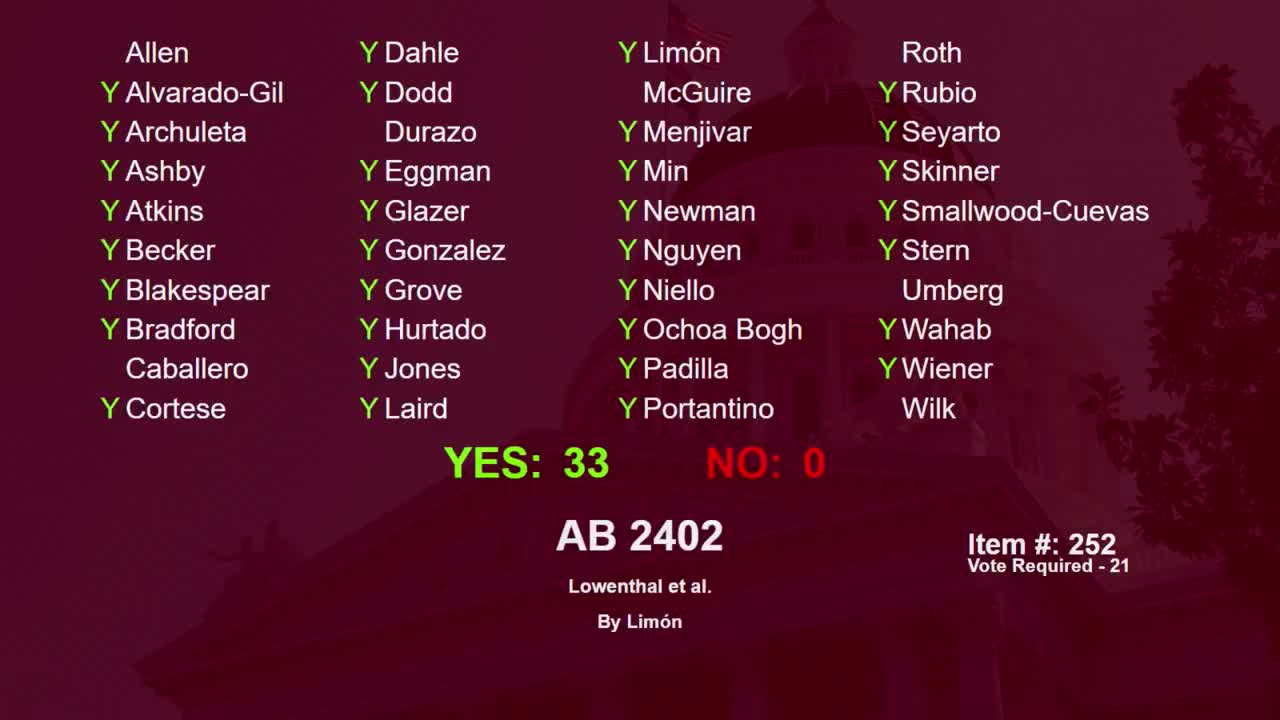 1MIN
Senate Floor
 7MIN
Senate Standing Committee on Banking and Financial Institutions
 15MIN
Assembly Standing Committee on Banking and Finance
Bill Author

Bill Co-Author(s):