AB 2438: Property crimes: enhancements.
- Session Year: 2023-2024
- House: Assembly
- Latest Version Date: 2024-02-13
Current Status:
Failed
(2024-05-24: From committee: Without further action pursuant to Joint Rule 62(a).)
Introduced
In Committee
First Chamber
In Committee
Second Chamber
Enacted
Existing law makes a person guilty of organized retail theft if, among other things, the person acts in concert with one or more persons to steal merchandise from one or more merchants premises or online marketplace with the intent to sell, exchange, or return the merchandise for value. Under existing law, these crimes are punishable as either misdemeanors or felonies, as specified. Existing law requires that a court dismiss an enhancement if it is in the furtherance of justice to do so, as specified.
This bill would, notwithstanding the limitations on imposing an enhancement, make any person who acts in concert with 2 or more persons to take, attempt to take, damage, or destroy any property in the commission or attempted commission of a felony punishable by an additional and consecutive term of imprisonment of one, 2, or 3 years. By creating a new enhancement, this bill would impose a state-mandated local program.
The California Constitution requires the state to reimburse local agencies and school districts for certain costs mandated by the state. Statutory provisions establish procedures for making that reimbursement.
This bill would provide that no reimbursement is required by this act for a specified reason.
(a)Notwithstanding subdivision (c) of Section 1385, any person who acts in concert with two or more persons to take, attempt to take, damage, or destroy any property in the commission or attempted commission of a felony shall be punished by an additional and consecutive term of imprisonment of one, two, or three years.
(b)The additional term provided in this section shall not be imposed unless the existence of the facts required in subdivision (a) are charged in the accusatory pleading and admitted by the defendant or found to be true by the trier of fact.
SEC. 2.No reimbursement is required by this act pursuant to Section 6 of Article XIIIB of the California Constitution because the only costs that may be incurred by a local agency or school district will be incurred because this act creates a new crime or infraction, eliminates a crime or infraction, or changes the penalty for a crime or infraction, within the meaning of Section 17556 of the Government Code, or changes the definition of a crime within the meaning of Section 6 of Article XIIIB of the California Constitution.
|
Date
|
Status
|
|---|---|
| May 24, 2024 | From committee: Without further action pursuant to Joint Rule 62(a). |
| Apr 9, 2024 | In committee: Set, first hearing. Failed passage. |
| Feb 26, 2024 | Referred to Com. on PUB. S. |
| Feb 14, 2024 | From printer. May be heard in committee March 15. |
| Feb 13, 2024 | Read first time. To print. |
|
Date
|
Description
|
Location
|
Votes
|
|
|---|---|---|---|---|
| Apr 9, 2024 | Do pass and be re-referred to the Committee on [Appropriations] | Assembly Standing Committee on Public Safety |
Failed |
This list shows positions taken on this bill by organizations on the date displayed, which is linked to the original source.
Positions by individuals are not included.
|
Organization
|
Position
|
Date
|
|---|---|---|
| Arcadia Police Officers' Association | ** Support | |
| Burbank Police Officers' Association | ** Support | |
| California Association Of Highway Patrolmen | ** Support | |
| California District Attorneys Association | ** Support | |
| Californians for Safety and Justice | ** Against | |
| Californians United for a Responsible Budget | ** Against | |
| California Police Chiefs Association | ** Support | |
| California Public Defenders Association | ** Against | |
| California Reserve Peace Officers Association | ** Support | |
| California State Sheriffs' Association | ** Support | |
| CLAREMONT POLICE OFFICERS ASSOCIATION | ** Support | |
| Communities United for Restorative Youth Justice | ** Against | |
| Corona Police Officers Association | ** Support | |
| County of Orange, Through its Office of The District Attorney/public Administrator | ** Support | |
| Culver City Police Officers' Association | ** Support | |
| Deputy Sheriffs Association of Monterey County | ** Support | |
| Ella Baker Center For Human Rights | ** Against | |
| Fullerton Police Officers' Association | ** Support | |
| Initiate Justice | ** Against | |
| Initiate Justice Action | ** Against | |
| League Of California Cities | ** Support | |
| Los Angeles County Professional Peace Officers Association | ** Support | |
| Murrieta Police Officers' Association | ** Support | |
| Newport Beach Police Association | ** Support | |
| Novato Police Officers Association | ** Support | |
| Orange County Sheriff's Department | ** Support | |
| Palos Verdes Police Officers Association | ** Support | |
| Peace Officers Research Association Of California | ** Support | |
| PLACER COUNTY DEPUTY SHERIFFS ASSOCIATION | ** Support | |
| Pomona Police Officers' Association | ** Support | |
| RIVERSIDE POLICE OFFICERS ASSOCIATION | ** Support | |
| Riverside Sheriffs' Association | ** Support | |
| San Francisco Public Defender | ** Against | |
| Santa Ana Police Officers Association | ** Support | |
| Smart Justice California, a project of Tides Advocacy | ** Against | |
| Uncommon Law | ** Against | |
| Upland Police Officers Association | ** Support | |
| Vera Institute Of Justice | ** Against | |
| Young Women's Freedom Center | ** Against |
Date of Hearing: April 9, 2024
Counsel: Liah Burnley
ASSEMBLY COMMITTEE ON
Kevin McCarty, Chair
ABPCA Bill Id:
Author:() – As Ver:
SUMMARY: Creates a new sentence enhancement, punishable by an additional and consecutive term of imprisonment of one, two, or three years, for any person who acts in concert with two or more persons to steal or damage any property in the commission or attempted commission of a felony.
EXISTING LAW:
- States that a person who commits any of the following acts is guilty of organized retail theft:
- Acts in concert with one or more persons to steal merchandise from one or more merchant’s premises or online marketplace with the intent to sell, exchange, or return the merchandise for value;
- Acts in concert with two or more persons to receive, purchase, or possess merchandise knowing or believing it to have been stolen;
- Acts as an agent of another individual or group of individuals to steal merchandise from one or more merchant’s premises or online marketplaces as part of an organized plan to commit theft; or,
- Recruits, coordinates, organizes, supervises, directs, manages, or finances another to undertake any of these acts or any other statute defining theft of merchandise. (Pen. Code, § 490.4, subd. (a).)
- Acts in concert with one or more persons to steal merchandise from one or more merchant’s premises or online marketplace with the intent to sell, exchange, or return the merchandise for value;
- Punishes organized retail theft, as follows:
- If violations of the provisions directed at acting in concert or as an agent are committed on two or more separate occasions within a one-year period, and if the aggregated value of the merchandise stolen, received, purchased, or possessed within that period exceeds $950, the offense is punishable as a misdemeanor by imprisonment in a county jail not exceeding one year, or as a felony, punishable by a term of imprisonment in a county jail for 16 months, or two or three years;
- Any other violation of the provisions directed at acting in concert or as an agent is punishable as a misdemeanor by imprisonment in a county jail not exceeding one year; and,
- A violation of the recruiting, coordinating, organizing, supervising, directing, managing, or financing provision is punishable is punishable as a misdemeanor by imprisonment in a county jail not exceeding one year, or as a felony, punishable by a term of imprisonment in a county jail for 16 months, or two or three years. (Pen. Code, § 490.4, subd. (b).)
- Defines “Shoplifting” as entering a commercial establishment with intent to commit larceny while that establishment is open during regular business hours, where the value of the property that is taken or intended to be taken does not exceed $950. Shoplifting shall be punished as a misdemeanor, except as specified. (Pen. Code, § 459.5.)
- States that every person who steals, takes, carries, leads, or drives away the personal property of another is guilty of theft. (Pen. Code, § 484, subd. (a).)
- Punishes petty theft as a misdemeanor. (Pen. Code §490.)
- Defines grand theft as theft of money, labor, real or personal property of a value exceeding $950. Grand theft is a wobbler, punishable by imprisonment in a county jail not exceeding one year, or as a felony by imprisonment in the county jail for 16 months, two years, or three years (Pen. Code, § 487, 489.)
- Provides that the value of the money, labor, real property, or personal property taken exceeds $950 over the course of distinct but related acts, the value of the money, labor, real property, or personal property taken may properly be aggregated to charge a count of grand theft, if the acts are motivated by one intention, one general impulse, and one plan. (Pen. Code, § 487, subd. (e).)
- Defines “burglary” as entering a structure, as defined, with intent to commit theft or any felony offense and divides burglary into two degrees, first and second. (Pen. Code, §§ 459, 460.)
- Provides that first degree burglary is burglary of building, inhabited for dwelling purposes, as specified, or vehicle inhabited for dwelling purposes, as specified. First degree burglary is punishable by imprisonment in the state prison for two, four, or six years. (Pen. Code, §§ 459, 460, 461.)
- Provides that all other burglary is burglary in the second degree. Entering a commercial establishment to steal property exceeding $950 is burglary in the second degree. Burglary in the second degree is punishable as a misdemeanor, by imprisonment in the county jail not exceeding one year, or as a felony by imprisonment in the county jail for in the county jail for 16 months, two years, or three years. (Pen. Code, §§ 459.5, 460, 461.)
- Provides that robbery of the first degree is punishable by imprisonment in the state prison for three, six, or nine years if the defendant, voluntarily acts in concert with two or more other persons, to commit robbery within an inhabited vehicle or building, as specified. (Pen. Code, § 213.)
- Provides that every person who defaces, damages or destroys real or personal property that is not their own, is guilty of vandalism. If the amount of the damage is less than $400, the offense is a misdemeanor, punishable by imprisonment in a county jail, not exceeding one year, or by a fine of $1,000 or by both. If the amount of the damage is $400 or more, the offense is a felony, punishable imprisonment in a county jail not exceeding one year, or by a fine of not more than $10,000, or both. (Pen. Code, § 594 subd. (b).)
- Provides that it is conspiracy if any two or more people conspire to commit any crime conspiracy. If they conspire to commit a felony, the offense is punishable in the same manner and to the same extent as is provided for the punishment of that felony. If they conspire to commit any other crime, the conspiracy shall be punishable as a misdemeanor by imprisonment in a county jail for not more than one year, or as a felony, punishable by imprisonment in the county jail for 16 months, or two or three years, or by a fine not exceeding $10,000, or by both. (Pen. Code, § 182.)
- Provides that any person concerned in the commission of a crime, whether it be felony or misdemeanor, and whether they directly commit the act constituting the offense, or aid and abet in its commission, or, have advised and encouraged its commission, or who, by threats, menaces, command, or coercion, compel another to commit any crime, are principals in any crime so committed. A person who aids and abets a crime faces the same punishment as the one who directly commits the crime. (Pen. Code, § 31.)
- Creates a sentence enhancement for committing a felony in association with a street gang, as specified, for an additional term of imprisonment ranging from two to 15 years. (Pen. Code, § 186.22.)
- Provides that, an act or omission that is punishable in different ways by different provisions of law may be punished under either of such provisions, but in no case shall the act or omission be punished under more than one provision. (Pen. Code, § 654.)
- States that, notwithstanding any other law, the sentencing court “shall dismiss” an enhancement “if it is in the furtherance of justice to do so” except if dismissal of that enhancement is prohibited by any initiative statute. (Pen. Code, § 1385, subd. (c)(1).)
- Instructs the court to consider specified factors in determining whether it is in the interests of justice to dismiss an enhancement, and requires the court to consider and afford great weight to evidence offered by the defendant to prove that any of the mitigating circumstances are present. (Pen. Code, § 1385, subd. (c)(2)-(3).)
- States that proof of the presence of one or more of those mitigating circumstances weighs greatly in favor of dismissing the enhancement, unless the court finds that dismissal of the enhancement would “endanger public safety,” meaning that there is a likelihood that the dismissal of the enhancement would result in physical injury or other serious danger to others. (Pen. Code, § 1385, subd. (c)(2).)
FISCAL EFFECT:
Unknown
COMMENTS:
- Author's Statement: According to the author, “It has been widely reported and recognized that smash and grab thefts have increased at an alarming rate. These are not crimes of opportunity, nor are they victimless. They are, rather, calculated and planned by groups of criminals who make off with large amounts of goods to re-sell, while terrifying shoppers and workers in the process. California’s retail workers have a right to go to work each day without having to worry about their safety.
“AB 2438 bill permits judges – at their discretion – to impose an additional term of imprisonment of one, two, or three years when someone acts in concert with two or more persons to take, attempt to take, damage, or destroy any property, in the commission or attempted commission of a felony. By permitting discretion in these scenarios, judges will be able to fashion sentences that are appropriate for the crime committed, including “smash and grabs” committed by mobs or large groups of people working together.” - Double Punishment for the Same Act: The stated need for the increased penalties proposed by this bill is to “hold individuals who participate in organized retail crime accountable.” However, several statutes already cover this conduct, including the organized retail theft statute and robbery statutes. (See, e.g., Pen. Code, § 490.4 [defining organized retail theft as “acting in concert with one or more persons” to steal merchandise, as specified]; & Pen. Code, § 213 [enhanced penalties for robbery committed by acting in concert with two or more other persons].)
Penal Code section 654 provides, in relevant part, that “[a]n act or omission that is punishable in different ways by different provisions of law may be punished under either of such provisions, but in no case shall the act or omission be punished under more than one provision.” Penal Code section 654 was enacted to prohibit double punishment of a single act that violates multiple statutes. The prohibition is on double punishment, not double conviction. (People v. Johnson (1966) 242 Cal.App.2d 870, 876.) The prohibition applies even if the punishments were to be run concurrently. (People v. Diaz (1967) 66 Cal.2d 801, 807.)
In People v. Ahmed (2011) 53 Cal.4th 156, the California Supreme Court noted that “as a default, section 654 does apply to enhancements when the specific statutes do not provide the answer.” The court reasons that section 654’s language states that it applies to “provisions of law” under which an “act or omission” is “punishable,” and this language would encompass enhancements. (Ibid.)
When applying section 654 to enhancements, the court found it significant that while substantive crimes define criminal acts, enhancements focus on different aspects of the criminal acts. (People v. Ahmed, supra, 53 Cal.4th at pp. 163-164.) The court held that “section 654 bars multiple punishment for enhancements the same aspect of a criminal act.” (Id. at p. 164.) Thus, under the Supreme Court’s holding in Ahmed, supra, 53 Cal.4th 156, Penal Code section 654 would prohibit the imposition of the enhancement created by this bill if it would result in double punishment for the same aspect of the criminal act-- for example, organized retail theft and acting in concert to commit robbery. - Sentence Enhancements: Sentence enhancements add time to an individual’s base sentence. California uses over 100 unique enhancements. According to data from California Department of Corrections and Rehabilitation (CDCR), enhancements are more likely to impact the sentences of men and Black and American Indian people who are sentenced to prison, application varies by county, and that enhancements contribute to the overall size of the state prison population. (Committee on Revision of the Penal Code, Sentence Enhancements in California (2023). Available at: <https://www.capolicylab.org/wp-content/uploads/2023/03/Sentence-Enhancements-in-California.pdf>.)
Sentence enhancements are typically applied at the discretion of both prosecutors and judges, and the threat of an enhancement can play an important role in the plea-bargaining process. Subject to prosecutorial discretion, enhancements can be used during the plea bargain phase to potentially cajole low-income defendants into admitting guilt in weak cases and accepting unjustly long sentences. (Bureau of Justice Assistance, US Department of Justice (2011) Plea and Charge Bargaining Research Summary (2011). Available at: <https://bja.ojp.gov/sites/g/files/xyckuh186/files/media/document/PleaBargainingResearchSummary.pdf>.)
In 2021, the California Commission on Revision of the Penal Code made three recommendations on sentence enhancements that were signed into law. AB 333 (Kamlager), Chapter 699, Statues of 2021, made updates to the gang enhancements which narrowed the definition of gang involvement. SB 483 (Allen), Chapter 728, Statutes of 2022, built on legislation repealing one- and three-year enhancements for prior convictions and applied the repeal to people who were incarcerated and had the enhancements as part of their sentences. Finally, SB 81 (Skinner) Chapter 721, Statutes of 2021, provided guidance to judges that allowed them discretion in whether to dismiss sentence enhancements, unless in the judge’s perspective, not enhancing a sentence could endanger public safety. Still, there are hundreds of sentencing enhancements available to prosecutors in California. By creating a new sentence enhancement, this bill would be a step in opposite direction taken by the Legislature in recent years.
- Estes Robberies – Transforming Shoplifting to a Felony and a Strike: The conduct this bill attempts to further penalize is “when someone acts in concert” “to take, attempt to take, damage, or destroy any property.” However, case law currently allows this conduct to be treated as full-blown robberies, which are violent offenses and eligible, for example, for a 10-year gang enhancement or use as a future strike under California’s Three Strikes Law. Robbery is punishable for a term of two, three, or five years imprisonment in state prison. (Pen. Code, § 211.) Though not a traditional sentencing enhancement, these are known as Estes robberies. These offenses typically occur when someone is shoplifting and has an encounter where they use force or fear. California law considers these “smash and grab” type thefts to be Estes robberies — and thus violent offenses. (People v. Estes (1983) 147 Cal.App.3d 23.)
- Existing Law Already Allows for Increased Penalties for Thefts: To the extent this bill is aimed at increasing penalties for thefts, there are currently a number of laws that prosecutors can use that call for increased penalties, in addition to charging the offense as an Estes Robbery.
Grand theft of property valued over $950 is already chargeable as a felony offense, punishable by imprisonment in county jail for a period of 16 months, two or three years. (Pen. Code, § 489, subd. (c)(1).) Existing law also allows for increased penalties for thefts less than $950, for example by aggregation of theft offenses. Repeated acts of theft can be aggregated and prosecuted as one felony if they are conducted pursuant to one intention, one general impulse, and one plan. (People v. Bailey (1961) 55 Cal.2d 514, 518-519 (Bailey).)
Moreover, under California law, if two or more persons conspire to commit any crime, even misdemeanor petty theft, they can be charged with a felony for the conspiracy itself. Thus, any time there is more than one person involved in any act of stealing the items specified in this bill, the offense can be charged as felony conspiracy, regardless of the value of the items stolen. (Pen. Code, § 182.) Also, in all cases, the defendant is also constitutionally required to make full restitution to the victim in the amount stolen, with interest, in addition to any other penalty fine. Cal. Const., art. I, § 28, subd. (b)(13); Pen. Code, § 1202.4, subd. (f)(3).)
The existing organized retail theft statue already covers this offense. Pursuant to this statute, any person who acts in concert with one or more persons to steal merchandise with the intent to sell the product can be punished with a misdemeanor if the value of the items stolen are less than $950 or a felony if the value exceeds $950. (Pen. Code, § 490.4.)
A person who commits this offense could also be charged with vandalism. Any person who defaces, damages or destroys real or personal property that is not their own, is guilty of vandalism. If the amount of the damage is less than $400, the offense is a misdemeanor, punishable by imprisonment in a county jail, not exceeding one year, or by a fine of $1,000 or by both. If the amount of the damage is $400 or more, the offense is a felony, punishable imprisonment in a county jail not exceeding one year, or by a fine of not more than $10,000, or both. (Pen. Code, § 594 subd. (b).)
These penalties are not a slap-on-the-wrist. Accordingly, this bill is unnecessary.
- Unduly Long Sentences are Counterproductive for Public Safety: An analysis of twelve years of data (2005 to 2017) from San Francisco concluded that while only 13% of cases were enhanced, sentencing enhancements caused 25% of all time spent in jail or prison. (Committee on Revision of the Penal Code, Sentence Enhancements: Overview. (2020). Available at: <http://www.clrc.ca.gov/CRPC/Pub/Memos/CRPC20-11.pdf>.) Unduly long sentences, like those proposed by this bill, are counterproductive for public safety and contribute to the dynamic of diminishing returns as the incarcerated population expands. (Long-Term Sentences: Time to Reconsider the Scale of Punishment, 87 UMKC L. Rev., 1 (Nov. 5, 2018).) Increasingly punitive sentences add little to the deterrent effect of the criminal justice system; and mass incarceration diverts resources from program and policy initiatives that hold the potential for greater impact on public safety. (Ibid.)
Research shows that increasing the severity of the punishment does little to deter the crime. According to the National Institute of Justice, laws and policies designed to deter crime by focusing mainly on increasing the severity of punishment are ineffective partly because criminals know little about the sanctions for specific crimes. More severe punishments do not “chasten” individuals convicted of crimes, and prisons may exacerbate recidivism. Studies show that for most individuals convicted of a crime, short to moderate prison sentences may be a deterrent but longer prison terms produce only a limited deterrent effect. In addition, the crime prevention benefit falls far short of the social and economic costs. (National Institute of Justice, Five Things about Deterrence <https://www.ojp.gov/pdffiles1/nij/247350.pdf> [as of Feb. 15, 2023].)
This finding makes intuitive sense. Consider a person who is thinking about stealing a car or burglarizing a local business. If he is thinking rationally, he will take into account a variety of factors when considering how to commit the crime, including time of day, ease of entry, presence of security personnel or technology, or his ability to leave the crime scene. He does this to avoid being caught in the act because being arrested and prosecuted will impose significant burdens on him. Additionally, because he is not planning on being apprehended, he is unlikely to be thinking about how much time he might spend in prison and whether his sentence will be three, five, or seven years.
Notably, this example looks at the behavior of a rational person, which rarely fits the picture of a substantial portion of those who actually commit a crime. Many are teenagers seeking peer approval for their illegal behavior, individuals under the influence of alcohol or drugs at the time of the offense, or are motivated by economic challenges. Many of these individuals are not even thinking about the risk of being caught, let alone know how much prison time they may face.
The limited impact of extending sentence length becomes even more attenuated for long-term incarceration. If the penalty for a second robbery conviction is twenty years and a legislative body increases that penalty to twenty- five, few would-be robbers undeterred by the prospect of “only” a twenty year sentence would balk at an additional five years.
Again, there are multiple possible reasons for imposing a given prison term, depending on the circumstances of the crime. But policymakers and judges should be cognizant of the evidence to support any particular goal of sentencing. If the length of a prison term has little deterrent value, it may be time to forego the rationale of “sending a message.”
(Long-Term Sentences: Time to Reconsider the Scale of Punishment, 87 UMKC L. Rev., 1 (Nov. 5, 2018) (citations omitted).) An analysis of 116 studies showed that incarceration does not deter people from committing future crimes and, in fact, incarceration can actually make someone more likely to be arrested and commit crimes later (due to heightened barriers to securing employment, identification, housing, and other basic services necessary to successfully reenter society). (Brookings, Retail Theft In US Cities: Separating Fact from Fiction (March 6, 2024). Available at: <https://www.brookings.edu/articles/retail-theft-in-us-cities-separating-fact-from-fiction/>.) These findings are consistent with other research from national institutions of renown. (National Research Council of the National Academies of Sciences, Engineering, and Medicine, The Growth of Incarceration in the United States: Exploring Causes and Consequences, (April 2014) at pp. 130 -150. Available at: <https://academicworks.cuny.edu/cgi/viewcontent.cgi?article=1026&context=jj_pubs>.)
In sum, harsher sentences do not deter crime.
- Reports of Exaggerated Losses by Retailers – Separating Fact from Fiction: Some complaints of retail theft were overstated. For example, in 2021, Walgreens closed five stores in San Francisco purportedly due to retail theft. However, the San Francisco Police Department’s data on shoplifting did not support this explanation for the closures. Recently, the chief financial officer of Walgreens acknowledged the shoplifting threat had probably been overstated. The company likely spent too much on security measures and mischaracterized the amount of theft at stores. In fact, shrinkage (the inventory that was bought but could not be sold primarily due to shoplifting) actually decreased to around 2.5 to 2.6 percent of sales, compared to 3.5 percent the prior year. (See New York Times, Walgreens Executive Says Shoplifting Threat Was Overstated (Jan. 6, 2023) <https://www.nytimes.com/2023/01/06/business/walgreens-shoplifting.html>; see also Los Angeles Times, Retailers Say Thefts Are at Crisis Level. The Numbers Say Otherwise (Dec. 15, 2021) <https://www.latimes.com/business/story/2021-12-15/organized-retail-theft-crime-rate>; CNN Business, ‘Maybe We Cried Too Much’ Over Shoplifting, Walgreens Executive Says (Jan. 7, 2023) <https://www.cnn.com/2023/01/06/business/walgreens-shoplifting-retail/index.html>; The Atlantic, The Great Shoplifting Freak-Out (Dec. 203, 2021) <https://www.theatlantic.com/health/archive/2021/12/shoplifting-holiday-theft-panic/621108/>.)
Others say retail theft, while an issue, might be overstated as an excuse to write off mediocre sales and historic inflation might be a key reason why we’re seeing any theft bump at all Things have become expensive – “we are in an economy right now where some everyday staples have risen in price six times faster than the overall rate of inflation. Until July of this year, American paychecks grew at a slower rate than inflation as a whole.” Some retailers lump theft in with heavy discounting, soft sales and macroeconomic conditions as other factors that cut into their margins. (Freight Waves, What’s Behind the Reports of ‘Unprecedented’ Retail Theft (Oct. 2023). Available at: <https://www.freightwaves.com/news/whats-behind-the-reports-of-unprecedented-retail-theft>; see also Bloomberg, Thieves Target Donuts and Ham as Food Prices Jump (Feb. 2024). Available at: <https://www.bloomberg.com/news/newsletters/2024-02-23/supply-chain-latest-food-theft-rises-on-grocery-inflation>.)
What’s more, the National Retail Federation has not solidified any data around increased rates of organized retail theft or what percentage of external theft is organized crime. Retailers are not required to break down how much they actually lose to theft. “Retailers and trade associations are increasingly using their positions to influence lawmakers to pass new legislation that benefits them, hurts competitors and could disproportionally affect marginalized people.” (CNBC, Companies say organized retail crime is on the rise, but there’s no data to prove it. (Aug. 2023). Available at < https://www.cnbc.com/2023/08/09/claims-about-organized-retail-theft-are-nearly-impossible-to-verify.html>.)
From 2020 to 2021, the number of news stories covering smash-and-grab incidents nearly doubled. The author comments that the impetus of this bill is to “fashion sentences that are appropriate for the crime committed, including “smash and grabs” committed by mobs or large groups of people working together.” However, the information available does show that the vast majority of shoplifting is not committed by mobs of people. (Council on Criminal Justice, Shoplifting Trends: What You Need to Know (Nov. 2023) Available at:
<https://counciloncj.org/shoplifting-trends-what-you-need-to-know/>.)
Additionally, the Federal Trade Commission recently reported that retail stores likely inflated prices to accommodate for lost revenue resulting from the pandemic. The FTC states, in summary, that:
Notably, consumers are still facing the negative impact of the pandemic’s price hikes, as the Commission’s report finds that some in the grocery [including drug stores] retail industry seem to have used rising costs as an opportunity to further raise prices to increase their profits, which remain elevated today.
Retail stores actually saw significant profits over the past few years despite claims that stores are losing profits as a result of theft and other market forces.
“In the first three-quarters of 2023, retailer profits rose even more, with revenue reaching 7% over total costs, casting doubt on the assertions of some companies that rising prices at the grocery store are the result of retailers’ own rising costs.” (Federal Trade Commission, “Feeding America in a Time of Crisis, The United States Grocery Supply Chain and the COVID-19 Pandemic” (March 21, 2024).
Finally, the Federal Bureau of Investigation (FBI) data on crime statistics reports that crime is actually down nationwide by a significant margin – contributing to the conclusion that the crime rate was a temporary phenomenon brought on by the pandemic and rapidly escalating costs for basic goods and services.
The new fourth-quarter numbers [for 2023] show a 13% decline in murder in 2023 from 2022, a 6% decline in reported violent crime and a 4% decline in reported property crime.
After a terrible period of underfunding and understaffing caused by the pandemic, local governments have, by most measures, returned to pre-pandemic levels,” wrote John Roman, a criminologist at the University of Chicago. In an interview, Roman said, ‘The courts were closed, a lot of cops got sick, a lot of police agencies told their officers not to interact with the public. Teachers were not in schools, not working with kids.
(FTC, Report on Grocery Supply Chain Disruptions (March 2024). Available at: <https://www.ftc.gov/news-events/news/press-releases/2024/03/ftc-releases-report-grocery-supply-chain-disruptions>.) Given that claims of massive retail theft appear to be inconsistent with the data, the Legislature should consider evidence-based solutions to address property crimes.
- Argument in Support: According to the Los Angeles County Professional Peace Officers Association (PPOA), “AB 2483 would increase the consequences that perpetrators face commensurate with the severity of their actions and hold offenders accountable for their crimes. Moreover, it would send a clear message to potential offenders that such behavior will not be tolerated in our society.”
- Argument in Opposition: According to Initiate Justice, “AB 2438 is bad public policy because sentence enhancements are costly, ineffective, and contribute heavily to systemic racism in the criminal legal system. There are more than 150 sentence enhancements on the books across California’s Penal Code, however, there is no compelling evidence that their usage improves public safety. In fact, the opposite may be true.
“While initial incarceration prevents crime through incapacitation in theory, studies show that each additional sentence year causes a 4 to 7 percent increase in recidivism that eventually outweighs the incapacitation benefit1. Each year of incarceration costs the state approximately $132,000 per incarcerated person, so the cost of incarceration to the state will far exceed the cost of stolen property.
“With this in mind, any creation of a new sentence enhancement needs to be scrutinized very closely. AB 2438 is unnecessary and does not address the root causes of theft or economic insecurity” - Related Legislation:
- AB 1802 (Jones-Sawyer) would eliminate the sunset date for organized retail theft. AB 1802 is pending in this Committee.
- AB 1960 (Soria) would reenact sentence enhancement for theft offenses when the loss exceeds specified dollar amounts. AB 1960 is pending in this Committee.
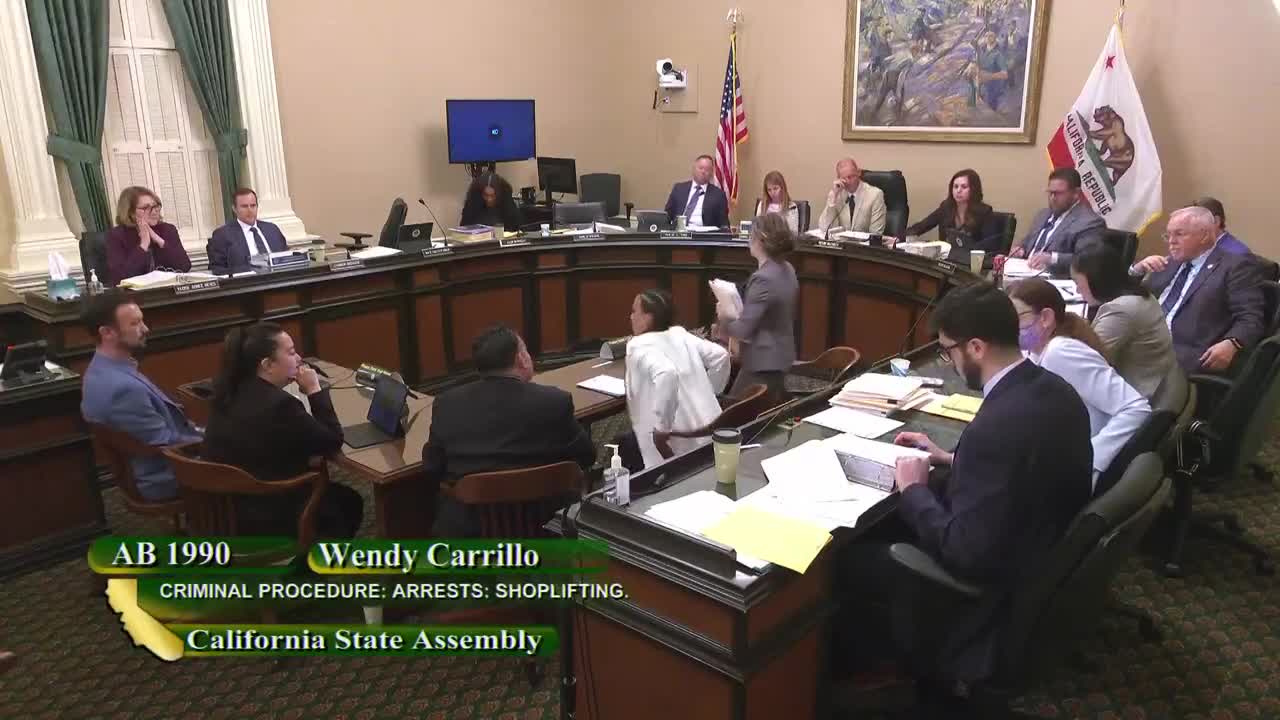
- AB 1990 (W. Carrillo) would authorize peace officers to make a warrantless arrest for misdemeanor shoplifting, as specified. AB 1990 is pending in this Committee.
- AB 1779 (Irwin) would allow, a prosecutor to bring a case in any county where theft offenses occurred for offenses that occur in multiple jurisdictions, as specified. AB 1779 is pending in this Committee.
- AB 1787 (Villapudua) would among other things, repeal the sunset provision in the organized retail theft statute. AB 1787 is pending in this Committee.
- AB 1794 (McCarty) would clarify aggregation requirements for grand theft, among other things. AB 1794 is pending in this Committee.
- AB 2406 (Davies) would make it a felony to use two or more minors to engage in theft related offenses. AB 2406 is pending in this Committee.
- AB 2943 (Zbur) would, among other things, extend the organized retail theft statute until January 2031, and make it a crime for any person to possess property unlawfully that was acquired through one or more acts of shoplifting, theft, or burglary from a retail business, if the property is not possessed for personal use. AB 2943 is pending in this committee.
- SB 923 (Archuleta) would revise the definition of shoplifting to require an intent to steal retail property or merchandise and would require a person convicted of petty theft or shoplifting, if the person has two or more prior convictions for specified theft-related offenses, to be punished by imprisonment in the county jail for up to one year, or for 16 months, or two or three years. SB 923 is pending in Senate Public Safety Committee.
- SB 928 (Niello) would remove the sunset date for organized retail theft. SB 928 is pending in Senate Public Safety Committee.
- SB 982 (Wahab) would remove the sunset date for organized retail theft. SB 982 is pending in Senate Appropriations Committee.
- SB 1416 (Newman) would create sentencing enhancements for selling, exchanging, or returning for value, or attempting to sell, exchange, or return for value, any property acquired through one or more acts of shoplifting, theft, or burglary from a retail business, if the property value exceeds specified amounts and would make these enhancements apply to any person acting in concert with another person to commit these offenses. SB 1416 is pending in Senate Public Safety Committee.
- AB 1802 (Jones-Sawyer) would eliminate the sunset date for organized retail theft. AB 1802 is pending in this Committee.
- Prior Legislation:
- AB 329 (Ta), of the 2023-2024 Legislative Session, would have expanded the territorial jurisdiction in which the Attorney General can prosecute specified theft offenses and associated offenses connected together in their commission to include cargo theft. AB 329 failed passage in this Committee.
- AB 335 (Alanis), of the 2023-2024 Legislative Session, would have required the Little Hoover Commission to submit a report to the Legislature describing the reported retail thefts, as specified. AB 335 was held under submission in Assembly Appropriations Committee.
- AB 331 (Jones-Sawyer), Chapter 113, Statutes of 2021, extended the sunset date for organized retail theft through January 1, 2026.
- AB 23 (Muratsuchi), of the 2023-2024 Legislative Session, would have decreased the threshold amount for grand theft from $950 to $400. The hearing on AB 23 was canceled the request of the author.
- AB 329 (Ta) would have imposed higher penalties for shoplifting and petty theft if the crime is committed by a non-citizen of the state of California. AB 329 failed passage in this committee.
- AB 2294 (Jones-Sawyer), Chapter 856, Statutes of 2022, authorized the misdemeanor arrest of a person that has a prior arrest, citation or conviction for theft, as specified, and authorized a city or county prosecuting authority or county probation department to create a diversion or deferred entry of judgment program for persons who commit a theft offense or repeat theft offenses.
- AB 2356 (Rodriguez), Chapter 22, Statues of 2022, expanded the definition of “grand theft” where the aggregate amount taken by all participants exceeds $950.
- AB 1603 (Salas), of the 2021-2022 Legislative Session, would have reduced the threshold amount for petty theft and shoplifting to be punished as a misdemeanor from $950 to $400. AB 1603 failed passage in this Committee.
- AB 2390 (Muratsuchi), of the 2021-2022 Legislative Session, would have authorized the aggregation of the value of property from one or more acts of theft or shoplifting, as specified. AB 2390 failed passage in this Committee.
- AB 1065 (Jones-Sawyer), Chapter 803, Statutes of 2018, created the crime of organized retail theft and expanded jurisdiction to prosecute cases of theft or receipt of stolen merchandise.
- AB 329 (Ta), of the 2023-2024 Legislative Session, would have expanded the territorial jurisdiction in which the Attorney General can prosecute specified theft offenses and associated offenses connected together in their commission to include cargo theft. AB 329 failed passage in this Committee.
REGISTERED SUPPORT / OPPOSITION:
Support
Arcadia Police Officers' Association
Burbank Police Officers' Association
California Association of Highway Patrolmen
California District Attorneys Association
California Police Chiefs Association
California Reserve Peace Officers Association
California State Sheriffs' Association
Claremont Police Officers Association
Corona Police Officers Association
County of Orange, Through its Office of The District Attorney/public Administrator
Culver City Police Officers' Association
Deputy Sheriffs' Association of Monterey County
Fullerton Police Officers' Association
League of California Cities
Los Angeles County Professional Peace Officers Association
Murrieta Police Officers' Association
Newport Beach Police Association
Novato Police Officers Association
Orange County Sheriff's Department
Palos Verdes Police Officers Association
Peace Officers Research Association of California (PORAC)
Placer County Deputy Sheriffs' Association
Pomona Police Officers' Association
Riverside Police Officers Association
Riverside Sheriffs' Association
Santa Ana Police Officers Association
Upland Police Officers Association
Oppose
California Public Defenders Association
Californians for Safety and Justice
Californians United for A Responsible Budget
Communities United for Restorative Youth Justice (CURYJ)
Ella Baker Center for Human Rights
Initiate Justice
Initiate Justice Action
San Francisco Public Defender
Smart Justice California, a Project of Tides Advocacy
Uncommon Law
Vera Institute of Justice
Young Women's Freedom Center
Analysis Prepared by:
Discussed in Hearing
 19MIN
Assembly Standing Committee on Public Safety
Bill Author

Bill Co-Author(s):