AB 2493: Tenancy: application screening fee.
- Session Year: 2023-2024
- House: Assembly
- Latest Version Date: 2024-09-29
Current Status:
Passed
(2024-09-29: Chaptered by Secretary of State - Chapter 966, Statutes of 2024.)
Introduced
In Committee
First Chamber
In Committee
Second Chamber
Enacted
Existing law authorizes a landlord or their agent, when they receive a request to rent a residential property, to charge an application screening fee to cover the cost of obtaining information about the applicant. Existing law also prohibits a landlord or their agent from charging an applicant an application screening fee when they know or should have known that no rental unit is available at that time or will be available within a reasonable period of time, unless the applicant agrees in writing. Existing law also requires a landlord or their agent, if an applicant that has paid an application screening fee makes a request, to provide a copy of the consumer credit report to the applicant who is the subject of that report.
This bill would instead authorize a landlord or their agent to charge an application screening fee only if the landlord or their agent, at the time the application screening fee is collected, offers an application screening process, as specified. This bill would also prohibit a landlord or their agent from charging an applicant an application screening fee when they know or should have known that no rental unit is available at that time or will be available within a reasonable period of time. The bill would remove the requirement that an applicant request a copy of the consumer credit report in order to obtain a copy, and would, instead, require the landlord or their agent to provide a copy of the report within 7 days of the landlord or their agent receiving the report, as provided.
Existing law authorizes a landlord to elect to accept reusable tenant screening reports, as specified, and prohibits a landlord who accepts a reusable tenant screening report from charging a fee to access the report or an application screening fee.
This bill would provide that the bills provisions do not prevent a landlord from accepting a reusable tenant screening report.
Existing law authorizes a landlord or their agent, when they receive a request to rent a residential property, to charge an application screening fee to cover the cost of obtaining information about the applicant. Existing law also prohibits a landlord or their agent from charging an applicant an application screening fee when they know or should have known that no rental unit is available at that time or will be available within a reasonable period of time, unless the applicant agrees in writing. Existing law also requires a landlord or their agent, if an applicant that has paid an application screening fee makes a request, to provide a copy of the consumer credit report to the applicant who is the subject of that report.
This bill would instead authorize a landlord or their agent to charge an application screening fee only if the landlord or their agent, at the time the application screening fee is collected, offers an application screening process, as specified, or the ability for an applicant to apply using a reusable screening platform, as defined. specified. This bill would also prohibit a landlord or their agent from charging an applicant an application screening fee when they know or should have known that no rental unit is available at that time or will be available within a reasonable period of time. The bill would remove the requirement that an applicant request a copy of the consumer credit report in order to obtain a copy, and would, instead, require the landlord or their agent to provide a copy of the report within 7 days of the landlord or their agent receiving the report, as provided.
Existing law authorizes a landlord to elect to accept reusable tenant screening reports, as specified, and prohibits a landlord who accepts a reusable tenant screening report from charging a fee to access the report or an application screening fee.
This bill would provide that the bills provisions do not prevent a landlord from accepting a reusable tenant screening report.
Existing law authorizes a landlord or their agent, when they receive a request to rent a residential property, to charge an application screening fee to cover the cost of obtaining information about the applicant. Existing law also prohibits a landlord or their agent from charging an applicant an application screening fee when they know or should have known that no rental unit is available at that time or will be available within a reasonable period of time, unless the applicant agrees in writing. Existing law also requires a landlord or their agent, if an applicant that has paid an application screening fee makes a request, to provide a copy of the consumer credit report to the applicant who is the subject of that report.
This bill would instead authorize a landlord or their agent to charge an application screening fee only if the landlord or their agent, at the time the application screening fee is collected, offers an application screening process, as specified, or the ability for an applicant to apply using a reusable screening platform, as defined. This bill would instead also prohibit a landlord or their agent from charging an applicant an application screening fee when they know or should have known that no rental unit is available at that time or will be available within a reasonable period of time. The bill would also prohibit a landlord or their agent from charging more than one application screening fee within a 30-day period if the applicant is applying to other units or residential properties owned by the same landlord or managed by the same agent. remove the requirement that an applicant request a copy of the consumer credit report in order to obtain a copy, and would, instead, require the landlord or their agent to provide a copy of the report within 7 days of the landlord or their agent receiving the report, as provided.
Existing law authorizes a landlord or their agent, when they receive a request to rent a residential property, to charge an application screening fee to cover the cost of obtaining information about the applicant. Existing law also prohibits a landlord or their agent from charging an applicant an application screening fee when they know or should have known that no rental unit is available at that time or will be available within a reasonable period of time, unless the applicant agrees in writing.
This bill would instead prohibit a landlord or their agent from charging an applicant an application screening fee to be entered onto a waiting list when they know or should have known that no rental unit is available at that time or will be available within a reasonable period of time. The bill would also prohibit a landlord or their agent from charging more than one application screening fee within a 30-day period if the applicant is applying to other units or residential properties owned by the same landlord or managed by the same agent.
Existing law authorizes a landlord or their agent, when they receive a request to rent a residential property, to charge an application screening fee to cover the cost of obtaining information about the applicant. Existing law also prohibits a landlord or their agent from charging an applicant an application screening fee when they know or should have known that no rental unit is available at that time or will be available within a reasonable period of time, unless the applicant agrees in writing.
This bill would instead prohibit a landlord or their agent from charging an applicant an application screening fee to be entered onto a waiting list when they know or should have known that no rental unit is available at that time or will be available within a reasonable period of time.
(a)Notwithstanding Section 1950.5, when a landlord or their agent receives a request to rent a residential property from an applicant, the landlord or their agent may charge, pursuant to subdivision (c), that applicant an application screening fee to cover the costs of obtaining information about the applicant. The information requested and obtained by the landlord or their agent may include, but is not limited to, personal reference checks and consumer credit reports produced by consumer credit reporting agencies as defined in Section 1785.3. A landlord or their agent may, but is not required to, accept and rely upon a consumer credit report presented by an applicant.
(b)The amount of the application screening fee shall not be greater than the actual out-of-pocket costs of gathering information concerning the applicant, including, but not limited to, the cost of using a tenant screening service or a consumer credit reporting service, and the reasonable value of time spent by the landlord or their agent in obtaining information on the applicant. In no case shall the amount of the application screening fee charged by the landlord or their agent be greater than thirty dollars ($30) per applicant. The thirty dollar ($30) application screening fee may be adjusted annually by the landlord or their agent commensurate with an increase in the Consumer Price Index, beginning on January 1, 1998.
(c)(1)A landlord or their agent shall not charge an applicant an application screening fee when they know or should have known that no rental unit is available at that time or will be available within a reasonable period of time.
(2)A landlord or their agent may charge an applicant an application screening fee only if the landlord or their agent, at the time the application screening fee is collected, offers any of the following:
(A)An application screening process that complies with all of the following:
(i)Completed applications are considered, as provided for in the landlords established screening criteria, in the order in which the completed applications were received. The landlords screening criteria shall be provided to the applicant in writing together with the application form.
(ii)The first applicant who meets the landlords established screening criteria is approved for tenancy.
(iii)Applicants are not charged an application screening fee unless or until their application is actually considered.
(iv)Clause (iii) shall not be considered violated if a landlord or their agent inadvertently collects an application screening fee from an applicant as the result of multiple concurrent application submissions, provided that the landlord or their agent issues a refund of the application screening fee within 7 days to any applicant whose application is not considered. The landlord may offer, as an alternative to refunding the screening fee, the option, at the applicants discretion, for the screening fee paid by the applicant to be applied to an application for another rental unit offered by the landlord. A landlord or their agent shall not be required to refund an application screening fee to an applicant whose application is denied, after consideration, because the applicant does not meet the landlords established screening criteria.
(B)An application screening process in which the landlord or their agent returns the entire screening fee to any applicant who is not selected for tenancy, regardless of the reason, within 7 days of selecting an applicant for tenancy or 30 days of when the application was submitted, whichever occurs first.
(d)The landlord or their agent shall provide, personally, or by mail, the applicant with a receipt for the fee paid by the applicant, which receipt shall itemize the out-of-pocket expenses and time spent by the landlord or their agent to obtain and process the information about the applicant. The landlord or their agent and the applicant may agree to have the landlord provide a copy of the receipt for the fee paid by the applicant to an email account provided by the applicant.
(e)If the landlord or their agent does not perform a personal reference check or does not obtain a consumer credit report, the landlord or their agent shall return any amount of the screening fee that is not used for the purposes authorized by this section to the applicant.
(f)If an application screening fee has been paid by the applicant, the landlord or their agent shall provide a copy of the consumer credit report to the applicant who is the subject of that report by personal delivery, mail, or email within 7 days of the landlord or their agent receiving the report.
(g)Nothing in this section prevents a landlord from accepting a reusable screening report pursuant to Section 1950.1.
(h)As used in this section, landlord means an owner of residential rental property.
(i)As used in this section, application screening fee means any nonrefundable payment of money charged by a landlord or their agent to an applicant, the purpose of which is to purchase a consumer credit report and to validate, review, or otherwise process an application for the rent or lease of residential rental property.
(j)As used in this section, applicant means any entity or individual who makes a request to a landlord or their agent to rent a residential housing unit, or an entity or individual who agrees to act as a guarantor or cosignor on a rental agreement.
(k)The application screening fee shall not be considered an advance fee as that term is used in Section 10026 of the Business and Professions Code, and shall not be considered security as that term is used in Section 1950.5.
(l)This section is not intended to preempt any provisions or regulations that govern the collection of deposits and fees under federal or state housing assistance programs.
(a)Notwithstanding Section 1950.5, when a landlord or their agent receives a request to rent a residential property from an applicant, the landlord or their agent may charge, pursuant to subdivision (c), that applicant an application screening fee to cover the costs of obtaining information about the applicant. The information requested and obtained by the landlord or their agent may include, but is not limited to, personal reference checks and consumer credit reports produced by consumer credit reporting agencies as defined in Section 1785.3. A landlord or their agent may, but is not required to, accept and rely upon a consumer credit report presented by an applicant.
(b)The amount of the application screening fee shall not be greater than the actual out-of-pocket costs of gathering information concerning the applicant, including, but not limited to, the cost of using a tenant screening service or a consumer credit reporting service, and the reasonable value of time spent by the landlord or their agent in obtaining information on the applicant. In no case shall the amount of the application screening fee charged by the landlord or their agent be greater than thirty dollars ($30) per applicant. The thirty dollar ($30) application screening fee may be adjusted annually by the landlord or their agent commensurate with an increase in the Consumer Price Index, beginning on January 1, 1998.
(c)(1)A landlord or their agent shall not charge an applicant an application screening fee when they know or should have known that no rental unit is available at that time or will be available within a reasonable period of time.
(2)A landlord or their agent may charge an applicant an application screening fee only if the landlord or their agent, at the time the application screening fee is collected, offers any of the following:
(A)An application screening process that complies with all of the following:
(i)Completed applications are considered, as provided for in the landlords established screening criteria, in the order in which the completed applications were received. The landlords screening criteria shall be provided to the applicant in writing together with the application form.
(ii)The first applicant who meets the landlords established screening criteria is approved for tenancy.
(iii)Applicants are not charged an application screening fee unless or until their application is actually considered.
(iv)Clause (iii) shall not be considered violated if a landlord or their agent inadvertently collects an application screening fee from an applicant as the result of multiple concurrent application submissions, provided that the landlord or their agent issues a refund of the application screening fee within 7 days to any applicant whose application is not considered. The landlord may offer, as an alternative to refunding the screening fee, the option, at the applicants discretion, for the screening fee paid by the applicant to be applied to an application for another rental unit offered by the landlord. A landlord or their agent shall not be required to refund an application screening fee to an applicant whose application is denied, after consideration, because the applicant does not meet the landlords established screening criteria.
(B)The ability for an applicant to apply using a reusable screening platform. As used in this subparagraph, a reusable screening platform means a service that allows an applicant to pay one fee that entitles the applicant to submit 10 or more applications within a period of not less than 30 days for rental units offered by participating landlords for no additional cost. A landlord who participates in a reusable screening platform may, in their discretion, require additional application information and obtain additional reference checks and consumer reports beyond those included in the reusable screening platform service, provided that no additional fee is required of the applicant. (C)(B)An application screening process in which the landlord or their agent returns the entire screening fee to any applicant who is not selected for tenancy, regardless of the reason, within 7 days of selecting an applicant for tenancy or 30 days of when the application was submitted, whichever occurs first.
(d)The landlord or their agent shall provide, personally, or by mail, the applicant with a receipt for the fee paid by the applicant, which receipt shall itemize the out-of-pocket expenses and time spent by the landlord or their agent to obtain and process the information about the applicant. The landlord or their agent and the applicant may agree to have the landlord provide a copy of the receipt for the fee paid by the applicant to an email account provided by the applicant.
(e)If the landlord or their agent does not perform a personal reference check or does not obtain a consumer credit report, the landlord or their agent shall return any amount of the screening fee that is not used for the purposes authorized by this section to the applicant.
(f)If an application screening fee has been paid by the applicant, the landlord or their agent shall provide a copy of the consumer credit report to the applicant who is the subject of that report by personal delivery, mail, or email within 7 days of the landlord or their agent receiving the report.
(g)Nothing in this section prevents a landlord from accepting a reusable screening report pursuant to Section 1950.1.
(g)(h)As used in this section, landlord means an owner of residential rental property.
(h)(i)As used in this section, application screening fee means any nonrefundable payment of money charged by a landlord or their agent to an applicant, the purpose of which is to purchase a consumer credit report and to validate, review, or otherwise process an application for the rent or lease of residential rental property.
(i)(j)As used in this section, applicant means any entity or individual who makes a request to a landlord or their agent to rent a residential housing unit, or an entity or individual who agrees to act as a guarantor or cosignor on a rental agreement.
(j)(k)The application screening fee shall not be considered an advance fee as that term is used in Section 10026 of the Business and Professions Code, and shall not be considered security as that term is used in Section 1950.5.
(k)(l)This section is not intended to preempt any provisions or regulations that govern the collection of deposits and fees under federal or state housing assistance programs.
(a)Notwithstanding Section 1950.5, when a landlord or their agent receives a request to rent a residential property from an applicant, the landlord or their agent may charge charge, pursuant to subdivision (c), that applicant an application screening fee to cover the costs of obtaining information about the applicant. The information requested and obtained by the landlord or their agent may include, but is not limited to, personal reference checks and consumer credit reports produced by consumer credit reporting agencies as defined in Section 1785.3. A landlord or their agent may, but is not required to, accept and rely upon a consumer credit report presented by an applicant.
(b)The amount of the application screening fee shall not be greater than the actual out-of-pocket costs of gathering information concerning the applicant, including, but not limited to, the cost of using a tenant screening service or a consumer credit reporting service, and the reasonable value of time spent by the landlord or their agent in obtaining information on the applicant. In no case shall the amount of the application screening fee charged by the landlord or their agent be greater than thirty dollars ($30) per applicant. The thirty dollar ($30) application screening fee may be adjusted annually by the landlord or their agent commensurate with an increase in the Consumer Price Index, beginning on January 1, 1998.
(c)(1)A landlord or their agent shall not charge an applicant an application screening fee when they know or should have known that no rental unit is available at that time or will be available within a reasonable period of time.
(2)A landlord or their agent may charge an applicant an application screening fee only if the landlord or their agent, at the time the application screening fee is collected, offers any of the following:
(A)An application screening process that complies with all of the following:
(i)Completed applications are considered, as provided for in the landlords established screening criteria, in the order in which the completed applications were received. The landlords screening criteria shall be provided to the applicant in writing together with the application form.
(ii)The first applicant who meets the landlords established screening criteria is approved for tenancy.
(iii)Applicants are not charged an application screening fee unless or until their application is actually considered.
(iv)Clause (iii) shall not be considered violated if a landlord or their agent inadvertently collects an application screening fee from an applicant as the result of multiple concurrent application submissions, provided that the landlord or their agent issues a refund of the application screening fee within 7 days to any applicant whose application is not considered. The landlord may offer, as an alternative to refunding the screening fee, the option, at the applicants discretion, for the screening fee paid by the applicant to be applied to an application for another rental unit offered by the landlord. A landlord or their agent shall not be required to refund an application screening fee to an applicant whose application is denied, after consideration, because the applicant does not meet the landlords established screening criteria.
(B)The ability for an applicant to apply using a reusable screening platform. As used in this subparagraph, a reusable screening platform means a service that allows an applicant to pay one fee that entitles the applicant to submit 10 or more applications within a period of not less than 30 days for rental units offered by participating landlords for no additional cost. A landlord who participates in a reusable screening platform may, in their discretion, require additional application information and obtain additional reference checks and consumer reports beyond those included in the reusable screening platform service, provided that no additional fee is required of the applicant.
(C)An application screening process in which the landlord or their agent returns the entire screening fee to any applicant who is not selected for tenancy, regardless of the reason, within 7 days of selecting an applicant for tenancy or 30 days of when the application was submitted, whichever occurs first.
(d)The landlord or their agent shall provide, personally, or by mail, the applicant with a receipt for the fee paid by the applicant, which receipt shall itemize the out-of-pocket expenses and time spent by the landlord or their agent to obtain and process the information about the applicant. The landlord or their agent and the applicant may agree to have the landlord provide a copy of the receipt for the fee paid by the applicant to an email account provided by the applicant.
(e)If the landlord or their agent does not perform a personal reference check or does not obtain a consumer credit report, the landlord or their agent shall return any amount of the screening fee that is not used for the purposes authorized by this section to the applicant.
(f)A landlord or their agent shall not charge more than one application screening fee within a 30-day period if the applicant is applying to other units or residential properties owned by the same landlord or managed by the same agent.(g)(f)If an application screening fee has been paid by the applicant and if requested by the applicant, the landlord or their agent shall provide a copy of the consumer credit report to the applicant who is the subject of that report. report by personal delivery, mail, or email within 7 days of the landlord or their agent receiving the report.
(h)(g)As used in this section, landlord means an owner of residential rental property.
(i)(h)As used in this section, application screening fee means any nonrefundable payment of money charged by a landlord or their agent to an applicant, the purpose of which is to purchase a consumer credit report and to validate, review, or otherwise process an application for the rent or lease of residential rental property.
(j)(i)As used in this section, applicant means any entity or individual who makes a request to a landlord or their agent to rent a residential housing unit, or an entity or individual who agrees to act as a guarantor or cosignor on a rental agreement.
(k)(j)The application screening fee shall not be considered an advance fee as that term is used in Section 10026 of the Business and Professions Code, and shall not be considered security as that term is used in Section 1950.5.
(l)(k)This section is not intended to preempt any provisions or regulations that govern the collection of deposits and fees under federal or state housing assistance programs.
(a)Notwithstanding Section 1950.5, when a landlord or their agent receives a request to rent a residential property from an applicant, the landlord or their agent may charge that applicant an application screening fee to cover the costs of obtaining information about the applicant. The information requested and obtained by the landlord or their agent may include, but is not limited to, personal reference checks and consumer credit reports produced by consumer credit reporting agencies as defined in Section 1785.3. A landlord or their agent may, but is not required to, accept and rely upon a consumer credit report presented by an applicant.
(b)The amount of the application screening fee shall not be greater than the actual out-of-pocket costs of gathering information concerning the applicant, including, but not limited to, the cost of using a tenant screening service or a consumer credit reporting service, and the reasonable value of time spent by the landlord or their agent in obtaining information on the applicant. In no case shall the amount of the application screening fee charged by the landlord or their agent be greater than thirty dollars ($30) per applicant. The thirty dollar ($30) application screening fee may be adjusted annually by the landlord or their agent commensurate with an increase in the Consumer Price Index, beginning on January 1, 1998.
(c)A landlord or their agent shall not charge an applicant an application screening fee to be entered onto a waiting list when they know or should have known that no rental unit is available at that time or will be available within a reasonable period of time.
(d)The landlord or their agent shall provide, personally, or by mail, the applicant with a receipt for the fee paid by the applicant, which receipt shall itemize the out-of-pocket expenses and time spent by the landlord or their agent to obtain and process the information about the applicant. The landlord or their agent and the applicant may agree to have the landlord provide a copy of the receipt for the fee paid by the applicant to an email account provided by the applicant.
(e)If the landlord or their agent does not perform a personal reference check or does not obtain a consumer credit report, the landlord or their agent shall return any amount of the screening fee that is not used for the purposes authorized by this section to the applicant.
(f)A landlord or their agent shall not charge more than one application screening fee within a 30-day period if the applicant is applying to other units or residential properties owned by the same landlord or managed by the same agent.
(f)(g)If an application screening fee has been paid by the applicant and if requested by the applicant, the landlord or their agent shall provide a copy of the consumer credit report to the applicant who is the subject of that report.
(g)(h)As used in this section, landlord means an owner of residential rental property.
(h)(i)As used in this section, application screening fee means any nonrefundable payment of money charged by a landlord or their agent to an applicant, the purpose of which is to purchase a consumer credit report and to validate, review, or otherwise process an application for the rent or lease of residential rental property.
(i)(j)As used in this section, applicant means any entity or individual who makes a request to a landlord or their agent to rent a residential housing unit, or an entity or individual who agrees to act as a guarantor or cosignor on a rental agreement.
(j)(k)The application screening fee shall not be considered an advance fee as that term is used in Section 10026 of the Business and Professions Code, and shall not be considered security as that term is used in Section 1950.5.
(k)(l)This section is not intended to preempt any provisions or regulations that govern the collection of deposits and fees under federal or state housing assistance programs.
(a)Notwithstanding Section 1950.5, when a landlord or their agent receives a request to rent a residential property from an applicant, the landlord or their agent may charge that applicant an application screening fee to cover the costs of obtaining information about the applicant. The information requested and obtained by the landlord or their agent may include, but is not limited to, personal reference checks and consumer credit reports produced by consumer credit reporting agencies as defined in Section 1785.3. A landlord or their agent may, but is not required to, accept and rely upon a consumer credit report presented by an applicant.
(b)The amount of the application screening fee shall not be greater than the actual out-of-pocket costs of gathering information concerning the applicant, including, but not limited to, the cost of using a tenant screening service or a consumer credit reporting service, and the reasonable value of time spent by the landlord or their agent in obtaining information on the applicant. In no case shall the amount of the application screening fee charged by the landlord or their agent be greater than thirty dollars ($30) per applicant. The thirty dollar ($30) application screening fee may be adjusted annually by the landlord or their agent commensurate with an increase in the Consumer Price Index, beginning on January 1, 1998.
(c)Unless the applicant agrees in writing, a A landlord or their agent may shall not charge an applicant an application screening fee to be entered onto a waiting list when they know or should have known that no rental unit is available at that time or will be available within a reasonable period of time.
(d)The landlord or their agent shall provide, personally, or by mail, the applicant with a receipt for the fee paid by the applicant, which receipt shall itemize the out-of-pocket expenses and time spent by the landlord or their agent to obtain and process the information about the applicant. The landlord or their agent and the applicant may agree to have the landlord provide a copy of the receipt for the fee paid by the applicant to an email account provided by the applicant.
(e)If the landlord or their agent does not perform a personal reference check or does not obtain a consumer credit report, the landlord or their agent shall return any amount of the screening fee that is not used for the purposes authorized by this section to the applicant.
(f)If an application screening fee has been paid by the applicant and if requested by the applicant, the landlord or their agent shall provide a copy of the consumer credit report to the applicant who is the subject of that report.
(g)As used in this section, landlord means an owner of residential rental property.
(h)As used in this section, application screening fee means any nonrefundable payment of money charged by a landlord or their agent to an applicant, the purpose of which is to purchase a consumer credit report and to validate, review, or otherwise process an application for the rent or lease of residential rental property.
(i)As used in this section, applicant means any entity or individual who makes a request to a landlord or their agent to rent a residential housing unit, or an entity or individual who agrees to act as a guarantor or cosignor on a rental agreement.
(j)The application screening fee shall not be considered an advance fee as that term is used in Section 10026 of the Business and Professions Code, and shall not be considered security as that term is used in Section 1950.5.
(k)This section is not intended to preempt any provisions or regulations that govern the collection of deposits and fees under federal or state housing assistance programs.
|
Date
|
Status
|
|---|---|
| Sep 29, 2024 | Chaptered by Secretary of State - Chapter 966, Statutes of 2024. |
| Sep 29, 2024 | Approved by the Governor. |
| Sep 3, 2024 | Enrolled and presented to the Governor at 3:30 p.m. |
| Aug 26, 2024 | Senate amendments concurred in. To Engrossing and Enrolling. (Ayes 60. Noes 10. Page 6558.). |
| Aug 20, 2024 | In Assembly. Concurrence in Senate amendments pending. May be considered on or after August 22 pursuant to Assembly Rule 77. |
| Aug 20, 2024 | Read third time. Passed. Ordered to the Assembly. (Ayes 29. Noes 8. Page 5227.). |
| Jun 24, 2024 | Read second time and amended. Ordered to third reading. |
| Jun 20, 2024 | From committee: Amend, and do pass as amended. (Ayes 8. Noes 2.) (June 18). |
| May 29, 2024 | Referred to Com. on JUD. |
| May 21, 2024 | In Senate. Read first time. To Com. on RLS. for assignment. |
| May 20, 2024 | Read third time. Passed. Ordered to the Senate. (Ayes 59. Noes 8. Page 5295.) |
| May 16, 2024 | Read third time and amended. Ordered to third reading. |
| Mar 20, 2024 | Read second time. Ordered to third reading. |
| Mar 19, 2024 | From committee: Do pass. (Ayes 8. Noes 0.) (March 19). |
| Mar 12, 2024 | Re-referred to Com. on JUD. |
| Mar 11, 2024 | From committee chair, with author's amendments: Amend, and re-refer to Com. on JUD. Read second time and amended. |
| Feb 26, 2024 | Referred to Com. on JUD. |
| Feb 14, 2024 | From printer. May be heard in committee March 15. |
| Feb 13, 2024 | Read first time. To print. |
|
Date
|
Description
|
Location
|
Votes
|
|
|---|---|---|---|---|
| Aug 26, 2024 | AB 2493 Pellerin Concurrence in Senate Amendments | Assembly Floor |
Passed |
|
| Aug 20, 2024 | Assembly 3rd Reading AB2493 Pellerin et al. By Laird | Senate Floor |
Passed |
|
| Jun 18, 2024 | Do pass as amended | Senate Standing Committee on Judiciary |
Passed |
|
| May 20, 2024 | AB 2493 Pellerin Assembly Third Reading | Assembly Floor |
Passed |
|
| Mar 19, 2024 | Do pass. | Assembly Standing Committee on Judiciary |
Passed |
This list shows positions taken on this bill by organizations on the date displayed, which is linked to the original source.
Positions by individuals are not included.
|
Organization
|
Position
|
Date
|
|---|---|---|
| Aclu California Action | ** Support | |
| Aids Healthcare Foundation | ** Support | |
| American Federation Of State, County And Municipal Employees, Afl-Cio | ** Support | |
| Apartment Association Of Orange County | ** Against | |
| California Apartment Association | ** Against | |
| California Democratic Party | ** Support | |
| California Democratic Party Renters Council | ** Support | |
| Communities Organized for Relational Power in Action | ** Support | |
| County of Santa Cruz | ** Support | |
| East Bay Rental Housing Association | ** Against | |
| Power CA Action | ** Support | |
| The Student Housing Coalition | ** Support |
CONCURRENCE IN SENATE AMENDMENTS
CSA1 Bill Id:AB 2493
Author:(Pellerin)
As Amended Ver:June 24, 2024
Majority vote
SUMMARY
Authorizes a landlord or their agent to charge an application screening fee only if the landlord or their agent, at the time the application screening fee is collected, offers an application screening process, as specified.
Major Provisions
- Prohibits a landlord or their agent from charging an applicant an application screening fee when they know or should have known that no rental unit is available or will be available within a reasonable period of time.
- Establishes that a landlord or their agent may charge an applicant an application screening fee only if the landlord or their agent, at the time the application screening fee is collected, offers one of the following options to the tenant:
- An application screening process that complies with all of the following:
- Completed applications are considered, as provided for in the landlord's established screening criteria, in the order in which the completed applications were received.
- The landlord's screening criteria must be provided to the applicant in writing together with the application form.
- The first applicant who meets the landlord's established screening criteria is approved for tenancy.
- Applicants are not charged an application screening fee unless or until their application is actually considered.
- An application screening process in which the landlord or their agent returns the entire screening fee to any applicant who is not selected for tenancy, regardless of the reason, within seven days of selecting an applicant for tenancy or 30 days of when the application was submitted, whichever occurs first.
- Establishes that 2)a)iv) is not considered to be violated if a landlord or their agent inadvertently collects an application screening fee from an applicant as the result of multiple concurrent application submissions, provided that the landlord or their agent issues a refund of the application screening fee within seven days to any applicant whose application is not considered.
- Establishes that in lieu of the refund procedure in 3) the landlord may offer the option, at the applicant's discretion, for the screening fee paid by the applicant to be applied to an application for another rental unit offered by the landlord.
- Establishes that a landlord or their agent is not be required to refund an application screening fee to an applicant whose application is denied, after consideration pursuant to 2)a), because the applicant does not meet the landlord's established screening criteria.
- Establishes that if an application screening fee has been paid by the applicant, the landlord or their agent must provide a copy of the consumer credit report to the applicant who is the subject of that report by personal delivery, mail, or email within seven days of the landlord or their agent receiving the report.
- Clarifies that nothing in the measure prevents a landlord from accepting a reusable screening report, as provided.
Senate Amendments
Clarify that a landlord may still accept a reusable screening report.
COMMENTS
The process of finding and applying for rental housing can be extremely challenging, especially for cost-burdened households. The lack of affordable housing and the tight overall rental market often results in a large number of applicants competing for a smaller number of rental properties. This competition means that an applicant might need to submit multiple applications—and pay multiple application screening fees—to obtain housing. Increased competition for rental units has also resulted in the practice of charging an applicant a screening fee to be placed on a waiting list for a unit that might never become available. This common sense measure is intended to stop these practices.
This bill prohibits the practice of charging an application fee from a prospective tenant unless the landlord or agent knows or should have known that a unit is available or will be available within a reasonable period of time. This provision is meant to deter the unfair and growing practice of charging applicants an application screening fee in order to be placed on a "waiting list" for a unit that may never become available. The bill's language does not prohibit a landlord from placing prospective tenants on a waiting list, but prevent the landlord from charging an application fee unless they actually have, or within a reasonable period of time will have, a unit available.
Second, this bill authorizes a landlord to charge an application fee under limited circumstances:
- The landlord adopts an application screening process whereby all completed applications are considered, as provided in the landlord's written, disclosed screening criteria, in the order the applications were received. The first applicant who meets the landlord's established screening criteria is approved for tenancy. The applicant is not charged an application fee unless their application is actually considered. The bill clarifies that if a landlord denies an applicant because the applicant does not meet the established, disclosed screening criteria, then the landlord is not required to refund the application fee.
- The landlord agrees to return the fee to any applicant who is not selected for tenancy.
The bill further clarifies that a landlord may accept a reusable tenant screening report.
According to the Author
AB 2493 will also prevent a landlord or property management company from charging a potential applicant a fee to be entered onto a waiting list for a rental unit if no rental unit is available at the time or will be available in a reasonable amount of time. By prohibiting such fees, the bill ensures transparency and prevents applicants from being financially exploited when there is no immediate prospect of securing a rental unit. This does not apply to waiting lists for subsidized housing or Section 8.
Arguments in Support
The bill's sponsors, Communities Organized for Relational Power in Action (COPA), a 20-year-old community-based coalition of member institutions, religious institutions and non-profits in Santa Cruz and Monterey Counties, support this incremental change:
In tight rental markets like Santa Cruz County, COPA has tenant members who have spent hundreds and even thousands of dollars in application fees when searching for an apartment or house to rent. We've heard other stories of people being charged an application fee just to have their name entered on a waiting list even where there is no unit available. A landlord or property management company can collect thousands of dollars for one rental listing, just by listing a unit and keeping it listed for as long as they like. There is evidence that they do not do credit checks on all the applicants, but only the top few candidates. While current California law requires a limit on the amount that can be charged ($59.67 currently) and requires the property owner to return the application fee if not used, the reality is that applicants are often charged more than the limit and unsuccessful applicants are not aware they have the right to a refund of the application fees. Another COPA leader relayed her experience with a unit in the Beach Flats neighborhood (with a monthly rent of $3000) in which the application fee was $200 for each of the adult members of a family. They did not apply, despite being able to afford the monthly rent. For those living paycheck to paycheck, an extra $600 in fees is predatory, and too much to risk for the low probability of being approved for the rental. Leaders of COPA urge the California Legislature to pass this bill and would like to continue to work with state leaders to see more movement to reduce these burdens for renters.
Arguments in Opposition
A coalition of regional apartment associations, including the Apartment Association of Orange County and the East Bay Rental Housing Association, oppose this measure:
Prohibiting law-abiding property owners, and their agents, from collecting screening application fees so an applicant may be placed on a waiting list creates a disadvantage to property owners by causing a residential rental unit to sit vacant for longer than necessary. Conversely, prohibiting a willing applicant to be charged screening fees while maintaining status on a waiting list creates additional burden for the applicant to find housing at the exact period of time the applicant needs housing.
FISCAL COMMENTS
None.
VOTES:
ASM JUDICIARY: 8-0-4
YES: Kalra, Bauer-Kahan, Connolly, Haney, Maienschein, McKinnor, Pacheco, Reyes
ABS, ABST OR NV: Dixon, Bryan, Sanchez, Waldron
ASSEMBLY FLOOR: 59-8-13
YES: Addis, Aguiar-Curry, Alanis, Alvarez, Bains, Bauer-Kahan, Bennett, Berman, Boerner, Bonta, Bryan, Calderon, Juan Carrillo, Wendy Carrillo, Connolly, Mike Fong, Friedman, Garcia, Gipson, Grayson, Haney, Hart, Holden, Irwin, Jackson, Jones-Sawyer, Kalra, Lee, Low, Lowenthal, Maienschein, McCarty, McKinnor, Muratsuchi, Ortega, Pacheco, Papan, Pellerin, Petrie-Norris, Quirk-Silva, Rendon, Reyes, Rodriguez, Blanca Rubio, Santiago, Schiavo, Soria, Ting, Valencia, Villapudua, Waldron, Wallis, Ward, Weber, Wicks, Wilson, Wood, Zbur, Robert Rivas
NO: Dixon, Vince Fong, Gallagher, Hoover, Lackey, Joe Patterson, Sanchez, Ta
ABS, ABST OR NV: Arambula, Cervantes, Chen, Megan Dahle, Davies, Essayli, Flora, Gabriel, Mathis, Stephanie Nguyen, Jim Patterson, Ramos, Luz Rivas
UPDATED
VERSION: June 24, 2024
CONSULTANT: Shiran Zohar / JUD. / (916) 319-2334 FN: 0004254
SENATE RULES COMMITTEE Office of Senate Floor Analyses (916) 651-1520 Fax: (916) 327-4478 | AB 2493 |
THIRD READING
Bill No: AB 2493
Author: Pellerin (D), et al.
Amended: 6/24/24 in Senate
Vote: 21
SENATE JUDICIARY COMMITTEE: 8-2, 6/18/24
AYES: Umberg, Allen, Ashby, Caballero, Durazo, Roth, Stern, Wahab
NOES: Wilk, Niello
NO VOTE RECORDED: Laird
ASSEMBLY FLOOR: 59-8, 5/20/24 - See last page for vote
SUBJECT: Tenancy: application screening fee
SOURCE: Communities Organized for Relational Power in Action
DIGEST:
This bill provides that a landlord may only charge a lease applicant for a residential property an application screening fee if the landlord offers an application screening process that considers applications in the order in which they are received, or that provides any applicant who is not selected for tenancy with a refund or credit for the application screening fee. This bill also makes other changes to the rules for application screening fees.
ANALYSIS:
Existing law:
- Specifies that, when a landlord or their agent receives a request to rent a residential property from an applicant, they may charge that applicant an application screening fee to cover the costs of obtaining information about the applicant, which may include, but is not limited to, personal reference checks and consumer credit reports. (Civ. Code § 1950.6 (a).)
- Provides that a landlord or their agent may, but is not required to, accept and rely upon a consumer credit report presented by an applicant. (Civ. Code § 1950.6 (a).)
- Provides that a rental application screening fee cannot be greater than the actual out-of-pocket costs of gathering information concerning the applicant, including the cost of using a tenant screening service or a consumer credit reporting service, and the reasonable value of time spent in obtaining information on the applicant. Specifies that in no case can the amount of the application screening fee be greater than $30 per applicant, which may be adjusted annually, beginning on January 1, 1998, to correspond to increases in the Consumer Price Index. (Civ. Code § 1950.6 (b).)
- Prohibits a landlord or their agent from charging an application screening fee to apply for a unit that they know or should know is unavailable or will not be available within a reasonable time, unless agreed to by the applicant. (Civ. Code § 1950.6 (c).)
- Requires a landlord or their agent to provide an applicant with a receipt for the fee paid by the applicant, itemizing the out-of-pocket expenses and time spent to obtain and process the information about the applicant. Provides that the receipt must be provided personally, by mail, or by email if the applicant and landlord agree. (Civ. Code § 1950.6 (d).)
- Provides that, if a landlord or their agent does not perform a personal reference check or does not obtain a consumer credit report, they must return to the applicant any amount of the screening fee that is not used for the purposes authorized by this section. (Civ. Code § 1950.6 (e).)
- Provides that, if an application screening fee has been paid by the applicant, and the applicant so requests, then the landlord or their agent must provide a copy of the consumer credit report to the applicant. (Civ. Code § 1950.6 (f).)
- Defines, for the purposes of Civil Code Section 1950.6, as described above, the following:
- “Landlord” as an owner of residential rental property. (Civ. Code § 1950.6 (g).)
- “Application screening fee” as any nonrefundable payment charged by a landlord or their agent to an applicant in order to purchase a consumer credit report and to validate, review, or otherwise process an application for the rent or lease of residential rental property. (Civ. Code § 1950.6 (h).)
- “Applicant” as any entity or individual who makes a request to a landlord or their agent to rent a residential housing unit, or an entity or individual who agrees to act as a guarantor or co-signor on a rental agreement. (Civ. Code § 1950.6 (i).)
- Defines a “consumer credit report” as any written, oral, or other communication of any information by a consumer credit reporting agency bearing on a consumer’s credit worthiness, credit standing, or credit capacity, which is used or is expected to be used, or collected in whole or in part, for the purpose of determining eligibility for specified uses including hiring of a dwelling unit. (Civ. Code § 1785.3 (c).)
- Provides that a landlord may accept a reusable tenant screening report, and may require an applicant to state that there has not been any material change to the information on the reusable screening report. (Civ. Code § 1950.1(c).)
- Specifies that, if an applicant provides a reusable tenant screening report to a landlord and the landlord accepts reusable tenant screening reports, the landlord may not charge the applicant a fee for the landlord to access the report, or an application screening fee. (Civ. Code § 1950.1(d).)
- Requires a reusable tenant screening report include the applicant’s name and contact information, verification of the applicant’s employment, the applicant’s last known address, and the results of an eviction history check in a manner and for a period of time consistent with applicable law. (Civ. Code § 1950.1(a).)
- Defines, for the purposes of Civil Code Section 1950.1, “reusable tenant screening report” as a consumer report that:
- Was prepared within the previous 30 days by a consumer reporting agency at the request and expense of an applicant;
- Is made directly available to a landlord for use in a rental application process, or is provided to the landlord through a third-party website that regularly engages in the business of providing reusable tenant screening reports; and
- Is available to the landlord at no cost or access to use. (Civ. Code § 1950.1(e)(6).)
This bill:
- Specifies that a landlord or their agent shall not charge an applicant an application screening fee when the landlord or agent knows or should know that no rental unit is available at that time, or will not be available within a reasonable time.
- Specifies that a landlord may only charge an application screening fee if the landlord or their agent offers one of the following:
- An application screening process that complies with the following:
- Completed applications are considered, as provided in the landlord’s established screening criteria that the landlord must provide to the applicant, in the order in which completed applications are received.
- The landlord approves the first applicant to meets the landlord’s established screening criteria.
- Applicants are not charged an application screening fee unless or until their application is actually considered.
- An application screening process in which the landlord or their agent returns the entire screening fee to any applicant who is not selected, regardless of the reason, within seven days of selecting an applicant, or within 30 days of when the application was submitted, whichever occurs first.
- An application screening process that complies with the following:
- Specifies that nothing in this section prevents a landlord from accepting a reusable screening report pursuant to Section 1950.1.
- Specifies that the landlord must provide the applicant by personal delivery, mail, or email a copy of the consumer credit report obtained with the application screening fee within seven days of the landlord or their agent receiving the report.
FISCAL EFFECT: Appropriation: No Fiscal Com.: No Local: No
SUPPORT: (Verified 6/24/24)
Communities Organized for Relational Power in Action (source)
ACLU California Action
Aids Healthcare Foundation
American Federation of State, County and Municipal Employees, AFL-CIO
California Democratic Party
California Democratic Party Renters Council
County of Santa Cruz
Power CA Action
The Student Housing Coalition
OPPOSITION: (Verified 6/24/24)
Apartment Association of Orange County
East Bay Rental Housing Association
ARGUMENTS IN SUPPORT: According to Communities Organized for Relational Power in Action, which is the sponsor of this bill:
While we support these incremental changes, ultimately, we want to see rental application fees eliminated entirely. Without any provision for enforcement by a government agency, recourse to tenants is limited to civil litigation. Many tenants will not have the time, energy, or capacity to go to court to recover these fees. Most tenants are so rent burdened they lack the resources to hire an attorney and are unaware of their rights under California rental laws. We support AB 2493 with the understanding that this is a key step in achieving our goal of eliminating fees altogether.
We have heard numerous stories about predatory practices around rental application fees. The following is one which seems to be the rule rather than the exception: Santa Cruz resident Elizabeth Cortez relates that during the COVID pandemic the owner of the rental she and her family were residing at the time decided to sell the home and gave her notice. In looking for another rental unit, she and her husband applied for numerous units. With an application needed for each adult in the family and at a fee of anywhere from $30 - $60 dollars per application, it cost her family over $2000 in application fees alone. She was either turned down or not contacted for many of the units she applied for, nor were any of those fees returned, as the law requires. In one case, her family paid more than nine application fees for three units managed by the same company even though the company only needed one background and credit check for the family. The application fees expended left little for move-in costs, and she had to depend on personal loans from family and friends when her family was finally approved for a new rental unit.
In tight rental markets like Santa Cruz County, COPA has tenant members who have spent hundreds and even thousands of dollars in application fees when searching for an apartment or house to rent. We’ve heard other stories of people being charged an application fee just to have their name entered on a waiting list even where there is no unit available. A landlord or property management company can collect thousands of dollars for one rental listing, just by listing a unit and keeping it listed for as long as they like. There is evidence that they do not do credit checks on all the applicants, but only the top few candidates. While current California law requires a limit on the amount that can be charged ($59.67 currently) and requires the property owner to return the application fee if not used, the reality is that applicants are often charged more than the limit and unsuccessful applicants are not aware they have the right to a refund of the application fees. Another COPA leader relayed her experience with a unit in the Beach Flats neighborhood (with a monthly rent of $3000) in which the application fee was $200 for each of the adult members of a family. They did not apply, despite being able to afford the monthly rent. For those living paycheck to paycheck, an extra $600 in fees is predatory, and too much to risk for the low probability of being approved for the rental.
ARGUMENTS IN OPPOSITION: According to the California Association of Realtors, which is opposed to this bill:
However, major amendments incorporated into the bill on May 16, 2024 drastically change the bill, harming small housing providers across the state. It is our understanding that these major amendments were incorporated into the bill to satisfy large corporate landlords at the expense of small housing providers, who are often seniors and individuals and families of color.
ASSEMBLY FLOOR: 59-8, 5/20/24
AYES: Addis, Aguiar-Curry, Alanis, Alvarez, Bains, Bauer-Kahan, Bennett, Berman, Boerner, Bonta, Bryan, Calderon, Juan Carrillo, Wendy Carrillo, Connolly, Mike Fong, Friedman, Garcia, Gipson, Grayson, Haney, Hart, Holden, Irwin, Jackson, Jones-Sawyer, Kalra, Lee, Low, Lowenthal, Maienschein, McCarty, McKinnor, Muratsuchi, Ortega, Pacheco, Papan, Pellerin, Petrie-Norris, Quirk-Silva, Rendon, Reyes, Rodriguez, Blanca Rubio, Santiago, Schiavo, Soria, Ting, Valencia, Villapudua, Waldron, Wallis, Ward, Weber, Wicks, Wilson, Wood, Zbur, Robert Rivas
NOES: Dixon, Vince Fong, Gallagher, Hoover, Lackey, Joe Patterson, Sanchez, Ta
NO VOTE RECORDED: Arambula, Cervantes, Chen, Megan Dahle, Davies, Essayli, Flora, Gabriel, Mathis, Stephanie Nguyen, Jim Patterson, Ramos, Luz Rivas
Prepared by: Ian Dougherty / JUD. / (916) 651-4113
6/26/24 20:31:18
**** END ****
Senator Thomas Umberg, Chair
2023-2024 Regular Session
Bill No: AB 2493 (Author:Pellerin)
Version: May 16, 2024
Hearing Date: June 18, 2024
Fiscal: No
Urgency: No
Consultant: ID
SUBJECT
Tenancy: application screening fee
DIGEST
This bill provides that a landlord may only charge a lease applicant for a residential property an application screening fee if the landlord offers an application screening process that considers applications in the order in which they are received, allows applicants to apply using a reusable screening platform, or that provides any applicant who is not selected for tenancy with a refund or credit for the application screening fee. This bill also makes other changes to the rules for application screening fees.
EXECUTIVE SUMMARY
California’s housing market is incredibly difficult for tenants to navigate, as competition for housing is fierce, high rents require considerable portions of tenants’ monthly income, and the application process often includes fees for every rental application. In some instances, landlords require potential tenants to pay a fee to be placed on a waitlist for a unit, when a unit may never actually end up becoming available. As tenants have to apply to many rentals in the state’s tight market before they may be approved for a unit, the costs of application fees can add up. In 2022, the Legislature passed AB 2559 ((Ward), Ch. 288, Stats 2022), which created a process for landlords to accept reusable screening reports from applicants, such that applicants may be able to minimize the costs of applying by being able to submit an application to multiple units. This bill would provide that a landlord can charge an application screening fee, as long as the landlord offers one of the application processes provided by this bill. Those processes include: a process that considers applications in the order in which they are received; a process through a reusable screening platform; or a process that provides any applicant who is not selected for tenancy with a refund or credit for the application screening fee. AB 2493 is sponsored by Communities Organized for Relational Power in Action, supported by AFSME and the AIDS Healthcare Foundation, and is opposed by the California Association of Realtors.
PROPOSED CHANGES TO THE LAW
Existing law:
- Specifies that, when a landlord or their agent receives a request to rent a residential property from an applicant, they may charge that applicant an application screening fee to cover the costs of obtaining information about the applicant, which may include, but is not limited to, personal reference checks and consumer credit reports. (Civ. Code § 1950.6 (a).)
- Provides that a landlord or their agent may, but is not required to, accept and rely upon a consumer credit report presented by an applicant. (Civ. Code § 1950.6 (a).)
- Provides that a rental application screening fee cannot be greater than the actual out-of-pocket costs of gathering information concerning the applicant, including the cost of using a tenant screening service or a consumer credit reporting service, and the reasonable value of time spent in obtaining information on the applicant. Specifies that in no case can the amount of the application screening fee be greater than $30 per applicant, which may be adjusted annually, beginning on January 1, 1998, to correspond to increases in the Consumer Price Index. (Civ. Code § 1950.6 (b).)
- Prohibits a landlord or their agent from charging an application screening fee to apply for a unit that they know or should know is unavailable or will not be available within a reasonable time, unless agreed to by the applicant. (Civ. Code § 1950.6 (c).)
- Requires a landlord or their agent to provide an applicant with a receipt for the fee paid by the applicant, itemizing the out-of-pocket expenses and time spent to obtain and process the information about the applicant. Provides that the receipt must be provided personally, by mail, or by email if the applicant and landlord agree. (Civ. Code § 1950.6 (d).)
- Provides that, if a landlord or their agent does not perform a personal reference check or does not obtain a consumer credit report, they must return to the applicant any amount of the screening fee that is not used for the purposes authorized by this section. (Civ. Code § 1950.6 (e).)
- Provides that, if an application screening fee has been paid by the applicant, and the applicant so requests, then the landlord or their agent must provide a copy of the consumer credit report to the applicant. (Civ. Code § 1950.6 (f).)
- Defines, for the purposes of Civil Code Section 1950.6, as described above, the following:
- “Landlord” as an owner of residential rental property. (Civ. Code § 1950.6 (g).)
- “Application screening fee” as any nonrefundable payment charged by a landlord or their agent to an applicant in order to purchase a consumer credit report and to validate, review, or otherwise process an application for the rent or lease of residential rental property. (Civ. Code § 1950.6 (h).)
- “Applicant” as any entity or individual who makes a request to a landlord or their agent to rent a residential housing unit, or an entity or individual who agrees to act as a guarantor or co-signor on a rental agreement. (Civ. Code § 1950.6 (i).)
- Defines a “consumer credit report” as any written, oral, or other communication of any information by a consumer credit reporting agency bearing on a consumer’s credit worthiness, credit standing, or credit capacity, which is used or is expected to be used, or collected in whole or in part, for the purpose of determining eligibility for specified uses including hiring of a dwelling unit. (Civ. Code § 1785.3 (c).)
- Provides that a landlord may accept a reusable tenant screening report, and may require an applicant to state that there has not been any material change to the information on the reusable screening report. (Civ. Code § 1950.1(c).)
- Specifies that, if an applicant provides a reusable tenant screening report to a landlord and the landlord accepts reusable tenant screening reports, the landlord may not charge the applicant a fee for the landlord to access the report, or an application screening fee. (Civ. Code § 1950.1(d).)
- Requires a reusable tenant screening report include the applicant’s name and contact information, verification of the applicant’s employment, the applicant’s last known address, and the results of an eviction history check in a manner and for a period of time consistent with applicable law. (Civ. Code § 1950.1(a).)
- Defines, for the purposes of Civil Code Section 1950.1, “reusable tenant screening report” as a consumer report that:
- Was prepared within the previous 30 days by a consumer reporting agency at the request and expense of an applicant;
- Is made directly available to a landlord for use in a rental application process, or is provided to the landlord through a third-party website that regularly engages in the business of providing reusable tenant screening reports; and
- Is available to the landlord at no cost or access to use. (Civ. Code § 1950.1(e)(6).)
This bill:
- Specifies that a landlord or their agent shall not charge an applicant an application screening fee when the landlord or agent knows or should know that no rental unit is available at that time, or will not be available within a reasonable time.
- Specifies that a landlord may only charge an application screening fee if the landlord or their agent offers one of the following:
- An application screening process that complies with the following:
- Completed applications are considered, as provided in the landlord’s established screening criteria that the landlord must provide to the applicant, in the order in which completed applications are received.
- The landlord approves the first applicant to meets the landlord’s established screening criteria.
- Applicants are not charged an application screening fee unless or until their application is actually considered.
- The ability to apply for the housing unit using a reusable screening platform, defined as a service that allows an applicant to pay one fee that entitles them to submit 10 or more applications within a period of not less than 30 days.
- An application screening process in which the landlord or their agent returns the entire screening fee to any applicant who is not selected, regardless of the reason, within seven days of selecting an applicant, or within 30 days of when the application was submitted, whichever occurs first.
- An application screening process that complies with the following:
- Specifies that the landlord must provide the applicant by personal delivery, mail, or email a copy of the consumer credit report obtained with the application screening fee within seven days of the landlord or their agent receiving the report.
COMMENTS
- Author’s statement
According to the author:
AB 2493 would prevent landlords or property management companies from charging a rental applicant a screening and application fee unless their application has actually been reviewed and determined to meet or not meet screening criteria.
AB 2493 will also prevent a landlord or property management company from charging a potential applicant a fee to be entered onto a waiting list for a rental unit if no rental unit is available at the time or will be available in a reasonable amount of time. By prohibiting such fees, the bill ensures transparency and prevents applicants from being financially exploited when there is no immediate prospect of securing a rental unit. This does not apply to waiting lists for subsidized housing or Section 8.
Overall, AB 2493 aims to protect the rights of rental applicants, preventing them from being subjected to unnecessary financial burdens, and promoting fairness and transparency in the rental housing market.
- The state of rental housing in California
Almost 17 million Californians rent their apartments or homes, accounting for about 44 percent of all individuals in the state.[1] However, at the same time, California is experiencing a significant shortage in available housing. Some estimates suggest that the state currently has a shortfall of 1,283,734 affordable and available rental homes.[2] This combination of high demand and low supply has led California to have incredibly low rental vacancy rates, far below the national average and that of most states.[3] The tight supply has resulted in stiff competition for the available housing, and available affordable housing, that exists in many California communities. Six California metropolitan areas rank in the 25 most competitive rental markets in the United States.[4] In such a market, multiple applicants vie for one single unit, and landlords often offer waitlists for those interested in obtaining a rental even if it is not yet available. Landlords are also able to extract other concessions from prospective tenants desperate to obtain housing, including substandard housing or higher rent.
This reality has had dire financial consequences for millions of Californians. In 2022, the median gross rent in the state was $1,870, which represented about an eight percent increase per year from the median gross rent in 2019.[5] As a result for these high rents, significant numbers of California renters pay a disproportionate amount of their income toward rent and struggle to make ends meet. In 2019, 51.8 percent of California renters were cost-burdened, in which their rent costs exceeded 30 percent of their household income, and 27.3 percent were severely cost-burdened, in which their rent costs exceeded 50 percent of their household income.[6] Moreover, 78 percent of extremely low-income households are severely cost burdened, meaning that they spend more than half of their income on housing costs, and 52 percent of low-income households are severely cost burdened.[7] Data and multiple studies also have demonstrated a strong link between homelessness and the cost of housing, suggesting that California’s increases in residential rental rates contributes directly to the state’s growing population of individuals experiencing homelessness.[8] The state’s high rents significantly affects people of color, who disproportionately account for the state’s renters.[9]
California renters are also hit financially when landlords charge application fees to apply for housing that is in high demand. Because of the tight competition for available units, renters may have to submit multiple applications with application fees for each, before being able to secure a place. A study from 2023 found that 84 percent of renters reported paying rental application fees in 2023, and that Latinx renters reported submitting five or more rental applications when searching for housing.[10] Yet that is not usually the end of the start-up costs for a renter, as they usually must pay a significant security deposit up to the value of a month of rent just in order to move in. If you have a pet, there is the added cost of a pet deposit and possible “pet rent.” For Californians facing financial hardship or with little to no savings, these expenses can be prohibitive to securing housing.
- What landlords can charge applicants in the application process
Current California law allows landlords to charge rental application fees to cover the costs of obtaining information about the applicant, with some limits. Under Civil Code Section 1950.6, the information a landlord may charge to obtain may include, but is not limited to, personal reference checks and consumer credit reports produced by consumer credit reporting agencies. (Civ. Code § 1950.6(a).) However, such a fee may not exceed the actual out-of-pocket costs of gathering the information, but must not in any case exceed $30 per applicant. (Civ. Code § 1950.6(b).) This $30 maximum may be adjusted annually commensurate with the increase in the Consumer Price Index (CPI), pegged to January 1, 1998. Considering the increase in CPI in the intervening 25 years, this application fee may be as high as $58.21 today.[11]
In addition, the law currently includes some protections and limitations on these fees. The law specifies that a landlord may not charge an application screening fee when they know or should have known that no rental unit is available or will be available within a reasonable period of time, unless the applicant agrees in writing. (Civ. Code § 1950.6(c).) A landlord must also provide the applicant with a receipt for the fee paid by the applicant that itemizes the out-of-pocket expenses and time spent by the landlord or their agent to obtain and process the information. (Civ. Code § 1950.6(d).) If the landlord collects the fee but does not ultimately perform a personal reference check or obtain a consumer credit report for which the fee was ostensibly collected, the landlord must return any amount of the application screening fee that was not used. (Civ. Code § 1950.6(e).) Lastly, the applicant who paid the fee has a right to request and receive from the landlord a copy of the consumer credit report that the landlord obtained with the fee. (Civ. Code § 1950.6(f).)
In 2022, the Legislature enacted a bill to provide for a way in which tenants could use reusable tenant screening reports, which is a document that tenants pay for once and can then submit to multiple landlords as part of a rental application. (AB 2559 (Ward), Ch. 288, Stats. 2022.) AB 2559 was not meant to mandate that landlords accept tenant screening reports, just specify the contents of such reports and the limitations if a landlord does accept such reusable reports. Reusable tenant reports must be prepared within the previous 30 days by a consumer reporting agency at the request of the applicant; must be made directly available to the landlord or provided through a third-party website that engages in the business of providing reusable tenant screening reports; and must be made available to the landlord at no cost to the landlord. (Civ. Code § 1950.1(e)(6).) Reusable screening reports must include the applicant’s last known address, results of an eviction history check, contact information for the applicant, and verification of the applicant’s employment. (Civ. Code § 1950.1(a).) Typically, these reusable screening reports are compiled and provided to landlords through websites that package the product to tenants and landlords looking to more efficiently apply for housing or vet applicants.
If a landlord elects to accept reusable tenant screening reports, the landlord cannot charge the applicant a fee for the landlord to access the report, or an application screening fee.
- AB 2493 aims to limit bad actors who extract application fees from people in need of housing
AB 2493 reworks the provisions related to applicant screening fees. It first eliminates the exception for when an applicant agrees in writing to waive the provision prohibiting a landlord from charging a fee when they know or should have known that no rental unit is available or will be available within a reasonable period of time. Thus, it converts the provision into a flat prohibition. A landlord will simply be outright prohibited from charging an applicant screening fee when they know or should know that no rental unit is available or will be available within a reasonable period of time.
Second, AB 2493 specifies a process through which a landlord may charge an applicant screening fee. To be able to charge an applicant screening fee, the landlord must do one of the following: provide a specific application screening process; allow the applicant to use a reusable screening platform; or use an application screening process in which the landlord returns the entire screening fee to any applicant who is not selected for tenancy. If the landlord chooses to utilize an application process in which they will return a screening fee to an applicant not selected, the landlord must do so within the sooner of seven days of selecting an applicant, or within 30 days of when the application was submitted. If a landlord allows the applicant to use a reusable screening platform, they may also require additional application information from the applicant or obtain additional reference checks and consumer reports beyond those included in the screening service, as long as no additional fee is required of the applicant other than the fee for the reusable screening platform.
If the landlord elects to follow the first option and charge an applicant screening fee, AB 2493 spells out the specific application screening process that must be followed. This process requires that a landlord: establish screening criteria that are provided to applicants; consider applications in the order in which they are received; select the first applicant who meets the landlord’s established screening criteria; and charge applicants the application screening fee only if their application is actually considered. AB 2493 specifies that, if an applicant is inadvertently charged a fee when they are not considered because of concurrent application submissions, the charge would not constitute a violation of this process as long as the fee is refunded within seven days or applied to another application. A landlord may nonetheless keep any fee charged to an applicant who, after consideration, does not meet the landlord’s screening criteria.
Lastly, AB 2493 clarifies the current provision that a landlord must provide an applicant a copy of the consumer credit report obtained through the application screening fee, when requested by the applicant. It revises the provision to provide a specific timeline for the providing the report, and to make it mandatory that the landlord provide a copy of the report. No longer must the landlord only provide the report at the request of the applicant; instead, they must always provide a copy if an application screening fee has been paid. It further specifies that a landlord must provide the report within seven days of when the landlord or their agent received the report, and that the landlord must provide it by personal delivery, mail, or email.
Through this process, AB 2493 specifies the protections that must be in place, and the process that must be followed, if a landlord elects to charge an applicant an application screening fee. The various methods are designed to ensure that applicants who pay a screening fee will actually be considered, or will be able to utilize the results of the screening to apply to multiple offerings through a reusable screening platform. AB 2493 also does not prevent landlords from following whatever otherwise lawful process they wish if they choose not to charge an application screening fee.
- AB 2493 would be enforced through the courts
AB 2493’s provisions do not provide a specific enforcement mechanism for housing applicants or an agency to ensure that landlords comply with its requirements. However, if a landlord fails to follow AB 2493’s provisions, a tenant could nonetheless potentially pursue any action otherwise currently available in law, including through the Unfair Competition Law or though contract law.
- Amendments
In order to confirm the bill’s provisions with the provisions of Civil Code Section 1950.1 relating to reusable screening reports, the author has agreed to take amendments to remove the provisions relating to a reusable screening platform. A full mock-up of those amendments are attached at the end of this analysis.[12]
- Arguments in support
According to Communities Organized for Relational Power in Action, which is the sponsor of AB 2493:
While we support these incremental changes, ultimately, we want to see rental application fees eliminated entirely. Without any provision for enforcement by a government agency, recourse to tenants is limited to civil litigation. Many tenants will not have the time, energy, or capacity to go to court to recover these fees. Most tenants are so rent burdened they lack the resources to hire an attorney and are unaware of their rights under California rental laws. We support AB 2493 with the understanding that this is a key step in achieving our goal of eliminating fees altogether.
We have heard numerous stories about predatory practices around rental application fees. The following is one which seems to be the rule rather than the exception: Santa Cruz resident Elizabeth Cortez relates that during the COVID pandemic the owner of the rental she and her family were residing at the time decided to sell the home and gave her notice. In looking for another rental unit, she and her husband applied for numerous units. With an application needed for each adult in the family and at a fee of anywhere from $30 - $60 dollars per application, it cost her family over $2000 in application fees alone. She was either turned down or not contacted for many of the units she applied for, nor were any of those fees returned, as the law requires. In one case, her family paid more than nine application fees for three units managed by the same company even though the company only needed one background and credit check for the family. The application fees expended left little for move-in costs, and she had to depend on personal loans from family and friends when her family was finally approved for a new rental unit.
In tight rental markets like Santa Cruz County, COPA has tenant members who have spent hundreds and even thousands of dollars in application fees when searching for an apartment or house to rent. We’ve heard other stories of people being charged an application fee just to have their name entered on a waiting list even where there is no unit available. A landlord or property management company can collect thousands of dollars for one rental listing, just by listing a unit and keeping it listed for as long as they like. There is evidence that they do not do credit checks on all the applicants, but only the top few candidates. While current California law requires a limit on the amount that can be charged ($59.67 currently) and requires the property owner to return the application fee if not used, the reality is that applicants are often charged more than the limit and unsuccessful applicants are not aware they have the right to a refund of the application fees. Another COPA leader relayed her experience with a unit in the Beach Flats neighborhood (with a monthly rent of $3000) in which the application fee was $200 for each of the adult members of a family. They did not apply, despite being able to afford the monthly rent. For those living paycheck to paycheck, an extra $600 in fees is predatory, and too much to risk for the low probability of being approved for the rental.
- Arguments in opposition
According to the California Association of Realtors, which is opposed to AB 2493:
However, major amendments incorporated into the bill on May 16, 2024 drastically change the bill, harming small housing providers across the state. It is our understanding that these major amendments were incorporated into the bill to satisfy large corporate landlords at the expense of small housing providers, who are often seniors and individuals and families of color.
SUPPORT
Communities Organized for Relational Power in Action (sponsor)
American Federation of State, County, and Municipal Employees
AIDS Healthcare Foundation
OPPOSITION
California Association of Realtors
RELATED LEGISLATION
Pending Legislation: AB 2785 (Wilson, 2024) would require a landlord to accept a reusable tenant screening report if an applicant elects to provide a reusable tenant screening report, allow a landlord to charge a fee if an applicant does not use a reusable tenant screening report, and would require a landlord to return an application fee if the applicant is not selected for tenancy or if the fee collected exceeds a specified amount. AB 2785 is currently on the inactive file in the Assembly.
Prior Legislation:
AB 485 (Davies, 2023) would have required that, if an applicant for a residential rental paid an application screening fee and requests a copy of the consumer credit report obtained through that fee, the landlord must provide a copy of the consumer credit report within 24 hours. AB 485 died in the Assembly Judiciary Committee.
AB 2559 (Ward, Ch. 288, Stats. 2022) created a program in which landlord may accept a “reusable screening report” from an applicant for a rental unit for evaluating the potential tenant, if the screening report includes certain information, and specified that a landlord who accepts a reusable screening report may not charge the applicant an application screening fee or fee for the report.
SB 1335 (Eggman, 2022) would have prohibited a landlord from using a person’s credit history in the application process for a rental involving a rent subsidy unless the landlord offers the applicant the option of providing alternative evidence of financial responsibility and ability to pay. SB 1335 died in the Assembly Housing and Community Development Committee.
AB 2527 (Quirk-Silva, 2022) would have prohibited a property owner from requiring a consumer credit report as part of the application process for rental housing in which the unit or the applicant receives a government rent subsidy. AB 2203 died on the Assembly floor.
AB 2203 (Luz Rivas, 2022) would have prohibited landlords from relying on a consumer credit report in deciding whether to rent to a prospective tenant, and would have prohibited a landlord from asking applicants to ask questions related to their credit reports. AB 2527 died in the Assembly Housing and Community Development Committee.
PRIOR VOTES:
Assembly Floor (Ayes 59, Noes 8)
Assembly Judiciary Committee (Ayes 8, Noes 0)
**************
PROPOSED AMENDMENTS TO AB 2493
SECTION 1.
Section 1950.6 of the Civil Code is amended to read:
1950.6.
(a) Notwithstanding Section 1950.5, when a landlord or their agent receives a request to rent a residential property from an applicant, the landlord or their agent may charge, pursuant to subdivision (c), that applicant an application screening fee to cover the costs of obtaining information about the applicant. The information requested and obtained by the landlord or their agent may include, but is not limited to, personal reference checks and consumer credit reports produced by consumer credit reporting agencies as defined in Section 1785.3. A landlord or their agent may, but is not required to, accept and rely upon a consumer credit report presented by an applicant.
(b) The amount of the application screening fee shall not be greater than the actual out-of-pocket costs of gathering information concerning the applicant, including, but not limited to, the cost of using a tenant screening service or a consumer credit reporting service, and the reasonable value of time spent by the landlord or their agent in obtaining information on the applicant. In no case shall the amount of the application screening fee charged by the landlord or their agent be greater than thirty dollars ($30) per applicant. The thirty dollar ($30) application screening fee may be adjusted annually by the landlord or their agent commensurate with an increase in the Consumer Price Index, beginning on January 1, 1998.
(c) (1) A landlord or their agent shall not charge an applicant an application screening fee when they know or should have known that no rental unit is available at that time or will be available within a reasonable period of time.
(2) A landlord or their agent may charge an applicant an application screening fee only if the landlord or their agent, at the time the application screening fee is collected, offers any of the following:
(A) An application screening process that complies with all of the following:
(i) Completed applications are considered, as provided for in the landlord’s established screening criteria, in the order in which the completed applications were received. The landlord’s screening criteria shall be provided to the applicant in writing together with the application form.
(ii) The first applicant who meets the landlord’s established screening criteria is approved for tenancy.
(iii) Applicants are not charged an application screening fee unless or until their application is actually considered.
(iv) Clause (iii) shall not be considered violated if a landlord or their agent inadvertently collects an application screening fee from an applicant as the result of multiple concurrent application submissions, provided that the landlord or their agent issues a refund of the application screening fee within 7 days to any applicant whose application is not considered. The landlord may offer, as an alternative to refunding the screening fee, the option, at the applicant’s discretion, for the screening fee paid by the applicant to be applied to an application for another rental unit offered by the landlord. A landlord or their agent shall not be required to refund an application screening fee to an applicant whose application is denied, after consideration, because the applicant does not meet the landlord’s established screening criteria.
(B) The ability for an applicant to apply using a reusable screening platform. As used in this subparagraph, a “reusable screening platform” means a service that allows an applicant to pay one fee that entitles the applicant to submit 10 or more applications within a period of not less than 30 days for rental units offered by participating landlords for no additional cost. A landlord who participates in a reusable screening platform may, in their discretion, require additional application information and obtain additional reference checks and consumer reports beyond those included in the reusable screening platform service, provided that no additional fee is required of the applicant.
(B)(C) An application screening process in which the landlord or their agent returns the entire screening fee to any applicant who is not selected for tenancy, regardless of the reason, within 7 days of selecting an applicant for tenancy or 30 days of when the application was submitted, whichever occurs first.
(d) The landlord or their agent shall provide, personally, or by mail, the applicant with a receipt for the fee paid by the applicant, which receipt shall itemize the out-of-pocket expenses and time spent by the landlord or their agent to obtain and process the information about the applicant. The landlord or their agent and the applicant may agree to have the landlord provide a copy of the receipt for the fee paid by the applicant to an email account provided by the applicant.
(e) If the landlord or their agent does not perform a personal reference check or does not obtain a consumer credit report, the landlord or their agent shall return any amount of the screening fee that is not used for the purposes authorized by this section to the applicant.
(f) If an application screening fee has been paid by the applicant, the landlord or their agent shall provide a copy of the consumer credit report to the applicant who is the subject of that report by personal delivery, mail, or email within 7 days of the landlord or their agent receiving the report.
(g) Nothing in this section prevents a landlord from accepting a reusable screening report pursuant to Section 1950.1.
(g)(h) As used in this section, “landlord” means an owner of residential rental property.
(h)(i) As used in this section, “application screening fee” means any nonrefundable payment of money charged by a landlord or their agent to an applicant, the purpose of which is to purchase a consumer credit report and to validate, review, or otherwise process an application for the rent or lease of residential rental property.
(i)(j) As used in this section, “applicant” means any entity or individual who makes a request to a landlord or their agent to rent a residential housing unit, or an entity or individual who agrees to act as a guarantor or cosignor on a rental agreement.
(j)(k) The application screening fee shall not be considered an “advance fee” as that term is used in Section 10026 of the Business and Professions Code, and shall not be considered “security” as that term is used in Section 1950.5.
(k)(l) This section is not intended to preempt any provisions or regulations that govern the collection of deposits and fees under federal or state housing assistance programs.
Monica Davalos et al, California’s 17 Million Renters Face Housing Instability and Inequity Before and After COVID-19, California Budget & Policy Center (Jan. 2021), available at https://calbudgetcenter.org/resources/renters-face-housing-instability-and-inequity-before-and-after-covid-19/. ↑
California Housing Partnership, “Housing Needs Dashboard,” Mar. 2024, available at https://chpc.net/housingneeds/. ↑
Alexa Mae Asperin, California has least amount of vacant housing in US, study shows, FOX 11 News (Aug. 21, 2023), available at https://www.foxla.com/news/california-vacant-housing-us-census-study; see also Federal Reserve Bank of St. Louis, Rental Vacancy Rate for California (accessed Jun. 3, 2024), available at https://fred.stlouisfed.org/series/CARVAC. ↑
U.S. Census Bureau, Table: Median Gross Rent by Bedroom, American Community Survey (multiple years) (accessed May 29, 2024), available at https://data.census.gov/. ↑
Davalos supra note 1, p. 3. ↑
California Housing Partnership, supra note 2. ↑
Margot Kushel et al, “California Statewide Study of People Experiencing Homelessness, UCSF Benioff Homelessness and Housing Initiative (Jun. 2023), available at https://homelessness.ucsf.edu/our-impact/studies/california-statewide-study-people-experiencing-homelessness; Alex Horowitz et al, “How housing costs drive levels of homelessness: data from metro areas highlights strong connection,” The Pew Charitable Trusts (Aug. 22, 2023), available at https://www.pewtrusts.org/en/research-and-analysis/articles/2023/08/22/how-housing-costs-drive-levels-of-homelessness. ↑
Davalos supra note 1, p. 6. ↑
Manny Garcia and Edward Berchick, Renters: Results from the Zillow Consumer Housing Trends Report 2023, Zillow (Nov. 10, 2023), available at https://www.zillow.com/research/renters-consumer-housing-trends-report-2023-33317/. ↑
The amendments may be subject to minor, non-substantive changes required by Legislative Counsel. ↑
Senator Thomas Umberg, Chair
2023-2024 Regular Session
Bill No: AB 2493 (Author:Pellerin)
Version: May 16, 2024
Hearing Date: June 18, 2024
Fiscal: No
Urgency: No
Consultant: ID
SUBJECT
Tenancy: application screening fee
DIGEST
This bill provides that a landlord may only charge a lease applicant for a residential property an application screening fee if the landlord offers an application screening process that considers applications in the order in which they are received, allows applicants to apply using a reusable screening platform, or that provides any applicant who is not selected for tenancy with a refund or credit for the application screening fee. This bill also makes other changes to the rules for application screening fees.
EXECUTIVE SUMMARY
California’s housing market is incredibly difficult for tenants to navigate, as competition for housing is fierce, high rents require considerable portions of tenants’ monthly income, and the application process often includes fees for every rental application. In some instances, landlords require potential tenants to pay a fee to be placed on a waitlist for a unit, when a unit may never actually end up becoming available. As tenants have to apply to many rentals in the state’s tight market before they may be approved for a unit, the costs of application fees can add up. In 2022, the Legislature passed AB 2559 ((Ward), Ch. 288, Stats 2022), which created a process for landlords to accept reusable screening reports from applicants, such that applicants may be able to minimize the costs of applying by being able to submit an application to multiple units. This bill would provide that a landlord can charge an application screening fee, as long as the landlord offers one of the application processes provided by this bill. Those processes include: a process that considers applications in the order in which they are received; a process through a reusable screening platform; or a process that provides any applicant who is not selected for tenancy with a refund or credit for the application screening fee. AB 2493 is sponsored by Communities Organized for Relational Power in Action, supported by AFSME and the AIDS Healthcare Foundation, and is opposed by the California Association of Realtors.
PROPOSED CHANGES TO THE LAW
Existing law:
- Specifies that, when a landlord or their agent receives a request to rent a residential property from an applicant, they may charge that applicant an application screening fee to cover the costs of obtaining information about the applicant, which may include, but is not limited to, personal reference checks and consumer credit reports. (Civ. Code § 1950.6 (a).)
- Provides that a landlord or their agent may, but is not required to, accept and rely upon a consumer credit report presented by an applicant. (Civ. Code § 1950.6 (a).)
- Provides that a rental application screening fee cannot be greater than the actual out-of-pocket costs of gathering information concerning the applicant, including the cost of using a tenant screening service or a consumer credit reporting service, and the reasonable value of time spent in obtaining information on the applicant. Specifies that in no case can the amount of the application screening fee be greater than $30 per applicant, which may be adjusted annually, beginning on January 1, 1998, to correspond to increases in the Consumer Price Index. (Civ. Code § 1950.6 (b).)
- Prohibits a landlord or their agent from charging an application screening fee to apply for a unit that they know or should know is unavailable or will not be available within a reasonable time, unless agreed to by the applicant. (Civ. Code § 1950.6 (c).)
- Requires a landlord or their agent to provide an applicant with a receipt for the fee paid by the applicant, itemizing the out-of-pocket expenses and time spent to obtain and process the information about the applicant. Provides that the receipt must be provided personally, by mail, or by email if the applicant and landlord agree. (Civ. Code § 1950.6 (d).)
- Provides that, if a landlord or their agent does not perform a personal reference check or does not obtain a consumer credit report, they must return to the applicant any amount of the screening fee that is not used for the purposes authorized by this section. (Civ. Code § 1950.6 (e).)
- Provides that, if an application screening fee has been paid by the applicant, and the applicant so requests, then the landlord or their agent must provide a copy of the consumer credit report to the applicant. (Civ. Code § 1950.6 (f).)
- Defines, for the purposes of Civil Code Section 1950.6, as described above, the following:
- “Landlord” as an owner of residential rental property. (Civ. Code § 1950.6 (g).)
- “Application screening fee” as any nonrefundable payment charged by a landlord or their agent to an applicant in order to purchase a consumer credit report and to validate, review, or otherwise process an application for the rent or lease of residential rental property. (Civ. Code § 1950.6 (h).)
- “Applicant” as any entity or individual who makes a request to a landlord or their agent to rent a residential housing unit, or an entity or individual who agrees to act as a guarantor or co-signor on a rental agreement. (Civ. Code § 1950.6 (i).)
- Defines a “consumer credit report” as any written, oral, or other communication of any information by a consumer credit reporting agency bearing on a consumer’s credit worthiness, credit standing, or credit capacity, which is used or is expected to be used, or collected in whole or in part, for the purpose of determining eligibility for specified uses including hiring of a dwelling unit. (Civ. Code § 1785.3 (c).)
- Provides that a landlord may accept a reusable tenant screening report, and may require an applicant to state that there has not been any material change to the information on the reusable screening report. (Civ. Code § 1950.1(c).)
- Specifies that, if an applicant provides a reusable tenant screening report to a landlord and the landlord accepts reusable tenant screening reports, the landlord may not charge the applicant a fee for the landlord to access the report, or an application screening fee. (Civ. Code § 1950.1(d).)
- Requires a reusable tenant screening report include the applicant’s name and contact information, verification of the applicant’s employment, the applicant’s last known address, and the results of an eviction history check in a manner and for a period of time consistent with applicable law. (Civ. Code § 1950.1(a).)
- Defines, for the purposes of Civil Code Section 1950.1, “reusable tenant screening report” as a consumer report that:
- Was prepared within the previous 30 days by a consumer reporting agency at the request and expense of an applicant;
- Is made directly available to a landlord for use in a rental application process, or is provided to the landlord through a third-party website that regularly engages in the business of providing reusable tenant screening reports; and
- Is available to the landlord at no cost or access to use. (Civ. Code § 1950.1(e)(6).)
This bill:
- Specifies that a landlord or their agent shall not charge an applicant an application screening fee when the landlord or agent knows or should know that no rental unit is available at that time, or will not be available within a reasonable time.
- Specifies that a landlord may only charge an application screening fee if the landlord or their agent offers one of the following:
- An application screening process that complies with the following:
- Completed applications are considered, as provided in the landlord’s established screening criteria that the landlord must provide to the applicant, in the order in which completed applications are received.
- The landlord approves the first applicant to meets the landlord’s established screening criteria.
- Applicants are not charged an application screening fee unless or until their application is actually considered.
- The ability to apply for the housing unit using a reusable screening platform, defined as a service that allows an applicant to pay one fee that entitles them to submit 10 or more applications within a period of not less than 30 days.
- An application screening process in which the landlord or their agent returns the entire screening fee to any applicant who is not selected, regardless of the reason, within seven days of selecting an applicant, or within 30 days of when the application was submitted, whichever occurs first.
- An application screening process that complies with the following:
- Specifies that the landlord must provide the applicant by personal delivery, mail, or email a copy of the consumer credit report obtained with the application screening fee within seven days of the landlord or their agent receiving the report.
COMMENTS
- Author’s statement
According to the author:
AB 2493 would prevent landlords or property management companies from charging a rental applicant a screening and application fee unless their application has actually been reviewed and determined to meet or not meet screening criteria.
AB 2493 will also prevent a landlord or property management company from charging a potential applicant a fee to be entered onto a waiting list for a rental unit if no rental unit is available at the time or will be available in a reasonable amount of time. By prohibiting such fees, the bill ensures transparency and prevents applicants from being financially exploited when there is no immediate prospect of securing a rental unit. This does not apply to waiting lists for subsidized housing or Section 8.
Overall, AB 2493 aims to protect the rights of rental applicants, preventing them from being subjected to unnecessary financial burdens, and promoting fairness and transparency in the rental housing market.
- The state of rental housing in California
Almost 17 million Californians rent their apartments or homes, accounting for about 44 percent of all individuals in the state.[1] However, at the same time, California is experiencing a significant shortage in available housing. Some estimates suggest that the state currently has a shortfall of 1,283,734 affordable and available rental homes.[2] This combination of high demand and low supply has led California to have incredibly low rental vacancy rates, far below the national average and that of most states.[3] The tight supply has resulted in stiff competition for the available housing, and available affordable housing, that exists in many California communities. Six California metropolitan areas rank in the 25 most competitive rental markets in the United States.[4] In such a market, multiple applicants vie for one single unit, and landlords often offer waitlists for those interested in obtaining a rental even if it is not yet available. Landlords are also able to extract other concessions from prospective tenants desperate to obtain housing, including substandard housing or higher rent.
This reality has had dire financial consequences for millions of Californians. In 2022, the median gross rent in the state was $1,870, which represented about an eight percent increase per year from the median gross rent in 2019.[5] As a result for these high rents, significant numbers of California renters pay a disproportionate amount of their income toward rent and struggle to make ends meet. In 2019, 51.8 percent of California renters were cost-burdened, in which their rent costs exceeded 30 percent of their household income, and 27.3 percent were severely cost-burdened, in which their rent costs exceeded 50 percent of their household income.[6] Moreover, 78 percent of extremely low-income households are severely cost burdened, meaning that they spend more than half of their income on housing costs, and 52 percent of low-income households are severely cost burdened.[7] Data and multiple studies also have demonstrated a strong link between homelessness and the cost of housing, suggesting that California’s increases in residential rental rates contributes directly to the state’s growing population of individuals experiencing homelessness.[8] The state’s high rents significantly affects people of color, who disproportionately account for the state’s renters.[9]
California renters are also hit financially when landlords charge application fees to apply for housing that is in high demand. Because of the tight competition for available units, renters may have to submit multiple applications with application fees for each, before being able to secure a place. A study from 2023 found that 84 percent of renters reported paying rental application fees in 2023, and that Latinx renters reported submitting five or more rental applications when searching for housing.[10] Yet that is not usually the end of the start-up costs for a renter, as they usually must pay a significant security deposit up to the value of a month of rent just in order to move in. If you have a pet, there is the added cost of a pet deposit and possible “pet rent.” For Californians facing financial hardship or with little to no savings, these expenses can be prohibitive to securing housing.
- What landlords can charge applicants in the application process
Current California law allows landlords to charge rental application fees to cover the costs of obtaining information about the applicant, with some limits. Under Civil Code Section 1950.6, the information a landlord may charge to obtain may include, but is not limited to, personal reference checks and consumer credit reports produced by consumer credit reporting agencies. (Civ. Code § 1950.6(a).) However, such a fee may not exceed the actual out-of-pocket costs of gathering the information, but must not in any case exceed $30 per applicant. (Civ. Code § 1950.6(b).) This $30 maximum may be adjusted annually commensurate with the increase in the Consumer Price Index (CPI), pegged to January 1, 1998. Considering the increase in CPI in the intervening 25 years, this application fee may be as high as $58.21 today.[11]
In addition, the law currently includes some protections and limitations on these fees. The law specifies that a landlord may not charge an application screening fee when they know or should have known that no rental unit is available or will be available within a reasonable period of time, unless the applicant agrees in writing. (Civ. Code § 1950.6(c).) A landlord must also provide the applicant with a receipt for the fee paid by the applicant that itemizes the out-of-pocket expenses and time spent by the landlord or their agent to obtain and process the information. (Civ. Code § 1950.6(d).) If the landlord collects the fee but does not ultimately perform a personal reference check or obtain a consumer credit report for which the fee was ostensibly collected, the landlord must return any amount of the application screening fee that was not used. (Civ. Code § 1950.6(e).) Lastly, the applicant who paid the fee has a right to request and receive from the landlord a copy of the consumer credit report that the landlord obtained with the fee. (Civ. Code § 1950.6(f).)
In 2022, the Legislature enacted a bill to provide for a way in which tenants could use reusable tenant screening reports, which is a document that tenants pay for once and can then submit to multiple landlords as part of a rental application. (AB 2559 (Ward), Ch. 288, Stats. 2022.) AB 2559 was not meant to mandate that landlords accept tenant screening reports, just specify the contents of such reports and the limitations if a landlord does accept such reusable reports. Reusable tenant reports must be prepared within the previous 30 days by a consumer reporting agency at the request of the applicant; must be made directly available to the landlord or provided through a third-party website that engages in the business of providing reusable tenant screening reports; and must be made available to the landlord at no cost to the landlord. (Civ. Code § 1950.1(e)(6).) Reusable screening reports must include the applicant’s last known address, results of an eviction history check, contact information for the applicant, and verification of the applicant’s employment. (Civ. Code § 1950.1(a).) Typically, these reusable screening reports are compiled and provided to landlords through websites that package the product to tenants and landlords looking to more efficiently apply for housing or vet applicants.
If a landlord elects to accept reusable tenant screening reports, the landlord cannot charge the applicant a fee for the landlord to access the report, or an application screening fee.
- AB 2493 aims to limit bad actors who extract application fees from people in need of housing
AB 2493 reworks the provisions related to applicant screening fees. It first eliminates the exception for when an applicant agrees in writing to waive the provision prohibiting a landlord from charging a fee when they know or should have known that no rental unit is available or will be available within a reasonable period of time. Thus, it converts the provision into a flat prohibition. A landlord will simply be outright prohibited from charging an applicant screening fee when they know or should know that no rental unit is available or will be available within a reasonable period of time.
Second, AB 2493 specifies a process through which a landlord may charge an applicant screening fee. To be able to charge an applicant screening fee, the landlord must do one of the following: provide a specific application screening process; allow the applicant to use a reusable screening platform; or use an application screening process in which the landlord returns the entire screening fee to any applicant who is not selected for tenancy. If the landlord chooses to utilize an application process in which they will return a screening fee to an applicant not selected, the landlord must do so within the sooner of seven days of selecting an applicant, or within 30 days of when the application was submitted. If a landlord allows the applicant to use a reusable screening platform, they may also require additional application information from the applicant or obtain additional reference checks and consumer reports beyond those included in the screening service, as long as no additional fee is required of the applicant other than the fee for the reusable screening platform.
If the landlord elects to follow the first option and charge an applicant screening fee, AB 2493 spells out the specific application screening process that must be followed. This process requires that a landlord: establish screening criteria that are provided to applicants; consider applications in the order in which they are received; select the first applicant who meets the landlord’s established screening criteria; and charge applicants the application screening fee only if their application is actually considered. AB 2493 specifies that, if an applicant is inadvertently charged a fee when they are not considered because of concurrent application submissions, the charge would not constitute a violation of this process as long as the fee is refunded within seven days or applied to another application. A landlord may nonetheless keep any fee charged to an applicant who, after consideration, does not meet the landlord’s screening criteria.
Lastly, AB 2493 clarifies the current provision that a landlord must provide an applicant a copy of the consumer credit report obtained through the application screening fee, when requested by the applicant. It revises the provision to provide a specific timeline for the providing the report, and to make it mandatory that the landlord provide a copy of the report. No longer must the landlord only provide the report at the request of the applicant; instead, they must always provide a copy if an application screening fee has been paid. It further specifies that a landlord must provide the report within seven days of when the landlord or their agent received the report, and that the landlord must provide it by personal delivery, mail, or email.
Through this process, AB 2493 specifies the protections that must be in place, and the process that must be followed, if a landlord elects to charge an applicant an application screening fee. The various methods are designed to ensure that applicants who pay a screening fee will actually be considered, or will be able to utilize the results of the screening to apply to multiple offerings through a reusable screening platform. AB 2493 also does not prevent landlords from following whatever otherwise lawful process they wish if they choose not to charge an application screening fee.
- AB 2493 would be enforced through the courts
AB 2493’s provisions do not provide a specific enforcement mechanism for housing applicants or an agency to ensure that landlords comply with its requirements. However, if a landlord fails to follow AB 2493’s provisions, a tenant could nonetheless potentially pursue any action otherwise currently available in law, including through the Unfair Competition Law or though contract law.
- Amendments
In order to confirm the bill’s provisions with the provisions of Civil Code Section 1950.1 relating to reusable screening reports, the author has agreed to take amendments to remove the provisions relating to a reusable screening platform. A full mock-up of those amendments are attached at the end of this analysis.[12]
- Arguments in support
According to Communities Organized for Relational Power in Action, which is the sponsor of AB 2493:
While we support these incremental changes, ultimately, we want to see rental application fees eliminated entirely. Without any provision for enforcement by a government agency, recourse to tenants is limited to civil litigation. Many tenants will not have the time, energy, or capacity to go to court to recover these fees. Most tenants are so rent burdened they lack the resources to hire an attorney and are unaware of their rights under California rental laws. We support AB 2493 with the understanding that this is a key step in achieving our goal of eliminating fees altogether.
We have heard numerous stories about predatory practices around rental application fees. The following is one which seems to be the rule rather than the exception: Santa Cruz resident Elizabeth Cortez relates that during the COVID pandemic the owner of the rental she and her family were residing at the time decided to sell the home and gave her notice. In looking for another rental unit, she and her husband applied for numerous units. With an application needed for each adult in the family and at a fee of anywhere from $30 - $60 dollars per application, it cost her family over $2000 in application fees alone. She was either turned down or not contacted for many of the units she applied for, nor were any of those fees returned, as the law requires. In one case, her family paid more than nine application fees for three units managed by the same company even though the company only needed one background and credit check for the family. The application fees expended left little for move-in costs, and she had to depend on personal loans from family and friends when her family was finally approved for a new rental unit.
In tight rental markets like Santa Cruz County, COPA has tenant members who have spent hundreds and even thousands of dollars in application fees when searching for an apartment or house to rent. We’ve heard other stories of people being charged an application fee just to have their name entered on a waiting list even where there is no unit available. A landlord or property management company can collect thousands of dollars for one rental listing, just by listing a unit and keeping it listed for as long as they like. There is evidence that they do not do credit checks on all the applicants, but only the top few candidates. While current California law requires a limit on the amount that can be charged ($59.67 currently) and requires the property owner to return the application fee if not used, the reality is that applicants are often charged more than the limit and unsuccessful applicants are not aware they have the right to a refund of the application fees. Another COPA leader relayed her experience with a unit in the Beach Flats neighborhood (with a monthly rent of $3000) in which the application fee was $200 for each of the adult members of a family. They did not apply, despite being able to afford the monthly rent. For those living paycheck to paycheck, an extra $600 in fees is predatory, and too much to risk for the low probability of being approved for the rental.
- Arguments in opposition
According to the California Association of Realtors, which is opposed to AB 2493:
However, major amendments incorporated into the bill on May 16, 2024 drastically change the bill, harming small housing providers across the state. It is our understanding that these major amendments were incorporated into the bill to satisfy large corporate landlords at the expense of small housing providers, who are often seniors and individuals and families of color.
SUPPORT
Communities Organized for Relational Power in Action (sponsor)
American Federation of State, County, and Municipal Employees
AIDS Healthcare Foundation
OPPOSITION
California Association of Realtors
RELATED LEGISLATION
Pending Legislation: AB 2785 (Wilson, 2024) would require a landlord to accept a reusable tenant screening report if an applicant elects to provide a reusable tenant screening report, allow a landlord to charge a fee if an applicant does not use a reusable tenant screening report, and would require a landlord to return an application fee if the applicant is not selected for tenancy or if the fee collected exceeds a specified amount. AB 2785 is currently on the inactive file in the Assembly.
Prior Legislation:
AB 485 (Davies, 2023) would have required that, if an applicant for a residential rental paid an application screening fee and requests a copy of the consumer credit report obtained through that fee, the landlord must provide a copy of the consumer credit report within 24 hours. AB 485 died in the Assembly Judiciary Committee.
AB 2559 (Ward, Ch. 288, Stats. 2022) created a program in which landlord may accept a “reusable screening report” from an applicant for a rental unit for evaluating the potential tenant, if the screening report includes certain information, and specified that a landlord who accepts a reusable screening report may not charge the applicant an application screening fee or fee for the report.
SB 1335 (Eggman, 2022) would have prohibited a landlord from using a person’s credit history in the application process for a rental involving a rent subsidy unless the landlord offers the applicant the option of providing alternative evidence of financial responsibility and ability to pay. SB 1335 died in the Assembly Housing and Community Development Committee.
AB 2527 (Quirk-Silva, 2022) would have prohibited a property owner from requiring a consumer credit report as part of the application process for rental housing in which the unit or the applicant receives a government rent subsidy. AB 2203 died on the Assembly floor.
AB 2203 (Luz Rivas, 2022) would have prohibited landlords from relying on a consumer credit report in deciding whether to rent to a prospective tenant, and would have prohibited a landlord from asking applicants to ask questions related to their credit reports. AB 2527 died in the Assembly Housing and Community Development Committee.
PRIOR VOTES:
Assembly Floor (Ayes 59, Noes 8)
Assembly Judiciary Committee (Ayes 8, Noes 0)
**************
PROPOSED AMENDMENTS TO AB 2493
SECTION 1.
Section 1950.6 of the Civil Code is amended to read:
1950.6.
(a) Notwithstanding Section 1950.5, when a landlord or their agent receives a request to rent a residential property from an applicant, the landlord or their agent may charge, pursuant to subdivision (c), that applicant an application screening fee to cover the costs of obtaining information about the applicant. The information requested and obtained by the landlord or their agent may include, but is not limited to, personal reference checks and consumer credit reports produced by consumer credit reporting agencies as defined in Section 1785.3. A landlord or their agent may, but is not required to, accept and rely upon a consumer credit report presented by an applicant.
(b) The amount of the application screening fee shall not be greater than the actual out-of-pocket costs of gathering information concerning the applicant, including, but not limited to, the cost of using a tenant screening service or a consumer credit reporting service, and the reasonable value of time spent by the landlord or their agent in obtaining information on the applicant. In no case shall the amount of the application screening fee charged by the landlord or their agent be greater than thirty dollars ($30) per applicant. The thirty dollar ($30) application screening fee may be adjusted annually by the landlord or their agent commensurate with an increase in the Consumer Price Index, beginning on January 1, 1998.
(c) (1) A landlord or their agent shall not charge an applicant an application screening fee when they know or should have known that no rental unit is available at that time or will be available within a reasonable period of time.
(2) A landlord or their agent may charge an applicant an application screening fee only if the landlord or their agent, at the time the application screening fee is collected, offers any of the following:
(A) An application screening process that complies with all of the following:
(i) Completed applications are considered, as provided for in the landlord’s established screening criteria, in the order in which the completed applications were received. The landlord’s screening criteria shall be provided to the applicant in writing together with the application form.
(ii) The first applicant who meets the landlord’s established screening criteria is approved for tenancy.
(iii) Applicants are not charged an application screening fee unless or until their application is actually considered.
(iv) Clause (iii) shall not be considered violated if a landlord or their agent inadvertently collects an application screening fee from an applicant as the result of multiple concurrent application submissions, provided that the landlord or their agent issues a refund of the application screening fee within 7 days to any applicant whose application is not considered. The landlord may offer, as an alternative to refunding the screening fee, the option, at the applicant’s discretion, for the screening fee paid by the applicant to be applied to an application for another rental unit offered by the landlord. A landlord or their agent shall not be required to refund an application screening fee to an applicant whose application is denied, after consideration, because the applicant does not meet the landlord’s established screening criteria.
(B) The ability for an applicant to apply using a reusable screening platform. As used in this subparagraph, a “reusable screening platform” means a service that allows an applicant to pay one fee that entitles the applicant to submit 10 or more applications within a period of not less than 30 days for rental units offered by participating landlords for no additional cost. A landlord who participates in a reusable screening platform may, in their discretion, require additional application information and obtain additional reference checks and consumer reports beyond those included in the reusable screening platform service, provided that no additional fee is required of the applicant.
(B)(C) An application screening process in which the landlord or their agent returns the entire screening fee to any applicant who is not selected for tenancy, regardless of the reason, within 7 days of selecting an applicant for tenancy or 30 days of when the application was submitted, whichever occurs first.
(d) The landlord or their agent shall provide, personally, or by mail, the applicant with a receipt for the fee paid by the applicant, which receipt shall itemize the out-of-pocket expenses and time spent by the landlord or their agent to obtain and process the information about the applicant. The landlord or their agent and the applicant may agree to have the landlord provide a copy of the receipt for the fee paid by the applicant to an email account provided by the applicant.
(e) If the landlord or their agent does not perform a personal reference check or does not obtain a consumer credit report, the landlord or their agent shall return any amount of the screening fee that is not used for the purposes authorized by this section to the applicant.
(f) If an application screening fee has been paid by the applicant, the landlord or their agent shall provide a copy of the consumer credit report to the applicant who is the subject of that report by personal delivery, mail, or email within 7 days of the landlord or their agent receiving the report.
(g) Nothing in this section prevents a landlord from accepting a reusable screening report or requiring an applicant, as provided for in Section 1950.1.
(g)(h) As used in this section, “landlord” means an owner of residential rental property.
(h)(i) As used in this section, “application screening fee” means any nonrefundable payment of money charged by a landlord or their agent to an applicant, the purpose of which is to purchase a consumer credit report and to validate, review, or otherwise process an application for the rent or lease of residential rental property.
(i)(j) As used in this section, “applicant” means any entity or individual who makes a request to a landlord or their agent to rent a residential housing unit, or an entity or individual who agrees to act as a guarantor or cosignor on a rental agreement.
(j)(k) The application screening fee shall not be considered an “advance fee” as that term is used in Section 10026 of the Business and Professions Code, and shall not be considered “security” as that term is used in Section 1950.5.
(k)(l) This section is not intended to preempt any provisions or regulations that govern the collection of deposits and fees under federal or state housing assistance programs.
Monica Davalos et al, California’s 17 Million Renters Face Housing Instability and Inequity Before and After COVID-19, California Budget & Policy Center (Jan. 2021), available at https://calbudgetcenter.org/resources/renters-face-housing-instability-and-inequity-before-and-after-covid-19/. ↑
California Housing Partnership, “Housing Needs Dashboard,” Mar. 2024, available at https://chpc.net/housingneeds/. ↑
Alexa Mae Asperin, California has least amount of vacant housing in US, study shows, FOX 11 News (Aug. 21, 2023), available at https://www.foxla.com/news/california-vacant-housing-us-census-study; see also Federal Reserve Bank of St. Louis, Rental Vacancy Rate for California (accessed Jun. 3, 2024), available at https://fred.stlouisfed.org/series/CARVAC. ↑
U.S. Census Bureau, Table: Median Gross Rent by Bedroom, American Community Survey (multiple years) (accessed May 29, 2024), available at https://data.census.gov/. ↑
Davalos supra note 1, p. 3. ↑
California Housing Partnership, supra note 2. ↑
Margot Kushel et al, “California Statewide Study of People Experiencing Homelessness, UCSF Benioff Homelessness and Housing Initiative (Jun. 2023), available at https://homelessness.ucsf.edu/our-impact/studies/california-statewide-study-people-experiencing-homelessness; Alex Horowitz et al, “How housing costs drive levels of homelessness: data from metro areas highlights strong connection,” The Pew Charitable Trusts (Aug. 22, 2023), available at https://www.pewtrusts.org/en/research-and-analysis/articles/2023/08/22/how-housing-costs-drive-levels-of-homelessness. ↑
Davalos supra note 1, p. 6. ↑
Manny Garcia and Edward Berchick, Renters: Results from the Zillow Consumer Housing Trends Report 2023, Zillow (Nov. 10, 2023), available at https://www.zillow.com/research/renters-consumer-housing-trends-report-2023-33317/. ↑
The amendments may be subject to minor, non-substantive changes required by Legislative Counsel. ↑
ASSEMBLY THIRD READING
ATR Bill Id:AB 2493
Author:(Pellerin)
As Amended Ver:May 16, 2024
Majority vote
SUMMARY
Authorizes a landlord or their agent to charge an application screening fee only if the landlord or their agent, at the time the application screening fee is collected, offers an application screening process, as specified, or the ability for an applicant to apply using a reusable screening platform, as defined.
Major Provisions
- Prohibits a landlord or their agent from charging an applicant an application screening fee when they know or should have known that no rental unit is available or will be available within a reasonable period of time.
- Establishes that a landlord or their agent may charge an applicant an application screening fee only if the landlord or their agent, at the time the application screening fee is collected, offers one of the following options to the tenant:
- An application screening process that complies with all of the following:
- Completed applications are considered, as provided for in the landlord's established screening criteria, in the order in which the completed applications were received.
- The landlord's screening criteria must be provided to the applicant in writing together with the application form.
- The first applicant who meets the landlord's established screening criteria is approved for tenancy.
- Applicants are not charged an application screening fee unless or until their application is actually considered.
- The ability for an applicant to apply using a reusable screening platform.
- An application screening process in which the landlord or their agent returns the entire screening fee to any applicant who is not selected for tenancy, regardless of the reason, within seven days of selecting an applicant for tenancy or 30 days of when the application was submitted, whichever occurs first.
- Establishes that 2)a)iv) is not considered to be violated if a landlord or their agent inadvertently collects an application screening fee from an applicant as the result of multiple concurrent application submissions, provided that the landlord or their agent issues a refund of the application screening fee within seven days to any applicant whose application is not considered.
- Establishes that in lieu of the refund procedure in 3) the landlord may offer the option, at the applicant's discretion, for the screening fee paid by the applicant to be applied to an application for another rental unit offered by the landlord.
- Establishes that a landlord or their agent is not be required to refund an application screening fee to an applicant whose application is denied, after consideration pursuant to 2)a), because the applicant does not meet the landlord’s established screening criteria.
- Defines a "reusable screening platform" as a service that allows an applicant to pay one fee that entitles the applicant to submit 10 or more applications within a period of not less than 30 days for rental units offered by participating landlords for no additional cost.
- Permits a landlord who participates in a reusable screening platform pursuant to 2)b), in their discretion, to require additional application information and obtain additional reference checks and consumer reports beyond those included in the reusable screening platform service, provided that no additional fee is required of the applicant.
- Establishes that if an application screening fee has been paid by the applicant, the landlord or their agent must provide a copy of the consumer credit report to the applicant who is the subject of that report by personal delivery, mail, or email within seven days of the landlord or their agent receiving the report.
COMMENTS
The process of finding and applying for rental housing can be extremely challenging, especially for cost-burdened households. The lack of affordable housing and the tight overall rental market often results in a large number of applicants competing for a smaller number of rental properties. This competition means that an applicant might need to submit multiple applications—and pay multiple application screening fees—to obtain housing. Increased competition for rental units has also resulted in the practice of charging an applicant a screening fee to be placed on a waiting list for a unit that might never become available. This common sense measure is intended to stop these practices.
California's tight rental market. The scarcity of affordable housing leads to a high number of applicants vying for a limited number of properties, especially in California's tight housing market. In recent national data, three California markets rank within the top 20 most competitive rental markets at the start of 2024: Orange County, California was ranked the 11th most competitive market nationally (and first in California), with 11 prospective renters competing for each available unit (RentCafe, America's Hottest Rental Markets at the Start of 2024, available at https://www.rentcafe.com/blog/rental-market/rental-competitiveness-index/us-hottest-rental-markets-start-of-2024/ (last visited Mar. 14, 2024)). San Diego is the second most competitive market in California and 18th nationally, and the Silicon Valley rounds out the top 20 most competitive rental markets nationwide (Ibid). Recent data shows that Silicon Valley has seen zero apartments open, making available units highly competitive, with nine applicants per vacant unit (Ibid).
Application Fees. Not only is renting prohibitively expensive and the competition for securing a rental stiff – the process for applying for a rental often involves significant cost. California law specifies that landlords may charge applicants a "screening fee" to cover the out-of-pocket costs of obtaining information about applicants (Civil Code Section 1950.6 (b)). The out-of-pocket costs are made up of: 1) the cost of using a tenant screening service or a consumer credit report service, and 2) the reasonable value of time spent by the landlord or their agent in obtaining information about the applicant (Id). The maximum amount that can be charged is pegged to the Consumer Price Index (CPI), which translates to approximately $62.02 per applicant today. Landlords are obligated to return any unused amount of the screening fee to applicants (Civil Code Section 1950.6 (e)). While many states do not place limits on the amount a landlord may charge for a screening fee, some states specify a lower maximum than California. And other states require that the screening fee be refunded if the applicant is not chosen as a tenant.
On its face, the statutorily allowed application fee in California may seem nominal and appropriate, but the cumulative cost of these fees can add up, especially for low-income prospective tenants. Given the high demand for housing, applicants often need to apply to many properties, and pay multiple application fees, before having their application accepted. This is especially true for applicants with a criminal history or history of evictions. These applicants face steep odds finding housing, requiring numerous applications, and numerous application fees, in order to overcome these odds and avoid homelessness.
The bill's sponsors relay a story of the crushing financial burden application screening fees pose: One of its members paid upwards of $2000 in application screening fees while on the hunt for housing. Once the member finally found the home she now rents, she had depleted her savings. She had to borrow money to pay the first and last month's rent and security deposit – money she had previously saved and then lost due to multiple application fees.
This bill is a common sense measure that promotes fairness and helps ensure that prospective applicants are not being needlessly charged repeated and pointless fees. It advances these goals in several ways. First, it prohibits the practice of charging an application fee from a prospective tenant unless the landlord or agent knows or should have known that a unit is available or will be available within a reasonable period of time. This provision is meant to deter the unfair and growing practice of charging applicants an application screening fee in order to be placed on a "waiting list" for a unit that may never become available. The bill's language does not prohibit a landlord from placing prospective tenants on a waiting list, but prevent the landlord from charging an application fee unless they actually have, or within a reasonable period of time will have, a unit available.
Second, this bill authorizes a landlord to charge an application fee under limited circumstances:
- The landlord adopts an application screening process whereby all completed applications are considered, as provided in the landlord’s written, disclosed screening criteria, in the order the applications were received. The first applicant who meets the landlord's established screening criteria is approved for tenancy. The applicant is not charged an application fee unless their application is actually considered. The bill clarifies that if a landlord denies an applicant because the applicant does not meet the established, disclosed screening criteria, then the landlord is not required to refund the application fee.
- The landlord agrees to return the fee to any applicant who is not selected for tenancy.
The bill further establishes that a landlord can accept a reusable tenant screening report, and require additional information beyond what is included in the reusable screening report, but cannot demand any additional fees from the applicant associated with obtaining that information.
According to the Author
AB 2493 will also prevent a landlord or property management company from charging a potential applicant a fee to be entered onto a waiting list for a rental unit if no rental unit is available at the time or will be available in a reasonable amount of time. By prohibiting such fees, the bill ensures transparency and prevents applicants from being financially exploited when there is no immediate prospect of securing a rental unit. This does not apply to waiting lists for subsidized housing or Section 8.
Arguments in Support
The bill's sponsors, Communities Organized for Relational Power in Action (COPA), a 20-year-old community-based coalition of member institutions, religious institutions and non-profits in Santa Cruz and Monterey Counties, support this incremental change:
In tight rental markets like Santa Cruz County, COPA has tenant members who have spent hundreds and even thousands of dollars in application fees when searching for an apartment or house to rent. We've heard other stories of people being charged an application fee just to have their name entered on a waiting list even where there is no unit available. A landlord or property management company can collect thousands of dollars for one rental listing, just by listing a unit and keeping it listed for as long as they like. There is evidence that they do not do credit checks on all the applicants, but only the top few candidates. While current California law requires a limit on the amount that can be charged ($59.67 currently) and requires the property owner to return the application fee if not used, the reality is that applicants are often charged more than the limit and unsuccessful applicants are not aware they have the right to a refund of the application fees. Another COPA leader relayed her experience with a unit in the Beach Flats neighborhood (with a monthly rent of $3000) in which the application fee was $200 for each of the adult members of a family. They did not apply, despite being able to afford the monthly rent. For those living paycheck to paycheck, an extra $600 in fees is predatory, and too much to risk for the low probability of being approved for the rental. Leaders of COPA urge the California Legislature to pass this bill and would like to continue to work with state leaders to see more movement to reduce these burdens for renters.
Arguments in Opposition
A coalition of regional apartment associations, including the Apartment Association of Orange County and the East Bay Rental Housing Association, oppose this measure:
Prohibiting law-abiding property owners, and their agents, from collecting screening application fees so an applicant may be placed on a waiting list creates a disadvantage to property owners by causing a residential rental unit to sit vacant for longer than necessary. Conversely, prohibiting a willing applicant to be charged screening fees while maintaining status on a waiting list creates additional burden for the applicant to find housing at the exact period of time the applicant needs housing.
FISCAL COMMENTS
None.
VOTES
ASM JUDICIARY: 8-0-4
YES: Kalra, Bauer-Kahan, Connolly, Haney, Maienschein, McKinnor, Pacheco, Reyes
ABS, ABST OR NV: Dixon, Bryan, Sanchez, Waldron
UPDATED
VERSION: May 16, 2024
CONSULTANT: Shiran Zohar / JUD. / (916) 319-2334 FN: 0002966
ASSEMBLY THIRD READING
ATR Bill Id:AB 2493
Author:(Pellerin)
As Amended Ver:March 11, 2024
Majority vote
SUMMARY
Prevents a landlord from charging an application fee to an applicant if they have already charged that applicant to apply for a different property they own, or if the landlord knows or should know that the property is unavailable.
Major Provisions
- Prohibits a landlord or their agent from charging an applicant an application screening fee when they know or should have known that no rental unit is available or will be available within a reasonable period of time.
- Prohibits a landlord or their agent from charging more than one application screening fee within a 30-day period if the applicant is applying to other units or residential properties owned by the same landlord or managed by the same agent.
COMMENTS
The process of finding and applying for rental housing can be extremely challenging, especially for cost-burdened households. The lack of affordable housing and the tight overal rental market often results in a large number of applicants competing for a smaller number of rental properties. This competition means that an applicant might need to submit multiple applications—and pay multiple application screening fees—to obtain housing, even if the units the applicant applied to are owned by the same landlord. Increased competition for rental units has also resulted in the practice of charging an applicant a screening fee to be placed on a waiting list for a unit that might never become available. This common sense measure is intended to stop these practices.
California renters are cost-burdened. Approximately 17 million Californians, constituting 44% of the state's population, rent their homes (California Budget and Policy Center, California's 17 Million Renters Face Housing Instability and Inequity Before and After COVID-19 (Jan. 2021)). A significant portion of these renters face financial strain, with over 52% paying more than 30% of their income in rent, and 27% being severely burdened, allocating over 50% of their income to rent. Black households are nearly 50% more likely to experience severe cost burdens compared to white households (California Housing Partnership, California Affordable Housing Needs Report 2021 (March 2021)).
The risk of eviction looms for these households, yet the challenging process of securing rental housing exacerbates their situation. Fierce competition, driven by a shortage of affordable housing options, characterizes the application process. California falls short in producing affordable homes, hindering the state from meeting its housing goals. Median rent in California has surged by 35% since 2000, while median renter household income has only seen a 6% increase (Ibid).
California's tight rental market. The scarcity of affordable housing leads to a high number of applicants vying for a limited number of properties, especially in California's tight housing market. In recent national data, three California markets rank within the top 20 most competitive rental markets at the start of 2024: Orange County, California was ranked the 11th most competitive market nationally (and first in California), with 11 prospective renters competing for each available unit (RentCafe, America's Hottest Rental Markets at the Start of 2024, available at https://www.rentcafe.com/blog/rental-market/rental-competitiveness-index/us-hottest-rental-markets-start-of-2024/ (last visited Mar. 14, 2024)). San Diego is the second most competitive market in California and 18th nationally, and the Silicon Valley rounds out the top 20 most competitive rental markets nationwide (Ibid). Recent data shows that Silicon Valley has seen zero apartments open, making available units highly competitive, with nine applicants per vacant unit (Ibid).
Application Fees. Not only is renting prohibitively expensive and the competition for securing a rental stiff – the process for applying for a rental often involves significant cost. California law specifies that landlords may charge applicants a "screening fee" to cover the out-of-pocket costs of obtaining information about applicants (Civil Code Section 1950.6 (b)). The out-of-pocket costs are made up of: (1) the cost of using a tenant screening service or a consumer credit report service, and (2) the reasonable value of time spent by the landlord or their agent in obtaining information about the applicant (Id). The maximum amount that can be charged is pegged to the Consumer Price Index (CPI), which translates to approximately $62.02 per applicant today. Landlords are obligated to return any unused amount of the screening fee to applicants (Civil Code Section 1950.6 (e)). While many states do not place limits on the amount a landlord may charge for a screening fee, some states specify a lower maximum than California. And other states require that the screening fee be refunded if the applicant is not chosen as a tenant.
On its face, the statutorily allowed application fee in California may seem nominal and appropriate, but the cumulative cost of these fees can add up, especially for low-income prospective tenants. Given the high demand for housing, applicants often need to apply to many properties, and pay multiple application fees, before having their application accepted. This is especially true for applicants with a criminal history or history of evictions. These applicants face steep odds finding housing, requiring numerous applications, and numerous application fees, in order to overcome these odds and avoid homelessness.
The bill's sponsors relay a story of the crushing financial burden application screening fees pose: One of its members paid upwards of $2000 in application screening fees while on the hunt for housing. Once the member finally found the home she now rents, she had depleted her savings. She had to borrow money to pay the first and last month's rent and security deposit – money she had previously saved and then lost due to multiple application fees.
Prior legislation. Tenant protection and housing affordability is of primary concern to this body, and its focus over the last several years has been on reducing the barriers and costs associated with finding, securing, and maintaining housing. To that end, the Legislature has recently passed several key pieces of legislation to reduce these barriers. They include AB 12 (Haney) Chapter 733, Statutes of 2023, which capped security deposits at one month's rent; AB 1482 (TPA) (Chiu) Chapter 597, Statutes of 2019, which capped rent increases at 5% and CPI not to exceed 10%, and required just-cause for terminating a tenancy; and SB 576 (Durazo) Chapter 290, Statutes of 2023, which closed loopholes in the TPA's just-cause eviction protections. Most directly relevant to this measure was AB 2559 (Ward), Chapter 288, Statutes of2022), a voluntary program adopted in 2022, whereby applicants for a rental property may generate reusable tenant screening reports and landlords may accept the reusable screening reports.
This bill is another step forward; it is a common sense measure that promotes fairness and helps ensure that prospective applicants are not being needlessly charged repeated and pointless fees. It advances these goals in two ways. First, it prohibits the practice of charging an application fee from a prospective tenant unless the landlord or agent knows or should have known that a unit is available or will be available within a reasonable period of time. This provision is meant to deter the unfair and growing practice of charging applicants an application screening fee in order to be placed on a "waiting list" for a unit that may never become available. The bill's language does not prohibit a landlord from placing prospective tenants on a waiting list, but prevent the landlord from charging an application fee unless they actually have, or within a reasonable period of time will have, a unit available.
Second, this bill prohibits a landlord or agent from charging the same applicant more than one application screening fee within a 30-day period if the applicant is applying to other properties owned by the same landlord or managed by the same agent. In concept, this requirement promotes efficiencies and reduces costs for applicants and landlords alike; by reusing the same application they already have, landlords spend less administrative costs in processing multiple applications for the same applicant. Applicants in turn are able to save money by reusing the same application they already submitted and paid for in applying to other units owned or managed by the same landlord/agent. While this provision might not be implicated when applying to a property owned by a small landlord who owns only one or a few units, it could make a dramatic impact when applying in areas where the same landlord owns/manages a significant number of units. Current trends reflect exactly this fact; rental properties are increasingly owned and managed by larger companies. For example, in 2018 Equity Residential, one of the largest corporate landlords in California, owned 36,805 apartments across 150 properties in San Francisco and Southern California (Equity Residential, ERP Operating Limited Partnership, Form 10-K 2018, http://investors.equityapartments.com/Cache/396831640.pdf). During that same period, Essex Property Trust, the state's second-largest landlord, owned 49,000 apartments (Liam Dillon, How California Has Become a National Battleground for Rent Control as Money Flows in from Landlords, Los Angeles Times, October 31, 2018, https://www.latimes.com/politics/la-pol-ca-rent-control-campaign-spending-20181031-story.html). This bill would prohibit those large landlords from charging an applicant a screening fee more than once in a 30-day period if the same applicant applied to rent more than one of the landlord's units.
According to the Author
AB 2493 would prevent landlords or property management companies from charging a rental applicant a screening and application fee more than once if the applicant has applied to rent more than one property owned by that landlord or property management company within 30 days. There is no business need to screen applicants more than once. All of the charges for credit and background reports and staff time would be paid for with the first application fee. And it is very unlikely that anything would change in the consumers credit or background check with in the 30 day period that the application fee is good for.
AB 2493 will also prevent a landlord or property management company from charging a potential applicant a fee to be entered onto a waiting list for a rental unit if no rental unit is available at the time or will be available in a reasonable amount of time. By prohibiting such fees, the bill ensures transparency and prevents applicants from being financially exploited when there is no immediate prospect of securing a rental unit. This does not apply to waiting lists for subsidized housing or Section 8.
Overall, AB 2493 aims to protect the rights of rental applicants, preventing them from being subjected to unnecessary financial burdens, and promote fairness and transparency in the rental housing market.
Arguments in Support
The bill's sponsors, Communities Organized for Relational Power in Action (COPA), a 20-year-old community-based coalition of member institutions, religious institutions and non-profits in Santa Cruz and Monterey Counties, support this incremental change:
In tight rental markets like Santa Cruz County, COPA has tenant members who have spent hundreds and even thousands of dollars in application fees when searching for an apartment or house to rent. We've heard other stories of people being charged an application fee just to have their name entered on a waiting list even where there is no unit available. A landlord or property management company can collect thousands of dollars for one rental listing, just by listing a unit and keeping it listed for as long as they like. There is evidence that they do not do credit checks on all the applicants, but only the top few candidates. While current California law requires a limit on the amount that can be charged ($59.67 currently) and requires the property owner to return the application fee if not used, the reality is that applicants are often charged more than the limit and unsuccessful applicants are not aware they have the right to a refund of the application fees. Another COPA leader relayed her experience with a unit in the Beach Flats neighborhood (with a monthly rent of $3000) in which the application fee was $200 for each of the adult members of a family. They did not apply, despite being able to afford the monthly rent. For those living paycheck to paycheck, an extra $600 in fees is predatory, and too much to risk for the low probability of being approved for the rental. Leaders of COPA urge the California Legislature to pass this bill and would like to continue to work with state leaders to see more movement to reduce these burdens for renters.
Arguments in Opposition
A coalition of regional apartment associations, including the Apartment Association of Orange County and the East Bay Rental Housing Association, oppose this measure:
Prohibiting law-abiding property owners, and their agents, from collecting screening application fees so an applicant may be placed on a waiting list creates a disadvantage to property owners by causing a residential rental unit to sit vacant for longer than necessary. Conversely, prohibiting a willing applicant to be charged screening fees while maintaining status on a waiting list creates additional burden for the applicant to find housing at the exact period of time the applicant needs housing.
FISCAL COMMENTS
None
VOTES
ASM JUDICIARY: 8-0-4
YES: Kalra, Bauer-Kahan, Connolly, Haney, Maienschein, McKinnor, Pacheco, Reyes
ABS, ABST OR NV: Dixon, Bryan, Sanchez, Waldron
UPDATED
VERSION: March 11, 2024
CONSULTANT: Shiran Zohar / JUD. / (916) 319-2334 FN: 0002668
Date of Hearing: March 19, 2024
ASSEMBLY COMMITTEE ON JUDICIARY
Ash Kalra, Chair
ABPCA Bill Id:AB 2493
Author:(Pellerin) – As Amended Ver:March 11, 2024
SUBJECT: Tenancy: application screening fee
KEY ISSUES:
- Should landlords and their agents be prohibited from charging an application screening fee more than once in a 30-day period to an applicant who has applied to rent another property owned by the landlord?
- Should landlords and their agents be prohibited from charging an application screening fee for a unit they know or reasonably should have known is unavailable or will not be available withIN a reasonable period of time?
SYNOPSIS
The process of finding and applying for rental housing can be extremely challenging, especially for cost-burdened households. The lack of affordable housing and the tight overall rental market often results in a large number of applicants competing for a smaller number of rental properties. This competition means that an applicant might need to submit multiple applications—and pay multiple application screening fees—to obtain housing, even if the units applied to are owned by the same landlord. Increased competition for rental units has also resulted in the practice of charging an applicant a screening fee to be placed on a “waiting list” for a unit that may never become available.
This bill is a common sense, incremental measure that promotes fairness and helps ensure that prospective applicants are not being needlessly charged. First, it prohibits the practice of charging an application fee from a prospective tenant, unless the landlord or agent knows or should have known that a unit is available or will be available within a reasonable period of time. Second, this bill prohibits a landlord or agent from charging the same applicant more than one application screening fee within a 30-day period if the applicant has applied to rent other properties owned by the same landlord or managed by the same agent. The California Apartment Association acknowledges the challenges faced by tenants applying to multiple properties, but opposes the measure because of implementation concerns. A coalition of regional apartment associations, including the Apartment Association of Orange County and the East Bay Rental Housing Association, also oppose this measure. The bill is sponsored by Communities Organized for Relational Power in Action (COPA) and supported by PowerCA.
SUMMARY: Prevents a landlord from charging an application fee to an applicant if they have already charged that applicant to apply for a different property they own, or if the landlord knows or should know that the property is unavailable. Specifically, this bill:
- Prohibits a landlord or their agent from charging an applicant an application screening fee when they know or should have known that no rental unit is available or will be available within a reasonable period of time.
- Prohibits a landlord or their agent from charging more than one application screening fee within a 30-day period if the applicant is applying to other units or residential properties owned by the same landlord or managed by the same agent.
EXISTING LAW:
- Defines “landlord” as an owner of residential rental property. (Civil Code Section 1950.6 (g). All further statutory references are to the Civil Code, unless otherwise indicated.)
- Defines “application screening fee” as any nonrefundable payment charged by a landlord or their agent to an applicant in order to purchase a consumer credit report and to validate, review, or otherwise process an application for the rent or lease of residential rental property. (Section 1950.6 (h).)
- Defines “applicant” as any entity or individual who makes a request to a landlord or their agent to rent a residential housing unit, or an entity or individual who agrees to act as a guarantor or cosignor on a rental agreement. (Section 1950.6 (i).)
- Provides that a landlord or their agent may, but is not required to, accept and rely upon a consumer credit report presented by an applicant. (Section 1950.6 (a).)
- Specifies that when a landlord or their agent receives a request to rent a residential property from an applicant, they may charge that applicant an application screening fee to cover the costs of obtaining information about the applicant which may include, but is not limited to, personal reference checks and consumer credit reports. (Section 1950.6 (a).)
- Provides that rental application screening fees cannot be greater than the actual out-of-pocket costs of gathering information concerning the applicant including the cost of using a tenant screening service or a consumer credit reporting service, and the reasonable value of time spent in obtaining information on the applicant. Specifies that in no case can the amount of the application screening fee be greater than thirty dollars ($30) per applicant which may be adjusted annually, beginning on January 1, 1998, to correspond to increases in the Consumer Price Index. (Section 1950.6 (b).)
- Prohibits a landlord or their agent from charging an application screening fee to apply for a unit they know or should have known is unavailable or will be available within a reasonable time, unless agreed to by the applicant. (Section 1950.6 (c).)
- Requires a landlord or their agent to provide an applicant with a receipt for the fee paid by the applicant, itemizing the out-of-pocket expenses and time spent to obtain and process the information about the applicant. (Section 1950.6 (d).)
- Provides that, if a landlord or their agent does not perform a personal reference check or does not obtain a consumer credit report, they must return any amount of the screening fee that is not used for the purposes authorized by this section to the applicant. (Section 1950.6 (e).)
- Provides that, if an application screening fee has been paid by the applicant, and the applicant so requests, then the landlord or their agent must provide a copy of the consumer credit report to the applicant. (Section 1950.6 (f).)
- Defines a “consumer credit report” as any written, oral, or other communication of any information by a consumer credit reporting agency bearing on a consumer’s credit worthiness, credit standing, or credit capacity, which is used or is expected to be used, or collected in whole or in part, for the purpose of determining eligibility for specified uses including hiring of a dwelling unit. (Section 1785.3 (c).)
- Provides for a process whereby applicants for a rental property may generate reusable tenant screening reports and landlords may accept reusable screening reports. (Section 1950.5.)
- Prohibits, despite existing law allowing a landlord to charge an applicant screening fee under specified conditions, a landlord who accepts a reusable tenant screening report from charging an applicant either a fee for the landlord to access the report or an application screening fee. (Section 1950.5 (d).)
- Defines “criminal history information” under FEHA as any record that contains individually identifiable information and describes an individual's criminal history or contacts with a law enforcement agency. Includes information describing an individual’s arrests; information that an individual has been charged; information that an individual has been questioned, apprehended, taken into custody or detained, or held for investigation by a law enforcement, police, military, or prosecutorial agency; records from any jurisdiction; and records that are not prepared strictly for law enforcement purposes, such as investigative consumer reports. (Cal. Code Regs., title 2, section 12264.)
- Defines “consumer report” as any written, oral, or other communication of any information by a consumer reporting agency, bearing on a consumer’s credit worthiness, credit standing, credit capacity, character, general reputation, personal characteristics, or mode of living which is used or expected to be used or collected in whole or in part for the purpose of serving as a factor in establishing the consumer’s eligibility for credit or insurance to be used for personal, family or household purposes; employment; a legitimate business interest, or other specified purposes. (15 U.S.C. Section 1681a (d).)
FISCAL EFFECT: As currently in print this bill is keyed non-fiscal.
COMMENTS: The process of finding and applying for rental housing can be extremely challenging, especially for cost-burdened households. The lack of affordable housing and the tight overall rental market often results in a large number of applicants competing for a smaller number of rental properties. This competition means that an applicant might need to submit multiple applications—and pay multiple application screening fees—to obtain housing, even if the units the applicant applied to are owned by the same landlord. Increased competition for rental units has also resulted in the practice of charging an applicant a screening fee to be placed on a waiting list for a unit that might never become available. This common sense measure is intended to stop these practices. The author explains:
AB 2493 would prevent landlords or property management companies from charging a rental applicant a screening and application fee more than once if the applicant has applied to rent more than one property owned by that landlord or property management company within 30days. . There is no business need to screen applicants more than once. All of the charges for credit and back ground reports, and staff time would be paid for with the first application fee. And it is very unlikely that anything would change in the consumers credit or background check with in the 30 day period that the application fee is good for.
AB 2493 will also prevent a landlord or property management company from charging a potential applicant a fee to be entered onto a waiting list for a rental unit if no rental unit is available at the time or will be available in a reasonable amount of time. By prohibiting such fees, the bill ensures transparency and prevents applicants from being financially exploited when there is no immediate prospect of securing a rental unit. This does not apply to waiting lists for subsidized housing or Section 8.
Overall, AB 2493 aims to protect the rights of rental applicants, preventing them from being subjected to unnecessary financial burdens, and promote fairness and transparency in the rental housing market.
California renters are cost-burdened. Approximately 17 million Californians, constituting 44 percent of the state’s population, rent their homes. (California Budget and Policy Center, California’s 17 Million Renters Face Housing Instability and Inequity Before and After COVID-19 (Jan. 2021).) A significant portion of these renters face financial strain, with over 52 percent paying more than 30 percent of their income in rent, and 27 percent being severely burdened, allocating over 50 percent of their income to rent. Black households are nearly 50 percent more likely to experience severe cost burdens compared to white households. (California Housing Partnership, California Affordable Housing Needs Report 2021 (March 2021).)
The risk of eviction looms for these households, yet the challenging process of securing rental housing exacerbates their situation. Fierce competition, driven by a shortage of affordable housing options, characterizes the application process. California falls short in producing affordable homes, hindering the state from meeting its housing goals. Median rent in California has surged by 35 percent since 2000, while median renter household income has only seen a 6 percent increase. (Ibid.)
California’s tight rental market. The scarcity of affordable housing leads to a high number of applicants vying for a limited number of properties, especially in California’s tight housing market. In recent national data, three California markets rank within the top 20 most competitive rental markets at the start of 2024: Orange County, California was ranked the 11th most competitive market nationally (and first in California), with 11 prospective renters competing for each available unit. (RentCafe, America’s Hottest Rental Markets at the Start of 2024, available at https://www.rentcafe.com/blog/rental-market/rental-competitiveness-index/us-hottest-rental-markets-start-of-2024/ (last visited Mar. 14, 2024).) San Diego is the second most competitive market in California and 18th nationally, and the Silicon Valley rounds out the top 20 most competitive rental markets nationwide. (Ibid.) Recent data shows that Silicon Valley has seen zero apartments open, making available units highly competitive, with nine applicants per vacant unit. (Ibid.)
Application Fees. Not only is renting prohibitively expensive and the competition for securing a rental stiff – the process for applying for a rental often involves significant cost. California law specifies that landlords may charge applicants a “screening fee” to cover the out-of-pocket costs of obtaining information about applicants. (Civil Code Section 1950.6 (b).) The out-of-pocket costs are made up of: (1) the cost of using a tenant screening service or a consumer credit report service, and (2) the reasonable value of time spent by the landlord or their agent in obtaining information about the applicant. (Id.) The maximum amount that can be charged is pegged to the Consumer Price Index (CPI), which translates to approximately $62.02 per applicant today. Landlords are obligated to return any unused amount of the screening fee to applicants. (Civil Code Section 1950.6 (e).) While many states do not place limits on the amount a landlord may charge for a screening fee, some states specify a lower maximum than California. And other states require that the screening fee be refunded if the applicant is not chosen as a tenant.
On its face, the statutorily allowed application fee in California may seem nominal and appropriate, but the cumulative cost of these fees can add up, especially for low-income prospective tenants. Given the high demand for housing, applicants often need to apply to many properties, and pay multiple application fees, before having their application accepted. This is especially true for applicants with a criminal history or history of evictions. These applicants face steep odds finding housing, requiring numerous applications, and numerous application fees, in order to overcome these odds and avoid homelessness.
The bill’s sponsors relay a story of the crushing financial burden application screening fees pose: One of its members paid upwards of $2000 in application screening fees while on the hunt for housing. Once the member finally found the home she now rents, she had depleted her savings. She had to borrow money to pay the first and last month’s rent and security deposit – money she had previously saved and then lost due to multiple application fees.
Prior legislation. Tenant protection and housing affordability is of primary concern to this body, and its focus over the last several years has been on reducing the barriers and costs associated with finding, securing, and maintaining housing. To that end, the Legislature has recently passed several key pieces of legislation to reduce these barriers. They include AB 12 (Haney, Chap. 733, Stats. 2023), which capped security deposits at one month’s rent; AB 1482 (TPA) (Chiu, Chap. 597, Stats. 2019), which capped rent increases at 5 percent and CPI not to exceed 10 percent and required just-cause for terminating a tenancy; and SB 576 (Durazo, Chap. 290, Stats. 2023), which closed loopholes in the TPA’s just-cause eviction protections. Most directly relevant to this measure was AB 2559 (Ward, Chap. 288, Stats. 2022), a voluntary program adopted in 2022, whereby applicants for a rental property may generate reusable tenant screening reports and landlords may accept the reusable screening reports.
This bill is another step forward; it is a common sense measure that promotes fairness and helps ensure that prospective applicants are not being needlessly charged repeated and pointless fees. It advances these goals in two ways. First, it prohibits the practice of charging an application fee from a prospective tenant unless the landlord or agent knows or should have known that a unit is available or will be available within a reasonable period of time. This provision is meant to deter the unfair and growing practice of charging applicants an application screening fee in order to be placed on a “waiting list” for a unit that may never become available. The bill’s language does not prohibit a landlord from placing prospective tenants on a waiting list, but prevent the landlord from charging an application fee unless they actually have, or within a reasonable period of time will have, a unit available.
Second, this bill prohibits a landlord or agent from charging the same applicant more than one application screening fee within a 30-day period if the applicant is applying to other properties owned by the same landlord or managed by the same agent. In concept, this requirement promotes efficiencies and reduces costs for applicants and landlords alike; by reusing the same application they already have, landlords spend less administrative costs in processing multiple applications for the same applicant. Applicants in turn are able to save money by reusing the same application they already submitted and paid for in applying to other units owned or managed by the same landlord/agent. While this provision might not be implicated when applying to a property owned by a small landlord who owns only one or a few units, it could make a dramatic impact when applying in areas where the same landlord owns/manages a significant number of units. Current trends reflect exactly this fact; rental properties are increasingly owned and managed by larger companies. For example, in 2018, Equity Residential, one of the largest corporate landlords in California owned 36,805 apartments across 150 properties in San Francisco and Southern California. (Equity Residential, ERP Operating Limited Partnership, Form 10-K 2018, http://investors.equityapartments.com/Cache/396831640.pdf.) During that same period, Essex Property Trust, the state’s second-largest landlord, owned 49,000 apartments. (Liam Dillon, How California Has Become a National Battleground for Rent Control as Money Flows in from Landlords, Los Angeles Times, October 31, 2018, https://www.latimes.com/politics/la-pol-ca-rent-control-campaign-spending-20181031-story.html.) This bill would prohibit those large landlords from charging an applicant a screening fee more than once in a 30-day period if the same applicant applied to rent more than one of the landlord’s units.
Opposition’s concerns. The California Apartment Association acknowledges that applicants face a dilemma when they are required to pay multiple screening fees. They contend that correcting the problem is more complicated than the language included in this bill. Opponents of the measure note that some large landlords utilize more than one management company, and therefore would not know that an applicant applied at their different buildings. They also raise other practical challenges with implementing centralized screening software that could accurately track who applied and when to ensure that they comply with the bill’s mandates. These logistical considerations pose a challenge, but should not be insurmountable. The author may wish to consider delayed implementation of this measure to provide time for landlords to develop and implement such software that would enable them to comply with this bill’s mandates, or simply allow applicants to qualify for a fee exemption by submitting a receipt for payment of an application fee that is dated within the past 30 days.
Regional apartment associations oppose the bill’s provision that prohibits landlords from charging an application fee when a unit is not available or will not be available within a reasonable period of time. They argue that prohibiting landlords from charging application fees in order to place prospective tenants on a waiting list disadvantages the landlord and the tenant. The Committee notes that this bill in no way prevents a landlord from maintaining a waiting list. Rather, the applicant on the waiting list cannot be charged an application screening fee until the landlords knows that a unit is, or within a reasonable period of time will be, available.
ARGUMENTS IN SUPPORT: The bill’s sponsors, Communities Organized for Relational Power in Action (COPA), a 20-year-old community-based coalition of member institutions - religious institutions and non-profits in Santa Cruz and Monterey Counties, support this incremental change:
In tight rental markets like Santa Cruz County, COPA has tenant members who have spent hundreds and even thousands of dollars in application fees when searching for an apartment or house to rent. We’ve heard other stories of people being charged an application fee just to have their name entered on a waiting list even where there is no unit available. A landlord or property management company can collect thousands of dollars for one rental listing, just by listing a unit and keeping it listed for as long as they like. There is evidence that they do not do credit checks on all the applicants, but only the top few candidates. While current California law requires a limit on the amount that can be charged ($59.67 currently) and requires the property owner to return the application fee if not used, the reality is that applicants are often charged more than the limit and unsuccessful applicants are not aware they have the right to a refund of the application fees. Another COPA leader relayed her experience with a unit in the Beach Flats neighborhood (with a monthly rent of $3000) in which the application fee was $200 for each of the adult members of a family. They did not apply, despite being able to afford the monthly rent. For those living paycheck to paycheck, an extra $600 in fees is predatory, and too much to risk for the low probability of being approved for the rental. Leaders of COPA urge the California Legislature to pass AB2493 and would like to continue to work with state leaders to see more movement to reduce these burdens for renters.
ARGUMENTS IN OPPOSITION: A coalition of regional apartment associations, including the Apartment Association of Orange County and the East Bay Rental Housing Association, oppose this measure:
Prohibiting law abiding property owners, and their agents, from collecting screening application fees so an applicant may be placed on a waiting list creates a disadvantage to property owners by causing a residential rental unit to sit vacant for longer than necessary. Conversely, prohibiting a willing applicant to be charged screening fees while maintaining status on a waiting list creates additional burden for the applicant to find housing at the exact period of time the applicant needs housing.
REGISTERED SUPPORT / OPPOSITION:
Support
Communities Organized for Relational Power in Action (COPA) (sponsor)
Power CA Action
Opposition
Apartment Association of Orange County
California Apartment Association
East Bay Rental Housing Association
Analysis Prepared by: Shiran Zohar / JUD. / (916) 319-2334
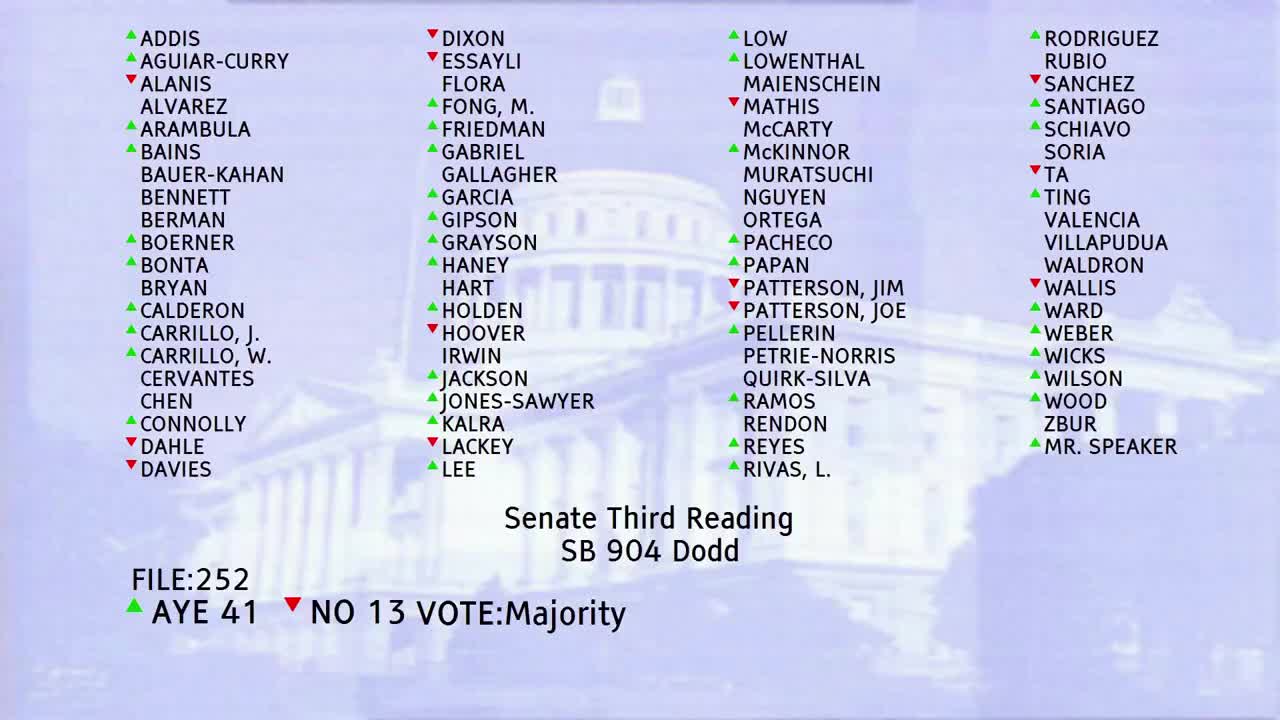


Bill Author

Bill Co-Author(s):