AB 2503: California Environmental Quality Act: exemption: passenger rail projects.
- Session Year: 2023-2024
- House: Assembly
- Latest Version Date: 2024-09-27
Current Status:
Passed
(2024-09-27: Chaptered by Secretary of State - Chapter 718, Statutes of 2024.)
Introduced
In Committee
First Chamber
In Committee
Second Chamber
Enacted
The California Environmental Quality Act (CEQA) requires a lead agency, as defined, to prepare, or cause to be prepared, and certify the completion of an environmental impact report on a project that it proposes to carry out or approve that may have a significant effect on the environment or to adopt a negative declaration if it finds that the project will not have that effect. CEQA also requires a lead agency to prepare a mitigated negative declaration for a project that may have a significant effect on the environment if revisions in the project would avoid or mitigate that effect and there is no substantial evidence that the project, as revised, would have a significant effect on the environment.
CEQA, until January 1, 2030, exempts from its requirements certain transportation-related projects if specified requirements are met, including that a local agency, as defined, is carrying out the project and that the project will be completed by a skilled and trained workforce, as provided. CEQA includes within these exempt transportation-related projects a public project for the institution or increase of bus rapid transit, bus, or light rail service, which will be exclusively used by low-emission or zero-emission vehicles, on existing public rights-of-way or existing highway rights-of-way. Existing law requires the lead agency, if it determines that a transportation-related project is exempt from CEQA and determines to carry out the project, to file a notice of exemption with the Office of Planning and Research and the county clerk in which the project is located.
This bill would expand that exemption from CEQA to include a public project for the institution or increase of other passenger rail service, which will be exclusively used by zero-emission trains, located entirely within existing rail rights-of-way or existing highway rights-of-way. Because the bill would increase the duties of the county clerk, this bill would impose a state-mandated local program.
The California Constitution requires the state to reimburse local agencies and school districts for certain costs mandated by the state. Statutory provisions establish procedures for making that reimbursement.
This bill would provide that no reimbursement is required by this act for a specified reason.
The California Environmental Quality Act (CEQA) requires a lead agency, as defined, to prepare, or cause to be prepared, and certify the completion of an environmental impact report on a project that it proposes to carry out or approve that may have a significant effect on the environment or to adopt a negative declaration if it finds that the project will not have that effect. CEQA also requires a lead agency to prepare a mitigated negative declaration for a project that may have a significant effect on the environment if revisions in the project would avoid or mitigate that effect and there is no substantial evidence that the project, as revised, would have a significant effect on the environment.
CEQA, until January 1, 2030, exempts from its requirements certain transportation-related projects if specified requirements are met, including that a local agency, as defined, is carrying out the project and that the project will be completed by a skilled and trained workforce, as provided. CEQA includes within these exempt transportation-related projects a public project for the institution or increase of bus rapid transit, bus, or light rail service, which will be exclusively used by low-emission or zero-emission vehicles, on existing public rights-of-way or existing highway rights-of-way. Existing law requires the lead agency, if it determines that a transportation-related project is exempt from CEQA and determines to carry out the project, to file a notice of exemption with the Office of Planning and Research and the county clerk in which the project is located.
This bill would expand that exemption from CEQA to include a public project for the institution or increase of other passenger rail service, which will be exclusively used by zero-emission electrified trains, located entirely within existing rail rights-of-way or existing highway rights-of-way. Because the bill would increase the duties of the county clerk, this bill would impose a state-mandated local program.
The California Constitution requires the state to reimburse local agencies and school districts for certain costs mandated by the state. Statutory provisions establish procedures for making that reimbursement.
This bill would provide that no reimbursement is required by this act for a specified reason.
The California Environmental Quality Act (CEQA) requires a lead agency, as defined, to prepare, or cause to be prepared, and certify the completion of an environmental impact report on a project that it proposes to carry out or approve that may have a significant effect on the environment or to adopt a negative declaration if it finds that the project will not have that effect. CEQA also requires a lead agency to prepare a mitigated negative declaration for a project that may have a significant effect on the environment if revisions in the project would avoid or mitigate that effect and there is no substantial evidence that the project, as revised, would have a significant effect on the environment.
CEQA, until January 1, 2030, exempts from its requirements certain transportation-related projects if specified requirements are met, including that a local agency, as defined, is carrying out the project and that the project will be completed by a skilled and trained workforce, as provided. CEQA includes within these exempt transportation-related projects a public project for the institution or increase of bus rapid transit, bus, or light rail service, which will be exclusively used by low-emission or zero-emission vehicles, on existing public rights-of-way or existing highway rights-of-way. Existing law requires the lead agency, if it determines that a transportation-related project is exempt from CEQA and determines to carry out the project, to file a notice of exemption with the Office of Planning and Research and the county clerk in which the project is located.
This bill would expand that exemption from CEQA to include a public project for the institution or increase of other passenger rail service, which will be exclusively used by zero-emission electrified trains, on located entirely within existing rail rights-of-way or existing highway rights-of-way. Because the bill would increase the duties of the county clerk, this bill would impose a state-mandated local program.
The California Constitution requires the state to reimburse local agencies and school districts for certain costs mandated by the state. Statutory provisions establish procedures for making that reimbursement.
This bill would provide that no reimbursement is required by this act for a specified reason.
The California Environmental Quality Act (CEQA) requires a lead agency, as defined, to prepare, or cause to be prepared, and certify the completion of an environmental impact report on a project that it proposes to carry out or approve that may have a significant effect on the environment or to adopt a negative declaration if it finds that the project will not have that effect. CEQA also requires a lead agency to prepare a mitigated negative declaration for a project that may have a significant effect on the environment if revisions in the project would avoid or mitigate that effect and there is no substantial evidence that the project, as revised, would have a significant effect on the environment.
CEQA, until January 1, 2030, exempts from its requirements certain transportation-related projects if specified requirements are met, including that a local agency, as defined, is carrying out the project and that the project will be completed by a skilled and trained workforce, as provided. CEQA includes within these exempt transportation-related projects a public project for the institution or increase of bus rapid transit, bus, or light rail service, which will be exclusively used by low-emission or zero-emission vehicles, on existing public rights-of-way or existing highway rights-of-way. Existing law requires the lead agency, if it determines that a transportation-related project is exempt from CEQA and determines to carry out the project, to file a notice of exemption with the Office of Planning and Research and the county clerk in which the project is located.
This bill would expand that exemption from CEQA to include a public project for the institution or increase of other passenger rail service, which will be exclusively used by zero-emission electrified trains, on existing public rail rights-of-way or existing highway rights-of-way. Because the bill would increase the duties of the county clerk, this bill would impose a state-mandated local program.
The California Constitution requires the state to reimburse local agencies and school districts for certain costs mandated by the state. Statutory provisions establish procedures for making that reimbursement.
This bill would provide that no reimbursement is required by this act for a specified reason.
The California Environmental Quality Act (CEQA) requires a lead agency, as defined, to prepare, or cause to be prepared, and certify the completion of an environmental impact report on a project that it proposes to carry out or approve that may have a significant effect on the environment or to adopt a negative declaration if it finds that the project will not have that effect. CEQA also requires a lead agency to prepare a mitigated negative declaration for a project that may have a significant effect on the environment if revisions in the project would avoid or mitigate that effect and there is no substantial evidence that the project, as revised, would have a significant effect on the environment.
CEQA, until January 1, 2030, exempts from its requirements certain transportation-related projects if specified requirements are met, including that a local agency agency, as defined, is carrying out the project and that the project will be completed by a skilled and trained workforce, as provided. CEQA includes within these exempt transportation-related projects a public project for the institution or increase of bus rapid transit, bus, or light rail service, which will be exclusively used by low-emission or zero-emission vehicles, on existing public rights-of-way or existing highway rights-of-way. Existing law requires the lead agency, if it determines that a transportation-related project is exempt from CEQA and determines to carry out the project, to file a notice of exemption with the Office of Planning and Research and the county clerk in which the project is located.
This bill would expand that exemption from CEQA to include a public project for the institution or increase of any other passenger rail service, which will be exclusively used by low-emission or zero-emission vehicles, trains, on existing public rights-of-way or existing highway rights-of-way. Because a lead agency would be required to determine the applicability of this exemption, the bill would increase the duties of the county clerk, this bill would impose a state-mandated local program.
The California Constitution requires the state to reimburse local agencies and school districts for certain costs mandated by the state. Statutory provisions establish procedures for making that reimbursement.
This bill would provide that no reimbursement is required by this act for a specified reason.
The California Environmental Quality Act (CEQA) requires a lead agency, as defined, to prepare, or cause to be prepared, and certify the completion of an environmental impact report on a project that it proposes to carry out or approve that may have a significant effect on the environment or to adopt a negative declaration if it finds that the project will not have that effect. CEQA also requires a lead agency to prepare a mitigated negative declaration for a project that may have a significant effect on the environment if revisions in the project would avoid or mitigate that effect and there is no substantial evidence that the project, as revised, would have a significant effect on the environment.
CEQA, until January 1, 2030, exempts from its requirements certain transportation-related projects if specified requirements are met, including that a local agency is carrying out the project and that the project will be completed by a skilled and trained workforce, as provided. CEQA includes within these exempt transportation-related projects a public project for the institution or increase of bus rapid transit, bus, or light rail service, which will be exclusively used by low-emission or zero-emission vehicles, on existing public rights-of-way or existing highway rights-of-way.
This bill would exempt from the requirements of CEQA railroad electrification projects and railroad siding projects. expand that exemption from CEQA to include a public project for the institution or increase of any rail service, which will be exclusively used by low-emission or zero-emission vehicles, on existing public rights-of-way or existing highway rights-of-way. Because a lead agency would be required to determine the applicability of this exemption, this bill would impose a state-mandated local program.
The California Constitution requires the state to reimburse local agencies and school districts for certain costs mandated by the state. Statutory provisions establish procedures for making that reimbursement.
This bill would provide that no reimbursement is required by this act for a specified reason.
The California Environmental Quality Act (CEQA) requires a lead agency, as defined, to prepare, or cause to be prepared, and certify the completion of an environmental impact report on a project that it proposes to carry out or approve that may have a significant effect on the environment or to adopt a negative declaration if it finds that the project will not have that effect. CEQA also requires a lead agency to prepare a mitigated negative declaration for a project that may have a significant effect on the environment if revisions in the project would avoid or mitigate that effect and there is no substantial evidence that the project, as revised, would have a significant effect on the environment.
This bill would exempt from the requirements of CEQA railroad electrification projects and railroad siding projects. Because a lead agency would be required to determine the applicability of this exemption, this bill would impose a state-mandated local program.
The California Constitution requires the state to reimburse local agencies and school districts for certain costs mandated by the state. Statutory provisions establish procedures for making that reimbursement.
This bill would provide that no reimbursement is required by this act for a specified reason.
(a)For purposes of this section, the following definitions apply:
(1)Affordable housing means any of the following:
(A)Housing that is subject to a recorded covenant, ordinance, or law that restricts rents or sales prices to levels affordable, as defined in Section 50052.5 or 50053 of the Health and Safety Code, to persons and families of moderate, lower, or very low income, as defined in Section 50079.5, 50093, or 50105 of the Health and Safety Code, respectively.
(B)Housing that is subject to any form of rent or price control through a public entitys valid exercise of its police power.
(C)Housing that had been occupied by tenants within five years from the date of approval of the development agreement by a primary tenant who was low income and did not leave voluntarily.
(2)Bicycle facilities includes, but is not limited to, bicycle parking, bicycle sharing facilities, and bikeways as defined in Section 890.4 of the Streets and Highways Code.
(3)High-occupancy vehicle means a vehicle with three or more occupants.
(4)Highway means a way or place of whatever nature, publicly maintained and open to the use of the public for purposes of vehicular travel. Highway includes a street.
(5)Local agency means a public transit operator, city, county, city and county, special district, joint powers authority, local or regional transportation agency, or congestion management agency.
(6)Part-time transit lanes means designated highway shoulders that support the operation of transit vehicles during specified times and are not open to nonpublic transit vehicles at any time.
(7)Project labor agreement has the same meaning as defined in paragraph (1) of subdivision (b) of Section 2500 of the Public Contract Code.
(8)Public transit operator has the same meaning as in Section 99210 of the Public Utilities Code.
(9)Skilled and trained workforce has the same meaning as provided in Chapter 2.9 (commencing with Section 2600) of Part 1 of Division 2 of the Public Contract Code.
(10)Transit lanes means street design elements that delineate space within the roadbed as exclusive to transit use, either full or part time.
(11)Transit prioritization projects means any of the following transit project types on highways or in the public right-of-way:
(A)Signal and sign changes, such as signal coordination, signal timing modifications, signal modifications, or the installation of traffic signs or new signals.
(B)The installation of wayside technology and onboard technology.
(C)The installation of ramp meters.
(D)The conversion to dedicated transit lanes, including transit queue jump or bypass lanes, shared turning lanes and turn restrictions, the narrowing of lanes to allow for dedicated transit lanes or transit reliability improvements, or the widening of existing transit travel lanes by removing or restricting street parking.
(E)Transit stop access and safety improvements, including, but not limited to, the installation of transit bulbs and the installation of transit boarding islands.
(12)Transportation demand management program means a specific program of strategies, incentives, and tools to be implemented, including, with specified annual status reporting obligations, to reduce vehicle trips by providing opportunities for the public to choose sustainable travel options, such as transit, bicycle riding, or walking. A specific program of strategies, incentives, and tools includes, but is not limited to, any of the following:
(A)Provision of onsite electric vehicle charging stations in excess of applicable requirements.
(B)Provision of dedicated parking for car share or zero-emission vehicles, or both types of vehicles, in excess of applicable requirements.
(C)Provision of bicycle parking in excess of applicable requirements.
(b)This division does not apply to any of the following projects:
(1)Pedestrian and bicycle facilities that improve safety, access, or mobility, including new facilities, within the public right-of-way.
(2)Projects that improve customer information and wayfinding for transit riders, bicyclists, or pedestrians within the public right-of-way.
(3)Transit prioritization projects.
(4)A project for the designation and conversion of general purpose lanes to high-occupancy vehicle lanes or bus-only lanes, or highway shoulders to part-time transit lanes, for use either during peak congestion hours or all day on highways with existing public transit service or where a public transit agency will be implementing public transit service as identified in a short range transit plan.
(5)A public project for the institution or increase of bus rapid transit, bus, or light rail service, including the construction or rehabilitation of stations, terminals, or existing operations facilities, which will be exclusively used by zero-emission, near-zero-emission, low oxide of nitrogen engine, compressed natural gas fuel, fuel cell, or hybrid powertrain buses or light rail vehicles, on existing public rights-of-way or existing highway rights-of-way, whether or not the right-of-way is in use for public mass transit. The project shall be located on a site that is wholly within the boundaries of an urbanized area or urban cluster, as designated by the United States Census Bureau.
(6)A public project for the institution or increase of passenger rail service, other than light rail service eligible under paragraph (5), including the construction or rehabilitation of stations, terminals, or existing operations facilities, which will be exclusively used by zero-emission trains. The project shall be located entirely within an existing rail right-of-way or existing highway right-of-way, whether or not the right-of-way is in use for passenger rail transit.
(7)(A)A public project to construct or maintain infrastructure or facilities to charge, refuel, power, or maintain zero-emission public transit buses, trains, or ferries, provided the project is carried out by a public transit agency in compliance with, the State Air Resources Boards Innovative Clean Transit regulations (Article 4.3 (commencing with Section 2023) of Chapter 1 of Division 3 of Title 13 of the California Code of Regulations) or any regulations identified by the State Air Resources Boards 2020 Mobile Source Strategy, adopted on October 28, 2021, and the project is located on property owned by the local agency or within an existing public right-of-way or on property owned by a public or private utility.
(B)A lead agency applying an exemption pursuant to this paragraph for hydrogen refueling infrastructure or facilities necessary to refuel or maintain zero-emission public transit buses, trains, or ferries shall comply with clauses (i), (iii), and (iv) of subparagraph (D) of, and with subparagraph (E) of, paragraph (1) of subdivision (d).
(8)The maintenance, repair, relocation, replacement, or removal of any utility infrastructure associated with a project identified in paragraphs (1) to (7), inclusive.
(9)A project that consists exclusively of a combination of any of the components of a project identified in paragraphs (1) to (8), inclusive.
(10)A planning decision carried out by a local agency to reduce or eliminate minimum parking requirements or institute parking maximums, remove or restrict parking, or implement transportation demand management requirements or programs.
(c)Except as provided in subdivision (g), a project exempt from this division under this section shall meet all of the following criteria:
(1)A local agency is carrying out the project and is the lead agency for the project.
(2)The project does not induce single-occupancy vehicle trips, add additional highway lanes, widen highways, or add physical infrastructure or striping to highways except for minor modifications needed for the efficient and safe movement of transit vehicles, bicycles, or high-occupancy vehicles, such as extended merging lanes, shoulder improvements, or improvements to the roadway within the existing right of way. The project shall not include the addition of any auxiliary lanes.
(3)The construction of the project shall not require the demolition of affordable housing units.
(d)(1)For a project exceeding one hundred million dollars ($100,000,000), a project exempt from this division under this section shall also meet all of the following:
(A)The project is incorporated in a regional transportation plan, sustainable communities strategy, general plan, or other plan that has undergone a programmatic-level environmental review pursuant to this division within 10 years of the approval of the project.
(B)The projects construction impacts are fully mitigated consistent with applicable law.
(C)(i)The lead agency shall complete and consider the results of a project business case and a racial equity analysis. The Office of Planning and Research may set guidelines for the project business case and the racial equity analysis or delegate that authority to metropolitan planning organizations.
(ii)The project business case required under this subparagraph shall set forth the rationale for why the project should be implemented to solve a problem or address an opportunity, outline strategic goals and objectives of the project, evaluate other options to achieve the projects objectives, describe the economic costs and benefits of the project, describe the financial implications of the project, and establish what is required to deliver and operate the project.
(iii)The racial equity analysis required under this subparagraph shall identify the racial equity impacts of the project, identify who will benefit from and be burdened by the project, and, where significant or disproportionate impacts exist, suggest strategies, designs, or actions to mitigate those impacts.
(D)The lead agency shall hold noticed public meetings as follows:
(i)Before determining that a project is exempt pursuant to this section, the lead agency shall hold at least three noticed public meetings in the project area to hear and respond to public comments.
(ii)At least one of the three public meetings shall review the project business case and the racial equity analysis. The review of these documents does not inhibit or preclude application of this section.
(iii)The lead agency shall conduct at least two noticed public meetings annually during project construction for the public to provide comments.
(iv)The public meetings held pursuant to clauses (i) to (iii), inclusive, shall be in the form of either a public community planning meeting held in the project area or in the form of a regularly scheduled meeting of the governing body of the lead agency.
(E)The lead agency shall give public notice of the meetings in subparagraph (D) to the last known name and address of all the organizations and individuals that have previously requested notice and shall also give the general public notice using at least one of the following procedures:
(i)Publication of the notice in a newspaper of general circulation in the area affected by the project. If more than one area will be affected, the notice shall be published in the newspaper of largest circulation from among the newspapers of general circulation in those areas.
(ii)Posting of the notice onsite and offsite in the area where the project is located.
(iii)Posting of the notice on the lead agencys internet website and social media accounts.
(2)In addition to the requirements of paragraph (1), for a project described in that paragraph for which at least 50 percent of the project or projects stops and stations are located in an area that is at risk of residential displacement and that will have a maximum of 15-minute peak headways, the local agency shall complete an analysis of residential displacement and suggest antidisplacement strategies, designs, or actions. For a project subject to this paragraph, the lead agency shall define or identify areas at risk of residential displacement.
(e)For a project exceeding fifty million dollars ($50,000,000), a project exempt from this division under this section shall also comply with clauses (i), (iii), and (iv) of subparagraph (D) of, and with subparagraph (E) of, paragraph (1) of subdivision (d).
(f)(1)(A)Except as provided in subdivision (g), in addition to the requirements of subdivision (c), following the granting of an exemption under this section, the lead agency shall take an action at a public meeting of its governing board to certify that the project will be completed by a skilled and trained workforce.
(B)Subparagraph (A) does not apply if the lead agency has an existing policy or certification approved by its governing board that requires the use of a skilled and trained workforce to complete the project if the lead agency is a signatory to a project labor agreement that will require the use of a skilled and trained workforce on the project.
(2)(A)Except as provided in subparagraph (B), for a project that is exempted under this section, the lead agency shall not enter into a construction contract with any entity unless the entity provides to the lead agency an enforceable commitment that the entity and its subcontractors at every tier will use a skilled and trained workforce to perform all work on the project or a contract that falls within an apprenticeship occupation in the building and construction trades in accordance with Chapter 2.9 (commencing with Section 2600) of Part 1 of Division 2 of the Public Contract Code.
(B)Subparagraph (A) does not apply if any of the following requirements are met:
(i)The lead agency has entered into a project labor agreement that will bind all contractors and subcontractors performing work on the project to use a skilled and trained workforce and the entity has agreed to be bound by that project labor agreement.
(ii)The project or contract is being performed under the extension or renewal of a project labor agreement that was entered into by the lead agency before January 1, 2021.
(iii)The entity contracted to perform the project entered into a project labor agreement that will bind the entity and all its subcontractors at every tier performing the project to use a skilled and trained workforce.
(g)Subdivisions (c) and (f) do not apply to a project described in paragraph (10) of subdivision (b).
(h)If the lead agency determines that a project is not subject to this division pursuant to this section, and the lead agency determines to carry out that project, the lead agency shall file a notice of exemption with the Office of Planning and Research and the county clerk of the county in which the project is located in the manner specified in subdivisions (b) and (c) of Section 21152.
(i)(1)The amendments made to paragraph (5) of subdivision (b) by Chapter 987 of the Statutes of 2022 (Senate Bill 922 of the 202122 Regular Session) may apply to projects for which a lead agency has filed a notice of exemption under this section before January 1, 2023.
(2)For projects for which a lead agency has filed a notice of exemption under this section before January 1, 2023, notwithstanding subdivision (d), as it read on December 31, 2022, the lead agency may certify that the project will be completed by a skilled and trained workforce after the granting of the exemption under this section or the lead agency may demonstrate compliance with subparagraph (B) of paragraph (1) of subdivision (f).
(j)This section shall remain in effect only until January 1, 2030, and as of that date is repealed.
SEC. 2.No reimbursement is required by this act pursuant to Section 6 of Article XIIIB of the California Constitution because a local agency or school district has the authority to levy service charges, fees, or assessments sufficient to pay for the program or level of service mandated by this act, within the meaning of Section 17556 of the Government Code.
(a)For purposes of this section, the following definitions apply:
(1)Affordable housing means any of the following:
(A)Housing that is subject to a recorded covenant, ordinance, or law that restricts rents or sales prices to levels affordable, as defined in Section 50052.5 or 50053 of the Health and Safety Code, to persons and families of moderate, lower, or very low income, as defined in Section 50079.5, 50093, or 50105 of the Health and Safety Code, respectively.
(B)Housing that is subject to any form of rent or price control through a public entitys valid exercise of its police power.
(C)Housing that had been occupied by tenants within five years from the date of approval of the development agreement by a primary tenant who was low income and did not leave voluntarily.
(2)Bicycle facilities includes, but is not limited to, bicycle parking, bicycle sharing facilities, and bikeways as defined in Section 890.4 of the Streets and Highways Code.
(3)High-occupancy vehicle means a vehicle with three or more occupants.
(4)Highway means a way or place of whatever nature, publicly maintained and open to the use of the public for purposes of vehicular travel. Highway includes a street.
(5)Local agency means a public transit operator, city, county, city and county, special district, joint powers authority, local or regional transportation agency, or congestion management agency.
(6)Part-time transit lanes means designated highway shoulders that support the operation of transit vehicles during specified times and are not open to nonpublic transit vehicles at any time.
(7)Project labor agreement has the same meaning as defined in paragraph (1) of subdivision (b) of Section 2500 of the Public Contract Code.
(8)Public transit operator has the same meaning as in Section 99210 of the Public Utilities Code.
(9)Skilled and trained workforce has the same meaning as provided in Chapter 2.9 (commencing with Section 2600) of Part 1 of Division 2 of the Public Contract Code.
(10)Transit lanes means street design elements that delineate space within the roadbed as exclusive to transit use, either full or part time.
(11)Transit prioritization projects means any of the following transit project types on highways or in the public right-of-way:
(A)Signal and sign changes, such as signal coordination, signal timing modifications, signal modifications, or the installation of traffic signs or new signals.
(B)The installation of wayside technology and onboard technology.
(C)The installation of ramp meters.
(D)The conversion to dedicated transit lanes, including transit queue jump or bypass lanes, shared turning lanes and turn restrictions, the narrowing of lanes to allow for dedicated transit lanes or transit reliability improvements, or the widening of existing transit travel lanes by removing or restricting street parking.
(E)Transit stop access and safety improvements, including, but not limited to, the installation of transit bulbs and the installation of transit boarding islands.
(12)Transportation demand management program means a specific program of strategies, incentives, and tools to be implemented, including, with specified annual status reporting obligations, to reduce vehicle trips by providing opportunities for the public to choose sustainable travel options, such as transit, bicycle riding, or walking. A specific program of strategies, incentives, and tools includes, but is not limited to, any of the following:
(A)Provision of onsite electric vehicle charging stations in excess of applicable requirements.
(B)Provision of dedicated parking for car share or zero-emission vehicles, or both types of vehicles, in excess of applicable requirements.
(C)Provision of bicycle parking in excess of applicable requirements.
(b)This division does not apply to any of the following projects:
(1)Pedestrian and bicycle facilities that improve safety, access, or mobility, including new facilities, within the public right-of-way.
(2)Projects that improve customer information and wayfinding for transit riders, bicyclists, or pedestrians within the public right-of-way.
(3)Transit prioritization projects.
(4)A project for the designation and conversion of general purpose lanes to high-occupancy vehicle lanes or bus-only lanes, or highway shoulders to part-time transit lanes, for use either during peak congestion hours or all day on highways with existing public transit service or where a public transit agency will be implementing public transit service as identified in a short range transit plan.
(5)A public project for the institution or increase of bus rapid transit, bus, or light rail service, including the construction or rehabilitation of stations, terminals, or existing operations facilities, which will be exclusively used by zero-emission, near-zero-emission, low oxide of nitrogen engine, compressed natural gas fuel, fuel cell, or hybrid powertrain buses or light rail vehicles, on existing public rights-of-way or existing highway rights-of-way, whether or not the right-of-way is in use for public mass transit. The project shall be located on a site that is wholly within the boundaries of an urbanized area or urban cluster, as designated by the United States Census Bureau.
(6)A public project for the institution or increase of passenger rail service, other than light rail service eligible under paragraph (5), including the construction or rehabilitation of stations, terminals, or existing operations facilities, which will be exclusively used by zero-emission electrified trains. The project shall be located entirely within an existing rail right-of-way or existing highway right-of-way, whether or not the right-of-way is in use for passenger rail transit.
(7)(A)A public project to construct or maintain infrastructure or facilities to charge, refuel, power, or maintain zero-emission public transit buses, trains, or ferries, provided the project is carried out by a public transit agency in compliance with, the State Air Resources Boards Innovative Clean Transit regulations (Article 4.3 (commencing with Section 2023) of Chapter 1 of Division 3 of Title 13 of the California Code of Regulations) or any regulations identified by the State Air Resources Boards 2020 Mobile Source Strategy, adopted on October 28, 2021, and the project is located on property owned by the local agency or within an existing public right-of-way or on property owned by a public or private utility.
(B)A lead agency applying an exemption pursuant to this paragraph for hydrogen refueling infrastructure or facilities necessary to refuel or maintain zero-emission public transit buses, trains, or ferries shall comply with clauses (i), (iii), and (iv) of subparagraph (D) of, and with subparagraph (E) of, paragraph (1) of subdivision (d).
(8)The maintenance, repair, relocation, replacement, or removal of any utility infrastructure associated with a project identified in paragraphs (1) to (7), inclusive.
(9)A project that consists exclusively of a combination of any of the components of a project identified in paragraphs (1) to (8), inclusive.
(10)A planning decision carried out by a local agency to reduce or eliminate minimum parking requirements or institute parking maximums, remove or restrict parking, or implement transportation demand management requirements or programs.
(c)Except as provided in subdivision (g), a project exempt from this division under this section shall meet all of the following criteria:
(1)A local agency is carrying out the project and is the lead agency for the project.
(2)The project does not induce single-occupancy vehicle trips, add additional highway lanes, widen highways, or add physical infrastructure or striping to highways except for minor modifications needed for the efficient and safe movement of transit vehicles, bicycles, or high-occupancy vehicles, such as extended merging lanes, shoulder improvements, or improvements to the roadway within the existing right of way. The project shall not include the addition of any auxiliary lanes.
(3)The construction of the project shall not require the demolition of affordable housing units.
(d)(1)For a project exceeding one hundred million dollars ($100,000,000), a project exempt from this division under this section shall also meet all of the following:
(A)The project is incorporated in a regional transportation plan, sustainable communities strategy, general plan, or other plan that has undergone a programmatic-level environmental review pursuant to this division within 10 years of the approval of the project.
(B)The projects construction impacts are fully mitigated consistent with applicable law.
(C)(i)The lead agency shall complete and consider the results of a project business case and a racial equity analysis. The Office of Planning and Research may set guidelines for the project business case and the racial equity analysis or delegate that authority to metropolitan planning organizations.
(ii)The project business case required under this subparagraph shall set forth the rationale for why the project should be implemented to solve a problem or address an opportunity, outline strategic goals and objectives of the project, evaluate other options to achieve the projects objectives, describe the economic costs and benefits of the project, describe the financial implications of the project, and establish what is required to deliver and operate the project.
(iii)The racial equity analysis required under this subparagraph shall identify the racial equity impacts of the project, identify who will benefit from and be burdened by the project, and, where significant or disproportionate impacts exist, suggest strategies, designs, or actions to mitigate those impacts.
(D)The lead agency shall hold noticed public meetings as follows:
(i)Before determining that a project is exempt pursuant to this section, the lead agency shall hold at least three noticed public meetings in the project area to hear and respond to public comments.
(ii)At least one of the three public meetings shall review the project business case and the racial equity analysis. The review of these documents does not inhibit or preclude application of this section.
(iii)The lead agency shall conduct at least two noticed public meetings annually during project construction for the public to provide comments.
(iv)The public meetings held pursuant to clauses (i) to (iii), inclusive, shall be in the form of either a public community planning meeting held in the project area or in the form of a regularly scheduled meeting of the governing body of the lead agency.
(E)The lead agency shall give public notice of the meetings in subparagraph (D) to the last known name and address of all the organizations and individuals that have previously requested notice and shall also give the general public notice using at least one of the following procedures:
(i)Publication of the notice in a newspaper of general circulation in the area affected by the project. If more than one area will be affected, the notice shall be published in the newspaper of largest circulation from among the newspapers of general circulation in those areas.
(ii)Posting of the notice onsite and offsite in the area where the project is located.
(iii)Posting of the notice on the lead agencys internet website and social media accounts.
(2)In addition to the requirements of paragraph (1), for a project described in that paragraph for which at least 50 percent of the project or projects stops and stations are located in an area that is at risk of residential displacement and that will have a maximum of 15-minute peak headways, the local agency shall complete an analysis of residential displacement and suggest antidisplacement strategies, designs, or actions. For a project subject to this paragraph, the lead agency shall define or identify areas at risk of residential displacement.
(e)For a project exceeding fifty million dollars ($50,000,000), a project exempt from this division under this section shall also comply with clauses (i), (iii), and (iv) of subparagraph (D) of, and with subparagraph (E) of, paragraph (1) of subdivision (d).
(f)(1)(A)Except as provided in subdivision (g), in addition to the requirements of subdivision (c), following the granting of an exemption under this section, the lead agency shall take an action at a public meeting of its governing board to certify that the project will be completed by a skilled and trained workforce.
(B)Subparagraph (A) does not apply if the lead agency has an existing policy or certification approved by its governing board that requires the use of a skilled and trained workforce to complete the project if the lead agency is a signatory to a project labor agreement that will require the use of a skilled and trained workforce on the project.
(2)(A)Except as provided in subparagraph (B), for a project that is exempted under this section, the lead agency shall not enter into a construction contract with any entity unless the entity provides to the lead agency an enforceable commitment that the entity and its subcontractors at every tier will use a skilled and trained workforce to perform all work on the project or a contract that falls within an apprenticeship occupation in the building and construction trades in accordance with Chapter 2.9 (commencing with Section 2600) of Part 1 of Division 2 of the Public Contract Code.
(B)Subparagraph (A) does not apply if any of the following requirements are met:
(i)The lead agency has entered into a project labor agreement that will bind all contractors and subcontractors performing work on the project to use a skilled and trained workforce and the entity has agreed to be bound by that project labor agreement.
(ii)The project or contract is being performed under the extension or renewal of a project labor agreement that was entered into by the lead agency before January 1, 2021.
(iii)The entity contracted to perform the project entered into a project labor agreement that will bind the entity and all its subcontractors at every tier performing the project to use a skilled and trained workforce.
(g)Subdivisions (c) and (f) do not apply to a project described in paragraph (10) of subdivision (b).
(h)If the lead agency determines that a project is not subject to this division pursuant to this section, and the lead agency determines to carry out that project, the lead agency shall file a notice of exemption with the Office of Planning and Research and the county clerk of the county in which the project is located in the manner specified in subdivisions (b) and (c) of Section 21152.
(i)(1)The amendments made to paragraph (5) of subdivision (b) by Chapter 987 of the Statutes of 2022 (Senate Bill 922 of the 202122 Regular Session) may apply to projects for which a lead agency has filed a notice of exemption under this section before January 1, 2023.
(2)For projects for which a lead agency has filed a notice of exemption under this section before January 1, 2023, notwithstanding subdivision (d), as it read on December 31, 2022, the lead agency may certify that the project will be completed by a skilled and trained workforce after the granting of the exemption under this section or the lead agency may demonstrate compliance with subparagraph (B) of paragraph (1) of subdivision (f).
(j)This section shall remain in effect only until January 1, 2030, and as of that date is repealed.
SEC. 2.No reimbursement is required by this act pursuant to Section 6 of Article XIIIB of the California Constitution because a local agency or school district has the authority to levy service charges, fees, or assessments sufficient to pay for the program or level of service mandated by this act, within the meaning of Section 17556 of the Government Code.
(a)For purposes of this section, the following definitions apply:
(1)Affordable housing means any of the following:
(A)Housing that is subject to a recorded covenant, ordinance, or law that restricts rents or sales prices to levels affordable, as defined in Section 50052.5 or 50053 of the Health and Safety Code, to persons and families of moderate, lower, or very low income, as defined in Section 50079.5, 50093, or 50105 of the Health and Safety Code, respectively.
(B)Housing that is subject to any form of rent or price control through a public entitys valid exercise of its police power.
(C)Housing that had been occupied by tenants within five years from the date of approval of the development agreement by a primary tenant who was low income and did not leave voluntarily.
(2)Bicycle facilities includes, but is not limited to, bicycle parking, bicycle sharing facilities, and bikeways as defined in Section 890.4 of the Streets and Highways Code.
(3)High-occupancy vehicle means a vehicle with three or more occupants.
(4)Highway means a way or place of whatever nature, publicly maintained and open to the use of the public for purposes of vehicular travel. Highway includes a street.
(5)Local agency means a public transit operator, city, county, city and county, special district, joint powers authority, local or regional transportation agency, or congestion management agency.
(6)Part-time transit lanes means designated highway shoulders that support the operation of transit vehicles during specified times and are not open to nonpublic transit vehicles at any time.
(7)Project labor agreement has the same meaning as defined in paragraph (1) of subdivision (b) of Section 2500 of the Public Contract Code.
(8)Public transit operator has the same meaning as in Section 99210 of the Public Utilities Code.
(9)Skilled and trained workforce has the same meaning as provided in Chapter 2.9 (commencing with Section 2600) of Part 1 of Division 2 of the Public Contract Code.
(10)Transit lanes means street design elements that delineate space within the roadbed as exclusive to transit use, either full or part time.
(11)Transit prioritization projects means any of the following transit project types on highways or in the public right-of-way:
(A)Signal and sign changes, such as signal coordination, signal timing modifications, signal modifications, or the installation of traffic signs or new signals.
(B)The installation of wayside technology and onboard technology.
(C)The installation of ramp meters.
(D)The conversion to dedicated transit lanes, including transit queue jump or bypass lanes, shared turning lanes and turn restrictions, the narrowing of lanes to allow for dedicated transit lanes or transit reliability improvements, or the widening of existing transit travel lanes by removing or restricting street parking.
(E)Transit stop access and safety improvements, including, but not limited to, the installation of transit bulbs and the installation of transit boarding islands.
(12)Transportation demand management program means a specific program of strategies, incentives, and tools to be implemented, including, with specified annual status reporting obligations, to reduce vehicle trips by providing opportunities for the public to choose sustainable travel options, such as transit, bicycle riding, or walking. A specific program of strategies, incentives, and tools includes, but is not limited to, any of the following:
(A)Provision of onsite electric vehicle charging stations in excess of applicable requirements.
(B)Provision of dedicated parking for car share or zero-emission vehicles, or both types of vehicles, in excess of applicable requirements.
(C)Provision of bicycle parking in excess of applicable requirements.
(b)This division does not apply to any of the following projects:
(1)Pedestrian and bicycle facilities that improve safety, access, or mobility, including new facilities, within the public right-of-way.
(2)Projects that improve customer information and wayfinding for transit riders, bicyclists, or pedestrians within the public right-of-way.
(3)Transit prioritization projects.
(4)A project for the designation and conversion of general purpose lanes to high-occupancy vehicle lanes or bus-only lanes, or highway shoulders to part-time transit lanes, for use either during peak congestion hours or all day on highways with existing public transit service or where a public transit agency will be implementing public transit service as identified in a short range transit plan.
(5)A public project for the institution or increase of bus rapid transit, bus, or light rail service, including the construction or rehabilitation of stations, terminals, or existing operations facilities, which will be exclusively used by zero-emission, near-zero-emission, low oxide of nitrogen engine, compressed natural gas fuel, fuel cell, or hybrid powertrain buses or light rail vehicles, on existing public rights-of-way or existing highway rights-of-way, whether or not the right-of-way is in use for public mass transit. The project shall be located on a site that is wholly within the boundaries of an urbanized area or urban cluster, as designated by the United States Census Bureau.
(6)A public project for the institution or increase of passenger rail service, other than light rail service eligible under paragraph (5), including the construction or rehabilitation of stations, terminals, or existing operations facilities, which will be exclusively used by zero-emission electrified trains, on trains. The project shall be located entirely within an existing rail rights-of-way right-of-way or existing highway rights-of-way, right-of-way, whether or not the right-of-way is in use for passenger rail transit.
(7)(A)A public project to construct or maintain infrastructure or facilities to charge, refuel, power, or maintain zero-emission public transit buses, trains, or ferries, provided the project is carried out by a public transit agency in compliance with, the State Air Resources Boards Innovative Clean Transit regulations (Article 4.3 (commencing with Section 2023) of Chapter 1 of Division 3 of Title 13 of the California Code of Regulations) or any regulations identified by the State Air Resources Boards 2020 Mobile Source Strategy, adopted on October 28, 2021, and the project is located on property owned by the local agency or within an existing public right-of-way or on property owned by a public or private utility.
(B)A lead agency applying an exemption pursuant to this paragraph for hydrogen refueling infrastructure or facilities necessary to refuel or maintain zero-emission public transit buses, trains, or ferries shall comply with clauses (i), (iii), and (iv) of subparagraph (D) of, and with subparagraph (E) of, paragraph (1) of subdivision (d).
(8)The maintenance, repair, relocation, replacement, or removal of any utility infrastructure associated with a project identified in paragraphs (1) to (7), inclusive.
(9)A project that consists exclusively of a combination of any of the components of a project identified in paragraphs (1) to (8), inclusive.
(10)A planning decision carried out by a local agency to reduce or eliminate minimum parking requirements or institute parking maximums, remove or restrict parking, or implement transportation demand management requirements or programs.
(c)Except as provided in subdivision (g), a project exempt from this division under this section shall meet all of the following criteria:
(1)A local agency is carrying out the project and is the lead agency for the project.
(2)The project does not induce single-occupancy vehicle trips, add additional highway lanes, widen highways, or add physical infrastructure or striping to highways except for minor modifications needed for the efficient and safe movement of transit vehicles, bicycles, or high-occupancy vehicles, such as extended merging lanes, shoulder improvements, or improvements to the roadway within the existing right of way. The project shall not include the addition of any auxiliary lanes.
(3)The construction of the project shall not require the demolition of affordable housing units.
(d)(1)For a project exceeding one hundred million dollars ($100,000,000), a project exempt from this division under this section shall also meet all of the following:
(A)The project is incorporated in a regional transportation plan, sustainable communities strategy, general plan, or other plan that has undergone a programmatic-level environmental review pursuant to this division within 10 years of the approval of the project.
(B)The projects construction impacts are fully mitigated consistent with applicable law.
(C)(i)The lead agency shall complete and consider the results of a project business case and a racial equity analysis. The Office of Planning and Research may set guidelines for the project business case and the racial equity analysis or delegate that authority to metropolitan planning organizations.
(ii)The project business case required under this subparagraph shall set forth the rationale for why the project should be implemented to solve a problem or address an opportunity, outline strategic goals and objectives of the project, evaluate other options to achieve the projects objectives, describe the economic costs and benefits of the project, describe the financial implications of the project, and establish what is required to deliver and operate the project.
(iii)The racial equity analysis required under this subparagraph shall identify the racial equity impacts of the project, identify who will benefit from and be burdened by the project, and, where significant or disproportionate impacts exist, suggest strategies, designs, or actions to mitigate those impacts.
(D)The lead agency shall hold noticed public meetings as follows:
(i)Before determining that a project is exempt pursuant to this section, the lead agency shall hold at least three noticed public meetings in the project area to hear and respond to public comments.
(ii)At least one of the three public meetings shall review the project business case and the racial equity analysis. The review of these documents does not inhibit or preclude application of this section.
(iii)The lead agency shall conduct at least two noticed public meetings annually during project construction for the public to provide comments.
(iv)The public meetings held pursuant to clauses (i) to (iii), inclusive, shall be in the form of either a public community planning meeting held in the project area or in the form of a regularly scheduled meeting of the governing body of the lead agency.
(E)The lead agency shall give public notice of the meetings in subparagraph (D) to the last known name and address of all the organizations and individuals that have previously requested notice and shall also give the general public notice using at least one of the following procedures:
(i)Publication of the notice in a newspaper of general circulation in the area affected by the project. If more than one area will be affected, the notice shall be published in the newspaper of largest circulation from among the newspapers of general circulation in those areas.
(ii)Posting of the notice onsite and offsite in the area where the project is located.
(iii)Posting of the notice on the lead agencys internet website and social media accounts.
(2)In addition to the requirements of paragraph (1), for a project described in that paragraph for which at least 50 percent of the project or projects stops and stations are located in an area that is at risk of residential displacement and that will have a maximum of 15-minute peak headways, the local agency shall complete an analysis of residential displacement and suggest antidisplacement strategies, designs, or actions. For a project subject to this paragraph, the lead agency shall define or identify areas at risk of residential displacement.
(e)For a project exceeding fifty million dollars ($50,000,000), a project exempt from this division under this section shall also comply with clauses (i), (iii), and (iv) of subparagraph (D) of, and with subparagraph (E) of, paragraph (1) of subdivision (d).
(f)(1)(A)Except as provided in subdivision (g), in addition to the requirements of subdivision (c), following the granting of an exemption under this section, the lead agency shall take an action at a public meeting of its governing board to certify that the project will be completed by a skilled and trained workforce.
(B)Subparagraph (A) does not apply if the lead agency has an existing policy or certification approved by its governing board that requires the use of a skilled and trained workforce to complete the project if the lead agency is a signatory to a project labor agreement that will require the use of a skilled and trained workforce on the project.
(2)(A)Except as provided in subparagraph (B), for a project that is exempted under this section, the lead agency shall not enter into a construction contract with any entity unless the entity provides to the lead agency an enforceable commitment that the entity and its subcontractors at every tier will use a skilled and trained workforce to perform all work on the project or a contract that falls within an apprenticeship occupation in the building and construction trades in accordance with Chapter 2.9 (commencing with Section 2600) of Part 1 of Division 2 of the Public Contract Code.
(B)Subparagraph (A) does not apply if any of the following requirements are met:
(i)The lead agency has entered into a project labor agreement that will bind all contractors and subcontractors performing work on the project to use a skilled and trained workforce and the entity has agreed to be bound by that project labor agreement.
(ii)The project or contract is being performed under the extension or renewal of a project labor agreement that was entered into by the lead agency before January 1, 2021.
(iii)The entity contracted to perform the project entered into a project labor agreement that will bind the entity and all its subcontractors at every tier performing the project to use a skilled and trained workforce.
(g)Subdivisions (c) and (f) do not apply to a project described in paragraph (10) of subdivision (b).
(h)If the lead agency determines that a project is not subject to this division pursuant to this section, and the lead agency determines to carry out that project, the lead agency shall file a notice of exemption with the Office of Planning and Research and the county clerk of the county in which the project is located in the manner specified in subdivisions (b) and (c) of Section 21152.
(i)(1)The amendments made to paragraph (5) of subdivision (b) by Chapter 987 of the Statutes of 2022 (Senate Bill 922 of the 202122 Regular Session) may apply to projects for which a lead agency has filed a notice of exemption under this section before January 1, 2023.
(2)For projects for which a lead agency has filed a notice of exemption under this section before January 1, 2023, notwithstanding subdivision (d), as it read on December 31, 2022, the lead agency may certify that the project will be completed by a skilled and trained workforce after the granting of the exemption under this section or the lead agency may demonstrate compliance with subparagraph (B) of paragraph (1) of subdivision (f).
(j)This section shall remain in effect only until January 1, 2030, and as of that date is repealed.
SEC. 2.No reimbursement is required by this act pursuant to Section 6 of Article XIIIB of the California Constitution because a local agency or school district has the authority to levy service charges, fees, or assessments sufficient to pay for the program or level of service mandated by this act, within the meaning of Section 17556 of the Government Code.
(a)For purposes of this section, the following definitions apply:
(1)Affordable housing means any of the following:
(A)Housing that is subject to a recorded covenant, ordinance, or law that restricts rents or sales prices to levels affordable, as defined in Section 50052.5 or 50053 of the Health and Safety Code, to persons and families of moderate, lower, or very low income, as defined in Section 50079.5, 50093, or 50105 of the Health and Safety Code, respectively.
(B)Housing that is subject to any form of rent or price control through a public entitys valid exercise of its police power.
(C)Housing that had been occupied by tenants within five years from the date of approval of the development agreement by a primary tenant who was low income and did not leave voluntarily.
(2)Bicycle facilities includes, but is not limited to, bicycle parking, bicycle sharing facilities, and bikeways as defined in Section 890.4 of the Streets and Highways Code.
(3)High-occupancy vehicle means a vehicle with three or more occupants.
(4)Highway means a way or place of whatever nature, publicly maintained and open to the use of the public for purposes of vehicular travel. Highway includes a street.
(5)Local agency means a public transit operator, city, county, city and county, special district, joint powers authority, local or regional transportation agency, or congestion management agency.
(6)Part-time transit lanes means designated highway shoulders that support the operation of transit vehicles during specified times and are not open to nonpublic transit vehicles at any time.
(7)Project labor agreement has the same meaning as defined in paragraph (1) of subdivision (b) of Section 2500 of the Public Contract Code.
(8)Public transit operator has the same meaning as in Section 99210 of the Public Utilities Code.
(9)Skilled and trained workforce has the same meaning as provided in Chapter 2.9 (commencing with Section 2600) of Part 1 of Division 2 of the Public Contract Code.
(10)Transit lanes means street design elements that delineate space within the roadbed as exclusive to transit use, either full or part time.
(11)Transit prioritization projects means any of the following transit project types on highways or in the public right-of-way:
(A)Signal and sign changes, such as signal coordination, signal timing modifications, signal modifications, or the installation of traffic signs or new signals.
(B)The installation of wayside technology and onboard technology.
(C)The installation of ramp meters.
(D)The conversion to dedicated transit lanes, including transit queue jump or bypass lanes, shared turning lanes and turn restrictions, the narrowing of lanes to allow for dedicated transit lanes or transit reliability improvements, or the widening of existing transit travel lanes by removing or restricting street parking.
(E)Transit stop access and safety improvements, including, but not limited to, the installation of transit bulbs and the installation of transit boarding islands.
(12)Transportation demand management program means a specific program of strategies, incentives, and tools to be implemented, including, with specified annual status reporting obligations, to reduce vehicle trips by providing opportunities for the public to choose sustainable travel options, such as transit, bicycle riding, or walking. A specific program of strategies, incentives, and tools includes, but is not limited to, any of the following:
(A)Provision of onsite electric vehicle charging stations in excess of applicable requirements.
(B)Provision of dedicated parking for car share or zero-emission vehicles, or both types of vehicles, in excess of applicable requirements.
(C)Provision of bicycle parking in excess of applicable requirements.
(b)This division does not apply to any of the following projects:
(1)Pedestrian and bicycle facilities that improve safety, access, or mobility, including new facilities, within the public right-of-way.
(2)Projects that improve customer information and wayfinding for transit riders, bicyclists, or pedestrians within the public right-of-way.
(3)Transit prioritization projects.
(4)A project for the designation and conversion of general purpose lanes to high-occupancy vehicle lanes or bus-only lanes, or highway shoulders to part-time transit lanes, for use either during peak congestion hours or all day on highways with existing public transit service or where a public transit agency will be implementing public transit service as identified in a short range transit plan.
(5)A public project for the institution or increase of bus rapid transit, bus, or light rail service, including the construction or rehabilitation of stations, terminals, or existing operations facilities, which will be exclusively used by zero-emission, near-zero-emission, low oxide of nitrogen engine, compressed natural gas fuel, fuel cell, or hybrid powertrain buses or light rail vehicles, on existing public rights-of-way or existing highway rights-of-way, whether or not the right-of-way is in use for public mass transit. The project shall be located on a site that is wholly within the boundaries of an urbanized area or urban cluster, as designated by the United States Census Bureau.
(6)A public project for the institution or increase of passenger rail service, other than light rail service eligible under paragraph (5), including the construction or rehabilitation of stations, terminals, or existing operations facilities, which will be exclusively used by zero-emission electrified trains, on existing public rail rights-of-way or existing highway rights-of-way, whether or not the right-of-way is in use for passenger rail transit. The project shall be located on a site that is wholly within the boundaries of an urbanized area or urban cluster, as designated by the United States Census Bureau.
(7)(A)A public project to construct or maintain infrastructure or facilities to charge, refuel, power, or maintain zero-emission public transit buses, trains, or ferries, provided the project is carried out by a public transit agency in compliance with, the State Air Resources Boards Innovative Clean Transit regulations (Article 4.3 (commencing with Section 2023) of Chapter 1 of Division 3 of Title 13 of the California Code of Regulations) or any regulations identified by the State Air Resources Boards 2020 Mobile Source Strategy, adopted on October 28, 2021, and the project is located on property owned by the local agency or within an existing public right-of-way or on property owned by a public or private utility.
(B)A lead agency applying an exemption pursuant to this paragraph for hydrogen refueling infrastructure or facilities necessary to refuel or maintain zero-emission public transit buses, trains, or ferries shall comply with clauses (i), (iii), and (iv) of subparagraph (D) of, and with subparagraph (E) of, paragraph (1) of subdivision (d).
(8)The maintenance, repair, relocation, replacement, or removal of any utility infrastructure associated with a project identified in paragraphs (1) to (7), inclusive.
(9)A project that consists exclusively of a combination of any of the components of a project identified in paragraphs (1) to (8), inclusive.
(10)A planning decision carried out by a local agency to reduce or eliminate minimum parking requirements or institute parking maximums, remove or restrict parking, or implement transportation demand management requirements or programs.
(c)Except as provided in subdivision (g), a project exempt from this division under this section shall meet all of the following criteria:
(1)A local agency is carrying out the project and is the lead agency for the project.
(2)The project does not induce single-occupancy vehicle trips, add additional highway lanes, widen highways, or add physical infrastructure or striping to highways except for minor modifications needed for the efficient and safe movement of transit vehicles, bicycles, or high-occupancy vehicles, such as extended merging lanes, shoulder improvements, or improvements to the roadway within the existing right of way. The project shall not include the addition of any auxiliary lanes.
(3)The construction of the project shall not require the demolition of affordable housing units.
(d)(1)For a project exceeding one hundred million dollars ($100,000,000), a project exempt from this division under this section shall also meet all of the following:
(A)The project is incorporated in a regional transportation plan, sustainable communities strategy, general plan, or other plan that has undergone a programmatic-level environmental review pursuant to this division within 10 years of the approval of the project.
(B)The projects construction impacts are fully mitigated consistent with applicable law.
(C)(i)The lead agency shall complete and consider the results of a project business case and a racial equity analysis. The Office of Planning and Research may set guidelines for the project business case and the racial equity analysis or delegate that authority to metropolitan planning organizations.
(ii)The project business case required under this subparagraph shall set forth the rationale for why the project should be implemented to solve a problem or address an opportunity, outline strategic goals and objectives of the project, evaluate other options to achieve the projects objectives, describe the economic costs and benefits of the project, describe the financial implications of the project, and establish what is required to deliver and operate the project.
(iii)The racial equity analysis required under this subparagraph shall identify the racial equity impacts of the project, identify who will benefit from and be burdened by the project, and, where significant or disproportionate impacts exist, suggest strategies, designs, or actions to mitigate those impacts.
(D)The lead agency shall hold noticed public meetings as follows:
(i)Before determining that a project is exempt pursuant to this section, the lead agency shall hold at least three noticed public meetings in the project area to hear and respond to public comments.
(ii)At least one of the three public meetings shall review the project business case and the racial equity analysis. The review of these documents does not inhibit or preclude application of this section.
(iii)The lead agency shall conduct at least two noticed public meetings annually during project construction for the public to provide comments.
(iv)The public meetings held pursuant to clauses (i) to (iii), inclusive, shall be in the form of either a public community planning meeting held in the project area or in the form of a regularly scheduled meeting of the governing body of the lead agency.
(E)The lead agency shall give public notice of the meetings in subparagraph (D) to the last known name and address of all the organizations and individuals that have previously requested notice and shall also give the general public notice using at least one of the following procedures:
(i)Publication of the notice in a newspaper of general circulation in the area affected by the project. If more than one area will be affected, the notice shall be published in the newspaper of largest circulation from among the newspapers of general circulation in those areas.
(ii)Posting of the notice onsite and offsite in the area where the project is located.
(iii)Posting of the notice on the lead agencys internet website and social media accounts.
(2)In addition to the requirements of paragraph (1), for a project described in that paragraph for which at least 50 percent of the project or projects stops and stations are located in an area that is at risk of residential displacement and that will have a maximum of 15-minute peak headways, the local agency shall complete an analysis of residential displacement and suggest antidisplacement strategies, designs, or actions. For a project subject to this paragraph, the lead agency shall define or identify areas at risk of residential displacement.
(e)For a project exceeding fifty million dollars ($50,000,000), a project exempt from this division under this section shall also comply with clauses (i), (iii), and (iv) of subparagraph (D) of, and with subparagraph (E) of, paragraph (1) of subdivision (d).
(f)(1)(A)Except as provided in subdivision (g), in addition to the requirements of subdivision (c), following the granting of an exemption under this section, the lead agency shall take an action at a public meeting of its governing board to certify that the project will be completed by a skilled and trained workforce.
(B)Subparagraph (A) does not apply if the lead agency has an existing policy or certification approved by its governing board that requires the use of a skilled and trained workforce to complete the project if the lead agency is a signatory to a project labor agreement that will require the use of a skilled and trained workforce on the project.
(2)(A)Except as provided in subparagraph (B), for a project that is exempted under this section, the lead agency shall not enter into a construction contract with any entity unless the entity provides to the lead agency an enforceable commitment that the entity and its subcontractors at every tier will use a skilled and trained workforce to perform all work on the project or a contract that falls within an apprenticeship occupation in the building and construction trades in accordance with Chapter 2.9 (commencing with Section 2600) of Part 1 of Division 2 of the Public Contract Code.
(B)Subparagraph (A) does not apply if any of the following requirements are met:
(i)The lead agency has entered into a project labor agreement that will bind all contractors and subcontractors performing work on the project to use a skilled and trained workforce and the entity has agreed to be bound by that project labor agreement.
(ii)The project or contract is being performed under the extension or renewal of a project labor agreement that was entered into by the lead agency before January 1, 2021.
(iii)The entity contracted to perform the project entered into a project labor agreement that will bind the entity and all its subcontractors at every tier performing the project to use a skilled and trained workforce.
(g)Subdivisions (c) and (f) do not apply to a project described in paragraph (10) of subdivision (b).
(h)If the lead agency determines that a project is not subject to this division pursuant to this section, and the lead agency determines to carry out that project, the lead agency shall file a notice of exemption with the Office of Planning and Research and the county clerk of the county in which the project is located in the manner specified in subdivisions (b) and (c) of Section 21152.
(i)(1)The amendments made to paragraph (5) of subdivision (b) by Chapter 987 of the Statutes of 2022 (Senate Bill 922 of the 202122 Regular Session) may apply to projects for which a lead agency has filed a notice of exemption under this section before January 1, 2023.
(2)For projects for which a lead agency has filed a notice of exemption under this section before January 1, 2023, notwithstanding subdivision (d), as it read on December 31, 2022, the lead agency may certify that the project will be completed by a skilled and trained workforce after the granting of the exemption under this section or the lead agency may demonstrate compliance with subparagraph (B) of paragraph (1) of subdivision (f).
(j)This section shall remain in effect only until January 1, 2030, and as of that date is repealed.
SEC. 2.No reimbursement is required by this act pursuant to Section 6 of Article XIIIB of the California Constitution because a local agency or school district has the authority to levy service charges, fees, or assessments sufficient to pay for the program or level of service mandated by this act, within the meaning of Section 17556 of the Government Code.
(a)For purposes of this section, the following definitions apply:
(1)Affordable housing means any of the following:
(A)Housing that is subject to a recorded covenant, ordinance, or law that restricts rents or sales prices to levels affordable, as defined in Section 50052.5 or 50053 of the Health and Safety Code, to persons and families of moderate, lower, or very low income, as defined in Section 50079.5, 50093, or 50105 of the Health and Safety Code, respectively.
(B)Housing that is subject to any form of rent or price control through a public entitys valid exercise of its police power.
(C)Housing that had been occupied by tenants within five years from the date of approval of the development agreement by a primary tenant who was low income and did not leave voluntarily.
(2)Bicycle facilities includes, but is not limited to, bicycle parking, bicycle sharing facilities, and bikeways as defined in Section 890.4 of the Streets and Highways Code.
(3)High-occupancy vehicle means a vehicle with three or more occupants.
(4)Highway means a way or place of whatever nature, publicly maintained and open to the use of the public for purposes of vehicular travel. Highway includes a street.
(5)Local agency means a public transit operator, city, county, city and county, special district, joint powers authority, local or regional transportation agency, or congestion management agency.
(6)Part-time transit lanes means designated highway shoulders that support the operation of transit vehicles during specified times and are not open to nonpublic transit vehicles at any time.
(7)Project labor agreement has the same meaning as defined in paragraph (1) of subdivision (b) of Section 2500 of the Public Contract Code.
(8)Public transit operator has the same meaning as in Section 99210 of the Public Utilities Code.
(9)Skilled and trained workforce has the same meaning as provided in Chapter 2.9 (commencing with Section 2600) of Part 1 of Division 2 of the Public Contract Code.
(10)Transit lanes means street design elements that delineate space within the roadbed as exclusive to transit use, either full or part time.
(11)Transit prioritization projects means any of the following transit project types on highways or in the public right-of-way:
(A)Signal and sign changes, such as signal coordination, signal timing modifications, signal modifications, or the installation of traffic signs or new signals.
(B)The installation of wayside technology and onboard technology.
(C)The installation of ramp meters.
(D)The conversion to dedicated transit lanes, including transit queue jump or bypass lanes, shared turning lanes and turn restrictions, the narrowing of lanes to allow for dedicated transit lanes or transit reliability improvements, or the widening of existing transit travel lanes by removing or restricting street parking.
(E)Transit stop access and safety improvements, including, but not limited to, the installation of transit bulbs and the installation of transit boarding islands.
(12)Transportation demand management program means a specific program of strategies, incentives, and tools to be implemented, including, with specified annual status reporting obligations, to reduce vehicle trips by providing opportunities for the public to choose sustainable travel options, such as transit, bicycle riding, or walking. A specific program of strategies, incentives, and tools includes, but is not limited to, any of the following:
(A)Provision of onsite electric vehicle charging stations in excess of applicable requirements.
(B)Provision of dedicated parking for car share or zero-emission vehicles, or both types of vehicles, in excess of applicable requirements.
(C)Provision of bicycle parking in excess of applicable requirements.
(b)This division does not apply to any of the following projects:
(1)Pedestrian and bicycle facilities that improve safety, access, or mobility, including new facilities, within the public right-of-way.
(2)Projects that improve customer information and wayfinding for transit riders, bicyclists, or pedestrians within the public right-of-way.
(3)Transit prioritization projects.
(4)A project for the designation and conversion of general purpose lanes to high-occupancy vehicle lanes or bus-only lanes, or highway shoulders to part-time transit lanes, for use either during peak congestion hours or all day on highways with existing public transit service or where a public transit agency will be implementing public transit service as identified in a short range transit plan.
(5)A public project for the institution or increase of bus rapid transit, bus, or light rail service, including the construction or rehabilitation of stations, terminals, or existing operations facilities, which will be exclusively used by zero-emission, near-zero-emission, low oxide of nitrogen engine, compressed natural gas fuel, fuel cell, or hybrid powertrain buses or light rail vehicles, on existing public rights-of-way or existing highway rights-of-way, whether or not the right-of-way is in use for public mass transit. The project shall be located on a site that is wholly within the boundaries of an urbanized area or urban cluster, as designated by the United States Census Bureau.
(6)A public project for the institution or increase of passenger rail service, other than light rail service eligible under paragraph (5), including the construction or rehabilitation of stations, terminals, or existing operations facilities, which will be exclusively used by zero-emission trains, on existing public rights-of-way or existing highway rights-of-way, whether or not the right-of-way is in use for passenger rail transit. The project shall be located on a site that is wholly within the boundaries of an urbanized area or urban cluster, as designated by the United States Census Bureau.
(6)(7)(A)A public project to construct or maintain infrastructure or facilities to charge, refuel, power, or maintain zero-emission public transit buses, trains, or ferries, provided the project is carried out by a public transit agency in compliance with, the State Air Resources Boards Innovative Clean Transit regulations (Article 4.3 (commencing with Section 2023) of Chapter 1 of Division 3 of Title 13 of the California Code of Regulations) or any regulations identified by the State Air Resources Boards 2020 Mobile Source Strategy, adopted on October 28, 2021, and the project is located on property owned by the local agency or within an existing public right-of-way or on property owned by a public or private utility.
(B)A lead agency applying an exemption pursuant to this paragraph for hydrogen refueling infrastructure or facilities necessary to refuel or maintain zero-emission public transit buses, trains, or ferries shall comply with clauses (i), (iii), and (iv) of subparagraph (D) of, and with subparagraph (E) of, paragraph (1) of subdivision (d).
(7)(8)The maintenance, repair, relocation, replacement, or removal of any utility infrastructure associated with a project identified in paragraphs (1) to (6), (7), inclusive.
(8)(9)A project that consists exclusively of a combination of any of the components of a project identified in paragraphs (1) to (7), (8), inclusive.
(9)(10)A planning decision carried out by a local agency to reduce or eliminate minimum parking requirements or institute parking maximums, remove or restrict parking, or implement transportation demand management requirements or programs.
(c)Except as provided in subdivision (g), a project exempt from this division under this section shall meet all of the following criteria:
(1)A local agency is carrying out the project and is the lead agency for the project.
(2)The project does not induce single-occupancy vehicle trips, add additional highway lanes, widen highways, or add physical infrastructure or striping to highways except for minor modifications needed for the efficient and safe movement of transit vehicles, bicycles, or high-occupancy vehicles, such as extended merging lanes, shoulder improvements, or improvements to the roadway within the existing right of way. The project shall not include the addition of any auxiliary lanes.
(3)The construction of the project shall not require the demolition of affordable housing units.
(d)(1)For a project exceeding one hundred million dollars ($100,000,000), a project exempt from this division under this section shall also meet all of the following:
(A)The project is incorporated in a regional transportation plan, sustainable communities strategy, general plan, or other plan that has undergone a programmatic-level environmental review pursuant to this division within 10 years of the approval of the project.
(B)The projects construction impacts are fully mitigated consistent with applicable law.
(C)(i)The lead agency shall complete and consider the results of a project business case and a racial equity analysis. The Office of Planning and Research may set guidelines for the project business case and the racial equity analysis or delegate that authority to metropolitan planning organizations.
(ii)The project business case required under this subparagraph shall set forth the rationale for why the project should be implemented to solve a problem or address an opportunity, outline strategic goals and objectives of the project, evaluate other options to achieve the projects objectives, describe the economic costs and benefits of the project, describe the financial implications of the project, and establish what is required to deliver and operate the project.
(iii)The racial equity analysis required under this subparagraph shall identify the racial equity impacts of the project, identify who will benefit from and be burdened by the project, and, where significant or disproportionate impacts exist, suggest strategies, designs, or actions to mitigate those impacts.
(D)The lead agency shall hold noticed public meetings as follows:
(i)Before determining that a project is exempt pursuant to this section, the lead agency shall hold at least three noticed public meetings in the project area to hear and respond to public comments.
(ii)At least one of the three public meetings shall review the project business case and the racial equity analysis. The review of these documents does not inhibit or preclude application of this section.
(iii)The lead agency shall conduct at least two noticed public meetings annually during project construction for the public to provide comments.
(iv)The public meetings held pursuant to clauses (i) to (iii), inclusive, shall be in the form of either a public community planning meeting held in the project area or in the form of a regularly scheduled meeting of the governing body of the lead agency.
(E)The lead agency shall give public notice of the meetings in subparagraph (D) to the last known name and address of all the organizations and individuals that have previously requested notice and shall also give the general public notice using at least one of the following procedures:
(i)Publication of the notice in a newspaper of general circulation in the area affected by the project. If more than one area will be affected, the notice shall be published in the newspaper of largest circulation from among the newspapers of general circulation in those areas.
(ii)Posting of the notice onsite and offsite in the area where the project is located.
(iii)Posting of the notice on the lead agencys internet website and social media accounts.
(2)In addition to the requirements of paragraph (1), for a project described in that paragraph for which at least 50 percent of the project or projects stops and stations are located in an area that is at risk of residential displacement and that will have a maximum of 15-minute peak headways, the local agency shall complete an analysis of residential displacement and suggest antidisplacement strategies, designs, or actions. For a project subject to this paragraph, the lead agency shall define or identify areas at risk of residential displacement.
(e)For a project exceeding fifty million dollars ($50,000,000), a project exempt from this division under this section shall also comply with clauses (i), (iii), and (iv) of subparagraph (D) of, and with subparagraph (E) of, paragraph (1) of subdivision (d).
(f)(1)(A)Except as provided in subdivision (g), in addition to the requirements of subdivision (c), following the granting of an exemption under this section, the lead agency shall take an action at a public meeting of its governing board to certify that the project will be completed by a skilled and trained workforce.
(B)Subparagraph (A) does not apply if the lead agency has an existing policy or certification approved by its governing board that requires the use of a skilled and trained workforce to complete the project if the lead agency is a signatory to a project labor agreement that will require the use of a skilled and trained workforce on the project.
(2)(A)Except as provided in subparagraph (B), for a project that is exempted under this section, the lead agency shall not enter into a construction contract with any entity unless the entity provides to the lead agency an enforceable commitment that the entity and its subcontractors at every tier will use a skilled and trained workforce to perform all work on the project or a contract that falls within an apprenticeship occupation in the building and construction trades in accordance with Chapter 2.9 (commencing with Section 2600) of Part 1 of Division 2 of the Public Contract Code.
(B)Subparagraph (A) does not apply if any of the following requirements are met:
(i)The lead agency has entered into a project labor agreement that will bind all contractors and subcontractors performing work on the project to use a skilled and trained workforce and the entity has agreed to be bound by that project labor agreement.
(ii)The project or contract is being performed under the extension or renewal of a project labor agreement that was entered into by the lead agency before January 1, 2021.
(iii)The entity contracted to perform the project entered into a project labor agreement that will bind the entity and all its subcontractors at every tier performing the project to use a skilled and trained workforce.
(g)Subdivisions (c) and (f) do not apply to a project described in paragraph (9) (10) of subdivision (b).
(h)If the lead agency determines that a project is not subject to this division pursuant to this section, and the lead agency determines to carry out that project, the lead agency shall file a notice of exemption with the Office of Planning and Research and the county clerk of the county in which the project is located in the manner specified in subdivisions (b) and (c) of Section 21152.
(i)(1)The amendments made to paragraph (5) of subdivision (b) by Chapter 987 of the Statutes of 2022 (Senate Bill 922 of the 202122 Regular Session) may apply to projects for which a lead agency has filed a notice of exemption under this section before January 1, 2023.
(2)For projects for which a lead agency has filed a notice of exemption under this section before January 1, 2023, notwithstanding subdivision (d), as it read on December 31, 2022, the lead agency may certify that the project will be completed by a skilled and trained workforce after the granting of the exemption under this section or the lead agency may demonstrate compliance with subparagraph (B) of paragraph (1) of subdivision (f).
(j)This section shall remain in effect only until January 1, 2030, and as of that date is repealed.
SEC. 2.No reimbursement is required by this act pursuant to Section 6 of Article XIIIB of the California Constitution because a local agency or school district has the authority to levy service charges, fees, or assessments sufficient to pay for the program or level of service mandated by this act, within the meaning of Section 17556 of the Government Code.
(a)For purposes of this section, the following definitions apply:
(1)Affordable housing means any of the following:
(A)Housing that is subject to a recorded covenant, ordinance, or law that restricts rents or sales prices to levels affordable, as defined in Section 50052.5 or 50053 of the Health and Safety Code, to persons and families of moderate, lower, or very low income, as defined in Section 50079.5, 50093, or 50105 of the Health and Safety Code, respectively.
(B)Housing that is subject to any form of rent or price control through a public entitys valid exercise of its police power.
(C)Housing that had been occupied by tenants within five years from the date of approval of the development agreement by a primary tenant who was low income and did not leave voluntarily.
(2)Bicycle facilities includes, but is not limited to, bicycle parking, bicycle sharing facilities, and bikeways as defined in Section 890.4 of the Streets and Highways Code.
(3)High-occupancy vehicle means a vehicle with three or more occupants.
(4)Highway means a way or place of whatever nature, publicly maintained and open to the use of the public for purposes of vehicular travel. Highway includes a street.
(5)Local agency means a public transit operator, city, county, city and county, special district, joint powers authority, local or regional transportation agency, or congestion management agency.
(6)Part-time transit lanes means designated highway shoulders that support the operation of transit vehicles during specified times and are not open to nonpublic transit vehicles at any time.
(7)Project labor agreement has the same meaning as defined in paragraph (1) of subdivision (b) of Section 2500 of the Public Contract Code.
(8)Public transit operator has the same meaning as in Section 99210 of the Public Utilities Code.
(9)Skilled and trained workforce has the same meaning as provided in Chapter 2.9 (commencing with Section 2600) of Part 1 of Division 2 of the Public Contract Code.
(10)Transit lanes means street design elements that delineate space within the roadbed as exclusive to transit use, either full or part time.
(11)Transit prioritization projects means any of the following transit project types on highways or in the public right-of-way:
(A)Signal and sign changes, such as signal coordination, signal timing modifications, signal modifications, or the installation of traffic signs or new signals.
(B)The installation of wayside technology and onboard technology.
(C)The installation of ramp meters.
(D)The conversion to dedicated transit lanes, including transit queue jump or bypass lanes, shared turning lanes and turn restrictions, the narrowing of lanes to allow for dedicated transit lanes or transit reliability improvements, or the widening of existing transit travel lanes by removing or restricting street parking.
(E)Transit stop access and safety improvements, including, but not limited to, the installation of transit bulbs and the installation of transit boarding islands.
(12)Transportation demand management program means a specific program of strategies, incentives, and tools to be implemented, including, with specified annual status reporting obligations, to reduce vehicle trips by providing opportunities for the public to choose sustainable travel options, such as transit, bicycle riding, or walking. A specific program of strategies, incentives, and tools includes, but is not limited to, any of the following:
(A)Provision of onsite electric vehicle charging stations in excess of applicable requirements.
(B)Provision of dedicated parking for car share or zero-emission vehicles, or both types of vehicles, in excess of applicable requirements.
(C)Provision of bicycle parking in excess of applicable requirements.
(b)This division does not apply to any of the following projects:
(1)Pedestrian and bicycle facilities that improve safety, access, or mobility, including new facilities, within the public right-of-way.
(2)Projects that improve customer information and wayfinding for transit riders, bicyclists, or pedestrians within the public right-of-way.
(3)Transit prioritization projects.
(4)A project for the designation and conversion of general purpose lanes to high-occupancy vehicle lanes or bus-only lanes, or highway shoulders to part-time transit lanes, for use either during peak congestion hours or all day on highways with existing public transit service or where a public transit agency will be implementing public transit service as identified in a short range transit plan.
(5)A public project for the institution or increase of bus rapid transit, bus, or light rail service, including the construction or rehabilitation of stations, terminals, or existing operations facilities, which will be exclusively used by zero-emission, near-zero-emission, low oxide of nitrogen engine, compressed natural gas fuel, fuel cell, or hybrid powertrain buses or light rail vehicles, on existing public rights-of-way or existing highway rights-of-way, whether or not the right-of-way is in use for public mass transit. The project shall be located on a site that is wholly within the boundaries of an urbanized area or urban cluster, as designated by the United States Census Bureau.
(6)(A)A public project to construct or maintain infrastructure or facilities to charge, refuel, power, or maintain zero-emission public transit buses, trains, or ferries, provided the project is carried out by a public transit agency in compliance with, the State Air Resources Boards Innovative Clean Transit regulations (Article 4.3 (commencing with Section 2023) of Chapter 1 of Division 3 of Title 13 of the California Code of Regulations) or any regulations identified by the State Air Resources Boards 2020 Mobile Source Strategy, adopted on October 28, 2021, and the project is located on property owned by the local agency or within an existing public right-of-way or on property owned by a public or private utility.
(B)A lead agency applying an exemption pursuant to this paragraph for hydrogen refueling infrastructure or facilities necessary to refuel or maintain zero-emission public transit buses, trains, or ferries shall comply with clauses (i), (iii), and (iv) of subparagraph (D) of, and with subparagraph (E) of, paragraph (1) of subdivision (d).
(7)The maintenance, repair, relocation, replacement, or removal of any utility infrastructure associated with a project identified in paragraphs (1) to (6), inclusive.
(8)A project that consists exclusively of a combination of any of the components of a project identified in paragraphs (1) to (7), inclusive.
(9)A planning decision carried out by a local agency to reduce or eliminate minimum parking requirements or institute parking maximums, remove or restrict parking, or implement transportation demand management requirements or programs.
(c)Except as provided in subdivision (g), a project exempt from this division under this section shall meet all of the following criteria:
(1)A local agency is carrying out the project and is the lead agency for the project.
(2)The project does not induce single-occupancy vehicle trips, add additional highway lanes, widen highways, or add physical infrastructure or striping to highways except for minor modifications needed for the efficient and safe movement of transit vehicles, bicycles, or high-occupancy vehicles, such as extended merging lanes, shoulder improvements, or improvements to the roadway within the existing right of way. The project shall not include the addition of any auxiliary lanes.
(3)The construction of the project shall not require the demolition of affordable housing units.
(d)(1)For a project exceeding one hundred million dollars ($100,000,000), a project exempt from this division under this section shall also meet all of the following:
(A)The project is incorporated in a regional transportation plan, sustainable communities strategy, general plan, or other plan that has undergone a programmatic-level environmental review pursuant to this division within 10 years of the approval of the project.
(B)The projects construction impacts are fully mitigated consistent with applicable law.
(C)(i)The lead agency shall complete and consider the results of a project business case and a racial equity analysis. The Office of Planning and Research may set guidelines for the project business case and the racial equity analysis or delegate that authority to metropolitan planning organizations.
(ii)The project business case required under this subparagraph shall set forth the rationale for why the project should be implemented to solve a problem or address an opportunity, outline strategic goals and objectives of the project, evaluate other options to achieve the projects objectives, describe the economic costs and benefits of the project, describe the financial implications of the project, and establish what is required to deliver and operate the project.
(iii)The racial equity analysis required under this subparagraph shall identify the racial equity impacts of the project, identify who will benefit from and be burdened by the project, and, where significant or disproportionate impacts exist, suggest strategies, designs, or actions to mitigate those impacts.
(D)The lead agency shall hold noticed public meetings as follows:
(i)Before determining that a project is exempt pursuant to this section, the lead agency shall hold at least three noticed public meetings in the project area to hear and respond to public comments.
(ii)At least one of the three public meetings shall review the project business case and the racial equity analysis. The review of these documents does not inhibit or preclude application of this section.
(iii)The lead agency shall conduct at least two noticed public meetings annually during project construction for the public to provide comments.
(iv)The public meetings held pursuant to clauses (i) to (iii), inclusive, shall be in the form of either a public community planning meeting held in the project area or in the form of a regularly scheduled meeting of the governing body of the lead agency.
(E)The lead agency shall give public notice of the meetings in subparagraph (D) to the last known name and address of all the organizations and individuals that have previously requested notice and shall also give the general public notice using at least one of the following procedures:
(i)Publication of the notice in a newspaper of general circulation in the area affected by the project. If more than one area will be affected, the notice shall be published in the newspaper of largest circulation from among the newspapers of general circulation in those areas.
(ii)Posting of the notice onsite and offsite in the area where the project is located.
(iii)Posting of the notice on the lead agencys internet website and social media accounts.
(2)In addition to the requirements of paragraph (1), for a project described in that paragraph for which at least 50 percent of the project or projects stops and stations are located in an area that is at risk of residential displacement and that will have a maximum of 15-minute peak headways, the local agency shall complete an analysis of residential displacement and suggest antidisplacement strategies, designs, or actions. For a project subject to this paragraph, the lead agency shall define or identify areas at risk of residential displacement.
(e)For a project exceeding fifty million dollars ($50,000,000), a project exempt from this division under this section shall also comply with clauses (i), (iii), and (iv) of subparagraph (D) of, and with subparagraph (E) of, paragraph (1) of subdivision (d).
(f)(1)(A)Except as provided in subdivision (g), in addition to the requirements of subdivision (c), following the granting of an exemption under this section, the lead agency shall take an action at a public meeting of its governing board to certify that the project will be completed by a skilled and trained workforce.
(B)Subparagraph (A) does not apply if the lead agency has an existing policy or certification approved by its governing board that requires the use of a skilled and trained workforce to complete the project if the lead agency is a signatory to a project labor agreement that will require the use of a skilled and trained workforce on the project.
(2)(A)Except as provided in subparagraph (B), for a project that is exempted under this section, the lead agency shall not enter into a construction contract with any entity unless the entity provides to the lead agency an enforceable commitment that the entity and its subcontractors at every tier will use a skilled and trained workforce to perform all work on the project or a contract that falls within an apprenticeship occupation in the building and construction trades in accordance with Chapter 2.9 (commencing with Section 2600) of Part 1 of Division 2 of the Public Contract Code.
(B)Subparagraph (A) does not apply if any of the following requirements are met:
(i)The lead agency has entered into a project labor agreement that will bind all contractors and subcontractors performing work on the project to use a skilled and trained workforce and the entity has agreed to be bound by that project labor agreement.
(ii)The project or contract is being performed under the extension or renewal of a project labor agreement that was entered into by the lead agency before January 1, 2021.
(iii)The entity contracted to perform the project entered into a project labor agreement that will bind the entity and all its subcontractors at every tier performing the project to use a skilled and trained workforce.
(g)Subdivisions (c) and (f) do not apply to a project described in paragraph (9) of subdivision (b).
(h)If the lead agency determines that a project is not subject to this division pursuant to this section, and the lead agency determines to carry out that project, the lead agency shall file a notice of exemption with the Office of Planning and Research and the county clerk of the county in which the project is located in the manner specified in subdivisions (b) and (c) of Section 21152.
(i)(1)The amendments made to paragraph (5) of subdivision (b) by the measure adding this paragraph Chapter 987 of the Statutes of 2022 (Senate Bill 922 of the 202122 Regular Session) may apply to projects for which a lead agency has filed a notice of exemption under this section before January 1, 2023.
(2)For projects for which a lead agency has filed a notice of exemption under this section before January 1, 2023, notwithstanding subdivision (d), as it read on December 31, 2022, the lead agency may certify that the project will be completed by a skilled and trained workforce after the granting of the exemption under this section or the lead agency may demonstrate compliance with subparagraph (B) of paragraph (1) of subdivision (f).
(j)This section shall remain in effect only until January 1, 2030, and as of that date is repealed.
SEC. 2.No reimbursement is required by this act pursuant to Section 6 of Article XIIIB of the California Constitution because a local agency or school district has the authority to levy service charges, fees, or assessments sufficient to pay for the program or level of service mandated by this act, within the meaning of Section 17556 of the Government Code.
This division does not apply to either of the following:
(a)A railroad electrification project.
(b)A railroad siding project.
SEC. 2.No reimbursement is required by this act pursuant to Section 6 of Article XIIIB of the California Constitution because a local agency or school district has the authority to levy service charges, fees, or assessments sufficient to pay for the program or level of service mandated by this act, within the meaning of Section 17556 of the Government Code.
|
Date
|
Status
|
|---|---|
| Sep 27, 2024 | Chaptered by Secretary of State - Chapter 718, Statutes of 2024. |
| Sep 27, 2024 | Approved by the Governor. |
| Aug 28, 2024 | Enrolled and presented to the Governor at 4 p.m. |
| Aug 22, 2024 | Senate amendments concurred in. To Engrossing and Enrolling. (Ayes 60. Noes 0. Page 6432.). |
| Aug 20, 2024 | In Assembly. Concurrence in Senate amendments pending. May be considered on or after August 22 pursuant to Assembly Rule 77. |
| Aug 20, 2024 | Read third time. Passed. Ordered to the Assembly. (Ayes 31. Noes 5. Page 5233.). |
| Aug 6, 2024 | Read second time. Ordered to third reading. |
| Aug 5, 2024 | From committee: Be ordered to second reading pursuant to Senate Rule 28.8. |
| Jun 27, 2024 | Read second time and amended. Re-referred to Com. on APPR. |
| Jun 26, 2024 | From committee: Amend, and do pass as amended and re-refer to Com. on APPR. (Ayes 10. Noes 3.) (June 25). |
| Jun 10, 2024 | Read second time and amended. Re-referred to Com. on TRANS. |
| Jun 6, 2024 | From committee: Amend, and do pass as amended and re-refer to Com. on TRANS. (Ayes 5. Noes 0.) (June 5). |
| May 16, 2024 | From committee chair, with author's amendments: Amend, and re-refer to committee. Read second time, amended, and re-referred to Com. on E.Q. |
| May 15, 2024 | Referred to Coms. on E.Q. and TRANS. |
| May 2, 2024 | In Senate. Read first time. To Com. on RLS. for assignment. |
| May 2, 2024 | Read third time. Passed. Ordered to the Senate. (Ayes 73. Noes 0. Page 5089.) |
| Apr 25, 2024 | Read second time. Ordered to Consent Calendar. |
| Apr 24, 2024 | From committee: Do pass. To Consent Calendar. (Ayes 14. Noes 0.) (April 24). |
| Apr 15, 2024 | Re-referred to Com. on APPR. |
| Apr 11, 2024 | Read second time and amended. |
| Apr 10, 2024 | From committee: Amend, and do pass as amended and re-refer to Com. on APPR. (Ayes 11. Noes 0.) (April 8). |
| Apr 2, 2024 | Re-referred to Com. on NAT. RES. |
| Apr 1, 2024 | From committee chair, with author's amendments: Amend, and re-refer to Com. on NAT. RES. Read second time and amended. |
| Mar 4, 2024 | Referred to Com. on NAT. RES. |
| Feb 14, 2024 | From printer. May be heard in committee March 15. |
| Feb 13, 2024 | Read first time. To print. |
|
Date
|
Description
|
Location
|
Votes
|
|
|---|---|---|---|---|
| Aug 22, 2024 | AB 2503 Lee Concurrence in Senate Amendments | Assembly Floor |
Passed |
|
| Aug 20, 2024 | Assembly 3rd Reading AB2503 Lee By Wiener | Senate Floor |
Passed |
|
| Jun 25, 2024 | Do pass as amended, but first amend, and re-refer to the Committee on [Appropriations] | Senate Standing Committee on Transportation |
Passed |
|
| Jun 5, 2024 | Do pass as amended, but first amend, and re-refer to the Committee on [Transportation] | Senate Standing Committee on Environmental Quality |
Passed |
|
| May 2, 2024 | AB 2503 Lee Consent Calendar Second Day Regular Session | Assembly Floor |
Passed |
|
| Apr 24, 2024 | Do pass. To Consent Calendar. | Assembly Standing Committee on Appropriations |
Passed |
|
| Apr 8, 2024 | Do pass as amended and be re-referred to the Committee on [Appropriations] | Assembly Standing Committee on Natural Resources |
Passed |
This list shows positions taken on this bill by organizations on the date displayed, which is linked to the original source.
Positions by individuals are not included.
|
Organization
|
Position
|
Date
|
|---|---|---|
| Active San Gabriel Valley | ** Support | |
| All Voting Members of The North Westwood Neighborhood Council | ** Support | |
| Associated General Contractors | ** Support | |
| Bike LA | ** Support | |
| California Association Of Professional Scientists | ** Against | |
| California Council Of The Blind | ** Support | |
| Californians for Electric Rail | ** Support | |
| California Transit Association | ** Support | |
| Car-Lite Long Beach | ** Support | |
| East Bay for Everyone | ** Support | |
| Everybody's Long Beach | ** Support | |
| Long Beach Bike Co-op | ** Support | |
| Los Angeles Walks | ** Support | |
| Marin County Bicycle Coalition | ** Support | |
| Mission Street Neighbors | ** Against | |
| New Livable California Dba Livable California | ** Against | |
| Pedal Movement | ** Support | |
| Peninsula Corridor Joint Powers Board | ** Support | |
| rail passenger association of california and nevada | ** Support | |
| Seamless Bay Area | ** Support | |
| Streets for All | ** Support | |
| Transbay Coalition | ** Support | |
| Urban Environmentalists | ** Support | |
| Yimby Action | ** Support | |
| Youth Climate Strike Los Angeles | ** Support |
CONCURRENCE IN SENATE AMENDMENTS
CSA1 Bill Id:AB 2503
Author:(Lee)
As Amended Ver:June 27, 2024
Majority vote
SUMMARY
Expands existing California Environmental Quality Act (CEQA) exemptions for transit projects to include public project for the institution or increase of zero-emission passenger rail service within an existing rail or highway right-of-way.
Senate Amendments
- Require eligible projects to be located entirely within an existing rail or highway right-of-way.
- Remove the requirement that eligible projects be located wholly within the boundaries of a Census-designated urbanized area or urban cluster.
COMMENTS
CEQA includes statutory exemptions for certain transportation project types. In addition, the CEQA Guidelines include categorical exemptions that apply to some transportation projects, including: 1) work on existing facilities where there is negligible expansion of an existing use, specifically including "(e)xisting highways and streets, sidewalks, gutters, bicycle and pedestrian trails, and similar facilities" (Section 15301(c), CEQA Guidelines); and 2) minor public or private alterations in the condition of land, water, and/or vegetation which do not involve removal of healthy, mature, scenic trees, except for forestry or agricultural purposes, specifically including the creation of bicycle lanes on existing rights-of-way (Section 15304 (h), CEQA Guidelines).
If a project is not exempt from CEQA, but the initial study shows that it would not result in a significant effect on the environment, the lead agency must prepare a negative declaration, and no EIR is required.
According to the Author
To meet our pressing climate goals we need to more rapidly deliver green infrastructure projects. By exempting train electrification from CEQA, transportation agencies will be able to more rapidly electrify their fleets, improve rail service, and cut emissions while saving taxpayer money in legal costs.
Arguments in Support
According to a coalition of supporters led by Streets For All, AB 2503 will streamline the creation of faster, more frequent and environmentally sustainable rail transit by exempting rail electrification projects from review under CEQA. This exception will make it easier for both passenger and freight rail operators to switch away from polluting and expensive diesel locomotives without the cost and delay of environmental review that has derailed electrification efforts across the state.
Arguments in Opposition
According to Mission Street Neighbors, bus rapid transit, bus and light rail projects in an existing public right of way would not be expected to create significant impacts beyond those already associated with traffic in a public right of way. The expansion to any and all other kinds of rail projects including high speed rail, with potentially significant impacts, should not simply be brushed aside. The welfare of nearby residents, as well as wildlife and other natural resources, should not be so cavalierly ignored.
FISCAL COMMENTS
According to the Senate Appropriations Committee, negligible state costs pursuant to Senate Rule 28.8.
VOTES:
ASM NATURAL RESOURCES: 11-0-0
YES: Bryan, Flora, Connolly, Friedman, Hoover, Kalra, Joe Patterson, Muratsuchi, Pellerin, Wicks, Wood
ASM APPROPRIATIONS: 14-0-1
YES: Wicks, Sanchez, Arambula, Bryan, Calderon, Wendy Carrillo, Dixon, Mike Fong, Grayson, Haney, Hart, Jim Patterson, Pellerin, Ta
ABS, ABST OR NV: Villapudua
ASSEMBLY FLOOR: 73-0-7
YES: Addis, Aguiar-Curry, Alanis, Alvarez, Arambula, Bains, Bauer-Kahan, Bennett, Berman, Boerner, Bonta, Bryan, Juan Carrillo, Wendy Carrillo, Cervantes, Chen, Connolly, Davies, Dixon, Essayli, Mike Fong, Vince Fong, Friedman, Gabriel, Gallagher, Garcia, Gipson, Grayson, Haney, Hart, Holden, Hoover, Irwin, Jackson, Jones-Sawyer, Kalra, Lackey, Lee, Lowenthal, Maienschein, McCarty, McKinnor, Muratsuchi, Stephanie Nguyen, Ortega, Pacheco, Papan, Jim Patterson, Joe Patterson, Pellerin, Petrie-Norris, Quirk-Silva, Ramos, Rendon, Reyes, Luz Rivas, Rodriguez, Blanca Rubio, Sanchez, Santiago, Schiavo, Soria, Ta, Ting, Valencia, Villapudua, Waldron, Wallis, Ward, Wicks, Wilson, Wood, Zbur
ABS, ABST OR NV: Calderon, Megan Dahle, Flora, Low, Mathis, Weber, Robert Rivas
SENATE FLOOR: 31-5-4
YES: Allen, Archuleta, Ashby, Atkins, Becker, Blakespear, Bradford, Caballero, Cortese, Dodd, Durazo, Eggman, Glazer, Gonzalez, Hurtado, Laird, McGuire, Menjivar, Min, Newman, Padilla, Portantino, Roth, Rubio, Skinner, Smallwood-Cuevas, Stern, Umberg, Wahab, Wiener, Wilk
NO: Grove, Jones, Nguyen, Niello, Seyarto
ABS, ABST OR NV: Alvarado-Gil, Dahle, Limón, Ochoa Bogh
UPDATED
VERSION: June 27, 2024
CONSULTANT: Lawrence Lingbloom / NAT. RES. / (916) 319-2092 FN: 0004345
SENATE RULES COMMITTEE Office of Senate Floor Analyses (916) 651-1520 Fax: (916) 327-4478 | AB 2503 |
THIRD READING
Bill No: AB 2503
Author: Lee (D)
Amended: 6/27/24 in Senate
Vote: 21
SENATE ENVIRONMENTAL QUALITY COMMITTEE: 5-0, 6/5/24
AYES: Gonzalez, Hurtado, Laird, Menjivar, Skinner
NO VOTE RECORDED: Dahle, Nguyen
SENATE TRANSPORTATION COMMITTEE: 10-3, 6/25/24
AYES: Cortese, Allen, Archuleta, Becker, Blakespear, Dodd, Gonzalez, Laird, Newman, Umberg
NOES: Niello, Nguyen, Seyarto
NO VOTE RECORDED: Dahle, Limón
SENATE APPROPRIATIONS COMMITTEE: Senate Rule 28.8
ASSEMBLY FLOOR: 73-0, 5/2/24 (Consent) - See last page for vote
SUBJECT: California Environmental Quality Act: exemption: passenger rail projects
SOURCE: Author
DIGEST:
This bill creates a California Environmental Quality Act (CEQA) exemption for public projects that create or update existing facilities that support rail service used exclusively by zero-emission trains on existing rights of ways in urban areas.
ANALYSIS:
Existing law:
- Requires, through CEQA, lead agencies with the principal responsibility for carrying out or approving a project to prepare a negative declaration (ND), mitigated negative declaration (MND), or environmental impact report (EIR) for the project unless the project is exempt from CEQA. (Public Resources Code (PRC) §21000 et seq.) If a project may have a significant effect on the environment, the lead agency must prepare a draft EIR. (CEQA Guidelines §15064(a)(1), (f)(1)(Public Resources Code (PRC) 21000 et seq.)
- Exempts from CEQA-specific transportation project types, including the following:
- A project for the institution or increase of passenger or commuter service on rail or highway rights-of-way already in use, including modernization of existing stations and parking facilities. (PRC 21080(b)(10))
- A project for the institution or increase of passenger or commuter service on high occupancy vehicle lanes already in use, including the modernization of existing stations and parking facilities. (PRC 21080(b)(11))
- Facility extensions not to exceed four miles in length which are required for the transfer of passengers from or to exclusive public mass transit guideway or busway public transit services. (PRC 21080(b)(12))
- Exempts from CEQA until January 1, 2030, certain “clean transportation” project types completed by a skilled and trained workforce, as specified, under SB 288 (Wiener, Chapter 200, Statutes of 2020,) and as amended by SB 922 (Wiener, Chapter 987, Statutes of 2022). These “clean transportation” project types include:
- A project for the institution or increase of new bus rapid transit, bus, or light rail service, including the rehabilitation of stations, terminals, or existing operations facilities, as specified. Retroactively applies these changes to projects where the lead agency filed a notice of exemption before January 1, 2023.
- A project to construct or maintain infrastructure to charge or refuel zero-emission transit buses, trains, and ferries, as specified. Requires specified noticed public meetings for this exemption to apply. (PRC 21080.25)
- Requires that “clean transportation” projects in PRC 20180.25 (SB 288, Wiener, Chapter 200, Statutes of 2020; SB 922 Wiener, 2022, Chapter 987, Statutes of 2022) meet all of the following criteria to be eligible for the CEQA exemption:
- A public agency is carrying out the project and is the lead agency for the project.
- The project is located in an urbanized area, as defined.
- The project is located on or within an existing public right-of-way.
- The project does not add physical infrastructure that increases new automobile capacity on existing rights-of-way except for minor modifications needed for the efficient and safe movement of transit vehicles, such as extended merging lanes. The project shall not include the addition of any auxiliary lanes.
- The construction of the project does not require the demolition of affordable housing units, including rent-controlled units and units occupied by low-income tenants. (PRC 21080.25)
- Requires that the “clean transportation” projects identified in PRC 20180.25 (SB 288 (Wiener, Chapter 200, Statutes of 2020); SB 922 (Wiener, 2022, Chapter 987, Statutes of 2022)) exceeding $100 million must additionally meet all of the following criteria:
- The project is incorporated in a regional transportation plan, sustainable communities’ strategy, general plan, or other plan that has undergone a programmatic-level environmental review within 10 years of the approval of the project.
- Construction impacts are fully mitigated.
- The lead agency completes and considers the results of a project business case, a racial equity analysis, and an analysis of residential displacement.
- The lead agency holds specified public meetings.
This bill:
- Creates a CEQA exemption for public projects that create or increase passenger rail service used by zero-emission trains on existing rights of way in urban areas.
- Clarifies that the existing CEQA exemption for rail projects under PRC 21080.25 applies only to light rail.
Background
- The A, B, C’s of CEQA. CEQA is designed to (a) make government agencies and the public aware of the environmental impacts of a proposed project; (b) ensure the public can take part in the review process,; and (c) identify and implement measures to mitigate or eliminate any negative impact the project may have on the environment. CEQA is enforced by civil lawsuits that can challenge any project’s environmental review. Nonprofits, private individuals, public agencies, advocacy groups, and other organizations can all file lawsuits under CEQA.
Under CEQA, projects (unless they have a specific exemption) must undergo environmental analysis. This process starts with an initial study which determines what level of further environmental review is needed for a given project. If a project has no significant effects on the environment, or if those effects can be fully mitigated, the project can move forward with a negative declaration (ND) or mitigated negative declaration (MND). If the initial study finds that the project has potentially significant effects on the environment, then a full EIR is conducted. An EIR provides a thorough environmental review of a proposed project, includes proposed mitigation measures for any significant effects that it identifies, and considers alternatives to the proposed project.
- CEQA exemptions. Some projects may be eligible for CEQA exemptions. If a project is exempt from CEQA, the lead agency simply identifies which exemption the project is eligible for, and no further environmental review or public engagement is required. There are two types of CEQA exemptions— statutory and categorical. Statutory exemptions are created by the Legislature and apply even if a project has the potential to significantly affect the environment. In contrast, categorical exemptions, which are developed by the Office of Planning and Research and approved by the Secretary of the Natural Resources Agency as part of the CEQA guidelines, generally do not apply if there are significant environmental impacts associated with the project. There are over 120 statutory CEQA exemptions in the Public Resources Code, Water Code, Government Code, Health and Safety Code. There are also 33 categorical CEQA exemptions listed in the CEQA guidelines.
Many of these existing CEQA exemptions apply to transportation projects. According to a survey conducted by the Senate Environmental Quality Committee in October 2017, the Department of Transportation (DOT) reported that 88% of projects conducted by the department between Fiscal Years 2011/12 to 2015/16 were categorically exempt from CEQA, and an additional 1.3% were statutorily exempt.
- Clean Transportation CEQA exemptions. There are specific CEQA exemptions for clean and active transportation projects. Through SB 288 (Wiener, Chapter 200, Statutes of 2020,) which was later modified and expanded in SB 922 (Wiener, Chapter 987, Statutes of 2022) the following “clean transportation” projects are eligible for a CEQA exemption until January 1, 2030.
- Transit prioritization projects.
- A project for the institution or increase of new bus rapid transit, bus, or light rail service, including the construction of stations, as specified.
- The maintenance, repair, relocation, replacement, or removal of any utility infrastructure associated with one of these projects.
- Pedestrian and bicycle facilities, including new facilities.
- Projects that improve customer information and wayfinding for transit riders, bicyclists, or pedestrians.
- On highways with existing public transit service or that will be implementing public transit service within six months of the conversion, a project for the designation and conversion of general purpose lanes or highway shoulders to bus-only lanes.
- A project to construct or maintain infrastructure to charge or refuel zero-emission transit buses, as specified.
- A project carried out by a city or county to reduce minimum parking
- Status of Zero Emission Rail. Light rail is defined by the California Transit Association as rail that has an overhead power supply and operates in mixed traffic, has a dedicated right-of-way, and provides intraregional service. Trams, streetcars, and trolleys are all terms for light rail. In contrast, “heavy rail” includes rail service operating on a dedicated right-of-way that provides interregional service. As the name implies, light rail is lighter and carries lighter loads than heavy rail: as a result of the difference in weight and distance covered, heavy rail may be powered by diesel, which light rail is not.
As of 2020, locomotives with limited or no emission control components made up over 50% of California’s fleet. Engines that reached the low-emission standards categorized by CARB as a Tier-4 certified engine (from the emission standards in the Code of Federal Regulations, title 40, section 1033.101) made up less than 5% of the fleet.
To address this issue, CARB passed its In-Use Locomotive Regulation in April 2023, which charts a path to replace older, more polluting train engines with lower or zero-emission trains. Under the In-Use Locomotive Regulation, operators of rail must pay into a spending account that companies can then use to upgrade to cleaner locomotive technologies. The amount paid into that account scales with the amount of emissions that rail operator creates while operating in California. The In-Use Locomotive Regulation establishes a target that switch, industrial, and passenger locomotives built in 2030 or after will be required to operate in zero-emissions configurations while in California, and all new freight will have to use zero-emission engines by 2035.
CARB expects the in-use locomotive regulation is expected to avoid about 90% of locomotive particulate matter (PM) and nitrogen oxides (NOX) emissions by 2050. That can be translated to avoided emissions of nearly 7,000 tons of PM, 386,000 tons of NOx, and 21 million tons of GHG cumulatively from now through 2050.
Comments
- Purpose of Bill. According to the author, “to meet our pressing climate goals we need to more rapidly deliver green infrastructure projects. By exempting train electrification from CEQA, transportation agencies will be able to more rapidly electrify their fleets, improve rail service, and cut emissions while saving taxpayer money in legal costs”
- Speeding towards zero-emission rail goals. Creating a CEQA exemption for projects that advance zero-emission rail would reduce the time to deployment for these rails by waiving environmental review and the threat of litigation on that environmental review under CEQA. This speediness seems responsive to the fast-approaching goals set by CARB to onboard zero-emission passenger rail by 2030 and exclusively zero-emission rail starting in 2035.
Certain zero emission trail projects are already moving forward with funding, including:
- Southern California’s Metrolink reported on February 21, 2024, that it will receive funds from the state through the Carl Moyer Program to procure two zero-emission rail vehicles. The South Coast Air Quality Management District Governing Board committed to supporting the regional/commuter rail system by approving funds up to $59.3 million.
- San Bernardino County Transportation Authority plans to begin service of a prototype two-car hydrogen fuel cell trainset in 2024 and to operate up to 29 four-car hydrogen trains on the rail between Merced and Sacramento beginning in 2027.
- The California Transportation Commission allocated $80 million from a California State Transportation Agency grant in August 2023 for a zero-emission battery-equipped electric multiple unit train (BEMU). The new BEMU train runs between San Francisco and Gilroy, using its battery between San Jose and Gilroy which currently does not have an electrified rail.
- CEQA exemptions come with trade-offs. Granting a project a CEQA exemption reduces the time and cost associated with that project. However, that doesn’t come without a price: CEQA provides transparent and thorough environmental, supports mitigation of impacts that could significantly impact the environment, and makes sure that, when appropriate, communities can be involved through public hearings. Exempting a project from CEQA means that the project does not benefit from these measures.
The state has historically used exemptions to advance projects that drive toward state goals, such as speeding up the development of affordable housing. Exemptions also typically contain important environmental guardrails as eligibility criteria to ensure that waiving CEQA review does not result in dramatic environmental harm. This bill has environmental guardrails developed in previous legislation and is targeted to advance zero-emission rail, which is a state priority in line with CARB’s recent ruling. However, as with any CEQA exemption, the benefits of reduced deployment timelines must be weighed against the loss in environmental and public review.
Related/Prior Legislation
SB 288 (Wiener, Chapter 200, Statutes of 2020) created a CEQA exemption until January 1, 2023, for various transit-related projects such as pedestrian and bicycle facilities projects, transit prioritization projects, and projects for the institution or increase of new bus rapid transit, bus, or light rail service on existing public rights-of-way or existing highway rights-of-way.
SB 922 (Wiener, 2022, Chapter 987, Statutes of 2022) expanded CEQA exemptions for specified transit, bicycle, and pedestrian projects, and extends these exemptions from 2023 to 2030.
FISCAL EFFECT: Appropriation: No Fiscal Com.: Yes Local: Yes
SUPPORT: (Verified 8/6/24)
Active San Gabriel Valley
All Voting Members of The North Westwood Neighborhood Council
Bike LA
California Council of The Blind
California Transit Association
Car-lite Long Beach
East Bay for Everyone
Everybody's Long Beach
Long Beach Bike Co-op
Los Angeles Walks
Marin County Bicycle Coalition
Pedal Movement
Peninsula Corridor Joint Powers Board (CALTRAIN)
Rail Passenger Association of California and Nevada
Seamless Bay Area
Streets for All
Transbay Coalition
Urban Environmentalists
Yimby Action
Youth Climate Strike Los Angeles
OPPOSITION: (Verified 8/6/24)
Mission Street Neighbors
New Livable California Dba Livable California
ASSEMBLY FLOOR: 73-0, 5/2/24
AYES: Addis, Aguiar-Curry, Alanis, Alvarez, Arambula, Bains, Bauer-Kahan, Bennett, Berman, Boerner, Bonta, Bryan, Juan Carrillo, Wendy Carrillo, Cervantes, Chen, Connolly, Davies, Dixon, Essayli, Mike Fong, Vince Fong, Friedman, Gabriel, Gallagher, Garcia, Gipson, Grayson, Haney, Hart, Holden, Hoover, Irwin, Jackson, Jones-Sawyer, Kalra, Lackey, Lee, Lowenthal, Maienschein, McCarty, McKinnor, Muratsuchi, Stephanie Nguyen, Ortega, Pacheco, Papan, Jim Patterson, Joe Patterson, Pellerin, Petrie-Norris, Quirk-Silva, Ramos, Rendon, Reyes, Luz Rivas, Rodriguez, Blanca Rubio, Sanchez, Santiago, Schiavo, Soria, Ta, Ting, Valencia, Villapudua, Waldron, Wallis, Ward, Wicks, Wilson, Wood, Zbur
NO VOTE RECORDED: Calderon, Megan Dahle, Flora, Low, Mathis, Weber, Robert Rivas
Prepared by: Brynn Cook / E.Q. / (916) 651-4108
8/7/24 13:38:27
**** END ****
SENATE COMMITTEE ON TRANSPORTATION
Senator Dave Cortese, Chair
2023 - 2024 Regular
Bill No: Hearing Date: 6/25/2024
Author: | Lee | ||
Version: | 6/10/2024 Amended | ||
Urgency: | No | Fiscal: | Yes |
Consultant: | Jacob O'Connor | ||
SUBJECT:
DIGEST: This bill would create a California Environmental Quality Act exemption for public projects that create or update existing facilities that support rail service used exclusively by zero-emission electrified trains on existing rights of ways.
ANALYSIS:
Existing law:
- The California Environmental Quality Act (CEQA) requires lead agencies with the principal responsibility for carrying out or approving a project to prepare a negative declaration (ND), mitigated negative declaration (MND), or environmental impact report (EIR) for the project unless the project is exempt from CEQA. (Public Resources Code (PRC) §21000 et seq.)
- Exempts from CEQA specific transportation project types, including:
- A project for the institution or increase of passenger or commuter service on rail or highway rights-of-way already in use, including modernization of existing stations and parking facilities. (PRC §21080(b)(10))
- A project for the institution or increase of passenger or commuter service on high occupancy vehicle lanes already in use. (PRC §21080(b)(11))
- Facility extensions not to exceed four miles in length which are required for the transfer of passengers to or from exclusive public mass transit guideway or busway public transit services. (PRC §21080(b)(12))
- Exempts from CEQA until January 1, 2030, certain “clean transportation” project types completed by a skilled and trained workforce including: (PRC §21080.25)
- A project for the institution or increase of new bus rapid transit, bus, or light rail service, including the rehabilitation of stations, terminals, or existing operations facilities on existing public right-of-way, as specified.
- A project to construct or maintain infrastructure to charge or refuel zero-emission transit buses, trains, and ferries, on existing public right-of-way, as specified. Requires specified noticed public meetings.
- Requires that “clean transportation” projects in meet all of the following criteria to be eligible for the CEQA exemption: (PRC §21080.25)
- A local agency is carrying out the project and is the lead agency. “Local agency” is defined as a public transit operator, city, county, city and county, special district, joint powers authority, local or regional transportation agency, or congestion management agency;
- The project does not add physical infrastructure that increases new automobile capacity on existing rights-of-way except for minor modifications needed for the efficient and safe movement of transit vehicles, such as extended merging lanes; and
- The construction of the project does not require the demolition of affordable housing units.
- Requires that the “clean transportation” projects exceeding $100 million additionally meet all of the following criteria:
- The project is incorporated in a regional transportation plan, sustainable communities’ strategy, general plan, or other plan that has undergone a programmatic-level environmental review within 10 years of the approval of the project;
- Construction impacts are fully mitigated;
- The lead agency completes a project business case, a racial equity analysis, and an analysis of residential displacement; and
- The lead agency holds specified public meetings.
This bill:
- Creates a CEQA exemption for public projects that create or increase passenger rail service exclusively used by zero-emission electrified trains, including construction or rehabilitation of stations, terminals, or existing operations facilities. These projects must be located entirely within existing rail or highway right-of-way.
- Clarifies that the existing CEQA exemption for rail projects applies only to light rail.
COMMENTS:
- Purpose of bill. According to the author, “To meet our pressing climate goals we need to more rapidly deliver green infrastructure projects. By exempting train electrification projects from CEQA, transportation agencies will be able to more rapidly electrify their fleets, improve rail service, and cut emissions while saving taxpayer money in legal costs.”
- Transportation emissions. According to CARB, the transportation sector is responsible for about 40 percent of greenhouse gas (GHG), 80 percent of nitrous oxides (NOX), and 90 percent of diesel particulate matter emissions (DPM) in California. Broadly implementing zero-emission and pollution reduction technologies in the transportation sector is necessary to improve public health and help prevent climate change. The largest source of transportation emissions, particularly GHGs, is on-road motor vehicles but this will change as the state transitions its fleets to zero-emission vehicles. In particular, an analysis by CARB comparing predicted emissions from trucks and trains moving cargo from the Ports of Los Angeles and Long Beach. This report, completed in 2020, predicted that by 2023 shipping cargo by truck would result in fewer NOX and DPM emissions than shipping cargo by rail, although rail would continue to emit fewer GHG emissions until the truck fleet is entirely zero-emission in 2045.
- Zero-emission rail. As of 2020, locomotives with limited or no emission control components made up over 50% of California’s fleet. Engines that reached the low-emission standards categorized by CARB as a Tier-4 certified engine (from the emission standards in the Code of Federal Regulations, title 40, section 1033.101) made up less than 5% of the fleet.
To address this issue, CARB passed its In-Use Locomotive Regulation in April 2023, which charts a path to replace older, more polluting train engines with lower or zero-emission trains. Under the In-Use Locomotive Regulation, operators of rail must pay into a spending account that companies can then use to upgrade to cleaner locomotive technologies. The amount paid into that account scales with the amount of emissions that rail operators create while operating in California. The In-Use Locomotive Regulation establishes a target that switch, industrial, and passenger locomotives built in 2030 or after will be required to operate in zero-emissions configurations while in California and all new freight will have to use zero-emission engines by 2035. CARB expects the in-use locomotive regulation is expected to avoid about 90% of locomotive DPM and NOX emissions by 2050.
- Passenger rail electrification. There are several strategies for achieving zero-emission rail, including use of hydrogen fuel cells, battery electric, and overhead catenary locomotion. This bill specifically focuses on projects that electrify passenger rail. Electric passenger rail creates a zero-emission transportation option capable of replacing car trips and reducing vehicle miles traveled. Electric trains are capable of accelerating and decelerating more quickly and quietly than diesel trains, reducing travel times and local pollution.
Caltrain, the commuter rail line servicing Santa Clara and San Francisco, has been working on electrifying its rail since 2017, in part due to partial funding by the High Speed Rail (HSR) Authority in exchange for rights to share the track. The project was originally estimated to cost $1.98 billion, but a combination of unexpected factors including the pandemic led to delays and a cost overrun to a total cost of $2.4 billion. The electrification project is expected to be completed in September of this year. One of the delays the project encountered was a lawsuit from the City of Atherton based on objections to the project EIR. This bill attempts to prevent future similar lawsuits from slowing down future rail electrification efforts and combat any “chilling effect” the lawsuit may have had.
- What is CEQA? CEQA is designed to make government agencies and the public aware of the environmental impacts of a proposed project, ensure the public can take part in the review process, and identify and implement measures to mitigate or eliminate any negative impact the project may have on the environment. CEQA is enforced by civil lawsuits that can challenge any project’s environmental review. Nonprofits, private individuals, public agencies, advocacy groups, and other organizations can all file CEQA lawsuits.
Under CEQA, projects (unless they have a specific exemption) must undergo environmental analysis. This process starts with an initial study, which determines what level of further environmental review is needed for a given project. If a project has no significant effects on the environment, or if those effects can be fully mitigated, the project can move forward with a negative declaration or mitigated negative declaration. If the initial study finds that the project has potentially significant effects on the environment, then a full EIR is conducted. An EIR provides a thorough environmental review of a proposed project, includes proposed mitigation measures for any significant effects that it identifies, and considers alternatives to the proposed project.
- CEQA exemptions. Some projects may be eligible for CEQA exemptions. If a project is exempt from CEQA, the lead agency simply identifies which exemption the project is eligible for, and no further environmental review or public engagement is required. Several of the existing CEQA exemptions apply to transportation projects. According to a survey conducted by the Senate Environmental Quality Committee in 2017, 89.3% of projects conducted by Caltrans between Fiscal Years 2011/12 to 2015/16 were exempt from CEQA.
There are specific CEQA exemptions for clean and active transportation projects. Through SB 288 (Wiener, Chapter 200, Statutes of 2020) many “clean transportation” projects are eligible for a CEQA exemption until January 1, 2030, including:
- Transit prioritization projects.
- Pedestrian and bicycle facilities, including new facilities.
- A project for the designation and conversion of general-purpose lanes or highway shoulders to bus-only lanes.
- A project to construct or maintain infrastructure to charge or refuel zero-emission transit buses, as specified.
- A project for the institution or increase of new bus rapid transit, bus, or light rail service, including the construction of stations, in urban areas.
- The maintenance, repair, relocation, replacement, or removal of any utility infrastructure associated with one of these projects.
This bill would create a new exemption for zero-emission electrified trains that is not limited to projects within the boundaries of an urbanized area. This is to speed instillation of catenary lines for electric trains, as these lines must be installed all along the rails that connect stations within urban areas. This exemption applies to all elements of a project that would increase passenger rail service of zero-emission electric trains, including constructing stations or operational facilities if they are located within an existing public right-of-way.
- Current electric rail projects that could benefit. Even though the Caltrain electrification project is nearly complete, there are several ongoing efforts to electrify rail services that could benefit from this exemption.
- Southern California’s Metrolink reported in February, that it will receive funds from the state to procure two zero-emission rail vehicles. The South Coast Air Quality Management District also committed to supporting the commuter rail system by approving up to $59.3 million.
- The California Transportation Commission allocated $80 million from a for a zero-emission battery-equipped electric multiple unit train. The new train runs between San Francisco and Gilroy, using its battery between San Jose and Gilroy which currently does not have an electrified rail.
- The San Bernardino County Transportation Authority plans to begin service of a prototype two-car hydrogen fuel cell trainset in 2024 and to operate up to 29 four-car hydrogen trains on the rail between Merced and Sacramento beginning in 2027. As this is a hydrogen train and not an electric train it would not benefit from this exemption, though it is partially covered by existing exemptions in law.
- Why only electric? The exemption in this bill only applies to facilities for zero-emission “electrified” trains. Generally, the Legislature has taken an approach of being technology-neutral concerning which methods are best to achieve zero-emission transportation. For example, existing law creates a CEQA exemption for all zero and low emission light rail service projects, hydrogen or electric, as long as they are located entirely within an urban area. This bill only applies to electric trains because of the unique need for some types of electric trains to install catenary wires along the rail line outside of those urban areas and the lawsuits that have stymied such efforts in the past. Hydrogen fuel cell trains do not require overhead catenary wires and so have less of a concern regarding CEQA challenges. However, this bill also covers all project elements relating to electric trains as long as they are in an existing right of way, such as stations, charging/refueling infrastructure, or the actual rails themselves. Such facilities may be relevant to some planned hydrogen light rail projects as well and creating the exemption only for electric trains might influence what type of zero emission trains might be ordered by planning agencies. The committee may wish to amend the bill so that it applies to all types of zero-emission trains, not just electric.
- High Speed rail. The exemption established by this bill will not directly apply to the HSR as any project befitting from the exemption must be led by a “local agency” and the HSR Authority is a state agency. The HSR project may benefit indirectly from this bill as the HSR could in the future travel along electrified rail lines that benefitted from the exemption, such as in the agreement established with Caltrain.
- This bill is double referred and was heard in the Environmental Quality Committee on June 5th, 2024, and passed 5-0.
Related Legislation:
SB 288 (Wiener, Chapter 200, Statutes of 2020). Creates a CEQA exemption until January 1, 2023, for various transit-related projects such as pedestrian and bicycle facilities projects, transit prioritization projects, and projects for the institution or increase of new bus rapid transit, bus, or light rail service on existing public rights-of-way or existing highway rights-of-way.
SB 922 (Wiener, 2022, Chapter 987, Statutes of 2022). Expands California Environmental Quality Act (CEQA) exemptions for specified transit, bicycle, and pedestrian projects, and extends these exemptions from 2023 to 2030.
FISCAL EFFECT: Appropriation: No Fiscal Com.: Yes Local: Yes
According to the Assembly Appropriations Committee, this bill would result in negligible state costs.
POSITIONS: (Communicated to the committee before noon on Wednesday,
June 19, 2024.)
SUPPORT:
Active San Gabriel Valley
All Voting Members of The North Westwood Neighborhood Council
Associated General Contractors
Bike LA
California Council of The Blind
California Transit Association
Californians for Electric Rail (co-sponsor)
Car-lite Long Beach
East Bay for Everyone
Everybody's Long Beach
Long Beach Bike Co-op
Los Angeles Walks
Marin County Bicycle Coalition
Pedal Movement
Peninsula Corridor Joint Powers Board (CALTRAIN)
Rail Passenger Association of California and Nevada
Railpac - Rail Passenger Association of California
Seamless Bay Area
Streets for All (co-sponsor)
Transbay Coalition
Urban Environmentalists
Yimby Action
Youth Climate Strike Los Angeles
OPPOSITION:
California Association of Professional Scientists
Mission Street Neighbors
New Livable California Dba Livable California
ARGUMENTS IN SUPPORT: According to Streets for All, “Overhead catenary electric rail is one of the cleanest forms of transportation. AB 2503 will streamline the creation of faster, more frequent and environmentally sustainable rail transit by exempting rail electrification projects from review under the California Environmental Quality Act (CEQA). This exception will make it easier for both passenger and freight rail operators to switch away from polluting and expensive diesel locomotives without the cost and delay of environmental review that has derailed electrification efforts across the state.”
ARGUMENTS IN OPPOSITION: According to Livable California, “Bus rapid transit, bus and light rail projects in an existing public right of way would not be expected to create significant impacts beyond those already associated with traffic in a public right of way. The expansion to any and all other kinds of rail projects, by contrast, could open the door to many new impacts. In particular, heavy rail and high-speed rail, even if that rail is electrified, can involve noise and vibration impacts that go far beyond those of bus, bus rapid transit, or even light rail. That is particularly true for high-speed rail, which this bill does not exclude. Those potentially significant impacts should not simply be brushed aside. They deserve study under CEQA’s environmental review process. The welfare of nearby residents, as well as wildlife and other natural resources, should not be so cavalierly ignored.”
-- END --
SENATE COMMITTEE ON ENVIRONMENTAL QUALITY
Senator Allen, Chair
2023 - 2024 Regular
Bill No. | AB 2503 | Hearing Date: | 6/5/2024 |
Author: | Lee | ||
Version: | 5/16/2024 | ||
Urgency: | No | Fiscal: | Yes |
Consultant: | Brynn Cook | ||
SUBJECT: California Environmental Quality Act: exemption: passenger rail projects
DIGEST: This bill creates a California Environmental Quality Act (CEQA) exemption for public projects that create or update existing facilities that support rail service used exclusively by zero-emission electric trains on existing rights of ways in urban areas.
ANALYSIS:
Existing law:
- CEQA requires lead agencies with the principal responsibility for carrying out or approving a project to prepare a negative declaration (ND), mitigated negative declaration (MND), or environmental impact report (EIR) for the project unless the project is exempt from CEQA. (Public Resources Code (PRC) §21000 et seq.) If a project may have a significant effect on the environment, the lead agency must prepare a draft EIR. (CEQA Guidelines §15064(a)(1), (f)(1)(Public Resources Code (PRC) 21000 et seq.)
- Exempts from CEQA-specific transportation project types, including the following:
- A project for the institution or increase of passenger or commuter service on rail or highway rights-of-way already in use, including modernization of existing stations and parking facilities. (PRC 21080(b)(10))
- A project for the institution or increase of passenger or commuter service on high occupancy vehicle lanes already in use, including the modernization of existing stations and parking facilities. (PRC 21080(b)(11))
- Facility extensions not to exceed four miles in length which are required for the transfer of passengers from or to exclusive public mass transit guideway or busway public transit services. (PRC 21080(b)(12))
- Exempts from CEQA until January 1, 2030, certain “clean transportation” project types completed by a skilled and trained workforce, as specified, under SB 288 (Wiener, Chapter 200, Statutes of 2020,) and as amended by SB 922 (Wiener, Chapter 987, Statutes of 2022). These “clean transportation” project types include:
- A project for the institution or increase of new bus rapid transit, bus, or light rail service, including the rehabilitation of stations, terminals, or existing operations facilities, as specified. Retroactively applies these changes to projects where the lead agency filed a notice of exemption before January 1, 2023.
- A project to construct or maintain infrastructure to charge or refuel zero-emission transit buses, trains, and ferries, as specified. Requires specified noticed public meetings for this exemption to apply. (PRC 21080.25)
- Requires that “clean transportation” projects in PRC 20180.25 (SB 288, Wiener, Chapter 200, Statutes of 2020; SB 922 Wiener, 2022, Chapter 987, Statutes of 2022) meet all of the following criteria to be eligible for the CEQA exemption:
- A public agency is carrying out the project and is the lead agency for the project.
- The project is located in an urbanized area, as defined.
- The project is located on or within an existing public right-of-way.
- The project does not add physical infrastructure that increases new automobile capacity on existing rights-of-way except for minor modifications needed for the efficient and safe movement of transit vehicles, such as extended merging lanes. The project shall not include the addition of any auxiliary lanes.
- The construction of the project does not require the demolition of affordable housing units, including rent-controlled units and units occupied by low-income tenants. (PRC 21080.25)
- Requires that the “clean transportation” projects identified in PRC 20180.25 (SB 288, Wiener, Chapter 200, Statutes of 2020; SB 922 Wiener, 2022, Chapter 987, Statutes of 2022) exceeding $100 million must additionally meet all of the following criteria:
- The project is incorporated in a regional transportation plan, sustainable communities’ strategy, general plan, or other plan that has undergone a programmatic-level environmental review within 10 years of the approval of the project.
- Construction impacts are fully mitigated.
- The lead agency completes and considers the results of a project business case, a racial equity analysis, and an analysis of residential displacement.
- The lead agency holds specified public meetings.
This bill:
- Creates a CEQA exemption for public projects that create or increase passenger rail service used by zero-emission trains on existing rights of way in urban areas.
- Clarifies that the existing CEQA exemption for rail projects under PRC 21080.25 applies only to light rail.
Background
- The A, B, C’s of CEQA. CEQA is designed to (a) make government agencies and the public aware of the environmental impacts of a proposed project, (b) ensure the public can take part in the review process, and (c) identify and implement measures to mitigate or eliminate any negative impact the project may have on the environment. CEQA is enforced by civil lawsuits that can challenge any project’s environmental review. Nonprofits, private individuals, public agencies, advocacy groups, and other organizations can all file lawsuits under CEQA.
Under CEQA, projects (unless they have a specific exemption) must undergo environmental analysis. This process starts with an initial study which determines what level of further environmental review is needed for a given project. If a project has no significant effects on the environment, or if those effects can be fully mitigated, the project can move forward with a negative declaration (ND) or mitigated negative declaration (MND). If the initial study finds that the project has potentially significant effects on the environment, then a full EIR is conducted. An EIR provides a thorough environmental review of a proposed project, includes proposed mitigation measures for any significant effects that it identifies, and considers alternatives to the proposed project.
- CEQA exemptions. Some projects may be eligible for CEQA exemptions. If a project is exempt from CEQA, the lead agency simply identifies which exemption the project is eligible for, and no further environmental review or public engagement is required. There are two types of CEQA exemptions— statutory and categorical. Statutory exemptions are created by the Legislature and apply even if a project has the potential to significantly affect the environment. In contrast, categorical exemptions, which are developed by the Office of Planning and Research and approved by the Secretary of the Natural Resources Agency as part of the CEQA guidelines, generally do not apply if there are significant environmental impacts associated with the project. There are over 120 statutory CEQA exemptions in the Public Resources Code, Water Code, Government Code, Health and Safety Code. There are also 33 categorical CEQA exemptions listed in the CEQA guidelines.
Many of these existing CEQA exemptions apply to transportation projects. According to a survey conducted by the Senate Environmental Quality Committee in October 2017, the Department of Transportation (DOT) reported that 88% of projects conducted by the department between Fiscal Years 2011/12 to 2015/16 were categorically exempt from CEQA, and an additional 1.3% were statutorily exempt.
- Clean Transportation CEQA exemptions. There are specific CEQA exemptions for clean and active transportation projects. Through SB 288 (Wiener, Chapter 200, Statutes of 2020,) which was later modified and expanded in SB 922 (Wiener, Chapter 987, Statutes of 2022) the following “clean transportation” projects are eligible for a CEQA exemption until January 1, 2030.
- Transit prioritization projects.
- A project for the institution or increase of new bus rapid transit, bus, or light rail service, including the construction of stations, as specified.
- The maintenance, repair, relocation, replacement, or removal of any utility infrastructure associated with one of these projects.
- Pedestrian and bicycle facilities, including new facilities.
- Projects that improve customer information and wayfinding for transit riders, bicyclists, or pedestrians.
- On highways with existing public transit service or that will be implementing public transit service within six months of the conversion, a project for the designation and conversion of general purpose lanes or highway shoulders to bus-only lanes.
- A project to construct or maintain infrastructure to charge or refuel zero-emission transit buses, as specified.
- A project carried out by a city or county to reduce minimum parking
- Status of Zero Emission Rail. Light rail is defined by the California Transit Association as rail that has an overhead power supply and operates in mixed traffic, has a dedicated right-of-way, and provides intraregional service. Trams, streetcars, and trolleys are all terms for light rail. In contrast, “heavy rail” includes rail service operating on a dedicated right-of-way that provides interregional service. As the name implies, light rail is lighter and carries lighter loads than heavy rail: as a result of the difference in weight and distance covered, heavy rail may be powered by diesel, which light rail is not.
As of 2020, locomotives with limited or no emission control components made up over 50% of California’s fleet. Engines that reached the low-emission standards categorized by CARB as a Tier-4 certified engine (from the emission standards in the Code of Federal Regulations, title 40, section 1033.101) made up less than 5% of the fleet.
To address this issue, CARB passed its In-Use Locomotive Regulation in April 2023, which charts a path to replace older, more polluting train engines with lower or zero-emission trains. Under the In-Use Locomotive Regulation, operators of rail must pay into a spending account that companies can then use to upgrade to cleaner locomotive technologies. The amount paid into that account scales with the amount of emissions that rail operator creates while operating in California. The In-Use Locomotive Regulation establishes a target that switch, industrial, and passenger locomotives built in 2030 or after will be required to operate in zero-emissions configurations while in California, and all new freight will have to use zero-emission engines by 2035.
CARB expects the in-use locomotive regulation is expected to avoid about 90% of locomotive particulate matter (PM) and nitrogen oxides (NOX) emissions by 2050. That can be translated to avoided emissions of nearly 7,000 tons of PM, 386,000 tons of NOx, and 21 million tons of GHG cumulatively from now through 2050.
Comments
- Purpose of Bill. According to the author, “to meet our pressing climate goals we need to more rapidly deliver green infrastructure projects. By exempting train electrification from CEQA, transportation agencies will be able to more rapidly electrify their fleets, improve rail service, and cut emissions while saving taxpayer money in legal costs”
- Speeding towards zero-emission rail goals. Creating a CEQA exemption for projects that advance zero-emission rail would reduce the time to deployment for these rails by waiving environmental review and the threat of litigation on that environmental review under CEQA. This speediness seems responsive to the fast-approaching goals set by CARB to onboard zero-emission passenger rail by 2030 and exclusively zero-emission rail starting in 2035.
Certain zero emission trail projects are already moving forward with funding, including:
- Southern California’s Metrolink reported on February 21, 2024, that it will receive funds from the state through the Carl Moyer Program to procure two zero-emission rail vehicles. The South Coast Air Quality Management District Governing Board committed to supporting the regional/commuter rail system by approving funds up to $59.3 million.
- San Bernardino County Transportation Authority plans to begin service of a prototype two-car hydrogen fuel cell trainset in 2024 and to operate up to 29 four-car hydrogen trains on the rail between Merced and Sacramento beginning in 2027.
- The California Transportation Commission allocated $80 million from a California State Transportation Agency grant in August 2023 for a zero-emission battery-equipped electric multiple unit train (BEMU). The new BEMU train runs between San Francisco and Gilroy, using its battery between San Jose and Gilroy which currently does not have an electrified rail.
- This doesn’t include transmission lines, right? While the language in AB 2503 specifies that this new CEQA exemption for electric rail only applies to construction or rehabilitation of stations, terminals, or existing operation facilities in existing rail or highway right of ways, it is possible that this could be interpreted to include pipelines or transmission lines servicing these zero-emission rails.
The author and committee may wish to take a clarifying amendment that this exemption does not apply to electrical infrastructure outside of the designated right of ways that support fueling or charging for zero-emission trains included in this exemption.
- CEQA exemptions come with trade-offs. Granting a project a CEQA exemption reduces the time and cost associated with that project. However, that doesn’t come without a price: CEQA provides transparent and thorough environmental, supports mitigation of impacts that could significantly impact the environment, and makes sure that, when appropriate, communities can be involved through public hearings. Exempting a project from CEQA means that the project does not benefit from these measures.
The state has historically used exemptions to advance projects that drive toward state goals, such as speeding up the development of affordable housing. Exemptions also typically contain important environmental guardrails as eligibility criteria to ensure that waiving CEQA review does not result in dramatic environmental harm. AB 2053 has environmental guardrails developed in previous legislation and is targeted to advance zero-emission rail, which is a state priority in line with CARB’s recent ruling. It does not apply to new rail projects on new right of ways. However, as with any CEQA exemption, the benefits of reduced deployment timelines must be weighed against the loss in environmental and public review.
DOUBLE REFERRAL:
If this measure is approved by the Senate Environmental Quality Committee, the do pass motion must include the action to re-refer the bill to the Senate Transportation Committee.
Related/Prior Legislation
SB 288 (Wiener, Chapter 200, Statutes of 2020) creates a CEQA exemption until January 1, 2023, for various transit-related projects such as pedestrian and bicycle facilities projects, transit prioritization projects, and projects for the institution or increase of new bus rapid transit, bus, or light rail service on existing public rights-of-way or existing highway rights-of-way.
SB 922 (Wiener, 2022, Chapter 987, Statutes of 2022) expands California Environmental Quality Act (CEQA) exemptions for specified transit, bicycle, and pedestrian projects, and extends these exemptions from 2023 to 2030.
SUPPORT:
All Voting Members of The North Westwood Neighborhood Council
California Transit Association
OPPOSITION:
None received
Positions reflect letters received by noon one week prior to the hearing.
-- END --
Date of Hearing: April 24, 2024
ASSEMBLY COMMITTEE ON APPROPRIATIONS
Buffy Wicks, Chair
ABPCA Bill Id:AB 2503
Author:(Lee) – As Amended Ver:April 11, 2024
Policy Committee: | Natural Resources | Vote: | 11 - 0 |
|
| ||
|
|
Urgency: No State Mandated Local Program: Yes Reimbursable: No
SUMMARY:
This bill expands existing California Environmental Quality Act (CEQA) exemptions for certain transportation-related projects to include a public project for the institution or increase of passenger rail service, other than light rail service eligible under existing law, including the construction or rehabilitation of stations, terminals, or existing operations facilities, which will be exclusively used by zero-emission trains, on existing rights-of-way. The bill requires that the project be located on a site that is wholly within the boundaries of an urbanized area or urban cluster, as specified.
FISCAL EFFECT:
Negligible state costs.
COMMENTS:
1) Purpose. According to the author:
To meet our pressing climate goals we need to more rapidly deliver green infrastructure projects. By exempting train electrification from CEQA, transportation agencies will be able to more rapidly electrify their fleets, improve rail service, and cut emissions while saving taxpayer money in legal costs.
2) Background. CEQA provides a process for evaluating the environmental effects of applicable projects undertaken or approved by public agencies. If a project is not exempt from CEQA, an initial study is prepared to determine whether the project may have a significant effect on the environment. If the initial study shows the project would not have a significant effect on the environment, the lead agency must prepare a negative declaration. If the initial study shows that project may have a significant effect, the lead agency must prepare an environmental impact report (EIR).
Generally, an EIR must accurately describe the proposed project, identify and analyze each significant environmental impact expected to result from the proposed project, identify mitigation measures to reduce those impacts to the extent feasible, and evaluate a range of reasonable alternatives to the proposed project. Prior to approving any project that has received environmental review, an agency must make certain findings. If mitigation measures are required or incorporated into a project, the agency must adopt a reporting or monitoring program to ensure compliance with those measures.
SB 288 (Wiener), Chapter 200, Statutes of 2020, as amended by SB 922 (Wiener), Chapter 987, Statutes of 2022, established temporary CEQA exemptions for several clean transportation project types to expedite bike, pedestrian, light rail, and rapid bus projects, provided a number of specified conditions are met. Writing in support, a coalition of organizations contend:
AB 2503 will streamline the creation of faster, more frequent and environmentally sustainable rail transit by exempting rail electrification projects from review under the California Environmental Quality Act (CEQA). This exception will make it easier for both passenger and freight rail operators to switch away from polluting and expensive diesel locomotives without the cost and delay of environmental review that has derailed electrification efforts across the state.
Analysis Prepared by: Nikita Koraddi / APPR. / (916) 319-2081
Date of Hearing: April 8, 2024
ASSEMBLY COMMITTEE ON NATURAL RESOURCES
Isaac G. Bryan, Chair
ABPCA Bill Id:AB 2503 (
Author:Lee) – As Amended Ver:April 1, 2024
SUBJECT: California Environmental Quality Act: exemption: rail projects
SUMMARY: Expands existing California Environmental Quality Act (CEQA) exemptions for transit projects to include zero- and near-zero-emission heavy rail projects within existing rights of way and projects to power zero-emission public transit buses, trains, or ferries.
EXISTING LAW:
- CEQA requires lead agencies with the principal responsibility for carrying out or approving a proposed project to prepare a negative declaration, mitigated negative declaration, or environmental impact report (EIR) for this action, unless the project is exempt from CEQA. (Public Resources Code (PRC) 21000 et seq.)
- CEQA exempts specified transportation project types, including the following:
- A project for the institution or increase of passenger or commuter service on rail or highway rights-of-way already in use, including modernization of existing stations and parking facilities. (PRC 21080(b)(10))
- A project for the institution or increase of passenger or commuter service on high-occupancy vehicle lanes already in use, including the modernization of existing stations and parking facilities. (PRC 21080(b)(11))
- Facility extensions not to exceed four miles in length which are required for the transfer of passengers from or to exclusive public mass transit guideway or busway public transit services. (PRC 21080(b)(12))
- SB 288 (Wiener), Chapter 200, Statutes of 2020, as amended by SB 922 (Wiener), Chapter 987, Statutes of 2022, added PRC 21080.25, establishing temporary CEQA exemptions for the several “clean transportation” project types, including:
- A project for the institution or increase of new bus rapid transit, bus, or light rail service, including the rehabilitation of stations, terminals, or existing operations facilities, as specified. Retroactively applies these changes to projects where lead agency filed a notice of exemption before January 1, 2023.
- A project to construct or maintain infrastructure to charge or refuel zero-emission transit buses, trains, and ferries, as specified. Requires specified noticed public meetings for this exemption to apply
- PRC 21080.25 requires exempt projects meet all of the following criteria:
- A public agency is carrying out the project and is the lead agency for the project.
- The project is located in an urbanized area, as defined.
- The project is located on or within an existing public right-of-way.
- The project does not add physical infrastructure that increases new automobile capacity on existing rights-of-way except for minor modifications needed for the efficient and safe movement of transit vehicles, such as extended merging lanes. The project shall not include the addition of any auxiliary lanes.
- The construction of the project does not require the demolition of affordable housing units, including rent-controlled units and units occupied by low-income tenants.
- PRC 21080.25 requires a project exceeding $100 million to also meet all of the following criteria:
- The project is incorporated in a regional transportation plan, sustainable communities strategy, general plan, or other plan that has undergone a programmatic-level environmental review within 10 years of the approval of the project.
- Construction impacts are fully mitigated.
- The lead agency completes and considers the results of a project business case, a racial equity analysis, and an analysis of residential displacement.
- The lead agency holds specified public meetings.
- PRC 21080.25 requires the lead agency to certify that the project will be completed by a skilled and trained workforce, as specified.
- PRC 21080.25 sunsets the section adding the exemptions above on January 1, 2030.
FISCAL EFFECT: Unknown
COMMENTS:
- Background. CEQA provides a process for evaluating the environmental effects of applicable projects undertaken or approved by public agencies. If a project is not exempt from CEQA, an initial study is prepared to determine whether the project may have a significant effect on the environment. If the initial study shows that there would not be a significant effect on the environment, the lead agency must prepare a negative declaration. If the initial study shows that the project may have a significant effect on the environment, the lead agency must prepare an EIR.
Generally, an EIR must accurately describe the proposed project, identify and analyze each significant environmental impact expected to result from the proposed project, identify mitigation measures to reduce those impacts to the extent feasible, and evaluate a range of reasonable alternatives to the proposed project. Prior to approving any project that has received environmental review, an agency must make certain findings. If mitigation measures are required or incorporated into a project, the agency must adopt a reporting or monitoring program to ensure compliance with those measures.
CEQA actions taken by public agencies can be challenged in superior court once the agency approves or determines to carry out the project. CEQA appeals are subject to unusually short statutes of limitations. Generally, a petition must be filed within 30 to 35 days, depending on the type of decision. The courts are required to give CEQA actions preference over all other civil actions. The petitioner must request a hearing within 90 days of filing the petition and, generally, briefing must be completed within 90 days of the request for hearing.
CEQA includes statutory exemptions for certain transportation project types (listed above). In addition, the CEQA Guidelines include categorical exemptions that apply to some transportation projects, including: (1) work on existing facilities where there is negligible expansion of an existing use, specifically including "(e)xisting highways and streets, sidewalks, gutters, bicycle and pedestrian trails, and similar facilities" (Section 15301(c), CEQA Guidelines); and (2) minor public or private alterations in the condition of land, water, and/or vegetation which do not involve removal of healthy, mature, scenic trees, except for forestry or agricultural purposes, specifically including the creation of bicycle lanes on existing rights-of-way (Section 15304 (h), CEQA Guidelines).
If a project is not exempt from CEQA, but the initial study shows that it would not result in a significant effect on the environment, the lead agency must prepare a negative declaration, and no EIR is required.
- Author’s statement:
To meet our pressing climate goals we need to more rapidly deliver green infrastructure projects. By exempting train electrification from CEQA, transportation agencies will be able to more rapidly electrify their fleets, improve rail service, and cut emissions while saving taxpayer money in legal costs.
- Expanded exemption goes beyond electrified/zero-emission trains. In expanding the exemption for light rail service to include any passenger rail service, this bill captures heavy rail service that is commonly driven by diesel locomotives (as compared to light rail, which is typically electrified). Conventional locomotives are electric drive, with the electricity generated by on-board diesel engines, but they are also highly polluting. Including expansion of fossil-fueled train service in the exemption seems contrary to the author’s stated intent, as well as the original intent of SB 288 and SB 922. The author and the committee may wish to consider amending the bill to clarify that non-light rail (e.g., passenger commuter rail) projects are limited to zero-emission trains.
REGISTERED SUPPORT / OPPOSITION:
Support
Associated General Contractors
Bike LA
Californians for Electric Rail
East Bay for Everyone
Everybody’s Long Beach
Marin County Bicycle Coalition
Pedal Movement
Railpac - Rail Passenger Association of California
Streets for All
Transbay Coalition
YIMBY Action
Youth Climate Strike Los Angeles
Opposition
California Association of Professional Scientists
New Livable California
Analysis Prepared by: Lawrence Lingbloom / NAT. RES. /
Discussed in Hearing
 48SEC
Assembly Floor
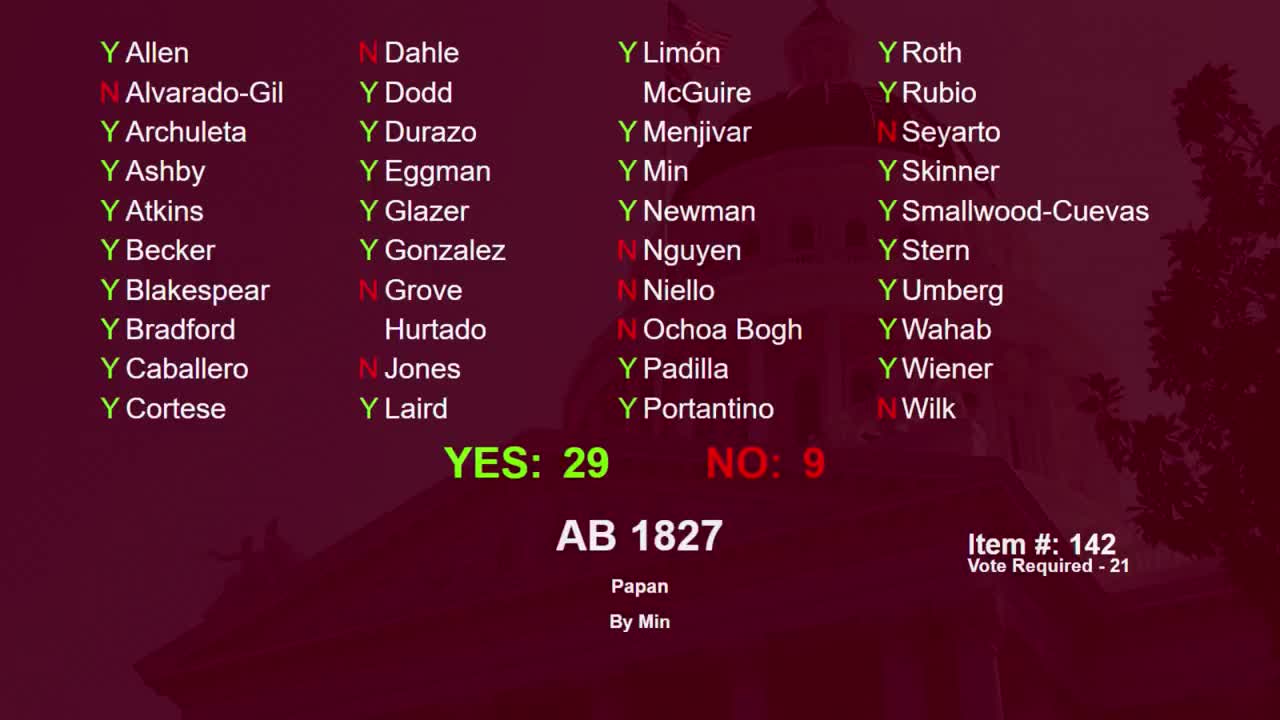 3MIN
Senate Floor
 8MIN
Senate Standing Committee on Transportation
 7MIN
Senate Standing Committee on Environmental Quality
 16MIN
Assembly Standing Committee on Natural Resources
Bill Author

Bill Co-Author(s):