AB 2533: Accessory dwelling units: junior accessory dwelling units: unpermitted developments.
- Session Year: 2023-2024
- House: Assembly
- Latest Version Date: 2024-09-28
Current Status:
Passed
(2024-09-28: Chaptered by Secretary of State - Chapter 834, Statutes of 2024.)
Introduced
In Committee
First Chamber
In Committee
Second Chamber
Enacted
Existing law, the Planning and Zoning Law, authorizes a local agency, by ordinance or ministerial approval, to provide for the creation of accessory dwelling units in areas zoned for residential use, as specified. Existing law prohibits a local agency from denying a permit for an unpermitted accessory dwelling unit that was constructed before January 1, 2018, because the accessory dwelling unit is in violation of building standards or state or local standards applicable to accessory dwelling units, unless the local agency makes a finding that correcting the violation is necessary to protect the health and safety of the public or the occupants of the structure. Existing law makes those provisions inapplicable to a substandard building, as specified.
This bill would instead prohibit a local agency from denying a permit for an unpermitted accessory dwelling unit or junior accessory dwelling unit that was constructed before January 1, 2020, for those violations, unless the local agency makes a finding that correcting the violation is necessary to comply with conditions that would otherwise deem a building substandard. The bill would require a local agency to inform the public about the provisions prohibiting denial of a permit for an unpermitted accessory dwelling unit or junior accessory dwelling unit. The bill would require this information to include a checklist of the conditions that deem a building substandard and to inform homeowners that, before submitting a permit application, the homeowner may obtain a confidential third-party code inspection from a licensed contractor. The bill would prohibit a local agency from requiring a homeowner to pay impact fees or connection or capacity charges except under specified circumstances. By imposing additional duties on local agencies, the bill would impose a state-mandated local program. The bill would authorize an inspector from a local agency, upon receiving an application for a permit for a previously unpermitted accessory dwelling unit or junior accessory dwelling unit constructed before January 1, 2020, to inspect the unit for compliance with health and safety standards and provide recommendations to comply with health and safety standards. The bill would prohibit the local agency from penalizing an applicant for having the unpermitted accessory dwelling unit and would require the local agency to approve necessary permits to correct noncompliance with health and safety standards.
The California Constitution requires the state to reimburse local agencies and school districts for certain costs mandated by the state. Statutory provisions establish procedures for making that reimbursement.
This bill would provide that, if the Commission on State Mandates determines that the bill contains costs mandated by the state, reimbursement for those costs shall be made pursuant to the statutory provisions noted above.
Existing law, the Planning and Zoning Law, authorizes a local agency, by ordinance or ministerial approval, to provide for the creation of accessory dwelling units in areas zoned for residential use, as specified. Existing law prohibits a local agency from denying a permit for an unpermitted accessory dwelling unit that was constructed before January 1, 2018, because the accessory dwelling unit is in violation of building standards or state or local standards applicable to accessory dwelling units, unless the local agency makes a finding that correcting the violation is necessary to protect the health and safety of the public or the occupants of the structure. Existing law makes those provisions inapplicable to a substandard building, as specified.
This bill would instead prohibit a local agency from denying a permit for an unpermitted accessory dwelling unit or junior accessory dwelling unit that was constructed before January 1, 2020, for those violations, unless the local agency makes a finding that correcting the violation is necessary to comply with conditions that would otherwise deem a building substandard. The bill would require a local agency to inform the public about the provisions prohibiting denial of a permit for an unpermitted accessory dwelling unit or junior accessory dwelling unit. The bill would require this information to include a checklist of the conditions that deem a building substandard and to inform homeowners that, before submitting a permit application, the homeowner may obtain a confidential third-party code inspection from a licensed contractor. The bill would prohibit a local agency from requiring a homeowner to pay impact fees or connection or capacity charges to obtain a permit if they provide evidence that they meet specified criteria for low- or moderate-income households. except under specified circumstances. By imposing additional duties on local agencies, the bill would impose a state-mandated local program. The bill would authorize an inspector from a local agency, upon receiving an application for a permit for a previously unpermitted accessory dwelling unit or junior accessory dwelling unit constructed before January 1, 2020, to inspect the unit for compliance with health and safety standards and provide recommendations to comply with health and safety standards. The bill would prohibit the local agency from penalizing an applicant for having the unpermitted accessory dwelling unit and would require the local agency to approve necessary permits to correct noncompliance with health and safety standards.
The California Constitution requires the state to reimburse local agencies and school districts for certain costs mandated by the state. Statutory provisions establish procedures for making that reimbursement.
This bill would provide that, if the Commission on State Mandates determines that the bill contains costs mandated by the state, reimbursement for those costs shall be made pursuant to the statutory provisions noted above.
Existing law, the Planning and Zoning Law, authorizes a local agency, by ordinance or ministerial approval, to provide for the creation of accessory dwelling units in areas zoned for residential use, as specified. Existing law prohibits a local agency from denying a permit for an unpermitted accessory dwelling unit that was constructed before January 1, 2018, because the accessory dwelling unit is in violation of building standards or state or local standards applicable to accessory dwelling units, unless the local agency makes a finding that correcting the violation is necessary to protect the health and safety of the public or the occupants of the structure. Existing law makes those provisions inapplicable to a substandard building, as specified.
This bill would instead prohibit a local agency from denying a permit for an unpermitted accessory dwelling unit or junior accessory dwelling unit that was constructed before January 1, 2020, for those violations, unless the local agency makes a finding that correcting the violation is necessary to comply with conditions that would otherwise deem a building substandard. The bill would require a local agency to inform the public about the provisions prohibiting denial of a permit for an unpermitted accessory dwelling unit or junior accessory dwelling unit. The bill would require this information to include a checklist of the conditions that deem a building substandard and to inform homeowners that, before submitting a permit application, the homeowner may obtain a confidential third-party code inspection from a licensed contractor. The bill would prohibit a local agency from requiring a homeowner to pay impact fees or connection or capacity charges to obtain a permit if they provide evidence that they meet specified criteria for low- or moderate-income households. By imposing additional duties on local agencies, the bill would impose a state-mandated local program. The bill would authorize an inspector from a local agency, upon receiving an application for a permit for a previously unpermitted accessory dwelling unit or junior accessory dwelling unit constructed before January 1, 2020, to inspect the unit for compliance with health and safety standards and provide recommendations to comply with health and safety standards. The bill would prohibit the local agency from penalizing an applicant for having the unpermitted accessory dwelling unit and would require the local agency to approve necessary permits to correct noncompliance with health and safety standards.
The California Constitution requires the state to reimburse local agencies and school districts for certain costs mandated by the state. Statutory provisions establish procedures for making that reimbursement.
This bill would provide that, if the Commission on State Mandates determines that the bill contains costs mandated by the state, reimbursement for those costs shall be made pursuant to the statutory provisions noted above.
Existing law establishes specific rules of construction and defines various terms for purposes of interpreting provisions of the Government Code. This bill would make a nonsubstantive change in those general provisions.Existing law establishes specific rules of construction and defines various terms for purposes of interpreting provisions of the Government Code.
This bill would make a nonsubstantive change in those general provisions.
(a)Notwithstanding any other law, and except as otherwise provided in subdivision (b), a local agency shall not deny a permit for an unpermitted accessory dwelling unit or unpermitted junior accessory dwelling unit that was constructed before January 1, 2020, due to either of the following:
(1)The accessory dwelling unit or junior accessory dwelling unit is in violation of building standards pursuant to Article 1 (commencing with Section 17960) of Chapter 5 of Part 1.5 of Division 13 of the Health and Safety Code.
(2)The accessory dwelling unit or junior accessory dwelling unit does not comply with this article or Article 3 (commencing with Section 66333), as applicable, or any local ordinance regulating accessory dwelling units or junior accessory dwelling units.
(b)Notwithstanding subdivision (a), a local agency may deny a permit for an accessory dwelling unit or junior accessory dwelling unit subject to subdivision (a) if the local agency makes a finding that correcting the violation is necessary to comply with the standards specified in Section 17920.3 of the Health and Safety Code.
(c)This section shall not apply to a building that is deemed substandard pursuant to Section 17920.3 of the Health and Safety Code.
(d)A local agency shall inform the public about the provisions of this section through public information resources, including permit checklists and the local agencys internet website, which shall include both of the following:
(1)A checklist of the conditions specified in Section 17920.3 of the Health and Safety Code that would deem a building substandard.
(2)Informing homeowners that, before submitting an application for a permit, the homeowner may obtain a confidential third-party code inspection from a licensed contractor to determine the units existing condition or potential scope of building improvements before submitting an application for a permit.
(e)A homeowner applying for a permit for a previously unpermitted accessory dwelling unit or junior accessory dwelling unit constructed before January 1, 2020, shall not be required to pay impact fees or connection or capacity charges except when utility infrastructure is required to comply with Section 17920.3 of the Health and Safety Code and when the fee is authorized by subdivision (e) of Section 66324.
(f)Subject to subdivision (c), upon receiving an application to permit a previously unpermitted accessory dwelling unit or junior accessory dwelling unit constructed before January 1, 2020, an inspector from the local agency may inspect the unit for compliance with health and safety standards and provide recommendations to comply with health and safety standards necessary to obtain a permit. If the inspector finds noncompliance with health and safety standards, the local agency shall not penalize an applicant for having the unpermitted accessory dwelling unit or junior accessory dwelling unit and shall approve necessary permits to correct noncompliance with health and safety standards.
SEC. 2.If the Commission on State Mandates determines that this act contains costs mandated by the state, reimbursement to local agencies and school districts for those costs shall be made pursuant to Part 7 (commencing with Section 17500) of Division 4 of Title 2 of the Government Code.
(a)Notwithstanding any other law, and except as otherwise provided in subdivision (b), a local agency shall not deny a permit for an unpermitted accessory dwelling unit or unpermitted junior accessory dwelling unit that was constructed before January 1, 2020, due to either of the following:
(1)The accessory dwelling unit or junior accessory dwelling unit is in violation of building standards pursuant to Article 1 (commencing with Section 17960) of Chapter 5 of Part 1.5 of Division 13 of the Health and Safety Code.
(2)The accessory dwelling unit or junior accessory dwelling unit does not comply with this article or Article 3 (commencing with Section 66333), as applicable, or any local ordinance regulating accessory dwelling units or junior accessory dwelling units.
(b)Notwithstanding subdivision (a), a local agency may deny a permit for an accessory dwelling unit or junior accessory dwelling unit subject to subdivision (a) if the local agency makes a finding that correcting the violation is necessary to comply with the standards specified in Section 17920.3 of the Health and Safety Code.
(c)This section shall not apply to a building that is deemed substandard pursuant to Section 17920.3 of the Health and Safety Code.
(d)A local agency shall inform the public about the provisions of this section through public information resources, including permit checklists and the local agencys internet website, which shall include both of the following:
(1)A checklist of the conditions specified in Section 17920.3 of the Health and Safety Code that would deem a building substandard.
(2)Informing homeowners that, before submitting an application for a permit, the homeowner may obtain a confidential third-party code inspection from a licensed contractor to determine the units existing condition or potential scope of building improvements before submitting an application for a permit.
(e)A homeowner applying for a permit for a previously unpermitted accessory dwelling unit or junior accessory dwelling unit constructed before January 1, 2020, shall not be required to pay impact fees or connection or capacity charges except when utility infrastructure is required to comply with Section 17920.3 of the Health and Safety Code and when the fee is authorized by subdivision (e) of Section 66324.
(f)Upon Subject to subdivision (c), upon receiving an application to permit a previously unpermitted accessory dwelling unit or junior accessory dwelling unit constructed before January 1, 2020, an inspector from the local agency may inspect the unit for compliance with health and safety standards and provide recommendations to comply with health and safety standards necessary to obtain a permit. If the inspector finds noncompliance with health and safety standards, the local agency shall not penalize an applicant for having the unpermitted accessory dwelling unit or junior accessory dwelling unit and shall approve necessary permits to correct noncompliance with health and safety standards.
SEC. 2.If the Commission on State Mandates determines that this act contains costs mandated by the state, reimbursement to local agencies and school districts for those costs shall be made pursuant to Part 7 (commencing with Section 17500) of Division 4 of Title 2 of the Government Code.
(a)Notwithstanding any other law, and except as otherwise provided in subdivision (b), a local agency shall not deny a permit for an unpermitted accessory dwelling unit or unpermitted junior accessory dwelling unit that was constructed before January 1, 2018, 2020, due to either of the following:
(1)The accessory dwelling unit or junior accessory dwelling unit is in violation of building standards pursuant to Article 1 (commencing with Section 17960) of Chapter 5 of Part 1.5 of Division 13 of the Health and Safety Code.
(2)The accessory dwelling unit or junior accessory dwelling unit does not comply with this article or Article 3 (commencing with Section 66333), as applicable, or any local ordinance regulating accessory dwelling units. units or junior accessory dwelling units.
(b)Notwithstanding subdivision (a), a local agency may deny a permit for an accessory dwelling unit or junior accessory dwelling unit subject to subdivision (a) if the local agency makes a finding that correcting the violation is necessary to protect the health and safety of the public or occupants of the structure. comply with the standards specified in Section 17920.3 of the Health and Safety Code.
(c)This section shall not apply to a building that is deemed substandard pursuant to Section 17920.3 of the Health and Safety Code.
(d)A local agency shall inform the public about the provisions of this section through public information resources, including permit checklists and the local agencys internet website, which shall include both of the following:
(1)A checklist of the conditions specified in Section 17920.3 of the Health and Safety Code that would deem a building substandard.
(2)Informing homeowners that, before submitting an application for a permit, the homeowner may obtain a confidential third-party code inspection from a licensed contractor to determine the units existing condition or potential scope of building improvements before submitting an application for a permit.
(e)A homeowner applying for a permit for a previously unpermitted accessory dwelling unit or junior accessory dwelling unit constructed before January 1, 2020, shall not be required to pay impact fees or connection or capacity charges except when utility infrastructure is required to comply with Section 17920.3 of the Health and Safety Code and when the fee is authorized by subdivision (e) of Section 66324.
(f)Upon receiving an application to permit a previously unpermitted accessory dwelling unit or junior accessory dwelling unit constructed before January 1, 2020, an inspector from the local agency may inspect the unit for compliance with health and safety standards and provide recommendations to comply with health and safety standards necessary to obtain a permit. If the inspector finds noncompliance with health and safety standards, the local agency shall not penalize an applicant for having the unpermitted accessory dwelling unit or junior accessory dwelling unit and shall approve necessary permits to correct noncompliance with health and safety standards.
SEC. 2.If the Commission on State Mandates determines that this act contains costs mandated by the state, reimbursement to local agencies and school districts for those costs shall be made pursuant to Part 7 (commencing with Section 17500) of Division 4 of Title 2 of the Government Code.
(a)Notwithstanding any other law, and except as otherwise provided in subdivision (b), a local agency shall not deny a permit for an unpermitted accessory dwelling unit or unpermitted junior accessory dwelling unit that was constructed before January 1, 2018, 2020, due to either of the following:
(1)The accessory dwelling unit or junior accessory dwelling unit is in violation of building standards pursuant to Article 1 (commencing with Section 17960) of Chapter 5 of Part 1.5 of Division 13 of the Health and Safety Code.
(2)The accessory dwelling unit or junior accessory dwelling unit does not comply with Section 65852.2 or 65852.22, as applicable, or any local ordinance regulating accessory dwelling units. units or junior accessory dwelling units.
(b)Notwithstanding subdivision (a), a local agency may deny a permit for an accessory dwelling unit or junior accessory dwelling unit subject to subdivision (a) if the local agency makes a finding that correcting the violation is necessary to protect the health and safety of the public or occupants of the structure. comply with the standards specified in Section 17920.3 of the Health and Safety Code.
(c)The section shall not apply to a building that is deemed substandard pursuant to Section 17920.3 of the Health and Safety Code.
(d)A local agency shall inform the public about the provisions of this section through public information resources, including permit checklists and the local agencys internet website, which shall include both of the following:
(1)A checklist of the conditions specified in Section 17920.3 of the Health and Safety Code that would deem a building substandard.
(2)Informing homeowners that, before submitting an application for a permit, the homeowner may obtain a confidential third-party code inspection from a licensed contractor to determine the units existing condition or potential scope of building improvements before submitting an application for a permit.
(e)A homeowner applying for a permit for a previously unpermitted accessory dwelling unit or junior accessory dwelling unit constructed before January 1, 2020, shall not be required to pay impact fees or connection or capacity charges to obtain a permit if they provide written evidence that their household income does not exceed the definition of a low- or moderate-income household, as defined in Section 50093 of the Health and Safety Code.
(f)Upon receiving an application to permit a previously unpermitted accessory dwelling unit or junior accessory dwelling unit constructed before January 1, 2020, an inspector from the local agency may inspect the unit for compliance with health and safety standards and provide recommendations to comply with health and safety standards necessary to obtain a permit. If the inspector finds noncompliance with health and safety standards, the local agency shall not penalize an applicant for having the unpermitted accessory dwelling unit or junior accessory dwelling unit and shall approve necessary permits to correct noncompliance with health and safety standards.
SEC. 2.If the Commission on State Mandates determines that this act contains costs mandated by the state, reimbursement to local agencies and school districts for those costs shall be made pursuant to Part 7 (commencing with Section 17500) of Division 4 of Title 2 of the Government Code.
SECTION 1.Section 3 of the Government Code is amended to read:3.All persons who, at the time this code takes effect, hold office under any of the acts repealed by this code, which offices are continued by this code, continue to hold them according to their former tenure. REVISIONS: HeadingLine 2.All persons who who, at the time this code takes effect, hold office under any of the acts repealed by this code, which offices are continued by this code, continue to hold them according to their former tenure.
|
Date
|
Status
|
|---|---|
| Sep 28, 2024 | Chaptered by Secretary of State - Chapter 834, Statutes of 2024. |
| Sep 28, 2024 | Approved by the Governor. |
| Sep 5, 2024 | Enrolled and presented to the Governor at 4 p.m. |
| Aug 27, 2024 | Senate amendments concurred in. To Engrossing and Enrolling. (Ayes 76. Noes 0.). |
| Aug 27, 2024 | Assembly Rule 77 suspended. |
| Aug 26, 2024 | In Assembly. Concurrence in Senate amendments pending. May be considered on or after August 28 pursuant to Assembly Rule 77. |
| Aug 26, 2024 | Read third time. Passed. Ordered to the Assembly. (Ayes 38. Noes 0.). |
| Aug 20, 2024 | Read second time. Ordered to third reading. |
| Aug 19, 2024 | Read third time and amended. Ordered to second reading. |
| Aug 12, 2024 | Ordered to third reading. |
| Aug 12, 2024 | From Consent Calendar. |
| Aug 6, 2024 | Read second time. Ordered to Consent Calendar. |
| Aug 5, 2024 | From committee: Be ordered to second reading file pursuant to Senate Rule 28.8 and ordered to Consent Calendar. |
| Jul 3, 2024 | From committee: Do pass and re-refer to Com. on APPR with recommendation: To Consent Calendar. (Ayes 7. Noes 0.) (July 3). Re-referred to Com. on APPR. |
| Jun 19, 2024 | From committee: Do pass and re-refer to Com. on L. GOV. with recommendation: To Consent Calendar. (Ayes 10. Noes 0.) (June 18). Re-referred to Com. on L. GOV. |
| May 30, 2024 | From committee chair, with author's amendments: Amend, and re-refer to committee. Read second time, amended, and re-referred to Com. on HOUSING. |
| May 29, 2024 | Referred to Coms. on HOUSING and L. GOV. |
| May 16, 2024 | In Senate. Read first time. To Com. on RLS. for assignment. |
| May 16, 2024 | Read third time. Passed. Ordered to the Senate. (Ayes 71. Noes 0.) |
| May 9, 2024 | Read second time. Ordered to Consent Calendar. |
| May 8, 2024 | From committee: Do pass. To Consent Calendar. (Ayes 15. Noes 0.) (May 8). |
| May 8, 2024 | Coauthors revised. |
| Apr 24, 2024 | From committee: Do pass and re-refer to Com. on APPR. with recommendation: To Consent Calendar. (Ayes 9. Noes 0.) (April 24). Re-referred to Com. on APPR. |
| Apr 18, 2024 | From committee: Do pass and re-refer to Com. on H. & C.D. (Ayes 9. Noes 0.) (April 17). Re-referred to Com. on H. & C.D. |
| Apr 15, 2024 | (Pending re-refer to Com. on H. & C.D.) |
| Apr 15, 2024 | Assembly Rule 56 suspended. (Page 4775.) |
| Apr 1, 2024 | Re-referred to Com. on L. GOV. |
| Mar 21, 2024 | Referred to Coms. on L. GOV. and H. & C.D. |
| Mar 21, 2024 | From committee chair, with author's amendments: Amend, and re-refer to Com. on L. GOV. Read second time and amended. |
| Feb 14, 2024 | From printer. May be heard in committee March 15. |
| Feb 13, 2024 | Read first time. To print. |
|
Date
|
Description
|
Location
|
Votes
|
|
|---|---|---|---|---|
| Aug 27, 2024 | AB 2533 Juan Carrillo Concurrence in Senate Amendments | Assembly Floor |
Passed |
|
| Aug 26, 2024 | Assembly 3rd Reading AB2533 Juan Carrillo et al. By Blakespear | Senate Floor |
Passed |
|
| Jul 3, 2024 | Do pass, but first be re-referred to the Committee on [Appropriations] with the recommendation: To Consent Calendar | Senate Standing Committee on Local Government |
Passed |
|
| Jun 18, 2024 | Do pass, but first be re-referred to the Committee on [Local Government] with the recommendation: To Consent Calendar | Senate Standing Committee on Housing |
Passed |
|
| May 16, 2024 | AB 2533 Juan Carrillo Consent Calendar Second Day Regular Session | Assembly Floor |
Passed |
|
| May 8, 2024 | Do pass. To Consent Calendar. | Assembly Standing Committee on Appropriations |
Passed |
|
| Apr 24, 2024 | Do pass and be re-referred to the Committee on [Appropriations] with recommendation: To Consent Calendar | Assembly Standing Committee on Housing and Community Development |
Passed |
|
| Apr 17, 2024 | Do pass and be re-referred to the Committee on [Housing and Community Development] | Assembly Standing Committee on Local Government |
Passed |
This list shows positions taken on this bill by organizations on the date displayed, which is linked to the original source.
Positions by individuals are not included.
|
Organization
|
Position
|
Date
|
|---|---|---|
| AARP | ** Support | |
| Bay Area Council | ** Support | |
| California Apartment Association | ** Support | |
| California community builders | ** Support | |
| California YIMBY | ** Support | |
| Casita Coalition | ** Support | |
| Council of Infill Builders | ** Support | |
| East Bay Leadership Council | ** Support | |
| Enterprise Community Partners Inc | ** Support | |
| HPP Cares | ** Support | |
| The Unity Council | ** Support | |
| Two Valleys Community Land Trust | ** Support |
CONCURRENCE IN SENATE AMENDMENTS
CSA1 Bill Id:AB 2533
Author:(Juan Carrillo)
As Amended Ver:August 19, 2024
Majority vote
SUMMARY
Extends the Accessory Dwelling Unit (ADU) amnesty law to unpermitted ADUs and junior accessory dwelling units (JADUs) built before 2020; provides a process for homeowners to permit their unpermitted ADUs; and provides financial assistance to lower- and moderate-income households seeking to permit their unpermitted ADUs and JADUs.
Senate Amendments
- Address chaptering out issues with SB 477, Chapter 7, Statutes of 2024.
- Make a technical and clarifying change.
COMMENTS
- Accessory Dwellings. ADUs are additional living quarters that are independent of the primary residence on the same lot. ADUs are either attached to or detached from, the primary residence and provide complete independent living facilities for one or more persons, including separate access from the property’s primary unit. This includes permanent provisions for living, sleeping, eating, cooking, and sanitation.
Over the past few years, the Legislature has passed a number of bills to ease zoning restrictions and expedite approval processes for ADUs at the local level, which has contributed to the increased supply of ADUs throughout the state.
- Mitigation Fee Act. When approving development projects, counties and cities can require the applicants to mitigate the project's effects by paying fees—known as mitigation fees, impact fees, or developer fees. The California courts have upheld impact fees for sidewalks, parks, school construction, and many other public purposes.
When establishing, increasing, or imposing a fee as a condition of approving a development project, the Mitigation Fee Act requires local officials to:
- Identify the fee’s purpose.
- Identify the fee’s use, including the public facilities to be financed.
- Determine a reasonable relationship between the fee’s use and the development.
- Determine a reasonable relationship between the public facility’s need and the development.
When imposing a fee as a condition of approving a development project, the Mitigation Fee Act also requires local officials to determine a reasonable relationship between the fee’s amount and the cost of the public facility. In its 1987 Nollan decision, the U.S. Supreme Court said there must be an “essential nexus” between a project's impacts and the conditions for approval. In the 1994 Dolan decision, the U.S. Supreme Court said that conditions on development must have a "rough proportionality" to a project's impacts.
In the 1996 Ehrlich decision, the California Supreme Court distinguished between “legislatively enacted” conditions that apply to all projects and “ad hoc” conditions imposed on a project-by- project basis. Ehrlich applied the “essential nexus” test from Nollan and the “rough proportionality” test from Dolan to “ad hoc’ conditions. The Court did not apply the Nollan and Dolan tests to the conditions that were “legislatively enacted.” In other words, local officials have generally faced greater scrutiny when they impose conditions on a project-by-project basis. As a result of these decisions and the Mitigation Fee Act, local agencies have conducted nexus studies to ensure any proposed impact fees meet these legal tests for most impact fees. Other requirements in the Mitigation Fee Act ensure that impact fees are appropriately levied and spent.
On April 12 of this year, the United States Supreme Court decided Sheetz v. County of El Dorado, California. The case involved the takings clause of the Fifth Amendment to the U.S. Constitution. An El Dorado County resident challenged the county’s legislatively enacted traffic impact mitigation fee, arguing the county should only charge him based on the impact associated with his specific parcel. The main question was whether or not the same standards of “essential nexus” and “rough proportionality” apply to legislatively enacted fees as they do to ad-hoc fees.
In the Sheetz decision, the Court stated, “A legislative exception to the Nollan/Dolan test ‘conflicts with the rest of our takings jurisprudence,’ which does not otherwise distinguish between legislation and other official acts. Knick v. Township of Scott, 588 U. S. 180, 185 (2019).” The Court also proclaimed that, “...as we have explained, a legislative exception to the ordinary takings rules finds no support in constitutional text, history, or precedent. We do not address the parties’ other disputes over the validity of the traffic impact fee, including whether a permit condition imposed on a class of properties must be tailored with the same degree of specificity as a permit condition that targets a particular development. The California Court of Appeal did not consider this point—or any of the parties’ other nuanced arguments—because it proceeded from the erroneous premise that legislative permit conditions are categorically exempt from the requirements of Nollan and Dolan. Whether the parties’ other arguments are preserved and how they bear on Sheetz’s legal challenge are for the state courts to consider in the first instance.”
In addition, Justice Kavanaugh filed a concurring opinion, in which Justices Kagan and Jackson joined saying that, “I join the Court’s opinion. I write separately to underscore that the Court has not previously decided—and today explicitly declines to decide—whether ‘a permit condition imposed on a class of properties must be tailored with the same degree of specificity as a permit condition that targets a particular development.’ Ante, at 10–11. Importantly, therefore, today’s decision does not address or prohibit the common government practice of imposing permit conditions, such as impact fees, on new developments through reasonable formulas or schedules that assess the impact of classes of development rather than the impact of specific parcels of property. Moreover, as is apparent from the fact that today’s decision expressly leaves the question open, no prior decision of this Court has addressed or prohibited that longstanding government practice."
- Connection and Capacity Charges. Connection fees and capacity charges are one-time fees assessed on new customers that reflect the reasonable cost of providing service, typically for water or sewer systems. A local agency assesses a connection fee when it physically connects a structure to the water or sewer system, which pays for the physical facilities necessary to make a water connection or sewer connection, such as meters, meter boxes, pipelines, and the estimated reasonable cost of labor and materials for their installation of those facilities. A local agency assesses a capacity charge on the customer to cover the proportional cost of maintaining or constructing system wide infrastructure necessary to meet the additional water or sewer demand for new users of the system. The Mitigation Fee Act governs connection fees and capacity charges, but state law provides separate provisions related to their oversight and accounting.
According to the Author
“ADUs are an important asset for middle and low-income homeowners to build generational resources and for multigenerational families to care for each other. These units are providing critically needed homes for renters amidst a housing crisis and steady supplemental income for owners at risk of displacement. While no one solution will solve the housing crisis, AB 2533 intends to support and empower cost-burdened homeowners by providing a pathway to legalize their unpermitted ADUs, so they may safely house family or community members.”
Arguments in Support
Bay Area Council, sponsor of the bill, writes, Unpermitted or informal ADUs are widespread in neighborhoods throughout California, providing badly needed homes for renters and income for vulnerable owners at risk of displacement. Recent legislation began the work of establishing a process, but did not go far enough to address the serious challenges that homeowners face in formalizing their ADUs and junior ADUs. Existing law fails to specify the standards that local agencies must use for safety inspections and permitting–resulting too often in a default to much more rigorous Building Code standards–putting the cost of legalization out of reach for the exact homeowners the amnesty program was designed to help–those who most rely on rental income to maintain their own housing stability. To improve safety of units while also reducing the risk of displacement for housing insecure tenants and homeowners, the costs and the uncertainties of the process must be reduced. “AB 2533 improves current law by specifying the sections of California Housing Code that must be applied for safety inspections and permitting, and further provides clear relief for lower resourced homeowners who cannot afford costly impact fees, connection and capacity charges.”
Arguments in Opposition
None on file.
FISCAL COMMENTS
According to the Senate Appropriations Committee, pursuant to Senate Rule 28.8, negligible state costs.
VOTES:
ASM LOCAL GOVERNMENT: 9-0-0
YES: Juan Carrillo, Waldron, Alanis, Haney, Kalra, Pacheco, Ramos, Ward, Wilson
ASM HOUSING AND COMMUNITY DEVELOPMENT: 9-0-0
YES: Ward, Joe Patterson, Grayson, Kalra, Lee, Quirk-Silva, Reyes, Sanchez, Wilson
ASM APPROPRIATIONS: 15-0-0
YES: Wicks, Sanchez, Arambula, Bryan, Calderon, Wendy Carrillo, Dixon, Mike Fong, Friedman, Haney, Hart, Jim Patterson, Pellerin, Ta, Villapudua
ASSEMBLY FLOOR: 71-0-9
YES: Aguiar-Curry, Alanis, Arambula, Bains, Bauer-Kahan, Bennett, Berman, Boerner, Bonta, Bryan, Calderon, Juan Carrillo, Wendy Carrillo, Chen, Connolly, Davies, Dixon, Essayli, Mike Fong, Friedman, Gabriel, Gallagher, Garcia, Grayson, Haney, Hart, Holden, Hoover, Jackson, Jones-Sawyer, Kalra, Lackey, Lee, Low, Lowenthal, Maienschein, McCarty, McKinnor, Muratsuchi, Stephanie Nguyen, Ortega, Pacheco, Papan, Jim Patterson, Joe Patterson, Pellerin, Petrie-Norris, Quirk-Silva, Ramos, Rendon, Reyes, Luz Rivas, Rodriguez, Blanca Rubio, Sanchez, Santiago, Schiavo, Soria, Ta, Ting, Valencia, Villapudua, Waldron, Wallis, Ward, Weber, Wicks, Wilson, Wood, Zbur, Robert Rivas
ABS, ABST OR NV: Addis, Alvarez, Cervantes, Megan Dahle, Flora, Vince Fong, Gipson, Irwin, Mathis
SENATE FLOOR: 39-0-1
YES: Allen, Alvarado-Gil, Archuleta, Ashby, Atkins, Becker, Blakespear, Bradford, Caballero, Cortese, Dahle, Dodd, Durazo, Eggman, Glazer, Gonzalez, Grove, Hurtado, Jones, Laird, Limón, McGuire, Menjivar, Min, Newman, Niello, Ochoa Bogh, Padilla, Portantino, Roth, Rubio, Seyarto, Skinner, Smallwood-Cuevas, Stern, Umberg, Wahab, Wiener, Wilk
ABS, ABST OR NV: Nguyen
UPDATED
VERSION: August 19, 2024
CONSULTANT: Linda Rios / L. GOV. / (916) 319-3958 FN: 0004753
CONCURRENCE IN SENATE AMENDMENTS
CSA1 Bill Id:AB 2533
Author:(Juan Carrillo)
As Amended Ver:August 19, 2024
Majority vote
SUMMARY
Extends the Accessory Dwelling Unit (ADU) amnesty law to unpermitted ADUs and junior accessory dwelling units (JADUs) built before 2020; provides a process for homeowners to permit their unpermitted ADUs; and provides financial assistance to lower- and moderate-income households seeking to permit their unpermitted ADUs and JADUs.
Senate Amendments
- Address chaptering out issues with SB 477, Chapter 7, Statutes of 2024.
- Make a technical and clarifying change.
COMMENTS
- Accessory Dwellings. ADUs are additional living quarters that are independent of the primary residence on the same lot. ADUs are either attached to or detached from, the primary residence and provide complete independent living facilities for one or more persons, including separate access from the property’s primary unit. This includes permanent provisions for living, sleeping, eating, cooking, and sanitation.
Over the past few years, the Legislature has passed a number of bills to ease zoning restrictions and expedite approval processes for ADUs at the local level, which has contributed to the increased supply of ADUs throughout the state.
- Mitigation Fee Act. When approving development projects, counties and cities can require the applicants to mitigate the project's effects by paying fees—known as mitigation fees, impact fees, or developer fees. The California courts have upheld impact fees for sidewalks, parks, school construction, and many other public purposes.
When establishing, increasing, or imposing a fee as a condition of approving a development project, the Mitigation Fee Act requires local officials to:
- Identify the fee’s purpose.
- Identify the fee’s use, including the public facilities to be financed.
- Determine a reasonable relationship between the fee’s use and the development.
- Determine a reasonable relationship between the public facility’s need and the development.
When imposing a fee as a condition of approving a development project, the Mitigation Fee Act also requires local officials to determine a reasonable relationship between the fee’s amount and the cost of the public facility. In its 1987 Nollan decision, the U.S. Supreme Court said there must be an “essential nexus” between a project's impacts and the conditions for approval. In the 1994 Dolan decision, the U.S. Supreme Court said that conditions on development must have a "rough proportionality" to a project's impacts.
In the 1996 Ehrlich decision, the California Supreme Court distinguished between “legislatively enacted” conditions that apply to all projects and “ad hoc” conditions imposed on a project-by- project basis. Ehrlich applied the “essential nexus” test from Nollan and the “rough proportionality” test from Dolan to “ad hoc’ conditions. The Court did not apply the Nollan and Dolan tests to the conditions that were “legislatively enacted.” In other words, local officials have generally faced greater scrutiny when they impose conditions on a project-by-project basis. As a result of these decisions and the Mitigation Fee Act, local agencies have conducted nexus studies to ensure any proposed impact fees meet these legal tests for most impact fees. Other requirements in the Mitigation Fee Act ensure that impact fees are appropriately levied and spent.
On April 12 of this year, the United States Supreme Court decided Sheetz v. County of El Dorado, California. The case involved the takings clause of the Fifth Amendment to the U.S. Constitution. An El Dorado County resident challenged the county’s legislatively enacted traffic impact mitigation fee, arguing the county should only charge him based on the impact associated with his specific parcel. The main question was whether or not the same standards of “essential nexus” and “rough proportionality” apply to legislatively enacted fees as they do to ad-hoc fees.
In the Sheetz decision, the Court stated, “A legislative exception to the Nollan/Dolan test ‘conflicts with the rest of our takings jurisprudence,’ which does not otherwise distinguish between legislation and other official acts. Knick v. Township of Scott, 588 U. S. 180, 185 (2019).” The Court also proclaimed that, “...as we have explained, a legislative exception to the ordinary takings rules finds no support in constitutional text, history, or precedent. We do not address the parties’ other disputes over the validity of the traffic impact fee, including whether a permit condition imposed on a class of properties must be tailored with the same degree of specificity as a permit condition that targets a particular development. The California Court of Appeal did not consider this point—or any of the parties’ other nuanced arguments—because it proceeded from the erroneous premise that legislative permit conditions are categorically exempt from the requirements of Nollan and Dolan. Whether the parties’ other arguments are preserved and how they bear on Sheetz’s legal challenge are for the state courts to consider in the first instance.”
In addition, Justice Kavanaugh filed a concurring opinion, in which Justices Kagan and Jackson joined saying that, “I join the Court’s opinion. I write separately to underscore that the Court has not previously decided—and today explicitly declines to decide—whether ‘a permit condition imposed on a class of properties must be tailored with the same degree of specificity as a permit condition that targets a particular development.’ Ante, at 10–11. Importantly, therefore, today’s decision does not address or prohibit the common government practice of imposing permit conditions, such as impact fees, on new developments through reasonable formulas or schedules that assess the impact of classes of development rather than the impact of specific parcels of property. Moreover, as is apparent from the fact that today’s decision expressly leaves the question open, no prior decision of this Court has addressed or prohibited that longstanding government practice."
- Connection and Capacity Charges. Connection fees and capacity charges are one-time fees assessed on new customers that reflect the reasonable cost of providing service, typically for water or sewer systems. A local agency assesses a connection fee when it physically connects a structure to the water or sewer system, which pays for the physical facilities necessary to make a water connection or sewer connection, such as meters, meter boxes, pipelines, and the estimated reasonable cost of labor and materials for their installation of those facilities. A local agency assesses a capacity charge on the customer to cover the proportional cost of maintaining or constructing system wide infrastructure necessary to meet the additional water or sewer demand for new users of the system. The Mitigation Fee Act governs connection fees and capacity charges, but state law provides separate provisions related to their oversight and accounting.
According to the Author
“ADUs are an important asset for middle and low-income homeowners to build generational resources and for multigenerational families to care for each other. These units are providing critically needed homes for renters amidst a housing crisis and steady supplemental income for owners at risk of displacement. While no one solution will solve the housing crisis, AB 2533 intends to support and empower cost-burdened homeowners by providing a pathway to legalize their unpermitted ADUs, so they may safely house family or community members.”
Arguments in Support
Bay Area Council, sponsor of the bill, writes, Unpermitted or informal ADUs are widespread in neighborhoods throughout California, providing badly needed homes for renters and income for vulnerable owners at risk of displacement. Recent legislation began the work of establishing a process, but did not go far enough to address the serious challenges that homeowners face in formalizing their ADUs and junior ADUs. Existing law fails to specify the standards that local agencies must use for safety inspections and permitting–resulting too often in a default to much more rigorous Building Code standards–putting the cost of legalization out of reach for the exact homeowners the amnesty program was designed to help–those who most rely on rental income to maintain their own housing stability. To improve safety of units while also reducing the risk of displacement for housing insecure tenants and homeowners, the costs and the uncertainties of the process must be reduced. “AB 2533 improves current law by specifying the sections of California Housing Code that must be applied for safety inspections and permitting, and further provides clear relief for lower resourced homeowners who cannot afford costly impact fees, connection and capacity charges.”
Arguments in Opposition
None on file.
FISCAL COMMENTS
According to the Senate Appropriations Committee, pursuant to Senate Rule 28.8, negligible state costs.
VOTES:
ASM LOCAL GOVERNMENT: 9-0-0
YES: Juan Carrillo, Waldron, Alanis, Haney, Kalra, Pacheco, Ramos, Ward, Wilson
ASM HOUSING AND COMMUNITY DEVELOPMENT: 9-0-0
YES: Ward, Joe Patterson, Grayson, Kalra, Lee, Quirk-Silva, Reyes, Sanchez, Wilson
ASM APPROPRIATIONS: 15-0-0
YES: Wicks, Sanchez, Arambula, Bryan, Calderon, Wendy Carrillo, Dixon, Mike Fong, Friedman, Haney, Hart, Jim Patterson, Pellerin, Ta, Villapudua
ASSEMBLY FLOOR: 71-0-9
YES: Aguiar-Curry, Alanis, Arambula, Bains, Bauer-Kahan, Bennett, Berman, Boerner, Bonta, Bryan, Calderon, Juan Carrillo, Wendy Carrillo, Chen, Connolly, Davies, Dixon, Essayli, Mike Fong, Friedman, Gabriel, Gallagher, Garcia, Grayson, Haney, Hart, Holden, Hoover, Jackson, Jones-Sawyer, Kalra, Lackey, Lee, Low, Lowenthal, Maienschein, McCarty, McKinnor, Muratsuchi, Stephanie Nguyen, Ortega, Pacheco, Papan, Jim Patterson, Joe Patterson, Pellerin, Petrie-Norris, Quirk-Silva, Ramos, Rendon, Reyes, Luz Rivas, Rodriguez, Blanca Rubio, Sanchez, Santiago, Schiavo, Soria, Ta, Ting, Valencia, Villapudua, Waldron, Wallis, Ward, Weber, Wicks, Wilson, Wood, Zbur, Robert Rivas
ABS, ABST OR NV: Addis, Alvarez, Cervantes, Megan Dahle, Flora, Vince Fong, Gipson, Irwin, Mathis
UPDATED
VERSION: August 19, 2024
CONSULTANT: Linda Rios / L. GOV. / (916) 319-3958 FN: 0004753
SENATE RULES COMMITTEE Office of Senate Floor Analyses (916) 651-1520 Fax: (916) 327-4478 | AB 2533 |
THIRD READING
Bill No: AB 2533
Author: Juan Carrillo (D), et al.
Amended: 8/19/24 in Senate
Vote: 21
SENATE HOUSING COMMITTEE: 10-0, 6/18/24
AYES: Skinner, Ochoa Bogh, Blakespear, Caballero, Cortese, Menjivar, Padilla, Seyarto, Umberg, Wahab
SENATE LOCAL GOVERNMENT COMMITTEE: 7-0, 7/3/24
AYES: Durazo, Seyarto, Dahle, Glazer, Skinner, Wahab, Wiener
SENATE APPROPRIATIONS COMMITTEE: Senate Rule 28.8
ASSEMBLY FLOOR: 71-0, 5/16/24 (Consent) - See last page for vote
SUBJECT: Accessory dwelling units: junior accessory dwelling units: unpermitted developments
SOURCE: Bay Area Council
Casita Coalition
DIGEST:
This bill extends the Accessory Dwelling Unit (ADU) amnesty law to unpermitted ADUs and junior accessory dwelling units (JADUs) built before 2020; provides a process for homeowners to permit their unpermitted ADUs; and provides financial assistance to lower- and moderate-income households seeking to permit their unpermitted ADUs and JADUs.
Senate Floor Amendments of 8/19/2024 make a technical and clarifying change.
ANALYSIS:
Existing law:
- Defines “accessory dwelling unit” as an attached or a detached residential dwelling unit that provides complete independent living facilities for one or more persons and is located on a lot with a proposed or existing primary residence.
- Defines “junior accessory dwelling unit” as a unit that is no more than 500 square feet in size and contained entirely within a single-family residence. A JADU may include separate sanitation facilities, or may share sanitation facilities with the existing structure.
- Prohibits a local agency, special district, or water corporation from imposing impact fees, as specified, on ADUs of less than 750 square feet. Requires that impact fees charges for an ADU of 750 square feet or more shall be charged proportionately in relation to the square footage of the primary dwelling unit. Impact fees do not include any connection fee or capacity charge charged by a local agency, special district, or water corporation.
- Prohibits a local agency, special district, or water corporation from requiring the applicant of an attached ADU, conversion of an existing structure, or JADU to install a new or separate utility connection directly between the ADU and the utility or impose a related connection fee or capacity charge, unless the ADU was constructed with a new single-family dwelling or upon separate conveyance of the ADU, as specified.
- Allows a local agency, special district or water corporation to require a new or separate utility connection directly between the ADU and the utility, if the ADU is a new detached structure. Allows the local agency, special district or water corporation to charge a connection fee or capacity charge. If a connection fee or capacity charge is imposed, then the fee or charge shall be proportionate to the burden imposed by the new ADU.
- Delays the enforcement of building standards at the request of the owner on ADUs built prior to January 1, 2020 or if the ADU was built on or after January 1, 2020 in a jurisdiction that at the time had a noncompliant ADU ordinance, but the ordinance is compliant at the time the request is made. However, the ADU is still subject to health and safety standards, as specified.
- Creates a limited amnesty program for unpermitted ADUs by prohibiting a local agency from denying a permit for an ADU constructed prior to January 1, 2018 because the ADU was in violation of building standards, as specified, or the ADU does not comply with state law or local ordinance. Allows a local agency to deny a permit to an ADU that is deemed substandard and that would put the health and safety of the occupants at risk.
This bill:
- Extends the unpermitted ADU amnesty program to include ADUs built between January 1, 2018 and January 1, 2020 and to include it to JADUs.
- Requires a local agency to inform the public about the options to permit an unpermitted ADU or JADU including posting on its website a checklist of health and safety standards that the units would need to meet and informing homeowners that they may obtain a confidential third-party inspection from a licensed contractor to determine the unit’s existing condition or potential scope of improvements necessary to meet health and safety standards.
- Provides that a homeowner applying for a previously unpermitted ADU or JADU constructed before January 1, 2020, shall not be required to pay impact fees or connection fees or capacity charges except when utility infrastructure is required to comply with State Housing Law and when the fee is authorized for specified utility connections under ADU law.
- Provides that, upon receiving an application to permit a previously unpermitted ADU or JADU constructed before January 1, 2020, an inspector from the local agency may inspect the unit for compliance with health and safety standards and provide recommendations to comply with health and safety standards necessary to obtain a permit. If the inspector finds noncompliance with health and safety standards, the local agency shall not penalize an applicant for having the unpermitted ADU or JADU and shall approve necessary permits to correct noncompliance with health and safety standards.
Background
ADUs/JADUs. California’s high — and rising — land costs necessitate dense housing construction for a project to be financially viable and for the housing to ultimately be affordable to lower-income households. Yet, recent trends in California show that new housing has not commensurately increased in density. In a 2016 analysis, the Legislative Analyst’s Office (LAO) found that the housing density of a typical neighborhood in California’s coastal metropolitan areas increased only by four percent during the 2000s. In addition, the pattern of development in California has changed in ways that limit new housing opportunities.
Recently, there has been a national trend to allow for more "gentle density" (e.g., ADUs, duplexes, fourplexes, townhomes, and other moderately dense developments that were common before the imposition of zoning). The Legislature has also taken a more active role in facilitating this type of gentle density. In 2016, AB 2299 (Bloom, Chapter 735, Statutes of 2016) and SB 1069 (Wieckowski, Chapter 720, Statutes of 2016), permitted ADUs by-right on all residentially-zoned parcels in the state. By permitting an ADU as a second unit on all single-family lots, these laws effectively doubled their allowed density.
Recent ADU legislation, especially the bills that went into effect on January 1, 2020, are having a significant impact. Prior to the Legislature requiring ministerial approval of ADUs in 2017, ADUs were less than one percent of permitted new construction. Now they are approximately 10%, at over 9,600 completed units in 2022. According to cities’ and counties’ latest Annual Progress Reports, nearly 25,000 ADUs were permitted statewide in 2022. Most of the ADU activity is concentrated in metropolitan areas, particularly areas with high home values and rents, though ADU development in Los Angeles is taking place in more low-resource areas. The median lot size for ADUs is 6,930 square feet, and most ADUs (about 80%) are built on lots ranging from 3,000 to 14,000 square feet. Homeowners who build ADUs are disproportionately likely to have bought their property within the last five years; those who have owned for more than 10 years are slightly less likely to build an ADU. In general, properties held by individuals rather than companies are most likely to build ADUs.
Comments
- Author’s statement. “ADUs are an important asset for middle and low-income homeowners to build generational resources and for multigenerational families to care for each other. These units are providing critically needed homes for renters amidst a housing crisis and steady supplemental income for owners at risk of displacement. While no one solution will solve the housing crisis, AB 2533 intends to support and empower cost-burdened homeowners by providing a pathway to legalize their unpermitted ADUs, so they may safely house family or community members.”
- Legalization of Unpermitted ADUs. According to a 2016 report by McKinsey and Company entitled A Tool Kit to Close California’s Housing Gap: 3.5 Million Homes by 2025, one way to encourage homeowners to add ADUs is to create an amnesty path for ADUs that are not properly permitted. The reasons for constructing ADUs without permits may vary; some may wish to avoid the perceived complexity, while others may wish to avoid the cost of obtaining the required permits. According to the McKinsey report, as many as 8% of ADUs in San Francisco are illegal. In 2018, UCLA Professor Vinit Mukhija estimated that there were at least 50,000 unpermitted ADUs on single-family lots in the City of Los Angeles alone. Providing homeowners with the opportunity to legalize these unpermitted units has the following benefits:
- Habitability and safety. ADU legalizations allow these unpermitted units to be inspected for health and safety standards, and updated to comply with those building standards that would ensure the health and safety of the occupant, as needed. Without a pathway to legalization, owners of unpermitted ADUs would not stop using their ADUs, including renting them out to tenants, but rather would likely just forego the necessary health and safety upgrades.
- Meeting Regional Housing Needs Assessment (RHNA). Allowing local jurisdictions to bring unpermitted units into the formal housing stock would enable those jurisdictions to count the ADUs towards their RHNA numbers, and give the jurisdictions a better understanding of their local housing stock and increasing the supply of habitable homes.
- Reducing enforcement costs. Providing a pathway for ADU legalization may shift the focus of local governments from punitive code enforcement measures, including, in some instances, forcing homeowners to remove these homes, to supportive ones by creating a pathway to help owners legalize their units.
- Raise property tax revenue. Because of the increased property value the ADU brings, this would generate additional local property tax revenue.
In 2022, the Legislature created a limited ADU amnesty program through the passage of SB 897 (Wieckowski, Chapter 664, Statutes of 2022). Specifically, SB 897 prohibited local agencies from denying a permit for such ADUs if:
- The ADU is in violation of building standards, but correction of the violation is not necessary to protect the health and safety of the public or occupants of the structure;
- The ADU does not comply with state or local ADU law; or
- There are violations on the site, but they are not related to the ADU.
This bill would apply the existing amnesty program provisions contained in SB 897 to apply to both unpermitted ADUs and unpermitted JADUs built before January 1, 2020, rather than January 1, 2018. A local agency could not deny a permit to unpermitted ADUs and JADUs built prior to 2020, unless the structure poses a threat to health and safety. This bill prohibits an owner of an unpermitted ADU or JADU from having to pay impact fees, connection fees, or capacity charges, unless it is a utility connection required to comply with State Housing Law and minimum health and safety standards, or when the fee is authorized for specified utility connections under ADU law. This bill also requires local agencies to post a checklist that provides the conditions necessary to comply with health and safety standards and that inform homeowners that they may seek a third-party code inspection from a licensed contractor prior to filing an application with their local agency. This bill allows the local agency to inspect the unit for compliance with health and safety standards and requires the approval of permits necessary to correct noncompliance.
FISCAL EFFECT: Appropriation: No Fiscal Com.: Yes Local: Yes
SUPPORT: (Verified 8/5/24)
Bay Area Council (co-source)
Casita Coalition (co-source)
AARP
California Apartment Association
California Community Builders
California YIMBY
Council of Infill Builders
Enterprise Community Partners, INC.
HPP Cares
The Unity Council
Two Valleys Community Land Trust
OPPOSITION: (Verified 8/5/24)
None received
ASSEMBLY FLOOR: 71-0, 5/16/24
AYES: Aguiar-Curry, Alanis, Arambula, Bains, Bauer-Kahan, Bennett, Berman, Boerner, Bonta, Bryan, Calderon, Juan Carrillo, Wendy Carrillo, Chen, Connolly, Davies, Dixon, Essayli, Mike Fong, Friedman, Gabriel, Gallagher, Garcia, Grayson, Haney, Hart, Holden, Hoover, Jackson, Jones-Sawyer, Kalra, Lackey, Lee, Low, Lowenthal, Maienschein, McCarty, McKinnor, Muratsuchi, Stephanie Nguyen, Ortega, Pacheco, Papan, Jim Patterson, Joe Patterson, Pellerin, Petrie-Norris, Quirk-Silva, Ramos, Rendon, Reyes, Luz Rivas, Rodriguez, Blanca Rubio, Sanchez, Santiago, Schiavo, Soria, Ta, Ting, Valencia, Villapudua, Waldron, Wallis, Ward, Weber, Wicks, Wilson, Wood, Zbur, Robert Rivas
NO VOTE RECORDED: Addis, Alvarez, Cervantes, Megan Dahle, Flora, Vince Fong, Gipson, Irwin, Mathis
Prepared by: Alison Hughes / HOUSING / (916) 651-4124
8/20/24 17:16:20
**** END ****
SENATE RULES COMMITTEE Office of Senate Floor Analyses (916) 651-1520 Fax: (916) 327-4478 | AB 2533 |
THIRD READING
Bill No: AB 2533
Author: Juan Carrillo (D), et al.
Amended: 5/30/24 in Senate
Vote: 21
SENATE HOUSING COMMITTEE: 10-0, 6/18/24
AYES: Skinner, Ochoa Bogh, Blakespear, Caballero, Cortese, Menjivar, Padilla, Seyarto, Umberg, Wahab
SENATE LOCAL GOVERNMENT COMMITTEE: 7-0, 7/3/24
AYES: Durazo, Seyarto, Dahle, Glazer, Skinner, Wahab, Wiener
SENATE APPROPRIATIONS COMMITTEE: Senate Rule 28.8
ASSEMBLY FLOOR: 71-0, 5/16/24 (Consent) - See last page for vote
SUBJECT: Accessory dwelling units: junior accessory dwelling units: unpermitted developments
SOURCE: Bay Area Council
Casita Coalition
DIGEST:
This bill extends the Accessory Dwelling Unit (ADU) amnesty law to unpermitted ADUs and junior accessory dwelling units (JADUs) built before 2020; provides a process for homeowners to permit their unpermitted ADUs; and provides financial assistance to lower- and moderate-income households seeking to permit their unpermitted ADUs and JADUs.
ANALYSIS:
Existing law:
- Defines “accessory dwelling unit” as an attached or a detached residential dwelling unit that provides complete independent living facilities for one or more persons and is located on a lot with a proposed or existing primary residence.
- Defines “junior accessory dwelling unit” as a unit that is no more than 500 square feet in size and contained entirely within a single-family residence. A JADU may include separate sanitation facilities, or may share sanitation facilities with the existing structure.
- Prohibits a local agency, special district, or water corporation from imposing impact fees, as specified, on ADUs of less than 750 square feet. Requires that impact fees charges for an ADU of 750 square feet or more shall be charged proportionately in relation to the square footage of the primary dwelling unit. Impact fees do not include any connection fee or capacity charge charged by a local agency, special district, or water corporation.
- Prohibits a local agency, special district, or water corporation from requiring the applicant of an attached ADU, conversion of an existing structure, or JADU to install a new or separate utility connection directly between the ADU and the utility or impose a related connection fee or capacity charge, unless the ADU was constructed with a new single-family dwelling or upon separate conveyance of the ADU, as specified.
- Allows a local agency, special district or water corporation to require a new or separate utility connection directly between the ADU and the utility, if the ADU is a new detached structure. Allows the local agency, special district or water corporation to charge a connection fee or capacity charge. If a connection fee or capacity charge is imposed, then the fee or charge shall be proportionate to the burden imposed by the new ADU.
- Delays the enforcement of building standards at the request of the owner on ADUs built prior to January 1, 2020 or if the ADU was built on or after January 1, 2020 in a jurisdiction that at the time had a noncompliant ADU ordinance, but the ordinance is compliant at the time the request is made. However, the ADU is still subject to health and safety standards, as specified.
- Creates a limited amnesty program for unpermitted ADUs by prohibiting a local agency from denying a permit for an ADU constructed prior to January 1, 2018 because the ADU was in violation of building standards, as specified, or the ADU does not comply with state law or local ordinance. Allows a local agency to deny a permit to an ADU that is deemed substandard and that would put the health and safety of the occupants at risk.
This bill:
- Extends the unpermitted ADU amnesty program to include ADUs built between January 1, 2018 and January 1, 2020 and to include it to JADUs.
- Requires a local agency to inform the public about the options to permit an unpermitted ADU or JADU including posting on its website a checklist of health and safety standards that the units would need to meet and informing homeowners that they may obtain a confidential third-party inspection from a licensed contractor to determine the unit’s existing condition or potential scope of improvements necessary to meet health and safety standards.
- Provides that a homeowner applying for a previously unpermitted ADU or JADU constructed before January 1, 2020, shall not be required to pay impact fees or connection fees or capacity charges except when utility infrastructure is required to comply with State Housing Law and when the fee is authorized for specified utility connections under ADU law.
- Provides that, upon receiving an application to permit a previously unpermitted ADU or JADU constructed before January 1, 2020, an inspector from the local agency may inspect the unit for compliance with health and safety standards and provide recommendations to comply with health and safety standards necessary to obtain a permit. If the inspector finds noncompliance with health and safety standards, the local agency shall not penalize an applicant for having the unpermitted ADU or JADU and shall approve necessary permits to correct noncompliance with health and safety standards.
Background
ADUs/JADUs. California’s high — and rising — land costs necessitate dense housing construction for a project to be financially viable and for the housing to ultimately be affordable to lower-income households. Yet, recent trends in California show that new housing has not commensurately increased in density. In a 2016 analysis, the Legislative Analyst’s Office (LAO) found that the housing density of a typical neighborhood in California’s coastal metropolitan areas increased only by four percent during the 2000s. In addition, the pattern of development in California has changed in ways that limit new housing opportunities.
Recently, there has been a national trend to allow for more "gentle density" (e.g., ADUs, duplexes, fourplexes, townhomes, and other moderately dense developments that were common before the imposition of zoning). The Legislature has also taken a more active role in facilitating this type of gentle density. In 2016, AB 2299 (Bloom, Chapter 735, Statutes of 2016) and SB 1069 (Wieckowski, Chapter 720, Statutes of 2016), permitted ADUs by-right on all residentially-zoned parcels in the state. By permitting an ADU as a second unit on all single-family lots, these laws effectively doubled their allowed density.
Recent ADU legislation, especially the bills that went into effect on January 1, 2020, are having a significant impact. Prior to the Legislature requiring ministerial approval of ADUs in 2017, ADUs were less than one percent of permitted new construction. Now they are approximately 10%, at over 9,600 completed units in 2022. According to cities’ and counties’ latest Annual Progress Reports, nearly 25,000 ADUs were permitted statewide in 2022. Most of the ADU activity is concentrated in metropolitan areas, particularly areas with high home values and rents, though ADU development in Los Angeles is taking place in more low-resource areas. The median lot size for ADUs is 6,930 square feet, and most ADUs (about 80%) are built on lots ranging from 3,000 to 14,000 square feet. Homeowners who build ADUs are disproportionately likely to have bought their property within the last five years; those who have owned for more than 10 years are slightly less likely to build an ADU. In general, properties held by individuals rather than companies are most likely to build ADUs.
Comments
- Author’s statement. “ADUs are an important asset for middle and low-income homeowners to build generational resources and for multigenerational families to care for each other. These units are providing critically needed homes for renters amidst a housing crisis and steady supplemental income for owners at risk of displacement. While no one solution will solve the housing crisis, AB 2533 intends to support and empower cost-burdened homeowners by providing a pathway to legalize their unpermitted ADUs, so they may safely house family or community members.”
- Legalization of Unpermitted ADUs. According to a 2016 report by McKinsey and Company entitled A Tool Kit to Close California’s Housing Gap: 3.5 Million Homes by 2025, one way to encourage homeowners to add ADUs is to create an amnesty path for ADUs that are not properly permitted. The reasons for constructing ADUs without permits may vary; some may wish to avoid the perceived complexity, while others may wish to avoid the cost of obtaining the required permits. According to the McKinsey report, as many as 8% of ADUs in San Francisco are illegal. In 2018, UCLA Professor Vinit Mukhija estimated that there were at least 50,000 unpermitted ADUs on single-family lots in the City of Los Angeles alone. Providing homeowners with the opportunity to legalize these unpermitted units has the following benefits:
- Habitability and safety. ADU legalizations allow these unpermitted units to be inspected for health and safety standards, and updated to comply with those building standards that would ensure the health and safety of the occupant, as needed. Without a pathway to legalization, owners of unpermitted ADUs would not stop using their ADUs, including renting them out to tenants, but rather would likely just forego the necessary health and safety upgrades.
- Meeting Regional Housing Needs Assessment (RHNA). Allowing local jurisdictions to bring unpermitted units into the formal housing stock would enable those jurisdictions to count the ADUs towards their RHNA numbers, and give the jurisdictions a better understanding of their local housing stock and increasing the supply of habitable homes.
- Reducing enforcement costs. Providing a pathway for ADU legalization may shift the focus of local governments from punitive code enforcement measures, including, in some instances, forcing homeowners to remove these homes, to supportive ones by creating a pathway to help owners legalize their units.
- Raise property tax revenue. Because of the increased property value the ADU brings, this would generate additional local property tax revenue.
In 2022, the Legislature created a limited ADU amnesty program through the passage of SB 897 (Wieckowski, Chapter 664, Statutes of 2022). Specifically, SB 897 prohibited local agencies from denying a permit for such ADUs if:
- The ADU is in violation of building standards, but correction of the violation is not necessary to protect the health and safety of the public or occupants of the structure;
- The ADU does not comply with state or local ADU law; or
- There are violations on the site, but they are not related to the ADU.
This bill would apply the existing amnesty program provisions contained in SB 897 to apply to both unpermitted ADUs and unpermitted JADUs built before January 1, 2020, rather than January 1, 2018. A local agency could not deny a permit to unpermitted ADUs and JADUs built prior to 2020, unless the structure poses a threat to health and safety. This bill prohibits an owner of an unpermitted ADU or JADU from having to pay impact fees, connection fees, or capacity charges, unless it is a utility connection required to comply with State Housing Law and minimum health and safety standards, or when the fee is authorized for specified utility connections under ADU law. This bill also requires local agencies to post a checklist that provides the conditions necessary to comply with health and safety standards and that inform homeowners that they may seek a third-party code inspection from a licensed contractor prior to filing an application with their local agency. This bill allows the local agency to inspect the unit for compliance with health and safety standards and requires the approval of permits necessary to correct noncompliance.
FISCAL EFFECT: Appropriation: No Fiscal Com.: Yes Local: Yes
SUPPORT: (Verified 8/5/24)
Bay Area Council (co-source)
Casita Coalition (co-source)
AARP
California Apartment Association
California Community Builders
California YIMBY
Council of Infill Builders
Enterprise Community Partners, INC.
HPP Cares
The Unity Council
Two Valleys Community Land Trust
OPPOSITION: (Verified 8/5/24)
None received
ASSEMBLY FLOOR: 71-0, 5/16/24
AYES: Aguiar-Curry, Alanis, Arambula, Bains, Bauer-Kahan, Bennett, Berman, Boerner, Bonta, Bryan, Calderon, Juan Carrillo, Wendy Carrillo, Chen, Connolly, Davies, Dixon, Essayli, Mike Fong, Friedman, Gabriel, Gallagher, Garcia, Grayson, Haney, Hart, Holden, Hoover, Jackson, Jones-Sawyer, Kalra, Lackey, Lee, Low, Lowenthal, Maienschein, McCarty, McKinnor, Muratsuchi, Stephanie Nguyen, Ortega, Pacheco, Papan, Jim Patterson, Joe Patterson, Pellerin, Petrie-Norris, Quirk-Silva, Ramos, Rendon, Reyes, Luz Rivas, Rodriguez, Blanca Rubio, Sanchez, Santiago, Schiavo, Soria, Ta, Ting, Valencia, Villapudua, Waldron, Wallis, Ward, Weber, Wicks, Wilson, Wood, Zbur, Robert Rivas
NO VOTE RECORDED: Addis, Alvarez, Cervantes, Megan Dahle, Flora, Vince Fong, Gipson, Irwin, Mathis
Prepared by: Alison Hughes / HOUSING / (916) 651-4124
8/14/24 16:54:23
**** END ****
SENATE RULES COMMITTEE Office of Senate Floor Analyses (916) 651-1520 Fax: (916) 327-4478 | AB 2533 |
CONSENT
Bill No: AB 2533
Author: Juan Carrillo (D), et al.
Amended: 5/30/24 in Senate
Vote: 21
SENATE HOUSING COMMITTEE: 10-0, 6/18/24
AYES: Skinner, Ochoa Bogh, Blakespear, Caballero, Cortese, Menjivar, Padilla, Seyarto, Umberg, Wahab
SENATE LOCAL GOVERNMENT COMMITTEE: 7-0, 7/3/24
AYES: Durazo, Seyarto, Dahle, Glazer, Skinner, Wahab, Wiener
SENATE APPROPRIATIONS COMMITTEE: Senate Rule 28.8
ASSEMBLY FLOOR: 71-0, 5/16/24 (Consent) - See last page for vote
SUBJECT: Accessory dwelling units: junior accessory dwelling units: unpermitted developments
SOURCE: Bay Area Council
Casita Coalition
DIGEST:
This bill extends the Accessory Dwelling Unit (ADU) amnesty law to unpermitted ADUs and junior accessory dwelling units (JADUs) built before 2020; provides a process for homeowners to permit their unpermitted ADUs; and provides financial assistance to lower- and moderate-income households seeking to permit their unpermitted ADUs and JADUs.
ANALYSIS:
Existing law:
- Defines “accessory dwelling unit” as an attached or a detached residential dwelling unit that provides complete independent living facilities for one or more persons and is located on a lot with a proposed or existing primary residence.
- Defines “junior accessory dwelling unit” as a unit that is no more than 500 square feet in size and contained entirely within a single-family residence. A JADU may include separate sanitation facilities, or may share sanitation facilities with the existing structure.
- Prohibits a local agency, special district, or water corporation from imposing impact fees, as specified, on ADUs of less than 750 square feet. Requires that impact fees charges for an ADU of 750 square feet or more shall be charged proportionately in relation to the square footage of the primary dwelling unit. Impact fees do not include any connection fee or capacity charge charged by a local agency, special district, or water corporation.
- Prohibits a local agency, special district, or water corporation from requiring the applicant of an attached ADU, conversion of an existing structure, or JADU to install a new or separate utility connection directly between the ADU and the utility or impose a related connection fee or capacity charge, unless the ADU was constructed with a new single-family dwelling or upon separate conveyance of the ADU, as specified.
- Allows a local agency, special district or water corporation to require a new or separate utility connection directly between the ADU and the utility, if the ADU is a new detached structure. Allows the local agency, special district or water corporation to charge a connection fee or capacity charge. If a connection fee or capacity charge is imposed, then the fee or charge shall be proportionate to the burden imposed by the new ADU.
- Delays the enforcement of building standards at the request of the owner on ADUs built prior to January 1, 2020 or if the ADU was built on or after January 1, 2020 in a jurisdiction that at the time had a noncompliant ADU ordinance, but the ordinance is compliant at the time the request is made. However, the ADU is still subject to health and safety standards, as specified.
- Creates a limited amnesty program for unpermitted ADUs by prohibiting a local agency from denying a permit for an ADU constructed prior to January 1, 2018 because the ADU was in violation of building standards, as specified, or the ADU does not comply with state law or local ordinance. Allows a local agency to deny a permit to an ADU that is deemed substandard and that would put the health and safety of the occupants at risk.
This bill:
- Extends the unpermitted ADU amnesty program to include ADUs built between January 1, 2018 and January 1, 2020 and to include it to JADUs.
- Requires a local agency to inform the public about the options to permit an unpermitted ADU or JADU including posting on its website a checklist of health and safety standards that the units would need to meet and informing homeowners that they may obtain a confidential third-party inspection from a licensed contractor to determine the unit’s existing condition or potential scope of improvements necessary to meet health and safety standards.
- Provides that a homeowner applying for a previously unpermitted ADU or JADU constructed before January 1, 2020, shall not be required to pay impact fees or connection fees or capacity charges except when utility infrastructure is required to comply with State Housing Law and when the fee is authorized for specified utility connections under ADU law.
- Provides that, upon receiving an application to permit a previously unpermitted ADU or JADU constructed before January 1, 2020, an inspector from the local agency may inspect the unit for compliance with health and safety standards and provide recommendations to comply with health and safety standards necessary to obtain a permit. If the inspector finds noncompliance with health and safety standards, the local agency shall not penalize an applicant for having the unpermitted ADU or JADU and shall approve necessary permits to correct noncompliance with health and safety standards.
Background
ADUs/JADUs. California’s high — and rising — land costs necessitate dense housing construction for a project to be financially viable and for the housing to ultimately be affordable to lower-income households. Yet, recent trends in California show that new housing has not commensurately increased in density. In a 2016 analysis, the Legislative Analyst’s Office (LAO) found that the housing density of a typical neighborhood in California’s coastal metropolitan areas increased only by four percent during the 2000s. In addition, the pattern of development in California has changed in ways that limit new housing opportunities.
Recently, there has been a national trend to allow for more "gentle density" (e.g., ADUs, duplexes, fourplexes, townhomes, and other moderately dense developments that were common before the imposition of zoning). The Legislature has also taken a more active role in facilitating this type of gentle density. In 2016, AB 2299 (Bloom, Chapter 735, Statutes of 2016) and SB 1069 (Wieckowski, Chapter 720, Statutes of 2016), permitted ADUs by-right on all residentially-zoned parcels in the state. By permitting an ADU as a second unit on all single-family lots, these laws effectively doubled their allowed density.
Recent ADU legislation, especially the bills that went into effect on January 1, 2020, are having a significant impact. Prior to the Legislature requiring ministerial approval of ADUs in 2017, ADUs were less than one percent of permitted new construction. Now they are approximately 10%, at over 9,600 completed units in 2022. According to cities’ and counties’ latest Annual Progress Reports, nearly 25,000 ADUs were permitted statewide in 2022. Most of the ADU activity is concentrated in metropolitan areas, particularly areas with high home values and rents, though ADU development in Los Angeles is taking place in more low-resource areas. The median lot size for ADUs is 6,930 square feet, and most ADUs (about 80%) are built on lots ranging from 3,000 to 14,000 square feet. Homeowners who build ADUs are disproportionately likely to have bought their property within the last five years; those who have owned for more than 10 years are slightly less likely to build an ADU. In general, properties held by individuals rather than companies are most likely to build ADUs.
Comments
- Author’s statement. “ADUs are an important asset for middle and low-income homeowners to build generational resources and for multigenerational families to care for each other. These units are providing critically needed homes for renters amidst a housing crisis and steady supplemental income for owners at risk of displacement. While no one solution will solve the housing crisis, AB 2533 intends to support and empower cost-burdened homeowners by providing a pathway to legalize their unpermitted ADUs, so they may safely house family or community members.”
- Legalization of Unpermitted ADUs. According to a 2016 report by McKinsey and Company entitled A Tool Kit to Close California’s Housing Gap: 3.5 Million Homes by 2025, one way to encourage homeowners to add ADUs is to create an amnesty path for ADUs that are not properly permitted. The reasons for constructing ADUs without permits may vary; some may wish to avoid the perceived complexity, while others may wish to avoid the cost of obtaining the required permits. According to the McKinsey report, as many as 8% of ADUs in San Francisco are illegal. In 2018, UCLA Professor Vinit Mukhija estimated that there were at least 50,000 unpermitted ADUs on single-family lots in the City of Los Angeles alone. Providing homeowners with the opportunity to legalize these unpermitted units has the following benefits:
- Habitability and safety. ADU legalizations allow these unpermitted units to be inspected for health and safety standards, and updated to comply with those building standards that would ensure the health and safety of the occupant, as needed. Without a pathway to legalization, owners of unpermitted ADUs would not stop using their ADUs, including renting them out to tenants, but rather would likely just forego the necessary health and safety upgrades.
- Meeting Regional Housing Needs Assessment (RHNA). Allowing local jurisdictions to bring unpermitted units into the formal housing stock would enable those jurisdictions to count the ADUs towards their RHNA numbers, and give the jurisdictions a better understanding of their local housing stock and increasing the supply of habitable homes.
- Reducing enforcement costs. Providing a pathway for ADU legalization may shift the focus of local governments from punitive code enforcement measures, including, in some instances, forcing homeowners to remove these homes, to supportive ones by creating a pathway to help owners legalize their units.
- Raise property tax revenue. Because of the increased property value the ADU brings, this would generate additional local property tax revenue.
In 2022, the Legislature created a limited ADU amnesty program through the passage of SB 897 (Wieckowski, Chapter 664, Statutes of 2022). Specifically, SB 897 prohibited local agencies from denying a permit for such ADUs if:
- The ADU is in violation of building standards, but correction of the violation is not necessary to protect the health and safety of the public or occupants of the structure;
- The ADU does not comply with state or local ADU law; or
- There are violations on the site, but they are not related to the ADU.
This bill would apply the existing amnesty program provisions contained in SB 897 to apply to both unpermitted ADUs and unpermitted JADUs built before January 1, 2020, rather than January 1, 2018. A local agency could not deny a permit to unpermitted ADUs and JADUs built prior to 2020, unless the structure poses a threat to health and safety. This bill prohibits an owner of an unpermitted ADU or JADU from having to pay impact fees, connection fees, or capacity charges, unless it is a utility connection required to comply with State Housing Law and minimum health and safety standards, or when the fee is authorized for specified utility connections under ADU law. This bill also requires local agencies to post a checklist that provides the conditions necessary to comply with health and safety standards and that inform homeowners that they may seek a third-party code inspection from a licensed contractor prior to filing an application with their local agency. This bill allows the local agency to inspect the unit for compliance with health and safety standards and requires the approval of permits necessary to correct noncompliance.
FISCAL EFFECT: Appropriation: No Fiscal Com.: Yes Local: Yes
SUPPORT: (Verified 8/5/24)
Bay Area Council (co-source)
Casita Coalition (co-source)
AARP
California Apartment Association
California Community Builders
California YIMBY
Council of Infill Builders
Enterprise Community Partners, INC.
HPP Cares
The Unity Council
Two Valleys Community Land Trust
OPPOSITION: (Verified 8/5/24)
None received
ASSEMBLY FLOOR: 71-0, 5/16/24
AYES: Aguiar-Curry, Alanis, Arambula, Bains, Bauer-Kahan, Bennett, Berman, Boerner, Bonta, Bryan, Calderon, Juan Carrillo, Wendy Carrillo, Chen, Connolly, Davies, Dixon, Essayli, Mike Fong, Friedman, Gabriel, Gallagher, Garcia, Grayson, Haney, Hart, Holden, Hoover, Jackson, Jones-Sawyer, Kalra, Lackey, Lee, Low, Lowenthal, Maienschein, McCarty, McKinnor, Muratsuchi, Stephanie Nguyen, Ortega, Pacheco, Papan, Jim Patterson, Joe Patterson, Pellerin, Petrie-Norris, Quirk-Silva, Ramos, Rendon, Reyes, Luz Rivas, Rodriguez, Blanca Rubio, Sanchez, Santiago, Schiavo, Soria, Ta, Ting, Valencia, Villapudua, Waldron, Wallis, Ward, Weber, Wicks, Wilson, Wood, Zbur, Robert Rivas
NO VOTE RECORDED: Addis, Alvarez, Cervantes, Megan Dahle, Flora, Vince Fong, Gipson, Irwin, Mathis
Prepared by: Alison Hughes / HOUSING / (916) 651-4124
8/6/24 16:10:55
**** END ****
SENATE COMMITTEE ON LOCAL GOVERNMENT
Senator María Elena Durazo, Chair
2023 - 2024 Regular
Bill No: | AB 2533 | Hearing Date: | 7/3/24 |
Author: | Juan Carrillo | Fiscal: | Yes |
Version: | 5/30/24 | Consultant: | Favorini-Csorba |
Accessory dwelling units: junior accessory dwelling units: unpermitted developments
Extends the Accessory Dwelling Unit (ADU) amnesty law to unpermitted ADUs and junior accessory dwelling units (JADUs) built before 2020, provides a process for homeowners to permit their unpermitted ADUs, and provides financial assistance to lower- and moderate-income households seeking to permit their unpermitted ADUs and JADUs.
Background
The Legislature has long identified accessory dwelling units (ADUs), also known as second units, in-law apartments, or “granny flats,” as a valuable form of housing for family members, students, the elderly, in-home health care providers, the disabled, and others, at below-market prices within existing neighborhoods. In 1982, the Legislature first provided a framework for local governments to enact ordinances that permit the construction of ADUs, while preserving local government flexibility to regulate the units as necessary. When fewer ADUs than anticipated were developed, the Legislature significantly amended ADU law to address some of the barriers property owners encountered while trying to develop them (AB 1866, Wright, 2002).
Recent ADU law changes. Legislators have enacted a flurry of changes to ADU laws in recent years. Beginning in 2016, the Legislature revised ADU laws to address some of the barriers to ADU construction that local governments had adopted (SB 1069, Wieckowski and AB 2299, Bloom). These changes prohibited local ordinances from banning ADUs and required a local agency to, among other provisions:
- Designate areas within the jurisdiction where ADUs may be permitted;
- Permit ADUs that do not exceed various zoning requirements, such as minimum lot sizes and distances from property lines (“setbacks”);
- Limit parking to one space per ADU;
- Approve or disapprove an application for an ADU ministerially without discretionary review if the local government does not have an ADU ordinance when it receives a permit application; and
- Approve building permits to create an ADU ministerially if the ADU is within an existing residence, has independent exterior access, and meets certain fire safety requirements.
These bills also limited the cases when local agencies could require new utility connections for water and sewer, and limited those fees to be proportionate to the burden created by the ADU. AB 2408 (Thurmond, 2016) also allowed local agencies to adopt an ordinance regulating Junior ADUs (JADUs), which are smaller ADUs under 500 square feet, are contained entirely within an existing single-family residence, and may or may not have separate sanitation facilities. In 2017, the Legislature clarified portions of the law (SB 229, Wieckowski and AB 494, Bloom).
In 2019, the Legislature expanded on many aspects of ADU law through three bills: SB 13 (Wieckowski), AB 68 (Ting), and AB 881 (Bloom). The most significant provisions of these bills:
- Require local governments to allow ADUs to be at least 800 square feet;
- Require local governments to allow one ADU and one JADU on a single-family parcel;
- Allow up to two detached units on the same site as an existing or proposed multifamily dwelling and the ministerial creation of multiple ADUs within the portions of existing multifamily buildings that are not used as livable space, as long as each unit complies with state building standards for dwellings. Local governments must allow at least one such ADU (in the case that the existing building has fewer than four units) and the construction of up to 25% of the number of existing multifamily units more in the form of ADUs;
- Exempt ADUs under 750 square feet from impact fees and require impact fees for larger ADUs to be proportional to the square footage of the primary unit;
- Prohibit local governments from requiring carports, garages, or covered parking spaces that are demolished to construct an ADU to be replaced; and
- Gave the Department of Housing and Community Development (HCD) enforcement authority over ADU ordinances.
Next, in 2022, the Legislature made further changes to many aspects of ADU law through two bills: SB 897 (Wieckowski) and AB 2221 (Quirk-Silva). The most significant provisions of these bills:
- Increase the minimum height for ADUs to the following:
- 16 feet for a detached ADU on a lot with an existing or proposed single-family dwelling;
- 18 feet for detached ADUs on a lot with an existing or proposed multi-story multifamily dwelling;
- 18 feet for a detached ADU on a lot within a half-mile walking distance of a major transit stop or a high-quality transit corridor, plus an additional two feet if it would allow the roof pitch of the ADU to match the roof pitch of the primary dwelling unit; and
- For ADUs attached to the primary dwelling, a height of 25 feet or the height limitation in the local zoning ordinance that applies to the primary dwelling, whichever is lower.
- Require a permitting agency to approve or deny an application for an ADU or JADU within 60 days of receiving it. If a permitting agency denies an application, it must return in writing a full set of comments on how the application can be remedied.
In 2023, the Legislature permanently prohibited local governments from requiring owner-occupancy for ADUs (AB 976, Ting) and authorized local governments to adopt ordinances that permit property owners to sell or otherwise convey their ADU separately from the primary residence (AB 1033, Ting). Most recently, SB 477 (Committee on Housing, 2024) was chaptered as an urgency measure to relocate and renumber ADU statutes to make them clearer and more readable.
SB 897 also created a limited ADU amnesty program, which prohibited local agencies from denying a permit for ADUs that were built before January 1, 2018, under any of the following circumstances:
- The ADU is in violation of building standards, but correction of the violation is not necessary to protect the health and safety of the public or occupants of the structure;
- The ADU does not comply with state or local ADU law; or
- There are violations on the site, but they are not related to the ADU.
This amnesty program does not apply to a building that is deemed substandard under state housing law.
Mitigation Fee Act. When approving development projects, counties and cities can require the applicants to mitigate the project's effects by paying fees—known as mitigation fees, impact fees, or developer fees. The California courts have upheld impact fees for sidewalks, parks, school construction, and many other public purposes.
When establishing, increasing, or imposing a fee as a condition of approving a development project, the Mitigation Fee Act requires local officials to:
- Identify the fee’s purpose;
- Identify the fee’s use, including the public facilities to be financed;
- Determine a reasonable relationship between the fee’s use and the development; and
- Determine a reasonable relationship between the public facility’s need and the development.
Connection fees and capacity charges are one-time fees assessed on new customers that reflect the reasonable cost of providing service, typically for water or sewer systems. A local agency assesses a connection fee when it physically connects a structure to the water or sewer system, which pays for the physical facilities necessary to make a water connection or sewer connection, such as meters, meter boxes, pipelines, and the estimated reasonable cost of labor and materials for the installation of those facilities. A local agency assesses a capacity charge on the customer to cover the proportional cost of maintaining or constructing systemwide infrastructure necessary to meet the additional water or sewer demand for new users of the system. The Mitigation Fee Act governs connection fees and capacity charges, but state law provides separate provisions related to their oversight and accounting.
The author wants to further encourage unpermitted ADUs to become legally permitted.
Proposed Law
Assembly Bill 2533 extends the existing amnesty provisions for unpermitted ADUs built before January 1, 2018, to ADUs and JADUs built before January 1, 2020. The local agency can inspect the unit for compliance with health and safety standards, but cannot penalize an applicant for having an unpermitted ADU and must approve permits necessary to correct noncompliance.
AB 2533 also provides that an owner of an unpermitted ADU or JADU does not have to pay impact fees, connection fees, or capacity charges, unless it is for a utility connection required to comply with State Housing Law and minimum health and safety standards, or when the fee is authorized for specified utility connections under ADU law.
Local agencies must also:
- Inform the public about the provisions of the bill and the existing amnesty program;
- Post a checklist that provides the conditions necessary to comply with health and safety standards; and
- Inform homeowners that they may seek a third-party code inspection from a licensed contractor prior to filing an application with their local agency.
Comments
1. Purpose of the bill. According to the author, “ADUs are an important asset for middle and low-income homeowners to build generational resources and for multigenerational families to care for each other. These units are providing critically needed homes for renters amidst a housing crisis and steady supplemental income for owners at risk of displacement. While no one solution will solve the housing crisis, AB 2533 intends to support and empower cost-burdened homeowners by providing a pathway to legalize their unpermitted ADUs, so they may safely house family or community members.”
2. Coming out of the shadows? Unpermitted ADUs can pose significant hazards. For example, in 1997, a spate of eight deaths in three months occurred in the City of Los Angeles due to fires occurring in illegal conversions of garages to housing units. A 2015 report to the City Council’s Housing Committee noted that over five years, the City cited 2,560 illegal dwelling units, and only 12 percent of those units were able to be converted to legal units, while many of the remainder were removed. AB 2533 takes an additional step towards legalizing units by waiving impact fees for unpermitted ADUs and providing additional confidentiality and information to property owners. It also covers more ADUs by allowing unpermitted ADUs built in 2018 and 2019 to benefit from the existing amnesty provisions. However, by doing so, AB 2533 may provide an incentive for construction of unpermitted ADUs. Specifically, to the extent property owners anticipate additional expansions of the amnesty program to ADUs built in later years, there may be less incentive to build one legally, especially knowing that avoiding impact fees, which can be substantial, may be a possibility in the future. However, the risk of increased illegal ADU construction may be small relative to the benefits to the community from legalizing unpermitted ADUs.
3. Mandate. The California Constitution requires the state to reimburse local governments for the costs of new or expanded state mandated local programs. Because AB 2533 imposes new duties on local governments with respect to the approval of ADUs, Legislative Counsel says it imposes a new state mandate. AB 2533 says that if the Commission on State Mandates determines the bill creates a reimbursable mandate, reimbursement shall be provided pursuant to existing statutory provisions.
4. Incoming! The Senate Housing Committee approved AB 2533 at its June 18th meeting on a vote of 10-0. The Senate Local Government Committee is hearing the bill as the Committee of second reference.
5. Related legislation. SB 1211 (Skinner), which the Committee approved at its April 17th hearing on a vote of 5 to 2, allows up to eight detached ADUs on multifamily properties, as specified. SB 1211 is currently pending in the Assembly Appropriations Committee.
Assembly Actions
Assembly Local Government Committee: 9-0
Assembly Housing and Community Development Committee: 9-0
Assembly Appropriations Committee: 15-0
Assembly Floor: 71-0
Support and Opposition
(6/28/24)
Support: Bay Area Council (Sponsor)
AARP
California Apartment Association
California Community Builders
California Yimby
Casita Coalition
Council of Infill Builders
East Bay Leadership Council
Enterprise Community Partners, INC.
Hpp Cares (CDE)
The Unity Council
Two Valleys Community Land Trust
Opposition: None submitted.
-- END --
SENATE COMMITTEE ON HOUSING
Senator Nancy Skinner, Chair
2023 - 2024 Regular
Bill No: AB 2533 Hearing Date: 6/18/2024
Author: | Juan Carrillo | ||
Version: | 5/30/2024 | ||
Urgency: | No | Fiscal: | Yes |
Consultant: | Alison Hughes | ||
SUBJECT: Accessory dwelling units: junior accessory dwelling units: unpermitted developments
DIGEST: This bill extends the Accessory Dwelling Unit (ADU) amnesty law to unpermitted ADUs and junior accessory dwelling units (JADUs) built before 2020; provides a process for homeowners to permit their unpermitted ADUs; and provides financial assistance to lower- and moderate-income households seeking to permit their unpermitted ADUs and JADUs.
ANALYSIS:
Existing law:
- Defines “accessory dwelling unit” as an attached or a detached residential dwelling unit that provides complete independent living facilities for one or more persons and is located on a lot with a proposed or existing primary residence.
- Defines “junior accessory dwelling unit” as a unit that is no more than 500 square feet in size and contained entirely within a single-family residence. A JADU may include separate sanitation facilities, or may share sanitation facilities with the existing structure.
- Prohibits a local agency, special district, or water corporation from imposing impact fees, as specified, on ADUs of less than 750 square feet. Requires that impact fees charges for an ADU of 750 square feet or more shall be charged proportionately in relation to the square footage of the primary dwelling unit. Impact fees do not include any connection fee or capacity charge charged by a local agency, special district, or water corporation.
- Prohibits a local agency, special district, or water corporation from requiring the applicant of an attached ADU, conversion of an existing structure, or JADU to install a new or separate utility connection directly between the ADU and the utility or impose a related connection fee or capacity charge, unless the ADU was constructed with a new single-family dwelling or upon separate conveyance of the ADU, as specified.
- Allows a local agency, special district or water corporation to require a new or separate utility connection directly between the ADU and the utility, if the ADU is a new detached structure. Allows the local agency, special district or water corporation to charge a connection fee or capacity charge. If a connection fee or capacity charge is imposed, then the fee or charge shall be proportionate to the burden imposed by the new ADU.
- Delays the enforcement of building standards at the request of the owner on ADUs built prior to January 1, 2020 or if the ADU was built on or after January 1, 2020 in a jurisdiction that at the time had a noncompliant ADU ordinance, but the ordinance is compliant at the time the request is made. However, the ADU is still subject to health and safety standards, as specified.
- Creates a limited amnesty program for unpermitted ADUs by prohibiting a local agency from denying a permit for an ADU constructed prior to January 1, 2018 because the ADU was in violation of building standards, as specified, or the ADU does not comply with state law or local ordinance. Allows a local agency to deny a permit to an ADU that is deemed substandard and that would put the health and safety of the occupants at risk.
This bill:
- Extends the unpermitted ADU amnesty program to include ADUs built between January 1, 2018 and January 1, 2020 and to include it to JADUs.
- Requires a local agency to inform the public about the options to permit an unpermitted ADU or JADU including posting on its website a checklist of health and safety standards that the units would need to meet and informing homeowners that they may obtain a confidential third-party inspection from a licensed contractor to determine the unit’s existing condition or potential scope of improvements necessary to meet health and safety standards.
- Provides that a homeowner applying for a previously unpermitted ADU or JADU constructed before January 1, 2020, shall not be required to pay impact fees or connection fees or capacity charges except when utility infrastructure is required to comply with State Housing Law and when the fee is authorized for specified utility connections under ADU law.
- Provides that, upon receiving an application to permit a previously unpermitted ADU or JADU constructed before January 1, 2020, an inspector from the local agency may inspect the unit for compliance with health and safety standards and provide recommendations to comply with health and safety standards necessary to obtain a permit. If the inspector finds noncompliance with health and safety standards, the local agency shall not penalize an applicant for having the unpermitted ADU or JADU and shall approve necessary permits to correct noncompliance with health and safety standards.
COMMENTS:
- Author’s statement. “ADUs are an important asset for middle and low-income homeowners to build generational resources and for multigenerational families to care for each other. These units are providing critically needed homes for renters amidst a housing crisis and steady supplemental income for owners at risk of displacement. While no one solution will solve the housing crisis, AB 2533 intends to support and empower cost-burdened homeowners by providing a pathway to legalize their unpermitted ADUs, so they may safely house family or community members.”
- ADUs/JADUs. California’s high — and rising — land costs necessitate dense housing construction for a project to be financially viable and for the housing to ultimately be affordable to lower-income households. Yet, recent trends in California show that new housing has not commensurately increased in density. In a 2016 analysis, the Legislative Analyst’s Office (LAO) found that the housing density of a typical neighborhood in California’s coastal metropolitan areas increased only by four percent during the 2000s. In addition, the pattern of development in California has changed in ways that limit new housing opportunities. A 2016 analysis by BuildZoom found that new development has shifted from moderate but widespread density to pockets of high-density housing near downtown cores surrounded by vast swaths of low-density single-family housing. Specifically, construction of moderately-dense housing (2 to 49 units) in California peaked in the 1960s and 1970s and has slowed in recent decades.
Recently, there has been a national trend to allow for more "gentle density" (e.g., ADUs, duplexes, fourplexes, townhomes, and other moderately dense developments that were common before the imposition of zoning). The Legislature has also taken a more active role in facilitating this type of gentle density. In 2016, AB 2299 (Bloom, Chapter 735, Statutes of 2016) and SB 1069 (Wieckowski, Chapter 720, Statutes of 2016), permitted ADUs by-right on all residentially-zoned parcels in the state. By permitting an ADU as a second unit on all single-family lots, these laws effectively doubled their allowed density.
A research paper by UCLA’s Lewis Center for Regional Policy Studies, One to Four: The Market Potential of Fourplexes in California’s Single-Family Neighborhoods (June 2020), found that because state law now requires cities to allow ADUs and JADUs in single-family neighborhoods, there is potential for 1.5 million new units in the form of ADUs and JADUs.
- How Many ADUs are Being Built in California? Recent ADU legislation, especially the bills that went into effect on January 1, 2020, are having a significant impact. Prior to the Legislature requiring ministerial approval of ADUs in 2017, ADUs were less than one percent of permitted new construction. Now they are approximately 10%, at over 9,600 completed units in 2022.
According to cities’ and counties’ latest Annual Progress Reports, nearly 25,000 ADUs were permitted statewide in 2022. Most of the ADU activity is concentrated in metropolitan areas, particularly areas with high home values and rents, though ADU development in Los Angeles is taking place in more low-resource areas. The median lot size for ADUs is 6,930 square feet, and most ADUs (about 80%) are built on lots ranging from 3,000 to 14,000 square feet. Homeowners who build ADUs are disproportionately likely to have bought their property within the last five years; those who have owned for more than 10 years are slightly less likely to build an ADU. In general, properties held by individuals rather than companies are most likely to build ADUs.
- Legalization of Unpermitted ADUs. According to a 2016 report by McKinsey and Company entitled A Tool Kit to Close California’s Housing Gap: 3.5 Million Homes by 2025, one way to encourage homeowners to add ADUs is to create an amnesty path for ADUs that are not properly permitted. The reasons for constructing ADUs without permits may vary; some may wish to avoid the perceived complexity, while others may wish to avoid the cost of obtaining the required permits. According to the McKinsey report, as many as 8% of ADUs in San Francisco are illegal. In 2018, UCLA Professor Vinit Mukhija estimated that there were at least 50,000 unpermitted ADUs on single-family lots in the City of Los Angeles alone. Providing homeowners with the opportunity to legalize these unpermitted units has the following benefits:
- Habitability and safety. ADU legalizations allow these unpermitted units to be inspected for health and safety standards, and updated to comply with those building standards that would ensure the health and safety of the occupant, as needed. Without a pathway to legalization, owners of unpermitted ADUs would not stop using their ADUs, including renting them out to tenants, but rather would likely just forego the necessary health and safety upgrades.
- Meeting Regional Housing Needs Assessment (RHNA). Allowing local jurisdictions to bring unpermitted units into the formal housing stock would enable those jurisdictions to count the ADUs towards their RHNA numbers, and give the jurisdictions a better understanding of their local housing stock and increasing the supply of habitable homes.
- Reducing enforcement costs. Providing a pathway for ADU legalization may shift the focus of local governments from punitive code enforcement measures, including, in some instances, forcing homeowners to remove these homes, to supportive ones by creating a pathway to help owners legalize their units.
- Raise property tax revenue. Because of the increased property value the ADU brings, this would generate additional local property tax revenue.
In 2022, the Legislature created a limited ADU amnesty program through the passage of SB 897 (Wieckowski, Chapter 664). Specifically, SB 897 prohibited local agencies from denying a permit for such ADUs if:
- The ADU is in violation of building standards, but correction of the violation is not necessary to protect the health and safety of the public or occupants of the structure;
- The ADU does not comply with state or local ADU law; or
- There are violations on the site, but they are not related to the ADU.
This bill would apply the existing amnesty program provisions contained in SB 897 (Wieckowski) to apply to both unpermitted ADUs and unpermitted JADUs built before January 1, 2020, rather than January 1, 2018. A local agency could not deny a permit to unpermitted ADUs and JADUs built prior to 2020, unless the structure poses a threat to health and safety. This bill prohibits an owner of an unpermitted ADU or JADU from having to pay impact fees, connection fees, or capacity charges, unless it is a utility connection required to comply with State Housing Law and minimum health and safety standards, or when the fee is authorized for specified utility connections under ADU law. This bill also requires local agencies to post a checklist that provides the conditions necessary to comply with health and safety standards and that inform homeowners that they may seek a third-party code inspection from a licensed contractor prior to filing an application with their local agency. This bill allows the local agency to inspect the unit for compliance with health and safety standards and requires the approval of permits necessary to correct noncompliance.
- Double referral. This bill was also referred to the Local Government Committee.
Related Legislation:
SB 897 (Wieckowski, Chapter 664, Statutes of 2022) — created a process for the permitting of unpermitted ADUs.
SB 1226 (Bates, Chapter 1010, Statutes of 2018) — required HCD to propose the adoption of a building standard to authorize a local enforcement official to determine the date of construction of a residential unit, apply the building standards in effect of that date of construction, and issue a retroactive building permit when a record of the issuance of a building permit for the construction of an existing residential unit does not exist.
FISCAL EFFECT: Appropriation: No Fiscal Com.: Yes Local: Yes
POSITIONS: (Communicated to the committee before noon on Wednesday,
June 12, 2024.)
SUPPORT:
Bay Area Council (Co-Sponsor)
Casita Coalition (Co-Sponsor)
AARP
California Apartment Association
California Community Builders
California YIMBY
Council of Infill Builders
Enterprise Community Partners, INC.
HPP Cares
The Unity Council
Two Valleys Community Land Trust
OPPOSITION:
None received.
-- END --
Date of Hearing: May 8, 2024
ASSEMBLY COMMITTEE ON APPROPRIATIONS
Buffy Wicks, Chair
ABPCA Bill Id:AB 2533
Author:(Juan Carrillo) – As Amended Ver:March 21, 2024
Policy Committee: | Local Government | Vote: | 9 - 0 |
Housing and Community Development | 9 - 0 | ||
|
|
Urgency: No State Mandated Local Program: Yes Reimbursable: Yes
SUMMARY:
This bill extends the Accessory Dwelling Unit (ADU) amnesty law to include unpermitted ADUs and junior accessory dwelling units (JADUs) built before 2020. The bill provides a process for homeowners to permit these dwellings and provides financial assistance to lower- and moderate-income households seeking to permit their unpermitted ADUs and JADUs.
Specifically, this bill:
- Prohibits a local agency from denying a permit for an unpermitted ADU or unpermitted JADU that was constructed before January 1, 2020, as specified.
- Allows a local agency to deny a permit for an ADU or JADU if the local agency makes a finding that correcting the violation is necessary to comply with health and safety standards, as specified.
- Requires a local agency to inform the public about the options to permit their ADU, including posting on their website a checklist of health and safety standards that the units would need to meet and informing homeowners they may obtain a confidential third-party inspection from a licensed contractor to determine the unit’s existing condition or potential scope of improvements necessary to meet health and safety standards.
- Prohibits a local agency from requiring a homeowner applying for a previously unpermitted ADU or JADU per this bill, to pay impact fees or connection fees or capacity charges to obtain a permit if the homeowner provides written evidence their household is low- or moderate-income, as defined.
- Allows a local agency inspector, upon receiving an application to permit a previously unpermitted ADU or JADU per this bill, to inspect the unit for compliance with health and safety standards and provide recommendations to comply with health and safety standards necessary to obtain a permit. If the inspector finds noncompliance with health and safety standards, the local agency may not penalize an applicant for having the unpermitted ADU or JADU and must approve necessary permits to correct noncompliance with health and safety standards.
FISCAL EFFECT:
Costs to local agencies of an unknown amount to perform inspections and other activities necessary to permit additional ADUs and JADUs due to the expansion of the ADU amnesty law. Although Legislative Counsel has not included the local fee disclaimer language in the bill, these costs are not likely reimbursable by the state because affected local agencies have the authority to charge various permit, planning, and developer fees to offset any increased costs associated with the provisions of this bill.
COMMENTS:
- Purpose. According to the author:
ADUs are an important asset for middle and low-income homeowners to build generational resources and for multigenerational families to care for each other. These units are providing critically needed homes for renters amidst a housing crisis and steady supplemental income for owners at risk of displacement. While no one solution will solve the housing crisis, [this bill] intends to support and empower cost-burdened homeowners by providing a pathway to legalize their unpermitted ADUs, so they may safely house family or community members.
- Background. ADUs are additional living quarters that are independent of the primary residence on the same lot. ADUs are either attached to, or detached from, the primary residence and provide complete independent living facilities for one or more persons, including separate access from the property’s primary unit. This includes permanent provisions for living, sleeping, eating, cooking, and sanitation. Over the past few years, the Legislature has passed a number of bills to ease zoning restrictions and expedite approval processes for ADUs at the local level, which has contributed to the increased supply of ADUs throughout the state.
SB 897 (Wieckowski), Chapter 664, Statutes of 2022, made it easier for homeowners to permit unpermitted ADUs that were built before January 1, 2018. This bill would extend those provisions to both unpermitted ADUs and unpermitted JADUs built before January 1, 2020. A local agency could not deny a permit to an unpermitted ADU or JADU built prior to 2020, unless the structure poses a threat to health and safety. This bill also prohibits an owner of an unpermitted ADU or JADU from having to pay impact fees, connection fees, or capacity charges if their household can show they are lower- or moderate-income.
Analysis Prepared by: Jennifer Swenson / APPR. / (916) 319-2081
Date of Hearing: April 24, 2024
ASSEMBLY COMMITTEE ON HOUSING AND COMMUNITY DEVELOPMENT
Christopher M. Ward, Chair
ABPCA Bill Id:AB 2533 (
Author:Juan Carrillo) – As Amended Ver:March 21, 2024
SUBJECT: Accessory dwelling units: junior accessory dwelling units: unpermitted developments
SUMMARY: Extends the Accessory Dwelling Unit (ADU) amnesty law to unpermitted ADUs and junior accessory dwelling units (JADUs) built before 2020. Provides a process for homeowners to permit their unpermitted ADUs and provides financial assistance to lower- and moderate-income households seeking to permit their unpermitted ADUs and JADUs. Specifically, this bill:
- Prohibits a local agency from denying a permit for an unpermitted ADU or unpermitted JADU that was constructed before January 1, 2020, due to either of the following:
- The unpermitted ADU or JADU violates certain residential building standards established in Article 1 (commencing with Section 17960) of Chapter 5 of Part 1.5 of Division 13 of the Health and Safety Code; or
- The unpermitted ADU or JADU violate certain provisions of State ADU/JADU Law (established in Government Code Section 65852.2 or 65852.22, as applicable), or of local ADU or JADU ordinances.
- Allows a local agency to deny a permit for the legalization of an unpermitted ADU or JADU if the local agency makes a finding that correcting the violation is necessary to comply with the health and safety standards, as specified.
- Requires a local agency to inform the public about the options to permit their unpermitted ADU or JADU including posting on their website a checklist of health and safety standards that the units would need to meet and informing homeowners that they may obtain a confidential third-party inspection from a licensed contractor to determine the unit’s existing condition or potential scope of improvements necessary to meet health and safety standards.
- Provides that a homeowner applying for a previously unpermitted ADU or JADU constructed before January 1, 2020, shall not be required to pay impact fees or connection fees or capacity charges to obtain a permit if they provide written evidence that their household is low- or moderate-income, as defined.
- Provides that, upon receiving an application to permit a previously unpermitted ADU or JADU constructed before January 1, 2020, an inspector from the local agency may inspect the unit for compliance with health and safety standards and provide recommendations to comply with health and safety standards necessary to obtain a permit. If the inspector finds noncompliance with health and safety standards, the local agency shall not penalize an applicant for having the unpermitted ADU or JADU and shall approve necessary permits to correct noncompliance with health and safety standards.
- Provides that, if the Commission on State Mandates determines that this bill contains costs mandated by the state, reimbursement to local agencies and school districts for those costs shall be made pursuant to current law governing state mandated local costs.
EXISTING LAW:
- Defines “accessory dwelling unit” as an attached or a detached residential dwelling unit that provides complete independent living facilities for one or more persons and is located on a lot with a proposed or existing primary residence. It shall include permanent provisions for living, sleeping, eating, cooking, and sanitation on the same parcel as the single-family or multifamily dwelling is or will be situated. An accessory dwelling unit (ADU) also includes efficiency units and manufactured homes, as specified. (Government Code (GOV) Section 66313)
- Defines “junior accessory dwelling unit” as a unit that is no more than 500 square feet in size and contained entirely within a single-family residence. A junior accessory dwelling unit (JADU) may include separate sanitation facilities, or may share sanitation facilities with the existing structure. (GOV 66313)
- Prohibits a local agency, special district, or water corporation from imposing impact fees, as specified, on ADUs less than 750 square feet. Requires that impact fees charges for an accessory dwelling unit of 750 square feet or more shall be charged proportionately in relation to the square footage of the primary dwelling unit. Impact fees do not include any connection fee or capacity charge charged by a local agency, special district, or water corporation. (GOV 66324)
- Prohibits a local agency, special district, or water corporation from requiring the applicant of an attached ADU, conversion of an existing structure, or JADU to install a new or separate utility connection directly between the ADU and the utility or impose a related connection fee or capacity charge, unless the ADU was constructed with a new single-family dwelling or upon separate conveyance of the ADU, as specified. (GOV 66324)
- Allows a local agency, special district or water corporation to require a new or separate utility connection directly between the ADU and the utility, if the ADU is a new detached structure. Allows the local agency, special district or water corporation to charge a connection fee or capacity charge. If a connection fee or capacity charge is imposed, then the fee or charge shall be proportionate to the burden imposed by the new ADU. (GOV 66324)
- Delays the enforcement of building standards at the request of the owner on ADUs built prior to January 1, 2020 or if the ADU was built on or after January 1, 2020 in a jurisdiction that at the time had a noncompliant ADU ordinance, but the ordinance is compliant at the time the request is made. However, the ADU is still subject to health and safety standards, as specified. (GOV 66331)
- Prohibits a local agency from denying a permit for an ADU constructed prior to January 1, 2018 because the ADU was in violation of building standards, as specified, or the ADU does not comply with state law or local ordinance. Allows a local agency to deny a permit to an ADU that is deemed substandard and that would put the health and safety of the occupants at risk. (GOV 66332)
FISCAL EFFECT: Unknown.
COMMENTS:
Author’s Statement: According to the author, “ADUs are an important asset for middle and low-income homeowners to build generational resources and for multigenerational families to care for each other. These units are providing critically needed homes for renters amidst a housing crisis and steady supplemental income for owners at risk of displacement. While no one solution will solve the housing crisis, AB 2533 intends to support and empower cost-burdened homeowners by providing a pathway to legalize their unpermitted ADUs, so they may safely house family or community members.”
Statewide Housing Need: According to the Department of Housing and Community Development’s (HCD’s) 2022 Statewide Housing Plan Update,[1] California’s housing crisis is a half century in the making. After decades of underproduction, supply is far behind need and housing and rental costs are soaring. As a result, millions of Californians must make hard decisions about paying for housing at the expense of food, health care, child care, and transportation, directly impacting quality of life in the state. One in three households in the state doesn’t earn enough money to meet their basic needs. In 2023, over 181,000 Californians experienced homelessness on a given night, with a sharp increase in the number of people who became experienced homelessness for the first time.[2]
To meet this housing need, HCD determined that California must plan for more than 2.5 million new homes, and no less than one million of those homes must be affordable to lower-income households, in the 6th Regional Housing Needs Allocation (RHNA). This represents more than double the housing needed in the 5th RHNA cycle. As of April 5, 2024, in the 6th RHNA cycle, jurisdictions across the state have permitted the following:
- 2.1 percent of the very low-income RHNA
- 4.8 percent of the low-income RHNA
- 4.8 percent of the moderate-income RHNA
- 12.7 percent of the above moderate-income RHNA
ADUs as a Solution: In California, most of the land suitable for housing has already been developed. The remaining developable areas are typically far from job centers, in high-risk wildfire areas, and/or land that is environmentally sensitive or important for agriculture. Therefore, addressing the housing crisis in an environmentally responsible way will require an increase in density in already developed areas. This policy of incentivizing infill development is also aligned with other state policy goals, such as reducing vehicle miles traveled and lowering greenhouse gas emissions.
Increasing density can occur in multiple ways. In recent decades, this has often meant high-density housing near major transit stops. However, such housing is both expensive to build, and limited in geographic scope. Recently, there has been a national trend to allow for more “gentle density,” e.g., ADUs, duplexes, fourplexes, townhomes, and other moderately dense developments that were common before the imposition of zoning. In recent years, the Legislature has taken a more active role in facilitating such gentle density. In 2016 SB 1069 (Wieckowski) and AB 2299 (Bloom) permitted accessory dwelling units (ADUs) by right on all residentially-zoned parcels in the state. By permitting an ADU as a second unit on all single-family lots, these laws effectively doubled their allowed density. Last year, SB 9 (Atkins) furthered this trend by making duplexes by-right on single-family zoned properties.
These state laws have transformed ADUs from being less than 1% of new construction before 2017 to now being approximately 18%, at over 18,000 new ADUs completed in 2022.[3] The number of ADUs is expected to continue growing as the ADU construction and financing industry matures, which will help meet the market feasibility for ADUs that is estimated to be approximately 1.8 million units in California.[4]
Additionally, because ADUs are typically smaller than the average home in a community, they tend to be more affordable than other market-rate units, thereby better serving lower income households. A survey of ADU owners in coastal markets found that over a third of the owners were renting their ADUs at a rate affordable to lower income households.[5] With thousands of affordable ADUs being added every year, ADUs have already become an important part of the state’s stock of new affordable housing, with a growth potential that is not subject to the state’s funding allocations.
ADU Construction Costs and Regulatory Barriers: Despite being cheaper to build than other construction typologies in the state, legally building an ADU still imposes a financial burden on homeowners, and it can be difficult for homeowners to navigate through the local approvals process. A 2021 survey of owners of permitted ADU conducted by researchers at UC Berkeley found that the median construction cost of an ADU ranged from $197 - $329 per square foot.[6] The owners of permitted ADUs tended to be more affluent than the average Californian, and 52% relied on cash savings to build their units. [7] Navigating local approvals process and paying for permitting fees were cited as two of the top four challenges encountered by those who legally constructed an ADU. [8] Only 39% of those who legally built an ADU reported that it was easy to obtain the necessary permits to build their unit. [9]
Legalization of Unpermitted ADUs: For various reasons, including those cited above, homeowners construct ADUs without the benefit of permits from their local government. These reasons may include the unawareness of regulations, or the perceived complexity and cost of obtaining the required permits. In 2018, UCLA Professor Vinit Mukhija estimated that there were at least 50,000 unpermitted ADUs on single-family lots in the City of Los Angeles alone. Providing homeowners with the opportunity to legalize these unpermitted units has the following benefits:
- Habitability and safety: ADU legalization allow these unpermitted units to be inspected for health and safety standards, and updated to comply with those building standards that would ensure the health and safety of the occupant, as needed. Without a pathway to legalization, owners of unpermitted ADUs would not stop using their ADUs, including renting them out to tenants, the owners would likely just forego the necessary health and safety upgrades.
- Meeting Regional Housing Needs Assessment (RHNA): Allowing local jurisdictions to bring unpermitted units into the formal housing stock would enable those jurisdictions to count the ADUs towards their RHNA numbers, and give the jurisdictions a better understanding of their local housing stock and increasing the supply of habitable homes.
- Reducing enforcement costs: Providing a pathway for ADU legalization may shifts the focus of local governments from punitive code enforcement measures, including, in some instances, forcing homeowners to remove these homes, to supportive ones by creating a pathway to help owners legalize their units.
Prior legislation, SB 897 (Wieckowski), Chapter 664, Statutes of 2022, made it easier for homeowners to permit unpermitted ADUs that were built before January 1, 2018. Specifically, it prohibited local agencies from denying a permit for such ADUs if:
- The ADU is in violation of building standards, but correction of the violation is not necessary to protect the health and safety of the public or occupants of the structure;
- The ADU does not comply with state or local ADU law; or
- There are violations on the site, but they are not related to the ADU.
This bill would apply those provisions to both unpermitted ADUs and unpermitted JADUs built before January 1, 2020, rather than January 1, 2018. A local agency could not deny a permit to an unpermitted ADUs and JADUs built prior to 2020, unless the structure poses a threat to health and safety. This bill prohibits an owner of an unpermitted ADU or JADU from having to pay impact fees, connection fees, or capacity charges if their household can prove they are lower- or moderate-income. This bill also requires local agencies to post a checklist that provides the conditions necessary to comply with health and safety standards and that inform homeowners that they may seek a third-party code inspection from a licensed contractor prior to filing an application with their local agency. This bill allows the local agency to inspect the unit for compliance with health and safety standards and requires the approval of permits necessary to correct noncompliance.
Impact Fees and Exactions: Development fees serve many purposes and can be broadly divided into two categories: service fees and impact fees. Service fees cover staff hours and overhead, and are used to fund the local agency’s role in the development process such as paying for plan reviews, permit approvals, inspections, and any other services related to a project moving through various local departments. Impact fees refer generally to fees that offset the public costs of new infrastructure incurred by the larger community. In the wake of the passage of Proposition 13 in 1978 and the loss of significant property tax revenue, local governments have also turned to development fees as a means to pay for new infrastructure. According to the UC Berkeley Terner Center for Housing Innovation, between 2008 and 2015, California fees rose 2.5%, while the national average decreased by 1.2%.[10] Development fees can comprise 17% of the total development costs of new housing, and in California in 2015, impact fees were nearly three times the national average.[11]
The Mitigation Fee Act governs the imposition, collection, and use of impact fees collected by local governments when reviewing and approving development proposals.
Key aspects of the Mitigation Fee Act include:
- Nexus Requirement: The Act requires a clear "nexus" or connection between the fee charged and the impact created by the development, typically established via a nexus study. This means that the fees collected must be used to address the specific impacts that the new development is expected to have on public facilities and services.
- Proportionality: The fees charged must be proportional to the impact of the development.
- Accountability: Local governments are required to establish separate accounts for the fees collected and to use the funds solely for the intended purposes. They must also provide annual reports on the status of the fees, including the balance and how the funds have been used.
- Timing of Fee Payment: The Act specifies when fees can be collected, generally at the time of final inspection or when certificate of occupancy is issued, with some exceptions, as specified below in the “Collection of Impact Fees” section. This bill would remove those exceptions.
- Refunds: If the fees collected are not used within five years, and specific findings are not made, the Act provides for the refund of the fees.
Related Legislation:
SB 477 (Senate Committee on Housing), Chapter 7, Statutes of 2024: Reorganized ADU and JADU law.
AB 976 (Ting), Chapter 751, Statutes of 2023: Prohibits a local agency from imposing owner occupancy requirements on properties with an ADU.
AB 1033 (Ting), Chapter 752, Statutes of 2023: Allowed an ADU to be separately conveyed from the primary residence
SB 897 (Wieckowski), Chapter 664, Statutes of 2022: Created a process for the permitting of unpermitted ADUs.
AB 587 (Friedman), Chapter 657, Statutes of 2019: Allowed an ADU to be sold or conveyed separately from the primary residence to a qualified buyer under specified circumstances.
AB 68 (Ting), Chapter 655, Statutes of 2019, AB 881 (Bloom), Chapter 659, Statutes of 2019, and SB 13 (Wieckowski), Chapter 653, Statutes of 2019: Collectively, these bills made changes to ADU and JADU laws, including narrowing the criteria by which local jurisdictions can limit where ADUs are permitted, clarifying that ADUs must be ministerially approved if constructed in existing garages, eliminating for five years the potential for local agencies to place owner-occupancy requirements on the units, prohibiting an ordinance from imposing a minimum lot size for an ADU, and eliminating impact fees on ADUs that are 750 square feet or less and capping fees on ADUs that are 750 square feet or more to 25 percent
AB 2299 (Bloom), Chapter 735, Statutes of 2016; and SB 1069 (Wieckowski), Chapter 720, Statutes of 2016: Provided legislative intent re ADUs and provided requirements and authorizations for the entitlement of ADUs.
AB 2406 (Thurmond), Chapter 755, Statutes of 2016: Established JADU law.
AB 2604 (Torrico), Chapter 246, Statutes of 2008: Authorized a local agency to defer the collection of one of more fees up to the close of escrow.
AB 641 (Torrico), Chapter 603, Statues of 2007: Prohibited local governments from requiring the payment of local developer fees before the developer has received a certificate of occupancy, pursuant to a specified exemption, for any housing development in which at least 49 percent of the units are affordable to low or very low income households.
Double referred: This bill is double referred. It was heard in the Assembly Committee on Local Government and passed on a vote of 9-0 on April 17, 2024.
REGISTERED SUPPORT / OPPOSITION:
Support
Bay Area Council (Sponsor)
Casita Coalition (Sponsor)
AARP
California Community Builders
California YIMBY
HPP Cares
Opposition
None on file.
Analysis Prepared by: Dori Ganetsos / H. & C.D. / (916) 319-2085
California Department of Housing and Community Development, A Home for Every Californian: 2022 Statewide Housing Plan. March 2022, https://storymaps.arcgis.com/stories/94729ab1648d43b1811c1698a748c136 ↑
U.S. Department of Housing and Urban Development, Point in Time Counts. https://www.huduser.gov/portal/datasets/ahar/2023-ahar-part-1-pit-estimates-of-homelessness-in-the-us.html ↑
Per HCDs “APR Dashboard” https://www.hcd.ca.gov/planning-and-community-development/housing-open-data-tools/housing-element-implementation-and-apr-dashboard. 2022 is the last year with complete APR data reported as of April, 2024. ↑
Monkonnen et al, 2020, One to Four: The Market Potential of Fourplexes in California’s Single-Family Neighborhoods, UCLA Working Paper Series: https://www.lewis.ucla.edu/research/market-potential-fourplexes/ ↑
Chapple et al, Implementing the Backyard Revolution: Perspectives of California’s ADU Owners, UC Berkeley Center for Community Innovation, April 2021, Table 3: https://www.aducalifornia.org/wp-content/uploads/2021/04/Implementing-the-Backyard-Revolution.pdf ↑
IBID. ↑
IBID. ↑
IBID. ↑
IBID. ↑
Sarah Mawhorter, David Garcia and Hayley Raetz, It All Adds Up: The Cost of Housing Development Fees in Seven California Cities, Terner Center for Housing Innovation, March
2018, https://ternercenter.berkeley.edu/research-and-policy/it-all-adds-up-development-fees ↑
IBID. ↑
Date of Hearing: April 17, 2024
ASSEMBLY COMMITTEE ON LOCAL GOVERNMENT
Juan Carrillo, Chair
ABPCA Bill Id:AB 2533 (
Author:Juan Carrillo) – As Amended Ver:March 21, 2024
SUBJECT: Accessory dwelling units: junior accessory dwelling units: unpermitted developments
SUMMARY: Extends the Accessory Dwelling Unit (ADU) amnesty law to unpermitted ADUs and junior accessory dwelling units (JADUs) built before 2020. Provides a process for homeowners to follow to permit their unpermitted ADUs and provides financial assistance to lower- and moderate-income households seeking to permit their unpermitted ADUs and JADUs. Specifically, this bill:
- Prohibits a local agency from denying a permit for an unpermitted ADU or unpermitted JADU that was constructed before January 1, 2020, as specified.
- Allows a local agency to deny a permit for an ADU or JADU if the local agency makes a finding that correcting the violation is necessary to comply with the health and safety standards, as specified.
- Requires a local agency to inform the public about the options to permit their ADU including posting on their website a checklist of health and safety standards that the units would need to meet and informing homeowners that they may obtain a confidential third-party inspection from a licensed contractor to determine the unit’s existing condition or potential scope of improvements necessary to meet health and safety standards.
- Provides that a homeowner applying for a previously unpermitted ADU or JADU constructed before January 1, 2020, shall not be required to pay impact fees or connection fees or capacity charges to obtain a permit if they provide written evidence that their household is low- or moderate-income, as defined.
- Provides that, upon receiving an application to permit a previously unpermitted ADU or JADU constructed before January 1, 2020, an inspector from the local agency may inspect the unit for compliance with health and safety standards and provide recommendations to comply with health and safety standards necessary to obtain a permit. If the inspector finds noncompliance with health and safety standards, the local agency shall not penalize an applicant for having the unpermitted ADU or JADU and shall approve necessary permits to correct noncompliance with health and safety standards.
- Provides that, if the Commission on State Mandates determines that this bill contains costs mandated by the state, reimbursement to local agencies and school districts for those costs shall be made pursuant to current law governing state mandated local costs.
EXISTING LAW:
- Defines “accessory dwelling unit” to mean attached or a detached residential dwelling unit that provides complete independent living facilities for one or more persons and is located on a lot with a proposed or existing primary residence. It shall include permanent provisions for living, sleeping, eating, cooking, and sanitation on the same parcel as the single-family or multifamily dwelling is or will be situated. An accessory dwelling unit also includes efficiency units and manufactured homes, as specified. [Government Code (GOV) § 66313)
- Prohibits a local agency, special district, or water corporation from imposing impact fees, as specified, on ADUs less than 750 square feet. Requires that impact fees charges for an accessory dwelling unit of 750 square feet or more shall be charged proportionately in relation to the square footage of the primary dwelling unit. Impact fees do not include any connection fee or capacity charge charged by a local agency, special district, or water corporation. (GOV § 66324)
- Prohibits a local agency, special district, or water corporation from requiring the applicant of an attached ADU, conversion of an existing structure, or JADU to install a new or separate utility connection directly between the ADU and the utility or impose a related connection fee or capacity charge, unless the ADU was constructed with a new single-family dwelling or upon separate conveyance of the ADU, as specified. (GOV § 66324)
- Allows a local agency, special district or water corporation to require a new or separate utility connection directly between the ADU and the utility, if the ADU is a new detached structure. Allows the local agency, special district or water corporation to charge a connection fee or capacity charge. If a connection fee or capacity charge is imposed, then the fee or charge shall be proportionate to the burden imposed by the new ADU. (GOV § 66324)
- Delays the enforcement of building standards at the request of the owner on ADUs built prior to January 1, 2020 or if the ADU was built on or after January 1, 2020 in a jurisdiction that at the time had a noncompliant ADU ordinance, but the ordinance is compliant at the time the request is made. However, the ADU is still subject to health and safety standards, as specified. (GOV § 66331)
- Prohibits a local agency from denying a permit for an ADU constructed prior to January 1, 2018 because the ADU was in violation of building standards, as specified, or the ADU does not comply with state law or local ordinance. Allows a local agency to deny a permit to an ADU that is deemed substandard and that would put the health and safety of the occupants at risk. (GOV § 66332).
FISCAL EFFECT: This bill is keyed fiscal and establishes a state-mandated local program.
COMMENTS:
- Bill Summary. The bill would expand and extend the provision in current law to permit unpermitted ADUs built before 2018, to also include unpermitted ADUs and JADUs built prior to 2020. The bill prohibits a local agency from denying a permit to unpermitted ADUs and JADUs built prior to 2020, unless the structure poses a threat to health and safety. The bill prohibits an owner of an unpermitted ADU or JADU from having to pay impact fees, connection fees, or capacity charges if their household can prove they are lower- or moderate-income. The bill also requires local agencies to post a checklist that provides the conditions necessary to comply with health and safety standards and that inform homeowners that they may seek a third-party code inspection from a licensed contractor prior to the application. The bill allows the local agency to inspect the unit for compliance with health and safety standards and requires the approval of permits necessary to correct noncompliance. This bill is sponsored by Casita Coalition and Bay Area Council.
- Author’s Statement. According to the author, “ADUs are an important asset for middle and low-income homeowners to build generational resources and for multigenerational families to care for each other. These units are providing critically needed homes for renters amidst a housing crisis and steady supplemental income for owners at risk of displacement. While no one solution will solve the housing crisis, AB 2533 intends to support and empower cost-burdened homeowners by providing a pathway to legalize their unpermitted ADUs, so they may safely house family or community members.”
- Accessory Dwellings. ADUs are additional living quarters that are independent of the primary residence on the same lot. ADUs are either attached to or detached from, the primary residence and provide complete independent living facilities for one or more persons, including separate access from the property’s primary unit. This includes permanent provisions for living, sleeping, eating, cooking, and sanitation.
Over the past few years, the Legislature has passed a number of bills to ease zoning restrictions and expedite approval processes for ADUs at the local level, which has contributed to the increased supply of ADUs throughout the state.
- Mitigation Fee Act. When approving development projects, counties and cities can require the applicants to mitigate the project's effects by paying fees—known as mitigation fees, impact fees, or developer fees. The California courts have upheld impact fees for sidewalks, parks, school construction, and many other public purposes.
When establishing, increasing, or imposing a fee as a condition of approving a development project, the Mitigation Fee Act requires local officials to:
- Identify the fee’s purpose.
- Identify the fee’s use, including the public facilities to be financed.
- Determine a reasonable relationship between the fee’s use and the development.
- Determine a reasonable relationship between the public facility’s need and the development.
When imposing a fee as a condition of approving a development project, the Mitigation Fee Act also requires local officials to determine a reasonable relationship between the fee’s amount and the cost of the public facility. In its 1987 Nollan decision, the U.S. Supreme Court said there must be an “essential nexus” between a project's impacts and the conditions for approval. In the 1994 Dolan decision, the U.S. Supreme Court said that conditions on development must have a "rough proportionality" to a project's impacts.
In the 1996 Ehrlich decision, the California Supreme Court distinguished between “legislatively enacted” conditions that apply to all projects and “ad hoc” conditions imposed on a project-by- project basis. Ehrlich applied the “essential nexus” test from Nollan and the “rough proportionality” test from Dolan to “ad hoc’ conditions. The Court did not apply the Nollan and Dolan tests to the conditions that were “legislatively enacted.” In other words, local officials have generally faced greater scrutiny when they impose conditions on a project-by-project basis. As a result of these decisions and the Mitigation Fee Act, local agencies have conducted nexus studies to ensure any proposed impact fees meet these legal tests for most impact fees. Other requirements in the Mitigation Fee Act ensure that impact fees are appropriately levied and spent.
On April 12 of this year, the United States Supreme Court decided Sheetz v. County of El Dorado, California. The case involved the takings clause of the Fifth Amendment to the U.S. Constitution. An El Dorado County resident challenged the county’s legislatively enacted traffic impact mitigation fee, arguing the county should only charge him based on the impact associated with his specific parcel. The main question was whether or not the same standards of “essential nexus” and “rough proportionality” apply to legislatively enacted fees as they do to ad-hoc fees.
In the Sheetz decision, the Court stated, “A legislative exception to the Nollan/Dolan test ‘conflicts with the rest of our takings jurisprudence,’ which does not otherwise distinguish between legislation and other official acts. Knick v. Township of Scott, 588 U. S. 180, 185 (2019).” The Court also proclaimed that, “...as we have explained, a legislative exception to the ordinary takings rules finds no support in constitutional text, history, or precedent. We do not address the parties’ other disputes over the validity of the traffic impact fee, including whether a permit condition imposed on a class of properties must be tailored with the same degree of specificity as a permit condition that targets a particular development. The California Court of Appeal did not consider this point—or any of the parties’ other nuanced arguments—because it proceeded from the erroneous premise that legislative permit conditions are categorically exempt from the requirements of Nollan and Dolan. Whether the parties’ other arguments are preserved and how they bear on Sheetz’s legal challenge are for the state courts to consider in the first instance.”
In addition, Justice Kavanaugh filed a concurring opinion, in which Justices Kagan and Jackson joined saying that, “I join the Court’s opinion. I write separately to underscore that the Court has not previously decided—and today explicitly declines to decide—whether ‘a permit condition imposed on a class of properties must be tailored with the same degree of specificity as a permit condition that targets a particular development.’ Ante, at 10–11. Importantly, therefore, today’s decision does not address or prohibit the common government practice of imposing permit conditions, such as impact fees, on new developments through reasonable formulas or schedules that assess the impact of classes of development rather than the impact of specific parcels of property. Moreover, as is apparent from the fact that today’s decision expressly leaves the question open, no prior decision of this Court has addressed or prohibited that longstanding government practice."
- Connection and Capacity Charges. Connection fees and capacity charges are one-time fees assessed on new customers that reflect the reasonable cost of providing service, typically for water or sewer systems. A local agency assesses a connection fee when it physically connects a structure to the water or sewer system, which pays for the physical facilities necessary to make a water connection or sewer connection, such as meters, meter boxes, pipelines, and the estimated reasonable cost of labor and materials for their installation of those facilities. A local agency assesses a capacity charge on the customer to cover the proportional cost of maintaining or constructing system wide infrastructure necessary to meet the additional water or sewer demand for new users of the system. The Mitigation Fee Act governs connection fees and capacity charges, but state law provides separate provisions related to their oversight and accounting.
- Previous Legislation. SB 477 (Senate Committee on Housing), Chapter 7, Statutes of 2024, reorganized ADU and JADU law.
AB 976 (Ting), Chapter 751, Statutes of 2023, prohibits a local agency from imposing owner occupancy requirements on properties with an ADU.
AB 1033 (Ting), Chapter 752, Statutes of 2023, allowed an ADU to be separately conveyed from the primary residence
SB 897 (Wieckowski), Chapter 664, Statutes of 2022, created a process for the permitting of unpermitted ADUs.
AB 587 (Friedman), Chapter 657, Statutes of 2019, allowed an ADU to be sold or conveyed separately from the primary residence to a qualified buyer under specified circumstances.
AB 68 (Ting), Chapter 655, Statutes of 2019, AB 881 (Bloom), Chapter 659, Statutes of 2019, and SB 13 (Wieckowski), Chapter 653, Statutes of 2019: Collectively, these bills made changes to ADU and JADU laws, including narrowing the criteria by which local jurisdictions can limit where ADUs are permitted, clarifying that ADUs must be ministerially approved if constructed in existing garages, eliminating for five years the potential for local agencies to place owner-occupancy requirements on the units, prohibiting an ordinance from imposing a minimum lot size for an ADU, and eliminating impact fees on ADUs that are 750 square feet or less and capping fees on ADUs that are 750 square feet or more to 25 percent
AB 2299 (Bloom), Chapter 735, Statutes of 2016; and SB 1069 (Wieckowski), Chapter 720, Statutes of 2016 provided legislative intent re ADUs and provided requirements and authorizations for the entitlement of ADUs.
AB 2406 (Thurmond), Chapter 755, Statutes of 2016 established JADU law.
AB 2604 (Torrico), Chapter 246, Statutes of 2008, authorized a local agency to defer the collection of one of more fees up to the close of escrow.
AB 641 (Torrico), Chapter 603, Statues of 2007, prohibited local governments from requiring the payment of local developer fees before the developer has received a certificate of occupancy, pursuant to a specified exemption, for any housing development in which at least 49 percent of the units are affordable to low or very low income households.
- Double-Referral. This bill is double referred to the Committee on Housing and Community Development.
- Arguments in Support. Casita Coalition writes in support of the bill, “Unpermitted or informal ADUs are widespread in neighborhoods throughout California, providing badly needed homes for renters and income for vulnerable owners at risk of displacement. Recent legislation began the work of establishing a process, but did not go far enough to address the serious challenges that homeowners face in formalizing their ADUs and junior ADUs. Existing law fails to specify the standards that local agencies must use for safety inspections and permitting–resulting too often in a default to much more rigorous Building Code standards–putting the cost of legalization out of reach for the exact homeowners the amnesty program was designed to help–those who most rely on rental income to maintain their own housing stability. To improve safety of units while also reducing the risk of displacement for housing insecure tenants and homeowners, the costs and the uncertainties of the process must be reduced.”
“AB 2533 improves current law by specifying the sections of California Housing Code that must be applied for safety inspections and permitting, and further provides clear relief for lower resourced homeowners who cannot afford costly impact fees, connection and capacity charges. The bill will also require public information to be posted about the amnesty program, the standards that units will be required to meet, and will inform homeowners and potential applicants about the option for a third-party confidential assessment of their unpermitted unit. This component of the bill is critical to improve transparency, predictability of the process, and prevent homeowners from beginning a legalization process without adequate information about potential costs” - Arguments in Opposition. None on file.
REGISTERED SUPPORT / OPPOSITION:
Support
Bay Area Council
California Yimby
Casita Coalition
Opposition
None on file.
Analysis Prepared by: Linda Rios / L. GOV. / (916) 319-3958
Discussed in Hearing
 45SEC
Assembly Floor
 2MIN
Senate Floor
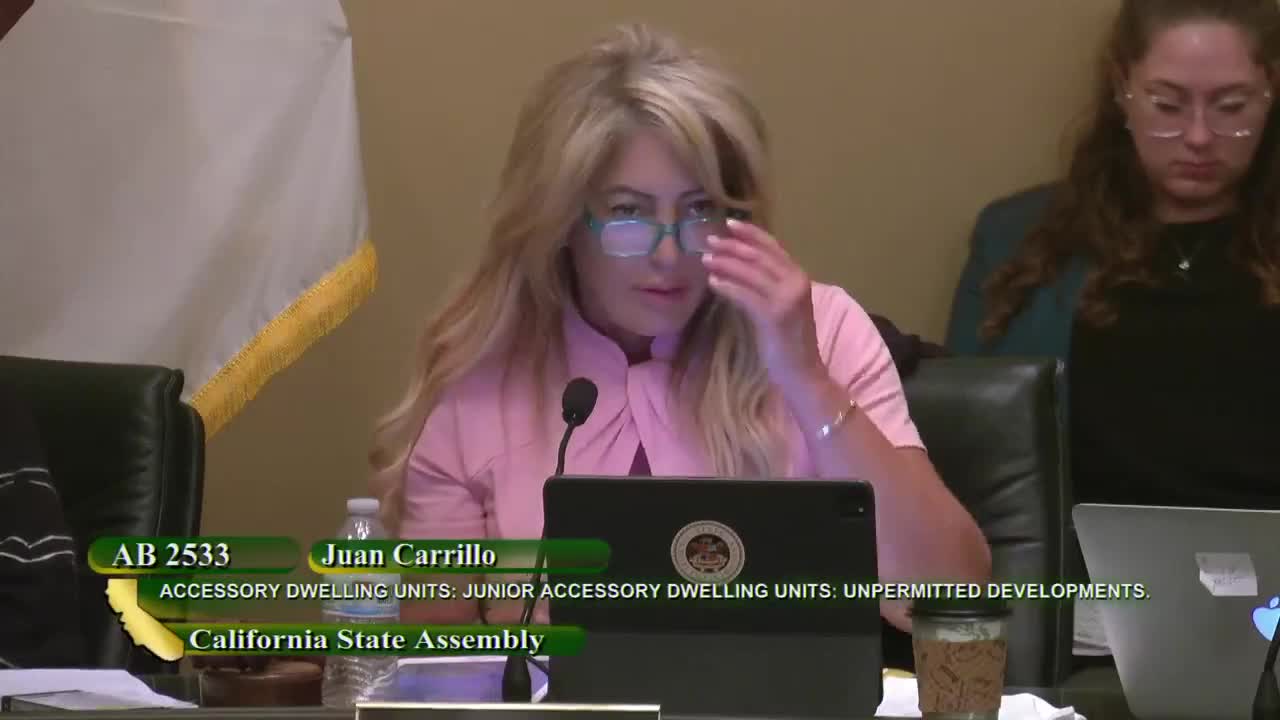 10MIN
Assembly Standing Committee on Local Government
Bill Author