AB 2548: Transitional kindergarten: enrollment.
- Session Year: 2023-2024
- House: Assembly
- Latest Version Date: 2024-04-15
Current Status:
Failed
(2024-05-22: From committee: Without further action pursuant to Joint Rule 62(a).)
Introduced
In Committee
First Chamber
In Committee
Second Chamber
Enacted
Existing law authorizes a school district or charter school to maintain a transitional kindergarten program. Existing law requires a school district or charter school, as a condition of receipt of apportionment for pupils in a transitional kindergarten program, to ensure that, in the 202425 school year, a child who will have their 5th birthday between September 2 and June 2 is admitted to a transitional kindergarten program. Existing law authorizes a school district or charter school to enroll a child whose 4th birthday is between June 3 and September 1 preceding the school year if specified conditions are met, including that the transitional kindergarten classroom maintains at least one adult for every 10 pupils and maintains a classroom enrollment that does not exceed 20 pupils. Existing law requires the Superintendent of Public Instruction to withhold a specified amount of funding from a school district or charter school that fails to comply with those conditions. Existing law requires the Controller to incorporate verification of compliance with those conditions in a specified audit guide for the 202324 and 202425 fiscal years.
This bill would specify that the provision requiring the Superintendent to withhold funding from a school district or charter school that fails to comply with those conditions does not apply for the 202425 202324 school year. The bill would eliminate the requirement for the Controller to incorporate verification of compliance with those conditions in the audit guide for the 202425 202324 fiscal year.
Existing law authorizes a school district or charter school to maintain a transitional kindergarten program. Existing law requires a school district or charter school, as a condition of receipt of apportionment for pupils in a transitional kindergarten program, to ensure that, in the 202425 school year, a child who will have their 5th birthday between September 2 and June 2 is admitted to a transitional kindergarten program. Existing law authorizes a school district or charter school to enroll a child whose 4th birthday is between June 3 and September 1 preceding the school year if specified conditions are met, including that the transitional kindergarten classroom maintains at least one adult for every 10 pupils and maintains a classroom enrollment that does not exceed 20 pupils. Existing law requires the Superintendent of Public Instruction to withhold a specified amount of funding from a school district or charter school that fails to comply with those conditions. Existing law requires the Controller to incorporate verification of compliance with those conditions in a specified audit guide for the 202324 and 202425 fiscal years.
This bill would specify that the provision requiring the Superintendent to withhold funding from a school district or charter school that fails to comply with those conditions does not apply for the 202425 school year. The bill would eliminate the requirement for the Controller to incorporate verification of compliance with those conditions in the audit guide for the 202425 fiscal year.
Existing law requires school districts, county superintendents of schools, and charter schools to adopt and update a local control and accountability plan (LCAP) using a template adopted by the State Board of Education that requires an LCAP to include certain information, including, among other information, (1) a description of the annual goals to be achieved for specified state priorities, including, among others, pupil achievement and pupil outcomes, (2) a description of the specific actions that the school district, county office of education, or charter school will take during each year of the LCAP to achieve these goals, and (3) an assessment of the effectiveness of the specific actions described in the existing LCAP toward achieving the goals, as provided.This bill would state the intent of the Legislature to enact future legislation that allows pupils attending a school serving kindergarten or any of grades 1 to 12, inclusive, to academically succeed.Existing law requires school districts, county superintendents of schools, and charter schools to adopt and update a local control and accountability plan (LCAP) using a template adopted by the State Board of Education that requires an LCAP to include certain information, including, among other information, (1) a description of the annual goals to be achieved for specified state priorities, including, among others, pupil achievement and pupil outcomes, (2) a description of the specific actions that the school district, county office of education, or charter school will take during each year of the LCAP to achieve these goals, and (3) an assessment of the effectiveness of the specific actions described in the existing LCAP toward achieving the goals, as provided.
This bill would state the intent of the Legislature to enact future legislation that allows pupils attending a school serving kindergarten or any of grades 1 to 12, inclusive, to academically succeed.
(a)It is the intent of the Legislature that each transitional kindergarten classroom that includes an early enrollment child maintains at least one adult for every 10 pupils, and that credentialed teachers who are first assigned to a transitional kindergarten classroom that includes one or more early enrollment children meet at least one of the requirements specified in subparagraphs (A) to (C), inclusive, of paragraph (4) of subdivision (g) of Section 48000.
(b)For purposes of this section, the following definitions apply:
(1)(A)Active enrollment count means the count of all pupils enrolled in a transitional kindergarten classroom with early enrollment children on the first day of the school year on which the class was in session, plus all subsequent enrollees, minus all withdrawals since that first day.
(B)An active enrollment count shall be made on the last teaching day of each school month that ends before April 15 of the school year.
(C)(i)For school districts, the active enrollment count shall not include pupils enrolled in independent study pursuant to Article 5.5 (commencing with Section 51744) of Chapter 5 of Part 28 who (I) meet the minimum day requirements for independent study and (II) are continually enrolled in independent study for more than 14 schooldays in a school year.
(ii)For charter schools, the active enrollment count shall not include pupils enrolled in independent study pursuant to Article 5.5 (commencing with Section 51744) of Chapter 5 of Part 28 who are continually enrolled in independent study for more than 14 schooldays on any of the days on which school is taught for the purpose of meeting the 175-instructional-day offering requirement, as described in Section 11960 of Title 5 of the California Code of Regulations.
(2)Adult-to-pupil ratio shall be the quotient of the active enrollment count divided by the total number of adults, rounded to the nearest half or whole integer.
(3)Class means a group of pupils scheduled to report regularly at a particular time to a particular teacher during the regular schoolday, as defined by the governing board of the school district or the governing body of the charter school, as applicable, excluding special day classes. Classes in the evening and summer school class shall not be considered classes for purposes of this calculation.
(4)Early enrollment child means a child whose fourth birthday will be between the third of June and first of September, inclusive, preceding the school year during which they are enrolled in a transitional kindergarten classroom.
(5)Number of adults shall be determined for each classroom subject to this section as follows:
(A)A count of employees of the school district or charter school assigned to each class that includes early enrollment transitional kindergarten pupils shall be made on the last teaching day of each school month that ends before April 15 of the school year.
(B)The sum of all of the adult counts pursuant to subparagraph (A) shall be divided by the total number of those counts, rounded to the nearest half or whole integer.
(c)(1)Beginning July 1, 2023, and for the 202324 and 202425 school years, any school district or charter school that offers transitional kindergarten to early enrollment children shall concurrently offer enrollment in a California state preschool program that is operated by the school district or charter school if the school district or charter school operates a California state preschool program and if that program is not fully subscribed, and may, notwithstanding Section 8208, enroll an early enrollment child in a California state preschool program operated by the school district or charter school, regardless of income, after all other eligible children have been enrolled.
(2)Notwithstanding any other law, a pupil admitted to a transitional kindergarten program pursuant to this section shall not generate average daily attendance for purposes of Section 46300, or be included in the enrollment or unduplicated pupil count pursuant to Section 42238.02, until the pupil has attained their fifth birthday.
(d)Notwithstanding subparagraph (A) of paragraph (2) of subdivision (c) of Section 48000, a school district or charter school may enroll an early enrollment child in a transitional kindergarten program if all of following conditions are met:
(1)Any classroom that includes an early enrollment child shall maintain an adult-to-pupil ratio of at least one adult to every 10 pupils.
(2)The school district or charter school prioritizes assigning credentialed teachers that meet at least one of the requirements specified in subparagraphs (A) to (C), inclusive, of paragraph (4) of subdivision (g) of Section 48000 to early enrollment transitional kindergarten classrooms, to the extent possible.
(3)Any transitional kindergarten classroom that includes an early enrollment child shall maintain a classroom enrollment that does not exceed 20 pupils.
(e)(1)If a school district or charter school fails to comply with the requirements of paragraph (1) or (3) of subdivision (d), the Superintendent shall withhold from the school districts or charter schools entitlement computed pursuant to Section 42238.02 an amount pursuant to the following:
(A)For school districts and charter schools that fail to meet the adult-to-pupil ratio requirements of paragraph (1) of subdivision (d) for classrooms that include an early enrollment child, the amount shall be determined by multiplying:
(i)The number of additional adults needed to meet the requirements of paragraph (1) of subdivision (d), as calculated by dividing the total enrollment pupils in each transitional kindergarten classroom with early enrollment children, by 10, rounded to the nearest half or whole integer, minus the total number of adults assigned to the classroom, as determined pursuant to subparagraph (B) of paragraph (3) of subdivision (b).
(ii)Twenty, reduced by the statewide average rate of absence for elementary school districts for kindergarten and grades 1 to 8, inclusive, as calculated by the department for the prior fiscal year, with the resultant figures and rates rounded to the nearest tenth.
(iii)The per average daily attendance rate determined pursuant to paragraph (2) of subdivision (g) of Section 42238.02.
(B)For school districts and charter schools that fail to maintain a class enrollment of not more than 20 pupils, as required pursuant to paragraph (3) of subdivision (d), the amount determined by multiplying the then-current fiscal years average daily attendance reported for the second principal apportionment period in transitional kindergarten classrooms with early enrollment children by the amount specified in subparagraph (A) of paragraph (3) of subdivision (d) of Section 42238.02, unless the school district or charter school fails to meet the requirements for average class size for kindergarten and grades 1 to 3, inclusive, pursuant to clause (i) of subparagraph (D) of paragraph (3) of subdivision (d) of Section 42238.02.
(2)The Superintendent shall adjust an amount withheld pursuant to the requirements of paragraph (1) in order to ensure that the total amount withheld pursuant to paragraph (1) and Section 48000.1 does not exceed the product of both of the following:
(A)The then-current fiscal years average daily attendance reported for the second principal apportionment period in transitional kindergarten for the applicable school district or charter school.
(B)The sum of the per average daily attendance rates of all of the following:
(i)Subparagraph (A) of paragraph (1) of subdivision (d) of Section 42238.02.
(ii)Subparagraph (A) of paragraph (3) of subdivision (d) of Section 42238.02.
(iii)Paragraph (2) of subdivision (g) of Section 42238.02.
(3)This subdivision does not apply for the 202425 202324 school year.
(f)For the 202324 and 202425 school years, any school district or charter school that serves early enrollment children in transitional kindergarten shall report to the department, pursuant to a process determined by the department, the number of teachers in transitional kindergarten classrooms with early enrollment children that did not meet at least one of the requirements specified in subparagraphs (A) to (C), inclusive, of paragraph (4) of subdivision (g) of Section 48000. The department shall submit a report to the appropriate fiscal and policy committees of the Legislature and the Department of Finance by October 1, 2024, and again by October 1, 2025, that includes this information, disaggregated by each school district and charter school.
(g)For the 202324 202425 fiscal year Guide for Annual Audits of K12 Local Education Agencies and State Compliance Reporting, the Controller shall incorporate verification of compliance with the requirements specified in paragraphs (1) and (3) of subdivision (d).
(h)This section shall become inoperative on July 1, 2025.
(a)It is the intent of the Legislature that each transitional kindergarten classroom that includes an early enrollment child maintains at least one adult for every 10 pupils, and that credentialed teachers who are first assigned to a transitional kindergarten classroom that includes one or more early enrollment children meet at least one of the requirements specified in subparagraphs (A) to (C), inclusive, of paragraph (4) of subdivision (g) of Section 48000.
(b)For purposes of this section, the following definitions apply:
(1)(A)Active enrollment count means the count of all pupils enrolled in a transitional kindergarten classroom with early enrollment children on the first day of the school year on which the class was in session, plus all subsequent enrollees, minus all withdrawals since that first day.
(B)An active enrollment count shall be made on the last teaching day of each school month that ends before April 15 of the school year.
(C)(i)For school districts, the active enrollment count shall not include pupils enrolled in independent study pursuant to Article 5.5 (commencing with Section 51744) of Chapter 5 of Part 28 who (I) meet the minimum day requirements for independent study and (II) are continually enrolled in independent study for more than 14 schooldays in a school year.
(ii)For charter schools, the active enrollment count shall not include pupils enrolled in independent study pursuant to Article 5.5 (commencing with Section 51744) of Chapter 5 of Part 28 who are continually enrolled in independent study for more than 14 schooldays on any of the days on which school is taught for the purpose of meeting the 175-instructional-day offering requirement, as described in Section 11960 of Title 5 of the California Code of Regulations.
(2)Adult-to-pupil ratio shall be the quotient of the active enrollment count divided by the total number of adults, rounded to the nearest half or whole integer.
(3)Class means a group of pupils scheduled to report regularly at a particular time to a particular teacher during the regular schoolday, as defined by the governing board of the school district or the governing body of the charter school, as applicable, excluding special day classes. Classes in the evening and summer school class shall not be considered classes for purposes of this calculation.
(4)Early enrollment child means a child whose fourth birthday will be between the third of June and first of September, inclusive, preceding the school year during which they are enrolled in a transitional kindergarten classroom.
(5)Number of adults shall be determined for each classroom subject to this section as follows:
(A)A count of employees of the school district or charter school assigned to each class that includes early enrollment transitional kindergarten pupils shall be made on the last teaching day of each school month that ends before April 15 of the school year.
(B)The sum of all of the adult counts pursuant to subparagraph (A) shall be divided by the total number of those counts, rounded to the nearest half or whole integer.
(c)(1)Beginning July 1, 2023, and for the 202324 and 202425 school years, any school district or charter school that offers transitional kindergarten to early enrollment children shall concurrently offer enrollment in a California state preschool program that is operated by the school district or charter school if the school district or charter school operates a California state preschool program and if that program is not fully subscribed, and may, notwithstanding Section 8208, enroll an early enrollment child in a California state preschool program operated by the school district or charter school, regardless of income, after all other eligible children have been enrolled.
(2)Notwithstanding any other law, a pupil admitted to a transitional kindergarten program pursuant to this section shall not generate average daily attendance for purposes of Section 46300, or be included in the enrollment or unduplicated pupil count pursuant to Section 42238.02, until the pupil has attained their fifth birthday.
(d)Notwithstanding subparagraph (A) of paragraph (2) of subdivision (c) of Section 48000, a school district or charter school may enroll an early enrollment child in a transitional kindergarten program if all of following conditions are met:
(1)Any classroom that includes an early enrollment child shall maintain an adult-to-pupil ratio of at least one adult to every 10 pupils.
(2)The school district or charter school prioritizes assigning credentialed teachers that meet at least one of the requirements specified in subparagraphs (A) to (C), inclusive, of paragraph (4) of subdivision (g) of Section 48000 to early enrollment transitional kindergarten classrooms, to the extent possible.
(3)Any transitional kindergarten classroom that includes an early enrollment child shall maintain a classroom enrollment that does not exceed 20 pupils.
(e)(1)If a school district or charter school fails to comply with the requirements of paragraph (1) or (3) of subdivision (d), the Superintendent shall withhold from the school districts or charter schools entitlement computed pursuant to Section 42238.02 an amount pursuant to the following:
(A)For school districts and charter schools that fail to meet the adult-to-pupil ratio requirements of paragraph (1) of subdivision (d) for classrooms that include an early enrollment child, the amount shall be determined by multiplying:
(i)The number of additional adults needed to meet the requirements of paragraph (1) of subdivision (d), as calculated by dividing the total enrollment pupils in each transitional kindergarten classroom with early enrollment children, by 10, rounded to the nearest half or whole integer, minus the total number of adults assigned to the classroom, as determined pursuant to subparagraph (B) of paragraph (3) of subdivision (b).
(ii)Twenty, reduced by the statewide average rate of absence for elementary school districts for kindergarten and grades 1 to 8, inclusive, as calculated by the department for the prior fiscal year, with the resultant figures and rates rounded to the nearest tenth.
(iii)The per average daily attendance rate determined pursuant to paragraph (2) of subdivision (g) of Section 42238.02.
(B)For school districts and charter schools that fail to maintain a class enrollment of not more than 20 pupils, as required pursuant to paragraph (3) of subdivision (d), the amount determined by multiplying the then-current fiscal years average daily attendance reported for the second principal apportionment period in transitional kindergarten classrooms with early enrollment children by the amount specified in subparagraph (A) of paragraph (3) of subdivision (d) of Section 42238.02, unless the school district or charter school fails to meet the requirements for average class size for kindergarten and grades 1 to 3, inclusive, pursuant to clause (i) of subparagraph (D) of paragraph (3) of subdivision (d) of Section 42238.02.
(2)The Superintendent shall adjust an amount withheld pursuant to the requirements of paragraph (1) in order to ensure that the total amount withheld pursuant to paragraph (1) and Section 48000.1 does not exceed the product of both of the following:
(A)The then-current fiscal years average daily attendance reported for the second principal apportionment period in transitional kindergarten for the applicable school district or charter school.
(B)The sum of the per average daily attendance rates of all of the following:
(i)Subparagraph (A) of paragraph (1) of subdivision (d) of Section 42238.02.
(ii)Subparagraph (A) of paragraph (3) of subdivision (d) of Section 42238.02.
(iii)Paragraph (2) of subdivision (g) of Section 42238.02.
(3)This subdivision does not apply for the 202425 school year.
(f)For the 202324 and 202425 school years, any school district or charter school that serves early enrollment children in transitional kindergarten shall report to the department, pursuant to a process determined by the department, the number of teachers in transitional kindergarten classrooms with early enrollment children that did not meet at least one of the requirements specified in subparagraphs (A) to (C), inclusive, of paragraph (4) of subdivision (g) of Section 48000. The department shall submit a report to the appropriate fiscal and policy committees of the Legislature and the Department of Finance by October 1, 2024, and again by October 1, 2025, that includes this information, disaggregated by each school district and charter school.
(g)For the 202324 and 202425 fiscal year Guide for Annual Audits of K12 Local Education Agencies and State Compliance Reporting, the Controller shall incorporate verification of compliance with the requirements specified in paragraphs (1) and (3) of subdivision (d).
(h)This section shall become inoperative on July 1, 2025.
SECTION 1.It is the intent of the Legislature to enact future legislation that allows pupils attending a school serving kindergarten or any of grades 1 to 12, inclusive, to academically succeed.It is the intent of the Legislature to enact future legislation that allows pupils attending a school serving kindergarten or any of grades 1 to 12, inclusive, to academically succeed.
|
Date
|
Status
|
|---|---|
| May 22, 2024 | From committee: Without further action pursuant to Joint Rule 62(a). |
| Apr 24, 2024 | In committee: Set, first hearing. Failed passage. |
| Apr 16, 2024 | Re-referred to Com. on ED. |
| Apr 15, 2024 | From committee chair, with author's amendments: Amend, and re-refer to Com. on ED. Read second time and amended. |
| Apr 1, 2024 | Re-referred to Com. on ED. |
| Mar 21, 2024 | From committee chair, with author's amendments: Amend, and re-refer to Com. on ED. Read second time and amended. |
| Mar 21, 2024 | Referred to Com. on ED. |
| Feb 15, 2024 | From printer. May be heard in committee March 16. |
| Feb 14, 2024 | Read first time. To print. |
|
Date
|
Description
|
Location
|
Votes
|
|
|---|---|---|---|---|
| Apr 24, 2024 | Do pass as amended and be re-referred to the Committee on [Appropriations] | Assembly Standing Committee on Education |
Failed |
This list shows positions taken on this bill by organizations on the date displayed, which is linked to the original source.
Positions by individuals are not included.
|
Organization
|
Position
|
Date
|
|---|---|---|
| Alameda County Office Of Education | ** Support | |
| Anaheim Elementary School District | ** Support | |
| Association Of California School Administrators | ** Support | |
| Association Of California Urban School Districts | ** Support | |
| Brea Olinda Unified School District | ** Support | |
| Buellton Union School District | ** Support | |
| Buena Park School District | ** Support | |
| California Association Of Suburban School Districts | ** Support | |
| Centralia Elementary School District | ** Support | |
| Chowchilla Elementary School District | ** Support | |
| Corona-Norco Unified School District | ** Support | |
| Cypress School District | ** Support | |
| Downey Unified School District | ** Support | |
| Dry Creek Joint Elementary School District | ** Support | |
| Duarte Unified School District | ** Support | |
| Early Care And Education Consortium | ** Against | |
| Elk Grove Unified School District | ** Support | |
| Fairfield-Suisun Unified School District | ** Support | |
| Fresno County Superintendent of Schools | ** Support | |
| Fullerton School District | ** Support | |
| Garden Grove Unified School District | ** Support | |
| Huntington Beach City School District | ** Support | |
| Irvine Unified School District | ** Support | |
| Kings County Office of Education | ** Support | |
| Kings County Superintendent of Schools | ** Support | |
| LA Habra City School District | ** Support | |
| Los Alamitos Unified School District | ** Support | |
| Los Angeles Unified School District | ** Support | |
| Lowell Joint School District | ** Support | |
| Marin County Office of Education | ** Support | |
| Marin County Superintendents | ** Support | |
| Mariposa County Unified School District | ** Support | |
| Modesto City Schools | ** Support | |
| Modesto City Schools District | ** Support | |
| Morgan Hill Unified School District | ** Support | |
| Napa Valley Unified School District | ** Support | |
| Newport-Mesa Unified School District | ** Support | |
| North Orange County ROP | ** Support | |
| Ontario Montclair School District | ** Support | |
| Orange County Department Of Education | ** Support | |
| Rocklin Unified School District | ** Support | |
| Roseville City School District | ** Support | |
| Saddleback Valley Unified School District | ** Support | |
| San Jose Unified School District | ** Support | |
| Santa Clara County Office Of Education | ** Support | |
| San Ysidro School District | ** Support | |
| Savanna School District | ** Support | |
| small school districts' association | ** Support | |
| Western Placer Unified School District | ** Support |
Date of Hearing: April 24, 2024
ASSEMBLY COMMITTEE ON EDUCATION
Al Muratsuchi, Chair
ABPCA Bill Id:AB 2548 (
Author:Ta) – As Amended Ver:April 15, 2024
SUBJECT: Transitional kindergarten: enrollment
SUMMARY: Waives the penalty for local educational agencies (LEAs) not meeting the adult-to-child ratio or maximum classroom enrollment requirements for transitional kindergarten (TK) classrooms enrolling early enrollment children for the 2023-24 school year. Specifically, this bill:
- Waives the penalty for the 2023-24 school year for those LEAs having TK classrooms with early enrollment children that do not meet the 1:10 adult-to-child ratio or the maximum enrollment of 20 children.
- Requires the 2024-25 Guide for Annual Audits of K-12 LEAs and State Compliance Reporting to incorporate the requirement for the adult-to-child ratio of 1:10 and the maximum classroom enrollment of 20 children, rather than the 2023-24 Guide.
EXISTING LAW:
- Requires a child to be admitted to kindergarten if the child will have his or her fifth birthday on or before one of the following dates:
- December 2 of the 2011-12 school year;
- November 1 of the 2012-13 school year;
- October 1 of the 2013-14 school year; and
- September 1 of the 2014-15 school year and each year thereafter. (Education Code (EC) 48000)
- Defines TK as the first year of a two-year kindergarten program that uses a modified kindergarten curriculum that is age and developmentally appropriate. (EC 48000)
- Requires a school district or charter school that maintains a TK program, as a condition of receiving apportionments for TK, to enroll children based upon the following timetable:
School year | Child who will have their 5th birthday between the months of: |
|---|---|
2012-13 | November 2 and December 2 |
2013-14 | October 2 and December 2 |
2014-15 to 2021-22 | September 2 and December 2 |
2022-23 | September 2 and February 2 |
2023-24 | September 2 and April 2 |
2024-25 | September 2 and June 2 |
2025-26 and each school year thereafter | Child who will have their 4th birthday by September 1. |
(EC 48000)
- Allows, with the approval of the parent, a school district or charter school to admit a child to TK if their fifth birthday will be after the date specified above, provided that the governing board of the school district determines that the admittance is in the best interest of the child and the parent is given information regarding the effect of early admittance, as specified. Such children do not generate ADA for state funding purposes until they turn five years old. (EC 48000)
- Requires school districts or charter schools offering TK programs to maintain an average class enrollment of no more than 24 children, and, beginning with the 2022-23 school year, to maintain at least one adult for every 12 children in the TK classroom, and beginning with the 2025-26 school year, to maintain at least one adult for every 10 children, states the intent of the Legislature to appropriate funds for this purpose. (EC 48000)
- Requires that each TK classroom with early enrollment children maintain at least one adult for every 10 children, maintain an enrollment of no more than 20 children, and ensure that teachers assigned to the classroom meet specified requirements. (EC 48000.15)
- Defines “early enrollment child” as a child whose 4th birthday will be between June 3 and September 1 preceding the school year during which they are enrolled in a TK classroom. (EC 48000.15)
- For the 2023-24 and 2024-25 school years, imposes penalties and requires the Superintendent of Public Instruction (SPI) to withhold apportionments, as specified, from school districts or charter schools that fail to meet the adult-to-child ratio and class size limit associated with classrooms enrolling early enrollment children. (EC 48000.15)
- Establishes compulsory education, requiring children to attend school from age 6 to 18 years of age. (EC 48200)
FISCAL EFFECT: Unknown
COMMENTS:
Need for the bill. According to the author, “The 2023 budget implementation of penalties on Early Transitional Kindergarten (ETK) in California has created unforeseen challenges for school districts, with budget bill changes imposing strict requirements and fiscal penalties for non-compliance. Despite their commitment to serving students in need and planning months in advance, districts face substantial financial repercussions, with estimates reaching millions of dollars in audit penalties. Waiving the fiscal penalties associated with early TK enrollment would ensure equitable access to essential educational initiatives for students.”
What is transitional kindergarten (TK)? TK is the first year of a two-year kindergarten program. California’s Kindergarten Readiness Act of 2010 revised the cutoff date by which children must turn 5 for kindergarten entry in that year. The act established September 1 as the new kindergarten eligibility date, 3 months earlier than the previous date of December 2.
The Kindergarten Readiness Act also established TK for all students affected by the birthdate eligibility change. Instead of enrolling in regular kindergarten, students who reach age 5 between September 2 and December 2 instead receive an “age and developmentally appropriate” experience in TK prior to entering kindergarten the following year.
California commits to universal TK. AB 130 (Committee on Budget), Chapter 44, Statutes of 2021 established a plan to gradually expand TK eligibility to all 4-year-old children with a phased approach from the 2022-23 to 2025-26 school year and required that schools offering TK to:
- Maintain an average class enrollment of not more than 24 pupils at each schoolsite;
- Beginning with the 2023-24 school year, maintain an average ratio of at least one adult for every 12 pupils;
- Beginning with the 2023-24 school year, maintain an average ratio of at least one adult for every 10 pupils in TK classrooms, subject to an appropriation for this purpose; and
- Ensure that teachers assigned to a TK classroom meet specified requirements regarding early childhood experience by August 1, 2023.
Subsequent legislation delayed the 1:10 ratio to the 2025-26 school year and the teacher credentialing requirements to August 1, 2025.
School year | TK enrollment (Census day) |
2021-22 | 75,465 |
2020-21 | 68,701 |
2019-20 | 88,883 |
2018-19 | 90,659 |
2017-18 | 88,934 |
Source: CDE Dataquest |
TK enrollment has varied, including a decreased enrollment during the COVID-19 pandemic, as shown by the table on the left. Data is not yet available for the 2022-23 school year.
Estimates from the Learning Policy Institute (LPI) suggest that more than 300,000 children are likely to enroll in TK at full implementation in 2025-26. This assumes that 71% of eligible children are enrolled, which was the uptake level prior to the COVID-19 pandemic.
Figure 1 below illustrates potential enrollment levels for TK based upon uptake levels, from a lower bound of 60% through 2024-25 and 65% in 2025-26, to an upper bound of 75% through 2024-25 and 80% in 2025-26. This results in a range of between 291,000 and 447,700 children forecast to be enrolled in TK by the 2025-26 school year.

Source: LPI, 2022.
Early enrollment in TK. TK students generate average daily attendance (ADA) funding similar to all other K-12 students through the Local Control Funding Formula (LCFF). Under an early enrollment provision, LEAs have the option to provide TK to students born after the applicable cut-off date but have their 5th birthday during the school year. The LEA only receives ADA funding for these students after they turn five.
SB 114 (Committee on Budget and Fiscal Review), Chapter 48, Statutes of 2023, which was chaptered on July 10, 2023, authorized school districts and charter schools to enroll an early enrollment child in a TK classroom if the following conditions are met:
- An adult-to-pupil ratio of at least one adult to every 10 pupils;
- Is staffed by a credentialed teacher meeting at least one of the early childhood experience requirements to the extent possible; and
- Maximum classroom enrollment of 20 pupils.
SB 114 also establishes penalties for school districts and charter schools failing to meet the class size and adult-to-child ratios in the 2023-24 and 2024-25 school years and authorizes the Superintendent of Public Instruction (SPI) to withhold from an LEA’s apportionment an amount as specified.
Last minute changes in early TK requirements unfairly penalize districts. As noted above, the lower ratio and class size requirements for TK classrooms enrolling early enrollment children went into effect when the bill was signed on July 10, 2023. In many cases this was only weeks before schools began the 2023-24 school year and well beyond the date when schools had registered students, established classes, and hired staff. SB 141 was signed by the Governor on September 13, 2023 which added the requirement for the reduced class size and ratio to be added to the audit guide for the 2023-24 and 2024-25 school years. As noted in the arguments in support in a letter from the Association of California School Administrators (ACSA), the California Association of Suburban School Districts (CalSSD), and numerous COEs and school districts:
TK has been welcomed by many parents as it fills a critical need for affordable early learning and care services. As districts outreached to their families about TK, there has been a desire from families to enroll 4-year-olds whose birthdays fall outside the eligibility window. Districts were told by the state that they could enroll these children, but they would not receive ADA to serve them. Many districts, particularly in high-need communities chose to offer TK to meet the needs of their families. School districts plan and budget at least nine months in advance of the next school year, which typically begins around August.
In July 2023, the Governor signed SB 114 which created new requirements for school districts offering early TK and enrolling 4-year-olds born after June 3rd, including a lower class size of 20 students and a smaller 1:10 adult-to-student ratio.
Many districts offering early TK were not able to meet the lower class size ratio and size requirements because the school year was weeks away from starting. Those districts were faced with the decision to either turn away families they had enrolled in TK or be penalized fiscally. Many districts chose to serve their families because of the high number of students who depending on free access to education and care, despite the state’s fiscal penalties.
Districts with high proportions of low-income students are now facing steep penalties because they enrolled early TK students under the previous version of the law, which changed over the summer. These districts will see penalties in the millions of dollars.
One example of the impact of this last-minute change is the experience of the Garden Grove Unified School District (GGUSD), a district with an enrollment of 39,000 students and an unduplicated count of 81%, including 95% students of color, that was described as follows:
- GGUSD accepted all students in TK turning 4 by September 1st for the 2023-24 school year, an increase of 568 students from the prior year;
- GGUSD had planned each class for approximately 18 students, but had greater number of students enroll than had been projected, resulted in an average class size of 21.7 students across the district;
- GGUSD understood this class size and the 12:1 ratio to be within the requirement in place for the 2023-24 school year;
- 25 business days before the start of school, SB 114 went into effect, requiring a 10:1 ratio and maximum class size of 20 for TK classrooms enrolling early enrollment children and establishing penalties for those classrooms not meeting these requirements;
- By the time GGUSD learned of these changes, there was no time to course correct as staffing ratios are negotiated a year in advance to prepare for the school year, kindergarten registration is completed in February the year prior, and facility needs are determined the Fall prior; and
- GGUSD estimates their penalties for exceeding the newly established class size and ratio requirements to be approximately $3.1 million.
Similarly, Downey Unified School District, which enrolls 22,000 students and has an unduplicated count of 73%, estimates they face a penalty of $1 million.
This bill proposes to waive these penalties on early enrollment TK classrooms for the 2023-24 year only, so that LEAs, including those enrolling early enrollment children, would be held only to the prior requirements of a 1:12 adult-to-child ratio and a maximum class size of 24 children.
Research supports the value of California’s TK program. A comprehensive evaluation of the impact of TK on California students as implemented in the 2013-14 and 2014-15 school years, included the following findings:
- TK improves mathematics knowledge and problem-solving skills for participating students, giving them almost a three-month advantage in problem-solving skills over students who did not attend TK;
- TK also improves students’ literacy skills, putting them ahead of their peers who did not attend TK by six months at kindergarten entry;
- TK has a positive impact on the language, literacy, and math skills of all students at kindergarten entry. It has a particularly strong impact on the English language skills of dual language learners (DLLs) and on the math skills of low-income students;
- TK improves mathematics knowledge and problem-solving skills for DLL students, giving them almost a six-month advantage over DLL students who did not attend TK;
- TK also improves literacy skills for DLL students, putting them ahead of their peers who did not attend TK by more than seven months at kindergarten entry;
- Participating in TK gives DLL students a substantial boost in their English language development, including in speaking and listening skills and overall language proficiency. This benefit holds true for DLL students from all language groups;
- TK has a persisting impact on all students’ letter and word identification skills at the end of kindergarten, on literacy and math skills for low-income students, and math skills for Hispanic students;
- TK structured as a standalone classroom had a similar impact on students’ skills as classrooms with TK and kindergarten combined; and
- The benefit of TK for participating children varied little, if at all, with teachers’ specific instructional practices. It may be that what is driving TK’s impact is what TK classrooms have in common: highly qualified teachers, alignment with kindergarten, and mixed income classrooms (AIR, 2017).
Recommended Committee Amendments. Staff recommend that the bill be amended as follows:
- Add an urgency clause in order to ensure fiscal penalties for the 2023-24 school year are not imposed on LEAs that implemented early TK.
Arguments in support. A joint letter from the ACSA, CalSSD, Small School Districts’ Association, and numerous COEs and school districts, writes,
School districts plan and budget at least 9 months in advance of the next school year, which typically begins around August. This means schools plan their TK programs months in advance of school starting. In July 2023, the Governor signed the education budget trailer bill SB 114, which created new statutory requirements for the 2023-24 and 2024-25 school years for school districts offering Early TK and enrolling 4-year-olds born after June 3. These changes included a lower-class size of 20 students and a smaller 1:10 adult-to-student ratio. The trailer bill also imposed significant fiscal penalties for districts if they did not comply with the new provisions.
Many districts offering Early TK (ETK) were not able to meet the lower class size ratio and size requirements because the school year was weeks away from starting. Those districts were faced with the decision to either turn away families they had enrolled in TK or be penalized fiscally. Many districts chose to serve their families because of the high number of students who depended on the free access to education and care, despite the state’s fiscal penalties.
AB 2548 will waive the current school year penalties on districts offering ETK, protecting them from millions of dollars in penalties and preserving their fiscal stability as the state faces budgetary challenges.
Arguments in opposition. The Early Care and Education Consortium writes,
Acceptance of early enrollment children in TK is optional. In order to ensure the safety of these very young children, the 2023-24 budget agreement put in place financial penalties for school districts that choose to take early enrollment children in TK and fail to meet the ratio or class size requirements.
AB 2548 is removing those fiscal penalties for school districts that opt-in to take early enrollment children in TK and fail to meet the ratio or class size requirements for TK classrooms. This bill puts young children at risk by not ensuring that there are sufficient adults in the classroom and disregards the legislative intent in the enactment of SB 114 of 2023.
Related legislation. SB 114 (Committee on Budget and Fiscal Review), Chapter 48, Statutes of 2023, requires that each TK classroom that includes an early enrollment child maintain at least one adult for every 10 pupils, and enroll no more than 20 children. Also establishes penalties for non-compliance with these ratio and class size requirements.
AB 130 (Committee on Budget), Chapter 44, Statutes of 2021 established Universal TK by expanding eligibility for TK to all 4-year olds by the 2025-26 school year and established requirements for TK classrooms related to adult-to-child ratios, maximum class sizes, and TK teacher requirements.
AB 123 (McCarty) of the 2019-20 Session would have established the Pre-K for All Act; expanded the eligibility for CSPP; increased the reimbursement rate for the CSPP and required a portion of the increase to be used to increase teacher pay; required CSPP lead teachers to hold a bachelor’s degree by a specified date; and established a program to provide financial support to childcare workers pursuing a bachelor’s degree. This bill was held in the Senate Appropriations Committee.
SB 443 (Rubio) of the 2019-20 Session would have deleted the provision that prohibits a child admitted to TK who has their 5th birthday after December 2 from generating ADA or being included in the enrollment or unduplicated pupil count until they turn 5-years-old, thereby expanding eligibility for TK to all 4-year-olds. This bill was held in the Senate Appropriations Committee.
AB 2500 (McCarty) of the 2019-20 Session would have deleted the provision that prohibits a child admitted to TK who has their 5th birthday after December 2nd from generating ADA or being included in the enrollment or unduplicated pupil count until they turn 5-years-old, thereby expanding eligibility for TK to all 4-year-olds. This bill was held in the Assembly Education Committee.
SB 217 (Portantino) of the 2019-20 Session would have created the Early Intervention Grant Program to increase inclusive access to early education programs for children with exceptional needs and expand eligibility for TK to include children with exceptional needs turning 5-years-old at any time during the school year. This bill was amended to include content outside of the jurisdiction of education.
AB 1754 (McCarty) of the 2017-18 Session would have required the state to provide all eligible low-income 4-year-old children with access to early care and education programs. This bill was held in the Senate Appropriations Committee.
SB 837 (Dodd) of the 2017-18 Session would have expanded eligibility for TK to all 4-year olds, phased in over a two-year period beginning in the 2020-21 school year. This bill was held in the Senate Appropriations Committee.
AB 47 (McCarty) of the 2015-16 Session would have established the Preschool for All Act of 2015 and required, on or before June 30, 2018, all eligible children who are not enrolled in TK to have access to the CSPP the year before they enter kindergarten if their parents wish to enroll them, contingent upon the appropriation in the annual Budget Act for this purpose. This bill was vetoed by the Governor, who stated:
Last year's education omnibus trailer bill already codified the intent to make preschool and other full-day, full year early education and care opportunities available to all low-income children. The discussion on expanding state preschool - which takes into account rates paid to providers as well as access and availability for families - should be considered in the budget process, as it is every year. A bill that sets an arbitrary deadline, contingent on a sufficient appropriation, is unnecessary.
REGISTERED SUPPORT / OPPOSITION:
Support
Alameda County Office of Education
Anaheim Elementary School District
Association of California School Administrators
Association of California Suburban School Districts
Brea Olinda Unified School District
Buellton Union School District
Buena Park School District
California Association of Suburban School Districts
Centralia Elementary School District
Chowchilla Elementary School District
Corona-Norco Unified School District
Cypress School District
Downey Unified School District
Dry Creek Joint Elementary School District
Duarte Unified School District
Elk Grove Unified School District
Fairfield-Suisun Unified School District
Fresno County Superintendent of Schools
Fullerton School District
Garden Grove Unified School District
Huntington Beach City School District
Irvine Unified School District
Kings County Office of Education
Kings County Superintendent of Schools
LA Habra City School District
Los Alamitos Unified School District
Los Angeles Unified School District
Lowell Joint School District
Marin County Office of Education
Marin County Superintendents
Mariposa County Unified School District
Modesto City Schools
Modesto City Schools District
Morgan Hill Unified School District
Napa Valley Unified School District
Newport-mesa Unified School District
North Orange County ROP
Ontario Montclair School District
Orange County Department of Education
Rocklin Unified School District
Roseville City School District
Saddleback Valley Unified School District
San Jose Unified School District
San Ysidro School District
Santa Clara County Office of Education
Savanna School District
Small School Districts' Association
Western Placer Unified School District
Opposition
Early Care and Education Consortium
Analysis Prepared by: Debbie Look / ED. / (916) 319-2087
Discussed in Hearing
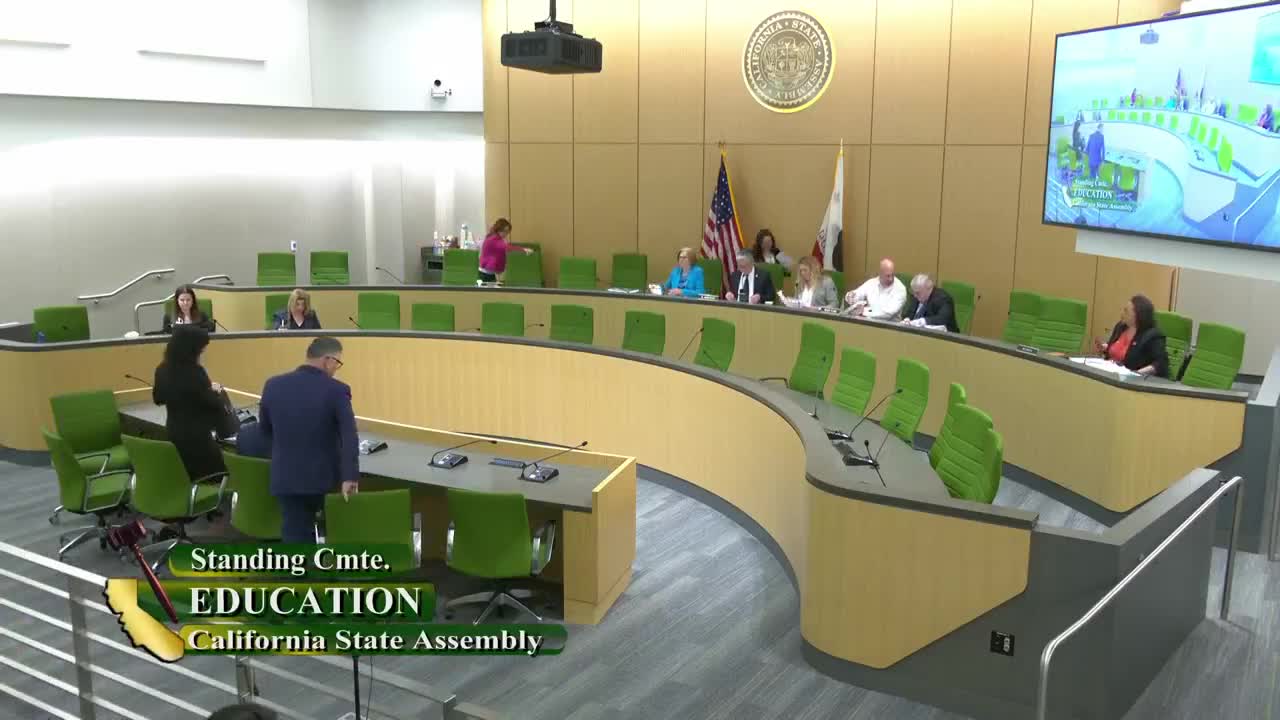 26MIN
Assembly Standing Committee on Education
Bill Author

Bill Co-Author(s):