AB 2610: Protected species: authorized take: System Conservation Implementation Agreement.
- Session Year: 2023-2024
- House: Assembly
- Latest Version Date: 2024-04-10
Current Status:
Failed
(2024-08-15: In committee: Held under submission.)
Introduced
In Committee
First Chamber
In Committee
Second Chamber
Enacted
The California Endangered Species Act generally prohibits the take of a species determined to be an endangered, threatened, or candidate species under the act. Existing law authorizes the Department of Fish and Wildlife, if certain conditions are fulfilled, to authorize the take of species, including fully protected species, resulting from impacts attributable to implementation of the Quantification Settlement Agreement on specified lands and bodies of water, including the Salton Sea. water.
This bill would additionally authorize the department, if certain conditions are fulfilled, to authorize the take of species resulting from impacts attributable to the implementation of the Salton Sea Management Program or implementation of any System Conservation Implementation Agreement between the United States Bureau of Reclamation and the Imperial Irrigation District to implement the Lower Colorado River Basin System Conservation and Efficiency Program, as provided, on the specified lands and bodies of water . water.
This bill would declare that it is to take effect immediately as an urgency statute.
The California Endangered Species Act generally prohibits the take of a species determined to be an endangered, threatened, or candidate species under the act. Existing law authorizes the Department of Fish and Wildlife, if certain conditions are fulfilled, to authorize the take of species, including fully protected species, resulting from impacts attributable to implementation of the Quantification Settlement Agreement on specified lands and bodies of water, including the Salton Sea.
This bill would additionally authorize the department, if certain conditions are fulfilled, to authorize the take of species resulting from impacts attributable to the implementation of the Salton Sea Management Program or implementation of any System Conservation Implementation Agreement between the United States Bureau of Reclamation and the Imperial Irrigation District to implement the Lower Colorado River Basin System Conservation and Efficiency Program, as provided, on the specified lands and bodies of water .
(a)Notwithstanding Sections 3511, 4700, 5050, and 5515, and contingent upon the fulfillment of the conditions listed in subdivisions (b), (c), and (d), the department may authorize, under Chapter 1.5 (commencing with Section 2050) or Chapter 10 (commencing with Section 2800), the take of species resulting from impacts attributable to the implementation of the Quantification Settlement Agreement, as defined in subdivision (a) of Section 1 of Chapter 617 of the Statutes of 2002, or implementation of the Salton Sea Management Program, or any System Conservation Implementation Agreement between the United States Bureau of Reclamation and the Imperial Irrigation District to implement the Lower Colorado River Basin System Conservation and Efficiency Program for the years 2024 to 2026, inclusive, on all of the following:
(1)The salinity, elevation, shoreline habitat, or water quality of the Salton Sea.
(2)The quantity and quality of water flowing in the All American Canal, the Coachella Canal, the Imperial Valley and Coachella Valley drains, the New and Alamo Rivers, the Coachella Valley Stormwater Channel, and the habitat sustained by those flows.
(3)Agricultural lands in the Imperial Valley.
(4)The quantity and quality of water flowing in the Colorado River, the habitat sustained by those flows, and the collection of that water for delivery to authorized users.
(b)The Quantification Settlement Agreement is executed by the appropriate parties on or before October 12, 2003.
(c)The department has determined that the appropriate agreements have been executed to address environmental impacts at the Salton Sea that include enforceable commitments requiring all of the following:
(1)Imperial Irrigation District to transfer 800,000 acre-feet of conserved water, by conservation methods selected by the Imperial Irrigation District, to the Department of Water Resources on a mutually agreed-upon schedule in exchange for payment of one hundred seventy-five dollars ($175) per acre-foot. The price shall be adjusted for inflation on an annual basis.
(2)Imperial Irrigation District to transfer up to 800,000 additional acre-feet of conserved water, by conservation methods selected by the Imperial Irrigation District, to the Department of Water Resources during the first 15 years of the Quantification Settlement Agreement on the schedule established for the mitigation water that was previously to be transferred to the San Diego Water Authority, or on a mutually agreed-upon schedule, at no cost for the water in addition to the payment for the water from the mitigation fund described in paragraph (1) of subdivision (b) of Section 3 of Chapter 613 of the Statutes of 2003.
(3)As a condition to acquisition of the water described in paragraph (1), the Department of Water Resources shall be responsible for any environmental impacts, including Salton Sea salinity, related to use or transfer of that water. As a condition to acquisition of the water described in paragraph (2), the Department of Water Resources shall be responsible for environmental impacts related to Salton Sea salinity that are related to the use or transfer of that water.
(4)The Metropolitan Water District of Southern California (MWD) to purchase up to 1.6 million acre-feet of the water provided in accordance with paragraphs (1) and (2) from the Department of Water Resources at a price of not less than two hundred fifty dollars ($250) per acre-foot on a mutually agreed-upon schedule. The price shall be adjusted for inflation on an annual basis. The Department of Water Resources shall deposit all proceeds from the sale of water pursuant to this paragraph, after deducting costs and reasonable administrative expenses, into the Salton Sea Restoration Fund established in Section 2932.
(5)The Metropolitan Water District of Southern California to pay not less than twenty dollars ($20) per acre-foot for all special surplus water received by MWD as a result of reinstatement of access to that water under the Interim Surplus Guidelines by the United States Department of the Interior subtracting any water delivered to Arizona as a result of a shortage. The money shall be paid into the Salton Sea Restoration Fund. The price shall be adjusted for inflation on an annual basis. Metropolitan Water District of Southern California shall receive a credit against future mitigation obligations under the Lower Colorado River Multi-Species Conservation Plan for any funds provided under this paragraph to the extent that those funds are spent on projects that contribute to the conservation or mitigation for species identified in the Lower Colorado River Multi-Species Conservation Plan and that are consistent with the preferred alternative for Salton Sea restoration.
(6)Coachella Valley Water District, Imperial Irrigation District, and San Diego County Water Authority to pay a total of thirty million dollars ($30,000,000) to the Salton Sea Restoration Fund as provided in paragraph (2) of subdivision (b) of Section 3 of Chapter 613 of the Statutes of 2003.
(d)All of the following conditions are met:
(1)The requirements of subdivision (b) and (c) of Section 2081 are satisfied as to the species for which take is authorized.
(2)The take authorization provides for the development and implementation, in cooperation with federal and state agencies, of an adaptive management process for monitoring the effectiveness of, and adjusting as necessary, the measures to minimize and fully mitigate the impacts of the authorized take. The adjusted measures are subject to Section 2052.1.
(3)The take authorization for implementation of the Quantification Settlement Agreement provides for the development and implementation in cooperation with state and federal agencies of an adaptive management process that substantially contributes to the long-term conservation of the species for which take is authorized. Preparation of the adaptive management program and implementation of the program is the responsibility of the department. The departments obligation to prepare and implement the adaptive management program is conditioned upon the availability of funds pursuant to the Water Security, Clean Drinking Water, Coastal and Beach Protection Act of 2002, if it is approved by the voters at the statewide general election to be held November 5, 2002 (Proposition 50), or other funds that may be appropriated by the Legislature or approved by the voters for that purpose. The failure to appropriate funds does not relieve the applicant of the obligations of paragraphs (1) and (2). However, the applicant shall not be required to fund any program pursuant to this paragraph.
(4)The requirements of paragraph (1) may be satisfied if the take is authorized under Chapter 10 (commencing with Section 2800).
(e)(1)The Secretary of the Resources Agency, in consultation with the department, the Department of Water Resources, the Salton Sea Authority, appropriate air quality districts, and the Salton Sea Advisory Committee, shall undertake a restoration study to determine a preferred alternative for the restoration of the Salton Sea ecosystem and the protection of wildlife dependent on that ecosystem. The Secretary of the Resources Agency shall extend an invitation to the United States Geological Survey Salton Sea Science Office to also participate in the restoration study, and the office may participate if it accepts the invitation. The restoration study shall be conducted pursuant to a process with deadlines for release of the report and programmatic environmental documents established by the secretary, in consultation with the department, the Department of Water Resources, the Salton Sea Authority, and the Salton Sea Advisory Committee, and the United States Geological Survey Salton Sea Science Office, if it is a participant. The secretary shall use all available authority to enter into a memorandum of understanding (MOU) with the Secretary of the Interior, as provided in Section 101(b)(1)(C)(i) of the Salton Sea Reclamation Act of 1998 (P.L. 105-372) for the purpose of obtaining federal participation in the restoration of the Salton Sea.
(2)The restoration study shall establish all of the following:
(A)An evaluation of alternatives for the restoration of the Salton Sea that includes consideration of strategies for salinity control, habitation creation and restoration, and different shoreline elevations and surface area configurations. The alternatives shall consider the range of possible inflow conditions. The evaluation established pursuant to this subparagraph shall also include suggested criteria for selecting and evaluating alternatives consistent with Chapter 13 (commencing with Section 2930), including, but not limited to, at least one most cost-effective, technically feasible, alternative.
(B)An evaluation of the magnitude and practicability of costs of construction, operation, and maintenance of each alternative evaluated.
(C)A recommended plan for the use or transfer of water provided by paragraph (2) of subdivision (c). No water may be transferred pursuant to that subdivision unless the secretary finds that transfer is consistent with the preferred alternative for Salton Sea restoration.
(D)The selection of a preferred alternative consistent with Section 2931, including a proposed funding plan to implement the preferred alternative. The proposed funding plan shall include a determination of the moneys that are, or may be, available to construct and operate the preferred project, including, but not limited to, all of the following moneys:
(i)Moneys in the Salton Sea Restoration Fund established by Section 2932.
(ii)State water and environmental bond moneys.
(iii)Federal authorizations and appropriations.
(iv)Moneys available through a Salton Sea Infrastructure Financing District established pursuant to Section 53395.9 of the Government Code and local assessments by the Salton Sea Authority or its member agencies.
(v)Moneys derived from user or other fees.
(3)The study identifying the preferred alternative shall be submitted to the Legislature on or before December 31, 2006.
(4)The Secretary of the Natural Resources Agency shall establish an advisory committee for purposes of this subdivision as follows:
(A)The advisory committee shall be selected to provide balanced representation of the following interests:
(i)Agriculture.
(ii)Local governments.
(iii)Conservation groups.
(iv)Tribal governments.
(v)Recreational users.
(vi)Water agencies.
(vii)Air pollution control districts.
(viii)Geothermal energy development.
(B)Appropriate federal agency representatives may be asked to serve in an ex officio capacity.
(C)The Natural Resources Agency shall consult with the advisory committee throughout all stages of the alternative selection process.
(D)The advisory committee shall meet no fewer than six times annually.
(E)The secretary shall appoint a vice chair of the advisory committee from the committee membership. The vice chair shall work with the secretary to develop advisory committee agendas and to schedule meetings of the committee. The secretary and vice chair shall appoint an agenda subcommittee to assist in the preparation of advisory committee agendas.
(F)The advisory committee shall submit to the Natural Resources Agency recommendations to assist the agency in preparation of its restoration plan. The Natural Resources Agency shall develop a schedule for the completion of these recommendations to ensure that these recommendations will be considered by the agency in a timely and meaningful manner as the restoration plan is developed. These recommendations may include, but are not limited to:
(i)The specific goals and objectives of the restoration plan.
(ii)The range of alternative restoration actions that are required to be developed and analyzed.
(iii)The no action alternative.
(iv)The criteria for determining economic and technical feasibility of the alternatives.
(v)The range of options for funding the restoration plan.
(vi)The selection of a preferred alternative for a restoration plan.
(G)The Natural Resources Agency shall periodically provide an update to the advisory committee of the current work plan and schedule for the development of the restoration plan.
(f)This section shall not be construed to exempt from any other provision of law the Quantification Settlement Agreement, the Agreement for Transfer of Conserved Water by and between the Imperial Irrigation District and the San Diego County Water Authority, dated April 29, 1998, or implementation of the Salton Sea Management Program, or any System Conservation Implementation Agreement between the United States Bureau of Reclamation and the Imperial Irrigation District to implement the Lower Colorado River Basin System Conservation and Efficiency Program for the years 2024 to 2026, inclusive.
SEC. 2.This act is an urgency statute necessary for the immediate preservation of the public peace, health, or safety within the meaning of Article IV of the California Constitution and shall go into immediate effect. The facts constituting the necessity are:
In order to be permitted in accordance with the California Endangered Species Act to conserve a large volume of water that is being relied upon by stakeholders within the lower basin of the Colorado River, it is necessary for this act to take effect immediately.
(a)Notwithstanding Sections 3511, 4700, 5050, and 5515, and contingent upon the fulfillment of the conditions listed in subdivisions (b), (c), and (d), the department may authorize, under Chapter 1.5 (commencing with Section 2050) or Chapter 10 (commencing with Section 2800), the take of species resulting from impacts attributable to the implementation of the Quantification Settlement Agreement, as defined in subdivision (a) of Section 1 of Chapter 617 of the Statutes of 2002, implementation of the Salton Sea Management Program, or any System Conservation Implementation Agreement between the United States Bureau of Reclamation and the Imperial Irrigation District to implement the Lower Colorado River Basin System Conservation and Efficiency Program for the years 2024 to 2026, inclusive, on all of the following:
(1)The salinity, elevation, shoreline habitat, or water quality of the Salton Sea.
(2)The quantity and quality of water flowing in the All American Canal, the Coachella Canal, the Imperial Valley and Coachella Valley drains, the New and Alamo Rivers, the Coachella Valley Stormwater Channel, and the habitat sustained by those flows.
(3)Agricultural lands in the Imperial Valley.
(4)The quantity and quality of water flowing in the Colorado River, the habitat sustained by those flows, and the collection of that water for delivery to authorized users.
(b)The Quantification Settlement Agreement is executed by the appropriate parties on or before October 12, 2003.
(c)The department has determined that the appropriate agreements have been executed to address environmental impacts at the Salton Sea that include enforceable commitments requiring all of the following:
(1)Imperial Irrigation District to transfer 800,000 acre-feet of conserved water, by conservation methods selected by the Imperial Irrigation District, to the Department of Water Resources on a mutually agreed-upon schedule in exchange for payment of one hundred seventy-five dollars ($175) per acre-foot. The price shall be adjusted for inflation on an annual basis.
(2)Imperial Irrigation District to transfer up to 800,000 additional acre-feet of conserved water, by conservation methods selected by the Imperial Irrigation District, to the Department of Water Resources during the first 15 years of the Quantification Settlement Agreement on the schedule established for the mitigation water that was previously to be transferred to the San Diego Water Authority, or on a mutually agreed-upon schedule, at no cost for the water in addition to the payment for the water from the mitigation fund described in paragraph (1) of subdivision (b) of Section 3 of Chapter 613 of the Statutes of 2003.
(3)As a condition to acquisition of the water described in paragraph (1), the Department of Water Resources shall be responsible for any environmental impacts, including Salton Sea salinity, related to use or transfer of that water. As a condition to acquisition of the water described in paragraph (2), the Department of Water Resources shall be responsible for environmental impacts related to Salton Sea salinity that are related to the use or transfer of that water.
(4)The Metropolitan Water District of Southern California (MWD) to purchase up to 1.6 million acre-feet of the water provided in accordance with paragraphs (1) and (2) from the Department of Water Resources at a price of not less than two hundred fifty dollars ($250) per acre-foot on a mutually agreed-upon schedule. The price shall be adjusted for inflation on an annual basis. The Department of Water Resources shall deposit all proceeds from the sale of water pursuant to this paragraph, after deducting costs and reasonable administrative expenses, into the Salton Sea Restoration Fund established in Section 2932.
(5)The Metropolitan Water District of Southern California to pay not less than twenty dollars ($20) per acre-foot for all special surplus water received by MWD as a result of reinstatement of access to that water under the Interim Surplus Guidelines by the United States Department of Interior subtracting any water delivered to Arizona as a result of a shortage. The money shall be paid into the Salton Sea Restoration Fund. The price shall be adjusted for inflation on an annual basis. Metropolitan Water District of Southern California shall receive a credit against future mitigation obligations under the Lower Colorado River Multi-Species Conservation Plan for any funds provided under this paragraph to the extent that those funds are spent on projects that contribute to the conservation or mitigation for species identified in the Lower Colorado River Multi-Species Conservation Plan and that are consistent with the preferred alternative for Salton Sea restoration.
(6)Coachella Valley Water District, Imperial Irrigation District, and San Diego County Water Authority to pay a total of thirty million dollars ($30,000,000) to the Salton Sea Restoration Fund as provided in paragraph (2) of subdivision (b) of Section 3 of Chapter 613 of the Statutes of 2003.
(d)All of the following conditions are met:
(1)The requirements of subdivision (b) and (c) of Section 2081 are satisfied as to the species for which take is authorized.
(2)The take authorization provides for the development and implementation, in cooperation with federal and state agencies, of an adaptive management process for monitoring the effectiveness of, and adjusting as necessary, the measures to minimize and fully mitigate the impacts of the authorized take. The adjusted measures are subject to Section 2052.1.
(3)The take authorization for implementation of the Quantification Settlement Agreement provides for the development and implementation in cooperation with state and federal agencies of an adaptive management process that substantially contributes to the long-term conservation of the species for which take is authorized. Preparation of the adaptive management program and implementation of the program is the responsibility of the department. The departments obligation to prepare and implement the adaptive management program is conditioned upon the availability of funds pursuant to the Water Security, Clean Drinking Water, Coastal and Beach Protection Act of 2002, if it is approved by the voters at the statewide general election to be held November 5, 2002 (Proposition 50), or other funds that may be appropriated by the Legislature or approved by the voters for that purpose. The failure to appropriate funds does not relieve the applicant of the obligations of paragraphs (1) and (2). However, the applicant shall not be required to fund any program pursuant to this paragraph.
(4)The requirements of paragraph (1) may be satisfied if the take is authorized under Chapter 10 (commencing with Section 2800).
(e)(1)The Secretary of the Resources Agency, in consultation with the department, the Department of Water Resources, the Salton Sea Authority, appropriate air quality districts, and the Salton Sea Advisory Committee, shall undertake a restoration study to determine a preferred alternative for the restoration of the Salton Sea ecosystem and the protection of wildlife dependent on that ecosystem. The Secretary of the Resources Agency shall extend an invitation to the United States Geological Survey Salton Sea Science Office to also participate in the restoration study, and the office may participate if it accepts the invitation. The restoration study shall be conducted pursuant to a process with deadlines for release of the report and programmatic environmental documents established by the secretary, in consultation with the department, the Department of Water Resources, the Salton Sea Authority, and the Salton Sea Advisory Committee, and the United States Geological Survey Salton Sea Science Office, if it is a participant. The secretary shall use all available authority to enter into a memorandum of understanding (MOU) with the Secretary of the Interior, as provided in Section 101(b)(1)(B)(i) 101(b)(1)(C)(i) of the Salton Sea Reclamation Act of 1998 (P.L. 105-372) for the purpose of obtaining federal participation in the restoration of the Salton Sea.
(2)The restoration study shall establish all of the following:
(A)An evaluation of alternatives for the restoration of the Salton Sea that includes consideration of strategies for salinity control, habitation creation and restoration, and different shoreline elevations and surface area configurations. The alternatives shall consider the range of possible inflow conditions. The evaluation established pursuant to this subparagraph shall also include suggested criteria for selecting and evaluating alternatives consistent with Chapter 13 (commencing with Section 2930), including, but not limited to, at least one most cost-effective, technically feasible, alternative.
(B)An evaluation of the magnitude and practicability of costs of construction, operation, and maintenance of each alternative evaluated.
(C)A recommended plan for the use or transfer of water provided by paragraph (2) of subdivision (c). No water may be transferred pursuant to that subdivision unless the secretary finds that transfer is consistent with the preferred alternative for Salton Sea restoration.
(D)The selection of a preferred alternative consistent with Section 2931, including a proposed funding plan to implement the preferred alternative. The proposed funding plan shall include a determination of the moneys that are, or may be, available to construct and operate the preferred project, including, but not limited to, all of the following moneys:
(i)Moneys in the Salton Sea Restoration Fund established by Section 2932.
(ii)State water and environmental bond moneys.
(iii)Federal authorizations and appropriations.
(iv)Moneys available through a Salton Sea Infrastructure Financing District established pursuant to Section 53395.9 of the Government Code and local assessments by the Salton Sea Authority or its member agencies.
(v)Moneys derived from user or other fees.
(3)The study identifying the preferred alternative shall be submitted to the Legislature on or before December 31, 2006.
(4)The Secretary of the Natural Resources Agency shall establish an advisory committee for purposes of this subdivision as follows:
(A)The advisory committee shall be selected to provide balanced representation of the following interests:
(i)Agriculture.
(ii)Local governments.
(iii)Conservation groups.
(iv)Tribal governments.
(v)Recreational users.
(vi)Water agencies.
(vii)Air pollution control districts.
(viii)Geothermal energy development.
(B)Appropriate federal agency representatives may be asked to serve in an ex officio capacity.
(C)The Natural Resources Agency shall consult with the advisory committee throughout all stages of the alternative selection process.
(D)The advisory committee shall meet no fewer than six times annually.
(E)The secretary shall appoint a vice chair of the advisory committee from the committee membership. The vice chair shall work with the secretary to develop advisory committee agendas and to schedule meetings of the committee. The secretary and vice chair shall appoint an agenda subcommittee to assist in the preparation of advisory committee agendas.
(F)The advisory committee shall submit to the Natural Resources Agency recommendations to assist the agency in preparation of its restoration plan. The Natural Resources Agency shall develop a schedule for the completion of these recommendations to ensure that these recommendations will be considered by the agency in a timely and meaningful manner as the restoration plan is developed. These recommendations may include, but are not limited to:
(i)The specific goals and objectives of the restoration plan.
(ii)The range of alternative restoration actions that must are required to be developed and analyzed.
(iii)The no action alternative.
(iv)The criteria for determining economic and technical feasibility of the alternatives.
(v)The range of options for funding the restoration plan.
(vi)The selection of a preferred alternative for a restoration plan.
(G)The Natural Resources Agency shall periodically provide an update to the advisory committee of the current work plan and schedule for the development of the restoration plan.
(f)This section shall not be construed to exempt from any other provision of law the Quantification Settlement Agreement and Agreement, the Agreement for Transfer of Conserved Water by and between the Imperial Irrigation District and the San Diego County Water Authority, dated April 29, 1998. 1998, implementation of the Salton Sea Management Program, or any System Conservation Implementation Agreement between the United States Bureau of Reclamation and the Imperial Irrigation District to implement the Lower Colorado River Basin System Conservation and Efficiency Program for the years 2024 to 2026, inclusive.
|
Date
|
Status
|
|---|---|
| Aug 15, 2024 | In committee: Held under submission. |
| Aug 5, 2024 | In committee: Referred to APPR suspense file. |
| Jun 27, 2024 | In committee: Hearing postponed by committee. |
| Jun 18, 2024 | From committee: Do pass and re-refer to Com. on APPR with recommendation: To Consent Calendar. (Ayes 11. Noes 0.) (June 17). Re-referred to Com. on APPR. |
| May 15, 2024 | Referred to Com. on N.R. & W. |
| May 2, 2024 | In Senate. Read first time. To Com. on RLS. for assignment. |
| May 2, 2024 | Read third time. Urgency clause adopted. Passed. Ordered to the Senate. (Ayes 73. Noes 0. Page 5089.). |
| Apr 25, 2024 | Read second time. Ordered to Consent Calendar. |
| Apr 24, 2024 | From committee: Do pass. To Consent Calendar. (Ayes 14. Noes 0.) (April 24). |
| Apr 11, 2024 | Re-referred to Com. on APPR. |
| Apr 10, 2024 | Read second time and amended. |
| Apr 9, 2024 | From committee: Amend, and do pass as amended and re-refer to Com. on APPR. (Ayes 14. Noes 0.) (April 9). |
| Mar 4, 2024 | Referred to Com. on W., P., & W. |
| Feb 15, 2024 | From printer. May be heard in committee March 16. |
| Feb 14, 2024 | Read first time. To print. |
|
Date
|
Description
|
Location
|
Votes
|
|
|---|---|---|---|---|
| Aug 5, 2024 | Placed on suspense file | Senate Standing Committee on Appropriations |
Passed |
|
| Jun 17, 2024 | Do pass, but first be re-referred to the Committee on [Appropriations] with the recommendation: To Consent Calendar | Senate Standing Committee on Natural Resources and Water |
Passed |
|
| May 2, 2024 | AB 2610 Garcia Consent Calendar Second Day Regular Session | Assembly Floor |
Passed |
|
| Apr 24, 2024 | Do pass. To Consent Calendar. | Assembly Standing Committee on Appropriations |
Passed |
|
| Apr 9, 2024 | Do pass as amended and be re-referred to the Committee on [Appropriations] | Assembly Standing Committee on Water, Parks, and Wildlife |
Passed |
This list shows positions taken on this bill by organizations on the date displayed, which is linked to the original source.
Positions by individuals are not included.
|
Organization
|
Position
|
Date
|
|---|---|---|
| Association Of California Water Agencies | ** Support | |
| California Association Of Professional Scientists | ** Support | |
| California Municipal Utilities Association | ** Support | |
| Imperial Irrigation District | ** Support | |
| San Diego County Water Authority | ** Support |
SENATE COMMITTEE ON
Senator Anna Caballero, Chair
2023 - 2024 Regular Session
AB 2610 (Garcia) - Protected species: authorized take: System Conservation Implementation Agreement
Version: | Policy Vote: |
Urgency: | Mandate: |
Hearing Date: | Consultant: |
Bill Summary:
This bill would add the implementation of any System Conservation Implementation Agreement between the U.S. Bureau of Reclamation and the Imperial Irrigation District to implement the Lower Colorado River Basin System Conservation and Efficiency Program for the years 2024 – 2026, inclusive, to the existing authorization to take fully protected species under the Quantification Settlement Agreement, as provided, among other things.
Fiscal Impact:
- To the extent this bill authorizes activities for which an entity otherwise would have applied for an incidental take permit, unknown but potentially significant foregone revenues (Endangered Species Permitting Account) from fewer fees paid to the Department of Fish and Wildlife (DFW) on permit applications.
Background:
State law explicitly designates 34 species of birds, reptiles or amphibians, fish, and mammals as fully protected. These include, for example, the California condor, the rough sculpin, and the Guadalupe fur seal. Take of fully protected species is generally prohibited except where the species’ protection and conservation is provided for in an applicable natural community conservation plan or for scientific research. In this context, “take” means to attempt to or to “hunt, pursue, catch, capture, or kill.” Fully protected is considered a more restrictive protection standard than provided for threatened or endangered (i.e. “listed”) species under the federal or state Endangered Species Acts. The fully protected designation pre-dates the Endangered Species Acts.
The Legislature has authorized the take of fully protected species on a case-by-case basis for certain projects approximately seven times in the last two decades. In addition, last year, take of fully-protected species was authorized for certain types of infrastructure projects (SB 147 (Ashby, Chapter 59, Statutes of 2023)). In these instances, take is authorized when take is minimized and fully mitigated, the species would not become extinct due to the take, and a monitoring program and adaptive management process is required, among other project-specific requirements. For example, take of the Lost River sucker and the shortnose sucker is authorized in conjunction with the decommissioning and removal of four dams on the Klamath River. Another example is the authorization to take fully protected species associated with implementation of the Quantification Settlement Agreement (QSA).
The QSA was finalized in 2003 and is a series of agreements that limits California’s usage of Colorado River water to its allocation of 4.4 million acre-feet annually, apportions the necessary cutbacks among California water agencies, facilitates a transfer of 300,000 acre-feet of water annually from the Imperial Irrigation District (District) to the San Diego County Water Authority, and provides for management of the impacts of water cutbacks on the Salton Sea.
Due to reduced water levels in Lake Powell and Lake Mead and ongoing over-allocation of Colorado River water, there have been repeated efforts in recent years to reach agreement on water conservation measures, particularly in the lower Colorado River Basin states (Arizona, Nevada, and California)(Lower Basin states). To identify options to achieve the necessary reductions in water use, the U.S. Bureau of Reclamation initiated an environmental review process in April 2023. In May 2023, the Lower Basin states proposed a series of actions to conserve 3 million acre-feet by 2026, with at least 1.5 million acre-feet conserved by the end of 2024. This proposal was analyzed by U.S. Bureau of Reclamation and is the preferred alternative in the final environmental document issued in March 2024. Under the preferred alternative, California will reduce its cumulative water use by 1.6 million acre-feet by 2026 (800,000 acre-feet by the District) and the federal government will compensate water users for up to 2.3 million acre-feet of water they do not use.
The District is working on a “System Conservation Implementation Agreement” or SCIA with the U.S. Bureau of Reclamation to achieve its water conservation target through “system conservation” actions. “System conservation” refers to temporary, voluntary, and compensated reductions in consumptive water use. A system conservation program began in the Upper Colorado River Basin in 2015 and is being extended to the Lower Basin to help achieve necessary water use reductions. According to the District, the water use reductions will be generated entirely by agricultural water users voluntarily participating in the conservation programs. These conservation programs may include voluntary land fallowing, conversion to more efficient irrigation systems (e.g., drip irrigation), switching to less thirsty crops, and deficit irrigation.
Proposed Law:
This bill would:
- Add the implementation of any SCIA between the U.S. Bureau of Reclamation and the District to implement the Lower Colorado River Basin System Conservation and Efficiency Program for the years 2024 – 2026, inclusive, to the existing authorization to take fully protected species under the QSA, as provided;
- Provide that this bill shall not be construed to exempt the implementation of a SCIA, as defined, from any other provision of law; and
- Justify the need for an urgency statute, and make technical and conforming changes to law.
Related Legislation:
SB 147 (Ashby, Chapter 59, Statutes of 2023) provides for the take of fully protected species resulting from impacts attributable to the implementation of specified water, transportation, and energy infrastructure projects if certain conditions are satisfied.
SB 1293 (Monning, Chapter 237, Statutes of 2020) provides for the take of the endangered Santa Cruz long-toed salamander, a fully-protected species, resulting from impacts attributable to safety and access improvements due to construction along State Route 156, as specified.
SB 482 (Kuehl, Chapter 617, Statutes of 2002), provides for the take of fully protected species resulting from impacts due to implementation of the QSA, as specified.
Staff Comments: An entity applying for an incidental take permit is required to pay CDFW an application fee, which covers the department’s cost of processing the permit application, permit development, and compliance monitoring. Fee amounts depend on the project cost, are updated annually based on the implicit price deflator published by the U.S. Department of Commerce, and are deposited into the Endangered Species Permitting Account within the Fish and Game Preservation Fund. If CDFW determines the permit application fee is insufficient due to the complexity of a project or the potential effects of a project, the department must collect an additional fee up to a specified maximum amount.
-- END --
SENATE COMMITTEE ON NATURAL RESOURCES AND WATER
Senator Dave Min, Chair
2023 - 2024 Regular
Bill No: AB 2610 Hearing Date: June 17, 2024
Author: | |||
Version: | Amended | ||
Urgency: | Fiscal: | ||
Consultant: | |||
Subject: Protected species: authorized take: System Conservation Implementation Agreement
SUMMARY
This bill would add the implementation of any System Conservation Implementation Agreement between the U.S. Bureau of Reclamation and the Imperial Irrigation District to implement the Lower Colorado River Basin System Conservation and Efficiency Program for the years 2024 – 2026, inclusive, to the existing authorization to take fully protected species under the Quantification Settlement Agreement, as provided, among other things.
BACKGROUND AND EXISTING LAW
State law explicitly designates 34 species of birds, reptiles or amphibians, fish, and mammals as fully protected. These include, for example, the California condor, the rough sculpin, and the Guadalupe fur seal. Take of fully protected species is generally prohibited except where the species’ protection and conservation is provided for in an applicable natural community conservation plan or for scientific research. In this context, “take” means to attempt to or to “hunt, pursue, catch, capture, or kill.” Fully protected is considered a more restrictive protection standard than provided for threatened or endangered (i.e. “listed”) species under the federal or state Endangered Species Acts. The fully protected designation pre-dates the Endangered Species Acts.
The Legislature has authorized the take of fully protected species on a case-by-case basis for certain projects approximately seven times in the last two decades. In addition, last year, take of fully-protected species was authorized for certain types of infrastructure projects (SB 147 (Ashby, Chapter 59, Statutes of 2023)). In these instances, take is authorized when take is minimized and fully mitigated, the species would not become extinct due to the take, and a monitoring program and adaptive management process is required, among other project-specific requirements. For example, take of the Lost River sucker and the shortnose sucker is authorized in conjunction with the decommissioning and removal of four dams on the Klamath River. Another example is the authorization to take fully protected species associated with implementation of the Quantification Settlement Agreement (QSA).
The QSA was finalized in 2003 and is a series of agreements that limits California’s usage of Colorado River water to its allocation of 4.4 million acre-feet annually, apportions the necessary cutbacks among California water agencies, facilitates a transfer of 300,000 acre-feet of water annually from the Imperial Irrigation District (District) to the San Diego County Water Authority, and provides for management of the impacts of water cutbacks on the Salton Sea.
Due to reduced water levels in Lake Powell and Lake Mead and ongoing over-allocation of Colorado River water, there have been repeated efforts in recent years to reach agreement on water conservation measures, particularly in the lower Colorado River Basin states (Arizona, Nevada, and California)(Lower Basin states). To identify options to achieve the necessary reductions in water use, the U.S. Bureau of Reclamation initiated an environmental review process in April 2023. In May 2023, the Lower Basin states proposed a series of actions to conserve 3 million acre-feet by 2026, with at least 1.5 million acre-feet conserved by the end of 2024. This proposal was analyzed by U.S. Bureau of Reclamation and is the preferred alternative in the final environmental document issued in March 2024. Under the preferred alternative, California will reduce its cumulative water use by 1.6 million acre-feet by 2026 (800,000 acre-feet by the District) and the federal government will compensate water users for up to 2.3 million acre-feet of water they do not use.
The District is working on a “System Conservation Implementation Agreement” or SCIA with the U.S. Bureau of Reclamation to achieve its water conservation target through “system conservation” actions. “System conservation” refers to temporary, voluntary, and compensated reductions in consumptive water use. A system conservation program began in the Upper Colorado River Basin in 2015 and is being extended to the Lower Basin to help achieve necessary water use reductions. According to the District, the water use reductions will be generated entirely by agricultural water users voluntarily participating in the conservation programs. These conservation programs may include voluntary land fallowing, conversion to more efficient irrigation systems (e.g., drip irrigation), switching to less thirsty crops, and deficit irrigation.
Existing law:
- Designates certain species as fully protected and prohibits the taking of these species, with limited exceptions. (Fish and Game Code (FGC) §§ 3511, 4700, 5050, 5515)
- Permits the take of fully protected species for any fully protected species conserved and managed as a covered species under an approved Natural Community Conservation Plan. (FGC § 2835)
- Permits the California Department of Fish and Wildlife (CDFW) to authorize the take of certain fully protected species in specific cases, with restrictions. (FGC §§ 2081.4, 2081.5, 2081.6, 2081.9, 2081.10, 2081.11, 2081.12)
- Permits CDFW to authorize the take of fully protected species resulting from impacts due to the implementation of the QSA. (FGC § 2081.7)
- Permits CDFW to authorize the take of a fully protected species resulting from impacts attributable to the implementation of specified water, transportation, and energy infrastructure projects if certain conditions are satisfied. (FGC § 2081.15)
- Prohibits the taking of an endangered species, threatened species, or candidate species, except in certain situations, including through the issuance of an incidental take permit, if all of the following conditions are met:
- The take is incidental to an otherwise lawful activity;
- The impacts of the authorized take are minimized and fully mitigated. The measures required to meet this obligation shall be roughly proportional in extent to the impact of the authorized taking of the species; and
- The applicant ensures adequate funding to implement the measures required by paragraph (b) and for monitoring compliance with, and effectiveness of, those measures. (FGC § 2081b)
PROPOSED LAW
This bill would:
- Add the implementation of any SCIA between the U.S. Bureau of Reclamation and the District to implement the Lower Colorado River Basin System Conservation and Efficiency Program for the years 2024 – 2026, inclusive, to the existing authorization to take fully protected species under the QSA, as provided;
- Provide that this bill shall not be construed to exempt the implementation of a SCIA, as defined, from any other provision of law; and
- Justify the need for an urgency statute, and make technical and conforming changes to law.
ARGUMENTS IN SUPPORT
According to the author, “The narrowly crafted amendments to California’s Fish and Game Code are necessary for the Imperial Irrigation District’s pending SCIA with the U.S. Bureau of Reclamation under the Lower Colorado River Basin System Conservation and Efficiency Program to conserve a cumulative target of 800,000 acre-feet of Colorado River water during 2024 – 2026.”
The District adds “the SCIAs currently being negotiated trigger the release of $175 million federal funding earmarked for critical environmental projects at the Salton Sea.”
ARGUMENTS IN OPPOSITION
None received
COMMENTS
Fully protected species potentially at risk. The fully protected species at risk, according to news reports, are the California Black Rail and Yuma Rideway’s Rail (formerly Yuma clapper rail). In addition to being fully protected, the two species also have certain other protections under the federal and state Endangered Species Acts, and, pursuant to the terms of this bill, under the SCIA. A recent news report also cites risks to the desert pupfish that lives in the District’s irrigation districts from the SCIA. The desert pupfish, while endangered and the recipient of protections stemming from that designation, is not a fully protected fish.
The Colorado River The 1,440-mile-long Colorado River passes through parts of seven U.S. states (Arizona, California, Colorado, Nevada, New Mexico, Utah, and Wyoming), two Mexican states (Baja California and Sonora), and many Native American tribal lands, which depend on it for water supply, hydropower, recreation, fish and wildlife habitat, and other benefits. The river is a critical source of water for California and the West as its waters are used to irrigate 5.5 million acres of agricultural land and to provide municipal and industrial water supplies to 40 million people.
Water from the Colorado River is managed and operated under numerous compacts, federal laws, court decisions and decrees, contracts, and regulatory guidelines collectively known as the "Law of the River.” The “Law of the River” allocates a total of 16.5 million acre-feet of the river’s flow to the seven basin states and Mexico annually: 7.5 million acre-feet to the upper basin states (Wyoming, Utah, Colorado, and New Mexico), 7.5 million acre-feet to the Lower Basin states, and 1.5 million acre-feet to Mexico. The allocations for the Lower Basin states are as follows: California (4.4 million acre-feet); Arizona (2.8 million acre-feet); and Nevada (300,000 acre-feet). Historically, California used more than its 4.4 million acre-feet allocation, and Arizona and Nevada did not exercise their full allocations. However, as those latter states’ populations grew, Arizona and Nevada began to seek their full allocations, and the California agencies that drew on Colorado River water had to use less. This was accomplished via the QSA.
A major shortcoming of the “Law of the River” is that it over-allocates the flow of the river. Data show that the average natural flow from 1906-2018 was about 14.8 million acre-feet, an annual deficit of 1.7 million acre-feet. Further, the Colorado River basin has experienced its driest 23-year period on record since 2000 during which its average natural flow has been roughly 12.4 million acre-feet. In order to address this structural deficit and the severe drought, the federal government and water users have negotiated a series of additional guidelines and agreements. These include the “Interim Guidelines” (2007), the Drought Contingency plans (2019), and, more recently, a call by the U.S. Bureau of Reclamation to reduce annual demand for Colorado River water by as much as 2 to 4 million acre-feet.
Related legislation
SB 147 (Ashby, Chapter 59, Statutes of 2023) provides for the take of fully protected species resulting from impacts attributable to the implementation of specified water, transportation, and energy infrastructure projects if certain conditions are satisfied.
SB 1293 (Monning, Chapter 237, Statutes of 2020) provides for the take of the endangered Santa Cruz long-toed salamander, a fully-protected species, resulting from impacts attributable to safety and access improvements due to construction along State Route 156, as specified.
SB 482 (Kuehl, Chapter 617, Statutes of 2002), provides for the take of fully protected species resulting from impacts due to implementation of the QSA, as specified.
SUGGESTED AMENDMENTS: none
SUPPORT
Imperial Irrigation District (sponsor)
Association of California Water Agencies
California Association of Professional Scientists
California Municipal Utilities Association
Metropolitan Water District of Southern California
Salton Sea Authority
San Diego County Water Authority
OPPOSITION
None received
-- END --
Date of Hearing: April 24, 2024
ASSEMBLY COMMITTEE ON APPROPRIATIONS
Buffy Wicks, Chair
ABPCA Bill Id:AB 2610
Author:(Garcia) – As Amended Ver:April 10, 2024
Policy Committee: | Water, Parks and Wildlife | Vote: | 14 - 0 |
|
| ||
|
|
Urgency: Yes State Mandated Local Program: No Reimbursable: No
SUMMARY:
This bill, among other things, permits the California Department of Fish and Wildlife (CDFW), if specified conditions are met, to authorize the take of fully protected species resulting from impacts attributable to the implementation of any system conservation implementation agreement (SCIA) between the U.S. Bureau of Reclamation and the Imperial Irrigation District (IID) to implement the Lower Colorado River Basin System Conservation and Efficiency Program for the years 2024 to 2026, inclusive.
FISCAL EFFECT:
CDFW notes its costs are absorbable within existing resources. See below for more information.
COMMENTS:
1) Purpose. This bill expands an existing exemption from the state’s fully protected species statutes to IID’s implementation of water conservation projects under a pending agreement with the federal government. The author argues this is a narrow exemption and is necessary to allow IID “to conserve a cumulative target of 800,000 acre-feet (AF) of Colorado River water during 2024-2026.”
2) Background.
Colorado River. The 1,440-mile-long Colorado River passes through parts of seven U.S. states, two Mexican states, and many Native American tribal lands, which depend on the river for water supply, hydropower, recreation, fish and wildlife habitat, and other benefits. The river is a critical source of water for California and the west as its waters are used to irrigate 5.5 million acres of agricultural land and to provide municipal and industrial water supplies to 40 million people. The Colorado River is managed and operated under numerous compacts, federal laws, court decisions and decrees, contracts, and regulatory guidelines collectively known as the "Law of the River”. Historically, California used more than its 4.4 million acre-free (MAF) allocation as it was more populous, and Arizona and Nevada did not exercise their full allocations. However, as their populations grew, Arizona and Nevada began to call on their full allocations, and the California agencies that drew on Colorado River water had to use less.
Drought and Over-Allocation of the Colorado River. A major shortcoming of the “Law of the River” is that it over-allocates the flow of the river. In addition, the Colorado River basin has experienced its driest 23-year period on record since 2000. In order to address this structural deficit and the severe drought, the federal government and water users have negotiated a series of additional guidelines and agreements. To identify options to achieve the necessary reductions in water use, the U.S. Bureau of Reclamation initiated an environmental review process in April 2023. In May 2023, the Lower Basin states (Arizona, Nevada, and California) proposed a series of actions to conserve three MAF by 2026, with at least 1.5 MAF conserved by the end of 2024. The U.S. Bureau of Reclamation analyzed this proposal and deemed it the preferred alternative in the final environmental document issued in March 2024. Under the preferred alternative, California will reduce its cumulative water use by 1.6 MAF by 2026 (800,000 by IID) and the federal government will compensate water users for up to 2.3 MAF of water they do not use.
SCIA. IID is working on an SCIA with the U.S. Bureau of Reclamation to achieve its water conservation target through “system conservation” actions. “System conservation” refers to temporary, voluntary, and compensated reductions in consumptive water use. A system conservation program began in the Upper Basin in 2015 and is being extended to the Lower Basin to help achieve necessary water use reductions.
Fully Protected Species. In the 1960s, California began its efforts to identify and protect animals that were rare or at risk of extinction within the state. These efforts resulted in lists of 37 fully protected species that may not be taken or possessed, with limited exceptions. Since the creation of the fully protected species lists, Congress and the Legislature enacted the federal Endangered Species Act (ESA) and CESA, respectively. Of the 37 species designated as fully protected, eight are listed as threatened and 19 are listed as endangered under CESA.
IID Wants Allowance for Incidental Take. IID indicates that the 800,000 AF of conserved water will be generated entirely by agricultural water users voluntarily participating in conservation programs administered by IID. These conservation programs may include voluntary land fallowing, conversion to more efficient irrigation systems, switching to less thirsty crops, and deficit irrigation. IID anticipates that in order to implement its water conservation program under the SCIA, it will need allowance for incidental take of California Black Rail and Yuma Rideway’s Rail; both are currently fully protected species under state law. In addition, according to IID, the SCIA currently being negotiated triggers the release of $175 million in federal funding earmarked for critical environmental projects in the Salton Sea.
CDFW Fees. An entity applying for an incidental take permit is required to pay CDFW an application fee, which covers the department’s cost of processing the permit application, permit development, and compliance monitoring. Fee amounts depend on the project cost, are updated annually based on the implicit price deflator published by the U.S. Department of Commerce, and are deposited into the Endangered Species Permitting Account within the Fish and Game Preservation Fund. If CDFW determines the permit application fee is insufficient due to the complexity of a project or the potential effects of a project, the department must collect an additional fee up to a specified maximum amount.
3) Related legislation. SB 147 (Ashby), Chapter 59, Statutes of 2023, permits CDFW to authorize the take of a fully protected species resulting from impacts attributable to the implementation of specified water, transportation, and energy infrastructure projects if certain conditions are satisfied.
Analysis Prepared by: Nikita Koraddi / APPR. / (916) 319-2081
Date of Hearing: April 9, 2024
ASSEMBLY COMMITTEE ON WATER, PARKS, AND WILDLIFE
Diane Papan, Chair
ABPCA Bill Id:AB 2610 (
Author:Garcia) – As Introduced Ver:February 14, 2024
SUBJECT: Protected species: authorized take: Salton Sea Management Program: System Conservation Implementation Agreement
SUMMARY: Permits the Department of Fish and Wildlife (DFW) to authorize the take of fully protected species resulting from the implementation of the Salton Sea Management Program (SSMP) and a system conservation implementation agreement (SCIA) between the U.S. Bureau of Reclamation and the Imperial Irrigation District (IID). Specifically, this bill:
- Permits DFW to authorize the take of fully protected species resulting from implementation of the SSMP and a SCIA between the U.S. Bureau of Reclamation and IID. The take of a fully protected species must meet requirements of an incidental take permit (ITP) issued pursuant to the California Endangered Species Act (CESA) or recovery standards under the Natural Community Conservation Planning Act.
- Provides that this bill shall not be construed to exempt the implementation of a SCIA from any other provision of law.
- Makes technical and conforming changes.
EXISTING LAW:
- Designates certain species as fully protected and prohibits the taking of these species, with limited exceptions [Fish and Game Code (FGC) §§ 3511, 4700, 5050, 5515].
- Permits the take of fully protected species for any fully protected species conserved and managed as a covered species under an approved Natural Community Conservation Plan (NCCP) (FGC § 2835).
- Permits DFW to authorize the take of certain fully protected species in specific cases, with restrictions (FGC §§ 2081.4, 2081.5, 2081.6, 2081.9, 2081.10, 2081.11, 2081.12).
- Permits DFW to authorize the take of fully protected species resulting from impacts due to the implementation of the Quantification Settlement Agreement (QSA) (FGC § 2081.7).
- Permits DFW to authorize the take of a fully protected species resulting from impacts attributable to the implementation of specified water, transportation, and energy infrastructure projects if certain conditions are satisfied (FGC § 2081.15).
- Prohibits the taking of an endangered species, threatened species, or candidate species, except in certain situations, including through the issuance of a permit commonly known as an ITP, if all of the following conditions are met:
- The take is incidental to an otherwise lawful activity;
- The impacts of the authorized take are minimized and fully mitigated. The measures required to meet this obligation shall be roughly proportional in extent to the impact of the authorized taking of the species; and
- The applicant ensures adequate funding to implement the measures required by paragraph (b) and for monitoring compliance with, and effectiveness of, those measures [FGC § 2081 (b)].
- Requires DFW to collect a fee for the issuance of an ITP at a cost ranging from $6,000 to $30,000 depending on the overall cost of the project receiving coverage under the ITP and the method the project uses to mitigate its environmental impacts (FGC § 2081.2).
FISCAL EFFECT: Unknown. This bill is keyed fiscal.
COMMENTS:
- Purpose of this bill. This bill expands an existing exemption from the fully protected species statutes to IID’s implementation of water conservation projects under a pending agreement with the federal government. The author argues this is a narrow exception and it is necessary to allow IID “to conserve a cumulative target of 800,000 acre-feet [AF] of Colorado River water during 2024-2026.” This bill is sponsored by IID; IID indicates that the 800,000 AF of conserved water will “be generated entirely by agricultural water users voluntarily participating in conservation programs administered by IID.” These conservation programs may include voluntary land fallowing, conversion to more efficient irrigation systems (e.g., drip irrigation), switching to less thirsty crops, and deficit irrigation.
- Background. The 1,440-mile-long Colorado River passes through parts of seven U.S. states (Arizona, California, Colorado, Nevada, New Mexico, Utah, and Wyoming), two Mexican states (Baja California and Sonora), and many Native American tribal lands, which depend on it for water supply, hydropower, recreation, fish and wildlife habitat, and other benefits. The river is a critical source of water for California and the West as its waters are used to irrigate 5.5 million acres of agricultural land and to provide municipal and industrial water supplies to 40 million people.
Law of the River. The Colorado River is managed and operated under numerous compacts, federal laws, court decisions and decrees, contracts, and regulatory guidelines collectively known as the "Law of the River.” The “Law of the River” allocates a total of 16.5 million acre-feet (MAF) of the river’s flow to the seven basin states and Mexico: 7.5 MAF to the upper basin states (Wyoming, Utah, Colorado, and New Mexico), 7.5 MAF to the lower basin states (Nevada, Arizona, and California), and 1.5 MAF to Mexico. The allocations for the lower basin states are enshrined in the federal Boulder Canyon Act of 1928: California at 4.4 MAF; Arizona at 2.8 MAF; and Nevada at 0.3 MAF. Historically, California used more than its 4.4 MAF allocation as it was more populous and Arizona and Nevada did not exercise their full allocations; however, as those states’ populations grew, Arizona and Nevada began to call on their full allocations and the California agencies that drew on Colorado River water had to use less. This was accomplished via the QSA.
Drought and over-allocation of the Colorado River. A major shortcoming of the “Law of the River” is that it over-allocates the flow of the river. Data show that the average natural flow from 1906-2018 was about 14.8 MAF (a nearly 2 MAF deficit). As if this were not problematic enough, the Colorado River basin has experienced its driest 23-year period on record since 2000 during which its average natural flow has been roughly 12.4 MAF. In order to address this structural deficit and the severe drought, the federal government and water users have negotiated a series of additional guidelines and agreements. These include the “Interim Guidelines” in 2007, the Drought Contingency plans in 2019, and a call by the U.S. Bureau of Reclamation to reduce demand on the Colorado River by as much as 2 MAF to 4 MAF annually.
To identify options to achieve the necessary reductions in water use, U.S. Bureau of Reclamation initiated an environmental review process in April 2023. In May 2023, the Lower Basin states (Arizona, Nevada, and California) proposed a series of actions to conserve 3 MAF by 2026, with at least 1.5 MAF conserved by the end of 2024. This proposal was analyzed by U.S. Bureau of Reclamation and is the preferred alternative in the final environmental document issued in March 2024; under the preferred alternative, California will reduce its cumulative water use by 1.6 MAF by 2026 (800,000 by IID) and the federal government will compensate water users for up to 2.3 MAF of water they do not use. IID is working on a SCIA with U.S. Bureau of Reclamation to achieve its water conservation target through “system conservation” actions. “System conservation” refers to temporary, voluntary, and compensated reductions in consumptive water use. A system conservation program began in the Upper Basin in 2015 and is being extended to the Lower Basin to help achieve necessary water use reductions.
QSA. This QSA was finalized in 2003 and is a series of agreements that limits California’s usage of Colorado River to its allocation of 4.4 MAF, apportions the necessary cutbacks amongst California water agencies, facilitates a transfer of 300,000 AF of water annually from IID to San Diego County Water Authority, and provides (theoretically) for management of the impacts of water cutbacks on the Salton Sea.
SSMP. This program is implemented by the California Natural Resources Agency (CNRA) in collaboration with the Department of Water Resources and Department of Fish and Wildlife. The SSMP is designed to address impacts to the Salton Sea resulting from decreased flows into the Sea as a result of the QSA. CNRA is currently working on the Phase 1: 10-Year Plan under SSMP to implement dust suppression and habitat restoration projects on roughly 30,000 acres by 2028. SSMP also includes a Long-Range Plan to manage projects and impacts at the Salton Sea beyond 2028. The Long-Range Plan is expected to be final in the near future. This bill allows SSMP projects to “take” fully protected species that reside in the Salton Sea region in order to implement SSMP projects.
Fully protected species. In the 1960s, California began its efforts to identify and protect animals that were rare or at risk of extinction within the state. These efforts resulted in lists of 37 fully protected species that may not be taken or possessed, with limited exceptions – for example, for scientific research or, in the case of fully protected birds, for the relocation of birds to protect livestock. Since the creation of the fully protected species lists, Congress and the Legislature enacted the federal Endangered Species Act (ESA) and CESA, respectively. Of the 37 species currently designated as fully protected, eight are also listed as threatened and 19 are also listed as endangered under CESA. IID anticipates that in order to implement its water conservation program under the SCIA, it will need allowance for incidental take of California Black Rail and Yuma Rideway’s Rail (formerly Yuma clapper rail); both are currently fully protected species under FGC § 3511. - Arguments in support. IID supports this bill arguing that it is necessary because it extends limited authority to allow for implementation of the SCIA(s) that IID is currently negotiating with the U.S. Bureau of Reclamation. Implementation of these agreements will allow IID to conserve a cumulative 800,000 AF of Colorado River water that will help address drought shortages. IID notes that completion of the SCIA will also trigger the release of an additional $175 million in federal funding to implement environmental projects at the Salton Sea.
- Proposed committee amendments. Given that implementation of SSMP is underway and CNRA and its collaborating agencies are making progress in implementing it, extending the provisions of this bill to SSMP implementation is unnecessary. To address this, the Committee may wish to request that the author take the following amendments:
Amendment 1 – Amend Fish and Game Code § 2081.7(a) as follows:
2081.7. (a) Notwithstanding Sections 3511, 4700, 5050, and 5515, and contingent upon the fulfillment of the conditions listed in subdivisions (b), (c), and (d), the department may authorize, under Chapter 1.5 (commencing with Section 2050) or Chapter 10 (commencing with Section 2800), the take of species resulting from impacts attributable to the implementation of the Quantification Settlement Agreement, as defined in subdivision (a) of Section 1 of Chapter 617 of the Statutes of 2002, or implementation of the Salton Sea Management Program, or any System Conservation Implementation Agreement between the United States Bureau of Reclamation and the Imperial Irrigation District to implement the Lower Colorado River Basin System Conservation and Efficiency Program for the years 2024 to 2026, inclusive, on all of the following:
Amendment 2 – Amend Fish and Game Code § 2081.7(f) as follows:
(f) This section shall not be construed to exempt from any other provision of law the Quantification Settlement Agreement, the Agreement for Transfer of Conserved Water by and between the Imperial Irrigation District and the San Diego County Water Authority, dated April 29, 1998, or implementation of the Salton Sea Management Program, or any System Conservation Implementation Agreement between the United States Bureau of Reclamation and the Imperial Irrigation District to implement the Lower Colorado River Basin System Conservation and Efficiency Program for the years 2024 to 2026, inclusive.
IID is currently working to finalize an SCIA with U.S. Bureau Reclamation and plans to begin implementation this year. In order to allow IID to take advantage of the provisions of this bill as soon as possible and enable water conservation projects, the Committee may wish to add an urgency clause to this bill.
Amendment 3 – Add an urgency clause.
- Related legislation. SB 147 (Ashby), Chapter 59, Statutes of 2023, permits DFW to authorize the take of a fully protected species resulting from impacts attributable to the implementation of specified water, transportation, and energy infrastructure projects if certain conditions are satisfied.
SB 482 (Kuehl), Chapter 617, Statutes of 2002, permits DFW to authorize the take of fully protected species resulting from impacts due to implementation of the QSA.
REGISTERED SUPPORT / OPPOSITION:
Support
Association of California Water Agencies
California Association of Professional Scientists
California Municipal Utilities Association
Imperial Irrigation District
San Diego County Water Authority
Opposition
None on file
Analysis Prepared by: Pablo Garza / W., P., & W. / (916) 319-2096
Discussed in Hearing
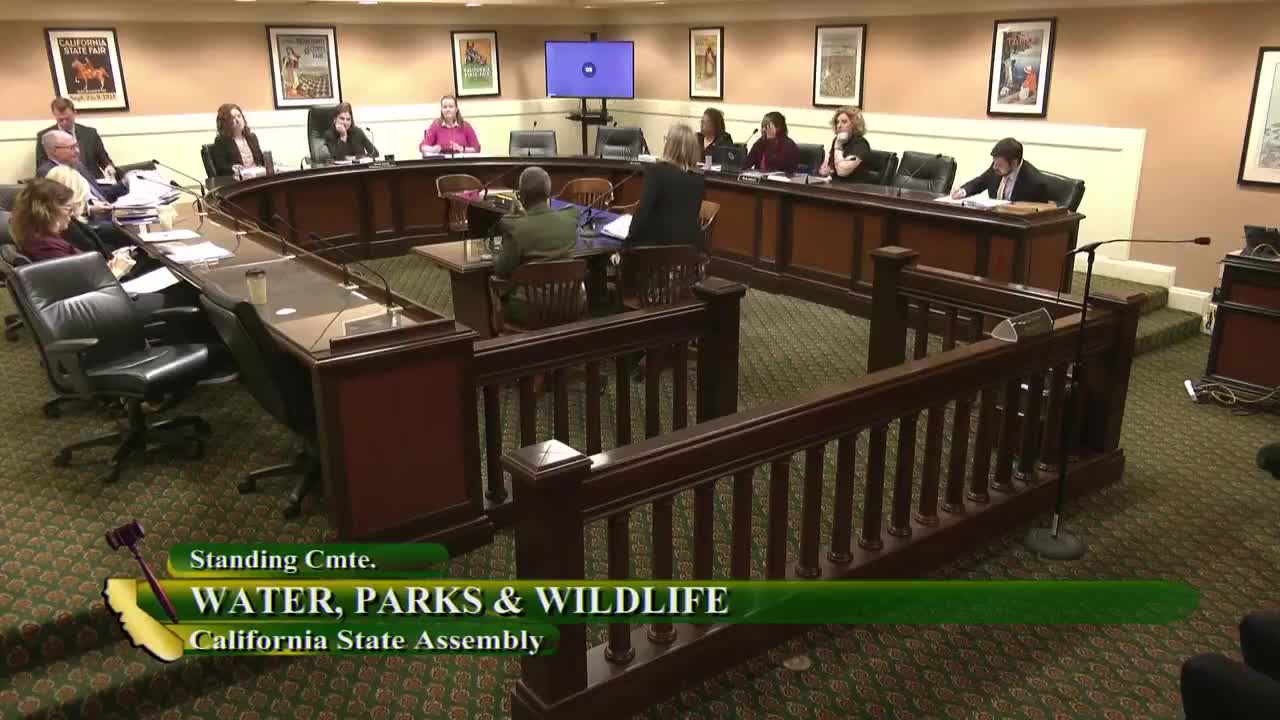 9MIN
Assembly Standing Committee on Water, Parks, and Wildlife
Bill Author

Bill Co-Author(s):