AB 2614: Water policy: California tribal communities.
- Session Year: 2023-2024
- House: Assembly
- Latest Version Date: 2024-03-21
Current Status:
Failed
(2024-05-16: In committee: Held under submission.)
Introduced
In Committee
First Chamber
In Committee
Second Chamber
Enacted
(1)The Porter-Cologne Water Quality Control Act establishes a statewide program for the control of the quality of all the waters in the state and makes certain legislative findings and declarations. Existing law defines the term beneficial uses for the purposes of water quality as certain waters of the state that may be protected against quality degradation, to include, among others, domestic, municipal, agricultural, and industrial supplies.
This bill would add findings and declarations related to California tribal communities and the importance of protecting tribal water use, as those terms are defined. The bill would add tribal water uses as waters of the state that may be protected against quality degradation for purposes of the defined term beneficial uses. The bill would require any project or regulatory program subject to approval by the State Water Quality Control Board or a regional water quality control board, within a specified environmental review, and in any findings and declarations presented for state board or a regional board approval, to describe, with both quantitative and qualitative information, how the project or regulatory program will impact tribal water uses, and would require, on or before December 1, 2025, and every 2 years thereafter, the state board to publish a report on implementation of this provision on its internet website.
(2)Existing law requires the state board to consult with and carefully evaluate the recommendations of concerned federal, state, and local agencies during the process of formulating or revising state policy for water quality control.
This bill would additionally require the state board to consult and carefully evaluate the recommendations of concerned California tribal communities.
(3)Existing law requires the state board to formulate and adopt state policy for water quality control. Existing law requires each regional board to formulate and adopt water quality control plans for all areas within the region and prohibits a water quality control plan, or a revision of the plan, adopted by a regional board from becoming effective unless it is approved by the state board. Existing law authorizes the state board to adopt certain water quality control plans. Existing law requires a regional board to establish water quality objectives in water quality control plans that in its judgment will ensure reasonable protection of beneficial uses and the prevention of nuisance and requires each regional board to consider specified factors in establishing water quality objectives.
This bill would require, on or before January 1, 2026, the state board to incorporate water quality standards to achieve reasonable protection of tribal water uses into the water quality control plan for the San Francisco Bay and Sacramento-San Joaquin Delta watershed.
This bill would add consultations with California tribal communities and environmental justice considerations as factors for a regional board to consider in establishing water quality control objectives. The bill would exempt adoption of tribal water uses within water quality control plans from the California Environmental Quality Act, and would require, on or before January 1, 2028, each regional board to adopt water quality standards to achieve reasonable protection of tribal water uses into water quality control plans.
(4)Existing law requires the California Environmental Protection Agency and the Natural Resources Agency, on or before December 1, 2007, to enter into a memorandum of understanding for the purposes of establishing the California Water Quality Monitoring Council, which the state board is required to administer. Existing law requires the monitoring council to review existing water quality monitoring, assessment, and reporting efforts and to recommend specific actions and funding needs necessary to coordinate and enhance those efforts. Existing law requires the memorandum of understanding to describe the means by which the monitoring council shall formulate recommendations to reduce redundancies, inefficiencies, and inadequacies in existing water quality monitoring and data management programs and to ensure that water quality improvement projects financed by the state provide specific information necessary to track project effectiveness with regard to achieving clean water and healthy ecosystems.
This bill would require, on or before December 1, 2025, the California Environmental Protection Agency and the Natural Resources Agency to amend the memorandum of understanding to incorporate participation from California tribal communities in the actions of the monitoring council, and would describe these potential methods of participation. The bill would require the memorandum of understating to include recommendations on how to achieve and maintain tribal water uses through state board and regional board regulatory actions and other programs, as specified.
(5)Existing constitutional provisions require that a statute that limits the right of access to the meetings of public bodies or the writings of public officials and agencies be adopted with findings demonstrating the interest protected by the limitation and the need for protecting that interest.
This bill would make legislative findings to that effect.
Existing law declares that, because of the conditions prevailing in this state, the general welfare requires that the water resources of the state be put to beneficial use to the fullest extent of which they are capable, that the waste or unreasonable use or unreasonable method of use of water be prevented, and that the conservation of the water is to be exercised with a view to the reasonable and beneficial use of the water in the interest of the people and for the public welfare.This bill would make nonsubstantive changes to that declaration.Existing law declares that, because of the conditions prevailing in this state, the general welfare requires that the water resources of the state be put to beneficial use to the fullest extent of which they are capable, that the waste or unreasonable use or unreasonable method of use of water be prevented, and that the conservation of the water is to be exercised with a view to the reasonable and beneficial use of the water in the interest of the people and for the public welfare.
This bill would make nonsubstantive changes to that declaration.
The Legislature finds and declares that the people all of the following:
(a)People of the state have a primary interest in the conservation, control, and utilization of the water resources of the state, and that the quality of all the waters of the state shall be protected for use and enjoyment by the people of the state.
The Legislature further finds and declares that activities(b)Activities and factors which that may affect the quality of the waters of the state shall be regulated to attain the highest water quality which that is reasonable, considering all demands being made and to be made on those waters and the total values involved, beneficial and detrimental, economic and social, tangible and intangible.
The Legislature further finds and declares that the(c)The health, safety safety, and welfare of the people of the state requires that there be a statewide program for the control of the quality of all the waters of the state; that the state must be prepared to exercise its full power and jurisdiction to protect the quality of waters in the state from degradation originating inside or outside the boundaries of the state; that the waters of the state are increasingly influenced by interbasin water development projects and other statewide considerations; that factors of precipitation, topography, population, recreation, agriculture, industry and economic development vary from region to region within the state; and that the statewide program for water quality control can be most effectively administered regionally, within a framework of statewide coordination and policy.
(d)California tribal communities have special ties to the bodies of water that have sustained their people, who have suffered from genocide, disease, displacement, and discrimination dating back to European colonization, and therefore tribal water uses must be protected through the statewide program for the control of the quality of all the waters of the state.
(e)Furthermore, allowing for tribal water uses should be a primary factor in determining the highest water quality that is reasonable in all regulatory decisions.
SEC. 2.Section 13050 of the Water Code is amended to read:13050.As used in this division:
(a)State board means the State Water Resources Control Board.
(b)Regional board means any California regional water quality control board for a region as specified in Section 13200.
(c)Person includes any city, county, district, the state, and the United States, to the extent authorized by federal law.
(d)Waste includes sewage and any and all other waste substances, liquid, solid, gaseous, or radioactive, associated with human habitation, or of human or animal origin, or from any producing, manufacturing, or processing operation, including waste placed within containers of whatever nature prior to, and for purposes of, disposal.
(e)Waters of the state means any surface water or groundwater, including saline waters, within the boundaries of the state.
(f)Beneficial uses of the waters of the state that may be protected against quality degradation include, but are not limited to, domestic, municipal, agricultural and industrial supply; tribal water uses; power generation; recreation; aesthetic enjoyment; navigation; and preservation and enhancement of fish, wildlife, and other aquatic resources or preserves.
(g)Quality of the water refers to chemical, physical, biological, bacteriological, radiological, and other properties and characteristics of water which that affect its use.
(h)Water quality objectives means the limits or levels of water quality constituents or characteristics which that are established for the reasonable protection of beneficial uses of water or the prevention of nuisance within a specific area.
(i)Water quality control means the regulation of any activity or factor which that may affect the quality of the waters of the state and includes the prevention and correction of water pollution and nuisance.
(j)Water quality control plan consists of a designation or establishment for the waters within a specified area of all of the following:
(1)Beneficial uses to be protected.
(2)Water quality objectives.
(3)A program of implementation needed for achieving water quality objectives.
(k)Contamination means an impairment of the quality of the waters of the state by waste to a degree which that creates a hazard to the public health through poisoning or through the spread of disease. Contamination includes any equivalent effect resulting from the disposal of waste, whether or not waters of the state are affected.
(l)(1)Pollution means an alteration of the quality of the waters of the state by waste to a degree which that unreasonably affects either of the following:
(A)The waters for beneficial uses.
(B)Facilities which that serve these beneficial uses.
(2)Pollution may include contamination.
(m)Nuisance means anything which that meets all of the following requirements:
(1)Is injurious to health, or is indecent or offensive to the senses, or an obstruction to the free use of property, so as to interfere with the comfortable enjoyment of life or property.
(2)Affects at the same time an entire community or neighborhood, or any considerable number of persons, although the extent of the annoyance or damage inflicted upon individuals may be unequal.
(3)Occurs during, or as a result of, the treatment or disposal of wastes.
(n)Recycled water means water which, that, as a result of treatment of waste, is suitable for a direct beneficial use or a controlled use that would not otherwise occur and is therefor considered a valuable resource.
(o)Citizen or domiciliary of the state includes a foreign corporation having substantial business contacts in the state or which that is subject to service of process in this state.
(p)(1)Hazardous substance means either of the following:
(A)For discharge to surface waters, any substance determined to be a hazardous substance pursuant to Section 311(b)(2) of the Federal Water Pollution Control Act (33 U.S.C. Sec. 1251 et seq.).
(B)For discharge to groundwater, any substance listed as a hazardous waste or hazardous material pursuant to Section 25140 of the Health and Safety Code, without regard to whether the substance is intended to be used, reused, or discarded, except that hazardous substance does not include any substance excluded from Section 311(b)(2) of the Federal Water Pollution Control Act because it is within the scope of Section 311(a)(1) of that act.
(2)Hazardous substance does not include any of the following:
(A)Nontoxic, nonflammable, and noncorrosive stormwater runoff drained from underground vaults, chambers, or manholes into gutters or storm sewers.
(B)Any pesticide which that is applied for agricultural purposes or is applied in accordance with a cooperative agreement authorized by Section 116180 of the Health and Safety Code, and is not discharged accidentally or for purposes of disposal, the application of which is in compliance with all applicable state and federal laws and regulations.
(C)Any discharge to surface water of a quantity less than a reportable quantity as determined by regulations issued pursuant to Section 311(b)(4) of the Federal Water Pollution Control Act.
(D)Any discharge to land which that results, or probably will result, in a discharge to groundwater if the amount of the discharge to land is less than a reportable quantity, as determined by regulations adopted pursuant to Section 13271, for substances listed as hazardous pursuant to Section 25140 of the Health and Safety Code. No discharge shall be deemed a discharge of a reportable quantity until regulations set a reportable quantity for the substance discharged.
(q)(1)Mining waste means all solid, semisolid, and liquid waste materials from the extraction, beneficiation, and processing of ores and minerals. Mining waste includes, but is not limited to, soil, waste rock, and overburden, as defined in Section 2732 of the Public Resources Code, and tailings, slag, and other processed waste materials, including cementitious materials that are managed at the cement manufacturing facility where the materials were generated.
(2)For the purposes of this subdivision, cementitious material means cement, cement kiln dust, clinker, and clinker dust.
(r)Master recycling permit means a permit issued to a supplier or a distributor, or both, of recycled water, that includes waste discharge requirements prescribed pursuant to Section 13263 and water recycling requirements prescribed pursuant to Section 13523.1.
(s)California tribal community has the same meaning as tribal community as defined in Section 13149.2.
(t)Tribal water uses means any tribal practice that involves contact with a body of water or use of animals, plants, or fungi that reside in, or are adjacent to, a body of water. A California tribal community that elects not to publicly disclose its tribal water uses may confidentially disclose them to the state board or a regional board pursuant to the consultation provisions of Section 65352.4 of the Government Code. This definition of tribal water uses shall be used exclusively and shall replace all definitions previously adopted by a state agency, including, but not limited to, definitions of tribal traditional cultural uses and tribal subsistence uses.
SEC. 3.Section 13142.1 is added to the Water Code, to read:13142.1.(a)In addition to any other policies regarding water quality established pursuant to this division, the policies of the state with respect to water quality as it relates to California tribal communities consist of both of the following:
(1)Tribal ecological knowledge should be valued and incorporated into regulatory and management programs.
(2)State agencies should make resources available for tribal comanagement of aquatic resources within traditional and current tribal lands.
(b)Any project or regulatory program subject to approval by the state board or a regional board, shall, within an environmental review pursuant to Division 13 (commencing with Section 21000) of the Public Resources Code, and in any findings and declarations presented for state board or a regional board approval, describe, with both quantitative and qualitative information, how the project or regulatory program will impact tribal water uses.
(c)On or before December 1, 2025, and every two years thereafter, the state board shall publish a report on implementation of this section on its internet website.
SEC. 4.Section 13144 of the Water Code is amended to read:13144.During the process of formulating or revising state policy for water quality control control, the state board shall consult with and carefully evaluate the recommendations of concerned federal, state, and local agencies. agencies, and California tribal communities.
SEC. 5.Section 13170.4 is added to the Water Code, to read:13170.4.On or before January 1, 2026, the state board shall incorporate water quality standards to achieve reasonable protection of tribal water uses into the water quality control plan for the San Francisco Bay and Sacramento-San Joaquin Delta watershed.
SEC. 6.Section 13181 of the Water Code is amended to read:13181.(a)(1)On or before December 1, 2007, the California Environmental Protection Agency and the Natural Resources Agency shall enter into a memorandum of understanding for the purposes of establishing the California Water Quality Monitoring Council, which shall be administered by the state board.
(2)As used in this section, monitoring council means the California Water Quality Monitoring Council established pursuant to this section.
(3)The monitoring council may include representatives from state entities and nonstate entities. The representatives from nonstate entities may include, but need not be limited to, representatives from federal and local government, California tribal communities, institutions of higher education, the regulated community, citizen monitoring groups, and other interested parties.
(4)The monitoring council shall review existing water quality monitoring, assessment, and reporting efforts, and shall recommend specific actions and funding needs necessary to coordinate and enhance those efforts.
(5)(A)The recommendations shall be prepared for the ultimate development of a cost-effective, coordinated, integrated, and comprehensive statewide network for collecting and disseminating water quality information and ongoing assessments of the health of the states waters and the effectiveness of programs to protect and improve the quality of those waters.
(B)For purposes of developing recommendations pursuant to this section, the monitoring council shall initially focus on the water quality monitoring efforts of state agencies, including, but not limited to, the state board, the regional boards, the department, the Department of Fish and Wildlife, the California Coastal Commission, the State Lands Commission, the Department of Parks and Recreation, the Department of Forestry and Fire Protection, and the Department of Pesticide Regulation.
(C)In developing the recommendations, the monitoring council shall seek to build upon existing programs, rather than create new programs.
(6)Among other things, the memorandum of understanding shall describe the means by which the monitoring council shall formulate recommendations to accomplish both all of the following:
(A)Reduce redundancies, inefficiencies, and inadequacies in existing water quality monitoring and data management programs in order to improve the effective delivery of sound, comprehensive water quality information to the public and decisionmakers.
(B)Ensure that water quality improvement projects financed by the state provide specific information necessary to track project effectiveness with regard to achieving clean water and healthy ecosystems.
(C)Achieve and maintain tribal water uses through state board and regional board regulatory action and other programs, including, but not limited to, comanagement of habitat restoration and management programs and consultations with California tribal communities.
(7)On or before December 1, 2025, the California Environmental Protection Agency and the Natural Resources Agency shall amend the memorandum of understanding to incorporate participation from California tribal communities in the actions of the monitoring council. The methods of participation may include membership on the monitoring council, creation of a tribal water quality council, and consultation with California tribal communities.
(b)The monitoring council shall report, on or before December 1, 2008, to the California Environmental Protection Agency and the Natural Resources Agency with regard to its recommendations for maximizing the efficiency and effectiveness of existing water quality data collection and dissemination, and for ensuring that collected data are maintained and available for use by decisionmakers and the public. The monitoring council shall consult with the United States Environmental Protection Agency in preparing these recommendations. The monitoring councils recommendations, and any responses submitted by the California Environmental Protection Agency or the Natural Resources Agency to those recommendations, shall be made available to decisionmakers and the public by means of the Internet. an internet website.
(c)The monitoring council shall undertake and complete, on or before April 1, 2008, a survey of its members to develop an inventory of their existing water quality monitoring and data collection efforts statewide and shall make that information available to the public.
(d)All state agencies, including institutions of higher education to the extent permitted by law, that collect water quality data or information shall cooperate with the California Environmental Protection Agency and the Natural Resources Agency in achieving the goals of the monitoring council as described in this section.
(e)In accordance with the requirements of the federal Clean Water Act (33 U.S.C. Sec. 1251 et seq.) and implementing guidance, the state board shall develop, in coordination with the monitoring council, all of the following:
(1)A comprehensive monitoring program strategy that utilizes and expands upon the states existing statewide, regional, and other monitoring capabilities and describes how the state will develop an integrated monitoring program that will serve all of the states water quality monitoring needs and address all of the states waters over time. The strategy shall include a timeline not to exceed 10 years to complete implementation. The strategy shall be comprehensive in scope and identify specific technical, integration, and resource needs, and shall recommend solutions for those needs so that the strategy may be implemented within the 10-year timeframe.
(2)Agreement, including agreement on a schedule, with regard to the comprehensive monitoring of statewide water quality protection indicators that provide a basic minimum understanding of the health of the states waters. Indicators already developed pursuant to environmental protection indicators for statewide initiatives shall be given high priority as core indicators for purposes of the network described in subdivision (a).
(3)Quality management plans and quality assurance plans that ensure the validity and utility of the data collected.
(4)Methodology for compiling, analyzing, and integrating readily available information, to the maximum extent feasible, including, but not limited to, data acquired from discharge reports, volunteer monitoring groups, local, state, and federal agencies, and recipients of state-funded or federally funded water quality improvement or restoration projects.
(5)An accessible and user-friendly electronic data system with timely data entry and ready public access via the Internet. To the maximum extent possible, the geographic location of the areas monitored shall be included in the data system.
(6)Production of timely and complete water quality reports and lists that are required under Sections 303(d), 305(b), 314, and 319 of the federal Clean Water Act and Section 406 of the federal Beaches Environmental Assessment and Coastal Health Act of 2000, that include all available information from discharge reports, volunteer monitoring groups, and local, state, and federal agencies.
(7)An update of the state boards surface water ambient monitoring program needs assessment in light of the benefits of increased coordination and integration of information from other agencies and information sources. This update shall include identification of current and future resource needs required to fully implement the coordinated, comprehensive monitoring network, including, but not limited to, funding, staff, training, laboratory and other resources, and projected improvements in the network.
(f)The state board shall identify the full costs of implementation of the comprehensive monitoring program strategy developed pursuant to subdivision (e), and shall identify proposed sources of funding for the implementation of the strategy, including federal funds that may be expended for this purpose. Fees collected pursuant to paragraph (1) of subdivision (d) of Section 13260 may be used as a funding source for implementation of the strategy to the extent that the funding is consistent with subparagraph (B) of paragraph (1) of subdivision (d) of Section 13260.
(g)Data, summary information, and reports prepared pursuant to this section shall be made available to appropriate public agencies and the public by means of the Internet.
(h)(1)Commencing December 1, 2008, the Secretary of the California Environmental Protection Agency shall conduct a triennial audit of the effectiveness of the monitoring program strategy developed pursuant to subdivision (e). The audit shall include, but need not be limited to, an assessment of the following matters:
(A)The extent to which the strategy has been implemented.
(B)The effectiveness of the monitoring and assessment program and the monitoring council with regard to both of the following:
(i)Tracking improvements in water quality.
(ii)Evaluating the overall effectiveness of programs administered by the state board or a regional board and of state and federally funded water quality improvement projects.
(2)The Secretary of the California Environmental Protection Agency shall consult with the Secretary of the Natural Resources Agency in preparing the audit, consistent with the memorandum of understanding entered into pursuant to subdivision (a).
(i)The state board shall prioritize the use of federal funding that may be applied to monitoring, including, but not limited to, funding under Section 106 of the Federal Water Pollution Control Act, for the purpose of implementing this section.
(j)The state board shall not use more than 5 percent of the funds made available to implement this section for the administrative costs of any contracts entered into for the purpose of implementing this section.
SEC. 7.Section 13241 of the Water Code is amended to read:13241.Each regional board shall establish such water quality objectives in water quality control plans as in its judgment will ensure the reasonable protection of beneficial uses and the prevention of nuisance; however, it is recognized that it may be possible for the quality of water to be changed to some degree without unreasonably affecting beneficial uses. Factors to be considered by a regional board in establishing water quality objectives shall include, but not necessarily be limited to, all of the following:
(a)Past, present, and probable future beneficial uses of water.
(b)Environmental characteristics of the hydrographic unit under consideration, including the quality of water available thereto.
(c)Water quality conditions that could reasonably be achieved through the coordinated control of all factors which that affect water quality in the area.
(d)Economic considerations.
(e)The need for developing housing within the region.
(f)The need to develop and use recycled water.
(g)Consultations with California tribal communities.
(h)Environmental justice considerations.
SEC. 8.Section 13243.5 is added to the Water Code, to read:13243.5.(a)Adoption of tribal water uses within a water quality control plan shall not be subject to the California Environmental Quality Act (Division 13 (commencing with Section 21000) of the Public Resources Code).
(b)On or before January 1, 2028, each regional board shall adopt water quality standards to achieve reasonable protection of tribal water uses into water quality control plans.
SEC. 9.The Legislature finds and declares that Section 2 of this act, which amends Section 13050 of the Water Code, imposes a limitation on the publics right of access to the meetings of public bodies or the writings of public officials and agencies within the meaning of Section 3 of Article I of the California Constitution. Pursuant to that constitutional provision, the Legislature makes the following findings to demonstrate the interest protected by this limitation and the need for protecting that interest:
This act protects from public disclosure the personal and historical information of California tribal communities and their tribal water uses disclosed to the State Water Resources Control Board or a regional water quality control board for the purposes of water quality standards.
SECTION 1.Section 100 of the Water Code is amended to read:100.It is hereby declared that, because of the conditions prevailing in this state, the general welfare requires that the water resources of the state be put to beneficial use to the fullest extent of which they are capable, that the waste or unreasonable use or unreasonable method of use of water be prevented, and that the conservation of that water is to be exercised with a view to the reasonable and beneficial use of the water in the interest of the people and for the public welfare. The right to water or to the use or flow of water in or from any natural stream or watercourse in this state is and shall be limited to that water as shall be reasonably required for the beneficial use to be served, and the right does not and shall not extend to the waste or unreasonable use or unreasonable method of use or unreasonable method of diversion of water. REVISIONS: HeadingLine 2.It is hereby declared that that, because of the conditions prevailing in this State state, the general welfare requires that the water resources of the State state be put to beneficial use to the fullest extent of which they are capable, and that the waste or unreasonable use or unreasonable method of use of water be prevented, and that the conservation of such that water is to be exercised with a view to the reasonable and beneficial use thereof of the water in the interest of the people and for the public welfare. The right to water or to the use or flow of water in or from any natural stream or watercourse in this State state is and shall be limited to such that water as shall be reasonably required for the beneficial use to be served, and such the right does not and shall not extend to the waste or unreasonable use or unreasonable method of use or unreasonable method of diversion of water.
|
Date
|
Status
|
|---|---|
| May 16, 2024 | In committee: Held under submission. |
| May 16, 2024 | Joint Rule 62(a), file notice suspended. (Page 5215.) |
| May 15, 2024 | In committee: Set, first hearing. Referred to APPR. suspense file. |
| Apr 23, 2024 | From committee: Do pass and re-refer to Com. on APPR. (Ayes 12. Noes 0.) (April 23). Re-referred to Com. on APPR. |
| Apr 10, 2024 | From committee: Do pass and re-refer to Com. on W., P., & W. (Ayes 6. Noes 0.) (April 9). Re-referred to Com. on W., P., & W. |
| Apr 10, 2024 | Coauthors revised. |
| Apr 1, 2024 | Re-referred to Com. on E.S. & T.M. |
| Mar 21, 2024 | From committee chair, with author's amendments: Amend, and re-refer to Com. on E.S. & T.M. Read second time and amended. |
| Mar 21, 2024 | Referred to Coms. on E.S. & T.M. and W., P., & W. |
| Feb 15, 2024 | From printer. May be heard in committee March 16. |
| Feb 14, 2024 | Read first time. To print. |
|
Date
|
Description
|
Location
|
Votes
|
|
|---|---|---|---|---|
| Apr 23, 2024 | Do pass and be re-referred to the Committee on [Appropriations] | Assembly Standing Committee on Water, Parks, and Wildlife |
Passed |
|
| Apr 9, 2024 | Do pass and be re-referred to the Committee on [Water, Parks, and Wildlife] | Assembly Standing Committee on Environmental Safety and Toxic Materials |
Passed |
This list shows positions taken on this bill by organizations on the date displayed, which is linked to the original source.
Positions by individuals are not included.
|
Organization
|
Position
|
Date
|
|---|---|---|
| Cahto Tribe | ** Support | |
| California Coastkeeper Alliance | ** Support | |
| California Valley Miwok Tribe Aka Sheep Ranch Rancheria | ** Support | |
| Chips Forestry | ** Support | |
| Clean Water Action | ** Support | |
| El Dorado Irrigation District | ** Against | |
| Environmental Working Group | ** Support | |
| Friends of the River | ** Support | |
| Koy’o Land Conservancy dba Colfax Todds Valley Consolidated Tribe | ** Support | |
| Los Angeles Waterkeeper | ** Support | |
| Merced River Conservation Committee | ** Support | |
| Mono Lake Committee | ** Support | |
| Pesticide Action Network | ** Support | |
| Planning And Conservation League | ** Support | |
| Restore the Delta | ** Support | |
| San Francisco Baykeeper | ** Support | |
| Save California Salmon | ** Support | |
| Shingle Springs Band Of Miwok Indians | ** Support | |
| Sierra Club California | ** Support | |
| Sierra Nevada Alliance | ** Support | |
| South Yuba River Citizens League | ** Support | |
| Union Of Concerned Scientists | ** Support | |
| Valley Ag Water Coalition | ** Against | |
| Washoe Tribe of Nevada and California | ** Support |
Date of Hearing: May 15, 2024
ASSEMBLY COMMITTEE ON APPROPRIATIONS
Buffy Wicks, Chair
ABPCA Bill Id:AB 2614
Author:(Ramos) – As Amended Ver:March 21, 2024
Policy Committee: | Environmental Safety and Toxic Materials | Vote: | 6 - 0 |
Water, Parks and Wildlife | 12 - 0 | ||
|
|
Urgency: No State Mandated Local Program: No Reimbursable: No
SUMMARY:
This bill defines “tribal water uses” and designates them as a beneficial use of water and prescribes actions water regulators must take when approving projects or regulatory programs that impact tribal water uses.
Specifically, this bill, among other things:
- Finds and declares, among other things, that tribal water uses must be protected through the statewide program for the control of the quality of all the waters of the state, and that allowing for tribal water uses should be a primary factor in determining the highest water quality that is reasonable in all regulatory decisions.
- Adds “tribal water uses”, as defined, to the definition of beneficial uses of waters of the state. Requires the definition of “tribal water uses” in this bill to be used exclusively and to replace all definitions previously adopted by a state agency, as specified.
- Allows a California tribal community that elects not to publicly disclose its tribal water uses to confidentially disclose those uses to the State Water Board or a regional water board.
- Provides that policies of the state with respect to water quality, as it relates to California tribal communities, consist of both of the following: (a) tribal ecological knowledge should be valued and incorporated into regulatory and management programs, and (b) state agencies should make resources available for tribal co-management of aquatic resources within traditional and current tribal lands.
- Requires any project or regulatory program, subject to approval by the State Water Board or a regional water board, to, within an environmental review under the California Environmental Quality Act (CEQA), describe how the project or regulatory program will impact tribal water uses, as specified.
- Requires the State Water Board, on or before December 1, 2025, and every two years thereafter, to publish a report on the implementation of 4 and 5, above.
- Requires the State Water Board, during the process of formulating or revising state policy for water quality control, to consult with and carefully evaluate the recommendations of California tribal communities.
- Requires the State Water Board, on or before January 1, 2026, to incorporate water quality standards to achieve reasonable protection of tribal water uses into the water quality control plan for the San Francisco Bay and Sacramento-San Joaquin Delta watershed (Bay-Delta Plan).
- Requires the memorandum of understanding (MOU) between the California Environmental Protection Agency (CalEPA) and the California Natural Resources Agency (CNRA) that establishes the California Water Quality Monitoring Council (Monitoring Council) to describe the means by which the Monitoring Council will formulate recommendations to achieve and maintain tribal water uses through State Water Board and regional water board regulatory action and other programs, including co-management of habitat restoration and management programs and consultations within California tribal communities.
- Requires CalEPA and CNRA, on or before December 1, 2025, to amend the MOU to incorporate participation from California tribal communities in the actions of the Monitoring Council.
- Requires each regional water board, when establishing water quality objectives, to additionally consider consultations with California tribal communities and environmental justice considerations.
- Provides that the adoption of tribal water uses within a water quality control plan shall not be subject to CEQA.
- Requires each regional water board, on or before January 1, 2028, to adopt water quality standards for the reasonable protection of tribal water uses into water quality control plans.
FISCAL EFFECT:
1) Significant ongoing costs, likely in the millions of dollars, for the State Water Board and regional water boards to implement the requirements of this bill.
The State Water Board estimates ongoing annual costs of approximately $9.7 million for staffing and $500,000 in contracting costs (for a total of $10.2 million). Additionally, the State Water Board estimates $500,000 in one-time contracting costs and an additional $1.8 million in contracting costs over the first four years of implementation. A majority of these costs will likely be borne by the Waste Discharge Permit Fund, with the remainder coming from the General Fund. These costs are associated with updating the Bay-Delta Plan and all regional water quality control plans to incorporate tribal water uses and updated water quality objectives by firm dates, increasing coordination with tribes on a variety of programs and the Monitoring Council, and incorporating tribal ecological knowledge into various programs and policies.
According to the Legislative Analyst’s Office, the General Fund faces a structural deficit in the tens of billions of dollars over the next several fiscal years.
2) CNRA anticipates its costs to be minor and absorbable.
COMMENTS:
1) Purpose. According to the author:
California tribes have been fighting to preserve their way of life since the beginning of California’s history. The state and tribes have been working hand in hand to correct injustices and heal historical trauma. Laws have been passed mandating consultation and preservation of tribal sacred sites and cultural resources. However; tribes cannot maintain their ways of life without access to the plants and animals sustained by healthy rivers and lakes. AB 2614 would establish statewide tribal beneficial water uses, which would ensure all California tribes can benefit from water quality management plans that would place cultural uses on equal footing with other uses.
2) Background.
Tribal Beneficial Uses (TBUs). While several beneficial uses are recognized in statute, none is defined in statute. The Shingle Springs Band of Miwok Indians, the sponsor of this bill, argues that “establishing TBUs in statute would ensure that all California tribes can benefit from water quality management plans that place tribal water uses on equal footing with other uses, such as recreation and hydropower generation.” This bill defines TBUs in statute and requires that the definition replace all other definitions of tribal water use adopted by a state agency. This applies to the State Water Board’s adoption of “tribal traditional cultural uses” and “tribal subsistence uses” via Resolution 2017-0027, which followed significant stakeholder input, including with tribal representatives.
Water Quality Control Plans or Basin Plans. These terms are used interchangeably and are the foundation for the regional water boards’ water quality regulatory programs. Pursuant to Resolution 2017-0027, each regional board must initiate and complete a basin planning process for TBUs to be incorporated into its basin plan. This is a multi-step process that includes engaging tribes in the region to determine what and where TBUs are occurring.
Bay-Delta Plan. This basin plan is distinct given the importance of the Bay-Delta waterbody to the entire state. The process for the current update commenced in 2009. The State Water Board has been unable to comply with state and federal requirements for periodic and triennial review of the Bay-Delta Plan for various reasons. This bill requires the State Water Board to incorporate protections for TBUs into the Bay-Delta Plan by January 1, 2026.
The U.S. Environmental Protection Agency’s Office of External Civil Rights opened a formal civil rights investigation in 2023 in response to a complaint from this bill’s sponsor and some of its supporters. The complaint alleges that the State Water Board’s failure to update Bay-Delta water quality standards discriminates against members of Native Tribes and Black, Asian, and Latino persons residing in and around the San Francisco Bay/Sacramento-San Joaquin Delta watershed. Furthermore, the complaint alleges that the State Water Board has “intentionally excluded local Native Tribes and Black, Asian, and Latino residents from participation in the policymaking process associated with the Bay-Delta Plan.” This investigation is ongoing.
Writing in an oppose-unless-amended position, the Association of California Water Agencies (ACWA) argues, among many other things, that the proposed definition of tribal water uses would replace existing definitions already adopted into regional water quality control plans “which are not as broad as the definition proposed in statute, and potentially lead to significant water supply impacts throughout California.” ACWA objects to the language in the bill’s findings and declarations that “appears intended to provide tribal water uses elevated priority over other beneficial uses.” ACWA objects to the CEQA exemption for the adoption of tribal water uses within basin plans and argues that the January 1, 2028, compliance date is infeasible. ACWA also argues that the Bay-Delta provision “would disrupt the current regulatory process and create many uncertainties that this bill fails to address.”
Analysis Prepared by: Nikita Koraddi / APPR. / (916) 319-2081
Date of Hearing: April 23, 2024
ASSEMBLY COMMITTEE ON WATER, PARKS, AND WILDLIFE
Diane Papan, Chair
ABPCA Bill Id:AB 2614 (
Author:Ramos) – As Amended Ver:March 21, 2024
SUBJECT: Water policy: California tribal communities
SUMMARY: Defines “tribal water uses” and designates them as a beneficial use of water. Requires the State Water Resources Control Board (State Water Board) and the Regional Water Quality Control Boards (Regional Water Boards), when approving a project or regulatory program, to describe how that project or regulatory program would impact tribal water uses and to incorporate tribal uses of water into water quality control plans. Specifically, this bill:
- Adds “tribal water uses” to the definition of beneficial uses of waters of the state.
- Defines "tribal water uses" as any tribal practice that involves contact with a body of water or use of animals, plants, or fungi that reside in, or are adjacent to, a body of water.
- Allows a California tribal community that elects not to publicly disclose its tribal water uses to confidentially disclose them to the State Water Board or a Regional Water Board.
- Requires the above definition of tribal water uses to be used exclusively and to replace all definitions previously adopted by a state agency, including but not limited to, definitions of "tribal traditional cultural uses" and "tribal subsistence uses.”
- Provides that policies of the state with respect to water quality, as it relates to California tribal communities, consist of both of the following:
- Tribal ecological knowledge should be valued and incorporated into regulatory and management programs; and
- State agencies should make resources available for tribal co-management of aquatic resources within traditional and current tribal lands.
- Requires any project or regulatory program, subject to approval by the State Water Board or a Regional Water Board, to—within an environmental review under the California Environmental Quality Act (CEQA)—describe, with both quantitative and qualitative information, how the project or regulatory program will impact tribal water uses.
- Requires the State Water Board to publish a report on the implementation of #5 and #6, above, on or before December 1, 2025 and every two years thereafter.
- Requires the State Water Board, during the process of formulating or revising state policy for water quality control, to consult with and carefully evaluate the recommendations of California tribal communities.
- Requires, on or before January 1, 2026, the State Water Board to incorporate water quality standards to achieve reasonable protection of tribal water uses into the water quality control plan for the San Francisco Bay and Sacramento-San Joaquin Delta watershed (Bay-Delta Plan).
- Requires the memorandum of understanding (MOU) between the California Environmental Protection Agency (CalEPA) and the Natural Resources Agency (NRA) that establishes the California Water Quality Monitoring Council (Monitoring Council) to describe the means by which the Monitoring Council will formulate recommendations to achieve and maintain tribal water uses through State Water Board and Regional Water Board regulatory actions and other programs, including but not limited to, co-management of habitat restoration and management programs and consultations within California tribal communities.
- Requires, on or before December 1, 2025, CalEPA and NRA to amend the MOU to incorporate participation from California tribal communities in the actions of the Monitoring Council.
- Requires Regional Water Boards, when establishing water quality objectives, to additionally consider the following factors:
- Consultations with California tribal communities; and
- Environmental justice considerations.
- Provides that the adoption of tribal water uses within a water quality control plan shall not be subject to CEQA.
- Requires, on or before January 1, 2028, each Regional Water Board to adopt water quality standards for the reasonable protection of tribal water uses into water quality control plans.
- Makes the following findings and declarations:
- California tribal communities have special ties to the bodies of water that have sustained their people, who have suffered from genocide, disease, displacement, and discrimination dating back to European colonization, and therefore tribal water uses must be protected through the statewide program for the control of the quality of all the waters of the state and
- Allowing for tribal water uses should be a primary factor in determining the highest water quality that is reasonable in all regulatory decisions.
EXISTING LAW:
- Establishes the federal Clean Water Act (CWA) to regulate discharges of pollutants into the waters of the United States (U.S.) and regulate quality standards for surface waters (33 United States Code (USC) § 1251 et seq.).
2) Pursuant to the Porter-Cologne Water Quality Control Act (Porter-Cologne), prohibits the discharge of pollutants to surface waters unless the discharger obtains a permit from the State Water Board (Water Code § 13000 et seq.)
3) Provides that beneficial uses of waters of the state include, domestic, municipal, agricultural and industrial supply, power generation, recreation, aesthetic enjoyment, navigation, and preservation and enhancement of fish, wildlife, and other aquatic resources or preserves [Water Code § 13050 (f)].
4) Requires the State Water Board, during the process of formulating or revising state policy for water quality control, to consult with, and carefully evaluate the recommendations of, concerned federal, state, and local agencies (Water Code § 13144).
5) Requires, on or before December 1, 2007, CalEPA and the NRA to enter into an MOU for the purposes of establishing the Monitoring Council. Requires the State Water Board to administer the Monitoring Council (Water Code § 13181).
6) Delegates to California’s Regional Water Boards the ability to adopt water quality standards within their region of jurisdiction (Water Code § 13240).
7) Requires a Regional Water Board to prescribe requirements for any proposed discharge, existing discharge, or material change in an existing discharge, except discharges into a community sewer system, with relation to the conditions existing in the disposal area upon or receiving waters into which the discharge is made or proposed. Specifies that requirements that implement any relevant water quality control plans have been adopted and take into consideration the beneficial uses to be protected, water quality objectives, other waste discharges, and the need to prevent nuisance (Water Code § 13269 et seq.).
FISCAL EFFECT: Unknown. This bill is keyed fiscal.
COMMENTS:
- Purpose of this bill. According to the author: “California tribes have been fighting to preserve their way of life since the beginning of California’s history. The state and tribes have been working hand in hand to correct injustices and heal historical trauma. Laws have been passed mandating consultation and preservation of tribal sacred sites and cultural resources. However; tribes cannot maintain their ways of life without access to the plants and animals sustained by healthy rivers and lakes. AB 2614 would establish statewide tribal beneficial water uses, which would ensure all California tribes can benefit from water quality management plans that would place cultural uses on equal footing with other uses.”
- Background. California is home to the largest Native American population in the country and has 110 federally recognized tribes[1] with another 81 groups seeking federal recognition.[2] According to 2020 U.S. Census data, 631,016 Californians identify as “American Indian” or “Alaska Native”; when including the Californians that identify as “American Indian” or “Alaska Native” in combination with another race or ethnicity, the number of Native Americans in California increases to 1.4 million residents.[3]
Very few Native Americans live on their ancestral lands in California today. This is due to the repeated efforts of Spanish, Mexican, Russian, and U.S. governments to subdue and displace indigenous peoples: “All four colonial nations sponsored policies that uprooted Indigenous People and communities from the lands in which they were created, and all four deployed violence, in the form of slavery, genocide, and an administrative state bent on eliminating California Indian people.”[4]
The federal government sent three commissioners to California to negotiate treaties with California tribes in 1851. These commissioners negotiated 18 treaties with 139 tribes that would have set aside 7.5 million acres for Indian use and granted other rights to Native Californians; however, when President Fillmore submitted the treaties to the U.S. Senate for ratification in February 1852, senators from California objected and the U.S. Senate rejected the treaties during a secret session. The U.S. Senate then placed the treaties in its archive, concealing the existence of these treaties from the public for more than 50 years.[5] In 1903, the federal government sent another Indian agent to California to settle Indians on reserved lands. By that time, however, many tribes no longer lived on their ancestral lands, so small plots of land were established for Indian families.
Lands legally controlled by tribes in California today result from presidential executive order, federal statute, or action by tribes and tribal members themselves to purchase land. Water rights were not often appropriately accounted for in the protection of tribal lands.
Water is essential for all life and, like other groups across the globe, “quite often, Indigenous People chose to live on or near bodies of water.”[6] In addition, many tribes strongly believe that water is an interconnected element that flows through all spaces in tribal communities. This stems from their own Indigenous Knowledge Systems (IKS); these systems are tribes own skills, perceptions, ideologies, and experiences. One component of IKS is Traditional Ecological Knowledge, the relationship between the people and the direct contact with the environment.[7] For example, water holds importance with regard to farming which provides sustenance for community members, fishing which also provides sustenance, and ceremonial use for healing. Some tribal communities’ creation stories include water, some which share that water sources like springs and underground waterways are pathways which connect the ancestors from the past to the present.[8]
Federal Clean Water Act (CWA): The Federal Water Pollution Control Act of 1948 was the first major U.S. law to address water pollution. The law was amended in 1972 and became commonly known as CWA. The federal CWA establishes the basic structure for regulating discharges of pollutants into the waters of the U.S and regulating quality standards for surface waters. Under the CWA, the U.S. Environmental Protection Agency (U.S. EPA) has implemented pollution control programs, including setting wastewater standards for industrial facilities, as well as setting water quality standards for all contaminants in surface waters. The CWA made it unlawful to discharge any pollutant from a point source into navigable waters without a permit.
State regulation of water pollution. The State Water Board is responsible for administering the federal CWA and California’s Water Quality Act (Porter-Cologne), enacted in 1969, which set up the statewide structure for water quality control. Porter-Cologne designates the State Water Board as the water pollution control agency for all purposes stated in the CWA, and it authorizes the State Water Board to exercise any powers that the federal CWA delegates to the State. The State Water Board and Regional Water Boards are charged with preventing and reducing water pollution in rivers, streams, lakes, beaches, bays, and groundwater.
California Water Quality Monitoring Council. In November 2007, an MOU was signed by the Secretaries of CalEPA and NRA to establish the Monitoring Council. The MOU requires the boards, departments, and offices within CalEPA and NRA to integrate and coordinate their water quality and related ecosystem monitoring, assessments, and reporting.
The Monitoring Council is required to develop specific recommendations to improve the coordination and cost-effectiveness of water quality and ecosystem monitoring and assessment, enhance the integration of monitoring data across departments and agencies, and increase public accessibility to monitoring data and assessment information. While the Monitoring Council may recommend new monitoring or management initiatives, it aims to build on existing efforts to the greatest extent possible.
Beneficial uses of water. Beneficial uses are goals the State Water Board designates to ensure Californians have access to the highest water quality and can use it for maximum benefit. Beneficial uses are typically defined in the California Code of Regulations. Examples of beneficial uses include recreation, navigation, and preservation and enhancement of fish, wildlife, and other aquatic resources or preserves.
Tribal beneficial uses (TBU) of water. TBUs are a group of beneficial uses that can help protect activities specific to Native American cultures and their uses of California waters, including the consumption of non-commercial fish or shellfish. TBUs can also be referred to as cultural uses of water.
State Water Board resolution regarding TBUs. In 2016, the State Water Board adopted Resolution 2016-0011, which directs staff to develop proposed beneficial use definitions pertaining to tribal traditional and cultural use, tribal subsistence fishing, and subsistence fishing. The State Water Board's resolution specifies (in Attachment A) the following beneficial uses, as proposed by tribes, tribal representatives, and environmental justice representatives:
- “California Indian Tribal Traditional and Cultural Use: Uses of water that supports the cultural, spiritual and traditional rights and lifeways of California Indian Tribes. This includes but is not limited to: fishing, gathering, and safe consumption of traditional foods and materials, as defined by California Indian Tribes, for subsistence, cultural, spiritual, ceremonial and navigational activities associated with such uses;”
- “California Indian Tribal Subsistence Fishing Use: Uses of water that supports the gathering and distribution of natural aquatic resources, including fish and shellfish, to meet traditional food needs of California Tribal individuals, households and communities for personal, family and community consumption, and for traditional and/or ceremonial purposes;” and
- “Subsistence Fishing: Uses of water that support the non-commercial catching or gathering of natural aquatic resources, including fish and shellfish, by individuals for the personal consumption by individuals and their households or communities, to meet fundamental needs for sustenance due to cultural tradition, lack of personal economic resources, or both.”
Following the adopting Resolution 2016-0011, the State Water Board updated the statewide Water Quality Control Plan for Inland Surface Waters, Enclosed Bays, and Estuaries of California to incorporate three TBUs: tribal tradition and culture, tribal subsistence fishing, and subsistence fishing. This was accomplished through the adoption of Resolution 2017-0027 on May 2, 2017. The definitions of TBUs referenced in Resolution 2017-0027 were developed after robust public engagement and input, including with representatives of tribal California Native American Tribes.
Water Quality Control Plans/Basin Plans. These terms are used interchangeably and are the foundation for the Regional Water Boards’ water quality regulatory programs and are regulatory references for meeting the state and federal requirements for water quality control. They provide a plan of action designed to preserve and enhance water quality and require public participation. Each Regional Water Board has its own Basin Plan(s). Basin Plans contain:
- Beneficial use definitions;
- Designated beneficial uses for both surface and ground water bodies in the basin;
- Water quality objectives to protect those beneficial uses;
- Implementation plans that describe the actions necessary to achieve water quality objectives; and
- Descriptions of the surveillance and monitoring activities needed to determine regulatory compliance and assess the health of the water resources.
The nine Regional Water Boards are required to develop and adopt Basin Plans. The Regional Water Boards review their Basin Plans every three years and determine a list of basin-planning priority projects (a process known as the “triennial review”).
TBUs under each Regional Water Board. Resolution 2017-0027 also directs the Regional Water Board to use these TBUs “to the extent the Regional Water Boards describe such uses in a water quality control plan after the effective date” of the resolution. The nine Regional Water Boards must initiate and complete a basin-planning process for the beneficial uses to be incorporated into their respective basin plans. This is a multi-step process that includes adding TBU definitions to the basin plan, identifying water bodies within the basin where tribal uses are occurring, establishing water quality objectives to protect those TBUs (e.g., standards for levels of contaminants in a given water body), developing an implementation plan to achieve the water quality standards, and following the implementation program. An important part of this process is engaging tribes in the region to determine what and where (i.e., in what river, lake, or stream) TBUs are occurring. According to the State Water Board, Tribal Affairs website, the nine Regional Water Boards are at different stages in this process:
Table 1 – Status of incorporation into Basin Plans by Regional Water Board.
Regional Board | Add TBU definitions to Basin Plan | Designate waterbodies or parts of water bodies with TBUs | Establish water quality objectives and implementation programs for TBUs | Implementation |
Region 1 – North Coast | In progress | Not started | Not started | Not started |
Region 2 – San Francisco | Not started | Not started | Not started | Not started |
Region 3 – Central Coast | In progress | Not started | Not started | Not started |
Region 4 – Los Angeles | Completed | Gathering information | Not started | Not started |
Region 5 – Central Valley | Completed | Gathering information | Not started | Not started |
Region 6 – Lahontan | Completed | In progress | Not started | Not started |
Region 7 – Colorado River | In progress | Not started | Not started | Not started |
Region 8 – Santa Ana | In progress | Not started | Not started | Not started |
Region 9 – San Diego | Completed | Gathering information | Not started | No started |
As an example, the Lahontan Regional Water Boards designated “tribal tradition and culture,” “subsistence fishing,” and “tribal subsistence fishing” as beneficial uses in its basin plan in September 2020 via Resolution No. R6T-2020-0057. This was a first step, but to realize protection of these beneficial uses, the Lahontan Regional Water Board initiated a process to engage tribes in the region, including the Mono Lake Kootzaduka’a Tribe, and identify waterbodies where these beneficial uses occur. Having completed that, the Lahontan Regional Water Board is in the midst of designating these TBUs for waterbodies in the Mono Basin (Mono County). The draft update and environmental document are currently posted for public review. The Lahontan Regional Water Boards will be accepting comments through April 30, 2024 and is expected to finalize the update later this year.
Bay-Delta Plan. This Basin Plan is distinct given the importance of the Bay-Delta waterbody to the entire state. Observing the ecological decline of the Bay-Delta in the late 1970’s, the State Water Board exercised its authority under Porter-Cologne and CWA to preempt the Regional Water Board and be the lead in setting water quality standards for the waterbody. The process for the current update commenced in 2009. Though state law requires that a water quality control plan be “periodically reviewed” (Water Code § 13240) and the federal CWA requires triennial review of water quality control plans [33 USC § 1313(c)], the State Water Board has been unable to comply with these requirements for periodic or triennial review of the Bay-Delta Plan for various reasons. This bill requires the State Water Board to incorporate protections for TBUs into the Bay-Delta Plan by January 1, 2026.
Civil rights investigation regarding Bay-Delta Plan update. The U.S. EPA Office of External Civil Rights Compliance (OERC) notified the State Water Board in August 2023 that is was opening a formal civil rights investigation in response to a complaint from this bill’s sponsor and some of its supporters. The complaint alleges that the State Water Board’s failure to update Bay-Delta water quality standards discriminates against members of Native Tribes and Black, Asian and Latino persons residing in and around the San Francisco Bay/Sacramento-San Joaquin Delta watershed, particularly the South Stockton community. Furthermore, the complaint alleges that the State Water Board has intentionally excluded local Native Tribes and Black, Asian, and Latino residents from participation in the policymaking process associated with the Bay-Delta Plan. This investigation is ongoing.
- Arguments in support. The Shingle Springs Band of Miwok Indians is the sponsor of this bill and maintains that “the regulatory process to establish TBUs is fragmented by region and subject to racist and onerous requirements on tribes to document that their water-related practices deserve equal protection as other established beneficial uses.” The sponsor notes that “the Governor has officially recognized and apologized for the legacy of genocide and discrimination against indigenous peoples. The Legislature has passed bills to mandate tribal consultation and preservation of sacred sites. Nevertheless, tribes cannot maintain their ways of life without access to the plants and animals sustained by healthy rivers and lakes.” Finally, the sponsor argues that “establishing TBUs in statute would ensure that all California tribes can benefit from water quality management plans that place tribal water uses on equal footing with other uses, such as recreation and hydropower generation.”
- Oppose unless amended. The Valley Ag Water Coalition (VAWC) has taken an “oppose unless amended” position on this bill and argues that this bill “would set tribal water uses apart from other competing uses of waters of the state in terms of water quality and priority of use.” VAWC objects to defining TBUs in statute and notes that all other definitions of beneficial uses of water are in regulation. In addition, VAWC expresses concern that this bill will delay completion of the long-overdue Bay-Delta Plan and even “halt proceedings to update the Bay-Delta Plan until the state board approves beneficial use definitions that are specific to tribal water uses.” VACW also maintains the exempting the adoption of TBUs from CEQA “would be counter to the objective of CEQA, which is intended to inform government decision makers and the public about the potential environmental effects of proposed activities and to prevent significant, avoidable environmental damage.” Finally, VACW contends this bill’s provisions that pertain to the Monitoring Council “would expand the scope of the Monitoring Council far beyond its stated purpose” and direct it to formulate recommendations regarding tribal water uses that would conflict with existing law.
- Policy considerations. This is a broad and sweeping bill. As the Committee weighs this bill, it may wish to take into account the following:
- What is the best way to incorporate input from affected stakeholders in defining and designating TBUs? This bill defines TBUs in statute and requires that it replace all other definitions of tribal water use adopted by a state agency. This applies to the State Water Board’s adoption of “tribal traditional cultural uses” and “tribal subsistence uses” via Resolution 2017-0027. Given that there was significant stakeholder input, including with tribal representatives, in developing these definitions, it is questionable whether it is warranted for the Legislature to over-ride the State Water Board’s work as well as that of those Regional Water Boards that are engaging stakeholders in their respective regions. Are the stakeholders that provided input in those processes aware of this bill? Do those stakeholders agree with the definition of tribal water uses contained in this bill? The Committee does not have this information. The Legislature regularly, and appropriately, delegates this type of task to state agencies to allow for more robust public engagement, to work through nuance, and to tailor needs to local conditions, communities, and stakeholders.
- Is it appropriate to define TBUs in statute? While several beneficial uses are recognized in statute, none are defined in statute. Beneficial uses are defined in regulation and in water quality control plans. It is unclear what the implications of defining TBUs, or any beneficial use, in statute are, but the approach in this bill is inconsistent with the state’s approach in defining other beneficial uses of water.
- What is the most effective way to expedite long and technical regulatory processes? Many stakeholders involved in the water quality control planning process are frustrated by the length of time it takes to make amendments to the plans; however, by mandating that water quality standards be adopted by a firm date, this bill may short-circuit a process that necessarily considers technical and complex issues and that requires extensive stakeholder engagement. This could result in undesirable outcomes.
- Will this bill lead to further delay in the process to update the Bay-Delta Plan? The existing process to update the Bay-Delta Plan had already taken more than a decade and is long over-due. The mandate to incorporate water quality standards to protect TBUs into the Bay-Delta Plan by January 1, 2026 will require a significant amount of work. In addition, the current process to update the Bay-Delta Plan is the subject of an ongoing civil rights investigation by U.S. EPA, as discussed above.
- Proposed committee amendments. To address some of the policy considerations, above, the Committee may wish to request that the author accept the following amendments:
Amendment 1 – strike statutory definition of TBUs and, instead, define in regulation:
Water Code § 13050. As used in this division: …(t) “Tribal water uses” means any tribal practice that involves contact with a body of water or use of animals, plants, or fungi that reside in, or are adjacent to, a body of water. A California tribal community that elects not to publicly disclose its tribal water uses may confidentially disclose them to the state board or a regional board pursuant to the consultation provisions of Section 65352.4 of the Government Code. This definition of tribal water uses shall be used exclusively and shall replace all definitions previously adopted by a state agency, including, but not limited to, definitions of “tribal traditional cultural uses” and “tribal subsistence uses.”Add § 13052 to the Water Code:
13052. The board shall adopt regulations to define tribal beneficial uses of water by December 31, 2025. In adopting regulations, the board shall make allowances for the desire of any California tribal community that elects not to publicly disclose its tribal water uses and that desires to confidentially disclose them to the state board or a regional board pursuant to the consultation provisions of Section 65352.4 of the Government Code. This section shall sunset on January 1, 2026.
13243.5. (a) Adoption of tribal water uses within a water quality control plan shall not be subject to the California Environmental Quality Act (Division 13 (commencing with Section 21000) of the Public Resources Code).
(b) Upon the next triennial review of a water quality control plan after January 1, 2025On or before January 1, 2028, each regional board shall define tribal beneficial uses in its respective water quality control plan and, where applicable, adopt water quality standards to achieve reasonable protection of tribal water uses into water quality control plans.
- Double referral. This bill was also referred to the Assembly Environmental Safety and Toxic Materials Committee where it passed 6-0 on April 9, 2024.
- Related legislation. AB 676 (Bennett) of 2023 would have clarified, for purposes of implementing state policy regarding the management of water resources, what constitutes “domestic purposes.” AB 676 was vetoed by the Governor. The veto message stated:
“While I appreciate the author's intent to clarify existing law, which has remained untouched since 1943, this bill has the potential to introduce unnecessary legal uncertainty. Courts have defined domestic use for nearly half a century, and codifying specific definitions now unnecessarily risks inadvertent omissions.”
AB 2108 (Robert Rivas), Chapter 347, Statutes of 2022, requires the State Water Board and the Regional Water Boards to make programmatic findings on potential environmental justice, tribal impact, and racial equity considerations when issuing regional or reissuing statewide waste discharge requirements or waivers of waste discharge requirements. Requires the State Water Board and Regional Water Boards to engage communities impacted by proposed discharges of waste throughout the waste discharge planning, policy, and permitting process.
AB 2936 (Quirk) of 2022 would have required the State Water Board to complete the update of the Bay Delta Plan by December 31, 2023, and places a moratorium on new water right permits resulting in increased diversions in the Bay-Delta watershed if the update is not completed by January 1, 2024. AB 2639 failed passage on the Assembly Floor 34-26.
REGISTERED SUPPORT / OPPOSITION:
Support
Shingle Springs Band of Miwok Indians (sponsor)
Cahto Tribe
California Coastkeeper Alliance
California Valley Miwok Tribe Aka Sheep Ranch Rancheria
CHIPS Forestry
Clean Water Action
Environmental Working Group
Friends of the River
Koy’o Land Conservancy Dba Colfax Todds Valley Consolidated Tribe
Los Angeles Waterkeeper
Merced River Conservation Committee
Mono Lake Committee
Pesticide Action Network
Planning and Conservation League
Restore the Delta
San Francisco Baykeeper
Save California Salmon
Sierra Club California
Sierra Nevada Alliance
South Yuba River Citizens League
Union of Concerned Scientists
Washoe Tribe of Nevada and California
Oppose Unless Amended
El Dorado Irrigation District
Valley Ag Water Coalition
Opposition
None on file
Analysis Prepared by: Pablo Garza / W., P., & W. / (916) 319-2096
U.S. Department of Health and Human Services, Indian Health Service. (2022, Jan 28). List of Federally-Recognized Tribes in CA. https://www.ihs.gov/california/index.cfm/tribal-consultation/resources-for-tribal-leaders/list-of-federally-recognized-tribes-in-ca/. ↑
Center for Families, Children & the Courts. (2012, Jan). Frequently Asked Questions: Indian Tribes and Tribal Communities in California. https://www.courts.ca.gov/documents/TribalFAQs.pdf. ↑
U.S. Census Bureau. (2020, Aug 12). Race and Ethnicity in the United States: 2010 Census and 2020 Census. https://www.census.gov/library/visualizations/interactive/race-and-ethnicity-in-the-united-state-2010-and-2020-census.html. ↑
Akins, D. and Bauer, Jr., W. (2021). We Are the Land: A History of Native California. Oakland: University of California Press, p. 3. ↑
U.S. National Park Service. (2004, Nov 17). A History of Native American Indians in California 1849-1879. https://www.nps.gov/parkhistory/online_books/5views/5views1c.htm. ↑
Akins, D. and Bauer, Jr., W. (2021). We Are the Land: A History of Native California. Oakland: University of California Press, p. 16. ↑
U.S. Department of Interior, Bureau of Indian Affairs. (n.d.). Traditional Ecological Knowledge. https://www.bia.gov/bia/ots/dfwfm/bwfm/fuels-management/traditional-ecological-knowledge. ↑
Larned, S. M. (2018) Water is Life: The Native American Tribal Role in Protecting Natural Resources. Environmental and Earth Law Journal, Vol. 8, 57-58. ↑
Date of Hearing: April 9, 2024
ASSEMBLY COMMITTEE ON ENVIRONMENTAL SAFETY AND TOXIC MATERIALS
Eduardo Garcia, Chair
ABPCA Bill Id:AB 2614 (
Author:Ramos) – As Amended Ver:March 21, 2024
SUBJECT: Water policy: California tribal communities
SUMMARY: Defines tribal water uses and requires this definition to be used by state agencies in place of previously used definitions for tribal traditional cultural uses and tribal subsistence uses. Requires the State Water Resources Control Board (State Water Board) and the Regional Water Quality Control Boards (Regional Water Boards), when approving a project or regulatory program, to describe how that project or regulatory program would impact tribal water uses. Specifically, this bill:
1) States that the Legislature finds and declares:
a) California tribal communities have special ties to the bodies of water that have sustained their people, who have suffered from genocide, disease, displacement, and discrimination dating back to European colonization, and therefore tribal water uses must be protected through the statewide program for the control of the quality of all the waters of the state.
b) Furthermore, allowing for tribal water uses should be a primary factor in determining the highest water quality that is reasonable in all regulatory decisions.
2) Changes the definition of beneficial uses of waters of the state to include tribal water uses.
3) Defines "tribal water uses" as any tribal practice that involves contact with a body of water or use of animals, plants, or fungi that reside in, or are adjacent to a body of water.
4) Allows a California tribal community that elects not to publicly disclose its tribal water uses to confidentially disclose them to the State Water Board or a Regional Water Board.
5) Requires the above definition of tribal water uses to be used exclusively and to replace all definitions previously adopted by a state agency, including but not limited to, definitions of "tribal traditional cultural uses" and "tribal subsistence uses."
6) Requires that policies of the state, with respect to water quality as it relates to California tribal communities, consist of both of the following:
a) Tribal ecological knowledge should be valued and incorporated into regulatory and management programs; and
b) State agencies should make resources available for tribal co-management of aquatic resources within traditional and current tribal lands.
7) Requires any project or regulatory program, subject to approval by the State Water Board or a Regional Water Board, to—within an environmental review under the California Environmental Quality Act (CEQA)—describe, with both quantitative and qualitative information, how the project or regulatory program will impact tribal water uses.
8) Requires the State Water Board, during the process of formulating or revising state policy for water quality control, to consult with and carefully evaluate the recommendations of California tribal communities.
9) Requires, on or before January 1, 2026, the State Water Board to incorporate water quality standards to achieve reasonable protection of tribal water uses into the water quality control plan for the San Francisco Bay and Sacramento-San Joaquin Delta watershed.
10) Requires the memorandum of understanding (MOU) between the California Environmental Protection Agency (CalEPA) and the Natural Resources Agency (NRA) that establishes the California Water Quality Monitoring Council (Monitoring Council) to describe the means by which the Monitoring Council will formulate recommendations to achieve and maintain tribal water uses through State Water Board and Regional Water Board regulatory action and other programs, including but not limited to, co-management of habitat restoration and management programs and consultations within California tribal communities.
11) Requires, on or before December 1, 2025, CalEPA and NRA to amend the MOU to incorporate participation from California tribal communities in the actions of the Monitoring Council.
12) Requires Regional Water Boards, when establishing water quality objectives, to additionally consider the following factors:
a) Consultations with California tribal communities; and
b) Environmental justice considerations.
13) Provides that the adoption of tribal water uses within a water quality control plan shall not be subject to CEQA.
14) Requires, on or before January 1, 2028, each Regional Water Board to adopt water quality standards for the reasonable protection of tribal water uses into water quality control plans.
EXISTING LAW:
- Establishes the federal Clean Water Act (CWA) to regulate discharges of pollutants into the waters of the United States and regulate quality standards for surface waters. (33 United States Code (USC) § 1251, et seq.)
2) Pursuant to the Porter-Cologne Water Quality Control Act (Porter-Cologne), prohibits the discharge of pollutants to surface waters unless the discharger obtains a permit from the State Water Board. (Water Code (WC) § 13000, et seq.)
3) Defines "beneficial uses" of waters of the state that may be protected against quality degradation to include, but not be limited to, domestic, municipal, agricultural and industrial supply; power generation; recreation; aesthetic enjoyment; navigation; and preservation and enhancement of fish, wildlife, and other aquatic resources or preserves. (WC § 13050 (f))
4) Requires the State Water Board, during the process of formulating or revising state policy for water quality control, to consult with and carefully evaluate the recommendations of concerned federal, state, and local agencies. (WC § 13144)
5) Requires, on or before December 1, 2007, CalEPA and the NRA to enter into an MOU for the purposes of establishing the Monitoring Council. Requires the State Water Board to administer the Monitoring Council. (WC § 13181)
6) Delegates to California’s Regional Water Boards the ability to adopt water quality standards within their region of jurisdiction. (WC § 13240)
7) Requires a Regional Water Board to prescribe requirements for any proposed discharge, existing discharge, or material change in an existing discharge, except discharges into a community sewer system, with relation to the conditions existing in the disposal area upon or receiving waters into which the discharge is made or proposed. Specifies that requirements that implement any relevant water quality control plans have been adopted, and take into consideration, the beneficial uses to be protected, water quality objectives, other waste discharges and the need to prevent nuisance. (WC § 13269, et seq.)
FISCAL EFFECT: Unknown.
COMMENTS:
Need for the bill: According to the author: "California tribes have been fighting to preserve their way of life since the beginning of California’s history. The state and tribes have been working hand in hand to correct injustices and heal historical trauma. Laws have been passed mandating consultation and preservation of tribal sacred sites and cultural resources. However; tribes cannot maintain their ways of life without access to the plants and animals sustained by healthy rivers and lakes. AB 2614 would establish statewide tribal beneficial water uses which would ensure all California tribes can benefit from water quality management plans that would place cultural uses on equal footing with other uses."
Federal Clean Water Act (CWA): The Federal Water Pollution Control Act of 1948 was the first major U.S. law to address water pollution. The law was amended in 1972 and became commonly known as the Clean Water Act (CWA). The federal CWA establishes the basic structure for regulating discharges of pollutants into the waters of the United States and regulating quality standards for surface waters. Under the CWA, the United States Environmental Protection Agency (US EPA) has implemented pollution control programs, including setting wastewater standards for industrial facilities, as well as setting water quality standards for all contaminants in surface waters. The CWA made it unlawful to discharge any pollutant from a point source into navigable waters without a permit.
State regulation of water pollution: The State Water Board is responsible for administering the federal CWA and California’s Water Quality Act (Porter-Cologne), enacted in 1969, which set up the statewide structure for water quality control. Porter-Cologne designates the State Water Board as the water pollution control agency for all purposes stated in the CWA, and it authorizes the State Water Board to exercise any powers that the federal CWA delegates to the State. The State Water Board and Regional Water Boards are charged with preventing and reducing water pollution in rivers, streams, lakes, beaches, bays, and groundwater.
California Water Quality Monitoring Council: In November 2007, an MOU was signed by the Secretaries of CalEPA and the NRA to establish the Monitoring Council. The MOU requires the boards, departments, and offices within CalEPA and the NRA to integrate and coordinate their water quality and related ecosystem monitoring, assessments, and reporting.
The Monitoring Council is required to develop specific recommendations to improve the coordination and cost-effectiveness of water quality and ecosystem monitoring and assessment, enhance the integration of monitoring data across departments and agencies, and increase public accessibility to monitoring data and assessment information. While the Monitoring Council may recommend new monitoring or management initiatives, it aims to build on existing efforts to the greatest extent possible.
This bill: AB 2614 requires the MOU between CalEPA and the NRA to be amended, to incorporate the participation of California tribal communities into the Monitoring Council.
State Water Board resolution regarding tribal water uses: In 2016, the State Water Board adopted Resolution 2016-0011, which directs staff to develop proposed beneficial uses pertaining to tribal traditional and cultural use, tribal subsistence fishing, and subsistence fishing. The resolution includes the following declarations:
- "Beneficial uses are the cornerstone of water quality protection. The Porter-Cologne Act provides that the beneficial uses of the state’s waters to be protected against degradation include, but are not limited to, 'domestic, municipal, agricultural and industrial supply; power generation; recreation; aesthetic enjoyment; navigation; and preservation and enhancement of fish, wildlife, and other aquatic resources or preserves.' (Wat. Code, § 13050, subd. (f).)";
- "Of the nine Regional Water Boards, only the North Coast Regional Water Board’s basin plan explicitly lists (at p. 2-3.00) a beneficial use that pertains to the cultural and traditional rights of indigenous people."; and,
- "The State Water Board recognizes the importance of identifying and describing beneficial uses unique to California Native American tribes, in addition to subsistence fishing by other cultures or individuals."
In addition, the resolution contains a list of actions taken by the State Water Board, including directions for:
- "…State Water Board staff to develop proposed beneficial use categories, including definitions, pertaining to tribal traditional and cultural use, tribal subsistence fishing use, and subsistence fishing use by other cultures or individuals"; and,
- "…State Water Board staff to consider the beneficial uses presented in Attachment A when developing the aforementioned proposed beneficial use categories."
The State Water Board's resolution specifies (in "Attachment A) the following beneficial uses, as proposed by tribes, tribal representatives, and environmental justice representatives:
- "California Indian Tribal Traditional and Cultural Use: Uses of water that supports the cultural, spiritual and traditional rights and lifeways of California Indian Tribes. This includes but is not limited to: fishing, gathering, and safe consumption of traditional foods and materials, as defined by California Indian Tribes, for subsistence, cultural, spiritual, ceremonial and navigational activities associated with such uses";
- "California Indian Tribal Subsistence Fishing Use: Uses of water that supports the gathering and distribution of natural aquatic resources, including fish and shellfish, to meet traditional food needs of California Tribal individuals, households and communities for personal, family and community consumption, and for traditional and/or ceremonial purposes"; and,
- "Subsistence Fishing: Uses of water that support the non-commercial catching or gathering of natural aquatic resources, including fish and shellfish, by individuals for the personal consumption by individuals and their households or communities, to meet fundamental needs for sustenance due to cultural tradition, lack of personal economic resources, or both."
Beneficial uses of water: Beneficial uses are goals the State Water Board designates to ensure Californians have access to the highest water quality and can use it for maximum benefit. There are an array of beneficial uses including, but not limited to: recreation, navigation, and preservation and enhancement of fish, wildlife, and other aquatic resources or preserves.
Tribal beneficial uses of water: Tribal Beneficial Uses are a group of beneficial uses that can help protect activities specific to Native American cultures and their uses of California waters, including the consumption of non-commercial fish or shellfish. Tribal Beneficial Uses can also be referred to as cultural uses of water.
California Native American Tribes use California's surface waters in a manner unique to tribal culture, tradition, ceremonies, and lifeways. Tribal Beneficial Uses provide a way to adequately protect certain uses of water that directly relate to Native American cultures. In some cases, the levels of waste allowed to be released into California waters (discharge requirements) or existing water quality standards may not adequately protect Tribal Beneficial Uses. To account for this, in 2017 the State Water Board identified and described beneficial uses unique to California Native American Tribes, in addition to subsistence fishing by other cultures or individuals.
In some cases, current discharge requirements may not adequately protect the new beneficial uses. Examples include the timing of the application of aquatic herbicides so that they do not interfere with cultural practices and reducing bioaccumulative pollutants to levels that are protective of a high rate of fish consumption.
In establishing the beneficial use definitions (Resolution 2016-0011), the State Water Board provided the following direction:
"The [Regional Water Boards] shall use the beneficial uses and abbreviations listed below, to the extent such activities are defined in a water quality control plan after June 28, 2017.
For a [Regional Water Board] to designate the Tribal Tradition and Culture or Tribal Subsistence Fishing beneficial uses in a water quality control plan for a particular waterbody segment and time(s) of year, a California Native American Tribe must confirm the designation is appropriate."
Basin Plans: Basin Plans (commonly referred to as "water quality control plans") are the foundation for the Regional Water Boards' water quality regulatory programs and are regulatory references for meeting the state and federal requirements for water quality control. They provide a plan of action designed to preserve and enhance water quality and require public participation. Each Regional Water Board has its own Basin Plan(s). Basin Plans contain:
- Beneficial use definitions;
- Designated beneficial uses for both surface and ground water bodies;
- Water quality objectives to protect those beneficial uses;
- Implementation plans that describe the actions necessary to achieve water quality objectives; and
- Descriptions of the surveillance and monitoring activities needed to determine regulatory compliance and assess the health of the water resources.
The nine Regional Water Boards are required to develop and adopt Basin Plans. The Regional Water Boards review their Basin Plans every three years and determine a list of basin-planning priority projects (a process known as the "triennial review"). The Regional Water Boards implement their priority planning projects by amending their respective Basin Plans.
Tribal beneficial uses under each Regional Water Board: Although the State Water Board established the Tribal Beneficial Uses in 2017, the nine Regional Water Boards must initiate and complete a basin-planning process for the beneficial uses to be incorporated into their respective Basin Plans. However, incorporating the Tribal Beneficial Uses into the Basin Plan does not designate any specific waterbodies with the use. For Tribal Beneficial Uses to be memorialized in a region and for waterbodies to be protected, there are several basin-planning actions a Regional Water Board could take, including:
- Add one or more of the beneficial use definitions to the Basin Plan;
- Designate one or more water bodies with one or more of those beneficial uses; and,
- Add one or more of the beneficial use definitions to the Basin Plan and designate one or more water bodies with one or more of those beneficial uses.
This bill: AB 2614 defines tribal water uses and requires this definition to be used by state agencies in place of previously used definitions for tribal traditional cultural uses and tribal subsistence uses. Additionally, this bill requires the State Water Board and the Regional Water Boards, when approving a project or regulatory program, to describe how that project or regulatory program would impact tribal water uses.
Arguments in Support: According to the Shingle Springs Band of Miwok Indians:
"AB 2614 will establish tribal beneficial uses (TBUs) of water statewide and provide direction to the State and Regional Water Boards on tribal consultation and co-management. It will also mandate a framework for tracking implementation of TBUs.
Most statewide beneficial uses were created legislatively during the late 1960s and early 1970s. TBUs were not included at that time and the State and Regional Water Boards did not begin consideration of adding TBUs into water quality control plans until recently. However, the regulatory process to establish TBUs is fragmented by region and subject to racist and onerous requirements on tribes to document that their water-related practices deserve equal protection as other established beneficial uses.
The Governor has officially recognized and apologized for the legacy of genocide and discrimination against indigenous peoples. The legislature has passed bills to mandate tribal consultation and preservation of sacred sites. Nevertheless, tribes cannot maintain their ways of life without access to the plants and animals sustained by healthy rivers and lakes.
Establishing statewide TBUs in statute would ensure that all California tribes can benefit from water quality management plans that place tribal water uses on equal footing with other uses, such as recreation and hydropower generation."
Arguments in Opposition: According to the Valley Ag Water Coalition (VAWC), which is opposed unless amended:
"VAWC opposes AB 2614 for several reasons. First, AB 2614 is duplicative of existing law. The legislation would require that environmental review conducted pursuant to the California Environmental Quality Act (CEQA) for any project or regulatory program subject to approval by the state board or a regional board, must describe, with both quantitative and qualitative information, how the project or regulatory program will impact tribal water uses.
Beyond being duplicative of existing law, AB 2614 would add two very troubling requirements relating to tribal water uses to the Water Code. First, that adoption of tribal water uses within a water quality control plan would be exempt from CEQA. Second, that each regional board would be required to adopt water quality standards to achieve reasonable protection of tribal water uses into water quality control plans. More specifically, AB 2614 would require the state board to incorporate water quality standards to achieve reasonable protection of tribal water uses into the water quality control plan for the San Francisco Bay and Sacramento-San Joaquin Delta watershed.
VAWC further notes that the provisions of AB 2614 are internally inconsistent in that while the legislation would require CEQA review of any project or regulatory program subject to approval by the state board or a regional board to describe how the project or regulatory program will impact tribal water uses, AB 2614 would allow a California tribal community that elects not to publicly disclose its tribal water uses to confidentially disclose them to the state board or a regional board. How would a project proponent describe how its project would impact tribal water uses if those uses are not publicly disclosed?"
Double-referral: Should this bill pass the Assembly Environmental Safety and Toxic Materials Committee, it will be re-referred to the Assembly Water Parks and Wildlife Committee.
Related Legislation:
AB 2108 (Robert Rivas, Chapter 347, Statutes of 2022). Requires the State Water Board and the Regional Water Boards to make programmatic findings on potential environmental justice, tribal impact, and racial equity considerations when issuing regional or reissuing statewide waste discharge requirements or waivers of waste discharge requirements. Requires the State Water Board and Regional Water Boards to engage communities impacted by proposed discharges of waste throughout the waste discharge planning, policy, and permitting process.
REGISTERED SUPPORT / OPPOSITION:
Support
Shingle Springs Band of Miwok Indians (Sponsor)
Cahto Tribe
California Coastkeeper Alliance
California Valley Miwok Tribe Aka Sheep Ranch Rancheria
Chips Forestry
Clean Water Action
Environmental Working Group
Friends of The River
Koy’o Land Conservancy dba Colfax Todds Valley Consolidated Tribe
Los Angeles Waterkeeper
Merced River Conservation Committee
Mono Lake Committee
Pesticide Action Network
Restore the Delta
San Francisco Baykeeper
Save California Salmon
Sierra Club California
Sierra Nevada Alliance
South Yuba River Citizens League (SYRCL)
Union of Concerned Scientists
Washoe Tribe of Nevada and California
Opposition
Valley Ag Water Coalition
Analysis Prepared by: Josh Tooker / E.S. & T.M. /
Discussed in Hearing
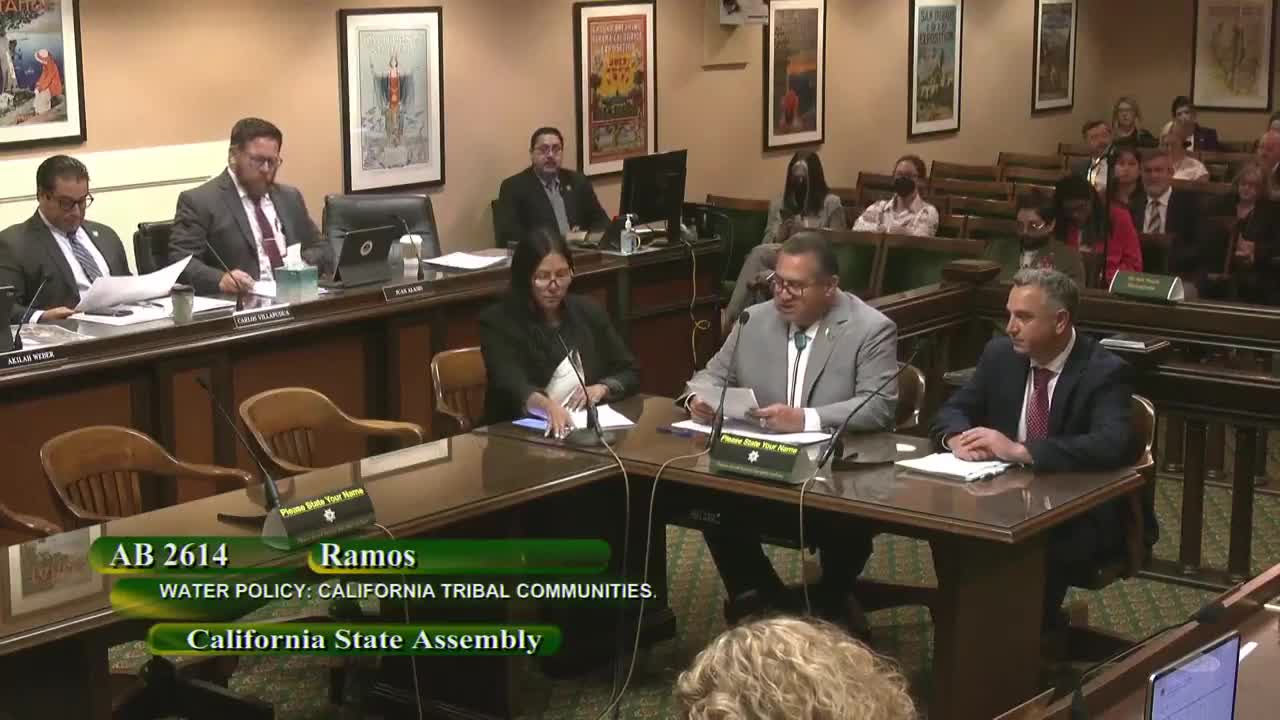 21MIN
Assembly Standing Committee on Water, Parks, and Wildlife
 22MIN
Assembly Standing Committee on Environmental Safety and Toxic Materials
Bill Author