AB 2624: Prisoners: employment: bereavement.
- Session Year: 2023-2024
- House: Assembly
- Latest Version Date: 2024-09-27
Current Status:
Passed
(2024-09-27: Chaptered by Secretary of State - Chapter 727, Statutes of 2024.)
Introduced
In Committee
First Chamber
In Committee
Second Chamber
Enacted
Existing law requires every able-bodied prisoner imprisoned in a state prison to work as many hours of faithful labor in each day and every day during their term of imprisonment as prescribed by the Secretary of the Department of Corrections and Rehabilitation in departmental rules and regulations.
This bill would require a person incarcerated in the state prison to be allowed relief with pay from prison employment after the death of an immediate family member of the incarcerated person, as specified, unless the incarcerated person is employed in a position requiring emergency response and there is an exigent circumstance requiring their employment during the requested period, and if so, would require the warden or prison administrator to grant the requested relief as soon as practicable after the exigent circumstance has ended.
Existing law requires every able-bodied prisoner imprisoned in a state prison to work as many hours of faithful labor in each day and every day during their term of imprisonment as prescribed by the Secretary of the Department of Corrections and Rehabilitation in departmental rules and regulations.
This bill would require a person incarcerated in the state prison to be allowed relief with pay from prison employment after the death of an immediate family member of the incarcerated person, as specified, subject to the discretion of the prison warden or other administrator of the facility. unless the incarcerated person is employed in a position requiring emergency response and there is an exigent circumstance requiring their employment during the requested period, and if so, would require the warden or prison administrator to grant the requested relief as soon as practicable after the exigent circumstance has ended.
Existing law requires every able-bodied prisoner imprisoned in a state prison to work as many hours of faithful labor in each day and every day during their term of imprisonment as prescribed by the Secretary of the Department of Corrections and Rehabilitation in departmental rules and regulations.
This bill would require a person incarcerated in the state prison to be allowed relief with pay from prison employment after the death of an immediate family member of the incarcerated person, as specified, subject to the discretion of the prison warden or other administrator of the facility.
(a)(1)An incarcerated person imprisoned in a state prison shall be allowed relief from prison employment after the death of an immediate family member of the incarcerated person.
(2)If the incarcerated person is enrolled in an educational program instead of, or in addition to, being employed, the incarcerated person shall additionally be allowed relief from the educational program.
(3)The incarcerated person shall request relief from the warden or their designee.
(4)The incarcerated person shall provide substantiation to support the request.
(5)Upon receiving the request and substantiation, the warden shall approve or deny the relief as soon as practicable.
(b)The incarcerated person shall be paid their regular compensation for the hours and days the individual is scheduled to work during the period of relief.
(c)The relief shall not exceed three days for any one occurrence.
(d)To the extent resources are available, the incarcerated person shall have access to a mental health professional during their period of relief.
(e)(1)The warden or other administrator of the facility shall grant the relief from employment pursuant to this section unless the incarcerated person is employed in a position requiring emergency response, including, but not limited to, a firefighter, and there is an exigent circumstance requiring their employment during the period requested by the incarcerated person.
(2)If the warden or other administrator of the facility denies the relief pursuant to paragraph (1), the relief shall be granted as soon as practicable after the exigent circumstance has ended.
(f)A warden or other administrator of the facility shall not discipline, punish, refuse to hire, discharge, demote, fine, suspend, expel, or discriminate against an individual as a result of either of the following:
(1)An individuals exercise of the right to relief from employment pursuant to subdivision (a).
(2)An individuals request for relief from employment or provision of substantiation to support the request pursuant to subdivision (a).
(g)(1)This section does not authorize an incarcerated person to leave the prison facility.
(2)This section does not authorize the prison to deny an incarcerated person access to other regularly scheduled activities, including, but not limited to, recreation, meals, group sessions, or counseling.
(h)For the purposes of this section, immediate family member has the same meaning as defined in Section 3000 of Title 15 of the California Code of Regulations.
(a)(1)An incarcerated person imprisoned in a state prison shall be allowed relief from prison employment after the death of an immediate family member of the incarcerated person.
(2)If the incarcerated person is enrolled in an educational program instead of, or in addition to, being employed, the incarcerated person shall additionally be allowed relief from the educational program.
(3)The incarcerated person shall request relief from the warden or their designee.
(4)The incarcerated person shall provide substantiation to support the request.
(5)Upon receiving the request and substantiation, the warden shall approve or deny the relief as soon as practicable.
(b)The incarcerated person shall be paid their regular compensation for the hours and days the individual is scheduled to work during the period of relief.
(c)The relief shall not exceed three days for any one occurrence.
(d)To the extent resources are available, the incarcerated person shall have access to a mental health professional during their period of relief.
(e)(1)The warden or other administrator of the facility shall grant the relief from employment pursuant to this section unless the incarcerated person is employed in a position requiring emergency response, including, but not limited to, a firefighter, and there is an exigent circumstance requiring their employment during the period requested by the incarcerated person.
(2)If the warden or other administrator of the facility denies the relief pursuant to paragraph (1), the relief shall be granted as soon as practicable after the exigent circumstance has ended.
(f)A warden or other administrator of the facility shall not discipline, punish, refuse to hire, discharge, demote, fine, suspend, expel, or discriminate against an individual as a result of either of the following:
(1)An individuals exercise of the right to relief from employment pursuant to subdivision (a).
(2)An individuals request for relief from employment or provision of substantiation to support the request pursuant to subdivision (a).
(g)(1)This section does not authorize an incarcerated person to leave the prison facility.
(2)This section does not authorize the prison to deny an incarcerated person access to other regularly scheduled activities, including, but not limited to, recreation, meals, group sessions, or counseling.
(h)For the purposes of this section, immediate family member means a child, parent, sibling, grandparent, grandchild, or domestic partner, as those terms are defined in Section 12945.2 of the Government Code, a spouse, a fiance or fiancee, a person with whom the incarcerated person is in a dating relationship, as defined in Section 6210 of the Family Code, or any person related by consanguinity or affinity within the second degree. has the same meaning as defined in Section 3000 of Title 15 of the California Code of Regulations.
(a)(1)An incarcerated person imprisoned in a state prison shall be allowed relief from prison employment after the death of an immediate family member of the incarcerated person.
(2)If the incarcerated person is enrolled in an educational program instead of, or in addition to, being employed, the incarcerated person shall additionally be allowed relief from the educational program.
(3)The incarcerated person shall request relief from the warden or their designee.
(4)The incarcerated person shall provide substantiation to support the request.
(5)Upon receiving the request and substantiation, the warden shall approve or deny the relief as soon as practicable.
(b)The incarcerated person shall be paid their regular compensation for the hours and days the individual is scheduled to work during the period of relief.
(c)The relief shall not exceed three days for any one occurrence.
(d)To the extent resources are available, the incarcerated person shall have access to a mental health professional during their period of relief.
(e)(1)The warden or other administrator of the facility shall grant the relief from employment pursuant to this section unless the incarcerated person is employed in a position requiring emergency response, including, but not limited to, a firefighter, and there is an exigent circumstance requiring their employment during the period requested by the incarcerated person.
(2)If the warden or other administrator of the facility denies the relief pursuant to paragraph (1), the relief shall be granted as soon as practicable after the exigent circumstance has ended.
(f)A warden or other administrator of the facility shall not discipline, punish, refuse to hire, discharge, demote, fine, suspend, expel, or discriminate against an individual as a result of either of the following:
(1)An individuals exercise of the right to relief from employment pursuant to subdivision (a).
(2)An individuals request for relief from employment or provision of substantiation to support the request pursuant to subdivision (a).
(f)(g)(1)This section does not authorize an incarcerated person to leave the prison facility.
(2)This section does not authorize the prison to deny an incarcerated person access to other regularly scheduled activities, including, but not limited to, recreation, meals, group sessions, or counseling.
(g)(h)For the purposes of this section, immediate family means any spouse, whether by marriage or not, parent, child, any person related by consanguinity or affinity within the second degree, or any other person who, within six months before the commission of the crime for which the person was convicted to state prison, regularly resided in the household. family member means a child, parent, sibling, grandparent, grandchild, or domestic partner, as those terms are defined in Section 12945.2 of the Government Code, a spouse, a fiance or fiancee, a person with whom the incarcerated person is in a dating relationship, as defined in Section 6210 of the Family Code, or any person related by consanguinity or affinity within the second degree.
(a)(1)An incarcerated person imprisoned in a state prison shall be allowed relief from prison employment after the death of an immediate family member of the incarcerated person.
(2)If the incarcerated person is enrolled in an educational program instead of, or in addition to, being employed, the incarcerated person shall additionally be allowed relief from the educational program.
(3)The incarcerated person shall request relief from the warden or their designee.
(4)The incarcerated person shall provide substantiation to support the request.
(5)Upon receiving the request and substantiation, the warden shall approve or deny the relief as soon as practicable.
(b)The incarcerated person shall be paid their regular compensation for the hours and days the individual is scheduled to work during the period of relief.
(c)The relief shall not exceed three days for any one occurrence.
(d)To the extent resources are available, the incarcerated person shall have access to a mental health professional during their period of relief.
(e)The final decision of relief from employment and access to a mental health professional offered the incarcerated person pursuant to this section shall be at the discretion of the warden or other administrator of the facility.(e)(1)The warden or other administrator of the facility shall grant the relief from employment pursuant to this section unless the incarcerated person is employed in a position requiring emergency response, including, but not limited to, a firefighter, and there is an exigent circumstance requiring their employment during the period requested by the incarcerated person.
(2)If the warden or other administrator of the facility denies the relief pursuant to paragraph (1), the relief shall be granted as soon as practicable after the exigent circumstance has ended.
(f)(1)This section does not authorize an incarcerated person to leave the prison facility.
(2)This section does not authorize the prison to deny an incarcerated person access to other regularly scheduled activities, including, but not limited to, recreation, meals, group sessions, or counseling.
(g)For purposes of this section, immediate family means any spouse, whether by marriage or not, parent, child, any person related by consanguinity or affinity within the second degree, or any other person who, within six months before the commission of the crime for which the person was convicted to state prison, regularly resided in the household.
(a)(1)An incarcerated person imprisoned in a state prison shall be allowed relief from prison employment after the death of an immediate family member of the incarcerated person.
(2)If the incarcerated person is enrolled in an educational program instead of, or in addition to, being employed, the incarcerated person shall additionally be allowed relief from the educational program.
(3)The incarcerated person shall request relief from the warden or their designee.
(4)The incarcerated person shall provide substantiation to support the request.
(5)Upon receiving the request and substantiation, the warden shall approve or deny the relief as soon as practicable.
(b)The incarcerated person shall be paid their regular compensation for the hours and days the individual is scheduled to work during the period of relief.
(c)The relief shall not exceed three days for any one occurrence.
(d)To the extent resources are available, the incarcerated person shall have access to a mental health professional during their period of relief.
(e)The final decision of relief from employment and access to a mental health professional offered the incarcerated person pursuant to this section shall be at the discretion of the warden or other administrator of the facility.
(f)(1)This section does not authorize an incarcerated person to leave the prison facility.
(2)This section does not authorize the prison to deny an incarcerated person access to other regularly scheduled activities, including, but not limited to, recreation, meals, group sessions, or counseling.
(g)For purposes of this section, immediate family means any spouse, whether by marriage or not, parent, child, any person related by consanguinity or affinity within the second degree, or any other person who, within six months before the commission of the crime for which the person was convicted to state prison, regularly resided in the household.
|
Date
|
Status
|
|---|---|
| Sep 27, 2024 | Chaptered by Secretary of State - Chapter 727, Statutes of 2024. |
| Sep 27, 2024 | Approved by the Governor. |
| Sep 5, 2024 | Enrolled and presented to the Governor at 4 p.m. |
| Aug 27, 2024 | Senate amendments concurred in. To Engrossing and Enrolling. (Ayes 77. Noes 0.). |
| Aug 27, 2024 | Assembly Rule 77 suspended. |
| Aug 26, 2024 | In Assembly. Concurrence in Senate amendments pending. May be considered on or after August 28 pursuant to Assembly Rule 77. |
| Aug 26, 2024 | Read third time. Passed. Ordered to the Assembly. (Ayes 38. Noes 0.). |
| Aug 6, 2024 | Read second time. Ordered to third reading. |
| Aug 5, 2024 | From committee: Be ordered to second reading pursuant to Senate Rule 28.8. |
| Jul 1, 2024 | From committee chair, with author's amendments: Amend, and re-refer to committee. Read second time, amended, and re-referred to Com. on APPR. |
| Jun 27, 2024 | In committee: Hearing postponed by committee. |
| Jun 18, 2024 | In committee: Hearing postponed by committee. |
| Jun 13, 2024 | Read second time and amended. Re-referred to Com. on APPR. |
| Jun 12, 2024 | From committee: Amend, and do pass as amended and re-refer to Com. on APPR. (Ayes 5. Noes 0.) (June 11). |
| May 22, 2024 | Referred to Com. on PUB S. |
| May 9, 2024 | In Senate. Read first time. To Com. on RLS. for assignment. |
| May 9, 2024 | Read third time. Passed. Ordered to the Senate. (Ayes 65. Noes 0. Page 5160.) |
| May 2, 2024 | Read second time. Ordered to Consent Calendar. |
| May 1, 2024 | From committee: Do pass. To Consent Calendar. (Ayes 14. Noes 0.) (May 1). |
| Apr 25, 2024 | Re-referred to Com. on APPR. |
| Apr 24, 2024 | Read second time and amended. |
| Apr 23, 2024 | From committee: Amend, and do pass as amended and re-refer to Com. on APPR. with recommendation: To Consent Calendar. (Ayes 8. Noes 0.) (April 16). |
| Mar 4, 2024 | Referred to Com. on PUB. S. |
| Feb 15, 2024 | From printer. May be heard in committee March 16. |
| Feb 14, 2024 | Read first time. To print. |
|
Date
|
Description
|
Location
|
Votes
|
|
|---|---|---|---|---|
| Aug 27, 2024 | AB 2624 Waldron Concurrence in Senate Amendments | Assembly Floor |
Passed |
|
| Aug 26, 2024 | Assembly 3rd Reading AB2624 Waldron By Durazo | Senate Floor |
Passed |
|
| Jun 11, 2024 | Do pass as amended, but first amend, and re-refer to the Committee on [Appropriations] | Senate Standing Committee on Public Safety |
Passed |
|
| May 9, 2024 | AB 2624 Waldron Consent Calendar Second Day Regular Session | Assembly Floor |
Passed |
|
| May 1, 2024 | Do pass. To Consent Calendar. | Assembly Standing Committee on Appropriations |
Passed |
|
| Apr 16, 2024 | Do pass as amended, and be re-referred to the Committee on [Appropriations] with recommendation: To Consent Calendar | Assembly Standing Committee on Public Safety |
Passed |
This list shows positions taken on this bill by organizations on the date displayed, which is linked to the original source.
Positions by individuals are not included.
|
Organization
|
Position
|
Date
|
|---|---|---|
| Aclu California Action | ** Support | |
| California Public Defenders Association | ** Support | |
| Ella Baker Center For Human Rights | ** Support | |
| Universidad Popular | ** Support |
CONCURRENCE IN SENATE AMENDMENTS
CSA1 Bill Id:AB 2624
Author:(Waldron)
As Amended Ver:July 1, 2024
Majority vote
SUMMARY
Authorizes persons incarcerated in state prisons to be given bereavement leave from prison employment or educational programs they are enrolled in the event of a death of an immediate family member of the incarcerated person.
Senate Amendments
- Provides that a warden or other administrator of the facility shall not discipline, punish, refuse to hire, discharge, demote, fine, suspend, expel, or discriminate against an individual as a result of either of the following:
- An individual's exercise of the right to relief from employment, as specified; or,
- An individual's request for relief from employment or provision of substantiation to support the request, as specified.
- Defines "immediate family member" to mean a "legal spouse; registered domestic partner, natural parents; adoptive parents, if the adoption occurred and a family relationship existed prior to the inmate's incarceration; step-parents or foster parents; grandparents; natural, step, or foster brothers or sisters; the inmate's natural and adoptive children; grandchildren; and legal stepchildren of the inmate. Aunts, uncles and cousins are not immediate family members unless a verified foster relationship exists."
COMMENTS
As Passed by The Assembly, this bill:
- Stated that a person incarcerated in state shall be allowed relief from prison employment after the death of an immediate family member of the incarcerated person.
- Provided that if an incarcerated person is enrolled in an educational program instead of, or in addition to, being employed, they shall additionally be allowed relief from the educational program.
- Provided that the incarcerated person shall request relief from the warden or their designee
- Required the incarcerated person to provide substantiation to support the request.
- Required the warden to approve or deny the relief as soon as practicable, upon receiving the request and substantiation,
- Required the incarcerated person to be paid their regular compensation for the time the person is scheduled to work during the period of relief.
- Provided that the bereavement relief provided in this bill shall not exceed three days for any one occurrence.
- Provided that to the extent resources are available, the incarcerated person shall have access to a mental health professional during their period of relief.
- Provided that a warden or other administrator of the facility shall grant the relief unless the incarcerated person is employed in a position requiring emergency response, including, but not limited to, a firefighter, and there is an exigent circumstance requiring their employment during the period requested by the incarcerated person.
- If the warden or other administrator of the facility denies the relief, the relief shall be granted as soon as practicable after the exigent circumstance has ended.
- Provided that this does not authorize an incarcerated person to leave the prison facility.
- Provided that bill does not authorize the prison to deny an incarcerated person access to other regularly scheduled activities, including, but not limited to, recreation, meals, group sessions, or counseling.
- Defined "immediate family" means any spouse, whether by marriage or not, parent, child, any person related by consanguinity or affinity within the second degree, or any other person who, within six months before the commission of the crime for which the person was convicted to state prison, regularly resided in the household.
According to the Author
"In the passing of a close family member, every individual deserves the right to grieve; a need that goes beyond the walls of incarceration. By introducing Section 2710 to the Penal Code, a crucial step is taken towards supporting individuals dealing with loss. This provision will ensure they are able to grieve for three days with dignity, unburdened from the weight of their work duties without financial concern. During this time, they receive compensation for missed work, alleviating any further worries. By allowing them to focus solely on their grieving process, it demonstrates a commitment to treat all individuals with empathy, regardless of their circumstances."
Arguments in Support
According to ACLU California Action, this bill "seeks to add Section 2710 to the Penal Code, promoting dignity in periods of mourning and allowing incarcerated individuals to access mental health counseling when resources permit. This new provision will undoubtedly lead to a more effective reintegration of these individuals into society. The lack of this provision in current law denies compassion in those undeniably devastating times, which is inconsistent with our investments in effective rehabilitation."
Arguments in Opposition
None Submitted.
FISCAL COMMENTS
…
VOTES:
ASM PUBLIC SAFETY: 8-0-0
YES: McCarty, Alanis, Lackey, Stephanie Nguyen, Reyes, Ting, Wilson, Zbur
ASM APPROPRIATIONS: 14-0-1
YES: Wicks, Sanchez, Arambula, Bryan, Calderon, Wendy Carrillo, Dixon, Mike Fong, Grayson, Haney, Hart, Pellerin, Ta, Villapudua
ABS, ABST OR NV: Jim Patterson
ASSEMBLY FLOOR: 65-0-15
YES: Addis, Aguiar-Curry, Alanis, Alvarez, Arambula, Bauer-Kahan, Bennett, Berman, Boerner, Bonta, Bryan, Calderon, Juan Carrillo, Wendy Carrillo, Chen, Connolly, Davies, Dixon, Essayli, Mike Fong, Vince Fong, Friedman, Gallagher, Garcia, Gipson, Hart, Holden, Hoover, Irwin, Jackson, Jones-Sawyer, Kalra, Lackey, Lee, Lowenthal, Maienschein, McCarty, McKinnor, Muratsuchi, Ortega, Pacheco, Papan, Jim Patterson, Joe Patterson, Pellerin, Quirk-Silva, Ramos, Rendon, Reyes, Rodriguez, Blanca Rubio, Sanchez, Santiago, Soria, Ta, Valencia, Villapudua, Waldron, Ward, Weber, Wicks, Wilson, Wood, Zbur, Robert Rivas
ABS, ABST OR NV: Bains, Cervantes, Megan Dahle, Flora, Gabriel, Grayson, Haney, Low, Mathis, Stephanie Nguyen, Petrie-Norris, Luz Rivas, Schiavo, Ting, Wallis
SENATE FLOOR: 39-0-1
YES: Allen, Archuleta, Ashby, Atkins, Becker, Blakespear, Bradford, Caballero, Cortese, Dahle, Dodd, Durazo, Eggman, Glazer, Gonzalez, Grove, Hurtado, Jones, Laird, Limón, McGuire, Menjivar, Min, Newman, Nguyen, Niello, Ochoa Bogh, Padilla, Portantino, Roth, Rubio, Seyarto, Skinner, Smallwood-Cuevas, Stern, Umberg, Wahab, Wiener, Wilk
ABS, ABST OR NV: Alvarado-Gil
UPDATED
VERSION: July 1, 2024
CONSULTANT: Ilan Zur / PUB. S. / (916) 319-3744 FN: 0004685
CONCURRENCE IN SENATE AMENDMENTS
CSA1 Bill Id:AB 2624
Author:(Waldron)
As Amended Ver:July 1, 2024
Majority vote
SUMMARY
Authorizes persons incarcerated in state prisons to be given bereavement leave from prison employment or educational programs they are enrolled in the event of a death of an immediate family member of the incarcerated person.
Senate Amendments
- Provides that a warden or other administrator of the facility shall not discipline, punish, refuse to hire, discharge, demote, fine, suspend, expel, or discriminate against an individual as a result of either of the following:
- An individual's exercise of the right to relief from employment, as specified; or,
- An individual's request for relief from employment or provision of substantiation to support the request, as specified.
- Defines "immediate family member" to mean a "legal spouse; registered domestic partner, natural parents; adoptive parents, if the adoption occurred and a family relationship existed prior to the inmate's incarceration; step-parents or foster parents; grandparents; natural, step, or foster brothers or sisters; the inmate's natural and adoptive children; grandchildren; and legal stepchildren of the inmate. Aunts, uncles and cousins are not immediate family members unless a verified foster relationship exists."
COMMENTS
As Passed by The Assembly, this bill:
- Stated that a person incarcerated in state shall be allowed relief from prison employment after the death of an immediate family member of the incarcerated person.
- Provided that if an incarcerated person is enrolled in an educational program instead of, or in addition to, being employed, they shall additionally be allowed relief from the educational program.
- Provided that the incarcerated person shall request relief from the warden or their designee
- Required the incarcerated person to provide substantiation to support the request.
- Required the warden to approve or deny the relief as soon as practicable, upon receiving the request and substantiation,
- Required the incarcerated person to be paid their regular compensation for the time the person is scheduled to work during the period of relief.
- Provided that the bereavement relief provided in this bill shall not exceed three days for any one occurrence.
- Provided that to the extent resources are available, the incarcerated person shall have access to a mental health professional during their period of relief.
- Provided that a warden or other administrator of the facility shall grant the relief unless the incarcerated person is employed in a position requiring emergency response, including, but not limited to, a firefighter, and there is an exigent circumstance requiring their employment during the period requested by the incarcerated person.
- If the warden or other administrator of the facility denies the relief, the relief shall be granted as soon as practicable after the exigent circumstance has ended.
- Provided that this does not authorize an incarcerated person to leave the prison facility.
- Provided that bill does not authorize the prison to deny an incarcerated person access to other regularly scheduled activities, including, but not limited to, recreation, meals, group sessions, or counseling.
- Defined "immediate family" means any spouse, whether by marriage or not, parent, child, any person related by consanguinity or affinity within the second degree, or any other person who, within six months before the commission of the crime for which the person was convicted to state prison, regularly resided in the household.
According to the Author
"In the passing of a close family member, every individual deserves the right to grieve; a need that goes beyond the walls of incarceration. By introducing Section 2710 to the Penal Code, a crucial step is taken towards supporting individuals dealing with loss. This provision will ensure they are able to grieve for three days with dignity, unburdened from the weight of their work duties without financial concern. During this time, they receive compensation for missed work, alleviating any further worries. By allowing them to focus solely on their grieving process, it demonstrates a commitment to treat all individuals with empathy, regardless of their circumstances."
Arguments in Support
According to ACLU California Action, this bill "seeks to add Section 2710 to the Penal Code, promoting dignity in periods of mourning and allowing incarcerated individuals to access mental health counseling when resources permit. This new provision will undoubtedly lead to a more effective reintegration of these individuals into society. The lack of this provision in current law denies compassion in those undeniably devastating times, which is inconsistent with our investments in effective rehabilitation."
Arguments in Opposition
None Submitted.
FISCAL COMMENTS
…
VOTES:
ASM PUBLIC SAFETY: 8-0-0
YES: McCarty, Alanis, Lackey, Stephanie Nguyen, Reyes, Ting, Wilson, Zbur
ASM APPROPRIATIONS: 14-0-1
YES: Wicks, Sanchez, Arambula, Bryan, Calderon, Wendy Carrillo, Dixon, Mike Fong, Grayson, Haney, Hart, Pellerin, Ta, Villapudua
ABS, ABST OR NV: Jim Patterson
ASSEMBLY FLOOR: 65-0-15
YES: Addis, Aguiar-Curry, Alanis, Alvarez, Arambula, Bauer-Kahan, Bennett, Berman, Boerner, Bonta, Bryan, Calderon, Juan Carrillo, Wendy Carrillo, Chen, Connolly, Davies, Dixon, Essayli, Mike Fong, Vince Fong, Friedman, Gallagher, Garcia, Gipson, Hart, Holden, Hoover, Irwin, Jackson, Jones-Sawyer, Kalra, Lackey, Lee, Lowenthal, Maienschein, McCarty, McKinnor, Muratsuchi, Ortega, Pacheco, Papan, Jim Patterson, Joe Patterson, Pellerin, Quirk-Silva, Ramos, Rendon, Reyes, Rodriguez, Blanca Rubio, Sanchez, Santiago, Soria, Ta, Valencia, Villapudua, Waldron, Ward, Weber, Wicks, Wilson, Wood, Zbur, Robert Rivas
ABS, ABST OR NV: Bains, Cervantes, Megan Dahle, Flora, Gabriel, Grayson, Haney, Low, Mathis, Stephanie Nguyen, Petrie-Norris, Luz Rivas, Schiavo, Ting, Wallis
UPDATED
VERSION: July 1, 2024
CONSULTANT: Ilan Zur / PUB. S. / (916) 319-3744 FN: 0004685
SENATE RULES COMMITTEE Office of Senate Floor Analyses (916) 651-1520 Fax: (916) 327-4478 | AB 2624 |
THIRD READING
Bill No: AB 2624
Author: Waldron (R)
Amended: 7/1/24 in Senate
Vote: 21
SENATE PUBLIC SAFETY COMMITTEE: 5-0, 6/11/24
AYES: Wahab, Seyarto, Bradford, Skinner, Wiener
SENATE APPROPRIATIONS COMMITTEE: Senate Rule 28.8
ASSEMBLY FLOOR: 65-0, 5/9/24 (Consent) - See last page for vote
SUBJECT: Prisoners: employment: bereavement
SOURCE: Author
DIGEST:
This bill allows a person incarcerated in state prison to take paid bereavement leave after the death of an immediate family member, as defined, and except as specified.
ANALYSIS:
Existing law:
- Prohibits involuntary servitude except to punish crime. (Cal. Const., art. I, § 6.)
- Authorizes the Secretary of the California Department of Corrections and Rehabilitation (CDCR) to enter into contracts with public entities, nonprofit or for profit organizations, and businesses for the purpose of conducting programs which use the labor of incarcerated individuals. (Cal. Const., art. XIV, § 5.)
- Provides that CDCR require every able-bodied incarcerated individual imprisoned in any state prison as many hours of faithful labor in each day and every day during the person’s term of imprisonment as is prescribed by the rules and regulations of the Secretary. (Pen. Code, § 2700.)
- Authorizes CDCR to employ incarcerated individuals for the rendering of services that are needed by the state or any political subdivision thereof, including any county, district, city, school or other public use, or for use by the federal government, or any agency or department thereof, or that may be needed for use by the government of any other state, or any department, agency, or corporation thereof, and allows CDCR to enter into contracts for this purpose. (Pen. Code, § 2701, subd. (a).)
- Allows CDCR to employ incarcerated individuals for the rendering of emergency services for the preservation of life or property within the state, whether that property is owned by public entities or private citizens, when a county level state of emergency has been declared due to a natural disaster and the local governing board has requested assistance. (Pen. Code, § 2701, subd. (b).)
- Establishes the Prison Industry Authority (PIA), a work program for incarcerated persons to provide goods and services used by CDCR. (Pen. Code, § 2800.)
- Requires that the compensation schedule for incarcerated employees in the PIA program be based on quantity and quality of work performed and shall be required, but in no event shall that compensation exceed one-half the minimum wage provided in the Labor Code, except as otherwise provided. (Pen. Code, § 2811.)
- States that incarcerated persons not engaged in PIA programs, but who are engaged in productive labor outside of such programs may be compensated in like manner. (Pen. Code, § 2700.)
- Requires private employers with five or more employees and public sector employers to provide employees with at least 30 days of service up to five unpaid days of bereavement leave upon the death of a family member. (Gov. Code, § 12945.7, subd. (b).)
- Defines “family member,” for purposes of bereavement leave as a spouse or a child, parent, sibling, grandparent, grandchild, domestic partner, or parent-in-law. (Gov. Code, § 12945.7, subd. (a)(3).)
- Permits an employer to request that the employee provide documentation of the death of the family member. Defines “documentation” as including, but not limited to, a death certificate, a published obituary, or written verification of death, burial, or memorial services from a mortuary, funeral home, burial society, crematorium, religious institution, or governmental agency. (Gov. Code, § 12945.7, subd. (f).)
This bill:
- Requires an incarcerated person imprisoned in a state prison to be allowed relief from prison employment after the death of an immediate family member of the incarcerated person.
- Requires an incarcerated person who is enrolled in an educational program instead of, or in addition to, being employed, to be granted bereavement leave from the educational program after the death of an immediate family member of the incarcerated person.
- Requires the incarcerated person to request bereavement leave from the warden or their designee.
- Requires the incarcerated person to provide substantiation to support the request for bereavement leave.
- Requires the warden to approve or deny bereavement leave as soon as practicable upon receiving the request and substantiation.
- Requires that the incarcerated person be paid their regular compensation for the hours and days the individual is scheduled to work during the period of relief.
- Limits bereavement leave to three days for any one occurrence.
- Requires the incarcerated person to have access to a mental health professional during bereavement leave to the extent resources are available.
- Requires the warden or other administrator of the facility to grant bereavement leave unless the incarcerated person is employed in a position requiring emergency response, including, but not limited to, a firefighter, and there is an exigent circumstance requiring their employment during the period requested by the incarcerated person.
- Requires the warden or other administrator of the facility to grant bereavement leave to be granted as soon as practicable after the exigent circumstance has ended.
- Specifies that its provisions do not authorize an incarcerated person to leave the prison facility.
- Prohibits the prison from denying an incarcerated person access to other regularly scheduled activities, including, but not limited to, recreation, meals, group sessions, or counseling.
- Provides that “immediate family” has the same meaning as defined in Section 3000 of Title 15 of the California Code of Regulations.
Background
Prison Labor and Wages. The Thirteenth Amendment of the U.S. Constitution was ratified in 1865 and prohibited slavery and involuntary servitude. However, an exception was allowed if involuntary servitude was imposed as punishment for a crime. Article I, section 6, of the California Constitution contains the same prohibitions on slavery and involuntary servitude and the same exception for involuntary servitude as punishment for crime. The California Supreme Court has interpreted the prohibition on slavery and involuntary servitude contained in Article I, section 6 of the California Constitution to be coextensive with the protection afforded by the Thirteenth Amendment. (Moss v. Superior Court (1998) 17 Cal. 4th 396, 418.) Moreover, federal courts have held that the U.S. Constitution does not prohibit a requirement that incarcerated persons must work nor does it provide an incarcerated person a right to wages for work done in custody. Courts have consistently held that individuals incarcerated in state prison are not employees entitled to minimum wage. (Burleson v. California (1996) 83 F.3d 311.)
In addition to relying on the exception to involuntary servitude for punishment for a crime, federal courts have found that work done by an incarcerated person does not constitute “involuntary servitude” when the person has a choice to work. For example, the Fifth District Court of Appeals held that participation in a work release program did not constitute involuntary servitude, because the incarcerated persons were not “compelled” to participate in the work release program. The court acknowledged that the choice of whether to work outside of the jail for twenty dollars a day or remain inside the jail and earn nothing may have indeed been “painful” and quite possibly illegal under state law, but stated that the individuals were not forced to work or continued to work against their will. (Watson v. Graves (1990) 909 F.2d 1549, 1552.)
Penal Code section 2700 provides that CDCR “require of every able-bodied prisoner imprisoned in any state prison as many hours of faithful labor in each day and every day during his or her term of imprisonment as shall be prescribed by the rules and regulations [of the department].” (See also Cal. Code Regs., tit. 15, § 3040, subd. (a).) Upon arrival at a prison reception center, incarcerated individuals go through a classification process. During the classification process, incarcerated individuals are placed on waiting lists for jobs and rehabilitative programs. The classification process for jobs continues throughout an individual’s prison term. Incarcerated individuals cannot refuse a job assignment and may be disciplined for refusing or failing to show up to work. Refusal to accept or perform in a work or training assignment can also lead to reduced privileges, including limitations on visits, phone calls, canteen purchases, and yard, entertainment and recreation access. (https://www.cdcr.ca.gov/ombuds/ombuds/entering-a-prison-faqs/) Notably, incarcerated individuals may be assigned to a job in lieu of enrollment and participation in rehabilitative programs without the individual’s consent. (Cal. Code Regs., tit. 15, § 3040, subd. (g).)
Standard CDCR jobs, including clerks, porters, dining work, yard workers, and plant operations, do not have minimum requirements, such as a high school diploma or GED certificate. Some incarcerated individuals are eligible to apply for PIA jobs which have specific requirements that an individual must meet in order to qualify for the job. PIA jobs are higher paying than standard jobs, and incarcerated individuals receive industry-accredited certifications, credits, and training that can be applied upon release for jobs such as meat cutting, coffee roasting, optical, dental, and health care facilities maintenance.
Beginning on April 16, 2024, CDCR increased wages for all incarcerated workers. Specifically, wages were increased to $0.16-$0.74 per hour. (Cal. Code Regs., tit. 15, § 3041.2, subd. (a)(1).) As mentioned above, PIA jobs pay a higher wage than standard jobs with the lowest paid scale ranging from $0.35-$0.45 per hour and the highest scale ranging from $0.80 to $1 per hour. (Cal. Code Regs., tit. 15, § 8006, subd. (d)(1).) Additionally, incarcerated individuals housed at one of the state’s conservation or fire camps are subject to a different pay scale with a pay rate of $5.80 to $10.24 per day based on skill level and position.
Bereavement Leave. The federal Fair Labor Standards Act does not require that wages be paid to an employee for time not worked, including time off for personal leave, sick leave, vacation, holidays, jury duty, and bereavement. Instead, the matter of paid leave is generally left up to individual employers, although efforts to establish specific types of paid leave for workers in California have been successful in recent years. Access to bereavement leave in the state was expanded in 2022 through the passage of AB 1949 (Low, Chapter 767, Statutes of 2022), which required private sector employers with five or more employees and public sector employers to provide employees with at least 30 days of service up to five unpaid days of bereavement leave upon the death of a family member. Currently, state law pertaining to bereavement leave do not apply to the incarcerated population.
This bill allows a person incarcerated in a state prison and who has a job or is enrolled in an educational program to request bereavement leave from the warden of the prison after the death of an immediate family member. This bill requires an incarcerated person requesting bereavement leave to provide substantiation to support the request, and specifies that bereavement leave is limited to three days. The warden is required to grant the requested bereavement leave unless the incarcerated person is employed in a position requiring emergency response, and there is an exigent circumstance requiring the person’s employment during the period requested by the incarcerated person. In the event of an exigent circumstance that prevents the bereavement leave from being granted, bereavement leave must be granted as soon as practicable after the exigent circumstance has ended. This bill additionally requires incarcerated individuals to be given access to a mental health professional during the bereavement period to the extent possible.
FISCAL EFFECT: Appropriation: No Fiscal Com.: Yes Local: No
SUPPORT: (Verified 8/5/24)
ACLU California Action
California Public Defenders Association
Ella Baker Center for Human Rights
Universidad Popular
OPPOSITION: (Verified 8/5/24)
None received
ASSEMBLY FLOOR: 65-0, 5/9/24
AYES: Addis, Aguiar-Curry, Alanis, Alvarez, Arambula, Bauer-Kahan, Bennett, Berman, Boerner, Bonta, Bryan, Calderon, Juan Carrillo, Wendy Carrillo, Chen, Connolly, Davies, Dixon, Essayli, Mike Fong, Vince Fong, Friedman, Gallagher, Garcia, Gipson, Hart, Holden, Hoover, Irwin, Jackson, Jones-Sawyer, Kalra, Lackey, Lee, Lowenthal, Maienschein, McCarty, McKinnor, Muratsuchi, Ortega, Pacheco, Papan, Jim Patterson, Joe Patterson, Pellerin, Quirk-Silva, Ramos, Rendon, Reyes, Rodriguez, Blanca Rubio, Sanchez, Santiago, Soria, Ta, Valencia, Villapudua, Waldron, Ward, Weber, Wicks, Wilson, Wood, Zbur, Robert Rivas
NO VOTE RECORDED: Bains, Cervantes, Megan Dahle, Flora, Gabriel, Grayson, Haney, Low, Mathis, Stephanie Nguyen, Petrie-Norris, Luz Rivas, Schiavo, Ting, Wallis
Prepared by: Stephanie Jordan / PUB. S. /
8/6/24 16:10:57
**** END ****
SENATE COMMITTEE ON PUBLIC SAFETY
Senator Aisha Wahab, Chair
2023 - 2024 Regular
Bill No: AB 2624 Hearing Date: June 11, 2024
Author: | Waldron | ||
Version: | April 24, 2024 | ||
Urgency: | No | Fiscal: | Yes |
Consultant: | SJ | ||
Subject: Prisoners: employment: bereavement
HISTORY
Source: Author
Prior Legislation: AB 1949 (Low), Ch. 767, Stats. 2022
Support: ACLU California Action; California Public Defenders Association; Ella Baker Center for Human Rights; Universidad Popular
Opposition: None known
Assembly Floor Vote: 65 - 0
PURPOSE
The purpose of this bill is to allow a person incarcerated in state prison to take paid bereavement leave after the death of an immediate family member, as defined, and except as specified.
Existing law prohibits involuntary servitude except to punish crime. (Cal. Const., art. I, § 6.)
Existing law authorizes the Secretary of the California Department of Corrections and Rehabilitation (CDCR) to enter into contracts with public entities, nonprofit or for profit organizations, and businesses for the purpose of conducting programs which use the labor of incarcerated individuals. (Cal. Const., art. XIV, § 5.)
Existing law provides that CDCR require every able-bodied incarcerated individual imprisoned in any state prison as many hours of faithful labor in each day and every day during the person’s term of imprisonment as is prescribed by the rules and regulations of the Secretary. (Pen. Code, § 2700.)
Existing law authorizes CDCR to employ incarcerated individuals for the rendering of services that are needed by the state or any political subdivision thereof, including any county, district, city, school or other public use, or for use by the federal government, or any agency or department thereof, or that may be needed for use by the government of any other state, or any department, agency, or corporation thereof, and allows CDCR to enter into contracts for this purpose. (Pen. Code, § 2701, subd. (a).)
Existing law allows CDCR to employ incarcerated individuals for the rendering of emergency services for the preservation of life or property within the state, whether that property is owned by public entities or private citizens, when a county level state of emergency has been declared due to a natural disaster and the local governing board has requested assistance. (Pen. Code, § 2701, subd. (b).)
Existing law establishes the Prison Industry Authority (PIA), a work program for incarcerated persons to provide goods and services used by CDCR. (Pen. Code, § 2800.)
Existing law requires that the compensation schedule for incarcerated employees in the PIA program be based on quantity and quality of work performed and shall be required, but in no event shall that compensation exceed one-half the minimum wage provided in the Labor Code, except as otherwise provided. (Pen. Code, § 2811.)
Existing law states that incarcerated persons not engaged in PIA programs, but who are engaged in productive labor outside of such programs may be compensated in like manner. (Pen. Code, § 2700.)
Existing law requires private employers with five or more employees and public sector employers to provide employees with at least 30 days of service up to five unpaid days of bereavement leave upon the death of a family member. (Gov. Code, § 12945.7, subd. (b).)
Existing law defines “family member,” for purposes of bereavement leave as a spouse or a child, parent, sibling, grandparent, grandchild, domestic partner, or parent-in-law. (Gov. Code, § 12945.7, subd. (a)(3).)
Existing law permits an employer to request that the employee provide documentation of the death of the family member. Defines “documentation” as including, but not limited to, a death certificate, a published obituary, or written verification of death, burial, or memorial services from a mortuary, funeral home, burial society, crematorium, religious institution, or governmental agency. (Gov. Code, § 12945.7, subd. (f).)
This bill requires an incarcerated person imprisoned in a state prison to be allowed relief from prison employment after the death of an immediate family member of the incarcerated person.
This bill requires an incarcerated person who is enrolled in an educational program instead of, or in addition to, being employed, to be granted bereavement leave from the educational program after the death of an immediate family member of the incarcerated person.
This bill requires the incarcerated person to request bereavement leave from the warden or their designee.
This bill requires the incarcerated person to provide substantiation to support the request for bereavement leave.
This bill requires the warden to approve or deny bereavement leave as soon as practicable upon receiving the request and substantiation.
This bill requires that the incarcerated person be paid their regular compensation for the hours and days the individual is scheduled to work during the period of relief.
This bill limits bereavement leave to three days for any one occurrence.
This bill requires the incarcerated person to have access to a mental health professional during bereavement leave to the extent resources are available.
This bill requires the warden or other administrator of the facility to grant bereavement leave unless the incarcerated person is employed in a position requiring emergency response, including, but not limited to, a firefighter, and there is an exigent circumstance requiring their employment during the period requested by the incarcerated person.
This bill requires the warden or other administrator of the facility to grant bereavement leave to be granted as soon as practicable after the exigent circumstance has ended.
This bill specifies that its provisions do not authorize an incarcerated person to leave the prison facility.
This bill prohibits the prison from denying an incarcerated person access to other regularly scheduled activities, including, but not limited to, recreation, meals, group sessions, or counseling.
This bill defines “immediate family” as “any spouse, whether by marriage or not, parent, child, any person related by consanguinity or affinity within the second degree, or any other person who, within six months before the commission of the crime for which the person was convicted to state prison, regularly resided in the household.”
COMMENTS
- Need For This Bill
According to the author:
In the passing of a close family member, every individual deserves the right to grieve; a need that goes beyond the walls of incarceration. By introducing Section 2710 to the Penal Code, a crucial step is taken towards supporting individuals dealing with loss. This provision will ensure they are able to grieve for three days with dignity, unburdened from the weight of their work duties without financial concern. During this time, they receive compensation for missed work, alleviating any further worries. By allowing them to focus solely on their grieving process, it demonstrates a commitment to treat all individuals with empathy, regardless of their circumstances.
- Prison Labor Generally
The Thirteenth Amendment of the U.S. Constitution was ratified in 1865 and prohibited slavery and involuntary servitude. However, an exception was allowed if involuntary servitude was imposed as punishment for a crime. Article I, section 6, of the California Constitution contains the same prohibitions on slavery and involuntary servitude and the same exception for involuntary servitude as punishment for crime. The California Supreme Court has interpreted the prohibition on slavery and involuntary servitude contained in Article I, section 6 of the California Constitution to be coextensive with the protection afforded by the Thirteenth Amendment. (Moss v. Superior Court (1998), 17 Cal. 4th 396, 418.) Moreover, federal courts have held that the U.S. Constitution does not prohibit a requirement that incarcerated persons must work nor does it provide an incarcerated person a right to wages for work done in custody. Courts have consistently held that individuals incarcerated in state prison are not employees entitled to minimum wage. (Burleson v. California (1996) 83 F.3d 311.)
In addition to relying on the exception to involuntary servitude for punishment for a crime, federal courts have found that work done by an incarcerated person does not constitute “involuntary servitude” when the person has a choice to work. For example, the Fifth District Court of Appeals held that participation in a work release program did not constitute involuntary servitude, because the incarcerated persons were not “compelled” to participate in the work release program. The court acknowledged that the choice of whether to work outside of the jail for twenty dollars a day or remain inside the jail and earn nothing may have indeed been “painful” and quite possibly illegal under state law, but stated that the individuals were not forced to work or continued to work against their will. (Watson v. Graves (1990) 909 F.2d 1549, 1552.)
- Work and Wages for the Incarcerated Population in California Prisons
Penal Code section 2700 provides that CDCR “require of every able-bodied prisoner imprisoned in any state prison as many hours of faithful labor in each day and every day during his or her term of imprisonment as shall be prescribed by the rules and regulations [of the department].” (See also Cal. Code Regs., tit. 15, § 3040, subd. (a).) Upon arrival at a prison reception center, incarcerated individuals go through a classification process. During the classification process, incarcerated individuals are placed on waiting lists for jobs and rehabilitative programs. The classification process for jobs continues throughout an individual’s prison term. Incarcerated individuals cannot refuse a job assignment and may be disciplined for refusing or failing to show up to work. Refusal to accept or perform in a work or training assignment can also lead to reduced privileges, including limitations on visits, phone calls, canteen purchases, and yard, entertainment and recreation access. (https://www.cdcr.ca.gov/ombuds/ombuds/entering-a-prison-faqs/) Notably, incarcerated individuals may be assigned to a job in lieu of enrollment and participation in rehabilitative programs without the individual’s consent. (Cal. Code Regs., tit. 15, § 3040, subd. (g).)
Standard CDCR jobs, including clerks, porters, dining work, yard workers, and plant operations, do not have minimum requirements, such as a high school diploma or GED certificate. Some incarcerated individuals are eligible to apply for PIA jobs which have specific requirements that an individual must meet in order to qualify for the job. PIA jobs are higher paying than standard jobs, and incarcerated individuals receive industry-accredited certifications, credits, and training that can be applied upon release for jobs such as meat cutting, coffee roasting, optical, dental, and health care facilities maintenance.
Wages
Beginning on April 16, 2024, CDCR increased wages for all incarcerated workers. The wage increase is expected to result in an increase in the number of half-time versus full-time jobs. In fact, CDCR expects that up to 75 percent of assignments will be half-time. Wages were increased to a maximum of $0.74 per hour. (Cal. Code Regs., tit. 15, § 3041.2, subd. (a)(1).) Current pay rates for most jobs are as follows:
Skill Level | Hourly (Min/Max) |
Level 1 (Lead Person) | $0.64-$0.74 |
Level 2 (Special Skill) | $0.38-$0.64 |
Level 3 (Technician) | $0.30-$0.48 |
Level 4 (Semi-Skilled) | $0.22-$0.36 |
Level 5 (Laborer) | $0.16-$0.26 |
As mentioned above, PIA jobs pay a higher wage than standard jobs with the lowest paid scale ranging from $0.35-$0.45 per hour and the highest scale ranging from $0.80 to $1 per hour. (Cal. Code Regs., tit. 15, § 8006, subd. (d)(1).) Additionally, incarcerated individuals housed at one of the state’s conservation or fire camps are subject to a different pay scale with a pay rate of $5.80 to $10.24 per day based on skill level and position.
- Bereavement Leave in California
The federal Fair Labor Standards Act does not require that wages be paid to an employee for time not worked, including time off for personal leave, sick leave, vacation, holidays, jury duty, and bereavement. Instead, the matter of paid leave is generally left up to individual employers, although efforts to establish specific types of paid leave for workers in California have been successful in recent years. Access to bereavement leave in the state was expanded in 2022 through the passage of AB 1949 (Low), Chapter 767, Statutes of 2022, which required private sector employers with five or more employees and public sector employers to provide employees with at least 30 days of service up to five unpaid days of bereavement leave upon the death of a family member. Currently, state law pertaining to bereavement leave do not apply to the incarcerated population.
- Effect of This Bill
This bill allows a person incarcerated in a state prison and who has a job or is enrolled in an educational program to request bereavement leave from the warden of the prison after the death of an immediate family member. This bill requires an incarcerated person requesting bereavement leave to provide substantiation to support the request, and specifies that bereavement leave is limited to three days. The warden is required to grant the requested bereavement leave unless the incarcerated person is employed in a position requiring emergency response, and there is an exigent circumstance requiring the person’s employment during the period requested by the incarcerated person. In the event of an exigent circumstance that prevents the bereavement leave from being granted, bereavement leave must be granted as soon as practicable after the exigent circumstance has ended. This bill additionally requires incarcerated individuals to be given access to a mental health professional during the bereavement period to the extent possible.
This bill defines “immediate family” as “any spouse, whether by marriage or not, parent, child, any person related by consanguinity or affinity within the second degree, or any other person who, within six months before the commission of the crime for which the person was convicted to state prison, regularly resided in the household.” This definition is much broader than the one found in Government Code section 12945.7 which defines “family member” as “a spouse or a child, parent, sibling, grandparent, grandchild, domestic partner, or parent-in-law” for purposes of bereavement leave. (Gov. Code, § 12945.7, subd. (a)(3).)
- Argument in Support
The California Public Defenders Association writes:
AB 2624 recognizes the right of incarcerated people to grieve and receive mental health support. This investment, aimed at fostering emotional well-being, will yield long-term cost savings by reducing recidivism rates.
AB 2624 seeks to add Section 2710 to the Penal Code, promoting dignity in periods of mourning and allowing incarcerated individuals to access mental health counseling when resources permit. … The lack of this provision in current law denies compassion in undeniably devastating times, which is inconsistent with our investments in effective rehabilitation.
AB 2624 recognizes the importance of a mourning period upon the death of an immediate family member, ensuring that their humanity is respected, and mental health prioritized.
-- END --
Date of Hearing: May 1, 2024
ASSEMBLY COMMITTEE ON APPROPRIATIONS
Buffy Wicks, Chair
ABPCA Bill Id:AB 2624
Author:(Waldron) – As Amended Ver:April 24, 2024
Policy Committee: | Public Safety | Vote: | 8 - 0 |
|
| ||
|
|
Urgency: No State Mandated Local Program: No Reimbursable: No
SUMMARY:
This bill requires the California Department of Corrections and Rehabilitation (CDCR) to provide up to three days of paid bereavement leave to an incarcerated person upon the death of an immediate family member.
FISCAL EFFECT:
No significant fiscal impact to CDCR.
COMMENTS:
- Purpose. According to the author:
In the passing of a close family member, every individual deserves the right to grieve; a need that goes beyond the walls of incarceration. By introducing Section 2710 to the Penal Code, a crucial step is taken towards supporting individuals dealing with loss. This provision will ensure they are able to grieve for three days with dignity, unburdened from the weight of their work duties without financial concern. During this time, they receive compensation for missed work, alleviating any further worries. By allowing them to focus solely on their grieving process, it demonstrates a commitment to treat all individuals with empathy, regardless of their circumstances.
- Background. People incarcerated in state prison are generally required to work or participate in rehabilitative or educational programs. If an incarcerated person does not attend their work or education assignment, they may be disciplined, which may result in a loss of good time credits or other consequences.
This bill requires CDCR to grant an incarcerated person’s request for time off work or time away from their education assignment due to the death of their immediate family member. The bill permits CDCR to deny such a request only if the incarcerated person is employed in a position that provides emergency response (like a firefighter) or if there is clear and convincing evidence that an exigent circumstance requires the incarcerated person continue working during the period they requested bereavement leave. As noted in the analysis of this bill by the Assembly Committee on Public Safety and also by CDCR in correspondence with this committee, the author may wish to align the definition of “immediate family member” in the bill with the definition provided in CDCR’s regulations. Doing so would likely streamline processing of bereavement leave requests and further reduce CDCR’s costs from this measure.
Analysis Prepared by: Annika Carlson / APPR. / (916) 319-2081
Date of Hearing:
Counsel: Ilan Zur
ASSEMBLY COMMITTEE ON PUBLIC SAFETY
Kevin McCarty, Chair
ABPCA Bill Id:AB 2624
Author:(Waldron) – As Introduced Ver:February 14, 2024
AS PROPOSED TO BE AMENDED IN COMMITTEE
SUMMARY:
Authorizes persons incarcerated in state prisons to be given bereavement leave from prison employment or educational programs they are enrolled in the event of a death of an immediate family member of the incarcerated person. Specifically, this bill:
- States that a person incarcerated in state shall be allowed relief from prison employment after the death of an immediate family member of the incarcerated person.
- Provides that if an incarcerated person is enrolled in an educational program instead of, or in addition to, being employed, they shall additionally be allowed relief from the educational program.
- Provides that the incarcerated person shall request relief from the warden or their designee
- Requires the incarcerated person to provide substantiation to support the request.
- Requires the warden to approve or deny the relief as soon as practicable, upon receiving the request and substantiation,
- Requires the incarcerated person to be paid their regular compensation for the time the person is scheduled to work during the period of relief.
- Provides that the bereavement relief provided in this bill shall not exceed three days for any one occurrence.
- Provides that to the extent resources are available, the incarcerated person shall have access to a mental health professional during their period of relief.
- Provides that a warden or other administrator of the facility shall grant a request for relief from employment and access to a mental health professional offered to the incarcerated person pursuant to this bill, unless the incarcerated person is employed in a position requiring emergency response, including, but not limited to, a firefighter, and the warden or other administrator of the facility can demonstrate by clear and convincing evidence that an exigent circumstance requires the incarcerated person’s employment during the period requested by the incarcerated person
- If the warden or other administrator of the facility denies an incarcerated person’s request for relief based on the above exigent circumstances, the relief shall be granted as soon as practicable after the exigent circumstance has ended.
- Provides it shall be unlawful for a warden or other administrator of the facility to discipline, punish, refuse to hire, discharge, demote, fine, suspend, expel, or discriminate against, an individual because of either of the following:
- An individual’s exercise of the right to bereavement relief under this bill.
- An individual’s request for bereavement relief or provision of substantiation to support the request.
- Provides that this does not authorize an incarcerated person to leave the prison facility.
- Provides that bill does not authorize the prison to deny an incarcerated person access to other regularly scheduled activities, including, but not limited to, recreation, meals, group sessions, or counseling.
- Defines “immediate family” means any spouse, whether by marriage or not, parent, child, any person related by consanguinity or affinity within the second degree, or any other person who, within six months before the commission of the crime for which the person was convicted to state prison, regularly resided in the household.
EXISTING LAW:
- Prohibits involuntary servitude except to punish crime. (Cal. Constitution, Art. I, Sec. 6.)
- Allows the Secretary of the California Department of Corrections and Rehabilitation (CDCR) to enter into contracts with public entities, organizations, and businesses for the purpose of conducting programs which use the labor of incarcerated persons. (Cal. Const., Art. XIV, § 5.)
- States that CDCR shall require of every able-bodied prisoner imprisoned in any state prison as many hours of faithful labor in each day and every day during his or her term of imprisonment. (Pen. Code, § 2700.)
- Provides that CDCR may revoke the privileges of any condemned inmate who refuses to work as required. (Pen. Code, § 2700.1.)
- Allows CDCR to employ incarcerated persons for the rendering of services that are needed by the state or any political subdivision thereof, including any county, district, city, school or other public use or for use by the federal government, or any agency or department thereof and allows CDCR to enter into contracts for this purpose. (Pen. Code, § 2701.)
- Allows CDCR to employ incarcerated persons for the rendering of emergency services for the preservation of life or property within the state, whether that property is owned by public entities or private citizens, when a county level state of emergency has been declared due to a natural disaster and the local governing board has requested assistance. (Pen. Code, § 2701.)
- States that every able-bodied person committed to the custody of CDCR is obligated to work as assigned by department staff and by personnel of other agencies to whom the inmate's custody and supervision may be delegated. Assignment may be up to a full day of work, or other programs including rehabilitative programs, as defined, or a combination of work or other programs. (Cal. Code Regs., Tit. 15, § 3040, subd. (a).)
- Specifies that inmates in CDCR are expected to work or participate in rehabilitative programs and activities to prepare for their eventual return to society. Inmates who comply with the regulations and rules of CDCR and perform the duties assigned to them shall be eligible to earn good conduct credit as specified. (Cal. Code Regs., Tit. 15, § 3043, subd. (a).)
- Provides that pay rates at each CDCR facility for paid inmate assignments should reflect the level of skill and productivity required, and will be set with the assistance of the Institutional Inmate Pay Committee. Monthly rates apply to full time employment in the job classifications and will be paid from the support budget or inmate welfare funds. (Cal. Code Regs., Tit. 15, § 3041.2, subd. (a)(1)(2).)
- Establishes the Prison Industry Authority (PIA), a work program for incarcerated persons to provide goods and services used by CDCR and thereby reducing the costs of its operations. (Pen. Code, §§ 2800-2880.)
- Provides that the compensation schedule for incarcerated employees in the PIA program shall be based on quantity and quality of work performed and shall be required, but in no event shall that compensation exceed one-half the minimum wage provided in the Labor Code, except as otherwise provided. (Pen. Code, § 2811.)
- States that incarcerated persons not engaged in PIA programs, but who are engaged in productive labor outside of such programs may be compensated in like manner. (Pen. Code, § 2700.)
- Authorizes a warden, sheriff, or jailer to receive judicial papers directed to a person in custody, and deliver such papers to the incarcerated person. (Pen. Code, § 4013.)
- Requires a warden, sheriff or jailer to note the time of service of a judicial paper served on an incarcerated person. (Pen. Code, § 4013.)
- Requires private employers with five or more employees and public sector employers to provide employees with at least 30 days of service up to five unpaid days of bereavement leave upon the death of a family member (Gov. Code, § 12945.7.)
- Defines “family member,” for purposes of bereavement leave for non-incarcerated persons as a spouse or a child, parent, sibling, grandparent, grandchild, domestic partner, or parent-in-law. (Gov. Code, § 12945.7.)
FISCAL EFFECT:
Unknown
COMMENTS:
- Author's Statement: According to the author, "In the passing of a close family member, every individual deserves the right to grieve; a need that goes beyond the walls of incarceration. By introducing Section 2710 to the Penal Code, a crucial step is taken towards supporting individuals dealing with loss. This provision will ensure they are able to grieve for three days with dignity, unburdened from the weight of their work duties without financial concern. During this time, they receive compensation for missed work, alleviating any further worries. By allowing them to focus solely on their grieving process, it demonstrates a commitment to treat all individuals with empathy, regardless of their circumstances.”
- Incarcerated Persons Work in Prisons: The Thirteenth Amendment of the U.S. Constitution, ratified in 1865, prohibited slavery and involuntary servitude. However, an exception was allowed if involuntary servitude was imposed as punishment for a crime. Article I, section 6, of the California Constitution contains the same prohibitions on slavery and involuntary servitude and the same exception for involuntary servitude as punishment for crime. The California Supreme Court has interpreted the prohibition on slavery and involuntary servitude contained in Article I, section 6 of the California Constitution to be coextensive with the protection afforded by the Thirteenth Amendment. (Moss v. Superior Court (1998) 17 Cal.4th 396, 418.) Moreover, federal courts have held that the U.S. Constitution does not prohibit a requirement that incarcerated persons must work nor does it provide an incarcerated person a right to wages for work done in custody. Courts have consistently held that state prisoners are not employees entitled to minimum wage. (Burleson v. California (1996) 83 F.3d 311.)
In addition to relying on the exception to involuntary servitude for punishment for a crime, federal courts have found that inmate work does not constitute “involuntary servitude” when the person has a choice to work. For example, the Fifth District Court of Appeals held that participation in a work release program did not constitute involuntary servitude, because the incarcerated persons were not “compelled” to participate in the work release program. The court acknowledged that the choice of whether to work outside of the jail for twenty dollars a day or remain inside the jail and earn nothing may have indeed been “painful” and quite possibly illegal under state law, but stated that the individuals were not forced to work or continued to work against their will. (Watson v. Graves (1990) 909 F.2d 1549, 1552.) - Inmate Work at CDCR: Persons incarcerated at CDCR are required to work or participate in rehabilitative or educational programs. When an individual arrives at a prison reception center they go through a classification process. The classification process determines the security level of the CDCR facility where the person will be housed. During the classification process, an incarcerated person is placed on waiting lists for jobs and for rehabilitative programs. The classification process for jobs begins upon reception and periodically throughout the prison term.
Standard CDCR jobs do not have minimum requirements, such as a high school diploma/GED certificate. Standard jobs can be part-time, full-time, and can include weekend/night shifts. These jobs include clerks, porters, dining work, yard workers and plant operations (painter, plumber, carpenter, etc.).
Some incarcerated persons are eligible to participate in jobs through PIA. PIA jobs have specific requirements that an incarcerated individual must possess in order to qualify for a particular job. This can include factors such as high school diploma/GED, being disciplinary free for a set period of time, as well as their release date history. There is an application process for PIA jobs and every job has a certification or multiple certifications attached to it. PIA jobs are higher paying than the standard job and incarcerated individuals receive industry-accredited certifications, credits, and training that can be applied upon release for jobs such as meat cutting, coffee roasting, optical, dental, and health care facilities maintenance.
Participating in work while incarcerated can help promote rehabilitation. Inmates can potentially gain skills that can be utilized to facilitate their reintegration in society. Those skills can range from technical knowledge needed to pursue a specific trade or the life skills helpful in navigating work place environments. However, given the potentially coercive nature of work within a custodial environment there exists the danger for abuse of inmate work. Moreover, the payment for labor done by incarcerated persons is abysmally low.
- Bereavement Leave in California: In the United States, workers' access to bereavement leave in the event of the tragic loss of a family member is inconsistent or nonexistent. The state of Oregon offers up to 2 weeks of bereavement leave for employees working for employers of a certain size under its unpaid but job-protected family leave law. There is no federal law requiring that employers provide bereavement leave. This leaves it up to employers and employees to make informal arrangements that may not adequately address the employee's need to grieve. California expanded access to bereavement leave in 2022, through the passage of AB 1989 (Low), Chapter 767, Statutes of 2022, which required private employers with five or more employees and public sector employers to provide employees with at least 30 days of service up to five unpaid days of bereavement leave upon the death of a family member. This expansion of bereavement leave did not include incarcerated persons.
- Effect of this Bill: AB 2624 would permit persons incarcerated in state prisons who participate in prison employment or an educational program, to request bereavement leave from the warden of the prison, after the death of an immediate family member of the incarcerated person.[1] Additionally, and to the extent possible, AB 2624 would require incarcerated persons to be given access to a mental health professional during said bereavement period. Because AB 2624 only applies to state prisons, such bereavement leave would be available to approximately 50% of incarcerated persons in California. (Prison Policy Initiative, How many California residents are locked up and where (May 2023). Available at: <https://www.prisonpolicy.org/graphs/correctional_control2023/CA_incarceration_2023.html> (as of April 7, 2024).] Incarcerated persons requesting such relief would have to provide substantiation to support their request, and if granted, bereavement leave could be provided for up to 3 days. As proposed to be amended, a warden or other administrator of the facility must grant a request for relief, unless they can prove by clear and convincing evidence that exigent circumstances necessitate the denial of the request. Additionally, wardens or other administrators are prohibited from punishing or retaliating against incarcerated persons who request such relief. Given that bereavement leave is not currently available to incarcerated persons, AB 2624 would support the emotional and mental health of incarcerated persons by allowing incarcerated persons to ask for leave from prison work and education programs, to grieve the loss of their family members.
- Additional comments: The author may wish to clarify how an incarcerated person can provide substantiation for their request. This bill provides that “an incarcerated person shall provide substantiation to support the [bereavement] request” but does not identity how an incarcerated person could do so. Given that incarcerated persons are confined in custody they are unlikely to have access to death certificates and other authenticated information pertaining to a family member’s death. Utilizing the definition of “documentation” provided in in AB 1989 (Low), Chapter 767, Statutes of 2022. It may be more feasible to require the warden or facility to verify that a family member has died. Additionally, the author may wish to align the definition of “immediate family” to align with the definition of “family member” provided in AB 1989 (Low), Chapter 767, Statutes of 2022 to maintain conformity surrounding which family member deaths permit bereavement requests.
- Argument in Support: According to ACLU California Action, this bill “seeks to add Section 2710 to the Penal Code, promoting dignity in periods of mourning and allowing incarcerated individuals to access mental health counseling when resources permit. This new provision will undoubtedly lead to a more effective reintegration of these individuals into society. The lack of this provision in current law denies compassion in those undeniably devastating times, which is inconsistent with our investments in effective rehabilitation.”
- Argument in Opposition: None
- Related Legislation: ACA 8 (Wilson) of the 2023-2024 Legislative Session, would have removed language in the state Constitution that allows involuntary servitude as punishment to a crime. ACA 8 is pending in Assembly Rules Committee.
- Prior Legislation:
- AB 1949 (Low), Chapter 767, Statutes of 2022, requires private employers with five or more employees and public sector employers to provide employees with at least 30 days of service up to five unpaid days of bereavement leave upon the death of a family member.
- ACA 3 (Kamlager), of the 2021-2022 Legislative Session, would have removed language in the state Constitution that allows involuntary servitude as punishment to a crime. ACA 3 was ordered to the Senate Inactive File.
REGISTERED SUPPORT / OPPOSITION:
Support
ACLU California Action
Ella Baker Center for Human Rights
Opposition
None
Analysis Prepared by:
Ilan Zur / PUB. S. / (916) 319-3744
“Immediate family” means any spouse, whether by marriage or not, parent, child, any person related by consanguinity or affinity within the second degree, or any other person who, within six months before the commission of the crime for which the person was convicted to state prison, regularly resided in the household. ↑
Discussed in Hearing
 1MIN
Assembly Floor
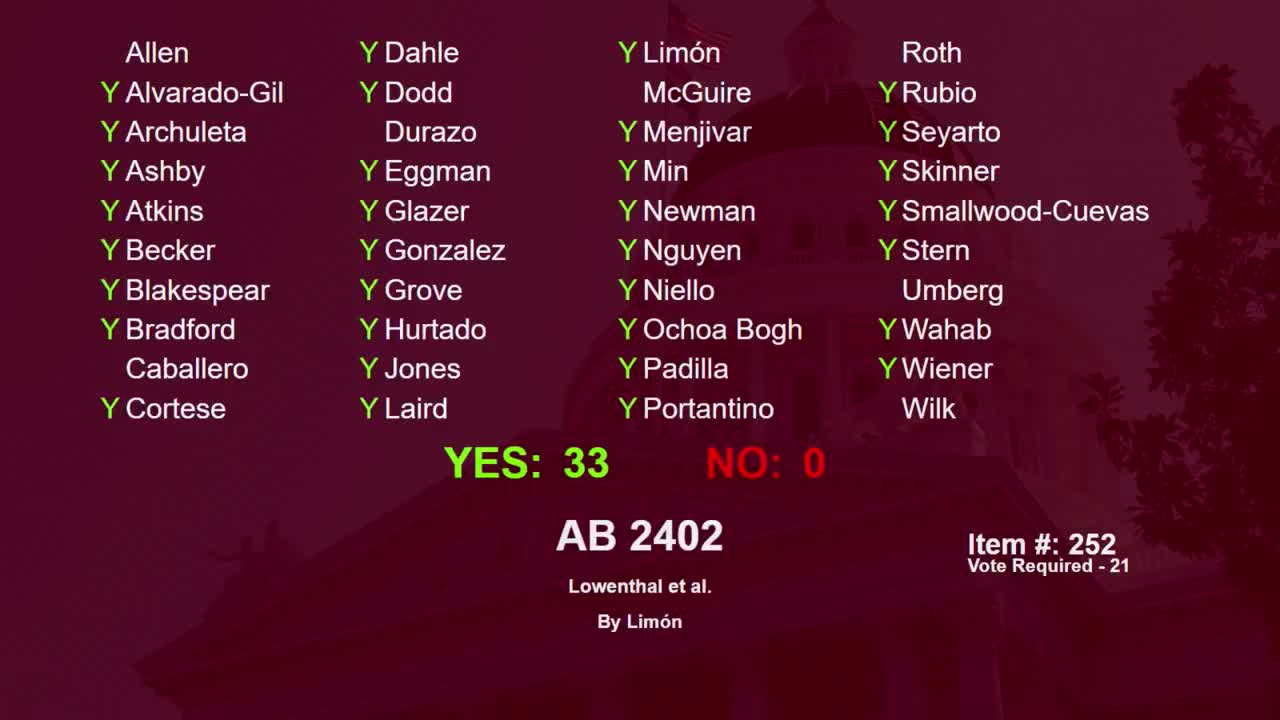 3MIN
Senate Floor
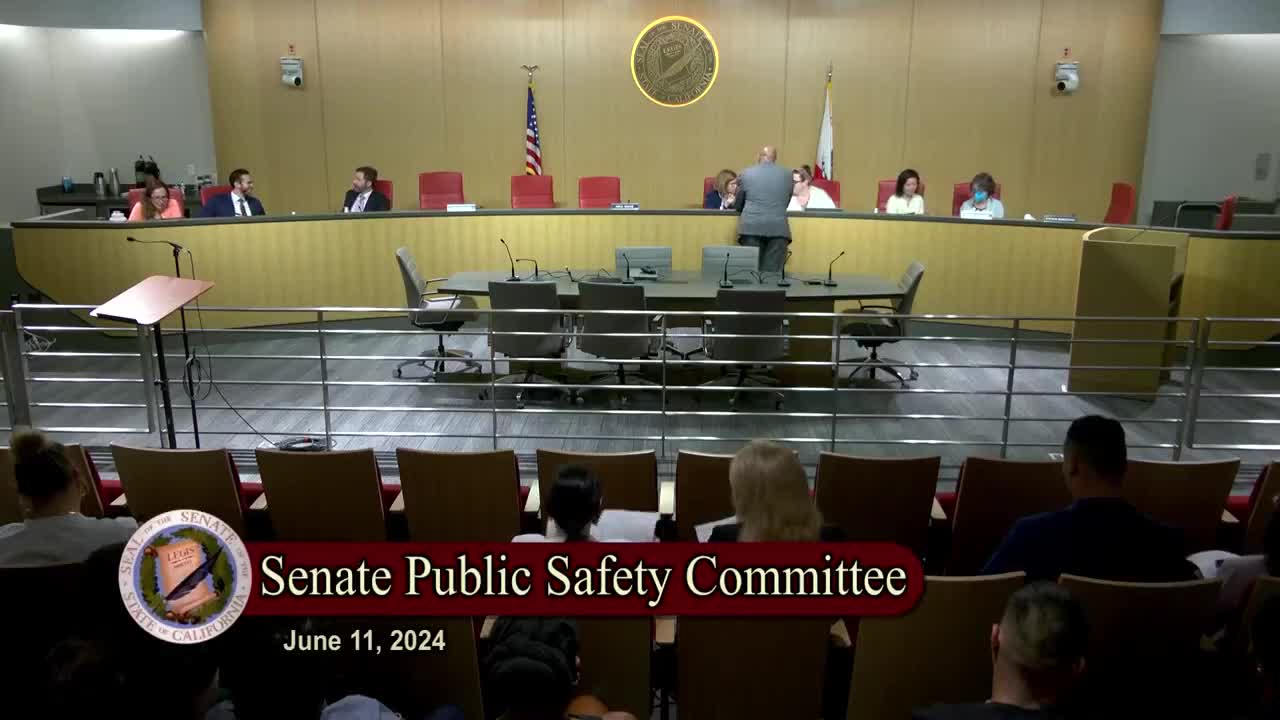 8MIN
Senate Standing Committee on Public Safety
Bill Author

Bill Co-Author(s):