AB 2642: Elections: intimidation.
- Session Year: 2023-2024
- House: Assembly
- Latest Version Date: 2024-09-24
Current Status:
Passed
(2024-09-24: Chaptered by Secretary of State - Chapter 533, Statutes of 2024.)
Introduced
In Committee
First Chamber
In Committee
Second Chamber
Enacted
Existing law makes it a crime to intimidate a voter or to interfere with the conduct of an election, as specified. Existing law makes it a crime for a person in possession of a firearm or a uniformed peace officer, private guard, or security personnel to be stationed in the immediate vicinity of, or posted at, a polling place without written authorization of the appropriate elections official, except as specified. Existing law also makes it a crime to hire a person to conduct these prohibited acts.
This bill would prohibit a person from intimidating, threatening, or coercing, or attempting to intimidate, threaten, or coerce, any other person for engaging in specified election-related activities. The bill would authorize an aggrieved person, an officer holding an election or conducting a canvass, or the Attorney General to file a civil action to enforce this prohibition. The bill would create a presumption that a person who openly carries a firearm or imitation firearm while interacting with or observing the specified election-related activities would be presumed to have engaged in prohibited intimidation, in the absence of an affirmative showing to the contrary by a preponderance of the evidence. The bill would provide that an aggrieved person who prevails in such an action will recover reasonable attorneys fees, reasonable expert fees, and reasonable litigation expenses, as specified.
This bill would declare that it is to take effect immediately as an urgency statute.
Existing law makes it a crime to intimidate a voter or to interfere with the conduct of an election, as specified. Existing law makes it a crime for a person in possession of a firearm or a uniformed peace officer, private guard, or security personnel to be stationed in the immediate vicinity of, or posted at, a polling place without written authorization of the appropriate elections official, except as specified. Existing law also makes it a crime to hire a person to conduct these prohibited acts.
This bill would prohibit a person from intimidating, threatening, or coercing, or attempting to intimidate, threaten, or coerce, any other person for engaging in specified election-related activities. The bill would authorize an aggrieved person, an officer holding an election or conducting a canvass, or the Attorney General to file a civil action to enforce this prohibition. The bill would create a presumption that a person who openly carries a firearm, imitation firearm, or toy gun firearm or imitation firearm while interacting with or observing the specified election-related activities would be presumed to have engaged in prohibited intimidation, in the absence of an affirmative showing to the contrary by a preponderance of the evidence. The bill would entitle provide that an aggrieved person who prevails in such an action to will recover reasonable attorneys fees, reasonable expert fees, and reasonable litigation expenses, as specified.
This bill would declare that it is to take effect immediately as an urgency statute.
Existing law makes it a crime to intimidate a voter or to interfere with the conduct of an election, as specified. Existing law makes it a crime for a person in possession of a firearm or a uniformed peace officer, private guard, or security personnel to be stationed in the immediate vicinity of, or posted at, a polling place without written authorization of the appropriate elections official, except as specified. Existing law also makes it a crime to hire a person to conduct these prohibited acts.
This bill would prohibit a person from intimidating, threatening, or coercing, or attempting to intimidate, threaten, or coerce, any other person for engaging in specified election-related activities. The bill would authorize an aggrieved person, an officer holding an election or conducting a canvass, or the Attorney General to file a civil action to enforce this prohibition. The bill would create a presumption that a person who openly carries a firearm, imitation firearm, or toy gun while interacting with or observing the specified election-related activities would be presumed to have engaged in prohibited intimidation, in the absence of an affirmative showing to the contrary by a preponderance of the evidence. The bill would entitle an aggrieved person who prevails in such an action to recover reasonable attorneys fees, reasonable expert fees, and reasonable litigation expenses, as specified.
This bill would declare that it is to take effect immediately as an urgency statute.
The Legislature finds and declares as follows:
(a)The Legislature has compelling interests in protecting both public safety and individual rights, including the fundamental right to vote. It is the Legislatures intent and purpose in enacting this act to help preserve the right to vote by securing the safety and freedom of our elections and allowing voters, election workers, and other officials who conduct our elections to play their roles free from threats and intimidation.
(b)The United States, including California, has a history of discrimination and intimidation in elections. African American voters in California first began petitioning for the right to vote in 1865, two years after the Emancipation Proclamation was issued and the same year that slavery was completely abolished with the ratification of the 13th Amendment. Californias refusal to ratify or enforce the 14th and 15th Amendments eventually prompted the federal government to pass the Enforcement Act of 1870, only after which African American men were allowed to register. Minority voters continued to suffer harassment, physical violence, and obstructionist tactics in the following decades, which included a California poll tax active from 1879 until 1914 and a literacy test active from 1894 until 1970. Passage of Section 11(b) of the federal Voting Rights Act of 1965 offered important protections against voter intimidation and, today, California has enacted several critical voter protection laws.
(c)In recent years, there has been an increase in the number of people carrying firearms in public, a development that has coincided with the deregulation of gun laws in a majority of states. Guns have been used where people are voting and tabulating ballots to intimidate and harass them.
(d)It is indisputable that division in American politics has reached a fever pitch. At the same time, an increasing share of the American electorate is willing to use violence to advance their political objectives. The Violence Policy Research Center at the University of California, Davis, found that 12.4 million Americans would be somewhat, very, or completely willing to kill a person in a situation in which they believe force or violence is justified to advance an important political objective. More than 47.7 million Americans, including those who do not own guns, think it is somewhat, very, or extremely likely that they will be armed with a gun in the next few years in a situation in which they think force or violence is justified to advance an important political objective.
(e)In 2022, the Global Project Against Hate and Extremism conducted a poll on the effects of extremist political rhetoric and activities and the proliferation of guns in public spaces. It found that just 41 percent of all respondents feel safe at their polling places and that 32 percent were specifically worried about people carrying weapons at their polling place. That number was even lower for Hispanic respondents (37 percent), Black respondents (28 percent), and those aged 1825 (26 percent). Voter intimidation, suppression, and harassment were also listed as a grave concern for 27 percent of those polled, with higher numbers for groups that have historically experienced harassment and disenfranchisement.
(f)The increases in voting by mail and other changes to voting instigated by the global COVID-19 pandemic provided fodder for disinformation and conspiracy theories about U.S. elections based on claims of voter fraud and election interference. In the years since, this fraudulent claim has served to radicalize an increasing number of individuals who use the election denial movement as an excuse to openly harass, threaten, and intimidate election workers and voters.
(g)California voters and election workers are amongst those at serious risk of experiencing this type of intimidation and harassment. In Shasta County, elections officials have encountered open hostility and threats from a small but vocal group of activists who claim concern about voter fraud. These activists have physically crowded election workers performing their official duties, inundated elections offices with public records requests, and even visited voter homes while claiming to be part of an official taskforce. Similarly, in Nevada County, the registrar-elect had to take out a restraining order against residents who harassed her, pushed their way into her office, and assaulted a staffer.
(h)The result of this unprecedented level of harassment has been a mass exodus of elections workers across the country. According to a nationwide poll of election workers conducted by the Brennan Center for Justice, 11 percent of current officials say they are very or somewhat likely to leave their positions before November 2024. Over half say they are concerned that threats, harassment, and intimidation will harm retention and recruitment and 30 percent admitted to having personally been abused, harassed, or threatened because of their job as a local elections official. In California alone, 41 percent of the states counties now have a new chief local elections official, and 44 percent of Californians will see the 2024 election administered by someone different than the official who administered the 2020 election.
(i)The Protecting Elections from Armed Coercion and Extremism Act, or PEACE Act, is intended to supplement existing anti-intimidation law under Section 11(b) of the federal Voting Rights Act of 1965, by, among other things, providing specific, explicit protections for election workers and acknowledging that in this era of increased gun violence and election denialism, the presence of guns in proximity to elections is presumptively intimidating. This act should not be construed, however, to suggest that other anti-intimidation laws do not protect election workers or protect against the use of firearms to intimidate.
(j)California law already prohibits the intimidation of voters and others in the election process and the carrying of firearms where votes are cast and counted. The PEACE Act is not intended to, and should not be construed to, limit or replace those prohibitions. It is instead a supplement to those protections.
(k)Because election administration and voting take place in a number of locationsincluding, but not limited to, polling places, elections and other government offices, ballot drop boxes, and peoples homesthe term voting as defined by this Act is intended to be read expansively to include all forms and methods of voting permitted under federal and state law.
SEC. 2.Article 5 (commencing with Section 18580) is added to Chapter 6 of Division 18 of the Elections Code, to read:5.Protecting Elections from Armed Coercion and Extremism (PEACE) Act18580.For the purposes of this article, the following definitions apply:
(a)Firearm means a device designed to be used as a weapon, from which a projectile is expelled through a barrel by the force of an explosion or other form of combustion. It includes any firearm that is in the nature of an air gun, spring gun or pistol, or other weapon in which the propelling force is a spring, an elastic band, carbon dioxide, compressed or other gas or vapor, or air or compressed air, or is ignited by compressed air, and that ejects a bullet or missile smaller than three-eighths of an inch in diameter with sufficient force to injure a person that is so substantially similar in coloration and overall appearance to an existing firearm or weapon as to lead a reasonable person to perceive that the device is a firearm or weapon.
(b)Imitation firearm has the same meaning as in Section 16700 of the Penal Code.
(c)Law enforcement officer has the same meaning as in Section 13519.05 of the Penal Code.
(d)Officer holding an election or conducting a canvass has the same meaning as in Section 18502.
(e)(1)Open carry has the same meaning as in Section 26350 of the Penal Code.
(2)Notwithstanding Section 26350 of the Penal Code, this definition applies to any firearm or imitation firearm that is openly carried and applies to any firearm that is openly carried, regardless of whether the firearm is loaded.
(f)Voting includes any action necessary to make a vote effective in a primary, special, or general election, including registration or other action required by law as a prerequisite to voting, casting a ballot by any method permitted by law, and having such ballot counted properly and included in the appropriate totals of votes cast with respect to a candidate or measure for which votes are received in an election.
18581.(a)A person shall not intimidate, threaten, or coerce, or attempt to intimidate, threaten, or coerce, any other person for any of the following:
(1)Voting or attempting to vote.
(2)Urging or aiding any person to vote or attempt to vote, whether as part of official election administration activity or otherwise.
(3)Exercising any powers or duties to administer elections, including counting votes, canvassing, and certifying an election in accordance with Division 15.
(4)That other persons status as a past or present participant in the administration of elections.
(b)(1)In any suit to enforce this section, a person who openly carries a firearm or imitation firearm while interacting with or observing any of the activities described in paragraphs (1) to (3), inclusive, or interacting with or observing a person due to their status described in paragraph (4), of subdivision (a) shall be presumed to have engaged in intimidation prohibited by this section in the absence of an affirmative showing to the contrary by a preponderance of the evidence.
(2)A law enforcement officer acting within the scope of their official duties is not subject to this presumption, but a court may nonetheless consider a law enforcement officers possession of a firearm in determining whether the officer violated subdivision (a).
18582.(a)A person aggrieved by a violation of Section 18581 may enforce the provisions of this article in a suit at law or in equity, or both. A prevailing plaintiff in such an action shall recover reasonable attorneys fees, reasonable expert fees, reasonable litigation expenses, and all such fees as are appropriate as part of the costs to be determined by a court of competent jurisdiction.
(b)An officer holding an election or conducting a canvass may enforce the provisions of this act and may institute an action for equitable relief on behalf of an aggrieved person who is in the officers jurisdiction or is eligible to vote in the officers jurisdiction.
(c)The Attorney General may enforce the provisions of this act and may institute for the state, or in the name of the state, an action for equitable relief, including an application for a temporary or permanent injunction, restraining order, or other order.
(d)A suit brought by an officer holding an election or conducting a canvass or the Attorney General under this section does not preclude a contemporaneous private suit by an aggrieved person to enforce the provisions of this article.
(e)In a suit to enforce the provisions of this article, a court may grant relief enjoining the use or carrying of firearms by a defendant beyond the areas defined in Article 3. This subdivision does not limit the courts authority to grant any other just and equitable relief.
(f)In order to prevail in a suit to enforce the provisions of this article, a plaintiff need not prove that a defendant intended to intimidate, threaten, or coerce any person, except in order to prove an attempt to intimidate, threaten, or coerce. A court may nonetheless consider evidence of intent in determining the appropriate relief.
(g)The provisions of this article are cumulative and shall not be construed as restricting the application of any other law, including, but not limited to, the application of a criminal law to a person whose conduct violates Section 18581.
SEC. 3.The provisions of this act are severable. If any provision of this act or its application is held invalid, that invalidity shall not affect other provisions or applications that can be given effect without the invalid provision or application.
SEC. 4.This act is an urgency statute necessary for the immediate preservation of the public peace, health, or safety within the meaning of Article IV of the California Constitution and shall go into immediate effect. The facts constituting the necessity are:
In order to deter intimidation, harassment, and violence at the polls in the upcoming November 5, 2024 general election, it is necessary that this act take effect immediately.
The Legislature finds and declares as follows:
(a)The Legislature has compelling interests in protecting both public safety and individual rights, including the fundamental right to vote. It is the Legislatures intent and purpose in enacting this act to help preserve the right to vote by securing the safety and freedom of our elections and allowing voters, election workers, and other officials who conduct our elections to play their roles free from threats and intimidation.
(b)The United States, including California, has a history of discrimination and intimidation in elections. African American voters in California first began petitioning for the right to vote in 1865, two years after the Emancipation Proclamation was issued and the same year that slavery was completely abolished with the ratification of the 13th Amendment. Californias refusal to ratify or enforce the 14th and 15th Amendments eventually prompted the federal government to pass the Enforcement Act of 1870, only after which African American men were allowed to register. Minority voters continued to suffer harassment, physical violence, and obstructionist tactics in the following decades, which included a California poll tax active from 1879 until 1914 and a literacy test active from 1894 until 1970. Passage of Section 11(b) of the federal Voting Rights Act of 1965 offered important protections against voter intimidation and, today, California has enacted several critical voter protection laws.
(c)In recent years, there has been an increase in the number of people carrying firearms in public, a development that has coincided with the deregulation of gun laws in a majority of states. Guns have been used where people are voting and tabulating ballots to intimidate and harass them.
(d)It is indisputable that division in American politics has reached a fever pitch. At the same time, an increasing share of the American electorate is willing to use violence to advance their political objectives. The Violence Policy Research Center at the University of California, Davis, found that 12.4 million Americans would be somewhat, very, or completely willing to kill a person in a situation in which they believe force or violence is justified to advance an important political objective. More than 47.7 million Americans, including those who do not own guns, think it is somewhat, very, or extremely likely that they will be armed with a gun in the next few years in a situation in which they think force or violence is justified to advance an important political objective.
(e)In 2022, the Global Project Against Hate and Extremism conducted a poll on the effects of extremist political rhetoric and activities and the proliferation of guns in public spaces. It found that just 41 percent of all respondents feel safe at their polling places and that 32 percent were specifically worried about people carrying weapons at their polling place. That number was even lower for Hispanic respondents (37 percent), Black respondents (28 percent), and those aged 1825 (26 percent). Voter intimidation, suppression, and harassment were also listed as a grave concern for 27 percent of those polled, with higher numbers for groups that have historically experienced harassment and disenfranchisement.
(f)The increases in voting by mail and other changes to voting instigated by the global COVID-19 pandemic provided fodder for disinformation and conspiracy theories about U.S. elections based on claims of voter fraud and election interference. In the years since, this fraudulent claim has served to radicalize an increasing number of individuals who use the election denial movement as an excuse to openly harass, threaten, and intimidate election workers and voters.
(g)California voters and election workers are amongst those at serious risk of experiencing this type of intimidation and harassment. In Shasta County, elections officials have encountered open hostility and threats from a small but vocal group of activists who claim concern about voter fraud. These activists have physically crowded election workers performing their official duties, inundated elections offices with public records requests, and even visited voter homes while claiming to be part of an official taskforce. Similarly, in Nevada County, the registrar-elect had to take out a restraining order against residents who harassed her, pushed their way into her office, and assaulted a staffer.
(h)The result of this unprecedented level of harassment has been a mass exodus of elections workers across the country. According to a nationwide poll of election workers conducted by the Brennan Center for Justice, 11 percent of current officials say they are very or somewhat likely to leave their positions before November 2024. Over half say they are concerned that threats, harassment, and intimidation will harm retention and recruitment and 30 percent admitted to having personally been abused, harassed, or threatened because of their job as a local elections official. In California alone, 41 percent of the states counties now have a new chief local elections official, and 44 percent of Californians will see the 2024 election administered by someone different than the official who administered the 2020 election.
(i)The Protecting Elections from Armed Coercion and Extremism Act, or PEACE Act, is intended to supplement existing anti-intimidation law under Section 11(b) of the federal Voting Rights Act of 1965, by, among other things, providing specific, explicit protections for election workers and acknowledging that in this era of increased gun violence and election denialism, the presence of guns in proximity to elections is presumptively intimidating. This act should not be construed, however, to suggest that other anti-intimidation laws do not protect election workers or protect against the use of firearms to intimidate.
(j)California law already prohibits the intimidation of voters and others in the election process and the carrying of firearms where votes are cast and counted. The PEACE Act is not intended to, and should not be construed to, limit or replace those prohibitions. It is instead a supplement to those protections.
(k)Because election administration and voting take place in a number of locationsincluding, but not limited to, polling places, elections and other government offices, ballot drop boxes, and peoples homesthe term voting as defined by this Act is intended to be read expansively to include all forms and methods of voting permitted under federal and state law.
SEC. 2.Article 5 (commencing with Section 18580) is added to Chapter 6 of Division 18 of the Elections Code, to read:5.Protecting Elections from Armed Coercion and Extremism (PEACE) Act18580.For the purposes of this article, the following definitions apply:
(a)Firearm means a device designed to be used as a weapon, from which a projectile is expelled through a barrel by the force of an explosion or other form of combustion. It includes any firearm that is in the nature of an air gun, spring gun or pistol, or other weapon in which the propelling force is a spring, an elastic band, carbon dioxide, compressed or other gas or vapor, or air or compressed air, or is ignited by compressed air, and that ejects a bullet or missile smaller than three-eighths of an inch in diameter with sufficient force to injure a person that is so substantially similar in coloration and overall appearance to an existing firearm or weapon as to lead a reasonable person to perceive that the device is a firearm or weapon.
(b)Imitation firearm has the same meaning as in Section 16700 of the Penal Code.
(c)Law enforcement officer has the same meaning as in Section 13519.05 of the Penal Code.
(d)Officer holding an election or conducting a canvass has the same meaning as in Section 18502.
(e)(1)Open carry has the same meaning as in Section 26350 of the Penal Code.
(2)Notwithstanding Section 26350 of the Penal Code, this definition applies to any firearm or imitation firearm that is openly carried and applies to any firearm that is openly carried, regardless of whether the firearm is loaded.
(f)Voting includes any action necessary to make a vote effective in a primary, special, or general election, including registration or other action required by law as a prerequisite to voting, casting a ballot by any method permitted by law, and having such ballot counted properly and included in the appropriate totals of votes cast with respect to a candidate or measure for which votes are received in an election.
18581.(a)A person shall not intimidate, threaten, or coerce, or attempt to intimidate, threaten, or coerce, any other person for any of the following:
(1)Voting or attempting to vote.
(2)Urging or aiding any person to vote or attempt to vote, whether as part of official election administration activity or otherwise.
(3)Exercising any powers or duties to administer elections, including counting votes, canvassing, and certifying an election in accordance with Division 15.
(4)That other persons status as a past or present participant in the administration of elections.
(b)(1)In any suit to enforce this section, a person who openly carries a firearm or imitation firearm while interacting with or observing any of the activities described in paragraphs (1) to (3), inclusive, or interacting with or observing a person due to their status described in paragraph (4), of subdivision (a) shall be presumed to have engaged in intimidation prohibited by this section in the absence of an affirmative showing to the contrary by a preponderance of the evidence.
(2)A law enforcement officer acting within the scope of their official duties is not subject to this presumption, but a court may nonetheless consider a law enforcement officers possession of a firearm in determining whether the officer violated subdivision (a).
18582.(a)A person aggrieved by a violation of Section 18581 may enforce the provisions of this article in a suit at law or in equity, or both. A prevailing plaintiff in such an action shall recover reasonable attorneys fees, reasonable expert fees, reasonable litigation expenses, and all such fees as are appropriate as part of the costs to be determined by a court of competent jurisdiction.
(b)An officer holding an election or conducting a canvass may enforce the provisions of this act and may institute an action for equitable relief on behalf of an aggrieved person who is in the officers jurisdiction or is eligible to vote in the officers jurisdiction.
(c)The Attorney General may enforce the provisions of this act and may institute for the state, or in the name of the state, an action for equitable relief, including an application for a temporary or permanent injunction, restraining order, or other order.
(d)A suit brought by an officer holding an election or conducting a canvass or the Attorney General under this section does not preclude a contemporaneous private suit by an aggrieved person to enforce the provisions of this article.
(e)In a suit to enforce the provisions of this article, a court may grant relief enjoining the use or carrying of firearms by a defendant beyond the areas defined in Article 3. This subdivision does not limit the courts authority to grant any other just and equitable relief.
(f)In order to prevail in a suit to enforce the provisions of this article, a plaintiff need not prove that a defendant intended to intimidate, threaten, or coerce any person, except in order to prove an attempt to intimidate, threaten, or coerce. A court may nonetheless consider evidence of intent in determining the appropriate relief.
(g)The provisions of this article are cumulative and shall not be construed as restricting the application of any other law, including, but not limited to, the application of a criminal law to a person whose conduct violates Section 18581.
SEC. 3.The provisions of this act are severable. If any provision of this act or its application is held invalid, that invalidity shall not affect other provisions or applications that can be given effect without the invalid provision or application.
SEC. 3.SEC. 4.This act is an urgency statute necessary for the immediate preservation of the public peace, health, or safety within the meaning of Article IV of the California Constitution and shall go into immediate effect. The facts constituting the necessity are:
In order to deter intimidation, harassment, and violence at the polls in the upcoming November 5, 2024 general election, it is necessary that this act take effect immediately.
The Legislature finds and declares as follows:
(a)The Legislature has compelling interests in protecting both public safety and individual rights, including the fundamental right to vote. It is the Legislatures intent and purpose in enacting this act to help preserve the right to vote by securing the safety and freedom of our elections and allowing voters, election workers, and other officials who conduct our elections to play their roles free from threats and intimidation.
(b)The United States, including California, has a history of discrimination and intimidation in elections. African American voters in California first began petitioning for the right to vote in 1865, two years after the Emancipation Proclamation was issued and the same year that slavery was completely abolished with the ratification of the 13th Amendment. Californias refusal to ratify or enforce the 14th and 15th Amendments eventually prompted the federal government to pass the Enforcement Act of 1870, only after which African American men were allowed to register. Minority voters continued to suffer harassment, physical violence, and obstructionist tactics in the following decades, which included a California poll tax active from 1879 until 1914 and a literacy test active from 1894 until 1970. Passage of Section 11(b) of the federal Voting Rights Act of 1965 offered important protections against voter intimidation and, today, California has enacted several critical voter protection laws.
(c)In recent years, there has been an increase in the number of people carrying firearms in public, a development that has coincided with the deregulation of gun laws in a majority of states. Guns have been used where people are voting and tabulating ballots to intimidate and harass them.
(d)It is indisputable that division in American politics has reached a fever pitch. At the same time, an increasing share of the American electorate is willing to use violence to advance their political objectives. The Violence Policy Research Center at the University of California, Davis, found that 12.4 million Americans would be somewhat, very, or completely willing to kill a person in a situation in which they believe force or violence is justified to advance an important political objective. More than 47.7 million Americans, including those who do not own guns, think it is somewhat, very, or extremely likely that they will be armed with a gun in the next few years in a situation in which they think force or violence is justified to advance an important political objective.
(e)In 2022, the Global Project Against Hate and Extremism conducted a poll on the effects of extremist political rhetoric and activities and the proliferation of guns in public spaces. It found that just 41 percent of all respondents feel safe at their polling places and that 32 percent were specifically worried about people carrying weapons at their polling place. That number was even lower for Hispanic respondents (37 percent), Black respondents (28 percent), and those aged 1825 (26 percent). Voter intimidation, suppression, and harassment were also listed as a grave concern for 27 percent of those polled, with higher numbers for groups that have historically experienced harassment and disenfranchisement.
(f)The increases in voting by mail and other changes to voting instigated by the global COVID-19 pandemic provided fodder for disinformation and conspiracy theories about U.S. elections based on claims of voter fraud and election interference. In the years since, this fraudulent claim has served to radicalize an increasing number of individuals who use the election denial movement as an excuse to openly harass, threaten, and intimidate election workers and voters.
(g)California voters and election workers are amongst those at serious risk of experiencing this type of intimidation and harassment. In Shasta County, elections officials have encountered open hostility and threats from a small but vocal group of activists who claim concern about voter fraud. These activists have physically crowded election workers performing their official duties, inundated elections offices with public records requests, and even visited voter homes while claiming to be part of an official taskforce. Similarly, in Nevada County, the registrar-elect had to take out a restraining order against residents who harassed her, pushed their way into her office, and assaulted a staffer.
(h)The result of this unprecedented level of harassment has been a mass exodus of elections workers across the country. According to a nationwide poll of election workers conducted by the Brennan Center for Justice, 11 percent of current officials say they are very or somewhat likely to leave their positions before November 2024. Over half say they are concerned that threats, harassment, and intimidation will harm retention and recruitment and 30 percent admitted to having personally been abused, harassed, or threatened because of their job as a local elections official. In California alone, 41 percent of the states counties now have a new chief local elections official, and 44 percent of Californians will see the 2024 election administered by someone different than the official who administered the 2020 election.
(i)The Protecting Elections from Armed Coercion and Extremism Act, or PEACE Act Act, is intended to supplement existing anti-intimidation law under Section 11(b) of the federal Voting Rights Act of 1965, by, among other things, providing specific, explicit protections for election workers and acknowledging that in this era of increased gun violence and election denialism, the presence of guns in proximity to elections is presumptively intimidating. This act should not be construed, however, to suggest that other anti-intimidation laws do not protect election workers or protect against the use of firearms to intimidate.
(j)California law already prohibits the intimidation of voters and others in the election process and the carrying of firearms where votes are cast and counted. The PEACE Act is not intended to, and should not be construed to, limit or replace those prohibitions. It is instead a supplement to those protections.
(k)Because election administration and voting take place in a number of locationsincluding, but not limited to, polling places, elections and other government offices, ballot drop boxes, and peoples homesthe term voting as defined by this Act is intended to be read expansively to include all forms and methods of voting permitted under federal and state law.
SEC. 2.Article 5 (commencing with Section 18580) is added to Chapter 6 of Division 18 of the Elections Code, to read:5.PEACEProtecting Elections from Armed Coercion and Extremism (PEACE) Act18580.For the purposes of this article, the following definitions apply:
(a)Firearm means a device designed to be used as a weapon, from which a projectile is expelled through a barrel by the force of an explosion or other form of combustion. It includes any firearm that is in the nature of an air gun, spring gun or pistol, or other weapon in which the propelling force is a spring, an elastic band, carbon dioxide, compressed or other gas or vapor, or air or compressed air, or is ignited by compressed air, and that ejects a bullet or missile smaller than three-eighths of an inch in diameter with sufficient force to injure a person. person that is so substantially similar in coloration and overall appearance to an existing firearm or weapon as to lead a reasonable person to perceive that the device is a firearm or weapon.
(b)Imitation firearm means an object or device reasonably capable of being mistaken for a firearm. has the same meaning as in Section 16700 of the Penal Code.
(c)Law enforcement officer has the same meaning as in Section 13519.05 of the Penal Code.
(c)(d)Officer holding an election or conducting a canvass has the same meaning as in Section 18502.
(d)(e)(1)Open carry has the same meaning as in Section 26350 of the Penal Code.
(2)Notwithstanding Section 26350 of the Penal Code, this definition applies to any firearm or imitation firearm that is openly carried and applies to any firearm that is openly carried, regardless of whether the firearm is loaded.
(e)Toy gun means a facsimile or reproduction of a firearm that is marketed as a product intended for children or is substantially similar in appearance, size, and shape to a genuine firearm.(f)Voting includes any action necessary to make a vote effective in a primary, special, or general election, including registration or other action required by law as a prerequisite to voting, casting a ballot by any method permitted by law, and having such ballot counted properly and included in the appropriate totals of votes cast with respect to a candidate or measure for which votes are received in an election.
18581.(a)A person, while acting under color of law or otherwise, person shall not intimidate, threaten, or coerce, or attempt to intimidate, threaten, or coerce, any other person for any of the following:
(1)Voting or attempting to vote.
(2)Urging or aiding any person to vote or attempt to vote, whether as part of official election administration activity or otherwise.
(3)Exercising any powers or duties to administer elections, including counting votes, canvassing, and certifying an election in accordance with Division 15.
(4)That other persons status as a past or present participant in the administration of elections.
(b)In(b)(1)In any suit to enforce this section, a person who openly carries a firearm, imitation firearm, or toy gun firearm or imitation firearm while interacting with or observing any of the activities described in paragraphs (1) to (3), inclusive, or interacting with or observing a person due to their status described in paragraph (4), of subdivision (a) shall be presumed to have engaged in intimidation prohibited by this section in the absence of an affirmative showing to the contrary by a preponderance of the evidence. Law
(2)A law enforcement officers officer acting within the scope of their official duties are is not subject to this presumption, but a court may nonetheless consider a law enforcement officers possession of a firearm in determining whether the officer violated subdivision (a).
18582.(a)A person aggrieved by a violation of Section 18581 may enforce the provisions of this article in a suit at law or in equity, or both. A prevailing plaintiff in such an action may shall recover reasonable attorneys fees, reasonable expert fees, reasonable litigation expenses, and all such fees as are appropriate as part of the costs to be determined by a court of competent jurisdiction.
(b)An officer holding an election or conducting a canvass may enforce the provisions of this act and may institute an action for equitable relief on behalf of an aggrieved person who is in the officers jurisdiction or is eligible to vote in the officers jurisdiction.
(c)The Attorney General may enforce the provisions of this act and may institute for the state, or in the name of the state, an action for equitable relief, including an application for a temporary or permanent injunction, restraining order, or other order.
(d)A suit brought by an officer holding an election or conducting a canvass or the Attorney General under this section does not preclude a contemporaneous private suit by an aggrieved person to enforce the provisions of this article.
(e)In a suit to enforce the provisions of this article, a court may grant relief enjoining the use or carrying of firearms by a defendant beyond the areas defined in Article 3. This subdivision does not limit the courts authority to grant any other just and equitable relief.
(f)In order to prevail in a suit to enforce the provisions of this article, a plaintiff need not prove that a defendant intended to intimidate, threaten, or coerce any person, except in order to prove an attempt to intimidate, threaten, or coerce. A court may nonetheless consider evidence of intent in determining the appropriate relief.
(g)The provisions of this article are cumulative and shall not be construed as restricting the application of any other law, including, but not limited to, the application of a criminal law to a person whose conduct violates Section 18581.
SEC. 3.This act is an urgency statute necessary for the immediate preservation of the public peace, health, or safety within the meaning of Article IV of the California Constitution and shall go into immediate effect. The facts constituting the necessity are:
In order to deter intimidation, harassment, and violence at the polls in the upcoming November 5, 2024 general election, it is necessary that this act take effect immediately.
The Legislature finds and declares as follows:
(a)The Legislature has compelling interests in protecting both public safety and individual rights, including the fundamental right to vote. It is the Legislatures intent and purpose in enacting this act to help preserve the right to vote by securing the safety and freedom of our elections and allowing voters, election workers, and other officials who conduct our elections to play their roles free from intimidation and the threat of gun violence. threats and intimidation.
(b)The United States, including California, has a history of discrimination and intimidation in elections. African American voters in California first began petitioning for the right to vote in 1865, two years after the Emancipation Proclamation was issued and the same year that slavery was completely abolished with the ratification of the 13th Amendment. Californias refusal to ratify or enforce the 14th and 15th Amendments eventually prompted the federal government to pass the Enforcement Act of 1870, only after which African American men were allowed to register. Minority voters continued to suffer harassment, physical violence, and obstructionist tactics in the following decades, which included a California poll tax active from 1879 until 1914 and a literacy test active from 1894 until 1970. Passage of Section 11(b) of the federal Voting Rights Act of 1965 offered important protections against voter intimidation and, today, California has enacted several critical voter protection laws.
(c)In recent years, there has been an increase in the number of people carrying firearms in public, a development that has coincided with the deregulation of gun laws in a majority of states. Guns have been used where people are voting and tabulating ballots to intimidate and harass them.
(d)Over the past decade, gun violence has remained a very serious public health problem. According to the Centers for Disease Control and Prevention, between 2019 and 2021, national firearm-related homicide rates increased by 35 percent, and 2021 was the worst year on record for firearm deaths, with a dismaying 48,830 lives lost. Relative to historical averages, the period between March 1, 2020, and February 28, 2021, saw a 15 percent increase in firearm-related incidents, a 34 percent increase in nonfatal gun injuries, and a 28 percent increase in gun deaths.(e)Mass shootings have also become more common. The number of annual mass shootings in the United States more than doubled in the last decade. In 2015, California experienced a mass shooting every thirteen daysin 2023 that number had changed to every six days. (f)(d)It is indisputable that division in American politics has reached a fever pitch. At the same time, an increasing share of the American electorate is willing to use violence to advance their political objectives. The Violence Policy Research Center at the University of California, Davis, found that 12.4 million Americans would be somewhat, very, or completely willing to kill a person in a situation in which they believe force or violence is justified to advance an important political objective. More than 47.7 million Americans, including those who do not own guns, think it is somewhat, very, or extremely likely that they will be armed with a gun in the next few years in a situation in which they think force or violence is justified to advance an important political objective.
(g)(e)In 2022, the Global Project Against Hate and Extremism conducted a poll on the effects of extremist political rhetoric and activities and the proliferation of guns in public spaces. It found that just 41 percent of all respondents feel safe at their polling places and that 32 percent were specifically worried about people carrying weapons at their polling place. That number was even lower for Hispanic respondents (37 percent), Black respondents (28 percent), and those aged 1825 (26 percent). Voter intimidation, suppression, and harassment were also listed as a grave concern for 27 percent of those polled, with higher numbers for groups that have historically experienced harassment and disenfranchisement.
(h)(f)The increases in voting by mail and other changes to voting instigated by the global COVID-19 pandemic provided fodder for President Trump and others to promote disinformation and conspiracy theories about U.S. elections based on claims of voter fraud and election interference. In the years since, this fraudulent claim has served to radicalize an increasing number of armed extremists and far-right supporters individuals who use the election denial movement as an excuse to openly harass, threaten, and intimidate election workers and voters.
(i)(g)California voters and election workers are amongst those at serious risk of experiencing this type of intimidation and harassment. In Shasta County, elections officials have encountered open hostility and threats from a small but vocal group of far-right activists who claim concern about voter fraud. These activists have physically crowded election workers performing their official duties, inundated elections offices with public records requests, and even visited voter homes while claiming to be part of an official taskforce. Similarly, in Nevada County, the registrar-elect had to take out a restraining order against residents who harassed her, pushed their way into her office, and assaulted a staffer.
(j)(h)The result of this unprecedented level of harassment has been a mass exodus of elections workers across the country. According to a nationwide poll of election workers conducted by the Brennan Center for Justice, 11 percent of current officials say they are very or somewhat likely to leave their positions before November 2024. Over half say they are concerned that threats, harassment, and intimidation will harm retention and recruitment and 30 percent admitted to having personally been abused, harassed, or threatened because of their job as a local elections official. In California alone, 41 percent of the states counties now have a new chief local elections official, and 44 percent of Californians will see the 2024 election administered by someone different than the official who administered the 2020 election.
(k)The United States Supreme Court has made clear that the Second Amendment to the United States Constitution is not a regulatory straightjacket. N.Y. State Rifle & Pistol Assn v. Bruen (2022) 597 U.S. 1, 30. The Second Amendment allows for a variety of gun regulations. Bruen, 597 U.S., at p. 80 (Kavanaugh, J., concurring). And the Supreme Court has repeatedly recognized that states may restrict the carrying of firearms in sensitive places, specifically including schools, government buildings, legislative assemblies, polling places, and courthouses. Bruen, 597 U.S., at p. 30; see also McDonald v. City of Chicago (2010) 561 U.S. 742, 786 (Alito, J., plurality op.); District of Columbia v. Heller (2008) 554 U.S. 570, 626. To date, no court has invalidated a prohibition on gun carrying in these sensitive locations specifically enumerated by the Court.(l)(i)The PEACE Act is intended to supplement existing anti-intimidation law under Section 11(b) of the federal Voting Rights Act of 1965, by, among other things, providing specific, explicit protections for election workers and acknowledging that in this era of increased gun violence and election denialism, the presence of guns in proximity to elections is presumptively intimidating. This act should not be construed, however, to suggest that other anti-intimidation laws do not protect election workers or protect against the use of firearms to intimidate.
(m)(j)California law already prohibits the intimidation of voters and others in the election process and the carrying of firearms where votes are cast and counted. The PEACE Act is not intended to, and should not be construed to, limit or replace those prohibitions. It is instead a supplement to those protections.
(n)(k)Because election administration and voting take place in a number of locationsincluding, but not limited to, polling places, elections and other government offices, ballot drop boxes, and peoples homesthe term voting as defined by this Act is intended to be read expansively to include all forms and methods of voting permitted under federal and state law.
SEC. 2.Article 5 (commencing with Section 18580) is added to Chapter 6 of Division 18 of the Elections Code, to read:5.PEACE Act18580.For the purposes of this article, the following definitions apply:
(a)Firearm means a device designed to be used as a weapon, from which a projectile is expelled through a barrel by the force of an explosion or other form of combustion. It includes any firearm that is in the nature of an air gun, spring gun or pistol, or other weapon in which the propelling force is a spring, an elastic band, carbon dioxide, compressed or other gas or vapor, or air or compressed air, or is ignited by compressed air, and that ejects a bullet or missile smaller than three-eighths of an inch in diameter with sufficient force to injure a person.
(b)Imitation firearm means an object or device reasonably capable of being mistaken for a firearm.
(c)Officer holding an election or conducting a canvass has the same meaning as in Section 18502.
(d)Open carry has the same meaning as in Section 26350 of the Penal Code.
(e)Toy gun means a facsimile or reproduction of a firearm that is marketed as a product intended for children or is substantially similar in appearance, size, and shape to a genuine firearm.
(f)Voting includes any action necessary to make a vote effective in a primary, special, or general election, including registration or other action required by law as a prerequisite to voting, casting a ballot by any method permitted by law, and having such ballot counted properly and included in the appropriate totals of votes cast with respect to a candidate or measure for which votes are received in an election.
18581.(a)A person, while acting under color of law or otherwise, shall not intimidate, threaten, or coerce, or attempt to intimidate, threaten, or coerce, any other person for any of the following:
(1)Voting or attempting to vote.
(2)Urging or aiding any person to vote or attempt to vote, whether as part of official election administration activity or otherwise.
(3)Exercising any powers or duties to administer elections, including counting votes, canvassing, and certifying an election in accordance with Division 15.
(4)That other persons status as a past or present participant in the administration of elections.
(b)In any suit to enforce this section, a person who openly carries a firearm, imitation firearm, or toy gun while interacting with or observing any of the activities described in paragraphs (1) to (3), inclusive, of subdivision (a) shall be presumed to have engaged in intimidation prohibited by this section in the absence of an affirmative showing to the contrary by a preponderance of the evidence. Law enforcement officers acting within the scope of their official duties are not subject to this presumption, but a court may nonetheless consider a law enforcement officers possession of a firearm in determining whether the officer violated subdivision (a).
18582.(a)A person aggrieved by a violation of Section 18581 may enforce the provisions of this article in a suit at law or in equity, or both. A prevailing plaintiff in such an action may recover reasonable attorneys fees, reasonable expert fees, reasonable litigation expenses, and all such fees as are appropriate as part of the costs to be determined by a court of competent jurisdiction.
(b)An officer holding an election or conducting a canvass may enforce the provisions of this act and may institute an action for equitable relief on behalf of an aggrieved person who is in the officers jurisdiction or is eligible to vote in the officers jurisdiction.
(c)The Attorney General may enforce the provisions of this act and may institute for the state, or in the name of the state, an action for equitable relief, including an application for a temporary or permanent injunction, restraining order, or other order.
(d)A suit brought by an officer holding an election or conducting a canvass or the Attorney General under this section does not preclude a contemporaneous private suit by an aggrieved person to enforce the provisions of this article.
(e)In a suit to enforce the provisions of this article, a court may grant relief enjoining the use or carrying of firearms by a defendant beyond the areas defined in Article 3. This subdivision does not limit the courts authority to grant any other just and equitable relief.
(f)In order to prevail in a suit to enforce the provisions of this article, a plaintiff need not prove that a defendant intended to intimidate, threaten, or coerce any person, except in order to prove an attempt to intimidate, threaten, or coerce. A court may nonetheless consider evidence of intent in determining the appropriate relief.
SEC. 3.This act is an urgency statute necessary for the immediate preservation of the public peace, health, or safety within the meaning of Article IV of the California Constitution and shall go into immediate effect. The facts constituting the necessity are:
In order to deter intimidation, harassment, and violence at the polls in the upcoming November 5, 2024 general election, it is necessary that this act take effect immediately.
The Legislature finds and declares as follows:
(a)The Legislature has compelling interests in protecting both public safety and individual rights, including the fundamental right to vote. It is the Legislatures intent and purpose in enacting this act to help preserve the right to vote by securing the safety and freedom of our elections and allowing voters, election workers, and other officials who conduct our elections to play their roles free from intimidation and the threat of gun violence.
(b)The United States, including California, has a history of discrimination and intimidation in elections. African American voters in California first began petitioning for the right to vote in 1865, two years after the Emancipation Proclamation was issued and the same year that slavery was completely abolished with the ratification of the 13th Amendment. Californias refusal to ratify or enforce the 14th and 15th Amendments eventually prompted the federal government to pass the Enforcement Act of 1870, only after which African American men were allowed to register. Minority voters continued to suffer harassment, physical violence, and obstructionist tactics in the following decades, which included a California poll tax active from 1879 until 1914 and a literacy test active from 1894 until 1970. Passage of Section 11(b) of the federal Voting Rights Act of 1965 offered important protections against voter intimidation and, today, California has enacted several critical voter protection laws.
(c)In recent years, there has been an increase in the number of people carrying firearms in public, a development that has coincided with the deregulation of gun laws in a majority of states. Guns have been used where people are voting and tabulating ballots to intimidate and harass them.
(d)Over the past decade, gun violence has remained a very serious public health problem. According to the Centers for Disease Control and Prevention, between 2019 and 2021, national firearm-related homicide rates increased by 35 percent, and 2021 was the worst year on record for firearm deaths, with a dismaying 48,830 lives lost. Relative to historical averages, the period between March 1, 2020, and February 28, 2021, saw a 15 percent increase in firearm-related incidents, a 34 percent increase in nonfatal gun injuries, and a 28 percent increase in gun deaths.
(e)Mass shootings have also become more common. The number of annual mass shootings in the United States more than doubled in the last decade. In 2015, California experienced a mass shooting every thirteen daysin 2023 that number had changed to every six days.
(f)It is indisputable that division in American politics has reached a fever pitch. At the same time, an increasing share of the American electorate is willing to use violence to advance their political objectives. The Violence Policy Research Center at the University of California, Davis, found that 12.4 million Americans would be somewhat, very, or completely willing to kill a person in a situation in which they believe force or violence is justified to advance an important political objective. More than 47.7 million Americans, including those who do not own guns, think it is somewhat, very, or extremely likely that they will be armed with a gun in the next few years in a situation in which they think force or violence is justified to advance an important political objective.
(g)In 2022, the Global Project Against Hate and Extremism conducted a poll on the effects of extremist political rhetoric and activities and the proliferation of guns in public spaces. It found that just 41 percent of all respondents feel safe at their polling places and that 32 percent were specifically worried about people carrying weapons at their polling place. That number was even lower for Hispanic respondents (37 percent), Black respondents (28 percent), and those aged 1825 (26 percent). Voter intimidation, suppression, and harassment were also listed as a grave concern for 27 percent of those polled, with higher numbers for groups that have historically experienced harassment and disenfranchisement.
(h)The increases in voting by mail and other changes to voting instigated by the global COVID-19 pandemic provided fodder for President Trump and others to promote disinformation and conspiracy theories about U.S. elections based on claims of voter fraud and election interference. In the years since, this fraudulent claim has served to radicalize an increasing number of armed extremists and far-right supporters who use the election denial movement as an excuse to openly harass, threaten, and intimidate election workers and voters.
(i)California voters and election workers are amongst those at serious risk of experiencing this type of intimidation and harassment. In Shasta County, elections officials have encountered open hostility and threats from a small but vocal group of far-right activists who claim concern about voter fraud. These activists have physically crowded election workers performing their official duties, inundated elections offices with public records requests, and even visited voter homes while claiming to be part of an official taskforce. Similarly, in Nevada County, the registrar-elect had to take out a restraining order against residents who harassed her, pushed their way into her office, and assaulted a staffer.
(j)The result of this unprecedented level of harassment has been a mass exodus of elections workers across the country. According to a nationwide poll of election workers conducted by the Brennan Center for Justice, 11 percent of current officials say they are very or somewhat likely to leave their positions before November 2024. Over half say they are concerned that threats, harassment, and intimidation will harm retention and recruitment and 30 percent admitted to having personally been abused, harassed, or threatened because of their job as a local elections official. In California alone, 41 percent of the states counties now have a new chief local elections official, and 44 percent of Californians will see the 2024 election administered by someone different than the official who administered the 2020 election.
(k)The United States Supreme Court has made clear that the Second Amendment to the United States Constitution is not a regulatory straightjacket. N.Y. State Rifle & Pistol Assn v. Bruen (2022) 597 U.S. 1, 30. The Second Amendment allows for a variety of gun regulations. Bruen, 597 U.S., at p. 80 (Kavanaugh, J., concurring). And the Supreme Court has repeatedly recognized that states may restrict the carrying of firearms in sensitive places, specifically including schools, government buildings, legislative assemblies, polling places, and courthouses. Bruen, 597 U.S., at p. 30; see also McDonald v. City of Chicago (2010) 561 U.S. 742, 786 (Alito, J., plurality op.); District of Columbia v. Heller (2008) 554 U.S. 570, 626. To date, no court has invalidated a prohibition on gun carrying in these sensitive locations specifically enumerated by the Court.
(l)The PEACE Act is intended to supplement existing anti-intimidation law under Section 11(b) of the Voting Rights Act of 1965, by, among other things, providing specific, explicit protections for election workers and acknowledging that in this era of increased gun violence and election denialism, the presence of guns in proximity to elections is presumptively intimidating. This act should not be construed, however, to suggest that other anti-intimidation laws do not protect election workers or protect against the use of firearms to intimidate.
(m)California law already prohibits the intimidation of voters and others in the election process and the carrying of firearms where votes are cast and counted. The PEACE Act is not intended to, and should not be construed to, limit or replace those prohibitions. It is instead a supplement to those protections.
(n)Because election administration and voting take place in a number of locationsincluding, but not limited to, polling places, elections and other government offices, ballot drop boxes, and peoples homesthe term voting as defined by this Act is intended to be read expansively to include all forms and methods of voting permitted under federal and state law.
SEC. 2.Article 5 (commencing with Section 18580) is added to Chapter 6 of Division 18 of the Elections Code, to read:5.PEACE Act18580.For the purposes of this article, the following definitions apply:
(a)Firearm means a device designed to be used as a weapon, from which a projectile is expelled through a barrel by the force of an explosion or other form of combustion. It includes any firearm that is in the nature of an air gun, spring gun or pistol, or other weapon in which the propelling force is a spring, an elastic band, carbon dioxide, compressed or other gas or vapor, or air or compressed air, or is ignited by compressed air, and that ejects a bullet or missile smaller than three-eighths of an inch in diameter with sufficient force to injure a person.
(b)Imitation firearm means an object or device reasonably capable of being mistaken for a firearm.
(c)Officer holding an election or conducting a canvass has the same meaning as in Section 18502.
(d)Open carry has the same meaning as in Section 26350 of the Penal Code.
(e)Toy gun means a facsimile or reproduction of a firearm that is marketed as a product intended for children or is substantially similar in appearance, size, and shape to a genuine firearm.
(f)Voting includes any action necessary to make a vote effective in a primary, special, or general election, including registration or other action required by law as a prerequisite to voting, casting a ballot by any method permitted by law, and having such ballot counted properly and included in the appropriate totals of votes cast with respect to a candidate or measure for which votes are received in an election.
18581.(a)A person, while acting under color of law or otherwise, shall not intimidate, threaten, or coerce, or attempt to intimidate, threaten, or coerce, any other person for any of the following:
(1)Voting or attempting to vote.
(2)Urging or aiding any person to vote or attempt to vote, whether as part of official election administration activity or otherwise.
(3)Exercising any powers or duties to administer elections, including counting votes, canvassing, and certifying an election in accordance with Division 15.
(4)That other persons status as a past or present participant in the administration of elections.
(b)In any suit to enforce this section, a person who openly carries a firearm, imitation firearm, or toy gun while interacting with or observing any of the activities described in paragraphs (1) to (3), inclusive, of subdivision (a) shall be presumed to have engaged in intimidation prohibited by this section in the absence of an affirmative showing to the contrary by a preponderance of the evidence. Law enforcement officers acting within the scope of their official duties are not subject to this presumption, but a court may nonetheless consider a law enforcement officers possession of a firearm in determining whether the officer violated subdivision (a).
18582.(a)A person aggrieved by a violation of Section 18581 may enforce the provisions of this article in a suit at law or in equity, or both. A prevailing plaintiff in such an action may recover reasonable attorneys fees, reasonable expert fees, reasonable litigation expenses, and all such fees as are appropriate as part of the costs to be determined by a court of competent jurisdiction.
(b)An officer holding an election or conducting a canvass may enforce the provisions of this act and may institute an action for equitable relief on behalf of an aggrieved person who is in the officers jurisdiction or is eligible to vote in the officers jurisdiction.
(c)The Attorney General may enforce the provisions of this act and may institute for the state, or in the name of the state, an action for equitable relief, including an application for a temporary or permanent injunction, restraining order, or other order.
(d)A suit brought by an officer holding an election or conducting a canvass or the Attorney General under this section does not preclude a contemporaneous private suit by an aggrieved person to enforce the provisions of this article.
(e)In a suit to enforce the provisions of this article, a court may grant relief enjoining the use or carrying of firearms by a defendant beyond the areas defined in Article 3. This subdivision does not limit the courts authority to grant any other just and equitable relief.
(f)In order to prevail in a suit to enforce the provisions of this article, a plaintiff need not prove that a defendant intended to intimidate, threaten, or coerce any person, except in order to prove an attempt to intimidate, threaten, or coerce. A court may nonetheless consider evidence of intent in determining the appropriate relief.
SEC. 3.This act is an urgency statute necessary for the immediate preservation of the public peace, health, or safety within the meaning of Article IV of the California Constitution and shall go into immediate effect. The facts constituting the necessity are:
In order to deter intimidation, harassment, and violence at the polls in the upcoming November 5, 2024 general election, it is necessary that this act take effect immediately.
|
Date
|
Status
|
|---|---|
| Sep 24, 2024 | Chaptered by Secretary of State - Chapter 533, Statutes of 2024. |
| Sep 24, 2024 | Approved by the Governor. |
| Sep 11, 2024 | Enrolled and presented to the Governor at 4 p.m. |
| Aug 29, 2024 | Urgency clause adopted. Senate amendments concurred in. To Engrossing and Enrolling. (Ayes 60. Noes 13.). |
| Aug 29, 2024 | Assembly Rule 77 suspended. |
| Aug 28, 2024 | In Assembly. Concurrence in Senate amendments pending. May be considered on or after August 30 pursuant to Assembly Rule 77. |
| Aug 28, 2024 | Read third time. Urgency clause adopted. Passed. Ordered to the Assembly. (Ayes 31. Noes 8.). |
| Aug 26, 2024 | Read second time. Ordered to third reading. |
| Aug 22, 2024 | Read third time and amended. Ordered to second reading. |
| Aug 19, 2024 | Read second time. Ordered to third reading. |
| Aug 15, 2024 | From committee: Do pass. (Ayes 5. Noes 2.) (August 15). |
| Aug 5, 2024 | In committee: Referred to APPR suspense file. |
| Jun 26, 2024 | From committee: Do pass and re-refer to Com. on APPR. (Ayes 9. Noes 2.) (June 25). Re-referred to Com. on APPR. |
| Jun 18, 2024 | From committee: Do pass and re-refer to Com. on JUD. (Ayes 6. Noes 1.) (June 18). Re-referred to Com. on JUD. |
| May 29, 2024 | Referred to Coms. on E. & C.A. and JUD. |
| May 22, 2024 | In Senate. Read first time. To Com. on RLS. for assignment. |
| May 21, 2024 | Read third time. Urgency clause adopted. Passed. Ordered to the Senate. (Ayes 59. Noes 10. Page 5429.). |
| May 20, 2024 | Read second time. Ordered to third reading. |
| May 16, 2024 | From committee: Do pass. (Ayes 11. Noes 4.) (May 16). |
| May 16, 2024 | Joint Rule 62(a), file notice suspended. (Page 5215.) |
| May 15, 2024 | In committee: Set, first hearing. Referred to APPR. suspense file. |
| May 6, 2024 | Re-referred to Com. on APPR. |
| May 2, 2024 | Read second time and amended. |
| May 1, 2024 | From committee: Amend, and do pass as amended and re-refer to Com. on APPR. (Ayes 9. Noes 3.) (April 30). |
| Apr 15, 2024 | Re-referred to Com. on JUD. |
| Apr 11, 2024 | Read second time and amended. |
| Apr 10, 2024 | From committee: Amend, and do pass as amended and re-refer to Com. on JUD. (Ayes 6. Noes 2.) (April 10). |
| Mar 4, 2024 | Referred to Coms. on ELECTIONS and JUD. |
| Feb 15, 2024 | From printer. May be heard in committee March 16. |
| Feb 14, 2024 | Read first time. To print. |
|
Date
|
Description
|
Location
|
Votes
|
|
|---|---|---|---|---|
| Aug 29, 2024 | AB 2642 Berman Concurrence in Senate Amendments | Assembly Floor |
Passed |
|
| Aug 28, 2024 | Assembly 3rd Reading AB2642 Berman et al. By Newman Urgency Clause | Senate Floor |
Passed |
|
| Aug 15, 2024 | Do pass | Senate Standing Committee on Appropriations |
Passed |
|
| Aug 5, 2024 | Placed on suspense file | Senate Standing Committee on Appropriations |
Passed |
|
| Jun 25, 2024 | Do pass, but first be re-referred to the Committee on [Appropriations] | Senate Standing Committee on Judiciary |
Passed |
|
| Jun 18, 2024 | Do pass, but first be re-referred to the Committee on [Judiciary] | Senate Standing Committee on Elections and Constitutional Amendments |
Passed |
|
| May 21, 2024 | AB 2642 Berman Third Reading Urgency | Assembly Floor |
Passed |
|
| May 16, 2024 | Do pass. | Assembly Standing Committee on Appropriations |
Passed |
|
| Apr 30, 2024 | Do pass as amended and be re-referred to the Committee on [Appropriations] | Assembly Standing Committee on Judiciary |
Passed |
|
| Apr 10, 2024 | Do pass as amended and be re-referred to the Committee on [Judiciary] | Assembly Standing Committee on Elections |
Passed |
This list shows positions taken on this bill by organizations on the date displayed, which is linked to the original source.
Positions by individuals are not included.
|
Organization
|
Position
|
Date
|
|---|---|---|
| Aclu California Action | ** Support | |
| American Federation of State, County, and Municipal Employees | ** Support | |
| Asian Americans Advancing Justice Asian Law Caucus | ** Support | |
| Brady California | ** Support | |
| Brady Campaign to Prevent Gun Violence | ** Support | |
| Brennan Center for Justice | ** Support | |
| California Black Power Network | ** Support | |
| California Environmental Voters | ** Support | |
| California Secretary of State, Shirley N. Weber, Ph.D. | ** Support | |
| California Teachers Association | ** Support | |
| California Voter Foundation | ** Support | |
| County of Los Angeles Board of Supervisors | ** Support | |
| Disability Rights California | ** Support | |
| Everytown for Gun Safety | ** Support | |
| Everytown for Gun Safety Action Fund | ** Support | |
| Giffords Law Center To Prevent Gun Violence | ** Support | |
| Indivisible Ca: Statestrong | ** Support | |
| League Of Women Voters Of California | ** Support | |
| Los Angeles County | ** Support | |
| Moms Demand Action for Gun Sense in America | ** Support | |
| Neal Kelley, Retired Chief Election Official, Registrar of Voters for Orange | ** Support | |
| San Diegans For Gun Violence Prevention | ** Support | |
| SEIU California | ** Support | |
| Students Demand Action for Gun Sense in America | ** Support |
CONCURRENCE IN SENATE AMENDMENTS
CSA1 Bill Id:AB 2642
Author:(Berman and Gipson)
As Amended Ver:August 22, 2024
2/3 vote. Urgency
SUMMARY
Prohibits a person from intimidating, threatening, or coercing, or attempting to intimidate, threaten, or coerce, any other person for engaging in specified election-related activities, and authorizes an aggrieved person, an officer holding an election or conducting a canvass, or the Attorney General (AG) to file a civil action to enforce those prohibitions. Creates a presumption that a person who openly carries a firearm or imitation firearm while interacting with or observing specified election-related activities, is presumed to have engaged in prohibited intimidation, as specified.
Senate Amendments
Add a severability clause.
COMMENTS
Both federal and state laws seek to protect election workers and voters from bad actors. There are civil and criminal federal laws that make it illegal to intimidate, threaten or coerce someone for voting or attempting to vote, as well as federal statutes that make it illegal to intimidate, threaten or coerce people who are urging or helping others to vote. Under state laws, it's a felony for a person to make use or threaten to use force, violence, coercion, or intimidate another person to vote or refrain from voting, and for a person to interfere with the officers holding an election or conducting a canvass, or a voter exercising their right to vote.
This bill supplements existing state anti-intimidation laws by providing new tools to protect election workers and voters. According to the author and sponsors, although federal law allows civil suits to be filed by voters and election workers who suffer election-related harassment and threats, this bill will provide more robust civil protections in state law that explicitly acknowledge that both election workers and voters are covered.
Last year, the GIFFORDS Law Center to Prevent Gun Violence and the Brennan Center for Justice authored a joint report, "Guns and Voting, How to Protect Elections After Bruen," which discusses how American democracy has come under pressure due to conspiracies about elections and voter fraud that have led to an unprecedented surge in threats and violence towards election workers and voters. The report examines how these challenges have been further exacerbated due to the high rates of gun ownership and the legal challenges to gun safety laws following the US Supreme Court's decision in Bruen. The report evaluates the new risks that gun violence poses for US elections and proposes policy solutions to limit those risks. Solutions include prohibitions on firearms wherever voting or election administration occurs — at or near polling places, ballot drop boxes, election offices, and ballot counting facilities. In addition, the report argues that states need stronger laws preventing intimidation of voters, election officials, election workers, and anyone else facilitating voting, with express recognition of the role that guns play in intimidation. This bill implements some of the recommendations from the joint report.
Please see the policy committee analyses for a full discussion of this bill.
According to the Author
"California voters and election workers are among those who are at risk of experiencing intimidation and violence. As a result, there has been a nationwide exodus of workers from the job. In California, 41% of the state's counties now have a new chief local elections official, and 44% of voters will see a different election administrator for the 2024 election than to the official who oversaw the 2020 election. AB 2642 would protect voters and election workers by strengthening and supplementing existing anti-intimidation laws by providing civil remedies to anyone who experiences intimidation, threats, or coercion while engaging in election-related activities. The PEACE Act would make it clear that the polling place is not the place for guns by creating a presumption that people who carry firearms around election activities or workers did so with the intent to intimidate."
Arguments in Support
A co-sponsor of this bill, the Brennan Center for Justice, wrote in support to a previous version of the bill, "While California currently has several criminal laws that prohibit carrying guns openly and at places where elections are being conducted as well as intimidating voters, election workers, or officials, it lacks a comprehensive mechanism for victims of such criminal behavior to receive compensation for the emotional distress or other harm they may endure. AB 2642 is designed to provide this much-needed relief…In recent times, we have seen a concerning rise in efforts to suppress or intimidate voters, both in the United States and globally. This profoundly troubling state of affairs is a direct threat to the individuals targeted and the democratic process itself. By providing a clear path to legal recourse for victims of such behavior, AB 2642 not only upholds the rights of individual voters and election workers but also fortifies the integrity of our democratic system."
Arguments in Opposition
None received.
FISCAL COMMENTS
According to the Senate Appropriations Committee:
- The Department of Justice indicates that this bill would not have a fiscal impact.
- By authorizing a claim by specified individuals, this bill could result in an increased number of civil actions. Consequently, the bill could result in potentially significant cost pressures to the courts; the magnitude is unknown (Trial Court Trust Fund (TCTF)). The specific number of new actions that could be filed under the bill also is unknown; however, it generally costs about $1,000 to operate a courtroom for one hour. Courts are not funded on the basis of workload, and increased pressure on TCTF may create a need for additional funding for courts from the General Fund. The enacted 2024-25 budget includes $37 million in ongoing support from the General Fund to continue to backfill TCTF for revenue declines.
VOTES:
ASM ELECTIONS: 6-2-0
YES: Pellerin, Bennett, Berman, Cervantes, Low, Weber
NO: Lackey, Essayli
ASM JUDICIARY: 9-3-0
YES: Kalra, Bauer-Kahan, Bryan, Connolly, Haney, Maienschein, McKinnor, Pacheco, Reyes
NO: Dixon, Essayli, Sanchez
ASM APPROPRIATIONS: 11-4-0
YES: Wicks, Arambula, Bryan, Calderon, Wendy Carrillo, Mike Fong, Grayson, Haney, Hart, Pellerin, Villapudua
NO: Sanchez, Dixon, Jim Patterson, Ta
ASSEMBLY FLOOR: 59-10-11
YES: Addis, Aguiar-Curry, Alanis, Alvarez, Arambula, Bains, Bauer-Kahan, Bennett, Berman, Boerner, Bonta, Bryan, Calderon, Juan Carrillo, Wendy Carrillo, Connolly, Mike Fong, Garcia, Gipson, Grayson, Haney, Hart, Irwin, Jackson, Jones-Sawyer, Kalra, Lee, Low, Lowenthal, Maienschein, McCarty, McKinnor, Muratsuchi, Stephanie Nguyen, Ortega, Pacheco, Papan, Pellerin, Petrie-Norris, Quirk-Silva, Ramos, Rendon, Reyes, Rodriguez, Blanca Rubio, Santiago, Schiavo, Soria, Ting, Valencia, Villapudua, Waldron, Ward, Weber, Wicks, Wilson, Wood, Zbur, Robert Rivas
NO: Chen, Davies, Dixon, Essayli, Vince Fong, Gallagher, Lackey, Joe Patterson, Sanchez, Ta
ABS, ABST OR NV: Cervantes, Megan Dahle, Flora, Friedman, Gabriel, Holden, Hoover, Mathis, Jim Patterson, Luz Rivas, Wallis
SENATE FLOOR: 31-8-1
YES: Allen, Archuleta, Ashby, Atkins, Becker, Blakespear, Bradford, Caballero, Cortese, Dodd, Durazo, Eggman, Glazer, Gonzalez, Hurtado, Laird, Limón, McGuire, Menjivar, Min, Newman, Padilla, Portantino, Roth, Rubio, Skinner, Smallwood-Cuevas, Stern, Umberg, Wahab, Wiener
NO: Dahle, Grove, Jones, Nguyen, Niello, Ochoa Bogh, Seyarto, Wilk
ABS, ABST OR NV: Alvarado-Gil
UPDATED
VERSION: August 22, 2024
CONSULTANT: Nichole Becker / ELECTIONS / (916) 319-2094 FN: 0004697
CONCURRENCE IN SENATE AMENDMENTS
CSA1 Bill Id:AB 2642
Author:(Berman and Gipson)
As Amended Ver:August 22, 2024
2/3 vote. Urgency
SUMMARY
Prohibits a person from intimidating, threatening, or coercing, or attempting to intimidate, threaten, or coerce, any other person for engaging in specified election-related activities, and authorizes an aggrieved person, an officer holding an election or conducting a canvass, or the Attorney General (AG) to file a civil action to enforce those prohibitions. Creates a presumption that a person who openly carries a firearm or imitation firearm while interacting with or observing specified election-related activities, is presumed to have engaged in prohibited intimidation, as specified.
Senate Amendments
Add a severability clause.
COMMENTS
Both federal and state laws seek to protect election workers and voters from bad actors. There are civil and criminal federal laws that make it illegal to intimidate, threaten or coerce someone for voting or attempting to vote, as well as federal statutes that make it illegal to intimidate, threaten or coerce people who are urging or helping others to vote. Under state laws, it's a felony for a person to make use or threaten to use force, violence, coercion, or intimidate another person to vote or refrain from voting, and for a person to interfere with the officers holding an election or conducting a canvass, or a voter exercising their right to vote.
This bill supplements existing state anti-intimidation laws by providing new tools to protect election workers and voters. According to the author and sponsors, although federal law allows civil suits to be filed by voters and election workers who suffer election-related harassment and threats, this bill will provide more robust civil protections in state law that explicitly acknowledge that both election workers and voters are covered.
Last year, the GIFFORDS Law Center to Prevent Gun Violence and the Brennan Center for Justice authored a joint report, "Guns and Voting, How to Protect Elections After Bruen," which discusses how American democracy has come under pressure due to conspiracies about elections and voter fraud that have led to an unprecedented surge in threats and violence towards election workers and voters. The report examines how these challenges have been further exacerbated due to the high rates of gun ownership and the legal challenges to gun safety laws following the US Supreme Court's decision in Bruen. The report evaluates the new risks that gun violence poses for US elections and proposes policy solutions to limit those risks. Solutions include prohibitions on firearms wherever voting or election administration occurs — at or near polling places, ballot drop boxes, election offices, and ballot counting facilities. In addition, the report argues that states need stronger laws preventing intimidation of voters, election officials, election workers, and anyone else facilitating voting, with express recognition of the role that guns play in intimidation. This bill implements some of the recommendations from the joint report.
Please see the policy committee analyses for a full discussion of this bill.
According to the Author
"California voters and election workers are among those who are at risk of experiencing intimidation and violence. As a result, there has been a nationwide exodus of workers from the job. In California, 41% of the state's counties now have a new chief local elections official, and 44% of voters will see a different election administrator for the 2024 election than to the official who oversaw the 2020 election. AB 2642 would protect voters and election workers by strengthening and supplementing existing anti-intimidation laws by providing civil remedies to anyone who experiences intimidation, threats, or coercion while engaging in election-related activities. The PEACE Act would make it clear that the polling place is not the place for guns by creating a presumption that people who carry firearms around election activities or workers did so with the intent to intimidate."
Arguments in Support
A co-sponsor of this bill, the Brennan Center for Justice, wrote in support to a previous version of the bill, "While California currently has several criminal laws that prohibit carrying guns openly and at places where elections are being conducted as well as intimidating voters, election workers, or officials, it lacks a comprehensive mechanism for victims of such criminal behavior to receive compensation for the emotional distress or other harm they may endure. AB 2642 is designed to provide this much-needed relief…In recent times, we have seen a concerning rise in efforts to suppress or intimidate voters, both in the United States and globally. This profoundly troubling state of affairs is a direct threat to the individuals targeted and the democratic process itself. By providing a clear path to legal recourse for victims of such behavior, AB 2642 not only upholds the rights of individual voters and election workers but also fortifies the integrity of our democratic system."
Arguments in Opposition
None received.
FISCAL COMMENTS
According to the Senate Appropriations Committee:
- The Department of Justice indicates that this bill would not have a fiscal impact.
- By authorizing a claim by specified individuals, this bill could result in an increased number of civil actions. Consequently, the bill could result in potentially significant cost pressures to the courts; the magnitude is unknown (Trial Court Trust Fund (TCTF)). The specific number of new actions that could be filed under the bill also is unknown; however, it generally costs about $1,000 to operate a courtroom for one hour. Courts are not funded on the basis of workload, and increased pressure on TCTF may create a need for additional funding for courts from the General Fund. The enacted 2024-25 budget includes $37 million in ongoing support from the General Fund to continue to backfill TCTF for revenue declines.
VOTES:
ASM ELECTIONS: 6-2-0
YES: Pellerin, Bennett, Berman, Cervantes, Low, Weber
NO: Lackey, Essayli
ASM JUDICIARY: 9-3-0
YES: Kalra, Bauer-Kahan, Bryan, Connolly, Haney, Maienschein, McKinnor, Pacheco, Reyes
NO: Dixon, Essayli, Sanchez
ASM APPROPRIATIONS: 11-4-0
YES: Wicks, Arambula, Bryan, Calderon, Wendy Carrillo, Mike Fong, Grayson, Haney, Hart, Pellerin, Villapudua
NO: Sanchez, Dixon, Jim Patterson, Ta
ASSEMBLY FLOOR: 59-10-11
YES: Addis, Aguiar-Curry, Alanis, Alvarez, Arambula, Bains, Bauer-Kahan, Bennett, Berman, Boerner, Bonta, Bryan, Calderon, Juan Carrillo, Wendy Carrillo, Connolly, Mike Fong, Garcia, Gipson, Grayson, Haney, Hart, Irwin, Jackson, Jones-Sawyer, Kalra, Lee, Low, Lowenthal, Maienschein, McCarty, McKinnor, Muratsuchi, Stephanie Nguyen, Ortega, Pacheco, Papan, Pellerin, Petrie-Norris, Quirk-Silva, Ramos, Rendon, Reyes, Rodriguez, Blanca Rubio, Santiago, Schiavo, Soria, Ting, Valencia, Villapudua, Waldron, Ward, Weber, Wicks, Wilson, Wood, Zbur, Robert Rivas
NO: Chen, Davies, Dixon, Essayli, Vince Fong, Gallagher, Lackey, Joe Patterson, Sanchez, Ta
ABS, ABST OR NV: Cervantes, Megan Dahle, Flora, Friedman, Gabriel, Holden, Hoover, Mathis, Jim Patterson, Luz Rivas, Wallis
UPDATED
VERSION: August 22, 2024
CONSULTANT: Nichole Becker / ELECTIONS / (916) 319-2094 FN: 0004697
SENATE RULES COMMITTEE Office of Senate Floor Analyses (916) 651-1520 Fax: (916) 327-4478 | AB 2642 |
THIRD READING
Bill No: AB 2642
Author: Berman (D) and Gipson (D), et al.
Amended: 8/22/24 in Senate
Vote: 27 - Urgency
SENATE ELECTIONS & C.A. COMMITTEE: 6-1, 6/18/24
AYES: Blakespear, Allen, Menjivar, Newman, Portantino, Umberg
NOES: Nguyen
SENATE JUDICIARY COMMITTEE: 9-2, 6/25/24
AYES: Umberg, Allen, Ashby, Caballero, Durazo, Laird, Roth, Stern, Wahab
NOES: Wilk, Niello
SENATE APPROPRIATIONS COMMITTEE: 5-2, 8/15/24
AYES: Caballero, Ashby, Becker, Bradford, Wahab
NOES: Jones, Seyarto
ASSEMBLY FLOOR: 59-10, 5/21/24 - See last page for vote
SUBJECT: Elections: intimidation
SOURCE: Brennan Center for Justice
GIFFORDS Law Center to Prevent Gun Violence
DIGEST:
This bill creates a presumption that a person who openly carries a firearm or imitation firearm while interacting with or observing certain election-related activities is guilty of an intimidation-related crime. The bill allows a victim, an elections official, or the Attorney General (AG) to file a civil action to enforce the law.
Senate Floor Amendments of 8/22/24 added a severability clause to the bill.
ANALYSIS:
Existing law:
- Makes it a felony for a person to interfere with officials holding an election or conducting an election canvass, or with voters lawfully exercising their right to vote in an election.
- Makes it a felony for a person to threaten a voter or to attempt to intimidate a voter into voting in a certain fashion.
- Makes it a crime for anyone, including law enforcement officials, to carry a weapon within 100 feet of a polling place without the permission of an elections official.
- Makes it a crime for a person to knowingly challenge a person’s right to vote without probable cause or on fraudulent or spurious grounds.
- Makes it a misdemeanor for a person to openly carry an “exposed and unloaded handgun” while in a public place or on a public street.
This bill:
- Establishes the Protecting Elections from Armed Coercion and Extremism (PEACE) Act and defines the following terms for the purposes of the Act:
- “Firearm” means a device designed to be used as a weapon, from which a projectile is expelled through a barrel by the force of an explosion or other form of combustion. It includes any firearm that is in the nature of an air gun, spring gun or pistol, or other weapon in which the propelling force is a spring, an elastic band, carbon dioxide, compressed or other gas or vapor, or air or compressed air, or is ignited by compressed air, and that ejects a bullet or missile smaller than three-eighths of an inch in diameter with sufficient force to injure a person that is so substantially similar in coloration and overall appearance to an existing firearm or weapon as to lead a reasonable person to perceive that the device is a firearm or weapon.
- “Voting” is defined to include any activity necessary to make a vote effective in any election, including registration or anything else required for a person to vote, casting a ballot by any method permitted by law, and having such ballot counted properly.
- Prohibits a person from intimidating, threatening, coercing, or attempting to intimidate, threaten, or coerce, any other person for:
- Voting or attempting to vote;
- Urging or helping any person to vote or attempt to vote;
- Administering an election; or
- Their status as a past or present elections official.
- Provides a person who openly carries a firearm or imitation firearm while interacting with or observing any of the activities described above is presumed to have engaged in intimidation prohibited by this bill – unless there is an affirmative showing to the contrary by a preponderance of the evidence.
- Provides law enforcement officers acting within the scope of their official duties are not subject to this presumption, but a court can consider a law enforcement officer’s possession of a firearm in determining whether the officer violated the provisions of this bill.
- Provides a victim may file a lawsuit to enforce this bill’s provisions and if they prevail, they are entitled to recover reasonable attorney’s fees, expert witness fees, and litigation expenses.
- Allows an elections official and the AG to file an action to enforce the provisions of this bill.
- States that in order to prevail in a lawsuit, a plaintiff does not have to prove a defendant intended to intimidate, threaten, or coerce any person.
- Contains an urgency clause, allowing this bill to take effect immediately upon enactment.
- Contains a severability clause to ensure that if a court at some point rules a portion of a bill is invalid or unconstitutional, such a ruling will not deem the entire bill as being invalid or unconstitutional.
10) Makes various findings and declarations.
Background
New York State Rifle and Pistol Association v. Bruen. On June 23, 2022, the U.S. Supreme Court issued its decision in New York State Rifle and Pistol Association v. Bruen 142 S. Ct. 2111 (2022), overturning a New York gun safety law. In a 6-3 ruling, the Court ruled New York’s law requiring a license to carry concealed weapons in public places is unconstitutional. The Court provided a new test for lower courts to use when evaluating gun safety laws. Previously, courts had applied balancing tests to Second Amendment challenges, weighing the government’s public safety interests that support reasonable gun laws against an individual’s Second Amendment rights.
The Supreme Court ruled the constitutionality of gun laws will be based on whether the plain text of the Second Amendment protects the activities the laws are regulating. If it does, then “the government must affirmatively prove that its firearms regulation is part of the historical tradition” to set boundaries on gun use. However, at the same time, the Court made it clear that various gun laws would withstand scrutiny under the new test, including laws that restrict the carrying of firearms in “sensitive places,” specifically including schools, government buildings, legislative assemblies, polling places, and courthouses.
GIFFORDS Law Center to Prevent Gun Violence and Brennan Center for Justice Report. Last year, the GIFFORDS Law Center to Prevent Gun Violence and the Brennan Center for Justice authored a joint report, “Guns and Voting, How to Protect Elections After Bruen.”
The report examines how American democracy has come under pressure as a result of conspiracies about elections and voter fraud that have led to an unprecedented surge in threats and violence towards election workers and voters. The report noted these challenges have been exacerbated by the high rates of gun ownership and the legal challenges to gun safety laws following the U.S. Supreme Court’s decision in Bruen. The report proposed several policy solutions to the problem, including prohibiting firearms wherever voting or election administration occurs such as at or near polling places, ballot drop boxes, election offices, and ballot counting facilities. The report argues states need stronger laws to prevent voters, election officials, election workers, and anyone else involved in the voting process from being intimidated.
Intimidation Against California Elections Officials. There have been a number of examples of California elections officials being threatened or intimidated in recent years.
For example, in Shasta County, people who falsely believed voter fraud was taking place in the 2020 and 2022 elections physically crowded election workers while they performed their official duties, bombarded election offices with excessive public records requests, and falsely presented themselves as an “official taskforce” when visiting voters’ homes.
Similarly, in Nevada County, the registrar-elect was harassed to the point where she had to resort to getting a restraining order imposed against people who forcibly entered her office and assaulted a staffer.
In San Luis Obispo County, an Asian-American county clerk-recorder experienced months of harassment and was publically accused of being a member of the Chinese Communist Party for refusing to conduct an illegal audit of the 2020 election and the county’s voting system.
Federal Activity. In July 2021, the federal Department of Justice established the Election Threats Task Force to provide a federal resource for reporting, evaluating, and investigating threats against election workers.
The federal Election Assistance Commission (EAC) voted unanimously in 2022 to allow states to use federal Help America Vote Act funds to improve the personal security of election officials and provide physical security services and social media threat monitoring to state or local election officials. Last year, the Department of Homeland Security changed its Homeland Security Grant Program to now require states to dedicate at least 3% of the money they receive to election security needs.
The Election Worker Protection Act (S.1318), which is pending in Congress, would provide grants to state and local governments to help recruit and retain poll workers and protect election workers’ personal information. The bill also expands federal penalties for threatening, intimidating, or doxxing (online harassment that involves sharing a person’s private information) election workers. Similarly, the Support Our Elections Workers Act (S. 1609) directs the EAC to award grant money to states to provide increased pay for election workers, and for other purposes.
Baird v. Bonta. In September 2023, a three-judge panel of the U.S. 9th Circuit Court of Appeals ruled in Baird v. Bonta that a lower court “abused its discretion” when it declined to halt state enforcement of California laws that ban people from openly carrying handguns in public without a license.
The ruling did not halt enforcement of the laws. Instead, the appeals court sent the case back down to the lower district court for further analysis and provided instructions to the lower court on how to conduct that analysis.
Comments
- According to the Author: “In an era when our nation faces an epidemic of gun violence, as well as escalating threats to elections officials and volunteers, we must prepare for the worst and continue to strengthen our election security and accessibility. California voters and election workers are among those who are at risk of experiencing intimidation and violence. As a result, there has been a nationwide exodus of workers from the job. In California, 41% of the state’s counties now have a new chief local elections official, and 44% of voters will see a different election administrator for the 2024 election than the official who oversaw the 2020 election.
“AB 2642 would protect voters and election workers by strengthening and supplementing existing anti-intimidation laws by providing civil remedies to anyone who experiences intimidation, threats, or coercion while engaging in election-related activities. The PEACE Act would make it clear that the polling place is not the place for guns by creating a presumption that people who carry firearms around election activities or workers did so to intimidate. California has long been at the forefront of implementing sensible gun reform and strengthening access to our elections, the PEACE Act would continue this work and ensure that Californians have the freedom to vote without the fear of intimidation.”
- Who Should Bear The Burden of Proof? As noted above, there are numerous laws that make it a crime to intimidate voters, elections officials and others connected to the voting and election administration processes.
Beyond the protections in state law, there are also numerous federal laws that make it a crime to intimidate, threaten or coerce someone for voting or attempting to vote, as well as federal statutes that make it illegal to intimidate, threaten or coerce people who are urging or helping others to vote.
This bill, in addition to allowing someone who files suit to recover their costs and allowing elections officials to file suit, creates a presumption that a person who violates the state’s ban on openly carrying a weapon around any elections-related activity is, by definition, engaging in voter intimidation.
The bill states this presumption of intimidation will apply “in the absence of an affirmative showing to the contrary by a preponderance of the evidence.”
Presumably, this will allow a lawsuit to be filed by a person or charges to be filed by an elections official or the AG, and then the person charged will be allowed to rebut the presumption they engaged in intimidation if they can provide evidence to the contrary.
Related/Prior Legislation
SB 485 (Becker, Chapter 611, Statutes of 2023), clarified the law to ensure “officers holding an election” included elections officials, their permanent staff, temporary workers, and volunteers who conduct certain tasks during the election and canvass. The bill also updated the terms “holding an election or conducting a canvass” and “voting in an election” to reflect recent election reforms and changes in the way voters are returning their ballots.
SB 1131 (Newman, Chapter 554, Statutes of 2022) required a county elections official, if asked by one of their workers, to make the worker’s residence address, telephone number, and email address on their voter registration confidential. The bill also prohibited the names of precinct board members from being listed when posting information about precinct board members.
FISCAL EFFECT: Appropriation: No Fiscal Com.: Yes Local: No
SUPPORT: (Verified 8/2/24)
Brennan Center for Justice (source)
GIFFORDS Law Center to Prevent Gun Violence (source)
California Secretary of State Shirley N. Weber, Ph.D.
Neal Kelley, Retired Chief Election Official, Registrar of Voters for Orange
County, California
ACLU California Action
American Federation of State, County, and Municipal Employees (AFSCME)
Asian Americans Advancing Justice – Asian Law Caucus (ALC)
BRADY California
BRADY Campaign to Prevent Gun Violence
California Black Power Network
California Environmental Voters
California Teachers Association
California Voter Foundation
County of Los Angeles Board of Supervisors
Disability Rights California
Everytown for Gun Safety
Indivisible CA: StateStrong
League of Women Voters of California
Moms Demand Action for Gun Sense in America
San Diegans for Gun Violence Prevention (SD4GVP)
SEIU California
Students Demand Action for Gun Sense in America
OPPOSITION: (Verified 8/22/24)
Two individuals
ASSEMBLY FLOOR: 59-10, 5/21/24
AYES: Addis, Aguiar-Curry, Alanis, Alvarez, Arambula, Bains, Bauer-Kahan, Bennett, Berman, Boerner, Bonta, Bryan, Calderon, Juan Carrillo, Wendy Carrillo, Connolly, Mike Fong, Garcia, Gipson, Grayson, Haney, Hart, Irwin, Jackson, Jones-Sawyer, Kalra, Lee, Low, Lowenthal, Maienschein, McCarty, McKinnor, Muratsuchi, Stephanie Nguyen, Ortega, Pacheco, Papan, Pellerin, Petrie-Norris, Quirk-Silva, Ramos, Rendon, Reyes, Rodriguez, Blanca Rubio, Santiago, Schiavo, Soria, Ting, Valencia, Villapudua, Waldron, Ward, Weber, Wicks, Wilson, Wood, Zbur, Robert Rivas
NOES: Chen, Davies, Dixon, Essayli, Vince Fong, Gallagher, Lackey, Joe Patterson, Sanchez, Ta
NO VOTE RECORDED: Cervantes, Megan Dahle, Flora, Friedman, Gabriel, Holden, Hoover, Mathis, Jim Patterson, Luz Rivas, Wallis
Prepared by: Evan Goldberg / E. & C.A. / (916) 651-4106
8/25/24 13:35:39
**** END ****
SENATE RULES COMMITTEE Office of Senate Floor Analyses (916) 651-1520 Fax: (916) 327-4478 | AB 2642 |
THIRD READING
Bill No: AB 2642
Author: Berman (D) and Gipson (D), et al.
Amended: 5/2/24 in Assembly
Vote: 27 - Urgency
SENATE ELECTIONS & C.A. COMMITTEE: 6-1, 6/18/24
AYES: Blakespear, Allen, Menjivar, Newman, Portantino, Umberg
NOES: Nguyen
SENATE JUDICIARY COMMITTEE: 9-2, 6/25/24
AYES: Umberg, Allen, Ashby, Caballero, Durazo, Laird, Roth, Stern, Wahab
NOES: Wilk, Niello
SENATE APPROPRIATIONS COMMITTEE: 5-2, 8/15/24
AYES: Caballero, Ashby, Becker, Bradford, Wahab
NOES: Jones, Seyarto
ASSEMBLY FLOOR: 59-10, 5/21/24 - See last page for vote
SUBJECT: Elections: intimidation
SOURCE: Brennan Center for Justice
GIFFORDS Law Center to Prevent Gun Violence
DIGEST:
This bill creates a presumption that a person who openly carries a firearm or imitation firearm while interacting with or observing certain election-related activities is guilty of an intimidation-related crime. This bill allows a victim, an elections official, or the Attorney General (AG) to file a civil action to enforce the law.
ANALYSIS:
Existing law:
- Makes it a felony for a person to interfere with officials holding an election or conducting an election canvass, or with voters lawfully exercising their right to vote in an election.
- Makes it a felony for a person to threaten a voter or to attempt to intimidate a voter into voting in a certain fashion.
- Makes it a crime for anyone, including law enforcement officials, to carry a weapon within 100 feet of a polling place without the permission of an elections official.
- Makes it a crime for a person to knowingly challenge a person’s right to vote without probable cause or on fraudulent or spurious grounds.
- Makes it a misdemeanor for a person to openly carry an “exposed and unloaded handgun” while in a public place or on a public street.
This bill:
- Establishes the Protecting Elections from Armed Coercion and Extremism (PEACE) Act and defines the following terms for the purposes of the Act:
- “Firearm” means a device designed to be used as a weapon, from which a projectile is expelled through a barrel by the force of an explosion or other form of combustion. It includes any firearm that is in the nature of an air gun, spring gun or pistol, or other weapon in which the propelling force is a spring, an elastic band, carbon dioxide, compressed or other gas or vapor, or air or compressed air, or is ignited by compressed air, and that ejects a bullet or missile smaller than three-eighths of an inch in diameter with sufficient force to injure a person that is so substantially similar in coloration and overall appearance to an existing firearm or weapon as to lead a reasonable person to perceive that the device is a firearm or weapon.
- “Voting” is defined to include any activity necessary to make a vote effective in any election, including registration or anything else required for a person to vote, casting a ballot by any method permitted by law, and having such ballot counted properly.
- Prohibits a person from intimidating, threatening, coercing, or attempting to intimidate, threaten, or coerce, any other person for:
- Voting or attempting to vote;
- Urging or helping any person to vote or attempt to vote;
- Administering an election; or
- Their status as a past or present elections official.
- Provides a person who openly carries a firearm or imitation firearm while interacting with or observing any of the activities described above is presumed to have engaged in intimidation prohibited by this bill – unless there is an affirmative showing to the contrary by a preponderance of the evidence.
- Provides law enforcement officers acting within the scope of their official duties are not subject to this presumption, but a court can consider a law enforcement officer’s possession of a firearm in determining whether the officer violated the provisions of this bill.
- Provides a victim may file a lawsuit to enforce this bill’s provisions and if they prevail, they are entitled to recover reasonable attorney’s fees, expert witness fees, and litigation expenses.
- Allows an elections official and the AG to file an action to enforce the provisions of this bill.
- States that in order to prevail in a lawsuit, a plaintiff does not have to prove a defendant intended to intimidate, threaten, or coerce any person.
- Contains an urgency clause, allowing this bill to take effect immediately upon enactment.
- Makes various findings and declarations.
Background
New York State Rifle and Pistol Association v. Bruen. On June 23, 2022, the U.S. Supreme Court issued its decision in New York State Rifle and Pistol Association v. Bruen 142 S. Ct. 2111 (2022), overturning a New York gun safety law. In a 6-3 ruling, the Court ruled New York’s law requiring a license to carry concealed weapons in public places is unconstitutional. The Court provided a new test for lower courts to use when evaluating gun safety laws. Previously, courts had applied balancing tests to Second Amendment challenges, weighing the government’s public safety interests that support reasonable gun laws against an individual’s Second Amendment rights.
The Supreme Court ruled the constitutionality of gun laws will be based on whether the plain text of the Second Amendment protects the activities the laws are regulating. If it does, then “the government must affirmatively prove that its firearms regulation is part of the historical tradition” to set boundaries on gun use. However, at the same time, the Court made it clear that various gun laws would withstand scrutiny under the new test, including laws that restrict the carrying of firearms in “sensitive places,” specifically including schools, government buildings, legislative assemblies, polling places, and courthouses.
GIFFORDS Law Center to Prevent Gun Violence and Brennan Center for Justice Report. Last year, the GIFFORDS Law Center to Prevent Gun Violence and the Brennan Center for Justice authored a joint report, “Guns and Voting, How to Protect Elections After Bruen.”
The report examines how American democracy has come under pressure as a result of conspiracies about elections and voter fraud that have led to an unprecedented surge in threats and violence towards election workers and voters. The report noted these challenges have been exacerbated by the high rates of gun ownership and the legal challenges to gun safety laws following the U.S. Supreme Court’s decision in Bruen. The report proposed several policy solutions to the problem, including prohibiting firearms wherever voting or election administration occurs such as at or near polling places, ballot drop boxes, election offices, and ballot counting facilities. The report argues states need stronger laws to prevent voters, election officials, election workers, and anyone else involved in the voting process from being intimidated.
Intimidation Against California Elections Officials. There have been a number of examples of California elections officials being threatened or intimidated in recent years.
For example, in Shasta County, people who falsely believed voter fraud was taking place in the 2020 and 2022 elections physically crowded election workers while they performed their official duties, bombarded election offices with excessive public records requests, and falsely presented themselves as an “official taskforce” when visiting voters’ homes.
Similarly, in Nevada County, the registrar-elect was harassed to the point where she had to resort to getting a restraining order imposed against people who forcibly entered her office and assaulted a staffer.
In San Luis Obispo County, an Asian-American county clerk-recorder experienced months of harassment and was publically accused of being a member of the Chinese Communist Party for refusing to conduct an illegal audit of the 2020 election and the county’s voting system.
Federal Activity. In July 2021, the federal Department of Justice established the Election Threats Task Force to provide a federal resource for reporting, evaluating, and investigating threats against election workers.
The federal Election Assistance Commission (EAC) voted unanimously in 2022 to allow states to use federal Help America Vote Act funds to improve the personal security of election officials and provide physical security services and social media threat monitoring to state or local election officials. Last year, the Department of Homeland Security changed its Homeland Security Grant Program to now require states to dedicate at least 3% of the money they receive to election security needs.
The Election Worker Protection Act (S.1318), which is pending in Congress, would provide grants to state and local governments to help recruit and retain poll workers and protect election workers’ personal information. The bill also expands federal penalties for threatening, intimidating, or doxxing (online harassment that involves sharing a person’s private information) election workers. Similarly, the Support Our Elections Workers Act (S. 1609) directs the EAC to award grant money to states to provide increased pay for election workers, and for other purposes.
Baird v. Bonta. In September 2023, a three-judge panel of the U.S. 9th Circuit Court of Appeals ruled in Baird v. Bonta that a lower court “abused its discretion” when it declined to halt state enforcement of California laws that ban people from openly carrying handguns in public without a license.
The ruling did not halt enforcement of the laws. Instead, the appeals court sent the case back down to the lower district court for further analysis and provided instructions to the lower court on how to conduct that analysis.
Comments
- According to the Author: “In an era when our nation faces an epidemic of gun violence, as well as escalating threats to elections officials and volunteers, we must prepare for the worst and continue to strengthen our election security and accessibility. California voters and election workers are among those who are at risk of experiencing intimidation and violence. As a result, there has been a nationwide exodus of workers from the job. In California, 41% of the state’s counties now have a new chief local elections official, and 44% of voters will see a different election administrator for the 2024 election than the official who oversaw the 2020 election.
“AB 2642 would protect voters and election workers by strengthening and supplementing existing anti-intimidation laws by providing civil remedies to anyone who experiences intimidation, threats, or coercion while engaging in election-related activities. The PEACE Act would make it clear that the polling place is not the place for guns by creating a presumption that people who carry firearms around election activities or workers did so to intimidate. California has long been at the forefront of implementing sensible gun reform and strengthening access to our elections, the PEACE Act would continue this work and ensure that Californians have the freedom to vote without the fear of intimidation.”
- Who Should Bear The Burden of Proof? As noted above, there are numerous laws that make it a crime to intimidate voters, elections officials and others connected to the voting and election administration processes.
Beyond the protections in state law, there are also numerous federal laws that make it a crime to intimidate, threaten or coerce someone for voting or attempting to vote, as well as federal statutes that make it illegal to intimidate, threaten or coerce people who are urging or helping others to vote.
This bill, in addition to allowing someone who files suit to recover their costs and allowing elections officials to file suit, creates a presumption that a person who violates the state’s ban on openly carrying a weapon around any elections-related activity is, by definition, engaging in voter intimidation.
The bill states this presumption of intimidation will apply “in the absence of an affirmative showing to the contrary by a preponderance of the evidence.”
Presumably, this will allow a lawsuit to be filed by a person or charges to be filed by an elections official or the AG, and then the person charged will be allowed to rebut the presumption they engaged in intimidation if they can provide evidence to the contrary.
Related/Prior Legislation
SB 485 (Becker, Chapter 611, Statutes of 2023), clarified the law to ensure “officers holding an election” included elections officials, their permanent staff, temporary workers, and volunteers who conduct certain tasks during the election and canvass. The bill also updated the terms “holding an election or conducting a canvass” and “voting in an election” to reflect recent election reforms and changes in the way voters are returning their ballots.
SB 1131 (Newman, Chapter 554, Statutes of 2022) required a county elections official, if asked by one of their workers, to make the worker’s residence address, telephone number, and email address on their voter registration confidential. The bill also prohibited the names of precinct board members from being listed when posting information about precinct board members.
FISCAL EFFECT: Appropriation: No Fiscal Com.: Yes Local: No
SUPPORT: (Verified 8/15/24)
Brennan Center for Justice (co-source)
GIFFORDS Law Center to Prevent Gun Violence (co-source)
California Secretary of State Shirley N. Weber, Ph.D.
Neal Kelley, Retired Chief Election Official, Registrar of Voters for Orange
County, California
ACLU California Action
American Federation of State, County, and Municipal Employees (AFSCME)
Asian Americans Advancing Justice – Asian Law Caucus (ALC)
BRADY California
BRADY Campaign to Prevent Gun Violence
California Black Power Network
California Environmental Voters
California Teachers Association
California Voter Foundation
County of Los Angeles Board of Supervisors
Disability Rights California
Everytown for Gun Safety
Indivisible CA: StateStrong
League of Women Voters of California
Moms Demand Action for Gun Sense in America
San Diegans for Gun Violence Prevention (SD4GVP)
SEIU California
Students Demand Action for Gun Sense in America
OPPOSITION: (Verified 8/15/24)
Two individuals
ASSEMBLY FLOOR: 59-10, 5/21/24
AYES: Addis, Aguiar-Curry, Alanis, Alvarez, Arambula, Bains, Bauer-Kahan, Bennett, Berman, Boerner, Bonta, Bryan, Calderon, Juan Carrillo, Wendy Carrillo, Connolly, Mike Fong, Garcia, Gipson, Grayson, Haney, Hart, Irwin, Jackson, Jones-Sawyer, Kalra, Lee, Low, Lowenthal, Maienschein, McCarty, McKinnor, Muratsuchi, Stephanie Nguyen, Ortega, Pacheco, Papan, Pellerin, Petrie-Norris, Quirk-Silva, Ramos, Rendon, Reyes, Rodriguez, Blanca Rubio, Santiago, Schiavo, Soria, Ting, Valencia, Villapudua, Waldron, Ward, Weber, Wicks, Wilson, Wood, Zbur, Robert Rivas
NOES: Chen, Davies, Dixon, Essayli, Vince Fong, Gallagher, Lackey, Joe Patterson, Sanchez, Ta
NO VOTE RECORDED: Cervantes, Megan Dahle, Flora, Friedman, Gabriel, Holden, Hoover, Mathis, Jim Patterson, Luz Rivas, Wallis
Prepared by: Evan Goldberg / E. & C.A. / (916) 651-4106
8/18/24 9:19:23
**** END ****
SENATE COMMITTEE ON APPROPRIATIONS
Senator Anna Caballero, Chair
2023 - 2024 Regular Session
AB 2642 (Berman) - Elections: intimidation
Version: May 2, 2024 | Policy Vote: E. & C.A. 6 - 1, JUD. 9 - 2 |
Urgency: Yes | Mandate: No |
Hearing Date: August 5, 2024 | Consultant: Robert Ingenito |
Bill Summary:
AB 2642 would (1) create a presumption that a person who openly carries a firearm or imitation firearm while interacting with or observing certain election-related activities is guilty of an intimidation-related crime, and (2) allow a victim, an elections official, or the Attorney General (AG) to file a civil action to enforce the law.
Fiscal Impact:
- The Department of Justice (DOJ) indicates that this bill would not have a fiscal impact.
- By authorizing a claim by specified individuals, this bill could result in an increased number of civil actions. Consequently, the bill could result in potentially significant cost pressures to the courts; the magnitude is unknown (Trial Court Trust Fund (TCTF)). The specific number of new actions that could be filed under the bill also is unknown; however, it generally costs about $1,000 to operate a courtroom for one hour. Courts are not funded on the basis of workload, and increased pressure on TCTF may create a need for additional funding for courts from the General Fund. The enacted 2024-25 budget includes $37 million in ongoing support from the General Fund to continue to backfill TCTF for revenue declines.
Background:
Under current state law, it is a felony for a person to use or threaten force, violence, coercion, or intimidation against another person for voting or refraining from voting. State law also makes it a felony to interfere with an officer holding an election or conducting a canvass, or a person exercising their right to vote. SB 485 (Becker, 2023), clarified state criminal statutes to ensure an “officer holding an election” includes elections official staff, temporary workers, and volunteers, and that “holding” an election or “voting” in an election included vote-by-mail and other modern ways to return a ballot.
Recently, there have been numerous examples of California elections officials being threatened or intimidated. For example, in Shasta County, people who falsely believed voter fraud was taking place in the 2020 and 2022 elections physically crowded election workers while they performed their official duties, bombarded election offices with excessive public records requests, and falsely presented themselves as an “official taskforce” when visiting voters’ homes. Similarly, in Nevada County, the registrar-elect was harassed and required a restraining order imposed against people who forcibly entered her office and assaulted a staffer.
Proposed Law:
This bill would, among other things, do the following:
- Establish the Protecting Elections from Armed Coercion and Extremism (PEACE) Act, and define the following terms for the purposes of the Act:
- “Firearm” means a device designed to be used as a weapon, from which a projectile is expelled through a barrel by the force of an explosion or other form of combustion. It includes any firearm that is in the nature of an air gun, spring gun or pistol, or other weapon in which the propelling force is a spring, an elastic band, carbon dioxide, compressed or other gas or vapor, or air or compressed air, or is ignited by compressed air, and that ejects a bullet or missile smaller than three-eighths of an inch in diameter with sufficient force to injure a person that is so substantially similar in coloration and overall appearance to an existing firearm or weapon as to lead a reasonable person to perceive that the device is a firearm or weapon.
- “Voting” is defined to include any activity necessary to make a vote effective in any election, including registration or anything else required for a person to vote, casting a ballot by any method permitted by law, and having such ballot counted properly.
- Prohibit a person from intimidating, threatening, coercing, or attempting to intimidate, threaten, or coerce, any other person for (1) voting or attempting to vote, (2) urging or helping any person to vote or attempt to vote, (3) administering an election, or (4) their status as a past or present elections official.
- Provide a person who openly carries a firearm or imitation firearm while interacting with or observing any of the activities described above is presumed to have engaged in intimidation prohibited by this bill – unless there is an affirmative showing to the contrary by a preponderance of the evidence.
- Provide law enforcement officers acting within the scope of their official duties are not subject to this presumption, but a court can consider a law enforcement officer’s possession of a firearm in determining whether the officer violated the provisions of this bill.
- Provide a victim may file a lawsuit to enforce this bill’s provisions and if they prevail, they are entitled to recover reasonable attorney’s fees, expert witness fees, and litigation expenses.
- Allow an elections official and the AG to file an action to enforce the provisions of this bill.
- State that in order to prevail in a lawsuit, a plaintiff does not have to prove a defendant intended to intimidate, threaten, or coerce any person.
Related Legislation:
- SB 485 (Becker, Chapter 611, Statutes of 2023) clarified the law to ensure “officers holding an election” included elections officials, their permanent staff, temporary workers, and volunteers who conduct certain tasks during the election and canvass. The bill also updated the terms “holding an election or conducting a canvass” and “voting in an election” to reflect recent election reforms and changes in the way voters are returning their ballots.
- SB 1131 (Newman, Chapter 554, Statutes of 2022) required a county elections official, if asked by one of their workers, to make the worker’s residence address, telephone number, and email address on their voter registration confidential. The bill also prohibited the names of precinct board members from being listed when posting information about precinct board members.
Staff Comments:
The $37 million in General Fund support for TCTF in 2024-25 is down sharply (over 50 percent) from previous years. The comparative figure was $74 million in 2023-24, $72 million in 2022-23, and $84 million in 2021-22.
-- END --
Senator Thomas Umberg, Chair
2023-2024 Regular Session
Bill No: AB 2642 (Author:Berman)
Version: May 2, 2024
Hearing Date: June 25, 2024
Fiscal: Yes
Urgency: Yes
Consultant: AM
SUBJECT
Elections: intimidation
DIGEST
This bill prohibits a person from intimidating, threatening, or coercing, or attempting to intimidate, threaten, or coerce, any other person who is participating in any of the certain election related activities or due to their status as a past or present participant in the administration of elections. The bill authorizes private enforcement by a person a person aggrieved by a violation of these provisions, by the Attorney General, and by an officer holding an election or conducting a canvass on behalf of an aggrieved person who is in the officer’s jurisdiction or is eligible to vote in the officer’s jurisdiction, as specified. The bill establishes a presumption that a person who openly carries a firearm or imitation firearm while interacting with or observing one or more persons engaging in any of the specified voting activities, or interacting with or observing a person due to their status as a past or present participant in the administration of elections, are presumed to have engaged in intimidation prohibited by this bill in the absence of an affirmative showing to the contrary by a preponderance of the evidence.
EXECUTIVE SUMMARY
In light of the increase in threats and violence towards election workers and voters since the 2022 election and unfounded allegations of both voter and election fraud, the author and sponsors argue this bill is necessary to protect both election workers and voters. This bill is sponsored by the Brennan Center for Justice and the GIFFORDS Law Center to Prevent Gun Violence. The bill supported by Secretary of State, Shirley N. Weber, Ph.D and various organizations, including the Brady Campaign, Disability Rights California, numerous branches of Indivisible CA, and organizations that support voting rights. No timely opposition was received by this Committee. This bill is an urgency statute. The Senate Elections and Constitutional Amendments Committee passed this bill on a vote of 6 to 1.
PROPOSED CHANGES TO THE LAW
Existing federal law:
- Provides that a well regulated Militia, being necessary to the security of a free State, the right of the people to keep and bear Arms, shall not be infringed. (U.S. Const. 2nd amend. (Second Amendment) & 14th amend.; see Gitlow v. People of State of New York (1925) 268 U.S. 652, 666 (First Amendment guarantees apply to the states through the due process clause of the Fourteenth Amendment).)
- Provides that whoever intimidates, threatens, coerces, or attempts to intimidate, threaten, or coerce, any other person for the purpose of interfering with the right of such other person to vote or to vote as he may choose, or of causing such other person to vote for, or not to vote for, any candidate for the office of President, Vice President, Presidential elector, Member of the Senate, Member of the House of Representatives, Delegate from the District of Columbia, or Resident Commissioner, at any election held solely or in part for the purpose of electing such candidate, shall be fined or imprisoned not more than one year, or both. (18 U.S.C. § 594.)
- Provides that no person acting under color of law shall fail or refuse to permit any person to vote who is entitled to vote under any provision of chapters 103 to 107 of this title or is otherwise qualified to vote, or willfully fail or refuse to tabulate, count, and report such person's vote. (52 U.S.C. § 10307(a).)
- Provides that no person, whether acting under color of law or otherwise, shall intimidate, threaten, or coerce, or attempt to intimidate, threaten, or coerce any person for voting or attempting to vote, or intimidate, threaten, or coerce, or attempt to intimidate, threaten, or coerce any person for urging or aiding any person to vote or attempt to vote, or intimidate, threaten, or coerce any person for exercising any powers or duties under, specified sections of law. (Id. at (b).)
Existing state law:
- Provides that the Secretary of State (SOS) is the chief elections officer of the state, and shall administer the provisions of the Elections Code. Requires the SOS to see that elections are efficiently conducted and that state election laws are enforced. (Gov. Code § 12172.5(a).)
- Provides that voters have a right to cast a secret ballot free from intimidation. (Elec. Code § 2300(a)(4).)
- Makes it a felony for a person to interfere with the officers holding an election or conducting a canvass, or with the voters lawfully exercising their rights of voting at an election, as to prevent the election or canvass from being fairly held and lawfully conducted. Provides that “officers holding an election or conducting a canvass” includes, but is not limited to, the SOS as the chief elections officer, and their staff, as it relates to performance of any of their duties related to administering the provisions of the Elections Code, and elections officials and their staff, including temporary workers and poll workers, and members of a precinct board, in their performance of any duty related to assisting with holding an election or conducting a canvass. Provides that “holding an election or conducting a canvass” includes, but is not limited to, the election observation process governed by the Elections Code and applicable regulations adopted by the SOS. Provides that “voting at an election” includes, but is not limited to, voting in person at a polling place or at the office of the elections official, including satellite locations, and voting by mail and returning a voted ballot. (Elec. Code § 18502.)
- Makes it a felony for a person to make use of or threaten to make use of any force, violence, or tactic of coercion or intimidation, or to hire or arrange for another person to do so, to induce or compel any other person to vote or refrain from voting at any election or to vote or refrain from voting for any particular person or measure at any election, or because any person voted or refrained from voting at any election or voted or refrained from voting for any particular person or measure at any election. Provides that “voting at any election” includes, but is not limited to, voting in person at a polling place or at the office of the elections official, including satellite locations, and voting by mail and returning a voted ballot. (Elec. Code § 18540.)
- Makes it a crime punishable by a fine, by imprisonment in county jail or in state prison, or by both a fine and imprisonment, for a person in possession of a firearm or any uniformed peace officer, private guard, or security personnel or any person who is wearing a uniform of a peace officer, guard, or security personnel, to be stationed in the immediate vicinity of, or posted at, a polling place, or to hire or arrange for another such person do so, without written authorization of the appropriate city or county elections official. Defines “immediate vicinity” to mean the area within 100 feet of the room or rooms in which the voters are signing the roster and casting ballots. (Elec. Code § 18544, 18545, & 18546(b).)
- Makes it a crime punishable by imprisonment in county jail or in state prison for a person to knowingly challenge a person’s right to vote without probable cause or on fraudulent or spurious grounds; to engage in mass, indiscriminate, and groundless challenging of voters solely for the purpose of preventing voters from voting or to delay the process of voting; or to fraudulently advise any person that the person is not eligible or registered to vote when in fact that person is eligible or is registered, or who violates a provision of existing law relating to challenges of voters at a polling place. Makes it a felony to conspire to violate these provisions. (Elec. Code § 18543.)
- Makes it a misdemeanor for a person to openly carry an unloaded handgun on the person while in or on a public place or public street, as specified. (Pen. Code § 26350.)
- Provides that a person is guilty of carrying an unloaded firearm that is not a handgun when that person carries upon his or her person an unloaded firearm that is not a handgun outside a vehicle while in any of the following areas:
- an incorporated city or city and county; or
- a public place or a public street in a prohibited area of an unincorporated area of a county; and except as specified, makes a violation a misdemeanor. (Pen. Code § 26400.)
This bill:
- Establishes the Protecting Elections from Armed Coercion and Extremism (PEACE) Act and defines the following terms for the purposes of the Act:
- “Firearm” to mean a device designed to be used as a weapon, from which a projectile is expelled through a barrel by the force of an explosion or other form of combustion. It includes any firearm that is in the nature of an air gun, spring gun or pistol, or other weapon in which the propelling force is a spring, an elastic band, carbon dioxide, compressed or other gas or vapor, or air or compressed air, or is ignited by compressed air, and that ejects a bullet or missile smaller than three-eighths of an inch in diameter with sufficient force to injure a person that is so substantially similar in coloration and overall appearance to an existing firearm or weapon as to lead a reasonable person to perceive that the device is a firearm or weapon.
- “Imitation firearm” has the same meaning as in Section 16700 of the Penal Code.
- “Law enforcement officer” has the same meaning as in Section 13519.05 of the Penal Code.
- “Officer holding an election or conducting a canvass” has the same meaning as in Section 18502 of the Elections Code.
- “Open carry” has the same meaning as in Section 26350 of the Penal Code, except this definition applies to any firearm or imitation firearm that is openly carried and applies to any firearm that is openly carried, regardless of whether the firearm is loaded.
- “Voting” to include any action necessary to make a vote effective in a primary, special, or general election, including registration or other action required by law as a prerequisite to voting, casting a ballot by any method permitted by law, and having such ballot counted properly and included in the appropriate totals of votes cast with respect to a candidate or measure for which votes are received in an election.
2) Prohibits a person from intimidating, threatening, or coercing, or attempting to intimidate, threaten, or coerce, any other person for any of the following:
- Voting or attempting to vote.
- Urging or aiding any person to vote or attempt to vote, whether as part of official election administration activity or otherwise.
- Exercising any powers or duties to administer elections, including counting votes, canvassing, and certifying an election in accordance with existing law.
- That other person’s status as a past or present participant in the administration of elections.
3) Provides, in any suit to enforce 2), above, that a person who openly carries a firearm or imitation firearm while interacting with or observing one or more persons engaging in any of the activities described above in a) through c), or interacting with or observing a person due to their status describe in d), of 2), above, are presumed to have engaged in intimidation prohibited by this bill in the absence of an affirmative showing to the contrary by a preponderance of the evidence.
- Provides that a law enforcement officer acting within the scope of their official duties are not subject to this presumption, but a court may nonetheless consider a law enforcement officer’s possession of a firearm in determining whether the officer violated the provisions of this bill.
4) Provides that a person aggrieved by a violation of the prohibitions described in 2) may enforce the provisions of this bill in a suit at law or in equity, or both. Entitles a prevailing plaintiff to recover reasonable attorney fees, reasonable expert fees, reasonable litigation expenses, and all such fees as are appropriate as part of the costs to be determined by a court of competent jurisdiction.
5) Authorizes an officer holding an election or conducting a canvass to enforce the provisions of this bill and to institute an action for equitable relief on behalf of an aggrieved person who is in the officer’s jurisdiction or is eligible to vote in the officer’s jurisdiction.
6) Authorizes the AG to enforce the provisions of this bill and to institute for the state, or in the name of the state, an action for equitable relief, including an application for a temporary or permanent injunction, restraining order, or other order.
7) Provides that a suit brought by an officer holding an election or conducting a canvass or the AG under the provisions of this bill does not preclude a contemporaneous private suit by an aggrieved person to enforce the provisions of this bill.
8) Authorizes a court to grant relief enjoining the use or carrying of firearms by a defendant beyond the areas defined in a suit to enforce these provisions. Specifies that this does not limit the court’s authority to grant any other just and equitable relief.
- Provides that in order to prevail in a suit to enforce the provisions of this bill, a plaintiff need not prove that a defendant intended to intimidate, threaten, or coerce any person, except in order to prove an attempt to intimidate, threaten, or coerce. Permits a court to nonetheless consider evidence of intent in determining the appropriate relief.
- Provides that the provisions of the bill are cumulative and not to be construed as restricting the application of any other law.
- Contains an urgency clause, allowing this bill to take effect immediately upon enactment, and contains various findings and declarations.
COMMENTS
- Stated need for the bill
The author writes:
In an era when our nation faces an epidemic of gun violence, as well as escalating threats to elections officials and volunteers, we must prepare for the worst and continue to strengthen our election security and accessibility. California voters and election workers are among those who are at risk of experiencing intimidation and violence. As a result, there has been a nationwide exodus of workers from the job. In California, 41% of the state’s counties now have a new chief local elections official, and 44% of voters will see a different election administrator for the 2024 election than the official who oversaw the 2020 election.
AB 2642 would protect voters and election workers by strengthening and supplementing existing anti-intimidation laws by providing civil remedies to anyone who experiences intimidation, threats, or coercion while engaging in election-related activities. The PEACE Act would make it clear that the polling place is not the place for guns by creating a presumption that people who carry firearms around election activities or workers did so to intimidate. California has long been at the forefront of implementing sensible gun reform and strengthening access to our elections, the PEACE Act would continue this work and ensure that Californians have the freedom to vote without the fear of intimidation.
- Background
Despite the fact that existing law provides several statutory protections for both voters and election workers, surveys have reported that 17 percent of America’s local election officials have been threatened due to their jobs during the 2020 election cycle.[1] These spikes in threats and harassment are attributed to former President Trump and his associates’ claims of fraud in the 2020 election. For example, Tommy Gong, an Asian-American county clerk-recorder in San Luis Obispo, was accused of being a member of the Chinese Communist Party for refusing to conduct an audit of the 2020 election and the county’s voting machine because such an audit is prohibited by state law.[2] After this accusation, months of harassment, nationwide threats against election officials, and documented increases in hate crimes toward Asians led him to have concerns for the safety of his family and himself, eventually leading to him leaving his position. In December 2020, the Michigan Secretary of State reported having armed protesters surround her home while she and her four-year-old son were inside.[3] In the wake of similar experiences, multiple states have moved to increase criminal penalties against those who threaten election workers.[4]
One of the sponsors of the bill, the Brennan Center for Justice, notes:
The urgency for AB 2642 was recently emphasized in a report titled “Guns and Voting” that we co-authored with the Brennan Center for Justice. This report underscores how unfounded conspiracies about elections and voter fraud have precipitated an unprecedented surge in threats and violence towards election workers and voters. High rates of gun ownership, coupled with legal challenges to gun safety laws brought by gun rights advocates following the U.S. Supreme Court’s decision in NYSRPA v. Bruen, 142 S. Ct. 2111 (2022), has further exacerbated these challenges.
A Global Project Against Hate and Extremism report found that only 41% of respondents now feel safe at their polling places. This figure is even lower for Hispanic (37%), Black (28%), and 18-25 year old (26%) respondents. Such fears have contributed to a nationwide exodus of election workers. Specifically, in California, between 2020 and 2024, 44% of election administrators in California left their positions, resulting in a significant loss of invaluable experience and institutional knowledge.
- Bill enacts more protections for voters and election workers
Prior legislation
The Legislature has attempted to address the rising threats and harassment against election officials by enacting SB 1131 (Newman, Ch. 554, Stats. 2022) required a county elections official, upon application of a qualified worker, to make confidential that qualified worker’s residence address, telephone number, and email address appearing on the affidavit of registration. SB 1131 also prohibited the names of precinct board members from being listed when posting information about precinct board members, as specified. Last year, SB 485 (Becker, Ch. 611, Stats. of 2023) clarified the law to ensure the applicability of the term “officers holding an election” included elections officials and their permanent staff, temporary workers and volunteers who conduct certain tasks during the election and canvass, and that the applicability of the phrase “holding an election or conducting a canvass” and the phrase “voting in an election” were updated to reflect recent election reforms and changes in the way voters are choosing to return their ballots.
Prohibits the intimidation, threat, or coercion of various activities related to voting
This bill would address this issue by prohibiting a person from intimidating, threatening, or coercing, or attempting to intimidate, threaten, or coerce, any other person who is participating in any of the following election related activities:
- voting or attempting to vote;
- urging or aiding any person to vote or attempt to vote, whether as part of official election administration activity or otherwise;
- exercising any powers or duties to administer elections, including counting votes, canvassing, and certifying an election in accordance with Division 15; and
- that other person’s status as a past or present participant in the administration of elections.
The bill authorizes enforcement in three different ways:
- A person who is a victim of the unlawful activity may bring a suit to enforce these provisions, and can recover reasonable attorney fees, reasonable expert fees, reasonable litigation expenses, and all such fees as are appropriate as part of the costs to be determined by a court of competent jurisdiction if they prevail.
- An election officer holding an election or conducting a canvass may bring an action for equitable relief on behalf of an aggrieved person who is in the officer’s jurisdiction or is eligible to vote in the officer’s jurisdiction.
- The Attorney General may enforce the Act and may institute for the state, or in the name of the state, an action for equitable relief, including an application for a temporary or permanent injunction, restraining order, or other order.
The bill specifies that a suit brought by the Attorney General or an election officer holding an election or conducting a canvass does not preclude a contemporaneous private suit by an aggrieved person to enforce the Act. Additionally, the bill specifies that the provisions of the Act are cumulative and are not to be construed as restricting the application of any other law, including, but not limited to, the application of a criminal law to a person whose conduct violates Section 18581 of the Elections Code.
Establishes a presumption
The bill establishes a presumption that a person who carries a firearm or imitation firearm while interacting with or observing any of the specified voting activities is presumed to have engaged in intimidation prohibited by the Act in the absence of an affirmative showing to the contrary by a preponderance of the evidence. The bill states a law enforcement officer acting within the scope of their official duties is not subject to this presumption, but a court may nonetheless consider a law enforcement officer’s possession of a firearm in determining whether the officer violated the Act.
Bill is an urgency statute
The bill provides that the necessity for the bill being an urgency statute is In order to deter intimidation, harassment, and violence at the polls in the upcoming November 5, 2024 general election, it is necessary that this act take effect immediately.
4. Second Amendment considerations
This bill may implicate the Second Amendment. There is currently a case pending at the 9th Circuit Court of appeals challenging the state’s laws prohibiting the open carry of firearms. (Baird v. Bonta (Ninth Cir. Ct. of App., Case No. 23-15016.) The author and sponsor argue that if California’s statues banning open carry are overturned, then this bill is needed more than ever.
The U.S. Supreme Court has held that the following as it applies to the Second Amendment:
- The standard applied in Second Amendment cases is that when the Second Amendment's “plain text covers an individual's conduct. The Constitution presumptively protects that conduct, the government must then justify its regulation by demonstrating that it is consistent with the nation's historical tradition of firearm regulation. Only then may a court conclude that the individual's conduct falls outside the Second Amendment's ‘unqualified command.’” (Bruen at 24.)
- It protects an individual right to possess a firearm unconnected with service in a militia, and to use that arm for traditionally lawful purposes, such as self-defense within the home and to carry a handgun for self-defense outside the home (D.C. v. Heller (2008) 554 U.S. 570, 574-594.; N.Y. State Rifle & Pistol Ass.v. Bruen (hereafter Bruen) (2022) 597 U.S. 1, 70-71.
- It allows for the prohibition of carrying firearms in “sensitive places,” such as schools, government buildings, polling palaces, and courthouses. (Heller at 626-27; Bruen at 30.)
The provision of the bill that most likely implicates the Second Amendment is the presumption that a person who openly carries a firearm or imitation firearm while interacting with or observing one or more persons engaging in any of the specified voting activities or interacting with or observing a person due to their status as a past or present participant in the administration of elections, is presumed to have engaged in intimidation prohibited by this bill in the absence of an affirmative showing to the contrary by a preponderance of the evidence. As the bill’ provisions apply to any person whose status as a past or present participant in the administration of elections – this presumption would essentially apply any place they are located and a person either interacted with them or observed them and was carrying a firearm, regardless if pursuant to an open carry permit or not. This presumption is rebuttable by a preponderance of the evidence; however, it is unclear if that fact would be considered sufficient to justify an infringement to a person’s Second Amendment right based on the current jurisprudence in this area and potential result of the Baird v. Bonta case.
5. Statements in support
The Brennan Center for Justice, one of the sponsors of the bill, writes:
While California currently has several criminal laws that prohibit carrying guns openly and at places where elections are being conducted as well as intimidating voters, election workers, or officials, it lacks a comprehensive mechanism for victims of such criminal behavior to receive compensation for the emotional distress or other harm they may endure. AB 2642 is designed to provide this much-needed relief. The importance of AB 2642, when viewed through the lens of democracy, cannot be overstated. A cornerstone of any democratic society is the ability of its citizens to vote freely without fear of intimidation or violence. This principle is enshrined in the U.S. Constitution. In recent times, we have seen a concerning rise in efforts to suppress or intimidate voters, both in the United States and globally. This profoundly troubling state of affairs is a direct threat to the individuals targeted and the democratic process itself. By providing a clear path to legal recourse for victims of such behavior, AB 2642 not only upholds the rights of individual voters and election workers but also fortifies the integrity of our democratic system. This legislation sends a clear message that threats and intimidation have no place in American elections, reinforcing the fundamental democratic principle that every voice has a right to be heard.
SUPPORT
Brennan Center for Justice (sponsor)
GIFFORDS Law Center (sponsor)
All Rise Alameda
ACLU California Action
American Federation of State, County, and Municipal Employees (AFCSME)
Asian Americans Advancing Justice
Brady California
Brady Campaign to Prevent Gun Violence
Building the Base Face to Face
California Black Power Network
California Environmental Voters
California Teachers Association
California Voter Foundation
Change Begins With ME
Cloverdale Indivisible
Contra Costa MoveOn
County of Los Angeles
Defending Our Future: Indivisible in CA 52nd District
Disability Rights California
East Valley Indivisibles
El Cerrito Progressives
Everytown
Feminists in Action Los Angeles (Indivisible CA 34 Womens)
Indi Squared
Indivisible 30/Keep Sherman Accountable
Indivisible 36
Indivisible 41
Indivisible Auburn CA
Indivisible Beach Cities
Indivisible CA-3
Indivisible CA-7
Indivisible CA-25 Simi Valley-Porter Ranch
Indivisible CA-29 Indivisible CA-33
Indivisible CA-37
Indivisible CA-39
Indivisible CA-43
Indivisible CA Statestrong
Indivisible Claremont/Inland Valley
Indivisible Colusa County Indivisible East Bay
Indivisible El Dorado Hills
Indivisible Elmwood
Indivisible Euclid
Indivisible Lorin
Indivisible Los Angeles
Indivisible Manteca
Indivisible Marin
Indivisible Media City Burbank
Indivisible Mendocino
Indivisible Normal Heights
Indivisible North Oakland Resistance
Indivisible North San Diego County Indivisible OC 46
Indivisible OC 48
Indivisible Petaluma
Indivisible Sacramento
Indivisible San Bernardino
Indivisible San Jose
Indivisible San Pedro
Indivisible Santa Barbara
Indivisible Santa Cruz County
Indivisible Sausalito
Indivisible Sebastopol
Indivisible SF
Indivisible SF Peninsula and CA-14
Indivisible Sonoma County
Indivisible South Bay LA
Indivisible Stanislaus
Indivisible Suffragists
Indivisible Ventura
Indivisible Windsor
Indivisible Yolo
Indivisible: San Diego Central
Indivisibles of Sherman Oaks
League of Women Voters of California
Livermore Indivisible
Mill Valley Community Action Network
Mountain Progressives
Neal Kelly, retired Chief Election Official, Registrar of Voters for Orange County
Nothing Rhymes with Orange
Orchard City Indivisible
Orinda Progressive Action Alliance
Our Revolution Long Beach
RiseUp
Rooted in Resistance
San Diego Indivisible Downtown
Secretary of State, Shirley N. Weber, Ph.D
SEIU California
SFV Indivisible
Tehama Indivisible
The Resistance Northridge
Together We Will Contra Costa
TWW/Indivisible - Los Gatos
Vallejo-Benicia Indivisible
Venice Resistance
Women's Alliance Los Angeles
Yalla Indivisible
OPPOSITION
None received
RELATED LEGISLATION
Pending Legislation: AB 1979 (Ward, 2023) provides an individual with a specific cause of action and robust civil remedies against any person who doxes, as defined, another person with the intent to place another person in reasonable fear for their or their immediate family’s safety and for the purpose of imminently causing that other person unwanted contact, injury, or harassment by a third party. AB 1979 is pending in the Senate Appropriations Committee.
Prior Legislation:
SB 485 (Becker, Ch. 611, Stats. 2023) see Comment 3, above.
SB 1131 (Newman, Ch. 554, Stats. 2024) see Comment 3, above.
PRIOR VOTES
Senate Elections and Constitutional Amendments Committee (Ayes 6, Noes 1)
Assembly Floor (Ayes 59, Noes 10)
Assembly Appropriations Committee (Ayes 11, Noes 4)
Assembly Judiciary Committee (Ayes 9, Noes 3)
Assembly Elections Committee (Ayes 6, Noes 2)
**************
Zack Beauchamp, ‘We are going to make you beg for mercy’: America’s public servants face a wave of threats, Vox.com, (Nov. 18, 2021), available at https://www.vox.com/22774745/death-threats-election-workers-public-health-school.) ↑
Amanda Wernik, Former SLO County Clerk-Recorder Tommy Gong reflects on election denialism after 2020 election, KCBX, (Jun. 16, 2023), available at https://www.kcbx.org/government-and-politics/2023-06-16/former-slo-county-clerk-recorder-tommy-gong-reflects-on-election-denialism-after-2020-election. ↑
Bill Chappell, Michigan Secretary of State Says Armed Protesters Descended on Her Home Saturday, NPR, (Dec. 7, 2020), available at https://www.npr.org/sections/biden-transition-updates/2020/12/07/943820889/michigan-secretary-of-state-says-armed-protesters-descended-on-her-home-saturday (as of Apr. 21, 2022). ↑
Rick Rouan and Deborah Barfield Berry, Election workers faced new threats after 2020 election. Experts fear it will drive them away. USA Today (Feb. 7, 2022) available at Election workers faced new threats after 2020 election. Experts fear it will drive them away (yahoo.com) (as of Apr. 17, 2022). ↑
SENATE COMMITTEE ON
ELECTIONS AND CONSTITUTIONAL AMENDMENTS
Senator Catherine Blakespear, Chair
2023 - 2024 Regular
Bill No: AB Hearing Date: 6/18/24
Author: | |||
Version: | 5/2/24 | ||
Urgency: | Yes | Fiscal: | Yes |
Consultant: | Evan Goldberg | ||
Subject: Elections: intimidation
DIGEST
This bill creates a presumption that a person who openly carries a firearm or imitation firearm while interacting with or observing certain election-related activities is guilty of an intimidation-related crime. The bill allows a victim, an elections official, or the Attorney General (AG) to file a civil action to enforce the law.
ANALYSIS
Existing law:
- Makes it a felony for a person to interfere with officials holding an election or conducting a canvass, or with the voters lawfully exercising their right to vote in an election.
- Makes it a felony for a person to threaten a voter or to attempt to intimidate a voter into voting in a certain fashion.
- Makes it a crime for anyone, including law enforcement officials, to carry a weapon within 100 feet of a polling place without the permission of an elections official.
- Makes it a crime for a person to knowingly challenge a person’s right to vote without probable cause or on fraudulent or spurious grounds.
- Makes it a misdemeanor for a person to openly carry an “exposed and unloaded handgun” while in a public place or on a public street.
This bill:
- Establishes the Protecting Elections from Armed Coercion and Extremism (PEACE) Act and defines the following terms for the purposes of the Act:
- “Firearm” means a device designed to be used as a weapon, from which a projectile is expelled through a barrel by the force of an explosion or other form of combustion. It includes any firearm that is in the nature of an air gun, spring gun or pistol, or other weapon in which the propelling force is a spring, an elastic band, carbon dioxide, compressed or other gas or vapor, or air or compressed air, or is ignited by compressed air, and that ejects a bullet or missile smaller than three-eighths of an inch in diameter with sufficient force to injure a person that is so substantially similar in coloration and overall appearance to an existing firearm or weapon as to lead a reasonable person to perceive that the device is a firearm or weapon.
- “Voting” is defined to include any activity necessary to make a vote effective in any election, including registration or anything else required for a person to vote, casting a ballot by any method permitted by law, and having such ballot counted properly.
- Prohibits a person from intimidating, threatening, coercing, or attempting to intimidate, threaten, or coerce, any other person for:
- Voting or attempting to vote;
- Urging or helping any person to vote or attempt to vote;
- Administering an election; or
- Their status as a past or present elections official.
- Provides a person who openly carries a firearm or imitation firearm while interacting with or observing any of the activities described above is presumed to have engaged in intimidation prohibited by this bill – unless there is an affirmative showing to the contrary by a preponderance of the evidence.
- Provides law enforcement officers acting within the scope of their official duties are not subject to this presumption, but a court can consider a law enforcement officer’s possession of a firearm in determining whether the officer violated the provisions of this bill.
- Provides a victim may file a lawsuit to enforce this bill’s provisions and if they prevail, they are entitled to recover reasonable attorney’s fees, expert witness fees, and litigation expenses.
- Allows an elections official and the AG to file an action to enforce the provisions of this bill.
- States that in order to prevail in a lawsuit, a plaintiff does not have to prove a defendant intended to intimidate, threaten, or coerce any person.
- Contains an urgency clause, allowing this bill to take effect immediately upon enactment.
- Makes various findings and declarations.
BACKGROUND
New York State Rifle and Pistol Association v. Bruen. On June 23, 2022, the U.S. Supreme Court issued its decision in New York State Rifle and Pistol Association v. Bruen 142 S. Ct. 2111 (2022), overturning a New York gun safety law. In a 6-3 ruling, the Court ruled New York’s law requiring a license to carry concealed weapons in public places is unconstitutional. The Court provided a new test for lower courts to use when evaluating gun safety laws. Previously, courts had applied balancing tests to Second Amendment challenges, weighing the government’s public safety interests that support reasonable gun laws against an individual’s Second Amendment rights.
The Supreme Court ruled the constitutionality of gun laws will be based on whether the plain text of the Second Amendment protects the activities the laws are regulating. If it does, then “the government must affirmatively prove that its firearms regulation is part of the historical tradition” to set boundaries on gun use. However, at the same time, the Court made it clear that various gun laws would withstand scrutiny under the new test, including laws that restrict the carrying of firearms in “sensitive places,” specifically including schools, government buildings, legislative assemblies, polling places, and courthouses.
GIFFORDS Law Center to Prevent Gun Violence and Brennan Center for Justice Report. Last year, the GIFFORDS Law Center to Prevent Gun Violence and the Brennan Center for Justice authored a joint report, “Guns and Voting, How to Protect Elections After Bruen.”
The report examines how American democracy has come under pressure as a result of conspiracies about elections and voter fraud that have led to an unprecedented surge in threats and violence towards election workers and voters. The report noted these challenges have been exacerbated by the high rates of gun ownership and the legal challenges to gun safety laws following the U.S. Supreme Court’s decision in Bruen. The report proposed several policy solutions to the problem, including prohibiting firearms wherever voting or election administration occurs such as at or near polling places, ballot drop boxes, election offices, and ballot counting facilities. The report argues states need stronger laws to prevent voters, election officials, election workers, and anyone else involved in the vote process from being intimidated.
Intimidation Against California Elections Officials. There have been a number of examples of California elections officials being threatened or intimidated in recent years.
For example, in Shasta County, people who falsely believed voter fraud was taking place in the 2020 and 2022 elections physically crowded election workers while they performed their official duties, bombarded election offices with excessive public records requests, and falsely presented themselves as an “official taskforce” when visiting voters’ homes.
Similarly, in Nevada County, the registrar-elect was harassed to the point where she had to resort to getting a restraining order imposed against people who forcibly entered her office and assaulted a staffer.
In San Luis Obispo County, an Asian-American county clerk-recorder experienced months of harassment and was publically accused of being a member of the Chinese Communist Party for refusing to conduct an illegal audit of the 2020 election and the county’s voting system.
Federal Activity. In July 2021, the federal Department of Justice established the Election Threats Task Force to provide a federal resource for reporting, evaluating, and investigating threats against election workers.
The federal Election Assistance Commission (EAC) voted unanimously in 2022 to allow states to use federal Help America Vote Act funds to improve the personal security of election officials and provide physical security services and social media threat monitoring to state or local election officials. Last year, the Department of Homeland Security changed its Homeland Security Grant Program to now require states to dedicate at least 3% of the money they receive to election security needs.
The Election Worker Protection Act (S.1318), which is pending in Congress, would provide grants to state and local governments to help recruit and retain poll workers and protect election workers’ personal information. The bill also expands federal penalties for threatening, intimidating, or doxxing (online harassment that involves sharing a person’s private information) election workers. Similarly, the Support Our Elections Workers Act (S. 1609) directs the EAC to award grant money to states to provide increased pay for election workers, and for other purposes as specified.
Baird v. Bonta. In September 2023, a three-judge panel of the U.S. 9th Circuit Court of Appeals ruled in Baird v. Bonta that a lower court “abused its discretion” when it declined to halt state enforcement of California laws that ban people from openly carrying handguns in public without a license.
The ruling did not halt enforcement of the laws. Instead, the appeals court sent the case back down to the lower district court for further analysis and provided instructions to the lower court on how to conduct that analysis.
COMMENTS
- According to the Author: “In an era when our nation faces an epidemic of gun violence, as well as escalating threats to elections officials and volunteers, we must prepare for the worst and continue to strengthen our election security and accessibility. California voters and election workers are among those who are at risk of experiencing intimidation and violence. As a result, there has been a nationwide exodus of workers from the job. In California, 41% of the state’s counties now have a new chief local elections official, and 44% of voters will see a different election administrator for the 2024 election than the official who oversaw the 2020 election.
“AB 2642 would protect voters and election workers by strengthening and supplementing existing anti-intimidation laws by providing civil remedies to anyone who experiences intimidation, threats, or coercion while engaging in election-related activities. The PEACE Act would make it clear that the polling place is not the place for guns by creating a presumption that people who carry firearms around election activities or workers did so to intimidate. California has long been at the forefront of implementing sensible gun reform and strengthening access to our elections, the PEACE Act would continue this work and ensure that Californians have the freedom to vote without the fear of intimidation.”
- Who Should Bear The Burden of Proof? As noted above, there are numerous laws that make it a crime to intimidate voters, elections officials and others connected to the voting and election administration processes.
Beyond the protections in state law, there are also numerous federal laws that make it a crime to intimidate, threaten or coerce someone for voting or attempting to vote, as well as federal statutes that make it illegal to intimidate, threaten or coerce people who are urging or helping others to vote.
This bill, in addition to allowing someone who files suit to recover their costs and allowing elections officials to file suit, creates a presumption that a person who violates the state’s ban on openly carrying a weapon around any elections-related activity is, by definition, engaging in voter intimidation.
The bill states this presumption of intimidation will apply “in the absence of an affirmative showing to the contrary by a preponderance of the evidence.”
Presumably, this will allow a lawsuit to be filed by a person or charges to be filed by an elections official or the AG, and then the person charged will be allowed to rebut the presumption they engaged in intimidation if they can provide evidence to the contrary.
- Does This Bus Stop At 82nd Street? Possibly, though not right away. The Senate Committee on Rules has double referred this measure, first to the Senate Committee on Elections & Constitutional Amendments and next to the Senate Committee on Judiciary, which is where it will go should it pass this committee today.
RELATED/PRIOR LEGISLATION
SB 485 (Becker) of 2023, clarified the law to ensure “officers holding an election” included elections officials, their permanent staff, temporary workers, and volunteers who conduct certain tasks during the election and canvass. The bill also updated the terms “holding an election or conducting a canvass” and “voting in an election” to reflect recent election reforms and changes in the way voters are returning their ballots.
SB 1131 (Newman) of 2022 required a county elections official, if asked by one of their workers, to make the worker’s residence address, telephone number, and email address on their voter registration confidential. The bill also prohibited the names of precinct board members from being listed when posting information about precinct board members.
PRIOR ACTION
Assembly Floor: | |
Assembly Appropriations Committee: | |
Assembly Elections Committee: |
POSITIONS
Sponsor: Brennan Center for Justice
GIFFORDS Law Center to Prevent Gun Violence
Support: ACLU California Action
BRADY California
BRADY Campaign to Prevent Gun Violence
California Environmental Voters
California Voter Foundation
California Teachers Association
County of Los Angeles Board of Supervisors
Disability Rights California
Indivisible CA: StateStrong
League of Women Voters of California
Oppose: 2 individuals
-- END --
ASSEMBLY THIRD READING
ATR Bill Id:AB 2642
Author:(Berman and Gipson)
As Amended Ver:May 2, 2024
2/3 vote. Urgency
SUMMARY
Prohibits a person from intimidating, threatening, or coercing, or attempting to intimidate, threaten, or coerce, any other person for engaging in specified election-related activities, and authorizes an aggrieved person, an officer holding an election or conducting a canvass, or the Attorney General (AG) to file a civil action to enforce those prohibitions. Creates a presumption that a person who openly carries a firearm or imitation firearm while interacting with or observing specified election-related activities, is presumed to have engaged in prohibited intimidation, as specified.
Major Provisions
- Creates the Protecting Elections from Armed Coercion and Extremism (PEACE Act) and prohibits a person from intimidating, threatening, or coercing, or attempting to intimidate, threaten, or coerce, another person for engaging in the following: a) voting or attempting to vote, b) urging or aiding any person to vote or attempt to vote, c) exercising any powers or duties to administer elections, including counting votes, canvassing, and certifying an election, or, 4) if the other person is a past or present participant in the administration of elections.
- Authorizes an aggrieved person, an officer holding an election or conducting a canvass, or the AG to file a civil action to enforce the prohibition. Provides that an aggrieved person who prevails in such an action recovers reasonable attorney's fees, expert fees, and litigation expenses
- Creates a presumption that a person who openly carries a firearm or imitation firearm while interacting with or observing certain election-related activities is presumed to have engaged in prohibited intimidation, absent an affirmative showing to the contrary.
- Contains an urgency clause, allowing this bill to take effect immediately upon enactment, and contains various findings and declarations.
COMMENTS
Both federal and state laws seek to protect election workers and voters from bad actors. There are civil and criminal federal laws that make it illegal to intimidate, threaten or coerce someone for voting or attempting to vote, as well as federal statutes that make it illegal to intimidate, threaten or coerce people who are urging or helping others to vote. Under state laws, it's a felony for a person to make use or threaten to use force, violence, coercion, or intimidate another person to vote or refrain from voting, and for a person to interfere with the officers holding an election or conducting a canvass, or a voter exercising their right to vote.
This bill supplements existing state anti-intimidation laws by providing new tools to protect election workers and voters. According to the author and sponsors, although federal law allows civil suits to be filed by voters and election workers who suffer election-related harassment and threats, this bill will provide more robust civil protections in state law that explicitly acknowledge that both election workers and voters are covered.
Last year, the GIFFORDS Law Center to Prevent Gun Violence and the Brennan Center for Justice authored a joint report, "Guns and Voting, How to Protect Elections After Bruen," which discusses how American democracy has come under pressure due to conspiracies about elections and voter fraud that have led to an unprecedented surge in threats and violence towards election workers and voters. The report examines how these challenges have been further exacerbated due to the high rates of gun ownership and the legal challenges to gun safety laws following the US Supreme Court's decision in Bruen. The report evaluates the new risks that gun violence poses for US elections and proposes policy solutions to limit those risks. Solutions include prohibitions on firearms wherever voting or election administration occurs — at or near polling places, ballot drop boxes, election offices, and ballot counting facilities. In addition, the report argues that states need stronger laws preventing intimidation of voters, election officials, election workers, and anyone else facilitating voting, with express recognition of the role that guns play in intimidation. This bill implements some of the recommendations from the joint report.
Please see the policy committee analyses for a full discussion of this bill.
According to the Author
"California voters and election workers are among those who are at risk of experiencing intimidation and violence. As a result, there has been a nationwide exodus of workers from the job. In California, 41% of the state's counties now have a new chief local elections official, and 44% of voters will see a different election administrator for the 2024 election than to the official who oversaw the 2020 election. AB 2642 would protect voters and election workers by strengthening and supplementing existing anti-intimidation laws by providing civil remedies to anyone who experiences intimidation, threats, or coercion while engaging in election-related activities. The PEACE Act would make it clear that the polling place is not the place for guns by creating a presumption that people who carry firearms around election activities or workers did so with the intent to intimidate."
Arguments in Support
A co-sponsor of this bill, the Brennan Center for Justice, wrote in support to a previous version of the bill, "While California currently has several criminal laws that prohibit carrying guns openly and at places where elections are being conducted as well as intimidating voters, election workers, or officials, it lacks a comprehensive mechanism for victims of such criminal behavior to receive compensation for the emotional distress or other harm they may endure. AB 2642 is designed to provide this much-needed relief…In recent times, we have seen a concerning rise in efforts to suppress or intimidate voters, both in the United States and globally. This profoundly troubling state of affairs is a direct threat to the individuals targeted and the democratic process itself. By providing a clear path to legal recourse for victims of such behavior, AB 2642 not only upholds the rights of individual voters and election workers but also fortifies the integrity of our democratic system."
Arguments in Opposition
None received.
FISCAL COMMENTS
According to the Assembly Appropriations Committee:
- The AG reports no impact from this bill, likely because the AG anticipates an aggrieved person or officer is more likely to bring forward such suits.
- By authorizing a claim by an aggrieved person, an officer holding an election or conducting a canvass, or the AG to enforce this prohibition on voter intimidation, this bill may result in an increased number of civil actions, resulting in potentially significant cost pressures of an unknown amount to the courts (Trial Court Trust Fund (TCTF)). It is unclear how many new actions may be filed statewide, but disinformation and hostility regarding elections has grown in recent years and one hour of court time is estimated to cost $1,000 in workload. Although courts are not funded on the basis of workload, increased pressure on staff and the TCTF may create a need for increased court funding from the General Fund (GF) to perform existing duties. The Governor's proposed 2024-25 state budget includes $83.1 million ongoing GF to backfill declining TCTF revenue.
According to the Legislative Analyst's Office, the GF faces a structural deficit in the tens of billions of dollars over the next several fiscal years.
VOTES
ASM ELECTIONS: 6-2-0
YES: Pellerin, Bennett, Berman, Cervantes, Low, Weber
NO: Lackey, Essayli
ASM JUDICIARY: 9-3-0
YES: Kalra, Bauer-Kahan, Bryan, Connolly, Haney, Maienschein, McKinnor, Pacheco, Reyes
NO: Dixon, Essayli, Sanchez
ASM APPROPRIATIONS: 11-4-0
YES: Wicks, Arambula, Bryan, Calderon, Wendy Carrillo, Mike Fong, Grayson, Haney, Hart, Pellerin, Villapudua
NO: Sanchez, Dixon, Jim Patterson, Ta
UPDATED
VERSION: May 2, 2024
CONSULTANT: Nichole Becker / ELECTIONS / (916) 319-2094 FN: 0003084
Date of Hearing: May 15, 2024
ASSEMBLY COMMITTEE ON APPROPRIATIONS
Buffy Wicks, Chair
ABPCA Bill Id:AB 2642
Author:(Berman) – As Amended Ver:May 2, 2024
Policy Committee: | Elections | Vote: | 6 - 2 |
Judiciary | 9 - 3 | ||
|
|
Urgency: Yes State Mandated Local Program: No Reimbursable: No
SUMMARY:
This bill prohibits a person from intimidating, threatening, or coercing another person for engaging in certain election-related activities and authorizes an aggrieved person or specified official to file a civil action to enforce the prohibition.
Specifically, this bill:
- Prohibits a person from intimidating, threatening, or coercing, or attempting to intimidate, threaten, or coerce, another person for engaging in the following: (a) voting or attempting to vote, (b) urging or aiding a person to vote, or (c) exercising any powers or duties to administer elections, including counting votes, canvassing, and certifying an election; or, if the other person is a past or present participant in the administration of elections.
- Authorizes an aggrieved person, an officer holding an election or conducting a canvass, or the Attorney General (AG) to file a civil action to enforce the prohibition. An aggrieved person who prevails in such an action will recover reasonable attorney’s fees, expert fees, and litigation expenses.
- Creates a presumption that a person who openly carries a firearm or imitation firearm while interacting with or observing certain election-related activities is presumed to have engaged in prohibited intimidation, absent an affirmative showing to the contrary.
FISCAL EFFECT:
- The AG reports no impact from this bill, likely because the AG anticipates an aggrieved person or officer is more likely to bring forward such suits.
- By authorizing a claim by an aggrieved person, an officer holding an election or conducting a canvas, or the AG to enforce this prohibition on voter intimidation, this bill may result in an increased number of civil actions, resulting in potentially significant cost pressures of an unknown amount to the courts (Trial Court Trust Fund (TCTF)). It is unclear how many new actions may be filed statewide, but disinformation and hostility regarding elections has grown in recent years and one hour of court time is estimated to cost $1,000 in workload. Although courts are not funded on the basis of workload, increased pressure on staff and the TCTF may create a need for increased court funding from the General Fund (GF) to perform existing duties. The Governor’s proposed 2024-25 state budget includes $83.1 million ongoing GF to backfill declining TCTF revenue.
According to the Legislative Analyst’s Office, the GF faces a structural deficit in the tens of billions of dollars over the next several fiscal years.
COMMENTS:
- Purpose. According to the author:
In an era when our nation faces an epidemic of gun violence, as well as escalating threats to elections officials and volunteers, we must prepare for the worst and continue to strengthen our election security and accessibility. California voters and election workers are among those who are at risk of experiencing intimidation and violence. As a result, there has been a nationwide exodus of workers from the job. In California, 41% of the state’s counties now have a new chief local elections official, and 44% of voters will see a different election administrator for the 2024 election than to the official who oversaw the 2020 election.
AB 2642 would protect voters and election workers by strengthening and supplementing existing anti-intimidation laws by providing civil remedies to anyone who experiences intimidation, threats, or coercion while engaging in election-related activities.
This bill is co-sponsored by the Brennan Center for Justice and GIFFORDS Law Center to Prevent Gun Violence, and supported by other gun control groups, civil rights groups, and labor organizations.
- Existing Protections against Voter Intimidation. Existing federal and state laws seek to protect voters and election workers from bad actors by making it illegal to intimidate, threaten, or coerce a person for voting, attempting to vote, or urging or helping others to vote. Such federal civil statutes are part of the Civil Rights Act of 1957 and Voting Rights Act, and federal criminal statutes appear in several titles of the U.S. Code.
Under state law, it is a felony for a person to use or threaten force, violence, coercion, or intimidation against another person for voting or refraining from voting. State law also makes it a felony for a person to interfere with an officer holding an election or conducting a canvass, or a person exercising their right to vote. In light of increased violence, threats, and intimidation surrounding elections in recent years, SB 485 (Becker), Chapter 611, Statutes of 2023, clarified state criminal statutes to ensure an “officer holding an election” includes elections official staff, temporary workers, and volunteers, and that “holding” an election or “voting” in an election included vote-by-mail and other modern ways to return a ballot. This bill adds to existing anti-intimidation laws by providing more robust civil protections under state law. This bill allows an aggrieved person, elections officer, or the AG to file a civil suit to enforce the prohibition on elections intimidation and establishes a presumption that a person carrying a firearm near elections activities is engaging in intimidation.
Analysis Prepared by: Irene Ho / APPR. / (916) 319-2081
Date of Hearing: April 30, 2024
ASSEMBLY COMMITTEE ON JUDICIARY
Ash Kalra, Chair
ABPCA Bill Id:AB 2642
Author:(Berman) – As Amended Ver:April 11, 2024
As Proposed to be Amended
SUBJECT: Elections: intimidation
KEY ISSUES:
- IN ORDER TO REDUCE INTIMIDATION OF VOTERS AND ELECTION WORKERS, SHOULD THE LAW PROHIBIT A PERSON FROM INTIMIDATING, THREATENING, OR COERCING, OR ATTEMPTING TO INTIMIDATE, THREATEN, OR COERCE, ANY OTHER PERSON WHO IS PARTICIPATING IN A VARIETY OF ELECTION RELATED ACTIVITIES?
- SHOULD THERE BE A PRESUMPTION IN THE LAW THAT WHEN A PERSON OPENLY CARRIES A FIREARM OR IMITATION FIREARM WHILE INTERACTING WITH OR OBSERVING PERSONS ENGAGING IN ELECTION-RELATED ACTIVITIES, THAT THE PERSON IS ENGAGED IN INTIMIDATION (IN THE ABSENCE OF AN AFFIRMATIVE SHOWING TO THE CONTRARY BY A PREPONDERANCE OF THE EVIDENCE)?
SYNOPSIS
Both federal and state laws seek to protect election workers and voters from bad actors. There are civil and criminal federal laws that make it illegal to intimidate, threaten or coerce someone for voting or attempting to vote, as well as federal statutes that make it illegal to intimidate, threaten or coerce people who are urging or helping others to vote. Despite these strict laws, election workers have faced increased violence, threats, and intimidation in recent years. Surveys have found that 17 percent of America’s local election officials have been threatened due to their jobs during the 2020 election cycle. Perhaps unsurprisingly, many of the resultant threats targeted election officials in those jurisdictions and contained racist or antisemitic language or references. In response to these persistent threats, the Legislature has passed several measures in recent years to protect election workers and volunteers from threats and intimidation.
This bill, in order to reduce intimidation of voters and election workers, prohibits a person from intimidating, threatening, or coercing, or attempting to intimidate, threaten, or coerce, any other person who is participating in any of the following election related activities: (1) Voting or attempting to vote; (2) Urging or aiding any person to vote or attempt to vote, whether as part of official election administration activity or otherwise; (3) Exercising any powers or duties to administer elections, including counting votes, canvassing, and certifying an election; and (4) That other person’s status as a past or present participant in the administration of elections.
In order to prevail in a suit to enforce the provisions of this article, a plaintiff need not prove that a defendant intended to intimidate, threaten, or coerce any person, except in order to prove an attempt to intimidate, threaten, or coerce. The bill allows a court nonetheless to consider evidence of intent in determining the appropriate relief.
The bill also establishes an important evidentiary presumption in the law. When a person openly carries a firearm or imitation firearm while interacting with, or observing persons engaging in election-related activities, that person is presumed to have engaged in intimidation in the absence of an affirmative showing to the contrary by a preponderance of the evidence. The author proposes a number of strengthening and clarifying amendments that are incorporated into the SUMMARY, below, and explained in the analysis.
Sponsored by Giffords, the bill is supported by a large number of labor, civil rights, and civil engagement advocacy organizations and has no opposition on file. It recently was approved by the Assembly Committee on Elections by a vote of 6-2.
SUMMARY: In order to reduce intimidation of voters and election workers, prohibits a person from intimidating, threatening, or coercing, or attempting to intimidate, threaten, or coerce, any other person who is participating in a variety of election related activities; and establishes a presumption in the law that when a person openly carries a firearm or imitation firearm while interacting with, or observing persons engaging in election-related activities, the person is engaged in intimidation. Specifically, this bill:
- Makes the following findings and declarations on behalf of the Legislature:
- The Legislature has compelling interests in protecting both public safety and individual rights, including the fundamental right to vote. It is the Legislature’s intent and purpose in enacting this act to help preserve the right to vote by securing the safety and freedom of our elections and allowing voters, election workers, and other officials who conduct our elections to play their roles free from threats and intimidation.
- The United States, including California, has a history of discrimination and intimidation in elections. African American voters in California first began petitioning for the right to vote in 1865, two years after the Emancipation Proclamation was issued and the same year that slavery was completely abolished with the ratification of the 13th Amendment. California’s refusal to ratify or enforce the 14th and 15th Amendments eventually prompted the federal government to pass the Enforcement Act of 1870, only after which African American men were allowed to register. Minority voters continued to suffer harassment, physical violence, and obstructionist tactics in the following decades, which included a California poll tax active from 1879 until 1914 and a literacy test active from 1894 until 1970. Passage of Section 11(b) of the federal Voting Rights Act of 1965 offered important protections against voter intimidation and, today, California has enacted several critical voter protection laws.
- In recent years, there has been an increase in the number of people carrying firearms in public, a development that has coincided with the deregulation of gun laws in a majority of states. Guns have been used where people are voting and tabulating ballots to intimidate and harass them.
- It is indisputable that division in American politics has reached a fever pitch. At the same time, an increasing share of the American electorate is willing to use violence to advance their political objectives. The Violence Policy Research Center at the University of California, Davis, found that 12.4 million Americans would be somewhat, very, or completely willing to kill a person in a situation in which they believe force or violence is justified to advance an important political objective. More than 47.7 million Americans, including those who do not own guns, think it is somewhat, very, or extremely likely that they will be armed with a gun in the next few years in a situation in which they think force or violence is justified to advance an important political objective.
- In 2022, the Global Project Against Hate and Extremism conducted a poll on the effects of extremist political rhetoric and activities and the proliferation of guns in public spaces. It found that just 41 percent of all respondents feel safe at their polling places and that 32 percent were specifically worried about people carrying weapons at their polling place. That number was even lower for Hispanic respondents (37 percent), Black respondents (28 percent), and those aged 18–25 (26 percent). Voter intimidation, suppression, and harassment were also listed as a “grave concern” for 27 percent of those polled, with higher numbers for groups that have historically experienced harassment and disenfranchisement.
- The increases in voting by mail and other changes to voting instigated by the global COVID-19 pandemic provided fodder for disinformation and conspiracy theories about U.S. elections based on claims of voter fraud and election interference. In the years since, this fraudulent claim has served to radicalize an increasing number of individuals who use the election denial movement as an excuse to openly harass, threaten, and intimidate election workers and voters.
- California voters and election workers are amongst those at serious risk of experiencing this type of intimidation and harassment. In Shasta County, elections officials have encountered open hostility and threats from a small but vocal group of activists who claim concern about voter fraud. These activists have physically crowded election workers performing their official duties, inundated elections offices with public records requests, and even visited voter homes while claiming to be part of an “official taskforce.” Similarly, in Nevada County, the registrar-elect had to take out a restraining order against residents who harassed her, pushed their way into her office, and assaulted a staffer.
- The result of this unprecedented level of harassment has been a mass exodus of elections workers across the country. According to a nationwide poll of election workers conducted by the Brennan Center for Justice, 11 percent of current officials say they are very or somewhat likely to leave their positions before November 2024. Over half say they are concerned that threats, harassment, and intimidation will harm retention and recruitment and 30 percent admitted to having personally been abused, harassed, or threatened because of their job as a local elections official. In California alone, 41 percent of the state’s counties now have a new chief local elections official, and 44 percent of Californians will see the 2024 election administered by someone different than the official who administered the 2020 election.
- The Protecting Elections from Armed Coercion and Extremism Act, or PEACE Act, is intended to supplement existing anti-intimidation law under Section 11(b) of the federal Voting Rights Act of 1965, by, among other things, providing specific, explicit protections for election workers and acknowledging that in this era of increased gun violence and election denialism, the presence of guns in proximity to elections is presumptively intimidating. This act should not be construed, however, to suggest that other anti-intimidation laws do not protect election workers or protect against the use of firearms to intimidate.
- California law already prohibits the intimidation of voters and others in the election process and the carrying of firearms where votes are cast and counted. The PEACE Act is not intended to, and should not be construed to, limit or replace those prohibitions. It is instead a supplement to those protections.
- Because election administration and voting take place in a number of locations—including, but not limited to, polling places, elections and other government offices, ballot drop boxes, and people’s homes—the term “voting” as defined by this Act is intended to be read expansively to include all forms and methods of voting permitted under federal and state law.
- Establishes the Protecting Elections from Armed Coercion and Extremism (PEACE) Act and defines the following terms for the purposes of the Act:
- “Firearm” to mean a device designed to be used as a weapon, from which a projectile is expelled through a barrel by the force of an explosion or other form of combustion. It includes any firearm that is in the nature of an air gun, spring gun or pistol, or other weapon in which the propelling force is a spring, an elastic band, carbon dioxide, compressed or other gas or vapor, or air or compressed air, or is ignited by compressed air, and that ejects a bullet or missile smaller than three-eighths of an inch in diameter with sufficient force to injure a person that is so substantially similar in coloration and overall appearance to an existing firearm or weapon as to lead a reasonable person to perceive that the device is a firearm or weapon.
- “Imitation firearm” has the same meaning as in Section 16700 of the Penal Code.
- “Law enforcement officer” has the same meaning as in Section 13519.05 of the Penal Code.
- “Officer holding an election or conducting a canvass” has the same meaning as in Section 18502.
- “Open carry” has the same meaning as in Section 26350 of the Penal Code; but notwithstanding Section 26350 of the Penal Code, this definition applies to any firearm or imitation firearm that is openly carried and applies to any firearm that is openly carried, regardless of whether the firearm is loaded.
- “Voting” to include any action necessary to make a vote effective in a primary, special, or general election, including registration or other action required by law as a prerequisite to voting, casting a ballot by any method permitted by law, and having such ballot counted properly and included in the appropriate totals of votes cast with respect to a candidate or measure for which votes are received in an election.
- Prohibits a person from intimidating, threatening, or coercing, or attempting to intimidate, threaten, or coerce, any other person for any of the following:
- Voting or attempting to vote.
- Urging or aiding any person to vote or attempt to vote, whether as part of official election administration activity or otherwise.
- Exercising any powers or duties to administer elections, including counting votes, canvassing, and certifying an election in accordance with existing law.
- That other person’s status as a past or present participant in the administration of elections.
- Provides, in any suit to enforce 2), that a person who openly carries a firearm or imitation firearm while interacting with or observing one or more persons engaging in any of the activities described above in a) – c), or interacting with or observing a person due to their status describe in d), of 2), above, are presumed to have engaged in intimidation prohibited by this bill in the absence of an affirmative showing to the contrary by a preponderance of the evidence. Provides that a law enforcement officer acting within the scope of their official duties are not subject to this presumption, but a court may nonetheless consider a law enforcement officer’s possession of a firearm in determining whether the officer violated the provisions of this bill.
- Provides that a person aggrieved by a violation of the prohibitions described in 2) may enforce the provisions of this bill in a suit at law or in equity, or both. Entitles a prevailing plaintiff in such an action to recover reasonable attorney’s fees, reasonable expert fees, reasonable litigation expenses, and all such fees as are appropriate as part of the costs to be determined by a court of competent jurisdiction.
- Authorizes an officer holding an election or conducting a canvass to enforce the provisions of this bill and to institute an action for equitable relief on behalf of an aggrieved person who is in the officer’s jurisdiction or is eligible to vote in the officer’s jurisdiction. Authorizes the AG to enforce the provisions of this bill and to institute for the state, or in the name of the state, an action for equitable relief, including an application for a temporary or permanent injunction, restraining order, or other order.
- Provides that a suit brought by an officer holding an election or conducting a canvass or the AG under the provisions of this bill does not preclude a contemporaneous private suit by an aggrieved person to enforce the provisions of this bill. Permits a court, in a suit to enforce the provisions of this bill, to grant relief enjoining the use or carrying of firearms by a defendant beyond the areas defined. Provides that this does not limit the court’s authority to grant any other just and equitable relief.
- Provides that in order to prevail in a suit to enforce the provisions of this bill, a plaintiff need not prove that a defendant intended to intimidate, threaten, or coerce any person, except in order to prove an attempt to intimidate, threaten, or coerce. Permits a court to nonetheless consider evidence of intent in determining the appropriate relief.
- Provides that the provisions of the bill are cumulative and shall not be construed as restricting the application of any other law, including but not limited to the application of a criminal law to a person whose conduct violates 2), above.
- Contains an urgency clause, allowing this bill to take effect immediately upon enactment, and contains various findings and declarations.
EXISTING LAW:
- Provides that the Secretary of State (SOS) is the chief elections officer of the state, and shall administer the provisions of the Elections Code. Requires the SOS to see that elections are efficiently conducted and that state election laws are enforced. (Government Code Section 12172.5 (a).)
- Provides that voters have a right to cast a secret ballot free from intimidation. (Elections Code Section 2300 (a)(4).)
- Makes it a felony for a person to interfere with the officers holding an election or conducting a canvass, or with the voters lawfully exercising their rights of voting at an election, as to prevent the election or canvass from being fairly held and lawfully conducted. Provides that “officers holding an election or conducting a canvass” includes, but is not limited to, the SOS as the chief elections officer, and their staff, as it relates to performance of any of their duties related to administering the provisions of the Elections Code, and elections officials and their staff, including temporary workers and poll workers, and members of a precinct board, in their performance of any duty related to assisting with holding an election or conducting a canvass. Provides that “holding an election or conducting a canvass” includes, but is not limited to, the election observation process governed by the Elections Code and applicable regulations adopted by the SOS. Provides that “voting at an election” includes, but is not limited to, voting in person at a polling place or at the office of the elections official, including satellite locations, and voting by mail and returning a voted ballot. (Elections Code Section 18502.)
- Makes it a felony for a person to make use of or threaten to make use of any force, violence, or tactic of coercion or intimidation, or to hire or arrange for another person to do so, to induce or compel any other person to vote or refrain from voting at any election or to vote or refrain from voting for any particular person or measure at any election, or because any person voted or refrained from voting at any election or voted or refrained from voting for any particular person or measure at any election. Provides that “voting at any election” includes, but is not limited to, voting in person at a polling place or at the office of the elections official, including satellite locations, and voting by mail and returning a voted ballot. (Elections Code Section 18540.)
- Makes it a crime punishable by a fine, by imprisonment in county jail or in state prison, or by both a fine and imprisonment, for a person in possession of a firearm or any uniformed peace officer, private guard, or security personnel or any person who is wearing a uniform of a peace officer, guard, or security personnel, to be stationed in the immediate vicinity of, or posted at, a polling place, or to hire or arrange for another such person do so, without written authorization of the appropriate city or county elections official. Defines “immediate vicinity” to mean the area within 100 feet of the room or rooms in which the voters are signing the roster and casting ballots. (Elections Code Sections 18544, 18545, 18546 (b).)
- Makes it a crime punishable by imprisonment in county jail or in state prison for a person to knowingly challenge a person’s right to vote without probable cause or on fraudulent or spurious grounds; to engage in mass, indiscriminate, and groundless challenging of voters solely for the purpose of preventing voters from voting or to delay the process of voting; or to fraudulently advise any person that the person is not eligible or registered to vote when in fact that person is eligible or is registered, or who violates a provision of existing law relating to challenges of voters at a polling place. Makes it a felony to conspire to violate these provisions. (Elections Code Section 18543.)
- Makes it a misdemeanor for a person to openly carry an unloaded handgun on the person while in or on a public place or public street, as specified. (Penal Code Section 26350.)
- Provides that a person is guilty of carrying an unloaded firearm that is not a handgun when that person carries upon his or her person an unloaded firearm that is not a handgun outside a vehicle while in any of the following areas: (1) an incorporated city or city and county; or (2) a public place or a public street in a prohibited area of an unincorporated area of a county; and except as specified, makes a violation a misdemeanor. (Penal Code Section 26400.)
FISCAL EFFECT: As currently in print this bill is keyed non-fiscal.
COMMENTS: In order to reduce intimidation of voters and election workers, this bill, sponsored by Giffords, prohibits a person from intimidating, threatening, or coercing, or attempting to intimidate, threaten, or coerce, any other person who is participating in a variety of election related activities. It also establishes an important evidentiary presumption in the law that when a person openly carries a firearm or imitation firearm while interacting with, or observing persons engaging in election-related activities, the person is presumed to have engaged in intimidation in the absence of an affirmative showing to the contrary by a preponderance of the evidence. According to the author:
In an era when our nation faces an epidemic of gun violence, as well as escalating threats to elections officials and volunteers, we must prepare for the worst and continue to strengthen our election security and accessibility. With the current landscape, California voters and election workers are among those who are at risk of experiencing intimidation and violence. As a result, there has been a nationwide exodus of workers from the job. In California, 41% of the state’s counties now have a new chief local elections official, and 44% of voters will see a different election administrator for the 2024 election than to the official who oversaw the 2020 election.
AB 2642 would protect voters and election workers by strengthening and supplementing existing anti-intimidation laws by providing civil remedies to anyone who experiences intimidation, threats, or coercion while engaging in election-related activities. The PEACE Act would make it clear that the polling place is not the place for guns by creating a presumption that people who carry firearms around election activities or workers did so with the intent to intimidate. California has long been at the forefront of implementing sensible gun reform and strengthening access to our elections, the PEACE Act would continue this work and ensure that Californians have the freedom to vote without the fear of intimidation.
Protections in existing law for voters and election workers. Both federal and state laws seek to protect election workers and voters from bad actors. There are civil and criminal federal laws that make it illegal to intimidate, threaten or coerce someone for voting or attempting to vote, as well as federal statutes that make it illegal to intimidate, threaten or coerce people who are urging or helping others to vote. The federal civil statutes are included in the Civil Rights Act of 1957 and the Voting Rights Act and criminal laws appear in several Titles of the U.S. Code. The Civil Rights Division of the U.S. Department of Justice (DOJ) enforces these laws. However, individuals whose rights have been violated may also bring private lawsuits. And intimidation can also be punished as a crime. Under state laws, it is a felony for a person to make use or threaten to use force, violence, coercion, or intimidate another person to vote or refrain from voting, and for a person to interfere with the officers holding an election or conducting a canvass, or a voter exercising their right to vote.
Despite these strict laws, election workers have faced increased violence, threats, and intimidation in recent years. Surveys have found that 17 percent of America’s local election officials have been threatened due to their jobs during the 2020 election cycle. (Beauchamp, Zack. “‘We are going to make you beg for mercy’: America’s public servants face a wave of threats” (Nov. 18, 2021), Vox.com, available at https://www.vox.com/22774745/death-threats-election-workers-public-health-school.) The false claims of voter and election fraud spread by former president Trump and his allies after the 2020 election usually blamed his loss on cities with large populations of color, such as Atlanta, Detroit, Milwaukee, Philadelphia, and Phoenix. Perhaps unsurprisingly, many of the resultant threats targeted election officials in those jurisdictions and contained racist or antisemitic language or references.
Perhaps the most prominent example of this sort of racist harassment inspired by dog-whistle falsehoods is the experience of Wandrea ArShaye “Shaye” Moss and her mother, Ruby Freeman, two Black election workers in Atlanta. Rudy Giuliani — President Trump’s personal lawyer — falsely accused Moss and Freeman in a Georgia State Senate hearing of passing around USB drives during the vote-counting process like “vials of cocaine,” an ugly stereotype that plays on associations of Black Americans and drug distribution. As Moss later testified before the House Select Committee to Investigate the January 6th Attack on the United States Capitol, she and her mother became the target of pervasive harassment, including many racist and hateful messages. Moss received “a lot of threats wishing death upon me, telling me I’ll be in jail with my mother and saying things like ‘Be glad it’s 2020 and not 1920.’” (Gardner, Amy, “Election workers describe ‘hateful’ threats after Trump’s false claims,” Washington Post (June 21, 2022), available at https://www.washingtonpost.com/national-security/2022/06/21/ruby-freeman-shaye-moss-jan6-testimony/.)
Other examples, provided to the Committee by the author, include the following:
- In Fulton County, Georgia, registration chief Ralph Jones, a Black man, received a threat that he was a “n*****” who should be shot. He was also told he would be dragged around by a truck until he died.
- In Detroit, city clerk Janice Winfrey, a Black woman, received a report from authorities that a white supremacist was making death threats against her.
- And in Broward County, Florida, Supervisor of Elections Joe Scott, who is Black, received many threats containing racist and derogatory language, including one email that read: “Listen up you m***** f*****, 2022, 2024 is not going to be the same third world, banana republic s*** you blacks pulled in 2020.” The threat also included a racial slur and called Scott “sub-human.”
- In San Luis Obispo, California, an Asian-American county clerk-recorder, Tommy Gong, was accused of being a member of the Chinese Communist Party for refusing to conduct an illegal audit of the 2020 election and the county’s voting machine. Gong stated that this accusation, months of harassment, nationwide threats against election officials, and documented increases in hate crimes toward Asians all led him to feel “concerns for [the safety of himself and his] family.”
In response to these persistent threats, the Legislature has passed several measures in recent years to protect election workers and volunteers from threats and intimidation. For example, two years ago, SB 1131 ((Newman), Chap. 554, Stats. 2022) required a county elections official, upon application of a qualified worker, to make confidential that qualified worker’s residence address, telephone number, and email address appearing on the affidavit of registration. SB 1131 also prohibited the names of precinct board members from being listed when posting information about precinct board members, as specified. Last year, SB 485 (Becker), Chapter 611, Statutes of 2023, clarified the law to ensure the applicability of the term “officers holding an election” included elections officials and their permanent staff, temporary workers and volunteers who conduct certain tasks during the election and canvass, and that the applicability of the phrase “holding an election or conducting a canvass” and the phrase “voting in an election” were updated to reflect recent election reforms and changes in the way voters are choosing to return their ballots.
This bill, in order to reduce intimidation of voters and election workers, prohibits a person from intimidating, threatening, or coercing, or attempting to intimidate, threaten, or coerce, any other person who is participating in any of the following election related activities:
- Voting or attempting to vote.
- Urging or aiding any person to vote or attempt to vote, whether as part of official election administration activity or otherwise.
- Exercising any powers or duties to administer elections, including counting votes, canvassing, and certifying an election in accordance with Division 15.
- That other person’s status as a past or present participant in the administration of elections.
In order to prevail in a suit to enforce the provisions of this article, a plaintiff need not prove that a defendant intended to intimidate, threaten, or coerce any person, except in order to prove an attempt to intimidate, threaten, or coerce. The bill allows a court nonetheless to consider evidence of intent in determining the appropriate relief.
The bill also establishes an important evidentiary presumption in the law. When a person openly carries a firearm or imitation firearm while interacting with, or observing persons engaging in election-related activities, that person is presumed to have engaged in intimidation in the absence of an affirmative showing to the contrary by a preponderance of the evidence.
A plaintiff who is subject to the type of threats or intimidation that is prohibited by the bill may bring a civil action. The bill as proposed to be amended provides that a prevailing plaintiff in such an action is entitled to recover reasonable attorney’s fees, reasonable expert fees, reasonable litigation expenses, and all such fees as are appropriate as part of the costs to be determined by a court of competent jurisdiction. In addition, an election officer holding an election or conducting a canvass may enforce the provisions of the bill and may institute an action for equitable relief on behalf of an aggrieved person who is in the officer’s jurisdiction or is eligible to vote in the officer’s jurisdiction.
Furthermore, the Attorney General may enforce the provisions of the bill and may institute for the state, or in the name of the state, an action for equitable relief, including an application for a temporary or permanent injunction, restraining order, or other order. However, the bill clarifies that a civil action brought by an officer holding an election or conducting a canvass or the Attorney General does not preclude a contemporaneous private suit by an aggrieved person to enforce the provisions of this article.
Author’s amendments. The author proposes a number of amendments to strengthen and clarify the bill. First, the author proposes to explicitly name the bill “The Protecting Elections from Armed Coercion and Extremism (PEACE) Act.”
Second, the amendments eliminate the term “toy gun” (because it is included within the definition of “imitation firearm” and modifies a number of other definition in the bill as follows:
(a) “Firearm” means a device designed to be used as a weapon, from which a projectile is expelled through a barrel by the force of an explosion or other form of combustion. It includes any firearm that is in the nature of an air gun, spring gun or pistol, or other weapon in which the propelling force is a spring, an elastic band, carbon dioxide, compressed or other gas or vapor, or air or compressed air, or is ignited by compressed air, and that ejects a bullet or missile smaller than three-eighths of an inch in diameter with sufficient force to injure a person that is so substantially similar in coloration and overall appearance to an existing firearm or weapon as to lead a reasonable person to perceive that the device is a firearm or weapon.
(b) “Imitation firearm” means an object or device reasonably capable of being mistaken for a firearm has the same meaning as in Section 16700 of the Penal Code.
(c) “Law enforcement officer” has the same meaning as in Section 13519.05 of the Penal Code.
(d) “Officer holding an election or conducting a canvass” has the same meaning as in Section 18502.
(d) (e) (1) “Open carry” has the same meaning as in Section 26350 of the Penal Code.
(2) Notwithstanding Section 26350 of the Penal Code, this definition applies to any firearm or imitation firearm that is openly carried and applies to any firearm that is openly carried, regardless of whether the firearm is loaded.
(e) “Toy gun” means a facsimile or reproduction of a firearm that is marketed as a product intended for children or is substantially similar in appearance, size, and shape to a genuine firearm.
Next, the amendments strike out superfluous language and modifies the language of the presumption as follows:
18581. (a) A person, while acting under color of law or otherwise, shall not intimidate, threaten, or coerce, or attempt to intimidate, threaten, or coerce, any other person for any of the following:
(1) Voting or attempting to vote.
(2) Urging or aiding any person to vote or attempt to vote, whether as part of official election administration activity or otherwise.
(3) Exercising any powers or duties to administer elections, including counting votes, canvassing, and certifying an election in accordance with Division 15.
(4) That other person’s status as a past or present participant in the administration of elections.
(b) (1) In any suit to enforce this section, a person who openly carries a firearm, or imitation firearm, or toy gun while interacting with or observing one or more persons engaging in any of the activities described in paragraphs (1) to (3), inclusive, or interacting with or observing a person due to their status described in paragraph (4), of subdivision (a), shall be presumed to have engaged in intimidation prohibited by this section in the absence of an affirmative showing to the contrary by a preponderance of the evidence.
(2) A Law enforcement officers acting within the scope of their official duties are is not subject to this presumption, but a court may nonetheless consider a law enforcement officer’s possession of a firearm in determining whether the officer violated subdivision (a).
The amendments require that attorney’s fees are awarded to a prevailing plaintiff, as is common for civil actions brought in the public interest:
A prevailing plaintiff in such an action may shall recover reasonable attorney’s fees, reasonable expert fees, reasonable litigation expenses, and all such fees as are appropriate as part of the costs to be determined by a court of competent jurisdiction.
Finally, the amendments clarify that the bill does not restrict the application of other laws, including the application of criminal laws to a person who violates the provisions of the bill:
(g) The provisions of this article are cumulative and shall not be construed as restricting the application of any other law, including but not limited to the application of a criminal law to a person whose conduct violates Section 18581.
ARGUMENTS IN SUPPORT: Sponsor Giffords writes the following to explain the need for the bill:
The urgency for AB 2642 was recently underscored by a joint report on guns and voting we co-authored with the Brennan Center for Justice. This report explains how conspiracies about elections and voter fraud have led to an unprecedented surge in threats and violence towards election workers and voters. High rates of gun ownership, coupled with legal challenges to gun safety laws brought by gun rights advocates following the U.S. Supreme Court’s decision in NYSRPA v. Bruen, 142 S. Ct. 2111 (2022), has further exacerbated these challenges.
Election workers and voters alike bear the brunt of these harms. A report by the Global Project Against Hate and Extremism found that only 41% of respondents now feel safe at their polling places. This number was even lower for Hispanic (37%), Black (28%), and 18-25 year old (26%) respondents. These types of fears have contributed to a nationwide exodus of election workers. In California specifically, between 2020 and 2024, 44% of election administrators in California left their positions, resulting in a significant loss of invaluable experience and institutional knowledge.
During these challenging times, as American democracy is being tested in extraordinary ways, and election workers are fleeing their positions in droves, it is vital that states establish robust protections for everyone involved in the electoral process.
REGISTERED SUPPORT / OPPOSITION:
Support
Giffords (sponsor)
ACLU California Action
American Federation of State, County and Municipal Employees
Asian Americans Advancing Justice - Asian Law Caucus
Brady California
Brady Campaign
Brennan Center for Justice At NYU School of Law
California Black Power Network
California Environmental Voters
California Teachers Association
California Voter Foundation
Disability Rights California
Everytown for Gun Safety Action Fund
Indivisible CA Statestrong
League of Women Voters of California
Los Angeles County
San Diegans for Gun Violence Prevention
SEIU California
Opposition
None on file
Analysis Prepared by: Alison Merrilees / JUD. / (916) 319-2334
Date of Hearing: April 10, 2024
ASSEMBLY COMMITTEE ON ELECTIONS
Gail Pellerin, Chair
ABPCA Bill Id:AB 2642 (
Author:Berman and Gipson) – As Introduced Ver:February 14, 2024
SUBJECT: Elections: intimidation.
SUMMARY: Prohibits a person from intimidating, threatening, or coercing, or attempting to intimidate, threaten, or coerce, any other person for engaging in specified election-related activities, and authorizes an aggrieved person, an officer holding an election or conducting a canvass, or the Attorney General (AG) to file a civil action to enforce those prohibitions. Creates a presumption that a person who openly carries a firearm, imitation firearm, or toy gun, as defined, while interacting with or observing specified election-related activities, is presumed to have engaged in prohibited intimidation, as specified. Specifically, this bill:
- Establishes the PEACE Act and defines the following terms for the purposes of the Act:
- “Firearm” to mean a device designed to be used as a weapon, from which a projectile is expelled through a barrel by the force of an explosion or other form of combustion. It includes any firearm that is in the nature of an air gun, spring gun or pistol, or other weapon in which the propelling force is a spring, an elastic band, carbon dioxide, compressed or other gas or vapor, or air or compressed air, or is ignited by compressed air, and that ejects a bullet or missile smaller than three-eighths of an inch in diameter with sufficient force to injure a person.
- “Imitation firearm” to mean an object or device reasonably capable of being mistaken for a firearm.
- “Toy gun” to mean a facsimile or reproduction of a firearm that is marketed as a product intended for children or is substantially similar in appearance, size, and shape to a genuine firearm.
- “Voting” to include any action necessary to make a vote effective in a primary, special, or general election, including registration or other action required by law as a prerequisite to voting, casting a ballot by any method permitted by law, and having such ballot counted properly and included in the appropriate totals of votes cast with respect to a candidate or measure for which votes are received in an election.
- “Firearm” to mean a device designed to be used as a weapon, from which a projectile is expelled through a barrel by the force of an explosion or other form of combustion. It includes any firearm that is in the nature of an air gun, spring gun or pistol, or other weapon in which the propelling force is a spring, an elastic band, carbon dioxide, compressed or other gas or vapor, or air or compressed air, or is ignited by compressed air, and that ejects a bullet or missile smaller than three-eighths of an inch in diameter with sufficient force to injure a person.
- Prohibits a person, while acting under color of law or otherwise, from intimidating, threatening, or coercing, or attempting to intimidate, threaten, or coerce, any other person for any of the following:
- Voting or attempting to vote.
- Urging or aiding any person to vote or attempt to vote, whether as part of official election administration activity or otherwise.
- Exercising any powers or duties to administer elections, including counting votes, canvassing, and certifying an election in accordance with existing law.
- That other person’s status as a past or present participant in the administration of elections.
- Voting or attempting to vote.
- Provides that a person who openly carries a firearm, imitation firearm, or toy gun while interacting with or observing any of the activities described above in 2) are to be presumed to have engaged in intimidation prohibited by this bill in the absence of an affirmative showing to the contrary by a preponderance of the evidence. Provides that law enforcement officers acting within the scope of their official duties are not subject to this presumption, but a court may nonetheless consider a law enforcement officer’s possession of a firearm in determining whether the officer violated the provisions of this bill.
- Provides that a person aggrieved by a violation of the prohibitions described in 2) may enforce the provisions of this bill in a suit at law or in equity, or both. Permits a prevailing plaintiff in such an action to recover reasonable attorney’s fees, reasonable expert fees, reasonable litigation expenses, and all such fees as are appropriate as part of the costs to be determined by a court of competent jurisdiction.
- Authorizes an officer holding an election or conducting a canvass to enforce the provisions of this bill and to institute an action for equitable relief on behalf of an aggrieved person who is in the officer’s jurisdiction or is eligible to vote in the officer’s jurisdiction. Authorizes the AG to enforce the provisions of this bill and to institute for the state, or in the name of the state, an action for equitable relief, including an application for a temporary or permanent injunction, restraining order, or other order.
- Provides that a suit brought by an officer holding an election or conducting a canvass or the AG under the provisions of this bill does not preclude a contemporaneous private suit by an aggrieved person to enforce the provisions of this bill. Permits a court, in a suit to enforce the provisions of this bill, to grant relief enjoining the use or carrying of firearms by a defendant beyond the areas defined. Provides that this does not limit the court’s authority to grant any other just and equitable relief.
- Provides that in order to prevail in a suit to enforce the provisions of this bill, a plaintiff need not prove that a defendant intended to intimidate, threaten, or coerce any person, except in order to prove an attempt to intimidate, threaten, or coerce. Permits a court to nonetheless consider evidence of intent in determining the appropriate relief.
- Contains an urgency clause, allowing this bill to take effect immediately upon enactment, and contains various findings and declarations.
EXISTING STATE LAW:
- Provides that the Secretary of State (SOS) is the chief elections officer of the state, and shall administer the provisions of the Elections Code. Requires the SOS to see that elections are efficiently conducted and that state election laws are enforced. (Government Code §12172.5(a))
- Provides that voters have a right to cast a secret ballot free from intimidation. (Elections Code § 2300(a)(4))
- Makes it a felony for a person to interfere with the officers holding an election or conducting a canvass, or with the voters lawfully exercising their rights of voting at an election, as to prevent the election or canvass from being fairly held and lawfully conducted. Provides that “officers holding an election or conducting a canvass” includes, but is not limited to, the SOS as the chief elections officer, and their staff, as it relates to performance of any of their duties related to administering the provisions of the Elections Code, and elections officials and their staff, including temporary workers and poll workers, and members of a precinct board, in their performance of any duty related to assisting with holding an election or conducting a canvass. Provides that “holding an election or conducting a canvass” includes, but is not limited to, the election observation process governed by the Elections Code and applicable regulations adopted by the SOS. Provides that “voting at an election” includes, but is not limited to, voting in person at a polling place or at the office of the elections official, including satellite locations, and voting by mail and returning a voted ballot. (Elections Code §18502)
- Makes it a felony for a person to make use of or threaten to make use of any force, violence, or tactic of coercion or intimidation, or to hire or arrange for another person to do so, to induce or compel any other person to vote or refrain from voting at any election or to vote or refrain from voting for any particular person or measure at any election, or because any person voted or refrained from voting at any election or voted or refrained from voting for any particular person or measure at any election. Provides that “voting at any election” includes, but is not limited to, voting in person at a polling place or at the office of the elections official, including satellite locations, and voting by mail and returning a voted ballot. (Elections Code §18540)
- Makes it a crime punishable by a fine, by imprisonment in county jail or in state prison, or by both a fine and imprisonment, for a person in possession of a firearm or any uniformed peace officer, private guard, or security personnel or any person who is wearing a uniform of a peace officer, guard, or security personnel, to be stationed in the immediate vicinity of, or posted at, a polling place, or to hire or arrange for another such person do so, without written authorization of the appropriate city or county elections official. Defines “immediate vicinity” to mean the area within 100 feet of the room or rooms in which the voters are signing the roster and casting ballots. (Elections Code §§18544, 18545, 18546(b))
- Makes it a crime punishable by imprisonment in county jail or in state prison for a person to knowingly challenge a person’s right to vote without probable cause or on fraudulent or spurious grounds; to engage in mass, indiscriminate, and groundless challenging of voters solely for the purpose of preventing voters from voting or to delay the process of voting; or to fraudulently advise any person that the person is not eligible or registered to vote when in fact that person is eligible or is registered, or who violates a provision of existing law relating to challenges of voters at a polling place. Makes it a felony to conspire to violate these provisions. (Elections Code §18543)
- Makes it a misdemeanor for a person to openly carry an unloaded handgun on the person while in or on a public place or public street, as specified. (Penal Code §26350)
EXISTING FEDERAL LAW:
- Prohibits a person from intimidating, threatening, or coercing another person to vote, or attempt to do so, for voting or attempting to vote, or for urging or aiding any person to vote or attempt to vote. (52 U.S.C. §10307(b))
- Prohibits a person from intimidating, threatening, or coercing another person, or the attempt to do so, with the purpose of interfering with a person’s right to vote in federal elections. (52 U.S.C. §10101(b))
- Makes it a crime punishable by a fine, imprisonment, or both, for a person to knowingly and willfully intimidate, threaten, or coerce any person, or attempt to do so, for registering to vote, or voting, or for urging or aiding anyone to vote or register to vote in federal elections. (52 U.S.C. §20511(1))
- Makes it a crime punishable by a fine, imprisonment, or both for a person to intimidate, threaten, or coerce a person, or attempt to do so, for the purpose of interfering with that person’s right to vote or to vote as they may choose in federal elections. (18 U.S.C. §594)
- Makes it a crime punishable by a fine, imprisonment, or both, and by disqualification from holding any office of honor, profit, or trust under the United States (US), for an officer of the armed forces or member of the civil, military, or naval service of the US, to be present at federal polling places unless specifically posted to repel armed enemies. (18 U.S.C. §592)
FISCAL EFFECT: None. This bill is keyed non-fiscal by the Legislative Counsel.
COMMENTS:
- Purpose of the Bill: According to the author:
In an era when our nation faces an epidemic of gun violence, as well as escalating threats to elections officials and volunteers, we must prepare for the worst and continue to strengthen our election security and accessibility. California voters and election workers are among those who are at risk of experiencing intimidation and violence. As a result, there has been a nationwide exodus of workers from the job. In California, 41% of the state’s counties now have a new chief local elections official, and 44% of voters will see a different election administrator for the 2024 election than to the official who oversaw the 2020 election.
AB 2642 would protect voters and election workers by strengthening and supplementing existing anti-intimidation laws by providing civil remedies to anyone who experiences intimidation, threats, or coercion while engaging in election-related activities. The PEACE Act would make it clear that the polling place is not the place for guns by creating a presumption that people who carry firearms around election activities or workers did so with the intent to intimidate. California has long been at the forefront of implementing sensible gun reform and strengthening access to our elections, the PEACE Act would continue this work and ensure that Californians have the freedom to vote without the fear of intimidation.
- Author’s Amendments: After the committee’s deadline for pre-committee author’s amendments, the author proposed amendments to make various modifications to the findings and declarations. Specifically, the amendments are as follows:
- Amend the provisions on page 2, in line 8 of the bill, as follows:
(a) The Legislature has compelling interests in protecting both public safety and individual rights, including the fundamental right to vote. It is the Legislature’s intent and purpose in enacting this act to help preserve the right to vote by securing the safety and freedom of our elections and allowing voters, election workers, and other officials who conduct our elections to play their roles free from intimidation and the threat of gun violence. threats and intimidation.
- Delete the findings on page 2, lines 30-31 and on page 3, lines 1-12, as follows:
(d) Over the past decade, gun violence has remained a very serious public health problem. According to the Centers for Disease Control and Prevention, between 2019 and 2021, national firearm-related homicide rates increased by 35 percent, and 2021 was the worst year on record for firearm deaths, with a dismaying 48,830 lives lost. Relative to historical averages, the period between March 1, 2020, and February 28, 2021, saw a 15 percent increase in firearm-related incidents, a 34 percent increase in nonfatal gun injuries, and a 28 percent increase in gun deaths.
(e) Mass shootings have also become more common. The number of annual mass shootings in the United States more than doubled in the last decade. In 2015, California experienced a mass shooting every thirteen days—in 2023 that number had changed to every six days.
- Amend the provisions on page 3, in line 39, and on page 4 in lines 2-3 of the bill, as follows:
(h) The increases in voting by mail and other changes to voting instigated by the global COVID-19 pandemic provided fodder forPresident Trump and others to promotedisinformation and conspiracy theories about U.S. elections based on claims of voter fraud and election interference. In the years since, this fraudulent claim has served to radicalize an increasing number ofarmed extremists and far-right supportersindividuals who use the election denial movement as an excuse to openly harass, threaten, and intimidate election workers and voters. - Amend the provisions on page 4, in line 9 of the bill, as follows:
(i) California voters and election workers are amongst those at serious risk of experiencing this type of intimidation and harassment. In Shasta County, elections officials have encountered open hostility and threats from a small but vocal group offar-rightactivists who claim concern about voter fraud. These activists have physically crowded election workers performing their official duties, inundated elections offices with public records requests, and even visited voter homes while claiming to be part of an “official taskforce.” Similarly, in Nevada County, the registrar-elect had to take out a restraining order against residents who harassed her, pushed their way into her office, and assaulted a staffer. - Delete the findings on page 4, lines 30-40, and on page 5, lines 1-3 of the bill, as follows:
(k) The United States Supreme Court has made clear that the Second Amendment to the United States Constitution is not a “regulatory straightjacket.” N.Y. State Rifle & Pistol Ass’n v. Bruen (2022) 597 U.S. 1, 30. The Second Amendment allows for a “‘variety’ of gun regulations.” Bruen, 597 U.S., at p. 80 (Kavanaugh, J., concurring). And the Supreme Court has repeatedly recognized that states may restrict the carrying of firearms in “sensitive places,” specifically including schools, government buildings, legislative assemblies, polling places, and courthouses. Bruen, 597 U.S., at p. 30; see also McDonald v. City of Chicago (2010) 561 U.S. 742, 786 (Alito, J., plurality op.); District of Columbia v. Heller (2008) 554 U.S. 570, 626. To date, no court has invalidated a prohibition on gun carrying in these sensitive locations specifically enumerated by the Court. - Amend the provisions on page 5, in line 5 of the bill, as follows:
(l) The PEACE Act is intended to supplement existing anti-intimidation law under Section 11(b) of the federal Voting Rights Act of 1965, by, among other things, providing specific, explicit protections for election workers and acknowledging that in this era of increased gun violence and election denialism, the presence of guns in proximity to elections is presumptively intimidating. This act should not be construed, however, to suggest that other anti-intimidation laws do not protect election workers or protect against the use of firearms to intimidate.
- Current Protections and Previous Legislation: As described above, both federal and state laws seek to protect election workers and voters from bad actors. There are civil and criminal federal laws that make it illegal to intimidate, threaten or coerce someone for voting or attempting to vote, as well as federal statutes that make it illegal to intimidate, threaten or coerce people who are urging or helping others to vote. The federal civil statutes are included the Civil Rights Act of 1957 and the Voting Rights Act and criminal laws appear in several Titles of the US Code. The Civil Rights Division of the US Department of Justice (DOJ) enforces these laws, however, individuals whose rights have been violated may also bring private lawsuits.
Under state laws, it’s a felony for a person to make use or threaten to use force, violence, coercion, or intimidate another person to vote or refrain from voting, and for a person to interfere with the officers holding an election or conducting a canvass, or a voter exercising their right to vote. Last year, SB 485 (Becker), Chapter 611, Statutes of 2023, clarified the law to ensure the applicability of the term “officers holding an election” included elections officials and their permanent staff, temporary workers and volunteers who conduct certain tasks during the election and canvass, and that the applicability of the phrase “holding an election or conducting a canvass” and the phrase “voting in an election” were updated to reflect recent election reforms and changes in the way voters are choosing to return their ballots.
This bill supplements existing state anti-intimidation laws by providing new tools to protect election workers and voters. According to the author and sponsors, although federal law allows civil suits to be filed by voters and election workers who suffer election-related harassment and threats, this bill will provide more robust civil protections in state law that explicitly acknowledge that both election workers and voters are covered. Specifically, this bill prohibits an individual from intimidating, threatening, or coercing, a voter or election worker for engaging in election-related activities, such as voting or attempting to vote, exercising their duties to administer elections, or because of a person’s status as a past or present election worker or official, and allows a voter or election worker who experienced election-related harassment or threats to file civil lawsuits in state court. Attempts to intimidate, threaten, or coerce are similarly prohibited by this bill.
Additionally, this bill provides further protection by allowing a victim who brings a civil suit under the provisions of this bill to sue for monetary damages and recover reasonable attorney’s fees, expert fees, and litigation expenses. Moreover, while existing law already prohibits firearms at voting locations, this bill creates a presumption that a person who carries a firearm, imitation firearm, or toy gun around election activities or workers are engaged in intimidation, threats, or coercion that is prohibited by this bill.
Furthermore, this bill allows the AG, SOS, and election officials to obtain injunctive relief to prevent voter intimidation and threats. According to the author and sponsors, this will significantly bolster the state’s ability to protect voters and election workers before harms occur.
- United States Supreme Court Decision in Bruen: On June 23, 2022, the US Supreme Court issued its decision in New York State Rifle and Pistol Association v. Bruen, 142 S. Ct. 2111 (2022), overturning a New York gun safety law. In a 6-3 ruling, the Court ruled that New York’s law requiring a license to carry concealed weapons in public places is unconstitutional. The Court announced a new test for lower courts to use when evaluating gun safety laws. Previously, courts had applied balancing tests to Second Amendment challenges, weighing the government’s public safety interests that support reasonable gun laws against an individual’s Second Amendment rights. Instead the Court announced that the constitutionality of gun laws will be based on whether the plain text of the Second Amendment protects the activities the laws are regulating. If it does, then “the government must affirmatively prove that its firearms regulation is part of the historical tradition” to set boundaries on gun use. However, at the same time, the Court made it clear that various gun laws would withstand scrutiny under the newly-announced test. Notably, that states have the authority to restrict the carrying of firearms in “sensitive places,” specifically including schools, government buildings, legislative assemblies, polling places, and courthouses.
- GIFFORDS Law Center to Prevent Gun Violence and Brennan Center for Justice Report: Last year, the GIFFORDS Law Center to Prevent Gun Violence and the Brennan Center for Justice authored a joint report, “Guns and Voting, How to Protect Elections After Bruen,” which discusses how American democracy has come under pressure due to conspiracies about elections and voter fraud that have led to an unprecedented surge in threats and violence towards election workers and voters. The report examines how these challenges have been further exacerbated due to the high rates of gun ownership and the legal challenges to gun safety laws following the US Supreme Court’s decision in Bruen. The report evaluates the new risks that gun violence poses for US elections and proposes policy solutions to limit those risks. Solutions include prohibitions on firearms wherever voting or election administration occurs — at or near polling places, ballot drop boxes, election offices, and ballot counting facilities. In addition, the report argues that states need stronger laws preventing intimidation of voters, election officials, election workers, and anyone else facilitating voting, with express recognition of the role that guns play in intimidation.
Notably, the report recommends states to adopt the following broad, flexible protections
necessary to allow civil suits to stop armed intimidation from disrupting the elections process:
- A general prohibition on any conduct that intimidates, regardless of intent;
- Protection for voters and for those urging or aiding others to vote;
- A broad definition of voting that includes everything necessary to register, cast a ballot, and have the ballot counted;
- A private right of action allowing anyone aggrieved by intimidation to file suit for relief and attorneys’ fees; and,
- Enforcement power for the state AG.
Additionally, the joint report recommends states supplement the components described above with the following additional protections:
- Explicit acknowledgment that election officials and election workers are covered by the protections for those urging or aiding others to vote and that election administration, including vote counting, canvassing, and certification, is protected conduct;
- A presumption that openly carrying a firearm while interacting with or observing those engaged in protected conduct is intimidating, requiring individuals carrying firearms to bear the burden of proving otherwise in a suit to enforce the law;
- An explicit allowance for courts to include prohibitions or limitations on firearms that extend beyond statutory perimeter limits in any relief granted; and,
- Enforcement power for election officials that allows them to bring suit to stop intimidation occurring within their jurisdictions and intimidation of voters eligible to vote in their jurisdictions.
This bill implements some of the recommendations from the joint report.
- Incidents of Intimidation Against California Elections Officials: According to the author and sponsors, California voters and election workers are among those who are at risk of experiencing intimidation, violence, and harassment. For example, in Shasta County, individuals angry about unproven voter fraud physically crowded election workers while they performed their official duties, bombarded election offices with excessive public records requests, and falsely presented themselves as an “official taskforce” when visiting voters’ homes. Similarly, in Nevada County, the registrar-elect suffered harassment resulting in her obtaining a restraining order against the responsible individuals and others who forcibly entered her office and assaulted a staffer. In San Luis Obispo County, an Asian-American county clerk-recorder experienced months of harassment and was publically accused of being a member of the Chinese Communist Party for refusing to conduct an illegal audit of the 2020 election and the county’s voting system.
- Recent Surveys: In 2022, the Democracy Fund/Elections & Voting Information Center at Reed College conducted a national survey of local election officials. The goal of the survey was to lift up local election officials’ voices in national, regional, and state conversations about election administration, integrity, and conduct. According to the survey, local election officials showed that nearly a quarter of them experienced threats of violence, harassment or other instances of abuse as the result of their work.
Additionally, a 2023 survey conducted by the Brennan Center for Justice reached out to local election officials and reported that nearly one in three election officials have been harassed, abused, or threatened because of their job, and more than one in five are concerned about being physically assaulted on the job in future elections. Additionally, more than half of survey respondents expressed concern the attacks will make it more difficult to retain or recruit election workers in future elections.
- Federal Level Response: In July 2021, the US DOJ established the Election Threats Task Force in partnership with US attorneys’ offices and the Federal Bureau of Investigation (FBI) to provide a federal resource for reporting, evaluating, and investigating threats against election workers. In August 2022, the task force announced that of the more than 1,000 cases it had reviewed, a handful of federal cases had been charged, but only one sentence had been handed down. Fifty-eight percent of all potentially criminal threats reviewed were found to be in states where election results were challenged following the 2020 election—including Arizona, Colorado, Georgia, Michigan, Nevada, Pennsylvania, and Wisconsin.
Additionally, funding has been provided at the federal level for improved security. In 2022, the US Election Assistance Commission (EAC) voted unanimously to allow states to use federal Help America Vote Act funds to improve personal security of election officials and provide physical security services and social media threat monitoring to state or local election officials. Last year, the Department of Homeland Security announced a change in its Homeland Security Grant Program. Specifically, in fiscal year 2023, states must dedicate at least three percent of the money they receive to election security needs.
Furthermore, there is federal legislation pending in Congress that could help support and protect election workers. Specifically, the Election Worker Protection Act (S.1318) provides grants for state and local governments to help recruit and retain poll workers and protect election workers’ personal information. The bill also expands federal penalties for threatening, intimidating, or doxxing (online harassment that involves sharing a person’s private information) election workers. The Support Our Elections Workers Act (S. 1609) directs the EAC to establish a program to make grants to states to provide increased pay for election workers, and for other purposes as specified.
- Arguments in Support: A co-sponsor of this bill, the Brennan Center for Justice, writes in support:
While California currently has several criminal laws that prohibit carrying guns openly and at places where elections are being conducted as well as intimidating voters, election workers, or officials, it lacks a comprehensive mechanism for victims of such criminal behavior to receive compensation for the emotional distress or other harm they may endure. AB 2642 is designed to provide this much-needed relief…In recent times, we have seen a concerning rise in efforts to suppress or intimidate voters, both in the United States and globally. This profoundly troubling state of affairs is a direct threat to the individuals targeted and the democratic process itself. By providing a clear path to legal recourse for victims of such behavior, AB 2642 not only upholds the rights of individual voters and election workers but also fortifies the integrity of our democratic system. This legislation sends a clear message that threats and intimidation have no place in American elections, reinforcing the fundamental democratic principle that every voice has a right to be heard.
The urgency for AB 2642 was recently emphasized in a report titled “Guns and Voting” that we co-authored with the [GIFFORDS Law Center to Prevent Gun Violence.] This report underscores how unfounded conspiracies about elections and voter fraud have precipitated an unprecedented surge in threats and violence towards election workers and voters. High rates of gun ownership, coupled with legal challenges to gun safety laws brought by gun rights advocates following the U.S. Supreme Court’s decision in NYSRPA v. Bruen, 142 S. Ct. 2111 (2022), has further exacerbated these challenges.
Both election workers and voters bear the impact of these issues. A Global Project Against Hate and Extremism report found that only 41% of respondents now feel safe at their polling places. This figure is even lower for Hispanic (37%), Black (28%), and 18-25 year old (26%) respondents. Such fears have contributed to a nationwide exodus of election workers. Specifically, in California, between 2020 and 2024, 44% of election administrators in California left their positions, resulting in a significant loss of invaluable experience and institutional knowledge.
- Double Referred: This bill is double-referred to the Assembly Judiciary Committee.
REGISTERED SUPPORT / OPPOSITION:
Support
Brennan Center for Justice (Co-Sponsor)
GIFFORDS Law Center to Prevent Gun Violence (Co-Sponsor)
American Civil Liberties Union California Action
American Federation of State, County and Municipal Employees (AFSCME), AFL-CIO
Asian Americans Advancing Justice - Asian Law Caucus
California Environmental Voters
California Voter Foundation
Disability Rights California
Everytown for Gun Safety Action Fund
League of Women Voters of California
San Diegans for Gun Violence Prevention
SEIU California
One Individual
Opposition
None on file.
Analysis Prepared by: Nichole Becker / ELECTIONS / (916) 319-2094
Discussed in Hearing
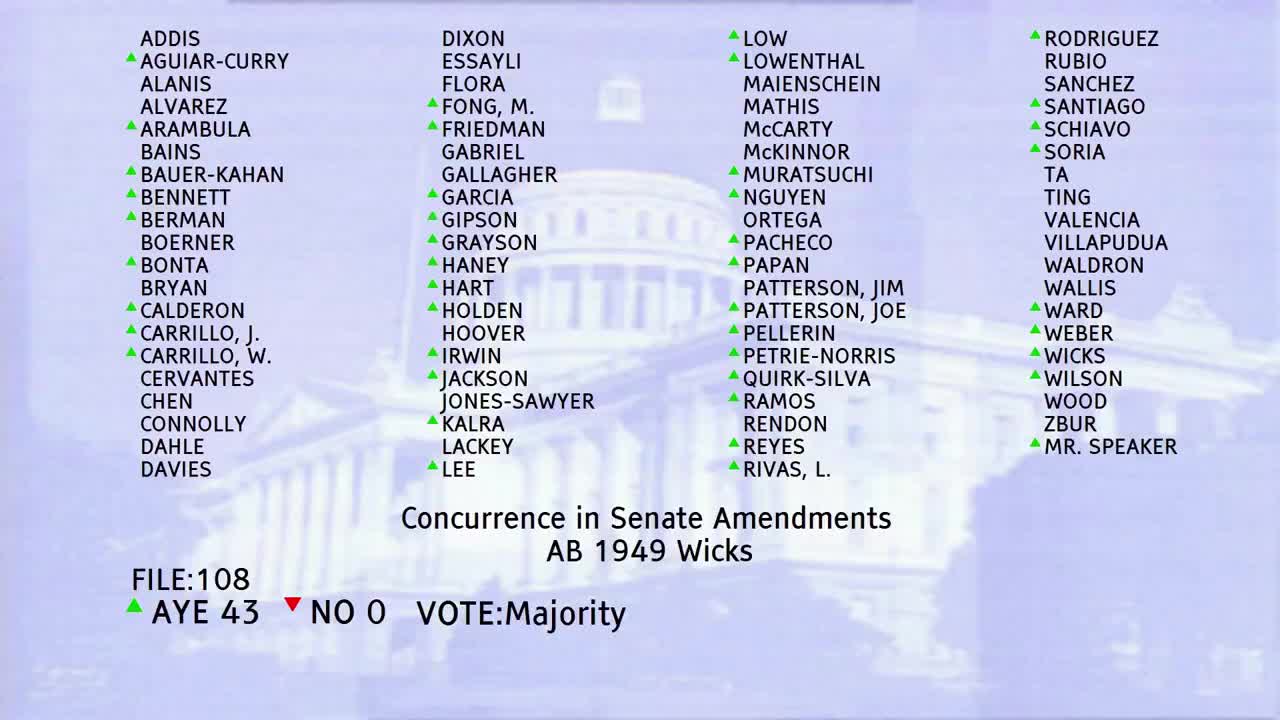 2MIN
Assembly Floor
 2MIN
Senate Floor
 41SEC
Senate Standing Committee on Appropriations
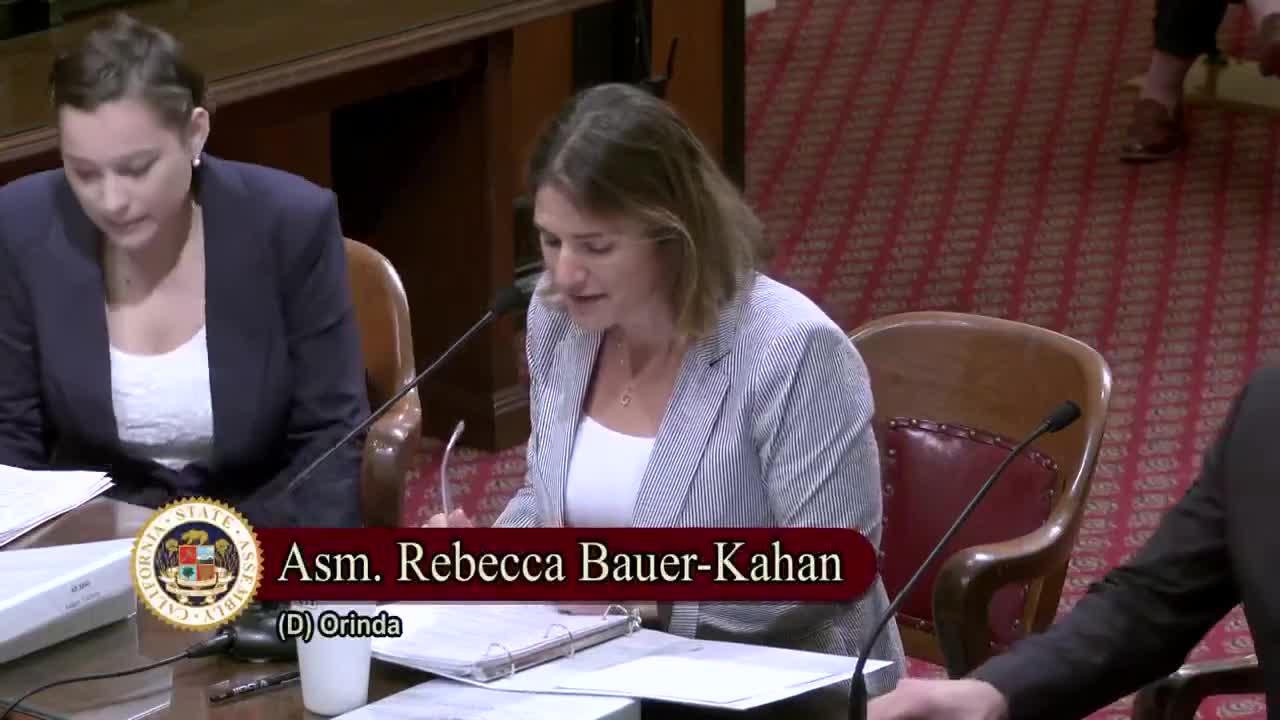 12MIN
Senate Standing Committee on Judiciary
 13MIN
Senate Standing Committee on Elections and Constitutional Amendments
 1MIN
Assembly Floor
 18MIN
Assembly Standing Committee on Judiciary
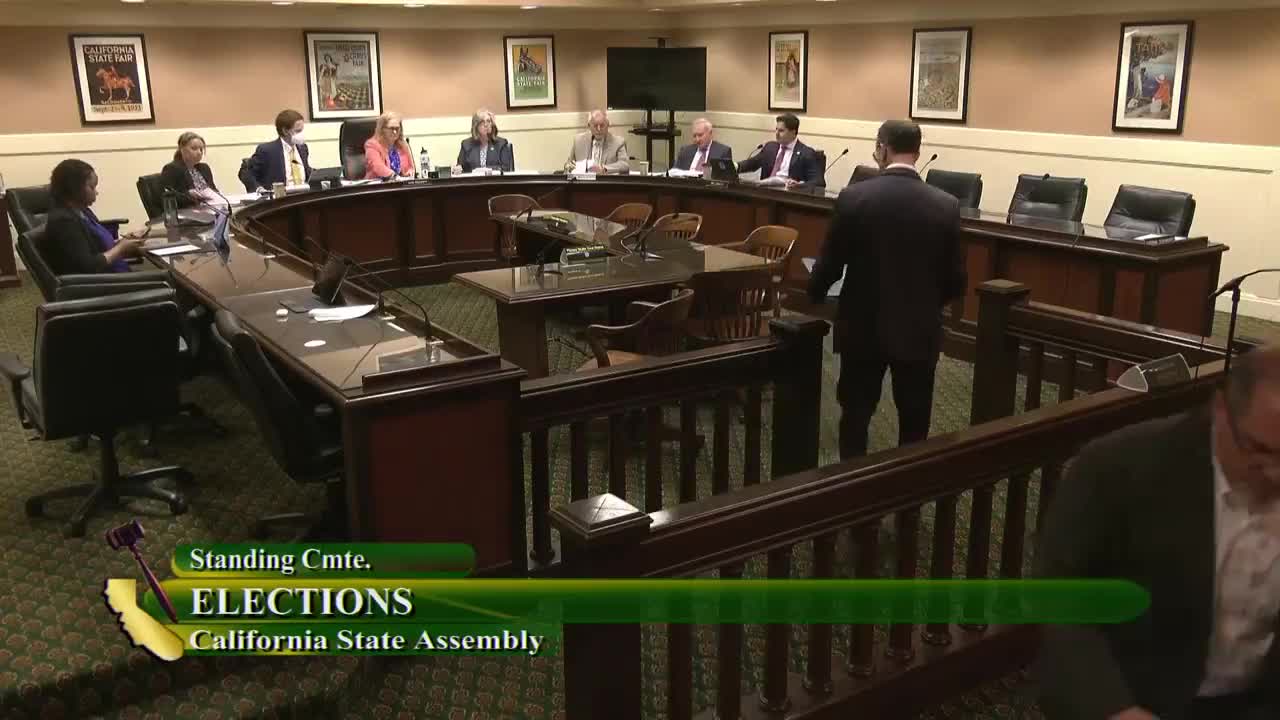 19MIN