AB 1218: Public contracts: disabled veteran business enterprise.
- Session Year: 2015-2016
- House: Assembly
- Latest Version Date: 2015-07-07
Existing law requires a state agency, department, officer, or other state governmental entity, to meet an annual statewide participation goal of not less than 3% for disabled veteran business enterprises for specified contracts entered into by the awarding department during the year. The administering agency for the California Disabled Veteran Business Enterprise Program is the Department of General Services. Existing law requires the Director of General Services to adopt written policies and guidelines establishing a uniform process for state contracting that provides a disabled veteran business enterprise participation incentive to bidders.
This bill would require a greater participation incentive to be provided to a prime contractor who owns a disabled veteran business enterprise, as specified, and has not previously entered into any contracts with the state as a prime contractor, and to a disabled veteran business enterprise that employs a workforce that is more than 50% veterans or that has not previously entered into any contracts with the state. The bill would require an awarding department to consider whether greater disabled veteran business enterprise participation in excess of 3% should be required on its contracts.
Existing law requires the Department of Veterans Affairs to maintain complete records of its promotional efforts to promote the program and to establish a system to track the effectiveness of its promotional efforts.
This bill would require the department to maintain additional information relating to its promotional efforts, as specified.
Existing law requires a prime contractor who entered into a subcontract with a disabled veteran business enterprise to make certain disclosures to the awarding department after completion of the contract.
This bill would require the awarding department that receives this information to maintain those records for a minimum of 5 years, as specified. The bill would require every awarding department to establish a procedure to ensure the accuracy and completeness of those records. The bill would further require a contractor who subcontracts with disabled veteran business enterprises to comply with additional requirements when providing its certification of expenditures to an awarding department, as specified.
Existing law requires each awarding department to appoint an agency Disabled Veteran Business Enterprise Program Advocate. Existing law requires the agency Disabled Veteran Business Enterprise Program Advocate to, among other things, assist certified disabled veteran business enterprises in participating in that agencys contracting process.
This bill would additionally require the advocate to maintain records of the promotional efforts hosted or attended by the advocate, as specified.
Existing law requires a department, as defined under the State Contract Act, to report on contracting activity containing specified information.
This bill would require a department, as defined, to establish guidelines for reporting multiyear contracts. The bill would make other minor, technical changes to the reporting requirements under the program.
Existing law requires a state agency, department, officer, or other state governmental entity, to meet an annual statewide participation goal of not less than 3% for disabled veteran business enterprises for specified contracts entered into by the awarding department during the year. The administering agency for the California Disabled Veteran Business Enterprise Program is the Department of General Services. Existing law requires the Director of General Services to adopt written policies and guidelines establishing a uniform process for state contracting that provides a disabled veteran business enterprise participation incentive to bidders.
This bill would require a greater participation incentive to be provided to a prime contractor who owns a disabled veteran business enterprise, as specified, and to a disabled veteran business enterprise that employs a workforce that is more than 50% veterans. veterans or that has not previously entered into any contracts with the state.
Existing law requires the Department of Veterans Affairs to maintain complete records of its promotional efforts to promote the program and to establish a system to track the effectiveness of its promotional efforts.
This bill would require the department to maintain additional information relating to its promotional efforts, as specified.
Existing law requires a prime contractor who entered into a subcontract with a disabled veteran business enterprise to make certain disclosures to the awarding department after completion of the contract.
This bill would require the awarding department that receives this information to maintain those records for a minimum of 5 years, as specified. The bill would require every awarding department to establish a procedure to ensure the accuracy and completeness of those records.
Existing law requires each awarding department to appoint an agency Disabled Veteran Business Enterprise Program Advocate. Existing law requires the agency Disabled Veteran Business Enterprise Program Advocate to, among other things, assist certified disabled veteran business enterprises in participating in that agencys contracting process.
This bill would additionally require the advocate to maintain records of the promotional efforts hosted or attended by the advocate, as specified.
Existing law requires a department, as defined under the State Contract Act, to report on contracting activity containing specified information.
This bill would require a department, as defined, to establish guidelines for reporting multiyear contracts. The bill would make other minor, technical changes to the reporting requirements under the program.
Existing law requires a state agency, department, officer, or other state governmental entity, to meet an annual statewide participation goal of not less than 3% for disabled veteran business enterprises for specified contracts entered into by the awarding department during the year. The administering agency for the California Disabled Veteran Business Enterprise Program is the Department of General Services. Existing law requires the Director of General Services to adopt written policies and guidelines establishing a uniform process for state contracting that provides a disabled veteran business enterprise participation incentive to bidders.
This bill would require a greater participation incentive to be provided to a prime contractor who owns a disabled veteran business enterprise, as specified. specified, and to a disabled veteran business enterprise that employs a workforce that is more than 50% veterans.
Existing law requires the Department of Veterans Affairs to maintain complete records of its promotional efforts to promote the program and to establish a system to track the effectiveness of its promotional efforts.
This bill would require the department to maintain additional information relating to its promotional efforts, as specified.
Existing law requires a prime contractor who entered into a subcontract with a disabled veteran business enterprise to make certain disclosures to the awarding department after completion of the contract.
This bill would require the awarding department that receives this information to maintain those records for a minimum of 5 years, as specified. The bill would require every awarding department to establish a procedure to ensure the accuracy and completeness of those records.
Existing law requires each awarding department to appoint an agency Disabled Veteran Business Enterprise Program Advocate. Existing law requires the agency Disabled Veteran Business Enterprise Program Advocate to, among other things, assist certified disabled veteran business enterprises in participating in that agencys contracting process.
This bill would additionally require the advocate to maintain records of the promotional efforts hosted or attended by the advocate, as specified.
Existing law requires a department, as defined under the State Contract Act, to report on contracting activity containing specified information.
This bill would require a department, as defined, to establish guidelines for reporting multiyear contracts. The bill would make other minor, technical changes to the reporting requirements under the program.
Existing law requires a state agency, department, officer, or other state governmental entity, to meet an annual statewide participation goal of not less than 3% for disabled veteran business enterprises for specified contracts entered into by the awarding department during the year. The administering agency for the California Disabled Veteran Business Enterprise Program is the Department of General Services. Existing law requires the Director of General Services to adopt written policies and guidelines establishing a uniform process for state contracting that provides a disabled veteran business enterprise participation incentive to bidders.
This bill would require a greater participation incentive to be provided to a prime contractor who owns a disabled veteran business enterprise, as specified.
Existing law requires the Department of Veterans Affairs to maintain complete records of its promotional efforts to promote the program and to establish a system to track the effectiveness of its promotional efforts.
This bill would require the department to maintain additional information relating to its promotional efforts, as specified.
Existing law requires a prime contractor who entered into a subcontract with a disabled veteran business enterprise to make certain disclosures to the awarding department after completion of the contract.
This bill would require the awarding department that receives this information to maintain those records for a minimum of 5 years, as specified. The bill would require every awarding department to establish a procedure to ensure the accuracy and completeness of those records.
Existing law requires each awarding department to appoint an agency Disabled Veteran Business Enterprise Program Advocate. Existing law requires the agency Disabled Veteran Business Enterprise Program Advocate to, among other things, assist certified disabled veteran business enterprises in participating in that agencys contracting process.
This bill would additionally require the advocate to maintain records of the promotional efforts hosted or attended by the advocate, as specified.
Existing law requires a department, as defined under the State Contract Act, to report on contracting activity containing specified information.
This bill would require a department, as defined, to establish guidelines for reporting multiyear contracts. The bill would make other minor, technical changes to the reporting requirements under the program.
(a)(1)Notwithstanding any other law, each awarding department shall have annual statewide participation goals of not less than 3 percent for disabled veteran business enterprises for contracts entered into by the awarding department during the year for professional bond services. This section shall not apply if a contract for professional bond services of an underwriter is to be obtained by competitive bid. However, each awarding department shall establish goals for contracts to be obtained by competitive bid for professional bond services.
(2)These goals shall apply to the overall dollar amount awarded and expended by the awarding department with respect to the contracts for professional bond services relating to the issuance of bonds by the awarding department, including amounts spent as underwriters discounts.
(b)In attempting to meet the goals set forth in subdivision (a), the awarding department shall consider establishing cocounsel, joint venture, and subcontracting relationships, including disabled veteran business enterprises, in all contracts for professional bond services. It shall be the responsibility of the head of each awarding department to be supportive of the Treasurers program for assigning representative portions of professional bond services contracts for purposes of meeting the goals established pursuant to this section. However, nothing in this article shall preclude the awarding department from achieving the goals set forth in this section without requiring joint ventures, cocounsel, or subcontracting arrangements.
(c)This section shall not limit the ability of any awarding department to meet a goal higher than those set forth in subdivision (a) for the participation of disabled veteran business enterprises in contracts awarded by the awarding department.
(d)In order to meet the 3-percent annual goal set forth in paragraph (1) of subdivision (a), an awarding department shall consider whether greater disabled veteran business enterprise participation in excess of 3 percent should actually be required on contracts entered into pursuant to this section for professional bond services.
SEC. 2.Section 999.2 of the Military and Veterans Code is amended to read:999.2.(a)Notwithstanding any other law, contracts awarded by any state agency, department, officer, or other state governmental entity, including school districts when they are expending state funds for construction, professional services (except those subject to Chapter 6 (commencing with Section 16850) of Part 3 of Division 4 of Title 2 of the Government Code), materials, supplies, equipment, alteration, repair, or improvement shall have statewide participation goals of not less than 3 percent for disabled veteran business enterprises. These goals apply to the overall dollar amount awarded and expended each year by the awarding department.
(b)For purposes of this section:
(1)Broker or agent means any individual or entity, or any combination thereof, that does not have title, possession, control, and risk of loss of materials, supplies, services, or equipment provided to an awarding department, unless one or more certified disabled veterans has 51-percent ownership of the quantity and value of the materials, supplies, services, and of each piece of equipment provided under the contract.
(2)Equipment means any piece of equipment that is used or provided for rental to any state agency, department, officer, or other state governmental entity, including equipment for which operators are provided.
(3)Equipment broker means any broker or agent who rents equipment to an awarding department.
(c)A disabled veteran business enterprise that rents equipment to an awarding department shall be deemed to be an equipment broker unless one or more disabled veterans has 51-percent ownership of the quantity and the value of each piece of equipment. If the equipment is owned by one or more disabled veterans, each disabled veteran owner shall, prior to performance under any contract, submit to the awarding department a declaration signed by the disabled veteran owner stating that the owner is a disabled veteran and providing the name, address, telephone number, and tax identification number of the disabled veteran owner. Each disabled veteran owner shall submit his or her federal income tax returns to the administering agency pursuant to subdivision (g) as if he or she were a disabled veteran business enterprise. The disabled veteran business enterprise of a disabled veteran owner who fails to submit his or her tax returns will be deemed to be an equipment broker.
(d)A disabled veteran business enterprise that rents equipment to an awarding department shall, prior to performing the contract, submit to the awarding department a declaration signed by each disabled veteran owner and manager of the enterprise stating that the enterprise obtained the contract by representing that the enterprise was a disabled veteran business enterprise meeting and maintaining all of the requirements of a disabled veteran business enterprise. The declaration shall include the name, address, telephone number, and tax identification number of the owner of each piece of equipment identified in the contract.
(e)State funds expended for equipment rented from equipment brokers pursuant to contracts awarded under this section shall not be credited toward the 3-percent goal.
(f)A disabled veteran business enterprise that is a broker or agent and that obtains a contract pursuant to subdivision (a) shall, prior to performing the contract, disclose to the awarding department that the business is a broker or agent. The disclosure shall be made in a declaration signed and executed by each disabled veteran owner and manager of the enterprise, declaring that the enterprise is a broker or agent, and identifying the name, address, and telephone number of the principal for whom the enterprise is acting as a broker or agent.
(g)(1)A disabled veteran business enterprise, and each owner thereof, shall, at the time of certification, submit to the administering agency complete copies of the enterprises federal income tax returns for the three previous tax years.
(2)A disabled veteran business enterprise, and each owner thereof, shall submit to the administering agency complete copies of the enterprises federal income tax returns that have a postcertification due date, on or before the due date, including extensions.
(3)A disabled veteran business enterprise that, and each owner thereof who, has not submitted to the administering agency complete copies of the enterprises federal income tax returns for the three tax years preceding certification nor for each postcertification tax year for which a return was required to be filed, shall have 90 days to submit those returns.
(4)A disabled veteran business enterprise that fails to comply with any provision of this subdivision shall be prohibited from participating in any state contract until the disabled veteran business enterprise complies with the provisions of this subdivision. Funds expended involving a disabled veteran business enterprise during any period in which that enterprise is not in compliance with the provisions of this subdivision shall not be credited toward the awarding departments 3-percent goal.
(h)A disabled veteran business enterprise that fails to maintain the certification requirements set forth in this article shall immediately notify the awarding department and the administering agency of that failure by filing a notice of failure that states with particularity each requirement the disabled veteran business enterprise has failed to maintain.
(i)In order to meet the 3-percent annual goal set forth in subdivision (a), an awarding department shall consider whether greater disabled veteran business enterprise participation in excess of 3 percent should actually be required on contracts entered into pursuant to this section for goods and services.
SEC. 3.Section 999.4 is added to the Military and Veterans Code, to read:999.4.A contractor that is not a disabled veteran business enterprise that subcontracts with disabled veteran business enterprises pursuant to this article shall, when submitting its certification of expenditures to the awarding department, comply with either of the following:
(a)Provide on the certification of expenditures to the awarding department, the signature of any disabled veteran business enterprise that performed work for the contractor acknowledging the authenticity of the expenditures.
(b)Provide the certification of expenditures to any disabled veteran business enterprise that performed work for the contractor and proof of any amount of expenditures provided to that subcontractor, such as by providing copies of checks issued to the subcontractor or wire transfer notices.
SEC. 3.SEC. 4.Section 999.5 of the Military and Veterans Code is amended to read:999.5.(a)The administering agency for the California Disabled Veteran Business Enterprise Program is the Department of General Services, except in the case of contracts for professional bond services. The Department of General Services shall consult with the California Disabled Veteran Business Enterprise Program Advocate, appointed by the Secretary of the Department of Veterans Affairs pursuant to Section 999.11, on all matters relating to the California Disabled Veteran Business Enterprise Program.
(b)(1)The Director of General Services shall adopt written policies and guidelines establishing a uniform process for state contracting that would provide a disabled veteran business enterprise participation incentive to bidders. Pursuant to that process, a greater participation incentive shall be provided to the following:
(A)A prime contractor who owns a disabled veteran business enterprise and who has not previously entered into any contracts with the state as a prime contractor, rather than to a prime contractor who commits to entering into subcontracts with disabled veteran business enterprises.
(B)A disabled veteran business enterprise that employs a workforce that is more than 50 percent veterans.
(C)A disabled veteran business enterprise that has not previously entered into any contracts with the state.
(2)The incentive program shall be used by all state agencies when awarding contracts.
(c)The Department of Veterans Affairs shall do all of the following:
(1)Establish a method of monitoring adherence to the goals specified in Sections 999.1 and 999.2.
(2)Promote the California Disabled Veteran Business Enterprise Program to the fullest extent possible.
(3)Maintain complete records of its promotional efforts, including a list that identifies the name, location, number, and type of businesses by size and industry sector attending or participating in a promotional effort.
(4)Establish a system to track the effectiveness of its efforts to promote the California Disabled Veteran Business Enterprise Program, which shall, at a minimum, include an annual comparison of the list of businesses participating in promotional efforts during the current and prior two years with the list of those businesses that become newly certified as disabled veteran business enterprises and those businesses that become a prime contractor or subcontractor with the state under the program. The result of the annual comparison shall be one performance measure as to the success of the promotional activities.
(d)An awarding department shall not credit toward the departments 3-percent goal state funds expended on a contract with a disabled veteran business enterprise that does not meet and maintain the certification requirements.
(e)Upon completion of an awarded contract for which a commitment to achieve a disabled veteran business enterprise goal was made, an awarding department shall require the prime contractor that entered into a subcontract with a disabled veteran business enterprise to certify to the awarding department all of the following:
(1)The total amount the prime contractor received under the contract.
(2)The name and address of the disabled veteran business enterprise that participated in the performance of the contract.
(3)The amount each disabled veteran business enterprise received from the prime contractor.
(4)That all payments under the contract have been made to the disabled veteran business enterprise. An awarding department shall keep that certification on file. A person or entity that knowingly provides false information shall be subject to a civil penalty for each violation in the minimum amount of two thousand five hundred dollars ($2,500) and the maximum amount of twenty-five thousand dollars ($25,000). An action for a civil penalty under this subdivision may be brought by any public prosecutor in the name of the people of the State of California and the penalty imposed shall be enforceable as a civil judgment.
(f)An awarding department shall maintain records of the information provided by the prime contractor pursuant to subdivision (e), including, but not limited to, the name of the prime contractor and subcontractors under subdivision (e) and the amount awarded to, and the amount paid to, each prime contractor and subcontractor under subdivision (e). Awarding departments shall establish review procedures to ensure the accuracy and completeness of the award amounts and the paid amounts reported.
(g)A prime contractor may, subject to the approval of the Department of General Services, replace a disabled veteran business enterprise identified by the prime contractor in its bid or offer, pursuant to subdivision (a) of Section 999.10, with another disabled veteran business enterprise.
(h)The administering agency shall adopt rules and regulations, including standards for good faith efforts, for the purpose of implementing this section. Emergency regulations consistent with this section may be adopted.
(i)The records collected and maintained pursuant to subdivision (f) shall be retained for a minimum of five years after collection.
SEC. 4.SEC. 5.Section 999.12 of the Military and Veterans Code is amended to read:999.12.Each awarding department shall appoint an agency Disabled Veteran Business Enterprise Program Advocate. This person shall be the same individual appointed pursuant to Section 14846 of the Government Code. The agency Disabled Veteran Business Enterprise Program Advocate shall do all of the following:
(a)Assist certified disabled veteran business enterprises in participating in that agencys contracting process.
(b)Assist contract officers in seeking disabled veteran business enterprises to participate in the agencys contract and procurement activities by performing outreach efforts to recruit disabled veteran business enterprises to offer their services as either a prime contractor or subcontractor on any contract proposed by the awarding department that requires disabled veteran business enterprise participation, and by other feasible means.
(c) Meet regularly with the California Disabled Veteran Business Enterprise Program Advocate and contract and procurement staffs of their departments to disseminate information about the California Disabled Veteran Business Enterprise Program.
(d)Serve as an advocate for the disabled veteran business enterprises that are utilized as the agencys contractors or subcontractors.
(e)Report to the Office of Small Business and Disabled Veteran Business Enterprise Services regarding any violation of this article.
(f)Coordinate and meet, on a regular basis, with the California Disabled Veteran Business Enterprise Program Advocate at the Department of Veterans Affairs in an effort to meet the statewide 3-percent goal provided for in Section 999.2.
(g)Maintain records of the promotional efforts hosted by, or attended by, the advocate, including, but not limited to, a list that identifies the name, location, number, and type of businesses by size and industry sector attending or participating in an event. The record shall also indicate any specific outcomes from the promotional event, including, but not limited to, the number of disabled veteran business enterprises who were certified and which disabled veteran business enterprises entered in a state contract as either a prime contractor or subcontractor for a contract awarded by his or her agency within the two years following the promotional efforts hosted or attended by the advocate.
SEC. 5.SEC. 6.Section 10111 of the Public Contract Code is amended to read:10111.Commencing January 1, 2007, the department shall make available a report on contracting activity containing the information in subdivisions (a) to (f), inclusive:
(a)A listing of consulting services contracts that the state has entered into during the previous fiscal year. The listing shall include the following:
(1)The name and identification number of each contractor.
(2)The type of bidding entered into, the number of bidders, whether the low bidder was accepted, and if the low bidder was not accepted, an explanation of why another contractor was selected.
(3)The amount of the contract price.
(4)Whether the contract was a noncompetitive bid contract, and why the contract was a noncompetitive bid contract.
(5)Justification for entering into each consulting services contract.
(6)The purpose of the contract and the potential beneficiaries.
(7)The date when the initial contract was signed, and the date when the work began and was completed.
(b)The report shall also include a separate listing of consultant contracts completed during that fiscal year, with the same information specified in subdivision (a).
(c)The information specified in subdivisions (a) and (b) shall also include a list of any contracts underway during that fiscal year on which a change was made regarding the following:
(1)The completion date of the contract.
(2)The amount of money to be received by the contractor, if it exceeds 3 percent of the original contract price.
(3)The purpose of the contract or duties of the contractor. A brief explanation shall be given if the change in purpose is significant.
(d)The level of participation, by agency, of disabled veteran business enterprises as a prime contractor or a subcontractor in statewide contracting and the dollar values of contract award and the amount of the contract paid for the following categories:
(1)Construction.
(2)Architectural, engineering, and other professional services.
(3)Procurement of materials, supplies, and equipment.
(4)Information technology procurements.
Additionally, the report shall include a statistical summary detailing each awarding departments goal achievement and a statewide total of those goals.
(e)The level of participation by small business in state contracting including:
(1)Upon request, an up-to-date list of eligible small business bidders by general procurement and construction contract categories, noting company names and addresses and also noting which small businesses also qualify as microbusinesses.
(2)By general procurement and construction contract categories, statistics comparing the small business and microbusiness contract participation dollars to the total state contract participation dollars.
(3)By awarding department and general procurement and construction categories, statistics comparing the small business and microbusiness contract participation dollars to the total state contract participation dollars.
(4)Any recommendations for changes in statutes or state policies to improve opportunities for small businesses and microbusinesses.
(5)A statistical summary of small businesses and microbusinesses certified for state contracting by the number of employees at the business for each of the following categories: 05, 2650, 5175, and 76100.
(6)To the extent feasible, beginning in the year 2008, the number of contracts awarded by the department in the categories specified in paragraph (5).
(7)The number of contracts and dollar amounts awarded annually pursuant to Section 14838.5 of the Government Code to small businesses, microbusinesses, and disabled veteran business enterprises.
(f)The level of participation of business enterprises, by race, ethnicity, and gender of the owner, in contracts to the extent that the information has been voluntarily reported to the department. In addition, the report shall contain the levels of participation of business enterprises, by race, ethnicity, and gender of the owner, and whether the business is a lesbian, gay, bisexual, or transgender owned business for the following categories of contracts, to the extent that the information has been voluntarily reported to the department:
(1)Construction.
(2)Purchases of materials, supplies, or equipment.
(3)Professional services.
(g)The department shall establish guidelines for reporting multiyear contracts.
(a)(1)Notwithstanding any other law, each awarding department shall have annual statewide participation goals of not less than 3 percent for disabled veteran business enterprises for contracts entered into by the awarding department during the year for professional bond services. This section shall not apply if a contract for professional bond services of an underwriter is to be obtained by competitive bid. However, each awarding department shall establish goals for contracts to be obtained by competitive bid for professional bond services.
(2)These goals shall apply to the overall dollar amount awarded and expended by the awarding department with respect to the contracts for professional bond services relating to the issuance of bonds by the awarding department, including amounts spent as underwriters discounts.
(b)In attempting to meet the goals set forth in subdivision (a), the awarding department shall consider establishing cocounsel, joint venture, and subcontracting relationships, including disabled veteran business enterprises, in all contracts for professional bond services. It shall be the responsibility of the head of each awarding department to be supportive of the Treasurers program for assigning representative portions of professional bond services contracts for purposes of meeting the goals established pursuant to this section. However, nothing in this article shall preclude the awarding department from achieving the goals set forth in this section without requiring joint ventures, cocounsel, or subcontracting arrangements.
(c)This section shall not limit the ability of any awarding department to meet a goal higher than those set forth in subdivision (a) for the participation of disabled veteran business enterprises in contracts awarded by the awarding department.
SEC. 2.Section 999.2 of the Military and Veterans Code is amended to read:999.2.(a)Notwithstanding any other law, contracts awarded by any state agency, department, officer, or other state governmental entity, including school districts when they are expending state funds for construction, professional services (except those subject to Chapter 6 (commencing with Section 16850) of Part 3 of Division 4 of Title 2 of the Government Code), materials, supplies, equipment, alteration, repair, or improvement shall have statewide participation goals of not less than 3 percent for disabled veteran business enterprises. These goals apply to the overall dollar amount awarded and expended each year by the awarding department.
(b)For purposes of this section:
(1)Broker or agent means any individual or entity, or any combination thereof, that does not have title, possession, control, and risk of loss of materials, supplies, services, or equipment provided to an awarding department, unless one or more certified disabled veterans has 51-percent ownership of the quantity and value of the materials, supplies, services, and of each piece of equipment provided under the contract.
(2)Equipment means any piece of equipment that is used or provided for rental to any state agency, department, officer, or other state governmental entity, including equipment for which operators are provided.
(3)Equipment broker means any broker or agent who rents equipment to an awarding department.
(c)A disabled veteran business enterprise that rents equipment to an awarding department shall be deemed to be an equipment broker unless one or more disabled veterans has 51-percent ownership of the quantity and the value of each piece of equipment. If the equipment is owned by one or more disabled veterans, each disabled veteran owner shall, prior to performance under any contract, submit to the awarding department a declaration signed by the disabled veteran owner stating that the owner is a disabled veteran and providing the name, address, telephone number, and tax identification number of the disabled veteran owner. Each disabled veteran owner shall submit his or her federal income tax returns to the administering agency pursuant to subdivision (g) as if he or she were a disabled veteran business enterprise. The disabled veteran business enterprise of a disabled veteran owner who fails to submit his or her tax returns will be deemed to be an equipment broker.
(d)A disabled veteran business enterprise that rents equipment to an awarding department shall, prior to performing the contract, submit to the awarding department a declaration signed by each disabled veteran owner and manager of the enterprise stating that the enterprise obtained the contract by representing that the enterprise was a disabled veteran business enterprise meeting and maintaining all of the requirements of a disabled veteran business enterprise. The declaration shall include the name, address, telephone number, and tax identification number of the owner of each piece of equipment identified in the contract.
(e)State funds expended for equipment rented from equipment brokers pursuant to contracts awarded under this section shall not be credited toward the 3-percent goal.
(f)A disabled veteran business enterprise that is a broker or agent and that obtains a contract pursuant to subdivision (a) shall, prior to performing the contract, disclose to the awarding department that the business is a broker or agent. The disclosure shall be made in a declaration signed and executed by each disabled veteran owner and manager of the enterprise, declaring that the enterprise is a broker or agent, and identifying the name, address, and telephone number of the principal for whom the enterprise is acting as a broker or agent.
(g)(1)A disabled veteran business enterprise, and each owner thereof, shall, at the time of certification, submit to the administering agency complete copies of the enterprises federal income tax returns for the three previous tax years.
(2)A disabled veteran business enterprise, and each owner thereof, shall submit to the administering agency complete copies of the enterprises federal income tax returns that have a postcertification due date, on or before the due date, including extensions.
(3)A disabled veteran business enterprise that, and each owner thereof who, has not submitted to the administering agency complete copies of the enterprises federal income tax returns for the three tax years preceding certification nor for each postcertification tax year for which a return was required to be filed, shall have 90 days to submit those returns.
(4)A disabled veteran business enterprise that fails to comply with any provision of this subdivision shall be prohibited from participating in any state contract until the disabled veteran business enterprise complies with the provisions of this subdivision. Funds expended involving a disabled veteran business enterprise during any period in which that enterprise is not in compliance with the provisions of this subdivision shall not be credited toward the awarding departments 3-percent goal.
(h)A disabled veteran business enterprise that fails to maintain the certification requirements set forth in this article shall immediately notify the awarding department and the administering agency of that failure by filing a notice of failure that states with particularity each requirement the disabled veteran business enterprise has failed to maintain.
SEC. 3.Section 999.5 of the Military and Veterans Code is amended to read:999.5.(a)The administering agency for the California Disabled Veteran Business Enterprise Program is the Department of General Services, except in the case of contracts for professional bond services. The Department of General Services shall consult with the California Disabled Veteran Business Enterprise Program Advocate, appointed by the Secretary of the Department of Veterans Affairs pursuant to Section 999.11, on all matters relating to the California Disabled Veteran Business Enterprise Program.
(b)(1)The Director of General Services shall adopt written policies and guidelines establishing a uniform process for state contracting that would provide a disabled veteran business enterprise participation incentive to bidders. Pursuant to that process, a greater participation incentive shall be provided to the following:
(A)A prime contractor who owns a disabled veteran business enterprise rather than to a prime contractor who commits to entering into subcontracts with disabled veteran business enterprises.
(B)A disabled veteran business enterprise that employs a workforce that is more than 50 percent veterans.
(C)A disabled veteran business enterprise that has not previously entered into any contracts with the state.
(2)The incentive program shall be used by all state agencies when awarding contracts.
(c)The Department of Veterans Affairs shall do all of the following:
(1)Establish a method of monitoring adherence to the goals specified in Sections 999.1 and 999.2.
(2)Promote the California Disabled Veteran Business Enterprise Program to the fullest extent possible.
(3)Maintain complete records of its promotional efforts, including a list that identifies the name, location, number, and type of businesses by size and industry sector attending or participating in a promotional effort.
(4)Establish a system to track the effectiveness of its efforts to promote the California Disabled Veteran Business Enterprise Program, which shall, at a minimum, include an annual comparison of the list of businesses participating in promotional efforts during the current and prior two years with the list of those businesses that become newly certified as disabled veteran business enterprises and those businesses that become a prime contractor or subcontractor with the state under the program. The result of the annual comparison shall be one performance measure as to the success of the promotional activities.
(d)An awarding department shall not credit toward the departments 3-percent goal state funds expended on a contract with a disabled veteran business enterprise that does not meet and maintain the certification requirements.
(e)Upon completion of an awarded contract for which a commitment to achieve a disabled veteran business enterprise goal was made, an awarding department shall require the prime contractor that entered into a subcontract with a disabled veteran business enterprise to certify to the awarding department all of the following:
(1)The total amount the prime contractor received under the contract.
(2)The name and address of the disabled veteran business enterprise that participated in the performance of the contract.
(3)The amount each disabled veteran business enterprise received from the prime contractor.
(4)That all payments under the contract have been made to the disabled veteran business enterprise. An awarding department shall keep that certification on file. A person or entity that knowingly provides false information shall be subject to a civil penalty for each violation in the minimum amount of two thousand five hundred dollars ($2,500) and the maximum amount of twenty-five thousand dollars ($25,000). An action for a civil penalty under this subdivision may be brought by any public prosecutor in the name of the people of the State of California and the penalty imposed shall be enforceable as a civil judgment.
(f)An awarding department shall maintain records of the information provided by the prime contractor pursuant to subdivision (e), including, but not limited to, the name of the prime contractor and subcontractors under subdivision (e) and the amount awarded to, and the amount paid to, each prime contractor and subcontractor under subdivision (e). Awarding departments shall establish review procedures to ensure the accuracy and completeness of the award amounts and the paid amounts reported.
(g)A prime contractor may, subject to the approval of the Department of General Services, replace a disabled veteran business enterprise identified by the prime contractor in its bid or offer, pursuant to subdivision (a) of Section 999.10, with another disabled veteran business enterprise.
(h)The administering agency shall adopt rules and regulations, including standards for good faith efforts, for the purpose of implementing this section. Emergency regulations consistent with this section may be adopted.
(i)The records collected and maintained pursuant to subdivision (f) shall be retained for a minimum of five years after collection.
SEC. 4.Section 999.12 of the Military and Veterans Code is amended to read:999.12.Each awarding department shall appoint an agency Disabled Veteran Business Enterprise Program Advocate. This person shall be the same individual appointed pursuant to Section 14846 of the Government Code. The agency Disabled Veteran Business Enterprise Program Advocate shall do all of the following:
(a)Assist certified disabled veteran business enterprises in participating in that agencys contracting process.
(b)Assist contract officers in seeking disabled veteran business enterprises to participate in the agencys contract and procurement activities by performing outreach efforts to recruit disabled veteran business enterprises to offer their services as either a prime contractor or subcontractor on any contract proposed by the awarding department that requires disabled veteran business enterprise participation, and by other feasible means.
(c) Meet regularly with the California Disabled Veteran Business Enterprise Program Advocate and contract and procurement staffs of their departments to disseminate information about the California Disabled Veteran Business Enterprise Program.
(d)Serve as an advocate for the disabled veteran business enterprises that are utilized as the agencys contractors or subcontractors.
(e)Report to the Office of Small Business and Disabled Veteran Business Enterprise Services regarding any violation of this article.
(f)Coordinate and meet, on a regular basis, with the California Disabled Veteran Business Enterprise Program Advocate at the Department of Veterans Affairs in an effort to meet the statewide 3-percent goal provided for in Section 999.2.
(g)Maintain records of the promotional efforts hosted by, or attended by, the advocate, including, but not limited to, a list that identifies the name, location, number, and type of businesses by size and industry sector attending or participating in an event. The record shall also indicate any specific outcomes from the promotional event, including, but not limited to, the number of disabled veteran business enterprises who were certified and which disabled veteran business enterprises entered in a state contract as either a prime contractor or subcontractor for a contract awarded by his or her agency within the two years following the promotional efforts hosted or attended by the advocate.
SEC. 5.Section 10111 of the Public Contract Code is amended to read:10111.Commencing January 1, 2007, the department shall make available a report on contracting activity containing the information in subdivisions (a) to (f), inclusive:
(a)A listing of consulting services contracts that the state has entered into during the previous fiscal year. The listing shall include the following:
(1)The name and identification number of each contractor.
(2)The type of bidding entered into, the number of bidders, whether the low bidder was accepted, and if the low bidder was not accepted, an explanation of why another contractor was selected.
(3)The amount of the contract price.
(4)Whether the contract was a noncompetitive bid contract, and why the contract was a noncompetitive bid contract.
(5)Justification for entering into each consulting services contract.
(6)The purpose of the contract and the potential beneficiaries.
(7)The date when the initial contract was signed, and the date when the work began and was completed.
(b)The report shall also include a separate listing of consultant contracts completed during that fiscal year, with the same information specified in subdivision (a).
(c)The information specified in subdivisions (a) and (b) shall also include a list of any contracts underway during that fiscal year on which a change was made regarding the following:
(1)The completion date of the contract.
(2)The amount of money to be received by the contractor, if it exceeds 3 percent of the original contract price.
(3)The purpose of the contract or duties of the contractor. A brief explanation shall be given if the change in purpose is significant.
(d)The level of participation, by agency, of disabled veteran business enterprises as a prime contractor or a subcontractor in statewide contracting and the dollar values of contract award and the amount of the contract paid for the following categories:
(1)Construction.
(2)Architectural, engineering, and other professional services.
(3)Procurement of materials, supplies, and equipment.
(4)Information technology procurements.
Additionally, the report shall include a statistical summary detailing each awarding departments goal achievement and a statewide total of those goals.
(e)The level of participation by small business in state contracting including:
(1)Upon request, an up-to-date list of eligible small business bidders by general procurement and construction contract categories, noting company names and addresses and also noting which small businesses also qualify as microbusinesses.
(2)By general procurement and construction contract categories, statistics comparing the small business and microbusiness contract participation dollars to the total state contract participation dollars.
(3)By awarding department and general procurement and construction categories, statistics comparing the small business and microbusiness contract participation dollars to the total state contract participation dollars.
(4)Any recommendations for changes in statutes or state policies to improve opportunities for small businesses and microbusinesses.
(5)A statistical summary of small businesses and microbusinesses certified for state contracting by the number of employees at the business for each of the following categories: 05, 2650, 5175, and 76100.
(6)To the extent feasible, beginning in the year 2008, the number of contracts awarded by the department in the categories specified in paragraph (5).
(7)The number of contracts and dollar amounts awarded annually pursuant to Section 14838.5 of the Government Code to small businesses, microbusinesses, and disabled veteran business enterprises.
(f)The level of participation of business enterprises, by race, ethnicity, and gender of the owner, in contracts to the extent that the information has been voluntarily reported to the department. In addition, the report shall contain the levels of participation of business enterprises, by race, ethnicity, and gender of the owner, and whether the business is a lesbian, gay, bisexual, or transgender owned business for the following categories of contracts, to the extent that the information has been voluntarily reported to the department:
(1)Construction.
(2)Purchases of materials, supplies, or equipment.
(3)Professional services.
(g)The department shall establish guidelines for reporting multiyear contracts.
(a)(1)Notwithstanding any other law, each awarding department shall have annual statewide participation goals of not less than 3 percent for disabled veteran business enterprises for contracts entered into by the awarding department during the year for professional bond services. This section shall not apply if a contract for professional bond services of an underwriter is to be obtained by competitive bid. However, each awarding department shall establish goals for contracts to be obtained by competitive bid for professional bond services.
(2)These goals shall apply to the overall dollar amount awarded and expended by the awarding department with respect to the contracts for professional bond services relating to the issuance of bonds by the awarding department, including amounts spent as underwriters discounts.
(b)In attempting to meet the goals set forth in subdivision (a), the awarding department shall consider establishing cocounsel, joint venture, and subcontracting relationships, including disabled veteran business enterprises, in all contracts for professional bond services. It shall be the responsibility of the head of each awarding department to be supportive of the Treasurers program for assigning representative portions of professional bond services contracts for purposes of meeting the goals established pursuant to this section. However, nothing in this article shall preclude the awarding department from achieving the goals set forth in this section without requiring joint ventures, cocounsel, or subcontracting arrangements.
(c)This section shall not limit the ability of any awarding department to meet a goal higher than those set forth in subdivision (a) for the participation of disabled veteran business enterprises in contracts awarded by the awarding department.
SEC. 2.Section 999.2 of the Military and Veterans Code is amended to read:999.2.(a)Notwithstanding any other law, contracts awarded by any state agency, department, officer, or other state governmental entity, including school districts when they are expending state funds for construction, professional services (except those subject to Chapter 6 (commencing with Section 16850) of Part 3 of Division 4 of Title 2 of the Government Code), materials, supplies, equipment, alteration, repair, or improvement shall have statewide participation goals of not less than 3 percent for disabled veteran business enterprises. These goals apply to the overall dollar amount awarded and expended each year by the awarding department.
(b)For purposes of this section:
(1)Broker or agent means any individual or entity, or any combination thereof, that does not have title, possession, control, and risk of loss of materials, supplies, services, or equipment provided to an awarding department, unless one or more certified disabled veterans has 51 percent 51-percent ownership of the quantity and value of the materials, supplies, services, and of each piece of equipment provided under the contract.
(2)Equipment means any piece of equipment that is used or provided for rental to any state agency, department, officer, or other state governmental entity, including equipment for which operators are provided.
(3)Equipment broker means any broker or agent who rents equipment to an awarding department.
(c)A disabled veteran business enterprise that rents equipment to an awarding department shall be deemed to be an equipment broker unless one or more disabled veterans has 51-percent ownership of the quantity and the value of each piece of equipment. If the equipment is owned by one or more disabled veterans, each disabled veteran owner shall, prior to performance under any contract, submit to the awarding department a declaration signed by the disabled veteran owner stating that the owner is a disabled veteran and providing the name, address, telephone number, and tax identification number of the disabled veteran owner. Each disabled veteran owner shall submit his or her federal income tax returns to the administering agency pursuant to subdivision (g) as if he or she were a disabled veteran business enterprise. The disabled veteran business enterprise of a disabled veteran owner who fails to submit his or her tax returns will be deemed to be an equipment broker.
(d)A disabled veteran business enterprise that rents equipment to an awarding department shall, prior to performing the contract, submit to the awarding department a declaration signed by each disabled veteran owner and manager of the enterprise stating that the enterprise obtained the contract by representing that the enterprise was a disabled veteran business enterprise meeting and maintaining all of the requirements of a disabled veteran business enterprise. The declaration shall include the name, address, telephone number, and tax identification number of the owner of each piece of equipment identified in the contract.
(e)State funds expended for equipment rented from equipment brokers pursuant to contracts awarded under this section shall not be credited toward the 3-percent goal.
(f)A disabled veteran business enterprise that is a broker or agent and that obtains a contract pursuant to subdivision (a) shall, prior to performing the contract, disclose to the awarding department that the business is a broker or agent. The disclosure shall be made in a declaration signed and executed by each disabled veteran owner and manager of the enterprise, declaring that the enterprise is a broker or agent, and identifying the name, address, and telephone number of the principal for whom the enterprise is acting as a broker or agent.
(g)(1)A disabled veteran business enterprise, and each owner thereof, shall, at the time of certification, submit to the administering agency complete copies of the enterprises federal income tax returns for the three previous tax years.
(2)A disabled veteran business enterprise, and each owner thereof, shall submit to the administering agency complete copies of the enterprises federal income tax returns that have a postcertification due date, on or before the due date, including extensions.
(3)A disabled veteran business enterprise that, and each owner thereof who, has not submitted to the administering agency complete copies of the enterprises federal income tax returns for the three tax years preceding certification nor for each postcertification tax year for which a return was required to be filed, shall have 90 days to submit those returns.
(4)A disabled veteran business enterprise that fails to comply with any provision of this subdivision shall be prohibited from participating in any state contract until the disabled veteran business enterprise complies with the provisions of this subdivision. Funds expended involving a disabled veteran business enterprise during any period in which that enterprise is not in compliance with the provisions of this subdivision shall not be credited toward the awarding departments 3-percent goal.
(h)A disabled veteran business enterprise that fails to maintain the certification requirements set forth in this article shall immediately notify the awarding department and the administering agency of that failure by filing a notice of failure that states with particularity each requirement the disabled veteran business enterprise has failed to maintain.
SEC. 3.Section 999.5 of the Military and Veterans Code is amended to read:999.5.(a)The administering agency for the California Disabled Veteran Business Enterprise Program is the Department of General Services, except in the case of contracts for professional bond services. The Department of General Services shall consult with the California Disabled Veteran Business Enterprise Program Advocate, appointed by the Secretary of the Department of Veterans Affairs pursuant to Section 999.11, on all matters relating to the California Disabled Veteran Business Enterprise Program.
(b)(1)The Director of General Services shall adopt written policies and guidelines establishing a uniform process for state contracting that would provide a disabled veteran business enterprise participation incentive to bidders. Pursuant to that process, a greater participation incentive shall be provided to a the following:
(A)A prime contractor who owns a disabled veteran business enterprise rather than to a prime contractor who commits to entering into subcontracts with disabled veteran business enterprises. The
(B)A disabled veteran business enterprise that employs a workforce that is more than 50 percent veterans.
(2)The incentive program shall be used by all state agencies when awarding contracts.
(c)The Department of Veterans Affairs shall do all of the following:
(1)Establish a method of monitoring adherence to the goals specified in Sections 999.1 and 999.2.
(2)Promote the California Disabled Veteran Business Enterprise Program to the fullest extent possible.
(3)Maintain complete records of its promotional efforts, including a list that identifies the name, location, number, and type of businesses by size and industry sector attending or participating in a promotional effort.
(4)Establish a system to track the effectiveness of its efforts to promote the California Disabled Veteran Business Enterprise Program, which shall, at a minimum, include an annual comparison of the list of businesses participating in promotional efforts during the current and prior two years with the list of those businesses that become newly certified as disabled veteran business enterprises and those businesses that become a prime contractor or subcontractor with the state under the program. The result of the annual comparison shall be one performance measure as to the success of the promotional activities.
(d)An awarding department shall not credit toward the departments 3-percent goal state funds expended on a contract with a disabled veteran business enterprise that does not meet and maintain the certification requirements.
(e)Upon completion of an awarded contract for which a commitment to achieve a disabled veteran business enterprise goal was made, an awarding department shall require the prime contractor that entered into a subcontract with a disabled veteran business enterprise to certify to the awarding department all of the following:
(1)The total amount the prime contractor received under the contract.
(2)The name and address of the disabled veteran business enterprise that participated in the performance of the contract.
(3)The amount each disabled veteran business enterprise received from the prime contractor.
(4)That all payments under the contract have been made to the disabled veteran business enterprise. An awarding department shall keep that certification on file. A person or entity that knowingly provides false information shall be subject to a civil penalty for each violation in the minimum amount of two thousand five hundred dollars ($2,500) and the maximum amount of twenty-five thousand dollars ($25,000). An action for a civil penalty under this subdivision may be brought by any public prosecutor in the name of the people of the State of California and the penalty imposed shall be enforceable as a civil judgment.
(f)An awarding department shall maintain records of the information provided by the prime contractor pursuant to subdivision (e), including, but not limited to, the name of the prime contractor and subcontractors under subdivision (e) and the amount awarded to, and the amount paid to, each prime contractor and subcontractor under subdivision (e). Awarding departments shall establish review procedures to ensure the accuracy and completeness of the award amounts and the paid amounts reported.
(g)A prime contractor may, subject to the approval of the Department of General Services, replace a disabled veteran business enterprise identified by the prime contractor in its bid or offer, pursuant to subdivision (a) of Section 999.10, with another disabled veteran business enterprise.
(h)The administering agency shall adopt rules and regulations, including standards for good faith efforts, for the purpose of implementing this section. Emergency regulations consistent with this section may be adopted.
(i)The records collected and maintained pursuant to subdivision (f) shall be retained for a minimum of five years after collection.
SEC. 4.Section 999.12 of the Military and Veterans Code is amended to read:999.12.Each awarding department shall appoint an agency Disabled Veteran Business Enterprise Program Advocate. This person shall be the same individual appointed pursuant to Section 14846 of the Government Code. The agency Disabled Veteran Business Enterprise Program Advocate shall do all of the following:
(a)Assist certified disabled veteran business enterprises in participating in that agencys contracting process.
(b)Assist contract officers in seeking disabled veteran business enterprises to participate in the agencys contract and procurement activities by performing outreach efforts to recruit disabled veteran business enterprises to offer their services as either a prime contractor or subcontractor on any contract proposed by the awarding department that requires disabled veteran business enterprise participation, and by other feasible means.
(c) Meet regularly with the California Disabled Veteran Business Enterprise Program Advocate and contract and procurement staffs of their departments to disseminate information about the California Disabled Veteran Business Enterprise Program.
(d)Serve as an advocate for the disabled veteran business enterprises that are utilized as the agencys contractors or subcontractors.
(e)Report to the Office of Small Business and Disabled Veteran Business Enterprise Services regarding any violation of this article.
(f)Coordinate and meet, on a regular basis, with the California Disabled Veteran Business Enterprise Program Advocate at the Department of Veterans Affairs in an effort to meet the statewide 3-percent goal provided for in Section 999.2.
(g)Maintain records of the promotional efforts hosted by, or attended by, the advocate, including, but not limited to, a list that identifies the name, location, number, and type of businesses by size and industry sector attending or participating in an event. The record shall also indicate any specific outcomes from the promotional event, including, but not limited to, the number of disabled veteran business enterprises who were certified and which disabled veteran business enterprises entered in a state contract as either a prime contractor or subcontractor for a contract awarded by his or her agency within the two years following the promotional efforts hosted or attended by the advocate.
SEC. 5.Section 10111 of the Public Contract Code is amended to read:10111.Commencing January 1, 2007, the department shall make available a report on contracting activity containing the information in subdivisions (a) to (f), inclusive:
(a)A listing of consulting services contracts that the state has entered into during the previous fiscal year. The listing shall include the following:
(1)The name and identification number of each contractor.
(2)The type of bidding entered into, the number of bidders, whether the low bidder was accepted, and if the low bidder was not accepted, an explanation of why another contractor was selected.
(3)The amount of the contract price.
(4)Whether the contract was a noncompetitive bid contract, and why the contract was a noncompetitive bid contract.
(5)Justification for entering into each consulting services contract.
(6)The purpose of the contract and the potential beneficiaries.
(7)The date when the initial contract was signed, and the date when the work began and was completed.
(b)The report shall also include a separate listing of consultant contracts completed during that fiscal year, with the same information specified in subdivision (a).
(c)The information specified in subdivisions (a) and (b) shall also include a list of any contracts underway during that fiscal year on which a change was made regarding the following:
(1)The completion date of the contract.
(2)The amount of money to be received by the contractor, if it exceeds 3 percent of the original contract price.
(3)The purpose of the contract or duties of the contractor. A brief explanation shall be given if the change in purpose is significant.
(d)The level of participation, by agency, of disabled veteran business enterprises as a prime contractor or a subcontractor in statewide contracting and the dollar values of contract award and the amount of the contract paid for the following categories:
(1)Construction.
(2)Architectural, engineering, and other professional services.
(3)Procurement of materials, supplies, and equipment.
(4)Information technology procurements.
Additionally, the report shall include a statistical summary detailing each awarding departments goal achievement and a statewide total of those goals.
(e)The level of participation by small business in state contracting including:
(1)Upon request, an up-to-date list of eligible small business bidders by general procurement and construction contract categories, noting company names and addresses and also noting which small businesses also qualify as microbusinesses.
(2)By general procurement and construction contract categories, statistics comparing the small business and microbusiness contract participation dollars to the total state contract participation dollars.
(3)By awarding department and general procurement and construction categories, statistics comparing the small business and microbusiness contract participation dollars to the total state contract participation dollars.
(4)Any recommendations for changes in statutes or state policies to improve opportunities for small businesses and microbusinesses.
(5)A statistical summary of small businesses and microbusinesses certified for state contracting by the number of employees at the business for each of the following categories: 05, 2650, 5175, and 76100.
(6)To the extent feasible, beginning in the year 2008, the number of contracts awarded by the department in the categories specified in paragraph (5).
(7)The number of contracts and dollar amounts awarded annually pursuant to Section 14838.5 of the Government Code to small businesses, microbusinesses, and disabled veteran business enterprises.
(f)The level of participation of business enterprises, by race, ethnicity, and gender of the owner, in contracts to the extent that the information has been voluntarily reported to the department. In addition, the report shall contain the levels of participation of business enterprises, by race, ethnicity, and gender of the owner, and whether the business is a lesbian, gay, bisexual, or transgender owned business for the following categories of contracts, to the extent that the information has been voluntarily reported to the department:
(1)Construction.
(2)Purchases of materials, supplies, or equipment.
(3)Professional services.
(g)The department shall establish guidelines for reporting multiyear contracts.
(a)(1)Notwithstanding any other provision of law, each awarding department shall have annual statewide participation goals of not less than 3 percent for disabled veteran business enterprises for contracts entered into by the awarding department during the year for professional bond services. This section shall not apply if a contract for professional bond services of an underwriter is to be obtained by competitive bid. However, each awarding department shall establish goals for contracts to be obtained by competitive bid for professional bond services.
(2)These goals shall apply to the overall dollar amount awarded and expended by the awarding department with respect to the contracts for professional bond services relating to the issuance of bonds by the awarding department, including amounts spent as underwriters discounts.
(b)In attempting to meet the goals set forth in subdivision (a), the awarding department shall consider establishing cocounsel, joint venture, and subcontracting relationships, including disabled veteran business enterprises, in all contracts for professional bond services. It shall be the responsibility of the head of each awarding department to be supportive of the Treasurers program for assigning representative portions of professional bond services contracts for purposes of meeting the goals established pursuant to this section. However, nothing in this article shall preclude the awarding department from achieving the goals set forth in this section without requiring joint ventures, cocounsel, or subcontracting arrangements.
(c)This section shall not limit the ability of any awarding department to meet a goal higher than those set forth in subdivision (a) for the participation of disabled veteran business enterprises in contracts awarded by the awarding department.
SEC. 2.Section 999.2 of the Military and Veterans Code is amended to read:999.2.(a)Notwithstanding any other provision of law, contracts awarded by any state agency, department, officer, or other state governmental entity, including school districts when they are expending state funds for construction, professional services (except those subject to Chapter 6 (commencing with Section 16850) of Part 3 of Division 4 of Title 2 of the Government Code), materials, supplies, equipment, alteration, repair, or improvement shall have statewide participation goals of not less than 3 percent for disabled veteran business enterprises. These goals apply to the overall dollar amount awarded and expended each year by the awarding department.
(b)For purposes of this section:
(1)Broker or agent means any individual or entity, or any combination thereof, that does not have title, possession, control, and risk of loss of materials, supplies, services, or equipment provided to an awarding department, unless one or more certified disabled veterans has 51 percent ownership of the quantity and value of the materials, supplies, services, and of each piece of equipment provided under the contract.
(2)Equipment means any piece of equipment that is used or provided for rental to any state agency, department, officer, or other state governmental entity, including equipment for which operators are provided.
(3)Equipment broker means any broker or agent who rents equipment to an awarding department.
(c)A disabled veteran business enterprise that rents equipment to an awarding department shall be deemed to be an equipment broker unless one or more disabled veterans has 51-percent ownership of the quantity and the value of each piece of equipment. If the equipment is owned by one or more disabled veterans, each disabled veteran owner shall, prior to performance under any contract, submit to the awarding department a declaration signed by the disabled veteran owner stating that the owner is a disabled veteran and providing the name, address, telephone number, and tax identification number of the disabled veteran owner. Each disabled veteran owner shall submit his or her federal income tax returns to the administering agency pursuant to subdivision (g) as if he or she were a disabled veteran business enterprise. The disabled veteran business enterprise of a disabled veteran owner who fails to submit his or her tax returns will be deemed to be an equipment broker.
(d)A disabled veteran business enterprise that rents equipment to an awarding department shall, prior to performing the contract, submit to the awarding department a declaration signed by each disabled veteran owner and manager of the enterprise stating that the enterprise obtained the contract by representing that the enterprise was a disabled veteran business enterprise meeting and maintaining all of the requirements of a disabled veteran business enterprise. The declaration shall include the name, address, telephone number, and tax identification number of the owner of each piece of equipment identified in the contract.
(e)State funds expended for equipment rented from equipment brokers pursuant to contracts awarded under this section shall not be credited toward the 3-percent goal.
(f)A disabled veteran business enterprise that is a broker or agent and that obtains a contract pursuant to subdivision (a) shall, prior to performing the contract, disclose to the awarding department that the business is a broker or agent. The disclosure shall be made in a declaration signed and executed by each disabled veteran owner and manager of the enterprise, declaring that the enterprise is a broker or agent, and identifying the name, address, and telephone number of the principal for whom the enterprise is acting as a broker or agent.
(g)(1)A disabled veteran business enterprise, and each owner thereof, shall, at the time of certification, submit to the administering agency complete copies of the enterprises federal income tax returns for the three previous tax years.
(2)A disabled veteran business enterprise, and each owner thereof, shall submit to the administering agency complete copies of the enterprises federal income tax returns that have a postcertification due date, on or before the due date, including extensions.
(3)A disabled veteran business enterprise that, and each owner thereof who, has not submitted to the administering agency complete copies of the enterprises federal income tax returns for the three tax years preceding certification nor for each postcertification tax year for which a return was required to be filed, shall have 90 days to submit those returns.
(4)A disabled veteran business enterprise that fails to comply with any provision of this subdivision shall be prohibited from participating in any state contract until the disabled veteran business enterprise complies with the provisions of this subdivision. Funds expended involving a disabled veteran business enterprise during any period in which that enterprise is not in compliance with the provisions of this subdivision shall not be credited toward the awarding departments 3-percent goal.
(h)A disabled veteran business enterprise that fails to maintain the certification requirements set forth in this article shall immediately notify the awarding department and the administering agency of that failure by filing a notice of failure that states with particularity each requirement the disabled veteran business enterprise has failed to maintain.
SEC. 3.Section 999.5 of the Military and Veterans Code is amended to read:999.5.(a)The administering agency for the California Disabled Veteran Business Enterprise Program is the Department of General Services, except in the case of contracts for professional bond services. The Department of General Services shall consult with the California Disabled Veteran Business Enterprise Program Advocate, appointed by the Secretary of the Department of Veterans Affairs pursuant to Section 999.11, on all matters relating to the California Disabled Veteran Business Enterprise Program. The
(b)The Director of General Services shall adopt written policies and guidelines establishing a uniform process for state contracting that would provide a disabled veteran business enterprise participation incentive to bidders. Pursuant to that process, a greater participation incentive shall be provided to a prime contractor who owns a disabled veteran business enterprise rather than to a prime contractor who commits to entering into subcontracts with disabled veteran business enterprises. The incentive program shall be used by all state agencies when awarding contracts.
(b)
(c)The Department of Veterans Affairs shall do all of the following:
(1)Establish a method of monitoring adherence to the goals specified in Sections 999.1 and 999.2.
(2)Promote the California Disabled Veteran Business Enterprise Program to the fullest extent possible.
(3)Maintain complete records of its promotional efforts, including a list that identifies the name, location, number, and type of businesses by size and industry sector attending or participating in a promotional effort.
(4)Establish a system to track the effectiveness of its efforts to promote the California Disabled Veteran Business Enterprise Program, which shall include regular, periodic surveys of newly certified disabled veteran business enterprises to determine how they learned of the program, why they became certified, and what their experience with awarding departments has been. shall, at a minimum, include an annual comparison of the list of businesses participating in promotional efforts during the current and prior two years with the list of those businesses that become newly certified as disabled veteran business enterprises and those businesses that become a prime contractor or subcontractor with the state under the program. The result of the annual comparison shall be one performance measure as to the success of the promotional activities.
(c)
(d)An awarding department shall not credit toward the departments 3-percent goal state funds expended on a contract with a disabled veteran business enterprise that does not meet and maintain the certification requirements.
(d)
(e)Upon completion of an awarded contract for which a commitment to achieve a disabled veteran business enterprise goal was made, an awarding department shall require the prime contractor that entered into a subcontract with a disabled veteran business enterprise to certify to the awarding department all of the following:
(1)The total amount the prime contractor received under the contract.
(2)The name and address of the disabled veteran business enterprise that participated in the performance of the contract.
(3)The amount each disabled veteran business enterprise received from the prime contractor.
(4)That all payments under the contract have been made to the disabled veteran business enterprise. An awarding department shall keep that certification on file. A person or entity that knowingly provides false information shall be subject to a civil penalty for each violation in the minimum amount of two thousand five hundred dollars ($2,500) and the maximum amount of twenty-five thousand dollars ($25,000). An action for a civil penalty under this subdivision may be brought by any public prosecutor in the name of the people of the State of California and the penalty imposed shall be enforceable as a civil judgment.
(f)An awarding department shall maintain records of the information provided by the prime contractor pursuant to subdivision (e), including, but not limited to, the name of the prime contractor and subcontractors under subdivision (e) and the amount awarded to, and the amount paid to, each prime contractor and subcontractor under subdivision (e). Awarding departments shall establish review procedures to ensure the accuracy and completeness of the award amounts and the paid amounts reported.
(e)
(g)A prime contractor may, subject to the approval of the Department of General Services, replace a disabled veteran business enterprise identified by the prime contractor in its bid or offer, pursuant to subdivision (a) of Section 999.10, with another disabled veteran business enterprise.
(f)
(h)The administering agency shall adopt rules and regulations, including standards for good faith efforts, for the purpose of implementing this section. Emergency regulations consistent with this section may be adopted.
(i)The records collected and maintained pursuant to subdivision (f) shall be retained for a minimum of five years after collection.
SEC. 4.Section 999.12 of the Military and Veterans Code is amended to read:999.12.Each awarding department shall appoint an agency Disabled Veteran Business Enterprise Program Advocate. This person shall be the same individual appointed pursuant to Section 14846 of the Government Code. The agency Disabled Veteran Business Enterprise Program Advocate shall do all of the following:
(a)Assist certified disabled veteran business enterprises in participating in that agencys contracting process.
(b)Assist contract officers in seeking disabled veteran business enterprises to participate in the agencys contract and procurement activities by performing outreach efforts to recruit disabled veteran business enterprises to offer their services as either a prime contractor or subcontractor on any contract proposed by the awarding department that requires disabled veteran business enterprise participation, and by other feasible means.
(c) Meet regularly with the California Disabled Veteran Business Enterprise Program Advocate and contract and procurement staffs of their departments to disseminate information about the California Disabled Veteran Business Enterprise Program.
(d)Serve as an advocate for the disabled veteran business enterprises that are utilized as the agencys contractors or subcontractors.
(e)Report to the Office of Small Business and Disabled Veteran Business Enterprise Services regarding any violation of this article.
(f)Coordinate and meet, on a regular basis, with the California Disabled Veteran Business Enterprise Program Advocate at the Department of Veterans Affairs in an effort to meet the statewide 3-percent goal provided for in Section 999.2.
(g)Maintain records of the promotional efforts hosted by, or attended by, the advocate, including, but not limited to, a list that identifies the name, location, number, and type of businesses by size and industry sector attending or participating in an event. The record shall also indicate any specific outcomes from the promotional event, including, but not limited to, the number of disabled veteran business enterprises who were certified and which disabled veteran business enterprises entered in a state contract as either a prime contractor or subcontractor for a contract awarded by his or her agency within the two years following the promotional efforts hosted or attended by the advocate.
SEC. 5.Section 10111 of the Public Contract Code is amended to read:10111.Commencing January 1, 2007, the department shall make available a report on contracting activity containing the following information in subdivisions (a) to (f), inclusive:
(a)A listing of consulting services contracts that the state has entered into during the previous fiscal year. The listing shall include the following:
(1)The name and identification number of each contractor.
(2)The type of bidding entered into, the number of bidders, whether the low bidder was accepted, and if the low bidder was not accepted, an explanation of why another contractor was selected.
(3)The amount of the contract price.
(4)Whether the contract was a noncompetitive bid contract, and why the contract was a noncompetitive bid contract.
(5)Justification for entering into each consulting services contract.
(6)The purpose of the contract and the potential beneficiaries.
(7)The date when the initial contract was signed, and the date when the work began and was completed.
(b)The report shall also include a separate listing of consultant contracts completed during that fiscal year, with the same information specified in subdivision (a).
(c)The information specified in subdivisions (a) and (b) shall also include a list of any contracts underway during that fiscal year on which a change was made regarding the following:
(1)The completion date of the contract.
(2)The amount of money to be received by the contractor, if it exceeds 3 percent of the original contract price.
(3)The purpose of the contract or duties of the contractor. A brief explanation shall be given if the change in purpose is significant.
(d)The level of participation, by agency, of disabled veteran business enterprises as a prime contractor or a subcontractor in statewide contracting and shall include the dollar values of contract award and the amount of the contract paid for the following categories:
(1)Construction.
(2)Architectural, engineering, and other professional services.
(3)Procurement of materials, supplies, and equipment.
(4)Information technology procurements.
Additionally, the report shall include a statistical summary detailing each awarding departments goal achievement and a statewide total of those goals.
(e)The level of participation by small business in state contracting including:
(1)Upon request, an up-to-date list of eligible small business bidders by general procurement and construction contract categories, noting company names and addresses and also noting which small businesses also qualify as microbusinesses.
(2)By general procurement and construction contract categories, statistics comparing the small business and microbusiness contract participation dollars to the total state contract participation dollars.
(3)By awarding department and general procurement and construction categories, statistics comparing the small business and microbusiness contract participation dollars to the total state contract participation dollars.
(4)Any recommendations for changes in statutes or state policies to improve opportunities for small businesses and microbusinesses.
(5)A statistical summary of small businesses and microbusinesses certified for state contracting by the number of employees at the business for each of the following categories: 05, 2650, 5175, and 76100.
(6)To the extent feasible, beginning in the year 2008, the number of contracts awarded by the department in the categories specified in paragraph (5).
(7)The number of contracts and dollar amounts awarded annually pursuant to Section 14838.5 of the Government Code to small businesses, microbusinesses, and disabled veteran business enterprises.
(f)The level of participation of business enterprises, by race, ethnicity, and gender of the owner, in contracts to the extent that the information has been voluntarily reported to the department. In addition, the report shall contain the levels of participation of business enterprises, by race, ethnicity, and gender of the owner, and whether the business is a lesbian, gay, bisexual, or transgender owned business for the following categories of contracts, to the extent that the information has been voluntarily reported to the department:
(1)Construction.
(2)Purchases of materials, supplies, or equipment.
(3)Professional services.
(g)In the years 2011 and 2012, any errors reported to the department by an awarding agency as required by Sections 10302, 10344, and 12104.5, in the previous fiscal year.
(h)The amendments made to this section by the act adding this subdivision shall apply on and after January 1, 2013.
(g)The department shall establish guidelines for reporting multiyear contracts.
|
Date
|
Status
|
|---|---|
| Aug 27, 2015 | In committee: Held under submission. |
| Aug 17, 2015 | In committee: Referred to APPR. suspense file. |
| Jul 14, 2015 | From committee: Do pass and re-refer to Com. on APPR. (Ayes 13. Noes 0.) (July 14). Re-referred to Com. on APPR. |
| Jul 7, 2015 | From committee chair, with author's amendments: Amend, and re-refer to committee. Read second time, amended, and re-referred to Com. on G.O. |
| Jun 24, 2015 | From committee: Do pass and re-refer to Com. on G.O. (Ayes 5. Noes 0.) (June 23). Re-referred to Com. on G.O. |
| Jun 11, 2015 | Referred to Coms. on V.A. and G.O. |
| Jun 2, 2015 | In Senate. Read first time. To Com. on RLS. for assignment. |
| Jun 2, 2015 | Read third time. Passed. Ordered to the Senate. (Ayes 78. Noes 0. Page 1755.) |
| Jun 2, 2015 | Read third time. Passed. Ordered to the Senate. |
| May 28, 2015 | Read second time. Ordered to third reading. |
| May 28, 2015 | From committee: Do pass. (Ayes 17. Noes 0.) (May 28). |
| May 13, 2015 | In committee: Set, first hearing. Referred to APPR. suspense file. |
| Apr 29, 2015 | From committee: Do pass and re-refer to Com. on APPR. (Ayes 9. Noes 0.) (April 29). Re-referred to Com. on APPR. |
| Apr 27, 2015 | Re-referred to Com. on A. & A.R. |
| Apr 23, 2015 | From committee chair, with author's amendments: Amend, and re-refer to Com. on A. & A.R. Read second time and amended. |
| Apr 21, 2015 | From committee: Do pass and re-refer to Com. on A. & A.R. (Ayes 8. Noes 0.) (April 21). Re-referred to Com. on A. & A.R. |
| Apr 15, 2015 | Re-referred to Com. on J., E.D., & E. |
| Apr 14, 2015 | From committee chair, with author's amendments: Amend, and re-refer to Com. on J., E.D., & E. Read second time and amended. |
| Mar 23, 2015 | Referred to Coms. on J., E.D., & E. and A. & A.R. |
| Mar 2, 2015 | Read first time. |
| Mar 1, 2015 | From printer. May be heard in committee March 31. |
| Feb 27, 2015 | Introduced. To print. |
|
Date
|
Description
|
Location
|
Votes
|
|
|---|---|---|---|---|
| Aug 17, 2015 | Placed on suspense file | Senate Standing Committee on Appropriations |
Passed |
|
| Jul 14, 2015 | Do pass, but first be re-referred to the Committee on [Appropriations] | Senate Standing Committee on Governmental Organization |
Passed |
|
| Jun 23, 2015 | Do pass, but first be re-referred to the Committee on [Governmental Organization] | Senate Standing Committee on Veterans Affairs |
Passed |
|
| Jun 2, 2015 | AB 1218 WEBER Assembly Third Reading | Assembly Floor |
Passed |
|
| May 28, 2015 | Do pass. | Assembly Standing Committee on Appropriations |
Passed |
|
| Apr 29, 2015 | Do pass and be re-referred to the Committee on [Appropriations] | Assembly Standing Committee on Accountability and Administrative Review |
Passed |
|
| Apr 21, 2015 | Do pass and be re-referred to the Committee on [Accountability and Administrative Review] | Assembly Standing Committee on Jobs, Economic Development, and the Economy |
Passed |
This list shows positions taken on this bill by organizations on the date displayed, which is linked to the original source.
Positions by individuals are not included.
AB 1218 (Weber) Page 3 of 3
SENATE COMMITTEE ON APPROPRIATIONS
Senator Ricardo Lara, Chair
2015 - 2016 Regular Session
AB 1218 (Weber) - Public contracts: disabled veteran business enterprise.
|
|
Version: July 7, 2015 |
Policy Vote: V.A. 5 - 0, G.O. 13 - 0 |
Urgency: No |
Mandate: No |
Hearing Date: August 17, 2015 |
Consultant: Robert Ingenito |
This bill meets the criteria for referral to the Suspense File.
Bill Summary:
AB 1218 would make specified modifications to contracting performance goals and program participation reporting requirements pertaining to the Disabled Veteran Business Enterprise (DVBE) Program administered by the Department of General Services (DGS).
Fiscal Impact:
DGS indicates that the administrative costs related to this bill could reach the low millions of dollars annually (See Staff Comments).
The Department of Veterans Affairs (CalVet) would require three positions and $390,000 ongoing General Fund support to implement its provisions of the bill.
Background:
Established in 1989, the Disabled Veteran Business Enterprise (DVBE) program sets a goal for most awarding state departments to expend a minimum of three percent of their overall contract dollars on DVBEs certified by DGS. Departments that award contracts may meet this goal by either contracting directly with certified DVBE firms or requiring winning bidders to use them as subcontractors. To be eligible to become a certified DVBE, a business must be at least 51% owned by a disabled veteran, have its daily operations managed and controlled by a disabled veteran, and be located in the United States.
Since the three percent goal applies to an awarding department’s overall contract expenditures each year, the awarding department has the discretion to decide whether or not the DVBE requirements will apply on a contract-by-contract basis. It may exempt some eligible contracts from the DVBE requirements while establishing goals in excess of three percent on others. Additionally, when these departments do establish DVBE participation requirements on a contract, they may still award the contract to a bidder who does not intend to use a DVBE. Under state law, a bidder can satisfy a contract’s DVBE participation requirements by demonstrating a good-faith effort to find and use a DVBE. Bidders submit documentation of their good-faith effort to the awarding department, which in turn ultimately decides in its sole discretion if a good-faith effort was made. Bidders may provide listings of the DVBEs they solicited and considered for participation on the contract, along with the business reasons why a DVBE could not be used.
State regulations dictate that certain contracts cannot be subject to DVBE requirements. These contracts include subvention funding, local aid contracts, and agreements with other government entities. Although the dollar value of these contracts may be significant at certain awarding departments, it does not have an impact on their ability to attain three percent DVBE participation. This is the case since each awarding department’s performance is based on the value of the DVBE-eligible contracts.
Proposed Law:
This bill would, among other things, do the following:
Specify that, in order to meet the 3 percent annual goal, an awarding department shall consider whether greater DVBE participation in excess of 3 percent should actually be required on contracts entered into for goods and services and for professional bond services.
Modify the existing DVBE incentive program by establishing a greater participation incentive to the following:
A prime contractor who owns a DVBE and who has not previously entered into any contracts with the state as a prime contractor, rather than to a prime contractor who commits to entering into subcontracts with DVBEs;
A DVBE that employs a workforce that is more than 50 percent veterans;
A DVBE that has not previously entered into any contracts with the state.
Require CalVet to maintain additional information relative to its promotional efforts of the DVBE program, as specified. Also, the bill specifies that in order to track the effectiveness of the efforts to promote the DVBE program, CalVet must, at a minimum, include an annual comparison of the list of businesses participating in promotional efforts and those that become a prime contractor or subcontractor under the program so that the success of the promotional activities can be measured.
Provide that a contractor that is not a DVBE yet subcontracts with DVBEs shall, when submitting its certification of expenditures to the awarding department, comply with either of the following: (a) provide on the certification of expenditures to the awarding department, the signature of any DVBE that performed work for the contractor acknowledging the authenticity of the expenditures or (b) provide the certification of expenditures to any DVBE that performed work for the contractor and proof of any amount of expenditures to that subcontractor.
Require awarding departments to maintain records of the information provided by the prime contractor, including but not limited to, the name of the prime contractor and subcontractor and the amount awarded to and the amount paid to, each prime and subcontractor. Also, requires awarding departments to establish review procedures to ensure the accuracy and completeness of the award amounts and the paid amounts reported.
Require DGS to establish guidelines for reporting multiyear contracts.
Related Legislation:
SB 159 (Nielson, 2015) clarifies that an awarding department’s DVBE program participation goal achievement is to be measured by the overall dollar amount expended each year by the awarding department. The bill is currently in the Assembly Veterans Affairs Committee.
SB 839 (Correa, 2013), among other things, would have established new requirements for the methodology state departments use to track DVBE participation in their contracts and to report the data to DGS. The bill was held on the Suspense File of this Committee.
Staff Comments:
DGS notes that the cost of establishing a process for the collection of DVBE subcontractor information would likely cost a minimum of $5 million if FI$Cal is used; this figure is consistent with other similar scope changes made to FI$Cal. Given the advanced state of FI$Cal’s development and deployment, new customizations would be significantly more costly to implement than if included in the original scope of the project. If a parallel information technology system is procured to collect this information, that system would likely have a similar or potentially greater cost.
The requirements of the bill is likely to result in increased personnel costs across all state departments. Departments would be required to have staff identify contracts with DVBE subcontractor participation. These employees would then be required to work with the prime contractor to determine which portions of any specific payment to prime contractors went to a specific DVBE subcontractor. Departments would also have to establish subcontractors in the system. Department personnel will then have to reconcile the amount paid to subcontractors, with the amount specified in the contract, and against the overall amount paid to the prime contractor. This represents a significant new workload across all departments. Some departments may be able to use existing resources; however, many large and medium sized departments that are managing a large number of contracts would require additional positions. The number of positions and their classifications are unknown. However, given that this requirement would apply to in excess of 170 state departments, even a minimal increase in the number of personnel required would have significant cost.
Thus, DGS estimates that the provisions of this bill, requiring state agencies to collect information about payments made by prime contractors to DVBE subcontractors, will potentially cost several million dollars annually.
-- END --
AB 1218 (Weber) Page 6 of 6
SENATE COMMITTEE ON GOVERNMENTAL ORGANIZATION
Senator Isadore Hall, III
Chair
2015 - 2016 Regular
Bill No: AB 1218 Hearing Date: 7/14/2015
Author: |
Weber |
||
Version: |
7/7/2015 Amended |
||
Urgency: |
No |
Fiscal: |
Yes |
Consultant: |
Arthur Terzakis |
||
SUBJECT: Public contracts: disabled veteran business enterprise
DIGEST: This bill makes substantive modifications to contracting performance goals and program participation reporting requirements pertaining to the Disabled Veteran Business Enterprise (DVBE) Program administered by the Department of General Services (DGS).
ANALYSIS:
Existing law:
Grants DGS the authority to govern state procurement activities, including acquisition of materials, supplies, and services.
Stipulates that contracts awarded by state entities for professional bond services, construction, and acquisition of materials, supplies, and services are required to have annual statewide participation goals of not less than 3% for DVBEs.
Provides that the 3% participation goal applies to the overall dollar amount expended each year by the awarding department, as defined.
Defines a DVBE as a business entity that is at least 51% owned or controlled by one or more disabled veterans, as specified.
Requires DGS to make available a report on contracting activity containing specified information, including a statistical summary detailing each awarding department’s goal achievement under the DVBE program and a statewide total of those goals.
This bill:
Specifies that, in order to meet the 3% annual goal, an awarding department shall consider whether greater DVBE participation in excess of 3% should actually be required on contracts entered into for goods and services and for professional bond services.
Modifies the existing DVBE incentive program by establishing a greater participation incentive to the following:
A prime contractor who owns a DVBE and who has not previously entered into any contracts with the state as a prime contractor, rather than to a prime contractor who commits to entering into subcontracts with DVBEs;
A DVBE that employs a workforce that is more than 50% veterans;
A DVBE that has not previously entered into any contracts with the state.
Requires the California Department of Veterans Affairs (CalVet) to maintain additional information relative to its promotional efforts of the DVBE program, as specified. Also, specifies that in order to track the effectiveness of the efforts to promote the DVBE program, CalVet must, at a minimum, include an annual comparison of the list of businesses participating in promotional efforts and those that become a prime contractor or subcontractor under the program so that the success of the promotional activities can be measured.
Provides that a contractor that is not a DVBE yet subcontracts with DVBEs shall, when submitting its certification of expenditures to the awarding department, comply with either of the following: (a) provide on the certification of expenditures to the awarding department, the signature of any DVBE that performed work for the contractor acknowledging the authenticity of the expenditures or (b) provide the certification of expenditures to any DVBE that performed work for the contractor and proof of any amount of expenditures to that subcontractor.
Requires awarding departments to maintain records of the information provided by the prime contractor, including but not limited to, the name of the prime contractor and subcontractor and the amount awarded to and the amount paid to, each prime and subcontractor. Also, requires awarding departments to establish review procedures to ensure the accuracy and completeness of the award amounts and the paid amounts reported.
Makes other minor conforming changes and requires DGS to establish guidelines for reporting multiyear contracts.
Background
Historical Note: In 1989, SB 1517 – Dills (Chapter 1207) established a 3% participation goal for disabled veteran business enterprises (DVBEs), applicable to all contracts including those for professional bond services, to assist and encourage DVBE participation in state contracting opportunities. In 1990, SB 2398 – Dills (Chapter 516) extended the DVBE participation program to contracts of the University of California, the Department of Corrections and specified public utilities. In 1993, SCR 18 – Dills, encouraged local entities to enact ordinances and implement policies promoting the participation of DVBEs in construction and procurement contracts. Also, SJR 13 – Dills of 1993, requested that Congress establish and maintain DVBE programs.
In 2001, Congress expressed support for service disabled and prisoner of war veterans by enacting a 3% participation goal for DVBEs that is modeled after California law.
To be eligible to become a certified DVBE, a business must be at least 51% owned by a disabled veteran, have its daily operations managed and controlled by a disabled veteran, and be located in the United States.
The Problem: In February 2014, the State Auditor released a report on the DVBE program entitled, “Disabled Veteran Business Enterprise Program: Meaningful Performance Standards and Better Guidance by the California Departments of General Services and Veterans Affairs Would Strengthen the Program.” The Auditor found that:
The State's current method of measuring the success of the DVBE program may distort an assessment of whether the program is meeting the legislative intent.
The data in the State Contract and Procurement Registration System indicates that only a relatively small subset of DVBE firms enjoy the major part of the State's business – during fiscal year 2012-13, 83 percent of the DVBE contract award amounts went to only 30 DVBE firms.
All five of the awarding departments we visited lacked adequate supporting documentation for their reported fiscal year 2012-13 DVBE contracting activity.
The California Department of General Services (General Services) has not provided clear guidance as to what level of support and documentation is sufficient to support their reported DVBE performance data nor how to report DVBE participation on multiyear contracts.
General Services currently lacks the ability to obtain a complete and accurate copy of the State's procurement data – as currently maintained in the eProcurement data system.
The California Department of Veterans Affairs' management confirmed that it has not taken an active role in coordinating with awarding departments to promote DVBE contracting opportunities.
The Auditor offered the following recommendations to the Legislature:
To provide a more meaningful measure of how well disabled veteran-owned businesses benefit financially from the DVBE program, the Legislature should amend the DVBE reporting requirements in the Public Contract Code to require that all awarding departments report DVBE participation annually based on amounts paid, and maintain accounting records and certifications from DVBE subcontractors, as applicable, that support the DVBE participation data reported.
If the Legislature chooses not to amend the DVBE reporting requirements in the Public Contract Code – to require awarding departments to report DVBE participation based on amounts paid, not amounts awarded – the Legislature should amend the Public Contract Code to do the following: (1) Require awarding departments to maintain detailed support for their DVBE activity and to establish review procedures to ensure the accuracy and completeness of the amounts reported and (2) Include instructions to awarding departments on how they should report multiyear contracts, either at the time of the award or by an equal distribution of the award over the life of the contract.
For the DVBE program to financially benefit a broad base of disabled veteran-owned businesses, the Legislature should enact legislation aimed at increasing the number of those DVBEs that contract with the State, including increasing the amount of the DVBE incentive that awarding departments can apply when considering bids on state contracts. Such an incentive could include additional preference points for certain bids when the bidder is a DVBE firm that the department has not previously used or when the firm is bidding as a prime contractor.
Purpose of AB 1218. According to the author’s office, this bill incorporates several of the Auditors recommendations referenced above. Specifically, “this bill makes a number of changes to improve access to the program and to improve program accountability including, preferences for both new DVBEs, those seeking to become prime contractors and those with a workforce comprised of more than 50% veterans; more accuracy in measuring performance toward 3% goals; and outcome-based measurements of DVBE recruitment efforts.”
Prior/Related Legislation
SB 159 (Nielson, 2015) clarifies that an awarding department’s DVBE program participation goal achievement is to be measured by the overall dollar amount expended each year by the awarding department. (Pending in Assembly policy committee)
SB 839 (Correa, 2013), among other things, would have established new requirements for the methodology state departments use to track DVBE participation in their contracts and to report the data to DGS. (Held in Senate Appropriations Committee)
SB 719 (Correa, 2013) would have required awarding departments that used the Financial Information System for California (FI$Cal) to report statewide participation goals for the DVBE program in the amount expended to DVBEs. (Held in Assembly Appropriations Committee)
SB 382 (Roth, 2013) would have required the Department of Veterans Affairs to create a California Veterans Leadership Program to connect returning veterans of military operations in Iraq and Afghanistan with employment, housing, and mental health resources. (Held in Senate Veterans Affairs Committee)
SB 297 (Roth, 2013) would have increased the annual statewide participation goal for DVBEs, applicable to certain state contracts, from 3% to 5%. (Held in Assembly policy committee at author’s request)
SB 276 (Roth, 2013) would have modified the Small Business Procurement and Contract Act by increasing the upper limit (from $250,000 to $500,000) of the value of certain contracts that a state agency may award to a certified small business, including microbusiness, or to a DVBE without complying with specified competitive bidding requirements. (Died in Senate Appropriations Committee)
SB 817 (Veterans Affairs Committee, 2011) would have allowed a vendor with state contracts to meet DVBE goals with dollars from other than state contracts. Also, would have modified the requirement for a DVBE business utilization plan so that the plan’s required listing of products and services includes both direct and indirect costs. (Held in Senate Appropriations Committee)
SB 115 (Florez, Chapter 451, Statutes of 2005) created a DVBE incentive program for state contracts.
SB 1008 (Machado, Chapter 632, Statutes of 2003), among other things, strengthened the sanctions that can be levied against businesses that fraudulently misrepresent their eligibility for DVBE certification.
AB 669 (Cohn, Chapter 623, Statutes of 2003), among other things, required DVBEs and small businesses, as defined, to perform commercially useful functions, as defined, in relation to any contract those businesses are awarded under certain provisions of law. Also, imposed certain civil penalties for fraudulent misrepresentations regarding DVBE and small business state contracts.
SB 1033 (Knight, 2002) would have established an additional 3% bid preference for a small business that is also certified as a DVBE. (Held in Assembly Appropriations Committee)
FISCAL EFFECT: Appropriation: No Fiscal Com.: Yes Local: No
SUPPORT:
American Federation of State, County and Municipal Employees, AFL-CIO
American Legion-Department of California
American Veterans-Department of California
Military Officers Association of America, California Council
Disabled Veterans Business Alliance
State Council on Developmental Disabilities
Vietnam Veterans of America-California State Council
OPPOSITION:
None received
AB 1218 (Weber) Page 7 of 7
SENATE COMMITTEE ON VETERANS AFFAIRS
Senator Jim Nielsen, Chair
2015 - 2016 Regular
Bill No: AB 1218 Hearing Date: 6/23/15
Author: |
Weber |
||
Version: |
4/23/15 Amended |
||
Urgency: |
No |
Fiscal: |
Yes |
Consultant: |
Wade Cooper Teasdale |
||
Subject: Public contracts: disabled veteran business enterprise.
DESCRIPTION
Summary:
Makes significant adjustments to contracting performance goals and program participation reporting associated with the Disabled Veterans Business Enterprise (DVBE) Program.
Existing law:
Establishes the DVBE program for the purposes of addressing the special needs of disabled veterans seeking rehabilitation and training through entrepreneurship, and to recognize the sacrifices California's disabled veterans made during their military service.
Designates the Department of General Services (DGS) as the administering agency for the DVBE program and directs DGS to adopt regulations to implement the program.
Defines a DVBE contractor, subcontractor, or supplier as any person or entity that has been certified by the administering agency and that performs a commercially useful function, as defined.
Sets an annual DVBE procurement participation goal of three percent for each state entity that enters into a contract for materials, supplies, equipment, alteration, repair, or improvement.
Provides that the three-percent participation goal applies to the overall dollar amount expended each year by the awarding department, as defined.
Requires DGS to make available an annual report on contracting activity containing specified information, including a statistical summary detailing each awarding department’s goal achievement under the DVBE program and a statewide total of those goals.
This bill:
Expands application of the existing annual three-percent statewide participation goal, which applies to overall dollar amount expended, to be applied also to the overall dollar amount awarded each year.
Modifies the existing DVBE incentive program to provide for a higher incentive when the bid comes from any of the following:
A prime contractor who owns a DVBE;
A DVBE that employs a workforce that is more than 50% veterans; or,
A DVBE that has not previously entered into any contracts with the state.
Requires the California Department of Veterans Affairs (CalVet) to establish a system for tracking the effectiveness of its efforts to promote the DVBE program and maintain complete records of its promotional events, as specified.
Requires departments that award DVBE contracts to retain DVBE payment records for at least five years and establish review procedures to ensure the accuracy and completeness of the records.
Revises the information that DGS is already required to report on DVBE contracting activity to include the following:
The level of participation, by agency, of DVBEs as a prime contractor or a subcontractor in statewide contracting; and,
Both (i) the dollar values of the contract award and (ii) the amount of the contract paid.
Directs DGS to establish guidelines for reporting multiyear contracts in all contracting programs (not just the DVBE program).
BACKGROUND
California is home to nearly two million of the nation’s 22 million veterans. Many are disabled and would qualify to participate as DVBE entrepreneurs. The demographics and needs of the state’s veteran population are changing rapidly due to the passing away of older generations and the ongoing downsizing our nation’s active duty armed forces. Many of the newer, younger veterans also will have disabilities from the conflicts in Iraq and Afghanistan or other service-connected causes.
The DVBE program’s purpose and philosophical orientation are established in MVC 999(a):
The California Disabled Veteran Business Enterprise Program is established to address the special needs of disabled veterans seeking rehabilitation and training through entrepreneurship and to recognize the sacrifices of Californians disabled during military service. It is the intent of the Legislature that every state procurement authority honor California’s disabled veterans by taking all practical actions necessary to meet or exceed the disabled veteran business enterprise participation goal of a minimum of 3 percent of total contract value.
Audit Findings
In February 2014, the State Auditor released Audit Report 2013-115, which included the following findings:
The State's current method of measuring the success of the DVBE program may distort an assessment of whether the program is meeting the legislative intent.
The data in the State Contract and Procurement Registration System (SCPRS) indicates that only a relatively small subset of DVBE firms enjoy the major part of the State's business—during fiscal year 2012-13, 83 percent of the DVBE contract award amounts went to only 30 DVBE firms.
All five of the awarding departments the Auditor visited lacked adequate supporting documentation for their reported fiscal year 2012-13 DVBE contracting activity.
DGS has not provided clear guidance as to what level of support and documentation is sufficient to support their reported DVBE performance data nor how to report DVBE participation on multiyear contracts.
DGS currently lacks the ability to obtain a complete and accurate copy of the State's procurement data—as currently maintained in the eProcurement data system.
CalVet’s management confirmed that it has not taken an active role in coordinating with awarding departments to promote DVBE contracting opportunities.
Audit Recommendations
The audit report offered the following recommendations to the Legislature:
To provide a more meaningful measure of how well disabled veteran-owned businesses benefit financially from the DVBE program, the Legislature should amend the DVBE reporting requirements in the Public Contract Code to require that all awarding departments report DVBE participation annually based on amounts paid, and maintain accounting records and certifications from DVBE subcontractors, as applicable, that support the DVBE participation data reported.
If the Legislature chooses not to amend the DVBE reporting requirements in the Public Contract Code—to require awarding departments to report DVBE participation based on amounts paid, not amounts awarded—the Legislature should amend the Public Contract Code to do the following:
Require awarding departments to maintain detailed support for their DVBE activity and to establish review procedures to ensure the accuracy and completeness of the amounts reported.
Include instructions to awarding departments on how they should report multiyear contracts, either at the time of the award or by an equal distribution of the award over the life of the contract.
For the DVBE program to financially benefit a broad base of disabled veteran-owned businesses, the Legislature should enact legislation aimed at increasing the number of those DVBEs that contract with the State, including increasing the amount of the DVBE incentive that awarding departments can apply when considering bids on state contracts. Such an incentive could include additional preference points for certain bids when the bidder is a DVBE firm that the department has not previously used or when the firm is bidding as a prime contractor.
DVBE Reporting
DGS publishes an annual consolidated report of state contracting activity. The reporting requirements for the DVBE program are spelled out in subdivision (d) of Public Contract Code Section 10111 states:
(d) The level of participation, by agency, of disabled veteran business enterprises in statewide contracting and shall include dollar values of contract award for the following categories:
(1) Construction.
(2) Architectural, engineering, and other professional services.
(3) Procurement of materials, supplies, and equipment.
(4) Information technology procurements.
Additionally, the report shall include a statistical summary detailing each awarding department’s goal achievement and a statewide total of those goals.
DGS
states that PCC Sec. 10111(d) is ambiguous as to the metric that DVBE
program reporting should use. In interpreting the statute and
promulgating its program guidelines, DGS opts for a “dollars
awarded” basis for reporting – rather than “dollars expended”
as DVBE participation goals are defined in statute.
“Dollars awarded” is the amount for which a contract is authorized. It is a ceiling on how much prime contractors and their subcontractors potentially may be paid under the contract. But the actual utilization of services provided by the contractors and subcontractors often is less than initially anticipated, meaning that the actual payments (dollars expended) to the contractors and subcontractors is lower, sometimes substantially lower, than the authorized contract amount (dollars awarded). “Dollars awarded” is an inaccurate measure of actual program participation.
The explicit requirement for a statistical summary detailing goal achievement originated in MVC Sec. 999.7, closely proximate to the DVBE goal defining sections, where it existed from 1999-2006. MCV Sec. 999.7 was repealed when the Legislature moved the reporting requirement into the Public Contract Code as the second element in the current PCC Sec. 10111(d).
DGS claims that its reporting guideline (2 CCR § 1896.78) requires awarding departments to report on a “dollars awarded” basis; however, in practice, DGS allows awarding departments to choose whether to report based either on the “awarded” or “expended” standard. The administrative result is that a major proportion of California’s approximately 180 state departments report to DGS based on dollars expended, while the other major proportion reports based on dollars awarded. DGS leaves the decision to the awarding departments.
COMMENT
Related Legislation
SB 159 (Nielsen, pending Assembly Committee on Jobs, Economic Development, and the Economy, 2015) Clarifies existing law, which requires an awarding department’s goal achievement under the Disabled Veteran Business Enterprise (DVBE) program to be reported by overall dollar amount expended each year by the awarding department.
SB 839 (Correa, 2014) - (Held, suspense, Senate Committee on Appropriations)
Required the annual expenditure report to include the dollar amounts expended annually on contracts awarded pursuant to the DVBE program.
For contracts with DVBE prime contractors, required departments to report the amount paid to DVBEs each fiscal year.
For contracts with non-DVBE prime contractors that have one or more DVBE subcontractors, required state departments to report based on a signed joint certification by the prime contractor and the DVBE subcontractor attesting to the amount paid to the DVBE. DGS and the Department of Veterans Affairs would jointly develop the joint certification form.
Required each state department to develop policies and procedures for the preparation of the reports to ensure the reports are accurate, complete, and verifiable against the awarding department’s accounting records and subcontractor certifications.
SB 719 (Correa, 2013) would have required awarding departments that used the Financial Information System for California (FISCal) to report statewide participation goals for the DVBE program in the amount expended to DVBEs. (Held in Assembly Appropriations Committee)
Committee Comments:
The State Auditor opined that the DVBE program needs of greater transparency and accountability and proffered several statutory recommendations.to the Legislature. AB 1218 takes bold steps toward reform, which are consistent with the Auditor’s suggestions and bear similarity to some provisions of SB 839 (Correa, 2014).
Existing law establishes a three-percent goal for DVBE contracting to be applied to dollars actually expended. AB 1218 creates an additional, parallel three-percent goal to be applied to dollars awarded. As explained above in the “Background” section, contracts frequently experience a dropoff, sometimes very substantial, from dollars awarded to dollars actually expended. Because dollars expended is a subset of dollars awarded, it could be confusing for program managers, the Legislature, and program participants to deal with two goals established at the same numerical metric. Having two closely related goals also could complicate compliance assessment.
Awarding departments have little if any control over the dropoff that occurs in praxis between a prime contractor and its subcontractors. If the author’s intent is to be able to measure the dropoff, and also be able to recognize an awarding department’s earnest DVBE participation efforts, even in the face of substantial dropoff, that can be done relying solely on AB 1218’s separate requirement that program reporting include both dollars awarded and dollars expended. It is not necessary to actually change the performance goals themselves.
AB 1218 modifies the existing DVBE incentive structure in order to advance the general intent of the program – increasing participation and payouts to DVBE firms. One bill provision prefers contracting with DVBE primes to contracting with non-DVBE primes that subsequently subcontract with DVBEs. According to the author’s office, the purpose of this provision is to incentivize DVBE subcontractors to begin participating as DVBE primes, which generally is more financially lucrative than is subcontracting. In practice, however, this could be complicated and have unintended consequences.
One of the DVBE program’s strengths is the diversity of the DVBE community. DVBE firms range from large to small, represent nearly every industry, and vary in management skills and sophistication. Some DVBE subcontractors have the skills and flexibility to operate as prime contractors, but many others are more highly specialized and lack the ability to serve as prime contractors.
Testimony received at this Committee’s oversight hearing (March 2014) indicated that, during Fiscal Year 2012-13, 59 percent of all DVBE awards were to DVBE prime contractors and 41 percent were to DVBE subcontractors, so a strong program bias toward DVBE subcontractors already exists. In addition, the audit report stated that, for fiscal year 2012–13, only 256 DVBE firms, or nearly 19 percent of the State’s certified DVBE firms during that period, contracted with awarding departments as a prime contractor, suggesting that most certified DVBEs are not situated to perform as prime contractors. AB 1218’s provision might aggravate this ratio.
POSITIONS
Sponsor: Author
Support:
American Federation of State, County and Municipal Employees, AFL-CIO
American Legion-Department of California
American Veterans-Department of California
Military Officers Association of America, California Council
State Council on Developmental Disabilities
Vietnam Veterans of America-California State Council
Oppose: None received
-- END --
AB 1218
Page 3
ASSEMBLY THIRD READING
AB 1218
(Weber)
As Amended April 23, 2015
Majority vote
Committee |
Votes |
Ayes |
Noes |
Jobs |
8-0 |
Eduardo Garcia, Kim, Brough, Brown, Chau, Chu, Gipson, Irwin |
|
Accountability |
9-0 |
Salas, Lackey, Brough, Burke, Frazier, Beth Gaines, Irwin, Medina, Rodriguez |
|
Appropriations |
17-0 |
Gomez, Bigelow, Bonta, Calderon, Chang, Daly, Eggman, Gallagher, Eduardo Garcia, Gordon, Holden, Jones, Quirk, Rendon, Wagner, Weber, Wood |
|
SUMMARY: This bill harmonizes the statutory provisions of the existing 3% goal for contracting with disabled veteran-owned business enterprises (DVBE) and the related reporting requirements. This bill addresses other program deficiencies, as identified by a 2014 audit of the DVBE Program. Specifically, this bill:
Modifies the existing DVBE incentive program to provide for a higher incentive when the bid is submitted by: a DVBE prime contractor; a DVBE prime or subcontractor who employs a workforce that is comprised of more than 50% veterans; or a DVBE prime or subcontractor who has not previously participated in a state contract.
Requires the California Department of Veterans Affairs (CalVet) to establish a system for tracking the effectiveness of its efforts to promote the DVBE program and maintain complete records of its promotional events, as specified.
Requires departments to retain DVBE payment records for at least five years and establish review procedures to ensure the accuracy and completeness of the records.
Expands the type of information the Department of General Services (DGS) is required to report on DVBE contracting activity to include the dollar amount of state funds that were actually paid to DVBEs, the number of DVBEs that served as prime contractors, and the number of DVBE's who served as subcontractors during the report period.
Directs DGS to establish guidelines for reporting multiyear contracts.
FISCAL EFFECT: According to the Assembly Appropriations Committee:
Ongoing General Fund costs of approximately $430,000 for DGS workload related to reporting requirements for awarding departments. DGS anticipates at least two staff would be needed to enter, analyze, and evaluate the information DGS receives. Further, DGS indicates they may need to contract for the design of an information technology (IT) solution to analyze the data. While DGS would need to conduct a formal analysis, it is not unlikely a data system would result in costs of approximately $1 million to $2 million. Absent an IT system, this information would have to be tracked manually on a spreadsheet and would result in increased staffing costs.
Minor/absorbable costs for DGS to collect the amounts awarded and paid to DVBE prime contractors and subcontractors, and to engage in the rulemaking process.
COMMENTS: This bill implements changes to the DVBE Program in response to a 2014 State Auditor Report which found, among other things, that DVBE participation was limited to a fairly small segment of the certified DVBE contractors, compliance data was potentially misleading, and awarding departments failed to maintain sufficient records on contracts involving DVBEs to allow for effective oversight of the program.
Concerns with DVBE Program: While DVBE participation rates are generally up, programmatic challenges continue to plague the program. A February 2014 State Audit found the following:
The objective of the program "to increase DVBE participation in state procurement," is not appropriately being measured through the current reporting system. The system measurers the award value and not the actual amount DVBEs' receive.
Only a small percentage of certified DVBEs serve as prime contractors. As an example, only 19% of certified DVBEs served as primes and, of those, 30 firms received 83% funding.
There is inadequate documentation by state contracting agencies on DVBE participation.
Reporting methodologies differ by state agencies on DVBE participation.
DGS has inadequate control over the state's procurement vendor, Bidsync.
CalVet needs to take a more active role in working with state agencies and tracking outreach activities.
Based on these findings, the State Auditor recommended key actions for the Legislature, DGS, and CalVet. These recommendations focused on better and more consistent reporting including: verification of DVBE status before finalizing the contract, increasing the number of DVBEs that participate in state contracting, better management by the state vendor, and a heightened role and accountability for CalVet. Implementing legislation, SB 839 (Correa) of 2014 was held in Senate Appropriations Committee and AB 1734 (Jones-Sawyer) of 2014 was held in Assembly Appropriations Committee.
In January 2015, the State Auditor again highlighted the deficiencies in the program and encouraged the Legislature to take action. This bill addresses concerns identified in the 2014 audit, improves program accountability, and requires DGS and state awarding agencies to take actions to better meet the important mission of the DVBE program.
The Assembly Jobs, Economic Development and The Economy Committee analysis includes additional information on the Small Business Procurement and Contract Act, current DVBE Program activity, and related legislation.
Analysis Prepared by: Toni Symonds / J., E.D., & E. / (916) 319-2090 FN: 0000610
AB 1218
Page 2
Date of Hearing: May 13, 2015
ASSEMBLY COMMITTEE ON APPROPRIATIONS
Jimmy Gomez, Chair
AB 1218
(Weber) – As Amended April 23, 2015
Policy Committee: |
Jobs, Economic Development, and the Economy |
Vote: |
8 - 0 |
|
Accountability and Administrative Review |
|
9 - 0 |
|
|
|
|
Urgency: No State Mandated Local Program: No Reimbursable: No
SUMMARY:
This bill expands the existing 3% statewide participation goal for disabled veteran business enterprises (DVBEs) in state contracting to include reporting to the Department of General Services (DGS) of the overall dollar amount awarded by state departments each year to DVBEs and makes other program modifications. Specifically, this bill:
Modifies the existing DVBE incentive program to provide for a higher incentive when the bid comes a prime contractor who owns a DVBE; a DVBE that employs a workforce that is more than 50% veterans; or a DVBE that has not previously entered into any contracts with the state.
Requires the California Department of Veterans Affairs (CalVet) to establish a system for tracking the effectiveness of its efforts to promote the DVBE program and maintain complete records of its promotional events, as specified.
Requires departments that award DVBE contracts to retain DVBE payment records for at least five years and establish review procedures to ensure the accuracy and completeness of the records.
Revises the information that DGS is already required to report on DVBE contracting activity to include the level of participation, by agency, of DVBEs as a prime contractor or a subcontractor in statewide contracting; and, the dollar value of the contract award and the amount of the contract paid.
Directs DGS to establish guidelines for reporting multiyear contracts.
FISCAL EFFECT:
Ongoing General Fund costs of approximately $430,000 for DGS workload related to reporting requirements for awarding departments. DGS anticipates at least two staff would be needed to enter, analyze, and evaluate the information DGS receives. Further, DGS indicates they may need to contract for the design of an IT solution to analyze the data. While DGS would need to conduct a formal analysis, it is not unlikely a data system would result in costs of approximately $1 million to $2 million. Absent an IT system, this information would have to be tracked manually on a spreadsheet and would result in increased staffing costs.
Minor/absorbable costs for DGS to collect the amounts awarded and paid to DVBE prime contractors and subcontractors, and to engage in the rulemaking process.
COMMENTS:
Purpose. The California Disabled Veteran Business Enterprise Program, administered by DGS, was established to address the special needs of disabled veterans seeking rehabilitation and training through entrepreneurship, and to recognize the sacrifices California's disabled veterans made during their military service.
According to the
author, this bill aims to address the deficiencies identified a 2014
Commission on State Auditor report by providing bid preferences for
new DVBEs and those seeking to become prime contractors; ensuring
more accuracy in meeting the statewide 3% goal by requiring both the
contract value and the actual amount DVBEs receive to be reported;
and mandating outcome-based measurements of DVBE recruitments
efforts. These changes are intended to increase the number of
participating DVBEs and improve the program's accountability.
Analysis Prepared by: Misty Feusahrens / APPR. / (916) 319-2081
AB 1218
Page 2
Date of Hearing: April 29, 2015
ASSEMBLY COMMITTEE ON ACCOUNTABILITY AND ADMINISTRATIVE REVIEW
Rudy Salas, Chair
AB 1218
(Weber) – As Amended April 23, 2015
SUBJECT: Public contracts: disabled veteran business enterprise
SUMMARY: Makes various changes to the statewide disabled veteran business enterprises (DVBE) contracting program administered by the Department of General Services (DGS). Specifically, this bill:
Expands the existing 3% statewide participation goal for DVBEs in state contracting to include reporting to DGS of the overall dollar amount awarded by state departments each year to DVBEs.
Modifies the existing DVBE incentive program to provide for a higher incentive when the bid comes from any of the following:
A prime contractor who owns a DVBE;
A DVBE that employs a workforce that is more than 50% veterans; or,
A DVBE that has not previously entered into any contracts with the state.
Requires the California Department of Veterans Affairs (CalVet) to establish a system for tracking the effectiveness of its efforts to promote the DVBE program and maintain complete records of its promotional events, as specified.
Requires departments that award DVBE contracts to retain DVBE payment records for at least five years and establish review procedures to ensure the accuracy and completeness of the records.
Revises the information that DGS is already required to report on DVBE contracting activity to include the following:
The level of participation, by agency, of DVBEs as a prime contractor or a subcontractor in statewide contracting; and,
The dollar value of the contract award and the amount of the contract paid.
Directs DGS to establish guidelines for reporting multiyear contracts.
EXISTING LAW:
Establishes the DVBE program for the purposes of addressing the special needs of disabled veterans seeking rehabilitation and training through entrepreneurship, and recognizing the sacrifices California's disabled veterans made during their military service.
Requires state departments to implement a goal of awarding at least 3% of their annual contract dollars to DVBEs. The goal applies to the overall dollar amount expended each year by the awarding department.
Requires DGS to collect information from awarding departments on the level of DVBE participation in state contracting. This information is known as the Statewide Consolidated Annual Report and posted on DGS' website.
FISCAL EFFECT: Unknown
COMMENTS: According to the author, "As California works to address the employment needs of the latest cohort of veterans from recent conflicts, it is time to revisit the DVBE program to ensure that it works as intended and provides greater access to new entrepreneurial ventures."
The author cites a February 2014 review of the DVBE program by the California State Auditor (CSA) which found that departments were using the less accurate measure of the contract amount awarded to a DVBE, rather than actual amount paid, as a measure of performance toward the required 3% goal. Additionally, the author notes that the CSA report specified that only about 2% of 1,400 DVBE firms received 83% of the total spent on DVBE contracts.
This bill aims to
address the deficiencies identified in the CSA report by providing
bid preferences for new DVBEs and those seeking to become prime
contractors; ensuring more accuracy in meeting the statewide 3% goal
by requiring both the contract value and the actual amount DVBEs
receive to be reported; and, mandating outcome-based measurements of
DVBE recruitments efforts. These changes are intended to increase
the number of participating DVBEs and improve the program's
accountability.
DOUBLE REFERRAL: This measure was
previously heard in the Assembly Jobs, Economic Development and the
Economy Committee on April 21, 2015, with a vote of 8-0.
REGISTERED SUPPORT / OPPOSITION:
Support
American Federation of State, County and Municipal Employees, AFL-CIO
American Legion-Department of California
American Veterans-Department of California
Military Officers Association of America, California Council
Vietnam Veterans of America-California State Council
Opposition
None on file
Analysis Prepared by: Cassie Royce / A. & A.R. / (916) 319-3600
AB 1218
Page 8
Date of Hearing: April 21, 2015
ASSEMBLY COMMITTEE ON JOBS, ECONOMIC DEVELOPMENT, AND THE ECONOMY
Eduardo Garcia, Chair
AB 1218
Weber – As Amended April 14, 2015
SUBJECT: Public contracts: disabled veteran business enterprise
SUMMARY: Makes changes to the goal and implementation actions associated with the disabled veteran business enterprise (DVBE) targeted procurement program, administered through the Department of General Services (DGS). Specifically, this bill:
Expands the 3% DVBE procurement participation goal to include the amount actually awarded, as well as the existing requirement to report on the value of the DVBE participation at the time the contract was let.
Modifies the existing DVBE incentive program by requiring a higher incentive for a bid package that includes a DVBE:
Serving as the prime contractor.
Prime whose workforce is comprised of more than 50% veterans or proposes to use a DVBE subcontractor who has a workforce that is comprised of more than 50% veterans.
Deletes a requirement for a periodic survey of newly certified DVBEs to determine how they learned about the program and why they became certified and, instead, requires California Department of Veteran Affairs and state contracting agencies to identify who attends state procurement promotional events and compare that list to who becomes a certified DVBE and/or participates in a state contract, as specified.
Requires awarding departments to retain DVBE payment records for five-years. The bill also requires the awarding department to establish a process to confirm that these records are submitted, accurate, and reflect the agreement set forth in the state contract. These records are already mandated to be submitted by prime contractors who have committed to using DVBE subcontractors, however, the State Auditor found that many agencies were not retaining or checking records for compliance with state law.
Refines the information DGS is already required to report in the State Consolidated Report to include:
Separate listing of the aggregate level of DVBE participation in state contracts as a prime contractor and as a subcontractor.
The aggregate amount of funds actually paid to the DVBE. Current law allows reporting of what was intended to be the DVBE participation rate at the time the contract was let.
Requires DGS to establish procedures for reporting multi-year contracts.
EXISTING LAW:
Establishes the California Disabled Veteran Business Enterprise Program, administered by DGS, for the purpose of addressing the special needs of disabled veterans seeking rehabilitation and training through entrepreneurship, and to recognize the sacrifices California's disabled veterans made during their military service. Contracts for professional bond services are administered through the State Treasurer's Office.
Applies the 3% DVBE participation goal on each awarding state agency, department, and officer that enters into a contract for materials, supplies, equipment, alteration, repair, or improvement. This requirement can be waived on a specific contract with the approval of the department director or another designated person. Contracts with a DVBE for equipment rentals do not count toward the goal.
Defines the following terms:
A DVBE contractor, subcontractor, or supplier is any person or entity that has been certified by the administering agency and that performs a commercially useful function, as defined.
A disabled veteran is a veteran of the military, naval, or air service of the U.S. who has a service-connected disability of at least 10% and who is domiciled in the state.
A DVBE is a business certified by the administering agency as meeting all of the following requirements:
The legal structure of the business is a:
Sole proprietorship with at least 51% owned by one or more disabled veterans;
Publicly owned business with at least 51% of its stock unconditionally owned by one or more disabled veterans;
Subsidiary that is wholly owned by a parent corporation, but only if at least 51% of the voting stock of the parent corporation is unconditionally owned by one or more disabled veterans; or
Joint venture in which at least 51% of the joint venture’s management, control, and earnings are held by one or more disabled veterans.
The management and control of the daily business operations are by one or more disabled veterans. The disabled veterans who exercise management and control are not required to be the same disabled veterans as the owners of the business.
It has a home office located in the United States, which is not a branch or subsidiary of a foreign corporation, foreign firm, or other foreign-based business.
Requires DGS to collect information from awarding departments on the level of DVBE procurement participation. The current report lists total contract values awarded and amount expected to be paid to DVBE contractors.
Requires an awarding state department to require a prime contractor who has committed to using a DVBE subcontractor to certify upon completion of the contract:
The total amount the prime contractor received under the contract.
The name and address of the DVBE that participated in the performance of the contract.
The amount each DVBE subcontractor received from the prime contractor.
That all required payments under the state contract have been made to the DVBE subcontractor.
Provides that a person or entity that knowingly provides false information on the DVBE subcontractor certification shall be subject to a civil penalty for each violation in the minimum amount of $2,500 and the maximum amount of $25,000.
FISCAL EFFECT: Unknown
POLICY ISSUE FRAME:
This bill implements changes to the DVBE Program in response to a 2014 State Auditor Report which found, among other things, that DVBE participation was limited to a fairly small segment of the certified DVBE contractors, compliance data was potentially misleading, and awarding departments failed to maintain sufficient records on contracts involving DVBEs.
The Comment section of the analysis includes background on the Small Business Procurement and Contract Act, current DVBE Program activity, previous legislative efforts to improve program accountability, recommendations from the 2014 State Audit, and related legislation. The author will be proposing an amendment, which is discussed in Comment 6.
COMMENTS:
Author's Purpose: According to the author's statement, "As California works to address the employment needs of the latest cohort of veterans from recent conflicts, it is time to revisit the Disabled Veteran Business Enterprise (DVBE) program to ensure that it works as intended and provides greater access to new entrepreneurial ventures.
A recent review of the program by the California State Auditor, found departments were using the less than accurate measure of the contract amount awarded to a DVBE, rather than actual amount paid, as a measure of performance toward the required goal of 3 percent goal. Additionally, investigators discovered that only about 2 percent of firms out of 1,400 received 83 percent of the total spent on DVBE contracts, and only 19 percent of DVBE firms are acting as prime contractors.
AB 1218 would make a number of changes to improve access to the program and to improve program accountability including, preferences for both new DVBEs an those seeking to become prime contractors; more accuracy in measuring performance toward 3 percent goals; and outcome-based measurements of DVBE recruitments efforts."
Small Business Procurement and Contract Act: The Small Business Procurement and Contract Act, administered through DGS, was implemented more than 30 years ago to establish a small business preference within the state's procurement process that would increase the number of contracts between the state and small businesses. A DBVE component was added in 1989.
The Small Business Procurement and Contract Act states that it is the policy of the State of California to aid the interests of small businesses in order to preserve free competitive enterprise and to ensure that a fair portion of the total purchases and contracts of the state be placed with these enterprises. The statute further states that DVBE participation is strongly encouraged to address the special needs of disabled veterans seeking rehabilitation and training through entrepreneurship, and to recognize the sacrifices of California's disabled military veterans. Statute sets an annual 3% DVBE participation goal and a 25% participation goal for small businesses and microbusinesses was set in 2006 through executive order.
The DVBE Program: The 3% DVBE procurement participation goal is applied to the state agency or department's overall contracting activities in the given fiscal year and may be achieved by awarding state contracts to DVBEs as prime contractors or when DVBEs are used as a subcontractor.
Awarding departments have an option of including DVBE participation in every contract or making alternative arrangements, as long as the 3% objective is met at the end of the year. Each agency and department is required to designate a small business and DVBE contracting liaison to facilitate it in meeting the 3% DVBE goal and the 25% small business goal.
Departments also have the option of offering a 1% to 5% DVBE contracting preference to assist bidders in helping to meet the state DVBE goal. Although not currently being utilized, bidders that are unable or unwilling to include a DVBE in a contract also have the option of submitting a DGS approved utilization plan that commits the businesses to using DVBEs in the future. DGS is authorized to audit businesses that submit utilization plans to ensure compliance.
State departments that fail to meet the annual 3% goal can have their delegated contracting authority removed, although DGS has never removed program authority solely based on an agency or department's failure to meet its DVBE contracting goal.
DGS has a range of responsibilities relating to the implementation of the DVBE Program including:
Certification of DVBEs (1,537 DVBEs certified in 2013-14);
Certification of small businesses and microbusinesses, with approximately 90% of DVBEs also holding a small business or microbusiness certifications (1,289 small businesses and microbusinesses certified in 2013-14);
Outreach to the potential bidders and the veteran community (150 events in FY 2013-14);
Marketing of the DVBE program to state agencies;
Consulting with the California Procurement Contracting Academy on the DVBE training of state contracting staff;
Preparation of an annual consolidated report on DVBE, small business, and microbusiness participation within state contracting activities; and
Program oversight to identify abuses by bidders and failures to preform by state agencies.
Below are charts displaying three years of DVBE participation rates. The charts include information on mandatory reporting entities and all reporting entities. Under both reporting metrics, it appears that the state is consistently meeting its DVBE procurement participation goals.
DVBE Three-Year Contracting Activity – Mandated Agencies |
||||
Fiscal Year |
Total Contract Dollars |
Total DVBE Dollars |
Total DVBE Percent |
Total DVBE Contracts |
2013-14 |
$6,566,406,979 |
$241,002,566 |
3.67% |
12,777 |
2012-13 |
$7,151,257,013 |
$216,903,765 |
3.03% |
14,907 |
2011-12 |
$7,173,594,329 |
$340,156,464 |
4.74% |
16,246 |
Average |
$6,963,752,774 |
$266,020,932 |
3.82% |
14,643 |
2013-14 DGS Consolidated Report |
||||
DVBE Three-Year Contracting Activity – All Reporting Agencies |
||||
Fiscal Year |
Total Contract Dollars |
Total DVBE Dollars |
Total DVBE Percent |
Total DVBE Contracts |
2013-14 |
$8,233,113,660 |
$299,683,794 |
3.64% |
14,305 |
2012-13 |
$8,573,498,623 |
$267,285,324 |
3.12% |
16,776 |
2011-12 |
$8,508,477,596 |
$373,936,941 |
4.39% |
17,835 |
Average |
$8,438,363,293 |
$313,635,353 |
3.7% |
16,305 |
2013-14 DGS Consolidated Report |
||||
While the year-to-year percentages are useful to review, it is also important to note that consistency among which agencies report varies. As an example, in 2011-12, 86% of the mandatory reporting entities reported their contracting activity to DGS. In 2012-13, 79% reported their contracting activity and in 2013-14, 80% reported.
Concerns with DVBE Program: While DVBE participation rates are generally up, programmatic challenges continue to plague the program. Among other things, significant issues have been raised relative to the accuracy of the reporting data and on fraudulent bidder practices. In the past several years, the Committee has repeatedly heard testimony from veteran groups about bidders that fail to follow-through on the DVBE commitments made in bid proposals, bidders that use DVBEs that haven't renewed their certification, and of DVBEs being included within bid proposals, but never actually performing a commercially useful function.
Some of these program concerns have been addressed in legislation which increased penalties, defined commercially useful function, and strengthened bidder reporting requirements, including AB 177 (Ruskin and V. Manuel Pérez) Chapter 342, Statutes of 2010 and SB 1510 (Wright), Chapter 421, Statutes of 2012, respectively. A more comprehensive list of compliance enhancements is included under the related bills section of the analysis.
Other concerns, such as poor reporting of data, lack of enforcement tools, and challenges to increasing the number of certified DVBEs that participate in state contracting activities have not been comprehensively addressed in more than a decade. Responding to these and other issues, Senator Hueso, then Chair of the Senate Committee on Veterans Affairs, and former Senator Ron Calderon, requested in March 2013 that the Joint Legislative Audit Committee approve a comprehensive review of the DVBE program by the California State Auditor. The audit was released in February 2014 and among other findings, the State Auditor found the following:
The objective of the program "to increase DVBE participation in state procurement," is not appropriately being measured through the current reporting system. The system measurers the award value and not the actual amount DVBEs' receive.
Only a small percentage of certified DVBEs serve as prime contractors. As an example, only 19% of certified DVBEs served as primes and, of those, 30 firms received 83% funding.
There is inadequate documentation by state contracting agencies on DVBE participation.
Reporting methodologies differ by state agencies on DVBE participation.
DGS has inadequate control over the state's procurement vendor, Bidsync.
CalVet needs to take a more active role in working with state agencies and tracking outreach activities.
Based on these findings, the Auditor recommended key actions for the Legislature, DGS, and CalVet. These recommendations focused on better and more consistent reporting including: verification of DVBE status before finalizing the contract, increasing the number of DVBEs that participate in state contracting, better management by the state vendor, and a heightened role and accountability for CalVet. Bills were amended in the Assembly and the Senate to address these concerns, however, both measures were unable to pass their respective appropriations committees, SB 839 (Correa) and AB 1735 (Jones-Sawyer) from 2014.
In January 2015, the State Auditor again highlighted the deficiencies in the program and encouraged the Legislature to take action. AB 1218 addresses the concerns raised in the 2014 audit, improves program accountability, and requires DGS and state awarding agencies to take actions to meet the mission of the DVBE program.
Proposed Amendments: Staff understands the author will present an amendment to add a third bidding preferences for bids that include a DVBE that have not formerly contracted with the state. With the committee's favorable consideration, the actual amendment will be made in the following committee.
Related Legislation: Below is a list of related measures including those from the current session and prior sessions.
Bills introduced in the 2015-16 Legislative Session:
AB 351 (Jones-Sawyer) Small Business Goal: This bill requires each state agency to establish and achieve a 25% small business participation goal. Status: scheduled to be heard on April 21, 2015, in the Assembly Committee on Jobs, Economic Development and the Economy.
AB 1125 (Weber) Small Business Procurement Incentives: Increases the maximum financial value of an individual small business bid preference and the aggregate value that may be applied to a bid package that includes more than one preference. The bill also modifies the base of that calculation from being the lowest responsible bidder to the lowest responsible non-small business bidder. Status: Scheduled to be heard in the Assembly Committee on Jobs, Economic Development, and the Economy on April 21, 2015.
AB 1445 (Brown) Small Business Procurement Incentive: This bill increased the maximum contract threshold amount for awards to small business, including microbusiness, and DVBEs under the state's streamlined procurement process, from $250,000 to $500,000, as specified. Status: Pending in the Assembly Committee on Accountability and Administrative Review.
SB 159 (Nielsen) DVBE Clarification: This bill provides that the 3% DVBE procurement goal is to be measured based on the overall dollar amount expended each year by the awarding department. The bill states that this is declaratory of existing law. Status: Scheduled to be heard on April 28, 2015, in the Senate Governmental Organization Committee.
Bills introduced in a prior legislative sessions:
AB 31 (Price) Public Contracts: Small Business Procurement and Contract Act: This bill increased the maximum contract threshold amount for awards to small business (SME), including microbusiness, and DVBEs under the state's streamlined procurement process, from $100,000 to $250,000, as specified. This bill requires contractors to report the contract amount allocated to SMEs and DVBE 's with which they made contract commitments. Status: The bill was signed by the Governor, Chapter 212, Statutes of 2009.
AB 177 (Ruskin and V. Manuel Pérez) Enforcement of Small Business Act: This bill increases and conforms penalties for persons who falsely engage in activities relating to the Small Business Procurement and Contract Act, including small businesses, microbusinesses, and disabled veteran-owned business enterprises. Status: The bill was signed by the Governor, Chapter 342, Statutes of 2010.
AB 309 (Price) Public Contracts: Small Business Participation: This bill would have required the establishment of a 25% small business participation goal for all state entities and directs DGS to monitor each agency's progress in meeting this goal. The bill would have required that the Office of the Small Business Advocate receive the same progress report information as state entities and directs DGS and the Office of the Small Business Advocate to work collaboratively to assist state entities in meeting their goal. This goal is currently provided for in Executive Order (EO) D-37-01 and EO S-02-06. Status: Held in the Assembly Committee on Appropriations in May 2010.
AB 550 (Brown) State Procurement Procedures for Small Businesses: This bill would have required the establishment of a 25% small business participation goal for all state entities and directs DGS to monitor each agency's progress in meeting this goal. The bill would have required that the Office of the Small Business Advocate receive the same progress report information as state entities and directs DGS and the Office of the Small Business Advocate to work collaboratively to assist state entities in meeting their goal. This goal is currently provided for in Executive Order (EO) D-37-01 and EO S-02-06. Status: Held on the Suspense File of the Assembly Committee on Appropriations, 2013.
AB 1568 (Grove) Quotes for Public Contracts: This bill would have required state agencies that opt to acquire goods, services, or information technology through a specified small business and disabled veteran business enterprise contracting option to solicit at least three price quotes, and obtain at least two quotes before awarding the contract. Status: Held on the Suspense File in the Senate Committee on Appropriations, 2014.
AB 1734 (Jones-Sawyer) Public contracts: Small Business Participation: Disabled Veterans: This bill would have required each state agency to establish and achieve a 25% small business participation goal and increased the annual procurement participation goal for disabled veteran business enterprise from 3% to 5% of the value of state contracts. In addition the bill required greater reporting and accountability of DVBE program information. Status: Held on the Suspense File in the Assembly Committee on Appropriations, 2014.
AB 2249 (Ruskin) DVBE Documentation: This bill requires applicants for small business or DVBE certification to submit a written declaration, under penalty of perjury, that the information submitted to DGS is true and correct. The bill also authorizes DGS, if it determines that just cause exists, to require the owner of a DVBE or small business to submit the Internal Revenue Service Form 4506-T which would allow DGS to obtain a copy of their tax return. Finally, the bill requires that at least 51% of the stock or voting stock of a disabled veteran business enterprise be unconditionally owned by disabled veterans. Status: Signed by the Governor, Chapter 383, Statutes of 2010.
AB 2682 (Wagner) Responsible Small Business and DVBE Contractors: This bill would have required a state agency that solicits offers, awards a contract, or consents to subcontracts, under the Small Business Procurement and Contract Act, to do so only with responsible and reliable parties. Prohibits a state agency from allowing a party to participate in any procurement activity if the party has been suspended, debarred, or otherwise excluded from participation in a state contract. Status: Died in the Assembly Committee on Accountability and Administrative Review, 2014.
SB 67 (Price) Small Business Participation in Public Contracts: This bill would have authorized DGS to direct all state entities to establish an annual goal of achieving no less than 25% small business participation in state procurement contracts, as specified. This goal is currently provided for in Executive Order (EO) D-37-01 and EO S-02-06. Status: Held in the Assembly Committee on Appropriations in 2011.
SB 733 (Block) Disabled Veteran Business Enterprise Participation Goals: This bill deletes provisions of law allowing an awarding department to accept submission of a disabled veteran business enterprise utilization plan to meet the 3% statewide participation goal for awarded contracts. The bill authorizes, instead, a new review process for demonstrating a business's long-term commitment to using veteran-owned businesses. Status: Died in the Assembly Committee on Jobs, Economic Development, and the Economy, 2014.
SB 839 (Correa) Contracting with Veterans: This bill would have would have modified reporting requirements for state departments with respect to DVBEs including contracts where the DVBE acted as the prime and as a subcontractor. Status: Held on the Suspense File in the Senate Committee on Appropriations, 2014.
SB 941 (Florez) DVBE Advocates: This bill requires the Department of Veteran’s Affairs and awarding departments to appoint DVBE advocates to assist in meeting DVBE procurement participation goals. Status: Signed by the Governor, Chapter 666, Statutes of 2002.
SB 1510 (Wright) Commercial Useful Purpose: This bill tightens the bidder requirements for demonstrating that a small business, microbusiness, or DVBE will serve a commercially useful function (CUF) in carrying out a state contract. The purpose of the CUF requirement is to prevent a bidder from using a business as a "pass through" or "front" for another business that would otherwise not qualify for the small business, microbusiness or DVBE bid preference. By meeting the CUF requirements, a bidder may claim a bid preference on competitive state contracts for goods, services, informational technology, and public works. Status: The bill was signed by the Governor, Chapter 421, Statutes of 2012.
Double Referral: The Assembly Rules Committee has referred this to measure the Assembly Committee on Jobs, Economic Development and the Economy and to the Assembly Committee on Accountability and Administrative Review (AAR). Should this measure pass the committee, it will be referred to AAR for further policy consideration.
REGISTERED SUPPORT / OPPOSITION:
Support
None received
Opposition
None received
Analysis Prepared by: Toni Symonds / J., E.D., & E. / (916) 319-2090
Discussed in Hearing
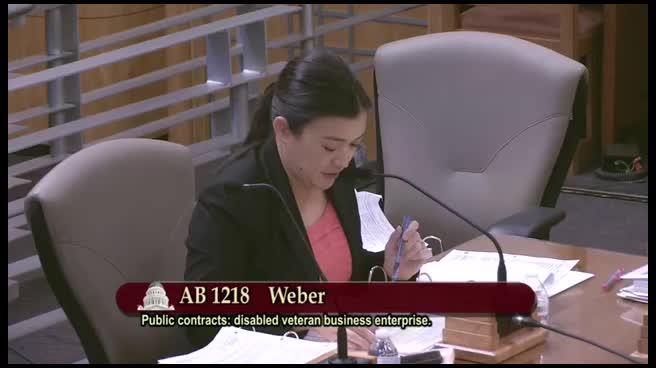 1MIN
Senate Standing Committee on Appropriations
 6MIN
Senate Standing Committee on Governmental Organization
 4MIN
Senate Standing Committee on Veterans Affairs
 1MIN
Assembly Floor
Bill Author



