AB 2666: Public utilities: rate of return.
- Session Year: 2023-2024
- House: Assembly
- Latest Version Date: 2024-09-22
Current Status:
Passed
(2024-09-22: Chaptered by Secretary of State - Chapter 413, Statutes of 2024.)
Introduced
In Committee
First Chamber
In Committee
Second Chamber
Enacted
Existing law authorizes the Public Utilities Commission to fix the rates and charges for every public utility, including electrical and gas corporations, and requires those rates and charges to be just and reasonable.
This bill would require the commission, following the approval of each general rate case, to review which costs, if any, differed from the general rate case forecasts for each electrical corporation or gas corporation, and to adjust the authorized revenue requirement in the subsequent general rate case, as appropriate, based on the actual past costs the corporation records. The bill would require the commission to establish guidelines for electrical corporations and gas corporations to calculate and report annually their actual rates of return to the commission. The bill would require the commission to adopt processes to adequately track those corporations actual rates of return relative to their forecasted rates of return and to require those corporations to identify the cost categories where projected costs differed from actual costs.
Under existing law, a violation of the Public Utilities Act or a violation of any order, decision, rule, direction, demand, or requirement of the commission is a crime.
Because the provisions of this bill would be a part of the act, and because a violation of a commission action implementing its requirements would be a crime, the bill would impose a state-mandated local program.
The California Constitution requires the state to reimburse local agencies and school districts for certain costs mandated by the state. Statutory provisions establish procedures for making that reimbursement.
This bill would provide that no reimbursement is required by this act for a specified reason.
Existing law authorizes the Public Utilities Commission to fix the rates and charges for every public utility, including electrical and gas corporations, and requires those rates and charges to be just and reasonable.
This bill would require the commission, following the approval of each general rate case test year, case, to review which costs, if any, differed from the general rate case forecasts for each electrical corporation or gas corporation was able to reduce to achieve profits corporation, and to adjust the authorized revenue requirement in the subsequent general rate case, as appropriate, based on the actual past costs the corporation records. The bill would require the commission to establish guidelines for electrical corporations and gas corporations to calculate and report annually their actual rates of return to the commission. The bill would require the commission to adopt controls processes to adequately track those corporations actual rates of return relative to their forecasted rates of return and to require those corporations to identify the cost categories where projected costs exceeded differed from actual costs.
Under existing law, a violation of the Public Utilities Act or a violation of any order, decision, rule, direction, demand, or requirement of the commission is a crime.
Because the provisions of this bill would be a part of the act, and because a violation of a commission action implementing its requirements would be a crime, the bill would impose a state-mandated local program.
The California Constitution requires the state to reimburse local agencies and school districts for certain costs mandated by the state. Statutory provisions establish procedures for making that reimbursement.
This bill would provide that no reimbursement is required by this act for a specified reason.
Existing law authorizes the Public Utilities Commission to fix the rates and charges for every public utility, including electrical and gas corporations, and requires those rates and charges to be just and reasonable.
This bill would require the commission, following each general rate case test year, to review which costs, if any, each electrical corporation or gas corporation was able to reduce to achieve profits and to adjust the authorized revenue requirement in the attrition years or in the subsequent general rate case, as appropriate, based on the actual past costs the corporation records. The bill would require the commission to establish guidelines for electrical corporations and gas corporations to calculate and report annually their actual rates of return to the commission. The bill would require the commission to adopt controls to adequately track those corporations actual rates of return relative to their forecasted rates of return and to require those corporations to identify the cost categories where projected costs exceeded actual costs.
Under existing law, a violation of the Public Utilities Act or a violation of any order, decision, rule, direction, demand, or requirement of the commission is a crime.
Because the provisions of this bill would be a part of the act, and because a violation of a commission action implementing its requirements would be a crime, the bill would impose a state-mandated local program.
The California Constitution requires the state to reimburse local agencies and school districts for certain costs mandated by the state. Statutory provisions establish procedures for making that reimbursement.
This bill would provide that no reimbursement is required by this act for a specified reason.
Existing law authorizes the Public Utilities Commission to fix the rates and charges for every public utility, including electrical and gas corporations, and requires those rates and charges to be just and reasonable. Existing law requires the commission, whenever it orders rate refunds to be distributed, to require the public utility to pay refunds, as provided.
This bill would require the commission, if it determines that an electrical corporation or a gas corporation has received revenues from its ratepayers that are in excess of its approved rate of return for a prior year, to require the electrical corporation or gas corporation to refund those excessive revenues from the prior year to its ratepayers. commission, following each general rate case test year, to review which costs, if any, each electrical corporation or gas corporation was able to reduce to achieve profits and to adjust the authorized revenue requirement in the attrition years or in the subsequent general rate case, as appropriate, based on the actual past costs the corporation records. The bill would require the commission to establish guidelines for electrical corporations and gas corporations to calculate and report annually their actual rates of return to the commission. The bill would require the commission to adopt controls to adequately track those corporations actual rates of return relative to their forecasted rates of return and to require those corporations to identify the cost categories where projected costs exceeded actual costs.
Under existing law, a violation of the Public Utilities Act or a violation of any order, decision, rule, direction, demand, or requirement of the commission is a crime.
Because the provisions of this bill would be a part of the act, and because a violation of a commission action implementing its requirements would be a crime, the bill would impose a state-mandated local program.
The California Constitution requires the state to reimburse local agencies and school districts for certain costs mandated by the state. Statutory provisions establish procedures for making that reimbursement.
This bill would provide that no reimbursement is required by this act for a specified reason.
Existing law authorizes the Public Utilities Commission to fix the rates and charges for every public utility, including electrical and gas corporations, and requires those rates and charges to be just and reasonable. Existing law requires the commission, whenever it orders rate refunds to be distributed, to require the public utility to pay refunds, as provided.
This bill would require the commission, if it determines that an electrical corporation or a gas corporation has received revenues from its ratepayers that are in excess of its approved rate of return for a prior year, to require the electrical corporation or gas corporation to refund those excessive revenues from the prior year to its ratepayers.
Under existing law, a violation of the Public Utilities Act or a violation of any order, decision, rule, direction, demand, or requirement of the commission is a crime.
Because the provisions of this bill would be a part of the act, and because a violation of a commission action implementing its requirements would be a crime, the bill would impose a state-mandated local program.
The California Constitution requires the state to reimburse local agencies and school districts for certain costs mandated by the state. Statutory provisions establish procedures for making that reimbursement.
This bill would provide that no reimbursement is required by this act for a specified reason.
Existing law authorizes the Public Utilities Commission to require, by order served on any public utility, the production within this state at the time and place it designates, of any books, accounts, papers, or records kept by the public utility in any office or place without this state, or, at its option, verified copies in lieu thereof, so that an examination thereof may be made by the commission or under its direction.This bill would make nonsubstantive changes to that authorization.Existing law authorizes the Public Utilities Commission to require, by order served on any public utility, the production within this state at the time and place it designates, of any books, accounts, papers, or records kept by the public utility in any office or place without this state, or, at its option, verified copies in lieu thereof, so that an examination thereof may be made by the commission or under its direction.
This bill would make nonsubstantive changes to that authorization.
(a)Following the approval of each general rate case, the commission shall review which costs, if any, differed from the general rate case forecasts for each electrical corporation or gas corporation. The commission shall adjust the authorized revenue requirement in the subsequent general rate case, as appropriate, based on the actual past costs the corporation records.
(b)(1)The commission shall establish guidelines for electrical corporations and gas corporations to calculate and report their actual rates of return to the commission.
(2)The commission shall require electrical corporations and gas corporations to report their actual rates of return to the commission annually.
(3)The commission shall adopt processes to adequately track an electrical corporations or gas corporations actual rate of return relative to its forecasted rate of return and shall require the corporation to identify the cost categories where projected costs differed from actual costs.
(c)This section does not restrict, limit, or otherwise affect the commissions obligation to ensure that rates are sufficient to enable an electrical corporation or gas corporation to recover a just and reasonable amount of revenue, pursuant to Section 451, including a reasonable return.
SEC. 2.No reimbursement is required by this act pursuant to Section 6 of Article XIIIB of the California Constitution because the only costs that may be incurred by a local agency or school district will be incurred because this act creates a new crime or infraction, eliminates a crime or infraction, or changes the penalty for a crime or infraction, within the meaning of Section 17556 of the Government Code, or changes the definition of a crime within the meaning of Section 6 of Article XIIIB of the California Constitution.
(a)Following the approval of each general rate case test year, case, the commission shall review which costs, if any, differed from the general rate case forecasts for each electrical corporation or gas corporation was able to reduce to achieve profits. corporation. The commission shall adjust the authorized revenue requirement in the subsequent general rate case, as appropriate, based on the actual past costs the corporation records.
(b)(1)The commission shall establish guidelines for electrical corporations and gas corporations to calculate and report their actual rates of return to the commission.
(2)The commission shall require electrical corporations and gas corporations to report their actual rates of return to the commission annually.
(3)The commission shall adopt controls processes to adequately track an electrical corporations or gas corporations actual rate of return relative to its forecasted rate of return and shall require the corporation to identify the cost categories where projected costs exceeded differed from actual costs.
(c)This section does not restrict, limit, or otherwise affect the commissions obligation to ensure that rates are sufficient to enable an electrical corporation or gas corporation to recover a just and reasonable amount of revenue, pursuant to Section 451, including a reasonable return.
SEC. 2.No reimbursement is required by this act pursuant to Section 6 of Article XIIIB of the California Constitution because the only costs that may be incurred by a local agency or school district will be incurred because this act creates a new crime or infraction, eliminates a crime or infraction, or changes the penalty for a crime or infraction, within the meaning of Section 17556 of the Government Code, or changes the definition of a crime within the meaning of Section 6 of Article XIIIB of the California Constitution.
(a)Following each general rate case test year, the commission shall review which costs, if any, each electrical corporation or gas corporation was able to reduce to achieve profits. The commission shall adjust the authorized revenue requirement in the attrition years or in the subsequent general rate case, as appropriate, based on the actual past costs the corporation records.
(b)(1)The commission shall establish guidelines for electrical corporations and gas corporations to calculate and report their actual rates of return to the commission.
(2)The commission shall require electrical corporations and gas corporations to report their actual rates of return to the commission annually.
(3)The commission shall adopt controls to adequately track an electrical corporations or gas corporations actual rate of return relative to its forecasted rate of return and shall require the corporation to identify the cost categories where projected costs exceeded actual costs.
(c)This section does not restrict, limit, or otherwise affect the commissions obligation to ensure that rates are sufficient to enable an electrical corporation or gas corporation to recover a just and reasonable amount of revenue, pursuant to Section 451, including a reasonable return.
SEC. 2.No reimbursement is required by this act pursuant to Section 6 of Article XIIIB of the California Constitution because the only costs that may be incurred by a local agency or school district will be incurred because this act creates a new crime or infraction, eliminates a crime or infraction, or changes the penalty for a crime or infraction, within the meaning of Section 17556 of the Government Code, or changes the definition of a crime within the meaning of Section 6 of Article XIIIB of the California Constitution.
If the commission determines that an electrical corporation or a gas corporation has received revenues from its ratepayers that are in excess of its approved rate of return in a prior year, the commission shall require the electrical corporation or gas corporation to refund those excessive revenues from the prior year to its ratepayers.
SEC. 2.No reimbursement is required by this act pursuant to Section 6 of Article XIIIB of the California Constitution because the only costs that may be incurred by a local agency or school district will be incurred because this act creates a new crime or infraction, eliminates a crime or infraction, or changes the penalty for a crime or infraction, within the meaning of Section 17556 of the Government Code, or changes the definition of a crime within the meaning of Section 6 of Article XIIIB of the California Constitution.
SECTION 1.Section 313 of the Public Utilities Code is amended to read:313.The commission may require, by order served on any public utility, the production within this state at the time and place it designates, of any books, accounts, papers, or records kept by the public utility in any office or place outside this state, or, at its option, verified copies in lieu thereof, so that an examination thereof may be made by the commission or under its direction.The commission may require, by order served on any public utility, the production within this State at such state at the time and place as it designates, of any books, accounts, papers, or records kept by the public utility in any office or place without this State, outside this state, or, at its option, verified copies in lieu thereof, so that an examination thereof may be made by the commission or under its direction.
|
Date
|
Status
|
|---|---|
| Sep 22, 2024 | Chaptered by Secretary of State - Chapter 413, Statutes of 2024. |
| Sep 22, 2024 | Approved by the Governor. |
| Sep 11, 2024 | Enrolled and presented to the Governor at 4 p.m. |
| Aug 30, 2024 | Senate amendments concurred in. To Engrossing and Enrolling. (Ayes 56. Noes 4.). |
| Aug 30, 2024 | In Assembly. Concurrence in Senate amendments pending. |
| Aug 29, 2024 | Read third time. Passed. Ordered to the Assembly. (Ayes 32. Noes 7.). |
| Aug 19, 2024 | Read second time. Ordered to third reading. |
| Aug 15, 2024 | From committee: Do pass. (Ayes 5. Noes 2.) (August 15). |
| Aug 5, 2024 | In committee: Referred to APPR suspense file. |
| Jul 3, 2024 | Read second time and amended. Re-referred to Com. on APPR. |
| Jul 2, 2024 | From committee: Amend, and do pass as amended and re-refer to Com. on APPR. (Ayes 15. Noes 3.) (July 2). |
| Jun 5, 2024 | Referred to Com. on E., U. & C. |
| May 24, 2024 | In Senate. Read first time. To Com. on RLS. for assignment. |
| May 23, 2024 | Read third time. Passed. Ordered to the Senate. (Ayes 52. Noes 1. Page 5606.) |
| May 20, 2024 | Read second time. Ordered to third reading. |
| May 16, 2024 | Read second time and amended. Ordered returned to second reading. |
| May 16, 2024 | From committee: Amend, and do pass as amended. (Ayes 9. Noes 1.) (May 16). |
| May 16, 2024 | Joint Rule 62(a), file notice suspended. (Page 5215.) |
| May 16, 2024 | Assembly Rule 63 suspended. |
| May 15, 2024 | In committee: Set, first hearing. Referred to APPR. suspense file. |
| Apr 30, 2024 | Re-referred to Com. on APPR. |
| Apr 29, 2024 | Read second time and amended. |
| Apr 25, 2024 | From committee: Amend, and do pass as amended and re-refer to Com. on APPR. (Ayes 12. Noes 0.) (April 24). |
| Apr 1, 2024 | Re-referred to Com. on U. & E. |
| Mar 21, 2024 | From committee chair, with author's amendments: Amend, and re-refer to Com. on U. & E. Read second time and amended. |
| Mar 21, 2024 | Referred to Com. on U. & E. |
| Feb 15, 2024 | From printer. May be heard in committee March 16. |
| Feb 14, 2024 | Read first time. To print. |
|
Date
|
Description
|
Location
|
Votes
|
|
|---|---|---|---|---|
| Aug 30, 2024 | AB 2666 Boerner Concurrence in Senate Amendments | Assembly Floor |
Passed |
|
| Aug 29, 2024 | Assembly 3rd Reading AB2666 Boerner By Becker | Senate Floor |
Passed |
|
| Aug 15, 2024 | Do pass | Senate Standing Committee on Appropriations |
Passed |
|
| Aug 5, 2024 | Placed on suspense file | Senate Standing Committee on Appropriations |
Passed |
|
| Jul 2, 2024 | Do pass as amended, but first amend, and re-refer to the Committee on [Appropriations] | Senate Standing Committee on Energy, Utilities and Communications |
Passed |
|
| May 23, 2024 | AB 2666 Boerner Assembly Third Reading | Assembly Floor |
Passed |
|
| May 16, 2024 | Do pass as amended. | Assembly Standing Committee on Appropriations |
Passed |
|
| Apr 24, 2024 | Do pass as amended and be re-referred to the Committee on [Appropriations] | Assembly Standing Committee on Utilities and Energy |
Passed |
This list shows positions taken on this bill by organizations on the date displayed, which is linked to the original source.
Positions by individuals are not included.
|
Organization
|
Position
|
Date
|
|---|---|---|
| 350 Humboldt: Grass Roots Climate Action | ** Support | |
| California Environmental Voters | ** Support | |
| California Solar & Storage Association | ** Support | |
| California State Association Of Electrical Workers | ** Against | |
| California State Pipe Trades Council | ** Against | |
| Coalition of California Utility Employees | ** Against | |
| Media Alliance | ** Support | |
| Orange County Environmental Justice | ** Support | |
| Pacific Gas And Electric Company | ** Against | |
| Peninsula Clean Energy | ** Support | |
| SanDiego350 | ** Support | |
| San Diego Community Power | ** Support | |
| San Jose Clean Energy | ** Support | |
| Sonoma Clean Power | ** Support | |
| Southern California Edison | ** Against | |
| Southern California Gas Company | ** Against | |
| The Utility Reform Network | ** Support |
CONCURRENCE IN SENATE AMENDMENTS
CSA1 Bill Id:AB 2666
Author:(Boerner)
As Amended Ver:July 3, 2024
Majority vote
SUMMARY
Requires the California Public Utilities Commission (CPUC) to review forecasted costs by electric and gas utilities on a more frequent basis after the approval of each general rate case (GRC), and to adjust the authorized revenue requirement in the subsequent GRC, as appropriate, based on actual past costs.
Senate Amendments
- Deletes reference to the "test year" of the GRC.
- Requires the CPUC to review which costs, if any, differed from the GRC forecasts, rather than only those where the electrical corporation or gas corporation was able to reduce to achieve profits.
COMMENTS
The CPUC addresses the costs of operating and maintaining investor-owned utility (IOU) systems through GRC proceedings. The CPUC evaluates detailed cost data from both past expenses and utility forecasts of likely future costs, and establishes how much money the utilities are allowed to collect for the first year – called a test year. They then prescribe how to adjust the test year budget for inflation and other factors that may affect costs, such as additional capital projects, for the following 3 years, summing to a total of 4 years that each GRC cycle encompasses.
A recent report by the State Auditor investigated causes of increasing electricity and natural gas rates, and recommended options for limiting rate increases. The State Auditor concluded that, while some of the elements contributing to electricity and natural gas rate increases are outside of the control of the CPUC – due to needed upgrades to the electrical system, wildfire mitigation efforts, and weather conditions – the commission can better protect customers by implementing improvements to its oversight. These recommendations included, among others: (1) promoting transparency by instituting a process that requires utilities to periodically publish actual rate of return calculations; and (2) require IOUs to identify major costs categories savings were achieved when the projected costs exceeded actual costs, and publish and analyze this information. This bill seeks to institute those recommendations at the CPUC, and directs the CPUC to exercise its statutory power and adjust the rate of return prospectively in subsequent GRCs, as appropriate.
According to the Author
"It's unconscionable that while utility companies are making profit over the permissible rate set by the California Public Utilities Commission (CPUC), Californians continuously see higher gas and electric bills. With the cost of living consistently going up, every dollar counts and Californians should not bear utility costs while utility companies are making record high profits."
Arguments in Support
Sonoma Clean Power writes, "[This bill is] a commonsense measure which will help keep rising electric rates under control. Requiring the California Public Utilities Commission (CPUC) to review utilities' actual costs following each general rate case, including consideration of how much the utility earned compared to the authorized rate of return, will be a win for the state's ratepayers. Furthermore, [this bill] directs the CPUC to adjust future authorized revenue requirements based on the actual past costs recorded by utilities."
Arguments in Opposition
The Coalition of California Utility Employees writes, "It is impossible for the revenue requirement to exactly match the IOU's future costs of operating its electric and/or gas system (plus the rate of return) because it is based on forecasts… [This bill] would require the CPUC to adjust the GRC revenue requirement, 'as appropriate,' based on previous recorded costs. This is unnecessary because the GRC process already accounts for efficiencies for the benefit of ratepayers. Moreover, without defining 'as appropriate', the bill could lead to absurd results."
FISCAL COMMENTS
According to the Senate Committee on Appropriations, this bill would incur one-time costs of $113,000 and ongoing costs of $2.8 million (ratepayer funds) at the CPUC to establish reporting and evaluation guidelines for electric and gas IOU rates of return as well as to track actual IOU costs and annually adjust the utilities' revenue requirement based on actual costs. This bill should also, to the extent inaccurate cost forecasts result in actual rates of return being higher than authorized, incur unknown but likely minor potential cost savings to the state as an electric ratepayer.
VOTES:
ASM UTILITIES AND ENERGY: 12-0-4
YES: Petrie-Norris, Bauer-Kahan, Connolly, Friedman, Holden, Reyes, Santiago, Schiavo, Ting, Wallis, Wood, Zbur
ABS, ABST OR NV: Jim Patterson, Calderon, Chen, Joe Patterson
ASM APPROPRIATIONS: 9-1-5
YES: Wicks, Arambula, Bryan, Mike Fong, Grayson, Haney, Hart, Pellerin, Villapudua
NO: Dixon
ABS, ABST OR NV: Sanchez, Calderon, Wendy Carrillo, Jim Patterson, Ta
ASSEMBLY FLOOR: 52-1-27
YES: Addis, Aguiar-Curry, Alanis, Alvarez, Arambula, Bains, Bauer-Kahan, Bennett, Berman, Boerner, Bonta, Bryan, Juan Carrillo, Connolly, Mike Fong, Friedman, Gabriel, Garcia, Gipson, Haney, Hart, Irwin, Jackson, Jones-Sawyer, Kalra, Lee, Low, Lowenthal, McCarty, McKinnor, Muratsuchi, Stephanie Nguyen, Ortega, Pacheco, Papan, Pellerin, Petrie-Norris, Quirk-Silva, Rendon, Reyes, Santiago, Schiavo, Ting, Waldron, Wallis, Ward, Weber, Wicks, Wilson, Wood, Zbur, Robert Rivas
NO: Dixon
ABS, ABST OR NV: Calderon, Wendy Carrillo, Cervantes, Chen, Megan Dahle, Davies, Essayli, Flora, Vince Fong, Gallagher, Grayson, Holden, Hoover, Lackey, Maienschein, Mathis, Jim Patterson, Joe Patterson, Ramos, Luz Rivas, Rodriguez, Blanca Rubio, Sanchez, Soria, Ta, Valencia, Villapudua
SENATE FLOOR: 32-7-1
YES: Allen, Archuleta, Ashby, Atkins, Becker, Blakespear, Bradford, Caballero, Cortese, Dodd, Durazo, Eggman, Glazer, Gonzalez, Hurtado, Laird, Limón, McGuire, Menjivar, Min, Newman, Padilla, Portantino, Roth, Rubio, Skinner, Smallwood-Cuevas, Stern, Umberg, Wahab, Wiener, Wilk
NO: Alvarado-Gil, Dahle, Grove, Jones, Nguyen, Niello, Seyarto
ABS, ABST OR NV: Ochoa Bogh
UPDATED
VERSION: July 3, 2024
CONSULTANT: Kathleen Chen / U. & E. / (916) 319-2083 FN: 0004991
SENATE RULES COMMITTEE Office of Senate Floor Analyses (916) 651-1520 Fax: (916) 327-4478 | AB 2666 |
THIRD READING
Bill No: AB 2666
Author: Boerner (D)
Amended: 7/3/24 in Senate
Vote: 21
SENATE ENERGY, U. & C. COMMITTEE: 15-3, 7/2/24
AYES: Bradford, Ashby, Becker, Caballero, Dodd, Durazo, Eggman, Gonzalez, Limón, Min, Newman, Rubio, Skinner, Stern, Wilk
NOES: Dahle, Grove, Seyarto
SENATE APPROPRIATIONS COMMITTEE: 5-2, 8/15/24
AYES: Caballero, Ashby, Becker, Bradford, Wahab
NOES: Jones, Seyarto
ASSEMBLY FLOOR: 52-1, 5/23/24 - See last page for vote
SUBJECT: Public utilities: rate of return
SOURCE: Author
DIGEST:
- This bill makes explicit the need for the California Public Utilities Commission (CPUC) to improve its frequency and review of forecasted costs by electric and gas utilities to better protect customers from increasing utility bills.
ANALYSIS:
Existing law:
- Establishes and vests the CPUC with regulatory authority over public utilities, including electrical and natural gas corporations. (Article XII of the California Constitution)
- Authorizes the CPUC to fix the rates and charges for every public utility, including electrical and gas corporations, and requires those rates and charges to be just and reasonable. (Public Utilities Code §451)
This bill:
- Requires the CPUC, following the approval of each general rate case (GRC), to review which costs, if any, differed from the GRC forecasts for each electrical corporation or gas corporation, and to adjust the authorized revenue requirement in the subsequent GRC, as appropriate, based on the actual past costs the corporation records.
- Requires the CPUC to establish guidelines for electrical corporations and gas corporations to calculate and report annually their actual rates of return to the CPUC.
- Requires the CPUC to adopt processes to adequately track those corporations’ actual rates of return relative to their forecasted rates of return and to require those corporations to identify the cost categories where projected costs differed from actual costs.
Background
- General Rate Case (GRC). The CPUC addresses the costs of operating and maintaining investor-owned utility (IOU) systems through GRC proceedings. The CPUC evaluates detailed cost data from both past expenses and utility forecasts of likely future costs, and establishes how much money the utilities are allowed to collect for the first year – called a test year. They then prescribe how to adjust the test year budget for inflation and other factors that may affect costs, such as additional capital projects, for the following three years, summing to a total of four years that each GRC cycle encompasses.
- 2023 State Auditor’s Report. A recent report by the State Auditor investigated causes of increasing electricity and natural gas rates, and recommended options for limiting rate increases. The State Auditor concluded that, while some of the elements contributing to electricity and natural gas rate increases are outside of the control of the CPUC – due to needed upgrades to the electrical system, wildfire mitigation efforts, and weather conditions – the CPUC can better protect customers by implementing improvements to its oversight. These recommendations included, among others: (1) promoting transparency by instituting a process that requires utilities to periodically publish actual rate of return calculations; and (2) require energy utilities to identify major costs categories savings were achieved when the projected costs exceeded actual costs, and publish and analyze this information. This bill seeks to institute those recommendations at the CPUC.
Comments
- Need for bill. According to the author, “It’s unconscionable that while utility companies are making profit over the permissible rate set by the CPUC, Californians continuously see higher gas and electric bills. With the cost-of-living consistently going up, every dollar counts and Californians should not bear utility costs while utility companies are making record profits. AB 2666 would require the CPUC to determine if rates were unreasonably set higher than the approved rate of return and adjust accordingly.”
- Utility rate of return. The CPUC prospectively authorizes, in the GRC, the return on investment, or profit, an IOU can earn in a given year - called a rate of return. In any given year, a utility’s actual rate of return may be higher or lower than the rate the CPUC authorized, depending in part on how the utility manages its operations and costs. According to the State Auditor, beginning in 2013, in nine of the last 10 years, San Diego Gas & Electric’s (SDG&E) actual rate of return was higher than its authorized rate of return, raising questions about the accuracy of their forecasted costs. Although Pacific, Gas & Electric’s (PG&E) actual rate of return has only been higher than its authorized rate of return in one of the last 10 years, they recently announced record profits for 2023, earning more than $2.2 billion, a nearly 25 percent increase from 2022. This announcement came after customers saw their monthly electric bills rise by almost 20 percent at the beginning of 2024, following the CPUC’s approval of rate increases in PG&E’s 2023-2026 GRC.
- Effort to reduce utility bills. This bill seeks to lower electric and gas bills by requiring any profits a utility earns above its authorized rate of return. As pointed out in the State Auditor’s report, SDG&E’s ability to earn higher-than authorized rates of return for multiple years and through different GRC cycles suggests that it may have overstated its forecasted costs during the GRC proceeding, and leads to concerns over whether the CPUC’s process for setting revenue requirements is sensitive enough to realize these efficiencies as standard practice moving forward and to self-correct in the following GRC proceeding. This bill makes explicit the need for the CPUC to improve its frequency and review of forecasted costs by utilities to better protect customers from increasing utility bills.
Related/Prior Legislation
AB 2054 (Bauer-Kahan, 2024) among its provisions, would authorize the CPUC to allocate between ratepayers and shareholders any costs recorded in a balancing account above an authorized forecast. The bill was held in the Senate Committee on Appropriations.
AB 2847 (Addis, 2024) would require, when the CPUC requires, electric and gas IOUs to provide in their request for capital expenditures their best estimation alongside supporting documents, of the impact of the proposed expenditures on the utility’s authorized revenue for each year of the life of the capital asset, as well as the asset’s net present value. The bill is pending on the Senate Floor.
AB 3256 (Irwin, 2024) would require the CPUC, before July 1, 2025, to conduct a comprehensive audit of each wildfire- or emergency-related memorandum or balancing account of each electrical corporation. The bill was held in the Senate Committee on Appropriations.
FISCAL EFFECT: Appropriation: No Fiscal Com.: Yes Local: Yes
According to the Senate Appropriations Committee:
- The CPUC estimates one-time costs of $113,000 and ongoing costs of $2.8 million (ratepayer funds) to establish reporting and evaluation guidelines for electric and gas IOU rates of return as well as to track actual IOU costs and annually adjust the utilities’ revenue requirement based on actual costs.
- To the extent inaccurate cost forecasts result in actual rates of return being higher than authorized, unknown but likely minor potential cost savings to the state as a ratepayer. (See staff comments for details.)
SUPPORT: (Verified 8/14/24)
350 Humboldt: Grass Roots Climate Action
California Environmental Voters
California Solar & Storage Association
Media Alliance
Orange County Environmental Justice
Peninsula Clean Energy
San Diego Community Power
San Jose Clean Energy
SanDiego350
Sonoma Clean Power
The Utility Reform Network
OPPOSITION: (Verified 8/14/24)
California State Association of Electrical Workers
California State Pipe Trades Council
Coalition of California Utility Employees
ARGUMENTS IN SUPPORT: The Utility Reform Network states:
While customers face energy insecurity, the utility shareholders are profiting, and sometimes more than its authorized rate of return. In its audit report on the CPUC “Electricity and Natural Gas Rates: The California Public Utilities Commission and Cal Advocates Can Better Ensure that Rate Increases are Necessary,” the State auditor identified that “In nine of the last 10 years, SDG&E’s actual rate of return was higher than its authorized rate of return.” With utility shareholders seeing record profits, the auditor identifies an important problem that AB 2666 would answer. AB 2666 would require a utility that earns a rate of return that is higher than its authorized rate to return the excess of its authorized rate to ratepayers. The bill would ensure that while utility customers face energy insecurity the shareholders would not be unduly profiting in excess of an authorized and guaranteed rate of return.
ARGUMENTS IN OPPOSITION: The California Coalition for Utility Employees states:
AB 2666 would require the CPUC to adjust the GRC revenue requirement, “as appropriate,” based on previous recorded costs. This is unnecessary because the GRC process already accounts for efficiencies for the benefit of ratepayers. Moreover, without defining “as appropriate,” the bill could lead to absurd results. …For example, an IOU underspending on energization work in its last GRC cycle is not an appropriate reason for adjusting the GRC revenue requirement. Indeed, energization underspending is exactly why customers have been exceedingly frustrated by long energization timelines and why AB 50 and SB 410 were enacted – so that the IOUs spend the necessary amount of money to get customers timely energized. We appreciate the author’s focus on energy affordability and bringing relief to ratepayers but AB 2666 is not the solution. AB 2666 is unnecessary and could have unintended consequences.
ASSEMBLY FLOOR: 52-1, 5/23/24
AYES: Addis, Aguiar-Curry, Alanis, Alvarez, Arambula, Bains, Bauer-Kahan, Bennett, Berman, Boerner, Bonta, Bryan, Juan Carrillo, Connolly, Mike Fong, Friedman, Gabriel, Garcia, Gipson, Haney, Hart, Irwin, Jackson, Jones-Sawyer, Kalra, Lee, Low, Lowenthal, McCarty, McKinnor, Muratsuchi, Stephanie Nguyen, Ortega, Pacheco, Papan, Pellerin, Petrie-Norris, Quirk-Silva, Rendon, Reyes, Santiago, Schiavo, Ting, Waldron, Wallis, Ward, Weber, Wicks, Wilson, Wood, Zbur, Robert Rivas
NOES: Dixon
NO VOTE RECORDED: Calderon, Wendy Carrillo, Cervantes, Chen, Megan Dahle, Davies, Essayli, Flora, Vince Fong, Gallagher, Grayson, Holden, Hoover, Lackey, Maienschein, Mathis, Jim Patterson, Joe Patterson, Ramos, Luz Rivas, Rodriguez, Blanca Rubio, Sanchez, Soria, Ta, Valencia, Villapudua
Prepared by: Nidia Bautista / E., U. & C. / (916) 651-4107
8/18/24 9:19:24
**** END ****
SENATE COMMITTEE ON
Senator Anna Caballero, Chair
2023 - 2024 Regular Session
AB 2666 (Boerner) - Public utilities: rate of return
Version: | Policy Vote: |
Urgency: | Mandate: |
Hearing Date: | Consultant: |
Bill Summary:
This bill would require the California Public Utilities Commission (CPUC), following each general rate case (GRC), to review which actual costs, if any, differed from the GRC forecasts for each electrical or gas corporation, and adjust for these differences in the subsequent GRC, as appropriate.
Fiscal Impact:
- The CPUC estimates one-time costs of $113,000 and ongoing costs of $2.8 million (ratepayer funds) to establish reporting and evaluation guidelines for electric and gas IOU rates of return as well as to track actual IOU costs and annually adjust the utilities’ revenue requirement based on actual costs.
- To the extent inaccurate cost forecasts result in actual rates of return being higher than authorized, unknown but likely minor potential cost savings to the state as a ratepayer. (See staff comments for details.)
Background:
General Rate Case. The CPUC addresses the costs of operating and maintaining investor-owned utility (IOU) systems through GRC proceedings. The CPUC evaluates detailed cost data from both past expenses and utility forecasts of likely future costs, and establishes how much money the utilities are allowed to collect for the first year – called a test year. They then prescribe how to adjust the test year budget for inflation and other factors that may affect costs, such as additional capital projects, for the following three years, summing to a total of four years that each GRC cycle encompasses.
2023 State Auditor’s Report. A recent report by the State Auditor investigated causes of increasing electricity and natural gas rates, and recommended options for limiting rate increases. The State Auditor concluded that, while some of the elements contributing to electricity and natural gas rate increases are outside of the control of the CPUC – due to needed upgrades to the electrical system, wildfire mitigation efforts, and weather conditions – the CPUC can better protect customers by implementing improvements to its oversight. These recommendations included, among others: (1) promoting transparency by instituting a process that requires utilities to periodically publish actual rate of return calculations; and (2) require energy utilities to identify major costs categories savings were achieved when the projected costs exceeded actual costs, and publish and analyze this information. This bill seeks to institute those recommendations at the CPUC.
Proposed Law:
This bill would require the California Public Utilities Commission (CPUC) to review the actual past costs recorded by an electrical or gas corporation following each general rate case (GRC) test year, and adjust the authorized revenue requirement in the subsequent GRC, as appropriate. Specifically, it would:
- Require the CPUC, following each GRC test year, to review which costs, if any, each electrical corporation or gas corporation was able to reduce to achieve profits and to adjust the authorized revenue requirement in the subsequent GRC, as appropriate, based on the actual past costs the corporation records.
- Require the CPUC to establish guidelines for electrical corporations and gas corporations to calculate and report annually their actual rates of return to the CPUC.
- Require the CPUC to adopt controls to adequately track those corporations’ actual rates of return relative to their forecasted rates of return and to require those corporations to identify the cost categories where projected costs exceeded actual costs.
Related Legislation:
AB 2054 (Bauer-Kahan, 2024) among its provisions, authorizes the CPUC to allocate between ratepayers and shareholders any costs recorded in a balancing account above an authorized forecast.
AB 2847 (Addis, 2024) requires electric and gas IOUs to provide in their request for capital expenditures their best estimation, alongside supporting documents, of the impact of the proposed expenditures on the utility’s authorized revenue for each year of the life of the capital asset, as well as the asset’s net present value.
AB 3256 (Irwin, 2024) requires the CPUC, before July 1, 2025, to conduct a comprehensive audit of each wildfire- or emergency-related memorandum or balancing account of each electrical corporation.
Staff Comments:
The State of California is a natural gas and electrical customer, purchasing roughly one percent of the state’s electricity and four percent of its natural gas. As such, the state can see cost savings when rates go down. This bill seeks to lower electric and gas bills by requiring any profits a utility earns above its authorized rate of return to be accounted for in the subsequent GRC.
The CPUC prospectively authorizes, in the GRC, the return on investment, or profit, that an IOU can earn in a given year, called a rate of return. In any given year, a utility’s actual rate of return may be higher or lower than the rate the CPUC authorized, depending in part on how the utility manages its operations and costs. According to the State Auditor, beginning in 2013, in nine of the last ten years, San Diego Gas & Electric’s (SDG&E) actual rate of return was higher than its authorized rate of return, raising questions about the accuracy of their forecasted costs. Although Pacific, Gas & Electric’s (PG&E) actual rate of return has only been higher than its authorized rate of return in one of the last ten years, they recently announced record profits for 2023, earning more than $2.2 billion, a nearly 25 percent increase from 2022. This announcement came after customers saw their monthly electric bills rise by almost 20 percent at the beginning of 2024, following the CPUC’s approval of rate increases in PG&E’s 2023-2026 GRC.
As pointed out in the State Auditor’s report, SDG&E’s ability to earn higher-than authorized rates of return for multiple years and through different GRC cycles suggests that it may have overstated its forecasted costs during the GRC proceeding, and leads to concerns over whether the CPUC’s process for setting revenue requirements is sensitive enough to realize these efficiencies as standard practice moving forward and to self-correct in the following GRC proceeding.
-- END --
SENATE COMMITTEE ON ENERGY, UTILITIES AND COMMUNICATIONS
Senator Steven Bradford, Chair
2023 - 2024 Regular
Bill No: AB 2666 Hearing Date: 7/2/2024
Author: | Boerner | ||
Version: | 5/16/2024 Amended | ||
Urgency: | No | Fiscal: | Yes |
Consultant: | Nidia Bautista | ||
SUBJECT: Public utilities: rate of return
DIGEST: This bill requires the California Public Utilities Commission (CPUC) to review the actual past costs an electrical or gas corporation records following each general rate case (GRC) test year, and adjust the authorized revenue requirement in the subsequent GRC, as appropriate.
ANALYSIS:
Existing law:
- Establishes and vests the CPUC with regulatory authority over public utilities, including electrical and natural gas corporations. (Article XII of the California Constitution)
- Authorizes the CPUC to fix the rates and charges for every public utility, including electrical and gas corporations, and requires those rates and charges to be just and reasonable. (Public Utilities Code §451)
This bill:
- Requires the CPUC, following each GRC test year, to review which costs, if any, each electrical corporation or gas corporation was able to reduce to achieve profits and to adjust the authorized revenue requirement in the subsequent GRC, as appropriate, based on the actual past costs the corporation records.
- Requires the CPUC to establish guidelines for electrical corporations and gas corporations to calculate and report annually their actual rates of return to the CPUC.
- Requires the CPUC to adopt controls to adequately track those corporations’ actual rates of return relative to their forecasted rates of return and to require those corporations to identify the cost categories where projected costs exceeded actual costs.
Background
General Rate Case. The CPUC addresses the costs of operating and maintaining investor-owned utility (IOU) systems through GRC proceedings. The CPUC evaluates detailed cost data from both past expenses and utility forecasts of likely future costs, and establishes how much money the utilities are allowed to collect for the first year – called a test year. They then prescribe how to adjust the test year budget for inflation and other factors that may affect costs, such as additional capital projects, for the following three years, summing to a total of four years that each GRC cycle encompasses.
2023 State Auditor’s Report. A recent report by the State Auditor investigated causes of increasing electricity and natural gas rates, and recommended options for limiting rate increases. The State Auditor concluded that, while some of the elements contributing to electricity and natural gas rate increases are outside of the control of the CPUC – due to needed upgrades to the electrical system, wildfire mitigation efforts, and weather conditions – the CPUC can better protect customers by implementing improvements to its oversight. These recommendations included, among others: (1) promoting transparency by instituting a process that requires utilities to periodically publish actual rate of return calculations; and (2) require energy utilities to identify major costs categories savings were achieved when the projected costs exceeded actual costs, and publish and analyze this information. This bill seeks to institute those recommendations at the CPUC.
Comments
Need for bill. According to the author: It’s unconscionable that while utility companies are making profit over the permissible rate set by the CPUC, Californians continuously see higher gas and electric bills. With the cost-of-living consistently going up, every dollar counts and Californians should not bear utility costs while utility companies are making record profits. AB 2666 would require the CPUC to determine if rates were unreasonably set higher than the approved rate of return and adjust accordingly.
Utility rate of return. The CPUC prospectively authorizes, in the GRC, the return on investment, or profit, that an IOU can earn in a given year, called a rate of return. In any given year, a utility’s actual rate of return may be higher or lower than the rate the CPUC authorized, depending in part on how the utility manages its operations and costs. According to the State Auditor, beginning in 2013, in nine of the last ten years, San Diego Gas & Electric’s (SDG&E) actual rate of return was higher than its authorized rate of return, raising questions about the accuracy of their forecasted costs. Although Pacific, Gas & Electric’s (PG&E) actual rate of return has only been higher than its authorized rate of return in one of the last ten years, they recently announced record profits for 2023, earning more than $2.2 billion, a nearly 25 percent increase from 2022. This announcement came after customers saw their monthly electric bills rise by almost 20 percent at the beginning of 2024, following the CPUC’s approval of rate increases in PG&E’s 2023-2026 GRC.
This bill seeks to lower electric and gas bills by requiring any profits a utility earns above its authorized rate of return. As pointed out in the State Auditor’s report, SDG&E’s ability to earn higher-than authorized rates of return for multiple years and through different GRC cycles suggests that it may have overstated its forecasted costs during the GRC proceeding, and leads to concerns over whether the CPUC’s process for setting revenue requirements is sensitive enough to realize these efficiencies as standard practice moving forward and to self-correct in the following GRC proceeding.
Need for amendments. In many ways, this bill makes explicit the need for the CPUC to improve its frequency and review of forecasted costs by utilities to better protect customers from increasing utility bills. Specifically, this bill would require the CPUC to adjust the revenue requirement based on the utility’s actual costs in the test year, the first year of the now-four year GRC. However, opponents contend that the test year is only one of four years within the GRC, with many costs fluctuating over the GRC timeframe and cycle. They contend that the GRC is intended to forecast costs across four years, not on an annual basis. This seems valid, while still ensuring ongoing review by the CPUC of the rate of return. In this regard, the author and committee may wish to amend this bill to delete reference to the “test year” and make additional and related clarifying changes while still ensuring review of the actual costs during the GRC cycle.
Prior/Related Legislation
AB 2054 (Bauer-Kahan, 2024) among its provisions, authorizes the CPUC to allocate between ratepayers and shareholders any costs recorded in a balancing account above an authorized forecast. The bill is pending before this committee.
AB 2847 (Addis, 2024) requires electric and gas IOUs to provide in their request for capital expenditures their best estimation, alongside supporting documents, of the impact of the proposed expenditures on the utility’s authorized revenue for each year of the life of the capital asset, as well as the asset’s net present value. The bill is pending before this committee.
AB 3256 (Irwin, 2024) requires the CPUC, before July 1, 2025, to conduct a comprehensive audit of each wildfire- or emergency-related memorandum or balancing account of each electrical corporation. The bill is pending before this committee.
FISCAL EFFECT: Appropriation: No Fiscal Com.: Yes Local: Yes
SUPPORT:
350 Humboldt: Grass Roots Climate Action
California Environmental Voters
California Solar & Storage Association
Media Alliance
Peninsula Clean Energy
SanDiego350
Sonoma Clean Power
The Utility Reform Network
OPPOSITION:
California State Association of Electrical Workers
California State Pipe Trades Council
Coalition of California Utility Employees
Pacific Gas and Electric Company
Southern California Edison
Southern California Gas Company
ARGUMENTS IN SUPPORT: According to The Utility Reform Network:
While customers face energy insecurity, the utility shareholders are profiting, and sometimes more than its authorized rate of return. In its audit report on the CPUC “Electricity and Natural Gas Rates: The California Public Utilities Commission and Cal Advocates Can Better Ensure that Rate Increases are Necessary,” the State auditor identified that “In nine of the last 10 years, SDG&E’s actual rate of return was higher than its authorized rate of return.” With utility shareholders seeing record profits, the auditor identifies an important problem that AB 2666 would answer. AB 2666 would require a utility that earns a rate of return that is higher than its authorized rate to return the excess of its authorized rate to ratepayers. The bill would ensure that while utility customers face energy insecurity the shareholders would not be unduly profiting in excess of an authorized and guaranteed rate of return.
ARGUMENTS IN OPPOSITION: SDG&E, SCE, and PG&E state:
The Joint Utilities generally manage costs over the four-year GRC cycle to catch up on important operating needs. The GRC provides utilities flexibility to shift costs from areas where costs were lower than forecasted to areas where costs were higher than forecasted, ensuring that we can provide safe and reliable service to our customers and adapt to emerging risks. As part of the GRC authorization process, the PUC assesses historical spending levels to set future revenue requirements. This reset each GRC that considers actual costs utilities spend benefits ratepayers. Once the revenue requirement is set, usually sometime in the test year, utilities manage their costs over the GRC cycle. Thus, only reviewing the first year of utility revenues, savings, and earnings, as AB 2666 would do, may not be indicative of utility spending for the three years remaining of the GRC cycle.
-- END --
ASSEMBLY THIRD READING
ATR Bill Id:AB 2666
Author:(Boerner)
As Amended Ver:May 16, 2024
Majority vote
SUMMARY
Requires the California Public Utilities Commission (CPUC) to review the actual past costs an electrical or gas corporation (IOU) records following each general rate case test year, and adjust the authorized revenue requirement in the subsequent general rate case, as appropriate.
Major Provisions
- Requires the CPUC to establish guidelines for electrical and gas IOUs to calculate and report their actual rates of return to the commission.
- Requires electrical and gas IOUs to report their actual rates of return to the commission annually.
- Requires the CPUC to adopt controls to adequately track an electrical or gas IOUs' actual rate of return relative to its forecasted rate of return (ROR) and require the IOU to identify the cost categories where projected costs exceeded actual costs.
- Requires the CPUC to review which costs, if any, the IOU was able to reduce to achieve profits and then adjust the authorized revenue requirement in the subsequent general rate case, as appropriate, based on the actual past costs the corporation records.
- Ensures that the CPUC continues to ensure rates are sufficient to enable an IOU to recover a just and reasonable amount of revenue, including a reasonable return.
COMMENTS
The CPUC addresses the costs of operating and maintaining investor-owned utility systems through general rate case (GRC) proceedings. The CPUC evaluates detailed cost data from both past expenses and utility forecasts of likely future costs, and establishes how much money the utilities are allowed to collect for the first year – called a test year. They then prescribe how to adjust the test year budget for inflation and other factors that may affect costs, such as additional capital projects, for the following 3 years, summing to a total of 4 years that each GRC cycle encompasses.
A recent report by the State Auditor investigated causes of increasing electricity and natural gas rates, and recommended options for limiting rate increases. The State Auditor concluded that, while some of the elements contributing to electricity and natural gas rate increases are outside of the control of the CPUC – due to needed upgrades to the electrical system, wildfire mitigation efforts, and weather conditions – the commission can better protect customers by implementing improvements to its oversight. These recommendations included, among others: (1) promoting transparency by instituting a process that requires utilities to periodically publish actual rate of return calculations; and (2) require IOUs to identify major costs categories savings were achieved when the projected costs exceeded actual costs, and publish and analyze this information. This bill seeks to institute those recommendations at the CPUC.
As has been affirmed by the U.S. Supreme Court since Pacific Telephone and Telegraph Company v. CPUC (1965), the CPUC has statutory authority to fix new lower general rates prospectively when it finds rates unreasonably high, even outside of the normal GRC timelines. However, the lack of any mid-term adjustments to Southern California Gas Company's rate of return between 2006 and 2020 when they earned a profit every year in that time period and to San Diego Gas & Electric's rate of return between 2013 and 2023 when they earned a profit nine out of those ten years points to a presumable lack of ever using this mechanism in recent decades. This bill acknowledges the CPUC's statutory power and directs the commission to utilize its powers to adjust the rate of return prospectively in subsequent GRCs, as appropriate.
According to the Author
"It's unconscionable that while utility companies are making profit over the permissible rate set by the California Public Utilities Commission (CPUC), Californians continuously see higher gas and electric bills. With the cost of living consistently going up, every dollar counts and Californians should not bear utility costs while utility companies are making record high profits."
Arguments in Support
SanDiego350 writes in support, "[This bill] was introduced in response to the State Auditor's report released last August that showed that investor-owned utilities in the state, especially San Diego Gas & Electric, had rates of return higher than that authorized by the PUC. This is a significant factor in the escalating utility rates Californians are experiencing, which is putting pressure on many Californian households. (The San Diego Union-Tribune reported in March that 26.7% of SDG&E customers were at least a month behind on their bills.) Not only does this increase financial distress for many families, it runs counter to the State's climate goals. Excessively high charges undercut climate goals by making the needed electrification of buildings prohibitively expensive."
Arguments in Opposition
Collectively, PG&E, SCE, and SoCal Gas contend, "A utility's actual rate of return depends largely on the extent to which it faces unforeseen costs and is able to manage them effectively, which could result in actual earnings below what is authorized by the CPUC. If a utility can operate its business more efficiently than its approved forecast, which the State currently encourages, then the savings in the short-term benefits shareholders. These efficient efforts will reduce future funding requests, which benefits customers in the long-term. If utilities cannot earn a rate of return for prudently managing their costs and business needs, investors will look elsewhere for other investment opportunities that can offer rates of return that compensate for the risk they bear."
FISCAL COMMENTS
According to the Assembly Committee on Appropriations, this bill will cost in the mid hundreds of thousands of dollars to low millions of dollars annually due to significant new ongoing work required at the CPUC.
VOTES
ASM UTILITIES AND ENERGY: 12-0-4
YES: Petrie-Norris, Bauer-Kahan, Connolly, Friedman, Holden, Reyes, Santiago, Schiavo, Ting, Wallis, Wood, Zbur
ABS, ABST OR NV: Jim Patterson, Calderon, Chen, Joe Patterson
ASM APPROPRIATIONS: 9-1-5
YES: Wicks, Arambula, Bryan, Mike Fong, Grayson, Haney, Hart, Pellerin, Villapudua
NO: Dixon
ABS, ABST OR NV: Sanchez, Calderon, Wendy Carrillo, Jim Patterson, Ta
UPDATED
VERSION: May 16, 2024
CONSULTANT: Kathleen Chen / U. & E. / (916) 319-2083 FN: 0003293
Date of Hearing: May 15, 2024
ASSEMBLY COMMITTEE ON APPROPRIATIONS
Buffy Wicks, Chair
ABPCA Bill Id:AB 2666
Author:(Boerner) – As Amended Ver:April 29, 2024
Policy Committee: | Utilities and Energy | Vote: | 12 - 0 |
|
| ||
|
|
Urgency: No State Mandated Local Program: Yes Reimbursable: No
SUMMARY:
This bill requires the California Public Utilities Commission (CPUC) regularly review the costs and profits of electric and gas investor-owned utilities (IOU) and adjust future revenue requirements based on actual IOU costs.
Specifically, this bill:
- Directs the CPUC, following each IOU’s general rate case (GRC) test year, to review which costs, if any, the IOU was able to reduce to achieve profits and then adjust the IOU’s authorized revenue requirement, based on the actual past costs the corporation records.
- Requires the CPUC (a) establish guidelines for IOUs to calculate and report their actual rates of return (ROR) to the CPUC and (b) require each IOU report their actual ROR to the commission annually.
- Obligates the CPUC to adopt controls to adequately track an IOU’s actual ROR relative to its forecasted ROR and to require IOUs to identify the cost categories where projected costs exceeded actual costs.
FISCAL EFFECT:
This bill will entail significant new ongoing work for the CPUC, at an annual cost in the mid hundreds of thousands of dollars to low millions of dollars annually (Public Utility Commission Utilities Reimbursement Account). Initially, the CPUC will need to establish guidelines for use by the IOUs to calculate and report their RORs and adopt controls to adequately track an IOU’s actual ROR relative to its forecasted ROR. On an ongoing basis, the CPUC will need to annually review each IOU’s ROR, which, under current practice, the CPUC does for each IOU only once every four years, on a staggered timeline. The CPUC describes this work as requiring “the most skilled analyst” and as calling for at least four proceedings per year, with annual costs of $2.5 million ongoing. This cost will cover 10 positions—a supervisor, four analysts, two administrative law judges and three high-level attorneys.
COMMENTS:
- Purpose. The author intends this bill to increase CPUC scrutiny over IOU profits, which the author contends will financially benefit utility ratepayers. The author writes:
It’s unconscionable that while utility companies are making profit over the permissible rate set by the California Public Utilities Commission (CPUC), Californians continuously see higher gas and electric bills. With the cost of living consistently going up, every dollar counts and Californians should not bear utility costs while utility companies are making record high profits. AB 2666 would require electrical and gas corporations to refund any excess revenues for a prior year to its ratepayers if the CPUC determines that the utility companies made revenues in excess of their authorized rate of return for a prior year.
- Background. The CPUC regulates the rates charged by the state’s IOUs for each unit of electricity the IOUs sell to their customers. Rates have increased considerably over the past decade. According to the Public Advocates Office (PAO) at the CPUC, the rates for electricity charged by Pacific Gas and Electric, Southern California Edison and San Diego Gas and Electric have increased over the past ten years by 127%, 91% and 72%, respectively. Similarly, many IOU customers have seen their electric utility bills increase, in some cases dramatically from month to month, which the PAO attributes, in part, to wildfire mitigation, transmission and distribution investments and rooftop solar incentives, though the PAO also notes higher bills often coincide with increased electricity use, such as greater reliance on air conditioning. In any case, the higher cost of electricity, and the jump in monthly electric bills, has led to concerns over affordability and about the ability of the state to meet its climate goals through widespread electrification (electric vehicle adoption and installation of heat pumps, for example).
The main way the CPUC regulates IOU rates is the general rate case, an adversarial process occurring every four years at which the IOU asserts all anticipated costs of doing business, as well as uncompensated costs the IOU incurred prior to the immediate general rate case. Various parties dispute the IOU’s purported costs and the CPUC, having considered the evidence, authorizes an amount of money the IOU may collect from its ratepayers the CPUC deems sufficient to cover all the IOU’s just and reasonable costs, plus a reasonable amount of return on investment.
There are methods, however, by which an IOU may recover costs beyond that which the CPUC approved in the general rate case. One such method is the use of balancing accounts. Generally, the CPUC authorizes an IOU to use a balancing account to track costs for a defined scope of work that are foreseeable but difficult to estimate accurately (fuel costs, for example) and authorizes the IOU to collect those costs from ratepayers. However, if the actual costs the IOU records in the balancing account differ from the amount the CPUC approved the IOU to collect, then the CPUC will adjust the IOU’s rates to reflect the difference. It is important to note that the CPUC generally does not review an IOU’s balancing account expenditures for reasonableness, though the CPUC may periodically audit such an account.
In August of 2023, the State Auditor released a report that found, among other things, that SDG&E’s actual rate of return was higher than the rate of return authorized by the CPUC in the utility’s GRC, “raising questions about the accuracy of SDG&E’s forecasted costs.”
- Support and Opposition. This bill is supported by the Utility Reform Network (TURN), among others, which notes the State Auditor’s findings and writes:
With utility shareholders seeing record profits, the auditor identifies an important problem that AB 2666 would answer…The bill would ensure that while utility customers face energy insecurity the shareholders would not be unduly profiting in excess of an authorized and guaranteed rate of return.
The bill is opposed by labor associations and by the large privately owned energy utilities, the latter of which describe the bill as creating “chaos and regulatory uncertainty” and sending “an alarming signal to investors, by indicating hostile and haphazard changes in California’s regulatory environment.” The utilities go on to write:
utility’s actual rate of return depends largely on the extent to which it faces unforeseen costs and is able to manage them effectively, which could result in actual earnings below what is authorized by the California Public Utilities Commission (CPUC). If a utility can operate its business more efficiently than its approved forecast, which the State currently encourages, then the savings in the short-term benefits shareholders. These efficient efforts will reduce future funding requests, which benefits customers in the long-term.
Analysis Prepared by: Jay Dickenson / APPR. / (916) 319-2081
Date of Hearing: April 24, 2024
ASSEMBLY COMMITTEE ON UTILITIES AND ENERGY
Cottie Petrie-Norris, Chair
ABPCA Bill Id:AB 2666 (
Author:Boerner) – As Amended Ver:March 21, 2024
SUBJECT: Public utilities: rate of return
SUMMARY: Requires the California Public Utilities Commission (CPUC) to require electric or gas investor-owned utilities (IOUs) to refund revenues in excess of its approved rate of return from the prior year to its ratepayers.
EXISTING LAW:
- Requires that all charges demanded or received by any public utility for any product, commodity or service be just and reasonable, and that every unjust or unreasonable charge is unlawful. (Public Utilities Code § 451)
- Requires the CPUC to establish rates using cost allocation principles that fairly and reasonably assign to different customer classes the costs of providing service to those customers, consistent with the policies of affordability and conservation. (Public Utilities Code § 739.6)
- Requires the CPUC to ensure that any errors in estimates of demand elasticity or sales do not result in over or undercollections by the IOUs. (Public Utilities Code § 739.10)
- Mandates the CPUC develop a definition of energy affordability, and use the definition to assess the impact of proposed rate increases on different types of residential customers, among other requirements. (Public Utilities Code § 739.13)
- Declares the legislative intent that the CPUC reduce rates for electricity and natural gas to the lowest amount possible. (Public Utilities Code § 747)
FISCAL EFFECT: Unknown. This bill is keyed fiscal and will be referred to the Committee on Appropriations for its review.
BACKGROUND:
General Rate Cases (GRCs) – The CPUC reviews and approves electric IOU costs and revenues through a variety of public processes. The most notable are the GRC proceedings, which are used to address the costs of operating and maintaining the electric system and the allocation of those costs among customer classes. The CPUC evaluates detailed cost data from both past expenses and utility forecasts of likely future costs, and establishes how much money the utilities are allowed to collect for the first year – called a test year. The GRC decision then prescribes how to adjust the test year budget for inflation and other factors that may affect costs, such as additional capital projects, for the following 3 years, summing to a total of 4 years that each GRC cycle encompasses.
Rising utility bills – Since 2013, rates have increased across all three IOUs and exceeded the assumed rate of inflation.[1] Californians currently pay some of the highest utility rates in the country. In March 2023, California had the seventh highest average electricity rates and the tenth highest average residential natural gas prices of any of the states.[2] According to an analysis by the Public Advocate’s Office (PAO), the primary drivers for these electric rate increases, which are visualized in Figure 1, arise from wildfire mitigation work, transmission and distribution investments, and rooftop solar incentives.[3] In an analysis by the CPUC, increases in natural gas rates in recent years, as seen in Figure 2, were primarily driven by increased commodity prices, which felt upward pressure from gas market conditions, colder winter weather, and gas pipeline infrastructure and storage issues.[4] Due to a mild 2023 winter, natural gas rates have come back down.2
Figure 1. California IOU electric rates over the Figure 2. California IOU natural gas rates over
recent years2 the recent years2


While the current high electric bills experienced by California customers raise concern, the projection of future rate impacts is even more troubling. Spurred by the climate goals the state has set, the rapid growth in consumer demand of electricity and the transition to clean energy resources necessitates updating and expanding our distribution and transmission systems. According to a May 2023 study by Kevala, Inc. released by the CPUC, “up to $50 billion…in investments are needed by 2035” for distribution grid upgrades.[5] In their 20-Year Outlook, the California Independent System Operator (CAISO) – which operates and plans the majority of high-voltage transmission in the state – estimated total costs arising from needed upgrades and new build of the high-voltage bulk transmission system would be roughly $30 billion dollars by 2045.[6] These costs will be borne by ratepayers. By 2030, bundled residential rates are forecasted by the CPUC to be much higher than they would have been if 2020 rates had grown at the rate of inflation.[7] These forecasts largely attribute this increase to capital expenditures (infrastructure build) and wildfire mitigation. However, these forecasts rely on fairly conservative assumptions about utility expenditures that could underestimate the actual rate increases expected in the future.
State audit of the CPUC – A recent report by the State Auditor had similar findings to PAO on the causes for increasing electricity rates.2 Wildfire costs, including insurance, was noted as a key factor in increased utility expenses. Decreasing electricity sales due to solar system adoption was noted to have led to IOUs raising rates to recover fixed costs. Further, the audit found increases in IOU operating costs, which may be inclusive of these other categories, as contributing to increased rates; specifically distribution costs for Pacific Gas and Electric (PG&E), administrative costs for Southern California Edison (SCE), and higher property and non-income taxes for San Diego Gas and Electric (SDG&E). The report also had similar findings to the CPUC on the causes for increasing natural gas rates.
The State Auditor concluded that, while some of the elements contributing to electricity and natural gas rate increases are outside of the control of the CPUC, the commission can better protect customers by implementing improvements to its oversight. The Auditor provided some of the following recommendations, among others, to the CPUC:
- To promote transparency, institute a process that requires utilities to periodically publish actual rate-of-return calculations, using a methodology acceptable to the CPUC and to PAO;
- When the actual rate of return significantly exceeds the authorized rate of return, require IOUs to identify the major costs categories where projected costs exceeded actual costs, and publish and analyze this information;
- Develop an audit procedure that requires, on a sample basis, verification that work was completed as claimed in the IOU’s cost recovery application; and
- Provide to the public a summary of energy rate increases that identifies the previous rate, the new rate, the expected impact on the average customer’s bill, and the CPUC-approved drivers of the rate increases.
COMMENTS:
- Author’s statement. According to the author, “It’s unconscionable that while utility companies are making profit over the permissible rate set by the California Public Utilities Commission (CPUC), Californians continuously see higher gas and electric bills. With the cost of living consistently going up, every dollar counts and Californians should not bear utility costs while utility companies are making record high profits. AB 2666 would require electrical and gas corporations to refund any excess revenues for a prior year to its ratepayers if the CPUC determines that the utility companies made revenues in excess of their authorized rate of return for a prior year.”
- Soaring profits. The CPUC prospectively authorizes in the GRC the return on investment, or profit, that an IOU can earn in a given year, called a rate of return. In any given year, a utility’s actual rate of return may be higher or lower than the rate the CPUC authorized, depending in part on how the utility manages its operations and costs. According to the State Auditor, beginning in 2013, in nine of the last ten years, SDG&E’s actual rate of return was higher than its authorized rate of return, raising questions about the accuracy of their forecasted costs.2 Although PG&E’s actual rate of return has only been higher than its authorized rate of return in one of the last ten years, they recently announced record profits for 2023, earning more than $2.2 billion, a nearly 25% increase from 2022.[8] This announcement came after customers saw their monthly electric bills rise by almost 20% at the beginning of 2024,[9] following the CPUC’s approval of rate increases in PG&E’s 2023-2026 GRC.[10]
This bill seeks to lower electric and gas bills by requiring any profits a utility earns above its authorized rate of return to be refunded to customers. Opponents of this bill argue that the ability to earn a profit above what is authorized in the GRC incentivizes IOUs to find efficiencies in their processes. However, soaring profits are untenable when nearly a third of households in the U.S. have reported struggling to pay their energy bills; about one in five households have reported consequently forgoing other necessities such as food and medicine; and more than 10% of households reported keeping their homes at unhealthy or unsafe temperatures.[11] As pointed out in the State Auditor’s report, SDG&E’s ability to earn higher-than authorized rates of return for multiple years and through different general rate case cycles suggests that it may have overstated its forecasted costs during the GRC proceeding, and leads to concerns over whether the CPUC’s process for setting revenue requirements is sensitive enough to realize these efficiencies as standard practice moving forward and to self-correct in the following GRC proceeding.
- Legal questions. Pacific Telephone and Telegraph Company (PacTel) v. CPUC (1965) was a Supreme Court case that evaluated the legality of refunding to customers money already authorized by the CPUC for the utilities to collect. In that case, the CPUC had conducted an extensive investigation of the rates charged by PacTel and found them to be unreasonably high. As a consequence, the CPUC fixed new lower rates. In addition, the commission also ordered PacTel to refund its customers all charges collected in excess of the new rate level since the beginning of the investigation. This latter order would have resulted in the new general rate structure taking effect retroactively, which the Supreme Court struck down in favor of PacTel. The Supreme Court has routinely ruled that retroactive ratemaking is beyond the statutory power of the CPUC.[12],[13] Such court precedent raises legal concerns around the mechanism proposed by this measure to refund monies authorized by the CPUC and already collected by the IOU.
- What else could we do? As was affirmed in PacTel v. CPUC, the CPUC has the authority to fix new lower general rates prospectively when it finds rates unreasonably high, even outside of the normal GRC timelines. However, the lack of any mid-term adjustments to Southern California Gas Company’s (SoCalGas) rate of return between 2006 and 2020 when they earned a profit every year in that time period – at a median of 1.64% – and to SDG&E’s rate of return between 2013 and 2023 points to a presumable lack of ever using this mechanism in recent decades.2 With these postulations on the lack of sufficient safeguards for ratepayers at the CPUC brought to light by the State Auditor, it is unclear to this committee how much the “test year” of a GRC cycle stands up to its name as a test. Since the CPUC’s decision in each GRC is based heavily on its extensive review of the test year forecasts, the committee recommends amending this bill to require the CPUC to review actual utility costs after its test year, including consideration of how much the utility earned compared to the authorized rate of return. The committee recommends an amendment directing the commission to adjust future authorized revenue requirements, as appropriate, based on the actual past costs recorded. Further, in line with recommendations from the State Auditor, the committee recommends amendments requiring the commission establish guidelines and annual reporting obligations on the utilities regarding calculating their actual rate of return.
- Related legislation.
AB 2054 (Bauer-Kahan) would require the CPUC to conduct a reasonableness review prior to a utility receiving rate recovery for any costs recorded in balancing accounts above those authorized in a forecast, and would authorize any costs above the authorized forecast to be allocated between ratepayers and shareholders. Would also require all proposed IOU spending for wildfire expenses that is eligible for rate recovery to include a cost-benefit analysis of the proposed expenses and at least one credible alternative, as specified. Status: pending hearing in the Assembly Committee on Appropriations. This bill passed this committee on April 3rd, 2024 with a 12-2-2 vote.
AB 2847 (Addis) would require electric and gas IOUs to provide in their request for capital expenditures their best estimation, alongside supporting documents, of the impact of the proposed expenditures on the utility’s authorized revenue for each year of the life of the capital asset, as well as the asset’s net present value. Status: pending hearing in the Assembly Committee on Appropriations. This bill passed this committee on April 3rd, 2024 with a 13-2-1 vote.
AB 3256 (Irwin) would require the CPUC to annually determine if each memorandum and balancing account has achieved its intended purpose in the previous year. Requires the CPUC to include the status of utilities’ memorandum accounts as part of an existing report. Status: set for hearing in this committee on April 24th, 2024.
SB 938 (Min) would prohibit electric and gas IOUs from recording various expenses associated with political influence activities, as defined, or with advertising, as defined, to accounts that contain expenses that the IOUs recover from ratepayers. Status: failed passage in the Senate Committee on Energy, Utilities and Communications on April 16th, 2024 on an 8-4-6 vote. Granted reconsideration.
- Prior legislation.
AB 1710 (Ta) would have prohibited an electric IOU from proposing a rate increase above the rate of inflation, as a system-wide average, for any given GRC cycle. Status: Died in Assembly Committee on Appropriations.
REGISTERED SUPPORT / OPPOSITION:
Support
Media Alliance
SanDiego350
The Utility Reform Network (TURN)
Opposition
California State Association of Electrical Workers
California State Pipe Trades Council
Coalition of California Utility Employees
Pacific Gas and Electric Company
Southern California Edison
Southern California Gas Company
Analysis Prepared by: Kathleen Chen / U. & E. / (916) 319-2083
CPUC; “Utility Costs and Affordability of the Grid of the Future: An Evaluation of Electric Costs, Rates, and Equity Issues Pursuant to P.U. Code Section 913.1”; May 2021. ↑
State Auditor; “Electricity and Natural Gas Rates: The California Public Utilities Commission and Cal Advocates Can Better Ensure That Rate Increases are Necessary”; August 2023. ↑
PAO; “Q4 2023 Electric Rates Report”; https://www.publicadvocates.cpuc.ca.gov/-/media/cal-advocates-website/files/press-room/reports-and-analyses/240119-caladvocates-q4-2023-quarterly-rate-report.pdf; January 2024. ↑
CPUC; “2022 California Electric and Gas Utility Costs Report: AB 67 Annual Report to the Governor and Legislature”; April 2023. ↑
Kevala; “Electrication Impacts Study Part 1: Bottom-Up Load Forecasting and System-Level Electrification Impacts Cost Estimates”; May 2023. ↑
Approximating $11 billion for upgrades; $8 billion for offshore wind integration; and $11 billion for out-of-state wind integration. CAISO, 20-Year Transmission Outlook; January 2022. ↑
Approximately 12% higher for PG&E, 10% for SCE, and 20% for SDG&E. CPUC; “Utility Costs and Affordability of the Grid of the Future: An Evaluation of Electric Costs, Rates, and Equity Issues Pursuant to P.U. Code Section 913.1”; May 2021. ↑
Mercury News; “PG&E profits hop higher as revenue surges from electricity and gas”; February 2024. ↑
San Francisco Chronicle; “Why are PG&E bills so high? Answers to questions about the rate hike”; February 2024. ↑
D. 23-11-069, CPUC ↑
U.S. Energy Information Administration; “2015 Residential Energy Consumption Survey”; https://www.eia.gov/consumption/residential/data/2015/index.php?view=characteristics. ↑
Bluefield vs. Public Service Commission (262 U.S. 679, 692-92 (1923)) ↑
Federal Power Commission vs. Hope Natural Gas (320 U.S. 591, 602 (1944)) ↑
Discussed in Hearing
 2MIN
Assembly Floor
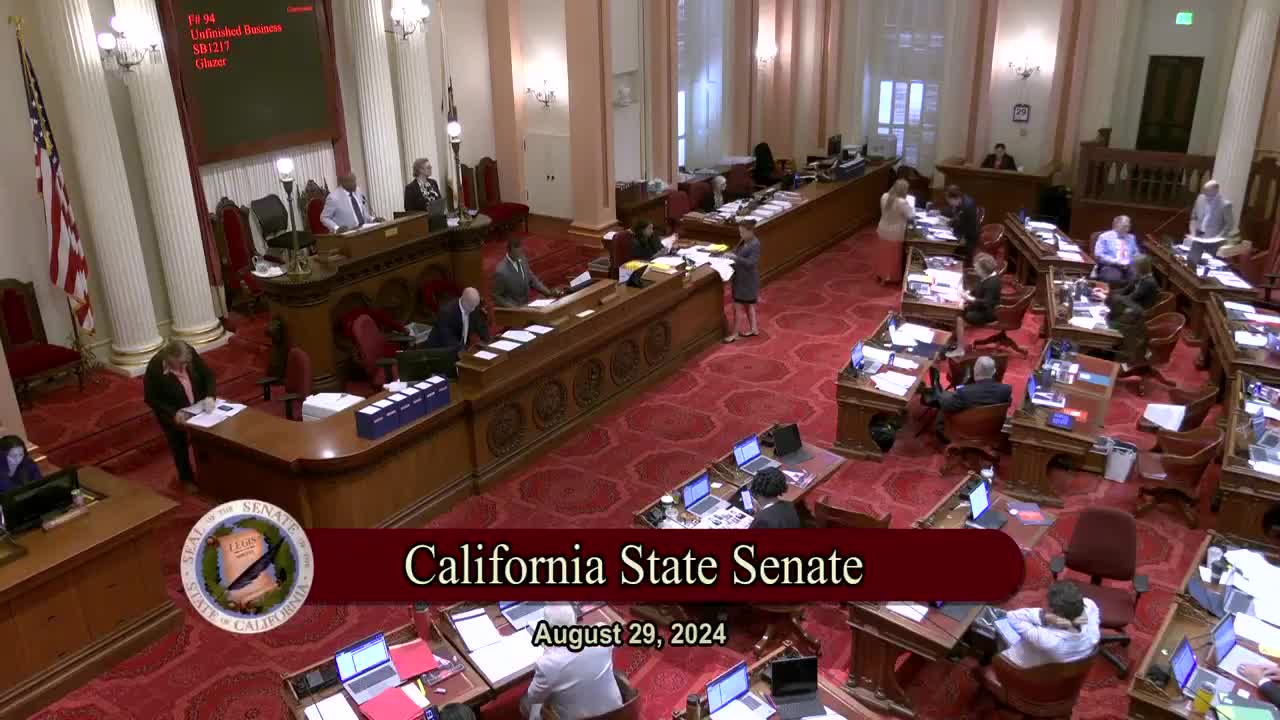 3MIN
Senate Floor
 1MIN
Senate Standing Committee on Appropriations
 4MIN
Senate Standing Committee on Energy, Utilities and Communications
 3MIN
Assembly Floor
 1H
Assembly Standing Committee on Utilities and Energy
Bill Author

Bill Co-Author(s):