AB 2694: Density Bonus Law: residential care facilities for the elderly.
- Session Year: 2023-2024
- House: Assembly
- Latest Version Date: 2024-09-19
Current Status:
Passed
(2024-09-19: Chaptered by Secretary of State - Chapter 278, Statutes of 2024.)
Introduced
In Committee
First Chamber
In Committee
Second Chamber
Enacted
Existing law, commonly referred to as the Density Bonus Law, requires a city or county to provide a developer that proposes a housing development, as defined, within the city or county with a density bonus and other incentives or concessions, as specified, if the developer agrees to construct, among other options, a senior citizen housing development, as defined. The Density Bonus Law defines a development for these purposes to include a shared housing development, and defines various other terms, including shared housing unit.
This bill would expand the definition of a development for the above-described purposes to include a residential care facility for the elderly, as defined. The bill would also specify that, in the case of a residential care facility, a shared housing unit includes a unit without an individual kitchen where a room may be shared by unrelated and a unit where a room may be shared by unrelated persons that meets the minimum room area requirements, as specified. By expanding a city or countys duty to administer the Density Bonus Law, this bill would impose a state-mandated local program.
The bill would include findings that changes proposed by this bill address a matter of statewide concern rather than a municipal affair and, therefore, apply to all cities, including charter cities.
This bill would incorporate additional changes to Section 65915 of the Government Code proposed by AB 3116 to be operative only if this bill and AB 3116 are enacted and this bill is enacted last.
The California Constitution requires the state to reimburse local agencies and school districts for certain costs mandated by the state. Statutory provisions establish procedures for making that reimbursement.
This bill would provide that no reimbursement is required by this act for a specified reason.
Existing law, commonly referred to as the Density Bonus Law, requires a city or county to provide a developer that proposes a housing development, as defined, within the city or county with a density bonus and other incentives or concessions, as specified, if the developer agrees to construct, among other options, a senior citizen housing development, as defined. The Density Bonus Law defines a development for these purposes to include a shared housing development, and defines various other terms, including shared housing unit.
This bill would expand the definition of a development for the above-described purposes to include a residential care facility for the elderly, as defined, and defined. The bill would also specify that, in the case of a residential care facility, a shared housing unit includes a unit without a common an individual kitchen where a room is may be shared by unrelated persons. and a unit where a room may be shared by unrelated persons that meets the minimum room area requirements, as specified. By expanding a city or countys duty to administer the Density Bonus Law, this bill would impose a state-mandated local program.
The bill would include findings that changes proposed by this bill address a matter of statewide concern rather than a municipal affair and, therefore, apply to all cities, including charter cities.
The California Constitution requires the state to reimburse local agencies and school districts for certain costs mandated by the state. Statutory provisions establish procedures for making that reimbursement.
This bill would provide that no reimbursement is required by this act for a specified reason.
Existing law, commonly referred to as the Density Bonus Law, requires a city or county to provide a developer that proposes a housing development, as defined, within the city or county with a density bonus and other incentives or concessions, as specified, if the developer agrees to construct, among other options, a senior citizen housing development, as defined. The Density Bonus Law defines a development for these purposes to include a shared housing development. development, and defines various other terms, including shared housing unit.
This bill would expand the definition of a development for the above-described purposes to include a residential care facility for the elderly, as defined. defined, and would specify that, in the case of a residential care facility, a shared housing unit includes a unit without a common kitchen where a room is shared by unrelated persons. By expanding a city or countys duty to administer the Density Bonus Law, this bill would impose a state-mandated local program.
The bill would include findings that changes proposed by this bill address a matter of statewide concern rather than a municipal affair and, therefore, apply to all cities, including charter cities.
The California Constitution requires the state to reimburse local agencies and school districts for certain costs mandated by the state. Statutory provisions establish procedures for making that reimbursement.
This bill would provide that no reimbursement is required by this act for a specified reason.
Existing law, commonly referred to as the Density Bonus Law, requires a city or county to provide a developer that proposes a housing development, as defined, within the city or county with a density bonus and other incentives or concessions, as specified, if the developer agrees to construct, among other options, a senior citizen housing development, as defined. The Density Bonus Law defines a development for these purposes to include a shared housing development.
This bill would expand the definition of a development for the above-described purposes to include a residential care facility for the elderly, as defined. By expanding a city or countys duty to administer the Density Bonus Law, this bill would impose a state-mandated local program.
The bill would include findings that changes proposed by this bill address a matter of statewide concern rather than a municipal affair and, therefore, apply to all cities, including charter cities.
The California Constitution requires the state to reimburse local agencies and school districts for certain costs mandated by the state. Statutory provisions establish procedures for making that reimbursement.
This bill would provide that no reimbursement is required by this act for a specified reason.
Existing law, the Planning and Zoning Law, requires a city or county to adopt a general plan for the land-use development of the city or county that includes, among other elements, a housing element. Existing law requires the housing element to include, among other information, an assessment of housing needs and an inventory of resources and constraints relevant to the meeting those needs. Existing law requires the city or county, after adopting a general plan, to provide by April 1 of each year an annual report to, among other entities, the Department of Housing and Community Development that includes, among other information, the progress in complying with specified laws. Existing law requires a city or county to provide an option for an applicant to apply for and retrieve a postentitlement phase permit on the citys or countys internet website.This bill would require a city or county to additionally include in the annual report the progress in complying with the internet website requirement. By requiring a city or county to include additional information in the annual report, the bill would impose a state-mandated local program.The California Constitution requires the state to reimburse local agencies and school districts for certain costs mandated by the state. Statutory provisions establish procedures for making that reimbursement.This bill would provide that no reimbursement is required by this act for a specified reason.Existing law, the Planning and Zoning Law, requires a city or county to adopt a general plan for the land-use development of the city or county that includes, among other elements, a housing element. Existing law requires the housing element to include, among other information, an assessment of housing needs and an inventory of resources and constraints relevant to the meeting those needs. Existing law requires the city or county, after adopting a general plan, to provide by April 1 of each year an annual report to, among other entities, the Department of Housing and Community Development that includes, among other information, the progress in complying with specified laws. Existing law requires a city or county to provide an option for an applicant to apply for and retrieve a postentitlement phase permit on the citys or countys internet website.
This bill would require a city or county to additionally include in the annual report the progress in complying with the internet website requirement. By requiring a city or county to include additional information in the annual report, the bill would impose a state-mandated local program.
The California Constitution requires the state to reimburse local agencies and school districts for certain costs mandated by the state. Statutory provisions establish procedures for making that reimbursement.
This bill would provide that no reimbursement is required by this act for a specified reason.
(a)(1)When an applicant seeks a density bonus for a housing development within, or for the donation of land for housing within, the jurisdiction of a city, county, or city and county, that local government shall comply with this section. A city, county, or city and county shall adopt an ordinance that specifies how compliance with this section will be implemented. Except as otherwise provided in subdivision (s), failure to adopt an ordinance shall not relieve a city, county, or city and county from complying with this section.
(2)A local government shall not condition the submission, review, or approval of an application pursuant to this chapter on the preparation of an additional report or study that is not otherwise required by state law, including this section. This subdivision does not prohibit a local government from requiring an applicant to provide reasonable documentation to establish eligibility for a requested density bonus, as described in subdivision (b), and parking ratios, as described in subdivision (p).
(3)In order to provide for the expeditious processing of a density bonus application, the local government shall do all of the following:
(A)Adopt procedures and timelines for processing a density bonus application.
(B)Provide a list of all documents and information required to be submitted with the density bonus application in order for the density bonus application to be deemed complete. This list shall be consistent with this chapter.
(C)Notify the applicant for a density bonus whether the application is complete in a manner consistent with the timelines specified in Section 65943.
(D)(i)If the local government notifies the applicant that the application is deemed complete pursuant to subparagraph (C), provide the applicant with a determination as to the following matters:
(I)The amount of density bonus, calculated pursuant to subdivision (f), for which the applicant is eligible.
(II)If the applicant requests a parking ratio pursuant to subdivision (p), the parking ratio for which the applicant is eligible.
(III)If the applicant requests incentives or concessions pursuant to subdivision (d) or waivers or reductions of development standards pursuant to subdivision (e), whether the applicant has provided adequate information for the local government to make a determination as to those incentives, concessions, waivers, or reductions of development standards.
(ii)Any determination required by this subparagraph shall be based on the development project at the time the application is deemed complete. The local government shall adjust the amount of density bonus and parking ratios awarded pursuant to this section based on any changes to the project during the course of development.
(b)(1)A city, county, or city and county shall grant one density bonus, the amount of which shall be as specified in subdivision (f), and, if requested by the applicant and consistent with the applicable requirements of this section, incentives or concessions, as described in subdivision (d), waivers or reductions of development standards, as described in subdivision (e), and parking ratios, as described in subdivision (p), if an applicant for a housing development seeks and agrees to construct a housing development, excluding any units permitted by the density bonus awarded pursuant to this section, that will contain at least any one of the following:
(A)Ten percent of the total units of a housing development, including a shared housing building development, for rental or sale to lower income households, as defined in Section 50079.5 of the Health and Safety Code.
(B)Five percent of the total units of a housing development, including a shared housing building development, for rental or sale to very low income households, as defined in Section 50105 of the Health and Safety Code.
(C)A senior citizen housing development, as defined in Sections 51.3 and 51.12 of the Civil Code, or a mobilehome park that limits residency based on age requirements for housing for older persons pursuant to Section 798.76 or 799.5 of the Civil Code. For purposes of this subparagraph, development includes a shared housing building development and a residential care facility for the elderly, as defined in Section 1569.2 of the Health and Safety Code.
(D)Ten percent of the total dwelling units of a housing development are sold to persons and families of moderate income, as defined in Section 50093 of the Health and Safety Code, provided that all units in the development are offered to the public for purchase.
(E)Ten percent of the total units of a housing development for transitional foster youth, as defined in Section 66025.9 of the Education Code, disabled veterans, as defined in Section 18541, or homeless persons, as defined in the federal McKinney-Vento Homeless Assistance Act (42 U.S.C. Sec. 11301 et seq.). The units described in this subparagraph are subject to a recorded affordability restriction of 55 years and shall be provided at the same affordability level as very low income units.
(F)(i)Twenty percent of the total units for lower income students in a student housing development that meets the following requirements:
(I)All units in the student housing development shall be used exclusively for undergraduate, graduate, or professional students enrolled full time at an institution of higher education accredited by the Western Association of Schools and Colleges or the Accrediting Commission for Community and Junior Colleges. In order to be eligible under this subclause, the developer shall, as a condition of receiving a certificate of occupancy, provide evidence to the city, county, or city and county that the developer has entered into an operating agreement or master lease with one or more institutions of higher education for the institution or institutions to occupy all units of the student housing development with students from that institution or institutions. An operating agreement or master lease entered into pursuant to this subclause is not violated or breached if, in any subsequent year, there are insufficient students enrolled in an institution of higher education to fill all units in the student housing development.
(II)The applicable 20-percent units shall be used for lower income students.
(III)The rent provided in the applicable units of the development for lower income students shall be calculated at 30 percent of 65 percent of the area median income for a single-room occupancy unit type.
(IV)The development shall provide priority for the applicable affordable units for lower income students experiencing homelessness. A homeless service provider, as defined in paragraph (3) of subdivision (e) of Section 103577 of the Health and Safety Code, or institution of higher education that has knowledge of a persons homeless status may verify a persons status as homeless for purposes of this subclause.
(ii)For purposes of calculating a density bonus granted pursuant to this subparagraph, the term unit as used in this section means one rental bed and its pro rata share of associated common area facilities. The units described in this subparagraph are subject to a recorded affordability restriction of 55 years.
(G)One hundred percent of all units in the development, including total units and density bonus units, but exclusive of a managers unit or units, are for lower income households, as defined by Section 50079.5 of the Health and Safety Code, except that up to 20 percent of the units in the development, including total units and density bonus units, may be for moderate-income households, as defined in Section 50053 of the Health and Safety Code. For purposes of this subparagraph, development includes a shared housing building development.
(2)For purposes of calculating the amount of the density bonus pursuant to subdivision (f), an applicant who requests a density bonus pursuant to this subdivision shall elect whether the bonus shall be awarded on the basis of subparagraph (A), (B), (C), (D), (E), (F), or (G) of paragraph (1).
(c)(1)(A)An applicant shall agree to, and the city, county, or city and county shall ensure, the continued affordability of all very low and low-income rental units that qualified the applicant for the award of the density bonus for 55 years or a longer period of time if required by the construction or mortgage financing assistance program, mortgage insurance program, or rental subsidy program.
(B)(i)Except as otherwise provided in clause (ii), rents for the lower income density bonus units shall be set at an affordable rent, as defined in Section 50053 of the Health and Safety Code.
(ii)For housing developments meeting the criteria of subparagraph (G) of paragraph (1) of subdivision (b), rents for all units in the development, including both base density and density bonus units, shall be as follows:
(I)The rent for at least 20 percent of the units in the development shall be set at an affordable rent, as defined in Section 50053 of the Health and Safety Code.
(II)The rent for the remaining units in the development shall be set at an amount consistent with the maximum rent levels for lower income households, as those rents and incomes are determined by the California Tax Credit Allocation Committee.
(2)(A)An applicant shall agree to ensure, and the city, county, or city and county shall ensure, that a for-sale unit that qualified the applicant for the award of the density bonus meets one of the following conditions:
(i)The unit is initially sold to and occupied by a person or family of very low, low, or moderate income, as required, and it is offered at an affordable housing cost, as that cost is defined in Section 50052.5 of the Health and Safety Code and is subject to an equity sharing agreement.
(ii)If the unit is not purchased by an income-qualified person or family within 180 days after the issuance of the certificate of occupancy, the unit is purchased by a qualified nonprofit housing corporation that meets all of the following requirements pursuant to a recorded contract that satisfies all of the requirements specified in paragraph (10) of subdivision (a) of Section 402.1 of the Revenue and Taxation Code:
(I)The nonprofit corporation has a determination letter from the Internal Revenue Service affirming its tax-exempt status pursuant to Section 501(c)(3) of the Internal Revenue Code and is not a private foundation as that term is defined in Section 509 of the Internal Revenue Code.
(II)The nonprofit corporation is based in California.
(III)All of the board members of the nonprofit corporation have their primary residence in California.
(IV)The primary activity of the nonprofit corporation is the development and preservation of affordable home ownership housing in California that incorporates within their contracts for initial purchase a repurchase option that requires a subsequent purchaser of the property that desires to resell or convey the property to offer the qualified nonprofit corporation the right to repurchase the property prior to selling or conveying that property to any other purchaser pursuant to an equity sharing agreement or affordability restrictions on the sale and conveyance of the property that ensure that the property will be preserved for lower income housing for at least 45 years for owner-occupied housing units and will be sold or resold only to persons or families of very low, low, or moderate income, as defined in Section 50052.5 of the Health and Safety Code.
(B)For purposes of this paragraph, a qualified nonprofit housing corporation is a nonprofit housing corporation organized pursuant to Section 501(c)(3) of the Internal Revenue Code that has received a welfare exemption under Section 214.15 of the Revenue and Taxation Code for properties intended to be sold to low-income families who participate in a special no-interest loan program.
(C)The local government shall enforce an equity sharing agreement required pursuant to clause (i) or (ii) of subparagraph (A), unless it is in conflict with the requirements of another public funding source or law or may defer to the recapture provisions of the public funding source. The following apply to the equity sharing agreement:
(i)Upon resale, the seller of the unit shall retain the value of any improvements, the downpayment, and the sellers proportionate share of appreciation.
(ii)Except as provided in clause (v), the local government shall recapture any initial subsidy, as defined in clause (iii), and its proportionate share of appreciation, as defined in clause (iv), which amount shall be used within five years for any of the purposes described in subdivision (e) of Section 33334.2 of the Health and Safety Code that promote homeownership.
(iii)For purposes of this subdivision, the local governments initial subsidy shall be equal to the fair market value of the home at the time of initial sale minus the initial sale price to the moderate-income household, plus the amount of any downpayment assistance or mortgage assistance. If upon resale the market value is lower than the initial market value, then the value at the time of the resale shall be used as the initial market value.
(iv)For purposes of this subdivision, the local governments proportionate share of appreciation shall be equal to the ratio of the local governments initial subsidy to the fair market value of the home at the time of initial sale.
(v)If the unit is purchased or developed by a qualified nonprofit housing corporation pursuant to clause (ii) of subparagraph (A) the local government may enter into a contract with the qualified nonprofit housing corporation under which the qualified nonprofit housing corporation would recapture any initial subsidy and its proportionate share of appreciation if the qualified nonprofit housing corporation is required to use 100 percent of the proceeds to promote homeownership for lower income households as defined by Section 50079.5 of the Health and Safety Code within the jurisdiction of the local government.
(3)(A)An applicant shall be ineligible for a density bonus or any other incentives or concessions under this section if the housing development is proposed on any property that includes a parcel or parcels on which rental dwelling units are located or, if the dwelling units have been vacated or demolished in the five-year period preceding the application, have been subject to a recorded covenant, ordinance, or law that restricts rents to levels affordable to persons and families of lower or very low income; subject to any other form of rent or price control through a public entitys valid exercise of its police power; or occupied by lower or very low income households, unless the proposed housing development replaces those units, and either of the following applies:
(i)The proposed housing development, inclusive of the units replaced pursuant to this paragraph, contains affordable units at the percentages set forth in subdivision (b).
(ii)Each unit in the development, exclusive of a managers unit or units, is affordable to, and occupied by, either a lower or very low income household.
(B)For the purposes of this paragraph, replace shall mean either of the following:
(i)If any dwelling units described in subparagraph (A) are occupied on the date of application, the proposed housing development shall provide at least the same number of units of equivalent size to be made available at affordable rent or affordable housing cost to, and occupied by, persons and families in the same or lower income category as those households in occupancy. If the income category of the household in occupancy is not known, it shall be rebuttably presumed that lower income renter households occupied these units in the same proportion of lower income renter households to all renter households within the jurisdiction, as determined by the most recently available data from the United States Department of Housing and Urban Developments Comprehensive Housing Affordability Strategy database. For unoccupied dwelling units described in subparagraph (A) in a development with occupied units, the proposed housing development shall provide units of equivalent size to be made available at affordable rent or affordable housing cost to, and occupied by, persons and families in the same or lower income category as the last household in occupancy. If the income category of the last household in occupancy is not known, it shall be rebuttably presumed that lower income renter households occupied these units in the same proportion of lower income renter households to all renter households within the jurisdiction, as determined by the most recently available data from the United States Department of Housing and Urban Developments Comprehensive Housing Affordability Strategy database. All replacement calculations resulting in fractional units shall be rounded up to the next whole number. If the replacement units will be rental dwelling units, these units shall be subject to a recorded affordability restriction for at least 55 years. If the proposed development is for-sale units, the units replaced shall be subject to paragraph (2).
(ii)If all dwelling units described in subparagraph (A) have been vacated or demolished within the five-year period preceding the application, the proposed housing development shall provide at least the same number of units of equivalent size as existed at the highpoint of those units in the five-year period preceding the application to be made available at affordable rent or affordable housing cost to, and occupied by, persons and families in the same or lower income category as those persons and families in occupancy at that time, if known. If the incomes of the persons and families in occupancy at the highpoint is not known, it shall be rebuttably presumed that low-income and very low income renter households occupied these units in the same proportion of low-income and very low income renter households to all renter households within the jurisdiction, as determined by the most recently available data from the United States Department of Housing and Urban Developments Comprehensive Housing Affordability Strategy database. All replacement calculations resulting in fractional units shall be rounded up to the next whole number. If the replacement units will be rental dwelling units, these units shall be subject to a recorded affordability restriction for at least 55 years. If the proposed development is for-sale units, the units replaced shall be subject to paragraph (2).
(C)Notwithstanding subparagraph (B), for any dwelling unit described in subparagraph (A) that is or was, within the five-year period preceding the application, subject to a form of rent or price control through a local governments valid exercise of its police power and that is or was occupied by persons or families above lower income, the city, county, or city and county may do either of the following:
(i)Require that the replacement units be made available at affordable rent or affordable housing cost to, and occupied by, low-income persons or families. If the replacement units will be rental dwelling units, these units shall be subject to a recorded affordability restriction for at least 55 years. If the proposed development is for-sale units, the units replaced shall be subject to paragraph (2).
(ii)Require that the units be replaced in compliance with the jurisdictions rent or price control ordinance, provided that each unit described in subparagraph (A) is replaced. Unless otherwise required by the jurisdictions rent or price control ordinance, these units shall not be subject to a recorded affordability restriction.
(D)For purposes of this paragraph, equivalent size means that the replacement units contain at least the same total number of bedrooms as the units being replaced.
(E)Subparagraph (A) does not apply to an applicant seeking a density bonus for a proposed housing development if the applicants application was submitted to, or processed by, a city, county, or city and county before January 1, 2015.
(d)(1)An applicant for a density bonus pursuant to subdivision (b) may submit to a city, county, or city and county a proposal for the specific incentives or concessions that the applicant requests pursuant to this section, and may request a meeting with the city, county, or city and county. The city, county, or city and county shall grant the concession or incentive requested by the applicant unless the city, county, or city and county makes a written finding, based upon substantial evidence, of any of the following:
(A)The concession or incentive does not result in identifiable and actual cost reductions, consistent with subdivision (k), to provide for affordable housing costs, as defined in Section 50052.5 of the Health and Safety Code, or for rents for the targeted units to be set as specified in subdivision (c).
(B)The concession or incentive would have a specific, adverse impact, as defined in paragraph (2) of subdivision (d) of Section 65589.5, upon public health and safety or on any real property that is listed in the California Register of Historical Resources and for which there is no feasible method to satisfactorily mitigate or avoid the specific, adverse impact without rendering the development unaffordable to low-income and moderate-income households.
(C)The concession or incentive would be contrary to state or federal law.
(2)The applicant shall receive the following number of incentives or concessions:
(A)One incentive or concession for projects that include at least 10 percent of the total units for lower income households, at least 5 percent for very low income households, or at least 10 percent for persons and families of moderate income in a development in which the units are for sale.
(B)Two incentives or concessions for projects that include at least 17 percent of the total units for lower income households, at least 10 percent for very low income households, or at least 20 percent for persons and families of moderate income in a development in which the units are for sale.
(C)Three incentives or concessions for projects that include at least 24 percent of the total units for lower income households, at least 15 percent for very low income households, or at least 30 percent for persons and families of moderate income in a development in which the units are for sale.
(D)Five incentives or concessions for a project meeting the criteria of subparagraph (G) of paragraph (1) of subdivision (b). If the project is located within one-half mile of a major transit stop or is located in a very low vehicle travel area in a designated county, the applicant shall also receive a height increase of up to three additional stories, or 33 feet.
(E)One incentive or concession for projects that include at least 20 percent of the total units for lower income students in a student housing development.
(F)Four incentives or concessions for projects that include at least 16 percent of the units for very low income households or at least 45 percent for persons and families of moderate income in a development in which the units are for sale.
(3)The applicant may initiate judicial proceedings if the city, county, or city and county refuses to grant a requested density bonus, incentive, or concession. If a court finds that the refusal to grant a requested density bonus, incentive, or concession is in violation of this section, the court shall award the plaintiff reasonable attorneys fees and costs of suit. This subdivision shall not be interpreted to require a local government to grant an incentive or concession that has a specific, adverse impact, as defined in paragraph (2) of subdivision (d) of Section 65589.5, upon health or safety, and for which there is no feasible method to satisfactorily mitigate or avoid the specific, adverse impact. This subdivision shall not be interpreted to require a local government to grant an incentive or concession that would have an adverse impact on any real property that is listed in the California Register of Historical Resources. The city, county, or city and county shall establish procedures for carrying out this section that shall include legislative body approval of the means of compliance with this section.
(4)The city, county, or city and county shall bear the burden of proof for the denial of a requested concession or incentive.
(e)(1)In no case may a city, county, or city and county apply any development standard that will have the effect of physically precluding the construction of a development meeting the criteria of subdivision (b) at the densities or with the concessions or incentives permitted by this section. Subject to paragraph (3), an applicant may submit to a city, county, or city and county a proposal for the waiver or reduction of development standards that will have the effect of physically precluding the construction of a development meeting the criteria of subdivision (b) at the densities or with the concessions or incentives permitted under this section, and may request a meeting with the city, county, or city and county. If a court finds that the refusal to grant a waiver or reduction of development standards is in violation of this section, the court shall award the plaintiff reasonable attorneys fees and costs of suit. This subdivision shall not be interpreted to require a local government to waive or reduce development standards if the waiver or reduction would have a specific, adverse impact, as defined in paragraph (2) of subdivision (d) of Section 65589.5, upon health or safety, and for which there is no feasible method to satisfactorily mitigate or avoid the specific, adverse impact. This subdivision shall not be interpreted to require a local government to waive or reduce development standards that would have an adverse impact on any real property that is listed in the California Register of Historical Resources, or to grant any waiver or reduction that would be contrary to state or federal law.
(2)A proposal for the waiver or reduction of development standards pursuant to this subdivision shall neither reduce nor increase the number of incentives or concessions to which the applicant is entitled pursuant to subdivision (d).
(3)A housing development that receives a waiver from any maximum controls on density pursuant to clause (ii) of subparagraph (D) of paragraph (3) of subdivision (f) shall only be eligible for a waiver or reduction of development standards as provided in subparagraph (D) of paragraph (2) of subdivision (d) and clause (ii) of subparagraph (D) of paragraph (3) of subdivision (f), unless the city, county, or city and county agrees to additional waivers or reductions of development standards.
(f)For the purposes of this chapter, density bonus means a density increase over the otherwise maximum allowable gross residential density as of the date of application by the applicant to the city, county, or city and county, or, if elected by the applicant, a lesser percentage of density increase, including, but not limited to, no increase in density. The amount of density increase to which the applicant is entitled shall vary according to the amount by which the percentage of affordable housing units exceeds the percentage established in subdivision (b).
(1)For housing developments meeting the criteria of subparagraph (A) of paragraph (1) of subdivision (b), the density bonus shall be calculated as follows:
| Percentage Low-Income Units | Percentage Density Bonus |
| 10 | 20 |
| 11 | 21.5 |
| 12 | 23 |
| 13 | 24.5 |
| 14 | 26 |
| 15 | 27.5 |
| 16 | 29 |
| 17 | 30.5 |
| 18 | 32 |
| 19 | 33.5 |
| 20 | 35 |
| 21 | 38.75 |
| 22 | 42.5 |
| 23 | 46.25 |
| 24 | 50 |
(2)For housing developments meeting the criteria of subparagraph (B) of paragraph (1) of subdivision (b), the density bonus shall be calculated as follows:
| Percentage Very Low Income Units | Percentage Density Bonus |
| 5 | 20 |
| 6 | 22.5 |
| 7 | 25 |
| 8 | 27.5 |
| 9 | 30 |
| 10 | 32.5 |
| 11 | 35 |
| 12 | 38.75 |
| 13 | 42.5 |
| 14 | 46.25 |
| 15 | 50 |
(3)(A)For housing developments meeting the criteria of subparagraph (C) of paragraph (1) of subdivision (b), the density bonus shall be 20 percent of the number of senior housing units.
(B)For housing developments meeting the criteria of subparagraph (E) of paragraph (1) of subdivision (b), the density bonus shall be 20 percent of the number of the type of units giving rise to a density bonus under that subparagraph.
(C)For housing developments meeting the criteria of subparagraph (F) of paragraph (1) of subdivision (b), the density bonus shall be 35 percent of the student housing units.
(D)For housing developments meeting the criteria of subparagraph (G) of paragraph (1) of subdivision (b), the following shall apply:
(i)Except as otherwise provided in clauses (ii) and (iii), the density bonus shall be 80 percent of the number of units for lower income households.
(ii)If the housing development is located within one-half mile of a major transit stop, the city, county, or city and county shall not impose any maximum controls on density.
(iii)If the housing development is located in a very low vehicle travel area within a designated county, the city, county, or city and county shall not impose any maximum controls on density.
(4)For housing developments meeting the criteria of subparagraph (D) of paragraph (1) of subdivision (b), the density bonus shall be calculated as follows:
| Percentage Moderate-Income Units | Percentage Density Bonus |
| 10 | 5 |
| 11 | 6 |
| 12 | 7 |
| 13 | 8 |
| 14 | 9 |
| 15 | 10 |
| 16 | 11 |
| 17 | 12 |
| 18 | 13 |
| 19 | 14 |
| 20 | 15 |
| 21 | 16 |
| 22 | 17 |
| 23 | 18 |
| 24 | 19 |
| 25 | 20 |
| 26 | 21 |
| 27 | 22 |
| 28 | 23 |
| 29 | 24 |
| 30 | 25 |
| 31 | 26 |
| 32 | 27 |
| 33 | 28 |
| 34 | 29 |
| 35 | 30 |
| 36 | 31 |
| 37 | 32 |
| 38 | 33 |
| 39 | 34 |
| 40 | 35 |
| 41 | 38.75 |
| 42 | 42.5 |
| 43 | 46.25 |
| 44 | 50 |
(5)All density calculations resulting in fractional units shall be rounded up to the next whole number. The granting of a density bonus shall not require, or be interpreted, in and of itself, to require a general plan amendment, local coastal plan amendment, zoning change, or other discretionary approval.
(g)(1)When an applicant for a tentative subdivision map, parcel map, or other residential development approval donates land to a city, county, or city and county in accordance with this subdivision, the applicant shall be entitled to a 15-percent increase above the otherwise maximum allowable residential density for the entire development, as follows:
| Percentage Very Low Income | Percentage Density Bonus |
| 10 | 15 |
| 11 | 16 |
| 12 | 17 |
| 13 | 18 |
| 14 | 19 |
| 15 | 20 |
| 16 | 21 |
| 17 | 22 |
| 18 | 23 |
| 19 | 24 |
| 20 | 25 |
| 21 | 26 |
| 22 | 27 |
| 23 | 28 |
| 24 | 29 |
| 25 | 30 |
| 26 | 31 |
| 27 | 32 |
| 28 | 33 |
| 29 | 34 |
| 30 | 35 |
(2)This increase shall be in addition to any increase in density mandated by subdivision (b), up to a maximum combined mandated density increase of 35 percent if an applicant seeks an increase pursuant to both this subdivision and subdivision (b). All density calculations resulting in fractional units shall be rounded up to the next whole number. Nothing in this subdivision shall be construed to enlarge or diminish the authority of a city, county, or city and county to require a developer to donate land as a condition of development. An applicant shall be eligible for the increased density bonus described in this subdivision if all of the following conditions are met:
(A)The applicant donates and transfers the land no later than the date of approval of the final subdivision map, parcel map, or residential development application.
(B)The developable acreage and zoning classification of the land being transferred are sufficient to permit construction of units affordable to very low income households in an amount not less than 10 percent of the number of residential units of the proposed development.
(C)The transferred land is at least one acre in size or of sufficient size to permit development of at least 40 units, has the appropriate general plan designation, is appropriately zoned with appropriate development standards for development at the density described in paragraph (3) of subdivision (c) of Section 65583.2, and is or will be served by adequate public facilities and infrastructure.
(D)The transferred land shall have all of the permits and approvals, other than building permits, necessary for the development of the very low income housing units on the transferred land, not later than the date of approval of the final subdivision map, parcel map, or residential development application, except that the local government may subject the proposed development to subsequent design review to the extent authorized by subdivision (i) of Section 65583.2 if the design is not reviewed by the local government before the time of transfer.
(E)The transferred land and the affordable units shall be subject to a deed restriction ensuring continued affordability of the units consistent with paragraphs (1) and (2) of subdivision (c), which shall be recorded on the property at the time of the transfer.
(F)The land is transferred to the local agency or to a housing developer approved by the local agency. The local agency may require the applicant to identify and transfer the land to the developer.
(G)The transferred land shall be within the boundary of the proposed development or, if the local agency agrees, within one-quarter mile of the boundary of the proposed development.
(H)A proposed source of funding for the very low income units shall be identified not later than the date of approval of the final subdivision map, parcel map, or residential development application.
(h)(1)When an applicant proposes to construct a housing development that conforms to the requirements of subdivision (b) and includes a childcare facility that will be located on the premises of, as part of, or adjacent to, the project, the city, county, or city and county shall grant either of the following:
(A)An additional density bonus that is an amount of square feet of residential space that is equal to or greater than the amount of square feet in the childcare facility.
(B)An additional concession or incentive that contributes significantly to the economic feasibility of the construction of the childcare facility.
(2)The city, county, or city and county shall require, as a condition of approving the housing development, that the following occur:
(A)The childcare facility shall remain in operation for a period of time that is as long as or longer than the period of time during which the density bonus units are required to remain affordable pursuant to subdivision (c).
(B)Of the children who attend the childcare facility, the children of very low income households, lower income households, or families of moderate income shall equal a percentage that is equal to or greater than the percentage of dwelling units that are required for very low income households, lower income households, or families of moderate income pursuant to subdivision (b).
(3)Notwithstanding any requirement of this subdivision, a city, county, or city and county shall not be required to provide a density bonus or concession for a childcare facility if it finds, based upon substantial evidence, that the community has adequate childcare facilities.
(4)Childcare facility, as used in this section, means a child daycare facility other than a family daycare home, including, but not limited to, infant centers, preschools, extended daycare facilities, and schoolage childcare centers.
(i)Housing development, as used in this section, means a development project for five or more residential units, including mixed-use developments. For the purposes of this section, housing development also includes a subdivision or common interest development, as defined in Section 4100 of the Civil Code, approved by a city, county, or city and county and consists of residential units or unimproved residential lots and either a project to substantially rehabilitate and convert an existing commercial building to residential use or the substantial rehabilitation of an existing multifamily dwelling, as defined in subdivision (d) of Section 65863.4, where the result of the rehabilitation would be a net increase in available residential units. For the purpose of calculating a density bonus, the residential units shall be on contiguous sites that are the subject of one development application, but do not have to be based upon individual subdivision maps or parcels. The density bonus shall be permitted in geographic areas of the housing development other than the areas where the units for the lower income households are located.
(j)(1)The granting of a concession or incentive shall not require or be interpreted, in and of itself, to require a general plan amendment, local coastal plan amendment, zoning change, study, or other discretionary approval. For purposes of this subdivision, study does not include reasonable documentation to establish eligibility for the concession or incentive or to demonstrate that the incentive or concession meets the definition set forth in subdivision (k). This provision is declaratory of existing law.
(2)Except as provided in subdivisions (d) and (e), the granting of a density bonus shall not require or be interpreted to require the waiver of a local ordinance or provisions of a local ordinance unrelated to development standards.
(k)For the purposes of this chapter, concession or incentive means any of the following:
(1)A reduction in site development standards or a modification of zoning code requirements or architectural design requirements that exceed the minimum building standards approved by the California Building Standards Commission as provided in Part 2.5 (commencing with Section 18901) of Division 13 of the Health and Safety Code, including, but not limited to, a reduction in setback and square footage requirements and in the ratio of vehicular parking spaces that would otherwise be required that results in identifiable and actual cost reductions, to provide for affordable housing costs, as defined in Section 50052.5 of the Health and Safety Code, or for rents for the targeted units to be set as specified in subdivision (c).
(2)Approval of mixed-use zoning in conjunction with the housing project if commercial, office, industrial, or other land uses will reduce the cost of the housing development and if the commercial, office, industrial, or other land uses are compatible with the housing project and the existing or planned development in the area where the proposed housing project will be located.
(3)Other regulatory incentives or concessions proposed by the developer or the city, county, or city and county that result in identifiable and actual cost reductions to provide for affordable housing costs, as defined in Section 50052.5 of the Health and Safety Code, or for rents for the targeted units to be set as specified in subdivision (c).
(l)Subdivision (k) does not limit or require the provision of direct financial incentives for the housing development, including the provision of publicly owned land, by the city, county, or city and county, or the waiver of fees or dedication requirements.
(m)This section does not supersede or in any way alter or lessen the effect or application of the California Coastal Act of 1976 (Division 20 (commencing with Section 30000) of the Public Resources Code). Any density bonus, concessions, incentives, waivers or reductions of development standards, and parking ratios to which the applicant is entitled under this section shall be permitted in a manner that is consistent with this section and Division 20 (commencing with Section 30000) of the Public Resources Code.
(n)If permitted by local ordinance, nothing in this section shall be construed to prohibit a city, county, or city and county from granting a density bonus greater than what is described in this section for a development that meets the requirements of this section or from granting a proportionately lower density bonus than what is required by this section for developments that do not meet the requirements of this section.
(o)For purposes of this section, the following definitions shall apply:
(1)Designated county includes the Counties of Alameda, Contra Costa, Los Angeles, Marin, Napa, Orange, Riverside, Sacramento, San Bernardino, San Diego, San Mateo, Santa Barbara, Santa Clara, Solano, Sonoma, and Ventura, and the City and County of San Francisco.
(2)Development standard includes a site or construction condition, including, but not limited to, a height limitation, a setback requirement, a floor area ratio, an onsite open-space requirement, a minimum lot area per unit requirement, or a parking ratio that applies to a residential development pursuant to any ordinance, general plan element, specific plan, charter, or other local condition, law, policy, resolution, or regulation that is adopted by the local government or that is enacted by the local governments electorate exercising its local initiative or referendum power, whether that power is derived from the California Constitution, statute, or the charter or ordinances of the local government.
(3)Located within one-half mile of a major transit stop means that any point on a proposed development, for which an applicant seeks a density bonus, other incentives or concessions, waivers or reductions of development standards, or a vehicular parking ratio pursuant to this section, is within one-half mile of any point on the property on which a major transit stop is located, including any parking lot owned by the transit authority or other local agency operating the major transit stop.
(4)Lower income student means a student who has a household income and asset level that does not exceed the level for Cal Grant A or Cal Grant B award recipients as set forth in paragraph (1) of subdivision (k) of Section 69432.7 of the Education Code. The eligibility of a student to occupy a unit for lower income students under this section shall be verified by an affidavit, award letter, or letter of eligibility provided by the institution of higher education in which the student is enrolled or by the California Student Aid Commission that the student receives or is eligible for financial aid, including an institutional grant or fee waiver from the college or university, the California Student Aid Commission, or the federal government.
(5)Major transit stop has the same meaning as defined in subdivision (b) of Section 21155 of the Public Resources Code.
(6)Maximum allowable residential density or base density means the greatest number of units allowed under the zoning ordinance, specific plan, or land use element of the general plan, or, if a range of density is permitted, means the greatest number of units allowed by the specific zoning range, specific plan, or land use element of the general plan applicable to the project. Density shall be determined using dwelling units per acre. However, if the applicable zoning ordinance, specific plan, or land use element of the general plan does not provide a dwelling-units-per-acre standard for density, then the local agency shall calculate the number of units by:
(A)Estimating the realistic development capacity of the site based on the objective development standards applicable to the project, including, but not limited to, floor area ratio, site coverage, maximum building height and number of stories, building setbacks and stepbacks, public and private open-space requirements, minimum percentage or square footage of any nonresidential component, and parking requirements, unless not required for the base project. Parking requirements shall include considerations regarding number of spaces, location, design, type, and circulation. A developer may provide a base density study and the local agency shall accept it, provided that it includes all applicable objective development standards.
(B)Maintaining the same average unit size and other project details relevant to the base density study, excepting those that may be modified by waiver or concession to accommodate the bonus units, in the proposed project as in the study.
(7)(A)(i)Shared housing building means a residential or mixed-use structure, with five or more shared housing units and one or more common kitchens and dining areas designed for permanent residence of more than 30 days by its tenants. The kitchens and dining areas within the shared housing building shall be able to adequately accommodate all residents. If a local ordinance further restricts the attributes of a shared housing building beyond the requirements established in this section, the local definition shall apply to the extent that it does not conflict with the requirements of this section.
(ii)A shared housing building may include other dwelling units that are not shared housing units, provided that those dwelling units do not occupy more than 25 percent of the floor area of the shared housing building. A shared housing building may include 100 percent shared housing units.
(B)(i)Shared housing unit means one or more habitable rooms, not within another dwelling unit, that includes a bathroom, sink, refrigerator, and microwave, is used for permanent residence, that meets the minimum room area specified in Section R304 of the California Residential Code (Part 2.5 of Title 24 of the California Code of Regulations), and complies with the definition of guestroom in Section R202 of the California Residential Code. If a local ordinance further restricts the attributes of a shared housing building beyond the requirements established in this section, the local definition shall apply to the extent that it does not conflict with the requirements of this section.
(ii)Shared housing unit for purposes of a residential care facility for the elderly, as defined in Section 1569.2 of the Health and Safety Code, includes a unit without an individual kitchen where a unit may be shared by unrelated persons, and a unit where a room that may be shared by unrelated persons meets the minimum room area requirements of clause (i).
(8)(A)Total units or total dwelling units means a calculation of the number of units that:
(i)Excludes a unit added by a density bonus awarded pursuant to this section or any local law granting a greater density bonus.
(ii)Includes a unit designated to satisfy an inclusionary zoning requirement of a city, county, or city and county.
(B)For purposes of calculating a density bonus granted pursuant to this section for a shared housing building, unit means one shared housing unit and its pro rata share of associated common area facilities.
(9)Very low vehicle travel area means an urbanized area, as designated by the United States Census Bureau, where the existing residential development generates vehicle miles traveled per capita that is below 85 percent of either regional vehicle miles traveled per capita or city vehicle miles traveled per capita. For purposes of this paragraph, area may include a travel analysis zone, hexagon, or grid. For the purposes of determining regional vehicle miles traveled per capita pursuant to this paragraph, a region is the entirety of incorporated and unincorporated areas governed by a multicounty or single-county metropolitan planning organization, or the entirety of the incorporated and unincorporated areas of an individual county that is not part of a metropolitan planning organization.
(p)(1)Except as provided in paragraphs (2), (3), and (4), upon the request of the developer, a city, county, or city and county shall not require a vehicular parking ratio, inclusive of parking for persons with a disability and guests, of a development meeting the criteria of subdivisions (b) and (c), that exceeds the following ratios:
(A)Zero to one bedroom: one onsite parking space.
(B)Two to three bedrooms: one and one-half onsite parking spaces.
(C)Four and more bedrooms: two and one-half parking spaces.
(2)(A)Notwithstanding paragraph (1), if a development includes at least 20 percent low-income units for housing developments meeting the criteria of subparagraph (A) of paragraph (1) of subdivision (b) or at least 11 percent very low income units for housing developments meeting the criteria of subparagraph (B) of paragraph (1) of subdivision (b), is located within one-half mile of a major transit stop, and there is unobstructed access to the major transit stop from the development, then, upon the request of the developer, a city, county, or city and county shall not impose a vehicular parking ratio, inclusive of parking for persons with a disability and guests, that exceeds 0.5 spaces per unit. Notwithstanding paragraph (1), if a development includes at least 40 percent moderate-income units for housing developments meeting the criteria of subparagraph (D) of paragraph (1) of subdivision (b), is located within one-half mile of a major transit stop, as defined in subdivision (b) of Section 21155 of the Public Resources Code, and the residents of the development have unobstructed access to the major transit stop from the development then, upon the request of the developer, a city, county, or city and county shall not impose a vehicular parking ratio, inclusive of parking for persons with a disability and guests, that exceeds 0.5 spaces per bedroom.
(B)For purposes of this subdivision, unobstructed access to the major transit stop means a resident is able to access the major transit stop without encountering natural or constructed impediments. For purposes of this subparagraph, natural or constructed impediments includes, but is not limited to, freeways, rivers, mountains, and bodies of water, but does not include residential structures, shopping centers, parking lots, or rails used for transit.
(3)Notwithstanding paragraph (1), if a development meets the criteria of subparagraph (G) of paragraph (1) of subdivision (b), then, upon the request of the developer, a city, county, or city and county shall not impose vehicular parking standards if the development meets any of the following criteria:
(A)The development is located within one-half mile of a major transit stop and there is unobstructed access to the major transit stop from the development.
(B)The development is a for-rent housing development for individuals who are 55 years of age or older that complies with Sections 51.2 and 51.3 of the Civil Code and the development has either paratransit service or unobstructed access, within one-half mile, to fixed bus route service that operates at least eight times per day.
(C)The development is either a special needs housing development, as defined in Section 51312 of the Health and Safety Code, or a supportive housing development, as defined in Section 50675.14 of the Health and Safety Code. A development that is a special needs housing development shall have either paratransit service or unobstructed access, within one-half mile, to fixed bus route service that operates at least eight times per day.
(4)If the total number of parking spaces required for a development is other than a whole number, the number shall be rounded up to the next whole number. For purposes of this subdivision, a development may provide onsite parking through tandem parking or uncovered parking, but not through onstreet parking.
(5)This subdivision shall apply to a development that meets the requirements of subdivisions (b) and (c), but only at the request of the applicant. An applicant may request parking incentives or concessions beyond those provided in this subdivision pursuant to subdivision (d).
(6)This subdivision does not preclude a city, county, or city and county from reducing or eliminating a parking requirement for development projects of any type in any location.
(7)Notwithstanding paragraphs (2) and (3), if a city, county, city and county, or an independent consultant has conducted an areawide or jurisdictionwide parking study in the last seven years, then the city, county, or city and county may impose a higher vehicular parking ratio not to exceed the ratio described in paragraph (1), based upon substantial evidence found in the parking study, that includes, but is not limited to, an analysis of parking availability, differing levels of transit access, walkability access to transit services, the potential for shared parking, the effect of parking requirements on the cost of market-rate and subsidized developments, and the lower rates of car ownership for low-income and very low income individuals, including seniors and special needs individuals. The city, county, or city and county shall pay the costs of any new study. The city, county, or city and county shall make findings, based on a parking study completed in conformity with this paragraph, supporting the need for the higher parking ratio.
(8)A request pursuant to this subdivision shall neither reduce nor increase the number of incentives or concessions to which the applicant is entitled pursuant to subdivision (d).
(q)Each component of any density calculation, including base density and bonus density, resulting in fractional units shall be separately rounded up to the next whole number. The Legislature finds and declares that this provision is declaratory of existing law.
(r)This chapter shall be interpreted liberally in favor of producing the maximum number of total housing units.
(s)Notwithstanding any other law, if a city, including a charter city, county, or city and county has adopted an ordinance or a housing program, or both an ordinance and a housing program, that incentivizes the development of affordable housing that allows for density bonuses that exceed the density bonuses required by the version of this section effective through December 31, 2020, that city, county, or city and county is not required to amend or otherwise update its ordinance or corresponding affordable housing incentive program to comply with the amendments made to this section by the act adding this subdivision, and is exempt from complying with the incentive and concession calculation amendments made to this section by the act adding this subdivision as set forth in subdivision (d), particularly subparagraphs (B) and (C) of paragraph (2) of that subdivision, and the amendments made to the density tables under subdivision (f).
(t)When an applicant proposes to construct a housing development that conforms to the requirements of subparagraph (A) or (B) of paragraph (1) of subdivision (b) that is a shared housing building, the city, county, or city and county shall not require any minimum unit size requirements or minimum bedroom requirements that are in conflict with paragraph (7) of subdivision (o).
(u)(1)The Legislature finds and declares that the intent behind the Density Bonus Law is to allow public entities to reduce or even eliminate subsidies for a particular project by allowing a developer to include more total units in a project than would otherwise be allowed by the local zoning ordinance in exchange for affordable units. It further reaffirms that the intent is to cover at least some of the financing gap of affordable housing with regulatory incentives, rather than additional public subsidy.
(2)It is therefore the intent of the Legislature to make modifications to the Density Bonus Law by the act adding this subdivision to further incentivize the construction of very low, low-, and moderate-income housing units. It is further the intent of the Legislature in making these modifications to the Density Bonus Law to ensure that any additional benefits conferred upon a developer are balanced with the receipt of a public benefit in the form of adequate levels of affordable housing. The Legislature further intends that these modifications will ensure that the Density Bonus Law creates incentives for the construction of more housing across all areas of the state.
(v)(1)Provided that the resulting housing development would not restrict more than 50 percent of the total units to moderate-income, lower income, or very low income households, a city, county, or city and county shall grant an additional density bonus calculated pursuant to paragraph (2) when an applicant proposes to construct a housing development that conforms to the requirements of paragraph (1) of subdivision (b), agrees to include additional rental or for-sale units affordable to very low income households or moderate income households, and meets any of the following requirements:
(A)The housing development conforms to the requirements of subparagraph (A) of paragraph (1) of subdivision (b) and provides 24 percent of the total units to lower income households.
(B)The housing development conforms to the requirements of subparagraph (B) of paragraph (1) of subdivision (b) and provides 15 percent of the total units to very low income households.
(C)The housing development conforms to the requirements of subparagraph (D) of paragraph (1) of subdivision (b) and provides 44 percent of the total units to moderate-income households.
(2)A city, county, or city and county shall grant an additional density bonus for a housing development that meets the requirements of paragraph (1), calculated as follows:
| Percentage Very Low Income Units | Percentage Density Bonus |
| 5 | 20 |
| 6 | 23.75 |
| 7 | 27.5 |
| 8 | 31.25 |
| 9 | 35 |
| 10 | 38.75 |
| Percentage Moderate-Income Units | Percentage Density Bonus |
| 5 | 20 |
| 6 | 22.5 |
| 7 | 25 |
| 8 | 27.5 |
| 9 | 30 |
| 10 | 32.5 |
| 11 | 35 |
| 12 | 38.75 |
| 13 | 42.5 |
| 14 | 46.25 |
| 15 | 50 |
(3)The increase required by paragraphs (1) and (2) shall be in addition to any increase in density granted by subdivision (b).
(4)The additional density bonus required under this subdivision shall be calculated using the number of units excluding any density bonus awarded by this section.
SEC. 1.5.Section 65915 of the Government Code is amended to read:65915.(a)(1)When an applicant seeks a density bonus for a housing development within, or for the donation of land for housing within, the jurisdiction of a city, county, or city and county, that local government shall comply with this section. A city, county, or city and county shall adopt an ordinance that specifies how compliance with this section will be implemented. Except as otherwise provided in subdivision (s), failure to adopt an ordinance shall not relieve a city, county, or city and county from complying with this section.
(2)A local government shall not condition the submission, review, or approval of an application pursuant to this chapter on the preparation of an additional report or study that is not otherwise required by state law, including this section. This subdivision does not prohibit a local government from requiring an applicant to provide reasonable documentation to establish eligibility for a requested density bonus, as described in subdivision (b), and parking ratios, as described in subdivision (p).
(3)In order to provide for the expeditious processing of a density bonus application, the local government shall do all of the following:
(A)Adopt procedures and timelines for processing a density bonus application.
(B)Provide a list of all documents and information required to be submitted with the density bonus application in order for the density bonus application to be deemed complete. This list shall be consistent with this chapter.
(C)Notify the applicant for a density bonus whether the application is complete in a manner consistent with the timelines specified in Section 65943.
(D)(i)If the local government notifies the applicant that the application is deemed complete pursuant to subparagraph (C), provide the applicant with a determination as to the following matters:
(I)The amount of density bonus, calculated pursuant to subdivision (f), for which the applicant is eligible.
(II)If the applicant requests a parking ratio pursuant to subdivision (p), the parking ratio for which the applicant is eligible.
(III)If the applicant requests incentives or concessions pursuant to subdivision (d) or waivers or reductions of development standards pursuant to subdivision (e), whether the applicant has provided adequate information for the local government to make a determination as to those incentives, concessions, waivers, or reductions of development standards.
(ii)Any determination required by this subparagraph shall be based on the development project at the time the application is deemed complete. The local government shall adjust the amount of density bonus and parking ratios awarded pursuant to this section based on any changes to the project during the course of development.
(b)(1)A city, county, or city and county shall grant one density bonus, the amount of which shall be as specified in subdivision (f), and, if requested by the applicant and consistent with the applicable requirements of this section, incentives or concessions, as described in subdivision (d), waivers or reductions of development standards, as described in subdivision (e), and parking ratios, as described in subdivision (p), if an applicant for a housing development seeks and agrees to construct a housing development, excluding any units permitted by the density bonus awarded pursuant to this section, that will contain at least any one of the following:
(A)Ten percent of the total units of a housing development, including a shared housing building development, for rental or sale to lower income households, as defined in Section 50079.5 of the Health and Safety Code.
(B)Five percent of the total units of a housing development, including a shared housing building development, for rental or sale to very low income households, as defined in Section 50105 of the Health and Safety Code.
(C)A senior citizen housing development, as defined in Sections 51.3 and 51.12 of the Civil Code, or a mobilehome park that limits residency based on age requirements for housing for older persons pursuant to Section 798.76 or 799.5 of the Civil Code. For purposes of this subparagraph, development includes a shared housing building development and a residential care facility for the elderly, as defined in Section 1569.2 of the Health and Safety Code.
(D)Ten percent of the total dwelling units of a housing development are sold to persons and families of moderate income, as defined in Section 50093 of the Health and Safety Code, provided that all units in the development are offered to the public for purchase.
(E)Ten percent of the total units of a housing development for transitional foster youth, as defined in Section 66025.9 of the Education Code, disabled veterans, as defined in Section 18541, or homeless persons, as defined in the federal McKinney-Vento Homeless Assistance Act (42 U.S.C. Sec. 11301 et seq.). The units described in this subparagraph are subject to a recorded affordability restriction of 55 years and shall be provided at the same affordability level as very low income units.
(F)(i)Twenty percent of the total units for lower income students in a student housing development that meets the following requirements:
(I)All units in the student housing development shall be used exclusively for undergraduate, graduate, or professional students enrolled currently or in the past six months in at least six units at an institution of higher education accredited by the Western Association of Schools and Colleges or the Accrediting Commission for Community and Junior Colleges. In order to be eligible under this subclause, the developer shall, as a condition of receiving a certificate of occupancy, provide evidence to the city, county, or city and county that the developer has done any one of the following:
(ia)Entered into an operating agreement or master lease with one or more institutions of higher education for the institution or institutions to occupy all units of the student housing development with students from that institution or institutions. An operating agreement or master lease entered into pursuant to this subclause is not violated or breached if, in any subsequent year, there are insufficient students enrolled in an institution of higher education to fill all units in the student housing development.
(ib)Established a system for confirming its renters status as students to ensure that all units of the student housing development are occupied with students from an institution of higher education.
(II)The applicable units in the student housing development for lower income students shall be used for and occupied by lower income students.
(III)The rent provided in the applicable units of the development for lower income students shall be calculated at 30 percent of 65 percent of the area median income for a single-room occupancy unit type.
(IV)The development shall provide priority for the applicable affordable units for lower income students experiencing homelessness. A homeless service provider, as defined in paragraph (3) of subdivision (e) of Section 103577 of the Health and Safety Code, or institution of higher education that has knowledge of a persons homeless status may verify a persons status as homeless for purposes of this subclause.
(V)The student housing development is not located on a site that pursuant to paragraph (3) of subdivision (c) would require replacement units for projects with greater than a 35 percent density bonus.
(ii)For purposes of calculating a density bonus granted pursuant to this subparagraph, the term unit as used in this section means one rental bed and its pro rata share of associated common area facilities. The units described in this subparagraph are subject to a recorded affordability restriction of 55 years, which shall not tie any rental bed reserved for lower income students to a specific bedroom. Notwithstanding any other law, an affordability restriction provision, state or county law or policy, or property management policy shall not prevent a lower income student from sharing a room or unit with a nonlower income student. Any attempted waiver of the requirements of this clause is void as against public policy.
(G)One hundred percent of all units in the development, including total units and density bonus units, but exclusive of a managers unit or units, are for lower income households, as defined by Section 50079.5 of the Health and Safety Code, except that up to 20 percent of the units in the development, including total units and density bonus units, may be for moderate-income households, as defined in Section 50053 of the Health and Safety Code. For purposes of this subparagraph, development includes a shared housing building development.
(2)For purposes of calculating the amount of the density bonus pursuant to subdivision (f), an applicant who requests a density bonus pursuant to this subdivision shall elect whether the bonus shall be awarded on the basis of subparagraph (A), (B), (C), (D), (E), (F), or (G) of paragraph (1).
(c)(1)(A)An applicant shall agree to, and the city, county, or city and county shall ensure, the continued affordability of all very low and low-income rental units that qualified the applicant for the award of the density bonus for 55 years or a longer period of time if required by the construction or mortgage financing assistance program, mortgage insurance program, or rental subsidy program.
(B)(i)Except as otherwise provided in clause (ii), rents for the lower income density bonus units shall be set at an affordable rent, as defined in Section 50053 of the Health and Safety Code.
(ii)For housing developments meeting the criteria of subparagraph (G) of paragraph (1) of subdivision (b), rents for all units in the development, including both base density and density bonus units, shall be as follows:
(I)The rent for at least 20 percent of the units in the development shall be set at an affordable rent, as defined in Section 50053 of the Health and Safety Code.
(II)The rent for the remaining units in the development shall be set at an amount consistent with the maximum rent levels for lower income households, as those rents and incomes are determined by the California Tax Credit Allocation Committee.
(2)(A)An applicant shall agree to ensure, and the city, county, or city and county shall ensure, that a for-sale unit that qualified the applicant for the award of the density bonus meets one of the following conditions:
(i)The unit is initially sold to and occupied by a person or family of very low, low, or moderate income, as required, and it is offered at an affordable housing cost, as that cost is defined in Section 50052.5 of the Health and Safety Code and is subject to an equity sharing agreement.
(ii)If the unit is not purchased by an income-qualified person or family within 180 days after the issuance of the certificate of occupancy, the unit is purchased by a qualified nonprofit housing corporation that meets all of the following requirements pursuant to a recorded contract that satisfies all of the requirements specified in paragraph (10) of subdivision (a) of Section 402.1 of the Revenue and Taxation Code:
(I)The nonprofit corporation has a determination letter from the Internal Revenue Service affirming its tax-exempt status pursuant to Section 501(c)(3) of the Internal Revenue Code and is not a private foundation as that term is defined in Section 509 of the Internal Revenue Code.
(II)The nonprofit corporation is based in California.
(III)All of the board members of the nonprofit corporation have their primary residence in California.
(IV)The primary activity of the nonprofit corporation is the development and preservation of affordable home ownership housing in California that incorporates within their contracts for initial purchase a repurchase option that requires a subsequent purchaser of the property that desires to resell or convey the property to offer the qualified nonprofit corporation the right to repurchase the property prior to selling or conveying that property to any other purchaser pursuant to an equity sharing agreement or affordability restrictions on the sale and conveyance of the property that ensure that the property will be preserved for lower income housing for at least 45 years for owner-occupied housing units and will be sold or resold only to persons or families of very low, low, or moderate income, as defined in Section 50052.5 of the Health and Safety Code.
(B)For purposes of this paragraph, a qualified nonprofit housing corporation is a nonprofit housing corporation organized pursuant to Section 501(c)(3) of the Internal Revenue Code that has received a welfare exemption under Section 214.15 of the Revenue and Taxation Code for properties intended to be sold to low-income families who participate in a special no-interest loan program.
(C)The local government shall enforce an equity sharing agreement required pursuant to clause (i) or (ii) of subparagraph (A), unless it is in conflict with the requirements of another public funding source or law or may defer to the recapture provisions of the public funding source. The following apply to the equity sharing agreement:
(i)Upon resale, the seller of the unit shall retain the value of any improvements, the downpayment, and the sellers proportionate share of appreciation.
(ii)Except as provided in clause (v), the local government shall recapture any initial subsidy, as defined in clause (iii), and its proportionate share of appreciation, as defined in clause (iv), which amount shall be used within five years for any of the purposes described in subdivision (e) of Section 33334.2 of the Health and Safety Code that promote homeownership.
(iii)For purposes of this subdivision, the local governments initial subsidy shall be equal to the fair market value of the home at the time of initial sale minus the initial sale price to the moderate-income household, plus the amount of any downpayment assistance or mortgage assistance. If upon resale the market value is lower than the initial market value, then the value at the time of the resale shall be used as the initial market value.
(iv)For purposes of this subdivision, the local governments proportionate share of appreciation shall be equal to the ratio of the local governments initial subsidy to the fair market value of the home at the time of initial sale.
(v)If the unit is purchased or developed by a qualified nonprofit housing corporation pursuant to clause (ii) of subparagraph (A) the local government may enter into a contract with the qualified nonprofit housing corporation under which the qualified nonprofit housing corporation would recapture any initial subsidy and its proportionate share of appreciation if the qualified nonprofit housing corporation is required to use 100 percent of the proceeds to promote homeownership for lower income households as defined by Section 50079.5 of the Health and Safety Code within the jurisdiction of the local government.
(3)(A)Except as provided in subclause (V) of clause (i) of subparagraph (F) of paragraph (1) of subdivision (b), an applicant shall be ineligible for a density bonus or any other incentives or concessions under this section if the housing development is proposed on any property that includes a parcel or parcels on which rental dwelling units are located or, if the dwelling units have been vacated or demolished in the five-year period preceding the application, have been subject to a recorded covenant, ordinance, or law that restricts rents to levels affordable to persons and families of lower or very low income; subject to any other form of rent or price control through a public entitys valid exercise of its police power; or occupied by lower or very low income households, unless the proposed housing development replaces those units, and either of the following applies:
(i)The proposed housing development, inclusive of the units replaced pursuant to this paragraph, contains affordable units at the percentages set forth in subdivision (b).
(ii)Each unit in the development, exclusive of a managers unit or units, is affordable to, and occupied by, either a lower or very low income household.
(B)For the purposes of this paragraph, replace shall mean either of the following:
(i)If any dwelling units described in subparagraph (A) are occupied on the date of application, the proposed housing development shall provide at least the same number of units of equivalent size to be made available at affordable rent or affordable housing cost to, and occupied by, persons and families in the same or lower income category as those households in occupancy. If the income category of the household in occupancy is not known, it shall be rebuttably presumed that lower income renter households occupied these units in the same proportion of lower income renter households to all renter households within the jurisdiction, as determined by the most recently available data from the United States Department of Housing and Urban Developments Comprehensive Housing Affordability Strategy database. For unoccupied dwelling units described in subparagraph (A) in a development with occupied units, the proposed housing development shall provide units of equivalent size to be made available at affordable rent or affordable housing cost to, and occupied by, persons and families in the same or lower income category as the last household in occupancy. If the income category of the last household in occupancy is not known, it shall be rebuttably presumed that lower income renter households occupied these units in the same proportion of lower income renter households to all renter households within the jurisdiction, as determined by the most recently available data from the United States Department of Housing and Urban Developments Comprehensive Housing Affordability Strategy database. All replacement calculations resulting in fractional units shall be rounded up to the next whole number. If the replacement units will be rental dwelling units, these units shall be subject to a recorded affordability restriction for at least 55 years. If the proposed development is for-sale units, the units replaced shall be subject to paragraph (2).
(ii)If all dwelling units described in subparagraph (A) have been vacated or demolished within the five-year period preceding the application, the proposed housing development shall provide at least the same number of units of equivalent size as existed at the highpoint of those units in the five-year period preceding the application to be made available at affordable rent or affordable housing cost to, and occupied by, persons and families in the same or lower income category as those persons and families in occupancy at that time, if known. If the incomes of the persons and families in occupancy at the highpoint is not known, it shall be rebuttably presumed that low-income and very low income renter households occupied these units in the same proportion of low-income and very low income renter households to all renter households within the jurisdiction, as determined by the most recently available data from the United States Department of Housing and Urban Developments Comprehensive Housing Affordability Strategy database. All replacement calculations resulting in fractional units shall be rounded up to the next whole number. If the replacement units will be rental dwelling units, these units shall be subject to a recorded affordability restriction for at least 55 years. If the proposed development is for-sale units, the units replaced shall be subject to paragraph (2).
(C)Notwithstanding subparagraph (B), for any dwelling unit described in subparagraph (A) that is or was, within the five-year period preceding the application, subject to a form of rent or price control through a local governments valid exercise of its police power and that is or was occupied by persons or families above lower income, the city, county, or city and county may do either of the following:
(i)Require that the replacement units be made available at affordable rent or affordable housing cost to, and occupied by, low-income persons or families. If the replacement units will be rental dwelling units, these units shall be subject to a recorded affordability restriction for at least 55 years. If the proposed development is for-sale units, the units replaced shall be subject to paragraph (2).
(ii)Require that the units be replaced in compliance with the jurisdictions rent or price control ordinance, provided that each unit described in subparagraph (A) is replaced. Unless otherwise required by the jurisdictions rent or price control ordinance, these units shall not be subject to a recorded affordability restriction.
(D)For purposes of this paragraph, equivalent size means that the replacement units contain at least the same total number of bedrooms as the units being replaced.
(E)Subparagraph (A) does not apply to an applicant seeking a density bonus for a proposed housing development if the applicants application was submitted to, or processed by, a city, county, or city and county before January 1, 2015.
(d)(1)An applicant for a density bonus pursuant to subdivision (b) may submit to a city, county, or city and county a proposal for the specific incentives or concessions that the applicant requests pursuant to this section, and may request a meeting with the city, county, or city and county. The city, county, or city and county shall grant the concession or incentive requested by the applicant unless the city, county, or city and county makes a written finding, based upon substantial evidence, of any of the following:
(A)The concession or incentive does not result in identifiable and actual cost reductions, consistent with subdivision (k), to provide for affordable housing costs, as defined in Section 50052.5 of the Health and Safety Code, or for rents for the targeted units to be set as specified in subdivision (c).
(B)The concession or incentive would have a specific, adverse impact, as defined in paragraph (2) of subdivision (d) of Section 65589.5, upon public health and safety or on any real property that is listed in the California Register of Historical Resources and for which there is no feasible method to satisfactorily mitigate or avoid the specific, adverse impact without rendering the development unaffordable to low-income and moderate-income households.
(C)The concession or incentive would be contrary to state or federal law.
(2)The applicant shall receive the following number of incentives or concessions:
(A)One incentive or concession for projects that include at least 10 percent of the total units for lower income households, at least 5 percent for very low income households, or at least 10 percent for persons and families of moderate income in a development in which the units are for sale.
(B)Two incentives or concessions for projects that include at least 17 percent of the total units for lower income households, at least 10 percent for very low income households, or at least 20 percent for persons and families of moderate income in a development in which the units are for sale.
(C)Three incentives or concessions for projects that include at least 24 percent of the total units for lower income households, at least 15 percent for very low income households, or at least 30 percent for persons and families of moderate income in a development in which the units are for sale.
(D)Five incentives or concessions for a project meeting the criteria of subparagraph (G) of paragraph (1) of subdivision (b). If the project is located within one-half mile of a major transit stop or is located in a very low vehicle travel area in a designated county, the applicant shall also receive a height increase of up to three additional stories, or 33 feet.
(E)One incentive or concession for projects that include at least 20 percent of the total units for lower income students in a student housing development. If a project includes at least 23 percent of the total units for lower income students in a student housing project, the applicant shall instead receive two incentives or concessions.
(F)Four incentives or concessions for projects that include at least 16 percent of the units for very low income households or at least 45 percent for persons and families of moderate income in a development in which the units are for sale.
(3)The applicant may initiate judicial proceedings if the city, county, or city and county refuses to grant a requested density bonus, incentive, or concession. If a court finds that the refusal to grant a requested density bonus, incentive, or concession is in violation of this section, the court shall award the plaintiff reasonable attorneys fees and costs of suit. This subdivision shall not be interpreted to require a local government to grant an incentive or concession that has a specific, adverse impact, as defined in paragraph (2) of subdivision (d) of Section 65589.5, upon health or safety, and for which there is no feasible method to satisfactorily mitigate or avoid the specific, adverse impact. This subdivision shall not be interpreted to require a local government to grant an incentive or concession that would have an adverse impact on any real property that is listed in the California Register of Historical Resources. The city, county, or city and county shall establish procedures for carrying out this section that shall include legislative body approval of the means of compliance with this section.
(4)The city, county, or city and county shall bear the burden of proof for the denial of a requested concession or incentive.
(e)(1)In no case may a city, county, or city and county apply any development standard that will have the effect of physically precluding the construction of a development meeting the criteria of subdivision (b) at the densities or with the concessions or incentives permitted by this section. Subject to paragraph (3), an applicant may submit to a city, county, or city and county a proposal for the waiver or reduction of development standards that will have the effect of physically precluding the construction of a development meeting the criteria of subdivision (b) at the densities or with the concessions or incentives permitted under this section, and may request a meeting with the city, county, or city and county. If a court finds that the refusal to grant a waiver or reduction of development standards is in violation of this section, the court shall award the plaintiff reasonable attorneys fees and costs of suit. This subdivision shall not be interpreted to require a local government to waive or reduce development standards if the waiver or reduction would have a specific, adverse impact, as defined in paragraph (2) of subdivision (d) of Section 65589.5, upon health or safety, and for which there is no feasible method to satisfactorily mitigate or avoid the specific, adverse impact. This subdivision shall not be interpreted to require a local government to waive or reduce development standards that would have an adverse impact on any real property that is listed in the California Register of Historical Resources, or to grant any waiver or reduction that would be contrary to state or federal law.
(2)A proposal for the waiver or reduction of development standards pursuant to this subdivision shall neither reduce nor increase the number of incentives or concessions to which the applicant is entitled pursuant to subdivision (d).
(3)A housing development that receives a waiver from any maximum controls on density pursuant to clause (ii) of subparagraph (D) of paragraph (3) of subdivision (f) shall only be eligible for a waiver or reduction of development standards as provided in subparagraph (D) of paragraph (2) of subdivision (d) and clause (ii) of subparagraph (D) of paragraph (3) of subdivision (f), unless the city, county, or city and county agrees to additional waivers or reductions of development standards.
(f)For the purposes of this chapter, density bonus means a density increase over the otherwise maximum allowable gross residential density, as of the date of application by the applicant to the city, county, or city and county, or, if elected by the applicant, a lesser percentage of density increase, including, but not limited to, no increase in density. The amount of density increase to which the applicant is entitled shall vary according to the amount by which the percentage of affordable housing units exceeds the percentage established in subdivision (b).
(1)For housing developments meeting the criteria of subparagraph (A) of paragraph (1) of subdivision (b), the density bonus shall be calculated as follows:
| Percentage Low-Income Units | Percentage Density Bonus |
| 10 | 20 |
| 11 | 21.5 |
| 12 | 23 |
| 13 | 24.5 |
| 14 | 26 |
| 15 | 27.5 |
| 16 | 29 |
| 17 | 30.5 |
| 18 | 32 |
| 19 | 33.5 |
| 20 | 35 |
| 21 | 38.75 |
| 22 | 42.5 |
| 23 | 46.25 |
| 24 | 50 |
(2)For housing developments meeting the criteria of subparagraph (B) of paragraph (1) of subdivision (b), the density bonus shall be calculated as follows:
| Percentage Very Low Income Units | Percentage Density Bonus |
| 5 | 20 |
| 6 | 22.5 |
| 7 | 25 |
| 8 | 27.5 |
| 9 | 30 |
| 10 | 32.5 |
| 11 | 35 |
| 12 | 38.75 |
| 13 | 42.5 |
| 14 | 46.25 |
| 15 | 50 |
(3)(A)For housing developments meeting the criteria of subparagraph (C) of paragraph (1) of subdivision (b), the density bonus shall be 20 percent of the number of senior housing units.
(B)For housing developments meeting the criteria of subparagraph (E) of paragraph (1) of subdivision (b), the density bonus shall be 20 percent of the number of the type of units giving rise to a density bonus under that subparagraph.
(C)For housing developments meeting the criteria of subparagraph (F) of paragraph (1) of subdivision (b), the density bonus shall be calculated as follows:
| Percentage Lower Income Units | Percentage Density Bonus |
| 20 | 35 |
| 21 | 38.75 |
| 22 | 42.5 |
| 23 | 46.25 |
| 24 | 50 |
(D)For housing developments meeting the criteria of subparagraph (G) of paragraph (1) of subdivision (b), the following shall apply:
(i)Except as otherwise provided in clauses (ii) and (iii), the density bonus shall be 80 percent of the number of units for lower income households.
(ii)If the housing development is located within one-half mile of a major transit stop, the city, county, or city and county shall not impose any maximum controls on density.
(iii)If the housing development is located in a very low vehicle travel area within a designated county, the city, county, or city and county shall not impose any maximum controls on density.
(4)For housing developments meeting the criteria of subparagraph (D) of paragraph (1) of subdivision (b), the density bonus shall be calculated as follows:
| Percentage Moderate-Income Units | Percentage Density Bonus |
| 10 | 5 |
| 11 | 6 |
| 12 | 7 |
| 13 | 8 |
| 14 | 9 |
| 15 | 10 |
| 16 | 11 |
| 17 | 12 |
| 18 | 13 |
| 19 | 14 |
| 20 | 15 |
| 21 | 16 |
| 22 | 17 |
| 23 | 18 |
| 24 | 19 |
| 25 | 20 |
| 26 | 21 |
| 27 | 22 |
| 28 | 23 |
| 29 | 24 |
| 30 | 25 |
| 31 | 26 |
| 32 | 27 |
| 33 | 28 |
| 34 | 29 |
| 35 | 30 |
| 36 | 31 |
| 37 | 32 |
| 38 | 33 |
| 39 | 34 |
| 40 | 35 |
| 41 | 38.75 |
| 42 | 42.5 |
| 43 | 46.25 |
| 44 | 50 |
(5)All density calculations resulting in fractional units shall be rounded up to the next whole number. The granting of a density bonus shall not require, or be interpreted, in and of itself, to require a general plan amendment, local coastal plan amendment, zoning change, or other discretionary approval.
(g)(1)When an applicant for a tentative subdivision map, parcel map, or other residential development approval donates land to a city, county, or city and county in accordance with this subdivision, the applicant shall be entitled to a 15-percent increase above the otherwise maximum allowable residential density for the entire development, as follows:
| Percentage Very Low Income | Percentage Density Bonus |
| 10 | 15 |
| 11 | 16 |
| 12 | 17 |
| 13 | 18 |
| 14 | 19 |
| 15 | 20 |
| 16 | 21 |
| 17 | 22 |
| 18 | 23 |
| 19 | 24 |
| 20 | 25 |
| 21 | 26 |
| 22 | 27 |
| 23 | 28 |
| 24 | 29 |
| 25 | 30 |
| 26 | 31 |
| 27 | 32 |
| 28 | 33 |
| 29 | 34 |
| 30 | 35 |
(2)This increase shall be in addition to any increase in density mandated by subdivision (b), up to a maximum combined mandated density increase of 35 percent if an applicant seeks an increase pursuant to both this subdivision and subdivision (b). All density calculations resulting in fractional units shall be rounded up to the next whole number. Nothing in this subdivision shall be construed to enlarge or diminish the authority of a city, county, or city and county to require a developer to donate land as a condition of development. An applicant shall be eligible for the increased density bonus described in this subdivision if all of the following conditions are met:
(A)The applicant donates and transfers the land no later than the date of approval of the final subdivision map, parcel map, or residential development application.
(B)The developable acreage and zoning classification of the land being transferred are sufficient to permit construction of units affordable to very low income households in an amount not less than 10 percent of the number of residential units of the proposed development.
(C)The transferred land is at least one acre in size or of sufficient size to permit development of at least 40 units, has the appropriate general plan designation, is appropriately zoned with appropriate development standards for development at the density described in paragraph (3) of subdivision (c) of Section 65583.2, and is or will be served by adequate public facilities and infrastructure.
(D)The transferred land shall have all of the permits and approvals, other than building permits, necessary for the development of the very low income housing units on the transferred land, not later than the date of approval of the final subdivision map, parcel map, or residential development application, except that the local government may subject the proposed development to subsequent design review to the extent authorized by subdivision (i) of Section 65583.2 if the design is not reviewed by the local government before the time of transfer.
(E)The transferred land and the affordable units shall be subject to a deed restriction ensuring continued affordability of the units consistent with paragraphs (1) and (2) of subdivision (c), which shall be recorded on the property at the time of the transfer.
(F)The land is transferred to the local agency or to a housing developer approved by the local agency. The local agency may require the applicant to identify and transfer the land to the developer.
(G)The transferred land shall be within the boundary of the proposed development or, if the local agency agrees, within one-quarter mile of the boundary of the proposed development.
(H)A proposed source of funding for the very low income units shall be identified not later than the date of approval of the final subdivision map, parcel map, or residential development application.
(h)(1)When an applicant proposes to construct a housing development that conforms to the requirements of subdivision (b) and includes a childcare facility that will be located on the premises of, as part of, or adjacent to, the project, the city, county, or city and county shall grant either of the following:
(A)An additional density bonus that is an amount of square feet of residential space that is equal to or greater than the amount of square feet in the childcare facility.
(B)An additional concession or incentive that contributes significantly to the economic feasibility of the construction of the childcare facility.
(2)The city, county, or city and county shall require, as a condition of approving the housing development, that the following occur:
(A)The childcare facility shall remain in operation for a period of time that is as long as or longer than the period of time during which the density bonus units are required to remain affordable pursuant to subdivision (c).
(B)Of the children who attend the childcare facility, the children of very low income households, lower income households, or families of moderate income shall equal a percentage that is equal to or greater than the percentage of dwelling units that are required for very low income households, lower income households, or families of moderate income pursuant to subdivision (b).
(3)Notwithstanding any requirement of this subdivision, a city, county, or city and county shall not be required to provide a density bonus or concession for a childcare facility if it finds, based upon substantial evidence, that the community has adequate childcare facilities.
(4)Childcare facility, as used in this section, means a child daycare facility other than a family daycare home, including, but not limited to, infant centers, preschools, extended daycare facilities, and schoolage childcare centers.
(i)Housing development, as used in this section, means a development project for five or more residential units, including mixed-use developments. For the purposes of this section, housing development also includes a subdivision or common interest development, as defined in Section 4100 of the Civil Code, approved by a city, county, or city and county and consists of residential units or unimproved residential lots and either a project to substantially rehabilitate and convert an existing commercial building to residential use or the substantial rehabilitation of an existing multifamily dwelling, as defined in subdivision (d) of Section 65863.4, where the result of the rehabilitation would be a net increase in available residential units. For the purpose of calculating a density bonus, the residential units shall be on contiguous sites that are the subject of one development application, but do not have to be based upon individual subdivision maps or parcels. The density bonus shall be permitted in geographic areas of the housing development other than the areas where the units for the lower income households are located.
(j)(1)The granting of a concession or incentive shall not require or be interpreted, in and of itself, to require a general plan amendment, local coastal plan amendment, zoning change, study, or other discretionary approval. For purposes of this subdivision, study does not include reasonable documentation to establish eligibility for the concession or incentive or to demonstrate that the incentive or concession meets the definition set forth in subdivision (k). This provision is declaratory of existing law.
(2)Except as provided in subdivisions (d) and (e), the granting of a density bonus shall not require or be interpreted to require the waiver of a local ordinance or provisions of a local ordinance unrelated to development standards.
(k)For the purposes of this chapter, concession or incentive means any of the following:
(1)A reduction in site development standards or a modification of zoning code requirements or architectural design requirements that exceed the minimum building standards approved by the California Building Standards Commission as provided in Part 2.5 (commencing with Section 18901) of Division 13 of the Health and Safety Code, including, but not limited to, a reduction in setback and square footage requirements and in the ratio of vehicular parking spaces that would otherwise be required that results in identifiable and actual cost reductions, to provide for affordable housing costs, as defined in Section 50052.5 of the Health and Safety Code, or for rents for the targeted units to be set as specified in subdivision (c).
(2)Approval of mixed-use zoning in conjunction with the housing project if commercial, office, industrial, or other land uses will reduce the cost of the housing development and if the commercial, office, industrial, or other land uses are compatible with the housing project and the existing or planned development in the area where the proposed housing project will be located.
(3)Other regulatory incentives or concessions proposed by the developer or the city, county, or city and county that result in identifiable and actual cost reductions to provide for affordable housing costs, as defined in Section 50052.5 of the Health and Safety Code, or for rents for the targeted units to be set as specified in subdivision (c).
(l)Subdivision (k) does not limit or require the provision of direct financial incentives for the housing development, including the provision of publicly owned land, by the city, county, or city and county, or the waiver of fees or dedication requirements.
(m)This section does not supersede or in any way alter or lessen the effect or application of the California Coastal Act of 1976 (Division 20 (commencing with Section 30000) of the Public Resources Code). Any density bonus, concessions, incentives, waivers or reductions of development standards, and parking ratios to which the applicant is entitled under this section shall be permitted in a manner that is consistent with this section and Division 20 (commencing with Section 30000) of the Public Resources Code.
(n)If permitted by local ordinance, nothing in this section shall be construed to prohibit a city, county, or city and county from granting a density bonus greater than what is described in this section for a development that meets the requirements of this section or from granting a proportionately lower density bonus than what is required by this section for developments that do not meet the requirements of this section.
(o)For purposes of this section, the following definitions shall apply:
(1)Designated county includes the Counties of Alameda, Contra Costa, Los Angeles, Marin, Napa, Orange, Riverside, Sacramento, San Bernardino, San Diego, San Mateo, Santa Barbara, Santa Clara, Solano, Sonoma, and Ventura, and the City and County of San Francisco.
(2)Development standard includes a site or construction condition, including, but not limited to, a height limitation, a setback requirement, a floor area ratio, an onsite open-space requirement, a minimum lot area per unit requirement, or a parking ratio that applies to a residential development pursuant to any ordinance, general plan element, specific plan, charter, or other local condition, law, policy, resolution, or regulation that is adopted by the local government or that is enacted by the local governments electorate exercising its local initiative or referendum power, whether that power is derived from the California Constitution, statute, or the charter or ordinances of the local government.
(3)Located within one-half mile of a major transit stop means that any point on a proposed development, for which an applicant seeks a density bonus, other incentives or concessions, waivers or reductions of development standards, or a vehicular parking ratio pursuant to this section, is within one-half mile of any point on the property on which a major transit stop is located, including any parking lot owned by the transit authority or other local agency operating the major transit stop.
(4)Lower income student means a student who has a household income and asset level that does not exceed the level for Cal Grant A or Cal Grant B award recipients as set forth in subdivision (k) of Section 69432.7 of the Education Code. The eligibility of a student to occupy a unit for lower income students under this section shall be verified by an affidavit, award letter, or letter of eligibility provided by the institution of higher education in which the student is enrolled or by the California Student Aid Commission that the student receives or is eligible for financial aid, including an institutional grant or fee waiver from the college or university, the California Student Aid Commission, or the federal government.
(5)Major transit stop has the same meaning as defined in subdivision (b) of Section 21155 of the Public Resources Code.
(6)Maximum allowable residential density or base density means the greatest number of units allowed under the zoning ordinance, specific plan, or land use element of the general plan, or, if a range of density is permitted, means the greatest number of units allowed by the specific zoning range, specific plan, or land use element of the general plan applicable to the project. Density shall be determined using dwelling units per acre. However, if the applicable zoning ordinance, specific plan, or land use element of the general plan does not provide a dwelling-units-per-acre standard for density, then the local agency shall calculate the number of units by:
(A)Estimating the realistic development capacity of the site based on the objective development standards applicable to the project, including, but not limited to, floor area ratio, site coverage, maximum building height and number of stories, building setbacks and stepbacks, public and private open-space requirements, minimum percentage or square footage of any nonresidential component, and parking requirements, unless not required for the base project. Parking requirements shall include considerations regarding number of spaces, location, design, type, and circulation. A developer may provide a base density study and the local agency shall accept it, provided that it includes all applicable objective development standards.
(B)Maintaining the same average unit size and other project details relevant to the base density study, excepting those that may be modified by waiver or concession to accommodate the bonus units, in the proposed project as in the study.
(7)(A)(i)Shared housing building means a residential or mixed-use structure, with five or more shared housing units and one or more common kitchens and dining areas designed for permanent residence of more than 30 days by its tenants. The kitchens and dining areas within the shared housing building shall be able to adequately accommodate all residents. If a local ordinance further restricts the attributes of a shared housing building beyond the requirements established in this section, the local definition shall apply to the extent that it does not conflict with the requirements of this section.
(ii)A shared housing building may include other dwelling units that are not shared housing units, provided that those dwelling units do not occupy more than 25 percent of the floor area of the shared housing building. A shared housing building may include 100 percent shared housing units.
(B)(i)Shared housing unit means one or more habitable rooms, not within another dwelling unit, that includes a bathroom, sink, refrigerator, and microwave, is used for permanent residence, that meets the minimum room area specified in Section R304 of the California Residential Code (Part 2.5 of Title 24 of the California Code of Regulations), and complies with the definition of guestroom in Section R202 of the California Residential Code. If a local ordinance further restricts the attributes of a shared housing building beyond the requirements established in this section, the local definition shall apply to the extent that it does not conflict with the requirements of this section.
(ii)Shared housing unit for purposes of a residential care facility for the elderly, as defined in Section 1569.2 of the Health and Safety Code, includes a unit without an individual kitchen where a unit may be shared by unrelated persons, and a unit where a room that may be shared by unrelated persons meets the minimum room area requirements of clause (i).
(8)Student housing development means a development that contains bedrooms containing two or more bedspaces that have a shared or private bathroom, access to a shared or private living room and laundry facilities, and access to a shared or private kitchen.
(9)(A)Total units or total dwelling units means a calculation of the number of units that:
(i)Excludes a unit added by a density bonus awarded pursuant to this section or any local law granting a greater density bonus.
(ii)Includes a unit designated to satisfy an inclusionary zoning requirement of a city, county, or city and county.
(B)For purposes of calculating a density bonus granted pursuant to this section for a shared housing building, unit means one shared housing unit and its pro rata share of associated common area facilities.
(10)Very low vehicle travel area means an urbanized area, as designated by the United States Census Bureau, where the existing residential development generates vehicle miles traveled per capita that is below 85 percent of either regional vehicle miles traveled per capita or city vehicle miles traveled per capita. For purposes of this paragraph, area may include a travel analysis zone, hexagon, or grid. For the purposes of determining regional vehicle miles traveled per capita pursuant to this paragraph, a region is the entirety of incorporated and unincorporated areas governed by a multicounty or single-county metropolitan planning organization, or the entirety of the incorporated and unincorporated areas of an individual county that is not part of a metropolitan planning organization.
(p)(1)Except as provided in paragraphs (2), (3), and (4), upon the request of the developer, a city, county, or city and county shall not require a vehicular parking ratio, inclusive of parking for persons with a disability and guests, of a development meeting the criteria of subdivisions (b) and (c), that exceeds the following ratios:
(A)Zero to one bedroom: one onsite parking space.
(B)Two to three bedrooms: one and one-half onsite parking spaces.
(C)Four and more bedrooms: two and one-half parking spaces.
(D)One bedspace in a student housing development: zero parking spaces.
(2)(A)Notwithstanding paragraph (1), if a development includes at least 20 percent low-income units for housing developments meeting the criteria of subparagraph (A) of paragraph (1) of subdivision (b) or at least 11 percent very low income units for housing developments meeting the criteria of subparagraph (B) of paragraph (1) of subdivision (b), is located within one-half mile of a major transit stop, and there is unobstructed access to the major transit stop from the development, then, upon the request of the developer, a city, county, or city and county shall not impose a vehicular parking ratio, inclusive of parking for persons with a disability and guests, that exceeds 0.5 spaces per unit. Notwithstanding paragraph (1), if a development includes at least 40 percent moderate-income units for housing developments meeting the criteria of subparagraph (D) of paragraph (1) of subdivision (b), is located within one-half mile of a major transit stop, as defined in subdivision (b) of Section 21155 of the Public Resources Code, and the residents of the development have unobstructed access to the major transit stop from the development then, upon the request of the developer, a city, county, or city and county shall not impose a vehicular parking ratio, inclusive of parking for persons with a disability and guests, that exceeds 0.5 spaces per bedroom.
(B)For purposes of this subdivision, unobstructed access to the major transit stop means a resident is able to access the major transit stop without encountering natural or constructed impediments. For purposes of this subparagraph, natural or constructed impediments includes, but is not limited to, freeways, rivers, mountains, and bodies of water, but does not include residential structures, shopping centers, parking lots, or rails used for transit.
(3)Notwithstanding paragraph (1), if a development meets the criteria of subparagraph (G) of paragraph (1) of subdivision (b), then, upon the request of the developer, a city, county, or city and county shall not impose vehicular parking standards if the development meets any of the following criteria:
(A)The development is located within one-half mile of a major transit stop and there is unobstructed access to the major transit stop from the development.
(B)The development is a for-rent housing development for individuals who are 55 years of age or older that complies with Sections 51.2 and 51.3 of the Civil Code and the development has either paratransit service or unobstructed access, within one-half mile, to fixed bus route service that operates at least eight times per day.
(C)The development is either a special needs housing development, as defined in Section 51312 of the Health and Safety Code, or a supportive housing development, as defined in Section 50675.14 of the Health and Safety Code. A development that is a special needs housing development shall have either paratransit service or unobstructed access, within one-half mile, to fixed bus route service that operates at least eight times per day.
(4)If the total number of parking spaces required for a development is other than a whole number, the number shall be rounded up to the next whole number. For purposes of this subdivision, a development may provide onsite parking through tandem parking or uncovered parking, but not through onstreet parking.
(5)This subdivision shall apply to a development that meets the requirements of subdivisions (b) and (c), but only at the request of the applicant. An applicant may request parking incentives or concessions beyond those provided in this subdivision pursuant to subdivision (d).
(6)This subdivision does not preclude a city, county, or city and county from reducing or eliminating a parking requirement for development projects of any type in any location.
(7)Notwithstanding paragraphs (2) and (3), if a city, county, city and county, or an independent consultant has conducted an areawide or jurisdictionwide parking study in the last seven years, then the city, county, or city and county may impose a higher vehicular parking ratio not to exceed the ratio described in paragraph (1), based upon substantial evidence found in the parking study, that includes, but is not limited to, an analysis of parking availability, differing levels of transit access, walkability access to transit services, the potential for shared parking, the effect of parking requirements on the cost of market-rate and subsidized developments, and the lower rates of car ownership for low-income and very low income individuals, including seniors and special needs individuals. The city, county, or city and county shall pay the costs of any new study. The city, county, or city and county shall make findings, based on a parking study completed in conformity with this paragraph, supporting the need for the higher parking ratio.
(8)A request pursuant to this subdivision shall neither reduce nor increase the number of incentives or concessions to which the applicant is entitled pursuant to subdivision (d).
(q)Each component of any density calculation, including base density and bonus density, resulting in fractional units shall be separately rounded up to the next whole number. The Legislature finds and declares that this provision is declaratory of existing law.
(r)This chapter shall be interpreted liberally in favor of producing the maximum number of total housing units.
(s)Notwithstanding any other law, if a city, including a charter city, county, or city and county has adopted an ordinance or a housing program, or both an ordinance and a housing program, that incentivizes the development of affordable housing that allows for density bonuses that exceed the density bonuses required by the version of this section effective through December 31, 2020, that city, county, or city and county is not required to amend or otherwise update its ordinance or corresponding affordable housing incentive program to comply with the amendments made to this section by the act adding this subdivision, and is exempt from complying with the incentive and concession calculation amendments made to this section by the act adding this subdivision as set forth in subdivision (d), particularly subparagraphs (B) and (C) of paragraph (2) of that subdivision, and the amendments made to the density tables under subdivision (f).
(t)When an applicant proposes to construct a housing development that conforms to the requirements of subparagraph (A) or (B) of paragraph (1) of subdivision (b) that is a shared housing building, the city, county, or city and county shall not require any minimum unit size requirements or minimum bedroom requirements that are in conflict with paragraph (7) of subdivision (o).
(u)(1)The Legislature finds and declares that the intent behind the Density Bonus Law is to allow public entities to reduce or even eliminate subsidies for a particular project by allowing a developer to include more total units in a project than would otherwise be allowed by the local zoning ordinance in exchange for affordable units. It further reaffirms that the intent is to cover at least some of the financing gap of affordable housing with regulatory incentives, rather than additional public subsidy.
(2)It is therefore the intent of the Legislature to make modifications to the Density Bonus Law by the act adding this subdivision to further incentivize the construction of very low, low-, and moderate-income housing units. It is further the intent of the Legislature in making these modifications to the Density Bonus Law to ensure that any additional benefits conferred upon a developer are balanced with the receipt of a public benefit in the form of adequate levels of affordable housing. The Legislature further intends that these modifications will ensure that the Density Bonus Law creates incentives for the construction of more housing across all areas of the state.
(v)(1)Provided that the resulting housing development would not restrict more than 50 percent of the total units to moderate-income, lower income, or very low income households, a city, county, or city and county shall grant an additional density bonus calculated pursuant to paragraph (2) when an applicant proposes to construct a housing development that conforms to the requirements of paragraph (1) of subdivision (b), agrees to include additional rental or for-sale units affordable to very low income households or moderate income households, and meets any of the following requirements:
(A)The housing development conforms to the requirements of subparagraph (A) of paragraph (1) of subdivision (b) and provides 24 percent of the total units to lower income households.
(B)The housing development conforms to the requirements of subparagraph (B) of paragraph (1) of subdivision (b) and provides 15 percent of the total units to very low income households.
(C)The housing development conforms to the requirements of subparagraph (D) of paragraph (1) of subdivision (b) and provides 44 percent of the total units to moderate-income households.
(2)A city, county, or city and county shall grant an additional density bonus for a housing development that meets the requirements of paragraph (1), calculated as follows:
| Percentage Very Low Income Units | Percentage Density Bonus |
| 5 | 20 |
| 6 | 23.75 |
| 7 | 27.5 |
| 8 | 31.25 |
| 9 | 35 |
| 10 | 38.75 |
| Percentage Moderate-Income Units | Percentage Density Bonus |
| 5 | 20 |
| 6 | 22.5 |
| 7 | 25 |
| 8 | 27.5 |
| 9 | 30 |
| 10 | 32.5 |
| 11 | 35 |
| 12 | 38.75 |
| 13 | 42.5 |
| 14 | 46.25 |
| 15 | 50 |
(3)The increase required by paragraphs (1) and (2) shall be in addition to any increase in density granted by subdivision (b).
(4)The additional density bonus required under this subdivision shall be calculated using the number of units excluding any density bonus awarded by this section.
SEC. 2.The Legislature finds and declares that Section 1 of this act amending Section 65915 of the Government Code addresses a matter of statewide concern rather than a municipal affair as that term is used in Section 5 of Article XI of the California Constitution. Therefore, Section 1 of this act applies to all cities, including charter cities.
SEC. 3.Section 1.5 of this bill incorporates amendments to Section 65915 of the Government Code proposed by both this bill and Assembly Bill 3116. That section of this bill shall only become operative if (1) both bills are enacted and become effective on or before January 1, 2025, (2) each bill amends Section 65915 of the Government Code, and (3) this bill is enacted after Assembly Bill 3116, in which case Section 1 of this bill shall not become operative.
SEC. 4.No reimbursement is required by this act pursuant to Section 6 of Article XIIIB of the California Constitution because a local agency or school district has the authority to levy service charges, fees, or assessments sufficient to pay for the program or level of service mandated by this act, within the meaning of Section 17556 of the Government Code.
(a)(1)When an applicant seeks a density bonus for a housing development within, or for the donation of land for housing within, the jurisdiction of a city, county, or city and county, that local government shall comply with this section. A city, county, or city and county shall adopt an ordinance that specifies how compliance with this section will be implemented. Except as otherwise provided in subdivision (s), failure to adopt an ordinance shall not relieve a city, county, or city and county from complying with this section.
(2)A local government shall not condition the submission, review, or approval of an application pursuant to this chapter on the preparation of an additional report or study that is not otherwise required by state law, including this section. This subdivision does not prohibit a local government from requiring an applicant to provide reasonable documentation to establish eligibility for a requested density bonus, as described in subdivision (b), and parking ratios, as described in subdivision (p).
(3)In order to provide for the expeditious processing of a density bonus application, the local government shall do all of the following:
(A)Adopt procedures and timelines for processing a density bonus application.
(B)Provide a list of all documents and information required to be submitted with the density bonus application in order for the density bonus application to be deemed complete. This list shall be consistent with this chapter.
(C)Notify the applicant for a density bonus whether the application is complete in a manner consistent with the timelines specified in Section 65943.
(D)(i)If the local government notifies the applicant that the application is deemed complete pursuant to subparagraph (C), provide the applicant with a determination as to the following matters:
(I)The amount of density bonus, calculated pursuant to subdivision (f), for which the applicant is eligible.
(II)If the applicant requests a parking ratio pursuant to subdivision (p), the parking ratio for which the applicant is eligible.
(III)If the applicant requests incentives or concessions pursuant to subdivision (d) or waivers or reductions of development standards pursuant to subdivision (e), whether the applicant has provided adequate information for the local government to make a determination as to those incentives, concessions, waivers, or reductions of development standards.
(ii)Any determination required by this subparagraph shall be based on the development project at the time the application is deemed complete. The local government shall adjust the amount of density bonus and parking ratios awarded pursuant to this section based on any changes to the project during the course of development.
(b)(1)A city, county, or city and county shall grant one density bonus, the amount of which shall be as specified in subdivision (f), and, if requested by the applicant and consistent with the applicable requirements of this section, incentives or concessions, as described in subdivision (d), waivers or reductions of development standards, as described in subdivision (e), and parking ratios, as described in subdivision (p), if an applicant for a housing development seeks and agrees to construct a housing development, excluding any units permitted by the density bonus awarded pursuant to this section, that will contain at least any one of the following:
(A)Ten percent of the total units of a housing development, including a shared housing building development, for rental or sale to lower income households, as defined in Section 50079.5 of the Health and Safety Code.
(B)Five percent of the total units of a housing development, including a shared housing building development, for rental or sale to very low income households, as defined in Section 50105 of the Health and Safety Code.
(C)A senior citizen housing development, as defined in Sections 51.3 and 51.12 of the Civil Code, or a mobilehome park that limits residency based on age requirements for housing for older persons pursuant to Section 798.76 or 799.5 of the Civil Code. For purposes of this subparagraph, development includes a shared housing building development and a residential care facility for the elderly, as defined in Section 1569.2 of the Health and Safety Code.
(D)Ten percent of the total dwelling units of a housing development are sold to persons and families of moderate income, as defined in Section 50093 of the Health and Safety Code, provided that all units in the development are offered to the public for purchase.
(E)Ten percent of the total units of a housing development for transitional foster youth, as defined in Section 66025.9 of the Education Code, disabled veterans, as defined in Section 18541, or homeless persons, as defined in the federal McKinney-Vento Homeless Assistance Act (42 U.S.C. Sec. 11301 et seq.). The units described in this subparagraph are subject to a recorded affordability restriction of 55 years and shall be provided at the same affordability level as very low income units.
(F)(i)Twenty percent of the total units for lower income students in a student housing development that meets the following requirements:
(I)All units in the student housing development shall be used exclusively for undergraduate, graduate, or professional students enrolled full time at an institution of higher education accredited by the Western Association of Schools and Colleges or the Accrediting Commission for Community and Junior Colleges. In order to be eligible under this subclause, the developer shall, as a condition of receiving a certificate of occupancy, provide evidence to the city, county, or city and county that the developer has entered into an operating agreement or master lease with one or more institutions of higher education for the institution or institutions to occupy all units of the student housing development with students from that institution or institutions. An operating agreement or master lease entered into pursuant to this subclause is not violated or breached if, in any subsequent year, there are insufficient students enrolled in an institution of higher education to fill all units in the student housing development.
(II)The applicable 20-percent units shall be used for lower income students.
(III)The rent provided in the applicable units of the development for lower income students shall be calculated at 30 percent of 65 percent of the area median income for a single-room occupancy unit type.
(IV)The development shall provide priority for the applicable affordable units for lower income students experiencing homelessness. A homeless service provider, as defined in paragraph (3) of subdivision (e) of Section 103577 of the Health and Safety Code, or institution of higher education that has knowledge of a persons homeless status may verify a persons status as homeless for purposes of this subclause.
(ii)For purposes of calculating a density bonus granted pursuant to this subparagraph, the term unit as used in this section means one rental bed and its pro rata share of associated common area facilities. The units described in this subparagraph are subject to a recorded affordability restriction of 55 years.
(G)One hundred percent of all units in the development, including total units and density bonus units, but exclusive of a managers unit or units, are for lower income households, as defined by Section 50079.5 of the Health and Safety Code, except that up to 20 percent of the units in the development, including total units and density bonus units, may be for moderate-income households, as defined in Section 50053 of the Health and Safety Code. For purposes of this subparagraph, development includes a shared housing building development.
(2)For purposes of calculating the amount of the density bonus pursuant to subdivision (f), an applicant who requests a density bonus pursuant to this subdivision shall elect whether the bonus shall be awarded on the basis of subparagraph (A), (B), (C), (D), (E), (F), or (G) of paragraph (1).
(c)(1)(A)An applicant shall agree to, and the city, county, or city and county shall ensure, the continued affordability of all very low and low-income rental units that qualified the applicant for the award of the density bonus for 55 years or a longer period of time if required by the construction or mortgage financing assistance program, mortgage insurance program, or rental subsidy program.
(B)(i)Except as otherwise provided in clause (ii), rents for the lower income density bonus units shall be set at an affordable rent, as defined in Section 50053 of the Health and Safety Code.
(ii)For housing developments meeting the criteria of subparagraph (G) of paragraph (1) of subdivision (b), rents for all units in the development, including both base density and density bonus units, shall be as follows:
(I)The rent for at least 20 percent of the units in the development shall be set at an affordable rent, as defined in Section 50053 of the Health and Safety Code.
(II)The rent for the remaining units in the development shall be set at an amount consistent with the maximum rent levels for lower income households, as those rents and incomes are determined by the California Tax Credit Allocation Committee.
(2)(A)An applicant shall agree to ensure, and the city, county, or city and county shall ensure, that a for-sale unit that qualified the applicant for the award of the density bonus meets one of the following conditions:
(i)The unit is initially sold to and occupied by a person or family of very low, low, or moderate income, as required, and it is offered at an affordable housing cost, as that cost is defined in Section 50052.5 of the Health and Safety Code and is subject to an equity sharing agreement.
(ii)If the unit is not purchased by an income-qualified person or family within 180 days after the issuance of the certificate of occupancy, the unit is purchased by a qualified nonprofit housing corporation that meets all of the following requirements pursuant to a recorded contract that satisfies all of the requirements specified in paragraph (10) of subdivision (a) of Section 402.1 of the Revenue and Taxation Code:
(I)The nonprofit corporation has a determination letter from the Internal Revenue Service affirming its tax-exempt status pursuant to Section 501(c)(3) of the Internal Revenue Code and is not a private foundation as that term is defined in Section 509 of the Internal Revenue Code.
(II)The nonprofit corporation is based in California.
(III)All of the board members of the nonprofit corporation have their primary residence in California.
(IV)The primary activity of the nonprofit corporation is the development and preservation of affordable home ownership housing in California that incorporates within their contracts for initial purchase a repurchase option that requires a subsequent purchaser of the property that desires to resell or convey the property to offer the qualified nonprofit corporation the right to repurchase the property prior to selling or conveying that property to any other purchaser pursuant to an equity sharing agreement or affordability restrictions on the sale and conveyance of the property that ensure that the property will be preserved for lower income housing for at least 45 years for owner-occupied housing units and will be sold or resold only to persons or families of very low, low, or moderate income, as defined in Section 50052.5 of the Health and Safety Code.
(B)For purposes of this paragraph, a qualified nonprofit housing corporation is a nonprofit housing corporation organized pursuant to Section 501(c)(3) of the Internal Revenue Code that has received a welfare exemption under Section 214.15 of the Revenue and Taxation Code for properties intended to be sold to low-income families who participate in a special no-interest loan program.
(C)The local government shall enforce an equity sharing agreement required pursuant to clause (i) or (ii) of subparagraph (A), unless it is in conflict with the requirements of another public funding source or law or may defer to the recapture provisions of the public funding source. The following apply to the equity sharing agreement:
(i)Upon resale, the seller of the unit shall retain the value of any improvements, the downpayment, and the sellers proportionate share of appreciation.
(ii)Except as provided in clause (v), the local government shall recapture any initial subsidy, as defined in clause (iii), and its proportionate share of appreciation, as defined in clause (iv), which amount shall be used within five years for any of the purposes described in subdivision (e) of Section 33334.2 of the Health and Safety Code that promote homeownership.
(iii)For purposes of this subdivision, the local governments initial subsidy shall be equal to the fair market value of the home at the time of initial sale minus the initial sale price to the moderate-income household, plus the amount of any downpayment assistance or mortgage assistance. If upon resale the market value is lower than the initial market value, then the value at the time of the resale shall be used as the initial market value.
(iv)For purposes of this subdivision, the local governments proportionate share of appreciation shall be equal to the ratio of the local governments initial subsidy to the fair market value of the home at the time of initial sale.
(v)If the unit is purchased or developed by a qualified nonprofit housing corporation pursuant to clause (ii) of subparagraph (A) the local government may enter into a contract with the qualified nonprofit housing corporation under which the qualified nonprofit housing corporation would recapture any initial subsidy and its proportionate share of appreciation if the qualified nonprofit housing corporation is required to use 100 percent of the proceeds to promote homeownership for lower income households as defined by Section 50079.5 of the Health and Safety Code within the jurisdiction of the local government.
(3)(A)An applicant shall be ineligible for a density bonus or any other incentives or concessions under this section if the housing development is proposed on any property that includes a parcel or parcels on which rental dwelling units are located or, if the dwelling units have been vacated or demolished in the five-year period preceding the application, have been subject to a recorded covenant, ordinance, or law that restricts rents to levels affordable to persons and families of lower or very low income; subject to any other form of rent or price control through a public entitys valid exercise of its police power; or occupied by lower or very low income households, unless the proposed housing development replaces those units, and either of the following applies:
(i)The proposed housing development, inclusive of the units replaced pursuant to this paragraph, contains affordable units at the percentages set forth in subdivision (b).
(ii)Each unit in the development, exclusive of a managers unit or units, is affordable to, and occupied by, either a lower or very low income household.
(B)For the purposes of this paragraph, replace shall mean either of the following:
(i)If any dwelling units described in subparagraph (A) are occupied on the date of application, the proposed housing development shall provide at least the same number of units of equivalent size to be made available at affordable rent or affordable housing cost to, and occupied by, persons and families in the same or lower income category as those households in occupancy. If the income category of the household in occupancy is not known, it shall be rebuttably presumed that lower income renter households occupied these units in the same proportion of lower income renter households to all renter households within the jurisdiction, as determined by the most recently available data from the United States Department of Housing and Urban Developments Comprehensive Housing Affordability Strategy database. For unoccupied dwelling units described in subparagraph (A) in a development with occupied units, the proposed housing development shall provide units of equivalent size to be made available at affordable rent or affordable housing cost to, and occupied by, persons and families in the same or lower income category as the last household in occupancy. If the income category of the last household in occupancy is not known, it shall be rebuttably presumed that lower income renter households occupied these units in the same proportion of lower income renter households to all renter households within the jurisdiction, as determined by the most recently available data from the United States Department of Housing and Urban Developments Comprehensive Housing Affordability Strategy database. All replacement calculations resulting in fractional units shall be rounded up to the next whole number. If the replacement units will be rental dwelling units, these units shall be subject to a recorded affordability restriction for at least 55 years. If the proposed development is for-sale units, the units replaced shall be subject to paragraph (2).
(ii)If all dwelling units described in subparagraph (A) have been vacated or demolished within the five-year period preceding the application, the proposed housing development shall provide at least the same number of units of equivalent size as existed at the highpoint of those units in the five-year period preceding the application to be made available at affordable rent or affordable housing cost to, and occupied by, persons and families in the same or lower income category as those persons and families in occupancy at that time, if known. If the incomes of the persons and families in occupancy at the highpoint is not known, it shall be rebuttably presumed that low-income and very low income renter households occupied these units in the same proportion of low-income and very low income renter households to all renter households within the jurisdiction, as determined by the most recently available data from the United States Department of Housing and Urban Developments Comprehensive Housing Affordability Strategy database. All replacement calculations resulting in fractional units shall be rounded up to the next whole number. If the replacement units will be rental dwelling units, these units shall be subject to a recorded affordability restriction for at least 55 years. If the proposed development is for-sale units, the units replaced shall be subject to paragraph (2).
(C)Notwithstanding subparagraph (B), for any dwelling unit described in subparagraph (A) that is or was, within the five-year period preceding the application, subject to a form of rent or price control through a local governments valid exercise of its police power and that is or was occupied by persons or families above lower income, the city, county, or city and county may do either of the following:
(i)Require that the replacement units be made available at affordable rent or affordable housing cost to, and occupied by, low-income persons or families. If the replacement units will be rental dwelling units, these units shall be subject to a recorded affordability restriction for at least 55 years. If the proposed development is for-sale units, the units replaced shall be subject to paragraph (2).
(ii)Require that the units be replaced in compliance with the jurisdictions rent or price control ordinance, provided that each unit described in subparagraph (A) is replaced. Unless otherwise required by the jurisdictions rent or price control ordinance, these units shall not be subject to a recorded affordability restriction.
(D)For purposes of this paragraph, equivalent size means that the replacement units contain at least the same total number of bedrooms as the units being replaced.
(E)Subparagraph (A) does not apply to an applicant seeking a density bonus for a proposed housing development if the applicants application was submitted to, or processed by, a city, county, or city and county before January 1, 2015.
(d)(1)An applicant for a density bonus pursuant to subdivision (b) may submit to a city, county, or city and county a proposal for the specific incentives or concessions that the applicant requests pursuant to this section, and may request a meeting with the city, county, or city and county. The city, county, or city and county shall grant the concession or incentive requested by the applicant unless the city, county, or city and county makes a written finding, based upon substantial evidence, of any of the following:
(A)The concession or incentive does not result in identifiable and actual cost reductions, consistent with subdivision (k), to provide for affordable housing costs, as defined in Section 50052.5 of the Health and Safety Code, or for rents for the targeted units to be set as specified in subdivision (c).
(B)The concession or incentive would have a specific, adverse impact, as defined in paragraph (2) of subdivision (d) of Section 65589.5, upon public health and safety or on any real property that is listed in the California Register of Historical Resources and for which there is no feasible method to satisfactorily mitigate or avoid the specific, adverse impact without rendering the development unaffordable to low-income and moderate-income households.
(C)The concession or incentive would be contrary to state or federal law.
(2)The applicant shall receive the following number of incentives or concessions:
(A)One incentive or concession for projects that include at least 10 percent of the total units for lower income households, at least 5 percent for very low income households, or at least 10 percent for persons and families of moderate income in a development in which the units are for sale.
(B)Two incentives or concessions for projects that include at least 17 percent of the total units for lower income households, at least 10 percent for very low income households, or at least 20 percent for persons and families of moderate income in a development in which the units are for sale.
(C)Three incentives or concessions for projects that include at least 24 percent of the total units for lower income households, at least 15 percent for very low income households, or at least 30 percent for persons and families of moderate income in a development in which the units are for sale.
(D)Five incentives or concessions for a project meeting the criteria of subparagraph (G) of paragraph (1) of subdivision (b). If the project is located within one-half mile of a major transit stop or is located in a very low vehicle travel area in a designated county, the applicant shall also receive a height increase of up to three additional stories, or 33 feet.
(E)One incentive or concession for projects that include at least 20 percent of the total units for lower income students in a student housing development.
(F)Four incentives or concessions for projects that include at least 16 percent of the units for very low income households or at least 45 percent for persons and families of moderate income in a development in which the units are for sale.
(3)The applicant may initiate judicial proceedings if the city, county, or city and county refuses to grant a requested density bonus, incentive, or concession. If a court finds that the refusal to grant a requested density bonus, incentive, or concession is in violation of this section, the court shall award the plaintiff reasonable attorneys fees and costs of suit. This subdivision shall not be interpreted to require a local government to grant an incentive or concession that has a specific, adverse impact, as defined in paragraph (2) of subdivision (d) of Section 65589.5, upon health or safety, and for which there is no feasible method to satisfactorily mitigate or avoid the specific, adverse impact. This subdivision shall not be interpreted to require a local government to grant an incentive or concession that would have an adverse impact on any real property that is listed in the California Register of Historical Resources. The city, county, or city and county shall establish procedures for carrying out this section that shall include legislative body approval of the means of compliance with this section.
(4)The city, county, or city and county shall bear the burden of proof for the denial of a requested concession or incentive.
(e)(1)In no case may a city, county, or city and county apply any development standard that will have the effect of physically precluding the construction of a development meeting the criteria of subdivision (b) at the densities or with the concessions or incentives permitted by this section. Subject to paragraph (3), an applicant may submit to a city, county, or city and county a proposal for the waiver or reduction of development standards that will have the effect of physically precluding the construction of a development meeting the criteria of subdivision (b) at the densities or with the concessions or incentives permitted under this section, and may request a meeting with the city, county, or city and county. If a court finds that the refusal to grant a waiver or reduction of development standards is in violation of this section, the court shall award the plaintiff reasonable attorneys fees and costs of suit. This subdivision shall not be interpreted to require a local government to waive or reduce development standards if the waiver or reduction would have a specific, adverse impact, as defined in paragraph (2) of subdivision (d) of Section 65589.5, upon health or safety, and for which there is no feasible method to satisfactorily mitigate or avoid the specific, adverse impact. This subdivision shall not be interpreted to require a local government to waive or reduce development standards that would have an adverse impact on any real property that is listed in the California Register of Historical Resources, or to grant any waiver or reduction that would be contrary to state or federal law.
(2)A proposal for the waiver or reduction of development standards pursuant to this subdivision shall neither reduce nor increase the number of incentives or concessions to which the applicant is entitled pursuant to subdivision (d).
(3)A housing development that receives a waiver from any maximum controls on density pursuant to clause (ii) of subparagraph (D) of paragraph (3) of subdivision (f) shall only be eligible for a waiver or reduction of development standards as provided in subparagraph (D) of paragraph (2) of subdivision (d) and clause (ii) of subparagraph (D) of paragraph (3) of subdivision (f), unless the city, county, or city and county agrees to additional waivers or reductions of development standards.
(f)For the purposes of this chapter, density bonus means a density increase over the otherwise maximum allowable gross residential density as of the date of application by the applicant to the city, county, or city and county, or, if elected by the applicant, a lesser percentage of density increase, including, but not limited to, no increase in density. The amount of density increase to which the applicant is entitled shall vary according to the amount by which the percentage of affordable housing units exceeds the percentage established in subdivision (b).
(1)For housing developments meeting the criteria of subparagraph (A) of paragraph (1) of subdivision (b), the density bonus shall be calculated as follows:
| Percentage Low-Income Units | Percentage Density Bonus |
| 10 | 20 |
| 11 | 21.5 |
| 12 | 23 |
| 13 | 24.5 |
| 14 | 26 |
| 15 | 27.5 |
| 16 | 29 |
| 17 | 30.5 |
| 18 | 32 |
| 19 | 33.5 |
| 20 | 35 |
| 21 | 38.75 |
| 22 | 42.5 |
| 23 | 46.25 |
| 24 | 50 |
(2)For housing developments meeting the criteria of subparagraph (B) of paragraph (1) of subdivision (b), the density bonus shall be calculated as follows:
| Percentage Very Low Income Units | Percentage Density Bonus |
| 5 | 20 |
| 6 | 22.5 |
| 7 | 25 |
| 8 | 27.5 |
| 9 | 30 |
| 10 | 32.5 |
| 11 | 35 |
| 12 | 38.75 |
| 13 | 42.5 |
| 14 | 46.25 |
| 15 | 50 |
(3)(A)For housing developments meeting the criteria of subparagraph (C) of paragraph (1) of subdivision (b), the density bonus shall be 20 percent of the number of senior housing units.
(B)For housing developments meeting the criteria of subparagraph (E) of paragraph (1) of subdivision (b), the density bonus shall be 20 percent of the number of the type of units giving rise to a density bonus under that subparagraph.
(C)For housing developments meeting the criteria of subparagraph (F) of paragraph (1) of subdivision (b), the density bonus shall be 35 percent of the student housing units.
(D)For housing developments meeting the criteria of subparagraph (G) of paragraph (1) of subdivision (b), the following shall apply:
(i)Except as otherwise provided in clauses (ii) and (iii), the density bonus shall be 80 percent of the number of units for lower income households.
(ii)If the housing development is located within one-half mile of a major transit stop, the city, county, or city and county shall not impose any maximum controls on density.
(iii)If the housing development is located in a very low vehicle travel area within a designated county, the city, county, or city and county shall not impose any maximum controls on density.
(4)For housing developments meeting the criteria of subparagraph (D) of paragraph (1) of subdivision (b), the density bonus shall be calculated as follows:
| Percentage Moderate-Income Units | Percentage Density Bonus |
| 10 | 5 |
| 11 | 6 |
| 12 | 7 |
| 13 | 8 |
| 14 | 9 |
| 15 | 10 |
| 16 | 11 |
| 17 | 12 |
| 18 | 13 |
| 19 | 14 |
| 20 | 15 |
| 21 | 16 |
| 22 | 17 |
| 23 | 18 |
| 24 | 19 |
| 25 | 20 |
| 26 | 21 |
| 27 | 22 |
| 28 | 23 |
| 29 | 24 |
| 30 | 25 |
| 31 | 26 |
| 32 | 27 |
| 33 | 28 |
| 34 | 29 |
| 35 | 30 |
| 36 | 31 |
| 37 | 32 |
| 38 | 33 |
| 39 | 34 |
| 40 | 35 |
| 41 | 38.75 |
| 42 | 42.5 |
| 43 | 46.25 |
| 44 | 50 |
(5)All density calculations resulting in fractional units shall be rounded up to the next whole number. The granting of a density bonus shall not require, or be interpreted, in and of itself, to require a general plan amendment, local coastal plan amendment, zoning change, or other discretionary approval.
(g)(1)When an applicant for a tentative subdivision map, parcel map, or other residential development approval donates land to a city, county, or city and county in accordance with this subdivision, the applicant shall be entitled to a 15-percent increase above the otherwise maximum allowable residential density for the entire development, as follows:
| Percentage Very Low Income | Percentage Density Bonus |
| 10 | 15 |
| 11 | 16 |
| 12 | 17 |
| 13 | 18 |
| 14 | 19 |
| 15 | 20 |
| 16 | 21 |
| 17 | 22 |
| 18 | 23 |
| 19 | 24 |
| 20 | 25 |
| 21 | 26 |
| 22 | 27 |
| 23 | 28 |
| 24 | 29 |
| 25 | 30 |
| 26 | 31 |
| 27 | 32 |
| 28 | 33 |
| 29 | 34 |
| 30 | 35 |
(2)This increase shall be in addition to any increase in density mandated by subdivision (b), up to a maximum combined mandated density increase of 35 percent if an applicant seeks an increase pursuant to both this subdivision and subdivision (b). All density calculations resulting in fractional units shall be rounded up to the next whole number. Nothing in this subdivision shall be construed to enlarge or diminish the authority of a city, county, or city and county to require a developer to donate land as a condition of development. An applicant shall be eligible for the increased density bonus described in this subdivision if all of the following conditions are met:
(A)The applicant donates and transfers the land no later than the date of approval of the final subdivision map, parcel map, or residential development application.
(B)The developable acreage and zoning classification of the land being transferred are sufficient to permit construction of units affordable to very low income households in an amount not less than 10 percent of the number of residential units of the proposed development.
(C)The transferred land is at least one acre in size or of sufficient size to permit development of at least 40 units, has the appropriate general plan designation, is appropriately zoned with appropriate development standards for development at the density described in paragraph (3) of subdivision (c) of Section 65583.2, and is or will be served by adequate public facilities and infrastructure.
(D)The transferred land shall have all of the permits and approvals, other than building permits, necessary for the development of the very low income housing units on the transferred land, not later than the date of approval of the final subdivision map, parcel map, or residential development application, except that the local government may subject the proposed development to subsequent design review to the extent authorized by subdivision (i) of Section 65583.2 if the design is not reviewed by the local government before the time of transfer.
(E)The transferred land and the affordable units shall be subject to a deed restriction ensuring continued affordability of the units consistent with paragraphs (1) and (2) of subdivision (c), which shall be recorded on the property at the time of the transfer.
(F)The land is transferred to the local agency or to a housing developer approved by the local agency. The local agency may require the applicant to identify and transfer the land to the developer.
(G)The transferred land shall be within the boundary of the proposed development or, if the local agency agrees, within one-quarter mile of the boundary of the proposed development.
(H)A proposed source of funding for the very low income units shall be identified not later than the date of approval of the final subdivision map, parcel map, or residential development application.
(h)(1)When an applicant proposes to construct a housing development that conforms to the requirements of subdivision (b) and includes a childcare facility that will be located on the premises of, as part of, or adjacent to, the project, the city, county, or city and county shall grant either of the following:
(A)An additional density bonus that is an amount of square feet of residential space that is equal to or greater than the amount of square feet in the childcare facility.
(B)An additional concession or incentive that contributes significantly to the economic feasibility of the construction of the childcare facility.
(2)The city, county, or city and county shall require, as a condition of approving the housing development, that the following occur:
(A)The childcare facility shall remain in operation for a period of time that is as long as or longer than the period of time during which the density bonus units are required to remain affordable pursuant to subdivision (c).
(B)Of the children who attend the childcare facility, the children of very low income households, lower income households, or families of moderate income shall equal a percentage that is equal to or greater than the percentage of dwelling units that are required for very low income households, lower income households, or families of moderate income pursuant to subdivision (b).
(3)Notwithstanding any requirement of this subdivision, a city, county, or city and county shall not be required to provide a density bonus or concession for a childcare facility if it finds, based upon substantial evidence, that the community has adequate childcare facilities.
(4)Childcare facility, as used in this section, means a child daycare facility other than a family daycare home, including, but not limited to, infant centers, preschools, extended daycare facilities, and schoolage childcare centers.
(i)Housing development, as used in this section, means a development project for five or more residential units, including mixed-use developments. For the purposes of this section, housing development also includes a subdivision or common interest development, as defined in Section 4100 of the Civil Code, approved by a city, county, or city and county and consists of residential units or unimproved residential lots and either a project to substantially rehabilitate and convert an existing commercial building to residential use or the substantial rehabilitation of an existing multifamily dwelling, as defined in subdivision (d) of Section 65863.4, where the result of the rehabilitation would be a net increase in available residential units. For the purpose of calculating a density bonus, the residential units shall be on contiguous sites that are the subject of one development application, but do not have to be based upon individual subdivision maps or parcels. The density bonus shall be permitted in geographic areas of the housing development other than the areas where the units for the lower income households are located.
(j)(1)The granting of a concession or incentive shall not require or be interpreted, in and of itself, to require a general plan amendment, local coastal plan amendment, zoning change, study, or other discretionary approval. For purposes of this subdivision, study does not include reasonable documentation to establish eligibility for the concession or incentive or to demonstrate that the incentive or concession meets the definition set forth in subdivision (k). This provision is declaratory of existing law.
(2)Except as provided in subdivisions (d) and (e), the granting of a density bonus shall not require or be interpreted to require the waiver of a local ordinance or provisions of a local ordinance unrelated to development standards.
(k)For the purposes of this chapter, concession or incentive means any of the following:
(1)A reduction in site development standards or a modification of zoning code requirements or architectural design requirements that exceed the minimum building standards approved by the California Building Standards Commission as provided in Part 2.5 (commencing with Section 18901) of Division 13 of the Health and Safety Code, including, but not limited to, a reduction in setback and square footage requirements and in the ratio of vehicular parking spaces that would otherwise be required that results in identifiable and actual cost reductions, to provide for affordable housing costs, as defined in Section 50052.5 of the Health and Safety Code, or for rents for the targeted units to be set as specified in subdivision (c).
(2)Approval of mixed-use zoning in conjunction with the housing project if commercial, office, industrial, or other land uses will reduce the cost of the housing development and if the commercial, office, industrial, or other land uses are compatible with the housing project and the existing or planned development in the area where the proposed housing project will be located.
(3)Other regulatory incentives or concessions proposed by the developer or the city, county, or city and county that result in identifiable and actual cost reductions to provide for affordable housing costs, as defined in Section 50052.5 of the Health and Safety Code, or for rents for the targeted units to be set as specified in subdivision (c).
(l)Subdivision (k) does not limit or require the provision of direct financial incentives for the housing development, including the provision of publicly owned land, by the city, county, or city and county, or the waiver of fees or dedication requirements.
(m)This section does not supersede or in any way alter or lessen the effect or application of the California Coastal Act of 1976 (Division 20 (commencing with Section 30000) of the Public Resources Code). Any density bonus, concessions, incentives, waivers or reductions of development standards, and parking ratios to which the applicant is entitled under this section shall be permitted in a manner that is consistent with this section and Division 20 (commencing with Section 30000) of the Public Resources Code.
(n)If permitted by local ordinance, nothing in this section shall be construed to prohibit a city, county, or city and county from granting a density bonus greater than what is described in this section for a development that meets the requirements of this section or from granting a proportionately lower density bonus than what is required by this section for developments that do not meet the requirements of this section.
(o)For purposes of this section, the following definitions shall apply:
(1)Designated county includes the Counties of Alameda, Contra Costa, Los Angeles, Marin, Napa, Orange, Riverside, Sacramento, San Bernardino, San Diego, San Mateo, Santa Barbara, Santa Clara, Solano, Sonoma, and Ventura, and the City and County of San Francisco.
(2)Development standard includes a site or construction condition, including, but not limited to, a height limitation, a setback requirement, a floor area ratio, an onsite open-space requirement, a minimum lot area per unit requirement, or a parking ratio that applies to a residential development pursuant to any ordinance, general plan element, specific plan, charter, or other local condition, law, policy, resolution, or regulation that is adopted by the local government or that is enacted by the local governments electorate exercising its local initiative or referendum power, whether that power is derived from the California Constitution, statute, or the charter or ordinances of the local government.
(3)Located within one-half mile of a major transit stop means that any point on a proposed development, for which an applicant seeks a density bonus, other incentives or concessions, waivers or reductions of development standards, or a vehicular parking ratio pursuant to this section, is within one-half mile of any point on the property on which a major transit stop is located, including any parking lot owned by the transit authority or other local agency operating the major transit stop.
(4)Lower income student means a student who has a household income and asset level that does not exceed the level for Cal Grant A or Cal Grant B award recipients as set forth in paragraph (1) of subdivision (k) of Section 69432.7 of the Education Code. The eligibility of a student to occupy a unit for lower income students under this section shall be verified by an affidavit, award letter, or letter of eligibility provided by the institution of higher education in which the student is enrolled or by the California Student Aid Commission that the student receives or is eligible for financial aid, including an institutional grant or fee waiver from the college or university, the California Student Aid Commission, or the federal government.
(5)Major transit stop has the same meaning as defined in subdivision (b) of Section 21155 of the Public Resources Code.
(6)Maximum allowable residential density or base density means the greatest number of units allowed under the zoning ordinance, specific plan, or land use element of the general plan, or, if a range of density is permitted, means the greatest number of units allowed by the specific zoning range, specific plan, or land use element of the general plan applicable to the project. Density shall be determined using dwelling units per acre. However, if the applicable zoning ordinance, specific plan, or land use element of the general plan does not provide a dwelling-units-per-acre standard for density, then the local agency shall calculate the number of units by:
(A)Estimating the realistic development capacity of the site based on the objective development standards applicable to the project, including, but not limited to, floor area ratio, site coverage, maximum building height and number of stories, building setbacks and stepbacks, public and private open-space requirements, minimum percentage or square footage of any nonresidential component, and parking requirements, unless not required for the base project. Parking requirements shall include considerations regarding number of spaces, location, design, type, and circulation. A developer may provide a base density study and the local agency shall accept it, provided that it includes all applicable objective development standards.
(B)Maintaining the same average unit size and other project details relevant to the base density study, excepting those that may be modified by waiver or concession to accommodate the bonus units, in the proposed project as in the study.
(7)(A)(i)Shared housing building means a residential or mixed-use structure, with five or more shared housing units and one or more common kitchens and dining areas designed for permanent residence of more than 30 days by its tenants. The kitchens and dining areas within the shared housing building shall be able to adequately accommodate all residents. If a local ordinance further restricts the attributes of a shared housing building beyond the requirements established in this section, the local definition shall apply to the extent that it does not conflict with the requirements of this section.
(ii)A shared housing building may include other dwelling units that are not shared housing units, provided that those dwelling units do not occupy more than 25 percent of the floor area of the shared housing building. A shared housing building may include 100 percent shared housing units.
(B)(i)Shared housing unit means one or more habitable rooms, not within another dwelling unit, that includes a bathroom, sink, refrigerator, and microwave, is used for permanent residence, that meets the minimum room area specified in Section R304 of the California Residential Code (Part 2.5 of Title 24 of the California Code of Regulations), and complies with the definition of guestroom in Section R202 of the California Residential Code. If a local ordinance further restricts the attributes of a shared housing building beyond the requirements established in this section, the local definition shall apply to the extent that it does not conflict with the requirements of this section.
(ii)Shared housing unit for purposes of a residential care facility for the elderly, as defined in Section 1569.2 of the Health and Safety Code, includes a unit without an individual kitchen where a unit may be shared by unrelated persons, and a unit where a room that may be shared by unrelated persons meets the minimum room area requirements of clause (i).
(8)(A)Total units or total dwelling units means a calculation of the number of units that:
(i)Excludes a unit added by a density bonus awarded pursuant to this section or any local law granting a greater density bonus.
(ii)Includes a unit designated to satisfy an inclusionary zoning requirement of a city, county, or city and county.
(B)For purposes of calculating a density bonus granted pursuant to this section for a shared housing building, unit means one shared housing unit and its pro rata share of associated common area facilities.
(9)Very low vehicle travel area means an urbanized area, as designated by the United States Census Bureau, where the existing residential development generates vehicle miles traveled per capita that is below 85 percent of either regional vehicle miles traveled per capita or city vehicle miles traveled per capita. For purposes of this paragraph, area may include a travel analysis zone, hexagon, or grid. For the purposes of determining regional vehicle miles traveled per capita pursuant to this paragraph, a region is the entirety of incorporated and unincorporated areas governed by a multicounty or single-county metropolitan planning organization, or the entirety of the incorporated and unincorporated areas of an individual county that is not part of a metropolitan planning organization.
(p)(1)Except as provided in paragraphs (2), (3), and (4), upon the request of the developer, a city, county, or city and county shall not require a vehicular parking ratio, inclusive of parking for persons with a disability and guests, of a development meeting the criteria of subdivisions (b) and (c), that exceeds the following ratios:
(A)Zero to one bedroom: one onsite parking space.
(B)Two to three bedrooms: one and one-half onsite parking spaces.
(C)Four and more bedrooms: two and one-half parking spaces.
(2)(A)Notwithstanding paragraph (1), if a development includes at least 20 percent low-income units for housing developments meeting the criteria of subparagraph (A) of paragraph (1) of subdivision (b) or at least 11 percent very low income units for housing developments meeting the criteria of subparagraph (B) of paragraph (1) of subdivision (b), is located within one-half mile of a major transit stop, and there is unobstructed access to the major transit stop from the development, then, upon the request of the developer, a city, county, or city and county shall not impose a vehicular parking ratio, inclusive of parking for persons with a disability and guests, that exceeds 0.5 spaces per unit. Notwithstanding paragraph (1), if a development includes at least 40 percent moderate-income units for housing developments meeting the criteria of subparagraph (D) of paragraph (1) of subdivision (b), is located within one-half mile of a major transit stop, as defined in subdivision (b) of Section 21155 of the Public Resources Code, and the residents of the development have unobstructed access to the major transit stop from the development then, upon the request of the developer, a city, county, or city and county shall not impose a vehicular parking ratio, inclusive of parking for persons with a disability and guests, that exceeds 0.5 spaces per bedroom.
(B)For purposes of this subdivision, unobstructed access to the major transit stop means a resident is able to access the major transit stop without encountering natural or constructed impediments. For purposes of this subparagraph, natural or constructed impediments includes, but is not limited to, freeways, rivers, mountains, and bodies of water, but does not include residential structures, shopping centers, parking lots, or rails used for transit.
(3)Notwithstanding paragraph (1), if a development meets the criteria of subparagraph (G) of paragraph (1) of subdivision (b), then, upon the request of the developer, a city, county, or city and county shall not impose vehicular parking standards if the development meets any of the following criteria:
(A)The development is located within one-half mile of a major transit stop and there is unobstructed access to the major transit stop from the development.
(B)The development is a for-rent housing development for individuals who are 55 years of age or older that complies with Sections 51.2 and 51.3 of the Civil Code and the development has either paratransit service or unobstructed access, within one-half mile, to fixed bus route service that operates at least eight times per day.
(C)The development is either a special needs housing development, as defined in Section 51312 of the Health and Safety Code, or a supportive housing development, as defined in Section 50675.14 of the Health and Safety Code. A development that is a special needs housing development shall have either paratransit service or unobstructed access, within one-half mile, to fixed bus route service that operates at least eight times per day.
(4)If the total number of parking spaces required for a development is other than a whole number, the number shall be rounded up to the next whole number. For purposes of this subdivision, a development may provide onsite parking through tandem parking or uncovered parking, but not through onstreet parking.
(5)This subdivision shall apply to a development that meets the requirements of subdivisions (b) and (c), but only at the request of the applicant. An applicant may request parking incentives or concessions beyond those provided in this subdivision pursuant to subdivision (d).
(6)This subdivision does not preclude a city, county, or city and county from reducing or eliminating a parking requirement for development projects of any type in any location.
(7)Notwithstanding paragraphs (2) and (3), if a city, county, city and county, or an independent consultant has conducted an areawide or jurisdictionwide parking study in the last seven years, then the city, county, or city and county may impose a higher vehicular parking ratio not to exceed the ratio described in paragraph (1), based upon substantial evidence found in the parking study, that includes, but is not limited to, an analysis of parking availability, differing levels of transit access, walkability access to transit services, the potential for shared parking, the effect of parking requirements on the cost of market-rate and subsidized developments, and the lower rates of car ownership for low-income and very low income individuals, including seniors and special needs individuals. The city, county, or city and county shall pay the costs of any new study. The city, county, or city and county shall make findings, based on a parking study completed in conformity with this paragraph, supporting the need for the higher parking ratio.
(8)A request pursuant to this subdivision shall neither reduce nor increase the number of incentives or concessions to which the applicant is entitled pursuant to subdivision (d).
(q)Each component of any density calculation, including base density and bonus density, resulting in fractional units shall be separately rounded up to the next whole number. The Legislature finds and declares that this provision is declaratory of existing law.
(r)This chapter shall be interpreted liberally in favor of producing the maximum number of total housing units.
(s)Notwithstanding any other law, if a city, including a charter city, county, or city and county has adopted an ordinance or a housing program, or both an ordinance and a housing program, that incentivizes the development of affordable housing that allows for density bonuses that exceed the density bonuses required by the version of this section effective through December 31, 2020, that city, county, or city and county is not required to amend or otherwise update its ordinance or corresponding affordable housing incentive program to comply with the amendments made to this section by the act adding this subdivision, and is exempt from complying with the incentive and concession calculation amendments made to this section by the act adding this subdivision as set forth in subdivision (d), particularly subparagraphs (B) and (C) of paragraph (2) of that subdivision, and the amendments made to the density tables under subdivision (f).
(t)When an applicant proposes to construct a housing development that conforms to the requirements of subparagraph (A) or (B) of paragraph (1) of subdivision (b) that is a shared housing building, the city, county, or city and county shall not require any minimum unit size requirements or minimum bedroom requirements that are in conflict with paragraph (7) of subdivision (o).
(u)(1)The Legislature finds and declares that the intent behind the Density Bonus Law is to allow public entities to reduce or even eliminate subsidies for a particular project by allowing a developer to include more total units in a project than would otherwise be allowed by the local zoning ordinance in exchange for affordable units. It further reaffirms that the intent is to cover at least some of the financing gap of affordable housing with regulatory incentives, rather than additional public subsidy.
(2)It is therefore the intent of the Legislature to make modifications to the Density Bonus Law by the act adding this subdivision to further incentivize the construction of very low, low-, and moderate-income housing units. It is further the intent of the Legislature in making these modifications to the Density Bonus Law to ensure that any additional benefits conferred upon a developer are balanced with the receipt of a public benefit in the form of adequate levels of affordable housing. The Legislature further intends that these modifications will ensure that the Density Bonus Law creates incentives for the construction of more housing across all areas of the state.
(v)(1)Provided that the resulting housing development would not restrict more than 50 percent of the total units to moderate-income, lower income, or very low income households, a city, county, or city and county shall grant an additional density bonus calculated pursuant to paragraph (2) when an applicant proposes to construct a housing development that conforms to the requirements of paragraph (1) of subdivision (b), agrees to include additional rental or for-sale units affordable to very low income households or moderate income households, and meets any of the following requirements:
(A)The housing development conforms to the requirements of subparagraph (A) of paragraph (1) of subdivision (b) and provides 24 percent of the total units to lower income households.
(B)The housing development conforms to the requirements of subparagraph (B) of paragraph (1) of subdivision (b) and provides 15 percent of the total units to very low income households.
(C)The housing development conforms to the requirements of subparagraph (D) of paragraph (1) of subdivision (b) and provides 44 percent of the total units to moderate-income households.
(2)A city, county, or city and county shall grant an additional density bonus for a housing development that meets the requirements of paragraph (1), calculated as follows:
| Percentage Very Low Income Units | Percentage Density Bonus |
| 5 | 20 |
| 6 | 23.75 |
| 7 | 27.5 |
| 8 | 31.25 |
| 9 | 35 |
| 10 | 38.75 |
| Percentage Moderate-Income Units | Percentage Density Bonus |
| 5 | 20 |
| 6 | 22.5 |
| 7 | 25 |
| 8 | 27.5 |
| 9 | 30 |
| 10 | 32.5 |
| 11 | 35 |
| 12 | 38.75 |
| 13 | 42.5 |
| 14 | 46.25 |
| 15 | 50 |
(3)The increase required by paragraphs (1) and (2) shall be in addition to any increase in density granted by subdivision (b).
(4)The additional density bonus required under this subdivision shall be calculated using the number of units excluding any density bonus awarded by this section.
SEC. 1.5.Section 65915 of the Government Code is amended to read:65915.(a)(1)When an applicant seeks a density bonus for a housing development within, or for the donation of land for housing within, the jurisdiction of a city, county, or city and county, that local government shall comply with this section. A city, county, or city and county shall adopt an ordinance that specifies how compliance with this section will be implemented. Except as otherwise provided in subdivision (s), failure to adopt an ordinance shall not relieve a city, county, or city and county from complying with this section.
(2)A local government shall not condition the submission, review, or approval of an application pursuant to this chapter on the preparation of an additional report or study that is not otherwise required by state law, including this section. This subdivision does not prohibit a local government from requiring an applicant to provide reasonable documentation to establish eligibility for a requested density bonus, as described in subdivision (b), and parking ratios, as described in subdivision (p).
(3)In order to provide for the expeditious processing of a density bonus application, the local government shall do all of the following:
(A)Adopt procedures and timelines for processing a density bonus application.
(B)Provide a list of all documents and information required to be submitted with the density bonus application in order for the density bonus application to be deemed complete. This list shall be consistent with this chapter.
(C)Notify the applicant for a density bonus whether the application is complete in a manner consistent with the timelines specified in Section 65943.
(D)(i)If the local government notifies the applicant that the application is deemed complete pursuant to subparagraph (C), provide the applicant with a determination as to the following matters:
(I)The amount of density bonus, calculated pursuant to subdivision (f), for which the applicant is eligible.
(II)If the applicant requests a parking ratio pursuant to subdivision (p), the parking ratio for which the applicant is eligible.
(III)If the applicant requests incentives or concessions pursuant to subdivision (d) or waivers or reductions of development standards pursuant to subdivision (e), whether the applicant has provided adequate information for the local government to make a determination as to those incentives, concessions, waivers, or reductions of development standards.
(ii)Any determination required by this subparagraph shall be based on the development project at the time the application is deemed complete. The local government shall adjust the amount of density bonus and parking ratios awarded pursuant to this section based on any changes to the project during the course of development.
(b)(1)A city, county, or city and county shall grant one density bonus, the amount of which shall be as specified in subdivision (f), and, if requested by the applicant and consistent with the applicable requirements of this section, incentives or concessions, as described in subdivision (d), waivers or reductions of development standards, as described in subdivision (e), and parking ratios, as described in subdivision (p), if an applicant for a housing development seeks and agrees to construct a housing development, excluding any units permitted by the density bonus awarded pursuant to this section, that will contain at least any one of the following:
(A)Ten percent of the total units of a housing development, including a shared housing building development, for rental or sale to lower income households, as defined in Section 50079.5 of the Health and Safety Code.
(B)Five percent of the total units of a housing development, including a shared housing building development, for rental or sale to very low income households, as defined in Section 50105 of the Health and Safety Code.
(C)A senior citizen housing development, as defined in Sections 51.3 and 51.12 of the Civil Code, or a mobilehome park that limits residency based on age requirements for housing for older persons pursuant to Section 798.76 or 799.5 of the Civil Code. For purposes of this subparagraph, development includes a shared housing building development. development and a residential care facility for the elderly, as defined in Section 1569.2 of the Health and Safety Code.
(D)Ten percent of the total dwelling units of a housing development are sold to persons and families of moderate income, as defined in Section 50093 of the Health and Safety Code, provided that all units in the development are offered to the public for purchase.
(E)Ten percent of the total units of a housing development for transitional foster youth, as defined in Section 66025.9 of the Education Code, disabled veterans, as defined in Section 18541, or homeless persons, as defined in the federal McKinney-Vento Homeless Assistance Act (42 U.S.C. Sec. 11301 et seq.). The units described in this subparagraph are subject to a recorded affordability restriction of 55 years and shall be provided at the same affordability level as very low income units.
(F)(i)Twenty percent of the total units for lower income students in a student housing development that meets the following requirements:
(I)All units in the student housing development shall be used exclusively for undergraduate, graduate, or professional students enrolled currently or in the past six months in at least six units at an institution of higher education accredited by the Western Association of Schools and Colleges or the Accrediting Commission for Community and Junior Colleges. In order to be eligible under this subclause, the developer shall, as a condition of receiving a certificate of occupancy, provide evidence to the city, county, or city and county that the developer has done any one of the following:
(I)All units in the student housing development shall be used exclusively for undergraduate, graduate, or professional students enrolled full time at an institution of higher education accredited by the Western Association of Schools and Colleges or the Accrediting Commission for Community and Junior Colleges. In order to be eligible under this subclause, the developer shall, as a condition of receiving a certificate of occupancy, provide evidence to the city, county, or city and county that the developer has entered(ia)Entered into an operating agreement or master lease with one or more institutions of higher education for the institution or institutions to occupy all units of the student housing development with students from that institution or institutions. An operating agreement or master lease entered into pursuant to this subclause is not violated or breached if, in any subsequent year, there are insufficient students enrolled in an institution of higher education to fill all units in the student housing development.
(ib)Established a system for confirming its renters status as students to ensure that all units of the student housing development are occupied with students from an institution of higher education.
(II)The applicable 20-percent units in the student housing development for lower income students shall be used for and occupied by lower income students.
(III)The rent provided in the applicable units of the development for lower income students shall be calculated at 30 percent of 65 percent of the area median income for a single-room occupancy unit type.
(IV)The development shall provide priority for the applicable affordable units for lower income students experiencing homelessness. A homeless service provider, as defined in paragraph (3) of subdivision (e) of Section 103577 of the Health and Safety Code, or institution of higher education that has knowledge of a persons homeless status may verify a persons status as homeless for purposes of this subclause.
(V)The student housing development is not located on a site that pursuant to paragraph (3) of subdivision (c) would require replacement units for projects with greater than a 35 percent density bonus.
(ii)For purposes of calculating a density bonus granted pursuant to this subparagraph, the term unit as used in this section means one rental bed and its pro rata share of associated common area facilities. The units described in this subparagraph are subject to a recorded affordability restriction of 55 years. years, which shall not tie any rental bed reserved for lower income students to a specific bedroom. Notwithstanding any other law, an affordability restriction provision, state or county law or policy, or property management policy shall not prevent a lower income student from sharing a room or unit with a nonlower income student. Any attempted waiver of the requirements of this clause is void as against public policy.
(G)One hundred percent of all units in the development, including total units and density bonus units, but exclusive of a managers unit or units, are for lower income households, as defined by Section 50079.5 of the Health and Safety Code, except that up to 20 percent of the units in the development, including total units and density bonus units, may be for moderate-income households, as defined in Section 50053 of the Health and Safety Code. For purposes of this subparagraph, development includes a shared housing building development.
(2)For purposes of calculating the amount of the density bonus pursuant to subdivision (f), an applicant who requests a density bonus pursuant to this subdivision shall elect whether the bonus shall be awarded on the basis of subparagraph (A), (B), (C), (D), (E), (F), or (G) of paragraph (1).
(c)(1)(A)An applicant shall agree to, and the city, county, or city and county shall ensure, the continued affordability of all very low and low-income rental units that qualified the applicant for the award of the density bonus for 55 years or a longer period of time if required by the construction or mortgage financing assistance program, mortgage insurance program, or rental subsidy program.
(B)(i)Except as otherwise provided in clause (ii), rents for the lower income density bonus units shall be set at an affordable rent, as defined in Section 50053 of the Health and Safety Code.
(ii)For housing developments meeting the criteria of subparagraph (G) of paragraph (1) of subdivision (b), rents for all units in the development, including both base density and density bonus units, shall be as follows:
(I)The rent for at least 20 percent of the units in the development shall be set at an affordable rent, as defined in Section 50053 of the Health and Safety Code.
(II)The rent for the remaining units in the development shall be set at an amount consistent with the maximum rent levels for lower income households, as those rents and incomes are determined by the California Tax Credit Allocation Committee.
(2)(A)An applicant shall agree to ensure, and the city, county, or city and county shall ensure, that a for-sale unit that qualified the applicant for the award of the density bonus meets one of the following conditions:
(i)The unit is initially sold to and occupied by a person or family of very low, low, or moderate income, as required, and it is offered at an affordable housing cost, as that cost is defined in Section 50052.5 of the Health and Safety Code and is subject to an equity sharing agreement.
(ii)If the unit is not purchased by an income-qualified person or family within 180 days after the issuance of the certificate of occupancy, the unit is purchased by a qualified nonprofit housing corporation that meets all of the following requirements pursuant to a recorded contract that satisfies all of the requirements specified in paragraph (10) of subdivision (a) of Section 402.1 of the Revenue and Taxation Code:
(I)The nonprofit corporation has a determination letter from the Internal Revenue Service affirming its tax-exempt status pursuant to Section 501(c)(3) of the Internal Revenue Code and is not a private foundation as that term is defined in Section 509 of the Internal Revenue Code.
(II)The nonprofit corporation is based in California.
(III)All of the board members of the nonprofit corporation have their primary residence in California.
(IV)The primary activity of the nonprofit corporation is the development and preservation of affordable home ownership housing in California that incorporates within their contracts for initial purchase a repurchase option that requires a subsequent purchaser of the property that desires to resell or convey the property to offer the qualified nonprofit corporation the right to repurchase the property prior to selling or conveying that property to any other purchaser pursuant to an equity sharing agreement or affordability restrictions on the sale and conveyance of the property that ensure that the property will be preserved for lower income housing for at least 45 years for owner-occupied housing units and will be sold or resold only to persons or families of very low, low, or moderate income, as defined in Section 50052.5 of the Health and Safety Code.
(B)For purposes of this paragraph, a qualified nonprofit housing corporation is a nonprofit housing corporation organized pursuant to Section 501(c)(3) of the Internal Revenue Code that has received a welfare exemption under Section 214.15 of the Revenue and Taxation Code for properties intended to be sold to low-income families who participate in a special no-interest loan program.
(C)The local government shall enforce an equity sharing agreement required pursuant to clause (i) or (ii) of subparagraph (A), unless it is in conflict with the requirements of another public funding source or law or may defer to the recapture provisions of the public funding source. The following apply to the equity sharing agreement:
(i)Upon resale, the seller of the unit shall retain the value of any improvements, the downpayment, and the sellers proportionate share of appreciation.
(ii)Except as provided in clause (v), the local government shall recapture any initial subsidy, as defined in clause (iii), and its proportionate share of appreciation, as defined in clause (iv), which amount shall be used within five years for any of the purposes described in subdivision (e) of Section 33334.2 of the Health and Safety Code that promote homeownership.
(iii)For purposes of this subdivision, the local governments initial subsidy shall be equal to the fair market value of the home at the time of initial sale minus the initial sale price to the moderate-income household, plus the amount of any downpayment assistance or mortgage assistance. If upon resale the market value is lower than the initial market value, then the value at the time of the resale shall be used as the initial market value.
(iv)For purposes of this subdivision, the local governments proportionate share of appreciation shall be equal to the ratio of the local governments initial subsidy to the fair market value of the home at the time of initial sale.
(v)If the unit is purchased or developed by a qualified nonprofit housing corporation pursuant to clause (ii) of subparagraph (A) the local government may enter into a contract with the qualified nonprofit housing corporation under which the qualified nonprofit housing corporation would recapture any initial subsidy and its proportionate share of appreciation if the qualified nonprofit housing corporation is required to use 100 percent of the proceeds to promote homeownership for lower income households as defined by Section 50079.5 of the Health and Safety Code within the jurisdiction of the local government.
(3)(A)An Except as provided in subclause (V) of clause (i) of subparagraph (F) of paragraph (1) of subdivision (b), an applicant shall be ineligible for a density bonus or any other incentives or concessions under this section if the housing development is proposed on any property that includes a parcel or parcels on which rental dwelling units are located or, if the dwelling units have been vacated or demolished in the five-year period preceding the application, have been subject to a recorded covenant, ordinance, or law that restricts rents to levels affordable to persons and families of lower or very low income; subject to any other form of rent or price control through a public entitys valid exercise of its police power; or occupied by lower or very low income households, unless the proposed housing development replaces those units, and either of the following applies:
(i)The proposed housing development, inclusive of the units replaced pursuant to this paragraph, contains affordable units at the percentages set forth in subdivision (b).
(ii)Each unit in the development, exclusive of a managers unit or units, is affordable to, and occupied by, either a lower or very low income household.
(B)For the purposes of this paragraph, replace shall mean either of the following:
(i)If any dwelling units described in subparagraph (A) are occupied on the date of application, the proposed housing development shall provide at least the same number of units of equivalent size to be made available at affordable rent or affordable housing cost to, and occupied by, persons and families in the same or lower income category as those households in occupancy. If the income category of the household in occupancy is not known, it shall be rebuttably presumed that lower income renter households occupied these units in the same proportion of lower income renter households to all renter households within the jurisdiction, as determined by the most recently available data from the United States Department of Housing and Urban Developments Comprehensive Housing Affordability Strategy database. For unoccupied dwelling units described in subparagraph (A) in a development with occupied units, the proposed housing development shall provide units of equivalent size to be made available at affordable rent or affordable housing cost to, and occupied by, persons and families in the same or lower income category as the last household in occupancy. If the income category of the last household in occupancy is not known, it shall be rebuttably presumed that lower income renter households occupied these units in the same proportion of lower income renter households to all renter households within the jurisdiction, as determined by the most recently available data from the United States Department of Housing and Urban Developments Comprehensive Housing Affordability Strategy database. All replacement calculations resulting in fractional units shall be rounded up to the next whole number. If the replacement units will be rental dwelling units, these units shall be subject to a recorded affordability restriction for at least 55 years. If the proposed development is for-sale units, the units replaced shall be subject to paragraph (2).
(ii)If all dwelling units described in subparagraph (A) have been vacated or demolished within the five-year period preceding the application, the proposed housing development shall provide at least the same number of units of equivalent size as existed at the highpoint of those units in the five-year period preceding the application to be made available at affordable rent or affordable housing cost to, and occupied by, persons and families in the same or lower income category as those persons and families in occupancy at that time, if known. If the incomes of the persons and families in occupancy at the highpoint is not known, it shall be rebuttably presumed that low-income and very low income renter households occupied these units in the same proportion of low-income and very low income renter households to all renter households within the jurisdiction, as determined by the most recently available data from the United States Department of Housing and Urban Developments Comprehensive Housing Affordability Strategy database. All replacement calculations resulting in fractional units shall be rounded up to the next whole number. If the replacement units will be rental dwelling units, these units shall be subject to a recorded affordability restriction for at least 55 years. If the proposed development is for-sale units, the units replaced shall be subject to paragraph (2).
(C)Notwithstanding subparagraph (B), for any dwelling unit described in subparagraph (A) that is or was, within the five-year period preceding the application, subject to a form of rent or price control through a local governments valid exercise of its police power and that is or was occupied by persons or families above lower income, the city, county, or city and county may do either of the following:
(i)Require that the replacement units be made available at affordable rent or affordable housing cost to, and occupied by, low-income persons or families. If the replacement units will be rental dwelling units, these units shall be subject to a recorded affordability restriction for at least 55 years. If the proposed development is for-sale units, the units replaced shall be subject to paragraph (2).
(ii)Require that the units be replaced in compliance with the jurisdictions rent or price control ordinance, provided that each unit described in subparagraph (A) is replaced. Unless otherwise required by the jurisdictions rent or price control ordinance, these units shall not be subject to a recorded affordability restriction.
(D)For purposes of this paragraph, equivalent size means that the replacement units contain at least the same total number of bedrooms as the units being replaced.
(E)Subparagraph (A) does not apply to an applicant seeking a density bonus for a proposed housing development if the applicants application was submitted to, or processed by, a city, county, or city and county before January 1, 2015.
(d)(1)An applicant for a density bonus pursuant to subdivision (b) may submit to a city, county, or city and county a proposal for the specific incentives or concessions that the applicant requests pursuant to this section, and may request a meeting with the city, county, or city and county. The city, county, or city and county shall grant the concession or incentive requested by the applicant unless the city, county, or city and county makes a written finding, based upon substantial evidence, of any of the following:
(A)The concession or incentive does not result in identifiable and actual cost reductions, consistent with subdivision (k), to provide for affordable housing costs, as defined in Section 50052.5 of the Health and Safety Code, or for rents for the targeted units to be set as specified in subdivision (c).
(B)The concession or incentive would have a specific, adverse impact, as defined in paragraph (2) of subdivision (d) of Section 65589.5, upon public health and safety or on any real property that is listed in the California Register of Historical Resources and for which there is no feasible method to satisfactorily mitigate or avoid the specific, adverse impact without rendering the development unaffordable to low-income and moderate-income households.
(C)The concession or incentive would be contrary to state or federal law.
(2)The applicant shall receive the following number of incentives or concessions:
(A)One incentive or concession for projects that include at least 10 percent of the total units for lower income households, at least 5 percent for very low income households, or at least 10 percent for persons and families of moderate income in a development in which the units are for sale.
(B)Two incentives or concessions for projects that include at least 17 percent of the total units for lower income households, at least 10 percent for very low income households, or at least 20 percent for persons and families of moderate income in a development in which the units are for sale.
(C)Three incentives or concessions for projects that include at least 24 percent of the total units for lower income households, at least 15 percent for very low income households, or at least 30 percent for persons and families of moderate income in a development in which the units are for sale.
(D)Five incentives or concessions for a project meeting the criteria of subparagraph (G) of paragraph (1) of subdivision (b). If the project is located within one-half mile of a major transit stop or is located in a very low vehicle travel area in a designated county, the applicant shall also receive a height increase of up to three additional stories, or 33 feet.
(E)One incentive or concession for projects that include at least 20 percent of the total units for lower income students in a student housing development. If a project includes at least 23 percent of the total units for lower income students in a student housing project, the applicant shall instead receive two incentives or concessions.
(F)Four incentives or concessions for projects that include at least 16 percent of the units for very low income households or at least 45 percent for persons and families of moderate income in a development in which the units are for sale.
(3)The applicant may initiate judicial proceedings if the city, county, or city and county refuses to grant a requested density bonus, incentive, or concession. If a court finds that the refusal to grant a requested density bonus, incentive, or concession is in violation of this section, the court shall award the plaintiff reasonable attorneys fees and costs of suit. This subdivision shall not be interpreted to require a local government to grant an incentive or concession that has a specific, adverse impact, as defined in paragraph (2) of subdivision (d) of Section 65589.5, upon health or safety, and for which there is no feasible method to satisfactorily mitigate or avoid the specific, adverse impact. This subdivision shall not be interpreted to require a local government to grant an incentive or concession that would have an adverse impact on any real property that is listed in the California Register of Historical Resources. The city, county, or city and county shall establish procedures for carrying out this section that shall include legislative body approval of the means of compliance with this section.
(4)The city, county, or city and county shall bear the burden of proof for the denial of a requested concession or incentive.
(e)(1)In no case may a city, county, or city and county apply any development standard that will have the effect of physically precluding the construction of a development meeting the criteria of subdivision (b) at the densities or with the concessions or incentives permitted by this section. Subject to paragraph (3), an applicant may submit to a city, county, or city and county a proposal for the waiver or reduction of development standards that will have the effect of physically precluding the construction of a development meeting the criteria of subdivision (b) at the densities or with the concessions or incentives permitted under this section, and may request a meeting with the city, county, or city and county. If a court finds that the refusal to grant a waiver or reduction of development standards is in violation of this section, the court shall award the plaintiff reasonable attorneys fees and costs of suit. This subdivision shall not be interpreted to require a local government to waive or reduce development standards if the waiver or reduction would have a specific, adverse impact, as defined in paragraph (2) of subdivision (d) of Section 65589.5, upon health or safety, and for which there is no feasible method to satisfactorily mitigate or avoid the specific, adverse impact. This subdivision shall not be interpreted to require a local government to waive or reduce development standards that would have an adverse impact on any real property that is listed in the California Register of Historical Resources, or to grant any waiver or reduction that would be contrary to state or federal law.
(2)A proposal for the waiver or reduction of development standards pursuant to this subdivision shall neither reduce nor increase the number of incentives or concessions to which the applicant is entitled pursuant to subdivision (d).
(3)A housing development that receives a waiver from any maximum controls on density pursuant to clause (ii) of subparagraph (D) of paragraph (3) of subdivision (f) shall only be eligible for a waiver or reduction of development standards as provided in subparagraph (D) of paragraph (2) of subdivision (d) and clause (ii) of subparagraph (D) of paragraph (3) of subdivision (f), unless the city, county, or city and county agrees to additional waivers or reductions of development standards.
(f)For the purposes of this chapter, density bonus means a density increase over the otherwise maximum allowable gross residential density density, as of the date of application by the applicant to the city, county, or city and county, or, if elected by the applicant, a lesser percentage of density increase, including, but not limited to, no increase in density. The amount of density increase to which the applicant is entitled shall vary according to the amount by which the percentage of affordable housing units exceeds the percentage established in subdivision (b).
(1)For housing developments meeting the criteria of subparagraph (A) of paragraph (1) of subdivision (b), the density bonus shall be calculated as follows:
| Percentage Low-Income Units | Percentage Density Bonus |
| 10 | 20 |
| 11 | 21.5 |
| 12 | 23 |
| 13 | 24.5 |
| 14 | 26 |
| 15 | 27.5 |
| 16 | 29 |
| 17 | 30.5 |
| 18 | 32 |
| 19 | 33.5 |
| 20 | 35 |
| 21 | 38.75 |
| 22 | 42.5 |
| 23 | 46.25 |
| 24 | 50 |
(2)For housing developments meeting the criteria of subparagraph (B) of paragraph (1) of subdivision (b), the density bonus shall be calculated as follows:
| Percentage Very Low Income Units | Percentage Density Bonus |
| 5 | 20 |
| 6 | 22.5 |
| 7 | 25 |
| 8 | 27.5 |
| 9 | 30 |
| 10 | 32.5 |
| 11 | 35 |
| 12 | 38.75 |
| 13 | 42.5 |
| 14 | 46.25 |
| 15 | 50 |
(3)(A)For housing developments meeting the criteria of subparagraph (C) of paragraph (1) of subdivision (b), the density bonus shall be 20 percent of the number of senior housing units.
(B)For housing developments meeting the criteria of subparagraph (E) of paragraph (1) of subdivision (b), the density bonus shall be 20 percent of the number of the type of units giving rise to a density bonus under that subparagraph.
(C)For housing developments meeting the criteria of subparagraph (F) of paragraph (1) of subdivision (b), the density bonus shall be 35 percent of the student housing units. calculated as follows:
| Percentage Lower Income Units | Percentage Density Bonus |
| 20 | 35 |
| 21 | 38.75 |
| 22 | 42.5 |
| 23 | 46.25 |
| 24 | 50 |
(D)For housing developments meeting the criteria of subparagraph (G) of paragraph (1) of subdivision (b), the following shall apply:
(i)Except as otherwise provided in clauses (ii) and (iii), the density bonus shall be 80 percent of the number of units for lower income households.
(ii)If the housing development is located within one-half mile of a major transit stop, the city, county, or city and county shall not impose any maximum controls on density.
(iii)If the housing development is located in a very low vehicle travel area within a designated county, the city, county, or city and county shall not impose any maximum controls on density.
(4)For housing developments meeting the criteria of subparagraph (D) of paragraph (1) of subdivision (b), the density bonus shall be calculated as follows:
| Percentage Moderate-Income Units | Percentage Density Bonus |
| 10 | 5 |
| 11 | 6 |
| 12 | 7 |
| 13 | 8 |
| 14 | 9 |
| 15 | 10 |
| 16 | 11 |
| 17 | 12 |
| 18 | 13 |
| 19 | 14 |
| 20 | 15 |
| 21 | 16 |
| 22 | 17 |
| 23 | 18 |
| 24 | 19 |
| 25 | 20 |
| 26 | 21 |
| 27 | 22 |
| 28 | 23 |
| 29 | 24 |
| 30 | 25 |
| 31 | 26 |
| 32 | 27 |
| 33 | 28 |
| 34 | 29 |
| 35 | 30 |
| 36 | 31 |
| 37 | 32 |
| 38 | 33 |
| 39 | 34 |
| 40 | 35 |
| 41 | 38.75 |
| 42 | 42.5 |
| 43 | 46.25 |
| 44 | 50 |
(5)All density calculations resulting in fractional units shall be rounded up to the next whole number. The granting of a density bonus shall not require, or be interpreted, in and of itself, to require a general plan amendment, local coastal plan amendment, zoning change, or other discretionary approval.
(g)(1)When an applicant for a tentative subdivision map, parcel map, or other residential development approval donates land to a city, county, or city and county in accordance with this subdivision, the applicant shall be entitled to a 15-percent increase above the otherwise maximum allowable residential density for the entire development, as follows:
| Percentage Very Low Income | Percentage Density Bonus |
| 10 | 15 |
| 11 | 16 |
| 12 | 17 |
| 13 | 18 |
| 14 | 19 |
| 15 | 20 |
| 16 | 21 |
| 17 | 22 |
| 18 | 23 |
| 19 | 24 |
| 20 | 25 |
| 21 | 26 |
| 22 | 27 |
| 23 | 28 |
| 24 | 29 |
| 25 | 30 |
| 26 | 31 |
| 27 | 32 |
| 28 | 33 |
| 29 | 34 |
| 30 | 35 |
(2)This increase shall be in addition to any increase in density mandated by subdivision (b), up to a maximum combined mandated density increase of 35 percent if an applicant seeks an increase pursuant to both this subdivision and subdivision (b). All density calculations resulting in fractional units shall be rounded up to the next whole number. Nothing in this subdivision shall be construed to enlarge or diminish the authority of a city, county, or city and county to require a developer to donate land as a condition of development. An applicant shall be eligible for the increased density bonus described in this subdivision if all of the following conditions are met:
(A)The applicant donates and transfers the land no later than the date of approval of the final subdivision map, parcel map, or residential development application.
(B)The developable acreage and zoning classification of the land being transferred are sufficient to permit construction of units affordable to very low income households in an amount not less than 10 percent of the number of residential units of the proposed development.
(C)The transferred land is at least one acre in size or of sufficient size to permit development of at least 40 units, has the appropriate general plan designation, is appropriately zoned with appropriate development standards for development at the density described in paragraph (3) of subdivision (c) of Section 65583.2, and is or will be served by adequate public facilities and infrastructure.
(D)The transferred land shall have all of the permits and approvals, other than building permits, necessary for the development of the very low income housing units on the transferred land, not later than the date of approval of the final subdivision map, parcel map, or residential development application, except that the local government may subject the proposed development to subsequent design review to the extent authorized by subdivision (i) of Section 65583.2 if the design is not reviewed by the local government before the time of transfer.
(E)The transferred land and the affordable units shall be subject to a deed restriction ensuring continued affordability of the units consistent with paragraphs (1) and (2) of subdivision (c), which shall be recorded on the property at the time of the transfer.
(F)The land is transferred to the local agency or to a housing developer approved by the local agency. The local agency may require the applicant to identify and transfer the land to the developer.
(G)The transferred land shall be within the boundary of the proposed development or, if the local agency agrees, within one-quarter mile of the boundary of the proposed development.
(H)A proposed source of funding for the very low income units shall be identified not later than the date of approval of the final subdivision map, parcel map, or residential development application.
(h)(1)When an applicant proposes to construct a housing development that conforms to the requirements of subdivision (b) and includes a childcare facility that will be located on the premises of, as part of, or adjacent to, the project, the city, county, or city and county shall grant either of the following:
(A)An additional density bonus that is an amount of square feet of residential space that is equal to or greater than the amount of square feet in the childcare facility.
(B)An additional concession or incentive that contributes significantly to the economic feasibility of the construction of the childcare facility.
(2)The city, county, or city and county shall require, as a condition of approving the housing development, that the following occur:
(A)The childcare facility shall remain in operation for a period of time that is as long as or longer than the period of time during which the density bonus units are required to remain affordable pursuant to subdivision (c).
(B)Of the children who attend the childcare facility, the children of very low income households, lower income households, or families of moderate income shall equal a percentage that is equal to or greater than the percentage of dwelling units that are required for very low income households, lower income households, or families of moderate income pursuant to subdivision (b).
(3)Notwithstanding any requirement of this subdivision, a city, county, or city and county shall not be required to provide a density bonus or concession for a childcare facility if it finds, based upon substantial evidence, that the community has adequate childcare facilities.
(4)Childcare facility, as used in this section, means a child daycare facility other than a family daycare home, including, but not limited to, infant centers, preschools, extended daycare facilities, and schoolage childcare centers.
(i)Housing development, as used in this section, means a development project for five or more residential units, including mixed-use developments. For the purposes of this section, housing development also includes a subdivision or common interest development, as defined in Section 4100 of the Civil Code, approved by a city, county, or city and county and consists of residential units or unimproved residential lots and either a project to substantially rehabilitate and convert an existing commercial building to residential use or the substantial rehabilitation of an existing multifamily dwelling, as defined in subdivision (d) of Section 65863.4, where the result of the rehabilitation would be a net increase in available residential units. For the purpose of calculating a density bonus, the residential units shall be on contiguous sites that are the subject of one development application, but do not have to be based upon individual subdivision maps or parcels. The density bonus shall be permitted in geographic areas of the housing development other than the areas where the units for the lower income households are located.
(j)(1)The granting of a concession or incentive shall not require or be interpreted, in and of itself, to require a general plan amendment, local coastal plan amendment, zoning change, study, or other discretionary approval. For purposes of this subdivision, study does not include reasonable documentation to establish eligibility for the concession or incentive or to demonstrate that the incentive or concession meets the definition set forth in subdivision (k). This provision is declaratory of existing law.
(2)Except as provided in subdivisions (d) and (e), the granting of a density bonus shall not require or be interpreted to require the waiver of a local ordinance or provisions of a local ordinance unrelated to development standards.
(k)For the purposes of this chapter, concession or incentive means any of the following:
(1)A reduction in site development standards or a modification of zoning code requirements or architectural design requirements that exceed the minimum building standards approved by the California Building Standards Commission as provided in Part 2.5 (commencing with Section 18901) of Division 13 of the Health and Safety Code, including, but not limited to, a reduction in setback and square footage requirements and in the ratio of vehicular parking spaces that would otherwise be required that results in identifiable and actual cost reductions, to provide for affordable housing costs, as defined in Section 50052.5 of the Health and Safety Code, or for rents for the targeted units to be set as specified in subdivision (c).
(2)Approval of mixed-use zoning in conjunction with the housing project if commercial, office, industrial, or other land uses will reduce the cost of the housing development and if the commercial, office, industrial, or other land uses are compatible with the housing project and the existing or planned development in the area where the proposed housing project will be located.
(3)Other regulatory incentives or concessions proposed by the developer or the city, county, or city and county that result in identifiable and actual cost reductions to provide for affordable housing costs, as defined in Section 50052.5 of the Health and Safety Code, or for rents for the targeted units to be set as specified in subdivision (c).
(l)Subdivision (k) does not limit or require the provision of direct financial incentives for the housing development, including the provision of publicly owned land, by the city, county, or city and county, or the waiver of fees or dedication requirements.
(m)This section does not supersede or in any way alter or lessen the effect or application of the California Coastal Act of 1976 (Division 20 (commencing with Section 30000) of the Public Resources Code). Any density bonus, concessions, incentives, waivers or reductions of development standards, and parking ratios to which the applicant is entitled under this section shall be permitted in a manner that is consistent with this section and Division 20 (commencing with Section 30000) of the Public Resources Code.
(n)If permitted by local ordinance, nothing in this section shall be construed to prohibit a city, county, or city and county from granting a density bonus greater than what is described in this section for a development that meets the requirements of this section or from granting a proportionately lower density bonus than what is required by this section for developments that do not meet the requirements of this section.
(o)For purposes of this section, the following definitions shall apply:
(1)Designated county includes the Counties of Alameda, Contra Costa, Los Angeles, Marin, Napa, Orange, Riverside, Sacramento, San Bernardino, San Diego, San Mateo, Santa Barbara, Santa Clara, Solano, Sonoma, and Ventura, and the City and County of San Francisco.
(2)Development standard includes a site or construction condition, including, but not limited to, a height limitation, a setback requirement, a floor area ratio, an onsite open-space requirement, a minimum lot area per unit requirement, or a parking ratio that applies to a residential development pursuant to any ordinance, general plan element, specific plan, charter, or other local condition, law, policy, resolution, or regulation that is adopted by the local government or that is enacted by the local governments electorate exercising its local initiative or referendum power, whether that power is derived from the California Constitution, statute, or the charter or ordinances of the local government.
(3)Located within one-half mile of a major transit stop means that any point on a proposed development, for which an applicant seeks a density bonus, other incentives or concessions, waivers or reductions of development standards, or a vehicular parking ratio pursuant to this section, is within one-half mile of any point on the property on which a major transit stop is located, including any parking lot owned by the transit authority or other local agency operating the major transit stop.
(4)Lower income student means a student who has a household income and asset level that does not exceed the level for Cal Grant A or Cal Grant B award recipients as set forth in paragraph (1) of subdivision (k) of Section 69432.7 of the Education Code. The eligibility of a student to occupy a unit for lower income students under this section shall be verified by an affidavit, award letter, or letter of eligibility provided by the institution of higher education in which the student is enrolled or by the California Student Aid Commission that the student receives or is eligible for financial aid, including an institutional grant or fee waiver from the college or university, the California Student Aid Commission, or the federal government.
(5)Major transit stop has the same meaning as defined in subdivision (b) of Section 21155 of the Public Resources Code.
(6)Maximum allowable residential density or base density means the greatest number of units allowed under the zoning ordinance, specific plan, or land use element of the general plan, or, if a range of density is permitted, means the greatest number of units allowed by the specific zoning range, specific plan, or land use element of the general plan applicable to the project. Density shall be determined using dwelling units per acre. However, if the applicable zoning ordinance, specific plan, or land use element of the general plan does not provide a dwelling-units-per-acre standard for density, then the local agency shall calculate the number of units by:
(A)Estimating the realistic development capacity of the site based on the objective development standards applicable to the project, including, but not limited to, floor area ratio, site coverage, maximum building height and number of stories, building setbacks and stepbacks, public and private open-space requirements, minimum percentage or square footage of any nonresidential component, and parking requirements, unless not required for the base project. Parking requirements shall include considerations regarding number of spaces, location, design, type, and circulation. A developer may provide a base density study and the local agency shall accept it, provided that it includes all applicable objective development standards.
(B)Maintaining the same average unit size and other project details relevant to the base density study, excepting those that may be modified by waiver or concession to accommodate the bonus units, in the proposed project as in the study.
(7)(A)(i)Shared housing building means a residential or mixed-use structure, with five or more shared housing units and one or more common kitchens and dining areas designed for permanent residence of more than 30 days by its tenants. The kitchens and dining areas within the shared housing building shall be able to adequately accommodate all residents. If a local ordinance further restricts the attributes of a shared housing building beyond the requirements established in this section, the local definition shall apply to the extent that it does not conflict with the requirements of this section.
(ii)A shared housing building may include other dwelling units that are not shared housing units, provided that those dwelling units do not occupy more than 25 percent of the floor area of the shared housing building. A shared housing building may include 100 percent shared housing units.
(B)(i)Shared housing unit means one or more habitable rooms, not within another dwelling unit, that includes a bathroom, sink, refrigerator, and microwave, is used for permanent residence, that meets the minimum room area specified in Section R304 of the California Residential Code (Part 2.5 of Title 24 of the California Code of Regulations), and complies with the definition of guestroom in Section R202 of the California Residential Code. If a local ordinance further restricts the attributes of a shared housing building beyond the requirements established in this section, the local definition shall apply to the extent that it does not conflict with the requirements of this section.
(ii)Shared housing unit for purposes of a residential care facility for the elderly, as defined in Section 1569.2 of the Health and Safety Code, includes a unit without an individual kitchen where a unit may be shared by unrelated persons, and a unit where a room that may be shared by unrelated persons meets the minimum room area requirements of clause (i).
(8)Student housing development means a development that contains bedrooms containing two or more bedspaces that have a shared or private bathroom, access to a shared or private living room and laundry facilities, and access to a shared or private kitchen.
(8)(9)(A)Total units or total dwelling units means a calculation of the number of units that:
(i)Excludes a unit added by a density bonus awarded pursuant to this section or any local law granting a greater density bonus.
(ii)Includes a unit designated to satisfy an inclusionary zoning requirement of a city, county, or city and county.
(B)For purposes of calculating a density bonus granted pursuant to this section for a shared housing building, unit means one shared housing unit and its pro rata share of associated common area facilities.
(9)(10)Very low vehicle travel area means an urbanized area, as designated by the United States Census Bureau, where the existing residential development generates vehicle miles traveled per capita that is below 85 percent of either regional vehicle miles traveled per capita or city vehicle miles traveled per capita. For purposes of this paragraph, area may include a travel analysis zone, hexagon, or grid. For the purposes of determining regional vehicle miles traveled per capita pursuant to this paragraph, a region is the entirety of incorporated and unincorporated areas governed by a multicounty or single-county metropolitan planning organization, or the entirety of the incorporated and unincorporated areas of an individual county that is not part of a metropolitan planning organization.
(p)(1)Except as provided in paragraphs (2), (3), and (4), upon the request of the developer, a city, county, or city and county shall not require a vehicular parking ratio, inclusive of parking for persons with a disability and guests, of a development meeting the criteria of subdivisions (b) and (c), that exceeds the following ratios:
(A)Zero to one bedroom: one onsite parking space.
(B)Two to three bedrooms: one and one-half onsite parking spaces.
(C)Four and more bedrooms: two and one-half parking spaces.
(D)One bedspace in a student housing development: zero parking spaces.
(2)(A)Notwithstanding paragraph (1), if a development includes at least 20 percent low-income units for housing developments meeting the criteria of subparagraph (A) of paragraph (1) of subdivision (b) or at least 11 percent very low income units for housing developments meeting the criteria of subparagraph (B) of paragraph (1) of subdivision (b), is located within one-half mile of a major transit stop, and there is unobstructed access to the major transit stop from the development, then, upon the request of the developer, a city, county, or city and county shall not impose a vehicular parking ratio, inclusive of parking for persons with a disability and guests, that exceeds 0.5 spaces per unit. Notwithstanding paragraph (1), if a development includes at least 40 percent moderate-income units for housing developments meeting the criteria of subparagraph (D) of paragraph (1) of subdivision (b), is located within one-half mile of a major transit stop, as defined in subdivision (b) of Section 21155 of the Public Resources Code, and the residents of the development have unobstructed access to the major transit stop from the development then, upon the request of the developer, a city, county, or city and county shall not impose a vehicular parking ratio, inclusive of parking for persons with a disability and guests, that exceeds 0.5 spaces per bedroom.
(B)For purposes of this subdivision, unobstructed access to the major transit stop means a resident is able to access the major transit stop without encountering natural or constructed impediments. For purposes of this subparagraph, natural or constructed impediments includes, but is not limited to, freeways, rivers, mountains, and bodies of water, but does not include residential structures, shopping centers, parking lots, or rails used for transit.
(3)Notwithstanding paragraph (1), if a development meets the criteria of subparagraph (G) of paragraph (1) of subdivision (b), then, upon the request of the developer, a city, county, or city and county shall not impose vehicular parking standards if the development meets any of the following criteria:
(A)The development is located within one-half mile of a major transit stop and there is unobstructed access to the major transit stop from the development.
(B)The development is a for-rent housing development for individuals who are 55 years of age or older that complies with Sections 51.2 and 51.3 of the Civil Code and the development has either paratransit service or unobstructed access, within one-half mile, to fixed bus route service that operates at least eight times per day.
(C)The development is either a special needs housing development, as defined in Section 51312 of the Health and Safety Code, or a supportive housing development, as defined in Section 50675.14 of the Health and Safety Code. A development that is a special needs housing development shall have either paratransit service or unobstructed access, within one-half mile, to fixed bus route service that operates at least eight times per day.
(4)If the total number of parking spaces required for a development is other than a whole number, the number shall be rounded up to the next whole number. For purposes of this subdivision, a development may provide onsite parking through tandem parking or uncovered parking, but not through onstreet parking.
(5)This subdivision shall apply to a development that meets the requirements of subdivisions (b) and (c), but only at the request of the applicant. An applicant may request parking incentives or concessions beyond those provided in this subdivision pursuant to subdivision (d).
(6)This subdivision does not preclude a city, county, or city and county from reducing or eliminating a parking requirement for development projects of any type in any location.
(7)Notwithstanding paragraphs (2) and (3), if a city, county, city and county, or an independent consultant has conducted an areawide or jurisdictionwide parking study in the last seven years, then the city, county, or city and county may impose a higher vehicular parking ratio not to exceed the ratio described in paragraph (1), based upon substantial evidence found in the parking study, that includes, but is not limited to, an analysis of parking availability, differing levels of transit access, walkability access to transit services, the potential for shared parking, the effect of parking requirements on the cost of market-rate and subsidized developments, and the lower rates of car ownership for low-income and very low income individuals, including seniors and special needs individuals. The city, county, or city and county shall pay the costs of any new study. The city, county, or city and county shall make findings, based on a parking study completed in conformity with this paragraph, supporting the need for the higher parking ratio.
(8)A request pursuant to this subdivision shall neither reduce nor increase the number of incentives or concessions to which the applicant is entitled pursuant to subdivision (d).
(q)Each component of any density calculation, including base density and bonus density, resulting in fractional units shall be separately rounded up to the next whole number. The Legislature finds and declares that this provision is declaratory of existing law.
(r)This chapter shall be interpreted liberally in favor of producing the maximum number of total housing units.
(s)Notwithstanding any other law, if a city, including a charter city, county, or city and county has adopted an ordinance or a housing program, or both an ordinance and a housing program, that incentivizes the development of affordable housing that allows for density bonuses that exceed the density bonuses required by the version of this section effective through December 31, 2020, that city, county, or city and county is not required to amend or otherwise update its ordinance or corresponding affordable housing incentive program to comply with the amendments made to this section by the act adding this subdivision, and is exempt from complying with the incentive and concession calculation amendments made to this section by the act adding this subdivision as set forth in subdivision (d), particularly subparagraphs (B) and (C) of paragraph (2) of that subdivision, and the amendments made to the density tables under subdivision (f).
(t)When an applicant proposes to construct a housing development that conforms to the requirements of subparagraph (A) or (B) of paragraph (1) of subdivision (b) that is a shared housing building, the city, county, or city and county shall not require any minimum unit size requirements or minimum bedroom requirements that are in conflict with paragraph (7) of subdivision (o).
(u)(1)The Legislature finds and declares that the intent behind the Density Bonus Law is to allow public entities to reduce or even eliminate subsidies for a particular project by allowing a developer to include more total units in a project than would otherwise be allowed by the local zoning ordinance in exchange for affordable units. It further reaffirms that the intent is to cover at least some of the financing gap of affordable housing with regulatory incentives, rather than additional public subsidy.
(2)It is therefore the intent of the Legislature to make modifications to the Density Bonus Law by the act adding this subdivision to further incentivize the construction of very low, low-, and moderate-income housing units. It is further the intent of the Legislature in making these modifications to the Density Bonus Law to ensure that any additional benefits conferred upon a developer are balanced with the receipt of a public benefit in the form of adequate levels of affordable housing. The Legislature further intends that these modifications will ensure that the Density Bonus Law creates incentives for the construction of more housing across all areas of the state.
(v)(1)Provided that the resulting housing development would not restrict more than 50 percent of the total units to moderate-income, lower income, or very low income households, a city, county, or city and county shall grant an additional density bonus calculated pursuant to paragraph (2) when an applicant proposes to construct a housing development that conforms to the requirements of paragraph (1) of subdivision (b), agrees to include additional rental or for-sale units affordable to very low income households or moderate income households, and meets any of the following requirements:
(A)The housing development conforms to the requirements of subparagraph (A) of paragraph (1) of subdivision (b) and provides 24 percent of the total units to lower income households.
(B)The housing development conforms to the requirements of subparagraph (B) of paragraph (1) of subdivision (b) and provides 15 percent of the total units to very low income households.
(C)The housing development conforms to the requirements of subparagraph (D) of paragraph (1) of subdivision (b) and provides 44 percent of the total units to moderate-income households.
(2)A city, county, or city and county shall grant an additional density bonus for a housing development that meets the requirements of paragraph (1), calculated as follows:
| Percentage Very Low Income Units | Percentage Density Bonus |
| 5 | 20 |
| 6 | 23.75 |
| 7 | 27.5 |
| 8 | 31.25 |
| 9 | 35 |
| 10 | 38.75 |
| Percentage Moderate-Income Units | Percentage Density Bonus |
| 5 | 20 |
| 6 | 22.5 |
| 7 | 25 |
| 8 | 27.5 |
| 9 | 30 |
| 10 | 32.5 |
| 11 | 35 |
| 12 | 38.75 |
| 13 | 42.5 |
| 14 | 46.25 |
| 15 | 50 |
(3)The increase required by paragraphs (1) and (2) shall be in addition to any increase in density granted by subdivision (b).
(4)The additional density bonus required under this subdivision shall be calculated using the number of units excluding any density bonus awarded by this section.
SEC. 2.The Legislature finds and declares that Section 1 of this act amending Section 65915 of the Government Code addresses a matter of statewide concern rather than a municipal affair as that term is used in Section 5 of Article XI of the California Constitution. Therefore, Section 1 of this act applies to all cities, including charter cities.
SEC. 3.Section 1.5 of this bill incorporates amendments to Section 65915 of the Government Code proposed by both this bill and Assembly Bill 3116. That section of this bill shall only become operative if (1) both bills are enacted and become effective on or before January 1, 2025, (2) each bill amends Section 65915 of the Government Code, and (3) this bill is enacted after Assembly Bill 3116, in which case Section 1 of this bill shall not become operative.
SEC. 3.SEC. 4.No reimbursement is required by this act pursuant to Section 6 of Article XIIIB of the California Constitution because a local agency or school district has the authority to levy service charges, fees, or assessments sufficient to pay for the program or level of service mandated by this act, within the meaning of Section 17556 of the Government Code.
(a)(1)When an applicant seeks a density bonus for a housing development within, or for the donation of land for housing within, the jurisdiction of a city, county, or city and county, that local government shall comply with this section. A city, county, or city and county shall adopt an ordinance that specifies how compliance with this section will be implemented. Except as otherwise provided in subdivision (s), failure to adopt an ordinance shall not relieve a city, county, or city and county from complying with this section.
(2)A local government shall not condition the submission, review, or approval of an application pursuant to this chapter on the preparation of an additional report or study that is not otherwise required by state law, including this section. This subdivision does not prohibit a local government from requiring an applicant to provide reasonable documentation to establish eligibility for a requested density bonus, as described in subdivision (b), and parking ratios, as described in subdivision (p).
(3)In order to provide for the expeditious processing of a density bonus application, the local government shall do all of the following:
(A)Adopt procedures and timelines for processing a density bonus application.
(B)Provide a list of all documents and information required to be submitted with the density bonus application in order for the density bonus application to be deemed complete. This list shall be consistent with this chapter.
(C)Notify the applicant for a density bonus whether the application is complete in a manner consistent with the timelines specified in Section 65943.
(D)(i)If the local government notifies the applicant that the application is deemed complete pursuant to subparagraph (C), provide the applicant with a determination as to the following matters:
(I)The amount of density bonus, calculated pursuant to subdivision (f), for which the applicant is eligible.
(II)If the applicant requests a parking ratio pursuant to subdivision (p), the parking ratio for which the applicant is eligible.
(III)If the applicant requests incentives or concessions pursuant to subdivision (d) or waivers or reductions of development standards pursuant to subdivision (e), whether the applicant has provided adequate information for the local government to make a determination as to those incentives, concessions, waivers, or reductions of development standards.
(ii)Any determination required by this subparagraph shall be based on the development project at the time the application is deemed complete. The local government shall adjust the amount of density bonus and parking ratios awarded pursuant to this section based on any changes to the project during the course of development.
(b)(1)A city, county, or city and county shall grant one density bonus, the amount of which shall be as specified in subdivision (f), and, if requested by the applicant and consistent with the applicable requirements of this section, incentives or concessions, as described in subdivision (d), waivers or reductions of development standards, as described in subdivision (e), and parking ratios, as described in subdivision (p), if an applicant for a housing development seeks and agrees to construct a housing development, excluding any units permitted by the density bonus awarded pursuant to this section, that will contain at least any one of the following:
(A)Ten percent of the total units of a housing development, including a shared housing building development, for rental or sale to lower income households, as defined in Section 50079.5 of the Health and Safety Code.
(B)Five percent of the total units of a housing development, including a shared housing building development, for rental or sale to very low income households, as defined in Section 50105 of the Health and Safety Code.
(C)A senior citizen housing development, as defined in Sections 51.3 and 51.12 of the Civil Code, or a mobilehome park that limits residency based on age requirements for housing for older persons pursuant to Section 798.76 or 799.5 of the Civil Code. For purposes of this subparagraph, development includes a shared housing building development and a residential care facility for the elderly, as defined in Section 1569.2 of the Health and Safety Code.
(D)Ten percent of the total dwelling units of a housing development are sold to persons and families of moderate income, as defined in Section 50093 of the Health and Safety Code, provided that all units in the development are offered to the public for purchase.
(E)Ten percent of the total units of a housing development for transitional foster youth, as defined in Section 66025.9 of the Education Code, disabled veterans, as defined in Section 18541, or homeless persons, as defined in the federal McKinney-Vento Homeless Assistance Act (42 U.S.C. Sec. 11301 et seq.). The units described in this subparagraph are subject to a recorded affordability restriction of 55 years and shall be provided at the same affordability level as very low income units.
(F)(i)Twenty percent of the total units for lower income students in a student housing development that meets the following requirements:
(I)All units in the student housing development shall be used exclusively for undergraduate, graduate, or professional students enrolled full time at an institution of higher education accredited by the Western Association of Schools and Colleges or the Accrediting Commission for Community and Junior Colleges. In order to be eligible under this subclause, the developer shall, as a condition of receiving a certificate of occupancy, provide evidence to the city, county, or city and county that the developer has entered into an operating agreement or master lease with one or more institutions of higher education for the institution or institutions to occupy all units of the student housing development with students from that institution or institutions. An operating agreement or master lease entered into pursuant to this subclause is not violated or breached if, in any subsequent year, there are insufficient students enrolled in an institution of higher education to fill all units in the student housing development.
(II)The applicable 20-percent units shall be used for lower income students.
(III)The rent provided in the applicable units of the development for lower income students shall be calculated at 30 percent of 65 percent of the area median income for a single-room occupancy unit type.
(IV)The development shall provide priority for the applicable affordable units for lower income students experiencing homelessness. A homeless service provider, as defined in paragraph (3) of subdivision (e) of Section 103577 of the Health and Safety Code, or institution of higher education that has knowledge of a persons homeless status may verify a persons status as homeless for purposes of this subclause.
(ii)For purposes of calculating a density bonus granted pursuant to this subparagraph, the term unit as used in this section means one rental bed and its pro rata share of associated common area facilities. The units described in this subparagraph are subject to a recorded affordability restriction of 55 years.
(G)One hundred percent of all units in the development, including total units and density bonus units, but exclusive of a managers unit or units, are for lower income households, as defined by Section 50079.5 of the Health and Safety Code, except that up to 20 percent of the units in the development, including total units and density bonus units, may be for moderate-income households, as defined in Section 50053 of the Health and Safety Code. For purposes of this subparagraph, development includes a shared housing building development.
(2)For purposes of calculating the amount of the density bonus pursuant to subdivision (f), an applicant who requests a density bonus pursuant to this subdivision shall elect whether the bonus shall be awarded on the basis of subparagraph (A), (B), (C), (D), (E), (F), or (G) of paragraph (1).
(c)(1)(A)An applicant shall agree to, and the city, county, or city and county shall ensure, the continued affordability of all very low and low-income rental units that qualified the applicant for the award of the density bonus for 55 years or a longer period of time if required by the construction or mortgage financing assistance program, mortgage insurance program, or rental subsidy program.
(B)(i)Except as otherwise provided in clause (ii), rents for the lower income density bonus units shall be set at an affordable rent, as defined in Section 50053 of the Health and Safety Code.
(ii)For housing developments meeting the criteria of subparagraph (G) of paragraph (1) of subdivision (b), rents for all units in the development, including both base density and density bonus units, shall be as follows:
(I)The rent for at least 20 percent of the units in the development shall be set at an affordable rent, as defined in Section 50053 of the Health and Safety Code.
(II)The rent for the remaining units in the development shall be set at an amount consistent with the maximum rent levels for lower income households, as those rents and incomes are determined by the California Tax Credit Allocation Committee.
(2)(A)An applicant shall agree to ensure, and the city, county, or city and county shall ensure, that a for-sale unit that qualified the applicant for the award of the density bonus meets one of the following conditions:
(i)The unit is initially sold to and occupied by a person or family of very low, low, or moderate income, as required, and it is offered at an affordable housing cost, as that cost is defined in Section 50052.5 of the Health and Safety Code and is subject to an equity sharing agreement.
(ii)If the unit is not purchased by an income-qualified person or family within 180 days after the issuance of the certificate of occupancy, the unit is purchased by a qualified nonprofit housing corporation that meets all of the following requirements pursuant to a recorded contract that satisfies all of the requirements specified in paragraph (10) of subdivision (a) of Section 402.1 of the Revenue and Taxation Code:
(I)The nonprofit corporation has a determination letter from the Internal Revenue Service affirming its tax-exempt status pursuant to Section 501(c)(3) of the Internal Revenue Code and is not a private foundation as that term is defined in Section 509 of the Internal Revenue Code.
(II)The nonprofit corporation is based in California.
(III)All of the board members of the nonprofit corporation have their primary residence in California.
(IV)The primary activity of the nonprofit corporation is the development and preservation of affordable home ownership housing in California that incorporates within their contracts for initial purchase a repurchase option that requires a subsequent purchaser of the property that desires to resell or convey the property to offer the qualified nonprofit corporation the right to repurchase the property prior to selling or conveying that property to any other purchaser pursuant to an equity sharing agreement or affordability restrictions on the sale and conveyance of the property that ensure that the property will be preserved for lower income housing for at least 45 years for owner-occupied housing units and will be sold or resold only to persons or families of very low, low, or moderate income, as defined in Section 50052.5 of the Health and Safety Code.
(B)For purposes of this paragraph, a qualified nonprofit housing corporation is a nonprofit housing corporation organized pursuant to Section 501(c)(3) of the Internal Revenue Code that has received a welfare exemption under Section 214.15 of the Revenue and Taxation Code for properties intended to be sold to low-income families who participate in a special no-interest loan program.
(C)The local government shall enforce an equity sharing agreement required pursuant to clause (i) or (ii) of subparagraph (A), unless it is in conflict with the requirements of another public funding source or law or may defer to the recapture provisions of the public funding source. The following apply to the equity sharing agreement:
(i)Upon resale, the seller of the unit shall retain the value of any improvements, the downpayment, and the sellers proportionate share of appreciation.
(ii)Except as provided in clause (v), the local government shall recapture any initial subsidy, as defined in clause (iii), and its proportionate share of appreciation, as defined in clause (iv), which amount shall be used within five years for any of the purposes described in subdivision (e) of Section 33334.2 of the Health and Safety Code that promote homeownership.
(iii)For purposes of this subdivision, the local governments initial subsidy shall be equal to the fair market value of the home at the time of initial sale minus the initial sale price to the moderate-income household, plus the amount of any downpayment assistance or mortgage assistance. If upon resale the market value is lower than the initial market value, then the value at the time of the resale shall be used as the initial market value.
(iv)For purposes of this subdivision, the local governments proportionate share of appreciation shall be equal to the ratio of the local governments initial subsidy to the fair market value of the home at the time of initial sale.
(v)If the unit is purchased or developed by a qualified nonprofit housing corporation pursuant to clause (ii) of subparagraph (A) the local government may enter into a contract with the qualified nonprofit housing corporation under which the qualified nonprofit housing corporation would recapture any initial subsidy and its proportionate share of appreciation if the qualified nonprofit housing corporation is required to use 100 percent of the proceeds to promote homeownership for lower income households as defined by Section 50079.5 of the Health and Safety Code within the jurisdiction of the local government.
(3)(A)An applicant shall be ineligible for a density bonus or any other incentives or concessions under this section if the housing development is proposed on any property that includes a parcel or parcels on which rental dwelling units are located or, if the dwelling units have been vacated or demolished in the five-year period preceding the application, have been subject to a recorded covenant, ordinance, or law that restricts rents to levels affordable to persons and families of lower or very low income; subject to any other form of rent or price control through a public entitys valid exercise of its police power; or occupied by lower or very low income households, unless the proposed housing development replaces those units, and either of the following applies:
(i)The proposed housing development, inclusive of the units replaced pursuant to this paragraph, contains affordable units at the percentages set forth in subdivision (b).
(ii)Each unit in the development, exclusive of a managers unit or units, is affordable to, and occupied by, either a lower or very low income household.
(B)For the purposes of this paragraph, replace shall mean either of the following:
(i)If any dwelling units described in subparagraph (A) are occupied on the date of application, the proposed housing development shall provide at least the same number of units of equivalent size to be made available at affordable rent or affordable housing cost to, and occupied by, persons and families in the same or lower income category as those households in occupancy. If the income category of the household in occupancy is not known, it shall be rebuttably presumed that lower income renter households occupied these units in the same proportion of lower income renter households to all renter households within the jurisdiction, as determined by the most recently available data from the United States Department of Housing and Urban Developments Comprehensive Housing Affordability Strategy database. For unoccupied dwelling units described in subparagraph (A) in a development with occupied units, the proposed housing development shall provide units of equivalent size to be made available at affordable rent or affordable housing cost to, and occupied by, persons and families in the same or lower income category as the last household in occupancy. If the income category of the last household in occupancy is not known, it shall be rebuttably presumed that lower income renter households occupied these units in the same proportion of lower income renter households to all renter households within the jurisdiction, as determined by the most recently available data from the United States Department of Housing and Urban Developments Comprehensive Housing Affordability Strategy database. All replacement calculations resulting in fractional units shall be rounded up to the next whole number. If the replacement units will be rental dwelling units, these units shall be subject to a recorded affordability restriction for at least 55 years. If the proposed development is for-sale units, the units replaced shall be subject to paragraph (2).
(ii)If all dwelling units described in subparagraph (A) have been vacated or demolished within the five-year period preceding the application, the proposed housing development shall provide at least the same number of units of equivalent size as existed at the highpoint of those units in the five-year period preceding the application to be made available at affordable rent or affordable housing cost to, and occupied by, persons and families in the same or lower income category as those persons and families in occupancy at that time, if known. If the incomes of the persons and families in occupancy at the highpoint is not known, it shall be rebuttably presumed that low-income and very low income renter households occupied these units in the same proportion of low-income and very low income renter households to all renter households within the jurisdiction, as determined by the most recently available data from the United States Department of Housing and Urban Developments Comprehensive Housing Affordability Strategy database. All replacement calculations resulting in fractional units shall be rounded up to the next whole number. If the replacement units will be rental dwelling units, these units shall be subject to a recorded affordability restriction for at least 55 years. If the proposed development is for-sale units, the units replaced shall be subject to paragraph (2).
(C)Notwithstanding subparagraph (B), for any dwelling unit described in subparagraph (A) that is or was, within the five-year period preceding the application, subject to a form of rent or price control through a local governments valid exercise of its police power and that is or was occupied by persons or families above lower income, the city, county, or city and county may do either of the following:
(i)Require that the replacement units be made available at affordable rent or affordable housing cost to, and occupied by, low-income persons or families. If the replacement units will be rental dwelling units, these units shall be subject to a recorded affordability restriction for at least 55 years. If the proposed development is for-sale units, the units replaced shall be subject to paragraph (2).
(ii)Require that the units be replaced in compliance with the jurisdictions rent or price control ordinance, provided that each unit described in subparagraph (A) is replaced. Unless otherwise required by the jurisdictions rent or price control ordinance, these units shall not be subject to a recorded affordability restriction.
(D)For purposes of this paragraph, equivalent size means that the replacement units contain at least the same total number of bedrooms as the units being replaced.
(E)Subparagraph (A) does not apply to an applicant seeking a density bonus for a proposed housing development if the applicants application was submitted to, or processed by, a city, county, or city and county before January 1, 2015.
(d)(1)An applicant for a density bonus pursuant to subdivision (b) may submit to a city, county, or city and county a proposal for the specific incentives or concessions that the applicant requests pursuant to this section, and may request a meeting with the city, county, or city and county. The city, county, or city and county shall grant the concession or incentive requested by the applicant unless the city, county, or city and county makes a written finding, based upon substantial evidence, of any of the following:
(A)The concession or incentive does not result in identifiable and actual cost reductions, consistent with subdivision (k), to provide for affordable housing costs, as defined in Section 50052.5 of the Health and Safety Code, or for rents for the targeted units to be set as specified in subdivision (c).
(B)The concession or incentive would have a specific, adverse impact, as defined in paragraph (2) of subdivision (d) of Section 65589.5, upon public health and safety or on any real property that is listed in the California Register of Historical Resources and for which there is no feasible method to satisfactorily mitigate or avoid the specific, adverse impact without rendering the development unaffordable to low-income and moderate-income households.
(C)The concession or incentive would be contrary to state or federal law.
(2)The applicant shall receive the following number of incentives or concessions:
(A)One incentive or concession for projects that include at least 10 percent of the total units for lower income households, at least 5 percent for very low income households, or at least 10 percent for persons and families of moderate income in a development in which the units are for sale.
(B)Two incentives or concessions for projects that include at least 17 percent of the total units for lower income households, at least 10 percent for very low income households, or at least 20 percent for persons and families of moderate income in a development in which the units are for sale.
(C)Three incentives or concessions for projects that include at least 24 percent of the total units for lower income households, at least 15 percent for very low income households, or at least 30 percent for persons and families of moderate income in a development in which the units are for sale.
(D)Five incentives or concessions for a project meeting the criteria of subparagraph (G) of paragraph (1) of subdivision (b). If the project is located within one-half mile of a major transit stop or is located in a very low vehicle travel area in a designated county, the applicant shall also receive a height increase of up to three additional stories, or 33 feet.
(E)One incentive or concession for projects that include at least 20 percent of the total units for lower income students in a student housing development.
(F)Four incentives or concessions for projects that include at least 16 percent of the units for very low income households or at least 45 percent for persons and families of moderate income in a development in which the units are for sale.
(3)The applicant may initiate judicial proceedings if the city, county, or city and county refuses to grant a requested density bonus, incentive, or concession. If a court finds that the refusal to grant a requested density bonus, incentive, or concession is in violation of this section, the court shall award the plaintiff reasonable attorneys fees and costs of suit. This subdivision shall not be interpreted to require a local government to grant an incentive or concession that has a specific, adverse impact, as defined in paragraph (2) of subdivision (d) of Section 65589.5, upon health or safety, and for which there is no feasible method to satisfactorily mitigate or avoid the specific, adverse impact. This subdivision shall not be interpreted to require a local government to grant an incentive or concession that would have an adverse impact on any real property that is listed in the California Register of Historical Resources. The city, county, or city and county shall establish procedures for carrying out this section that shall include legislative body approval of the means of compliance with this section.
(4)The city, county, or city and county shall bear the burden of proof for the denial of a requested concession or incentive.
(e)(1)In no case may a city, county, or city and county apply any development standard that will have the effect of physically precluding the construction of a development meeting the criteria of subdivision (b) at the densities or with the concessions or incentives permitted by this section. Subject to paragraph (3), an applicant may submit to a city, county, or city and county a proposal for the waiver or reduction of development standards that will have the effect of physically precluding the construction of a development meeting the criteria of subdivision (b) at the densities or with the concessions or incentives permitted under this section, and may request a meeting with the city, county, or city and county. If a court finds that the refusal to grant a waiver or reduction of development standards is in violation of this section, the court shall award the plaintiff reasonable attorneys fees and costs of suit. This subdivision shall not be interpreted to require a local government to waive or reduce development standards if the waiver or reduction would have a specific, adverse impact, as defined in paragraph (2) of subdivision (d) of Section 65589.5, upon health or safety, and for which there is no feasible method to satisfactorily mitigate or avoid the specific, adverse impact. This subdivision shall not be interpreted to require a local government to waive or reduce development standards that would have an adverse impact on any real property that is listed in the California Register of Historical Resources, or to grant any waiver or reduction that would be contrary to state or federal law.
(2)A proposal for the waiver or reduction of development standards pursuant to this subdivision shall neither reduce nor increase the number of incentives or concessions to which the applicant is entitled pursuant to subdivision (d).
(3)A housing development that receives a waiver from any maximum controls on density pursuant to clause (ii) of subparagraph (D) of paragraph (3) of subdivision (f) shall only be eligible for a waiver or reduction of development standards as provided in subparagraph (D) of paragraph (2) of subdivision (d) and clause (ii) of subparagraph (D) of paragraph (3) of subdivision (f), unless the city, county, or city and county agrees to additional waivers or reductions of development standards.
(f)For the purposes of this chapter, density bonus means a density increase over the otherwise maximum allowable gross residential density as of the date of application by the applicant to the city, county, or city and county, or, if elected by the applicant, a lesser percentage of density increase, including, but not limited to, no increase in density. The amount of density increase to which the applicant is entitled shall vary according to the amount by which the percentage of affordable housing units exceeds the percentage established in subdivision (b).
(1)For housing developments meeting the criteria of subparagraph (A) of paragraph (1) of subdivision (b), the density bonus shall be calculated as follows:
| Percentage Low-Income Units | Percentage Density Bonus |
| 10 | 20 |
| 11 | 21.5 |
| 12 | 23 |
| 13 | 24.5 |
| 14 | 26 |
| 15 | 27.5 |
| 16 | 29 |
| 17 | 30.5 |
| 18 | 32 |
| 19 | 33.5 |
| 20 | 35 |
| 21 | 38.75 |
| 22 | 42.5 |
| 23 | 46.25 |
| 24 | 50 |
(2)For housing developments meeting the criteria of subparagraph (B) of paragraph (1) of subdivision (b), the density bonus shall be calculated as follows:
| Percentage Very Low Income Units | Percentage Density Bonus |
| 5 | 20 |
| 6 | 22.5 |
| 7 | 25 |
| 8 | 27.5 |
| 9 | 30 |
| 10 | 32.5 |
| 11 | 35 |
| 12 | 38.75 |
| 13 | 42.5 |
| 14 | 46.25 |
| 15 | 50 |
(3)(A)For housing developments meeting the criteria of subparagraph (C) of paragraph (1) of subdivision (b), the density bonus shall be 20 percent of the number of senior housing units.
(B)For housing developments meeting the criteria of subparagraph (E) of paragraph (1) of subdivision (b), the density bonus shall be 20 percent of the number of the type of units giving rise to a density bonus under that subparagraph.
(C)For housing developments meeting the criteria of subparagraph (F) of paragraph (1) of subdivision (b), the density bonus shall be 35 percent of the student housing units.
(D)For housing developments meeting the criteria of subparagraph (G) of paragraph (1) of subdivision (b), the following shall apply:
(i)Except as otherwise provided in clauses (ii) and (iii), the density bonus shall be 80 percent of the number of units for lower income households.
(ii)If the housing development is located within one-half mile of a major transit stop, the city, county, or city and county shall not impose any maximum controls on density.
(iii)If the housing development is located in a very low vehicle travel area within a designated county, the city, county, or city and county shall not impose any maximum controls on density.
(4)For housing developments meeting the criteria of subparagraph (D) of paragraph (1) of subdivision (b), the density bonus shall be calculated as follows:
| Percentage Moderate-Income Units | Percentage Density Bonus |
| 10 | 5 |
| 11 | 6 |
| 12 | 7 |
| 13 | 8 |
| 14 | 9 |
| 15 | 10 |
| 16 | 11 |
| 17 | 12 |
| 18 | 13 |
| 19 | 14 |
| 20 | 15 |
| 21 | 16 |
| 22 | 17 |
| 23 | 18 |
| 24 | 19 |
| 25 | 20 |
| 26 | 21 |
| 27 | 22 |
| 28 | 23 |
| 29 | 24 |
| 30 | 25 |
| 31 | 26 |
| 32 | 27 |
| 33 | 28 |
| 34 | 29 |
| 35 | 30 |
| 36 | 31 |
| 37 | 32 |
| 38 | 33 |
| 39 | 34 |
| 40 | 35 |
| 41 | 38.75 |
| 42 | 42.5 |
| 43 | 46.25 |
| 44 | 50 |
(5)All density calculations resulting in fractional units shall be rounded up to the next whole number. The granting of a density bonus shall not require, or be interpreted, in and of itself, to require a general plan amendment, local coastal plan amendment, zoning change, or other discretionary approval.
(g)(1)When an applicant for a tentative subdivision map, parcel map, or other residential development approval donates land to a city, county, or city and county in accordance with this subdivision, the applicant shall be entitled to a 15-percent increase above the otherwise maximum allowable residential density for the entire development, as follows:
| Percentage Very Low Income | Percentage Density Bonus |
| 10 | 15 |
| 11 | 16 |
| 12 | 17 |
| 13 | 18 |
| 14 | 19 |
| 15 | 20 |
| 16 | 21 |
| 17 | 22 |
| 18 | 23 |
| 19 | 24 |
| 20 | 25 |
| 21 | 26 |
| 22 | 27 |
| 23 | 28 |
| 24 | 29 |
| 25 | 30 |
| 26 | 31 |
| 27 | 32 |
| 28 | 33 |
| 29 | 34 |
| 30 | 35 |
(2)This increase shall be in addition to any increase in density mandated by subdivision (b), up to a maximum combined mandated density increase of 35 percent if an applicant seeks an increase pursuant to both this subdivision and subdivision (b). All density calculations resulting in fractional units shall be rounded up to the next whole number. Nothing in this subdivision shall be construed to enlarge or diminish the authority of a city, county, or city and county to require a developer to donate land as a condition of development. An applicant shall be eligible for the increased density bonus described in this subdivision if all of the following conditions are met:
(A)The applicant donates and transfers the land no later than the date of approval of the final subdivision map, parcel map, or residential development application.
(B)The developable acreage and zoning classification of the land being transferred are sufficient to permit construction of units affordable to very low income households in an amount not less than 10 percent of the number of residential units of the proposed development.
(C)The transferred land is at least one acre in size or of sufficient size to permit development of at least 40 units, has the appropriate general plan designation, is appropriately zoned with appropriate development standards for development at the density described in paragraph (3) of subdivision (c) of Section 65583.2, and is or will be served by adequate public facilities and infrastructure.
(D)The transferred land shall have all of the permits and approvals, other than building permits, necessary for the development of the very low income housing units on the transferred land, not later than the date of approval of the final subdivision map, parcel map, or residential development application, except that the local government may subject the proposed development to subsequent design review to the extent authorized by subdivision (i) of Section 65583.2 if the design is not reviewed by the local government before the time of transfer.
(E)The transferred land and the affordable units shall be subject to a deed restriction ensuring continued affordability of the units consistent with paragraphs (1) and (2) of subdivision (c), which shall be recorded on the property at the time of the transfer.
(F)The land is transferred to the local agency or to a housing developer approved by the local agency. The local agency may require the applicant to identify and transfer the land to the developer.
(G)The transferred land shall be within the boundary of the proposed development or, if the local agency agrees, within one-quarter mile of the boundary of the proposed development.
(H)A proposed source of funding for the very low income units shall be identified not later than the date of approval of the final subdivision map, parcel map, or residential development application.
(h)(1)When an applicant proposes to construct a housing development that conforms to the requirements of subdivision (b) and includes a childcare facility that will be located on the premises of, as part of, or adjacent to, the project, the city, county, or city and county shall grant either of the following:
(A)An additional density bonus that is an amount of square feet of residential space that is equal to or greater than the amount of square feet in the childcare facility.
(B)An additional concession or incentive that contributes significantly to the economic feasibility of the construction of the childcare facility.
(2)The city, county, or city and county shall require, as a condition of approving the housing development, that the following occur:
(A)The childcare facility shall remain in operation for a period of time that is as long as or longer than the period of time during which the density bonus units are required to remain affordable pursuant to subdivision (c).
(B)Of the children who attend the childcare facility, the children of very low income households, lower income households, or families of moderate income shall equal a percentage that is equal to or greater than the percentage of dwelling units that are required for very low income households, lower income households, or families of moderate income pursuant to subdivision (b).
(3)Notwithstanding any requirement of this subdivision, a city, county, or city and county shall not be required to provide a density bonus or concession for a childcare facility if it finds, based upon substantial evidence, that the community has adequate childcare facilities.
(4)Childcare facility, as used in this section, means a child daycare facility other than a family daycare home, including, but not limited to, infant centers, preschools, extended daycare facilities, and schoolage childcare centers.
(i)Housing development, as used in this section, means a development project for five or more residential units, including mixed-use developments. For the purposes of this section, housing development also includes a subdivision or common interest development, as defined in Section 4100 of the Civil Code, approved by a city, county, or city and county and consists of residential units or unimproved residential lots and either a project to substantially rehabilitate and convert an existing commercial building to residential use or the substantial rehabilitation of an existing multifamily dwelling, as defined in subdivision (d) of Section 65863.4, where the result of the rehabilitation would be a net increase in available residential units. For the purpose of calculating a density bonus, the residential units shall be on contiguous sites that are the subject of one development application, but do not have to be based upon individual subdivision maps or parcels. The density bonus shall be permitted in geographic areas of the housing development other than the areas where the units for the lower income households are located.
(j)(1)The granting of a concession or incentive shall not require or be interpreted, in and of itself, to require a general plan amendment, local coastal plan amendment, zoning change, study, or other discretionary approval. For purposes of this subdivision, study does not include reasonable documentation to establish eligibility for the concession or incentive or to demonstrate that the incentive or concession meets the definition set forth in subdivision (k). This provision is declaratory of existing law.
(2)Except as provided in subdivisions (d) and (e), the granting of a density bonus shall not require or be interpreted to require the waiver of a local ordinance or provisions of a local ordinance unrelated to development standards.
(k)For the purposes of this chapter, concession or incentive means any of the following:
(1)A reduction in site development standards or a modification of zoning code requirements or architectural design requirements that exceed the minimum building standards approved by the California Building Standards Commission as provided in Part 2.5 (commencing with Section 18901) of Division 13 of the Health and Safety Code, including, but not limited to, a reduction in setback and square footage requirements and in the ratio of vehicular parking spaces that would otherwise be required that results in identifiable and actual cost reductions, to provide for affordable housing costs, as defined in Section 50052.5 of the Health and Safety Code, or for rents for the targeted units to be set as specified in subdivision (c).
(2)Approval of mixed-use zoning in conjunction with the housing project if commercial, office, industrial, or other land uses will reduce the cost of the housing development and if the commercial, office, industrial, or other land uses are compatible with the housing project and the existing or planned development in the area where the proposed housing project will be located.
(3)Other regulatory incentives or concessions proposed by the developer or the city, county, or city and county that result in identifiable and actual cost reductions to provide for affordable housing costs, as defined in Section 50052.5 of the Health and Safety Code, or for rents for the targeted units to be set as specified in subdivision (c).
(l)Subdivision (k) does not limit or require the provision of direct financial incentives for the housing development, including the provision of publicly owned land, by the city, county, or city and county, or the waiver of fees or dedication requirements.
(m)This section does not supersede or in any way alter or lessen the effect or application of the California Coastal Act of 1976 (Division 20 (commencing with Section 30000) of the Public Resources Code). Any density bonus, concessions, incentives, waivers or reductions of development standards, and parking ratios to which the applicant is entitled under this section shall be permitted in a manner that is consistent with this section and Division 20 (commencing with Section 30000) of the Public Resources Code.
(n)If permitted by local ordinance, nothing in this section shall be construed to prohibit a city, county, or city and county from granting a density bonus greater than what is described in this section for a development that meets the requirements of this section or from granting a proportionately lower density bonus than what is required by this section for developments that do not meet the requirements of this section.
(o)For purposes of this section, the following definitions shall apply:
(1)Designated county includes the Counties of Alameda, Contra Costa, Los Angeles, Marin, Napa, Orange, Riverside, Sacramento, San Bernardino, San Diego, San Mateo, Santa Barbara, Santa Clara, Solano, Sonoma, and Ventura, and the City and County of San Francisco.
(2)Development standard includes a site or construction condition, including, but not limited to, a height limitation, a setback requirement, a floor area ratio, an onsite open-space requirement, a minimum lot area per unit requirement, or a parking ratio that applies to a residential development pursuant to any ordinance, general plan element, specific plan, charter, or other local condition, law, policy, resolution, or regulation that is adopted by the local government or that is enacted by the local governments electorate exercising its local initiative or referendum power, whether that power is derived from the California Constitution, statute, or the charter or ordinances of the local government.
(3)Located within one-half mile of a major transit stop means that any point on a proposed development, for which an applicant seeks a density bonus, other incentives or concessions, waivers or reductions of development standards, or a vehicular parking ratio pursuant to this section, is within one-half mile of any point on the property on which a major transit stop is located, including any parking lot owned by the transit authority or other local agency operating the major transit stop.
(4)Lower income student means a student who has a household income and asset level that does not exceed the level for Cal Grant A or Cal Grant B award recipients as set forth in paragraph (1) of subdivision (k) of Section 69432.7 of the Education Code. The eligibility of a student to occupy a unit for lower income students under this section shall be verified by an affidavit, award letter, or letter of eligibility provided by the institution of higher education in which the student is enrolled or by the California Student Aid Commission that the student receives or is eligible for financial aid, including an institutional grant or fee waiver from the college or university, the California Student Aid Commission, or the federal government.
(5)Major transit stop has the same meaning as defined in subdivision (b) of Section 21155 of the Public Resources Code.
(6)Maximum allowable residential density or base density means the greatest number of units allowed under the zoning ordinance, specific plan, or land use element of the general plan, or, if a range of density is permitted, means the greatest number of units allowed by the specific zoning range, specific plan, or land use element of the general plan applicable to the project. Density shall be determined using dwelling units per acre. However, if the applicable zoning ordinance, specific plan, or land use element of the general plan does not provide a dwelling-units-per-acre standard for density, then the local agency shall calculate the number of units by:
(A)Estimating the realistic development capacity of the site based on the objective development standards applicable to the project, including, but not limited to, floor area ratio, site coverage, maximum building height and number of stories, building setbacks and stepbacks, public and private open-space requirements, minimum percentage or square footage of any nonresidential component, and parking requirements, unless not required for the base project. Parking requirements shall include considerations regarding number of spaces, location, design, type, and circulation. A developer may provide a base density study and the local agency shall accept it, provided that it includes all applicable objective development standards.
(B)Maintaining the same average unit size and other project details relevant to the base density study, excepting those that may be modified by waiver or concession to accommodate the bonus units, in the proposed project as in the study.
(7)(A)(i)Shared housing building means a residential or mixed-use structure, with five or more shared housing units and one or more common kitchens and dining areas designed for permanent residence of more than 30 days by its tenants. The kitchens and dining areas within the shared housing building shall be able to adequately accommodate all residents. If a local ordinance further restricts the attributes of a shared housing building beyond the requirements established in this section, the local definition shall apply to the extent that it does not conflict with the requirements of this section.
(ii)A shared housing building may include other dwelling units that are not shared housing units, provided that those dwelling units do not occupy more than 25 percent of the floor area of the shared housing building. A shared housing building may include 100 percent shared housing units.
(B)(i)Shared housing unit means one or more habitable rooms, not within another dwelling unit, that includes a bathroom, sink, refrigerator, and microwave, is used for permanent residence, that meets the minimum room area specified in Section R304 of the California Residential Code (Part 2.5 of Title 24 of the California Code of Regulations), and complies with the definition of guestroom in Section R202 of the California Residential Code. If a local ordinance further restricts the attributes of a shared housing building beyond the requirements established in this section, the local definition shall apply to the extent that it does not conflict with the requirements of this section.
(ii)Shared housing unit for purposes of a residential care facility for the elderly, as defined in Section 1569.2 of the Health and Safety Code, includes a unit without a common an individual kitchen where a room is unit may be shared by unrelated persons and persons, and a unit where a room that may be shared by unrelated persons meets the minimum room area requirements of clause (i).
(8)(A)Total units or total dwelling units means a calculation of the number of units that:
(i)Excludes a unit added by a density bonus awarded pursuant to this section or any local law granting a greater density bonus.
(ii)Includes a unit designated to satisfy an inclusionary zoning requirement of a city, county, or city and county.
(B)For purposes of calculating a density bonus granted pursuant to this section for a shared housing building, unit means one shared housing unit and its pro rata share of associated common area facilities.
(9)Very low vehicle travel area means an urbanized area, as designated by the United States Census Bureau, where the existing residential development generates vehicle miles traveled per capita that is below 85 percent of either regional vehicle miles traveled per capita or city vehicle miles traveled per capita. For purposes of this paragraph, area may include a travel analysis zone, hexagon, or grid. For the purposes of determining regional vehicle miles traveled per capita pursuant to this paragraph, a region is the entirety of incorporated and unincorporated areas governed by a multicounty or single-county metropolitan planning organization, or the entirety of the incorporated and unincorporated areas of an individual county that is not part of a metropolitan planning organization.
(p)(1)Except as provided in paragraphs (2), (3), and (4), upon the request of the developer, a city, county, or city and county shall not require a vehicular parking ratio, inclusive of parking for persons with a disability and guests, of a development meeting the criteria of subdivisions (b) and (c), that exceeds the following ratios:
(A)Zero to one bedroom: one onsite parking space.
(B)Two to three bedrooms: one and one-half onsite parking spaces.
(C)Four and more bedrooms: two and one-half parking spaces.
(2)(A)Notwithstanding paragraph (1), if a development includes at least 20 percent low-income units for housing developments meeting the criteria of subparagraph (A) of paragraph (1) of subdivision (b) or at least 11 percent very low income units for housing developments meeting the criteria of subparagraph (B) of paragraph (1) of subdivision (b), is located within one-half mile of a major transit stop, and there is unobstructed access to the major transit stop from the development, then, upon the request of the developer, a city, county, or city and county shall not impose a vehicular parking ratio, inclusive of parking for persons with a disability and guests, that exceeds 0.5 spaces per unit. Notwithstanding paragraph (1), if a development includes at least 40 percent moderate-income units for housing developments meeting the criteria of subparagraph (D) of paragraph (1) of subdivision (b), is located within one-half mile of a major transit stop, as defined in subdivision (b) of Section 21155 of the Public Resources Code, and the residents of the development have unobstructed access to the major transit stop from the development then, upon the request of the developer, a city, county, or city and county shall not impose a vehicular parking ratio, inclusive of parking for persons with a disability and guests, that exceeds 0.5 spaces per bedroom.
(B)For purposes of this subdivision, unobstructed access to the major transit stop means a resident is able to access the major transit stop without encountering natural or constructed impediments. For purposes of this subparagraph, natural or constructed impediments includes, but is not limited to, freeways, rivers, mountains, and bodies of water, but does not include residential structures, shopping centers, parking lots, or rails used for transit.
(3)Notwithstanding paragraph (1), if a development meets the criteria of subparagraph (G) of paragraph (1) of subdivision (b), then, upon the request of the developer, a city, county, or city and county shall not impose vehicular parking standards if the development meets any of the following criteria:
(A)The development is located within one-half mile of a major transit stop and there is unobstructed access to the major transit stop from the development.
(B)The development is a for-rent housing development for individuals who are 55 years of age or older that complies with Sections 51.2 and 51.3 of the Civil Code and the development has either paratransit service or unobstructed access, within one-half mile, to fixed bus route service that operates at least eight times per day.
(C)The development is either a special needs housing development, as defined in Section 51312 of the Health and Safety Code, or a supportive housing development, as defined in Section 50675.14 of the Health and Safety Code. A development that is a special needs housing development shall have either paratransit service or unobstructed access, within one-half mile, to fixed bus route service that operates at least eight times per day.
(4)If the total number of parking spaces required for a development is other than a whole number, the number shall be rounded up to the next whole number. For purposes of this subdivision, a development may provide onsite parking through tandem parking or uncovered parking, but not through onstreet parking.
(5)This subdivision shall apply to a development that meets the requirements of subdivisions (b) and (c), but only at the request of the applicant. An applicant may request parking incentives or concessions beyond those provided in this subdivision pursuant to subdivision (d).
(6)This subdivision does not preclude a city, county, or city and county from reducing or eliminating a parking requirement for development projects of any type in any location.
(7)Notwithstanding paragraphs (2) and (3), if a city, county, city and county, or an independent consultant has conducted an areawide or jurisdictionwide parking study in the last seven years, then the city, county, or city and county may impose a higher vehicular parking ratio not to exceed the ratio described in paragraph (1), based upon substantial evidence found in the parking study, that includes, but is not limited to, an analysis of parking availability, differing levels of transit access, walkability access to transit services, the potential for shared parking, the effect of parking requirements on the cost of market-rate and subsidized developments, and the lower rates of car ownership for low-income and very low income individuals, including seniors and special needs individuals. The city, county, or city and county shall pay the costs of any new study. The city, county, or city and county shall make findings, based on a parking study completed in conformity with this paragraph, supporting the need for the higher parking ratio.
(8)A request pursuant to this subdivision shall neither reduce nor increase the number of incentives or concessions to which the applicant is entitled pursuant to subdivision (d).
(q)Each component of any density calculation, including base density and bonus density, resulting in fractional units shall be separately rounded up to the next whole number. The Legislature finds and declares that this provision is declaratory of existing law.
(r)This chapter shall be interpreted liberally in favor of producing the maximum number of total housing units.
(s)Notwithstanding any other law, if a city, including a charter city, county, or city and county has adopted an ordinance or a housing program, or both an ordinance and a housing program, that incentivizes the development of affordable housing that allows for density bonuses that exceed the density bonuses required by the version of this section effective through December 31, 2020, that city, county, or city and county is not required to amend or otherwise update its ordinance or corresponding affordable housing incentive program to comply with the amendments made to this section by the act adding this subdivision, and is exempt from complying with the incentive and concession calculation amendments made to this section by the act adding this subdivision as set forth in subdivision (d), particularly subparagraphs (B) and (C) of paragraph (2) of that subdivision, and the amendments made to the density tables under subdivision (f).
(t)When an applicant proposes to construct a housing development that conforms to the requirements of subparagraph (A) or (B) of paragraph (1) of subdivision (b) that is a shared housing building, the city, county, or city and county shall not require any minimum unit size requirements or minimum bedroom requirements that are in conflict with paragraph (7) of subdivision (o).
(u)(1)The Legislature finds and declares that the intent behind the Density Bonus Law is to allow public entities to reduce or even eliminate subsidies for a particular project by allowing a developer to include more total units in a project than would otherwise be allowed by the local zoning ordinance in exchange for affordable units. It further reaffirms that the intent is to cover at least some of the financing gap of affordable housing with regulatory incentives, rather than additional public subsidy.
(2)It is therefore the intent of the Legislature to make modifications to the Density Bonus Law by the act adding this subdivision to further incentivize the construction of very low, low-, and moderate-income housing units. It is further the intent of the Legislature in making these modifications to the Density Bonus Law to ensure that any additional benefits conferred upon a developer are balanced with the receipt of a public benefit in the form of adequate levels of affordable housing. The Legislature further intends that these modifications will ensure that the Density Bonus Law creates incentives for the construction of more housing across all areas of the state.
(v)(1)Provided that the resulting housing development would not restrict more than 50 percent of the total units to moderate-income, lower income, or very low income households, a city, county, or city and county shall grant an additional density bonus calculated pursuant to paragraph (2) when an applicant proposes to construct a housing development that conforms to the requirements of paragraph (1) of subdivision (b), agrees to include additional rental or for-sale units affordable to very low income households or moderate income households, and meets any of the following requirements:
(A)The housing development conforms to the requirements of subparagraph (A) of paragraph (1) of subdivision (b) and provides 24 percent of the total units to lower income households.
(B)The housing development conforms to the requirements of subparagraph (B) of paragraph (1) of subdivision (b) and provides 15 percent of the total units to very low income households.
(C)The housing development conforms to the requirements of subparagraph (D) of paragraph (1) of subdivision (b) and provides 44 percent of the total units to moderate-income households.
(2)A city, county, or city and county shall grant an additional density bonus for a housing development that meets the requirements of paragraph (1), calculated as follows:
| Percentage Very Low Income Units | Percentage Density Bonus |
| 5 | 20 |
| 6 | 23.75 |
| 7 | 27.5 |
| 8 | 31.25 |
| 9 | 35 |
| 10 | 38.75 |
| Percentage Moderate-Income Units | Percentage Density Bonus |
| 5 | 20 |
| 6 | 22.5 |
| 7 | 25 |
| 8 | 27.5 |
| 9 | 30 |
| 10 | 32.5 |
| 11 | 35 |
| 12 | 38.75 |
| 13 | 42.5 |
| 14 | 46.25 |
| 15 | 50 |
(3)The increase required by paragraphs (1) and (2) shall be in addition to any increase in density granted by subdivision (b).
(4)The additional density bonus required under this subdivision shall be calculated using the number of units excluding any density bonus awarded by this section.
SEC. 2.The Legislature finds and declares that Section 1 of this act amending Section 65915 of the Government Code addresses a matter of statewide concern rather than a municipal affair as that term is used in Section 5 of Article XI of the California Constitution. Therefore, Section 1 of this act applies to all cities, including charter cities.
SEC. 3.No reimbursement is required by this act pursuant to Section 6 of Article XIIIB of the California Constitution because a local agency or school district has the authority to levy service charges, fees, or assessments sufficient to pay for the program or level of service mandated by this act, within the meaning of Section 17556 of the Government Code.
(a)(1)When an applicant seeks a density bonus for a housing development within, or for the donation of land for housing within, the jurisdiction of a city, county, or city and county, that local government shall comply with this section. A city, county, or city and county shall adopt an ordinance that specifies how compliance with this section will be implemented. Except as otherwise provided in subdivision (s), failure to adopt an ordinance shall not relieve a city, county, or city and county from complying with this section.
(2)A local government shall not condition the submission, review, or approval of an application pursuant to this chapter on the preparation of an additional report or study that is not otherwise required by state law, including this section. This subdivision does not prohibit a local government from requiring an applicant to provide reasonable documentation to establish eligibility for a requested density bonus, as described in subdivision (b), and parking ratios, as described in subdivision (p).
(3)In order to provide for the expeditious processing of a density bonus application, the local government shall do all of the following:
(A)Adopt procedures and timelines for processing a density bonus application.
(B)Provide a list of all documents and information required to be submitted with the density bonus application in order for the density bonus application to be deemed complete. This list shall be consistent with this chapter.
(C)Notify the applicant for a density bonus whether the application is complete in a manner consistent with the timelines specified in Section 65943.
(D)(i)If the local government notifies the applicant that the application is deemed complete pursuant to subparagraph (C), provide the applicant with a determination as to the following matters:
(I)The amount of density bonus, calculated pursuant to subdivision (f), for which the applicant is eligible.
(II)If the applicant requests a parking ratio pursuant to subdivision (p), the parking ratio for which the applicant is eligible.
(III)If the applicant requests incentives or concessions pursuant to subdivision (d) or waivers or reductions of development standards pursuant to subdivision (e), whether the applicant has provided adequate information for the local government to make a determination as to those incentives, concessions, waivers, or reductions of development standards.
(ii)Any determination required by this subparagraph shall be based on the development project at the time the application is deemed complete. The local government shall adjust the amount of density bonus and parking ratios awarded pursuant to this section based on any changes to the project during the course of development.
(b)(1)A city, county, or city and county shall grant one density bonus, the amount of which shall be as specified in subdivision (f), and, if requested by the applicant and consistent with the applicable requirements of this section, incentives or concessions, as described in subdivision (d), waivers or reductions of development standards, as described in subdivision (e), and parking ratios, as described in subdivision (p), if an applicant for a housing development seeks and agrees to construct a housing development, excluding any units permitted by the density bonus awarded pursuant to this section, that will contain at least any one of the following:
(A)Ten percent of the total units of a housing development, including a shared housing building development, for rental or sale to lower income households, as defined in Section 50079.5 of the Health and Safety Code.
(B)Five percent of the total units of a housing development, including a shared housing building development, for rental or sale to very low income households, as defined in Section 50105 of the Health and Safety Code.
(C)A senior citizen housing development, as defined in Sections 51.3 and 51.12 of the Civil Code, or a mobilehome park that limits residency based on age requirements for housing for older persons pursuant to Section 798.76 or 799.5 of the Civil Code. For purposes of this subparagraph, development includes a shared housing building development and a residential care facility for the elderly, as defined in Section 1569.2 of the Health and Safety Code.
(D)Ten percent of the total dwelling units of a housing development are sold to persons and families of moderate income, as defined in Section 50093 of the Health and Safety Code, provided that all units in the development are offered to the public for purchase.
(E)Ten percent of the total units of a housing development for transitional foster youth, as defined in Section 66025.9 of the Education Code, disabled veterans, as defined in Section 18541, or homeless persons, as defined in the federal McKinney-Vento Homeless Assistance Act (42 U.S.C. Sec. 11301 et seq.). The units described in this subparagraph are subject to a recorded affordability restriction of 55 years and shall be provided at the same affordability level as very low income units.
(F)(i)Twenty percent of the total units for lower income students in a student housing development that meets the following requirements:
(I)All units in the student housing development shall be used exclusively for undergraduate, graduate, or professional students enrolled full time at an institution of higher education accredited by the Western Association of Schools and Colleges or the Accrediting Commission for Community and Junior Colleges. In order to be eligible under this subclause, the developer shall, as a condition of receiving a certificate of occupancy, provide evidence to the city, county, or city and county that the developer has entered into an operating agreement or master lease with one or more institutions of higher education for the institution or institutions to occupy all units of the student housing development with students from that institution or institutions. An operating agreement or master lease entered into pursuant to this subclause is not violated or breached if, in any subsequent year, there are insufficient students enrolled in an institution of higher education to fill all units in the student housing development.
(II)The applicable 20-percent units shall be used for lower income students.
(III)The rent provided in the applicable units of the development for lower income students shall be calculated at 30 percent of 65 percent of the area median income for a single-room occupancy unit type.
(IV)The development shall provide priority for the applicable affordable units for lower income students experiencing homelessness. A homeless service provider, as defined in paragraph (3) of subdivision (e) of Section 103577 of the Health and Safety Code, or institution of higher education that has knowledge of a persons homeless status may verify a persons status as homeless for purposes of this subclause.
(ii)For purposes of calculating a density bonus granted pursuant to this subparagraph, the term unit as used in this section means one rental bed and its pro rata share of associated common area facilities. The units described in this subparagraph are subject to a recorded affordability restriction of 55 years.
(G)One hundred percent of all units in the development, including total units and density bonus units, but exclusive of a managers unit or units, are for lower income households, as defined by Section 50079.5 of the Health and Safety Code, except that up to 20 percent of the units in the development, including total units and density bonus units, may be for moderate-income households, as defined in Section 50053 of the Health and Safety Code. For purposes of this subparagraph, development includes a shared housing building development.
(2)For purposes of calculating the amount of the density bonus pursuant to subdivision (f), an applicant who requests a density bonus pursuant to this subdivision shall elect whether the bonus shall be awarded on the basis of subparagraph (A), (B), (C), (D), (E), (F), or (G) of paragraph (1).
(c)(1)(A)An applicant shall agree to, and the city, county, or city and county shall ensure, the continued affordability of all very low and low-income rental units that qualified the applicant for the award of the density bonus for 55 years or a longer period of time if required by the construction or mortgage financing assistance program, mortgage insurance program, or rental subsidy program.
(B)(i)Except as otherwise provided in clause (ii), rents for the lower income density bonus units shall be set at an affordable rent, as defined in Section 50053 of the Health and Safety Code.
(ii)For housing developments meeting the criteria of subparagraph (G) of paragraph (1) of subdivision (b), rents for all units in the development, including both base density and density bonus units, shall be as follows:
(I)The rent for at least 20 percent of the units in the development shall be set at an affordable rent, as defined in Section 50053 of the Health and Safety Code.
(II)The rent for the remaining units in the development shall be set at an amount consistent with the maximum rent levels for lower income households, as those rents and incomes are determined by the California Tax Credit Allocation Committee.
(2)(A)An applicant shall agree to ensure, and the city, county, or city and county shall ensure, that a for-sale unit that qualified the applicant for the award of the density bonus meets one of the following conditions:
(i)The unit is initially sold to and occupied by a person or family of very low, low, or moderate income, as required, and it is offered at an affordable housing cost, as that cost is defined in Section 50052.5 of the Health and Safety Code and is subject to an equity sharing agreement.
(ii)If the unit is not purchased by an income-qualified person or family within 180 days after the issuance of the certificate of occupancy, the unit is purchased by a qualified nonprofit housing corporation that meets all of the following requirements pursuant to a recorded contract that satisfies all of the requirements specified in paragraph (10) of subdivision (a) of Section 402.1 of the Revenue and Taxation Code:
(I)The nonprofit corporation has a determination letter from the Internal Revenue Service affirming its tax-exempt status pursuant to Section 501(c)(3) of the Internal Revenue Code and is not a private foundation as that term is defined in Section 509 of the Internal Revenue Code.
(II)The nonprofit corporation is based in California.
(III)All of the board members of the nonprofit corporation have their primary residence in California.
(IV)The primary activity of the nonprofit corporation is the development and preservation of affordable home ownership housing in California that incorporates within their contracts for initial purchase a repurchase option that requires a subsequent purchaser of the property that desires to resell or convey the property to offer the qualified nonprofit corporation the right to repurchase the property prior to selling or conveying that property to any other purchaser pursuant to an equity sharing agreement or affordability restrictions on the sale and conveyance of the property that ensure that the property will be preserved for lower income housing for at least 45 years for owner-occupied housing units and will be sold or resold only to persons or families of very low, low, or moderate income, as defined in Section 50052.5 of the Health and Safety Code.
(B)For purposes of this paragraph, a qualified nonprofit housing corporation is a nonprofit housing corporation organized pursuant to Section 501(c)(3) of the Internal Revenue Code that has received a welfare exemption under Section 214.15 of the Revenue and Taxation Code for properties intended to be sold to low-income families who participate in a special no-interest loan program.
(C)The local government shall enforce an equity sharing agreement required pursuant to clause (i) or (ii) of subparagraph (A), unless it is in conflict with the requirements of another public funding source or law or may defer to the recapture provisions of the public funding source. The following apply to the equity sharing agreement:
(i)Upon resale, the seller of the unit shall retain the value of any improvements, the downpayment, and the sellers proportionate share of appreciation.
(ii)Except as provided in clause (v), the local government shall recapture any initial subsidy, as defined in clause (iii), and its proportionate share of appreciation, as defined in clause (iv), which amount shall be used within five years for any of the purposes described in subdivision (e) of Section 33334.2 of the Health and Safety Code that promote homeownership.
(iii)For purposes of this subdivision, the local governments initial subsidy shall be equal to the fair market value of the home at the time of initial sale minus the initial sale price to the moderate-income household, plus the amount of any downpayment assistance or mortgage assistance. If upon resale the market value is lower than the initial market value, then the value at the time of the resale shall be used as the initial market value.
(iv)For purposes of this subdivision, the local governments proportionate share of appreciation shall be equal to the ratio of the local governments initial subsidy to the fair market value of the home at the time of initial sale.
(v)If the unit is purchased or developed by a qualified nonprofit housing corporation pursuant to clause (ii) of subparagraph (A) the local government may enter into a contract with the qualified nonprofit housing corporation under which the qualified nonprofit housing corporation would recapture any initial subsidy and its proportionate share of appreciation if the qualified nonprofit housing corporation is required to use 100 percent of the proceeds to promote homeownership for lower income households as defined by Section 50079.5 of the Health and Safety Code within the jurisdiction of the local government.
(3)(A)An applicant shall be ineligible for a density bonus or any other incentives or concessions under this section if the housing development is proposed on any property that includes a parcel or parcels on which rental dwelling units are located or, if the dwelling units have been vacated or demolished in the five-year period preceding the application, have been subject to a recorded covenant, ordinance, or law that restricts rents to levels affordable to persons and families of lower or very low income; subject to any other form of rent or price control through a public entitys valid exercise of its police power; or occupied by lower or very low income households, unless the proposed housing development replaces those units, and either of the following applies:
(i)The proposed housing development, inclusive of the units replaced pursuant to this paragraph, contains affordable units at the percentages set forth in subdivision (b).
(ii)Each unit in the development, exclusive of a managers unit or units, is affordable to, and occupied by, either a lower or very low income household.
(B)For the purposes of this paragraph, replace shall mean either of the following:
(i)If any dwelling units described in subparagraph (A) are occupied on the date of application, the proposed housing development shall provide at least the same number of units of equivalent size to be made available at affordable rent or affordable housing cost to, and occupied by, persons and families in the same or lower income category as those households in occupancy. If the income category of the household in occupancy is not known, it shall be rebuttably presumed that lower income renter households occupied these units in the same proportion of lower income renter households to all renter households within the jurisdiction, as determined by the most recently available data from the United States Department of Housing and Urban Developments Comprehensive Housing Affordability Strategy database. For unoccupied dwelling units described in subparagraph (A) in a development with occupied units, the proposed housing development shall provide units of equivalent size to be made available at affordable rent or affordable housing cost to, and occupied by, persons and families in the same or lower income category as the last household in occupancy. If the income category of the last household in occupancy is not known, it shall be rebuttably presumed that lower income renter households occupied these units in the same proportion of lower income renter households to all renter households within the jurisdiction, as determined by the most recently available data from the United States Department of Housing and Urban Developments Comprehensive Housing Affordability Strategy database. All replacement calculations resulting in fractional units shall be rounded up to the next whole number. If the replacement units will be rental dwelling units, these units shall be subject to a recorded affordability restriction for at least 55 years. If the proposed development is for-sale units, the units replaced shall be subject to paragraph (2).
(ii)If all dwelling units described in subparagraph (A) have been vacated or demolished within the five-year period preceding the application, the proposed housing development shall provide at least the same number of units of equivalent size as existed at the highpoint of those units in the five-year period preceding the application to be made available at affordable rent or affordable housing cost to, and occupied by, persons and families in the same or lower income category as those persons and families in occupancy at that time, if known. If the incomes of the persons and families in occupancy at the highpoint is not known, it shall be rebuttably presumed that low-income and very low income renter households occupied these units in the same proportion of low-income and very low income renter households to all renter households within the jurisdiction, as determined by the most recently available data from the United States Department of Housing and Urban Developments Comprehensive Housing Affordability Strategy database. All replacement calculations resulting in fractional units shall be rounded up to the next whole number. If the replacement units will be rental dwelling units, these units shall be subject to a recorded affordability restriction for at least 55 years. If the proposed development is for-sale units, the units replaced shall be subject to paragraph (2).
(C)Notwithstanding subparagraph (B), for any dwelling unit described in subparagraph (A) that is or was, within the five-year period preceding the application, subject to a form of rent or price control through a local governments valid exercise of its police power and that is or was occupied by persons or families above lower income, the city, county, or city and county may do either of the following:
(i)Require that the replacement units be made available at affordable rent or affordable housing cost to, and occupied by, low-income persons or families. If the replacement units will be rental dwelling units, these units shall be subject to a recorded affordability restriction for at least 55 years. If the proposed development is for-sale units, the units replaced shall be subject to paragraph (2).
(ii)Require that the units be replaced in compliance with the jurisdictions rent or price control ordinance, provided that each unit described in subparagraph (A) is replaced. Unless otherwise required by the jurisdictions rent or price control ordinance, these units shall not be subject to a recorded affordability restriction.
(D)For purposes of this paragraph, equivalent size means that the replacement units contain at least the same total number of bedrooms as the units being replaced.
(E)Subparagraph (A) does not apply to an applicant seeking a density bonus for a proposed housing development if the applicants application was submitted to, or processed by, a city, county, or city and county before January 1, 2015.
(d)(1)An applicant for a density bonus pursuant to subdivision (b) may submit to a city, county, or city and county a proposal for the specific incentives or concessions that the applicant requests pursuant to this section, and may request a meeting with the city, county, or city and county. The city, county, or city and county shall grant the concession or incentive requested by the applicant unless the city, county, or city and county makes a written finding, based upon substantial evidence, of any of the following:
(A)The concession or incentive does not result in identifiable and actual cost reductions, consistent with subdivision (k), to provide for affordable housing costs, as defined in Section 50052.5 of the Health and Safety Code, or for rents for the targeted units to be set as specified in subdivision (c).
(B)The concession or incentive would have a specific, adverse impact, as defined in paragraph (2) of subdivision (d) of Section 65589.5, upon public health and safety or on any real property that is listed in the California Register of Historical Resources and for which there is no feasible method to satisfactorily mitigate or avoid the specific, adverse impact without rendering the development unaffordable to low-income and moderate-income households.
(C)The concession or incentive would be contrary to state or federal law.
(2)The applicant shall receive the following number of incentives or concessions:
(A)One incentive or concession for projects that include at least 10 percent of the total units for lower income households, at least 5 percent for very low income households, or at least 10 percent for persons and families of moderate income in a development in which the units are for sale.
(B)Two incentives or concessions for projects that include at least 17 percent of the total units for lower income households, at least 10 percent for very low income households, or at least 20 percent for persons and families of moderate income in a development in which the units are for sale.
(C)Three incentives or concessions for projects that include at least 24 percent of the total units for lower income households, at least 15 percent for very low income households, or at least 30 percent for persons and families of moderate income in a development in which the units are for sale.
(D)Five incentives or concessions for a project meeting the criteria of subparagraph (G) of paragraph (1) of subdivision (b). If the project is located within one-half mile of a major transit stop or is located in a very low vehicle travel area in a designated county, the applicant shall also receive a height increase of up to three additional stories, or 33 feet.
(E)One incentive or concession for projects that include at least 20 percent of the total units for lower income students in a student housing development.
(F)Four incentives or concessions for projects that include at least 16 percent of the units for very low income households or at least 45 percent for persons and families of moderate income in a development in which the units are for sale.
(3)The applicant may initiate judicial proceedings if the city, county, or city and county refuses to grant a requested density bonus, incentive, or concession. If a court finds that the refusal to grant a requested density bonus, incentive, or concession is in violation of this section, the court shall award the plaintiff reasonable attorneys fees and costs of suit. This subdivision shall not be interpreted to require a local government to grant an incentive or concession that has a specific, adverse impact, as defined in paragraph (2) of subdivision (d) of Section 65589.5, upon health or safety, and for which there is no feasible method to satisfactorily mitigate or avoid the specific, adverse impact. This subdivision shall not be interpreted to require a local government to grant an incentive or concession that would have an adverse impact on any real property that is listed in the California Register of Historical Resources. The city, county, or city and county shall establish procedures for carrying out this section that shall include legislative body approval of the means of compliance with this section.
(4)The city, county, or city and county shall bear the burden of proof for the denial of a requested concession or incentive.
(e)(1)In no case may a city, county, or city and county apply any development standard that will have the effect of physically precluding the construction of a development meeting the criteria of subdivision (b) at the densities or with the concessions or incentives permitted by this section. Subject to paragraph (3), an applicant may submit to a city, county, or city and county a proposal for the waiver or reduction of development standards that will have the effect of physically precluding the construction of a development meeting the criteria of subdivision (b) at the densities or with the concessions or incentives permitted under this section, and may request a meeting with the city, county, or city and county. If a court finds that the refusal to grant a waiver or reduction of development standards is in violation of this section, the court shall award the plaintiff reasonable attorneys fees and costs of suit. This subdivision shall not be interpreted to require a local government to waive or reduce development standards if the waiver or reduction would have a specific, adverse impact, as defined in paragraph (2) of subdivision (d) of Section 65589.5, upon health or safety, and for which there is no feasible method to satisfactorily mitigate or avoid the specific, adverse impact. This subdivision shall not be interpreted to require a local government to waive or reduce development standards that would have an adverse impact on any real property that is listed in the California Register of Historical Resources, or to grant any waiver or reduction that would be contrary to state or federal law.
(2)A proposal for the waiver or reduction of development standards pursuant to this subdivision shall neither reduce nor increase the number of incentives or concessions to which the applicant is entitled pursuant to subdivision (d).
(3)A housing development that receives a waiver from any maximum controls on density pursuant to clause (ii) of subparagraph (D) of paragraph (3) of subdivision (f) shall only be eligible for a waiver or reduction of development standards as provided in subparagraph (D) of paragraph (2) of subdivision (d) and clause (ii) of subparagraph (D) of paragraph (3) of subdivision (f), unless the city, county, or city and county agrees to additional waivers or reductions of development standards.
(f)For the purposes of this chapter, density bonus means a density increase over the otherwise maximum allowable gross residential density as of the date of application by the applicant to the city, county, or city and county, or, if elected by the applicant, a lesser percentage of density increase, including, but not limited to, no increase in density. The amount of density increase to which the applicant is entitled shall vary according to the amount by which the percentage of affordable housing units exceeds the percentage established in subdivision (b).
(1)For housing developments meeting the criteria of subparagraph (A) of paragraph (1) of subdivision (b), the density bonus shall be calculated as follows:
| Percentage Low-Income Units | Percentage Density Bonus |
| 10 | 20 |
| 11 | 21.5 |
| 12 | 23 |
| 13 | 24.5 |
| 14 | 26 |
| 15 | 27.5 |
| 16 | 29 |
| 17 | 30.5 |
| 18 | 32 |
| 19 | 33.5 |
| 20 | 35 |
| 21 | 38.75 |
| 22 | 42.5 |
| 23 | 46.25 |
| 24 | 50 |
(2)For housing developments meeting the criteria of subparagraph (B) of paragraph (1) of subdivision (b), the density bonus shall be calculated as follows:
| Percentage Very Low Income Units | Percentage Density Bonus |
| 5 | 20 |
| 6 | 22.5 |
| 7 | 25 |
| 8 | 27.5 |
| 9 | 30 |
| 10 | 32.5 |
| 11 | 35 |
| 12 | 38.75 |
| 13 | 42.5 |
| 14 | 46.25 |
| 15 | 50 |
(3)(A)For housing developments meeting the criteria of subparagraph (C) of paragraph (1) of subdivision (b), the density bonus shall be 20 percent of the number of senior housing units.
(B)For housing developments meeting the criteria of subparagraph (E) of paragraph (1) of subdivision (b), the density bonus shall be 20 percent of the number of the type of units giving rise to a density bonus under that subparagraph.
(C)For housing developments meeting the criteria of subparagraph (F) of paragraph (1) of subdivision (b), the density bonus shall be 35 percent of the student housing units.
(D)For housing developments meeting the criteria of subparagraph (G) of paragraph (1) of subdivision (b), the following shall apply:
(i)Except as otherwise provided in clauses (ii) and (iii), the density bonus shall be 80 percent of the number of units for lower income households.
(ii)If the housing development is located within one-half mile of a major transit stop, the city, county, or city and county shall not impose any maximum controls on density.
(iii)If the housing development is located in a very low vehicle travel area within a designated county, the city, county, or city and county shall not impose any maximum controls on density.
(4)For housing developments meeting the criteria of subparagraph (D) of paragraph (1) of subdivision (b), the density bonus shall be calculated as follows:
| Percentage Moderate-Income Units | Percentage Density Bonus |
| 10 | 5 |
| 11 | 6 |
| 12 | 7 |
| 13 | 8 |
| 14 | 9 |
| 15 | 10 |
| 16 | 11 |
| 17 | 12 |
| 18 | 13 |
| 19 | 14 |
| 20 | 15 |
| 21 | 16 |
| 22 | 17 |
| 23 | 18 |
| 24 | 19 |
| 25 | 20 |
| 26 | 21 |
| 27 | 22 |
| 28 | 23 |
| 29 | 24 |
| 30 | 25 |
| 31 | 26 |
| 32 | 27 |
| 33 | 28 |
| 34 | 29 |
| 35 | 30 |
| 36 | 31 |
| 37 | 32 |
| 38 | 33 |
| 39 | 34 |
| 40 | 35 |
| 41 | 38.75 |
| 42 | 42.5 |
| 43 | 46.25 |
| 44 | 50 |
(5)All density calculations resulting in fractional units shall be rounded up to the next whole number. The granting of a density bonus shall not require, or be interpreted, in and of itself, to require a general plan amendment, local coastal plan amendment, zoning change, or other discretionary approval.
(g)(1)When an applicant for a tentative subdivision map, parcel map, or other residential development approval donates land to a city, county, or city and county in accordance with this subdivision, the applicant shall be entitled to a 15-percent increase above the otherwise maximum allowable residential density for the entire development, as follows:
| Percentage Very Low Income | Percentage Density Bonus |
| 10 | 15 |
| 11 | 16 |
| 12 | 17 |
| 13 | 18 |
| 14 | 19 |
| 15 | 20 |
| 16 | 21 |
| 17 | 22 |
| 18 | 23 |
| 19 | 24 |
| 20 | 25 |
| 21 | 26 |
| 22 | 27 |
| 23 | 28 |
| 24 | 29 |
| 25 | 30 |
| 26 | 31 |
| 27 | 32 |
| 28 | 33 |
| 29 | 34 |
| 30 | 35 |
(2)This increase shall be in addition to any increase in density mandated by subdivision (b), up to a maximum combined mandated density increase of 35 percent if an applicant seeks an increase pursuant to both this subdivision and subdivision (b). All density calculations resulting in fractional units shall be rounded up to the next whole number. Nothing in this subdivision shall be construed to enlarge or diminish the authority of a city, county, or city and county to require a developer to donate land as a condition of development. An applicant shall be eligible for the increased density bonus described in this subdivision if all of the following conditions are met:
(A)The applicant donates and transfers the land no later than the date of approval of the final subdivision map, parcel map, or residential development application.
(B)The developable acreage and zoning classification of the land being transferred are sufficient to permit construction of units affordable to very low income households in an amount not less than 10 percent of the number of residential units of the proposed development.
(C)The transferred land is at least one acre in size or of sufficient size to permit development of at least 40 units, has the appropriate general plan designation, is appropriately zoned with appropriate development standards for development at the density described in paragraph (3) of subdivision (c) of Section 65583.2, and is or will be served by adequate public facilities and infrastructure.
(D)The transferred land shall have all of the permits and approvals, other than building permits, necessary for the development of the very low income housing units on the transferred land, not later than the date of approval of the final subdivision map, parcel map, or residential development application, except that the local government may subject the proposed development to subsequent design review to the extent authorized by subdivision (i) of Section 65583.2 if the design is not reviewed by the local government before the time of transfer.
(E)The transferred land and the affordable units shall be subject to a deed restriction ensuring continued affordability of the units consistent with paragraphs (1) and (2) of subdivision (c), which shall be recorded on the property at the time of the transfer.
(F)The land is transferred to the local agency or to a housing developer approved by the local agency. The local agency may require the applicant to identify and transfer the land to the developer.
(G)The transferred land shall be within the boundary of the proposed development or, if the local agency agrees, within one-quarter mile of the boundary of the proposed development.
(H)A proposed source of funding for the very low income units shall be identified not later than the date of approval of the final subdivision map, parcel map, or residential development application.
(h)(1)When an applicant proposes to construct a housing development that conforms to the requirements of subdivision (b) and includes a childcare facility that will be located on the premises of, as part of, or adjacent to, the project, the city, county, or city and county shall grant either of the following:
(A)An additional density bonus that is an amount of square feet of residential space that is equal to or greater than the amount of square feet in the childcare facility.
(B)An additional concession or incentive that contributes significantly to the economic feasibility of the construction of the childcare facility.
(2)The city, county, or city and county shall require, as a condition of approving the housing development, that the following occur:
(A)The childcare facility shall remain in operation for a period of time that is as long as or longer than the period of time during which the density bonus units are required to remain affordable pursuant to subdivision (c).
(B)Of the children who attend the childcare facility, the children of very low income households, lower income households, or families of moderate income shall equal a percentage that is equal to or greater than the percentage of dwelling units that are required for very low income households, lower income households, or families of moderate income pursuant to subdivision (b).
(3)Notwithstanding any requirement of this subdivision, a city, county, or city and county shall not be required to provide a density bonus or concession for a childcare facility if it finds, based upon substantial evidence, that the community has adequate childcare facilities.
(4)Childcare facility, as used in this section, means a child daycare facility other than a family daycare home, including, but not limited to, infant centers, preschools, extended daycare facilities, and schoolage childcare centers.
(i)Housing development, as used in this section, means a development project for five or more residential units, including mixed-use developments. For the purposes of this section, housing development also includes a subdivision or common interest development, as defined in Section 4100 of the Civil Code, approved by a city, county, or city and county and consists of residential units or unimproved residential lots and either a project to substantially rehabilitate and convert an existing commercial building to residential use or the substantial rehabilitation of an existing multifamily dwelling, as defined in subdivision (d) of Section 65863.4, where the result of the rehabilitation would be a net increase in available residential units. For the purpose of calculating a density bonus, the residential units shall be on contiguous sites that are the subject of one development application, but do not have to be based upon individual subdivision maps or parcels. The density bonus shall be permitted in geographic areas of the housing development other than the areas where the units for the lower income households are located.
(j)(1)The granting of a concession or incentive shall not require or be interpreted, in and of itself, to require a general plan amendment, local coastal plan amendment, zoning change, study, or other discretionary approval. For purposes of this subdivision, study does not include reasonable documentation to establish eligibility for the concession or incentive or to demonstrate that the incentive or concession meets the definition set forth in subdivision (k). This provision is declaratory of existing law.
(2)Except as provided in subdivisions (d) and (e), the granting of a density bonus shall not require or be interpreted to require the waiver of a local ordinance or provisions of a local ordinance unrelated to development standards.
(k)For the purposes of this chapter, concession or incentive means any of the following:
(1)A reduction in site development standards or a modification of zoning code requirements or architectural design requirements that exceed the minimum building standards approved by the California Building Standards Commission as provided in Part 2.5 (commencing with Section 18901) of Division 13 of the Health and Safety Code, including, but not limited to, a reduction in setback and square footage requirements and in the ratio of vehicular parking spaces that would otherwise be required that results in identifiable and actual cost reductions, to provide for affordable housing costs, as defined in Section 50052.5 of the Health and Safety Code, or for rents for the targeted units to be set as specified in subdivision (c).
(2)Approval of mixed-use zoning in conjunction with the housing project if commercial, office, industrial, or other land uses will reduce the cost of the housing development and if the commercial, office, industrial, or other land uses are compatible with the housing project and the existing or planned development in the area where the proposed housing project will be located.
(3)Other regulatory incentives or concessions proposed by the developer or the city, county, or city and county that result in identifiable and actual cost reductions to provide for affordable housing costs, as defined in Section 50052.5 of the Health and Safety Code, or for rents for the targeted units to be set as specified in subdivision (c).
(l)Subdivision (k) does not limit or require the provision of direct financial incentives for the housing development, including the provision of publicly owned land, by the city, county, or city and county, or the waiver of fees or dedication requirements.
(m)This section does not supersede or in any way alter or lessen the effect or application of the California Coastal Act of 1976 (Division 20 (commencing with Section 30000) of the Public Resources Code). Any density bonus, concessions, incentives, waivers or reductions of development standards, and parking ratios to which the applicant is entitled under this section shall be permitted in a manner that is consistent with this section and Division 20 (commencing with Section 30000) of the Public Resources Code.
(n)If permitted by local ordinance, nothing in this section shall be construed to prohibit a city, county, or city and county from granting a density bonus greater than what is described in this section for a development that meets the requirements of this section or from granting a proportionately lower density bonus than what is required by this section for developments that do not meet the requirements of this section.
(o)For purposes of this section, the following definitions shall apply:
(1)Designated county includes the Counties of Alameda, Contra Costa, Los Angeles, Marin, Napa, Orange, Riverside, Sacramento, San Bernardino, San Diego, San Mateo, Santa Barbara, Santa Clara, Solano, Sonoma, and Ventura, and the City and County of San Francisco.
(2)Development standard includes a site or construction condition, including, but not limited to, a height limitation, a setback requirement, a floor area ratio, an onsite open-space requirement, a minimum lot area per unit requirement, or a parking ratio that applies to a residential development pursuant to any ordinance, general plan element, specific plan, charter, or other local condition, law, policy, resolution, or regulation that is adopted by the local government or that is enacted by the local governments electorate exercising its local initiative or referendum power, whether that power is derived from the California Constitution, statute, or the charter or ordinances of the local government.
(3)Located within one-half mile of a major transit stop means that any point on a proposed development, for which an applicant seeks a density bonus, other incentives or concessions, waivers or reductions of development standards, or a vehicular parking ratio pursuant to this section, is within one-half mile of any point on the property on which a major transit stop is located, including any parking lot owned by the transit authority or other local agency operating the major transit stop.
(4)Lower income student means a student who has a household income and asset level that does not exceed the level for Cal Grant A or Cal Grant B award recipients as set forth in paragraph (1) of subdivision (k) of Section 69432.7 of the Education Code. The eligibility of a student to occupy a unit for lower income students under this section shall be verified by an affidavit, award letter, or letter of eligibility provided by the institution of higher education in which the student is enrolled or by the California Student Aid Commission that the student receives or is eligible for financial aid, including an institutional grant or fee waiver from the college or university, the California Student Aid Commission, or the federal government.
(5)Major transit stop has the same meaning as defined in subdivision (b) of Section 21155 of the Public Resources Code.
(6)Maximum allowable residential density or base density means the greatest number of units allowed under the zoning ordinance, specific plan, or land use element of the general plan, or, if a range of density is permitted, means the greatest number of units allowed by the specific zoning range, specific plan, or land use element of the general plan applicable to the project. Density shall be determined using dwelling units per acre. However, if the applicable zoning ordinance, specific plan, or land use element of the general plan does not provide a dwelling-units-per-acre standard for density, then the local agency shall calculate the number of units by:
(A)Estimating the realistic development capacity of the site based on the objective development standards applicable to the project, including, but not limited to, floor area ratio, site coverage, maximum building height and number of stories, building setbacks and stepbacks, public and private open-space requirements, minimum percentage or square footage of any nonresidential component, and parking requirements, unless not required for the base project. Parking requirements shall include considerations regarding number of spaces, location, design, type, and circulation. A developer may provide a base density study and the local agency shall accept it, provided that it includes all applicable objective development standards.
(B)Maintaining the same average unit size and other project details relevant to the base density study, excepting those that may be modified by waiver or concession to accommodate the bonus units, in the proposed project as in the study.
(7)(A)(i)Shared housing building means a residential or mixed-use structure, with five or more shared housing units and one or more common kitchens and dining areas designed for permanent residence of more than 30 days by its tenants. The kitchens and dining areas within the shared housing building shall be able to adequately accommodate all residents. If a local ordinance further restricts the attributes of a shared housing building beyond the requirements established in this section, the local definition shall apply to the extent that it does not conflict with the requirements of this section.
(ii)A shared housing building may include other dwelling units that are not shared housing units, provided that those dwelling units do not occupy more than 25 percent of the floor area of the shared housing building. A shared housing building may include 100 percent shared housing units.
(B)(i)Shared housing unit means one or more habitable rooms, not within another dwelling unit, that includes a bathroom, sink, refrigerator, and microwave, is used for permanent residence, that meets the minimum room area specified in Section R304 of the California Residential Code (Part 2.5 of Title 24 of the California Code of Regulations), and complies with the definition of guestroom in Section R202 of the California Residential Code. If a local ordinance further restricts the attributes of a shared housing building beyond the requirements established in this section, the local definition shall apply to the extent that it does not conflict with the requirements of this section.
(ii)Shared housing unit for purposes of a residential care facility for the elderly, as defined in Section 1569.2 of the Health and Safety Code, includes a unit without a common kitchen where a room is shared by unrelated persons and meets the minimum room area requirements of clause (i).
(8)(A)Total units or total dwelling units means a calculation of the number of units that:
(i)Excludes a unit added by a density bonus awarded pursuant to this section or any local law granting a greater density bonus.
(ii)Includes a unit designated to satisfy an inclusionary zoning requirement of a city, county, or city and county.
(B)For purposes of calculating a density bonus granted pursuant to this section for a shared housing building, unit means one shared housing unit and its pro rata share of associated common area facilities.
(9)Very low vehicle travel area means an urbanized area, as designated by the United States Census Bureau, where the existing residential development generates vehicle miles traveled per capita that is below 85 percent of either regional vehicle miles traveled per capita or city vehicle miles traveled per capita. For purposes of this paragraph, area may include a travel analysis zone, hexagon, or grid. For the purposes of determining regional vehicle miles traveled per capita pursuant to this paragraph, a region is the entirety of incorporated and unincorporated areas governed by a multicounty or single-county metropolitan planning organization, or the entirety of the incorporated and unincorporated areas of an individual county that is not part of a metropolitan planning organization.
(p)(1)Except as provided in paragraphs (2), (3), and (4), upon the request of the developer, a city, county, or city and county shall not require a vehicular parking ratio, inclusive of parking for persons with a disability and guests, of a development meeting the criteria of subdivisions (b) and (c), that exceeds the following ratios:
(A)Zero to one bedroom: one onsite parking space.
(B)Two to three bedrooms: one and one-half onsite parking spaces.
(C)Four and more bedrooms: two and one-half parking spaces.
(2)(A)Notwithstanding paragraph (1), if a development includes at least 20 percent low-income units for housing developments meeting the criteria of subparagraph (A) of paragraph (1) of subdivision (b) or at least 11 percent very low income units for housing developments meeting the criteria of subparagraph (B) of paragraph (1) of subdivision (b), is located within one-half mile of a major transit stop, and there is unobstructed access to the major transit stop from the development, then, upon the request of the developer, a city, county, or city and county shall not impose a vehicular parking ratio, inclusive of parking for persons with a disability and guests, that exceeds 0.5 spaces per unit. Notwithstanding paragraph (1), if a development includes at least 40 percent moderate-income units for housing developments meeting the criteria of subparagraph (D) of paragraph (1) of subdivision (b), is located within one-half mile of a major transit stop, as defined in subdivision (b) of Section 21155 of the Public Resources Code, and the residents of the development have unobstructed access to the major transit stop from the development then, upon the request of the developer, a city, county, or city and county shall not impose a vehicular parking ratio, inclusive of parking for persons with a disability and guests, that exceeds 0.5 spaces per bedroom.
(B)For purposes of this subdivision, unobstructed access to the major transit stop means a resident is able to access the major transit stop without encountering natural or constructed impediments. For purposes of this subparagraph, natural or constructed impediments includes, but is not limited to, freeways, rivers, mountains, and bodies of water, but does not include residential structures, shopping centers, parking lots, or rails used for transit.
(3)Notwithstanding paragraph (1), if a development meets the criteria of subparagraph (G) of paragraph (1) of subdivision (b), then, upon the request of the developer, a city, county, or city and county shall not impose vehicular parking standards if the development meets any of the following criteria:
(A)The development is located within one-half mile of a major transit stop and there is unobstructed access to the major transit stop from the development.
(B)The development is a for-rent housing development for individuals who are 55 years of age or older that complies with Sections 51.2 and 51.3 of the Civil Code and the development has either paratransit service or unobstructed access, within one-half mile, to fixed bus route service that operates at least eight times per day.
(C)The development is either a special needs housing development, as defined in Section 51312 of the Health and Safety Code, or a supportive housing development, as defined in Section 50675.14 of the Health and Safety Code. A development that is a special needs housing development shall have either paratransit service or unobstructed access, within one-half mile, to fixed bus route service that operates at least eight times per day.
(4)If the total number of parking spaces required for a development is other than a whole number, the number shall be rounded up to the next whole number. For purposes of this subdivision, a development may provide onsite parking through tandem parking or uncovered parking, but not through onstreet parking.
(5)This subdivision shall apply to a development that meets the requirements of subdivisions (b) and (c), but only at the request of the applicant. An applicant may request parking incentives or concessions beyond those provided in this subdivision pursuant to subdivision (d).
(6)This subdivision does not preclude a city, county, or city and county from reducing or eliminating a parking requirement for development projects of any type in any location.
(7)Notwithstanding paragraphs (2) and (3), if a city, county, city and county, or an independent consultant has conducted an areawide or jurisdictionwide parking study in the last seven years, then the city, county, or city and county may impose a higher vehicular parking ratio not to exceed the ratio described in paragraph (1), based upon substantial evidence found in the parking study, that includes, but is not limited to, an analysis of parking availability, differing levels of transit access, walkability access to transit services, the potential for shared parking, the effect of parking requirements on the cost of market-rate and subsidized developments, and the lower rates of car ownership for low-income and very low income individuals, including seniors and special needs individuals. The city, county, or city and county shall pay the costs of any new study. The city, county, or city and county shall make findings, based on a parking study completed in conformity with this paragraph, supporting the need for the higher parking ratio.
(8)A request pursuant to this subdivision shall neither reduce nor increase the number of incentives or concessions to which the applicant is entitled pursuant to subdivision (d).
(q)Each component of any density calculation, including base density and bonus density, resulting in fractional units shall be separately rounded up to the next whole number. The Legislature finds and declares that this provision is declaratory of existing law.
(r)This chapter shall be interpreted liberally in favor of producing the maximum number of total housing units.
(s)Notwithstanding any other law, if a city, including a charter city, county, or city and county has adopted an ordinance or a housing program, or both an ordinance and a housing program, that incentivizes the development of affordable housing that allows for density bonuses that exceed the density bonuses required by the version of this section effective through December 31, 2020, that city, county, or city and county is not required to amend or otherwise update its ordinance or corresponding affordable housing incentive program to comply with the amendments made to this section by the act adding this subdivision, and is exempt from complying with the incentive and concession calculation amendments made to this section by the act adding this subdivision as set forth in subdivision (d), particularly subparagraphs (B) and (C) of paragraph (2) of that subdivision, and the amendments made to the density tables under subdivision (f).
(t)When an applicant proposes to construct a housing development that conforms to the requirements of subparagraph (A) or (B) of paragraph (1) of subdivision (b) that is a shared housing building, the city, county, or city and county shall not require any minimum unit size requirements or minimum bedroom requirements that are in conflict with paragraph (7) of subdivision (o).
(u)(1)The Legislature finds and declares that the intent behind the Density Bonus Law is to allow public entities to reduce or even eliminate subsidies for a particular project by allowing a developer to include more total units in a project than would otherwise be allowed by the local zoning ordinance in exchange for affordable units. It further reaffirms that the intent is to cover at least some of the financing gap of affordable housing with regulatory incentives, rather than additional public subsidy.
(2)It is therefore the intent of the Legislature to make modifications to the Density Bonus Law by the act adding this subdivision to further incentivize the construction of very low, low-, and moderate-income housing units. It is further the intent of the Legislature in making these modifications to the Density Bonus Law to ensure that any additional benefits conferred upon a developer are balanced with the receipt of a public benefit in the form of adequate levels of affordable housing. The Legislature further intends that these modifications will ensure that the Density Bonus Law creates incentives for the construction of more housing across all areas of the state.
(v)(1)Provided that the resulting housing development would not restrict more than 50 percent of the total units to moderate-income, lower income, or very low income households, a city, county, or city and county shall grant an additional density bonus calculated pursuant to paragraph (2) when an applicant proposes to construct a housing development that conforms to the requirements of paragraph (1) of subdivision (b), agrees to include additional rental or for-sale units affordable to very low income households or moderate income households, and meets any of the following requirements:
(A)The housing development conforms to the requirements of subparagraph (A) of paragraph (1) of subdivision (b) and provides 24 percent of the total units to lower income households.
(B)The housing development conforms to the requirements of subparagraph (B) of paragraph (1) of subdivision (b) and provides 15 percent of the total units to very low income households.
(C)The housing development conforms to the requirements of subparagraph (D) of paragraph (1) of subdivision (b) and provides 44 percent of the total units to moderate-income households.
(2)A city, county, or city and county shall grant an additional density bonus for a housing development that meets the requirements of paragraph (1), calculated as follows:
| Percentage Very Low Income Units | Percentage Density Bonus |
| 5 | 20 |
| 6 | 23.75 |
| 7 | 27.5 |
| 8 | 31.25 |
| 9 | 35 |
| 10 | 38.75 |
| Percentage Moderate-Income Units | Percentage Density Bonus |
| 5 | 20 |
| 6 | 22.5 |
| 7 | 25 |
| 8 | 27.5 |
| 9 | 30 |
| 10 | 32.5 |
| 11 | 35 |
| 12 | 38.75 |
| 13 | 42.5 |
| 14 | 46.25 |
| 15 | 50 |
(3)The increase required by paragraphs (1) and (2) shall be in addition to any increase in density granted by subdivision (b).
(4)The additional density bonus required under this subdivision shall be calculated using the number of units excluding any density bonus awarded by this section.
SEC. 2.The Legislature finds and declares that Section 1 of this act amending Section 65915 of the Government Code addresses a matter of statewide concern rather than a municipal affair as that term is used in Section 5 of Article XI of the California Constitution. Therefore, Section 1 of this act applies to all cities, including charter cities.
SEC. 3.No reimbursement is required by this act pursuant to Section 6 of Article XIIIB of the California Constitution because a local agency or school district has the authority to levy service charges, fees, or assessments sufficient to pay for the program or level of service mandated by this act, within the meaning of Section 17556 of the Government Code.
(a)(1)When an applicant seeks a density bonus for a housing development within, or for the donation of land for housing within, the jurisdiction of a city, county, or city and county, that local government shall comply with this section. A city, county, or city and county shall adopt an ordinance that specifies how compliance with this section will be implemented. Except as otherwise provided in subdivision (s), failure to adopt an ordinance shall not relieve a city, county, or city and county from complying with this section.
(2)A local government shall not condition the submission, review, or approval of an application pursuant to this chapter on the preparation of an additional report or study that is not otherwise required by state law, including this section. This subdivision does not prohibit a local government from requiring an applicant to provide reasonable documentation to establish eligibility for a requested density bonus, as described in subdivision (b), and parking ratios, as described in subdivision (p).
(3)In order to provide for the expeditious processing of a density bonus application, the local government shall do all of the following:
(A)Adopt procedures and timelines for processing a density bonus application.
(B)Provide a list of all documents and information required to be submitted with the density bonus application in order for the density bonus application to be deemed complete. This list shall be consistent with this chapter.
(C)Notify the applicant for a density bonus whether the application is complete in a manner consistent with the timelines specified in Section 65943.
(D)(i)If the local government notifies the applicant that the application is deemed complete pursuant to subparagraph (C), provide the applicant with a determination as to the following matters:
(I)The amount of density bonus, calculated pursuant to subdivision (f), for which the applicant is eligible.
(II)If the applicant requests a parking ratio pursuant to subdivision (p), the parking ratio for which the applicant is eligible.
(III)If the applicant requests incentives or concessions pursuant to subdivision (d) or waivers or reductions of development standards pursuant to subdivision (e), whether the applicant has provided adequate information for the local government to make a determination as to those incentives, concessions, waivers, or reductions of development standards.
(ii)Any determination required by this subparagraph shall be based on the development project at the time the application is deemed complete. The local government shall adjust the amount of density bonus and parking ratios awarded pursuant to this section based on any changes to the project during the course of development.
(b)(1)A city, county, or city and county shall grant one density bonus, the amount of which shall be as specified in subdivision (f), and, if requested by the applicant and consistent with the applicable requirements of this section, incentives or concessions, as described in subdivision (d), waivers or reductions of development standards, as described in subdivision (e), and parking ratios, as described in subdivision (p), if an applicant for a housing development seeks and agrees to construct a housing development, excluding any units permitted by the density bonus awarded pursuant to this section, that will contain at least any one of the following:
(A)Ten percent of the total units of a housing development, including a shared housing building development, for rental or sale to lower income households, as defined in Section 50079.5 of the Health and Safety Code.
(B)Five percent of the total units of a housing development, including a shared housing building development, for rental or sale to very low income households, as defined in Section 50105 of the Health and Safety Code.
(C)A senior citizen housing development, as defined in Sections 51.3 and 51.12 of the Civil Code, or a mobilehome park that limits residency based on age requirements for housing for older persons pursuant to Section 798.76 or 799.5 of the Civil Code. For purposes of this subparagraph, development includes a shared housing building development. development and a residential care facility for the elderly, as defined in Section 1569.2 of the Health and Safety Code.
(D)Ten percent of the total dwelling units of a housing development are sold to persons and families of moderate income, as defined in Section 50093 of the Health and Safety Code, provided that all units in the development are offered to the public for purchase.
(E)Ten percent of the total units of a housing development for transitional foster youth, as defined in Section 66025.9 of the Education Code, disabled veterans, as defined in Section 18541, or homeless persons, as defined in the federal McKinney-Vento Homeless Assistance Act (42 U.S.C. Sec. 11301 et seq.). The units described in this subparagraph are subject to a recorded affordability restriction of 55 years and shall be provided at the same affordability level as very low income units.
(F)(i)Twenty percent of the total units for lower income students in a student housing development that meets the following requirements:
(I)All units in the student housing development shall be used exclusively for undergraduate, graduate, or professional students enrolled full time at an institution of higher education accredited by the Western Association of Schools and Colleges or the Accrediting Commission for Community and Junior Colleges. In order to be eligible under this subclause, the developer shall, as a condition of receiving a certificate of occupancy, provide evidence to the city, county, or city and county that the developer has entered into an operating agreement or master lease with one or more institutions of higher education for the institution or institutions to occupy all units of the student housing development with students from that institution or institutions. An operating agreement or master lease entered into pursuant to this subclause is not violated or breached if, in any subsequent year, there are insufficient students enrolled in an institution of higher education to fill all units in the student housing development.
(II)The applicable 20-percent units shall be used for lower income students.
(III)The rent provided in the applicable units of the development for lower income students shall be calculated at 30 percent of 65 percent of the area median income for a single-room occupancy unit type.
(IV)The development shall provide priority for the applicable affordable units for lower income students experiencing homelessness. A homeless service provider, as defined in paragraph (3) of subdivision (e) of Section 103577 of the Health and Safety Code, or institution of higher education that has knowledge of a persons homeless status may verify a persons status as homeless for purposes of this subclause.
(ii)For purposes of calculating a density bonus granted pursuant to this subparagraph, the term unit as used in this section means one rental bed and its pro rata share of associated common area facilities. The units described in this subparagraph are subject to a recorded affordability restriction of 55 years.
(G)One hundred percent of all units in the development, including total units and density bonus units, but exclusive of a managers unit or units, are for lower income households, as defined by Section 50079.5 of the Health and Safety Code, except that up to 20 percent of the units in the development, including total units and density bonus units, may be for moderate-income households, as defined in Section 50053 of the Health and Safety Code. For purposes of this subparagraph, development includes a shared housing building development.
(2)For purposes of calculating the amount of the density bonus pursuant to subdivision (f), an applicant who requests a density bonus pursuant to this subdivision shall elect whether the bonus shall be awarded on the basis of subparagraph (A), (B), (C), (D), (E), (F), or (G) of paragraph (1).
(c)(1)(A)An applicant shall agree to, and the city, county, or city and county shall ensure, the continued affordability of all very low and low-income rental units that qualified the applicant for the award of the density bonus for 55 years or a longer period of time if required by the construction or mortgage financing assistance program, mortgage insurance program, or rental subsidy program.
(B)(i)Except as otherwise provided in clause (ii), rents for the lower income density bonus units shall be set at an affordable rent, as defined in Section 50053 of the Health and Safety Code.
(ii)For housing developments meeting the criteria of subparagraph (G) of paragraph (1) of subdivision (b), rents for all units in the development, including both base density and density bonus units, shall be as follows:
(I)The rent for at least 20 percent of the units in the development shall be set at an affordable rent, as defined in Section 50053 of the Health and Safety Code.
(II)The rent for the remaining units in the development shall be set at an amount consistent with the maximum rent levels for lower income households, as those rents and incomes are determined by the California Tax Credit Allocation Committee.
(2)(A)An applicant shall agree to ensure, and the city, county, or city and county shall ensure, that a for-sale unit that qualified the applicant for the award of the density bonus meets one of the following conditions:
(i)The unit is initially sold to and occupied by a person or family of very low, low, or moderate income, as required, and it is offered at an affordable housing cost, as that cost is defined in Section 50052.5 of the Health and Safety Code and is subject to an equity sharing agreement.
(ii)If the unit is not purchased by an income-qualified person or family within 180 days after the issuance of the certificate of occupancy, the unit is purchased by a qualified nonprofit housing corporation that meets all of the following requirements pursuant to a recorded contract that satisfies all of the requirements specified in paragraph (10) of subdivision (a) of Section 402.1 of the Revenue and Taxation Code:
(I)The nonprofit corporation has a determination letter from the Internal Revenue Service affirming its tax-exempt status pursuant to Section 501(c)(3) of the Internal Revenue Code and is not a private foundation as that term is defined in Section 509 of the Internal Revenue Code.
(II)The nonprofit corporation is based in California.
(III)All of the board members of the nonprofit corporation have their primary residence in California.
(IV)The primary activity of the nonprofit corporation is the development and preservation of affordable home ownership housing in California that incorporates within their contracts for initial purchase a repurchase option that requires a subsequent purchaser of the property that desires to resell or convey the property to offer the qualified nonprofit corporation the right to repurchase the property prior to selling or conveying that property to any other purchaser pursuant to an equity sharing agreement or affordability restrictions on the sale and conveyance of the property that ensure that the property will be preserved for lower income housing for at least 45 years for owner-occupied housing units and will be sold or resold only to persons or families of very low, low, or moderate income, as defined in Section 50052.5 of the Health and Safety Code.
(B)For purposes of this paragraph, a qualified nonprofit housing corporation is a nonprofit housing corporation organized pursuant to Section 501(c)(3) of the Internal Revenue Code that has received a welfare exemption under Section 214.15 of the Revenue and Taxation Code for properties intended to be sold to low-income families who participate in a special no-interest loan program.
(C)The local government shall enforce an equity sharing agreement required pursuant to clause (i) or (ii) of subparagraph (A), unless it is in conflict with the requirements of another public funding source or law or may defer to the recapture provisions of the public funding source. The following apply to the equity sharing agreement:
(i)Upon resale, the seller of the unit shall retain the value of any improvements, the downpayment, and the sellers proportionate share of appreciation.
(ii)Except as provided in clause (v), the local government shall recapture any initial subsidy, as defined in clause (iii), and its proportionate share of appreciation, as defined in clause (iv), which amount shall be used within five years for any of the purposes described in subdivision (e) of Section 33334.2 of the Health and Safety Code that promote homeownership.
(iii)For purposes of this subdivision, the local governments initial subsidy shall be equal to the fair market value of the home at the time of initial sale minus the initial sale price to the moderate-income household, plus the amount of any downpayment assistance or mortgage assistance. If upon resale the market value is lower than the initial market value, then the value at the time of the resale shall be used as the initial market value.
(iv)For purposes of this subdivision, the local governments proportionate share of appreciation shall be equal to the ratio of the local governments initial subsidy to the fair market value of the home at the time of initial sale.
(v)If the unit is purchased or developed by a qualified nonprofit housing corporation pursuant to clause (ii) of subparagraph (A) the local government may enter into a contract with the qualified nonprofit housing corporation under which the qualified nonprofit housing corporation would recapture any initial subsidy and its proportionate share of appreciation if the qualified nonprofit housing corporation is required to use 100 percent of the proceeds to promote homeownership for lower income households as defined by Section 50079.5 of the Health and Safety Code within the jurisdiction of the local government.
(3)(A)An applicant shall be ineligible for a density bonus or any other incentives or concessions under this section if the housing development is proposed on any property that includes a parcel or parcels on which rental dwelling units are located or, if the dwelling units have been vacated or demolished in the five-year period preceding the application, have been subject to a recorded covenant, ordinance, or law that restricts rents to levels affordable to persons and families of lower or very low income; subject to any other form of rent or price control through a public entitys valid exercise of its police power; or occupied by lower or very low income households, unless the proposed housing development replaces those units, and either of the following applies:
(i)The proposed housing development, inclusive of the units replaced pursuant to this paragraph, contains affordable units at the percentages set forth in subdivision (b).
(ii)Each unit in the development, exclusive of a managers unit or units, is affordable to, and occupied by, either a lower or very low income household.
(B)For the purposes of this paragraph, replace shall mean either of the following:
(i)If any dwelling units described in subparagraph (A) are occupied on the date of application, the proposed housing development shall provide at least the same number of units of equivalent size to be made available at affordable rent or affordable housing cost to, and occupied by, persons and families in the same or lower income category as those households in occupancy. If the income category of the household in occupancy is not known, it shall be rebuttably presumed that lower income renter households occupied these units in the same proportion of lower income renter households to all renter households within the jurisdiction, as determined by the most recently available data from the United States Department of Housing and Urban Developments Comprehensive Housing Affordability Strategy database. For unoccupied dwelling units described in subparagraph (A) in a development with occupied units, the proposed housing development shall provide units of equivalent size to be made available at affordable rent or affordable housing cost to, and occupied by, persons and families in the same or lower income category as the last household in occupancy. If the income category of the last household in occupancy is not known, it shall be rebuttably presumed that lower income renter households occupied these units in the same proportion of lower income renter households to all renter households within the jurisdiction, as determined by the most recently available data from the United States Department of Housing and Urban Developments Comprehensive Housing Affordability Strategy database. All replacement calculations resulting in fractional units shall be rounded up to the next whole number. If the replacement units will be rental dwelling units, these units shall be subject to a recorded affordability restriction for at least 55 years. If the proposed development is for-sale units, the units replaced shall be subject to paragraph (2).
(ii)If all dwelling units described in subparagraph (A) have been vacated or demolished within the five-year period preceding the application, the proposed housing development shall provide at least the same number of units of equivalent size as existed at the highpoint of those units in the five-year period preceding the application to be made available at affordable rent or affordable housing cost to, and occupied by, persons and families in the same or lower income category as those persons and families in occupancy at that time, if known. If the incomes of the persons and families in occupancy at the highpoint is not known, it shall be rebuttably presumed that low-income and very low income renter households occupied these units in the same proportion of low-income and very low income renter households to all renter households within the jurisdiction, as determined by the most recently available data from the United States Department of Housing and Urban Developments Comprehensive Housing Affordability Strategy database. All replacement calculations resulting in fractional units shall be rounded up to the next whole number. If the replacement units will be rental dwelling units, these units shall be subject to a recorded affordability restriction for at least 55 years. If the proposed development is for-sale units, the units replaced shall be subject to paragraph (2).
(C)Notwithstanding subparagraph (B), for any dwelling unit described in subparagraph (A) that is or was, within the five-year period preceding the application, subject to a form of rent or price control through a local governments valid exercise of its police power and that is or was occupied by persons or families above lower income, the city, county, or city and county may do either of the following:
(i)Require that the replacement units be made available at affordable rent or affordable housing cost to, and occupied by, low-income persons or families. If the replacement units will be rental dwelling units, these units shall be subject to a recorded affordability restriction for at least 55 years. If the proposed development is for-sale units, the units replaced shall be subject to paragraph (2).
(ii)Require that the units be replaced in compliance with the jurisdictions rent or price control ordinance, provided that each unit described in subparagraph (A) is replaced. Unless otherwise required by the jurisdictions rent or price control ordinance, these units shall not be subject to a recorded affordability restriction.
(D)For purposes of this paragraph, equivalent size means that the replacement units contain at least the same total number of bedrooms as the units being replaced.
(E)Subparagraph (A) does not apply to an applicant seeking a density bonus for a proposed housing development if the applicants application was submitted to, or processed by, a city, county, or city and county before January 1, 2015.
(d)(1)An applicant for a density bonus pursuant to subdivision (b) may submit to a city, county, or city and county a proposal for the specific incentives or concessions that the applicant requests pursuant to this section, and may request a meeting with the city, county, or city and county. The city, county, or city and county shall grant the concession or incentive requested by the applicant unless the city, county, or city and county makes a written finding, based upon substantial evidence, of any of the following:
(A)The concession or incentive does not result in identifiable and actual cost reductions, consistent with subdivision (k), to provide for affordable housing costs, as defined in Section 50052.5 of the Health and Safety Code, or for rents for the targeted units to be set as specified in subdivision (c).
(B)The concession or incentive would have a specific, adverse impact, as defined in paragraph (2) of subdivision (d) of Section 65589.5, upon public health and safety or on any real property that is listed in the California Register of Historical Resources and for which there is no feasible method to satisfactorily mitigate or avoid the specific, adverse impact without rendering the development unaffordable to low-income and moderate-income households.
(C)The concession or incentive would be contrary to state or federal law.
(2)The applicant shall receive the following number of incentives or concessions:
(A)One incentive or concession for projects that include at least 10 percent of the total units for lower income households, at least 5 percent for very low income households, or at least 10 percent for persons and families of moderate income in a development in which the units are for sale.
(B)Two incentives or concessions for projects that include at least 17 percent of the total units for lower income households, at least 10 percent for very low income households, or at least 20 percent for persons and families of moderate income in a development in which the units are for sale.
(C)Three incentives or concessions for projects that include at least 24 percent of the total units for lower income households, at least 15 percent for very low income households, or at least 30 percent for persons and families of moderate income in a development in which the units are for sale.
(D)Five incentives or concessions for a project meeting the criteria of subparagraph (G) of paragraph (1) of subdivision (b). If the project is located within one-half mile of a major transit stop or is located in a very low vehicle travel area in a designated county, the applicant shall also receive a height increase of up to three additional stories, or 33 feet.
(E)One incentive or concession for projects that include at least 20 percent of the total units for lower income students in a student housing development.
(F)Four incentives or concessions for projects that include at least 16 percent of the units for very low income households or at least 45 percent for persons and families of moderate income in a development in which the units are for sale.
(3)The applicant may initiate judicial proceedings if the city, county, or city and county refuses to grant a requested density bonus, incentive, or concession. If a court finds that the refusal to grant a requested density bonus, incentive, or concession is in violation of this section, the court shall award the plaintiff reasonable attorneys fees and costs of suit. This subdivision shall not be interpreted to require a local government to grant an incentive or concession that has a specific, adverse impact, as defined in paragraph (2) of subdivision (d) of Section 65589.5, upon health or safety, and for which there is no feasible method to satisfactorily mitigate or avoid the specific, adverse impact. This subdivision shall not be interpreted to require a local government to grant an incentive or concession that would have an adverse impact on any real property that is listed in the California Register of Historical Resources. The city, county, or city and county shall establish procedures for carrying out this section that shall include legislative body approval of the means of compliance with this section.
(4)The city, county, or city and county shall bear the burden of proof for the denial of a requested concession or incentive.
(e)(1)In no case may a city, county, or city and county apply any development standard that will have the effect of physically precluding the construction of a development meeting the criteria of subdivision (b) at the densities or with the concessions or incentives permitted by this section. Subject to paragraph (3), an applicant may submit to a city, county, or city and county a proposal for the waiver or reduction of development standards that will have the effect of physically precluding the construction of a development meeting the criteria of subdivision (b) at the densities or with the concessions or incentives permitted under this section, and may request a meeting with the city, county, or city and county. If a court finds that the refusal to grant a waiver or reduction of development standards is in violation of this section, the court shall award the plaintiff reasonable attorneys fees and costs of suit. This subdivision shall not be interpreted to require a local government to waive or reduce development standards if the waiver or reduction would have a specific, adverse impact, as defined in paragraph (2) of subdivision (d) of Section 65589.5, upon health or safety, and for which there is no feasible method to satisfactorily mitigate or avoid the specific, adverse impact. This subdivision shall not be interpreted to require a local government to waive or reduce development standards that would have an adverse impact on any real property that is listed in the California Register of Historical Resources, or to grant any waiver or reduction that would be contrary to state or federal law.
(2)A proposal for the waiver or reduction of development standards pursuant to this subdivision shall neither reduce nor increase the number of incentives or concessions to which the applicant is entitled pursuant to subdivision (d).
(3)A housing development that receives a waiver from any maximum controls on density pursuant to clause (ii) of subparagraph (D) of paragraph (3) of subdivision (f) shall only be eligible for a waiver or reduction of development standards as provided in subparagraph (D) of paragraph (2) of subdivision (d) and clause (ii) of subparagraph (D) of paragraph (3) of subdivision (f), unless the city, county, or city and county agrees to additional waivers or reductions of development standards.
(f)For the purposes of this chapter, density bonus means a density increase over the otherwise maximum allowable gross residential density as of the date of application by the applicant to the city, county, or city and county, or, if elected by the applicant, a lesser percentage of density increase, including, but not limited to, no increase in density. The amount of density increase to which the applicant is entitled shall vary according to the amount by which the percentage of affordable housing units exceeds the percentage established in subdivision (b).
(1)For housing developments meeting the criteria of subparagraph (A) of paragraph (1) of subdivision (b), the density bonus shall be calculated as follows:
| Percentage Low-Income Units | Percentage Density Bonus |
| 10 | 20 |
| 11 | 21.5 |
| 12 | 23 |
| 13 | 24.5 |
| 14 | 26 |
| 15 | 27.5 |
| 16 | 29 |
| 17 | 30.5 |
| 18 | 32 |
| 19 | 33.5 |
| 20 | 35 |
| 21 | 38.75 |
| 22 | 42.5 |
| 23 | 46.25 |
| 24 | 50 |
(2)For housing developments meeting the criteria of subparagraph (B) of paragraph (1) of subdivision (b), the density bonus shall be calculated as follows:
| Percentage Very Low Income Units | Percentage Density Bonus |
| 5 | 20 |
| 6 | 22.5 |
| 7 | 25 |
| 8 | 27.5 |
| 9 | 30 |
| 10 | 32.5 |
| 11 | 35 |
| 12 | 38.75 |
| 13 | 42.5 |
| 14 | 46.25 |
| 15 | 50 |
(3)(A)For housing developments meeting the criteria of subparagraph (C) of paragraph (1) of subdivision (b), the density bonus shall be 20 percent of the number of senior housing units.
(B)For housing developments meeting the criteria of subparagraph (E) of paragraph (1) of subdivision (b), the density bonus shall be 20 percent of the number of the type of units giving rise to a density bonus under that subparagraph.
(C)For housing developments meeting the criteria of subparagraph (F) of paragraph (1) of subdivision (b), the density bonus shall be 35 percent of the student housing units.
(D)For housing developments meeting the criteria of subparagraph (G) of paragraph (1) of subdivision (b), the following shall apply:
(i)Except as otherwise provided in clauses (ii) and (iii), the density bonus shall be 80 percent of the number of units for lower income households.
(ii)If the housing development is located within one-half mile of a major transit stop, the city, county, or city and county shall not impose any maximum controls on density.
(iii)If the housing development is located in a very low vehicle travel area within a designated county, the city, county, or city and county shall not impose any maximum controls on density.
(4)For housing developments meeting the criteria of subparagraph (D) of paragraph (1) of subdivision (b), the density bonus shall be calculated as follows:
| Percentage Moderate-Income Units | Percentage Density Bonus |
| 10 | 5 |
| 11 | 6 |
| 12 | 7 |
| 13 | 8 |
| 14 | 9 |
| 15 | 10 |
| 16 | 11 |
| 17 | 12 |
| 18 | 13 |
| 19 | 14 |
| 20 | 15 |
| 21 | 16 |
| 22 | 17 |
| 23 | 18 |
| 24 | 19 |
| 25 | 20 |
| 26 | 21 |
| 27 | 22 |
| 28 | 23 |
| 29 | 24 |
| 30 | 25 |
| 31 | 26 |
| 32 | 27 |
| 33 | 28 |
| 34 | 29 |
| 35 | 30 |
| 36 | 31 |
| 37 | 32 |
| 38 | 33 |
| 39 | 34 |
| 40 | 35 |
| 41 | 38.75 |
| 42 | 42.5 |
| 43 | 46.25 |
| 44 | 50 |
(5)All density calculations resulting in fractional units shall be rounded up to the next whole number. The granting of a density bonus shall not require, or be interpreted, in and of itself, to require a general plan amendment, local coastal plan amendment, zoning change, or other discretionary approval.
(g)(1)When an applicant for a tentative subdivision map, parcel map, or other residential development approval donates land to a city, county, or city and county in accordance with this subdivision, the applicant shall be entitled to a 15-percent increase above the otherwise maximum allowable residential density for the entire development, as follows:
| Percentage Very Low Income | Percentage Density Bonus |
| 10 | 15 |
| 11 | 16 |
| 12 | 17 |
| 13 | 18 |
| 14 | 19 |
| 15 | 20 |
| 16 | 21 |
| 17 | 22 |
| 18 | 23 |
| 19 | 24 |
| 20 | 25 |
| 21 | 26 |
| 22 | 27 |
| 23 | 28 |
| 24 | 29 |
| 25 | 30 |
| 26 | 31 |
| 27 | 32 |
| 28 | 33 |
| 29 | 34 |
| 30 | 35 |
(2)This increase shall be in addition to any increase in density mandated by subdivision (b), up to a maximum combined mandated density increase of 35 percent if an applicant seeks an increase pursuant to both this subdivision and subdivision (b). All density calculations resulting in fractional units shall be rounded up to the next whole number. Nothing in this subdivision shall be construed to enlarge or diminish the authority of a city, county, or city and county to require a developer to donate land as a condition of development. An applicant shall be eligible for the increased density bonus described in this subdivision if all of the following conditions are met:
(A)The applicant donates and transfers the land no later than the date of approval of the final subdivision map, parcel map, or residential development application.
(B)The developable acreage and zoning classification of the land being transferred are sufficient to permit construction of units affordable to very low income households in an amount not less than 10 percent of the number of residential units of the proposed development.
(C)The transferred land is at least one acre in size or of sufficient size to permit development of at least 40 units, has the appropriate general plan designation, is appropriately zoned with appropriate development standards for development at the density described in paragraph (3) of subdivision (c) of Section 65583.2, and is or will be served by adequate public facilities and infrastructure.
(D)The transferred land shall have all of the permits and approvals, other than building permits, necessary for the development of the very low income housing units on the transferred land, not later than the date of approval of the final subdivision map, parcel map, or residential development application, except that the local government may subject the proposed development to subsequent design review to the extent authorized by subdivision (i) of Section 65583.2 if the design is not reviewed by the local government before the time of transfer.
(E)The transferred land and the affordable units shall be subject to a deed restriction ensuring continued affordability of the units consistent with paragraphs (1) and (2) of subdivision (c), which shall be recorded on the property at the time of the transfer.
(F)The land is transferred to the local agency or to a housing developer approved by the local agency. The local agency may require the applicant to identify and transfer the land to the developer.
(G)The transferred land shall be within the boundary of the proposed development or, if the local agency agrees, within one-quarter mile of the boundary of the proposed development.
(H)A proposed source of funding for the very low income units shall be identified not later than the date of approval of the final subdivision map, parcel map, or residential development application.
(h)(1)When an applicant proposes to construct a housing development that conforms to the requirements of subdivision (b) and includes a childcare facility that will be located on the premises of, as part of, or adjacent to, the project, the city, county, or city and county shall grant either of the following:
(A)An additional density bonus that is an amount of square feet of residential space that is equal to or greater than the amount of square feet in the childcare facility.
(B)An additional concession or incentive that contributes significantly to the economic feasibility of the construction of the childcare facility.
(2)The city, county, or city and county shall require, as a condition of approving the housing development, that the following occur:
(A)The childcare facility shall remain in operation for a period of time that is as long as or longer than the period of time during which the density bonus units are required to remain affordable pursuant to subdivision (c).
(B)Of the children who attend the childcare facility, the children of very low income households, lower income households, or families of moderate income shall equal a percentage that is equal to or greater than the percentage of dwelling units that are required for very low income households, lower income households, or families of moderate income pursuant to subdivision (b).
(3)Notwithstanding any requirement of this subdivision, a city, county, or city and county shall not be required to provide a density bonus or concession for a childcare facility if it finds, based upon substantial evidence, that the community has adequate childcare facilities.
(4)Childcare facility, as used in this section, means a child daycare facility other than a family daycare home, including, but not limited to, infant centers, preschools, extended daycare facilities, and schoolage childcare centers.
(i)Housing development, as used in this section, means a development project for five or more residential units, including mixed-use developments. For the purposes of this section, housing development also includes a subdivision or common interest development, as defined in Section 4100 of the Civil Code, approved by a city, county, or city and county and consists of residential units or unimproved residential lots and either a project to substantially rehabilitate and convert an existing commercial building to residential use or the substantial rehabilitation of an existing multifamily dwelling, as defined in subdivision (d) of Section 65863.4, where the result of the rehabilitation would be a net increase in available residential units. For the purpose of calculating a density bonus, the residential units shall be on contiguous sites that are the subject of one development application, but do not have to be based upon individual subdivision maps or parcels. The density bonus shall be permitted in geographic areas of the housing development other than the areas where the units for the lower income households are located.
(j)(1)The granting of a concession or incentive shall not require or be interpreted, in and of itself, to require a general plan amendment, local coastal plan amendment, zoning change, study, or other discretionary approval. For purposes of this subdivision, study does not include reasonable documentation to establish eligibility for the concession or incentive or to demonstrate that the incentive or concession meets the definition set forth in subdivision (k). This provision is declaratory of existing law.
(2)Except as provided in subdivisions (d) and (e), the granting of a density bonus shall not require or be interpreted to require the waiver of a local ordinance or provisions of a local ordinance unrelated to development standards.
(k)For the purposes of this chapter, concession or incentive means any of the following:
(1)A reduction in site development standards or a modification of zoning code requirements or architectural design requirements that exceed the minimum building standards approved by the California Building Standards Commission as provided in Part 2.5 (commencing with Section 18901) of Division 13 of the Health and Safety Code, including, but not limited to, a reduction in setback and square footage requirements and in the ratio of vehicular parking spaces that would otherwise be required that results in identifiable and actual cost reductions, to provide for affordable housing costs, as defined in Section 50052.5 of the Health and Safety Code, or for rents for the targeted units to be set as specified in subdivision (c).
(2)Approval of mixed-use zoning in conjunction with the housing project if commercial, office, industrial, or other land uses will reduce the cost of the housing development and if the commercial, office, industrial, or other land uses are compatible with the housing project and the existing or planned development in the area where the proposed housing project will be located.
(3)Other regulatory incentives or concessions proposed by the developer or the city, county, or city and county that result in identifiable and actual cost reductions to provide for affordable housing costs, as defined in Section 50052.5 of the Health and Safety Code, or for rents for the targeted units to be set as specified in subdivision (c).
(l)Subdivision (k) does not limit or require the provision of direct financial incentives for the housing development, including the provision of publicly owned land, by the city, county, or city and county, or the waiver of fees or dedication requirements.
(m)This section does not supersede or in any way alter or lessen the effect or application of the California Coastal Act of 1976 (Division 20 (commencing with Section 30000) of the Public Resources Code). Any density bonus, concessions, incentives, waivers or reductions of development standards, and parking ratios to which the applicant is entitled under this section shall be permitted in a manner that is consistent with this section and Division 20 (commencing with Section 30000) of the Public Resources Code.
(n)If permitted by local ordinance, nothing in this section shall be construed to prohibit a city, county, or city and county from granting a density bonus greater than what is described in this section for a development that meets the requirements of this section or from granting a proportionately lower density bonus than what is required by this section for developments that do not meet the requirements of this section.
(o)For purposes of this section, the following definitions shall apply:
(1)Designated county includes the Counties of Alameda, Contra Costa, Los Angeles, Marin, Napa, Orange, Riverside, Sacramento, San Bernardino, San Diego, San Mateo, Santa Barbara, Santa Clara, Solano, Sonoma, and Ventura, and the City and County of San Francisco.
(2)Development standard includes a site or construction condition, including, but not limited to, a height limitation, a setback requirement, a floor area ratio, an onsite open-space requirement, a minimum lot area per unit requirement, or a parking ratio that applies to a residential development pursuant to any ordinance, general plan element, specific plan, charter, or other local condition, law, policy, resolution, or regulation that is adopted by the local government or that is enacted by the local governments electorate exercising its local initiative or referendum power, whether that power is derived from the California Constitution, statute, or the charter or ordinances of the local government.
(3)Located within one-half mile of a major transit stop means that any point on a proposed development, for which an applicant seeks a density bonus, other incentives or concessions, waivers or reductions of development standards, or a vehicular parking ratio pursuant to this section, is within one-half mile of any point on the property on which a major transit stop is located, including any parking lot owned by the transit authority or other local agency operating the major transit stop.
(4)Lower income student means a student who has a household income and asset level that does not exceed the level for Cal Grant A or Cal Grant B award recipients as set forth in paragraph (1) of subdivision (k) of Section 69432.7 of the Education Code. The eligibility of a student to occupy a unit for lower income students under this section shall be verified by an affidavit, award letter, or letter of eligibility provided by the institution of higher education in which the student is enrolled or by the California Student Aid Commission that the student receives or is eligible for financial aid, including an institutional grant or fee waiver from the college or university, the California Student Aid Commission, or the federal government.
(5)Major transit stop has the same meaning as defined in subdivision (b) of Section 21155 of the Public Resources Code.
(6)Maximum allowable residential density or base density means the greatest number of units allowed under the zoning ordinance, specific plan, or land use element of the general plan, or, if a range of density is permitted, means the greatest number of units allowed by the specific zoning range, specific plan, or land use element of the general plan applicable to the project. Density shall be determined using dwelling units per acre. However, if the applicable zoning ordinance, specific plan, or land use element of the general plan does not provide a dwelling-units-per-acre standard for density, then the local agency shall calculate the number of units by:
(A)Estimating the realistic development capacity of the site based on the objective development standards applicable to the project, including, but not limited to, floor area ratio, site coverage, maximum building height and number of stories, building setbacks and stepbacks, public and private open-space requirements, minimum percentage or square footage of any nonresidential component, and parking requirements, unless not required for the base project. Parking requirements shall include considerations regarding number of spaces, location, design, type, and circulation. A developer may provide a base density study and the local agency shall accept it, provided that it includes all applicable objective development standards.
(B)Maintaining the same average unit size and other project details relevant to the base density study, excepting those that may be modified by waiver or concession to accommodate the bonus units, in the proposed project as in the study.
(7)(A)(i)Shared housing building means a residential or mixed-use structure, with five or more shared housing units and one or more common kitchens and dining areas designed for permanent residence of more than 30 days by its tenants. The kitchens and dining areas within the shared housing building shall be able to adequately accommodate all residents. If a local ordinance further restricts the attributes of a shared housing building beyond the requirements established in this section, the local definition shall apply to the extent that it does not conflict with the requirements of this section.
(ii)A shared housing building may include other dwelling units that are not shared housing units, provided that those dwelling units do not occupy more than 25 percent of the floor area of the shared housing building. A shared housing building may include 100 percent shared housing units.
(B)Shared housing unit means one or more habitable rooms, not within another dwelling unit, that includes a bathroom, sink, refrigerator, and microwave, is used for permanent residence, that meets the minimum room area specified in Section R304 of the California Residential Code (Part 2.5 of Title 24 of the California Code of Regulations), and complies with the definition of guestroom in Section R202 of the California Residential Code. If a local ordinance further restricts the attributes of a shared housing building beyond the requirements established in this section, the local definition shall apply to the extent that it does not conflict with the requirements of this section.
(8)(A)Total units or total dwelling units means a calculation of the number of units that:
(i)Excludes a unit added by a density bonus awarded pursuant to this section or any local law granting a greater density bonus.
(ii)Includes a unit designated to satisfy an inclusionary zoning requirement of a city, county, or city and county.
(B)For purposes of calculating a density bonus granted pursuant to this section for a shared housing building, unit means one shared housing unit and its pro rata share of associated common area facilities.
(9)Very low vehicle travel area means an urbanized area, as designated by the United States Census Bureau, where the existing residential development generates vehicle miles traveled per capita that is below 85 percent of either regional vehicle miles traveled per capita or city vehicle miles traveled per capita. For purposes of this paragraph, area may include a travel analysis zone, hexagon, or grid. For the purposes of determining regional vehicle miles traveled per capita pursuant to this paragraph, a region is the entirety of incorporated and unincorporated areas governed by a multicounty or single-county metropolitan planning organization, or the entirety of the incorporated and unincorporated areas of an individual county that is not part of a metropolitan planning organization.
(p)(1)Except as provided in paragraphs (2), (3), and (4), upon the request of the developer, a city, county, or city and county shall not require a vehicular parking ratio, inclusive of parking for persons with a disability and guests, of a development meeting the criteria of subdivisions (b) and (c), that exceeds the following ratios:
(A)Zero to one bedroom: one onsite parking space.
(B)Two to three bedrooms: one and one-half onsite parking spaces.
(C)Four and more bedrooms: two and one-half parking spaces.
(2)(A)Notwithstanding paragraph (1), if a development includes at least 20 percent low-income units for housing developments meeting the criteria of subparagraph (A) of paragraph (1) of subdivision (b) or at least 11 percent very low income units for housing developments meeting the criteria of subparagraph (B) of paragraph (1) of subdivision (b), is located within one-half mile of a major transit stop, and there is unobstructed access to the major transit stop from the development, then, upon the request of the developer, a city, county, or city and county shall not impose a vehicular parking ratio, inclusive of parking for persons with a disability and guests, that exceeds 0.5 spaces per unit. Notwithstanding paragraph (1), if a development includes at least 40 percent moderate-income units for housing developments meeting the criteria of subparagraph (D) of paragraph (1) of subdivision (b), is located within one-half mile of a major transit stop, as defined in subdivision (b) of Section 21155 of the Public Resources Code, and the residents of the development have unobstructed access to the major transit stop from the development then, upon the request of the developer, a city, county, or city and county shall not impose a vehicular parking ratio, inclusive of parking for persons with a disability and guests, that exceeds 0.5 spaces per bedroom.
(B)For purposes of this subdivision, unobstructed access to the major transit stop means a resident is able to access the major transit stop without encountering natural or constructed impediments. For purposes of this subparagraph, natural or constructed impediments includes, but is not limited to, freeways, rivers, mountains, and bodies of water, but does not include residential structures, shopping centers, parking lots, or rails used for transit.
(3)Notwithstanding paragraph (1), if a development meets the criteria of subparagraph (G) of paragraph (1) of subdivision (b), then, upon the request of the developer, a city, county, or city and county shall not impose vehicular parking standards if the development meets any of the following criteria:
(A)The development is located within one-half mile of a major transit stop and there is unobstructed access to the major transit stop from the development.
(B)The development is a for-rent housing development for individuals who are 55 years of age or older that complies with Sections 51.2 and 51.3 of the Civil Code and the development has either paratransit service or unobstructed access, within one-half mile, to fixed bus route service that operates at least eight times per day.
(C)The development is either a special needs housing development, as defined in Section 51312 of the Health and Safety Code, or a supportive housing development, as defined in Section 50675.14 of the Health and Safety Code. A development that is a special needs housing development shall have either paratransit service or unobstructed access, within one-half mile, to fixed bus route service that operates at least eight times per day.
(4)If the total number of parking spaces required for a development is other than a whole number, the number shall be rounded up to the next whole number. For purposes of this subdivision, a development may provide onsite parking through tandem parking or uncovered parking, but not through onstreet parking.
(5)This subdivision shall apply to a development that meets the requirements of subdivisions (b) and (c), but only at the request of the applicant. An applicant may request parking incentives or concessions beyond those provided in this subdivision pursuant to subdivision (d).
(6)This subdivision does not preclude a city, county, or city and county from reducing or eliminating a parking requirement for development projects of any type in any location.
(7)Notwithstanding paragraphs (2) and (3), if a city, county, city and county, or an independent consultant has conducted an areawide or jurisdictionwide parking study in the last seven years, then the city, county, or city and county may impose a higher vehicular parking ratio not to exceed the ratio described in paragraph (1), based upon substantial evidence found in the parking study, that includes, but is not limited to, an analysis of parking availability, differing levels of transit access, walkability access to transit services, the potential for shared parking, the effect of parking requirements on the cost of market-rate and subsidized developments, and the lower rates of car ownership for low-income and very low income individuals, including seniors and special needs individuals. The city, county, or city and county shall pay the costs of any new study. The city, county, or city and county shall make findings, based on a parking study completed in conformity with this paragraph, supporting the need for the higher parking ratio.
(8)A request pursuant to this subdivision shall neither reduce nor increase the number of incentives or concessions to which the applicant is entitled pursuant to subdivision (d).
(q)Each component of any density calculation, including base density and bonus density, resulting in fractional units shall be separately rounded up to the next whole number. The Legislature finds and declares that this provision is declaratory of existing law.
(r)This chapter shall be interpreted liberally in favor of producing the maximum number of total housing units.
(s)Notwithstanding any other law, if a city, including a charter city, county, or city and county has adopted an ordinance or a housing program, or both an ordinance and a housing program, that incentivizes the development of affordable housing that allows for density bonuses that exceed the density bonuses required by the version of this section effective through December 31, 2020, that city, county, or city and county is not required to amend or otherwise update its ordinance or corresponding affordable housing incentive program to comply with the amendments made to this section by the act adding this subdivision, and is exempt from complying with the incentive and concession calculation amendments made to this section by the act adding this subdivision as set forth in subdivision (d), particularly subparagraphs (B) and (C) of paragraph (2) of that subdivision, and the amendments made to the density tables under subdivision (f).
(t)When an applicant proposes to construct a housing development that conforms to the requirements of subparagraph (A) or (B) of paragraph (1) of subdivision (b) that is a shared housing building, the city, county, or city and county shall not require any minimum unit size requirements or minimum bedroom requirements that are in conflict with paragraph (7) of subdivision (o).
(u)(1)The Legislature finds and declares that the intent behind the Density Bonus Law is to allow public entities to reduce or even eliminate subsidies for a particular project by allowing a developer to include more total units in a project than would otherwise be allowed by the local zoning ordinance in exchange for affordable units. It further reaffirms that the intent is to cover at least some of the financing gap of affordable housing with regulatory incentives, rather than additional public subsidy.
(2)It is therefore the intent of the Legislature to make modifications to the Density Bonus Law by the act adding this subdivision to further incentivize the construction of very low, low-, and moderate-income housing units. It is further the intent of the Legislature in making these modifications to the Density Bonus Law to ensure that any additional benefits conferred upon a developer are balanced with the receipt of a public benefit in the form of adequate levels of affordable housing. The Legislature further intends that these modifications will ensure that the Density Bonus Law creates incentives for the construction of more housing across all areas of the state.
(v)(1)Provided that the resulting housing development would not restrict more than 50 percent of the total units to moderate-income, lower income, or very low income households, a city, county, or city and county shall grant an additional density bonus calculated pursuant to paragraph (2) when an applicant proposes to construct a housing development that conforms to the requirements of paragraph (1) of subdivision (b), agrees to include additional rental or for-sale units affordable to very low income households or moderate income households, and meets any of the following requirements:
(A)The housing development conforms to the requirements of subparagraph (A) of paragraph (1) of subdivision (b) and provides 24 percent of the total units to lower income households.
(B)The housing development conforms to the requirements of subparagraph (B) of paragraph (1) of subdivision (b) and provides 15 percent of the total units to very low income households.
(C)The housing development conforms to the requirements of subparagraph (D) of paragraph (1) of subdivision (b) and provides 44 percent of the total units to moderate-income households.
(2)A city, county, or city and county shall grant an additional density bonus for a housing development that meets the requirements of paragraph (1), calculated as follows:
| Percentage Very Low Income Units | Percentage Density Bonus |
| 5 | 20 |
| 6 | 23.75 |
| 7 | 27.5 |
| 8 | 31.25 |
| 9 | 35 |
| 10 | 38.75 |
| Percentage Moderate-Income Units | Percentage Density Bonus |
| 5 | 20 |
| 6 | 22.5 |
| 7 | 25 |
| 8 | 27.5 |
| 9 | 30 |
| 10 | 32.5 |
| 11 | 35 |
| 12 | 38.75 |
| 13 | 42.5 |
| 14 | 46.25 |
| 15 | 50 |
(3)The increase required by paragraphs (1) and (2) shall be in addition to any increase in density granted by subdivision (b).
(4)The additional density bonus required under this subdivision shall be calculated using the number of units excluding any density bonus awarded by this section.
SEC. 2.The Legislature finds and declares that Section 1 of this act amending Section 65915 of the Government Code addresses a matter of statewide concern rather than a municipal affair as that term is used in Section 5 of Article XI of the California Constitution. Therefore, Section 1 of this act applies to all cities, including charter cities.
SEC. 3.No reimbursement is required by this act pursuant to Section 6 of Article XIIIB of the California Constitution because a local agency or school district has the authority to levy service charges, fees, or assessments sufficient to pay for the program or level of service mandated by this act, within the meaning of Section 17556 of the Government Code.
SECTION 1.Section 65400 of the Government Code is amended to read:65400.(a)After the legislative body has adopted all or part of a general plan, the planning agency shall do both of the following:(1)Investigate and make recommendations to the legislative body regarding reasonable and practical means for implementing the general plan or element of the general plan so that it will serve as an effective guide for orderly growth and development, preservation and conservation of open-space land and natural resources, and the efficient expenditure of public funds relating to the subjects addressed in the general plan.(2)Provide by April 1 of each year an annual report to the legislative body, the Office of Planning and Research, and the Department of Housing and Community Development that includes all of the following:(A)The status of the plan and progress in its implementation.(B)(i)The progress in meeting its share of regional housing needs determined pursuant to Section 65584, including the need for extremely low income households, as determined pursuant to paragraph (1) of subdivision (a) of Section 65583, and local efforts to remove governmental constraints to the maintenance, improvement, and development of housing pursuant to paragraph (3) of subdivision (c) of Section 65583.(ii)The housing element portion of the annual report, as required by this paragraph, shall be prepared through the use of standards, forms, and definitions adopted by the Department of Housing and Community Development. The department may review, adopt, amend, and repeal the standards, forms, or definitions to implement this article. Any standards, forms, or definitions adopted to implement this article shall not be subject to Chapter 3.5 (commencing with Section 11340) of Part 1 of Division 3 of Title 2. Before and after adoption of the forms, the housing element portion of the annual report shall include a section that describes the actions taken by the local government towards completion of the programs and status of the local governments compliance with the deadlines in its housing element. The report shall be considered at an annual public meeting before the legislative body where members of the public shall be allowed to provide oral testimony and written comments.(iii)The report may include the number of units that have been completed pursuant to subdivision (c) of Section 65583.1. For purposes of this paragraph, committed assistance may be executed throughout the planning period, and the program under paragraph (1) of subdivision (c) of Section 65583.1 shall not be required. The report shall document how the units meet the standards set forth in that subdivision.(iv)The planning agency shall include the number of units in a student housing development for lower income students for which the developer of the student housing development was granted a density bonus pursuant to subparagraph (F) of paragraph (1) of subdivision (b) of Section 65915.(C)The number of housing development applications received in the prior year, including whether each housing development application is subject to a ministerial or discretionary approval process.(D)The number of units included in all development applications in the prior year.(E)The number of units approved and disapproved in the prior year.(F)The degree to which its approved general plan complies with the guidelines developed and adopted pursuant to Section 65040.2 and the date of the last revision to the general plan.(G)A listing of sites rezoned to accommodate that portion of the citys or countys share of the regional housing need for each income level that could not be accommodated on sites identified in the inventory required by paragraph (1) of subdivision (c) of Section 65583 and Section 65584.09. The listing of sites shall also include any additional sites that may have been required to be identified by Section 65863.(H)(i)The number of units of housing demolished and new units of housing, including both rental housing and for-sale housing and any units that the County of Napa or the City of Napa may report pursuant to an agreement entered into pursuant to Section 65584.08, that have been issued a completed entitlement, a building permit, or a certificate of occupancy, thus far in the housing element cycle, and the income category, by area median income category, that each unit of housing satisfies. That production report shall do the following:(I)For each income category described in this subparagraph, distinguish between the number of rental housing units and the number of for-sale units that satisfy each income category.(II)For each entitlement, building permit, or certificate of occupancy, include a unique site identifier that must include the assessors parcel number, but may also include street address, or other identifiers.(ii)For the County of Napa and the City of Napa, the production report may report units identified in the agreement entered into pursuant to Section 65584.08.(I)The number of applications submitted pursuant to subdivision (a) of Section 65913.4, the location and the total number of developments approved pursuant to subdivision (c) of Section 65913.4, the total number of building permits issued pursuant to subdivision (c) of Section 65913.4, the total number of units including both rental housing and for-sale housing by area median income category constructed using the process provided for in subdivision (c) of Section 65913.4.(J)If the city or county has received funding pursuant to the Local Government Planning Support Grants Program (Chapter 3.1 (commencing with Section 50515) of Part 2 of Division 31 of the Health and Safety Code), the information required pursuant to subdivision (a) of Section 50515.04 of the Health and Safety Code.(K)The progress of the city or county in adopting or amending its general plan or local open-space element in compliance with its obligations to consult with California Native American tribes, and to identify and protect, preserve, and mitigate impacts to places, features, and objects described in Sections 5097.9 and 5097.993 of the Public Resources Code, pursuant to Chapter 905 of the Statutes of 2004.(L)The following information with respect to density bonuses granted in accordance with Section 65915:(i)The number of density bonus applications received by the city or county.(ii)The number of density bonus applications approved by the city or county.(iii)Data from all projects approved to receive a density bonus from the city or county, including, but not limited to, the percentage of density bonus received, the percentage of affordable units in the project, the number of other incentives or concessions granted to the project, and any waiver or reduction of parking standards for the project.(M)The following information with respect to each application submitted pursuant to Chapter 4.1 (commencing with Section 65912.100):(i)The location of the project.(ii)The status of the project, including whether it has been entitled, whether a building permit has been issued, and whether or not it has been completed.(iii)The number of units in the project.(iv)The number of units in the project that are rental housing.(v)The number of units in the project that are for-sale housing.(vi)The household income category of the units, as determined pursuant to subdivision (f) of Section 65584.(N)The progress in complying with subdivision (b) of Section 65913.3.5.(b)(1)(A)The department may request corrections to the housing element portion of an annual report submitted pursuant to paragraph (2) of subdivision (a) within 90 days of receipt. A planning agency shall make the requested corrections within 30 days after which the department may reject the report if the report is not in substantial compliance with the requirements of that paragraph.(B)If the department rejects the housing element portion of an annual report as authorized by subparagraph (A), the department shall provide the reasons the report is inconsistent with paragraph (2) of subdivision (a) to the planning agency in writing.(2)If a court finds, upon a motion to that effect, that a city, county, or city and county failed to submit, within 60 days of the deadline established in this section, the housing element portion of the report required pursuant to subparagraph (B) of paragraph (2) of subdivision (a) that substantially complies with the requirements of this section, the court shall issue an order or judgment compelling compliance with this section within 60 days. If the city, county, or city and county fails to comply with the courts order within 60 days, the plaintiff or petitioner may move for sanctions, and the court may, upon that motion, grant appropriate sanctions. The court shall retain jurisdiction to ensure that its order or judgment is carried out. If the court determines that its order or judgment is not carried out within 60 days, the court may issue further orders as provided by law to ensure that the purposes and policies of this section are fulfilled. This subdivision applies to proceedings initiated on or after the first day of October following the adoption of forms and definitions by the Department of Housing and Community Development pursuant to paragraph (2) of subdivision (a), but no sooner than six months following that adoption.(c)The Department of Housing and Community Development shall post a report submitted pursuant to this section on its internet website within a reasonable time of receiving the report.SEC. 2.No reimbursement is required by this act pursuant to Section 6 of Article XIIIB of the California Constitution because a local agency or school district has the authority to levy service charges, fees, or assessments sufficient to pay for the program or level of service mandated by this act, within the meaning of Section 17556 of the Government Code.(a)After the legislative body has adopted all or part of a general plan, the planning agency shall do both of the following:
(1)Investigate and make recommendations to the legislative body regarding reasonable and practical means for implementing the general plan or element of the general plan so that it will serve as an effective guide for orderly growth and development, preservation and conservation of open-space land and natural resources, and the efficient expenditure of public funds relating to the subjects addressed in the general plan.
(2)Provide by April 1 of each year an annual report to the legislative body, the Office of Planning and Research, and the Department of Housing and Community Development that includes all of the following:
(A)The status of the plan and progress in its implementation.
(B)(i)The progress in meeting its share of regional housing needs determined pursuant to Section 65584, including the need for extremely low income households, as determined pursuant to paragraph (1) of subdivision (a) of Section 65583, and local efforts to remove governmental constraints to the maintenance, improvement, and development of housing pursuant to paragraph (3) of subdivision (c) of Section 65583.
(ii)The housing element portion of the annual report, as required by this paragraph, shall be prepared through the use of standards, forms, and definitions adopted by the Department of Housing and Community Development. The department may review, adopt, amend, and repeal the standards, forms, or definitions to implement this article. Any standards, forms, or definitions adopted to implement this article shall not be subject to Chapter 3.5 (commencing with Section 11340) of Part 1 of Division 3 of Title 2. Before and after adoption of the forms, the housing element portion of the annual report shall include a section that describes the actions taken by the local government towards completion of the programs and status of the local governments compliance with the deadlines in its housing element. The report shall be considered at an annual public meeting before the legislative body where members of the public shall be allowed to provide oral testimony and written comments.
(iii)The report may include the number of units that have been completed pursuant to subdivision (c) of Section 65583.1. For purposes of this paragraph, committed assistance may be executed throughout the planning period, and the program under paragraph (1) of subdivision (c) of Section 65583.1 shall not be required. The report shall document how the units meet the standards set forth in that subdivision.
(iv)The planning agency shall include the number of units in a student housing development for lower income students for which the developer of the student housing development was granted a density bonus pursuant to subparagraph (F) of paragraph (1) of subdivision (b) of Section 65915.
(C)The number of housing development applications received in the prior year, including whether each housing development application is subject to a ministerial or discretionary approval process.
(D)The number of units included in all development applications in the prior year.
(E)The number of units approved and disapproved in the prior year.
(F)The degree to which its approved general plan complies with the guidelines developed and adopted pursuant to Section 65040.2 and the date of the last revision to the general plan.
(G)A listing of sites rezoned to accommodate that portion of the citys or countys share of the regional housing need for each income level that could not be accommodated on sites identified in the inventory required by paragraph (1) of subdivision (c) of Section 65583 and Section 65584.09. The listing of sites shall also include any additional sites that may have been required to be identified by Section 65863.
(H)(i)The number of units of housing demolished and new units of housing, including both rental housing and for-sale housing and any units that the County of Napa or the City of Napa may report pursuant to an agreement entered into pursuant to Section 65584.08, that have been issued a completed entitlement, a building permit, or a certificate of occupancy, thus far in the housing element cycle, and the income category, by area median income category, that each unit of housing satisfies. That production report shall do the following:
(I)For each income category described in this subparagraph, distinguish between the number of rental housing units and the number of for-sale units that satisfy each income category.
(II)For each entitlement, building permit, or certificate of occupancy, include a unique site identifier that must include the assessors parcel number, but may also include street address, or other identifiers.
(ii)For the County of Napa and the City of Napa, the production report may report units identified in the agreement entered into pursuant to Section 65584.08.
(I)The number of applications submitted pursuant to subdivision (a) of Section 65913.4, the location and the total number of developments approved pursuant to subdivision (c) of Section 65913.4, the total number of building permits issued pursuant to subdivision (c) of Section 65913.4, the total number of units including both rental housing and for-sale housing by area median income category constructed using the process provided for in subdivision (c) of Section 65913.4.
(J)If the city or county has received funding pursuant to the Local Government Planning Support Grants Program (Chapter 3.1 (commencing with Section 50515) of Part 2 of Division 31 of the Health and Safety Code), the information required pursuant to subdivision (a) of Section 50515.04 of the Health and Safety Code.
(K)The progress of the city or county in adopting or amending its general plan or local open-space element in compliance with its obligations to consult with California Native American tribes, and to identify and protect, preserve, and mitigate impacts to places, features, and objects described in Sections 5097.9 and 5097.993 of the Public Resources Code, pursuant to Chapter 905 of the Statutes of 2004.
(L)The following information with respect to density bonuses granted in accordance with Section 65915:
(i)The number of density bonus applications received by the city or county.
(ii)The number of density bonus applications approved by the city or county.
(iii)Data from all projects approved to receive a density bonus from the city or county, including, but not limited to, the percentage of density bonus received, the percentage of affordable units in the project, the number of other incentives or concessions granted to the project, and any waiver or reduction of parking standards for the project.
(M)The following information with respect to each application submitted pursuant to Chapter 4.1 (commencing with Section 65912.100):
(i)The location of the project.
(ii)The status of the project, including whether it has been entitled, whether a building permit has been issued, and whether or not it has been completed.
(iii)The number of units in the project.
(iv)The number of units in the project that are rental housing.
(v)The number of units in the project that are for-sale housing.
(vi)The household income category of the units, as determined pursuant to subdivision (f) of Section 65584.
(N)The progress in complying with subdivision (b) of Section 65913.3.5.
(b)(1)(A)The department may request corrections to the housing element portion of an annual report submitted pursuant to paragraph (2) of subdivision (a) within 90 days of receipt. A planning agency shall make the requested corrections within 30 days after which the department may reject the report if the report is not in substantial compliance with the requirements of that paragraph.
(B)If the department rejects the housing element portion of an annual report as authorized by subparagraph (A), the department shall provide the reasons the report is inconsistent with paragraph (2) of subdivision (a) to the planning agency in writing.
(2)If a court finds, upon a motion to that effect, that a city, county, or city and county failed to submit, within 60 days of the deadline established in this section, the housing element portion of the report required pursuant to subparagraph (B) of paragraph (2) of subdivision (a) that substantially complies with the requirements of this section, the court shall issue an order or judgment compelling compliance with this section within 60 days. If the city, county, or city and county fails to comply with the courts order within 60 days, the plaintiff or petitioner may move for sanctions, and the court may, upon that motion, grant appropriate sanctions. The court shall retain jurisdiction to ensure that its order or judgment is carried out. If the court determines that its order or judgment is not carried out within 60 days, the court may issue further orders as provided by law to ensure that the purposes and policies of this section are fulfilled. This subdivision applies to proceedings initiated on or after the first day of October following the adoption of forms and definitions by the Department of Housing and Community Development pursuant to paragraph (2) of subdivision (a), but no sooner than six months following that adoption.
(c)The Department of Housing and Community Development shall post a report submitted pursuant to this section on its internet website within a reasonable time of receiving the report.
SEC. 2.No reimbursement is required by this act pursuant to Section 6 of Article XIIIB of the California Constitution because a local agency or school district has the authority to levy service charges, fees, or assessments sufficient to pay for the program or level of service mandated by this act, within the meaning of Section 17556 of the Government Code.
|
Date
|
Status
|
|---|---|
| Sep 19, 2024 | Chaptered by Secretary of State - Chapter 278, Statutes of 2024. |
| Sep 19, 2024 | Approved by the Governor. |
| Sep 11, 2024 | Enrolled and presented to the Governor at 4 p.m. |
| Aug 29, 2024 | Senate amendments concurred in. To Engrossing and Enrolling. (Ayes 75. Noes 0.). |
| Aug 29, 2024 | Assembly Rule 77 suspended. |
| Aug 28, 2024 | In Assembly. Concurrence in Senate amendments pending. May be considered on or after August 30 pursuant to Assembly Rule 77. |
| Aug 28, 2024 | Read third time. Passed. Ordered to the Assembly. (Ayes 39. Noes 0.). |
| Aug 22, 2024 | Read second time. Ordered to third reading. |
| Aug 21, 2024 | Read third time and amended. Ordered to second reading. |
| Aug 13, 2024 | Read second time. Ordered to third reading. |
| Aug 12, 2024 | Read third time and amended. Ordered to second reading. |
| Jun 20, 2024 | Ordered to third reading. |
| Jun 20, 2024 | From Consent Calendar. |
| Jun 18, 2024 | Read second time. Ordered to Consent Calendar. |
| Jun 17, 2024 | From committee: Be ordered to second reading file pursuant to Senate Rule 28.8 and ordered to Consent Calendar. |
| Jun 4, 2024 | From committee: Do pass and re-refer to Com. on APPR with recommendation: To Consent Calendar. (Ayes 9. Noes 0.) (June 4). Re-referred to Com. on APPR. |
| May 22, 2024 | Referred to Com. on HOUSING. |
| May 9, 2024 | In Senate. Read first time. To Com. on RLS. for assignment. |
| May 9, 2024 | Read third time. Passed. Ordered to the Senate. (Ayes 64. Noes 0. Page 5160.) |
| May 2, 2024 | Read second time. Ordered to Consent Calendar. |
| May 1, 2024 | From committee: Do pass. To Consent Calendar. (Ayes 14. Noes 0.) (May 1). |
| Apr 17, 2024 | From committee: Do pass and re-refer to Com. on APPR. with recommendation: To Consent Calendar. (Ayes 9. Noes 0.) (April 17). Re-referred to Com. on APPR. |
| Apr 10, 2024 | Re-referred to Com. on H. & C.D. |
| Apr 9, 2024 | From committee chair, with author's amendments: Amend, and re-refer to Com. on H. & C.D. Read second time and amended. |
| Mar 20, 2024 | Re-referred to Com. on H. & C.D. |
| Mar 19, 2024 | From committee chair, with author's amendments: Amend, and re-refer to Com. on H. & C.D. Read second time and amended. |
| Mar 4, 2024 | Referred to Coms. on H. & C.D. and L. GOV. |
| Feb 15, 2024 | From printer. May be heard in committee March 16. |
| Feb 14, 2024 | Read first time. To print. |
|
Date
|
Description
|
Location
|
Votes
|
|
|---|---|---|---|---|
| Aug 29, 2024 | AB 2694 Ward Concurrence in Senate Amendments | Assembly Floor |
Passed |
|
| Aug 28, 2024 | Assembly 3rd Reading AB2694 Ward By Skinner | Senate Floor |
Passed |
|
| Jun 4, 2024 | Do pass, but first be re-referred to the Committee on [Appropriations] with the recommendation: To Consent Calendar | Senate Standing Committee on Housing |
Passed |
|
| May 9, 2024 | AB 2694 Ward Consent Calendar Second Day Regular Session | Assembly Floor |
Passed |
|
| May 1, 2024 | Do pass. To Consent Calendar. | Assembly Standing Committee on Appropriations |
Passed |
|
| Apr 17, 2024 | Do pass and be re-referred to the Committee on [Appropriations] with recommendation: To Consent Calendar | Assembly Standing Committee on Housing and Community Development |
Passed |
This list shows positions taken on this bill by organizations on the date displayed, which is linked to the original source.
Positions by individuals are not included.
|
Organization
|
Position
|
Date
|
|---|---|---|
| American Planning Association, California Chapter | ** Support | |
| California Assisted Living Association | ** Support | |
| LeadingAge California | ** Support |
CONCURRENCE IN SENATE AMENDMENTS
CSA1 Bill Id:AB 2694
Author:(Ward)
As Amended Ver:August 21, 2024
Majority vote
SUMMARY
Makes clear that Residential Care Facilities for the Elderly (RCFEs) qualify as senior citizen housing developments under Density Bonus Law.
Senate Amendments
The Senate Floor Amendments make technical and clarifying changes to the bill.
COMMENTS
Density Bonus Law: DBL was originally enacted in 1979 as an incentive to encourage housing developers to produce affordable units which can be offered at below market-rates. In return for including a certain percentage of affordable units, housing developers receive the ability to add additional units for their project above the jurisdiction's allowable zoned density for the site (thus the term "density bonus"). In order to qualify for a density bonus a developer of multifamily housing (5+ units) must agree to build housing that includes at least one of the following:
- 10% of all units for lower-income households;
- 5% of all units for very low-income households,
- Specified senior housing;
- 10% of all units in a CID for moderate income individuals and families;
- 10% of all units for transition age foster youth, disabled veterans, or individuals experiencing homelessness; or
- 20% of all units for lower-income students within a student housing development.
The affordability requirements for units built via density bonus run for a minimum of 55 years. Additionally, DBL specifies concessions and incentives around development standards (e.g., architectural, height, setback requirements) and reductions in vehicle parking requirements that projects can receive to offset the cost of building affordable units. Both market rate and 100% affordable housing projects can use the provisions and all local governments are required to adopt a density bonus ordinance. However, failure to adopt an ordinance does not exempt a local government from complying with state DBL.
Senior Citizen Housing and Shared Housing: Density bonus law provides one density bonus for senior housing, but does not require a minimum affordability to qualify for the density bonus. Senior citizen housing development is defined as housing for seniors who are 55 years or older that has at least 35 units or a mobile home park that limits residency based on age for older persons. A senior development can also qualify as shared housing, as defined in density bonus law. Shared housing includes one or more habitable rooms, not within another dwelling unit, that includes a bathroom, sink, refrigerator, and microwave, used for permanent residence, that meets the "minimum room area" specified in Section R304 of the California Residential Code (Part 2.5 of Title 24 of the California Code of Regulations), and complies with the definition of "guestroom" in Section R202 of the California Residential Code. If a local ordinance further restricts the attributes of a shared housing building beyond the requirements established in this section, the local definition shall apply to the extent that it does not conflict with the requirements of this section.
RCFEs: The Department of Health Care Services licenses RCFEs, sometimes called Assisted Living, which are non-medical facilities that provide room, meals, housekeeping, supervision, storage and distribution of medication, and personal care assistance with basic activities like hygiene, dressing, eating, bathing and transferring. RCFEs serve persons 60 years of age and older. RCFEs are not regarded as healthcare facilities, but social-based facilities. Individuals living in units have a lease with the provider and are considered as living in their own home, not in a healthcare setting. RCFEs are required to provide private or semi-private bathrooms, a dining room, or a common activities room that may also serve as a dining room.
This bill makes clear that RCFE's qualify under density bonus law and specifically, under the definition of shared housing. Seniors living in RCFEs may be sharing rooms with other un-related seniors, but the current definition of shared housing does not explicitly allow for unrelated individuals to share a room.
According to the Author
"Our state is facing a silver tsunami as our population ages creating a demand for senior housing that outpaces supply. RCFEs offer a solution for seniors who need assistance with daily activities but wish to live in a less clinical setting. AB 2694 will help developers better utilize Density Bonus Law for senior housing developments, by clarifying that RCFE's qualify for the benefits of the law."
Arguments in Support
According to the sponsor, Leading Age of California, "The demographics of older adults across the state are rapidly changing. California is expected to have over 10.8 million individuals over the age of 60 by 2030 and by 2060 adults 60 and over will make up 30% of California's population. Despite the growth in our older adult population, California has lost 5,000 nursing home beds in the past five years. This is evidence of a shift in consumer preference to age in more community and home-like settings such as assisted living. Over the past decade, licensed assisted living and memory care has expanded to offer supportive personal care services in more residential-type buildings and programs. To ensure every older adult can age with independence and dignity, California must ensure that older adults have options for receiving long-term services and supports. We are sponsoring AB 2694 to expand access to assisted living throughout California to meet the needs of our growing older adult population. Density bonus is an important tool that encourages the development of affordable and senior housing. However, the current density bonus law is unclear and applied inconsistently to RCFE development across the state. AB 2694 seeks to clarify that RCFE development can qualify for density bonus provisions."
Arguments in Opposition
None on file.
FISCAL COMMENTS
According to the Assembly Committee on Appropriations:
- The Department of Housing and Community Development anticipates absorbable costs to respond to requests for technical assistance and perhaps create a technical advisory.
- Local costs to cities and counties resulting from this bill are not reimbursable by the state because local agencies have general authority to charge and adjust planning and permitting fees to cover their administrative expenses associated with new planning mandates.
VOTES:
ASM HOUSING AND COMMUNITY DEVELOPMENT: 9-0-0
YES: Ward, Joe Patterson, Grayson, Kalra, Lee, Quirk-Silva, Reyes, Sanchez, Wilson
ASM APPROPRIATIONS: 14-0-1
YES: Wicks, Sanchez, Arambula, Bryan, Calderon, Wendy Carrillo, Dixon, Mike Fong, Grayson, Haney, Hart, Pellerin, Ta, Villapudua
ABS, ABST OR NV: Jim Patterson
ASSEMBLY FLOOR: 64-0-16
YES: Addis, Aguiar-Curry, Alanis, Alvarez, Arambula, Bauer-Kahan, Bennett, Berman, Bonta, Bryan, Calderon, Juan Carrillo, Wendy Carrillo, Chen, Connolly, Davies, Dixon, Essayli, Mike Fong, Vince Fong, Friedman, Gallagher, Garcia, Gipson, Hart, Holden, Hoover, Irwin, Jackson, Jones-Sawyer, Kalra, Lackey, Lee, Lowenthal, Maienschein, McCarty, McKinnor, Muratsuchi, Ortega, Pacheco, Papan, Jim Patterson, Joe Patterson, Pellerin, Quirk-Silva, Ramos, Rendon, Reyes, Rodriguez, Blanca Rubio, Sanchez, Santiago, Soria, Ta, Valencia, Villapudua, Waldron, Ward, Weber, Wicks, Wilson, Wood, Zbur, Robert Rivas
ABS, ABST OR NV: Bains, Boerner, Cervantes, Megan Dahle, Flora, Gabriel, Grayson, Haney, Low, Mathis, Stephanie Nguyen, Petrie-Norris, Luz Rivas, Schiavo, Ting, Wallis
SENATE FLOOR: 39-0-1
YES: Allen, Archuleta, Ashby, Atkins, Becker, Blakespear, Bradford, Caballero, Cortese, Dahle, Dodd, Durazo, Eggman, Glazer, Gonzalez, Grove, Hurtado, Jones, Laird, Limón, McGuire, Menjivar, Min, Newman, Nguyen, Niello, Ochoa Bogh, Padilla, Portantino, Roth, Rubio, Seyarto, Skinner, Smallwood-Cuevas, Stern, Umberg, Wahab, Wiener, Wilk
ABS, ABST OR NV: Alvarado-Gil
UPDATED
VERSION: August 21, 2024
CONSULTANT: Lisa Engel / H. & C.D. / (916) 319-2085 FN: 0004952
CONCURRENCE IN SENATE AMENDMENTS
CSA1 Bill Id:AB 2694
Author:(Ward)
As Amended Ver:August 21, 2024
Majority vote
SUMMARY
Makes clear that Residential Care Facilities for the Elderly (RCFEs) qualify as senior citizen housing developments under Density Bonus Law.
Senate Amendments
The Senate Floor Amendments make technical and clarifying changes to the bill.
COMMENTS
Density Bonus Law: DBL was originally enacted in 1979 as an incentive to encourage housing developers to produce affordable units which can be offered at below market-rates. In return for including a certain percentage of affordable units, housing developers receive the ability to add additional units for their project above the jurisdiction's allowable zoned density for the site (thus the term "density bonus"). In order to qualify for a density bonus a developer of multifamily housing (5+ units) must agree to build housing that includes at least one of the following:
- 10% of all units for lower-income households;
- 5% of all units for very low-income households,
- Specified senior housing;
- 10% of all units in a CID for moderate income individuals and families;
- 10% of all units for transition age foster youth, disabled veterans, or individuals experiencing homelessness; or
- 20% of all units for lower-income students within a student housing development.
The affordability requirements for units built via density bonus run for a minimum of 55 years. Additionally, DBL specifies concessions and incentives around development standards (e.g., architectural, height, setback requirements) and reductions in vehicle parking requirements that projects can receive to offset the cost of building affordable units. Both market rate and 100% affordable housing projects can use the provisions and all local governments are required to adopt a density bonus ordinance. However, failure to adopt an ordinance does not exempt a local government from complying with state DBL.
Senior Citizen Housing and Shared Housing: Density bonus law provides one density bonus for senior housing, but does not require a minimum affordability to qualify for the density bonus. Senior citizen housing development is defined as housing for seniors who are 55 years or older that has at least 35 units or a mobile home park that limits residency based on age for older persons. A senior development can also qualify as shared housing, as defined in density bonus law. Shared housing includes one or more habitable rooms, not within another dwelling unit, that includes a bathroom, sink, refrigerator, and microwave, used for permanent residence, that meets the "minimum room area" specified in Section R304 of the California Residential Code (Part 2.5 of Title 24 of the California Code of Regulations), and complies with the definition of "guestroom" in Section R202 of the California Residential Code. If a local ordinance further restricts the attributes of a shared housing building beyond the requirements established in this section, the local definition shall apply to the extent that it does not conflict with the requirements of this section.
RCFEs: The Department of Health Care Services licenses RCFEs, sometimes called Assisted Living, which are non-medical facilities that provide room, meals, housekeeping, supervision, storage and distribution of medication, and personal care assistance with basic activities like hygiene, dressing, eating, bathing and transferring. RCFEs serve persons 60 years of age and older. RCFEs are not regarded as healthcare facilities, but social-based facilities. Individuals living in units have a lease with the provider and are considered as living in their own home, not in a healthcare setting. RCFEs are required to provide private or semi-private bathrooms, a dining room, or a common activities room that may also serve as a dining room.
This bill makes clear that RCFE's qualify under density bonus law and specifically, under the definition of shared housing. Seniors living in RCFEs may be sharing rooms with other un-related seniors, but the current definition of shared housing does not explicitly allow for unrelated individuals to share a room.
According to the Author
"Our state is facing a silver tsunami as our population ages creating a demand for senior housing that outpaces supply. RCFEs offer a solution for seniors who need assistance with daily activities but wish to live in a less clinical setting. AB 2694 will help developers better utilize Density Bonus Law for senior housing developments, by clarifying that RCFE's qualify for the benefits of the law."
Arguments in Support
According to the sponsor, Leading Age of California, "The demographics of older adults across the state are rapidly changing. California is expected to have over 10.8 million individuals over the age of 60 by 2030 and by 2060 adults 60 and over will make up 30% of California's population. Despite the growth in our older adult population, California has lost 5,000 nursing home beds in the past five years. This is evidence of a shift in consumer preference to age in more community and home-like settings such as assisted living. Over the past decade, licensed assisted living and memory care has expanded to offer supportive personal care services in more residential-type buildings and programs. To ensure every older adult can age with independence and dignity, California must ensure that older adults have options for receiving long-term services and supports. We are sponsoring AB 2694 to expand access to assisted living throughout California to meet the needs of our growing older adult population. Density bonus is an important tool that encourages the development of affordable and senior housing. However, the current density bonus law is unclear and applied inconsistently to RCFE development across the state. AB 2694 seeks to clarify that RCFE development can qualify for density bonus provisions."
Arguments in Opposition
None on file.
FISCAL COMMENTS
According to the Assembly Committee on Appropriations:
- The Department of Housing and Community Development anticipates absorbable costs to respond to requests for technical assistance and perhaps create a technical advisory.
- Local costs to cities and counties resulting from this bill are not reimbursable by the state because local agencies have general authority to charge and adjust planning and permitting fees to cover their administrative expenses associated with new planning mandates.
VOTES:
ASM HOUSING AND COMMUNITY DEVELOPMENT: 9-0-0
YES: Ward, Joe Patterson, Grayson, Kalra, Lee, Quirk-Silva, Reyes, Sanchez, Wilson
ASM APPROPRIATIONS: 14-0-1
YES: Wicks, Sanchez, Arambula, Bryan, Calderon, Wendy Carrillo, Dixon, Mike Fong, Grayson, Haney, Hart, Pellerin, Ta, Villapudua
ABS, ABST OR NV: Jim Patterson
ASSEMBLY FLOOR: 64-0-16
YES: Addis, Aguiar-Curry, Alanis, Alvarez, Arambula, Bauer-Kahan, Bennett, Berman, Bonta, Bryan, Calderon, Juan Carrillo, Wendy Carrillo, Chen, Connolly, Davies, Dixon, Essayli, Mike Fong, Vince Fong, Friedman, Gallagher, Garcia, Gipson, Hart, Holden, Hoover, Irwin, Jackson, Jones-Sawyer, Kalra, Lackey, Lee, Lowenthal, Maienschein, McCarty, McKinnor, Muratsuchi, Ortega, Pacheco, Papan, Jim Patterson, Joe Patterson, Pellerin, Quirk-Silva, Ramos, Rendon, Reyes, Rodriguez, Blanca Rubio, Sanchez, Santiago, Soria, Ta, Valencia, Villapudua, Waldron, Ward, Weber, Wicks, Wilson, Wood, Zbur, Robert Rivas
ABS, ABST OR NV: Bains, Boerner, Cervantes, Megan Dahle, Flora, Gabriel, Grayson, Haney, Low, Mathis, Stephanie Nguyen, Petrie-Norris, Luz Rivas, Schiavo, Ting, Wallis
UPDATED
VERSION: August 21, 2024
CONSULTANT: Lisa Engel / H. & C.D. / (916) 319-2085 FN: 0004952
SENATE RULES COMMITTEE Office of Senate Floor Analyses (916) 651-1520 Fax: (916) 327-4478 | AB 2694 |
THIRD READING
Bill No: AB 2694
Author: Ward (D)
Amended: 8/21/24 in Senate
Vote: 21
SENATE HOUSING COMMITTEE: 9-0, 6/4/24
AYES: Skinner, Ochoa Bogh, Blakespear, Caballero, Cortese, Menjivar, Seyarto, Umberg, Wahab
NO VOTE RECORDED: Padilla
SENATE APPROPRIATIONS COMMITTEE: Senate Rule 28.8
ASSEMBLY FLOOR: 64-0, 5/9/24 (Consent) - See last page for vote
SUBJECT: Density Bonus Law: residential care facilities for the elderly
SOURCE: LeadingAge California
DIGEST:
This bill clarifies that Residential Care Facilities for the Elderly (RCFEs) qualify as senior citizen housing developments under Density Bonus Law (DBL).
Senate Floor Amendments of 8/12/2024 make technical and clarifying changes to the bill.
Senate Floor Amendments of 8/21/2024 resolve chaptering conflicts with AB 3116 (Garcia).
ANALYSIS:
Existing law:
- Requires each city and county to adopt an ordinance that specifies how it will implement state DBL. Requires cities and counties to grant a density bonus when an applicant for a housing development of five or more units seeks and agrees to construct a project that will contain at least one of the following:
- 10% of the total units of a housing development for lower-income households;
- 5% of the total units of a housing development for very low-income households;
- A senior citizen housing development or mobile home park;
- 10% of the units in a common interest development (CID) for moderate-income households;
- 10% of the total units for transitional foster youth, veterans, or persons experiencing homelessness;
- 20% of the total units for lower-income students in a student housing development; or
- 100% of the units of a housing development for lower-income households, except that 20% of units may be for moderate-income households.
- Requires a city or county to allow an increase in density on a sliding scale from 20% to 50%, depending on the percentage of units affordable to low- and very low-income households, over the otherwise maximum allowable residential density under the applicable zoning ordinance and land use element of the general plan. Requires the increase in density on a sliding scale for moderate-income for-sale developments from 5% to 50% over the otherwise allowable residential density.
- Defines a “residential care facility for the elderly (RCFE)” to mean a housing arrangement chosen voluntarily by persons 60 years of age or over, or their authorized representative, where varying levels and intensities of care and supervision, protective supervision, personal care, or health-related services are provided, based upon their varying needs, as determined in order to be admitted and to remain in the facility. Persons under 60 years of age with compatible needs may be allowed to be admitted or retained in a RCFE, as specified.
- Defines “shared housing” for purposes of DBL to mean a residential or mixed-use structure, with five or more shared housing units and one or more common kitchens and dining areas designed for permanent residence of more than 30 days by its tenants. The kitchens and dining areas within the shared housing building shall be able to adequately accommodate all residents. If a local ordinance further restricts the attributes of a shared housing building beyond the requirements established in this law, the local definition shall apply to the extent that it does not conflict with the requirements of this law.
- Provides that a “shared housing building” may include other dwelling units that are not shared housing units, provided those dwelling units do not occupy more than 25% of the floor area of the shared housing building. A shared housing building may include 100% shared housing units.
- Provides that “shared housing unit” means one or more habitable rooms, not within another dwelling unit, that includes a bathroom, sink, refrigerator, and microwave, is used for permanent residence, and that meets the “minimum room area” specified in the California Building Code.
This bill:
- Clarifies that the definition of “a senior citizen housing development” under DBL includes an RCFE, as defined.
- Defines “shared housing unit” for purposes of a RCFE to include a unit without an individual kitchen where a unit may be is shared by unrelated persons, and a unit that may be shared by unrelated persons meets the “minimum room area,” as specified.
Background
DBL. Given California’s high land and construction costs for housing, it is extremely difficult for the private market to provide housing units that are affordable to low- and even moderate-income households. Public subsidy is often required to fill the financial gap on affordable units. DBL allows public entities to reduce or even eliminate subsidies for a particular project by allowing a developer to include more total units in a project than would otherwise be allowed by the local zoning ordinance, in exchange for affordable units. Allowing more total units permits the developer to spread the cost of the affordable units more broadly over the market-rate units. The idea of DBL is to cover at least some of the financing gap of affordable housing with regulatory incentives, rather than additional subsidy.
Under existing law, if a developer proposes to construct a housing development with a specified percentage of affordable units, the city or county must provide all of the following benefits: a density bonus; incentives or concessions (hereafter referred to as incentives); waiver of any development standards that prevent the developer from utilizing the density bonus or incentives; and reduced parking standards.
To qualify for benefits under DBL, a proposed housing development must contain a minimum percentage of affordable housing (see: 2) under “Existing Law”), including a senior housing project. If one of these options is met, a developer is entitled to a base increase in density for the project as a whole (referred to as a density bonus) and one regulatory incentive. Under DBL, a developer is entitled to a sliding scale of density bonuses, up to a maximum of 50% of the maximum zoning density and up to four incentives, as specified, depending on the percentage of affordable housing included in the project. At the low end, a developer receives 20% additional density for 5% very low-income units and 20% density for 10% low-income units. The maximum additional density permitted is 50%, in exchange for 15% very low-income units and 24% low-income units. The developer also negotiates additional incentives, reduced parking, and design standard waivers, with the local government. This helps developers reduce costs while enabling a local government to determine what changes make the most sense for that site and community.
Comments
- Author’s statement. According to the author, “Our state is facing a silver tsunami as our population ages creating a demand for senior housing that outpaces supply. RCFEs offer a solution for seniors who need assistance with daily activities but wish to live in a less clinical setting. AB 2694 will help developers better utilize Density Bonus Law for senior housing developments, by clarifying that RCFE’s qualify for the benefits of the law.”
- Senior housing and RCFEs. DBL provides one density bonus for senior housing, but does not require a minimum affordability to qualify for the density bonus. Senior citizen housing development is defined as housing for seniors who are 55 years or older that has at least 35 units or a mobile home park that limits residency based on age for older persons. A senior development can also qualify as shared housing, as defined in DBL. Shared housing includes one or more habitable rooms, not within another dwelling unit, that includes a bathroom, sink, refrigerator, and microwave, used for permanent residence, that meets the “minimum room area,” as specified in the California Building Code.
The Department of Health Care Services licenses RCFEs, sometimes called Assisted Living, which are non-medical facilities that provide room, meals, housekeeping, supervision, storage and distribution of medication, and personal care assistance with basic activities like hygiene, dressing, eating, bathing and transferring. RCFEs serve persons 60 years of age and above. Individuals living in units have a lease with the provider and are considered as living in their own home, not in a healthcare setting. RCFEs are required to provide private or semi-private bathrooms, a dining room, or a common activities room that may also serve as a dining room.
This bill makes clear that RCFE’s qualify under density bonus law and specifically, under the definition of shared housing.
FISCAL EFFECT: Appropriation: No Fiscal Com.: Yes Local: Yes
SUPPORT: (Verified 8/7/24)
LeadingAge California (source)
California Assisted Living Association
OPPOSITION: (Verified 8/7/24)
None received
ASSEMBLY FLOOR: 64-0, 5/9/24
AYES: Addis, Aguiar-Curry, Alanis, Alvarez, Arambula, Bauer-Kahan, Bennett, Berman, Bonta, Bryan, Calderon, Juan Carrillo, Wendy Carrillo, Chen, Connolly, Davies, Dixon, Essayli, Mike Fong, Vince Fong, Friedman, Gallagher, Garcia, Gipson, Hart, Holden, Hoover, Irwin, Jackson, Jones-Sawyer, Kalra, Lackey, Lee, Lowenthal, Maienschein, McCarty, McKinnor, Muratsuchi, Ortega, Pacheco, Papan, Jim Patterson, Joe Patterson, Pellerin, Quirk-Silva, Ramos, Rendon, Reyes, Rodriguez, Blanca Rubio, Sanchez, Santiago, Soria, Ta, Valencia, Villapudua, Waldron, Ward, Weber, Wicks, Wilson, Wood, Zbur, Robert Rivas
NO VOTE RECORDED: Bains, Boerner, Cervantes, Megan Dahle, Flora, Gabriel, Grayson, Haney, Low, Mathis, Stephanie Nguyen, Petrie-Norris, Luz Rivas, Schiavo, Ting, Wallis
Prepared by: Alison Hughes / HOUSING / (916) 651-4124
8/22/24 16:10:35
**** END ****
SENATE RULES COMMITTEE Office of Senate Floor Analyses (916) 651-1520 Fax: (916) 327-4478 | AB 2694 |
THIRD READING
Bill No: AB 2694
Author: Ward (D)
Amended: 8/12/24 in Senate
Vote: 21
SENATE HOUSING COMMITTEE: 9-0, 6/4/24
AYES: Skinner, Ochoa Bogh, Blakespear, Caballero, Cortese, Menjivar, Seyarto, Umberg, Wahab
NO VOTE RECORDED: Padilla
SENATE APPROPRIATIONS COMMITTEE: Senate Rule 28.8
ASSEMBLY FLOOR: 64-0, 5/9/24 (Consent) - See last page for vote
SUBJECT: Density Bonus Law: residential care facilities for the elderly
SOURCE: LeadingAge CA
DIGEST:
This bill clarifies that Residential Care Facilities for the Elderly (RCFEs) qualify as senior citizen housing developments under Density Bonus Law (DBL).
Senate Floor Amendments of 8/12/2024 make technical and clarifying changes to the bill.
ANALYSIS:
Existing law:
- Requires each city and county to adopt an ordinance that specifies how it will implement state DBL. Requires cities and counties to grant a density bonus when an applicant for a housing development of five or more units seeks and agrees to construct a project that will contain at least one of the following:
- 10% of the total units of a housing development for lower-income households;
- 5% of the total units of a housing development for very low-income households;
- A senior citizen housing development or mobile home park;
- 10% of the units in a common interest development (CID) for moderate-income households;
- 10% of the total units for transitional foster youth, veterans, or persons experiencing homelessness;
- 20% of the total units for lower-income students in a student housing development; or
- 100% of the units of a housing development for lower-income households, except that 20% of units may be for moderate-income households.
- Requires a city or county to allow an increase in density on a sliding scale from 20% to 50%, depending on the percentage of units affordable to low- and very low-income households, over the otherwise maximum allowable residential density under the applicable zoning ordinance and land use element of the general plan. Requires the increase in density on a sliding scale for moderate-income for-sale developments from 5% to 50% over the otherwise allowable residential density.
- Defines a “residential care facility for the elderly (RCFE)” to mean a housing arrangement chosen voluntarily by persons 60 years of age or over, or their authorized representative, where varying levels and intensities of care and supervision, protective supervision, personal care, or health-related services are provided, based upon their varying needs, as determined in order to be admitted and to remain in the facility. Persons under 60 years of age with compatible needs may be allowed to be admitted or retained in a RCFE, as specified.
- Defines “shared housing” for purposes of DBL to mean a residential or mixed-use structure, with five or more shared housing units and one or more common kitchens and dining areas designed for permanent residence of more than 30 days by its tenants. The kitchens and dining areas within the shared housing building shall be able to adequately accommodate all residents. If a local ordinance further restricts the attributes of a shared housing building beyond the requirements established in this law, the local definition shall apply to the extent that it does not conflict with the requirements of this law.
- Provides that a “shared housing building” may include other dwelling units that are not shared housing units, provided those dwelling units do not occupy more than 25% of the floor area of the shared housing building. A shared housing building may include 100% shared housing units.
- Provides that “shared housing unit” means one or more habitable rooms, not within another dwelling unit, that includes a bathroom, sink, refrigerator, and microwave, is used for permanent residence, and that meets the “minimum room area” specified in the California Building Code.
This bill:
- Clarifies that the definition of “a senior citizen housing development” under DBL includes an RCFE, as defined.
- Defines “shared housing unit” for purposes of a RCFE to include a unit without an individual kitchen where a unit may be is shared by unrelated persons, and a unit that may be shared by unrelated persons meets the “minimum room area,” as specified.
Background
DBL. Given California’s high land and construction costs for housing, it is extremely difficult for the private market to provide housing units that are affordable to low- and even moderate-income households. Public subsidy is often required to fill the financial gap on affordable units. DBL allows public entities to reduce or even eliminate subsidies for a particular project by allowing a developer to include more total units in a project than would otherwise be allowed by the local zoning ordinance, in exchange for affordable units. Allowing more total units permits the developer to spread the cost of the affordable units more broadly over the market-rate units. The idea of DBL is to cover at least some of the financing gap of affordable housing with regulatory incentives, rather than additional subsidy.
Under existing law, if a developer proposes to construct a housing development with a specified percentage of affordable units, the city or county must provide all of the following benefits: a density bonus; incentives or concessions (hereafter referred to as incentives); waiver of any development standards that prevent the developer from utilizing the density bonus or incentives; and reduced parking standards.
To qualify for benefits under DBL, a proposed housing development must contain a minimum percentage of affordable housing (see: 2) under “Existing Law”), including a senior housing project. If one of these options is met, a developer is entitled to a base increase in density for the project as a whole (referred to as a density bonus) and one regulatory incentive. Under DBL, a developer is entitled to a sliding scale of density bonuses, up to a maximum of 50% of the maximum zoning density and up to four incentives, as specified, depending on the percentage of affordable housing included in the project. At the low end, a developer receives 20% additional density for 5% very low-income units and 20% density for 10% low-income units. The maximum additional density permitted is 50%, in exchange for 15% very low-income units and 24% low-income units. The developer also negotiates additional incentives, reduced parking, and design standard waivers, with the local government. This helps developers reduce costs while enabling a local government to determine what changes make the most sense for that site and community.
Comments
- Author’s statement. According to the author, “Our state is facing a silver tsunami as our population ages creating a demand for senior housing that outpaces supply. RCFEs offer a solution for seniors who need assistance with daily activities but wish to live in a less clinical setting. AB 2694 will help developers better utilize Density Bonus Law for senior housing developments, by clarifying that RCFE’s qualify for the benefits of the law.”
- Senior housing and RCFEs. DBL provides one density bonus for senior housing, but does not require a minimum affordability to qualify for the density bonus. Senior citizen housing development is defined as housing for seniors who are 55 years or older that has at least 35 units or a mobile home park that limits residency based on age for older persons. A senior development can also qualify as shared housing, as defined in DBL. Shared housing includes one or more habitable rooms, not within another dwelling unit, that includes a bathroom, sink, refrigerator, and microwave, used for permanent residence, that meets the “minimum room area,” as specified in the California Building Code.
The Department of Health Care Services licenses RCFEs, sometimes called Assisted Living, which are non-medical facilities that provide room, meals, housekeeping, supervision, storage and distribution of medication, and personal care assistance with basic activities like hygiene, dressing, eating, bathing and transferring. RCFEs serve persons 60 years of age and above. Individuals living in units have a lease with the provider and are considered as living in their own home, not in a healthcare setting. RCFEs are required to provide private or semi-private bathrooms, a dining room, or a common activities room that may also serve as a dining room.
This bill makes clear that RCFE’s qualify under density bonus law and specifically, under the definition of shared housing.
FISCAL EFFECT: Appropriation: No Fiscal Com.: Yes Local: Yes
SUPPORT: (Verified 8/7/24)
LeadingAge California (source)
California Assisted Living Association
OPPOSITION: (Verified 8/7/24)
None received
ASSEMBLY FLOOR: 64-0, 5/9/24
AYES: Addis, Aguiar-Curry, Alanis, Alvarez, Arambula, Bauer-Kahan, Bennett, Berman, Bonta, Bryan, Calderon, Juan Carrillo, Wendy Carrillo, Chen, Connolly, Davies, Dixon, Essayli, Mike Fong, Vince Fong, Friedman, Gallagher, Garcia, Gipson, Hart, Holden, Hoover, Irwin, Jackson, Jones-Sawyer, Kalra, Lackey, Lee, Lowenthal, Maienschein, McCarty, McKinnor, Muratsuchi, Ortega, Pacheco, Papan, Jim Patterson, Joe Patterson, Pellerin, Quirk-Silva, Ramos, Rendon, Reyes, Rodriguez, Blanca Rubio, Sanchez, Santiago, Soria, Ta, Valencia, Villapudua, Waldron, Ward, Weber, Wicks, Wilson, Wood, Zbur, Robert Rivas
NO VOTE RECORDED: Bains, Boerner, Cervantes, Megan Dahle, Flora, Gabriel, Grayson, Haney, Low, Mathis, Stephanie Nguyen, Petrie-Norris, Luz Rivas, Schiavo, Ting, Wallis
Prepared by: Alison Hughes / HOUSING / (916) 651-4124
8/13/24 12:59:38
**** END ****
SENATE RULES COMMITTEE Office of Senate Floor Analyses (916) 651-1520 Fax: (916) 327-4478 | AB 2694 |
THIRD READING
Bill No: AB 2694
Author: Ward (D)
Amended: 4/9/24 in Assembly
Vote: 21
SENATE HOUSING COMMITTEE: 9-0, 6/4/24
AYES: Skinner, Ochoa Bogh, Blakespear, Caballero, Cortese, Menjivar, Seyarto, Umberg, Wahab
NO VOTE RECORDED: Padilla
SENATE APPROPRIATIONS COMMITTEE: Senate Rule 28.8
ASSEMBLY FLOOR: 64-0, 5/9/24 (Consent) - See last page for vote
SUBJECT: Density Bonus Law: residential care facilities for the elderly
SOURCE: LeadingAge CA
DIGEST:
This bill clarifies that Residential Care Facilities for the Elderly (RCFEs) qualify as senior citizen housing developments under Density Bonus Law (DBL).
ANALYSIS:
Existing law:
- Requires each city and county to adopt an ordinance that specifies how it will implement state DBL. Requires cities and counties to grant a density bonus when an applicant for a housing development of five or more units seeks and agrees to construct a project that will contain at least one of the following:
- 10% of the total units of a housing development for lower-income households;
- 5% of the total units of a housing development for very low-income households;
- A senior citizen housing development or mobile home park;
- 10% of the units in a common interest development (CID) for moderate-income households;
- 10% of the total units for transitional foster youth, veterans, or persons experiencing homelessness;
- 20% of the total units for lower-income students in a student housing development; or
- 100% of the units of a housing development for lower-income households, except that 20% of units may be for moderate-income households.
- Requires a city or county to allow an increase in density on a sliding scale from 20% to 50%, depending on the percentage of units affordable to low- and very low-income households, over the otherwise maximum allowable residential density under the applicable zoning ordinance and land use element of the general plan. Requires the increase in density on a sliding scale for moderate-income for-sale developments from 5% to 50% over the otherwise allowable residential density.
- Defines a “residential care facility for the elderly (RCFE)” to mean a housing arrangement chosen voluntarily by persons 60 years of age or over, or their authorized representative, where varying levels and intensities of care and supervision, protective supervision, personal care, or health-related services are provided, based upon their varying needs, as determined in order to be admitted and to remain in the facility. Persons under 60 years of age with compatible needs may be allowed to be admitted or retained in a RCFE, as specified.
- Defines “shared housing” for purposes of DBL to mean a residential or mixed-use structure, with five or more shared housing units and one or more common kitchens and dining areas designed for permanent residence of more than 30 days by its tenants. The kitchens and dining areas within the shared housing building shall be able to adequately accommodate all residents. If a local ordinance further restricts the attributes of a shared housing building beyond the requirements established in this law, the local definition shall apply to the extent that it does not conflict with the requirements of this law.
- Provides that a “shared housing building” may include other dwelling units that are not shared housing units, provided those dwelling units do not occupy more than 25% of the floor area of the shared housing building. A shared housing building may include 100% shared housing units.
- Provides that “shared housing unit” means one or more habitable rooms, not within another dwelling unit, that includes a bathroom, sink, refrigerator, and microwave, is used for permanent residence, and that meets the “minimum room area” specified in the California Building Code.
This bill:
- Clarifies that the definition of “a senior citizen housing development” under DBL includes an RCFE, as defined.
- Defines “shared housing unit” for purposes of a RCFE to include a unit without a common kitchen where a room is shared by unrelated persons and meets the “minimum room area,” as specified.
Background
DBL. Given California’s high land and construction costs for housing, it is extremely difficult for the private market to provide housing units that are affordable to low- and even moderate-income households. Public subsidy is often required to fill the financial gap on affordable units. DBL allows public entities to reduce or even eliminate subsidies for a particular project by allowing a developer to include more total units in a project than would otherwise be allowed by the local zoning ordinance, in exchange for affordable units. Allowing more total units permits the developer to spread the cost of the affordable units more broadly over the market-rate units. The idea of DBL is to cover at least some of the financing gap of affordable housing with regulatory incentives, rather than additional subsidy.
Under existing law, if a developer proposes to construct a housing development with a specified percentage of affordable units, the city or county must provide all of the following benefits: a density bonus; incentives or concessions (hereafter referred to as incentives); waiver of any development standards that prevent the developer from utilizing the density bonus or incentives; and reduced parking standards.
To qualify for benefits under DBL, a proposed housing development must contain a minimum percentage of affordable housing (see 2) under “Existing Law”), including a senior housing project. If one of these options is met, a developer is entitled to a base increase in density for the project as a whole (referred to as a density bonus) and one regulatory incentive. Under DBL, a developer is entitled to a sliding scale of density bonuses, up to a maximum of 50% of the maximum zoning density and up to four incentives, as specified, depending on the percentage of affordable housing included in the project. At the low end, a developer receives 20% additional density for 5% very low-income units and 20% density for 10% low-income units. The maximum additional density permitted is 50%, in exchange for 15% very low-income units and 24% low-income units. The developer also negotiates additional incentives, reduced parking, and design standard waivers, with the local government. This helps developers reduce costs while enabling a local government to determine what changes make the most sense for that site and community.
Comments
- Author’s statement. Accordining to the author, “Our state is facing a silver tsunami as our population ages creating a demand for senior housing that outpaces supply. RCFEs offer a solution for seniors who need assistance with daily activities but wish to live in a less clinical setting. AB 2694 will help developers better utilize Density Bonus Law for senior housing developments, by clarifying that RCFE’s qualify for the benefits of the law.”
- Senior housing and RCFEs. DBL provides one density bonus for senior housing, but does not require a minimum affordability to qualify for the density bonus. Senior citizen housing development is defined as housing for seniors who are 55 years or older that has at least 35 units or a mobile home park that limits residency based on age for older persons. A senior development can also qualify as shared housing, as defined in DBL. Shared housing includes one or more habitable rooms, not within another dwelling unit, that includes a bathroom, sink, refrigerator, and microwave, used for permanent residence, that meets the “minimum room area,” as specified in the California Building Code.
The Department of Health Care Services licenses RCFEs, sometimes called Assisted Living, which are non-medical facilities that provide room, meals, housekeeping, supervision, storage and distribution of medication, and personal care assistance with basic activities like hygiene, dressing, eating, bathing and transferring. RCFEs serve persons 60 years of age and above. Individuals living in units have a lease with the provider and are considered as living in their own home, not in a healthcare setting. RCFEs are required to provide private or semi-private bathrooms, a dining room, or a common activities room that may also serve as a dining room.
This bill makes clear that RCFE’s qualify under density bonus law and specifically, under the definition of shared housing.
FISCAL EFFECT: Appropriation: No Fiscal Com.: Yes Local: Yes
SUPPORT: (Verified 6/17/24)
LeadingAge California (source)
California Assisted Living Association
OPPOSITION: (Verified 6/17/24)
None received
ASSEMBLY FLOOR: 64-0, 5/9/24
AYES: Addis, Aguiar-Curry, Alanis, Alvarez, Arambula, Bauer-Kahan, Bennett, Berman, Bonta, Bryan, Calderon, Juan Carrillo, Wendy Carrillo, Chen, Connolly, Davies, Dixon, Essayli, Mike Fong, Vince Fong, Friedman, Gallagher, Garcia, Gipson, Hart, Holden, Hoover, Irwin, Jackson, Jones-Sawyer, Kalra, Lackey, Lee, Lowenthal, Maienschein, McCarty, McKinnor, Muratsuchi, Ortega, Pacheco, Papan, Jim Patterson, Joe Patterson, Pellerin, Quirk-Silva, Ramos, Rendon, Reyes, Rodriguez, Blanca Rubio, Sanchez, Santiago, Soria, Ta, Valencia, Villapudua, Waldron, Ward, Weber, Wicks, Wilson, Wood, Zbur, Robert Rivas
NO VOTE RECORDED: Bains, Boerner, Cervantes, Megan Dahle, Flora, Gabriel, Grayson, Haney, Low, Mathis, Stephanie Nguyen, Petrie-Norris, Luz Rivas, Schiavo, Ting, Wallis
Prepared by: Alison Hughes / HOUSING / (916) 651-4124
6/20/24 16:49:41
**** END ****
SENATE RULES COMMITTEE Office of Senate Floor Analyses (916) 651-1520 Fax: (916) 327-4478 | AB 2694 |
CONSENT
Bill No: AB 2694
Author: Ward (D)
Amended: 4/9/24 in Assembly
Vote: 21
SENATE HOUSING COMMITTEE: 9-0, 6/4/24
AYES: Skinner, Ochoa Bogh, Blakespear, Caballero, Cortese, Menjivar, Seyarto, Umberg, Wahab
NO VOTE RECORDED: Padilla
SENATE APPROPRIATIONS COMMITTEE: Senate Rule 28.8
ASSEMBLY FLOOR: 64-0, 5/9/24 (Consent) - See last page for vote
SUBJECT: Density Bonus Law: residential care facilities for the elderly
SOURCE: LeadingAge CA
DIGEST:
This bill clarifies that Residential Care Facilities for the Elderly (RCFEs) qualify as senior citizen housing developments under Density Bonus Law (DBL).
ANALYSIS:
Existing law:
- Requires each city and county to adopt an ordinance that specifies how it will implement state DBL. Requires cities and counties to grant a density bonus when an applicant for a housing development of five or more units seeks and agrees to construct a project that will contain at least one of the following:
- 10% of the total units of a housing development for lower-income households;
- 5% of the total units of a housing development for very low-income households;
- A senior citizen housing development or mobile home park;
- 10% of the units in a common interest development (CID) for moderate-income households;
- 10% of the total units for transitional foster youth, veterans, or persons experiencing homelessness;
- 20% of the total units for lower-income students in a student housing development; or
- 100% of the units of a housing development for lower-income households, except that 20% of units may be for moderate-income households.
- Requires a city or county to allow an increase in density on a sliding scale from 20% to 50%, depending on the percentage of units affordable to low- and very low-income households, over the otherwise maximum allowable residential density under the applicable zoning ordinance and land use element of the general plan. Requires the increase in density on a sliding scale for moderate-income for-sale developments from 5% to 50% over the otherwise allowable residential density.
- Defines a “residential care facility for the elderly (RCFE)” to mean a housing arrangement chosen voluntarily by persons 60 years of age or over, or their authorized representative, where varying levels and intensities of care and supervision, protective supervision, personal care, or health-related services are provided, based upon their varying needs, as determined in order to be admitted and to remain in the facility. Persons under 60 years of age with compatible needs may be allowed to be admitted or retained in a RCFE, as specified.
- Defines “shared housing” for purposes of DBL to mean a residential or mixed-use structure, with five or more shared housing units and one or more common kitchens and dining areas designed for permanent residence of more than 30 days by its tenants. The kitchens and dining areas within the shared housing building shall be able to adequately accommodate all residents. If a local ordinance further restricts the attributes of a shared housing building beyond the requirements established in this law, the local definition shall apply to the extent that it does not conflict with the requirements of this law.
- Provides that a “shared housing building” may include other dwelling units that are not shared housing units, provided those dwelling units do not occupy more than 25% of the floor area of the shared housing building. A shared housing building may include 100% shared housing units.
- Provides that “shared housing unit” means one or more habitable rooms, not within another dwelling unit, that includes a bathroom, sink, refrigerator, and microwave, is used for permanent residence, and that meets the “minimum room area” specified in the California Building Code.
This bill:
- Clarifies that the definition of “a senior citizen housing development” under DBL includes an RCFE, as defined.
- Defines “shared housing unit” for purposes of a RCFE to include a unit without a common kitchen where a room is shared by unrelated persons and meets the “minimum room area,” as specified.
Background
DBL. Given California’s high land and construction costs for housing, it is extremely difficult for the private market to provide housing units that are affordable to low- and even moderate-income households. Public subsidy is often required to fill the financial gap on affordable units. DBL allows public entities to reduce or even eliminate subsidies for a particular project by allowing a developer to include more total units in a project than would otherwise be allowed by the local zoning ordinance, in exchange for affordable units. Allowing more total units permits the developer to spread the cost of the affordable units more broadly over the market-rate units. The idea of DBL is to cover at least some of the financing gap of affordable housing with regulatory incentives, rather than additional subsidy.
Under existing law, if a developer proposes to construct a housing development with a specified percentage of affordable units, the city or county must provide all of the following benefits: a density bonus; incentives or concessions (hereafter referred to as incentives); waiver of any development standards that prevent the developer from utilizing the density bonus or incentives; and reduced parking standards.
To qualify for benefits under DBL, a proposed housing development must contain a minimum percentage of affordable housing (see 2) under “Existing Law”), including a senior housing project. If one of these options is met, a developer is entitled to a base increase in density for the project as a whole (referred to as a density bonus) and one regulatory incentive. Under DBL, a developer is entitled to a sliding scale of density bonuses, up to a maximum of 50% of the maximum zoning density and up to four incentives, as specified, depending on the percentage of affordable housing included in the project. At the low end, a developer receives 20% additional density for 5% very low-income units and 20% density for 10% low-income units. The maximum additional density permitted is 50%, in exchange for 15% very low-income units and 24% low-income units. The developer also negotiates additional incentives, reduced parking, and design standard waivers, with the local government. This helps developers reduce costs while enabling a local government to determine what changes make the most sense for that site and community.
Comments
- Author’s statement. Accordining to the author, “Our state is facing a silver tsunami as our population ages creating a demand for senior housing that outpaces supply. RCFEs offer a solution for seniors who need assistance with daily activities but wish to live in a less clinical setting. AB 2694 will help developers better utilize Density Bonus Law for senior housing developments, by clarifying that RCFE’s qualify for the benefits of the law.”
- Senior housing and RCFEs. DBL provides one density bonus for senior housing, but does not require a minimum affordability to qualify for the density bonus. Senior citizen housing development is defined as housing for seniors who are 55 years or older that has at least 35 units or a mobile home park that limits residency based on age for older persons. A senior development can also qualify as shared housing, as defined in DBL. Shared housing includes one or more habitable rooms, not within another dwelling unit, that includes a bathroom, sink, refrigerator, and microwave, used for permanent residence, that meets the “minimum room area,” as specified in the California Building Code.
The Department of Health Care Services licenses RCFEs, sometimes called Assisted Living, which are non-medical facilities that provide room, meals, housekeeping, supervision, storage and distribution of medication, and personal care assistance with basic activities like hygiene, dressing, eating, bathing and transferring. RCFEs serve persons 60 years of age and above. Individuals living in units have a lease with the provider and are considered as living in their own home, not in a healthcare setting. RCFEs are required to provide private or semi-private bathrooms, a dining room, or a common activities room that may also serve as a dining room.
This bill makes clear that RCFE’s qualify under density bonus law and specifically, under the definition of shared housing.
FISCAL EFFECT: Appropriation: No Fiscal Com.: Yes Local: Yes
SUPPORT: (Verified 6/17/24)
LeadingAge California (source)
California Assisted Living Association
OPPOSITION: (Verified 6/17/24)
None received
ASSEMBLY FLOOR: 64-0, 5/9/24
AYES: Addis, Aguiar-Curry, Alanis, Alvarez, Arambula, Bauer-Kahan, Bennett, Berman, Bonta, Bryan, Calderon, Juan Carrillo, Wendy Carrillo, Chen, Connolly, Davies, Dixon, Essayli, Mike Fong, Vince Fong, Friedman, Gallagher, Garcia, Gipson, Hart, Holden, Hoover, Irwin, Jackson, Jones-Sawyer, Kalra, Lackey, Lee, Lowenthal, Maienschein, McCarty, McKinnor, Muratsuchi, Ortega, Pacheco, Papan, Jim Patterson, Joe Patterson, Pellerin, Quirk-Silva, Ramos, Rendon, Reyes, Rodriguez, Blanca Rubio, Sanchez, Santiago, Soria, Ta, Valencia, Villapudua, Waldron, Ward, Weber, Wicks, Wilson, Wood, Zbur, Robert Rivas
NO VOTE RECORDED: Bains, Boerner, Cervantes, Megan Dahle, Flora, Gabriel, Grayson, Haney, Low, Mathis, Stephanie Nguyen, Petrie-Norris, Luz Rivas, Schiavo, Ting, Wallis
Prepared by: Alison Hughes / HOUSING / (916) 651-4124
6/18/24 10:59:43
**** END ****
SENATE COMMITTEE ON HOUSING
Senator Nancy Skinner, Chair
2023 - 2024 Regular
Bill No: AB 2694 Hearing Date: 6/4/2024
Author: | Ward | ||
Version: | 4/9/2024 | ||
Urgency: | No | Fiscal: | Yes |
Consultant: | Alison Hughes | ||
SUBJECT: Density Bonus Law: residential care facilities for the elderly
DIGEST: This bill clarifies that Residential Care Facilities for the Elderly (RCFEs) qualify as senior citizen housing developments under Density Bonus Law (DBL).
ANALYSIS:
Existing law:
- Requires each city and county to adopt an ordinance that specifies how it will implement state DBL. Requires cities and counties to grant a density bonus when an applicant for a housing development of five or more units seeks and agrees to construct a project that will contain at least one of the following:
- 10% of the total units of a housing development for lower-income households;
- 5% of the total units of a housing development for very low-income households;
- A senior citizen housing development or mobile home park;
- 10% of the units in a common interest development (CID) for moderate-income households;
- 10% of the total units for transitional foster youth, veterans, or persons experiencing homelessness;
- 20% of the total units for lower-income students in a student housing development; or
- 100% of the units of a housing development for lower-income households, except that 20% of units may be for moderate-income households.
- Requires a city or county to allow an increase in density on a sliding scale from 20% to 50%, depending on the percentage of units affordable to low- and very low-income households, over the otherwise maximum allowable residential density under the applicable zoning ordinance and land use element of the general plan. Requires the increase in density on a sliding scale for moderate-income for-sale developments from 5% to 50% over the otherwise allowable residential density.
- Defines a “residential care facility for the elderly (RCFE)” to mean a housing arrangement chosen voluntarily by persons 60 years of age or over, or their authorized representative, where varying levels and intensities of care and supervision, protective supervision, personal care, or health-related services are provided, based upon their varying needs, as determined in order to be admitted and to remain in the facility. Persons under 60 years of age with compatible needs may be allowed to be admitted or retained in a RCFE, as specified.
- Defines “shared housing” for purposes of DBL to mean a residential or mixed-use structure, with five or more shared housing units and one or more common kitchens and dining areas designed for permanent residence of more than 30 days by its tenants. The kitchens and dining areas within the shared housing building shall be able to adequately accommodate all residents. If a local ordinance further restricts the attributes of a shared housing building beyond the requirements established in this law, the local definition shall apply to the extent that it does not conflict with the requirements of this law.
- Provides that a “shared housing building” may include other dwelling units that are not shared housing units, provided those dwelling units do not occupy more than 25% of the floor area of the shared housing building. A shared housing building may include 100% shared housing units.
- Provides that “shared housing unit” means one or more habitable rooms, not within another dwelling unit, that includes a bathroom, sink, refrigerator, and microwave, is used for permanent residence, and that meets the “minimum room area” specified in the California Building Code.
This bill:
- Clarifies that the definition of “a senior citizen housing development” under DBL includes an RCFE, as defined.
- Defines “shared housing unit” for purposes of a RCFE to include a unit without a common kitchen where a room is shared by unrelated persons and meets the “minimum room area,” as specified.
COMMENTS:
- Author’s statement. “Our state is facing a silver tsunami as our population ages creating a demand for senior housing that outpaces supply. RCFEs offer a solution for seniors who need assistance with daily activities but wish to live in a less clinical setting. AB 2694 will help developers better utilize Density Bonus Law for senior housing developments, by clarifying that RCFE’s qualify for the benefits of the law.”
- DBL. Given California’s high land and construction costs for housing, it is extremely difficult for the private market to provide housing units that are affordable to low- and even moderate-income households. Public subsidy is often required to fill the financial gap on affordable units. DBL allows public entities to reduce or even eliminate subsidies for a particular project by allowing a developer to include more total units in a project than would otherwise be allowed by the local zoning ordinance, in exchange for affordable units. Allowing more total units permits the developer to spread the cost of the affordable units more broadly over the market-rate units. The idea of DBL is to cover at least some of the financing gap of affordable housing with regulatory incentives, rather than additional subsidy.
Under existing law, if a developer proposes to construct a housing development with a specified percentage of affordable units, the city or county must provide all of the following benefits: a density bonus; incentives or concessions (hereafter referred to as incentives); waiver of any development standards that prevent the developer from utilizing the density bonus or incentives; and reduced parking standards.
To qualify for benefits under DBL, a proposed housing development must contain a minimum percentage of affordable housing (see #2 under “Existing Law”), including a senior housing project. If one of these options is met, a developer is entitled to a base increase in density for the project as a whole (referred to as a density bonus) and one regulatory incentive. Under DBL, a developer is entitled to a sliding scale of density bonuses, up to a maximum of 50% of the maximum zoning density and up to four incentives, as specified, depending on the percentage of affordable housing included in the project. At the low end, a developer receives 20% additional density for 5% very low-income units and 20% density for 10% low-income units. The maximum additional density permitted is 50%, in exchange for 15% very low-income units and 24% low-income units. The developer also negotiates additional incentives, reduced parking, and design standard waivers, with the local government. This helps developers reduce costs while enabling a local government to determine what changes make the most sense for that site and community.
- Senior housing and RCFEs. DBL provides one density bonus for senior housing, but does not require a minimum affordability to qualify for the density bonus. Senior citizen housing development is defined as housing for seniors who are 55 years or older that has at least 35 units or a mobile home park that limits residency based on age for older persons. A senior development can also qualify as shared housing, as defined in DBL. Shared housing includes one or more habitable rooms, not within another dwelling unit, that includes a bathroom, sink, refrigerator, and microwave, used for permanent residence, that meets the “minimum room area,” as specified in the California Building Code.
The Department of Health Care Services licenses RCFEs, sometimes called Assisted Living, which are non-medical facilities that provide room, meals, housekeeping, supervision, storage and distribution of medication, and personal care assistance with basic activities like hygiene, dressing, eating, bathing and transferring. RCFEs serve persons 60 years of age and above. Individuals living in units have a lease with the provider and are considered as living in their own home, not in a healthcare setting. RCFEs are required to provide private or semi-private bathrooms, a dining room, or a common activities room that may also serve as a dining room.
This bill makes clear that RCFE’s qualify under density bonus law and specifically, under the definition of shared housing.
FISCAL EFFECT: Appropriation: No Fiscal Com.: Yes Local: Yes
POSITIONS: (Communicated to the committee before noon on Wednesday,
May 29, 2024.)
SUPPORT:
LeadingAge CA (Sponsor)
California Assisted Living Association
OPPOSITION:
None received.
-- END --
Date of Hearing: May 1, 2024
ASSEMBLY COMMITTEE ON APPROPRIATIONS
Buffy Wicks, Chair
ABPCA Bill Id:AB 2694
Author:(Ward) – As Amended Ver:April 9, 2024
Policy Committee: | Housing and Community Development | Vote: | 9 - 0 |
|
| ||
|
|
Urgency: No State Mandated Local Program: Yes Reimbursable: No
SUMMARY:
This bill clarifies provisions regarding residential care facilities for the elderly (RCFEs) in Density Bonus Law.
Specifically, this bill:
- Clarifies the definition of “a senior citizen housing development” under Density Bonus Law includes an RCFE, as defined in Health and Safety Code Section (HSC) 1569.2.
- Specifies a “shared housing unit” in an RCFE includes a unit without a common kitchen where a room is shared by unrelated persons and meets the “minimum room area,” as specified.
FISCAL EFFECT:
- The Department of Housing and Community Development anticipates absorbable costs to respond to requests for technical assistance and perhaps create a technical advisory.
- Local costs to cities and counties resulting from this bill are not reimbursable by the state because local agencies have general authority to charge and adjust planning and permitting fees to cover their administrative expenses associated with new planning mandates.
COMMENTS:
- Purpose. According to the author:
Our state is facing a silver tsunami as our population ages creating a demand for senior housing that outpaces supply. RCFEs offer a solution for seniors who need assistance with daily activities but wish to live in a less clinical setting. [This bill] will help developers better utilize Density Bonus Law for senior housing developments, by clarifying that RCFE’s qualify for the benefits of the law.
- Background. Density bonus law provides an incentive for housing developers to produce affordable units offered at below market-rates. In return for including a certain percentage of affordable units, housing developers may add additional units for their project above the jurisdiction’s allowable zoned density for the site. To qualify for a density bonus a developer of multifamily housing (5 or more units) must agree to build housing that falls into one of several affordability categories, including specified senior housing.
Density bonus law provides one density bonus for senior housing, but does not require a minimum affordability to qualify for the density bonus. A “senior citizen housing development” is defined as housing for seniors 55 years of age or older that has at least 35 units, or a mobile home park that limits residency based on age for older persons. A senior housing development may also qualify as shared housing under density bonus law which, as defined for these purposes, includes one or more habitable rooms, not within another dwelling unit, that includes a bathroom, sink, refrigerator, and microwave, used for permanent residence, and meets the “minimum room area” and definition of “guestroom” specified in regulations. This definition does not explicitly allow for unrelated individuals to share a room.
RCFEs, also known as assisted living facilities, are nonmedical facilities that provide care and housing to persons 60 years of age or older who require assistance with activities of daily living, such as housekeeping, medication assistance, and personal and hygiene care, but do not need 24-hour nursing care. Licensed by the Community Care Licensing Division within the California Department of Social Services (CDSS), California’s RCFEs include small homes with up to six residents and larger facilities that can house over 100 residents. A senior living in an RCFE may share a room with another un-related senior. Individuals living in a unit in an RCFE have a lease with the provider and are considered as living in their own home.
This bill makes clear that RCFE’s qualify as senior housing under density bonus law and specifically, under the definition of shared housing.
- Related Legislation. AB 3116 (Garcia), of this legislative session, revises the existing density bonus for student housing developments. AB 3116 is pending in the Assembly Local Government Committee.
Analysis Prepared by: Jennifer Swenson / APPR. / (916) 319-2081
Date of Hearing: April 17, 2024
ASSEMBLY COMMITTEE ON HOUSING AND COMMUNITY DEVELOPMENT
Christopher M. Ward, Chair
ABPCA Bill Id:AB 2694 (
Author:Ward) – As Amended Ver:April 9, 2024
SUBJECT: Density Bonus Law: residential care facilities for the elderly
SUMMARY: Makes clear that Residential Care Facilities for the Elderly (RCFEs) qualify as senior citizen housing developments under Density Bonus Law. Specifically, this bill:
- Clarifies that the definition of “a senior citizen housing development” under Density Bonus Law includes a RCFE, as defined in Health and Safety Code Section (HSC) 1569.2.
- Defines “shared housing unit” for purposes of a RCFE to include a unit without a common kitchen where a room is shared by unrelated persons and meets the “minimum room area,” as specified.
EXISTING LAW:
- Defines a “Residential care facility for the elderly” to mean a housing arrangement chosen voluntarily by persons 60 years of age or over, or their authorized representative, where varying levels and intensities of care and supervision, protective supervision, personal care, or health-related services are provided, based upon their varying needs, as determined in order to be admitted and to remain in the facility. Persons under 60 years of age with compatible needs may be allowed to be admitted or retained in a RCFE, as specified. (HSC 1569.2)
- Defines “concession or incentive” as:
- A reduction in site development standards or a modification of zoning code requirements or architectural design requirements that exceed the minimum building standards including, but not limited to, a reduction in setback and square footage requirements and in the ratio of vehicular parking spaces that would otherwise be required, that results in identifiable and actual cost reductions to provide for affordable housing costs or for rents for the targeted units;
- Approval of specified compatible mixed-use zoning in conjunction with the housing project that will reduce the cost of development; and
- Other regulatory incentives or concessions proposed by the developer or the local government that results in identifiable and actual cost reductions to provide for affordable housing. (GOV 65915)
- Requires a city, county, or city and county to grant a concession or incentive requested by an applicant unless the city, county, or city and county makes a written finding based upon substantial evidence of any of the following:
- The concession or incentive does not result in identifiable and actual cost reductions necessary to support the affordable housing costs or rents for the affordable housing units required;
- The concession or incentive would have a specific, adverse impact upon public health and safety or on any real property that is listed in the California Register of Historical Resources and for which there is no feasible method to satisfactorily mitigate or avoid the specific, adverse impact without rendering the development unaffordable to low-income and moderate-income households; or
- The concession or incentive would be contrary to state or federal law.
- Requires cities and counties to grant a density bonus, based on a specified formula, when an applicant for a housing development of at least five units seeks and agrees to construct a project that will contain at least one of the following:
- Ten percent of the total units of a housing development for lower-income households;
- Five percent of the total units of a housing development for very low-income households;
- A senior citizen housing development or age-restricted mobilehome park;
- Ten percent of the units in a common interest development (CID) for moderate-income households, provided the units are available for public purchase;
- Ten percent of the total units for transitional foster youth, disabled veterans, or homeless persons;
- Twenty percent of the total units for lower-income students in a student housing development, as specified; or
- One hundred percent of all units in the development for lower-income households, except that up to 20 percent of the units may be for moderate-income households. (GOV 65915)
- Defines “shared housing” for purposes of Density Bonus Law to mean a residential or mixed-use structure, with five or more shared housing units and one or more common kitchens and dining areas designed for permanent residence of more than 30 days by its tenants. The kitchens and dining areas within the shared housing building shall be able to adequately accommodate all residents. If a local ordinance further restricts the attributes of a shared housing building beyond the requirements established in this law, the local definition shall apply to the extent that it does not conflict with the requirements of this law.
- Provides that a “shared housing building” may include other dwelling units that are not shared housing units, provided that those dwelling units do not occupy more than 25 percent of the floor area of the shared housing building. A shared housing building may include 100 percent shared housing units.
- Provides that “shared housing unit” means one or more habitable rooms, not within another dwelling unit, that includes a bathroom, sink, refrigerator, and microwave, is used for permanent residence, that meets the “minimum room area” specified in Section R304 of the California Residential Code (Part 2.5 of Title 24 of the California Code of Regulations), and complies with the definition of “guestroom” in Section R202 of the California Residential Code. If a local ordinance further restricts the attributes of a shared housing building beyond the requirements established in this section, the local definition shall apply to the extent that it does not conflict with the requirements of this section.
FISCAL EFFECT: Unknown.
COMMENTS:
Author’s Statement: According to the author, “Our state is facing a silver tsunami as our population ages creating a demand for senior housing that outpaces supply. RCFEs offer a solution for seniors who need assistance with daily activities but wish to live in a less clinical setting. AB 2694 will help developers better utilize Density Bonus Law for senior housing developments, by clarifying that RCFE’s qualify for the benefits of the law.”
Density Bonus Law: DBL was originally enacted in 1979 as an incentive to encourage housing developers to produce affordable units which can be offered at below market-rates. In return for including a certain percentage of affordable units, housing developers receive the ability to add additional units for their project above the jurisdiction’s allowable zoned density for the site (thus the term “density bonus”). In order to qualify for a density bonus a developer of multifamily housing (5+ units) must agree to build housing that includes at least one of the following:
- 10% of all units for lower-income households;
- 5% of all units for very low-income households,
- Specified senior housing;
- 10% of all units in a CID for moderate income individuals and families;
- 10% of all units for transition age foster youth, disabled veterans, or individuals experiencing homelessness; or
- 20% of all units for lower-income students within a student housing development.
The affordability requirements for units built via density bonus run for a minimum of 55 years. Additionally, DBL specifies concessions and incentives around development standards (e.g., architectural, height, setback requirements) and reductions in vehicle parking requirements that projects can receive to offset the cost of building affordable units. Both market rate and 100% affordable housing projects can use the provisions and all local governments are required to adopt a density bonus ordinance. However, failure to adopt an ordinance does not exempt a local government from complying with state DBL.
Senior Citizen Housing and Shared Housing: Density bonus law provides one density bonus for senior housing, but does not require a minimum affordability to qualify for the density bonus. Senior citizen housing development is defined as housing for seniors who are 55 years or older that has at least 35 units or a mobile home park that limits residency based on age for older persons. A senior development can also qualify as shared housing, as defined in density bonus law. Shared housing includes one or more habitable rooms, not within another dwelling unit, that includes a bathroom, sink, refrigerator, and microwave, used for permanent residence, that meets the “minimum room area” specified in Section R304 of the California Residential Code (Part 2.5 of Title 24 of the California Code of Regulations), and complies with the definition of “guestroom” in Section R202 of the California Residential Code. If a local ordinance further restricts the attributes of a shared housing building beyond the requirements established in this section, the local definition shall apply to the extent that it does not conflict with the requirements of this section.
RCFEs: The Department of Health Care Services licenses RCFEs, sometimes called Assisted Living, which are non-medical facilities that provide room, meals, housekeeping, supervision, storage and distribution of medication, and personal care assistance with basic activities like hygiene, dressing, eating, bathing and transferring. RCFEs serve persons 60 years of age and older. RCFEs are not regarded as healthcare facilities, but social-based facilities. Individuals living in units have a lease with the provider and are considered as living in their own home, not in a healthcare setting. RCFEs are required to provide private or semi-private bathrooms, a dining room, or a common activities room that may also serve as a dining room.
This bill makes clear that RCFE’s qualify under density bonus law and specifically, under the definition of shared housing. Seniors living in RCFEs may be sharing rooms with other un-related seniors, but the current definition of shared housing does not explicitly allow for unrelated individuals to share a room.
Arguments in Support: According to the sponsor, Leading Age of California, “The demographics of older adults across the state are rapidly changing. California is expected to have over 10.8 million individuals over the age of 60 by 2030 and by 2060 adults 60 and over will make up 30% of California’s population. Despite the growth in our older adult population, California has lost 5,000 nursing home beds in the past five years. This is evidence of a shift in consumer preference to age in more community and home-like settings such as assisted living. Over the past decade, licensed assisted living and memory care has expanded to offer supportive personal care services in more residential-type buildings and programs. To ensure every older adult can age with independence and dignity, California must ensure that older adults have options for receiving long-term services and supports. We are sponsoring AB 2694 to expand access to assisted living throughout California to meet the needs of our growing older adult population. Density bonus is an important tool that encourages the development of affordable and senior housing. However, the current density bonus law is unclear and applied inconsistently to RCFE development across the state. AB 2694 seeks to clarify that RCFE development can qualify for density bonus provisions.”
Arguments in Opposition: None on file.
Related Legislation:
AB 3116 (Garcia) of the current Legislative session revises the existing density bonus for student housing developments. This bill is pending in the Assembly Housing and Community Development Committee.
Double Referred: This bill was also referred to the Assembly Committee on Local Government, where it will be heard should it pass out of this committee.
REGISTERED SUPPORT / OPPOSITION:
Support
LeadingAge California (Sponsor)
American Planning Association, California Chapter
Opposition
None on file.
Analysis Prepared by: Lisa Engel / H. & C.D. / (916) 319-2085
Discussed in Hearing
View Older Hearings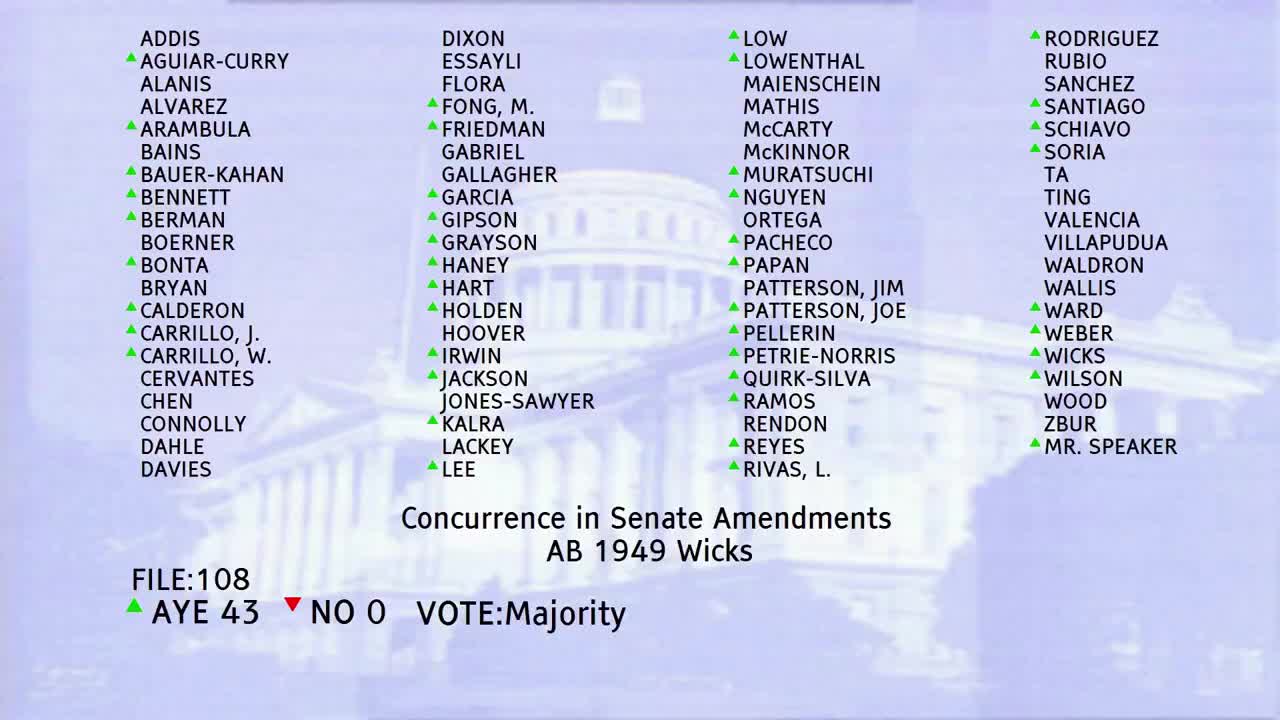
Bill Author

Bill Co-Author(s):