AB 2695: Law enforcement: criminal statistics.
- Session Year: 2023-2024
- House: Assembly
- Latest Version Date: 2024-09-27
Current Status:
Passed
(2024-09-27: Chaptered by Secretary of State - Chapter 662, Statutes of 2024.)
Introduced
In Committee
First Chamber
In Committee
Second Chamber
Enacted
Existing law requires specified entities and individuals to maintain records required for the correct reporting of statistical data and to report that data to the Department of Justice at the time and in the manner prescribed by the Attorney General.
This bill would require the above-described entities and individuals to disaggregate that data based on whether the incidents took place in Indian country, as defined. By expanding the duties of local law enforcement, this bill would create a state-mandated local program.
The California Constitution requires the state to reimburse local agencies and school districts for certain costs mandated by the state. Statutory provisions establish procedures for making that reimbursement.
This bill would provide that, if the Commission on State Mandates determines that the bill contains costs mandated by the state, reimbursement for those costs shall be made pursuant to the statutory provisions noted above.
Existing law requires specified entities and individuals to maintain records required for the correct reporting of statistical data and to report that data to the Department of Justice at the time and in the manner prescribed by the Attorney General. Existing law requires a law enforcement agency to develop an incident report form for recording all domestic violence-related calls for assistance that includes specified data, such as whether weapons are involved or whether there were any signs that the alleged abuser was under the influence of alcohol or a controlled substance, among others.
This bill would require the above-described entities and individuals to disaggregate that data based on whether the incidents took place in Indian country, as defined, and would require a domestic violence incident report form to include a notation of whether the incident took place in Indian country. defined. By expanding the duties of local law enforcement, this bill would create a state-mandated local program.
The California Constitution requires the state to reimburse local agencies and school districts for certain costs mandated by the state. Statutory provisions establish procedures for making that reimbursement.
This bill would provide that, if the Commission on State Mandates determines that the bill contains costs mandated by the state, reimbursement for those costs shall be made pursuant to the statutory provisions noted above.
Existing law requires specified entities and individuals to maintain records required for the correct reporting of statistical data and to report that data to the Department of Justice at the time and in the manner prescribed by the Attorney General. Existing law requires a law enforcement agency to develop an incident report form for recording all domestic violence-related calls for assistance that includes specified data, such as whether weapons are involved or whether there were any signs that the alleged abuser was under the influence of alcohol or a controlled substance, among others.
This bill would require the above-described entities and individuals to disaggregate that data based on whether the incidents took place in Indian country, as defined, and would require a domestic violence incident report form to include a notation of whether the incident took place in Indian country. By expanding the duties of local law enforcement, this bill would create a state-mandated local program.
The California Constitution requires the state to reimburse local agencies and school districts for certain costs mandated by the state. Statutory provisions establish procedures for making that reimbursement.
This bill would provide that, if the Commission on State Mandates determines that the bill contains costs mandated by the state, reimbursement for those costs shall be made pursuant to the statutory provisions noted above.
Existing law establishes the State Department of Health Care Services within the California Health and Human Services Agency. Existing law sets forth the departments powers and duties relating to, among other things, public health, licensing and certification of certain health facilities, and the state Medi-Cal program.This bill would make technical, nonsubstantive changes to a related provision.Existing law establishes the State Department of Health Care Services within the California Health and Human Services Agency. Existing law sets forth the departments powers and duties relating to, among other things, public health, licensing and certification of certain health facilities, and the state Medi-Cal program.
This bill would make technical, nonsubstantive changes to a related provision.
The Legislature finds and declares all of the following:
(a)Public Law 83-280, commonly referred to as Public Law 280, was originally enacted in 1953. Public Law 280 altered the allocation of federal and state criminal jurisdiction over Indian country. Public Law 280 did not reduce nor expand tribal criminal jurisdiction. Public Law 280 provided no financial support for state law enforcement responsibilities.
(b)Indian country is defined in federal law as including federal reservations, whether created by statute or executive order, including fee land, land that is neither a reservation nor an allotment which has been validly set aside for the use of the Indians as Indian land, and under the superintendence of the government, and Indian allotments to which title has not been extinguished; land held in trust by the United States for a tribe or individual Indian is also accorded Indian country status.
(c)The federal government recognizes 574 American Indian tribes and Alaska Native entities in the United States. Second to Alaska, California has the most federally recognized tribes in the nation. There are currently 109 federally recognized Indian tribes and over 100 separate reservations or rancherias in California.
(d)Existing law requires the Department of Justice to provide technical assistance to local law enforcement agencies that have Indian lands within or abutting their jurisdictions, and to tribal governments with Indian lands, including those with and without tribal law enforcement agencies, to include, but not be limited to, both of the following:
(1)Providing guidance for law enforcement education and training on policing and criminal investigations on Indian lands that supports consistent implementation of Californias responsibilities for enforcing statewide criminal laws on Indian lands that protect the health, safety, and welfare of tribal citizens on Indian lands.
(2)Providing guidance on improving crime reporting, crime statistics, criminal procedures, and investigative tools for conducting police investigations of statewide criminal laws on Indian lands.
(e)Existing law establishes that it is the duty of the Department of Justice to collect data necessary for the work of the department from specified persons and agencies and from any other appropriate source.
(f)To improve upon the implementation of concurrent criminal jurisdiction on California Indian lands and to provide technical assistance to local law enforcement agencies that serve Indian country within or abutting their jurisdictions and tribal governments within Indian country, with or without tribal law enforcement agencies, the Attorney General must have access to criminal reporting statistical data to carry out the responsibilities and obligations under existing law.
SEC. 2.Section 13020.5 is added to the Penal Code, to read:13020.5.(a)Records and data reported in alignment with the federal National Incident-Based Reporting system, pursuant to Sections 13010 and 13020, shall be disaggregated by whether an incident occurred in Indian country.
(b)As used in this section, the term Indian country has the same meaning as in Section 1151 of Title 18 of the United States Code.
SEC. 3.If the Commission on State Mandates determines that this act contains costs mandated by the state, reimbursement to local agencies and school districts for those costs shall be made pursuant to Part 7 (commencing with Section 17500) of Division 4 of Title 2 of the Government Code.
The Legislature finds and declares all of the following:
(a)Public Law 83-280, commonly referred to as Public Law 280, was originally enacted in 1953. Public Law 280 altered the allocation of federal and state criminal jurisdiction over Indian country. Public Law 280 did not reduce nor expand tribal criminal jurisdiction. Public Law 280 provided no financial support for state law enforcement responsibilities.
(b)Indian country is defined in federal law as including federal reservations, whether created by statute or executive order, including fee land, land that is neither a reservation nor an allotment which has been validly set aside for the use of the Indians as Indian land, and under the superintendence of the government, and Indian allotments to which title has not been extinguished; land held in trust by the United States for a tribe or individual Indian is also accorded Indian country status.
(c)The federal government recognizes 574 American Indian tribes and Alaska Native entities in the United States. Second to Alaska, California has the most federally recognized tribes in the nation. There are currently 109 federally recognized Indian tribes and over 100 separate reservations or rancherias in California.
(d)Existing law requires the Department of Justice to provide technical assistance to local law enforcement agencies that have Indian lands within or abutting their jurisdictions, and to tribal governments with Indian lands, including those with and without tribal law enforcement agencies, to include, but not be limited to, both of the following:
(1)Providing guidance for law enforcement education and training on policing and criminal investigations on Indian lands that supports consistent implementation of Californias responsibilities for enforcing statewide criminal laws on Indian lands that protect the health, safety, and welfare of tribal citizens on Indian lands.
(2)Providing guidance on improving crime reporting, crime statistics, criminal procedures, and investigative tools for conducting police investigations of statewide criminal laws on Indian lands.
(e)Existing law establishes that it is the duty of the Department of Justice to collect data necessary for the work of the department from specified persons and agencies and from any other appropriate source.
(f)To improve upon the implementation of concurrent criminal jurisdiction on California Indian lands and to provide technical assistance to local law enforcement agencies that serve Indian country within or abutting their jurisdictions and tribal governments within Indian country, with or without tribal law enforcement agencies, the Attorney General must have access to criminal reporting statistical data to carry out the responsibilities and obligations under existing law.
SEC. 2.Section 13020.5 is added to the Penal Code, to read:13020.5.(a)Records and data reported pursuant to Section 13020 in alignment with the federal National Incident-Based Reporting system, pursuant to Sections 13010 and 13020, shall be disaggregated by whether an incident occurred in Indian country.
(b)As used in this section, the term Indian country has the same meaning as in Section 1151 of Title 18 of the United States Code.
SEC. 3.Section 13730 of the Penal Code is amended to read:13730.(a)Each law enforcement agency shall develop a system, by January 1, 1986, for recording all domestic violence-related calls for assistance made to the department, including whether weapons are involved, or whether the incident involved strangulation or suffocation. All domestic violence-related calls for assistance shall be supported with a written incident report, as described in subdivision (c), identifying the domestic violence incident. Monthly, the total number of domestic violence calls received and the numbers of those cases involving weapons or strangulation or suffocation shall be compiled by each law enforcement agency and submitted to the Attorney General.(b)The Attorney General shall report annually to the Governor, the Legislature, and the public the total number of domestic violence-related calls received by California law enforcement agencies, the number of cases involving weapons, the number of cases involving strangulation or suffocation, and a breakdown of calls received by agency, city, and county.(c)Each law enforcement agency shall develop an incident report form that includes a domestic violence identification code by January 1, 1986. In all incidents of domestic violence, a report shall be written and shall be identified on the face of the report as a domestic violence incident. The report shall include at least all of the following:(1)A notation of whether the officer or officers who responded to the domestic violence call observed any signs that the alleged abuser was under the influence of alcohol or a controlled substance.(2)A notation of whether the officer or officers who responded to the domestic violence call determined if any law enforcement agency had previously responded to a domestic violence call at the same address involving the same alleged abuser or victim.(3)A notation of whether the officer or officers who responded to the domestic violence call found it necessary, for the protection of the peace officer or other persons present, to inquire of the victim, the alleged abuser, or both, whether a firearm or other deadly weapon was present at the location, and, if there is an inquiry, whether that inquiry disclosed the presence of a firearm or other deadly weapon. Any firearm or other deadly weapon discovered by an officer at the scene of a domestic violence incident shall be subject to confiscation pursuant to Division 4 (commencing with Section 18250) of Title 2 of Part 6.(4)A notation of whether there were indications that the incident involved strangulation or suffocation. This includes whether any witness or victim reported any incident of strangulation or suffocation, whether any victim reported symptoms of strangulation or suffocation, or whether the officer observed any signs of strangulation or suffocation.(5)A notation of whether the incident took place in Indian country as defined in Section 1151 of Title 18 of the United States Code.SEC. 4.SEC. 3.If the Commission on State Mandates determines that this act contains costs mandated by the state, reimbursement to local agencies and school districts for those costs shall be made pursuant to Part 7 (commencing with Section 17500) of Division 4 of Title 2 of the Government Code.
The Legislature finds and declares all of the following:
(a)Public Law 83-280, commonly referred to as Public Law 280, was originally enacted in 1953. Public Law 280 altered the allocation of federal and state criminal jurisdiction over Indian country. Public Law 280 did not reduce nor expand tribal criminal jurisdiction. Public Law 280 provided no financial support for state law enforcement responsibilities.
(b)Indian country is defined in federal law as including federal reservations, whether created by statute or executive order, including fee land, land that is neither a reservation nor an allotment which has been validly set aside for the use of the Indians as Indian land, and under the superintendence of the government, and Indian allotments to which title has not been extinguished; land held in trust by the United States for a tribe or individual Indian is also accorded Indian country status.
(c)The federal government recognizes 574 American Indian tribes and Alaska Native entities in the United States. Second to Alaska, California has the most federally recognized tribes in the nation. There are currently 109 federally recognized Indian tribes and over 100 separate reservations or rancherias in California.
(d)Existing law requires the Department of Justice to provide technical assistance to local law enforcement agencies that have Indian lands within or abutting their jurisdictions, and to tribal governments with Indian lands, including those with and without tribal law enforcement agencies, to include, but not be limited to, both of the following:
(1)Providing guidance for law enforcement education and training on policing and criminal investigations on Indian lands that supports consistent implementation of Californias responsibilities for enforcing statewide criminal laws on Indian lands that protect the health, safety, and welfare of tribal citizens on Indian lands.
(2)Providing guidance on improving crime reporting, crime statistics, criminal procedures, and investigative tools for conducting police investigations of statewide criminal laws on Indian lands.
(e)Existing law establishes that it is the duty of the Department of Justice to collect data necessary for the work of the department from specified persons and agencies and from any other appropriate source.
(f)To improve upon the implementation of concurrent criminal jurisdiction on California Indian lands and to provide technical assistance to local law enforcement agencies that serve Indian country within or abutting their jurisdictions and tribal governments within Indian country, with or without tribal law enforcement agencies, the Attorney General must have access to criminal reporting statistical data to carry out the responsibilities and obligations under existing law.
SEC. 2.Section 13020.5 is added to the Penal Code, to read:13020.5.(a)Records and data reported pursuant to Section 13020 shall be disaggregated by whether an incident occurred in Indian country.
(b)As used in this section, the term Indian country has the same meaning as in Section 1151 of Title 18 of the United States Code.
SEC. 3.Section 13730 of the Penal Code is amended to read:13730.(a)Each law enforcement agency shall develop a system, by January 1, 1986, for recording all domestic violence-related calls for assistance made to the department, including whether weapons are involved, or whether the incident involved strangulation or suffocation. All domestic violence-related calls for assistance shall be supported with a written incident report, as described in subdivision (c), identifying the domestic violence incident. Monthly, the total number of domestic violence calls received and the numbers of those cases involving weapons or strangulation or suffocation shall be compiled by each law enforcement agency and submitted to the Attorney General.
(b)The Attorney General shall report annually to the Governor, the Legislature, and the public the total number of domestic violence-related calls received by California law enforcement agencies, the number of cases involving weapons, the number of cases involving strangulation or suffocation, and a breakdown of calls received by agency, city, and county.
(c)Each law enforcement agency shall develop an incident report form that includes a domestic violence identification code by January 1, 1986. In all incidents of domestic violence, a report shall be written and shall be identified on the face of the report as a domestic violence incident. The report shall include at least all of the following:
(1)A notation of whether the officer or officers who responded to the domestic violence call observed any signs that the alleged abuser was under the influence of alcohol or a controlled substance.
(2)A notation of whether the officer or officers who responded to the domestic violence call determined if any law enforcement agency had previously responded to a domestic violence call at the same address involving the same alleged abuser or victim.
(3)A notation of whether the officer or officers who responded to the domestic violence call found it necessary, for the protection of the peace officer or other persons present, to inquire of the victim, the alleged abuser, or both, whether a firearm or other deadly weapon was present at the location, and, if there is an inquiry, whether that inquiry disclosed the presence of a firearm or other deadly weapon. Any firearm or other deadly weapon discovered by an officer at the scene of a domestic violence incident shall be subject to confiscation pursuant to Division 4 (commencing with Section 18250) of Title 2 of Part 6.
(4)A notation of whether there were indications that the incident involved strangulation or suffocation. This includes whether any witness or victim reported any incident of strangulation or suffocation, whether any victim reported symptoms of strangulation or suffocation, or whether the officer observed any signs of strangulation or suffocation.
(5)A notation of whether the incident took place in Indian country as defined in Section 1151 of Title 18 of the United States Code.
SEC. 4.If the Commission on State Mandates determines that this act contains costs mandated by the state, reimbursement to local agencies and school districts for those costs shall be made pursuant to Part 7 (commencing with Section 17500) of Division 4 of Title 2 of the Government Code.
SECTION 1.Section 100100 of the Health and Safety Code is amended to read:100100.There is in the state government in the California Health and Human Services Agency a State Department of Health Services, which, effective July 1, 2007, is hereby renamed the State Department of Health Care Services. Commencing July 1, 2007, any reference in this chapter, in Chapter 1.5 (commencing with Section 100145), or in Article 1 (commencing with Section 100150) of Chapter 2 to the State Department of Health Services is deemed to, instead, refer to the State Department of Health Care Services with regard to functions not transferred to the State Department of Public Health. Commencing July 1, 2007, all the duties, powers, purposes, responsibilities, and jurisdiction of the former State Department of Health Services not vested in the State Department of Public Health pursuant to Chapter 2 (commencing with Section 131050) of Part 1 of Division 112 shall be retained by, and thereafter be performed by, the renamed State Department of Health Care Services.There is in the state government in the California Health and Human Services Agency, Agency a State Department of Health Services Services, which, effective July 1, 2007, is hereby renamed the State Department of Health Care Services. Commencing July 1, 2007, any reference in this chapter, in Chapter 1.5 (commencing with Section 100145), or in Article 1 (commencing with Section 100150) of Chapter 2 to the State Department of Health Services is deemed to, instead, refer to the State Department of Health Care Services with regard to functions not transferred to the State Department of Public Health. Commencing July 1, 2007, all the duties, powers, purposes, responsibilities, and jurisdiction of the former State Department of Health Services not vested in the State Department of Public Health pursuant to Chapter 2 (commencing with Section 131050) of Part 1 of Division 112, 112 shall be retained by, and thereafter be performed by, the renamed State Department of Health Care Services.
|
Date
|
Status
|
|---|---|
| Sep 27, 2024 | Chaptered by Secretary of State - Chapter 662, Statutes of 2024. |
| Sep 27, 2024 | Approved by the Governor. |
| Sep 9, 2024 | Enrolled and presented to the Governor at 3:30 p.m. |
| Aug 28, 2024 | In Assembly. Ordered to Engrossing and Enrolling. |
| Aug 28, 2024 | Read third time. Passed. Ordered to the Assembly. (Ayes 39. Noes 0.). |
| Aug 23, 2024 | Ordered to special consent calendar. |
| Aug 19, 2024 | Read second time. Ordered to third reading. |
| Aug 15, 2024 | From committee: Do pass. (Ayes 7. Noes 0.) (August 15). |
| Aug 5, 2024 | In committee: Referred to APPR suspense file. |
| Jun 25, 2024 | From committee: Do pass and re-refer to Com. on APPR with recommendation: To Consent Calendar. (Ayes 5. Noes 0.) (June 25). Re-referred to Com. on APPR. |
| Jun 5, 2024 | Referred to Com. on PUB S. |
| May 24, 2024 | In Senate. Read first time. To Com. on RLS. for assignment. |
| May 23, 2024 | Read third time. Passed. Ordered to the Senate. (Ayes 73. Noes 0. Page 5608.) |
| May 20, 2024 | Read second time. Ordered to third reading. |
| May 16, 2024 | Read second time and amended. Ordered returned to second reading. |
| May 16, 2024 | From committee: Amend, and do pass as amended. (Ayes 12. Noes 0.) (May 16). |
| May 16, 2024 | Assembly Rule 63 suspended. |
| May 8, 2024 | In committee: Set, first hearing. Referred to APPR. suspense file. |
| Apr 24, 2024 | From committee: Do pass and re-refer to Com. on APPR. with recommendation: To Consent Calendar. (Ayes 8. Noes 0.) (April 23). Re-referred to Com. on APPR. |
| Mar 19, 2024 | Re-referred to Com. on PUB. S. |
| Mar 18, 2024 | From committee chair, with author's amendments: Amend, and re-refer to Com. on PUB. S. Read second time and amended. |
| Mar 18, 2024 | Referred to Com. on PUB. S. |
| Feb 15, 2024 | From printer. May be heard in committee March 16. |
| Feb 14, 2024 | Read first time. To print. |
|
Date
|
Description
|
Location
|
Votes
|
|
|---|---|---|---|---|
| Aug 28, 2024 | Special Consent AB2695 Ramos By Skinner | Senate Floor |
Passed |
|
| Aug 15, 2024 | Do pass | Senate Standing Committee on Appropriations |
Passed |
|
| Aug 5, 2024 | Placed on suspense file | Senate Standing Committee on Appropriations |
Passed |
|
| Jun 25, 2024 | Do pass, but first be re-referred to the Committee on [Appropriations] with the recommendation: To Consent Calendar | Senate Standing Committee on Public Safety |
Passed |
|
| May 23, 2024 | AB 2695 Ramos Assembly Third Reading | Assembly Floor |
Passed |
|
| May 16, 2024 | Do pass as amended. | Assembly Standing Committee on Appropriations |
Passed |
|
| Apr 23, 2024 | Do pass and be re-referred to the Committee on [Appropriations] with recommendation: To Consent Calendar | Assembly Standing Committee on Public Safety |
Passed |
This list shows positions taken on this bill by organizations on the date displayed, which is linked to the original source.
Positions by individuals are not included.
|
Organization
|
Position
|
Date
|
|---|---|---|
| cahuilla band of indians | ** Support | |
| California Department of Justice | ** Support |
SENATE RULES COMMITTEE Office of Senate Floor Analyses (916) 651-1520 Fax: (916) 327-4478 | AB 2695 |
THIRD READING
Bill No: AB 2695
Author: Ramos (D)
Amended: 5/16/24 in Assembly
Vote: 21
SENATE PUBLIC SAFETY COMMITTEE: 5-0, 6/25/24
AYES: Wahab, Seyarto, Bradford, Skinner, Wiener
SENATE APPROPRIATIONS COMMITTEE: 7-0, 8/15/24
AYES: Caballero, Jones, Ashby, Becker, Bradford, Seyarto, Wahab
ASSEMBLY FLOOR: 73-0, 5/23/24 - See last page for vote
SUBJECT: Law enforcement: criminal statistics
SOURCE: California Department of Justice
DIGEST:
This bill requires specified data collected by law enforcement and reported to the Department of Justice (DOJ) to be disaggregated by whether an incident occurred in Indian Country, as defined.
ANALYSIS:
Existing law:
- Defines “Indian country” as all land within the limits of any Indian reservation under the jurisdiction of the United States Government. (18 U.S.C. § 1151.)
- Provides that California has jurisdiction over offenses committed by or against Indians in Indian Country to the same extent that the State has jurisdiction over offenses committed elsewhere in the State. (18 U.S.C. § 1162.)
- Provides that the criminal laws of California shall have the same force and effect within Indian country as they have elsewhere within the State. (18 U.S.C. § 1162.)
- Establishes the Tribal Assistance Program, requiring the DOJ to provide technical assistance to local law enforcement agencies that have Indian lands within or abutting their jurisdictions and to tribal governments with Indian lands, including those with and without tribal law enforcement agencies, as specified. (Pen. Code § 11070, subd. (a).)
- Requires the DOJ, subject to an appropriations by the Legislature, to conduct \a study to determine how to increase state criminal justice protective and investigative resources for reporting and identifying missing Native Americans in California, particularly women and girls. (Pen. Code § 11070, subd. (b).)
- Authorizes a law enforcement agency or a court of a tribe to apply to the Attorney General for access to the California Law Enforcement Telecommunications System (CLETS), as specified, and provides that CLETS may connect and exchange traffic with the compatible systems of a tribal government, as provided. (Gov. Code, §15168.)
- Requires the Department of Justice to do the following:
- Collect all data necessary for the work of the department from all persons and agencies;
- Prepare and distribute to all those persons and agencies cards, forms, or electronic means used in reporting data, and in addition include items of information needed by federal bureaus or departments;
- Recommend the form and content of records that must be kept by those persons and agencies;
- Instruct those persons and agencies in the installation, maintenance, and use of those records;
- Process, tabulate, analyze, and interpret the data collected;
- Supply federal bureaus or departments engaged in the collection of national criminal statistic data at their request;
- Make available to the public, through the department’s OpenJustice Web portal, information relating to criminal statistics, to be updated at least once a year; the Attorney General may approve reports on special aspects of criminal statistics;
- Periodically review the requirements of units government using criminal justice statistics, and to make recommendations for changes; and,
- Evaluate, on an annual basis, the progress of California’s transition from summary crime reporting to incident based reporting. (Pen. Code, § 13010.)
- Requires every city marshal, chief of police, railroad and steamship police, sheriff, coroner, district attorney, city attorney and city prosecutor having criminal jurisdiction, probation officer, county board of parole commissioners, work furlough administrator, the Department of Justice, Health and Welfare Agency, Department of Corrections, Department of Youth Authority, Youthful Offender Parole Board, Board of Prison Terms, State Department of Health, Department of Benefit Payments, State Fire Marshal, Liquor Control Administrator, constituent agencies of the State Department of Investment, and every other person or agency dealing with crimes or criminals or with delinquency or delinquents, when requested by the Attorney General:
- To install and maintain records needed for the correct reporting of statistical data as required.
- To report statistical data to the department at those times and in the manner that the AG prescribes.
- To give to the AG, or their agent, access to such statistical data. (Pen. Code, § 13020.)
This bill:
- Provides that records and data reported in alignment with the federal National Incident-Based Reporting system, as specified, shall be disaggregated by whether an incident occurred in Indian Country.
- Specifies that the term “Indian Country” has the same meaning as specified in federal law.
- Sets forth various findings and declarations related to the operative provisions of the bill.
Comments
According to the Author, “The Missing and Murdered Indigenous Persons is an epidemic that has plagued Indian Country for generations. Native families have constantly faced disappearances of loved ones, followed by trauma from law enforcement inaction and under-reporting. My previous legislation, AB 3099, was an attempt to initiate a dialog to address this crisis, however, it is clear that more information is needed to being the work behind this monumental task. AB 2695 crucial step in providing the Justice Department with more accurate data regarding crimes committed on native lands, so that they can began to paint a better picture of where these crimes of being perpetrated.”
Existing law requires the DOJ to collect data necessary for the departments work from local agencies to prescribe the content, manner and form by which those agencies may report that data. Existing law includes a related requirement that local law enforcement agencies install and maintain records needed for the correct reporting of statistical data to the DOJ. However, according to the Author, because law enforcement does not adequately record crimes that happen on Indian reservations, DOJ does not have a clear picture of the true size of the MMIP crisis, “which has made it an impossible task for the development of concrete and effective solutions to combat issue.” Moreover, the lack of more specific data, particularly with regard to crimes that occur in tribal jurisdictions, precludes the DOJ from conducting the report required under AB 3099 (Ramos, Chapter 170, Statutes of 2020), which is required to include a determination of the scope of the issue of missing and murdered Native Americans in California. Accordingly, this bill requires that records and data reporting pursuant to the requirements described above be disaggregated by whether an incident occurred in Indian country, as defined.
FISCAL EFFECT: Appropriation: No Fiscal Com.: Yes Local: Yes
According to the Senate Appropriations Committee:
“DOJ estimates ongoing costs (General Fund) of approximately $500,000. DOJ notes that its Criminal Justice Statistics Center (CJSC) would require the following resources: $300,000 – one time cost in FY 2025-26. This is an estimate from CJSC’s third-party vendor to modify CIBRS. A drop-down menu would be added to include tribal affiliation when an LEA responds to a call for service or provides policing services. $10,000 – Annual cost beginning in FY 2026-27 Storage, cloud housing, and maintenance. Research Data Analyst (RDA) I – ongoing. The RDA I would accommodate the validation and verification work in addition to all other necessary support efforts this data collection would require. Additionally, the RDA I would begin the first phase of the data collection process and collaborate with LEAs.”
SUPPORT: (Verified 8/15/24)
California Department of Justice (source)
OPPOSITION: (Verified 8/15/24)
None received
ASSEMBLY FLOOR: 73-0, 5/23/24
AYES: Addis, Aguiar-Curry, Alanis, Alvarez, Arambula, Bains, Bauer-Kahan, Bennett, Berman, Boerner, Bonta, Bryan, Calderon, Juan Carrillo, Wendy Carrillo, Chen, Connolly, Davies, Dixon, Flora, Mike Fong, Vince Fong, Friedman, Gabriel, Gallagher, Garcia, Gipson, Grayson, Haney, Hart, Hoover, Irwin, Jackson, Jones-Sawyer, Kalra, Lackey, Lee, Low, Lowenthal, Maienschein, McCarty, McKinnor, Muratsuchi, Stephanie Nguyen, Ortega, Pacheco, Papan, Jim Patterson, Joe Patterson, Pellerin, Petrie-Norris, Quirk-Silva, Ramos, Rendon, Reyes, Rodriguez, Sanchez, Santiago, Schiavo, Soria, Ta, Ting, Valencia, Villapudua, Waldron, Wallis, Ward, Weber, Wicks, Wilson, Wood, Zbur, Robert Rivas
NO VOTE RECORDED: Cervantes, Megan Dahle, Essayli, Holden, Mathis, Luz Rivas, Blanca Rubio
Prepared by: Alex Barnett / PUB. S. /
8/18/24 9:19:29
**** END ****
SENATE COMMITTEE ON
Senator Anna Caballero, Chair
2023 - 2024 Regular Session
AB 2695 (Ramos) - Law enforcement: criminal statistics
Version: | Policy Vote: |
Urgency: | Mandate: |
Hearing Date: | Consultant: |
Bill Summary:
AB 2695 would require specified data collected by law enforcement and reported to the Department of Justice (DOJ) to be disaggregated by whether an incident occurred in Indian Country, as defined.
Fiscal Impact:
DOJ estimates ongoing costs (General Fund) of approximately $500,000. DOJ notes that its Criminal Justice Statistics Center (CJSC) would require the following resources: $300,000 – one time cost in FY 2025-26. This is an estimate from CJSC’s third-party vendor to modify CIBRS. A drop-down menu would be added to include tribal affiliation when an LEA responds to a call for service or provides policing services. $10,000 – Annual cost beginning in FY 2026-27 Storage, cloud housing, and maintenance. Research Data Analyst (RDA) I – ongoing. The RDA I would accommodate the validation and verification work in addition to all other necessary support efforts this data collection would require. Additionally, the RDA I would begin the first phase of the data collection process and collaborate with LEAs.
Background:
Existing law requires the DOJ to collect data necessary for the departments work from local agencies to prescribe the content, manner and form by which those agencies may report that data. Existing law includes a related requirement that local law enforcement agencies install and maintain records needed for the correct reporting of statistical data to the DOJ. However, according to the Author, because law enforcement does not adequately record crimes that happen on Indian reservations, DOJ does not have a clear picture of the true size of the Murdered and Missing Indigenous Persons (MMIP) crisis, “which has made it an impossible task for the development of concrete and effective solutions to combat issue.” Moreover, the lack of more specific data, particularly with regard to crimes that occur in tribal jurisdictions, precludes the DOJ from conducting the report required under AB 3099, which is required to include a determination of the scope of the issue of missing and murdered Native Americans in California.
Proposed Law:
- Provides that records and data reported in alignment with the federal National Incident-Based Reporting system, as specified, shall be disaggregated by whether an incident occurred in Indian Country.
- Specifies that the term “Indian Country” has the same meaning as specified in federal law.
- Sets forth various findings and declarations related to the operative provisions of the bill.
Related Legislation:
AB 2279 (Cervantes) establishes the Missing and Murdered Indigenous Persons Justice Program within the Department of Justice, and sets forth the program’s responsibilities, which include publishing data on the number of and facts about cases involving murdered and missing indigenous persons. At the time this analysis was finalized, that bill was set to be heard in this committee on June 18. AB 2279 is pending in this Committee.
AB 2138 (Ramos) establishes the Tribal Police Pilot Program under the DOJ and the Commission on Peace Officer Standards and Training (POST), which would give qualified officers at specified tribal law enforcement agencies the powers of a peace officer of the State of California in specified circumstances. AB 2138 is pending in this Committee.
-- END --
SENATE COMMITTEE ON PUBLIC SAFETY
Senator Aisha Wahab, Chair
2023 - 2024 Regular
Bill No: AB 2695 Hearing Date: June 25, 2024
Author: | Ramos | ||
Version: | May 16, 2024 | ||
Urgency: | No | Fiscal: | Yes |
Consultant: | AB | ||
Subject: Law enforcement: criminal statistics
HISTORY
Source: Department of Justice
Prior Legislation: AB 44 (Ramos, Ch. 638, Stats. of 2023)
AB 1314 (Ramos, Ch. 476, Stats. of 2022)
AB 3099 (Ramos, Ch. 170, Stats. of 2020)
AB 1854 (Frazier, 2020), not heard in Assembly Public Safety
AB 1653 (Frazier, 2019), held in Assembly Appropriations
Support: Unknown
Opposition: None known
Assembly Floor Vote: 73 - 0
PURPOSE
The purpose of this bill is to require specified data collected by law enforcement and reported to the DOJ to be disaggregated by whether an incident occurred in Indian Country, as defined.
Existing federal law defines “Indian country” as all land within the limits of any Indian reservation under the jurisdiction of the United States Government. (18 U.S.C. § 1151.)
Existing federal law provides that California has jurisdiction over offenses committed by or against Indians in Indian Country to the same extent that the State has jurisdiction over offenses committed elsewhere in the State. (18 U.S.C. § 1162.)
Existing federal law provides that the criminal laws of California shall have the same force and effect within Indian country as they have elsewhere within the State. (18 U.S.C. § 1162.)
Existing California law establishes the Tribal Assistance Program, requiring the DOJ to provide technical assistance to local law enforcement agencies that have Indian lands within or abutting their jurisdictions and to tribal governments with Indian lands, including those with and without tribal law enforcement agencies, as specified. (Pen. Code § 11070, subd. (a).)
Existing law requires the DOJ, subject to an appropriations by the Legislature, to conduct \a study to determine how to increase state criminal justice protective and investigative resources for reporting and identifying missing Native Americans in California, particularly women and girls. (Pen. Code § 11070, subd. (b).)
Existing law authorizes a law enforcement agency or a court of a tribe to apply to the Attorney General for access to the California Law Enforcement Telecommunications System (CLETS), as specified, and provides that CLETS may connect and exchange traffic with the compatible systems of a tribal government, as provided. (Gov. Code, §15168.)
Existing law requires the Department of Justice (DOJ) to do the following:
- Collect all data necessary for the work of the department from all persons and agencies;
- Prepare and distribute to all those persons and agencies cards, forms, or electronic means used in reporting data, and in addition include items of information needed by federal bureaus or departments;
- Recommend the form and content of records that must be kept by those persons and agencies;
- Instruct those persons and agencies in the installation, maintenance, and use of those records;
- Process, tabulate, analyze, and interpret the data collected;
- Supply federal bureaus or departments engaged in the collection of national criminal statistic data at their request;
- Make available to the public, through the department’s OpenJustice Web portal, information relating to criminal statistics, to be updated at least once a year; the Attorney General may approve reports on special aspects of criminal statistics;
- Periodically review the requirements of units government using criminal justice statistics, and to make recommendations for changes; and,
- Evaluate, on an annual basis, the progress of California’s transition from summary crime reporting to incident based reporting. (Pen. Code, § 13010.)
Existing law requires every city marshal, chief of police, railroad and steamship police, sheriff, coroner, district attorney, city attorney and city prosecutor having criminal jurisdiction, probation officer, county board of parole commissioners, work furlough administrator, the Department of Justice, Health and Welfare Agency, Department of Corrections, Department of Youth Authority, Youthful Offender Parole Board, Board of Prison Terms, State Department of Health, Department of Benefit Payments, State Fire Marshal, Liquor Control Administrator, constituent agencies of the State Department of Investment, and every other person or agency dealing with crimes or criminals or with delinquency or delinquents, when requested by the Attorney General:
- To install and maintain records needed for the correct reporting of statistical data as required.
- To report statistical data to the department at those times and in the manner that the AG prescribes.
- To give to the AG, or their agent, access to such statistical data. (Pen. Code, § 13020.)
This bill provides that records and data reported in alignment with the federal National Incident-Based Reporting system, as specified, shall be disaggregated by whether an incident occurred in Indian Country.
This bill specifies that the term “Indian Country” has the same meaning as specified in federal law.
This bill sets forth various findings and declarations related to the operative provisions of the bill.
COMMENTS
- Need for This Bill
According to the Author:
The Missing and Murdered Indigenous Persons is an epidemic that has plagued Indian Country for generations. Native families have constantly faced disappearances of loved ones, followed by trauma from law enforcement inaction and under-reporting. My previous legislation, AB 3099, was an attempt to initiate a dialog to address this crisis, however, it is clear that more information is needed to being the work behind this monumental task. AB 2695 crucial step in providing the Justice Department with more accurate data regarding crimes committed on native lands, so that they can began to paint a better picture of where these crimes of being perpetrated.
- Murdered and Missing Indigenous Persons (MMIP)
For Native Americans and Alaska Natives, rates of murder, rape, and violent crime are all higher than the national averages. This crisis is especially acute among Native American and Alaska Native women and girls. A 2016 study by the National Institute of Justice (NIJ) found that more than four in five American Indian and Alaska Native women (84.3%) have experienced violence in their lifetime, including 56.1 percent who have experienced sexual violence. That year, the National Crime Information Center reported that there were 5,712 reports of missing American Indian and Alaska Native women and girls, though only 116 cases were logged into the federal DOJ’s missing person’s database.[1] Research indicates that one in 130 Native American Children are likely to go missing each year, and indigenous women go missing and are murdered at rates higher than most other ethnic groups in the United States.[2]
Efforts at the federal level to address the MMIP crisis are ongoing. On April 1, 2021, United States Interior Secretary Deb Haaland announced the formation of a new Missing & Murdered Unit (MMU) within the Bureau of Indian Affairs Office of Justice Services (BIA-OJS) to provide leadership and direction for cross-departmental and interagency work involving missing and murdered American Indians and Alaska Natives. In April of 2022, the U.S. Department of Justice launched the Missing or Murdered Indigenous Persons (MMIP) webpage as part of the Department’s Tribal Justice and Safety website, which houses other Tribal initiatives at U.S. DOJ such as the Tribal Access Program, grant opportunities, consultations, and several other resources for tribes.[3]
California is not immune from this crisis, and as of 2023, California had the fifth largest caseload of missing and murdered Indigenous women and people. A report published in 2020 by the Sovereign Bodies Institute detailed the lack of scrutiny and data surrounding 105 cases involving missing and murdered Indigenous women and girls across northern California: the report found that of the cases classified as murders, law enforcement solved only 9%, meaning that murders of indigenous women were about 7 times less likely to be solved than homicides involving all other victims.[4] In 2021, the California Department of Justice held a first-of-its-kind event entitled “Missing in California Indian Country” in an effort to elevate California’s response to the murdered and missing indigenous person’s crisis. Since then, the state’s DOJ has continued to hold these events around the state, and describe them as follows:
They, in part, serve as critical public safety events for tribal communities and aim to elevate the state’s response to the Missing Murdered Indigenous Persons crisis (MMIP). These events will allow for loved ones to report an individual missing, receive an update on an active missing person’s case, and/or provide a DNA sample for inclusion in the DOJ’s Unidentified Persons Database. These regional events will be developed and planned in collaboration with the tribal governments, within the respected regions, to be most responsive to the region's tribal community's needs. Together, local, state, tribal and federal justice partners will come together for these events to share critical information, resource availability, and partnership in addressing the MMIP crisis in California.[5]
- Prior Legislation and Effect of This Bill
Recognizing the severity of the MMIP crisis in California, the Author has carried several measures aimed at improving law enforcement capabilities on tribal lands, primarily by facilitating cooperation between tribal and California law enforcement agencies. In 2020, the Governor signed AB 3099 (Ramos, Ch. 170, Stats. of 2020), which required the DOJ to provide technical assistance to local law enforcement agencies that have Indian lands within or abutting their jurisdictions, and to tribal governments with Indian lands, including those with and without law enforcement agencies. AB 3099 also required the DOJ to conduct a study to determine how to increase state criminal justice protective and investigative resources for reporting and identifying missing Native Americans in California, particularly women and girls. In 2022, AB 1314 (Ramos, Ch. 476, Stats. of 2022) established the “Feather Alert,” an emergency alert system similar to the “Amber Alert” but designed specifically to help locate missing Indigenous people. And last year, The Author of this measure authored AB 44 (Ramos, 638, Stats. of 2023), which granted tribal courts and law enforcement agencies access to the California Law Enforcement Telecommunications System (CLETS).
Existing law requires the DOJ to collect data necessary for the departments work from local agencies to prescribe the content, manner and form by which those agencies may report that data. Existing law includes a related requirement that local law enforcement agencies install and maintain records needed for the correct reporting of statistical data to the DOJ.[6] However, according to the Author, because law enforcement does not adequately record crimes that happen on Indian reservations, DOJ does not have a clear picture of the true size of the MMIP crisis, “which has made it an impossible task for the development of concrete and effective solutions to combat issue.” Moreover, the lack of more specific data, particularly with regard to crimes that occur in tribal jurisdictions, precludes the DOJ from conducting the report required under AB 3099, which is required to include a determination of the scope of the issue of missing and murdered Native Americans in California. Accordingly, this bill requires that records and data reporting pursuant to the requirements described above be disaggregated by whether an incident occurred in Indian country, as defined.
- Related Legislation
AB 2279 (Cervantes) establishes the Missing and Murdered Indigenous Persons Justice Program within the Department of Justice, and sets forth the program’s responsibilities, which include publishing data on the number of and facts about cases involving murdered and missing indigenous persons. At the time this analysis was finalized, that bill was set to be heard in this committee on June 18.
AB 2138 (Ramos) establishes the Tribal Police Pilot Program under the DOJ and the Commission on Peace Officer Standards and Training (POST), which would give qualified officers at specified tribal law enforcement agencies the powers of a peace officer of the State of California in specified circumstances. That bill is set to be heard along with this bill on June 25.
- Argument in Support
According to the Department of Justice, the bill’s sponsor:
Assembly Bill 2695 […] will provide a valuable tool to understanding the Missing Murdered Indigenous Persons (MMIP) crisis in California. Specifically, the bill will require law enforcement agencies to collect data on crimes occurring on Indian lands and report that information to the California Department of Justice (DOJ) as part of its efforts to address the MMIP crisis and improve public safety on Indian lands.
The DOJ proudly houses the Office of Native American Affairs (ONAA), which serves as a liaison between the DOJ and California’s tribes to address justice-related issues for the overall improvement of the health, safety, and welfare of tribal citizens. As part of its goal to improve justice for tribal citizens, the DOJ is tasked with providing technical assistance relating to tribal issues to local law enforcement agencies, and tribal governments with Indian lands. Existing law also requires DOJ to study and report on how to increase state criminal justice protective and investigative resources for reporting and identifying missing Native Americans in California, particularly women and girls.
Moreover, California is a mandatory Public Law 83-280 state and as such, shares criminal jurisdiction over Indian lands with the sovereign tribal governments of those lands. However, there are currently no specific requirements that criminal justice reporting agencies provide information about crimes being committed in California Indian Country, which is comprised of approximately 103 reservations and rancherias located within 34 of California’s 58 counties. Unfortunately, indigenous people, particularly women and girls, are affected by domestic violence, human trafficking, and violent crimes at disproportionately higher rates, and are statistically more likely to become missing. Knowing the scope and type of incidents occurring on Indian lands is a crucial component to understanding the MMIP crisis and developing data-driven strategies to end it.
-- END –
Missing and Murdered Indigenous People Crisis | Indian Affairs (bia.gov); https://www.uihi.org/wp-content/uploads/2018/11/Missing-and-Murdered-Indigenous-Women-and-Girls-Report.pdf ↑
https://www.cnn.com/2019/04/09/us/native-american-murdered-missing-women/index.html ; https://www.acf.hhs.gov/sites/default/files/documents/ana/ioas_signed_tab_a_final_acf_framework_10_27_20pdf_002.pdf ↑
Unsolved cases: California's missing indigenous women - CalMatters ↑
Missing in California Indian Country - Regional Events | State of California - Department of Justice - Office of the Attorney General ↑
Pen. Code §§ 13010, 13020. ↑
ASSEMBLY THIRD READING
ATR Bill Id:AB 2695
Author:(Ramos)
As Amended Ver:May 16, 2024
Majority vote
SUMMARY
Requires records and data reported in alignment with the federal National Incident-Based reporting system to be disaggregated by whether an incident occurred in Indian Country.
COMMENTS
According to the Author
"The Missing and Murdered Indigenous Persons Crisis is an epidemic that has plagued Indian Country for generations. Families are affected by disappearances, and are further traumatized by law enforcement inaction and under-reporting. My previous legislation AB 3099 attempted to start the dialogue and address the crisis, but it is clear that more information is needed. AB 2695 will help to provide the information needed, and start giving us a clear picture of what we need to address the MMIP crisis."
Arguments in Support
According to the California Attorney General's Office, "The DOJ proudly houses the Office of Native American Affairs (ONAA), which serves as a liaison between the DOJ and California's tribes to address justice-related issues for the overall improvement of the health, safety, and welfare of tribal citizens. As part of its goal to improve justice for tribal citizens, the DOJ is tasked with providing technical assistance relating to tribal issues to local law enforcement agencies, and tribal governments with Indian lands. Existing law also requires DOJ to study and report on how to increase state criminal justice protective and investigative resources for reporting and identifying missing Native Americans in California, particularly women and girls.
Moreover, California is a mandatory Public Law 83-280 state and as such, shares criminal jurisdiction over Indian lands with the sovereign tribal governments of those lands. However, there are currently no specific requirements that criminal justice reporting agencies provide information about crimes being committed in California Indian Country, which is comprised of approximately 103 reservations and rancherias located within 34 of California's 58 counties. Unfortunately, indigenous people, particularly women and girls, are affected by domestic violence, human trafficking, and violent crimes at disproportionately higher rates, and are statistically more likely to become missing. Knowing the scope and type of incidents occurring on Indian lands is a crucial component to understanding the MMIP crisis and developing data-driven strategies to end it."
Arguments in Opposition
None submitted.
FISCAL COMMENTS
According to the Assembly Appropriations Committee:
- Costs (local funds, General Fund) of an unknown but potentially significant amount to implement the bill’s disaggregation requirement. Each agency currently required to report crime data to DOJ ("reporting agency") may incur ongoing costs collecting and reporting the additional data required by the bill. Reporting agencies may also incur one-time costs to update IT and data management systems to reflect the additional information required to be reported. General Fund costs will depend on whether the duties imposed by this bill constitute a reimbursable state mandate, as determined by the Commission on State Mandates.
- Costs (General Fund) to DOJ, likely in the hundreds of thousands of dollars annually. DOJ estimates costs of $428,000 in fiscal year (FY) 2025-26 and $128,000 in FY 20226-27 and ongoing. These costs including a $300,000 one-time update to modify the California Incident Based Reporting System (CIBRS) through which affected data is reported to DOJ, and ongoing costs to hire a research data analyst and for storage, cloud housing, and maintenance for CIBRS.
VOTES
ASM PUBLIC SAFETY: 8-0-0
YES: McCarty, Alanis, Lackey, Stephanie Nguyen, Reyes, Ting, Wilson, Zbur
ASM APPROPRIATIONS: 12-0-3
YES: Wicks, Arambula, Bryan, Calderon, Wendy Carrillo, Mike Fong, Grayson, Haney, Hart, Pellerin, Ta, Villapudua
ABS, ABST OR NV: Sanchez, Dixon, Jim Patterson
UPDATED
VERSION: May 16, 2024
CONSULTANT: Ilan Zur / PUB. S. / (916) 319-3744 FN: 0003330
Date of Hearing: May 8, 2024
ASSEMBLY COMMITTEE ON APPROPRIATIONS
Buffy Wicks, Chair
ABPCA Bill Id:AB 2695
Author:(Ramos) – As Amended Ver:March 18, 2024
Policy Committee: | Public Safety | Vote: | 8 - 0 |
|
| ||
|
|
Urgency: No State Mandated Local Program: Yes Reimbursable: Yes
SUMMARY:
This bill requires specified records and data reported to the Department of Justice (DOJ) to be disaggregated by whether an incident occurred in Indian country. The bill also requires a law enforcement agency (LEA) to include in its report on a domestic violence incident whether the incident occurred in Indian country.
FISCAL EFFECT:
- Costs (local funds, General Fund) of an unknown but significant amount to implement the bill’s disaggregation requirement. Assuming the bill obligates each agency currently required to report crime data to DOJ (“reporting agency”) to disaggregate its data by whether an incident occurred in Indian country, reporting agencies may incur costs collecting and reporting additional data. Reporting agencies may also incur one-time costs to update IT and data management systems to reflect the additional information required to be reported. As noted below, there are a number of outstanding questions about implementation of this requirement that make it difficult to assess possible costs, but given the volume of data reporting implicated, costs will likely be significant. General Fund costs will depend on whether the duties imposed by this bill constitute a reimbursable state mandate, as determined by the Commission on State Mandates.
- Costs (General Fund) to DOJ of an unknown amount to advise reporting agencies on data collection and reporting, and, potentially, update its data systems to reflect additional information reported to the department.
- Minor and absorbable costs to LEAs to include the required information in each domestic violence report.
According to the Legislative Analyst’s Office, the General Fund faces a structural deficit in the tens of billions of dollars over the next several fiscal years.
COMMENTS:
- Purpose. According to the author:
The Missing and Murdered Indigenous Persons Crisis is an epidemic that has plagued Indian Country for generations. Families are affected by disappearances, and are further traumatized by law enforcement inaction and under-reporting. My previous legislation AB 3099 attempted to start the dialogue and address the crisis, but it is clear that more information is needed. AB 2695 will help to provide the information needed, and start giving us a clear picture of what we need to address the MMIP crisis.
- Background. Crime Data Reporting. Existing law grants DOJ broad authority to request and maintain criminal justice data from local and state agencies, including local LEAs, coroners, public prosecutors with criminal jurisdiction, probation departments, health and welfare agencies, the California Department of Corrections and rehabilitation, and “every other person or agency dealing with crimes or criminals.” (Penal Code section 13020.) This bill requires such records and data reported to DOJ to be disaggregated by whether an incident occurred in Indian country.
It is not clear from the text of this bill how this requirement will be implemented – whether DOJ must disaggregate data reported to it by agencies or whether a reporting agency must disaggregate data it provides to DOJ. It is also not clear whether the bill’s disaggregation requirement obligates reporting agencies to proactively collect or document additional information about whether an incident occurred in Indian country. Finally, the bill does not specify what kind of incidents are covered by the bill’s disaggregation requirement. As noted above, DOJ collects crime data from a variety of agencies and publishes reports on, among other topics, adult probation, arrests, arson, crimes and clearances, juvenile justice, law enforcement and crime personnel, and law enforcement officers killed or assaulted in the line of duty. This bill does not specify how the Indian country disaggregation requirement must be fulfilled for these different types of data.
Because these aspects of the bill’s implementation are unknown, it is difficult to estimate the costs reporting agencies will incur from this requirement. Since this requirement affects so many agencies that report so many types of data, the overall fiscal impact will likely be significant.
Domestic Violence Reports. Current law requires a law enforcement agency to develop an incident report form that is used to collect information about each domestic violence call to which the agency responds. For each domestic violence call, the incident report must include specified information, including whether the officer who responded to the call observed any signs that the alleged abuser was under the influence of alcohol or a controlled substance and whether the officer determined if any law enforcement agency has previously responded to a call at the same address involving the same parties.
This bill additionally requires an agency to include in its report for a domestic violence incident whether the incident occurred in Indian country. Because law enforcement agencies already complete reports about every domestic violence incident, including this additional data on existing reports is unlikely to result in significant workload costs.
Analysis Prepared by: Annika Carlson / APPR. / (916) 319-2081
Date of Hearing:
Counsel: Ilan Zur
ASSEMBLY COMMITTEE ON PUBLIC SAFETY
Kevin McCarty, Chair
ABPCA Bill Id:AB 2695
Author:(Ramos) – As Amended Ver:March 18, 2024
SUMMARY:
Requires specified law enforcement reports to identify whether an incident occurred in Indian country.
- Requires records and data, including statistical data that specified law enforcement agencies are required to report to the Attorney General (AG), upon the AG’s request, to be disaggregated by whether an incident occurred in Indian Country.
- Requires law enforcement domestic violence incident reports to include a notation of whether the incident took place in Indian country.
EXISTING FEDERAL LAW:
- Defines “Indian country” as all land within the limits of any Indian reservation under the jurisdiction of the United States Government. (18 U.S.C. § 1151.)
- States that California has jurisdiction over offenses committed by or against Indians in Indian Country to the same extent that the State has jurisdiction over offenses committed elsewhere in the State. (18 U.S.C. § 1162.)
- Provides that the criminal laws of California shall have the same force and effect within Indian country as they have elsewhere within the State. (18 U.S.C. § 1162.)
EXISTING STATE LAW:
- Requires each law enforcement agency to develop a system for recording all domestic violence-related calls for assistance made to the department, including whether weapons are involved, or whether the incident involved strangulation or suffocation. (Pen. Code, § 13730, subd. (a).)
- Requires all domestic violence-related calls for assistance shall be supported with a written incident report identifying the domestic violence incident. (Ibid.)
- Requires that monthly, the total number of domestic violence calls received and the numbers of those cases involving weapons or strangulation or suffocation shall be compiled by each law enforcement agency and submitted to the Attorney General. (Ibid.)
- Requires the Attorney General to report annually to the Governor, the Legislature, and the public the total number of domestic violence-related calls received by California law enforcement agencies, the number of cases involving weapons, the number of cases involving strangulation or suffocation, and a breakdown of calls received by agency, city, and county. (Pen. Code, § 13730, subd. (b).)
- Requires each law enforcement agency shall develop an incident report form that includes a domestic violence identification code, and in all incidents of domestic violence, a report shall be written and shall be identified on the face of the report as a domestic violence incident. The report shall include at least all of the following:
- A notation of whether the officer or officers who responded to the domestic violence call observed any signs that the alleged abuser was under the influence of alcohol or a controlled substance.
- A notation of whether the officer or officers who responded to the domestic violence call determined if any law enforcement agency had previously responded to a domestic violence call at the same address involving the same alleged abuser or victim.
- A notation of whether the officer or officers who responded to the domestic violence call found it necessary, for the protection of the peace officer or other persons present, to inquire of the victim, the alleged abuser, or both, whether a firearm or other deadly weapon was present at the location, and, if there is an inquiry, whether that inquiry disclosed the presence of a firearm or other deadly weapon.
- Requires the confiscation of any firearm or other deadly weapon discovered by an officer at the scene of a domestic violence incident.
- A notation of whether there were indications that the incident involved strangulation or suffocation. This includes whether any witness or victim reported any incident of strangulation or suffocation, whether any victim reported symptoms of strangulation or suffocation, or whether the officer observed any signs of strangulation or suffocation. (Pen. Code, § 13730, subd. (d).)
- Requires every city marshal, chief of police, railroad and steamship police, sheriff, coroner, district attorney, city attorney and city prosecutor having criminal jurisdiction, probation officer, county board of parole commissioners, work furlough administrator, the Department of Justice, Health and Welfare Agency, Department of Corrections, Department of Youth Authority, Youthful Offender Parole Board, Board of Prison Terms, State Department of Health, Department of Benefit Payments, State Fire Marshal, Liquor Control Administrator, constituent agencies of the State Department of Investment, and every other person or agency dealing with crimes or criminals or with delinquency or delinquents, when requested by the Attorney General:
- To install and maintain records needed for the correct reporting of statistical data as required.
- To report statistical data to the department at those times and in the manner that the AG prescribes.
- To give to the AG, or their agent, access to such statistical data. (Pen. Code, § 13020.)
- Requires DOJ to do all of the following to comply with criminal statistics:
- Collect all data necessary for the work of the department from all persons and agencies;
- Prepare and distribute to all those persons and agencies cards, forms, or electronic means used in reporting data, and in addition include items of information needed by federal bureaus or departments;
- Recommend the form and content of records that must be kept by those persons and agencies;
- Instruct those persons and agencies in the installation, maintenance, and use of those records;
- Process, tabulate, analyze, and interpret the data collected;
- Supply federal bureaus or departments engaged in the collection of national criminal statistic data at their request;
- Make available to the public, through the department’s OpenJustice Web portal, information relating to criminal statistics, to be updated at least once a year; the Attorney General may approve reports on special aspects of criminal statistics;
- Periodically review the requirements of units government using criminal justice statistics, and to make recommendations for changes; and,
- Evaluate, on an annual basis, the progress of California’s transition from summary crime reporting to incident based reporting. (Pen. Code, § 13010.)
- Collect all data necessary for the work of the department from all persons and agencies;
FISCAL EFFECT:
Unknown
COMMENTS:
- Author's Statement: According to the author, “The Missing and Murdered Indigenous Persons Crisis is an epidemic that has plagued Indian Country for generations. Families are affected by disappearances, and are further traumatized by law enforcement inaction and under-reporting. My previous legislation AB 3099 attempted to start the dialogue and address the crisis, but it is clear that more information is needed. AB 2695 will help to provide the information needed, and start giving us a clear picture of what we need to address the MMIP crisis.”
- Murdered and Missing Indigenous People: Rates of murder, rape, and violence against Native Americans and Alaska Natives are all higher than the national averages. This is most true for Native American and Alaskan women. A 2016 study by the National Institute for Justice found that 84.3% of American Indian and Alaska Native women have experienced violence in their lifetime, including 56.1% who have experienced sexual violence. (Indian Affairs Missing and Murdered Indigenous People Crisis, Urban Indian Health Institute. Available at: <https://www.uihi.org/wp-content/uploads/2018/11/Missing-and-Murdered-Indigenous-Women-and-Girls-Report.pdf> [as of April 15, 2024].) The National Crime Information Center estimated there were $5,712 reports of missing Native American women in 2016. CNN US, Why do so many Native American women go missing? Congress aims to find out (April 9, 2019). Available at: <https://www.cnn.com/2019/04/09/us/native-american-murdered-missing-women/index.html> [as of April 15, 2024].) California, which has the largest Native American population in the country, has the fifth most cases of missing and murdered Indigenous people. A recent report by the Sovereign Bodies Institute identified the lack of scrutiny and insufficient data surrounding 105 missing and murdered Indigenous women and girls cases across Northern California. Cal Matters, “Pervasive Failure to investigate:” Report finds lack of scrutiny in cases of missing and murdered Indigenous women (April 19, 2023). Available at < https://calmatters.org/california-divide/2020/08/unsolved-missing-indigenous-women/> [as of April 15, 2024].) Further, murders of Indigenous women in Northern California are estimated to be about seven times less likely to be solved than homicides against all other victims. (Ibid.) The Sovereign Bodies Institute estimates that there have been about 1,700 cases since 1990, however the actual number of missing persons is likely much higher than estimated, given issues collecting data on crimes against Native American Women. (Ibid.)
- Data Collection: The California Department of Justice collects data on domestic-violence related calls for assistance directly from local law enforcement agencies. (See <https://oag.ca.gov/crime/cjsc/stats/domestic-violence>.) Domestic violence calls that involved the use, or threat to use, of a firearm, knife or cutting instrument or other dangerous weapon are reported according to the type of weapon used regardless of the outcome or injury. There is also a separate category for the use of a personal weapon such as hands, fists, or feet if it is considered an aggravated assault under Uniform Crime Reporting (UCR) guidelines. An aggravated assault is an unlawful attack by one person upon another for the purpose of inflicting severe or aggravated bodily injury, such as broken bones, internal injuries, or cuts requiring stitches. (See data characteristics and known limitations, <https://oag.ca.gov/sites/all/files/agweb/pdfs/cjsc/stats/data_domestic_violence.pdf?>) Additionally, law enforcement must report if a domestic violence incident involved strangulation.
- Effect of this bill: This bill seeks to improve reporting surrounding the Missing and Murdered Indigenous Persons Crisis by requiring law enforcement records and data submitted to the AG to be disaggregated by whether an incident occurred in Indian Country, and similarly requires law enforcement domestic violence incident reports to include a notation of whether the incident took place in Indian country. This can reasonably be expected to support improved accuracy surrounding the number of domestic violence incidents and potential domestic violence-related murders that occur in Indian country.
- Argument in Support: According to the California Attorney General’s Office “The DOJ proudly houses the Office of Native American Affairs (ONAA), which serves as a liaison between the DOJ and California’s tribes to address justice-related issues for the overall improvement of the health, safety, and welfare of tribal citizens. As part of its goal to improve justice for tribal citizens, the DOJ is tasked with providing technical assistance relating to tribal issues to local law enforcement agencies, and tribal governments with Indian lands. Existing law also requires DOJ to study and report on how to increase state criminal justice protective and investigative resources for reporting and identifying missing Native Americans in California, particularly women and girls.
Moreover, California is a mandatory Public Law 83-280 state and as such, shares criminal jurisdiction over Indian lands with the sovereign tribal governments of those lands. However, there are currently no specific requirements that criminal justice reporting agencies provide information about crimes being committed in California Indian Country, which is comprised of approximately 103 reservations and rancherias located within 34 of California’s 58 counties. Unfortunately, indigenous people, particularly women and girls, are affected by domestic violence, human trafficking, and violent crimes at disproportionately higher rates, and are statistically more likely to become missing. Knowing the scope and type of incidents occurring on Indian lands is a crucial component to understanding the MMIP crisis and developing data-driven strategies to end it.”
- Argument in Opposition: None
- Related Legislation
- AB 1863 (Ramos), would require the California Highway Patrol to develop policies and procedures of how a Feather Alert is activated, authorizes specified entities to directly request Alert activations, expands the criteria for determining whether to request and activate an Alert, and outline how decisions about activations are communicated. AB 1863 is pending in this committee.
- AB 2279 (Cervantes) would establish the Bureau of Missing and Murdered Indigenous and Women, Girls, and Persons within the Department of Justice. AB 2279 is pending hearing in the Assembly Appropriations Committee.
- AB 2944 (Waldron) would create the Red Ribbon Panel to address the murdered or missing indigenous persons (MMIP) crisis. is pending in this committee. AB 2977 is pending hearing in the Assembly Appropriations Committee.
- AB 1863 (Ramos), would require the California Highway Patrol to develop policies and procedures of how a Feather Alert is activated, authorizes specified entities to directly request Alert activations, expands the criteria for determining whether to request and activate an Alert, and outline how decisions about activations are communicated. AB 1863 is pending in this committee.
- Prior Legislation:
- AB 1977 (Lackey) of the 2021-2022 Legislative Session, would have required a local law enforcement agency to specify whether a child was present during a domestic violence incident. AB 1977 was held in the Assembly Appropriations Committee.
- AB 3099 (Ramos) Chapter 170, Statutes of 2020, requires the DOJ, upon funding, to provide technical assistance relating to tribal issues to local law enforcement agencies and tribal governments and to report on how to increase state criminal justice protective and investigative resources for reporting and identifying missing Native Americans in California, particularly women and girls.
- AB 1854 (Frazier), of the 2019-2020 Legislative Session, would create the Missing or Murdered Native American Women Task Force in the Department of Justice, and would provide for the membership of that task force. AB 1854 was held in Assembly Public Safety Committee.
- AB 1653 (Frazier), of the 2019-2020 Legislative Session, would have created the Missing and Murdered Indigenous Women Task Force to consult with California’s Indian tribes to ensure resources are used effectively to investigate cases of missing and murdered indigenous persons in the state. AB 1653 was held in the Assembly Appropriations Committee.
REGISTERED SUPPORT / OPPOSITION:
Support
Cahuilla Band of Indians
California Department of Justice
Opposition: None
Analysis Prepared by:
Ilan Zur / PUB. S. / (916) 319-3744
Discussed in Hearing
View Older Hearings
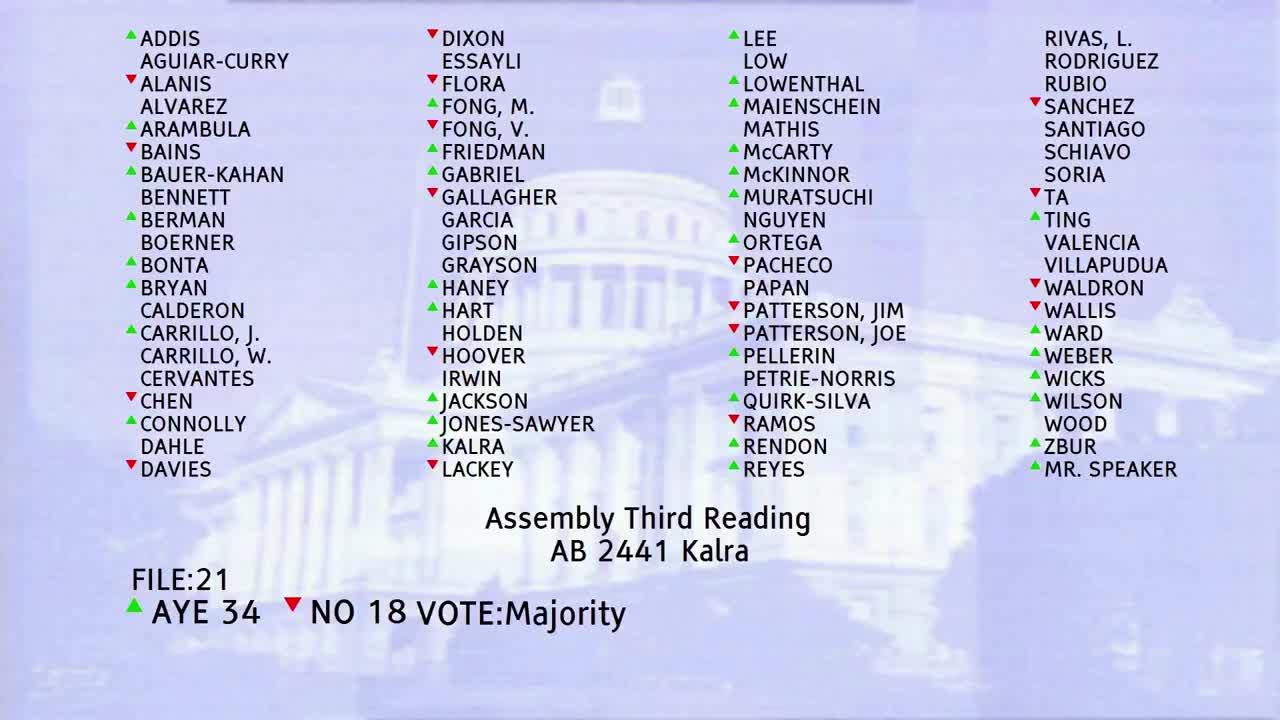
Bill Author
Bill Co-Author(s):