AB 2729: Development projects: permits and other entitlements.
- Session Year: 2023-2024
- House: Assembly
- Latest Version Date: 2024-09-27
Current Status:
Passed
(2024-09-27: Chaptered by Secretary of State - Chapter 737, Statutes of 2024.)
Introduced
In Committee
First Chamber
In Committee
Second Chamber
Enacted
The Planning and Zoning Law requires each county and each city to adopt a comprehensive, long-term general plan for its physical development, and the development of specified land outside its boundaries, that includes, among other mandatory elements, a housing element. Existing law, the Permit Streamlining Act, among other things, requires a public agency that is the lead agency for a development project to approve or disapprove that project within specified time periods. Existing law extended by 18 months the period for the expiration, effectuation, or utilization of a housing entitlement, as defined, that was issued before, and was in effect on, March 4, 2020, and that would expire before December 31, 2021, except as specified. Existing law provides that if the state or a local agency extended the otherwise applicable time for the expiration, effectuation, or utilization of a housing entitlement for not less than 18 months, as specified, that housing entitlement would not be extended an additional 18 months pursuant to these provisions.
This bill would extend by 18 months the period for the expiration, effectuation, or utilization of a housing entitlement, as defined, that was issued before January 1, 2024, and that will expire before December 31, 2025, except as specified. The bill would toll this 18-month extension during any time that the housing entitlement is the subject of a legal challenge. By adding to the duties of local officials with respect to housing entitlements, this bill would impose a state-mandated local program. The bill would include findings that changes proposed by this bill address a matter of statewide concern rather than a municipal affair and, therefore, apply to all cities, including charter cities.
The California Constitution requires the state to reimburse local agencies and school districts for certain costs mandated by the state. Statutory provisions establish procedures for making that reimbursement.
This bill would provide that no reimbursement is required by this act for a specified reason.
The Planning and Zoning Law requires each county and each city to adopt a comprehensive, long-term general plan for its physical development, and the development of specified land outside its boundaries, that includes, among other mandatory elements, a housing element. Existing law, the Permit Streamlining Act, among other things, requires a public agency that is the lead agency for a development project to approve or disapprove that project within specified time periods. Existing law extended by 18 months the period for the expiration, effectuation, or utilization of a housing entitlement, as defined, that was issued before, and was in effect on, March 4, 2020, and that would expire before December 31, 2021, except as specified. Existing law provides that if the state or a local agency extended the otherwise applicable time for the expiration, effectuation, or utilization of a housing entitlement for not less than 18 months, as specified, that housing entitlement would not be extended an additional 18 months pursuant to these provisions.
This bill would extend by 18 months the period for the expiration, effectuation, or utilization of a housing entitlement, as defined, that was issued before January 1, 2024, and that will expire before December 31, 2025, except as specified. The bill would toll this 18-month extension during any time that the housing entitlement is the subject of a legal challenge. By adding to the duties of local officials with respect to housing entitlements, this bill would impose a state-mandated local program. The bill would include findings that changes proposed by this bill address a matter of statewide concern rather than a municipal affair and, therefore, apply to all cities, including charter cities.
Existing law prohibits a local agency that imposes fees or charges on a residential development for the construction of public improvements or facilities from requiring the payment of those fees or charges until the date of the final inspection or the date the certificate of occupancy is issued, whichever occurs first. However, under existing law, a local agency is authorized to collect utility service fees at the time an application for utility service is received, and a local agency is authorized to require payment sooner if the local agency determines that the fees or charges will be collected for public improvements or facilities for which an account has been established and funds appropriated and for which the local agency has adopted a proposed construction schedule or plan prior to final inspection or issuance of the certificate of occupancy, or if the fees or charges are to reimburse the local agency for expenditures previously made.This bill would limit the utility service fees authorized to be collected at the time an application for utility service is received to utility service fees related to capacity charge connections. The bill would specify the circumstances under which a local agency may require payment of fees or charges at earlier times for designated residential development projects, as defined, including authorizing the local agency to require the payment of those fees and charges at the time the local agency issues a permit if the local agency determines, and provides supporting documentation to the applicant establishing, that construction for the public improvement or facility for which the fee or charge is required has commenced or will commence within 24 months of the issuance of the permit, as specified.The California Constitution requires the state to reimburse local agencies and school districts for certain costs mandated by the state. Statutory provisions establish procedures for making that reimbursement.
This bill would provide that no reimbursement is required by this act for a specified reason.
The Planning and Zoning Law requires each county and each city to adopt a comprehensive, long-term general plan for its physical development, and the development of specified land outside its boundaries, that includes, among other mandatory elements, a housing element. Existing law, the Permit Streamlining Act, among other things, requires a public agency that is the lead agency for a development project to approve or disapprove that project within specified time periods. Existing law extended by 18 months the period for the expiration, effectuation, or utilization of a housing entitlement, as defined, that was issued before, and was in effect on, March 4, 2020, and that would expire before December 31, 2021, except as specified. Existing law provides that if the state or a local agency extended the otherwise applicable time for the expiration, effectuation, or utilization of a housing entitlement for not less than 18 months, as specified, that housing entitlement would not be extended an additional 18 months pursuant to these provisions.
This bill would extend by 18 months the period for the expiration, effectuation, or utilization of a housing entitlement, as defined, that was issued before January 1, 2024, and that will expire before December 31, 2025, except as specified. The bill would toll this 18-month extension during any time that the housing entitlement is the subject of a legal challenge. By adding to the duties of local officials with respect to housing entitlements, this bill would impose a state-mandated local program. The bill would include findings that changes proposed by this bill address a matter of statewide concern rather than a municipal affair and, therefore, apply to all cities, including charter cities.
Existing law prohibits a local agency that imposes fees or charges on a residential development for the construction of public improvements or facilities from requiring the payment of those fees or charges until the date of the final inspection or the date the certificate of occupancy is issued, whichever occurs first. However, under existing law, a local agency is authorized to collect utility service fees at the time an application for utility service is received, and a local agency is authorized to require payment sooner if the local agency determines that the fees or charges will be collected for public improvements or facilities for which an account has been established and funds appropriated and for which the local agency has adopted a proposed construction schedule or plan prior to final inspection or issuance of the certificate of occupancy, or if the fees or charges are to reimburse the local agency for expenditures previously made.
This bill would limit the utility service fees authorized to be collected at the time an application for utility service is received to utility service fees related to capacity charge connections. The bill would delete the above-described authorization for a local agency to require payment of fees or charges prior to the date of final inspection or issuance of the certificate of occupancy, whichever occurs first, and would instead authorize a specify the circumstances under which a local agency to may require payment of fees or charges at earlier times if any of certain circumstances are satisfied, for designated residential development projects, as defined, including authorizing the local agency to require the payment of those fees and charges at the time the local agency issues a permit if the local agency determines, and provides supporting documentation to the applicant establishing, that construction for the public improvement or facility for which the fee or charge is required has commenced or will commence within 24 months of the issuance of the permit, as specified.
The California Constitution requires the state to reimburse local agencies and school districts for certain costs mandated by the state. Statutory provisions establish procedures for making that reimbursement.
This bill would provide that no reimbursement is required by this act for a specified reason.
Existing law prohibits a local agency that imposes fees or charges on a residential development for the construction of public improvements or facilities from requiring the payment of those fees or charges until the date of the final inspection or the date the certificate of occupancy is issued, whichever occurs first. However, under existing law, a local agency is authorized to collect utility service fees at the time an application for utility service is received, and a local agency is authorized to require payment sooner if the local agency determines that the fees or charges will be collected for public improvements or facilities for which an account has been established and funds appropriated and for which the local agency has adopted a proposed construction schedule or plan prior to final inspection or issuance of the certificate of occupancy, or if the fees or charges are to reimburse the local agency for expenditures previously made.
This bill would limit the utility service fees authorized to be collected at the time an application for utility service is received to utility service fees related to capacity charge connections. The bill would delete the above-described authorization for a local agency to require payment of fees or charges prior to the date of final inspection or issuance of the certificate of occupancy, whichever occurs first, and would instead authorize a local agency to require payment of fees or charges at earlier times if any of certain circumstances are satisfied, including authorizing the local agency to require the payment of those fees and charges at the time the local agency issues a permit if the local agency determines, and provides supporting documentation to the applicant establishing, that construction for the public improvement or facility for which the fee or charge is required has commenced or will commence within 24 months of the issuance of the permit, as specified.
Existing law prohibits a local agency that imposes fees or charges on a residential development for the construction of public improvements or facilities from requiring the payment of those fees or charges until the date of the final inspection or the date the certificate of occupancy is issued, whichever occurs first, except that the payment may be required first. However, under existing law, a local agency is authorized to collect utility service fees at the time an application for utility service is received, and a local agency is authorized to require payment sooner if the local agency determines that the fees or charges will be collected for public improvements or facilities for which an account has been established and funds appropriated and for which the local agency has adopted a proposed construction schedule or plan prior to final inspection or issuance of the certificate of occupancy, or if the fees or charges are to reimburse the local agency for expenditures previously made.
This bill would limit the utility service fees authorized to be collected at the time an application for utility service is received to utility service fees related to capacity charge connections. The bill would delete the above-described authorization for a local agency to require payment of fees or charges prior to the date of final inspection or issuance of the certificate of occupancy, whichever occurs first. first, and would instead authorize a local agency to require payment of fees or charges at earlier times if any of certain circumstances are satisfied, including authorizing the local agency to require the payment of those fees and charges at the time the local agency issues a permit if the local agency determines, and provides supporting documentation to the applicant establishing, that construction for the public improvement or facility for which the fee or charge is required has commenced or will commence within 24 months of the issuance of the permit, as specified.
Existing law prohibits a local agency that imposes fees or charges on a residential development for the construction of public improvements or facilities from requiring the payment of those fees or charges until the date of the final inspection or the date the certificate of occupancy is issued, whichever occurs first, except that the payment may be required sooner if the local agency determines that the fees or charges will be collected for public improvements or facilities for which an account has been established and funds appropriated and for which the local agency has adopted a proposed construction schedule or plan prior to final inspection or issuance of the certificate of occupancy, or if the fees or charges are to reimburse the local agency for expenditures previously made.
This bill would delete the above-described authorization for a local agency to require payment of fees or charges prior to the date of final inspection or issuance of the certificate of occupancy, whichever occurs first.
(a)Except as provided in subdivision (b), notwithstanding any law, including any inconsistent provision of a local agencys general plan, ordinances, or regulations, the otherwise applicable time for the expiration, effectuation, or utilization of a housing entitlement that is within the scope of the timeframes specified in paragraphs (1) and (2) is extended by 18 months. For the purposes of this section, housing entitlements that are extended are entitlements where both of the following apply:
(1)It was issued prior to and was in effect on January 1, 2024.
(2)It will expire prior to December 31, 2025.
The otherwise applicable time for the utilization of a housing entitlement provided by this section includes any requirement to request the issuance of a building permit within a specified period of time.
(b)If the state or a local agency extends, on or after January 1, 2024, but before the effective date of the act adding this section, the otherwise applicable time for the expiration, effectuation, or utilization of a housing entitlement for not less than 18 months and pursuant to the same conditions provided in subdivision (a), that housing entitlement shall not be extended for an additional 18 months by operation of subdivision (a).
(c)For purposes of this section, the following definitions apply:
(1)Housing entitlement means any of the following:
(A)A legislative, adjudicative, administrative, or any other kind of approval, permit, or other entitlement necessary for, or pertaining to, a housing development project issued by a state agency.
(B)An approval, permit, or other entitlement issued by a local agency for a housing development project that is subject to Chapter 4.5 (commencing with Section 65920).
(C)A ministerial approval, permit, or entitlement by a local agency required as a prerequisite to issuance of a building permit for a housing development project.
(D)A requirement to submit an application for a building permit within a specified period of time after the effective date of a housing entitlement described in subparagraph (B) or (C).
(E)A tentative map, vesting tentative map, or parcel map for which a tentative map or vesting tentative map, as the case may be, has been approved.
(F)A vested right associated with an approval, permit, or other entitlement described in subparagraphs (A) to (E), inclusive.
(2)For the purposes of this section, a housing entitlement does not include any of the following:
(A)A development agreement issued pursuant to Article 2.5 (commencing with Section 65864).
(B)An approved or conditionally approved tentative map that is extended for a minimum of 24 months pursuant to Section 66452.6 on or after January 1, 2024.
(C)A preliminary application as defined in Section 65941.1.
(3)Housing development project means a residential development or mixed-use development in which at least two-thirds of the square footage of the development is designated for residential use. Both of the following apply for the purposes of calculating the square footage usage of a development for purposes of this section:
(A)The square footage of a development shall include any additional density, floor area, and units, and any other concession, incentive, or waiver of development standards pursuant to Section 65915.
(B)The square footage of a development shall not include any underground space, including, but not limited to, a basement or underground parking garage.
(4)Local agency means a county, city, whether general law or chartered, city and county, school district, special district, authority, agency, any other municipal public corporation or district, or other political subdivision of the state.
(d)The extension granted pursuant to subdivision (a) shall be tolled during any time that the housing entitlement is the subject of a legal challenge.
(e)Nothing in this section is intended to preclude a local government from exercising its existing authority to provide an extension to an entitlement identified in this section.
(f)The Legislature finds and declares that ensuring planned housing projects can continue without delays due to expiring entitlements is a matter of statewide concern and is not a municipal affair as that term is used in Section 5 of Article XI of the California Constitution. Therefore, this section applies to all cities, including charter cities.
SEC. 2.No reimbursement is required by this act pursuant to Section 6 of Article XIIIB of the California Constitution because a local agency or school district has the authority to levy service charges, fees, or assessments sufficient to pay for the program or level of service mandated by this act, within the meaning of Section 17556 of the Government Code.
(a)Except as provided in subdivision (b), notwithstanding any law, including any inconsistent provision of a local agencys general plan, ordinances, or regulations, the otherwise applicable time for the expiration, effectuation, or utilization of a housing entitlement that is within the scope of the timeframes specified in paragraphs (1) and (2) is extended by 18 months. For the purposes of this section, housing entitlements that are extended are entitlements where both of the following apply:
(1)It was issued prior to and was in effect on January 1, 2024.
(2)It will expire prior to December 31, 2025.
The otherwise applicable time for the utilization of a housing entitlement provided by this section includes any requirement to request the issuance of a building permit within a specified period of time.
(b)If the state or a local agency extends, on or after January 1, 2024, but before the effective date of the act adding this section, the otherwise applicable time for the expiration, effectuation, or utilization of a housing entitlement for not less than 18 months and pursuant to the same conditions provided in subdivision (a), that housing entitlement shall not be extended for an additional 18 months by operation of subdivision (a).
(c)For purposes of this section, the following definitions apply:
(1)Housing entitlement means any of the following:
(A)A legislative, adjudicative, administrative, or any other kind of approval, permit, or other entitlement necessary for, or pertaining to, a housing development project issued by a state agency.
(B)An approval, permit, or other entitlement issued by a local agency for a housing development project that is subject to Chapter 4.5 (commencing with Section 65920).
(C)A ministerial approval, permit, or entitlement by a local agency required as a prerequisite to issuance of a building permit for a housing development project.
(D)A requirement to submit an application for a building permit within a specified period of time after the effective date of a housing entitlement described in subparagraph (B) or (C).
(E)A tentative map, vesting tentative map, or parcel map for which a tentative map or vesting tentative map, as the case may be, has been approved.
(E)(F)A vested right associated with an approval, permit, or other entitlement described in subparagraphs (A) to (D), (E), inclusive.
(2)For the purposes of this section, a housing entitlement does not include any of the following:
(A)A development agreement issued pursuant to Article 2.5 (commencing with Section 65864).
(B)An approved or conditionally approved tentative map that is extended for a minimum of 24 months pursuant to Section 66452.6 on or after January 1, 2024.
(C)A preliminary application as defined in Section 65941.1.
(3)Housing development project means a residential development or mixed-use development in which at least two-thirds of the square footage of the development is designated for residential use. Both of the following apply for the purposes of calculating the square footage usage of a development for purposes of this section:
(A)The square footage of a development shall include any additional density, floor area, and units, and any other concession, incentive, or waiver of development standards pursuant to Section 65915.
(B)The square footage of a development shall not include any underground space, including, but not limited to, a basement or underground parking garage.
(4)Local agency means a county, city, whether general law or chartered, city and county, school district, special district, authority, agency, any other municipal public corporation or district, or other political subdivision of the state.
(d)The extension granted pursuant to subdivision (a) shall be tolled during any time that the housing entitlement is the subject of a legal challenge.
(e)Nothing in this section is intended to preclude a local government from exercising its existing authority to provide an extension to an entitlement identified in this section.
(f)The Legislature finds and declares that ensuring planned housing projects can continue without delays due to expiring entitlements is a matter of statewide concern and is not a municipal affair as that term is used in Section 5 of Article XI of the California Constitution. Therefore, this section applies to all cities, including charter cities.
SEC. 2.Section 66007 of the Government Code is amended to read:66007.(a)Except as otherwise provided in subdivision (b), any local agency that imposes any fees or charges on a residential development for the construction of public improvements or facilities shall not require the payment of those fees or charges, notwithstanding any other provision of law, until the date of the final inspection, or the date the certificate of occupancy is issued, whichever occurs first. However, utility service fees related to capacity charge connections may be collected at the time an application for utility service is received. If the residential development contains more than one dwelling, the local agency may determine whether the fees or charges shall be paid on a pro rata basis for each dwelling when it receives its final inspection or certificate of occupancy, whichever occurs first; on a pro rata basis when a certain percentage of the dwellings have received their final inspection or certificate of occupancy, whichever occurs first; or on a lump-sum basis when the first dwelling in the development receives its final inspection or certificate of occupancy, whichever occurs first. The amount of fees and charges shall be the same amount as would have been paid had the fees and charges been paid prior to the issuance of building permits and the local agency shall not charge interest or other fees on any amount deferred pursuant to this section.(b)Except as provided in subdivision (c), a local agency may do any of the following:(1)(A)Defer the collection of one or more fees up to the close of escrow.(B)This paragraph does not apply to fees and charges levied pursuant to Chapter 6 (commencing with Section 17620) of Part 10.5 of Division 1 of Title 1 of the Education Code.(2)(A)Require the payment of those fees or charges at an earlier time if either of the following conditions is met:(i)The local agency determines that the fees or charges will be collected for public improvements or facilities for which an account has been established and funds appropriated and for which the local agency has adopted a proposed construction schedule or plan prior to final inspection or issuance of the certificate of occupancy.(ii)The fees or charges are to reimburse the local agency for expenditures previously made.(B)Methods of complying with the requirement in clause (i) of subparagraph (A) that a proposed construction schedule or plan be adopted, include, but are not limited to, either of the following:(i)The adoption of the capital improvement plan described in Section 66002.(ii)The submittal of a five-year plan for construction and rehabilitation of school facilities pursuant to subdivision (c) of Section 17017.5 of the Education Code.(C)For purposes of this paragraph, appropriated means authorization by the governing body of the local agency for which the fee is collected to make expenditures and incur obligations for specific purposes.(3)All of the following apply to a designated residential development project:(A)If a local agency imposes any fees or charges described in subdivision (a) on the development for the construction of public improvements or facilities, then all of the following conditions apply: (i)The local agency may only require the payment of the fees or charges at the time the local agency issues a permit if the local agency determines, and provides supporting documentation to the applicant establishing, that construction for the public improvement or facility for which the fee or charge is required has commenced or will commence within 24 months of the issuance of the permit.(ii)If the construction does not commence within the timeframe described in clause (i) and the local agency has collected moneys pursuant to clause (i), the local government shall return the moneys to the applicant and the fees or charges shall be due at the time of the final inspection, or the date the certificate of occupancy is issued, whichever occurs first.(iii)Notwithstanding clause (ii), the local agency shall not be required to return any moneys that meet either of the following conditions:(I)The moneys are pledged to debt service.(II)The moneys are needed to make required payments under a design or construction contract for the construction of the public improvements. (B)Notwithstanding subparagraph (A), a local agency may require the payment of fees or charges described in subdivision (a) at the time the local agency issues a building permit if any of the following conditions apply:(i)The fees or charges are to reimburse the local agency for expenditures previously made.(ii)The fees or charges are pledged to debt service.(iii)The fees or charges are to reimburse another developer under a reimbursement agreement pursuant to Section 66486. (C)A local agency may require the payment of bond or other interest-bearing instrument fees or costs that are related to the development of public improvements or facilities at the time the local agency issues a building permit if the local agency provides evidence to the entity charged of the costs associated with the bond or other interest-bearing instrument at the time the local agency requires the payment.(D)For the purposes of this paragraph, designated residential development project means a residential development project that meets any of the following conditions:(i)The project dedicates 100 percent of units, exclusive of a managers unit or units, to lower income households, as defined by Section 50079.5 of the Health and Safety Code.(ii)The project meets the requirements described in Section 65662.(iii)The project is approved by a local government pursuant to Article 2 (commencing with Section 65912.110) or Article 3 (commencing with Section 65912.120) of Chapter 4.1.(iv)The project meets the requirements described in subdivision (a) of Section 65913.4.(v)The project meets the criteria described in subdivision (c) of Section 65913.16.(vi)The project is entitled to a density bonus pursuant to subdivision (b) of Section 65915.(vii)The project includes 10 or fewer units.(E)This paragraph does not apply to fees and charges levied pursuant to Chapter 6 (commencing with Section 17620) of Part 10.5 of Division 1 of Title 1 of the Education Code.(c)(1)Subdivision (b) does not apply to units reserved for occupancy by lower income households included in a residential development proposed by a nonprofit housing developer in which at least 49 percent of the total units are reserved for occupancy by lower income households, as defined in Section 50079.5 of the Health and Safety Code, at an affordable rent, as defined in Section 50053 of the Health and Safety Code, unless the fees and charges are levied pursuant to Chapter 6 (commencing with Section 17620) of Part 10.5 of Division 1 of Title 1 of the Education Code.(2)In addition to the contract that may be required under subdivision (d), a city, county, or city and county may require the posting of a performance bond or a letter of credit from a federally insured, recognized depository institution to guarantee payment of any fees or charges that are subject to paragraph (1).(3)Fees and charges described in paragraph (1) shall become immediately due and payable when the residential development no longer meets the requirements of that paragraph.(d)(1)If any fee or charge specified in subdivision (a) is not fully paid prior to issuance of a building permit for construction of any portion of the residential development encumbered thereby, the local agency issuing the building permit may require the property owner, or lessee if the lessees interest appears of record, as a condition of issuance of the building permit, to execute a contract to pay the fee or charge, or applicable portion thereof, within the time specified in subdivision (a). If the fee or charge is prorated pursuant to subdivision (a), the obligation under the contract shall be similarly prorated.(2)The obligation to pay the fee or charge shall inure to the benefit of, and be enforceable by, the local agency that imposed the fee or charge, regardless of whether it is a party to the contract. The contract shall contain a legal description of the property affected, shall be recorded in the office of the county recorder of the county and, from the date of recordation, shall constitute a lien for the payment of the fee or charge, which shall be enforceable against successors in interest to the property owner or lessee at the time of issuance of the building permit. The contract shall be recorded in the grantor-grantee index in the name of the public agency issuing the building permit as grantee and in the name of the property owner or lessee as grantor. The local agency shall record a release of the obligation, containing a legal description of the property, in the event the obligation is paid in full, or a partial release in the event the fee or charge is prorated pursuant to subdivision (a).(3)The contract may require the property owner or lessee to provide appropriate notification of the opening of any escrow for the sale of the property for which the building permit was issued and to provide in the escrow instructions that the fee or charge be paid to the local agency imposing the same from the sale proceeds in escrow prior to disbursing proceeds to the seller.(e)This section applies only to fees collected by a local agency to fund the construction of public improvements or facilities. It does not apply to fees collected to cover the cost of code enforcement or inspection services, or to other fees collected to pay for the cost of enforcement of local ordinances or state law.(f)Final inspection or certificate of occupancy, as used in this section, have the same meaning as described in Sections 305 and 307 of the Uniform Building Code, International Conference of Building Officials, 1985 edition.SEC. 3.SEC. 2.No reimbursement is required by this act pursuant to Section 6 of Article XIIIB of the California Constitution because a local agency or school district has the authority to levy service charges, fees, or assessments sufficient to pay for the program or level of service mandated by this act, within the meaning of Section 17556 of the Government Code.
(a)Except as provided in subdivision (b), notwithstanding any law, including any inconsistent provision of a local agencys general plan, ordinances, or regulations, the otherwise applicable time for the expiration, effectuation, or utilization of a housing entitlement that is within the scope of the timeframes specified in paragraphs (1) and (2) is extended by 18 months. For the purposes of this section, housing entitlements that are extended are entitlements where both of the following apply:
(1)It was issued prior to and was in effect on January 1, 2024.
(2)It will expire prior to December 31, 2025.
The otherwise applicable time for the utilization of a housing entitlement provided by this section includes any requirement to request the issuance of a building permit within a specified period of time.
(b)If the state or a local agency extends, on or after January 1, 2024, but before the effective date of the act adding this section, the otherwise applicable time for the expiration, effectuation, or utilization of a housing entitlement for not less than 18 months and pursuant to the same conditions provided in subdivision (a), that housing entitlement shall not be extended for an additional 18 months by operation of subdivision (a).
(c)For purposes of this section, the following definitions apply:
(1)Housing entitlement means any of the following:
(A)A legislative, adjudicative, administrative, or any other kind of approval, permit, or other entitlement necessary for, or pertaining to, a housing development project issued by a state agency.
(B)An approval, permit, or other entitlement issued by a local agency for a housing development project that is subject to Chapter 4.5 (commencing with Section 65920).
(C)A ministerial approval, permit, or entitlement by a local agency required as a prerequisite to issuance of a building permit for a housing development project.
(D)A requirement to submit an application for a building permit within a specified period of time after the effective date of a housing entitlement described in subparagraph (B) or (C).
(E)A vested right associated with an approval, permit, or other entitlement described in subparagraphs (A) to (D), inclusive.
(2)For the purposes of this section, a housing entitlement does not include any of the following:
(A)A development agreement issued pursuant to Article 2.5 (commencing with Section 65864).
(B)An approved or conditionally approved tentative map that is extended for a minimum of 24 months pursuant to Section 66452.6 on or after January 1, 2024.
(C)A preliminary application as defined in Section 65941.1.
(3)Housing development project means a residential development or mixed-use development in which at least two-thirds of the square footage of the development is designated for residential use. Both of the following apply for the purposes of calculating the square footage usage of a development for purposes of this section:
(A)The square footage of a development shall include any additional density, floor area, and units, and any other concession, incentive, or waiver of development standards pursuant to Section 65915.
(B)The square footage of a development shall not include any underground space, including, but not limited to, a basement or underground parking garage.
(4)Local agency means a county, city, whether general law or chartered, city and county, school district, special district, authority, agency, any other municipal public corporation or district, or other political subdivision of the state.
(d)The extension granted pursuant to subdivision (a) shall be tolled during any time that the housing entitlement is the subject of a legal challenge.
(e)Nothing in this section is intended to preclude a local government from exercising its existing authority to provide an extension to an entitlement identified in this section.
(f)The Legislature finds and declares that ensuring planned housing projects can continue without delays due to expiring entitlements is a matter of statewide concern and is not a municipal affair as that term is used in Section 5 of Article XI of the California Constitution. Therefore, this section applies to all cities, including charter cities.
SECTION 1.SEC. 2.Section 66007 of the Government Code is amended to read:66007.(a)Except as otherwise provided in subdivision (b), any local agency that imposes any fees or charges on a residential development for the construction of public improvements or facilities shall not require the payment of those fees or charges, notwithstanding any other provision of law, until the date of the final inspection, or the date the certificate of occupancy is issued, whichever occurs first. However, utility service fees related to capacity charge connections may be collected at the time an application for utility service is received. If the residential development contains more than one dwelling, the local agency may determine whether the fees or charges shall be paid on a pro rata basis for each dwelling when it receives its final inspection or certificate of occupancy, whichever occurs first; on a pro rata basis when a certain percentage of the dwellings have received their final inspection or certificate of occupancy, whichever occurs first; or on a lump-sum basis when the first dwelling in the development receives its final inspection or certificate of occupancy, whichever occurs first. The amount of fees and charges shall be the same amount as would have been paid had the fees and charges been paid prior to the issuance of building permits and the local agency shall not charge interest or other fees on any amount deferred pursuant to this section.
(b)Except as provided in subdivision (c), a local agency may do any of the following:
(1)(A)Defer the collection of one or more fees up to the close of escrow.
(B)This paragraph does not apply to fees and charges levied pursuant to Chapter 6 (commencing with Section 17620) of Part 10.5 of Division 1 of Title 1 of the Education Code.
(2)(A)Require the payment of those fees or charges at an earlier time if either of the following conditions is met:
(i)The local agency determines that the fees or charges will be collected for public improvements or facilities for which an account has been established and funds appropriated and for which the local agency has adopted a proposed construction schedule or plan prior to final inspection or issuance of the certificate of occupancy.
(ii)The fees or charges are to reimburse the local agency for expenditures previously made.
(B)Methods of complying with the requirement in clause (i) of subparagraph (A) that a proposed construction schedule or plan be adopted, include, but are not limited to, either of the following:
(i)The adoption of the capital improvement plan described in Section 66002.
(ii)The submittal of a five-year plan for construction and rehabilitation of school facilities pursuant to subdivision (c) of Section 17017.5 of the Education Code.
(C)For purposes of this paragraph, appropriated means authorization by the governing body of the local agency for which the fee is collected to make expenditures and incur obligations for specific purposes.
(3)All of the following apply to a designated residential development project:
(A)If a local agency imposes any fees or charges described in subdivision (a) on the development for the construction of public improvements or facilities, then all of the following conditions apply:
(2)(A)Require(i)The local agency may only require the payment of the fees or charges described in subdivision (a) at the time the local agency issues a permit if the local agency determines, and provides supporting documentation to the applicant establishing, that construction for the public improvement or facility for which the fee or charge is required has commenced or will commence within 24 months of the issuance of the permit.
(B)(ii)If the construction does not commence within the timeframe described in subparagraph (A) clause (i) and the local agency has collected moneys pursuant to subparagraph (A), clause (i), the local government shall return the moneys to the applicant and the fees or charges shall be due at the time of the final inspection, or the date the certificate of occupancy is issued, whichever occurs first.
(iii)Notwithstanding clause (ii), the local agency shall not be required to return any moneys that meet either of the following conditions:
(I)The moneys are pledged to debt service.
(II)The moneys are needed to make required payments under a design or construction contract for the construction of the public improvements.
(3)Require(B)Notwithstanding subparagraph (A), a local agency may require the payment of fees or charges described in subdivision (a) at the time the local agency issues a building permit to reimburse the local agency for planning fees or charges that the local agency has already expended related to the public improvements or facilities. if any of the following conditions apply:
(i)The fees or charges are to reimburse the local agency for expenditures previously made.
(ii)The fees or charges are pledged to debt service.
(iii)The fees or charges are to reimburse another developer under a reimbursement agreement pursuant to Section 66486.
(4)Require(C)A local agency may require the payment of bond or other interest-bearing instrument fees or costs that are related to the development of public improvements or facilities at the time the local agency issues a building permit if the local agency provides evidence to the entity charged of the costs associated with the bond or other interest-bearing instrument at the time the local agency requires the payment.
(D)For the purposes of this paragraph, designated residential development project means a residential development project that meets any of the following conditions:
(i)The project dedicates 100 percent of units, exclusive of a managers unit or units, to lower income households, as defined by Section 50079.5 of the Health and Safety Code.
(ii)The project meets the requirements described in Section 65662.
(iii)The project is approved by a local government pursuant to Article 2 (commencing with Section 65912.110) or Article 3 (commencing with Section 65912.120) of Chapter 4.1.
(iv)The project meets the requirements described in subdivision (a) of Section 65913.4.
(v)The project meets the criteria described in subdivision (c) of Section 65913.16.
(vi)The project is entitled to a density bonus pursuant to subdivision (b) of Section 65915.
(vii)The project includes 10 or fewer units.
(E)This paragraph does not apply to fees and charges levied pursuant to Chapter 6 (commencing with Section 17620) of Part 10.5 of Division 1 of Title 1 of the Education Code.
(c)(1)Subdivision (b) does not apply to units reserved for occupancy by lower income households included in a residential development proposed by a nonprofit housing developer in which at least 49 percent of the total units are reserved for occupancy by lower income households, as defined in Section 50079.5 of the Health and Safety Code, at an affordable rent, as defined in Section 50053 of the Health and Safety Code, unless the fees and charges are levied pursuant to Chapter 6 (commencing with Section 17620) of Part 10.5 of Division 1 of Title 1 of the Education Code.
(2)In addition to the contract that may be required under subdivision (d), a city, county, or city and county may require the posting of a performance bond or a letter of credit from a federally insured, recognized depository institution to guarantee payment of any fees or charges that are subject to paragraph (1).
(3)Fees and charges described in paragraph (1) shall become immediately due and payable when the residential development no longer meets the requirements of that paragraph.
(d)(1)If any fee or charge specified in subdivision (a) is not fully paid prior to issuance of a building permit for construction of any portion of the residential development encumbered thereby, the local agency issuing the building permit may require the property owner, or lessee if the lessees interest appears of record, as a condition of issuance of the building permit, to execute a contract to pay the fee or charge, or applicable portion thereof, within the time specified in subdivision (a). If the fee or charge is prorated pursuant to subdivision (a), the obligation under the contract shall be similarly prorated.
(2)The obligation to pay the fee or charge shall inure to the benefit of, and be enforceable by, the local agency that imposed the fee or charge, regardless of whether it is a party to the contract. The contract shall contain a legal description of the property affected, shall be recorded in the office of the county recorder of the county and, from the date of recordation, shall constitute a lien for the payment of the fee or charge, which shall be enforceable against successors in interest to the property owner or lessee at the time of issuance of the building permit. The contract shall be recorded in the grantor-grantee index in the name of the public agency issuing the building permit as grantee and in the name of the property owner or lessee as grantor. The local agency shall record a release of the obligation, containing a legal description of the property, in the event the obligation is paid in full, or a partial release in the event the fee or charge is prorated pursuant to subdivision (a).
(3)The contract may require the property owner or lessee to provide appropriate notification of the opening of any escrow for the sale of the property for which the building permit was issued and to provide in the escrow instructions that the fee or charge be paid to the local agency imposing the same from the sale proceeds in escrow prior to disbursing proceeds to the seller.
(e)This section applies only to fees collected by a local agency to fund the construction of public improvements or facilities. It does not apply to fees collected to cover the cost of code enforcement or inspection services, or to other fees collected to pay for the cost of enforcement of local ordinances or state law.
(f)Final inspection or certificate of occupancy, as used in this section, have the same meaning as described in Sections 305 and 307 of the Uniform Building Code, International Conference of Building Officials, 1985 edition.
SEC. 3.No reimbursement is required by this act pursuant to Section 6 of Article XIIIB of the California Constitution because a local agency or school district has the authority to levy service charges, fees, or assessments sufficient to pay for the program or level of service mandated by this act, within the meaning of Section 17556 of the Government Code.
(a)Except as otherwise provided in subdivision (b), any local agency that imposes any fees or charges on a residential development for the construction of public improvements or facilities shall not require the payment of those fees or charges, notwithstanding any other provision of law, until the date of the final inspection, or the date the certificate of occupancy is issued, whichever occurs first. However, utility service fees related to capacity charge connections may be collected at the time an application for utility service is received. If the residential development contains more than one dwelling, the local agency may determine whether the fees or charges shall be paid on a pro rata basis for each dwelling when it receives its final inspection or certificate of occupancy, whichever occurs first; on a pro rata basis when a certain percentage of the dwellings have received their final inspection or certificate of occupancy, whichever occurs first; or on a lump-sum basis when the first dwelling in the development receives its final inspection or certificate of occupancy, whichever occurs first. The amount of fees and charges shall be the same amount as would have been paid had the fees and charges been paid prior to the issuance of building permits and the local agency shall not charge interest or other fees on any amount deferred pursuant to this section.
(b)Except as provided in subdivision (c), a local agency may do any of the following:
(1)(A)Defer the collection of one or more fees up to the close of escrow.
(B)This paragraph does not apply to fees and charges levied pursuant to Chapter 6 (commencing with Section 17620) of Part 10.5 of Division 1 of Title 1 of the Education Code.
(2)(A)Require the payment of fees or charges described in subdivision (a) at the time the local agency issues a permit if the local agency determines, and provides supporting documentation to the applicant establishing, that construction for the public improvement or facility for which the fee or charge is required has commenced or will commence within 24 months of the issuance of the permit.
(B)If the construction does not commence within the timeframe described in subparagraph (A) and the local agency has collected moneys pursuant to subparagraph (A), the local government shall return the moneys to the applicant and the fees or charges shall be due at the time of the final inspection, or the date the certificate of occupancy is issued, whichever occurs first.
(3)Require the payment of fees or charges described in subdivision (a) at the time the local agency issues a building permit to reimburse the local agency for planning fees or charges that the local agency has already expended related to the public improvements or facilities.
(4)Require the payment of bond or other interest-bearing instrument fees or costs that are related to the development of public improvements or facilities at the time the local agency issues a building permit if the local agency provides evidence to the entity charged of the costs associated with the bond or other interest-bearing instrument at the time the local agency requires the payment.
(c)(1)Subdivision (b) does not apply to units reserved for occupancy by lower income households included in a residential development proposed by a nonprofit housing developer in which at least 49 percent of the total units are reserved for occupancy by lower income households, as defined in Section 50079.5 of the Health and Safety Code, at an affordable rent, as defined in Section 50053 of the Health and Safety Code, unless the fees and charges are levied pursuant to Chapter 6 (commencing with Section 17620) of Part 10.5 of Division 1 of Title 1 of the Education Code.
(2)In addition to the contract that may be required under subdivision (d), a city, county, or city and county may require the posting of a performance bond or a letter of credit from a federally insured, recognized depository institution to guarantee payment of any fees or charges that are subject to this paragraph. paragraph (1).
(3)Fees and charges described in paragraph (1) shall become immediately due and payable when the residential development no longer meets the requirements of that paragraph.
(d)(1)If any fee or charge specified in subdivision (a) is not fully paid prior to issuance of a building permit for construction of any portion of the residential development encumbered thereby, the local agency issuing the building permit may require the property owner, or lessee if the lessees interest appears of record, as a condition of issuance of the building permit, to execute a contract to pay the fee or charge, or applicable portion thereof, within the time specified in subdivision (a). If the fee or charge is prorated pursuant to subdivision (a), the obligation under the contract shall be similarly prorated.
(2)The obligation to pay the fee or charge shall inure to the benefit of, and be enforceable by, the local agency that imposed the fee or charge, regardless of whether it is a party to the contract. The contract shall contain a legal description of the property affected, shall be recorded in the office of the county recorder of the county and, from the date of recordation, shall constitute a lien for the payment of the fee or charge, which shall be enforceable against successors in interest to the property owner or lessee at the time of issuance of the building permit. The contract shall be recorded in the grantor-grantee index in the name of the public agency issuing the building permit as grantee and in the name of the property owner or lessee as grantor. The local agency shall record a release of the obligation, containing a legal description of the property, in the event the obligation is paid in full, or a partial release in the event the fee or charge is prorated pursuant to subdivision (a).
(3)The contract may require the property owner or lessee to provide appropriate notification of the opening of any escrow for the sale of the property for which the building permit was issued and to provide in the escrow instructions that the fee or charge be paid to the local agency imposing the same from the sale proceeds in escrow prior to disbursing proceeds to the seller.
(e)This section applies only to fees collected by a local agency to fund the construction of public improvements or facilities. It does not apply to fees collected to cover the cost of code enforcement or inspection services, or to other fees collected to pay for the cost of enforcement of local ordinances or state law.
(f)Final inspection or certificate of occupancy, as used in this section, have the same meaning as described in Sections 305 and 307 of the Uniform Building Code, International Conference of Building Officials, 1985 edition.
(a)Except as otherwise provided in subdivision (e), (b), any local agency that imposes any fees or charges on a residential development for the construction of public improvements or facilities shall not require the payment of those fees or charges, notwithstanding any other provision of law, until the date of the final inspection, or the date the certificate of occupancy is issued, whichever occurs first. However, utility service fees related to capacity charge connections may be collected at the time an application for utility service is received. If the residential development contains more than one dwelling, the local agency may determine whether the fees or charges shall be paid on a pro rata basis for each dwelling when it receives its final inspection or certificate of occupancy, whichever occurs first; on a pro rata basis when a certain percentage of the dwellings have received their final inspection or certificate of occupancy, whichever occurs first; or on a lump-sum basis when the first dwelling in the development receives its final inspection or certificate of occupancy, whichever occurs first. The amount of fees and charges shall be the same amount as would have been paid had the fees and charges been paid prior to the issuance of building permits and the local agency shall not charge interest or other fees on any amount deferred pursuant to this section.
(b)Except as provided in subdivision (c), a local agency may do any of the following:
(1)(A)Defer the collection of one or more fees up to the close of escrow.
(B)This paragraph does not apply to fees and charges levied pursuant to Chapter 6 (commencing with Section 17620) of Part 10.5 of Division 1 of Title 1 of the Education Code.
(2)(A)Require the payment of fees or charges described in subdivision (a) at the time the local agency issues a permit if the local agency determines, and provides supporting documentation to the applicant establishing, that construction for the public improvement or facility for which the fee or charge is required has commenced or will commence within 24 months of the issuance of the permit.
(B)If the construction does not commence within the timeframe described in subparagraph (A) and the local agency has collected moneys pursuant to subparagraph (A), the local government shall return the moneys to the applicant and the fees or charges shall be due at the time of the final inspection, or the date the certificate of occupancy is issued, whichever occurs first.
(3)Require the payment of fees or charges described in subdivision (a) at the time the local agency issues a building permit to reimburse the local agency for planning fees or charges that the local agency has already expended related to the public improvements or facilities.
(4)Require the payment of bond or other interest-bearing instrument fees or costs that are related to the development of public improvements or facilities at the time the local agency issues a building permit if the local agency provides evidence to the entity charged of the costs associated with the bond or other interest-bearing instrument at the time the local agency requires the payment.
(c)(1)Subdivision (b) does not apply to units reserved for occupancy by lower income households included in a residential development proposed by a nonprofit housing developer in which at least 49 percent of the total units are reserved for occupancy by lower income households, as defined in Section 50079.5 of the Health and Safety Code, at an affordable rent, as defined in Section 50053 of the Health and Safety Code, unless the fees and charges are levied pursuant to Chapter 6 (commencing with Section 17620) of Part 10.5 of Division 1 of Title 1 of the Education Code.
(2)In addition to the contract that may be required under subdivision (d), a city, county, or city and county may require the posting of a performance bond or a letter of credit from a federally insured, recognized depository institution to guarantee payment of any fees or charges that are subject to this paragraph.
(3)Fees and charges described in paragraph (1) shall become immediately due and payable when the residential development no longer meets the requirements of that paragraph.
(b)(d)(1)If any fee or charge specified in subdivision (a) is not fully paid prior to issuance of a building permit for construction of any portion of the residential development encumbered thereby, the local agency issuing the building permit may require the property owner, or lessee if the lessees interest appears of record, as a condition of issuance of the building permit, to execute a contract to pay the fee or charge, or applicable portion thereof, within the time specified in subdivision (a). If the fee or charge is prorated pursuant to subdivision (a), the obligation under the contract shall be similarly prorated.
(2)The obligation to pay the fee or charge shall inure to the benefit of, and be enforceable by, the local agency that imposed the fee or charge, regardless of whether it is a party to the contract. The contract shall contain a legal description of the property affected, shall be recorded in the office of the county recorder of the county and, from the date of recordation, shall constitute a lien for the payment of the fee or charge, which shall be enforceable against successors in interest to the property owner or lessee at the time of issuance of the building permit. The contract shall be recorded in the grantor-grantee index in the name of the public agency issuing the building permit as grantee and in the name of the property owner or lessee as grantor. The local agency shall record a release of the obligation, containing a legal description of the property, in the event the obligation is paid in full, or a partial release in the event the fee or charge is prorated pursuant to subdivision (a).
(3)The contract may require the property owner or lessee to provide appropriate notification of the opening of any escrow for the sale of the property for which the building permit was issued and to provide in the escrow instructions that the fee or charge be paid to the local agency imposing the same from the sale proceeds in escrow prior to disbursing proceeds to the seller.
(c)(e)This section applies only to fees collected by a local agency to fund the construction of public improvements or facilities. It does not apply to fees collected to cover the cost of code enforcement or inspection services, or to other fees collected to pay for the cost of enforcement of local ordinances or state law.
(d)(f)Final inspection or certificate of occupancy, as used in this section, have the same meaning as described in Sections 305 and 307 of the Uniform Building Code, International Conference of Building Officials, 1985 edition.
(e)A local agency may defer the collection of one or more fees up to the close of escrow. This subdivision shall not apply to fees and charges levied pursuant to Chapter 6 (commencing with Section 17620) of Part 10.5 of Division 1 of Title 1 of the Education Code.(a)Except as otherwise provided in subdivisions (b) and (g), subdivision (e), any local agency that imposes any fees or charges on a residential development for the construction of public improvements or facilities shall not require the payment of those fees or charges, notwithstanding any other provision of law, until the date of the final inspection, or the date the certificate of occupancy is issued, whichever occurs first. However, utility service fees may be collected at the time an application for utility service is received. If the residential development contains more than one dwelling, the local agency may determine whether the fees or charges shall be paid on a pro rata basis for each dwelling when it receives its final inspection or certificate of occupancy, whichever occurs first; on a pro rata basis when a certain percentage of the dwellings have received their final inspection or certificate of occupancy, whichever occurs first; or on a lump-sum basis when the first dwelling in the development receives its final inspection or certificate of occupancy, whichever occurs first.
(b)(1)Notwithstanding subdivision (a), the local agency may require the payment of those fees or charges at an earlier time if (A) the local agency determines that the fees or charges will be collected for public improvements or facilities for which an account has been established and funds appropriated and for which the local agency has adopted a proposed construction schedule or plan prior to final inspection or issuance of the certificate of occupancy or (B) the fees or charges are to reimburse the local agency for expenditures previously made. Appropriated, as used in this subdivision, means authorization by the governing body of the local agency for which the fee is collected to make expenditures and incur obligations for specific purposes.(2)(A)Paragraph (1) does not apply to units reserved for occupancy by lower income households included in a residential development proposed by a nonprofit housing developer in which at least 49 percent of the total units are reserved for occupancy by lower income households, as defined in Section 50079.5 of the Health and Safety Code, at an affordable rent, as defined in Section 50053 of the Health and Safety Code. In addition to the contract that may be required under subdivision (c), a city, county, or city and county may require the posting of a performance bond or a letter of credit from a federally insured, recognized depository institution to guarantee payment of any fees or charges that are subject to this paragraph. Fees and charges exempted from paragraph (1) under this paragraph shall become immediately due and payable when the residential development no longer meets the requirements of this paragraph.(B)The exception provided in subparagraph (A) does not apply to fees and charges levied pursuant to Chapter 6 (commencing with Section 17620) of Part 10.5 of Division 1 of Title 1 of the Education Code.(c)(b)(1)If any fee or charge specified in subdivision (a) is not fully paid prior to issuance of a building permit for construction of any portion of the residential development encumbered thereby, the local agency issuing the building permit may require the property owner, or lessee if the lessees interest appears of record, as a condition of issuance of the building permit, to execute a contract to pay the fee or charge, or applicable portion thereof, within the time specified in subdivision (a). If the fee or charge is prorated pursuant to subdivision (a), the obligation under the contract shall be similarly prorated.
(2)The obligation to pay the fee or charge shall inure to the benefit of, and be enforceable by, the local agency that imposed the fee or charge, regardless of whether it is a party to the contract. The contract shall contain a legal description of the property affected, shall be recorded in the office of the county recorder of the county and, from the date of recordation, shall constitute a lien for the payment of the fee or charge, which shall be enforceable against successors in interest to the property owner or lessee at the time of issuance of the building permit. The contract shall be recorded in the grantor-grantee index in the name of the public agency issuing the building permit as grantee and in the name of the property owner or lessee as grantor. The local agency shall record a release of the obligation, containing a legal description of the property, in the event the obligation is paid in full, or a partial release in the event the fee or charge is prorated pursuant to subdivision (a).
(3)The contract may require the property owner or lessee to provide appropriate notification of the opening of any escrow for the sale of the property for which the building permit was issued and to provide in the escrow instructions that the fee or charge be paid to the local agency imposing the same from the sale proceeds in escrow prior to disbursing proceeds to the seller.
(d)(c)This section applies only to fees collected by a local agency to fund the construction of public improvements or facilities. It does not apply to fees collected to cover the cost of code enforcement or inspection services, or to other fees collected to pay for the cost of enforcement of local ordinances or state law.
(e)(d)Final inspection or certificate of occupancy, as used in this section, have the same meaning as described in Sections 305 and 307 of the Uniform Building Code, International Conference of Building Officials, 1985 edition.
(f)Methods of complying with the requirement in subdivision (b) that a proposed construction schedule or plan be adopted, include, but are not limited to, (1) the adoption of the capital improvement plan described in Section 66002, or (2) the submittal of a five-year plan for construction and rehabilitation of school facilities pursuant to subdivision (c) of Section 17017.5 of the Education Code.(g)(e)A local agency may defer the collection of one or more fees up to the close of escrow. This subdivision shall not apply to fees and charges levied pursuant to Chapter 6 (commencing with Section 17620) of Part 10.5 of Division 1 of Title 1 of the Education Code.
REVISIONS: HeadingLine 2.|
Date
|
Status
|
|---|---|
| Sep 27, 2024 | Chaptered by Secretary of State - Chapter 737, Statutes of 2024. |
| Sep 27, 2024 | Approved by the Governor. |
| Sep 13, 2024 | Enrolled and presented to the Governor at 4 p.m. |
| Aug 31, 2024 | Senate amendments concurred in. To Engrossing and Enrolling. (Ayes 66. Noes 0.). |
| Aug 31, 2024 | In Assembly. Concurrence in Senate amendments pending. |
| Aug 31, 2024 | Read third time. Passed. Ordered to the Assembly. (Ayes 36. Noes 2.). |
| Aug 22, 2024 | Read second time. Ordered to third reading. |
| Aug 21, 2024 | Read third time and amended. Ordered to second reading. |
| Aug 13, 2024 | Read second time. Ordered to third reading. |
| Aug 12, 2024 | From committee: Be ordered to second reading pursuant to Senate Rule 28.8. |
| Aug 6, 2024 | Re-referred to Com. on APPR pursuant to Joint Rule 10.5. |
| Aug 5, 2024 | Read second time and amended. Ordered to third reading. |
| Jul 3, 2024 | From committee: Amend, and do pass as amended. (Ayes 9. Noes 0.) (July 2). |
| Jun 26, 2024 | From committee: Do pass and re-refer to Com. on HOUSING. (Ayes 7. Noes 0.) (June 26). Re-referred to Com. on HOUSING. |
| Jun 5, 2024 | From committee chair, with author's amendments: Amend, and re-refer to committee. Read second time, amended, and re-referred to Com. on L. GOV. |
| May 29, 2024 | Referred to Coms. on L. GOV. and HOUSING. |
| May 21, 2024 | In Senate. Read first time. To Com. on RLS. for assignment. |
| May 20, 2024 | Read third time. Passed. Ordered to the Senate. (Ayes 49. Noes 2. Page 5302.) |
| Apr 29, 2024 | Read second time. Ordered to third reading. |
| Apr 25, 2024 | Read second time and amended. Ordered returned to second reading. |
| Apr 24, 2024 | From committee: Amend, and do pass as amended. (Ayes 7. Noes 0.) (April 24). |
| Apr 11, 2024 | From committee: Do pass and re-refer to Com. on H. & C.D. (Ayes 5. Noes 4.) (April 10). Re-referred to Com. on H. & C.D. |
| Apr 11, 2024 | Coauthors revised. |
| Mar 4, 2024 | Referred to Coms. on L. GOV. and H. & C.D. |
| Feb 16, 2024 | From printer. May be heard in committee March 17. |
| Feb 15, 2024 | Read first time. To print. |
|
Date
|
Description
|
Location
|
Votes
|
|
|---|---|---|---|---|
| Aug 31, 2024 | AB 2729 Joe Patterson Concurrence in Senate Amendments | Assembly Floor |
Passed |
|
| Aug 31, 2024 | Assembly 3rd Reading AB2729 Joe Patterson et al. By Wiener | Senate Floor |
Passed |
|
| Jul 2, 2024 | Do pass as amended | Senate Standing Committee on Housing |
Passed |
|
| Jun 26, 2024 | Do pass, but first be re-referred to the Committee on [Housing] | Senate Standing Committee on Local Government |
Passed |
|
| May 20, 2024 | AB 2729 Joe Patterson Assembly Third Reading | Assembly Floor |
Passed |
|
| Apr 24, 2024 | Do pass as amended. | Assembly Standing Committee on Housing and Community Development |
Passed |
|
| Apr 10, 2024 | Do pass and be re-referred to the Committee on [Housing and Community Development] | Assembly Standing Committee on Local Government |
Passed |
This list shows positions taken on this bill by organizations on the date displayed, which is linked to the original source.
Positions by individuals are not included.
|
Organization
|
Position
|
Date
|
|---|---|---|
| Bay Area Council | ** Support | |
| California Association Of Recreation & Park Districts | ** Against | |
| California Building Industry Association | ** Support | |
| California Chamber Of Commerce | ** Support | |
| California community builders | ** Support | |
| California Fire Chief's Association | ** Against | |
| California Housing Consortium | ** Support | |
| California's Coalition for Adequate School Housing | ** Against | |
| California Special Districts Association | ** Against | |
| California State Association Of Counties | ** Against | |
| California YIMBY | ** Support | |
| Circulate San Diego | ** Support | |
| City of Belmont | ** Against | |
| City Of Beverly Hills | ** Against | |
| City of Camarillo | ** Against | |
| city of carlsbad | ** Against | |
| City of Concord | ** Against | |
| City Of Oakley | ** Against | |
| City of Rolling Hills Estates | ** Against | |
| City of Thousand Oaks | ** Against | |
| Fieldstead And Company, Inc. | ** Support | |
| Fire District Association of California | ** Against | |
| Habitat For Humanity California | ** Support | |
| Housing Action Coalition | ** Support | |
| Kern County Superintendent of Schools Office | ** Against | |
| League Of California Cities | ** Against | |
| Livable California | ** Against | |
| Los Angeles Unified School District | ** Against | |
| Mesa Water District | ** Against | |
| Mission Street Neighbors | ** Against | |
| Monterey Bay Economic Partnership | ** Support | |
| SPUR | ** Support | |
| Yimby Action | ** Support |
CONCURRENCE IN SENATE AMENDMENTS
CSA1 Bill Id:AB 2729
Author:(Joe Patterson)
As Amended Ver:August 21, 2024
Majority vote
SUMMARY
Extends residential development entitlements by 18 months.
Senate Amendments
- Strike contents of the bill.
- Extend by 18 months the time frame for any housing entitlement for a residential development project that was issued to and was in effect on January 1, 2024, and will expire prior to December 31, 2025.
- Provide that if a state or local agency extends a housing entitlement between January 1, 2024 and the effective date of this bill, that housing entitlement shall not be extended for an additional 18 months.
- Define "housing entitlement" as:
- A legislative, adjudicative, administrative, or any other kind of approval, permit, or other entitlement necessary for, or pertaining to, a housing development project issued by a state agency.
- An approval, permit, or other entitlement issued by a local agency for a housing development project that is subject to the Permit Streamlining Act.
- A ministerial approval, permit, or entitlement by a local agency required as a prerequisite to issuance of a building permit for a housing development project.
- A requirement to submit an application for a building permit within a specified period after the effective date of a housing entitlement.
- A tentative map, vesting tentative map, or parcel map for which a tentative map or vesting tentative map, as the case may be, has been approved.
- A vested right associated with an approval, permit, or other entitlement.
- Provide that a "housing entitlement" does not include:
- Development agreements.
- Approved or conditionally approved subdivision map acts that have already been extended. (SB 9, Atkins, Chapter 162, Statutes of 2021)
- Preliminary applications under the Housing Crisis Act of 2019. (SB 330, Skinner, Chapter 654, Statutes of 2019)
- Provide that the 18-month extension in this bill shall be tolled during any period that the housing entitlement is the subject of a legal challenge.
- Provide that nothing in this bill shall preclude a local government from providing an extension in addition to the 18 months specified in this bill.
- Find and declare that ensuring planned housing project can continue without delay due to expiring entitlements is a matter of statewide concern and is not a municipal affair, therefore the bill applies to all cities, including charter cities.
- Provide that no reimbursement is required by the bill because a local agency or school district has the authority to levy service charges, fees, or assessments sufficient to pay for the program or level of service mandated by the bill.
COMMENTS
Local Government Police Power. The California Constitution allows cities and counties to "make and enforce within its limits, all local, police, sanitary and other ordinances and regulations not in conflict with general laws." It is from this fundamental power (commonly called the police power) that cities and counties derive their authority to regulate behavior to preserve the health, safety, and welfare of the public—including land use authority. Local governments use their police power to enact zoning ordinances that shape development, such as setting maximum heights and densities for housing units, minimum numbers of required parking spaces, setbacks to preserve privacy, and lot coverage ratios to increase open space, among others. These ordinances can also include conditions on development to address community impacts or other particular site-specific considerations. Local governments have broad authority to define the specific approval processes needed to satisfy these considerations, including the permits the developer must obtain.
Entitlements and Extensions. In general, constructing a housing development project requires local government approval at multiple stages; this approval process is often referred to as the entitlement process. An approval is generally considered an entitlement when it locks in the regulatory standards that a local government or state agency can apply to a project. Entitlements are powerful documents as they provide certainty to developers, which can help them secure financing for a project. However, entitlements also constrain the ability of local governments and state agencies to adjust for new conditions. Additionally, when an issued entitlement is outstanding, it alters the ability of the local government or state agency to approve other projects that could potentially be impacted by the pending project. Therefore, various entitlements are subject to expiration, although many may be extended at the discretion of the local government or state agency.
The Legislature has occasionally sought to assist developers by extending certain entitlements. For example, AB 1561 (C. Garcia and Grayson) Chapter 195, Statutes of 2020 included a provision for an 18-month extension for planning level and pre-building permit entitlements that were issued prior to the COVID State of Emergency declared by the Governor on March 4, 2020 and were set to expire prior to December 31, 2021. This bill, in recognition of factors such as rising interest rates, changes in insurance markets, and labor and construction costs, provides a 24-month extension for entitlements for priority residential development projects, as defined.
According to the Author
"Assembly Bill 2729 would extend entitlements and permits on a limited number of housing projects that were approved before January 1st of this year, but expire before the end of next year, as well as toll those approvals during CEQA challenges or legal disputes. During this time of high interest rates, AB 2729 will provide more certainty for a limited number of projects already approved by their local governments."
Arguments in Support
None on file.
Arguments in Opposition
None on file.
FISCAL COMMENTS
This bill is keyed fiscal and contains a state-mandated local program.
VOTES:
ASM LOCAL GOVERNMENT: 5-4-0
YES: Waldron, Essayli, Haney, Pacheco, Ward
NO: Juan Carrillo, Kalra, Ramos, Wilson
ASM HOUSING AND COMMUNITY DEVELOPMENT: 7-0-2
YES: Ward, Joe Patterson, Grayson, Lee, Reyes, Sanchez, Wilson
ABS, ABST OR NV: Kalra, Quirk-Silva
ASSEMBLY FLOOR: 49-2-29
YES: Alanis, Alvarez, Berman, Boerner, Calderon, Juan Carrillo, Wendy Carrillo, Chen, Davies, Dixon, Essayli, Flora, Mike Fong, Vince Fong, Friedman, Gallagher, Garcia, Grayson, Haney, Hoover, Lackey, Lee, Low, Lowenthal, Maienschein, McCarty, Ortega, Pacheco, Papan, Jim Patterson, Joe Patterson, Petrie-Norris, Quirk-Silva, Reyes, Rodriguez, Blanca Rubio, Sanchez, Santiago, Schiavo, Ta, Ting, Villapudua, Waldron, Wallis, Ward, Wicks, Wood, Zbur, Robert Rivas
NO: Bauer-Kahan, Muratsuchi
ABS, ABST OR NV: Addis, Aguiar-Curry, Arambula, Bains, Bennett, Bonta, Bryan, Cervantes, Connolly, Megan Dahle, Gabriel, Gipson, Hart, Holden, Irwin, Jackson, Jones-Sawyer, Kalra, Mathis, McKinnor, Stephanie Nguyen, Pellerin, Ramos, Rendon, Luz Rivas, Soria, Valencia, Weber, Wilson
UPDATED
VERSION: August 21, 2024
CONSULTANT: Linda Rios / L. GOV. / (916) 319-3958 FN: 0004998
SENATE RULES COMMITTEE Office of Senate Floor Analyses (916) 651-1520 Fax: (916) 327-4478 | AB 2729 |
THIRD READING
Bill No: AB 2729
Author: Joe Patterson (R), et al.
Amended: 8/21/24 in Senate
Vote: 21
SENATE LOCAL GOVERNMENT COMMITTEE: 7-0, 6/26/24
AYES: Durazo, Seyarto, Dahle, Glazer, Skinner, Wahab, Wiener
SENATE HOUSING COMMITTEE: 9-0, 7/2/24
AYES: Skinner, Ochoa Bogh, Blakespear, Caballero, Cortese, Padilla, Seyarto, Umberg, Wahab
NO VOTE RECORDED: Menjivar
SENATE APPROPRIATIONS COMMITTEE: Senate Rule 28.8
ASSEMBLY FLOOR: 49-2, 5/20/24 - See last page for vote
SUBJECT: Development projects: permits and other entitlements
SOURCE: Author
DIGEST:
This bill extends residential development entitlements by 18 months.
Senate Floor Amendments of 8/21/24 clarify that subdivision maps are a type of entitlement subject to the 18-month entitlement extension, and remove impact fee collection provisions of the bill.
ANALYSIS:
Existing law:
- Allows local governments to require applicants for development projects to pay fees to mitigate the project’s effects, known as mitigation or development impact fees.
- Requires, under the Mitigation Fee Act, local officials that are establishing, increasing, or imposing a fee as a condition of approving a development project to:
- Requires local agencies to deposit mitigation fees to fund a capital improvement associated with a development in a separate account or fund.
- Requires local agencies that impose mitigation fees to produce an annual report within 180 days of the end of the fiscal year that includes specified information.
- Requires a city, county, or special district that has an internet website to post and update on their websites specified information, including a current schedule of housing development project costs, zoning ordinances and development standards, annual impact fee reports, and an archive of specified impact fee nexus studies.
- Requires local agencies to conduct and adopt a nexus study prior to the adoption of an impact fee, and specified standards and practices.
- Provides that cities and counties cannot collect impact fees before they conduct the final inspection or issue a certificate of occupancy, whichever occurs first. However, utilities can collect impact fees at the time the utility receives an application for service, which can happen before a final inspection.
This bill:
- Extends by 18 months the time frame for any housing entitlement for a residential development project that was issued to and was in effect on January 1, 2024, and will expire prior to December 31, 2025.
- Provides that if a state or local agency extends a housing entitlement between January 1, 2024 and the effective date of this bill, that housing entitlement shall not be extended for an additional 18 months.
- Defines “housing entitlement” as:
- A legislative, adjudicative, administrative, or any other kind of approval, permit, or other entitlement necessary for, or pertaining to, a housing development project issued by a state agency.
- An approval, permit, or other entitlement issued by a local agency for a housing development project that is subject to the Permit Streamlining Act.
- A ministerial approval, permit, or entitlement by a local agency required as a prerequisite to issuance of a building permit for a housing development project.
- A requirement to submit an application for a building permit within a specified period after the effective date of a housing entitlement.
- A tentative map, vesting tentative map, or parcel map for which a tentative map or vesting tentative map, as the case may be, has been approved.
- A vested right associated with an approval, permit, or other entitlement.
- Provides that a “housing entitlement” does not include:
- Development agreements.
- Approved or conditionally approved subdivision map acts that have already been extended. (SB 9, Atkins, Chapter 162, Statutes of 2021)
- Preliminary applications under the Housing Crisis Act of 2019. (SB 330, Skinner, Chapter 654, Statutes of 2019)
- Provides that the 18-month extension in this bill shall be tolled during any period that the housing entitlement is the subject of a legal challenge.
- Provides that nothing in this bill shall preclude a local government from providing an extension in addition to the 18 months specified in this bill.
Background
In general, constructing a housing development project requires local government approval at multiple stages; this approval process is often referred to as the entitlement process. An approval is generally considered an entitlement when it locks in the regulatory standards that a local government or state agency can apply to a project. Entitlements are powerful documents as they provide certainty to developers, which can help them secure financing for a project. However, entitlements also constrain the ability of local governments and state agencies to adjust for new conditions. Additionally, when an issued entitlement is outstanding, it alters the ability of the local government or state agency to approve other projects that could potentially be impacted by the pending project. Therefore, various entitlements are subject to expiration, although many may be extended at the discretion of the local government or state agency.
Comments
- Purpose of the bill. According to the author, “California is facing a serious housing affordability crisis that is exacerbated by extremely high impact fees that increase the cost of housing for nearly every California resident. While these fees may be necessary for local jurisdictions, requiring developers to pay the fees before a home is even built increases financing costs and decreases the availability of capital to complete projects. Assembly Bill 2729 does not impact the ability of local jurisdictions to collect the fees. Rather, it simply requires payment of impact fees when the home is actually going to be occupied. This small change reduces the financial burden, improves cash-flow, and increases the likeliness that projects will be completed. We took significant amendments in the Assembly to ensure that fees supporting infrastructure that is already built, or will be built in the near future, can be collected up front. We’ve also protected local governments by allowing them to collect fees to support staff time connected to the project. AB 2729 is a measured approach to make sure collected fees are not unnecessarily sitting in a bank account with no immediate plans to spend them.”
- Home rule. California’s 483 cities and 58 counties all take different approaches to housing development, and adopt local policies that reflect their constituents’ perspectives. While some cities and counties are less than pro-active, others have taken numerous steps to make housing development feasible. This bill uniformly requires them to extend housing development entitlements. This applies statewide, increasing costs for good and bad actors alike. Should the Legislature adopt a one-size-fits all approach rather than leave decisions regarding entitlement extensions at the local level?
FISCAL EFFECT: Appropriation: No Fiscal Com.: Yes Local: Yes
SUPPORT: (Verified 8/30/24)
Bay Area Council
California Building Industry Association
California Chamber of Commerce
California Community Builders
California Housing Consortium
California YIMBY
Circulate San Diego
Fieldstead and Company, Inc.
Habitat for Humanity California
Housing Action Coalition
Monterey Bay Economic Partnership
SPUR
YIMBY Action
OPPOSITION: (Verified 8/30/24)
California State Association of Counties
City of Belmont
City of Beverly Hills
City of Camarillo
City of Carlsbad
City of Concord
City of Oakley
City of Rolling Hills Estates
City of Thousand Oaks
Kern County Superintendent of Schools Office
League of California Cities
Livable California
Mesa Water District
Mission Street Neighbors
ASSEMBLY FLOOR: 49-2, 5/20/24
AYES: Alanis, Alvarez, Berman, Boerner, Calderon, Juan Carrillo, Wendy Carrillo, Chen, Davies, Dixon, Essayli, Flora, Mike Fong, Vince Fong, Friedman, Gallagher, Garcia, Grayson, Haney, Hoover, Lackey, Lee, Low, Lowenthal, Maienschein, McCarty, Ortega, Pacheco, Papan, Jim Patterson, Joe Patterson, Petrie-Norris, Quirk-Silva, Reyes, Rodriguez, Blanca Rubio, Sanchez, Santiago, Schiavo, Ta, Ting, Villapudua, Waldron, Wallis, Ward, Wicks, Wood, Zbur, Robert Rivas
NOES: Bauer-Kahan, Muratsuchi
NO VOTE RECORDED: Addis, Aguiar-Curry, Arambula, Bains, Bennett, Bonta, Bryan, Cervantes, Connolly, Megan Dahle, Gabriel, Gipson, Hart, Holden, Irwin, Jackson, Jones-Sawyer, Kalra, Mathis, McKinnor, Stephanie Nguyen, Pellerin, Ramos, Rendon, Luz Rivas, Soria, Valencia, Weber, Wilson
Prepared by: Jonathan Peterson / L. GOV. / (916) 651-4119
8/30/24 11:32:14
SENATE RULES COMMITTEE Office of Senate Floor Analyses (916) 651-1520 Fax: (916) 327-4478 | AB 2729 |
THIRD READING
Bill No: AB 2729
Author: Joe Patterson (R), et al.
Amended: 8/21/24 in Senate
Vote: 21
SENATE LOCAL GOVERNMENT COMMITTEE: 7-0, 6/26/24
AYES: Durazo, Seyarto, Dahle, Glazer, Skinner, Wahab, Wiener
SENATE HOUSING COMMITTEE: 9-0, 7/2/24
AYES: Skinner, Ochoa Bogh, Blakespear, Caballero, Cortese, Padilla, Seyarto, Umberg, Wahab
NO VOTE RECORDED: Menjivar
SENATE APPROPRIATIONS COMMITTEE: Senate Rule 28.8
ASSEMBLY FLOOR: 49-2, 5/20/24 - See last page for vote
SUBJECT: Development projects: permits and other entitlements
SOURCE: Author
DIGEST:
This bill extends residential development entitlements by 18 months.
Senate Floor Amendments of 8/21/24 clarify that subdivision maps are a type of entitlement subject to the 18-month entitlement extension, and remove impact fee collection provisions of the bill.
ANALYSIS:
Existing law:
- Allows local governments to require applicants for development projects to pay fees to mitigate the project’s effects, known as mitigation or development impact fees.
- Requires, under the Mitigation Fee Act, local officials that are establishing, increasing, or imposing a fee as a condition of approving a development project to:
- Requires local agencies to deposit mitigation fees to fund a capital improvement associated with a development in a separate account or fund.
- Requires local agencies that impose mitigation fees to produce an annual report within 180 days of the end of the fiscal year that includes specified information.
- Requires a city, county, or special district that has an internet website to post and update on their websites specified information, including a current schedule of housing development project costs, zoning ordinances and development standards, annual impact fee reports, and an archive of specified impact fee nexus studies.
- Requires local agencies to conduct and adopt a nexus study prior to the adoption of an impact fee, and specified standards and practices.
- Provides that cities and counties cannot collect impact fees before they conduct the final inspection or issue a certificate of occupancy, whichever occurs first. However, utilities can collect impact fees at the time the utility receives an application for service, which can happen before a final inspection.
This bill:
- Extends by 18 months the time frame for any housing entitlement for a residential development project that was issued to and was in effect on January 1, 2024, and will expire prior to December 31, 2025.
- Provides that if a state or local agency extends a housing entitlement between January 1, 2024 and the effective date of this bill, that housing entitlement shall not be extended for an additional 18 months.
- Defines “housing entitlement” as:
- A legislative, adjudicative, administrative, or any other kind of approval, permit, or other entitlement necessary for, or pertaining to, a housing development project issued by a state agency.
- An approval, permit, or other entitlement issued by a local agency for a housing development project that is subject to the Permit Streamlining Act.
- A ministerial approval, permit, or entitlement by a local agency required as a prerequisite to issuance of a building permit for a housing development project.
- A requirement to submit an application for a building permit within a specified period after the effective date of a housing entitlement.
- A tentative map, vesting tentative map, or parcel map for which a tentative map or vesting tentative map, as the case may be, has been approved.
- A vested right associated with an approval, permit, or other entitlement.
- Provides that a “housing entitlement” does not include:
- Development agreements.
- Approved or conditionally approved subdivision map acts that have already been extended. (SB 9, Atkins, Chapter 162, Statutes of 2021)
- Preliminary applications under the Housing Crisis Act of 2019. (SB 330, Skinner, Chapter 654, Statutes of 2019)
- Provides that the 18-month extension in this bill shall be tolled during any period that the housing entitlement is the subject of a legal challenge.
- Provides that nothing in this bill shall preclude a local government from providing an extension in addition to the 18 months specified in this bill.
Background
In general, constructing a housing development project requires local government approval at multiple stages; this approval process is often referred to as the entitlement process. An approval is generally considered an entitlement when it locks in the regulatory standards that a local government or state agency can apply to a project. Entitlements are powerful documents as they provide certainty to developers, which can help them secure financing for a project. However, entitlements also constrain the ability of local governments and state agencies to adjust for new conditions. Additionally, when an issued entitlement is outstanding, it alters the ability of the local government or state agency to approve other projects that could potentially be impacted by the pending project. Therefore, various entitlements are subject to expiration, although many may be extended at the discretion of the local government or state agency.
Comments
- Purpose of the bill. According to the author, “California is facing a serious housing affordability crisis that is exacerbated by extremely high impact fees that increase the cost of housing for nearly every California resident. While these fees may be necessary for local jurisdictions, requiring developers to pay the fees before a home is even built increases financing costs and decreases the availability of capital to complete projects. Assembly Bill 2729 does not impact the ability of local jurisdictions to collect the fees. Rather, it simply requires payment of impact fees when the home is actually going to be occupied. This small change reduces the financial burden, improves cash-flow, and increases the likeliness that projects will be completed. We took significant amendments in the Assembly to ensure that fees supporting infrastructure that is already built, or will be built in the near future, can be collected up front. We’ve also protected local governments by allowing them to collect fees to support staff time connected to the project. AB 2729 is a measured approach to make sure collected fees are not unnecessarily sitting in a bank account with no immediate plans to spend them.”
- Home rule. California’s 483 cities and 58 counties all take different approaches to housing development, and adopt local policies that reflect their constituents’ perspectives. While some cities and counties are less than pro-active, others have taken numerous steps to make housing development feasible. This bill uniformly requires them to extend housing development entitlements. This applies statewide, increasing costs for good and bad actors alike. Should the Legislature adopt a one-size-fits all approach rather than leave decisions regarding entitlement extensions at the local level?
FISCAL EFFECT: Appropriation: No Fiscal Com.: Yes Local: Yes
SUPPORT: (Verified 8/27/24)
Bay Area Council
California Building Industry Association
California Chamber of Commerce
California Community Builders
California Housing Consortium
California YIMBY
Circulate San Diego
Fieldstead and Company, Inc.
Habitat for Humanity California
Housing Action Coalition
Monterey Bay Economic Partnership
SPUR
YIMBY Action
OPPOSITION: (Verified 8/27/24)
California Association of Recreation & Park Districts
California State Association of Counties
City of Belmont
City of Beverly Hills
City of Camarillo
City of Carlsbad
City of Concord
City of Oakley
City of Rolling Hills Estates
City of Thousand Oaks
Kern County Superintendent of Schools Office
League of California Cities
Livable California
Mesa Water District
Mission Street Neighbors
ASSEMBLY FLOOR: 49-2, 5/20/24
AYES: Alanis, Alvarez, Berman, Boerner, Calderon, Juan Carrillo, Wendy Carrillo, Chen, Davies, Dixon, Essayli, Flora, Mike Fong, Vince Fong, Friedman, Gallagher, Garcia, Grayson, Haney, Hoover, Lackey, Lee, Low, Lowenthal, Maienschein, McCarty, Ortega, Pacheco, Papan, Jim Patterson, Joe Patterson, Petrie-Norris, Quirk-Silva, Reyes, Rodriguez, Blanca Rubio, Sanchez, Santiago, Schiavo, Ta, Ting, Villapudua, Waldron, Wallis, Ward, Wicks, Wood, Zbur, Robert Rivas
NOES: Bauer-Kahan, Muratsuchi
NO VOTE RECORDED: Addis, Aguiar-Curry, Arambula, Bains, Bennett, Bonta, Bryan, Cervantes, Connolly, Megan Dahle, Gabriel, Gipson, Hart, Holden, Irwin, Jackson, Jones-Sawyer, Kalra, Mathis, McKinnor, Stephanie Nguyen, Pellerin, Ramos, Rendon, Luz Rivas, Soria, Valencia, Weber, Wilson
Prepared by: Jonathan Peterson / L. GOV. / (916) 651-4119
8/27/24 13:00:22
SENATE RULES COMMITTEE Office of Senate Floor Analyses (916) 651-1520 Fax: (916) 327-4478 | AB 2729 |
THIRD READING
Bill No: AB 2729
Author: Joe Patterson (R), et al.
Amended: 8/21/24 in Senate
Vote: 21
SENATE LOCAL GOVERNMENT COMMITTEE: 7-0, 6/26/24
AYES: Durazo, Seyarto, Dahle, Glazer, Skinner, Wahab, Wiener
SENATE HOUSING COMMITTEE: 9-0, 7/2/24
AYES: Skinner, Ochoa Bogh, Blakespear, Caballero, Cortese, Padilla, Seyarto, Umberg, Wahab
NO VOTE RECORDED: Menjivar
SENATE APPROPRIATIONS COMMITTEE: Senate Rule 28.8
ASSEMBLY FLOOR: 49-2, 5/20/24 - See last page for vote
SUBJECT: Development projects: permits and other entitlements
SOURCE: Author
DIGEST:
This bill extends residential development entitlements by 18 months.
Senate Floor Amendments of 8/21/24 clarify that subdivision maps are a type of entitlement subject to the 18-month entitlement extension, and remove impact fee collection provisions of the bill.
ANALYSIS:
Existing law:
- Allows local governments to require applicants for development projects to pay fees to mitigate the project’s effects, known as mitigation or development impact fees.
- Requires, under the Mitigation Fee Act, local officials that are establishing, increasing, or imposing a fee as a condition of approving a development project to:
- Requires local agencies to deposit mitigation fees to fund a capital improvement associated with a development in a separate account or fund.
- Requires local agencies that impose mitigation fees to produce an annual report within 180 days of the end of the fiscal year that includes specified information.
- Requires a city, county, or special district that has an internet website to post and update on their websites specified information, including a current schedule of housing development project costs, zoning ordinances and development standards, annual impact fee reports, and an archive of specified impact fee nexus studies.
- Requires local agencies to conduct and adopt a nexus study prior to the adoption of an impact fee, and specified standards and practices.
- Provides that cities and counties cannot collect impact fees before they conduct the final inspection or issue a certificate of occupancy, whichever occurs first. However, utilities can collect impact fees at the time the utility receives an application for service, which can happen before a final inspection.
This bill:
- Extends by 18 months the time frame for any housing entitlement for a residential development project that was issued to and was in effect on January 1, 2024, and will expire prior to December 31, 2025.
- Provides that if a state or local agency extends a housing entitlement between January 1, 2024 and the effective date of this bill, that housing entitlement shall not be extended for an additional 18 months.
- Defines “housing entitlement” as:
- A legislative, adjudicative, administrative, or any other kind of approval, permit, or other entitlement necessary for, or pertaining to, a housing development project issued by a state agency.
- An approval, permit, or other entitlement issued by a local agency for a housing development project that is subject to the Permit Streamlining Act.
- A ministerial approval, permit, or entitlement by a local agency required as a prerequisite to issuance of a building permit for a housing development project.
- A requirement to submit an application for a building permit within a specified period after the effective date of a housing entitlement.
- A tentative map, vesting tentative map, or parcel map for which a tentative map or vesting tentative map, as the case may be, has been approved.
- A vested right associated with an approval, permit, or other entitlement.
- Provides that a “housing entitlement” does not include:
- Development agreements.
- Approved or conditionally approved subdivision map acts that have already been extended. (SB 9, Atkins, Chapter 162, Statutes of 2021)
- Preliminary applications under the Housing Crisis Act of 2019. (SB 330, Skinner, Chapter 654, Statutes of 2019)
- Provides that the 18-month extension in this bill shall be tolled during any period that the housing entitlement is the subject of a legal challenge.
- Provides that nothing in this bill shall preclude a local government from providing an extension in addition to the 18 months specified in this bill.
Background
In general, constructing a housing development project requires local government approval at multiple stages; this approval process is often referred to as the entitlement process. An approval is generally considered an entitlement when it locks in the regulatory standards that a local government or state agency can apply to a project. Entitlements are powerful documents as they provide certainty to developers, which can help them secure financing for a project. However, entitlements also constrain the ability of local governments and state agencies to adjust for new conditions. Additionally, when an issued entitlement is outstanding, it alters the ability of the local government or state agency to approve other projects that could potentially be impacted by the pending project. Therefore, various entitlements are subject to expiration, although many may be extended at the discretion of the local government or state agency.
Comments
- Purpose of the bill. According to the author, “California is facing a serious housing affordability crisis that is exacerbated by extremely high impact fees that increase the cost of housing for nearly every California resident. While these fees may be necessary for local jurisdictions, requiring developers to pay the fees before a home is even built increases financing costs and decreases the availability of capital to complete projects. Assembly Bill 2729 does not impact the ability of local jurisdictions to collect the fees. Rather, it simply requires payment of impact fees when the home is actually going to be occupied. This small change reduces the financial burden, improves cash-flow, and increases the likeliness that projects will be completed. We took significant amendments in the Assembly to ensure that fees supporting infrastructure that is already built, or will be built in the near future, can be collected up front. We’ve also protected local governments by allowing them to collect fees to support staff time connected to the project. AB 2729 is a measured approach to make sure collected fees are not unnecessarily sitting in a bank account with no immediate plans to spend them.”
- Home rule. California’s 483 cities and 58 counties all take different approaches to housing development, and adopt local policies that reflect their constituents’ perspectives. While some cities and counties are less than pro-active, others have taken numerous steps to make housing development feasible. This bill uniformly requires them to extend housing development entitlements. This applies statewide, increasing costs for good and bad actors alike. Should the Legislature adopt a one-size-fits all approach rather than leave decisions regarding entitlement extensions at the local level?
FISCAL EFFECT: Appropriation: No Fiscal Com.: Yes Local: Yes
SUPPORT: (Verified 8/21/24)
Bay Area Council
California Building Industry Association
California Chamber of Commerce
California Community Builders
California Housing Consortium
California YIMBY
Circulate San Diego
Fieldstead and Company, Inc.
Habitat for Humanity California
Housing Action Coalition
Monterey Bay Economic Partnership
SPUR
YIMBY Action
OPPOSITION: (Verified 8/21/24)
California Association of Recreation & Park Districts
California Special Districts Association
California State Association of Counties
City of Belmont
City of Beverly Hills
City of Camarillo
City of Carlsbad
City of Concord
City of Oakley
City of Rolling Hills Estates
City of Thousand Oaks
Kern County Superintendent of Schools Office
League of California Cities
Livable California
Mesa Water District
Mission Street Neighbors
ASSEMBLY FLOOR: 49-2, 5/20/24
AYES: Alanis, Alvarez, Berman, Boerner, Calderon, Juan Carrillo, Wendy Carrillo, Chen, Davies, Dixon, Essayli, Flora, Mike Fong, Vince Fong, Friedman, Gallagher, Garcia, Grayson, Haney, Hoover, Lackey, Lee, Low, Lowenthal, Maienschein, McCarty, Ortega, Pacheco, Papan, Jim Patterson, Joe Patterson, Petrie-Norris, Quirk-Silva, Reyes, Rodriguez, Blanca Rubio, Sanchez, Santiago, Schiavo, Ta, Ting, Villapudua, Waldron, Wallis, Ward, Wicks, Wood, Zbur, Robert Rivas
NOES: Bauer-Kahan, Muratsuchi
NO VOTE RECORDED: Addis, Aguiar-Curry, Arambula, Bains, Bennett, Bonta, Bryan, Cervantes, Connolly, Megan Dahle, Gabriel, Gipson, Hart, Holden, Irwin, Jackson, Jones-Sawyer, Kalra, Mathis, McKinnor, Stephanie Nguyen, Pellerin, Ramos, Rendon, Luz Rivas, Soria, Valencia, Weber, Wilson
Prepared by: Jonathan Peterson / L. GOV. / (916) 651-4119
8/26/24 15:23:34
SENATE RULES COMMITTEE Office of Senate Floor Analyses (916) 651-1520 Fax: (916) 327-4478 | AB 2729 |
THIRD READING
Bill No: AB 2729
Author: Joe Patterson (R), et al.
Amended: 8/21/24 in Senate
Vote: 21
SENATE LOCAL GOVERNMENT COMMITTEE: 7-0, 6/26/24
AYES: Durazo, Seyarto, Dahle, Glazer, Skinner, Wahab, Wiener
SENATE HOUSING COMMITTEE: 9-0, 7/2/24
AYES: Skinner, Ochoa Bogh, Blakespear, Caballero, Cortese, Padilla, Seyarto, Umberg, Wahab
NO VOTE RECORDED: Menjivar
SENATE APPROPRIATIONS COMMITTEE: Senate Rule 28.8
ASSEMBLY FLOOR: 49-2, 5/20/24 - See last page for vote
SUBJECT: Development projects: permits and other entitlements
SOURCE: Author
DIGEST:
This bill extends residential development entitlements by 18 months.
Senate Floor Amendments of 8/21/24 clarify that subdivision maps are a type of entitlement subject to the 18-month entitlement extension, and remove impact fee collection provisions of the bill.
ANALYSIS:
Existing law:
- Allows local governments to require applicants for development projects to pay fees to mitigate the project’s effects, known as mitigation or development impact fees.
- Requires, under the Mitigation Fee Act, local officials that are establishing, increasing, or imposing a fee as a condition of approving a development project to:
- Requires local agencies to deposit mitigation fees to fund a capital improvement associated with a development in a separate account or fund.
- Requires local agencies that impose mitigation fees to produce an annual report within 180 days of the end of the fiscal year that includes specified information.
- Requires a city, county, or special district that has an internet website to post and update on their websites specified information, including a current schedule of housing development project costs, zoning ordinances and development standards, annual impact fee reports, and an archive of specified impact fee nexus studies.
- Requires local agencies to conduct and adopt a nexus study prior to the adoption of an impact fee, and specified standards and practices.
- Provides that cities and counties cannot collect impact fees before they conduct the final inspection or issue a certificate of occupancy, whichever occurs first. However, utilities can collect impact fees at the time the utility receives an application for service, which can happen before a final inspection.
This bill:
- Extends by 18 months the time frame for any housing entitlement for a residential development project that was issued to and was in effect on January 1, 2024, and will expire prior to December 31, 2025.
- Provides that if a state or local agency extends a housing entitlement between January 1, 2024 and the effective date of this bill, that housing entitlement shall not be extended for an additional 18 months.
- Defines “housing entitlement” as:
- A legislative, adjudicative, administrative, or any other kind of approval, permit, or other entitlement necessary for, or pertaining to, a housing development project issued by a state agency.
- An approval, permit, or other entitlement issued by a local agency for a housing development project that is subject to the Permit Streamlining Act.
- A ministerial approval, permit, or entitlement by a local agency required as a prerequisite to issuance of a building permit for a housing development project.
- A requirement to submit an application for a building permit within a specified period after the effective date of a housing entitlement.
- A tentative map, vesting tentative map, or parcel map for which a tentative map or vesting tentative map, as the case may be, has been approved.
- A vested right associated with an approval, permit, or other entitlement.
- Provides that a “housing entitlement” does not include:
- Development agreements.
- Approved or conditionally approved subdivision map acts that have already been extended. (SB 9, Atkins, Chapter 162, Statutes of 2021)
- Preliminary applications under the Housing Crisis Act of 2019. (SB 330, Skinner, Chapter 654, Statutes of 2019)
- Provides that the 18-month extension in this bill shall be tolled during any period that the housing entitlement is the subject of a legal challenge.
- Provides that nothing in this bill shall preclude a local government from providing an extension in addition to the 18 months specified in this bill.
Background
In general, constructing a housing development project requires local government approval at multiple stages; this approval process is often referred to as the entitlement process. An approval is generally considered an entitlement when it locks in the regulatory standards that a local government or state agency can apply to a project. Entitlements are powerful documents as they provide certainty to developers, which can help them secure financing for a project. However, entitlements also constrain the ability of local governments and state agencies to adjust for new conditions. Additionally, when an issued entitlement is outstanding, it alters the ability of the local government or state agency to approve other projects that could potentially be impacted by the pending project. Therefore, various entitlements are subject to expiration, although many may be extended at the discretion of the local government or state agency.
Comments
- Purpose of the bill. According to the author, “California is facing a serious housing affordability crisis that is exacerbated by extremely high impact fees that increase the cost of housing for nearly every California resident. While these fees may be necessary for local jurisdictions, requiring developers to pay the fees before a home is even built increases financing costs and decreases the availability of capital to complete projects. Assembly Bill 2729 does not impact the ability of local jurisdictions to collect the fees. Rather, it simply requires payment of impact fees when the home is actually going to be occupied. This small change reduces the financial burden, improves cash-flow, and increases the likeliness that projects will be completed. We took significant amendments in the Assembly to ensure that fees supporting infrastructure that is already built, or will be built in the near future, can be collected up front. We’ve also protected local governments by allowing them to collect fees to support staff time connected to the project. AB 2729 is a measured approach to make sure collected fees are not unnecessarily sitting in a bank account with no immediate plans to spend them.”
- Home rule. California’s 483 cities and 58 counties all take different approaches to housing development, and adopt local policies that reflect their constituents’ perspectives. While some cities and counties are less than pro-active, others have taken numerous steps to make housing development feasible. This bill uniformly requires them to extend housing development entitlements. This applies statewide, increasing costs for good and bad actors alike. Should the Legislature adopt a one-size-fits all approach rather than leave decisions regarding entitlement extensions at the local level?
FISCAL EFFECT: Appropriation: No Fiscal Com.: Yes Local: Yes
SUPPORT: (Verified 8/21/24)
Bay Area Council
California Building Industry Association
California Chamber of Commerce
California Community Builders
California Housing Consortium
California YIMBY
Circulate San Diego
Fieldstead and Company, Inc.
Habitat for Humanity California
Housing Action Coalition
Monterey Bay Economic Partnership
SPUR
YIMBY Action
OPPOSITION: (Verified 8/21/24)
California Association of Recreation & Park Districts
California Fire Chief's Association
California Special Districts Association
California State Association of Counties
City of Belmont
City of Beverly Hills
City of Camarillo
City of Carlsbad
City of Concord
City of Oakley
City of Rolling Hills Estates
City of Thousand Oaks
Fire District Association of California
Kern County Superintendent of Schools Office
League of California Cities
Livable California
Mesa Water District
Mission Street Neighbors
ASSEMBLY FLOOR: 49-2, 5/20/24
AYES: Alanis, Alvarez, Berman, Boerner, Calderon, Juan Carrillo, Wendy Carrillo, Chen, Davies, Dixon, Essayli, Flora, Mike Fong, Vince Fong, Friedman, Gallagher, Garcia, Grayson, Haney, Hoover, Lackey, Lee, Low, Lowenthal, Maienschein, McCarty, Ortega, Pacheco, Papan, Jim Patterson, Joe Patterson, Petrie-Norris, Quirk-Silva, Reyes, Rodriguez, Blanca Rubio, Sanchez, Santiago, Schiavo, Ta, Ting, Villapudua, Waldron, Wallis, Ward, Wicks, Wood, Zbur, Robert Rivas
NOES: Bauer-Kahan, Muratsuchi
NO VOTE RECORDED: Addis, Aguiar-Curry, Arambula, Bains, Bennett, Bonta, Bryan, Cervantes, Connolly, Megan Dahle, Gabriel, Gipson, Hart, Holden, Irwin, Jackson, Jones-Sawyer, Kalra, Mathis, McKinnor, Stephanie Nguyen, Pellerin, Ramos, Rendon, Luz Rivas, Soria, Valencia, Weber, Wilson
Prepared by: Jonathan Peterson / L. GOV. / (916) 651-4119
8/23/24 9:33:33
SENATE RULES COMMITTEE Office of Senate Floor Analyses (916) 651-1520 Fax: (916) 327-4478 | AB 2729 |
THIRD READING
Bill No: AB 2729
Author: Joe Patterson (R), et al.
Amended: 8/21/24 in Senate
Vote: 21
SENATE LOCAL GOVERNMENT COMMITTEE: 7-0, 6/26/24
AYES: Durazo, Seyarto, Dahle, Glazer, Skinner, Wahab, Wiener
SENATE HOUSING COMMITTEE: 9-0, 7/2/24
AYES: Skinner, Ochoa Bogh, Blakespear, Caballero, Cortese, Padilla, Seyarto, Umberg, Wahab
NO VOTE RECORDED: Menjivar
SENATE APPROPRIATIONS COMMITTEE: Senate Rule 28.8
ASSEMBLY FLOOR: 49-2, 5/20/24 - See last page for vote
SUBJECT: Development projects: permits and other entitlements
SOURCE: Author
DIGEST:
This bill extends residential development entitlements by 18 months.
Senate Floor Amendments of 8/21/24 clarify that subdivision maps are a type of entitlement subject to the 18-month entitlement extension, and remove impact fee collection provisions of the bill.
ANALYSIS:
Existing law:
- Allows local governments to require applicants for development projects to pay fees to mitigate the project’s effects, known as mitigation or development impact fees.
- Requires, under the Mitigation Fee Act, local officials that are establishing, increasing, or imposing a fee as a condition of approving a development project to:
- Requires local agencies to deposit mitigation fees to fund a capital improvement associated with a development in a separate account or fund.
- Requires local agencies that impose mitigation fees to produce an annual report within 180 days of the end of the fiscal year that includes specified information.
- Requires a city, county, or special district that has an internet website to post and update on their websites specified information, including a current schedule of housing development project costs, zoning ordinances and development standards, annual impact fee reports, and an archive of specified impact fee nexus studies.
- Requires local agencies to conduct and adopt a nexus study prior to the adoption of an impact fee, and specified standards and practices.
- Provides that cities and counties cannot collect impact fees before they conduct the final inspection or issue a certificate of occupancy, whichever occurs first. However, utilities can collect impact fees at the time the utility receives an application for service, which can happen before a final inspection.
This bill:
- Extends by 18 months the time frame for any housing entitlement for a residential development project that was issued to and was in effect on January 1, 2024, and will expire prior to December 31, 2025.
- Provides that if a state or local agency extends a housing entitlement between January 1, 2024 and the effective date of this bill, that housing entitlement shall not be extended for an additional 18 months.
- Defines “housing entitlement” as:
- A legislative, adjudicative, administrative, or any other kind of approval, permit, or other entitlement necessary for, or pertaining to, a housing development project issued by a state agency.
- An approval, permit, or other entitlement issued by a local agency for a housing development project that is subject to the Permit Streamlining Act.
- A ministerial approval, permit, or entitlement by a local agency required as a prerequisite to issuance of a building permit for a housing development project.
- A requirement to submit an application for a building permit within a specified period after the effective date of a housing entitlement.
- A tentative map, vesting tentative map, or parcel map for which a tentative map or vesting tentative map, as the case may be, has been approved.
- A vested right associated with an approval, permit, or other entitlement.
- Provides that a “housing entitlement” does not include:
- Development agreements.
- Approved or conditionally approved subdivision map acts that have already been extended. (SB 9, Atkins, Chapter 162, Statutes of 2021)
- Preliminary applications under the Housing Crisis Act of 2019. (SB 330, Skinner, Chapter 654, Statutes of 2019)
- Provides that the 18-month extension in this bill shall be tolled during any period that the housing entitlement is the subject of a legal challenge.
- Provides that nothing in this bill shall preclude a local government from providing an extension in addition to the 18 months specified in this bill.
Background
In general, constructing a housing development project requires local government approval at multiple stages; this approval process is often referred to as the entitlement process. An approval is generally considered an entitlement when it locks in the regulatory standards that a local government or state agency can apply to a project. Entitlements are powerful documents as they provide certainty to developers, which can help them secure financing for a project. However, entitlements also constrain the ability of local governments and state agencies to adjust for new conditions. Additionally, when an issued entitlement is outstanding, it alters the ability of the local government or state agency to approve other projects that could potentially be impacted by the pending project. Therefore, various entitlements are subject to expiration, although many may be extended at the discretion of the local government or state agency.
Comments
- Purpose of the bill. According to the author, “California is facing a serious housing affordability crisis that is exacerbated by extremely high impact fees that increase the cost of housing for nearly every California resident. While these fees may be necessary for local jurisdictions, requiring developers to pay the fees before a home is even built increases financing costs and decreases the availability of capital to complete projects. Assembly Bill 2729 does not impact the ability of local jurisdictions to collect the fees. Rather, it simply requires payment of impact fees when the home is actually going to be occupied. This small change reduces the financial burden, improves cash-flow, and increases the likeliness that projects will be completed. We took significant amendments in the Assembly to ensure that fees supporting infrastructure that is already built, or will be built in the near future, can be collected up front. We’ve also protected local governments by allowing them to collect fees to support staff time connected to the project. AB 2729 is a measured approach to make sure collected fees are not unnecessarily sitting in a bank account with no immediate plans to spend them.”
- Home rule. California’s 483 cities and 58 counties all take different approaches to housing development, and adopt local policies that reflect their constituents’ perspectives. While some cities and counties are less than pro-active, others have taken numerous steps to make housing development feasible. This bill uniformly requires them to extend housing development entitlements. This applies statewide, increasing costs for good and bad actors alike. Should the Legislature adopt a one-size-fits all approach rather than leave decisions regarding entitlement extensions at the local level?
FISCAL EFFECT: Appropriation: No Fiscal Com.: Yes Local: Yes
SUPPORT: (Verified 8/21/24)
Bay Area Council
California Building Industry Association
California Chamber of Commerce
California Community Builders
California Housing Consortium
California YIMBY
Circulate San Diego
Fieldstead and Company, Inc.
Habitat for Humanity California
Housing Action Coalition
Monterey Bay Economic Partnership
SPUR
YIMBY Action
OPPOSITION: (Verified 8/21/24)
California Association of Recreation & Park Districts
California Fire Chief's Association
California Special Districts Association
California State Association of Counties
City of Belmont
City of Beverly Hills
City of Camarillo
City of Carlsbad
City of Concord
City of Oakley
City of Rolling Hills Estates
City of Thousand Oaks
Fire District Association of California
Kern County Superintendent of Schools Office
League of California Cities
Livable California
Los Angeles Unified School District
Mesa Water District
Mission Street Neighbors
ASSEMBLY FLOOR: 49-2, 5/20/24
AYES: Alanis, Alvarez, Berman, Boerner, Calderon, Juan Carrillo, Wendy Carrillo, Chen, Davies, Dixon, Essayli, Flora, Mike Fong, Vince Fong, Friedman, Gallagher, Garcia, Grayson, Haney, Hoover, Lackey, Lee, Low, Lowenthal, Maienschein, McCarty, Ortega, Pacheco, Papan, Jim Patterson, Joe Patterson, Petrie-Norris, Quirk-Silva, Reyes, Rodriguez, Blanca Rubio, Sanchez, Santiago, Schiavo, Ta, Ting, Villapudua, Waldron, Wallis, Ward, Wicks, Wood, Zbur, Robert Rivas
NOES: Bauer-Kahan, Muratsuchi
NO VOTE RECORDED: Addis, Aguiar-Curry, Arambula, Bains, Bennett, Bonta, Bryan, Cervantes, Connolly, Megan Dahle, Gabriel, Gipson, Hart, Holden, Irwin, Jackson, Jones-Sawyer, Kalra, Mathis, McKinnor, Stephanie Nguyen, Pellerin, Ramos, Rendon, Luz Rivas, Soria, Valencia, Weber, Wilson
Prepared by: Jonathan Peterson / L. GOV. / (916) 651-4119
8/22/24 16:10:36
SENATE RULES COMMITTEE Office of Senate Floor Analyses (916) 651-1520 Fax: (916) 327-4478 | AB 2729 |
THIRD READING
Bill No: AB 2729
Author: Joe Patterson (R), et al.
Amended: 8/5/24 in Senate
Vote: 21
SENATE LOCAL GOVERNMENT COMMITTEE: 7-0, 6/26/24
AYES: Durazo, Seyarto, Dahle, Glazer, Skinner, Wahab, Wiener
SENATE HOUSING COMMITTEE: 9-0, 7/2/24
AYES: Skinner, Ochoa Bogh, Blakespear, Caballero, Cortese, Padilla, Seyarto, Umberg, Wahab
NO VOTE RECORDED: Menjivar
SENATE APPROPRIATIONS COMMITTEE: Senate Rule 28.8
ASSEMBLY FLOOR: 49-2, 5/20/24 - See last page for vote
SUBJECT: Development projects: permits and other entitlements: fees and charges
SOURCE: Author
DIGEST:
This bill limits a local agency’s ability to collect impact fees prior to final inspection or certificate of occupancy, makes other changes to the impact fee collection process, and extends development entitlements.
ANALYSIS:
Existing law:
- Allows local governments to require applicants for development projects to pay fees to mitigate the project’s effects, known as mitigation or development impact fees.
- Requires, under the Mitigation Fee Act, local officials that are establishing, increasing, or imposing a fee as a condition of approving a development project to:
- Identify the fee's purpose.
- Identify the fee's use, including the public facilities to be financed.
- Determine a reasonable relationship between the fee's use and the development.
- Determine a reasonable relationship between the public facility's need and the development.
- Determine a reasonable relationship between the fee's amount and the cost of the public facility.
- Hold at least one open and public meeting prior to levying a new fee or increasing an existing one.
- If they decide to adopt capital improvement plans, indicate the approximate location, size, time of availability, and estimates of cost for all facilities or improvements to be financed with the fees.
- Deposit and spend the fees within five years of collecting them.
- Refund fees or make specific findings on when and how the fees will be spent for construction, if the fees aren’t spent within five years of collection.
- Requires local agencies to deposit mitigation fees to fund a capital improvement associated with a development in a separate account or fund.
- Requires local agencies that impose mitigation fees to produce an annual report within 180 days of the end of the fiscal year that includes specified information.
- Requires a city, county, or special district that has an internet website to post and update on their websites specified information, including a current schedule of housing development project costs, zoning ordinances and development standards, annual impact fee reports, and an archive of specified impact fee nexus studies.
- Requires local agencies to conduct and adopt a nexus study prior to the adoption of an impact fee, and specified standards and practices.
- Provides that cities and counties cannot collect impact fees before they conduct the final inspection or issue a certificate of occupancy, whichever occurs first. However, utilities can collect impact fees at the time the utility receives an application for service, which can happen before a final inspection.
- Allows the local agency, for residential developments with more than one dwelling, to determine whether developers pay fees on a pro rata or on a lump sum basis when the first dwelling in the development receives its final inspection or certificate of occupancy, whichever occurs first.
- Allows local agencies to require payment earlier than described above if it has adopted a proposed construction schedule or to reimburse the local agency for expenditures already made, so long as the project does not come from a nonprofit developer that reserves at least 49% of units for lower income households. Cities and counties can require performance bonds or letters of credits to guarantee these specific payments.
- Provides that if the developer has not fully paid the impact fees before the local agency has issued a building permit for construction of any portion of the residential development, the local agency can require the developer, as a condition of receiving the building permit, to enter into a contract to pay the fees, secured by a lien on the property.
- Allows the local agency to require the developer to provide notification of the opening of any escrow for the sale of the property, and disclose in the escrow instructions that the fees must be paid before disbursing proceeds to the seller. The local agency can defer collection of one or more fees up to the close of escrow.
This bill:
- Limits the circumstances under which a local agency can collect fees or charges on designated residential developments at the time the local agency issues a building permit. Specifically the bill:
- Removes the ability for local agencies to collect fees earlier than final inspection or certificate of occupancy if it has adopted a construction schedule.
- Allows local agencies to require the payment of fees or charges at the time the local agency issues a permit:
- If the fees or charges are pledged to debt service, or are to reimburse another developer pursuant to a reimbursement agreement.
- To cover construction of public improvements that have commenced or will commence within 24 months of permit issuance, if the local agency provides supporting documentation, as specified. Provides that if construction does not commence within 24 months then a local agency must return the money until the final inspection or certificate of occupancy is issued, whichever occurs first. The local agency does not have to return moneys pledged to debt service or are needed to make required payments under a design or construction contract.
- Limits the authority of local agencies to collect utility service fees at the time the local agency receives an application to fees related to capacity charge connections.
- Prohibits local agencies from charging interest on fees and charges the local agency collects at the time of final inspection or certificate of occupancy instead of at the time of the issuance of the building permit as a result of this bill.
- Gives local agency the ability to require the payment of a bond or interest-bearing instrument when it issues a building permit if the local agency can provide evidence of the costs associated with the bond when it requires the payment.
- Defines “designated residential development project” to mean specified streamlined and affordable housing projects, as well as all projects ten units or less.
- Extends by 18 months the time frame for any housing entitlement for a residential development project that was issued to and was in effect on January 1, 2024, and will expire prior to December 31, 2025.
- Provides that if a state or local agency extends a housing entitlement between January 1, 2024 and the effective date of this bill, that housing entitlement shall not be extended for an additional 18 months.
- Defines “housing entitlement” as:
- A legislative, adjudicative, administrative, or any other kind of approval, permit, or other entitlement necessary for, or pertaining to, a housing development project issued by a state agency.
- An approval, permit, or other entitlement issued by a local agency for a housing development project that is subject to the Permit Streamlining Act.
- A ministerial approval, permit, or entitlement by a local agency required as a prerequisite to issuance of a building permit for a housing development project.
- A requirement to submit an application for a building permit within a specified period after the effective date of a housing entitlement.
- A vested right associated with an approval, permit, or other entitlement.
- Provides that a “housing entitlement” does not include:
- Development agreements.
- Approved or conditionally approved subdivision map acts that have already been extended. (SB 9, Atkins, Chapter 162, Statutes of 2021)
- Preliminary applications under the Housing Crisis Act of 2019. (SB 330, Skinner, Chapter 654, Statutes of 2019)
- Provides that the 18-month extension in this bill shall be tolled during any period that the housing entitlement is the subject of a legal challenge.
- Provides that nothing in this bill shall preclude a local government from providing an extension in addition to the 18 months specified in this bill.
Background
Impact fees. Local governments can charge a variety of fees to a development. These fees, commonly known as impact fees or mitigation fees, go toward infrastructure development (such as adding lanes to roads or supporting additional traffic) or other public benefits (such as new parks, schools, or affordable housing). In response to the reduction in property tax revenues from Proposition 13 and the difficulty of raising taxes, local agencies have turned to other sources of funds for general operations, including sales taxes and transient occupancy taxes, also known as hotel taxes. Commercial enterprises generate sales tax and hotel tax revenue, and simultaneously pay property taxes and demand relatively few services (such as public safety or parks). Residential developments, by contrast, do not directly generate sales or hotel tax revenue, and the new residents demand a wider variety of more intensive services. As a result, cities and counties face a disincentive to approve housing because of the higher net fiscal cost of residential development, particularly if they have the option to instead permit commercial development that may produce net fiscal benefits, also known as the fiscalization of land use.
Housing entitlements. In general, constructing a housing development project requires local government approval at multiple stages; this approval process is often referred to as the entitlement process. An approval is generally considered an entitlement when it locks in the regulatory standards that a local government or state agency can apply to a project. Entitlements are powerful documents as they provide certainty to developers, which can help them secure financing for a project. However, entitlements also constrain the ability of local governments and state agencies to adjust for new conditions. Additionally, when an issued entitlement is outstanding, it alters the ability of the local government or state agency to approve other projects that could potentially be impacted by the pending project. Therefore, various entitlements are subject to expiration, although many may be extended at the discretion of the local government or state agency.
Comments
- Purpose of the bill. According to the author, “California is facing a serious housing affordability crisis that is exacerbated by extremely high impact fees that increase the cost of housing for nearly every California resident. While these fees may be necessary for local jurisdictions, requiring developers to pay the fees before a home is even built increases financing costs and decreases the availability of capital to complete projects. Assembly Bill 2729 does not impact the ability of local jurisdictions to collect the fees. Rather, it simply requires payment of impact fees when the home is actually going to be occupied. This small change reduces the financial burden, improves cash-flow, and increases the likeliness that projects will be completed. We took significant amendments in the Assembly to ensure that fees supporting infrastructure that is already built, or will be built in the near future, can be collected up front. We’ve also protected local governments by allowing them to collect fees to support staff time connected to the project. AB 2729 is a measured approach to make sure collected fees are not unnecessarily sitting in a bank account with no immediate plans to spend them.”
- Home rule. California’s 483 cities and 58 counties all take different approaches to housing development, and adopt local policies that reflect their constituents’ perspectives. While some cities and counties are less than pro-active, others have taken numerous steps to make housing development feasible. For example, some local agencies already develop their own fee deferral programs, including the City of Sacramento, which implemented a policy in its 2016 General Plan update to allow affordable housing developers to defer fees until the certificate of occupancy is issued to help offset affordable housing development costs. This bill uniformly prohibits local agencies from starting to collect impact fees when they issue building permits and requires them to extend entitlements. This applies statewide, increasing costs for good and bad actors alike. Should the Legislature adopt a one-size-fits all approach rather than leave decisions regarding impact fee deferrals and entitlement extensions at the local level?
Related/Prior Legislation
SB 937 (Wiener, 2024) extends development entitlements for certain housing development projects by two years and places certain restrictions on the fees and charges a local agency may impose on these projects.
FISCAL EFFECT: Appropriation: No Fiscal Com.: Yes Local: Yes
SUPPORT: (Verified 8/12/24)
Bay Area Council
California Building Industry Association
California Chamber of Commerce
California Community Builders
California Housing Consortium
California YIMBY
Circulate San Diego
Fieldstead and Company, Inc.
Habitat for Humanity California
Housing Action Coalition
Monterey Bay Economic Partnership
SPUR
YIMBY Action
OPPOSITION: (Verified 8/12/24)
California Association of Recreation & Park Districts
California Fire Chief's Association
California Special Districts Association
California State Association of Counties
City of Belmont
City of Beverly Hills
City of Camarillo
City of Carlsbad
City of Oakley
City of Thousand Oaks
Fire District Association of California
Kern County Superintendent of Schools Office
League of California Cities
Livable California
Los Angeles Unified School District
Mesa Water District
Mission Street Neighbors
ASSEMBLY FLOOR: 49-2, 5/20/24
AYES: Alanis, Alvarez, Berman, Boerner, Calderon, Juan Carrillo, Wendy Carrillo, Chen, Davies, Dixon, Essayli, Flora, Mike Fong, Vince Fong, Friedman, Gallagher, Garcia, Grayson, Haney, Hoover, Lackey, Lee, Low, Lowenthal, Maienschein, McCarty, Ortega, Pacheco, Papan, Jim Patterson, Joe Patterson, Petrie-Norris, Quirk-Silva, Reyes, Rodriguez, Blanca Rubio, Sanchez, Santiago, Schiavo, Ta, Ting, Villapudua, Waldron, Wallis, Ward, Wicks, Wood, Zbur, Robert Rivas
NOES: Bauer-Kahan, Muratsuchi
NO VOTE RECORDED: Addis, Aguiar-Curry, Arambula, Bains, Bennett, Bonta, Bryan, Cervantes, Connolly, Megan Dahle, Gabriel, Gipson, Hart, Holden, Irwin, Jackson, Jones-Sawyer, Kalra, Mathis, McKinnor, Stephanie Nguyen, Pellerin, Ramos, Rendon, Luz Rivas, Soria, Valencia, Weber, Wilson
Prepared by: Jonathan Peterson / L. GOV. / (916) 651-4119
8/13/24 12:59:39
SENATE COMMITTEE ON HOUSING
Senator Nancy Skinner, Chair
2023 - 2024 Regular
Bill No: AB 2729 Hearing Date: 7/2/2024
Author: | Joe Patterson | ||
Version: | 6/5/2024 | ||
Urgency: | No | Fiscal: | No |
Consultant: | Hank Brady | ||
SUBJECT: Residential fees and charges.
DIGEST: This bill limits a local agency’s ability to collect impact fees prior to final inspection or certificate of occupancy, and makes other changes to the impact fee collection process.
ANALYSIS:
Existing law:
- Requires a local agency to do all of the following when establishing, increasing, or imposing a fee on a development project:
- Identify the purpose and use of the fee.
- Determine how there is a nexus between the fee’s use and the type of development project on which the fee is imposed.
- Determine how there is a nexus between the need for a public facility and the type of development project on which the fee is imposed
- Requires local agencies to update nexus studies used to justify impact fees at least once every eight years, and requires large jurisdictions to adopt capital improvement plans as a part of their nexus study.
- Defines, for the purposes of adopting capital improvement plans, “large jurisdictions” as a county with a population of 250,000 people or more, and any city located in those counties.
- Prohibits a local agency that imposes any fees or charges on a residential development for the construction of public improvements or facilities from requiring the payment of those fees or charges until the date of the final inspection, or the date the certificate of occupancy is issued, whichever occurs first, with specified exceptions.
- Exempts a local government from the above prohibition if it determines that the fees or charges will be: collected for public improvements or facilities for which an account has been established and funds appropriated, and for which the local government has adopted a proposed construction schedule or plan; or the fees or charges are to reimburse the local government for expenditures previously made. This exception does not apply to units reserved for occupancy by lower income households included in a residential development proposed by a nonprofit housing developer in which at least 49% of the total units are reserved for occupancy by lower income households, as defined. A city or county may require a performance bond or letter of credit to guarantee the payment of the nonprofit housing developer’s fees.
- If any fee or charge in 1) is not fully paid prior to the issuance of a building permit, the local agency issuing the building permit may require, as a condition of issuing a building permit, a contract to pay the fee or charge, or applicable portion, within the time specified in 1). If the fee or charge is prorated, the obligation under the contract shall be similarly prorated.
This bill:
- Limits the circumstances under which a local agency can collect fees or charges on residential developments at the time the local agency issues a building permit. Specifically the bill:
- Removes the ability for local agencies to collect fees earlier than final inspection or certificate of occupancy if it has adopted a construction schedule or to reimburse the local agency for expenditures previously made.
- Only allows local agencies to require the payment of fees or charges at the time the local agency issues a permit:
- To reimburse planning fees or charges for expense already incurred with the review of the project.
- To cover construction of public improvements that have commenced or will commence within 24 months of permit issuance, if the local agency provides supporting documentation, as specified. Provides that if construction does not commence within 24 months then a local agency must return the money until the final inspection or certificate of occupancy is issued, whichever occurs first.
- Limits the authority of local agencies to collect utility service fees at the time the local agency receives an application to fees related to capacity charge connections.
- Prohibits local agencies from charging interest on fees and charges the local agency collects at the time of final inspection or certificate of occupancy instead of at the time of the issuance of the building permit as a result of this bill.
- Gives local agency the ability to require the payment of a bond or interest-bearing instrument when it issues a building permit if the local agency can provide evidence of the costs associated with the bond when it requires the payment.
COMMENTS:
- Author’s Statement. “California is facing a serious housing affordability crisis that is exacerbated by extremely high impact fees that increase the cost of housing for nearly every California resident. While these fees may be necessary for local jurisdictions, requiring developers to pay the fees before a home is even built increases financing costs and decreases the availability of capital to complete projects. Assembly Bill 2729 does not impact the ability of local jurisdictions to collect the fees. Rather, it simply requires payment of impact fees when the home is actually going to be occupied. This small change reduces the financial burden, improves cash-flow, and increases the likeliness that projects will be completed.”
- Impact fees. Local governments can charge a variety of fees to a development. These fees, commonly known as impact fees or mitigation fees, go toward infrastructure development (such as adding lanes to roads or supporting additional traffic) or other public benefits (such as new parks, schools, or affordable housing). In the wake of Proposition 13 in 1978 and the resulting loss of significant property tax revenue, local governments have also turned to development fees as a means to generate revenue. Given that California cities have tightly restricted funding sources, fees are one of the few ways cities can pay for the indirect costs of growth. The Mitigation Fee Act requires local officials, when establishing, increasing, or imposing a fee as a condition of approving a development project, to identify the purpose of the fee; identify the use of the fee, including the public facilities that the fee will finance; determine a reasonable relationship between the use of the fee and the development; and determine a reasonable relationship between the public facility’s need and the development. Local agencies must also produce an annual report on developer and other fees.
- Impact Fee Collection. Cities and counties are technically prohibited from collecting impact fees before they conduct the final inspection or issue a certificate of occupancy, whichever occurs first. However, current law provides that if a local agency has adopted a capital improvement plan or a proposed construction schedule it may collect impact fees earlier in the approval process (e.g., at the time of issuing a building permit). Approximately 94% of Californians reside in a jurisdiction that is required to regularly adopt a capital improvement plan as a part of a nexus study it prepares to justify its impact fees. In practice while local agencies are technically required to collect impact fees at the end of the approval process, most, if not all, jurisdictions qualify for an exemption that allows them to collect impact fees earlier in the approval process.
If the developer has not fully paid the impact fees before the local agency has issued a building permit for construction of any portion of the residential development, the local agency can require the developer, as a condition of receiving the building permit, to enter into a contract to pay the fees, secured by a lien on the property. Additionally, the local agency can require the developer to provide notification of the opening of any escrow for the sale of the property, and disclose in the escrow instructions that the fees must be paid before disbursing proceeds to the seller. The local agency can defer collection of one or more fees up to the close of escrow.
- Impact fees and housing construction costs. Concerned that mitigation fees could be increasing the cost of housing, the Legislature passed AB 879 (Grayson, Chapter 374, Statutes of 2017), which required HCD to complete a study to evaluate the reasonableness of local fees charged to new developments. In August 2019, HCD released the study, performed by UC Berkeley’s Terner Center for Housing Innovation (Terner Center).[1] Among other conclusions, the report argued that fees can be a barrier to development and can raise prices of both new and existing homes; however, it also noted that local governments face substantial fiscal constraints and thus have turned to fees as a source of revenue to fund public services for new developments. The Terner Center Report found that “development fees for multifamily housing range from a low of $12,000 per unit in Los Angeles to $75,000 per unit in Fremont. Fees for single family housing range from $21,000 per home in Sacramento to $157,000 per home in Fremont, over five times as much.” The study also found that “fees can amount to anywhere from 6 percent to 18 percent of the median home price depending on location.” While impact fees are critical to funding essential government services, they also represent a significant portion of overall development costs that must be paid. Requiring this payment before a project even breaks ground can present significant risks to housing developers.
- Housing entitlements. In general, constructing a housing development project requires local government approval at multiple stages; this approval process is often referred to as the entitlement process. An approval is generally considered an entitlement when it locks in the regulatory standards that a local government or state agency can apply to a project. Entitlements are powerful documents as they provide certainty to developers, which can help them secure financing for a project. However, entitlements also constrain the ability of local governments and state agencies to adjust for new conditions. Additionally, when an issued entitlement is outstanding, it alters the ability of the local government or state agency to approve other projects that could potentially be impacted by the pending project. Therefore, various entitlements are subject to expiration, although many may be extended at the discretion of the local government or state agency.
According to a study conducted by Berkeley Law School and others, Getting It Right: Examining the Local Land Use Entitlement Process in California to Inform Policy and Process, in which local government land use and review processes across selected cities in the Bay Area and Southern California were examined, “the processes by which local governments review residential development projects under their zoning ordinances and under CEQA varies from city to city. As a result, developers seeking to construct residential projects often must learn to navigate very different and complicated land use systems, even if they work in the same region.” In addition, developers of affordable housing projects must navigate a web of overlapping eligibility criteria and application deadlines for various state and local housing programs, which often results in project delays as developers work to line up various funding sources. An economic recession, such as current economic difficulty related to the COVID-19 pandemic, can result in even further delays.
Thus, the Legislature has occasionally sought to assist developers by extending certain entitlements. For example, AB 1561 (C. Garcia, Grayson, Chapter 195, 2020) included a provision for an 18-month extension for planning level and pre-building permit entitlements that were issued prior to the COVID State of Emergency declared by the Governor on March 4, 2020 and were set to expire prior to December 31, 2021.
This Committee approved SB 937 (Weiner) in April, that bill placed similar restrictions on the ability of local agencies to collect impact fees and statutorily extended entitlements for specified housing development projects. In Local Government Committee the author accepted amendments to extend housing entitlements in this bill, which due to time constraints, must be taken in this committee.
- Amendments. Due to compressed committee referral deadlines, the author was unable incorporate amendments agreed to in Local Government Committee before the bill could be heard in this Committee. Those amendments must be adopted in this Committee. The author has agreed to accept the following amendments:
Entitlements
- Extends housing entitlements that were issued before January 1, 2024 and that will expire prior to December 31, 2025 by 18 months.
Impact Fees
- Limit the fee deferrals to the following types of housing development projects:
- Projects with affordable housing components.
- Projects subject to streamlined ministerial approval
- Projects that include 10 or fewer units
- Provide that the fee deferrals do not apply to fees and charges levied by the governing board of a school district.
- Provide that local agencies can still require advanced payment of impact fees: (1) to reimburse any expenditures made, not just planning fees and charges, (2) if the fees are pledged to debt service, and (3) to reimburse another developer under a reimbursement agreement.
- Do not require local agencies to repay fees if they have entered into a design or construction contract for the construction of the public improvements or if the fees are pledged to debt service.
- Instead of requiring local agencies to provide “supporting documentation” regarding when they will begin construction on the financed improvements, require them to provide “documentation.”
- Instead of requiring local agencies to provide evidence of the costs of the performance bond, require them to provide “documentation.”
- Opposition. Several local agency associations are opposed to this bill. They are concerned that this bill shifts risks from the private sector to local agencies that are ill-suited to absorb this risk and they express concerns that the bill will lock in impact fees far before the completion of a project, and prohibit local agencies from charging interest rates on fees that are deferred. They note that development impact fees fund infrastructure needed to provide essential services and that this bill risks delaying or denying vital community improvements.
- Incoming! This bill was heard in the Local Government Committee where it was approved on June 26, 2024 on a 7-0 vote.
Related Legislation:
SB 937 (Wiener, 2024) — makes various changes to the process for local agencies to collect development impact fees, and extends development entitlements. This bill is pending in the Assembly Appropriations Committee.
SB 1210 (Skinner, 2024) — requires electrical, gas, sewer, and water service utilities to post fee schedules and estimated timeframes for new service connections and capacity upgrades needed to connect new housing construction projects. This bill is pending in the Assembly Appropriations Committee.
AB 1820 (Schiavo, 2024) — requires a city or county to provide an estimate of fees and exactions for the project within 30 days of receiving a preliminary application for a housing development project upon a request from the project applicant for an estimate. This bill is being heard in this same hearing.
AB 2553 (Friedman, 2024) — redefines “major transit stop” for purposes of exempting housing developments within ½ mile of a major transit stop from specified impact fees. This bill is being heard in this same hearing.
AB 2663 (Grayson, 2024) — requires local agencies to post certain information regarding affordable housing impact fees on their websites. This bill is pending on the Assembly Floor.
AB 3012 (Grayson, 2024) — requires cities and counties to create a fee estimate tool that the public can use to calculate an estimate of fees and exactions for a proposed housing development project available on its internet website. This bill is being heard in this same hearing.
FISCAL EFFECT: Appropriation: No Fiscal Com.: No Local: No
POSITIONS: (Communicated to the committee before noon on Wednesday,
June 26, 2024.)
SUPPORT:
Bay Area Council
California Building Industry Association (CBIA)
California Chamber of Commerce
California Community Builders
California Housing Consortium
California YIMBY
Circulate San Diego
Fieldstead and Company
Habitat for Humanity California
Housing Action Coalition
Monterey Bay Economic Partnership
SPUR
YIMBY Action
OPPOSITION:
California Association of Recreation & Park Districts
California Fire Chief's Association
California Special Districts Association
California State Association of Counties
City of Carlsbad
City of Thousand Oaks
Fire District Association of California
Kern County Superintendent of Schools Office
League of California Cities
Livable California
Los Angeles Unified School District
Mesa Water District
Mission Street Neighbors
-- END --
Hayley Raetz, David Garcia, and Nathaniel Decker. Residential Impact Fees in California (Terner Center for Housing Innovation, UC Berkely, August 2019). https://ternercenter.berkeley.edu/wp-content/uploads/pdfs/Residential_Impact_Fees_in_California_August_2019.pdf ↑
SENATE COMMITTEE ON LOCAL GOVERNMENT
Senator María Elena Durazo, Chair
2023 - 2024 Regular
Bill No: | AB 2729 | Hearing Date: | 6/26/24 |
Author: | Joe Patterson | Fiscal: | No |
Version: | 6/5/24 | Consultant: | Peterson |
Residential fees and charges
Limits a local agency’s ability to collect impact fees prior to final inspection or certificate of occupancy, and makes other changes to the impact fee collection process.
Background
Local government finance after Proposition 13. A series of propositions have drastically cut into local revenue sources, requiring local governments to look elsewhere to fund services that the public demands. First, Proposition 13 (1978) capped property tax rates at 1 percent of assessed value (which only changes upon new construction or when ownership changes) and required 2/3 voter approval for special taxes; as a result local governments turned to general taxes to avoid the higher voter threshold. When Proposition 62 (1986) required majority voter approval of general taxes, local agencies imposed assessments that were more closely tied to the benefit that an individual property owner receives. Subsequently, Proposition 218 (1996) required voter approval of parcel taxes, assessments, and property-related fees.
In response to the reduction in property tax revenues from Proposition 13 and the difficulty of raising taxes, local agencies have turned to other sources of funds for general operations, including sales taxes and transient occupancy taxes, also known as hotel taxes. Commercial enterprises generate sales tax and hotel tax revenue, and simultaneously pay property taxes and demand relatively few services (such as public safety or parks). Residential developments, by contrast, do not directly generate sales or hotel tax revenue, and the new residents demand a wider variety of more intensive services. As a result, cities and counties face a disincentive to approve housing because of the higher net fiscal cost of residential development, particularly if they have the option to instead permit commercial development that may produce net fiscal benefits, also known as the fiscalization of land use.
Since they cannot impose broad-based taxes without great difficulty, cities and counties follow a simple principle: new developments should pay for the impacts they have on the community and the burden they impose on public services.
Mitigation Fee Act. When approving development projects, counties and cities can require the applicants to mitigate the project's effects by paying fees—known as mitigation fees, impact fees, or developer fees. The California courts have upheld impact fees for sidewalks, parks, school construction, and many other public purposes.
When establishing, increasing, or imposing a fee as a condition of approving a development project, the Mitigation Fee Act requires local officials to:
- Identify the fee’s purpose;
- Identify the fee’s use, including the public facilities to be financed;
- Determine a reasonable relationship between the fee’s use and the development; and
- Determine a reasonable relationship between the public facility’s need and the development.
When imposing a fee as a condition of approving a development project, the Mitigation Fee Act also requires local officials to determine a reasonable relationship between the fee’s amount and the cost of the public facility. In its 1987 Nollan decision, the U.S. Supreme Court said there must be an “essential nexus” between a project's impacts and the conditions for approval. In the 1994 Dolan decision, the U.S. Supreme Court said that conditions on development must have a "rough proportionality" to a project's impacts.
In the 1996 Ehrlich decision, the California Supreme Court distinguished between “legislatively enacted” conditions that apply to all projects and “ad hoc” conditions imposed on a project-by- project basis. Ehrlich applied the “essential nexus” test from Nollan and the “rough proportionality” test from Dolan to “ad hoc’ conditions. The Court did not apply the Nollan and Dolan tests to the conditions that were “legislatively enacted.” In other words, local officials face greater scrutiny when they impose conditions on a project-by-project basis.
As a result of these decisions and the Mitigation Fee Act, local agencies must conduct a nexus study to ensure any proposed impact fees meet these legal tests for most impact fees. Other requirements in the Mitigation Fee Act ensure impact fees are appropriately levied and spent, including that a local agency must:
- Hold at least one open and public meeting prior to levying a new fee or increasing an existing one;
- If it decides to adopt capital improvement plans, indicate the approximate location, size, time of availability, and estimates of cost for all facilities or improvements to be financed with the fees;
- Deposit and spend the fees within five years of collecting them; and
- Refund fees or make specific findings on when and how the fees will be spent for construction, if the fees are not spent within five years of collection.
If a local agency levies an impact fee to fund a capital improvement associated with a development, it must deposit the fees with any other fees for that improvement in a separate account or fund.
Local officials must also produce an annual report within 180 days of the end of the fiscal year that includes information on the fee amounts, how they used the revenue, and any unspent funds, broken up by each separate fund. The local agency must review this information at the next regularly scheduled public meeting at least 15 days from when it makes the information available to public. It must also provide notice to the public at least 15 days prior to the meeting.
Impact fee audit requirements. Any person may request an independent audit of how the impact fees have been collected and spent, including an assessment of whether the fees exceed the amount reasonably necessary to cover the costs of the stated projects or services. If a person makes that request, the local agency retains an independent auditor to conduct the audit, provided that an audit has not been performed on the same fee within the previous 12 months and the requestor deposits funds necessary to cover the estimated cost for the audit with the local agency. A local agency must adjust its fees if the audit finds that the fees are set too high.
Connection and capacity charges. Connection fees and capacity charges are one-time fees assessed on new customers that reflect the reasonable cost of providing service, typically for water or sewer systems. A local agency assesses a connection fee when it physically connects a structure to the water or sewer system, which pays for the physical facilities necessary to make a water connection or sewer connection, such as meters, meter boxes, pipelines, and the estimated reasonable cost of labor and materials for the installation of those facilities. A local agency assesses a capacity charge on the customer to cover the proportional cost of maintaining or constructing systemwide infrastructure necessary to meet the additional water or sewer demand for new users of the system. The Mitigation Fee Act governs connection fees and capacity charges, but state law provides separate provisions related to their oversight and accounting.
When a local agency imposes water or sewer connection fees or capacity charges, the fees or charges cannot exceed the estimated reasonable cost of providing the service without a 2/3 vote of the agency. If the local agency imposes a capacity charge, it must deposit revenues in a separate capital facilities fund to avoid any commingling with other moneys of the local agency, except for investments, and must only spend those charges for the purposes for which the charges were collected. Any interest income earned from the investment of moneys in the capital facilities fund must be deposited into that fund.
Impact fee collection. Generally, cities and counties cannot collect impact fees before they conduct the final inspection or issue a certificate of occupancy, whichever occurs first. Utilities can collect impact fees at the time the utility receives an application for service, which can happen before a final inspection. For residential developments with more than one dwelling, the local agency can determine whether developers pay fees on a pro rata or on a lump sum basis when the first dwelling in the development receives its final inspection or certificate of occupancy, whichever occurs first.
A local agency can require payment earlier than described above if it has adopted a proposed construction schedule or to reimburse the local agency for expenditures already made, so long as the project does not come from a nonprofit developer that reserves at least 49 percent of its units for lower income households. Cities and counties can require performance bonds or letters of credits to guarantee these specific payments.
If the developer has not fully paid the impact fees before the local agency has issued a building permit for construction of any portion of the residential development, the local agency can require the developer, as a condition of receiving the building permit, to enter into a contract to pay the fees, secured by a lien on the property. Additionally, the local agency can require the developer to provide notification of the opening of any escrow for the sale of the property, and require the escrow instructions to include a disclosure that the fees must be paid before disbursing proceeds to the seller. The local agency can defer collection of one or more fees up to the close of escrow.
The author wants to reduce costs to developers by limiting the circumstances when local agencies can start collecting impact fees.
Proposed Law
Assembly Bill 2729 makes various changes to the impact fee collection process. It removes the ability for local agencies to collect fees earlier than final inspection or certificate of occupancy if it has adopted a construction schedule or to reimburse the local agency for expenditures previously made. In its place, AB 2729 only allows local agencies to require the payment of fees or charges at the time the local agency issues a permit:
- To reimburse the local agency for planning fees or charges it has already spent; or
- If the local agency determines, and provides supporting documentation to the applicant, that construction for the public improvements has commenced or will commence within 24 months of permit issuance. If construction does not commence within 24 months and the local agency has collected fees, the local government must return the money to the applicant until final inspection or certificate of occupancy, whichever occurs first.
The measure also makes the following other changes:
- Instead of allowing all utility service fees to be collected when the local agency receives an application for service, AB 2729 would only allow local agencies to collect those related to capacity charge connections;
- Limits the amount of fees a local agency can collect at final inspection or certificate of occupancy to the amount that would have been paid had the fees and charges been paid prior to the issuance of building permits, and prohibits the local agency from charging interest of fees on amounts deferred; and
- Gives a local agency the ability to require the payment of a bond or other interest-bearing instrument when it issues a building permit if the local agency can provide evidence of the costs associated with bond when it requires the payment.
Comments
1. Purpose of the bill. According to the author, “California is facing a serious housing affordability crisis that is exacerbated by extremely high impact fees that increase the cost of housing for nearly every California resident. While these fees may be necessary for local jurisdictions, requiring developers to pay the fees before a home is even built increases financing costs and decreases the availability of capital to complete projects.
“Assembly Bill 2729 does not impact the ability of local jurisdictions to collect the fees. Rather, it simply requires payment of impact fees when the home is actually going to be occupied. This small change reduces the financial burden, improves cash-flow, and increases the likeliness that projects will be completed.
“We took significant amendments in the Assembly to ensure that fees supporting infrastructure that is already built, or will be built in the near future, can be collected up front. We’ve also protected local governments by allowing them to collect fees to support staff time connected to the project.
“AB 2729 is a measured approach to make sure collected fees are not unnecessarily sitting in a bank account with no immediate plans to spend them.”
2. Home rule. California’s 483 cities and 58 counties all take different approaches to housing development, and adopt local policies that reflect their constituents’ perspectives. While some cities and counties are less than pro-active, others have taken numerous steps to make housing development feasible. For example, some local agencies already develop their own fee deferral programs, including the City of Sacramento, which implemented a policy in its 2016 General Plan update to allow affordable housing developers to defer fees until the certificate of occupancy is issued to help offset affordable housing development costs. AB 2729 uniformly prohibits local agencies from starting to collect impact fees when they issue building permits. This applies statewide, increasing costs for good and bad actors alike. Should the Legislature adopt a one-size-fits all approach rather than leave decisions regarding impact fee deferrals at the local level?
3. Winners and losers. AB 2729 limits when a local agency can collect fees prior to certificate of occupancy or final inspection. Under current law, a local agency can collect fees earlier than certificate of occupancy or final inspection, whichever occurs first, when it has adopted a construction schedule or expended funds. Under this measure, a local agency would only be able to collect fees at the permit issuance stage (1) to collect planning fees or charges the local agency has already expended; or (2) when the local agency can provide sufficient documentation that construction on public improvements will begin within 24 months. By limiting the circumstances when local agencies can collect fees when they issue a building permit, AB 2729 creates winners and losers:
- Developers benefit because paying later in the process can result in reduced borrowing costs. The earlier in the development process a developer must borrow money to pay impact fees, the higher the borrowing costs because the project is farther away from completion and repayment of that debt is less certain. Shifting fee payments to later in the process when project completion is more assured means the debt is more likely to get repaid, and interest rates on that debt may be lower. In other words, the local agency may still receive the same amount of revenue, albeit later, it just costs developers less to secure that revenue. While there are other significant factors that determine the cost of construction, such as labor, materials, and land costs, developers argue lowering one input into the cost of the development could help some additional projects pencil out.
- Local agencies lose the certainty of receiving fee revenue earlier in process to begin infrastructure plans. Local agencies would only be able to collect fees when they issue a building permit if they begin construction within 24 months of issuing the permit or to cover planning fees and charges. If the local agency does not begin construction within 24 months, it has to give back the fees collected until final inspection or certificate of occupancy, whoever occurs first. This means local agencies may have expended funds to cover debt service or to enter into a design or construction contract with a third party, but would have to give back fees until later on in the process. It is unclear how a local agency could continue debt service payments or pay the contractor for pre-construction work if it has to repay fee revenue to the developer. AB 2729 also prohibits local agencies from charging interest on these fee deferrals. If a project is never completed, but the local government has already spent funds to help mitigate the development’s impact, it may never be reimbursed.
The Committee may wish to consider whether AB 2729 adequately balances the benefits to developers with the costs to local agencies.
4. A closer focus. One way to help balance the benefits to developers and the costs to local agencies would be to focus fee deferrals on the types of projects that are the least likely to pencil out without government subsidies: projects containing substantial affordable housing. Since there are costs to local governments in deferring fee payments, focusing the benefits to developers of affordable housing projects would limit these costs to projects that yield the greatest societal benefit. Market rate developments confront cost pressures too, but it is unclear how many market rate developments need the additional savings to pencil out. It is even less clear whether any savings from fee deferrals will be passed on to consumers in terms of lower housing prices or rents instead of simply being used to increase developer profits. Limiting the scope of these fee deferrals would also provide time to collect data on (1) how much developers saved by deferring payment, (2) how long it takes developments to move from final inspection to certificate of occupancy, and (3) what costs local governments faced due to the delayed payment. The Committee may wish to consider amending the bill to only require fee deferrals for projects with affordable housing components.
5. Getting it right. To ensure that local agencies can successfully implement AB 2729, the Committee may wish to consider amending the bill to:
- Provide locals can still require advanced payment of impact fees (1) to reimburse any expenditures made, not just planning fees and charges, (2) if the fees are pledged to debt service, and (3) to reimburse another developer under a reimbursement agreement;
- Do not require local agencies to repay fees if they have entered into a design or construction contract for the construction of the public improvements or if the fees are pledged to debt service;
- Instead of requiring local agencies to provide “supporting documentation” regarding when they will begin construction on the financed improvements, require them to provide “documentation;” and
- Instead of requiring local agencies to provide evidence of the costs of the performance bond, require them to provide “documentation.”
6. Choppy waters ahead? The U.S. Supreme Court recently decided Sheetz vs. County of El Dorado. In this case, an El Dorado County resident challenged the county’s legislatively enacted traffic impact mitigation fee arguing the county should only charge him based on the impact associated with his specific parcel. In other words, legislatively enacted fees should be subject to the same standards as ad hoc fees. The decision concluded the federal constitution does not distinguish between legislatively enacted and ad hoc fees, and remanded the case back to the California Court of Appeals’ Third District for a decision in line with its holding. Should the Committee consider Mitigation Fee Act legislation before the California Court of Appeals makes its final decision?
7. Mandate. The California Constitution requires the state to reimburse local governments for the costs of new or expanded state mandated local programs. Because AB 2729 adds to the duties of local officials, Legislative Counsel says the bill imposes a new state mandate. AB 2729 disclaims the state’s responsibility for providing reimbursement by citing local governments’ authority to charge for the costs of implementing the bill's provisions.
8. The song that never ends. The Legislature is considering several other pieces of legislation concerning the Mitigation Fee Act:
- SB 937 (Wiener, 2024), which this Committee approved on a 6-0 vote at its April 3rd hearing, makes various changes to the process for local agencies to collect development impact fees, and extends development entitlements. The measure is pending in the Assembly Local Government Committee.
- SB 1210 (Skinner, 2024), which this Committee approved on a 5-2 vote at its April 17th hearing, requires electrical, gas, sewer, and water service utilities to post fee schedules and estimated timeframes for new service connections and capacity upgrades needed to connect new housing construction projects. The measure is awaiting referral in the Assembly Utilities and Energy Committee.
- AB 1820 (Schiavo, 2024), which this Committee approved on a 7-0 vote at its June 11th hearing, requires a city or county to provide an estimate of fees and exactions for the project within 30 days of receiving a preliminary application for a housing development project upon a request from the project applicant for an estimate. The measure is currently pending in the Senate Housing Committee.
- AB 2553 (Friedman, 2024), which this Committee approved on a 5-1 vote at its June 11th hearing, redefines “major transit stop” for purposes of exempting housing developments within ½ mile of a major transit stop from specified impact fees. The measure is currently pending in the Senate Housing Committee.
- AB 2663 (Grayson, 2024) requires local agencies to post certain information regarding affordable housing impact fees on their websites. The measure is also scheduled for this Committee’s June 26th hearing.
- AB 3012 (Grayson, 2024), which this Committee approved on a 7-0 vote at its June 11th hearing, requires cities and counties to create a fee estimate tool the public can use to calculate an estimate of fees and exactions for a proposed housing development project and make the tool available on its internet website. The measure is currently pending in the Senate Housing Committee.
- AB 3276 (Ramos, 2024), which this Committee approved on a 7-0 vote at its June 11th hearing, requires local agencies to post certain impact fee information on their websites by the end of the 2029-30 fiscal year for the previous five years, which it must do every five years thereafter. The measure is currently pending in the Senate Appropriations Committee.
- AB 3177 (W. Carrillo, 2024), which this Committee approved on a 5-2 vote at its June 11th hearing, prohibits land dedications for the purpose of mitigating vehicular traffic on housing developments. The measure is currently pending in the Senate Housing Committee.
9. Coming and going. The Senate Rules Committee has ordered a double referral of AB 2729: first to the Senate Local Government Committee to hear issues related to local government fee authority, and second to the Senate Housing Committee.
Assembly Actions
Assembly Local Government Committee: 5-4
Assembly Housing and Community Development Committee: 7-0
Assembly Floor: 49-2
Support and Opposition
(6/21/24)
Support: Bay Area Council
California Building Industry Association (CBIA)
California Chamber of Commerce
California Community Builders
California Housing Consortium
California Yimby
Circulate San Diego
Fieldstead and Company, INC.
Habitat for Humanity California
Housing Action Coalition
Monterey Bay Economic Partnership
Spur
Yimby Action
Opposition: California Association of Recreation & Park Districts
California Fire Chief's Association
California Special Districts Association
California State Association of Counties
City of Belmont
City of Carlsbad
City of Thousand Oaks
Fire District Association of California
Kern County Superintendent of Schools Office
League of California Cities
Livable California
Los Angeles Unified School District
Mesa Water District
Mission Street Neighbors
-- END --
SENATE COMMITTEE ON LOCAL GOVERNMENT
Senator María Elena Durazo, Chair
2023 - 2024 Regular
Bill No: | AB 2729 | Hearing Date: | 6/11/24 |
Author: | Joe Patterson | Fiscal: | No |
Version: | 6/5/24 | Consultant: | Peterson |
Residential fees and charges
Limits local agencies ability to collect impact fees prior to final inspection or certificate of occupancy, and makes other changes to the impact fee collection process.
Background
Local government finance after Proposition 13. A series of propositions have drastically cut into local revenue sources, requiring local governments to look elsewhere to fund services that the public demands. First, Proposition 13 (1978) capped property tax rates at 1% of assessed value (which only changes upon new construction or when ownership changes) and required 2/3 voter approval for special taxes; as a result local governments turned to general taxes to avoid the higher voter threshold. When Proposition 62 (1986) required majority voter approval of general taxes, local agencies imposed assessments that were more closely tied to the benefit that an individual property owner receives. Subsequently, Proposition 218 (1996) required voter approval of parcel taxes, assessments, and property-related fees.
In response to the reduction in property tax revenues from Proposition 13 and the difficulty of raising taxes, local agencies have turned to other sources of funds for general operations, including sales taxes and transient occupancy taxes, also known as hotel taxes. Commercial enterprises generate sales tax and hotel tax revenue, and simultaneously pay property taxes and demand relatively few services (such as public safety or parks). Residential developments, by contrast, do not directly generate sales or hotel tax revenue, and the new residents demand a wider variety of more intensive services. As a result, cities and counties face a disincentive to approve housing because of the higher net fiscal cost of residential development, particularly if they have the option to instead permit commercial development that may produce net fiscal benefits, also known as the fiscalization of land use.
Since they cannot impose broad-based taxes without great difficulty, cities and counties follow a simple principle: new developments should pay for the impacts they have on the community and the burden they impose on public services.
Mitigation Fee Act. When approving development projects, counties and cities can require the applicants to mitigate the project's effects by paying fees—known as mitigation fees, impact fees, or developer fees. The California courts have upheld impact fees for sidewalks, parks, school construction, and many other public purposes.
When establishing, increasing, or imposing a fee as a condition of approving a development project, the Mitigation Fee Act requires local officials to:
- Identify the fee’s purpose;
- Identify the fee’s use, including the public facilities to be financed;
- Determine a reasonable relationship between the fee’s use and the development; and
- Determine a reasonable relationship between the public facility’s need and the development.
When imposing a fee as a condition of approving a development project, the Mitigation Fee Act also requires local officials to determine a reasonable relationship between the fee’s amount and the cost of the public facility. In its 1987 Nollan decision, the U.S. Supreme Court said there must be an “essential nexus” between a project's impacts and the conditions for approval. In the 1994 Dolan decision, the U.S. Supreme Court said that conditions on development must have a "rough proportionality" to a project's impacts.
In the 1996 Ehrlich decision, the California Supreme Court distinguished between “legislatively enacted” conditions that apply to all projects and “ad hoc” conditions imposed on a project-by- project basis. Ehrlich applied the “essential nexus” test from Nollan and the “rough proportionality” test from Dolan to “ad hoc’ conditions. The Court did not apply the Nollan and Dolan tests to the conditions that were “legislatively enacted.” In other words, local officials face greater scrutiny when they impose conditions on a project-by-project basis.
As a result of these decisions and the Mitigation Fee Act, local agencies must conduct a nexus study to ensure any proposed impact fees meet these legal tests for most impact fees. Other requirements in the Mitigation Fee Act ensure that impact fees are appropriately levied and spent, including that a local agency must:
- Hold at least one open and public meeting prior to levying a new fee or increasing an existing one;
- If it decides to adopt capital improvement plans, indicate the approximate location, size, time of availability, and estimates of cost for all facilities or improvements to be financed with the fees;
- Deposit and spend the fees within five years of collecting them; and
- Refund fees or make specific findings on when and how the fees will be spent for construction, if the fees are not spent within five years of collection.
If a local agency levies an impact fee to fund a capital improvement associated with a development, it must deposit the fees with any other fees for that improvement in a separate account or fund.
Local officials must also produce an annual report within 180 days of the end of the fiscal year that includes information on the fee amounts, how they used the revenue, and any unspent funds, broken up by each separate fund. The local agency must review this information at the next regularly scheduled public meeting at least 15 days from when it makes the information available to public. It must also provide notice to the public at least 15 days prior to the meeting.
Impact fee audit requirements. Any person may request an independent audit of how the impact fees have been collected and spent, including an assessment of whether the fees exceed the amount reasonably necessary to cover the costs of the stated projects or services. If a person makes that request, the local agency retains an independent auditor to conduct the audit, provided that an audit has not been performed on the same fee within the previous 12 months and the requestor deposits funds necessary to cover the estimated cost for the audit with the local agency. A local agency must adjust its fees if the audit finds that the fees are set too high.
Connection and capacity charges. Connection fees and capacity charges are one-time fees assessed on new customers that reflect the reasonable cost of providing service, typically for water or sewer systems. A local agency assesses a connection fee when it physically connects a structure to the water or sewer system, which pays for or the physical facilities necessary to make a water connection or sewer connection, such as meters, meter boxes, pipelines, and the estimated reasonable cost of labor and materials for their installation of those facilities. A local agency assesses a capacity charge on the customer to cover the proportional cost of maintaining or constructing systemwide infrastructure necessary to meet the additional water or sewer demand for new users of the system. The Mitigation Fee Act governs connection fees and capacity charges, but state law provides separate provisions related to their oversight and accounting.
When a local agency imposes water or sewer connection fees or capacity charges, the fees or charges cannot exceed the estimated reasonable cost of providing the service without a 2/3 vote of the agency. If the local agency imposes a capacity charge, it must deposit revenues in a separate capital facilities fund to avoid any commingling with other moneys of the local agency, except for investments, and must only spend those charges for the purposes for which the charges were collected. Any interest income earned from the investment of moneys in the capital facilities fund must be deposited in that fund.
Impact fee collection. Generally, cities and counties cannot collect impact fees before they conduct the final inspection or issue a certificate of occupancy, whichever occurs first. Utilities can collect impact fees at the time the utility receives an application for service, which can happen before a final inspection. For residential developments with more than one dwelling, the local agency can determine whether developers pay fees on a pro rata or on a lump sum basis when the first dwelling in the development receives its final inspection or certificate of occupancy, whichever occurs first.
A local agency can require payment earlier than described above if it has adopted a proposed construction schedule or to reimburse the local agency for expenditures already made, so long as the project does not come from a nonprofit developer that reserves at least 49% of units for lower income households. Cities and counties can require performance bonds or letters of credits to guarantee these specific payments.
If the developer has not fully paid the impact fees before the local agency has issued a building permit for construction of any portion of the residential development, the local agency can require the developer, as a condition of receiving the building permit, to enter into a contract to pay the fees, secured by a lien on the property. Additionally, the local agency can require the developer to provide notification of the opening of any escrow for the sale of the property, and require the escrow instructions to include a disclosure that the fees must be paid before disbursing proceeds to the seller. The local agency can defer collection of one or more fees up to the close of escrow.
The author wants to reduce costs to developers by limiting the circumstances when local agencies can start collecting impact fees.
Proposed Law
Assembly Bill 2729 makes various changes to the impact fee collection process. It removes the ability for local agencies to collect fees earlier than final inspection or certificate of occupancy if it has adopted a construction schedule or to reimburse the local agency for expenditures previously made. In its place, AB 2729 only allows local agencies to require the payment of fees or charges at the time the local agency issues a permit:
- To reimburse the local agency for planning fees or charges it has already spent; or
- If the local agency determines, and provides supporting documentation to the applicant that construction for the public improvements has commenced or will commence within 24 months of permit issuance. If construction does not commence within 24 months and the local agency has collected fees, the local government must return the money the applicant until final inspection or certificate of occupancy, whichever occurs first.
The measure also makes the following other changes:
- Instead of allowing all utility service fees to be collected when the local agency receives an application for service, AB 2729 would only allow local agencies to collect those related to capacity charge connections;
- Limits the amount of fees a local agency can collect at final inspection or certificate of occupancy to the amount that would have been paid had the fees and charges been paid prior to the issuance of building permits, and prohibits the local agency from charging interest of fees on amounts deferred; and
- Gives a local agency the ability to require the payment of a bond or other interest-bearing instrument when it issues a building permit if the local agency can provide evidence of the costs associated with bond when it requires the payment.
Comments
1. Purpose of the bill. According to the author, “California is facing a serious housing affordability crisis that is exacerbated by extremely high impact fees that increase the cost of housing for nearly every California resident. While these fees may be necessary for local jurisdictions, requiring developers to pay the fees before a home is even built increases financing costs and decreases the availability of capital to complete projects.
“Assembly Bill 2729 does not impact the ability of local jurisdictions to collect the fees. Rather, it simply requires payment of impact fees when the home is actually going to be occupied. This small change reduces the financial burden, improves cash-flow, and increases the likeliness that projects will be completed.
“We took significant amendments in the Assembly to ensure that fees supporting infrastructure that is already built, or will be built in the near future, can be collected up front. We’ve also protected local governments by allowing them to collect fees to support staff time connected to the project.
“AB 2729 is a measured approach to make sure collected fees are not unnecessarily sitting in a bank account with no immediate plans to spend them.”
3. Home rule. California’s 483 cities and 58 counties all take different approaches to housing development, and adopt local policies that reflect their constituents’ perspectives. While some cities and counties are laggards, others have taken numerous steps to make housing development feasible. For example, some local agencies already develop their own fee deferral programs, including the City of Sacramento, which implemented a policy in its 2016 General Plan update to allow affordable housing developers to defer fees until certificate of occupancy to help offset affordable housing development costs. All told, 47 number of jurisdictions have received the coveted pro-housing designation from the Department of Housing and Community development. AB 2729 uniformly prohibits local agencies from starting to collect impact fees when they issue building permits. This applies statewide, increasing costs for good and bad actors alike. The Committee may wish to consider amending the bill to limit its requirements to jurisdictions that have not sufficiently addressed housing affordability.
2. Winners and losers. AB 2729 limits when a local agency can collect fees prior to certificate of occupancy or final inspection. Under current law, a local agency can collect fees earlier than certificate of occupancy or final inspection, whichever occurs first, when it has adopted a construction schedule or expended funds. Under this measure, a local agency would only be able to collect fees at the permit issuance stage (1) to collect planning fees or charges that the local agency has already expended; or (2) when the local agency can provide sufficient documentation that construction on public improvements will begin within 24 months. By limiting the circumstances when local agencies can collect fees when they issue a building permit, AB 2729 creates winners and losers:
- Developers benefit because paying later in the process can result in reduced borrowing costs. The earlier in the development process a developer must borrow money to pay impact fees, the higher the borrowing costs because the project is farther away from completion and repayment of that debt is less certain. Shifting fee payments to later in the process when project completion is more assured means the debt is more likely to get repaid, and interest rates on that debt may be lower. In other words, the local agency may still receive the same amount of revenue, albeit later, it just costs developers less to secure that revenue. While there are other significant factors that determine the cost of construction, such as labor, materials, and land costs, developers argue lowering one input into the cost of the development could help some additional projects pencil out.
- Local agencies lose the certainty of receiving fee revenue earlier in process to begin infrastructure plans. Local agencies would only be able to collect fees when they issue a building permit if they begin construction within 24 months of issuing the building permit or to cover planning fees and charges. If the local agency does not begin construction within 24 months, it has to give back the fees collected until final inspection or certificate of occupancy, whoever occurs first. This means that local agencies may have expended funds to cover debt service or to enter into a design or construction contract with a third party, but would have to give back fees until later on in the process. It is unclear how a local agency could continue debt service payments or pay the contractor for pre-construction work if it has to repay fee revenue to the developer. AB 2729 also prohibits local agencies from charging interest on these fee deferrals. If a project is never completed, but the local government has already spent funds to help mitigate the development’s impact, it may never be reimbursed.
The Committee may wish to consider whether AB 2729 adequately balances the benefits to developers with the costs to local agencies.
4. A closer focus. One way to help balance the benefits to developers and the costs to local agencies would be to focus fee deferrals on the types of projects that are the least likely to pencil out without government subsidies: projects containing substantial affordable housing. Since there are costs to local governments in deferring fee payments, focusing the benefits to developers of affordable housing projects would limit these costs to projects that yield the greatest societal benefit. Market rate developments confront cost pressures too, but it is unclear how many market rate developments need the additional savings to pencil out. It is even less clear whether any savings from fee deferrals will be passed on to consumers in terms of lower housing prices or rents instead of increasing developer profits. Limiting the scope of these fee deferrals would also provide time to collect data on (1) how much developers saved by deferring payment, (2) how long it takes developments to move from final inspection to certificate of occupancy, and (3) what costs local governments faced due to the delayed payment. The Committee may wish to consider amending the bill to only require fee deferrals for projects with affordable housing components.
5. Getting it right. To ensure that local agencies can successfully implement AB 2729, the Committee may wish to consider amending the bill to:
- Provide locals can still require advanced payment of impact fees to (1) reimburse any expenditures made, not just planning fees and charges, (2) if the fees are pledged to debt service, and (3) to reimburse another developer under a reimbursement agreement;
- Delay implementation so local agencies have time to update their capital improvement plans;
- Do not require local agencies to repay fees if they have entered into a design or construction contract for the construction of the public improvements or if the fees are pledged to debt service;
- Instead of requiring local agencies to provide “supporting documentation” regarding when they will begin construction on the financed improvements, require them to provide “documentation;” and
- Instead of requiring local agencies to provide evidence of the costs of the performance bond, require them to provide “documentation.”
6. Choppy waters ahead? The U.S. Supreme Court recently decided Sheetz vs. County of El Dorado. In this case, an El Dorado County resident challenged the county’s legislatively enacted traffic impact mitigation fee arguing the county should only charge him based on the impact associated with his specific parcel. In other words, legislatively enacted fees should be subject to the same standards as ad hoc fees. The decision concluded that the federal constitution does not distinguish between legislatively enacted and ad hoc fees, and remanded the case back to the California Court of Appeals’ Third District for a decision in line with its holding. Should the Committee consider Mitigation Fee Act legislation before the California Court of Appeals makes its final decision?
7. Mandate. The California Constitution requires the state to reimburse local governments for the costs of new or expanded state mandated local programs. Because AB 2729 adds to the duties of local officials, Legislative Counsel says the bill imposes a new state mandate. AB 2729 disclaims the state’s responsibility for providing reimbursement by citing local governments’ authority to charge for the costs of implementing the bill's provisions.
8. The song that never ends. The Legislature is considering several other pieces of legislation concerning the Mitigation Fee Act:
- SB 937 (Wiener, 2024), which this Committee approved on a 6-0 vote at its April 3rd hearing, makes various changes to the process for local agencies to collect development impact fees, and extends development entitlements. The measure is awaiting referral in the Assembly.
- SB 1210 (Skinner, 2024), which this Committee approved on a 5-2 vote at its April 17th hearing, requires electrical, gas, sewer, and water service utilities to post fee schedules and estimated timeframes for new service connections and capacity upgrades needed to connect new housing construction projects. The measure is awaiting referral in the Assembly.
- AB 1820 (Schiavo, 2024) requires a city or county to provide an estimate of fees and exactions for the project within 30 days of receiving a preliminary application for a housing development project upon a request from the project applicant for an estimate. The measure is also scheduled for this Committee’s June 11th hearing.
- AB 2553 (Friedman, 2024) redefines “major transit stop” for purposes of exempting housing developments within ½ mile of a major transit stop from specified impact fees. The measure is also scheduled for this Committee’s June 11th hearing.
- AB 2663 (Grayson, 2024) requires local agencies to post certain information regarding affordable housing impact fees on their websites. The measure is also scheduled for this Committee’s June 11th hearing.
- AB 3012 (Grayson, 2024) requires cities and counties to create a fee estimate tool that the public can use to calculate an estimate of fees and exactions for a proposed housing development project available on its internet website. It also requires the Department of Housing and Community Development to create a fee schedule template, develop best practices for displaying fees, and gives the department the option to create a fee estimate tool. The measure is also scheduled for this Committee’s June 11th hearing.
- AB 3177 (W. Carrillo, 2024) prohibits land dedications for the purpose of mitigating vehicular traffic on housing developments. The measure is also scheduled for this Committee’s June 11th hearing.
- AB 3276 (Ramos, 2024) requires local agencies to post certain impact fee information on their websites by the end of the 2029-30 fiscal year for the previous five years, which it must do every five years thereafter. The measure is also scheduled for this Committee’s June 11th hearing.
9. Coming and going. The Senate Rules Committee has ordered a double referral of AB 2729: first to the Senate Local Government Committee to hear issues related to local government fee authority, and second to the Senate Housing Committee.
Assembly Actions
Assembly Local Government Committee: 5-4
Assembly Housing and Community Development Committee: 7-0
Assembly Floor: 49-2
Support and Opposition
(6/7/24)
Support: Bay Area Council
California Building Industry Association (CBIA)
California Chamber of Commerce
California Community Builders
California Housing Consortium
California Yimby
Circulate San Diego
Fieldstead and Company, INC.
Habitat for Humanity California
Housing Action Coalition
Monterey Bay Economic Partnership
Spur
Yimby Action
Opposition: California Association of Recreation & Park Districts
California Fire Chief's Association
California Special Districts Association
California State Association of Counties
City of Belmont
City of Thousand Oaks
Fire District Association of California
Kern County Superintendent of Schools Office
League of California Cities
Livable California
Los Angeles Unified School District
-- END --
ASSEMBLY THIRD READING
ATR Bill Id:AB 2729
Author:(Joe Patterson)
As Amended Ver:April 25, 2024
Majority vote
SUMMARY
Prohibits a local agency from requiring payment of fees or charges on a residential development before the date of final inspection or the issuances of a certificate of occupancy, whichever occurs first, except under specified conditions.
Major Provisions
- Specifies that an agency may collect utility service fees related to capacity charge connections at the time an application for a utility service is received.
- Requires that any charges or fees imposed on a housing development that were payed at the date of the final inspection or issuance of certificate of occupancy be the same amount as would have been paid had the fees or charges been paid prior to the issuance of the certificate of occupancy. Prohibits the local agency from charging interest or other fees on any amount deferred pursuant to the bill.
- Restructures existing law and reorders provisions in existing law that allow a local agency to defer the collection of one or more fees up to the close of escrow with the exception of fees and charges levied pursuant to Chapter 6 (commencing with Section 17620) of Part 10.5 of Division 1 of Title 1 of the Education Code.
- Deletes provision of existing law that allows local agencies to require the payment of fees or charges collected for public improvements if the local agency determines that the fees or charges will be collected for public improvements or facilities for which the local agency has adopted a proposed construction schedule or plan prior to final inspection or issuance of the certificate of occupancy or the fees or charges are to reimburse the local agency for expenditures previously made.
- Requires the payment of fees or charges, as specified, at the time a local agency issues a permit, if the local agency determines, and provides documentation to the applicant, that the construction of the public improvement or facility for which the fee or charge is required has commenced or will commence within 24 months of the issuance of the permit.
- Requires a local agency to return moneys collected, pursuant to 4), to the applicant if construction has not commenced within the timeframe described in 4). The fees or charges will be due at the time of final inspection, or the date of certificate of occupancy is issued, whichever occurs first.
- Requires the payment of fees or charges, as specified, at the time the local agency issues building permit to reimburse the local agency for planning fees or charges that the local agency has already expended related to the public improvements or facilities.
- Requires the payment of bond or other interest-bearing instrument fees or costs that are related to the development of public improvements or facilities at the time the local agency issues a building permit if the local agency provides evidence to the entity charged of the costs associated with the bond or other interest-bearing instrument at the time the local agency requires the payment.
- Exempts from deferral in 3), fees or charges applied to units reserved for occupancy by lower income households included in a residential development proposed by a nonprofit housing developer in which at least 49% of the total units are reserved for occupancy by lower income households, as defined, at an affordable rent, as defined, unless the fees and charges are levied pursuant to Chapter 6 (commencing with Section 17620) of Part 10.5 of Division 1 of Title 1 of the Education Code.
- Allows a city, county, or city and county to require the posting of a performance bond or a letter of credit from a federally insured, recognized depository institution to guarantee payment of any fees or charges identified in 7).
- Requires the immediate payment of fees or charges, as described when the residential development no longer meets the requirements of residential developments in 7).
COMMENTS
- Local Government Police Power. The California Constitution allows cities and counties to "make and enforce within its limits, all local, police, sanitary and other ordinances and regulations not in conflict with general laws." It is from this fundamental power (commonly called the police power) that cities and counties derive their authority to regulate behavior to preserve the health, safety, and welfare of the public—including land use authority. Local governments use their police power to enact zoning ordinances that shape development, such as setting maximum heights and densities for housing units, minimum numbers of required parking spaces, setbacks to preserve privacy, and lot coverage ratios to increase open space, among others. These ordinances can also include conditions on development to address community impacts or other particular site-specific considerations. Local governments have broad authority to define the specific approval processes needed to satisfy these considerations, including the permits the developer must obtain.
- Local Government Finance After Proposition 13. A series of propositions have drastically cut into local revenue sources, requiring local governments to look elsewhere to fund services that the public demands. First, Proposition 13 (1978) capped property tax rates at 1% of assessed value (which only changes upon new construction or when ownership changes) and required 2/3 voter approval for special taxes; as a result local governments turned to general taxes to avoid the higher voter threshold. When Proposition 62 (1986) required majority voter approval of general taxes, local agencies imposed assessments that were more closely tied to the benefit that an individual property owner receives. Subsequently, Proposition 218 (1996) required voter approval of parcel taxes, assessments, and property-related fees.
In response to the reduction in property tax revenues from Proposition 13 and the difficulty of raising other taxes, local agencies have turned to other sources of funds for general operations, including sales taxes and transient occupancy taxes, also known as hotel taxes. Commercial enterprises generate sales tax and hotel tax revenue, and simultaneously pay property taxes and demand relatively few services (such as public safety or parks). Residential developments, by contrast, do not directly generate sales or hotel tax revenue, and the new residents demand a wider variety of more intensive services. As a result, cities and counties face a disincentive to approve housing because of the higher net fiscal cost of residential development, particularly if they have the option to instead permit commercial development that may produce net fiscal benefits, also known as the fiscalization of land use.
Since they cannot impose broad-based taxes without great difficulty, cities and counties follow a simple principle: new developments should pay for the impacts they have on the community and the burden they impose on public services.
- Mitigation Fee Act. When approving development projects, counties and cities can require the applicants to mitigate the project's effects by paying fees—known as mitigation fees, impact fees, or developer fees. The California courts have upheld impact fees for sidewalks, parks, school construction, and many other public purposes.
When establishing, increasing, or imposing a fee as a condition of approving a development project, the Mitigation Fee Act requires local officials to:
- Identify the fee's purpose;
- Identify the fee's use, including the public facilities to be financed;
- Determine a reasonable relationship between the fee's use and the development; and
- Determine a reasonable relationship between the public facility's need and the development.
When imposing a fee as a condition of approving a development project, the Mitigation Fee Act also requires local officials to determine a reasonable relationship between the fee's amount and the cost of the public facility. In its 1987 Nollan decision, the U.S. Supreme Court said there must be an "essential nexus" between a project's impacts and the conditions for approval. In the 1994 Dolan decision, the U.S. Supreme Court said that conditions on development must have a "rough proportionality" to a project's impacts.
In the 1996 Ehrlich decision, the California Supreme Court distinguished between "legislatively enacted" conditions that apply to all projects and "ad hoc" conditions imposed on a project-by- project basis. Ehrlich applied the "essential nexus" test from Nollan and the "rough proportionality" test from Dolan to "ad hoc' conditions. The Court did not apply the Nollan and Dolan tests to the conditions that were "legislatively enacted." In other words, local officials face greater scrutiny when they impose conditions on a project-by-project basis.
As a result of these decisions and the Mitigation Fee Act, local agencies must conduct a nexus study to ensure any proposed impact fees meet these legal tests for most impact fees. Other requirements in the Mitigation Fee Act ensure that impact fees are appropriately levied and spent, including that a local agency must:
- Hold at least one open and public meeting prior to levying a new fee or increasing an existing one;
- If they decide to adopt capital improvement plans, indicate the approximate location, size, time of availability, and estimates of cost for all facilities or improvements to be financed with the fees;
- Deposit and spend the fees within five years of collecting them; and
- Refund fees or make specific findings on when and how the fees will be spent for construction, if the fees are not spent within five years of collection.
If a local agency levies an impact fee to fund a capital improvement associated with a development, it must deposit the fees with any other fees for that improvement in a separate account or fund.
Local officials must also produce an annual report within 180 days of the end of the fiscal year that includes information on the fee amounts, how they used the revenue, and any unspent funds.
- Impact Fee Collection. Generally, cities and counties cannot collect impact fees before they conduct the final inspection or issue a certificate of occupancy, whichever occurs first. Utilities can collect impact fees at the time the utility receives an application for service, which can happen before a final inspection. For residential developments with more than one dwelling, the local agency can determine whether developers pay fees on a pro rata or on a lump sum basis when the first dwelling in the development receives its final inspection or certificate of occupancy, whichever occurs first.
However, current law allows a local agency to require payment earlier than described above if it has determined that the fees of charges will be collected for public improvement of facilities which has as account has been established. This requirement does not apply to a nonprofit housing developer that reserves at least 49% of units for lower income households. Cities and counties can require performance bonds or letters of credits to guarantee these specific payments.
If the developer has not fully paid the impact fees before the local agency has issued a building permit for construction of any portion of the residential development, the local agency can require the developer, as a condition of receiving the building permit, to enter into a contract to pay the fees, secured by a lien on the property. Additionally, the local agency can require the developer to provide notification of the opening of any escrow for the sale of the property, and disclose in the escrow instructions that the fees must be paid before disbursing proceeds to the seller. The local agency can defer collection of one or more fees up to the close of escrow.
According to the Author
"California is facing a serious housing affordability crisis that is exacerbated by extremely high impact fees that increase the cost of housing for nearly every California resident. While these fees may be necessary for local jurisdictions, requiring developers to pay the fees before a home is even built increases financing costs and decreases the availability of capital to complete projects.
[AB] 2729 does not impact the ability of local jurisdictions to collect the fees. Rather, it simply requires payment of impact fees when the home is actually going to be occupied. This small change reduces the financial burden, improves cash-flow, and increases the likeliness that projects will be completed."
Arguments in Support
The California Home Building Alliance writes in support, "AB 2729 (Patterson) does not eliminate fees; it simply delays when fees are due to local governments. Deferring fees allows projects to pay impact fees after construction rather than before construction, as is currently the practice. In a high interest rate environment, this change will result in significant savings on financing costs, rendering more projects financially feasible and allowing them to move forward, providing housing, jobs, and tax revenue.
"California currently has a serious affordability crisis for millions of Californians in the middle-class. Access to market-rate housing has become extremely limited, in part, because of impact fees imposed by local municipalities on housing construction projects. Impact fees, which are a serious portion of "soft costs," become responsible for a serious fluctuation in cost across jurisdictions in the same housing market. The fees can account for 15 percent of overall construction costs.
"At a time where the state's investment in affordable housing is uncertain, the Legislature should support solutions that help produce housing while not putting further strain on the state's general fund."
Arguments in Opposition
The California Special Districts Association, the California Fire Chiefs Association, the Fire Districts Association of California, and the California Association of Recreation and Park Districts write in opposition, "Development impact fees are those fees authorized by the Mitigation Fee Act that are assessed to mitigate the impact of development and help fund the infrastructure needed to provide essential services to growing communities. These fees are used to help local agencies purchase real property (such as land for parks, open space, fire stations, or other uses). Fees may also be spent on related facilities and equipment. This could include a fire station and equipment, or a community park and recreation facility with playgrounds and athletic fields.
"This bill would repeal the current authorization for a local agency to require payment of development impact fees or charges prior to the date of final inspection or issuance of the certificate of occupancy, whichever occurs first, under certain conditions. Additionally, it prohibits reimbursement for expenditures previously made by those agencies.
"By universally prohibiting a local agency from collecting fees on any type of development project at any point prior to the completion of that project, AB 2729 risks delaying those vital improvements. Furthermore, it denies the flexibility for communities to work with, and partner with, development proponents to build the thriving and equitable communities that the residents deserve and right-size the timeline of delivery of payments and improvements. This measure creates a one-size fits all approach for all communities and all projects. The additional prohibition on seeking reimbursement for public improvements that are already planned to serve that community only serves to exacerbate this issue."
FISCAL COMMENTS
None.
VOTES
ASM LOCAL GOVERNMENT: 5-4-0
YES: Waldron, Essayli, Haney, Pacheco, Ward
NO: Juan Carrillo, Kalra, Ramos, Wilson
ASM HOUSING AND COMMUNITY DEVELOPMENT: 7-0-2
YES: Ward, Joe Patterson, Grayson, Lee, Reyes, Sanchez, Wilson
ABS, ABST OR NV: Kalra, Quirk-Silva
UPDATED
VERSION: April 25, 2024
CONSULTANT: Linda Rios / L. GOV. / (916) 319-3958 FN: 0002812
Date of Hearing: April 24, 2024
ASSEMBLY COMMITTEE ON HOUSING AND COMMUNITY DEVELOPMENT
Christopher M. Ward, Chair
ABPCA Bill Id:AB 2729 (
Author:Joe Patterson) – As Introduced Ver:February 15, 2024
SUBJECT: Residential fees and charges
SUMMARY: Removes the authorization in current law that allows a local agency to require the payment of fees or charge on a residential development before the date of the final inspection or the date the certificate of occupancy is issues, whichever occurs first.
EXISTING LAW:
- Prohibits a local agency that imposes any fees or charges on a residential development for the construction of public improvements or facilities from requiring the payment of those fees or charges until the date of the final inspection, or the date the certificate of occupancy is issued, whichever occurs first, with specified exceptions. (Government Code (GOV) Section 66007)
- Exempts a local government from the above prohibition if it determines that the fees or charges will be: collected for public improvements or facilities for which an account has been established and funds appropriated, and for which the local government has adopted a proposed construction schedule or plan prior to final inspection or issuance of the certificate of occupancy; or the fees or charges are to reimburse the local government for expenditures previously made.
- This exception does not apply to units reserved for occupancy by lower income households included in a residential development proposed by a nonprofit housing developer in which at least 49% of the total units are reserved for occupancy by lower income households, as defined. A city or county may require a performance bond or letter of credit to guarantee the payment of the nonprofit housing developer’s fees. (GOV 66007)
- If any fee or charge in (1) is not fully paid prior to the issuance of a building permit, the local agency issuing the building permit may require the property owner, or lessee if the lessee’s interest appears of record, as a condition of issuing a building permit, to execute a contract to pay the fee or charge, or applicable portion, within the time specified in (1). If the fee or charge is prorated, the obligation under the contract shall be similarly prorated. (GOV 66007)
- Permits local agencies to defer the collection of one or more fees up to the close of escrow. (GOV 66007)
FISCAL EFFECT: None.
COMMENTS:
Author’s Statement: According to the author, “California is facing a serious housing affordability crisis that is exacerbated by extremely high impact fees that increase the cost of housing for nearly every California resident. While these fees may be necessary for local jurisdictions, requiring developers to pay the fees before a home is even built increases financing costs and decreases the availability of capital to complete projects.
Assembly Bill 2729 does not impact the ability of local jurisdictions to collect the fees. Rather, it simply requires payment of impact fees when the home is actually going to be occupied. This small change reduces the financial burden, improves cash-flow, and increases the likeliness that projects will be completed.”
Cost of Building Housing: It is expensive to build housing in California. The UC Berkeley Terner Center finds that challenging macroeconomic conditions, including inflation and high interest rates, affect the availability and cost of capital, resulting in rising costs for labor and materials.[1] Furthermore, workforce and supply shortages have exacerbated the already high price of construction in California, and economic uncertainty has made equity partners and lenders apprehensive about financing new housing development proposals.[2]
An analysis by the California Housing Partnership compares the cost of market rate development prototypes developed by the Terner Center with the median cost of developing affordable rental homes. In the four regions analyzed, the study found that the cost of developing one unit of affordable housing ranged from approximately $480,000 to $713,000, while the cost of developing one unit of market rate housing in the state ranged from approximately $508,000 to $637,000.[3]
Impact Fees and Exactions: Development fees serve many purposes and can be broadly divided into two categories: service fees and impact fees. Service fees cover staff hours and overhead, and are used to fund the local agency’s role in the development process such as paying for plan reviews, permit approvals, inspections, and any other services related to a project moving through various local departments. Impact fees refer generally to fees that offset the public costs of new infrastructure incurred by the larger community. In the wake of the passage of Proposition 13 in 1978 and the loss of significant property tax revenue, local governments have also turned to development fees as a means to pay for new infrastructure. According to the UC Berkeley Terner Center for Housing Innovation, between 2008 and 2015, California fees rose 2.5%, while the national average decreased by 1.2%.[4] Development fees can comprise 17% of the total development costs of new housing, and in California in 2015, impact fees were nearly three times the national average.[5]
The Mitigation Fee Act governs the imposition, collection, and use of impact fees collected by local governments when reviewing and approving development proposals.
Key aspects of the Mitigation Fee Act include:
- Nexus Requirement: The Act requires a clear "nexus" or connection between the fee charged and the impact created by the development, typically established via a nexus study. This means that the fees collected must be used to address the specific impacts that the new development is expected to have on public facilities and services.
- Proportionality: The fees charged must be proportional to the impact of the development.
- Accountability: Local governments are required to establish separate accounts for the fees collected and to use the funds solely for the intended purposes. They must also provide annual reports on the status of the fees, including the balance and how the funds have been used.
- Timing of Fee Payment: The Act specifies when fees can be collected, generally at the time of final inspection or when certificate of occupancy is issued, with some exceptions, as specified below in the “Collection of Impact Fees” section. This bill would remove those exceptions.
- Refunds: If the fees collected are not used within five years, and specific findings are not made, the Act provides for the refund of the fees.
When imposing a fee as a condition of approving a development project, the Mitigation Fee Act also requires local officials to determine a reasonable relationship between the fee’s amount and the cost of the public facility. In its 1987 Nollan decision, the U.S. Supreme Court said there must be an “essential nexus” between a project's impacts and the conditions for approval. In the 1994 Dolan decision, the U.S. Supreme Court said that conditions on development must have a "rough proportionality" to a project's impacts.
In the 1996 Ehrlich decision, the California Supreme Court distinguished between “legislatively enacted” conditions that apply to all projects and “ad hoc” conditions imposed on a project-by- project basis. Ehrlich applied the “essential nexus” test from Nollan and the “rough proportionality” test from Dolan to “ad hoc’ conditions. The Court did not apply the Nollan and Dolan tests to the conditions that were “legislatively enacted.” In other words, local officials face greater scrutiny when they impose conditions on a project-by-project basis.
However, in an April 2024 ruling in Sheetz v. El Dorado County, the U.S. Supreme Court ruled that exactions imposed legislatively are also subject to the Nollan/Dolan tests. This means that the court ruled that legislatively enacted conditions must also have an “essential nexus” between the proposed project’s impact and the associated exactions, and be “roughly proportional” to the impact.
Collection of Impact Fees: Generally, cities and counties cannot collect impact fees before they conduct the final inspection or issue a certificate of occupancy, whichever occurs first. Utilities can collect impact fees at the time the utility receives an application for service, which can happen before a final inspection. For residential developments with more than one dwelling, the local agency can determine whether developers pay fees on a pro rata or on a lump sum basis when the first dwelling in the development receives its final inspection or certificate of occupancy, whichever occurs first.
However, current law allows a local agency to require payment earlier than described above if it has determined that the fees or charges will be collected for public improvement of facilities for which has as account has been established. This requirement does not apply to a nonprofit housing developer that reserve at least 49% of units for lower income households. Cities and counties can require performance bonds or letters of credits to guarantee these specific payments.
If the developer has not fully paid the impact fees before the local agency has issued a building permit for construction of any portion of the residential development, the local agency can require the developer, as a condition of receiving the building permit, to enter into a contract to pay the fees, secured by a lien on the property. Additionally, the local agency can require the developer to provide notification of the opening of any escrow for the sale of the property, and disclose in the escrow instructions that the fees must be paid before disbursing proceeds to the seller. The local agency can defer collection of one or more fees up to the close of escrow.
This bill would remove from existing law the ability of a local agency to collect impact fees or charges on a residential development before the final inspection or the date of the certificate of occupancy for all residential developments in all circumstances. Deferring fees as proposed may increase financial feasibility for housing developments in the current high interest rate environment, by allowing development proponents to pay impact fees after construction, rather than before the construction of a proposed development occurs.
Arguments in Support: According to the California Home Building Alliance, “AB 2729 (Patterson) does not eliminate fees; it simply delays when fees are due to local governments. Deferring fees allows projects to pay impact fees after construction rather than before construction, as is currently the practice. In a high interest rate environment, this change will result in significant savings on financing costs, rendering more projects financially feasible and allowing them to move forward, providing housing, jobs, and tax revenue. California currently has a serious affordability crisis for millions of Californians in the middle-class. Access to market-rate housing has become extremely limited, in part, because of impact fees imposed by local municipalities on housing construction projects. Impact fees, which are a serious portion of “soft costs,” become responsible for a serious fluctuation in cost across jurisdictions in the same housing market. The fees can account for 15 percent of overall construction costs.”
Arguments in Opposition: According to the California Special Districts Association and the California State Association of Counties, “by universally prohibiting a local agency from collecting fees on any type of development project at any point prior to the completion of that project, AB 2729 risks delaying those vital improvements. Furthermore, it denies the flexibility for communities to work with, and partner with, development proponents to build the thriving and equitable communities that the residents deserve and right-size the timeline of delivery of payments and improvements. This measure creates a one-size fits all approach for all communities and all projects. The additional prohibition on seeking reimbursement for public improvements that are already planned to serve that community only serves to exacerbate this issue.”
Committee Amendments: The committee recommends the following amendments to ensure that fees associated with certain fees and costs for approved public improvements or facilities can still be collected at the time of building permit issuance, prior to final inspection or the issuance of a certificate of occupancy, in certain circumstances. The Committee amendments would also reorganize this section of Government Code for improved readability.
66007. (a) Except as otherwise provided in subdivision (e), (b), any local agency that imposes any fees or charges on a residential development for the construction of public improvements or facilities shall not require the payment of those fees or charges, notwithstanding any other provision of law, until the date of the final inspection, or the date the certificate of occupancy is issued, whichever occurs first. However, utility service fees related to capacity charge connections may be collected at the time an application for utility service is received. If the residential development contains more than one dwelling, the local agency may determine whether the fees or charges shall be paid on a pro rata basis for each dwelling when it receives its final inspection or certificate of occupancy, whichever occurs first; on a pro rata basis when a certain percentage of the dwellings have received their final inspection or certificate of occupancy, whichever occurs first; or on a lump-sum basis when the first dwelling in the development receives its final inspection or certificate of occupancy, whichever occurs first. The amount of fees and charges shall be the same amount as would have been paid had the fees and charges been paid prior to the issuance of building permits and the local agency shall not charge interest or other fees on any amount deferred pursuant to this section.
(b) Except as provided in subdivision (c), a local agency may do any of the following:
(1) (A) Defer the collection of one or more fees up to the close of escrow.
(B) This paragraph does not apply to fees and charges levied pursuant to Chapter 6 (commencing with Section 17620) of Part 10.5 of Division 1 of Title 1 of the Education Code.
(2) (A) Require the payment of fees or charges described in subdivision (a) at the time the local agency issues a permit if the local agency determines, and provides supporting documentation to the applicant establishing, that construction for the public improvement or facility for which the fee or charge is required has commenced or will commence within 24 months of the issuance of the permit.
(B) If the construction does not commence within the timeframe described in subparagraph (A) and the local agency has collected moneys pursuant to subparagraph (A), the local government shall return the moneys to the applicant and the fees or charges shall be due at the time of the final inspection, or the date the certificate of occupancy is issued, whichever occurs first.
(3) Require the payment of fees or charges described in subdivision (a) at the time the local agency issues a building permit to reimburse the local agency for planning fees or charges that the local agency has already expended related to the public improvements or facilities.
(4) Require the payment of bond or other interest-bearing instrument fees or costs that are related to the development of public improvements or facilities at the time the local agency issues a building permit if the local agency provides evidence to the entity charged of the costs associated with the bond or other interest-bearing instrument at the time the local agency requires the payment.
(c) (1) Subdivision (b) does not apply to units reserved for occupancy by lower income households included in a residential development proposed by a nonprofit housing developer in which at least 49 percent of the total units are reserved for occupancy by lower income households, as defined in Section 50079.5 of the Health and Safety Code, at an affordable rent, as defined in Section 50053 of the Health and Safety Code, unless the fees and charges are levied pursuant to Chapter 6 (commencing with Section 17620) of Part 10.5 of Division 1 of Title 1 of the Education Code.
(2) In addition to the contract that may be required under subdivision (d), a city, county, or city and county may require the posting of a performance bond or a letter of credit from a federally insured, recognized depository institution to guarantee payment of any fees or charges that are subject to this paragraph.
(3) Fees and charges described in paragraph (1) shall become immediately due and payable when the residential development no longer meets the requirements of that paragraph.
(b)
(d) (1) If any fee or charge specified in subdivision (a) is not fully paid prior to issuance of a building permit for construction of any portion of the residential development encumbered thereby, the local agency issuing the building permit may require the property owner, or lessee if the lessee’s interest appears of record, as a condition of issuance of the building permit, to execute a contract to pay the fee or charge, or applicable portion thereof, within the time specified in subdivision (a). If the fee or charge is prorated pursuant to subdivision (a), the obligation under the contract shall be similarly prorated.
(2) The obligation to pay the fee or charge shall inure to the benefit of, and be enforceable by, the local agency that imposed the fee or charge, regardless of whether it is a party to the contract. The contract shall contain a legal description of the property affected, shall be recorded in the office of the county recorder of the county and, from the date of recordation, shall constitute a lien for the payment of the fee or charge, which shall be enforceable against successors in interest to the property owner or lessee at the time of issuance of the building permit. The contract shall be recorded in the grantor-grantee index in the name of the public agency issuing the building permit as grantee and in the name of the property owner or lessee as grantor. The local agency shall record a release of the obligation, containing a legal description of the property, in the event the obligation is paid in full, or a partial release in the event the fee or charge is prorated pursuant to subdivision (a).
(3) The contract may require the property owner or lessee to provide appropriate notification of the opening of any escrow for the sale of the property for which the building permit was issued and to provide in the escrow instructions that the fee or charge be paid to the local agency imposing the same from the sale proceeds in escrow prior to disbursing proceeds to the seller.
(c)
(e) This section applies only to fees collected by a local agency to fund the construction of public improvements or facilities. It does not apply to fees collected to cover the cost of code enforcement or inspection services, or to other fees collected to pay for the cost of enforcement of local ordinances or state law.
(d)
(f) “Final inspection” or “certificate of occupancy,” as used in this section, have the same meaning as described in Sections 305 and 307 of the Uniform Building Code, International Conference of Building Officials, 1985 edition.
(e) A local agency may defer the collection of one or more fees up to the close of escrow. This subdivision shall not apply to fees and charges levied pursuant to Chapter 6 (commencing with Section 17620) of Part 10.5 of Division 1 of Title 1 of the Education Code.
(c) (1) If any fee or charge specified in subdivision (a) is not fully paid prior to issuance of a building permit for construction of any portion of the residential development encumbered thereby, the local agency issuing the building permit may require the property owner, or lessee if the lessee’s interest appears of record, as a condition of issuance of the building permit, to execute a contract to pay the fee or charge, or applicable portion thereof, within the time specified in subdivision (a). If the fee or charge is prorated pursuant to subdivision (a), the obligation under the contract shall be similarly prorated.
(2) The obligation to pay the fee or charge shall inure to the benefit of, and be enforceable by, the local agency that imposed the fee or charge, regardless of whether it is a party to the contract. The contract shall contain a legal description of the property affected, shall be recorded in the office of the county recorder of the county and, from the date of recordation, shall constitute a lien for the payment of the fee or charge, which shall be enforceable against successors in interest to the property owner or lessee at the time of issuance of the building permit. The contract shall be recorded in the grantor-grantee index in the name of the public agency issuing the building permit as grantee and in the name of the property owner or lessee as grantor. The local agency shall record a release of the obligation, containing a legal description of the property, in the event the obligation is paid in full, or a partial release in the event the fee or charge is prorated pursuant to subdivision (a).
(3) The contract may require the property owner or lessee to provide appropriate notification of the opening of any escrow for the sale of the property for which the building permit was issued and to provide in the escrow instructions that the fee or charge be paid to the local agency imposing the same from the sale proceeds in escrow prior to disbursing proceeds to the seller.
(d) This section applies only to fees collected by a local agency to fund the construction of public improvements or facilities. It does not apply to fees collected to cover the cost of code enforcement or inspection services, or to other fees collected to pay for the cost of enforcement of local ordinances or state law.
(e) “Final inspection” or “certificate of occupancy,” as used in this section, have the same meaning as described in Sections 305 and 307 of the Uniform Building Code, International Conference of Building Officials, 1985 edition.
(f) Methods of complying with the requirement in subdivision (b) that a proposed construction schedule or plan be adopted, include, but are not limited to, (1) the adoption of the capital improvement plan described in Section 66002, or (2) the submittal of a five-year plan for construction and rehabilitation of school facilities pursuant to subdivision (c) of Section 17017.5 of the Education Code.
(g) A local agency may defer the collection of one or more fees up to the close of escrow. This subdivision shall not apply to fees and charges levied pursuant to Chapter 6 (commencing with Section 17620) of Part 10.5 of Division 1 of Title 1 of the Education Code.
Related Legislation:
SB 937 (Wiener): This bill proposes various changes to the process for local agencies for local agencies to collect development impact fees for priority residential development projects, and extends development entitlement approvals. SB 937 was heard in the Senate Housing Committee on April 16, 2024, where it passed 9-0.
AB 1386 (Chen) of 2019: This was a substantially similar bill. AB 1386 was never heard in Assembly Local Government Committee.
AB 2604 (Torrico), Chapter 246, Statutes of 2008: Authorized a local agency to defer the collection of one of more fees up to the close of escrow.
AB 641 (Torrico), Chapter 603, Statues of 2007: Prohibited local governments from requiring the payment of local developer fees before the developer has received a certificate of occupancy, pursuant to a specified exemption, for any housing development in which at least 49 percent of the units are affordable to low or very low income households.
Double referred: This bill is double referred. It was heard in the Assembly Committee on Local Government and passed on a vote of 5-4 on April 10, 2024.
REGISTERED SUPPORT / OPPOSITION:
Support
Bay Area Council
California Building Industry Association
California Chamber of Commerce
California Community Builders
California Housing Consortium
California YIMBY
Circulate San Diego
Fieldstead and Company
Housing Action Coalition
Monterey Bay Economic Partnership
SPUR
YIMBY Action
Opposition
California Association of Recreation and Parks
California Fire Chiefs Association
California Special Districts Association
California State Association of Counties
Fire Districts Association of California
League of California Cities
Livable California
Analysis Prepared by: Dori Ganetsos / H. & C.D. / (916) 319-2085
David Garcia, Ian Carlton, Lacy Patterson, and Jacob Strawn, Making It Pencil: The Math Behind Housing Development (2023 Update), Terner Center for Housing Innovation, December 2023, https://ternercenter.berkeley.edu/research-and-policy/making-it-pencil-2023/ ↑
IBID. ↑
Mark Stivers, Affordable Housing Compares Favorably to Market-Rate Housing From a Cost Perspective, California Housing Partnership, January 2024: https://chpc.net/affordable-housing-compares-favorably-to-market-rate-housing-from-a-cost-perspective/#:~:text=It%20turns%20out%20that%20costs,market%2Drate%20developments%20do%20not. ↑
Sarah Mawhorter, David Garcia and Hayley Raetz, It All Adds Up: The Cost of Housing Development Fees in Seven California Cities, Terner Center for Housing Innovation, March
2018, https://ternercenter.berkeley.edu/research-and-policy/it-all-adds-up-development-fees ↑
IBID. ↑
Date of Hearing: April 10, 2024
ASSEMBLY COMMITTEE ON LOCAL GOVERNMENT
Juan Carrillo, Chair
ABPCA Bill Id:AB 2729 (
Author:Joe Patterson) – As Introduced Ver:February 15, 2024
SUBJECT: Residential fees and charges
SUMMARY: Removes the authorization in current law that allows a local agency to require the payment of fees or charge on a residential development before the date of the final inspection or the date the certificate of occupancy is issues, whichever occurs first.
EXISTING LAW:
- Prohibits a local agency that imposes any fees or charges on a residential development for the construction of public improvements or facilities from requiring the payment of those fees or charges until the date of the final inspection, or the date the certificate of occupancy is issued, whichever occurs first, with specified exceptions. [Government Code (GOV) § 66007]
- Exempts a local government from the above prohibition if it determines that the fees or charges will be: collected for public improvements or facilities for which an account has been established and funds appropriated, and for which the local government has adopted a proposed construction schedule or plan prior to final inspection or issuance of the certificate of occupancy; or the fees or charges are to reimburse the local government for expenditures previously made.
- This exception does not apply to units reserved for occupancy by lower income households included in a residential development proposed by a nonprofit housing developer in which at least 49% of the total units are reserved for occupancy by lower income households, as defined. A city or county may require a performance bond or letter of credit to guarantee the payment of the nonprofit housing developer’s fees. (GOV 66007)
- This exception does not apply to units reserved for occupancy by lower income households included in a residential development proposed by a nonprofit housing developer in which at least 49% of the total units are reserved for occupancy by lower income households, as defined. A city or county may require a performance bond or letter of credit to guarantee the payment of the nonprofit housing developer’s fees. (GOV 66007)
- If any fee or charge in 1) is not fully paid prior to the issuance of a building permit, the local agency issuing the building permit may require the property owner, or lessee if the lessee’s interest appears of record, as a condition of issuing a building permit, to execute a contract to pay the fee or charge, or applicable portion, within the time specified in 1). If the fee or charge is prorated, the obligation under the contract shall be similarly prorated. (GOV § 66007)
- A local agency may defer the collection of one or more fees up to the close of escrow. (GOV § 66007)
FISCAL EFFECT: None.
COMMENTS:
- Bill Summary. This bill removes from existing law the ability of a local agency to collect fees or charges on a residential development before the final inspection or the date of the certificate of occupancy. This bill is author sponsored.
- Author Statement. The author states, “California is facing a serious housing affordability crisis that is exacerbated by extremely high impact fees that increase the cost of housing for nearly every California resident. While these fees may be necessary for local jurisdictions, requiring developers to pay the fees before a home is even built increases financing costs and decreases the availability of capital to complete projects.”
“Assembly Bill 2729 does not impact the ability of local jurisdictions to collect the fees. Rather, it simply requires payment of impact fees when the home is actually going to be occupied. This small change reduces the financial burden, improves cash-flow, and increases the likeliness that projects will be completed.”
- Local Government Police Power. The California Constitution allows cities and counties to “make and enforce within its limits, all local, police, sanitary and other ordinances and regulations not in conflict with general laws.” It is from this fundamental power (commonly called the police power) that cities and counties derive their authority to regulate behavior to preserve the health, safety, and welfare of the public—including land use authority. Local governments use their police power to enact zoning ordinances that shape development, such as setting maximum heights and densities for housing units, minimum numbers of required parking spaces, setbacks to preserve privacy, and lot coverage ratios to increase open space, among others. These ordinances can also include conditions on development to address community impacts or other particular site-specific considerations. Local governments have broad authority to define the specific approval processes needed to satisfy these considerations, including the permits the developer must obtain.
- Local Government Finance After Proposition 13. A series of propositions have drastically cut into local revenue sources, requiring local governments to look elsewhere to fund services that the public demands. First, Proposition 13 (1978) capped property tax rates at 1% of assessed value (which only changes upon new construction or when ownership changes) and required 2/3 voter approval for special taxes; as a result local governments turned to general taxes to avoid the higher voter threshold. When Proposition 62 (1986) required majority voter approval of general taxes, local agencies imposed assessments that were more closely tied to the benefit that an individual property owner receives. Subsequently, Proposition 218 (1996) required voter approval of parcel taxes, assessments, and property-related fees.
In response to the reduction in property tax revenues from Proposition 13 and the difficulty of raising other taxes, local agencies have turned to other sources of funds for general operations, including sales taxes and transient occupancy taxes, also known as hotel taxes. Commercial enterprises generate sales tax and hotel tax revenue, and simultaneously pay property taxes and demand relatively few services (such as public safety or parks). Residential developments, by contrast, do not directly generate sales or hotel tax revenue, and the new residents demand a wider variety of more intensive services. As a result, cities and counties face a disincentive to approve housing because of the higher net fiscal cost of residential development, particularly if they have the option to instead permit commercial development that may produce net fiscal benefits, also known as the fiscalization of land use.
Since they cannot impose broad-based taxes without great difficulty, cities and counties follow a simple principle: new developments should pay for the impacts they have on the community and the burden they impose on public services.
- Mitigation Fee Act. When approving development projects, counties and cities can require the applicants to mitigate the project's effects by paying fees—known as mitigation fees, impact fees, or developer fees. The California courts have upheld impact fees for sidewalks, parks, school construction, and many other public purposes.
When establishing, increasing, or imposing a fee as a condition of approving a development project, the Mitigation Fee Act requires local officials to:
- Identify the fee’s purpose;
- Identify the fee’s use, including the public facilities to be financed;
- Determine a reasonable relationship between the fee’s use and the development; and
- Determine a reasonable relationship between the public facility’s need and the development.
When imposing a fee as a condition of approving a development project, the Mitigation Fee Act also requires local officials to determine a reasonable relationship between the fee’s amount and the cost of the public facility. In its 1987 Nollan decision, the U.S. Supreme Court said there must be an “essential nexus” between a project's impacts and the conditions for approval. In the 1994 Dolan decision, the U.S. Supreme Court said that conditions on development must have a "rough proportionality" to a project's impacts.
In the 1996 Ehrlich decision, the California Supreme Court distinguished between “legislatively enacted” conditions that apply to all projects and “ad hoc” conditions imposed on a project-by- project basis. Ehrlich applied the “essential nexus” test from Nollan and the “rough proportionality” test from Dolan to “ad hoc’ conditions. The Court did not apply the Nollan and Dolan tests to the conditions that were “legislatively enacted.” In other words, local officials face greater scrutiny when they impose conditions on a project-by-project basis.
As a result of these decisions and the Mitigation Fee Act, local agencies must conduct a nexus study to ensure any proposed impact fees meet these legal tests for most impact fees. Other requirements in the Mitigation Fee Act ensure that impact fees are appropriately levied and spent, including that a local agency must:
- Hold at least one open and public meeting prior to levying a new fee or increasing an existing one;
- If they decide to adopt capital improvement plans, indicate the approximate location, size, time of availability, and estimates of cost for all facilities or improvements to be financed with the fees;
- Deposit and spend the fees within five years of collecting them; and
- Refund fees or make specific findings on when and how the fees will be spent for construction, if the fees are not spent within five years of collection.
If a local agency levies an impact fee to fund a capital improvement associated with a development, it must deposit the fees with any other fees for that improvement in a separate account or fund.
Local officials must also produce an annual report within 180 days of the end of the fiscal year that includes information on the fee amounts, how they used the revenue, and any unspent funds.
- Impact Fee Collection. Generally, cities and counties cannot collect impact fees before they conduct the final inspection or issue a certificate of occupancy, whichever occurs first. Utilities can collect impact fees at the time the utility receives an application for service, which can happen before a final inspection. For residential developments with more than one dwelling, the local agency can determine whether developers pay fees on a pro rata or on a lump sum basis when the first dwelling in the development receives its final inspection or certificate of occupancy, whichever occurs first.
However, current law allows a local agency to require payment earlier than described above if it has determined that the fees of charges will be collected for public improvement of facilities which has as account has been established. This requirement does not apply to a nonprofit housing developer that reserves at least 49% of units for lower income households. Cities and counties can require performance bonds or letters of credits to guarantee these specific payments.
If the developer has not fully paid the impact fees before the local agency has issued a building permit for construction of any portion of the residential development, the local agency can require the developer, as a condition of receiving the building permit, to enter into a contract to pay the fees, secured by a lien on the property. Additionally, the local agency can require the developer to provide notification of the opening of any escrow for the sale of the property, and disclose in the escrow instructions that the fees must be paid before disbursing proceeds to the seller. The local agency can defer collection of one or more fees up to the close of escrow.
- Previous Legislation. AB 1386 (Chen) of 2019 was a substantially similar bill. AB 1386 was never heard in Assembly Local Government Committee.
AB 2604 (Torrico), Chapter 246, Statutes of 2008, authorized a local agency to defer the collection of one of more fees up to the close of escrow.
AB 641 (Torrico), Chapter 603, Statues of 2007, prohibited local governments from requiring the payment of local developer fees before the developer has received a certificate of occupancy, pursuant to a specified exemption, for any housing development in which at least 49 percent of the units are affordable to low or very low income households.
- Related Legislation. SB 937 (Wiener) makes various changes to the process for local agencies for local agencies to collect development impact fees, and extends development entitlements. SB 937 is in the Senate Committee on Local Government.
- Arguments in Support. The California Building Industry Association write in support, “AB 2729 (Patterson) does not eliminate fees; it simply delays when fees are due to local governments. Deferring fees allows projects to pay impact fees after construction rather than before construction, as is currently the practice. In a high interest rate environment, this change will result in significant savings on financing costs, rendering more projects financially feasible and allowing them to move forward, providing housing, jobs, and tax revenue.”
“California currently has a serious affordability crisis for millions of Californians in the middle-class. Access to market-rate housing has become extremely limited, in part, because of impact fees imposed by local municipalities on housing construction projects. Impact fees, which are a serious portion of “soft costs,” become responsible for a serious fluctuation in cost across jurisdictions in the same housing market. The fees can account for 15 percent of overall construction costs.”
- Arguments in Opposition. The California Special Districts Association and the California State Association of Counties write in opposition, “By universally prohibiting a local agency from collecting fees on any type of development project at any point prior to the completion of that project, AB 2729 risks delaying those vital improvements. Furthermore, it denies the flexibility for communities to work with, and partner with, development proponents to build the thriving and equitable communities that the residents deserve and right-size the timeline of delivery of payments and improvements. This measure creates a one-size fits all approach for all communities and all projects. The additional prohibition on seeking reimbursement for public improvements that are already planned to serve that community only serves to exacerbate this issue.”
- Double-Referral. This bill is double-referred to the Assembly Committee on Housing and Community Development.
REGISTERED SUPPORT / OPPOSITION:
Support
Bay Area Council
California Building Industry Association (CBIA)
California Chamber of Commerce
California Community Builders
California Housing Consortium
California Yimby
Circulate San Diego
Housing Action Coalition
Monterey Bay Economic Partnership
SPUR
Yimby Action.
Opposition
California Fire Chiefs Association
California Special Districts Association
California State Association of Counties
California's Coalition for Adequate School Housing (CASH)
Fire Districts Association of California
New Livable California Dba Livable California
Analysis Prepared by: Linda Rios / L. GOV. / (916) 319-3958
Discussed in Hearing
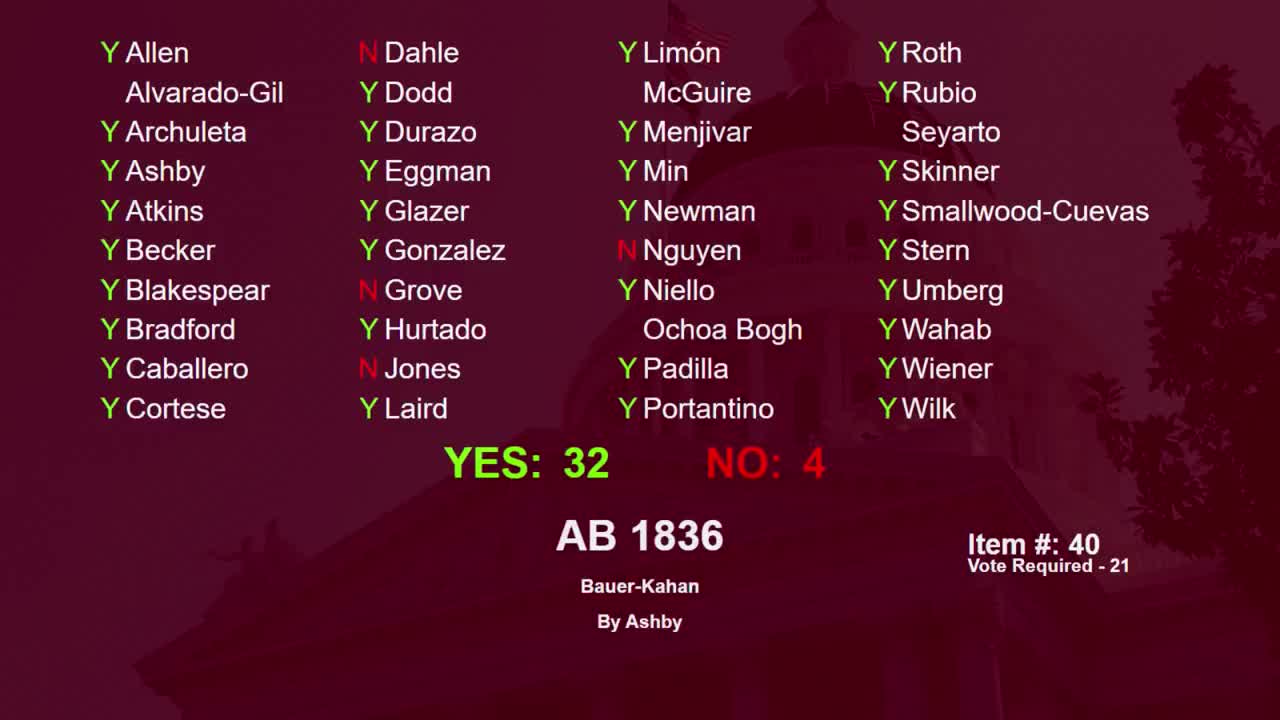 2MIN
Senate Floor
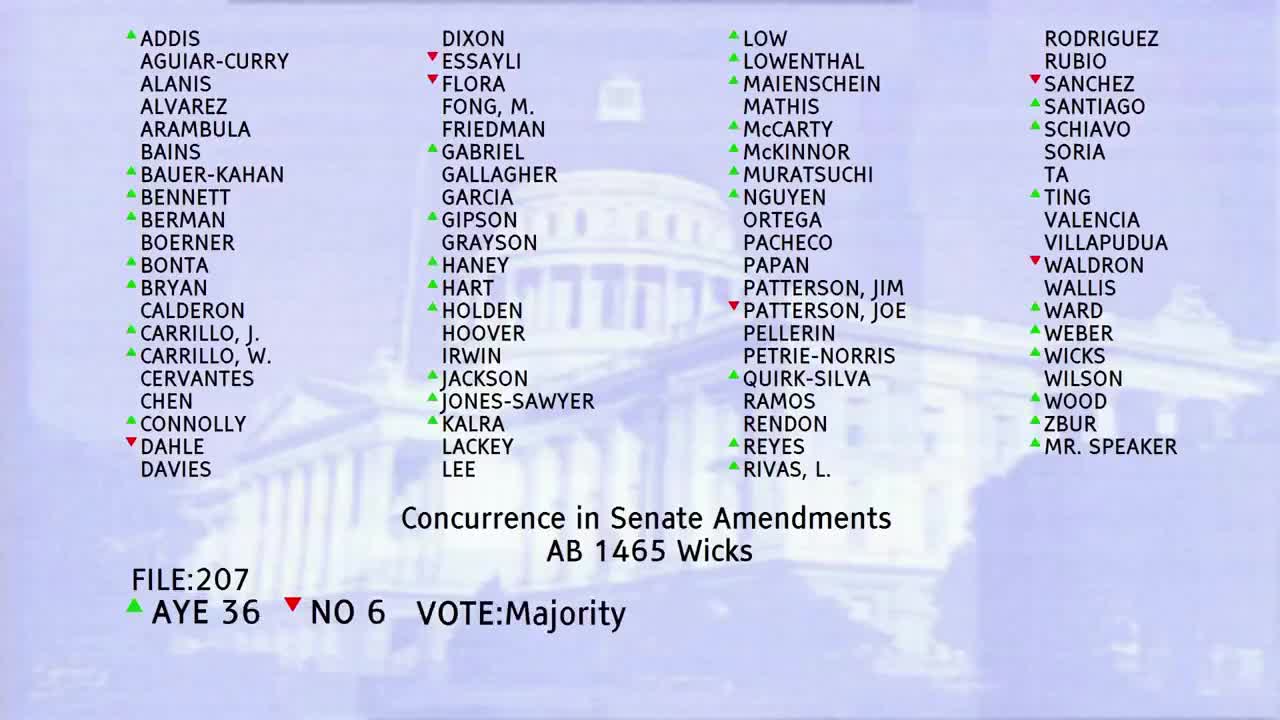 28SEC
Assembly Floor
 13MIN
Senate Standing Committee on Housing
 36MIN
Senate Standing Committee on Local Government
 3MIN
Assembly Floor
 27MIN
Assembly Standing Committee on Housing and Community Development
 36MIN
Assembly Standing Committee on Local Government
Bill Author