AB 2741: Rental car companies: electronic surveillance technology.
- Session Year: 2023-2024
- House: Assembly
- Latest Version Date: 2024-09-29
Current Status:
Passed
(2024-09-29: Chaptered by Secretary of State - Chapter 970, Statutes of 2024.)
Introduced
In Committee
First Chamber
In Committee
Second Chamber
Enacted
Existing law generally governs the transactions between a rental company, also referred to as a rental car company, and its customers. Existing law prohibits a rental company from using, accessing, or obtaining any information relating to the renters use of the rental vehicle that was obtained using electronic surveillance technology, except under specified circumstances.
Existing law, until January 1, 2028, authorizes a rental company to activate electronic surveillance technology if the rental vehicle has not been returned following 72 hours after the contracted return date or by 72 hours following the end of an extension of that return date. Existing law requires the rental company to provide notice of activation of the electronic surveillance technology 24 hours prior to activation, as specified. Existing law, except as specified, requires the rental or lease agreement to advise the renter that electronic surveillance technology may be activated if the rental vehicle has not been returned within 72 hours of the return date. Existing law requires the advisement to also be made orally to the renter at the time of executing the rental or lease agreement, except as provided.
This bill would delete the January 1, 2028, sunset date, thereby extending those provisions, as further revised by the bill, indefinitely. The bill would decrease the time that a rental company must wait after the contracted or extended return date before activating electronic surveillance technology to 24 hours. The bill would specify that the oral advisement shall be made if the transaction is completed in person or by telephone.
Existing law generally governs the transactions between a rental company, also referred to as a rental car company, and its customers. Existing law prohibits a rental company from using, accessing, or obtaining any information relating to the renters use of the rental vehicle that was obtained using electronic surveillance technology, except under specified circumstances.
Existing law, until January 1, 2028, authorizes a rental company to activate electronic surveillance technology if the rental vehicle has not been returned following 72 hours after the contracted return date or by 72 hours following the end of an extension of that return date. Existing law requires the rental company to provide notice of activation of the electronic surveillance technology 24 hours prior to activation, as specified. Existing law law, except as specified, requires the rental or lease agreement to advise the renter that electronic surveillance technology may be activated if the rental vehicle has not been returned within 72 hours of the return date, except that, for a renter who is a member of the rental companys membership program, the advisement is required to be made upon enrollment in the membership program. date. Existing law requires the advisement to also be made orally to the renter at the time of executing the rental or lease agreement unless the renter is a member of the rental companys membership program. agreement, except as provided.
This bill would delete the January 1, 2028, sunset date, thereby extending those provisions, as further revised by the bill, indefinitely. The bill would decrease the time that a rental company must wait after the contracted or extended return date before activating electronic surveillance technology to 24 hours. The bill would delete the requirement that the specify that the oral advisement shall be made orally, and would delete the exemption and requirement provisions relating to the advisement of renters who are members of the rental companys membership program. if the transaction is completed in person or by telephone.
Existing law generally governs the transactions between a rental company, also referred to as a rental car company, and its customers. Existing law authorizes a rental company and a renter to agree that the renter will be responsible for loss due to theft of the rented vehicle up to its fair market value if the rental company establishes that the renter or authorized driver failed to exercise ordinary care while in possession of the vehicle. Existing law presumes that a renter has no liability for any loss due to theft if an authorized driver establishes that the ignition key furnished by the rental company was not in the vehicle at the time of the theft, subject to specified other conditions.
This bill would delete that presumption.
Existing law prohibits a rental company from using, accessing, or obtaining any information relating to the renters use of the rental vehicle that was obtained using electronic surveillance technology, except under specified circumstances.
This bill would, as an additional exception to that prohibition, authorize a rental company to use, access, or obtain that information if the rental company discloses in the rental or lease agreement or membership agreement a particular purpose for its collection, access, or use of that information.Existing law, until January 1, 2028, authorizes a rental company to activate electronic surveillance technology if the rental vehicle has not been returned following 72 hours after the contracted return date or by 72 hours following the end of an extension of that return date. Existing law requires the rental company to provide notice of activation of the electronic surveillance technology 24 hours prior to activation, as specified. Existing law requires the rental or lease agreement to advise the renter that electronic surveillance technology may be activated if the rental vehicle has not been returned within 72 hours of the return date, except that, for a renter who is a member of the rental companys membership program, the advisement is required to be made upon enrollment in the membership program. Existing law requires the advisement to also be made orally to the renter at the time of executing the rental or lease agreement unless the renter is a member of the rental companys membership program.
This bill would delete the January 1, 2028, sunset date, thereby extending those provisions, as further revised by the bill, indefinitely. The bill would decrease the time that a rental company must wait after the contracted or extended return date before activating electronic surveillance technology to 24 hours, and would remove the 24-hour notice requirement prior to activating the electronic surveillance technology. hours. The bill would delete the requirement that the advisement be made orally, and would delete the exemption and requirement provisions relating to the advisement of renters who are members of the rental companys membership program.
Existing law generally governs the transactions between a rental company, also referred to as a rental car company, and its customers, including, among other provisions, restrictions on a rental companys use of electronic surveillance technology. Existing law, as part of those restrictions, customers. Existing law authorizes a rental company and a renter to agree that the renter will be responsible for loss due to theft of the rented vehicle up to its fair market value if the rental company establishes that the renter or authorized driver failed to exercise ordinary care while in possession of the vehicle. Existing law presumes that a renter has no liability for any loss due to theft if an authorized driver establishes that the ignition key furnished by the rental company was not in the vehicle at the time of the theft, subject to specified other conditions.
This bill would delete that presumption.
Existing law prohibits a rental company from using, accessing, or obtaining any information relating to the renters use of the rental vehicle that was obtained using electronic surveillance technology, except under specified circumstances. Existing
This bill would, as an additional exception to that prohibition, authorize a rental company to use, access, or obtain that information if the rental company discloses in the rental or lease agreement or membership agreement a particular purpose for its collection, access, or use of that information.
Existing law, until January 1, 2028, authorizes a rental company to activate electronic surveillance technology if the rental vehicle has not been returned following 72 hours after the contracted return date or by 72 hours following the end of an extension of that return date. Existing law requires the rental company to provide notice of activation of the electronic surveillance technology 24 hours prior to activation, as specified. Existing law requires the rental or lease agreement to advise the renter that electronic surveillance technology may be activated if the rental vehicle has not been returned within 72 hours of the return date, except that, for a renter who is a member of the rental companys membership program, the advisement is required to be made upon enrollment in the membership program. Existing law requires the advisement to also be made orally to the renter at the time of executing the rental or lease agreement unless the renter is a member of the rental companys membership program.
This bill would instead authorize delete the January 1, 2028, sunset date, thereby extending those provisions, as further revised by the bill, indefinitely. The bill would decrease the time that a rental company to activate must wait after the contracted or extended return date before activating electronic surveillance technology if the rental vehicle has not been returned following 24 hours after the contracted return date or by 24 hours following the end of an extension of that return date, to 24 hours, and would remove the 24-hour notice requirement prior to activating the electronic surveillance technology. The bill would delete the requirement that the advisement be made orally, and would delete the exemption and requirement provisions relating to the advisement of renters who are members of the rental companys membership program.
Existing law generally governs the transactions between a rental company, also referred to as a rental car company, and its customers, including, among other provisions, restrictions on a rental companys use of electronic surveillance technology. Existing law, as part of those restrictions, prohibits a rental company from using, accessing, or obtaining any information relating to the renters use of the rental vehicle that was obtained using electronic surveillance technology, except under specified circumstances. Existing law, until January 1, 2028, authorizes a rental company to activate electronic surveillance technology if the rental vehicle has not been returned following 72 hours after the contracted return date or by 72 hours following the end of an extension of that return date. Existing law requires the rental company to provide notice of activation of the electronic surveillance technology 24 hours prior to activation, as specified.
This bill would instead authorize a rental company to activate electronic surveillance technology if the rental vehicle has not been returned following 24 hours after the contracted return date or by 24 hours following the end of an extension of that return date, and would remove the 24-hour notice requirement prior to activating the electronic surveillance technology.
Existing law establishes various requirements with respect to the payment of wages and other conditions of employment. Existing law requires an employer, semimonthly or at the time of payment of wages, to furnish an employee an accurate, itemized, written statement containing specified information regarding the amounts earned, hours worked, and the employees identity, among other things, subject to certain variations.This bill would impose certain requirements on a labor contractor and a client employer who has obtained a temporary worker from the labor contractor, as those terms are defined. The bill would require a labor contractor to include on the wage statement of each temporary worker the total amount of actual charges to the client employer for the temporary worker compared to the total compensation cost for the temporary worker. The bill would require a client employer to provide every temporary worker who has performed services for the client employer on a long-term, continuous basis with an opportunity to become a direct employee. The bill would require a client employer who plans to hire a permanent employee to give a temporary worker in the applicable position, as specified, an opportunity to apply for the permanent position before filling it. The bill would require a labor contractor to attempt to place a current temporary worker into a permanent position with a client employer when that employer informs the labor contractor of its plan to hire a permanent employee for a position for which the labor contractor is providing a temporary worker. The bill would prohibit a labor contractor from restricting a temporary worker from accepting a permanent position from the client employer, and would prohibit a labor contractor from collecting a fee when a temporary worker is offered permanent employment. The bill, on or before the 2nd Wednesday of May 2025, would require a client employer that has 100 or more direct employees hired through labor contractors within the prior calendar year to make publicly available on an internet website the number of temporary employees hired through labor contractors within the prior calendar year as compared to the number of direct employees. The bill would prohibit a labor contractor from sending a temporary worker to a place where a strike, lockout, or other labor trouble exists without providing to the temporary worker a specified written notice in a language the temporary worker understands. The bill would make the termination or disciplinary action by a labor contractor against a worker within 90 days of the persons exercise of rights protected under the act to be a rebuttable presumption of retaliation. The bill would provide certain remedies for a violation of the rights established by the bill, including bringing an action against a labor contractor or employer in the superior court. The bill would authorize the Labor Commissioner to enforce the bills provisions, and would authorize the Labor Commissioner to assess and collect specified penalties for a violation of the bills provisions.Existing law establishes various requirements with respect to the payment of wages and other conditions of employment. Existing law requires an employer, semimonthly or at the time of payment of wages, to furnish an employee an accurate, itemized, written statement containing specified information regarding the amounts earned, hours worked, and the employees identity, among other things, subject to certain variations.
This bill would impose certain requirements on a labor contractor and a client employer who has obtained a temporary worker from the labor contractor, as those terms are defined. The bill would require a labor contractor to include on the wage statement of each temporary worker the total amount of actual charges to the client employer for the temporary worker compared to the total compensation cost for the temporary worker. The bill would require a client employer to provide every temporary worker who has performed services for the client employer on a long-term, continuous basis with an opportunity to become a direct employee. The bill would require a client employer who plans to hire a permanent employee to give a temporary worker in the applicable position, as specified, an opportunity to apply for the permanent position before filling it. The bill would require a labor contractor to attempt to place a current temporary worker into a permanent position with a client employer when that employer informs the labor contractor of its plan to hire a permanent employee for a position for which the labor contractor is providing a temporary worker. The bill would prohibit a labor contractor from restricting a temporary worker from accepting a permanent position from the client employer, and would prohibit a labor contractor from collecting a fee when a temporary worker is offered permanent employment. The bill, on or before the 2nd Wednesday of May 2025, would require a client employer that has 100 or more direct employees hired through labor contractors within the prior calendar year to make publicly available on an internet website the number of temporary employees hired through labor contractors within the prior calendar year as compared to the number of direct employees. The bill would prohibit a labor contractor from sending a temporary worker to a place where a strike, lockout, or other labor trouble exists without providing to the temporary worker a specified written notice in a language the temporary worker understands. The bill would make the termination or disciplinary action by a labor contractor against a worker within 90 days of the persons exercise of rights protected under the act to be a rebuttable presumption of retaliation. The bill would provide certain remedies for a violation of the rights established by the bill, including bringing an action against a labor contractor or employer in the superior court. The bill would authorize the Labor Commissioner to enforce the bills provisions, and would authorize the Labor Commissioner to assess and collect specified penalties for a violation of the bills provisions.
(a)A rental company shall not use, access, or obtain any information relating to the renters use of the rental vehicle that was obtained using electronic surveillance technology, except in the following circumstances:
(1)(A)When the equipment is used by the rental company only for the purpose of locating a stolen, abandoned, or missing rental vehicle after one of the following:
(i)The renter or law enforcement has informed the rental company that the vehicle is missing or has been stolen or abandoned.
(ii)If the rental vehicle has not been returned following 24 hours after the contracted return date or by 24 hours following the end of an extension of that return date, the rental company may activate electronic surveillance technology. The rental company shall provide notice of activation of the electronic surveillance technology 24 hours before activation, by telephone and electronically pursuant to Section 1939.22, unless the renter has not provided a telephone number or the renter has not agreed to electronic communication pursuant to Section 1939.22. The rental or lease agreement shall advise the renter that electronic surveillance technology may be activated if the rental vehicle has not been returned within 24 hours after the contracted return date or extension of the return date. The renter shall acknowledge this advisement in the rental or lease agreement by initials. The advisement shall also be made orally to the renter at the time of executing the rental or lease agreement if the transaction is completed in person or by telephone. The advisements are not required to be made to members of the rental companys membership program executing a rental or lease agreement. However, a renter shall be given those advisements upon enrolling in the rental companys membership program.
(iii)Notwithstanding clause (ii), if the rental vehicle has not been returned following one week after the contracted return date or by one week following the end of an extension of that return date.
(iv)The rental company discovers the rental vehicle has been stolen or abandoned, and, if stolen, the rental company shall report the vehicle stolen to law enforcement by filing a stolen vehicle report, unless law enforcement has already informed the rental company that the vehicle is missing or has been stolen or abandoned.
(v)The rental vehicle is the subject of an AMBER Alert issued pursuant to Section 8594 of the Government Code. If the rental company uses the equipment in connection with this provision relating to an AMBER Alert, the rental company shall notify law enforcement that one of the rental companys vehicles is the subject of an AMBER Alert upon becoming aware of the situation, unless law enforcement has already informed the rental company that the vehicle was the subject of an AMBER Alert.
(B)If electronic surveillance technology is activated pursuant to subparagraph (A), a rental company shall maintain a record, in either electronic or written form, of information relevant to the activation of that technology. That information shall include the rental agreement, including the return date, and the date and time the electronic surveillance technology was activated. The record shall also include, if relevant, a record of written or other communication with the renter, including communications regarding extensions of the rental, police reports, or other written communication with law enforcement officials. The record shall be maintained for a period of at least 12 months from the time the record is created and shall be made available upon the renters request. The rental company shall maintain and furnish explanatory codes necessary to read the record. A rental company shall not be required to maintain a record if electronic surveillance technology is activated to recover a rental vehicle that is stolen or missing at a time other than during a rental period.
(2)In response to a specific request from law enforcement pursuant to a subpoena or search warrant.
(b)Subdivision (a) does not prohibit a rental company from equipping rental vehicles with any of the following:
(1)GPS-based technology that provides navigation assistance to the occupants of the rental vehicle, if the rental company does not use, access, or obtain information relating to the renters use of the rental vehicle that was obtained using that technology, except for the purposes of discovering or repairing a defect in the technology and the information may then be used only for that purpose.
(2)Electronic surveillance technology that allows for the remote locking or unlocking of the vehicle at the request of the renter, if the rental company does not use, access, or obtain information relating to the renters use of the rental vehicle that was obtained using that technology, except as necessary to lock or unlock the vehicle.
(3)Electronic surveillance technology that allows the company to provide roadside assistance, such as towing, flat tire, or fuel services, at the request of the renter, if the rental company does not use, access, or obtain information relating to the renters use of the rental vehicle that was obtained using that technology except as necessary to provide the requested roadside assistance.
(c)Subdivision (a) does not prohibit a rental company from obtaining, accessing, or using information from electronic surveillance technology for the sole purpose of determining the date and time the vehicle departs from and is returned to the rental company, and the total mileage driven and the vehicle fuel level of the returned vehicle. The information obtained or accessed from this electronic surveillance technology shall only be used for the purpose described in this subdivision.
(d)A rental company shall not use electronic surveillance technology to track a renter in order to impose fines or surcharges relating to the renters use of the rental vehicle.
(a)A rental company shall not use, access, or obtain any information relating to the renters use of the rental vehicle that was obtained using electronic surveillance technology, except in the following circumstances:
(1)(A)When the equipment is used by the rental company only for the purpose of locating a stolen, abandoned, or missing rental vehicle after one of the following:
(i)The renter or law enforcement has informed the rental company that the vehicle is missing or has been stolen or abandoned.
(ii)If the rental vehicle has not been returned following 24 hours after the contracted return date or by 24 hours following the end of an extension of that return date, the rental company may activate electronic surveillance technology. The rental company shall provide notice of activation of the electronic surveillance technology 24 hours before activation, by telephone and electronically pursuant to Section 1939.22, unless the renter has not provided a telephone number or the renter has not agreed to electronic communication pursuant to Section 1939.22. The rental or lease agreement shall advise the renter that electronic surveillance technology may be activated if the rental vehicle has not been returned within 24 hours after the contracted return date or extension of the return date. The renter shall be given acknowledge this advisement in the rental or lease agreement. agreement by initials. The advisement shall also be made orally to the renter at the time of executing the rental or lease agreement if the transaction is completed in person or by telephone. The advisements are not required to be made to members of the rental companys membership program executing a rental or lease agreement. However, a renter shall be given those advisements upon enrolling in the rental companys membership program.
(iii)Notwithstanding clause (ii), if the rental vehicle has not been returned following one week after the contracted return date or by one week following the end of an extension of that return date.
(iv)The rental company discovers the rental vehicle has been stolen or abandoned, and, if stolen, the rental company shall report the vehicle stolen to law enforcement by filing a stolen vehicle report, unless law enforcement has already informed the rental company that the vehicle is missing or has been stolen or abandoned.
(v)The rental vehicle is the subject of an AMBER Alert issued pursuant to Section 8594 of the Government Code. If the rental company uses the equipment in connection with this provision relating to an AMBER Alert, the rental company shall notify law enforcement that one of the rental companys vehicles is the subject of an AMBER Alert upon becoming aware of the situation, unless law enforcement has already informed the rental company that the vehicle was the subject of an AMBER Alert.
(B)If electronic surveillance technology is activated pursuant to subparagraph (A), a rental company shall maintain a record, in either electronic or written form, of information relevant to the activation of that technology. That information shall include the rental agreement, including the return date, and the date and time the electronic surveillance technology was activated. The record shall also include, if relevant, a record of written or other communication with the renter, including communications regarding extensions of the rental, police reports, or other written communication with law enforcement officials. The record shall be maintained for a period of at least 12 months from the time the record is created and shall be made available upon the renters request. The rental company shall maintain and furnish explanatory codes necessary to read the record. A rental company shall not be required to maintain a record if electronic surveillance technology is activated to recover a rental vehicle that is stolen or missing at a time other than during a rental period.
(2)In response to a specific request from law enforcement pursuant to a subpoena or search warrant.
(b)Subdivision (a) does not prohibit a rental company from equipping rental vehicles with any of the following:
(1)GPS-based technology that provides navigation assistance to the occupants of the rental vehicle, if the rental company does not use, access, or obtain information relating to the renters use of the rental vehicle that was obtained using that technology, except for the purposes of discovering or repairing a defect in the technology and the information may then be used only for that purpose.
(2)Electronic surveillance technology that allows for the remote locking or unlocking of the vehicle at the request of the renter, if the rental company does not use, access, or obtain information relating to the renters use of the rental vehicle that was obtained using that technology, except as necessary to lock or unlock the vehicle.
(3)Electronic surveillance technology that allows the company to provide roadside assistance, such as towing, flat tire, or fuel services, at the request of the renter, if the rental company does not use, access, or obtain information relating to the renters use of the rental vehicle that was obtained using that technology except as necessary to provide the requested roadside assistance.
(c)Subdivision (a) does not prohibit a rental company from obtaining, accessing, or using information from electronic surveillance technology for the sole purpose of determining the date and time the vehicle departs from and is returned to the rental company, and the total mileage driven and the vehicle fuel level of the returned vehicle. The information obtained or accessed from this electronic surveillance technology shall only be used for the purpose described in this subdivision.
(d)A rental company shall not use electronic surveillance technology to track a renter in order to impose fines or surcharges relating to the renters use of the rental vehicle.
Except as limited by Section 1939.05, a rental company and a renter may agree that the renter will be responsible for no more than all of the following:
(a)Physical or mechanical damage to the rented vehicle up to its fair market value, as determined in the customary market for the sale of that vehicle, resulting from collision regardless of the cause of the damage.
(b)Loss due to theft of the rented vehicle up to its fair market value, as determined in the customary market for the sale of that vehicle, provided that the rental company establishes by clear and convincing evidence that the renter or the authorized driver failed to exercise ordinary care while in possession of the vehicle. In addition, the renter shall be presumed to have no liability for any loss due to theft if (1) an authorized driver has possession of the ignition key furnished by the rental company, and (2) an authorized driver files an official report of the theft with the police or other law enforcement agency within 24 hours of learning of the theft and reasonably cooperates with the rental company and the police or other law enforcement agency in providing information concerning the theft. The presumption set forth in this subdivision is a presumption affecting the burden of proof which the rental company may rebut by establishing that an authorized driver committed, or aided and abetted the commission of, the theft.
(c)Physical damage to the rented vehicle up to its fair market value, as determined in the customary market for the sale of that vehicle, resulting from vandalism occurring after, or in connection with, the theft of the rented vehicle. However, the renter shall have no liability for any damage due to vandalism if the renter would have no liability for theft pursuant to subdivision (b).
(d)Physical damage to the rented vehicle up to a total of five hundred dollars ($500) resulting from vandalism unrelated to the theft of the rented vehicle.
(e)Actual charges for towing, storage, and impound fees paid by the rental company if the renter is liable for damage or loss.
(f)An administrative charge, which shall include the cost of appraisal and all other costs and expenses incident to the damage, loss, repair, or replacement of the rented vehicle.
SEC. 2.Section 1939.23 of the Civil Code is amended to read:1939.23.(a)A rental company shall not use, access, or obtain any information relating to the renters use of the rental vehicle that was obtained using electronic surveillance technology, except in the following circumstances:
(1)(A)When the equipment is used by the rental company only for the purpose of locating a stolen, abandoned, or missing rental vehicle after one of the following:
(i)The renter or law enforcement has informed the rental company that the vehicle is missing or has been stolen or abandoned.
(ii)If the rental vehicle has not been returned following 24 hours after the contracted return date or by 24 hours following the end of an extension of that return date, the rental company may activate electronic surveillance technology. The rental company shall provide notice of activation of the electronic surveillance technology, technology 24 hours before activation, by telephone or and electronically pursuant to Section 1939.22, unless the renter has not provided a telephone number or the renter has not agreed to electronic communication pursuant to Section 1939.22. The rental or lease agreement shall advise the renter that electronic surveillance technology may be activated if the rental vehicle has not been returned within 24 hours after the contracted return date or extension of the return date. The renter shall be given this advisement in the rental or lease agreement.
(iii)Notwithstanding clause (ii), if the rental vehicle has not been returned following one week after the contracted return date or by one week following the end of an extension of that return date.
(iv)The rental company discovers the rental vehicle has been stolen or abandoned, and, if stolen, the rental company shall report the vehicle stolen to law enforcement by filing a stolen vehicle report, unless law enforcement has already informed the rental company that the vehicle is missing or has been stolen or abandoned.
(v)The rental vehicle is the subject of an AMBER Alert issued pursuant to Section 8594 of the Government Code. If the rental company uses the equipment in connection with this provision relating to an AMBER Alert, the rental company shall notify law enforcement that one of the rental companys vehicles is the subject of an AMBER Alert upon becoming aware of the situation, unless law enforcement has already informed the rental company that the vehicle was the subject of an AMBER Alert.
(B)If electronic surveillance technology is activated pursuant to subparagraph (A), a rental company shall maintain a record, in either electronic or written form, of information relevant to the activation of that technology. That information shall include the rental agreement, including the return date, and the date and time the electronic surveillance technology was activated. The record shall also include, if relevant, a record of written or other communication with the renter, including communications regarding extensions of the rental, police reports, or other written communication with law enforcement officials. The record shall be maintained for a period of at least 12 months from the time the record is created and shall be made available upon the renters request. The rental company shall maintain and furnish explanatory codes necessary to read the record. A rental company shall not be required to maintain a record if electronic surveillance technology is activated to recover a rental vehicle that is stolen or missing at a time other than during a rental period.
(2)In response to a specific request from law enforcement pursuant to a subpoena or search warrant.
(3)The rental company discloses a particular purpose for its collection, access, or use of information relating to the renters use of the rental vehicle using electronic surveillance technology in the rental or lease agreement or membership agreement.(b)Subdivision (a) does not prohibit a rental company from equipping rental vehicles with any of the following:
(1)GPS-based technology that provides navigation assistance to the occupants of the rental vehicle, if the rental company does not use, access, or obtain information relating to the renters use of the rental vehicle that was obtained using that technology, except for the purposes of discovering or repairing a defect in the technology and the information may then be used only for that purpose.
(2)Electronic surveillance technology that allows for the remote locking or unlocking of the vehicle at the request of the renter, if the rental company does not use, access, or obtain information relating to the renters use of the rental vehicle that was obtained using that technology, except as necessary to lock or unlock the vehicle.
(3)Electronic surveillance technology that allows the company to provide roadside assistance, such as towing, flat tire, or fuel services, at the request of the renter, if the rental company does not use, access, or obtain information relating to the renters use of the rental vehicle that was obtained using that technology except as necessary to provide the requested roadside assistance.
(c)Subdivision (a) does not prohibit a rental company from obtaining, accessing, or using information from electronic surveillance technology for the sole purpose of determining the date and time the vehicle departs from and is returned to the rental company, and the total mileage driven and the vehicle fuel level of the returned vehicle. The information obtained or accessed from this electronic surveillance technology shall only be used for the purpose described in this subdivision.
(d)A rental company shall not use electronic surveillance technology to track a renter in order to impose fines or surcharges relating to the renters use of the rental vehicle.
Except as limited by Section 1939.05, a rental company and a renter may agree that the renter will be responsible for no more than all of the following:
(a)Physical or mechanical damage to the rented vehicle up to its fair market value, as determined in the customary market for the sale of that vehicle, resulting from collision regardless of the cause of the damage.
(b)Loss due to theft of the rented vehicle up to its fair market value, as determined in the customary market for the sale of that vehicle, provided that the rental company establishes by clear and convincing evidence that the renter or the authorized driver failed to exercise ordinary care while in possession of the vehicle. In addition, the renter shall be presumed to have no liability for any loss due to theft if (1) an authorized driver has possession of the ignition key furnished by the rental company or an authorized driver establishes that the ignition key furnished by the rental company was not in the vehicle at the time of the theft, company, and (2) an authorized driver files an official report of the theft with the police or other law enforcement agency within 24 hours of learning of the theft and reasonably cooperates with the rental company and the police or other law enforcement agency in providing information concerning the theft. The presumption set forth in this subdivision is a presumption affecting the burden of proof which the rental company may rebut by establishing that an authorized driver committed, or aided and abetted the commission of, the theft.
(c)Physical damage to the rented vehicle up to its fair market value, as determined in the customary market for the sale of that vehicle, resulting from vandalism occurring after, or in connection with, the theft of the rented vehicle. However, the renter shall have no liability for any damage due to vandalism if the renter would have no liability for theft pursuant to subdivision (b).
(d)Physical damage to the rented vehicle up to a total of five hundred dollars ($500) resulting from vandalism unrelated to the theft of the rented vehicle.
(e)Actual charges for towing, storage, and impound fees paid by the rental company if the renter is liable for damage or loss.
(f)An administrative charge, which shall include the cost of appraisal and all other costs and expenses incident to the damage, loss, repair, or replacement of the rented vehicle.
SECTION 1.SEC. 2.Section 1939.23 of the Civil Code is amended to read:1939.23.(a)A rental company shall not use, access, or obtain any information relating to the renters use of the rental vehicle that was obtained using electronic surveillance technology, except in the following circumstances:
(1)(A)When the equipment is used by the rental company only for the purpose of locating a stolen, abandoned, or missing rental vehicle after one of the following:
(i)The renter or law enforcement has informed the rental company that the vehicle is missing or has been stolen or abandoned.
(ii)Until January 1, 2028, and for purposes of this clause, if If the rental vehicle has not been returned following 24 hours after the contracted return date or by 24 hours following the end of an extension of that return date, the rental company may activate electronic surveillance technology. The rental company shall provide notice of activation of the electronic surveillance technology, by telephone and or electronically pursuant to Section 1939.22, unless the renter has not provided a telephone number or the renter has not agreed to electronic communication pursuant to Section 1939.22. The rental or lease agreement shall advise the renter that electronic surveillance technology may be activated if the rental vehicle has not been returned within 24 hours after the contracted return date or extension of the return date. The renter shall acknowledge be given this advisement in the rental or lease agreement by initials. The advisement shall also be made orally to the renter at the time of executing the rental or lease agreement. The advisements are not required to be made to members of the rental companys membership program executing a rental or lease agreement; however, a renter shall be given those advisements upon enrolling in the rental companys membership program. agreement.
(iii)Notwithstanding clause (ii), if the rental vehicle has not been returned following one week after the contracted return date or by one week following the end of an extension of that return date.
(iv)The rental company discovers the rental vehicle has been stolen or abandoned, and, if stolen, the rental company shall report the vehicle stolen to law enforcement by filing a stolen vehicle report, unless law enforcement has already informed the rental company that the vehicle is missing or has been stolen or abandoned.
(v)The rental vehicle is the subject of an AMBER Alert issued pursuant to Section 8594 of the Government Code. If the rental company uses the equipment in connection with this provision relating to an AMBER Alert, the rental company shall notify law enforcement that one of the rental companys vehicles is the subject of an AMBER Alert upon becoming aware of the situation, unless law enforcement has already informed the rental company that the vehicle was the subject of an AMBER Alert.
(B)If electronic surveillance technology is activated pursuant to subparagraph (A), a rental company shall maintain a record, in either electronic or written form, of information relevant to the activation of that technology. That information shall include the rental agreement, including the return date, and the date and time the electronic surveillance technology was activated. The record shall also include, if relevant, a record of written or other communication with the renter, including communications regarding extensions of the rental, police reports, or other written communication with law enforcement officials. The record shall be maintained for a period of at least 12 months from the time the record is created and shall be made available upon the renters request. The rental company shall maintain and furnish explanatory codes necessary to read the record. A rental company shall not be required to maintain a record if electronic surveillance technology is activated to recover a rental vehicle that is stolen or missing at a time other than during a rental period.
(2)In response to a specific request from law enforcement pursuant to a subpoena or search warrant.
(3)The rental company discloses a particular purpose for its collection, access, or use of information relating to the renters use of the rental vehicle using electronic surveillance technology in the rental or lease agreement or membership agreement.
(b)Subdivision (a) does not prohibit a rental company from equipping rental vehicles with any of the following:
(1)GPS-based technology that provides navigation assistance to the occupants of the rental vehicle, if the rental company does not use, access, or obtain information relating to the renters use of the rental vehicle that was obtained using that technology, except for the purposes of discovering or repairing a defect in the technology and the information may then be used only for that purpose.
(2)Electronic surveillance technology that allows for the remote locking or unlocking of the vehicle at the request of the renter, if the rental company does not use, access, or obtain information relating to the renters use of the rental vehicle that was obtained using that technology, except as necessary to lock or unlock the vehicle.
(3)Electronic surveillance technology that allows the company to provide roadside assistance, such as towing, flat tire, or fuel services, at the request of the renter, if the rental company does not use, access, or obtain information relating to the renters use of the rental vehicle that was obtained using that technology except as necessary to provide the requested roadside assistance.
(c)Subdivision (a) does not prohibit a rental company from obtaining, accessing, or using information from electronic surveillance technology for the sole purpose of determining the date and time the vehicle departs from and is returned to the rental company, and the total mileage driven and the vehicle fuel level of the returned vehicle. The information obtained or accessed from this electronic surveillance technology shall only be used for the purpose described in this subdivision.
(d)A rental company shall not use electronic surveillance technology to track a renter in order to impose fines or surcharges relating to the renters use of the rental vehicle.
(a)A rental company shall not use, access, or obtain any information relating to the renters use of the rental vehicle that was obtained using electronic surveillance technology, except in the following circumstances:
(1)(A)When the equipment is used by the rental company only for the purpose of locating a stolen, abandoned, or missing rental vehicle after one of the following:
(i)The renter or law enforcement has informed the rental company that the vehicle is missing or has been stolen or abandoned.
(ii)Until January 1, 2028, and for purposes of this clause, if the rental vehicle has not been returned following 72 24 hours after the contracted return date or by 72 24 hours following the end of an extension of that return date, the rental company may activate electronic surveillance technology. The rental company shall provide notice of activation of the electronic surveillance technology 24 hours prior to activation, technology, by telephone and electronically pursuant to Section 1939.22, unless the renter has not provided a telephone number or the renter has not agreed to electronic communication pursuant to Section 1939.22. The rental or lease agreement shall advise the renter that electronic surveillance technology may be activated if the rental vehicle has not been returned within 72 24 hours after the contracted return date or extension of the return date. The renter shall acknowledge this advisement in the rental or lease agreement by initials. The advisement shall also be made orally to the renter at the time of executing the rental or lease agreement. The advisements are not required to be made to members of the rental companys membership program executing a rental or lease agreement; however, a renter shall be given those advisements upon enrolling in the rental companys membership program.
(iii)Notwithstanding clause (ii), if the rental vehicle has not been returned following one week after the contracted return date or by one week following the end of an extension of that return date.
(iv)The rental company discovers the rental vehicle has been stolen or abandoned, and, if stolen, the rental company shall report the vehicle stolen to law enforcement by filing a stolen vehicle report, unless law enforcement has already informed the rental company that the vehicle is missing or has been stolen or abandoned.
(v)The rental vehicle is the subject of an AMBER Alert issued pursuant to Section 8594 of the Government Code. If the rental company uses the equipment in connection with this provision relating to an AMBER Alert, the rental company shall notify law enforcement that one of the rental companys vehicles is the subject of an AMBER Alert upon becoming aware of the situation, unless law enforcement has already informed the rental company that the vehicle was the subject of an AMBER Alert.
(B)If electronic surveillance technology is activated pursuant to subparagraph (A), a rental company shall maintain a record, in either electronic or written form, of information relevant to the activation of that technology. That information shall include the rental agreement, including the return date, and the date and time the electronic surveillance technology was activated. The record shall also include, if relevant, a record of written or other communication with the renter, including communications regarding extensions of the rental, police reports, or other written communication with law enforcement officials. The record shall be maintained for a period of at least 12 months from the time the record is created and shall be made available upon the renters request. The rental company shall maintain and furnish explanatory codes necessary to read the record. A rental company shall not be required to maintain a record if electronic surveillance technology is activated to recover a rental vehicle that is stolen or missing at a time other than during a rental period.
(2)In response to a specific request from law enforcement pursuant to a subpoena or search warrant.
(b)Subdivision (a) does not prohibit a rental company from equipping rental vehicles with any of the following:
(1)GPS-based technology that provides navigation assistance to the occupants of the rental vehicle, if the rental company does not use, access, or obtain information relating to the renters use of the rental vehicle that was obtained using that technology, except for the purposes of discovering or repairing a defect in the technology and the information may then be used only for that purpose.
(2)Electronic surveillance technology that allows for the remote locking or unlocking of the vehicle at the request of the renter, if the rental company does not use, access, or obtain information relating to the renters use of the rental vehicle that was obtained using that technology, except as necessary to lock or unlock the vehicle.
(3)Electronic surveillance technology that allows the company to provide roadside assistance, such as towing, flat tire, or fuel services, at the request of the renter, if the rental company does not use, access, or obtain information relating to the renters use of the rental vehicle that was obtained using that technology except as necessary to provide the requested roadside assistance.
(c)Subdivision (a) does not prohibit a rental company from obtaining, accessing, or using information from electronic surveillance technology for the sole purpose of determining the date and time the vehicle departs from and is returned to the rental company, and the total mileage driven and the vehicle fuel level of the returned vehicle. The information obtained or accessed from this electronic surveillance technology shall only be used for the purpose described in this subdivision.
(d)A rental company shall not use electronic surveillance technology to track a renter in order to impose fines or surcharges relating to the renters use of the rental vehicle.
SECTION 1.Part 5.6 (commencing with Section 1520) is added to Division 2 of the Labor Code, to read:5.6.Temporary Employees1520.For purposes of this part, the following definitions apply:(a)Client employer means a business entity, regardless of its form, that obtains or is provided workers to perform labor within its usual course of business from a labor contractor.(b)Labor contractor means an individual or entity that supplies, either with or without a contract, a client employer with workers to perform labor within the client employers usual course of business.(c)Temporary worker means a worker provided by the labor contractor to perform services for the client employer. 1521.A labor contractor shall include on the wage statement, pursuant to Section 226, of each temporary worker the total amount of actual charges to the client employer for the temporary worker during each pay period compared to the total compensation cost for the temporary worker, including costs of any benefits provided.1522.(a)When a temporary worker has performed services for a client employer on a long-term and continuous basis, the client employer shall provide the temporary worker with an opportunity to become a direct employee.(b)When a client employer plans to hire a permanent employee for a position like the positions for which workers are being provided by the agency at the same work location, the client employer shall notify both the labor contractor and all temporary workers in the applicable positions and give an opportunity for those workers to apply before filling the permanent position.(c)A labor contractor shall attempt to place a current temporary worker into a permanent position with a client employer when the client employer informs the labor contractor of its plan to hire a permanent employee for a position like the positions for which temporary workers are being provided by the agency at the same work location.(d)A labor contractor shall not restrict the right of a temporary worker to accept a permanent position with a client employer to whom the temporary worker has been referred for work or restrict the right of the client employer to offer employment to a temporary worker. A labor contract shall not assess or collect a placement fee when the temporary worker is offered permanent work.1523.On or before the second Wednesday of May 2025, a client employer that has 100 or more direct employees hired through labor contractors within the prior calendar year shall make publicly available on an internet website the number of temporary employees hired through labor contractors within the prior calendar year as compared to the number of direct employees.1524.A labor contractor shall not send a worker to a place where a strike, a lockout, or other labor trouble exists without providing, at or before the time of dispatch, a statement, in writing and in a language that the worker understands, informing the worker of the labor dispute and the workers right to refuse the assignment without prejudice to receiving another assignment.1525.(a)It is a violation of this part for a labor contractor or client employer, or any agent of a labor contractor or client employer, to retaliate through discharge or in any other manner against any worker for exercising any rights granted under this part. The termination or disciplinary action by a labor contractor against a worker within 90 days of the persons exercise of rights protected under this part shall raise a rebuttable presumption of having done so in retaliation for the exercise of those rights.(b)Any employee who has been discharged or discriminated or retaliated against in the terms and conditions of their employment because the employee engaged in any conduct delineated in this part may recover in a civil action reinstatement and reimbursement for lost wages and work benefits caused by the acts of the labor contractor or client employer, including interest thereon, as well as appropriate equitable relief.1526.A person aggrieved by a violation of this part may bring an action against a labor contractor or a client employer in the superior court of the State of California and shall be entitled to appropriate legal and equitable relief, and, upon prevailing, shall recover reasonable attorneys fees and costs.1527.The Labor Commissioner may enforce this part, including investigating an alleged violation and ordering appropriate temporary relief to mitigate the violation pending the completion of an investigation or hearing, through the procedures set forth in Section 98.3, 98.7, 98.74, or 1197.1, including by issuing a citation against an employer who violates this part or by filing a civil action. When the Labor Commissioner finds that a labor contractor or client employer has violated this part, the Labor Commissioner is authorized to assess and collect penalties, up to a maximum of $250 for a first violation, and up to a maximum of $500 for each subsequent violation. The Labor Commissioner may also recover appropriate legal and equitable relief on behalf of an aggrieved temporary worker.For purposes of this part, the following definitions apply:
(a)Client employer means a business entity, regardless of its form, that obtains or is provided workers to perform labor within its usual course of business from a labor contractor.
(b)Labor contractor means an individual or entity that supplies, either with or without a contract, a client employer with workers to perform labor within the client employers usual course of business.
(c)Temporary worker means a worker provided by the labor contractor to perform services for the client employer.
1521.A labor contractor shall include on the wage statement, pursuant to Section 226, of each temporary worker the total amount of actual charges to the client employer for the temporary worker during each pay period compared to the total compensation cost for the temporary worker, including costs of any benefits provided.
1522.(a)When a temporary worker has performed services for a client employer on a long-term and continuous basis, the client employer shall provide the temporary worker with an opportunity to become a direct employee.
(b)When a client employer plans to hire a permanent employee for a position like the positions for which workers are being provided by the agency at the same work location, the client employer shall notify both the labor contractor and all temporary workers in the applicable positions and give an opportunity for those workers to apply before filling the permanent position.
(c)A labor contractor shall attempt to place a current temporary worker into a permanent position with a client employer when the client employer informs the labor contractor of its plan to hire a permanent employee for a position like the positions for which temporary workers are being provided by the agency at the same work location.
(d)A labor contractor shall not restrict the right of a temporary worker to accept a permanent position with a client employer to whom the temporary worker has been referred for work or restrict the right of the client employer to offer employment to a temporary worker. A labor contract shall not assess or collect a placement fee when the temporary worker is offered permanent work.
1523.On or before the second Wednesday of May 2025, a client employer that has 100 or more direct employees hired through labor contractors within the prior calendar year shall make publicly available on an internet website the number of temporary employees hired through labor contractors within the prior calendar year as compared to the number of direct employees.
1524.A labor contractor shall not send a worker to a place where a strike, a lockout, or other labor trouble exists without providing, at or before the time of dispatch, a statement, in writing and in a language that the worker understands, informing the worker of the labor dispute and the workers right to refuse the assignment without prejudice to receiving another assignment.
1525.(a)It is a violation of this part for a labor contractor or client employer, or any agent of a labor contractor or client employer, to retaliate through discharge or in any other manner against any worker for exercising any rights granted under this part. The termination or disciplinary action by a labor contractor against a worker within 90 days of the persons exercise of rights protected under this part shall raise a rebuttable presumption of having done so in retaliation for the exercise of those rights.
(b)Any employee who has been discharged or discriminated or retaliated against in the terms and conditions of their employment because the employee engaged in any conduct delineated in this part may recover in a civil action reinstatement and reimbursement for lost wages and work benefits caused by the acts of the labor contractor or client employer, including interest thereon, as well as appropriate equitable relief.
1526.A person aggrieved by a violation of this part may bring an action against a labor contractor or a client employer in the superior court of the State of California and shall be entitled to appropriate legal and equitable relief, and, upon prevailing, shall recover reasonable attorneys fees and costs.
1527.The Labor Commissioner may enforce this part, including investigating an alleged violation and ordering appropriate temporary relief to mitigate the violation pending the completion of an investigation or hearing, through the procedures set forth in Section 98.3, 98.7, 98.74, or 1197.1, including by issuing a citation against an employer who violates this part or by filing a civil action. When the Labor Commissioner finds that a labor contractor or client employer has violated this part, the Labor Commissioner is authorized to assess and collect penalties, up to a maximum of $250 for a first violation, and up to a maximum of $500 for each subsequent violation. The Labor Commissioner may also recover appropriate legal and equitable relief on behalf of an aggrieved temporary worker.
|
Date
|
Status
|
|---|---|
| Sep 29, 2024 | Chaptered by Secretary of State - Chapter 970, Statutes of 2024. |
| Sep 29, 2024 | Approved by the Governor. |
| Sep 5, 2024 | Enrolled and presented to the Governor at 4 p.m. |
| Aug 27, 2024 | Senate amendments concurred in. To Engrossing and Enrolling. (Ayes 76. Noes 0.). |
| Aug 27, 2024 | Assembly Rule 77 suspended. |
| Aug 26, 2024 | In Assembly. Concurrence in Senate amendments pending. May be considered on or after August 28 pursuant to Assembly Rule 77. |
| Aug 26, 2024 | Read third time. Passed. Ordered to the Assembly. (Ayes 39. Noes 0.). |
| Aug 5, 2024 | Read second time and amended. Ordered to third reading. |
| Jul 3, 2024 | From committee: Amend, and do pass as amended. (Ayes 11. Noes 0.) (July 2). |
| May 29, 2024 | Referred to Com. on JUD. |
| May 21, 2024 | In Senate. Read first time. To Com. on RLS. for assignment. |
| May 20, 2024 | Read third time. Passed. Ordered to the Senate. (Ayes 73. Noes 0. Page 5308.) |
| May 6, 2024 | Read second time. Ordered to third reading. |
| May 2, 2024 | Read second time and amended. Ordered returned to second reading. |
| May 1, 2024 | From committee: Amend, and do pass as amended. (Ayes 11. Noes 0.) (April 30). |
| Apr 25, 2024 | Re-referred to Com. on P. & C.P. |
| Apr 24, 2024 | From committee chair, with author's amendments: Amend, and re-refer to Com. on P. & C.P. Read second time and amended. |
| Apr 8, 2024 | Re-referred to Com. on P. & C.P. pursuant to Assembly Rule 96. |
| Apr 2, 2024 | Re-referred to Com. on L. & E. |
| Apr 1, 2024 | From committee chair, with author's amendments: Amend, and re-refer to Com. on L. & E. Read second time and amended. |
| Mar 22, 2024 | In committee: Set, first hearing. Hearing canceled at the request of author. |
| Mar 4, 2024 | Referred to Coms. on L. & E. and JUD. |
| Feb 16, 2024 | From printer. May be heard in committee March 17. |
| Feb 15, 2024 | Read first time. To print. |
|
Date
|
Description
|
Location
|
Votes
|
|
|---|---|---|---|---|
| Aug 27, 2024 | AB 2741 Haney Concurrence in Senate Amendments | Assembly Floor |
Passed |
|
| Aug 26, 2024 | Assembly 3rd Reading AB2741 Haney By Umberg | Senate Floor |
Passed |
|
| Jul 2, 2024 | Do pass as amended | Senate Standing Committee on Judiciary |
Passed |
|
| May 20, 2024 | AB 2741 Haney Assembly Third Reading | Assembly Floor |
Passed |
|
| Apr 30, 2024 | Do pass as amended. | Assembly Standing Committee on Privacy and Consumer Protection |
Passed |
This list shows positions taken on this bill by organizations on the date displayed, which is linked to the original source.
Positions by individuals are not included.
|
Organization
|
Position
|
Date
|
|---|---|---|
| American Car Rental Association | ** Support | |
| ARCADIA POLICE OFFICERS ASSOCIATION | ** Support | |
| Burbank Police Officers Association | ** Support | |
| California Coalition of School Safety Professionals | ** Support | |
| California Narcotic Officers Association | ** Support | |
| California Reserve Peace Officers Association | ** Support | |
| California Travel Association | ** Support | |
| CLAREMONT POLICE OFFICERS ASSOCIATION | ** Support | |
| Consumer Federation Of California | ** Against | |
| Consumers For Auto Reliability And Safety | ** Against | |
| Corona Police Officers Association | ** Support | |
| Culver City Police Officers' Association | ** Support | |
| Deputy Sheriffs Association of Monterey County | ** Support | |
| FULLERTON POLICE OFFICERS ASSOCIATION | ** Support | |
| Los Angeles School Police Management Association | ** Support | |
| los angeles school police officers association | ** Support | |
| MURRIETA POLICE OFFICERS ASSOCIATION | ** Support | |
| Newport Beach Police Association | ** Support | |
| Novato Police Officers Association | ** Support | |
| Oakland Privacy | ** Against | |
| Palos Verdes Police Officers Association | ** Support | |
| Placer County Deputy Sheriffs’ Association | ** Support | |
| POMONA POLICE OFFICERS ASSOCIATION | ** Support | |
| RIVERSIDE POLICE OFFICERS ASSOCIATION | ** Support | |
| Riverside Sheriffs Association | ** Support | |
| Santa Ana Police Officers Association | ** Support | |
| Upland Police Officers Association | ** Support |
CONCURRENCE IN SENATE AMENDMENTS
CSA1 Bill Id:AB 2741
Author:(Haney)
As Amended Ver:August 5, 2024
Majority vote
SUMMARY
Decreases the time that a rental company must wait after the contracted or extended return date before activating electronic surveillance technology to 24 hours, and removes the 24-hour notice requirement prior to activating the electronic surveillance technology.
Senate Amendments
- Restores a presumption in favor of consumers when determining their fault for a stolen vehicle. Specifically, maintains current law where a renter is presumed to have no liability for any loss due to theft if 1) an authorized driver has possession of the ignition key furnished by the rental company or 2) an authorized driver establishes that the ignition key furnished by the rental company was not in the vehicle at the time of the theft.
- Requires that rental car companies advise renters of the surveillance policy in writing, and verbally if the rental car agreement is being executed in person.
- Requires the renter to acknowledge receipt of the policy related to surveillance technology by initialing the agreement.
COMMENTS
Purpose of this bill. California prohibits rental car companies from using, accessing, or obtaining any information relating to a customer’s use of the rental vehicle that was obtained using electronic surveillance technology, except in a few narrowly defined situations including when the customer fails to return the vehicle within three days of the contracted return date. This bill seeks to shorten the time period that a rental car company must wait before accessing surveillance technology in vehicles that have not been returned by the end of the contract period from three days to one day.
Analysis. The bill’s principal provisions would reduce the waiting period for utilizing surveillance technology for missing rental cars and remove the sunset placed on that exemption. Both changes appear reasonable. As discussed below, with the rapid proliferation of surveillance technology and the myriad of ways that vehicles and other devices are already tracking people, including those using rental cars, it seems unnecessarily restrictive to continue to require a three-day waiting period for these particular businesses.
Privacy and electronic surveillance technology. Placed in the state constitution by ballot proposition in 1972, Californians have an inalienable right to privacy, which is enforceable against both the government and private parties. Consistent with that right, the Legislature has enacted numerous policies intended to safeguard individuals’ privacy, including the surveillance restrictions this bill seeks to amend. After reports of a Connecticut rental company charging customers extra for speeding, California became one of only a handful of states to restrict the practice of using electronic surveillance technology in rental cars.[1]
AB 2840 (Corbett; Chap. 317, Stats. 2004) defined “electronic surveillance technology” to mean a technological method or system used to observe, monitor, or collect information, including telematics, GPS, wireless technology, or location-based technologies, and recognized that despite electronic surveillance technology’s utility to the entities employing it and the populations being surveilled, such technology also may violate an individual’s right to privacy. Since 2004, concerns about protecting the privacy of Californians have grown significantly in an age where the use of surveillance technology has increased at lightning speed.
According to the Author
Car theft in the State of California is higher than any in the nation. The increase in theft – and also rental car theft – means many of these vehicles are being used to commit crimes. They are often left abandoned, and sometimes they are never recovered. This is a straightforward proposal that will allow the cars to be recovered more quickly, prevent their use in committing crimes, and make sure they are found before they are damaged beyond repair. .
Arguments in Support
Writing in support of the bill, the American Car Rental Association states:
When a vehicle is not returned to the car rental operator at the designated date and time pursuant to the rental contract, the rental company cannot take appropriate steps to locate the asset for 72 hours. One can imagine how far a vehicle could travel or the activities that may occur when criminals are able to procure a means of transportation for the low cost of a rental day and are given a three-day grace period to remain undetected. This significantly increases the risk of the vehicle being lost, vandalized, damaged beyond repair, or used in the furtherance of multiple crimes. Vehicles are frequently found across nearby borders or abandoned and unfortunately, long after a crime has occurred.
The association further notes:
Allowing rental car companies to remotely locate a vehicle after the vehicle is due and when the renter is non-responsive is a reasonable and common sense approach to allowing car rental companies to protect and recover their assets, while also limiting the possibility that stolen rental cars may be used in the commission of additional crimes.
Arguments in Opposition
Writing in opposition to the bill, unless amended, Consumers for auto Reliability and Safety argues:
CARS is concerned about the potential for increased risks of false arrests and unjust convictions and prison sentences that could ensue from enactment of AB 2741 (Haney) in its current form, harming innocent vehicle renters.
Those concerns are certainly well-justified. For example, according to numerous news reports, rental car company Hertz has a history of erroneously and negligently reporting rental vehicles as stolen, resulting in hundreds of vehicle renters being subjected to false arrest, sometimes at gun point. Some were incarcerated for months, when they had done nothing wrong.
FISCAL COMMENTS
This bill is keyed non-fiscal.
VOTES:
ASM PRIVACY AND CONSUMER PROTECTION: 11-0-0
YES: Bauer-Kahan, Joe Patterson, Bryan, Chen, Dixon, Irwin, Lowenthal, Ortega, Ward, Wicks, Wilson
ASSEMBLY FLOOR: 73-0-7
YES: Addis, Aguiar-Curry, Alanis, Alvarez, Bains, Bauer-Kahan, Bennett, Berman, Boerner, Bonta, Bryan, Calderon, Juan Carrillo, Wendy Carrillo, Chen, Connolly, Davies, Dixon, Essayli, Flora, Mike Fong, Vince Fong, Friedman, Gallagher, Garcia, Gipson, Grayson, Haney, Hart, Holden, Hoover, Irwin, Jackson, Jones-Sawyer, Kalra, Lackey, Lee, Low, Lowenthal, Maienschein, McCarty, McKinnor, Muratsuchi, Ortega, Pacheco, Papan, Jim Patterson, Joe Patterson, Pellerin, Petrie-Norris, Quirk-Silva, Ramos, Rendon, Reyes, Rodriguez, Blanca Rubio, Sanchez, Santiago, Schiavo, Soria, Ta, Ting, Valencia, Villapudua, Waldron, Wallis, Ward, Weber, Wicks, Wilson, Wood, Zbur, Robert Rivas
ABS, ABST OR NV: Arambula, Cervantes, Megan Dahle, Gabriel, Mathis, Stephanie Nguyen, Luz Rivas
SENATE FLOOR: 40-0-0
YES: Allen, Alvarado-Gil, Archuleta, Ashby, Atkins, Becker, Blakespear, Bradford, Caballero, Cortese, Dahle, Dodd, Durazo, Eggman, Glazer, Gonzalez, Grove, Hurtado, Jones, Laird, Limón, McGuire, Menjivar, Min, Newman, Nguyen, Niello, Ochoa Bogh, Padilla, Portantino, Roth, Rubio, Seyarto, Skinner, Smallwood-Cuevas, Stern, Umberg, Wahab, Wiener, Wilk
UPDATED
VERSION: August 5, 2024
CONSULTANT: Julie Salley / P. & C.P. / (916) 319-2200 FN: 0004739
See AB 2840 (Corbett, Chap. 317, Stats. 2004). ↑
SENATE RULES COMMITTEE Office of Senate Floor Analyses (916) 651-1520 Fax: (916) 327-4478 | AB 2741 |
THIRD READING
Bill No: AB 2741
Author: Haney (D)
Amended: 8/5/24 in Senate
Vote: 21
SENATE JUDICIARY COMMITTEE: 11-0, 7/2/24
AYES: Umberg, Wilk, Allen, Ashby, Caballero, Durazo, Laird, Niello, Roth, Stern, Wahab
ASSEMBLY FLOOR: 73-0, 5/20/24 - See last page for vote
SUBJECT: Rental car companies: electronic surveillance technology
SOURCE: American Car Rental Association
DIGEST:
This bill shortens the time a rental car company must wait to activate electronic surveillance technology after a vehicle has not been returned from 72 hours to 24 hours. This bill also limits the requirement that consumers be notified verbally of the surveillance policy to certain situations.
ANALYSIS:
Existing law:
- Provides that, among other rights, all people have an inalienable right to pursue and obtain privacy. (Cal. Const., art.1, § 1.)
- Governs the obligations arising from rental passenger vehicle transactions. (Civ. Code § 1939.01 et seq.)
- Prohibits a rental car company from using, accessing, or obtaining any information relating to the renter’s use of the rental vehicle that was obtained using electronic surveillance technology, except in limited circumstances. (Civ. Code § 1939.23(a).)
- Provides that rental car companies are permitted to use electronic surveillance technology in response to a specific request from law enforcement pursuant to a subpoena or search warrant or for the purpose of locating a stolen, abandoned, or missing rental vehicle after one of the following:
- The renter or law enforcement has informed the rental car company that the vehicle is missing or has been stolen or abandoned.
- The rental vehicle has not been returned following 72 hours after the contracted return date or one week after the end of an extension of that return date. This provision sunsets on January 1, 2028.
- The rental car company discovers that the vehicle has been stolen or abandoned and, if stolen, reports the vehicle stolen to law enforcement by filing a stolen vehicle report, unless law enforcement has already informed the rental company that the vehicle is missing or has been stolen or abandoned.
- The rental vehicle is the subject of an AMBER Alert. If the rental company uses the equipment in connection with this provision relating to an AMBER Alert, the rental company shall notify law enforcement that one of the rental company’s vehicles is the subject of an AMBER Alert upon becoming aware of the situation, unless law enforcement has already informed the rental company that the vehicle was the subject of an AMBER Alert. (Civ. Code § 1939.23(a).)
- Requires a rental car company taking advantage of the condition referenced in Section 4b above to provide notice of activation of the electronic surveillance technology 24 hours prior to activation, by telephone and electronically, unless the renter has not provided a telephone number or the renter has not agreed to electronic communication. The rental or lease agreement shall advise the renter that electronic surveillance technology may be activated if the rental vehicle has not been returned within 72 hours after the contracted return date or extension of the return date. The renter shall acknowledge this advisement in the rental or lease agreement by initials. The advisement shall also be made orally to the renter at the time of executing the rental or lease agreement. The advisements are not required to be made to members of the rental company’s membership program executing a rental or lease agreement; however, a renter shall be given those advisements upon enrolling in the rental company’s membership program. (Civ. Code § 1939.23(a).)
- Requires a rental car company to maintain a record of information relevant to the activation of electronic surveillance technology, including information regarding communications with the renter and law enforcement. Existing law specifies that this information shall include the return date, the date and time the electronic surveillance technology was activated, and, if relevant, a record of written or other communication with the renter, including communications regarding extensions of the rental, police reports, or other written communication with law enforcement officials. (Civ. Code § 1939.23(a)(1)(B).)
- Permits a rental company to equip its rental vehicles with certain electronic surveillance technology, but prohibits the rental company from using, accessing, or obtaining any information relating to the renter’s use of the rental vehicle that was obtained using the electronic surveillance technology, except:
- To discover or repair a defect in global positioning systems (GPS)-based technology that provides navigation assistance to the occupants of the rental vehicle.
- To allow for the remote locking or unlocking of a vehicle at the request of the renter.
- To provide roadside assistance, such as towing, flat tire, or fuel services at the request of the renter.
- For the sole purpose of determining the date and time the vehicle departs from or is returned to the rental company, and the total mileage driven and the vehicle fuel level of the returned vehicle. (Civ. Code § 1939.23(b)-(c).)
- Prohibits a rental car company from using electronic surveillance technology to track a renter in order to impose fines or surcharges relating to the renter’s use of the rental vehicle. (Civ. Code § 1939.23(d).)
- Provides that a rental company and renter will be responsible for no more than specified losses and damages. This includes loss due to theft of the rented vehicle up to its fair market value, as determined in the customary market for the sale of that vehicle, provided that the rental company establishes by clear and convincing evidence that the renter or the authorized driver failed to exercise ordinary care while in possession of the vehicle. In addition, the renter shall be presumed to have no liability for any loss due to theft if (1) an authorized driver has possession of the ignition key furnished by the rental company or an authorized driver establishes that the ignition key furnished by the rental company was not in the vehicle at the time of the theft, and (2) an authorized driver files an official report of the theft with the police or other law enforcement agency within 24 hours of learning of the theft and reasonably cooperates with the rental company and the police or other law enforcement agency in providing information concerning the theft. The presumption set forth in this subdivision is a presumption affecting the burden of proof which the rental company may rebut by establishing that an authorized driver committed, or aided and abetted the commission of, the theft. (Civ. Code § 1939.03.)
This bill:
- Shortens the timeline for activating electronic surveillance technology to 24 hours after the scheduled return date and removes the sunset on the provision.
- Limits the right of a consumer to receive an oral advisement of the company’s ability to activate surveillance technology within the vehicle if the car is not timely returned to where the transaction was completed in person or by phone.
Background
In response to reports that rental car companies were misusing electronic surveillance technology in their vehicles to track the driving habits of renters, the Legislature created clear guidelines for when such technology could be used. Existing protections for renters’ privacy prohibit a rental company’s access to or use of information gathered using electronic surveillance technology except in certain limited situations. This includes in response to a specific request from law enforcement pursuant to a subpoena or search warrant or when the vehicle is missing or stolen. This latter basis requires certain conditions be met, such as the renter or law enforcement report the vehicle as stolen or missing or there is an AMBER alert. Relevant here, companies can utilize the tracking when a car has not been returned for 72 hours, despite notice to the renter. The authority to turn on this technology in this latter circumstance sunsets on January 1, 2028.
This bill lowers that timeline to 24 hours to respond to concerns that the longer period allows too much time for nefarious activity in stolen rental cars, and eliminates the sunset date. The bill also limits the requirement to provide an oral advisement of the use of such technology to situations where the transaction is completed by phone or in person.
This bill is sponsored by the American Car Rental Association. It is supported by law enforcement agencies and the California Travel Association. It is opposed by consumer and privacy groups, including the Consumer Federation of California and Consumers for Auto Reliability and Safety. For a more thorough examination of the bill, please see the relevant Senate Judiciary Committee analysis.
Comments
According to the author:
Car theft in the State of California is higher than any in the nation. The increase in theft – and also rental car theft – means many of these vehicles are being used to commit crimes. They are often left abandoned, and sometimes they are never recovered. This is a straightforward proposal that will allow the cars to be recovered more quickly, prevent their use in committing crimes, and make sure they are found before they are damaged beyond repair.
Existing law now provides several narrowly circumscribed exceptions to the general prohibition on electronic surveillance technology use. A rental company is prohibited from using, accessing, or obtaining any information relating to a renter’s use of a rental vehicle that was obtained using electronic surveillance technology, except in two circumstances. The first exception is in direct response to a specific request from law enforcement pursuant to a subpoena or search warrant. The second is when the equipment is used only for the purpose of locating a stolen, abandoned, or missing rental vehicle. This latter exception requires certain conditions, including that the rental company has discovered the rental vehicle has been stolen or abandoned, either through the renter, law enforcement, or other means; that the vehicle is the subject of an AMBER Alert; or that the vehicle has not been returned following one week after the contracted return date or the end of an extension of that date.
Concerns were raised that the one-week timeframe in this last exception was too long. In response, AB 2620 (Ting, Chapter 344, Statutes of. 2018) additionally authorized, until January 1, 2024, electronic surveillance technology to be used by a rental company in circumstances in which the rental vehicle has not been returned within 72 hours after the contract return date or extension of the return date. The sunset was extended last year to 2028 by AB 1756 (Committee on Judiciary, Chapter 478, Statutes of. 2023).
While a missed return date should not automatically trigger the rather exceptional power to electronically track the customer’s vehicle, it was found reasonable that after three days, the customer has lost the right to privacy over the vehicle’s whereabouts in the face of the countervailing interest of the rental company locating a vehicle kept so far beyond a contractually agreed-upon return date.
In the analysis of AB 2620, it was highlighted that customers’ privacy interests are further buttressed by several consumer protections included in the statute. First, there is a required disclosure in the rental agreement, specifically acknowledged by the renter’s initials, that electronic surveillance of the vehicle under these circumstances may take place. Additionally, to mitigate concerns that “renters may still not fully comprehend that surveillance technology will be used,” amendments were agreed to that further required rental car companies to verbally advise the renter at the time of executing the agreement of this potential electronic surveillance.
This bill again amends this exception allowing the surveillance technology to be used if the rental vehicle is not returned, now shortening the timeline from 72 hours to 24 hours after the contracted return date or the end of an extension of that date and removes the sunset on the provision. The oral advisement is also limited to only in transactions completed in person or by phone.
FISCAL EFFECT: Appropriation: No Fiscal Com.: No Local: No
SUPPORT: (Verified 7/9/24)
American Car Rental Association (source)
Arcadia Police Officers’ Association
Burbank Police Officers’ Association
California Coalition of School Safety Professionals
California Narcotic Officers’ Association
California Reserve Peace Officers Association
California Travel Association
Claremont Police Officers Association
Corona Police Officers Association
Culver City Police Officers’ Association
Deputy Sheriffs’ Association of Monterey County
Fullerton Police Officers’ Association
Los Angeles School Police Management Association
Los Angeles School Police Officers Association
Murrieta Police Officers’ Association
Newport Beach Police Association
Novato Police Officers Association
Palos Verdes Police Officers Association
Placer County Deputy Sheriffs’ Association
Pomona Police Officers’ Association
Riverside Police Officers Association
Riverside Sheriffs’ Association
Santa Ana Police Officers Association
Upland Police Officers Association
OPPOSITION: (Verified 7/9/24)
Consumer Federation of California
Consumer for Auto Reliability and Safety
Oakland Privacy
ARGUMENTS IN SUPPORT: The American Car Rental Association, writes:
Allowing rental car companies to remotely locate a vehicle after the vehicle is due and when the renter is non-responsive is a reasonable and common sense approach to allowing car rental companies to protect and recover their assets, while also limiting the possibility that stolen rental cars may be used in the commission of additional crimes.
The goal of this bill is simply that: improve management of abandoned, misused, overdue, or stolen vehicles and deter criminal activity.
ARGUMENTS IN OPPOSITION: Consumer for Auto Reliability and Safety (CARS) states:
CARS is concerned about the potential for increased risks of false arrests and unjust convictions and prison sentences that could ensue from enactment of AB 2741 (Haney) in its current form, harming innocent vehicle renters.
Those concerns are certainly well-justified. For example, according to numerous news reports, rental car company Hertz has a history of erroneously and negligently reporting rental vehicles as stolen, resulting in hundreds of vehicle renters being subjected to false arrest, sometimes at gun point. Some were incarcerated for months, when they had done nothing wrong.
ASSEMBLY FLOOR: 73-0, 5/20/24
AYES: Addis, Aguiar-Curry, Alanis, Alvarez, Bains, Bauer-Kahan, Bennett, Berman, Boerner, Bonta, Bryan, Calderon, Juan Carrillo, Wendy Carrillo, Chen, Connolly, Davies, Dixon, Essayli, Flora, Mike Fong, Vince Fong, Friedman, Gallagher, Garcia, Gipson, Grayson, Haney, Hart, Holden, Hoover, Irwin, Jackson, Jones-Sawyer, Kalra, Lackey, Lee, Low, Lowenthal, Maienschein, McCarty, McKinnor, Muratsuchi, Ortega, Pacheco, Papan, Jim Patterson, Joe Patterson, Pellerin, Petrie-Norris, Quirk-Silva, Ramos, Rendon, Reyes, Rodriguez, Blanca Rubio, Sanchez, Santiago, Schiavo, Soria, Ta, Ting, Valencia, Villapudua, Waldron, Wallis, Ward, Weber, Wicks, Wilson, Wood, Zbur, Robert Rivas
NO VOTE RECORDED: Arambula, Cervantes, Megan Dahle, Gabriel, Mathis, Stephanie Nguyen, Luz Rivas
Prepared by: Christian Kurpiewski / JUD. / (916) 651-4113
8/6/24 16:11:01
**** END ****
Senator Thomas Umberg, Chair
2023-2024 Regular Session
Bill No: AB 2741 (Author:Haney)
Version: May 2, 2024
Hearing Date: July 2, 2024
Fiscal: No
Urgency: No
Consultant: CK
SUBJECT
Rental car companies: electronic surveillance technology
DIGEST
This bill shortens the time a rental car company must wait to activate electronic surveillance technology after a vehicle has not been returned from 72 hours to 24 hours. The bill also removes several consumer protections that require rental car consumers be notified verbally of the surveillance policy and acknowledge it. The bill also removes a presumption in favor of consumers when determining their fault for a stolen vehicle.
EXECUTIVE SUMMARY
In response to reports that rental car companies were misusing electronic surveillance technology in their vehicles to track the driving habits of renters, the Legislature created clear guidelines for when such technology could be used. Existing protections for renters’ privacy prohibit a rental company’s access to or use of information gathered using electronic surveillance technology except in certain limited situations. This includes in response to a specific request from law enforcement pursuant to a subpoena or search warrant or when the vehicle is missing or stolen. This latter basis requires certain conditions be met, such as the renter or law enforcement report the vehicle as stolen or missing or there is an AMBER alert. Relevant here, companies can utilize the tracking when a car has not been returned for 72 hours, despite notice to the renter. The authority to turn on this technology in this latter circumstance sunsets on January 1, 2028.
This bill lowers that timeline to 24 hours to respond to concerns that the longer period allows too much time for nefarious activity in stolen rental cars, and eliminates the sunset date. However, the bill also rolls back several consumer protection aspects of the relevant law, removing notice and acknowledgement requirements on rental companies and removing a protection for renters when a vehicle they have rented is stolen and the key is not in the vehicle.
This bill is sponsored by the American Car Rental Association. It is supported by law enforcement agencies and the California Travel Association. It is opposed by consumer and privacy groups, including the Consumer Federation of California and Consumers for Auto Reliability and Safety.
PROPOSED CHANGES TO THE LAW
Existing law:
- Provides that, among other rights, all people have an inalienable right to pursue and obtain privacy. (Cal. Const., art.1, § 1.)
- Governs the obligations arising from rental passenger vehicle transactions. (Civ. Code § 1939.01 et seq.)
- Prohibits a rental car company from using, accessing, or obtaining any information relating to the renter’s use of the rental vehicle that was obtained using electronic surveillance technology, except in limited circumstances. (Civ. Code § 1939.23(a).)
- Provides that rental car companies are permitted to use electronic surveillance technology in response to a specific request from law enforcement pursuant to a subpoena or search warrant or for the purpose of locating a stolen, abandoned, or missing rental vehicle after one of the following:
- The renter or law enforcement has informed the rental car company that the vehicle is missing or has been stolen or abandoned.
- The rental vehicle has not been returned following 72 hours after the contracted return date or one week after the end of an extension of that return date. This provision sunsets on January 1, 2028.
- The rental car company discovers that the vehicle has been stolen or abandoned and, if stolen, reports the vehicle stolen to law enforcement by filing a stolen vehicle report, unless law enforcement has already informed the rental company that the vehicle is missing or has been stolen or abandoned.
- The rental vehicle is the subject of an AMBER Alert. If the rental company uses the equipment in connection with this provision relating to an AMBER Alert, the rental company shall notify law enforcement that one of the rental company’s vehicles is the subject of an AMBER Alert upon becoming aware of the situation, unless law enforcement has already informed the rental company that the vehicle was the subject of an AMBER Alert. (Civ. Code § 1939.23(a).)
- Requires a rental car company taking advantage of the condition referenced in Section 4b above to provide notice of activation of the electronic surveillance technology 24 hours prior to activation, by telephone and electronically, unless the renter has not provided a telephone number or the renter has not agreed to electronic communication. The rental or lease agreement shall advise the renter that electronic surveillance technology may be activated if the rental vehicle has not been returned within 72 hours after the contracted return date or extension of the return date. The renter shall acknowledge this advisement in the rental or lease agreement by initials. The advisement shall also be made orally to the renter at the time of executing the rental or lease agreement. The advisements are not required to be made to members of the rental company’s membership program executing a rental or lease agreement; however, a renter shall be given those advisements upon enrolling in the rental company’s membership program. (Civ. Code § 1939.23(a).)
- Requires a rental car company to maintain a record of information relevant to the activation of electronic surveillance technology, including information regarding communications with the renter and law enforcement. Existing law specifies that this information shall include the return date, the date and time the electronic surveillance technology was activated, and, if relevant, a record of written or other communication with the renter, including communications regarding extensions of the rental, police reports, or other written communication with law enforcement officials. (Civ. Code § 1939.23(a)(1)(B).)
- Permits a rental company to equip its rental vehicles with certain electronic surveillance technology, but prohibits the rental company from using, accessing, or obtaining any information relating to the renter’s use of the rental vehicle that was obtained using the electronic surveillance technology, except:
- To discover or repair a defect in global positioning systems (GPS)-based technology that provides navigation assistance to the occupants of the rental vehicle.
- To allow for the remote locking or unlocking of a vehicle at the request of the renter.
- To provide roadside assistance, such as towing, flat tire, or fuel services at the request of the renter.
- For the sole purpose of determining the date and time the vehicle departs from or is returned to the rental company, and the total mileage driven and the vehicle fuel level of the returned vehicle. (Civ. Code § 1939.23(b)-(c).)
- Prohibits a rental car company from using electronic surveillance technology to track a renter in order to impose fines or surcharges relating to the renter’s use of the rental vehicle. (Civ. Code § 1939.23(d).)
- Provides that a rental company and renter will be responsible for no more than specified losses and damages. This includes loss due to theft of the rented vehicle up to its fair market value, as determined in the customary market for the sale of that vehicle, provided that the rental company establishes by clear and convincing evidence that the renter or the authorized driver failed to exercise ordinary care while in possession of the vehicle. In addition, the renter shall be presumed to have no liability for any loss due to theft if (1) an authorized driver has possession of the ignition key furnished by the rental company or an authorized driver establishes that the ignition key furnished by the rental company was not in the vehicle at the time of the theft, and (2) an authorized driver files an official report of the theft with the police or other law enforcement agency within 24 hours of learning of the theft and reasonably cooperates with the rental company and the police or other law enforcement agency in providing information concerning the theft. The presumption set forth in this subdivision is a presumption affecting the burden of proof which the rental company may rebut by establishing that an authorized driver committed, or aided and abetted the commission of, the theft. (Civ. Code § 1939.03.)
This bill:
- Shortens the timeline for activating electronic surveillance technology to 24 hours after the scheduled return date and removes the sunset on the provision.
- Eliminates the sunset date on the authority described above.
- Eliminates the right of a consumer to receive an oral advisement of the company’s ability to activate surveillance technology within the vehicle if the car is not timely returned and removes the requirement that the rental car company get an acknowledgement by initials of this policy at the time of executing the rental or lease agreement.
- Deletes the presumption in favor of a consumer when determining liability for the theft of a vehicle where the consumer can establish that the ignition key was not in the vehicle at the time of the theft.
COMMENTS
Protecting rental car consumers from excessive electronic surveillance
AB 2840 (Corbett, Ch. 317, Stats. 2004) was enacted into law in response to press accounts of rental car companies using electronic surveillance technology, such as global positioning systems (GPS), to monitor the driving habits of renters and thereby violating their privacy rights in the process. Companies used the systems to track renters’ routes and speeds, imposing fees and penalties. AB 2840 created protections for renters’ privacy by prohibiting a rental company’s access to or use of information gathered using electronic surveillance technology except in certain limited situations. It was supported by rental car companies, civil liberties organizations, consumer groups, and the Attorney General. These provisions were later reorganized and are currently found in Section 1939.23 of the Civil Code.
Existing law now provides several narrowly circumscribed exceptions to the general prohibition on electronic surveillance technology use. A rental company is prohibited from using, accessing, or obtaining any information relating to a renter’s use of a rental vehicle that was obtained using electronic surveillance technology, except in two circumstances. The first exception is in direct response to a specific request from law enforcement pursuant to a subpoena or search warrant. The second is when the equipment is used only for the purpose of locating a stolen, abandoned, or missing rental vehicle. This latter exception requires certain conditions, including that the rental company has discovered the rental vehicle has been stolen or abandoned, either through the renter, law enforcement, or other means; that the vehicle is the subject of an AMBER Alert; or that the vehicle has not been returned following one week after the contracted return date or the end of an extension of that date.
Concerns were raised that the one-week timeframe in this last exception was too long. In response, AB 2620 (Ting, Ch. 344, Stats. 2018) additionally authorized, until January 1, 2024, electronic surveillance technology to be used by a rental company in circumstances in which the rental vehicle has not been returned within 72 hours after the contract return date or extension of the return date. The sunset was extended last year to 2028 by AB 1756 (Committee on Judiciary, Ch. 478, Stats. 2023).
While a missed return date should not automatically trigger the rather exceptional power to electronically track the customer’s vehicle, it was found reasonable that after three days, the customer has lost the right to privacy over the vehicle’s whereabouts in the face of the countervailing interest of the rental company locating a vehicle kept so far beyond a contractually agreed-upon return date.
In this Committee’s analysis of AB 2620, it was highlighted that customers’ privacy interests are further buttressed by several consumer protections included in the statute. First, there is a required disclosure in the rental agreement, specifically acknowledged by the renter’s initials, that electronic surveillance of the vehicle under these circumstances may take place. Additionally, to mitigate concerns of this Committee that “renters may still not fully comprehend that surveillance technology will be used,” amendments were agreed to in Committee that further required rental car companies to verbally advise the renter at the time of executing the agreement of this potential electronic surveillance.
Expanding the use of electronic surveillance technology
This bill again amends this exception allowing the surveillance technology to be used if the rental vehicle is not returned, now shortening the timeline from 72 hours to 24 hours after the contracted return date or the end of an extension of that date.
According to the author:
Car theft in the State of California is higher than any in the nation. The increase in theft – and also rental car theft – means many of these vehicles are being used to commit crimes. They are often left abandoned, and sometimes they are never recovered. This is a straightforward proposal that will allow the cars to be recovered more quickly, prevent their use in committing crimes, and make sure they are found before they are damaged beyond repair.
The American Car Rental Association, the sponsor of this bill, explains the purpose of the bill:
Allowing rental car companies to remotely locate a vehicle after the vehicle is due and when the renter is non-responsive is a reasonable and common sense approach to allowing car rental companies to protect and recover their assets, while also limiting the possibility that stolen rental cars may be used in the commission of additional crimes.
The goal of this bill is simply that: improve management of abandoned, misused, overdue, or stolen vehicles and deter criminal activity.
Writing in support, a coalition of law enforcement agencies, including the Riverside Sheriffs’ Association, assert:
Criminals are recognizing how easy it is to commit crimes with a rental car – it is registered to a company and that company can’t take any action on them for three days – giving them ample time to commit a crime. Due to these outdated policies, it is clear that criminals can disappear long before the company can even attempt to locate the car. One can imagine how far a vehicle or person could travel three days after committing a crime.
AB 2741 would allow rental car companies to initiate vehicle tracking 24 hours after an individual fails to return a vehicle on time, thereby improving the ability of law enforcement to hold rental car thieves accountable.
The statements from the author and sponsor as well as the support letters all focus on the reduction of the timeline to 24 hours. However, the bill makes several other changes not mentioned in those letters that roll back important consumer protections without clear benefit to combatting vehicle theft.
First, the bill removes the requirement to verbally notify a renter at the time of signing the rental agreement that this technology can be used under these circumstances. This Committee specifically requested this language to balance legitimate interests in securing stolen cars in a timely manner with the privacy rights of consumers. The bill additionally removes the requirement that a consumer acknowledge the relevant advisement by initialing it. This leaves only the requirement that an advisement be given in the rental agreement, allowing it to be buried in the sea of legalese.
Writing in opposition, Consumer for Auto Reliability and Safety (CARS) states:
CARS is concerned about the potential for increased risks of false arrests and unjust convictions and prison sentences that could ensue from enactment of AB 2741 (Haney) in its current form, harming innocent vehicle renters.
Those concerns are certainly well-justified. For example, according to numerous news reports, rental car company Hertz has a history of erroneously and negligently reporting rental vehicles as stolen, resulting in hundreds of vehicle renters being subjected to false arrest, sometimes at gun point. Some were incarcerated for months, when they had done nothing wrong.
The incident cited resulted in serious harms for innocent consumers:
For years, the rental car company Hertz falsely accused hundreds of innocent customers of stealing its vehicles — accusations that, for some customers, resulted in arrests, felony charges and jail time.
Now, the company will pay $168 million to settle those claims, Hertz announced Monday.
In total, the settlement will cover 364 people falsely accused of car theft. In a statement, the company said the number represents “more than 95%” of such claims.
. . .
One Hertz customer was driving her rental car in Chicago when she got a flat tire, and she called Hertz to have the car towed, court records state. Months later, she was pulled over for wearing a seatbelt incorrectly when police informed her she had a warrant for her arrest; she was jailed for more than 30 days, she said in a lawsuit.
Another customer in Florida extended her Hertz rental four times — but the car was reported stolen before the end of the extension period in spite of text message communications with a Hertz employee confirming her plans to return it, court records show. She was jailed for 37 days, separated from her two children and missing her nursing school graduation, the suit said.
And a Mississippi man spent more than 6 months in jail after Hertz reported his rental car stolen; he had returned it and paid in full, but the company had failed to inform prosecutors, he said in his suit. He missed a hearing date and was incarcerated for months, the suit states.
Several customers reported in lawsuits that they lost employment opportunities over pending felony charges. Others said they were arrested at gunpoint.
Hertz had initially fought in bankruptcy court to keep the allegations under seal. After a report by CBS News made some incidents public, Hertz responded that vehicles were only reported stolen after “exhaustive attempts to reach the customer.”[1]
Given these troubling practices and the serious privacy implications, and potential safety concerns, of a rental company tracking a consumer’s vehicle and potentially seeking to repossess it or calling the police, the author has agreed to amendments that replace the consumer protective requirements in the law. However, practical issues have been raised by the rental car companies that many consumers do not physically come into offices anymore to even pick up their vehicles. Therefore, the requirement to verbally notify the consumer will only apply if the transaction is completed in person or by phone.
Finally, the bill also amends another section regarding the determination of liability when a rental vehicle is stolen. Currently a renter is presumed to have no liability for any loss due to theft if (1) an authorized driver has possession of the ignition key furnished by the rental company or (2) an authorized driver establishes that the ignition key furnished by the rental company was not in the vehicle at the time of the theft. The driver must also have filed an official report of the theft with the police or other law enforcement agency within 24 hours of learning of the theft and reasonably cooperate with the rental company and the police or other law enforcement agency in providing information concerning the theft before the presumption applies. The presumption can be rebutted by the rental company.
This bill removes the presumption for where a driver can establish the key was not in the vehicle at the time of the theft. Arguably there is no solid basis for removing this consumer protection and seemingly no connection to combatting vehicle theft. Therefore, the author has agreed to remove this portion of the bill.
SUPPORT
American Car Rental Association (sponsor)
Arcadia Police Officers’ Association
Burbank Police Officers’ Association
California Coalition of School Safety Professionals
California Narcotic Officers’ Association
California Reserve Peace Officers Association
California Travel Association
Claremont Police Officers Association
Corona Police Officers Association
Culver City Police Officers’ Association
Deputy Sheriffs’ Association of Monterey County
Fullerton Police Officers’ Association
Los Angeles School Police Management Association
Los Angeles School Police Officers Association
Murrieta Police Officers’ Association
Newport Beach Police Association
Novato Police Officers Association
Palos Verdes Police Officers Association
Placer County Deputy Sheriffs’ Association
Pomona Police Officers’ Association
Riverside Police Officers Association
Riverside Sheriffs’ Association
Santa Ana Police Officers Association
Upland Police Officers Association
OPPOSITION
Consumer Federation of California
Consumer for Auto Reliability and Safety
Oakland Privacy
RELATED LEGISLATION
Pending Legislation: None known.
Prior Legislation:
AB 2840 (Corbett, Ch. 317, Stats. 2004) See Comment 1.
AB 2620 (Ting, Ch. 344, Stats. 2018) See Comment 1.
AB 1756 (Committee on Judiciary, Ch. 478, Stats. 2023) See Comment 1.
PRIOR VOTES:
Assembly Floor (Ayes 73, Noes 0)
Assembly Privacy and Consumer Protection Committee (Ayes 11, Noes 0)
**************
Becky Sullivan, Hertz will pay $168 million to customers it falsely accused of stealing its cars (December 6, 2022) NPR, https://www.npr.org/2022/12/06/1140998674/hertz-false-accusation-stealing-cars-settlement [as of June 27, 2024]. ↑
ASSEMBLY THIRD READING
ATR Bill Id:AB 2741
Author:(Haney)
As Amended Ver:May 2, 2024
Majority vote
SUMMARY
Decreases the time that a rental company must wait after the contracted or extended return date before activating electronic surveillance technology to 24 hours, and removes the 24-hour notice requirement prior to activating the electronic surveillance technology.
Major Provisions
- Authorizes rental car companies to enable electronic surveillance technology if a rental car has not been returned more than 24 hours after the contracted return date or following the end of a contract extension.
- Eliminates the requirement that renters acknowledge that they understand that the technology may be activated if they fail to return the vehicle and the requirement that the information be provided orally to the renter at the time the lease agreement is executed.
- Requires that the information related to surveillance technology be provided to the renter in the rental or lease agreement.
- Presumes that a renter has no liability for any loss due to theft if an authorized driver has possession of the ignition key furnished by the rental company.
COMMENTS
Purpose of this bill. California prohibits rental car companies from using, accessing, or obtaining any information relating to a customer's use of the rental vehicle that was obtained using electronic surveillance technology, except in a few narrowly defined situations including when the customer fails to return the vehicle within three days of the contracted return date. This bill seeks to shorten the time period that a rental car company must wait before accessing surveillance technology in vehicles that have not been returned by the end of the contract period from three days to one day.
Analysis. The bill's principal provisions would reduce the waiting period for utilizing surveillance technology for missing rental cars and remove the sunset placed on that exemption. Both changes appear reasonable. As discussed in detail below, with the rapid proliferation of surveillance technology and the myriad of ways that vehicles and other devices are already tracking people, including those using rental cars, it seems unnecessarily restrictive to continue to require a three-day waiting period for these particular businesses.
Privacy and electronic surveillance technology. Placed in the state constitution by ballot proposition in 1972, Californians have an inalienable right to privacy, which is enforceable against both the government and private parties. Consistent with that right, the Legislature has enacted numerous policies intended to safeguard individuals' privacy, including the surveillance restrictions this bill seeks to amend. After reports of a Connecticut rental company charging customers extra for speeding, California became one of only a handful of states to restrict the practice of using electronic surveillance technology in rental cars.[1]
AB 2840 (Corbett); Chapter 317, Statutes of 2004 defined "electronic surveillance technology" to mean a technological method or system used to observe, monitor, or collect information, including telematics, global positioning systems (GPS), wireless technology, or location-based technologies, and recognized that despite electronic surveillance technology's utility to the entities employing it and the populations being surveilled, such technology also may violate an individual's right to privacy. Since 2004, concerns about protecting the privacy of Californians have grown significantly in an age where the use of surveillance technology has increased at lightning speed.
Since 2012, when General Motors' OnStar debuted Family Link, a service that allowed remote users to track their family members and receive alerts about where the car goes, this type of remote vehicle location technology has become more sophisticated and common with most new cars offering remote vehicle technology that allows someone with a smart phone app to check a car's location, including following the movement of the car in real time; track the history of where the car has been driven; lock and unlock the vehicle remotely; turn it on or off; set the car's climate controls; make the horn honk; and turn on its lights.[2]
In addition to the remote tracking technology used by consumers, vehicles now often contain exterior and interior cameras that can be used to gather information on drivers. In-vehicle cameras serve a variety of functions, ranging from using facial-recognition technology to automatically adjust seat and mirror settings for each driver, to detecting drowsy or distracted drivers and either alerting them or capping vehicle speed. In the United States, all new cars are required to have backup cameras to help drivers avoid accidents, and other countries have already expanded such safety requirements to include in-vehicle, driver-directed sensors and cameras. However, little is known about how data collected by these cameras is stored and used. Meanwhile, most new cars sold in the United States, including all new Fords, GMs, and BMWs, and nearly all Toyotas and Volkswagens, come with built-in internet connections.
Along with this surveillance technology, smartphones that track virtually every movement of their users, both online and in the real world, have become nearly universal. Vehicles as well, have become computers on wheels along with driver assistance systems, large display screens, internet connections, a multitude of ways to sync smartphones, and contain as many as 200 sensors for collecting data. All of this data is being collected, stored, shared, used, and sold by auto manufacturers and third-party vendors.
For almost 20 years, experts have been warning us about the erosion of our private lives. They note that this erosion is happening one small bit at a time, likely without people even noticing. With the advent of the internet and advances in technology, it is no longer easy for people to decide which aspects of their lives should be publicly disclosed. Over time, it has become increasingly clear that not only is our right to privacy significantly eroded, but our private information and activities are now being harvested and sold for a profit. This commodification of personal information has been dubbed "surveillance capitalism" by social psychologist, Shoshana Zuboff. In an opinion piece for The New York Times, in 2021, Dr. Zuboff warned:
As we move into the third decade of the 21st century, surveillance capitalism is the dominant economic institution of our time. In the absence of countervailing law, this system successfully mediates nearly every aspect of human engagement with digital information. The promise of the surveillance dividend now draws surveillance economics into the "normal" economy, from insurance, retail, banking and finance to agriculture, automobiles, education, health care and more. . . .
An economic order founded on the secret massive-scale extraction of human data assumes the destruction of privacy as a nonnegotiable condition of its business operations. With privacy out of the way, ill-gotten human data are concentrated within private corporations, where they are claimed as corporate assets to be deployed at will.[3]
According to the Author
Car theft in the State of California is higher than any in the nation. The increase in theft – and also rental car theft – means many of these vehicles are being used to commit crimes. They are often left abandoned, and sometimes they are never recovered. This is a straightforward proposal that will allow the cars to be recovered more quickly, prevent their use in committing crimes, and make sure they are found before they are damaged beyond repair.
Arguments in Support
Writing in support of the bill, the American Car Rental Association states:
When a vehicle is not returned to the car rental operator at the designated date and time pursuant to the rental contract, the rental company cannot take appropriate steps to locate the asset for 72 hours. One can imagine how far a vehicle could travel or the activities that may occur when criminals are able to procure a means of transportation for the low cost of a rental day and are given a three-day grace period to remain undetected. This significantly increases the risk of the vehicle being lost, vandalized, damaged beyond repair, or used in the furtherance of multiple crimes. Vehicles are frequently found across nearby borders or abandoned and unfortunately, long after a crime has occurred.
The association further notes:
Allowing rental car companies to remotely locate a vehicle after the vehicle is due and when the renter is non-responsive is a reasonable and common sense approach to allowing car rental companies to protect and recover their assets, while also limiting the possibility that stolen rental cars may be used in the commission of additional crimes.
Arguments in Opposition
Committee amendments addressed concerns raised by the opposition.
FISCAL COMMENTS
None
VOTES
ASM PRIVACY AND CONSUMER PROTECTION: 11-0-0
YES: Bauer-Kahan, Joe Patterson, Bryan, Chen, Dixon, Irwin, Lowenthal, Ortega, Ward, Wicks, Wilson
UPDATED
VERSION: May 2, 2024
CONSULTANT: Julie Salley / P. & C.P. / (916) 319-2200 FN: 0002892
See AB 2840 (Corbett, Chap. 317, Stats. 2004). ↑
Hill, Kashmir. "Your Car Is Tracking You. Abusive Partners May Be, Too." The New York Times (Dec. 31, 2023) available at https://www.nytimes.com/2023/12/31/technology/car-trackers-gps-abuse.html. ↑
Zuboff, Shoshana. "You Are the Object of a Secret Extraction Operation." The New York Times (Nov. 12, 2021) available at https://www.nytimes.com/2021/11/12/opinion/facebook-privacy.html. ↑
Date of Hearing: April 30, 2024
ASSEMBLY COMMITTEE ON PRIVACY AND CONSUMER PROTECTION
Rebecca Bauer-Kahan, Chair
ABPCA Bill Id:AB 2741 (
Author:Haney) – As Amended Ver:April 24, 2024
AS PROPOSED TO BE AMENDED
SUBJECT: Rental car companies: electronic surveillance technology
SYNOPSIS
California prohibits rental car companies from using, accessing, or obtaining any information relating to a customer’s use of the rental vehicle that was obtained using electronic surveillance technology, except in a few narrowly defined situations including when the customer fails to return the vehicle within three days of the contracted return date. This bill seeks to shorten the time period that a rental car company must wait before accessing surveillance technology in vehicles that have not been returned by the end of the contract period from three days to one day.
The bill currently in print goes beyond allowing rental car companies to activate surveillance technology faster to locate rental cars when they are not returned on time: it would also allow rental car companies to freely use surveillance technology to collect information on their customers for any purpose, so long as the company included a notice in the rental agreement. Because this is not the author’s intent and it would undermine longstanding privacy protections, the author has agreed to remove this provision.
This bill is supported by the American Car Rental Association and the California Travel Association. Oakland Privacy is opposed to the provisions that the proposed amendments would remove.
SUMMARY: Decreases the time that a rental company must wait after the contracted or extended return date before activating electronic surveillance technology to 24 hours, and would remove the 24-hour notice requirement prior to activating the electronic surveillance technology. Specifically, this bill:
- Authorizes rental car companies to enable electronic surveillance technology if a rental car has not been returned more than 24 hours after the contracted return date or following the end of a contract extension.
- Eliminates the requirement that renters acknowledge that they understand that the technology may be activated if they fail to return the vehicle and the requirement that the information be provided orally to the renter at the time the lease agreement is executed.
- Requires that the information related to surveillance technology be provided to the renter in the rental or lease agreement.
- Presumes that a renter has no liability for any loss due to theft if an authorized driver has possession of the ignition key furnished by the rental company.
EXISTING LAW:
- Provides that, among other rights, all people have an inalienable right to pursue and obtain privacy. (Cal. Const., art.1, § 1.)
- Governs the obligations arising from rental passenger vehicle transactions. (Civ. Code § 1939.01 et seq.)
- Prohibits a rental car company from using, accessing, or obtaining any information relating to the renter’s use of the rental vehicle that was obtained using electronic surveillance technology, except in limited circumstances. (Civ. Code § 1939.23(a).)
- Provides that rental car companies are permitted to use electronic surveillance technology in response to a specific request from law enforcement pursuant to a subpoena or search warrant or for the purpose of locating a stolen, abandoned, or missing rental vehicle after one of the following:
- The renter or law enforcement has informed the rental car company that the vehicle is missing or has been stolen or abandoned.
- The rental vehicle has not been returned following 72 hours after the contracted return date or one week after the end of an extension of that return date.
- The rental car company discovers that the vehicle has been stolen or abandoned and, if stolen, reports the vehicle stolen to law enforcement by filing a stolen vehicle report, unless law enforcement has already informed the rental company that the vehicle is missing or has been stolen or abandoned.
- The rental vehicle is the subject of an AMBER Alert issued pursuant to Section 8594 of the Government Code. If the rental company uses the equipment in connection with this provision relating to an AMBER Alert, the rental company shall notify law enforcement that one of the rental company’s vehicles is the subject of an AMBER Alert upon becoming aware of the situation, unless law enforcement has already informed the rental company that the vehicle was the subject of an AMBER Alert. (Civ. Code § 1939.23(a).)
- Requires a rental car company to maintain a record of information relevant to the activation of electronic surveillance technology, including information regarding communications with the renter and law enforcement. Existing law specifies that this information shall include the return date, the date and time the electronic surveillance technology was activated, and, if relevant, a record of written or other communication with the renter, including communications regarding extensions of the rental, police reports, or other written communication with law enforcement officials. (Civ. Code § 1939.23(a)(1)(B).)
- Permits a rental company to equip its rental vehicles with certain electronic surveillance technology, but prohibits the rental company from using, accessing, or obtaining any information relating to the renter’s use of the rental vehicle that was obtained using the electronic surveillance technology, except:
- To discover or repair a defect in global positioning systems (GPS)-based technology that provides navigation assistance to the occupants of the rental vehicle.
- To allow for the remote locking or unlocking of a vehicle at the request of the renter.
- To provide roadside assistance, such as towing, flat tire, or fuel services at the request of the renter.
- For the sole purpose of determining the date and time the vehicle departs from or is returned to the rental company, and the total mileage driven and the vehicle fuel level of the returned vehicle. (Civ. Code § 1939.23(b)-(c).)
- Prohibits a rental car company from using electronic surveillance technology to track a renter in order to impose fines or surcharges relating to the renter’s use of the rental vehicle. (Civ. Code § 1939.23(d).)
FISCAL EFFECT: As currently in print, this bill is keyed non-fiscal.
COMMENTS:
1) Purpose of this bill. California prohibits rental car companies from using, accessing, or obtaining any information relating to a customer’s use of the rental vehicle that was obtained using electronic surveillance technology, except in a few narrowly defined situations including when the customer fails to return the vehicle within three days of the contracted return date. This bill seeks to shorten the time period that a rental car company must wait before accessing surveillance technology in vehicles that have not been returned by the end of the contract period from three days to one day.
2) Author’s statement. According to the author:
Car theft in the State of California is higher than any in the nation. The increase in theft – and also rental car theft – means many of these vehicles are being used to commit crimes. They are often left abandoned, and sometimes they are never recovered. This is a straightforward proposal that will allow the cars to be recovered more quickly, prevent their use in committing crimes, and make sure they are found before they are damaged beyond repair.
3) Privacy and electronic surveillance technology. Placed in the state constitution by ballot proposition in 1972, Californians have an inalienable right to privacy, which is enforceable against both the government and private parties. Consistent with that right, the Legislature has enacted numerous policies intended to safeguard individuals’ privacy, including the surveillance restrictions this bill seeks to amend. After reports of a Connecticut rental company charging customers extra for speeding, California became one of only a handful of states to restrict the practice of using electronic surveillance technology in rental cars.[1]
AB 2840 (Corbett; Chap. 317, Stats. 2004) defined “electronic surveillance technology” to mean a technological method or system used to observe, monitor, or collect information, including telematics, GPS, wireless technology, or location-based technologies, and recognized that despite electronic surveillance technology’s utility to the entities employing it and the populations being surveilled, such technology also may violate an individual’s right to privacy. Since 2004, concerns about protecting the privacy of Californians have grown significantly in an age where the use of surveillance technology has increased at lightning speed.
Since 2012, when General Motors’ OnStar debuted Family Link, a service that allowed remote users to track their family members and receive alerts about where the car goes, this type of remote vehicle location technology has become more sophisticated and common with most new cars offering remote vehicle technology that allows someone with a smart phone app to check a car’s location, including following the movement of the car in real time; track the history of where the car has been driven; lock and unlock the vehicle remotely; turn it on or off; set the car’s climate controls; make the horn honk; and turn on its lights.[2]
In addition to the remote tracking technology used by consumers, vehicles now often contain exterior and interior cameras that can be used to gather information on drivers. In-vehicle cameras serve a variety of functions, ranging from using facial-recognition technology to automatically adjust seat and mirror settings for each driver, to detecting drowsy or distracted drivers and either alerting them or capping vehicle speed. In the United States, all new cars are required to have backup cameras to help drivers avoid accidents, and other countries have already expanded such safety requirements to include in-vehicle, driver-directed sensors and cameras. However, little is known about how data collected by these cameras is stored and used. Meanwhile, most new cars sold in the United States, including all new Fords, GMs, and BMWs, and nearly all Toyotas and Volkswagens, come with built-in internet connections.
Along with this surveillance technology, smartphones that track virtually every movement of their users, both online and in the real world, have become nearly universal. Vehicles as well, have become computers on wheels along with driver assistance systems, large display screens, internet connections, a multitude of ways to sync smartphones, and contain as many as 200 sensors for collecting data. All of this data is being collected, stored, shared, used, and sold by auto manufacturers and third-party vendors.
For almost 20 years, experts have been warning us about the erosion of our private lives. They note that this erosion is happening one small bit at a time, likely without people even noticing. With the advent of the internet and advances in technology, it is no longer easy for people to decide which aspects of their lives should be publicly disclosed. As Alex Preston noted in The Guardian a decade ago:
We have come to the end of privacy; our private lives, as our grandparents would have recognised them, have been winnowed away to the realm of the shameful and secret. . . . Insidiously, through small concessions that only mounted up over time, we have signed away rights and privileges that other generations fought for, undermining the very cornerstones of our personalities in the process. While outposts of civilisation fight pyrrhic battles, unplugging themselves from the web. . . the rest of us have come to accept that the majority of our social, financial and even sexual interactions take place over the internet and that someone, somewhere, whether state, press or corporation, is watching.[3]
Since this piece was published, it has become increasingly clear that not only is our right to privacy significantly eroded, but our private information and activities are now being harvested and sold for a profit. This commodification of personal information has been dubbed “surveillance capitalism” by social psychologist, Shoshana Zuboff. In an opinion piece for The New York Times, in 2021, Dr. Zuboff warned:
As we move into the third decade of the 21st century, surveillance capitalism is the dominant economic institution of our time. In the absence of countervailing law, this system successfully mediates nearly every aspect of human engagement with digital information. The promise of the surveillance dividend now draws surveillance economics into the “normal” economy, from insurance, retail, banking and finance to agriculture, automobiles, education, health care and more. . . .
An economic order founded on the secret massive-scale extraction of human data assumes the destruction of privacy as a nonnegotiable condition of its business operations. With privacy out of the way, ill-gotten human data are concentrated within private corporations, where they are claimed as corporate assets to be deployed at will.[4]
4) Amendments. The bill currently in print goes beyond allowing rental car companies to activate surveillance technology faster to locate rental cars when they are not returned on time: it would also allow rental car companies to freely use surveillance technology to collect information on their customers for any purpose, so long as the company included a notice in the rental agreement. Not only would that undermine decades of privacy protections for car rental customers, in the current political environment where many states are moving to criminalize those travelling to seek reproductive and gender affirming care, it could have unintentionally put people in real danger.
The California’s Supreme Court held in 1969 that the state constitution’s implied right to privacy extends to an individual’s decision about whether or not to have an abortion.[5] This was the first time an individual’s right to abortion was upheld in a court. In 1972, the California voters passed a constitutional amendment that explicitly provided for the right to privacy in the state constitution.[6] Further, California statutory law provides, under the Reproductive Privacy Act, that the Legislature finds and declares every individual possesses a fundamental right of privacy with respect to personal reproductive decisions, which entails the right to make and effectuate decisions about all matters relating to pregnancy; therefore, it is the public policy of the State of California that every individual has the fundamental right to choose or refuse birth control, and every individual has the fundamental right to choose to bear a child or to choose to obtain an abortion.[7]
With the fall of Roe v. Wade, a significant number of states moved quickly to restrict abortions and punish those who are suspected of having them or helping people obtain them. Given these actions whether within the state or in traveling to another state, taking additional steps to secure personal information related to a person’s reproductive health that could conceivably be used as evidence that someone has received that care is of the utmost importance. In fact, one of the recommendations that organizations working to protect people seeking this care is to leave their own car at home and rent a car instead. Arguably, one of the first places that law enforcement agencies in other states would look to find evidence that someone has come to California to obtain care is the records kept by car rental companies.
Allowing rental car companies to use surveillance technology to collect additional information on their customers at this time would be contrary to California’s commitment to being a reproductive freedom state and to this Committee’s policy priorities. In particular, such changes could undermine goals of ensuring that all Californians, and those coming from out of state, are protected from punitive, discriminatory, and draconian laws criminalizing people seeking abortion and attacking the LGBTQ+ community’s access to essential services such as gender affirming care.
As Oakland Privacy puts it in their letter of opposition to the bill currently in print:
AB 2741 would add a broad exemption that applies to any use imaginable as long as the particular purpose or purposes is disclosed in a terms and conditions disclosure at the time of rental.
There is no reason given for this huge expansion of surveillance use on the part of rental car companies, no limits on the purposes for which the information could be used, and no meaningful disclosure – as in addition to the broad use exemption, the bill also seeks to streamline notification procedures.
Undermining such protections is certainly not the author’s goal. Therefore, the author has agreed to remove the broad exemption to the current restrictions on the use of surveillance technology. Specifically, the amendment deletes the following language in section two of the bill:
1939.23(a)(3) The rental company discloses a particular purpose for its collection, access, or use of information relating to the renter’s use of the rental vehicle using electronic surveillance technology in the rental or lease agreement or membership agreement.
In addition, in order to continue the consumer protections contained in the current law, suggested Committee amendments restore the requirement that a company notify their customer by telephone and electronically 24 hours before activating the surveillance technology.
So amended, the bill’s principal provisions would reduce the waiting period for utilizing surveillance technology for missing rental cars and remove the sunset placed on that exemption. Both changes appear reasonable. As discussed in detail above, with the rapid proliferation of surveillance technology and the myriad of ways that vehicles and other devices are already tracking people, including those using rental cars, it seems unnecessarily restrictive to continue to require a three-day waiting period for these particular businesses.
5) Larger policy questions. While the Committee amendments remove the provision that would have allowed rental car companies to use surveillance technology to collect detailed information on the movements of their customers, as with a number of other bills the Committee has heard this year, the bill raises larger policy considerations related to the invasive nature of technology. Such issues would benefit from additional attention. With the proliferation of surveillance and tracking technology, including built-in vehicle location technology, tracking devices that can easily be concealed in a car or in someone’s belongings, in home and public surveillance cameras, automated license plate recognition tools, not to mention the ability to track someone using the smartphones that are virtually universal, at what point has surveillance gone too far? Should Californians simply accept the complete loss of privacy as people move through their lives in public and private spaces?
Much like the focus that is being placed on the impact of social media, advancement in artificial technology, and the collection and sale of personal information for profit, constant surveillance by private individuals, businesses, and government has a profound impact on Californians’ lives. Rather than considering the risks of one device or technological advancement at a time, at some point, it might behoove the Legislature, and this Committee in particular, to explore the larger surveillance policy questions, including the dangers associated with the unchecked proliferation of surveillance tools and their impact on Californians’ privacy rights.
6) Related legislation. AB 2620 (Ting; Chap. 344, Stats. 2018) allowed rental car companies to use, access, or obtain information relating to a renter’s use of a rental vehicle using electronic surveillance technology when the vehicle has not been returned following 72 hours after the contracted return date or the end of any extension, as specified.
AB 1185 (O’Donnell; 2017) would have revised provisions relating to rental company membership programs, advertising, and disclosures. This bill died in the Senate Judiciary Committee.
AB 2051 (O’Donnell; Ch. 183, Stats. 2016), reorganized and reconciled several Civil Code sections addressing rental cars and rental car facilities. The bill provided that entities outside rental companies that rent vehicles provide disclosures to the consumer about customer charges.
AB 675 (Alejo; Ch. 333, Stats 2015), revised and recast the statute governing agreements between rental car companies and their customers in order to allow a rental car company to better separate rental fees from government-imposed charges.
AB 2840 (Corbett; Chap. 317, Stats. 2004) prohibited a rental car company from using, accessing, or obtaining any information relating to a renter’s use of the vehicle that was obtained using “electronic surveillance technology,” except under specified circumstances.
AB 213 (Leslie; Chap. 427, Stats. 2003) provided that a manufacturer of a new motor vehicle sold or leased in this state that is equipped with one or more recording devices commonly referred to as “event data recorders” or “sensing and diagnostic modules,” shall disclose that fact in the owner’s manual for the vehicle.
ARGUMENTS IN SUPPORT
Writing in support of the bill, the American Car Rental Association states:
When a vehicle is not returned to the car rental operator at the designated date and time pursuant to the rental contract, the rental company cannot take appropriate steps to locate the asset for 72 hours. One can imagine how far a vehicle could travel or the activities that may occur when criminals are able to procure a means of transportation for the low cost of a rental day and are given a three-day grace period to remain undetected. This significantly increases the risk of the vehicle being lost, vandalized, damaged beyond repair, or used in the furtherance of multiple crimes. Vehicles are frequently found across nearby borders or abandoned and unfortunately, long after a crime has occurred.
The association further notes:
Allowing rental car companies to remotely locate a vehicle after the vehicle is due and when the renter is non-responsive is a reasonable and common sense approach to allowing car rental companies to protect and recover their assets, while also limiting the possibility that stolen rental cars may be used in the commission of additional crimes.
REGISTERED SUPPORT / OPPOSITION:
Support
American Car Rental Association (ACRA)
California Travel Association (CALTRAVEL)
Opposition
Oakland Privacy
Analysis Prepared by: Julie Salley / P. & C.P. / (916) 319-2200
See AB 2840 (Corbett, Chap. 317, Stats. 2004). ↑
Hill, Kashmir. “Your Car Is Tracking You. Abusive Partners May Be, Too.” The New York Times (Dec. 31, 2023) available at https://www.nytimes.com/2023/12/31/technology/car-trackers-gps-abuse.html. ↑
Preston, Alex. “The death of privacy.” The Guardian (Aug. 3, 2014) available at https://www.theguardian.com/world/2014/aug/03/internet-death-privacy-google-facebook-alex-preston. ↑
Zuboff, Shoshana. “You Are the Object of a Secret Extraction Operation.” The New York Times (Nov. 12, 2021) available at https://www.nytimes.com/2021/11/12/opinion/facebook-privacy.html. ↑
People v. Belous (1969) 71 Cal. 2d 954. ↑
Prop. 11, Nov. 7, 1972 gen. elec. ↑
Health & Saf. Code § 123462. ↑



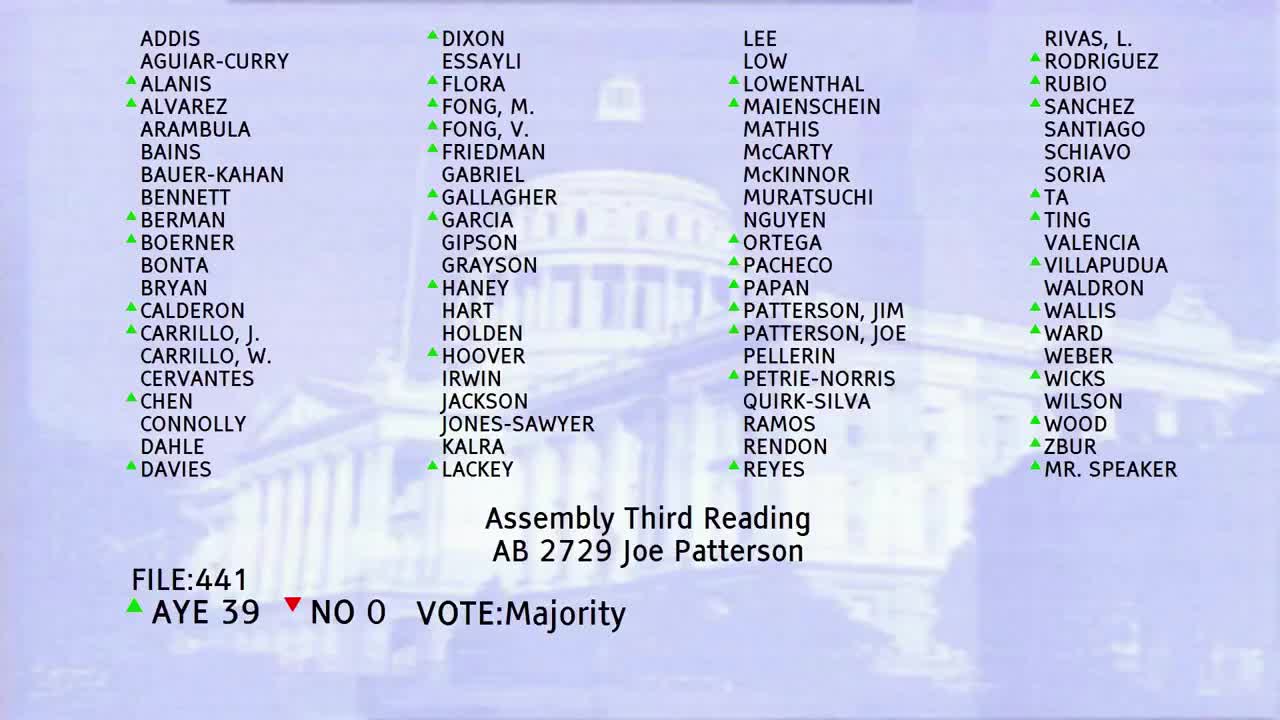
Bill Author

Bill Co-Author(s):