AB 2742: Emergency vehicles: penalties.
- Session Year: 2023-2024
- House: Assembly
- Latest Version Date: 2024-02-15
Current Status:
Failed
(2024-05-16: In committee: Held under submission.)
Introduced
In Committee
First Chamber
In Committee
Second Chamber
Enacted
Existing law requires, upon the immediate approach of an authorized emergency vehicle that is sounding a siren and has a lighted lamp exhibiting red light, that a driver of a vehicle yield the right-of-way to the emergency vehicle, that the operator of a street car immediately stop the street car, and that all pedestrians proceed to the nearest curb or place of safety and remain there until the authorized emergency vehicle has passed.
Existing law makes a violation of that provision an infraction, punishable by specified fines.
This bill would prohibit a person driving a vehicle upon a highway or a pedestrian from willfully obstructing a highway, including in the course of a protest, in any manner that interferes with the ability of an authorized emergency vehicle to pass and would make a violation of this provision punishable by specified fines. By creating a new crime, this bill would impose a state-mandated local program.
The California Constitution requires the state to reimburse local agencies and school districts for certain costs mandated by the state. Statutory provisions establish procedures for making that reimbursement.
This bill would provide that no reimbursement is required by this act for a specified reason.
Upon the immediate approach of an authorized emergency vehicle which is sounding a siren and which has at least one lighted lamp exhibiting red light that is visible, under normal atmospheric conditions, from a distance of 1,000 feet to the front of the vehicle, the surrounding traffic shall, except as otherwise directed by a traffic officer, do the following:
(a)(1)Except as required under paragraph (2), the driver of every other vehicle shall yield the right-of-way and shall immediately drive to the right-hand edge or curb of the highway, clear of any intersection, and thereupon shall stop and remain stopped until the authorized emergency vehicle has passed.
(2)A person driving a vehicle in an exclusive or preferential use lane shall exit that lane immediately upon determining that the exit can be accomplished with reasonable safety.
(b)The operator of every street car shall immediately stop the street car, clear of any intersection, and remain stopped until the authorized emergency vehicle has passed.
(c)All pedestrians upon the highway shall proceed to the nearest curb or place of safety and remain there until the authorized emergency vehicle has passed.
(d)A person driving a vehicle upon a highway or a pedestrian shall not willfully obstruct a highway, including in the course of a protest, in any manner that interferes with the ability of an authorized emergency vehicle to pass.
SEC. 2.Section 42001.12 of the Vehicle Code is amended to read:42001.12.Every (a)Except as provided in subdivision (b), a person convicted of an infraction for a violation of Section 21806 shall be punished as follows:
(a)(1)For a first conviction, by a fine of not less than one hundred dollars ($100) nor more than two hundred fifty dollars ($250).
(b)(2)For a second conviction within one year, by a fine of not less than one hundred fifty dollars ($150) nor more than five hundred dollars ($500).
(c)(3)For a third or any subsequent conviction within three years, by a fine of not less than two hundred fifty dollars ($250) nor more than five hundred dollars ($500).
(b)A person convicted of an infraction for a violation of subdivision (d) of Section 21806 shall be punished as follows:
(1)For a first conviction, by a fine of not less than two hundred dollars ($200) nor more than five hundred dollars ($500).
(2)For a second conviction within one year, by a fine of not less than three hundred dollars ($300) nor more than one thousand dollars ($1000).
(3)For a third or any subsequent conviction within three years, by a fine of not less than five hundred dollars ($500) nor more than one thousand dollars ($1000).
SEC. 3.No reimbursement is required by this act pursuant to Section 6 of Article XIIIB of the California Constitution because the only costs that may be incurred by a local agency or school district will be incurred because this act creates a new crime or infraction, eliminates a crime or infraction, or changes the penalty for a crime or infraction, within the meaning of Section 17556 of the Government Code, or changes the definition of a crime within the meaning of Section 6 of Article XIIIB of the California Constitution.
REVISIONS: HeadingLine 3.|
Date
|
Status
|
|---|---|
| May 16, 2024 | In committee: Held under submission. |
| May 16, 2024 | Joint Rule 62(a), file notice suspended. (Page 5215.) |
| May 15, 2024 | In committee: Set, first hearing. Referred to APPR. suspense file. |
| Apr 23, 2024 | From committee: Do pass and re-refer to Com. on APPR. (Ayes 8. Noes 5.) (April 22). Re-referred to Com. on APPR. |
| Apr 23, 2024 | Coauthors revised. |
| Apr 1, 2024 | Referred to Com. on TRANS. |
| Feb 16, 2024 | From printer. May be heard in committee March 17. |
| Feb 15, 2024 | Read first time. To print. |
|
Date
|
Description
|
Location
|
Votes
|
|
|---|---|---|---|---|
| Apr 22, 2024 | Do pass and be re-referred to the Committee on [Appropriations] | Assembly Standing Committee on Transportation |
Passed |
This list shows positions taken on this bill by organizations on the date displayed, which is linked to the original source.
Positions by individuals are not included.
|
Organization
|
Position
|
Date
|
|---|---|---|
| California Association Of Highway Patrolmen | ** Support | |
| Oakland Privacy | ** Against | |
| Peace Officers Research Association Of California | ** Support |
Date of Hearing: May 15, 2024
ASSEMBLY COMMITTEE ON APPROPRIATIONS
Buffy Wicks, Chair
ABPCA Bill Id:AB 2742
Author:(Sanchez) – As Introduced Ver:February 15, 2024
Policy Committee: | Transportation | Vote: | 8 - 5 |
|
| ||
|
|
Urgency: No State Mandated Local Program: Yes Reimbursable: No
SUMMARY:
This bill explicitly prohibits willful obstruction of a highway, including in the course of a protest, in a way that interferes with the ability of an authorized emergency vehicle to pass
Specifically, this bill explicitly prohibits a pedestrian or person driving a vehicle upon a highway from willfully obstructing a highway, including in the course of a protest, in any manner that interferes with the ability of an authorized emergency vehicle to pass, making such action an infraction and provides the following penalties for a violation:
- For a first conviction, a fine of not less than $200 nor more than $500.
- For a second conviction within one year, a fine of not less than $300 nor more than $1,000.
- For a third or any subsequent conviction within three years, a fine of not less than $500 nor more than $1,000.
FISCAL EFFECT:
Minor court costs as a result of the infraction created by this bill.
This bill creates a new moving violation that will need to be reported to the Department of Motor Vehicles (DMV). DMV reports it is undertaking a comprehensive revamp of its information technology (IT) systems. DMV would need to make IT programming changes to accommodate the requirements of this bill, which DMV contends would entail “significant high costs” (Motor Vehicle Account (MVA)).
According to the Legislative Analyst’s Office (LAO), the MVA is expected to fully exhaust its reserves and become insolvent in fiscal year 2025‑26. The LAO further warns that the MVA, absent corrective action, such as revenue increases or spending reductions, will experience a negative fund balance of $1.4 billion in fiscal year 2028‑29.
COMMENTS:
Existing law makes it illegal to block a roadway, for nearly any purpose. The author intends this bill to address roadways blocked by protestors exercising their First Amendment rights, specifically. According to the author:
Like every other hardworking Californian, I’m sick and tired of seeing illegal protests shut down highways. When these protestors block traffic, they are victimizing innocent individuals just to further a political agenda. We need to ensure that the consequences for this behavior increase so that future instances are less likely to occur. When they block traffic they’re preventing fire trucks from responding to emergencies, people getting to work, and parents picking up their kids at school. That’s why I’m proud to introduce AB 2742 to make sure that the base penalty for these crimes is enhanced.
The bill is opposed by Oakland Privacy, which describes itself as a citizen’s coalition. According to Oakland Privacy:
Assembly Bill 2742 is being brought forward disregarding the fact that failure to disperse an unlawful assembly after a lawful order to do so, is already a misdemeanor under law and according to leginfo, that has been the case since 1872. Sec 409 of the CA Penal Code…
The intent of the bill is to mandate fines over the judicial discretion that exists with regard to a misdemeanor crime, and is an end run around the California courts and their existing practices regarding crimes related to civil disobedience.
The bill is supported by the California Association of Highway Patrolmen, which writes:
Blocking traffic of any kind can have disastrous consequences. For example, emergency vehicles can be held up— law enforcement could be blocked from reaching a victim in need of help, firetrucks could be unable to respond to a fire in a timely fashion, and ambulances could be prevented from reaching a patient in time. Not to mention, these types of demonstrations not only put protestors’ lives at risk, but also the motoring public as well.
While the CAHP does not typically support fine increases, purposefully blocking traffic cannot be treated lightly and penalties must be enhanced.
Analysis Prepared by: Jay Dickenson / APPR. / (916) 319-2081
Date of Hearing: April 22, 2024
ASSEMBLY COMMITTEE ON TRANSPORTATION
Lori D. Wilson, Chair
ABPCA Bill Id:AB 2742 (
Author:Sanchez) – As Introduced Ver:February 15, 2024
SUBJECT: Emergency vehicles: penalties
SUMMARY: Makes it an infraction for a person driving a vehicle upon a highway or a pedestrian to willfully obstruct a highway, including in the course of a protest, in any manner that interferes with the ability of an authorized emergency vehicle to pass. Specifically, this bill:
- Provides that a person convicted of the above described infraction shall be punished as follows:
- For a first conviction, by a fine of not less than $200 nor more than $500 ($891 to $2121 with penalty assessments);
- For a second conviction within one year, by a fine of not less than $300 nor more than $1000 ($1301 to $4171 with penalty assessments); and,
- For a third or any subsequent conviction within three years, by a fine of not less than five hundred dollars ($500) nor more than one thousand dollars ($1000) ($2121 to $4171 with penalty assessments).
EXISTING LAW:
- Requires the driver of a vehicle to yield the right of way and immediately drive to the right hand edge of the curb and remained stopped for an approaching authorized emergency vehicle which is sounding a siren and which has at least one lighted lamp exhibiting red light. (Vehicle Code Section (VEH) 21806)
- Requires a pedestrian to proceed to the nearest curb or place of safety and remain there until the authorized emergency vehicle for an approaching authorized emergency vehicle which is sounding a siren and which has at least one lighted lamp exhibiting red light. (VEH 21806)
- Makes a violation for the two above described violations an infraction as follows:
- For a first conviction, by a fine of not less than $100 nor more than $250. ($481 to $1096 with penalty assessments)
- For a second conviction within one year, by a fine of not less than $150 nor more than $500. ($686 to $2121 with penalty assessments)
- For a third or any subsequent conviction within three years, by a fine of not less than $250 nor more than $500. ($1096 to $2121 with penalty assessments).
- Makes it an unlawful assembly whenever two or more persons assemble together to do an unlawful act, or to do a lawful act in a violent, boisterous, or tumultuous manner. (Penal Code Section (PEN) 407)
- Provides that every person remaining present at the place of any riot, route, or unlawful assembly after they have been lawfully warned to disperse is guilty of a misdemeanor. (PEN 409)
- Makes it a misdemeanor for a person to willfully and maliciously obstruct the free movement of any person on any street, sidewalk or other public place. (PEN 647c)
FISCAL EFFECT: Unknown
COMMENTS: There is a long history in the United States of protesters on both the left and the right of the political spectrum blocking traffic on a public road as an act of civil disobedience.
According to the author, “Like every other hardworking Californian, I’m sick and tired of seeing illegal protests shut down highways. When these protestors block traffic, they are victimizing innocent individuals just to further a political agenda. We need to ensure that the consequences for this behavior increase so that future instances are less likely to occur. When they block traffic they’re preventing fire trucks from responding to emergencies, people getting to work, and parents picking up their kids at school. That’s why I’m proud to introduce AB 2742 to make sure that the base penalty for these crimes is enhanced.”
On March 25, 1965 Martin Luther King Jr. led thousands of nonviolent demonstrators to the steps of the capitol in Montgomery, Alabama after a five day, 54 mile March from Selma, Alabama to fight for racial justice. That march included the infamous “Bloody Sunday.” Future Congressman John Lewis led a march across the Edmund Pettus Bridge. John Lewis and the protesters were met with incredible violence by the white onlookers and troopers that attacked the crowd with clubs and tear gas. Mounted police officers chased retreating marchers and continued to beat them.
On May 1, 2004 truckers protesting the high price of fuel parked their big rigs on the Santa Ana Freeway in Commerce during the morning rush hour, causing gridlock that backed up traffic for at least seven miles. The truckers ran out of their cabs and into a waiting getaway car after blocking all travel lanes.
On August 11 at the Unite the Right rally, right wing white nationalist protesters chanting anti-Semitic slurs like “Jews will not Replace Us” blocked traffic as they marched down the streets of Charlottesville, North Carolina. That event ultimately lead to the death of Heather Heyer, a counter protestor to the white nationalists, who was struck by one of the right wing protestors driving his car. That same year Republican lawmakers in North Dakota, North Carolina, Florida, Tennessee and Texas proposed bills to make it legal for drivers to hit protesters if the driver did not do so willfully. The vast majority of those bills ultimately did not become law.
More recently, protests have broken out on freeways in protest to the Israel-Hamas war. On November 16, 2023 demonstrators blocked the Bay Bridge, snarling traffic for hours. The California Highway Patrol (CHP) ultimately charged 80 of those individuals with a variety of misdemeanor crimes, including false imprisonment, refusing to comply with a peace officer, unlawful public assembly, refusing to disperse and aggressive panhandling.
According to the California Highway Patrolmen Association, writing in support of this bill, “Blocking traffic of any kind can have disastrous consequences. For example, emergency vehicles can be held up— law enforcement could be blocked from reaching a victim in need of help, firetrucks could be unable to respond to a fire in a timely fashion, and ambulances could be prevented from reaching a patient in time. Not to mention, these types of demonstrations not only put protestors’ lives at risk, but also the motoring public as well.”
Opposition to protests on streets and roads and freeways has a tendency to change depending on who is doing the protest. For example, many conservative commentators on Fox News have repeatedly attacked protestors on freeways supporting left wing causes like protests for racial justice after the killing of George Floyd. Those same commentators celebrated, however, the Freedom Convoy in Canada in 2022, where truckers blocked traffic in Canada’s capitol protesting against COVID-19 Vaccine mandates.
Oakland Privacy, writing in opposition to this bill, argues “Writing duplicative language into the Vehicle Code and changing the offense from a misdemeanor to a traffic infraction, under certain circumstances, makes little sense, actually weakens the penal code, and from the point of view of statutory structure, constitutes poor legislative writing.”
Committee concerns: This bill is unnecessary. There are already various criminal statutes with stiffer penalties than proposed in this bill to address protesters blocking traffic. Specifically, Penal Code 647c, which makes it a misdemeanor for a person to willfully and maliciously obstruct the free movement of any person on any street, sidewalk or other public place.
REGISTERED SUPPORT / OPPOSITION:
Support
California Association of Highway Patrolmen
Peace Officers Research Association of California
Oppose
Oakland Privacy
Analysis Prepared by: David Sforza / TRANS. / (916) 319-2093
Discussed in Hearing
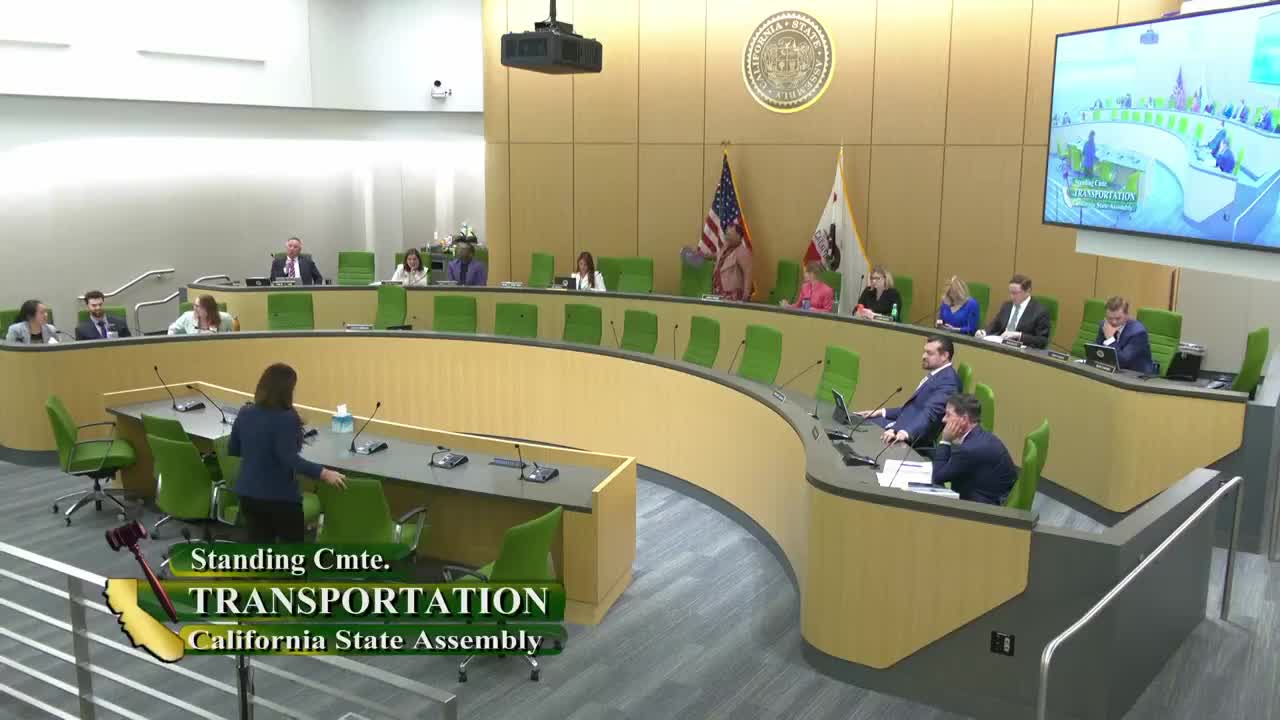 12MIN
Assembly Standing Committee on Transportation
24SEC
Assembly Standing Committee on Transportation
13SEC
Assembly Standing Committee on Transportation
Bill Author