AB 2749: California Health Benefit Exchange: financial assistance.
- Session Year: 2023-2024
- House: Assembly
- Latest Version Date: 2024-09-28
Current Status:
Passed
(2024-09-28: Chaptered by Secretary of State - Chapter 841, Statutes of 2024.)
Introduced
In Committee
First Chamber
In Committee
Second Chamber
Enacted
Existing federal law, the federal Patient Protection and Affordable Care Act (PPACA), requires each state to establish an American Health Benefit Exchange to facilitate the purchase of qualified health benefit plans by qualified individuals and qualified small employers. PPACA authorizes a state to apply to the United States Department of Health and Human Services for a state innovation waiver of any or all PPACA requirements, if certain criteria are met, including that the state has enacted a law that provides for state actions under a waiver. Existing state law creates the California Health Benefit Exchange (Exchange), also known as Covered California, to facilitate the enrollment of qualified individuals and qualified small employers in qualified health plans as required under PPACA. Existing law requires the Exchange, upon appropriation by the Legislature, to administer a program of financial assistance beginning July 1, 2023, to help Californians obtain and maintain health benefits through the Exchange if they lose employer-provided health care coverage as a result of a labor dispute, as specified. Under existing law, if specified eligibility requirements are met, an individual who has lost minimum essential coverage from an employer or joint labor management trust fund as a result of a strike, lockout, or other labor dispute receives the same premium assistance and cost-sharing reductions as an individual with a household income of 138.1% of the federal poverty level, and is also not required to pay a deductible for any covered benefit if the standard benefit design for a household income of 138.1% of the federal poverty level has zero deductibles. Existing law excludes from gross income any subsidy amount received pursuant to that program of financial assistance.
This bill would revise various provisions of the financial assistance program, including deleting the exclusion of financial assistance received under the program from gross income, and specifying the criteria required for an individual to be qualified to receive coverage under the program. The bill would specify that an individual would no longer be eligible for financial assistance under the program when the Exchange verifies that employer-provided minimum essential coverage from the employer has been reinstated for the individual and dependents, as specified. The bill would require an employer or labor organization to notify the Exchange before employer-provided coverage is affected by a strike, lockout, or labor dispute, and would authorize the Exchange to contact the employer, labor organization, or other appropriate representative to determine information necessary to determine eligibility for the financial assistance program, as prescribed.
Existing federal law, the federal Patient Protection and Affordable Care Act (PPACA), requires each state to establish an American Health Benefit Exchange to facilitate the purchase of qualified health benefit plans by qualified individuals and qualified small employers. PPACA authorizes a state to apply to the United States Department of Health and Human Services for a state innovation waiver of any or all PPACA requirements, if certain criteria are met, including that the state has enacted a law that provides for state actions under a waiver. Existing state law creates the California Health Benefit Exchange (Exchange), also known as Covered California, to facilitate the enrollment of qualified individuals and qualified small employers in qualified health plans as required under PPACA. Existing law requires the Exchange, upon appropriation by the Legislature, to administer a program of financial assistance beginning July 1, 2023, to help Californians obtain and maintain health benefits through the Exchange if they lose employer-provided health care coverage as a result of a labor dispute, as specified. Under existing law, if specified eligibility requirements are met, an individual who has lost minimum essential coverage from an employer or joint labor management trust fund as a result of a strike, lockout, or other labor dispute receives the same premium assistance and cost-sharing reductions as an individual with a household income of 138.1% of the federal poverty level, and is also not required to pay a deductible for any covered benefit if the standard benefit design for a household income of 138.1% of the federal poverty level has zero deductibles. Existing law excludes from gross income any subsidy amount received pursuant to that program of financial assistance.
This bill would revise various provisions of the financial assistance program, including deleting the exclusion of financial assistance received under the program from gross income, and specifying the criteria required for an individual to be qualified to receive coverage under the program. The bill would specify that an individual would no longer be eligible for financial assistance under the program when the Exchange verifies that employer-provided minimum essential coverage from the employer has been reinstated for the individual and dependents, as specified. The bill would require an employer or labor organization to notify the Exchange before employer-provided coverage is affected by a strike, lockout, or labor dispute, and would authorize the Exchange to contact the employer, labor organization, or other appropriate representative to determine information necessary to determine eligibility for the financial assistance program, as prescribed. The bill would specify that the Exchanges duties to implement the financial assistance provisions are contingent upon an appropriation by the Legislature for its purposes, and that the Exchange would suspend the financial assistance, including suspending new enrollments in the program, if funds accrued under the program exceed the appropriation.
Existing federal law, the federal Patient Protection and Affordable Care Act (PPACA), requires each state to establish an American Health Benefit Exchange to facilitate the purchase of qualified health benefit plans by qualified individuals and qualified small employers. PPACA authorizes a state to apply to the United States Department of Health and Human Services for a state innovation waiver of any or all PPACA requirements, if certain criteria are met, including that the state has enacted a law that provides for state actions under a waiver. Existing state law creates the California Health Benefit Exchange (Exchange), also known as Covered California, to facilitate the enrollment of qualified individuals and qualified small employers in qualified health plans as required under PPACA. Existing law requires the Exchange, upon appropriation by the Legislature, to administer a program of financial assistance beginning July 1, 2023, to help Californians obtain and maintain health benefits through the Exchange if they lose employer-provided health care coverage as a result of a labor dispute. dispute, as specified. Under existing law, if specified eligibility requirements are met, an individual who has lost minimum essential coverage from an employer or joint labor management trust fund as a result of a strike, lockout, or other labor dispute receives the same premium assistance and cost-sharing reductions as an individual with a household income of 138.1% of the federal poverty level, and is also not required to pay a deductible for any covered benefit if the standard benefit design for a household income of 138.1% of the federal poverty level has zero deductibles. Existing law excludes from gross income any subsidy amount received pursuant to that program of financial assistance.
This bill would make a technical, nonsubstantive change to this provision. revise various provisions of the financial assistance program, including deleting the exclusion of financial assistance received under the program from gross income, and specifying the criteria required for an individual to be qualified to receive coverage under the program. The bill would specify that an individual would no longer be eligible for financial assistance under the program when the Exchange verifies that employer-provided minimum essential coverage from the employer has been reinstated for the individual and dependents, as specified. The bill would require an employer or labor organization to notify the Exchange before employer-provided coverage is affected by a strike, lockout, or labor dispute, and would authorize the Exchange to contact the employer, labor organization, or other appropriate representative to determine information necessary to determine eligibility for the financial assistance program, as prescribed. The bill would specify that the Exchanges duties to implement the financial assistance provisions are contingent upon an appropriation by the Legislature for its purposes, and that the Exchange would suspend the financial assistance, including suspending new enrollments in the program, if funds accrued under the program exceed the appropriation.
Existing federal law, the federal Patient Protection and Affordable Care Act (PPACA), requires each state to establish an American Health Benefit Exchange to facilitate the purchase of qualified health benefit plans by qualified individuals and qualified small employers. PPACA authorizes a state to apply to the United States Department of Health and Human Services for a state innovation waiver of any or all PPACA requirements, if certain criteria are met, including that the state has enacted a law that provides for state actions under a waiver. Existing state law creates the California Health Benefit Exchange (Exchange), also known as Covered California, to facilitate the enrollment of qualified individuals and qualified small employers in qualified health plans as required under PPACA. Existing law requires the Exchange, upon appropriation by the Legislature, to administer a program of financial assistance beginning July 1, 2023, to help Californians obtain and maintain health benefits through the Exchange if they lose employer-provided health care coverage as a result of a labor dispute.
This bill would make a technical, nonsubstantive change to this provision.
(a)Beginning July 1, 2023, the Exchange shall administer a program of financial assistance to help Californians obtain and maintain health benefits through the Exchange if they lose their employer-provided health care coverage as a result of a labor dispute.
(1)An individual who has lost minimum essential coverage from an employer or joint labor management trust fund as a result of a strike, lockout, or labor dispute is a qualified individual for purposes of financial assistance, including premium assistance and cost-sharing reduction subsidies, provided that the individual meets all eligibility requirements specified in Section 36B of the Internal Revenue Code and Section 18071 of Title 42 of the United States Code, except for the income requirements of those sections. Any household income of the qualified individual above 138.1 percent of the federal poverty level for a family of the qualified individuals size shall not be taken into account for the qualified individual and the members of their tax household. Consistent with existing federal law and rules, an individual shall be screened for eligibility for the federal Medicaid program.
(2)An individual described in paragraph (1) shall receive subsidies for health insurance premiums and cost-sharing reductions that provide the same assistance that is provided to other individuals with household incomes of 138.1 percent of the federal poverty level who qualify for financial assistance through the Exchange. The cost-sharing reductions shall use a standard benefit design that has an actuarial value of 94 percent or greater, and, effective January 1, 2024, the program design shall have zero deductibles for any covered benefit if the standard benefit design for this income has zero deductibles.
(3)An individual shall be a qualified individual for purposes of financial assistance, including premium assistance and cost-sharing reduction subsidies, under this section if all of the following are met:
(A)The individual loses minimum essential coverage from an employer as a result of a strike, lockout, or labor dispute.
(B)The employer that provided the minimum essential coverage to the individual is involved in the strike, lockout, or labor dispute.
(C)The individual provides a self-attestation confirming that they lost minimum essential coverage from an employer as a result of a strike, lockout, or labor dispute, and that the employer that provided them the minimum essential coverage is involved in the strike, lockout, or labor dispute.
(4)If further documentation is required, the Exchange shall contact the affected collective bargaining agent and may contact the employer.
(b)Notwithstanding Sections 1399.848 and 1399.849 of the Health and Safety Code, and Sections 10965.3 and 10965.4 of the Insurance Code, the effective date of coverage shall be the first day of the month of application submission and plan selection or the first day of the following month, at the discretion of the qualified individual.
(c)(1)The Exchange, on a monthly basis, shall notify an enrollee receiving financial assistance pursuant to this section that the enrollee is required to notify the Exchange if their household income changes or minimum essential coverage provided by the enrollees employer is reinstated. The notice shall include information on the potential state and federal income tax consequences of any amount received as a subsidy provided under this section.
(2)Upon resolution of a strike, lockout, or labor dispute, an individual shall no longer be eligible for financial assistance under this section when the Exchange verifies that employer-provided minimum essential coverage from the employer has been reinstated for that individual and dependents and only after prior notification to the qualified individual of loss of financial assistance under this section.
(d)An employer or labor organization shall notify the Exchange before employer-provided coverage is affected by a strike, lockout, or labor dispute pursuant to a process established by the Exchange. The Exchange may contact an employer, labor organization, or other appropriate representative to determine the status of a strike, lockout, or labor dispute, its impact to coverage, and any other information necessary to determine eligibility for financial assistance under this section.
(e)(1)The Exchange shall maximize federal affordability assistance for an individual enrolled pursuant to this section and shall use state affordability assistance funds for financial assistance not otherwise available under federal law.
(2)Financial assistance provided pursuant to this section shall be funded upon appropriation by the Legislature.
(f)Gross income, as defined in Section 17071 of the Revenue and Taxation Code, does not include any amount received as a state subsidy provided under this section.
(g)The following definitions apply for purposes of this section:
(1)Employer-provided coverage means coverage provided by an employer, a multiemployer health plan, as defined in Section 1002(37)(A) of Title 29 of the United States Code, or a joint labor-management trust.
(2)Labor dispute has the same meaning as set forth in clauses (i), (ii), and (iii) of paragraph (4) of subdivision (b) of Section 527.3 of the Code of Civil Procedure.
(3)Labor organization has the same meaning as defined in Section 1117 of the Labor Code.
(4)Lockout has the same meaning as defined in Section 1132.8 of the Labor Code.
(5)Strike has the same meaning as defined in Section 1132.6 of the Labor Code.
(a)Beginning July 1, 2023, the Exchange shall administer a program of financial assistance to help Californians obtain and maintain health benefits through the Exchange if they lose their employer-provided health care coverage as a result of a labor dispute.
(1)An individual who has lost minimum essential coverage from an employer or joint labor management trust fund as a result of a strike, lockout, or labor dispute is a qualified individual for purposes of financial assistance, including premium assistance and cost-sharing reduction subsidies, provided that the individual meets all eligibility requirements specified in Section 36B of the Internal Revenue Code and Section 18071 of Title 42 of the United States Code, except for the income requirements of those sections. Any household income of the qualified individual above 138.1 percent of the federal poverty level for a family of the qualified individuals size shall not be taken into account for the qualified individual and the members of their tax household. Consistent with existing federal law and rules, an individual shall be screened for eligibility for the federal Medicaid program.
(2)An individual described in paragraph (1) shall receive subsidies for health insurance premiums and cost-sharing reductions that provide the same assistance that is provided to other individuals with household incomes of 138.1 percent of the federal poverty level who qualify for financial assistance through the Exchange. The cost-sharing reductions shall use a standard benefit design that has an actuarial value of 94 percent or greater, and, effective January 1, 2024, the program design shall have zero deductibles for any covered benefit if the standard benefit design for this income has zero deductibles.
(3)An individual shall be a qualified individual for purposes of financial assistance, including premium assistance and cost-sharing reduction subsidies, under this section if all of the following are met:
(A)The individual loses minimum essential coverage from an employer as a result of a strike, lockout, or labor dispute.
(B)The employer that provided the minimum essential coverage to the individual is involved in the strike, lockout, or labor dispute.
(C)The individual provides a self-attestation confirming that they lost minimum essential coverage from an employer as a result of a strike, lockout, or labor dispute, and that the employer that provided them the minimum essential coverage is involved in the strike, lockout, or labor dispute.
(4)If further documentation is required, the Exchange shall contact the affected collective bargaining agent and may contact the employer.
(b)Notwithstanding Sections 1399.848 and 1399.849 of the Health and Safety Code, and Sections 10965.3 and 10965.4 of the Insurance Code, the effective date of coverage shall be the first day of the month of application submission and plan selection or the first day of the following month, at the discretion of the qualified individual.
(c)(1)The Exchange, on a monthly basis, shall notify an enrollee receiving financial assistance pursuant to this section that the enrollee is required to notify the Exchange if their household income changes or minimum essential coverage provided by the enrollees employer is reinstated. The notice shall include information on the potential state and federal income tax consequences of any amount received as a subsidy provided under this section.
(2)Upon resolution of a strike, lockout, or labor dispute, an individual shall no longer be eligible for financial assistance under this section when the Exchange verifies that employer-provided minimum essential coverage from the employer has been reinstated for that individual and dependents and only after prior notification to the qualified individual of loss of financial assistance under this section.
(d)An employer or labor organization shall notify the Exchange before employer-provided coverage is affected by a strike, lockout, or labor dispute pursuant to a process established by the Exchange. The Exchange may contact an employer, labor organization, or other appropriate representative to determine the status of a strike, lockout, or labor dispute, its impact to coverage, and any other information necessary to determine eligibility for financial assistance under this section.
(e)(1)The Exchange shall maximize federal affordability assistance for an individual enrolled pursuant to this section and shall use state affordability assistance funds for financial assistance not otherwise available under federal law.
(2)Financial assistance provided pursuant to this section shall be funded upon appropriation by the Legislature. The Exchanges duties to implement this section are contingent upon an appropriation from the Legislature for purposes of implementing the requirements of this section. The Exchange shall suspend the financial assistance provided pursuant to this section, including suspending new enrollments in the program, if funds accrued under the program exceed the appropriation.
(f)Gross income, as defined in Section 17071 of the Revenue and Taxation Code, does not include any amount received as a state subsidy provided under this section.
(g)The following definitions apply for purposes of this section:
(1)Employer-provided coverage means coverage provided by an employer, a multiemployer health plan, as defined in Section 1002(37)(A) of Title 29 of the United States Code, or a joint labor-management trust.
(2)Labor dispute has the same meaning as set forth in clauses (i), (ii), and (iii) of paragraph (4) of subdivision (b) of Section 527.3 of the Code of Civil Procedure.
(3)Labor organization has the same meaning as defined in Section 1117 of the Labor Code.
(4)Lockout has the same meaning as defined in Section 1132.8 of the Labor Code.
(5)Strike has the same meaning as defined in Section 1132.6 of the Labor Code.
(a)Beginning July 1, 2023, the Exchange shall administer a program of financial assistance to help Californians obtain and maintain health benefits through the Exchange if they lose their employer-provided health care coverage as a result of a labor dispute.
(1)An individual who has lost minimum essential coverage from an employer or joint labor management trust fund as a result of a strike, lockout, or other labor dispute is a prospective enrollee qualified individual for purposes of financial assistance, including premium assistance and cost-sharing reduction subsidies, provided that the individual meets all eligibility requirements specified in Section 36B of the Internal Revenue Code and Section 18071 of Title 42 of the United States Code, except for the income requirements of those sections. Any household income of the prospective enrollee qualified individual above 138.1 percent of the federal poverty level for a family of the prospective enrollees qualified individuals size shall not be taken into account for the prospective enrollee qualified individual and the members of their tax household. Consistent with existing federal law and rules, an individual shall be screened for eligibility for the federal Medicaid program.
(2)An individual described in paragraph (1) shall receive subsidies for health insurance premiums and cost-sharing reductions that provide the same assistance that is provided to other individuals with household incomes of 138.1 percent of the federal poverty level who qualify for financial assistance through the Exchange. The cost-sharing reductions shall use a standard benefit design that has an actuarial value of 94 percent or greater, and, effective January 1, 2024, the program design shall have zero deductibles for any covered benefit if the standard benefit design for this income has zero deductibles.
(3)The modified adjusted gross income or household income of an individual described in paragraph (1) shall not be calculated to include strike benefits, lockout benefits, or unemployment compensation.(b)(1)To receive financial assistance pursuant to this section, an individual shall provide a self-attestation regarding the loss of minimum essential coverage as a result of a dispute. If further documentation is required, the Exchange shall contact the affected collective bargaining agent and may contact the employer.(3)An individual shall be a qualified individual for purposes of financial assistance, including premium assistance and cost-sharing reduction subsidies, under this section if all of the following are met:
(A)The individual loses minimum essential coverage from an employer as a result of a strike, lockout, or labor dispute.
(B)The employer that provided the minimum essential coverage to the individual is involved in the strike, lockout, or labor dispute.
(C)The individual provides a self-attestation confirming that they lost minimum essential coverage from an employer as a result of a strike, lockout, or labor dispute, and that the employer that provided them the minimum essential coverage is involved in the strike, lockout, or labor dispute.
(4)If further documentation is required, the Exchange shall contact the affected collective bargaining agent and may contact the employer.
(2)(b)Notwithstanding Sections 1399.848 and 1399.849 of the Health and Safety Code, and Sections 10965.3 and 10965.4 of the Insurance Code, the effective date of coverage shall be the date of the completed application or a later date, first day of the month of application submission and plan selection or the first day of the following month, at the discretion of the enrollee. qualified individual.
(c)(1)The Exchange, on a monthly basis, shall notify an enrollee receiving financial assistance pursuant to this section that the enrollee is required to notify the Exchange if their household income changes or minimum essential coverage provided by the enrollees employer is reinstated. The notice shall include information on the potential state and federal income tax consequences of any amount received as a subsidy provided under this section.
(2)Upon resolution of a strike, lockout, or labor dispute, an individual shall no longer be eligible for financial assistance under this section when the Exchange verifies that employer-provided minimum essential coverage from the employer has been reinstated for that individual and dependents and only after prior notification to the qualified individual of loss of financial assistance under this section.
(d)An employer or labor organization shall notify the Exchange before employer-provided coverage is affected by a strike, lockout, or labor dispute pursuant to a process established by the Exchange. The Exchange may contact an employer, labor organization, or other appropriate representative to determine the status of a strike, lockout, or labor dispute, its impact to coverage, and any other information necessary to determine eligibility for financial assistance under this section.
(d)(e)(1)The Exchange shall maximize federal affordability assistance for an individual enrolled pursuant to this section and shall use state affordability assistance funds for financial assistance not otherwise available under federal law.
(2)Financial assistance provided pursuant to this section shall be funded upon appropriation by the Legislature. The Exchanges duties to implement this section are contingent upon an appropriation from the Legislature for purposes of implementing the requirements of this section. The Exchange shall suspend the financial assistance provided pursuant to this section, including suspending new enrollments in the program, if funds accrued under the program exceed the appropriation.
(e)(f)Gross income, as defined in Section 17071 of the Revenue and Taxation Code, does not include any amount received as a state subsidy provided under this section.
(g)The following definitions apply for purposes of this section:
(1)Employer-provided coverage means coverage provided by an employer, a multiemployer health plan, as defined in Section 1002(37)(A) of Title 29 of the United States Code, or a joint labor-management trust.
(2)Labor dispute has the same meaning as set forth in clauses (i), (ii), and (iii) of paragraph (4) of subdivision (b) of Section 527.3 of the Code of Civil Procedure.
(3)Labor organization has the same meaning as defined in Section 1117 of the Labor Code.
(4)Lockout has the same meaning as defined in Section 1132.8 of the Labor Code.
(5)Strike has the same meaning as defined in Section 1132.6 of the Labor Code.
(a)Beginning July 1, 2023, the Exchange shall administer a program of financial assistance to help Californians obtain and maintain health benefits through the Exchange if they lose their employer-provided health care coverage as a result of a labor dispute.
(1)An individual who has lost minimum essential coverage from an employer or joint labor management trust fund as a result of a strike, lockout, or other labor dispute is a prospective enrollee for purposes of financial assistance, including premium assistance and cost-sharing reduction subsidies, provided that the individual meets all eligibility requirements specified in Section 36B of the Internal Revenue Code and Section 18071 of Title 42 of the United States Code, except for the income requirements of those sections. Any household income of the prospective enrollee above 138.1 percent of the federal poverty level for a family of the prospective enrollees size shall not be taken into account for the prospective enrollee and the members of their tax household. Consistent with existing federal law and rules, an individual shall be screened for eligibility for the federal Medicaid program.
(2)An individual described in paragraph (1) shall receive subsidies for health insurance premiums and cost-sharing reductions that provide the same assistance that is provided to other individuals with incomes of 138.1 percent of the federal poverty level who qualify for financial assistance through the Exchange. The cost-sharing reductions shall use a standard benefit design that has an actuarial value of 94 percent or greater, and, effective January 1, 2024, the program design shall have zero deductibles for any covered benefit if the standard benefit design for this income has zero deductibles.
(3)The modified adjusted gross income or household income of an individual described in paragraph (1) shall not be calculated to include strike benefits, lockout benefits, or unemployment compensation.
(b)(1)To receive financial assistance pursuant to this section, an individual shall provide a self-attestation regarding the loss of minimum essential coverage as a result of a dispute. If further documentation is required, the Exchange shall contact the affected collective bargaining agent and may contact the employer.
(2)Notwithstanding Sections 1399.848 and 1399.849 of the Health and Safety Code, and Sections 10965.3 and 10965.4 of the Insurance Code, the effective date of coverage shall be the date of the completed application or a later date, at the discretion of the enrollee.
(c)The Exchange, on a monthly basis, shall notify an enrollee receiving financial assistance pursuant to this section that the enrollee is required to notify the Exchange if their household income changes or minimum essential coverage provided by the enrollees employer is reinstated. The notice shall include information on the potential state and federal income tax consequences of any amount received as a subsidy provided under this section.
(d)(1)The Exchange shall maximize federal affordability assistance for an individual enrolled pursuant to this section and shall use state affordability assistance funds for financial assistance not otherwise available under federal law.
(2)Financial assistance provided pursuant to this section shall be funded upon appropriation by the Legislature.
(e)Gross income, as defined in Section 17071 of the Revenue and Taxation Code, does not include any amount received as a state subsidy provided under this section.
|
Date
|
Status
|
|---|---|
| Sep 28, 2024 | Chaptered by Secretary of State - Chapter 841, Statutes of 2024. |
| Sep 28, 2024 | Approved by the Governor. |
| Aug 27, 2024 | Enrolled and presented to the Governor at 12 p.m. |
| Aug 20, 2024 | In Assembly. Ordered to Engrossing and Enrolling. |
| Aug 20, 2024 | Read third time. Passed. Ordered to the Assembly. (Ayes 34. Noes 0. Page 5229.). |
| Jul 2, 2024 | Read second time. Ordered to third reading. |
| Jul 1, 2024 | From committee: Be ordered to second reading pursuant to Senate Rule 28.8. |
| Jun 20, 2024 | From committee: Do pass and re-refer to Com. on APPR. (Ayes 9. Noes 0.) (June 19). Re-referred to Com. on APPR. |
| May 29, 2024 | Referred to Com. on HEALTH. |
| May 21, 2024 | In Senate. Read first time. To Com. on RLS. for assignment. |
| May 20, 2024 | Read third time. Passed. Ordered to the Senate. (Ayes 63. Noes 0. Page 5324.) |
| May 16, 2024 | Read second time. Ordered to third reading. |
| May 15, 2024 | From committee: Do pass. (Ayes 11. Noes 1.) (May 15). |
| Apr 15, 2024 | Re-referred to Com. on APPR. |
| Apr 11, 2024 | Read second time and amended. |
| Apr 10, 2024 | From committee: Amend, and do pass as amended and re-refer to Com. on APPR. (Ayes 14. Noes 0.) (April 9). |
| Mar 19, 2024 | Re-referred to Com. on HEALTH. |
| Mar 18, 2024 | From committee chair, with author's amendments: Amend, and re-refer to Com. on HEALTH. Read second time and amended. |
| Mar 18, 2024 | Referred to Com. on HEALTH. |
| Feb 16, 2024 | From printer. May be heard in committee March 17. |
| Feb 15, 2024 | Read first time. To print. |
|
Date
|
Description
|
Location
|
Votes
|
|
|---|---|---|---|---|
| Aug 20, 2024 | Assembly 3rd Reading AB2749 Wood By Smallwood-Cuevas | Senate Floor |
Passed |
|
| Jun 19, 2024 | Do pass, but first be re-referred to the Committee on [Appropriations] | Senate Standing Committee on Health |
Passed |
|
| May 20, 2024 | AB 2749 Wood Assembly Third Reading | Assembly Floor |
Passed |
|
| May 15, 2024 | Do pass. | Assembly Standing Committee on Appropriations |
Passed |
|
| Apr 9, 2024 | Do pass as amended and be re-referred to the Committee on [Appropriations] | Assembly Standing Committee on Health |
Passed |
This list shows positions taken on this bill by organizations on the date displayed, which is linked to the original source.
Positions by individuals are not included.
|
Organization
|
Position
|
Date
|
|---|---|---|
| California Labor Federation | ** Support |
SENATE RULES COMMITTEE Office of Senate Floor Analyses (916) 651-1520 Fax: (916) 327-4478 | AB 2749 |
THIRD READING
Bill No: AB 2749
Author: Wood (D)
Amended: 4/11/24 in Assembly
Vote: 21
SENATE HEALTH COMMITTEE: 9-0, 6/19/24
AYES: Roth, Glazer, Gonzalez, Hurtado, Limón, Menjivar, Rubio, Smallwood-Cuevas, Wiener
NO VOTE RECORDED: Nguyen, Grove
SENATE APPROPRIATIONS COMMITTEE: Senate Rule 28.8
ASSEMBLY FLOOR: 63-0, 5/20/24 - See last page for vote
SUBJECT: California Health Benefit Exchange: financial assistance
SOURCE: Author
DIGEST:
This bill clarifies who can qualify for coverage and when coverage is no longer available under an existing program that authorizes health insurance coverage through Covered California for employees during strikes, lockouts, or other labor disputes.
ANALYSIS:
Existing law:
- Establishes Covered California as an independent entity in state government not affiliated with any state agency or department, governed by a five-member board. Requires the Covered California Executive Board to establish and use a competitive process to select participating carriers and other contractors, and to make health insurance available to individuals and small businesses as authorized under the federal Affordable Care Act (ACA). [GOV §100500 -100522]
- Requires Covered California to administer a program of financial assistance to help Californians obtain and maintain health benefits through Covered California if they lose employer-provided health care coverage as a result of a labor dispute. [GOV §100523]
- Makes an individual who has lost minimum essential coverage (insurance that meets ACA requirements) from an employer or joint labor management trust fund as a result of a strike, lockout, or other labor dispute a prospective Covered California enrollee for purposes of financial assistance, including premium assistance and cost-sharing reduction subsidies, provided that the individual meets all eligibility requirements specified in federal law, except for the income requirements of those sections. Prohibits any household income of the prospective enrollee above 138.1% of the federal poverty level (FPL) for a family of the prospective enrollee’s size from being taken into account for the prospective enrollee and the members of their tax household. Requires, consistent with existing federal law and rules, an individual to be screened for eligibility for the federal Medicaid program. [GOV §100523]
- Requires an individual described above to receive subsidies for health insurance premiums and cost-sharing reductions that provide the same assistance that is provided to other individuals with incomes of 138.1% FPL who qualify for financial assistance through Covered California. Requires the cost-sharing reductions to use a standard benefit design that has an actuarial value (AV) of 94% or greater, and the program design to have zero deductibles for any covered benefit if the standard benefit design for this income has zero deductibles. [GOV §100523]
- Requires the modified adjusted gross income or household income of an individual described above to not be calculated to include strike benefits, lockout benefits, or unemployment compensation. [GOV §100523]
- Requires, to receive financial assistance, an individual to provide a self-attestation regarding the loss of minimum essential coverage as a result of a dispute, and permits Covered California to contact the affected collective bargaining agent and the employer. [GOV §100523]
- Requires Covered California on a monthly basis, to notify an enrollee receiving financial assistance under this program that the enrollee is required to notify Covered California if their household income changes or minimum essential coverage provided by the enrollee’s employer is reinstated. Requires the notice to include information on potential state and federal income tax consequences of receiving a subsidy under this program. [GOV §100523]
- Requires Covered California to maximize federal affordability assistance for an individual enrolled in this program, and to use state affordability assistance funds for financial assistance not otherwise available under federal law. Requires financial assistance to be funded upon appropriation by the Legislature. [GOV §100523]
This bill:
- Replaces “prospective enrollee” with “qualified individual,” and requires an individual to be a qualified individual for purposes of financial assistance, including premium assistance and cost-sharing reduction subsidies, if all of the following are met:
- The individual loses minimum essential coverage from an employer as a result of a strike, lockout, or labor dispute;
- The employer that provided the minimum essential coverage to the individual is involved in the strike, lockout, or labor dispute; and,
- The individual provides a self-attestation confirming that they lost minimum essential coverage from an employer as a result of a strike, lockout, or labor dispute, and that the employer that provided them the minimum essential coverage is involved in the strike, lockout, or labor dispute.
- Makes an individual no longer eligible for financial assistance, upon resolution of a strike, lockout, or labor dispute, when Covered California verifies that employer-provided minimum essential coverage from the employer has been reinstated for that individual and dependents and only after prior notification to the qualified individual of loss of financial assistance.
- Requires an employer or labor organization to notify Covered California before employer-provided coverage is affected by a strike, lockout, or labor dispute pursuant to a process established by Covered California. Authorizes Covered California to contact an employer, labor organization, or other appropriate representative to determine the status of a strike, lockout, or labor dispute, its impact to coverage, and any other information necessary to determine eligibility for financial assistance.
- Establishes the following definitions:
- “Employer-provided coverage” means coverage provided by an employer, a “multiemployer health plan,” as defined in federal law, or a joint labor-management trust.
- “Labor dispute” has the same meaning as set forth in specified existing law, which:
- Generally, involves persons who are engaged in the same industry, trade, craft, or occupation; or have direct or indirect interests therein; or who are employees of the same employer; or who are members of the same or an affiliated organization of employers or employees; whether such dispute is (a) between one or more employers or associations of employers and one or more employees or associations of employees; (b) between one or more employers or associations of employers and one or more employers or associations of employers; or (c) between one or more employees or associations of employees and one or more employees or associations of employees; or when the case involves any conflicting or competing interests in a “labor dispute” of “persons participating or interested” therein (as defined in subparagraph ii)).
- A person or association is participating or interested in a labor dispute if relief is sought against him or it, and if he or it is engaged in the same industry, trade, craft, or occupation in which such a dispute occurs, or has a direct or indirect interest therein, or is a member, officer, or agent of any association composed in whole or in part of employers or employees engaged in such industry, trade, craft, or occupation.
- Includes any controversy concerning terms or conditions of employment, or concerning the association or representation of persons in negotiating, fixing, maintaining, changing, or seeking to arrange terms or conditions of employment regardless of whether or not the disputants stand in the proximate relation of employer and employee.
- “Labor organization” has the same meaning as defined in existing law, which is any organization or any agency or employee representation committee or any local unit thereof in which employees participate, and it exists for the purpose, in whole or in part, of dealing with employers concerning grievances, labor disputes, wages, hours of employment or conditions of work. The labor organization is not found to be or to have been financed in whole or in part, interfered with, dominated or controlled by the employer or any employer association within one year of the commencement of any proceeding brought, as specified. “Person” means any person, association, organization, partnership, corporation, limited liability company, unincorporated association, or labor organization.
- “Lockout” has the same meaning as defined in existing law, which means any refusal by an employer to permit any group of five or more employees to work as a result of a dispute with such employees affecting wages, hours or other terms or conditions of employment of such employees.
- “Strike” has the same meaning as existing law which is any concerted act of more than 50% of the bargaining unit employees in a lawful refusal of such employees under applicable state or federal law to perform work or services for an employer, other than work stoppages based on conflicting union jurisdictions or work stoppages unauthorized by the proper union governing body.
Comments
- Author’s statement. The author states that in 2022 he authored AB 2530 to provide workers who lose health benefits due to a labor dispute a slightly improved version of the most affordable coverage package offered by Covered California. This is similar to what the American Rescue Plan (ARP) has done for those on unemployment insurance during the COVID-19 pandemic, providing premium subsidies and cost-sharing assistance as if the worker’s income was just over the Medi-Cal eligibility level. AB 2530 was an instrumental step in the right direction, but further clarification is needed. This bill would further clarify eligibility to ensure that the program helps the intended consumers. The bill also provides definitions and clarifies language to allow for the successful implementation of the program by Covered California.
- 2023 Strike Activity. According to a February 20, 2024 post in Labor Strike, Unions by Daniel Pasternak, based on data from Bloomberg Law, nationally there were 345 strikes in 2023 and two employer-initiated lockouts, affecting more than 600,000 workers. This is the most since 2003. Two-thirds ended within seven days and under 5% lasted more than 60 days. In California, 47 out of 71 strikes ended in seven days or less. According to Covered California, the Covered California strike benefit program covered approximately 75 consumers for an average of 2.2 months. The total spend on the program in 2023 was $38,724.
Related/Prior Legislation
AB 2530 (Wood, Chapter 695, Statutes of 2022) required Covered California to provide financial assistance, upon appropriation by the Legislature, to ensure an individual who has lost coverage from an employer or joint labor management trust fund as a result of a strike, lockout, or other labor dispute such that any household income above 138.1% FPL is not taken into account, coverage is equivalent to 94% actuarial value with zero deductibles, and any strike benefits, lockout benefits, or unemployment compensation is also excluded from income.
FISCAL EFFECT: Appropriation: No Fiscal Com.: Yes Local: No
SUPPORT: (Verified 7/1/24)
California Labor Federation
OPPOSITION: (Verified 7/1/24)
None received
ARGUMENTS IN SUPPORT: According to the California Labor Federation, AB 2530 eliminated the threat of loss of health benefits during a labor dispute for private sector workers in California. The law provides immediate enhanced subsidies through California’s health exchange, Covered California, to workers when their employers drop their health coverage during a labor dispute. The law has already proved beneficial—Teamster members who lost family coverage in a labor dispute last summer were able to immediately obtain coverage for themselves and their families at a reasonable cost. An unprecedented strike wave has hit California with strikes that were covered daily in the press by SAG-AFTRA, WGA, UAW, and a narrowly averted strike of Teamster UPS drivers. Other strikes, such as by Teamster Transdev workers in Visalia, received less coverage but were part of the “Hot Labor Summer” that swept the country. These long strikes demonstrated the importance of the health care for striking workers program and the need for policy clarification. This bill further clarifies language in existing law to allow for the successful implementation of the program by Covered California. That includes clarifying that the program is limited to employees and the dependents of affected employers. It also provides other clarifications and definitions to allow Covered California to efficiently implement the law.
ASSEMBLY FLOOR: 63-0, 5/20/24
AYES: Addis, Aguiar-Curry, Alanis, Alvarez, Bains, Bauer-Kahan, Bennett, Berman, Boerner, Bonta, Bryan, Calderon, Juan Carrillo, Wendy Carrillo, Chen, Connolly, Mike Fong, Friedman, Garcia, Gipson, Grayson, Haney, Hart, Holden, Hoover, Irwin, Jackson, Jones-Sawyer, Kalra, Lee, Low, Lowenthal, Maienschein, McCarty, McKinnor, Muratsuchi, Ortega, Pacheco, Papan, Joe Patterson, Pellerin, Petrie-Norris, Quirk-Silva, Ramos, Rendon, Reyes, Rodriguez, Blanca Rubio, Santiago, Schiavo, Soria, Ting, Valencia, Villapudua, Waldron, Wallis, Ward, Weber, Wicks, Wilson, Wood, Zbur, Robert Rivas
NO VOTE RECORDED: Arambula, Cervantes, Megan Dahle, Davies, Dixon, Essayli, Flora, Vince Fong, Gabriel, Gallagher, Lackey, Mathis, Stephanie Nguyen, Jim Patterson, Luz Rivas, Sanchez, Ta
Prepared by: Teri Boughton / HEALTH / (916) 651-4111
7/2/24 15:16:47
**** END ****
SENATE COMMITTEE ON HEALTH
Senator Richard Roth, Chair
BILL NO: AB 2749
AUTHOR: | Wood | ||
VERSION: | April 11, 2024 | ||
HEARING DATE: | June 19, 2024 | ||
CONSULTANT: | Teri Boughton | ||
SUBJECT: California Health Benefit Exchange: financial assistance
SUMMARY:
Clarifies who can qualify for coverage and when coverage is no longer available under an existing program that authorizes health insurance coverage through Covered California for employees during strikes, lockouts, or other labor disputes.
Existing law:
- Establishes Covered California as an independent entity in state government not affiliated with any state agency or department, governed by a five-member board. Requires the Covered California Executive Board to establish and use a competitive process to select participating carriers and other contractors, and to make health insurance available to individuals and small businesses as authorized under the federal Affordable Care Act (ACA). [GOV §100500 -100522]
- Requires Covered California to administer a program of financial assistance to help Californians obtain and maintain health benefits through Covered California if they lose employer-provided health care coverage as a result of a labor dispute. [GOV §100523]
- Makes an individual who has lost minimum essential coverage (insurance that meets ACA requirements) from an employer or joint labor management trust fund as a result of a strike, lockout, or other labor dispute a prospective Covered California enrollee for purposes of financial assistance, including premium assistance and cost-sharing reduction subsidies, provided that the individual meets all eligibility requirements specified in federal law, except for the income requirements of those sections. Prohibits any household income of the prospective enrollee above 138.1% of the federal poverty level (FPL) for a family of the prospective enrollee’s size from being taken into account for the prospective enrollee and the members of their tax household. Requires, consistent with existing federal law and rules, an individual to be screened for eligibility for the federal Medicaid program. [GOV §100523]
- Requires an individual described above to receive subsidies for health insurance premiums and cost-sharing reductions that provide the same assistance that is provided to other individuals with incomes of 138.1% FPL who qualify for financial assistance through Covered California. Requires the cost-sharing reductions to use a standard benefit design that has an actuarial value (AV) of 94% or greater, and the program design to have zero deductibles for any covered benefit if the standard benefit design for this income has zero deductibles. [GOV §100523]
- Requires the modified adjusted gross income or household income of an individual described above to not be calculated to include strike benefits, lockout benefits, or unemployment compensation. [GOV §100523]
- Requires, to receive financial assistance, an individual to provide a self-attestation regarding the loss of minimum essential coverage as a result of a dispute, and permits Covered California to contact the affected collective bargaining agent and the employer. [GOV §100523]
- Requires Covered California on a monthly basis, to notify an enrollee receiving financial assistance under this program that the enrollee is required to notify Covered California if their household income changes or minimum essential coverage provided by the enrollee’s employer is reinstated. Requires the notice to include information on potential state and federal income tax consequences of receiving a subsidy under this program. [GOV §100523]
- Requires Covered California to maximize federal affordability assistance for an individual enrolled in this program, and to use state affordability assistance funds for financial assistance not otherwise available under federal law. Requires financial assistance to be funded upon appropriation by the Legislature. [GOV §100523]
This bill:
- Replaces “prospective enrollee” with “qualified individual,” and requires an individual to be a qualified individual for purposes of financial assistance, including premium assistance and cost-sharing reduction subsidies, if all of the following are met:
- The individual loses minimum essential coverage from an employer as a result of a strike, lockout, or labor dispute;
- The employer that provided the minimum essential coverage to the individual is involved in the strike, lockout, or labor dispute; and,
- The individual provides a self-attestation confirming that they lost minimum essential coverage from an employer as a result of a strike, lockout, or labor dispute, and that the employer that provided them the minimum essential coverage is involved in the strike, lockout, or labor dispute.
- Makes an individual no longer eligible for financial assistance, upon resolution of a strike, lockout, or labor dispute, when Covered California verifies that employer-provided minimum essential coverage from the employer has been reinstated for that individual and dependents and only after prior notification to the qualified individual of loss of financial assistance.
- Requires an employer or labor organization to notify Covered California before employer-provided coverage is affected by a strike, lockout, or labor dispute pursuant to a process established by Covered California. Authorizes Covered California to contact an employer, labor organization, or other appropriate representative to determine the status of a strike, lockout, or labor dispute, its impact to coverage, and any other information necessary to determine eligibility for financial assistance.
- Establishes the following definitions:
- “Employer-provided coverage” means coverage provided by an employer, a “multiemployer health plan,” as defined in federal law, or a joint labor-management trust.
- “Labor dispute” has the same meaning as set forth in specified existing law, which:
- Generally, involves persons who are engaged in the same industry, trade, craft, or occupation; or have direct or indirect interests therein; or who are employees of the same employer; or who are members of the same or an affiliated organization of employers or employees; whether such dispute is (a) between one or more employers or associations of employers and one or more employees or associations of employees; (b) between one or more employers or associations of employers and one or more employers or associations of employers; or (c) between one or more employees or associations of employees and one or more employees or associations of employees; or when the case involves any conflicting or competing interests in a “labor dispute” of “persons participating or interested” therein (as defined in subparagraph (ii)).
- A person or association is participating or interested in a labor dispute if relief is sought against him or it, and if he or it is engaged in the same industry, trade, craft, or occupation in which such a dispute occurs, or has a direct or indirect interest therein, or is a member, officer, or agent of any association composed in whole or in part of employers or employees engaged in such industry, trade, craft, or occupation.
- Includes any controversy concerning terms or conditions of employment, or concerning the association or representation of persons in negotiating, fixing, maintaining, changing, or seeking to arrange terms or conditions of employment regardless of whether or not the disputants stand in the proximate relation of employer and employee.
- “Labor organization” has the same meaning as defined in existing law, which is any organization or any agency or employee representation committee or any local unit thereof in which employees participate, and it exists for the purpose, in whole or in part, of dealing with employers concerning grievances, labor disputes, wages, hours of employment or conditions of work. The labor organization is not found to be or to have been financed in whole or in part, interfered with, dominated or controlled by the employer or any employer association within one year of the commencement of any proceeding brought, as specified. “Person” means any person, association, organization, partnership, corporation, limited liability company, unincorporated association, or labor organization.
- “Lockout” has the same meaning as defined in existing law, which means any refusal by an employer to permit any group of five or more employees to work as a result of a dispute with such employees affecting wages, hours or other terms or conditions of employment of such employees.
- “Strike” has the same meaning as existing law which is any concerted act of more than 50% of the bargaining unit employees in a lawful refusal of such employees under applicable state or federal law to perform work or services for an employer, other than work stoppages based on conflicting union jurisdictions or work stoppages unauthorized by the proper union governing body.
FISCAL EFFECT:
According to the Assembly Appropriations Committee, Covered California anticipates minor and absorbable costs.
PRIOR VOTES:
Assembly Floor: | 63 - 0 |
Assembly Appropriations Committee: | 11 - 1 |
Assembly Health Committee: | 14 - 0 |
COMMENTS:
- Author’s statement. The author states that in 2022 he authored AB 2530 to provide workers who lose health benefits due to a labor dispute a slightly improved version of the most affordable coverage package offered by Covered California. This is similar to what the American Rescue Plan (ARP) has done for those on unemployment insurance during the COVID-19 pandemic, providing premium subsidies and cost-sharing assistance as if the worker’s income was just over the Medi-Cal eligibility level. AB 2530 was an instrumental step in the right direction, but further clarification is needed. This bill would further clarify eligibility to ensure that the program helps the intended consumers. The bill also provides definitions and clarifies language to allow for the successful implementation of the program by Covered California.
- 2023 Strike Activity. According to a February 20, 2024 post in Labor Strike, Unions by Daniel Pasternak, based on data from Bloomberg Law, nationally there were 345 strikes in 2023 and two employer-initiated lockouts, affecting more than 600,000 workers. This is the most since 2003. Two-thirds ended within seven days and under 5% lasted more than 60 days. In California, 47 out of 71 strikes ended in seven days or less. According to Covered California, the Covered California strike benefit program covered approximately 75 consumers for an average of 2.2 months. The total spend on the program in 2023 was $38,724.
- Prior legislation. AB 2530 (Wood, Chapter 695, Statutes of 2022) requires Covered California to provide financial assistance, upon appropriation by the Legislature, to ensure an individual who has lost coverage from an employer or joint labor management trust fund as a result of a strike, lockout, or other labor dispute such that any household income above 138.1% FPL is not taken into account, coverage is equivalent to 94% actuarial value with zero deductibles, and any strike benefits, lockout benefits, or unemployment compensation is also excluded from income.
- Support. According to the California Labor Federation, AB 2530 eliminated the threat of loss of health benefits during a labor dispute for private sector workers in California. The law provides immediate enhanced subsidies through California’s health exchange, Covered California, to workers when their employers drop their health coverage during a labor dispute. The law has already proved beneficial—Teamster members who lost family coverage in a labor dispute last summer were able to immediately obtain coverage for themselves and their families at a reasonable cost. An unprecedented strike wave has hit California with strikes that were covered daily in the press by SAG-AFTRA, WGA, UAW, and a narrowly averted strike of Teamster UPS drivers. Other strikes, such as by Teamster Transdev workers in Visalia, received less coverage but were part of the “Hot Labor Summer” that swept the country. These long strikes demonstrated the importance of the health care for striking workers program and the need for policy clarification. This bill further clarifies language in existing law to allow for the successful implementation of the program by Covered California. That includes clarifying that the program is limited to employees and the dependents of affected employers. It also provides other clarifications and definitions to allow Covered California to efficiently implement the law.
SUPPORT AND OPPOSITION:
Support: California Labor Federation
Oppose: None received
-- END --
ASSEMBLY THIRD READING
ATR Bill Id:AB 2749
Author:(Wood)
As Amended Ver:April 11, 2024
Majority vote
SUMMARY
Revises the criteria for a qualifying individual to receive financial assistance as a result of a labor dispute under California's Health Benefit Exchange (the Exchange or Covered California). Revises the effective date of coverage to be the first day of the month of application submission and plan selection or the first day of the following month, at the discretion of the qualified individual. Requires an employer or labor organization to notify Covered California before employer-provided coverage is affected by a strike, lockout, or labor dispute (labor dispute).
Major Provisions
COMMENTS
- Patient Protection and Affordable Care Act (ACA). Enacted in March 2010, the ACA provides the framework, policies, regulations, and guidelines for the implementation of comprehensive health care reform by the states and expands access to quality, affordable insurance, and health care. Under the ACA, qualified individuals are able to obtain financial assistance for health insurance purchased on the Exchange. A person must be a citizen or lawfully present, must have qualifying income, and not be eligible for government programs or not have affordable coverage through an employer. This bill clarifies eligibility requirements for Covered California to administer a financial assistance program for workers without employer sponsored health insurance coverage due to a labor dispute.
- Coverage Options For Employees on Strike. No federal or state law requires an employer to continue employee health insurance coverage for unionized employees while they are out on strike. Workers on strike have the following health care coverage options:
- COBRA: The federal Consolidated Omnibus Budget Reconciliation Act (COBRA) gives workers and their families who lose their health benefits the right to choose to continue group health benefits provided by their group health plan for limited periods of time under certain circumstances such as voluntary or involuntary job loss, reduction in the hours worked, transition between jobs, death, divorce, and other life events. Qualified individuals may be required to pay the entire premium for coverage up to 102% of the cost to the plan. Under COBRA, group health plans must provide temporary continuation of group health coverage that might otherwise end (for example, through layoffs or voluntarily leaving job). COBRA continuation coverage is available to covered employees and their spouses, former spouses, and dependent children if certain events would otherwise end their group health coverage. Costs vary and are often more expensive that what is paid before, since the employer no longer covers any part of the cost. An individual generally must apply within 60 days of receiving a COBRA election notice;
- Medi-Cal: If a worker loses employer coverage, the individual may be eligible for Medi-Cal for income under $20,000 a year and based on family income at the time of application, and,
- Covered California: While a worker who loses employer coverage is eligible for Covered California, this coverage may be much less affordable than union benefits (prior to the establishment of AB 2530 (Wood) Chapter 695, Statutes of 2022). There may also be potential delays in coverage as coverage does not kick in until the first of the next month (or even the first of the month after that depending on when you sign up). Beginning July 2023, AB 2530 eliminated the threat of loss of health benefits during a labor dispute for private sector workers in California. AB 2530 provides immediate enhanced subsidies through Covered California to workers when their employers drop their health coverage during a labor dispute. Workers and their families qualify the day after they apply for coverage. AB 2530 allows workers to access subsidies to keep coverage affordable, reducing costs for workers and their families by hundreds of dollars a month in premiums. This bill revises the effective date of coverage to be the first day of the month the application was submitted and plan selection or the first day of the following month, at the discretion of the qualified individual.
- 2023 Labor Strikes. An unprecedented strike wave hit California with strikes covered daily in the press by actors, writers, auto workers, and a narrowly averted strike of UPS drivers in 2023. While not all strikes result in workers losing health coverage, some workers did lose their benefits this past year. According to Covered California, 75 consumers, on an average of 2.2 months, for approximately $40,000, were eligible under AB 2530 (with implementation beginning July 2023). The 2023 Budget Act included expenditure authority from the Health Care Affordability Reserve Fund of $2 million to support health care for striking workers under AB 2530.
According to the Author
According to the author, AB 2530, provides workers who lose health benefits due to a labor dispute a slightly improved version of the most affordable coverage package offered by Covered California. This is similar to what the federal American Rescue Plan has done for those on unemployment insurance during the COVID-19 pandemic, providing premium subsidies and cost-sharing assistance as if the worker's income was just over the Medi-Cal eligibility level. AB 2530 was an instrumental step in the right direction, but further clarification is needed. This bill would further clarify eligibility to ensure that the program helps the intended consumers. The author concludes that this bill provides definitions and clarifies language to allow for the successful implementation of the program by Covered California.
Arguments in Support
Various labor unions were previously in support if amended to address provisions regarding suspension of financial assistance and the author has since amended this bill to address this concern.
Arguments in Opposition
None on file.
FISCAL COMMENTS
According to the Assembly Appropriations Committee, Covered California anticipates minor and absorbable costs.
VOTES
ASM HEALTH: 14-0-2
YES: Bonta, Waldron, Aguiar-Curry, Arambula, Wendy Carrillo, Haney, Jones-Sawyer, Maienschein, McCarty, Joe Patterson, Rodriguez, Santiago, Schiavo, Weber
ABS, ABST OR NV: Flora, Sanchez
ASM APPROPRIATIONS: 11-1-3
YES: Wicks, Arambula, Bryan, Calderon, Wendy Carrillo, Mike Fong, Grayson, Haney, Hart, Pellerin, Villapudua
NO: Dixon
ABS, ABST OR NV: Sanchez, Jim Patterson, Ta
UPDATED
VERSION: April 11, 2024
CONSULTANT: Kristene Mapile / HEALTH / (916) 319-2097 FN: 0002949
Date of Hearing: May 15, 2024
ASSEMBLY COMMITTEE ON APPROPRIATIONS
Buffy Wicks, Chair
ABPCA Bill Id:AB 2749
Author:(Wood) – As Amended Ver:April 11, 2024
Policy Committee: | Health | Vote: | 14 - 0 |
|
| ||
|
|
Urgency: No State Mandated Local Program: No Reimbursable: No
SUMMARY:
This bill revises the financial assistance program that helps an individual obtain and maintain health benefits through Covered California if they lose their employer-provided health care coverage as a result of a strike, lockout, or labor dispute. The bill requires, for participation in the financial assistance program, the employer that provided the health coverage to the individual is involved in the strike, lockout, or labor dispute, among other provisions.
Specifically, this bill:
- Revises Covered California’s financial assistance program to apply to qualified individuals instead of prospective enrollees.
- Defines a qualified individual for purposes of financial assistance, including premium assistance and cost-sharing reduction subsidies, to be an individual for whom all of the following are met:
- The individual loses minimum essential coverage (MEC) from an employer as a result of a labor dispute.
- The employer that provided the MEC to the individual is involved in the labor dispute.
- The individual provides a self-attestation confirming that they lost MEC from an employer as a result of a labor dispute, and that the employer that provided them the MEC is involved in the labor dispute.
- The individual loses minimum essential coverage (MEC) from an employer as a result of a labor dispute.
- Revises the effective date of coverage to be the first day of the month of application submission and plan selection or the first day of the following month, at the discretion of the qualified individual.
- Prohibits an individual, upon resolution of labor dispute, from being eligible for financial assistance under this bill when Covered California verifies that employer-provided MEC from the employer has been reinstated for that individual and dependents and only after prior notification to the qualified individual of loss of financial assistance under this bill.
- Requires an employer or labor organization to notify the Exchange before employer-provided coverage is affected by a labor dispute pursuant to a process established by the Exchange. Allows the Exchange to contact an employer, labor organization, or other appropriate representative to determine the status of a labor dispute, its impact to coverage, and any other information necessary to determine eligibility for financial assistance under this bill.
FISCAL EFFECT:
Covered California anticipates minor and absorbable costs.
COMMENTS:
- Purpose. According to the author:
AB 2530 (Wood), Chapter 695, Statutes of 2022, provides workers who lose health benefits due to a labor dispute a slightly improved version of the most affordable coverage package offered by Covered California. This is similar to what the federal American Rescue Plan has done for those on unemployment insurance during the COVID-19 pandemic, providing premium subsidies and cost-sharing assistance as if the worker’s income was just over the Medi-Cal eligibility level. AB 2530 was an instrumental step in the right direction, but further clarification is needed. This bill would further clarify eligibility to ensure that the program helps the intended consumers. This bill provides definitions and clarifies language to allow for the successful implementation of the program by Covered California.
- Background. In 2010, the federal Patient Protection and Affordable Care Act (ACA) enacted various health care coverage market reforms, including the availability of health insurance exchanges. In California, Covered California is the exchange or marketplace for individual and small business purchasers authorized under the ACA. Through Covered California, qualified individuals can obtain financial assistance for health insurance purchased. A person must be a citizen or lawfully present, must have qualifying income, and not be eligible for government programs or not have affordable coverage through an employer.
AB 2530. AB 2530 (Wood), Chapter 695, Statutes of 2022, requires Covered California to administer a program of financial assistance to help Californians obtain and maintain health benefits if they lose employer-provided health care coverage as a result of a labor dispute. This bill clarifies eligibility requirements for Covered California to administer the AB 2530 program for workers who lose employer-sponsored health coverage due to a labor dispute.
2023 Labor Strikes. In 2023, California saw a wave of strikes by actors, writers, and auto workers, and a narrowly averted strike of UPS drivers. According to Covered California, 75 consumers were eligible under AB 2530 for an average 2.2 months, at a cost of approximately $40,000. The 2023 Budget Act included expenditure authority from the Health Care Affordability Reserve Fund of $2 million to support health care for striking workers under AB 2530. Stakeholders are requesting an increase through a 2024 budget proposal to address concerns that a $2 million capped appropriation would not have been sufficient. This bill also specifies that the Exchange suspend financial assistance, including suspending new enrollments in the program, if funds accrued under AB 2530 exceed the appropriation.
Analysis Prepared by: Allegra Kim / APPR. / (916) 319-2081
Date of Hearing: April 9, 2024
ASSEMBLY COMMITTEE ON HEALTH
Mia Bonta, Chair
ABPCA Bill Id:AB 2749 (
Author:(Wood) – As Amended Ver:March 18, 2024
SUBJECT: California Health Benefit Exchange: financial assistance.
SUMMARY: Revises the criteria for a qualifying individual to receive financial assistance as a result of a labor dispute under California’s Health Benefit Exchange (the Exchange or Covered California). Requires an employer or labor organization to notify Covered California before employer-provided coverage is affected by a strike, lockout, or labor dispute (labor dispute). Requires the Exchange to suspend the financial assistance provided, including suspending new enrollments, if funds accrued exceed the appropriation for Covered California’s financial assistance program for labor disputes. Specifically, this bill:
- Revises Covered California’s financial assistance program to apply to qualified individuals instead of prospective enrollees.
- Requires an individual to be a qualified individual for purposes of financial assistance, including premium assistance and cost-sharing reduction subsidies, if all of the following are met:
- The individual loses minimum essential coverage (MEC) from an employer as a result of a labor dispute;
- The employer that provided the MEC to the individual is involved in the labor dispute; and,
- The individual provides a self-attestation confirming that they lost MEC from an employer as a result of a labor dispute, and that the employer that provided them the MEC is involved in the labor dispute.
- Revises the effective date of coverage to be the first day of the month of application submission and plan selection or the first day of the following month, at the discretion of the qualified individual.
- Prohibits an individual, upon resolution of labor dispute, from being eligible for financial assistance under this bill when the Exchange verifies that employer-provided MEC from the employer has been reinstated for that individual and dependents and only after prior notification to the qualified individual of loss of financial assistance under this bill.
- Requires an employer or labor organization to notify the Exchange before employer-provided coverage is affected by a labor dispute pursuant to a process established by the Exchange. Allows the Exchange to contact an employer, labor organization, or other appropriate representative to determine the status of a labor dispute, its impact to coverage, and any other information necessary to determine eligibility for financial assistance under this bill.
- Specifies the Exchange’s duties to implement this program are contingent upon an appropriation from the Legislature. Requires the Exchange to suspend the financial assistance provided pursuant to this bill, including suspending new enrollments in the program, if funds accrued under the program exceed the appropriation.
- Defines the following: employer-provided coverage; labor dispute; labor organization; lockout; and, strike consistent with existing law.
EXISTING LAW:
- Establishes the federal Patient Protection and Affordable Care Act (ACA), which enacts various health care coverage market reforms, including the availability of health insurance exchanges, coverage of essential health benefits, a prohibition against imposing a preexisting condition provision, a requirement to maintain MEC, imposing a shared responsibility penalty (individual mandate) on an applicable individual who does not maintain MEC, to fairly and affirmatively offer, market, and sell all of the health plan’s health benefit plans that are sold in the individual and small group market, and to provide federal financial assistance to eligible individuals. [42 United States Code 300gg, et seq.]
- Establishes Covered California as the Exchange for individual and small business purchasers and authorized under the ACA. [Government Code (GOV) § 100500 -100522]
- Requires an Individual Shared Responsibility Penalty to be imposed for failure to meet the requirement of the MEC Individual Mandate. [GOV § 100705]
- Creates the Health Care Affordability Reserve Fund, and, requires the Fund to be utilized, in addition to any other appropriations made by the Legislature for the same purpose, for the purpose of health care affordability programs operated by Covered California. [GOV § 100520.5]
- Creates, until January 1, 2023, the Individual Market Assistance Program, which authorizes the Exchange to provide health care coverage financial assistance to California residents with household incomes at or below 600% of the federal poverty level (FPL), including advanced premium assistance subsidies. [GOV § 100800]
- Requires Covered California to, beginning July 1, 2023, and upon appropriation by the Legislature, administer a program of financial assistance to help Californians obtain and maintain health benefits through the Exchange if they lose employer-provided health care coverage as a result of a labor dispute. [GOV § 100523]
- Specifies that an individual who has lost MEC from an employer or joint labor management trust fund as a result of a labor dispute is a prospective enrollee for purposes of financial assistance, including premium assistance and cost-sharing reduction subsidies, provided that the individual meets all eligibility requirements, as specified. Prohibits any household income of the prospective enrollee above 138.1% of the FPL for a family of the prospective enrollee’s size from being taken into account for the prospective enrollee and the members of their tax household. Requires an individual to be screened for eligibility for the federal Medicaid program consistent with existing federal law and rules. [GOV § 100523(a)(1)]
- Requires an individual to receive subsidies for health insurance premiums and cost-sharing reductions that provide the same assistance that is provided to other individuals with incomes of 138.1% of FPL who qualify for financial assistance under 6) above. Requires the cost-sharing reductions to use a standard benefit design that has an actuarial value of 94% or greater, and, effective January 1, 2024, the program design to have zero deductibles for any covered benefit if the standard benefit design for this income has zero deductibles. Prohibits the modified adjusted gross income (MAGI) or household income of an individual described in 7) above from being calculated to include strike benefits, lockout benefits, or unemployment compensation. [GOV § 100523(a)(2)-(3)]
- Requires an individual to provide a self-attestation regarding the loss of MEC as a result of a dispute to receive financial assistance under 6) above. Requires the Exchange to contact the affected collective bargaining agent and contact the employer if further documentation is required. [GOV § 100523((b)(1)]
FISCAL EFFECT: Unknown. This bill has not yet been analyzed by a fiscal committee.
COMMENTS:
- PURPOSE OF THIS BILL. According to the author, AB 2530 (Wood), Chapter 695, Statutes of 2022, provides workers who lose health benefits due to a labor dispute a slightly improved version of the most affordable coverage package offered by Covered California. This is similar to what the federal American Rescue Plan has done for those on unemployment insurance during the COVID-19 pandemic, providing premium subsidies and cost-sharing assistance as if the worker’s income was just over the Medi-Cal eligibility level. AB 2530 was an instrumental step in the right direction, but further clarification is needed. This bill would further clarify eligibility to ensure that the program helps the intended consumers. The author concludes that this bill provides definitions and clarifies language to allow for the successful implementation of the program by Covered California.
- BACKGROUND.
- ACA. Enacted in March 2010, the ACA provides the framework, policies, regulations and guidelines for the implementation of comprehensive health care reform by the states and expands access to quality, affordable insurance and health care. Under the ACA, qualified individuals are able to obtain financial assistance for health insurance purchased on the Exchange. A person must be a citizen or lawfully present, must have qualifying income, and not be eligible for government programs or not have affordable coverage through an employer. This bill clarifies eligibility requirements for Covered California to administer a financial assistance program for workers without employer sponsored health insurance coverage due to a labor dispute.
- Coverage Options For Employees on Strike. No federal or state law requires an employer to continue employee health insurance coverage for unionized employees while they are out on strike. Workers on strike have the following health care coverage options:
- COBRA: The federal Consolidated Omnibus Budget Reconciliation Act (COBRA) gives workers and their families who lose their health benefits the right to choose to continue group health benefits provided by their group health plan for limited periods of time under certain circumstances such as voluntary or involuntary job loss, reduction in the hours worked, transition between jobs, death, divorce, and other life events. Qualified individuals may be required to pay the entire premium for coverage up to 102% of the cost to the plan. Under COBRA, group health plans must provide temporary continuation of group health coverage that might otherwise end (for example, through layoffs or voluntarily leaving job). COBRA continuation coverage is available to covered employees and their spouses, former spouses and dependent children if certain events would otherwise end their group health coverage. Costs vary and are often more expensive that what is paid before, since the employer no longer covers any part of the cost. An individual generally must apply within 60 days of receiving a COBRA election notice;
- Medi-Cal: If a worker loses employer coverage, the individual may be eligible for Medi-Cal for income under $20,000 a year and based on family income at the time of application, and,
- Covered California: While a worker who loses employer coverage is eligible for Covered California, this coverage may be much less affordable than union benefits (prior to the establishment of AB 2530). There may also be potential delays in coverage as coverage does not kick in until the first of the next month (or even the first of the month after that depending on when you sign up). Federal subsidies are available in advance, based on income information provided to Covered California, household size, age, and the cost of coverage in the area where individuals live. Federal subsidies are reconciled based on actual income when a person files income taxes. Eligibility under the ACA is calculated by the household MAGI which is governed by the Internal Revenue Service, Medicaid, and Treasury regulations. If the worker’s income goes up (when the strike ends), the worker may owe money on their federal income taxes. Beginning July 2023, AB 2530 eliminated the threat of loss of health benefits during a labor dispute for private sector workers in California. AB 2530 provides immediate enhanced subsidies through Covered California to workers when their employers drop their health coverage during a labor dispute. Workers and their families qualify the day after they apply for coverage. AB 2530 allows workers to access subsidies to keep coverage affordable, reducing costs for workers and their families by hundreds of dollars a month in premiums. This bill revises the effective date of coverage to be the first day of the month the application was submitted and plan selection or the first day of the following month, at the discretion of the qualified individual.
- 2023 Labor Strikes. An unprecedented strike wave hit California with strikes covered daily in the press by actors, writers, auto workers, and a narrowly averted strike of UPS drivers in 2023. While not all strikes result in workers losing health coverage, some workers did lose their benefits this past year. According to Covered California, 75 consumers, on an average of 2.2 months, for approximately $40,000, were eligible under AB 2530 (with implementation beginning July 2023). The 2023 Budget Act included expenditure authority from the Health Care Affordability Reserve Fund of $2 million to support health care for striking workers under AB 2530. It should be noted that stakeholders are requesting an increase through a 2024 budget proposal to address concerns that a $2 million capped appropriation would not have been sufficient. This bill also specifies that the Exchange suspend financial assistance, including suspending new enrollments in the program, if funds accrued under AB 2530 exceed the appropriation.
- SUPPORT IF AMENDED. A coalition of labor unions (coalition), including California Labor Federation, American Federation of State, County, and Municipal Employees, California Conference Board of the Amalgamated Transit Union, California Conference of Machinists, Engineers and Scientists of California, Service Employees International Union, UNITE HERE!, and Utility Workers Union of America, write in support if amended to remove the provisions regarding suspension of financial assistance until the coalition can secure a continuous appropriation in the budget. The coalition notes that labor disputes are unpredictable as to both magnitude and duration. Earlier estimates of the cost of the Covered California program had been based on the prior decade when there were few strikes and mostly of short duration, mostly less than a month. Based on the experience of 2023, the coalition has a budget request for a continuous appropriation with an estimate that the 2023 strikes could have cost as much as $20 million. But the reality is that Covered California has not yet expended the $2 million appropriated for the current year. As such, the coalition requests for a continuous appropriation to implement this law with funding as needed, or hopefully, not needed at all, as strikes are quickly resolved given that employers cannot use the threat of dropping coverage.
- RELATED LEGISLATION. AB 4 (Arambula) requires the Exchange to administer a program to allow persons otherwise not able to obtain coverage by reason of immigration status to enroll in health insurance coverage in a manner as substantially similar to other Californians as feasible given existing federal law and rules. Requires the Exchange to undertake outreach, marketing, and other efforts to ensure enrollment. Requires the Exchange to adopt an annual program design for each coverage year to implement the program, and requires the Exchange to provide appropriate opportunities for stakeholders, including the Legislature, and the public to consult on the design of the program. AB 4 is pending in the Senate Appropriations Committee.
- PREVIOUS LEGISLATION.
- AB 2530 requires the Exchange to, upon appropriation by the Legislature, administer a program of financial assistance beginning July 1, 2023, to help Californians obtain and maintain health benefits through the Exchange if they lose employer-provided health care coverage as a result of a labor dispute.
- ABX1 2 (Pan), Chapter 1, Statutes of 2013-14 First Extraordinary Session and SBX1 2 (Hernandez), Chapter 2, Statutes of 2013-14 First Extraordinary Session, establish health insurance market reforms contained in the ACA specific to individual purchasers, such as prohibiting insurers from denying coverage based on preexisting conditions; and, make conforming changes to small employer health insurance laws resulting from final federal regulations.
- AB 1602 (John A Pérez), Chapter 655, Statutes of 2010, and SB 900 (Alquist), Chapter 659, Statutes of 2010, establish the Exchange in California and delineate its powers and duties.
- AUTHOR’S AMENDMENTS. To address concerns regarding the funding under Covered California’s financial assistance program, the author proposes to amend this bill as follows:
Financial assistance provided pursuant to this section shall be funded upon appropriation by the Legislature. The Exchange’s duties to implement this section are contingent upon an appropriation from the Legislature for purposes of implementing the requirements of this section. The Exchange shall suspend the financial assistance provided pursuant to this section, including suspending new enrollments in the program, if funds accrued under the program exceed the appropriation.
REGISTERED SUPPORT / OPPOSITION:
Support
None on file.
Opposition
None on file.
Analysis Prepared by: Kristene Mapile / HEALTH / (916) 319-2097
Date of Hearing: April 9, 2024
ASSEMBLY COMMITTEE ON HEALTH
Mia Bonta, Chair
ABPCA Bill Id:AB 2749 (
Author:(Wood) – As Amended Ver:March 18, 2024
SUBJECT: California Health Benefit Exchange: financial assistance.
SUMMARY: Revises the criteria for a qualifying individual to receive financial assistance as a result of a labor dispute under California’s Health Benefit Exchange (the Exchange or Covered California). Requires an employer or labor organization to notify Covered California before employer-provided coverage is affected by a strike, lockout, or labor dispute (labor dispute). Requires the Exchange to suspend the financial assistance provided, including suspending new enrollments, if funds accrued exceed the appropriation for Covered California’s financial assistance program for labor disputes. Specifically, this bill:
- Revises Covered California’s financial assistance program to apply to qualified individuals instead of prospective enrollees.
- Requires an individual to be a qualified individual for purposes of financial assistance, including premium assistance and cost-sharing reduction subsidies, if all of the following are met:
- The individual loses minimum essential coverage (MEC) from an employer as a result of a labor dispute;
- The employer that provided the MEC to the individual is involved in the labor dispute; and,
- The individual provides a self-attestation confirming that they lost MEC from an employer as a result of a labor dispute, and that the employer that provided them the MEC is involved in the labor dispute.
- Revises the effective date of coverage to be the first day of the month of application submission and plan selection or the first day of the following month, at the discretion of the qualified individual.
- Prohibits an individual, upon resolution of labor dispute, from being eligible for financial assistance under this bill when the Exchange verifies that employer-provided MEC from the employer has been reinstated for that individual and dependents and only after prior notification to the qualified individual of loss of financial assistance under this bill.
- Requires an employer or labor organization to notify the Exchange before employer-provided coverage is affected by a labor dispute pursuant to a process established by the Exchange. Allows the Exchange to contact an employer, labor organization, or other appropriate representative to determine the status of a labor dispute, its impact to coverage, and any other information necessary to determine eligibility for financial assistance under this bill.
- Specifies the Exchange’s duties to implement this program are contingent upon an appropriation from the Legislature. Requires the Exchange to suspend the financial assistance provided pursuant to this bill, including suspending new enrollments in the program, if funds accrued under the program exceed the appropriation.
- Defines the following: employer-provided coverage; labor dispute; labor organization; lockout; and, strike consistent with existing law.
EXISTING LAW:
- Establishes the federal Patient Protection and Affordable Care Act (ACA), which enacts various health care coverage market reforms, including the availability of health insurance exchanges, coverage of essential health benefits, a prohibition against imposing a preexisting condition provision, a requirement to maintain MEC, imposing a shared responsibility penalty (individual mandate) on an applicable individual who does not maintain MEC, to fairly and affirmatively offer, market, and sell all of the health plan’s health benefit plans that are sold in the individual and small group market, and to provide federal financial assistance to eligible individuals. [42 United States Code 300gg, et seq.]
- Establishes Covered California as the Exchange for individual and small business purchasers and authorized under the ACA. [Government Code (GOV) § 100500 -100522]
- Requires an Individual Shared Responsibility Penalty to be imposed for failure to meet the requirement of the MEC Individual Mandate. [GOV § 100705]
- Creates the Health Care Affordability Reserve Fund, and, requires the Fund to be utilized, in addition to any other appropriations made by the Legislature for the same purpose, for the purpose of health care affordability programs operated by Covered California. [GOV § 100520.5]
- Creates, until January 1, 2023, the Individual Market Assistance Program, which authorizes the Exchange to provide health care coverage financial assistance to California residents with household incomes at or below 600% of the federal poverty level (FPL), including advanced premium assistance subsidies. [GOV § 100800]
- Requires Covered California to, beginning July 1, 2023, and upon appropriation by the Legislature, administer a program of financial assistance to help Californians obtain and maintain health benefits through the Exchange if they lose employer-provided health care coverage as a result of a labor dispute. [GOV § 100523]
- Specifies that an individual who has lost MEC from an employer or joint labor management trust fund as a result of a labor dispute is a prospective enrollee for purposes of financial assistance, including premium assistance and cost-sharing reduction subsidies, provided that the individual meets all eligibility requirements, as specified. Prohibits any household income of the prospective enrollee above 138.1% of the FPL for a family of the prospective enrollee’s size from being taken into account for the prospective enrollee and the members of their tax household. Requires an individual to be screened for eligibility for the federal Medicaid program consistent with existing federal law and rules. [GOV § 100523(a)(1)]
- Requires an individual to receive subsidies for health insurance premiums and cost-sharing reductions that provide the same assistance that is provided to other individuals with incomes of 138.1% of FPL who qualify for financial assistance under 6) above. Requires the cost-sharing reductions to use a standard benefit design that has an actuarial value of 94% or greater, and, effective January 1, 2024, the program design to have zero deductibles for any covered benefit if the standard benefit design for this income has zero deductibles. Prohibits the modified adjusted gross income (MAGI) or household income of an individual described in 7) above from being calculated to include strike benefits, lockout benefits, or unemployment compensation. [GOV § 100523(a)(2)-(3)]
- Requires an individual to provide a self-attestation regarding the loss of MEC as a result of a dispute to receive financial assistance under 6) above. Requires the Exchange to contact the affected collective bargaining agent and contact the employer if further documentation is required. [GOV § 100523((b)(1)]
FISCAL EFFECT: Unknown. This bill has not yet been analyzed by a fiscal committee.
COMMENTS:
PURPOSE OF THIS BILL. According to the author, AB 2530 (Wood), Chapter 695, Statutes of 2022, provides workers who lose health benefits due to a labor dispute a slightly improved version of the most affordable coverage package offered by Covered California. This is similar to what the federal American Rescue Plan has done for those on unemployment insurance during the COVID-19 pandemic, providing premium subsidies and cost-sharing assistance as if the worker’s income was just over the Medi-Cal eligibility level. AB 2530 was an instrumental step in the right direction, but further clarification is needed. This bill would further clarify eligibility to ensure that the program helps the intended consumers. The author concludes that this bill provides definitions and clarifies language to allow for the successful implementation of the program by Covered California.
- BACKGROUND.
- ACA. Enacted in March 2010, the ACA provides the framework, policies, regulations and guidelines for the implementation of comprehensive health care reform by the states and expands access to quality, affordable insurance and health care. Under the ACA, qualified individuals are able to obtain financial assistance for health insurance purchased on the Exchange. A person must be a citizen or lawfully present, must have qualifying income, and not be eligible for government programs or not have affordable coverage through an employer. This bill clarifies eligibility requirements for Covered California to administer a financial assistance program for workers without employer sponsored health insurance coverage due to a labor dispute.
- Coverage Options For Employees on Strike. No federal or state law requires an employer to continue employee health insurance coverage for unionized employees while they are out on strike. Workers on strike have the following health care coverage options:
- COBRA: The federal Consolidated Omnibus Budget Reconciliation Act (COBRA) gives workers and their families who lose their health benefits the right to choose to continue group health benefits provided by their group health plan for limited periods of time under certain circumstances such as voluntary or involuntary job loss, reduction in the hours worked, transition between jobs, death, divorce, and other life events. Qualified individuals may be required to pay the entire premium for coverage up to 102% of the cost to the plan. Under COBRA, group health plans must provide temporary continuation of group health coverage that might otherwise end (for example, through layoffs or voluntarily leaving job). COBRA continuation coverage is available to covered employees and their spouses, former spouses and dependent children if certain events would otherwise end their group health coverage. Costs vary and are often more expensive that what is paid before, since the employer no longer covers any part of the cost. An individual generally must apply within 60 days of receiving a COBRA election notice;
- Medi-Cal: If a worker loses employer coverage, the individual may be eligible for Medi-Cal for income under $20,000 a year and based on family income at the time of application, and,
- Covered California: While a worker who loses employer coverage is eligible for Covered California, this coverage may be much less affordable than union benefits (prior to the establishment of AB 2530). There may also be potential delays in coverage as coverage does not kick in until the first of the next month (or even the first of the month after that depending on when you sign up). Federal subsidies are available in advance, based on income information provided to Covered California, household size, age, and the cost of coverage in the area where individuals live. Federal subsidies are reconciled based on actual income when a person files income taxes. Eligibility under the ACA is calculated by the household MAGI which is governed by the Internal Revenue Service, Medicaid, and Treasury regulations. If the worker’s income goes up (when the strike ends), the worker may owe money on their federal income taxes. Beginning July 2023, AB 2530 eliminated the threat of loss of health benefits during a labor dispute for private sector workers in California. AB 2530 provides immediate enhanced subsidies through Covered California to workers when their employers drop their health coverage during a labor dispute. Workers and their families qualify the day after they apply for coverage. AB 2530 allows workers to access subsidies to keep coverage affordable, reducing costs for workers and their families by hundreds of dollars a month in premiums. This bill revises the effective date of coverage to be the first day of the month the application was submitted and plan selection or the first day of the following month, at the discretion of the qualified individual.
- 2023 Labor Strikes. An unprecedented strike wave hit California with strikes covered daily in the press by actors, writers, auto workers, and a narrowly averted strike of UPS drivers in 2023. While not all strikes result in workers losing health coverage, some workers did lose their benefits this past year. According to Covered California, 75 consumers, on an average of 2.2 months, for approximately $40,000, were eligible under AB 2530 (with implementation beginning July 2023). The 2023 Budget Act included expenditure authority from the Health Care Affordability Reserve Fund of $2 million to support health care for striking workers under AB 2530. It should be noted that stakeholders are requesting an increase through a 2024 budget proposal to address concerns that a $2 million capped appropriation would not have been sufficient. This bill also specifies that the Exchange suspend financial assistance, including suspending new enrollments in the program, if funds accrued under AB 2530 exceed the appropriation.
- SUPPORT IF AMENDED. A coalition of labor unions (coalition), including California Labor Federation, American Federation of State, County, and Municipal Employees, California Conference Board of the Amalgamated Transit Union, California Conference of Machinists, Engineers and Scientists of California, Service Employees International Union, UNITE HERE!, and Utility Workers Union of America, write in support if amended to remove the provisions regarding suspension of financial assistance until the coalition can secure a continuous appropriation in the budget. The coalition notes that labor disputes are unpredictable as to both magnitude and duration. Earlier estimates of the cost of the Covered California program had been based on the prior decade when there were few strikes and mostly of short duration, mostly less than a month. Based on the experience of 2023, the coalition has a budget request for a continuous appropriation with an estimate that the 2023 strikes could have cost as much as $20 million. But the reality is that Covered California has not yet expended the $2 million appropriated for the current year. As such, the coalition requests for a continuous appropriation to implement this law with funding as needed, or hopefully, not needed at all, as strikes are quickly resolved given that employers cannot use the threat of dropping coverage.
- RELATED LEGISLATION. AB 4 (Arambula) requires the Exchange to administer a program to allow persons otherwise not able to obtain coverage by reason of immigration status to enroll in health insurance coverage in a manner as substantially similar to other Californians as feasible given existing federal law and rules. Requires the Exchange to undertake outreach, marketing, and other efforts to ensure enrollment. Requires the Exchange to adopt an annual program design for each coverage year to implement the program, and requires the Exchange to provide appropriate opportunities for stakeholders, including the Legislature, and the public to consult on the design of the program. AB 4 is pending in the Senate Appropriations Committee.
- PREVIOUS LEGISLATION.
- AB 2530 requires the Exchange to, upon appropriation by the Legislature, administer a program of financial assistance beginning July 1, 2023, to help Californians obtain and maintain health benefits through the Exchange if they lose employer-provided health care coverage as a result of a labor dispute.
- ABX1 2 (Pan), Chapter 1, Statutes of 2013-14 First Extraordinary Session and SBX1 2 (Hernandez), Chapter 2, Statutes of 2013-14 First Extraordinary Session, establish health insurance market reforms contained in the ACA specific to individual purchasers, such as prohibiting insurers from denying coverage based on preexisting conditions; and, make conforming changes to small employer health insurance laws resulting from final federal regulations.
- AB 1602 (John A Pérez), Chapter 655, Statutes of 2010, and SB 900 (Alquist), Chapter 659, Statutes of 2010, establish the Exchange in California and delineate its powers and duties.
- AUTHOR’S AMENDMENTS. To address concerns regarding the funding under Covered California’s financial assistance program, the author proposes to amend this bill as follows:
Financial assistance provided pursuant to this section shall be funded upon appropriation by the Legislature. The Exchange’s duties to implement this section are contingent upon an appropriation from the Legislature for purposes of implementing the requirements of this section. The Exchange shall suspend the financial assistance provided pursuant to this section, including suspending new enrollments in the program, if funds accrued under the program exceed the appropriation.
REGISTERED SUPPORT / OPPOSITION:
Support
None on file.
Opposition
None on file.
Analysis Prepared by: Kristene Mapile / HEALTH / (916) 319-2097
Discussed in Hearing
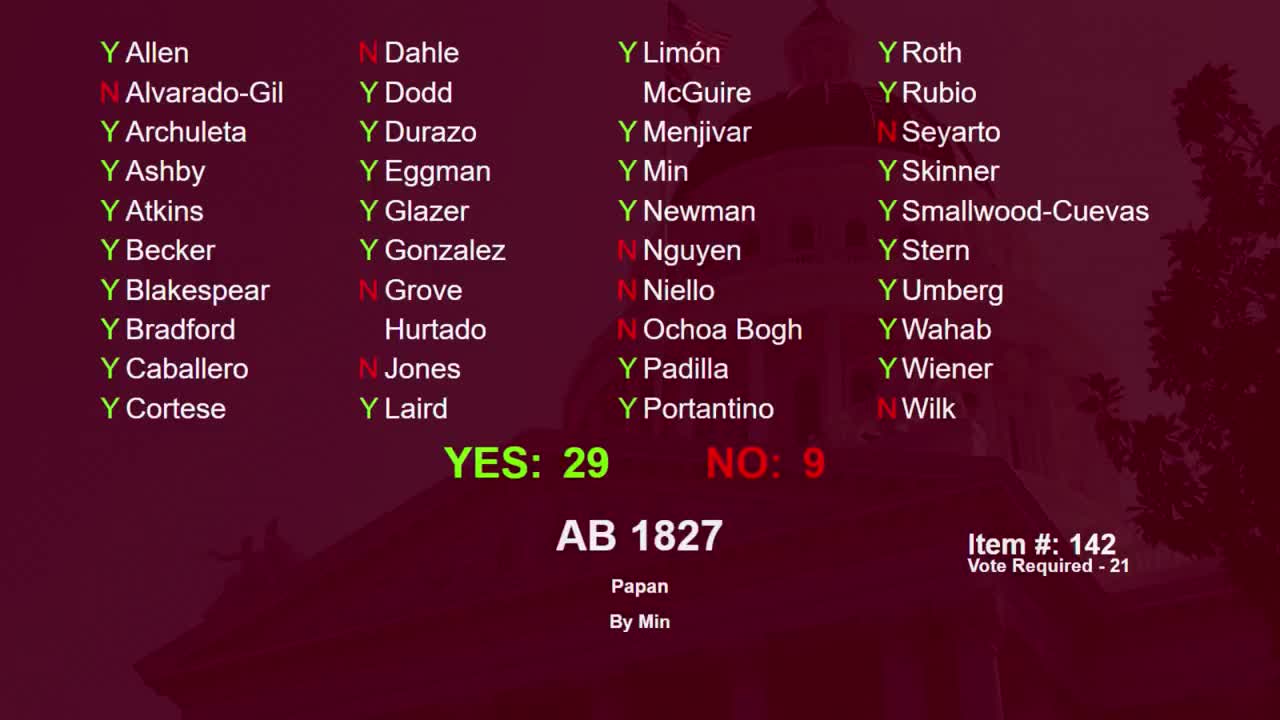 2MIN
Senate Floor
 4MIN
Senate Standing Committee on Health
 1MIN
Assembly Floor
 1MIN
Assembly Standing Committee on Appropriations
Bill Author

Bill Co-Author(s):