AB 2827: Invasive species: prevention.
- Session Year: 2023-2024
- House: Assembly
- Latest Version Date: 2024-06-11
Current Status:
Failed
(2024-08-15: In committee: Held under submission.)
Introduced
In Committee
First Chamber
In Committee
Second Chamber
Enacted
Existing law requires the Department of Food and Agriculture, headed by the Secretary of Food and Agriculture, to promote and protect the agricultural industry of the state. Existing law authorizes the department to expend in accordance with law all money that is made available for its use.
This bill would find and declare that it is a primary goal of the state to prevent the introduction, and suppress the spread, of invasive species within its borders. The bill would require, in carrying out this goal, state agencies, the department, in collaboration with relevant state agencies and stakeholders, to, among other things, to develop and implement strategies to detect, control, monitor, and eradicate invasive species to protect the states agriculture, environment, and natural resources. The bill would require the department, in consultation with other relevant state agencies, to allocate funds, if available, to implement and enforce these provisions.
Existing law requires the Department of Food and Agriculture, headed by the Secretary of Food and Agriculture, to promote and protect the agricultural industry of the state. Existing law authorizes the department to expend in accordance with law all money that is made available for its use.
This bill would find and declare that it is a primary goal of the state to prevent the introduction, and suppress the spread, of invasive species within its borders. The bill would require, in carrying out this goal, state agencies, in collaboration with relevant stakeholders, to, among other things, develop and implement strategies to detect, control, monitor, and eradicate invasive species to protect the states agriculture, environment, and natural resources. The bill would require the department, in consultation with other relevant state agencies, to allocate funds, if available, to implement and enforce these provisions.
The Legislature finds and declares all the following:
(a)Invasive species have the potential to cause extensive damage to Californias natural and working landscapes, native species, agriculture, the public, and economy.
(b)Invasive species can threaten native flora and fauna, disrupt ecosystems, damage critical infrastructure, and result in further loss of biodiversity.
(c)The impacts of increased goods movement, international travel, and climate change on invasive species are pervasiveshifting temperature patterns, altered precipitation, expanded vectors and host materials, and changes in ecosystems create new habitats and conditions that may enhance the survival, reproduction, and spread of these invasive species, posing additional threats to the state.
(d)It is in the best interest of the state to adopt a proactive and coordinated approach to prevent the introduction and spread of invasive species.
595.5.(a)The Legislature finds and declares that it is a primary goal of the state to prevent the introduction, and suppress the spread, of invasive species within its borders.
(b)In carrying out the goal described in this section, state agencies, the department, in collaboration with relevant state agencies and stakeholders, shall develop and implement strategies to detect, control, monitor, and eradicate invasive species to protect the states agriculture, environment, and natural resources.
(c)The state shall invest in research, outreach, and education programs to raise awareness about the risks and impacts of invasive species and promote responsible practices among residents, industries, and visitors.
(d)The department, in consultation with other relevant state agencies, shall allocate funds, if available, to implement and enforce this article.
(e)State agencies shall coordinate efforts, share information, and collaborate with federal, local, and tribal authorities to achieve the goal described in this section.
The Legislature finds and declares all the following:
(a)Invasive species have the potential to cause extensive damage to Californias natural and working landscapes, native species, agriculture, the public, and economy.
(b)Invasive species can threaten native flora and fauna, disrupt ecosystems, damage critical infrastructure, and result in further loss of biodiversity.
(c)The impacts of increased goods movement, international travel, and climate change on invasive species are pervasiveshifting temperature patterns, altered precipitation, expanded vectors and host materials, and changes in ecosystems create new habitats and conditions that may enhance the survival, reproduction, and spread of these invasive species, posing additional threats to the state.
(d)It is in the best interest of the state to adopt a proactive and coordinated approach to prevent the introduction and spread of invasive species.
595.5.(a)The Legislature finds and declares that it is a primary goal of the state to prevent the introduction, and suppress the spread, of invasive species within its borders.
(b)In carrying out the goal described in this section, state agencies, in collaboration with relevant stakeholders, shall develop and implement strategies to detect, control, monitor, and eradicate invasive species to protect the states agriculture, environment, and natural resources.
(c)The state shall invest in research, outreach, and education programs to raise awareness about the risks and impacts of invasive species and promote responsible practices among residents, industries, and visitors.
(d)The department, in consultation with other relevant state agencies, shall allocate funds, if available, to implement and enforce this article.
(e)State agencies shall coordinate efforts, share information, and collaborate with federal, local, and tribal authorities to achieve the goal described in this section.
REVISIONS: HeadingLine 3.|
Date
|
Status
|
|---|---|
| Aug 15, 2024 | In committee: Held under submission. |
| Aug 5, 2024 | In committee: Referred to APPR suspense file. |
| Jun 26, 2024 | From committee: Do pass and re-refer to Com. on APPR. (Ayes 11. Noes 0.) (June 25). Re-referred to Com. on APPR. |
| Jun 18, 2024 | From committee: Do pass and re-refer to Com. on N.R. & W. with recommendation: To Consent Calendar. (Ayes 5. Noes 0.) (June 18). Re-referred to Com. on N.R. & W. |
| Jun 11, 2024 | From committee chair, with author's amendments: Amend, and re-refer to committee. Read second time, amended, and re-referred to Com. on AGRI. |
| Jun 5, 2024 | Referred to Coms. on AGRI and N.R. & W. |
| May 23, 2024 | In Senate. Read first time. To Com. on RLS. for assignment. |
| May 22, 2024 | Read third time. Passed. Ordered to the Senate. (Ayes 72. Noes 0. Page 5509.) |
| May 20, 2024 | Read second time. Ordered to third reading. |
| May 16, 2024 | From committee: Do pass. (Ayes 15. Noes 0.) (May 16). |
| May 8, 2024 | In committee: Set, first hearing. Referred to APPR. suspense file. |
| Apr 24, 2024 | Coauthors revised. |
| Apr 24, 2024 | From committee: Do pass and re-refer to Com. on APPR. (Ayes 7. Noes 0.) (April 23). Re-referred to Com. on APPR. |
| Apr 11, 2024 | From committee: Do pass and re-refer to Com. on E.S. & T.M. (Ayes 10. Noes 0.) (April 10). Re-referred to Com. on E.S. & T.M. |
| Apr 11, 2024 | Coauthors revised. |
| Mar 21, 2024 | Referred to Coms. on AGRI. and E.S. & T.M. |
| Feb 16, 2024 | From printer. May be heard in committee March 17. |
| Feb 15, 2024 | Read first time. To print. |
|
Date
|
Description
|
Location
|
Votes
|
|
|---|---|---|---|---|
| Aug 5, 2024 | Placed on suspense file | Senate Standing Committee on Appropriations |
Passed |
|
| Jun 25, 2024 | Do pass, but first be re-referred to the Committee on [Appropriations] | Senate Standing Committee on Natural Resources and Water |
Passed |
|
| Jun 18, 2024 | Do pass, but first be re-referred to the Committee on [Natural Resources and Water] with the recommendation: To Consent Calendar | Senate Standing Committee on Agriculture |
Passed |
|
| May 22, 2024 | AB 2827 Reyes Assembly Third Reading | Assembly Floor |
Passed |
|
| May 16, 2024 | Do pass. | Assembly Standing Committee on Appropriations |
Passed |
|
| Apr 23, 2024 | Do pass and be re-referred to the Committee on [Appropriations] | Assembly Standing Committee on Environmental Safety and Toxic Materials |
Passed |
|
| Apr 10, 2024 | Do pass and be re-referred to the Committee on [Environmental Safety and Toxic Materials] | Assembly Standing Committee on Agriculture |
Passed |
This list shows positions taken on this bill by organizations on the date displayed, which is linked to the original source.
Positions by individuals are not included.
|
Organization
|
Position
|
Date
|
|---|---|---|
| Agricultural Council Of California | ** Support | |
| Almond Alliance of California | ** Support | |
| California Agricultural Commissioners & Sealers Association | ** Support | |
| California Apple Commission | ** Support | |
| California Association Of Pest Control Advisers | ** Support | |
| California Association Of Winegrape Growers | ** Support | |
| California Avocado Commission | ** Support | |
| California Blueberry Association | ** Support | |
| California Blueberry Commission | ** Support | |
| California Cattlemen'S Association | ** Support | |
| California Chamber Of Commerce | ** Support | |
| California Citrus Mutual | ** Support | |
| California Cotton Ginners and Growers Association | ** Support | |
| California Farm Bureau Federation | ** Support | |
| California Farmland Trust | ** Support | |
| California Fresh Fruit Association | ** Support | |
| California Walnut Commission | ** Support | |
| City of Rancho Cucamonga | ** Support | |
| Grower-Shipper Association of Central California | ** Support | |
| Midpeninsula Regional Open Space District | ** Support | |
| Olive Growers Council of California | ** Support | |
| Redlands Chamber of Commerce | ** Support | |
| Western Agricultural Processors Association | ** Support | |
| Western Growers Association | ** Support | |
| Wine Institute | ** Support |
SENATE COMMITTEE ON
Senator Anna Caballero, Chair
2023 - 2024 Regular Session
AB 2827 (Reyes) - Invasive species: prevention
Version: | Policy Vote: |
Urgency: | Mandate: |
Hearing Date: | Consultant: |
Bill Summary:
AB 2827 would require the California Department of Food and Agriculture (CDFA) to develop and implement strategies to detect, control, monitor, and eradicate invasive species, as specified.
Fiscal Impact:
This bill would result in a cost pressure for state agencies to implement its requirements. The magnitude is unknown, but could potentially reach the tens of millions of dollars. (General Fund or special fund, see Staff Comments). CDFA specifically has indicated that it would be fiscally impacted by the bill.
Background:
Invasive species are organisms (plants, animals, or microbes) that are not native to an environment. Once introduced, they quickly reproduce and spread, causing harm to the environment, economy, or human health. The UC Riverside Center for Invasive Species Research estimates that invasive pests cost the State at least $3 billion annually.
The Invasive Species Council of California (ISCC), which is co-chaired by the Secretaries of the California Natural Resources Agency and the California Department of Food and Agriculture (CDFA), is an interagency body that “helps to coordinate and ensure complementary, cost-efficient, environmentally sound and effective state activities regarding invasive species.” The Council includes secretaries from the California Environmental Protection Agency, the California State Transportation Agency, the California Health and Human Services Agency, and the director of the Office of Emergency Services. State law requires the Council to meet annually, which, according to its website, it did in 2020, 2022, and 2023.
In addition to participation and interaction with ISCC, several state agencies actively work on addressing invasive species issues. For example, CDFA’s mandate to prevent the introduction and spread of invasive plant pests is administered collaboratively by three of its internal divisions. In collaboration with county agricultural commissioners and the U.S. Department of Agriculture, CDFA administers the state’s pest prevention system to exclude, detect, eradicate, control, and identify invasive species that threaten the state’s agricultural and natural resources. Similarly, the California Department of Fish and Wildlife has an active invasive species program that tackles both terrestrial and aquatic invasive plants and animals, such as invasive zebra mussels and nutria.
Proposed Law:
This bill would, among other things, do the following:
- Declare that it is a primary goal of the state to prevent the introduction, and suppress the spread, of invasive species within its borders.
- Require, in carrying out the goal declared by this bill, CDFA, in collaboration with relevant state agencies and stakeholders, to develop and implement strategies to detect, control, monitor, and eradicate invasive species to protect the state’s agriculture, environment, and natural resources.
- Require the state to invest in research, outreach, and education programs to raise awareness about the risks and impacts of invasive species and promote responsible practices among residents, industries, and visitors.
- Require CDFA, in consultation with other relevant state agencies, to allocate funds, if available, to implement and enforce the provisions of this bill.
- Require state agencies to coordinate efforts, share information, and collaborate with federal, local, and tribal authorities to achieve the goal declared by this bill.
Related Legislation:
- AB 2509 (Kalra) would define integrated pest management (IPM) to mean an ecosystem-based strategy that focuses on long-term prevention of pests or their damage through a combination of techniques such as biological control, habitat manipulation, modification of cultural practices, and use of resistant varieties. This bill is currently pending in this Committee.
- AB 2414 (Mathis, 2022) would have required CDFA to post on its internet website a list of invasive pests that have a reasonable likelihood of entering California for which a detection, exclusion, eradication, control, or management action by the state might be appropriate. This bill died in the Assembly Agricultural Committee.
- AB 2470 (Grayson, Chapter 870, Statutes of 2018) established the Council to advise state agencies on how to facilitate coordinated control or eradication of invasive species, and authorizes the Council to establish the Advisory Committee.
Staff Comments:
As noted above, CDFA indicates that the bill would not result in a direct fiscal impact, as it already allocates funds for pest prevention programs and consults with other relevant agencies where funding is available, including through ISCC, to prevent, detect, control, monitor, and eradicate invasive species in the State. However, to the extent that this bill would result in CDFA and other agencies needing to augment and expand these efforts (e.g.; implement new strategies to detect, control, monitor, and eradicate invasive species; invest in research, outreach, and education programs/increasing collaboration with stakeholders), they would require additional resources.
As part of a series of early actions on the 2024-25 state budget announced in April 2024, the Legislature and Governor jointly agreed to provide $22 million (General Fund) to respond to numerous unanticipated emergencies related to infestations of invasive fruit flies.
-- END --
SENATE COMMITTEE ON NATURAL RESOURCES AND WATER
Senator Dave Min, Chair
2023 - 2024 Regular
Bill No: AB Hearing Date: June 25, 2024
Author: | Reyes | ||
Version: | June 11, 2024 Amended | ||
Urgency: | No | Fiscal: | Yes |
Consultant: | Paul Jacobs | ||
Subject: Invasive species: prevention
SUMMARY
This bill would require the California Department of Food and Agriculture (CDFA) to develop and implement strategies to detect, control, monitor, and eradicate invasive species, as specified.
BACKGROUND AND EXISTING LAW
Background:
Invasive species in California. Invasive species are non-native plants, animals, and other living organisms that thrive in areas where they do not naturally live and cause, or are likely to cause, economic or environmental harm, or harm to human, animal, or plant health. Invasive species adapt easily, reproduce and spread quickly, and ultimately become established in the new area.
According to the California Department of Fish and Wildlife (CDFW), there are many different ways in which non-native invasive species have been and are introduced to California. Commercial shipping is a major source of unintentional introductions, along with smaller commercial fishing boats and recreational watercraft. Additionally, people traveling between natural areas, farms, or waterways for work or recreation unintentionally spread invasive species through their vehicles, boats, equipment, and even clothing.
CDFW notes that both historically and today, non-native invasive species have also been introduced purposely in California, without an understanding of the potential consequences of those introductions. This occurs most commonly with plants used for erosion control, livestock forage, and aquarium or garden ornamentals. Some of the animals that are currently, or were in the past, brought into California as sources of food, fur, or pets have turned into major pests.
There are an estimated 1,700 invasive species that threaten the state. According to the University of California, Riverside (UCR) Center for Invasive Species Research, on average, California acquires around nine new species of macroinvertebrates per year, of which around three will become pests. This is a rate of one new species every 40 days. These new species don't all become serious pest problems, but many evade eradication efforts, hijack sensitive ecosystems, and damage valued recreational and economic resources.
Examples of invasive species in California include the:
- Pathogen phytophthora ramorum (causes sudden oak death), which was inadvertently introduced to California forests on nursery stock and has killed up to 50 million trees in California;
- Asian citrus psyllid (spreads huanglongbing disease) which kills citrus trees and threatens California’s commercial citrus production;
- American bullfrog, which was intentionally introduced as a food source and for biological control of insects and now threatens native California frog and fish species; and
- Nutria, which were released to control aquatic vegetation and cause damage through burrowing (such as in flood control levees), intense herbivory, and carrying pathogens and parasites.
Harm of invasive species. According to CDFW, invasive species threaten the diversity or abundance of native species through competition for resources, predation, parasitism, interbreeding with native populations, transmitting diseases, or causing physical or chemical changes to the invaded habitat. Invasive species may also negatively affect human activities, including clogging navigable waterways and water delivery systems, weakening flood control structures, damaging crops, introducing diseases to animals that are raised or harvested commercially, and diminishing sportfish populations.
According to the UCR Center for Invasive Species Research, “It has been estimated that in California alone, invasive pests cost this state at least $3 billion a year! A recent analysis by the California Invasive Plant Council (Spring 2009) indicates that weeds alone cost California at least $82 million per year.”
Invasive species mitigation. A large population of an invasive species can start from a few individuals, which can be difficult to detect and may go unnoticed. The tiny young of invasive shellfish or insects, a fragment of an aquatic weed, or a single plant ready to release its seeds can be enough to establish a population that could ultimately cost the state millions of dollars to address. According to CDFA, preventing the introduction and establishment of invasive species is always the most effective method of invasive species control. CDFW notes that the longer infestations are allowed to progress, the more extensive the damage and control costs, and the less efficient the control efforts. If populations are detected early enough, however, eradication may still be possible. CDFW explains that although prevention is the best strategy for managing invasive species, “early detection and rapid response” efforts are the most effective and cost-efficient responses to invasive species that become introduced and established.
In California, CDFA is required to “prevent the introduction and spread of injurious insect or animal pests, plant diseases, and noxious weeds.” As a result, one of the primary goals of CDFA, as described in its mission statement, is to, “Protect against invasion of exotic pests and diseases.”
Invasive Species Council of California (Council). The Council is an inter-agency council that helps to coordinate and ensure complementary, cost-efficient, environmentally-sound, and effective state activities regarding invasive species. The purpose of the Council is to help coordinate a comprehensive effort to prevent the introduction of invasive species in the state and to advise state agencies, within their respective authorities, on facilitating coordinated, complementary, and cost-effective control or eradication of invasive species that have entered or are established in the state.
The Council is co–chaired by the Secretary of CDFA and the Secretary of the California Natural Resources Agency (CNRA); its members include the California Environmental Protection Agency, the California State Transportation Agency, the California Health and Human Services Agency, and the Office of Emergency Services.
California Invasive Species Advisory Committee (Advisory Committee). The Advisory Committee was created by the Council on April 8, 2009, to advise the Council. The Advisory Committee is made up of and receives input from local governments, tribal governments, federal agencies, environmental organizations, academic and science institutions, affected industry sectors, and impacted landowners. The Advisory Committee has produced an Invasive Species Action Plan, a Rapid Response Plan, and other related documents.
Existing law:
- Requires CDFA to prevent the introduction and spread of injurious insect or animal pests, plant diseases, and noxious weeds. Food and Agricultural Code (FAC) §403.
- Defines “invasive pests” as animals, plants, insects, and plant and animal diseases or groups of those animals, plants, insects, and plant and animal diseases, including seeds, eggs, spores, or other matter capable of propagation, where introduction into California would, or would likely, cause economic or environmental harm. Specifies that “invasive pests” do not include agricultural crops, livestock, or poultry generally recognized by CDFA or the United States Department of Agriculture as suitable to be grown or raised in the state. FAC §5260.5.
- Requires CDFA to develop and maintain a list of invasive pests that have a reasonable likelihood of entering California for which a detection, exclusion, eradication, control, or management action by the state might be appropriate. FAC §5261.
- Requires CDFA to, based on available funding, develop and maintain a written plan, as specified, on the most appropriate options for detection, exclusion, eradication, control, or management of the higher priority invasive pests. Requires CDFA to consult with the United States Department of Agriculture, the University of California, other state agencies and departments, and others in the scientific and research community when developing the plan. Requires the State Department of Public Health, CDFW, the Office of Environmental Health Hazard Assessment, the Department of Boating and Waterways, the Department of Forestry and Fire Protection, the State Water Resources Control Board, and the Department of Pesticide Regulation to participate in the preparation of the plan. FAC §5262.
- Designates CDFA as the lead department in noxious weed management in cooperation with the Secretary of CNRA. FAC §7271 (a).
- Establishes the Council, the purpose of which is to help coordinate a comprehensive effort to prevent the introduction of invasive species in the state and to advise state agencies, including, but not limited to, CDFA and CNRA, on how to facilitate coordinated, complementary, and cost-effective control or eradication of invasive species that have entered or are already established in the state. FAC §7700 (a)(1).
- Authorizes the Council to address nonnative organisms that cause economic or environmental harm. FAC §7700 (a)(1).
- Authorizes the Council to make recommendations on invasive species projects and activities. FAC §7702.
- Authorizes the Council to establish the Advisory Committee, and requires that the 19 members be designated by specified state agencies and the Council. FAC §7704.
PROPOSED LAW
This bill would:
- Declare that it is a primary goal of the state to prevent the introduction, and suppress the spread, of invasive species within its borders.
- Require, in carrying out the goal declared by this bill, CDFA, in collaboration with relevant state agencies and stakeholders, to develop and implement strategies to detect, control, monitor, and eradicate invasive species to protect the state’s agriculture, environment, and natural resources.
- Require the state to invest in research, outreach, and education programs to raise awareness about the risks and impacts of invasive species and promote responsible practices among residents, industries, and visitors.
- Require CDFA, in consultation with other relevant state agencies, to allocate funds, if available, to implement and enforce the provisions of this bill.
- Require state agencies to coordinate efforts, share information, and collaborate with federal, local, and tribal authorities to achieve the goal declared by this bill.
- Make legislative findings about invasive species and declare that it is in the best interest of the state to adopt a proactive and coordinated approach to prevent the introduction and spread of invasive species.
ARGUMENTS IN SUPPORT
According to the author, “In response to the citrus infestation in the Inland Empire, AB 2827 will require the state to detect and eradicate invasive species that could harm California agriculture. In an effort to prevent fruit fly infestations, like the one that is seeing Redlands orange trees, being stripped of their fruit, this bill is intended to protect the state’s agriculture, environment, and natural resources, in particular in the citrus industry.”
ARGUMENTS IN OPPOSITION
None received.
COMMENTS
Dual referral. This bill was referred to the Senate Agriculture Committee and this Committee. The former committee passed the bill 5-0 on June 18, 2024, without amendments on the consent calendar.
Potential program overlap. As mentioned in the background, the Council and the Advisory Committee are currently conducting activities similar to the ones that this bill would require. Program overlap is an important area to consider because duplication of efforts can lead to inefficiencies and difficulty in coordination across the administering entities and create confusion for the public. The Senate Agriculture Committee’s analysis discusses reasons why the sponsors believe a new effort is needed at CDFA, including that the Council and the Advisory Committee face hardships, such as a lack of resources, that leads to infrequent meetings and overall not much progress on combating invasive species. However, it is not clear whether creating a new effort is a better alternative than having the Legislature provide the necessary resources and possible reforms for the Council and the Advisory Committee to conduct this work more effectively.
Prior legislation.
AB 2509 (Kalra, 2024) would define integrated pest management (IPM) to mean an ecosystem-based strategy that focuses on long-term prevention of pests or their damage through a combination of techniques such as biological control, habitat manipulation, modification of cultural practices, and use of resistant varieties. This bill is set for hearing in this Committee on June 25, 2024.
AB 2414 (Mathis, 2022) would have required CDFA to post on its internet website a list of invasive pests that have a reasonable likelihood of entering California for which a detection, exclusion, eradication, control, or management action by the state might be appropriate. This bill died in the Assembly Agricultural Committee.
AB 2470 (Grayson, Chapter 870, Statutes of 2018) establishes the Council to advise state agencies on how to facilitate coordinated control or eradication of invasive species, and authorizes the Council to establish the Advisory Committee.
SUPPORT
California Citrus Mutual (co-sponsor)
Redlands Chamber of Commerce (co-sponsor)
Agricultural Council of California
Almond Alliance of California
California Agricultural Commissioners & Sealers Association
California Apple Commission
California Association of Pest Control Advisers
California Association of Winegrape Growers
California Avocado Commission
California Blueberry Association
California Blueberry Commission
California Cattlemen's Association
California Chamber of Commerce
California Cotton Ginners and Growers Association
California Farm Bureau Federation
California Farmland Trust
California Fresh Fruit Association
California Walnut Commission
City of Rancho Cucamonga
City of San Jose
Grower-shipper Association of Central California
Midpeninsula Regional Open Space District
Olive Growers Council of California
San Bernardino County
Western Agricultural Processors Association
Western Growers Association
Wine Institute
OPPOSITION
None Received
-- END --
SENATE COMMITTEE ON AGRICULTURE
Senator Melissa Hurtado, Chair
2023 - 2024 Regular
Bill No: AB 2827 Hearing Date: 6/18/24
Author: | Reyes | ||
Version: | 6/11/24 Amended | ||
Urgency: | No | Fiscal: | Yes |
Consultant: | Reichel Everhart | ||
Subject: Invasive species: prevention
SUMMARY
:
This bill would find and declare that it is a primary goal of the state to prevent the introduction, and suppress the spread, of invasive species within its borders by requiring relevant state agencies and stakeholders to develop and implement strategies to detect, control, monitor, and eradicate invasive species to protect the state’s agriculture, environments, and natural resources. The bill requires CDFA, in consultation with other relevant state agencies, to allocate funds, if available, to implement and enforce these provisions.
BACKGROUND AND EXISTING LAW
:
- Establishes the California Department of Food and Agriculture (CDFA): One of the primary mandates of the California Department of Food and Agriculture is to "Protect against invasion of exotic pests and diseases." California agricultural losses to exotic pests exceed $3 billion annually (https://www.cdfa.ca.gov/invasives/ ).
- Establishes the California Agricultural Commissioners (CAC): Each agricultural commissioner is charged with the protection of California agriculture, the protection of the environment as well as protection of the public's health and safety. These goals are accomplished through the management of programs (https://www.cdfa.ca.gov/exec/county/Commissioner.html).
- Establishes the California Environmental Protection Agency (CalEPA): Its mission is to restore, protect and enhance the environment, to ensure public health, environmental quality and economic vitality. CalEPA consists of:
- The California Air Resources Board (CARB)
- The Department of Pesticide Regulation (DPR)
- The Department of Resources Recycling and Recovery (CalRecycle)
- The Department of Toxic Substances Control (DTSC)
- The Office of Environmental Health Hazard Assessment (OEHHA)
- The State Water Resources Control Board (SWRCB) (https://calepa.ca.gov/about/)
- Establishes the California Office of Environmental Health Hazard Assessment (OEHHA) which provides scientific support to CDFA invasive species program:
- OEHHA evaluates toxicity, human exposure, and potential health risk of these measures considered or used by CDFA.
- OEHHA communicates its evaluations to local residents and public health officials through direct contact, attending public information workshops and meetings, distributing fact sheets, and posting information on its webpage (www.oehha.ca.gov).
PROPOSED LAW
:
This bill:
- Finds and declares the following:
- Invasive species have the potential to cause extensive damage to California’s natural and working landscapes, native species, agriculture, the public, and economy.
- Invasive species can threaten native flora and fauna, disrupt ecosystems, damage critical infrastructure, and result in further loss of biodiversity.
- The impacts of increased goods movement, international travel, and climate change on invasive species are pervasive—shifting temperature patterns, altered precipitation, expanded vectors and host materials, and changes in ecosystems create new habitats and conditions that may enhance the survival, reproduction, and spread of these invasive species, posing additional threats to the state.
- It is in the best interest of the state to adopt a proactive and coordinated approach to prevent the introduction and spread of invasive species.
- States the Legislature finds and declares that it is a primary goal of the state to prevent the introduction, and suppress the spread, of invasive species within its borders.
ARGUMENTS IN SUPPORT:
According to the author:
“AB 2827 will require the state to detect and eradicate invasive species that negatively impact agriculture here in California. In the Inland Empire alone over 550 square miles have been quarantined due to the impacts of the Oriental Fruit Fly, causing trees to be stripped of their fruit and an estimated economic impact of up to $176 million in crop losses, additional pesticide use, and quarantine requirements. AB 2827 is critical legislation that will coordinate efforts in order to protect the state’s agriculture, environment and natural resources.”
ARGUMENTS IN OPPOSITION:
None received.
PRIOR ACTIONS
:
Assembly Floor: | 72 - 0 |
Assembly Appropriations Committee: | 15 - 0 |
Assembly Agriculture Committee: | 10 - 0 |
SUPPORT
:
California Agricultural Commissioners & Sealers Association (Co-Sponsor)
California Association of Winegrape Growers (Co-Sponsor)
California Citrus Mutual (Co-Sponsor)
Redlands Chamber of Commerce (Co-Sponsor)
Agricultural Council of California
Almond Alliance of California
California Apple Commission
California Association of Pest Control Advisers
California Avocado Commission
California Blueberry Association
California Blueberry Commission
California Cattlemen's Association
California Chamber of Commerce
California Cotton Ginners and Growers Association
California Farm Bureau Federation
California Farmland Trust
California Fresh Fruit Association
California Walnut Commission
City of Rancho Cucamonga
Grower-shipper Association of Central California
Olive Growers Council of California
San Bernardino County
Western Agricultural Processors Association
Western Growers Association
Wine Institute
-- END --
ASSEMBLY THIRD READING
ATR Bill Id:AB 2827
Author:(Reyes)
As Introduced Ver:February 15, 2024
Majority vote
SUMMARY
This bill would find and declare that it is a primary goal of the state to prevent the introduction, and suppress the spread, of invasive species within its borders.
Major Provisions
- Makes legislative findings about the potential damage invasive species can cause to California’s natural and working landscapes, native species, agriculture, public, economy, ecosystems, infrastructure, and biodiversity.
- Makes legislative findings that the impacts of increased goods movement, international travel, and climate change on invasive species are pervasive and may enhance the survival, reproduction, and spread of invasive species, posing additional threats to the state.
- Declares that it is in the best interest of the state to adopt a proactive and coordinated approach to prevent the introduction and spread of invasive species.
- Declares that it is a primary goal of the state to prevent the introduction, and suppress the spread, of invasive species within its borders.
- Requires, in carrying out the goal declared by this bill, state agencies, in collaboration with relevant stakeholders, to develop and implement strategies to detect, control, monitor, and eradicate invasive species to protect the state's agriculture, environment, and natural resources.
- Requires the state to invest in research, outreach, and education programs to raise awareness about the risks and impacts of invasive species and promote responsible practices among residents, industries, and visitors.
- Requires the California Department of Food and Agriculture (CDFA), in consultation with other relevant state agencies, to allocate funds, if available, to implement and enforce the provisions of this bill.
- Requires state agencies to coordinate efforts, share information, and collaborate with federal, local, and tribal authorities to achieve the goal declared by this bill.
COMMENTS
In California, invasive species pose a significant threat to the state's ecosystems and agricultural productivity, with pests being a primary concern. These invasive pests, ranging from insects like the Asian citrus psyllid to rodents like the Nutria, disrupt native habitats and cause extensive damage to crops, forests, and urban landscapes. The economic toll is substantial, with billions of dollars lost annually due to decreased crop yields, increased pest control measures, and environmental restoration efforts. Furthermore, invasive pests often lack natural predators or competitors in their new environments, allowing them to proliferate rapidly and outcompete native species for resources. Efforts to manage these invasive pests involve a combination of regulatory measures, biological control methods, and public awareness campaigns to prevent their introduction and spread. However, the dynamic nature of ecosystems and global trade continue to present challenges in effectively mitigating the impacts of invasive species on California's ecosystems and economy.
According to CDFA, California is currently experiencing one of the highest levels of exotic fruit fly infestations in its recorded history. In 2023, there were more than 900 fruit fly detections in 15 counties. In comparison, an average year will see about 75 fruit fly detections in seven counties.
According to the Author
This bill will require the state to detect and eradicate invasive species that negatively impact agriculture here in California. In the Inland Empire alone over 550 square miles have been quarantined due to the impacts of the Oriental Fruit Fly, causing trees to be stripped of their fruit and an estimated economic impact of up to $176 million in crop losses, additional pesticide use, and quarantine requirements. AB 2827 is critical legislation that will coordinate efforts in order to protect the state's agriculture, environment and natural resources.
Arguments in Support
California is particularly susceptible to invasive species for a variety of reasons. The state's varied landscapes… provide habitats conducive to the establishment and spread of invasive species. Increasing goods and people movement… also serve as gateways for the inadvertent introduction. Climate change impacts extends lifecycles of invasive species and makes native plants and landscapes more susceptible. Collectively, these factors threaten biodiversity, ecosystem functions, and regional economies dependent upon agriculture, forestry, and natural resource management.
This bill acknowledges these threats and declares that through coordinated and proactive action focused on prevention, California can further environmental stewardship. While invasive species have traditionally been managed in silos, AB 2827 charges various state agencies to work together to study, plan and manage invasive species issues. By developing and implementing strategies focused on prevention, the state can reduce the need for costly eradication and control measures, while maintaining the integrity of its agricultural and natural ecosystems.
Arguments in Opposition
None on file.
FISCAL COMMENTS
According to the Assembly Committee on Appropriations, this bill has cost pressure of an unknown but potentially significant amount, possibly in the low millions to tens of millions of dollars, for state agencies to implement the requirements of this bill (General Fund or special fund). As described below, several state agencies already work to prevent, detect, control, monitor, and eradicate invasive species in the state. However, to the extent that this bill requires state agencies to augment and expand their efforts – for example, by investing in research, outreach, and education programs and increasing collaboration with stakeholders – state agencies would require additional resources.
VOTES
ASM AGRICULTURE: 10-0-0
YES: Soria, Alanis, Aguiar-Curry, Connolly, Irwin, Jones-Sawyer, Sanchez, Ta, Villapudua, Wood
ASM ENVIRONMENTAL SAFETY AND TOXIC MATERIALS: 7-0-0
YES: Garcia, Hoover, Connolly, McKinnor, Papan, Reyes, Ta
ASM APPROPRIATIONS: 15-0-0
YES: Wicks, Sanchez, Arambula, Bryan, Calderon, Wendy Carrillo, Dixon, Mike Fong, Grayson, Haney, Hart, Jim Patterson, Pellerin, Ta, Villapudua
UPDATED
VERSION: February 15, 2024
CONSULTANT: Victor Francovich / AGRI. / (916) 319-2084 FN: 0003140
Date of Hearing: May 8, 2024
ASSEMBLY COMMITTEE ON APPROPRIATIONS
Buffy Wicks, Chair
ABPCA Bill Id:AB 2827
Author:(Reyes) – As Introduced Ver:February 15, 2024
Policy Committee: | Agriculture | Vote: | 10 - 0 |
Environmental Safety and Toxic Materials | 7 - 0 | ||
|
|
Urgency: No State Mandated Local Program: No Reimbursable: No
SUMMARY:
This bill requires state agencies to develop and implement strategies to detect, control, monitor, and eradicate invasive species.
Specifically, this bill, among other things:
- Declares that it is a primary goal of the state to prevent the introduction, and suppress the spread, of invasive species within its borders.
- Requires state agencies, in collaboration with relevant stakeholders, to develop and implement strategies to detect, control, monitor, and eradicate invasive species to protect the state’s agriculture, environment, and natural resources.
- Requires the state to invest in research, outreach, and education programs to raise awareness about the risks and impacts of invasive species and promote responsible practices among residents, industries, and visitors.
- Requires the California Department of Food and Agriculture (CDFA), in consultation with other relevant state agencies, to allocate funds, if available, to implement and enforce the provisions of this bill.
- Requires state agencies to coordinate efforts, share information, and collaborate with federal, local, and tribal authorities to achieve the goal described in 1, above.
FISCAL EFFECT:
Cost pressure of an unknown but potentially significant amount, possibly in the low millions to tens of millions of dollars, for state agencies to implement the requirements of this bill (General Fund or special fund). As described below, several state agencies already work to prevent, detect, control, monitor, and eradicate invasive species in the state. However, to the extent that this bill requires state agencies to augment and expand their efforts – for example, by investing in research, outreach, and education programs and increasing collaboration with stakeholders – state agencies would require additional resources.
According to the Legislative Analyst’s Office, the General Fund faces a structural deficit in the tens of billions of dollars over the next several fiscal years.
COMMENTS:
1) Purpose. According to the author:
AB 2827 will require the state to detect and eradicate invasive species that negatively impact agriculture here in California. In the Inland Empire alone over 550 square miles have been quarantined due to the impacts of the Oriental Fruit Fly, causing trees to be stripped of their fruit and an estimated economic impact of up to $176 million in crop losses, additional pesticide use, and quarantine requirements. AB 2827 is critical legislation that will coordinate efforts in order to protect the state’s agriculture, environment and natural resources.
2) Background. Invasive species are organisms (plants, animals, or microbes) that are not native to an environment, and once introduced, they establish, quickly reproduce and spread, and cause harm to the environment, economy, or human health. According to the UC Riverside Center for Invasive Species Research, it is estimated that invasive pests cost the state at least $3 billion a year.
The Invasive Species Council of California (Council), which is co-chaired by the secretary of the California Natural Resources Agency and the secretary of the California Department of Food and Agriculture (CDFA), is an interagency body that “helps to coordinate and ensure complementary, cost-efficient, environmentally sound and effective state activities regarding invasive species.” The Council includes secretaries from the California Environmental Protection Agency, the California State Transportation Agency, the California Health and Human Services Agency, and the director of the Office of Emergency Services. State law requires the Council to meet annually, which, according to its website, it did in 2020, 2022, and 2023.
Apart from their participation in the Council, several individual state agencies actively work on addressing invasive species issues. For example, CDFA’s mandate to prevent the introduction and spread of invasive plant pests is administered collaboratively by three of its internal divisions: the Plant Health and Pest Prevention Services Division, the Citrus Pest and Disease Prevention Division, and the Pierce’s Disease Control Program. Together these three initiatives, in collaboration with county agricultural commissioners and the U.S. Department of Agriculture, administer the state’s pest prevention system to exclude, detect, eradicate, control, and identify invasive species that threaten the state’s agricultural and natural resources. Similarly, the California Department of Fish and Wildlife has an active invasive species program that tackles both terrestrial and aquatic invasive plants and animals, such as invasive zebra mussels and nutria.
As part of an “early action budget package” announced in April 2024, the Assembly, Senate, and Governor jointly agreed to provide $22.1 million (General Fund) to respond to numerous unanticipated emergencies related to infestations of invasive fruit flies.
According to a coalition of organizations writing in support:
While invasive species have traditionally been managed in silos, AB 2827 charges various state agencies to work together to study, plan and manage invasive species issues. Moreover, existing entities, such as the Invasive Species Council, which may be the appropriate coordinating body for this work, does not have dedicated funding for its purpose and meets but once a year.
3) Related Legislation. AB 2509 (Kalra) of the current legislative session defines "invasive species" and requires the Council to prioritize the principles of integrated pest management in all of its statutorily required activities. AB 2509 is pending in this committee.
Analysis Prepared by: Nikita Koraddi / APPR. / (916) 319-2081
Date of Hearing: April 23, 2024
ASSEMBLY COMMITTEE ON ENVIRONMENTAL SAFETY AND TOXIC MATERIALS
Eduardo Garcia, Chair
ABPCA Bill Id:AB 2827 (
Author:Reyes) – As Introduced Ver:February 15, 2024
SUBJECT: Invasive species: prevention
SUMMARY: Requires state agencies to develop and implement strategies to detect, control, monitor, and eradicate invasive species, as specified. Specifically, this bill:
- Makes legislative findings about the potential damage invasive species can cause to California’s natural and working landscapes, native species, agriculture, public, economy, ecosystems, infrastructure, and biodiversity.
- Makes legislative findings that the impacts of increased goods movement, international travel, and climate change on invasive species are pervasive and may enhance the survival, reproduction, and spread of invasive species, posing additional threats to the state.
- Declares that it is in the best interest of the state to adopt a proactive and coordinated approach to prevent the introduction and spread of invasive species.
- Declares that it is a primary goal of the state to prevent the introduction, and suppress the spread, of invasive species within its borders.
- Requires, in carrying out the goal declared by this bill, state agencies, in collaboration with relevant stakeholders, to develop and implement strategies to detect, control, monitor, and eradicate invasive species to protect the state’s agriculture, environment, and natural resources.
- Requires the state to invest in research, outreach, and education programs to raise awareness about the risks and impacts of invasive species and promote responsible practices among residents, industries, and visitors.
- Requires the California Department of Food and Agriculture (CDFA), in consultation with other relevant state agencies, to allocate funds, if available, to implement and enforce the provisions of this bill.
- Requires state agencies to coordinate efforts, share information, and collaborate with federal, local, and tribal authorities to achieve the goal declared by this bill.
EXISTING LAW:
- Requires CDFA to prevent the introduction and spread of injurious insect or animal pests, plant diseases, and noxious weeds. (Food and Agricultural Code (FAC) § 403)
- Makes legislative findings that global travel, global trade, and climate change are introducing invasive animals, plants, insects, and plant and animal diseases to California. (FAC § 5260 (c))
- Makes legislative findings that the State of California should undertake advanced planning on whether and how to address those invasive animals, plants, insects, and plant and animal diseases that are a threat to the state’s agriculture, environment, or economy. (FAC § 5260 (e))
- Defines "invasive pests" as animals, plants, insects, and plant and animal diseases or groups of those animals, plants, insects, and plant and animal diseases, including seeds, eggs, spores, or other matter capable of propagation, where introduction into California would, or would likely, cause economic or environmental harm. Specifies that "invasive pests" do not include agricultural crops, livestock, or poultry generally recognized by CDFA or the United States Department of Agriculture as suitable to be grown or raised in the state. (FAC § 5260.5)
- Requires CDFA to develop and maintain a list of invasive pests that have a reasonable likelihood of entering California for which a detection, exclusion, eradication, control, or management action by the state might be appropriate. (FAC § 5261)
- Requires CDFA to, based on available funding, develop and maintain a written plan, as specified, on the most appropriate options for detection, exclusion, eradication, control, or management of the higher priority invasive pests. Requires CDFA to consult with the United States Department of Agriculture, the University of California, other state agencies and departments, and others in the scientific and research community when developing the plan. Requires the State Department of Public Health, the Department of Fish and Wildlife (CDFW), the Office of Environmental Health Hazard Assessment, the Department of Boating and Waterways, the Department of Forestry and Fire Protection, the State Water Resources Control Board, and the Department of Pesticide Regulation to participate in the preparation of the plan. (FAC § 5262)
- Makes legislative findings that the destructive impact of invasive and noxious weeds is profound, affecting California’s cropland, rangeland, forests, parks, waterways, and wildlands. (FAC § 7270 (a))
- Designates CDFA as the lead department in noxious weed management in cooperation with the Secretary of the Natural Resources Agency. (FAC § 7271 (a))
- Establishes in state government the Invasive Species Council of California (Council), the purpose of which is to help coordinate a comprehensive effort to prevent the introduction of invasive species in the state and to advise state agencies, including, but not limited to, CDFA and the Natural Resources Agency, on how to facilitate coordinated, complementary, and cost-effective control or eradication of invasive species that have entered or are already established in the state. (FAC § 7700 (a)(1))
- Authorizes the Council to address nonnative organisms that cause economic or environmental harm. Specifies that invasive species within the scope of the Council’s advisory duties do not include humans, domestic livestock, specified domestic or domesticated species, or nonharmful exotic organisms. (FAC § 7700 (a)(1))
- Requires the Council to consist of the following six members or his or her designated representative: the Secretary of CDFA; the Secretary of the Natural Resources Agency; the Secretary for Environmental Protection; the Secretary of Transportation; the Secretary of California Health and Human Services; and, the Director of Emergency Services. (FAC § 7700 (b))
- Requires the Secretary of the Natural Resources Agency or his or her designated representative and the Secretary of CDFA or his or her designee to serve as cochairs of the Council. (FAC § 7700(c))
- Requires the Council to meet annually and as needed as determined by the cochairs. (FAC § 7700 (d))
- Authorizes the Council to establish advisory committees and ad hoc working groups to advise on preventing the introduction of invasive species and providing for their control or eradication, as well as minimizing the economic, ecological, and human health impacts that invasive species cause. (FAC § 7700 (f)(1))
- Authorizes the advisory committees and working groups to consist of representatives from state agencies, federal agencies, county agricultural commissioners, academia, nonprofit organizations, tribal nations, industry representatives, and members of the public. (FAC § 7700 (f)(2))
- Authorizes, upon the appropriation or transfer of adequate moneys to the Invasive Species Account, the Council to make recommendations on invasive species projects and activities, including, but not limited to:
- To assist state, federal, and local agencies to prevent the introduction of invasive species;
- To develop statewide education, outreach, and branding of invasive species;
- To increase coordination and collaboration among invasive species partners; and,
- To develop statewide invasive species action plans. (FAC § 7702)
- Authorizes the Council to establish the California Invasive Species Advisory Committee (Advisory Committee), and requires that 19 members be designated by specified state agencies and the Council. (FAC § 7704)
- Establishes the Invasive Species Account in the Department of Food and Agriculture Fund and makes the moneys in the account available, upon appropriation by the Legislature, to the Secretary of CDFA for the purposes of funding invasive species projects and activities recommended by the Council. (FAC § 7706)
- Requires the Council to coordinate with state and local public agencies, publicly funded educational institutions, and stakeholder groups to develop a plan for the cure or suppression of diseases associated with the spread of invasive shot hole borers. (FAC § 7708)
FISCAL EFFECT: Unknown.
COMMENTS:
According to the author, "AB 2827 will require the state to detect and eradicate invasive species that negatively impact agriculture here in California. In the Inland Empire alone over 550 square miles have been quarantined due to the impacts of the Oriental Fruit Fly, causing trees to be stripped of their fruit and an estimated economic impact of up to $176 million in crop losses, additional pesticide use, and quarantine requirements. AB 2827 is critical legislation that will coordinate efforts in order to protect the state’s agriculture, environment and natural resources."
Invasive species: Invasive species are non-native plants, animals and other living organisms that thrive in areas where they do not naturally live and cause, or are likely to cause, economic or environmental harm, or harm to human, animal, or plant health. Invasive species adapt easily, reproduce and spread quickly, and ultimately become established in the new area.
Invasive species are spread primarily by human activities, often unintended. People and goods travel quickly around the world and often carry uninvited species with them. Invasive species can be introduced to an area by ship ballast water (e.g. red tide organisms), firewood, agricultural products (e.g. fire ants), the movement of watercraft (e.g. zebra mussels), and by people (e.g. pathogens). Insects can be transported easily in wood, shipping palettes, and crates shipped across the globe. Imported plants can transport pests and diseases, and also become invasive when they escape into the wild. Released unwanted pets are another way invasive species are spread. At other times, non-native species are intentionally introduced to control pests, but then become invasive themselves.
Invasive species in California: According to CDFW, there are many different ways in which non-native invasive species have been and are introduced to California. Commercial shipping is a major source of unintentional introductions, along with smaller commercial fishing boats and recreational watercraft. Additionally, people traveling between natural areas, farms, or waterways for work or recreation unintentionally spread invasive species on their vehicles, boats, equipment and even clothing.
CDFW notes that both historically and today, non-native invasive species have also been introduced purposely in California, without an understanding of the potential consequences of those introductions. This occurs most commonly with plants used for erosion control, livestock forage, and aquarium or garden ornamentals. Some of the animals that are currently, or were in the past, brought into California as sources of food, fur, or pets have turned into major pests.
There are an estimated 50,000 non-native species of plants and animals living in the United States today. The Advisory Committee identified over 1,700 invasive species that threaten the state. According to the University of California, Riverside (UCR) Center for Invasive Species Research, on average, California acquires around nine new species of macroinvertebrates per year, of which around three will become pests. This is a rate of one new species every 40 days. These new species don't all become serious pest problems, but many evade eradication efforts, hijack sensitive ecosystems, and damage valued recreational and economic resources.
Examples of invasive species in California include the pathogen phytophthora ramorum (causes sudden oak death), which was inadvertently introduced to California forests on nursery stock and has killed up to 50 million trees in California; the Asian citrus psyllid (spreads huanglongbing disease) which kills citrus trees and threatens California’s commercial citrus production; the American bullfrog, which was intentionally introduced as a food source and for biological control of insects and which now threatens native California frog and fish species; and, nutria, which were released to control aquatic vegetation and that cause damage through burrowing (such as in flood control levees), intense herbivory, and carrying pathogens and parasites.
Harm of invasive species: According to CDFW, invasive species threaten the diversity or abundance of native species through competition for resources, predation, parasitism, interbreeding with native populations, transmitting diseases, or causing physical or chemical changes to the invaded habitat. Through their impacts on natural ecosystems; agricultural and other developed lands; and, water delivery and flood protection systems, invasive species may also negatively affect human health and/or the economy. Examples of direct impacts to human activities include clogging navigable waterways and water delivery systems, weakening flood control structures, damaging crops, introducing diseases to animals that are raised or harvested commercially, and diminishing sportfish populations.
A 2023 report by the Intergovernmental Science-Policy Platform on Biodiversity and Ecosystem Services found that more than 3,500 harmful invasive species cost society more than $423 billion a year, numbers that are expected to grow as global trade and travel continue to accelerate the spread of plants and animals across continents at an unprecedented pace. Experts note that this estimate is likely extremely conservative.
According to the UCR Center for Invasive Species Research, "It has been estimated that in California alone, invasive pests cost this state at least $3 billion a year! A recent analysis by the California Invasive Plant Council (Spring 2009) indicates that weeds alone cost California at least $82 million per year. Some estimates suggest that invasive species cost the USA $138 billion per year, and that 42% of endangered US species have reached this status because of invasive species. Globally, 80% of endangered species are threatened primarily by invasive species, only habitat destruction causes greater endangerment of native species."
Invasive species mitigation: A large population of an invasive species can start from a few individuals, which can be difficult to detect and may go unnoticed. The tiny young of invasive shellfish or insects, a fragment of an aquatic weed, or a single plant ready to release its seeds can be enough to establish a population that could ultimately cost the state millions of dollars to address. According to CDFA, preventing the introduction and establishment of invasive species is always the best -- and least costly -- method of invasive species control. CDFW notes that the longer infestations are allowed to progress, the more extensive the damage and control costs, and the less efficient the control efforts. If populations are detected early enough, however, eradication may still be possible. CDFW explains that although prevention is the best strategy for managing invasive species, "early detection and rapid response" efforts are the most effective and cost-efficient responses to invasive species that become introduced and established.
In California, CDFA is required to "prevent the introduction and spread of injurious insect or animal pests, plant diseases, and noxious weeds" (FAC § 403). As a result, one of the primary goals of CDFA, as described in its mission statement, is to, "Protect against invasion of exotic pests and diseases."
Invasive Species Council of California (Council): According to its website, the Council, "represents the highest level of leadership and authority in state government regarding invasive species. The [Council] is an inter-agency council that helps to coordinate and ensure complementary, cost-efficient, environmentally sound and effective state activities regarding invasive species." The Council was established February 10, 2009, and, in 2018, AB 2470 (Grayson, Chapter 870, Statutes of 2018) established the Council in state government and its makeup, duties, and requirements were codified in statute. Statute establishes the purpose of the Council as helping coordinate a comprehensive effort to prevent the introduction of invasive species in the state and to advise state agencies, within their respective authorities, on facilitating coordinated, complementary, and cost-effective control or eradication of invasive species that have entered or are established in the state
The Council is co–chaired by the Secretary of CDFA and the Secretary of the California Natural Resources Agency, and includes as members secretaries, or their designated representative, of the following agencies: the California Environmental Protection Agency; the California State Transportation Agency; the California Health and Human Services Agency; and, the Office of Emergency Services. Statute requires the Council to meet annually, which, according to its website, it did in 2020, 2022, and 2023.
California Invasive Species Advisory Committee (Advisory Committee): The Advisory Committee was created by the Council on April 8, 2009, to advise the Council. Primarily tasked with making recommendations to develop and prioritize an Invasive Species Action Plan, among other tasks, the Advisory Committee is made up of and receives input from local governments, tribal governments, federal agencies, environmental organizations, academic and science institutions, affected industry sectors, and impacted landowners. Several working groups may be convened under the auspices of the Advisory Committee to help write and implement an Invasive Species Action Plan, a Rapid Response Plan, and other related documents, such as: Communication and Outreach; International Agreements; Control, Management and Coordination; Prevention; and Research. AB 2470 (Grayson, Chapter 870, Statutes of 2018) established the Advisory Committee and its makeup, duties, and requirements in statute. According to the Advisory Committee’s website, it meets several times a year.
This bill: AB 2827 declares that it is a primary goal of the state to prevent the introduction, and suppress the spread, of invasive species within the state’s borders. It also requires, in carrying out the goal declared by the bill, state agencies, in collaboration with relevant stakeholders, to develop and implement strategies to detect, control, monitor, and eradicate invasive species in order to protect the state’s agriculture, environment, and natural resources. To do so, AB 2827 requires state agencies to coordinate efforts, share information, and collaborate with federal, local, and tribal authorities.
AB 2827 also requires the state to invest in research, outreach, and education programs to raise awareness about the risks and impacts of invasive species and promote responsible practices among residents, industries, and visitors. To support this requirement, AB 2827 requires CDFA, in consultation with other relevant state agencies, to allocate funds, if available, to implement and enforce the provisions of the bill.
AB 2827 and existing structures for invasive species management: According to California Citrus Mutual, the "Council and the Advisory Committee were created almost two decades ago when greater resources were dedicated to invasive species management. Our goal is not to supplant the work of these bodies, but rather to bolster their efforts at a statewide level and not have disparate agency-specific goals. We were attempting not to be prescriptive of which state entity leads this process, but allow the agencies to determine that. Anecdotally, we think the Council would be an appropriate entity to convene all parties and develop the strategies specified in the bill. Our hope, as well, is that we can use these bodies’ experience and breadth of exposure to enhance focus on prevention. We don’t want to minimize control or eradication, but rather it is of the sponsors’ perspective (and consistent with integrated pest management) that prevention is top of mind. The hardships we identify with the Council and the Advisory Committee are the frequency of their meetings and the noted lack of resources. The Council meets once a year only and the Advisory Committee tries to meet quarterly and, based on the minutes available, most meetings are updates only. Both the Council’s and Advisory Committee’s last large report was in 2013. In 2021-22, by member request, the Council received a one-time $10 million allocation, but $5 million was clawed back by the Administration. That is the only appropriation, to our understanding, that has been dedicated to the Council. Also, in 2013, the Council developed an implementation update on some general activities related to invasive pests. The Council’s website shows that in 2013, several actions had no progress or had not been initiated. Would this webpage be updated today, many of these actions would show no initiation."
Arguments in support: A coalition of supporters writes,
"California is particularly susceptible to invasive species for a variety of reasons. The state's varied landscapes… provide habitats conducive to the establishment and spread of invasive species. Increasing goods and people movement… also serve as gateways for the inadvertent introduction. Climate change impacts extends lifecycles of invasives and make native plants and landscapes more susceptible. Collectively, these factors threaten biodiversity, ecosystem functions, and regional economies dependent upon agriculture, forestry, and natural resource management.
While invasive species management has been traditionally interpreted as a major concern for working landscapes, they can be incredibly damaging to natural areas and our built environment. Invasive aquatic species can rapidly colonize freshwater bodies, clogging water intake pipes and damaging infrastructure; noxious weeds can carry plant diseases and outcompete native plants for essential resources. Terrestrial invasive species such as nutria can consume important native grasses and destabilize soil, accelerating erosion of levee systems. And more recently, the current infestation of exotic fruit flies across 15 California counties has infected residential and urban tree canopies compromising the beauty and value of urban landscapes.
AB 2827 acknowledges these threats and declares that through coordinated and proactive action focused on prevention, California can further environmental stewardship. While invasive species have traditionally been managed in silos, AB 2827 charges various state agencies to work together to study, plan and manage invasive species issues. By developing and implementing strategies focused on prevention, the state can reduce the need for costly eradication and control measures, while maintaining the integrity of its agricultural and natural ecosystems."
Arguments is opposition: None on file.
Related legislation:
- AB 2509 (Kalra). Defines "invasive species" and requires the Council to prioritize the principles of integrated pest management in all of its statutorily required activities. AB 2509 is pending hearing in the Assembly Agriculture Committee.
- AB 2414 (Mathis, 2022). Would have required CDFA to post on its internet website a list of invasive pests that have a reasonable likelihood of entering California for which a detection, exclusion, eradication, control, or management action by the state might be appropriate. AB 2414 died on file in the Assembly Agricultural Committee.
- AB 2470 (Grayson, Chapter 870, Statutes of 2018). Establishes the Council, with a prescribed membership, to advise state agencies on how to facilitate coordinated control or eradication of invasive species; authorizes the Council to establish the Advisory Committee, with a prescribed membership, to advise the Council; requires the Council to coordinate with state and local public agencies to develop a plan to address invasive shot hole borers; and, establishes the Invasive Species Account to fund invasive species projects and activities recommended by the Council.
Double referral: This bill was double referred to the Assembly Committee on Agriculture and the Assembly Committee Environmental Safety and Toxic Materials. It was approved by the Assembly Committee on Agriculture on April 10, 2024, on a 10 – 0 vote.
REGISTERED SUPPORT / OPPOSITION:
Support
Agricultural Council of California
Almond Alliance of California
California Agricultural Commissioners & Sealers Association
California Apple Commission
California Association of Pest Control Advisers
California Association of Winegrape Growers
California Avocado Commission
California Blueberry Association
California Blueberry Commission
California Cattlemen's Association
California Chamber of Commerce
California Citrus Mutual
California Cotton Ginners and Growers Association
California Farm Bureau Federation
California Farmland Trust
California Fresh Fruit Association
California Walnut Commission
City of Rancho Cucamonga
Grower-shipper Association of Central California
Midpeninsula Regional Open Space District
Olive Growers Council of California
Redlands Chamber of Commerce
Western Agricultural Processors Association
Western Growers Association
Wine Institute
Opposition
None on file.
Analysis Prepared by: Shannon McKinney / E.S. & T.M. /
Date of Hearing: April 10, 2024
ASSEMBLY COMMITTEE ON AGRICULTURE
Esmeralda Soria, Chair
ABPCA Bill Id:AB 2827
Author:(Reyes) – As Introduced Ver:February 15, 2024
SUBJECT: Invasive species: prevention
SUMMARY: This bill would find and declare that it is a primary goal of the state to prevent the introduction, and suppress the spread, of invasive species within its borders. Specifically, this bill:
- Makes findings and declarations as follows:
- Invasive species have the potential to cause extensive damage to California’s natural and working landscapes, native species, agriculture, the public, and economy.
- Invasive species can threaten native flora and fauna, disrupt ecosystems, damage critical infrastructure, and result in further loss of biodiversity.
- The impacts of increased goods movement, international travel, and climate change on invasive species are pervasive—shifting temperature patterns, altered precipitation, expanded vectors and host materials, and changes in ecosystems create new habitats and conditions that may enhance the survival, reproduction, and spread of these invasive species, posing additional threats to the state.
- It is in the best interest of the state to adopt a proactive and coordinated approach to prevent the introduction and spread of invasive species.
- Does the following:
- Makes findings and declarations that it is a primary goal of the state to prevent the introduction, and suppress the spread, of invasive species within its borders.
- Requires state agencies, in collaboration with relevant stakeholders, to develop and implement strategies to detect, control, monitor, and eradicate invasive species to protect the state’s agriculture, environment, and natural resources.
- Requires the state to invest in research, outreach, and education programs to raise awareness about the risks and impacts of invasive species and promote responsible practices among residents, industries, and visitors.
- Requires the California Department of Food and Agriculture (CDFA), in consultation with other relevant state agencies, to allocate funds, if available, to implement and enforce this article.
- Requires state agencies to coordinate efforts, share information, and collaborate with federal, local, and tribal authorities to achieve the goal described in this section.
EXISTING LAW:
- Requires CDFA to promote and protect the agricultural industry of the state.
- Authorizes CDFA to expend in accordance with law all money that is made available for its use.
FISCAL EFFECT: Unknown.
COMMENTS: One of the primary mandates of CDFA is to "Protect against invasion of exotic pests and diseases”, as described in CDFA mission statement. California agricultural losses to exotic pests exceed $3 billion annually. An invasive species is a species that does not occur naturally in a specific area and whose introduction does or is likely to cause economic (including agricultural) or environmental harm or harm to human health.
In California, invasive species pose a significant threat to the state's ecosystems and agricultural productivity, with pests being a primary concern. These invasive pests, ranging from insects like the Asian citrus psyllid to rodents like the Nutria, disrupt native habitats and cause extensive damage to crops, forests, and urban landscapes. The economic toll is substantial, with billions of dollars lost annually due to decreased crop yields, increased pest control measures, and environmental restoration efforts. Furthermore, invasive pests often lack natural predators or competitors in their new environments, allowing them to proliferate rapidly and outcompete native species for resources. Efforts to manage these invasive pests involve a combination of regulatory measures, biological control methods, and public awareness campaigns to prevent their introduction and spread. However, the dynamic nature of ecosystems and global trade continue to present challenges in effectively mitigating the impacts of invasive species on California's ecosystems and economy.
According to CDFA, California is currently experiencing one of the highest levels of exotic fruit fly infestations in its recorded history. In 2023, there were more than 900 fruit fly detections in 15 counties. In comparison, an average year will see about 75 fruit fly detections in seven counties.
In 2023, the Tau Fruit Fly was found in California, noting the first time this species has been present in the Western Hemisphere. This has initiated a significant quarantine of the San Bernardino valley. The Oriental Fruit Fly has also proven to be alarming to the region, posing a threat to over 230 crops, including nuts, vegetables, and berries. CDFA officials stress that the Oriental Fruit Fly can cause billions of dollars in losses every year, if the species becomes permanently established in California. Additionally, nutria, an invasive rodent found in 2023, threatened the stability of aging levees and earthen dams across California.
According to the Author, despite concerted efforts in pest prevention, the current strategies often fail, placing the state at ongoing risk. By prioritizing prevention efforts, the state can mitigate the ecological and economic damage caused by invasive species, preserve native biodiversity and enhance ecosystem functions. A proactive approach to prevention reduces the need for costly eradication and control measures, helps maintain the integrity of agricultural systems, and fosters a sense of stewardship and responsibility towards California's natural resources. A focused goal for invasive species prevention empowers policymakers, researchers, and stakeholders to work collaboratively towards safeguarding the state's ecosystems and promoting sustainable development.
Supporters’ state that this bill acknowledges the threats invasive species are and declares that through coordinated and proactive action focused on prevention, California can further environmental stewardship. While invasive species have traditionally been managed in silos, this bill charges various state agencies to work together to study, plan and manage invasive species issues. By developing and implementing strategies focused on prevention, the state can reduce the need for costly eradication and control measures, while maintaining the integrity of its agricultural and natural ecosystems. Given invasive species impacts will become more acute, this bill enables the State to be better prepared for future challenges.
REGISTERED SUPPORT / OPPOSITION:
Support
Agricultural Council of California
Almond Alliance of California
California Apple Commission
California Association of Winegrape Growers
California Avocado Commission
California Blueberry Association
California Blueberry Commission
California Cattlemen's Association
California Chamber of Commerce
California Citrus Mutual
California Cotton Ginners and Growers Association
California Farm Bureau Federation
California Farmland Trust
California Fresh Fruit Association
California Walnut Commission
City of Rancho Cucamonga
Grower-shipper Association of Central California
Midpeninsula Regional Open Space District
Olive Growers Council of California
Redlands Chamber of Commerce
Western Agricultural Processors Association
Western Growers Association
Opposition
None on file.
Analysis Prepared by: Victor Francovich / AGRI. / (916) 319-2084
Discussed in Hearing
 1MIN
Senate Standing Committee on Appropriations
 10MIN
Senate Standing Committee on Natural Resources and Water
 1MIN
Assembly Floor
 11MIN
Assembly Standing Committee on Environmental Safety and Toxic Materials
 49SEC
Assembly Standing Committee on Environmental Safety and Toxic Materials
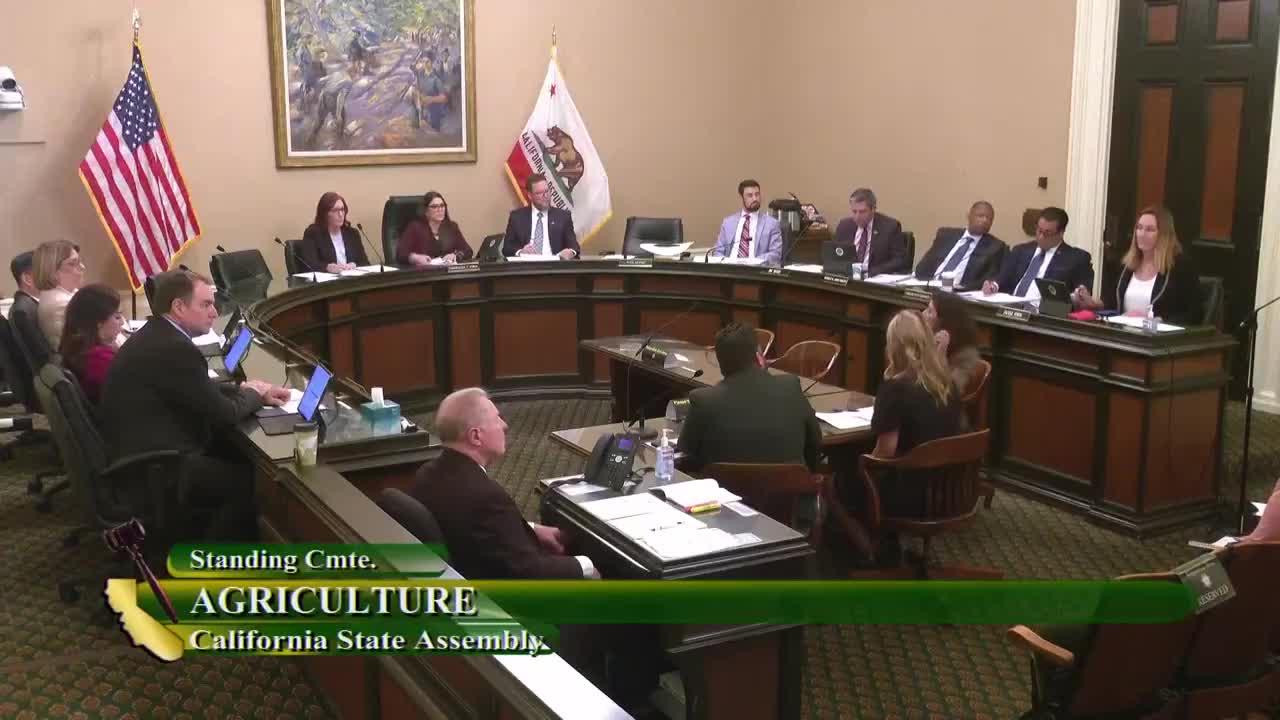 15MIN
Assembly Standing Committee on Agriculture
Bill Author