AB 2916: Environmental health: floating devices: expanded polystyrene.
- Session Year: 2023-2024
- House: Assembly
- Latest Version Date: 2024-04-15
Current Status:
Failed
(2024-05-16: In committee: Held under submission.)
Introduced
In Committee
First Chamber
In Committee
Second Chamber
Enacted
Existing law regulates certain consumer products and services for the purposes of public health and environmental protection. Existing law establishes the State Water Resources Control Board (state board) to exercise the adjudicatory and regulatory functions of the state in the field of water resources.
This bill would prohibit, beginning January 1, 2026, a buoy, dock, pier, or other floating device that is comprised of expanded polystyrene, as defined, from being installed, placed into, or used in the waters of the state, except when completely encased in another material that prevents the release of the expanded polystyrene into the waters of the state or the environment, as provided. The bill would require a buoy, dock, pier, or other floating device that is installed, placed into, or used in the waters of this state before January 1, 2026, and that is repaired or maintained after January 1, 2026, to also comply with this requirement.This bill would, on and after January 1, 2026, prohibit the sale, distribution, installation, or arrangement of the installation of an overwater structure, excluding a floating home, that contains expanded polystyrene, as defined, or other plastic foam that is not fully enclosed and contained in a shell made of aluminum, concrete, steel or plastic with a minimum thickness of 0.15 inches. The bill would, on and after January 1, 2026, prohibit the sale, distribution, installation, or arrangement of the installation of a block or float that contains, or is comprised of, expanded polystyrene or other plastic foam that is not fully enclosed and contained in a shell made of aluminum, concrete, steel or plastic with a minimum thickness of 0.15 inches. The bill would authorize the state board to adopt rules to implement, administer, and enforce these provisions and to maintain and revise a list of materials that are approved to fully enclose and contain expanded polystyrene or other plastic foam used in an overwater structure, block, or float, as specified. The bill would authorize the state board to revise or disqualify a material if the state board determines the material is not sufficient to prevent the release of expanded polystyrene or other plastic foam into the environment. The bill would also authorize the state board to approve a new material for use if the state board determines that the material is sufficient to prevent the release of expanded polystyrene or other plastic foam into the environment and is safe for use in the aquatic environment. The bill would require that, beginning January 1, 2026, an overwater structure that contains, or a block or float that contains or is comprised of, expanded polystyrene or other plastic foam, sold or installed before January 1, 2026, and that is repaired or maintained on or after that date, be fitted with a shell made of aluminum, concrete, steel or plastic with a minimum thickness of 0.15 inches, or other material as the state board may approve, that fully encloses and contains all expanded polystyrene or other plastic foam. The bill would make a violation of its provisions subject to a civil penalty for each violation in an amount not to exceed $10,000.
Existing law regulates certain consumer products and services for the purposes of public health and environmental protection.
This bill would prohibit, beginning January 1, 2026, a buoy, dock, pier, or other floating device that is comprised of expanded polystyrene, as defined, from being installed, placed into, or used in the waters of the state, except when completely encased in another material that prevents the release of the expanded polystyrene into the waters of the state or the environment, as provided. The bill would require a buoy, dock, pier, or other floating device that is installed, placed into, or used in the waters of this state before January 1, 2026, and that is repaired or maintained after January 1, 2026, to also comply with this requirement.
(a)On and after January 1, 2026, the sale, distribution, installation, or arrangement of the installation of the following items is prohibited in this state:
(1)An overwater structure that contains expanded polystyrene or other plastic foam that is not fully enclosed and contained in a shell made of aluminum, concrete, steel or plastic with a minimum thickness of 0.15 inches.
(2)A block or float that contains, or is comprised of, expanded polystyrene or other plastic foam that is not fully enclosed and contained in a shell made of aluminum, concrete, steel or plastic with a minimum thickness of 0.15 inches.
(b)(1)The State Water Resources Control Board may do both of the following:
(A)Adopt rules to implement, administer, and enforce this chapter.
(B)Maintain and revise a list of materials that are approved to fully enclose and contain expanded polystyrene or other plastic foam used in an overwater structure, block, or float pursuant to subdivision (a).
(i)The state board may revise or disqualify a material listed in paragraph (1) or (2) of subdivision (a) from use if the state board determines the material is not sufficient to prevent the release of expanded polystyrene or other plastic foam into the environment.
(ii)The state board may approve a new material for use if the state board determines that the material is sufficient to prevent the release of expanded polystyrene or other plastic foam into the environment and is safe for use in the aquatic environment.
(2)A violation of this section is subject to a civil penalty for each violation in an amount not to exceed ten thousand dollars ($10,000).
(c)Beginning January 1, 2026, an overwater structure that contains, or a block or float that contains or is comprised of, expanded polystyrene or other plastic foam, sold or installed before January 1, 2026, and that is repaired or maintained on or after that date, shall be fitted with a shell made of aluminum, concrete, steel or plastic with a minimum thickness of 0.15 inches, or other material pursuant to subdivision (b), that fully encloses and contains all expanded polystyrene or other plastic foam.
(d)For purposes of this chapter, an overwater structure does not include a floating home as defined in subdivision (d) of Section 18075.55, but does include a dock, float, walkway, or other accessory overwater structure associated with a floating home.
(e)For purposes of this chapter, expanded polystyrene means blown polystyrene and expanded or extruded foams that are thermoplastic petrochemical materials utilizing a styrene monomer and processed by any technique or techniques, including, but not limited to, fusion of polymer spheres (expandable bead polystyrene), injection molding, foam molding, and extrusion blow molding (extruded foam polystyrene).
SECTION 1.Chapter 10 (commencing with Section 119450) is added to Part 15 of Division 104 of the Health and Safety Code, to read:10.Expanded Polystyrene Floating Devices119450.(a)Beginning January 1, 2026, a buoy, dock, pier, or other floating device that is comprised of expanded polystyrene shall not be installed, placed into, or used in the waters of the state, except as provided in subdivision (b).(b)Expanded polystyrene may be installed, placed into, or used in the waters of the state if the expanded polystyrene is completely encased in another material that prevents the release of the expanded polystyrene into the waters of the state or the environment, including, but not limited to, all of the following:(1)Concrete with a thickness of at least one inch.(2)Galvanized steel with a thickness of at least 0.065 inches or that is at least 16 gauge.(3)Rigid plastic with a thickness of at least 50 millimeters.(4)Chemically secured or bonded fiberglass or plastic resin with a thickness of at least 30 millimeters.(5)Untreated dimensional wood with a thickness of at least four inches.(6)Untreated marine-grade plywood with a thickness of at least one-half inch.(c)All repairs and maintenance done to a buoy, dock, pier, or floating device shall comply with the requirements of this chapter. A buoy, dock, pier, or other floating device that is installed, placed into, or used in the waters of the state before January 1, 2026, and that is repaired or maintained after January 1, 2026, shall comply with the requirements of this chapter.(d)For purposes of this chapter, expanded polystyrene means blown polystyrene and expanded or extruded foams that are thermoplastic petrochemical materials utilizing a styrene monomer and processed by any technique or techniques, including, but not limited to, fusion of polymer spheres (expandable bead polystyrene), injection molding, foam molding, and extrusion blow molding (extruded foam polystyrene).(a)Beginning January 1, 2026, a buoy, dock, pier, or other floating device that is comprised of expanded polystyrene shall not be installed, placed into, or used in the waters of the state, except as provided in subdivision (b).
(b)Expanded polystyrene may be installed, placed into, or used in the waters of the state if the expanded polystyrene is completely encased in another material that prevents the release of the expanded polystyrene into the waters of the state or the environment, including, but not limited to, all of the following:
(1)Concrete with a thickness of at least one inch.
(2)Galvanized steel with a thickness of at least 0.065 inches or that is at least 16 gauge.
(3)Rigid plastic with a thickness of at least 50 millimeters.
(4)Chemically secured or bonded fiberglass or plastic resin with a thickness of at least 30 millimeters.
(5)Untreated dimensional wood with a thickness of at least four inches.
(6)Untreated marine-grade plywood with a thickness of at least one-half inch.
(c)All repairs and maintenance done to a buoy, dock, pier, or floating device shall comply with the requirements of this chapter. A buoy, dock, pier, or other floating device that is installed, placed into, or used in the waters of the state before January 1, 2026, and that is repaired or maintained after January 1, 2026, shall comply with the requirements of this chapter.
(d)For purposes of this chapter, expanded polystyrene means blown polystyrene and expanded or extruded foams that are thermoplastic petrochemical materials utilizing a styrene monomer and processed by any technique or techniques, including, but not limited to, fusion of polymer spheres (expandable bead polystyrene), injection molding, foam molding, and extrusion blow molding (extruded foam polystyrene).
|
Date
|
Status
|
|---|---|
| May 16, 2024 | In committee: Held under submission. |
| May 8, 2024 | In committee: Set, first hearing. Referred to APPR. suspense file. |
| Apr 24, 2024 | From committee: Do pass and re-refer to Com. on APPR. (Ayes 5. Noes 1.) (April 23). Re-referred to Com. on APPR. |
| Apr 16, 2024 | Re-referred to Com. on E.S. & T.M. |
| Apr 15, 2024 | From committee chair, with author's amendments: Amend, and re-refer to Com. on E.S. & T.M. Read second time and amended. |
| Apr 2, 2024 | In committee: Set, first hearing. Hearing canceled at the request of author. |
| Mar 11, 2024 | Referred to Com. on E.S. & T.M. |
| Feb 16, 2024 | From printer. May be heard in committee March 17. |
| Feb 15, 2024 | Read first time. To print. |
|
Date
|
Description
|
Location
|
Votes
|
|
|---|---|---|---|---|
| Apr 23, 2024 | Do pass and be re-referred to the Committee on [Appropriations] | Assembly Standing Committee on Environmental Safety and Toxic Materials |
Passed |
This list shows positions taken on this bill by organizations on the date displayed, which is linked to the original source.
Positions by individuals are not included.
|
Organization
|
Position
|
Date
|
|---|---|---|
| 7th Generation Advisors | ** Support | |
| California Association Of Professional Scientists | ** Support | |
| California Marine Recreation Association | ** Against | |
| cleanearth4kids.org | ** Support | |
| Families Advocating for Chemical and Toxics Safety | ** Support | |
| marine recreation association | ** Against | |
| National Stewardship Action Council | ** Support | |
| Ocean Conservancy | ** Support | |
| Plastic Free Future | ** Support | |
| Plastic Pollution Coalition | ** Support | |
| San Francisco Bay Physicians for Social Responsibility | ** Support | |
| Surfrider Foundation | ** Support | |
| The 5 Gyres Institute | ** Support | |
| The Last Plastic Straw | ** Support | |
| The Story of Stuff Project | ** Support | |
| Western Wood Preservers Institute | ** Against |
Date of Hearing: May 8, 2024
ASSEMBLY COMMITTEE ON APPROPRIATIONS
Buffy Wicks, Chair
ABPCA Bill Id:AB 2916
Author:(Friedman) – As Amended Ver:April 15, 2024
Policy Committee: | Environmental Safety and Toxic Materials | Vote: | 5 - 1 |
|
| ||
|
|
Urgency: No State Mandated Local Program: No Reimbursable: No
SUMMARY:
This bill prohibits the sale, distribution, installation, or arrangement of the installation of an overwater structure, block, or float that contains expanded polystyrene (EPS), as specified. This bill also authorizes the State Water Resources Control Board (State Water Board) to adopt rules to implement, administer, and enforce this bill.
Specifically, this bill, among other things:
- Prohibits, beginning January 1, 2026, the sale, distribution, installation, or arrangement of the installation of an overwater structure that contains, or a block or float that contains or is comprised of, EPS or other plastic foam that is not fully enclosed and contained in a shell made of aluminum, concrete, steel, or plastic with a minimum thickness of 0.15 inches.
2) Authorizes the State Water Board to:
a) Adopt rules to implement, administer, and enforce this bill.
b) Maintain and revise a list of materials that are approved to fully enclose and contain EPS or other plastic foam used in an overwater structure, block, or float.
- Revise or disqualify a material listed in 1, above, from use if the State Water Board determines the material is not sufficient to prevent the release of EPS or other plastic foam into the environment.
- Approve a new material for use if the State Water Board determines the material is sufficient to prevent the release of EPS or other plastic foam into the environment and is safe for use in the aquatic environment.
- Provides that a violation of this bill is subject to a civil penalty for each violation in an amount not to exceed $10,000.
- Requires, beginning January 1, 2026, an existing overwater structure that contains, or a block or float that contains or is comprised of, EPS or other plastic foam, and that is repaired or maintained on or after January 1, 2026, to comply with the provisions of this bill.
FISCAL EFFECT:
To adequately implement, administer, and enforce this bill, the State Water Board estimates ongoing annual costs of approximately $4.5 million (General Fund or Waste Discharge Permit Fund) to create a new program, design a new regulatory approach, conduct inspections, and undertake enforcement actions to ensure compliance. In addition, the State Water Board anticipates incurring one-time contracting costs of an unknown amount to conduct an initial research study to guide its implementation of this bill. According to the Legislative Analyst’s Office, the General Fund faces a structural deficit in the tens of billions of dollars over the next several fiscal years.
COMMENTS:
1) Purpose. According to the author:
California has experienced first-hand the negative impacts associated with foam-filled docks when they become damaged or water-logged. The result is not only harm to wildlife but also pollution of our waterways and nearly impossible cleanup efforts. This bill reduces further pollution of California’s waters and beaches at the source.
2) Background. As noted in a coalition support letter for this bill, EPS, colloquially referred to as “Styrofoam,” is the most common type of plastic foam used in docks and other floating structures. When exposed to the elements, this foam easily breaks apart from collisions and weathering over time. This results in tiny plastic pieces, including microplastics, which pollute beaches, the ocean, and other waterways. These plastic pieces threaten wildlife through ingestion in addition to containing toxic chemicals that are released into the environment and can be harmful to both humans and wildlife. On January 7, 2024, a major storm event occurred around the Lake Tahoe region in northern California. The storm resulted in hundreds of thousands of EPS particles – remnants of a floating dock – washing up on the shoreline of Incline Village beaches. The small size and lightness of the polystyrene particles make them incredibly hard to clean up and, in the presence of snow, difficult to identify. The support coalition contends that “prohibiting unencapsulated floating foam structures in California’s waterways will help reduce this harmful source of plastic pollution and prevent future foam microplastics.”
Several states have already taken action to prohibit unencapsulated EPS foam floating structures. Oregon has successfully implemented its law since the 1990s; Washington passed similar legislation in 2023; and other states like Tennessee and Missouri have restrictions in place for certain lakes. New York and Vermont are also considering legislation to address this issue. Over 130 local governments in California have taken action to address EPS foam pollution, including restrictions on unencapsulated floating devices in San Diego and San Francisco.
Writing in an oppose-unless-amended position, the California Marine Recreation Association argues:
As we read your bill it would require the replacement of floats when ‘maintained’. This could dramatically impact marina operations with untold costs for daily upkeep and routine care…If the purpose of the bill is to require fully encapsulated floats by 2026 we can support that for new installations or if a float requires ‘repair’ as described in the bill, but replacing a float for maintenance is unreasonable and best practices for keeping our docks safe for our customers requires constant maintenance just as any other hard asset does.
Analysis Prepared by: Nikita Koraddi / APPR. / (916) 319-2081
Date of Hearing: April 23, 2024
ASSEMBLY COMMITTEE ON ENVIRONMENTAL SAFETY AND TOXIC MATERIALS
Eduardo Garcia, Chair
ABPCA Bill Id:AB 2916 (
Author:Friedman) – As Amended Ver:April 15, 2024
SUBJECT: Environmental health: floating devices: expanded polystyrene
SUMMARY: Prohibits, on and after January 1, 2026, the sale, distribution, installation, or arrangement of the installation of an overwater structure, block or float, excluding a floating home, that contains expanded polystyrene (EPS) or other plastic foam that is not fully enclosed and contained in a shell made of aluminum, concrete, steel, or plastic with a minimum thickness of 0.15 inches; Authorizes the State Water Resources Control Board (State Water Board) to adopt rules to implement, administer, and enforce the provisions of this bill. Specifically, this bill:
- Prohibits, beginning, January 1, 2026, the sale, distribution, installation, or arrangement of the installation of the following items:
- An overwater structure that contains expanded polystyrene or other plastic foam that is not fully enclosed and contained in a shell made of aluminum, concrete, steel, or plastic with a minimum thickness of 0.15 inches.
- A block or float that contains, or is comprised of, expanded polystyrene or other plastic foam that is not fully enclosed and contained in a shell made of aluminum, concrete, steel, or plastic with a minimum thickness of 0.15 inches.
- Authorizes the State Water Board to:
- Adopt rules to implement, administer, and enforce this bill.
- Maintain and revise a list of materials that are approved to fully enclose and contain EPS or other plastic foam used in an overwater structure, block, or float.
- Authorizes the State Water Board to:
- Revise or disqualify a material used to fully enclose EPS or other plastic foam from use if the State Water Board determine the material is not adequate.
- Approve materials for use if they are sufficient to prevent the release of EPS or other plastic foam into the environment and are safe for use in the aquatic environment.
- Provides that a violations of the provisions in this bill, are subject to a civil penalty for each violation in an amount not to exceed $10,000.
- Requires, beginning January 1, 2026, an existing overwater structure that contains, or a block or float that contains or is comprised of, EPS or other plastic foam to be in compliance with the provisions of this bill at the time they are repaired or maintained.
- Provides that a floating home, as defined in law, is not considered an overwater structure, and thus not covered under the bill; however, provides that a dock, float, walkway, or other accessory overwater structure associated with a floating home is covered by provisions of the bill.
- Defines "EPS" as blown polystyrene and expanded or extruded foams that are thermoplastic petrochemical materials utilizing a styrene monomer and processed by any technique or techniques, including, but not limited to, fusion of polymer spheres (expandable bead polystyrene), injection molding, foam molding, and extrusion blow molding (extruded foam polystyrene).
EXISTING LAW:
- Establishes the Federal Water Pollution Control Act (Clean Water Act, or CWA) as the basic structure for regulating discharges of pollutants into the waters of the United States and for regulating quality standards for surface waters. (33 United States Code §1251 et seq.)
- Establishes the Porter-Cologne Water Quality Control Act (Porter-Cologne Act) as the principal law governing water quality regulation in California. (Water Code (WC) § 13000 et seq.)
- Prohibits, pursuant to the Porter-Cologne Water Quality Control Act, the discharge of pollutants to surface waters unless the discharger obtains a permit from the State Water Board. (Water Code (WC) § 13000, et seq.)
- Regulates, under the Porter-Cologne Water Quality Control Act, discharges of pollutants in storm water and urban runoff by regulating, through the National Pollution Discharge Elimination System (NPDES), industrial discharges and discharges through the municipal storm drain systems. (Water Code § 13000 et seq.)
- Makes legislative findings and declarations that the people of the state have the primary interest in the conservation, control, and utilization of the water resources of the state, and that the quality of all the waters of the state shall be protected for use and enjoyment by the people of the state; and that activities and factors which may affect the quality of the waters of the state shall be regulated to attain the highest water quality which is reasonable, considering all demands being made and to be made on those waters and the total values involved, beneficial and detrimental economic and social, tangible and intangible. (WC § 13000)
- Makes legislative findings and declarations that the health, safety, and welfare of people require that there to be a statewide program for the control of the quality of all the waters of the states; that the state must be prepared to exercise its full power and jurisdiction to protect the quality of waters in the state from degradation originating inside or outside boundaries of the state; and that the statewide program for water quality control can be most effectively administered regionally, within a framework of statewide coordination and policy. (WC) § 13000)
- Establishes the State Water Board and Regional Water Quality Control Boards (Regional Water Boards). (WC § 13100)
- Requires the State Water Board to develop and adopt a state policy for water quality control. (WC § 13140)
- Delegates to the Regional Water Boards the ability to adopt water quality standards within their region of jurisdiction. (WC § 13240)
- Designates the State Water Board as the state water pollution control agency for all purposes stated in the federal Clean Water Act. (WC § 13160)
- Authorizes a Regional Water Board, in establishing or reviewing any water quality control plan or waste discharge requirements, or in connection with any action relating to any plan or requirement, to investigate the quality of any waters of the state within its region. (WC § 13267)
- Defines "floating home" as a floating structure which is all of the following:
- Designed and built to be used, or is modified to be used, as a stationary waterborne residential dwelling.
- Has no mode of power of its own.
- Requires a continuous utility linkage to a source originating on shore for utilities.
- Requires a permanent continuous hookup to a shoreside sewage system. (HSC § 18075.55(d))
FISCAL EFFECT: Unknown.
COMMENTS:
Need for bill: According to the author:
"California has experienced first-hand the negative impacts associated with foam-filled docks when they become damaged or water-logged. The result is not only harm to wildlife but also pollution of our waterways and nearly impossible cleanup efforts. This bill reduces further pollution of California’s waters and beaches at the source."
State Water Board: The State Water Board was created by the State Legislature in 1967. As stated on their website, the five-member Board allocates water rights, adjudicates water right disputes, develops statewide water protection plans, establishes water quality standards, and guides the nine Regional Water Boards located in the major watersheds of the state.
Regional Water Boards: There are nine regional water quality control boards in the state. Regional boundaries are based on watersheds and water quality requirements are based on the unique differences in climate, topography, geology, and hydrology for each watershed. Each Regional Water Board makes critical water quality decisions for its region, including setting standards, issuing waste discharge requirements, determining compliance with those requirements, and taking appropriate enforcement actions.
Polystyrene: Polystyrene is a rigid, amorphous thermoplastic produced by the polymerization (small molecules connected in chain like manner) of styrene. Expanded polystyrene (EPS) is produced when pellets are expanded by heating with steam to form cellular beads. Dried particles then get molded into different shapes. The beads are approximately 2-5mm in diameter. EPS has a wide range of uses and is an attractive product because it is lightweight and can withstand degradation for the most part.
The Problem with Plastics: Marine pollution from plastics has been a topic of conversation for decades. The plastic we produce and use eventually goes into our waters and endangers marine life. Often times, plastic pieces breakdown and end up being eaten by marine life, confused as food, and can cause problems resulting in death of these organisms. Hydrophobic chemicals present in the ocean in trace amounts (e.g., from contaminated runoff and oil and chemical spills) bind to plastic particles where they enter and accumulate in the food chain. Heavy metal accumulation in EPS fragments has also been researched suggesting a source of exposure to marine life that ingest it.
According to a review article published in the Journal Environmental Science and Technology, titled, "Foamed Polystyrene in the Marine Environment: Sources, Additives, Transport, Behavior, and Impacts, EPS is "a significant contributor to marine litter worldwide, its lightness and low density, ready transportation by the wind, and propensity to readily fragment ensure that it disperses more widely and rapidly than other forms of (unfoamed) plastic, both at sea and when beached. With small fragments readily blown around by the wind when dry and adhering to surfaces when wet, foamed PS [polystyrene] is also particularly difficult to retrieve during beach cleans." Furthermore, the exposure of EPS to ultraviolet light, due to its greater exposure to sunlight since it floats, results in further degradation of the plastic and smaller pieces contaminating the water.
Legislation across the country, including California, have implemented policies to reduce the use of plastic, promote use of biodegradable alternatives, and/or encourage recycling. A significant piece of legislation, Senate Bill (SB) 54 (Allen, Chapter 75, Statutes of 2022), or The Plastic Pollution Prevention and Packaging Producer Responsibility Act, was signed in 2022. It mandates that all single-use packaging and plastic food service ware like cutlery, takeout containers, plates, and cups in California be recyclable or compostable by 2032, with a 25% reduction in single-use plastic packaging and food service ware and a 65% recycling rate for EPS. One of the challenges EPS faces is recyclability. For that reason, supporters of plastic reduction believe EPS in these products will be phased out.
EPS makes things float: EPS is commonly used in flotation devices like docks, platforms, or other things meant to float or be above water. It is a relatively cheap material to use for these purposes. On January 7, 2024 a major storm event occurred around the Lake Tahoe region in northern California. The storm resulted in hundreds of thousands of EPS particles, remnants of a floating dock, washing up on the shoreline of Incline Village beaches. The small size and lightness of the polystyrene particles makes it incredibly hard to clean up and in the presence of snow, difficult to identify. While many volunteers helped with the clean-up process, it is expected that more cleanup efforts will be organized once the snow begins to melt in order to collect what was missed.
Legislation in other states: Pollution events like the one that happened in Lake Tahoe coupled with the increased awareness of plastic pollution in general, have resulted in legislation across the country to decrease the likelihood that EPS gets discharged into the waters. The State of New York has introduced legislation this year, 2023-2024 legislative session, under SB S4974A and Assembly Bill (AB) A8142. They intended, among other things, to ban the use of EPS in docks, buoys, or floating structures. In 2023, the state of Washington passed House Bill 1085, a reducing plastic pollution law that among other things, bans overwater structures containing expanded or extruded plastic foam that is not fully enclosed and contained in a shell made of specified materials. The state of Oregon has had a law in place for decades that also protects the waters of their state from EPS release. All these established laws and proposed legislation mentioned vary on different things including, but not limited to, the allowed materials to fully enclose EPS, whether they have a grandfather clause for existing structures and if EPS is completely banned for use on structures on water or not.
Porter-Cologne Water Quality Control Act (Porter-Cologne Act): In 1969, the State Legislature enacted the Porter-Cologne Water Quality Control Act, the cornerstone of today's water protection efforts in California. Through it, the State Water Board has been entrusted with broad duties and powers to preserve and enhance the state’s complex waterscape.
Consistent with the duties and powers under the Porter-Cologne Act, in 2007, AB 258 (Krekorian, Chapter 735, Statutes of 2007), was signed to require the State Water Board and the Regional Water Boards to implement a program to control discharges of preproduction plastic. For the purposes of this program, "preproduction plastic" was defined to include plastic resin pellets and powder coloring for plastics.
Enforcement through Porter-Cologne Act: Because the intent of AB 2916 is to prevent the release or discharge of EPS or other plastic foam into the waters of the state, it is possible that the provisions of this bill may qualify for enforcement under the Porter-Cologne Act. The author's office is engaged in conversations with the State Water Board, to determine if EPS or other plastic foam discharges to the waters is appropriate under the duties of the Porter-Cologne Act. As the bill moves through the legislative process, the author may wish to consult with the State Water Board on enforcement of this bill.
Clarity on language and word definitions: According to the author's office, the intent of AB 2916 is to prevent the release of EPS or other plastic foam into the waters of the state. The syntax in the bill that describes what is prohibited by a specified date, "an overwater structure that contains expanded polystyrene or other plastic foam that is not fully enclosed and contained in a shell made of aluminum, concrete, steel or plastic with a minimum thickness of 0.15 inches" can be interpreted to mean that any overwater structure that does not fit that specific description is allowed. For example, over water structures with partially enclosed (not fully enclosed) EPS or other plastic foam would be permitted as long as the material they use for partially enclosing the EPS or other plastic foam is not any of the above mentioned. Furthermore, the current word choice "fully enclosed" may be replaced with the word encapsulated and can mean a protective cover or physical barrier between the EPS or other plastic foam material and the water. In this way, it is clear that there is a barrier preventing the discharge of EPS or other plastic foam to the water. Similarly, the word block is intended to mean a three dimensional square, rectangle, or other shape composed of EPS or other plastic foam that is intended to be attached or included in an overwater structure to make said structure float. The provisions of this bill may be enforced by the State Water Board. The author's office may wish to consult the State Water Board for clarity and to help provide some definitions to terms for added clarity.
Existing overwater structures, blocks or float: Since the intent of AB 2916 is to prevent the release of EPS or other plastic foam to the waters, the current language is requiring existing overwater structures, block or float to be in compliance at the time that existing structures are "repaired or maintained." Other legislation outside the state, for example the State of Washington, provides the following statement: "Nothing in this section applies to any dock sold, distributed or installed prior to January 1, 2024" (date when the law went in effect). The language of the State of Washington is referred to as a 'grandfather clause.' This clause addresses the concerns of stakeholders with regards to costly labor that would be required in order to make changes to existing overwater structure, blocks or floats. Furthermore, the current language uses the word "maintenance" which has broad implications. As this bill moves through the legislative process, the author may wish to consider conversations with stakeholders to further clarify if or when the bill applies to existing structures.
Approved materials: The author's amendments to AB 2916 provided some flexibility on the list of materials that can be used to fully enclose EPS or other plastic foam. The current version of AB 2916 gives the State Water Board authority to maintain and revise a list of materials that are approved to fully enclose and contain EPS or other plastic foam. The State Water Board would use their expertise to revise the material list and approve other materials. Under the current version of the bill, wood, treated or untreated, is not prohibited. These changes address the concerns some stakeholders had about the list of materials in a previous version of the bill.
This bill: AB 2916 would prohibit, beginning January 1, 2026, the sale, distribution, installation, or arrangement of the installation of two items: an overwater structure, excluding a floating home, that contains EPS or other plastic foam that is not fully enclosed and contained in a shell made of aluminum, concrete, steel or plastic with a minimum thickness of 0.15 inches and a block or float that contains, or is comprised of, EPS or other plastic foam that is not fully enclosed and contained in a shell made of aluminum, concrete, steel or plastic with a minimum thickness of 0.15 inches. This bill gives authority to the State Water Board to adopt rules to implement, administer, and enforce the provisions of the bill and to maintain and revise a list of materials that are approved for use, as specified. It would requires existing structures to be in compliance at the time they are repaired or maintained. The author's intent is clear, prevent the release of EPS or other plastic foam from overwater structures, blocks or floats. As the bill moves through the legislative process, further details will likely be worked out to refine and clarify the provisions of the bill.
Arguments in Support: According to a coalition of environmental organizations and advocacy groups:
"Since 2013, International Coastal Cleanup® volunteers in California have removed over 700,000 tiny expanded polystyrene pieces (<2.5 cm in size) in addition to over 700,000 other foam foodware and packaging items. Since volunteers started tracking foam dock pieces three years ago, Californians have logged over 4,000 pieces of foam docks. Prohibiting unencapsulated floating foam structures in California’s waterways will help reduce this harmful source of plastic pollution and prevent future foam microplastics.
Plastic pollution, including microplastics, is pervasive in the marine environment and has negative impacts on the environment, economy, and human health. The estimated annual cost of plastic cleanup and control in California was more than $428 million as of 2015. Foam docks can break during storms or from accidents, polluting our beloved waterways and coast with foam pieces. Microplastics, like the small foam pieces created by unencapsulated floating foam structures, are particularly harmful as they are the most mobile in aquatic ecosystems as well as through the food web and are all but impossible to clean up once they enter the environment.
Proactive measures like AB 2916 that prevent microplastics from entering the environment are the most cost-effective approaches to addressing microplastic pollution. Further, by focusing on new structures and future repair and maintenance of existing structures, this bill minimizes costs to the state by phasing out existing devices while reducing cleanup costs associated with plastic foam pollution."
Arguments in Opposition: According to the California Marine Recreation Association (MRA):
"MRA represents over 200 coastal and inland marinas in California. Our members embrace best practices in dock and marina operations. We must keep up with elements and advances in technology to keep our customers happy and the water free of unwanted contaminants, so we share in the objective of the bill to eliminate polystyrene from leaching into our waterways.
Our marinas are on the water and by their very nature subject to the elements. Maintaining our facilities, docks and floats is critical to managing our properties and the safety and well-being of our customers. As we read your bill it would require the replacement of floats when 'maintained'. This could dramatically impact marina operations with untold costs for daily upkeep and routine care.
We believe simply removing the word 'maintain' from the bill would be sufficient to expedite the deployment of fully encapsulated floats.
If the purpose of the bill is to require fully encapsulated floats by 2026 we can support that for new installations or if a float requires 'repair' as described in the bill, but replacing a float for maintenance is unreasonable and best practices for keeping our docks safe for our customers requires constant maintenance just as any other hard asset does."
Related Legislation:
- SB 54 (Allen, Chapter 75, Statutes of 2022). Establishes an Extended Producer Responsibility program to achieve recycling rates, composting and recyclability goals, and source reduction goals for single-use, disposable packaging or single-use, disposal food service ware.
- AB 258 (Krekorian, Chapter 735, Statutes of 2007). Requires the State Water Board and the Regional Water Boards, by January 1, 2009, to implement a program for the control of discharges of preproduction plastics from point and nonpoint sources, including waste discharge, monitoring, and reporting requirements that, at a minimum, target plastic manufacturing, handling, and transportation facilities, and the implementation of specified minimum best management practices for the control of discharges of preproduction plastic.
REGISTERED SUPPORT / OPPOSITION:
Support
7th Generation Advisors
California Association of Professional Scientists
Cleanearth4kids.org
Families Advocating for Chemical and Toxics Safety
National Stewardship Action Council
Ocean Conservancy
Plastic Free Future
Plastic Pollution Coalition
San Francisco Bay Physicians for Social Responsibility
Surfrider Foundation
The 5 Gyres Institute
The Last Plastic Straw
The Story of Stuff Project
Opposition
California Marine Recreation Association (MRA)
Marine Recreation Association
Western Wood Preservers Institute
Analysis Prepared by: Brenda Cisneros-Larios / E.S. & T.M. /
Discussed in Hearing
 12MIN
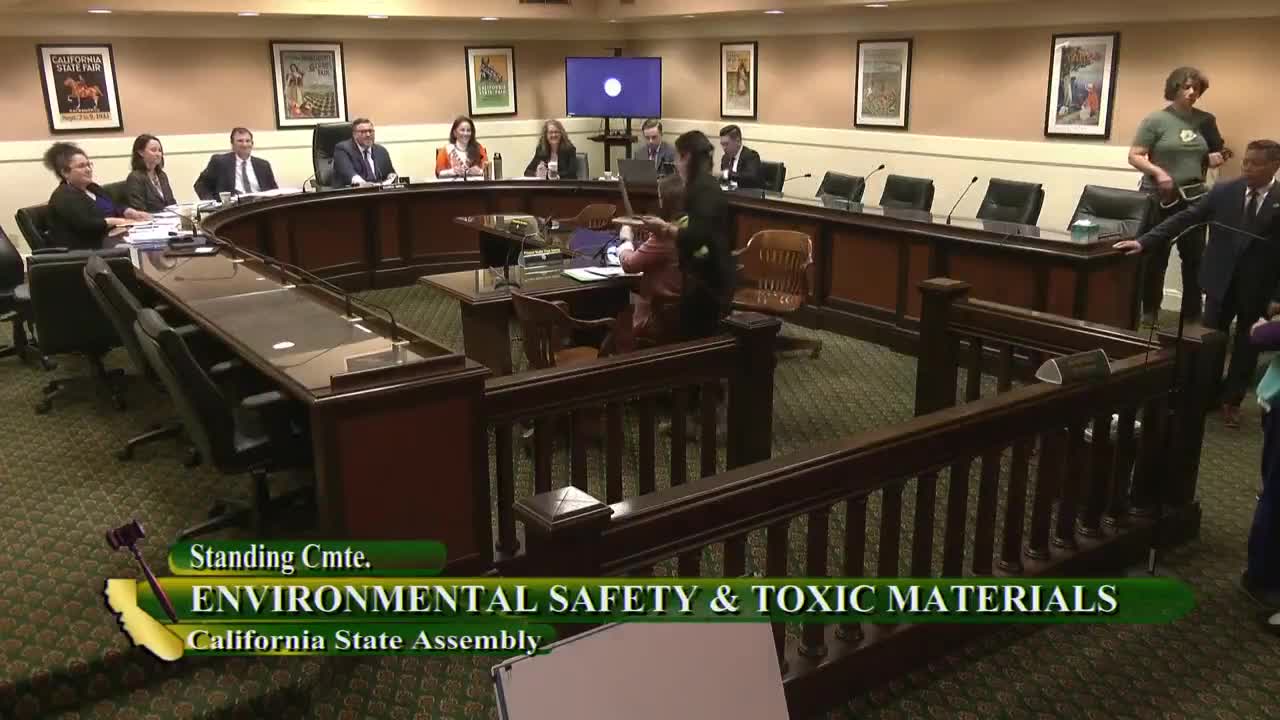
Assembly Standing Committee on Environmental Safety and Toxic Materials
Bill Author

Bill Co-Author(s):