AB 2917: Firearms: restraining orders.
- Session Year: 2023-2024
- House: Assembly
- Latest Version Date: 2024-09-24
Current Status:
Passed
(2024-09-24: Chaptered by Secretary of State - Chapter 539, Statutes of 2024.)
Introduced
In Committee
First Chamber
In Committee
Second Chamber
Enacted
Existing law authorizes a court to issue a gun violence restraining order to prohibit a person from purchasing or possessing a firearm or ammunition for a period of one to 5 years, subject to renewal for additional one- to 5-year periods, if the subject of the petition poses a significant danger of self-harm or harm to another in the near future by having a firearm and the order is necessary to prevent personal injury to the subject of the petition or another. Existing law requires the court, in determining whether grounds for a gun violence restraining order exist, to consider evidence of, among other things, a recent threat of violence or act of violence by the subject directed toward another and a past history of those threats or acts within the last 12 months. Existing law also authorizes a court to consider the unlawful and reckless use, display, or brandishing of a firearm by the subject of the petition.
This bill would require the court to additionally consider a recent threat of violence or act of violence directed toward another group or location, or a past history of those threats or acts. The bill would authorize the court to consider, among other things, the unlawful and reckless use, display, or brandishing of a firearm indicating an increased risk for violence or actual threat of violence by the subject of the petition, evidence of stalking, evidence of cruelty to animals, or evidence of the respondents threats of violence to advance a political objective. The bill would also authorize the court to consider violations of comparable firearm-prohibiting protective orders issued by out-of-state courts. By expanding the scope of a crime, this bill would impose a state-mandated local program.
Existing law requires the Department of Justice to maintain state summary criminal history information, as defined, and to furnish this information to specified entities, including city attorneys pursuing civil gang injunctions or drug abatement actions. Existing law requires a local criminal justice agency to furnish local summary criminal history information to specified entities, including city attorneys pursuing civil gang injunctions or drug abatement actions. Under existing law, the disclosure of state summary criminal history information to an unauthorized person is a crime. Existing law defines criminal justice agencies as agencies that perform activities that relate to the apprehension, prosecution, adjudication, incarceration, or correction of criminal offenders, including city attorneys pursuing civil gang injunctions or drug abatement actions. Under existing law, a criminal justice agency, among other things, compiles records and data for the purpose of identifying criminal offenders and maintaining specified information pertaining to each offender, including a summary of arrests and pretrial proceedings.
This bill would include city attorneys and county counsel pursuing gun violence restraining orders in those provisions. By expanding the scope of the crime of unlawful disclosure of state summary criminal history information, this bill would impose a state-mandated local program.
The California Constitution requires the state to reimburse local agencies and school districts for certain costs mandated by the state. Statutory provisions establish procedures for making that reimbursement.
This bill would provide that no reimbursement is required by this act for a specified reason.
Existing law authorizes a court to issue a gun violence restraining order to prohibit a person from purchasing or possessing a firearm or ammunition for a period of one to 5 years, subject to renewal for additional one- to 5-year periods, if the subject of the petition poses a significant danger of self-harm or harm to another in the near future by having a firearm and the order is necessary to prevent personal injury to the subject of the petition or another. Existing law requires the court, in determining whether grounds for a gun violence restraining order exist, to consider evidence of, among other things, a recent threat of violence or act of violence by the subject directed toward another and a past history of those threats or acts within the last 12 months. Existing law also authorizes a court to consider the unlawful and reckless use, display, or brandishing of a firearm by the subject of the petition.
This bill would require the court to additionally consider a recent threat of violence or act of violence directed toward another group or location, or a past history of those threats or acts. The bill would also authorize the court to consider, among other things, the reckless use, display, or brandishing of a firearm by the subject of the petition, evidence of stalking, evidence of cruelty to animals, or evidence of the respondents threats of violence to advance a political objective. The bill would also authorize the court to consider violations of comparable firearm-prohibiting protective orders issued by out-of-state courts. By expanding the scope of a crime, this bill would impose a state-mandated local program.
Existing law requires the Department of Justice to maintain state summary criminal history information, as defined, and to furnish this information to specified entities, including city attorneys pursuing civil gang injunctions or drug abatement actions. Existing law requires a local criminal justice agency to furnish local summary criminal history information to specified entities, including city attorneys pursuing civil gang injunctions or drug abatement actions. Under existing law, the disclosure of state summary criminal history information to an unauthorized person is a crime. Existing law defines criminal justice agencies as agencies that perform activities that relate to the apprehension, prosecution, adjudication, incarceration, or correction of criminal offenders, including city attorneys pursuing civil gang injunctions or drug abatement actions. Under existing law, a criminal justice agency, among other things, compiles records and data for the purpose of identifying criminal offenders and maintaining specified information pertaining to each offender, including a summary of arrests and pretrial proceedings.
This bill would include city attorneys and county counsel pursuing gun violence restraining orders in those provisions. By expanding the scope of the crime of unlawful disclosure of state summary criminal history information, this bill would impose a state-mandated local program.
The California Constitution requires the state to reimburse local agencies and school districts for certain costs mandated by the state. Statutory provisions establish procedures for making that reimbursement.
This bill would provide that no reimbursement is required by this act for a specified reason.
Existing law authorizes a court to issue a gun violence restraining order to prohibit a person from purchasing or possessing a firearm or ammunition for a period of one to 5 years, subject to renewal for additional one- to 5-year periods, if the subject of the petition poses a significant danger of self-harm or harm to another in the near future by having a firearm and the order is necessary to prevent personal injury to the subject of the petition or another. Existing law requires the court, in determining whether grounds for a gun violence restraining order exist, to consider evidence of, among other things, a recent threat of violence or act of violence by the subject directed toward another and a past history of those threats or acts within the last 12 months. Existing law also authorizes a court to consider the unlawful and reckless use, display, or brandishing of a firearm by the subject of the petition.
This bill would require the court to additionally consider a recent threat of violence or act of violence directed toward another group or location, or a past history of those threats or acts. The bill would also authorize the court to consider, among other things, the reckless use, display, or brandishing of a firearm by the subject of the petition, evidence of stalking, evidence of cruelty to animals, or evidence of the respondents threats of violence to advance a political objective. By expanding the scope of a crime, this bill would impose a state-mandated local program.
Existing law requires the Department of Justice to maintain state summary criminal history information, as defined, and to furnish this information to specified entities, including city attorneys pursuing civil gang injunctions or drug abatement actions. Existing law requires a local criminal justice agency to furnish local summary criminal history information to specified entities, including city attorneys pursuing civil gang injunctions or drug abatement actions. Under existing law, the disclosure of state summary criminal history information to an unauthorized person is a crime. Existing law defines criminal justice agencies as agencies that perform activities that relate to the apprehension, prosecution, adjudication, incarceration, or correction of criminal offenders, including city attorneys pursuing civil gang injunctions or drug abatement actions. Under existing law, a criminal justice agency, among other things, compiles records and data for the purpose of identifying criminal offenders and maintaining specified information pertaining to each offender, including a summary of arrests and pretrial proceedings.
This bill would include city attorneys pursuing gun violence restraining orders in those provisions. By expanding the scope of the crime of unlawful disclosure of state summary criminal history information, this bill would impose a state-mandated local program.
The California Constitution requires the state to reimburse local agencies and school districts for certain costs mandated by the state. Statutory provisions establish procedures for making that reimbursement.
This bill would provide that no reimbursement is required by this act for a specified reason.
(a)This section applies when an arrest record is sealed pursuant to Sections 851.87, 851.90, 851.91, 1000.4, and 1001.9.
(b)When the court issues an order to seal an arrest, the sealing shall be accomplished as follows:
(1)The court shall provide copies of the order and a report on the disposition of the arrest, as follows:
(A)Upon issuing the order, the court shall provide a copy to the person whose arrest was sealed and to the prosecuting attorney.
(B)Within 30 days of issuing the order, the court shall forward a copy of the order to the law enforcement agency that made the arrest, to any other law enforcement agency that participated in the arrest, and to the law enforcement agency that administers the master local summary criminal history information that contains the arrest record for the sealed arrest.
(C)Within 30 days of issuing the order, the court shall furnish a disposition report to the Department of Justice indicating that relief has been ordered and providing the section of the Penal Code under which that relief was granted and the date that relief was granted.
(D)A sealing order made pursuant to this subdivision shall not be forwarded to the Department of Justice to be included or notated in the departments manual or electronic fingerprint image or criminal history record systems. Any sealing order made pursuant to this subdivision and received by the Department of Justice shall not be processed by the department.
(2)The arrest record shall be updated, as follows:
(A)The local summary criminal history information shall include, directly next to or below the entry or entries regarding the sealed arrest, a note stating arrest sealed and providing the date that the court issued the order, and the section pursuant to which the arrest was sealed. This note shall be included in all master copies of the arrest record, digital or otherwise.
(B)The state summary criminal history information shall include, directly next to or below the entry or entries regarding the sealed arrest, a note stating arrest relief granted, providing the date that the court issued the order and the section of the Penal Code pursuant to which the relief was granted. This note shall be included in all master copies of the arrest record, digital or otherwise.
(3)A police investigative report related to the sealed arrest shall, only as to the person whose arrest was sealed, be stamped ARREST SEALED: DO NOT RELEASE OUTSIDE THE CRIMINAL JUSTICE SECTOR, and shall note next to the stamp the date the arrest was sealed and the section pursuant to which the arrest was sealed. The responsible local law enforcement agency shall ensure that this note is included in all master copies, digital or otherwise, of the police investigative report related to the arrest that was sealed.
(4)Court records related to the sealed arrest shall, only as to the person whose arrest was sealed, be stamped ARREST SEALED: DO NOT RELEASE OUTSIDE OF THE CRIMINAL JUSTICE SECTOR, and shall note next to the stamp the date of the sealing and the section pursuant to which the arrest was sealed. This stamp and note shall be included on all master court dockets, digital or otherwise, relating to the arrest.
(5)Arrest records, police investigative reports, and court records that are sealed under this section shall not be disclosed to any person or entity except the person whose arrest was sealed or a criminal justice agency. Nothing shall prohibit disclosure of information between criminal history providers.
(6)Notwithstanding the sealing of an arrest, a criminal justice agency may continue, in the regular course of its duties, to access, furnish to other criminal justice agencies, and use, including, but not limited to, by discussing in open court and in unsealed court filings, sealed arrests, sealed arrest records, sealed police investigative reports, sealed court records, and information relating to sealed arrests, to the same extent that would have been permitted for a criminal justice agency if the arrest had not been sealed.
(c)Unless specifically authorized by this section, a person or entity, other than a criminal justice agency or the person whose arrest was sealed, who disseminates information relating to a sealed arrest is subject to a civil penalty of not less than five hundred dollars ($500) and not more than two thousand five hundred dollars ($2,500) per violation. The civil penalty may be enforced by a city attorney, district attorney, or the Attorney General. This subdivision does not limit any existing private right of action. A civil penalty imposed under this section shall be cumulative to civil remedies or penalties imposed under any other law.
(d)As used in this section and Sections 851.87, 851.90, 851.91, 1000.4, and 1001.9, all of the following terms have the following meanings:
(1)Arrest record and record pertaining to an arrest mean information about the arrest or detention that is contained in either of the following:
(A)The master, or a copy of the master, local summary criminal history information, as defined in subdivision (a) of Section 13300.
(B)The master, or a copy of the master, state summary criminal history information as defined in subparagraph (A) of paragraph (2) of subdivision (a) of Section 11105.
(2)Court records means records, files, and materials created, compiled, or maintained by or for the court in relation to court proceedings, and includes, but is not limited to, indexes, registers of actions, court minutes, court orders, court filings, court exhibits, court progress and status reports, court history summaries, copies of state summary criminal history information and local summary criminal history information, and any other criminal history information contained in any of those materials.
(3)Criminal history provider means a person or entity that is not a criminal justice agency and that provides background screening services or criminal history information on identified individuals to the public or to those outside the criminal justice sector upon request, charge, or pursuant to a contractual agreement or that aggregates into databases that are open to the public or to those outside the criminal justice sector upon request or charge, or pursuant to a contractual agreement, that are not created or maintained by a criminal justice agency, criminal history information on identified individuals. For the purposes of this paragraph, a criminal history provider includes an investigative consumer reporting agency, as defined in Section 1786.2 of the Civil Code, a consumer credit reporting agency, as defined in Section 1785.3 of the Civil Code, and a consumer reporting agency, as defined in Section 603(f) of the Fair Credit Reporting Act (15 U.S.C. 1681a(f)).
(4)Criminal justice agency means an agency at any level of government that performs, as its principal function, activities relating to the apprehension, prosecution, defense, adjudication, incarceration, or correction of criminal suspects and criminal offenders. A criminal justice agency includes, but is not limited to, any of the following:
(A)A court of this state.
(B)A peace officer, as defined in Section 830.1, subdivisions (a) and (e) of Section 830.2, subdivision (a) of Section 830.3, subdivision (a) of Section 830.31, and subdivisions (a) and (b) of Section 830.5.
(C)A district attorney.
(D)A prosecuting city attorney.
(E)A city attorney pursuing civil gang injunctions pursuant to Section 186.22a, drug abatement actions pursuant to Section 3479 or 3480 of the Civil Code or Section 11571 of the Health and Safety Code, or a city attorney or county counsel pursuing gun violence restraining orders pursuant to Division 3.2 (commencing with Section 18100) of Title 2 of Part 6.
(F)A probation officer.
(G)A parole officer.
(H)A public defender or an attorney representing a person, or a person representing themselves, in a criminal proceeding, a proceeding to revoke parole, mandatory supervision, or postrelease community supervision, or in a proceeding described in Chapter 3.5 (commencing with Section 4852.01) of Title 6 of Part 3.
(I)An expert, investigator, or other specialist contracted by a prosecuting attorney or defense attorney to accomplish the purpose of the prosecution, defense, or representation in the criminal proceeding.
(J)A correctional officer.
(5)Police investigative report means intelligence, analytical, and investigative reports and files created, compiled, and maintained by a law enforcement criminal justice agency and relating to a potential crime, violation of the law, arrest, detention, prosecution, or law enforcement investigation.
SEC. 2.Section 11105 of the Penal Code is amended to read:11105.(a)(1)The Department of Justice shall maintain state summary criminal history information.
(2)As used in this section:
(A)State summary criminal history information means the master record of information compiled by the Attorney General pertaining to the identification and criminal history of a person, such as name, date of birth, physical description, fingerprints, photographs, dates of arrests, arresting agencies and booking numbers, charges, dispositions, sentencing information, and similar data about the person.
(B)State summary criminal history information does not refer to records and data compiled by criminal justice agencies other than the Attorney General, nor does it refer to records of complaints to or investigations conducted by, or records of intelligence information or security procedures of, the office of the Attorney General and the Department of Justice.
(b)The Attorney General shall furnish state summary criminal history information to the following, if needed in the course of their duties, provided that when information is furnished to assist an agency, officer, or official of state or local government, a public utility, or any other entity, in fulfilling employment, certification, or licensing duties, Chapter 1321 of the Statutes of 1974 and Section 432.7 of the Labor Code shall apply:
(1)The courts of the state.
(2)Peace officers of the state, as defined in Section 830.1, subdivisions (a) and (e) of Section 830.2, subdivision (a) of Section 830.3, subdivision (a) of Section 830.31, and subdivisions (a) and (b) of Section 830.5.
(3)District attorneys of the state.
(4)Prosecuting city attorneys or city prosecutors of a city within the state.
(5)City attorneys pursuing civil gang injunctions pursuant to Section 186.22a, drug abatement actions pursuant to Section 3479 or 3480 of the Civil Code or Section 11571 of the Health and Safety Code, or a city attorney or county counsel pursuing gun violence restraining orders pursuant to Division 3.2 (commencing with Section 18100) of Title 2 of Part 6.
(6)Probation officers of the state.
(7)Parole officers of the state.
(8)A public defender or attorney of record when representing a person in proceedings upon a petition for a certificate of rehabilitation and pardon pursuant to Section 4852.08.
(9)A public defender or attorney of record when representing a person in a criminal case or a juvenile delinquency proceeding, including all appeals and postconviction motions, or a parole, mandatory supervision pursuant to paragraph (5) of subdivision (h) of Section 1170, or postrelease community supervision revocation or revocation extension proceeding, if the information is requested in the course of representation.
(10)An agency, officer, or official of the state if the state summary criminal history information is required to implement a statute or regulation that expressly refers to specific criminal conduct applicable to the subject person of the state summary criminal history information, and contains requirements or exclusions, or both, expressly based upon that specified criminal conduct. The agency, officer, or official of the state authorized by this paragraph to receive state summary criminal history information may perform state and federal criminal history information checks as provided for in subdivision (u). The Department of Justice shall provide a state or federal response to the agency, officer, or official pursuant to subdivision (p).
(11)A city, county, city and county, or district, or an officer or official thereof, if access is needed in order to assist that agency, officer, or official in fulfilling employment, certification, or licensing duties, and if the access is specifically authorized by the city council, board of supervisors, or governing board of the city, county, or district if the state summary criminal history information is required to implement a statute, ordinance, or regulation that expressly refers to specific criminal conduct applicable to the subject person of the state summary criminal history information, and contains requirements or exclusions, or both, expressly based upon that specified criminal conduct. The city, county, city and county, district, or the officer or official thereof authorized by this paragraph may also transmit fingerprint images and related information to the Department of Justice to be transmitted to the Federal Bureau of Investigation.
(12)The subject of the state summary criminal history information under procedures established under Article 5 (commencing with Section 11120).
(13)A person or entity when access is expressly authorized by statute if the criminal history information is required to implement a statute or regulation that expressly refers to specific criminal conduct applicable to the subject person of the state summary criminal history information, and contains requirements or exclusions, or both, expressly based upon that specified criminal conduct.
(14)Health officers of a city, county, city and county, or district when in the performance of their official duties enforcing Section 120175 of the Health and Safety Code.
(15)A managing or supervising correctional officer of a county jail or other county correctional facility.
(16)A humane society, or society for the prevention of cruelty to animals, for the specific purpose of complying with Section 14502 of the Corporations Code for the appointment of humane officers.
(17)Local child support agencies established by Section 17304 of the Family Code. When a local child support agency closes a support enforcement case containing state summary criminal history information, the agency shall delete or purge from the file and destroy documents or information concerning or arising from offenses for or of which the parent has been arrested, charged, or convicted, other than for offenses related to the parents having failed to provide support for minor children, consistent with the requirements of Section 17531 of the Family Code.
(18)County child welfare agency personnel who have been delegated the authority of county probation officers to access state summary criminal history information pursuant to Section 272 of the Welfare and Institutions Code for the purposes specified in Section 16504.5 of the Welfare and Institutions Code. Information from criminal history records provided pursuant to this subdivision shall not be used for a purpose other than those specified in this section and Section 16504.5 of the Welfare and Institutions Code. When an agency obtains records both on the basis of name checks and fingerprint checks, final placement decisions shall be based only on the records obtained pursuant to the fingerprint check.
(19)The court of a tribe, or court of a consortium of tribes, that has entered into an agreement with the state pursuant to Section 10553.1 of the Welfare and Institutions Code. This information may be used only for the purposes specified in Section 16504.5 of the Welfare and Institutions Code and for tribal approval or tribal licensing of foster care or adoptive homes. Article 6 (commencing with Section 11140) shall apply to officers, members, and employees of a tribal court receiving state summary criminal history information pursuant to this section.
(20)Child welfare agency personnel of a tribe or consortium of tribes that has entered into an agreement with the state pursuant to Section 10553.1 of the Welfare and Institutions Code and to whom the state has delegated duties under paragraph (2) of subdivision (a) of Section 272 of the Welfare and Institutions Code. The purposes for use of the information shall be for the purposes specified in Section 16504.5 of the Welfare and Institutions Code and for tribal approval or tribal licensing of foster care or adoptive homes. When an agency obtains records on the basis of name checks and fingerprint checks, final placement decisions shall be based only on the records obtained pursuant to the fingerprint check. Article 6 (commencing with Section 11140) shall apply to child welfare agency personnel receiving criminal record offender information pursuant to this section.
(21)An officer providing conservatorship investigations pursuant to Sections 5351, 5354, and 5356 of the Welfare and Institutions Code.
(22)A court investigator providing investigations or reviews in conservatorships pursuant to Section 1826, 1850, 1851, or 2250.6 of the Probate Code.
(23)A person authorized to conduct a guardianship investigation pursuant to Section 1513 of the Probate Code.
(24)A humane officer pursuant to Section 14502 of the Corporations Code for the purposes of performing the officers duties.
(25)A public agency described in subdivision (b) of Section 15975 of the Government Code, for the purpose of oversight and enforcement policies with respect to its contracted providers.
(26)(A)A state entity, or its designee, that receives federal tax information. A state entity or its designee that is authorized by this paragraph to receive state summary criminal history information also may transmit fingerprint images and related information to the Department of Justice to be transmitted to the Federal Bureau of Investigation for the purpose of the state entity or its designee obtaining federal-level criminal offender record information from the Department of Justice. This information shall be used only for the purposes set forth in Section 1044 of the Government Code.
(B)For purposes of this paragraph, federal tax information, state entity and designee are as defined in paragraphs (1), (2), and (3), respectively, of subdivision (f) of Section 1044 of the Government Code.
(27)The director of the State Department of State Hospitals, or their designee, for use related to research and evaluation studies described in Section 4046 of the Welfare and Institutions Code, and subject to the limitations described in that section.
(c)The Attorney General may furnish state summary criminal history information and, when specifically authorized by this subdivision, federal-level criminal history information upon a showing of a compelling need to any of the following, provided that when information is furnished to assist an agency, officer, or official of state or local government, a public utility, or any other entity in fulfilling employment, certification, or licensing duties, Chapter 1321 of the Statutes of 1974 and Section 432.7 of the Labor Code shall apply:
(1)A public utility, as defined in Section 216 of the Public Utilities Code, that operates a nuclear energy facility when access is needed in order to assist in employing persons to work at the facility, provided that, if the Attorney General supplies the data, the Attorney General shall furnish a copy of the data to the person to whom the data relates.
(2)A peace officer of the state other than those included in subdivision (b).
(3)An illegal dumping enforcement officer as defined in subdivision (i) of Section 830.7.
(4)A peace officer of another country.
(5)Public officers, other than peace officers, of the United States, other states, or possessions or territories of the United States, provided that access to records similar to state summary criminal history information is expressly authorized by a statute of the United States, other states, or possessions or territories of the United States if the information is needed for the performance of their official duties.
(6)A person when disclosure is requested by a probation, parole, or peace officer with the consent of the subject of the state summary criminal history information and for purposes of furthering the rehabilitation of the subject.
(7)The courts of the United States, other states, or territories or possessions of the United States.
(8)Peace officers of the United States, other states, or territories or possessions of the United States.
(9)An individual who is the subject of the record requested if needed in conjunction with an application to enter the United States or a foreign nation.
(10)(A)(i)A public utility, as defined in Section 216 of the Public Utilities Code, or a cable corporation as defined in subparagraph (B), if receipt of criminal history information is needed in order to assist in employing current or prospective employees, contract employees, or subcontract employees who, in the course of their employment, may be seeking entrance to private residences or adjacent grounds. The information provided shall be limited to the record of convictions and arrests for which the person is released on bail or on their own recognizance pending trial.
(ii)If the Attorney General supplies the data pursuant to this paragraph, the Attorney General shall furnish a copy of the data to the current or prospective employee to whom the data relates.
(iii)State summary criminal history information is confidential and the receiving public utility or cable corporation shall not disclose its contents, other than for the purpose for which it was acquired. The state summary criminal history information in the possession of the public utility or cable corporation and all copies made from it shall be destroyed not more than 30 days after employment or promotion or transfer is denied or granted, except for those cases where a current or prospective employee is out on bail or on their own recognizance pending trial, in which case the state summary criminal history information and all copies shall be destroyed not more than 30 days after the case is resolved.
(iv)A violation of this paragraph is a misdemeanor, and shall give the current or prospective employee who is injured by the violation a cause of action against the public utility or cable corporation to recover damages proximately caused by the violations. A public utilitys or cable corporations request for state summary criminal history information for purposes of employing current or prospective employees who may be seeking entrance to private residences or adjacent grounds in the course of their employment shall be deemed a compelling need as required to be shown in this subdivision.
(v)This section shall not be construed as imposing a duty upon public utilities or cable corporations to request state summary criminal history information on current or prospective employees.
(B)For purposes of this paragraph, cable corporation means a corporation or firm that transmits or provides television, computer, or telephone services by cable, digital, fiber optic, satellite, or comparable technology to subscribers for a fee.
(C)Requests for federal-level criminal history information received by the Department of Justice from entities authorized pursuant to subparagraph (A) shall be forwarded to the Federal Bureau of Investigation by the Department of Justice. Federal-level criminal history information received or compiled by the Department of Justice may then be disseminated to the entities referenced in subparagraph (A), as authorized by law.
(11)A campus of the California State University or the University of California, or a four-year college or university accredited by a regional accreditation organization approved by the United States Department of Education, if needed in conjunction with an application for admission by a convicted felon to a special education program for convicted felons, including, but not limited to, university alternatives and halfway houses. Only conviction information shall be furnished. The college or university may require the convicted felon to be fingerprinted, and any inquiry to the department under this section shall include the convicted felons fingerprints and any other information specified by the department.
(12)A foreign government, if requested by the individual who is the subject of the record requested, if needed in conjunction with the individuals application to adopt a minor child who is a citizen of that foreign nation. Requests for information pursuant to this paragraph shall be in accordance with the process described in Sections 11122 to 11124, inclusive. The response shall be provided to the foreign government or its designee and to the individual who requested the information.
(d)Whenever an authorized request for state summary criminal history information pertains to a person whose fingerprints are on file with the Department of Justice and the department has no criminal history of that person, and the information is to be used for employment, licensing, or certification purposes, the fingerprint card accompanying the request for information, if any, may be stamped no criminal record and returned to the person or entity making the request.
(e)Whenever state summary criminal history information is furnished as the result of an application and is to be used for employment, licensing, or certification purposes, the Department of Justice may charge the person or entity making the request a fee that it determines to be sufficient to reimburse the department for the cost of furnishing the information. In addition, the Department of Justice may add a surcharge to the fee to fund maintenance and improvements to the systems from which the information is obtained. Notwithstanding any other law, a person or entity required to pay a fee to the department for information received under this section may charge the applicant a fee sufficient to reimburse the person or entity for this expense. All moneys received by the department pursuant to this section, Sections 11105.3 and 26190, and former Section 13588 of the Education Code shall be deposited in a special account in the General Fund to be available for expenditure by the department to offset costs incurred pursuant to those sections and for maintenance and improvements to the systems from which the information is obtained upon appropriation by the Legislature.
(f)Whenever there is a conflict, the processing of criminal fingerprints and fingerprints of applicants for security guard or alarm agent registrations or firearms qualification permits submitted pursuant to Section 7583.9, 7583.23, 7596.3, or 7598.4 of the Business and Professions Code shall take priority over the processing of other applicant fingerprints.
(g)It is not a violation of this section to disseminate statistical or research information obtained from a record, provided that the identity of the subject of the record is not disclosed.
(h)It is not a violation of this section to include information obtained from a record in (1) a transcript or record of a judicial or administrative proceeding or (2) any other public record if the inclusion of the information in the public record is authorized by a court, statute, or decisional law.
(i)Notwithstanding any other law, the Department of Justice or a state or local law enforcement agency may require the submission of fingerprints for the purpose of conducting state summary criminal history information checks that are authorized by law.
(j)The state summary criminal history information shall include any finding of mental incompetence pursuant to Chapter 6 (commencing with Section 1367) of Title 10 of Part 2 arising out of a complaint charging a felony offense specified in Section 290.
(k)(1)This subdivision shall apply whenever state or federal summary criminal history information is furnished by the Department of Justice as the result of an application by an authorized agency or organization and the information is to be used for peace officer employment or certification purposes. As used in this subdivision, a peace officer is defined in Chapter 4.5 (commencing with Section 830) of Title 3 of Part 2.
(2)Notwithstanding any other law, whenever state summary criminal history information is initially furnished pursuant to paragraph (1), the Department of Justice shall disseminate the following information:
(A)Every conviction rendered against the applicant.
(B)Every arrest for an offense for which the applicant is presently awaiting trial, whether the applicant is incarcerated or has been released on bail or on their own recognizance pending trial.
(C)Every arrest or detention, except for an arrest or detention resulting in an exoneration, provided, however, that where the records of the Department of Justice do not contain a disposition for the arrest, the Department of Justice first makes a genuine effort to determine the disposition of the arrest.
(D)Every successful diversion.
(E)Every date and agency name associated with all retained peace officer or nonsworn law enforcement agency employee preemployment criminal offender record information search requests.
(F)Sex offender registration status of the applicant.
(G)Sentencing information, if present in the departments records at the time of the response.
(l)(1)This subdivision shall apply whenever state or federal summary criminal history information is furnished by the Department of Justice as the result of an application by a criminal justice agency or organization as defined in Section 13101, and the information is to be used for criminal justice employment, licensing, or certification purposes.
(2)Notwithstanding any other law, whenever state summary criminal history information is initially furnished pursuant to paragraph (1), the Department of Justice shall disseminate the following information:
(A)Every conviction rendered against the applicant.
(B)Every arrest for an offense for which the applicant is presently awaiting trial, whether the applicant is incarcerated or has been released on bail or on their own recognizance pending trial.
(C)Every arrest for an offense for which the records of the Department of Justice do not contain a disposition or that did not result in a conviction, provided that the Department of Justice first makes a genuine effort to determine the disposition of the arrest. However, information concerning an arrest shall not be disclosed if the records of the Department of Justice indicate or if the genuine effort reveals that the subject was exonerated, successfully completed a diversion or deferred entry of judgment program, or the arrest was deemed a detention, or the subject was granted relief pursuant to Section 851.91.
(D)Every date and agency name associated with all retained peace officer or nonsworn law enforcement agency employee preemployment criminal offender record information search requests.
(E)Sex offender registration status of the applicant.
(F)Sentencing information, if present in the departments records at the time of the response.
(m)(1)This subdivision shall apply whenever state or federal summary criminal history information is furnished by the Department of Justice as the result of an application by an authorized agency or organization pursuant to Section 1522, 1568.09, 1569.17, or 1596.871 of the Health and Safety Code, or a statute that incorporates the criteria of any of those sections or this subdivision by reference, and the information is to be used for employment, licensing, or certification purposes.
(2)Notwithstanding any other law, whenever state summary criminal history information is initially furnished pursuant to paragraph (1), the Department of Justice shall disseminate the following information:
(A)Every conviction of an offense rendered against the applicant, except a conviction for which relief has been granted pursuant to Section 1203.49.
(B)Every arrest for an offense for which the applicant is presently awaiting trial, whether the applicant is incarcerated or has been released on bail or on their own recognizance pending trial.
(C)Every arrest for an offense for which the State Department of Social Services is required by paragraph (1) of subdivision (a) of Section 1522 of the Health and Safety Code to determine if an applicant has been arrested. However, if the records of the Department of Justice do not contain a disposition for an arrest, the Department of Justice shall first make a genuine effort to determine the disposition of the arrest.
(D)Sex offender registration status of the applicant.
(E)Sentencing information, if present in the departments records at the time of the response.
(3)Notwithstanding the requirements of the sections referenced in paragraph (1) of this subdivision, the Department of Justice shall not disseminate information about an arrest subsequently deemed a detention or an arrest that resulted in the successful completion of a diversion program, exoneration, or a grant of relief pursuant to Section 851.91.
(n)(1)This subdivision shall apply whenever state or federal summary criminal history information, to be used for employment, licensing, or certification purposes, is furnished by the Department of Justice as the result of an application by an authorized agency, organization, or individual pursuant to any of the following:
(A)Paragraph (10) of subdivision (c), when the information is to be used by a cable corporation.
(B)Section 11105.3 or 11105.4.
(C)Section 15660 of the Welfare and Institutions Code.
(D)A statute that incorporates the criteria of any of the statutory provisions listed in subparagraph (A), (B), or (C), or of this subdivision, by reference.
(2)With the exception of applications submitted by transportation companies authorized pursuant to Section 11105.3, and notwithstanding any other law, whenever state summary criminal history information is initially furnished pursuant to paragraph (1), the Department of Justice shall disseminate the following information:
(A)Every conviction, except a conviction for which relief has been granted pursuant to Section 1203.49, rendered against the applicant for a violation or attempted violation of an offense specified in subdivision (a) of Section 15660 of the Welfare and Institutions Code. However, with the exception of those offenses for which registration is required pursuant to Section 290, the Department of Justice shall not disseminate information pursuant to this subdivision unless the conviction occurred within 10 years of the date of the agencys request for information or the conviction is over 10 years old but the subject of the request was incarcerated within 10 years of the agencys request for information.
(B)Every arrest for a violation or attempted violation of an offense specified in subdivision (a) of Section 15660 of the Welfare and Institutions Code for which the applicant is presently awaiting trial, whether the applicant is incarcerated or has been released on bail or on their own recognizance pending trial.
(C)Sex offender registration status of the applicant.
(D)Sentencing information, if present in the departments records at the time of the response.
(o)(1)This subdivision shall apply whenever state or federal summary criminal history information is furnished by the Department of Justice as the result of an application by an authorized agency or organization pursuant to Section 379 or 1300 of the Financial Code or a statute that incorporates the criteria of either of those sections or this subdivision by reference, and the information is to be used for employment, licensing, or certification purposes.
(2)Notwithstanding any other law, whenever state summary criminal history information is initially furnished pursuant to paragraph (1), the Department of Justice shall disseminate the following information:
(A)Every conviction rendered against the applicant for a violation or attempted violation of an offense specified in Section 1300 of the Financial Code, except a conviction for which relief has been granted pursuant to Section 1203.49.
(B)Every arrest for a violation or attempted violation of an offense specified in Section 1300 of the Financial Code for which the applicant is presently awaiting trial, whether the applicant is incarcerated or has been released on bail or on their own recognizance pending trial.
(C)Sentencing information, if present in the departments records at the time of the response.
(p)(1)This subdivision shall apply whenever state or federal criminal history information is furnished by the Department of Justice as the result of an application by an agency, organization, or individual not defined in subdivision (k), (l), (m), (n), or (o), or by a transportation company authorized pursuant to Section 11105.3, or a statute that incorporates the criteria of that section or this subdivision by reference, and the information is to be used for employment, licensing, or certification purposes.
(2)Notwithstanding any other law, whenever state summary criminal history information is initially furnished pursuant to paragraph (1), the Department of Justice shall disseminate the following information:
(A)Every conviction rendered against the applicant, except a conviction for which relief has been granted pursuant to Section 1203.4, 1203.4a, 1203.41, 1203.42, 1203.425, 1203.44, or 1203.49. The Commission on Teacher Credentialing, school districts, county offices of education, charter schools, private schools, state special schools for the blind and deaf, or any other entity required to have a background check because of a contract with a school district, county office of education, charter school, private school, or state special school for the blind and deaf, shall receive every conviction rendered against an applicant, retroactive to January 1, 2020, regardless of relief granted pursuant to Section 1203.4, 1203.4a, 1203.41, 1203.42, 1203.425, or 1203.49.
(B)Notwithstanding subparagraph (A) or any other law, information for a conviction for a controlled substance offense listed in Section 11350 or 11377, or former Section 11500 or 11500.5, of the Health and Safety Code that is more than five years old, for which relief is granted pursuant to Section 1203.4, 1203.4a, 1203.41, 1203.42, 1203.425, or 1203.49, shall not be disseminated.
(C)Every arrest for an offense for which the applicant is presently awaiting trial, whether the applicant is incarcerated or has been released on bail or on their own recognizance pending trial.
(D)Sex offender registration status of the applicant.
(E)Sentencing information, if present in the departments records at the time of the response.
(q)All agencies, organizations, or individuals defined in subdivisions (k), (l), (m), (n), (o), and (p) may contract with the Department of Justice for subsequent notification pursuant to Section 11105.2. This subdivision shall not supersede sections that mandate an agency, organization, or individual to contract with the Department of Justice for subsequent notification pursuant to Section 11105.2.
(r)This section does not require the Department of Justice to cease compliance with any other statutory notification requirements.
(s)The provisions of Section 50.12 of Title 28 of the Code of Federal Regulations are to be followed in processing federal criminal history information.
(t)Whenever state or federal summary criminal history information is furnished by the Department of Justice as the result of an application by an authorized agency, organization, or individual defined in subdivisions (k) to (p), inclusive, and the information is to be used for employment, licensing, or certification purposes, the authorized agency, organization, or individual shall expeditiously furnish a copy of the information to the person to whom the information relates if the information is a basis for an adverse employment, licensing, or certification decision. When furnished other than in person, the copy shall be delivered to the last contact information provided by the applicant.
(u)(1)If a fingerprint-based criminal history information check is required pursuant to any statute, that check shall be requested from the Department of Justice and shall be applicable to the person identified in the referencing statute. The agency or entity identified in the statute shall submit to the Department of Justice fingerprint images and related information required by the Department of Justice of the types of applicants identified in the referencing statute, for the purpose of obtaining information as to the existence and content of a record of state or federal convictions and state or federal arrests and also information as to the existence and content of a record of the state or federal arrests for which the Department of Justice establishes that the person is free on bail or on their own recognizance pending trial or appeal.
(2)If requested, the Department of Justice shall transmit fingerprint images and related information received pursuant to this section to the Federal Bureau of Investigation for the purpose of obtaining a federal criminal history information check. The Department of Justice shall review the information returned from the Federal Bureau of Investigation, and compile and disseminate a response or a fitness determination, as appropriate, to the agency or entity identified in the referencing statute.
(3)The Department of Justice shall provide a state- or federal-level response or a fitness determination, as appropriate, to the agency or entity identified in the referencing statute, pursuant to the identified subdivision.
(4)The agency or entity identified in the referencing statute shall request from the Department of Justice subsequent notification service, as provided pursuant to Section 11105.2, for persons described in the referencing statute.
(5)The Department of Justice shall charge a fee sufficient to cover the reasonable cost of processing the request described in this subdivision.
SEC. 3.Section 13300 of the Penal Code is amended to read:13300.(a)As used in this section:
(1)Local summary criminal history information means the master record of information compiled by any local criminal justice agency pursuant to Chapter 2 (commencing with Section 13100) of Title 3 of Part 4 pertaining to the identification and criminal history of any person, such as name, date of birth, physical description, dates of arrests, arresting agencies and booking numbers, charges, dispositions, and similar data about the person.
(2)Local summary criminal history information does not refer to records and data compiled by criminal justice agencies other than that local agency, nor does it refer to records of complaints to or investigations conducted by, or records of intelligence information or security procedures of, the local agency.
(3)Local agency means a local criminal justice agency.
(b)A local agency shall furnish local summary criminal history information to any of the following, when needed in the course of their duties, provided that when information is furnished to assist an agency, officer, or official of state or local government, a public utility, or any entity, in fulfilling employment, certification, or licensing duties, Chapter 1321 of the Statutes of 1974 and Section 432.7 of the Labor Code shall apply:
(1)The courts of the state.
(2)Peace officers of the state, as defined in Section 830.1, subdivisions (a) and (d) of Section 830.2, subdivisions (a), (b), and (j) of Section 830.3, and subdivisions (a), (b), and (c) of Section 830.5.
(3)District attorneys of the state.
(4)Prosecuting city attorneys of any city within the state.
(5)City attorneys pursuing civil gang injunctions pursuant to Section 186.22a, drug abatement actions pursuant to Section 3479 or 3480 of the Civil Code or Section 11571 of the Health and Safety Code, or a city attorney or county counsel pursuing gun violence restraining orders pursuant to Division 3.2 (commencing with Section 18100) of Title 2 of Part 6.
(6)Probation officers of the state.
(7)Parole officers of the state.
(8)A public defender or attorney of record when representing a person in proceedings upon a petition for a certificate of rehabilitation and pardon pursuant to Section 4852.08.
(9)A public defender or attorney of record when representing a person in a criminal case, or a parole, mandatory supervision, or postrelease community supervision revocation or revocation extension hearing, and when authorized access by statutory or decisional law.
(10)Any agency, officer, or official of the state when the local summary criminal history information is required to implement a statute, regulation, or ordinance that expressly refers to specific criminal conduct applicable to the subject person of the local summary criminal history information, and contains requirements or exclusions, or both, expressly based upon the specified criminal conduct.
(11)Any city, county, city and county, or district, or any officer or official thereof, when access is needed in order to assist the agency, officer, or official in fulfilling employment, certification, or licensing duties, and when the access is specifically authorized by the city council, board of supervisors, or governing board of the city, county, or district when the local summary criminal history information is required to implement a statute, regulation, or ordinance that expressly refers to specific criminal conduct applicable to the subject person of the local summary criminal history information, and contains requirements or exclusions, or both, expressly based upon the specified criminal conduct.
(12)The subject of the local summary criminal history information.
(13)Any person or entity when access is expressly authorized by statute when the local summary criminal history information is required to implement a statute, regulation, or ordinance that expressly refers to specific criminal conduct applicable to the subject person of the local summary criminal history information, and contains requirements or exclusions, or both, expressly based upon the specified criminal conduct.
(14)Any managing or supervising correctional officer of a county jail or other county correctional facility.
(15)Local child support agencies established by Section 17304 of the Family Code. When a local child support agency closes a support enforcement case containing summary criminal history information, the agency shall delete or purge from the file and destroy any documents or information concerning or arising from offenses for or of which the parent has been arrested, charged, or convicted, other than for offenses related to the parents having failed to provide support for the minor children, consistent with Section 17531 of the Family Code.
(16)County child welfare agency personnel who have been delegated the authority of county probation officers to access state summary criminal information pursuant to Section 272 of the Welfare and Institutions Code for the purposes specified in Section 16504.5 of the Welfare and Institutions Code.
(17)A humane officer appointed pursuant to Section 14502 of the Corporations Code, for the purposes of performing the officers duties. A local agency may charge a reasonable fee sufficient to cover the costs of providing information pursuant to this paragraph.
(c)The local agency may furnish local summary criminal history information, upon a showing of a compelling need, to any of the following, provided that when information is furnished to assist an agency, officer, or official of state or local government, a public utility, or any entity, in fulfilling employment, certification, or licensing duties, Chapter 1321 of the Statutes of 1974 and Section 432.7 of the Labor Code shall apply:
(1)Any public utility, as defined in Section 216 of the Public Utilities Code, that operates a nuclear energy facility when access is needed to assist in employing persons to work at the facility, provided that, if the local agency supplies the information, it shall furnish a copy of this information to the person to whom the information relates.
(2)To a peace officer of the state other than those included in subdivision (b).
(3)An animal control officer, authorized to exercise powers specified in Section 830.9, for the purposes of performing the officers official duties. A local agency may charge a reasonable fee sufficient to cover the costs of providing information pursuant to this paragraph.
(4)To a peace officer of another country.
(5)To public officers, other than peace officers, of the United States, other states, or possessions or territories of the United States, provided that access to records similar to local summary criminal history information is expressly authorized by a statute of the United States, other states, or possessions or territories of the United States when this information is needed for the performance of their official duties.
(6)To any person when disclosure is requested by a probation, parole, or peace officer with the consent of the subject of the local summary criminal history information and for purposes of furthering the rehabilitation of the subject.
(7)The courts of the United States, other states, or territories or possessions of the United States.
(8)Peace officers of the United States, other states, or territories or possessions of the United States.
(9)To any individual who is the subject of the record requested when needed in conjunction with an application to enter the United States or any foreign nation.
(10)Any public utility, as defined in Section 216 of the Public Utilities Code, when access is needed to assist in employing persons who will be seeking entrance to private residences in the course of their employment. The information provided shall be limited to the record of convictions and any arrest for which the person is released on bail or on the persons own recognizance pending trial.
If the local agency supplies the information pursuant to this paragraph, it shall furnish a copy of the information to the person to whom the information relates.
Any information obtained from the local summary criminal history is confidential and the receiving public utility shall not disclose its contents, other than for the purpose for which it was acquired. The local summary criminal history information in the possession of the public utility and all copies made from it shall be destroyed 30 days after employment is denied or granted, including any appeal periods, except for those cases where an employee or applicant is out on bail or on the persons own recognizance pending trial, in which case the state summary criminal history information and all copies shall be destroyed 30 days after the case is resolved, including any appeal periods.
A violation of any of the provisions of this paragraph is a misdemeanor, and shall give the employee or applicant who is injured by the violation a cause of action against the public utility to recover damages proximately caused by the violation.
Nothing in this section shall be construed as imposing any duty upon public utilities to request local summary criminal history information on any current or prospective employee.
Seeking entrance to private residences in the course of employment shall be deemed a compelling need as required to be shown in this subdivision.
(11)Any city, county, city and county, or district, or any officer or official thereof, if a written request is made to a local law enforcement agency and the information is needed to assist in the screening of a prospective concessionaire, and any affiliate or associate thereof, as these terms are defined in subdivision (k) of Section 432.7 of the Labor Code, for the purposes of consenting to, or approving of, the prospective concessionaires application for, or acquisition of, any beneficial interest in a concession, lease, or other property interest.
Any local governments request for local summary criminal history information for purposes of screening a prospective concessionaire and their affiliates or associates before approving or denying an application for, or acquisition of, any beneficial interest in a concession, lease, or other property interest is deemed a compelling need as required by this subdivision. However, only local summary criminal history information pertaining to criminal convictions may be obtained pursuant to this paragraph.
Any information obtained from the local summary criminal history is confidential and the receiving local government shall not disclose its contents, other than for the purpose for which it was acquired. The local summary criminal history information in the possession of the local government and all copies made from it shall be destroyed not more than 30 days after the local governments final decision to grant or deny consent to, or approval of, the prospective concessionaires application for, or acquisition of, a beneficial interest in a concession, lease, or other property interest. Nothing in this section shall be construed as imposing any duty upon a local government, or any officer or official thereof, to request local summary criminal history information on any current or prospective concessionaire or their affiliates or associates.
(12)A public agency described in subdivision (b) of Section 15975 of the Government Code, for the purpose of oversight and enforcement policies with respect to its contracted providers.
(d)Whenever an authorized request for local summary criminal history information pertains to a person whose fingerprints are on file with the local agency and the local agency has no criminal history of that person, and the information is to be used for employment, licensing, or certification purposes, the fingerprint card accompanying the request for information, if any, may be stamped no criminal record and returned to the person or entity making the request.
(e)A local agency taking fingerprints of a person who is an applicant for licensing, employment, or certification may charge a fee to cover the cost of taking the fingerprints and processing the required documents.
(f)Whenever local summary criminal history information furnished pursuant to this section is to be used for employment, licensing, or certification purposes, the local agency shall charge the person or entity making the request a fee that it determines to be sufficient to reimburse the local agency for the cost of furnishing the information, provided that no fee shall be charged to any public law enforcement agency for local summary criminal history information furnished to assist it in employing, licensing, or certifying a person who is applying for employment with the agency as a peace officer or criminal investigator. Any state agency required to pay a fee to the local agency for information received under this section may charge the applicant a fee sufficient to reimburse the agency for the expense.
(g)Whenever there is a conflict, the processing of criminal fingerprints shall take priority over the processing of applicant fingerprints.
(h)It is not a violation of this article to disseminate statistical or research information obtained from a record, provided that the identity of the subject of the record is not disclosed.
(i)It is not a violation of this article to include information obtained from a record in (1) a transcript or record of a judicial or administrative proceeding or (2) any other public record when the inclusion of the information in the public record is authorized by a court, statute, or decisional law.
(j)Notwithstanding any other law, a public prosecutor may, in response to a written request made pursuant to Article 1 (commencing with Section 7922.500) and Article 2 (commencing with Section 7922.525) of Chapter 1 of Part 3 of Division 10 of Title 1 of the Government Code, provide information from a local summary criminal history, if release of the information would enhance public safety, the interest of justice, or the publics understanding of the justice system and the person making the request declares that the request is made for a scholarly or journalistic purpose. If a person in a declaration required by this subdivision willfully states as true any material fact that person knows to be false, the person shall be subject to a civil penalty not exceeding ten thousand dollars ($10,000). The requestor shall be informed in writing of this penalty. An action to impose a civil penalty under this subdivision may be brought by any public prosecutor and shall be enforced as a civil judgment.
(k)Notwithstanding any other law, the Department of Justice or any state or local law enforcement agency may require the submission of fingerprints for the purpose of conducting summary criminal history information record checks that are authorized by law.
(l)Any local criminal justice agency may release, within five years of the arrest, information concerning an arrest or detention of a peace officer or applicant for a position as a peace officer, as defined in Section 830, that did not result in conviction, and for which the person did not complete a postarrest diversion program or a deferred entry of judgment program, to a governmental agency employer of that peace officer or applicant.
(m)Any local criminal justice agency may release information concerning an arrest of a peace officer or applicant for a position as a peace officer, as defined in Section 830, that did not result in conviction but for which the person completed a postarrest diversion program or a deferred entry of judgment program, or information concerning a referral to and participation in any postarrest diversion program or a deferred entry of judgment program to a governmental agency employer of that peace officer or applicant.
(n)Notwithstanding subdivision (l) or (m), a local criminal justice agency shall not release information under the following circumstances:
(1)Information concerning an arrest for which diversion or a deferred entry of judgment program has been ordered without attempting to determine whether diversion or a deferred entry of judgment program has been successfully completed.
(2)Information concerning an arrest or detention followed by a dismissal or release without attempting to determine whether the individual was exonerated.
(3)Information concerning an arrest without a disposition without attempting to determine whether diversion has been successfully completed or the individual was exonerated.
(o)A public prosecutor may provide a public defenders office, an alternate public defenders office, or a licensed attorney of record in a criminal case with a list containing only the names of the peace officer and defendant and the corresponding case number to facilitate and expedite notifying counsel representing criminal defendants whose cases may involve testimony by that peace officer of exculpatory or impeachment evidence involving that peace officer. Any disclosure made pursuant to this subdivision shall only be made upon agreement by the public defenders office, alternate public defenders office, or the licensed attorney of record in a criminal case. Any disclosure pursuant to this subdivision shall not constitute disclosure under any other law, nor shall any privilege or confidentiality be deemed waived by that disclosure. This subdivision shall not be construed to otherwise limit any legal mandate to disclose evidence or information, including, but not limited to, the disclosures required under Chapter 10 (commencing with Section 1054) of Title 6 of Part 2.
SEC. 4.Section 18155 of the Penal Code is amended to read:18155.(a)(1)The court, before issuing an ex parte gun violence restraining order, shall examine on oath, the petitioner and any witness the petitioner may produce.
(2)In lieu of examining the petitioner and any witness the petitioner may produce, the court may require the petitioner and any witness to submit a written affidavit signed under oath.
(b)(1)In determining whether grounds for a gun violence restraining order exist, the court shall consider all evidence of the following:
(A)A recent threat of violence or act of violence by the subject of the petition directed toward another individual, group, or location.
(B)A recent threat of violence or act of violence by the subject of the petition directed toward themselves.
(C)A violation of an emergency protective order issued pursuant to Section 646.91 or Part 3 (commencing with Section 6240) of Division 10 of the Family Code that is in effect at the time the court is considering the petition.
(D)A recent violation of an unexpired protective order issued pursuant to Part 4 (commencing with Section 6300) of Division 10 of the Family Code, Section 136.2, 527.6, 527.8, or 527.85 of the Code of Civil Procedure, or Section 213.5 or 15657.03 of the Welfare and Institutions Code, or comparable firearm-prohibiting protective orders, including extreme risk protection orders, issued by out-of-state courts.
(E)A conviction for any offense listed in Section 29805.
(F)A pattern of violent acts or violent threats within the past 12 months, including, but not limited to, threats of violence or acts of violence by the subject of the petition directed toward themselves or another individual, group, or location.
(2)In determining whether grounds for a gun violence restraining order exist, the court may consider any other evidence of an increased risk for violence, including, but not limited to, evidence of any of the following:
(A)The unlawful and reckless use, display, or brandishing of a firearm indicating an increased risk for violence or actual threat of violence by the subject of the petition, including, but not limited to, acts using electronic means of communication, including social media postings or messages, text messages, or email.
(B)The history of use, attempted use, or threatened use of physical force by the subject of the petition against another person.
(C)A prior arrest of the subject of the petition for a felony offense.
(D)A history of a violation by the subject of the petition of an emergency protective order issued pursuant to Section 646.91 or Part 3 (commencing with Section 6240) of Division 10 of the Family Code.
(E)A history of a violation by the subject of the petition of a protective order issued pursuant to Part 4 (commencing with Section 6300) of Division 10 of the Family Code, Section 136.2, 527.6, 527.8, or 527.85 of the Code of Civil Procedure, or Section 213.5 or 15657.03 of the Welfare and Institutions Code, or comparable firearm-prohibiting protective orders, including extreme risk protection orders, issued by out-of-state courts.
(F)Documentary evidence, including, but not limited to, police reports and records of convictions, of either recent criminal offenses by the subject of the petition that involve controlled substances or alcohol or ongoing abuse of controlled substances or alcohol by the subject of the petition.
(G)Evidence of recent acquisition or attempted acquisition of firearms, ammunition, or other deadly weapons. While evidence of recent acquisitions is a factor the court may consider, the court may still issue a gun violence restraining order to temporarily prevent legal access to firearms even if the respondent does not own firearms, ammunition, or other deadly weapons at the time that the court is considering issuing a gun violence restraining order.
(H)Evidence of acquisition of body armor, as defined in Section 16288.
(I)Evidence of stalking, as defined in Section 646.9.
(J)Evidence of cruelty to animals, as defined in Section 597.
(K)Evidence of the respondents oral or written threats of violence toward any person or group because of their actual or perceived race or ethnicity, nationality, religion, disability, gender, or sexual orientation, including, but not limited to, threats using electronic means of communication, including social media postings or messages, text messages, or email. For the purposes of this subparagraph, race or ethnicity, nationality, religion, disability, gender, and sexual orientation are defined as in Section 422.56.
(L)Evidence of the respondents knowing and intentional defacement, damage, or destruction of the real or personal property of any other person for the purpose of intimidating or interfering with the free exercise or enjoyment of any right or privilege secured to the other person by the Constitution or laws of this state or the Constitution or laws of the United States, in whole or in part because of a persons actual or perceived race or ethnicity, nationality, religion, disability, gender, or sexual orientation, in violation of subdivision (b) of Section 422.6. Race or ethnicity, nationality, religion, disability, gender, and sexual orientation mean the same as defined in Section 422.56.
(M)Evidence of the respondents threats of violence to advance a political objective or threats of violence intended to interfere with any other persons free exercise or enjoyment of any right or privilege secured to them by the Constitution or laws of this state or the United States, including, but not limited to, threats using electronic means of communication, including social media postings or messages, text messages, or email.
(3)For the purposes of this subdivision, recent means within the six months prior to the date the petition was filed.
(c)If the court determines that the grounds to issue an ex parte gun violence restraining order exist, it shall issue an ex parte gun violence restraining order that prohibits the subject of the petition from having in their custody or control, owning, purchasing, possessing, or receiving, or attempting to purchase or receive a firearm or ammunition, and expires no later than 21 days from the date of the order.
SEC. 5.No reimbursement is required by this act pursuant to Section 6 of Article XIIIB of the California Constitution because the only costs that may be incurred by a local agency or school district will be incurred because this act creates a new crime or infraction, eliminates a crime or infraction, or changes the penalty for a crime or infraction, within the meaning of Section 17556 of the Government Code, or changes the definition of a crime within the meaning of Section 6 of Article XIIIB of the California Constitution.
(a)This section applies when an arrest record is sealed pursuant to Sections 851.87, 851.90, 851.91, 1000.4, and 1001.9.
(b)When the court issues an order to seal an arrest, the sealing shall be accomplished as follows:
(1)The court shall provide copies of the order and a report on the disposition of the arrest, as follows:
(A)Upon issuing the order, the court shall provide a copy to the person whose arrest was sealed and to the prosecuting attorney.
(B)Within 30 days of issuing the order, the court shall forward a copy of the order to the law enforcement agency that made the arrest, to any other law enforcement agency that participated in the arrest, and to the law enforcement agency that administers the master local summary criminal history information that contains the arrest record for the sealed arrest.
(C)Within 30 days of issuing the order, the court shall furnish a disposition report to the Department of Justice indicating that relief has been ordered and providing the section of the Penal Code under which that relief was granted and the date that relief was granted.
(D)A sealing order made pursuant to this subdivision shall not be forwarded to the Department of Justice to be included or notated in the departments manual or electronic fingerprint image or criminal history record systems. Any sealing order made pursuant to this subdivision and received by the Department of Justice shall not be processed by the department.
(2)The arrest record shall be updated, as follows:
(A)The local summary criminal history information shall include, directly next to or below the entry or entries regarding the sealed arrest, a note stating arrest sealed and providing the date that the court issued the order, and the section pursuant to which the arrest was sealed. This note shall be included in all master copies of the arrest record, digital or otherwise.
(B)The state summary criminal history information shall include, directly next to or below the entry or entries regarding the sealed arrest, a note stating arrest relief granted, providing the date that the court issued the order and the section of the Penal Code pursuant to which the relief was granted. This note shall be included in all master copies of the arrest record, digital or otherwise.
(3)A police investigative report related to the sealed arrest shall, only as to the person whose arrest was sealed, be stamped ARREST SEALED: DO NOT RELEASE OUTSIDE THE CRIMINAL JUSTICE SECTOR, and shall note next to the stamp the date the arrest was sealed and the section pursuant to which the arrest was sealed. The responsible local law enforcement agency shall ensure that this note is included in all master copies, digital or otherwise, of the police investigative report related to the arrest that was sealed.
(4)Court records related to the sealed arrest shall, only as to the person whose arrest was sealed, be stamped ARREST SEALED: DO NOT RELEASE OUTSIDE OF THE CRIMINAL JUSTICE SECTOR, and shall note next to the stamp the date of the sealing and the section pursuant to which the arrest was sealed. This stamp and note shall be included on all master court dockets, digital or otherwise, relating to the arrest.
(5)Arrest records, police investigative reports, and court records that are sealed under this section shall not be disclosed to any person or entity except the person whose arrest was sealed or a criminal justice agency. Nothing shall prohibit disclosure of information between criminal history providers.
(6)Notwithstanding the sealing of an arrest, a criminal justice agency may continue, in the regular course of its duties, to access, furnish to other criminal justice agencies, and use, including, but not limited to, by discussing in open court and in unsealed court filings, sealed arrests, sealed arrest records, sealed police investigative reports, sealed court records, and information relating to sealed arrests, to the same extent that would have been permitted for a criminal justice agency if the arrest had not been sealed.
(c)Unless specifically authorized by this section, a person or entity, other than a criminal justice agency or the person whose arrest was sealed, who disseminates information relating to a sealed arrest is subject to a civil penalty of not less than five hundred dollars ($500) and not more than two thousand five hundred dollars ($2,500) per violation. The civil penalty may be enforced by a city attorney, district attorney, or the Attorney General. This subdivision does not limit any existing private right of action. A civil penalty imposed under this section shall be cumulative to civil remedies or penalties imposed under any other law.
(d)As used in this section and Sections 851.87, 851.90, 851.91, 1000.4, and 1001.9, all of the following terms have the following meanings:
(1)Arrest record and record pertaining to an arrest mean information about the arrest or detention that is contained in either of the following:
(A)The master, or a copy of the master, local summary criminal history information, as defined in subdivision (a) of Section 13300.
(B)The master, or a copy of the master, state summary criminal history information as defined in subparagraph (A) of paragraph (2) of subdivision (a) of Section 11105.
(2)Court records means records, files, and materials created, compiled, or maintained by or for the court in relation to court proceedings, and includes, but is not limited to, indexes, registers of actions, court minutes, court orders, court filings, court exhibits, court progress and status reports, court history summaries, copies of state summary criminal history information and local summary criminal history information, and any other criminal history information contained in any of those materials.
(3)Criminal history provider means a person or entity that is not a criminal justice agency and that provides background screening services or criminal history information on identified individuals to the public or to those outside the criminal justice sector upon request, charge, or pursuant to a contractual agreement or that aggregates into databases that are open to the public or to those outside the criminal justice sector upon request or charge, or pursuant to a contractual agreement, that are not created or maintained by a criminal justice agency, criminal history information on identified individuals. For the purposes of this paragraph, a criminal history provider includes an investigative consumer reporting agency, as defined in Section 1786.2 of the Civil Code, a consumer credit reporting agency, as defined in Section 1785.3 of the Civil Code, and a consumer reporting agency, as defined in Section 603(f) of the Fair Credit Reporting Act (15 U.S.C. 1681a(f)).
(4)Criminal justice agency means an agency at any level of government that performs, as its principal function, activities relating to the apprehension, prosecution, defense, adjudication, incarceration, or correction of criminal suspects and criminal offenders. A criminal justice agency includes, but is not limited to, any of the following:
(A)A court of this state.
(B)A peace officer, as defined in Section 830.1, subdivisions (a) and (e) of Section 830.2, subdivision (a) of Section 830.3, subdivision (a) of Section 830.31, and subdivisions (a) and (b) of Section 830.5.
(C)A district attorney.
(D)A prosecuting city attorney.
(E)A city attorney pursuing civil gang injunctions pursuant to Section 186.22a, drug abatement actions pursuant to Section 3479 or 3480 of the Civil Code or Section 11571 of the Health and Safety Code, or a city attorney or county counsel pursuing gun violence restraining orders pursuant to Division 3.2 (commencing with Section 18100) of Title 2 of Part 6.
(F)A probation officer.
(G)A parole officer.
(H)A public defender or an attorney representing a person, or a person representing themselves, in a criminal proceeding, a proceeding to revoke parole, mandatory supervision, or postrelease community supervision, or in a proceeding described in Chapter 3.5 (commencing with Section 4852.01) of Title 6 of Part 3.
(I)An expert, investigator, or other specialist contracted by a prosecuting attorney or defense attorney to accomplish the purpose of the prosecution, defense, or representation in the criminal proceeding.
(J)A correctional officer.
(5)Police investigative report means intelligence, analytical, and investigative reports and files created, compiled, and maintained by a law enforcement criminal justice agency and relating to a potential crime, violation of the law, arrest, detention, prosecution, or law enforcement investigation.
SEC. 2.Section 11105 of the Penal Code is amended to read:11105.(a)(1)The Department of Justice shall maintain state summary criminal history information.
(2)As used in this section:
(A)State summary criminal history information means the master record of information compiled by the Attorney General pertaining to the identification and criminal history of a person, such as name, date of birth, physical description, fingerprints, photographs, dates of arrests, arresting agencies and booking numbers, charges, dispositions, sentencing information, and similar data about the person.
(B)State summary criminal history information does not refer to records and data compiled by criminal justice agencies other than the Attorney General, nor does it refer to records of complaints to or investigations conducted by, or records of intelligence information or security procedures of, the office of the Attorney General and the Department of Justice.
(b)The Attorney General shall furnish state summary criminal history information to the following, if needed in the course of their duties, provided that when information is furnished to assist an agency, officer, or official of state or local government, a public utility, or any other entity, in fulfilling employment, certification, or licensing duties, Chapter 1321 of the Statutes of 1974 and Section 432.7 of the Labor Code shall apply:
(1)The courts of the state.
(2)Peace officers of the state, as defined in Section 830.1, subdivisions (a) and (e) of Section 830.2, subdivision (a) of Section 830.3, subdivision (a) of Section 830.31, and subdivisions (a) and (b) of Section 830.5.
(3)District attorneys of the state.
(4)Prosecuting city attorneys or city prosecutors of a city within the state.
(5)City attorneys pursuing civil gang injunctions pursuant to Section 186.22a, drug abatement actions pursuant to Section 3479 or 3480 of the Civil Code or Section 11571 of the Health and Safety Code, or a city attorney or county counsel pursuing gun violence restraining orders pursuant to Division 3.2 (commencing with Section 18100) of Title 2 of Part 6.
(6)Probation officers of the state.
(7)Parole officers of the state.
(8)A public defender or attorney of record when representing a person in proceedings upon a petition for a certificate of rehabilitation and pardon pursuant to Section 4852.08.
(9)A public defender or attorney of record when representing a person in a criminal case or a juvenile delinquency proceeding, including all appeals and postconviction motions, or a parole, mandatory supervision pursuant to paragraph (5) of subdivision (h) of Section 1170, or postrelease community supervision revocation or revocation extension proceeding, if the information is requested in the course of representation.
(10)An agency, officer, or official of the state if the state summary criminal history information is required to implement a statute or regulation that expressly refers to specific criminal conduct applicable to the subject person of the state summary criminal history information, and contains requirements or exclusions, or both, expressly based upon that specified criminal conduct. The agency, officer, or official of the state authorized by this paragraph to receive state summary criminal history information may perform state and federal criminal history information checks as provided for in subdivision (u). The Department of Justice shall provide a state or federal response to the agency, officer, or official pursuant to subdivision (p).
(11)A city, county, city and county, or district, or an officer or official thereof, if access is needed in order to assist that agency, officer, or official in fulfilling employment, certification, or licensing duties, and if the access is specifically authorized by the city council, board of supervisors, or governing board of the city, county, or district if the state summary criminal history information is required to implement a statute, ordinance, or regulation that expressly refers to specific criminal conduct applicable to the subject person of the state summary criminal history information, and contains requirements or exclusions, or both, expressly based upon that specified criminal conduct. The city, county, city and county, district, or the officer or official thereof authorized by this paragraph may also transmit fingerprint images and related information to the Department of Justice to be transmitted to the Federal Bureau of Investigation.
(12)The subject of the state summary criminal history information under procedures established under Article 5 (commencing with Section 11120).
(13)A person or entity when access is expressly authorized by statute if the criminal history information is required to implement a statute or regulation that expressly refers to specific criminal conduct applicable to the subject person of the state summary criminal history information, and contains requirements or exclusions, or both, expressly based upon that specified criminal conduct.
(14)Health officers of a city, county, city and county, or district when in the performance of their official duties enforcing Section 120175 of the Health and Safety Code.
(15)A managing or supervising correctional officer of a county jail or other county correctional facility.
(16)A humane society, or society for the prevention of cruelty to animals, for the specific purpose of complying with Section 14502 of the Corporations Code for the appointment of humane officers.
(17)Local child support agencies established by Section 17304 of the Family Code. When a local child support agency closes a support enforcement case containing state summary criminal history information, the agency shall delete or purge from the file and destroy documents or information concerning or arising from offenses for or of which the parent has been arrested, charged, or convicted, other than for offenses related to the parents having failed to provide support for minor children, consistent with the requirements of Section 17531 of the Family Code.
(18)County child welfare agency personnel who have been delegated the authority of county probation officers to access state summary criminal history information pursuant to Section 272 of the Welfare and Institutions Code for the purposes specified in Section 16504.5 of the Welfare and Institutions Code. Information from criminal history records provided pursuant to this subdivision shall not be used for a purpose other than those specified in this section and Section 16504.5 of the Welfare and Institutions Code. When an agency obtains records both on the basis of name checks and fingerprint checks, final placement decisions shall be based only on the records obtained pursuant to the fingerprint check.
(19)The court of a tribe, or court of a consortium of tribes, that has entered into an agreement with the state pursuant to Section 10553.1 of the Welfare and Institutions Code. This information may be used only for the purposes specified in Section 16504.5 of the Welfare and Institutions Code and for tribal approval or tribal licensing of foster care or adoptive homes. Article 6 (commencing with Section 11140) shall apply to officers, members, and employees of a tribal court receiving state summary criminal history information pursuant to this section.
(20)Child welfare agency personnel of a tribe or consortium of tribes that has entered into an agreement with the state pursuant to Section 10553.1 of the Welfare and Institutions Code and to whom the state has delegated duties under paragraph (2) of subdivision (a) of Section 272 of the Welfare and Institutions Code. The purposes for use of the information shall be for the purposes specified in Section 16504.5 of the Welfare and Institutions Code and for tribal approval or tribal licensing of foster care or adoptive homes. When an agency obtains records on the basis of name checks and fingerprint checks, final placement decisions shall be based only on the records obtained pursuant to the fingerprint check. Article 6 (commencing with Section 11140) shall apply to child welfare agency personnel receiving criminal record offender information pursuant to this section.
(21)An officer providing conservatorship investigations pursuant to Sections 5351, 5354, and 5356 of the Welfare and Institutions Code.
(22)A court investigator providing investigations or reviews in conservatorships pursuant to Section 1826, 1850, 1851, or 2250.6 of the Probate Code.
(23)A person authorized to conduct a guardianship investigation pursuant to Section 1513 of the Probate Code.
(24)A humane officer pursuant to Section 14502 of the Corporations Code for the purposes of performing the officers duties.
(25)A public agency described in subdivision (b) of Section 15975 of the Government Code, for the purpose of oversight and enforcement policies with respect to its contracted providers.
(26)(A)A state entity, or its designee, that receives federal tax information. A state entity or its designee that is authorized by this paragraph to receive state summary criminal history information also may transmit fingerprint images and related information to the Department of Justice to be transmitted to the Federal Bureau of Investigation for the purpose of the state entity or its designee obtaining federal-level criminal offender record information from the Department of Justice. This information shall be used only for the purposes set forth in Section 1044 of the Government Code.
(B)For purposes of this paragraph, federal tax information, state entity and designee are as defined in paragraphs (1), (2), and (3), respectively, of subdivision (f) of Section 1044 of the Government Code.
(27)The director of the State Department of State Hospitals, or their designee, for use related to research and evaluation studies described in Section 4046 of the Welfare and Institutions Code, and subject to the limitations described in that section.
(c)The Attorney General may furnish state summary criminal history information and, when specifically authorized by this subdivision, federal-level criminal history information upon a showing of a compelling need to any of the following, provided that when information is furnished to assist an agency, officer, or official of state or local government, a public utility, or any other entity in fulfilling employment, certification, or licensing duties, Chapter 1321 of the Statutes of 1974 and Section 432.7 of the Labor Code shall apply:
(1)A public utility, as defined in Section 216 of the Public Utilities Code, that operates a nuclear energy facility when access is needed in order to assist in employing persons to work at the facility, provided that, if the Attorney General supplies the data, the Attorney General shall furnish a copy of the data to the person to whom the data relates.
(2)A peace officer of the state other than those included in subdivision (b).
(3)An illegal dumping enforcement officer as defined in subdivision (i) of Section 830.7.
(4)A peace officer of another country.
(5)Public officers, other than peace officers, of the United States, other states, or possessions or territories of the United States, provided that access to records similar to state summary criminal history information is expressly authorized by a statute of the United States, other states, or possessions or territories of the United States if the information is needed for the performance of their official duties.
(6)A person when disclosure is requested by a probation, parole, or peace officer with the consent of the subject of the state summary criminal history information and for purposes of furthering the rehabilitation of the subject.
(7)The courts of the United States, other states, or territories or possessions of the United States.
(8)Peace officers of the United States, other states, or territories or possessions of the United States.
(9)An individual who is the subject of the record requested if needed in conjunction with an application to enter the United States or a foreign nation.
(10)(A)(i)A public utility, as defined in Section 216 of the Public Utilities Code, or a cable corporation as defined in subparagraph (B), if receipt of criminal history information is needed in order to assist in employing current or prospective employees, contract employees, or subcontract employees who, in the course of their employment, may be seeking entrance to private residences or adjacent grounds. The information provided shall be limited to the record of convictions and arrests for which the person is released on bail or on their own recognizance pending trial.
(ii)If the Attorney General supplies the data pursuant to this paragraph, the Attorney General shall furnish a copy of the data to the current or prospective employee to whom the data relates.
(iii)State summary criminal history information is confidential and the receiving public utility or cable corporation shall not disclose its contents, other than for the purpose for which it was acquired. The state summary criminal history information in the possession of the public utility or cable corporation and all copies made from it shall be destroyed not more than 30 days after employment or promotion or transfer is denied or granted, except for those cases where a current or prospective employee is out on bail or on their own recognizance pending trial, in which case the state summary criminal history information and all copies shall be destroyed not more than 30 days after the case is resolved.
(iv)A violation of this paragraph is a misdemeanor, and shall give the current or prospective employee who is injured by the violation a cause of action against the public utility or cable corporation to recover damages proximately caused by the violations. A public utilitys or cable corporations request for state summary criminal history information for purposes of employing current or prospective employees who may be seeking entrance to private residences or adjacent grounds in the course of their employment shall be deemed a compelling need as required to be shown in this subdivision.
(v)This section shall not be construed as imposing a duty upon public utilities or cable corporations to request state summary criminal history information on current or prospective employees.
(B)For purposes of this paragraph, cable corporation means a corporation or firm that transmits or provides television, computer, or telephone services by cable, digital, fiber optic, satellite, or comparable technology to subscribers for a fee.
(C)Requests for federal-level criminal history information received by the Department of Justice from entities authorized pursuant to subparagraph (A) shall be forwarded to the Federal Bureau of Investigation by the Department of Justice. Federal-level criminal history information received or compiled by the Department of Justice may then be disseminated to the entities referenced in subparagraph (A), as authorized by law.
(11)A campus of the California State University or the University of California, or a four-year college or university accredited by a regional accreditation organization approved by the United States Department of Education, if needed in conjunction with an application for admission by a convicted felon to a special education program for convicted felons, including, but not limited to, university alternatives and halfway houses. Only conviction information shall be furnished. The college or university may require the convicted felon to be fingerprinted, and any inquiry to the department under this section shall include the convicted felons fingerprints and any other information specified by the department.
(12)A foreign government, if requested by the individual who is the subject of the record requested, if needed in conjunction with the individuals application to adopt a minor child who is a citizen of that foreign nation. Requests for information pursuant to this paragraph shall be in accordance with the process described in Sections 11122 to 11124, inclusive. The response shall be provided to the foreign government or its designee and to the individual who requested the information.
(d)Whenever an authorized request for state summary criminal history information pertains to a person whose fingerprints are on file with the Department of Justice and the department has no criminal history of that person, and the information is to be used for employment, licensing, or certification purposes, the fingerprint card accompanying the request for information, if any, may be stamped no criminal record and returned to the person or entity making the request.
(e)Whenever state summary criminal history information is furnished as the result of an application and is to be used for employment, licensing, or certification purposes, the Department of Justice may charge the person or entity making the request a fee that it determines to be sufficient to reimburse the department for the cost of furnishing the information. In addition, the Department of Justice may add a surcharge to the fee to fund maintenance and improvements to the systems from which the information is obtained. Notwithstanding any other law, a person or entity required to pay a fee to the department for information received under this section may charge the applicant a fee sufficient to reimburse the person or entity for this expense. All moneys received by the department pursuant to this section, Sections 11105.3 and 26190, and former Section 13588 of the Education Code shall be deposited in a special account in the General Fund to be available for expenditure by the department to offset costs incurred pursuant to those sections and for maintenance and improvements to the systems from which the information is obtained upon appropriation by the Legislature.
(f)Whenever there is a conflict, the processing of criminal fingerprints and fingerprints of applicants for security guard or alarm agent registrations or firearms qualification permits submitted pursuant to Section 7583.9, 7583.23, 7596.3, or 7598.4 of the Business and Professions Code shall take priority over the processing of other applicant fingerprints.
(g)It is not a violation of this section to disseminate statistical or research information obtained from a record, provided that the identity of the subject of the record is not disclosed.
(h)It is not a violation of this section to include information obtained from a record in (1) a transcript or record of a judicial or administrative proceeding or (2) any other public record if the inclusion of the information in the public record is authorized by a court, statute, or decisional law.
(i)Notwithstanding any other law, the Department of Justice or a state or local law enforcement agency may require the submission of fingerprints for the purpose of conducting state summary criminal history information checks that are authorized by law.
(j)The state summary criminal history information shall include any finding of mental incompetence pursuant to Chapter 6 (commencing with Section 1367) of Title 10 of Part 2 arising out of a complaint charging a felony offense specified in Section 290.
(k)(1)This subdivision shall apply whenever state or federal summary criminal history information is furnished by the Department of Justice as the result of an application by an authorized agency or organization and the information is to be used for peace officer employment or certification purposes. As used in this subdivision, a peace officer is defined in Chapter 4.5 (commencing with Section 830) of Title 3 of Part 2.
(2)Notwithstanding any other law, whenever state summary criminal history information is initially furnished pursuant to paragraph (1), the Department of Justice shall disseminate the following information:
(A)Every conviction rendered against the applicant.
(B)Every arrest for an offense for which the applicant is presently awaiting trial, whether the applicant is incarcerated or has been released on bail or on their own recognizance pending trial.
(C)Every arrest or detention, except for an arrest or detention resulting in an exoneration, provided, however, that where the records of the Department of Justice do not contain a disposition for the arrest, the Department of Justice first makes a genuine effort to determine the disposition of the arrest.
(D)Every successful diversion.
(E)Every date and agency name associated with all retained peace officer or nonsworn law enforcement agency employee preemployment criminal offender record information search requests.
(F)Sex offender registration status of the applicant.
(G)Sentencing information, if present in the departments records at the time of the response.
(l)(1)This subdivision shall apply whenever state or federal summary criminal history information is furnished by the Department of Justice as the result of an application by a criminal justice agency or organization as defined in Section 13101, and the information is to be used for criminal justice employment, licensing, or certification purposes.
(2)Notwithstanding any other law, whenever state summary criminal history information is initially furnished pursuant to paragraph (1), the Department of Justice shall disseminate the following information:
(A)Every conviction rendered against the applicant.
(B)Every arrest for an offense for which the applicant is presently awaiting trial, whether the applicant is incarcerated or has been released on bail or on their own recognizance pending trial.
(C)Every arrest for an offense for which the records of the Department of Justice do not contain a disposition or that did not result in a conviction, provided that the Department of Justice first makes a genuine effort to determine the disposition of the arrest. However, information concerning an arrest shall not be disclosed if the records of the Department of Justice indicate or if the genuine effort reveals that the subject was exonerated, successfully completed a diversion or deferred entry of judgment program, or the arrest was deemed a detention, or the subject was granted relief pursuant to Section 851.91.
(D)Every date and agency name associated with all retained peace officer or nonsworn law enforcement agency employee preemployment criminal offender record information search requests.
(E)Sex offender registration status of the applicant.
(F)Sentencing information, if present in the departments records at the time of the response.
(m)(1)This subdivision shall apply whenever state or federal summary criminal history information is furnished by the Department of Justice as the result of an application by an authorized agency or organization pursuant to Section 1522, 1568.09, 1569.17, or 1596.871 of the Health and Safety Code, or a statute that incorporates the criteria of any of those sections or this subdivision by reference, and the information is to be used for employment, licensing, or certification purposes.
(2)Notwithstanding any other law, whenever state summary criminal history information is initially furnished pursuant to paragraph (1), the Department of Justice shall disseminate the following information:
(A)Every conviction of an offense rendered against the applicant, except a conviction for which relief has been granted pursuant to Section 1203.49.
(B)Every arrest for an offense for which the applicant is presently awaiting trial, whether the applicant is incarcerated or has been released on bail or on their own recognizance pending trial.
(C)Every arrest for an offense for which the State Department of Social Services is required by paragraph (1) of subdivision (a) of Section 1522 of the Health and Safety Code to determine if an applicant has been arrested. However, if the records of the Department of Justice do not contain a disposition for an arrest, the Department of Justice shall first make a genuine effort to determine the disposition of the arrest.
(D)Sex offender registration status of the applicant.
(E)Sentencing information, if present in the departments records at the time of the response.
(3)Notwithstanding the requirements of the sections referenced in paragraph (1) of this subdivision, the Department of Justice shall not disseminate information about an arrest subsequently deemed a detention or an arrest that resulted in the successful completion of a diversion program, exoneration, or a grant of relief pursuant to Section 851.91.
(n)(1)This subdivision shall apply whenever state or federal summary criminal history information, to be used for employment, licensing, or certification purposes, is furnished by the Department of Justice as the result of an application by an authorized agency, organization, or individual pursuant to any of the following:
(A)Paragraph (10) of subdivision (c), when the information is to be used by a cable corporation.
(B)Section 11105.3 or 11105.4.
(C)Section 15660 of the Welfare and Institutions Code.
(D)A statute that incorporates the criteria of any of the statutory provisions listed in subparagraph (A), (B), or (C), or of this subdivision, by reference.
(2)With the exception of applications submitted by transportation companies authorized pursuant to Section 11105.3, and notwithstanding any other law, whenever state summary criminal history information is initially furnished pursuant to paragraph (1), the Department of Justice shall disseminate the following information:
(A)Every conviction, except a conviction for which relief has been granted pursuant to Section 1203.49, rendered against the applicant for a violation or attempted violation of an offense specified in subdivision (a) of Section 15660 of the Welfare and Institutions Code. However, with the exception of those offenses for which registration is required pursuant to Section 290, the Department of Justice shall not disseminate information pursuant to this subdivision unless the conviction occurred within 10 years of the date of the agencys request for information or the conviction is over 10 years old but the subject of the request was incarcerated within 10 years of the agencys request for information.
(B)Every arrest for a violation or attempted violation of an offense specified in subdivision (a) of Section 15660 of the Welfare and Institutions Code for which the applicant is presently awaiting trial, whether the applicant is incarcerated or has been released on bail or on their own recognizance pending trial.
(C)Sex offender registration status of the applicant.
(D)Sentencing information, if present in the departments records at the time of the response.
(o)(1)This subdivision shall apply whenever state or federal summary criminal history information is furnished by the Department of Justice as the result of an application by an authorized agency or organization pursuant to Section 379 or 1300 of the Financial Code or a statute that incorporates the criteria of either of those sections or this subdivision by reference, and the information is to be used for employment, licensing, or certification purposes.
(2)Notwithstanding any other law, whenever state summary criminal history information is initially furnished pursuant to paragraph (1), the Department of Justice shall disseminate the following information:
(A)Every conviction rendered against the applicant for a violation or attempted violation of an offense specified in Section 1300 of the Financial Code, except a conviction for which relief has been granted pursuant to Section 1203.49.
(B)Every arrest for a violation or attempted violation of an offense specified in Section 1300 of the Financial Code for which the applicant is presently awaiting trial, whether the applicant is incarcerated or has been released on bail or on their own recognizance pending trial.
(C)Sentencing information, if present in the departments records at the time of the response.
(p)(1)This subdivision shall apply whenever state or federal criminal history information is furnished by the Department of Justice as the result of an application by an agency, organization, or individual not defined in subdivision (k), (l), (m), (n), or (o), or by a transportation company authorized pursuant to Section 11105.3, or a statute that incorporates the criteria of that section or this subdivision by reference, and the information is to be used for employment, licensing, or certification purposes.
(2)Notwithstanding any other law, whenever state summary criminal history information is initially furnished pursuant to paragraph (1), the Department of Justice shall disseminate the following information:
(A)Every conviction rendered against the applicant, except a conviction for which relief has been granted pursuant to Section 1203.4, 1203.4a, 1203.41, 1203.42, 1203.425, 1203.44, or 1203.49. The Commission on Teacher Credentialing, school districts, county offices of education, charter schools, private schools, state special schools for the blind and deaf, or any other entity required to have a background check because of a contract with a school district, county office of education, charter school, private school, or state special school for the blind and deaf, shall receive every conviction rendered against an applicant, retroactive to January 1, 2020, regardless of relief granted pursuant to Section 1203.4, 1203.4a, 1203.41, 1203.42, 1203.425, or 1203.49.
(B)Notwithstanding subparagraph (A) or any other law, information for a conviction for a controlled substance offense listed in Section 11350 or 11377, or former Section 11500 or 11500.5, of the Health and Safety Code that is more than five years old, for which relief is granted pursuant to Section 1203.4, 1203.4a, 1203.41, 1203.42, 1203.425, or 1203.49, shall not be disseminated.
(C)Every arrest for an offense for which the applicant is presently awaiting trial, whether the applicant is incarcerated or has been released on bail or on their own recognizance pending trial.
(D)Sex offender registration status of the applicant.
(E)Sentencing information, if present in the departments records at the time of the response.
(q)All agencies, organizations, or individuals defined in subdivisions (k), (l), (m), (n), (o), and (p) may contract with the Department of Justice for subsequent notification pursuant to Section 11105.2. This subdivision shall not supersede sections that mandate an agency, organization, or individual to contract with the Department of Justice for subsequent notification pursuant to Section 11105.2.
(r)This section does not require the Department of Justice to cease compliance with any other statutory notification requirements.
(s)The provisions of Section 50.12 of Title 28 of the Code of Federal Regulations are to be followed in processing federal criminal history information.
(t)Whenever state or federal summary criminal history information is furnished by the Department of Justice as the result of an application by an authorized agency, organization, or individual defined in subdivisions (k) to (p), inclusive, and the information is to be used for employment, licensing, or certification purposes, the authorized agency, organization, or individual shall expeditiously furnish a copy of the information to the person to whom the information relates if the information is a basis for an adverse employment, licensing, or certification decision. When furnished other than in person, the copy shall be delivered to the last contact information provided by the applicant.
(u)(1)If a fingerprint-based criminal history information check is required pursuant to any statute, that check shall be requested from the Department of Justice and shall be applicable to the person identified in the referencing statute. The agency or entity identified in the statute shall submit to the Department of Justice fingerprint images and related information required by the Department of Justice of the types of applicants identified in the referencing statute, for the purpose of obtaining information as to the existence and content of a record of state or federal convictions and state or federal arrests and also information as to the existence and content of a record of the state or federal arrests for which the Department of Justice establishes that the person is free on bail or on their own recognizance pending trial or appeal.
(2)If requested, the Department of Justice shall transmit fingerprint images and related information received pursuant to this section to the Federal Bureau of Investigation for the purpose of obtaining a federal criminal history information check. The Department of Justice shall review the information returned from the Federal Bureau of Investigation, and compile and disseminate a response or a fitness determination, as appropriate, to the agency or entity identified in the referencing statute.
(3)The Department of Justice shall provide a state- or federal-level response or a fitness determination, as appropriate, to the agency or entity identified in the referencing statute, pursuant to the identified subdivision.
(4)The agency or entity identified in the referencing statute shall request from the Department of Justice subsequent notification service, as provided pursuant to Section 11105.2, for persons described in the referencing statute.
(5)The Department of Justice shall charge a fee sufficient to cover the reasonable cost of processing the request described in this subdivision.
SEC. 3.Section 13300 of the Penal Code is amended to read:13300.(a)As used in this section:
(1)Local summary criminal history information means the master record of information compiled by any local criminal justice agency pursuant to Chapter 2 (commencing with Section 13100) of Title 3 of Part 4 pertaining to the identification and criminal history of any person, such as name, date of birth, physical description, dates of arrests, arresting agencies and booking numbers, charges, dispositions, and similar data about the person.
(2)Local summary criminal history information does not refer to records and data compiled by criminal justice agencies other than that local agency, nor does it refer to records of complaints to or investigations conducted by, or records of intelligence information or security procedures of, the local agency.
(3)Local agency means a local criminal justice agency.
(b)A local agency shall furnish local summary criminal history information to any of the following, when needed in the course of their duties, provided that when information is furnished to assist an agency, officer, or official of state or local government, a public utility, or any entity, in fulfilling employment, certification, or licensing duties, Chapter 1321 of the Statutes of 1974 and Section 432.7 of the Labor Code shall apply:
(1)The courts of the state.
(2)Peace officers of the state, as defined in Section 830.1, subdivisions (a) and (d) of Section 830.2, subdivisions (a), (b), and (j) of Section 830.3, and subdivisions (a), (b), and (c) of Section 830.5.
(3)District attorneys of the state.
(4)Prosecuting city attorneys of any city within the state.
(5)City attorneys pursuing civil gang injunctions pursuant to Section 186.22a, drug abatement actions pursuant to Section 3479 or 3480 of the Civil Code or Section 11571 of the Health and Safety Code, or a city attorney or county counsel pursuing gun violence restraining orders pursuant to Division 3.2 (commencing with Section 18100) of Title 2 of Part 6.
(6)Probation officers of the state.
(7)Parole officers of the state.
(8)A public defender or attorney of record when representing a person in proceedings upon a petition for a certificate of rehabilitation and pardon pursuant to Section 4852.08.
(9)A public defender or attorney of record when representing a person in a criminal case, or a parole, mandatory supervision, or postrelease community supervision revocation or revocation extension hearing, and when authorized access by statutory or decisional law.
(10)Any agency, officer, or official of the state when the local summary criminal history information is required to implement a statute, regulation, or ordinance that expressly refers to specific criminal conduct applicable to the subject person of the local summary criminal history information, and contains requirements or exclusions, or both, expressly based upon the specified criminal conduct.
(11)Any city, county, city and county, or district, or any officer or official thereof, when access is needed in order to assist the agency, officer, or official in fulfilling employment, certification, or licensing duties, and when the access is specifically authorized by the city council, board of supervisors, or governing board of the city, county, or district when the local summary criminal history information is required to implement a statute, regulation, or ordinance that expressly refers to specific criminal conduct applicable to the subject person of the local summary criminal history information, and contains requirements or exclusions, or both, expressly based upon the specified criminal conduct.
(12)The subject of the local summary criminal history information.
(13)Any person or entity when access is expressly authorized by statute when the local summary criminal history information is required to implement a statute, regulation, or ordinance that expressly refers to specific criminal conduct applicable to the subject person of the local summary criminal history information, and contains requirements or exclusions, or both, expressly based upon the specified criminal conduct.
(14)Any managing or supervising correctional officer of a county jail or other county correctional facility.
(15)Local child support agencies established by Section 17304 of the Family Code. When a local child support agency closes a support enforcement case containing summary criminal history information, the agency shall delete or purge from the file and destroy any documents or information concerning or arising from offenses for or of which the parent has been arrested, charged, or convicted, other than for offenses related to the parents having failed to provide support for the minor children, consistent with Section 17531 of the Family Code.
(16)County child welfare agency personnel who have been delegated the authority of county probation officers to access state summary criminal information pursuant to Section 272 of the Welfare and Institutions Code for the purposes specified in Section 16504.5 of the Welfare and Institutions Code.
(17)A humane officer appointed pursuant to Section 14502 of the Corporations Code, for the purposes of performing the officers duties. A local agency may charge a reasonable fee sufficient to cover the costs of providing information pursuant to this paragraph.
(c)The local agency may furnish local summary criminal history information, upon a showing of a compelling need, to any of the following, provided that when information is furnished to assist an agency, officer, or official of state or local government, a public utility, or any entity, in fulfilling employment, certification, or licensing duties, Chapter 1321 of the Statutes of 1974 and Section 432.7 of the Labor Code shall apply:
(1)Any public utility, as defined in Section 216 of the Public Utilities Code, that operates a nuclear energy facility when access is needed to assist in employing persons to work at the facility, provided that, if the local agency supplies the information, it shall furnish a copy of this information to the person to whom the information relates.
(2)To a peace officer of the state other than those included in subdivision (b).
(3)An animal control officer, authorized to exercise powers specified in Section 830.9, for the purposes of performing the officers official duties. A local agency may charge a reasonable fee sufficient to cover the costs of providing information pursuant to this paragraph.
(4)To a peace officer of another country.
(5)To public officers, other than peace officers, of the United States, other states, or possessions or territories of the United States, provided that access to records similar to local summary criminal history information is expressly authorized by a statute of the United States, other states, or possessions or territories of the United States when this information is needed for the performance of their official duties.
(6)To any person when disclosure is requested by a probation, parole, or peace officer with the consent of the subject of the local summary criminal history information and for purposes of furthering the rehabilitation of the subject.
(7)The courts of the United States, other states, or territories or possessions of the United States.
(8)Peace officers of the United States, other states, or territories or possessions of the United States.
(9)To any individual who is the subject of the record requested when needed in conjunction with an application to enter the United States or any foreign nation.
(10)Any public utility, as defined in Section 216 of the Public Utilities Code, when access is needed to assist in employing persons who will be seeking entrance to private residences in the course of their employment. The information provided shall be limited to the record of convictions and any arrest for which the person is released on bail or on the persons own recognizance pending trial.
If the local agency supplies the information pursuant to this paragraph, it shall furnish a copy of the information to the person to whom the information relates.
Any information obtained from the local summary criminal history is confidential and the receiving public utility shall not disclose its contents, other than for the purpose for which it was acquired. The local summary criminal history information in the possession of the public utility and all copies made from it shall be destroyed 30 days after employment is denied or granted, including any appeal periods, except for those cases where an employee or applicant is out on bail or on the persons own recognizance pending trial, in which case the state summary criminal history information and all copies shall be destroyed 30 days after the case is resolved, including any appeal periods.
A violation of any of the provisions of this paragraph is a misdemeanor, and shall give the employee or applicant who is injured by the violation a cause of action against the public utility to recover damages proximately caused by the violation.
Nothing in this section shall be construed as imposing any duty upon public utilities to request local summary criminal history information on any current or prospective employee.
Seeking entrance to private residences in the course of employment shall be deemed a compelling need as required to be shown in this subdivision.
(11)Any city, county, city and county, or district, or any officer or official thereof, if a written request is made to a local law enforcement agency and the information is needed to assist in the screening of a prospective concessionaire, and any affiliate or associate thereof, as these terms are defined in subdivision (k) of Section 432.7 of the Labor Code, for the purposes of consenting to, or approving of, the prospective concessionaires application for, or acquisition of, any beneficial interest in a concession, lease, or other property interest.
Any local governments request for local summary criminal history information for purposes of screening a prospective concessionaire and their affiliates or associates before approving or denying an application for, or acquisition of, any beneficial interest in a concession, lease, or other property interest is deemed a compelling need as required by this subdivision. However, only local summary criminal history information pertaining to criminal convictions may be obtained pursuant to this paragraph.
Any information obtained from the local summary criminal history is confidential and the receiving local government shall not disclose its contents, other than for the purpose for which it was acquired. The local summary criminal history information in the possession of the local government and all copies made from it shall be destroyed not more than 30 days after the local governments final decision to grant or deny consent to, or approval of, the prospective concessionaires application for, or acquisition of, a beneficial interest in a concession, lease, or other property interest. Nothing in this section shall be construed as imposing any duty upon a local government, or any officer or official thereof, to request local summary criminal history information on any current or prospective concessionaire or their affiliates or associates.
(12)A public agency described in subdivision (b) of Section 15975 of the Government Code, for the purpose of oversight and enforcement policies with respect to its contracted providers.
(d)Whenever an authorized request for local summary criminal history information pertains to a person whose fingerprints are on file with the local agency and the local agency has no criminal history of that person, and the information is to be used for employment, licensing, or certification purposes, the fingerprint card accompanying the request for information, if any, may be stamped no criminal record and returned to the person or entity making the request.
(e)A local agency taking fingerprints of a person who is an applicant for licensing, employment, or certification may charge a fee to cover the cost of taking the fingerprints and processing the required documents.
(f)Whenever local summary criminal history information furnished pursuant to this section is to be used for employment, licensing, or certification purposes, the local agency shall charge the person or entity making the request a fee that it determines to be sufficient to reimburse the local agency for the cost of furnishing the information, provided that no fee shall be charged to any public law enforcement agency for local summary criminal history information furnished to assist it in employing, licensing, or certifying a person who is applying for employment with the agency as a peace officer or criminal investigator. Any state agency required to pay a fee to the local agency for information received under this section may charge the applicant a fee sufficient to reimburse the agency for the expense.
(g)Whenever there is a conflict, the processing of criminal fingerprints shall take priority over the processing of applicant fingerprints.
(h)It is not a violation of this article to disseminate statistical or research information obtained from a record, provided that the identity of the subject of the record is not disclosed.
(i)It is not a violation of this article to include information obtained from a record in (1) a transcript or record of a judicial or administrative proceeding or (2) any other public record when the inclusion of the information in the public record is authorized by a court, statute, or decisional law.
(j)Notwithstanding any other law, a public prosecutor may, in response to a written request made pursuant to Article 1 (commencing with Section 7922.500) and Article 2 (commencing with Section 7922.525) of Chapter 1 of Part 3 of Division 10 of Title 1 of the Government Code, provide information from a local summary criminal history, if release of the information would enhance public safety, the interest of justice, or the publics understanding of the justice system and the person making the request declares that the request is made for a scholarly or journalistic purpose. If a person in a declaration required by this subdivision willfully states as true any material fact that person knows to be false, the person shall be subject to a civil penalty not exceeding ten thousand dollars ($10,000). The requestor shall be informed in writing of this penalty. An action to impose a civil penalty under this subdivision may be brought by any public prosecutor and shall be enforced as a civil judgment.
(k)Notwithstanding any other law, the Department of Justice or any state or local law enforcement agency may require the submission of fingerprints for the purpose of conducting summary criminal history information record checks that are authorized by law.
(l)Any local criminal justice agency may release, within five years of the arrest, information concerning an arrest or detention of a peace officer or applicant for a position as a peace officer, as defined in Section 830, that did not result in conviction, and for which the person did not complete a postarrest diversion program or a deferred entry of judgment program, to a governmental agency employer of that peace officer or applicant.
(m)Any local criminal justice agency may release information concerning an arrest of a peace officer or applicant for a position as a peace officer, as defined in Section 830, that did not result in conviction but for which the person completed a postarrest diversion program or a deferred entry of judgment program, or information concerning a referral to and participation in any postarrest diversion program or a deferred entry of judgment program to a governmental agency employer of that peace officer or applicant.
(n)Notwithstanding subdivision (l) or (m), a local criminal justice agency shall not release information under the following circumstances:
(1)Information concerning an arrest for which diversion or a deferred entry of judgment program has been ordered without attempting to determine whether diversion or a deferred entry of judgment program has been successfully completed.
(2)Information concerning an arrest or detention followed by a dismissal or release without attempting to determine whether the individual was exonerated.
(3)Information concerning an arrest without a disposition without attempting to determine whether diversion has been successfully completed or the individual was exonerated.
(o)A public prosecutor may provide a public defenders office, an alternate public defenders office, or a licensed attorney of record in a criminal case with a list containing only the names of the peace officer and defendant and the corresponding case number to facilitate and expedite notifying counsel representing criminal defendants whose cases may involve testimony by that peace officer of exculpatory or impeachment evidence involving that peace officer. Any disclosure made pursuant to this subdivision shall only be made upon agreement by the public defenders office, alternate public defenders office, or the licensed attorney of record in a criminal case. Any disclosure pursuant to this subdivision shall not constitute disclosure under any other law, nor shall any privilege or confidentiality be deemed waived by that disclosure. This subdivision shall not be construed to otherwise limit any legal mandate to disclose evidence or information, including, but not limited to, the disclosures required under Chapter 10 (commencing with Section 1054) of Title 6 of Part 2.
SEC. 4.Section 18155 of the Penal Code is amended to read:18155.(a)(1)The court, before issuing an ex parte gun violence restraining order, shall examine on oath, the petitioner and any witness the petitioner may produce.
(2)In lieu of examining the petitioner and any witness the petitioner may produce, the court may require the petitioner and any witness to submit a written affidavit signed under oath.
(b)(1)In determining whether grounds for a gun violence restraining order exist, the court shall consider all evidence of the following:
(A)A recent threat of violence or act of violence by the subject of the petition directed toward another individual, group, or location.
(B)A recent threat of violence or act of violence by the subject of the petition directed toward themselves.
(C)A violation of an emergency protective order issued pursuant to Section 646.91 or Part 3 (commencing with Section 6240) of Division 10 of the Family Code that is in effect at the time the court is considering the petition.
(D)A recent violation of an unexpired protective order issued pursuant to Part 4 (commencing with Section 6300) of Division 10 of the Family Code, Section 136.2, 527.6, 527.8, or 527.85 of the Code of Civil Procedure, or Section 213.5 or 15657.03 of the Welfare and Institutions Code, or comparable firearm-prohibiting protective orders, including extreme risk protection orders, issued by out-of-state courts.
(E)A conviction for any offense listed in Section 29805.
(F)A pattern of violent acts or violent threats within the past 12 months, including, but not limited to, threats of violence or acts of violence by the subject of the petition directed toward themselves or another individual, group, or location.
(2)In determining whether grounds for a gun violence restraining order exist, the court may consider any other evidence of an increased risk for violence, including, but not limited to, evidence of any of the following:
(A)The unlawful and reckless use, display, or brandishing of a firearm indicating an increased risk for violence or actual threat of violence by the subject of the petition, including, but not limited to, acts using electronic means of communication, including social media postings or messages, text messages, or email.
(B)The history of use, attempted use, or threatened use of physical force by the subject of the petition against another person.
(C)A prior arrest of the subject of the petition for a felony offense.
(D)A history of a violation by the subject of the petition of an emergency protective order issued pursuant to Section 646.91 or Part 3 (commencing with Section 6240) of Division 10 of the Family Code.
(E)A history of a violation by the subject of the petition of a protective order issued pursuant to Part 4 (commencing with Section 6300) of Division 10 of the Family Code, Section 136.2, 527.6, 527.8, or 527.85 of the Code of Civil Procedure, or Section 213.5 or 15657.03 of the Welfare and Institutions Code, or comparable firearm-prohibiting protective orders, including extreme risk protection orders, issued by out-of-state courts.
(F)Documentary evidence, including, but not limited to, police reports and records of convictions, of either recent criminal offenses by the subject of the petition that involve controlled substances or alcohol or ongoing abuse of controlled substances or alcohol by the subject of the petition.
(G)Evidence of recent acquisition or attempted acquisition of firearms, ammunition, or other deadly weapons. While evidence of recent acquisitions is a factor the court may consider, the court may still issue a gun violence restraining order to temporarily prevent legal access to firearms even if the respondent does not own firearms, ammunition, or other deadly weapons at the time that the court is considering issuing a gun violence restraining order.
(H)Evidence of acquisition of body armor, as defined in Section 16288.
(I)Evidence of stalking, as defined in Section 646.9.
(J)Evidence of cruelty to animals, as defined in Section 597.
(K)Evidence of the respondents oral or written threats of violence toward any person or group because of their actual or perceived race or ethnicity, nationality, religion, disability, gender, or sexual orientation, including, but not limited to, threats using electronic means of communication, including social media postings or messages, text messages, or email. For the purposes of this subparagraph, race or ethnicity, nationality, religion, disability, gender, and sexual orientation are defined as in Section 422.56.
(L)Evidence of the respondents knowing and intentional defacement, damage, or destruction of the real or personal property of any other person for the purpose of intimidating or interfering with the free exercise or enjoyment of any right or privilege secured to the other person by the Constitution or laws of this state or the Constitution or laws of the United States States, in whole or in part because of a persons actual or perceived race or ethnicity, nationality, religion, disability, gender, or sexual orientation, in violation of subdivision (b) of Section 422.6. Race or ethnicity, nationality, religion, disability, gender, and sexual orientation mean the same as defined in Section 422.56.
(M)Evidence of the respondents threats of violence to advance a political objective or threats of violence intended to interfere with any other persons free exercise or enjoyment of any right or privilege secured to them by the Constitution or laws of this state or the United States, including, but not limited to, threats using electronic means of communication, including social media postings or messages, text messages, or email.
(3)For the purposes of this subdivision, recent means within the six months prior to the date the petition was filed.
(c)If the court determines that the grounds to issue an ex parte gun violence restraining order exist, it shall issue an ex parte gun violence restraining order that prohibits the subject of the petition from having in their custody or control, owning, purchasing, possessing, or receiving, or attempting to purchase or receive a firearm or ammunition, and expires no later than 21 days from the date of the order.
SEC. 5.No reimbursement is required by this act pursuant to Section 6 of Article XIIIB of the California Constitution because the only costs that may be incurred by a local agency or school district will be incurred because this act creates a new crime or infraction, eliminates a crime or infraction, or changes the penalty for a crime or infraction, within the meaning of Section 17556 of the Government Code, or changes the definition of a crime within the meaning of Section 6 of Article XIIIB of the California Constitution.
(a)This section applies when an arrest record is sealed pursuant to Sections 851.87, 851.90, 851.91, 1000.4, and 1001.9.
(b)When the court issues an order to seal an arrest, the sealing shall be accomplished as follows:
(1)The court shall provide copies of the order and a report on the disposition of the arrest, as follows:
(A)Upon issuing the order, the court shall provide a copy to the person whose arrest was sealed and to the prosecuting attorney.
(B)Within 30 days of issuing the order, the court shall forward a copy of the order to the law enforcement agency that made the arrest, to any other law enforcement agency that participated in the arrest, and to the law enforcement agency that administers the master local summary criminal history information that contains the arrest record for the sealed arrest.
(C)Within 30 days of issuing the order, the court shall furnish a disposition report to the Department of Justice indicating that relief has been ordered and providing the section of the Penal Code under which that relief was granted and the date that relief was granted.
(D)A sealing order made pursuant to this subdivision shall not be forwarded to the Department of Justice to be included or notated in the departments manual or electronic fingerprint image or criminal history record systems. Any sealing order made pursuant to this subdivision and received by the Department of Justice shall not be processed by the department.
(2)The arrest record shall be updated, as follows:
(A)The local summary criminal history information shall include, directly next to or below the entry or entries regarding the sealed arrest, a note stating arrest sealed and providing the date that the court issued the order, and the section pursuant to which the arrest was sealed. This note shall be included in all master copies of the arrest record, digital or otherwise.
(B)The state summary criminal history information shall include, directly next to or below the entry or entries regarding the sealed arrest, a note stating arrest relief granted, providing the date that the court issued the order and the section of the Penal Code pursuant to which the relief was granted. This note shall be included in all master copies of the arrest record, digital or otherwise.
(3)A police investigative report related to the sealed arrest shall, only as to the person whose arrest was sealed, be stamped ARREST SEALED: DO NOT RELEASE OUTSIDE THE CRIMINAL JUSTICE SECTOR, and shall note next to the stamp the date the arrest was sealed and the section pursuant to which the arrest was sealed. The responsible local law enforcement agency shall ensure that this note is included in all master copies, digital or otherwise, of the police investigative report related to the arrest that was sealed.
(4)Court records related to the sealed arrest shall, only as to the person whose arrest was sealed, be stamped ARREST SEALED: DO NOT RELEASE OUTSIDE OF THE CRIMINAL JUSTICE SECTOR, and shall note next to the stamp the date of the sealing and the section pursuant to which the arrest was sealed. This stamp and note shall be included on all master court dockets, digital or otherwise, relating to the arrest.
(5)Arrest records, police investigative reports, and court records that are sealed under this section shall not be disclosed to any person or entity except the person whose arrest was sealed or a criminal justice agency. Nothing shall prohibit disclosure of information between criminal history providers.
(6)Notwithstanding the sealing of an arrest, a criminal justice agency may continue, in the regular course of its duties, to access, furnish to other criminal justice agencies, and use, including, but not limited to, by discussing in open court and in unsealed court filings, sealed arrests, sealed arrest records, sealed police investigative reports, sealed court records, and information relating to sealed arrests, to the same extent that would have been permitted for a criminal justice agency if the arrest had not been sealed.
(c)Unless specifically authorized by this section, a person or entity, other than a criminal justice agency or the person whose arrest was sealed, who disseminates information relating to a sealed arrest is subject to a civil penalty of not less than five hundred dollars ($500) and not more than two thousand five hundred dollars ($2,500) per violation. The civil penalty may be enforced by a city attorney, district attorney, or the Attorney General. This subdivision does not limit any existing private right of action. A civil penalty imposed under this section shall be cumulative to civil remedies or penalties imposed under any other law.
(d)As used in this section and Sections 851.87, 851.90, 851.91, 1000.4, and 1001.9, all of the following terms have the following meanings:
(1)Arrest record and record pertaining to an arrest mean information about the arrest or detention that is contained in either of the following:
(A)The master, or a copy of the master, local summary criminal history information, as defined in subdivision (a) of Section 13300.
(B)The master, or a copy of the master, state summary criminal history information as defined in subparagraph (A) of paragraph (2) of subdivision (a) of Section 11105.
(2)Court records means records, files, and materials created, compiled, or maintained by or for the court in relation to court proceedings, and includes, but is not limited to, indexes, registers of actions, court minutes, court orders, court filings, court exhibits, court progress and status reports, court history summaries, copies of state summary criminal history information and local summary criminal history information, and any other criminal history information contained in any of those materials.
(3)Criminal history provider means a person or entity that is not a criminal justice agency and that provides background screening services or criminal history information on identified individuals to the public or to those outside the criminal justice sector upon request, charge, or pursuant to a contractual agreement or that aggregates into databases that are open to the public or to those outside the criminal justice sector upon request or charge, or pursuant to a contractual agreement, that are not created or maintained by a criminal justice agency, criminal history information on identified individuals. For the purposes of this paragraph, a criminal history provider includes an investigative consumer reporting agency, as defined in Section 1786.2 of the Civil Code, a consumer credit reporting agency, as defined in Section 1785.3 of the Civil Code, and a consumer reporting agency, as defined in Section 603(f) of the Fair Credit Reporting Act (15 U.S.C. 1681a(f)).
(4)Criminal justice agency means an agency at any level of government that performs, as its principal function, activities relating to the apprehension, prosecution, defense, adjudication, incarceration, or correction of criminal suspects and criminal offenders. A criminal justice agency includes, but is not limited to, any of the following:
(A)A court of this state.
(B)A peace officer, as defined in Section 830.1, subdivisions (a) and (e) of Section 830.2, subdivision (a) of Section 830.3, subdivision (a) of Section 830.31, and subdivisions (a) and (b) of Section 830.5.
(C)A district attorney.
(D)A prosecuting city attorney.
(E)A city attorney pursuing civil gang injunctions pursuant to Section 186.22a, drug abatement actions pursuant to Section 3479 or 3480 of the Civil Code or Section 11571 of the Health and Safety Code, or a city attorney or county counsel pursuing gun violence restraining orders pursuant to Division 3.2 (commencing with Section 18100) of Title 2 of Part 6.
(F)A probation officer.
(G)A parole officer.
(H)A public defender or an attorney representing a person, or a person representing themselves, in a criminal proceeding, a proceeding to revoke parole, mandatory supervision, or postrelease community supervision, or in proceeding described in Chapter 3.5 (commencing with Section 4852.01) of Title 6 of Part 3.
(I)An expert, investigator, or other specialist contracted by a prosecuting attorney or defense attorney to accomplish the purpose of the prosecution, defense, or representation in the criminal proceeding.
(J)A correctional officer.
(5)Police investigative report means intelligence, analytical, and investigative reports and files created, compiled, and maintained by a law enforcement criminal justice agency and relating to a potential crime, violation of the law, arrest, detention, prosecution, or law enforcement investigation.
SEC. 2.Section 11105 of the Penal Code is amended to read:11105.(a)(1)The Department of Justice shall maintain state summary criminal history information.
(2)As used in this section:
(A)State summary criminal history information means the master record of information compiled by the Attorney General pertaining to the identification and criminal history of a person, such as name, date of birth, physical description, fingerprints, photographs, dates of arrests, arresting agencies and booking numbers, charges, dispositions, sentencing information, and similar data about the person.
(B)State summary criminal history information does not refer to records and data compiled by criminal justice agencies other than the Attorney General, nor does it refer to records of complaints to or investigations conducted by, or records of intelligence information or security procedures of, the office of the Attorney General and the Department of Justice.
(b)The Attorney General shall furnish state summary criminal history information to the following, if needed in the course of their duties, provided that when information is furnished to assist an agency, officer, or official of state or local government, a public utility, or any other entity, in fulfilling employment, certification, or licensing duties, Chapter 1321 of the Statutes of 1974 and Section 432.7 of the Labor Code shall apply:
(1)The courts of the state.
(2)Peace officers of the state, as defined in Section 830.1, subdivisions (a) and (e) of Section 830.2, subdivision (a) of Section 830.3, subdivision (a) of Section 830.31, and subdivisions (a) and (b) of Section 830.5.
(3)District attorneys of the state.
(4)Prosecuting city attorneys or city prosecutors of a city within the state.
(5)City attorneys pursuing civil gang injunctions pursuant to Section 186.22a, drug abatement actions pursuant to Section 3479 or 3480 of the Civil Code or Section 11571 of the Health and Safety Code, or a city attorney or county counsel pursuing gun violence restraining orders pursuant to Division 3.2 (commencing with Section 18100) of Title 2 of Part 6.
(6)Probation officers of the state.
(7)Parole officers of the state.
(8)A public defender or attorney of record when representing a person in proceedings upon a petition for a certificate of rehabilitation and pardon pursuant to Section 4852.08.
(9)A public defender or attorney of record when representing a person in a criminal case or a juvenile delinquency proceeding, including all appeals and postconviction motions, or a parole, mandatory supervision pursuant to paragraph (5) of subdivision (h) of Section 1170, or postrelease community supervision revocation or revocation extension proceeding, if the information is requested in the course of representation.
(10)An agency, officer, or official of the state if the state summary criminal history information is required to implement a statute or regulation that expressly refers to specific criminal conduct applicable to the subject person of the state summary criminal history information, and contains requirements or exclusions, or both, expressly based upon that specified criminal conduct. The agency, officer, or official of the state authorized by this paragraph to receive state summary criminal history information may perform state and federal criminal history information checks as provided for in subdivision (u). The Department of Justice shall provide a state or federal response to the agency, officer, or official pursuant to subdivision (p).
(11)A city, county, city and county, or district, or an officer or official thereof, if access is needed in order to assist that agency, officer, or official in fulfilling employment, certification, or licensing duties, and if the access is specifically authorized by the city council, board of supervisors, or governing board of the city, county, or district if the state summary criminal history information is required to implement a statute, ordinance, or regulation that expressly refers to specific criminal conduct applicable to the subject person of the state summary criminal history information, and contains requirements or exclusions, or both, expressly based upon that specified criminal conduct. The city, county, city and county, district, or the officer or official thereof authorized by this paragraph may also transmit fingerprint images and related information to the Department of Justice to be transmitted to the Federal Bureau of Investigation.
(12)The subject of the state summary criminal history information under procedures established under Article 5 (commencing with Section 11120).
(13)A person or entity when access is expressly authorized by statute if the criminal history information is required to implement a statute or regulation that expressly refers to specific criminal conduct applicable to the subject person of the state summary criminal history information, and contains requirements or exclusions, or both, expressly based upon that specified criminal conduct.
(14)Health officers of a city, county, city and county, or district when in the performance of their official duties enforcing Section 120175 of the Health and Safety Code.
(15)A managing or supervising correctional officer of a county jail or other county correctional facility.
(16)A humane society, or society for the prevention of cruelty to animals, for the specific purpose of complying with Section 14502 of the Corporations Code for the appointment of humane officers.
(17)Local child support agencies established by Section 17304 of the Family Code. When a local child support agency closes a support enforcement case containing state summary criminal history information, the agency shall delete or purge from the file and destroy documents or information concerning or arising from offenses for or of which the parent has been arrested, charged, or convicted, other than for offenses related to the parents having failed to provide support for minor children, consistent with the requirements of Section 17531 of the Family Code.
(18)County child welfare agency personnel who have been delegated the authority of county probation officers to access state summary criminal history information pursuant to Section 272 of the Welfare and Institutions Code for the purposes specified in Section 16504.5 of the Welfare and Institutions Code. Information from criminal history records provided pursuant to this subdivision shall not be used for a purpose other than those specified in this section and Section 16504.5 of the Welfare and Institutions Code. When an agency obtains records both on the basis of name checks and fingerprint checks, final placement decisions shall be based only on the records obtained pursuant to the fingerprint check.
(19)The court of a tribe, or court of a consortium of tribes, that has entered into an agreement with the state pursuant to Section 10553.1 of the Welfare and Institutions Code. This information may be used only for the purposes specified in Section 16504.5 of the Welfare and Institutions Code and for tribal approval or tribal licensing of foster care or adoptive homes. Article 6 (commencing with Section 11140) shall apply to officers, members, and employees of a tribal court receiving state summary criminal history information pursuant to this section.
(20)Child welfare agency personnel of a tribe or consortium of tribes that has entered into an agreement with the state pursuant to Section 10553.1 of the Welfare and Institutions Code and to whom the state has delegated duties under paragraph (2) of subdivision (a) of Section 272 of the Welfare and Institutions Code. The purposes for use of the information shall be for the purposes specified in Section 16504.5 of the Welfare and Institutions Code and for tribal approval or tribal licensing of foster care or adoptive homes. When an agency obtains records on the basis of name checks and fingerprint checks, final placement decisions shall be based only on the records obtained pursuant to the fingerprint check. Article 6 (commencing with Section 11140) shall apply to child welfare agency personnel receiving criminal record offender information pursuant to this section.
(21)An officer providing conservatorship investigations pursuant to Sections 5351, 5354, and 5356 of the Welfare and Institutions Code.
(22)A court investigator providing investigations or reviews in conservatorships pursuant to Section 1826, 1850, 1851, or 2250.6 of the Probate Code.
(23)A person authorized to conduct a guardianship investigation pursuant to Section 1513 of the Probate Code.
(24)A humane officer pursuant to Section 14502 of the Corporations Code for the purposes of performing the officers duties.
(25)A public agency described in subdivision (b) of Section 15975 of the Government Code, for the purpose of oversight and enforcement policies with respect to its contracted providers.
(26)(A)A state entity, or its designee, that receives federal tax information. A state entity or its designee that is authorized by this paragraph to receive state summary criminal history information also may transmit fingerprint images and related information to the Department of Justice to be transmitted to the Federal Bureau of Investigation for the purpose of the state entity or its designee obtaining federal-level criminal offender record information from the Department of Justice. This information shall be used only for the purposes set forth in Section 1044 of the Government Code.
(B)For purposes of this paragraph, federal tax information, state entity and designee are as defined in paragraphs (1), (2), and (3), respectively, of subdivision (f) of Section 1044 of the Government Code.
(27)The director of the State Department of State Hospitals, or their designee, for use related to research and evaluation studies described in Section 4046 of the Welfare and Institutions Code, and subject to the limitations described in that section.
(c)The Attorney General may furnish state summary criminal history information and, when specifically authorized by this subdivision, federal-level criminal history information upon a showing of a compelling need to any of the following, provided that when information is furnished to assist an agency, officer, or official of state or local government, a public utility, or any other entity in fulfilling employment, certification, or licensing duties, Chapter 1321 of the Statutes of 1974 and Section 432.7 of the Labor Code shall apply:
(1)A public utility, as defined in Section 216 of the Public Utilities Code, that operates a nuclear energy facility when access is needed in order to assist in employing persons to work at the facility, provided that, if the Attorney General supplies the data, the Attorney General shall furnish a copy of the data to the person to whom the data relates.
(2)A peace officer of the state other than those included in subdivision (b).
(3)An illegal dumping enforcement officer as defined in subdivision (i) of Section 830.7.
(4)A peace officer of another country.
(5)Public officers, other than peace officers, of the United States, other states, or possessions or territories of the United States, provided that access to records similar to state summary criminal history information is expressly authorized by a statute of the United States, other states, or possessions or territories of the United States if the information is needed for the performance of their official duties.
(6)A person when disclosure is requested by a probation, parole, or peace officer with the consent of the subject of the state summary criminal history information and for purposes of furthering the rehabilitation of the subject.
(7)The courts of the United States, other states, or territories or possessions of the United States.
(8)Peace officers of the United States, other states, or territories or possessions of the United States.
(9)An individual who is the subject of the record requested if needed in conjunction with an application to enter the United States or a foreign nation.
(10)(A)(i)A public utility, as defined in Section 216 of the Public Utilities Code, or a cable corporation as defined in subparagraph (B), if receipt of criminal history information is needed in order to assist in employing current or prospective employees, contract employees, or subcontract employees who, in the course of their employment, may be seeking entrance to private residences or adjacent grounds. The information provided shall be limited to the record of convictions and arrests for which the person is released on bail or on their own recognizance pending trial.
(ii)If the Attorney General supplies the data pursuant to this paragraph, the Attorney General shall furnish a copy of the data to the current or prospective employee to whom the data relates.
(iii)State summary criminal history information is confidential and the receiving public utility or cable corporation shall not disclose its contents, other than for the purpose for which it was acquired. The state summary criminal history information in the possession of the public utility or cable corporation and all copies made from it shall be destroyed not more than 30 days after employment or promotion or transfer is denied or granted, except for those cases where a current or prospective employee is out on bail or on their own recognizance pending trial, in which case the state summary criminal history information and all copies shall be destroyed not more than 30 days after the case is resolved.
(iv)A violation of this paragraph is a misdemeanor, and shall give the current or prospective employee who is injured by the violation a cause of action against the public utility or cable corporation to recover damages proximately caused by the violations. A public utilitys or cable corporations request for state summary criminal history information for purposes of employing current or prospective employees who may be seeking entrance to private residences or adjacent grounds in the course of their employment shall be deemed a compelling need as required to be shown in this subdivision.
(v)This section shall not be construed as imposing a duty upon public utilities or cable corporations to request state summary criminal history information on current or prospective employees.
(B)For purposes of this paragraph, cable corporation means a corporation or firm that transmits or provides television, computer, or telephone services by cable, digital, fiber optic, satellite, or comparable technology to subscribers for a fee.
(C)Requests for federal-level criminal history information received by the Department of Justice from entities authorized pursuant to subparagraph (A) shall be forwarded to the Federal Bureau of Investigation by the Department of Justice. Federal-level criminal history information received or compiled by the Department of Justice may then be disseminated to the entities referenced in subparagraph (A), as authorized by law.
(11)A campus of the California State University or the University of California, or a four-year college or university accredited by a regional accreditation organization approved by the United States Department of Education, if needed in conjunction with an application for admission by a convicted felon to a special education program for convicted felons, including, but not limited to, university alternatives and halfway houses. Only conviction information shall be furnished. The college or university may require the convicted felon to be fingerprinted, and any inquiry to the department under this section shall include the convicted felons fingerprints and any other information specified by the department.
(12)A foreign government, if requested by the individual who is the subject of the record requested, if needed in conjunction with the individuals application to adopt a minor child who is a citizen of that foreign nation. Requests for information pursuant to this paragraph shall be in accordance with the process described in Sections 11122 to 11124, inclusive. The response shall be provided to the foreign government or its designee and to the individual who requested the information.
(d)Whenever an authorized request for state summary criminal history information pertains to a person whose fingerprints are on file with the Department of Justice and the department has no criminal history of that person, and the information is to be used for employment, licensing, or certification purposes, the fingerprint card accompanying the request for information, if any, may be stamped no criminal record and returned to the person or entity making the request.
(e)Whenever state summary criminal history information is furnished as the result of an application and is to be used for employment, licensing, or certification purposes, the Department of Justice may charge the person or entity making the request a fee that it determines to be sufficient to reimburse the department for the cost of furnishing the information. In addition, the Department of Justice may add a surcharge to the fee to fund maintenance and improvements to the systems from which the information is obtained. Notwithstanding any other law, a person or entity required to pay a fee to the department for information received under this section may charge the applicant a fee sufficient to reimburse the person or entity for this expense. All moneys received by the department pursuant to this section, Sections 11105.3 and 26190, and former Section 13588 of the Education Code shall be deposited in a special account in the General Fund to be available for expenditure by the department to offset costs incurred pursuant to those sections and for maintenance and improvements to the systems from which the information is obtained upon appropriation by the Legislature.
(f)Whenever there is a conflict, the processing of criminal fingerprints and fingerprints of applicants for security guard or alarm agent registrations or firearms qualification permits submitted pursuant to Section 7583.9, 7583.23, 7596.3, or 7598.4 of the Business and Professions Code shall take priority over the processing of other applicant fingerprints.
(g)It is not a violation of this section to disseminate statistical or research information obtained from a record, provided that the identity of the subject of the record is not disclosed.
(h)It is not a violation of this section to include information obtained from a record in (1) a transcript or record of a judicial or administrative proceeding or (2) any other public record if the inclusion of the information in the public record is authorized by a court, statute, or decisional law.
(i)Notwithstanding any other law, the Department of Justice or a state or local law enforcement agency may require the submission of fingerprints for the purpose of conducting state summary criminal history information checks that are authorized by law.
(j)The state summary criminal history information shall include any finding of mental incompetence pursuant to Chapter 6 (commencing with Section 1367) of Title 10 of Part 2 arising out of a complaint charging a felony offense specified in Section 290.
(k)(1)This subdivision shall apply whenever state or federal summary criminal history information is furnished by the Department of Justice as the result of an application by an authorized agency or organization and the information is to be used for peace officer employment or certification purposes. As used in this subdivision, a peace officer is defined in Chapter 4.5 (commencing with Section 830) of Title 3 of Part 2.
(2)Notwithstanding any other law, whenever state summary criminal history information is initially furnished pursuant to paragraph (1), the Department of Justice shall disseminate the following information:
(A)Every conviction rendered against the applicant.
(B)Every arrest for an offense for which the applicant is presently awaiting trial, whether the applicant is incarcerated or has been released on bail or on their own recognizance pending trial.
(C)Every arrest or detention, except for an arrest or detention resulting in an exoneration, provided, however, that where the records of the Department of Justice do not contain a disposition for the arrest, the Department of Justice first makes a genuine effort to determine the disposition of the arrest.
(D)Every successful diversion.
(E)Every date and agency name associated with all retained peace officer or nonsworn law enforcement agency employee preemployment criminal offender record information search requests.
(F)Sex offender registration status of the applicant.
(G)Sentencing information, if present in the departments records at the time of the response.
(l)(1)This subdivision shall apply whenever state or federal summary criminal history information is furnished by the Department of Justice as the result of an application by a criminal justice agency or organization as defined in Section 13101, and the information is to be used for criminal justice employment, licensing, or certification purposes.
(2)Notwithstanding any other law, whenever state summary criminal history information is initially furnished pursuant to paragraph (1), the Department of Justice shall disseminate the following information:
(A)Every conviction rendered against the applicant.
(B)Every arrest for an offense for which the applicant is presently awaiting trial, whether the applicant is incarcerated or has been released on bail or on their own recognizance pending trial.
(C)Every arrest for an offense for which the records of the Department of Justice do not contain a disposition or that did not result in a conviction, provided that the Department of Justice first makes a genuine effort to determine the disposition of the arrest. However, information concerning an arrest shall not be disclosed if the records of the Department of Justice indicate or if the genuine effort reveals that the subject was exonerated, successfully completed a diversion or deferred entry of judgment program, or the arrest was deemed a detention, or the subject was granted relief pursuant to Section 851.91.
(D)Every date and agency name associated with all retained peace officer or nonsworn law enforcement agency employee preemployment criminal offender record information search requests.
(E)Sex offender registration status of the applicant.
(F)Sentencing information, if present in the departments records at the time of the response.
(m)(1)This subdivision shall apply whenever state or federal summary criminal history information is furnished by the Department of Justice as the result of an application by an authorized agency or organization pursuant to Section 1522, 1568.09, 1569.17, or 1596.871 of the Health and Safety Code, or a statute that incorporates the criteria of any of those sections or this subdivision by reference, and the information is to be used for employment, licensing, or certification purposes.
(2)Notwithstanding any other law, whenever state summary criminal history information is initially furnished pursuant to paragraph (1), the Department of Justice shall disseminate the following information:
(A)Every conviction of an offense rendered against the applicant, except a conviction for which relief has been granted pursuant to Section 1203.49.
(B)Every arrest for an offense for which the applicant is presently awaiting trial, whether the applicant is incarcerated or has been released on bail or on their own recognizance pending trial.
(C)Every arrest for an offense for which the State Department of Social Services is required by paragraph (1) of subdivision (a) of Section 1522 of the Health and Safety Code to determine if an applicant has been arrested. However, if the records of the Department of Justice do not contain a disposition for an arrest, the Department of Justice shall first make a genuine effort to determine the disposition of the arrest.
(D)Sex offender registration status of the applicant.
(E)Sentencing information, if present in the departments records at the time of the response.
(3)Notwithstanding the requirements of the sections referenced in paragraph (1) of this subdivision, the Department of Justice shall not disseminate information about an arrest subsequently deemed a detention or an arrest that resulted in the successful completion of a diversion program, exoneration, or a grant of relief pursuant to Section 851.91.
(n)(1)This subdivision shall apply whenever state or federal summary criminal history information, to be used for employment, licensing, or certification purposes, is furnished by the Department of Justice as the result of an application by an authorized agency, organization, or individual pursuant to any of the following:
(A)Paragraph (10) of subdivision (c), when the information is to be used by a cable corporation.
(B)Section 11105.3 or 11105.4.
(C)Section 15660 of the Welfare and Institutions Code.
(D)A statute that incorporates the criteria of any of the statutory provisions listed in subparagraph (A), (B), or (C), or of this subdivision, by reference.
(2)With the exception of applications submitted by transportation companies authorized pursuant to Section 11105.3, and notwithstanding any other law, whenever state summary criminal history information is initially furnished pursuant to paragraph (1), the Department of Justice shall disseminate the following information:
(A)Every conviction, except a conviction for which relief has been granted pursuant to Section 1203.49, rendered against the applicant for a violation or attempted violation of an offense specified in subdivision (a) of Section 15660 of the Welfare and Institutions Code. However, with the exception of those offenses for which registration is required pursuant to Section 290, the Department of Justice shall not disseminate information pursuant to this subdivision unless the conviction occurred within 10 years of the date of the agencys request for information or the conviction is over 10 years old but the subject of the request was incarcerated within 10 years of the agencys request for information.
(B)Every arrest for a violation or attempted violation of an offense specified in subdivision (a) of Section 15660 of the Welfare and Institutions Code for which the applicant is presently awaiting trial, whether the applicant is incarcerated or has been released on bail or on their own recognizance pending trial.
(C)Sex offender registration status of the applicant.
(D)Sentencing information, if present in the departments records at the time of the response.
(o)(1)This subdivision shall apply whenever state or federal summary criminal history information is furnished by the Department of Justice as the result of an application by an authorized agency or organization pursuant to Section 379 or 1300 of the Financial Code or a statute that incorporates the criteria of either of those sections or this subdivision by reference, and the information is to be used for employment, licensing, or certification purposes.
(2)Notwithstanding any other law, whenever state summary criminal history information is initially furnished pursuant to paragraph (1), the Department of Justice shall disseminate the following information:
(A)Every conviction rendered against the applicant for a violation or attempted violation of an offense specified in Section 1300 of the Financial Code, except a conviction for which relief has been granted pursuant to Section 1203.49.
(B)Every arrest for a violation or attempted violation of an offense specified in Section 1300 of the Financial Code for which the applicant is presently awaiting trial, whether the applicant is incarcerated or has been released on bail or on their own recognizance pending trial.
(C)Sentencing information, if present in the departments records at the time of the response.
(p)(1)This subdivision shall apply whenever state or federal criminal history information is furnished by the Department of Justice as the result of an application by an agency, organization, or individual not defined in subdivision (k), (l), (m), (n), or (o), or by a transportation company authorized pursuant to Section 11105.3, or a statute that incorporates the criteria of that section or this subdivision by reference, and the information is to be used for employment, licensing, or certification purposes.
(2)Notwithstanding any other law, whenever state summary criminal history information is initially furnished pursuant to paragraph (1), the Department of Justice shall disseminate the following information:
(A)Every conviction rendered against the applicant, except a conviction for which relief has been granted pursuant to Section 1203.4, 1203.4a, 1203.41, 1203.42, 1203.425, 1203.44, or 1203.49. The Commission on Teacher Credentialing, school districts, county offices of education, charter schools, private schools, state special schools for the blind and deaf, or any other entity required to have a background check because of a contract with a school district, county office of education, charter school, private school, or state special school for the blind and deaf, shall receive every conviction rendered against an applicant, retroactive to January 1, 2020, regardless of relief granted pursuant to Section 1203.4, 1203.4a, 1203.41, 1203.42, 1203.425, or 1203.49.
(B)Notwithstanding subparagraph (A) or any other law, information for a conviction for a controlled substance offense listed in Section 11350 or 11377, or former Section 11500 or 11500.5, of the Health and Safety Code that is more than five years old, for which relief is granted pursuant to Section 1203.4, 1203.4a, 1203.41, 1203.42, 1203.425, or 1203.49, shall not be disseminated.
(C)Every arrest for an offense for which the applicant is presently awaiting trial, whether the applicant is incarcerated or has been released on bail or on their own recognizance pending trial.
(D)Sex offender registration status of the applicant.
(E)Sentencing information, if present in the departments records at the time of the response.
(q)All agencies, organizations, or individuals defined in subdivisions (k), (l), (m), (n), (o), and (p) may contract with the Department of Justice for subsequent notification pursuant to Section 11105.2. This subdivision shall not supersede sections that mandate an agency, organization, or individual to contract with the Department of Justice for subsequent notification pursuant to Section 11105.2.
(r)This section does not require the Department of Justice to cease compliance with any other statutory notification requirements.
(s)The provisions of Section 50.12 of Title 28 of the Code of Federal Regulations are to be followed in processing federal criminal history information.
(t)Whenever state or federal summary criminal history information is furnished by the Department of Justice as the result of an application by an authorized agency, organization, or individual defined in subdivisions (k) to (p), inclusive, and the information is to be used for employment, licensing, or certification purposes, the authorized agency, organization, or individual shall expeditiously furnish a copy of the information to the person to whom the information relates if the information is a basis for an adverse employment, licensing, or certification decision. When furnished other than in person, the copy shall be delivered to the last contact information provided by the applicant.
(u)(1)If a fingerprint-based criminal history information check is required pursuant to any statute, that check shall be requested from the Department of Justice and shall be applicable to the person identified in the referencing statute. The agency or entity identified in the statute shall submit to the Department of Justice fingerprint images and related information required by the Department of Justice of the types of applicants identified in the referencing statute, for the purpose of obtaining information as to the existence and content of a record of state or federal convictions and state or federal arrests and also information as to the existence and content of a record of the state or federal arrests for which the Department of Justice establishes that the person is free on bail or on their own recognizance pending trial or appeal.
(2)If requested, the Department of Justice shall transmit fingerprint images and related information received pursuant to this section to the Federal Bureau of Investigation for the purpose of obtaining a federal criminal history information check. The Department of Justice shall review the information returned from the Federal Bureau of Investigation, and compile and disseminate a response or a fitness determination, as appropriate, to the agency or entity identified in the referencing statute.
(3)The Department of Justice shall provide a state- or federal-level response or a fitness determination, as appropriate, to the agency or entity identified in the referencing statute, pursuant to the identified subdivision.
(4)The agency or entity identified in the referencing statute shall request from the Department of Justice subsequent notification service, as provided pursuant to Section 11105.2, for persons described in the referencing statute.
(5)The Department of Justice shall charge a fee sufficient to cover the reasonable cost of processing the request described in this subdivision.
SEC. 3.Section 13300 of the Penal Code is amended to read:13300.(a)As used in this section:
(1)Local summary criminal history information means the master record of information compiled by any local criminal justice agency pursuant to Chapter 2 (commencing with Section 13100) of Title 3 of Part 4 pertaining to the identification and criminal history of any person, such as name, date of birth, physical description, dates of arrests, arresting agencies and booking numbers, charges, dispositions, and similar data about the person.
(2)Local summary criminal history information does not refer to records and data compiled by criminal justice agencies other than that local agency, nor does it refer to records of complaints to or investigations conducted by, or records of intelligence information or security procedures of, the local agency.
(3)Local agency means a local criminal justice agency.
(b)A local agency shall furnish local summary criminal history information to any of the following, when needed in the course of their duties, provided that when information is furnished to assist an agency, officer, or official of state or local government, a public utility, or any entity, in fulfilling employment, certification, or licensing duties, Chapter 1321 of the Statutes of 1974 and Section 432.7 of the Labor Code shall apply:
(1)The courts of the state.
(2)Peace officers of the state, as defined in Section 830.1, subdivisions (a) and (d) of Section 830.2, subdivisions (a), (b), and (j) of Section 830.3, and subdivisions (a), (b), and (c) of Section 830.5.
(3)District attorneys of the state.
(4)Prosecuting city attorneys of any city within the state.
(5)City attorneys pursuing civil gang injunctions pursuant to Section 186.22a, drug abatement actions pursuant to Section 3479 or 3480 of the Civil Code or Section 11571 of the Health and Safety Code, or a city attorney or county counsel pursuing gun violence restraining orders pursuant to Division 3.2 (commencing with Section 18100) of Title 2 of Part 6.
(6)Probation officers of the state.
(7)Parole officers of the state.
(8)A public defender or attorney of record when representing a person in proceedings upon a petition for a certificate of rehabilitation and pardon pursuant to Section 4852.08.
(9)A public defender or attorney of record when representing a person in a criminal case, or a parole, mandatory supervision, or postrelease community supervision revocation or revocation extension hearing, and when authorized access by statutory or decisional law.
(10)Any agency, officer, or official of the state when the local summary criminal history information is required to implement a statute, regulation, or ordinance that expressly refers to specific criminal conduct applicable to the subject person of the local summary criminal history information, and contains requirements or exclusions, or both, expressly based upon the specified criminal conduct.
(11)Any city, county, city and county, or district, or any officer or official thereof, when access is needed in order to assist the agency, officer, or official in fulfilling employment, certification, or licensing duties, and when the access is specifically authorized by the city council, board of supervisors, or governing board of the city, county, or district when the local summary criminal history information is required to implement a statute, regulation, or ordinance that expressly refers to specific criminal conduct applicable to the subject person of the local summary criminal history information, and contains requirements or exclusions, or both, expressly based upon the specified criminal conduct.
(12)The subject of the local summary criminal history information.
(13)Any person or entity when access is expressly authorized by statute when the local summary criminal history information is required to implement a statute, regulation, or ordinance that expressly refers to specific criminal conduct applicable to the subject person of the local summary criminal history information, and contains requirements or exclusions, or both, expressly based upon the specified criminal conduct.
(14)Any managing or supervising correctional officer of a county jail or other county correctional facility.
(15)Local child support agencies established by Section 17304 of the Family Code. When a local child support agency closes a support enforcement case containing summary criminal history information, the agency shall delete or purge from the file and destroy any documents or information concerning or arising from offenses for or of which the parent has been arrested, charged, or convicted, other than for offenses related to the parents having failed to provide support for the minor children, consistent with Section 17531 of the Family Code.
(16)County child welfare agency personnel who have been delegated the authority of county probation officers to access state summary criminal information pursuant to Section 272 of the Welfare and Institutions Code for the purposes specified in Section 16504.5 of the Welfare and Institutions Code.
(17)A humane officer appointed pursuant to Section 14502 of the Corporations Code, for the purposes of performing the officers duties. A local agency may charge a reasonable fee sufficient to cover the costs of providing information pursuant to this paragraph.
(c)The local agency may furnish local summary criminal history information, upon a showing of a compelling need, to any of the following, provided that when information is furnished to assist an agency, officer, or official of state or local government, a public utility, or any entity, in fulfilling employment, certification, or licensing duties, Chapter 1321 of the Statutes of 1974 and Section 432.7 of the Labor Code shall apply:
(1)Any public utility, as defined in Section 216 of the Public Utilities Code, that operates a nuclear energy facility when access is needed to assist in employing persons to work at the facility, provided that, if the local agency supplies the information, it shall furnish a copy of this information to the person to whom the information relates.
(2)To a peace officer of the state other than those included in subdivision (b).
(3)An animal control officer, authorized to exercise powers specified in Section 830.9, for the purposes of performing the officers official duties. A local agency may charge a reasonable fee sufficient to cover the costs of providing information pursuant to this paragraph.
(4)To a peace officer of another country.
(5)To public officers, other than peace officers, of the United States, other states, or possessions or territories of the United States, provided that access to records similar to local summary criminal history information is expressly authorized by a statute of the United States, other states, or possessions or territories of the United States when this information is needed for the performance of their official duties.
(6)To any person when disclosure is requested by a probation, parole, or peace officer with the consent of the subject of the local summary criminal history information and for purposes of furthering the rehabilitation of the subject.
(7)The courts of the United States, other states, or territories or possessions of the United States.
(8)Peace officers of the United States, other states, or territories or possessions of the United States.
(9)To any individual who is the subject of the record requested when needed in conjunction with an application to enter the United States or any foreign nation.
(10)Any public utility, as defined in Section 216 of the Public Utilities Code, when access is needed to assist in employing persons who will be seeking entrance to private residences in the course of their employment. The information provided shall be limited to the record of convictions and any arrest for which the person is released on bail or on the persons own recognizance pending trial.
If the local agency supplies the information pursuant to this paragraph, it shall furnish a copy of the information to the person to whom the information relates.
Any information obtained from the local summary criminal history is confidential and the receiving public utility shall not disclose its contents, other than for the purpose for which it was acquired. The local summary criminal history information in the possession of the public utility and all copies made from it shall be destroyed 30 days after employment is denied or granted, including any appeal periods, except for those cases where an employee or applicant is out on bail or on the persons own recognizance pending trial, in which case the state summary criminal history information and all copies shall be destroyed 30 days after the case is resolved, including any appeal periods.
A violation of any of the provisions of this paragraph is a misdemeanor, and shall give the employee or applicant who is injured by the violation a cause of action against the public utility to recover damages proximately caused by the violation.
Nothing in this section shall be construed as imposing any duty upon public utilities to request local summary criminal history information on any current or prospective employee.
Seeking entrance to private residences in the course of employment shall be deemed a compelling need as required to be shown in this subdivision.
(11)Any city, county, city and county, or district, or any officer or official thereof, if a written request is made to a local law enforcement agency and the information is needed to assist in the screening of a prospective concessionaire, and any affiliate or associate thereof, as these terms are defined in subdivision (k) of Section 432.7 of the Labor Code, for the purposes of consenting to, or approving of, the prospective concessionaires application for, or acquisition of, any beneficial interest in a concession, lease, or other property interest.
Any local governments request for local summary criminal history information for purposes of screening a prospective concessionaire and their affiliates or associates before approving or denying an application for, or acquisition of, any beneficial interest in a concession, lease, or other property interest is deemed a compelling need as required by this subdivision. However, only local summary criminal history information pertaining to criminal convictions may be obtained pursuant to this paragraph.
Any information obtained from the local summary criminal history is confidential and the receiving local government shall not disclose its contents, other than for the purpose for which it was acquired. The local summary criminal history information in the possession of the local government and all copies made from it shall be destroyed not more than 30 days after the local governments final decision to grant or deny consent to, or approval of, the prospective concessionaires application for, or acquisition of, a beneficial interest in a concession, lease, or other property interest. Nothing in this section shall be construed as imposing any duty upon a local government, or any officer or official thereof, to request local summary criminal history information on any current or prospective concessionaire or their affiliates or associates.
(12)A public agency described in subdivision (b) of Section 15975 of the Government Code, for the purpose of oversight and enforcement policies with respect to its contracted providers.
(d)Whenever an authorized request for local summary criminal history information pertains to a person whose fingerprints are on file with the local agency and the local agency has no criminal history of that person, and the information is to be used for employment, licensing, or certification purposes, the fingerprint card accompanying the request for information, if any, may be stamped no criminal record and returned to the person or entity making the request.
(e)A local agency taking fingerprints of a person who is an applicant for licensing, employment, or certification may charge a fee to cover the cost of taking the fingerprints and processing the required documents.
(f)Whenever local summary criminal history information furnished pursuant to this section is to be used for employment, licensing, or certification purposes, the local agency shall charge the person or entity making the request a fee that it determines to be sufficient to reimburse the local agency for the cost of furnishing the information, provided that no fee shall be charged to any public law enforcement agency for local summary criminal history information furnished to assist it in employing, licensing, or certifying a person who is applying for employment with the agency as a peace officer or criminal investigator. Any state agency required to pay a fee to the local agency for information received under this section may charge the applicant a fee sufficient to reimburse the agency for the expense.
(g)Whenever there is a conflict, the processing of criminal fingerprints shall take priority over the processing of applicant fingerprints.
(h)It is not a violation of this article to disseminate statistical or research information obtained from a record, provided that the identity of the subject of the record is not disclosed.
(i)It is not a violation of this article to include information obtained from a record in (1) a transcript or record of a judicial or administrative proceeding or (2) any other public record when the inclusion of the information in the public record is authorized by a court, statute, or decisional law.
(j)Notwithstanding any other law, a public prosecutor may, in response to a written request made pursuant to Article 1 (commencing with Section 7922.500) and Article 2 (commencing with Section 7922.525) of Chapter 1 of Part 3 of Division 10 of Title 1 of the Government Code, provide information from a local summary criminal history, if release of the information would enhance public safety, the interest of justice, or the publics understanding of the justice system and the person making the request declares that the request is made for a scholarly or journalistic purpose. If a person in a declaration required by this subdivision willfully states as true any material fact that person knows to be false, the person shall be subject to a civil penalty not exceeding ten thousand dollars ($10,000). The requestor shall be informed in writing of this penalty. An action to impose a civil penalty under this subdivision may be brought by any public prosecutor and shall be enforced as a civil judgment.
(k)Notwithstanding any other law, the Department of Justice or any state or local law enforcement agency may require the submission of fingerprints for the purpose of conducting summary criminal history information record checks that are authorized by law.
(l)Any local criminal justice agency may release, within five years of the arrest, information concerning an arrest or detention of a peace officer or applicant for a position as a peace officer, as defined in Section 830, that did not result in conviction, and for which the person did not complete a postarrest diversion program or a deferred entry of judgment program, to a governmental agency employer of that peace officer or applicant.
(m)Any local criminal justice agency may release information concerning an arrest of a peace officer or applicant for a position as a peace officer, as defined in Section 830, that did not result in conviction but for which the person completed a postarrest diversion program or a deferred entry of judgment program, or information concerning a referral to and participation in any postarrest diversion program or a deferred entry of judgment program to a governmental agency employer of that peace officer or applicant.
(n)Notwithstanding subdivision (l) or (m), a local criminal justice agency shall not release information under the following circumstances:
(1)Information concerning an arrest for which diversion or a deferred entry of judgment program has been ordered without attempting to determine whether diversion or a deferred entry of judgment program has been successfully completed.
(2)Information concerning an arrest or detention followed by a dismissal or release without attempting to determine whether the individual was exonerated.
(3)Information concerning an arrest without a disposition without attempting to determine whether diversion has been successfully completed or the individual was exonerated.
(o)A public prosecutor may provide a public defenders office, an alternate public defenders office, or a licensed attorney of record in a criminal case with a list containing only the names of the peace officer and defendant and the corresponding case number to facilitate and expedite notifying counsel representing criminal defendants whose cases may involve testimony by that peace officer of exculpatory or impeachment evidence involving that peace officer. Any disclosure made pursuant to this subdivision shall only be made upon agreement by the public defenders office, alternate public defenders office, or the licensed attorney of record in a criminal case. Any disclosure pursuant to this subdivision shall not constitute disclosure under any other law, nor shall any privilege or confidentiality be deemed waived by that disclosure. This subdivision shall not be construed to otherwise limit any legal mandate to disclose evidence or information, including, but not limited to, the disclosures required under Chapter 10 (commencing with Section 1054) of Title 6 of Part 2.
SEC. 4.Section 18155 of the Penal Code is amended to read:18155.(a)(1)The court, before issuing an ex parte gun violence restraining order, shall examine on oath, the petitioner and any witness the petitioner may produce.
(2)In lieu of examining the petitioner and any witness the petitioner may produce, the court may require the petitioner and any witness to submit a written affidavit signed under oath.
(b)(1)In determining whether grounds for a gun violence restraining order exist, the court shall consider all evidence of the following:
(A)A recent threat of violence or act of violence by the subject of the petition directed toward another individual, group, or location.
(B)A recent threat of violence or act of violence by the subject of the petition directed toward themselves.
(C)A violation of an emergency protective order issued pursuant to Section 646.91 or Part 3 (commencing with Section 6240) of Division 10 of the Family Code that is in effect at the time the court is considering the petition.
(D)A recent violation of an unexpired protective order issued pursuant to Part 4 (commencing with Section 6300) of Division 10 of the Family Code, Section 136.2, Section 527.6 527.6, 527.8, or 527.85 of the Code of Civil Procedure, or Section 213.5 or 15657.03 of the Welfare and Institutions Code. Code, or comparable firearm-prohibiting protective orders, including extreme risk protection orders, issued by out-of-state courts.
(E)A conviction for any offense listed in Section 29805.
(F)A pattern of violent acts or violent threats within the past 12 months, including, but not limited to, threats of violence or acts of violence by the subject of the petition directed toward themselves or another individual, group, or location.
(2)In determining whether grounds for a gun violence restraining order exist, the court may consider any other evidence of an increased risk for violence, including, but not limited to, evidence of any of the following:
(A)The reckless use, display, or brandishing of a firearm by the subject of the petition, including, but not limited to, acts using electronic means of communication, including social media postings or messages, text messages, or email.
(B)The history of use, attempted use, or threatened use of physical force by the subject of the petition against another person.
(C)A prior arrest of the subject of the petition for a felony offense.
(D)A history of a violation by the subject of the petition of an emergency protective order issued pursuant to Section 646.91 or Part 3 (commencing with Section 6240) of Division 10 of the Family Code.
(E)A history of a violation by the subject of the petition of a protective order issued pursuant to Part 4 (commencing with Section 6300) of Division 10 of the Family Code, Section 136.2, Section 527.6 527.6, 527.8, or 527.85 of the Code of Civil Procedure, or Section 213.5 or 15657.03 of the Welfare and Institutions Code. Code, or comparable firearm-prohibiting protective orders, including extreme risk protection orders, issued by out-of-state courts.
(F)Documentary evidence, including, but not limited to, police reports and records of convictions, of either recent criminal offenses by the subject of the petition that involve controlled substances or alcohol or ongoing abuse of controlled substances or alcohol by the subject of the petition.
(G)Evidence of recent acquisition or attempted acquisition of firearms, ammunition, or other deadly weapons. While evidence of recent acquisitions is a factor the court may consider, the court may still issue a gun violence restraining order to temporarily prevent legal access to firearms even if the respondent does not own firearms, ammunition, or other deadly weapons at the time that the court is considering issuing a gun violence restraining order.
(H)Evidence of acquisition of body armor, as defined in Section 16288.
(I)Evidence of stalking, as defined in Section 646.9.
(J)Evidence of cruelty to animals, as defined in Section 597.
(K)Evidence of the respondents oral or written threats of violence toward any person or group because of their actual or perceived race or ethnicity, nationality, religion, disability, gender, or sexual orientation, including, but not limited to, threats using electronic means of communication, including social media postings or messages, text messages, or email. For the purposes of this subparagraph, race or ethnicity, nationality, religion, disability, gender, and sexual orientation are defined as in Section 422.56.
(L)Evidence of the respondents knowing defacement, damage, or destruction of the real or personal property of any other person for the purpose of intimidating or interfering with the free exercise or enjoyment of any right or privilege secured to the other person by the Constitution or laws of this state or the Constitution or laws of the United States in violation of subdivision (b) of Section 422.6.
(M)Evidence of the respondents threats of violence to advance a political objective or threats of violence to interfere with any other persons free exercise or enjoyment of any right or privilege secured to them by the Constitution or laws of this state or the United States, including, but not limited to, threats using electronic means of communication, including social media postings or messages, text messages, or email.
(3)For the purposes of this subdivision, recent means within the six months prior to the date the petition was filed.
(c)If the court determines that the grounds to issue an ex parte gun violence restraining order exist, it shall issue an ex parte gun violence restraining order that prohibits the subject of the petition from having in their custody or control, owning, purchasing, possessing, or receiving, or attempting to purchase or receive a firearm or ammunition, and expires no later than 21 days from the date of the order.
SEC. 5.No reimbursement is required by this act pursuant to Section 6 of Article XIIIB of the California Constitution because the only costs that may be incurred by a local agency or school district will be incurred because this act creates a new crime or infraction, eliminates a crime or infraction, or changes the penalty for a crime or infraction, within the meaning of Section 17556 of the Government Code, or changes the definition of a crime within the meaning of Section 6 of Article XIIIB of the California Constitution.
(a)This section applies when an arrest record is sealed pursuant to Sections 851.87, 851.90, 851.91, 1000.4, and 1001.9.
(b)When the court issues an order to seal an arrest, the sealing shall be accomplished as follows:
(1)The court shall provide copies of the order and a report on the disposition of the arrest, as follows:
(A)Upon issuing the order, the court shall provide a copy to the person whose arrest was sealed and to the prosecuting attorney.
(B)Within 30 days of issuing the order, the court shall forward a copy of the order to the law enforcement agency that made the arrest, to any other law enforcement agency that participated in the arrest, and to the law enforcement agency that administers the master local summary criminal history information that contains the arrest record for the sealed arrest.
(C)Within 30 days of issuing the order, the court shall furnish a disposition report to the Department of Justice indicating that relief has been ordered and providing the section of the Penal Code under which that relief was granted and the date that relief was granted.
(D)A sealing order made pursuant to this subdivision shall not be forwarded to the Department of Justice to be included or notated in the departments manual or electronic fingerprint image or criminal history record systems. Any sealing order made pursuant to this subdivision and received by the Department of Justice shall not be processed by the department.
(2)The arrest record shall be updated, as follows:
(A)The local summary criminal history information shall include, directly next to or below the entry or entries regarding the sealed arrest, a note stating arrest sealed and providing the date that the court issued the order, and the section pursuant to which the arrest was sealed. This note shall be included in all master copies of the arrest record, digital or otherwise.
(B)The state summary criminal history information shall include, directly next to or below the entry or entries regarding the sealed arrest, a note stating arrest relief granted, providing the date that the court issued the order and the section of the Penal Code pursuant to which the relief was granted. This note shall be included in all master copies of the arrest record, digital or otherwise.
(3)A police investigative report related to the sealed arrest shall, only as to the person whose arrest was sealed, be stamped ARREST SEALED: DO NOT RELEASE OUTSIDE THE CRIMINAL JUSTICE SECTOR, and shall note next to the stamp the date the arrest was sealed and the section pursuant to which the arrest was sealed. The responsible local law enforcement agency shall ensure that this note is included in all master copies, digital or otherwise, of the police investigative report related to the arrest that was sealed.
(4)Court records related to the sealed arrest shall, only as to the person whose arrest was sealed, be stamped ARREST SEALED: DO NOT RELEASE OUTSIDE OF THE CRIMINAL JUSTICE SECTOR, and shall note next to the stamp the date of the sealing and the section pursuant to which the arrest was sealed. This stamp and note shall be included on all master court dockets, digital or otherwise, relating to the arrest.
(5)Arrest records, police investigative reports, and court records that are sealed under this section shall not be disclosed to any person or entity except the person whose arrest was sealed or a criminal justice agency. Nothing shall prohibit disclosure of information between criminal history providers.
(6)Notwithstanding the sealing of an arrest, a criminal justice agency may continue, in the regular course of its duties, to access, furnish to other criminal justice agencies, and use, including, but not limited to, by discussing in open court and in unsealed court filings, sealed arrests, sealed arrest records, sealed police investigative reports, sealed court records, and information relating to sealed arrests, to the same extent that would have been permitted for a criminal justice agency if the arrest had not been sealed.
(c)Unless specifically authorized by this section, a person or entity, other than a criminal justice agency or the person whose arrest was sealed, who disseminates information relating to a sealed arrest is subject to a civil penalty of not less than five hundred dollars ($500) and not more than two thousand five hundred dollars ($2,500) per violation. The civil penalty may be enforced by a city attorney, district attorney, or the Attorney General. This subdivision does not limit any existing private right of action. A civil penalty imposed under this section shall be cumulative to civil remedies or penalties imposed under any other law.
(d)As used in this section and Sections 851.87, 851.90, 851.91, 1000.4, and 1001.9, all of the following terms have the following meanings:
(1)Arrest record and record pertaining to an arrest mean information about the arrest or detention that is contained in either of the following:
(A)The master, or a copy of the master, local summary criminal history information, as defined in subdivision (a) of Section 13300.
(B)The master, or a copy of the master, state summary criminal history information as defined in subparagraph (A) of paragraph (2) of subdivision (a) of Section 11105.
(2)Court records means records, files, and materials created, compiled, or maintained by or for the court in relation to court proceedings, and includes, but is not limited to, indexes, registers of actions, court minutes, court orders, court filings, court exhibits, court progress and status reports, court history summaries, copies of state summary criminal history information and local summary criminal history information, and any other criminal history information contained in any of those materials.
(3)Criminal history provider means a person or entity that is not a criminal justice agency and that provides background screening services or criminal history information on identified individuals to the public or to those outside the criminal justice sector upon request, charge, or pursuant to a contractual agreement or that aggregates into databases that are open to the public or to those outside the criminal justice sector upon request or charge, or pursuant to a contractual agreement, that are not created or maintained by a criminal justice agency, criminal history information on identified individuals. For the purposes of this paragraph, a criminal history provider includes an investigative consumer reporting agency, as defined in Section 1786.2 of the Civil Code, a consumer credit reporting agency, as defined in Section 1785.3 of the Civil Code, and a consumer reporting agency, as defined in Section 603(f) of the Fair Credit Reporting Act (15 U.S.C. 1681a(f)).
(4)Criminal justice agency means an agency at any level of government that performs, as its principal function, activities relating to the apprehension, prosecution, defense, adjudication, incarceration, or correction of criminal suspects and criminal offenders. A criminal justice agency includes, but is not limited to, any of the following:
(A)A court of this state.
(B)A peace officer, as defined in Section 830.1, subdivisions (a) and (e) of Section 830.2, subdivision (a) of Section 830.3, subdivision (a) of Section 830.31, and subdivisions (a) and (b) of Section 830.5.
(C)A district attorney.
(D)A prosecuting city attorney.
(E)A city attorney pursuing civil gang injunctions pursuant to Section 186.22a or 186.22a, drug abatement actions pursuant to Section 3479 or 3480 of the Civil Code or Section 11571 of the Health and Safety Code. Code, or gun violence restraining orders pursuant to Division 3.2 (commencing with Section 18100) of Title 2 of Part 6.
(F)A probation officer.
(G)A parole officer.
(H)A public defender or an attorney representing a person, or a person representing himself or herself, themselves, in a criminal proceeding, a proceeding to revoke parole, mandatory supervision, or postrelease community supervision, or in proceeding described in Chapter 3.5 (commencing with Section 4852.01) of Title 6 of Part 3.
(I)An expert, investigator, or other specialist contracted by a prosecuting attorney or defense attorney to accomplish the purpose of the prosecution, defense, or representation in the criminal proceeding.
(J)A correctional officer.
(5)Police investigative report means intelligence, analytical, and investigative reports and files created, compiled, and maintained by a law enforcement criminal justice agency and relating to a potential crime, violation of the law, arrest, detention, prosecution, or law enforcement investigation.
SEC. 2.Section 11105 of the Penal Code is amended to read:11105.(a)(1)The Department of Justice shall maintain state summary criminal history information.
(2)As used in this section:
(A)State summary criminal history information means the master record of information compiled by the Attorney General pertaining to the identification and criminal history of a person, such as name, date of birth, physical description, fingerprints, photographs, dates of arrests, arresting agencies and booking numbers, charges, dispositions, sentencing information, and similar data about the person.
(B)State summary criminal history information does not refer to records and data compiled by criminal justice agencies other than the Attorney General, nor does it refer to records of complaints to or investigations conducted by, or records of intelligence information or security procedures of, the office of the Attorney General and the Department of Justice.
(b)The Attorney General shall furnish state summary criminal history information to the following, if needed in the course of their duties, provided that when information is furnished to assist an agency, officer, or official of state or local government, a public utility, or any other entity, in fulfilling employment, certification, or licensing duties, Chapter 1321 of the Statutes of 1974 and Section 432.7 of the Labor Code shall apply:
(1)The courts of the state.
(2)Peace officers of the state, as defined in Section 830.1, subdivisions (a) and (e) of Section 830.2, subdivision (a) of Section 830.3, subdivision (a) of Section 830.31, and subdivisions (a) and (b) of Section 830.5.
(3)District attorneys of the state.
(4)Prosecuting city attorneys or city prosecutors of a city within the state.
(5)City attorneys pursuing civil gang injunctions pursuant to Section 186.22a or 186.22a, drug abatement actions pursuant to Section 3479 or 3480 of the Civil Code or Section 11571 of the Health and Safety Code. Code, or gun violence restraining orders pursuant to Division 3.2 (commencing with Section 18100) of Title 2 of Part 6.
(6)Probation officers of the state.
(7)Parole officers of the state.
(8)A public defender or attorney of record when representing a person in proceedings upon a petition for a certificate of rehabilitation and pardon pursuant to Section 4852.08.
(9)A public defender or attorney of record when representing a person in a criminal case or a juvenile delinquency proceeding, including all appeals and postconviction motions, or a parole, mandatory supervision pursuant to paragraph (5) of subdivision (h) of Section 1170, or postrelease community supervision revocation or revocation extension proceeding, if the information is requested in the course of representation.
(10)An agency, officer, or official of the state if the state summary criminal history information is required to implement a statute or regulation that expressly refers to specific criminal conduct applicable to the subject person of the state summary criminal history information, and contains requirements or exclusions, or both, expressly based upon that specified criminal conduct. The agency, officer, or official of the state authorized by this paragraph to receive state summary criminal history information may perform state and federal criminal history information checks as provided for in subdivision (u). The Department of Justice shall provide a state or federal response to the agency, officer, or official pursuant to subdivision (p).
(11)A city, county, city and county, or district, or an officer or official thereof, if access is needed in order to assist that agency, officer, or official in fulfilling employment, certification, or licensing duties, and if the access is specifically authorized by the city council, board of supervisors, or governing board of the city, county, or district if the state summary criminal history information is required to implement a statute, ordinance, or regulation that expressly refers to specific criminal conduct applicable to the subject person of the state summary criminal history information, and contains requirements or exclusions, or both, expressly based upon that specified criminal conduct. The city, county, city and county, district, or the officer or official thereof authorized by this paragraph may also transmit fingerprint images and related information to the Department of Justice to be transmitted to the Federal Bureau of Investigation.
(12)The subject of the state summary criminal history information under procedures established under Article 5 (commencing with Section 11120).
(13)A person or entity when access is expressly authorized by statute if the criminal history information is required to implement a statute or regulation that expressly refers to specific criminal conduct applicable to the subject person of the state summary criminal history information, and contains requirements or exclusions, or both, expressly based upon that specified criminal conduct.
(14)Health officers of a city, county, city and county, or district when in the performance of their official duties enforcing Section 120175 of the Health and Safety Code.
(15)A managing or supervising correctional officer of a county jail or other county correctional facility.
(16)A humane society, or society for the prevention of cruelty to animals, for the specific purpose of complying with Section 14502 of the Corporations Code for the appointment of humane officers.
(17)Local child support agencies established by Section 17304 of the Family Code. When a local child support agency closes a support enforcement case containing state summary criminal history information, the agency shall delete or purge from the file and destroy documents or information concerning or arising from offenses for or of which the parent has been arrested, charged, or convicted, other than for offenses related to the parents having failed to provide support for minor children, consistent with the requirements of Section 17531 of the Family Code.
(18)County child welfare agency personnel who have been delegated the authority of county probation officers to access state summary criminal history information pursuant to Section 272 of the Welfare and Institutions Code for the purposes specified in Section 16504.5 of the Welfare and Institutions Code. Information from criminal history records provided pursuant to this subdivision shall not be used for a purpose other than those specified in this section and Section 16504.5 of the Welfare and Institutions Code. When an agency obtains records both on the basis of name checks and fingerprint checks, final placement decisions shall be based only on the records obtained pursuant to the fingerprint check.
(19)The court of a tribe, or court of a consortium of tribes, that has entered into an agreement with the state pursuant to Section 10553.1 of the Welfare and Institutions Code. This information may be used only for the purposes specified in Section 16504.5 of the Welfare and Institutions Code and for tribal approval or tribal licensing of foster care or adoptive homes. Article 6 (commencing with Section 11140) shall apply to officers, members, and employees of a tribal court receiving state summary criminal history information pursuant to this section.
(20)Child welfare agency personnel of a tribe or consortium of tribes that has entered into an agreement with the state pursuant to Section 10553.1 of the Welfare and Institutions Code and to whom the state has delegated duties under paragraph (2) of subdivision (a) of Section 272 of the Welfare and Institutions Code. The purposes for use of the information shall be for the purposes specified in Section 16504.5 of the Welfare and Institutions Code and for tribal approval or tribal licensing of foster care or adoptive homes. When an agency obtains records on the basis of name checks and fingerprint checks, final placement decisions shall be based only on the records obtained pursuant to the fingerprint check. Article 6 (commencing with Section 11140) shall apply to child welfare agency personnel receiving criminal record offender information pursuant to this section.
(21)An officer providing conservatorship investigations pursuant to Sections 5351, 5354, and 5356 of the Welfare and Institutions Code.
(22)A court investigator providing investigations or reviews in conservatorships pursuant to Section 1826, 1850, 1851, or 2250.6 of the Probate Code.
(23)A person authorized to conduct a guardianship investigation pursuant to Section 1513 of the Probate Code.
(24)A humane officer pursuant to Section 14502 of the Corporations Code for the purposes of performing the officers duties.
(25)A public agency described in subdivision (b) of Section 15975 of the Government Code, for the purpose of oversight and enforcement policies with respect to its contracted providers.
(26)(A)A state entity, or its designee, that receives federal tax information. A state entity or its designee that is authorized by this paragraph to receive state summary criminal history information also may transmit fingerprint images and related information to the Department of Justice to be transmitted to the Federal Bureau of Investigation for the purpose of the state entity or its designee obtaining federal-level criminal offender record information from the Department of Justice. This information shall be used only for the purposes set forth in Section 1044 of the Government Code.
(B)For purposes of this paragraph, federal tax information, state entity and designee are as defined in paragraphs (1), (2), and (3), respectively, of subdivision (f) of Section 1044 of the Government Code.
(27)The director of the State Department of State Hospitals, or their designee, for use related to research and evaluation studies described in Section 4046 of the Welfare and Institutions Code, and subject to the limitations described in that section.
(c)The Attorney General may furnish state summary criminal history information and, when specifically authorized by this subdivision, federal-level criminal history information upon a showing of a compelling need to any of the following, provided that when information is furnished to assist an agency, officer, or official of state or local government, a public utility, or any other entity in fulfilling employment, certification, or licensing duties, Chapter 1321 of the Statutes of 1974 and Section 432.7 of the Labor Code shall apply:
(1)A public utility, as defined in Section 216 of the Public Utilities Code, that operates a nuclear energy facility when access is needed in order to assist in employing persons to work at the facility, provided that, if the Attorney General supplies the data, the Attorney General shall furnish a copy of the data to the person to whom the data relates.
(2)A peace officer of the state other than those included in subdivision (b).
(3)An illegal dumping enforcement officer as defined in subdivision (i) of Section 830.7.
(4)A peace officer of another country.
(5)Public officers, other than peace officers, of the United States, other states, or possessions or territories of the United States, provided that access to records similar to state summary criminal history information is expressly authorized by a statute of the United States, other states, or possessions or territories of the United States if the information is needed for the performance of their official duties.
(6)A person when disclosure is requested by a probation, parole, or peace officer with the consent of the subject of the state summary criminal history information and for purposes of furthering the rehabilitation of the subject.
(7)The courts of the United States, other states, or territories or possessions of the United States.
(8)Peace officers of the United States, other states, or territories or possessions of the United States.
(9)An individual who is the subject of the record requested if needed in conjunction with an application to enter the United States or a foreign nation.
(10)(A)(i)A public utility, as defined in Section 216 of the Public Utilities Code, or a cable corporation as defined in subparagraph (B), if receipt of criminal history information is needed in order to assist in employing current or prospective employees, contract employees, or subcontract employees who, in the course of their employment, may be seeking entrance to private residences or adjacent grounds. The information provided shall be limited to the record of convictions and arrests for which the person is released on bail or on their own recognizance pending trial.
(ii)If the Attorney General supplies the data pursuant to this paragraph, the Attorney General shall furnish a copy of the data to the current or prospective employee to whom the data relates.
(iii)State summary criminal history information is confidential and the receiving public utility or cable corporation shall not disclose its contents, other than for the purpose for which it was acquired. The state summary criminal history information in the possession of the public utility or cable corporation and all copies made from it shall be destroyed not more than 30 days after employment or promotion or transfer is denied or granted, except for those cases where a current or prospective employee is out on bail or on their own recognizance pending trial, in which case the state summary criminal history information and all copies shall be destroyed not more than 30 days after the case is resolved.
(iv)A violation of this paragraph is a misdemeanor, and shall give the current or prospective employee who is injured by the violation a cause of action against the public utility or cable corporation to recover damages proximately caused by the violations. A public utilitys or cable corporations request for state summary criminal history information for purposes of employing current or prospective employees who may be seeking entrance to private residences or adjacent grounds in the course of their employment shall be deemed a compelling need as required to be shown in this subdivision.
(v)This section shall not be construed as imposing a duty upon public utilities or cable corporations to request state summary criminal history information on current or prospective employees.
(B)For purposes of this paragraph, cable corporation means a corporation or firm that transmits or provides television, computer, or telephone services by cable, digital, fiber optic, satellite, or comparable technology to subscribers for a fee.
(C)Requests for federal-level criminal history information received by the Department of Justice from entities authorized pursuant to subparagraph (A) shall be forwarded to the Federal Bureau of Investigation by the Department of Justice. Federal-level criminal history information received or compiled by the Department of Justice may then be disseminated to the entities referenced in subparagraph (A), as authorized by law.
(11)A campus of the California State University or the University of California, or a four-year college or university accredited by a regional accreditation organization approved by the United States Department of Education, if needed in conjunction with an application for admission by a convicted felon to a special education program for convicted felons, including, but not limited to, university alternatives and halfway houses. Only conviction information shall be furnished. The college or university may require the convicted felon to be fingerprinted, and any inquiry to the department under this section shall include the convicted felons fingerprints and any other information specified by the department.
(12)A foreign government, if requested by the individual who is the subject of the record requested, if needed in conjunction with the individuals application to adopt a minor child who is a citizen of that foreign nation. Requests for information pursuant to this paragraph shall be in accordance with the process described in Sections 11122 to 11124, inclusive. The response shall be provided to the foreign government or its designee and to the individual who requested the information.
(d)Whenever an authorized request for state summary criminal history information pertains to a person whose fingerprints are on file with the Department of Justice and the department has no criminal history of that person, and the information is to be used for employment, licensing, or certification purposes, the fingerprint card accompanying the request for information, if any, may be stamped no criminal record and returned to the person or entity making the request.
(e)Whenever state summary criminal history information is furnished as the result of an application and is to be used for employment, licensing, or certification purposes, the Department of Justice may charge the person or entity making the request a fee that it determines to be sufficient to reimburse the department for the cost of furnishing the information. In addition, the Department of Justice may add a surcharge to the fee to fund maintenance and improvements to the systems from which the information is obtained. Notwithstanding any other law, a person or entity required to pay a fee to the department for information received under this section may charge the applicant a fee sufficient to reimburse the person or entity for this expense. All moneys received by the department pursuant to this section, Sections 11105.3 and 26190, and former Section 13588 of the Education Code shall be deposited in a special account in the General Fund to be available for expenditure by the department to offset costs incurred pursuant to those sections and for maintenance and improvements to the systems from which the information is obtained upon appropriation by the Legislature.
(f)Whenever there is a conflict, the processing of criminal fingerprints and fingerprints of applicants for security guard or alarm agent registrations or firearms qualification permits submitted pursuant to Section 7583.9, 7583.23, 7596.3, or 7598.4 of the Business and Professions Code shall take priority over the processing of other applicant fingerprints.
(g)It is not a violation of this section to disseminate statistical or research information obtained from a record, provided that the identity of the subject of the record is not disclosed.
(h)It is not a violation of this section to include information obtained from a record in (1) a transcript or record of a judicial or administrative proceeding or (2) any other public record if the inclusion of the information in the public record is authorized by a court, statute, or decisional law.
(i)Notwithstanding any other law, the Department of Justice or a state or local law enforcement agency may require the submission of fingerprints for the purpose of conducting state summary criminal history information checks that are authorized by law.
(j)The state summary criminal history information shall include any finding of mental incompetence pursuant to Chapter 6 (commencing with Section 1367) of Title 10 of Part 2 arising out of a complaint charging a felony offense specified in Section 290.
(k)(1)This subdivision shall apply whenever state or federal summary criminal history information is furnished by the Department of Justice as the result of an application by an authorized agency or organization and the information is to be used for peace officer employment or certification purposes. As used in this subdivision, a peace officer is defined in Chapter 4.5 (commencing with Section 830) of Title 3 of Part 2.
(2)Notwithstanding any other law, whenever state summary criminal history information is initially furnished pursuant to paragraph (1), the Department of Justice shall disseminate the following information:
(A)Every conviction rendered against the applicant.
(B)Every arrest for an offense for which the applicant is presently awaiting trial, whether the applicant is incarcerated or has been released on bail or on their own recognizance pending trial.
(C)Every arrest or detention, except for an arrest or detention resulting in an exoneration, provided, however, that where the records of the Department of Justice do not contain a disposition for the arrest, the Department of Justice first makes a genuine effort to determine the disposition of the arrest.
(D)Every successful diversion.
(E)Every date and agency name associated with all retained peace officer or nonsworn law enforcement agency employee preemployment criminal offender record information search requests.
(F)Sex offender registration status of the applicant.
(G)Sentencing information, if present in the departments records at the time of the response.
(l)(1)This subdivision shall apply whenever state or federal summary criminal history information is furnished by the Department of Justice as the result of an application by a criminal justice agency or organization as defined in Section 13101, and the information is to be used for criminal justice employment, licensing, or certification purposes.
(2)Notwithstanding any other law, whenever state summary criminal history information is initially furnished pursuant to paragraph (1), the Department of Justice shall disseminate the following information:
(A)Every conviction rendered against the applicant.
(B)Every arrest for an offense for which the applicant is presently awaiting trial, whether the applicant is incarcerated or has been released on bail or on their own recognizance pending trial.
(C)Every arrest for an offense for which the records of the Department of Justice do not contain a disposition or that did not result in a conviction, provided that the Department of Justice first makes a genuine effort to determine the disposition of the arrest. However, information concerning an arrest shall not be disclosed if the records of the Department of Justice indicate or if the genuine effort reveals that the subject was exonerated, successfully completed a diversion or deferred entry of judgment program, or the arrest was deemed a detention, or the subject was granted relief pursuant to Section 851.91.
(D)Every date and agency name associated with all retained peace officer or nonsworn law enforcement agency employee preemployment criminal offender record information search requests.
(E)Sex offender registration status of the applicant.
(F)Sentencing information, if present in the departments records at the time of the response.
(m)(1)This subdivision shall apply whenever state or federal summary criminal history information is furnished by the Department of Justice as the result of an application by an authorized agency or organization pursuant to Section 1522, 1568.09, 1569.17, or 1596.871 of the Health and Safety Code, or a statute that incorporates the criteria of any of those sections or this subdivision by reference, and the information is to be used for employment, licensing, or certification purposes.
(2)Notwithstanding any other law, whenever state summary criminal history information is initially furnished pursuant to paragraph (1), the Department of Justice shall disseminate the following information:
(A)Every conviction of an offense rendered against the applicant, except a conviction for which relief has been granted pursuant to Section 1203.49.
(B)Every arrest for an offense for which the applicant is presently awaiting trial, whether the applicant is incarcerated or has been released on bail or on their own recognizance pending trial.
(C)Every arrest for an offense for which the State Department of Social Services is required by paragraph (1) of subdivision (a) of Section 1522 of the Health and Safety Code to determine if an applicant has been arrested. However, if the records of the Department of Justice do not contain a disposition for an arrest, the Department of Justice shall first make a genuine effort to determine the disposition of the arrest.
(D)Sex offender registration status of the applicant.
(E)Sentencing information, if present in the departments records at the time of the response.
(3)Notwithstanding the requirements of the sections referenced in paragraph (1) of this subdivision, the Department of Justice shall not disseminate information about an arrest subsequently deemed a detention or an arrest that resulted in the successful completion of a diversion program, exoneration, or a grant of relief pursuant to Section 851.91.
(n)(1)This subdivision shall apply whenever state or federal summary criminal history information, to be used for employment, licensing, or certification purposes, is furnished by the Department of Justice as the result of an application by an authorized agency, organization, or individual pursuant to any of the following:
(A)Paragraph (10) of subdivision (c), when the information is to be used by a cable corporation.
(B)Section 11105.3 or 11105.4.
(C)Section 15660 of the Welfare and Institutions Code.
(D)A statute that incorporates the criteria of any of the statutory provisions listed in subparagraph (A), (B), or (C), or of this subdivision, by reference.
(2)With the exception of applications submitted by transportation companies authorized pursuant to Section 11105.3, and notwithstanding any other law, whenever state summary criminal history information is initially furnished pursuant to paragraph (1), the Department of Justice shall disseminate the following information:
(A)Every conviction, except a conviction for which relief has been granted pursuant to Section 1203.49, rendered against the applicant for a violation or attempted violation of an offense specified in subdivision (a) of Section 15660 of the Welfare and Institutions Code. However, with the exception of those offenses for which registration is required pursuant to Section 290, the Department of Justice shall not disseminate information pursuant to this subdivision unless the conviction occurred within 10 years of the date of the agencys request for information or the conviction is over 10 years old but the subject of the request was incarcerated within 10 years of the agencys request for information.
(B)Every arrest for a violation or attempted violation of an offense specified in subdivision (a) of Section 15660 of the Welfare and Institutions Code for which the applicant is presently awaiting trial, whether the applicant is incarcerated or has been released on bail or on their own recognizance pending trial.
(C)Sex offender registration status of the applicant.
(D)Sentencing information, if present in the departments records at the time of the response.
(o)(1)This subdivision shall apply whenever state or federal summary criminal history information is furnished by the Department of Justice as the result of an application by an authorized agency or organization pursuant to Section 379 or 1300 of the Financial Code or a statute that incorporates the criteria of either of those sections or this subdivision by reference, and the information is to be used for employment, licensing, or certification purposes.
(2)Notwithstanding any other law, whenever state summary criminal history information is initially furnished pursuant to paragraph (1), the Department of Justice shall disseminate the following information:
(A)Every conviction rendered against the applicant for a violation or attempted violation of an offense specified in Section 1300 of the Financial Code, except a conviction for which relief has been granted pursuant to Section 1203.49.
(B)Every arrest for a violation or attempted violation of an offense specified in Section 1300 of the Financial Code for which the applicant is presently awaiting trial, whether the applicant is incarcerated or has been released on bail or on their own recognizance pending trial.
(C)Sentencing information, if present in the departments records at the time of the response.
(p)(1)This subdivision shall apply whenever state or federal criminal history information is furnished by the Department of Justice as the result of an application by an agency, organization, or individual not defined in subdivision (k), (l), (m), (n), or (o), or by a transportation company authorized pursuant to Section 11105.3, or a statute that incorporates the criteria of that section or this subdivision by reference, and the information is to be used for employment, licensing, or certification purposes.
(2)Notwithstanding any other law, whenever state summary criminal history information is initially furnished pursuant to paragraph (1), the Department of Justice shall disseminate the following information:
(A)Every conviction rendered against the applicant, except a conviction for which relief has been granted pursuant to Section 1203.4, 1203.4a, 1203.41, 1203.42, 1203.425, 1203.44, or 1203.49. The Commission on Teacher Credentialing, school districts, county offices of education, charter schools, private schools, state special schools for the blind and deaf, or any other entity required to have a background check because of a contract with a school district, county office of education, charter school, private school, or state special school for the blind and deaf, shall receive every conviction rendered against an applicant, retroactive to January 1, 2020, regardless of relief granted pursuant to Section 1203.4, 1203.4a, 1203.41, 1203.42, 1203.425, or 1203.49.
(B)Notwithstanding subparagraph (A) or any other law, information for a conviction for a controlled substance offense listed in Section 11350 or 11377, or former Section 11500 or 11500.5, of the Health and Safety Code that is more than five years old, for which relief is granted pursuant to Section 1203.4, 1203.4a, 1203.41, 1203.42, 1203.425, or 1203.49, shall not be disseminated.
(C)Every arrest for an offense for which the applicant is presently awaiting trial, whether the applicant is incarcerated or has been released on bail or on their own recognizance pending trial.
(D)Sex offender registration status of the applicant.
(E)Sentencing information, if present in the departments records at the time of the response.
(q)All agencies, organizations, or individuals defined in subdivisions (k), (l), (m), (n), (o), and (p) may contract with the Department of Justice for subsequent notification pursuant to Section 11105.2. This subdivision shall not supersede sections that mandate an agency, organization, or individual to contract with the Department of Justice for subsequent notification pursuant to Section 11105.2.
(r)This section does not require the Department of Justice to cease compliance with any other statutory notification requirements.
(s)The provisions of Section 50.12 of Title 28 of the Code of Federal Regulations are to be followed in processing federal criminal history information.
(t)Whenever state or federal summary criminal history information is furnished by the Department of Justice as the result of an application by an authorized agency, organization, or individual defined in subdivisions (k) to (p), inclusive, and the information is to be used for employment, licensing, or certification purposes, the authorized agency, organization, or individual shall expeditiously furnish a copy of the information to the person to whom the information relates if the information is a basis for an adverse employment, licensing, or certification decision. When furnished other than in person, the copy shall be delivered to the last contact information provided by the applicant.
(u)(1)If a fingerprint-based criminal history information check is required pursuant to any statute, that check shall be requested from the Department of Justice and shall be applicable to the person identified in the referencing statute. The agency or entity identified in the statute shall submit to the Department of Justice fingerprint images and related information required by the Department of Justice of the types of applicants identified in the referencing statute, for the purpose of obtaining information as to the existence and content of a record of state or federal convictions and state or federal arrests and also information as to the existence and content of a record of the state or federal arrests for which the Department of Justice establishes that the person is free on bail or on their own recognizance pending trial or appeal.
(2)If requested, the Department of Justice shall transmit fingerprint images and related information received pursuant to this section to the Federal Bureau of Investigation for the purpose of obtaining a federal criminal history information check. The Department of Justice shall review the information returned from the Federal Bureau of Investigation, and compile and disseminate a response or a fitness determination, as appropriate, to the agency or entity identified in the referencing statute.
(3)The Department of Justice shall provide a state- or federal-level response or a fitness determination, as appropriate, to the agency or entity identified in the referencing statute, pursuant to the identified subdivision.
(4)The agency or entity identified in the referencing statute shall request from the Department of Justice subsequent notification service, as provided pursuant to Section 11105.2, for persons described in the referencing statute.
(5)The Department of Justice shall charge a fee sufficient to cover the reasonable cost of processing the request described in this subdivision.
SEC. 3.Section 13300 of the Penal Code is amended to read:13300.(a)As used in this section:
(1)Local summary criminal history information means the master record of information compiled by any local criminal justice agency pursuant to Chapter 2 (commencing with Section 13100) of Title 3 of Part 4 pertaining to the identification and criminal history of any person, such as name, date of birth, physical description, dates of arrests, arresting agencies and booking numbers, charges, dispositions, and similar data about the person.
(2)Local summary criminal history information does not refer to records and data compiled by criminal justice agencies other than that local agency, nor does it refer to records of complaints to or investigations conducted by, or records of intelligence information or security procedures of, the local agency.
(3)Local agency means a local criminal justice agency.
(b)A local agency shall furnish local summary criminal history information to any of the following, when needed in the course of their duties, provided that when information is furnished to assist an agency, officer, or official of state or local government, a public utility, or any entity, in fulfilling employment, certification, or licensing duties, Chapter 1321 of the Statutes of 1974 and Section 432.7 of the Labor Code shall apply:
(1)The courts of the state.
(2)Peace officers of the state, as defined in Section 830.1, subdivisions (a) and (d) of Section 830.2, subdivisions (a), (b), and (j) of Section 830.3, and subdivisions (a), (b), and (c) of Section 830.5.
(3)District attorneys of the state.
(4)Prosecuting city attorneys of any city within the state.
(5)City attorneys pursuing civil gang injunctions pursuant to Section 186.22a, or drug abatement actions pursuant to Section 3479 or 3480 of the Civil Code, Code or Section 11571 of the Health and Safety Code. Code, or gun violence restraining orders pursuant to Division 3.2 (commencing with Section 18100) of Title 2 of Part 6.
(6)Probation officers of the state.
(7)Parole officers of the state.
(8)A public defender or attorney of record when representing a person in proceedings upon a petition for a certificate of rehabilitation and pardon pursuant to Section 4852.08.
(9)A public defender or attorney of record when representing a person in a criminal case, or a parole, mandatory supervision, or postrelease community supervision revocation or revocation extension hearing, and when authorized access by statutory or decisional law.
(10)Any agency, officer, or official of the state when the local summary criminal history information is required to implement a statute, regulation, or ordinance that expressly refers to specific criminal conduct applicable to the subject person of the local summary criminal history information, and contains requirements or exclusions, or both, expressly based upon the specified criminal conduct.
(11)Any city, county, city and county, or district, or any officer or official thereof, when access is needed in order to assist the agency, officer, or official in fulfilling employment, certification, or licensing duties, and when the access is specifically authorized by the city council, board of supervisors, or governing board of the city, county, or district when the local summary criminal history information is required to implement a statute, regulation, or ordinance that expressly refers to specific criminal conduct applicable to the subject person of the local summary criminal history information, and contains requirements or exclusions, or both, expressly based upon the specified criminal conduct.
(12)The subject of the local summary criminal history information.
(13)Any person or entity when access is expressly authorized by statute when the local summary criminal history information is required to implement a statute, regulation, or ordinance that expressly refers to specific criminal conduct applicable to the subject person of the local summary criminal history information, and contains requirements or exclusions, or both, expressly based upon the specified criminal conduct.
(14)Any managing or supervising correctional officer of a county jail or other county correctional facility.
(15)Local child support agencies established by Section 17304 of the Family Code. When a local child support agency closes a support enforcement case containing summary criminal history information, the agency shall delete or purge from the file and destroy any documents or information concerning or arising from offenses for or of which the parent has been arrested, charged, or convicted, other than for offenses related to the parents having failed to provide support for the minor children, consistent with Section 17531 of the Family Code.
(16)County child welfare agency personnel who have been delegated the authority of county probation officers to access state summary criminal information pursuant to Section 272 of the Welfare and Institutions Code for the purposes specified in Section 16504.5 of the Welfare and Institutions Code.
(17)A humane officer appointed pursuant to Section 14502 of the Corporations Code, for the purposes of performing the officers duties. A local agency may charge a reasonable fee sufficient to cover the costs of providing information pursuant to this paragraph.
(c)The local agency may furnish local summary criminal history information, upon a showing of a compelling need, to any of the following, provided that when information is furnished to assist an agency, officer, or official of state or local government, a public utility, or any entity, in fulfilling employment, certification, or licensing duties, Chapter 1321 of the Statutes of 1974 and Section 432.7 of the Labor Code shall apply:
(1)Any public utility, as defined in Section 216 of the Public Utilities Code, that operates a nuclear energy facility when access is needed to assist in employing persons to work at the facility, provided that, if the local agency supplies the information, it shall furnish a copy of this information to the person to whom the information relates.
(2)To a peace officer of the state other than those included in subdivision (b).
(3)An animal control officer, authorized to exercise powers specified in Section 830.9, for the purposes of performing the officers official duties. A local agency may charge a reasonable fee sufficient to cover the costs of providing information pursuant to this paragraph.
(4)To a peace officer of another country.
(5)To public officers, other than peace officers, of the United States, other states, or possessions or territories of the United States, provided that access to records similar to local summary criminal history information is expressly authorized by a statute of the United States, other states, or possessions or territories of the United States when this information is needed for the performance of their official duties.
(6)To any person when disclosure is requested by a probation, parole, or peace officer with the consent of the subject of the local summary criminal history information and for purposes of furthering the rehabilitation of the subject.
(7)The courts of the United States, other states, or territories or possessions of the United States.
(8)Peace officers of the United States, other states, or territories or possessions of the United States.
(9)To any individual who is the subject of the record requested when needed in conjunction with an application to enter the United States or any foreign nation.
(10)Any public utility, as defined in Section 216 of the Public Utilities Code, when access is needed to assist in employing persons who will be seeking entrance to private residences in the course of their employment. The information provided shall be limited to the record of convictions and any arrest for which the person is released on bail or on the persons own recognizance pending trial.
If the local agency supplies the information pursuant to this paragraph, it shall furnish a copy of the information to the person to whom the information relates.
Any information obtained from the local summary criminal history is confidential and the receiving public utility shall not disclose its contents, other than for the purpose for which it was acquired. The local summary criminal history information in the possession of the public utility and all copies made from it shall be destroyed 30 days after employment is denied or granted, including any appeal periods, except for those cases where an employee or applicant is out on bail or on the persons own recognizance pending trial, in which case the state summary criminal history information and all copies shall be destroyed 30 days after the case is resolved, including any appeal periods.
A violation of any of the provisions of this paragraph is a misdemeanor, and shall give the employee or applicant who is injured by the violation a cause of action against the public utility to recover damages proximately caused by the violation.
Nothing in this section shall be construed as imposing any duty upon public utilities to request local summary criminal history information on any current or prospective employee.
Seeking entrance to private residences in the course of employment shall be deemed a compelling need as required to be shown in this subdivision.
(11)Any city, county, city and county, or district, or any officer or official thereof, if a written request is made to a local law enforcement agency and the information is needed to assist in the screening of a prospective concessionaire, and any affiliate or associate thereof, as these terms are defined in subdivision (k) of Section 432.7 of the Labor Code, for the purposes of consenting to, or approving of, the prospective concessionaires application for, or acquisition of, any beneficial interest in a concession, lease, or other property interest.
Any local governments request for local summary criminal history information for purposes of screening a prospective concessionaire and their affiliates or associates before approving or denying an application for, or acquisition of, any beneficial interest in a concession, lease, or other property interest is deemed a compelling need as required by this subdivision. However, only local summary criminal history information pertaining to criminal convictions may be obtained pursuant to this paragraph.
Any information obtained from the local summary criminal history is confidential and the receiving local government shall not disclose its contents, other than for the purpose for which it was acquired. The local summary criminal history information in the possession of the local government and all copies made from it shall be destroyed not more than 30 days after the local governments final decision to grant or deny consent to, or approval of, the prospective concessionaires application for, or acquisition of, a beneficial interest in a concession, lease, or other property interest. Nothing in this section shall be construed as imposing any duty upon a local government, or any officer or official thereof, to request local summary criminal history information on any current or prospective concessionaire or their affiliates or associates.
(12)A public agency described in subdivision (b) of Section 15975 of the Government Code, for the purpose of oversight and enforcement policies with respect to its contracted providers.
(d)Whenever an authorized request for local summary criminal history information pertains to a person whose fingerprints are on file with the local agency and the local agency has no criminal history of that person, and the information is to be used for employment, licensing, or certification purposes, the fingerprint card accompanying the request for information, if any, may be stamped no criminal record and returned to the person or entity making the request.
(e)A local agency taking fingerprints of a person who is an applicant for licensing, employment, or certification may charge a fee to cover the cost of taking the fingerprints and processing the required documents.
(f)Whenever local summary criminal history information furnished pursuant to this section is to be used for employment, licensing, or certification purposes, the local agency shall charge the person or entity making the request a fee that it determines to be sufficient to reimburse the local agency for the cost of furnishing the information, provided that no fee shall be charged to any public law enforcement agency for local summary criminal history information furnished to assist it in employing, licensing, or certifying a person who is applying for employment with the agency as a peace officer or criminal investigator. Any state agency required to pay a fee to the local agency for information received under this section may charge the applicant a fee sufficient to reimburse the agency for the expense.
(g)Whenever there is a conflict, the processing of criminal fingerprints shall take priority over the processing of applicant fingerprints.
(h)It is not a violation of this article to disseminate statistical or research information obtained from a record, provided that the identity of the subject of the record is not disclosed.
(i)It is not a violation of this article to include information obtained from a record in (1) a transcript or record of a judicial or administrative proceeding or (2) any other public record when the inclusion of the information in the public record is authorized by a court, statute, or decisional law.
(j)Notwithstanding any other law, a public prosecutor may, in response to a written request made pursuant to Article 1 (commencing with Section 7922.500) and Article 2 (commencing with Section 7922.525) of Chapter 1 of Part 3 of Division 10 of Title 1 of the Government Code, provide information from a local summary criminal history, if release of the information would enhance public safety, the interest of justice, or the publics understanding of the justice system and the person making the request declares that the request is made for a scholarly or journalistic purpose. If a person in a declaration required by this subdivision willfully states as true any material fact that person knows to be false, the person shall be subject to a civil penalty not exceeding ten thousand dollars ($10,000). The requestor shall be informed in writing of this penalty. An action to impose a civil penalty under this subdivision may be brought by any public prosecutor and shall be enforced as a civil judgment.
(k)Notwithstanding any other law, the Department of Justice or any state or local law enforcement agency may require the submission of fingerprints for the purpose of conducting summary criminal history information record checks that are authorized by law.
(l)Any local criminal justice agency may release, within five years of the arrest, information concerning an arrest or detention of a peace officer or applicant for a position as a peace officer, as defined in Section 830, that did not result in conviction, and for which the person did not complete a postarrest diversion program or a deferred entry of judgment program, to a governmental agency employer of that peace officer or applicant.
(m)Any local criminal justice agency may release information concerning an arrest of a peace officer or applicant for a position as a peace officer, as defined in Section 830, that did not result in conviction but for which the person completed a postarrest diversion program or a deferred entry of judgment program, or information concerning a referral to and participation in any postarrest diversion program or a deferred entry of judgment program to a governmental agency employer of that peace officer or applicant.
(n)Notwithstanding subdivision (l) or (m), a local criminal justice agency shall not release information under the following circumstances:
(1)Information concerning an arrest for which diversion or a deferred entry of judgment program has been ordered without attempting to determine whether diversion or a deferred entry of judgment program has been successfully completed.
(2)Information concerning an arrest or detention followed by a dismissal or release without attempting to determine whether the individual was exonerated.
(3)Information concerning an arrest without a disposition without attempting to determine whether diversion has been successfully completed or the individual was exonerated.
(o)A public prosecutor may provide a public defenders office, an alternate public defenders office, or a licensed attorney of record in a criminal case with a list containing only the names of the peace officer and defendant and the corresponding case number to facilitate and expedite notifying counsel representing criminal defendants whose cases may involve testimony by that peace officer of exculpatory or impeachment evidence involving that peace officer. Any disclosure made pursuant to this subdivision shall only be made upon agreement by the public defenders office, alternate public defenders office, or the licensed attorney of record in a criminal case. Any disclosure pursuant to this subdivision shall not constitute disclosure under any other law, nor shall any privilege or confidentiality be deemed waived by that disclosure. This subdivision shall not be construed to otherwise limit any legal mandate to disclose evidence or information, including, but not limited to, the disclosures required under Chapter 10 (commencing with Section 1054) of Title 6 of Part 2.
SEC. 4.Section 18155 of the Penal Code is amended to read:18155.(a)(1)The court, before issuing an ex parte gun violence restraining order, shall examine on oath, the petitioner and any witness the petitioner may produce.
(2)In lieu of examining the petitioner and any witness the petitioner may produce, the court may require the petitioner and any witness to submit a written affidavit signed under oath.
(b)(1)In determining whether grounds for a gun violence restraining order exist, the court shall consider all evidence of the following:
(A)A recent threat of violence or act of violence by the subject of the petition directed toward another. another individual, group, or location.
(B)A recent threat of violence or act of violence by the subject of the petition directed toward themselves.
(C)A violation of an emergency protective order issued pursuant to Section 646.91 or Part 3 (commencing with Section 6240) of Division 10 of the Family Code that is in effect at the time the court is considering the petition.
(D)A recent violation of an unexpired protective order issued pursuant to Part 4 (commencing with Section 6300) of Division 10 of the Family Code, Section 136.2, Section 527.6 of the Code of Civil Procedure, or Section 213.5 or 15657.03 of the Welfare and Institutions Code.
(E)A conviction for any offense listed in Section 29805.
(F)A pattern of violent acts or violent threats within the past 12 months, including, but not limited to, threats of violence or acts of violence by the subject of the petition directed toward themselves or another. another individual, group, or location.
(2)In determining whether grounds for a gun violence restraining order exist, the court may consider any other evidence of an increased risk for violence, including, but not limited to, evidence of any of the following:
(A)The unlawful and reckless use, display, or brandishing of a firearm by the subject of the petition. petition, including, but not limited to, acts using electronic means of communication, including social media postings or messages, text messages, or email.
(B)The history of use, attempted use, or threatened use of physical force by the subject of the petition against another person.
(C)A prior arrest of the subject of the petition for a felony offense.
(D)A history of a violation by the subject of the petition of an emergency protective order issued pursuant to Section 646.91 or Part 3 (commencing with Section 6240) of Division 10 of the Family Code.
(E)A history of a violation by the subject of the petition of a protective order issued pursuant to Part 4 (commencing with Section 6300) of Division 10 of the Family Code, Section 136.2, Section 527.6 of the Code of Civil Procedure, or Section 213.5 or 15657.03 of the Welfare and Institutions Code.
(F)Documentary evidence, including, but not limited to, police reports and records of convictions, of either recent criminal offenses by the subject of the petition that involve controlled substances or alcohol or ongoing abuse of controlled substances or alcohol by the subject of the petition.
(G)Evidence of recent acquisition of firearms, ammunition, or other deadly weapons.
(H)Evidence of acquisition of body armor, as defined in Section 16288.
(I)Evidence of stalking, as defined in Section 646.9.
(J)Evidence of cruelty to animals, as defined in Section 597.
(K)Evidence of the respondents oral or written threats toward any person or group because of their actual or perceived race or ethnicity, nationality, religion, disability, gender, or sexual orientation, including, but not limited to, threats using electronic means of communication, including social media postings or messages, text messages, or email. For the purposes of this subparagraph, race or ethnicity, nationality, religion, disability, gender, and sexual orientation are defined as in Section 422.56.
(L)Evidence of the respondents knowing defacement, damage, or destruction of the real or personal property of any other person for the purpose of intimidating or interfering with the free exercise or enjoyment of any right or privilege secured to the other person by the Constitution or laws of this state or the Constitution or laws of the United States in violation of subdivision (b) of Section 422.6.
(M)Evidence of the respondents threats of violence to advance a political objective or threats of violence to interfere with any other persons free exercise or enjoyment of any right or privilege secured to them by the Constitution or laws of this state or the United States, including, but not limited to, threats using electronic means of communication, including social media postings or messages, text messages, or email.
(3)For the purposes of this subdivision, recent means within the six months prior to the date the petition was filed.
(c)If the court determines that the grounds to issue an ex parte gun violence restraining order exist, it shall issue an ex parte gun violence restraining order that prohibits the subject of the petition from having in their custody or control, owning, purchasing, possessing, or receiving, or attempting to purchase or receive a firearm or ammunition, and expires no later than 21 days from the date of the order.
SEC. 5.No reimbursement is required by this act pursuant to Section 6 of Article XIIIB of the California Constitution because the only costs that may be incurred by a local agency or school district will be incurred because this act creates a new crime or infraction, eliminates a crime or infraction, or changes the penalty for a crime or infraction, within the meaning of Section 17556 of the Government Code, or changes the definition of a crime within the meaning of Section 6 of Article XIIIB of the California Constitution.
|
Date
|
Status
|
|---|---|
| Sep 24, 2024 | Chaptered by Secretary of State - Chapter 539, Statutes of 2024. |
| Sep 24, 2024 | Approved by the Governor. |
| Sep 5, 2024 | Enrolled and presented to the Governor at 4 p.m. |
| Aug 27, 2024 | Senate amendments concurred in. To Engrossing and Enrolling. (Ayes 60. Noes 6.). |
| Aug 27, 2024 | Assembly Rule 77 suspended. |
| Aug 26, 2024 | In Assembly. Concurrence in Senate amendments pending. May be considered on or after August 28 pursuant to Assembly Rule 77. |
| Aug 26, 2024 | Read third time. Passed. Ordered to the Assembly. (Ayes 31. Noes 6.). |
| Aug 19, 2024 | Read second time. Ordered to third reading. |
| Aug 15, 2024 | From committee: Amend, and do pass as amended. (Ayes 4. Noes 2.) (August 15). |
| Aug 15, 2024 | Read second time and amended. Ordered returned to second reading. |
| Aug 5, 2024 | In committee: Referred to APPR suspense file. |
| Jun 25, 2024 | From committee: Do pass and re-refer to Com. on APPR. (Ayes 4. Noes 1.) (June 25). Re-referred to Com. on APPR. |
| Jun 5, 2024 | Referred to Com. on PUB S. |
| May 23, 2024 | In Senate. Read first time. To Com. on RLS. for assignment. |
| May 22, 2024 | Read third time. Passed. Ordered to the Senate. (Ayes 57. Noes 3. Page 5556.) |
| May 9, 2024 | Read second time. Ordered to third reading. |
| May 8, 2024 | From committee: Do pass. (Ayes 11. Noes 0.) (May 8). |
| Apr 24, 2024 | From committee: Do pass and re-refer to Com. on APPR. (Ayes 6. Noes 0.) (April 24). Re-referred to Com. on APPR. |
| Apr 17, 2024 | Re-referred to Com. on PUB. S. |
| Apr 16, 2024 | From committee chair, with author's amendments: Amend, and re-refer to Com. on PUB. S. Read second time and amended. |
| Mar 4, 2024 | Referred to Com. on PUB. S. |
| Feb 16, 2024 | From printer. May be heard in committee March 17. |
| Feb 15, 2024 | Read first time. To print. |
|
Date
|
Description
|
Location
|
Votes
|
|
|---|---|---|---|---|
| Aug 27, 2024 | AB 2917 Zbur Concurrence in Senate Amendments | Assembly Floor |
Passed |
|
| Aug 26, 2024 | Assembly 3rd Reading AB2917 Zbur et al. By Blakespear | Senate Floor |
Passed |
|
| Aug 15, 2024 | Do pass as amended | Senate Standing Committee on Appropriations |
Passed |
|
| Aug 5, 2024 | Placed on suspense file | Senate Standing Committee on Appropriations |
Passed |
|
| Jun 25, 2024 | Do pass, but first be re-referred to the Committee on [Appropriations] | Senate Standing Committee on Public Safety |
Passed |
|
| May 22, 2024 | AB 2917 Zbur Assembly Third Reading | Assembly Floor |
Passed |
|
| May 8, 2024 | Do pass. | Assembly Standing Committee on Appropriations |
Passed |
|
| Apr 24, 2024 | Do pass and be re-referred to the Committee on [Appropriations] | Assembly Standing Committee on Public Safety |
Passed |
This list shows positions taken on this bill by organizations on the date displayed, which is linked to the original source.
Positions by individuals are not included.
|
Organization
|
Position
|
Date
|
|---|---|---|
| American Jewish Committee – Los Angeles | ** Support | |
| Anti Defamation League | ** Support | |
| Anti-Defamation League | ** Support | |
| Brady California | ** Support | |
| California District Attorneys Association | ** Support | |
| California Rifle And Pistol Association, Inc. | ** Against | |
| Civil Prosecutors Coalition | ** Support | |
| Democratic Club of Claremont | ** Support | |
| Democrats for Israel - CA | ** Support | |
| Democrats for Israel Los Angeles | ** Support | |
| Equality California | ** Support | |
| ETTA | ** Support | |
| Everytown for Gun Safety Action Fund | ** Support | |
| Giffords Law Center To Prevent Gun Violence | ** Support | |
| Gun Owners Of California Inc | ** Against | |
| Hadassah | ** Support | |
| Hias | ** Support | |
| Holocaust Museum LA | ** Support | |
| Indivisible Sacramento | ** Support | |
| JCRC Bay Area | ** Support | |
| Jewish Center for Justice | ** Support | |
| Jewish Community Federation and Endowment Fund | ** Support | |
| Jewish Democratic Club of Marin | ** Support | |
| Jewish Democratic Club of Solano County | ** Support | |
| Jewish Democratic Coalition of the Bay Area | ** Support | |
| Jewish Family and Children’s Service of Long Beach and Orange County | ** Support | |
| Jewish Family and Children's Services of San Francisco, the Peninsula, Marin and Sonoma Counties | ** Support | |
| Jewish Family Service of Los Angeles | ** Support | |
| Jewish Family Service of San Diego | ** Support | |
| Jewish Family Services of Silicon Valley | ** Support | |
| Jewish Federation of Greater Los Angeles | ** Support | |
| Jewish Federation of The Greater San Gabriel and Pomona Valleys | ** Support | |
| Jewish Free Loan Association | ** Support | |
| Jewish Long Beach | ** Support | |
| Jewish Public Affairs Committee | ** Support | |
| Jewish Silicon Valley | ** Support | |
| Los Angeles County District Attorney'S Office | ** Support | |
| Los Angeles Unified School District | ** Support | |
| Progressive Zionists of California | ** Support | |
| San Diego City Attorney's Office | ** Support | |
| San Francisco City Attorney's Office | ** Support | |
| Women Democrats of Sacramento County | ** Support |
CONCURRENCE IN SENATE AMENDMENTS
CSA1 Bill Id:AB 2917
Author:(Zbur)
As Amended Ver:August 15, 2024
Majority vote
SUMMARY
Authorizes a court, when considering whether there exists grounds for granting a gun violence restraining order (GVRO), to consider evidence of stalking, evidence of animal cruelty, evidence of threats toward a person or group based on a protected characteristic, and evidence of threats of violence or destruction of property for the purpose of interfering with the free exercise of constitutional rights.
Senate Amendments
- Clarify that, in determining whether ground for a gun violence restraining order exist, the court may consider, among other things, both of the following:
- The use, display, or brandishing of a firearm that is both reckless and unlawful and that indicates an increased risk for violence or actual threat of violence; and,
- Evidence of both knowing and intentional defacement, damage, or destruction of real or personal property for the purpose of interfering with the free exercise or enjoyment of any right or privilege secured by state or federal law in whole or in part protected characteristics.
COMMENTS
As Passed by the Assembly, this bill:
- Added to the list of evidence a court must consider when determining whether grounds for a GVRO exist the following:
- Evidence of stalking;
- Evidence of cruelty to animals;
- Evidence of the respondent's oral or written threats toward any person or group because of their actual or perceived race or ethnicity, nationality, religion, disability, gender, or sexual orientation, as specified, including, but not limited to, threats using electronic means of communication, including social media postings or messages, text messages, or email;
- Evidence of the respondent's knowing defacement, damage, or destruction of the real or personal property of any other person for the purpose of intimidating or interfering with the free exercise or enjoyment of any right or privilege secured to the other person by the Constitution or laws of this state or the Constitution or laws of the United States, as specified; or,
- Evidence of the respondent's threats of violence to advance a political objective or threats of violence to interfere with any other person's free exercise or enjoyment of any right or privilege secured to them by the Constitution or laws of this state or the United States, including, but not limited to, threats using electronic means of communication, including social media postings or messages, text messages, or email.
- Provided that a court may consider as evidence of an increased risk of violence for the purpose of determining whether to grant a GVRO threats of violence or acts violence toward groups and locations, as well as individuals.
- Clarified that a court may consider as evidence of an increased risk of violence for the purpose of determining whether to grant a GVRO the reckless use, display, or brandishing of a firearm, including on social media, email, and other electronic communications.
- Expanded the evidence a court may consider when determining whether to grant a GVRO to include a history of a violation by the subject of the petition of a protective order, or comparable firearm-prohibiting protective orders, including extreme risk protection orders, issued by out-of-state courts.
- Expanded the evidence a court may consider when determining whether to grant a GVRO to include evidence of a recent attempted acquisition of firearms, ammunition, or other deadly weapons. While evidence of recent acquisitions is a factor the court may consider, the court may still issue a gun violence restraining order to temporarily prevent legal access to firearms even if the respondent does not own firearms, ammunition, or other deadly weapons at the time that the court is considering issuing a gun violence restraining order.
- Expanded the circumstances in which the Attorney General and state and local criminal justice agencies must furnish criminal history information to city attorneys or county counsel to include when city attorneys or county counsel are pursuing a GVRO.
According to the Author
"AB 2917 clarifies existing law to draw a court's attention to additional, important risk factors for consideration in the analysis of whether to issue a GVRO. The risk factors added to the statute by this bill include threats of violence made against groups and locations where groups gather, threats made against any person or group protected by California's hate crimes law, and threats of violence to advance a political objective or to interfere with another person's exercise of their constitutional rights like voting. When hate is armed with a gun, we cannot wait for these threats to be acted upon. California's GVRO law provides a mechanism to act when these threats are clear and imminent – allowing for action to prevent a tragedy from occurring. If a person is giving warning signs that they intend to carry out violence in the name of extremist ideology and/or fueled by hate-driven motivations, action must be taken to disrupt their access to firearms. California has a tool in place which can help prevent tragedies before they occur: the Gun Violence Restraining Order."
Arguments in Support
According to the Democratic Club of Claremont, "AB 2917 provides a practical and cost-effective way to meet this moment and remove firearms from dangerous situations before threats turn into tragedy. As our state navigates this moment of extreme risk for specific communities and our democratic institutions, California's "extreme risk protection order" law can be uniquely useful. A decade ago, California passed the nation's first modern extreme risk protection order law, creating the process for a civil court to issue a GVRO that temporarily restricts a person's access to firearms when there is evidence of significant risk. GVROs can be a powerful tool for preventing hate crimes and violent acts of armed extremism, but judges need to know that hate-based violence and extremism are areas of acute risk they should focus on when deciding whether to issue a gun violence restraining order. AB 2917 makes those risk factors more clear.
"AB 2917 also updates and modernizes California's GVRO law to improve implementation. In the decade since our GVRO law was first passed, city and county attorneys have proven to be key stakeholders and leaders in effective use and implementation of this law. City attorneys have successfully sought GVROs to prevent hate crimes. AB 2917 recognizes the role these stakeholders play in implementation by codifying their access to criminal history information for use in GVRO proceedings in civil court. The bill also codifies that evidence of electronic communications, including social media, can be used in GVRO proceedings.
"AB 2917 protects communities and our democratic institutions with a focus on prevention. When hate is armed with a gun, we cannot wait for threats to be acted upon. We must use every available tool to keep our communities safe."
Arguments in Opposition
According to Gun Owners of California, "This legislation is problematic given that 'violent speech' – although highly distasteful – is not by any means considered 'objective.' Like it or not, the 1st Amendment protects freedom of speech, even if it is ugly. Without question, the definition of verbal or written threats of violence is extremely subjective especially regarding the advancement of a 'political agenda'. It is also a grand stretch to expand the use of GVROs when evidence of animal cruelty is involved. Many of the time-honored training techniques are now considered animal cruelty by animal rights activists, but not by the majority of professionals who work in that particular arena. Any nexus to such a connection is ambiguous at best.
"It's also important to note that the constitutionality of Gun Violence Restraining Orders (GVRO) is currently under review by the Supreme Court of the United States (SCOTUS) in United States v. Rahimi and is slated to be decided this year. Multiple federal courts across the country have ruled against the use of ex parte legal claims against another person where the accused does not know his accusers and is prevented the opportunity to immediately defend themselves before the court. The violation of a person's 1st, 4th, 5th and 14th Amendment rights under the U.S. Constitution does not justify the government's ability to remove a person's 2nd Amendment rights.
"If SCOTUS rules that GRVOs are unconstitutional the entire panoply of California's ever-expanding Red Flag laws will become null and void. It is better for the Legislature to wait for guidance from the Supreme Court before further growing the scope of GVROs in California."
FISCAL COMMENTS
According to the Senate Appropriations Committee:
- DOJ indicates an ongoing fiscal impact (General Fund) of $150,000 or less due to increased workload in the Armed Prohibited Persons Unit. DOJ reports that its Division of Law Enforcement (DLE), Bureau of Firearms (BOF) would require 1.0 new permanent Crime Analyst (CA) I, beginning January 1, 2025, to address the increase in Prohibiting Triggering Events (PTE) in the Armed Prohibited Persons System. DOJ also reports that because this bill would establish and expand the scope of a crime, it would result in an increase in arrest prints, creating workload pressures for the California Justice Information Services (CJIS) Division. In order to process this increase in arrest prints, the Cal-ID Program would require ongoing overtime for Crime Analyst (CA).
- Unknown, potentially significant cost pressure to the state funded trial court system (Trial Court Trust Fund, General Fund). An eight-hour court day costs approximately $8,000 in staff in workload. If the bill results in only 12 or more days spent in court, trial court costs could be in the hundreds of thousands of dollars. While the courts are not funded on a workload basis, an increase in workload could result in delayed court services and would put pressure on the General Fund to fund additional staff and resources and to increase the amount appropriated to backfill for trial court operations. The Budget Act of 2024, for the fiscal year beginning July 1, 2024, includes a $97 million reduction to the trial courts, a commensurate reduction of up to 7.95 percent to the budget for the state-level judiciary, and a reduction of the trial court state-level emergency reserve in the Trial Court Trust Fund from $10 million to $5 million. The Budget Act also includes a $37.3 million General Fund backfill for the Trial Court Trust Fund to address the continued decline in civil fee and criminal fine and penalty revenues expected in fiscal year 2024‒25.
- Costs (local funds, General Fund) to counties and the California Department of Corrections and Rehabilitation (CDCR) to incarcerate people convicted of violating a GVRO. Under existing law, owning or possessing a firearm in violation of a protective order is a misdemeanor punishable by incarceration in county jail for up to one year. Purchasing or receiving a firearm in violation of a protective order is an alternate felony-misdemeanor punishable by up to one year incarceration in county jail or in state prison for 16 months, two years, or three years. Actual incarceration costs will depend on the number of convictions, the length of each sentence, and whether each sentence must be served in county jail or state prison. The average annual cost to incarcerate one person in county jail is approximately $29,000. The Legislative Analyst's Office (LAO) estimates the average annual cost to incarcerate one person in state prison is $133,000. Although county incarceration costs are generally not considered reimbursable state mandates pursuant to Proposition 30 (2012), overcrowding in county jails creates cost pressure on the General Fund because the state has historically granted new funding to counties to offset overcrowding resulting from 2011 public safety realignment.
VOTES:
ASM PUBLIC SAFETY: 6-0-2
YES: McCarty, Stephanie Nguyen, Reyes, Ting, Wilson, Zbur
ABS, ABST OR NV: Alanis, Lackey
ASM APPROPRIATIONS: 11-0-4
YES: Wicks, Arambula, Bryan, Calderon, Wendy Carrillo, Mike Fong, Friedman, Haney, Hart, Pellerin, Villapudua
ABS, ABST OR NV: Sanchez, Dixon, Jim Patterson, Ta
ASSEMBLY FLOOR: 57-3-20
YES: Addis, Aguiar-Curry, Alvarez, Arambula, Bains, Bauer-Kahan, Bennett, Berman, Boerner, Bonta, Bryan, Juan Carrillo, Wendy Carrillo, Connolly, Mike Fong, Gabriel, Garcia, Gipson, Grayson, Haney, Hart, Irwin, Jackson, Jones-Sawyer, Kalra, Lee, Low, Lowenthal, Maienschein, McCarty, McKinnor, Muratsuchi, Stephanie Nguyen, Ortega, Pacheco, Papan, Pellerin, Petrie-Norris, Quirk-Silva, Ramos, Rendon, Reyes, Rodriguez, Blanca Rubio, Santiago, Schiavo, Soria, Ting, Valencia, Villapudua, Ward, Weber, Wicks, Wilson, Wood, Zbur, Robert Rivas
NO: Vince Fong, Sanchez, Waldron
ABS, ABST OR NV: Alanis, Calderon, Cervantes, Chen, Megan Dahle, Davies, Dixon, Essayli, Flora, Friedman, Gallagher, Holden, Hoover, Lackey, Mathis, Jim Patterson, Joe Patterson, Luz Rivas, Ta, Wallis
SENATE FLOOR: 32-6-2
YES: Allen, Archuleta, Ashby, Atkins, Becker, Blakespear, Bradford, Caballero, Cortese, Dodd, Durazo, Eggman, Glazer, Gonzalez, Hurtado, Laird, Limón, McGuire, Menjivar, Min, Newman, Padilla, Portantino, Roth, Rubio, Skinner, Smallwood-Cuevas, Stern, Umberg, Wahab, Wiener, Wilk
NO: Alvarado-Gil, Dahle, Grove, Jones, Niello, Seyarto
ABS, ABST OR NV: Nguyen, Ochoa Bogh
UPDATED
VERSION: August 15, 2024
CONSULTANT: Andrew Ironside / PUB. S. / (916) 319-3744 FN: 0004716
SENATE RULES COMMITTEE Office of Senate Floor Analyses (916) 651-1520 Fax: (916) 327-4478 | AB 2917 |
THIRD READING
Bill No: AB 2917
Author: Zbur (D), et al.
Amended: 8/15/24 in Senate
Vote: 21
SENATE PUBLIC SAFETY COMMITTEE: 4-1, 6/25/24
AYES: Wahab, Bradford, Skinner, Wiener
NOES: Seyarto
SENATE APPROPRIATIONS COMMITTEE: 4-2, 8/15/24
AYES: Caballero, Ashby, Becker, Wahab
NOES: Jones, Seyarto
NO VOTE RECORDED: Bradford
ASSEMBLY FLOOR: 57-3, 5/22/24 - See last page for vote
SUBJECT: Firearms: restraining orders
SOURCE: Everytown for Gun Safety Action Fund
San Francisco City Attorney’s Office
DIGEST:
This bill authorizes a court, when determining whether to issue a gun violence restraining order (GVRO), to consider evidence of stalking, animal cruelty, threats toward a person or group based on a protected characteristic, and threats of violence or destruction of property for the purpose of interfering with the free exercise of constitutional right, and authorizes city attorneys and county counsel pursuing GVROs to receive state and local criminal summary information.
ANALYSIS:
Existing law:
- Defines a “GVRO” as an order in writing, signed by the court, prohibiting and enjoining a named person from having in his or her custody or control, owning, purchasing, possessing, or receiving any firearms or ammunition. (Pen. Code, § 18100.)
- Requires a petition for a GVRO to describe the number, types, and locations of any firearms and ammunition presently believed by the petitioner to be possessed or controlled by the subject of the petition. (Pen. Code, § 18107.)
- Requires the court to notify the Department of Justice (DOJ) when a GVRO is issued, renewed, dissolved, or terminated. (Pen. Code, § 18115.)
- Prohibits a person that is subject to a GVRO from having in his or her custody any firearms or ammunition while the order is in effect. Specifies that this means the person cannot own, purchase, possess, or receive any firearms or ammunition. (Pen. Code, § 18120, subd. (a).)
- Requires the court to order the restrained person to surrender all firearms and ammunition in his or her control, or which the person possesses or owns. (Pen. Code, § 18120, subd. (b)(1).)
- Requires the law enforcement officer serving a GVRO to request that all firearms and ammunition be immediately surrendered. Requires, if the request is not made by a law enforcement officer, the surrender to occur within 24 hours of being served with the order, by surrendering all firearms and ammunition in a safe manner to the control of the local law enforcement agency, selling all firearms and ammunition to a licensed firearms dealer, or transferring all firearms and ammunition to a licensed firearms dealer. (Pen. Code, § 18120, subd. (b)(2) & (3).)
- Requires the law enforcement officer or licensed firearms dealer taking possession of any firearms or ammunition to issue a receipt to the person surrendering the firearm, or firearms, or ammunition, or both, at the time of surrender and requires the restrained person to, within 48 hours of being served, do both of the following:
- File with the court that issued the GVRO the original receipt showing all firearms and ammunition have been surrendered to a local law enforcement agency or sold or transferred to a licensed firearms dealer. Failure to timely file a receipt shall constitute a violation of the restraining order; and,
- File a copy of the receipt with the law enforcement agency, if any, that served the GVRO. Failure to timely file a copy of the receipt shall constitute a violation of the restraining order. (Pen. Code, § 18120, subd. (b)(4) & (5).)
- Allows law enforcement to obtain a temporary GVRO if the officer asserts, and the court finds, that there is reasonable cause to believe the following:
- The subject of the petition poses an immediate and present danger of causing injury to himself, herself, or another by having in his or her custody or control, owning, purchasing, possessing, or receiving a firearm or ammunition; and,
- A temporary emergency GVRO is necessary to prevent personal injury to the subject of the order or another because less restrictive alternatives have been tried and been ineffective or have been determined to be inadequate or inappropriate under the circumstances. (Pen. Code, § 18125, subd. (a).)
- Provides that a temporary GVRO expire 21 days from the date the order is issued. (Pen. Code, § 18125, subd. (b) & 18170.)
- Authorizes specified individuals to file a petition for the court to issue an ex parte GVRO or GVRO issued after notice and a hearing. (Pen. Code, § 18150, subd. (a)(1).)
- States that at the hearing, the petitioner has the burden of proof, which is to establish by clear and convincing evidence that both of the following are true:
- The person poses a significant danger of causing personal injury to themselves or another by having in the subject’s custody or control, owning, purchasing, possessing, or receiving a firearm.
- A GVRO is necessary to prevent personal injury to the subject of the petition or another because less restrictive alternatives either have been tried and found to be ineffective, or are inadequate or inappropriate for the circumstances of the subject of the petition. (Pen. Code, § 18175, subd. (b).)
- The person poses a significant danger of causing personal injury to themselves or another by having in the subject’s custody or control, owning, purchasing, possessing, or receiving a firearm.
- Provides that in determining whether grounds for a GVRO exist, the court shall consider all evidence of the following:
- A recent threat of violence or act of violence by the subject of the petition directed toward another;
- A recent threat of violence or act of violence by the subject of the petition directed toward himself or herself;
- A violation of an emergency protective order issued that is in effect at the time the court is considering the petition;
- A recent violation of an unexpired protective order;
- A conviction for a misdemeanor offense that results in firearm prohibitions; or,
- A pattern of violent acts or violent threats within the past 12 months, including, but not limited to, threats of violence or acts of violence by the subject of the petition directed toward himself, herself, or another. (Pen. Code, § 18155, subd. (b)(1), italics added.)
- States that in determining whether grounds for a GVRO exist, the court may consider any other evidence of an increased risk for violence, including, but not limited to, evidence of any of the following:
- The unlawful and reckless use, display, or brandishing of a firearm by the subject of the petition;
- The history of use, attempted use, or threatened use of physical force by the subject of the petition against another person;
- A prior arrest of the subject of the petition for a felony offense;
- A history of a violation by the subject of the petition of an emergency protective order;
- A history of a violation by the subject of the petition of a protective order;
- Documentary evidence, including, but not limited to, police reports and records of convictions, of either recent criminal offenses by the subject of the petition that involve controlled substances or alcohol or ongoing abuse of controlled substances or alcohol by the subject of the petition; or,
- Evidence of recent acquisition of firearms, ammunition, or other deadly weapons. (Pen. Code, § 18155, subd. (b)(2), italics added.)
- Requires Department of Justice (DOJ) to maintain state summary criminal history information. (Pen. Code, § 11105, subd. (a).)
- Defines “state summary criminal history information” as “the master record of information compiled by the Attorney General pertaining to the identification and criminal history of a person, such as name, date of birth, physical description, fingerprints, photographs, dispositions, sentencing information, and similar data about the person.” (Pen. Code, § 11105, subd. (a)(2)(A).)
- Requires DOJ to furnish state summary criminal history information to the specified entities, if needed in the course of their duties, provided that when information is furnished to assist an agency, officer, or official of state or local government, a public utility, or any other entity in fulfilling employment, certification, or licensing duties, specified restrictions in the Labor Code are followed, including city attorneys pursuing civil gang injunctions or drug abatement actions. (Pen. Code, § 11105, subd. (b).)
- Requires a local criminal justice agency, as defined, to furnish local summary criminal history information to specified entities, including city attorneys pursuing civil gang injunctions or drug abatement actions. (Pen. Code, § 13300.)
This bill:
- Clarifies that a recent threat of violence or act of violence by the subject of the petition directed toward another may apply to an individual, group or location.
- States that a recent violation or a history of a violation of a protective order includes comparable firearm-prohibiting, protective orders, including extreme risk protection orders, issued by out-of-state courts.
- Clarifies that while evidence of recent acquisitions is a factor the court may consider, the court may still issue a gun violence restraining order to temporarily prevent legal access to firearms even if the respondent does not own firearms, ammunition, or other deadly weapons at the time that the court is considering issuing a gun violence restraining order.
- Provides that when considering reckless use, display or brandishing of a firearm that act must be unlawful and indicate an increased risk for violence or actual threat of violence by the subject of the petition.
- Adds the following types of evidence that the court may consider when determining whether to issue a GVRO:
- Evidence of stalking;
- Evidence of cruelty to animals;
- Evidence of the respondent’s threats of violence towards any person or group because of their actual or perceived race or ethnicity, nationality, religion, disability, gender, or sexual orientation, as defined, including but not limited to, threats using electronic means of communication, including social media postings or messages, text messages, or email;
- Evidence of the respondent’s knowing and intentional defacement, damage, or destruction of the real or personal property of any other person for the purpose of intimidating or interfering with the free exercise or enjoyment of any right or privilege secured to the other person by the Constitution or laws of this state or of the United States, in whole or in part because of a person’s actual or perceived race or ethnicity, nationality, religion, disability, gender, or sexual orientation;
- Evidence of the respondent’s threats of violence to advance a political objective or threats of violence to interfere with any other person’s free exercise or enjoyment of any right or privilege secured to them by the Constitution or laws of this state or of the United States, including, but not limited to, threats using electronic means of communication, including social media postings or messages, text messages, or email.
- Includes city attorneys and county counsel pursuing GVROs to the list of entities authorized to receive state and local criminal summary information.
Comments
According to the author of this bill:
AB 2917 clarifies existing law to draw a court’s attention to additional, important risk factors for consideration in the analysis of whether to issue a GVRO. The risk factors added to the statute by this bill include threats of violence made against groups and locations where groups gather, threats made against any person or group protected by California’s hate crimes law, and threats of violence to advance a political objective or to interfere with another person’s exercise of their constitutional rights like voting. When hate is armed with a gun, we cannot wait for these threats to be acted upon. California’s GVRO law provides a mechanism to act when these threats are clear and imminent – allowing for action to prevent a tragedy from occurring. If a person is giving warning signs that they intend to carry out violence in the name of extremist ideology and/or fueled by hate-driven motivations, action must be taken to disrupt their access to firearms. California has a tool in place which can help prevent tragedies before they occur: the Gun Violence Restraining Order.
FISCAL EFFECT: Appropriation: No Fiscal Com.: Yes Local: Yes
According to the Senate Committee on Appropriations:
- DOJ indicates an ongoing fiscal impact (General Fund) of $150,000 or less due to increased workload in the Armed Prohibited Persons Unit. DOJ reports that its Division of Law Enforcement (DLE), Bureau of Firearms (BOF) would require 1.0 new permanent Crime Analyst (CA) I, beginning January 1, 2025, to address the increase in Prohibiting Triggering Events (PTE) in the Armed Prohibited Persons System. DOJ also reports that because this bill would establish and expand the scope of a crime, it would result in an increase in arrest prints, creating workload pressures for the California Justice Information Services (CJIS) Division. In order to process this increase in arrest prints, the Cal-ID Program would require ongoing overtime for Crime Analyst (CA).
- Unknown, potentially significant cost pressure to the state funded trial court system (Trial Court Trust Fund, General Fund). An eight-hour court day costs approximately $8,000 in staff in workload. If the bill results in only 12 or more days spent in court, trial court costs could be in the hundreds of thousands of dollars. While the courts are not funded on a workload basis, an increase in workload could result in delayed court services and would put pressure on the General Fund to fund additional staff and resources and to increase the amount appropriated to backfill for trial court operations. The Budget Act of 2024, for the fiscal year beginning July 1, 2024, includes a $97 million reduction to the trial courts, a commensurate reduction of up to 7.95 percent to the budget for the state-level judiciary, and a reduction of the trial court state-level emergency reserve in the Trial Court Trust Fund from $10 million to $5 million. The Budget Act also includes a $37.3 million General Fund backfill for the Trial Court Trust Fund to address the continued decline in civil fee and criminal fine and penalty revenues expected in fiscal year 2024‒25.
Costs (local funds, General Fund) to counties and the California Department of Corrections and Rehabilitation (CDCR) to incarcerate people convicted of violating a GVRO. Under existing law, owning or possessing a firearm in violation of a protective order is a misdemeanor punishable by incarceration in county jail for up to one year. Purchasing or receiving a firearm in violation of a protective order is an alternate felony-misdemeanor punishable by up to one year incarceration in county jail or in state prison for 16 months, two years, or three years. Actual incarceration costs will depend on the number of convictions, the length of each sentence, and whether each sentence must be served in county jail or state prison. The average annual cost to incarcerate one person in county jail is approximately $29,000. The Legislative Analyst’s Office (LAO) estimates the average annual cost to incarcerate one person in state prison is $133,000. Although county incarceration costs are generally not considered reimbursable state mandates pursuant to Proposition 30 (2012), overcrowding in county jails creates cost pressure on the General Fund because the state has historically granted new funding to counties to offset overcrowding
SUPPORT: (Verified 8/15/24)
Everytown for Gun Safety Action Fund (co-source)
San Francisco City Attorney's Office (co-source)
American Jewish Committee - Los Angeles
Anti Defamation League
Anti-defamation League (UNREG)
Brady California
California District Attorneys Association
Civil Prosecutors Coalition
Democratic Club of Claremont
Democrats for Israel - CA
Democrats for Israel Los Angeles
Equality California
Etta
Giffords Law Center to Prevent Gun Violence
Hadassah
Hias
Holocaust Museum LA
Indivisible Sacramento
JCRC Bay Area
Jewish Center for Justice
Jewish Community Federation and Endowment Fund
Jewish Democratic Club of Marin
Jewish Democratic Club of Solano County
Jewish Democratic Coalition of the Bay Area
Jewish Family and Children's Service of Long Beach and Orange County
Jewish Family and Children's Services of San Francisco, the Peninsula, Marin and Sonoma Counties
Jewish Family Service of Los Angeles
Jewish Family Service of San Diego
Jewish Family Services of Silicon Valley
Jewish Federation of Greater Los Angeles
Jewish Federation of the Greater San Gabriel and Pomona Valleys
Jewish Free Loan Association
Jewish Long Beach
Jewish Public Affairs Committee
Jewish Silicon Valley
Los Angeles County District Attorney's Office
Los Angeles Unified School District
Progressive Zionists of California
San Diego City Attorney's Office
Women Democrats of Sacramento County
OPPOSITION: (Verified 8/15/24)
California Rifle and Pistol Association, INC.
Gun Owners of California, INC.
ARGUMENTS IN SUPPORT: According to Jewish Public Affairs Committee of California:
In nearly a third of mass shooting incidents from 2015 to 2022, the shooter exhibited warning signs that they posed a risk to themselves or others before the shooting. The bias-motivated shooters at Emanuel African Methodist Episcopal Church in Charleston in 2015, the Pittsburgh Tree of Life synagogue in 2018, the Chabad of Poway shooting here in California in 2019, the El Paso Walmart shooting in 2019, the Tops supermarket in Buffalo in 2022, and the LGBTQ+ nightclub in Colorado Springs in 2022 were no exception. Several of those shooters previously espoused hate-motivated ideologies and glorification of other shooters on social media.
Gun violence restraining orders disrupt access to firearms for individuals in crisis, but can also be used when someone gives warning signs that they intend to imminently carry out violence in the name of extremist ideology and/or fueled by hate-driven motivations.
AB 2917 clarifies existing law to highlight important risk factors judges should consider in deciding whether to issue a GVRO. These clarifications will help ensure this life-saving tool is used to remove firearms before clear threats turn into tragedy. The risk factors added to the statute by this bill include threats of violence made against groups and locations where groups gather, threats made against any person or group protected by California’s hate crimes law, and threats of violence to advance a political objective or to interfere with another person’s ability to exercise constitutional rights like voting. The bill also codifies important updates to support implementation of California’s GVRO law, including recognizing the role that city and county attorneys play in GVRO proceedings and updating the types of communications a court may consider.
ARGUMENTS IN OPPOSITION: According to Gun Owners of California:
This legislation is problematic given that “violent speech” – although highly distasteful – is not by any means considered “objective.” Like it or not, the 1st Amendment protects freedom of speech, even if it is ugly. Without question, the definition of verbal or written threats of violence is extremely subjective especially regarding the advancement of a “political agenda”. It is also a grand stretch to expand the use of GVROs when evidence of animal cruelty is involved. Many of the time-honored training techniques are now considered animal cruelty by animal rights activists, but not by the majority of professionals who work in that particular arena. Any nexus to such a connection is ambiguous at best.
ASSEMBLY FLOOR: 57-3, 5/22/24
AYES: Addis, Aguiar-Curry, Alvarez, Arambula, Bains, Bauer-Kahan, Bennett, Berman, Boerner, Bonta, Bryan, Juan Carrillo, Wendy Carrillo, Connolly, Mike Fong, Gabriel, Garcia, Gipson, Grayson, Haney, Hart, Irwin, Jackson, Jones-Sawyer, Kalra, Lee, Low, Lowenthal, Maienschein, McCarty, McKinnor, Muratsuchi, Stephanie Nguyen, Ortega, Pacheco, Papan, Pellerin, Petrie-Norris, Quirk-Silva, Ramos, Rendon, Reyes, Rodriguez, Blanca Rubio, Santiago, Schiavo, Soria, Ting, Valencia, Villapudua, Ward, Weber, Wicks, Wilson, Wood, Zbur, Robert Rivas
NOES: Vince Fong, Sanchez, Waldron
NO VOTE RECORDED: Alanis, Calderon, Cervantes, Chen, Megan Dahle, Davies, Dixon, Essayli, Flora, Friedman, Gallagher, Holden, Hoover, Lackey, Mathis, Jim Patterson, Joe Patterson, Luz Rivas, Ta, Wallis
Prepared by: Stella Choe / PUB. S. /
8/18/24 17:50:19
**** END ****
SENATE COMMITTEE ON
Senator Anna Caballero, Chair
2023 - 2024 Regular Session
AB 2917 (Zbur) - Firearms: restraining orders
Version: | Policy Vote: |
Urgency: | Mandate: |
Hearing Date: | Consultant: |
Bill Summary:
AB 2917 authorizes a court to consider additional information when determining whether to issue a gun violence restraining order (GVRO).
*********** ANALYSIS ADDENDUM – SUSPENSE FILE ***********
The following information is revised to reflect amendments
adopted by the committee on August 15, 2024
Fiscal Impact:
- DOJ indicates an ongoing fiscal impact (General Fund) of $150,000 or less due to increased workload in the Armed Prohibited Persons Unit. DOJ reports that its Division of Law Enforcement (DLE), Bureau of Firearms (BOF) would require 1.0 new permanent Crime Analyst (CA) I, beginning January 1, 2025, to address the increase in Prohibiting Triggering Events (PTE) in the Armed Prohibited Persons System. DOJ also reports that because this bill would establish and expand the scope of a crime, it would result in an increase in arrest prints, creating workload pressures for the California Justice Information Services (CJIS) Division. In order to process this increase in arrest prints, the Cal-ID Program would require ongoing overtime for Crime Analyst (CA).
- Unknown, potentially significant cost pressure to the state funded trial court system (Trial Court Trust Fund, General Fund). An eight-hour court day costs approximately $8,000 in staff in workload. If the bill results in only 12 or more days spent in court, trial court costs could be in the hundreds of thousands of dollars. While the courts are not funded on a workload basis, an increase in workload could result in delayed court services and would put pressure on the General Fund to fund additional staff and resources and to increase the amount appropriated to backfill for trial court operations. The Budget Act of 2024, for the fiscal year beginning July 1, 2024, includes a $97 million reduction to the trial courts, a commensurate reduction of up to 7.95 percent to the budget for the state-level judiciary, and a reduction of the trial court state-level emergency reserve in the Trial Court Trust Fund from $10 million to $5 million. The Budget Act also includes a $37.3 million General Fund backfill for the Trial Court Trust Fund to address the continued decline in civil fee and criminal fine and penalty revenues expected in fiscal year 2024‒25.
- Costs (local funds, General Fund) to counties and the California Department of Corrections and Rehabilitation (CDCR) to incarcerate people convicted of violating a GVRO. Under existing law, owning or possessing a firearm in violation of a protective order is a misdemeanor punishable by incarceration in county jail for up to one year. Purchasing or receiving a firearm in violation of a protective order is an alternate felony-misdemeanor punishable by up to one year incarceration in county jail or in state prison for 16 months, two years, or three years. Actual incarceration costs will depend on the number of convictions, the length of each sentence, and whether each sentence must be served in county jail or state prison. The average annual cost to incarcerate one person in county jail is approximately $29,000. The Legislative Analyst’s Office (LAO) estimates the average annual cost to incarcerate one person in state prison is $133,000. Although county incarceration costs are generally not considered reimbursable state mandates pursuant to Proposition 30 (2012), overcrowding in county jails creates cost pressure on the General Fund because the state has historically granted new funding to counties to offset overcrowding resulting from 2011 public safety realignment.
Author Amendments:
The amendments clarify that courts can consider the unlawful and reckless use, display, or brandishing of a firearm indicating an increased risk for violence or actual threat of violence when issuing a GVRO. The amendments also allow the court to consider evidence of intentional damage of personal property because of a person’s protected characteristic, as specified.
-- END --
SENATE COMMITTEE ON
Senator Anna Caballero, Chair
2023 - 2024 Regular Session
AB 2917 (Zbur) - Firearms: restraining orders
Version: | Policy Vote: |
Urgency: | Mandate: |
Hearing Date: | Consultant: |
Bill Summary:
AB 2917 authorizes a court to consider additional information when determining whether to issue a gun violence restraining order (GVRO).
Fiscal Impact:
- DOJ indicates an ongoing fiscal impact (General Fund) of $150,000 or less due to increased workload in the Armed Prohibited Persons Unit. DOJ reports that its Division of Law Enforcement (DLE), Bureau of Firearms (BOF) would require 1.0 new permanent Crime Analyst (CA) I, beginning January 1, 2025, to address the increase in Prohibiting Triggering Events (PTE) in the Armed Prohibited Persons System. DOJ also reports that because this bill would establish and expand the scope of a crime, it would result in an increase in arrest prints, creating workload pressures for the California Justice Information Services (CJIS) Division. In order to process this increase in arrest prints, the Cal-ID Program would require ongoing overtime for Crime Analyst (CA).
- Unknown, potentially significant cost pressure to the state funded trial court system (Trial Court Trust Fund, General Fund). An eight-hour court day costs approximately $8,000 in staff in workload. If the bill results in only 12 or more days spent in court, trial court costs could be in the hundreds of thousands of dollars. While the courts are not funded on a workload basis, an increase in workload could result in delayed court services and would put pressure on the General Fund to fund additional staff and resources and to increase the amount appropriated to backfill for trial court operations. The Budget Act of 2024, for the fiscal year beginning July 1, 2024, includes a $97 million reduction to the trial courts, a commensurate reduction of up to 7.95 percent to the budget for the state-level judiciary, and a reduction of the trial court state-level emergency reserve in the Trial Court Trust Fund from $10 million to $5 million. The Budget Act also includes a $37.3 million General Fund backfill for the Trial Court Trust Fund to address the continued decline in civil fee and criminal fine and penalty revenues expected in fiscal year 2024‒25.
- Costs (local funds, General Fund) to counties and the California Department of Corrections and Rehabilitation (CDCR) to incarcerate people convicted of violating a GVRO. Under existing law, owning or possessing a firearm in violation of a protective order is a misdemeanor punishable by incarceration in county jail for up to one year. Purchasing or receiving a firearm in violation of a protective order is an alternate felony-misdemeanor punishable by up to one year incarceration in county jail or in state prison for 16 months, two years, or three years. Actual incarceration costs will depend on the number of convictions, the length of each sentence, and whether each sentence must be served in county jail or state prison. The average annual cost to incarcerate one person in county jail is approximately $29,000. The Legislative Analyst’s Office (LAO) estimates the average annual cost to incarcerate one person in state prison is $133,000. Although county incarceration costs are generally not considered reimbursable state mandates pursuant to Proposition 30 (2012), overcrowding in county jails creates cost pressure on the General Fund because the state has historically granted new funding to counties to offset overcrowding resulting from 2011 public safety realignment.
Background:
Gun Violence Restraining Orders: A GVRO is a restraining order issued by a court that temporarily prohibits a person from possessing or purchasing a firearm or ammunition. A petition seeking a GVRO may be filed by a law enforcement officer or the family member, employer, coworker, school employee, roommate, or romantic partner, among others, of the respondent. If a court determines that a person poses a significant risk to themselves or others by having access to firearms or ammunition, the court may issue a GVRO that prohibits them from possessing, purchasing, or attempting to purchase a firearm or ammunition.
Under existing law, when determining whether to grant a GVRO petition, a court must consider certain evidence (including evidence of a recent threat of violence by the respondent, a violation of a protective order by the respondent, or certain criminal convictions) and may consider any other evidence of an increased risk of violence by the person. The statute lists several types of evidence about a respondent that may be considered, including evidence of reckless use or display of a firearm, a history of use or attempted use of force, abuse of alcohol or controlled substances, and prior felony arrests. This bill additionally requires a court to consider evidence that a respondent violated an out-of-state protective order that prohibited the respondent from possessing firearms. The bill also allows a court to consider additional evidence about a respondent, including evidence of stalking, cruelty to animals, and oral or written threats of violence toward any person or group because of their actual or perceived race or ethnicity, nationality, religion, disability, gender, or sexual orientation.
Criminal History Information: Generally, criminal history information maintained by DOJ is confidential and may only be released to specified parties authorized by statute. Existing law authorizes DOJ to release criminal history information to a city attorney or county counsel pursuing certain gang and drug abatement actions.
Proposed Law:
This bill permits DOJ to provide criminal history information to a city attorney or county counsel, upon request, for the purposes of seeking a GVRO.
-- END --
SENATE COMMITTEE ON PUBLIC SAFETY
Senator Aisha Wahab, Chair
2023 - 2024 Regular
Bill No: AB 2917 Hearing Date: June 25, 2024
Author: | Zbur | ||
Version: | April 16, 2024 | ||
Urgency: | No | Fiscal: | Yes |
Consultant: | SC | ||
Subject: Firearms: restraining orders
HISTORY
Source: Everytown for Gun Safety
San Francisco City Attorney’s Office
Prior Legislation: AB 301 (Bauer-Kahan), Ch. 234, Stats. 2023
AB 2870 (Santiago), Ch. 974, Stats. 2022
AB 538 (Rubio), Ch. 686, Stats. 2021
AB 2617 (Gabriel), Ch. 286, Stats. 2020
AB 12 (Irwin), Ch. 724, Stats. 2019
AB 61 (Ting), Ch. 725, Stats. 2019
AB 339 (Irwin), Ch. 727, Stats. 2019
SB 1200 (Skinner), Ch. 898, Stats. 2018
AB 2888 (Ting), vetoed, 2018
SB 505 (Jackson), Ch. 918, Stats. 2014
AB 1014 (Skinner), Ch. 872, Stats. 2014
Support: American Jewish Committee - Los Angeles; Anti-defamation League; Brady California; California District Attorneys Association; Civil Prosecutors Coalition; Democratic Club of Claremont; Democrats for Israel – CA; Democrats for Israel Los Angeles; Equality California; ETTA; Everytown for Gun Safety Action Fund; Giffords Law Center to Prevent Gun Violence; Hadassah; HIAS; Holocaust Museum LA; Indivisible Sacramento; JCRC Bay Area; Jewish Center for Justice; Jewish Community Federation and Endowment Fund; Jewish Democratic Club of Marin; Jewish Democratic Club of Solano County; Jewish Democratic Coalition of The Bay Area; Jewish Family and Children's Service of Long Beach and Orange County; Jewish Family and Children's Services of San Francisco, the Peninsula, Marin and Sonoma Counties; Jewish Family Service of Los Angeles; Jewish Family Service of San Diego; Jewish Family Services of Silicon Valley; Jewish Federation of Greater Los Angeles; Jewish Federation of The Greater San Gabriel and Pomona Valleys; Jewish Free Loan Association; Jewish Long Beach; Jewish Public Affairs Committee; Jewish Silicon Valley; Los Angeles Unified School District; Progressive Zionists of California; San Diego City Attorney's Office; Women Democrats of Sacramento County; 1 individual
Opposition: California Rifle and Pistol Association; Gun Owners of California, INC.
Assembly Floor Vote: 57 - 3
PURPOSE
The purpose of this bill is to authorize a court, when determining whether to issue a gun violence restraining order (GVRO), to consider evidence of stalking, animal cruelty, threats toward a person or group based on a protected characteristic, and threats of violence or destruction of property for the purpose of interfering with the free exercise of constitutional right, and to authorize city attorneys and county counsel pursuing GVROs to receive state and local criminal summary information.
Existing law defines a “GVRO” as an order in writing, signed by the court, prohibiting and enjoining a named person from having in his or her custody or control, owning, purchasing, possessing, or receiving any firearms or ammunition. (Pen. Code, § 18100.)
Existing law requires a petition for a GVRO to describe the number, types, and locations of any firearms and ammunition presently believed by the petitioner to be possessed or controlled by the subject of the petition. (Pen. Code, § 18107.)
Existing law requires the court to notify the Department of Justice (DOJ) when a GVRO is issued, renewed, dissolved, or terminated. (Pen. Code, § 18115.)
Existing law prohibits a person that is subject to a GVRO from having in his or her custody any firearms or ammunition while the order is in effect. Specifies that this means the person cannot own, purchase, possess, or receive any firearms or ammunition. (Pen. Code, § 18120, subd. (a).)
Existing law requires the court to order the restrained person to surrender all firearms and ammunition in his or her control, or which the person possesses or owns. (Pen. Code, § 18120, subd. (b)(1).)
Existing law requires the law enforcement officer serving a GVRO to request that all firearms and ammunition be immediately surrendered. Requires, if the request is not made by a law enforcement officer, the surrender to occur within 24 hours of being served with the order, by surrendering all firearms and ammunition in a safe manner to the control of the local law enforcement agency, selling all firearms and ammunition to a licensed firearms dealer, or transferring all firearms and ammunition to a licensed firearms dealer. (Pen. Code, § 18120, subd. (b)(2) & (3).)
Existing law requires the law enforcement officer or licensed firearms dealer taking possession of any firearms or ammunition to issue a receipt to the person surrendering the firearm, or firearms, or ammunition, or both, at the time of surrender and requires the restrained person to, within 48 hours of being served, do both of the following:
- File with the court that issued the GVRO the original receipt showing all firearms and ammunition have been surrendered to a local law enforcement agency or sold or transferred to a licensed firearms dealer. Failure to timely file a receipt shall constitute a violation of the restraining order; and,
- File a copy of the receipt with the law enforcement agency, if any, that served the GVRO. Failure to timely file a copy of the receipt shall constitute a violation of the restraining order. (Pen. Code, § 18120, subd. (b)(4) & (5).)
Existing law provides that there is no filing fee for an application, a responsive pleading, or an order to show cause that seeks to obtain, modify, or enforce a GVRO or other authorized order if the request for the other order is necessary to obtain or give effect to a GVRO or other authorized order. Provides that there is no fee for a subpoena filed in connection with that application, responsive pleading, or order to show cause. (Pen. Code, § 18121.)
Existing law allows law enforcement to obtain a temporary GVRO if the officer asserts, and the court finds, that there is reasonable cause to believe the following:
- The subject of the petition poses an immediate and present danger of causing injury to himself, herself, or another by having in his or her custody or control, owning, purchasing, possessing, or receiving a firearm or ammunition; and,
- A temporary emergency GVRO is necessary to prevent personal injury to the subject of the order or another because less restrictive alternatives have been tried and been ineffective or have been determined to be inadequate or inappropriate under the circumstances. (Pen. Code, § 18125, subd. (a).)
Existing law provides that a temporary GVRO expire 21 days from the date the order is issued. (Pen. Code, § 18125, subd. (b).)
Existing law requires a law enforcement officer who requests a temporary GVRO do all of the following:
- If the request is made orally, sign a declaration under penalty of perjury reciting the oral statements provided to the judicial officer and memorialize the order of the court on the form approved by the Judicial Council;
- Serve the order on the restrained person, if the restrained person can reasonably be located;
- File a copy of the order with the court as soon as practicable, but not later than 3 court days, after issuance; and,
- Have the order entered into the computer database system for protective and restraining orders maintained by the Department of Justice. (Pen. Code, § 18140.)
Existing law allows any of the following individuals to file a petition requesting that the court issue an ex parte GVRO enjoining a person from having in his or her custody or control, owning, purchasing, or receiving a firearm or ammunition:
- An immediate family member of the subject of the petition;
- An employer of the subject of the petition;
- A coworker, if they have had substantial and regular interactions with the subject for at least one year and have obtained the approval of the employer;
- An employee or teacher of a school that the subject has attended in the past 6 months, if the employee or teacher has obtained the approval of a school administrator or a school administration staff member with a supervisorial role;
- A law enforcement officer;
- A roommate of the subject of the petition;
- An individual who has a dating relationship with the subject of the petition; or,
- An individual who has a child in common with the subject of the petition, if they have had substantial and regular interactions with the subject for at least one year. (Pen. Code, § 18150, subd. (a)(1).)
Existing law defines “immediate family member” to mean “any spouse, whether by marriage or not, domestic partner, parent, child, any person related by consanguinity or affinity within the second degree, or any person related by consanguinity or affinity within the fourth degree who has had substantial and regular interactions with the subject for at least one year.” (Pen. Code, § 18150, subd. (a)(3).)
Existing law allows a court to issue an ex parte GVRO if an affidavit, made in writing and signed by the petitioner under oath, or an oral statement, and any additional information provided to the court shows there is a substantial likelihood that both of the following are true:
- The subject of the petition poses a significant danger, in the near future, of causing personal injury to himself, herself, or another by having under his or her custody and control, owning, purchasing, possessing, or receiving a firearm as determined by balancing specified factors.
- An ex parte GVRO is necessary to prevent personal injury to the subject of the petition or another because less restrictive alternatives either have been tried and found to be ineffective, or are inadequate or inappropriate for the circumstances of the subject of the petition. (Pen. Code, §§ 18150, subd. (b) & 18155.)
Existing law requires an ex parte GVRO to be issued or denied on the same day that the petition is submitted to the court unless the petition is filed too late in the day to permit effective review, in which case the order is required to be issued or denied on the next judicial business day. (Pen. Code, § 18150, subd. (d).)
Existing law requires a law enforcement officer to serve the ex parte GVRO on the restrained person, if the restrained person can reasonably be located. Requires the law enforcement officer to inform the restrained person that he or she is entitled to a hearing and provide the date of the scheduled hearing when serving a gun violence restraining order. (Pen. Code, § 18160.)
Existing law provides that an ex parte GVRO expires no later than 21 days from the date the order is issued. (Pen. Code, § 18155, subd. (c).)
Existing law requires the court that issued the order or another court in the same jurisdiction, within 21 days after the date on the temporary GVRO order or the ex parte GVRO order, to hold a hearing to determine if a GVRO should be issued after notice and hearing. (Pen. Code, §§ 18148 and 18165.)
Existing law allows the following individuals to file a petition requesting that the court issue a GVRO after notice and a hearing enjoining a person from having in his or her custody or control, owning, purchasing, or receiving a firearm or ammunition: an immediate family member of the subject of the petition; an employer of the subject of the petition; a coworker, if they have had substantial and regular interactions with the subject for at least one year and have obtained the approval of the employer; an employee or teacher of a school that the subject has attended in the past 6 months, if the employee or teacher has obtained the approval of a school administrator or a school administration staff member with a supervisorial role; a law enforcement officer; A roommate of the subject of the petition; an individual who has a dating relationship with the subject of the petition; or an individual who has a child in common with the subject of the petition, if they have had substantial and regular interactions with the subject for at least one year. (Pen. Code, § 18170.)
Existing law states that at the hearing, the petitioner has the burden of proof, which is to establish by clear and convincing evidence that both of the following are true:
- The person poses a significant danger of causing personal injury to themselves or another by having in the subject’s custody or control, owning, purchasing, possessing, or receiving a firearm.
- A GVRO is necessary to prevent personal injury to the subject of the petition or another because less restrictive alternatives either have been tried and found to be ineffective, or are inadequate or inappropriate for the circumstances of the subject of the petition. (Pen. Code, § 18175, subd. (b).)
Existing law provides that in determining whether grounds for a GVRO exist, the court shall consider all evidence of the following:
- A recent threat of violence or act of violence by the subject of the petition directed toward another;
- A recent threat of violence or act of violence by the subject of the petition directed toward himself or herself;
- A violation of an emergency protective order issued that is in effect at the time the court is considering the petition;
- A recent violation of an unexpired protective order;
- A conviction for a misdemeanor offense that results in firearm prohibitions; or,
- A pattern of violent acts or violent threats within the past 12 months, including, but not limited to, threats of violence or acts of violence by the subject of the petition directed toward himself, herself, or another. (Pen. Code, § 18155, subd. (b)(1), italics added.)
Existing law defines “recent” for purposes of the above provision to mean within the six months prior to the date the petition was filed. (Pen. Code, § 18155, subd. (c).)
This bill clarifies that a recent threat of violence or act of violence by the subject of the petition directed toward another may apply to an individual, group or location.
Existing law states that in determining whether grounds for a GVRO exist, the court may consider any other evidence of an increased risk for violence, including, but not limited to, evidence of any of the following:
- The unlawful and reckless use, display, or brandishing of a firearm by the subject of the petition;
- The history of use, attempted use, or threatened use of physical force by the subject of the petition against another person;
- A prior arrest of the subject of the petition for a felony offense;
- A history of a violation by the subject of the petition of an emergency protective order;
- A history of a violation by the subject of the petition of a protective order;
- Documentary evidence, including, but not limited to, police reports and records of convictions, of either recent criminal offenses by the subject of the petition that involve controlled substances or alcohol or ongoing abuse of controlled substances or alcohol by the subject of the petition; or,
- Evidence of recent acquisition of firearms, ammunition, or other deadly weapons. (Pen. Code, § 18155, subd. (b)(2), italics added.)
This bill clarifies that a recent violation or a history of a violation of a protective order includes comparable firearm-prohibiting, protective orders, including extreme risk protection orders, issued by out-of-state courts.
This bill clarifies that while evidence of recent acquisitions is a factor the court may consider, the court may still issue a gun violence restraining order to temporarily prevent legal access to firearms even if the respondent does not own firearms, ammunition, or other deadly weapons at the time that the court is considering issuing a gun violence restraining order.
This bill adds the following types of evidence that the court may consider when determining whether to issue a GVRO:
- Evidence of stalking;
- Evidence of cruelty to animals;
- Evidence of the respondent’s threats of violence towards any person or group because of their actual or perceived race or ethnicity, nationality, religion, disability, gender, or sexual orientation, as defined, including but not limited to, threats using electronic means of communication, including social media postings or messages, text messages, or email;
- Evidence of the respondent’s knowing defacement, damage, or destruction of the real or personal property of any other person for the purpose of intimidating or interfering with the free exercise or enjoyment of any right or privilege secured to the other person by the Constitution or laws of this state or of the United States;
- Evidence of the respondent’s threats of violence to advance a political objective or threats of violence to interfere with any other person’s free exercise or enjoyment of any right or privilege secured to them by the Constitution or laws of this state or of the United States, including, but not limited to, threats using electronic means of communication, including social media postings or messages, text messages, or email.
Existing law requires Department of Justice (DOJ) to maintain state summary criminal history information. (Pen. Code, § 11105, subd. (a).)
Existing law defines “state summary criminal history information” as “the master record of information compiled by the Attorney General pertaining to the identification and criminal history of a person, such as name, date of birth, physical description, fingerprints, photographs, dispositions, sentencing information, and similar data about the person.” (Pen. Code, § 11105, subd. (a)(2)(A).)
Existing law requires DOJ to furnish state summary criminal history information to the specified entities, if needed in the course of their duties, provided that when information is furnished to assist an agency, officer, or official of state or local government, a public utility, or any other entity in fulfilling employment, certification, or licensing duties, specified restrictions in the Labor Code are followed, including city attorneys pursuing civil gang injunctions or drug abatement actions. (Pen. Code, § 11105, subd. (b).)
Existing law requires a local criminal justice agency, as defined, to furnish local summary criminal history information to specified entities, including city attorneys pursuing civil gang injunctions or drug abatement actions. (Pen. Code, § 13300.)
This bill includes city attorneys and county counsel pursuing GVROs to the list of entities authorized to receive state and local criminal summary information.
COMMENTS
- Need for This Bill
According to the author of this bill:
AB 2917 clarifies existing law to draw a court’s attention to additional, important risk factors for consideration in the analysis of whether to issue a GVRO. The risk factors added to the statute by this bill include threats of violence made against groups and locations where groups gather, threats made against any person or group protected by California’s hate crimes law, and threats of violence to advance a political objective or to interfere with another person’s exercise of their constitutional rights like voting. When hate is armed with a gun, we cannot wait for these threats to be acted upon. California’s GVRO law provides a mechanism to act when these threats are clear and imminent – allowing for action to prevent a tragedy from occurring. If a person is giving warning signs that they intend to carry out violence in the name of extremist ideology and/or fueled by hate-driven motivations, action must be taken to disrupt their access to firearms. California has a tool in place which can help prevent tragedies before they occur: the Gun Violence Restraining Order.
- California’s GVRO Law
California’s GVRO law, modeled after domestic violence restraining order laws, was signed into law on September 30, 2014, with a delayed implementation date of January 1, 2016. (AB 1014 (Skinner), Ch. 872, Stats. 2014.) A GVRO prohibits the restrained person from purchasing or possessing firearms or ammunition and authorizes law enforcement to remove any firearms or ammunition already in the individual’s possession. A court is required to notify DOJ when a GVRO is issued, renewed, dissolved, or terminated.
Persons who are prohibited from owning or possessing a firearm or ammunition due to a valid order issued out-of-state that is similar or equivalent to California’s GVRO law is also prohibited from owning or possessing a firearm or ammunition within the state. (AB 2617 (Gabriel), Ch. 286, Stats. 2020.)
The statutory scheme establishes three types of GVRO’s: (1) a temporary emergency GVRO, (2) an ex parte GVRO, and (3) a GVRO issued after notice and hearing.
A temporary emergency GVRO may only be sought by a law enforcement officer. (Pen. Code, § 18125.) To obtain this order, a court must find that the subject of the petition poses an immediate and present danger of causing injury to himself, herself, or another by having in his or her custody or control, owning, purchasing, possessing, or receiving a firearm or ammunition; and the order is necessary to prevent personal injury to the subject of the order or another because less restrictive alternatives have been tried and been ineffective or have been determined to be inadequate or inappropriate under the circumstances. (Ibid.)
The second type of GVRO is an ex parte GVRO, which may be sought by an immediate family member of the subject of the petition; an individual who has a dating relationship with the subject or who has a child in common with the subject; an employer of the subject of the petition; a coworker, if they have had substantial and regular interactions with the subject for at least one year and have obtained the approval of the employer; an employee or teacher of a school that the subject has attended in the past 6 months, if the employee or teacher has obtained the approval of a school administrator or a school administration staff member with a supervisorial role; or a law enforcement officer. The ex parte order may be issued if the court finds that (1) the subject of the petition poses a significant danger, in the near future, of causing personal injury to himself, herself, or another by having under his or her custody and control, owning, purchasing, possessing, or receiving a firearm as determined as determined by considering the factors listed in Penal Code section 18155; and (2) an order is necessary to prevent personal injury to the subject of the petition or another because less restrictive alternatives either have been tried and found to be ineffective, or are inadequate or inappropriate for the circumstances of the subject of the petition. (Pen. Code, § 18150.) The petition for an ex parte GVRO must be supported by an affidavit that sets forth the facts tending to establish the grounds of the petition, or the reason for believing that they exist. (Ibid.)
Within 21 days, and before the temporary or ex parte GVRO expires, one of the above listed categories of individuals may request that a court issue the third type of GVRO which is issued
after notice and a hearing, enjoining the subject of the petition from having in his or her custody or control, owning, purchasing, possessing, or receiving a firearm or ammunition for a period of one to five years. (Pen. Code, § 18170 et seq.) At the hearing, the petitioner has the burden of proving, by clear and convincing evidence, that both of the following are true: (1) the person poses a significant danger of causing personal injury to themselves or another by having in the subject’s custody or control, owning, purchasing, possessing, or receiving a firearm; and (2) a GVRO is necessary to prevent personal injury to the subject of the petition or another because less restrictive alternatives either have been tried and found to be ineffective, or are inadequate or inappropriate for the circumstances of the subject of the petition. (Pen. Code, § 18175, subd. (b).) If the court finds that there is clear and convincing evidence to issue a GVRO, the court shall issue a GVRO that prohibits the subject of the petition from having in his or her custody or control, owning, purchasing, possessing, or receiving, or attempting to purchase or receive, a firearm, ammunition, or magazine for a period between one to five years. (Pen. Code, § 18175, subd. (c).) If the court finds that there is not clear and convincing evidence to support the issuance of a GVRO, the court shall dissolve any temporary emergency or ex parte GVRO then in effect. (Ibid.)
When making the determination of whether to issue a GVRO, the court must consider certain evidence, such as whether the subject of the petition has committed a recent threat or act of violence, violated specified court protective orders, has been convicted of misdemeanors which would result in firearm prohibitions, or has demonstrated a pattern of violent acts or threats within the prior 12 months. (Pen. Code, §§ 18175, subd. (a) & 18155, subd. (b)(1).) In addition, court may also consider any other evidence of an increased risk for violence, such as whether the subject of the petition unlawfully and reckless used or displayed a firearm, has a history of violating specified protective orders, has recently been using controlled substances or alcohol, and other enumerated factors. (Pen. Code, §§ 18175, subd. (a) & 18155, subd. (b)(2).)
This bill makes clarifying changes to the evidence the court must consider including specifying the form of the threats may be made using electronic means of communication, including social media postings or messages, text messages, or email and that a threat of violence can be directed toward a specific location, as well as other changes.
This bill provides additional evidence the court may consider including evidence of stalking, evidence of animal cruelty, evidence of threats toward a person or group based on a protected characteristic, and evidence of threats of violence or destruction of property for the purpose of interfering with the free exercise of constitutional right.
- Data on Issuance of GVROs
The Department of Justice (DOJ) has statutory authority to collect GVRO data. (Pen. Code, § 18115.) According to DOJ’s data, since the law went into effect in 2016, courts issued GVROs 86 times in 2016 and 104 times in 2017. Los Angeles County had the highest number of GVROs issued for a total of 32 from 2016 to 2017. The county with the second highest number was Santa Barbara with 21 GVROs. The county that had the highest number of GVROs per capita was Contra Costa.
In 2018, 424 GVROs were issued throughout the state. San Diego County accounted for the majority of the increase with 185 orders issued; the nine Bay Area counties accounted for 53 GVROs with only one issued in San Francisco. In 2019, 700 GVROs were issued and in 2020,
1,284 GVROs were issued. In 2021, there were 1384 GVROs issued with an increased amount of petitions coming from family members and co-workers. In 2022, there were 1,909 GVROs issued. The highest number of GVROs were issued in San Diego County and the second highest from Santa Clara County.
In 2023, a total of 2,703 GVROs were issued. The highest number of GVROs were issued in Santa Clara County and the second highest from San Diego County. The data shows that a law enforcement petitioner accounted for the vast majority of GVRO orders issued overall.
- Pending Litigation: United States v. Rahimi
In N.Y. State Rifle & Pistol Ass’n v. Bruen (2022) 142 S.Ct. 2111, the United States Supreme Court established a new test for determining whether a government restriction on carrying a firearm violates the Second Amendment:
[W]hen the Second Amendment’s plain text covers an individual’s conduct, the Constitution presumptively protects that conduct. To justify its regulation, the government may not simply posit that the regulation promotes an important interest. Rather, the government must demonstrate that the regulation is consistent with this Nation’s historical tradition of firearm regulation. Only if a firearm regulation is consistent with this Nation’s historical tradition may a court conclude that the individual’s conduct falls outside the Second Amendment’s”‘unqualified command.” (Id. at 2126.)
Based on Bruen, the Fifth Circuit Court of Appeals invalidated a federal statute prohibiting a defendant from possessing a firearm pursuant to a domestic violence court order, even after the defendant was involved in five shootings over the course of approximately one month. (U.S. v. Rahimi (2023) 61 F.4th 443.) The court examined several different historical statutes to see if there were any analogues which prohibited firearm possession based on civil proceedings alone. (Id. at 455-460.) Ultimately, the court found that there were no such relevantly similar historical laws and found that the firearm prohibition was an, “‘an outlier that our ancestors would never have accepted.’” (Id. at 461.)
The United States Supreme Court is now reviewing the case (certiorari granted United States v. Rahimi (2023) 143 S.Ct. 2688). On November 7, 2023, the Court heard oral arguments in the case. The justices’ questioning seemed to suggest that they would uphold the law. (See Amy Howe, Justices appear wary of striking down domestic-violence gun restriction, SCOTUSblog (Nov. 7, 2023, 5:47 PM), https://www.scotusblog.com/2023/11/justices-appear-wary-of-striking-down-domestic-violence-gun-restriction )
Although the Rahimi case deals with domestic violence restraining orders, the inquiry principally revolved around prohibiting firearm possession based on a civil proceeding, which could implicate California’s GVRO laws depending on the outcome of the case.
- Criminal History Information
State summary criminal history information is the master record of information compiled by DOJ pertaining to the identification and criminal history of any person. This information includes name, date of birth, physical description, fingerprints, photographs, arrests, dispositions and similar data. (Pen. Code, § 11105, subd. (a).)
Local summary criminal history information he master record of information compiled by any local criminal justice agency pertaining to the identification and criminal history of any person, such as name, date of birth, physical description, dates of arrests, arresting agencies and booking numbers, charges, dispositions, and similar data about the person. (Pen. Code, § 13300, subd. (a)(1).)
Existing law limits who can have access to state and local criminal history information by listing specified entities who may receive such information and for what purpose they may be used. This bill adds city attorneys and county counsel pursuing GVROs to the list of entities authorized to receive state and local criminal summary information. Prior arrests and convictions would be contained within local and state criminal history and may provide necessary information to present to the court when determining whether to issue a GVRO.
- Argument in Support
According to Jewish Public Affairs Committee of California:
In nearly a third of mass shooting incidents from 2015 to 2022, the shooter exhibited warning signs that they posed a risk to themselves or others before the shooting. The bias-motivated shooters at Emanuel African Methodist Episcopal Church in Charleston in 2015, the Pittsburgh Tree of Life synagogue in 2018, the Chabad of Poway shooting here in California in 2019, the El Paso Walmart shooting in 2019, the Tops supermarket in Buffalo in 2022, and the LGBTQ+ nightclub in Colorado Springs in 2022 were no exception. Several of those shooters previously espoused hate-motivated ideologies and glorification of other shooters on social media.
Gun violence restraining orders disrupt access to firearms for individuals in crisis, but can also be used when someone gives warning signs that they intend to imminently carry out violence in the name of extremist ideology and/or fueled by hate-driven motivations.
AB 2917 clarifies existing law to highlight important risk factors judges should consider in deciding whether to issue a GVRO. These clarifications will help ensure this life-saving tool is used to remove firearms before clear threats turn into tragedy. The risk factors added to the statute by this bill include threats of violence made against groups and locations where groups gather, threats made against any person or group protected by California’s hate crimes law, and threats of violence to advance a political objective or to interfere with another person’s ability to exercise constitutional rights like voting. The bill also codifies important updates to support implementation of California’s GVRO law, including recognizing the role that city and county attorneys play in GVRO proceedings and updating the types of communications a court may consider.
- Argument in Opposition
According to Gun Owners of California:
This legislation is problematic given that “violent speech” – although highly distasteful – is not by any means considered “objective.” Like it or not, the 1st Amendment protects freedom of speech, even if it is ugly. Without question, the definition of verbal or written threats of violence is extremely subjective especially regarding the advancement of a “political agenda”. It is also a grand stretch to expand the use of GVROs when evidence of animal cruelty is involved. Many of the time-honored training techniques are now considered animal cruelty by animal rights activists, but not by the majority of professionals who work in that particular arena. Any nexus to such a connection is ambiguous at best.
It's also important to note that the constitutionality of Gun Violence Restraining Orders (GVRO) is currently under review by the Supreme Court of the United States (SCOTUS) in United States v. Rahimi and is slated to be decided this year. Multiple federal courts across the country have ruled against the use of ex parte legal claims against another person where the accused does not know his accusers and is prevented the opportunity to immediately defend themselves before the court. The violation of a person’s 1st, 4th, 5th and 14th Amendment rights under the U.S. Constitution does not justify the government’s ability to remove a person’s 2nd Amendment rights.
If SCOTUS rules that GRVOs are unconstitutional the entire panoply of California’s ever-expanding Red Flag laws will become null and void. It is better for the Legislature to wait for guidance from the Supreme Court before further growing the scope of GVROs in California.
-- END –
ASSEMBLY THIRD READING
ATR Bill Id:AB 2917
Author:(Zbur)
As Amended Ver:April 16, 2024
Majority vote
SUMMARY
Authorizes a court, when considering whether there exists grounds for granting a gun violence restraining order (GVRO), to consider evidence of stalking, evidence of animal cruelty, evidence of threats toward a person or group based on a protected characteristic, and evidence of threats of violence or destruction of property for the purpose of interfering with the free exercise of constitutional rights.
Major Provisions
- Adds to the list of evidence a court must consider when determining whether grounds for a GVRO exist the following:
- Evidence of stalking;
- Evidence of cruelty to animals;
- Evidence of the respondent's oral or written threats toward any person or group because of their actual or perceived race or ethnicity, nationality, religion, disability, gender, or sexual orientation, as specified, including, but not limited to, threats using electronic means of communication, including social media postings or messages, text messages, or email;
- Evidence of the respondent's knowing defacement, damage, or destruction of the real or personal property of any other person for the purpose of intimidating or interfering with the free exercise or enjoyment of any right or privilege secured to the other person by the Constitution or laws of this state or the Constitution or laws of the United States, as specified; or,
- Evidence of the respondent's threats of violence to advance a political objective or threats of violence to interfere with any other person's free exercise or enjoyment of any right or privilege secured to them by the Constitution or laws of this state or the United States, including, but not limited to, threats using electronic means of communication, including social media postings or messages, text messages, or email.
- Provides that a court may consider as evidence of an increased risk of violence for the purpose of determining whether to grant a GVRO threats of violence or acts violence toward groups and locations, as well as individuals.
- Clarifies that a court may consider as evidence of an increased risk of violence for the purpose of determining whether to grant a GVRO the reckless use, display, or brandishing of a firearm, including on social media, email, and other electronic communications.
- Expands the evidence a court may consider when determining whether to grant a GVRO to include a history of a violation by the subject of the petition of a protective order, or comparable firearm-prohibiting protective orders, including extreme risk protection orders, issued by out-of-state courts.
- Expands the evidence a court may consider when determining whether to grant a GVRO to include evidence of a recent attempted acquisition of firearms, ammunition, or other deadly weapons. While evidence of recent acquisitions is a factor the court may consider, the court may still issue a gun violence restraining order to temporarily prevent legal access to firearms even if the respondent does not own firearms, ammunition, or other deadly weapons at the time that the court is considering issuing a gun violence restraining order.
- Expands the circumstances in which the Attorney General and state and local criminal justice agencies must furnish criminal history information to city attorneys or county counsel to include when city attorneys or county counsel are pursuing a GVRO.
COMMENTS
Pending Litigation on Validity of Firearm Prohibition based on Court Order: In N.Y. State Rifle & Pistol Ass'n v. Bruen (2022) 142 S.Ct. 2111 (hereafter Bruen), the United States Supreme Court established a new test for determining whether a government restriction on carrying a firearm violates the Second Amendment:
"[W]hen the Second Amendment's plain text covers an individual's conduct, the Constitution presumptively protects that conduct. To justify its regulation, the government may not simply posit that the regulation promotes an important interest. Rather, the government must demonstrate that the regulation is consistent with this Nation's historical tradition of firearm regulation. Only if a firearm regulation is consistent with this Nation's historical tradition may a court conclude that the individual's conduct falls outside the Second Amendment's 'unqualified command.'" (Id. at 2126.)
Based on Bruen, the Fifth Circuit Court of Appeals invalidated a federal statute prohibiting a defendant from possessing a firearm pursuant to a domestic violence court order, even after the defendant was involved in five shootings over the course of approximately one month. (U.S. v. Rahimi (2023) 61 F.4th 443.) The court examined several different historical statutes to see if there were any analogues which prohibited firearm possession based on civil proceedings alone. (Id. at 455-460.) Ultimately, the court found that there were no such relevantly similar historical laws and found that the firearm prohibition was an, "'an outlier that our ancestors would never have accepted.'" (Id. at 461.)
The United States Supreme Court is now reviewing the case. (certiorari granted United States v. Rahimi (2023) 143 S.Ct. 2688.) This is the first case taken up by the Supreme Court after its decision in Bruen. The government argues that the Second Amendment allows Congress to disarm persons who are not law-abiding, responsible citizens. Rahimi counters that there is no historical tradition of any similar restriction, and so the prohibition is unconstitutional. On November 7, 2023, the Court heard oral arguments in the case. The justices's questioning seemed to suggest that they would uphold the law. (See Amy Howe, Justices appear wary of striking down domestic-violence gun restriction, SCOTUSblog (Nov. 7, 2023, 5:47 PM), https://www.scotusblog.com/2023/11/justices-appear-wary-of-striking-down-domestic-violence-gun-restriction )
Although the Rahimi case deals with domestic violence restraining orders, the inquiry principally revolved around prohibiting firearm possession based on a civil proceeding, which means that the decision will likely impact the validity of California's gun violence restraining order laws.
According to the Author
"AB 2917 clarifies existing law to draw a court's attention to additional, important risk factors for consideration in the analysis of whether to issue a GVRO. The risk factors added to the statute by this bill include threats of violence made against groups and locations where groups gather, threats made against any person or group protected by California's hate crimes law, and threats of violence to advance a political objective or to interfere with another person's exercise of their constitutional rights like voting. When hate is armed with a gun, we cannot wait for these threats to be acted upon. California's GVRO law provides a mechanism to act when these threats are clear and imminent – allowing for action to prevent a tragedy from occurring. If a person is giving warning signs that they intend to carry out violence in the name of extremist ideology and/or fueled by hate-driven motivations, action must be taken to disrupt their access to firearms. California has a tool in place which can help prevent tragedies before they occur: the Gun Violence Restraining Order."
Arguments in Support
According to the Democratic Club of Claremont, "AB 2917 provides a practical and cost-effective way to meet this moment and remove firearms from dangerous situations before threats turn into tragedy. As our state navigates this moment of extreme risk for specific communities and our democratic institutions, California's "extreme risk protection order" law can be uniquely useful. A decade ago, California passed the nation's first modern extreme risk protection order law, creating the process for a civil court to issue a GVRO that temporarily restricts a person's access to firearms when there is evidence of significant risk. GVROs can be a powerful tool for preventing hate crimes and violent acts of armed extremism, but judges need to know that hate-based violence and extremism are areas of acute risk they should focus on when deciding whether to issue a gun violence restraining order. AB 2917 makes those risk factors more clear.
"AB 2917 also updates and modernizes California's GVRO law to improve implementation. In the decade since our GVRO law was first passed, city and county attorneys have proven to be key stakeholders and leaders in effective use and implementation of this law. City attorneys have successfully sought GVROs to prevent hate crimes. AB 2917 recognizes the role these stakeholders play in implementation by codifying their access to criminal history information for use in GVRO proceedings in civil court. The bill also codifies that evidence of electronic communications, including social media, can be used in GVRO proceedings.
"AB 2917 protects communities and our democratic institutions with a focus on prevention. When hate is armed with a gun, we cannot wait for threats to be acted upon. We must use every available tool to keep our communities safe."
Arguments in Opposition
According to Gun Owners of California, "This legislation is problematic given that 'violent speech' – although highly distasteful – is not by any means considered 'objective.' Like it or not, the 1st Amendment protects freedom of speech, even if it is ugly. Without question, the definition of verbal or written threats of violence is extremely subjective especially regarding the advancement of a 'political agenda'. It is also a grand stretch to expand the use of GVROs when evidence of animal cruelty is involved. Many of the time-honored training techniques are now considered animal cruelty by animal rights activists, but not by the majority of professionals who work in that particular arena. Any nexus to such a connection is ambiguous at best.
"It's also important to note that the constitutionality of Gun Violence Restraining Orders (GVRO) is currently under review by the Supreme Court of the United States (SCOTUS) in United States v. Rahimi and is slated to be decided this year. Multiple federal courts across the country have ruled against the use of ex parte legal claims against another person where the accused does not know his accusers and is prevented the opportunity to immediately defend themselves before the court. The violation of a person's 1st, 4th, 5th and 14th Amendment rights under the U.S. Constitution does not justify the government's ability to remove a person's 2nd Amendment rights.
"If SCOTUS rules that GRVOs are unconstitutional the entire panoply of California's ever-expanding Red Flag laws will become null and void. It is better for the Legislature to wait for guidance from the Supreme Court before further growing the scope of GVROs in California."
FISCAL COMMENTS
According to the Assembly Appropriations Committee, "Likely minor and absorbable costs to the courts to consider additional evidence about a GVRO petition and to DOJ to provide the required criminal history information upon request."
VOTES
ASM PUBLIC SAFETY: 6-0-2
YES: McCarty, Stephanie Nguyen, Reyes, Ting, Wilson, Zbur
ABS, ABST OR NV: Alanis, Lackey
ASM APPROPRIATIONS: 11-0-4
YES: Wicks, Arambula, Bryan, Calderon, Wendy Carrillo, Mike Fong, Friedman, Haney, Hart, Pellerin, Villapudua
ABS, ABST OR NV: Sanchez, Dixon, Jim Patterson, Ta
UPDATED
VERSION: April 16, 2024
CONSULTANT: Andrew Ironside / PUB. S. / (916) 319-3744 FN: 0002904
Date of Hearing: May 8, 2024
ASSEMBLY COMMITTEE ON APPROPRIATIONS
Buffy Wicks, Chair
ABPCA Bill Id:AB 2917
Author:(Zbur) – As Amended Ver:April 16, 2024
Policy Committee: | Public Safety | Vote: | 6 - 0 |
|
| ||
|
|
Urgency: No State Mandated Local Program: Yes Reimbursable: No
SUMMARY:
This bill authorizes a court to consider additional information when determining whether to issue a gun violence restraining order (GVRO) and requires the Department of Justice (DOJ) to provide, upon request, specified criminal history information to a city attorney or county counsel who is seeking a GVRO.
FISCAL EFFECT:
Likely minor and absorbable costs to the courts to consider additional evidence about a GVRO petition and to DOJ to provide the required criminal history information upon request.
COMMENTS:
- Purpose. According to the author:
The risk factors added to the statute by this bill include threats of violence made against groups and locations where groups gather, threats made against any person or group protected by California’s hate crimes law, and threats of violence to advance a political objective or to interfere with another person’s exercise of their constitutional rights like voting. When hate is armed with a gun, we cannot wait for these threats to be acted upon. California’s GVRO law provides a mechanism to act when these threats are clear and imminent – allowing for action to prevent a tragedy from occurring. If a person is giving warning signs that they intend to carry out violence in the name of extremist ideology and/or fueled by hate-driven motivations, action must be taken to disrupt their access to firearms.
- Background. GVROs. A GVRO is a restraining order issued by a court that temporarily prohibits a person (“respondent”) from possessing or purchasing a firearm or ammunition. A petition seeking a GVRO against a respondent may be filed by a law enforcement officer or the family member, employer, coworker, school employee, roommate, or romantic partner, among others, of the respondent. If a court determines that a respondent poses a significant risk to themselves or others by having access to firearms or ammunition, the court may issue a GVRO that prohibits the respondent from possessing, purchasing, or attempting to purchase a firearm or ammunition.
Under existing law, when determining whether to grant a GVRO petition, a court must consider certain evidence (including evidence of a recent threat of violence by the respondent, a violation of a protective order by the respondent, or certain criminal convictions) and may consider any other evidence of an increased risk of violence by the respondent. The statute lists several types of evidence about a respondent that may be considered, including evidence of reckless use or display of a firearm, a history of use or attempted use of force, abuse of alcohol or controlled substances, and prior felony arrests. This bill additionally requires a court to consider evidence that a respondent violated an out-of-state protective order that prohibited the respondent from possessing firearms. The bill also allows a court to consider additional evidence about a respondent, including evidence of stalking, cruelty to animals, and oral or written threats of violence toward any person or group because of their actual or perceived race or ethnicity, nationality, religion, disability, gender, or sexual orientation.
Criminal History Information. Generally, criminal history information maintained by DOJ is confidential and may only be released to specified parties authorized by statute. Existing law authorizes DOJ to release criminal history information to a city attorney or county counsel pursuing certain gang and drug abatement actions. This bill expands that authorization and permits DOJ to provide information about a person’s criminal history to a city attorney or county counsel, upon request, for the purposes of seeking a GVRO.
Analysis Prepared by: Annika Carlson / APPR. / (916) 319-2081
Date of Hearing: April 23, 2024
Counsel: Andrew Ironside
ASSEMBLY COMMITTEE ON
Kevin McCarty, Chair
ABPCA Bill Id:
Author:() – As Ver:
SUMMARY:
Authorizes a court, when considering whether there exists grounds for granting a gun violence restraining order (GVRO), to consider evidence of stalking, evidence of animal cruelty, evidence of threats toward a person or group based on a protected characteristic, and evidence of threats of violence or destruction of property for the purpose of interfering with the free exercise of constitutional rights. Specifically, this bill:
- Adds to the list of evidence a court must consider when determining whether grounds for a GVRO exist the following:
- Evidence of stalking;
- Evidence of cruelty to animals;
- Evidence of the respondent’s oral or written threats toward any person or group because of their actual or perceived race or ethnicity, nationality, religion, disability, gender, or sexual orientation, as specified, including, but not limited to, threats using electronic means of communication, including social media postings or messages, text messages, or email;
- Evidence of the respondent’s knowing defacement, damage, or destruction of the real or personal property of any other person for the purpose of intimidating or interfering with the free exercise or enjoyment of any right or privilege secured to the other person by the Constitution or laws of this state or the Constitution or laws of the United States, as specified; or,
- Evidence of the respondent’s threats of violence to advance a political objective or threats of violence to interfere with any other person’s free exercise or enjoyment of any right or privilege secured to them by the Constitution or laws of this state or the United States, including, but not limited to, threats using electronic means of communication, including social media postings or messages, text messages, or email.
- Evidence of stalking;
- Provides that a court may consider as evidence of an increased risk of violence for the purpose of determining whether to grant a GVRO threats of violence or acts violence toward groups and locations, as well as individuals.
- Clarifies that a court may consider as evidence of an increased risk of violence for the purpose of determining whether to grant a GVRO the reckless use, display, or brandishing of a firearm, including on social media, email, and other electronic communications.
- Expands the evidence a court may consider when determining whether to grant a GVRO to include a history of a violation by the subject of the petition of a protective order, or comparable firearm-prohibiting protective orders, including extreme risk protection orders, issued by out-of-state courts.
- Expands the evidence a court may consider when determining whether to grant a GVRO to include evidence of a recent attempted acquisition of firearms, ammunition, or other deadly weapons. While evidence of recent acquisitions is a factor the court may consider, the court may still issue a gun violence restraining order to temporarily prevent legal access to firearms even if the respondent does not own firearms, ammunition, or other deadly weapons at the time that the court is considering issuing a gun violence restraining order.
- Expands the circumstances in which the Attorney General and state and local criminal justice agencies must furnish criminal history information to city attorneys or county counsel to include when city attorneys or county counsel are pursuing a GVRO.
EXISTING LAW:
- Defines a GVRO as an order in writing, signed by the court, prohibiting and enjoining a named person from having in their custody or control, owning, purchasing, possessing, or receiving any firearms or ammunition. (Pen. Code, § 18100.)
- Requires a petition for a GVRO to describe the number, types, and locations of any firearms and ammunition that the petition believes the subject of the petition possesses. (Pen. Code, § 18107.)
- Requires the court to notify the Department of Justice (DOJ) when a GVRO is issued, renewed, dissolved, or terminated. (Pen. Code, § 18115.)
- Prohibits a person that is subject to a GVRO from having in their custody or control any firearms or ammunition while the order is in effect. (Pen. Code, § 18120, subd. (a).)
- Requires the court to order the restrained person to surrender all firearms and ammunition in their control. (Pen. Code, § 18120, subd. (b)(1).)
- States that an officer serving a GVRO shall immediately request the surrender of all firearms and ammunition. Alternatively, if law enforcement does not make a surrender request, the person must surrender them within 24 hours of being served with the GVRO, as specified. (Pen. Code, § 18120, subd. (b)(2).)
- Allows law enforcement to seek a temporary GVRO if the officer asserts, and the court finds, that there is reasonable cause to believe the following:
- The subject of the petition poses an immediate and present danger of causing injury to himself or another by possessing a firearm; and
- A temporary GVRO is necessary to prevent personal injury to the subject of the order or another because less restrictive alternatives have been tried and been ineffective or have been determined to be inadequate under the circumstances. (Pen. Code, § 18125, subd. (a).)
- The subject of the petition poses an immediate and present danger of causing injury to himself or another by possessing a firearm; and
- States that a temporary GVRO shall expire 21 days from the date it is issued and requires the court to hold a specified hearing to determine whether to issue an extended GVRO. (Pen. Code, §§ 18125, subd. (b), & 18148.)
- Allows an immediate family member, an employer, a coworker, an employee or teacher of a secondary or post-secondary school, law enforcement officer, a roommate, an individual who has a dating relationship or a child in common with the subject of the petition to file a petition requesting that the court issue an ex parte GVRO enjoining a person from possessing, owning, purchasing, or receiving a firearm or ammunition. (Pen. Code, § 18150, subd. (a)(1).)
- Allows a court to issue an ex parte GVRO if there is a substantial likelihood that the subject of the petition poses a significant risk of injury to themselves, or to another by having under their custody and control, owning, purchasing, possessing, or receiving a firearm as determined by balancing specified factors, and that the order is necessary to prevent personal injury to the subject of the petition or to others. (Pen. Code, §§ 18150, subd. (b), & 18155.)
- States that an ex parte GVRO shall expire 21 days from the date the order is issued and requires the court to hold a hearing to determine whether to issue an extended GVRO. (Pen. Code, §§ 18155, subd. (c), & 18165.)
- States that at the hearing, the petitioner has the burden to establish by clear and convincing evidence that the person poses a significant danger of causing injury to themselves or to another by possessing, owning, purchasing, possessing, or receiving a firearm and that the order is necessary to prevent injury. (Pen. Code, § 18175, subd. (b).)
- Enumerates factors which the court must consider in making a determination that grounds for a GVRO exist:
- A recent threat or act of violence toward themselves or another;
- A violation of an emergency stalking or emergency domestic violence restraining order, as specified;
- A recent violation of a domestic violence restraining order, criminal protective order, civil harassment restraining order, a restraining order regarding juveniles that are either dependents or wards of the court, or a restraining order regarding an elder or dependent adult, as specified;
- A conviction of certain misdemeanor offenses that result in a person losing their ability to possess a firearm for a period of 10 years; and,
- A pattern of violent acts or threats within the past 12 months. (Pen. Code, §§ 18155, subd. (b)(1), & 18175, subd. (a).)
- A pattern of violent acts or threats within the past 12 months. (Pen. Code, §§ 18155, subd. (b)(1), & 18175, subd. (a).)
- Permits a court to consider any other evidence of an increased risk for violence, including:
- The unlawful or reckless use or display of a firearm;
- A history of use, attempted use, or threatened use of physical force against another person;
- A prior arrest for a felony offense;
- A history of violating emergency stalking or emergency domestic violence restraining orders;
- A history of violating a domestic violence restraining order, criminal protective order, a civil harassment restraining order, a restraining order regarding juveniles who are either dependents or wards of the court, or a restraining order regarding an elder or dependent adult, as specified;
- Documentary evidence demonstrating involvement with alcohol or controlled substances; or,
- Recent acquisition of a firearm, ammunition, or other deadly weapon, or the acquisition of body armor. (Pen. Code, §§ 18155, subd. (b)(1), & 18175, subd. (a).)
- Provides that the court shall issue a GVRO for a period between one to five years, subject to termination and renewal. (Pen. Code, § 18175, subd. (e)(1).)
- Requires the court to consider the length of time that the subject poses a significant danger of causing injury to self or others and the time it is necessary to prevent injury because less restrictive alternatives have either been tried and found to be ineffective or are inadequate or inappropriate under the circumstances. (Pen. Code, § 18175, subd. (e)(2).)
- Allows a restrained person to file one written request per year for a hearing to terminate the order. (Pen. Code, §18185.)
- Allows a request for renewal of a GVRO at any time within three months of its expiration. (Pen. Code, § 18190, subd. (a)(1).)
- Makes a violation of a GVRO a misdemeanor. (Pen. Code, § 18205.)
FISCAL EFFECT:
Unknown
COMMENTS:
- Author's Statement: According to the author, “AB 2917 clarifies existing law to draw a court’s attention to additional, important risk factors for consideration in the analysis of whether to issue a GVRO. The risk factors added to the statute by this bill include threats of violence made against groups and locations where groups gather, threats made against any person or group protected by California’s hate crimes law, and threats of violence to advance a political objective or to interfere with another person’s exercise of their constitutional rights like voting. When hate is armed with a gun, we cannot wait for these threats to be acted upon. California’s GVRO law provides a mechanism to act when these threats are clear and imminent – allowing for action to prevent a tragedy from occurring. If a person is giving warning signs that they intend to carry out violence in the name of extremist ideology and/or fueled by hate-driven motivations, action must be taken to disrupt their access to firearms. California has a tool in place which can help prevent tragedies before they occur: the Gun Violence Restraining Order.”
- Gun Violence Restraining Orders: California's GVRO laws, modeled after domestic violence restraining order laws, went into effect on January 1, 2016. A GVRO will prohibit the restrained person from purchasing or possessing firearms or ammunition and authorizes law enforcement to remove any firearms or ammunition already in the individual's possession.
The statutory scheme establishes three types of GVRO's: a temporary emergency GVRO, an ex parte GVRO, and a GVRO issued after notice and hearing. A law enforcement officer may seek a temporary emergency GVRO by submitting a written petition to or calling a judicial officer to request an order at any time of day or night.
In contrast, an immediate family member[1], an employer, a coworker[2], an employee or teacher of a secondary or post-secondary school[3], law enforcement officer, a roommate, an individual who has a dating relationship or a child in common[4] with the subject of the petition can petition for either an ex parte GVRO or a GVRO after notice and a hearing.
An ex parte GVRO is based on an affidavit filed by the petitioner which sets forth the facts establishing the grounds for the order. The court will determine whether good cause exists to issue the order. If, the court issues the order, it can remain in effect for 21 days. Within that time frame, the court must provide an opportunity for a hearing. At the hearing, the court can determine whether the firearms should be returned to the restrained person, or whether it should issue a more permanent order.
Finally, if the court issues a GVRO after notice and hearing has been provided to the person to be restrained, this more permanent order can last for up to five years. To balance the due process rights of the individual restrained the person is allowed to request a hearing for termination of the order on an annual basis.
In determining for how long to issue the GVRO the court will be required to consider two things: (1) the length of time that a person poses a significant danger of causing injury to self or others by owning, purchasing, or possessing a firearm; and (2) that the GVRO is necessary to prevent that injury because less restrictive alternatives either have been tried and been ineffective, or are inadequate or inappropriate for the circumstances. (Pen. Code, § 18175, subds. (b)(1) & (2).) When making the determination, the court must consider certain evidence, such as whether the subject of the petition has committed a recent threat or act of violence, violated specified court protective orders, has been convicted of misdemeanors which would result in firearm prohibitions, or has demonstrated a pattern of violent acts or threats within the prior 12 months. (Pen. Code, §§ 18175, subd. (a) & 18155, subd. (b)(1).) In addition, court may also consider any other evidence of an increased risk for violence, such as whether the subject of the petition unlawfully and reckless used or displayed a firearm, has a history of violating specified protective orders, has recently been using controlled substances or alcohol, and other enumerated factors. (Pen. Code, §§ 18175, subd. (a) & 18155, subd. (b)(2).)
- Pending Litigation on Validity of Firearm Prohibition based on Court Order: In N.Y. State Rifle & Pistol Ass’n v. Bruen (2022) 142 S.Ct. 2111 (hereafter Bruen), the United States Supreme Court established a new test for determining whether a government restriction on carrying a firearm violates the Second Amendment:
“[W]hen the Second Amendment’s plain text covers an individual’s conduct, the Constitution presumptively protects that conduct. To justify its regulation, the government may not simply posit that the regulation promotes an important interest. Rather, the government must demonstrate that the regulation is consistent with this Nation’s historical tradition of firearm regulation. Only if a firearm regulation is consistent with this Nation’s historical tradition may a court conclude that the individual’s conduct falls outside the Second Amendment’s ‘unqualified command.’” (Id. at 2126.)
Based on Bruen, the Fifth Circuit Court of Appeals invalidated a federal statute prohibiting a defendant from possessing a firearm pursuant to a domestic violence court order, even after the defendant was involved in five shootings over the course of approximately one month. (U.S. v. Rahimi (2023) 61 F.4th 443.) The court examined several different historical statutes to see if there were any analogues which prohibited firearm possession based on civil proceedings alone. (Id. at 455-460.) Ultimately, the court found that there were no such relevantly similar historical laws and found that the firearm prohibition was an, “‘an outlier that our ancestors would never have accepted.’” (Id. at 461.)
The United States Supreme Court is now reviewing the case. (certiorari granted United States v. Rahimi (2023) 143 S.Ct. 2688.) This is the first case taken up by the Supreme Court after its decision in Bruen. The government argues that the Second Amendment allows Congress to disarm persons who are not law-abiding, responsible citizens. Rahimi counters that there is no historical tradition of any similar restriction, and so the prohibition is unconstitutional. On November 7, 2023, the Court heard oral arguments in the case. The justices’s questioning seemed to suggest that they would uphold the law. (See Amy Howe, Justices appear wary of striking down domestic-violence gun restriction, SCOTUSblog (Nov. 7, 2023, 5:47 PM), https://www.scotusblog.com/2023/11/justices-appear-wary-of-striking-down-domestic-violence-gun-restriction )
Although the Rahimi case deals with domestic violence restraining orders, the inquiry principally revolved around prohibiting firearm possession based on a civil proceeding, which means that the decision will likely impact the validity of California’s gun violence restraining order laws.
- Argument in Support: According to the Democratic Club of Claremont, “AB 2917 provides a practical and cost-effective way to meet this moment and remove firearms from dangerous situations before threats turn into tragedy. As our state navigates this moment of extreme risk for specific communities and our democratic institutions, California’s “extreme risk protection order” law can be uniquely useful. A decade ago, California passed the nation’s first modern extreme risk protection order law, creating the process for a civil court to issue a GVRO that temporarily restricts a person’s access to firearms when there is evidence of significant risk. GVROs can be a powerful tool for preventing hate crimes and violent acts of armed extremism, but judges need to know that hate-based violence and extremism are areas of acute risk they should focus on when deciding whether to issue a gun violence restraining order. AB 2917 makes those risk factors more clear.
“AB 2917 also updates and modernizes California’s GVRO law to improve implementation. In the decade since our GVRO law was first passed, city and county attorneys have proven to be key stakeholders and leaders in effective use and implementation of this law. City attorneys have successfully sought GVROs to prevent hate crimes. AB 2917 recognizes the role these stakeholders play in implementation by codifying their access to criminal history information for use in GVRO proceedings in civil court. The bill also codifies that evidence of electronic communications, including social media, can be used in GVRO proceedings.
“AB 2917 protects communities and our democratic institutions with a focus on prevention. When hate is armed with a gun, we cannot wait for threats to be acted upon. We must use every available tool to keep our communities safe.” - Argument in Opposition: According to Gun Owners of California, “This legislation is problematic given that ‘violent speech’ – although highly distasteful – is not by any means considered ‘objective.’ Like it or not, the 1st Amendment protects freedom of speech, even if it is ugly. Without question, the definition of verbal or written threats of violence is extremely subjective especially regarding the advancement of a ‘political agenda’. It is also a grand stretch to expand the use of GVROs when evidence of animal cruelty is involved. Many of the time-honored training techniques are now considered animal cruelty by animal rights activists, but not by the majority of professionals who work in that particular arena. Any nexus to such a connection is ambiguous at best.
“It's also important to note that the constitutionality of Gun Violence Restraining Orders (GVRO) is currently under review by the Supreme Court of the United States (SCOTUS) in United States v. Rahimi and is slated to be decided this year. Multiple federal courts across the country have ruled against the use of ex parte legal claims against another person where the accused does not know his accusers and is prevented the opportunity to immediately defend themselves before the court. The violation of a person’s 1st, 4th, 5th and 14th Amendment rights under the U.S. Constitution does not justify the government’s ability to remove a person’s 2nd Amendment rights.
“If SCOTUS rules that GRVOs are unconstitutional the entire panoply of California’s ever-expanding Red Flag laws will become null and void. It is better for the Legislature to wait for guidance from the Supreme Court before further growing the scope of GVROs in California.” - Related Legislation
- AB 667 (Maienschein), would increase the renewal period to a maximum of 10 years, instead of 5, for GVROs if the subject of the petition poses a significant danger of self-harm or harm to another in the near future by having a firearm. AB 667 is pending hearing in this Committee. AB 667 is pending referral in the Senate Rules Committee.
- AB 2519 (Maienschein), would provide that a defendant who is diverted for a charged serious or violent misdemeanor, for which there would be a 10-year prohibition on possessing a firearm if convicted, shall be prohibited from possessing a firearm until they successfully complete diversion. AB 2519 will be heard today in this committee.
- AB 3014 (Irwin), would authorizes a district attorney to petition for a GVRO, a GVRO after notice and a hearing, and a renewal of a GVRO. AB 3014 is pending vote by the Assembly.
- AB 667 (Maienschein), would increase the renewal period to a maximum of 10 years, instead of 5, for GVROs if the subject of the petition poses a significant danger of self-harm or harm to another in the near future by having a firearm. AB 667 is pending hearing in this Committee. AB 667 is pending referral in the Senate Rules Committee.
- Prior Legislation:
- AB 667 (Maienschein), of the 2023-2024 Legislative Session, would have required a court to issue a GVRO lasting the maximum time of five years if the subject of the petition displayed an extreme risk of violence within the prior 12 months.
- AB 301 (Bauer-Kahan), Chapter 234, Statutes of 2023, provides that, in determining whether grounds for issuing a GVRO exist, the court may consider evidence of the acquisition of body armor.
- AB 2870 (Santiago), Chapter 974, Statutes of 2022, further expanded the category of persons that may file a petition requesting a court to issue a GVRO.
- AB 12 (Irwin), Chapter 724, Statutes of 2019, extended the duration of gun violence restraining orders (GVRO) and their renewals to a maximum of five years.
- AB 61 (Ting), Chapter 725, Statutes of 2019, expanded the persons who could petition for a GVRO to include an employer, a coworker, as specified, and an employee or teacher of a secondary school, or postsecondary school, as specified.
- AB 1014 (Skinner), Chapter 872, Statutes of 2014, allowed the court to issue a GRVO and established the process by which the orders can be obtained.
- AB 667 (Maienschein), of the 2023-2024 Legislative Session, would have required a court to issue a GVRO lasting the maximum time of five years if the subject of the petition displayed an extreme risk of violence within the prior 12 months.
REGISTERED SUPPORT / OPPOSITION:
Support
Anti-defamation League (UNREG)
Brady California
Brady Campaign
California District Attorneys Association
Democratic Club of Claremont
Equality California
Everytown for Gun Safety Action Fund
Giffords Law Center to Prevent Gun Violence
Indivisible Sacramento
Los Angeles Unified School District
San Diego City Attorney's Office
Women Democrats of Sacramento County
Oppose
Gun Owners of California, INC.
Analysis Prepared by:
“Immediate family member” means any spouse, whether by marriage or not, domestic partner, parent, child, any person related by consanguinity or affinity within the second degree, or any person related by consanguinity or affinity within the fourth degree who has had substantial and regular interactions with the subject for at least one year. (Pen. Code, § 18150, subd. (a)(3).) ↑
A coworker must have had substantial and regular interactions with the subject for at least one year and have obtained the approval of the employer. (Pen. Code, § 18150, subd. (a)(1)(C)). ↑
The subject of the petition must have attended in the last six months. (Pen. Code, § 18150, subd. (a)(1)(D)). ↑
An individual who has a child in common with the subject of the petition must have had substantial and regular interactions with the subject for at least one year. (Pen. Code, § 18150, subd. (a)(1)(H)). ↑
Discussed in Hearing
 1MIN
Assembly Floor
 1MIN
Senate Standing Committee on Appropriations
 18MIN
Senate Standing Committee on Public Safety
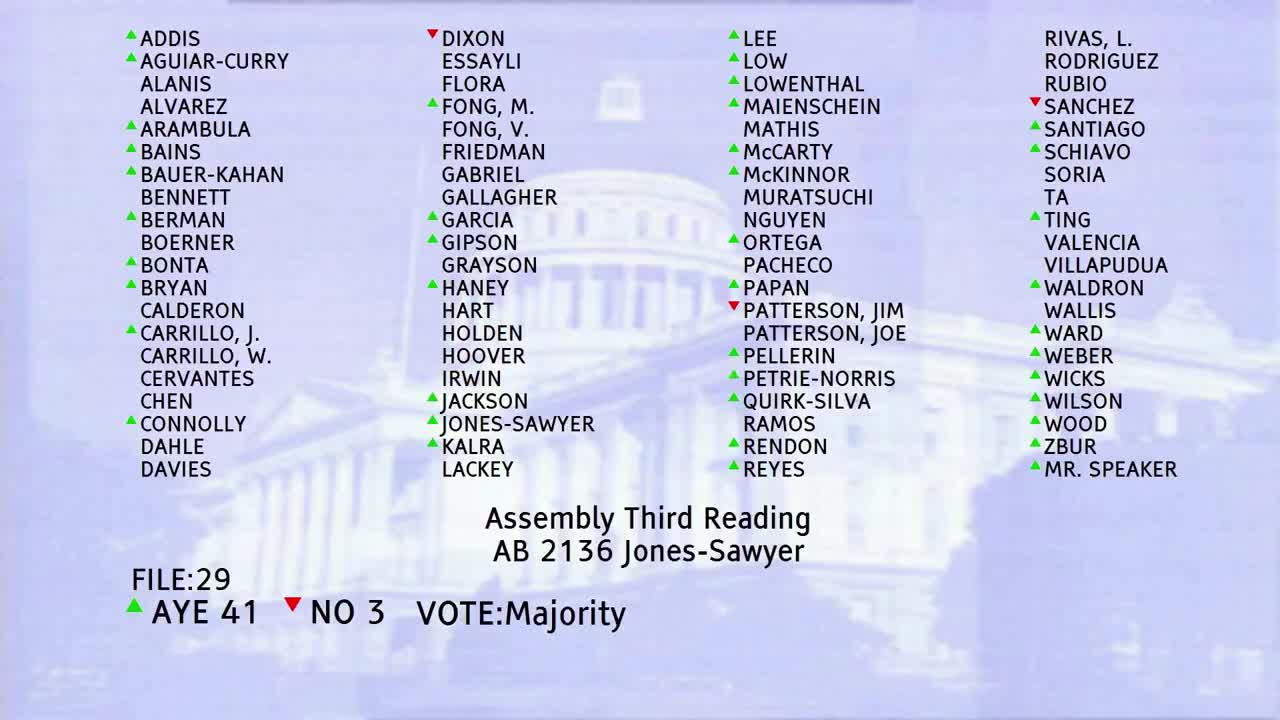 2MIN
Assembly Floor
 3MIN
Assembly Standing Committee on Appropriations
 22MIN
Assembly Standing Committee on Public Safety
Bill Author

Bill Co-Author(s):
