AB 2973: Emergency services.
- Session Year: 2023-2024
- House: Assembly
- Latest Version Date: 2024-04-15
Current Status:
Failed
(2024-04-18: In committee: Set, first hearing. Hearing canceled at the request of author.)
Introduced
In Committee
First Chamber
In Committee
Second Chamber
Enacted
Existing law, the Emergency Medical Services System and the Prehospital Emergency Medical Care Personnel Act, governs local emergency medical services (EMS) systems, authorizes each county to develop an EMS program and designate a local EMS agency, and requires the Emergency Medical Services Authority to receive plans for the implementation of EMS systems from local EMS agencies, as specified. Existing law requires a county to enter into a written agreement with a city or fire district that contracted for or provided prehospital EMS as of June 1, 1980. Existing law requires, until that written agreement is reached, prehospital EMS to be continued at not less than the existing level and the administration of prehospital EMS by cities and fire districts contracting for or providing those services as of June 1, 1980, to be retained by those cities and fire districts, as specified.
This bill would authorize a county board of supervisors or a local EMS agency to provide or support the provision of EMS to persons located within the county, as specified. The bill would require the county board of supervisors to review and approve a single-county local EMS agencys plans for the EMS system prior to the submission of the plans to the authority, and would require a multicounty local EMS agencys plans to be approved as provided for in the contract between the counties and the agency, as provided for in the joint powers agreement that created the agency, or by the board of supervisors in each of the counties served by the agency prior to the submission of the plans to the authority.
Existing law authorizes a local EMS agency to create one or more exclusive operating areas in the development of a local plan, if a competitive process is used to select the service provider pursuant to the plan, with specified exceptions.This bill would require the county and the EMS agency that elect to use the above-described competitive process to meet certain requirements.The bill would require a county board of supervisors or a local EMS agency to adopt a written policy setting forth specified requirements for an emergency ambulance services provider in order to enter into a contract with a provider for emergency ambulance services, as specified.
The bill would make related findings and declarations.
Existing law, the Emergency Medical Services System and the Prehospital Emergency Medical Care Personnel Act, governs local emergency medical services (EMS) systems, authorizes each county to develop an EMS program and designate a local EMS agency, and requires the Emergency Medical Services Authority to receive plans for the implementation of EMS systems from local EMS agencies, as specified. Existing law requires a county to enter into a written agreement with a city or fire district that contracted for or provided prehospital EMS as of June 1, 1980. Existing law requires, until that written agreement is reached, prehospital EMS to be continued at not less than the existing level and the administration of prehospital EMS by cities and fire districts contracting for or providing those services as of June 1, 1980, to be retained by those cities and fire districts, as specified.
This bill would authorize a county board of supervisors to provide or support the provision of EMS to persons located within the county, including indigent persons, as specified. The bill would require the county board of supervisors to review and approve a single-county local EMS agencys plans for the EMS system prior to the submission of the plans to the authority. authority, and would require a multicounty local EMS agencys plans to be approved as provided for in the contract between the counties and the agency, as provided for in the joint powers agreement that created the agency, or by the board of supervisors in each of the counties served by the agency prior to the submission of the plans to the authority.
Existing law authorizes a local EMS agency to create one or more exclusive operating areas in the development of a local plan, if a competitive process is used to select the service provider pursuant to the plan, with specified exceptions.
This bill would require the county and the EMS agency that elect to use the above-described competitive process to meet certain requirements.
Existing law requires a local EMS agency to have a licensed physician and surgeon, as specified, as medical director to provide medical control and to assure medical accountability for the EMS system, as specified.This bill would make the official conduct of the medical director and their staff subject to the supervision of a county board of supervisors, as specified.The bill would make related findings and declarations.
Existing law, the Emergency Medical Services System and the Prehospital Emergency Medical Care Personnel Act, governs local emergency medical services (EMS) systems and systems, authorizes each county to develop an EMS program and designate a local EMS agency. agency, and requires the Emergency Medical Services Authority to receive plans for the implementation of EMS systems from local EMS agencies, as specified. Existing law requires a county to enter into a written agreement with a city or fire district that contracted for or provided prehospital EMS as of June 1, 1980. Existing law requires, until that written agreement is reached, prehospital EMS to be continued at not less than the existing level and the administration of prehospital EMS by cities and fire districts contracting for or providing those services as of June 1, 1980, to be retained by those cities and fire districts, as specified.
This bill would make technical, nonsubstantive changes to those provisions.This bill would authorize a county board of supervisors to provide or support the provision of EMS to persons located within the county, including indigent persons, as specified. The bill would require the county board of supervisors to review and approve a local EMS agencys plans for the EMS system prior to the submission of the plans to the authority.
Existing law authorizes a local EMS agency to create one or more exclusive operating areas in the development of a local plan, if a competitive process is used to select the service provider pursuant to the plan, with specified exceptions.
This bill would require the county and the EMS agency that elect to use the above-described competitive process to meet certain requirements.
Existing law requires a local EMS agency to have a licensed physician and surgeon, as specified, as medical director to provide medical control and to assure medical accountability for the EMS system, as specified.
This bill would make the official conduct of the medical director and their staff subject to the supervision of a county board of supervisors, as specified.
The bill would make related findings and declarations.
Existing law, the Emergency Medical Services System and the Prehospital Emergency Medical Care Personnel Act, governs local emergency medical services (EMS) systems and authorizes each county to develop an EMS program and designate a local EMS agency. Existing law requires a county to enter into a written agreement with a city or fire district that contracted for or provided prehospital EMS as of June 1, 1980. Existing law requires, until that written agreement is reached, prehospital EMS to be continued at not less than the existing level and the administration of prehospital EMS by cities and fire districts contracting for or providing those services as of June 1, 1980, to be retained by those cities and fire districts, as specified.
This bill would make technical, nonsubstantive changes to those provisions.
(a)The Legislature finds and declares all of the following:
(1)The Legislature designed the Emergency Medical Services System and the Prehospital Emergency Medical Care Personnel Act, Division 2.5 of the Health and Safety Code (EMS Act) to encourage coordination and planning among the state, local governments, and private providers to achieve the most effective and cost-effective prehospital emergency medical services (EMS) on a countywide or regionwide basis.
(2)The EMS Act defines the roles, responsibilities, and functions of the Emergency Medical Services Authority (Authority) and the local EMS agencies, and some, but not all, of the roles, responsibilities, and functions of the counties and boards of supervisors regarding prehospital EMS and ambulance services.
(3)Other statutory authorities of a county and the board of supervisors regarding the provision and regulation of ambulance services, whether by public or private agreement, permit, license, or other means, and the provision of ambulance services for indigent county residents are located in statutes outside of the EMS Act Act, including, but not limited to, Sections 25369.5, 26612, 29606, and 54980 through 54983, inclusive, of the Government Code, Sections 1443 through 1445, inclusive, 1451 through 1455, inclusive, and 1473 through 1475, inclusive, of the Health and Safety Code, Section 2512 of the Vehicle Code, and Sections 14136 and 16817 of the Welfare and Institutions Code.
(4)As a result of how and where these various statutory authorities are codified, significant confusion and uncertainty in the state exists regarding the statutory authorities, roles, responsibilities, rights, obligations, and functions of counties, boards of supervisors, and local EMS agencies regarding prehospital EMS and ambulance services and the interplay of statutes addressing these services within and outside of the EMS Act.
(b)It is the intent of the Legislature in enacting this act to do both of the following:
(1)Clarify the statutory authorities, roles, responsibilities, rights, and functions of counties, boards of supervisors, and local EMS agencies regarding EMS and ambulance services.
(2)Reaffirm the authority of boards of supervisors a county board of supervisors or a governing body of an entity or a joint powers agency designated as the local EMS agency by the board of supervisors pursuant to Section 1797.200 to decide, as a policy matter, whether to provide prehospital EMS and ambulance services shall be provided to persons located within the countys jurisdiction through a county department or agency or by contracting with other local agencies or private providers.
SEC. 2.Section 1797.234 is added to the Health and Safety Code, to read:1797.234.(a)The county and the board of supervisors board of supervisors or the governing body of an entity or a joint powers agency designated as the local EMS agency by the board of supervisors pursuant to Section 1797.200 may exercise their statutory authority, including their statutory authority regarding prehospital EMS and ambulance services to perform their functions under this division and to support the local EMS agencys functions under this division.
(b)The county and the board of supervisors board of supervisors or the governing body of an entity or a joint powers agency designated as the local EMS agency by the board of supervisors pursuant to Section 1797.200 may provide ambulance services to persons located within the countys jurisdiction under this division by any of the following means or combination of means:
(1)Creating a separate county department to provide ambulance services, providing the department with the necessary staffing, vehicles, and equipment, and operating such department as it staffs and operates other county departments.
(2)Assigning the duty of providing ambulance services to residents of the county to an existing county department and providing the department with the necessary staffing, vehicles, and equipment to provide ambulance services.
(3)Contracting with cities or local public agencies located within the county to provide ambulance services within areas under the jurisdiction of the county, the cities, or the local public agencies.
(4)Contracting with private ambulance companies as provided for by statute, including under this division.
(c)Contracts or assignments made under paragraph (1), (2), or (3) of subdivision (b) that restrict operations to a county department or agency or other local agency do not constitute exclusive operating areas as defined by Section 1797.85. 1797.85 and do not require the local EMS agency to utilize a competitive process pursuant to Section 1797.224.
(d)All county agreements for implementation of the EMS system, including for prehospital EMS and ambulance services, shall be in the name of the county and shall be approved by the board of supervisors.(e)When a local EMS agency, upon the recommendation of the county, elects to create an exclusive operating area using a competitive process pursuant to Section 1797.224, all of the following shall apply:(1)The countys purchasing and acquisition personnel and the EMS agency shall jointly develop and administer a competitive process pursuant to the countys purchasing policies, rules, and requirements and government procurement best practices.(2)The board of supervisors shall review and approve a competitive process prior to issuance of the competitive processes to the public.(3)The board of supervisors shall have the sole authority to approve the award of agreements or operating rights for prehospital EMS or ambulance services by the county or the local EMS agency pursuant to a competitive process.(f)(1)Contracts for ambulance services developed pursuant to this section shall comply with the requirements of subdivisions (c) and (d) of Section 1797.230.(2)Subcontracts for emergency ambulance services developed pursuant to this section shall comply with the requirements of subdivisions (b), (c), and (d) of Section 1797.231.(g)Prior to the submission of the plans to the authority of the local EMS agencys plans for the EMS system pursuant to this division including, but not limited to, Article 2 (commencing with Section 1797.250), one of the following shall apply:(1)For a single-county local EMS agency, the board of supervisors shall review and approve the local EMS agencys plans.(2)For a multicounty local EMS agency, the local EMS agencys plans shall be approved through one of the following:(A)As provided for in the contract for local emergency medical services administration between the counties and the local EMS agency.(B)As provided for in the joint powers agreement that created the local EMS agency.(C)By the board of supervisors of each of the counties served by the local EMS agency.(d)(1)A contract for emergency ambulance services entered into pursuant to this section shall not be entered into unless the board of supervisors or the governing body of an entity or joint powers agency designated as the local EMS agency by the board of supervisors pursuant to Section 1797.200 has adopted, by ordinance or resolution, a written policy setting forth requirements for the emergency ambulance services provider in the contract that include, but are not limited to, all of the following:
(A)Employment retention policies.
(B)Demonstrated experience of the provider serving similar populations and geographic areas.
(C)Demonstrated diversity and equity efforts by the provider that address the unique needs of vulnerable and underserved populations of the service area.
(D)Financial requirements, including requiring the provider to show proof of insurance and bonding.
(E)A description of the providers public information and education activities and community involvement.
(2)A contract entered into pursuant to this section shall include both of the following:
(A)All ambulance service employees of the provider shall be paid comparable wages and benefits for services provided pursuant to the contract to those that are generally consistent with those provided to ambulance service employees in the same geographic region.
(B)Staffing levels for ambulance service employees for services provided pursuant to the contract shall be comparable to staffing levels under any prior contract for those services in that jurisdiction.
(e)Subcontracts for emergency ambulance services developed by a local agency that enters into a contract under paragraph (3) of subdivision (b) shall comply with the requirements of subdivisions (b), (c), and (d) of Section 1797.231.
(h)(f)This section does not supersede Section 1797.201.
(i)(g)Nothing in this section affects, modifies, limits, or otherwise impairs the authoritys enumerated powers and authorities under the EMS Act.
(j)(h)Nothing in this section affects, modifies, limits, or otherwise impairs the medical control of the medical director of a local EMS agency granted under the EMS Act.
(k)(i)The Legislature finds and declares that the provisions of this section are declaratory of existing law.
(a)The Legislature finds and declares all of the following:
(1)The Legislature designed the Emergency Medical Services System and the Prehospital Emergency Medical Care Personnel Act, Division 2.5 of the Health and Safety Code (EMS Act) to encourage coordination and planning among the state, local governments, and private providers to achieve the most effective and cost-effective prehospital emergency medical services (EMS) on a countywide or regionwide basis.
(2)The EMS Act defines the roles, responsibilities, and functions of the Emergency Medical Services Authority (Authority) and the local EMS agencies, and some, but not all, of the roles, responsibilities, and functions of the counties and boards of supervisors regarding prehospital EMS and ambulance services.
(3)Since the enactment of the EMS Act, the courts in Hunt v. Superior Court (1999) 21 Cal.4th 984, City of Lomita v. County of Los Angeles (1983) 148 Cal.App.3d 671, City of Lomita v. Superior Court (1986) 186 Cal.App.3d 479, and Fuchino v. Edwards-Buckley (2011) 196 Cal.App.4th 1128, determined that a county has the obligation to provide EMS and ambulance services to all persons located in the county and to relieve indigent county residents of the cost of paying for such services pursuant to Section 17000 of the Welfare and Institutions Code (established prior to the EMS Act), and articulated the countys options for fulfilling such obligations.(4)In turn, Section 17001 of the Welfare and Institutions Code provides that the board of supervisors of each county, or the agency authorized by county charter, shall adopt standards for the medical care for indigent county residents.(5)(3)Other statutory authorities and obligations of a county and the board of supervisors regarding the provision and regulation of ambulance services, whether by public or private agreement, permit, license, or other means, and the provision of ambulance services for indigent county residents are located in statutes outside of the EMS Act including, but not limited to, Sections 25369.5, 26612, 29606, and 54980 through 54983, inclusive, of the Government Code, Sections 1443 through 1445, inclusive, 1451 through 1455, inclusive, and 1473 through 1475, inclusive, of the Health and Safety Code, Section 2512 of the Vehicle Code, and Sections 14136 and 16817 of the Welfare and Institutions Code.
(6)(4)As a result of how and where these various statutory authorities are codified, significant confusion and uncertainty in the state exists regarding the statutory authorities, roles, responsibilities, rights, obligations, and functions of counties, boards of supervisors, and local EMS agencies regarding prehospital EMS and ambulance services and the interplay of statutes addressing these services within and outside of the EMS Act.
(b)It is the intent of the Legislature in enacting this act to clarify do both of the following:
(1)Clarify the statutory authorities, roles, responsibilities, rights, obligations, and functions of counties, boards of supervisors, and local EMS agencies regarding EMS and ambulance services.
(2)Reaffirm the authority of boards of supervisors to decide, as a policy matter, whether to provide prehospital EMS and ambulance services to persons located within the countys jurisdiction through a county department or agency or by contracting with other local agencies or private providers.
SEC. 2.Section 1797.202 of the Health and Safety Code is amended to read:1797.202.(a)Every local EMS agency shall have a full- or part-time licensed physician and surgeon as medical director, who has substantial experience in the practice of emergency medicine, as designated by the county or by the joint powers agreement, to provide medical control and to assure medical accountability throughout the planning, implementation and evaluation of the EMS system. The authority director may waive the requirement that the medical director have substantial experience in the practice of emergency medicine if the requirement places an undue hardship on the county or counties.(b)The medical director of the local EMS agency may appoint one or more physicians and surgeons as assistant medical directors to assist the medical director with the discharge of the duties of medical director or to assume those duties during any time that the medical director is unable to carry out those duties as the medical director deems necessary.(c)The medical director may assign to administrative staff of the local EMS agency for completion under the supervision of the medical director, any administrative functions of their duties which do not require their professional judgment as medical director.(d)The official conduct of the local EMS agencys medical director, assistant medical directors, and administrative staff is subject to the supervision of the board of supervisors pursuant to Section 25303 of the Government Code.(e)Nothing in this section affects, modifies, limits, or otherwise impairs the medical control of the medical director of a local EMS agency granted under the EMS Act.(f)Nothing in this section affects, modifies, limits, or otherwise impairs the authoritys enumerated powers and authority under the EMS Act.(g)The Legislature finds and declares that the changes made by the act that added this subdivision are declaratory of existing law.SEC. 3.SEC. 2.Section 1797.234 is added to the Health and Safety Code, to read:1797.234.(a)The county and the board of supervisors may exercise their statutory authority authority, including their statutory authority regarding prehospital EMS and ambulance services to perform their functions and obligations under this division and Part 5 (commencing with Section 17000) of Division 9 of the Welfare and Institutions Code and to support the local EMS agencys functions under this division.
(b)The county and the board of supervisors may fulfill the countys obligation to provide ambulance services to persons located in the county within the countys jurisdiction under this division and Part 5 (commencing with Section 17000) of Division 9 of the Welfare and Institutions Code by any of the following means or combination of means:
(1)Creating a separate county department to provide ambulance services, providing the department with the necessary staffing, vehicles, and equipment, and operating such department as it staffs and operates other county departments.
(2)Assigning the duty of providing ambulance services to residents of the county to an existing county department and providing the department with the necessary staffing, vehicles, and equipment to provide ambulance services.
(3)Contracting with cities or local public agencies located within the county to provide ambulance services within areas under the jurisdiction of the county, the cities, or the local public agencies.
(4)Contracting with private ambulance companies as provided for by statute, including under this division.
(c)Contracts or assignments made under paragraph (2) (1), (2), or (3) of subdivision (b) that restrict operations to a county department or agency or other local agency do not constitute exclusive operating areas as defined by Section 1797.85.
(d)All county agreements for implementation of the EMS system, including for prehospital EMS and ambulance services, shall be in the name of the county and shall be approved by the board of supervisors.
(e)When a local EMS agency, upon the recommendation of the county, elects to create an exclusive operating area using a competitive process pursuant to Section 1797.224, all of the following shall apply:
(1)The countys purchasing and acquisition personnel and the EMS agency shall jointly develop and administer a competitive process pursuant to the countys purchasing policies, rules, and requirements and government procurement best practices.
(2)The board of supervisors shall review and approve a competitive process prior to issuance of the competitive processes to the public.
(3)The board of supervisors shall have the sole authority to approve the award of agreements or operating rights for prehospital EMS or ambulance services by the county or the local EMS agency pursuant to a competitive process.
(f)(1)Contracts for ambulance services developed pursuant to this section shall comply with the requirements of subdivisions (c) and (d) of Section 1797.230.
(2)Subcontracts for emergency ambulance services developed pursuant to this section shall comply with the requirements of subdivisions (b), (c), and (d) of Section 1797.231.
(f)The board of supervisors shall review and approve a local EMS agencys plans for the EMS system prior(g)Prior to the submission of the plans to the authority of the local EMS agencys plans for the EMS system pursuant to this division including, but not limited to, Article 2 (commencing with Section 1797.250). 1797.250), one of the following shall apply:
(1)For a single-county local EMS agency, the board of supervisors shall review and approve the local EMS agencys plans.
(2)For a multicounty local EMS agency, the local EMS agencys plans shall be approved through one of the following:
(A)As provided for in the contract for local emergency medical services administration between the counties and the local EMS agency.
(B)As provided for in the joint powers agreement that created the local EMS agency.
(C)By the board of supervisors of each of the counties served by the local EMS agency.
(g)(h)This section does not supersede Section 1797.201.
(h)(i)Nothing in this section affects, modifies, limits, or otherwise impairs the authoritys enumerated powers and authorities under the EMS Act.
(j)Nothing in this section affects, modifies, limits, or otherwise impairs the medical control of the medical director of a local EMS agency granted under the EMS Act.
(i)(k)The Legislature finds and declares that the provisions of this section are declaratory of existing law.
(a)The Legislature finds and declares all of the following:
(1)The Legislature designed the Emergency Medical Services System and the Prehospital Emergency Medical Care Personnel Act, Division 2.5 of the Health and Safety Code (EMS Act) to encourage coordination and planning among the state, local governments, and private providers to achieve the most effective and cost-effective prehospital emergency medical services (EMS) on a countywide or regionwide basis.
(2)The EMS Act defines the roles, responsibilities, and functions of the Emergency Medical Services Authority (Authority) and the local EMS agencies, and some, but not all, of the roles, responsibilities, and functions of the counties and boards of supervisors regarding prehospital EMS and ambulance services.
(3)Since the enactment of the EMS Act, the courts in Hunt v. Superior Court (1999) 21 Cal.4th 984, City of Lomita v. County of Los Angeles (1983) 148 Cal.App.3d 671, City of Lomita v. Superior Court (1986) 186 Cal.App.3d 479, and Fuchino v. Edwards-Buckley (2011) 196 Cal.App.4th 1128, determined that a county has the obligation to provide EMS and ambulance services to all persons located in the county and to relieve indigent county residents of the cost of paying for such services pursuant to Section 17000 of the Welfare and Institutions Code (established prior to the EMS Act), and articulated the countys options for fulfilling such obligations.
(4)In turn, Section 17001 of the Welfare and Institutions Code provides that the board of supervisors of each county, or the agency authorized by county charter, shall adopt standards for the medical care for indigent county residents.
(5)Other statutory authorities and obligations of a county and the board of supervisors regarding the regulation of ambulance services, whether by public or private agreement, permit, license, or other means, and the provision of ambulance services for indigent county residents are located in statutes outside of the EMS Act including, but not limited to, Sections 25369.5, 26612, 29606, and 54980 through 54983, inclusive, of the Government Code, Sections 1443 through 1445, inclusive, 1451 through 1455, inclusive, and 1473 through 1475, inclusive, of the Health and Safety Code, Section 2512 of the Vehicle Code, and Sections 14136 and 16817 of the Welfare and Institutions Code.
(6)As a result of how and where these various statutory authorities are codified, significant confusion and uncertainty in the state exists regarding the statutory authorities, roles, responsibilities, rights, obligations, and functions of counties, boards of supervisors, and local EMS agencies regarding prehospital EMS and ambulance services and the interplay of statutes addressing these services within and outside of the EMS Act.
(b)It is the intent of the Legislature in enacting this act to clarify the statutory authorities, roles, responsibilities, rights, obligations, and functions of counties, boards of supervisors, and local EMS agencies regarding EMS and ambulance services.
SEC. 2.Section 1797.202 of the Health and Safety Code is amended to read:1797.202.(a)Every local EMS agency shall have a full- or part-time licensed physician and surgeon as medical director, who has substantial experience in the practice of emergency medicine, as designated by the county or by the joint powers agreement, to provide medical control and to assure medical accountability throughout the planning, implementation and evaluation of the EMS system. The authority director may waive the requirement that the medical director have substantial experience in the practice of emergency medicine if the requirement places an undue hardship on the county or counties.
(b)The medical director of the local EMS agency may appoint one or more physicians and surgeons as assistant medical directors to assist the medical director with the discharge of the duties of medical director or to assume those duties during any time that the medical director is unable to carry out those duties as the medical director deems necessary.
(c)The medical director may assign to administrative staff of the local EMS agency for completion under the supervision of the medical director, any administrative functions of his or her their duties which do not require his or her their professional judgment as medical director.
(d)The official conduct of the local EMS agencys medical director, assistant medical directors, and administrative staff is subject to the supervision of the board of supervisors pursuant to Section 25303 of the Government Code.
(e)Nothing in this section affects, modifies, limits, or otherwise impairs the medical control of the medical director of a local EMS agency granted under the EMS Act.
(f)Nothing in this section affects, modifies, limits, or otherwise impairs the authoritys enumerated powers and authority under the EMS Act.
(g)The Legislature finds and declares that the changes made by the act that added this subdivision are declaratory of existing law.
SEC. 3.Section 1797.234 is added to the Health and Safety Code, to read:1797.234.(a)The county and the board of supervisors may exercise their statutory authority regarding prehospital EMS and ambulance services to perform their functions and obligations under this division and Part 5 (commencing with Section 17000) of Division 9 of the Welfare and Institutions Code and to support the local EMS agencys functions under this division.
(b)The board of supervisors may fulfill the countys obligation to provide ambulance services to persons located in the county under this division and Part 5 (commencing with Section 17000) of Division 9 of the Welfare and Institutions Code by any of the following means or combination of means:
(1)Creating a separate county department to provide ambulance services, providing the department with the necessary staffing, vehicles, and equipment, and operating such department as it staffs and operates other county departments.
(2)Assigning the duty of providing ambulance services to residents of the county to an existing county department and providing the department with the necessary staffing, vehicles, and equipment to provide ambulance services.
(3)Contracting with cities or local agencies located within the county to provide ambulance services within areas under the jurisdiction of the county, the cities, or the local agencies.
(4)Contracting with private ambulance companies as provided for by statute, including under this division.
(c)Contracts or assignments made under paragraph (2) or (3) of subdivision (b) do not constitute exclusive operating areas as defined by Section 1797.85.
(d)All county agreements for implementation of the EMS system, including for prehospital EMS and ambulance services, shall be in the name of the county and shall be approved by the board of supervisors.
(e)When a local EMS agency, upon the recommendation of the county, elects to create an exclusive operating area using a competitive process pursuant to Section 1797.224, all of the following shall apply:
(1)The countys purchasing and acquisition personnel and the EMS agency shall jointly develop and administer a competitive process pursuant to the countys purchasing policies, rules, and requirements and government procurement best practices.
(2)The board of supervisors shall review and approve a competitive process prior to issuance of the competitive processes to the public.
(3)The board of supervisors shall have the sole authority to approve the award of agreements or operating rights for prehospital EMS or ambulance services by the county or the local EMS agency pursuant to a competitive process.
(f)The board of supervisors shall review and approve a local EMS agencys plans for the EMS system prior to the submission of the plans to the authority pursuant to this division including, but not limited to, Article 2 (commencing with Section 1797.250).
(g)This section does not supersede Section 1797.201.
(h)Nothing in this section affects, modifies, limits, or otherwise impairs the authoritys enumerated powers and authorities under the EMS Act.
(i)The Legislature finds and declares that the provisions of this section are declaratory of existing law.
SECTION 1.Section 1797.201 of the Health and Safety Code is amended to read:1797.201.(a)Upon the request of a city or fire district that contracted for or provided prehospital emergency medical services as of June 1, 1980, a county shall enter into a written agreement with the city or fire district regarding the provision of prehospital emergency medical services for the city or fire district. Until an agreement is reached, prehospital emergency medical services shall be continued at not less than the existing level, and the administration of prehospital EMS by a city or fire district presently providing those services shall be retained by the city or fire district, except the level of prehospital EMS may be reduced if the city council or the governing body of the fire district determines that the reduction is necessary, following a public meeting.(b)Notwithstanding any provision of this section, the requirements of Chapter 5 (commencing with Section 1798) shall apply to this section.(a)Upon the request of a city or fire district that contracted for or provided, as of June 1, 1980, provided prehospital emergency medical services, services as of June 1, 1980, a county shall enter into a written agreement with the city or fire district regarding the provision of prehospital emergency medical services for that the city or fire district. Until such time that an agreement is reached, prehospital emergency medical services shall be continued at not less than the existing level, and the administration of prehospital EMS by cities and fire districts a city or fire district presently providing such those services shall be retained by those cities and fire districts, the city or fire district, except the level of prehospital EMS may be reduced where if the city council, or council or the governing body of a fire district, pursuant to a public hearing, determines that the reduction is necessary. the fire district determines that the reduction is necessary, following a public meeting.
Notwithstanding
(b)Notwithstanding any provision of this section the provisions of section, the requirements of Chapter 5 (commencing with Section 1798) shall apply. apply to this section.
|
Date
|
Status
|
|---|---|
| Apr 18, 2024 | In committee: Set, first hearing. Hearing canceled at the request of author. |
| Apr 16, 2024 | Re-referred to Com. on HEALTH. |
| Apr 15, 2024 | Read second time and amended. |
| Apr 11, 2024 | From committee: Amend, and do pass as amended and re-refer to Com. on HEALTH. (Ayes 6. Noes 0.) (April 8). |
| Apr 3, 2024 | Re-referred to Com. on E.M. |
| Apr 2, 2024 | From committee chair, with author's amendments: Amend, and re-refer to Com. on E.M. Read second time and amended. |
| Apr 1, 2024 | Re-referred to Com. on E.M. |
| Mar 21, 2024 | From committee chair, with author's amendments: Amend, and re-refer to Com. on E.M. Read second time and amended. |
| Mar 21, 2024 | Referred to Coms. on E.M. and HEALTH. |
| Feb 17, 2024 | From printer. May be heard in committee March 18. |
| Feb 16, 2024 | Read first time. To print. |
|
Date
|
Description
|
Location
|
Votes
|
|
|---|---|---|---|---|
| Apr 8, 2024 | Do pass as amended and be re-referred to the Committee on [Health] | Assembly Standing Committee on Emergency Management |
Passed |
This list shows positions taken on this bill by organizations on the date displayed, which is linked to the original source.
Positions by individuals are not included.
|
Organization
|
Position
|
Date
|
|---|---|---|
| 911 Ambulance Provider's Medi-Cal Alliance | ** Against | |
| Alturas Rural Fire Protection District | ** Support | |
| American Federation of State, County and Municipal Employees | ** Against | |
| Berkeley Fire Department | ** Support | |
| California Fire Chiefs Association | ** Support | |
| Carpinteria-Summerland Fire Protection District | ** Support | |
| City of Albany | ** Support | |
| City Of Merced | ** Support | |
| City of Roseville | ** Support | |
| Emergency Medical Service Administrators Association of California | ** Against | |
| Fire Districts Association Of California | ** Support | |
| Global Medical Response | ** Against | |
| Lake County Fire Protection District | ** Support | |
| Marina Fire Department | ** Support | |
| Mendocino County Fire Chiefs Asociation | ** Support | |
| Northshore Fire Protection District | ** Support | |
| Petaluma Fire Department | ** Support | |
| Sonoma Valley Fire District | ** Support | |
| Ukiah Valley Fire Authority | ** Support | |
| Urban Counties of California | ** Against |
Date of Hearing: April 8, 2024
ASSEMBLY COMMITTEE ON EMERGENCY MANAGEMENT
Freddie Rodriguez, Chair
ABPCA Bill Id:AB 2973 (
Author:Hart) – As Amended Ver:April 1, 2024
SUBJECT: Emergency medical services
SUMMARY: Would authorize a county board of supervisors to provide or support the provision of emergency medical services (EMS) to persons located within the county, as specified. Specifically, this bill:
- Would authorize a county board of supervisors to provide or support the provision of EMS to persons located within the county by any of the following means or combination of means:
- Creating a separate county department to provide ambulance services, as specified
- Assigning the duty of providing ambulance services to residents of the county to an existing county department, as specified.
- Contracting with cities or local public agencies located within the county to provide ambulance services, as specified.
- Contracting with private ambulance companies, as specified.
- Would require all county agreements for implementation of the EMS system, including for prehospital EMS and ambulance services, to be in the name of the county and approved by the board of supervisors.
- Provides when a local EMS agency, upon the recommendation of the county, elects to create an exclusive operating area using a competitive process, shall ensure such process is reviewed and approved by the board of supervisors, as specified.
- Would require the county board of supervisors to review and approve a single-county local EMS agency’s (LEMSA) plans for the EMS system prior to the submission of the plans to the Emergency Medical Services Authority (EMSA).
- Would require a multicounty local EMS agency’s plans to be approved, as provided for in the contract between the counties and the agency, as provided for in the joint powers agreement that created the agency, or by the board of supervisors in each of the counties served by the agency prior to the submission of the plans to the authority.
- Would specify that the authorities of the medical director of a local EMS granted under the EMS Act are not affected, modified, limited or otherwise impaired under Section 1797.234.
- Would make related findings and declarations.
EXISTING LAW:
- Establishes the Emergency Medical Services Authority, under the Emergency Medical Services System and the Prehospital Emergency Medical Care Personnel Act, which is responsible for the coordination of various state activities concerning emergency medical services. (Health and Safety Code Section 1797)
- Requires, among other things, EMSA to develop planning and implementation guidelines for EMS systems, provide technical assistance to existing agencies, counties, and cities for the purpose of developing the components of EMS systems, and receive plans for the implementation of EMS and trauma care systems from local EMS agencies. (Health and Safety Code Section 1797.103-105)
- Provides each county may develop an emergency medical services program. Each county developing such a program shall designate a local EMS agency (LEMSA) which shall be the county health department, an agency established and operated by the county, an entity with which the county contracts for the purposes of local emergency medical services administration, or a joint powers agency created for the administration of emergency medical services by agreement between counties or cities and counties, as specified. (Health and Safety Code Section 1797.200)
- Requires a county to enter into a written agreement with a city or fire district that contracted for or provided prehospital EMS as of June 1, 1980. Until such written agreement is until that written agreement is reached, prehospital EMS to be continued at not less than the existing level and the administration of prehospital EMS by cities and fire districts contracting for or providing those services as of June 1, 1980, to be retained by those cities and fire districts, as specified. (Health and Safety Code Section 1797.201)
- Allows LEMSAs to create one or more exclusive operating areas in the development of a local EMS plan, if a competitive process is utilized to select the provider or providers of the services pursuant to the plan. No competitive process is required if the local EMS agency develops or implements a local plan that continues the use of existing providers operating within a local EMS area in the manner and scope in which the services have been provided without interruption since January 1, 1981. (Health and Safety Code Section 1797.224)
- Requires LEMSAs to annually submit an EMS plan to EMSA in accordance with specified standards and guidelines. (Health and Safety Code Section 1797.254)
- Requires a local EMS agency to have a licensed physician and surgeon, as specified, as medical director to provide medical control and to assure medical accountability for the EMS system, as specified. (Health and Safety Code Section 1797.202)
FISCAL EFFECT: Unknown. This bill has not been analyzed by a fiscal committee.
COMMENTS:
Purpose of the bill: According to the author, “Despite the enactment of the EMS Act and relevant case law, confusion persists regarding the roles, responsibilities, and statutory authorities of counties, boards of supervisors, and LEMSAs. This ambiguity extends to EOAs and County responsibilities and authorities governing ambulance services, creating uncertainty about their interplay and implementation. AB 2973 clarifies the statutory responsibilities of counties, boards of supervisors, and local emergency medical service agencies regarding EMS and ambulance services and reaffirms the authority of the boards of supervisors to decide, as a policy matter, whether to provide EMS and ambulance services to persons within their counties’ jurisdiction on an in house basis through new or existing county departments or agencies, by contracting with local public agencies or private service providers, or a combination of those options.”
The author continues, “The bill also provides for procedural requirements regarding competitive processes for the award of exclusive services rights under Health & Safety Code § 1797.224 and approval of LEMSA’s EMS system plans. This bill is declaratory of existing statute and case law and reflects historical and existing practices. AB 2973 will enhance the accessibility of emergency medical services in California while promoting accountability, transparency, and coordination among all stakeholders involved in providing EMS services and avoiding disruptions to EMS systems by preserving the existing statutory authorities of cities and fire districts, EMSA, and LEMSAs under the EMS Act.”
Equity Impact: According to the author’s staff, “By reaffirming the authority of the county boards of supervisors to make policy decisions regarding the provision of EMS and ambulance services and creating procedural requirements for the development of EOAs and EMS plans that provide for the opportunity of public input, AB 2973 will allow for greater and more public discussion, analysis, and consideration of health equity issues in the provision of EMS and ambulance services by the counties, LEMSAs, stakeholders, and community members.”
EMSA, LEMSAs and Hospital Emergency Departments: EMSA provides statewide oversight for the 33 local emergency medical services agencies or LEMSAs. Together they form the state’s pre-hospital emergency medical system. The pre-hospital emergency medical system and hospital emergency departments operate as separate and distinct entities, but are linked through policies, procedures and regulations. Collectively, these entities provide effective patient care from the initial notification of an emergency and response in the field to the time the EMS provider drops off the patient at the emergency department and returns to the community, while the patient receives evaluation, care and hospitalization, if needed.
EMSA’s Mission and Emergency Medical Services Act: According to EMSA, their mission is to ensure equitable administration, coordination, and integration of the statewide EMS system to reduce suffering and save lives throughout California. With the passage of the Emergency Medical Services Act in 1980, California created a framework for a two-tiered system of EMS governance through both the EMSA (state) and LEMSAs (county). Counties are required by the EMS Act to create a local EMS system that is timely, safe, and equitable for all residents. To do so, counties honor HSC 1797.201 authorities and contract with both public and private providers to ensure coverage of underserved areas regardless of the challenges in providing uniform services throughout geographically diverse areas.
American Medical Response West (AMR) v. County of Santa Barbara: Advocates for and against the bill have cited ongoing litigation concerning the EMS Act and Santa Barbara County’s application of its new permitting regime for ambulance services in their arguments for and against this bill. In brief, AMR is suing (Case No. 23CVO4250) the County of Santa Barbara in Superior Court regarding the County’s permit to the Santa Barbara County Fire District to provide emergency ambulance services.
EMSA’s Amicus Curiae Brief of the Emergency Medical Services Authority (EMSA): Attorney General Rob Bonta submitted an amicus curiae brief of EMSA on November 22, 2023. “EMSA submits this amicus brief to provide a state-level assessment of the significant legal issues in this case.” The EMSA amicus brief discusses the EMS Act, Santa Barbara County ordinance No. 5182, and the extent to which the County’s application of this permitting ordinance is consistent with the EMS Act. Among other things, EMSA’s amicus brief raises policy questions regarding the power of the county board of supervisors to choose an EMS provider and approve EMS plans vs the power of the LEMSAs to do so.
Policy direction in this bill: According to advocates of this bill, the overarching goal is to reaffirm the board of supervisors authority to provide or support the provision of emergency medical services with one of or a combination of the following policy options: creating a separate county department to provide ambulance services; assigning the duty of providing ambulance services to residents of the county to an existing county department; contracting with cities or local public agencies located within the county to provide ambulance services; and/or contracting with private ambulance companies, as specified.
Arguments in support: The California Fire Chiefs Association (CalChiefs) and the Fire Districts Association of California (FDAC), write in support, “This critical legislation aims to clarify and codify the statutory responsibilities of counties, the board of supervisors, and local emergency medical services agencies (LEMSAs) in managing emergency medical and ambulance services within California.”
The Berkley Fire Department adds, “AB 2973 seeks to eliminate ambiguities and streamline the coordination and delivery of emergency medical services (EMS) across the state. Specifically, the bill provides for the establishment of Exclusive Operating Areas (EOAs) through a competitive process, the requirement for board of supervisors' approval of LEMSA-developed plans, and the outlined procedural requirements for EOAs underscore a commitment to transparency, accountability, and best practices in the provision of EMS.”
The President of the Western Placer Fire Chiefs Association, adds in support, “AB 2973 enhances the accessibility, accountability, and coordination of EMS, and promises to strengthen our emergency response infrastructure and ensure that Californians receive timely and effective medical care.”
Arguments in opposition: The Emergency Medical Services Administrators Association of California (EMSAAC), writes in opposition, “This bill would place the LEMSA medical director and LEMSA staff directly under the supervision of the elected County Board of Supervisors, outside the long-standing and proven LEMSA structure, creating a volatile and political situation and negatively impacting California’s emergency medical services (EMS) system. A potential consequence of AB 2973 would be to erode this long-standing effective two-tiered EMS system in the State of California. As it currently stands, the EMSA promulgates the regulations governing the administration of EMS and the LEMSAs provide the local policies, protocols, and procedures to ensure all EMS system participants (regardless of type/affiliation) adhere to current EMS statutes/ regulations. The current two-tiered system affords the flexibility of LEMSAs to administer their EMS programs based on local EMS system needs. This bill undermines the two-tiered system by mandating a specific supervisory structure for each County.
American Medical Response (AMR) writes in opposition, “as California’s largest provider I am writing to register our OPPOSED position to AB 2973. Despite the author’s claims, this bill seeks to completely undermine the California EMS Act by eliminating the competitive process for exclusive ambulance contracts. AB 2973 is simply an attempt to legitimize the illegal actions of Santa Barbara County to award Santa Barbara County Fire Department (SBCFD) exclusive rights to provide the County’s ambulance service despite losing to AMR in a competitive bid process established under the requirements of the EMS Act.”
The American Federation of State, County and Municipal Employees (AFSCME), AFL-CIO, adds in opposition, “AFSCME writes to express our regretful opposition to AB 2973 (Hart) which unravels centralized, established, and integrated countywide ambulance systems that have been in place for over four decades.”
Concerns: The Urban Counties of California (UCC) write, “AB 2973 raises significant concerns with ho counties currently select providers for exclusive operating areas, how competitive processes for selecting providers should be structured, and what elements Boards of Supervisors are required to approve in the EMS plan. Urban areas strongly urge that further conversation about exclusive operating areas and how competitive processes for selecting providers should be structured occur before the bill proceeds.”
Committee Comments and Amendments: Committee staff is aware of the ongoing deliberations on the policy questions this bill raises. Based upon the concerns raised by advocates for the Emergency Medical Services Administrators Association of California and the Rural Counties Representatives of California, with respect to the role joint powers agencies designated as the local EMS agency by the board of supervisors have in the overall EMS systems, the author may wish to amend the bill to read:
SECTION 1. (a) The Legislature finds and declares all of the following:
(1) The Legislature designed the Emergency Medical Services System and the Prehospital Emergency Medical Care Personnel Act, Division 2.5 of the Health and Safety Code (EMS Act) to encourage coordination and planning among the state, local governments, and private providers to achieve the most effective and cost-effective prehospital emergency medical services (EMS) on a countywide or regionwide basis.
(2) The EMS Act defines the roles, responsibilities, and functions of the Emergency Medical Services Authority (Authority) and the local EMS agencies, and some, but not all, of the roles, responsibilities, and functions of the counties and boards of supervisors regarding prehospital EMS and ambulance services.
(3) Other statutory authorities of a county and the board of supervisors regarding the provision and regulation of ambulance services, whether by public or private agreement, permit, license, or other means, and the provision of ambulance services for indigent county residents are located in statutes outside of the EMS Act including, but not limited to, Sections 25369.5, 26612, 29606, and 54980 through 54983, inclusive, of the Government Code, Sections 1443 through 1445, inclusive, 1451 through 1455, inclusive, and 1473 through 1475, inclusive, of the Health and Safety Code, Section 2512 of the Vehicle Code, and Sections 14136 and 16817 of the Welfare and Institutions Code.
(4) As a result of how and where these various statutory authorities are codified, significant confusion and uncertainty in the state exists regarding the statutory authorities, roles, responsibilities, rights, obligations, and functions of counties, boards of supervisors, and local EMS agencies regarding prehospital EMS and ambulance services and the interplay of statutes addressing these services within and outside of the EMS Act.
(b) It is the intent of the Legislature in enacting this act to do both of the following:
(1) Clarify the statutory authorities, roles, responsibilities, rights, and functions of counties, boards of supervisors, and local EMS agencies regarding EMS and ambulance services.
(2) Reaffirm the authority of boards of supervisors, or the governing body of an entity or joint powers agency designated as the local EMS agency by the board of supervisors under section 1797.200, to decide, as a policy matter, whether prehospital EMS and ambulance services will be provided to persons located within the county’s jurisdiction through a county department or agency or by contracting with other local agencies or private providers.
SEC. 2. Section 1797.234 is added to the Health and Safety Code, to read:
1797.234. (a) The board of supervisors, or the governing body of an entity or joint powers agency designated as the local EMS agency by the board of supervisors under section 1797.200 may exercise their statutory authority, including their statutory authority regarding prehospital EMS and ambulance services to perform their functions under this division and to support the local EMS agency’s functions under this division.
(b) The board of supervisors, or the governing body of an entity or joint powers agency designated as the local EMS agency by the board of supervisors under section 1797.200 may provide ambulance services to persons located within the county’s jurisdiction under this division by any of the following means or combination of means:
(1) Creating a separate county department to provide ambulance services, providing the department with the necessary staffing, vehicles, and equipment, and operating such department as it staffs and operates other county departments.
(2) Assigning the duty of providing ambulance services to residents of the county to an existing county department and providing the department with the necessary staffing, vehicles, and equipment to provide ambulance services.
(3) Contracting with cities or local public agencies located within the county to provide ambulance services within areas under the jurisdiction of the county, the cities, or the local public agencies.
(4) Contracting with private ambulance companies as provided for by statute, including under this division.
(c) Contracts or assignments made under paragraph (1), (2), or (3) of subdivision (b) that restrict operations to a county department or agency or other local agency do not constitute exclusive operating areas as defined by Section 1797.85 and do not require the local EMS agency to utilize a competitive process under Section 1797.224.
(d)(1) No contract for ambulance services pursuant to this section shall be entered into unless the board of supervisors, or the governing body of an entity or joint powers agency designated as the local EMS agency by the board of supervisors under section 1797.200, has adopted, by ordinance or resolution, a written policy setting forth issues to be considered for inclusion in the contract for emergency ambulance services, which may include, but are not limited to, all of the following:
(a) Employment retention requirements for the employees of the incumbent ambulance service.
(b) Demonstrated experience serving similar populations and geographic areas.
(c) Diversity and equity efforts addressing the unique needs of vulnerable and underserved populations of the service area.
(d) Financial requirements, including requiring a private ambulance service provider to show proof of insurance and bonding.
(e) A description of the ambulance service provider’s public information and education activities and community involvement.
(2) A contract entered into pursuant to this section shall demonstrate how the contract will provide for the payment of comparable wages and benefits to all ambulance service employees that are generally consistent with those provided to ambulance service employees in the same geographic region. The contract shall also demonstrate that the staffing levels for ambulance service employees will be comparable to the staffing levels under the previous contract for these services.
(e) Subcontracts for emergency ambulance services developed by a local agency that enters into a contract under (3) of subdivision (b) shall comply with the requirements of subdivisions (b), (c), and (d) of Section 1797.231.
(f) This section does not supersede Section 1797.201.
(g) Nothing in this section affects, modifies, limits, or otherwise impairs the authority of the board of supervisors or the governing body of an entity or joint powers agency designated as the local EMS agency under any other provision of law.
(h) Nothing in this section affects, modifies, limits, or otherwise impairs the authority’s enumerated powers and authorities under the EMS Act.
(i) Nothing in this section affects, modifies, limits, or otherwise impairs the medical control of the medical director of a local EMS agency granted under the EMS Act.
(j) The Legislature finds and declares that the provisions of this section are declaratory of existing law.
Double referral: Should this bill be approved, it will be referred to the Assembly Committee on Health.
Prior legislation: AB 379 (Rodriguez) of this Session. Requires LEMSAs to adopt policies and procedures for calculating and reporting ambulance patient offload times, as specified. (Held in Assembly Committee on Appropriations)
AB 1168 (Bennett) of this Session. Would overturn existing “Oxnard” decision, and instead requires a city or fire district that contracted for, or provided, as of June 1, 1980, prehospital EMS, to be deemed to retain its authorities regarding, and administration of, the prehospital EMS when a city or fire district enters into an agreement with a county for the joint exercise of powers regarding prehospital EMS, or ceased to contract for, provide, or administer prehospital EMS as a result of a judicial finding, or contracts with a county to provide prehospital EMS in areas outside of that city or fire district. (Senate Inactive File)
AB 389 (Grayson), Chapter 460, Statutes of 2021. Permits a county to contract for emergency ambulance services with a fire agency that will provide those services, in whole or in part, through a written subcontract with a private ambulance service; and permits a fire agency to enter into a written subcontract with a private ambulance service for the purpose of contracting with a county.
AB 1544 (Gipson), Chapter 138, Statutes of 2020) enacted the Community Paramedicine or Triage to Alternate Destination Act of 2019, which permits local emergency medical services agencies, with approval by the Emergency Medical Services Authority, to develop programs to provide community paramedic or triage to alternate destination services, as specified.
SB 438 (Hertzberg), Chapter 389, Statutes of 2019. Prohibited a public agency from entering into a contract for 911 call processing regarding the dispatch of emergency response resources unless the contract is with another public agency, with specified exceptions.
REGISTERED SUPPORT / OPPOSITION:
Support
Alturas Rural Fire Protection District
Berkeley Fire Department
California Fire Chiefs Association
Carpinteria-Summerland Fire Protection District
City of Albany
City of Merced
City of Roseville
Fire Districts Association of California
Lake County Fire Protection District
Marina Fire Department
Mendocino County Fire Chiefs Asociation
Northshore Fire Protection District
Petaluma Fire Department
Sonoma Valley Fire District
Ukiah Valley Fire Authority
Opposition
911 Ambulance Provider's Medical Alliance
American Federation of State, County and Municipal Employees
Emergency Medical Services Administrators' Association of California (EMSAAC)
Global Medical Response
Other
Urban Counties of California (UCC)
Analysis Prepared by: Mike Dayton / E.M. / (916) 319-3802
Discussed in Hearing
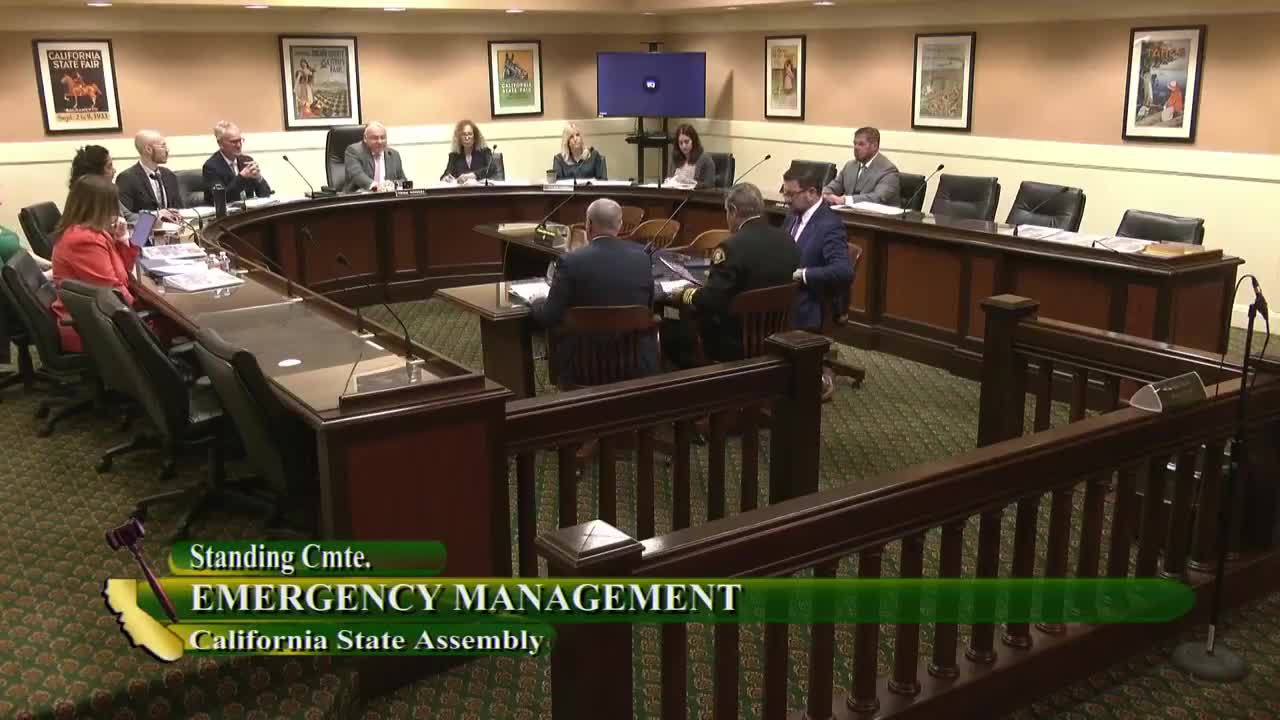 26MIN
Assembly Standing Committee on Emergency Management
Bill Author

Bill Co-Author(s):