AB 30: Atmospheric rivers: research: reservoir operations.
- Session Year: 2023-2024
- House: Assembly
- Latest Version Date: 2023-09-01
Current Status:
Passed
(2023-09-01: Chaptered by Secretary of State - Chapter 134, Statutes of 2023.)
Introduced
In Committee
First Chamber
In Committee
Second Chamber
Enacted
Existing law establishes the Atmospheric Rivers: Research, Mitigation, and Climate Forecasting Program in the Department of Water Resources. Existing law requires the department, upon an appropriation for purposes of the program, to research climate forecasting and the causes and impacts that climate change has on atmospheric rivers, to operate reservoirs in a manner that improves flood protection, and to reoperate flood control and water storage facilities to capture water generated by atmospheric rivers.
This bill would rename that program the Atmospheric Rivers Research and Forecast Improvement Program: Enabling Climate Adaptation Through Forecast-Informed Reservoir Operations and Hazard Resiliency (AR/FIRO) Program. The bill would require the department to research, develop, and implement new observations, prediction models, novel forecasting methods, and tailored decision support systems to improve predictions of atmospheric rivers and their impacts on water supply, flooding, post-wildfire debris flows, and environmental conditions. The bill would also require the department to utilize relevant information to operate reservoirs in a manner that improves flood protection in the state and to reoperate flood control and water storage facilities to capture water generated by atmospheric rivers and other storms.
Existing law establishes the Atmospheric Rivers: Research, Mitigation, and Climate Forecasting Program in the Department of Water Resources. Existing law requires the department, upon an appropriation for purposes of the program, to research climate forecasting and the causes and impacts that climate change has on atmospheric rivers, to operate reservoirs in a manner that improves flood protection, and to reoperate flood control and water storage facilities to capture water generated by atmospheric rivers.
This bill would rename that program the Atmospheric Rivers Research and Forecast Improvement Program: Enabling Climate Adaptation Through Forecast-Informed Reservoir Operations and Hazard Resiliency (AR/FIRO) Program. The bill would require the department to research, develop, and implement new observations, prediction models, novel forecasting methods, and tailored decision support systems to improve predictions of atmospheric rivers and their impacts on water supply, flooding, post-wildfire debris flows, and environmental conditions. The bill would also require the department to take all actions within its existing authority utilize relevant information to operate reservoirs in a manner that improves flood protection in the state and to reoperate flood control and water storage facilities to capture water generated by atmospheric rivers. rivers and other storms.
Existing law establishes the Atmospheric Rivers: Research, Mitigation, and Climate Forecasting Program in the Department of Water Resources. Existing law requires the department, upon an appropriation for purposes of the program, to research climate forecasting and the causes and impacts that climate change has on atmospheric rivers, to operate reservoirs in a manner that improves flood protection, and to reoperate flood control and water storage facilities to capture water generated by atmospheric rivers.
This bill would rename that program the Atmospheric Rivers Research and Forecast Improvement Program: Enabling Climate Adaptation Through Forecast-Informed Reservoir Operations and Hazard Resiliency (AR/FIRO) Program. The bill would require the department to research, develop, and implement new observations, prediction models, novel forecasting methods, and tailored decision support systems to improve predictions of atmospheric rivers and their impacts on water supply, flooding, post-wildfire debris flows, and environmental conditions. The bill would also require the department to take all actions within its existing authority to operate reservoirs in a manner that improves flood protection in the state and to reoperate flood control and water storage facilities to capture water generated by atmospheric rivers.
The Legislature finds and declares all of the following:
(a)Atmospheric rivers provide California with up to one-half its annual water supply and account for more than 90 percent of the states flood damages.
(b)Research suggests that as the climate continues to warm, California will grow increasingly dependent on atmospheric rivers for its water supply.
(c)Advances in the understanding and forecasting of atmospheric rivers underpins and extends the viability of forecast-informed reservoir operations, thereby enabling greater water supply reliability and flood protection across the state.
(d)Furthermore, research on atmospheric rivers can be used to refine climate projections of extreme weather and water events and changes in Sierra snow.
(e)Forecast-informed reservoir operations is a critical climate resilience strategy.
SEC. 2.The heading of Article 8 (commencing with Section 347) of Chapter 2.5 of Division 1 of the Water Code is amended to read:8.Atmospheric Rivers Research and Forecast Improvement Program: Enabling Climate Adaptation Through Forecast-Informed Reservoir Operations and Hazard Resiliency (AR/FIRO)SEC. 3.Section 347 of the Water Code is repealed.SEC. 4.Section 347 is added to the Water Code, to read:347.(a)The Atmospheric Rivers Research and Forecast Improvement Program: Enabling Climate Adaptation Through Forecast-Informed Reservoir Operations and Hazard Resiliency (AR/FIRO) Program is hereby established in the Department of Water Resources.
(b)(1)The department shall research, develop, and implement new observations, prediction models, novel forecasting methods, and tailored decision support systems to improve predictions of atmospheric rivers and their impacts on water supply, flooding, post-wildfire debris flows, and environmental conditions.
(2)The department shall utilize all relevant information produced pursuant to paragraph (1) to operate reservoirs in a manner that improves flood protection in the state and to reoperate flood control and water storage facilities to capture water generated by atmospheric rivers and other storms. The goals of integrating forecast-informed reservoir operations into department operations shall be to increase water supply, hydropower availability, and water supply reliability. The department may use research generated by this program to refine climate projections of extreme weather and water events and changes in Sierra snow.
(3)Information produced pursuant to paragraph (1) shall be available to relevant federal, state, and local agencies.
The Legislature finds and declares all of the following:
(a)Atmospheric rivers provide California with up to one-half its annual water supply and account for more than 90 percent of the states flood damages.
(b)Research suggests that as the climate continues to warm, California will grow increasingly dependent on atmospheric rivers for its water supply.
(c)Advances in the understanding and forecasting of atmospheric rivers underpins and extends the viability of forecast-informed reservoir operations, thereby enabling greater water supply reliability and flood protection across the state.
(d)Furthermore, research on atmospheric rivers can be used to refine climate projections of extreme weather and water events and changes in Sierra snow.
(e)Forecast-informed reservoir operations is a critical climate resilience strategy.
SEC. 2.The heading of Article 8 (commencing with Section 347) of Chapter 2.5 of Division 1 of the Water Code is amended to read:8.Atmospheric Rivers Research and Forecast Improvement Program: Enabling Climate Adaptation Through Forecast-Informed Reservoir Operations and Hazard Resiliency (AR/FIRO)SEC. 3.Section 347 of the Water Code is repealed.SEC. 4.Section 347 is added to the Water Code, to read:347.(a)The Atmospheric Rivers Research and Forecast Improvement Program: Enabling Climate Adaptation Through Forecast-Informed Reservoir Operations and Hazard Resiliency (AR/FIRO) Program is hereby established in the Department of Water Resources.
(b)(1)The department shall research, develop, and implement new observations, prediction models, novel forecasting methods, and tailored decision support systems to improve predictions of atmospheric rivers and their impacts on water supply, flooding, post-wildfire debris flows, and environmental conditions.
(2)The department shall take all actions within its existing authority to operate reservoirs in a manner that improves flood protection in the state and to reoperate flood control and water storage facilities to capture water generated by atmospheric rivers. utilize all relevant information produced pursuant to paragraph (1) to operate reservoirs in a manner that improves flood protection in the state and to reoperate flood control and water storage facilities to capture water generated by atmospheric rivers and other storms. The goals of integrating forecast-informed reservoir operations into department operations shall be to increase water supply, hydropower availability, and water supply reliability. The department may use research generated by this program to refine climate projections of extreme weather and water events and changes in Sierra snow.
(3)Information produced pursuant to paragraph (1) shall be available to relevant federal, state, and local agencies.
The Legislature finds and declares all of the following:
(a)Atmospheric rivers provide California with up to one-half its annual water supply and account for more than 90 percent of the states flood damages.
(b)Research suggests that as the climate continues to warm, California will grow increasingly dependent on atmospheric rivers for its water supply.
(c)Advances in the understanding and forecasting of atmospheric rivers underpins and extends the viability of forecast-informed reservoir operations, thereby enabling greater water supply reliability and flood protection across the state.
(d)Furthermore, research on atmospheric rivers can be used to refine climate projections of extreme weather and water events and changes in Sierra snow.
(e)Forecast-informed reservoir operations is a critical climate resilience strategy.
SEC. 2.The heading of Article 8 (commencing with Section 347) of Chapter 2.5 of Division 1 of the Water Code is amended to read:8.Atmospheric Rivers: Research, Mitigation, Rivers Research and Forecast Improvement Program: Enabling Climate Forecasting Adaptation Through Forecast-Informed Reservoir Operations and Hazard Resiliency (AR/FIRO)SEC. 3.Section 347 of the Water Code is repealed.347.(a)The Atmospheric Rivers: Research, Mitigation, and Climate Forecasting Program is hereby established in the Department of Water Resources.(b)Upon appropriation of special fund moneys, including, but not limited to, private funds, for these purposes, the department shall conduct research relating to climate forecasting and the causes and impacts that climate change has on atmospheric rivers, and shall take all actions within its existing authority to operate reservoirs in a manner that improves flood protection in the state and to reoperate flood control and water storage facilities to capture water generated by atmospheric rivers, thereby increasing water supply, hydropower availability, and the reliability of water resources in the state.SEC. 4.Section 347 is added to the Water Code, to read:347.(a)The Atmospheric Rivers Research and Forecast Improvement Program: Enabling Climate Adaptation Through Forecast-Informed Reservoir Operations and Hazard Resiliency (AR/FIRO) Program is hereby established in the Department of Water Resources.
(b)(1)The department shall research, develop, and implement new observations, prediction models, novel forecasting methods, and tailored decision support systems to improve predictions of atmospheric rivers and their impacts on water supply, flooding, post-wildfire debris flows, and environmental conditions.
(2)The department shall take all actions within its existing authority to operate reservoirs in a manner that improves flood protection in the state and to reoperate flood control and water storage facilities to capture water generated by atmospheric rivers. The goals of integrating forecast-informed reservoir operations into department operations shall be to increase water supply, hydropower availability, and water supply reliability. The department may use research generated by this program to refine climate projections of extreme weather and water events and changes in Sierra snow.
REVISIONS: HeadingLine 2.|
Date
|
Status
|
|---|---|
| Sep 1, 2023 | Chaptered by Secretary of State - Chapter 134, Statutes of 2023. |
| Sep 1, 2023 | Approved by the Governor. |
| Aug 22, 2023 | Enrolled and presented to the Governor at 3:45 p.m. |
| Aug 14, 2023 | Senate amendments concurred in. To Engrossing and Enrolling. (Ayes 76. Noes 0. Page 2673.). |
| Jul 13, 2023 | In Assembly. Concurrence in Senate amendments pending. May be considered on or after August 11 pursuant to Assembly Rule 77. |
| Jul 13, 2023 | Read third time. Passed. Ordered to the Assembly. (Ayes 37. Noes 0. Page 2036.). |
| Jul 5, 2023 | Read second time. Ordered to Consent Calendar. |
| Jul 3, 2023 | From committee: Be ordered to second reading file pursuant to Senate Rule 28.8 and ordered to Consent Calendar. |
| Jun 26, 2023 | From committee chair, with author's amendments: Amend, and re-refer to committee. Read second time, amended, and re-referred to Com. on APPR. |
| Jun 22, 2023 | From committee: Do pass and re-refer to Com. on APPR with recommendation: To Consent Calendar. (Ayes 11. Noes 0.) (June 22). Re-referred to Com. on APPR. |
| Jun 7, 2023 | In committee: Hearing postponed by committee. |
| May 31, 2023 | Referred to Com. on N.R. & W. |
| May 23, 2023 | In Senate. Read first time. To Com. on RLS. for assignment. |
| May 22, 2023 | Read third time. Passed. Ordered to the Senate. (Ayes 76. Noes 0. Page 1710.) |
| May 18, 2023 | Read second time. Ordered to third reading. |
| May 18, 2023 | From committee: Do pass. (Ayes 15. Noes 0.) (May 18). |
| Apr 26, 2023 | In committee: Set, first hearing. Referred to APPR. suspense file. |
| Mar 14, 2023 | From committee: Do pass and re-refer to Com. on APPR. (Ayes 15. Noes 0.) (March 14). Re-referred to Com. on APPR. |
| Mar 14, 2023 | Coauthors revised. |
| Jan 26, 2023 | Referred to Com. on W., P., & W. |
| Dec 6, 2022 | From printer. May be heard in committee January 5. |
| Dec 5, 2022 | Read first time. To print. |
|
Date
|
Description
|
Location
|
Votes
|
|
|---|---|---|---|---|
| Aug 14, 2023 | AB 30 Ward Concurrence in Senate Amendments | Assembly Floor |
Passed |
|
| Jul 13, 2023 | Consent Calendar AB30 Ward et al. | Senate Floor |
Passed |
|
| Jun 22, 2023 | Do pass, but first be re-referred to the Committee on [Appropriations] with the recommendation: To Consent Calendar | Senate Standing Committee on Natural Resources and Water |
Passed |
|
| May 22, 2023 | AB 30 Ward Assembly Third Reading | Assembly Floor |
Passed |
|
| May 18, 2023 | Do pass. | Assembly Standing Committee on Appropriations |
Passed |
|
| Mar 14, 2023 | Do pass and be re-referred to the Committee on [Appropriations] | Assembly Standing Committee on Water, Parks, and Wildlife |
Passed |
This list shows positions taken on this bill by organizations on the date displayed, which is linked to the original source.
Positions by individuals are not included.
|
Organization
|
Position
|
Date
|
|---|---|---|
| Association Of California Water Agencies | ** Support | |
| CalChamber | ** Support | |
| California Association Of Professional Scientists | ** Support | |
| California Association Of Recreation & Park Districts | ** Support | |
| California Central Valley Flood Control Association | ** Support | |
| California Chamber Of Commerce | ** Support | |
| California Farm Bureau Federation | ** Support | |
| California Groundwater Coalition | ** Support | |
| California Municipal Utilities Association | ** Support | |
| California Special Districts Association | ** Support | |
| City of Santa Rosa | ** Support | |
| Contra Costa County | ** Support | |
| East Bay Municipal Utility District | ** Support | |
| East Bay Regional Park District | ** Support | |
| El Dorado Irrigation District | ** Support | |
| Irvine Ranch Water District | ** Support | |
| Mojave Water Agency | ** Support | |
| Northern California Water Association | ** Support | |
| Olivenhain Municipal Water District | ** Support | |
| Orange County Water District | ** Support | |
| San Bernardino Municipal Water Department | ** Support | |
| San Bernardino Valley Municipal Water District | ** Support | |
| San Bernardino Valley Water District | ** Support | |
| San Diego County Water Authority | ** Support | |
| San Diego Regional Chamber Of Commerce | ** Support | |
| Santa Clara Valley Water District | ** Support | |
| Solano County Water Agency | ** Support | |
| Sonoma County Water Agency | ** Support | |
| State Water Contractors | ** Support | |
| Turlock Irrigation District | ** Support | |
| Upper San Gabriel Valley Municipal Water District | ** Support | |
| Urban Counties Caucus | ** Support | |
| Valley Ag Water Coalition | ** Support | |
| Yuba Water Agency | ** Support |
CONCURRENCE IN SENATE AMENDMENTS
CSA1 Bill Id:AB 30
Author:(Ward)
As Amended Ver:June 26, 2023
Majority vote
SUMMARY
Reconfigures the existing Atmospheric Rivers: Research, Mitigation, and Climate Forecasting Program (Atmospheric Rivers Program) within the Department of Water Resources (DWR).
Senate Amendments
- Requires DWR to utilize all relevant information generated by the Atmospheric Rivers Program to better manage reservoirs to improve flood protection and capture water generated by atmospheric rivers (AR) and other storms.
- Requires that information generated by the Atmospheric Rivers Program be available to relevant federal, state, and local agencies.
COMMENTS
ARs are long narrow bands of atmospheric water vapor pushed along by strong winds. They transport large amounts of water vapor from the tropics to higher latitudes and strike coastlines globally from California to Europe to Antarctica. They can transport moisture equivalent to more than 25 times the amount of liquid water flowing through the mouth of the Mississippi River.
ARs and their intense precipitation can be both beneficial and hazardous, presenting a special challenge to California's water managers and flood control planners. According to the Scripps Institution of Oceanography (Scripps) at the University of California, San Diego and the National Oceanic and Atmospheric Administration (NOAA), a small number of ARs supply on average between 40% to 50% of California's precipitation and snowpack annually. A single AR event can provide up to 30% of annual precipitation in southern California. Problems occur when AR events last for more than a day or several occur back-to-back such as occurred in January 2023; several ARs in sequence can cause hazards like flooding, mudslides, and ash flows in areas of recent wildfires. NOAA and Scripps research has shown ARs are implicated in most of the extreme precipitation and flooding events in California. Nearly 80% of levee breaches in the Central Valley have been associated with AR events.
FIRO. FIRO is a reservoir operations strategy that, in effect, allows reservoirs to be managed in "real-time" so that operators can keep water in the reservoir if the weather forecast shows no imminent precipitation in a reservoir's watershed or, alternatively, release water from the reservoir to free up space for additional flow (thereby maintaining flood protection) when the forecast indicates an AR is headed towards a reservoir's watershed. Sonoma Water Agency has piloted and implemented FIRO at Lake Mendocino since 2019 and has been able to increase water stored in that reservoir by nearly 20% while maintaining flood protection. This additional water was immensely helpful in 2021 when the Russian River basin experienced extreme drought conditions.
DWR Atmospheric Rivers Program. The Legislature has made previous appropriations to support this research, including $3 million in the 2016-17 Budget, $9.25 million in the 2019-20 Budget, $10 million in the 2021-22 Budget, and $16.75 million in the 2022-23 Budget. Previously appropriated funding has allowed DWR to leverage resources and participation from federal and local agencies to deepen the understanding of ARs and implement FIRO at Lake Mendocino. DWR and water agencies are also seeking to implement FIRO in the Feather-Yuba River basin and the Santa Ana River basin.
According to the Author
Over the past 15 years, a growing body of research has identified the benefits and risks of ARs and led to increased skill in forecasting these events. This enhanced predictive capability improves public safety and water management while enabling the deployment of innovative approaches such as FIRO. Funding from the existing Atmospheric Rivers Program has supported much of this research and innovation; the author asserts that it is necessary to update the existing program in order to "align investments in AR forecast development, support FIRO implementation, and enhance California's ability to leverage federal agency support and funding."
Arguments in Support
A number of water agencies support this bill arguing that the existing Atmospheric Rivers Program is due for an update given that FIRO was still a concept when the program was enacted by SB 758 (Block) in 2015. Since then, FIRO has been put into practice and provided real water supply benefits at Lake Mendocino. These water agencies assert that this bill will strengthen California's drought resilience by explicitly incorporating FIRO into the Atmospheric Rivers Program while helping to leverage additional federal funding. Finally, these agencies maintain that "with improved precipitation and snow-level forecasting, full implementation of FIRO could allow the conservation of an additional 500,000 acre-feet of water in some years."
Arguments in Opposition
None on file.
FISCAL COMMENTS
According to the Assembly Appropriations Committee, this bill will result in "costs of an unknown but potentially significant amount, potentially in the tens of millions of dollars, for DWR to fully implement this bill (General Fund)."
VOTES:
ASM WATER, PARKS, AND WILDLIFE: 15-0-0
YES: Bauer-Kahan, Alanis, Bennett, Hoover, Davies, Friedman, Hart, Kalra, Wallis, Pellerin, Blanca Rubio, Schiavo, Villapudua, Ward, Weber
ASM APPROPRIATIONS: 15-0-1
YES: Holden, Megan Dahle, Bryan, Calderon, Wendy Carrillo, Dixon, Mike Fong, Hart, Lowenthal, Mathis, Papan, Pellerin, Sanchez, Weber, Ortega
ABS, ABST OR NV: Robert Rivas
ASSEMBLY FLOOR: 76-0-4
YES: Addis, Aguiar-Curry, Alanis, Alvarez, Arambula, Bains, Bauer-Kahan, Bennett, Berman, Boerner, Bonta, Bryan, Calderon, Juan Carrillo, Wendy Carrillo, Cervantes, Connolly, Megan Dahle, Davies, Dixon, Essayli, Flora, Mike Fong, Vince Fong, Friedman, Gabriel, Gallagher, Garcia, Gipson, Grayson, Haney, Hart, Holden, Hoover, Irwin, Jackson, Jones-Sawyer, Kalra, Lee, Low, Lowenthal, Maienschein, Mathis, McCarty, McKinnor, Muratsuchi, Stephanie Nguyen, Ortega, Pacheco, Papan, Jim Patterson, Joe Patterson, Pellerin, Petrie-Norris, Ramos, Reyes, Luz Rivas, Robert Rivas, Rodriguez, Blanca Rubio, Sanchez, Santiago, Schiavo, Soria, Ta, Ting, Valencia, Villapudua, Waldron, Wallis, Ward, Weber, Wilson, Wood, Zbur, Rendon
ABS, ABST OR NV: Chen, Lackey, Quirk-Silva, Wicks
SENATE FLOOR: 37-0-3
YES: Allen, Alvarado-Gil, Archuleta, Ashby, Atkins, Becker, Blakespear, Bradford, Caballero, Cortese, Dahle, Durazo, Eggman, Glazer, Gonzalez, Hurtado, Jones, Laird, Limón, McGuire, Menjivar, Min, Newman, Nguyen, Niello, Ochoa Bogh, Padilla, Roth, Rubio, Seyarto, Skinner, Smallwood-Cuevas, Stern, Umberg, Wahab, Wiener, Wilk
ABS, ABST OR NV: Dodd, Grove, Portantino
UPDATED
VERSION: June 26, 2023
CONSULTANT: Pablo Garza / W., P., & W. / (916) 319-2096 FN: 0001229
SENATE RULES COMMITTEE Office of Senate Floor Analyses (916) 651-1520 Fax: (916) 327-4478 | AB 30 |
CONSENT
Bill No: AB 30
Author: Ward (D), et al.
Amended: 6/26/23 in Senate
Vote: 21
SENATE NATURAL RES. & WATER COMMITTEE: 11-0, 6/22/23
AYES: Min, Seyarto, Allen, Dahle, Grove, Hurtado, Laird, Limón, McGuire, Padilla, Stern
SENATE APPROPRIATIONS COMMITTEE: Senate Rule 28.8
ASSEMBLY FLOOR: 76-0, 5/22/23 - See last page for vote
SUBJECT: Atmospheric rivers: research: reservoir operations
SOURCE: Sonoma County Water Agency
DIGEST:
This bill renames the Atmospheric Rivers program as the Atmospheric Rivers Research and Forecast Improvement Program: Enabling Climate Adaptation Through Forecast-Informed Reservoir Operations and Hazard Resiliency Program and requires the Department of Water Resources to research, develop, and implement new observations, prediction models, novel forecasting methods, and tailored decision support systems to improve predictions of atmospheric rivers and their impacts on water supply, flooding, post-wildfire debris flows, and environmental conditions.
ANALYSIS: Existing law establishes the Atmospheric Rivers program within the Department of Water Resources (DWR) and requires DWR, upon appropriation, to research climate forecasting and the impacts climate change has on atmospheric rivers. DWR is required to take all actions within its authority to reoperate flood control and water storage facilities to capture water generated by atmospheric rivers. (Water Code (Wat.) §347).
This bill:
- Makes legislative findings and declarations regarding the significance of atmospheric rivers to the state’s water supply.
- Renames the Atmospheric Rivers program as the Atmospheric Rivers Research and Forecast Improvement Program: Enabling Climate Adaption Through Forecast-Informed Reservoir Operations and Hazard Resiliency (AR/FIRO) Program.
- Requires DWR to research, develop, and implement new observations, prediction models, novel forecasting methods, and tailored decision support systems to improve predictions of atmospheric rivers and their impacts on water supply, flooding, post-wildfire debris flows, and environmental conditions.
- Requires DWR to use relevant information to operate reservoirs in a manner that improves flood protection in the state and to reoperate flood control and water facilities to capture water generated by atmospheric rivers and other storms.
- Declares that the goals of integrating forecast informed reservoir operations into DWR operations is to increase water supply, hydropower availability, and water supply reliability.
- Authorizes DWR to use research generated by the new program to refine climate projections of extreme weather and water events and changes in Sierra snow.
- Requires DWR to make available to relevant federal, state, and local agencies, the information produced pursuant to 3), above.
Background
- An (atmospheric) river runs through it. An atmospheric river is a column of condensed water vapor in the atmosphere that flows in the direction of moving air created by weather systems. When atmospheric rivers move inland and sweep over the mountains, clouds form as the water vapor rises and condenses and heavy precipitation ensues. Although many atmospheric rivers are weak systems that provide a fresh source of water and snow, some of the larger, more powerful atmospheric rivers can create extreme rainfall and floods capable of causing severe damage to life and property. Atmospheric rivers are approximately 250 – 375 miles wide on average and account for, on average, about 30-50% of annual precipitation in the western states. (See https://psl.noaa.gov/arportal/about/; last accessed 6/4/2023)
While atmospheric rivers are the source of most of California’s water supply, they can cause most of the state’s flood damage. According to the DWR, about 80 percent of levee breaches in California’s Central Valley are associated with atmospheric rivers. (See https://water.ca.gov/News/Blog/2019/Feb-19/New-Scale-for-Atmospheric-Rivers-Impact; last accessed 6/6/2023)
California experienced 12 significant atmospheric rivers between late December 2022 and late March of this year. Additionally, the number of intense atmospheric rivers is likely to increase as a result of climate change.
- DWR Atmospheric Rivers Program. The Legislature has made three previous appropriations to support research for the Atmospheric Rivers Program: $3 million in the 2016-17 Budget, $9.25 million in the 2019-20 Budget, and $10 million in the 2021-22 Budget. This funding has allowed DWR to leverage funding and participation from federal and local agencies to deepen the understanding of atmospheric rivers (ARs) and implement (forecast-informed reservoir operations (FIRO)) at Lake Mendocino. DWR and water agencies are also seeking to implement FIRO in the Feather-Yuba River basin and the Santa Ana River basin.
- Forecast-informed reservoir operations. FIRO is a flexible water management approach that uses forecasts to help water managers selectively retain or release water from reservoirs. FIRO uses data from watershed monitoring and improved water forecasting to help reservoir managers release water in advance of heavy storms, or to store extra water when the forecast is dry. FIRO helps managers know when and where atmospheric rivers will occur and how much precipitation they will bring. Managers may opt to keep water in the reservoir if the weather forecast shows no imminent precipitation in the reservoir’s watershed or, alternatively, release water from the reservoir to free up space for additional flow if the forecast indicates an atmospheric river is headed towards the watershed. This flexibility helps water managers increase their resilience to droughts and floods.
According to a publication by the Center for Western Weather and Water Extremes at the Scripps Institution of Oceanography at UC San Diego (hereafter, CW3E), Better Forecasting of Atmospheric Rivers Mitigates Impact of 2021 Drought, implementing FIRO throughout California could provide more than 150 billion gallons of water annually. CW3E has developed a forecasting model which is able to predict where atmospheric rivers will make landfall and how much precipitation the atmospheric rivers will bring up to seven days before the event. According to CW3E’s Atmospheric Rivers Research Powers Forecast Informed Reservoir Operations, the use of FIRO allowed Lake Mendocino to store an additional 20 percent more water in water year 2020. Additionally, within California, widespread FIRO could save 500,000 acre-feet of water per year.
Comments
According to the author, “Without efficient and reliable predictions of AR, many communities cannot prepare for floods, resulting in wasted water from dam overflow, hindering hydroelectric power, less water for agriculture use, and less water for rural residential communities that all too often go dry. ARs and their patterns can also help us to better understand climate change and the environmental implications too much or too little water can have on our state.”
Related/Prior Legislation
AB 2078 (Flora, 2021) was substantially similar to this bill. AB 2078 died in the Assembly Appropriations Committee.
SB 129 (Skinner, Chapter 69, Statutes of 2021) appropriated $10 million to DWR for the Atmospheric Rivers Program and $10 million to DWR to pilot FIRO at three reservoirs, among other provisions.
AB 74 (Ting, Chapter 23, Statutes of 2019) appropriated $9.25 million to DWR for the Atmospheric Rivers Program, among other provisions.
AB 557 (Wood, 2019) would have made minor revisions to the Atmospheric Rivers Program and appropriated $9.25 million to DWR to implement it. AB 557 died in the Assembly Appropriations Committee.
AB 1623 (Committee on Budget, Chapter 318, Statutes of 2016) appropriated $3 million to DWR for research on atmospheric rivers, among other provisions.
SB 758 (Block, Chapter 682, Statutes of 2015) established the Atmospheric Rivers Program at DWR to research the causes and effects of atmospheric rivers in order to increase California's water supply and water reliability and improve flood control.
FISCAL EFFECT: Appropriation: No Fiscal Com.: Yes Local: No
SUPPORT: (Verified 7/3/23)
Sonoma County Water Agency (source)
Association of California Water Agencies
CalChamber
California Association of Professional Scientists
California Association of Recreation & Park Districts
California Central Valley Flood Control Association
California Chamber of Commerce
California Groundwater Coalition
California Municipal Utilities Association
California Special Districts Association
City of Santa Rosa
East Bay Municipal Utility District
East Bay Regional Park District
El Dorado Irrigation District
Irvine Ranch Water District
Mojave Water Agency
Northern California Water Association
Olivenhain Municipal Water District
Orange County Water District
San Bernardino Municipal Water Department
San Bernardino Valley Municipal Water District
San Diego County Water Authority
San Diego Regional Chamber of Commerce
Santa Clara Valley Water District
Solano County Water Agency
State Water Contractors
Turlock Irrigation District
Upper San Gabriel Valley Municipal Water District
Urban Counties Caucus
Valley Ag Water Coalition
Yuba Water Agency
OPPOSITION: (Verified 7/3/23)
None received
ASSEMBLY FLOOR: 76-0, 5/22/23
AYES: Addis, Aguiar-Curry, Alanis, Alvarez, Arambula, Bains, Bauer-Kahan, Bennett, Berman, Boerner, Bonta, Bryan, Calderon, Juan Carrillo, Wendy Carrillo, Cervantes, Connolly, Megan Dahle, Davies, Dixon, Essayli, Flora, Mike Fong, Vince Fong, Friedman, Gabriel, Gallagher, Garcia, Gipson, Grayson, Haney, Hart, Holden, Hoover, Irwin, Jackson, Jones-Sawyer, Kalra, Lee, Low, Lowenthal, Maienschein, Mathis, McCarty, McKinnor, Muratsuchi, Stephanie Nguyen, Ortega, Pacheco, Papan, Jim Patterson, Joe Patterson, Pellerin, Petrie-Norris, Ramos, Reyes, Luz Rivas, Robert Rivas, Rodriguez, Blanca Rubio, Sanchez, Santiago, Schiavo, Soria, Ta, Ting, Valencia, Villapudua, Waldron, Wallis, Ward, Weber, Wilson, Wood, Zbur, Rendon
NO VOTE RECORDED: Chen, Lackey, Quirk-Silva, Wicks
Prepared by: Genevieve Wong / N.R. & W. / (916) 651-4116
7/5/23 14:50:47
**** END ****
SENATE COMMITTEE ON NATURAL RESOURCES AND WATER
Senator Dave Min, Chair
2023 - 2024 Regular
Bill No: AB 30 Hearing Date: June 22, 2023
Author: | |||
Version: | Introduced | ||
Urgency: | Fiscal: | ||
Consultant: | |||
Subject: Atmospheric Rivers: Research, Mitigation, and Climate Forecasting Program
BACKGROUND AND EXISTING LAW
An (atmospheric) river runs through it. An atmospheric river is a column of condensed water vapor in the atmosphere that flows in the direction of moving air created by weather systems. When atmospheric rivers move inland and sweep over the mountains, clouds form as the water vapor rises and condenses and heavy precipitation ensues. Although many atmospheric rivers are weak systems that provide a fresh source of water and snow, some of the larger, more powerful atmospheric rivers can create extreme rainfall and floods capable of causing severe damage to life and property. Atmospheric rivers are approximately 250 – 375 miles wide on average and account for, on average, about 30-50% of annual precipitation in the western states.[1]
While atmospheric rivers are the source of most of California’s water supply, they can cause most of the state’s flood damage. According to the Department of Water Resources (DWR), about 80 percent of levee breaches in California’s Central Valley are associated with atmospheric rivers.[2]
California experienced 12 significant atmospheric rivers between late December 2022 and late March of this year. Additionally, the number of intense atmospheric rivers is likely to increase as a result of climate change.
DWR Atmospheric Rivers Program. Existing law establishes the Atmospheric Rivers program within DWR and requires DWR, upon appropriation, to research climate forecasting and the impacts climate change has on atmospheric rivers. DWR is required to take all actions within its authority to reoperate flood control and water storage facilities to capture water generated by atmospheric rivers. (Water Code (Wat.) §347).
The Legislature has made three previous appropriations to support this research: $3 million in the 2016-17 Budget, $9.25 million in the 2019-20 Budget, and $10 million in the 2021-22 Budget. This funding has allowed DWR to leverage funding and participation from federal and local agencies to deepen the understanding of atmospheric rivers (ARs) and implement (forecast-informed reservoir operations (FIRO)) at Lake Mendocino. DWR and water agencies are also seeking to implement FIRO in the Feather-Yuba River basin and the Santa Ana River basin.
Forecast-informed reservoir operations. FIRO is a flexible water management approach that uses forecasts to help water managers selectively retain or release water from reservoirs. FIRO uses data from watershed monitoring and improved water forecasting to help reservoir managers release water in advance of heavy storms, or to store extra water when the forecast is dry. FIRO helps managers know when and where atmospheric rivers will occur and how much precipitation they will bring. Managers may opt to keep water in the reservoir if the weather forecast shows no imminent precipitation in the reservoir’s watershed or, alternatively, release water from the reservoir to free up space for additional flow if the forecast indicates an atmospheric river is headed towards the watershed. This flexibility helps water managers increase their resilience to droughts and floods.
According to a publication by the Center for Western Weather and Water Extremes at the Scripps Institution of Oceanography at UC San Diego (hereafter, CW3E), Better Forecasting of Atmospheric Rivers Mitigates Impact of 2021 Drought, implementing FIRO throughout California could provide more than 150 billion gallons of water annually. CW3E has developed a forecasting model which is able to predict where atmospheric rivers will make landfall and how much precipitation the atmospheric rivers will bring up to seven days before the event. According to CW3E’s Atmospheric Rivers Research Powers Forecast Informed Reservoir Operations, the use of FIRO allowed Lake Mendocino to store an additional 20 percent more water in water year 2020. Additionally, within California, widespread FIRO could save 500,000 acre-feet of water per year.
PROPOSED LAW
This bill:
- Makes legislative findings and declarations regarding the significance of atmospheric rivers to the state’s water supply.
- Renames the Atmospheric Rivers program as the Atmospheric Rivers Research and Forecast Improvement Program: Enabling Climate Adaption Through Forecast-Informed Reservoir Operations and Hazard Resiliency (AR/FIRO) Program.
- Requires DWR to research, develop, and implement new observations, prediction models, novel forecasting methods, and tailored decision support systems to improve predictions of atmospheric rivers and their impacts on water supply, flooding, post-wildfire debris flows, and environmental conditions.
- Requires DWR to take all actions within its existing authority to operate reservoirs in a manner that improves flood protection in the state and to reoperate flood control and water facilities to capture water generated by atmospheric rivers.
- Declares that the goals of integrating forecast informed reservoir operations into DWR operations is to increase water supply, hydropower availability, and water supply reliability.
- Authorizes DWR to use research generated by the new program to refine climate projections of extreme weather and water events and changes in Sierra snow.
ARGUMENTS IN SUPPORT
According to the author, “Without efficient and reliable predictions of AR, many communities cannot prepare for floods, resulting in wasted water from dam overflow, hindering hydroelectric power, less water for agriculture use, and less water for rural residential communities that all too often go dry. ARs and their patterns can also help us to better understand climate change and the environmental implications too much or too little water can have on our state.”
ARGUMENTS IN OPPOSITION
None received
COMMENTS
Sharing is caring. Incorporating FIRO considerations into DWR’s Atmospheric Rivers Program may help DWR predict how much water is needed in our reservoirs at any given moment. However, other agencies or entities may also benefit from DWR’s work on atmospheric rivers. The author may wish to consider ways DWR may make its work in the Atmospheric Rivers Research and Forecast Improvement Program: Enabling Climate Adaption Through Forecast-Informed Reservoir Operations and Hazard Resiliency (AR/FIRO) Program available to others.
Prior, related legislation
AB 2078 (Flora, 2021) was substantially similar to this bill. AB 2078 died in the Assembly Appropriations Committee.
SB 129 (Skinner, Chapter 69, Statutes of 2021) appropriated $10 million to DWR for the Atmospheric Rivers Program and $10 million to DWR to pilot FIRO at three reservoirs, among other provisions.
AB 74 (Ting, Chapter 23, Statutes of 2019) appropriated $9.25 million to DWR for the Atmospheric Rivers Program, among other provisions.
AB 557 (Wood, 2019) would have made minor revisions to the Atmospheric Rivers Program and appropriated $9.25 million to DWR to implement it. AB 557 died in the Assembly Appropriations Committee.
AB 1623 (Committee on Budget, Chapter 318, Statutes of 2016) appropriated $3 million to DWR for research on atmospheric rivers, among other provisions.
SB 758 (Block, Chapter 682, Statutes of 2015) established the Atmospheric Rivers Program at DWR to research the causes and effects of atmospheric rivers in order to increase California's water supply and water reliability and improve flood control.
SUPPORT
Sonoma County Water Agency (sponsor)
Association of California Water Agencies
CalChamber
California Association of Professional Scientists
California Association of Recreation & Park Districts
California Central Valley Flood Control Association
California Groundwater Coalition
California Municipal Utilities Association
California Special Districts Association
City of Santa Rosa
East Bay Municipal Utility District
El Dorado Irrigation District
Irvine Ranch Water District
Mojave Water Agency
Northern California Water Association
Olivenhain Municipal Water District
Orange County Water District
San Bernardino Valley Municipal Water District
San Diego County Water Authority
San Diego Regional Chamber of Commerce
Santa Clara Valley Water District
Solano County Water Agency
Turlock Irrigation District
Upper San Gabriel Valley Municipal Water District
Urban Counties Caucus
Valley Ag Water Coalition
Yuba Water Agency
OPPOSITION
None Received
-- END --
https://psl.noaa.gov/arportal/about/; last accessed 6/4/2023 ↑
https://water.ca.gov/News/Blog/2019/Feb-19/New-Scale-for-Atmospheric-Rivers-Impact; last accessed 6/6/2023 ↑
ASSEMBLY THIRD READING
ATR Bill Id:AB 30
Author:(Ward)
As Introduced Ver:December 5, 2022
Majority vote
SUMMARY
Reconfigures the existing Atmospheric Rivers: Research, Mitigation, and Climate Forecasting Program (Atmospheric Rivers Program) within the Department of Water Resources (DWR).
Major Provisions
- Renames the Atmospheric Rivers Program the “Atmospheric Rivers Research and Forecast Improvement Program: Enabling Climate Adaptation Through Forecast-Informed Reservoir Operations and Hazard Resiliency (AR/FIRO) Program” (Revised Program).
- Requires DWR to develop and implement new methods to better predict the impact of Atmospheric Rivers (AR) on water supply, flooding, post-wildfire debris flows, and the environment.
- Requires DWR to take all actions within its existing authority to implement forecast-informed reservoir operations (FIRO).
- Provides that the goals of implementing FIRO shall be to increase water supply, hydropower availability, and water supply reliability.
COMMENTS
ARs are long narrow bands of atmospheric water vapor pushed along by strong winds. They transport large amounts of water vapor from the tropics to higher latitudes and strike coastlines globally from California to Europe to Antarctica. They can transport moisture equivalent to more than 25 times the amount of liquid water flowing through the mouth of the Mississippi River.
ARs and their intense precipitation can be both beneficial and hazardous, presenting a special challenge to California’s water managers and flood control planners. According to the Scripps Institution of Oceanography (Scripps) at the University of California, San Diego and the National Oceanic and Atmospheric Administration (NOAA), a small number of ARs supply on average between 40 to 50 percent of California’s precipitation and snowpack annually. A single AR event can provide up to 30 percent of annual precipitation in southern California. Problems occur when AR events last for more than a day or several occur back-to-back such as occurred in January 2023; several ARs in sequence can cause hazards like flooding, mudslides, and ash flows in areas of recent wildfires. NOAA and Scripps research has shown ARs are implicated in most of the extreme precipitation and flooding events in California. Nearly 80 percent of levee breaches in the Central Valley have been associated with AR events.
A recent study by researchers at the Center for Western Weather and Water Extremes (CW3E) housed at Scripps examined the February 2017 AR event that contributed to the Oroville crisis and found that “California’s reliance on precipitation from (ARs) is expected to increase as our climate warms.” Similarly, research published in August 2022 (“ARkFuture”) shows how climate change is leading to more extreme AR events. ARkFuture models a 30-day “megastorm” event in which “ARs are the primary storm mode” causing extremely high precipitation and associated runoff that is two to four times higher than historical averages (Huang and Swain, 2022). Such an event would result in a “megaflood.” Better modeling and forecasting could help to mitigate the risks associated with such an event.
FIRO. FIRO is a reservoir operations strategy that, in effect, allows reservoirs to be managed in “real-time” so that operators can keep water in the reservoir if the weather forecast shows no imminent precipitation in a reservoir’s watershed or, alternatively, release water from the reservoir to free up space for additional flow (thereby maintaining flood protection) when the forecast indicates an AR is headed towards a reservoir’s watershed. Sonoma Water Agency has piloted and implemented FIRO at Lake Mendocino since 2019 and has been able to increase water stored in that reservoir by nearly 20 percent while maintaining flood protection. This additional water was immensely helpful in 2021 when the Russian River basin experienced extreme drought conditions.
DWR Atmospheric Rivers Program. The Legislature has made previous appropriations to support this research, including $3 million in the 2016-17 Budget, $9.25 million in the 2019-20 Budget, $10 million in the 2021-22 Budget, and $16.75 million in the 2022-23 Budget. Previously appropriated funding has allowed DWR to leverage resources and participation from federal and local agencies to deepen the understanding of ARs and implement FIRO at Lake Mendocino. DWR and water agencies are also seeking to implement FIRO in the Feather-Yuba River basin and the Santa Ana River basin.
According to the Author
Over the past 15 years, a growing body of research has identified the benefits and risks of ARs and led to increased skill in forecasting these events. This enhanced predictive capability improves public safety and water management while enabling the deployment of innovative approaches such as FIRO. Funding from the existing Atmospheric Rivers Program has supported much of this research and innovation; the author asserts that it is necessary to update the existing program in order to “align investments in AR forecast development, support FIRO implementation, and enhance California’s ability to leverage federal agency support and funding.”
Arguments in Support
A number of water agencies support this bill arguing that the existing Atmospheric Rivers Program is due for an update given that FIRO was still a concept when the program was enacted by SB 758 (Block) in 2015. Since then, FIRO has been put into practice and provided real water supply benefits at Lake Mendocino. These water agencies assert that this bill will strengthen California’s drought resilience by explicitly incorporating FIRO into the Atmospheric Rivers Program while helping to leverage additional federal funding. Finally, these agencies maintain that “with improved precipitation and snow-level forecasting, full implementation of FIRO could allow the conservation of an additional 500,000 acre-feet of water in some years.”
Arguments in Opposition
None on file.
FISCAL COMMENTS
According to the Assembly Appropriations Committee, this bill will result in “costs of an unknown but potentially significant amount, potentially in the tens of millions of dollars, for DWR to fully implement this bill (General Fund).”
VOTES
ASM WATER, PARKS, AND WILDLIFE: 15-0-0
YES: Bauer-Kahan, Alanis, Bennett, Hoover, Davies, Friedman, Hart, Kalra, Wallis, Pellerin, Blanca Rubio, Schiavo, Villapudua, Ward, Weber
ASM APPROPRIATIONS: 15-0-1
YES: Holden, Megan Dahle, Bryan, Calderon, Wendy Carrillo, Dixon, Mike Fong, Hart, Lowenthal, Mathis, Papan, Pellerin, Sanchez, Weber, Ortega
ABS, ABST OR NV: Robert Rivas
UPDATED
VERSION: December 5, 2022
CONSULTANT: Pablo Garza / W., P., & W. / (916) 319-2096 FN: 0000771
Date of Hearing: April 26, 2023
ASSEMBLY COMMITTEE ON APPROPRIATIONS
Chris Holden, Chair
ABPCA Bill Id:AB 30
Author:(Ward) – As Introduced Ver:December 5, 2022
Policy Committee: | Water, Parks and Wildlife | Vote: | 15 - 0 |
|
| ||
|
|
Urgency: No State Mandated Local Program: No Reimbursable: No
SUMMARY:
This bill reconfigures the existing Atmospheric Rivers: Research, Mitigation, and Climate Forecasting Program (Atmospheric Rivers Program) within the Department of Water Resources (DWR).
Specifically, this bill, among other things:
- Renames the Atmospheric Rivers Program the “Atmospheric Rivers Research and Forecast Improvement Program: Enabling Climate Adaptation Through Forecast-Informed Reservoir Operations and Hazard Resiliency (AR/FIRO) Program” (Revised Program) within DWR.
- Requires DWR to research, develop, and implement new observations, prediction models, novel forecasting methods, and tailored decision support systems to improve predictions of atmospheric rivers and their impacts on water supply, flooding, post-wildfire debris flows, and environmental conditions.
- Requires DWR to take all actions within its existing authority to operate reservoirs in a manner that improves flood protection in the state and to re-operate flood control and water storage facilities to capture water generated by atmospheric rivers.
- States the goals of implementing FIRO are to increase water supply, hydropower availability, and water supply reliability.
- Authorizes DWR to use research generated by the Revised Program to refine climate projections of extreme weather and water events and changes in Sierra snow.
FISCAL EFFECT:
Costs of an unknown but potentially significant amount, potentially in the tens of millions of dollars, for DWR to fully implement this bill (General Fund).
COMMENTS:
1) Purpose. According to the author:
Without efficient and reliable predictions of ARs, many communities cannot prepare for floods, resulting in wasted water from dam overflow, hindering hydroelectric power, less water for agriculture use, and less water for rural residential communities that all too often go dry. ARs and their patterns can also help us to better understand climate change and the environmental implications too much or too little water can have on our state.
2) Background. ARs are long narrow bands of atmospheric water vapor pushed along by strong winds. They transport large amounts of water vapor from the tropics to higher latitudes and strike coastlines globally. According to DWR, on average, each AR can transport as much water as 20 Mississippi Rivers. ARs and their intense precipitation can be both beneficial and hazardous, presenting a special challenge to California’s water managers and flood control planners. According to the Scripps Institute of Oceanography (Scripps Institute) and the National Oceanic and Atmospheric Administration (NOAA), a small number of ARs supply, on average, between 40% to 50% of California’s precipitation and snowpack annually – and this trend is expected to intensify as the planet warms. Problems occur when AR events last for more than one day or several occur back to back, leading to hazards like flooding, mudslides, and ash flows in areas of recent wildfires. NOAA and Scripps Institute research has shown landfalling ARs are implicated in most of the extreme precipitation and flooding events in California. Nearly 80% of levee breaches in the Central Valley have been associated with AR events.
The state has been pummeled by 12 ARs this season, causing widespread flooding and landslides, killing dozens, forcing thousands of evacuations, leaving hundreds of thousands without power, causing levee breaches, downing thousands of trees, and prompting the Governor to expand a state of emergency to cover the majority of the state’s counties.
FIRO is a reservoir operations strategy that allows reservoirs to be managed in “real time” so operators can keep water in the reservoir if the weather forecast shows no imminent precipitation in a reservoir’s watershed or, alternatively, release water from the reservoir to free up space for additional flow when the forecast indicates an AR is headed towards a reservoir’s watershed, thereby maintaining flood protection. DWR notes FIRO can also improve water supply reliability and increase hydropower generation in the state. DWR has participated in three FIRO pilot projects to date: (1) Russian River Basin (Lake Mendocino) (2) Santa Ana River Basin (Prado Dam), and (3) Yuba-Feather River Basins (New Bullards Bar and Oroville). According to the Water, Parks and Wildlife Committee analysis of this bill, the Lake Mendocino pilot has increased water stored in the reservoir by nearly 20% while maintaining flood protection. This additional water was particularly helpful in 2021 when the Russian River basin experienced extreme drought conditions.
The Legislature has approved funding to support DWR’s AR research, specifically $3 million in the fiscal year (FY) 2016-17 budget, $9.25 million in FY 2019-20, $10 million in FY 2021-22, and $10 million ongoing in FY 2022-23. As previously noted, DWR has participated in three FIRO pilot projects to date. While the recent $10 million ongoing budget allocation will expand DWR’s ability to leverage significant federal funding and partner with federal, local, and academic entities on additional FIRO projects, implementing FIRO at all the state’s reservoirs may require additional resources.
Writing in support of the bill, a number of water agencies state:
With improved precipitation and snow-level forecasting, full implementation of FIRO could allow the conservation of an additional 500,000 acre-feet of water in some years throughout the state, significantly enhancing California’s water supply reliability while also mitigating flood risk.
3) Prior Legislation. AB 2078 (Flora), of the 2021-22 Legislative Session, was substantially similar to this bill. AB 2078 was held on this committee’s suspense file.
Analysis Prepared by: Nikita Koraddi / APPR. / (916) 319-2081
Date of Hearing: March 14, 2023
ASSEMBLY COMMITTEE ON WATER, PARKS, AND WILDLIFE
Rebecca Bauer-Kahan, Chair
ABPCA Bill Id:AB 30 (
Author:Ward) – As Introduced Ver:December 5, 2022
SUBJECT: Atmospheric Rivers: Research, Mitigation, and Climate Forecasting Program
SUMMARY: Reconfigures the existing Atmospheric Rivers: Research, Mitigation, and Climate Forecasting Program (Atmospheric Rivers Program) within the Department of Water Resources (DWR). Specifically, this bill:
- Makes legislative findings and declarations regarding the significance of atmospheric rivers (AR) to California’s water supply.
- Renames the Atmospheric Rivers Program the “Atmospheric Rivers Research and Forecast Improvement Program: Enabling Climate Adaptation Through Forecast-Informed Reservoir Operations and Hazard Resiliency (AR/FIRO) Program” (Revised Program).
- Requires DWR to develop and implement new methods to better predict the impact of ARs on water supply, flooding, post-wildfire debris flows, and the environment.
- Requires DWR to take all actions within its existing authority to implement forecast-informed reservoir operations (FIRO).
- Provides that the goals of implementing FIRO shall be to increase water supply, hydropower availability, and water supply reliability.
EXISTING LAW: Establishes the Atmospheric Rivers Program within DWR and requires DWR, upon appropriation of special funds, to research climate forecasting and the impacts climate change has on ARs. Further, requires DWR to take all actions within its authority to re-operate reservoirs to capture water generated by ARs (Water Code § 347).
FISCAL EFFECT: Unknown. This bill is keyed fiscal.
COMMENTS:
- Purpose of this bill. Over the past 15 years, a growing body of research has identified the benefits and risks of ARs and led to increased skill in forecasting these events. This enhanced predictive capability improves public safety and water management while enabling the deployment of innovative approaches such as FIRO. Funding from the existing Atmospheric Rivers Program has supported much of this research and innovation; the author asserts that it is necessary to update the existing program in order to “align investments in AR forecast development, support FIRO implementation, and enhance California’s ability to leverage federal agency support and funding.”
- Background. ARs are long narrow bands of atmospheric water vapor pushed along by strong winds. They transport large amounts of water vapor from the tropics to higher latitudes and strike coastlines globally from California to Europe to Antarctica. They can transport moisture equivalent to more than 25 times the amount of liquid water flowing through the mouth of the Mississippi River.
ARs and their intense precipitation can be both beneficial and hazardous, presenting a special challenge to California’s water managers and flood control planners. According to the Scripps Institution of Oceanography (Scripps) at the University of California, San Diego and the National Oceanic and Atmospheric Administration (NOAA), a small number of ARs supply on average between 40 to 50 percent of California’s precipitation and snowpack annually. A single AR event can provide up to 30 percent of annual precipitation in southern California. Problems occur when AR events last for more than a day or several occur back-to-back such as occurred in January 2023; several ARs in sequence can cause hazards like flooding, mudslides, and ash flows in areas of recent wildfires. NOAA and Scripps research has shown ARs are implicated in most of the extreme precipitation and flooding events in California. Nearly 80 percent of levee breaches in the Central Valley have been associated with AR events.
A recent study by researchers at the Center for Western Weather and Water Extremes (CW3E) housed at Scripps examined the February 2017 AR event that contributed to the Oroville crisis and found that “California’s reliance on precipitation from (ARs) is expected to increase as our climate warms.” Similarly, research published in August 2022 (“ARkFuture”) shows how climate change is leading to more extreme AR events. ARkFuture models a 30-day “megastorm” event in which “ARs are the primary storm mode” causing extremely high precipitation and associated runoff that is two to four times higher than historical averages.[1] Such an event would result in a “megaflood.” Better modeling and forecasting could help to mitigate the risks associated with such an event.
FIRO. FIRO is a reservoir operations strategy that, in effect, allows reservoirs to be managed in “real-time” so that operators can keep water in the reservoir if the weather forecast shows no imminent precipitation in a reservoir’s watershed or, alternatively, release water from the reservoir to free up space for additional flow (thereby maintaining flood protection) when the forecast indicates an AR is headed towards a reservoir’s watershed. Sonoma Water Agency has piloted and implemented FIRO at Lake Mendocino since 2019 and has been able to increase water stored in that reservoir by nearly 20 percent while maintaining flood protection. This additional water was immensely helpful in 2021 when the Russian River basin experienced extreme drought conditions.
DWR Atmospheric Rivers Program. The Legislature has made previous appropriations to support this research, including $3 million in the 2016-17 Budget, $9.25 million in the 2019-20 Budget, $10 million in the 2021-22 Budget, and $16.75 million in the 2022-23 Budget. Previously appropriated funding has allowed DWR to leverage resources and participation from federal and local agencies to deepen the understanding of ARs and implement FIRO at Lake Mendocino. DWR and water agencies are also seeking to implement FIRO in the Feather-Yuba River basin and the Santa Ana River basin. - Arguments in support. A number of water agencies support this bill arguing that the existing Atmospheric Rivers Program is due for an update given that FIRO was still a concept when the program was enacted by SB 758 (Block) in 2015. Since then, FIRO has been put into practice and provided real water supply benefits at Lake Mendocino. These water agencies assert that this bill will strengthen California’s drought resilience by explicitly incorporating FIRO into the Atmospheric Rivers Program while helping to leverage additional federal funding. Finally, these agencies maintain that “with improved precipitation and snow-level forecasting, full implementation of FIRO could allow the conservation of an additional 500,000 acre-feet of water in some years.”
- Related legislation. AB 2078 (Flora), 2021-22 Session, was substantially similar to this bill. AB 2078 died in Assembly Appropriations Committee.
SB 129 (Skinner), Chapter 69, Statutes of 2021, appropriates $10 million to DWR for the Atmospheric Rivers Program and $10 million to DWR to pilot FIRO at three reservoirs, among other provisions.
AB 74 (Ting), Chapter 23, Statutes of 2019, appropriated $9.25 million to DWR for the Atmospheric Rivers Program, among other provisions.
AB 557 (Wood), 2019-20 Session, would have made minor revisions to the Atmospheric Rivers Program and appropriated $9.25 million to DWR to implement it. AB 557 died in the Assembly Appropriations Committee.
SB 758 (Block), Chapter 682, Statutes of 2015, established the Atmospheric Rivers Program at DWR to research the causes and effects of atmospheric rivers in order to increase California's water supply and water reliability and improve flood control.
AB 1623 (Committee on Budget), Chapter 318, Statutes of 2016, appropriated $3 million to DWR for research on atmospheric rivers, among other provisions.
REGISTERED SUPPORT / OPPOSITION:
Support
Sonoma Water (sponsor)
Association of California Water Agencies
California Chamber of Commerce
California Farm Bureau Federation
California Municipal Utilities Association
California Special Districts Association
Contra Costa County
Irvine Ranch Water District
Mojave Water Agency
Northern California Water Association
Orange County Water District
San Bernardino Valley Water District
San Diego County Water Authority
Santa Clara Valley Water District
Santa Rosa, City of
Turlock Irrigation District
Upper San Gabriel Valley Municipal Water District
Yuba Water Agency
Opposition
None on file
Analysis Prepared by: Pablo Garza / W., P., & W. / (916) 319-2096
Xingying Huang and Daniel Swain, “Climate change is increasing the risk of a California megaflood,” Science Advances, 8 (2022): eabq0995, https://www.science.org/doi/10.1126/sciadv.abq0995. ↑
Discussed in Hearing
 1MIN
Assembly Floor
 1MIN
Assembly Floor
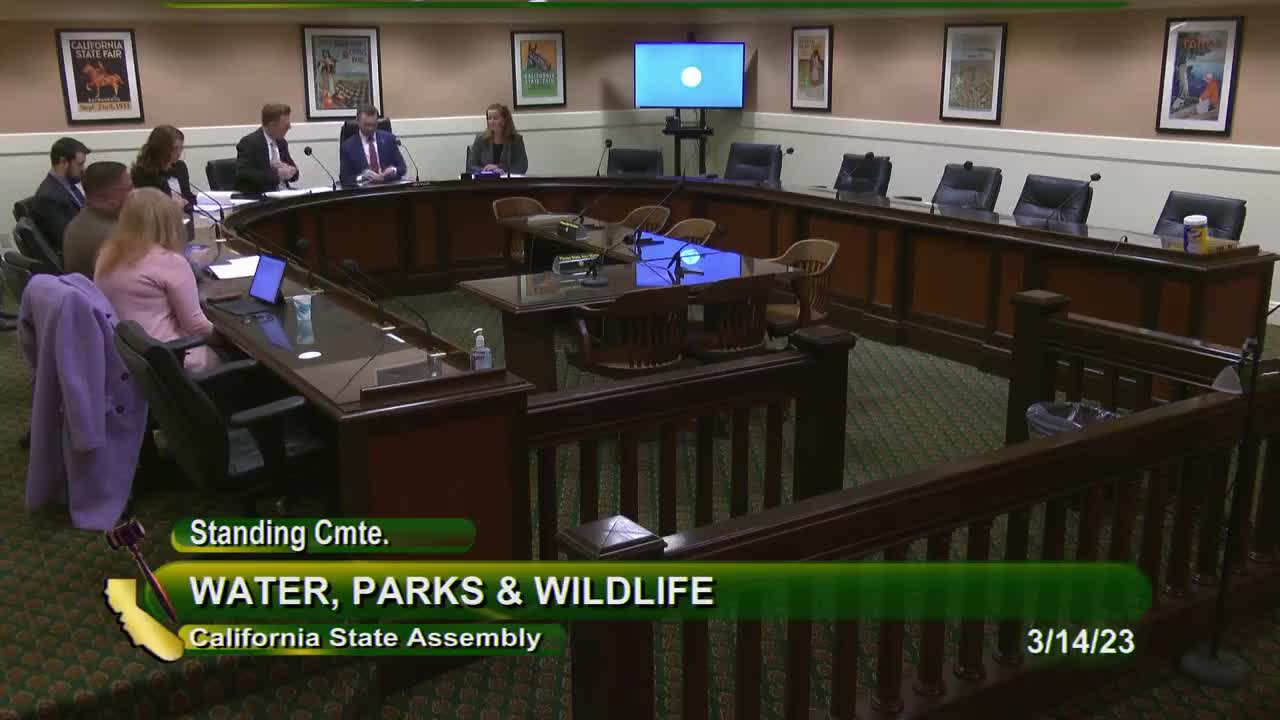 10MIN
Assembly Standing Committee on Water, Parks, and Wildlife
Bill Author