AB 3043: Occupational safety: fabrication activities.
- Session Year: 2023-2024
- House: Assembly
- Latest Version Date: 2024-05-20
Current Status:
Failed
(2024-07-03: In committee: Set, first hearing. Hearing canceled at the request of author.)
Introduced
In Committee
First Chamber
In Committee
Second Chamber
Enacted
Existing law establishes the Occupational Safety and Health Standards Board within the Department of Industrial Relations to promulgate and enforce occupational safety and health standards for the state, including standards dealing with exposure to harmful airborne contaminants. Existing law requires the Division of Occupational Safety and Health within the department to enforce all occupational safety and health standards, as specified. A violation of these standards and regulations under specific circumstances is a crime.
This bill would prohibit a person engaged in fabrication activities or fabrication shops from using dry methods, and require the use of effective wet methods in any fabrication activities. The bill would make a violation of these provisions grounds for, among other disciplinary action, an immediate order prohibiting continued fabrication activities. The bill would authorize the Attorney General, upon request of the department, to petition the superior court to impose civil penalties for a violation of these provisions.
The bill would require, on or before July 1, 2025, the department to consult with representatives of approved apprenticeship programs to adopt a training curriculum regarding the safe performance of fabrication activities that meets specified requirements, including classroom instruction, and to certify an individual who has completed that curriculum immediately upon completion. The bill would prohibit, beginning July 1, 2026, an owner or operator of a slab product fabrication shop from permitting any individual from performing fabrication activities or employing an individual to perform work on the shop floor where those activities are conducted, unless the individual is certified by the department as having completed the training curriculum, except as specified.
The bill would require, on or before January 1, 2026, the department to develop an application and licensing process for fabrication shops to lawfully engage in fabrication activities known as a slab product fabrication activity license. The bill would authorize fabrication shops to engage in fabrication activities during the pendency of the application development and licensing process.
The bill would require, beginning January 1, 2026, the department to grant a 3-year license to a fabrication shop that demonstrates satisfaction of specified criteria involving workplace safety conditions and precautions, and would authorize license renewal, as specified. Among other conditions, the bill would establish certain regulatory fees in specified amounts for the license and renewal thereof. The bill would authorize the department to suspend or revoke a licensee in certain cases, including for gross negligence, as specified. The bill would prohibit a person or entity, or an employee thereof, from engaging in fabrication activities unless the person or entity has a license.
The bill would require, beginning January 1, 2026, an owner or operator of a slab product fabrication shop to pay each employee at least the general prevailing rate of per diem wages for the geographic area for performing fabrication activities, except as otherwise specified. The bill would authorize the department to, among other disciplinary action, suspend or revoke a license if the department finds that the owner or operator willfully violated that provision.The bill would prohibit, beginning January 1, 2026, a person from supplying a slab product directly to a person or entity engaged in fabrication activities if the person or entity does not have a valid license. The bill would require a person that, among other things, supplies a slab product to a person or entity engaged in fabrication services to verify the person or entity has a license, as specified. The bill would require a person that supplies a slab product to a person or entity that is not engaged in fabrication activities to rely on written certification issued under penalty of perjury that, among other things, they will not directly engage in fabrication activities with the product without a license. By expanding the scope of the crime of perjury, the bill would impose a state-mandated local program.
The bill would specify that a violation of any of the above-described provisions may be grounds for disciplinary action, as specified, but is not a crime. The bill would establish the Slab Fabrication Activity Account in the Occupational Safety and Health Fund in the State Treasury, and require all fees, penalties, or other moneys collected by the department under the above-described provisions to be deposited into the account. The bill would authorize moneys in the account to be expended by the department for the purposes of administering the above-described provisions, and would make that authorization contingent on an appropriation of funds for that express purpose.
The bill would require, beginning January 1, 2026, the Director of Industrial Relations to maintain a publicly accessible database on the departments internet website that includes, among other things, information on any active orders issued by the department in the prior 12 months prohibiting an activity at a fabrication shop, as specified.
On or before July 1, 2025, the bill would require the department, in consultation with specified agencies, to submit a report to the Legislature pursuant to prescribed requirements, including specifying the number of violations issued for failure to comply with any temporary or future standards relating to respirable crystalline silica adopted by the board, and the geographic areas in the state with the highest numbers of those violations. On or before January 1, 2027, and January 1, 2029, the bill would require the department, in consultation with other specified entities, to submit a report to the Legislature pursuant to prescribed requirements, including, in addition to the information contained in the initial report, the number of licenses issued by the department pursuant to the above-described provisions. The bill would require the department to collect and include in those reports the disaggregation of applicable data by stone industry, as specified. The bill would also require the department and the division to consider the findings of the reports to prioritize enforcement of the requirements of the bills provisions in geographic areas with the highest numbers of violations or other penalties issued by the department relating to respirable crystalline silica.
The bill would define various terms for these purposes. The bill would make findings and declarations related to these provisions.
The California Constitution requires the state to reimburse local agencies and school districts for certain costs mandated by the state. Statutory provisions establish procedures for making that reimbursement.
This bill would provide that no reimbursement is required by this act for a specified reason.
Existing law establishes the Occupational Safety and Health Standards Board within the Department of Industrial Relations to promulgate and enforce occupational safety and health standards for the state, including standards dealing with exposure to harmful airborne contaminants. Existing law requires the Division of Occupational Safety and Health within the department to enforce all occupational safety and health standards, as specified. A violation of these standards and regulations under specific circumstances is a crime.
This bill would prohibit a person engaged in fabrication activities or fabrication shops from using dry methods, and require the use of effective wet methods in any fabrication activities. The bill would make a violation of these provisions grounds for, among other disciplinary action, an immediate order prohibiting continued fabrication activities. The bill would authorize the Attorney General, upon request of the department, to petition the superior court to impose civil penalties for a violation of these provisions.
The bill would require, on or before July 1, 2025, the department to consult with representatives of approved apprenticeship programs to establish adopt a training curriculum regarding the safe performance of fabrication activities that meets specified requirements, including classroom instruction, and to certify a person an individual who has completed that curriculum immediately upon completion. The bill would prohibit, beginning January July 1, 2026, an owner or operator of a slab product fabrication shop from permitting a person any individual from performing fabrication activities or employing a person an individual to perform work near those activities, on the shop floor where those activities are conducted, unless the person individual is certified by the department as having completed the training curriculum, except as specified.
The bill would require, on or before January 1, 2026, the department to develop an application and licensing process for fabrication shops to lawfully engage in fabrication activities known as a slab product fabrication activity license. The bill would authorize fabrication shops to engage in fabrication activities during the pendency of the application development and licensing development process.
The bill would require, beginning January 1, 2026, the department to grant a 3-year license to a fabrication shop that demonstrates satisfaction of specified criteria involving workplace safety conditions and precautions, and would authorize license renewal, as specified. Among other conditions, the bill would establish certain regulatory fees in unspecified specified amounts for the license and renewal thereof. The bill would authorize the department to suspend or revoke a licensee in certain cases, including for gross negligence, as specified. The bill would prohibit a person or entity, or an employee thereof, from engaging in fabrication activities unless the person or entity has a license.
The bill would require, beginning January 1, 2026, an owner or operator of a slab product fabrication shop to comply with specified requirements with respect to employees who perform fabrication activities, including paying pay each employee at least the general prevailing rate of per diem wages for the geographic area, area for performing fabrication activities, except as otherwise specified. The bill would authorize the department to, among other disciplinary action, suspend or revoke a license if the department finds that the owner or operator willfully violated these provisions. that provision.
The bill would prohibit, beginning January 1, 2026, a person from supplying a slab product directly to a person or entity engaged in fabrication activities if the person or entity does not have a valid license. The bill would require a person that, among other things, supplies a slab product to a person or entity engaged in fabrication services to verify the person or entity has a license, as specified. The bill would require a person that supplies a slab product to a person or entity that is not engaged in fabrication activities to rely on written certification issued under penalty of perjury that, among other things, they will not directly engage in fabrication activities with the product without a license. By expanding the scope of the crime of perjury, the bill would impose a state-mandated local program.
The bill would specify that a violation of any of the above-described provisions may be grounds for disciplinary action, as specified, but is not a crime. The bill would require moneys recovered pursuant to the above-described provisions to be deposited in an unspecified account, for expenditure by the department, upon appropriation by the Legislature. The bill would establish the Slab Fabrication Activity Account in the Occupational Safety and Health Fund in the State Treasury, and require all fees, penalties, or other moneys collected by the department under the above-described provisions to be deposited into the account. The bill would authorize moneys in the account to be expended by the department for the purposes of administering the above-described provisions, and would make that authorization contingent on an appropriation of funds for that express purpose.
The bill would require require, beginning January 1, 2026, the Director of Industrial Relations to maintain a publicly accessible database on the departments internet website that includes, among other things, information on any active orders issued by the department in the prior 12 months prohibiting an activity at a fabrication shop, as specified. Beginning January 1, 2026, the bill would require that internet website to contain additional information in the database, including information on fabrication shops in the state licensed under the bills provisions.
On or before July 1, 2025, the bill would require the department, in consultation with specified agencies, to submit a report to the Legislature pursuant to prescribed requirements, including specifying the number of violations issued for failure to comply with any temporary or future standards relating to respirable crystalline silica adopted by the board. board, and the geographic areas in the state with the highest numbers of those violations. On or before January 1, 2027, and January 1, 2029, the bill would require the department, in consultation with other specified entities, to submit a report to the Legislature pursuant to prescribed requirements, including, in addition to the information contained in the initial report, the number of licenses issued by the department. department pursuant to the above-described provisions. The bill would also require the department and the division to consider the findings of the reports to prioritize enforcement of the requirements of the bills provisions in geographic areas with the highest numbers of violations or other penalties issued by the department relating to respirable crystalline silica.
The bill would define various terms for these purposes. The bill would make findings and declarations related to these provisions.
The California Constitution requires the state to reimburse local agencies and school districts for certain costs mandated by the state. Statutory provisions establish procedures for making that reimbursement.
This bill would provide that no reimbursement is required by this act for a specified reason.
Existing law establishes the Occupational Safety and Health Standards Board within the Department of Industrial Relations to promulgate and enforce occupational safety and health standards for the state, including standards dealing with exposure to harmful airborne contaminants. Existing law requires the Division of Occupational Safety and Health within the department to enforce all occupational safety and health standards, as specified. A violation of these standards and regulations under specific circumstances is a crime.
This bill would prohibit a person engaged in fabrication activities or fabrication shops from using dry methods, and require the use of effective wet methods in any fabrication activities. The bill would make a violation of these provisions grounds for, among other disciplinary action, an immediate order prohibiting continued fabrication activities. The bill would authorize the Attorney General, upon request of the department, to petition the superior court to impose civil penalties for a violation of these provisions.
The bill would require, on or before July 1, 2025, the department to consult with representatives of approved apprenticeship programs to establish a training curriculum regarding the safe performance of fabrication activities that meets specified requirements, including classroom instruction, and to certify a person who has completed that curriculum immediately upon completion. The bill would prohibit, beginning January 1, 2026, an owner or operator of a slab product fabrication shop from permitting a person from performing fabrication activities or employing a person to perform work near those activities, unless the person is certified by the department as having completed the training curriculum, except as specified.
The bill would require, on or before January 1, 2026, the department to develop an application and licensing process for fabrication shops to lawfully engage in fabrication activities known as a slab product fabrication activity license. The bill would authorize fabrication shops to engage in fabrication activities during the pendency of the application and licensing development process.
The bill would require, beginning January 1, 2026, the department to grant a 3-year license to a fabrication shop that demonstrates satisfaction of specified criteria involving workplace safety conditions and precautions, and would authorize license renewal, as specified. Among other conditions, the bill would establish certain regulatory fees in unspecified amounts for the license and renewal thereof. The bill would authorize the department to suspend or revoke a licensee in certain cases, including for gross negligence, as specified. The bill would prohibit a person or entity, or an employee thereof, from engaging in fabrication activities unless the person or entity has a license.
The bill would require, beginning January 1, 2026, an owner or operator of a slab product fabrication shop to comply with specified requirements with respect to employees who perform fabrication activities, including paying each employee at least the general prevailing rate of per diem wages for the geographic area, except as otherwise specified. The bill would authorize the department to, among other disciplinary action, suspend or revoke a license if the department finds that the owner or operator willfully violated these provisions.
The bill would prohibit, beginning January 1, 2026, a person from supplying a slab product directly to a person or entity engaged in fabrication activities if the person or entity does not have a valid license. The bill would require a person that, among other things, supplies a slab product to a person or entity engaged in fabrication services to verify the person or entity has a license, as specified. The bill would require a person that supplies a slab product to a person or entity that is not engaged in fabrication activities to rely on written certification issued under penalty of perjury that, among other things, they will not directly engage in fabrication activities with the product without a license. By expanding the scope of the crime of perjury, the bill would impose a state-mandated local program.
The bill would specify that a violation of any of the above-described provisions may be grounds for disciplinary action, as specified, but is not a crime. The bill would require moneys recovered pursuant to the above-described provisions to be deposited in an unspecified account, for expenditure by the department, upon appropriation by the Legislature.
The bill would require the Director of Industrial Relations to maintain a publicly accessible database on the departments internet website that includes, among other things, information on any active orders issued by the department in the prior 12 months prohibiting an activity at a fabrication shop, as specified. Beginning January 1, 2026, the bill would require that internet website to contain additional information in the database, including information on fabrication shops in the state licensed under the bills provisions.
On or before July 1, 2025, the bill would require the department, in consultation with specified agencies, to submit a report to the Legislature pursuant to prescribed requirements, including specifying the number of violations issued for failure to comply with any temporary or future standards adopted by the board. On or before January 1, 2027, and January 1, 2029, the bill would require the department, in consultation with other specified entities, to submit a report to the Legislature pursuant to prescribed requirements, including, in addition to the information contained in the initial report, the number of licenses issued by the department.
The bill would define various terms for these purposes. The bill would make findings and declarations related to these provisions.
The California Constitution requires the state to reimburse local agencies and school districts for certain costs mandated by the state. Statutory provisions establish procedures for making that reimbursement.
This bill would provide that no reimbursement is required by this act for a specified reason.
(a)The Legislature finds and declares all of the following regarding silicosis and its associated health impacts:
(1)According to the federal Centers for Disease Control and Prevention (CDC), silicosis is an occupational lung disease caused by the inhalation of respirable dust containing crystalline silica.
(2)According to the State Department of Public Health (CDPH), crystalline silica is in engineered stone, quartz, granite, and other stones. Cutting, grinding, chipping, sanding, drilling, and polishing these products can release hazardous levels of small silica particles into the air that workers breathe.
(3)When small particles of silica get into the lungs, they can cause permanent scarring and difficulty breathing and can also cause lung cancer, kidney damage, and several autoimmune diseases. Initial symptoms of silicosis can include shortness of breath, cough, and fatigue. Workers can die from silica dust overexposure.
(4)Many cases of incurable and fatal lung problems from exposure to silica dust in stone fabrication workers have been reported around the world and in the United States, including several cases among relatively young workers in California. Workers who cut, grind, and polish engineered stone slabs are at risk.
(5)According to the Los Angeles County Department of Public Health, silicosis is irreversible and can progress even if a person is no longer exposed to silica dust, but with the right measures in place, it is preventable. It can take a person 10 to 30 years to develop silicosis, but a person who is exposed to high levels of silica dust can develop silicosis faster.
(b)The Legislature finds and declares both of the following regarding the increase in the number of cases of silicosis in California:
(1)Since 2010, more than 1,000 cases of silicosis in workers who fabricate countertops have been reported worldwide. The first cases of silicosis were reported in Spain in 2010 and in Israel in 2012. The first case of silicosis reported in the United States was in Texas in 2015.
(2)According to CDPH, there are 93 countertop workers identified to date with silicosis in California. At least 10 workers have died, most of whom were 30 to 40 years of age, inclusive, 4 workers have received lung transplants, and 5 workers are under evaluation.
(c)The Legislature finds and declares all of the following regarding the increase of silica used in products:
(1)Crystalline silica is a common mineral found in the earths crust. Materials like sand, stone, concrete, and mortar contain crystalline silica. Stone slabs containing crystalline silica such as quartz is becoming increasingly popular for kitchen countertops.
(2)Workers who cut, polish, or grind products that contain crystalline silica can be exposed to hazardous levels of silica dust.
(3)In 1938, according to United States Secretary of Labor Frances Perkins, silicosis can be prevented.
(d)The Legislature finds and declares both of the following regarding the impact of silicosis on undocumented workers:
(1)The demographic for workers contracting silicosis are typically young, immigrant workers and is made up of all males with a median age of 45 years of age at diagnosis, with 98 percent originating from Mexico or Central America, and who are most reliant on public insurance or are uninsured.
(2)Physicians at Olive View-UCLA Medical Center in the County of Los Angeles identified a cluster of patients with a rare occupational lung disease called pulmonary silicosis and played a key role in bringing their cases to light. The patients identified are predominantly Mexican and Latin American immigrant men who work as stonecutters in the San Fernando Valley, cutting synthetic stone kitchen and bathroom countertops. According to a CDPH directory, there are over 100 stone fabrication shops in the centers catchment area in the San Fernando Valley and over 1,000 within the state, and many other at-risk workers in the County of Los Angeles and throughout the state.
(e)The Legislature finds and declares both of the following regarding the impact of silicosis worldwide:
(1)The New Zealand Council of Trade Unions (NZCTU) Te Kauae Kaimahi is once again advancing its call for a total ban on engineered stone in New Zealand. According to the NZCTU President President, Richard Wagstaff, the evidence of the harm caused by engineered stone is overwhelming. It is clear to us that a ban on this product is the only option.
(2)Australia is the first country to announce a ban on engineered stone that will start on July 1, 2024, in most states and territories, and follows a surge in hundreds of workers developing silicosis from working on engineered stone, a popular material mostly used for kitchen benches and bathroom vanities. According to the Australian Council of Trade Unions Assistant Secretary Secretary, Liam OBrien, Engineered stone is a fashion product that is killing the workers who make it. With alternatives readily available, why are we risking the lives of tradies for a fashionable finish in our kitchens?
(f)The Legislature finds and declares that California must use the information described in these findings to determine the cost-benefit ratio to workers and whether existing regulations adequately protect workers from contracting silicosis.
(g)Therefore, it is the intent of the Legislature to enact legislation that would help protect and prevent worker overexposure to respirable crystalline silica by imposing all of the following requirements:
(1)Prohibiting the undertaking of fabrication activities without the use of effective wet methods that effectively suppress dust.
(2)Requiring a slab product fabrication activity license for fabrication shops to engage in fabrication activities involving stone slab product that contain crystalline silica.
(3)Prohibiting a person or entity from directly or indirectly supplying a slab product to a person or entity engaged in fabrication activities that is not associated with a valid slab product fabrication activity license.
(4)Requiring the Department of Industrial Relations to maintain a publicly accessible database on its internet website that includes, but is not limited to, a list of workplaces with any enforcement actions pending at those workplaces.
SEC. 2.Chapter 2.2 (commencing with Section 6359.1) is added to Part 1 of Division 5 of the Labor Code, to read:2.2.Fabrication Activities6359.1.For purposes of this chapter, the following definitions apply:
(a)Department means the Department of Industrial Relations.
(b)Director means the Director of Industrial Relations.
(c)Dry methods means the undertaking of fabrication activities without the use of effective wet methods that effectively suppress dust.
(d)Effective wet methods means suppressing dust by one of the methods identified below, which ensure that water covers the entire surface of the work object where a tool, equipment, or machine contacts the work object:
(1)Applying a constant, continuous, and appropriate volume of running water directly onto the surface of the work object. When water flow is integrated with a tool, machine, or equipment, water flow rates shall equal or exceed manufacturer recommendations and specifications to ensure effective dust suppression.
(2)Submersing the work object under water.
(3)Water jet cutting or use of high-pressure water to cut material.
(e)(1)Fabrication activities means machining, crushing, cutting, drilling, abrading, abrasive blasting, grinding, chiseling, carving, gouging, polishing, buffing, fracturing, intentional breaking, or intentional chipping of slab products.
(2)Fabrication activities does not include onsite construction work covered by Section 1532.3 of Title 8 of the California Code of Regulations.
(f)(1)Fabrication shop means a location where fabrication activities are undertaken on slab products.
(2)Fabrication shop does not include facilities where slab products are manufactured, including, but not limited to, quarries, concrete manufacturing facilities, or tile manufacturing facilities.
(g)License means a slab product fabrication activity license to engage in fabrication activities that is issued to a fabrication shop by the department pursuant to this chapter.
(h)Respirable crystalline silica means quartz, cristobalite, or tridymite contained in airborne particles that are determined to be respirable by a sampling device designed to meet the characteristics for respirable-particle-size-selective samplers specified in the Air Quality Particle Size Fraction Definitions for Health-Related Sampling in Report 7708 completed by the International Organization for Standardization in 1995.
(i)Slab product means a thick, flat piece of a solid stone substance, including artificial, engineered, or natural stone that is used for countertop installation or customization.
6359.15.(a)The Slab Fabrication Activity Account is hereby created in the Occupational Safety and Health Fund, as established pursuant to Section 62.5, in the State Treasury.
(b)All fees, penalties, or other moneys collected by the department under this chapter shall be deposited in the Slab Fabrication Activity Account.
(c)Upon appropriation by the Legislature for this express purpose, moneys in the account may be expended by the department for the purposes of administering this chapter.
6359.2.(a)A person or entity engaged in fabrication activities or fabrication shops shall not use dry methods in any fabrication activities.
(b)A person or entity engaged in fabrication activities or fabrication shops shall use effective wet methods in any fabrication activities.
(c)(1)A violation of this section shall be grounds for an immediate order prohibiting continued fabrication activities by the director and may be grounds for additional fines and penalties, as determined by the director to further the purposes of this chapter.
(2)Notwithstanding any provision of this division to the contrary, a violation of this section is not a crime.
(d)A violation of this section may be reported to the Division of Labor Standards Enforcement.
(e)The Attorney General, upon request of the department, may petition the superior court to impose civil penalties for a violation of this section.6359.3.(a)On or before July 1, 2025, the department shall consult with representatives of approved apprenticeship programs to adopt a training curriculum regarding the safe performance of fabrication activities.
(1)The training curriculum shall satisfy both of the following requirements:
(A)The training curriculum shall cover applicable occupational safety and health standards.
(B)The training curriculum shall include classroom instruction and supervised hands-on activities.
(2)An approved apprenticeship program or the California Community Colleges may provide the training curriculum. The department shall approve alternative providers if approved apprenticeship programs or the California Community Colleges do not offer training programs sufficient to meet the needs of the industry.
(b)Beginning on July 1, 2026, an owner or operator of a slab product fabrication shop shall not permit any individual to perform fabrication activities or employ an individual to perform work on the shop floor where fabrication activities are conducted, unless the individual has been certified pursuant to the training curriculum described in this section.
(1)The owner or operator of a slab product fabrication shop shall be responsible for paying for the costs of the training curriculum of its employees.
(2)The department shall certify an individual who has completed the approved training curriculum immediately upon completion.
(3)This subdivision shall not apply to an individual who is enrolled in, or who has graduated from, an apprenticeship program that covers fabrication activities and is approved by the Division of Apprenticeship Standards.
6359.4.(a)(1)On or before January 1, 2026, the department shall develop an application and licensing process for a slab product fabrication activity license to authorize fabrication shops to engage in fabrication activities.
(2)Notwithstanding any provision of this chapter to the contrary, a fabrication shop may continue to engage in fabrication activities during the pendency of the application development and licensing process.
(3)This subdivision shall become inoperative on January 1, 2026.
(b)(1)Commencing January 1, 2026, the department shall accept an application for and grant a license to a fabrication shop that demonstrates to the department satisfaction of all of the following workplace safety conditions and precautions:
(A)Evidence of a legally obtained and valid business license and applicable state contractors license.
(B)Evidence of satisfactory workers compensation insurance coverage.
(C)Demonstration of compliance with any occupational safety and health standards and orders that are promulgated by the Occupational Safety and Health Standards Board pursuant to Section 142.3.
(D)Implementation of an air quality monitoring program consistent with any occupational safety and health standards and orders that are promulgated by the Occupational Safety and Health Standards Board pursuant to Section 142.3, and documentation of verification of implementation by a third party that is normally engaged in those kinds of verifications.
(E)Documentation of completion by all employees of a technical training program focused on the prevention of workplace respirable crystalline silica exposure, including the use of protective equipment and control measures, that is approved by the department.
(2)The department, or a third party certified by the department for this purpose, shall inspect a fabrication shop before the issuance of the license to verify that the equipment and procedures of the fabrication shop are in compliance with any occupational safety and health standards and orders that are promulgated by the Occupational Safety and Health Standards Board pursuant to Section 142.3.
(3)An applicant for a license shall submit to the department an initial license application, including an application fee in the amount of four hundred fifty dollars ($450) and an initial license fee in the amount of two hundred dollars ($200), which shall be deposited in the Slab Fabrication Activity Account in the Occupational Safety and Health Fund for the purposes of administering this chapter.
(4)Each license granted by the department shall be for a three-year period.
(5)(A)The department shall accept a renewal application for and grant a license renewal to a licensee who demonstrates to the department continued compliance with all of the following workplace safety conditions and precautions:
(i)Evidence of compliance with the requirements of any occupational safety and health standards and orders that are promulgated by the Occupational Safety and Health Standards Board pursuant to Section 142.3.
(ii)Documentation of certified air quality monitoring results consistent with any occupational safety and health standards and orders that are promulgated by the Occupational Safety and Health Standards Board pursuant to Section 142.3 over the prior three years.
(iii)Documentation of information related to employee-reported silicosis cases.
(iv)Beginning July 1, 2026, documentation that all individuals who perform fabrication activities or perform work on a shop floor where fabrication activities are being conducted have been certified, or are exempt from certification, pursuant to subdivision (b) of Section 6359.3.
(B)The department, or a third party certified by the department for this purpose, shall inspect a fabrication shop before the issuance of a license renewal to verify that the equipment and procedures of the fabrication shop are in compliance with any occupational safety and health standards and orders that are promulgated by the Occupational Safety and Health Standards Board pursuant to Section 142.3.
(C)An applicant for a license renewal shall submit to the department a license renewal fee in the amount of four hundred fifty dollars ($450), which shall be deposited in the Slab Fabrication Activity Account in the Occupational Safety and Health Fund for the purposes of administering this chapter.
(D)A licensee may continue to engage in fabrication activities during the pendency of the license renewal application.
(6)The department may suspend or revoke a license issued pursuant to this section if the department finds that the licensee has engaged in gross negligence, gross incompetence, or willful or repeated disregard of an occupational safety and health standard or order.
(7)(A)A person or entity, or an employee of a person or entity, shall not engage in fabrication activities without a license issued by the department pursuant to this chapter.
(B)A violation of this paragraph may be reported to the Division of Labor Standards Enforcement.
(C)Notwithstanding any provision of this division to the contrary, a violation of this paragraph is not a crime.
6359.5.(a)The owner or operator shall pay each employee performing fabrication activities at least the general prevailing rate of per diem wages for the geographic area, as published by the director pursuant to Sections 1773 and 1773.9 of the Labor Code, for performing fabrication activities, except that the owner or operator may pay apprentices registered in programs approved by the Chief of the Division of Apprenticeship Standards at least the applicable apprentice prevailing rate.(b)(1)An owner or operator in violation of this section shall be subject to a fine of two hundred dollars ($200) per employee per day for each violation of this section.(2)Notwithstanding any provision of this division to the contrary, a violation of this section is not a crime.(c)The department may suspend or revoke a license issued pursuant to this section if the department finds that the owner or operator willfully violated this section.(d)The prevailing wage requirement described in subdivision (a) shall be enforceable by the Labor Commissioner or by an employee by a civil action through the same means and with the same relief available for violation of any other state minimum wage requirement.(e)The remedies provided in this section are in addition to any other remedies provided by law.(f)This section shall become operative on January 1, 2026.6359.6.6359.5.(a)A person shall not supply a slab product directly to a person or entity engaged in fabrication activities if the person or entity engaged in fabrication activities does not have a valid license.
(1)A person that supplies a slab product to a person or entity engaged in fabrication activities shall verify that the person or entity has a valid license before providing the slab product to the person or entity.
(2)A person that supplies a slab product to a person or entity that is not engaged in fabrication activities shall rely on a written certification issued under penalty of perjury from the person that the person will not directly engage in fabrication activities with the product without a license and that, if the person resells the product, the person will resell to a person or entity with a license.
(b)A person that seeks services that require fabrication activities and enters into a contract with a person or entity to undertake fabrication activities shall verify that the person or entity has a valid license before engaging with and providing slab products to that person or entity.
(c)(1)A violation of this subdivision may be grounds for penalties as determined by the director to further the purposes of this chapter.
(2)Notwithstanding any provision of this division to the contrary, a violation of this section is not a crime.
(d)This section shall become operative on January 1, 2026.
6359.7.6359.6.Beginning January 1, 2026, the director shall maintain a publicly accessible database on the departments internet website that includes all of the following:
(a)Information on any active orders issued by the department in the prior 12 months prohibiting an activity at a fabrication shop pursuant to this chapter.
(b)Information on fabrication shops in the state licensed pursuant to this chapter and on any enforcement actions pending at those licensed fabrication shops.
(c)An online tool to report suspected or alleged violations of this chapter.
6359.8.6359.7.(a)(1)On or before July 1, 2025, the department shall, in consultation with the Labor and Workforce Development Agency, the Division of Occupational Safety and Health, and the State Department of Public Health, submit a report to the Legislature that includes all of the following information:
(A)The number of violations issued for failure to comply with any temporary or future standards relating to respirable crystalline silica adopted by the Occupational Safety and Health Standards Board, and the geographic areas in the state with the highest numbers of those violations.
(B)The number of new cases of silicosis identified since the passage of any temporary or future standards relating to respirable crystalline silica adopted by the Occupational Safety and Health Standards Board.
(C)An assessment of the risk to the health of workers from failing to comply with any temporary or future standards or future standards relating to respirable crystalline silica adopted by the Occupational Safety and Health Standards Board.
(D)An assessment on the ban of silica-based products in Australia and the movement for a similar ban in New Zealand, and the associated benefit to the health and safety of those workers.
(E)The overall success or gaps in protections provided to the workers in the temporary or future standards relating to respirable crystalline silica.
(F)Updates on steps taken by the department or the Division of Occupational Safety and Health to increase the ratio of industrial hygienists to workers exposed to respirable crystalline silica.
(G)The number of notices issued to fabrication shops found to be in noncompliance with department regulations relating to respirable crystalline silica.
(2)A report to be submitted pursuant to paragraph (1) shall be submitted in compliance with Section 9795 of the Government Code.
(b)(1)On or before January 1, 2027, and on or before January 1, 2029, the department shall, in consultation with the Division of Occupational Safety and Health, the State Department of Public Health, and the Labor and Workforce Development Agency, submit a report to the Legislature that includes all of the following information:
(A)The information specified in subparagraphs (A) to (E), inclusive, of paragraph (1) of subdivision (a).
(B)Updates on steps taken by the department or the Division of Occupational Safety and Health to increase the ratio of industrial hygienists to workers exposed to respirable crystalline silica.
(C)The number of licenses, violations for failure to comply with licensure requirements, and license suspensions or revocations issued by the department pursuant to this chapter, and the geographic areas with the highest numbers of those penalties.
(D)The number of notices issued to fabrication shops found to be in noncompliance with department regulations relating to respirable crystalline silica.
(E)The overall enhancement to workers protections with the license program, including any successes or gaps.
(2)A report to be submitted pursuant to paragraph (1) shall be submitted in compliance with Section 9795 of the Government Code.
(c)The department shall collect and include in the reports required by this section the disaggregation of applicable data by stone industry, including, but not limited to, stone industries involved in cutting stones for benches, tombstones, and tile work.
(c)(d)The department and the Division of Occupational Safety and Health shall use the findings of the reports submitted pursuant to this section to prioritize enforcement of the requirements of this chapter in geographic areas with the highest numbers of violations or other penalties issued by the department relating to respirable crystalline silica, including, but not limited to, the San Fernando Valley.
(d)(e)Pursuant to Section 10231.5 of the Government Code, this section is repealed on January 1, 2031.
SEC. 3.No reimbursement is required by this act pursuant to Section 6 of Article XIIIB of the California Constitution because the only costs that may be incurred by a local agency or school district will be incurred because this act creates a new crime or infraction, eliminates a crime or infraction, or changes the penalty for a crime or infraction, within the meaning of Section 17556 of the Government Code, or changes the definition of a crime within the meaning of Section 6 of Article XIIIB of the California Constitution.
(a)The Legislature finds and declares all of the following regarding silicosis and its associated health impacts:
(1)According to the federal Centers for Disease Control and Prevention (CDC), silicosis is an occupational lung disease caused by the inhalation of respirable dust containing crystalline silica.
(2)According to the State Department of Public Health (CDPH), crystalline silica is in engineered stone, quartz, granite, and other stones. Cutting, grinding, chipping, sanding, drilling, and polishing these products can release hazardous levels of small silica particles into the air that workers breathe.
(3)When small particles of silica get into the lungs, they can cause permanent scarring and difficulty breathing and can also cause lung cancer, kidney damage, and several autoimmune diseases. Initial symptoms of silicosis can include shortness of breath, cough, and fatigue. Workers can die from silica dust overexposure.
(4)Many cases of incurable and fatal lung problems from exposure to silica dust in stone fabrication workers have been reported around the world and in the United States, including several cases among relatively young workers in California. Workers who cut, grind, and polish engineered stone slabs are at risk.
(5)According to the Los Angeles County Department of Public Health, silicosis is irreversible and can progress even if a person is no longer exposed to silica dust, but with the right measures in place, it is preventable. It can take a person 10 to 30 years to develop silicosis, but a person who is exposed to high levels of silica dust can develop silicosis faster.
(b)The Legislature finds and declares both of the following regarding the increase in the number of cases of silicosis in California:
(1)Since 2010, more than 1,000 cases of silicosis in workers who fabricate countertops have been reported worldwide. The first cases of silicosis were reported in Spain in 2010 and in Israel in 2012. The first case of silicosis reported in the United States was in Texas in 2015.
(2)According to CDPH, there are 93 countertop workers identified to date with silicosis in California. At least 10 workers have died, most of whom were 30 to 40 years of age, inclusive, 4 workers have received lung transplants, and 5 workers are under evaluation.
(c)The Legislature finds and declares all of the following regarding the increase of silica used in products:
(1)Crystalline silica is a common mineral found in the earths crust. Materials like sand, stone, concrete, and mortar contain crystalline silica. Stone slabs containing crystalline silica such as quartz is becoming increasingly popular for kitchen countertops.
(2)Workers who cut, polish, or grind products that contain crystalline silica can be exposed to hazardous levels of silica dust.
(3)In 1938, according to United States Secretary of Labor Frances Perkins, silicosis can be prevented.
(d)The Legislature finds and declares both of the following regarding the impact of silicosis on undocumented workers:
(1)The demographic for workers contracting silicosis are typically young, immigrant workers and is made up of all males with a median age of 45 years of age at diagnosis, with 98 percent originating from Mexico or Central America, and who are most reliant on public insurance or are uninsured.
(2)Physicians at Olive View-UCLA Medical Center in the County of Los Angeles identified a cluster of patients with a rare occupational lung disease called pulmonary silicosis and played a key role in bringing their cases to light. The patients identified are predominantly Mexican and Latin American immigrant men who work as stonecutters in the San Fernando Valley, cutting synthetic stone kitchen and bathroom countertops. According to a CDPH directory, there are over 100 stone fabrication shops in the centers catchment area in the San Fernando Valley and over 1,000 within the state, and many other at-risk workers in the County of Los Angeles and throughout the state.
(e)The Legislature finds and declares both of the following regarding the impact of silicosis worldwide:
(1)The New Zealand Council of Trade Unions (NZCTU) Te Kauae Kaimahi is once again advancing its call for a total ban on engineered stone in New Zealand. According to NZCTU President Richard Wagstaff, the evidence of the harm caused by engineered stone is overwhelming. It is clear to us that a ban on this product is the only option.
(2)Australia is the first country to announce a ban on engineered stone that will start on July 1, 2024, in most states and territories, and follows a surge in hundreds of workers developing silicosis from working on engineered stone, a popular material mostly used for kitchen benches and bathroom vanities. According to the Australian Council of Trade Unions Assistant Secretary Liam OBrien, Engineered stone is a fashion product that is killing the workers who make it. With alternatives readily available, why are we risking the lives of tradies for a fashionable finish in our kitchens?
(f)The Legislature finds and declares that California must use the information described in these findings to determine the cost-benefit ratio to workers and whether existing regulations adequately protect workers from contracting silicosis.
(g)Therefore, it is the intent of the Legislature to enact legislation that would help protect and prevent worker overexposure to respirable crystalline silica by imposing all of the following requirements:
(1)Prohibiting the undertaking of fabrication activities without the use of effective wet methods that effectively suppress dust.
(2)Requiring a slab product fabrication activity license for fabrication shops to engage in fabrication activities involving stone slab product that contain crystalline silica.
(3)Prohibiting a person or entity from directly or indirectly supplying a slab product to a person or entity engaged in fabrication activities that is not associated with a valid slab product fabrication activity license.
(4)Requiring the Department of Industrial Relations to maintain a publicly accessible database on its internet website that includes, but is not limited to, a list of workplaces with any enforcement actions pending at those workplaces.
SEC. 2.Chapter 2.2 (commencing with Section 6359.1) is added to Part 1 of Division 5 of the Labor Code, to read:2.2.Fabrication Activities6359.1.For purposes of this chapter, the following definitions apply:
(a)Department means the Department of Industrial Relations.
(b)Director means the Director of Industrial Relations.
(c)Dry methods means the undertaking of fabrication activities without the use of effective wet methods that effectively suppress dust.
(d)Effective wet methods means suppressing dust by one of the methods identified below, which ensure that water covers the entire surface of the work object where a tool, equipment, or machine contacts the work object:
(1)Applying a constant, continuous, and appropriate volume of running water directly onto the surface of the work object. When water flow is integrated with a tool, machine, or equipment, water flow rates shall equal or exceed manufacturer recommendations and specifications to ensure effective dust suppression.
(2)Submersing the work object under water.
(3)Water jet cutting or use of high-pressure water to cut material.
(e)(1)Fabrication activities means machining, crushing, cutting, drilling, abrading, abrasive blasting, grinding, chiseling, carving, gouging, polishing, buffing, fracturing, intentional breaking, or intentional chipping of slab products.
(2)Fabrication activities does not include onsite construction work covered by Section 1532.3 of Title 8 of the California Code of Regulations.
(f)(1)Fabrication shop means a location where fabrication activities are undertaken on slab products.
(2)Fabrication shop does not include facilities where slab products are manufactured, including, but not limited to, quarries, concrete manufacturing facilities, or tile manufacturing facilities.
(g)License means a slab product fabrication activity license to engage in fabrication activities that is issued to a fabrication shop by the department pursuant to this chapter.
(h)Respirable crystalline silica means quartz, cristobalite, or tridymite contained in airborne particles that are determined to be respirable by a sampling device designed to meet the characteristics for respirable-particle-size-selective samplers specified in the Air Quality Particle Size Fraction Definitions for Health-Related Sampling in Report 7708 completed by the International Organization for Standardization in 1995.
(i)Slab product means a thick, flat piece of a solid stone substance, including artificial, engineered, or natural stone that is used for countertop installation or customization.
6359.15.(a)The Slab Fabrication Activity Account is hereby created in the Occupational Safety and Health Fund, as established pursuant to Section 62.5, in the State Treasury.
(b)All fees, penalties, or other moneys collected by the department under this chapter shall be deposited in the Slab Fabrication Activity Account.
(c)Upon appropriation by the Legislature for this express purpose, moneys in the account may be expended by the department for the purposes of administering this chapter.
6359.2.(a)A person or entity engaged in fabrication activities or fabrication shops shall not use dry methods in any fabrication activities.
(b)A person or entity engaged in fabrication activities or fabrication shops shall use effective wet methods in any fabrication activities.
(c)(1)A violation of this section shall be grounds for an immediate order prohibiting continued fabrication activities by the director and may be grounds for additional fines and penalties, as determined by the director to further the purposes of this chapter.
(2)Notwithstanding any provision of this division to the contrary, a violation of this section is not a crime.
(d)A violation of this section may be reported to the Division of Labor Standards Enforcement.
(e)The Attorney General, upon request of the department, may petition the superior court to impose civil penalties for a violation of this section.
(f)All moneys recovered pursuant to this chapter shall be deposited in the ____ Account in the ____ Fund. Upon appropriation by the Legislature for this express purpose, moneys in the account may be expended by the department for the purposes of administering this chapter.6359.3.(a)On or before July 1, 2025, the department shall consult with representatives of approved apprenticeship programs to establish adopt a training curriculum regarding the safe performance of fabrication activities for the purposes of this section. activities.
(1)The training curriculum shall satisfy both of the following requirements:
(A)The training curriculum shall cover applicable occupational safety and health standards.
(B)The training curriculum shall include classroom instruction and supervised hands-on activities.
(2)The department may authorize an An approved apprenticeship program or the California Community Colleges to provide the may provide the training curriculum. The department shall approve alternative providers if approved apprenticeship programs or the California Community Colleges are unable to provide the training curriculum. do not offer training programs sufficient to meet the needs of the industry.
(b)Beginning on January July 1, 2026, an owner or operator of a slab product fabrication shop shall not permit a person any individual to perform fabrication activities or employ a person an individual to perform work on the shop floor where fabrication activities are being conducted, unless the person individual has been certified pursuant to the training curriculum described in this section.
(1)The owner or operator of a slab product fabrication shop shall be responsible for paying for the costs of the training curriculum of its employees.
(2)The department shall certify a person an individual who has completed the approved training curriculum immediately upon completion.
(3)This subdivision shall not apply to a person an individual who is enrolled in, or who has graduated from, an apprenticeship program that covers fabrication activities and is approved by the Division of Apprenticeship Standards.
6359.4.(a)(1)On or before January 1, 2026, the department shall develop an application and licensing process for a slab product fabrication activity license to authorize fabrication shops to engage in fabrication activities.
(2)Notwithstanding any provision of this chapter to the contrary, a fabrication shop may continue to engage in fabrication activities during the pendency of the application development and licensing development process.
(3)This subdivision shall become inoperative on January 1, 2026.
(b)(1)Commencing January 1, 2026, the department shall accept an application for and grant a license to a fabrication shop that demonstrates to the department satisfaction of all of the following workplace safety conditions and precautions:
(A)Evidence of a legally obtained and valid business license and applicable state contractors license.
(B)Evidence of satisfactory workers compensation insurance coverage.
(C)Demonstration of compliance with any occupational safety and health standards and orders that are promulgated by the Occupational Safety and Health Standards Board pursuant to Section 142.3.
(D)Implementation of an air quality monitoring program consistent with any occupational safety and health standards and orders that are promulgated by the Occupational Safety and Health Standards Board pursuant to Section 142.3, and documentation of verification of implementation by a third party that is normally engaged in those kinds of verifications.
(E)Documentation of completion by all employees of a technical training program focused on the prevention of workplace respirable crystalline silica exposure, including the use of protective equipment and control measures, that is approved by the department.
(2)The department, or a third party certified by the department for this purpose, shall inspect a fabrication shop before the issuance of the license to verify that the equipment and procedures of the fabrication shop are in compliance with any occupational safety and health standards and orders that are promulgated by the Occupational Safety and Health Standards Board pursuant to Section 142.3.
(3)An applicant for a license shall submit to the department an initial registration license application, including an application fee in the amount of ____ dollars ($____), four hundred fifty dollars ($450) and an initial license fee in the amount of two hundred dollars ($200), which shall be deposited in the ____ Account in the ____ Slab Fabrication Activity Account in the Occupational Safety and Health Fund for the purposes of administering this chapter.
(4)Each license granted by the department shall be for a three-year period.
(5)(A)The department shall accept a renewal application for and grant a license renewal to a licensee who demonstrates to the department continued compliance with all of the following workplace safety conditions and precautions:
(i)Evidence of compliance with the requirements of any occupational safety and health standards and orders that are promulgated by the Occupational Safety and Health Standards Board pursuant to Section 142.3.
(ii)Documentation of certified air quality monitoring results consistent with any occupational safety and health standards and orders that are promulgated by the Occupational Safety and Health Standards Board pursuant to Section 142.3 over the prior three years.
(iii)Documentation of information related to employee-reported silicosis cases.
(iv)Documentation of completion by all employees of a technical training program focused on the prevention of workplace respirable crystalline silica exposure, including the use of protective equipment and control measures, that is approved by the department.(iv)Beginning July 1, 2026, documentation that all individuals who perform fabrication activities or perform work on a shop floor where fabrication activities are being conducted have been certified, or are exempt from certification, pursuant to subdivision (b) of Section 6359.3.
(B)The department, or a third party certified by the department for this purpose, shall inspect a fabrication shop before the issuance of a license renewal to verify that the equipment and procedures of the fabrication shop are in compliance with any occupational safety and health standards and orders that are promulgated by the Occupational Safety and Health Standards Board pursuant to Section 142.3.
(C)An applicant for a license renewal shall submit to the department a license renewal fee in the amount of ____ dollars ($____), four hundred fifty dollars ($450), which shall be deposited in the ____ Account in the ____ Slab Fabrication Activity Account in the Occupational Safety and Health Fund for the purposes of administering this chapter.
(D)A licensee may continue to engage in fabrication activities during the pendency of the license renewal application.
(6)The department may suspend or revoke a license issued pursuant to this section if the department finds that the licensee has engaged in gross negligence, gross incompetence, or willful or repeated disregard of an occupational safety and health standard or order.
(7)(A)A person or entity, or an employee of a person or entity, shall not engage in fabrication activities without a license issued by the department pursuant to this chapter.
(B)A violation of this paragraph may be reported to the Division of Labor Standards Enforcement.
(C)Notwithstanding any provision of this division to the contrary, a violation of this paragraph is not a crime.
6359.5.(a)The owner or operator of a slab product fabrication shop shall comply with all of the following requirements with respect to employees who perform fabrication activities:(1)6359.5.(a)The owner or operator shall pay each employee performing fabrication activities at least the general prevailing rate of per diem wages for the geographic area, as published by the director pursuant to Sections 1773 and 1773.9 of the Labor Code, for performing fabrication activities, except that the owner or operator may pay apprentices registered in programs approved by the Chief of the Division of Apprenticeship Standards at least the applicable apprentice prevailing rate.
(2)(A)The owner or operator shall use a skilled and trained workforce to perform the fabrication work.(B)Skilled and trained workforce has the same meaning as that term is defined in Section 2601 of the Public Contract Code.(b)(1)An owner or operator in violation of this section shall be subject to a fine of two hundred dollars ($200) per employee per day for each violation of this section.
(2)Notwithstanding any provision of this division to the contrary, a violation of this section is not a crime.
(c)The department may suspend or revoke a license issued pursuant to this section if the department finds that the owner or operator willfully violated this section.
(d)The Labor Commissioner or an employee of an owner or operator in violation of paragraph (1) of subdivision (a) may seek enforcement of the minimum wage requirement The prevailing wage requirement described in subdivision (a) shall be enforceable by the Labor Commissioner or by an employee by a civil action through the same means and with the same relief available for violation of any other state minimum wage requirement.
(e)The remedies provided in this section are in addition to any other remedies provided by law.
(f)This section shall become operative on January 1, 2026.
6359.6.(a)A person shall not supply a slab product directly to a person or entity engaged in fabrication activities if the person or entity engaged in fabrication activities does not have a valid license.
(1)A person that supplies a slab product to a person or entity engaged in fabrication activities shall verify that the person or entity has a valid license before providing the slab product to the person or entity.
(2)A person that supplies a slab product to a person or entity that is not engaged in fabrication activities shall rely on a written certification issued under penalty of perjury from the person that the person will not directly engage in fabrication activities with the product without a license and that, if the person resells the product, the person will resell to a person or entity with a license.
(b)A person that seeks services that require fabrication activities and enters into a contract with a person or entity to undertake fabrication activities shall verify that the person or entity has a valid license before engaging with and providing slab products to that person or entity.
(c)(1)A violation of this subdivision may be grounds for penalties as determined by the director to further the purposes of this chapter.
(2)Notwithstanding any provision of this division to the contrary, a violation of this section is not a crime.
(d)This section shall become operative on January 1, 2026.
6359.7.(a)The Beginning January 1, 2026, the director shall maintain a publicly accessible database on the departments internet website that includes information on any active orders issued by the department in the prior 12 months prohibiting an activity at a fabrication shop pursuant to this chapter. The database shall also include an online tool to report suspected or alleged violations of this chapter. all of the following:
(a)Information on any active orders issued by the department in the prior 12 months prohibiting an activity at a fabrication shop pursuant to this chapter.
(b)Information on fabrication shops in the state licensed pursuant to this chapter and on any enforcement actions pending at those licensed fabrication shops.
(c)An online tool to report suspected or alleged violations of this chapter.
(b)On and after January 1, 2026, the publicly accessible database, as described in subdivision (a), shall, in addition to the information specified in subdivision (a), also include information on fabrication shops in the state licensed pursuant to this chapter and on any enforcement actions pending at those licensed fabrication shops.6359.8.(a)(1)On or before July 1, 2025, the department shall, in consultation with the Labor and Workforce Development Agency, the Division of Occupational Safety and Health, and the State Department of Public Health, submit a report to the Legislature that includes all of the following information:
(A)The number of violations issued for failure to comply with any temporary or future standards relating to respirable crystalline silica adopted by the Occupational Safety and Health Standards Board. Board, and the geographic areas in the state with the highest numbers of those violations.
(B)The number of new cases of silicosis identified since the passage of any temporary or future standards relating to respirable crystalline silica adopted by the Occupational Safety and Health Standards Board.
(C)An assessment of the risk to the health of workers from failing to comply with any temporary or future standards or future standards relating to respirable crystalline silica adopted by the Occupational Safety and Health Standards Board.
(D)An assessment on the ban of silica-based products in Australia and the movement for a similar ban in New Zealand, and the associated benefit to the health and safety of those workers.
(E)The overall success or gaps in protections provided to the workers in the temporary or future standards. standards relating to respirable crystalline silica.
(F)Updates on steps taken by the department or the Division of Occupational Safety and Health to increase the ratio of industrial hygienists to workers. workers exposed to respirable crystalline silica.
(G)The number of notices issued to fabrication shops found to be in noncompliance with department regulations relating to respirable crystalline silica.
(2)A report to be submitted pursuant to paragraph (1) shall be submitted in compliance with Section 9795 of the Government Code.
(b)(1)On or before January 1, 2027, and on or before January 1, 2029, the department shall, in consultation with the Division of Occupational Safety and Health, the State Department of Public Health, and the Labor and Workforce Development Agency, submit a report to the Legislature that includes all of the following information:
(1)(A)The information specified in subparagraphs (A) to (E), inclusive, of paragraph (1) of subdivision (a).
(2)(B)Updates on steps taken by the department or the Division of Occupational Safety and Health to increase the ratio of industrial hygienists to workers. workers exposed to respirable crystalline silica.
(3)(C)The number of licenses issued by the department, violations issued licenses, violations for failure to comply with licensure requirements, and license suspensions. suspensions or revocations issued by the department pursuant to this chapter, and the geographic areas with the highest numbers of those penalties.
(4)(D)The number of notices issued to fabrication shops found to be in noncompliance with department regulations relating to respirable crystalline silica.
(5)(E)The overall enhancement to workers protections with the license program, including any successes or gaps.
(c)(1)(2)A report to be submitted pursuant to subdivision (b) paragraph (1) shall be submitted in compliance with Section 9795 of the Government Code.
(c)The department and the Division of Occupational Safety and Health shall use the findings of the reports submitted pursuant to this section to prioritize enforcement of the requirements of this chapter in geographic areas with the highest numbers of violations or other penalties issued by the department relating to respirable crystalline silica, including, but not limited to, the San Fernando Valley.
(2)(d)Pursuant to Section 10231.5 of the Government Code, this section is repealed on January 1, 2031.
SEC. 3.No reimbursement is required by this act pursuant to Section 6 of Article XIIIB of the California Constitution because the only costs that may be incurred by a local agency or school district will be incurred because this act creates a new crime or infraction, eliminates a crime or infraction, or changes the penalty for a crime or infraction, within the meaning of Section 17556 of the Government Code, or changes the definition of a crime within the meaning of Section 6 of Article XIIIB of the California Constitution.
(a)The Legislature finds and declares all of the following regarding silicosis and its associated health impacts:
(1)According to the federal Centers for Disease Control and Prevention (CDC), silicosis is an occupational lung disease caused by the inhalation of respirable dust containing crystalline silica.
(2)According to the State Department of Public Health (CDPH), crystalline silica is in engineered stone, quartz, granite, and other stones. Cutting, grinding, chipping, sanding, drilling, and polishing these products can release hazardous levels of small silica particles into the air that workers breathe.
(3)When small particles of silica get into the lungs, they can cause permanent scarring and difficulty breathing and can also cause lung cancer, kidney damage, and several autoimmune diseases. Initial symptoms of silicosis can include shortness of breath, cough, and fatigue. Workers can die from silica dust overexposure.
(4)Many cases of incurable and fatal lung problems from exposure to silica dust in stone fabrication workers have been reported around the world and in the United States, including several cases among relatively young workers in California. Workers who cut, grind, and polish engineered stone slabs are at risk.
(5)According to the Los Angeles County Department of Public Health, silicosis is irreversible and can progress even if a person is no longer exposed to silica dust, but with the right measures in place, it is preventable. It can take a person 10 to 30 years to develop silicosis, but a person who is exposed to high levels of silica dust can develop silicosis faster.
(b)The Legislature finds and declares both of the following regarding the increase in the number of cases of silicosis in California:
(1)Since 2010, more than 1,000 cases of silicosis in workers who fabricate countertops have been reported worldwide. The first cases of silicosis were reported in Spain in 2010 and in Israel in 2012. The first case of silicosis reported in the United States was in Texas in 2015.
(2)According to CDPH, there are 93 countertop workers identified to date with silicosis in California. At least 10 workers have died, most of whom were 30 to 40 years of age, inclusive, 4 workers have received lung transplants, and 5 workers are under evaluation.
(c)The Legislature finds and declares all of the following regarding the increase of silica used in products:
(1)Crystalline silica is a common mineral found in the earths crust. Materials like sand, stone, concrete, and mortar contain crystalline silica. Stone slabs containing crystalline silica such as quartz is becoming increasingly popular for kitchen countertops.
(2)Workers who cut, polish, or grind products that contain crystalline silica can be exposed to hazardous levels of silica dust.
(3)In 1938, according to United States Secretary of Labor Frances Perkins, silicosis can be prevented.
(d)The Legislature finds and declares both of the following regarding the impact of silicosis on undocumented workers:
(1)The demographic for workers contracting silicosis are typically young, immigrant workers and is made up of all males with a median age of 45 years of age at diagnosis, with 98 percent originating from Mexico or Central America, and who are most reliant on public insurance or are uninsured.
(2)Physicians at Olive View-UCLA Medical Center in the County of Los Angeles identified a cluster of patients with a rare occupational lung disease called pulmonary silicosis and played a key role in bringing their cases to light. The patients identified are predominantly Mexican and Latin American immigrant men who work as stonecutters in the San Fernando Valley, cutting synthetic stone kitchen and bathroom countertops. According to a CDPH directory, there are over 100 stone fabrication shops in the centers catchment area in the San Fernando Valley and over 1,000 within the state, and many other at-risk workers in the County of Los Angeles and throughout the state.
(e)The Legislature finds and declares both of the following regarding the impact of silicosis worldwide:
(1)The New Zealand Council of Trade Unions (NZCTU) Te Kauae Kaimahi is once again advancing its call for a total ban on engineered stone in New Zealand. According to NZCTU President Richard Wagstaff, the evidence of the harm caused by engineered stone is overwhelming. It is clear to us that a ban on this product is the only option.
(2)Australia is the first country to announce a ban on engineered stone that will start on July 1, 2024, in most states and territories, and follows a surge in hundreds of workers developing silicosis from working on engineered stone, a popular material mostly used for kitchen benches and bathroom vanities. According to the Australian Council of Trade Unions Assistant Secretary Liam OBrien, Engineered stone is a fashion product that is killing the workers who make it. With alternatives readily available, why are we risking the lives of tradies for a fashionable finish in our kitchens?
(f)The Legislature finds and declares that California must use the information described in these findings to determine the cost-benefit ratio to workers and whether existing regulations adequately protect workers from contracting silicosis.
(g)Therefore, it is the intent of the Legislature to enact legislation that would help protect and prevent worker overexposure to respirable crystalline silica by imposing all of the following requirements:
(1)Prohibiting the undertaking of fabrication activities without the use of effective wet methods that effectively suppress dust.
(2)Requiring a slab product fabrication activity license for fabrication shops to engage in fabrication activities involving stone slab product that contain crystalline silica.
(3)Prohibiting a person or entity from directly or indirectly supplying a slab product to a person or entity engaged in fabrication activities that is not associated with a valid slab product fabrication activity license.
(4)Requiring the Department of Industrial Relations to maintain a publicly accessible database on its internet website that includes, but is not limited to, a list of workplaces with any enforcement actions pending at those workplaces.
SEC. 2.Chapter 2.2 (commencing with Section 6359.1) is added to Part 1 of Division 5 of the Labor Code, to read:2.2.Fabrication Activities6359.1.For purposes of this chapter, the following definitions apply:
(a)Department means the Department of Industrial Relations.
(b)Director means the Director of Industrial Relations.
(c)Dry methods means the undertaking of fabrication activities without the use of effective wet methods that effectively suppress dust.
(d)Effective wet methods means suppressing dust by one of the methods identified below, which ensure that water covers the entire surface of the work object where a tool, equipment, or machine contacts the work object:
(1)Applying a constant, continuous, and appropriate volume of running water directly onto the surface of the work object. When water flow is integrated with a tool, machine, or equipment, water flow rates shall equal or exceed manufacturer recommendations and specifications to ensure effective dust suppression.
(2)Submersing the work object under water.
(3)Water jet cutting or use of high-pressure water to cut material.
(e)(1)Fabrication activities means machining, crushing, cutting, drilling, abrading, abrasive blasting, grinding, chiseling, carving, gouging, polishing, buffing, fracturing, intentional breaking, or intentional chipping of slab products.
(2)Fabrication activities does not include onsite construction work covered by Section 1532.3 of Title 8 of the California Code of Regulations.
(f)(1)Fabrication shop means a location where fabrication activities are undertaken on slab products.
(2)Fabrication shop does not include facilities where slab products are manufactured, including, but not limited to, quarries, concrete manufacturing facilities, or tile manufacturing facilities.
(g)License means a slab product fabrication activity license to engage in fabrication activities that is issued to a fabrication shop by the department pursuant to this chapter.
(h)Respirable crystalline silica means quartz, cristobalite, or tridymite contained in airborne particles that are determined to be respirable by a sampling device designed to meet the characteristics for respirable-particle-size-selective samplers specified in the Air Quality Particle Size Fraction Definitions for Health-Related Sampling in Report 7708 completed by the International Organization for Standardization in 1995.
(i)Slab product means a thick, flat piece of a solid stone substance, including artificial, engineered, or natural stone that is used for countertop installation or customization.
6359.2.(a)A person or entity engaged in fabrication activities or fabrication shops shall not use dry methods in any fabrication activities.
(b)A person or entity engaged in fabrication activities or fabrication shops shall use effective wet methods in any fabrication activities.
(c)(1)A violation of this section shall be grounds for an immediate order prohibiting continued fabrication activities by the director and may be grounds for additional fines and penalties, as determined by the director to further the purposes of this chapter.
(2)Notwithstanding any provision of this division to the contrary, a violation of this section is not a crime.
(d)A violation of this section may be reported to the Division of Labor Standards Enforcement.
(e)The Attorney General, upon request of the department, may petition the superior court to impose civil penalties for a violation of this section.
(f)All moneys recovered pursuant to this chapter shall be deposited in the ____ Account in the ____ Fund. Upon appropriation by the Legislature for this express purpose, moneys in the account may be expended by the department for the purposes of administering this chapter.
6359.3.(a)On or before July 1, 2025, the department shall consult with representatives of approved apprenticeship programs to establish a training curriculum regarding the safe performance of fabrication activities for the purposes of this section.
(1)The training curriculum shall satisfy both of the following requirements:
(A)The training curriculum shall cover applicable occupational safety and health standards.
(B)The training curriculum shall include classroom instruction and supervised hands-on activities.
(2)The department may authorize an approved apprenticeship program or the California Community Colleges to provide the training curriculum. The department shall approve alternative providers if approved apprenticeship programs or the California Community Colleges are unable to provide the training curriculum.
(b)Beginning on January 1, 2026, an owner or operator of a slab product fabrication shop shall not permit a person to perform fabrication activities or employ a person to perform work where fabrication activities are being conducted, unless the person has been certified pursuant to the training curriculum described in this section.
(1)The owner or operator of a slab product fabrication shop shall be responsible for the costs of the training curriculum of its employees.
(2)The department shall certify a person who has completed the approved training curriculum immediately upon completion.
(3)This subdivision shall not apply to a person enrolled in, or who has graduated from, an apprenticeship program that covers fabrication activities and is approved by the Division of Apprenticeship Standards.
6359.4.(a)(1)On or before January 1, 2026, the department shall develop an application and licensing process for a slab product fabrication activity license to authorize fabrication shops to engage in fabrication activities.
(2)Notwithstanding any provision of this chapter to the contrary, a fabrication shop may continue to engage in fabrication activities during the pendency of the application and licensing development process.
(3)This subdivision shall become inoperative on January 1, 2026.
(b)(1)Commencing January 1, 2026, the department shall accept an application for and grant a license to a fabrication shop that demonstrates to the department satisfaction of all of the following workplace safety conditions and precautions:
(A)Evidence of a legally obtained and valid business license and applicable state contractors license.
(B)Evidence of satisfactory workers compensation insurance coverage.
(C)Demonstration of compliance with any occupational safety and health standards and orders that are promulgated by the Occupational Safety and Health Standards Board pursuant to Section 142.3.
(D)Implementation of an air quality monitoring program consistent with any occupational safety and health standards and orders that are promulgated by the Occupational Safety and Health Standards Board pursuant to Section 142.3, and documentation of verification of implementation by a third party that is normally engaged in those kinds of verifications.
(E)Documentation of completion by all employees of a technical training program focused on the prevention of workplace respirable crystalline silica exposure, including the use of protective equipment and control measures, that is approved by the department.
(2)The department, or a third party certified by the department for this purpose, shall inspect a fabrication shop before the issuance of the license to verify that the equipment and procedures of the fabrication shop are in compliance with any occupational safety and health standards and orders that are promulgated by the Occupational Safety and Health Standards Board pursuant to Section 142.3.
(3)An applicant for a license shall submit to the department an initial registration fee in the amount of ____ dollars ($____), which shall be deposited in the ____ Account in the ____ Fund for the purposes of administering this chapter.
(4)Each license granted by the department shall be for a three-year period.
(5)(A)The department shall accept a renewal application for and grant a license renewal to a licensee who demonstrates to the department continued compliance with all of the following workplace safety conditions and precautions:
(i)Evidence of compliance with the requirements of any occupational safety and health standards and orders that are promulgated by the Occupational Safety and Health Standards Board pursuant to Section 142.3.
(ii)Documentation of certified air quality monitoring results consistent with any occupational safety and health standards and orders that are promulgated by the Occupational Safety and Health Standards Board pursuant to Section 142.3 over the prior three years.
(iii)Documentation of information related to employee-reported silicosis cases.
(iv)Documentation of completion by all employees of a technical training program focused on the prevention of workplace respirable crystalline silica exposure, including the use of protective equipment and control measures, that is approved by the department.
(B)The department, or a third party certified by the department for this purpose, shall inspect a fabrication shop before the issuance of a license renewal to verify that the equipment and procedures of the fabrication shop are in compliance with any occupational safety and health standards and orders that are promulgated by the Occupational Safety and Health Standards Board pursuant to Section 142.3.
(C)An applicant for a license renewal shall submit to the department a renewal fee in the amount of ____ dollars ($____), which shall be deposited in the ____ Account in the ____ Fund for the purposes of administering this chapter.
(D)A licensee may continue to engage in fabrication activities during the pendency of the license renewal application.
(6)The department may suspend or revoke a license issued pursuant to this section if the department finds that the licensee has engaged in gross negligence, gross incompetence, or willful or repeated disregard of an occupational safety and health standard or order.
(7)(A)A person or entity, or an employee of a person or entity, shall not engage in fabrication activities without a license issued by the department pursuant to this chapter.
(B)A violation of this paragraph may be reported to the Division of Labor Standards Enforcement.
(C)Notwithstanding any provision of this division to the contrary, a violation of this paragraph is not a crime.
6359.5.(a)The owner or operator of a slab product fabrication shop shall comply with all of the following requirements with respect to employees who perform fabrication activities:
(1)The owner or operator shall pay each employee at least the general prevailing rate of per diem wages for the geographic area, as published by the director pursuant to Sections 1773 and 1773.9 of the Labor Code, except that the owner or operator may pay apprentices registered in programs approved by the Chief of the Division of Apprenticeship Standards at least the applicable apprentice prevailing rate.
(2)(A)The owner or operator shall use a skilled and trained workforce to perform the fabrication work.
(B)Skilled and trained workforce has the same meaning as that term is defined in Section 2601 of the Public Contract Code.
(b)(1)An owner or operator in violation of this section shall be subject to a fine of two hundred dollars ($200) per employee per day for each violation of this section.
(2)Notwithstanding any provision of this division to the contrary, a violation of this section is not a crime.
(c)The department may suspend or revoke a license issued pursuant to this section if the department finds that the owner or operator willfully violated this section.
(d)The Labor Commissioner or an employee of an owner or operator in violation of paragraph (1) of subdivision (a) may seek enforcement of the minimum wage requirement by a civil action through the same means and with the same relief available for violation of any other state minimum wage requirement.
(e)The remedies provided in this section are in addition to any other remedies provided by law.
(f)This section shall become operative on January 1, 2026.
6359.6.(a)A person shall not supply a slab product directly to a person or entity engaged in fabrication activities if the person or entity engaged in fabrication activities does not have a valid license.
(1)A person that supplies a slab product to a person or entity engaged in fabrication activities shall verify that the person or entity has a valid license before providing the slab product to the person or entity.
(2)A person that supplies a slab product to a person or entity that is not engaged in fabrication activities shall rely on a written certification issued under penalty of perjury from the person that the person will not directly engage in fabrication activities with the product without a license and that, if the person resells the product, the person will resell to a person or entity with a license.
(b)A person that seeks services that require fabrication activities and enters into a contract with a person or entity to undertake fabrication activities shall verify that the person or entity has a valid license before engaging with and providing slab products to that person or entity.
(c)(1)A violation of this subdivision may be grounds for penalties as determined by the director to further the purposes of this chapter.
(2)Notwithstanding any provision of this division to the contrary, a violation of this section is not a crime.
(d)This section shall become operative on January 1, 2026.
6359.7.(a)The director shall maintain a publicly accessible database on the departments internet website that includes information on any active orders issued by the department in the prior 12 months prohibiting an activity at a fabrication shop pursuant to this chapter. The database shall also include an online tool to report suspected or alleged violations of this chapter.
(b)On and after January 1, 2026, the publicly accessible database, as described in subdivision (a), shall, in addition to the information specified in subdivision (a), also include information on fabrication shops in the state licensed pursuant to this chapter and on any enforcement actions pending at those licensed fabrication shops.
6359.8.(a)(1)On or before July 1, 2025, the department shall, in consultation with the Labor and Workforce Development Agency, the Division of Occupational Safety and Health, and the State Department of Public Health, submit a report to the Legislature that includes all of the following information:
(A)The number of violations issued for failure to comply with any temporary or future standards adopted by the Occupational Safety and Health Standards Board.
(B)The number of new cases of silicosis identified since the passage of any temporary or future standards adopted by the Occupational Safety and Health Standards Board.
(C)An assessment of the risk to the health of workers from failing to comply with any temporary or future standards or future standards adopted by the Occupational Safety and Health Standards Board.
(D)An assessment on the ban of silica-based products in Australia and the movement for a similar ban in New Zealand, and the associated benefit to the health and safety of those workers.
(E)The overall success or gaps in protections provided to the workers in the temporary or future standards.
(F)Updates on steps taken by the department or the Division of Occupational Safety and Health to increase the ratio of industrial hygienists to workers.
(G)The number of notices issued to fabrication shops found to be in noncompliance with department regulations relating to silica.
(2)A report to be submitted pursuant to paragraph (1) shall be submitted in compliance with Section 9795 of the Government Code.
(b)On or before January 1, 2027, and on or before January 1, 2029, the department shall, in consultation with the Division of Occupational Safety and Health, the State Department of Public Health, and the Labor and Workforce Development Agency, submit a report to the Legislature that includes all of the following information:
(1)The information specified in subparagraphs (A) to (E), inclusive, of paragraph (1) of subdivision (a).
(2)Updates on steps taken by the department or the Division of Occupational Safety and Health to increase the ratio of industrial hygienists to workers.
(3)The number of licenses issued by the department, violations issued for failure to comply with licensure requirements, and license suspensions.
(4)The number of notices issued to fabrication shops found to be in noncompliance with department regulations relating to silica.
(5)The overall enhancement to workers protections with the license program, including any successes or gaps.
(c)(1)A report to be submitted pursuant to subdivision (b) shall be submitted in compliance with Section 9795 of the Government Code.
(2)Pursuant to Section 10231.5 of the Government Code, this section is repealed on January 1, 2031.
SEC. 3.No reimbursement is required by this act pursuant to Section 6 of Article XIIIB of the California Constitution because the only costs that may be incurred by a local agency or school district will be incurred because this act creates a new crime or infraction, eliminates a crime or infraction, or changes the penalty for a crime or infraction, within the meaning of Section 17556 of the Government Code, or changes the definition of a crime within the meaning of Section 6 of Article XIIIB of the California Constitution.
|
Date
|
Status
|
|---|---|
| Jul 3, 2024 | In committee: Set, first hearing. Hearing canceled at the request of author. |
| Jun 5, 2024 | Referred to Com. on L., P.E. & R. |
| May 23, 2024 | In Senate. Read first time. To Com. on RLS. for assignment. |
| May 22, 2024 | Read third time. Passed. Ordered to the Senate. (Ayes 62. Noes 0. Page 5547.) |
| May 21, 2024 | Read second time. Ordered to third reading. |
| May 20, 2024 | Read second time and amended. Ordered returned to second reading. |
| May 20, 2024 | From committee: Amend, and do pass as amended. (Ayes 11. Noes 4.) (May 16). |
| May 8, 2024 | In committee: Set, first hearing. Referred to APPR. suspense file. |
| Apr 23, 2024 | From committee: Do pass and re-refer to Com. on APPR. (Ayes 9. Noes 0.) (April 23). Re-referred to Com. on APPR. |
| Apr 18, 2024 | From committee: Do pass and re-refer to Com. on JUD. (Ayes 6. Noes 1.) (April 17). Re-referred to Com. on JUD. |
| Apr 9, 2024 | Re-referred to Com. on L. & E. |
| Apr 8, 2024 | From committee chair, with author's amendments: Amend, and re-refer to Com. on L. & E. Read second time and amended. |
| Mar 21, 2024 | In committee: Set, first hearing. Hearing canceled at the request of author. |
| Mar 11, 2024 | Referred to Coms. on L. & E. and JUD. |
| Feb 17, 2024 | From printer. May be heard in committee March 18. |
| Feb 16, 2024 | Read first time. To print. |
|
Date
|
Description
|
Location
|
Votes
|
|
|---|---|---|---|---|
| May 22, 2024 | AB 3043 Luz Rivas Assembly Third Reading By FLORA | Assembly Floor |
Passed |
|
| May 16, 2024 | Do pass as amended. | Assembly Standing Committee on Appropriations |
Passed |
|
| Apr 23, 2024 | Do pass and be re-referred to the Committee on [Appropriations] | Assembly Standing Committee on Judiciary |
Passed |
|
| Apr 17, 2024 | Do pass and be re-referred to the Committee on [Judiciary] | Assembly Standing Committee on Labor and Employment |
Passed |
This list shows positions taken on this bill by organizations on the date displayed, which is linked to the original source.
Positions by individuals are not included.
|
Organization
|
Position
|
Date
|
|---|---|---|
| American Lung Association in California | ** Support | |
| American Marble | ** Against | |
| Andrew Lauren Surfaces | ** Against | |
| A.st.a. World-wide | ** Support | |
| Block Tops INC. | ** Against | |
| Brewster Marble Company | ** Against | |
| California Building Industry Association | ** Against | |
| California Business Properties Association | ** Against | |
| California Business Roundtable | ** Against | |
| California Chamber Of Commerce | ** Against | |
| California Labor Federation | ** Support | |
| California Manufacturers & Technology Association | ** Against | |
| California Retailers Association | ** Against | |
| City Of Los Angeles | ** Support | |
| County of Los Angeles Board of Supervisors | ** Support | |
| Dolores Huerta Foundation | ** Support | |
| Engineered Stone Manufacturers Association | ** Support | |
| International Surface Fabricators Association | ** Against | |
| Lepell Tile & Stone Inc. | ** Against | |
| Silica Safety Coalition | ** Support | |
| State Building and Construction Trades Council | ** Support | |
| United Marble & Granite Inc. | ** Against | |
| Western Occupational & Environmental Medical Association | ** Support |
SENATE COMMITTEE ON LABOR, PUBLIC EMPLOYMENT AND RETIREMENT
Senator Lola Smallwood-Cuevas, Chair
2023 - 2024 Regular
Bill No: AB 3043 Hearing Date: July 3, 2024
Author: | Luz Rivas | ||
Version: | May 20, 2024 | ||
Urgency: | No | Fiscal: | Yes |
Consultant: | Emma Bruce | ||
SUBJECT: Occupational safety: fabrication activities
KEY ISSUE
This bill addresses worker safety in the stone fabrication industry by, among other things, 1) prohibiting the use of “dry methods” in fabrication; 2) establishing training, certification, and licensing requirements; 3) prohibiting suppliers from providing slabs to unlicensed people and entities; and 4) creating an online database to track violations of health and safety orders and licensing requirements.
ANALYSIS
Existing law:
- Under the California Occupational Safety and Health Act, assures safe and healthful working conditions for all California workers by authorizing the enforcement of effective standards, assisting and encouraging employers to maintain safe and healthful working conditions, and by providing for research, information, education, training, and enforcement in the field of occupational safety and health. (Labor Code §6300)
- Establishes the Labor Workforce and Development Agency (LWDA) under the supervision of an executive officer known as the Secretary and tasks the LWDA with, among other things, enforcing California labor laws to protect workers and create an even playing field for employers. (Government Code §15550 et seq.)
- Establishes the Department of Industrial Relations (DIR) within the LWDA and vests it with various powers and duties to foster, promote, and develop the welfare of the wage earners of California, to improve their working conditions, and to advance their opportunities for profitable employment. (Labor Code §50.5)
- Establishes within DIR the Division of Labor Standards Enforcement (DLSE) under the direction of the LC, and empowers the LC to ensure a just day’s pay in every work place and to promote justice through robust enforcement of labor laws. (Labor Code §79-107)
- Establishes the Division of Occupational Safety and Health (known as Cal/OSHA) within DIR to, among other things, propose, administer, and enforce occupational safety and health standards. (Labor Code §6300 et seq.)
- Establishes the Occupational Safety and Health Standards Board (Board), within DIR, to promote, adopt, and maintain reasonable and enforceable standards that will ensure a safe and healthful workplace for workers. (Labor Code §140-147.6)
- Requires every employer to file a complete report with Cal/OSHA of every occupational injury or occupational illness to each employee which results in lost time beyond the date of the injury or illness, or which requires medical treatment beyond first aid. A report must be filed within five days after the employer obtains knowledge of the injury or illness. In addition to this report, in every case involving a serious injury or illness, or death, the employer is required to make an immediate report to Cal/OSHA by telephone or email. (Labor Code §6409.1)
- Prohibits a person from discharging or in any manner discriminating against any employee because the employee, among other things, reported a work-related fatality, injury, or illness, requested access to occupational injury or illness reports and records, or exercised any other rights protected by the federal Occupational Safety and Health Act (29 U.S.C. Sec. 651 et seq.), as specified. (Labor Code §6310)
- Prohibits an employee from being laid off or discharged for refusing to perform work in violation of prescribed safety standards, where the violation would create a real and apparent hazard to the employee or his or her fellow employees. Any employee who is laid off or discharged in violation of this right shall have a right of action for lost wages for the time the employee is without work as a result of the layoff or discharge. (Labor Code §6311)
State Regulations
- Establishes standards for exposure to respirable crystalline silica in the construction industry including, but not limited to, setting a permissible exposure limit and action level, and requiring respiratory protection, (California Code of Regulations (CCR), Title 8, §1532.3)
- Requires, under the Emergency Temporary Standard on Respirable Crystalline Silica, covered employers to develop, among other things, exposure controls, a written exposure control plan, employee communication and training, respirator protection, and employee exposure monitoring to protect employees from respirable crystalline silica. (CCR, Title 8, §5204)
This bill:
- Makes various findings and declarations regarding silicosis and its associated health impacts.
Definitions
- Defines, for purposes of these provisions, “department” as the Department of Industrial Relations (DIR) and provides that “Director” is the Director of DIR.
- Defines “dry methods” as the undertaking of fabrication activities without the use of effective wet methods that effectively suppress dust.
- Defines “effective wet methods” as the suppressing of dust by one of the identified methods below, which ensure that water covers the entire surface of the work object where a tool, equipment, or machine contacts the work object:
- Applying a constant, continuous, and appropriate volume of running water directly onto the surface of the work object. When water flow is integrated with a tool, machine, or equipment, water flow rates shall equal or exceed manufacturer recommendations and specifications to ensure effective dust suppression.
- Submersing the work object under water.
- Water jet cutting or use of high-pressure water to cut material.
- Defines “fabrication activities” as machining, crushing, cutting, drilling, abrading, abrasive blasting, grinding, chiseling, carving, gouging, polishing, buffing, fracturing, intentional breaking, or intentional chipping of slab products. Excludes onsite construction work covered by Section 1532.3 of Title 8 of the California Code of Regulations.
- Defines “fabrication shop” as a location where fabrication activities are undertaken on slab products. Excludes facilities where slab products are manufactured, including, but not limited to, quarries, concrete manufacturing facilities, or tile manufacturing facilities.
- Defines “license” as a slab product fabrication activity license to engage in fabrication activities issued by DIR pursuant to these provisions.
- Defines “respirable crystalline silica” as quartz, cristobalite, or tridymite contained in airborne particles that are determined to be respirable by a sampling device designed to meet the characteristics for respirable-particle-size-selective samplers specified in the Air Quality – Particle Size Fraction Definitions for Health-Related Sampling in Report 7708 completed by the International Organization for Standardization in 1995.
- Defines “slab product” as a thick, flat piece of a solid stone substance, including artificial, engineered, or natural stone that is used for countertop installation or customization.
Slab Fabrication Activity Account
- Establishes the Slab Fabrication Activity Account (Account) in the Occupational Safety and Health Fund in the State Treasury.
- Requires all fees, penalties, or other moneys collected by DIR to be deposited in the Account and specifies moneys in the account may be expended by DIR, upon appropriation of the Legislature, to administer these provisions.
Fabrication Activities
- Prohibits any person or entity engaged in fabrication activities or fabrication shops from using dry methods in any fabrication activities and instead requires the use of effective wet methods.
- Provides that a violation of 12), above, is grounds for an immediate order prohibiting continued fabrication activities by the Director and may be grounds for additional fines and penalties, as determined by the Director. These violations may be reported to the Division of Labor Standards Enforcement (DLSE).
- Provides that notwithstanding any provisions of this bill to the contrary, a violation of 12), above, is not a crime.
Training and Certification
- Requires DIR on or before July 1, 2025, to consult with representatives of approved apprenticeship programs to adopt a training curriculum regarding the safe performance of fabrication activities.
- Requires the training curriculum to both cover applicable safety and health standards and include classroom instruction and supervised hands-on activities.
- Authorizes an approved apprenticeship program to provide the training curriculum and requires DIR to approve alternative providers if approved apprenticeship programs do not offer programs sufficient to meet the needs of the industry.
- Prohibits an owner or operator of a slab product fabrication shop beginning on July 1, 2026 from permitting any individual to perform fabrication activities or employing an individual to perform work on the shop floor where fabrication activities are conducted, unless the individual has been certified pursuant to the training curriculum described in 16), above.
- Requires the owner or operator of a slab product fabrication shop to be responsible for paying for the costs of the training curriculum of its employees.
- Requires DIR to certify an individual who has completed the approved training curriculum immediately upon completion.
- Provides that above training provisions do not apply to an individual who is enrolled in, or who has graduated from, an apprenticeship program that covers fabrication activities and is approved by the Division of Apprenticeship Standards.
Initial Licensing and Renewal Requirements
- Requires DIR on or before January 1, 2026, to develop an application and licensing process for a slab product fabrication activity license to authorize fabrication shops to engage in fabrication activities. Provides that each license granted by DIR is valid for a three-year period.
- Authorizes a fabrication shop to engage in fabrication activities during the pendency of the application development and licensing process. Revokes this authorization on January 1, 2026.
- Requires DIR on January 1, 2026, to accept applications for and grant licenses to fabrication shops that demonstrate satisfaction of all of the following workplace safety conditions and precautions:
- Evidence of a legally obtained and valid business license and applicable state contractor’s license.
- Evidence of satisfactory workers’ compensation insurance coverage.
- Demonstration of compliance with any occupational safety and health standards and orders that are promulgated by the Occupational Safety and Health Standards Board (Board).
- Implementation of an air quality monitoring program consistent with any occupational safety and health standards and orders that are promulgated by the Board and documentation of verification of implementation by a third party that is normally engaged in those kinds of verifications.
- Documentation of completion by all employees of a technical training program focused on the prevention of workplace respirable crystalline silica exposure, including the use of protective equipment and control measures that is approved by the department.
- Requires DIR, or a third party certified by DIR, to inspect a fabrication shop before the issuance of the license to verify that the equipment and procedures of the fabrication shop are in compliance with any occupational safety and health standards and orders that are promulgated by the Board.
- Requires an applicant for a license to submit to DIR an initial license application, including a $450 application fee and an initial license fee of $200, which will be deposited in the Account.
- Requires DIR to accept a renewal application for and grant a license renewal to a licensee who demonstrates continued compliance with specified workplace safety conditions and precautions, including presenting documentation that all individuals performing fabrication activities have been certified or are exempt from certification.
- Authorizes DIR to suspend or revoke a license issued if the licensee has engaged in gross negligence, gross incompetence, or willful or repeated disregard of an occupational safety and health standard or order. Prohibits a person or entity from engaging in fabrication activities without a license. These violations may be reported to DLSE.
Suppliers
- Prohibits a person on and after January 1, 2026, from supplying a slab product directly to a person or entity engaged in fabrication activities if the person or entity engaged in fabrication activities does not have a valid license.
- Requires a person that supplies slab products to a person or entity engaged in fabrication activities to verify that the person or entity has a valid license before providing the slab product; and requires the supplier to rely on a written certification issued under penalty of perjury from the person that the person will not directly engage in fabrication activities with the product without a license and that, if the person resells the product, the person will resell to a person or entity with a license.
- Requires a person that seeks services that require fabrication activities and enters into a contract with a person or entity to undertake fabrication activities to verify that the person or entity has a valid license before engaging with and providing slab products to that person or entity.
- Provides that a violation of supplier provisions, above, may be grounds for penalties as determined by the Director. Notwithstanding any provision to the contrary, a violation of these provisions is not a crime.
Public Database
- Requires the Director on January 1, 2026, to maintain a publicly accessible database on the DIR’s website that includes all of the following:
- Information on any active orders issued by the department in the prior 12 months prohibiting an activity at a fabrication shop pursuant to this chapter.
- Information on fabrication shops in the state licensed pursuant to this chapter and on any enforcement actions pending at those licensed fabrication shops.
- An online tool to report suspected or alleged violations of this chapter.
Reports to the Legislature
- Requires DIR on or before July 1, 2025, to submit a report to the Legislature in consultation with the Labor and Workforce Development Agency (LWDA), the Division of Occupational Safety and Health (Cal/OSHA), and the State Department of Public Health (CDPH) that includes, among other things, the following:
- The number of violations issued for failure to comply with any temporary or future standards relating to respirable crystalline silica adopted by Cal/OSHA, and the geographic areas in the state with the highest numbers of those violations.
- Updates on steps taken by DIR or Cal/OSHA to increase the ratio of industrial hygienists to workers exposed to respirable crystalline silica
- Requires DIR on or before January 1, 2027, and on or before January 1, 2029, to submit a report to the Legislature in consultation with LWDA, Cal/OSHA, and CDPH that includes, among other things, the following:
- The number of licenses, violations for failure to comply with licensure requirements, and license suspensions or revocations issued by the department pursuant to this chapter, and the geographic areas with the highest numbers of those penalties.
- The number of notices issued to fabrication shops found to be in noncompliance with DIR regulations relating to respirable crystalline silica.
- The overall enhancement to workers protections with the license program, including any successes or gaps.
- Requires DIR and Cal/OSHA to use the findings of the above reports to prioritize enforcement of the requirements of this chapter in geographic areas with the highest numbers of violations or other penalties issued by the department relating to respirable crystalline silica, including, but not limited to, the San Fernando Valley.
- Repeals this section for these reporting requirements on January 1, 2031.
COMMENTS
1. Background:
Artificial Stone and Silicosis
Silica is a common mineral found in soil, sand, granite, and most other types of rock. In its crystalline form, the mineral is hazardous and creates a respirable dust that is easy to inhale[1]. Artificial stone, used for countertops, contains more than 93 percent crystalline silica, in combination with adhesives and pigments[2]. When artificial stone is cut or manipulated, respirable crystalline silica (RCS) releases into the air. Prolonged exposure to RCS produces an aggressive form of silicosis, a progressive, disabling, and often fatal lung disease. RCS particles travel deep into the lungs where they cause inflammation and eventually scarring. This scarring in turn makes breathing difficult. Ultimately, silicosis is incurable and typically leads to an early death.
Although silicosis is centuries old, the disease is just now surging across the United States and in California. Approximately 2.3 million workers in the U.S. are exposed to RCS in the workplace each year[3]. In California, the number of reported silicosis cases began increasing in 2019, with the Department of Health and the Occupational Health Branch describing the rise as an epidemic. DIR estimates that stone fabrication shops employ around 4,040 workers in the state. Based on a silicosis prevalence rate of 12 percent to 21 percent and a fatality rate of 19 percent, Cal/OSHA estimates that between 500 and 850 cases of silicosis will occur among these workers, and between 90 to 160 will likely die[4]. Prior to the adoption of an emergency temporary standard by the Board, discussed below, an existing standard did regulate occupational exposure to RCS. However, when Cal/OSHA examined the slab fabrication industry in 2019 and 2020, it found that 72 percent of shops were in violation of silica regulations[5].
The troubling rise in silicosis cases can be traced to the increasing popularity of artificial stone countertops. Artificial stone has dominated the market in the last 10 to 15 years primarily because of its affordability, low maintenance, and high resistance to scratches, stains, and heat. In 2021, it surpassed all other materials to become the predominant countertop product in the U.S. for residential and commercial applications, with a market size of $17.7 billion[6]. Demand for artificial stone countertops is expected to continue growing at 9.6 percent annually through 2026, solidifying the material's position as the most popular type of countertop material used in the country[7].
2. Cal/OSHA Emergency Temporary Standard (ETS) on Respirable Crystalline Silica (RCS):
On December 14, 2023, the Board approved Cal/OSHA’s ETS on RCS. Prior to this, the existing standard was designed to monitor silicosis in large industries. This made its application to the slab fabrication industry, which primarily consists of small shops, difficult. Additionally, the old standard contained three loopholes, 1) it allowed employers to avoid implementing key protections by claiming they were infeasible; 2) it allowed employers to exempt themselves by claiming RCS exposure was below the allowable level; and 3) it allowed employers to conduct air monitoring on a single day and exempt themselves from the standard if the results showed exposures below the allowable level.
The new ETS standard (CCR §5204) includes important revisions to protect workers engaged in high-exposure trigger tasks. Below is a sample of some of the new requirements.
Definitions and General Safety Requirements
- Defines “high-exposure trigger task” as machining, crushing, cutting, drilling, abrading, abrasive blasting, grinding, chiseling, carving, gouging, polishing, buffing, fracturing, intentional breaking, or intentional chipping of artificial stone that contains more than 0.1 percent by weight crystalline silica, or natural stone that contains more than 10 percent by weight crystalline silica. High-exposure trigger tasks also includes clean up, disturbing, or handling of wastes, dusts, residues, debris, or other materials created during the above-listed tasks.
- Requires trigger tasks to be covered by the ETS regardless of employee exposures, exposure assessments, or objective data. This closes the loopholes in the old standard.
- Requires employers to assess an employee’s exposure to RCS, monitor the workplace, and notify each affected employee in writing of the corrective actions taken to reduce exposure.
- Requires employers to establish a regulated area wherever an employee’s exposure to RCS is high.
- Prescribes specified engineering controls and work practices for all high-exposure trigger tasks, including effective wet methods and respirators.
- Provides that failure to comply with engineering controls shall be considered an imminent hazard and is subject to an Order Prohibiting Use (OPU) by Cal/OSHA. The OPU allows Cal/OSHA to take immediate steps to stop a hazardous process or close the facility.
Exposure Plan and Medical Surveillance
- Requires employers to develop a written exposure control plan, as specified, and requires the plan to be available to employees.
- Requires employers to provide medical surveillance at no cost to the employee, as specified.
Training Requirements
- Requires employers to ensure that each employee covered by the standard can demonstrate knowledge and understanding of, among other things, the health hazards and symptoms of silicosis, tasks that may result in exposure to RCS, and how to properly use and implement engineering controls.
- Requires employers to make a copy of the standard readily available to each employee.
Reporting and Recordkeeping
- Requires employers, within 24 hours of receiving information regarding a confirmed silicosis case or lung cancer related to RCS exposure, to report specified information to the California Department of Public Health and Cal/OSHA.
- Requires employers to maintain an accurate record of all exposure measurements taken to assess employee exposure, of all objective data relied upon to comply with the standard, and of all employees covered by the medical surveillance requirement, as specified.
- Whenever an employee or designated representative requests access to a record, the employer shall assure that access is provided in a reasonable time, place, and manner, but in no event later than fifteen days after the request for access is made.
Impact of the ETS Standard Thus Far
Under the ETS, Cal/OSHA has already conducted 29 inspections of artificial stone fabrication shops and issued 13 OPUs[8]. Previously, it took several months to open an investigation and issue citations before an employer was required to reduce RCS exposure. To date, the data indicates that the ETS is an effective tool and that Board should adopt the standard beyond its one-year timeframe.
3. Committee Comments:
Silicosis is a deadly disease that disproportionately affects young, Latino immigrants[9]. The actions taken by the state thus far are the first steps in a larger effort to ensure the slab fabrication industry is safe. Having said that, the committee raises the following concerns:
- Provisions in this bill impose several requirements on DIR, all within a swift timeline (please see the chart below). Several of these requirements overlap. For instance, DIR is directed to both develop a licensing process on or before January 1, 2026 and start granting licenses on January 1, 2026. Furthermore, the ability to receive a license depends in part on demonstrating that all the employees in a shop have completed specified training. However, the requirement for all employees in a slab shop to complete this training does not go into effect until July 1, 2026.
Given DIR’s staffing challenges, is it appropriate to impose so many new requirements so quickly? The author should work with DIR to determine a suitable timeline that does not conflict with itself.
- Provisions in this bill direct DIR to consult with representatives of “approved apprenticeship programs” to adopt a training curriculum, however it is not clear what this means. It seems that the author is referring to programs approved by the Division of Apprenticeship Standards (DAS), however the bill later explicitly references DAS approved programs. This makes it appear that the earlier referenced “approved apprenticeship programs” are not approved by DAS. The author should clarify what “approved apprenticeship programs are.
- Within one year of DIR developing a training curriculum, all employees in a slab shop are required to have completed DIR’s training or be enrolled in or a graduate of a DAS approved apprenticeship program that covers fabrication activities. DIR’s approved training curriculum requires classroom instruction and supervised hands-on activities.
Is one year enough time to train all 4,000 plus workers in the slab fabrication industry when classroom instruction and hands-on activities are required?
- Provisions in this bill require DIR to submit three separate reports to the Legislature.
Are the reporting requirements in this bill too onerous? Does directing DIR to do this diminish their capacity to enforce other provisions in the bill?
- Lastly, the author should thoroughly review Cal/OSHA’s ETS to ensure that the provisions of this bill are complementary.
4. Timeline of AB 3043:

5. Need for this bill?
According to the author:
“Since 2010, there have been over 1,000 reported cases of silicosis in stone workers worldwide. The California Department of Public Health (CDPH) has identified over 100 countertop workers with silicosis. Between 2019 and 2022, 52 artificial stone workers were diagnosed with silicosis, 51 of whom were Latino immigrants. Twenty of the patients had advanced disease at diagnosis, and ten have died. Four workers received lung transplants; five are still under evaluation. Their median age was 45, with an average work history of 15 years…
On December 14, 2023, the Occupational Safety and Health Standards Board (Cal/OSHA) approved emergency temporary standards (ETS) to protect workers from silicosis.
Although releasing emergency temporary is a positive step in the right direction, questions arise as to why regulations were issued after the spike in silicosis cases occurred and whether or not the state has the necessary resources currently appropriated to enforce these new regulations to prevent future increases of silicosis cases from occurring.
AB 3043 establishes a system for tracking artificial stone to ensure that fabrication shops are implementing the state ETS and encourage state enforcement.”
6. Proponent Arguments:
The sponsors of the measure, the State Building and Construction Trades, state:
"AB 3043 is needed because there is an epidemic occurring right now in Southern California. Many cases of incurable and fatal lung problems from exposure to silica dust in stone fabrication workers have been reported around the world and in the United States, including several cases among relatively young workers in California…
A state law is needed to help Cal/OSHA blunt the effects of a global epidemic. Cal/OSHA needs help because they are critically understaffed and, right now, without a confirmed Chief, while trying to keep 18 million workers safe. According to a February 2024 story from the Sacramento Bee, Cal/OSHA suffers from a 34% vacancy rate with a 37% vacancy rate among health and safety inspectors. The Cal/OSHA Bureau of Investigations, charged with investigating every workplace fatality, is operating with two investigators for the whole state. While AB 3043 will not remedy those paltry statistics, it will require better training of fabricators and their employers. It will require fabrication employers to register with the state to obtain a license to do fabrication and pay a fee for that privilege that will then be used to provide resources to Cal/OSHA. And perhaps most importantly, it will require the Department of Industrial Relations to consult with representatives of state-approved apprenticeship programs to adopt a training curriculum regarding the safe performance of fabrication activities. The hope is that with a robust registration, licensing, and training system in place, Cal/OSHA will be able to focus on the parts of the industry that remain underground and refuse to get licensed. In short, it will allow Cal/OSHA to go after the bad actors.”
7. Opponent Arguments:
The International Surface Fabricators Association is opposed unless amended to the measure, requesting:
“We ask you to consider changes to allow the spirit of the legislation — workplace safety and oversight — to shine through. Specifically, we request your consideration to remove language in the following areas:
Delete Section 6359.3 from AB 3043 [training requirements]. We fully believe in the need for training regarding the safe execution of fabrication activities. However, the CalOSHA regulations governing this industry already include comprehensive employee training requirements. California’s regulatory framework requires every employer engaged in fabrication activities to ensure that each employee can demonstrate knowledge and understanding of the occupational safety and health standards applicable to countertop fabrication activities. The regulations include a requirement for employers to ensure that employees understand how to properly use and implement engineering controls, work practices, and respiratory protection, including hands-on curriculum, to ensure worker protection. The additional training requirements in AB 3043, specifically the requirement that such curriculum must be delivered through a community college or apprenticeship program, are unnecessary and add extraneous costs to the existing training requirements that employers must already comply with pursuant to the regulations.”
*Every opposition letter on file for AB 3043 was submitted in response to an earlier version of the bill, thus most of the letters reference provisions of the bill that have since been deleted.
SUPPORT
State Building and Construction Trades Council (Sponsors)
American Lung Association in California
California Labor Federation
City of Los Angeles
County of Los Angeles Board of Supervisors
Dolores Huerta Foundation
Engineered Stone Manufacturers Association
Silica Safety Coalition
Western Occupational & Environmental Medical Association
Individual letters: 6
OPPOSITION
American Marble
Andrew Lauren Surfaces
Block Tops INC.
Brewster Marble Company
California Building Industry Association
California Business Properties Association
California Business Roundtable
California Chamber of Commerce
California Manufacturers & Technology Association
California Retailers Association
International Surface Fabricators Association
Lepell Tile & Stone INC.
United Marble & Granite INC.
-- END --
“Silicosis: An Industry Guide to Awareness and Prevention,” Natural Stone Institute, 2020, 2020_Silicosis_Tech_Module_UPDATE.indd (naturalstoneinstitute.org) ↑
“Hazard Alert: Worker Exposure to Silica during Countertop Manufacturing, Finishing and Installation,” Occupational Safety and Health Administration (OHSA) and National Institute for Occupational Safety and Health (NIOSH) 2015, https://www.osha.gov/sites/default/files/publications/OSHA3768.pdf. ↑
“Silicosis: An Industry Guide to Awareness and Prevention,” Natural Stone Institute, 2020, 2020_Silicosis_Tech_Module_UPDATE.indd (naturalstoneinstitute.org) ↑
Occupational Exposures to Respirable Crystalline Silica: Initial Statement of Reasons,” Department of Industrial Relations, 2024, *Occupational Exposures to Respirable Crystalline Silica Non Emergency ISOR ↑
Ibid. ↑
Tustin AW, et al. “An outbreak of work-related asthma and silicosis at a US countertop manufacturing and fabrication facility,” American Journal of Industrial Medicine, October 20, 2021;65(1):12-19, https://pubmed.ncbi.nlm.nih.gov/34671999/. ↑
Paolucci V, et al. “Silicosis in Workers Exposed to Artificial Quartz Conglomerates: Does It
Differ From Chronic Simple Silicosis?” Archivos de Bronconeumologia. December
2015;51(12):e57-e60. https://archbronconeumol.org/en-silicosis-trabajadores-expuestosconglomerados-artificiales-articulo-S1579212915001883. ↑
Occupational Exposures to Respirable Crystalline Silica: Initial Statement of Reasons,” Department of Industrial Relations, 2024, *Occupational Exposures to Respirable Crystalline Silica Non Emergency ISOR ↑
Reyes and Carcamo, “California workers who cut countertops are dying of an incurable disease,” LA Times, September 24, 2023, California workers who cut countertops are dying of silicosis - Los Angeles Times (latimes.com) ↑
ASSEMBLY THIRD READING
ATR Bill Id:AB 3043
Author:(Luz Rivas)
As Amended Ver:May 16, 2024
Majority vote
SUMMARY
Prohibits the use of dry methods in any slab product fabrication activities, establishes licensing and training requirements for those engaged in fabrication activities, and creates an online database to, among other things, track violations of health and safety orders and licensing requirements.
Major Provisions
- Defines "respirable crystalline silica" to mean quartz, cristobalite, or tridymite contained in airborne particles that are determined to be respirable by a specified sampling device.
Fabrication Activities
- Prohibits a person or entity engaged in fabrication activities or fabrication shops from using dry methods in any fabrication activities.
- Requires a person or entity engaged in fabrication activities or fabrication shops to use effective wet methods in any fabrication activities.
- Provides that a violation of 2) and 3) above shall be grounds for an immediate order prohibiting continued fabrication activities by the Director of the Department of Industrial Relations (DIR) and may be grounds for additional fines and penalties, as determined by the Director, as specified. These violations may be reported to the Division of Labor Standards Enforcement (DLSE).
Training and certification
- Requires, on or before July 1, 2025, the DIR to consult with representatives of approved apprenticeship programs and adopt a training curriculum for the safe performance of fabrication activities.
- Requires the training curriculum to satisfy both of the following requirements:
- The training curriculum shall cover applicable occupational safety and health standards.
- The training curriculum shall include classroom instruction and supervised hands-on activities.
- Requires the training curriculum to satisfy both of the following requirements:
- Authorizes the training curriculum to be provided by an approved apprenticeship program. If apprenticeship programs do not offer training programs sufficient to meet the needs of the industry, the DIR shall approve alternative providers.
- Provides that, beginning on June 1, 2026, the owner or operator of a slab product fabrication shop shall not permit any individual to perform fabrication activities or employ any worker to perform work on the shop floor where fabrication activities are conducted unless the individual has been certified pursuant to the training curriculum.
- States that the owner or operator of a slab product fabrication shop shall be responsible for paying for the costs of the training curriculum.
- Requires the DIR to certify individuals who have completed the approved training curriculum unless they are individuals enrolled in, or who have graduated from, an apprenticeship program that covers fabrication activities and is approved by the Division of Apprenticeship Standards.
Licensing Requirements
- Requires the DIR, on or before January 1, 2026, to develop an application and licensing process for a "slab product fabrication activity" license to authorize fabrication shops to engage in fabrication activities.
- A fabrication shop may continue to engage in fabrication activities during the pendency of the application development and licensing process.
- Requires the DIR, commencing January 1, 2026, to accept an application for and grant a license to a fabrication shop that demonstrates to the DIR satisfaction of workplace safety conditions and precautions, including, among other things:
- Evidence of a legally obtained and valid business license and applicable state contractor's license.
- Evidence of satisfactory workers' compensation insurance coverage.
- Documentation of completion by all employees of a technical training program focused on the prevention of workplace respirable crystalline silica exposure, including the use of protective equipment and control measures, as specified.
License renewal
- Requires the DIR to accept a renewal application for and grant a license renewal to a licensee who demonstrates to the DIR continued compliance with workplace safety conditions and precautions, including, among other things:
- Evidence of compliance with the requirements of any occupational safety and health standards and orders that are promulgated by the Board.
- Documentation of information related to employee-reported silicosis cases.
- Documentation that individuals who perform fabrication activities or perform work on the shop floor where fabrication activities are being conducted have been certified.
- Requires the DIR or a specified third party to inspect a fabrication shop before the issuance of a license renewal to verify that the equipment and procedures of the fabrication shop comply with any occupational safety and health standards and orders that are promulgated by the Board.
Suppliers
- Prohibits, beginning January 1, 2026, a person from supplying a slab product directly to a person or entity engaged in fabrication activities if the person or entity engaged in fabrication activities does not have a valid license.
Online database and report to the Legislature
- Requires, by January 1, 2026, the Director to maintain a publicly accessible database on the DIR’s internet website that includes, among other things, information on any active orders issued by the DIR in the prior 12 months prohibiting an activity at a fabrication shop.
- Requires, on or before July 1, 2025, the DIR to, in consultation with the Labor and Workforce Development Agency (LWDA), the Division of Occupational Safety and Health (Cal/OSHA), and the State Department of Public Health (DPH), to submit a report to the Legislature that includes, among other things, the following:
- The number of violations issued for failure to comply with any temporary or future standards relating to respirable crystalline silica adopted by the Board.
- The number of new cases of silicosis identified since the passage of any temporary or future standards relating to respirable crystalline silica adopted by the Board.
- The number of notices issued to fabrication shops found to be in noncompliance with department regulations relating to respirable crystalline silica.
- Repeals this section on January 1, 2031.
COMMENTS
See the Policy Committee Analysis.
According to the Author
"Silicosis is a fatal lung disease caused by breathing in tiny bits of silica, a common mineral found in quartz, sand, and many other rock types. The San Fernando Valley is a hub for the stone fabrication industry. Most of these fabrication shops produce artificial stone kitchen countertops. Artificial stone is dangerous due to its high silica concentration and harmful polymer resins, dyes, and other binding materials used to form a stone slab. Stone fabricators who cut, grind, polish, and drill these artificial stone slabs used for countertops are at the highest risk of contracting silicosis due to overexposure to high levels of silica. Latino workers are not expendable. Unfortunately, 60% of the State's reported cases of silicosis are in the San Fernando Valley. AB 3043 ensures California is taking the necessary first steps to mitigate this global epidemic by prioritizing health and safety protection for workers. This bill creates statewide industry standards to prohibit the dry cutting of artificial stones, creates a licensure program for fabrication shops, requires the state to produce and maintain a website of fabrication shops in California to track compliance with recently developed state standards, and requires workers to undergo a training program. Additionally, the State is required to evaluate whether or not industry regulation will effectively protect the health and safety of workers."
The author further states that the bill promotes equity solutions because "according to reports by the Journal of the American Medical Association, silicosis predominantly "occurred among young Latino immigrant men." Our Latino / immigrant workers are dying. This bill seeks to prevent more Latino / immigrant workers from contracting silicosis."
Arguments in Support
The State Building and Construction Trades Council, sponsor of the bill, states, "A state law is needed to help Cal/OSHA blunt the effects of a global epidemic. Cal/OSHA needs help because they are critically understaffed and, right now, without a confirmed Chief, while trying to keep 18 million workers safe. According to a February 2024 story from the Sacramento Bee, Cal/OSHA suffers from a 34% vacancy rate with a 37% vacancy rate among health and safety inspectors…While AB 3043 will not remedy those paltry statistics, it will require better training of fabricators and their employers. It will require fabrication employers to register with the state to obtain a license to do fabrication and pay a fee for that privilege that will then be used to provide resources to Cal/OSHA. And perhaps most importantly, it will require the Department of Industrial Relations to consult with representatives of state-approved apprenticeship programs to adopt a training curriculum regarding the safe performance of fabrication activities."
Arguments in Opposition
Brewster Marble Co. is opposed unless amended and requests that "Consistent with CalOSHA requirements that apply to other industrial workplaces, impose a requirement that each fabrication shop employer shall certify that each fabrication shop employee has been trained and evaluated, and that the certification include the name of the fabrication shop employee, the date of the training, the date of the evaluation, and the identity of the person(s) performing the training or evaluation."
FISCAL COMMENTS
According to the Assembly Appropriations Committee,
- Costs of an unknown, but definitely significant, amount across DIR to develop and administer the regulatory structure outlined by this bill, such as enforcing the prohibition on dry fabrication, implementing a training curriculum and certification process, implementing and enforcing the licensing process, maintaining the database of fabrication shops, and providing specified reports to the Legislature (special fund). Although DIR would collect license fees and may impose penalties for violations, it is unlikely such revenue would cover regulatory costs, potentially necessitating General Fund (GF) support.
According to the Legislative Analyst's Office, the GF faces a structural deficit in the tens of billions of dollars over the next several fiscal years.
VOTES
ASM LABOR AND EMPLOYMENT: 6-1-0
YES: Ortega, Flora, Wendy Carrillo, Lee, Ward, Zbur
NO: Alanis
ASM JUDICIARY: 9-0-3
YES: Kalra, Bauer-Kahan, Bryan, Connolly, Haney, Maienschein, McKinnor, Pacheco, Reyes
ABS, ABST OR NV: Dixon, Sanchez, Waldron
ASM APPROPRIATIONS: 11-4-0
YES: Wicks, Arambula, Bryan, Calderon, Wendy Carrillo, Mike Fong, Grayson, Haney, Hart, Pellerin, Villapudua
NO: Sanchez, Dixon, Jim Patterson, Ta
UPDATED
VERSION: May 16, 2024
CONSULTANT: Megan Lane / L. & E. / (916) 319-2091 FN: 0003302
Date of Hearing: May 8, 2024
ASSEMBLY COMMITTEE ON APPROPRIATIONS
Buffy Wicks, Chair
ABPCA Bill Id:AB 3043
Author:(Luz Rivas) – As Amended Ver:April 8, 2024
Policy Committee: | Labor and Employment | Vote: | 6 - 1 |
Judiciary | 9 - 0 | ||
|
|
Urgency: No State Mandated Local Program: Yes Reimbursable: No
SUMMARY:
This bill creates a licensing program for slab product fabrication shops and establishes worker safety and training requirements for fabrication activity.
Specifically, this bill:
- Establishes the Slab Fabrication Activity Account in the Occupational Safety and Health Fund in the State Treasury for fees, penalties, and other moneys collected by the Department of Industrial Relations (DIR) under the below-described provisions, and authorizes, upon appropriation, the expenditure of account funds by DIR to administer these provisions.
- Prohibits the use of dry methods and requires the use of effective wet methods in fabrication activities. A violation may be subject to DIR enforcement, including a request by DIR to the Attorney General (AG) to petition a superior court to impose civil penalties for a violation.
- Requires, by July 1, 2025, DIR to consult with representatives of approved apprenticeship programs to adopt a training curriculum regarding the safe performance of fabrication activities that includes classroom and hands-on instruction and a certification process. Beginning July 1, 2026, only certified workers may perform fabrication activities or perform work on the shop floor where fabrication activities are conducted.
- Requires, by January 1, 2026, DIR to develop an application and licensing process for fabrication shops to lawfully engage in fabrication activities after adopting certain workplace safety conditions and precautions. A person is prohibited from supplying a slab product to a fabrication shop without a valid license.
- Requires, beginning January 1, 2026, the payment of prevailing wage to a shop employee performing fabrication activities, enforceable by the Labor Commissioner or through a civil action.
- Requires, beginning January 1, 2026, DIR to maintain a public database of fabrication shops on DIR’s website that includes information on enforcement actions and an online tool to report suspected violations.
- Requires, by July 1, 2025, DIR to submit a report to the Legislature regarding existing respirable crystalline silica regulations and related information, and requires, by January 1, 2027, and by January 1, 2029, DIR to submit a report to the Legislature regarding fabrication shop licensure. Each report must be done in consultation with other specified state agencies.
FISCAL EFFECT:
- Costs of an unknown, but definitely significant, amount across DIR to develop and administer the regulatory structure outlined by this bill, such as enforcing the prohibition on dry fabrication, implementing a training curriculum and certification process, implementing and enforcing the licensing process, enforcing prevailing wage, maintaining the database of fabrication shops, and providing specified reports to the Legislature (special fund). Although DIR would collect license fees and may impose penalties for violations, it is unlikely such revenue would cover regulatory costs, potentially necessitating General Fund (GF) support.
- Absorbable costs to the AG to file a civil action upon request of DIR.
- By explicitly authorizing a civil action to enforce the prohibition on dry fabrication and imposing prevailing wage requirements enforceable by a civil action, this bill may result in an increased number of civil claims, resulting in potentially significant cost pressures of an unknown amount to the courts (Trial Court Trust Fund (TCTF)). It is unclear how many new actions may be filed statewide, but one hour of court time is estimated to cost $1,000 in workload. Although courts are not funded on the basis of workload, increased pressure on staff and the TCTF may create a need for increased court funding from the GF to perform existing duties. The Governor’s proposed 2024-25 state budget includes $83.1 million ongoing GF to backfill declining TCTF revenue.
According to the Legislative Analyst’s Office, the GF faces a structural deficit in the tens of billions of dollars over the next several fiscal years.
COMMENTS:
- Purpose. According to the author:
Silicosis is a fatal lung disease caused by breathing in tiny bits of silica, a common mineral found in quartz, sand, and many other rock types…Unfortunately, 60% of the State’s reported cases of silicosis are in the San Fernando Valley. AB 3043 ensures California is taking the necessary first steps to mitigate this global epidemic by prioritizing health and safety protection for workers.
- Support and Opposition. This bill is sponsored by the State Building and Construction Trades Council, which argues, “Workers who cut, grind, and polish engineered stone slabs are at risk and Latino men under the age of 50 are disproportionately being afflicted.” This bill is also supported by other labor organizations and the American Lung Association.
This bill is opposed by the Silica Safety Coalition, various slab product companies, and a coalition of business associations led by the California Building Industry Association. Opponents state they are generally supportive of many of this bill’s provisions that enhance worker safety, but oppose language in the bill that applies prevailing wage requirements to fabrication work done for private construction projects. The author has publicly committed to removing prevailing wage language from this bill. The Silica Safety Coalition and other fabrication industry opponents also request amendments for a “better approach to strengthen training for fabrication shops and workers” within the licensure requirement.
- Silicosis. Silica is a naturally occurring substance that is commonly found in quartz and used in a variety of products, such as bricks, glass, plaster, and granite. Thus, silica is commonly found in countertops for residential properties. However, silica can be dangerous to a worker who cuts and manufactures these countertops when the dust produced by cutting into the stone is inhaled and embeds into the worker’s lungs. In January 2019, the Division of Occupational Safety and Health (Cal/OSHA) initiated a Special Emphasis Program in the artificial stone fabrication industry to enforce compliance with regulations regarding occupational exposures to respirable crystalline silica. As part of this effort, Cal/OSHA interviewed over 150 workers at 33 shops and identified significant employer non-compliance with the exposure standard. For example, 68% of workers reported that their employer had not informed them of the results of silica air monitoring performed at their workplace. This bill proposes a comprehensive framework to regulate the silica industry, including a prohibition on dry fabrication, safety training for workers, licensing requirements for fabrication shops, and reporting requirements to monitor results.
Analysis Prepared by: Irene Ho / APPR. / (916) 319-2081
Date of Hearing: April 23, 2024
ASSEMBLY COMMITTEE ON JUDICIARY
Ash Kalra, Chair
ABPCA Bill Id:AB 3043
Author:Luz Rivas – As AmendedVer: April 8, 2024
SUBJECT: Occupational safety: fabrication activities
KEY ISSUES:
- SHOULD ENTITIES ENGAGED IN SLAB PRODUCT FABRICATION BE PROHIBITED FROM USING DRY METHODS IN ANY FABRICATION ACTIVITIES, AND INSTEAD BE REQUIRED TO USE EFFECTIVE WET METHODS?
- SHOULD THE ATTORNEY GENERAL, UPON REQUEST OF THE DEPARTMENT of industrial relations, BE AUTHORIZED TO BRING A CIVIL CLAIM TO ENFORCE this bill?
- SHOULD SLAB PRODUCT FABRICATION EMPLOYERS BE REQUIRED TO COMPLY WITH PREVAILING WAGE STANDARDS AND SHOULD EMPLOYEES BE AUTHORIZED TO ENFORCE THOSE WAGE STANDARDS THROUGH A CIVIL CLAIM?
SYNOPSIS
Silica (or silicon dioxide) is a naturally occurring substance that is commonly found in quartz. It is used in a variety of products such as bricks, glass, plaster, and granite. One popular use for silica is in the development and installation of countertops for residential properties. Unfortunately, silica can be dangerous to workers who cut and manufacture these countertops when the dust produced by cutting into the quartz stone is breathed in and embeds into their lungs. In addition to fine silica particles, the dust can also include various chemicals and binding agents that exacerbate the harm felt by the workers. This bill proposes extensive measures to regulate the silica industry including creating a licensing scheme for fabrication shops, establishing specified worker training requirements, and requiring reporting by the Department of Industrial Relations (DIR) for review by the Legislature. Of particular relevance to this Committee, the bill prohibits the use of dry methods in any fabrication activities and require the use of effective wet methods, as defined. In order to promote adherence to these wet method standards, the bill authorizes the Attorney General “upon request of the department” to bring a civil claim for civil penalties against a person or entity who violates the section.
This bill is sponsored by the State Building and Construction Trades Council of California and enjoys support from the American Lung Association in California and the Western Occupational and Environmental Medical Association. A number of silica industry organizations have submitted positions of support if amended or oppose unless amended. It is opposed by a number of business advocates and other silica industry organizations. This bill was previously heard by the Committee on Labor and Employment and passed out on a vote of 6-1.
SUMMARY: Prohibits the use of dry methods in any slab product fabrication activities, establishes licensing, training, and the payment of prevailing wage requirements for those engaged in fabrication activities, and creates an online database to, among other things, track violations of health and safety orders and licensing requirements. Specifically, this bill:
- Makes numerous findings and declarations regarding the extent of silicosis and its significant health impacts.
- Defines all of the following for purposes of this bill:
- “Department” means Department of Industrial Relations (DIR);
- “Director” means the Director of Industrial Relations;
- “Dry methods” means the undertaking of fabrication activities without the use of effective wet methods that effectively suppress dust;
- “Effective wet methods” means suppressing dust by one of the methods identified below, which ensure that water covers the entire surface of the work object where a tool, equipment, or machine contacts the work object:
- Applying a constant, continuous, and appropriate volume of running water directly onto the surface of the work object. When water flow is integrated with a tool, machine, or equipment, water flow rates shall equal or exceed manufacturer recommendations and specifications to ensure effective dust suppression;
- Submersing the work object under water;
- Water jet cutting or use of high-pressure water to cut material.
- “Fabrication activities” as machining, crushing, cutting, drilling, abrading, abrasive blasting, grinding, chiseling, carving, gouging, polishing, buffing, fracturing, intentional breaking, or intentional chipping of slab products. “Fabrication activities” does not include onsite construction work, as defined by the specified section of Title 8 of the California Code of Regulations;
- “Fabrication shop” as a location where fabrication activities are undertaken on slab products. “Fabrication shop” does not include facilities where slab products are manufactured, including, but not limited to, quarries, concrete manufacturing facilities, or tile manufacturing facilities;
- “License” means a slab product fabrication activity license to engage in fabrication activities that is issued to a fabrication shop by the department pursuant to this bill;
- “Respirable crystalline silica” to mean quartz, cristobalite, or tridymite contained in airborne particles that are determined to be respirable by a sampling device designed to meet the characteristics for respirable-particle-size-selective samplers specified in the Air Quality – Particle Size Fraction Definitions for Health-Related Sampling in Report 7708 completed by the International Organization for Standardization in 1995;
- “Slab product” means a thick, flat piece of a solid stone substance, including artificial, engineered, or natural stone that is used for countertop installation or customization.
- Creates the Slab Fabrication Activity Account in the Occupational Safety and Health Fund, as established pursuant to specified provisions of the Labor Code, in the State Treasury.
- Requires all fees, penalties, or other moneys collected by DIR under this bill to be deposited in the Slab Fabrication Activity Account.
- Upon appropriation by the Legislature for this express purpose, authorizes moneys in the account to be expended by the DIR for the purposes of administering the provisions of this bill.
- Prohibits a person or entity engaged in fabrication activities or fabrication shops from using dry methods in any fabrication activities.
- Requires a person or entity engaged in fabrication activities or fabrication shops to use effective wet methods in any fabrication activities.
- Makes a violation of 6) or 7) grounds for an immediate order prohibiting continued fabrication activities by the director and may be grounds for additional fines and penalties, as determined by the director to further the purposes of the provisions of this bill. Authorizes violations to be reported to the Division of Labor Standards Enforcement (DLSE).
- Specifies that, notwithstanding any provision to the contrary, a violation of 6) or 7) is not a crime.
- Authorizes the Attorney General, upon request of the DIR, to petition the superior court to impose civil penalties for a violation of 6) and 7).
- Requires, on or before July 1, 2025, the DIR to consult with representatives of approved apprenticeship programs and adopt a training curriculum for the safe performance of fabrication activities. Requires the training curriculum to cover applicable occupational safety and health standards and include classroom instruction and supervised hands-on activities.
- Authorizes the training curriculum to be provided by an approved apprenticeship program or by the California Community Colleges (CCC). If apprenticeship programs or the CCC do not offer training programs sufficient to meet the needs of the industry, requires the DIR to approve alternative providers.
- Beginning on June 1, 2026, prohibits the owner or operator of a slab product fabrication shop from permitting any individual to perform fabrication activities or employ any worker to perform work on the shop floor where fabrication activities are conducted unless the individual has been certified pursuant to the training curriculum.
- Makes the owner or operator of a slab product fabrication shop responsible for paying for the costs of the training curriculum.
- Requires the DIR to certify individuals who have completed the approved training curriculum unless they are individuals enrolled in, or who have graduated from, an apprenticeship program that covers fabrication activities and is approved by the Division of Apprenticeship Standards.
- Requires the DIR, on or before January 1, 2026, to develop an application and licensing process for a “slab product fabrication activity” license to authorize fabrication shops to engage in fabrication activities. Authorizes a fabrication shop to continue to engage in fabrication activities during the pendency of the application development and licensing process.
- Requires the DIR, beginning January 1, 2026, to accept an application for and grant a license to a fabrication shop that demonstrates to the DIR satisfaction all of the following workplace safety conditions and precautions:
- Evidence of a legally obtained and valid business license and applicable state contractor’s license;
- Evidence of satisfactory workers’ compensation insurance coverage;
- Demonstration of compliance with any occupational safety and health standards that are promulgated by the Occupational Safety and Health Standards Board (Board);
- Implementation of an air quality monitoring program consistent with any occupational safety and health standards and orders that are promulgated by the Board, and documentation of verification of implementation by a third party that is normally engaged in those kinds of verifications;
- Documentation of completion by all employees of a technical training program focused on the prevention of workplace respirable crystalline silica exposure, including the use of protective equipment and control measures that is approved by the DIR.
- Requires the DIR or a third party certified by the DIR for those purposes, to inspect a fabrication shop before the issuance of the license to verify that the equipment and procedures of the fabrication shop comply with any occupational safety and health standards and orders that are promulgated by the Board.
- Requires an applicant for a license to submit an application fee of $450 and an initial license fee of $200 to be deposited in the Slab Fabrication Activity Account in the Occupational Safety and Health Fund for the purposes of administering the provisions of this bill. Each license is to be issued for a three-year period.
- Requires the DIR to accept a renewal application for and grant a license renewal to a licensee who demonstrates to the DIR continued compliance with the following workplace safety conditions and precautions:
- Evidence of compliance with the requirements of any occupational safety and health standards and orders that are promulgated by the Board.
- Documentation of certified air quality monitoring results consistent with any occupational safety and health standards and orders that are promulgated by the Board over the prior three years.
- Documentation of information related to employee-reported silicosis cases.
- Beginning July 1, 2026, documentation that all individuals who perform fabrication activities or perform work on the shop floor where fabrication activities are being conducted have been certified.
- Requires the DIR, or a third party certified by the DIR for this purpose, to inspect a fabrication shop before the issuance of a license renewal to verify that the equipment and procedures of the fabrication shop comply with any occupational safety and health standards and orders that are promulgated by Board.
- Establishes a license renewal fee of $450, to be deposited in the Slab Fabrication Activity Account in the Occupational Safety and Health Fund for the purposes of administering the provisions of this bill.
- Authorizes a licensee to continue to engage in fabrication activities during the pendency of the license renewal application.
- Authorizes the DIR to suspend or revoke a license issued pursuant to the above if the DIR finds that the licensee has engaged in gross negligence, gross incompetence, or willful or repeated disregard of an occupational safety and health standard or order.
- Prohibits a person or entity, or an employee of a person or entity, from engaging in fabrication activities without a license issued by the department pursuant to the provisions of this bill.
- Establishes that, notwithstanding specified existing provisions of the Labor Code, a violation of 25) is not a crime.
- Requires the owner or operator of a slab product fabrication shop to pay each employee performing fabrication activities at least the general prevailing rate of per diem wages for the geographic area for performing such work, except that registered apprentices, as specified, may be paid at least the applicable apprentice prevailing rate.
- Makes an owner or operator in violation of 27) subject to a fine of two hundred dollars ($200) per employee per day for each violation. Establishes that, notwithstanding specified existing provisions of the Labor Code, a violation of 27) is not a crime.
- Authorizes the DIR to suspend or revoke a license for fabrication if the DIR finds that the owner or operator willfully violated 27) above.
- Provides that the prevailing wage requirement is enforceable by the Labor Commissioner (LC) or by a covered worker through a civil action, through the same means and with the same relief available for violation of any other state minimum wage requirement.
- Makes the remedies provided by 28) – 30) cumulative to any other remedies provided by law.
- Makes 27) – 31) operative on January 1, 2026.
- Prohibits a person from supplying a slab product directly to a person or entity engaged in fabrication activities if the person or entity engaged in fabrication activities does not have a valid license.
- Requires a person that supplies a slab product to a person or entity that is not engaged in fabrication activities to rely on a written certification issued under penalty of perjury from the person that the person will not directly engage in fabrication activities with the product without a license.
- Requires a person that seeks services that require fabrication activities and enters into a contract with a person or entity to undertake fabrication activities to verify that the person or entity has a valid license first.
- Provides that a violation of these provisions regarding suppliers may be grounds for penalties as determined by the Director. Establishes that, notwithstanding specified existing provisions of the Labor Code, a violation of 33) – 35) is not a crime.
- Makes 33) – 36) operative on January 1, 2026.
- Requires, by January 1, 2026, the Director to maintain a publicly accessible database on the DIR’s internet website that includes all of the following:
- Information on any active orders issued by the DIR in the prior 12 months prohibiting an activity at a fabrication shop;
- Information on fabrication shops in the state licensed pursuant to the provisions of this bill and on any enforcement actions pending at those licensed fabrication shops; and
- An online tool to report suspected or alleged violations of the provisions of this bill.
- Requires, on or before July 1, 2025, the DIR to, in consultation with the Labor and Workforce Development Agency (Agency), the Division of Occupational Safety and Health (Cal/OSHA), and the State Department of Public Health (DPH), to submit a report to the Legislature that includes all of the following:
- The number of violations issued for failure to comply with any temporary or future standards relating to respirable crystalline silica adopted by the Board, and the geographic areas in the state with the highest numbers of those violations;
- The number of new cases of silicosis identified since the passage of any temporary or future standards relating to respirable crystalline silica adopted by the Board;
- An assessment of the risk to the health of workers from failing to comply with any temporary or future standards or future standards relating to respirable crystalline silica adopted by the Board;
- An assessment on the ban of silica-based products in Australia and the movement for a similar ban in New Zealand, and the associated benefit to the health and safety of those workers;
- The overall success or gaps in protections provided to the workers in the temporary or future standards relating to respirable crystalline silica; and
- The number of notices issued to fabrication shops found to be in noncompliance with department regulations relating to respirable crystalline silica.
- Requires, on or before January 1, 2027, and on or before January 1, 2029, the DIR, in consultation with Cal/OSHA, the DPH, and the LWDA to submit a report to the Legislature that includes all of the following:
- The information specified in 39a) – e), inclusive;
- Updates on steps taken by the DIR or Cal/OSHA to increase the ratio of industrial hygienists to workers exposed to respirable crystalline silica;
- The number of licenses, violations for failure to comply with licensure requirements, and license suspensions or revocations issued by the department pursuant to this chapter, and the geographic areas with the highest numbers of those penalties;
- The number of notices issued to fabrication shops found to be in noncompliance with DIR regulations relating to respirable crystalline silica; and
- The overall enhancement to workers protections with the license program, including any successes or gaps.
- Requires the report submitted pursuant to 40) to be submitted in compliance with the specified section of the Government Code.
- Requires the DIR and Cal/OSHA to use the findings of the reports to prioritize enforcement of the above requirements in geographic areas with the highest numbers of violations or other penalties issued by the DIR relating to respirable crystalline silica, including, but not limited to, the San Fernando Valley.
- Repeals 39) – 42) on January 1, 2031.
EXISTING LAW:
- Establishes the DIR within the LWDA and vests it with various powers and duties to foster, promote, and develop the welfare of the wage earners of California, to improve their working conditions, and to advance their opportunities for profitable employment. (Labor Code Section 50.5. Unless specified all further statutory references are to the Labor Code.)
- Establishes the Cal/OSHA within the DIR to, among other things, propose, administer, and enforce occupational safety and health standards. (Section 6308.)
- Requires, under the California Occupational Safety and Health Act, an employer to: a) Furnish employment and a place of employment that is safe and healthful for its employees; b) Furnish and use safety devices and safeguards, and to adopt and use practices, means, methods, operations, and processes, which are reasonably adequate to render employment and the place of employment safe and healthful; and c) Do everything reasonably necessary to protect the life, safety, and health of employees. (Section 6300 et seq.)
- Establishes the Board within DIR, to promote, adopt, and maintain reasonable and enforceable standards that will ensure a safe and healthful workplace for workers. (Section 140 et seq.)
- Makes every person who fails to pay the wages of each employee as provided in specified sections subject to specified civil penalties, recovered by the employee as a statutory penalty or by the Labor Commissioner as a civil penalty. (Section 210.)
- Authorizes an employee receiving less than the legal minimum wage or the legal overtime compensation applicable to the employee to recover in a civil action the unpaid balance of the full amount of this minimum wage or overtime compensation, including interest, reasonable attorney’s fees and costs. (Section 1194 (a).)
- Requires that, except for public works projects of $1000 or less, not less than the general prevailing rate of per diem wages for work of a similar character in the locality in which the public work is performed, and not less than the general prevailing rate of per diem wages for holiday and overtime work fixed as provided, must be paid to all workers employed on public works. (Section 1771.)
FISCAL EFFECT: As currently in print this bill is keyed fiscal.
COMMENTS: Silica (or silicon dioxide) is a naturally occurring substance that is commonly found in quartz. It is used in a variety of products such as bricks, glass, plaster, and granite and is a popular choice for countertops. Unfortunately, silica can be dangerous to workers who develop these products when they breathe in the dust produced by cutting into the stone. In addition to fine silica particles, the dust can also include various chemicals and binding agents that exacerbate the harm felt by the workers. According to the author:
Silicosis is a fatal lung disease caused by breathing in tiny bits of silica, a common mineral found in quartz, sand, and many other rock types. The San Fernando Valley is a hub for the stone fabrication industry. Most of these fabrication shops produce artificial stone kitchen countertops. Artificial stone is dangerous due to its high silica concentration and harmful polymer resins, dyes, and other binding materials used to form a stone slab. Stone fabricators who cut, grind, polish, and drill these artificial stone slabs used for countertops are at the highest risk of contracting silicosis due to overexposure to high levels of silica.
Latino workers are not expendable. Unfortunately, 60% of the State's reported cases of silicosis are in the San Fernando Valley. AB 3043 ensures California is taking the necessary first steps to mitigate this global epidemic by prioritizing health and safety protection for workers. This bill creates statewide industry standards to prohibit the dry cutting of artificial stones, creates a licensure program for fabrication shops, requires the state to produce and maintain a website of fabrication shops in California to track compliance with recently developed state standards, and requires workers to undergo a training program. Additionally, the State is required to evaluate whether or not industry regulation will effectively protect the health and safety of workers.
This bill proposes extensive measures to regulate the silica industry including creating a licensing scheme for fabrication shops, establishing specified worker training requirements, requiring reporting by the Department of Industrial Relations (DIR) for review by the Legislature, imposing prevailing wage requirements in the private silica industry, and prohibiting the use of dry methods in any fabrication activities in favor of specified effective wet methods. These last two elements, the imposition of prevailing wage and the prohibition of dry methods, are of particular relevance to this Committee due to their enforcement mechanisms.
The prevailing wage requirement detailed in proposed Section 6359.5 includes a number of enforcement mechanisms. First, an owner or operator who fails to abide by the requirement would be subject to a fine of $200 per employee per day for each violation. This fine would presumably be imposed by the Department of Industrial Relations (DIR), although it is not specified. Second, this section also authorizes the DIR to suspend or revoke a license upon a finding that the owner or operator willfully violated the section. Third, the bill authorizes either the Labor Commissioner to enforce against a violation of the prevailing wage requirement or an employee by a civil action through the same means and with the same relief available for violation of any other state minimum wage requirement. Labor Code Section 1194 authorizes employees who receive less than the legal minimum wage or legal overtime compensation applicable to them to recover the unpaid balance in a civil action, along with interest and reasonable attorney’s fees and costs. Therefore, the language of proposed Section 6349.5 (d) would seemingly authorize an employee who does not receive the full amount as dictated by prevailing wage standards to bring a civil claim against their employer for the balance.
A coalition of business organizations have voiced a concern over the bill’s prevailing wage and skilled and trained workforce standards in the silica industry. Specifically they contend that:
AB 3403 would seek to take the unprecedented step of extending application of prevailing wage and skilled and trained workforce provisions in the California Labor Code and the California Public Contracts Code to activities that are wholly private endeavors. Prevailing wage and skilled and trained workforce requirements are reserved for purely public projects under existing law. Provisions in existing law make the distinction and application very clear:
The policy behind paying a prevailing wage is to ensure that contractors are not awarded public works contracts by virtue of paying low wages and undercutting competitors who provide higher compensation. Prevailing wages create a level playing field by requiring an across-the-board rate for all bidders on publicly-subsidized projects.
Briefly, it appears that the provisions imposing skilled and trained workforce requirements were amended out of this bill on April 8. However, the prevailing wage requirements remain.
Labor Code Section 1771 states, “[e]xcept for public works of one thousand dollars ($1,000) or less, not less than the general prevailing rate of per diem wages for work of a similar character in the locality in which the public work is performed, and not less than the general prevailing rate of per diem wages for holidays and overtime work fixed as provided in this chapter, shall be paid to all workers employed on public works.” Section 1720 defines the scope of “public works,” and includes “[c]onstruction, alteration, demolition, installation, or repair work done under contract and paid for in whole or in part out of public funds,” subject to exceptions. Finally, Section 1773 directs the director of the DIR to establish the prevailing wage rates by reviewing various agreements, including “the applicable wage rates established by collective bargaining agreements and the rates that may have been predetermined for federal public works, within the locality and in the nearest labor market area.”
As suggested by the opposition, this bill appears to propose a novel concept in requiring adherence to prevailing wage rates by wholly private entities. It is unclear whether this approach will be challenged in court and, if so, whether the imposition would survive legal scrutiny. Although the enforcement of the prevailing wage requirement via civil litigation falls under the jurisdiction of this Committee, the application of prevailing wage requirements is arguably more appropriately addressed by the Assembly Committee on Labor and Employment. The issue was discussed by that Committee’s analysis prior to being heard in this Committee, and similar concerns were raised. Setting aside the appropriateness of imposing prevailing wage in this circumstance, the language granting workers the right to bring civil litigation to collect unpaid wages does not, in and of itself, appear to raise any legal concerns. In the event the author elects to amend the bill to remove reference to prevailing wage and leave its application to public works projects, Labor Code Section 1194 would continue to apply, along with any other claim authorized by the Labor Code for recovery of unpaid wages.
The enforcement mechanism for violations of wet method standards is potentially unnecessary. In order to promote adherence to the wet method standards, the bill authorizes the Attorney General “upon request of the department” to bring a civil claim for civil penalties against a person or entity who violates the section.
Article V Section 13 of the California Constitution states:
[S]ubject to the powers and duties of the Governor, the Attorney General shall be the chief law officer of the State. It shall be the duty of the Attorney General to see that the laws of the state are uniformly and adequately enforced. […] Whenever in the opinion of the Attorney General any law of the State is not being adequately enforced in any county, it shall be the duty of the Attorney General to prosecute any violation of law of which the superior court shall have jurisdiction, and in such cases the Attorney General shall have all the powers of a district attorney.
Additionally, the Unfair Competition Law (UCL) is one of the primary tools available to government attorneys to protect the public from “any unlawful, unfair or fraudulent business act or practice and unfair, deceptive, untrue or misleading advertising[.]” (Business and Professions Code Section 17200.) As summarized by the California Supreme Court:
The statute’s purpose is to protect both consumers and competitors by promoting fair competition in commercial markets for goods and services. In service of that purpose, the Legislature framed the UCL’s substantive provisions in broad, sweeping language to reach anything that can properly be called a business practice and that at the same time is forbidden by law. By proscribing any unlawful business practice, section 17200 borrows violations of other laws and treats them as unlawful practices that the unfair competition law makes independently actionable. [T]he Legislature…intended by this sweeping language to permit tribunals to enjoin on-going wrongful business conduct in whatever context such activity might occur. (Abbott Laboratories v. Superior Court (2020) 9 Cal. 5th 642, 651-52 [internal citations and quotations omitted.])
Given that this section identifies a prohibited practice (the use of dry methods), it is likely that both the authority granted by the Article V Section 13 of the Constitution and the UCL would function to authorize the Attorney General to enforce this new provision of the Labor Code. Therefore, the proposed section’s authorization of the Attorney General to enforce against violations of the wet method requirements is arguably redundant. Additionally, as currently written, this bill could be interpreted to curb the authority of the AG to enforce its proposed provisions by requiring the Department to first make a request before the AG is able to bring suit. In order to avoid redundancy or a reduction of the AGs enforcement authority, the author may wish to amend the bill to strike proposed Section 6359.2 (e) in its entirety.
A number of organizations have submitted a position of oppose unless amended. While seemingly supportive of robust statutory and regulatory oversight of the silica industry, particularly the establishment of a fabrication licensure program through CalOSHA, the opponents of this bill identify a number of concerns with the measure. Briefly summarized, they suggest one clarifying amendment to proposed Section 6359.4 (a)(2) relating to the ability of a fabrication shop to continue fabrication activities pending the approval of their license application, and amendments to proposed Sections 6359.3 and 6359.4 (b)(1)(e) regarding the responsibility of demonstrating compliance with the requisite training and options for qualifying training programs. The first amendment appears to have been incorporated in recent amendments, while the second is beyond the scope of this Committee’s jurisdiction.
Finally, in line with the groups opposed to the measure, this coalition requests the complete removal of proposed Section 6359.5 which would impose prevailing wage requirements. They argue:
[P]revailing wage requirements are reserved for public projects under existing law. Generally, the fabrication of countertops is a wholly private endeavor. […] The inclusion of prevailing wage and duplicative skilled/trained workforce requirements will actually serve as a distraction and detriment to achieving [the bill’s] goals. The debate over application of those provisions to private works of improvement and to fabrication work that occurs in a commercial facility in the production of products that are sold to the general public – with no public works or public entity involvement – will create significant cost constraints on compliant California fabrication facilities and only serve to drive more of the work to unlicensed and unregulated parts of the industry that the bill is trying to correct.
A.St.A World-Wide has submitted a position of support if amended. The organization, self-identified as an association of agglomerated (engineered) stone manufacturers, identifies concerns practically identical to those of the organizations in an oppose unless amended position. They identify one distinct suggestion regarding the training requirements of proposed Section 6359.3 and suggest that “[i]f the apprenticeship programs or Community Colleges cannot meet the needs of the industry, then Cal/OSHA shall approve alternative training providers.”
ARGUMENTS IN SUPPORT: This bill is sponsored by the State Building and Construction Trades Council of California and enjoys support from the American Lung Association in California and the Western Occupational and Environmental Medical Association. In support of the measure the sponsors submit:
According to the federal Centers for Disease Control and Prevention (CDC), silicosis is an occupational lung disease caused by the inhalation of respirable dust containing crystalline silica. According to the State Department of Public Health (CDPH), crystalline silica is in engineered stone, quartz, granite, and other stones. Cutting, grinding, chipping, sanding, drilling, and polishing these products can release hazardous levels of small silica particles into the air that workers breathe. When small particles of silica get into the lungs, they can cause permanent scarring and difficulty breathing and can also cause lung cancer, kidney damage, and several autoimmune diseases. Initial symptoms of silicosis include shortness of breath, cough, and fatigue and most workers can die from silica dust overexposure without a lung transplant. Workers who cut, grind, and polish engineered stone slabs are at risk and Latino men under the age of 50 are disproportionally being afflicted.
AB 3043 is needed because there is an epidemic occurring right now in Southern California. Many cases of incurable and fatal lung problems from exposure to silica dust in stone fabrication workers have been reported around the world and in the United States, including several cases among relatively young workers in California. At the end of 2023 after the Cal/OSHA Standards Board adopted a temporary emergency standard, nearly 100 cases had been identified by the California Department of Public Health (DPH) since 2019 leading to ten deaths among stone fabrication workers. According to a DPH Health Advisory from July 2023, over 1,000 cases have been reported worldwide which DPH termed a “global epidemic.” The situation in California is so dire that it led the Western Occupational and Environmental Medical Association (WOEMA), which represents more than 500 occupational physicians and other professionals in five states, to call for an outright prohibition on “dry-cutting of artificial stone and to increase penalties for violations.” Furthermore, this epidemic had led the Australian government to ban the use, supply, and manufacture of all engineered stone starting July 1, 2024.
According to the Los Angeles County Department of Public Health, silicosis is irreversible and can progress even if a person is no longer exposed to silica dust, but with the right measures in place, it is preventable. It can take a person 10 to 30 years to develop silicosis, but a person who is exposed to high levels of silica dust can develop silicosis faster. And most insidious of all, workers exposed to silica dust often carry the silica dust home on their work clothing exposing their loved ones and families to the particles. Silicosis also makes a person more susceptible to infectious diseases of the lungs, such as tuberculosis. The typical progression of silicosis leads to respiratory failure, and ultimately death.
Medical evaluations of silicosis victims typically show the lungs to be filled with silica crystals and evidence also indicates that crystalline silica is a potential occupational carcinogen. The demographic of these recent cases is typically young, immigrant workers and is made up of all males with a median age of 45 years of age at diagnosis, with 98 percent originating from Mexico or Central America, and who are most reliant on public insurance or are uninsured. The early patients identified worked as stonecutters in the San Fernando Valley, cutting synthetic stone kitchen and bathroom countertops. According to a CDPH directory, there are over 100 stone fabrication shops in the San Fernando Valley and over 1,000 within the state, and many other at-risk workers in the County of Los Angeles and throughout the state.
A state law is needed to help Cal/OSHA blunt the effects of a global epidemic. Cal/OSHA needs help because they are critically understaffed and, right now, without a confirmed Chief, while trying to keep
18 million workers safe. According to a February 2024 story from the Sacramento Bee, Cal/OSHA suffers from a 34% vacancy rate with a 37% vacancy rate among health and safety inspectors. The Cal/OSHA Bureau of Investigations, charged with investigating every workplace fatality, is operating with two investigators for the whole state. While AB 3043 will not remedy those paltry statistics, it will require better training of fabricators and their employers. It will require fabrication employers to register with the state to obtain a license to do fabrication and pay a fee for that privilege that will then be used to provide resources to Cal/OSHA. And perhaps most importantly, it will require the Department of Industrial Relations to consult with representatives of state-approved apprenticeship programs to adopt a training curriculum regarding the safe performance of fabrication activities. The hope is that with a robust registration, licensing, and training system in place, Cal/OSHA will be able to focus on the parts of the industry that remain underground and refuse to get licensed. In short, it will allow Cal/OSHA to go after the bad actors.
ARGUMENTS IN OPPOSITION: This bill is opposed by a number of business advocates and silica industry organizations. The California Chamber of Commerce submits:
There is no dispute that protection of workers in California industry is – and should be – a high priority in the development of statutory and regulatory structures applicable to various industries. With the increasing recognition of the hazards and long-term health effects that silica exposures can have on workers, there is no denying that the development and advancement of a comprehensive framework to protect workers in the countertop fabrication industry is important and worthwhile.
However, we are concerned that your AB 3043 goes well beyond the establishment of a statutory structure to prioritize worker health and safety within the countertop fabrication industry.
[…]
The fabrication of countertops is an entirely private industry activity. Countertop fabrication activities are typically undertaken for countertops in private residences on private property or in fabrication work that occurs in a commercial facility in the production of products that are sold to the general public, with no public entity involvement. We believe that this provision in AB 3043 would likely be deemed an illegal and inappropriate application of prevailing wage and skilled and trained workforce laws, and would not withstand legal challenge or scrutiny. Indeed, Section 1720(c)(1) of the California Labor Code provides that “[p]rivate residential projects built on private property are not subject to this chapter unless the projects are built pursuant to an agreement with a state agency.”
Increased costs associated with prevailing wage and skilled and trained workforce requirements, if applied to the countertop fabrication industry in California, would almost certainly drive this activity and industry out of the state – impacting thousands of workers in the industry and regional and statewide economies. Worse yet, this would likely result in an increase in countertop fabrication being performed underground and unregulated and therefore undermine the important policy objective of the bill to protect the health and safety of workers in the industry.
The precedent that would be established by inclusion of this provision in AB 3043 is highly concerning to private industry, generally. It is a tremendous overreach to pursue establishment of this precedent in a countertop fabrication policy bill, as it would next be simply “copied-and-pasted” into virtually every other piece of legislation addressing other segments of private industry including home construction activities where we know that every $1,000 added to cost of new home prices 7,243 buyers out of the market. There must be no delay in removal of this provision to allow for and ensure more appropriate attention on worker health and safety.
REGISTERED SUPPORT / OPPOSITION:
Support
State Building & Construction Trades Council of California (sponsor)
American Lung Association in California
Western Occupational & Environmental Medical Association
Support if amended
A.st.a. World-wide
Opposition
Block Tops INC.
Brewster Marble Company
California Building Industry Association
California Business Properties Association
California Business Roundtable
California Chamber of Commerce
California Manufacturers & Technology Association
California Retailers Association
Oppose unless amended
American Marble
Andrew Lauren Surfaces
International Surface Fabricators Association
Lepell Tile & Stone INC.
Silica Safety Coalition
United Marble & Granite INC.
Analysis Prepared by: Manuela Boucher-de la Cadena / JUD. / (916) 319-2334
Date of Hearing: April 17, 2024
ASSEMBLY COMMITTEE ON LABOR AND EMPLOYMENT
Liz Ortega, Chair
ABPCA Bill Id:AB 3043 (
Author:Luz Rivas) – As Amended Ver:April 8, 2024
SUBJECT: Occupational safety: fabrication activities
SUMMARY: Prohibits the use of dry methods in any slab product fabrication activities, establishes licensing, training, and the payment of prevailing wage requirements for those engaged in fabrication activities, and creates an online database to, among other things, track violations of health and safety orders and licensing requirements. Specifically, this bill:
Definitions
- Makes findings and declarations regarding the extent of silicosis and its significant health impacts.
- Defines “effective wet methods” to mean suppressing dust by one of the methods identified below, which ensure that water covers the entire surface of the work object where a tool, equipment, or machine contacts the work object:
- Applying a constant, continuous, and appropriate volume of running water directly onto the surface of the work object. When water flow is integrated with a tool, machine, or equipment, water flow rates shall equal or exceed manufacturer recommendations and specifications to ensure effective dust suppression.
- Submersing the work object under water.
- Water jet cutting or use of high-pressure water to cut material.
- Defines “fabrication activities” as machining, crushing, cutting, drilling, abrading, abrasive blasting, grinding, chiseling, carving, gouging, polishing, buffing, fracturing, intentional breaking, or intentional chipping of slab products. “Fabrication activities” does not include onsite construction work, as defined.
- Defines “fabrication shop” as a location where fabrication activities are undertaken on slab products. “Fabrication shop” does not include facilities where slab products are manufactured, including, but not limited to, quarries, concrete manufacturing facilities, or tile manufacturing facilities.
- Defines “license” as a slab product fabrication activity license to engage in fabrication activities that is issued to a fabrication shop by the Department of Industrial Relations (DIR) pursuant to this bill.
- Defines “respirable crystalline silica” to mean quartz, cristobalite, or tridymite contained in airborne particles that are determined to be respirable by a sampling device designed to meet the characteristics for respirable-particle-size-selective samplers specified in the Air Quality – Particle Size Fraction Definitions for Health-Related Sampling in Report 7708 completed by the International Organization for Standardization in 1995.
Fabrication Activities
- Prohibits a person or entity engaged in fabrication activities or fabrication shops from using dry methods in any fabrication activities.
- Requires a person or entity engaged in fabrication activities or fabrication shops to use effective wet methods in any fabrication activities.
- Provides that a violation of 7) and 8) above shall be grounds for an immediate order prohibiting continued fabrication activities by the Director of the DIR and may be grounds for additional fines and penalties, as determined by the Director, as specified. These violations may be reported to the Division of Labor Standards Enforcement (DLSE).
- Authorizes the Attorney General, upon request of the DIR, to petition the superior court to impose civil penalties for a violation of 7) and 8) above.
- Requires all moneys recovered pursuant to this chapter to be deposited the Slab Fabrication Activity Account, which is hereby created, in the Occupational Safety and Health Fund.
Training and certification
- Requires, on or before July 1, 2025, the DIR to consult with representatives of approved apprenticeship programs and adopt a training curriculum for the safe performance of fabrication activities.
- Requires the training curriculum to satisfy both of the following requirements:
- The training curriculum shall cover applicable occupational safety and health standards.
- The training curriculum shall include classroom instruction and supervised hands-on activities.
- Requires the training curriculum to satisfy both of the following requirements:
- Authorizes the training curriculum to be provided by an approved apprenticeship program or by a California community college. If apprenticeship programs and community colleges do not offer training programs sufficient to meet the needs of the industry, the DIR shall approve alternative providers.
- Provides that, beginning on June 1, 2026, the owner or operator of a slab product fabrication shop shall not permit any individual to perform fabrication activities or employ any worker to perform work on the shop floor where fabrication activities are conducted unless the individual has been certified pursuant to the training curriculum.
- States that the owner or operator of a slab product fabrication shop shall be responsible for paying for the costs of the training curriculum.
- Requires the DIR to certify individuals who have completed the approved training curriculum unless they are individuals enrolled in, or who have graduated from, an apprenticeship program that covers fabrication activities and is approved by the Division of Apprenticeship Standards.
Licensing Requirements
- Requires the DIR, on or before January 1, 2026, to develop an application and licensing process for a “slab product fabrication activity” license to authorize fabrication shops to engage in fabrication activities.
- A fabrication shop may continue to engage in fabrication activities during the pendency of the application development and licensing process.
- Requires the DIR, commencing January 1, 2026, to accept an application for and grant a license to a fabrication shop that demonstrates to the DIR satisfaction of workplace safety conditions and precautions, including, among other things:
- Evidence of a legally obtained and valid business license and applicable state contractor’s license.
- Evidence of satisfactory workers’ compensation insurance coverage.
- Documentation of completion by all employees of a technical training program focused on the prevention of workplace respirable crystalline silica exposure, including the use of protective equipment and control measures, as specified.
- Requires the DIR or a specified third party to inspect a fabrication shop before the issuance of the license to verify that the equipment and procedures of the fabrication shop comply with any occupational safety and health standards and orders that are promulgated by the Occupational Safety and Health Standards Board (Board).
- Requires an applicant for a license to submit an application fee of $450 and an initial license fee of $200 to be deposited in the Slab Fabrication Activity Account in the Occupational Safety and Health Fund. Each license shall be for a three-year period.
License renewal
- Requires the DIR to accept a renewal application for and grant a license renewal to a licensee who demonstrates to the DIR continued compliance with workplace safety conditions and precautions, including, among other things:
- Evidence of compliance with the requirements of any occupational safety and health standards and orders that are promulgated by the Board.
- Documentation of information related to employee-reported silicosis cases.
- Documentation that all individuals who perform fabrication activities or perform work on the shop floor where fabrication activities are being conducted have been certified.
- Requires the DIR or a specified third party to inspect a fabrication shop before the issuance of a license renewal to verify that the equipment and procedures of the fabrication shop comply with any occupational safety and health standards and orders that are promulgated by Board.
- States that the license renewal fee shall be $450.
- Permits a licensee to continue to engage in fabrication activities during the pendency of the license renewal application.
- Authorizes the DIR to suspend or revoke a license issued pursuant to the above if the DIR finds that the licensee has engaged in gross negligence, gross incompetence, or willful or repeated disregard of an occupational safety and health standard or order.
Prevailing wages
- Requires, beginning January 1, 2026, the owner or operator of a slab product fabrication shop to pay each employee performing fabrication activities at least the general prevailing rate of per diem wages for the geographic area for performing such work, except that registered apprentices, as specified, may be paid at least the applicable apprentice prevailing rate.
- Provides that an owner or operator in violation of 26) above shall be subject to a fine of two hundred dollars ($200) per employee per day for each violation.
- Authorizes the DIR to suspend or revoke a license for fabrication if the DIR finds that the owner or operator willfully violated 26) above.
- Provides that the prevailing wage requirement shall be enforceable by the Labor Commissioner (LC) or by a covered worker through a civil action, through the same means and with the same relief available for violation of any other state minimum wage requirement.
Suppliers
- Prohibits, beginning January 1, 2026, a person from supplying a slab product directly to a person or entity engaged in fabrication activities if the person or entity engaged in fabrication activities does not have a valid license.
- Requires a person that supplies a slab product to a person or entity that is not engaged in fabrication activities to rely on a written certification issued under penalty of perjury from the person that the person will not directly engage in fabrication activities with the product without a license.
- Requires a person that seeks services that require fabrication activities and enters into a contract with a person or entity to undertake fabrication activities shall verify that the person or entity has a valid license first.
- Provides that a violation of these provisions regarding suppliers may be grounds for penalties as determined by the Director.
Online database and report to the Legislature
- Requires, by January 1, 2026, the Director to maintain a publicly accessible database on the DIR’s internet website that includes, among other things, information on any active orders issued by the DIR in the prior 12 months prohibiting an activity at a fabrication shop. The database shall also include an online tool to report suspected or alleged violations of the above provisions.
- Requires, on or before July 1, 2025, the DIR to, in consultation with the Labor and Workforce Development Agency (LWDA), the Division of Occupational Safety and Health (Cal/OSHA), and the State Department of Public Health (DPH), to submit a report to the Legislature that includes, among other things, the following:
- The number of violations issued for failure to comply with any temporary or future standards relating to respirable crystalline silica adopted by the Board.
- The number of new cases of silicosis identified since the passage of any temporary or future standards relating to respirable crystalline silica adopted by the Board.
- The number of notices issued to fabrication shops found to be in noncompliance with department regulations relating to respirable crystalline silica.
- Requires, on or before January 1, 2027, and on or before January 1, 2029, the DIR, in consultation with Cal/OSHA, the DPH, and the LWDA to submit a report to the Legislature that includes, among other things, the following:
- The number of violations issued for failure to comply with any temporary or future standards relating to respirable crystalline silica adopted by the Board.
- The number of licenses issued by the DIR, violations issued for failure to comply with licensure requirements, and license suspensions or revocations.
- The overall enhancement to workers protections with the license program, including any successes or gaps.
- Requires the DIR and Cal/OSHA to use the findings of the reports to prioritize enforcement of the above requirements in geographic areas with the highest numbers of violations or other penalties issued by the DIR relating to respirable crystalline silica, including, but not limited to, the San Fernando Valley.
- Repeals this section on January 1, 2031.
EXISTING STATE LAW:
- Establishes the DIR within the LWDA and vests it with various powers and duties to foster, promote, and develop the welfare of the wage earners of California, to improve their working conditions, and to advance their opportunities for profitable employment. Labor Code §50.5.
- Establishes the Cal/OSHA within the DIR to, among other things, propose, administer, and enforce occupational safety and health standards. Labor Code §6308.
- Requires, under the California Occupational Safety and Health Act, an employer to: a) Furnish employment and a place of employment that is safe and healthful for its employees. b) Furnish and use safety devices and safeguards, and to adopt and use practices, means, methods, operations, and processes, which are reasonably adequate to render employment and the place of employment safe and healthful. c) Do everything reasonably necessary to protect the life, safety, and health of employees. Lab. Code, § 6300 et seq.
- Establishes the Board within DIR, to promote, adopt, and maintain reasonable and enforceable standards that will ensure a safe and healthful workplace for workers. Labor Code, § 140 et seq.
State regulations
Provides, under the Emergency Temporary Standard on Respirable Crystalline Silica, that covered employers must develop, among other things, exposure controls, a written exposure control plan, employee communication and training, respirator protection, and employee exposure monitoring to protect employees from respirable crystalline silica. CCR, Title 8, section 5204.
FISCAL EFFECT: Unknown
COMMENTS: Note: This bill is double referred to the Assembly Judiciary Committee upon passage out of this Committee.
In January 2019, Cal/OSHA initiated a Special Emphasis Program (SEP) in the artificial stone fabrication industry to enforce compliance with CCR title 8, section 5204, Occupational Exposures to Respirable Crystalline Silica and interviewed over 150 workers who work with silica at 33 shops. The interviews revealed large-scale employer non-compliance with the exposure standard. For example, “84 of 92 workers (91%) reported performing tasks with artificial stone that generate respirable crystalline silica including cutting, grinding, laminating and polishing. Sixty-nine workers (75%) reported wearing disposable, filtering facepiece respirators and/or half-face elastomeric respirators for more than 30 days within the past year. Furthermore, 63 workers (68%) reported that their employer had not informed them of the results of silica air monitoring performed at their workplace.”[1]
According to the author, “Silicosis is a fatal lung disease caused by breathing in tiny bits of silica, a common mineral found in quartz, sand, and many other rock types. The San Fernando Valley is a hub for the stone fabrication industry. Most of these fabrication shops produce artificial stone kitchen countertops. Artificial stone is dangerous due to its high silica concentration and harmful polymer resins, dyes, and other binding materials used to form a stone slab. Stone fabricators who cut, grind, polish, and drill these artificial stone slabs used for countertops are at the highest risk of contracting silicosis due to overexposure to high levels of silica.
Latino workers are not expendable. Unfortunately, 60% of the State's reported cases of silicosis are in the San Fernando Valley. AB 3043 ensures California is taking the necessary first steps to mitigate this global epidemic by prioritizing health and safety protection for workers. This bill creates statewide industry standards to prohibit the dry cutting of artificial stones, creates a licensure program for fabrication shops, requires the state to produce and maintain a website of fabrication shops in California to track compliance with recently developed state standards, and requires workers to undergo a training program. Additionally, the State is required to evaluate whether or not industry regulation will effectively protect the health and safety of workers.”
The author further states that the bill promotes equity solutions because “according to reports by the Journal of the American Medical Association, silicosis predominantly “occurred among young Latino immigrant men.” Our Latino / immigrant workers are dying. This bill seeks to prevent more Latino / immigrant workers from contracting silicosis.”
Committee Comments
Committee staff point out that the application of prevailing wage to the fabrication activities for the installation of countertops in private residences, proposed Labor Code §6359.5, may face legal challenges should this bill be signed into law. Existing law applies prevailing wage to workers on projects that are public works or other work paid for in whole or in part from public funds. See Labor Code § 1720, §1773. It is untested whether applying prevailing wage to entirely private projects would be upheld in a court of law.
Arguments in Support
The State Building and Construction Trades Council, sponsor of the bill, states, “A state law is needed to help Cal/OSHA blunt the effects of a global epidemic. Cal/OSHA needs help
because they are critically understaffed and, right now, without a confirmed Chief, while trying to keep 18 million workers safe. According to a February 2024 story from the Sacramento Bee, Cal/OSHA suffers from a 34% vacancy rate with a 37% vacancy rate among health and safety inspectors. The Cal/OSHA Bureau of Investigations, charged with investigating every workplace fatality, is operating with two investigators for the whole state. While AB 3043 will not remedy those paltry statistics, it will require better training of fabricators and their employers. It will require fabrication employers to register with the state to obtain a license to do fabrication and pay a fee for that privilege that will then be used to provide resources to Cal/OSHA. And perhaps most importantly, it will require the Department of Industrial Relations to consult with representatives of state-approved apprenticeship programs to adopt a training curriculum regarding the safe performance of fabrication activities. The hope is that with a robust registration, licensing, and training system in place, Cal/OSHA will be able to focus on the parts
of the industry that remain underground and refuse to get licensed. In short, it will allow Cal/OSHA to go after the bad actors.”
Arguments in Opposition
A coalition of trade associations, including the California Building Industry Association, is opposed and states, “we are concerned that your AB 3043 goes well beyond the establishment of a statutory structure to prioritize worker health and safety within the countertop fabrication industry. Specifically, AB 3043 would seek to take the unprecedented step of extending application of prevailing wage and skilled and trained workforce provisions in the California Labor Code and the California Public Contracts Code to activities that are wholly private endeavors. Prevailing wage and skilled and trained workforce requirements are reserved for purely public projects under existing law. Provisions in existing law make the distinction and application very clear:
The policy behind paying a prevailing wage is to ensure that contractors are not awarded public works contracts by virtue of paying low wages and undercutting competitors who provide higher compensation. Prevailing wages create a level playing field by requiring an across-the-board rate for all bidders on publicly- subsidized projects.
The fabrication of countertops is an entirely private industry activity. Countertop fabrication activities are typically undertaken for countertops in private residences on private property or in fabrication work that occurs in a commercial facility in the production of products that are sold to the general public, with no public entity involvement. We believe that this provision in AB 3043 would likely be deemed an illegal and inappropriate application of prevailing wage and skilled and trained workforce laws, and would not withstand legal challenge or scrutiny. Indeed, Section 1720(c)(1) of the California Labor Code provides that “[p]rivate residential projects built on private property are not subject to this chapter unless the projects are built pursuant to an agreement with a state agency.”
REGISTERED SUPPORT / OPPOSITION:
Support
State Building & Construction Trades Council of California (Sponsor)
Western Occupational & Environmental Medical Association
Support If Amended
1 Individual
Opposition
Block Tops INC.
Brewster Marble Company
California Building Industry Association
California Business Properties Association
California Business Roundtable
California Chamber of Commerce
California Manufacturers & Technology Association
California Retailers Association
Oppose Unless Amended
1 Individual
American Marble
Andrew Lauren Surfaces
International Surface Fabricators Association
Lepell Tile & Stone Inc.
Silica Safety Coalition
United Marble & Granite Inc.
Analysis Prepared by: Megan Lane / L. & E. /
Finding of Emergency: Section 5204, Occupational Exposures to Respirable Crystalline Silica, Business Meeting of the Standards Board: December 14, 2023, p. 12. ↑
Discussed in Hearing
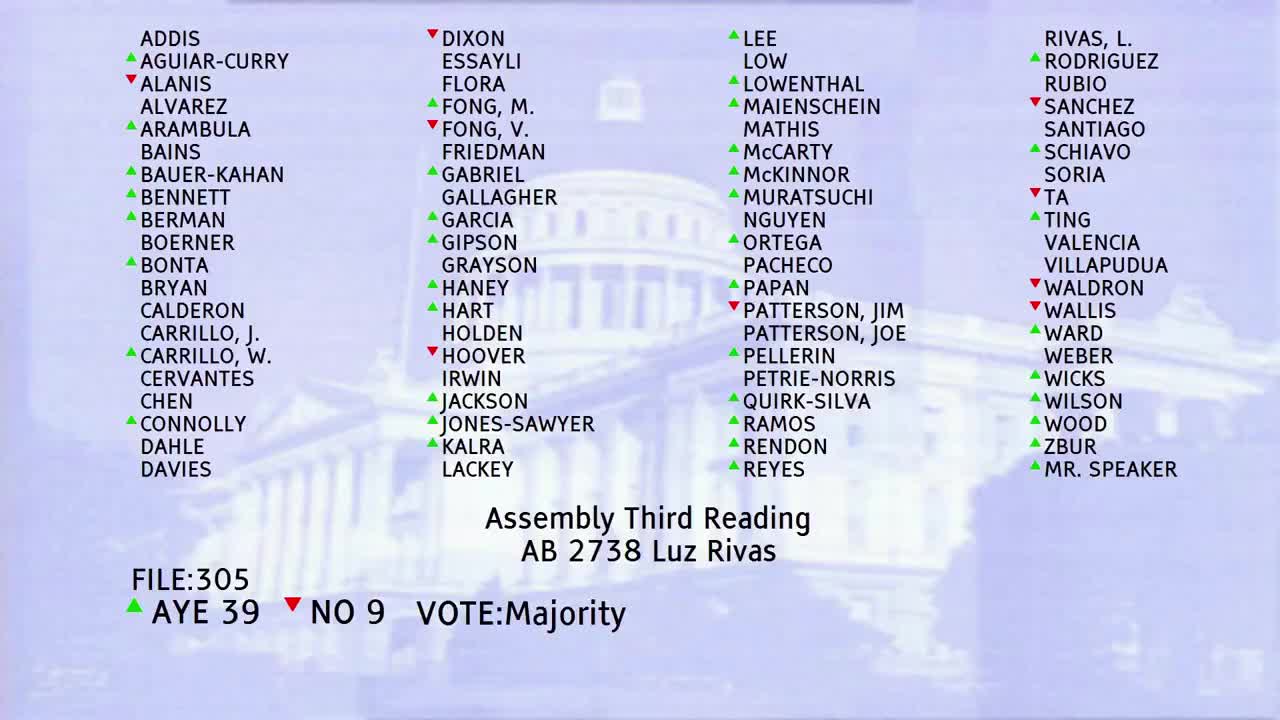 1MIN
Assembly Floor
 8MIN
Assembly Standing Committee on Judiciary
 10SEC
Assembly Standing Committee on Judiciary
 1MIN
Assembly Standing Committee on Judiciary
 21MIN
Assembly Standing Committee on Labor and Employment
Bill Author