AB 305: California Flood Protection Bond Act of 2024.
- Session Year: 2023-2024
- House: Assembly
- Latest Version Date: 2023-04-25
Current Status:
Failed
(2024-05-22: Re-referred to Com. on N.R. & W.)
Introduced
In Committee
First Chamber
In Committee
Second Chamber
Enacted
The California Drought, Water, Parks, Climate, Coastal Protection, and Outdoor Access For All Act of 2018, approved by the voters as Proposition 68 at the June 5, 2018, statewide primary election, authorizes the issuance of bonds in the amount of $4,000,000,000 pursuant to the State General Obligation Bond Law to finance a drought, water, parks, climate, coastal protection, and outdoor access for all program. The California Constitution requires a measure authorizing general obligation bonds to specify the single object or work to be funded by the bonds and further requires the measure to be approved by a 2/3 vote of each house of the Legislature and a majority of the voters.
This bill would enact the California Flood Protection Bond Act of 2024 which, if approved by the voters, would authorize the issuance of bonds in the amount of $4,500,000,000 pursuant to the State General Obligation Bond Law for flood protection projects, as specified. The bill would provide for the submission of these provisions to the voters at the November 5, 2024, statewide general election.
The California Drought, Water, Parks, Climate, Coastal Protection, and Outdoor Access For All Act of 2018, approved by the voters as Proposition 68 at the June 5, 2018, statewide primary election, authorizes the issuance of bonds in the amount of $4,000,000,000 pursuant to the State General Obligation Bond Law to finance a drought, water, parks, climate, coastal protection, and outdoor access for all program. The California Constitution requires a measure authorizing general obligation bonds to specify the single object or work to be funded by the bonds and further requires the measure to be approved by a 2/3 vote of each house of the Legislature and a majority of the voters.
This bill would enact the California Flood Protection Bond Act of 2024 which, if approved by the voters, would authorize the issuance of bonds in the amount of $3,750,000,000 $4,500,000,000 pursuant to the State General Obligation Bond Law for flood protection projects, as specified. The bill would provide for the submission of these provisions to the voters at the November 5, 2024, statewide general election.
The California Drought, Water, Parks, Climate, Coastal Protection, and Outdoor Access For All Act of 2018, approved by the voters as Proposition 68 at the June 5, 2018, statewide primary election, authorizes the issuance of bonds in the amount of $4,000,000,000 pursuant to the State General Obligation Bond Law to finance a drought, water, parks, climate, coastal protection, and outdoor access for all program. The California Constitution requires a measure authorizing general obligation bonds to specify the single object or work to be funded by the bonds and further requires the measure to be approved by a 2/3 vote of each house of the Legislature and a majority of the voters.
This bill would enact the California Flood Protection Bond Act of 2024 which, if approved by the voters, would authorize the issuance of bonds in the amount of $3,750,000,000 pursuant to the State General Obligation Bond Law for flood protection projects, as specified. The bill would provide for the submission of these provisions to the voters at the November 5, 2024, statewide general election.
Under existing law, various general obligation bond acts have been approved by the voters to provide funds for water projects, facilities, and programs. This bill would express the intent of the Legislature to enact subsequent legislation for a flood protection general obligation bond act, in an unspecified amount, that would be known as the California Flood Protection Bond Act of 2024, and would be submitted to the voters at the next general election.Under existing law, various general obligation bond acts have been approved by the voters to provide funds for water projects, facilities, and programs.
This bill would express the intent of the Legislature to enact subsequent legislation for a flood protection general obligation bond act, in an unspecified amount, that would be known as the California Flood Protection Bond Act of 2024, and would be submitted to the voters at the next general election.
This division shall be known, and may be cited, as the California Flood Protection Bond Act of 2024.
84000.5.To the extent practicable, a project that receives moneys pursuant to this division shall provide workforce education and training, contractor, and job opportunities for vulnerable populations or socially disadvantaged groups.
84001.As used in this division:
(a)Committee means the California Flood Protection Bond Finance Committee created pursuant to Section 84012.
(b)Department means the Department of Water Resources.
(c)Disadvantaged community has the same meaning as defined in Section 79505.5.
(d)Economically distressed area means a municipality with a population of 20,000 persons or fewer, a rural county, or a reasonably isolated and divisible segment of a larger municipality where the segment of the population is 20,000 persons or fewer, with an annual median household income that is less than 85 percent of the statewide median household income, and with one or more of the following conditions as determined by the department:
(1)Financial hardship.
(2)Unemployment rate at least 2 percent higher than the statewide average.
(3)Low population density.
(e)Fund means the California Flood Protection Fund of 2024 created pursuant to Section 84003.
(f)Severely disadvantaged community has the same meaning as defined in Section 116760.20 of the Health and Safety Code.
(g)Socially disadvantaged group means a group whose members have been subjected to racial, ethnic, or gender prejudice because of their identity as members of a group without regard to their individual qualities. These groups include all of the following:
(1)African Americans.
(2)Native Americans.
(3)Alaskan Natives.
(4)Hispanics.
(5)Asian Americans.
(6)Native Hawaiians and Pacific Islanders.
(7)Women.
(g)(h)State General Obligation Bond Law means the State General Obligation Bond Law (Chapter 4 (commencing with Section 16720) of Part 3 of Division 4 of Title 2 of the Government Code), as it may be amended from time to time.
84002.(a)(1)An amount that equals not more than 5 percent of the funds allocated for a grant program pursuant to this division may be used to pay the administrative costs of that program.
(2)The department may use up to 7.5 percent of the funds available pursuant to this division for technical assistance and capacity building for economically distressed areas, disadvantaged communities, and severely disadvantaged communities.
(b)In awarding grant funding pursuant to this division, the department shall give priority to economically distressed areas, disadvantaged communities, and severely disadvantaged communities.
(c)(1)For purposes of awarding funding under this division, a nonstate cost share of not less than 50 percent of the total proposal cost is required.
(2)Notwithstanding paragraph (1), the nonstate cost share requirement shall be reduced or waived for projects that directly benefit an economically distressed area, disadvantaged community, or severely disadvantaged community. To be eligible for the reduced cost share, at least 51 percent of the benefits of a project shall be provided to an economically distressed area, disadvantaged community, or severely disadvantaged community.
(d)Before disbursing grant funds pursuant to this division, the department shall develop and adopt program guidelines and project solicitation documents. Any guidelines and project solicitation documents developed pursuant to this section are not subject to Chapter 3.5 (commencing with Section 11340) of Part 1 of Division 3 of Title 2 of the Government Code.
(e)For purposes of providing grants of bond proceeds, the department shall develop and apply uniform criteria that allow for a broad range of applicants and projects that are eligible for funding and that permit the department to account for special considerations, including waivers of the cost share requirements described in subdivision (c).
84003.The proceeds of bonds, excluding those issued in accordance with Section 84019, issued and sold pursuant to this division shall be deposited in the California Flood Protection Fund of 2024, which is hereby created in the State Treasury. All moneys in the fund shall be available, upon appropriation by the Legislature, for the purposes of this division.
2.Flood Protection84005.(a)(1)The sum of one billion dollars ($1,000,000,000) shall be available, upon appropriation by the Legislature, to the department for multibenefit flood protection projects.
(2)(A)Of the funds made available for purposes of this subdivision, fifty million dollars ($50,000,000) shall be available for modernization of designated floodways in the Central Valley. The Central Valley Flood Protection Board shall use the funds described in this subparagraph, in accordance with Section 8609, to modernize the designated floodways of the Central Valley by updating data and mapping to meet the challenges of intense storm events and save lives and implement greater community resiliency. Special consideration shall be given to areas of high risk and areas that have experienced subsidence.
(B)Of the funds made available for purposes of this subdivision, one hundred million dollars ($100,000,000) shall be available for the Central Valley Flood Protection Board to identify and acquire lands and easements to allow floodwaters to flow into open space to limit damage to homes and infrastructure, save lives, and support groundwater recharge, floodplain restoration, and endangered species habitat. Priority shall be given to existing levees that are found to be insufficient to meet the national Federal Emergency Management Agency standard of flood protection, as defined in Section 65007 of the Government Code. It is the intent of the Legislature that grant funding provided pursuant to this subparagraph be expended by 2030.
(C)Of the funds made available for the purposes of this subdivision, five hundred million dollars ($500,000,000) shall be allocated for projects in the San Joaquin River Basin.
(b)The sum of one billion dollars ($1,000,000,000) shall be available, upon appropriation by the Legislature, to the department for urban flood risk reduction. Projects funded pursuant to this subdivision shall address flooding in urbanized areas and provide multiple benefits. Eligible projects shall include, but are not limited to, stormwater capture and reuse, planning and implementation of low-impact development, restoration of urban streams and watersheds, debris flow mitigation, and increasing permeable surfaces to help reduce flooding.
(c)(1)The sum of one billion dollars ($1,000,000,000) shall be available, upon appropriation by the Legislature, to the department for the improvement of dam safety and resilience pursuant to this subdivision.
(2)The department shall develop and administer the Dam Safety and Climate Resilience Local Assistance Program, which is hereby established. The purpose of the program is to provide state funding for repairs, rehabilitation, enhancements, and other dam safety projects at existing state jurisdictional dams and associated facilities.
(3)Dam safety and enhancement projects eligible to receive funding under the program include, but are not limited to, all of the following:
(A)Dam repairs to allow water storage to full capacity.
(B)New spillway projects and spillway repair projects at existing dams.
(C)Dam and reservoir seismic retrofit projects.
(D)Enhancement of water supply and downstream flood risk reduction, such as the implementation of forecast-informed reservoir operations.
(E)One-time projects to remove sediment resulting from wildfires or extraordinary storm events.
(4)Of the funds made available for purposes of this subdivision, the department shall provide grants to owners of state jurisdictional dams for dam safety projects that provide the following public benefits, in order of priority:
(A)Protection of public safety.
(B)Restoration of water storage.
(C)Flood risk reduction.
(D)Enhancement of water supply reliability.
(E)Enhancement, protection, or restoration of habitat for fish and wildlife.
(F)Protection of water quality.
(d)The sum of one billion dollars ($1,000,000,000) shall be available, upon appropriation by the Legislature, to the department for Sacramento-San Joaquin Valley flood management. Projects funded pursuant to this subdivision shall include levee setbacks, projects connecting rivers with floodplains, enhancement of floodplains and bypasses, groundwater recharge projects, and land acquisitions and easements necessary for these projects.
(e)The sum of five hundred million dollars ($500,000,000) shall be available, upon appropriation by the Legislature, to the department for levee rehabilitation and upgrades. The funds described in this subdivision shall be used for new construction, levee rehabilitation, seismic improvements, and improving flood protection for urban areas to the urban level of flood protection.
(f)Costs allowable under this section include costs incidentally but directly related to construction or acquisition, including, but not limited to, planning, engineering, construction management, architectural, and other design work, environmental impact reports and assessments, required mitigation expenses, appraisals, legal expenses, site acquisitions, and necessary easements.
3.Fiscal Provisions84010.(a)Bonds in the total amount of four billion five hundred million dollars ($4,500,000,000), not including the amount of any refunding bonds issued in accordance with Section 84019, may be issued and sold for the purposes expressed in this division and to reimburse the General Obligation Bond Expense Revolving Fund pursuant to Section 16724.5 of the Government Code. The bonds, when sold, issued, and delivered, shall be and constitute a valid and binding obligation of the State of California, and the full faith and credit of the State of California is hereby pledged for the punctual payment of both principal of, and interest on, the bonds as the principal and interest become due and payable.
(b)The Treasurer shall issue and sell the bonds authorized in subdivision (a) in the amount determined by the committee to be necessary or desirable pursuant to Section 84013. The bonds shall be issued and sold upon the terms and conditions specified in a resolution to be adopted by the committee pursuant to Section 16731 of the Government Code.
84011.(a)The bonds authorized by this division shall be prepared, executed, issued, sold, paid, and redeemed as provided in the State General Obligation Bond Law, and all of the provisions of that law apply to the bonds and to this division and are hereby incorporated in this division as though set forth in full in this division, except that subdivisions (a) and (b) of Section 16727 of the Government Code shall not apply.
(b)For purposes of this division, the references to committee in the State General Obligation Bond Law shall mean the California Flood Protection Bond Finance Committee created pursuant to Section 84012, and the references to board in the State General Obligation Bond Law shall mean the ____.
84012.(a)Solely for the purpose of authorizing the issuance and sale pursuant to the State General Obligation Bond Law of the bonds authorized by this division, the California Flood Protection Bond Finance Committee is hereby created.
(b)The committee consists of the Controller, the Treasurer, and the Director of Finance. Notwithstanding any other law, any member may designate a representative to act as that member in the members place for all purposes, as though the member were personally present.
(c)The Treasurer shall serve as chairperson of the committee. A majority of the committee may act for the committee.
84013.The committee shall determine by resolution whether or not it is necessary or desirable to issue and sell bonds authorized pursuant to this division in order to carry out the actions specified in this division and, if so, the amount of bonds to be issued and sold. Successive issues of bonds may be authorized and sold to carry out those actions progressively, and it is not necessary that all of the bonds authorized to be issued be sold at any one time.
84014.There shall be collected each year and in the same manner and at the same time as other state revenue is collected, in addition to the ordinary revenues of the state, a sum in an amount required to pay the principal of, and interest on, the bonds becoming due each year. It is the duty of all officers charged by law with any duty in regard to the collection of the revenue to do and perform each and every act that is necessary to collect that additional sum.
84015.Notwithstanding Section 13340 of the Government Code, there is hereby continuously appropriated from the General Fund, for the purposes of this division and without regard to fiscal years, an amount that equals the total of the following:
(a)The sum annually necessary to pay the principal of, and interest on, bonds issued and sold pursuant to this division, as the principal and interest become due and payable.
(b)The sum necessary to carry out Section 84017.
84016.The board may request the Pooled Money Investment Board to make a loan from the Pooled Money Investment Account, in accordance with Section 16312 of the Government Code, for the purpose of carrying out this division less any amount withdrawn pursuant to Section 84017 and not yet returned to the General Fund. The amount of the request shall not exceed the amount of the unsold bonds that the committee has, by resolution, authorized to be sold for the purpose of carrying out this division, excluding any refunding bonds authorized pursuant to Section 84019, less any amount loaned pursuant to this section and not yet repaid and any amount withdrawn from the General Fund pursuant to Section 84017 and not yet returned to the General Fund. The board shall execute any documents required by the Pooled Money Investment Board to obtain and repay the loan. Any amounts loaned shall be deposited in the fund to be allocated by the board in accordance with this division.
84017.For the purposes of carrying out this division, the Director of Finance may authorize the withdrawal from the General Fund of an amount not to exceed the amount of the unsold bonds that have been authorized by the committee to be sold for the purpose of carrying out this division, excluding any refunding bonds authorized pursuant to Section 84019, less any amount loaned pursuant to Section 84016 and not yet repaid, and any amount withdrawn from the General Fund pursuant to this section and not yet returned to the General Fund. Any amounts withdrawn shall be deposited in the fund. Any moneys made available under this section shall be returned to the General Fund from proceeds received from the sale of bonds for the purpose of carrying out this division.
84018.All moneys deposited in the fund that are derived from premium and accrued interest on bonds sold pursuant to this division shall be reserved in the fund and shall be available for transfer to the General Fund as a credit to expenditures for bond interest, except those amounts derived from premium may be reserved and used to pay the cost of bond issuance before any transfer to the General Fund.
84019.The bonds issued and sold pursuant to this division may be refunded in accordance with Article 6 (commencing with Section 16780) of Chapter 4 of Part 3 of Division 4 of Title 2 of the Government Code, which is a part of the State General Obligation Bond Law. Approval by the voters of the state for the issuance of the bonds described in this division includes the approval of the issuance of any bonds issued to refund any bonds originally issued under this division or any previously issued refunding bonds. Any bond refunded with the proceeds of refunding bonds as authorized by this section may be legally defeased to the extent permitted by law in the manner and to the extent set forth in the resolution, as amended from time to time, authorizing that refunded bond.
84020.Notwithstanding any other provision of this division, or of the State General Obligation Bond Law, if the Treasurer sells bonds pursuant to this division that include a bond counsel opinion to the effect that the interest on the bonds is excluded from gross income for federal tax purposes under designated conditions or is otherwise entitled to any federal tax advantage, the Treasurer may maintain separate accounts for the investment of bond proceeds and for the investment of earnings on those proceeds. The Treasurer may use or direct the use of those proceeds or earnings to pay any rebate, penalty, or other payment required under federal law or take any other action with respect to the investment and use of those bond proceeds or earnings required or desirable under federal law to maintain the tax exempt status of those bonds and to obtain any other advantage under federal law on behalf of the funds of this state.
84021.The proceeds from the sale of bonds authorized by this division are not proceeds of taxes as that term is used in Article XIIIB of the California Constitution, and the disbursement of these proceeds is not subject to the limitations imposed by that article.
SEC. 2.(a)Section 1 of this act shall take effect upon approval by the voters of the California Flood Protection Bond Act of 2024, as set forth in Section 1 of this act.
(b)Notwithstanding Section 9040 of the Elections Code or any other law, Section 1 of this act shall be submitted to the voters at the November 5, 2024, statewide general election in accordance with provisions of the Government Code and the Elections Code governing the submission of a statewide measure to the voters.
This division shall be known, and may be cited, as the California Flood Protection Bond Act of 2024.
84001.As used in this division:
(a)Committee means the California Flood Protection Bond Finance Committee created pursuant to Section 84012.
(b)Department means the Department of Water Resources.
(c)Disadvantaged community has the same meaning as defined in Section 79505.5.
(d)Economically distressed area means a municipality with a population of 20,000 persons or fewer, a rural county, or a reasonably isolated and divisible segment of a larger municipality where the segment of the population is 20,000 persons or fewer, with an annual median household income that is less than 85 percent of the statewide median household income, and with one or more of the following conditions as determined by the department:
(1)Financial hardship.
(2)Unemployment rate at least 2 percent higher than the statewide average.
(3)Low population density.
(b)(e)Fund means the California Flood Protection Fund of 2024 created pursuant to Section 84002. 84003.
(f)Severely disadvantaged community has the same meaning as defined in Section 116760.20 of the Health and Safety Code.
(c)(g)State General Obligation Bond Law means the State General Obligation Bond Law (Chapter 4 (commencing with Section 16720) of Part 3 of Division 4 of Title 2 of the Government Code), as it may be amended from time to time.
84002.(a)(1)An amount that equals not more than 5 percent of the funds allocated for a grant program pursuant to this division may be used to pay the administrative costs of that program.
(2)The department may use up to 7.5 percent of the funds available pursuant to this division for technical assistance and capacity building for economically distressed areas, disadvantaged communities, and severely disadvantaged communities.
(b)In awarding grant funding pursuant to this division, the department shall give priority to economically distressed areas, disadvantaged communities, and severely disadvantaged communities.
(c)(1)For purposes of awarding funding under this division, a nonstate cost share of not less than 50 percent of the total proposal cost is required.
(2)Notwithstanding paragraph (1), the nonstate cost share requirement shall be reduced or waived for projects that directly benefit an economically distressed area, disadvantaged community, or severely disadvantaged community. To be eligible for the reduced cost share, at least 51 percent of the benefits of a project shall be provided to an economically distressed area, disadvantaged community, or severely disadvantaged community.
(d)Before disbursing grant funds pursuant to this division, the department shall develop and adopt program guidelines and project solicitation documents. Any guidelines and project solicitation documents developed pursuant to this section are not subject to Chapter 3.5 (commencing with Section 11340) of Part 1 of Division 3 of Title 2 of the Government Code.
(e)For purposes of providing grants of bond proceeds, the department shall develop and apply uniform criteria that allow for a broad range of applicants and projects that are eligible for funding and that permit the department to account for special considerations, including waivers of the cost share requirements described in subdivision (c).
84002.84003.The proceeds of bonds, excluding those issued in accordance with Section 84019, issued and sold pursuant to this division shall be deposited in the California Flood Protection Fund of 2024, which is hereby created in the State Treasury. All moneys in the fund shall be available, upon appropriation by the Legislature, for the purposes of this division.
2.Flood Protection84005.(a)(1)The sum of one billion dollars ($1,000,000,000) shall be available, upon appropriation by the Legislature, to ____ the department for multibenefit flood protection projects.
(2)(A)Of the funds made available for purposes of this subdivision, twenty fifty million dollars ($20,000,000) ($50,000,000) shall be available for modernization of designated floodways in the central valley. Central Valley. The Central Valley Flood Protection Board shall use the funds described in this subparagraph, in accordance with Section 8609, to modernize the designated floodways of the central valley Central Valley by updating data and mapping to meet the challenges of intense storm events and save lives and implement greater community resiliency. Special consideration shall be given to areas of high risk and areas that have experienced subsidence.
(B)Of the funds made available for purposes of this subdivision, one hundred million dollars ($100,000,000) shall be available for the central valley Central Valley Flood Protection Board to identify and acquire lands and easements to allow floodwaters to flow into open space to limit damage to homes and infrastructure, save lives, and support groundwater recharge, floodplain restoration, and endangered species habitat. Priority shall be given to existing levees that are found to be insufficient to meet the national Federal Emergency Management Agency standard of flood protection, as defined in Section 65007 of the Government Code. It is the intent of the Legislature that grant funding provided pursuant to this subparagraph be expended by 2030.
(C)Of the funds made available for the purposes of this subdivision, five hundred million dollars ($500,000,000) shall be allocated for projects in the San Joaquin River Basin.
(b)The sum of one billion dollars ($1,000,000,000) shall be available, upon appropriation by the Legislature, to ____ the department for urban flood risk reduction. Projects funded pursuant to this subdivision shall address flooding in urbanized areas and provide multiple benefits. Eligible projects shall include, but are not limited to, stormwater capture and reuse, planning and implementation of low-impact development, restoration of urban streams and watersheds, debris flow mitigation, and increasing permeable surfaces to help reduce flooding.
(c)(1)The sum of seven hundred fifty million dollars ($750,000,000) one billion dollars ($1,000,000,000) shall be available, upon appropriation by the Legislature, to ____ for grants to provide technical, planning, design, and construction assistance and rehabilitation of eligible high-hazard-potential dams. the department for the improvement of dam safety and resilience pursuant to this subdivision.
(2)The department shall develop and administer the Dam Safety and Climate Resilience Local Assistance Program, which is hereby established. The purpose of the program is to provide state funding for repairs, rehabilitation, enhancements, and other dam safety projects at existing state jurisdictional dams and associated facilities.
(3)Dam safety and enhancement projects eligible to receive funding under the program include, but are not limited to, all of the following:
(A)Dam repairs to allow water storage to full capacity.
(B)New spillway projects and spillway repair projects at existing dams.
(C)Dam and reservoir seismic retrofit projects.
(D)Enhancement of water supply and downstream flood risk reduction, such as the implementation of forecast-informed reservoir operations.
(E)One-time projects to remove sediment resulting from wildfires or extraordinary storm events.
(4)Of the funds made available for purposes of this subdivision, the department shall provide grants to owners of state jurisdictional dams for dam safety projects that provide the following public benefits, in order of priority:
(A)Protection of public safety.
(B)Restoration of water storage.
(C)Flood risk reduction.
(D)Enhancement of water supply reliability.
(E)Enhancement, protection, or restoration of habitat for fish and wildlife.
(F)Protection of water quality.
(d)The sum of five hundred million dollars ($500,000,000) one billion dollars ($1,000,000,000) shall be available, upon appropriation by the Legislature, to ____ the department for Sacramento-San Joaquin Delta Valley flood management. Projects funded pursuant to this subdivision shall include levee setbacks, projects connecting rivers with floodplains, enhancement of floodplains and bypasses, groundwater recharge projects, and land acquisitions and easements necessary for these projects.
(e)The sum of five hundred million dollars ($500,000,000) shall be available, upon appropriation by the Legislature, to ____ the department for levee rehabilitation and upgrades. The funds described in this subdivision shall be used for new construction, levee rehabilitation, seismic improvements, and improving flood protection for urban areas to the urban level of flood protection.
(f)Costs allowable under this section include costs incidentally but directly related to construction or acquisition, including, but not limited to, planning, engineering, construction management, architectural, and other design work, environmental impact reports and assessments, required mitigation expenses, appraisals, legal expenses, site acquisitions, and necessary easements.
3.Fiscal Provisions84010.(a)Bonds in the total amount of three billion seven hundred fifty million dollars ($3,750,000,000), four billion five hundred million dollars ($4,500,000,000), not including the amount of any refunding bonds issued in accordance with Section 84019, may be issued and sold for the purposes expressed in this division and to reimburse the General Obligation Bond Expense Revolving Fund pursuant to Section 16724.5 of the Government Code. The bonds, when sold, issued, and delivered, shall be and constitute a valid and binding obligation of the State of California, and the full faith and credit of the State of California is hereby pledged for the punctual payment of both principal of, and interest on, the bonds as the principal and interest become due and payable.
(b)The Treasurer shall issue and sell the bonds authorized in subdivision (a) in the amount determined by the committee to be necessary or desirable pursuant to Section 84013. The bonds shall be issued and sold upon the terms and conditions specified in a resolution to be adopted by the committee pursuant to Section 16731 of the Government Code.
84011.(a)The bonds authorized by this division shall be prepared, executed, issued, sold, paid, and redeemed as provided in the State General Obligation Bond Law, and all of the provisions of that law apply to the bonds and to this division and are hereby incorporated in this division as though set forth in full in this division, except that subdivisions (a) and (b) of Section 16727 of the Government Code shall not apply.
(b)For purposes of this division, the references to committee in the State General Obligation Bond Law shall mean the California Flood Protection Bond Finance Committee created pursuant to Section 84012, and the references to board in the State General Obligation Bond Law shall mean the ____.
84012.(a)Solely for the purpose of authorizing the issuance and sale pursuant to the State General Obligation Bond Law of the bonds authorized by this division, the California Flood Protection Bond Finance Committee is hereby created.
(b)The committee consists of the Controller, the Treasurer, and the Director of Finance. Notwithstanding any other law, any member may designate a representative to act as that member in the members place for all purposes, as though the member were personally present.
(c)The Treasurer shall serve as chairperson of the committee. A majority of the committee may act for the committee.
84013.The committee shall determine by resolution whether or not it is necessary or desirable to issue and sell bonds authorized pursuant to this division in order to carry out the actions specified in this division and, if so, the amount of bonds to be issued and sold. Successive issues of bonds may be authorized and sold to carry out those actions progressively, and it is not necessary that all of the bonds authorized to be issued be sold at any one time.
84014.There shall be collected each year and in the same manner and at the same time as other state revenue is collected, in addition to the ordinary revenues of the state, a sum in an amount required to pay the principal of, and interest on, the bonds becoming due each year. It is the duty of all officers charged by law with any duty in regard to the collection of the revenue to do and perform each and every act that is necessary to collect that additional sum.
84015.Notwithstanding Section 13340 of the Government Code, there is hereby continuously appropriated from the General Fund, for the purposes of this division and without regard to fiscal years, an amount that equals the total of the following:
(a)The sum annually necessary to pay the principal of, and interest on, bonds issued and sold pursuant to this division, as the principal and interest become due and payable.
(b)The sum necessary to carry out Section 84017.
84016.The board may request the Pooled Money Investment Board to make a loan from the Pooled Money Investment Account, in accordance with Section 16312 of the Government Code, for the purpose of carrying out this division less any amount withdrawn pursuant to Section 84017 and not yet returned to the General Fund. The amount of the request shall not exceed the amount of the unsold bonds that the committee has, by resolution, authorized to be sold for the purpose of carrying out this division, excluding any refunding bonds authorized pursuant to Section 84019, less any amount loaned pursuant to this section and not yet repaid and any amount withdrawn from the General Fund pursuant to Section 84017 and not yet returned to the General Fund. The board shall execute any documents required by the Pooled Money Investment Board to obtain and repay the loan. Any amounts loaned shall be deposited in the fund to be allocated by the board in accordance with this division.
84017.For the purposes of carrying out this division, the Director of Finance may authorize the withdrawal from the General Fund of an amount not to exceed the amount of the unsold bonds that have been authorized by the committee to be sold for the purpose of carrying out this division, excluding any refunding bonds authorized pursuant to Section 84019, less any amount loaned pursuant to Section 84016 and not yet repaid, and any amount withdrawn from the General Fund pursuant to this section and not yet returned to the General Fund. Any amounts withdrawn shall be deposited in the fund. Any moneys made available under this section shall be returned to the General Fund from proceeds received from the sale of bonds for the purpose of carrying out this division.
84018.All moneys deposited in the fund that are derived from premium and accrued interest on bonds sold pursuant to this division shall be reserved in the fund and shall be available for transfer to the General Fund as a credit to expenditures for bond interest, except those amounts derived from premium may be reserved and used to pay the cost of bond issuance before any transfer to the General Fund.
84019.The bonds issued and sold pursuant to this division may be refunded in accordance with Article 6 (commencing with Section 16780) of Chapter 4 of Part 3 of Division 4 of Title 2 of the Government Code, which is a part of the State General Obligation Bond Law. Approval by the voters of the state for the issuance of the bonds described in this division includes the approval of the issuance of any bonds issued to refund any bonds originally issued under this division or any previously issued refunding bonds. Any bond refunded with the proceeds of refunding bonds as authorized by this section may be legally defeased to the extent permitted by law in the manner and to the extent set forth in the resolution, as amended from time to time, authorizing that refunded bond.
84020.Notwithstanding any other provision of this division, or of the State General Obligation Bond Law, if the Treasurer sells bonds pursuant to this division that include a bond counsel opinion to the effect that the interest on the bonds is excluded from gross income for federal tax purposes under designated conditions or is otherwise entitled to any federal tax advantage, the Treasurer may maintain separate accounts for the investment of bond proceeds and for the investment of earnings on those proceeds. The Treasurer may use or direct the use of those proceeds or earnings to pay any rebate, penalty, or other payment required under federal law or take any other action with respect to the investment and use of those bond proceeds or earnings required or desirable under federal law to maintain the tax exempt status of those bonds and to obtain any other advantage under federal law on behalf of the funds of this state.
84021.The proceeds from the sale of bonds authorized by this division are not proceeds of taxes as that term is used in Article XIIIB of the California Constitution, and the disbursement of these proceeds is not subject to the limitations imposed by that article.
SEC. 2.(a)Section 1 of this act shall take effect upon approval by the voters of the California Flood Protection Bond Act of 2024, as set forth in Section 1 of this act.
(b)Notwithstanding Section 9040 of the Elections Code or any other law, Section 1 of this act shall be submitted to the voters at the November 5, 2024, statewide general election in accordance with provisions of the Government Code and the Elections Code governing the submission of a statewide measure to the voters.
This division shall be known, and may be cited, as the California Flood Protection Bond Act of 2024.
84001.As used in this division:
(a)Committee means the California Flood Protection Bond Finance Committee created pursuant to Section 84012.
(b)Fund means the California Flood Protection Fund of 2024 created pursuant to Section 84002.
(c)State General Obligation Bond Law means the State General Obligation Bond Law (Chapter 4 (commencing with Section 16720) of Part 3 of Division 4 of Title 2 of the Government Code), as it may be amended from time to time.
84002.The proceeds of bonds, excluding those issued in accordance with Section 84019, issued and sold pursuant to this division shall be deposited in the California Flood Protection Fund of 2024, which is hereby created in the State Treasury. All moneys in the fund shall be available, upon appropriation by the Legislature, for the purposes of this division.
2.Flood Protection84005.(a)(1)The sum of one billion dollars ($1,000,000,000) shall be available, upon appropriation by the Legislature, to ____ for multibenefit flood protection projects.
(2)(A)Of the funds made available for purposes of this subdivision, twenty million dollars ($20,000,000) shall be available for modernization of designated floodways in the central valley. The Central Valley Flood Protection Board shall use the funds described in this subparagraph, in accordance with Section 8609, to modernize the designated floodways of the central valley by updating data and mapping to meet the challenges of intense storm events and save lives and implement greater community resiliency.
(B)Of the funds made available for purposes of this subdivision, one hundred million dollars ($100,000,000) shall be available for the central valley Flood Protection Board to identify and acquire lands and easements to allow floodwaters to flow into open space to limit damage to homes and infrastructure, save lives, and support groundwater recharge, floodplain restoration, and endangered species habitat.
(b)The sum of one billion dollars ($1,000,000,000) shall be available, upon appropriation by the Legislature, to ____ for urban flood risk reduction. Projects funded pursuant to this subdivision shall address flooding in urbanized areas and provide multiple benefits. Eligible projects shall include, but are not limited to, stormwater capture and reuse, planning and implementation of low-impact development, restoration of urban streams and watersheds, and increasing permeable surfaces to help reduce flooding.
(c)The sum of seven hundred fifty million dollars ($750,000,000) shall be available, upon appropriation by the Legislature, to ____ for grants to provide technical, planning, design, and construction assistance and rehabilitation of eligible high-hazard-potential dams.
(d)The sum of five hundred million dollars ($500,000,000) shall be available, upon appropriation by the Legislature, to ____ for Sacramento-San Joaquin Delta flood management. Projects funded pursuant to this subdivision shall include levee setbacks, projects connecting rivers with floodplains, enhancement of floodplains and bypasses, groundwater recharge projects, and land acquisitions and easements necessary for these projects.
(e)The sum of five hundred million dollars ($500,000,000) shall be available, upon appropriation by the Legislature, to ____ for levee rehabilitation and upgrades. The funds described in this subdivision shall be used for new construction, levee rehabilitation, seismic improvements, and improving flood protection for urban areas to the urban level of flood protection.
(f)Costs allowable under this section include costs incidentally but directly related to construction or acquisition, including, but not limited to, planning, engineering, construction management, architectural, and other design work, environmental impact reports and assessments, required mitigation expenses, appraisals, legal expenses, site acquisitions, and necessary easements.
3.Fiscal Provisions84010.(a)Bonds in the total amount of three billion seven hundred fifty million dollars ($3,750,000,000), not including the amount of any refunding bonds issued in accordance with Section 84019, may be issued and sold for the purposes expressed in this division and to reimburse the General Obligation Bond Expense Revolving Fund pursuant to Section 16724.5 of the Government Code. The bonds, when sold, issued, and delivered, shall be and constitute a valid and binding obligation of the State of California, and the full faith and credit of the State of California is hereby pledged for the punctual payment of both principal of, and interest on, the bonds as the principal and interest become due and payable.
(b)The Treasurer shall issue and sell the bonds authorized in subdivision (a) in the amount determined by the committee to be necessary or desirable pursuant to Section 84013. The bonds shall be issued and sold upon the terms and conditions specified in a resolution to be adopted by the committee pursuant to Section 16731 of the Government Code.
84011.(a)The bonds authorized by this division shall be prepared, executed, issued, sold, paid, and redeemed as provided in the State General Obligation Bond Law, and all of the provisions of that law apply to the bonds and to this division and are hereby incorporated in this division as though set forth in full in this division, except that subdivisions (a) and (b) of Section 16727 of the Government Code shall not apply.
(b)For purposes of this division, the references to committee in the State General Obligation Bond Law shall mean the California Flood Protection Bond Finance Committee created pursuant to Section 84012, and the references to board in the State General Obligation Bond Law shall mean the ____.
84012.(a)Solely for the purpose of authorizing the issuance and sale pursuant to the State General Obligation Bond Law of the bonds authorized by this division, the California Flood Protection Bond Finance Committee is hereby created.
(b)The committee consists of the Controller, the Treasurer, and the Director of Finance. Notwithstanding any other law, any member may designate a representative to act as that member in the members place for all purposes, as though the member were personally present.
(c)The Treasurer shall serve as chairperson of the committee. A majority of the committee may act for the committee.
84013.The committee shall determine by resolution whether or not it is necessary or desirable to issue and sell bonds authorized pursuant to this division in order to carry out the actions specified in this division and, if so, the amount of bonds to be issued and sold. Successive issues of bonds may be authorized and sold to carry out those actions progressively, and it is not necessary that all of the bonds authorized to be issued be sold at any one time.
84014.There shall be collected each year and in the same manner and at the same time as other state revenue is collected, in addition to the ordinary revenues of the state, a sum in an amount required to pay the principal of, and interest on, the bonds becoming due each year. It is the duty of all officers charged by law with any duty in regard to the collection of the revenue to do and perform each and every act that is necessary to collect that additional sum.
84015.Notwithstanding Section 13340 of the Government Code, there is hereby continuously appropriated from the General Fund, for the purposes of this division and without regard to fiscal years, an amount that equals the total of the following:
(a)The sum annually necessary to pay the principal of, and interest on, bonds issued and sold pursuant to this division, as the principal and interest become due and payable.
(b)The sum necessary to carry out Section 84017.
84016.The board may request the Pooled Money Investment Board to make a loan from the Pooled Money Investment Account, in accordance with Section 16312 of the Government Code, for the purpose of carrying out this division less any amount withdrawn pursuant to Section 84017 and not yet returned to the General Fund. The amount of the request shall not exceed the amount of the unsold bonds that the committee has, by resolution, authorized to be sold for the purpose of carrying out this division, excluding any refunding bonds authorized pursuant to Section 84019, less any amount loaned pursuant to this section and not yet repaid and any amount withdrawn from the General Fund pursuant to Section 84017 and not yet returned to the General Fund. The board shall execute any documents required by the Pooled Money Investment Board to obtain and repay the loan. Any amounts loaned shall be deposited in the fund to be allocated by the board in accordance with this division.
84017.For the purposes of carrying out this division, the Director of Finance may authorize the withdrawal from the General Fund of an amount not to exceed the amount of the unsold bonds that have been authorized by the committee to be sold for the purpose of carrying out this division, excluding any refunding bonds authorized pursuant to Section 84019, less any amount loaned pursuant to Section 84016 and not yet repaid, and any amount withdrawn from the General Fund pursuant to this section and not yet returned to the General Fund. Any amounts withdrawn shall be deposited in the fund. Any moneys made available under this section shall be returned to the General Fund from proceeds received from the sale of bonds for the purpose of carrying out this division.
84018.All moneys deposited in the fund that are derived from premium and accrued interest on bonds sold pursuant to this division shall be reserved in the fund and shall be available for transfer to the General Fund as a credit to expenditures for bond interest, except those amounts derived from premium may be reserved and used to pay the cost of bond issuance before any transfer to the General Fund.
84019.The bonds issued and sold pursuant to this division may be refunded in accordance with Article 6 (commencing with Section 16780) of Chapter 4 of Part 3 of Division 4 of Title 2 of the Government Code, which is a part of the State General Obligation Bond Law. Approval by the voters of the state for the issuance of the bonds described in this division includes the approval of the issuance of any bonds issued to refund any bonds originally issued under this division or any previously issued refunding bonds. Any bond refunded with the proceeds of refunding bonds as authorized by this section may be legally defeased to the extent permitted by law in the manner and to the extent set forth in the resolution, as amended from time to time, authorizing that refunded bond.
84020.Notwithstanding any other provision of this division, or of the State General Obligation Bond Law, if the Treasurer sells bonds pursuant to this division that include a bond counsel opinion to the effect that the interest on the bonds is excluded from gross income for federal tax purposes under designated conditions or is otherwise entitled to any federal tax advantage, the Treasurer may maintain separate accounts for the investment of bond proceeds and for the investment of earnings on those proceeds. The Treasurer may use or direct the use of those proceeds or earnings to pay any rebate, penalty, or other payment required under federal law or take any other action with respect to the investment and use of those bond proceeds or earnings required or desirable under federal law to maintain the tax exempt status of those bonds and to obtain any other advantage under federal law on behalf of the funds of this state.
84021.The proceeds from the sale of bonds authorized by this division are not proceeds of taxes as that term is used in Article XIIIB of the California Constitution, and the disbursement of these proceeds is not subject to the limitations imposed by that article.
SEC. 2.(a)Section 1 of this act shall take effect upon approval by the voters of the California Flood Protection Bond Act of 2024, as set forth in Section 1 of this act.
(b)Notwithstanding Section 9040 of the Elections Code or any other law, Section 1 of this act shall be submitted to the voters at the November 5, 2024, statewide general election in accordance with provisions of the Government Code and the Elections Code governing the submission of a statewide measure to the voters.
SECTION 1.It is the intent of the Legislature to enact subsequent legislation for a flood protection general obligation bond act, in the amount of ____ dollars ($____), to be known as the California Flood Protection Bond Act of 2024 and to be submitted to the voters at the next general election.It is the intent of the Legislature to enact subsequent legislation for a flood protection general obligation bond act, in the amount of ____ dollars ($____), to be known as the California Flood Protection Bond Act of 2024 and to be submitted to the voters at the next general election.
|
Date
|
Status
|
|---|---|
| May 22, 2024 | Re-referred to Com. on N.R. & W. |
| May 13, 2024 | Re-referred to Com. on RLS. |
| May 13, 2024 | Withdrawn from committee. |
| Jun 14, 2023 | Referred to Coms. on N.R. & W. and GOV. & F. |
| Jun 1, 2023 | In Senate. Read first time. To Com. on RLS. for assignment. |
| May 31, 2023 | Read third time. Passed. Ordered to the Senate. (Ayes 75. Noes 0. Page 1968.) |
| May 18, 2023 | Read second time. Ordered to third reading. |
| May 18, 2023 | From committee: Do pass. (Ayes 13. Noes 1.) (May 18). |
| May 10, 2023 | In committee: Set, first hearing. Referred to APPR. suspense file. |
| Apr 26, 2023 | Re-referred to Com. on APPR. |
| Apr 25, 2023 | Read second time and amended. |
| Apr 24, 2023 | From committee: Amend, and do pass as amended and re-refer to Com. on APPR. (Ayes 13. Noes 1.) (April 24). |
| Apr 18, 2023 | Re-referred to Com. on W., P., & W. |
| Apr 17, 2023 | From committee chair, with author's amendments: Amend, and re-refer to Com. on W., P., & W. Read second time and amended. |
| Mar 27, 2023 | Re-referred to Com. on W., P., & W. |
| Mar 23, 2023 | From committee chair, with author's amendments: Amend, and re-refer to Com. on W., P., & W. Read second time and amended. |
| Mar 23, 2023 | Referred to Com. on W., P., & W. |
| Jan 27, 2023 | From printer. May be heard in committee February 26. |
| Jan 26, 2023 | Read first time. To print. |
|
Date
|
Description
|
Location
|
Votes
|
|
|---|---|---|---|---|
| May 31, 2023 | AB 305 Villapudua Assembly Third Reading | Assembly Floor |
Passed |
|
| May 18, 2023 | Do pass. | Assembly Standing Committee on Appropriations |
Passed |
|
| Apr 24, 2023 | Do pass as amended and be re-referred to the Committee on [Appropriations] | Assembly Standing Committee on Water, Parks, and Wildlife |
Passed |
This list shows positions taken on this bill by organizations on the date displayed, which is linked to the original source.
Positions by individuals are not included.
ASSEMBLY THIRD READING
ATR Bill Id:AB 305
Author:(Villapudua)
As Amended Ver:April 25, 2023
2/3 vote
SUMMARY
Places a $4.5 billion flood protection and dam safety improvement bond before the voters on the November 5, 2024, General Election ballot.
Major Provisions
- Allocates $1 billion to the Department of Water Resources (DWR) for multibenefit flood protection projects. Provides that a portion of these be sub-allocated as follows:
- $50 million to the Central Valley Flood Protection Board (CVFPB) to modernize and update mapping of designated floodways in the Central Valley;
- $100 million to CVFPB to identify and acquire lands or easements that can be flooded to protect the public, recharge groundwater, restore floodplains, and provide habitat. Priority for these funds shall be for lands near levees that do not meet current standards; and
- $500 million for multibenefit flood protection projects in the San Joaquin Valley.
- Allocates $1 billion to DWR to reduce urban flood risk. Provides that funding may be for projects that include stormwater capture and reuse, low-impact development features, restoration of urban streams and watersheds, and debris flow mitigation.
- Allocates $1 billion to DWR for improvement of dam safety pursuant to the Dam Safety and Climate Resilience Local Assistance Program (Dam Safety Program) established by this bill (see #6, below).
- Allocates $1 billion to DWR for flood management projects in the Central Valley including, levee setbacks, floodplain restoration, bypasses, groundwater recharge, and land or easement acquisition necessary for these projects.
- Allocates $500 million to DWR for levee rehabilitation and upgrades.
- Establishes the Dam Safety Program within DWR to provide funding for repairs, rehabilitation, enhancements, and other dam safety projects at existing state jurisdictional dams. Requires that the Dam Safety Program shall afford funding for projects that provide public benefits in the following priority order:
- Protection of public safety;
- Water storage restoration;
- Flood risk reduction;
- Enhancement of water supply reliability;
- Enhancement, protection, or restoration of fish and wildlife habitat; and
- Protection of water quality.
COMMENTS
Local, federal, and state agencies have developed a variety of physical structures to regulate flood flows including levees, channels, and weirs to convey and control floodwaters as well as dams, reservoirs, and bypasses to collect or store water. Physical structures are sometimes paired with nonstructural approaches – like limiting development in floodplains – for flood management. Flood infrastructure across California includes more than 20,000 miles of levees and channels and more than 1,500 dams and reservoirs. Most of these facilities are owned and managed by local governments, reflecting the history of how the facilities were developed and aligning primary responsibility for the projects with their beneficiaries. A recent report estimated that flood management responsibilities are spread across over 1,300 local agencies across the state.
Over 1,600 miles of levees, four dams, five major weirs, and seven bypasses are overseen by the state and are considered part of the State Plan of Flood Control system (SPFC), a system of flood protection infrastructure along the Sacramento and San Joaquin Rivers and their main tributaries. The CVFPB oversees SPFC facilities and levees (often called project levees) on behalf of the state. For most segments of SPFC levees, the state has developed formal agreements with local governments to handle regular operations and maintenance responsibilities. The Department of Water Resources maintains approximately 300 miles of SPFC levee segments not covered by such agreements.
Flood risk and investment need. The level of flood risk in California’s Central Valley is among the highest in the nation. According to the Central Valley Flood Protection Plan 2022 Update (2022 CV Flood Plan), 1.23 million people and more than $223 billion in structures and property are at risk from flooding. Climate change has exacerbated this flood risk. Analysis done as part of ARkStorm 2.0 indicates that climate change has already increased the frequency and magnitude of severe storms that result in “megaflood” events (Huang and Swain, 2022). To address this risk, the 2022 CV Flood Plan identifies an investment need of $25 billion to $30 billion over the next 30 years; an amount that includes an annual need of $315 million to $390 million for routine activities.
Proposition 1E and previous bond funding, how much is left? Proposition 1E, the Disaster Preparedness and Flood Prevention Bond Act of 2006, is the last purely flood bond issued and it authorized approximately $4.1 billion in bond spending for various flood management programs. These included the State Central Valley Flood Control System and Delta Levees ($3 billion), flood control subventions ($500 million), stormwater flood management ($300 million), and statewide flood protection corridors and bypasses ($290 million). In 2014, voters approved Proposition 1, a $7.5 billion water bond that included $395 million for flood management. According to the California Natural Resources Agency’s Bond Accountability web site, only $29 million in funding from Proposition 1E and only $20 million of the Proposition 1 flood management funds remain uncommitted to projects.
According to the Author
“The storms we experienced in early 2023 showcased decades of underinvestment in our flood management infrastructure across California. This failure resulted in lives lost and billions of dollars of property damage. For these reasons, we need to make long-term investments today to prevent similar future tragedies across our state. As warmer water and rising temperatures increase, it will be even more important that we prepare for future flooding events. [This bill] will ensure the state can adequately protect Californians from future catastrophic flooding by enacting the California Flood Protection Bond Act of 2024.”
Arguments in Support
The San Joaquin Area Flood Control Agency supports this bill asserting that it will provide much needed flood protection funding to the Stockton region and other area of the state: “with climate conditions noticeably shifting between prolonged periods of drought and intense rainstorms, officials are sounding the alarm about what that means for the region’s flood risk. Stockton, home to one of the nation’s largest inland ports, faces a dual threat from increased water flows in the San Joaquin and Calaveras Rivers and sea level rise in the San Joaquin Delta. According to updated climate change analyses from [DWR], annualized flood damages in the greater Stockton area could top $1.5 billion by 2072 if nothing is done.”
Arguments in Opposition
None on file.
FISCAL COMMENTS
According to the Assembly Appropriations Committee, this bill has the following fiscal impacts:
- Total principal and interest costs of approximately $8.76 billion to pay off the bonds, with average annual debt service payments of $219 million (General Fund). The State Treasurer’s Office notes that the actual debt service could vary significantly from these preliminary estimates based on a variety of factors, including the actual amount of bonds issued per fiscal year, the debt service structure of the bonds sold, the actual breakdown between tax-exempt and taxable bonds, the actual interest rates at the time of issuance, the actual amount of premium available to offset debt service (if any), and any future refunding of bonds.
2) The Secretary of State’s office estimates one-time costs of approximately $1.6 million for printing and mailing to place this measure on the November 2024 ballot (General Fund). It costs approximately $123,000 per page for printing costs related to the Voter Information Guide and the text of proposed laws for each new ballot measure.
VOTES
ASM WATER, PARKS, AND WILDLIFE: 13-1-1
YES: Bauer-Kahan, Alanis, Bennett, Joe Patterson, Friedman, Hart, Kalra, Pellerin, Blanca Rubio, Schiavo, Villapudua, Ward, Weber
NO: Mathis
ABS, ABST OR NV: Davies
ASM APPROPRIATIONS: 13-1-2
YES: Holden, Bryan, Calderon, Wendy Carrillo, Dixon, Mike Fong, Hart, Lowenthal, Mathis, Papan, Pellerin, Weber, Ortega
NO: Megan Dahle
ABS, ABST OR NV: Robert Rivas, Sanchez
UPDATED
VERSION: April 25, 2023
CONSULTANT: Pablo Garza / W., P., & W. / (916) 319-2096 FN: 0000745
Date of Hearing: May 10, 2023
ASSEMBLY COMMITTEE ON APPROPRIATIONS
Chris Holden, Chair
ABPCA Bill Id:AB 305
Author:(Villapudua) – As Amended Ver:April 25, 2023
Policy Committee: | Water, Parks and Wildlife | Vote: | 13 - 1 |
|
| ||
|
|
Urgency: No State Mandated Local Program: No Reimbursable: No
SUMMARY:
This bill enacts the $4.5 billion California Flood Protection Bond Act of 2024.
Specifically, this bill, upon approval by the voters in the November 5, 2024, statewide general election, enacts the bond to authorize the issuance of $4.5 billion in general obligation (GO) bonds to finance projects in the following categories: (1) $1 billion to the Department of Water Resources (DWR) for multibenefit flood protection projects, (2) $1 billion to DWR for urban flood risk reduction, (3) $1 billion to DWR for the improvement of dam safety and resilience, (4) $1 billion to DWR for Sacramento-San Joaquin Valley flood management, and (5) $500 million to DWR for levee rehabilitation and upgrades.
For a detailed summary of the investments in each of these categories, please see the Water, Parks, and Wildlife Committee analysis of this bill.
FISCAL EFFECT:
1) Total principal and interest costs of approximately $8.76 billion to pay off the bonds, with average annual debt service payments of $219 million (General Fund). The State Treasurer’s Office notes that the actual debt service could vary significantly from these preliminary estimates based on a variety of factors, including the actual amount of bonds issued per fiscal year, the debt service structure of the bonds sold, the actual breakdown between tax-exempt and taxable bonds, the actual interest rates at the time of issuance, the actual amount of premium available to offset debt service (if any), and any future refunding of bonds.
2) The Secretary of State’s office estimates one-time costs of approximately $1.6 million for printing and mailing to place this measure on the November 2024 ballot (General Fund). It costs approximately $123,000 per page for printing costs related to the Voter Information Guide and the text of proposed laws for each new ballot measure.
COMMENTS:
1) Purpose. According to the author:
The storms we experienced in early 2023 showcased decades of underinvestment in our flood management infrastructure across California. This failure resulted in lives lost and billions of dollars of property damage. For these reasons, we need to make long-term investments today to prevent similar future tragedies across our state. As warmer water and rising temperatures increase, it will be even more important that we prepare for future flooding events. [This bill] will ensure the state can adequately protect Californians from future catastrophic flooding by enacting the California Flood Protection Bond Act of 2024.
2) Background. Flood infrastructure across California includes more than 20,000 miles of levees and channels and more than 1,500 dams and reservoirs. Most of these facilities are owned and managed by local governments. Over 1,600 miles of levees, four dams, five major weirs, and seven bypasses are overseen by the state and are considered part of the State Plan of Flood Control system (SPFC), a system of flood protection infrastructure along the Sacramento and San Joaquin Rivers and their main tributaries. The Central Valley Flood Protection Board (CVFPB) oversees SPFC facilities and levees on behalf of the state. For most segments of SPFC levees, the state has developed formal agreements with local governments to handle regular operations and maintenance responsibilities. DWR maintains approximately 300 miles of SPFC levee segments not covered by such agreements.
The level of flood risk in California’s Central Valley is among the highest in the nation. According to the Central Valley Flood Protection Plan 2022 Update (2022 CV Flood Plan), 1.23 million people and more than $223 billion in structures and property are at risk from flooding. Climate change has exacerbated this flood risk. To address this risk, the 2022 CV Flood Plan identifies an investment need of $25 billion to $30 billion over the next 30 years.
The state often makes bond payments over a 30-year period. According to the Legislative Analyst’s Office (LAO), the state’s estimated debt service payments on GO bonds in fiscal year (FY) 2022-23 total about $6.8 billion – or about 3.25% of estimated General Fund revenues. Proposition 1E, the Disaster Preparedness and Flood Prevention Bond Act of 2006, was the last purely flood-related bond approved by voters and it authorized approximately $4.1 billion in bond spending for various flood management programs. In 2014, voters approved Proposition 1, a $7.5 billion water bond that included $395 million for flood management. According to the California Natural Resources Agency’s Bond Accountability website, about $29 million in funding from Proposition 1E and $20 million in funding from Proposition 1 flood management funds remain uncommitted to projects.
Recent budget surpluses have helped facilitate significant General Fund support to supplement expiring bond funds. Specifically, recent budgets committed approximately $600 million (General Fund) from fiscal year (FY) 2021‑22 through FY 2024‑25 to support numerous flood capital outlay projects, flood management activities, and dam safety projects. The Governor’s January budget for FY 2023-24 proposes an additional $119 million (General Fund) to support numerous Central Valley flood projects and studies, most of which would be conducted in collaboration with the federal government, and another $41 million for Delta levee projects and $16 million for flood management activities. The Governor also proposes to eliminate $40 million that was approved in last year’s budget for flood plain restoration in the San Joaquin Valley to prevent flooding and recharge aquifers. A group of lawmakers recently submitted a letter to the Governor calling for a restoration of this funding. Earlier this month, the Biden administration announced the Department of Commerce has recommended $60 million for 13 projects across northern California to, among other things, advance flood plain and wetland habitat restoration and protection.
3) Related Legislation. AB 408 (Wilson) enacts the Climate-Resilient Farms, Sustainable Healthy Food Access, and Farmworker Protection Bond Act of 2024, to authorize the issuance, subject to voter approval, of $3.365 billion in GO bonds for specified projects. AB 408 is pending in this committee.
AB 1567 (Garcia) enacts the Safe Drinking Water, Wildfire Prevention, Drought Preparation, Flood Protection, Extreme Heat Mitigation, and Workforce Development Bond Act of 2024, to authorize the issuance, subject to voter approval, of $15.105 billion in GO bonds for specified projects. AB 1567 is pending in this committee.
SB 638 (Eggman) enacts the Climate Resiliency and Flood Protection Bond Act of 2024, to authorize the issuance, subject to voter approval, of $6 billion in GO bonds for specified projects. SB 638 is pending in the Senate Appropriations Committee.
SB 867 (Allen) enacts the Drought, Flood, and Water Resilience, Wildfire and Forest Resilience, Coastal Resilience, Extreme Heat Mitigation, Biodiversity and Nature-Based Climate Solutions, Climate Smart Agriculture, Park Creation and Outdoor Access, and Clean Energy Bond Act of 2024, to authorize the issuance, subject to voter approval, of $15.5 billion in GO bonds for specified projects. SB 867 is pending in the Senate Appropriations Committee.
Analysis Prepared by: Nikita Koraddi / APPR. / (916) 319-2081
Date of Hearing: April 24, 2023
ASSEMBLY COMMITTEE ON WATER, PARKS, AND WILDLIFE
Rebecca Bauer-Kahan, Chair
ABPCA Bill Id:AB 305 (
Author:Villapudua) – As Amended Ver:April 17, 2023
SUBJECT: California Flood Protection Bond Act of 2024
SUMMARY: Places a $4.5 billion flood protection and dam safety improvement bond before the voters on the November 5, 2024, General Election ballot. Specifically, this bill:
- Places this $4.5 billion bond issue before voters on the November 5, 2024 General Election ballot.
- Provides that all funding allocations in this bill shall be available upon appropriation by the Legislature.
- Allocates $1 billion to the Department of Water Resources (DWR) for multibenefit flood protection projects. Provides that a portion of theses be sub-allocated as follows:
- $50 million to the Central Valley Flood Protection Board (CVFPB) to modernize and update mapping of designated floodways in the Central Valley;
- $100 million to CVFPB to identify and acquire lands or easements that can be flooded to protect the public, recharge groundwater, restore floodplains, and provide habitat. Priority for these funds shall be for lands near levees that do not meet current standards; and
- $500 million for multibenefit flood protection projects in the San Joaquin Valley.
- Allocates $1 billion to DWR to reduce urban flood risk. Provides that funding may be for projects that include stormwater capture and reuse, low-impact development features, restoration of urban streams and watersheds, and debris flow mitigation.
- Allocates $1 billion to DWR for improvement of dam safety pursuant to the Dam Safety and Climate Resilience Local Assistance Program (Dam Safety Program) established by this bill (see #8, below).
- Allocates $1 billion to DWR for flood management projects in the Central Valley including, levee setbacks, floodplain restoration, bypasses, groundwater recharge, and land or easement acquisition necessary for these projects.
- Allocates $500 million to DWR for levee rehabilitation and upgrades.
- Establishes the Dam Safety Program within DWR to provide funding for repairs, rehabilitation, enhancements, and other dam safety projects at existing state jurisdictional dams. Requires that the Dam Safety Program shall afford funding for projects that provide public benefits in the following priority order:
- Protection of public safety;
- Water storage restoration;
- Flood risk reduction;
- Enhancement of water supply reliability;
- Enhancement, protection, or restoration of fish and wildlife habitat; and
- Protection of water quality.
- Provides that bonds authorized pursuant to this bill shall be prepared, executed, issued, sold, paid, and redeemed consistent with the General Obligation Bond Law except provisions that require bond funds to only be used to fund or provide grants or loans for capital outlay projects.
- Requires that projects receiving funding from this bill have a 50% nonstate cost share. This requirement may be waived for projects that directly benefit economically distressed areas, disadvantaged communities (DAC), and severely disadvantaged communities (SDAC).
- Provides that up to 5% of the funds may be used for grant program administration.
- Provides that up to 7.5% of the funds may be used for technical assistance and capacity building for economically distressed areas, DACs, and SDACs.
- Provides that bond funds authorized by this bill shall be subject to fiscal provisions that typically apply to general obligation bonds, as specified.
- Defines various terms for the purposes of this bill, including:
- DAC as a community with an annual median household income less than 80% of the statewide annual median household income;
- “Economically distressed area” as a city with a population of 20,000 or less, a rural county, or a divisible segment of a larger city with a population of 20,000 or less that has an annual median household income less than 85% of the statewide median and that experiences one of the following hardships as determined by DWR: (1) financial hardship; (2) high unemployment, as specified; or (3) low population density; and
- SDAC as a community with an annual median household income less than 60% of the statewide annual median household income
EXISTING LAW:
- Provides that the Legislature cannot authorize the sale of general obligation bonds in excess of $300,000 without a two-third’s vote of the Legislature and the approval of a majority of the voters at primary or general election (California Constitution, Article XVI, § 1).
- Specifies the procedure to authorize, issue, prepare, and sell general obligation bonds and places limits on the use of bond funds under the General Obligation Bond Law (Government Code, § 16720 et seq.).
- Defines DAC as a community with an annual median household income less than 80% of the statewide annual median household income (Water Code § 79505.5).
- Defines SDAC as a community with an annual median household income less than 60% of the statewide annual median household income (Health and Safety Code § 116760.20)
FISCAL EFFECT: Unknown. This bill is keyed fiscal.
COMMENTS:
- Purpose of this bill. This bill is intended to provide funding for various flood protection and dam safety needs across the state. According to the author, “the storms we experienced in early 2023 showcased decades of underinvestment in our flood management infrastructure across California. This failure resulted in lives lost and billions of dollars of property damage. For these reasons, we need to make long-term investments today to prevent similar future tragedies across our state. As warmer water and rising temperatures increase, it will be even more important that we prepare for future flooding events. [This bill] will ensure the state can adequately protect Californians from future catastrophic flooding by enacting the California Flood Protection Bond Act of 2024.
- Background. Local, federal, and state agencies have developed a variety of physical structures to regulate flood flows including levees, channels, and weirs to convey and control floodwaters as well as dams, reservoirs, and bypasses to collect or store water. Physical structures are sometimes paired with nonstructural approaches – like limiting development in floodplains – for flood management. Flood infrastructure across California includes more than 20,000 miles of levees and channels and more than 1,500 dams and reservoirs. Most of these facilities are owned and managed by local governments, reflecting the history of how the facilities were developed and aligning primary responsibility for the projects with their beneficiaries. A recent report estimated that flood management responsibilities are spread across over 1,300 local agencies across the state.
Over 1,600 miles of levees, four dams, five major weirs, and seven bypasses are overseen by the state and are considered part of the State Plan of Flood Control system (SPFC), a system of flood protection infrastructure along the Sacramento and San Joaquin Rivers and their main tributaries. The Central Valley Flood Protection Board (CVFPB) oversees SPFC facilities and levees (often called project levees) on behalf of the state. For most segments of SPFC levees, the state has developed formal agreements with local governments to handle regular operations and maintenance responsibilities. The Department of Water Resources maintains approximately 300 miles of SPFC levee segments not covered by such agreements.
Flood risk and investment need. The level of flood risk in California’s Central Valley is among the highest in the nation. According to the Central Valley Flood Protection Plan 2022 Update (2022 CV Flood Plan), 1.23 million people and more than $223 billion in structures and property are at risk from flooding. Climate change has exacerbated this flood risk. Analysis done as part of ARkStorm 2.0 indicates that climate change has already increased the frequency and magnitude of severe storms that result in “megaflood” events (Huang and Swain, 2022). To address this risk, the 2022 CV Flood Plan identifies an investment need of $25 billion to $30 billion over the next 30 years; an amount that includes an annual need of $315 million to $390 million for routine activities.
Proposition 1E and previous bond funding, how much is left? Proposition 1E, the Disaster Preparedness and Flood Prevention Bond Act of 2006, is the last purely flood bond issued and it authorized approximately $4.1 billion in bond spending for various flood management programs. These included the State Central Valley Flood Control System and Delta Levees ($3 billion), flood control subventions ($500 million), stormwater flood management ($300 million), and statewide flood protection corridors and bypasses ($290 million). In 2014, voters approved Proposition 1, a $7.5 billion water bond that included $395 million for flood management. According to the California Natural Resources Agency’s Bond Accountability web site, only $29 million in funding from Proposition 1E and only $20 million of the Proposition 1 flood management funds remain uncommitted to projects.
General obligation bonds. General obligation bonds are debt that is secured by the General Fund; the debt service on bonds issued by the state must be paid on an annual basis. Fully paying off a bond issue can take decades (sometimes 30+ years). Bonds issued by the State of California are able to obtain favorable financing because interest on these bonds is tax exempt (i.e., investors are willing to offer lower financing rates because they do not pay income tax on gains from their investment).
Per the California Constitution, voters must approve general obligation bonds in excess of $300,000. There are two pathways to the ballot for general obligation bonds that exceed this $300,000 threshold: 1) through an act of the Legislature; and, 2) via the citizens’ initiative process.
What can bonds be used for? Typically, general obligation bond are used to pay for public benefits derived from planning, constructing, and renovating infrastructure including dams, bridges, prisons, parks, schools, and buildings. The General Obligation Bond Law provides that bonds can only be used to pay for or provide grants or loans for the construction or acquisition of “capital assets” and defines “capital assets” as “tangible physical property with an expected useful life of 15 years or more,” major maintenance necessary between 5 to 15 years to extend the useful life of a “capital asset,” or equipment with an expected useful life greater than 2 years [Government Code, Section 16727(a) and (b)]. Because of these restrictions on the use of bond funds, and others in federal law governing tax exempt bonds, the state typically uses bonds to pay for projects that provide benefits over many years as opposed to paying for ongoing operations and maintenance costs. While this bill exempts itself from Government Code, Section 16727(a) and (b) of the General Obligation Bond Law (as have previous water and natural resource bonds), in practice, bond funds are only used for purposes that have long-term, public benefits.
- Suggested committee amendments. This bill contemplates a massive investment in infrastructure and represents a tremendous opportunity to create job opportunities, particularly for DACs and under-represented groups; however, this bill does not state a policy goal to achieve this outcome. The Committee may wish to consider asking the author to provide such a policy direction. The following amendments will help achieve this goal:
Amendment 1 – Amend Water Code Section 84001 as follows:
84001. To the extent practicable, a project that receives moneys pursuant to this division shall provide workforce education and training, contractor, and job opportunities for vulnerable populations or socially disadvantaged groups.
84001.5.
Amendment 2 – add definition of “socially disadvantaged group” to Water Code, Section 84001.5 as follows:
“Socially disadvantaged group” means a group whose members have been subjected to racial, ethnic, or gender prejudice because of their identity as members of a group without regard to their individual qualities. These groups include all of the following:
(1) African Americans.
(2) Native Americans.
(3) Alaskan Natives.
(4) Hispanics.
(5) Asian Americans.
(6) Native Hawaiians and Pacific Islanders.
(7) Women.
- Related legislation. AB 1567 (Garcia) of the current legislative session places a $15.105 billion climate resilience bond before voters on the March 5, 2024, Primary Election ballot. AB 1567 is pending in the Assembly Natural Resources Committee.
SB 638 (Eggman) of the current legislative session places a $6 billion climate resilience and flood protection bond before voters on the November 5, 2024 General Election ballot. SB 638 is pending in the Senate Appropriations Committee.
SB 867 (Allen) of the current legislative session places a climate resilience bond in an unspecified amount before voters at an unspecified statewide election. SB 867 is pending in the Senate Appropriations Committee.
AB 1471 (Rendon), Chapter 188, Statues of 2014, placed a $7.1 billion water bond (Proposition 1) before voters on the November 4, 2014 General Election. Voters approved Proposition 1 by a margin of 67% to 33%.
AB 140 (Nunez), Chapter 33, Statutes of 2006, placed a $4.1 billion flood protection bond (Proposition 1E) before voters on the November 7, 2006 General Election ballot. Voters approved Proposition 1E by a margin of 64% to 36%.
REGISTERED SUPPORT / OPPOSITION:
Support
None on file
Opposition
None on file
Analysis Prepared by: Pablo Garza / W., P., & W. / (916) 319-2096
Discussed in Hearing
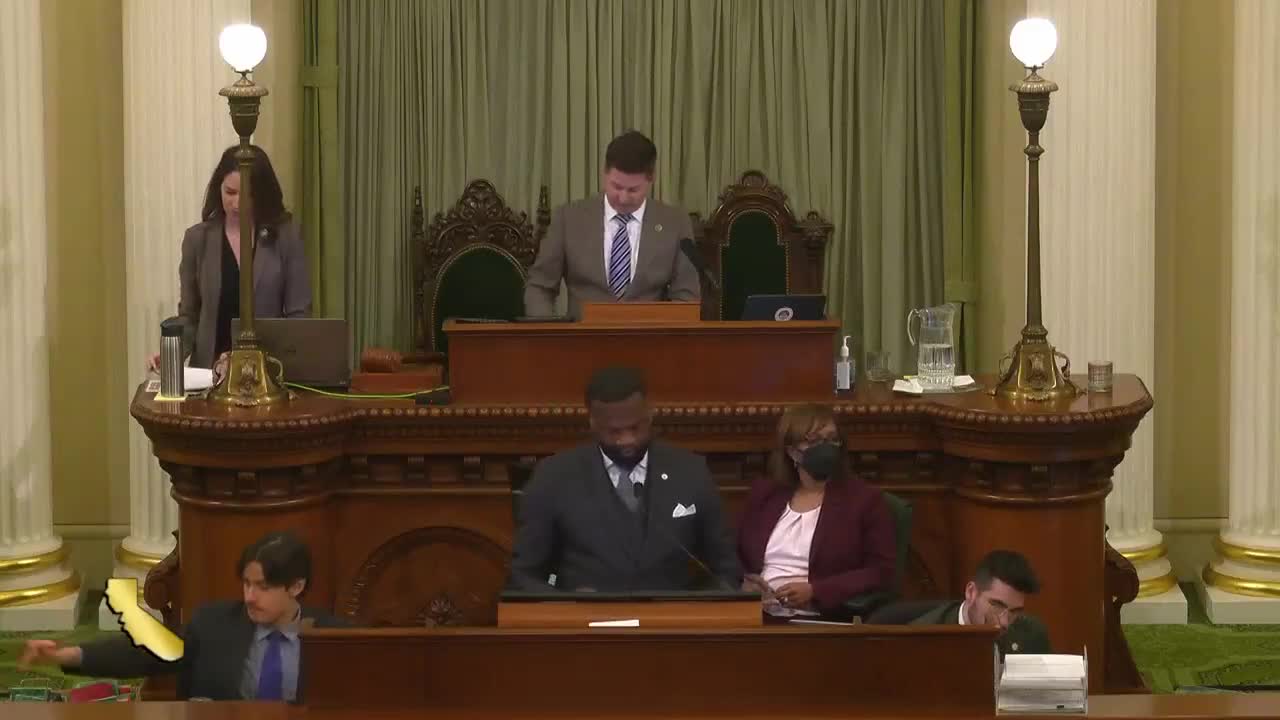 1MIN
Assembly Floor
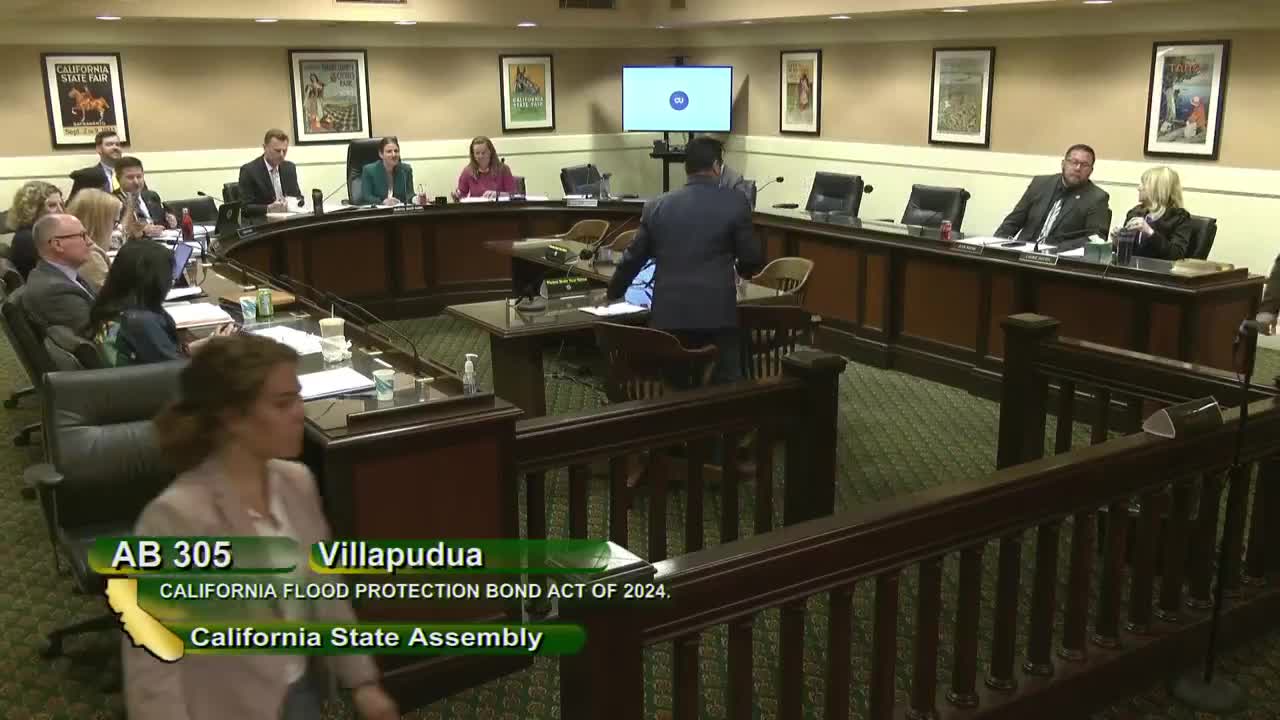 27MIN
Assembly Standing Committee on Water, Parks, and Wildlife
Bill Author

Bill Co-Author(s):