AB 3065: Fireworks: retail sales.
- Session Year: 2023-2024
- House: Assembly
- Latest Version Date: 2024-02-16
Current Status:
Failed
(2024-05-16: In committee: Held under submission.)
Introduced
In Committee
First Chamber
In Committee
Second Chamber
Enacted
Existing law authorizes the retail sale of safe and sane fireworks from June 28 to July 6, annually, pursuant to a license issued by the State Fire Marshal, unless otherwise prohibited or regulated by law or ordinance. Existing law requires any person who violates any provision of the law relating to fireworks and pyrotechnic devices to be guilty of a misdemeanor, as provided.
This bill would authorize the retail sale of certified safe and sane fireworks from 9 a.m. on December 26 to midnight of January 1 of the following year pursuant to a license issued by the State Fire Marshal, if authorized by a charter city, city, county, or city and county ordinance or resolution that may also restrict the hours of use of those fireworks. Since a violation of this provision or other existing related provisions in connection with the sale of those fireworks would be a misdemeanor, the bill would impose a state-mandated local program.
The California Constitution requires the state to reimburse local agencies and school districts for certain costs mandated by the state. Statutory provisions establish procedures for making that reimbursement.
This bill would provide that no reimbursement is required by this act for a specified reason.
(a)Notwithstanding Sections 12599 and 12672, the State Fire Marshal shall issue separate one-time retail licenses pursuant to this section that shall authorize the retail sale of safe and sane fireworks within this state only from 9 a.m. on December 26, to midnight of January 1 of the following year, inclusive. A license issued pursuant to this section shall be valid for only one seven-day period and shall expire at the end of the period for which it is valid. All fireworks sold pursuant to a license issued pursuant to this section shall have been certified as safe and sane by the State Fire Marshal as of June of the year in which the validity of the license commences. No other license issued pursuant to this chapter shall authorize the sale of fireworks during that period.
(b)A retail license shall not be issued for the license period authorized by this section unless the charter city, city, county, or city and county having jurisdiction over the fixed location where the fireworks would be sold adopts an ordinance or resolution allowing that sale, and the application for that license is received by the State Fire Marshal on or before December 15 of the year in which the validity of the license is to commence. The ordinance or resolution authorizing the sale of those fireworks may limit the period of use of those fireworks to specified days and hours within the period during which the sale is authorized by this section.
SEC. 2.No reimbursement is required by this act pursuant to Section 6 of Article XIIIB of the California Constitution because the only costs that may be incurred by a local agency or school district will be incurred because this act creates a new crime or infraction, eliminates a crime or infraction, or changes the penalty for a crime or infraction, within the meaning of Section 17556 of the Government Code, or changes the definition of a crime within the meaning of Section 6 of Article XIIIB of the California Constitution.
REVISIONS: HeadingLine 2.|
Date
|
Status
|
|---|---|
| May 16, 2024 | In committee: Held under submission. |
| May 8, 2024 | In committee: Set, first hearing. Referred to APPR. suspense file. |
| Apr 23, 2024 | From committee: Do pass and re-refer to Com. on APPR. (Ayes 5. Noes 0.) (April 22). Re-referred to Com. on APPR. |
| Apr 23, 2024 | Coauthors revised. |
| Mar 11, 2024 | Referred to Com. on E.M. |
| Feb 17, 2024 | From printer. May be heard in committee March 18. |
| Feb 16, 2024 | Read first time. To print. |
|
Date
|
Description
|
Location
|
Votes
|
|
|---|---|---|---|---|
| Apr 22, 2024 | Do pass and be re-referred to the Committee on [Appropriations] | Assembly Standing Committee on Emergency Management |
Passed |
This list shows positions taken on this bill by organizations on the date displayed, which is linked to the original source.
Positions by individuals are not included.
|
Organization
|
Position
|
Date
|
|---|---|---|
| Alice M. Birney Dad's Club | ** Support | |
| American Legion Cecil Cox Post 0147 | ** Support | |
| American Legion Post 299, Chino | ** Support | |
| American Legion Post 411, Pico Rivera | ** Support | |
| Apostolic Assembly of God | ** Support | |
| Buchanan Band | ** Support | |
| Calexico Christ Community Church | ** Support | |
| Central Valley Youth Football Org | ** Support | |
| Chino High School Pep Squad | ** Support | |
| Chino High School Sports Booster | ** Support | |
| Chino Victory Outreach | ** Support | |
| Christ Lutheran | ** Support | |
| City of Chino Police Department | ** Against | |
| Clovis Apostolic | ** Support | |
| Clovis East Wrestling | ** Support | |
| Clovis Elks Lodge #2599 | ** Support | |
| Cory Idle Foundation | ** Support | |
| Don Lugo Hs Grad Night Committee | ** Support | |
| Don Lugo Sports Boosters | ** Support | |
| El Centro Christ Community Church | ** Support | |
| Family of God Church, Pico Rivera | ** Support | |
| Fillmore Lion's Club | ** Support | |
| Fresno Host Lions Club | ** Support | |
| Full Gospel Tabernacle | ** Support | |
| Gavin R. Stevens Foundation | ** Support | |
| High Impact Training 626 | ** Support | |
| Imperial Faith | ** Support | |
| Industry Covina Vikings Football | ** Support | |
| Industry Kiwanis Club of Hacienda Heights | ** Support | |
| Industry Knights of Columbus | ** Support | |
| Industry LA Puente High School Football and Cheer | ** Support | |
| Industry Los Altos Hs Quarterback Club | ** Support | |
| Jackson Lion's Club | ** Support | |
| Kiwanis Club of El Centro | ** Support | |
| Knights Landing Fire Department | ** Support | |
| Lassen High School Football Boosters | ** Support | |
| Laton Volunteer Fire Department | ** Support | |
| Los Angeles County Sheriff'S Department | ** Support | |
| Manna Food Closet | ** Support | |
| New Hope Church - Clovis | ** Support | |
| Olivehurst Firemen's Association | ** Support | |
| Orange Cove Christian Center | ** Support | |
| Pico Rivera Dons Football for Youth | ** Support | |
| Rowland Raider Football Huddle | ** Support | |
| Sacramento Police Foundation | ** Support | |
| San Bruno Police Association | ** Support | |
| Santa Clara River Valley Historical Society | ** Support | |
| Simonian Family Fireworks | ** Support | |
| Sonrise Baptist Church Youth | ** Support | |
| South El Monte Bobby Salcedo Memorial Foundation | ** Support | |
| Susanville United Methodist Church | ** Support | |
| Vernon Police Officers Benefit | ** Support | |
| Victory Outreach of Selma | ** Support | |
| WESTMINSTER POLICE OFFICERS ASSOCIATION | ** Support | |
| Yuba City Deputy Sheriffs K9 | ** Support |
Date of Hearing: May 8, 2024
ASSEMBLY COMMITTEE ON APPROPRIATIONS
Buffy Wicks, Chair
ABPCA Bill Id:AB 3065
Author:(Garcia) – As Introduced Ver:February 16, 2024
Policy Committee: | Emergency Management | Vote: | 5 - 0 |
|
| ||
|
|
Urgency: No State Mandated Local Program: Yes Reimbursable: No
SUMMARY:
This bill authorizes the sale of safe and sane fireworks the week preceding New Year’s Day.
Specifically, this bill:
- Requires the State Fire Marshal (SFM) to issue a one-time retail license to an applicant authorizing the retail sale of safe and sane fireworks from 9 a.m. on December 26 to midnight of January 1 of the following year. All fireworks sold pursuant to a license must have been certified as safe and sane by the SFM no later than June of that year. The SFM must receive the license application on or before December 15 of that year.
- Prohibits a license from being issued unless the charter city, city, county, or city and county with jurisdiction over the fixed location of sale adopts an ordinance or resolution allowing the sale. The ordinance or resolution may limit the period of use of sold fireworks to specified days and hours within the authorized period of sale.
FISCAL EFFECT:
- Costs of an unknown, but potentially significant amount, in excess of $150,000, to the SFM to issue additional retail licenses and certify an increased number of safe and sane fireworks, likely offset by fees (special fund). To the extent this bill increases the volume of safe and sane fireworks in local communities that permit fireworks, based on the SFM’s experience with sales around Independence Day, there is an increased possibility of safe and sane fireworks being transported into other communities that do not permit fireworks, making those fireworks illegal. Such illegal fireworks must be seized, with the SFM incurring costs for storage and disposal.
- General Fund and local revenue gain of an unknown amount, potentially in the low millions of dollars annually, due to the collection of sales and use tax on fireworks sales.
- Cost pressures of an unknown, but potentially significant amount, to appropriate funds to the SFM to train local fire and law enforcement personnel on the safe handling of fireworks, pursuant to AB 1403 (Garcia), Chapter 368, Statutes of 2023.
COMMENTS:
- Purpose. According to the author:
AB 3065 empowers California communities to make informed decisions about Safe and Sane Fireworks sales, supporting nonprofits, enhancing public safety, and fostering local control. This legislation addresses critical funding challenges faced by nonprofits while safeguarding communities from the dangers of illegal fireworks.
- Support and Opposition. This bill is supported by a wide range of nonprofit organizations, from American Legions to high school sports teams to public safety groups, which argue, “By granting communities the option to permit nonprofit fireworks sales, this bill not only bolsters vital programs and services but also aids in addressing the surge in illegal fireworks, offering a comprehensive solution to a pressing issue.” Supporters also note that “more than 2,700 nonprofit organizations rely on fireworks sales as their primary source of funding.”
This bill is opposed by the Chino Police Department, noting, “During the Fourth of July, our city sees a significant increase in calls for service, often doubling our normal call volume. This surge requires the activation of over half of our police force to manage incidents, primarily fueled by both legal and illegal fireworks usage.” The opposition argues “Expanding fireworks sales to include the New Year’s holiday would likely replicate these challenges, if not amplify them.”
- Background.
Safe and Sane Fireworks. Existing law allows the annual retail sale of “safe and sane” fireworks from June 28 to July 6. Safe and sane fireworks include sparklers, smoke balls, and pinwheels, which generally do not leave the ground or explode. Safe and sane fireworks are approved by the U.S. Consumer Product Safety Commission and examined and tested by the SFM. Fireworks not designated “safe and sane” are illegal in California, although such “dangerous” fireworks may be legally sold in other states. Safe and sane fireworks can also be seized in a part of the state that does not permit such sales.
Fireworks Sales. Approximately 296 communities in California currently permit the sale and use of state-approved fireworks during the allowable Independence Day window. A retailer must annually apply and pay associated fees for a license issued by the SFM, as well as obtain a local permit, to legally sell safe and sane fireworks. Many safe and sane fireworks wholesalers partner with nonprofit organizations to operate fireworks stands, with profits split between the wholesaler and nonprofit. This bill requires, instead of authorizes, the SFM to similarly issue licenses for retail sales the week before New Year’s Day. This bill additionally specifies that the local jurisdiction of the retail sale must have an ordinance or resolution in place allowing such sales, which may also limit the period of use of fireworks to specified days and hours.
Fireworks Enforcement. According to the SFM, seizure of dangerous fireworks has been increasing each year, beginning around March with an uptick as July 4 approaches. A 2020 study by the National Fire Protection Association found that fireworks started an estimated 19,500 fires across the United States in 2018, leading to five civilian deaths, 46 civilian injuries, and $105 million in direct property damage.
AB 1403 (Garcia), Chapter 368, Statutes of 2023, not only required, upon appropriation, the SFM to train local fire and law enforcement personnel about fireworks handling, but also authorized a local agency to assess a fee to cover the actual and reasonable costs of fireworks enforcement, not to exceed 7% of gross sales of safe and sane fireworks. AB 1403 also requires, by January 1, 2025, the SFM to: (a) collect and analyze data about fires, damages, seizures, arrests, administrative citations, and fireworks disposal issues caused by the sale and use of both safe and sane fireworks and dangerous fireworks, and (b) conduct a workload analysis of resources needed to further assist in the training of local fire and law enforcement personnel regarding fireworks, including the collection, transportation, storage, investigation, and prosecution of seized fireworks. As noted in the Assembly Emergency Management Committee’s analysis of this bill, the SFM “will finish collecting data in the fall. This data may provide a more comprehensive differentiation between safe and sane fireworks and illegal fireworks that could be helpful in informing firework related policy decisions, such as this bill.”
- Prior Legislation. There have been numerous efforts to authorize the sale of fireworks for the New Year’s holiday, dating back to 2005. Most recently:
SB 677 (Mendoza), of the 2015-2016 Legislative Session, would have authorized the sale of safe and sane fireworks the week preceding New Year’s Day, as well as changed rules governing fireworks sales and disposals. SB 677 failed passage in the Senate Governmental Organization Committee.
SB 1468 (Calderon), of the 2011-12 Legislative Session, would have, for two years, authorized the sale of safe and sane fireworks the week preceding New Year’s Day, as well as permitted limited recovery of local government costs and provided an industry-funded data collection effort. SB 1468 was held on this committee’s suspense file.
Analysis Prepared by: Irene Ho / APPR. / (916) 319-2081
Date of Hearing: April 22, 2024
ASSEMBLY COMMITTEE ON EMERGENCY MANAGEMENT
Freddie Rodriguez, Chair
ABPCA Bill Id:AB 3065 (
Author:Garcia) – As Introduced Ver:February 16, 2024
SUBJECT: Fireworks: retail sales
SUMMARY: This bill authorizes the sale of safe and sane fireworks during the week preceding New Year’s Day if the State Fire Marshal issues a license and the governing local jurisdiction approves their sale. Specifically, this bill:
- Requires the State Fire Marshal to issue one-time retail licenses that allow the sale of safe and sane fireworks in California between December 26 and midnight of January 1 the following year.
- Authorizes local jurisdictions to allow, prohibit, or limit the sale of safe and sane fireworks between 9:00am December 26 and midnight of January 1 through a local ordinance or resolution.
- Requires all fireworks sold under this retail license to be certified as safe and sane by the State Fire Marshal no later than June of the year in which the retail license begins.
- Prohibits the State Fire Marshal from issuing this retail licenses to:
- Jurisdictions without a local ordinance or resolution allowing the sale of these fireworks; and
- Applicants who apply after December 15 of the year in which the license would begin.
EXISTING LAW:
- Authorizes the retail sale of safe and sane fireworks from June 28 to July 6, annually, pursuant to a license issued by the State Fire Marshal (SFM), unless otherwise prohibited or regulated by law or ordinance. A new retail sales license shall be required annually for the period, as specified. (HSC § 12599)
- Prohibits the sale, use, or discharge of fireworks in any city, county, or city and county or a special district in which the sale, use, or discharge is otherwise prohibited or regulated by law or ordinance. (HSC § 12541)
- Defines "safe and sane fireworks" as any fireworks approved by the United States Consumer Product Safety Commission, examined and tested by the State Fire Marshal, and determined by the State Fire Marshal that the fireworks meet and are in compliance with standards, as specified. (HSC § 12529)
- Authorizes the SFM to issue a retail sales license allowing the retail sale of safe and sane fireworks for private use. (HSC § 12574)
- Authorizes the SFM to deny or revoke any firework license if the licensee or applicant: failed to pay their renewal fee; violated provisions, as specified; created a fire nuisance; failed to keep records, as specified; failed to file a required report; failed to share requested records; if a local jurisdiction rescinds prior approval; or if any condition exists that would have resulted in the SFM denying the application if the condition existed at the time of the original application. (HSC § 12560)
- Requires a local entity that authorizes the sale of safe and sane fireworks to require each applicant receiving a permit to pay a fee, as specified, not to exceed 7% of gross sales, for the actual and reasonable costs incurred by the local entity for processing and issuing fireworks permits, inspection of fireworks stands, education campaigns, and related fire operation and suppression efforts, as specified. (HSC § 12635.5)
- Requires the SFM to: collect and analyze data about firework-related fires, damages, and arrests; submit a workload analysis to the Legislature; and train local authorities on relevant regulations related to fireworks by January 1, 2025. (HSC § 12726.1)
- Prohibits the use or possession of fireworks within any hazardous fire area, as specified, unless otherwise declared by the Director of Forestry and Fire Protection. (PRC § 4259)
- Authorizes the seizure of dangerous fireworks, including fireworks kits, used, possessed, stored, manufactured, or transported by a person who does not possess a valid permit, as specified. (HSC § 12722)
- Establishes the SFM Fireworks Enforcement and Disposal Fund for the purposes of supporting statewide programs for the enforcement, prosecution related to, disposal, and management of seized dangerous fireworks, and for the education of public safety agencies in the proper handling and management of dangerous fireworks. (HSC § 12728)
FISCAL EFFECT: This bill has not been analyzed by a fiscal committee.
COMMENTS:
Purpose of this bill: According to the author, “AB 3065 empowers California communities to make informed decisions about Safe and Sane Fireworks sales, supporting nonprofits, enhancing public safety, and fostering local control. This legislation addresses critical funding challenges faced by nonprofits while safeguarding communities from the dangers of illegal fireworks.”
Equity: According to the author’s staff, this bill “provides additional revenue streams for nonprofits serving marginalized communities, supports law enforcement efforts in underprivileged areas, offers a safe alternative to illegal fireworks, promoting safety and equity.”
Background: The California's Fireworks Law, passed in 1938, established the Office of the State Fire Marshal (SFM) as the only fireworks classification authority in California. Currently, the SFM is part of the California Department of Forestry and Fire Protection (CalFIRE). Fireworks are classified through laboratory analysis, field examinations, and test firing of items. As part of the program, SFM requires the licensing of all pyrotechnic operators, fireworks manufacturers, importer-exporters, wholesalers, retailers, and public display companies. Pyrotechnic operators who discharge fireworks at public displays or launch high-powered and experimental rockets, must also pass a written examination and provide proof of experience.
State law defines "dangerous fireworks" as any firework containing any of a specified list of chemicals such as, among others, arsenic sulfide, boron, mercury salts, red or white phosphorous, picrates, and thyocyanates. Types of dangerous fireworks include firecrackers; skyrockets; Roman candles; chasers; large sparklers; any firework designed to create an element of surprise, including but not limited to auto foolers, cigarette loads, exploding golf balls, and trick matches; devil-on-the-walk; torpedoes of all kinds that explode on impact; fireworks kits; and other fireworks examined and tested by the SFM and determined to possess characteristics of design or construction that make the fireworks unsafe for use by a person not specially qualified or trained in the use of fireworks. The SFM can also deem a firework to be "exempt" if it is limited to industrial, commercial, agricultural use, or religious ceremonies. Public fireworks shows can be conducted by state-licensed pyrotechnicians with licenses obtained from the SFM.
Safe and sane fireworks are defined as any fireworks that have been approved by the United State Consumer Product Safety Commission and that have been carefully examined and tested by the SFM and determined by the SFM that the fireworks meet and are in compliance with the general and specific standards for design, construction, performance, and labeling for safe and sane fireworks. Types of current safe and sane fireworks include, but are not limited to: fountains, sparklers, smoke balls, snake-type fireworks, ground-spinning fireworks, pinwheels, most novelty fireworks, toy-trick noisemakers, and some crackling items. Generally, these types of fireworks do not leave the ground and do not explode.
Existing Legal Sales of Safe and Sane Fireworks: The retail sale of safe and sane fireworks is legal in California between noon on June 28 and noon on July 6 of every calendar year, but may be prohibited locally through ordinances. For example, the City of Los Angeles prohibits all fireworks.
Approximately 296 communities in California currently allow the purchase and use of state-approved fireworks for the July Fourth holiday. To sell safe and sane fireworks, retailers must each year apply for and be granted a license from the SFM and pay the necessary fees to the state. Local jurisdictions also require a permit to sell lawful fireworks in addition to the necessary state license. Local jurisdictions may charge a fee, up to 7% of gross sales, for handling permits, inspecting fireworks stands, running education campaigns, and related fire operation and suppression efforts.
Typically, non-profit organizations like women's shelters, service clubs (like Rotary), Boy Scout and Girl Scout troops, PTAs, Little Leagues, and other neighborhood associations operate fireworks stands. Over 2,700 nonprofits operate the fireworks stands as a fundraiser. Safe and sane firework wholesalers report they receive 50% of the profits while 50% goes to the nonprofits. For reference, TNT Fireworks reports 165 nonprofit organizations and TNT each generated $15 million in sales, California generated $1.2 million in sales taxes, and local governments collected $700,000 in fees when safe and sane fireworks were specially permitted for sale during the Millennium New Year Holiday in 2000.
Fines and Penalties: A person or business that sells safe and sane fireworks without a permit risks a sizable fine as well as possible legal action. It is a misdemeanor crime to violate the California State Fireworks Law. Violators are subject to a maximum $1,000 fine and up to one year in a county jail. However, penalties increase for possession of large quantities of dangerous fireworks, and prosecutors could charge the violator with a felony, punishable by up to three years in state prison and fines up to $50,000. Federal law also prohibits the transport of fireworks across state lines to a state where the use or possession of the firework is illegal. This is particularly relevant as dangerous fireworks often make their way into California from neighboring states.
Fire Risk: According to the National Fire Protection Association (NFPA), an estimated 19,500 fires were started by fireworks nationwide in 2018. These fires caused five civilian deaths, 46 civilian injuries, 17,100 outside and other fires, 1,900 structure fires, 500 vehicle fires, and $105 million in direct property damage.
In 2020, the San Francisco Fire Department reported over 100 grass fires and the Los Angeles Fire Department nearly 400 fires, many thought to have been started by fireworks. Fireworks at a gender-reveal party in Yucaipa set off the El Dorado fire in September 2020, a blaze that killed one firefighter and took until November of that year to extinguish. Data reported by the SFM in June 2022 on fires caused by fireworks in the state between 2012 and 2021 found 8,427 fires caused by fireworks were reported to the SFM.
The sponsors contend that safe and sane fireworks do not cause fires. While both news reporting and anecdotal evidence demonstrate the vast majority of these fires are from illegal fireworks, the Committee cannot confirm the sponsor’s statement to be true. For example, the SFM says they do not differentiate between fires caused by illegal fireworks or safe and sane fireworks, while also noting safe and sane fireworks become illegal outside of the one week window of sale. There is also an issue of transport of safe and sane fireworks sold in one jurisdiction and brought into another that does not allow their sale. If a jurisdiction disallows their sale due to increased wildfire risk, the risk of the safe and sane firework would have a higher risk of starting a fire. If a safe and sane firework was transported to another district that disallows the sale, it would become an illegal firework and be considered an improper use of safe and sane fireworks by all parties. Despite existing laws against improper transport, jurisdictions continue to experience the illegal transfer of both dangerous and safe and sane fireworks.
While safe and sane fireworks significantly reduce risk, they can still cause fires. The SFM specifically instructs users of safe and sane fireworks to not use them near dry grass or flammable materials, under anything but open air, and to douse the firework in water after use to decrease risk.
SFM Data Incoming: AB 1403 (Garcia) Chapter 368, Statutes of 2023, requires the SFM to: collect and analyze data about firework-related fires, damages, and arrests; submit a workload analysis to the Legislature; and train local authorities on relevant regulations related to fireworks by January 1, 2025. The SFM has not yet submitted this information to the legislature, and according to CalFIRE, will finish collecting data in the fall. This data may provide a more comprehensive differentiation between safe and sane fireworks and illegal fireworks that could be helpful in informing firework related policy decisions, such as this bill.
Increased Calls for Service: Emergency services across the state and country identify Independence Day as one of their highest call volume days. In order to respond, emergency responders must increase staffing and offer additional overtime to their employees.
On July 4, 2023, Kern County Emergency Communications Center received 1,267 calls. Their peak hour of calls was between 9:00pm and 10:00pm, where they received an equivalent number of calls in that hour that they respond to on an average day. Firefighters were dispatched to 196 fires.
KTLA News reported that Southern California emergency services responded to thousands of calls that swamped the response crews this past July 4th holiday. Specific numbers were not provided, but data from 2020 is available. During Independence Day 2020, the City of Los Angeles Fire Department responded to 1,738 calls for service within a 24 hour period, 338 more calls than usual. This included calls for 200 calls reporting rubbish fires, 103 reporting tree fires, 40 reports of structure fires, 28 of grass fires and 11 of brush fires. In the same period, the Los Angeles County Fire Department responded to 1,676 calls for service, which is 40-50% higher than their usual daily call load of 1,100- 1,200 calls. Their Public Information Officer noted that, as of that date, was the second busiest day in the department’s history and almost 500 of the calls that day were received between 9:00 and 10:00p.m. Their calls included 370 outdoor fires, 44 structure fires and 13 brush fires.
Small jurisdictions also face significantly higher calls for services on holidays. The City of Modesto responded to 274 calls around the 4th of July holiday in 2023 Of those 274 calls, eight were structure or building fires, 41 were grass fires and 16 were trash fires.
Additionally, the California Highway Patrol (CHP) conducts maximum enforcement periods (MEP), when all available officers are deployed to roadways in order to ensure continuity of traffic and enforcement of driving laws, six times a year; two of which are on the 4th of July and New Years. During the 2023 4th of July holiday period, a CHP conducted an MEP for 5 days. During this time frame, CHP recorded 68 deaths from traffic accidents, issued 9,700 speeding citations, and 1,224 arrests. For context, CHP stated they averaged one arrest for every five minutes of the MEP. During the New Year MEP, CHP made 892 arrests and responded to 24 fatal crashes.
During the New Year holiday, local law enforcement agencies also report higher than average call volumes and emergency rooms report a significantly higher influx of patients. In anticipation of surges in demand for emergency medical services during the New Year Eve holiday, the City and County of San Francisco have allowed basic life support (BLS) providers to respond to 9-1-1 calls and have mechanisms in place to request EMS mutual aid (also known as ambulance strike teams) due to historically high call volume.
Fireworks and Air Quality: When asked for data related to the air quality impacts of safe and sane fireworks, the California Air Resources Board (CARB) shared a 2016 literature review from the Journal of the Air and Waste Management Association, titled A review of the impact of fireworks on particulate matter in ambient air, to demonstrate the negative impacts. This review makes the following conclusions:
- Outdoor ambient particulate matter (microscopic solids or liquid droplets so small that if inhaled, can cause serious health problems) levels increase significantly during the use of fireworks and fire crackers.
- Particulate matter from fireworks can stay in the air for up to a month following a large display, resulting in higher particulate matter concentration for that period.
- Particulate matter from fireworks and fire crackers are primarily fine and ultrafine spherical particles, which are more toxic and appear to have a more negative health effect compared with coarse particles.
- Numerous prior studies demonstrate the levels of trace metals, ions, elemental carbon, organic carbon, and organics in particulate matter are abnormally high when fireworks and firecrackers are used.
Additionally, a 2015 national study of fireworks and fine particulate matter, titled Effects of Independence Day fireworks on atmospheric concentrations of fine particulate matter in the United States, observed fine particulate matter from 315 different locations in the United States on the July 4th holiday in order to estimate the relationship between fireworks and fine particulate matter concentrations. This study found that fine particulate matter is 42% higher the night of July 4th and the morning of July 5th than the two days before or after, regardless of the day of the week.
The committee notes that the literature review and study mentioned above looks at all firework types cumulative effects on air quality.
According to South Coast Air Quality Management District (SCAQMD), July 4th and 5th bring some of the worst air quality in the South Coast Air Basin and regularly drives the Air Quality Index (AQI) into the unhealthy to hazardous range. The AQI scale, in order, includes Good, Moderate, Unhealthy for Sensitive Groups, Unhealthy, Very Unhealthy, and Hazardous. Negative health outcomes from inhaling the particulate matter during the unhealthy to hazardous air quality levels include respiratory and cardiovascular complications. SCAQMD asserts the worst air quality recorded during the 4th of July holiday in the last 10 years was in 2020 and 2023 respectively. In 2023, they identified the increase of personal fireworks is a possible reason for worsening air quality. Personal fireworks -– including safe and sane — are illegal in the City of Los Angeles.
 Firework Disposal: CalFIRE, when provided funding, is responsible for collecting and disposing seized fireworks. They released the following chart outlining the amount of disposed fireworks in pounds each year since 2012:
If this bill passes, the legislature may want to consider increasing the CalFIRE budget for collection and disposal as more fireworks would be expected to enter the state.
Arguments in Support: According to American Legion Posts 0147, 299, and 411, Kiwanis Clubs from Hacienda Heights and El Centro, Clovis Apostolic, Laton Volunteer Fire Department, Los Angeles County Sheriff’s Department, and various others, “On behalf of our nonprofit organization, I extend our sincerest gratitude to you for introducing AB 3065... In the current economic climate. California nonprofits face significant challenges in funding essential community services. AB 3065 offers a crucial lifeline by providing additional avenues for fundraising during these difficult times. By granting communities the option to permit nonprofit fireworks sales, this bill not only bolsters vital programs and services but also aids in addressing the surge in illegal fireworks, offering a comprehensive solution to a pressing issue.”
They continue, “With over 296 communities in California already allowing the sale and use of State-Approved, Safe and Sane Fireworks on the 4th of July, AB 3065 builds upon existing successful models. Across these jurisdictions, more than 2,700 nonprofit organizations rely on fireworks sales as their primary source of funding, highlighting the significant impact and importance of this legislation.”
Arguments in Opposition: The City of Chino Police Department write in opposition, “During the Fourth of July, our city sees a significant increase in calls for service, often doubling our normal call volume. This surge requires the activation of over half of our police force to manage incidents, primarily fueled by both legal and illegal fireworks usage. Our dispatch centers are overwhelmed with reports, which complicates our ability to distinguish between legal and potentially dangerous illegal fireworks usage. The additional strain placed on our resources during this time prevents our officers from attending to other critical needs and routine safety operations.”
They continue, “Expanding fireworks sales to include the New Year's holiday would likely replicate these challenges, if not amplify them, given the simultaneous nationwide celebrations. This would place further stress on our police and emergency services at a time when vigilance against other holiday-related issues, such as impaired driving and large gatherings, is already heightened. Given these factors, we respectfully urge you to reconsider the support for AB 3065. We suggest exploring alternative ways to celebrate our community that do not disproportionately impact public safety resources.”
Related Legislation:
AB 1403 (Garcia) Chapter 368, Statutes of 2023. Required the SFM, by January 1, 2025, to collect and analyze data about firework-related fires, damages, and arrests; submit a workload analysis to the relevant committees of the Legislature and train local authorities on relevant regulations related to fireworks, as specified. Additionally, authorizes local agencies, as specified, to adopt an ordinance for the actual and reasonable costs associated with safe and sane and illegal fireworks, which may not exceed 7% of the gross sales of safe and sane fireworks.
SB 677 (Mendoza) of 2015. Would have authorized the sale of safe and sane fireworks during the week preceding New Year’s Day and would have made numerous changes to the state laws governing fireworks sales and disposals. (Failed passage in the Senate Governmental
Organization Committee)
SB 777 (Hernández) of 2014. Would have allowed for licenses to sell fireworks during the week before New Year’s Day, and would have established a fireworks sell-back program, as specified.
(The bill was amended to deal with an unrelated issue area)
SB 1468 (Calderon) of 2012. Would have authorized the sale of specified fireworks between
Christmas and New Year'’ Day in 2014-15 and 2015-16, would have permitted limited recovery of specified costs by local governments, and would have provided for a two-year fireworks data collection effort to be funded by voluntary contributions from the fireworks industry. (Held on the Assembly Appropriations Committee Suspense File)
AB 1371 (V. Manuel Perez) of 2011. Would have allowed New Year’s fireworks sales and authorized local governments to impose permit fees. (Held in Assembly Governmental
Organization Committee)
SB 839 (R. Calderon), Chapter 563, Statutes of 2007. Established the SFM Fireworks
Enforcement and Disposal Fund. The bill created a mechanism for fireworks enforcement and disposal through new and increased fines and penalties with a revenue sharing component for local jurisdictions as an incentive for increased enforcement of illegal fireworks.
AB 923 (Chavez) of 2005. Would have authorized the sale of fireworks from December 26 to
January 1 and created the SFM Dangerous Fireworks Management Fund for the deposit of surcharges assessed on the sale of fireworks to pay for the disposal costs of seized fireworks.
(Never heard in Assembly Governmental Organization Committee)
AB 1295 (Bermudez) of 2005. Would have allowed New Year’s fireworks sales and used fee revenues to pay for disposal costs associated with seized fireworks. (Held in Assembly
Appropriations Committee)
AB 2090 (Miller), Chapter 363, Statutes of 1998. Authorized the SFM to license the sale of fireworks from December 26, 1999 through January 2, 2020 in order to celebrate the millennium.
SB 277 (Archuleta), Chapter 238, Statutes of 2022. Required the SFM to manage rather than dispose of dangerous fireworks, as provided, and required the SFM to ensure that any dangerous fireworks seized, that are identified by the SFM as hazardous waste, are managed in accordance with California and federal hazardous waste laws and regulations, as specified.
AB 475 (Redwine), Chapter 534, Statutes of 1939. California’s Fireworks Law, among other things, defined “dangerous fireworks” and “safe and sane fireworks,” and prohibited any person without a permit from manufacturing, possessing, or selling any dangerous fireworks, from selling any safe and sane fireworks as a retailer, and from discharging dangerous fireworks in any place.
REGISTERED SUPPORT / OPPOSITION:
Support
Alice M. Birney Dad's Club
American Legion Cecil Cox Post 0147
American Legion Post 299, Chino
American Legion Post 411, Pico Rivera
Apostolic Assembly of God
Buchanan Band
Calexico Christ Community Church
Central Valley Youth Football Org
Chino High School Pep Squad
Chino High School Sports Booster
Chino Victory Outreach
Christ Lutheran
Clovis Apostolic
Clovis East Wrestling
Clovis Elks Lodge #2599
Cory Idle Foundation
Don Lugo Hs Grad Night Committee
Don Lugo Sports Boosters
El Centro Christ Community Church
Family of God Church, Pico Rivera
Fresno Host Lions Club
Fillmore Lion's Club
Full Gospel Tabernacle
Gavin R. Stevens Foundation
High Impact Training 626
Imperial Faith
Industry Covina Vikings Football
Industry Kiwanis Club of Hacienda Heights
Industry Knights of Columbus
Industry LA Puente High School Football and Cheer
Industry Los Altos Hs Quarterback Club
Jackson Lion's Club
Kiwanis Club of El Centro
Knights Landing Fire Department
Lassen High School Football Boosters
Laton Volunteer Fire Department
Los Angeles County Sheriff's Department
Manna Food Closet
New Hope Church - Clovis
Olivehurst Firemen's Association
Orange Cove Christian Center
Pico Rivera Dons Football for Youth
Rowland Raider Football Huddle
Sacramento Police Foundation
San Bruno Police Association
Santa Clara River Valley Historical Society
Simonian Family Fireworks
Sonrise Baptist Church Youth
South El Monte Bobby Salcedo Memorial Foundation
Susanville United Methodist Church
Vernon Police Officers Benefit
Victory Outreach of Selma
Westminster Police Officers Association
Yuba City Deputy Sheriffs K9
Opposition
City of Chino Police Department
Analysis Prepared by: Ryan Fleming / E.M. / (916) 319-3802
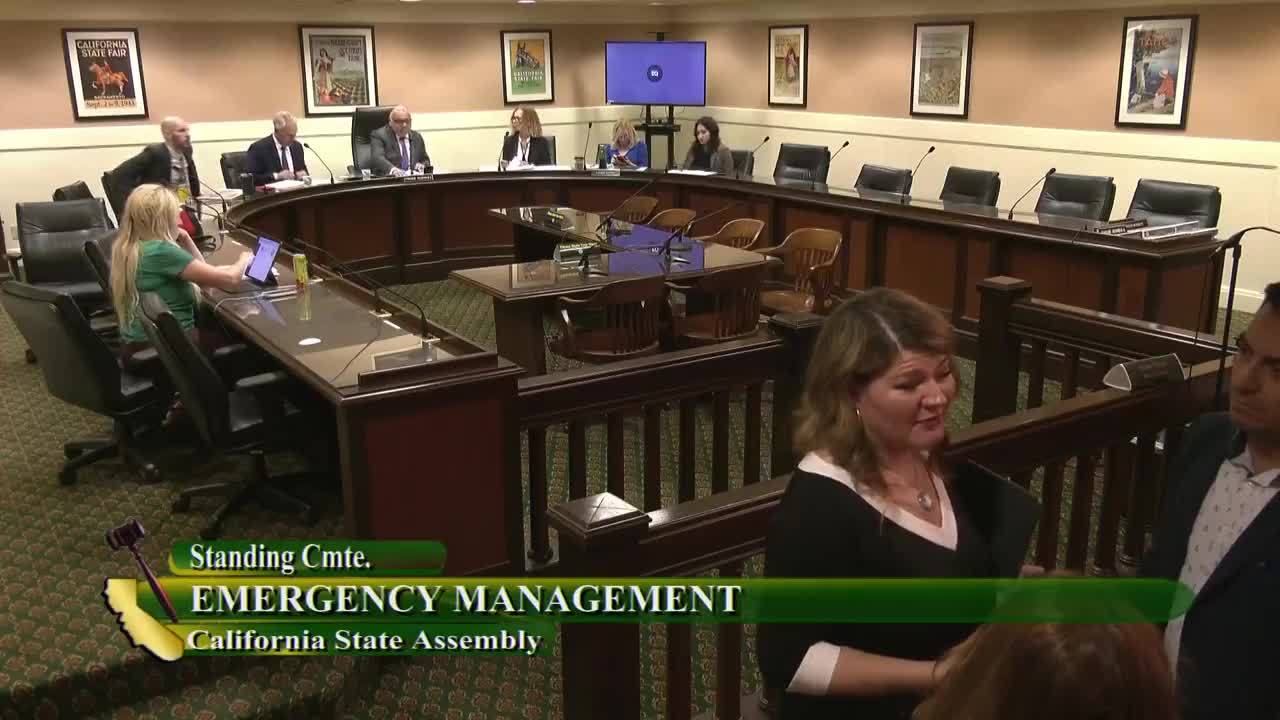
Discussed in Hearing
 21SEC
Assembly Standing Committee on Emergency Management
16MIN
Assembly Standing Committee on Emergency Management
Bill Author

Bill Co-Author(s):