AB 3074: School or athletic team names: California Racial Mascots Act.
- Session Year: 2023-2024
- House: Assembly
- Latest Version Date: 2024-09-27
Current Status:
Passed
(2024-09-27: Chaptered by Secretary of State - Chapter 665, Statutes of 2024.)
Introduced
In Committee
First Chamber
In Committee
Second Chamber
Enacted
Existing law establishes the California Racial Mascots Act, which prohibits public schools from using the term Redskins as a school or athletic team name, mascot, or nickname. Existing law requires the Superintendent of Public Instruction to establish and implement a system of complaint processing, known as the Uniform Complaint Procedures, for specified educational programs.
This bill would exempt public schools operated by an Indian tribe or a tribal organization from this prohibition. The bill would prohibit, beginning July 1, 2026, public schools, except for public schools operated by an Indian tribe or tribal organization, from using any derogatory Native American term, as defined, as a school or athletic team name, mascot, or nickname, except as provided. The bill would require the Uniform Complaint Procedures to apply to school or athletic team names, mascots, or nicknames pursuant to the bill. To the extent that the bill would impose new duties on public schools, the bill would impose a state-mandated local program.
The California Constitution requires the state to reimburse local agencies and school districts for certain costs mandated by the state. Statutory provisions establish procedures for making that reimbursement.
This bill would provide that, if the Commission on State Mandates determines that the bill contains costs mandated by the state, reimbursement for those costs shall be made pursuant to the statutory provisions noted above.
Existing law establishes the California Racial Mascots Act, which prohibits public schools from using the term Redskins as a school or athletic team name, mascot, or nickname. Existing law requires the Superintendent of Public Instruction to establish and implement a system of complaint processing, known as the Uniform Complaint Procedures, for specified educational programs.
This bill would exempt public schools operated by an Indian tribe or a tribal organization from this prohibition. The bill would prohibit, beginning January July 1, 2026, public schools, except for public schools operated by an Indian tribe or tribal organization, from using any derogatory Native American term, as defined, as a school or athletic team name, mascot, or nickname, except as provided. The bill would require the Uniform Complaint Procedures to apply to school or athletic team names, mascots, or nicknames pursuant to the bill. To the extent that the bill would impose new duties on public schools, the bill would impose a state-mandated local program.
The California Constitution requires the state to reimburse local agencies and school districts for certain costs mandated by the state. Statutory provisions establish procedures for making that reimbursement.
This bill would provide that, if the Commission on State Mandates determines that the bill contains costs mandated by the state, reimbursement for those costs shall be made pursuant to the statutory provisions noted above.
Existing law establishes the California Racial Mascots Act, which prohibits public schools from using the term Redskins as a school or athletic team name, mascot, or nickname.
This bill would exempt public schools operated by an Indian tribe or a tribal organization from this prohibition. The bill would prohibit, beginning January 1, 2026, public schools schools, except for public schools operated by an Indian tribe or tribal organization, from using the term Indians any derogatory Native American term, as defined, as a school or athletic team name, mascot, or nickname, subject to specified exceptions. except as provided. To the extent that the bill would impose new duties on public schools, the bill would impose a state-mandated local program.
The California Constitution requires the state to reimburse local agencies and school districts for certain costs mandated by the state. Statutory provisions establish procedures for making that reimbursement.
This bill would provide that, if the Commission on State Mandates determines that the bill contains costs mandated by the state, reimbursement for those costs shall be made pursuant to the statutory provisions noted above.
Existing law establishes the California Racial Mascots Act, which prohibits public schools from using the term Redskins as a school or athletic team name, mascot, or nickname.
This bill would prohibit, beginning January 1, 2026, public schools from using the term Indians as a school or athletic team name, mascot, or nickname, subject to specified exceptions. To the extent that the bill would impose new duties on public schools, the bill would impose a state-mandated local program.
The California Constitution requires the state to reimburse local agencies and school districts for certain costs mandated by the state. Statutory provisions establish procedures for making that reimbursement.
This bill would provide that, if the Commission on State Mandates determines that the bill contains costs mandated by the state, reimbursement for those costs shall be made pursuant to the statutory provisions noted above.
(a)For purposes of this section, derogatory Native American term includes, but is not necessarily limited to, Apaches, Big Reds, Braves, Chiefs, Chieftains, Chippewa, Comanches, Indians, Savages, Squaw, and Tribe.
(b)(1)All public schools, except for a school operated by an Indian tribe or a tribal organization, are prohibited from using the term Redskins for school or athletic team names, mascots, or nicknames.
(2)Commencing July 1, 2026, all public schools, except for a school operated by an Indian tribe or a tribal organization, are prohibited from using any derogatory Native American term for school or athletic team names, mascots, or nicknames.
(c)Notwithstanding this section, a public school may continue to use uniforms or other materials bearing a derogatory Native American term as a school or athletic team name, mascot, or nickname that were purchased before July 1, 2026, if all of the following requirements are met:
(1)The school selects a new school or athletic team name, mascot, or nickname.
(2)(A)Except as provided in subparagraph (B), the school refrains from purchasing or acquiring, for the purpose of distribution or sale to pupils or school employees, any uniform that includes or bears the derogatory Native American term.
(B)Notwithstanding subparagraph (A), before January 1, 2028, a school using uniforms that bear the derogatory Native American term may purchase or acquire a number of uniforms equal to up to 20 percent of the total number of uniforms used by a team or band at that school during the 202526 school year for the purposes of replacing damaged or lost uniforms.
(3)The school refrains from purchasing or acquiring, for the purpose of distribution or sale to pupils or school employees, any yearbook, newspaper, program, or other similar material that includes or bears the prohibited school or athletic team name, mascot, nickname, or related title in its logo or cover title.
(4)The school refrains from purchasing or constructing a marquee, sign, gymnasium floor, or other new or replacement fixture that includes or bears the prohibited school or athletic team name, mascot, or nickname. This paragraph applies to facilities that bear the prohibited school or athletic team name, mascot, or nickname, in which case the school shall remove the prohibited name, mascot, or nickname no later than the next time the associated part of the facility is replaced in the normal course of maintenance.
(d)(1)It is the intent of the Legislature that implementation of a new school or athletic team name, mascot, or nickname results in a requirement to purchase or replace materials or fixtures when they would have needed to be purchased or replaced without the enactment of this article.
(2)Notwithstanding paragraph (1), it is the intent of the Legislature that the purchase or replacement of materials or fixtures due to implementation of a new school or athletic team name, mascot, or nickname pursuant to this section occur before the 202829 school year.
(e)This section shall not apply to a public school that receives written consent from a local federally recognized tribe to use a derogatory Native American term for the school or an athletic team name, mascot, or nickname.
(f)This section is not subject to waiver by the state board pursuant to Section 33050, except as specified in this section.
(g)This section shall not apply to campuses of the California Community Colleges, the California State University, or the University of California.
SEC. 2.Section 33315 of the Education Code is amended to read:33315.(a)The Superintendent shall establish and implement a system of complaint processing, known as the Uniform Complaint Procedures, for educational programs specified in paragraph (1). The department shall review the regulations set forth in Chapter 5.1 (commencing with Section 4600) of Division 1 of Title 5 of the California Code of Regulations pertaining to uniform complaint procedures and, on or before March 31, 2019, shall commence rulemaking proceedings to revise those regulations, as necessary, to conform to all of the following:
(1)The Uniform Complaint Procedures shall apply to all of the following:
(A)Adult education programs established pursuant to Sections 8500 to 8538, inclusive, and Sections 52500 to 52617, inclusive.
(B)Consolidated categorical aid programs as listed in subdivision (a) of Section 64000.
(C)Migrant child education established pursuant to Sections 54440 to 54445, inclusive.
(D)Career technical and technical education and career technical and technical training programs established pursuant to Sections 52300 to 52462, inclusive.
(E)Childcare and development programs established pursuant to Sections 8200 to 8498, inclusive.
(F)The filing of complaints that allege unlawful discrimination, harassment, intimidation, or bullying against any protected group as identified under Sections 200 and 220 and Section 11135 of the Government Code, including any actual or perceived characteristic as set forth in Section 422.55 of the Penal Code, or on the basis of a persons association with a person or group with one or more of these actual or perceived characteristics, in any program or activity conducted by an educational institution, as defined in Section 210.3, that is funded directly by, or that receives or benefits from, any state financial assistance.
(G)Lactation accommodations pursuant to Section 222.
(H)Educational rights of foster youth pursuant to Sections 48853, 48853.5, and 49069.5, and graduation requirements for foster youth, homeless youth, and other youth pursuant to Section 51225.1.
(I)Pupil fees pursuant to Sections 49010 to 49013, inclusive.
(J)Courses of study pursuant to Section 51228.3.
(K)Instructional minutes for physical education pursuant to Section 51223.
(L)Local control and accountability plans pursuant to Section 52075.
(M)Juvenile court schools pursuant to Section 48645.7.
(N)School safety plans pursuant to Section 32289.
(O)Deficiencies related to preschool health and safety issues for a California state preschool program pursuant to Section 8235.5.
(P)School or athletic team names, mascots, or nicknames pursuant to Section 221.3.
(Q)Any other state or federal educational program the Superintendent deems appropriate.
(2)As it pertains to child nutrition programs and established pursuant to Sections 49490 to 49570, inclusive, and special education programs established pursuant to Sections 56000 to 56865, inclusive, and Sections 59000 to 59300, inclusive, the Uniform Complaint Procedures shall expressly reference the federal provisions that govern complaints relative to these programs, as well as any additional applicable rules included within Title 5 of the California Code of Regulations.
(3)The department shall develop a pamphlet for parents that will explain the Uniform Complaint Procedures in a user-friendly manner and post this pamphlet on the departments internet website.
(4)Except for cases of complaints related to paragraph (2), a complainant who appeals a decision of a local educational agency under the Uniform Complaint Procedures set forth in Chapter 5.1 (commencing with Section 4600) of Division 1 of Title 5 of the California Code of Regulations to the department shall receive a written appeal decision within 60 days of the departments receipt of the appeal, unless extended by written agreement with the complainant or the department documents exceptional circumstances and informs the complainant.
(5)Except for cases of complaints related to paragraph (2), for those complaints that are filed directly with the department under the Uniform Complaint Procedures set forth in Chapter 5.1 (commencing with Section 4600) of Division 1 of Title 5 of the California Code of Regulations and the department determines merit direct intervention, the department shall complete an investigation and provide a written decision to the complainant within 60 days of receipt of the complaint, unless the parties have agreed to extend the timeline or the department documents exceptional circumstances and informs the complainant.
(6)If a local educational agency finds merit in a complaint, or the Superintendent finds merit in an appeal, filed under the Uniform Complaint Procedures set forth in Chapter 5.1 (commencing with Section 4600) of Division 1 of Title 5 of the California Code of Regulations, the local educational agency shall take corrective actions consistent with the requirements of existing law that will provide a remedy to the affected pupil, or, in the case of complaints related to subparagraphs (I), (J), (K), and (L) of paragraph (1), to all affected pupils, parents, and guardians. For corrective actions related to subparagraph (I), remedies shall, where applicable, include reasonable efforts by the public school to ensure full reimbursement.
(7)Information regarding the requirements of this section shall be included in the annual notification distributed to pupils, parents and guardians, employees, and other interested parties pursuant to Section 4622 of Title 5 of the California Code of Regulations.
(b)The department may adopt emergency regulations pursuant to Section 11346.1 of the Government Code to satisfy the requirements of this section. The adoption of emergency regulations shall be deemed an emergency and necessary for the immediate preservation of the public peace, health, safety, or general welfare.
(c)Nothing in this section or those regulations adopted pursuant to this section shall prevent a local educational agency from using its local uniform complaint procedure to address complaints not listed in this section or those regulations.
(d)For purposes of this section, local educational agency has the same meaning as in Section 4600 of Title 5 of the California Code of Regulations.
SEC. 3.If the Commission on State Mandates determines that this act contains costs mandated by the state, reimbursement to local agencies and school districts for those costs shall be made pursuant to Part 7 (commencing with Section 17500) of Division 4 of Title 2 of the Government Code.
(a)For purposes of this section, derogatory Native American term includes, but is not necessarily limited to, Apaches, Big Reds, Braves, Chiefs, Chieftains, Chippewa, Comanches, Indians, Savages, Squaw, and Tribe.
(b)(1)All public schools, except for a school operated by an Indian tribe or a tribal organization, are prohibited from using the term Redskins for school or athletic team names, mascots, or nicknames.
(2)Commencing January July 1, 2026, all public schools, except for a school operated by an Indian tribe or a tribal organization, are prohibited from using any derogatory Native American term for school or athletic team names, mascots, or nicknames.
(c)Notwithstanding this section, a public school may continue to use uniforms or other materials bearing a derogatory Native American term as a school or athletic team name, mascot, or nickname that were purchased before January July 1, 2026, if all of the following requirements are met:
(1)The school selects a new school or athletic team name, mascot, or nickname.
(2)(A)Except as provided in subparagraph (B), the school refrains from purchasing or acquiring, for the purpose of distribution or sale to pupils or school employees, any uniform that includes or bears the derogatory Native American term.
(B)Notwithstanding subparagraph (A), before January 1, 2028, a school using uniforms that bear the derogatory Native American term may purchase or acquire a number of uniforms equal to up to 20 percent of the total number of uniforms used by a team or band at that school during the 202526 school year for the purposes of replacing damaged or lost uniforms.
(3)The school refrains from purchasing or acquiring, for the purpose of distribution or sale to pupils or school employees, any yearbook, newspaper, program, or other similar material that includes or bears the prohibited school or athletic team name, mascot, nickname, or related title in its logo or cover title.
(4)Commencing with registration for the 202627 school year, the school does not register or reregister the prohibited school or athletic team name, mascot, or nickname with the California Interscholastic Federation.(5)(4)The school refrains from purchasing or constructing a marquee, sign, gymnasium floor, or other new or replacement fixture that includes or bears the prohibited school or athletic team name, mascot, or nickname. This paragraph applies to facilities that bear the prohibited school or athletic team name, mascot, or nickname, in which case the school shall remove the prohibited name, mascot, or nickname no later than the next time the associated part of the facility is replaced in the normal course of maintenance.
(d)(1)It is the intent of the Legislature that implementation of a new school or athletic team name, mascot, or nickname results in a requirement to purchase or replace materials or fixtures when they would have needed to be purchased or replaced without the enactment of this article.
(2)Notwithstanding paragraph (1), it is the intent of the Legislature that the purchase or replacement of materials or fixtures due to implementation of a new school or athletic team name, mascot, or nickname pursuant to this section occur before the 202829 school year.
(e)This section shall not apply to a public school that receives written consent from a local federally recognized tribe to use a derogatory Native American term for the school or an athletic team name, mascot, or nickname.
(f)This section is not subject to waiver by the state board pursuant to Section 33050, except as specified in this section.
SEC. 2.Section 33315 of the Education Code is amended to read:33315.(a)The Superintendent shall establish and implement a system of complaint processing, known as the Uniform Complaint Procedures, for educational programs specified in paragraph (1). The department shall review the regulations set forth in Chapter 5.1 (commencing with Section 4600) of Division 1 of Title 5 of the California Code of Regulations pertaining to uniform complaint procedures and, on or before March 31, 2019, shall commence rulemaking proceedings to revise those regulations, as necessary, to conform to all of the following:
(1)The Uniform Complaint Procedures shall apply to all of the following:
(A)Adult education programs established pursuant to Sections 8500 to 8538, inclusive, and Sections 52500 to 52617, inclusive.
(B)Consolidated categorical aid programs as listed in subdivision (a) of Section 64000.
(C)Migrant child education established pursuant to Sections 54440 to 54445, inclusive.
(D)Career technical and technical education and career technical and technical training programs established pursuant to Sections 52300 to 52462, inclusive.
(E)Child care Childcare and development programs established pursuant to Sections 8200 to 8498, inclusive.
(F)The filing of complaints that allege unlawful discrimination, harassment, intimidation, or bullying against any protected group as identified under Sections 200 and 220 and Section 11135 of the Government Code, including any actual or perceived characteristic as set forth in Section 422.55 of the Penal Code, or on the basis of a persons association with a person or group with one or more of these actual or perceived characteristics, in any program or activity conducted by an educational institution, as defined in Section 210.3, that is funded directly by, or that receives or benefits from, any state financial assistance.
(G)Lactation accommodations pursuant to Section 222.
(H)Educational rights of foster youth pursuant to Sections 48853, 48853.5, and 49069.5, and graduation requirements for foster youth, homeless youth, and other youth pursuant to Section 51225.1.
(I)Pupil fees pursuant to Sections 49010 to 49013, inclusive.
(J)Courses of study pursuant to Section 51228.3.
(K)Instructional minutes for physical education pursuant to Section 51223.
(L)Local control and accountability plans pursuant to Section 52075.
(M)Juvenile court schools pursuant to Section 48645.7.
(N)School safety plans pursuant to Section 32289.
(O)Deficiencies related to preschool health and safety issues for a California state preschool program pursuant to Section 8235.5.
(P)School or athletic team names, mascots, or nicknames pursuant to Section 221.3.
(P)(Q)Any other state or federal educational program the Superintendent deems appropriate.
(2)As it pertains to child nutrition programs and established pursuant to Sections 49490 to 49570, inclusive, and special education programs established pursuant to Sections 56000 to 56865, inclusive, and Sections 59000 to 59300, inclusive, the Uniform Complaint Procedures shall expressly reference the federal provisions that govern complaints relative to these programs, as well as any additional applicable rules included within Title 5 of the California Code of Regulations.
(3)The department shall develop a pamphlet for parents that will explain the Uniform Complaint Procedures in a user-friendly manner and post this pamphlet on the departments Internet Web site. internet website.
(4)Except for cases of complaints related to paragraph (2), a complainant who appeals a decision of a local educational agency under the Uniform Complaint Procedures set forth in Chapter 5.1 (commencing with Section 4600) of Division 1 of Title 5 of the California Code of Regulations to the department shall receive a written appeal decision within 60 days of the departments receipt of the appeal, unless extended by written agreement with the complainant or the department documents exceptional circumstances and informs the complainant.
(5)Except for cases of complaints related to paragraph (2), for those complaints that are filed directly with the department under the Uniform Complaint Procedures set forth in Chapter 5.1 (commencing with Section 4600) of Division 1 of Title 5 of the California Code of Regulations and the department determines merit direct intervention, the department shall complete an investigation and provide a written decision to the complainant within 60 days of receipt of the complaint, unless the parties have agreed to extend the timeline or the department documents exceptional circumstances and informs the complainant.
(6)If a local educational agency finds merit in a complaint, or the Superintendent finds merit in an appeal, filed under the Uniform Complaint Procedures set forth in Chapter 5.1 (commencing with Section 4600) of Division 1 of Title 5 of the California Code of Regulations, the local educational agency shall take corrective actions consistent with the requirements of existing law that will provide a remedy to the affected pupil, or, in the case of complaints related to subparagraphs (I), (J), (K), and (L) of paragraph (1), to all affected pupils, parents, and guardians. For corrective actions related to subparagraph (I), remedies shall, where applicable, include reasonable efforts by the public school to ensure full reimbursement.
(7)Information regarding the requirements of this section shall be included in the annual notification distributed to pupils, parents and guardians, employees, and other interested parties pursuant to Section 4622 of Title 5 of the California Code of Regulations.
(b)The department may adopt emergency regulations pursuant to Section 11346.1 of the Government Code to satisfy the requirements of this section. The adoption of emergency regulations shall be deemed an emergency and necessary for the immediate preservation of the public peace, health, safety, or general welfare.
(c)Nothing in this section or those regulations adopted pursuant to this section shall prevent a local educational agency from using its local uniform complaint procedure to address complaints not listed in this section or those regulations.
(d)For purposes of this section, local educational agency has the same meaning as in Section 4600 of Title 5 of the California Code of Regulations.
SEC. 2.SEC. 3.If the Commission on State Mandates determines that this act contains costs mandated by the state, reimbursement to local agencies and school districts for those costs shall be made pursuant to Part 7 (commencing with Section 17500) of Division 4 of Title 2 of the Government Code.
(a)For purposes of this section, derogatory Native American term includes, but is not necessarily limited to, Apaches, Big Reds, Braves, Chiefs, Chieftains, Chippewa, Comanches, Indians, Savages, Squaw, and Tribe.
(b)(1)All public schools, except for a school operated by an Indian tribe or a tribal organization, are prohibited from using the term Redskins for school or athletic team names, mascots, or nicknames.
(2)Commencing January 1, 2026, all public schools schools, except for a school operated by an Indian tribe or a tribal organization, are prohibited from using the term Indians any derogatory Native American term for school or athletic team names, mascots, or nicknames.
(b)(c)Notwithstanding this section, a public school may continue to use uniforms or other materials bearing the term Indians a derogatory Native American term as a school or athletic team name, mascot, or nickname that were purchased before January 1, 2026, if all of the following requirements are met:
(1)The school selects a new school or athletic team name, mascot, or nickname.
(2)(A)Except as provided in subparagraph (B), the school refrains from purchasing or acquiring, for the purpose of distribution or sale to pupils or school employees, any uniform that includes or bears the term Indians. derogatory Native American term.
(B)Notwithstanding subparagraph (A), before January 1, 2028, a school using uniforms that bear the term Indians derogatory Native American term may purchase or acquire a number of uniforms equal to up to 20 percent of the total number of uniforms used by a team or band at that school during the 202526 school year for the purposes of replacing damaged or lost uniforms.
(3)The school refrains from purchasing or acquiring, for the purpose of distribution or sale to pupils or school employees, any yearbook, newspaper, program, or other similar material that includes or bears the prohibited school or athletic team name, mascot, or nickname nickname, or related title in its logo or cover title.
(4)Commencing with registration for the 202627 school year, the school does not register or reregister the prohibited school or athletic team name, mascot, or nickname with the California Interscholastic Federation.
(4)(5)The school refrains from purchasing or constructing a marquee, sign, gymnasium floor, or other new or replacement fixture that includes or bears the prohibited school or athletic team name, mascot, or nickname. This paragraph applies to facilities that bear the prohibited school or athletic team name, mascot, or nickname, in which case the school shall remove the prohibited name name, mascot, or nickname no later than the next time the associated part of the facility is replaced in the normal course of maintenance.
(c)It(d)(1)It is the intent of the Legislature that implementation of a new school or athletic team name, mascot, or nickname does not result results in a requirement to immediately purchase or replace materials or fixtures until when they would have needed to be purchased or replaced without the enactment of this article.
(2)Notwithstanding paragraph (1), it is the intent of the Legislature that the purchase or replacement of materials or fixtures due to implementation of a new school or athletic team name, mascot, or nickname pursuant to this section occur before the 202829 school year.
(e)This section shall not apply to a public school that receives written consent from a local federally recognized tribe to use a derogatory Native American term for the school or an athletic team name, mascot, or nickname.
(d)(f)This section is not subject to waiver by the state board pursuant to Section 33050, except as specified in this section.
SEC. 2.If the Commission on State Mandates determines that this act contains costs mandated by the state, reimbursement to local agencies and school districts for those costs shall be made pursuant to Part 7 (commencing with Section 17500) of Division 4 of Title 2 of the Government Code.
(a)Beginning January 1, 2017, all (1)All public schools are prohibited from using the term Redskins for school or athletic team names, mascots, or nicknames.
(2)Commencing January 1, 2026, all public schools are prohibited from using the term Indians for school or athletic team names, mascots, or nicknames.
(b)Notwithstanding this section, a public school may continue to use uniforms or other materials bearing the term Redskins Indians as a school or athletic team name, mascot, or nickname that were purchased before January 1, 2017, 2026, if all of the following requirements are met:
(1)The school selects a new school or athletic team name, mascot, or nickname.
(2)(A)Except as provided in subparagraph (B), the school refrains from purchasing or acquiring, for the purpose of distribution or sale to pupils or school employees, any uniform that includes or bears the term Redskins. Indians.
(B)Notwithstanding subparagraph (A), prior to before January 1, 2019, 2028, a school using uniforms that bear the term Redskins Indians may purchase or acquire a number of uniforms equal to up to 20 percent of the total number of uniforms used by a team or band at that school during the 201617 202526 school year for the purposes of replacing damaged or lost uniforms.
(3)The school refrains from purchasing or acquiring, for the purpose of distribution or sale to pupils or school employees, any yearbook, newspaper, program, or other similar material that includes or bears the prohibited school or athletic team name, mascot, or nickname in its logo or cover title.
(4)The school refrains from purchasing or constructing a marquee, sign, or other new or replacement fixture that includes or bears the prohibited school or athletic team name, mascot, or nickname. This paragraph applies to facilities that bear the prohibited school or athletic team name, mascot, or nickname, in which case the school shall remove the prohibited name no later than the next time the associated part of the facility is replaced in the normal course of maintenance.
(c)It is the intent of the Legislature that implementation of a new school or athletic team name, mascot, or nickname does not result in a requirement to immediately purchase or replace materials or fixtures until they would have needed to be purchased or replaced without the enactment of this article.
(d)This section is not subject to waiver by the state board pursuant to Section 33050, except as specified in this section.
SEC. 2.If the Commission on State Mandates determines that this act contains costs mandated by the state, reimbursement to local agencies and school districts for those costs shall be made pursuant to Part 7 (commencing with Section 17500) of Division 4 of Title 2 of the Government Code.
|
Date
|
Status
|
|---|---|
| Sep 27, 2024 | Chaptered by Secretary of State - Chapter 665, Statutes of 2024. |
| Sep 27, 2024 | Approved by the Governor. |
| Sep 11, 2024 | Enrolled and presented to the Governor at 4 p.m. |
| Aug 30, 2024 | In Assembly. Ordered to Engrossing and Enrolling. |
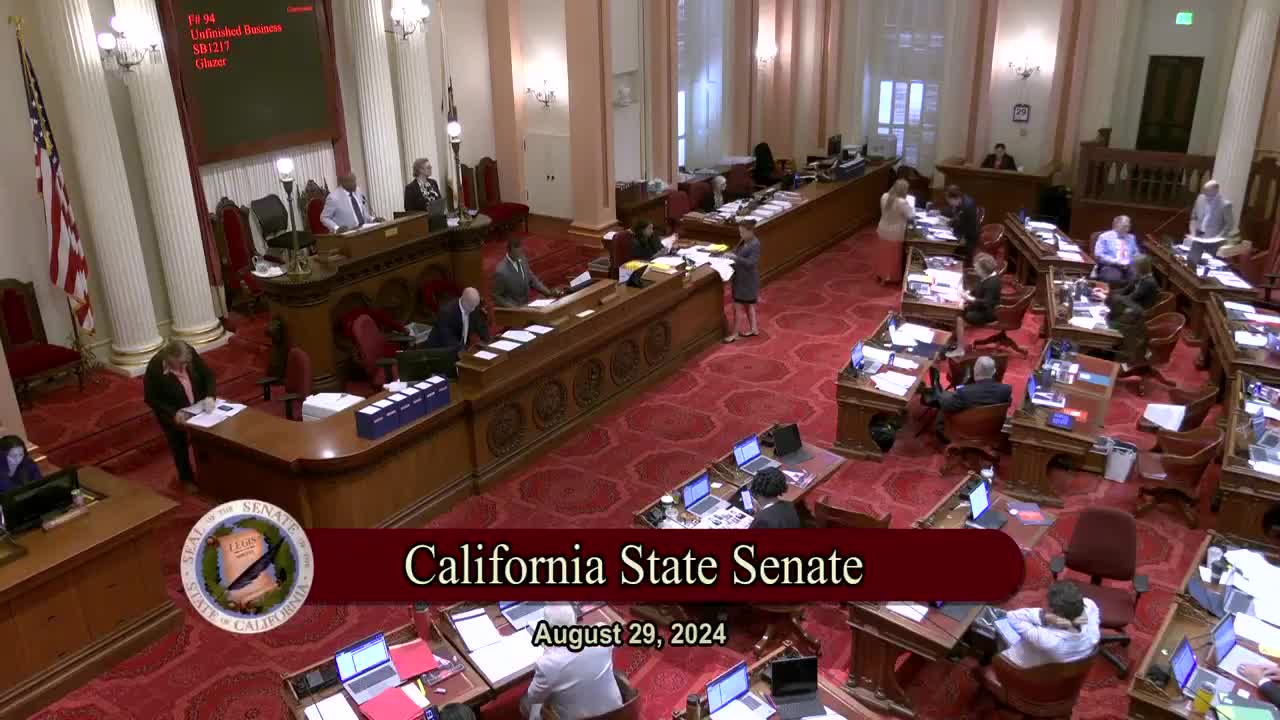
| Aug 29, 2024 | Read third time. Passed. Ordered to the Assembly. (Ayes 36. Noes 1.). |
| Aug 19, 2024 | Read second time. Ordered to third reading. |
| Aug 15, 2024 | From committee: Do pass. (Ayes 6. Noes 0.) (August 15). |
| Jun 24, 2024 | In committee: Referred to suspense file. |
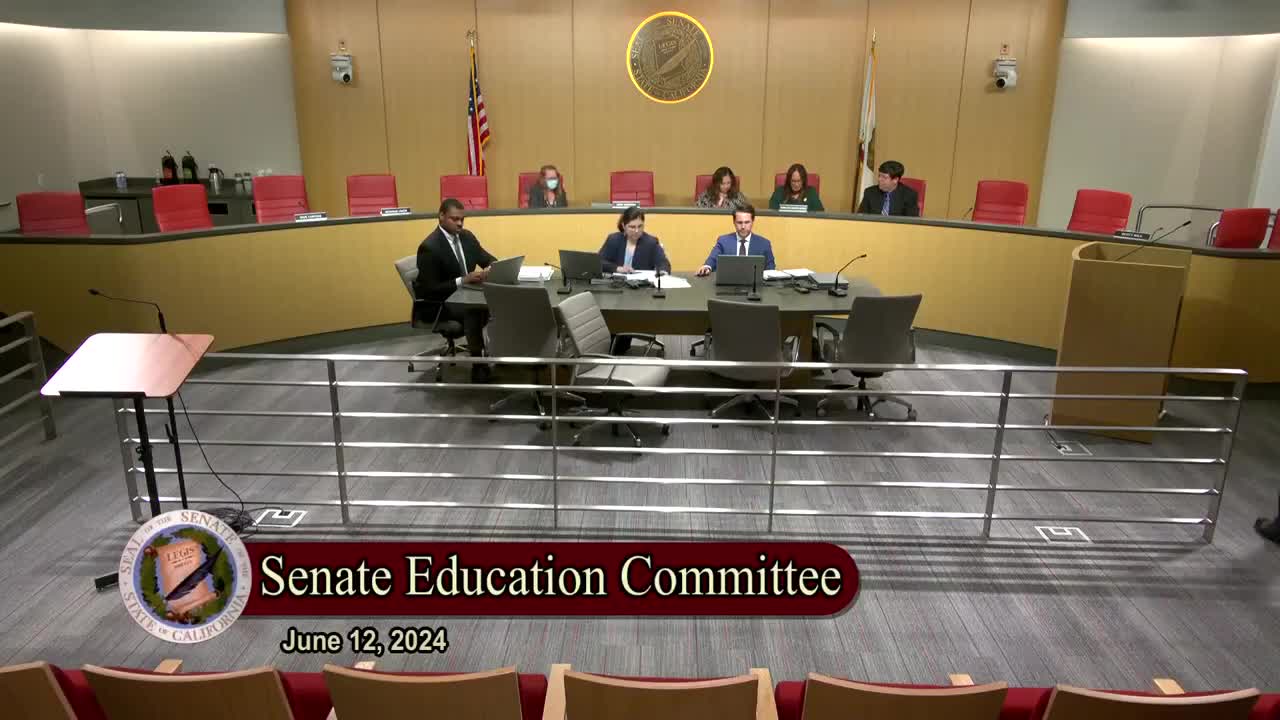
| Jun 12, 2024 | From committee: Do pass and re-refer to Com. on APPR. (Ayes 7. Noes 0.) (June 12). Re-referred to Com. on APPR. |
| May 29, 2024 | Referred to Com. on ED. |
| May 21, 2024 | In Senate. Read first time. To Com. on RLS. for assignment. |
| May 20, 2024 | Read third time. Passed. Ordered to the Senate. (Ayes 62. Noes 0. Page 5320.) |
| May 9, 2024 | Read second time. Ordered to third reading. |
| May 8, 2024 | From committee: Do pass. (Ayes 11. Noes 0.) (May 8). |
| Apr 22, 2024 | Re-referred to Com. on APPR. pursuant to Assembly Rule 96. |
| Apr 17, 2024 | Re-referred to Com. on HIGHER ED. |
| Apr 16, 2024 | From committee chair, with author's amendments: Amend, and re-refer to Com. on HIGHER ED. Read second time and amended. |
| Apr 10, 2024 | Re-referred to Com. on HIGHER ED. |
| Apr 9, 2024 | Read second time and amended. |
| Apr 8, 2024 | From committee: Amend, and do pass as amended and re-refer to Com. on HIGHER ED. (Ayes 5. Noes 0.) (April 3). |
| Mar 19, 2024 | Re-referred to Com. on ED. |
| Mar 18, 2024 | From committee chair, with author's amendments: Amend, and re-refer to Com. on ED. Read second time and amended. |
| Mar 11, 2024 | Referred to Coms. on ED. and HIGHER ED. |
| Feb 17, 2024 | From printer. May be heard in committee March 18. |
| Feb 16, 2024 | Read first time. To print. |
|
Date
|
Description
|
Location
|
Votes
|
|
|---|---|---|---|---|
| Aug 29, 2024 | Assembly 3rd Reading AB3074 Schiavo et al. By Umberg | Senate Floor |
Passed |
|
| Aug 15, 2024 | Do pass | Senate Standing Committee on Appropriations |
Passed |
|
| Jun 24, 2024 | Placed on suspense file | Senate Standing Committee on Appropriations |
Passed |
|
| Jun 12, 2024 | Do pass, but first be re-referred to the Committee on [Appropriations] | Senate Standing Committee on Education |
Passed |
|
| May 20, 2024 | AB 3074 Schiavo Assembly Third Reading | Assembly Floor |
Passed |
|
| May 8, 2024 | Do pass. | Assembly Standing Committee on Appropriations |
Passed |
|
| Apr 3, 2024 | Do pass as amended and be re-referred to the Committee on [Higher Education] | Assembly Standing Committee on Education |
Passed |
This list shows positions taken on this bill by organizations on the date displayed, which is linked to the original source.
Positions by individuals are not included.
|
Organization
|
Position
|
Date
|
|---|---|---|
| Aclu California Action | ** Support | |
| Acuerdos | ** Support | |
| Adriana Martínez | ** Support | |
| Ajolote | ** Support | |
| Alta Public Schools | ** Support | |
| American Indian Movement- Grand Governing Council | ** Support | |
| cahuilla band of indians | ** Support | |
| California Hospital Association | ** Support | |
| California Teachers Association | ** Support | |
| Caminantes Community Services, LC | ** Support | |
| Casa De La Cultura Maya | ** Support | |
| Casa Peru | ** Support | |
| CFT - A Union of Educators and Classified Professionals, AFT, AFL-CIO | ** Support | |
| CFT- a Union of Educators & Classified Professionals, Aft, Afl-cio | ** Support | |
| Children'S Hospital Los Angeles | ** Support | |
| Christine Garcia, American Sign Language Interpreter | ** Support | |
| Climate Resolve | ** Support | |
| Coalition of California State Tribes | ** Support | |
| Communities United for Restorative Youth Justice | ** Support | |
| Community Behavioral Health | ** Support | |
| Councilmember Eunisses Hernandez, First District, City of Los Angeles | ** Support | |
| Danza Teocatl | ** Support | |
| Dolores Huerta Foundation | ** Support | |
| El Nido Family Centers | ** Support | |
| Empowering Marginalized Asian Communities | ** Support | |
| Extera Public Schools | ** Support | |
| FERNANDENO TATAVIAM BAND OF MISSION INDIANS | ** Support | |
| Gemini Crown Tech | ** Support | |
| Girls Learn International | ** Support | |
| Girls Today, Woman Tomorrow- Leadership Mentoring Program | ** Support | |
| Holy Angels Catholic Church of the Deaf | ** Support | |
| Inspiraciones De Danza Mexicana | ** Support | |
| Irma Martinez Law | ** Support | |
| JC Lacey Consulting | ** Support | |
| Latino Education and Advocacy Days | ** Support | |
| Latino Theater Company | ** Support | |
| Los Angeles County Office Of Education | ** Support | |
| Meztli Projects | ** Support | |
| Miniera Healthcare Services | ** Support | |
| Montague Charter Academy | ** Support | |
| New Ways to Work | ** Support | |
| Ollin Law | ** Support | |
| Omeyolotzin | ** Support | |
| Origenes Dance Company | ** Support | |
| Pacifico Dance Company | ** Support | |
| Pala Band Of Mission Indians | ** Support | |
| Pasadena City College- Indigenous Peoples Advisory Committee | ** Support | |
| Paséki Strategies Corp. | ** Support | |
| Prayer Horse | ** Support | |
| Pueblos Indigenas Quechua Y Aymaras en EE. | ** Support | |
| Rahok | ** Support | |
| San Gabriel Band of Mission Indians Gabrieleno/Tongva | ** Support | |
| Santa Ynez Band Of Chumash Indians | ** Support | |
| Soccer With a Purpose | ** Support | |
| Soledad Enrichment Action, INC. | ** Support | |
| Stanford American Indian Organization | ** Support | |
| State Superintendent of Public Instruction Tony Thurmond | ** Support | |
| Tataviam Land Conservancy | ** Support | |
| The Athenian School | ** Support | |
| Tía Chucha's | ** Support | |
| Tiuvac’a’ai’ Tribal Conservation Corps | ** Support | |
| Toltecayotl Indigenous Dance | ** Support | |
| Tulare Joint Union High School District | ** Against | |
| Tule River Tribe | ** Support | |
| United American Indian Involvement INC. | ** Support | |
| Yo Soy Maíz | ** Support | |
| Youth Outreach and Learning Institute | ** Support | |
| Zupalove International | ** Support |
SENATE RULES COMMITTEE Office of Senate Floor Analyses (916) 651-1520 Fax: (916) 327-4478 | AB 3074 |
THIRD READING
Bill No: AB 3074
Author: Schiavo (D) and Ramos (D), et al.
Amended: 4/16/24 in Assembly
Vote: 21
SENATE EDUCATION COMMITTEE: 7-0, 6/12/24
AYES: Newman, Ochoa Bogh, Cortese, Glazer, Gonzalez, Limón, Wilk
SENATE APPROPRIATIONS COMMITTEE: 6-0, 8/15/24
AYES: Caballero, Jones, Ashby, Becker, Bradford, Wahab
NO VOTE RECORDED: Seyarto
ASSEMBLY FLOOR: 62-0, 5/20/24 - See last page for vote
SUBJECT: School or athletic team names: California Racial Mascots Act
SOURCE: Author
DIGEST:
This bill prohibits all public schools, except for schools operated by an Indian tribe or a tribal organization or a school that has received written consent from a local federally recognized tribe, from using any derogatory Native American term for school or athletic team names, mascots, or nicknames, by revising the California Racial Mascots Act, as specified, beginning July 1, 2026.
ANALYSIS:
Existing law:
- Establishes the California Racial Mascots Act and prohibits, beginning January 1, 2017, all public schools from using the term Redskins for school or athletic team names, mascots, or nicknames. (Education Code (EC) § 221.3 (a))
- Permits a public school to use uniforms or other materials bearing the term Redskins as a school or athletic team name, mascot, or nickname that were purchased before January 1, 2017, if all of the following conditions are met:
- The school selects a new school or athletic team name, mascot, or nickname.
- the school refrains from purchasing or acquiring, for the purpose of distribution or sale to pupils or school employees, any uniform that includes or bears the term Redskins, but may, before January 1, 2019, purchase or acquire a number of uniforms equal to up to 20 percent of the total number of uniforms used by a team or band at that school during the 2016–17 school year for the purposes of replacing damaged or lost uniforms.
- The school refrains from purchasing or acquiring, for the purpose of distribution or sale to pupils or school employees, any yearbook, newspaper, program, or other similar material that includes or bears the prohibited school or athletic team name, mascot, or nickname in its logo or cover title.
- The school refrains from purchasing or constructing a marquee, sign, or other new or replacement fixture that includes or bears the prohibited school or athletic team name, mascot, or nickname. This paragraph applies to facilities that bear the prohibited school or athletic team name, mascot, or nickname, in which case the school shall remove the prohibited name no later than the next time the associated part of the facility is replaced in the normal course of maintenance. (EC 221.3 § (b))
This bill:
- Defines “derogatory Native American term” to include, but is not limited to, Apaches, Big Reds, Braves, Chiefs, Chieftains, Chippewa, Comanches, Indians, Savages, Squaw, and Tribe.
- Prohibits all public schools, except for schools operated by an Indian tribe or a tribal organization, from using any derogatory Native American term for school or athletic team names, mascots, or nicknames, as specified beginning July 1, 2026.
- Authorizes a public school to continue to use uniforms or other materials bearing a derogatory Native American term as a school or athletic team name, mascot, or nickname that were purchased before July 1, 2026, if all of the following requirements are met:
- The school selects a new school or athletic team name, mascot, or nickname.
- The school refrains from purchasing or acquiring, for the purpose of distribution or sale to pupils or school employees, any uniform that includes or bears the derogatory Native American term, except before January 1, 2028, a school using uniforms that bear the derogatory Native American term may purchase or acquire a number of uniforms equal to up to 20% of the total number of uniforms used by a team or band at that school during the 2025–26 school year for the purposes of replacing damaged or lost uniforms.
- The school refrains from purchasing or acquiring, for the purpose of distribution or sale to pupils or school employees, any yearbook, newspaper, program, or other similar material that includes or bears the prohibited school or athletic team name, mascot, nickname, or related title in its logo or cover title.
- The school refrains from purchasing or constructing a marquee, sign, gymnasium floor, or other new or replacement fixture that includes or bears the prohibited school or athletic team name, mascot, or nickname. This requirement applies to facilities that bear the prohibited school or athletic team name, mascot, or nickname, in which case the school must remove the prohibited name, mascot, or nickname no later than the next time the associated part of the facility is replaced in the normal course of maintenance.
- Allows a public school that has received written consent from a local federally recognized tribe to use a derogatory Native American term for the school or an athletic team name, mascot, or nickname.
- Adds the California Racial Mascots Act to the Uniform Complaint Procedures (UCP) process operated by the California Department of Education (CDE).
- States the intent of the Legislature that the purchase or replacement of materials
or fixtures due to implementation of a new school or athletic team name, mascot, or nickname under the California Racial Mascots Act occur before the 2028–29 school year.
- Clarifies that the California Racial Mascots Act does not apply to the California Community College, the California State University, or University of California.
Comments
- Need for the bill. According to the author, “School can be a scary place for most kids. It does not help when your school has a derogatory logo or name that your classmates use in a manner insensitive to your culture. There are studies that have proven that these mascots have detrimental effects on Indigenous people from the individual to societal level. It is unfair to make any child undergo trauma due to their culture, and AB 3074 seeks to make a school a safe place for all.”
- The California Racial Mascots Act: Background and Research. Between 2002 and 2005, former Assemblymember Jackie Goldberg, a representative from Los Angeles, introduced multiple bills to prohibit using Native American terms as team names and mascots. Her initial bill, AB 2115 (Goldberg, 2002), sought to ban several Native American terms, including Redskins, Indians, Braves, Chiefs, Apaches, and Comanches. Subsequent bills were more specific, focusing solely on prohibiting the term "Redskins," but were ultimately vetoed by Governor Schwarzenegger. Finally, AB 30 (Alejo, Chapter 767, Statutes of 2015) was passed to establish the prohibition on the use of the term "Redskins” by all public schools, effective from January 1, 2017.
This bill defines "derogatory Native American term" to include, but is not limited to, Apaches, Big Reds, Braves, Chiefs, Chieftains, Chippewa, Comanches, Indians, Savages, Squaw, and Tribe.
In 2001, the U.S. Commission on Civil Rights called for the end of non-Native schools using Native American images and team names. The commission stressed the insensitivity of using such imagery and nicknames and pointed out that despite some institutions claiming it stimulated interest in Native American culture, they had failed to heed the concerns of Native groups, religious leaders, and civil rights organizations that opposed these symbols.
In 2005, the American Psychological Association urged all educational institutions, athletic teams, and organizations to discontinue using American Indian mascots, symbols, and images. The association highlighted the negative impact of such practices on the educational experiences of all individuals and the creation of a hostile learning environment for American Indian students. Dr. Lisa Thomas emphasized the detrimental effects of racism and perceived racism on the mental health of American Indian and Alaska Native (AIAN) people. The discontinuation of American Indian mascots was intended to convey a clear message that racism and disrespect would not be tolerated in our society.
- Perspective: Schools Across the National Are Changing Their Mascot. The National Congress of American Indians (NCAI) has recently developed a national tracking database containing over two dozen Native-themed school mascots at the K-12 level.

What About Californian Schools?
A similar trend is occurring in California. For example, in Santa Clarita Valley, William S. Hart High School’s governing board voted in July 2021 to remove the "Indians" as Hart High's mascot. They cited the need to move away from a race-based symbol that the school has been associated with since January 10, 1946. The board decided to make this change by 2025 at the earliest. In another example, in 2021. Fresno High School ended a long-standing controversial tradition by revealing its new logo. The school decided to retire the old Native American logo while retaining the "Warriors" name. The unveiling, which took place early Wednesday at Fresno High School, marked the conclusion of a nearly yearlong debate regarding the school's previous Native American-themed mascot, which was widely criticized for being a racist portrayal of Indigenous culture. In 2020, Arcadia High School in a revival of a 20-year-old controversy, efforts to remove Arcadia High School’s “Apaches” name and imagery have come to a head amid nationwide movements to erase offensive emblems. However, there are a few schools that this bill would apply to such as the Lompoc Braves, the Ripon Indians, and Canyon (Anaheim) Comanches.
FISCAL EFFECT: Appropriation: No Fiscal Com.: Yes Local: Yes
According to the Senate Appropriations Committee analysis, “This bill could result in additional one-time Proposition 98 General Fund costs, potentially in the tens of thousands to low hundreds of thousands of dollars statewide, for schools to replace signs, uniforms, and other items that bear derogatory Native American terms. The number of schools in the state that would be impacted is unknown. Additionally, if the Commission on State Mandates determines the bill’s requirements to be a reimbursable state mandate, the state would need to reimburse these costs to local educational agencies or provide funding through the K-12 Mandate Block Grant. Also, by adding the California Racial Mascots Act to the Uniform Complaint Procedures process, this bill could expand the existing Uniform Complaint Procedures mandate, resulting in additional, unknown Proposition 98 General Fund costs each year. The Statewide Cost Estimate for the mandate indicates a prospective cost of approximately $35,000 each year.”
SUPPORT: (Verified 8/15/24)
State Superintendent of Public Instruction Tony Thurmond
ACLU California Action
Acuerdos
Adriana Martínez
Ajolote
Alta Public Schools
American Indian Movement- Grand Governing Council
California Hospital Association
California Teachers Association
Caminantes Community Services, LC
Casa De LA Cultura Maya
Casa Peru
CFT- A Union of Educators and Classified Professionals, AFT, AFL-CIO
Children's Hospital Los Angeles
Christine Garcia, American Sign Language Interpreter
Climate Resolve
Coalition of California State Tribes
Communities United for Restorative Youth Justice
Community Behavioral Health
Councilmember Eunisses Hernandez, First District, City of Los Angeles
Danza Teocatl
Dolores Huerta Foundation
El Nido Family Centers
Empowering Marginalized Asian Communities
Extera Public Schools
Gemini Crown Tech
Girls Learn International
Girls Today, Woman Tomorrow- Leadership Mentoring Program
Holy Angels Catholic Church of the Deaf
Inspiraciones De Danza Mexicana
Irma Martinez Law
JC Lacey Consulting
Latino Education and Advocacy Days
Latino Theater Company
Los Angeles County Office of Education
Meztli Projects
Miniera Healthcare Services
Montague Charter Academy
New Ways to Work
Ollin Law
Omeyolotzin
Origenes Dance Company
Pacifico Dance Company
Pala Band of Mission Indians
Pasadena City College- Indigenous Peoples Advisory Committee
Paséki Strategies Corp.
Prayer Horse
Pueblos Indigenas Quechua Y Aymaras en EE.
Rahok
San Gabriel Band of Mission Indians Gabrieleno/tongva
Soccer With a Purpose
Soledad Enrichment Action, Inc.
Stanford American Indian Organization
Tataviam Land Conservancy
The Athenian School
Tiuvac’a’ai’ Tribal Conservation Corps
Toltecayotl Indigenous Dance
Tía Chucha's
United American Indian Involvement INC.
Yo Soy Maíz
Youth Outreach and Learning Institute
Zupalove International
OPPOSITION: (Verified 8/15/24)
Tulare Joint Union High School District
5 Individual
ARGUMENTS IN SUPPORT: According to the ACLU California Action, “When Indigenous students are exposed to mascots that portray stereotypes about Indigenous tribes and cultures, it has been shown to result in lowered self-esteem, decreases their sense of community worth and belief that their community can improve itself, decreases achievement-related future goals, and increases suicidal ideation and depression. Culturally responsive education has a widespread impact on social and economic conditions in our society because it can improve students’ academic performance, attendance, and well-being. A better educated student body leads to a populace that is better trained for work, less likely to commit crimes, has better health, and lower mortality rates. Improving student well-being has fiscal benefits: depression during adolescence has been linked to higher engagement in crime, and when psychiatric disabilities persist into adulthood, it can lead to costly increases in SSDI utilization, houselessness and incarceration on a societal level. Using racist and stereotypical mascots for sports teams is damaging. It appropriates sacred and religious traditions, perpetuates negative stereotypes, and is especially offensive given the long history of oppression against Indigenous communities. Prohibiting these mascots is the right thing to do and would help to ensure compliance with the spirit and the text of anti-discrimination laws. Prohibiting the use of derogatory terms as a school or athletic team name, mascot, or nickname is an important step towards making schools a safe and supportive place for all students.”
ARGUMENTS IN OPPOSITION: According to the Tulare Joint Union High School District “Our high school underwent a mascot change in recent years, a process that was challenging for our students, staff and community. Our high school has a rich tradition of excellence in academics, sports and extracurricular activities. The mascot is more than just a symbol; it represents the spirit, unity, and pride of our school. It is deeply intertwined with the identity of our students and the culture of our campus. Changing our mascot once again will disrupt this sense of identity and community, causing confusion and disconnection among students, staff and our community. Furthermore, the financial implications of this legislation cannot be overlooked. The cost of rebranding our school—changing uniforms, signage, marketing materials, and other related items—is substantial. These funds would be better allocated toward educational resources, student programs, and other initiatives that directly benefit our students’ learning and well-being, rather than being spent on unnecessary and repetitive changes. Our school community has already demonstrated its commitment to inclusivity and respect, and we believe that decisions about our mascot should remain within the local jurisdiction, reflecting the values and preferences of our students, faculty, and community members. I urge you to consider the negative impact AB 3074 will have on our high school and oppose this bill.”
ASSEMBLY FLOOR: 62-0, 5/20/24
AYES: Addis, Aguiar-Curry, Alanis, Alvarez, Bains, Bauer-Kahan, Bennett, Berman, Boerner, Bonta, Bryan, Calderon, Juan Carrillo, Wendy Carrillo, Chen, Connolly, Davies, Mike Fong, Friedman, Garcia, Gipson, Grayson, Haney, Hart, Holden, Irwin, Jackson, Jones-Sawyer, Kalra, Lee, Low, Lowenthal, Maienschein, McCarty, McKinnor, Muratsuchi, Ortega, Pacheco, Papan, Pellerin, Petrie-Norris, Quirk-Silva, Ramos, Rendon, Reyes, Rodriguez, Blanca Rubio, Santiago, Schiavo, Soria, Ting, Valencia, Villapudua, Waldron, Wallis, Ward, Weber, Wicks, Wilson, Wood, Zbur, Robert Rivas
NO VOTE RECORDED: Arambula, Cervantes, Megan Dahle, Dixon, Essayli, Flora, Vince Fong, Gabriel, Gallagher, Hoover, Lackey, Mathis, Stephanie Nguyen, Jim Patterson, Joe Patterson, Luz Rivas, Sanchez, Ta
Prepared by: Kordell Hampton / ED. / (916) 651-4105
8/18/24 9:19:37
**** END ****
SENATE COMMITTEE ON
Senator Anna Caballero, Chair
2023 - 2024 Regular Session
AB 3074 (Schiavo) - School or athletic team names: California Racial Mascots Act
Version: | Policy Vote: |
Urgency: | Mandate: |
Hearing Date: | Consultant: |
Bill Summary:
This bill prohibits all public schools, except for schools operated by an Indian tribe or a tribal organization or a school that has received written consent from a local federally recognized tribe, from using any derogatory Native American term for school or athletic team names, mascots, or nicknames.
Fiscal Impact:
- This bill could result in additional one-time Proposition 98 General Fund costs, potentially in the tens of thousands to low hundreds of thousands of dollars statewide, for schools to replace signs, uniforms, and other items that bear derogatory Native American terms. The number of schools in the state that would be impacted is unknown. Additionally, if the Commission on State Mandates determines the bill’s requirements to be a reimbursable state mandate, the state would need to reimburse these costs to local educational agencies or provide funding through the K-12 Mandate Block Grant.
- By adding the California Racial Mascots Act to the Uniform Complaint Procedures process, this bill could expand the existing Uniform Complaint Procedures mandate, resulting in additional, unknown Proposition 98 General Fund costs each year. The Statewide Cost Estimate for the mandate indicates a prospective cost of approximately $35,000 each year.
Background:
Existing law establishes the California Racial Mascots Act and prohibits, beginning January 1, 2017, all public schools from using the term Redskins for school or athletic team names, mascots, or nicknames.
Existing law permits a public school to use uniforms or other materials bearing the term Redskins as a school or athletic team name, mascot, or nickname that were purchased before January 1, 2017, if all of the following conditions are met:
- The school selects a new school or athletic team name, mascot, or nickname.
- the school refrains from purchasing or acquiring, for the purpose of distribution or sale to pupils or school employees, any uniform that includes or bears the term Redskins, but may, before January 1, 2019, purchase or acquire a number of uniforms equal to up to 20 percent of the total number of uniforms used by a team or band at that school during the 2016–17 school year for the purposes of replacing damaged or lost uniforms.
- The school refrains from purchasing or acquiring, for the purpose of distribution or sale to pupils or school employees, any yearbook, newspaper, program, or other similar material that includes or bears the prohibited school or athletic team name, mascot, or nickname in its logo or cover title.
The school refrains from purchasing or constructing a marquee, sign, or other new or replacement fixture that includes or bears the prohibited school or athletic team name, mascot, or nickname. This paragraph applies to facilities that bear the prohibited school or athletic team name, mascot, or nickname, in which case the school shall remove the prohibited name no later than the next time the associated part of the facility is replaced in the normal course of maintenance.
Proposed Law:
This bill prohibits all public schools, except for schools operated by an Indian tribe or a tribal organization, from using any derogatory Native American term for school or athletic team names, mascots, or nicknames, as specified beginning July 1, 2026.
This bill authorizes a public school to continue to use uniforms or other materials bearing a derogatory Native American term as a school or athletic team name, mascot, or nickname that were purchased before July 1, 2026, if all of the following requirements are met:
- The school selects a new school or athletic team name, mascot, or nickname.
- The school refrains from purchasing or acquiring, for the purpose of distribution or sale to pupils or school employees, any uniform that includes or bears the derogatory Native American term, except before January 1, 2028, a school using uniforms that bear the derogatory Native American term may purchase or acquire a number of uniforms equal to up to 20% of the total number of uniforms used by a team or band at that school during the 2025–26 school year for the purposes of replacing damaged or lost uniforms.
- The school refrains from purchasing or acquiring, for the purpose of distribution or sale to pupils or school employees, any yearbook, newspaper, program, or other similar material that includes or bears the prohibited school or athletic team name, mascot, nickname, or related title in its logo or cover title.
- The school refrains from purchasing or constructing a marquee, sign, gymnasium floor, or other new or replacement fixture that includes or bears the prohibited school or athletic team name, mascot, or nickname. This requirement applies to facilities that bear the prohibited school or athletic team name, mascot, or nickname, in which case the school must remove the prohibited name, mascot, or nickname no later than the next time the associated part of the facility is replaced in the normal course of maintenance.
This bill allows a public school that has received written consent from a local federally recognized tribe to use a derogatory Native American term for the school or an athletic team name, mascot, or nickname.
This bill adds the California Racial Mascots Act to the Uniform Complaint Procedures (UCP) process operated by the CDE.
Staff Comments:
AB 30 (Alejo, Chapter 767, Statutes of 2015) establishes the California Racial Mascots Act and prohibits, beginning January 1, 2017, any public school from using the term "Redskins" for school or athletic team names, mascots, or nicknames. This bill extends that prohibition to all derogatory Native American terms.
-- END --
SENATE COMMITTEE ON EDUCATION
Senator Josh Newman, Chair
2023 - 2024 Regular
Bill No: Hearing Date: June 12, 2024
Author: | Schiavo | ||
Version: |
| ||
Urgency: | Fiscal: | ||
Consultant: | |||
Subject: .
SUMMARY
This bill prohibits all public schools, except for schools operated by an Indian tribe or a tribal organization or a school that has received written consent from a local federally recognized tribe, from using any derogatory Native American term for school or athletic team names, mascots, or nicknames, by revising the California Racial Mascots Act, as specified, beginning July 1, 2026.
BACKGROUND
Existing Law:
Education Code (EC)
- Establishes the California Racial Mascots Act and prohibits, beginning January 1, 2017, all public schools from using the term Redskins for school or athletic team names, mascots, or nicknames. (EC § 221.3 (a))
- Permits a public school to use uniforms or other materials bearing the term Redskins as a school or athletic team name, mascot, or nickname that were purchased before January 1, 2017, if all of the following conditions are met:
- The school selects a new school or athletic team name, mascot, or nickname.
- the school refrains from purchasing or acquiring, for the purpose of distribution or sale to pupils or school employees, any uniform that includes or bears the term Redskins, but may, before January 1, 2019, purchase or acquire a number of uniforms equal to up to 20 percent of the total number of uniforms used by a team or band at that school during the 2016–17 school year for the purposes of replacing damaged or lost uniforms.
- The school refrains from purchasing or acquiring, for the purpose of distribution or sale to pupils or school employees, any yearbook, newspaper, program, or other similar material that includes or bears the prohibited school or athletic team name, mascot, or nickname in its logo or cover title.
- The school refrains from purchasing or constructing a marquee, sign, or other new or replacement fixture that includes or bears the prohibited school or athletic team name, mascot, or nickname. This paragraph applies to facilities that bear the prohibited school or athletic team name, mascot, or nickname, in which case the school shall remove the prohibited name no later than the next time the associated part of the facility is replaced in the normal course of maintenance. (EC 221.3 § (b))
- States it is the intent of the Legislature that implementation of a new school or athletic team name, mascot, or nickname does not result in a requirement to immediately purchase or replace materials or fixtures until they would have needed to be purchased or replaced without the enactment of the California Racial Mascots Act. (EC 221.3 § (c))
ANALYSIS
This bill:
Definitions
- Defines “derogatory Native American term” to include, but is not limited to, Apaches, Big Reds, Braves, Chiefs, Chieftains, Chippewa, Comanches, Indians, Savages, Squaw, and Tribe.
Revises the California Racial Mascot Act
- Prohibits all public schools, except for schools operated by an Indian tribe or a tribal organization, from using any derogatory Native American term for school or athletic team names, mascots, or nicknames, as specified beginning July 1, 2026.
- Authorizes a public school to continue to use uniforms or other materials bearing a derogatory Native American term as a school or athletic team name, mascot, or nickname that were purchased before July 1, 2026, if all of the following requirements are met:
- The school selects a new school or athletic team name, mascot, or nickname.
- The school refrains from purchasing or acquiring, for the purpose of distribution or sale to pupils or school employees, any uniform that includes or bears the derogatory Native American term, except before January 1, 2028, a school using uniforms that bear the derogatory Native American term may purchase or acquire a number of uniforms equal to up to 20% of the total number of uniforms used by a team or band at that school during the 2025–26 school year for the purposes of replacing damaged or lost uniforms.
- The school refrains from purchasing or acquiring, for the purpose of distribution or sale to pupils or school employees, any yearbook, newspaper, program, or other similar material that includes or bears the prohibited school or athletic team name, mascot, nickname, or related title in its logo or cover title.
- The school refrains from purchasing or constructing a marquee, sign, gymnasium floor, or other new or replacement fixture that includes or bears the prohibited school or athletic team name, mascot, or nickname. This requirement applies to facilities that bear the prohibited school or athletic team name, mascot, or nickname, in which case the school must remove the prohibited name, mascot, or nickname no later than the next time the associated part of the facility is replaced in the normal course of maintenance.
- Allows a public school that has received written consent from a local federally recognized tribe to use a derogatory Native American term for the school or an athletic team name, mascot, or nickname.
Uniform Complaint Procedures
- Adds the California Racial Mascots Act to the Uniform Complaint Procedures (UCP) process operated by the California Department of Education (CDE)
General Provisions
- States the intent of the Legislature that the purchase or replacement of materials or fixtures due to implementation of a new school or athletic team name, mascot, or nickname under the California Racial Mascots Act occur before the 2028–29 school year.
- Clarify that the California Racial Mascots Act does not apply to the California Community College, the California State University, or University of California.
STAFF COMMENTS
- Need for the bill. According to the author, “School can be a scary place for most kids. It does not help when your school has a derogatory logo or name that your classmates use in a manner insensitive to your culture. There are studies that have proven that these mascots have detrimental effects on Indigenous people from the individual to societal level. It is unfair to make any child undergo trauma due to their culture, and AB 3074 seeks to make a school a safe place for all.”
- The California Racial Mascots Act: Background and Research. Between 2002 and 2005, former Assemblymember Jackie Goldberg, a representative from Los Angeles, introduced multiple bills to prohibit using Native American terms as team names and mascots. Her initial bill, AB 2115 (Goldberg, 2002), sought to ban several Native American terms, including Redskins, Indians, Braves, Chiefs, Apaches, and Comanches. Subsequent bills were more specific, focusing solely on prohibiting the term "Redskins," but were ultimately vetoed by Governor Schwarzenegger. Finally, AB 30 (Alejo, Chapter 767, Statutes of 2015) was passed to establish the prohibition on the use of the term "Redskins” by all public schools, effective from January 1, 2017.
This bill defines "derogatory Native American term" to include, but is not limited to, Apaches, Big Reds, Braves, Chiefs, Chieftains, Chippewa, Comanches, Indians, Savages, Squaw, and Tribe.
In 2001, the U.S. Commission on Civil Rights called for the end of non-Native schools using Native American images and team names. The commission stressed the insensitivity of using such imagery and nicknames and pointed out that despite some institutions claiming it stimulated interest in Native American culture, they had failed to heed the concerns of Native groups, religious leaders, and civil rights organizations that opposed these symbols.
In response to the 2001 recommendation, the National Collegiate Athletic Association (NCAA) adopted a policy in 2005 prohibiting colleges and universities participating in championship games from using hostile mascots, nicknames, or images based on race, ethnicity, or national origin. However, the NCAA does not prohibit colleges and universities from adopting Native American mascots or displaying them during regular-season games.
In 2005, the American Psychological Association urged all educational institutions, athletic teams, and organizations to discontinue using American Indian mascots, symbols, and images. The association highlighted the negative impact of such practices on the educational experiences of all individuals and the creation of a hostile learning environment for American Indian students. Dr. Lisa Thomas emphasized the detrimental effects of racism and perceived racism on the mental health of American Indian and Alaska Native (AIAN) people. The discontinuation of American Indian mascots was intended to convey a clear message that racism and disrespect would not be tolerated in our society.
- Perspective: Schools Across the National Are Changing Their Mascot. The National Congress of American Indians (NCAI) has recently developed a national tracking database containing over two dozen Native-themed school mascots at the K-12 level.
The database is regularly updated through real-time Google alert notifications and direct engagement with many schools featured. It includes detailed information for each school, such as online news stories, school mascot logos, and contact information for school principals, superintendents, and school board members. Some schools across the nation have already enacted proposals to change their school name, logo, and mascots.

What About Californian Schools?
A similar trend is occurring in California. For example, in Santa Clarita Valley, William S. Hart High School’s governing board voted in July 2021 to remove the "Indians" as Hart High's mascot. They cited the need to move away from a race-based symbol that the school has been associated with since January 10, 1946. The board decided to make this change by 2025 at the earliest. In another example, in 2021. Fresno High School ended a long-standing controversial tradition by revealing its new logo. The school decided to retire the old Native American logo while retaining the "Warriors" name. The unveiling, which took place early Wednesday at Fresno High School, marked the conclusion of a nearly yearlong debate regarding the school's previous Native American-themed mascot, which was widely criticized for being a racist portrayal of Indigenous culture. In 2020, Arcadia High School in a revival of a 20-year-old controversy, efforts to remove Arcadia High School’s “Apaches” name and imagery have come to a head amid nationwide movements to erase offensive emblems. However, there are a few schools that this bill would apply to such as the Lompoc Braves, the Ripon Indians, and Canyon (Anaheim) Comanches.
- Related Legislation.
AB 30 (Alejo, Chapter 767, Statutes of 2015) establishes the California Racial Mascots Act and prohibits, beginning January 1, 2017, all public schools from using the term "Redskins" for school or athletic team names, mascots, or nicknames.
ACR 164 (Goldberg, 2006) adopted by the Assembly and sent to the Senate, requested the California Interscholastic Federation to adopt policies that are consistent with the National Collegiate Athletic Association policies relative to the use of Native American mascots and any other hostile or abusive racial, ethnic, or national origin mascot.
AB 13 (Goldberg, 2005), nearly identical to AB 858 (Goldberg, 2004), would have prohibited all public schools from using the term Redskins for school or athletic team names, mascots, or nicknames and was vetoed by Governor Schwarzenegger, whose veto message read:
"I vetoed a nearly identical bill last year because it added another non-academic state administrative requirement, thereby diverting focus from increasing student academic achievement. Administrative decisions regarding athletic team names, nicknames or mascots should be retained at the local level."
AB 858 (Goldberg, 2004) would have prohibited all public schools from using the term Redskins for school or athletic team names, mascots, or nicknames. AB 858 was vetoed by Governor Schwarzenegger, whose veto message read:
"Existing statute already affords local school boards general control over all aspects of their interscholastic athletic policies, programs, and activities. Decisions regarding athletic team names, nicknames or mascots should be retained at the local level.
"At a time when we should all be working together to increase the academic achievement of all California's students, adding another non-academic state administrative requirement for schools to comply with takes more focus away from getting kids to learn at the highest levels."
AB 2115 (Goldberg, 2002) would have prohibited all public schools, community colleges, the California State University and the University of California, to the extent agreed upon by the Board of Regents, from using specified Native American names, including Redskins, Indians, Braves, Chiefs, Apaches, and Comanches, for school or athletic team names, mascots, or nicknames. AB 2115 failed passage on the Assembly Floor.
SUPPORT
ACLU California Action
California Teachers Association
Los Angeles County Office of Education
OPPOSITION
None received
-- END --
ASSEMBLY THIRD READING
ATR Bill Id:AB 3074
Author:(Schiavo and Ramos)
As Amended Ver:April 16, 2024
Majority vote
SUMMARY
Prohibits, commencing July 1, 2026, all public schools, except for a school operated by an Indian tribe or a tribal organization, from using any derogatory Native American term for school or athletic team names, mascots, or nicknames, as specified.
Major Provisions
- Prohibits, commencing July 1, 2026, all public schools, except for a school operated by an Indian tribe or a tribal organization, from using any derogatory Native American term for school or athletic team names, mascots, or nicknames.
- Authorizes a public school to continue to use uniforms or other materials bearing a derogatory Native American term as a school or athletic team name, mascot, or nickname that were purchased before July 1, 2026, if all of the following requirements are met:
- The school selects a new school or athletic team name, mascot, or nickname.
- The school refrains from purchasing or acquiring, for the purpose of distribution or sale to pupils or school employees, any uniform that includes or bears the derogatory Native American term, except before January 1, 2028, a school using uniforms that bear the derogatory Native American term may purchase or acquire a number of uniforms equal to up to 20% of the total number of uniforms used by a team or band at that school during the 2025–26 school year for the purposes of replacing damaged or lost uniforms.
- The school refrains from purchasing or acquiring, for the purpose of distribution or sale to pupils or school employees, any yearbook, newspaper, program, or other similar material that includes or bears the prohibited school or athletic team name, mascot, nickname, or related title in its logo or cover title.
- The school refrains from purchasing or constructing a marquee, sign, gymnasium floor, or other new or replacement fixture that includes or bears the prohibited school or athletic team name, mascot, or nickname. This requirement applies to facilities that bear the prohibited school or athletic team name, mascot, or nickname, in which case the school must remove the prohibited name, mascot, or nickname no later than the next time the associated part of the facility is replaced in the normal course of maintenance.
- States that it is the intent of the Legislature that implementation of a new school or athletic team name, mascot, or nickname results in a requirement to purchase or replace materials or fixtures when they would have needed to be purchased or replaced without the enactment of this article.
- States that it is the intent of the Legislature that the purchase or replacement of materials or fixtures due to implementation of a new school or athletic team name, mascot, or nickname pursuant to this section occur before the 2028–29 school year.
- States that this prohibition shall not apply to a public school that receives written consent from a local federally recognized tribe to use a derogatory Native American term for the school or an athletic team name, mascot, or nickname.
- States that this measure is not subject to waiver by the State Board of Education (SBE).
- Defines "derogatory Native American term" to include, but not necessarily be limited to, Apaches, Big Reds, Braves, Chiefs, Chieftains, Chippewa, Comanches, Indians, Savages, Squaw, and Tribe.
- States that this prohibition does not apply to campuses of the California Community Colleges, the California State University or the University of California.
- Adds school or athletic team names, mascots, or nicknames to the Uniform Complaint Procedures Act.
COMMENTS
History of this issue in California. Former Assemblymember Jackie Goldberg (D-Los Angeles) introduced several bills between 2002 and 2005 attempting to prohibit the use of Native American terms as team names and mascots. Her first bill, AB 2115 (2002), prohibited a number of Native American terms, including Redskins, Indians, Braves, Chiefs, Apaches, and Comanches. Her final two bills were narrowed to prohibit only the term "Redskins," which were both vetoed by Governor Schwarzenegger. AB 30 (Alejo), Chapter 767, Statutes of 2015 established the prohibition on the use of the term "Redskins" by all public schools beginning January 1, 2017.
Research on derogatory Native American terms. In 2005, the American Psychological Association urged all schools, colleges, universities, athletic teams, and organizations to retire all American Indian mascots, symbols, and images because such practices undermine the educational experiences of all people and can create a "hostile learning environment for American Indian students that affirm negative images/stereotypes that are promoted in mainstream society." In a statement, Dr. Lisa Thomas stated, "We know from the literature that oppression, covert and overt racism, and perceived racism can have serious negative consequences for the mental health of American Indian and Alaska Native (AIAN) people. The discontinued use of American Indian mascots is a gesture to show that this kind of racism toward and the disrespect of, all people in our country and in the larger global context, will not be tolerated."
In 2001, the U.S. Commission on Civil Rights issued a statement calling for an end to the use of Native American images and team names by non-Native schools. It stated, "The Commission deeply respects the rights of all Americans to freedom of expression under the First Amendment…However, the Commission believes that the use of Native American images and nicknames in school is insensitive and should be avoided. Schools that continue to use Indian imagery and references claim that their use stimulates interest in Native American culture and honors Native Americans. These institutions have simply failed to listen to the Native groups, religious leaders, and civil rights organizations that oppose these symbols."
Partially in response to the 2001 U.S. Commission on Civil Rights recommendation, in 2005, the National Collegiate Athletic Association (NCAA) adopted a policy prohibiting colleges and universities playing in championship games from displaying hostile mascots, nicknames or images in terms of race, ethnicity or national origin. The NCAA does not prohibit colleges and universities from adopting Native American mascots or prohibit their display during regular season games, however.
According to the Author
"School can be a scary place for most kids. It does not help when your school has a derogatory logo or name that your classmates use in a manner insensitive to your culture. There are studies that have proven that these mascots have detrimental effects on Indigenous people from the individual to societal level. It is unfair to make any child undergo trauma due to their culture, and AB 3074 seeks to make a school a safe place for all."
Arguments in Support
The Cahuilla Band of Indians writes, "We understand the harmful impacts that derogatory mascots have on the identity formation of our Native American youth and the stereotypes that are generated by the wider public.
There is no grace in using a culture's heritage for the amusement of others. It breeds ignorance, and it perpetuates misrepresentations of history. As a state filled with numerous cultures with their unique histories and struggles, we must band together to stop these harmful acts and show people that heritage and culture are to be appreciated, not appropriated."
Arguments in Opposition
None on file.
FISCAL COMMENTS
According to the Appropriations Committee:
- Unknown one-time Proposition 98 General Fund costs, likely of less than $150,000 for schools to phase out uniforms and replace signs and other items that bear derogatory Native American terms. The number of schools in California using a derogatory Native American term for school or athletic team names, mascots, or nicknames is unknown.
- If the Commission on State Mandates determines the bill's requirements to be a reimbursable state mandate, the state would need to reimburse these costs to LEAs or provide funding through the K-12 Mandate Block Grant.
VOTES
ASM EDUCATION: 5-0-2
YES: Muratsuchi, Addis, Alvarez, Bonta, McCarty
ABS, ABST OR NV: Flora, Hoover
ASM APPROPRIATIONS: 11-0-4
YES: Wicks, Arambula, Bryan, Calderon, Wendy Carrillo, Mike Fong, Friedman, Haney, Hart, Pellerin, Villapudua
ABS, ABST OR NV: Sanchez, Dixon, Jim Patterson, Ta
UPDATED
VERSION: April 16, 2024
CONSULTANT: Chelsea Kelley / ED. / (916) 319-2087 FN: 0002914
Date of Hearing: May 8, 2024
ASSEMBLY COMMITTEE ON APPROPRIATIONS
Buffy Wicks, Chair
ABPCA Bill Id:AB 3074
Author:(Schiavo) – As Amended Ver:April 16, 2024
Policy Committee: | Education | Vote: | 5 - 0 |
|
| ||
|
|
Urgency: No State Mandated Local Program: Yes Reimbursable: Yes
SUMMARY:
This bill prohibits public schools, beginning July 1, 2026, from using any derogatory Native American term for school or athletic team names, mascots, or nicknames.
Specifically, this bill prohibits derogatory terms including but not limited to, Apaches, Big Reds, Braves, Chiefs, Chieftains, Chippewa, Comanches, Indians, Savages, Squaw, and Tribe. This prohibition does not apply to schools operated by an Indian tribe or tribal organization. This bill further does not apply to a school that receives written consent from a local federally recognized tribe to use a derogatory Native American term for the school or an athletic team name, mascot, or nickname.
The bill further authorizes a public school to continue to use uniforms or other materials bearing a derogatory Native American term as a school or athletic team name, mascot, or nickname that were purchased before July 1, 2026, if the school (a) selects a new school or athletic team name, mascot, or nickname and (b) refrains from purchasing or acquiring items that bear the derogatory Native American term. The bill, however, allows the school that is using uniforms that bear a derogatory Native American term, prior to July 1, 2028, to purchase or acquire a number of uniforms equal up to 20% of the total number of uniforms used by a team or band at the school during the 2025-26 school year for the purpose of replacing damaged or lost uniforms.
FISCAL EFFECT:
Unknown one-time Proposition 98 General Fund costs, likely of less than $150,000 for schools to phase out uniforms and replace signs and other items that bear derogatory Native American terms. The number of schools in California using a derogatory Native American term for school or athletic team names, mascots, or nicknames is unknown.
If the Commission on State Mandates determines the bill’s requirements to be a reimbursable state mandate, the state would need to reimburse these costs to LEAs or provide funding through the K-12 Mandate Block Grant.
COMMENTS:
- Purpose. According to the author:
There are studies that have proven that [derogatory Native American] mascots have detrimental effects on Indigenous people from the individual to societal level. It is unfair to make any child undergo trauma due to their culture, and AB 3074 seeks to make a school a safe place for all.
- Background. AB 30 (Alejo), of the 2015-16 Legislative Session, establishes the California Racial Mascots Act and prohibits, beginning January 1, 2017, any public school from using the term "Redskins" for school or athletic team names, mascots, or nicknames.
This bill extends the prohibition established by AB 30 to all derogatory Native American terms.
- Prior Legislation. AB 2115 (Goldberg), of the 2001-02 Legislative Session, would have prohibited all public schools, community colleges, the California State University and the University of California, to the extent agreed upon by the Board of Regents, from using specified Native American names, including Redskins, Indians, Braves, Chiefs, Apaches, and Comanches, for school or athletic team names, mascots, or nicknames. The bill was held on the Assembly Floor.
Analysis Prepared by: Natasha Collins / APPR. / (916) 319-2081
Date of Hearing: April 3, 2024
ASSEMBLY COMMITTEE ON EDUCATION
Al Muratsuchi, Chair
ABPCA Bill Id:AB 3074 (
Author:Schiavo & Ramos) – As Amended Ver:March 18, 2024
This bill was doubled referred to the Assembly Higher Education Committee and will be heard by that Committee as it relates to issues under its jurisdiction.]
SUBJECT: School or athletic team names: California Racial Mascots Act
SUMMARY: Prohibits, commencing January 1, 2026, all public schools, except for a school operated by an Indian tribe or a tribal organization, from using any derogatory Native American term for school or athletic team names, mascots, or nicknames, as specified. Specifically, this bill:
- Prohibits, commencing January 1, 2026, all public schools, except for a school operated by an Indian tribe or a tribal organization, from using any derogatory Native American term for school or athletic team names, mascots, or nicknames.
- Authorizes a public school to continue to use uniforms or other materials bearing a derogatory Native American term as a school or athletic team name, mascot, or nickname that were purchased before January 1, 2026, if all of the following requirements are met:
- The school selects a new school or athletic team name, mascot, or nickname.
- The school refrains from purchasing or acquiring, for the purpose of distribution or sale to pupils or school employees, any uniform that includes or bears the derogatory Native American term, except before January 1, 2028, a school using uniforms that bear the derogatory Native American term may purchase or acquire a number of uniforms equal to up to 20% of the total number of uniforms used by a team or band at that school during the 2025–26 school year for the purposes of replacing damaged or lost uniforms.
- The school refrains from purchasing or acquiring, for the purpose of distribution or sale to pupils or school employees, any yearbook, newspaper, program, or other similar material that includes or bears the prohibited school or athletic team name, mascot, nickname, or related title in its logo or cover title.
- Commencing with registration for the 2026–27 school year, the school does not register or reregister the prohibited school or athletic team name, mascot, or nickname with the California Interscholastic Federation (CIF).
- The school refrains from purchasing or constructing a marquee, sign, gymnasium floor, or other new or replacement fixture that includes or bears the prohibited school or athletic team name, mascot, or nickname. This requirement applies to facilities that bear the prohibited school or athletic team name, mascot, or nickname, in which case the school must remove the prohibited name, mascot, or nickname no later than the next time the associated part of the facility is replaced in the normal course of maintenance.
- States that it is the intent of the Legislature that implementation of a new school or athletic team name, mascot, or nickname results in a requirement to purchase or replace materials or fixtures when they would have needed to be purchased or replaced without the enactment of this article.
- States that it is the intent of the Legislature that the purchase or replacement of materials or fixtures due to implementation of a new school or athletic team name, mascot, or nickname pursuant to this section occur before the 2028–29 school year.
- States that this prohibition shall not apply to a public school that receives written consent from a local federally recognized tribe to use a derogatory Native American term for the school or an athletic team name, mascot, or nickname.
- States that this measure is not subject to waiver by the State Board of Education (SBE).
- Defines “derogatory Native American term” to include, but not necessarily be limited to, Apaches, Big Reds, Braves, Chiefs, Chieftains, Chippewa, Comanches, Indians, Savages, Squaw, and Tribe.
EXISTING LAW:
- Prohibits, beginning January 1, 2017, all public schools from using the term Redskins for school or athletic team names, mascots, or nicknames. (Education Code (EC) 221.3)
- States that a public school may continue to use uniforms or other materials bearing the term Redskins as a school or athletic team name, mascot, or nickname that were purchased before January 1, 2017, if all of the following requirements are met:
- The school selects a new school or athletic team name, mascot, or nickname.
- The school refrains from purchasing or acquiring, for the purpose of distribution or sale to pupils or school employees, any uniform that includes or bears the term Redskins. Prior to January 1, 2019, a school using uniforms that bear the term Redskins may purchase or acquire a number of uniforms equal to up to 20% of the total number of uniforms used by a team or band at that school during the 2016–17 school year for the purposes of replacing damaged or lost uniforms.
- The school refrains from purchasing or acquiring, for the purpose of distribution or sale to pupils or school employees, any yearbook, newspaper, program, or other similar material that includes or bears the prohibited school or athletic team name, mascot, or nickname in its logo or cover title.
- The school refrains from purchasing or constructing a marquee, sign, or other new or replacement fixture that includes or bears the prohibited school or athletic team name, mascot, or nickname. This requirement applies to facilities that bear the prohibited school or athletic team name, mascot, or nickname, in which case the school must remove the prohibited name no later than the next time the associated part of the facility is replaced in the normal course of maintenance. (EC 221.3)
- States that it is the intent of the Legislature that implementation of a new school or athletic team name, mascot, or nickname does not result in a requirement to immediately purchase or replace materials or fixtures until they would have needed to be purchased or replaced. (EC 221.3)
- States that the prohibition on athletic team names is not subject to waiver by the SBE. (EC 221.3)
- Specifies that it is the policy of the State of California to afford all persons in public schools, regardless of their disability, gender, gender identity, gender expression, nationality, race or ethnicity, religion, sexual orientation, or any other characteristic that is contained in the definition of hate crimes, equal rights and opportunities in the educational institutions of the state. (EC Section 200)
- Requires the State Board of Education (SBE) to adopt policies directed toward creating a school environment in kindergarten through grade 12 that is free from discriminatory attitudes and practices and acts of hate violence. (EC Section 233)
FISCAL EFFECT: Unknown
COMMENTS:
What does this bill do? This bill prohibits, beginning January 1, 2026, all public schools from using a derogatory Native American term for school or athletic team names, mascots, or nicknames, except for a school operated by an Indian tribe or tribal organization, or a school that receives written consent from a local federally recognized tribe. The bill authorizes a school to continue using uniforms or other materials that were purchased before January 1, 2026, as long as the school selects a new school or athletic team name, mascot, or nickname, and refrains from purchasing new items (yearbook, newspaper, marquee, signs, etc.) that bear the name. The bill does allow an exception to replace damaged or lost uniforms, prior to January 1, 2028, but only in an amount equal to 20% of the total number of uniforms used by a team or a band at a school during the 2025-26 school year. This bill specifically prohibits the provisions of this bill from the SBE waiver process.
Need for the bill. According to the author, “School can be a scary place for most kids. It does not help when your school has a derogatory logo or name that your classmates use in a manner insensitive to your culture. There are studies that have proven that these mascots have detrimental effects on Indigenous people from the individual to societal level. It is unfair to make any child undergo trauma due to their culture, and AB 3074 seeks to make a school a safe place for all.”
How many schools would this bill affect? The National Congress of American Indians (NCAI) developed a comprehensive national tracking database of more than two dozen different Native “themed” school mascots at K-12 schools. Below is the most recent national data, according to the NCAI database:
The Los Angeles Unified School District (LAUSD) Board passed a resolution in 1997 finding that the "use of American Indian mascot names and images in schools evokes negative images that become deeply imbedded in the minds of students, depicting American Indians in inaccurate, stereotypic, and often violent manners." The resolution resolved that American Indian mascots and names such as Apaches, Mohicans, Warriors, and Braves would no longer be used. In 1998, a federal judge upheld the LAUSD resolution. According to the LAUSD, all American Indian names have been eliminated.
California Interscholastic Federation (CIF). This bill prohibits schools from registering with the CIF if they have a team name or mascot that uses a derogatory Native American term. The CIF does not have a policy on the use of Native American terms for team names or mascots. CIF does not require annual registration by schools, and does not require team names to be reported. Staff recommends the bill be amended to remove CIF registration from the bill and instead include this prohibition in the uniform complaint procedures (UCP) after July 1, 2026.
History of this issue in California. Former Assemblymember Jackie Goldberg (D-Los Angeles) introduced several bills between 2002 and 2005 attempting to prohibit the use of Native American terms as team names and mascots. Her first bill, AB 2115 (2002), prohibited a number of Native American terms, including Redskins, Indians, Braves, Chiefs, Apaches, and Comanches. Her final two bills were narrowed to prohibit only the term "Redskins,” which were both vetoed by Governor Schwarzenegger. AB 30 (Alejo), Statutes of 2015 established the prohibition on the use of the term “Redskins” by all public schools beginning January 1, 2017.
Research on derogatory Native American terms. In 2005, the American Psychological Association urged all schools, colleges, universities, athletic teams, and organizations to retire all American Indian mascots, symbols, and images because such practices undermine the educational experiences of all people and can create a "hostile learning environment for American Indian students that affirm negative images/stereotypes that are promoted in mainstream society." In a statement, Dr. Lisa Thomas stated, "We know from the literature that oppression, covert and overt racism, and perceived racism can have serious negative consequences for the mental health of American Indian and Alaska Native (AIAN) people. The discontinued use of American Indian mascots is a gesture to show that this kind of racism toward and the disrespect of, all people in our country and in the larger global context, will not be tolerated."
In 2001, the U.S. Commission on Civil Rights issued a statement calling for an end to the use of Native American images and team names by non-Native schools. It stated, "The Commission deeply respects the rights of all Americans to freedom of expression under the First Amendment…However, the Commission believes that the use of Native American images and nicknames in school is insensitive and should be avoided. Schools that continue to use Indian imagery and references claim that their use stimulates interest in Native American culture and honors Native Americans. These institutions have simply failed to listen to the Native groups, religious leaders, and civil rights organizations that oppose these symbols.”
Partially in response to the 2001 U.S. Commission on Civil Rights recommendation, in 2005, the National Collegiate Athletic Association (NCAA) adopted a policy prohibiting colleges and universities playing in championship games from displaying hostile mascots, nicknames or images in terms of race, ethnicity or national origin. The NCAA does not prohibit colleges and universities from adopting Native American mascots or prohibit their display during regular season games, however.
Recommended Committee Amendments. Staff recommends the bill be amended to:
- Change the operative date to July 1, 2026, so this prohibition will align with the start of a school year.
- Authorize up to 20% of uniforms to be replaced that were used during the 2026-27 school year to align to the new operative date.
- Remove the CIF registration from the bill and instead include this bill in the UCP after July 1, 2026.
Related legislation. AB 30 (Alejo), Chapter 767, Statutes of 2015, establishes the California Racial Mascots Act and prohibits, beginning January 1, 2017, all public schools from using the term "Redskins" for school or athletic team names, mascots, or nicknames.
ACR 164 (Goldberg) of the 2005-06 Session, requested the CIF to adopt policies that are consistent with the NCAA policies relative to the use of Native American mascots and any other hostile or abusive racial, ethnic, or national origin mascot.
AB 13 (Goldberg) of the 2005-06 Session would have established the California Racial Mascots Act and prohibited all public schools from using the term "Redskins" for school or athletic team names, mascots, or nicknames. This bill was vetoed by the Governor with the following message:
Existing statute already affords local school boards general control over all aspects of their interscholastic athletic policies, programs, and activities. Decisions regarding athletic team names, nicknames or mascots should be retained at the local level.
At a time when we should all be working together to increase the academic achievement of all California's students, adding another non-academic state administrative requirement for schools to comply with takes more focus away from getting kids to learn at the highest levels.
AB 858 (Goldberg) of the 2003-04 Session would have established the California Racial Mascots Act and prohibited all public schools from using the term "Redskins" for school or athletic team names, mascots, or nicknames. This bill was vetoed by the Governor with the following message:
Existing statute already affords local school boards general control over all aspects of their interscholastic athletic policies, programs, and activities. Decisions regarding athletic team names, nicknames or mascots should be retained at the local level.
At a time when we should all be working together to increase the academic achievement of all California's students, adding another non-academic state administrative requirement for schools to comply with takes more focus away from getting kids to learn at the highest levels.
AB 2115 (Goldberg) of the 2001-02 Session would have prohibited all public schools, community colleges, the California State University and the University of California, to the extent agreed upon by the Board of Regents, from using specified Native American names, including Redskins, Indians, Braves, Chiefs, Apaches, and Comanches, for school or athletic team names, mascots, or nicknames. The bill was held on the Assembly Floor.
REGISTERED SUPPORT / OPPOSITION:
Support
ACLU California Action
Cahuilla Band of Indians
California Federation of Teachers Afl-cio
Fernandeno Tataviam Band of Mission Indians
Santa Ynez Band of Chumash Indians
Tule River Tribe
Opposition
None on file
Analysis Prepared by: Chelsea Kelley / ED. / (916) 319-2087