AB 309: The Social Housing Act.
- Session Year: 2023-2024
- House: Assembly
- Latest Version Date: 2023-09-18
Current Status:
Failed
(2024-01-30: Consideration of Governor's veto stricken from file.)
Introduced
In Committee
First Chamber
In Committee
Second Chamber
Enacted
Existing law establishes the Department of General Services to provide centralized services, including, but not limited to, planning, acquisition, construction and maintenance of state buildings and property. Existing law authorizes the Director of General Services, with the consent of the state agency concerned, to lease state-owned real property when the Director of General Services deems that leasing serves a beneficial public purpose limited to the development of housing.
This bill would enact the Social Housing Act and would create, in the Department of General Services, the Social Housing Program, the mission of which would be to ensure that qualified social housing developments are produced on leased state property to help address the housing crisis, as specified. The bill would authorize the program to identify and develop up to 3 qualified social housing projects, as specified, with the intent to use the results to inform public policy related to developing an independent public entity to develop statewide qualified social housing. The bill would require the program to solicit bids to develop qualified social housing units, and prioritize bids that demonstrate long-term revenue neutrality or a cost rent model, as those terms are defined. The bill would require the program to employ 2 different leasing models, the rental model and the ownership model, as specified, in creating social housing. The bill would prohibit a city or county from denying a social housing development authorized under the program. The bill would authorize a city or county to propose objective design review standards, as specified, and authorize a city or county to propose modifications to mitigate any specific, adverse impacts on public health or safety, as specified.
Existing law establishes the Department of General Services to provide centralized services, including, but not limited to, planning, acquisition, construction and maintenance of state buildings and property. Existing law authorizes the Director of General Services, with the consent of the state agency concerned, to lease state-owned real property when the Director of General Services deems that leasing serves a beneficial public purpose limited to the development of housing.
This bill would enact the Social Housing Act and would create, in the Department of General Services, the Social Housing Program, the mission of which would be to ensure that social housing developments are produced on leased state property to help address the housing crisis, as specified. The bill would authorize the program to identify and develop up to 3 social housing projects, as specified, with the intent to use the results to inform public policy related to developing an independent public entity to develop statewide social housing. The bill would require the program to solicit bids to develop social housing units, and prioritize bids that demonstrate long-term revenue neutrality or a cost rent model, as those terms are defined. The bill would require the program to employ 2 different leasing models, the rental model and the ownership model, as specified, in creating social housing. The bill would prohibit a city or county from denying a social housing development authorized under the program. The bill would authorize a city or county to propose objective design review standards, as specified, and authorize a city or county to propose modifications to mitigate any specific, adverse impacts on public health or safety, as specified.
Existing law establishes the Department of Housing and Community Development and sets forth its powers and duties. Existing law creates a housing authority in each county or city, which functions upon the adoption of a specified resolution by the relevant governing body. Existing law authorizes these housing authorities, within their jurisdictions, to construct, reconstruct, improve, alter, or repair all or part of any housing project. Existing law establishes various programs that provide housing assistance.This bill would enact the Social Housing Act and would create the California Housing Authority, as an independent state body, the mission of which would be to ensure that social housing developments that are produced and acquired align with the goals of eliminating the gap between housing production and regional housing needs assessment targets and preserving affordable housing. The bill would prescribe a definition of social housing that would describe, in addition to housing owned by the authority, housing owned by other entities, as specified, provided that all social housing developed or authorized by the authority would be owned by the authority.This bill would prescribe the composition of the California Housing Authority Board, which would govern the authority, and would be composed of appointed members and members who would be elected by residents of social housing developments, as specified. The bill would set forth the powers and duties of the authority and the board. The bill would require the authority to seek to achieve revenue neutrality, as defined, and would require the authority to seek to recuperate the cost of development and operations over the life of its properties through mechanisms that maximize the number of Californians who can be housed without experiencing rent burden.This bill would require the authority to prioritize the development of specified property, including vacant parcels and parcels near transit, and would establish a process for the annual determination of required social housing units. Under the bill, social housing would accommodate a mix of household income ranges and would provide specified protections for residents, who would participate in the operation and management of the units in which they reside.This bill would require the California Housing Authority to employ 2 leasing models in social housing developments, referred to as the rental model and the ownership model, and would set forth the characteristics of both models. Under the ownership model, the authority would extend a 99-year lease, in the form of a limited equity arrangement, as defined, to individuals who commit to a minimum 5-year term of residence, and would authorize the authority to act as a lender for residents. The bill would specify how the units may be sold and transferred. The bill would establish eligibility requirements for social housing residents and provide for the selection of residents by lottery, as specified, providing that people who may have been displaced from a property as part of its development would be granted a preference for occupancy. The bill, among other things, would require the authority to accept a local jurisdictions preference for a project parcel if specified conditions are met. This bill would establish the Social Housing Revolving Loan Fund within the State Treasury to provide, upon appropriation by the Legislature, zero-interest loans for the purposes of constructing housing to accommodate a mix of household incomes. The bill would declare the intent of the Legislature to enact subsequent legislation to provide financing for the activities of the authority through the issuance of general obligation bonds. The bill would authorize the authority to issue revenue bonds, as specified. The bill would require the board to provide for regular audits of the authoritys accounts and records, as specified. The bill would also require the authority to prepare and submit specified reporting information regarding its business plan and progress to the Legislature on an annual basis.Existing law establishes the Department of Housing and Community Development and sets forth its powers and duties. Existing law creates a housing authority in each county or city, which functions upon the adoption of a specified resolution by the relevant governing body. Existing law authorizes these housing authorities, within their jurisdictions, to construct, reconstruct, improve, alter, or repair all or part of any housing project. Existing law establishes various programs that provide housing assistance.
This bill would enact the Social Housing Act and would create the California Housing Authority, as an independent state body, the mission of which would be to ensure that social housing developments that are produced and acquired align with the goals of eliminating the gap between housing production and regional housing needs assessment targets and preserving affordable housing. The bill would prescribe a definition of social housing that would describe, in addition to housing owned by the authority, housing owned by other entities, as specified, provided that all social housing developed or authorized by the authority would be owned by the authority.
This bill would prescribe the composition of the California Housing Authority Board, which would govern the authority, and would be composed of appointed members and members who would be elected by residents of social housing developments, as specified. The bill would set forth the powers and duties of the authority and the board. The bill would require the authority to seek to achieve revenue neutrality, as defined, and would require the authority to seek to recuperate the cost of development and operations over the life of its properties through mechanisms that maximize the number of Californians who can be housed without experiencing rent burden.
This bill would require the authority to prioritize the development of specified property, including vacant parcels and parcels near transit, and would establish a process for the annual determination of required social housing units. Under the bill, social housing would accommodate a mix of household income ranges and would provide specified protections for residents, who would participate in the operation and management of the units in which they reside.
This bill would require the California Housing Authority to employ 2 leasing models in social housing developments, referred to as the rental model and the ownership model, and would set forth the characteristics of both models. Under the ownership model, the authority would extend a 99-year lease, in the form of a limited equity arrangement, as defined, to individuals who commit to a minimum 5-year term of residence, and would authorize the authority to act as a lender for residents. The bill would specify how the units may be sold and transferred. The bill would establish eligibility requirements for social housing residents and provide for the selection of residents by lottery, as specified, providing that people who may have been displaced from a property as part of its development would be granted a preference for occupancy. The bill, among other things, would require the authority to accept a local jurisdictions preference for a project parcel if specified conditions are met.
This bill, among other things, would require the authority to accept a local jurisdictions preference for a project parcel if specified conditions are met. The bill would establish various duties for the authority and requirements for contractors and subcontracting in connection with the labor used to produce housing, including provisions relating to the solicitation of bids, the payment of prevailing wages, and the participation of a skilled and trained workforce. The bill would prescribe requirements for the participation of labor in the production and rehabilitation of housing, including requiring the authority to enter into community workforce agreements and to comply with specified requirements for the payment of prevailing wages.This bill would establish the Social Housing Revolving Loan Fund within the State Treasury to provide, upon appropriation by the Legislature, zero-interest loans for the purposes of constructing housing to accommodate a mix of household incomes. The bill would declare the intent of the Legislature to enact subsequent legislation to provide financing for the activities of the authority through the issuance of general obligation bonds. The bill would authorize the authority to issue revenue bonds, as specified. The bill would require the board to provide for regular audits of the authoritys accounts and records, as specified. The bill would also require the authority to prepare and submit specified reporting information regarding its business plan and progress to the Legislature on an annual basis.
Existing law establishes the Department of Housing and Community Development and sets forth its powers and duties. Existing law creates a housing authority in each county or city, which functions upon the adoption of a specified resolution by the relevant governing body. Existing law authorizes these housing authorities, within their jurisdictions, to construct, reconstruct, improve, alter, or repair all or part of any housing project. Existing law establishes various programs that provide housing assistance.
This bill would enact the Social Housing Act and would create the California Housing Authority, as an independent state body, the mission of which would be to ensure that social housing developments that are produced and acquired align with the goals of eliminating the gap between housing production and regional housing needs assessment targets and preserving affordable housing. The bill would prescribe a definition of social housing that would describe, in addition to housing owned by the authority, housing owned by other entities, as specified, provided that all social housing developed or authorized by the authority would be owned by the authority.
This bill would prescribe the composition of the California Housing Authority Board, which would govern the authority, and would be composed of appointed members and members who would be elected by residents of social housing developments, as specified. The bill would set forth the powers and duties of the authority and the board. The bill would require the authority to seek to achieve revenue neutrality, as defined, and would require the authority to seek to recuperate the cost of development and operations over the life of its properties through mechanisms that maximize the number of Californians who can be housed without experiencing rent burden.
This bill would require the authority to prioritize the development of specified property, including vacant parcels and parcels near transit, and would establish a process for the annual determination of required social housing units. Under the bill, social housing would accommodate a mix of household income ranges and would provide specified protections for residents, who would participate in the operation and management of the units in which they reside.
This bill would require the California Housing Authority to employ 2 leasing models in social housing developments, referred to as the rental model and the ownership model, and would set forth the characteristics of both models. Under the ownership model, the authority would extend a 99-year lease, in the form of a limited equity arrangement, as defined, to individuals who commit to a minimum 5-year term of residence, and would authorize the authority to act as a lender for residents. The bill would specify how the units may be sold and transferred. The bill would establish eligibility requirements for social housing residents and provide for the selection of residents by lottery, as specified, providing that people who may have been displaced from a property as part of its development would be granted a preference for occupancy.
This bill, among other things, would require the authority to accept a local jurisdictions preference for a project parcel if specified conditions are met. The bill would establish various duties for the authority and requirements for contractors and subcontracting in connection with the labor used to produce housing, including provisions relating to the solicitation of bids, the payment of prevailing wages, and the participation of a skilled and trained workforce. The bill would prescribe requirements for the participation of labor in the production and rehabilitation of housing, including requiring the authority to enter into community workforce agreements and to comply with specified requirements for the payment of prevailing wages.
This bill would establish the Social Housing Revolving Loan Fund within the State Treasury to provide, upon appropriation by the Legislature, zero-interest loans for the purposes of constructing housing to accommodate a mix of household incomes. The bill would declare the intent of the Legislature to enact subsequent legislation to provide financing for the activities of the authority through the issuance of general obligation bonds. The bill would authorize the authority to issue revenue bonds, as specified. The bill would require the board to provide for regular audits of the authoritys accounts and records, as specified. The bill would also require the authority to prepare and submit specified reporting information regarding its business plan and progress to the Legislature on an annual basis.
The Zenovich-Moscone-Chacon Housing and Home Finance Act establishes the Department of Housing and Community Development and the California Housing Finance Agency and sets forth various programs administered by those entities intended to, among other things, provide a comprehensive and balanced approach to the solution of housing problems of the people of this state. The act sets forth various definitions that govern its construction.This bill would define social housing for purposes of the Zenovich-Moscone-Chacon Housing and Home Finance Act. The bill would make findings and declarations relating to social housing and would state the intent of the Legislature to subsequently further the Social Housing Act to address the shortage of affordable homes by developing housing for people of all income levels, prioritizing low-income households.The Zenovich-Moscone-Chacon Housing and Home Finance Act establishes the Department of Housing and Community Development and the California Housing Finance Agency and sets forth various programs administered by those entities intended to, among other things, provide a comprehensive and balanced approach to the solution of housing problems of the people of this state. The act sets forth various definitions that govern its construction.
This bill would define social housing for purposes of the Zenovich-Moscone-Chacon Housing and Home Finance Act. The bill would make findings and declarations relating to social housing and would state the intent of the Legislature to subsequently further the Social Housing Act to address the shortage of affordable homes by developing housing for people of all income levels, prioritizing low-income households.
The Legislature finds and declares all of the following:
(a)The housing crisis has reached unprecedented and unacceptable proportions in the State of California, where more than two in five households spend greater than 30 percent of their income on housing and more than one in five households spend greater than 50 percent of their income on housing.
(b)The United States Department of Housing and Urban Development defines cost-burdened families as those who pay more than 30 percent of their income for housing and may have difficulty affording necessities such as food, clothing, transportation, and medical care. Severe rent burden is defined as paying more than 50 percent of ones income on rent.
(c)Housing burden creates severe financial, physical, and emotional impacts on households.
(d)The affordable housing crisis has imposed a significant toll on the California economy, as overpriced rents depress the California gross domestic product by approximately 2 percent and more than 600,000 people leave the state annually in search of lower rent.
(e)Current efforts, while laudable, have proven insufficient in resolving the states affordable housing crisis, since 97 percent of cities and counties have been unable to meet the regional housing needs assessment targets for very low income, low-income, and moderate-income housing.
(f)With such a great failure to meet the housing needs of California residents, the state has a duty to act and help localities by financing publicly owned, affordable housing built sustainably, based on the widely successful Vienna and Singapore models and many other successful models of mixed-income rental and ownership housing.
(g)It is the intent of the Legislature to establish the Social Housing Program to offer the necessary social housing to increase housing production and acquisition in all jurisdictions throughout the state, which will inform the future establishment of an independent public entity to develop, own, and maintain social housing in California. The Legislature intends the program to be the first step in creating social housing in California. Social housing is publicly owned, mixed-income housing, removed from market forces and speculation, and built with the express aim of housing people equitably and affordably. Under public control and oversight, social housing is sustainable and remains affordable in perpetuity.
(h)It is the intent of the Legislature in enacting this title to set an ambitious goal for creating social housing, through both new production and preservation of existing units, and to establish the means for achieving that goal.
(i)It is further the intent of the Legislature for the Social Housing Program to ensure that no Californian pays more than 30 percent of their income on housing by the year 2050.
SEC. 2.Title 6.91 (commencing with Section 64900) is added to the Government Code, to read:6.91.THE SOCIAL HOUSING ACT1.General Provisions1.Title64900.This title shall be known, and may be cited, as the Social Housing Act.
2.Definitions64901.Unless the context demands otherwise, the definitions provided by this chapter shall apply to this title.
64902.Cost rent means a system in which the rent of a dwelling is calculated on the cost of providing for and maintaining the dwelling, only allowing for limited or no proceeds.
64903.Revenue neutrality means a system in which all monetary expenditures that result from the development and operation of social housing owned are returned through rents, payments on leasehold mortgages, or other subsidies, to further the maintenance and development of more social housing units.
64904.Social housing means housing with the following characteristics:
(a)(1)The housing units or the land on which housing units are built is owned by a government entity.
(2)Housing developed or authorized by a public entity that may be owned by the public entity.
(b)If the housing unit is in a social housing development, the development contains housing units that accommodate a mix of household income ranges that may include extremely low income, very low income, low income, moderate income, and above moderate income.
(c)Residents of housing units are afforded, at a minimum, all protections granted to tenants with tenancies in private property under Section 1946.2 of the Civil Code, including protection against termination without just cause or for any discriminatory, retaliatory, or other arbitrary reason, and shall be afforded due process prior to being subject to eviction procedures, in addition to other protections provided by this title.
(d)The housing units or the land on which housing units are built that are owned by a public entity shall be protected for the duration of their useful life from being sold or transferred to a private entity to prevent the privatization of social housing.
(e)Residents of the housing units have the right to participate directly and meaningfully in decisionmaking affecting the operation and management of their housing units.
2.Social Housing Program1.Definitions64910.Unless the context demands otherwise, the definitions provided by this chapter shall apply to this part.
64911.Social Housing Program or program means the program under the Department of General Services that facilitates the creation of social housing pursuant to this part.
64912.Cost rent means a system in which the rent of a dwelling is calculated on the cost of providing for and maintaining the dwelling, only allowing for limited or no proceeds.
64913.Qualified social housing means social housing with the following characteristics:
(a)The housing units are on state property leased pursuant to Section 14671.2.
(b)The land on which the social housing is developed or authorized by the program is owned by the Department of General Services and managed by a private entity.
64914.Revenue neutrality means a system in which all monetary expenditures that result from the development and operation of social housing owned by the program are returned to the program through rents, payments on leasehold mortgages, or other subsidies, to further the maintenance and development of more social housing units.
2.Creation64915.(a)The Social Housing Program is hereby created in the Department of General Services.
(b)The core mission of the program shall be to ensure that social housing developments are produced on state property leased pursuant to Section 14671.2, to help address the housing crisis.
(c)The program is authorized to identify and develop up to three qualified social housing projects on land declared excess by a state department and deemed suitable for housing pursuant to Executive Order No. N-06-19, with the intent to use the results to inform public policy related to developing an independent public entity to manage and develop statewide qualified social housing.
3.Program Design64916.(a)In all of its operations, the program shall comply with subdivisions (a) to (e), inclusive, of Section 14671.2.
(b)Priority consideration for the use of the programs proceeds shall be given to the creation, development, and subsidization of qualified social housing units.
(c)The program will act as a land bank for state properties in which to develop qualified social housing, by maintaining ownership of the land through ground leases.
64917.(a)The program shall solicit bids to develop qualified social housing units, and prioritize bids that demonstrate long-term revenue neutrality or a cost rent model.
(b)In creating qualified social housing, the program shall employ both a rental model and an ownership model.
(1)(A)In the rental model, the program shall extend a lease for a qualified social housing unit to eligible individuals.
(B)The program shall strive to ensure that residents do not pay more than 30 percent of their income for housing.
(2)In the ownership model, the housing units may only be sold after meeting the following conditions:
(A)A minimum of five years of owner-occupancy.
(B)The program shall have the right of first refusal to buy back a property.
(C)If the program does not exercise its right to purchase the unit, the unit may be sold by the owner to an eligible buyer subject to requirements established by the program.
(D)Properties shall be sold at a price that allows the owner to have a reasonable return on investment, which may include documented capital improvements and adjustments for inflation.
(E)Upon the death of the owner of the social housing unit, the unit may be transferred to the deceaseds heir by devise or as any other real property may pass. The heir shall be subject to the requirements of this paragraph.
64918.(a)(1)A city or county shall not deny a qualified social housing development authorized under the program.
(2)The Department of General Services shall notify a city, or county if the development occurs in an unincorporated area, of a qualified social housing development occurring within its jurisdiction.
(b)(1)The Department of General Services shall send a city, or county if the development occurs in an unincorporated area, any conceptual plans for a qualified social housing development occurring within its jurisdiction.
(2)(A)Within 90 days of receiving the conceptual plans, the city or county may propose objective design review standards, as defined in paragraph (7) of subdivision (a) of Section 66300, for a qualified social housing development authorized under this chapter, which the Department of General Services shall accept.
(B)The proposed objective design review standards shall not differ from the city or countys existing objective design review standards for comparable developments in effect one year before the date the Department of General Services notifies a city or county as required by this subdivision.
(C)The Department of General Services may, but is not required to, accept design review standard proposals made by a city or county 90 days after a city or county receives the conceptual plans.
(3)Notwithstanding paragraph (2), any design review standards proposed by a city or county on a qualified social housing development shall not include floor area ratios, height limitations, or density requirements.
(c)(1)The Department of General Services shall send completed plans to the city, or county if the development occurs in an unincorporated area, of a qualified social housing development occurring within its jurisdiction.
(2)If the city or county makes written findings based on substantial evidence in the record that the qualified social housing development might have a specific, adverse impact on public health or safety, the city or county shall notify the Department of General Services of those impacts within 90 days of receiving the completed plans.
(3)The city or county may propose modifications to the qualified social housing development to mitigate those specific, adverse impacts, which the Department of General Services shall accept if received within the 90-day period described in paragraph (2). The Department of General Services may, but is not required to, accept modifications made 90 days after a city or county receives the completed plans.
(4)For the purposes of this subdivision, specific, adverse impact means a significant, quantifiable, direct, and unavoidable impact, based on objective, identified, and written public health or safety standards, policies, or conditions as they existed on the date the Department of General Services sent its completed plans.
The Legislature finds and declares all of the following:
(a)The housing crisis has reached unprecedented and unacceptable proportions in the State of California, where more than two in five households spend greater than 30 percent of their income on housing and more than one in five households spend greater than 50 percent of their income on housing.
(b)The United States Department of Housing and Urban Development defines cost-burdened families as those who pay more than 30 percent of their income for housing and may have difficulty affording necessities such as food, clothing, transportation, and medical care. Severe rent burden is defined as paying more than 50 percent of ones income on rent.
(c)Housing burden creates severe financial, physical, and emotional impacts on households.
(d)The affordable housing crisis has imposed a significant toll on the California economy, as overpriced rents depress the California gross domestic product by approximately 2 percent and more than 600,000 people leave the state annually in search of lower rent.
(e)Current efforts, while laudable, have proven insufficient in resolving the states affordable housing crisis, since 97 percent of cities and counties have been unable to meet the regional housing needs assessment targets for very low income, low-income, and moderate-income housing.
(f)With such a great failure to meet the housing needs of California residents, the state has a duty to act and help localities by financing publicly owned, affordable housing built sustainably, based on the widely successful Vienna and Singapore models and many other successful models of mixed-income rental and ownership housing.
(g)It is the intent of the Legislature to establish the Social Housing Program to offer the necessary social housing to increase housing production and acquisition in all jurisdictions throughout the state, which will inform the future establishment of an independent public entity to develop, own, and maintain social housing in California. The Legislature intends the program to be the first step in creating social housing in California. Social housing is publicly owned, mixed-income housing, removed from market forces and speculation, and built with the express aim of housing people equitably and affordably. Under public control and oversight, social housing is sustainable and remains affordable in perpetuity.
(h)It is the intent of the Legislature in enacting this title to set an ambitious goal for creating social housing, through both new production and preservation of existing units, and to establish the means for achieving that goal.
(i)It is further the intent of the Legislature for the Social Housing Program to ensure that no Californian pays more than 30 percent of their income on housing by the year 2050.
SEC. 2.Title 6.91 (commencing with Section 64900) is added to the Government Code, to read:6.91.THE SOCIAL HOUSING ACT1.General Provisions1.Title64900.This title shall be known, and may be cited, as the Social Housing Act.
2.Definitions64901.Unless the context demands otherwise, the definitions provided by this chapter shall apply to this title.
64902.Cost rent means a system in which the rent of a dwelling is calculated on the cost of providing for and maintaining the dwelling, only allowing for limited or no proceeds.
64903.Revenue neutrality means a system in which all monetary expenditures that result from the development and operation of social housing owned are returned through rents, payments on leasehold mortgages, or other subsidies, to further the maintenance and development of more social housing units.
64904.Social housing means housing with the following characteristics:
(a)(1)The housing units or the land on which housing units are built is owned by a government entity.
(2)For the purposes of this title, all social housing Housing developed or authorized by the a public entity shall that may be owned by the public entity.
(b)If a the housing unit is in a social housing development, the development contains housing units that accommodate a mix of household income ranges that may include extremely low income, very low income, low income, moderate income, and above moderate income.
(c)Residents of housing units are afforded, at a minimum, all protections granted to tenants with tenancies in private property under Section 1946.2 of the Civil Code, including protection against termination without just cause or for any discriminatory, retaliatory, or other arbitrary reason, and shall be afforded due process prior to being subject to eviction procedures, in addition to other protections provided by this title.
(d)The housing units or the land on which housing units are built that are owned by a government public entity shall be protected for the duration of their useful life from being sold or transferred to a private entity to prevent the privatization of social housing.
(e)Residents of the housing units have the right to participate directly and meaningfully in decisionmaking affecting the operation and management of their housing units.
2.Social Housing Program1.Definitions64910.Unless the context demands otherwise, the definitions provided by this chapter shall apply to this part.
64911.Social Housing Program or program means the program under the Department of General Services that facilitates the creation of social housing pursuant to this part.
64912.Cost rent means a system in which the rent of a dwelling is calculated on the cost of providing for and maintaining the dwelling, only allowing for limited or no proceeds.
64913.Revenue neutrality means a system in which all monetary expenditures that result from the development and operation of social housing owned by program are returned to the program through rents, payments on leasehold mortgages, or other subsidies, to further the maintenance and development of more social housing units.64914.Notwithstanding Section 64904, social64913.Qualified social housing means social housing with the following characteristics:
(a)(1)The housing units are on state property leased pursuant to Section 14671.2.
(2)For the purposes of this part, all social housing(b)The land on which the social housing is developed or authorized by the program shall be is owned by the Department of General Services and managed by a private entity.
(b)The development contains housing units that accommodate a mix of household income ranges.(c)Residents of housing units are afforded, at a minimum, all protections granted to tenants with tenancies in private property under Section 1946.2 of the Civil Code, including protection against termination without just cause or for any discriminatory, retaliatory, or other arbitrary reason, and shall be afforded due process prior to being subject to eviction procedures.(d)The land on which the housing units are built shall be protected for the duration of their useful life from being sold or transferred to a private for-profit entity to prevent the privatization of social housing.(e)Residents of the housing units have the right to participate directly and meaningfully in decisionmaking affecting the operation and management of their housing units.64914.Revenue neutrality means a system in which all monetary expenditures that result from the development and operation of social housing owned by the program are returned to the program through rents, payments on leasehold mortgages, or other subsidies, to further the maintenance and development of more social housing units.
2.Creation64915.(a)The Social Housing Program is hereby created in the Department of General Services.
(b)The core mission of the program shall be to ensure that social housing developments are produced on leased state property leased pursuant to Section 14671.2, to help address the housing crisis.
(c)The program is authorized to identify and develop up to three qualified social housing projects on land declared excess by a state department and deemed suitable for housing pursuant to Executive Order No. N-06-19, with the intent to use the results to inform public policy related to developing an independent public entity to manage and develop statewide qualified social housing.
3.Program Design64916.(a)In all of its operations, the program shall comply with subdivisions (a) to (e), inclusive, of Section 14671.2.
(b)Priority consideration for the use of the programs proceeds shall be given to the creation, development, and subsidization of qualified social housing units.
(c)The program will act as a land bank for state properties in which to develop qualified social housing, by maintaining ownership of the land through ground leases.
64917.(a)The program shall solicit bids to develop qualified social housing units, and prioritize bids that demonstrate long-term revenue neutrality or a cost rent model.
(b)In creating qualified social housing, the program shall employ two different leasing models, the both a rental model and the an ownership model.
(1)(A)In the rental model, the program shall extend a lease for a qualified social housing unit to eligible individuals.
(B)The program shall strive to ensure that residents do not pay more than 30 percent of their income for housing.
(2)In the ownership model, the housing units may only be sold after meeting the following conditions:
(A)A minimum of five years of owner-occupancy.
(B)The program shall have the right of first refusal to buy back a property.
(C)If the program does not exercise its right to purchase the unit, the unit may be sold by the owner to an eligible buyer subject to requirements established by the program.
(D)Properties shall be sold at a price that allows the owner to have a reasonable return on investment, which may include documented capital improvements and adjustments for inflation.
(E)Upon the death of the owner of the social housing unit, the unit may be transferred to the deceaseds heir by devise or as any other real property may pass. The heir shall be subject to the requirements of this paragraph.
64918.(a)(1)A city or county shall not deny a qualified social housing development authorized under the program.
(2)The Department of General Services shall notify a city, or county if the development occurs in an unincorporated area, of a qualified social housing development occurring within its jurisdiction.
(b)(1)The Department of General Services shall send a city, or county if the development occurs in an unincorporated area, any conceptual plans for a qualified social housing development occurring within its jurisdiction.
(2)(A)Within 90 days of receiving the conceptual plans, the city or county may propose objective design review standards, as defined in paragraph (7) of subdivision (a) of Section 66300, for a qualified social housing development authorized under this chapter, which the Department of General Services shall accept.
(B)The proposed objective design review standards shall not differ from the city or countys existing objective design review standards for comparable developments in effect one year before the date the Department of General Services notifies a city or county as required by this subdivision.
(C)The Department of General Services may, but is not required to, accept design review standard proposals made by a city or county 90 days after a city or county receives the conceptual plans.
(3)Notwithstanding paragraph (2), any design review standards proposed by a city or county on a qualified social housing development shall not include floor area ratios, height limitations, or density requirements.
(c)(1)The Department of General Services shall send completed plans to the city, or county if the development occurs in an unincorporated area, of a qualified social housing development occurring within its jurisdiction.
(2)If the city or county makes written findings based on substantial evidence in the record that the qualified social housing development might have a specific, adverse impact on public health or safety, the city or county shall notify the Department of General Services of those impacts within 90 days of receiving the completed plans.
(3)The city or county may propose modifications to the qualified social housing development to mitigate those specific, adverse impacts, which the Department of General Services shall accept if received within the 90-day period described in paragraph (2). The Department of General Services may, but is not required to, accept modifications made 90 days after a city or county receives the completed plans.
(4)For the purposes of this subdivision, specific, adverse impact means a significant, quantifiable, direct, and unavoidable impact, based on objective, identified, and written public health or safety standards, policies, or conditions as they existed on the date the Department of General Services sent its completed plans.
The Legislature finds and declares all of the following:
(a)The housing crisis has reached unprecedented and unacceptable proportions in the State of California, where more than two in five households spend greater than 30 percent of their income on housing and more than one in five households spend greater than 50 percent of their income on housing.
(b)The United States Department of Housing and Urban Development defines cost-burdened families as those who pay more than 30 percent of their income for housing and may have difficulty affording necessities such as food, clothing, transportation, and medical care. Severe rent burden is defined as paying more than 50 percent of ones income on rent.
(c)Housing burden creates severe financial, physical, and emotional impacts on households.
(d)The affordable housing crisis has imposed a significant toll on the California economy, as overpriced rents depress the California gross domestic product by approximately 2 percent and more than 600,000 people leave the state annually in search of lower rent.
(e)Current efforts, while laudable, have proven insufficient in resolving the states affordable housing crisis, since 97 percent of cities and counties have been unable to meet the regional housing needs assessment targets for very low income, low-income, and moderate-income housing.
(f)With such a great failure to meet the housing needs of California residents, the state has a duty to act and help localities fill the gap, localities by financing publicly owned, affordable housing built sustainably, based on the widely successful Vienna and Singapore models and many other successful models of mixed-income rental and ownership housing.
(g)It is the intent of the Legislature to establish the California Housing Authority, an independent public entity, Social Housing Program to offer the necessary social housing to help eliminate the gaps between increase housing production and acquisition and regional housing needs assessment targets in all jurisdictions throughout the state. state, which will inform the future establishment of an independent public entity to develop, own, and maintain social housing in California. The authority shall be responsible for developing, owning, and maintaining Legislature intends the program to be the first step in creating social housing in California. Social housing is publicly owned, mixed-income housing, removed from market forces and speculation, and built with the express aim of housing people equitably and affordably. Under public control and oversight, social housing is sustainable and remains affordable in perpetuity.
(h)It is the intent of the Legislature in enacting this title to set an ambitious goal for creating social housing, through both new production and preservation of existing units, and to establish the means for achieving that goal.
(i)It is further the intent of the Legislature for the California Housing Authority Social Housing Program to ensure that no Californian pays more than 30 percent of their income on housing by the year 2050.
SEC. 2.Title 6.91 (commencing with Section 64900) is added to the Government Code, to read:6.91.THE SOCIAL HOUSING ACT1.General Provisions1.Title64900.This title shall be known, and may be cited, as the Social Housing Act. 2.Definitions64901.Unless the context demands otherwise, the definitions provided by this chapter shall apply to this title. 64902.California Housing Authority, CHA, or authority means the independent state entity created under this title for the purpose of developing social housing for all California residents. 64903.Social housing means housing with the following characteristics: (a)(1)The housing units are owned by a government entity such as the California Housing Authority, a public entity, or a local housing authority.(2)For the purposes of this act, all social housing developed or authorized by the authority shall be owned by the authority.(b)If a housing unit is in a social housing development, the development contains housing units that accommodate a mix of household income ranges, including extremely low income, very low income, low income, moderate income, and above moderate income.(c)Residents of housing units are afforded, at a minimum, all protections granted to tenants with tenancies in private property under Section 1946.2 of the Civil Code, including protection against termination without just cause or for any discriminatory, retaliatory, or other arbitrary reason, and shall be afforded due process prior to being subject to eviction procedures, in addition to other protections provided by this title.(d)The housing units shall be protected for the duration of their useful life from being sold or transferred to a private for-profit entity to prevent the privatization of social housing.(e)Residents of the housing units have the right to participate directly and meaningfully in decisionmaking affecting the operation and management of their housing units. 64906.Revenue neutrality means a system in which all monetary expenditures that result from the development and operation of social housing owned by the authority are returned to the authority through rents, payments on leasehold mortgages, or other subsidies, to further the maintenance and development of more social housing units. 64907.Rent and mortgage cross-subsidization means a system in which the below-cost rents and leasehold mortgages of certain units are balanced by above-cost payments on other units within the same multiunit property so as to ensure the propertys overall revenue meets development and operational costs. 64908.Cost rent means a system in which the rent of a dwelling is calculated on the cost of providing for and maintaining the dwelling, only allowing for limited or no proceeds.64909.Limited equity arrangement means an ownership model in which residents are extended a long-term lease of a unit, take out a subsidized leasehold mortgage on the property from the authority, make monthly mortgage payments, and commit to resell at a price determined by a formula designed to balance ongoing affordability and resident wealth generation.64910.Regional housing needs assessment or RHNA means a representation of housing needs for all income levels in a jurisdiction pursuant to Article 10.6 (commencing with Section 65580) of Chapter 3 of Division 1 of Title 7. 64911.Area median income means the median family income in a metropolitan or nonmetropolitan area, as determined by the Department of Housing and Community Development. 64912.Extremely low income means income that does not exceed the qualifying limits for extremely low income families, as described in Section 50106 of the Health and Safety Code.64913.Very low income means income that does not exceed the qualifying limits for very low income families, as described in Section 50105 of the Health and Safety Code.64914.Low income means income for households that does not exceed the qualifying limits for lower income families, as described in Section 50079.5 of the Health and Safety Code. 64915.Moderate income means income for households of low or moderate income whose income exceeds the income limit for lower income households, as described in Section 50093 of the Health and Safety Code. 64916.Above moderate income means income for households that exceeds the moderate-income level, as described in Section 50093 of the Health and Safety Code.64917.Underutilized parcel means a parcel of property upon which is built a structure that contains fewer units than the maximum number of units permissible under local zoning regulations. 64918.Multifamily property means a collection of units featuring extremely low income, very low income, low-income, moderate-income, and above-moderate income units. A multifamily property may be a single building, multiple buildings on the same or adjacent parcels, or multiple buildings across several blocks within a single jurisdiction, or as may be defined by the authority. 64919.Board means the California Housing Authority Board. 2.California Housing Authority1.Creation, Powers, and Duties1.Creation64920.(a)The California Housing Authority is hereby created. The authority shall be governed by the California Housing Authority Board.(b)The core mission of the authority shall be to ensure that social housing developments that are produced and acquired align with the goals of eliminating the gap between housing production and regional housing needs assessment targets, and preserving affordable housing.2.Powers64921.The authority shall have the following general powers:(a)Sue and be sued.(b)Have a seal and alter the same at its pleasure.(c)Make and execute contracts and all other instruments necessary or convenient for the exercise of its powers and functions to perform its mission.(d)Make rules with respect to its projects, operations, properties, and facilities.(e)Through its executive officer, appoint officers, agents, and employees; prescribe their duties and qualifications; set their employment descriptions and salaries subject to civil service rules; provide for participation in health care and retirement benefits available to similar state employees; and delegate to one or more of its agents or employees the powers and duties it deems proper.(f)Acquire, reacquire, or contract to acquire or reacquire by grant or purchase real, personal, or mixed property or any interest therein and own, hold, clear, improve, rehabilitate, sell, assign, exchange, transfer, convey, lease, or otherwise dispose of or encumber the same.(g)Acquire or dispose of real, personal, or mixed property.(h)In partnership with qualified persons, acquire, reacquire, construct, reconstruct, rehabilitate, improve, alter, or repair or provide for the construction, reconstruction, improvement, alteration, or repair of any project; own, hold, sell, assign, transfer, convey, exchange, lease, or otherwise dispose of or encumber any project.(i)Enter into development partnerships with municipalities, joint powers of authority, and other public and private entities and agencies in order to further its social housing development goals. (j)Arrange or contract for the planning, replanning, opening, grading, or closing of streets, roads, roadways, alleys, or other places, or for the furnishing of facilities or for the acquisition of property or property rights, or for the furnishing of property or services in connection with a project.(k)Grant options to purchase any project or to renew any lease entered into by it in connection with any of its projects, on terms and conditions as it deems advisable.(l)Prepare or cause to be prepared project plans, specifications, designs, and estimates of costs for the construction, reconstruction, rehabilitation, improvement, alteration, or repair of any project, and from time to time modify the plans, specifications, designs, or estimates.(m)Provide advisory, consultative, training, and educational services, technical assistance, and advice to any person, partnership, or corporation, either public or private, to carry out its mission, and engage the services of consultants on a contractual basis for rendering professional and technical assistance and advice.(n)Contract for and accept funding in any form from any public or private agency or from any other source.(o)Employ technical experts and officers, agents, and employees, permanent or temporary, as required, including architects and experts in housing finance.(p)Call upon the Attorney General for legal services as it may require. 3.Duties64922.(a)The authority shall implement and advise on the social housing program, as prescribed by Chapter 3 (commencing with Section 64933), and is hereby granted all powers necessary for this purpose.(b)The authority may contract with property managers to manage its properties according to the following requirements:(1)Property managers shall abide by standards of responsiveness to resident needs prescribed by the authority.(2)Property managers shall abide by rules regarding resident rights and protections or be subject to termination of employment.64923.(a)The authority shall prepare, publish, adopt, and submit to the Governor and the Legislature an annual business plan. At least 60 days prior to the publication of the plan, the authority shall publish a draft business plan for public review and comment. The draft plan shall also be submitted to the Governor and the Legislature.(b)The business plan shall include, but need not be limited to, all of the following elements:(1)A description of the type of projects the authority is producing or acquiring and the proposed timeline, estimated costs, and funding sources.(2)A projection of the expected residents, income levels, and other demographic data.(3)An estimate and description of the anticipated funds the authority intends to leverage to fund the construction and operation activities, and the authoritys level of confidence for obtaining each type of funding.(4)Any written agreements with public or private entities, such as technical assistance agreements.(c)On or before December 31 of each year, the authority shall provide and submit to the Legislature an analysis on the effect of its developments on gentrification. The report of the analysis shall be subject to public comment and shall be considered by the board for future decisionmaking.(d)On or before December 31 of each year, the authority shall provide an annual update to the Legislature on its progress, which shall include relevant resident statistics once social housing developments owned by the authority are occupied.(e)The reports and annual updates that this section requires the authority to provide to the Legislature shall be submitted in compliance with Section 9795.2.California Housing Authority Governance1.Formation and Structure of Governing Board 64924.(a)The board shall be composed of the following:(1)An expert in housing development and finance.(2)An expert in housing construction.(3)An expert in property maintenance.(4)An appointee of the Speaker of the Assembly.(5)An appointee of the Senate Committee on Rules.(6)An appointee of the Governor.(7)Three representatives of the residents, to be appointed initially as described in subdivision (c).(b)All appointees shall serve at the pleasure of their respective appointing authorities. The Governor shall appoint the experts in housing development and finance, housing construction, and property management, whose appointments shall be subject to confirmation by Senate approval by majority vote.(c)Prior to the occupancy of the first social housing unit developments owned by the authority, the resident representatives shall be appointed by the Speaker of the Assembly, the Senate Committee on Rules, and the Governor, respectively. The Speaker of the Assembly, the Senate Committee on Rules, and the Governor shall consult with advocates for tenants rights in the course of making their respective selections.(d)Following the occupancy of the first social housing unit developments owned by the authority, resident representatives shall be elected according to the following procedure:(1)Any resident may nominate another resident to sit on the board, who shall be elected by a vote of all social housing residents who reside in units owned by the authority.(2)Each resident may vote for up to three nominees to sit on the board. The three nominees who receive the most votes shall have the right to sit on the board for terms of one year.(3)Resident elections for board seats shall take place annually and the elections shall be coordinated by the board and its executive officer. 64925.All board decisions shall be approved by majority vote. 64926.The board shall select a board chair, who may hold special powers as determined by members of the board.64927.The board is a state body for purposes of the Bagley-Keene Open Meeting Act (Article 9 (commencing with Section 11120) of Chapter 1 of Part 1 of Division 3 of Title 2).2.Board Powers and Duties64928.The duties of the board include, but are not limited to, the following:(a)Establish a strategy to achieve the core goal of elimination of the gap between housing production and acquisition and regional housing needs assessment targets.(b)Set objectives and performance targets designed to achieve the strategy required by subdivision (a).(c)Monitor and assess the degree of the authoritys success in achieving its objectives and performance targets.(d)Exercise exclusive hiring and firing power over an executive officer.(e)Establish and monitor performance measures for the executive officer and an associated succession plan.(f)Approve the annual budget prepared by the executive officer.(g)Foster a culture and set of values consistent with the short-term, medium-term, and long-term goals of the authority.(h)Integrate risk management into the authoritys strategic planning process.(i)Notify the Governor and the Legislature of unanticipated and sizable risks facing CHA in meeting its objectives.(j)Adopt and amend regulations, which shall include election procedures for resident board positions.(k)Following an initial trial period, create and make public an annual business plan as described in Section 64923.(l)Hold biannual meetings with resident governance councils.64929.The executive officer of the board shall have the following powers and duties:(a)Manage the day-to-day operations of the authority in accordance with the strategy, delegations, business plans, and policies of the board and this title.(b)Employ and manage staff, including establishing, promoting, and maintaining a positive organizational culture that effectively aligns with the values and employment principles of the authority.(c)Transform the strategic plans of the board into action.(d)Ensure the effectiveness of the authoritys operational systems, including financial management, human resource management, information systems management, risk management, communications, marketing, fund raising, asset management, and reporting.(e)Ensure the board is kept informed of changes to gubernatorial directives, relevant legislation and changes in law, and other critical information relating to the boards functions and powers.(f)Ensure compliance with applicable law and governmental policies.(g)Maintain effective communication and cooperation with external stakeholders in collaboration with the chair of the board.(h)Provide advice and information to the board on any material issues concerning strategy, finance, reporting obligations, or other important matters that arise.(i)Prepare the annual business plan, including organizational performance targets, for board approval.(j)Interact with and, where appropriate, report to the Governor and the Legislature.(k)Additional responsibilities as determined by the board.3.Resident Governance Councils64930.Each multifamily social housing development owned by the authority shall form a governance council, which shall include residents in both rental and ownership model properties. The governance council shall be made up of no more than 10 percent of the overall population of the multifamily development. The authority shall establish appropriate size limitations for governance councils based on the size of the developments that they represent.64931.An authority multifamily social housing development governance council shall have the following powers and responsibilities:(a)Host regular meetings to gather feedback and perspective of residents.(b)Provide the resident perspective to property management.(c)Represent the interests of the development in biannual meetings with the board.(d)Determine how to spend the developments allotted annual budget for common room amenities and social events.(e)Participate in the approval of renovation projects.(f)Other responsibilities as determined by the board.64932.A multifamily social housing development governance council and the board may consult with outside parties with appropriate experience for the purpose of establishing managerial policies and practices that align with the requirements of affordable housing and the need to provide suitable tenant protections.3.Social Housing Program1.Program Design64933.(a)In all its operations, the authority shall seek to achieve revenue neutrality over the long term. The authority shall seek to recuperate the cost of development and operations over the life of its properties through the mechanisms that maximize the number of Californians who can be housed without experiencing rent burden, such as rent cross-subsidization or cost rent.(b)(1)The authority shall develop regional target percentages for extremely low income, very low income, and low-income housing that seek to maximize low-income housing within the constraints of long-term revenue neutrality and maintaining sufficient operational, maintenance, and capital reserves. The methodology for low-income housing maximization in each development region shall be explained at a board meeting and shall be subject to public comment.(2)Priority consideration for the use of the authoritys proceeds shall be given to the building and acquiring of social housing units, and subsidies for extremely low income, very low income, and low-income residents in affordable units.(c)The authority shall prioritize development of property with the following characteristics:(1)Vacant parcels.(2)Underutilized parcels or redevelopment of underutilized parcels without affordability covenants or rent-controlled units.(3)Surplus public properties.(4)Parcels near transit.(d)(1)If the development of a property requires the rehabilitation or demolition of covenanted affordable units, the new development shall include a greater number of affordable units by income group than the previous property.(2)Each multiunit property shall include a variety of mixed-income units according to area median income levels.(e)If the development of a property requires the removal of residents from the property, the authority shall cover the temporary relocation costs of these residents, including, but not limited to, the following:(1)Costs of searching for a new residence.(2)Moving costs.(3)Any differences between the residents previous rent at the property and their rent during the authority development period.(f)Residents who are displaced during the authoritys development of the property shall have the right to live in the new social housing property for their previous rent for the period of one year, or the authoritys established rent for the residents income level, whichever is lower.(g)If a displaced resident chooses not to occupy the new social housing development, the authority is not obligated to pay the difference between new and old rents, as described in subdivision (e), after the displaced resident could otherwise have begun occupying the property.64934.The authority shall make an annual determination of the required amount of social housing units to be produced in the following manner:(a)Annual regional housing needs assessment targets shall be calculated as the total RHNA cycle targets for each jurisdiction divided by the length of the RHNA cycle. The authority shall update its calculations each year based on housing construction data submitted by jurisdictions to the Department of Housing and Community Development.(b)On or before January 1, 2027, and each year thereafter, the authority shall determine the gap between the previous years regional housing needs assessment targets for very low income, low-income, moderate-income, and above moderate-income housing, as determined by the Department of Housing and Community Development and local councils of government, and actual housing construction, as determined by official local statistics.(c)The authority shall split the very low income RHNA allocation into extremely low income and very low income allocations based on the latest available census or official survey data for the relevant jurisdiction.(d)Within a given year, the authority is authorized at least to construct the required number of units to meet the gap between the previous years extremely low income, very low income, low-income, moderate-income, and above moderate-income housing unit construction and regional housing needs assessment targets.64935.(a)In creating social housing, the authority shall employ two different leasing models, the rental model and the ownership model, consistent with the requirements of this title.(b)In the rental model, the authority shall extend a one-year lease for a social housing unit to eligible individuals who commit to a minimum of one year of residence, barring extraordinary circumstances.(c)The rents or the rates on a leasehold mortgage in a multifamily property shall be set according to the following requirements:(1)The authority shall strive to ensure that residents do not pay more than 30 percent of their income for housing.(2)Any rental adjustments applied shall be applied in a manner that does not discourage the residents pursuit of higher income.(3)Subject to the directive of paragraph (2), if a residents income changes, upon the next vacancy, the property manager shall rent to an appropriate income group to abide by revenue neutrality and meet other requirements.(4)For cost rentals, the authority will determine a reasonable proceeds cap on rental units. Priority consideration for the use of the authoritys proceeds shall be given to the building and acquiring of social housing units, and subsidies for extremely low income, very low income, and low-income residents in affordable units.(d)In the ownership model, the authority shall extend a 99-year lease to individuals who commit to a minimum of five years of residence in the social housing unit. This lease shall be in the form of a limited equity arrangement.(e)Under the ownership model, upon the death of the owner of the social housing unit, the unit may be transferred to the deceaseds heir by devise or as any other real property may pass. If a transferee is not eligible to be a resident, the transferee shall sell the unit to the authority.(f)Under the ownership model, the following conditions shall apply:(1)The estates land and common areas will be owned by the authority.(2)The authority may operate as a lender for residents.(3)Buyers shall pay at least a 15-percent down payment.(4)Housing units may only be sold after meeting the following conditions:(A)A minimum of five years of owner-occupancy.(B)The authority shall have the right of first refusal to buy back a property.(C)If the authority does not exercise its right to purchase the unit, the unit may be sold by the owner to an eligible buyer subject to requirements established by the authority.(5)Properties shall be sold at a price that allows the owner to have a reasonable return on investment, which may include documented capital improvements and adjustments for inflation.(g)Residents may be evicted for either of the following reasons:(1)Failure to meet social housing community standards, as determined by the authority or governance council.(2)Failure to pay rent for more than two months.(h)Residents shall enjoy the following protections:(1)Property managers shall provide a 24-hour notice before entering the residents unit.(2)Termination for nonpayment of rent requires a 14-day notice prior to eviction.(3)Residents may recover abandoned properties within 60 days of receiving an eviction notice.64936.Applicants to be residents and continuing residents shall meet the following eligibility requirements, as may be applicable to them:(a)Except in the case of above moderate-income units, social housing units shall be the residents sole residence.(b)A potential resident shall prove that they have been living or working in California at the time of their application. The authority shall promulgate rules and criteria to determine the necessary residency or work qualifications solely for eligibility purposes, and these shall include sufficient qualifying criteria that do not discriminate against applicants based on their belonging to any protected class.(c)Upon approval by the authority, or the applicable governance council if authorized by the authority, residents whose units are part of the ownership model may rent their units. The authority shall prescribe the conditions pursuant to which a governance council may regulate renting.(d)Residents under the rental model shall commit to one year of residence in the rental unit, after which a month-to-month tenancy may take effect. Residents under the ownership model shall commit to at least five years of primary residence in their unit.(e)Under certain circumstances, a resident shall be allowed to interrupt residence requirements without penalty, including:(1)Job relocation.(2)Change in the household structure.(3)Serious physical or mental illness.(4)A mutually agreed-upon unit swap with another social housing resident within the same property pursuant to authority requirements.(5)Other circumstances authorized by the authority or the governance council, to the extent authorized by the authority.(f)If a resident interrupting their tenancy or leasehold mortgage does not satisfy the requirements for an exception, the resident may be subject to one of the following penalties:(1)Obligation to pay rent or make payments on a leasehold mortgage until a new resident is located.(2)In the case of a resident leasing under the ownership model, forfeiture of proceeds from resale of the property.(3)Ineligibility to reside in authority units for a period of five years, or as determined by the authority.(g)Except in cases that evidence a clear and manifest danger to the development or its residents, as may be determined by the authority, a prior criminal record shall not in any way preclude a person from residing in social housing. 64937.(a)Subject to the requirements of subdivision (b), the authority shall use a lottery to select social housing residents from all qualifying applicants. The lottery shall be structured by income categories and shall provide separate selection results for each category.(b)If residents of a property who were displaced during the authoritys development of the property as social housing have elected to lease a unit in the social housing, they shall be accommodated prior to offering units to others pursuant to subdivision (a).2.Production of Housing64938.(a)The authority is authorized to contract with qualified entities, in accordance with the authoritys plan to meet its goals, to conduct ground-up construction and rehabilitation of existing structures.(b)The authority is authorized to dedicate building space to commercial use and may lease the space to qualifying entities, pursuant to requirements established by the authority.(c)When appropriate, the state shall gift public lands to the authority for social housing development purposes.(d)In the absence of suitable state-owned parcels, the authority is authorized to purchase municipal, county, other local jurisdiction, and private lands.64939.(a)The authority shall accept a local jurisdictions preference for a project parcel if all of the following conditions are met:(1)The parcel allows the authority to meet the jurisdictions regional housing needs assessments goals.(2)The parcel does not exceed the cost of all suitable alternative sites by more than 2 percent.(3)The parcel offers comparable community amenities to all suitable alternatives.(b)The authority shall seek input from the local jurisdictions city council, board of supervisors, or planning agency, as applicable, on the following dimensions of an authority development:(1)Specific site of development.(2)Number of stories.(3)Number of units.(4)Development timeline.3.Acquisition64941.The authority may acquire, reacquire, or contract to acquire or reacquire by grant or purchase real, personal, or mixed property or any interest therein and own, hold, clear, improve, rehabilitate, sell, assign, exchange, transfer, or otherwise dispose of or encumber the same. 64942.The authority shall prioritize acquiring or reacquiring property with the following characteristics:(a)Parcels with affordability covenants or rent control units in danger of losing affordability status, in order to preserve affordable housing stock.(b)Parcels at risk of becoming unaffordable or at the end of their affordability covenants.(c)Underutilized parcels or redevelopment of underutilized parcels with affordability covenants or rent-controlled units.(d)Surplus public properties.(e)Parcels near transit. 4.Funding64943.The activities of the authority shall be conducted with a goal to cover its costs over the long term in accordance with the principle of revenue neutrality.64944.The Social Housing Revolving Loan Fund is hereby established within the State Treasury to be used, upon appropriation by the Legislature, to provide zero-interest loans for the purpose of constructing housing to accommodate a mix of household incomes.64945.(a)It is the intent of the Legislature to enact subsequent legislation to provide financing for the activities of the authority through the issuance of general obligation bonds.(b)The authority may, from time to time, issue revenue bonds in the principal amount that the agency determines necessary to provide sufficient funds for financing social housing developments, the payment of interest on these bonds, the establishment of reserves to secure the bonds, and the payment of other expenditures of the agency incident to, and necessary or convenient to, issuance of the bonds.(c)The board shall provide for regular audits of the authoritys accounts and records and shall maintain accounting records and shall report accounting transactions in accordance with generally accepted accounting principles adopted by the Governmental Accounting Standards Board of the Financial Accounting Foundation for both public reporting purposes and for reporting of activities to the Controller.64946.The authority may, upon appropriation by the Legislature, utilize funds from other legislation, cities and counties, or other sources, in order to build more low-, very low, and extremely low income housing.SEC. 2.Title 6.91 (commencing with Section 64900) is added to the Government Code, to read:6.91.THE SOCIAL HOUSING ACT1.General Provisions1.Title64900.This title shall be known, and may be cited, as the Social Housing Act.
2.Definitions64901.Unless the context demands otherwise, the definitions provided by this chapter shall apply to this title.
64902.Cost rent means a system in which the rent of a dwelling is calculated on the cost of providing for and maintaining the dwelling, only allowing for limited or no proceeds.
64903.Revenue neutrality means a system in which all monetary expenditures that result from the development and operation of social housing owned are returned through rents, payments on leasehold mortgages, or other subsidies, to further the maintenance and development of more social housing units.
64904.Social housing means housing with the following characteristics:
(a)(1)The housing units or the land on which housing units are built is owned by a government entity.
(2)For the purposes of this title, all social housing developed or authorized by the public entity shall be owned by the public entity.
(b)If a housing unit is in a social housing development, the development contains housing units that accommodate a mix of household income ranges that may include extremely low income, very low income, low income, moderate income, and above moderate income.
(c)Residents of housing units are afforded, at a minimum, all protections granted to tenants with tenancies in private property under Section 1946.2 of the Civil Code, including protection against termination without just cause or for any discriminatory, retaliatory, or other arbitrary reason, and shall be afforded due process prior to being subject to eviction procedures, in addition to other protections provided by this title.
(d)The housing units or the land on which housing units are built that are owned by a government entity shall be protected for the duration of their useful life from being sold or transferred to a private entity to prevent the privatization of social housing.
(e)Residents of the housing units have the right to participate directly and meaningfully in decisionmaking affecting the operation and management of their housing units.
2.Social Housing Program1.Definitions64910.Unless the context demands otherwise, the definitions provided by this chapter shall apply to this part.
64911.Social Housing Program or program means the program under the Department of General Services that facilitates the creation of social housing pursuant this part.
64912.Cost rent means a system in which the rent of a dwelling is calculated on the cost of providing for and maintaining the dwelling, only allowing for limited or no proceeds.
64913.Revenue neutrality means a system in which all monetary expenditures that result from the development and operation of social housing owned by program are returned to the program through rents, payments on leasehold mortgages, or other subsidies, to further the maintenance and development of more social housing units.
64914.Notwithstanding Section 64904, social housing means housing with the following characteristics:
(a)(1)The housing units are on state property leased pursuant to Section 14671.2.
(2)For the purposes of this part, all social housing developed or authorized by the program shall be owned by the Department of General Services and managed by a private entity.
(b)The development contains housing units that accommodate a mix of household income ranges.
(c)Residents of housing units are afforded, at a minimum, all protections granted to tenants with tenancies in private property under Section 1946.2 of the Civil Code, including protection against termination without just cause or for any discriminatory, retaliatory, or other arbitrary reason, and shall be afforded due process prior to being subject to eviction procedures.
(d)The land on which the housing units are built shall be protected for the duration of their useful life from being sold or transferred to a private for-profit entity to prevent the privatization of social housing.
(e)Residents of the housing units have the right to participate directly and meaningfully in decisionmaking affecting the operation and management of their housing units.
2.Creation64915.(a)The Social Housing Program is hereby created in the Department of General Services.
(b)The core mission of the program shall be to ensure that social housing developments are produced on leased state property pursuant to Section 14671.2, to help address the housing crisis.
(c)The program is authorized to identify and develop up to three social housing projects on land declared excess by a state department and deemed suitable for housing pursuant to Executive Order No. N-06-19, with the intent to use the results to inform public policy related to developing an independent public entity to manage and develop statewide social housing.
3.Program Design64916.(a)In all of its operations, the program shall comply with subdivisions (a) to (e), inclusive, of Section 14671.2.
(b)Priority consideration for the use of the programs proceeds shall be given to the creation, development, and subsidization of social housing units.
(c)The program will act as a land bank for state properties in which to develop social housing, by maintaining ownership of the land through ground leases.
64917.(a)The program shall solicit bids to develop social housing units, and prioritize bids that demonstrate long-term revenue neutrality or a cost rent model.
(b)In creating social housing, the program shall employ two different leasing models, the rental model and the ownership model.
(1)(A)In the rental model, the program shall extend a lease for a social housing unit to eligible individuals.
(B)The program shall strive to ensure that residents do not pay more than 30 percent of their income for housing.
(2)In the ownership model, the housing units may only be sold after meeting the following conditions:
(A)A minimum of five years of owner-occupancy.
(B)The program shall have the right of first refusal to buy back a property.
(C)If the program does not exercise its right to purchase the unit, the unit may be sold by the owner to an eligible buyer subject to requirements established by the program.
(D)Properties shall be sold at a price that allows the owner to have a reasonable return on investment, which may include documented capital improvements and adjustments for inflation.
(E)Upon the death of the owner of the social housing unit, the unit may be transferred to the deceaseds heir by devise or as any other real property may pass. The heir shall be subject to the requirements of this paragraph.
64918.(a)(1)A city or county shall not deny a social housing development authorized under the program.
(2)The Department of General Services shall notify a city, or county if the development occurs in an unincorporated area, of a social housing development occurring within its jurisdiction.
(b)(1)The Department of General Services shall send a city, or county if the development occurs in an unincorporated area, any conceptual plans for a social housing development occurring within its jurisdiction.
(2)(A)Within 90 days of receiving the conceptual plans, the city or county may propose objective design review standards, as defined in paragraph (7) of subdivision (a) of Section 66300, for a social housing development authorized under this chapter, which the Department of General Services shall accept.
(B)The proposed objective design review standards shall not differ from the city or countys existing objective design review standards for comparable developments in effect one year before the date the Department of General Services notifies a city or county as required by this subdivision.
(C)The Department of General Services may, but is not required to, accept design review standard proposals made by a city or county 90 days after a city or county receives the conceptual plans.
(3)Notwithstanding paragraph (2), any design review standards proposed by a city or county on a social housing development shall not include floor area ratios, height limitations, or density requirements.
(c)(1)The Department of General Services shall send completed plans to the city, or county if the development occurs in an unincorporated area, of a social housing development occurring within its jurisdiction.
(2)If the city or county makes written findings based on substantial evidence in the record that the social housing development might have a specific, adverse impact on public health or safety, the city or county shall notify the Department of General Services of those impacts within 90 days of receiving the completed plans.
(3)The city or county may propose modifications to the social housing development to mitigate those specific, adverse impacts, which the Department of General Services shall accept if received within the 90-day period described in paragraph (2). The Department of General Services may, but is not required to, accept modifications made 90 days after a city or county receives the completed plans.
(4)For the purposes of this subdivision, specific, adverse impact means a significant, quantifiable, direct, and unavoidable impact, based on objective, identified, and written public health or safety standards, policies, or conditions as they existed on the date the Department of General Services sent its completed plans.
The Legislature finds and declares all of the following:
(a)The housing crisis has reached unprecedented and unacceptable proportions in the State of California, where more than two in five households spend greater than 30 percent of their income on housing and more than one in five households spend greater than 50 percent of their income on housing.
(b)The United States Department of Housing and Urban Development defines cost-burdened families as those who pay more than 30 percent of their income for housing and may have difficulty affording necessities such as food, clothing, transportation, and medical care. Severe rent burden is defined as paying more than 50 percent of ones income on rent.
(c)Housing burden creates severe financial, physical, and emotional impacts on households.
(d)The affordable housing crisis has imposed a significant toll on the California economy, as overpriced rents depress the California gross domestic product by approximately 2 percent and more than 600,000 people leave the state annually in search of lower rent.
(e)Current efforts, while laudable, have proven insufficient in resolving the states affordable housing crisis, since 97 percent of cities and counties have been unable to meet the regional housing needs assessment targets for very low income, low-income, and moderate-income housing.
(f)With such a great failure to meet the housing needs of California residents, the state has a duty to act and help localities fill the gap, by financing publicly owned, affordable housing built sustainably with union labor, sustainably, based on the widely successful Vienna and Singapore models and many other successful models of mixed-income rental and ownership housing.
(g)It is the intent of the Legislature to establish the California Housing Authority, an independent public entity, to offer the necessary social housing to help eliminate the gaps between housing production and acquisition and regional housing needs assessment targets in all jurisdictions throughout the state. The authority shall be responsible for developing, owning, and maintaining social housing in California. Social housing is publicly owned, mixed-income housing, removed from market forces and speculation, and built with the express aim of housing people equitably and affordably. Under public control and oversight, social housing is sustainable and remains affordable in perpetuity.
(h)It is the intent of the Legislature in enacting this title to set an ambitious goal for creating social housing, through both new production and preservation of existing units, and to establish the means for achieving that goal.
(i)It is further the intent of the Legislature for the California Housing Authority to ensure that no Californian pays more than 30 percent of their income on housing by the year 2050.
SEC. 2.Title 6.91 (commencing with Section 64900) is added to the Government Code, to read:6.91.THE SOCIAL HOUSING ACT1.General Provisions1.Title64900.This title shall be known, and may be cited, as the Social Housing Act.
2.Definitions64901.Unless the context demands otherwise, the definitions provided by this chapter shall apply to this title.
64902.California Housing Authority, CHA, or authority means the independent state entity created under this title for the purpose of developing social housing for all California residents.
64903.Social housing means housing with the following characteristics:
(a)(1)The housing units are owned by a government entity such as the California Housing Authority, a public entity, or a local housing authority.
(2)For the purposes of this act, all social housing developed or authorized by the authority shall be owned by the authority.
(b)If a housing unit is in a social housing development, the development contains housing units that accommodate a mix of household income ranges, including extremely low income, very low income, low income, moderate income, and above moderate income.
(c)Residents of housing units are afforded, at a minimum, all protections granted to tenants with tenancies in private property under Section 1946.2 of the Civil Code, including protection against termination without just cause or for any discriminatory, retaliatory, or other arbitrary reason, and shall be afforded due process prior to being subject to eviction procedures, in addition to other protections provided by this title.
(d)The housing units shall be protected for the duration of their useful life from being sold or transferred to a private for-profit entity to prevent the privatization of social housing.
(e)Residents of the housing units have the right to participate directly and meaningfully in decisionmaking affecting the operation and management of their housing units.
64904.Prevailing wage rates means the general prevailing rate of per diem wages for the craft, classification, or type of work within the locality and in the nearest labor market area, as determined by the Director of Industrial Relations pursuant to Sections 1773 and 1773.9 of the Labor Code, and the applicable prevailing apprentice wage rate. 64905.Community workforce agreement means a project labor agreement as described in Section 2500 of the Public Contract Code that includes provisions to provide opportunities for local and disadvantaged workers and contractors. 64906.Revenue neutrality means a system in which all monetary expenditures that result from the development and operation of social housing owned by the authority are returned to the authority through rents, payments on leasehold mortgages, or other subsidies, to further the maintenance and development of more social housing units.
64907.Rent and mortgage cross-subsidization means a system in which the below-cost rents and leasehold mortgages of certain units are balanced by above-cost payments on other units within the same multiunit property so as to ensure the propertys overall revenue meets development and operational costs.
64908.Cost rent means a system in which the rent of a dwelling is calculated on the cost of providing for and maintaining the dwelling, only allowing for limited or no proceeds.
64909.Limited equity arrangement means an ownership model in which residents are extended a long-term lease of a unit, take out a subsidized leasehold mortgage on the property from the authority, make monthly mortgage payments, and commit to resell at a price determined by a formula designed to balance ongoing affordability and resident wealth generation.
64910.Regional housing needs assessment or RHNA means a representation of housing needs for all income levels in a jurisdiction pursuant to Article 10.6 (commencing with Section 65580) of Chapter 3 of Division 1 of Title 7.
64911.Area median income means the median family income in a metropolitan or nonmetropolitan area, as determined by the Department of Housing and Community Development.
64912.Extremely low income means income that does not exceed the qualifying limits for extremely low income families, as described in Section 50106 of the Health and Safety Code.
64913.Very low income means income that does not exceed the qualifying limits for very low income families, as described in Section 50105 of the Health and Safety Code.
64914.Low income means income for households that does not exceed the qualifying limits for lower income families, as described in Section 50079.5 of the Health and Safety Code.
64915.Moderate income means income for households of low or moderate income whose income exceeds the income limit for lower income households, as described in Section 50093 of the Health and Safety Code.
64916.Above moderate income means income for households that exceeds the moderate-income level, as described in Section 50093 of the Health and Safety Code.
64917.Underutilized parcel means a parcel of property upon which is built a structure that contains fewer units than the maximum number of units permissible under local zoning regulations.
64918.Multifamily property means a collection of units featuring extremely low income, very low income, low-income, moderate-income, and above-moderate income units. A multifamily property may be a single building, multiple buildings on the same or adjacent parcels, or multiple buildings across several blocks within a single jurisdiction, or as may be defined by the authority.
64919.Board means the California Housing Authority Board.
2.California Housing Authority1.Creation, Powers, and Duties1.Creation64920.(a)The California Housing Authority is hereby created. The authority shall be governed by the California Housing Authority Board.
(b)The core mission of the authority shall be to ensure that social housing developments that are produced and acquired align with the goals of eliminating the gap between housing production and regional housing needs assessment targets, and preserving affordable housing.
2.Powers64921.The authority shall have the following general powers:
(a)Sue and be sued.
(b)Have a seal and alter the same at its pleasure.
(c)Make and execute contracts and all other instruments necessary or convenient for the exercise of its powers and functions to perform its mission.
(d)Make rules with respect to its projects, operations, properties, and facilities.
(e)Through its executive officer, appoint officers, agents, and employees; prescribe their duties and qualifications; set their employment descriptions and salaries subject to civil service rules; provide for participation in health care and retirement benefits available to similar state employees; and delegate to one or more of its agents or employees the powers and duties it deems proper.
(f)Acquire, reacquire, or contract to acquire or reacquire by grant or purchase real, personal, or mixed property or any interest therein and own, hold, clear, improve, rehabilitate, sell, assign, exchange, transfer, convey, lease, or otherwise dispose of or encumber the same.
(g)Acquire or dispose of real, personal, or mixed property.
(h)In partnership with qualified persons, acquire, reacquire, construct, reconstruct, rehabilitate, improve, alter, or repair or provide for the construction, reconstruction, improvement, alteration, or repair of any project; own, hold, sell, assign, transfer, convey, exchange, lease, or otherwise dispose of or encumber any project.
(i)Enter into development partnerships with municipalities, joint powers of authority, and other public and private entities and agencies in order to further its social housing development goals.
(j)Arrange or contract for the planning, replanning, opening, grading, or closing of streets, roads, roadways, alleys, or other places, or for the furnishing of facilities or for the acquisition of property or property rights, or for the furnishing of property or services in connection with a project.
(k)Grant options to purchase any project or to renew any lease entered into by it in connection with any of its projects, on terms and conditions as it deems advisable.
(l)Prepare or cause to be prepared project plans, specifications, designs, and estimates of costs for the construction, reconstruction, rehabilitation, improvement, alteration, or repair of any project, and from time to time modify the plans, specifications, designs, or estimates.
(m)Enter into community workforce and project labor agreements.(n)(m)Provide advisory, consultative, training, and educational services, technical assistance, and advice to any person, partnership, or corporation, either public or private, to carry out its mission, and engage the services of consultants on a contractual basis for rendering professional and technical assistance and advice.
(o)(n)Contract for and accept funding in any form from any public or private agency or from any other source.
(p)(o)Employ technical experts and officers, agents, and employees, permanent or temporary, as required, including architects and experts in housing finance.
(q)(p)Call upon the Attorney General for legal services as it may require.
3.Duties64922.(a)The authority shall implement and advise on the social housing program, as prescribed by Chapter 3 (commencing with Section 64933), and is hereby granted all powers necessary for this purpose.
(b)The authority may contract with property managers to manage its properties according to the following requirements:
(1)Property managers shall abide by standards of responsiveness to resident needs prescribed by the authority.
(2)Property managers shall abide by rules regarding resident rights and protections or be subject to termination of employment.
64923.(a)The authority shall prepare, publish, adopt, and submit to the Governor and the Legislature an annual business plan. At least 60 days prior to the publication of the plan, the authority shall publish a draft business plan for public review and comment. The draft plan shall also be submitted to the Governor and the Legislature.
(b)The business plan shall include, but need not be limited to, all of the following elements:
(1)A description of the type of projects the authority is producing or acquiring and the proposed timeline, estimated costs, and funding sources.
(2)A projection of the expected residents, income levels, and other demographic data.
(3)An estimate and description of the anticipated funds the authority intends to leverage to fund the construction and operation activities, and the authoritys level of confidence for obtaining each type of funding.
(4)Any written agreements with public or private entities, such as technical assistance agreements.
(c)On or before December 31 of each year, the authority shall provide and submit to the Legislature an analysis on the effect of its developments on gentrification. The report of the analysis shall be subject to public comment and shall be considered by the board for future decisionmaking.
(d)On or before December 31 of each year, the authority shall provide an annual update to the Legislature on its progress, which shall include relevant resident statistics once social housing developments owned by the authority are occupied.
(e)The reports and annual updates that this section requires the authority to provide to the Legislature shall be submitted in compliance with Section 9795.
2.California Housing Authority Governance1.Formation and Structure of Governing Board 64924.(a)The board shall be composed of the following:
(1)An expert in housing development and finance.
(2)An expert in housing construction.
(3)An expert in property maintenance.
(4)An appointee of the Speaker of the Assembly.
(5)An appointee of the Senate Committee on Rules.
(6)An appointee of the Governor.
(7)Three representatives of the residents, to be appointed initially as described in subdivision (c).
(b)All appointees shall serve at the pleasure of their respective appointing authorities. The Governor shall appoint the experts in housing development and finance, housing construction, and property management, whose appointments shall be subject to confirmation by Senate approval by majority vote.
(c)Prior to the occupancy of the first social housing unit developments owned by the authority, the resident representatives shall be appointed by the Speaker of the Assembly, the Senate Committee on Rules, and the Governor, respectively. The Speaker of the Assembly, the Senate Committee on Rules, and the Governor shall consult with advocates for tenants rights in the course of making their respective selections.
(d)Following the occupancy of the first social housing unit developments owned by the authority, resident representatives shall be elected according to the following procedure:
(1)Any resident may nominate another resident to sit on the board, who shall be elected by a vote of all social housing residents who reside in units owned by the authority.
(2)Each resident may vote for up to three nominees to sit on the board. The three nominees who receive the most votes shall have the right to sit on the board for terms of one year.
(3)Resident elections for board seats shall take place annually and the elections shall be coordinated by the board and its executive officer.
64925.All board decisions shall be approved by majority vote.
64926.The board shall select a board chair, who may hold special powers as determined by members of the board.
64927.The board is a state body for purposes of the Bagley-Keene Open Meeting Act (Article 9 (commencing with Section 11120) of Chapter 1 of Part 1 of Division 3 of Title 2).
2.Board Powers and Duties64928.The duties of the board include, but are not limited to, the following:
(a)Establish a strategy to achieve the core goal of elimination of the gap between housing production and acquisition and regional housing needs assessment targets.
(b)Set objectives and performance targets designed to achieve the strategy required by subdivision (a).
(c)Monitor and assess the degree of the authoritys success in achieving its objectives and performance targets.
(d)Exercise exclusive hiring and firing power over an executive officer.
(e)Establish and monitor performance measures for the executive officer and an associated succession plan.
(f)Approve the annual budget prepared by the executive officer.
(g)Foster a culture and set of values consistent with the short-term, medium-term, and long-term goals of the authority.
(h)Integrate risk management into the authoritys strategic planning process.
(i)Notify the Governor and the Legislature of unanticipated and sizable risks facing CHA in meeting its objectives.
(j)Adopt and amend regulations, which shall include election procedures for resident board positions.
(k)Following an initial trial period, create and make public an annual business plan as described in Section 64923.
(l)Hold biannual meetings with resident governance councils.
64929.The executive officer of the board shall have the following powers and duties:
(a)Manage the day-to-day operations of the authority in accordance with the strategy, delegations, business plans, and policies of the board and this title.
(b)Employ and manage staff, including establishing, promoting, and maintaining a positive organizational culture that effectively aligns with the values and employment principles of the authority.
(c)Transform the strategic plans of the board into action.
(d)Ensure the effectiveness of the authoritys operational systems, including financial management, human resource management, information systems management, risk management, communications, marketing, fund raising, asset management, and reporting.
(e)Ensure the board is kept informed of changes to gubernatorial directives, relevant legislation and changes in law, and other critical information relating to the boards functions and powers.
(f)Ensure compliance with applicable law and governmental policies.
(g)Maintain effective communication and cooperation with external stakeholders in collaboration with the chair of the board.
(h)Provide advice and information to the board on any material issues concerning strategy, finance, reporting obligations, or other important matters that arise.
(i)Prepare the annual business plan, including organizational performance targets, for board approval.
(j)Interact with and, where appropriate, report to the Governor and the Legislature.
(k)Additional responsibilities as determined by the board.
3.Resident Governance Councils64930.Each multifamily social housing development owned by the authority shall form a governance council, which shall include residents in both rental and ownership model properties. The governance council shall be made up of no more than 10 percent of the overall population of the multifamily development. The authority shall establish appropriate size limitations for governance councils based on the size of the developments that they represent.
64931.An authority multifamily social housing development governance council shall have the following powers and responsibilities:
(a)Host regular meetings to gather feedback and perspective of residents.
(b)Provide the resident perspective to property management.
(c)Represent the interests of the development in biannual meetings with the board.
(d)Determine how to spend the developments allotted annual budget for common room amenities and social events.
(e)Participate in the approval of renovation projects.
(f)Other responsibilities as determined by the board.
64932.A multifamily social housing development governance council and the board may consult with outside parties with appropriate experience for the purpose of establishing managerial policies and practices that align with the requirements of affordable housing and the need to provide suitable tenant protections.
3.Social Housing Program1.Program Design64933.(a)In all its operations, the authority shall seek to achieve revenue neutrality over the long term. The authority shall seek to recuperate the cost of development and operations over the life of its properties through the mechanisms that maximize the number of Californians who can be housed without experiencing rent burden, such as rent cross-subsidization or cost rent.
(b)(1)The authority shall develop regional target percentages for extremely low income, very low income, and low-income housing that seek to maximize low-income housing within the constraints of long-term revenue neutrality and maintaining sufficient operational, maintenance, and capital reserves. The methodology for low-income housing maximization in each development region shall be explained at a board meeting and shall be subject to public comment.
(2)Priority consideration for the use of the authoritys proceeds shall be given to the building and acquiring of social housing units, and subsidies for extremely low income, very low income, and low-income residents in affordable units.
(c)The authority shall prioritize development of property with the following characteristics:
(1)Vacant parcels.
(2)Underutilized parcels or redevelopment of underutilized parcels without affordability covenants or rent-controlled units.
(3)Surplus public properties.
(4)Parcels near transit.
(d)(1)If the development of a property requires the rehabilitation or demolition of covenanted affordable units, the new development shall include a greater number of affordable units by income group than the previous property.
(2)Each multiunit property shall include a variety of mixed-income units according to area median income levels.
(e)If the development of a property requires the removal of residents from the property, the authority shall cover the temporary relocation costs of these residents, including, but not limited to, the following:
(1)Costs of searching for a new residence.
(2)Moving costs.
(3)Any differences between the residents previous rent at the property and their rent during the authority development period.
(f)Residents who are displaced during the authoritys development of the property shall have the right to live in the new social housing property for their previous rent for the period of one year, or the authoritys established rent for the residents income level, whichever is lower.
(g)If a displaced resident chooses not to occupy the new social housing development, the authority is not obligated to pay the difference between new and old rents, as described in subdivision (e), after the displaced resident could otherwise have begun occupying the property.
64934.The authority shall make an annual determination of the required amount of social housing units to be produced in the following manner:
(a)Annual regional housing needs assessment targets shall be calculated as the total RHNA cycle targets for each jurisdiction divided by the length of the RHNA cycle. The authority shall update its calculations each year based on housing construction data submitted by jurisdictions to the Department of Housing and Community Development.
(b)On or before January 1, 2027, and each year thereafter, the authority shall determine the gap between the previous years regional housing needs assessment targets for very low income, low-income, moderate-income, and above moderate-income housing, as determined by the Department of Housing and Community Development and local councils of government, and actual housing construction, as determined by official local statistics.
(c)The authority shall split the very low income RHNA allocation into extremely low income and very low income allocations based on the latest available census or official survey data for the relevant jurisdiction.
(d)Within a given year, the authority is authorized at least to construct the required number of units to meet the gap between the previous years extremely low income, very low income, low-income, moderate-income, and above moderate-income housing unit construction and regional housing needs assessment targets.
64935.(a)In creating social housing, the authority shall employ two different leasing models, the rental model and the ownership model, consistent with the requirements of this title.
(b)In the rental model, the authority shall extend a one-year lease for a social housing unit to eligible individuals who commit to a minimum of one year of residence, barring extraordinary circumstances.
(c)The rents or the rates on a leasehold mortgage in a multifamily property shall be set according to the following requirements:
(1)The authority shall strive to ensure that residents do not pay more than 30 percent of their income for housing.
(2)Any rental adjustments applied shall be applied in a manner that does not discourage the residents pursuit of higher income.
(3)Subject to the directive of paragraph (2), if a residents income changes, upon the next vacancy, the property manager shall rent to an appropriate income group to abide by revenue neutrality and meet other requirements.
(4)For cost rentals, the authority will determine a reasonable proceeds cap on rental units. Priority consideration for the use of the authoritys proceeds shall be given to the building and acquiring of social housing units, and subsidies for extremely low income, very low income, and low-income residents in affordable units.
(d)In the ownership model, the authority shall extend a 99-year lease to individuals who commit to a minimum of five years of residence in the social housing unit. This lease shall be in the form of a limited equity arrangement.
(e)Under the ownership model, upon the death of the owner of the social housing unit, the unit may be transferred to the deceaseds heir by devise or as any other real property may pass. If a transferee is not eligible to be a resident, the transferee shall sell the unit to the authority.
(f)Under the ownership model, the following conditions shall apply:
(1)The estates land and common areas will be owned by the authority.
(2)The authority may operate as a lender for residents.
(3)Buyers shall pay at least a 15-percent down payment.
(4)Housing units may only be sold after meeting the following conditions:
(A)A minimum of five years of owner-occupancy.
(B)The authority shall have the right of first refusal to buy back a property.
(C)If the authority does not exercise its right to purchase the unit, the unit may be sold by the owner to an eligible buyer subject to requirements established by the authority.
(5)Properties shall be sold at a price that allows the owner to have a reasonable return on investment, which may include documented capital improvements and adjustments for inflation.
(g)Residents may be evicted for either of the following reasons:
(1)Failure to meet social housing community standards, as determined by the authority or governance council.
(2)Failure to pay rent for more than two months.
(h)Residents shall enjoy the following protections:
(1)Property managers shall provide a 24-hour notice before entering the residents unit.
(2)Termination for nonpayment of rent requires a 14-day notice prior to eviction.
(3)Residents may recover abandoned properties within 60 days of receiving an eviction notice.
64936.Applicants to be residents and continuing residents shall meet the following eligibility requirements, as may be applicable to them:
(a)Except in the case of above moderate-income units, social housing units shall be the residents sole residence.
(b)A potential resident shall prove that they have been living or working in California at the time of their application. The authority shall promulgate rules and criteria to determine the necessary residency or work qualifications solely for eligibility purposes, and these shall include sufficient qualifying criteria that do not discriminate against applicants based on their belonging to any protected class.
(c)Upon approval by the authority, or the applicable governance council if authorized by the authority, residents whose units are part of the ownership model may rent their units. The authority shall prescribe the conditions pursuant to which a governance council may regulate renting.
(d)Residents under the rental model shall commit to one year of residence in the rental unit, after which a month-to-month tenancy may take effect. Residents under the ownership model shall commit to at least five years of primary residence in their unit.
(e)Under certain circumstances, a resident shall be allowed to interrupt residence requirements without penalty, including:
(1)Job relocation.
(2)Change in the household structure.
(3)Serious physical or mental illness.
(4)A mutually agreed-upon unit swap with another social housing resident within the same property pursuant to authority requirements.
(5)Other circumstances authorized by the authority or the governance council, to the extent authorized by the authority.
(f)If a resident interrupting their tenancy or leasehold mortgage does not satisfy the requirements for an exception, the resident may be subject to one of the following penalties:
(1)Obligation to pay rent or make payments on a leasehold mortgage until a new resident is located.
(2)In the case of a resident leasing under the ownership model, forfeiture of proceeds from resale of the property.
(3)Ineligibility to reside in authority units for a period of five years, or as determined by the authority.
(g)Except in cases that evidence a clear and manifest danger to the development or its residents, as may be determined by the authority, a prior criminal record shall not in any way preclude a person from residing in social housing.
64937.(a)Subject to the requirements of subdivision (b), the authority shall use a lottery to select social housing residents from all qualifying applicants. The lottery shall be structured by income categories and shall provide separate selection results for each category.
(b)If residents of a property who were displaced during the authoritys development of the property as social housing have elected to lease a unit in the social housing, they shall be accommodated prior to offering units to others pursuant to subdivision (a).
2.Production of Housing64938.(a)The authority is authorized to contract with qualified entities, in accordance with the authoritys plan to meet its goals, to conduct ground-up construction and rehabilitation of existing structures.
(b)The authority is authorized to dedicate building space to commercial use and may lease the space to qualifying entities, pursuant to requirements established by the authority.
(c)When appropriate, the state shall gift public lands to the authority for social housing development purposes.
(d)In the absence of suitable state-owned parcels, the authority is authorized to purchase municipal, county, other local jurisdiction, and private lands.
64939.(a)The authority shall accept a local jurisdictions preference for a project parcel if all of the following conditions are met:
(1)The parcel allows the authority to meet the jurisdictions regional housing needs assessments goals.
(2)The parcel does not exceed the cost of all suitable alternative sites by more than 2 percent.
(3)The parcel offers comparable community amenities to all suitable alternatives.
(b)The authority shall seek input from the local jurisdictions city council, board of supervisors, or planning agency, as applicable, on the following dimensions of an authority development:
(1)Specific site of development.
(2)Number of stories.
(3)Number of units.
(4)Development timeline.
64940.With regard to the participation of labor in the production and rehabilitation of housing, the following shall apply:(a)The authority shall, to the maximum extent feasible, enter into community workforce agreements that apply to work to be undertaken, assisted, funded, and financed by the authority.(b)The authority shall obtain an enforceable commitment from any entity undertaking work assisted, funded, or financed by the authority that the entity, and its contractors and subcontractors at every tier, will employ a skilled and trained workforce to perform the work, in accordance with Chapter 2.9 (commencing with Section 2600) of Part 1 of Division 2 of the Public Contract Code. This subdivision shall not apply if the work is covered by a community workforce agreement that requires use of a skilled and trained workforce.(c)The authority shall require the prequalification of contractors and subcontractors for work undertaken by the authority.(d)All work undertaken, assisted, funded, or financed by the authority and performed by outside contractors is public work for which prevailing wages shall be paid for purposes of Chapter 1 (commencing with Section 1720) of Part 7 of Division 2 of the Labor Code. 3.Acquisition64941.The authority may acquire, reacquire, or contract to acquire or reacquire by grant or purchase real, personal, or mixed property or any interest therein and own, hold, clear, improve, rehabilitate, sell, assign, exchange, transfer, or otherwise dispose of or encumber the same.
64942.The authority shall prioritize acquiring or reacquiring property with the following characteristics:
(a)Parcels with affordability covenants or rent control units in danger of losing affordability status, in order to preserve affordable housing stock.
(b)Parcels at risk of becoming unaffordable or at the end of their affordability covenants.
(c)Underutilized parcels or redevelopment of underutilized parcels with affordability covenants or rent-controlled units.
(d)Surplus public properties.
(e)Parcels near transit.
4.Funding64943.The activities of the authority shall be conducted with a goal to cover its costs over the long term in accordance with the principle of revenue neutrality.
64944.The Social Housing Revolving Loan Fund is hereby established within the State Treasury to be used, upon appropriation by the Legislature, to provide zero-interest loans for the purpose of constructing housing to accommodate a mix of household incomes.
64945.(a)It is the intent of the Legislature to enact subsequent legislation to provide financing for the activities of the authority through the issuance of general obligation bonds.
(b)The authority may, from time to time, issue revenue bonds in the principal amount that the agency determines necessary to provide sufficient funds for financing social housing developments, the payment of interest on these bonds, the establishment of reserves to secure the bonds, and the payment of other expenditures of the agency incident to, and necessary or convenient to, issuance of the bonds.
(c)The board shall provide for regular audits of the authoritys accounts and records and shall maintain accounting records and shall report accounting transactions in accordance with generally accepted accounting principles adopted by the Governmental Accounting Standards Board of the Financial Accounting Foundation for both public reporting purposes and for reporting of activities to the Controller.
64946.The authority may, upon appropriation by the Legislature, utilize funds from other legislation, cities and counties, or other sources, in order to build more low-, very low, and extremely low income housing.
REVISIONS: HeadingLine 3.The Legislature finds and declares all of the following:
(a)The housing crisis has reached unprecedented and unacceptable proportions in the State of California, where more than two in five households spend greater than 30 percent of their income on housing and more than one in five households spend greater than 50 percent of their income on housing.
(b)The United States Department of Housing and Urban Development defines cost-burdened families as those who pay more than 30 percent of their income for housing and may have difficulty affording necessities such as food, clothing, transportation, and medical care. Severe rent burden is defined as paying more than 50 percent of ones income on rent.
(c)Housing burden creates severe financial, physical, and emotional impacts on households.
(d)The affordable housing crisis has imposed a significant toll on the California economy, as overpriced rents depress the California gross domestic product by approximately 2 percent and more than 600,000 people leave the state annually in search of lower rent.
(e)Current efforts, while laudable, have proven insufficient in resolving the states affordable housing crisis, since 97 percent of cities and counties have been unable to meet the regional housing needs assessment targets for very low income, low-income, and moderate-income housing.
(f)With such a great failure to meet the housing needs of California residents, the state has a duty to act and help localities fill the gap, by financing publicly owned, affordable housing built sustainably with union labor, based on the widely successful Vienna and Singapore models and many other successful models of mixed-income rental and ownership housing.
(g)It is the intent of the Legislature to establish the California Housing Authority, an independent public entity, to offer the necessary social housing to help eliminate the gaps between housing production and acquisition and regional housing needs assessment targets in all jurisdictions throughout the state. The authority shall be responsible for developing, owning, and maintaining social housing in California. Social housing is publicly owned, mixed-income housing, removed from market forces and speculation, and built with the express aim of housing people equitably and affordably. Under public control and oversight, social housing is sustainable and remains affordable in perpetuity.
(h)It is the intent of the Legislature in enacting this title to set an ambitious goal for creating social housing, through both new production and preservation of existing units, and to establish the means for achieving that goal.
(i)It is further the intent of the Legislature for the California Housing Authority to ensure that no Californian pays more than 30 percent of their income on housing by the year 2050.
SEC. 2.Title 6.91 (commencing with Section 64900) is added to the Government Code, to read:6.91.THE SOCIAL HOUSING ACT1.General Provisions1.Title64900.This title shall be known, and may be cited, as the Social Housing Act.
2.Definitions64901.Unless the context demands otherwise, the definitions provided by this chapter shall apply to this title.
64902.California Housing Authority, CHA, or authority means the independent state entity created under this title for the purpose of developing social housing for all California residents.
64903.Social housing means housing with the following characteristics:
(a)(1)The housing units are owned by a government entity such as the California Housing Authority, a public entity, or a local housing authority.
(2)For the purposes of this act, all social housing developed or authorized by the authority shall be owned by the authority.
(b)If a housing unit is in a social housing development, the development contains housing units that accommodate a mix of household income ranges, including extremely low income, very low income, low income, moderate income, and above moderate income.
(c)Residents of housing units are afforded, at a minimum, all protections granted to tenants with tenancies in private property under Section 1946.2 of the Civil Code, including protection against termination without just cause or for any discriminatory, retaliatory, or other arbitrary reason, and shall be afforded due process prior to being subject to eviction procedures, in addition to other protections provided by this title.
(d)The housing units shall be protected for the duration of their useful life from being sold or transferred to a private for-profit entity to prevent the privatization of social housing.
(e)Residents of the housing units have the right to participate directly and meaningfully in decisionmaking affecting the operation and management of their housing units.
64904.Prevailing wage rates means the general prevailing rate of per diem wages for the craft, classification, or type of work within the locality and in the nearest labor market area, as determined by the Director of Industrial Relations pursuant to Sections 1773 and 1773.9 of the Labor Code, and the applicable prevailing apprentice wage rate.
64905.Community workforce agreement means a project labor agreement as described in Section 2500 of the Public Contract Code that includes provisions to provide opportunities for local and disadvantaged workers and contractors.
64906.Revenue neutrality means a system in which all monetary expenditures that result from the development and operation of social housing owned by the authority are returned to the authority through rents, payments on leasehold mortgages, or other subsidies, to further the maintenance and development of more social housing units.
64907.Rent and mortgage cross-subsidization means a system in which the below-cost rents and leasehold mortgages of certain units are balanced by above-cost payments on other units within the same multiunit property so as to ensure the propertys overall revenue meets development and operational costs.
64908.Cost rent means a system in which the rent of a dwelling is calculated on the cost of providing for and maintaining the dwelling, only allowing for limited or no proceeds.
64909.Limited equity arrangement means an ownership model in which residents are extended a long-term lease of a unit, take out a subsidized leasehold mortgage on the property from the authority, make monthly mortgage payments, and commit to resell at a price determined by a formula designed to balance ongoing affordability and resident wealth generation.
64910.Regional housing needs assessment or RHNA means a representation of housing needs for all income levels in a jurisdiction pursuant to Article 10.6 (commencing with Section 65580) of Chapter 3 of Division 1 of Title 7.
64911.Area median income means the median family income in a metropolitan or nonmetropolitan area, as determined by the Department of Housing and Community Development.
64912.Extremely low income means income that does not exceed the qualifying limits for extremely low income families, as described in Section 50106 of the Health and Safety Code.
64913.Very low income means income that does not exceed the qualifying limits for very low income families, as described in Section 50105 of the Health and Safety Code.
64914.Low income means income for households that does not exceed the qualifying limits for lower income families, as described in Section 50079.5 of the Health and Safety Code.
64915.Moderate income means income for households of low or moderate income whose income exceeds the income limit for lower income households, as described in Section 50093 of the Health and Safety Code.
64916.Above moderate income means income for households that exceeds the moderate-income level, as described in Section 50093 of the Health and Safety Code.
64917.Underutilized parcel means a parcel of property upon which is built a structure that contains fewer units than the maximum number of units permissible under local zoning regulations.
64918.Multifamily property means a collection of units featuring extremely low income, very low income, low-income, moderate-income, and above-moderate income units. A multifamily property may be a single building, multiple buildings on the same or adjacent parcels, or multiple buildings across several blocks within a single jurisdiction, or as may be defined by the authority.
64919.Board means the California Housing Authority Board.
2.California Housing Authority1.Creation, Powers, and Duties1.Creation64920.(a)The California Housing Authority is hereby created. The authority shall be governed by the California Housing Authority Board.
(b)The core mission of the authority shall be to ensure that social housing developments that are produced and acquired align with the goals of eliminating the gap between housing production and regional housing needs assessment targets, and preserving affordable housing.
2.Powers64921.The authority shall have the following general powers:
(a)Sue and be sued.
(b)Have a seal and alter the same at its pleasure.
(c)Make and execute contracts and all other instruments necessary or convenient for the exercise of its powers and functions to perform its mission.
(d)Make rules with respect to its projects, operations, properties, and facilities.
(e)Through its executive officer, appoint officers, agents, and employees; prescribe their duties and qualifications; set their employment descriptions and salaries subject to civil service rules; provide for participation in health care and retirement benefits available to similar state employees; and delegate to one or more of its agents or employees the powers and duties it deems proper.
(f)Acquire, reacquire, or contract to acquire or reacquire by grant or purchase real, personal, or mixed property or any interest therein and own, hold, clear, improve, rehabilitate, sell, assign, exchange, transfer, convey, lease, or otherwise dispose of or encumber the same.
(g)Acquire or dispose of real, personal, or mixed property.
(h)In partnership with qualified persons, acquire, reacquire, construct, reconstruct, rehabilitate, improve, alter, or repair or provide for the construction, reconstruction, improvement, alteration, or repair of any project; own, hold, sell, assign, transfer, convey, exchange, lease, or otherwise dispose of or encumber any project.
(i)Enter into development partnerships with municipalities, joint powers of authority, and other public and private entities and agencies in order to further its social housing development goals.
(j)Arrange or contract for the planning, replanning, opening, grading, or closing of streets, roads, roadways, alleys, or other places, or for the furnishing of facilities or for the acquisition of property or property rights, or for the furnishing of property or services in connection with a project.
(k)Grant options to purchase any project or to renew any lease entered into by it in connection with any of its projects, on terms and conditions as it deems advisable.
(l)Prepare or cause to be prepared project plans, specifications, designs, and estimates of costs for the construction, reconstruction, rehabilitation, improvement, alteration, or repair of any project, and from time to time modify the plans, specifications, designs, or estimates.
(m)Enter into community workforce and project labor agreements.
(n)Provide advisory, consultative, training, and educational services, technical assistance, and advice to any person, partnership, or corporation, either public or private, to carry out its mission, and engage the services of consultants on a contractual basis for rendering professional and technical assistance and advice.
(o)Contract for and accept funding in any form from any public or private agency or from any other source.
(p)Employ technical experts and officers, agents, and employees, permanent or temporary, as required, including architects and experts in housing finance.
(q)Call upon the Attorney General for legal services as it may require.
3.Duties64922.(a)The authority shall implement and advise on the social housing program, as prescribed by Chapter 3 (commencing with Section 64933), and is hereby granted all powers necessary for this purpose.
(b)The authority may contract with property managers to manage its properties according to the following requirements:
(1)Property managers shall abide by standards of responsiveness to resident needs prescribed by the authority.
(2)Property managers shall abide by rules regarding resident rights and protections or be subject to termination of employment.
64923.(a)The authority shall prepare, publish, adopt, and submit to the Governor and the Legislature an annual business plan. At least 60 days prior to the publication of the plan, the authority shall publish a draft business plan for public review and comment. The draft plan shall also be submitted to the Governor and the Legislature.
(b)The business plan shall include, but need not be limited to, all of the following elements:
(1)A description of the type of projects the authority is producing or acquiring and the proposed timeline, estimated costs, and funding sources.
(2)A projection of the expected residents, income levels, and other demographic data.
(3)An estimate and description of the anticipated funds the authority intends to leverage to fund the construction and operation activities, and the authoritys level of confidence for obtaining each type of funding.
(4)Any written agreements with public or private entities, such as technical assistance agreements.
(c)On or before December 31 of each year, the authority shall provide and submit to the Legislature an analysis on the effect of its developments on gentrification. The report of the analysis shall be subject to public comment and shall be considered by the board for future decisionmaking.
(d)On or before December 31 of each year, the authority shall provide an annual update to the Legislature on its progress, which shall include relevant resident statistics once social housing developments owned by the authority are occupied.
(e)The reports and annual updates that this section requires the authority to provide to the Legislature shall be submitted in compliance with Section 9795.
2.California Housing Authority Governance1.Formation and Structure of Governing Board 64924.(a)The board shall be composed of the following:
(1)An expert in housing development and finance.
(2)An expert in housing construction.
(3)An expert in property maintenance.
(4)An appointee of the Speaker of the Assembly.
(5)An appointee of the Senate Committee on Rules.
(6)An appointee of the Governor.
(7)Three representatives of the residents, to be appointed initially as described in subdivision (c).
(b)All appointees shall serve at the pleasure of their respective appointing authorities. The Governor shall appoint the experts in housing development and finance, housing construction, and property management, whose appointments shall be subject to confirmation by Senate approval by majority vote.
(c)Prior to the occupancy of the first social housing unit developments owned by the authority, the resident representatives shall be appointed by the Speaker of the Assembly, the Senate Committee on Rules, and the Governor, respectively. The Speaker of the Assembly, the Senate Committee on Rules, and the Governor shall consult with advocates for tenants rights in the course of making their respective selections.
(d)Following the occupancy of the first social housing unit developments owned by the authority, resident representatives shall be elected according to the following procedure:
(1)Any resident may nominate another resident to sit on the board, who shall be elected by a vote of all social housing residents who reside in units owned by the authority.
(2)Each resident may vote for up to three nominees to sit on the board. The three nominees who receive the most votes shall have the right to sit on the board for terms of one year.
(3)Resident elections for board seats shall take place annually and the elections shall be coordinated by the board and its executive officer.
64925.All board decisions shall be approved by majority vote.
64926.The board shall select a board chair, who may hold special powers as determined by members of the board.
64927.The board is a state body for purposes of the Bagley-Keene Open Meeting Act (Article 9 (commencing with Section 11120) of Chapter 1 of Part 1 of Division 3 of Title 2).
2.Board Powers and Duties64928.The duties of the board include, but are not limited to, the following:
(a)Establish a strategy to achieve the core goal of elimination of the gap between housing production and acquisition and regional housing needs assessment targets.
(b)Set objectives and performance targets designed to achieve the strategy required by subdivision (a).
(c)Monitor and assess the degree of the authoritys success in achieving its objectives and performance targets.
(d)Exercise exclusive hiring and firing power over an executive officer.
(e)Establish and monitor performance measures for the executive officer and an associated succession plan.
(f)Approve the annual budget prepared by the executive officer.
(g)Foster a culture and set of values consistent with the short-term, medium-term, and long-term goals of the authority.
(h)Integrate risk management into the authoritys strategic planning process.
(i)Notify the Governor and the Legislature of unanticipated and sizable risks facing CHA in meeting its objectives.
(j)Adopt and amend regulations, which shall include election procedures for resident board positions.
(k)Following an initial trial period, create and make public an annual business plan as described in Section 64923.
(l)Hold biannual meetings with resident governance councils.
64929.The executive officer of the board shall have the following powers and duties:
(a)Manage the day-to-day operations of the authority in accordance with the strategy, delegations, business plans, and policies of the board and this title.
(b)Employ and manage staff, including establishing, promoting, and maintaining a positive organizational culture that effectively aligns with the values and employment principles of the authority.
(c)Transform the strategic plans of the board into action.
(d)Ensure the effectiveness of the authoritys operational systems, including financial management, human resource management, information systems management, risk management, communications, marketing, fund raising, asset management, and reporting.
(e)Ensure the board is kept informed of changes to gubernatorial directives, relevant legislation and changes in law, and other critical information relating to the boards functions and powers.
(f)Ensure compliance with applicable law and governmental policies.
(g)Maintain effective communication and cooperation with external stakeholders in collaboration with the chair of the board.
(h)Provide advice and information to the board on any material issues concerning strategy, finance, reporting obligations, or other important matters that arise.
(i)Prepare the annual business plan, including organizational performance targets, for board approval.
(j)Interact with and, where appropriate, report to the Governor and the Legislature.
(k)Additional responsibilities as determined by the board.
3.Resident Governance Councils64930.Each multifamily social housing development owned by the authority shall form a governance council, which shall include residents in both rental and ownership model properties. The governance council shall be made up of no more than 10 percent of the overall population of the multifamily development. The authority shall establish appropriate size limitations for governance councils based on the size of the developments that they represent.
64931.An authority multifamily social housing development governance council shall have the following powers and responsibilities:
(a)Host regular meetings to gather feedback and perspective of residents.
(b)Provide the resident perspective to property management.
(c)Represent the interests of the development in biannual meetings with the board.
(d)Determine how to spend the developments allotted annual budget for common room amenities and social events.
(e)Participate in the approval of renovation projects.
(f)Other responsibilities as determined by the board.
64932.A multifamily social housing development governance council and the board may consult with outside parties with appropriate experience for the purpose of establishing managerial policies and practices that align with the requirements of affordable housing and the need to provide suitable tenant protections.
3.Social Housing Program1.Program Design64933.(a)In all its operations, the authority shall seek to achieve revenue neutrality over the long term. The authority shall seek to recuperate the cost of development and operations over the life of its properties through the mechanisms that maximize the number of Californians who can be housed without experiencing rent burden, such as rent cross-subsidization or cost rent.
(b)(1)The authority shall develop regional target percentages for extremely low income, very low income, and low-income housing that seek to maximize low-income housing within the constraints of long-term revenue neutrality and maintaining sufficient operational, maintenance, and capital reserves. The methodology for low-income housing maximization in each development region shall be explained at a board meeting and shall be subject to public comment.
(2)Priority consideration for the use of the authoritys proceeds shall be given to the building and acquiring of social housing units, and subsidies for extremely low income, very low income, and low-income residents in affordable units.
(c)The authority shall prioritize development of property with the following characteristics:
(1)Vacant parcels.
(2)Underutilized parcels or redevelopment of underutilized parcels without affordability covenants or rent-controlled units.
(3)Surplus public properties.
(4)Parcels near transit.
(d)(1)If the development of a property requires the rehabilitation or demolition of covenanted affordable units, the new development shall include a greater number of affordable units by income group than the previous property.
(2)Each multiunit property shall include a variety of mixed-income units according to area median income levels.
(e)If the development of a property requires the removal of residents from the property, the authority shall cover the temporary relocation costs of these residents, including, but not limited to, the following:
(1)Costs of searching for a new residence.
(2)Moving costs.
(3)Any differences between the residents previous rent at the property and their rent during the authority development period.
(f)Residents who are displaced during the authoritys development of the property shall have the right to live in the new social housing property for their previous rent for the period of one year, or the authoritys established rent for the residents income level, whichever is lower.
(g)If a displaced resident chooses not to occupy the new social housing development, the authority is not obligated to pay the difference between new and old rents, as described in subdivision (e), after the displaced resident could otherwise have begun occupying the property.
64934.The authority shall make an annual determination of the required amount of social housing units to be produced in the following manner:
(a)Annual regional housing needs assessment targets shall be calculated as the total RHNA cycle targets for each jurisdiction divided by the length of the RHNA cycle. The authority shall update its calculations each year based on housing construction data submitted by jurisdictions to the Department of Housing and Community Development.
(b)On or before January 1, 2027, and each year thereafter, the authority shall determine the gap between the previous years regional housing needs assessment targets for very low income, low-income, moderate-income, and above moderate-income housing, as determined by the Department of Housing and Community Development and local councils of government, and actual housing construction, as determined by official local statistics.
(c)The authority shall split the very low income RHNA allocation into extremely low income and very low income allocations based on the latest available census or official survey data for the relevant jurisdiction.
(d)Within a given year, the authority is authorized at least to construct the required number of units to meet the gap between the previous years extremely low income, very low income, low-income, moderate-income, and above moderate-income housing unit construction and regional housing needs assessment targets.
64935.(a)In creating social housing, the authority shall employ two different leasing models, the rental model and the ownership model, consistent with the requirements of this title.
(b)In the rental model, the authority shall extend a one-year lease for a social housing unit to eligible individuals who commit to a minimum of one year of residence, barring extraordinary circumstances.
(c)The rents or the rates on a leasehold mortgage in a multifamily property shall be set according to the following requirements:
(1)The authority shall strive to ensure that residents do not pay more than 30 percent of their income for housing.
(2)Any rental adjustments applied shall be applied in a manner that does not discourage the residents pursuit of higher income.
(3)Subject to the directive of paragraph (2), if a residents income changes, upon the next vacancy, the property manager shall rent to an appropriate income group to abide by revenue neutrality and meet other requirements.
(4)For cost rentals, the authority will determine a reasonable proceeds cap on rental units. Priority consideration for the use of the authoritys proceeds shall be given to the building and acquiring of social housing units, and subsidies for extremely low income, very low income, and low-income residents in affordable units.
(d)In the ownership model, the authority shall extend a 99-year lease to individuals who commit to a minimum of five years of residence in the social housing unit. This lease shall be in the form of a limited equity arrangement.
(e)Under the ownership model, upon the death of the owner of the social housing unit, the unit may be transferred to the deceaseds heir by devise or as any other real property may pass. If a transferee is not eligible to be a resident, the transferee shall sell the unit to the authority.
(f)Under the ownership model, the following conditions shall apply:
(1)The estates land and common areas will be owned by the authority.
(2)The authority may operate as a lender for residents.
(3)Buyers shall pay at least a 15-percent down payment.
(4)Housing units may only be sold after meeting the following conditions:
(A)A minimum of five years of owner-occupancy.
(B)The authority shall have the right of first refusal to buy back a property.
(C)If the authority does not exercise its right to purchase the unit, the unit may be sold by the owner to an eligible buyer subject to requirements established by the authority.
(5)Properties shall be sold at a price that allows the owner to have a reasonable return on investment, which may include documented capital improvements and adjustments for inflation.
(g)Residents may be evicted for either of the following reasons:
(1)Failure to meet social housing community standards, as determined by the authority or governance council.
(2)Failure to pay rent for more than two months.
(h)Residents shall enjoy the following protections:
(1)Property managers shall provide a 24-hour notice before entering the residents unit.
(2)Termination for nonpayment of rent requires a 14-day notice prior to eviction.
(3)Residents may recover abandoned properties within 60 days of receiving an eviction notice.
64936.Applicants to be residents and continuing residents shall meet the following eligibility requirements, as may be applicable to them:
(a)Except in the case of above moderate-income units, social housing units shall be the residents sole residence.
(b)A potential resident shall prove that they have been living or working in California at the time of their application. The authority shall promulgate rules and criteria to determine the necessary residency or work qualifications solely for eligibility purposes, and these shall include sufficient qualifying criteria that do not discriminate against applicants based on their belonging to any protected class.
(c)Upon approval by the authority, or the applicable governance council if authorized by the authority, residents whose units are part of the ownership model may rent their units. The authority shall prescribe the conditions pursuant to which a governance council may regulate renting.
(d)Residents under the rental model shall commit to one year of residence in the rental unit, after which a month-to-month tenancy may take effect. Residents under the ownership model shall commit to at least five years of primary residence in their unit.
(e)Under certain circumstances, a resident shall be allowed to interrupt residence requirements without penalty, including:
(1)Job relocation.
(2)Change in the household structure.
(3)Serious physical or mental illness.
(4)A mutually agreed-upon unit swap with another social housing resident within the same property pursuant to authority requirements.
(5)Other circumstances authorized by the authority or the governance council, to the extent authorized by the authority.
(f)If a resident interrupting their tenancy or leasehold mortgage does not satisfy the requirements for an exception, the resident may be subject to one of the following penalties:
(1)Obligation to pay rent or make payments on a leasehold mortgage until a new resident is located.
(2)In the case of a resident leasing under the ownership model, forfeiture of proceeds from resale of the property.
(3)Ineligibility to reside in authority units for a period of five years, or as determined by the authority.
(g)Except in cases that evidence a clear and manifest danger to the development or its residents, as may be determined by the authority, a prior criminal record shall not in any way preclude a person from residing in social housing.
64937.(a)Subject to the requirements of subdivision (b), the authority shall use a lottery to select social housing residents from all qualifying applicants. The lottery shall be structured by income categories and shall provide separate selection results for each category.
(b)If residents of a property who were displaced during the authoritys development of the property as social housing have elected to lease a unit in the social housing, they shall be accommodated prior to offering units to others pursuant to subdivision (a).
2.Production of Housing64938.(a)The authority is authorized to contract with qualified entities, in accordance with the authoritys plan to meet its goals, to conduct ground-up construction and rehabilitation of existing structures.
(b)The authority is authorized to dedicate building space to commercial use and may lease the space to qualifying entities, pursuant to requirements established by the authority.
(c)When appropriate, the state shall gift public lands to the authority for social housing development purposes.
(d)In the absence of suitable state-owned parcels, the authority is authorized to purchase municipal, county, other local jurisdiction, and private lands.
64939.(a)The authority shall accept a local jurisdictions preference for a project parcel if all of the following conditions are met:
(1)The parcel allows the authority to meet the jurisdictions regional housing needs assessments goals.
(2)The parcel does not exceed the cost of all suitable alternative sites by more than 2 percent.
(3)The parcel offers comparable community amenities to all suitable alternatives.
(b)The authority shall seek input from the local jurisdictions city council, board of supervisors, or planning agency, as applicable, on the following dimensions of an authority development:
(1)Specific site of development.
(2)Number of stories.
(3)Number of units.
(4)Development timeline.
64940.With regard to the participation of labor in the production and rehabilitation of housing, the following shall apply:
(a)The authority shall, to the maximum extent feasible, enter into community workforce agreements that apply to work to be undertaken, assisted, funded, and financed by the authority.
(b)The authority shall obtain an enforceable commitment from any entity undertaking work assisted, funded, or financed by the authority that the entity, and its contractors and subcontractors at every tier, will employ a skilled and trained workforce to perform the work, in accordance with Chapter 2.9 (commencing with Section 2600) of Part 1 of Division 2 of the Public Contract Code. This subdivision shall not apply if the work is covered by a community workforce agreement that requires use of a skilled and trained workforce.
(c)The authority shall require the prequalification of contractors and subcontractors for work undertaken by the authority.
(d)All work undertaken, assisted, funded, or financed by the authority and performed by outside contractors is public work for which prevailing wages shall be paid for purposes of Chapter 1 (commencing with Section 1720) of Part 7 of Division 2 of the Labor Code.
3.Acquisition64941.The authority may acquire, reacquire, or contract to acquire or reacquire by grant or purchase real, personal, or mixed property or any interest therein and own, hold, clear, improve, rehabilitate, sell, assign, exchange, transfer, or otherwise dispose of or encumber the same.
64942.The authority shall prioritize acquiring or reacquiring property with the following characteristics:
(a)Parcels with affordability covenants or rent control units in danger of losing affordability status, in order to preserve affordable housing stock.
(b)Parcels at risk of becoming unaffordable or at the end of their affordability covenants.
(c)Underutilized parcels or redevelopment of underutilized parcels with affordability covenants or rent-controlled units.
(d)Surplus public properties.
(e)Parcels near transit.
4.Funding64943.The activities of the authority shall be conducted with a goal to cover its costs over the long term in accordance with the principle of revenue neutrality.
64944.The Social Housing Revolving Loan Fund is hereby established within the State Treasury to be used, upon appropriation by the Legislature, to provide zero-interest loans for the purpose of constructing housing to accommodate a mix of household incomes.
64945.(a)It is the intent of the Legislature to enact subsequent legislation to provide financing for the activities of the authority through the issuance of general obligation bonds.
(b)The authority may, from time to time, issue revenue bonds in the principal amount that the agency determines necessary to provide sufficient funds for financing social housing developments, the payment of interest on these bonds, the establishment of reserves to secure the bonds, and the payment of other expenditures of the agency incident to, and necessary or convenient to, issuance of the bonds.
(c)The board shall provide for regular audits of the authoritys accounts and records and shall maintain accounting records and shall report accounting transactions in accordance with generally accepted accounting principles adopted by the Governmental Accounting Standards Board of the Financial Accounting Foundation for both public reporting purposes and for reporting of activities to the Controller.
64946.The authority may, upon appropriation by the Legislature, utilize funds from other legislation, cities and counties, or other sources, in order to build more low-, very low, and extremely low income housing.
SEC. 2.Section 50103 is added to the Health and Safety Code, to read:50103.Social housing means any housing with all of the following characteristics:(a)The housing units are owned by a public entity or a local housing authority.(b)If a housing unit is in a social housing development, the development contains housing units that accommodate a mix of household income ranges, including extremely low income, very low income, low income, moderate income, and above-moderate income.(c)Residents of housing units are afforded, at a minimum, all protections granted to tenants with tenancies in private property under Section 1946.2 of the Civil Code, including protection against termination without just cause or for any discriminatory, retaliatory, or other arbitrary reason, and shall be afforded due process prior to being subject to eviction procedures, in addition to other protections provided by this title.(d)Residents of the housing units have the right to participate directly and meaningfully in decisionmaking affecting the operation and management of their housing units.(e)The housing units shall be protected for the duration of their useful life from being sold or transferred to a private for-profit entity or a public-private partnership.SEC. 3.It is the intent of the Legislature to subsequently amend this measure to further the Social Housing Act to address the shortage of affordable homes by developing housing for people of all income levels, prioritizing low-income households.The Legislature finds and declares all of the following:
(a)The housing crisis has reached unprecedented and unacceptable proportions in the State of California, where more than two in five households spend greater than 30 percent of their income on housing and more than one in five households spend greater than 50 percent of their income on housing.
(b)The United States Department of Housing and Urban Development defines cost-burdened families as those who pay more than 30 percent of their income for housing and may have difficulty affording necessities such as food, clothing, transportation, and medical care. Severe rent burden is defined as paying more than 50 percent of ones income on rent.
(c)Housing burden creates severe financial, physical, and emotional impacts on households.
(d)The affordable housing crisis has imposed a significant toll on the California economy, as overpriced rents depress the California gross domestic product by approximately 2 percent and more than 600,000 people leave the state annually in search of lower rent.
(e)Current efforts, while laudable, have proven insufficient in resolving the states affordable housing crisis, since 97 percent of cities and counties have been unable to meet the regional housing needs assessment targets for very low income, low-income, and moderate-income housing.
(f)With such a great failure to meet the housing needs of California residents, the state has a duty to act and help localities fill the gap, by financing publicly owned, affordable housing built sustainably with union labor, based on the widely successful Vienna and Singapore models and many other successful models of mixed-income rental and ownership housing.
SEC. 2.Section 50103 is added to the Health and Safety Code, to read:50103.Social housing means any housing with all of the following characteristics:
(a)The housing units are owned by a public entity or a local housing authority.
(b)If a housing unit is in a social housing development, the development contains housing units that accommodate a mix of household income ranges, including extremely low income, very low income, low income, moderate income, and above-moderate income.
(c)Residents of housing units are afforded, at a minimum, all protections granted to tenants with tenancies in private property under Section 1946.2 of the Civil Code, including protection against termination without just cause or for any discriminatory, retaliatory, or other arbitrary reason, and shall be afforded due process prior to being subject to eviction procedures, in addition to other protections provided by this title.
(d)Residents of the housing units have the right to participate directly and meaningfully in decisionmaking affecting the operation and management of their housing units.
(e)The housing units shall be protected for the duration of their useful life from being sold or transferred to a private for-profit entity or a public-private partnership.
SEC. 3.It is the intent of the Legislature to subsequently amend this measure to further the Social Housing Act to address the shortage of affordable homes by developing housing for people of all income levels, prioritizing low-income households.
|
Date
|
Status
|
|---|---|
| Jan 30, 2024 | Consideration of Governor's veto stricken from file. |
| Jan 3, 2024 | Consideration of Governor's veto pending. |
| Oct 7, 2023 | Vetoed by Governor. |
| Sep 21, 2023 | Enrolled and presented to the Governor at 3:30 p.m. |
| Sep 14, 2023 | Senate amendments concurred in. To Engrossing and Enrolling. (Ayes 56. Noes 16. Page 3592.). |
| Sep 14, 2023 | In Assembly. Concurrence in Senate amendments pending. |
| Sep 14, 2023 | Read third time. Passed. Ordered to the Assembly. (Ayes 27. Noes 10. Page 2788.). |
| Sep 5, 2023 | Read second time. Ordered to third reading. |
| Sep 1, 2023 | Read second time and amended. Ordered returned to second reading. |
| Sep 1, 2023 | From committee: Amend, and do pass as amended. (Ayes 5. Noes 2.) (September 1). |
| Aug 21, 2023 | In committee: Referred to APPR suspense file. |
| Jul 13, 2023 | Read second time and amended. Re-referred to Com. on APPR. |
| Jul 13, 2023 | From committee: Amend, and do pass as amended and re-refer to Com. on APPR. (Ayes 5. Noes 2.) (July 12). |
| Jun 21, 2023 | From committee: Do pass and re-refer to Com. on GOV. & F. (Ayes 9. Noes 2.) (June 20). Re-referred to Com. on GOV. & F. |
| Jun 7, 2023 | Referred to Coms. on HOUSING and GOV. & F. |
| May 26, 2023 | In Senate. Read first time. To Com. on RLS. for assignment. |
| May 25, 2023 | Read third time. Passed. Ordered to the Senate. (Ayes 55. Noes 16. Page 1750.) |
| May 18, 2023 | Read second time. Ordered to third reading. |
| May 18, 2023 | From committee: Do pass. (Ayes 11. Noes 4.) (May 18). |
| May 18, 2023 | Coauthors revised. |
| May 10, 2023 | In committee: Set, first hearing. Referred to APPR. suspense file. |
| May 2, 2023 | Re-referred to Com. on APPR. |
| May 1, 2023 | Read second time and amended. |
| Apr 27, 2023 | From committee: Amend, and do pass as amended and re-refer to Com. on APPR. (Ayes 5. Noes 2.) (April 26). |
| Apr 4, 2023 | Re-referred to Com. on H. & C.D. |
| Apr 3, 2023 | From committee chair, with author's amendments: Amend, and re-refer to Com. on H. & C.D. Read second time and amended. |
| Feb 9, 2023 | Referred to Com. on H. & C.D. |
| Jan 27, 2023 | From printer. May be heard in committee February 26. |
| Jan 26, 2023 | Read first time. To print. |
|
Date
|
Description
|
Location
|
Votes
|
|
|---|---|---|---|---|
| Sep 14, 2023 | AB 309 Lee Concurrence in Senate Amendments | Assembly Floor |
Passed |
|
| Sep 14, 2023 | Assembly 3rd Reading AB309 Lee et al. By Wiener | Senate Floor |
Passed |
|
| Sep 1, 2023 | Do pass as amended | Senate Standing Committee on Appropriations |
Passed |
|
| Aug 21, 2023 | Placed on suspense file | Senate Standing Committee on Appropriations |
Passed |
|
| Jul 12, 2023 | Do pass as amended, but first amend, and re-refer to the Committee on [Appropriations] | Senate Standing Committee on Governance and Finance |
Passed |
|
| Jun 20, 2023 | Do pass, but first be re-referred to the Committee on [Governance and Finance] | Senate Standing Committee on Housing |
Passed |
|
| May 25, 2023 | AB 309 Lee Assembly Third Reading | Assembly Floor |
Passed |
|
| May 18, 2023 | Do pass. | Assembly Standing Committee on Appropriations |
Passed |
|
| Apr 26, 2023 | Do pass as amended and be re-referred to the Committee on [Appropriations] | Assembly Standing Committee on Housing and Community Development |
Passed |
This list shows positions taken on this bill by organizations on the date displayed, which is linked to the original source.
Positions by individuals are not included.
|
Organization
|
Position
|
Date
|
|---|---|---|
| Abundant Housing LA | ** Support | |
| Active San Gabriel Valley | ** Support | |
| Affordable Housing Network of Santa Clara County | ** Against | |
| AFSCME | ** Support | |
| Aids Healthcare Foundation | ** Support | |
| Alameda County Democratic Central Committee | ** Support | |
| alliance of californians for community empowerment action | ** Against | |
| California Apartment Association | ** Support | |
| California Assessors' Association | ** Against | |
| California Association Of Realtors | ** Against | |
| California Democratic Party | ** Support | |
| California Labor Federation, Afl-Cio | ** Support | |
| California Nurses Association | ** Support | |
| California School Employees Association | ** Support | |
| Catalyst For Local Control | ** Against | |
| City of Bellflower | ** Against | |
| City of Berkeley | ** Support | |
| City of Camarillo | ** Against | |
| City of Chino Hills | ** Against | |
| City of Corona | ** Against | |
| City Of Eastvale | ** Against | |
| City of Foster City | ** Against | |
| City of Lakeport | ** Against | |
| City of La Verne | ** Against | |
| City Of Menifee | ** Against | |
| City of Montclair | ** Against | |
| City of Norwalk | ** Against | |
| City of Rancho Palos Verdes | ** Against | |
| City of Redding | ** Against | |
| City of South San Francisco Council Member James Coleman | ** Support | |
| City of Thousand Oaks | ** Against | |
| City Of Visalia | ** Against | |
| City of Whittier | ** Against | |
| Common Ground California | ** Support | |
| Council Member James Coleman, City of South San Francisco | ** Support | |
| Councilmember Sean Elo-Rivera, City of San Diego, District 9 | ** Support | |
| Council Member Zach Hilton, City of Gilroy | ** Support | |
| Culver City Democratic Club | ** Support | |
| Culver City for More Homes | ** Support | |
| Davis College Democrats | ** Support | |
| East Bay for Everyone | ** Support | |
| East Bay YIMBY | ** Support | |
| Fieldstead And Company | ** Against | |
| First 5 Alameda County | ** Support | |
| Greenbelt Alliance | ** Support | |
| Grow the Richmond | ** Support | |
| Housing Contractors Of California | ** Against | |
| How to ADU | ** Support | |
| Individuals | ** Against | |
| Indivisible Ca Statestrong | ** Support | |
| Indivisible Yolo | ** Support | |
| James Coleman - South San Francisco City Councilmember | ** Support | |
| League Of California Cities | ** Against | |
| Livable California | ** Against | |
| Livable Communities Initiative | ** Support | |
| Mission Street Neighbors | ** Against | |
| Mountain View YIMBY | ** Support | |
| Napa-Solano for Everyone | ** Support | |
| National Association Of Social Workers, California Chapter | ** Against | |
| Northern Neighbors | ** Support | |
| Pallet Shelter | ** Support | |
| Peninsula for Everyone | ** Support | |
| peninsula interfaith climate action | ** Support | |
| People For Housing Orange County | ** Support | |
| Place Initiative | ** Support | |
| Progress Noe Valley | ** Support | |
| Public Advocates | ** Against | |
| Sacred Heart Community Service | ** Against | |
| San Francisco Tenants Union | ** Against | |
| San Francisco Yimby | ** Support | |
| Santa Clara Valley Water District | ** Support | |
| Santa Cruz County | ** Support | |
| Santa Cruz Yimby | ** Support | |
| Santa Monica Democratic Club | ** Support | |
| Santa Rosa Yimby | ** Support | |
| Sean Elo-Rivera - City of San Diego Councilmember | ** Support | |
| SF Council of Community Housing Organizations | ** Against | |
| SLO County YIMBY | ** Support | |
| Sonoma Valley Housing Group | ** Against | |
| South Bay Yimby | ** Support | |
| South Pasadena Residents for Responsible Growth | ** Support | |
| Southside Forward | ** Support | |
| Streets for People | ** Support | |
| Tenderloin Housing Clinic | ** Support | |
| United Neighbors San Dimas | ** Against | |
| Urban Environmentalists | ** Support | |
| Ventura County YIMBY | ** Support | |
| Vizcaya Homeowners Association | ** Against | |
| Walnut Creek Association of Homeowners Associations | ** Support | |
| Yimby Action | ** Support |
GOVERNOR'S VETO
GV Bill Id:AB 309
Author:(Lee, et al.)
As Enrolled Ver:September 18, 2023
2/3 vote
SUMMARY
Creates the Social Housing Program (Program) within the Department of General Services (DGS) to identify and develop up to three social housing projects on state-owned surplus land deemed suitable for housing, as specified.
Senate Amendments:
- Deletes the requirement for the Department of Housing and Community Development (HCD) to create a new program to fund the creation of social housing.
- Requires DGS to identify up to three social housing projects on state-owned surplus land. Requires DGS to send a city or county any conceptual plans for a qualified social housing development, authorize the city or county to propose objective design review standards within 90 days that are comparable to the local agency's existing standards for comparable projects, and require DGS to accept those standards. Authorizes DGS to accept design review standards proposed by a city or county after 90 days, but prohibit a local agency from proposing standards that include floor area ratios, height limitations, or density requirements.
Governor's Veto Message
This bill would create the Social Housing Program in the Department of General Services (DGS). The program would identify and produce three social housing projects on excess state-owned property through development or acquisition.
This bill infringes on state sovereignty over state-owned real property by establishing a new process for local government review of state projects authorized under the bill and could potentially cost the state several hundred million dollars in capital expenditures.
State-owned sites identified as suitable for housing development already are being developed as affordable housing through the State Excess Sites program. This program, instituted through Executive Order (EO) N-06-19 and further codified through AB 2233 (Quirk-Silva, Chapter 438, Statutes of 2022) and SB 56 l [Dodd, Chapter 446, Statutes of 2022), has already awarded state land for 17 residential or mixed-use projects with significant affordable housing components.
While I appreciate the author's commitment to build more affordable housing in the state, this bill creates new additional cost pressures and must be considered in the annual budget in the context of all state funding priorities.
In partnership with the Legislature, we enacted a budget that closed a shortfall of more than $30 billion through balanced solutions that avoided deep program cuts and protected education, health care, climate, public safety, and social service programs that are relied on by millions of Californians. This year, however, the Legislature sent me bills outside of this budget process that, if all enacted, would add nearly $19 billion of unaccounted costs in the budget, of which $11 billion would be ongoing.
With our state facing continuing economic risk and revenue uncertainty, it is important to remain disciplined when considering bills with significant fiscal implications, such as this measure.
COMMENTS
Background on Social Housing: There is no widely shared consensus on how to define social housing. However, all definitions of social housing distinguish it in various ways from privately-owned, for-profit housing provided through market mechanisms. The Assembly Select Committee on Social Housing held an informational hearing on October 20, 2021 and Rob Weiner from the California Coalition for Rural Housing shared the Organization for Economic Cooperation and Development (OECD) definition of social housing as "the stock of residential rental accommodations provided at sub-market prices and allocated according to specific rules rather than according to market mechanisms."
Under this definition, there are an estimated 480,000 subsidized housing units available for rent in California, or about 3.5% of the state's housing stock. These deed-restricted affordable rental units are generally built using a mix of public and private financing and residency is restricted to low-income households that make no more than 80% of county area median income (AMI). Other versions of social housing specify permanent affordability requirements and ownership by the government or a non-profit entity. Most of California's deed-restricted affordable housing is not publicly owned and the length of affordability requirements varies, though permanent affordability is not required in most cases.
Another variation of social housing involves making accommodations available to all individuals regardless of their household income. In particular, Vienna, Austria is often held up as an example of a large city with widespread mixed-income social housing – an estimated 40% of the city's housing stock is social housing. In the Viennese model higher income households pay market rate rents which then subsidize the below market rents for lower-income households. This mechanism is referred to as "cross-subsidization" and it is the same logic that underlies California's density bonus law, a policy that allows residential developers to receive added density and other concessions and incentives from a local government in exchange for building a certain percentage of affordable units.
Excess and Surplus State Land: The State of California owns over 3,100 properties and over 44,000 parcels totaling nearly seven million acres in size. Most of these are actively in use by the state's departments and agencies, or are non-developable land. Each year, state agencies review their lands, identify real properties which are excess to their needs, and report them to DGS. Until recently, DGS' prioritization for this disposal was to transfer to other state agencies, sell to local governments, sell to affordable housing developers, or sell on the open market, in that order. During the period between 2010 and 2020, DGS disposed of 64 properties, of which seven were utilized for affordable housing.
In January 2019, Governor Newsom issued Executive Order (EO) N-06-19, which ordered DGS and HCD to identify and inventory excess state-owned property for affordable housing projects. In doing so, this EO reoriented DGS' priorities to focus on facilitating the conversion of excess property to affordable housing. Within the required three months, DGS reviewed over 44,000 parcels, and identified 92 properties potentially suitable for housing. Since the beginning of implementation in 2019, DGS has awarded 16 of these state properties, totally 24 projects, for affordable housing development, each of which is proceeding through the planning, development, or construction phase. These properties will provide approximately 5,000 units of affordable housing through a low-cost ($1/year), long-term (99+ years) ground lease with the state. In 2023, DGS will select and award at least 5 more sites for the development of affordable housing.
Generally, current law requires surplus property to be transferred or sold at market value, or upon such other terms and conditions that DGS determines are in the best interest of the state. Current law gives right of first refusal on any surplus property to a local agency and then to a nonprofit affordable housing sponsor, prior to being offered for sale to private entities or individuals in the open market. In addition, DGS is authorized to sell surplus property to a local agency or to a nonprofit affordable housing sponsor at a sales price less than fair market value if DGS determines that such a discount will enable housing for individuals or families of low or moderate income.
This bill utilizes existing efforts to convert excess state land to affordable housing by requiring the state to pursue three "social housing projects' on public land.
According to the Author
"Housing is too expensive for millions of Californians. More than two in five households are considered rent burdened and spend over 30% of their income on housing, and more than one in five households spend over 50% of their income on housing. Over 97% of cities and counties haven't produced enough affordable housing, and existing strategies to address the lack of affordable housing have not been nearly enough to meet demand. Affordable housing relies on government subsidies, and there is significantly more demand for them than supply. Social housing is an important tool to ensure housing is affordable to people of all income levels. Social housing is publicly backed, self-sustaining housing that accommodates a mix of household income ranges. Housing is protected from being sold to a private for-profit entity for the duration of its life, and residents are granted the same protections as tenants in private property, if not more. Many countries throughout the world have successful social housing programs, and in the US, there are social housing developments such as in Montgomery County, Maryland using a similar model. Social Housing is how we provide and realize housing as a human right."
Arguments in Support
Various organizations are in support of this bill because of they believe allowing state government to develop and own mixed-income housing will help address the deficit in affordable housing. They argue that a social housing program would deliver housing near transit and would help reduce greenhouse gas emissions.
Arguments in Opposition
Several cities are opposed to this bill due to the role that DGS will play in selecting properties and determining design standards. Cities are also concerned their will not receive credit under the Regional Housing Needs Assessment (RHNA) process for housing built as a result of the bill.
FISCAL COMMENTS
According to the Senate Appropriations Committee:
- HCD indicates that it would incur unknown, potentially significant staffing costs for program design and long-term compliance monitoring activities related to the three projects. There could be additional costs to establish a subsidized operating reserve or through future allocations, depending on the mix of rental rates charged and the ability to fully cover ongoing capital needs and improvements solely from the rents charged. This bill could also create significant General Fund cost pressures as these projects may require some form of additional state subsidy for initial capital development costs. (General Fund)
- DGS indicates that initial administrative costs are likely to be absorbable within existing staff that supports current specified affordable housing programs, but that additional staff would likely be required in the future, depending on the scope and scale of the program. (General Fund, Property Acquisition Law Money Account).
VOTES
ASM HOUSING AND COMMUNITY DEVELOPMENT: 5-2-1
YES: Wicks, Wendy Carrillo, Gabriel, Kalra, Ward
NO: Joe Patterson, Sanchez
ABS, ABST OR NV: Quirk-Silva
ASM APPROPRIATIONS: 11-4-1
YES: Holden, Bryan, Calderon, Wendy Carrillo, Mike Fong, Hart, Lowenthal, Papan, Pellerin, Weber, Ortega
NO: Megan Dahle, Dixon, Mathis, Sanchez
ABS, ABST OR NV: Robert Rivas
ASSEMBLY FLOOR: 55-16-9
YES: Addis, Alvarez, Arambula, Bauer-Kahan, Bennett, Berman, Boerner, Bonta, Bryan, Juan Carrillo, Wendy Carrillo, Cervantes, Connolly, Mike Fong, Friedman, Gabriel, Garcia, Gipson, Haney, Hart, Holden, Irwin, Jackson, Jones-Sawyer, Kalra, Lee, Low, Lowenthal, Maienschein, McCarty, McKinnor, Stephanie Nguyen, Ortega, Pacheco, Papan, Pellerin, Petrie-Norris, Quirk-Silva, Ramos, Reyes, Luz Rivas, Robert Rivas, Blanca Rubio, Santiago, Schiavo, Ting, Valencia, Villapudua, Ward, Weber, Wicks, Wilson, Wood, Zbur, Rendon
NO: Alanis, Chen, Megan Dahle, Davies, Dixon, Essayli, Flora, Vince Fong, Gallagher, Hoover, Jim Patterson, Joe Patterson, Sanchez, Ta, Waldron, Wallis
ABS, ABST OR NV: Aguiar-Curry, Bains, Calderon, Grayson, Lackey, Mathis, Muratsuchi, Rodriguez, Soria
SENATE FLOOR: 27-10-3
YES: Allen, Ashby, Atkins, Becker, Blakespear, Bradford, Caballero, Cortese, Dodd, Durazo, Eggman, Gonzalez, Laird, Limón, McGuire, Menjivar, Min, Newman, Padilla, Portantino, Rubio, Skinner, Smallwood-Cuevas, Stern, Umberg, Wahab, Wiener
NO: Alvarado-Gil, Dahle, Grove, Hurtado, Jones, Nguyen, Niello, Ochoa Bogh, Seyarto, Wilk
ABS, ABST OR NV: Archuleta, Glazer, Roth
ASSEMBLY FLOOR: 56-16-8
YES: Addis, Aguiar-Curry, Arambula, Bauer-Kahan, Bennett, Berman, Boerner, Bonta, Bryan, Juan Carrillo, Wendy Carrillo, Cervantes, Connolly, Mike Fong, Friedman, Gabriel, Garcia, Gipson, Haney, Hart, Holden, Irwin, Jackson, Jones-Sawyer, Kalra, Lee, Low, Lowenthal, Maienschein, McCarty, McKinnor, Muratsuchi, Stephanie Nguyen, Ortega, Pacheco, Papan, Pellerin, Petrie-Norris, Quirk-Silva, Ramos, Rendon, Reyes, Luz Rivas, Blanca Rubio, Santiago, Schiavo, Ting, Valencia, Villapudua, Ward, Weber, Wicks, Wilson, Wood, Zbur, Robert Rivas
NO: Alanis, Megan Dahle, Davies, Dixon, Essayli, Flora, Vince Fong, Gallagher, Hoover, Mathis, Jim Patterson, Joe Patterson, Sanchez, Ta, Waldron, Wallis
ABS, ABST OR NV: Alvarez, Bains, Calderon, Chen, Grayson, Lackey, Rodriguez, Soria
UPDATED
VERSION: September 18, 2023
CONSULTANT: Lisa Engel / H. & C.D. / (916) 319-2085 FN: 0002566
CONCURRENCE IN SENATE AMENDMENTS
CSA1 Bill Id:AB 309
Author:(Lee, et al.)
As Amended Ver:September 1, 2023
Majority vote
SUMMARY
Creates the Social Housing Program (Program) within the Department of General Services (DGS) to identify and develop up to three social housing projects on state-owned surplus land deemed suitable for housing, as specified.
Senate Amendments
- Deletes the requirement for the Department of Housing and Community Development (HCD) to create a new program to fund the creation of social housing.
- Requires DGS to identify up to three social housing projects on state-owned surplus land. Requires DGS to send a city or county any conceptual plans for a qualified social housing development, authorize the city or county to propose objective design review standards within 90 days that are comparable to the local agency's existing standards for comparable projects, and require DGS to accept those standards. Authorizes DGS to accept design review standards proposed by a city or county after 90 days, but prohibit a local agency from proposing standards that include floor area ratios, height limitations, or density requirements.
COMMENTS
Background on Social Housing: There is no widely shared consensus on how to define social housing. However, all definitions of social housing distinguish it in various ways from privately-owned, for-profit housing provided through market mechanisms. The Assembly Select Committee on Social Housing held an informational hearing on October 20, 2021 and Rob Weiner from the California Coalition for Rural Housing shared the Organization for Economic Cooperation and Development (OECD) definition of social housing as "the stock of residential rental accommodations provided at sub-market prices and allocated according to specific rules rather than according to market mechanisms."
Under this definition, there are an estimated 480,000 subsidized housing units available for rent in California, or about 3.5% of the state's housing stock. These deed-restricted affordable rental units are generally built using a mix of public and private financing and residency is restricted to low-income households that make no more than 80% of county area median income (AMI). Other versions of social housing specify permanent affordability requirements and ownership by the government or a non-profit entity. Most of California's deed-restricted affordable housing is not publicly owned and the length of affordability requirements varies, though permanent affordability is not required in most cases.
Another variation of social housing involves making accommodations available to all individuals regardless of their household income. In particular, Vienna, Austria is often held up as an example of a large city with widespread mixed-income social housing – an estimated 40% of the city's housing stock is social housing. In the Viennese model higher income households pay market rate rents which then subsidize the below market rents for lower-income households. This mechanism is referred to as "cross-subsidization" and it is the same logic that underlies California's density bonus law, a policy that allows residential developers to receive added density and other concessions and incentives from a local government in exchange for building a certain percentage of affordable units.
Excess and Surplus State Land: The State of California owns over 3,100 properties and over 44,000 parcels totaling nearly seven million acres in size. Most of these are actively in use by the state's departments and agencies, or are non-developable land. Each year, state agencies review their lands, identify real properties which are excess to their needs, and report them to DGS. Until recently, DGS' prioritization for this disposal was to transfer to other state agencies, sell to local governments, sell to affordable housing developers, or sell on the open market, in that order. During the period between 2010 and 2020, DGS disposed of 64 properties, of which seven were utilized for affordable housing.
In January 2019, Governor Newsom issued Executive Order (EO) N-06-19, which ordered DGS and HCD to identify and inventory excess state-owned property for affordable housing projects. In doing so, this EO reoriented DGS' priorities to focus on facilitating the conversion of excess property to affordable housing. Within the required three months, DGS reviewed over 44,000 parcels, and identified 92 properties potentially suitable for housing. Since the beginning of implementation in 2019, DGS has awarded 16 of these state properties, totally 24 projects, for affordable housing development, each of which is proceeding through the planning, development, or construction phase. These properties will provide approximately 5,000 units of affordable housing through a low-cost ($1/year), long-term (99+ years) ground lease with the state. In 2023, DGS will select and award at least five more sites for the development of affordable housing.
Generally, current law requires surplus property to be transferred or sold at market value, or upon such other terms and conditions that DGS determines are in the best interest of the state. Current law gives right of first refusal on any surplus property to a local agency and then to a nonprofit affordable housing sponsor, prior to being offered for sale to private entities or individuals in the open market. In addition, DGS is authorized to sell surplus property to a local agency or to a nonprofit affordable housing sponsor at a sales price less than fair market value if DGS determines that such a discount will enable housing for individuals or families of low or moderate income.
This bill utilizes existing efforts to convert excess state land to affordable housing by requiring the state to pursue three "social housing projects' on public land.
According to the Author
"Housing is too expensive for millions of Californians. More than two in five households are considered rent burdened and spend over 30% of their income on housing, and more than one in five households spend over 50% of their income on housing. Over 97% of cities and counties haven't produced enough affordable housing, and existing strategies to address the lack of affordable housing have not been nearly enough to meet demand. Affordable housing relies on government subsidies, and there is significantly more demand for them than supply. Social housing is an important tool to ensure housing is affordable to people of all income levels. Social housing is publicly backed, self-sustaining housing that accommodates a mix of household income ranges. Housing is protected from being sold to a private for-profit entity for the duration of its life, and residents are granted the same protections as tenants in private property, if not more. Many countries throughout the world have successful social housing programs, and in the US, there are social housing developments such as in Montgomery County, Maryland using a similar model. Social Housing is how we provide and realize housing as a human right."
Arguments in Support
Various organizations are in support of this bill because of they believe allowing state government to develop and own mixed-income housing will help address the deficit in affordable housing. They argue that a social housing program would deliver housing near transit and would help reduce greenhouse gas emissions.
Arguments in Opposition
Several cities are opposed to this bill due to the role that DGS will play in selecting properties and determining design standards. Cities are also concerned their will not receive credit under the Regional Housing Needs Assessment (RHNA) process for housing built as a result of the bill.
FISCAL COMMENTS
According to the Senate Appropriations Committee:
- HCD indicates that it would incur unknown, potentially significant staffing costs for program design and long-term compliance monitoring activities related to the three projects. There could be additional costs to establish a subsidized operating reserve or through future allocations, depending on the mix of rental rates charged and the ability to fully cover ongoing capital needs and improvements solely from the rents charged. This bill could also create significant General Fund cost pressures as these projects may require some form of additional state subsidy for initial capital development costs. (General Fund)
- DGS indicates that initial administrative costs are likely to be absorbable within existing staff that supports current specified affordable housing programs, but that additional staff would likely be required in the future, depending on the scope and scale of the program. (General Fund, Property Acquisition Law Money Account).
VOTES:
ASM HOUSING AND COMMUNITY DEVELOPMENT: 5-2-1
YES: Wicks, Wendy Carrillo, Gabriel, Kalra, Ward
NO: Joe Patterson, Sanchez
ABS, ABST OR NV: Quirk-Silva
ASM APPROPRIATIONS: 11-4-1
YES: Holden, Bryan, Calderon, Wendy Carrillo, Mike Fong, Hart, Lowenthal, Papan, Pellerin, Weber, Ortega
NO: Megan Dahle, Dixon, Mathis, Sanchez
ABS, ABST OR NV: Robert Rivas
ASSEMBLY FLOOR: 55-16-9
YES: Addis, Alvarez, Arambula, Bauer-Kahan, Bennett, Berman, Boerner, Bonta, Bryan, Juan Carrillo, Wendy Carrillo, Cervantes, Connolly, Mike Fong, Friedman, Gabriel, Garcia, Gipson, Haney, Hart, Holden, Irwin, Jackson, Jones-Sawyer, Kalra, Lee, Low, Lowenthal, Maienschein, McCarty, McKinnor, Stephanie Nguyen, Ortega, Pacheco, Papan, Pellerin, Petrie‑Norris, Quirk‑Silva, Ramos, Reyes, Luz Rivas, Robert Rivas, Blanca Rubio, Santiago, Schiavo, Ting, Valencia, Villapudua, Ward, Weber, Wicks, Wilson, Wood, Zbur, Rendon
NO: Alanis, Chen, Megan Dahle, Davies, Dixon, Essayli, Flora, Vince Fong, Gallagher, Hoover, Jim Patterson, Joe Patterson, Sanchez, Ta, Waldron, Wallis
ABS, ABST OR NV: Aguiar-Curry, Bains, Calderon, Grayson, Lackey, Mathis, Muratsuchi, Rodriguez, Soria
UPDATED
VERSION: September 1, 2023
CONSULTANT: Lisa Engel / H. & C.D. / (916) 319-2085 FN: 0002328
SENATE RULES COMMITTEE Office of Senate Floor Analyses (916) 651-1520 Fax: (916) 327-4478 | AB 309 |
THIRD READING
Bill No: AB 309
Author: Lee (D), Wendy Carrillo (D) and Kalra (D), et al.
Amended: 9/1/23 in Senate
Vote: 21
SENATE HOUSING COMMITTEE: 9-2, 6/20/23
AYES: Wiener, Blakespear, Caballero, Cortese, McGuire, Padilla, Skinner, Umberg, Wahab
NOES: Ochoa Bogh, Seyarto
SENATE GOVERNANCE & FIN. COMMITTEE: 5-2, 7/12/23
AYES: Caballero, Blakespear, Durazo, Skinner, Wiener
NOES: Seyarto, Dahle
NO VOTE RECORDED: Glazer
SENATE APPROPRIATIONS COMMITTEE: 5-2, 9/1/23
AYES: Portantino, Ashby, Bradford, Wahab, Wiener
NOES: Jones, Seyarto
ASSEMBLY FLOOR: 55-16, 5/25/23 - See last page for vote
SUBJECT: The Social Housing Act
SOURCE: East Bay for Everyone
DIGEST:
This bill creates the Social Housing Program within the Department of General Services (DGS) to identify and develop up to three social housing projects on state-owned surplus land deemed suitable for housing, as specified.
ANALYSIS:
Existing law:
- Requires, pursuant to Executive Order N-06-19, DGS and the Department of Housing and Community Development (HCD) to identify excess state-owned property for affordable housing projects.
- Requires DGS to follow a series of specified steps in the disposal of state properties identified by controlling departments and agencies as being in excess of their programmatic needs.
- Requires HCD and DGS to develop a searchable database of surplus local sites for affordable housing, and for HCD to provide DGS with an annual list of vacant sites suitable and available for residential development.
- Requires local governments to provide DGS with an inventory of infill, high-density sites to include in DGS’ searchable surplus property database.
- Permits the Director of DGS to, with the consent of the state agency concerned, lease for any period of time any real property or interest in real property that belongs to the state, when the director deems the leasing serves a beneficial public purpose limited to the development of housing, as specified.
- Defines “excess land” to mean property that is no longer needed for either an existing or ongoing state program or a function of the state.
This bill:
- Defines "social housing" to mean housing with the following characteristics:
- The housing units (or land on which housing units are built) is owned by a government entity (i.e., DGS).
- Housing developed, authorized, or owned by a public entity.
- The development contains housing units that accommodate a mix of household income ranges.
- Residents enjoy full protection against termination without just cause or for any discriminatory, retaliatory, or other arbitrary reason, and are afforded due process prior to being subject to eviction procedures.
- The land on which the housing units are built is protected for the duration of their useful life from being sold or transferred to any private for-profit entity to prevent the privatization of social housing.
- Residents have the right to participate directly and meaningfully in decision making affecting the operation and management of their housing units.
- Creates the Social Housing Program in DGS with the core mission of ensuring that social housing developments are produced on leased state property to help address the housing crisis.
- Authorizes the program to identify and develop up to three qualified social housing projects on land declared excess by a state department and deemed suitable for housing, as specified, with the intent to use the results to inform public policy related to developing an independent public entity to manage and develop social housing.
- Defines “qualified social housing” to mean housing units that are on leased state property, as specified, and the land on which the social housing is developed or authorized by the program is owned by DGS and managed by a private entity.
- Requires the program to comply with specified provisions related to the leasing of state property for housing purposes, require priority consideration to use the program’s proceeds for the creation, development, and subsidization of qualified social housing, and require the program to act as a land bank for state properties in which to develop qualified social housing.
- Requires the program to solicit bids to develop qualified social housing units and prioritize bids that demonstrate long-term revenue neutrality or a cost rent model, as specified.
- Requires the program to employ the rental model that strives to ensure that residents do not pay more than 30% of their income for housing, and the ownership model that specifies units may only be sold after meeting the following conditions:
- A minimum of five years of owner-occupancy.
- The program must have the right of first refusal to buy back a property.
- Authorize a unit to be sold by the owner to an eligible buyer, subject to specified requirements, if the program does not purchase the unit.
- Properties must be sold at a price that allows the owner to have a reasonable return on investment, as specified.
- Upon the death of the owner of a social housing unit, a unit may be transferred to the deceased’s heir, as specified.
- Requires DGS to notify a city or county of a qualified social housing development occurring within its jurisdiction, and prohibit a city or county from denying the development.
- Requires DGS to send a city or county any conceptual plans for a qualified social housing development, authorize the city or county to propose objective design review standards within 90 days that are comparable to the local agency’s existing standards for comparable projects, and require DGS to accept those standards.
- Authorizes DGS to accept design review standards proposed by a city or county after 90 days, but prohibit a local agency from proposing standards that include floor area ratios, height limitations, or density requirements.
- Requires DGS to send completed plans to the city or county of a qualified social housing development occurring within its jurisdiction, and require the local agency to notify DGS if it makes written findings that the development might have a specific, adverse impact on public health or safety, as specified.
- Authorizes the city or county to propose modifications to the development to mitigate those specific adverse impacts, and require DGS to accept those modifications. DGS may, at its discretion, accept proposed modifications received after 90 days.
Background
Social housing is simply publicly-subsidized housing, but within a specific framework, most commonly used outside of the United States. All definitions of social housing distinguish it in various ways from privately-owned, for-profit housing provided through market mechanisms. The Assembly Select Committee on Social Housing held an informational hearing on October 20, 2021 and Rob Weiner from the California Coalition for Rural Housing shared the Organization for Economic Cooperation and Development (OECD) definition of social housing as: “the stock of residential rental accommodations provided at sub-market prices and allocated according to specific rules rather than according to market mechanisms.”
Under this definition, there are an estimated 480,000 subsidized housing units available for rent in California, or about 3.5% of the state’s housing stock. These deed-restricted affordable rental units are generally built using a mix of public and private financing and residency is restricted to low-income households that make no more than 80% of county area median income (AMI). Other versions of social housing specify permanent affordability requirements and ownership by the government or a non-profit entity. Most of California’s deed-restricted affordable housing is not publicly owned and the length of affordability requirements varies, though permanent affordability is not required in most cases.
Another variation of social housing involves making accommodations available to all individuals regardless of their household income. In particular, Vienna, Austria is often held up as an example of a large city with widespread mixed-income social housing. The Viennese model relies on two key components: government owned, funded, and maintained social housing blocks and public-private partnerships for mixed-income, cross-subsidized housing. Cross-subsidization occurs when higher income households pay market rate rents which then subsidize the below market rents for lower-income households. This mechanism is the same logic that underlies California’s density bonus law—a policy that allows residential developers to receive added density and other concessions and incentives from a local government in exchange for building a certain percentage of affordable units—and inclusionary housing ordinances—which mandate housing developers build a certain percentage of affordable units or pay in-lieu fees that are used to pay for future affordable housing.
Although Vienna provides access to affordable housing for a considerable portion of the population, private developers still play a role in the housing market. The large number of cross-subsidized mixed income housing units create competition in the private rental market, and private developers are forced to maintain low rents to remain competitive.
Comments
- Excess and Surplus State Land. The State of California owns over 3,100 properties and over 44,000 parcels totaling nearly seven million acres in size. Most of these are actively in use by the state's departments and agencies, or are non-developable land.
Each year, state agencies review their lands, identify real properties which are excess to their needs, and report them to DGS. Until recently, DGS' prioritization for this disposal was to transfer to other state agencies, sell to local governments, sell to affordable housing developers, or sell on the open market, in that order. During the period between 2010 and 2020, DGS disposed of 64 properties, of which seven were utilized for affordable housing.
In January 2019, Governor Newsom issued Executive Order (EO) N-06-19, which ordered DGS and HCD to identify and inventory excess state-owned property for affordable housing projects. In doing so, this EO reoriented DGS' priorities to focus on facilitating the conversion of excess property to affordable housing. Within the required three months, DGS reviewed over 44,000 parcels, and identified 92 properties potentially suitable for housing. Since the beginning of implementation in 2019, DGS has awarded 16 of these state properties, totally 24 projects, for affordable housing development, each of which is proceeding through the planning, development, or construction phase. These properties will provide approximately 5,000 units of affordable housing through a low-cost ($1/year), long-term (99+ years) ground lease with the state. In 2023, DGS will select and award at least 5 more sites for the development of affordable housing.
Generally, current law requires surplus property to be transferred or sold at market value, or upon such other terms and conditions that DGS determines are in the best interest of the state. Current law gives right of first refusal on any surplus property to a local agency and then to a nonprofit affordable housing sponsor, prior to being offered for sale to private entities or individuals in the open market. In addition, DGS is authorized to sell surplus property to a local agency or to a nonprofit affordable housing sponsor at a sales price less than fair market value if DGS determines that such a discount will enable housing for individuals or families of low or moderate income.
This bill utilizes existing efforts to convert excess state land to affordable housing by requiring the state to pursue three “social housing projects’ on public land.
- Appropriations Amendments. Amendments taken in the Appropriations Committee authorizes, rather than requires, social housing developed or authorized by a public entity to be owned by the public entity. They also delete a requirement that all social housing developed or authorized by the Program to be owned by DGS and managed by a private entity. They define “qualified social housing” developed under the Program and make other clarifying and conforming changes.
FISCAL EFFECT: Appropriation: No Fiscal Com.: Yes Local: No
According to the Senate Appropriations Committee:
- HCD indicates that it would incur unknown, potentially significant staffing costs for program design and long-term compliance monitoring activities related to the three projects. There could be additional costs to establish a subsidized operating reserve or through future allocations, depending on the mix of rental rates charged and the ability to fully cover ongoing capital needs and improvements solely from the rents charged. This bill could also create significant General Fund cost pressures as these projects may require some form of additional state subsidy for initial capital development costs. (General Fund)
- DGS indicates that initial administrative costs are likely to be absorbable within existing staff that supports current specified affordable housing programs, but that additional staff would likely be required in the future, depending on the scope and scale of the program. (General Fund, Property Acquisition Law Money Account)
SUPPORT: (Verified 9/5/23)
East Bay for Everyone (source)
Abundant Housing LA
Active San Gabriel Valley
AFSCME
Aids Healthcare Foundation
Alameda County Democratic Central Committee
California Apartment Association
California Democratic Party
California Labor Federation, AFL-CIO
California Nurses Association
California School Employees Association
City of Berkeley
Common Ground California
Council Member James Coleman, City of South San Francisco
Council Member Sean Elo-Rivera, City of San Diego, District 9
Council Member Zach Hilton, City of Gilroy
Culver City Democratic Club
Culver City for More Homes
Davis College Democrats
East Bay YIMBY
First 5 Alameda County
Greenbelt Alliance
Grow the Richmond
How to ADU
Indivisible CA Statestrong
Indivisible YOLO
Livable Communities Initiative
Mountain View YIMBY
Napa-Solano for Everyone
Northern Neighbors
Pallet Shelter
Peninsula for Everyone
Peninsula Interfaith Climate Action
People for Housing Orange County
Place Initiative
Progress Noe Valley
San Francisco YIMBY
Santa Clara Valley Water District
Santa Cruz YIMBY
Santa Monica Democratic Club
Santa Rosa YIMBY
SLO County YIMBY
South Bay YIMBY
South Pasadena Residents for Responsible Growth
South Side Forward
Streets for People
Tenderloin Housing Clinic
Urban Environmentalists
Urban Environmentalists
Ventura County YIMBY
Walnut Creek Association of Homeowners Associations
YIMBY Action
One individual
OPPOSITION: (Verified 9/6/23)
California Association of Realtors
Catalysts for Local Control
City of Bellflower
City of Camarillo
City of Chino Hills
City of Corona
City of Eastvale
City of Foster City
City of La Verne
City of Lakeport
City of Menifee
City of Montclair
City of Norwalk
City of Rancho Palos Verdes
City of Redding
City of Thousand Oaks
City of Visalia
City of Whittier
Fieldstead and Company
League of California Cities
Livable California
Mission Street Neighbors
United Neighbors San Dimas
Vizcaya Homeowners Association
ARGUMENTS IN SUPPORT: According to the author, “Housing is too expensive for millions of Californians. More than two in five households are considered rent burdened and spend over 30% of their income on housing, and more than one in five households spend over 50% of their income on housing. Over 97% of cities and counties haven’t produced enough affordable housing, and existing strategies to address the lack of affordable housing have not been nearly enough to meet demand. Affordable housing relies on government subsidies, and there is significantly more demand for them than supply. Social housing is an important tool to ensure housing is affordable to people of all income levels. Social housing is publicly backed, self-sustaining housing that accommodates a mix of household income ranges. Housing is protected from being sold to a private for-profit entity for the duration of its life, and residents are granted the same protections as tenants in private property, if not more. Many countries throughout the world have successful social housing programs, and in the US, there are social housing developments such as in Montgomery County, Maryland using a similar model. Social Housing is how we provide and realize housing as a human right.”
ARGUMENTS IN OPPOSITION: A number of organizations wrote in opposition to this bill, stating a variety of concerns. California Association of Realtors wrote in opposition to this bill, citing concerns over not prioritizing homeownership. Catalysts for Local Control opposes the bill, stating …“it is not ready for passage.” The League of California Cities and various cities wrote in opposition, citing concerns over “Bypassing California’s longstanding housing planning laws and local rules…”. Fieldstead and Company wrote in opposition and requesting an amend to “…explicitly bar the use of eminent domain.”
ASSEMBLY FLOOR: 55-16, 5/25/23
AYES: Addis, Alvarez, Arambula, Bauer-Kahan, Bennett, Berman, Boerner, Bonta, Bryan, Juan Carrillo, Wendy Carrillo, Cervantes, Connolly, Mike Fong, Friedman, Gabriel, Garcia, Gipson, Haney, Hart, Holden, Irwin, Jackson, Jones-Sawyer, Kalra, Lee, Low, Lowenthal, Maienschein, McCarty, McKinnor, Stephanie Nguyen, Ortega, Pacheco, Papan, Pellerin, Petrie-Norris, Quirk-Silva, Ramos, Reyes, Luz Rivas, Robert Rivas, Blanca Rubio, Santiago, Schiavo, Ting, Valencia, Villapudua, Ward, Weber, Wicks, Wilson, Wood, Zbur, Rendon
NOES: Alanis, Chen, Megan Dahle, Davies, Dixon, Essayli, Flora, Vince Fong, Gallagher, Hoover, Jim Patterson, Joe Patterson, Sanchez, Ta, Waldron, Wallis
NO VOTE RECORDED: Aguiar-Curry, Bains, Calderon, Grayson, Lackey, Mathis, Muratsuchi, Rodriguez, Soria
Prepared by: Mehgie Tabar / HOUSING / (916) 651-4124
9/6/23 10:45:33
**** END ****
SENATE RULES COMMITTEE Office of Senate Floor Analyses (916) 651-1520 Fax: (916) 327-4478 | AB 309 |
THIRD READING
Bill No: AB 309
Author: Lee (D), Wendy Carrillo (D) and Kalra (D), et al.
Amended: 9/1/23 in Senate
Vote: 21
SENATE HOUSING COMMITTEE: 9-2, 6/20/23
AYES: Wiener, Blakespear, Caballero, Cortese, McGuire, Padilla, Skinner, Umberg, Wahab
NOES: Ochoa Bogh, Seyarto
SENATE GOVERNANCE & FIN. COMMITTEE: 5-2, 7/12/23
AYES: Caballero, Blakespear, Durazo, Skinner, Wiener
NOES: Seyarto, Dahle
NO VOTE RECORDED: Glazer
SENATE APPROPRIATIONS COMMITTEE: 5-2, 9/1/23
AYES: Portantino, Ashby, Bradford, Wahab, Wiener
NOES: Jones, Seyarto
ASSEMBLY FLOOR: 55-16, 5/25/23 - See last page for vote
SUBJECT: The Social Housing Act
SOURCE: East Bay for Everyone
DIGEST:
This bill creates the Social Housing Program within the Department of General Services (DGS) to identify and develop up to three social housing projects on state-owned surplus land deemed suitable for housing, as specified.
ANALYSIS:
Existing law:
- Requires, pursuant to Executive Order N-06-19, DGS and the Department of Housing and Community Development (HCD) to identify excess state-owned property for affordable housing projects.
- Requires DGS to follow a series of specified steps in the disposal of state properties identified by controlling departments and agencies as being in excess of their programmatic needs.
- Requires HCD and DGS to develop a searchable database of surplus local sites for affordable housing, and for HCD to provide DGS with an annual list of vacant sites suitable and available for residential development.
- Requires local governments to provide DGS with an inventory of infill, high-density sites to include in DGS’ searchable surplus property database.
- Permits the Director of DGS to, with the consent of the state agency concerned, lease for any period of time any real property or interest in real property that belongs to the state, when the director deems the leasing serves a beneficial public purpose limited to the development of housing, as specified.
- Defines “excess land” to mean property that is no longer needed for either an existing or ongoing state program or a function of the state.
This bill:
- Defines "social housing" to mean housing with the following characteristics:
- The housing units (or land on which housing units are built) is owned by a government entity (i.e., DGS).
- Housing developed, authorized, or owned by a public entity.
- The development contains housing units that accommodate a mix of household income ranges.
- Residents enjoy full protection against termination without just cause or for any discriminatory, retaliatory, or other arbitrary reason, and are afforded due process prior to being subject to eviction procedures.
- The land on which the housing units are built is protected for the duration of their useful life from being sold or transferred to any private for-profit entity to prevent the privatization of social housing.
- Residents have the right to participate directly and meaningfully in decision making affecting the operation and management of their housing units.
- Creates the Social Housing Program in DGS with the core mission of ensuring that social housing developments are produced on leased state property to help address the housing crisis.
- Authorizes the program to identify and develop up to three qualified social housing projects on land declared excess by a state department and deemed suitable for housing, as specified, with the intent to use the results to inform public policy related to developing an independent public entity to manage and develop social housing.
- Defines “qualified social housing” to mean housing units that are on leased state property, as specified, and the land on which the social housing is developed or authorized by the program is owned by DGS and managed by a private entity.
- Requires the program to comply with specified provisions related to the leasing of state property for housing purposes, require priority consideration to use the program’s proceeds for the creation, development, and subsidization of qualified social housing, and require the program to act as a land bank for state properties in which to develop qualified social housing.
- Requires the program to solicit bids to develop qualified social housing units and prioritize bids that demonstrate long-term revenue neutrality or a cost rent model, as specified.
- Requires the program to employ the rental model that strives to ensure that residents do not pay more than 30% of their income for housing, and the ownership model that specifies units may only be sold after meeting the following conditions:
- A minimum of five years of owner-occupancy.
- The program must have the right of first refusal to buy back a property.
- Authorize a unit to be sold by the owner to an eligible buyer, subject to specified requirements, if the program does not purchase the unit.
- Properties must be sold at a price that allows the owner to have a reasonable return on investment, as specified.
- Upon the death of the owner of a social housing unit, a unit may be transferred to the deceased’s heir, as specified.
- Requires DGS to notify a city or county of a qualified social housing development occurring within its jurisdiction, and prohibit a city or county from denying the development.
- Requires DGS to send a city or county any conceptual plans for a qualified social housing development, authorize the city or county to propose objective design review standards within 90 days that are comparable to the local agency’s existing standards for comparable projects, and require DGS to accept those standards.
- Authorizes DGS to accept design review standards proposed by a city or county after 90 days, but prohibit a local agency from proposing standards that include floor area ratios, height limitations, or density requirements.
- Requires DGS to send completed plans to the city or county of a qualified social housing development occurring within its jurisdiction, and require the local agency to notify DGS if it makes written findings that the development might have a specific, adverse impact on public health or safety, as specified.
- Authorizes the city or county to propose modifications to the development to mitigate those specific adverse impacts, and require DGS to accept those modifications. DGS may, at its discretion, accept proposed modifications received after 90 days.
Background
Social housing is simply publicly-subsidized housing, but within a specific framework, most commonly used outside of the United States. All definitions of social housing distinguish it in various ways from privately-owned, for-profit housing provided through market mechanisms. The Assembly Select Committee on Social Housing held an informational hearing on October 20, 2021 and Rob Weiner from the California Coalition for Rural Housing shared the Organization for Economic Cooperation and Development (OECD) definition of social housing as: “the stock of residential rental accommodations provided at sub-market prices and allocated according to specific rules rather than according to market mechanisms.”
Under this definition, there are an estimated 480,000 subsidized housing units available for rent in California, or about 3.5% of the state’s housing stock. These deed-restricted affordable rental units are generally built using a mix of public and private financing and residency is restricted to low-income households that make no more than 80% of county area median income (AMI). Other versions of social housing specify permanent affordability requirements and ownership by the government or a non-profit entity. Most of California’s deed-restricted affordable housing is not publicly owned and the length of affordability requirements varies, though permanent affordability is not required in most cases.
Another variation of social housing involves making accommodations available to all individuals regardless of their household income. In particular, Vienna, Austria is often held up as an example of a large city with widespread mixed-income social housing. The Viennese model relies on two key components: government owned, funded, and maintained social housing blocks and public-private partnerships for mixed-income, cross-subsidized housing. Cross-subsidization occurs when higher income households pay market rate rents which then subsidize the below market rents for lower-income households. This mechanism is the same logic that underlies California’s density bonus law—a policy that allows residential developers to receive added density and other concessions and incentives from a local government in exchange for building a certain percentage of affordable units—and inclusionary housing ordinances—which mandate housing developers build a certain percentage of affordable units or pay in-lieu fees that are used to pay for future affordable housing.
Although Vienna provides access to affordable housing for a considerable portion of the population, private developers still play a role in the housing market. The large number of cross-subsidized mixed income housing units create competition in the private rental market, and private developers are forced to maintain low rents to remain competitive.
Comments
- Excess and Surplus State Land. The State of California owns over 3,100 properties and over 44,000 parcels totaling nearly seven million acres in size. Most of these are actively in use by the state's departments and agencies, or are non-developable land.
Each year, state agencies review their lands, identify real properties which are excess to their needs, and report them to DGS. Until recently, DGS' prioritization for this disposal was to transfer to other state agencies, sell to local governments, sell to affordable housing developers, or sell on the open market, in that order. During the period between 2010 and 2020, DGS disposed of 64 properties, of which seven were utilized for affordable housing.
In January 2019, Governor Newsom issued Executive Order (EO) N-06-19, which ordered DGS and HCD to identify and inventory excess state-owned property for affordable housing projects. In doing so, this EO reoriented DGS' priorities to focus on facilitating the conversion of excess property to affordable housing. Within the required three months, DGS reviewed over 44,000 parcels, and identified 92 properties potentially suitable for housing. Since the beginning of implementation in 2019, DGS has awarded 16 of these state properties, totally 24 projects, for affordable housing development, each of which is proceeding through the planning, development, or construction phase. These properties will provide approximately 5,000 units of affordable housing through a low-cost ($1/year), long-term (99+ years) ground lease with the state. In 2023, DGS will select and award at least 5 more sites for the development of affordable housing.
Generally, current law requires surplus property to be transferred or sold at market value, or upon such other terms and conditions that DGS determines are in the best interest of the state. Current law gives right of first refusal on any surplus property to a local agency and then to a nonprofit affordable housing sponsor, prior to being offered for sale to private entities or individuals in the open market. In addition, DGS is authorized to sell surplus property to a local agency or to a nonprofit affordable housing sponsor at a sales price less than fair market value if DGS determines that such a discount will enable housing for individuals or families of low or moderate income.
This bill utilizes existing efforts to convert excess state land to affordable housing by requiring the state to pursue three “social housing projects’ on public land.
- Appropriations Amendments. Amendments taken in the Appropriations Committee authorizes, rather than requires, social housing developed or authorized by a public entity to be owned by the public entity. They also delete a requirement that all social housing developed or authorized by the Program to be owned by DGS and managed by a private entity. They define “qualified social housing” developed under the Program and make other clarifying and conforming changes.
FISCAL EFFECT: Appropriation: No Fiscal Com.: Yes Local: No
According to the Senate Appropriations Committee:
- HCD indicates that it would incur unknown, potentially significant staffing costs for program design and long-term compliance monitoring activities related to the three projects. There could be additional costs to establish a subsidized operating reserve or through future allocations, depending on the mix of rental rates charged and the ability to fully cover ongoing capital needs and improvements solely from the rents charged. This bill could also create significant General Fund cost pressures as these projects may require some form of additional state subsidy for initial capital development costs. (General Fund)
- DGS indicates that initial administrative costs are likely to be absorbable within existing staff that supports current specified affordable housing programs, but that additional staff would likely be required in the future, depending on the scope and scale of the program. (General Fund, Property Acquisition Law Money Account)
SUPPORT: (Verified 9/5/23)
East Bay for Everyone (source)
Abundant Housing LA
Active San Gabriel Valley
AFSCME
Aids Healthcare Foundation
Alameda County Democratic Central Committee
California Apartment Association
California Democratic Party
California Labor Federation, AFL-CIO
California Nurses Association
California School Employees Association
City of Berkeley
Common Ground California
Council Member James Coleman, City of South San Francisco
Council Member Sean Elo-Rivera, City of San Diego, District 9
Council Member Zach Hilton, City of Gilroy
Culver City Democratic Club
Culver City for More Homes
Davis College Democrats
East Bay YIMBY
First 5 Alameda County
Greenbelt Alliance
Grow the Richmond
How to ADU
Indivisible CA Statestrong
Indivisible YOLO
Livable Communities Initiative
Mountain View YIMBY
Napa-Solano for Everyone
Northern Neighbors
Pallet Shelter
Peninsula for Everyone
Peninsula Interfaith Climate Action
People for Housing Orange County
Place Initiative
Progress Noe Valley
San Francisco YIMBY
Santa Clara Valley Water District
Santa Cruz YIMBY
Santa Monica Democratic Club
Santa Rosa YIMBY
SLO County YIMBY
South Bay YIMBY
South Pasadena Residents for Responsible Growth
South Side Forward
Streets for People
Tenderloin Housing Clinic
Urban Environmentalists
Urban Environmentalists
Ventura County YIMBY
Walnut Creek Association of Homeowners Associations
YIMBY Action
One individual
OPPOSITION: (Verified 9/5/23)
California Association of Realtors
Catalysts for Local Control
City of Bellflower
City of Camarillo
City of Chino Hills
City of Foster City
City of La Verne
City of Lakeport
City of Menifee
City of Montclair
City of Norwalk
City of Redding
City of Thousand Oaks
City of Visalia
City of Whittier
Fieldstead and Company
League of California Cities
Livable California
Mission Street Neighbors
United Neighbors San Dimas
Vizcaya Homeowners Association
ARGUMENTS IN SUPPORT: According to the author, “Housing is too expensive for millions of Californians. More than two in five households are considered rent burdened and spend over 30% of their income on housing, and more than one in five households spend over 50% of their income on housing. Over 97% of cities and counties haven’t produced enough affordable housing, and existing strategies to address the lack of affordable housing have not been nearly enough to meet demand. Affordable housing relies on government subsidies, and there is significantly more demand for them than supply. Social housing is an important tool to ensure housing is affordable to people of all income levels. Social housing is publicly backed, self-sustaining housing that accommodates a mix of household income ranges. Housing is protected from being sold to a private for-profit entity for the duration of its life, and residents are granted the same protections as tenants in private property, if not more. Many countries throughout the world have successful social housing programs, and in the US, there are social housing developments such as in Montgomery County, Maryland using a similar model. Social Housing is how we provide and realize housing as a human right.”
ARGUMENTS IN OPPOSITION: A number of organizations wrote in opposition to this bill, stating a variety of concerns. California Association of Realtors wrote in opposition to this bill, citing concerns over not prioritizing homeownership. Catalysts for Local Control opposes the bill, stating …“it is not ready for passage.” The League of California Cities and various cities wrote in opposition, citing concerns over “Bypassing California’s longstanding housing planning laws and local rules…”. Fieldstead and Company wrote in opposition and requesting an amend to “…explicitly bar the use of eminent domain.”
ASSEMBLY FLOOR: 55-16, 5/25/23
AYES: Addis, Alvarez, Arambula, Bauer-Kahan, Bennett, Berman, Boerner, Bonta, Bryan, Juan Carrillo, Wendy Carrillo, Cervantes, Connolly, Mike Fong, Friedman, Gabriel, Garcia, Gipson, Haney, Hart, Holden, Irwin, Jackson, Jones-Sawyer, Kalra, Lee, Low, Lowenthal, Maienschein, McCarty, McKinnor, Stephanie Nguyen, Ortega, Pacheco, Papan, Pellerin, Petrie-Norris, Quirk-Silva, Ramos, Reyes, Luz Rivas, Robert Rivas, Blanca Rubio, Santiago, Schiavo, Ting, Valencia, Villapudua, Ward, Weber, Wicks, Wilson, Wood, Zbur, Rendon
NOES: Alanis, Chen, Megan Dahle, Davies, Dixon, Essayli, Flora, Vince Fong, Gallagher, Hoover, Jim Patterson, Joe Patterson, Sanchez, Ta, Waldron, Wallis
NO VOTE RECORDED: Aguiar-Curry, Bains, Calderon, Grayson, Lackey, Mathis, Muratsuchi, Rodriguez, Soria
Prepared by: Mehgie Tabar / HOUSING / (916) 651-4124
9/5/23 17:03:42
**** END ****
SENATE COMMITTEE ON
Senator Anthony Portantino, Chair
2023 - 2024 Regular Session
AB 309 (Lee) - The Social Housing Act
Version: | Policy Vote: |
Urgency: | Mandate: |
Hearing Date: | Consultant: |
Bill Summary:
AB 309 would create the Social Housing Program within the Department of General Services (DGS) to identify and develop up to three social housing projects on state-owned surplus land deemed suitable for housing, as specified.
*********** ANALYSIS ADDENDUM – SUSPENSE FILE ***********
The following information is revised to reflect amendments
adopted by the committee on September 1, 2023
Fiscal Impact:
- The Department of Housing and Community Development (HCD) indicates that it would incur unknown, potentially significant staffing costs for program design and long-term compliance monitoring activities related to the three projects. There could be additional costs to establish a subsidized operating reserve or through future allocations, depending on the mix of rental rates charged and the ability to fully cover ongoing capital needs and improvements solely from the rents charged. The bill could also create significant General Fund cost pressures as these projects may require some form of additional state subsidy for initial capital development costs. (General Fund)
- DGS indicates that initial administrative costs are likely to be absorbable within existing staff that supports current specified affordable housing programs, but that additional staff would likely be required in the future, depending on the scope and scale of the program. (General Fund, Property Acquisition Law Money Account)
Author Amendments:
- Authorize, rather than require, social housing developed or authorized by a public entity to be owned by the public entity.
- Delete a requirement that all social housing developed or authorized by the Program to be owned by DGS and managed by a private entity.
- Define “qualified social housing” developed under the Program as social housing (as defined in the bill) with the following characteristics:
- The housing units are on state property leased for specified affordable housing, emergency shelter, or parks and recreation purposes, as specified.
- The land on which the social housing is developed or authorized by the Program is owned by DGS and managed by a private entity.
- Make other clarifying and conforming changes.
-- END --
SENATE COMMITTEE ON APPROPRIATIONS
Senator Anthony Portantino, Chair
2023 - 2024 Regular Session
AB 309 (Lee) - The Social Housing Act
Version: July 13, 2023 | Policy Vote: HOUSING 9 - 2, GOV. & F. 5 - 2 |
Urgency: No | Mandate: No |
Hearing Date: August 21, 2023 | Consultant: Mark McKenzie |
Bill Summary:
AB 309 would create the Social Housing Program within the Department of General Services (DGS) to identify and develop up to three social housing projects on state-owned surplus land deemed suitable for housing, as specified.
Fiscal Impact:
- The Department of Housing and Community Development (HCD) estimates that the state share of the capital costs for the development of three social housing projects could be in the range of $350 million to $400 million, assuming the typical housing development scale of 150 units per project. There could be additional costs to establish a subsidized operating reserve or through future allocations, depending on the mix of rental rates charged and the ability to fully cover ongoing capital needs and improvements solely from the rents charged. (General Fund)
- DGS indicates that initial administrative costs are likely to be absorbable within existing staff that supports current affordable housing programs (see staff comments), but that additional staff would likely be required in the future, depending on the scope and scale of the program. (General Fund, Property Acquisition Law Money Account)
- HCD would incur unknown, significant ongoing administrative costs to support the development of the three pilot projects and to establish new financing and long-term monitoring requirements for social housing projects developed under the bill. (General Fund)
Background:
Existing law requires all state agencies to annually review and determine if any lands under their jurisdiction are in excess of need. This information is reported to DGS, which first determines if any properties can be used by another state agency, and if not, seeks legislative authorization to dispose of the properties. Upon such authorization, DGS must first offer each surplus property to the relevant local agencies, and next to nonprofit affordable housing sponsors prior to offering the property to private entities through a bidding process. All DGS administrative costs are reimbursed from sale proceeds. Existing law authorizes DGS, with the consent of the state agency concerned, to lease state property when the Director of DGS deems that leasing state-owned property serves a beneficial public purpose limited to the development of housing, including permanent supportive or traditional housing and emergency shelters, or park and recreation facilities.
There are a variety of definitions of social housing, but generally it is distinguished from privately-owned, for-profit housing provided through market mechanisms. The Organization for Economic Cooperation and Development (OECD) defines social housing as “the stock of residential rental accommodations provided at sub-market prices and allocated according to specific rules rather than according to market mechanisms.” Under this definition, there are an estimated 480,000 subsidized housing units available for rent in California, or about 3.5% of the state’s housing stock. These deed-restricted affordable rental units are generally built using a mix of public and private financing and residency is restricted to low-income households that make no more than 80% of county area median income.
Other versions of social housing specify permanent affordability requirements and ownership by the government or a non-profit entity. Most of California’s deed-restricted affordable housing is not publicly owned and the length of affordability requirements varies, though permanent affordability is not required in most cases. The affordable housing programs administered by HCD typically require a 55-year deed-restricted affordability requirement. Yet another variation of social housing involves making accommodations available to all individuals regardless of their household income. In particular, Vienna, Austria is often held up as an example of a large city with widespread mixed-income social housing and an estimated 40% of the city’s housing stock is social housing. In the Viennese model, higher income households pay market rate rents which then subsidize the below market rents for lower-income households, referred to as “cross-subsidization.”
According to data from the 2019 American Communities Survey, over half of the state’s renter households are considered rent-burdened, which is defined as paying more than 30% of their income towards rent. For low-income renter households the share of cost-burdened families is 80%. To address the shortage of affordable housing options, HCD’s most recent update of the Statewide Housing Plan calls for the production of over a million units of affordable housing units for lower-income households in the next eight years.
Proposed Law:
AB 309 would enact the Social Housing Act, and create the Social Housing Program within DGS as a three project pilot program to develop social housing on state-owned surplus land deemed suitable for housing. Specifically, this bill would:
- Define “social housing” as housing with the following characteristics:
- The housing units are on state property leased for housing, as specified, that is owned by DGS and managed by a private entity.
- The development contains housing units that accommodate a mix of household income ranges.
- Residents enjoy full protection against termination without just cause or for any discriminatory, retaliatory, or other arbitrary reason, and are afforded due process prior to being subject to eviction procedures.
- The land on which the housing units are built is protected for the duration of their useful life from being sold or transferred to any private for-profit entity to prevent the privatization of social housing.
- Residents have the right to participate directly and meaningfully in decision making affecting the operation and management of their housing units.
- Create the Social Housing Program in DGS with the core mission of ensuring that social housing developments are produced on leased state property to help address the housing crisis.
- Authorize the program to identify and develop up to three social housing projects on land declared excess by a state department and deemed suitable for housing, as specified, with the intent to use the results to inform public policy related to developing an independent public entity to manage and develop social housing.
- Require the program to comply with specified provisions related to the leasing of state property for housing purposes, require priority consideration to use the program’s proceeds for the creation, development, and subsidization of social housing, and require the program to act as a land bank for state properties in which to develop social housing.
- Require the program to solicit bids to develop social housing units and prioritize bids that demonstrate long-term revenue neutrality or a cost rent model, as specified.
- Require the program to employ the rental model that strives to ensure that residents do not pay more than 30% of their income for housing, and the ownership model that specifies units may only be sold after meeting the following conditions:
- A minimum of five years of owner-occupancy.
- The program must have the right of first refusal to buy back a property.
- Authorize a unit to be sold by the owner to an eligible buyer, subject to specified requirements, if the program does not purchase the unit.
- Properties must be sold at a price that allows the owner to have a reasonable return on investment, as specified.
- Upon the death of the owner of a social housing unit, a unit may be transferred to the deceased’s heir, as specified.
- Require DGS to notify a city or county of a social housing development occurring within its jurisdiction, and prohibit a city or county from denying the development.
- Require DGS to send a city or county any conceptual plans for a social housing development, authorize the city or county to propose objective design review standards within 90 days that are comparable to the local agency’s existing standards for comparable projects, and require DGS to accept those standards.
- Authorize DGS to accept design review standards proposed by a city or county after 90 days, but prohibit a local agency from proposing standards that include floor area ratios, height limitations, or density requirements.
- Require DGS to send completed plans to the city or county of a social housing development occurring within its jurisdiction, and require the local agency to notify DGS if it makes written findings that the development might have a specific, adverse impact on public health or safety, as specified.
- Authorize the city or county to propose modifications to the development to mitigate those specific adverse impacts, and require DGS to accept those modifications. DGS may, at its discretion, accept proposed modifications received after 90 days.
Related Legislation:
SB 555 (Wahab), which is currently pending on the Assembly Appropriations Committee’s Suspense File, would enact the Stable Affordable Housing Act of 2023, and declare a five-year goal of creating 600,000 units of social housing, and a 10-year goal of creating 1.2 million units of social housing, through a mix of acquisition and new production. The bill would also require the Department of Housing and Community Development (HCD) to develop, adopt, and submit to the Legislature a California Social Housing Plan for achieving those goals by January 1, 2025.
AB 2053 (Lee), which failed passage in the Senate Governance and Finance Committee last year, would have created the California Housing Authority as an independent entity in state government for the purpose of developing mixed-income social housing for all California residents.
Staff Comments:
On January 15, 2019, Governor Newsom issued Executive Order N-06-19 in response to California’s acute affordable housing crisis. The executive order required DGS to create a digitized inventory of all state-owned surplus property and, with HCD and the Housing Finance Agency, to develop two new tools to identify and evaluate where housing development is economically feasible and where underproduction is impacting housing affordability. Using the comprehensive map to identify where affordable housing development is most feasible and impactful, DGS, in consultation with HCD, must issue Requests for Proposals on individual parcels and accept proposals from affordable housing developers interested in entering into low-cost, long-term ground leases of parcels in the priority map. To date, DGS has entered into 16 leases throughout the state for the development of affordable housing on state-owned surplus parcels.
The 2023-24 Budget includes$1.1 million in ongoing authority for DGS to support its efforts to implement the executive order. This year’s budget also included trailer bill language that provides DGS with the authority to deposit net proceeds from any real property disposition into the Property Acquisition Law Money Account for purposes of maintaining an operating reserve sufficient to continue redeveloping excess state properties as affordable housing. According to DGS, the operating reserve would amount to $4.5 million to fund up to three years of operating costs, including staff, internal and external consultant support, environmental assessment and remediation, and ongoing expenses.
DGS indicates that its initial administrative costs associated with this bill would likely be absorbable using personnel currently working on the existing program that supports the executive order. However, the bill establishes a new and potentially conflicting program, which would eventually require the establishment of additional real estate, construction, and legal staff, depending on the scope and scale of the new program. HCD indicates that additional positions would be necessary to support the development of the three pilot projects and to establish new financing and long-term monitoring requirements for social housing projects developed under the bill. These costs and staffing needs are unknown, but HCD notes that it is typical to spend up to 5% of program funding on its administrative costs.
HCD anticipates that a significantly larger share of the total development costs would be borne by the state than would be the case in a more traditional affordable housing development because of the requirement that the housing units would be state-owned and managed by a third party.
-- END --
SENATE COMMITTEE ON GOVERNANCE AND FINANCE
Senator Anna M. Caballero, Chair
2023 - 2024 Regular
Bill No: | AB 309 | Hearing Date: | 7/12/23 |
Author: | Lee | Tax Levy: | No |
Version: | 5/1/23 | Fiscal: | Yes |
Consultant: | Grinnell | ||
The Social Housing Act
Enacts the Social Housing Act, which creates the California Housing Authority for the purpose of developing social housing for all California residents, under the direction of the California Housing Authority Board.
Background
California’s Housing Crisis. California faces a severe housing shortage. A variety of factors have contributed to the lack of housing production. Recent reports by the Legislative Analyst’s Office and others point to local approval processes as a major factor. They argue local governments control most of the decisions about where, when, and how to build new housing, and those governments are quick to respond to vocal community members who may not want new neighbors. The building industry also points to the California Environmental Quality Act as an impediment, and housing advocates note a lack of a dedicated source of funds for affordable housing.
A major cause of the housing crisis is the mismatch between the supply and demand for housing. The Statewide Housing Plan adopted by the Department of Housing and Community Development in 2022 found California needs approximately 2.5 million units of housing, including one million units affordable to lower income households, to address this mismatch over the next eight years. That would require production of over 300,000 units a year, including over 120,000 units a year of housing affordable to lower income households. However, production in the past decade has lagged at under 100,000 units per year – including less than 10,000 units of affordable housing per year.
Social Housing. The Assembly Select Committee on Social Housing held an informational hearing on October 20, 2021, where Rob Weiner from the California Coalition for Rural Housing shared the Organization for Economic Cooperation and Development (OECD) definition of social housing as: “the stock of residential rental accommodations provided at sub-market prices and allocated according to specific rules rather than according to market mechanisms.” According to the Senate Housing Committee, another variation of social housing involves making accommodations available to all individuals regardless of their household income. In particular, Vienna, Austria is often held up as an example of a large city with widespread mixed-income social housing and an estimated 40% of the city’s housing stock is social housing. In the Viennese model, higher income households pay market rate rents which then subsidize the below market rents for lower-income households, referred to as “cross-subsidization.”
Planning and zoning. The Planning and Zoning Law requires every county and city to adopt a general plan that sets out planned uses for all of the area covered by the plan. A general plan must include specified mandatory “elements,” including a housing element that establishes the locations and densities of housing, among other requirements. Cities’ and counties’ major land use decisions—including most zoning ordinances and other aspects of development permitting—must be consistent with their general plans.
State law also imposes numerous requirements on the housing element of a general plan. A local government’s housing element must allow for enough housing to be produced to meet the jurisdiction’s regional housing need allocation (RHNA) for several income bands: very low, low, moderate, and above moderate households. The Department of Housing and Community Development (HCD) reviews and certifies housing elements as compliant with state law and also reviews their zoning ordinances for consistency with the approved housing element.
While the RHNA process requires local governments to plan to address housing needs in their jurisdictions, it does not mean housing will actually get built. California, along with the rest of the country, generally relies on the private sector to develop its affordable housing stock. A number of factors affect housing development and government subsidies are generally needed for housing projects with affordable units for low-income and very low-income households to be economically viable.
General obligation bonds. When public agencies issue bonds, they essentially borrow money from investors, who provide cash in exchange for the agencies’ commitment to repay the principal amount of the bond plus interest in the future. Bonds are usually either revenue bonds, which repay investors out of revenue generated from the project the agency buys with bond proceeds or from a specific dedicated revenue source, or general obligation (GO) bonds, which the public agency pays out of general revenues and are guaranteed by its full faith and credit.
Section One of Article XVI of the California Constitution and the state’s General Obligation Bond Law guide the issuance of the state’s GO debt. The Constitution allows the Legislature to place general obligation bonds on the ballot for specific purposes with a two-thirds vote of the Assembly and Senate. Voters also can place bonds on the ballot by initiative, as they have for parks, water projects, high-speed rail, and stem cell research, among others. Either way, general obligation bonds must be ratified by majority vote of the state’s electorate. Unlike local general obligation bonds, approval by the state’s electorate does not automatically trigger an increased tax to repay the bond. The Constitution commits the state to repay investors from general revenues above all other claims, except payments to public education.
The author wants to create a new state agency to construct and manage social housing.
Proposed Law
Assembly Bill 309 enacts the Social Housing Act, which creates the California Housing Authority as an independent entity in state government for the purpose of developing social housing for all California residents, under the direction of the California Housing Authority Board.
The measure defines “social housing”: as:
- Housing units owned by the California Housing Authority, a public entity, a local housing authority, or a mission-driven not-for-profit private entity.
- Where the social housing development contains housing units that accommodate a mix of household income ranges, including extremely low income, very low income, low income, moderate income, and above moderate income.
- Residents of housing units are afforded, at a minimum, all protections granted to tenants with tenancies in private property, including protection against termination without just cause or for any discriminatory, retaliatory, or other arbitrary reason, and are afforded due process prior to being subject to eviction procedures, among others.
- The units are protected for the duration of their useful life from being sold or transferred to a private for-profit entity or a public-private partnership.
- Where residents of the housing units have the right to participate directly and meaningfully in decision-making affecting the operation and management of their housing units.
California Housing Authority. AB 309 creates the California Housing Authority (Authority) with the core mission to produce and acquire social housing developments to eliminate the gap between housing production and RHNA targets, and to preserve affordable housing. The bill charges the Authority to implement and operate the social housing program, and grants it all necessary powers to do so, including contracting with property managers to manage its properties so long as they meet standards on responsiveness to resident needs prescribed by the authority, and rules regarding resident rights and protections, or be subject to termination of employment.
The bill requires the Authority to prepare, publish, adopt, and submit to the Governor and the Legislature an annual business plan, as well as a draft business plan at least 60 days prior to the publication of the plan for public review and comment, which must also be submitted to the Governor and the Legislature. The measure requires the business plan to include:
- A description of the type of projects the Authority is producing or acquiring and the proposed timeline, estimated costs, and funding sources.
- A projection of the expected residents, income levels, and other demographic data.
- An estimate and description of the anticipated funds the Authority intends to leverage to fund the construction and operation activities, and the Authority’s level of confidence for obtaining each type of funding.
- Any written agreements with public or private entities, such as technical assistance agreements.
The bill also directs the Authority to submit to the Legislature an analysis on the effect of its developments on gentrification on or before December 31 each year. The analysis must be subject to public comment and considered by the California Housing Authority Board for future decision-making. The Authority must also provide an annual update to the Legislature on or before December 31 of each year its progress, which must include relevant resident statistics once social housing developments owned by the Authority are occupied.
California Housing Authority Board. AB 309 forms the California Housing Authority Board, comprised of:
- Four Governor appointees, including experts in housing development and finance, housing construction, property maintenance, as well as an appointee without specific qualifications.
- An appointee of the Speaker of the Assembly.
- An appointee of the Senate Committee on Rules.
- Three representatives of the residents. Before the Authority owns housing, these representatives are appointed by the Speaker of the Assembly, the Senate Committee on Rules, and the Governor, after each consults with advocates for tenants’ rights in the course of making their respective selections. After the Authority owns housing, the representatives are elected by vote of all social housing residents who reside in units owned by the Authority.
All appointees serve at the pleasure of their appointing authority. The Board is subject to the Bagley-Keene Open Public Meetings Act.
AB 309 establishes the Board’s duties to:
- Establish a strategy to achieve the core goal of eliminating the gap between housing production and acquisition and regional housing needs assessment targets;
- Set objectives and performance targets designed to achieve its strategies;
- Monitor and assess the degree of the Authority’s success in achieving its objectives and performance targets;
- Exercise exclusive hiring and firing power over an executive officer;
- Establish and monitor performance measures for the executive officer and an associated succession plan;
- Approve the annual budget prepared by the executive officer;
- Foster a culture and set of values consistent with the short-term, medium-term, and long-term goals of the Authority;
- Integrate risk management into the authority’s strategic planning process;
- Notify the Governor and the Legislature of unanticipated and sizable risks facing the Authority in meeting its objectives;
- Adopt and amend regulations, which must include election procedures for resident board positions;
- Following an initial trial period, create and make public an annual business plan;
- Hold biannual meetings with resident governance councils.
The measure sets the Authority’s executive director’s powers and duties to:
- Manage the day-to-day operations of the authority in accordance with the strategy, delegations, business plans, and policies of the board and the bill.
- Employ and manage staff, including establishing, promoting, and maintaining a positive organizational culture that effectively aligns with the values and employment principles of the Authority.
- Transform the strategic plans of the Board into action.
- Ensure the effectiveness of the Authority’s operational systems, including financial management, human resource management, information systems management, risk management, communications, marketing, fund raising, asset management, and reporting.
- Ensure the Board is kept informed of changes to gubernatorial directives, relevant legislation and changes in law, and other critical information relating to the Board’s functions and powers.
- Ensure compliance with applicable law and governmental policies.
- Maintain effective communication and cooperation with external stakeholders in collaboration with the chair of the Board.
- Provide advice and information to the Board on any material issues concerning strategy, finance, reporting obligations, or other important matters that arise.
- Prepare the annual business plan, including organizational performance targets, for Board approval.
- Interact with and, where appropriate, report to the Governor and the Legislature.
- Additional responsibilities as determined by the Board.
Resident Governance Councils. AB 309 requires each multifamily social housing development owned by the Authority to form a governance council, capped at 10% of the overall population of the multifamily development. The bill sets as the powers and responsibilities for each governance council:
- Host regular meetings to gather feedback and perspective of residents.
- Provide the resident perspective to property management.
- Represent the interests of the development in biannual meetings with the Board.
- Determine how to spend the development’s allotted annual budget for common room amenities and social events.
- Participate in the approval of renovation projects.
- Other responsibilities as determined by the Board.
Social Housing Program. AB 309 states the Authority seeks to achieve revenue neutrality over the long term, and specifically to recuperate the cost of development and operations over the life of its properties through mechanisms that maximize the number of Californians who can be housed without experiencing rent burden, such as rent cross-subsidization or cost rent. The Authority must develop regional target percentages for extremely low income, very low income, and low income housing that seek to maximize low income housing within the constraints of long-term revenue neutrality and maintaining sufficient operational, maintenance, and capital reserves. The bill requires the methodology for low income housing maximization in each development region to be explained at a Board meeting and subject to public comment.
The bill directs the Authority to prioritize development of property with the following characteristics:
- Vacant parcels.
- Underutilized parcels or redevelopment of underutilized parcels without affordability covenants or rent-controlled units.
- Surplus public properties.
- Parcels near transit.
If the development of a property requires the rehabilitation or demolition of covenanted affordable units, the bill requires the new development to include a greater number of affordable units by income group than the previous property. If the development of a property requires the removal of residents from the property, the authority must cover the temporary relocation costs of these residents, as defined. Any displaced former resident may have the right to live in the new social housing property for their previous rent for the period of one year, or the Authority’s established rent for the resident’s income level, whichever is lower.
The Authority must make an annual determination of the required amount of social housing units by determining the gap between the previous year’s RHNA targets for each income range, as determined by HCD, and housing construction data submitted by jurisdictions to HCD, updated annually. The Authority makes the determination annually using each local government’s data beginning on January 1, 2027. The Authority then splits the very low income RHNA allocation into extremely low income and very low income allocations based on the latest available census or official survey data for the relevant jurisdiction.
The bill then authorizes the Authority to construct at least the required number of units to meet the gap between the previous year’s very low income, low-income, moderate-income, and above moderate-income housing unit construction. The Authority may conduct ground-up construction and rehabilitation of existing structures.
The bill allows the Authority to use two different leasing models, the rental model and the ownership model, as specified, and sets policies for housing developments as well as eligibility and residence requirements for potential tenants. The Authority must use a lottery to select residents to be offered social housing, structured by income categories, with separate selection results for each category. However, any residents who were displaced due to the construction of the Authority’s social housing are offered social housing without needing to enter the lottery.
The Authority can dedicate building space to commercial use and lease the space to qualifying small businesses and nonprofit corporations, pursuant to requirements it establishes. The bill directs the state to gift public lands to the Authority for social housing development purposes when appropriate; however, in the absence of suitable state-owned parcels, the Authority can purchase municipal, county, other local jurisdiction, and private lands, according to the following priorities:
- Parcels with affordability covenants or rent control units in danger of losing affordability status, in order to preserve affordable housing stock.
- Parcels at risk of becoming unaffordable or at the end of their affordability covenants.
- Underutilized parcels or redevelopment of underutilized parcels with affordability covenants or rent-controlled units.
- Surplus public properties.
- Parcels near transit.
However, the Authority must accept a local jurisdiction’s preference for a project parcel when:
- The parcel allows the authority to meet the jurisdiction’s regional housing needs assessments goals,
- The parcel does not exceed the cost of all suitable alternative sites by more than 2%, and
- The parcel offers comparable community amenities to all suitable alternatives.
The bill requires the Authority to seek input from the local jurisdiction’s city council, board of supervisors, or planning agency, regarding any development’s:
- Specific site.
- Number of stories.
- Number of units.
- Development timeline.
Financing. AB 309 creates the Social Housing Revolving Loan Fund within the State Treasury to be used, upon appropriation by the Legislature, to provide zero-interest loans for the purpose of constructing housing to accommodate a mix of household incomes. The measure allows the Authority to issue revenue bonds in any principal amount the agency determines necessary to provide sufficient funds for financing social housing developments, the payment of interest on these bonds, the establishment of reserves to secure the bonds, and costs to issue the bonds. The measure also requires the Authority to provide for regular audits of its accounts and records, maintain accounting records and report accounting transactions in accordance with generally accepted accounting principles
The measure defines several terms, and makes legislative findings and declarations supporting its purpose, including to provide financing for the activities of the authority through the issuance of general obligations bonds.
State Revenue Impact
No estimate.
Comments
1. Purpose of the bill. According to the author, “Housing is too expensive for millions of Californians. More than two in five households are considered rent burdened and spend over 30% of their income on housing, and more than one in five households spend over 50% of their income on housing. Over 97% of cities and counties haven’t produced enough affordable housing, and existing strategies to address the lack of affordable housing have not been nearly enough to meet demand. Social housing is an important tool to ensure housing is affordable to people of all income levels. Social housing is publicly backed, self-sustaining housing that accommodates a mix of household income ranges. Housing is protected from being sold to a private for-profit entity for the duration of its life, and residents are granted the same protections as tenants in private property, if not more. Many countries throughout the world have successful social housing programs, and in the US, there are social housing developments such as in Montgomery County, Maryland using a similar model. Social Housing is how we provide and realize housing as a human right.”
2. Feasible? State law establishes HCD, the California Housing Finance Agency, as well as the California Tax Credit Allocation Committee in the Office of the State Treasurer, and charges each with specific powers and responsibilities to implement the state’s housing policies and programs. AB 309 creates a new state agency outside the control of the Governor and the Legislature to acquire property, construct housing, and manage multi-unit housing properties in any jurisdiction of the state that falls short of its RHNA goals. During a time when the state is struggling to hire qualified individuals for currently budgeted positions, the bill would create a new authority to perform several complex tasks not currently performed at a similar scale in any state agency. In additional to administrative, legal, accounting, and other standard state agency tasks, the Authority would need to employ professionals with expertise on real estate acquisition, complex construction project management, and housing management and maintenance at state employee salary levels generally below private sector compensation for similar skills. Additionally, the measure contains neither an appropriation nor a revenue source to meet either start-up costs or its ongoing property acquisition and housing construction program. While the measure grants the Authority significant powers to acquire property and construct housing to meet the state’s dire affordable housing crisis, the Committee may wish to consider whether the bill can be feasibly implemented at a time when existing state agencies are struggling to hire people with the necessary skills to do this work.
3. Governance. The California Constitution allows cities and counties to “make and enforce within its limits, all local, police, sanitary and other ordinances and regulations not in conflict with general laws.” It is from this fundamental power (commonly called the police power) that cities and counties derive their authority to regulate behavior to preserve the health, safety, and welfare of the public—including land use authority. However, as a state entity, any project undertaken by AB 309’s authority would not be subject to local land use restrictions unless the measure explicitly stated otherwise. While the Authority can only build in jurisdictions that fall short of meeting its RHNA goals, and must accept local preferences in some cases, given the scale of the social housing projects contemplated by the bill, the Committee may wish to consider whether local agencies should have approval authority over any design standards, density requirements, height limitations, parking requirements, or other development standard of the bill’s social housing projects.
4. Finance. As mentioned above, AB 309 contains neither an appropriation nor a revenue source to meet its start-up costs or ongoing operations. While the measure allows the Authority to issue revenue bonds at amounts sufficient to pay for its social housing program, it’s unlikely investors will purchase bonds at reasonable interest rates until the Authority can generate sufficient net revenues to make payments of bond principal and interest.
5. Potential property tax revenue loss? Section One of Article XIII of the California Constitution provides that all property is taxable and shall be assessed at the same percentage of fair market value, unless explicitly exempted by the Constitution or federal law. Property owned by a state or local government is generally exempt from taxation. Should AB 309’s Authority acquire property currently on the tax rolls, it will become exempt, which would reduce property tax revenues for local agencies. However, these revenues may be offset to the extent that occupants of Authority-owned property are subject to possessory interest taxes, which apply to a private leasehold or other private possessory interest on publicly-owned property. While the State Board of Equalization has opined that low-income tenants in government-owned housing should not be considered to have a taxable possessory interests, social housing residents of higher incomes will likely be subject to possessory interest taxes.
6. Step by step. AB 309 establishes a new, independent state agency with significant powers to own land as well as construct and manage housing. The Committee may wish to consider amending the measure to implement the bill’s goals as a pilot program, including, among others:
- Specifying that while social housing developments are owned by the state, they must be managed by non-state entities subject to the measure’s current tenant protections.
- Placing the program under an existing state agency.
- Capping the number of social housing developments.
- Detailing any ability for local agencies to impose design review standards or measures to mitigate specific, adverse, health and safety impacts.
7. Eminent domain? Opponents of AB 309 are concerned that the bill’s Authority could use the power of eminent domain to take private property to use for social housing projects. While the measure does not expressly grant this power to the Authority, it does grant it all necessary powers to implement and operate the social housing program.
8. Related legislation. AB 309 is almost identical AB 2053 (Lee), which failed passage in the Committee last year. Additionally, the Legislature has considered two other measures related to AB 309:
- SB 555 (Wahab), which enacts the Stable Affordable Housing Act of 2023 (Act) for the purposes of planning for the development of social housing through a mix of acquisition and new production. The Assembly Housing and Community Development Committee approved the measure, and it is currently pending in the Assembly Appropriations Committee.
- SB 584 (Limon), which creates a 15% state short-term rental (STR) occupancy tax to be collected, as specified, and allocates the funds for the construction, acquisition and rehabilitation of labor force housing and renter protection programs. The measure is pending in the Assembly Housing and Community Development Committee.
9. Incoming! The Senate Rules Committee ordered a double-referral of SB 1032. The Senate Housing Committee approved the bill by a vote of 9 to 2 on June 20th. The Senate Governance and Finance Committee will consider the bill as the committee of second reference
Assembly Actions
Assemble Housing and Community Development Committee: 5-2
Assembly Appropriations Committee: 11-4
Assembly Floor: 55-16
Support and Opposition
(7/7/23)
Support: East Bay for Everyone (Sponsor)
James Coleman - South San Francisco City Councilmember
Sean Elo-Rivera - City of San Diego Councilmember
Zach Hilton - City of Gilroy Council Member
Afscme
California Apartment Association
California Labor Federation, Afl-cio
California School Employees Association
California Yimby
Common Ground California
Culver City Democratic Club
Davis College Democrats
Greenbelt Alliance
Indivisible CA Statestrong
Santa Cruz County
Santa Monica Democratic Club
Opposition: Affordable Housing Network of Santa Clara County
Alliance of Californians for Community Empowerment (ACCE) Action
California Assessors' Association
California Association of Realtors
City of Norwalk
City of Thousand Oaks
Fieldstead and Company, INC.
Housing Contractors of California
League of California Cities
National Association of Social Workers, California Chapter
Public Advocates
Sacred Heart Community Service
San Francisco Tenants Union
Sf Council of Community Housing Organizations
Sonoma Valley Housing Group
-- END --
SENATE COMMITTEE ON HOUSING
Senator Scott Wiener, Chair
2023 - 2024 Regular
Bill No: AB 309 Hearing Date: 6/20/2023
Author: | Lee | ||
Version: | 5/1/2023 | ||
Urgency: | No | Fiscal: | Yes |
Consultant: | Mehgie Tabar | ||
SUBJECT: The Social Housing Act
DIGEST: This bill establishes the California Housing Authority (CHA) for the purposes of developing mixed-income social housing.
ANALYSIS:
Existing law:
- Specifies that a housing authority may engage in a number of activities in order to provide housing to low income individuals, including:
- Preparing, carrying out, acquiring, leasing and operating housing projects and developments for persons of low-income;
- Providing for the construction, reconstruction, improvement, alteration, or repair of all or part of any housing project;
- Providing leased housing to persons of low-income; and
- Offering counseling, referral, and advisory services to persons and families of low or moderate income in connection with the purchase, rental, occupancy, maintenance, or repair of housing.
- Requires each city and county to prepare, adopt, and administer a general plan for their jurisdiction, which must include a housing element, to shape the future growth of its community.
- Specifies that each community’s fair share of housing be determined through the regional housing needs allocation (RHNA) process, which involves three main stages: (a) the Department of Finance (DOF) and the Department of Housing and Community Development (HCD) develop regional housing needs estimates at four income levels: very low-income (VLI), low-income (LI), moderate-income (Mod), and above moderate-income; (b) councils of government (COGs) use these estimates to allocate housing within each region (HCD is to make the determinations where a COG does not exist); and (c) cities and counties plan for accommodating these allocations in their housing elements.
- Establishes HCD oversight of the housing element process, including the following:
- Local governments must submit a draft of their housing element to HCD for review;
- HCD must review the draft housing element, and determine whether it substantially complies with housing element law, in addition to making other findings;
- Local governments must incorporate HCD feedback into their housing element; and
- HCD must review any action or failure to act by local governments that it deems to be inconsistent with an adopted housing element. HCD must notify any local government, and at its discretion the office of the Attorney General, if it finds that the jurisdiction has violated state law.
- Requires each city and county to submit an Annual Progress Report (APR) to the Governor’s Office of Planning and Research (OPR) and HCD by April 1 of each year, including the following:
- The report must evaluate the general plan’s implementation, including the implementation of their housing element, and provide specified quantitative outcomes, such as number of applications for housing projects received and housing units approved;
- Authorizes a court to issue a judgement to compel compliance should a city or county fail to submit their APR within 60 days of the statutory deadline; and
- Requires HCD to post all city and county APRs on their website within a reasonable time after receipt.
This bill:
- Defines "social housing" to mean housing with the following characteristics:
- Units are owned by a public entity such as the CHA, a public entity, or a housing authority;
- All social housing developed by the authority must be owned by the authority;
- If a housing unit is in a social housing development, the development contains housing units that accommodate a specified mix of household income ranges;
- Residents of CHA units are given, at a minimum, all protections granted to tenants in private property, as specified, but may be evicted for breaking community standards and for non-payment of rent lasting more than one month;
- The housing units must be protected for the duration of their useful life from being sold or transferred to a private for-profit entity to prevent the privatization of social housing; and
- Residents of the housing units have the right to participate directly and meaningfully in decision making affecting the operation and management of their housing units.
- Defines the following terms:
- "Revenue neutrality" means a system in which all monetary expenditures that result from the development and operation of CHA units are returned through rents, payments on leasehold mortgages, or other specified subsidies;
- "Rent and mortgage cross-subsidization" means a system in which the below-cost rents and leasehold mortgages of certain units are balanced by above-cost payments on others within the same multiunit property;
- "Cost rent" means a system in which the rent of a dwelling is calculated on the cost of providing for and maintain the dwelling, only allowing for limited or no proceeds;
- "Limited equity arrangement" means an ownership model in which residents are extended a long-term lease, take out a subsidized leasehold mortgage from the CHA, make monthly mortgage payments, and commit to resell at a price designed to balance ongoing affordability and resident wealth generation;
- Creates the CHA as an independent state entity with the mission of producing and acquiring social housing for all California residents, eliminating the gap between housing production and regional housing needs assessment targets, and preserving affordable housing.
- Requires the CHA to submit an annual business plan to the Governor and the Legislature which must be made available for public comment at least 60 days before publication.
- Specifies that the CHA board will consist of nine members who will elect a chair and make decisions by majority vote.
- Provides that each CHA-owned multifamily social housing development must form a governance council with specified powers and responsibilities.
- Requires that the CHA be bound to revenue neutrality and must recuperate the cost of development and operations over the life of its properties through rent cross-subsidization.
- States that the CHA must prioritize development on vacant parcels, certain underutilized parcels with deed-restricted units, surplus public properties, and parcels near transit.
- Specifies that if the development requires rehabilitation or demolition of covenanted affordable units, the new development must include a greater number of affordable units.
- Requires that each multi-unit property must include a variety of mixed income units.
- Provides that if the development of a property requires the removal of residents, the CHA must cover certain relocation costs and provide displaced residents with the right to live in the new CHA property for their previous rent or an affordable rent, whichever is lower.
- Specifies that the CHA will make an annual determination of the required amount of social housing units.
- Specifies that, in creating housing, the authority shall employ two different leasing models, the rental model and the ownership model, as specified.
- Provides that, under the CHA rental model, one-year leases will be used, barring extraordinary circumstances.
- Provides that the CHA can conduct ground-up construction and rehabilitation of existing structures and may lease mixed-use space to small businesses and nonprofits.
- Specifies that, when appropriate, the state can gift public lands to the CHA, though the CHA can also purchase land from other entities.
- States that the CHA must accept a local government's preference on project location if certain conditions, including cost and community amenity access, are met. Also directs the CHA to seek input from the jurisdiction's governing body related to specific site development, height, number of units, and development timeline.
- Specifies that CHA activities much be conducted according to revenue neutrality and further states that it is the intent of the Legislature to enact legislation to provide financing for the activities of the authority through the issuance of general obligations bonds.
COMMENTS:
- Author’s statement. “Housing is too expensive for millions of Californians. More than two in five households are considered rent burdened and spend over 30% of their income on housing, and more than one in five households spend over 50% of their income on housing. Over 97% of cities and counties haven’t produced enough affordable housing, and existing strategies to address the lack of affordable housing have not been nearly enough to meet demand. Affordable housing relies on government subsidies, and there is significantly more demand for them than supply.
Social housing is an important tool to ensure housing is affordable to people of all income levels. Social housing is publicly backed, self-sustaining housing that accommodates a mix of household income ranges. Housing is protected from being sold to a private for-profit entity for the duration of its life, and residents are granted the same protections as tenants in private property, if not more. Many countries throughout the world have successful social housing programs, and in the US, there are social housing developments such as in Montgomery County, Maryland using a similar model. Social Housing is how we provide and realize housing as a human right.”
- What is “Social Housing”? Social housing is simply publicly-subsidized housing, but within a specific framework, most commonly used outside of the United States. All definitions of social housing distinguish it in various ways from privately-owned, for-profit housing provided through market mechanisms. The Assembly Select Committee on Social Housing held an informational hearing on October 20, 2021 and Rob Weiner from the California Coalition for Rural Housing shared the Organization for Economic Cooperation and Development (OECD) definition of social housing as: “the stock of residential rental accommodations provided at sub-market prices and allocated according to specific rules rather than according to market mechanisms.”[1]
Under this definition, there are an estimated 480,000 subsidized housing units available for rent in California, or about 3.5% of the state’s housing stock. These deed-restricted affordable rental units are generally built using a mix of public and private financing and residency is restricted to low-income households that make no more than 80% of county area median income (AMI). Other versions of social housing specify permanent affordability requirements and ownership by the government or a non-profit entity. Most of California’s deed-restricted affordable housing is not publicly owned and the length of affordability requirements varies, though permanent affordability is not required in most cases.
Another variation of social housing involves making accommodations available to all individuals regardless of their household income. In particular, Vienna, Austria is often held up as an example of a large city with widespread mixed-income social housing. The Viennese model relies on two key components: government owned, funded, and maintained social housing blocks and public-private partnerships for mixed-income, cross-subsidized housing. Cross-subsidization occurs when higher income households pay market rate rents which then subsidize the below market rents for lower-income households. This mechanism is the same logic that underlies California’s density bonus law—a policy that allows residential developers to receive added density and other concessions and incentives from a local government in exchange for building a certain percentage of affordable units—and inclusionary housing ordinances—which mandate housing developers build a certain percentage of affordable units or pay in-lieu fees that are used to pay for future affordable housing.
Although Vienna provides access to affordable housing for a considerable portion of the population, private developers still play a role in the housing market. The large number of cross-subsidized mixed income housing units create competition in the private rental market, and private developers are forced to maintain low rents to remain competitive.
- Creation of the California Housing Authority (CHA). This bill proposes to establish the CHA as a new, independent entity within the state government to develop social housing, which is defined as mixed-income rental and ownership housing that is publicly owned and permanently affordable. The CHA's mission would be to close the gap between a jurisdiction's current level of housing production and their RHNA amount while maintaining revenue neutrality. The CHA would be governed by a nine-member board consisting of: three resident representatives living in CHA accommodations, a housing development and finance expert, a housing construction expert, a property maintenance expert, an appointee of the Speaker of the Assembly, an appointee of the Senate Committee on Rules, and an appointee of the Governor. Decisions would be made by majority vote of the board and the board would also have the authority to appoint a board chair and an executive officer.
- Development of CHA housing. This bill specifies that the CHA could build residential housing to make up the different between a jurisdiction's RHNA and the actual amount of housing built. These calculations would be made annually using each local government's APR data beginning on January 1, 2027. Development would be prioritized on vacant parcels, surplus public properties, and parcels near transit, though the bill does not indicate a particular distance from transit or the frequency of transit service that would be required for a parcel to be considered "near transit." Additionally, underutilized parcels (i.e., those containing fewer than the maximum number of allowable units per the jurisdiction's zoning) would be prioritized for CHA developments so long as they do not contain rent controlled units or deed-restricted affordable housing.
This bill requires the CHA to seek input from the local government about certain aspects of a proposed development, including the number of units and the timeline for completing the project. When the CHA has multiple potential sites for development in a jurisdiction it would need to defer to the local government on their preferred site if property acquisition costs and amenities are generally similar and if the site would allow the local government to meet its RHNA targets. If a CHA development would lead to the displacement of existing residents, those households would be eligible for relocation assistance and would have the first right of refusal to live in a CHA housing unit. CHA housing would use community workforce agreements to the maximum extent feasible.
CHA housing developments are required to be mixed-income housing developments, though the specific mix is not spelled out in the bill and there is no intent language indicating minimum proportions of affordable units nor the depth of affordability. The CHA also has the ability to develop mixed-use buildings with commercial space that could be leased to small businesses and nonprofits.
- Policies Governing Residency in CHA-Built Housing. In CHA-built developments, individuals could either rent or purchase a unit through an ownership model and the CHA unit would need to be the person's sole resident unless they fall into the above-moderate income category. In the ownership model, CHA provides the resident a 99-year lease and they would need to commit to a minimum of five years of residency in the CHA building. The ownership model requires a down payment of 15% of the purchase price. When a resident in the ownership model wishes to sell their unit, the CHA would have first right of refusal to purchase the unit. If the CHA declines to repurchase the unit then it can be resold to a qualified buyer in a manner that allows the resident to have a reasonable return on investment. The bill states that ownership units would be sold for the original purchase price plus documented capital improvements and an adjustment for inflation.
- Financing Start-Up Costs and Revenue Neutrality. This bill states that the CHA would operate according to principles of revenue neutrality, though it does not specify the time period over which revenue neutrality would be achieved. Presumably a significant amount of start-up capital would be needed to create the CHA and it would have ongoing expenses including the costs of developing and managing mixed-income housing, mortgage servicing, staff time, facilities, legal services, and IT. AB 309 also includes language stating that it is the intent of the Legislature to fund the CHA's activities through the issuance of general obligations bonds, though no specific timeline or dollar amount for bond issuance is included in the bill text. However, because the Legislature lacks the ability to issue general obligation bonds without voter approval, another bill would need to pass with a two-thirds vote of both houses of the Legislature to put the question of CHA general obligation bond issuance before the voters.
Given that there is no other bill this legislative session proposing to put a CHA general obligation bond measure to the voters, it is unclear where the initial funds for the CHA would originate from. The Governor did not specify any funding for social housing or for the creation of an entity like the CHA in his January 2023 budget. The bill also includes language giving the CHA the ability to issue revenue bonds that would ostensibly be secured with the rental income generated from CHA-provided housing, but such bonds could only be issued after a reliable stream of rental income is being generated from CHA-owned properties.
- Sorting out the Differences. There are discrepancies between this bill and other housing bills in the legislature this year.
- SB 555 (Wahab): Aims to serve a mix of housing serving ELI, VLI, LI and Mod Income; units permanently deed-restricted affordable; focus on 10- & 5-year unit goals and HCD-required Social Housing Plan and annual reporting.
- SB 584 (Limon): Aims to serve a mix of housing serving ELI, VLI, LI and Mod Income; focus on new construction workforce housing and acquisition/rehab; If projects not subject to a PLA, S&T workforce required; HCD to collect a tax on short term rentals and distribute to managing entities; HCD given guideline authority to implement bill.
- AB 309 (Lee): Aims to serve a mix of housing affordable to all income levels; creates the California Housing Authority to focus on acquisition of property to own, hold, clear, improve, rehabilitate, sell, assign, exchange, transfer, convey, lease, or dispose of; creates a revolving loan fund to provide zero-interest loans for housing construction, provides authority to issue GO bonds, and seeks to achieve revenue neutrality over the long term through rent cross-subsidization or cost rent.
There is a strong argument that social housing should be mixed income and serve a wide range of income levels. In Vienna, Austria—one of the best examples of a long-standing social housing system—social housing provides affordable homes to a large percentage of the population, a fundamental difference from means-tested assistance in the US (see comment 2).
Moving forward, the authors will need to work together to align these bills and address discrepancies, and the author will commit to work with the committee through this process.
- Opposition. A number of organizations wrote in opposition to this bill, stating a variety of concerns. California Association of Realtors wrote in opposition to the bill, citing concerns over not prioritizing homeownership. Catalysts for Local Control opposes the bill, stating …”it is not ready for passage.” City of Menifee, City of Norwalk, League of California Cities wrote in opposition, citing concerns over “Bypassing California’s longstanding housing planning laws and local rules…”. Fieldstead and Company wrote in opposition and requesting an amend to “…explicitly bar the use of eminent domain.” Mission Street Neighbors wrote in opposition of financing a new housing agency.
- Third time’s a charm? This bill is similar to two previous bills that focused on the development of social housing but died in committee — AB 2053 (Lee, 2022) and AB 387 (Lee, 2021).
- Double-referral. This bill as also referred to the Senate Governance and Finance Committee.
Related Legislation:
SB 555 (Wahab, 2023) — enacts the Stable Housing Act for the purposes of planning for the development of social housing through a mix of acquisition and new production. This bill is currently in the Assembly Housing and Community Development Committee.
SB 584 (Limon, 2023) — requires HCD to collect an unspecified laborforce housing assessment from owners and transient occupancy businesses in residential property that are rented for specified transient occupancy and allocate the funds for the construction, acquisition and rehabilitation of affordable housing and renter protection programs, as specified. This bill is currently in the Assembly Housing and Community Development Committee.
AB 2053 (Lee, 2022) — would have enacted the Social Housing Act, creating the California Housing Authority for the purpose of developing mixed-income social housing, under the direction of the California Housing Authority. This bill failed passage in the Senate Governance and Finance Committee.
AB 387 (Lee, 2021) — would have established, in the Business, Consumer Services, and Housing Agency, the California Social Housing Council to develop policy proposals that would promote the development of social housing. This bill died in the Assembly Housing and Community Development Committee.
FISCAL EFFECT: Appropriation: Fiscal Com.: Local:
POSITIONS: (Communicated to the committee before noon on Wednesday,
June 14, 2023.)
SUPPORT:
Abundant Housing LA
Active San Gabriel Valley
AFSCME
Aids Healthcare Foundation
Alameda County Democratic Central Committee
California Apartment Association
California Labor Federation, AFL-CIO
California Nurses Association
California School Employees Association
City of Berkeley
Common Ground California
Council Member James Coleman, City of South San Francisco
Council Member Sean Elo-Rivera, City of San Diego, District 9
Council Member Zach Hilton, City of Gilroy
Culver City Democratic Club
Culver City for More Homes
Davis College Democrats
East Bay for Everyone
First 5 Alameda County
Greenbelt Alliance
Indivisible CA Statestrong
Indivisible YOLO
Livable Communities Initiative
Pallet Shelter
Peninsula Interfaith Climate Action
Place Initiative
Santa Clara Valley Water District
Santa Monica Democratic Club
South Pasadena Residents for Responsible Growth
Tenderloin Housing Clinic
Urban Environmentalists
Walnut Creek Association of Homeowners Associations
OPPOSITION:
California Association of Realtors
Catalysts for Local Control
City of Menifee
City of Norwalk
Fieldstead and Company, INC.
League of California Cities
Livable California
Mission Street Neighbors
United Neighbors San Dimas
Vizcaya Homeowners Association
-- END --
California Assembly Select Committee on Social Housing. October 20, 2021. https://www.assembly.ca.gov/media/assembly-select-committee-social-housing-20211020/video ↑
ASSEMBLY THIRD READING
ATR Bill Id:AB 309
Author:(Lee, et al.)
As Amended Ver:May 1, 2023
Majority vote
SUMMARY
Establishes the California Housing Authority (CHA) for the purposes of developing mixed-income social housing.
Major Provisions
- Creates the CHA as an independent state entity with the mission of producing and acquiring social housing for all California residents, eliminating the gap between housing production and regional housing needs assessment targets, and preserving affordable housing.
- Defines "social housing" to mean housing with the following characteristics:
- Units are owned by a public entity such as the CHA, a public entity, or a housing authority;
- All social housing developed by the authority must be owned by the authority;
- If a housing unit is in a social housing development, the development contains housing units that accommodate a specified mix of household income ranges;
- Units that are owned and managed by a mission-driven not-for-profit private entity must have units that are permanently restricted by deed to be affordable;
- Residents of CHA units are given, at a minimum, all protections granted to tenants in private property, as specified, but may be evicted for breaking community standards and for non-payment of rent lasting more than one month;
- The housing units must be protected for the duration of their useful life from being sold or transferred to a private for-profit entity to prevent the privatization of social housing; and
- Residents of the housing units have the right to participate directly and meaningfully in decision making affecting the operation and management of their housing units.
- Defines the following terms:
- "Skilled and trained workforce" has the meaning provided in Section 2601 of the Public Contract Code;
- "Prevailing wage rates" means the general prevailing rate of per diem wages for the craft, classification, or type of work within the locality and in the nearest labor market area, as defined, and the applicable prevailing apprentice wage rate;
- "Community workforce agreement" means a project labor agreement, as specified, that provides opportunities for local and disadvantaged workers and contractors;
- "Revenue neutrality" means a system in which all monetary expenditures that result from the development and operation of CHA units are returned through rents, payments on leasehold mortgages, or other specified subsidies;
- "Rent and mortgage cross-subsidization" means a system in which the below-cost rents and leasehold mortgages of certain units are balanced by above-cost payments on others within the same multiunit property;
- "Cost rent" means a system in which the rent of a dwelling is calculated on the cost of providing for and maintain the dwelling, only allowing for limited or no proceeds;
- "Limited equity arrangement" means an ownership model in which residents are extended a long-term lease, take out a subsidized leasehold mortgage from the CHA, make monthly mortgage payments, and commit to resell at a price designed to balance ongoing affordability and resident wealth generation;
- "Regional housing needs assessment" or "RHNA" means a representation of housing needs for all income levels as specified;
- "Underutilized parcel" means a parcel of property which contains fewer units than the maximum number of units permissible under local zoning regulations;
- "Multifamily property" means a revenue-neutral collection of units featuring units dedicated to a range of affordability levels from extremely low-income to above-moderate income. It may be a single building, multiple buildings on the same or adjacent parcels, or multiple buildings across several blocks within a single jurisdiction, or may be defined by the CHA; and
- "Board" means the CHA Board.
- Specifies income definitions for the following categories, consistent with existing law: extremely low income, very low income, low income, moderate income, and above-moderate income.
- Provides that CHA has various powers.
- Requires the CHA to submit an annual business plan to the Governor and the Legislature which must be made available for public comment at least 60 days before publication.
- Specifies that the CHA board will consist of nine members who will elect a chair and make decisions by majority vote.
- Provides that each CHA-owned multifamily social housing development must form a governance council with specified powers and responsibilities.
- Requires that the CHA be bound to revenue neutrality and must recuperate the cost of development and operations over the life of its properties through rent cross-subsidization.
- States that the CHA must prioritize development on vacant parcels, certain underutilized parcels with deed-restricted units, surplus public properties, and parcels near transit.
- Specifies that if the development requires rehabilitation or demolition of covenanted affordable units, the new development must include a greater number of affordable units.
- Requires that each multi-unit property must include a variety of mixed income units.
- Provides that if the development of a property requires the removal of residents, the CHA must cover certain relocation costs and provide displaced residents with the right to live in the new CHA property for their previous rent or an affordable rent, whichever is lower.
- Specifies that the CHA will make an annual determination of the required amount of social housing units.
- Specifies that, in creating housing, the authority shall employ two different leasing models, the rental model and the ownership model, as specified.
- Provides that, under the CHA rental model, one-year leases will be used, barring extraordinary circumstances.
- Provides that the CHA can conduct ground-up construction and rehabilitation of existing structures and may lease mixed-use space to small businesses and nonprofits.
- Specifies that, when appropriate, the state can gift public lands to the CHA, though the CHA can also purchase land from other entities.
- States that the CHA must accept a local government's preference on project location if certain conditions, including cost and community amenity access, are met. Also directs the CHA to seek input from the jurisdiction's governing body related to specific site development, height, number of units, and development timeline.
- Requires the following labor standards for production and rehabilitation of CHA developments:
- To the maximum extent feasible, the CHA must enter into community workforce agreements that apply to work it undertakes, assists, funds, and finances;
- The CHA must obtain an enforceable commitment from any entity undertaking work it assisted, funded, or financed that all contractors and subcontractors will employ a skilled and trained workforce to perform the work, as specified; and
- All work undertaken, assisted, funded, or financed by the CHA and performed by outside contractors is public work for which prevailing wages must be paid.
- Specifies that CHA activities much be conducted according to revenue neutrality and further states that it is the intent of the Legislature to enact legislation to provide financing for the activities of the authority through the issuance of general obligations bonds.
COMMENTS
Background on Social Housing: There is no widely shared consensus on how to define social housing. However, all definitions of social housing distinguish it in various ways from privately-owned, for-profit housing provided through market mechanisms. The Assembly Select Committee on Social Housing held an informational hearing on October 20, 2021 and Rob Weiner from the California Coalition for Rural Housing shared the Organization for Economic Cooperation and Development (OECD) definition of social housing as "the stock of residential rental accommodations provided at sub-market prices and allocated according to specific rules rather than according to market mechanisms."[1]
Under this definition, there are an estimated 480,000 subsidized housing units available for rent in California, or about 3.5% of the state's housing stock. These deed-restricted affordable rental units are generally built using a mix of public and private financing and residency is restricted to low-income households that make no more than 80% of county area median income (AMI). Other versions of social housing specify permanent affordability requirements and ownership by the government or a non-profit entity. Most of California's deed-restricted affordable housing is not publicly owned and the length of affordability requirements varies, though permanent affordability is not required in most cases.
Another variation of social housing involves making accommodations available to all individuals regardless of their household income. In particular, Vienna, Austria is often held up as an example of a large city with widespread mixed-income social housing—an estimated 40% of the city's housing stock is social housing. In the Viennese model higher income households pay market rate rents which then subsidize the below market rents for lower-income households. This mechanism is referred to as "cross-subsidization" and it is the same logic that underlies California's density bonus law, a policy that allows residential developers to receive added density and other concessions and incentives from a local government in exchange for building a certain percentage of affordable units.
Creation of the California Housing Authority (CHA): This bill proposes to establish the CHA as a new, independent entity within the state government to develop social housing, which is defined as mixed-income rental and ownership housing that is publicly owned and permanently affordable. The CHA's mission would be to close the gap between a jurisdiction's current level of housing production and their RHNA amount while maintaining revenue neutrality. The CHA would be governed by a nine-member board consisting of: three resident representatives living in CHA accommodations, a housing development and finance expert, a housing construction expert, a property maintenance expert, an appointee of the Speaker of the Assembly, an appointee of the Senate Committee on Rules, and an appointee of the Governor. Decisions would be made by majority vote of the board and the board would also have the authority to appoint a board chair and an executive officer.
Development of CHA housing: This bill specifies that the CHA could build residential housing to make up the different between a jurisdiction's RHNA and the actual amount of housing built. These calculations would be made annually using each local government's APR data beginning on January 1, 2027. Development would be prioritized on vacant parcels, surplus public properties, and parcels near transit, though the bill does not indicate a particular distance from transit or the frequency of transit service that would be required for a parcel to be considered "near transit." Additionally, underutilized parcels (i.e., those containing fewer than the maximum number of allowable units per the jurisdiction's zoning) would be prioritized for CHA developments so long as they do not contain rent controlled units or deed-restricted affordable housing.
This bill requires the CHA to seek input from the local government about certain aspects of a proposed development, including the number of units and the timeline for completing the project. When the CHA has multiple potential sites for development in a jurisdiction it would need to defer to the local government on their preferred site if property acquisition costs and amenities are generally similar and if the site would allow the local government to meet its RHNA targets. If a CHA development would lead to the displacement of existing residents, those households would be eligible for relocation assistance and would have the first right of refusal to live in a CHA housing unit. CHA housing would use community workforce agreements to the maximum extent feasible. Additionally, all CHA housing production and rehabilitation work would require the use of skilled and trained workforce and payment of prevailing wages.
CHA housing developments are required to be mixed-income housing developments, though the specific mix is not spelled out in the bill and there is no intent language indicating minimum proportions of affordable units nor the depth of affordability. The CHA also has the ability to develop mixed-use buildings with commercial space that could be leased to small businesses and nonprofits.
Policies Governing Residency in CHA-Built Housing: In CHA-built developments, individuals could either rent or purchase a unit through an ownership model and the CHA unit would need to be the person's sole resident unless they fall into the above-moderate income category. In the ownership model, CHA provides the resident a 99-year lease and they would need to commit to a minimum of five years of residency in the CHA building. The ownership model requires a down payment of 15% of the purchase price. When a resident in the ownership model wishes to sell their unit, the CHA would have first right of refusal to purchase the unit. If the CHA declines to repurchase the unit then it can be resold to a qualified buyer in a manner that allows the resident to have a reasonable return on investment. The bill states that ownership units would be sold for the original purchase price plus documented capital improvements and an adjustment for inflation.
Financing Start-Up Costs and Revenue Neutrality: This bill states that the CHA would operate according to principles of revenue neutrality, though it does not specify the time period over which revenue neutrality would be achieved. Presumably a significant amount of start-up capital would be needed to create the CHA and it would have ongoing expenses including the costs of developing and managing mixed-income housing, mortgage servicing, staff time, facilities, legal services, and IT. AB 309 also includes language stating that it is the intent of the Legislature to fund the CHA's activities through the issuance of general obligations bonds, though no specific timeline or dollar amount for bond issuance is included in the bill text. However, because the Legislature lacks the ability to issue general obligation bonds without voter approval, another bill would need to pass with a two-thirds vote of both houses of the Legislature to put the question of CHA general obligation bond issuance before the voters.
Given that there is no other bill this legislative session proposing to put a CHA general obligation bond measure to the voters, it is unclear where the initial funds for the CHA would originate from. The Governor did not specify any funding for social housing or for the creation of an entity like the CHA in his January 2023 budget. The bill also includes language giving the CHA the ability to issue revenue bonds that would ostensibly be secured with the rental income generated from CHA-provided housing, but such bonds could only be issued after a reliable stream of rental income is being generated from CHA-owned properties.
According to the Author
"Housing is too expensive for millions of Californians. More than two in five households are considered rent burdened and spend over 30% of their income on housing, and more than one in five households spend over 50% of their income on housing. Over 97% of cities and counties haven't produced enough affordable housing, and existing strategies to address the lack of affordable housing have not been nearly enough to meet demand. Affordable housing relies on government subsidies, and there is significantly more demand for them than supply.
Social housing is an important tool to ensure housing is affordable to people of all income levels. Social housing is publicly backed, self-sustaining housing that accommodates a mix of household income ranges. Housing is protected from being sold to a private for-profit entity for the duration of its life, and residents are granted the same protections as tenants in private property, if not more. Many countries throughout the world have successful social housing programs, and in the US, there are social housing developments such as in Montgomery County, Maryland using a similar model. Social Housing is how we provide and realize housing as a human right."
Arguments in Support
Various organizations are in support of this bill because of they believe allowing state government to develop and own mixed-income housing will help address the deficit in affordable housing. They argue that CHA would deliver housing near transit and would help reduce greenhouse gas emissions.
Arguments in Opposition
Various organizations are opposed to this bill. The California Association of Realtors are opposed because they believe it will allow small developments of four units or less that can be sold to homeowners to be purchased CHA. The League of California Cities is opposed because they believe the CHA could build housing on any land their own undermining the local planning process.
FISCAL COMMENTS
According to the Assembly Appropriations Committee:
- Estimated General Fund (GF) costs of an unknown amount, but likely in the tens of millions of dollars annually, to establish and operate a new state entity, the CHA, which would be responsible for the construction, acquisition and maintenance of mixed-income social housing developments. It is unclear how the CHA would interact with other departments with overlapping missions such as the Department of Housing and Community Development (HCD) and the California Housing Finance Agency (CalHFA).
- HCD estimates ongoing annual GF costs of $212,000, for one position to coordinate overlapping functions related to funding, public lands, and data.
- Estimated capital costs of an unknown amount, but likely in the low billions of dollars (GF and bond funds) for the construction and development of social housing units. This bill states legislative intent to issue GO bonds to finance the activities of the CHA, but no timeframe or dollar amount is indicated. In addition, the Legislature lacks the ability to issue GO bonds without voter approval and, thus, subsequent legislation would be needed to put a GO bond measure before the voters.
VOTES
ASM HOUSING AND COMMUNITY DEVELOPMENT: 5-2-1
YES: Wicks, Wendy Carrillo, Gabriel, Kalra, Ward
NO: Joe Patterson, Sanchez
ABS, ABST OR NV: Quirk-Silva
ASM APPROPRIATIONS: 11-4-1
YES: Holden, Bryan, Calderon, Wendy Carrillo, Mike Fong, Hart, Lowenthal, Papan, Pellerin, Weber, Ortega
NO: Megan Dahle, Dixon, Mathis, Sanchez
ABS, ABST OR NV: Robert Rivas
UPDATED
VERSION: May 1, 2023
CONSULTANT: Lisa Engel / H. & C.D. / (916) 319-2085 FN: 0000564
https://www.assembly.ca.gov/media/assembly-select-committee-social-housing-20211020/video ↑
Date of Hearing: May 10, 2023
ASSEMBLY COMMITTEE ON APPROPRIATIONS
Chris Holden, Chair
ABPCA Bill Id:AB 309
Author:(Lee) – As Amended Ver:May 1, 2023
Policy Committee: | Housing and Community Development | Vote: | 5 - 2 |
|
| ||
|
|
Urgency: No State Mandated Local Program: No Reimbursable: No
SUMMARY:
This bill establishes the California Housing Authority (CHA) for the purposes of developing mixed-income social housing.
Among this bill’s provisions:
- Creates the CHA as an independent entity within state government to develop social housing, defined as mixed-income rental and ownership housing that is publicly owned and permanently affordable, and provides specified protections for residents who have the right to participate in the operation and management of the units in which they reside.
- Requires the CHA to prioritize development of specified property, including vacant parcels and parcels near transit, and prescribes a process for the annual determination of required social housing units.
- Prescribes the powers and duties of the CHA and the duties of the board that would govern the authority, which would be composed of appointed members and members who are elected by residents of social housing developments, as specified.
- Requires the CHA to use two leasing models in social housing developments, to be referred to as the rental model and the ownership model, and specifies the parameters of each model.
- Requires the CHA’s activities to be conducted according to revenue neutrality and states legislative intent to provide financing for the activities of the CHA through the issuance of general obligation (GO) bonds. This bill also authorizes CHA to issue revenue bonds from time to time to provide sufficient funds for financing social housing developments.
FISCAL EFFECT:
- Estimated General Fund (GF) costs of an unknown amount, but likely in the tens of millions of dollars annually, to establish and operate a new state entity, the CHA, which would be responsible for the construction, acquisition and maintenance of mixed-income social housing developments. It is unclear how the CHA would interact with other departments with overlapping missions such as the Department of Housing and Community Development (HCD) and the California Housing Finance Agency (CalHFA).
- HCD estimates ongoing annual GF costs of $212,000, for one position to coordinate overlapping functions related to funding, public lands, and data.
- Estimated capital costs of an unknown amount, but likely in the low billions of dollars (GF and bond funds) for the construction and development of social housing units. This bill states legislative intent to issue GO bonds to finance the activities of the CHA, but no timeframe or dollar amount is indicated. In addition, the Legislature lacks the ability to issue GO bonds without voter approval and, thus, subsequent legislation would be needed to put a GO bond measure before the voters.
COMMENTS:
- Purpose. This bill seeks to address the state’s lack of affordable housing through the use of the social housing model. According to the author:
Social housing is an important tool to ensure housing is affordable to people of all income levels. Social housing is publicly backed, self-sustaining housing that accommodates a mix of household income ranges. Housing is protected from being sold to a private for-profit entity for the duration of its life, and residents are granted the same protections as tenants in private property, if not more.
- Background. There are a variety of definitions of social housing, but generally it is distinguished from privately-owned, for-profit housing provided through market mechanisms. The Organization for Economic Cooperation and Development (OECD) defines social housing as “the stock of residential rental accommodations provided at sub-market prices and allocated according to specific rules rather than according to market mechanisms.”
Under this definition, there are an estimated 480,000 socially-rented (i.e., subsidized) housing units available for rent in California, or about 3.5% of the state’s housing stock. These deed-restricted affordable rental units are generally built using a mix of public and private financing and residency is restricted to low-income households that make no more than 80% of county area median income (AMI). Other versions of social housing specify permanent affordability requirements and ownership by the government or a non-profit entity. Most of California’s deed-restricted affordable housing is not publicly owned and the length of affordability requirements varies, though permanent affordability is not required in most cases.
According to data from the 2019 American Communities Survey, over half of the state’s renter households are considered rent-burdened, which is defined as paying more than 30% of their income towards rent. For low-income renter households, the share of cost-burdened families is 80%. To address the shortage of affordable housing options, HCD’s most recent update of the Statewide Housing Plan calls for the production of over a million units of affordable housing units for lower-income households in the coming years.
This bill creates an independent state entity, the CHA, to develop social housing in an effort to close the gap between a jurisdiction’s current level of housing production and its housing needs.
- Arguments in Support. Various organizations are in support of this bill because they believe allowing state government to develop and own mixed-income housing will help address the deficit in affordable housing. They argue the CHA would deliver housing near transit and would help reduce greenhouse gas emissions.
- Arguments in Opposition. Various organizations are opposed to this bill. The California Association of Realtors is opposed because they believe the bill will allow small developments of four units or less that can be sold to homeowners to instead be purchased by the CHA. The League of California Cities is opposed because they believe the CHA could build housing on any land the CHA owns undermining the local planning process.
- Related Legislation. AB 1657 (Wicks) places a $10 billion bond on the March 2024 ballot to fund affordable and supportive housing. AB 1657 is pending in this committee.
- Prior Legislation. AB 2053 (Lee), of the 2021-22 Legislative Session, was substantially similar to this bill. AB 2053 failed passage in the Senate Governance and Finance Committee.
Analysis Prepared by: Jennifer Swenson / APPR. / (916) 319-2081
Date of Hearing: April 26, 2023
ASSEMBLY COMMITTEE ON HOUSING AND COMMUNITY DEVELOPMENT
Buffy Wicks, Chair
ABPCA Bill Id:AB 309 (
Author:Lee) – As Amended Ver:April 3, 2023
SUBJECT: The Social Housing Act
SUMMARY: Establishes the California Housing Authority (CHA) for the purposes of developing mixed-income social housing. Specifically, this bill:
- Creates the CHA as an independent state entity with the mission of producing and acquiring social housing for all California residents, eliminating the gap between housing production and regional housing needs assessment targets, and preserving affordable housing.
- Defines “social housing” to mean housing with the following characteristics:
- Units are owned by a public entity such as the CHA, a public entity, or a housing authority;
- All social housing developed by the authority must be owned by the authority;
- If a housing unit is in a social housing development, the development contains housing units that accommodate a specified mix of household income ranges;
- Units that are owned and managed by a mission-driven not-for-profit private entity must have units that are permanently restricted by deed to be affordable;
- Residents of CHA units are given, at a minimum, all protections granted to tenants in private property, as specified, but may be evicted for breaking community standards and for non-payment of rent lasting more than one month;
- The housing units must be protected for the duration of their useful life from being sold or transferred to a private for-profit entity to prevent the privatization of social housing; and
- Residents of the housing units have the right to participate directly and meaningfully in decision making affecting the operation and management of their housing units.
- Defines the following terms:
- “Skilled and trained workforce” has the meaning provided in Section 2601 of the Public Contract Code;
- “Prevailing wage rates” means the general prevailing rate of per diem wages for the craft, classification, or type of work within the locality and in the nearest labor market area, as defined, and the applicable prevailing apprentice wage rate;
- “Community workforce agreement” means a project labor agreement, as specified, that provides opportunities for local and disadvantaged workers and contractors;
- “Revenue neutrality” means a system in which all monetary expenditures that result from the development and operation of CHA units are returned through rents, payments on leasehold mortgages, or other specified subsidies;
- “Rent and mortgage cross-subsidization” means a system in which the below-cost rents and leasehold mortgages of certain units are balanced by above-cost payments on others within the same multiunit property;
- “Cost rent” means a system in which the rent of a dwelling is calculated on the cost of providing for and maintain the dwelling, only allowing for limited or no proceeds;
- “Limited equity arrangement” means an ownership model in which residents are extended a long-term lease, take out a subsidized leasehold mortgage from the CHA, make monthly mortgage payments, and commit to resell at a price designed to balance ongoing affordability and resident wealth generation;
- “Regional housing needs assessment” or “RHNA” means a representation of housing needs for all income levels as specified;
- “Underutilized parcel” means a parcel of property which contains fewer units than the maximum number of units permissible under local zoning regulations;
- “Multifamily property” means a revenue-neutral collection of units featuring units dedicated to a range of affordability levels from extremely low-income to above-moderate income. It may be a single building, multiple buildings on the same or adjacent parcels, or multiple buildings across several blocks within a single jurisdiction, or may be defined by the CHA; and
- “Board” means the CHA Board.
- Specifies income definitions for the following categories, consistent with existing law: extremely low income, very low income, low income, moderate income, and above-moderate income.
- Provides that CHA has various powers, including the ability to:
- Sue and be sued;
- Have a seal and alter the seal at its pleasure;
- Make and execute contracts and other instruments;
- Make rules with respect to its projects, operations, properties, and facilities;
- Through its executive officer, appoint specified personnel and set various policies;
- Acquire through specified mechanisms and purchase real, personal, or mixed property or any interest therein and own, hold, clear, improve, rehabilitate, sell, assign, exchange, transfer, convey, lease, or otherwise dispose of it;
- By itself, or in partnership with others, undertake specified activities to construct, improve, alter, and repair any project;
- Arrange or contract for the planning, replanning, opening, grading, or closing of streets, roads, roadways, alleys, or other places, or for the furnishing of facilities or for the acquisition of property or property rights, or for the furnishing of property or services in connection with a project;
- Grant options to purchase any project or to renew any lease as specified;
- Prepare, cause to be prepared, and modify project plans, specifications, designs, and estimates of certain costs for the construction, reconstruction, rehabilitation, improvement, alteration, or repair of any project;
- Enter into community workforce and project labor agreements;
- Provide advisory, consultative, training, and educational services, technical assistance, and related work as specified;
- Contract for and accept funding from any public or private agency or other source;
- Employ technical experts and officers, agents, and employees, permanent or temporary, as required;
- Call upon the Attorney General for legal services as it may require; and
- Contract with property managers which meet specified criteria.
- Requires the CHA to submit an annual business plan to the Governor and the Legislature which must be made available for public comment at least 60 days before publication.
- Specifies that the CHA board will consist of nine members who will elect a chair and make decisions by majority vote. The board membership will be as follows:
- An expert in housing development and finance;
- An expert in housing construction;
- An expert in property maintenance;
- An appointee of the Speaker of the Assembly;
- An appointee of the Senate Committee on Rules;
- An appointee of the Governor; and
- Three representatives of CHA residents, to be appointed initially by specified entities. Following the occupancy of CHA units, resident representatives are to be elected annually according to specified procedures.
- Tasks the CHA board with the following duties:
- Establish a strategy to eliminate the gap between housing production and acquisition and RHNA targets, set objective and performance targets to this goal, and monitor CHA’s success in achieving the targets;
- The ability to hire, fire, and monitor performance of an executive officer;
- Approving the annual budget prepared by the executive officer;
- Integrating risk management into the authority’s strategic planning process and notify the Governor and the Legislature of specified risks facing CHA;
- Adopting and amend regulations, including on resident board elections; and
- Holding biannual meetings with resident governance councils.
- Provides that each CHA-owned multifamily social housing development must form a governance council with specified powers and responsibilities.
- Requires that the CHA be bound to revenue neutrality and must recuperate the cost of development and operations over the life of its properties through rent cross-subsidization.
- States that the CHA must prioritize development on vacant parcels, certain underutilized parcels with deed-restricted units, surplus public properties, and parcels near transit.
- Specifies that if the development requires rehabilitation or demolition of covenanted affordable units, the new development must include a greater number of affordable units.
- Requires that each multi-unit property must include a variety of mixed income units.
- Provides that if the development of a property requires the removal of residents, the CHA must cover certain relocation costs and provide displaced residents with the right to live in the new CHA property for their previous rent or an affordable rent, whichever is lower.
- Specifies that the CHA will make an annual determination of the required amount of social housing units to be produced as follows:
- Annual RHNA targets will be calculated as the total RHNA cycle targets for each jurisdiction divided by the length of the RHNA cycle;
- On or before January 1, 2027, and each year thereafter, the CHA will determine the gap between the previous year’s RHNA and actual housing construction; and
- Within a given year, the CHA may construct at least the number of units to meet the gap between the previous year’s construction of units and the RHNA targets.
- Specifies that, in creating housing, the authority shall employ two different leasing models, the rental model and the ownership model, as specified.
- Provides that, under the CHA rental model, one-year leases will be used, barring extraordinary circumstances.
- Puts forth the following requirements for CHA ownership units:
- The CHA will extend a 99-year limited equity arrangement lease to individuals who commit to five years of residence. After five years, residents can sell the unit, though the CHA will have first right of refusal to purchase. If the CHA does not purchase then it may be sold to an eligible buyer subject to requirements established by the CHA authority which give the seller a reasonable return on investment;
- Upon the death of the owner, the unit may be transferred to the deceased’s heir by device or as any other real property may pass. If a transferee is not eligible to be a resident, the transferee shall sell the unit to the authority;
- The CHA must strive to ensure that residents pay no more than 30 percent of income for housing and rent adjustments will be applied annually in a way that does not discourage increased earnings. If resident income changes, the property manager will rent to an appropriate income household;
- Residents will pay a 15 percent down payment with the purchase price set to be affordable for the purchasing household; and
- Properties will be sold at the price for which the owner purchased the property, plus documented capital improvements, and adjusted for inflation.
- Puts forth the following requirements for CHA residency and occupancy and specifies penalties for failure to abide by them:
- Unless an above-moderate income unit, it must be resident’s sole residence;
- Applicant must be living or working in California at the time of their application subject to specified rules;
- Allows an applicant with a prior criminal record to reside in CHA units unless there is evidence of a clear and manifest danger to the development or its residents;
- Allows the CHA or the applicable governance council to allow subleasing of units;
- Permits a resident to terminate their residency due to specified reasons including job relocation, change in household structure, and serious illness; and
- Specifies that, with the exception of those displaced during construction, resident selection is by a lottery stratified by income category.
- Provides that the CHA can conduct ground-up construction and rehabilitation of existing structures and may lease mixed-use space to small businesses and nonprofits.
- Specifies that, when appropriate, the state can gift public lands to the CHA, though the CHA can also purchase land from other entities.
- States that the CHA must accept a local government’s preference on project location if certain conditions, including cost and community amenity access, are met. Also directs the CHA to seek input from the jurisdiction’s governing body related to specific site development, height, number of units, and development timeline.
- Requires the following labor standards for production and rehabilitation of CHA developments:
- To the maximum extent feasible, the CHA must enter into community workforce agreements that apply to work it undertakes, assists, funds, and finances;
- The CHA must obtain an enforceable commitment from any entity undertaking work it assisted, funded, or financed that all contractors and subcontractors will employ a skilled and trained workforce to perform the work, as specified; and
- All work undertaken, assisted, funded, or financed by the CHA and performed by outside contractors is public work for which prevailing wages must be paid.
- Specifies that CHA activities much be conducted according to revenue neutrality and further states that it is the intent of the Legislature to enact legislation to provide financing for the activities of the authority through the issuance of general obligations bonds.
EXISTING LAW:
- Specifies that a housing authority may engage in a number of activities in order to provide housing to low income individuals, including:
- Preparing, carrying out, acquiring, leasing and operating housing projects and developments for persons of low income;
- Providing for the construction, reconstruction, improvement, alteration, or repair of all or part of any housing project;
- Providing leased housing to persons of low income; and
- Offering counseling, referral, and advisory services to persons and families of low or moderate income in connection with the purchase, rental, occupancy, maintenance, or repair of housing. (Health and Safety Code Section 34312)
- Requires each city and county to prepare, adopt, and administer a general plan for their jurisdiction, which must include a housing element, to shape the future growth of its community. (Government Code (GC) Sections 65300 - 65404)
- Specifies that each community’s fair share of housing be determined through the RHNA process, which involves three main stages: (a) the Department of Finance and HCD develop regional housing needs estimates at four income levels: very low-income, low-income, moderate-income, and above moderate-income; (b) councils of government (COGs) use these estimates to allocate housing within each region (HCD is to make the determinations where a COG does not exist); and (c) cities and counties plan for accommodating these allocations in their housing elements. (GC 65580 - 65589.11)
- Establishes HCD oversight of the housing element process, including the following:
- Local governments must submit a draft of their housing element to HCD for review;
- HCD must review the draft housing element and determine whether it substantially complies with housing element law, in addition to making other findings;
- Local governments must incorporate HCD feedback into their housing element; and
- HCD must review any action or failure to act by local governments that it deems to be inconsistent with an adopted housing element. HCD must notify any local government, and at its discretion the office of the Attorney General, if it finds that the jurisdiction has violated state law. (GC 65585)
- Requires each city and county to submit an Annual Progress Report (APR) to the Governor’s Office of Planning and Research (OPR) and HCD by April 1 of each year, including the following:
- The report must evaluate the general plan’s implementation, including the implementation of their housing element, and provide specified quantitative outcomes, such as number of applications for housing projects received and housing units approved;
- Authorizes a court to issue a judgement to compel compliance should a city or county fail to submit their APR within 60 days of the statutory deadline; and
- Requires HCD to post all city and county APRs on their website within a reasonable time after receipt. (GC 65400)
FISCAL EFFECT: Unknown.
COMMENTS:
Author’s Statement: According to the author, “Housing is too expensive for millions of Californians. More than two in five households are considered rent burdened and spend over 30% of their income on housing, and more than one in five households spend over 50% of their income on housing. Over 97% of cities and counties haven’t produced enough affordable housing, and existing strategies to address the lack of affordable housing have not been nearly enough to meet demand. Affordable housing relies on government subsidies, and there is significantly more demand for them than supply.
Social housing is an important tool to ensure housing is affordable to people of all income levels. Social housing is publicly backed, self-sustaining housing that accommodates a mix of household income ranges. Housing is protected from being sold to a private for-profit entity for the duration of its life, and residents are granted the same protections as tenants in private property, if not more. Many countries throughout the world have successful social housing programs, and in the US, there are social housing developments such as in Montgomery County, Maryland using a similar model. Social Housing is how we provide and realize housing as a human right.”
Background on Social Housing: There is no widely shared consensus on how to define social housing. However, all definitions of social housing distinguish it in various ways from privately-owned, for-profit housing provided through market mechanisms. The Assembly Select Committee on Social Housing held an informational hearing on October 20, 2021 and Rob Weiner from the California Coalition for Rural Housing shared the Organization for Economic Cooperation and Development (OECD) definition of social housing as “the stock of residential rental accommodations provided at sub-market prices and allocated according to specific rules rather than according to market mechanisms.”[1]
Under this definition, there are an estimated 480,000 subsidized housing units available for rent in California, or about 3.5 percent of the state’s housing stock. These deed-restricted affordable rental units are generally built using a mix of public and private financing and residency is restricted to low-income households that make no more than 80 percent of county area median income (AMI). Other versions of social housing specify permanent affordability requirements and ownership by the government or a non-profit entity. Most of California’s deed-restricted affordable housing is not publicly owned and the length of affordability requirements varies, though permanent affordability is not required in most cases.
Another variation of social housing involves making accommodations available to all individuals regardless of their household income. In particular, Vienna, Austria is often held up as an example of a large city with widespread mixed-income social housing—an estimated 40 percent of the city’s housing stock is social housing. In the Viennese model higher income households pay market rate rents which then subsidize the below market rents for lower-income households. This mechanism is referred to as “cross-subsidization” and it is the same logic that underlies California’s density bonus law, a policy that allows residential developers to receive added density and other concessions and incentives from a local government in exchange for building a certain percentage of affordable units.
Planning for Housing and the RHNA Process: As noted above, with the exception of deed-restricted affordable housing, California generally relies on the private sector to build most housing accommodations. However, cities and counties are required to plan for a certain amount of housing development across various income categories. This happens through “general plans” for land use that each city and county’s legislative body adopts. Every general plan must include a “housing element” that details existing housing conditions within the jurisdiction, the need for new housing at various household income levels, and the strategy that the jurisdiction will use to address that need. The need for new housing is determined through the RHNA process, which involves three main stages:
- The Department of Finance and HCD develop regional housing needs estimates at four income levels: very low-income, low-income, moderate-income, and above moderate-income;
- COGs use these estimates to allocate housing needs within each region to cities and counties. HCD makes the determinations where a COG does not exist; and
- Cities and counties plan for accommodating these allocations in their housing elements.
Local governments must adopt a new housing element every eight years (though some rural jurisdictions must do so every five). These adopted housing elements must be approved by HCD, which must find them in “substantial compliance” with the law. Every eight years a new RHNA cycle begins and the process restarts. Currently the state is in the 6th RHNA cycle and housing element updates in this cycle will also need to include information on steps the local government is taking to affirmatively further fair housing objectives.
Each year, the local government’s planning agency must submit an APR to HCD and OPR that documents implementation of its housing element and progress towards meetings its RHNA target. The APR must include information about all proposed and approved development projects, a list of rezoned sites to accommodate housing for each income level, and information on density bonus applications and approvals, among other provisions. The APRs provide statewide and local data across California’s 539 cities and counties which allow for tracking the amount, type, location, and affordability of new housing development. In addition to providing completed residential construction data in the jurisdiction, APRs also include data on the number residential developments which are still in the initial permitting and entitlement phases.
Planning vs. Building Affordable Housing: While the RHNA process requires local governments to plan to address housing need in their jurisdiction, it does not mean housing will actually get built. A number of factors affect housing development and, in order to build affordable units for low-income and very low-income households, government subsidies are generally needed to make the project economically viable. According to the California Housing Partnership Corporation, while California has more than doubled its production of deed-restricted affordable units in the prior three years, in 2021 the available public funding for affordable housing provided just 16 percent of the units that would be needed to meet the state’s targets for low-income homes.[2]
The lack of affordable housing disproportionately impacts California’s most economically-vulnerable households. According to data from the 2019 American Communities Survey, over half of the state’s renter households are considered rent-burdened, which is defined as paying more than 30 percent of their income towards rent. For low-income renter households in the state the share of cost-burdened families is even higher at 80 percent. To address the shortage of affordable housing options, HCD’s most recent update of the Statewide Housing Plan call for the production of over a million units of affordable housing units for lower income households in the coming years.[3]
Creation of the California Housing Authority (CHA): This bill proposes to establish the CHA as a new, independent entity within the state government to develop social housing, which is defined as mixed-income rental and ownership housing that is publicly owned and permanently affordable. The CHA’s mission would be to close the gap between a jurisdiction’s current level of housing production and their RHNA amount while maintaining revenue neutrality. The CHA would be governed by a nine-member board consisting of: three resident representatives living in CHA accommodations, a housing development and finance expert, a housing construction expert, a property maintenance expert, an appointee of the Speaker of the Assembly, an appointee of the Senate Committee on Rules, and an appointee of the Governor. Decisions would be made by majority vote of the board and the board would also have the authority to appoint a board chair and an executive officer.
Development of CHA housing: This bill specifies that the CHA could build residential housing to make up the different between a jurisdiction’s RHNA and the actual amount of housing built. These calculations would be made annually using each local government’s APR data beginning on January 1, 2027. Development would be prioritized on vacant parcels, surplus public properties, and parcels near transit, though the bill does not indicate a particular distance from transit or the frequency of transit service that would be required for a parcel to be considered “near transit.” Additionally, underutilized parcels (i.e., those containing fewer than the maximum number of allowable units per the jurisdiction’s zoning) would be prioritized for CHA developments so long as they do not contain rent controlled units or deed-restricted affordable housing.
This bill requires the CHA to seek input from the local government about certain aspects of a proposed development, including the number of units and the timeline for completing the project. When the CHA has multiple potential sites for development in a jurisdiction it would need to defer to the local government on their preferred site if property acquisition costs and amenities are generally similar and if the site would allow the local government to meet its RHNA targets. If a CHA development would lead to the displacement of existing residents, those households would be eligible for relocation assistance and would have the first right of refusal to live in a CHA housing unit. CHA housing would use community workforce agreements to the maximum extent feasible. Additionally, all CHA housing production and rehabilitation work would require the use of skilled and trained workforce and payment of prevailing wages.
CHA housing developments are required to be mixed-income housing developments, though the specific mix is not spelled out in the bill and there is no intent language indicating minimum proportions of affordable units nor the depth of affordability. The CHA also has the ability to develop mixed-use buildings with commercial space that could be leased to small businesses and nonprofits.
Policies Governing Residency in CHA-Built Housing: In CHA-built developments, individuals could either rent or purchase a unit through an ownership model and the CHA unit would need to be the person’s sole resident unless they fall into the above-moderate income category. In the ownership model, CHA provides the resident a 99-year lease and they would need to commit to a minimum of five years of residency in the CHA building. The ownership model requires a down payment of 15 percent of the purchase price. When a resident in the ownership model wishes to sell their unit, the CHA would have first right of refusal to purchase the unit. If the CHA declines to repurchase the unit then it can be resold to a qualified buyer in a manner that allows the resident to have a reasonable return on investment. The bill states that ownership units would be sold for the original purchase price plus documented capital improvements and an adjustment for inflation.
Renters in CHA units would be required to commit to a year of residency, though exceptions would be allowed in some cases such as illness or employment changes. Renters living in CHA-owned properties are provided tenant protections including protection against termination of tenancy without just cause. Additionally, the bill specifies that each multifamily social housing development produced by the CHA will have a resident governance council elected by residents of the housing complex. Governance councils will host regular meetings, interact with property management, handle budgeting for development, and represent the community at biannual meetings with the CHA board. Though the bill specifies that the governance council is to be made up of no more than 10 percent of the overall population for development, it is unclear if this is per unit or per resident. In a 20-unit building with only one individual per unit, there would be only two members on the council, which would pose an issue for any decisions that the two members disagree on.
Should this bill advance through the legislative process, the author may wish to further clarify provisions of the governance councils or drop provisions on resident governance councils until funding for the CHA is established and housing construction is under way. Since housing developments typically take several years to complete, policies related to governance councils could be determined in future legislation or through regulations promulgated by the CHA. One potential model could be the Davis-Stirling Act (Civil Code Section 4000 et seq.) which governs common interest developments and includes procedures for homeowner association board elections and the day-to-day operations of homeowners associations.
Financing Start-Up Costs and Revenue Neutrality: This bill states that the CHA would operate according to principles of revenue neutrality, though it does not specify the time period over which revenue neutrality would be achieved. Presumably a significant amount of start-up capital would be needed to create the CHA and it would have ongoing expenses including the costs of developing and managing mixed-income housing, mortgage servicing, staff time, facilities, legal services, and IT. AB 309 also includes language stating that it is the intent of the Legislature to fund the CHA’s activities through the issuance of general obligations bonds, though no specific timeline or dollar amount for bond issuance is included in the bill text. However, because the Legislature lacks the ability to issue general obligation bonds without voter approval, another bill would need to pass with a two-thirds vote of both houses of the Legislature to put the question of CHA general obligation bond issuance before the voters.
Given that there is no other bill this legislative session proposing to put a CHA general obligation bond measure to the voters, it is unclear where the initial funds for the CHA would originate from. The Governor did not specify any funding for social housing or for the creation of an entity like the CHA in his January 2023 budget. The bill also includes language giving the CHA the ability to issue revenue bonds that would ostensibly be secured with the rental income generated from CHA-provided housing, but such bonds could only be issued after a reliable stream of rental income is being generated from CHA-owned properties.
Policy Considerations: Without further specificity on initial start-up costs and the timeframe for achieving revenue neutrality it is challenging – if not impossible – to predict the amount of housing the CHA could be reasonably expected to produce. It is also unclear how long it would take for the first units of CHA housing to be built given that the state has not historically undertaken direct construction of rental or ownership housing. The state also generally does not directly manage rental or ownership housing outside of some limited exceptions, such as student housing for California State University campuses and employee housing for a small number of state parks employees.
The author may wish to consider further specifying the time horizon for achieving revenue neutrality and other aspects of CHA’s work. While the bill includes some parameters the CHA would need to use for site selection for its developments (i.e., vacant parcels, ones near transit), the author may wish to consider further expanding these provisions. Since it is generally rare for a city or county to meet its RHNA goals, the CHA could theoretically build in wide swaths of the state. However, it may be beneficial to prioritize CHA development in high-opportunity areas and locations that have been identified as beneficial for climate mitigation and adaption goals. For example, urban infill locations with low existing per capita vehicle miles traveled would be preferable from a climate change mitigation perspective relative to more remote suburban or rural locations that are heavily dependent on automobiles.
Moreover, since the goal of the bill is to close the gap between a jurisdiction’s RHNA goals and the actual production of housing, presumably a CHA development would not be able to include units from a particular income category (e.g., above moderate) if the jurisdiction has already exceeded their RHNA targets for that category. This may provide an incentive for jurisdictions to quickly approve above moderate income housing to make CHA developments less economically feasible. One way to avoid such an outcome would be to drop the bill’s revenue neutrality goal and instead focus the CHA’s mission on producing affordable units for low-income households in a more cost-effective manner than the existing affordable housing development process.
CHA and Social Housing in the Context of Other Efforts to Address the Housing Crisis: On the one hand it could be argued that this bill runs counter to the Legislature’s recent efforts to streamline and consolidate affordable housing development. For example, AB 434 (Daly), Chapter 192, Statutes of 2020, required HCD to align several rental housing programs administered by HCD with the Multifamily Housing Program (MHP), to allow HCD to issue a single application and scoring system for making coordinated awards under seven different programs. As a result of AB 434 (Daly), HCD recently released the guidelines for the first MHP “super Notice of Funding Availability (NOFA)” to allow developers to apply for seven different affordable rental programs at one time, and granted the first super-NOFA awards in spring 2023.
On the other hand, the CHA would generally not be aiming to duplicate the funding, oversight, policy, or technical assistance work of other state housing entities. Instead it seeks to do something the state has never attempted to do: build large amounts of permanently affordable mixed-income rental and ownership housing to close the gap between actual housing production and the estimated need for additional housing in a community. This may prove to be a tall order for a state which has a decidedly mixed record with delivering ambitious new programs and infrastructure in recent decades.
Yet, at the same time it is clear that the state’s existing approach to housing has left affordable housing out of reach for far too many. As noted above, the current system for producing deed-restricted affordable housing for low-income Californians is not adequately funded. And many of the affordable housing funding sources that the state currently draws on are one-time funds from voter-approved bonds that will be depleted in the coming years. This bill proposes creating a new entity to take on housing development and ongoing management of properties it builds. There may be cost savings and potential efficiencies in state-sponsored housing development through the CHA, but it could also end up costing more to establish a new entity that would be taking on work state governments have not typically engaged in.
Labor Requirements: This bill would require any social housing created to be built by a skilled and trained workforce. The only policies that the Assembly has approved that require a skilled and trained workforce are expedited development process that require ministerial approval by a local government or exemption of a development from the California Environmental Quality Act (CEQA). This bill includes neither of those but rather sets up a new funding program for mixed-income housing with no specified affordable housing requirement. The only state funding program that sets labor standards as a requirement of receiving funding is MHP, which requires developers to pay construction workers prevailing wage. The intent of this bill is to require the state to own and construct social housing. As a result, the development would be considered a public work and automatically subject to prevailing wage and enforcements provisions in Labor Code Section 1720.
Arguments in Support: Various organizations are in support of this bill because of they believe allowing state government to develop and own mixed-income housing will help address the deficit in affordable housing. They argue that CHA would deliver housing near transit and would help reduce greenhouse gas emissions.
Arguments in Opposition: Various organizations are opposed to this bill. The California Association of Realtors are opposed because they believe it will allow small developments of four units or less that can be sold to homeowners to be purchased CHA. The League of California Cities is opposed because they believe the CHA could build housing on any land their own undermining the local planning process.
Committee Amendments: The committee may wish to consider amendments to delete the labor provisions in bill.
Related Legislation:
AB 2053 (Lee) of 2022 would have establishes the CHA for the purposes of developing mixed-income social housing. This bill failed passage in the Senate Governance and Finance Committee.
AB 1657 (Wicks), introduced in the current legislative session, would place a $10 billion bond on the March 2024 ballot to fund affordable and supportive housing. This bill will be heard in this committee on April 26, 2023.
REGISTERED SUPPORT / OPPOSITION:
Support
East Bay for Everyone (Sponsor)
Active San Gabriel Valley
AFSCME
AIDS Healthcare Foundation
Alameda County Democratic Central Committee
California Apartment Association
California Labor Federation, AFL
California School Employees Association
City of Berkeley
City of Gilroy Council Member Zach Hilton
City of South San Francisco Council Member James Coleman
Common Ground California
Culver City Democratic Club
Culver City for More Homes
Davis College Democrats
First 5 Alameda County
Greenbelt Alliance
Indivisible CA StateStrong
Indivisible Yolo
Livable Communities Initiative
Pallet Shelter
Peninsula Interfaith Climate Action
Place Initiative
Santa Clara Valley Water District
South Pasadena Residents for Responsible Growth
Tenderloin Housing Clinic
Urban Environmentalists
Walnut Creek Association of Homeowners Associations
Opposition
Catalysts for Local Control
Mission Street Neighbors
Vizcaya Homeowners Association
Individuals (8)
Oppose Unless Amended
California Association of Realtors
Fieldstead and Company, INC.
League of California Cities
New Livable California Dba Livable California
United Neighbors San Dimas
Analysis Prepared by: Lisa Engel / H. & C.D. / (916) 319-2085
Discussed in Hearing
 5MIN
Senate Floor
 1MIN
Assembly Floor
 3MIN
Senate Standing Committee on Appropriations
 7MIN
Senate Standing Committee on Governance and Finance
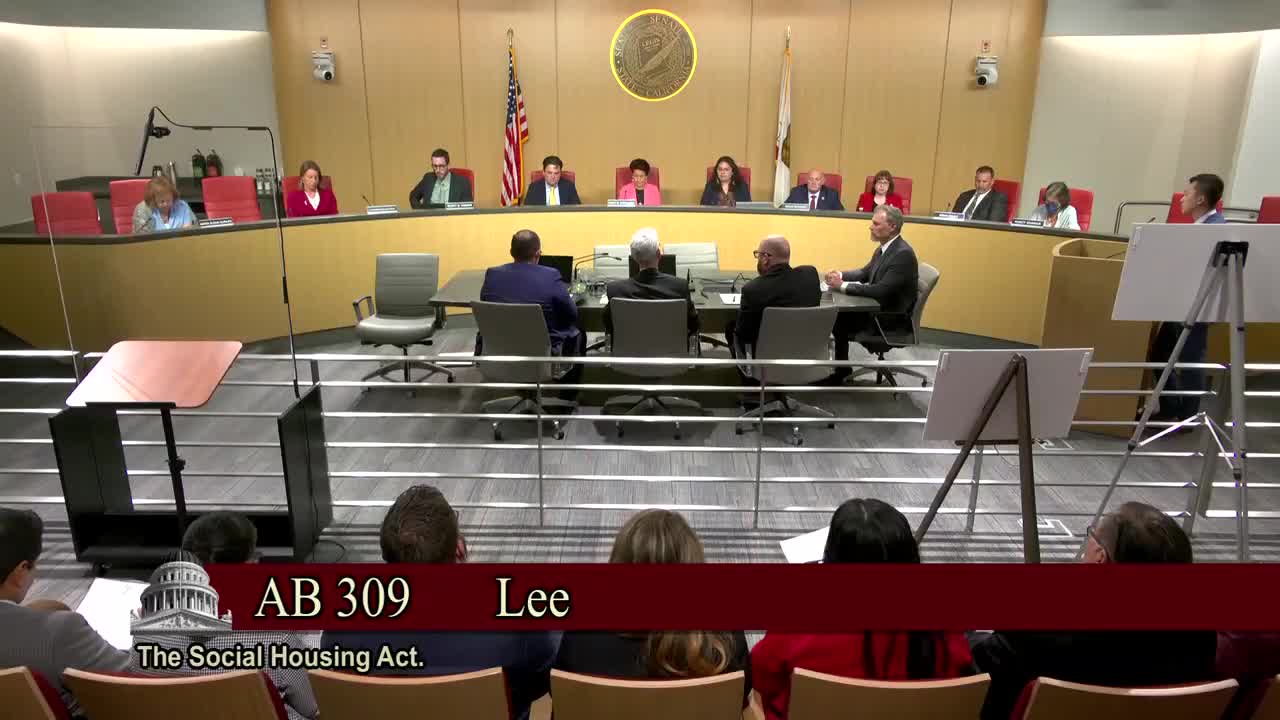 2MIN
Senate Standing Committee on Governance and Finance
 16MIN
Senate Standing Committee on Housing
 3MIN
Assembly Floor
 21MIN