AB 3134: Property taxation: refunds.
- Session Year: 2023-2024
- House: Assembly
- Latest Version Date: 2024-09-29
Current Status:
Passed
(2024-09-29: Chaptered by Secretary of State - Chapter 922, Statutes of 2024.)
Introduced
In Committee
First Chamber
In Committee
Second Chamber
Enacted
Existing law requires property taxes to be refunded to the taxpayer or last recorded owner under specified circumstances, as provided, and requires that a refund only be made pursuant to a claim for refund, except as provided.
This bill would require the county auditor, if the cancellation of taxes will result in a refund, to either process the refund to the payer of the tax or notify the payer in writing of the requirements for obtaining a refund, as specified. The bill would require that a claim for a refund under this provision be deemed timely filed if it is filed within 60 days of the notice, as specified. This bill would also authorize an order for refund of taxes or assessments to be paid to the assessee of a property, as specified, without a claim for refund filed, if certain conditions are met, including, among other requirements, that the amount of the refund is less than $10,000. By placing new duties upon county auditors, this bill would impose a state-mandated local program.
Existing property tax law authorizes refund of taxes or assessments as a result of a reduction in the value of taxable property or specified corrections to be paid to the latest recorded owner of that property as shown on the tax roll, as specified, if there has been no transfer of the property during or since the fiscal year for which the taxes subject to refund were levied and the amount of the refund is less than $5,000. Under existing law, if the county adopts a resolution or ordinance approving this provision, an order for refund of taxes or assessments is authorized to be paid to the assessee of that property, as specified, without a claim for refund filed, if there has been no transfer of the property during or since the fiscal year for which the taxes subject to refund were levied and the amount of the refund is less than $5,000.
This bill would revise the above-described conditions to instead include that the amount of the refund is less than $10,000.
The California Constitution authorizes, and existing property tax law establishes, a veterans exemption for a disabled veteran in the amount of $100,000 or $150,000 for the principal place of residence of a veteran or a veterans spouse, including an unmarried surviving spouse, if the veteran, because of an injury incurred in military service, is blind in both eyes, has lost the use of 2 or more limbs, or is totally disabled, as those terms are defined, or if the veteran has, as a result of a service-connected injury or disease, died while on active duty in military service.
Existing law requires the payment of interest on property tax refunds at the greater of 3% per annum or the county pool apportioned rate. Existing law requires the computation of interest to terminate as of a date within 30 days of the date of mailing or personal delivery of the refund payment.
This bill would authorize the county auditor to send notice of the refund to the taxpayer, as specified, whenever there is a refund due and a claim for refund is required under these provisions.
This bill would authorize an order for refund of taxes or assessments to be paid to a disabled veteran or veterans surviving spouse, without a claim for refund filed, if the refund is due to the disabled veterans exemption.
The California Constitution requires the state to reimburse local agencies and school districts for certain costs mandated by the state. Statutory provisions establish procedures for making that reimbursement.
This bill would provide that, if the Commission on State Mandates determines that the bill contains costs mandated by the state, reimbursement for those costs shall be made pursuant to the statutory provisions noted above.
Existing law requires property taxes to be refunded to the taxpayer or last recorded owner under specified circumstances, as provided, and requires that a refund only be made pursuant to a claim for refund, except as provided.
This bill would require the county auditor, if the cancellation of taxes will result in a refund, to either process the refund to the payer of the tax or notify the payer in writing of the requirements for obtaining a refund, as specified. The bill would require that a claim for a refund under this provision be deemed timely filed if it is filed within 60 days of the notice, as specified. This bill would also authorize an order for refund of taxes or assessments to be paid to the assessee of a property, as specified, without a claim for refund filed, if certain conditions are met, including, among other requirements, that the amount of the refund is less than $10,000. By placing new duties upon county auditors, this bill would impose a state-mandated local program.
Existing property tax law authorizes refund of taxes or assessments as a result of a reduction in the value of taxable property or specified corrections to be paid to the latest recorded owner of that property as shown on the tax roll, as specified, if there has been no transfer of the property during or since the fiscal year for which the taxes subject to refund were levied and the amount of the refund is less than $5,000. Under existing law, if the county adopts a resolution or ordinance approving this provision, an order for refund of taxes or assessments is authorized to be paid to the assessee of that property, as specified, without a claim for refund filed, if there has been no transfer of the property during or since the fiscal year for which the taxes subject to refund were levied and the amount of the refund is less than $5,000.
This bill would revise the above-described conditions to instead include that the amount of the refund is less than $10,000.
The California Constitution authorizes, and existing property tax law establishes, a veterans exemption for a disabled veteran in the amount of $100,000 or $150,000 for the principal place of residence of a veteran or a veterans spouse, including an unmarried surviving spouse, if the veteran, because of an injury incurred in military service, is blind in both eyes, has lost the use of 2 or more limbs, or is totally disabled, as those terms are defined, or if the veteran has, as a result of a service-connected injury or disease, died while on active duty in military service.
Existing law requires the payment of interest on property tax refunds at the greater of 3% per annum or the county pool apportioned rate. Existing law requires the computation of interest to terminate as of a date within 30 days of the date of mailing or personal delivery of the refund payment.
This bill would authorize the county auditor to send notice of the refund to the taxpayer, as specified, whenever there is a refund due and a claim for refund is required under these provisions.
This bill would authorize an order for refund of taxes or assessments to be paid to a disabled veteran or veterans surviving spouse, without a claim for refund filed, if the refund is due to the disabled veterans exemption.
The California Constitution requires the state to reimburse local agencies and school districts for certain costs mandated by the state. Statutory provisions establish procedures for making that reimbursement.
This bill would provide that, if the Commission on State Mandates determines that the bill contains costs mandated by the state, reimbursement for those costs shall be made pursuant to the statutory provisions noted above.
Existing law requires property taxes to be refunded to the taxpayer or last recorded owner under specified circumstances, as provided, and requires that a refund only be made pursuant to a claim for refund, except as provided.
This bill would require the county auditor, if the cancellation of taxes will result in a refund, to either process the refund to the payer of the tax or notify the payer in writing of the requirements for obtaining a refund, as specified. The bill would require that a claim for a refund under this provision be deemed timely filed if it is filed within 60 days of the notice, as specified. This bill would also authorize an order for refund of taxes or assessments to be paid to the assessee of a property, as specified, without a claim for refund filed, if certain conditions are met, including, among other requirements, that the amount of the refund is less than $10,000. By placing new duties upon county auditors, this bill would impose a state-mandated local program.
Existing property tax law authorizes refund of taxes or assessments as a result of a reduction in the value of taxable property or specified corrections to be paid to the latest recorded owner of that property as shown on the tax roll, as specified, if there has been no transfer of the property during or since the fiscal year for which the taxes subject to refund were levied and the amount of the refund is less than $5,000. Under existing law, if the county adopts a resolution or ordinance approving this provision, an order for refund of taxes or assessments is authorized to be paid to the assessee of that property, as specified, without a claim for refund filed, if there has been no transfer of the property during or since the fiscal year for which the taxes subject to refund were levied and the amount of the refund is less than $5,000.
This bill would revise the above-described conditions to instead include that the amount of the refund is less than $10,000.
The California Constitution authorizes, and existing property tax law establishes, a veterans exemption for a disabled veteran in the amount of $100,000 or $150,000 for the principal place of residence of a veteran or a veterans spouse, including an unmarried surviving spouse, if the veteran, because of an injury incurred in military service, is blind in both eyes, has lost the use of 2 or more limbs, or is totally disabled, as those terms are defined, or if the veteran has, as a result of a service-connected injury or disease, died while on active duty in military service.
Existing law requires the payment of interest on property tax refunds at the greater of 3% per annum or the county pool apportioned rate. Existing law requires the computation of interest to terminate as of a date within 30 days of the date of mailing or personal delivery of the refund payment.
This bill would authorize the county auditor to send notice of the refund to the taxpayer, as specified, whenever there is a refund due and a claim for refund is required under these provisions. If the county auditor sends a notice to the taxpayer and the taxpayer fails to return a completed claim for refund to the county auditor within 30 days after the notice date, the bill would require the computation of interest to terminate as of the date of the notice of refund due. If the county auditor fails to issue the refund within 90 days from receipt of a duly submitted claim for refund, the bill would require the computation of interest to terminate as of a date within 30 days of the date of mailing or personal delivery of the refund payment.
This bill would authorize an order for refund of taxes or assessments to be paid to a disabled veteran or veterans surviving spouse, without a claim for refund filed, if the refund is due to the disabled veterans exemption.
The California Constitution requires the state to reimburse local agencies and school districts for certain costs mandated by the state. Statutory provisions establish procedures for making that reimbursement.
This bill would provide that, if the Commission on State Mandates determines that the bill contains costs mandated by the state, reimbursement for those costs shall be made pursuant to the statutory provisions noted above.
Existing law requires property taxes to be refunded to the taxpayer or last recorded owner under specified circumstances, as provided, and requires that a refund only be made pursuant to a claim for refund, except as provided.
This bill would require the county auditor, if the cancellation of taxes will result in a refund, to either process the refund to the payor payer of the tax or notify the payor payer in writing of the requirements for obtaining a refund, as specified. The bill would require that a claim for a refund under this provision be deemed timely filed if it is filed within 60 days of the notice, as specified. This bill would also authorize an order for refund of taxes or assessments to be paid to the assessee of a property, as specified, without a claim for refund filed, if certain conditions are met, including, among other requirements, that the amount of the refund is less than $10,000. By placing new duties upon county auditors, this bill would impose a state-mandated local program.
Existing property tax law authorizes refund of taxes or assessments as a result of a reduction in the value of taxable property or specified corrections to be paid to the latest recorded owner of that property as shown on the tax roll, as specified, if there has been no transfer of the property during or since the fiscal year for which the taxes subject to refund were levied and the amount of the refund is less than $5,000. Under existing law, if the county adopts a resolution or ordinance approving this provision, an order for refund of taxes or assessments is authorized to be paid to the assessee of that property, as specified, without a claim for refund filed, if there has been no transfer of the property during or since the fiscal year for which the taxes subject to refund were levied and the amount of the refund is less than $5,000.
This bill would revise the above-described conditions to instead include that the amount of the refund is less than $10,000.
The California Constitution authorizes, and existing property tax law establishes, a veterans exemption for a disabled veteran in the amount of $100,000 or $150,000 for the principal place of residence of a veteran or a veterans spouse, including an unmarried surviving spouse, if the veteran, because of an injury incurred in military service, is blind in both eyes, has lost the use of 2 or more limbs, or is totally disabled, as those terms are defined, or if the veteran has, as a result of a service-connected injury or disease, died while on active duty in military service.
Existing law requires the payment of interest on property tax refunds at the greater of 3% per annum or the county pool apportioned rate. Existing law requires the computation of interest to terminate as of a date within 30 days of the date of mailing or personal delivery of the refund payment.
This bill would authorize the county auditor to send notice of the refund to the taxpayer, as specified, whenever there is a refund due and a claim for refund is required under these provisions. If the county auditor sends a notice to the taxpayer and the taxpayer fails to return a completed claim for refund to the county auditor within 30 days after the notice date, the bill would require the computation of interest to terminate as of the date of the notice of refund due. If the county auditor fails to issue the refund within 90 days from receipt of a duly submitted claim for refund, the bill would require the computation of interest to terminate as of a date within 30 days of the date of mailing or personal delivery of the refund payment.
This bill would authorize an order for refund of taxes or assessments to be paid to a disabled veteran or veterans surviving spouse, without a claim for refund filed, if the refund is due to the disabled veterans exemption.
The California Constitution requires the state to reimburse local agencies and school districts for certain costs mandated by the state. Statutory provisions establish procedures for making that reimbursement.
This bill would provide that, if the Commission on State Mandates determines that the bill contains costs mandated by the state, reimbursement for those costs shall be made pursuant to the statutory provisions noted above.
Existing law requires property taxes to be refunded to the taxpayer or last recorded owner under specified circumstances, as provided, and requires that a refund only be made pursuant to a claim for refund, except as provided.
This bill would require the county auditor, if the cancellation of taxes will result in a refund, to either process the refund to the payor of the tax or notify the payor in writing of the requirements for obtaining a refund, as specified. The bill would require that a claim for a refund under this provision be deemed timely filed if it is filed within 60 days of the notice, as specified. This bill would also authorize an order for refund of taxes or assessments to be paid to the assessee of a property, as specified, without a claim for refund filed, if certain conditions are met, including, among other requirements, that the amount of the refund is less than $10,000. By placing new duties upon county auditors, this bill would impose a state-mandated local program.
Existing property tax law authorizes refund of taxes or assessments as a result of a reduction in the value of taxable property or specified corrections to be paid to the latest recorded owner of that property as shown on the tax roll, as specified, if there has been no transfer of the property during or since the fiscal year for which the taxes subject to refund were levied and the amount of the refund is less than $5,000. Under existing law, if the county adopts a resolution or ordinance approving this provision, an order for refund of taxes or assessments is authorized to be paid to the assessee of that property, as specified, without a claim for refund filed, if there has been no transfer of the property during or since the fiscal year for which the taxes subject to refund were levied and the amount of the refund is less than $5,000.
This bill would revise the above-described conditions to instead include that the amount of the refund is less than $10,000.
The California Constitution authorizes, and existing property tax law establishes, a veterans exemption for a disabled veteran in the amount of $100,000 or $150,000 for the principal place of residence of a veteran or a veterans spouse, including an unmarried surviving spouse, if the veteran, because of an injury incurred in military service, is blind in both eyes, has lost the use of 2 or more limbs, or is totally disabled, as those terms are defined, or if the veteran has, as a result of a service-connected injury or disease, died while on active duty in military service.
This bill would authorize an order for refund of taxes or assessments to be paid to a disabled veteran or veterans surviving spouse, without a claim for refund filed, if the refund is due to the disabled veterans exemption.
Existing law requires the payment of interest on property tax refunds at the greater of 3% per annum or the county pool apportioned rate. Existing law requires the computation of interest to terminate as of a date within 30 days of the date of mailing or personal delivery of the refund payment.This bill would authorize the county auditor to send notice of the refund to the taxpayer, as specified, whenever there is a refund due and a claim is required under these provisions. If the county auditor sends a notice to the taxpayer and the taxpayer fails to return a completed claim for refund to the county auditor within 60 days after the notice date, the bill would require the computation of interest to terminate as of the date of the notice of refund due. If the county auditor fails to issue the refund within 90 days from the date of the notice of refund due and a claim is not otherwise required, the bill would require the computation of interest to terminate as of a date within 30 days of the date of mailing or personal delivery of the refund payment.The California Constitution requires the state to reimburse local agencies and school districts for certain costs mandated by the state. Statutory provisions establish procedures for making that reimbursement.
This bill would provide that, if the Commission on State Mandates determines that the bill contains costs mandated by the state, reimbursement for those costs shall be made pursuant to the statutory provisions noted above.
Existing law requires property taxes to be refunded to the taxpayer or last recorded owner under specified circumstances, as provided, and requires that a refund only be made pursuant to a claim for refund, except as provided.
This bill would require the county auditor, if the cancellation of taxes will result in a refund, to either process the refund to the payor of the tax or notify the payor in writing of the requirements for obtaining a refund, as specified. The bill would require that a claim for a refund under this provision be deemed timely filed if it is filed within 60 days of the notice, as specified. This bill would also authorize an order for refund of taxes or assessments to be paid to the assessee of a property, as specified, without a claim for refund filed, if certain conditions are met, including, among other requirements, that the amount of the refund is less than $10,000. By placing new duties upon county auditors, this bill would impose a state-mandated local program.
Existing property tax law authorizes refund of taxes or assessments as a result of a reduction in the value of taxable property or specified corrections to be paid to the latest recorded owner of that property as shown on the tax roll, as specified, if there has been no transfer of the property during or since the fiscal year for which the taxes subject to refund were levied and the amount of the refund is less than $5,000. Under existing law, if the county adopts a resolution or ordinance approving this provision, an order for refund of taxes or assessments is authorized to be paid to the assessee of that property, as specified, without a claim for refund filed, if there has been no transfer of the property during or since the fiscal year for which the taxes subject to refund were levied and the amount of the refund is less than $5,000.
This bill would revise the above-described conditions to instead include that the amount of the refund is less than $10,000.
The California Constitution authorizes, and existing property tax law establishes, a veterans exemption for a disabled veteran in the amount of $100,000 or $150,000 for the principal place of residence of a veteran or a veterans spouse, including an unmarried surviving spouse, if the veteran, because of an injury incurred in military service, is blind in both eyes, has lost the use of 2 or more limbs, or is totally disabled, as those terms are defined, or if the veteran has, as a result of a service-connected injury or disease, died while on active duty in military service.
This bill would authorize an order for refund of taxes or assessments to be paid to a disabled veteran or veterans surviving spouse, without a claim for refund filed, if the refund is due to the disabled veterans exemption.
Existing law requires the payment of interest on property tax refunds at the greater of 3% per annum or the county pool apportioned rate. Existing law requires the computation of interest to terminate as of a date within 30 days of the date of mailing or personal delivery of the refund payment.
This bill would authorize the county auditor to send notice of the refund to the taxpayer, as specified, whenever there is a refund due and a claim is required under these provisions. If the county auditor sends a notice to the taxpayer and the taxpayer fails to return a completed claim for refund to the county auditor within 60 days after the notice date, the bill would require the computation of interest to terminate as of the date of the notice of refund due. If the county auditor fails to issue the refund within 90 days from the date of the notice of refund due and a claim is not otherwise required, the bill would require the computation of interest to terminate as of a date within 30 days of the date of mailing or personal delivery of the refund payment.
The California Constitution requires the state to reimburse local agencies and school districts for certain costs mandated by the state. Statutory provisions establish procedures for making that reimbursement.
This bill would provide that, if the Commission on State Mandates determines that the bill contains costs mandated by the state, reimbursement for those costs shall be made pursuant to the statutory provisions noted above.
If the cancellation of taxes under this article will result in a refund, the auditor shall either process the refund to the payer of the tax or notify the payer in writing of the requirements for obtaining a refund pursuant to Section 5097. The notice shall state that the payer of the tax is entitled to a refund and that a claim for a refund shall be filed, pursuant to Section 5097, within 60 days of the date of the notice.
Notwithstanding Section 5097, a claim for a refund shall be deemed timely filed if it is filed within 60 days of the date of the notice.
SEC. 2.Section 5097 of the Revenue and Taxation Code is amended to read:5097.(a)An order for a refund under this article shall not be made, except on a claim:
(1)Verified by the person who paid the tax, their guardian, executor, trustee, or administrator.
(2)Except as provided in paragraph (3) or (4), filed within four years after making the payment sought to be refunded, within one year after the mailing of notice as prescribed in Section 2635, within the period agreed to as provided in Section 532.1, or within 60 days of the date of the notice prescribed by subdivision (a) of Section 4836, whichever is later.
(3)(A)Filed within one year, if an application for a reduction in an assessment or an application for equalization of an assessment has been filed pursuant to Section 1603 and the applicant does not state in the application that the application is intended to constitute a claim for a refund, of either of the following events, whichever occurs first:
(i)After the county assessment appeals board makes a final determination on the application for reduction in assessment or on the application for equalization of an escape assessment of the property, and mails a written notice of its determination to the applicant and the notice does not advise the applicant to file a claim for refund.
(ii)After the expiration of the time period specified in subdivision (c) of Section 1604 if the county assessment appeals board fails to hear evidence and fails to make a final determination on the application for reduction in assessment or on the application for equalization of an escape assessment of the property.
(B)Filed within six months, if an application for a reduction in an assessment or an application for equalization of an assessment has been filed pursuant to Section 1603 and the applicant does not state in the application that the application is intended to constitute a claim for a refund, after the county assessment appeals board makes a final determination on the application for reduction in assessment or on the application for equalization of an escape assessment, and mails a written notice of its determination to the applicant and the notice advises the applicant to file a claim for refund within six months of the date of the county assessment appeals boards final determination.
(4)Filed within eight years after making the payment sought to be refunded, or within 60 days of the notice prescribed by subdivision (a) of Section 4836, whichever is later, if the claim for refund is filed on or after January 1, 2015, and relates to the disabled veterans exemption described in Section 205.5.
(b)An application for a reduction in an assessment filed pursuant to Section 1603 shall also constitute a sufficient claim for refund under this section if the applicant states in the application that the application is intended to constitute a claim for refund. If the applicant does not so state, the applicant may thereafter and within the period provided in paragraph (3) of subdivision (a) file a separate claim for refund of taxes extended on the assessment which the applicant applied to have reduced pursuant to Section 1603 or 1604.
(c)If an application for equalization of an escape assessment is filed pursuant to Section 1603, a claim may be filed on any taxes resulting from the escape assessment or the original assessment to which the escape relates within the period provided in paragraph (3) of subdivision (a).
(d)Notwithstanding subdivision (a), an order for a refund under this article may be made without a claim pursuant to Section 5105, 5108, or 5109.
(e)The amendments made to this section by Chapter 656 of the Statutes of 2014 apply to claims for refund filed on or after January 1, 2015.
SEC. 3.Section 5104 of the Revenue and Taxation Code is amended to read:5104.Any refund of taxes or assessments authorized pursuant to this article as a result of a reduction in the value of taxable property or as the result of corrections to the roll or cancellations after taxes or assessments were paid, may be paid to the latest recorded owner of that property as shown on the tax roll, rather than to the individual or entity who paid the amount of tax or assessment to be refunded, if both of the following conditions are met:
(a)There has been no transfer of the property during or since the fiscal year for which the taxes subject to refund were levied.
(b)The amount of the refund is less than ten thousand dollars ($10,000).
SEC. 4.Section 5105 of the Revenue and Taxation Code is amended to read:5105.(a)Notwithstanding Section 5097, an order for refund of taxes or assessments authorized pursuant to this article may be paid to the assessee of that property, or to the latest recorded owner of that property, as shown on the tax roll, without a claim for refund filed, if both of the following conditions are met:
(1)There has been no transfer of the property during or since the fiscal year for which the taxes subject to refund were levied.
(2)The amount of the refund is less than ten thousand dollars ($10,000).
(b)This section shall become operative in a county only if the board of supervisors of the county adopts a resolution or ordinance approving the operation of this section.
SEC. 5.Section 5108 is added to the Revenue and Taxation Code, to read:5108.Notwithstanding Section 5097, an order for refund of taxes or assessments authorized pursuant to this article may be paid to a disabled veteran or veterans surviving spouse, without a claim for refund filed, if the refund is due to a disabled veterans exemption described in Section 205.5.
SEC. 6.Section 5109 is added to the Revenue and Taxation Code, to read:5109.Notwithstanding Section 5097, an order for refund of taxes or assessments authorized pursuant to this article may be paid to an assessee of that property, without a claim for refund filed, if the following conditions are met:
(a)The refund results from an exemption described in Sections 201 to 242, inclusive, with the exception of Section 205.5.
(b)The refund would not exist but for the assessee or qualifying occupant of the property meeting the requirements for an exemption described in subdivision (a).
(c)The amount of the refund is less than ten thousand dollars ($10,000).
SEC. 7.Section 5151 of the Revenue and Taxation Code is amended to read:5151.(a)Interest at the greater of 3 percent per annum or the county pool apportioned rate shall be paid, when that interest is ten dollars ($10) or more, on any amount refunded under Section 5096.7, or refunded to a taxpayer for any reason whatsoever. However, no interest shall be paid under the provisions of this section if the taxpayer has been given the notice required by Section 2635 and has failed to apply for the refund within 30 days after the mailing of that notice. For purposes of this section, county pool apportioned rate means the annualized rate of interest earned on the total amount of pooled idle funds from all accounts held by the county treasurer, in excess of the county treasurers administrative costs with respect to that amount, as of June 30 of the fiscal year preceding the date the refund is calculated by the auditor. For each fiscal year, the county treasurer shall advise the Controller of the county pool apportioned rate, and of computations made in deriving that rate, no later than 90 days after the end of that fiscal year. Any interest paid on a refund at a rate provided for by this subdivision as it read prior to January 1, 2009, shall be deemed to be correct.
(b)The interest rate provided for in subdivision (a) does not apply to interest on refunds of those amounts of tax that became due and payable before March 1, 1993. Interest on refunds of amounts of a qualified tax shall be paid at that rate provided for by this section as it read prior to January 1, 1993. As used in this section, a qualified tax means a tax that became due and payable before March 1, 1993, and had not been refunded as of April 6, 1995. This subdivision shall not be construed to affect the interest paid on refunds of those amounts of tax that became due and payable before March 1, 1993, and have been refunded as of April 6, 1995.
(c)(1)The interest computation period shall commence with the date of payment of the tax when any of the following applies:
(A)A timely application for reduction in an assessment was filed, without regard to whether the refund ultimately results from a judgment or order of a court, an order of a board of equalization or assessment appeals board, or an assessors correction to the assessment roll.
(B)The refund is pursuant to a roll correction resulting from the determination or adjustment by the assessor or a local assessment appeals board of a base year value.
(C)The refund results from a correction to the assessment roll pursuant to Section 4831 or 4876.
(2)Interest on refunds of taxes on property acquired by a public agency in eminent domain shall accrue from the date of recordation of the deed.
(3)In all other cases the interest computation period shall commence on the date of filing a claim for refund or payment of the tax, whichever is later. However, in the event of the granting of property tax relief pursuant to Section 69, 69.3, or 170, interest is not payable on any resulting refund of taxes, provided that payment of that refund of taxes is made within 120 days after the county assessor has sent authorization for the reduction to the county auditor.
(d)Except as provided in subdivision (h), the computation of interest shall terminate as of a date within 30 days of the date of mailing or personal delivery of the refund payment.
(e)The interest charged shall be apportioned to the appropriate funds, as determined by the county auditor.
(f)The amendments made to this section by Section 4 of Chapter 801 of the Statutes of 1996 shall apply to all refunds made after January 1, 1997.
(g)Whenever a refund is due and a claim for refund is required under this chapter, the county auditor may send notice of the refund to the taxpayer, unless the taxpayer already filed a refund claim pursuant to subdivision (b) of Section 5097. If a notice is sent, the notice shall be mailed to the taxpayers last known address and shall state the amount of overpayment and that a claim for refund may be filed pursuant to this chapter.
SEC. 8.If the Commission on State Mandates determines that this act contains costs mandated by the state, reimbursement to local agencies and school districts for those costs shall be made pursuant to Part 7 (commencing with Section 17500) of Division 4 of Title 2 of the Government Code.
If the cancellation of taxes under this article will result in a refund, the auditor shall either process the refund to the payer of the tax or notify the payer in writing of the requirements for obtaining a refund pursuant to Section 5097. The notice shall state that the payer of the tax is entitled to a refund and that a claim for a refund shall be filed, pursuant to Section 5097, within 60 days of the date of the notice.
Notwithstanding Section 5097, a claim for a refund shall be deemed timely filed if it is filed within 60 days of the date of the notice.
SEC. 2.Section 5097 of the Revenue and Taxation Code is amended to read:5097.(a)An order for a refund under this article shall not be made, except on a claim:
(1)Verified by the person who paid the tax, their guardian, executor, trustee, or administrator.
(2)Except as provided in paragraph (3) or (4), filed within four years after making the payment sought to be refunded, within one year after the mailing of notice as prescribed in Section 2635, within the period agreed to as provided in Section 532.1, or within 60 days of the date of the notice prescribed by subdivision (a) of Section 4836, whichever is later.
(3)(A)Filed within one year, if an application for a reduction in an assessment or an application for equalization of an assessment has been filed pursuant to Section 1603 and the applicant does not state in the application that the application is intended to constitute a claim for a refund, of either of the following events, whichever occurs first:
(i)After the county assessment appeals board makes a final determination on the application for reduction in assessment or on the application for equalization of an escape assessment of the property, and mails a written notice of its determination to the applicant and the notice does not advise the applicant to file a claim for refund.
(ii)After the expiration of the time period specified in subdivision (c) of Section 1604 if the county assessment appeals board fails to hear evidence and fails to make a final determination on the application for reduction in assessment or on the application for equalization of an escape assessment of the property.
(B)Filed within six months, if an application for a reduction in an assessment or an application for equalization of an assessment has been filed pursuant to Section 1603 and the applicant does not state in the application that the application is intended to constitute a claim for a refund, after the county assessment appeals board makes a final determination on the application for reduction in assessment or on the application for equalization of an escape assessment, and mails a written notice of its determination to the applicant and the notice advises the applicant to file a claim for refund within six months of the date of the county assessment appeals boards final determination.
(4)Filed within eight years after making the payment sought to be refunded, or within 60 days of the notice prescribed by subdivision (a) of Section 4836, whichever is later, if the claim for refund is filed on or after January 1, 2015, and relates to the disabled veterans exemption described in Section 205.5.
(b)An application for a reduction in an assessment filed pursuant to Section 1603 shall also constitute a sufficient claim for refund under this section if the applicant states in the application that the application is intended to constitute a claim for refund. If the applicant does not so state, the applicant may thereafter and within the period provided in paragraph (3) of subdivision (a) file a separate claim for refund of taxes extended on the assessment which the applicant applied to have reduced pursuant to Section 1603 or 1604.
(c)If an application for equalization of an escape assessment is filed pursuant to Section 1603, a claim may be filed on any taxes resulting from the escape assessment or the original assessment to which the escape relates within the period provided in paragraph (3) of subdivision (a).
(d)Notwithstanding subdivision (a), an order for a refund under this article may be made without a claim pursuant to Section 5105, 5108, or 5109.
(e)The amendments made to this section by Chapter 656 of the Statutes of 2014 apply to claims for refund filed on or after January 1, 2015.
SEC. 3.Section 5104 of the Revenue and Taxation Code is amended to read:5104.Any refund of taxes or assessments authorized pursuant to this article as a result of a reduction in the value of taxable property or as the result of corrections to the roll or cancellations after taxes or assessments were paid, may be paid to the latest recorded owner of that property as shown on the tax roll, rather than to the individual or entity who paid the amount of tax or assessment to be refunded, if both of the following conditions are met:
(a)There has been no transfer of the property during or since the fiscal year for which the taxes subject to refund were levied.
(b)The amount of the refund is less than ten thousand dollars ($10,000).
SEC. 4.Section 5105 of the Revenue and Taxation Code is amended to read:5105.(a)Notwithstanding Section 5097, an order for refund of taxes or assessments authorized pursuant to this article may be paid to the assessee of that property, or to the latest recorded owner of that property, as shown on the tax roll, without a claim for refund filed, if both of the following conditions are met:
(1)There has been no transfer of the property during or since the fiscal year for which the taxes subject to refund were levied.
(2)The amount of the refund is less than ten thousand dollars ($10,000).
(b)This section shall become operative in a county only if the board of supervisors of the county adopts a resolution or ordinance approving the operation of this section.
SEC. 5.Section 5108 is added to the Revenue and Taxation Code, to read:5108.Notwithstanding Section 5097, an order for refund of taxes or assessments authorized pursuant to this article may be paid to a disabled veteran or veterans surviving spouse, without a claim for refund filed, if the refund is due to a disabled veterans exemption described in Section 205.5.
SEC. 6.Section 5109 is added to the Revenue and Taxation Code, to read:5109.Notwithstanding Section 5097, an order for refund of taxes or assessments authorized pursuant to this article may be paid to an assessee of that property, without a claim for refund filed, if the following conditions are met:
(a)The refund results from an exemption described in Sections 201 to 242, inclusive, with the exception of Section 205.5.
(b)The refund would not exist but for the assessee or qualifying occupant of the property meeting the requirements for an exemption described in subdivision (a).
(c)The amount of the refund is less than ten thousand dollars ($10,000).
SEC. 7.Section 5151 of the Revenue and Taxation Code is amended to read:5151.(a)Interest at the greater of 3 percent per annum or the county pool apportioned rate shall be paid, when that interest is ten dollars ($10) or more, on any amount refunded under Section 5096.7, or refunded to a taxpayer for any reason whatsoever. However, no interest shall be paid under the provisions of this section if the taxpayer has been given the notice required by Section 2635 and has failed to apply for the refund within 30 days after the mailing of that notice. For purposes of this section, county pool apportioned rate means the annualized rate of interest earned on the total amount of pooled idle funds from all accounts held by the county treasurer, in excess of the county treasurers administrative costs with respect to that amount, as of June 30 of the fiscal year preceding the date the refund is calculated by the auditor. For each fiscal year, the county treasurer shall advise the Controller of the county pool apportioned rate, and of computations made in deriving that rate, no later than 90 days after the end of that fiscal year. Any interest paid on a refund at a rate provided for by this subdivision as it read prior to January 1, 2009, shall be deemed to be correct.
(b)The interest rate provided for in subdivision (a) does not apply to interest on refunds of those amounts of tax that became due and payable before March 1, 1993. Interest on refunds of amounts of a qualified tax shall be paid at that rate provided for by this section as it read prior to January 1, 1993. As used in this section, a qualified tax means a tax that became due and payable before March 1, 1993, and had not been refunded as of April 6, 1995. This subdivision shall not be construed to affect the interest paid on refunds of those amounts of tax that became due and payable before March 1, 1993, and have been refunded as of April 6, 1995.
(c)(1)The interest computation period shall commence with the date of payment of the tax when any of the following applies:
(A)A timely application for reduction in an assessment was filed, without regard to whether the refund ultimately results from a judgment or order of a court, an order of a board of equalization or assessment appeals board, or an assessors correction to the assessment roll.
(B)The refund is pursuant to a roll correction resulting from the determination or adjustment by the assessor or a local assessment appeals board of a base year value.
(C)The refund results from a correction to the assessment roll pursuant to Section 4831 or 4876.
(2)Interest on refunds of taxes on property acquired by a public agency in eminent domain shall accrue from the date of recordation of the deed.
(3)In all other cases the interest computation period shall commence on the date of filing a claim for refund or payment of the tax, whichever is later. However, in the event of the granting of property tax relief pursuant to Section 69, 69.3, or 170, interest is not payable on any resulting refund of taxes, provided that payment of that refund of taxes is made within 120 days after the county assessor has sent authorization for the reduction to the county auditor.
(d)Except as provided in subdivision (h), the computation of interest shall terminate as of a date within 30 days of the date of mailing or personal delivery of the refund payment.
(e)The interest charged shall be apportioned to the appropriate funds, as determined by the county auditor.
(f)The amendments made to this section by Section 4 of Chapter 801 of the Statutes of 1996 shall apply to all refunds made after January 1, 1997.
(g)Whenever a refund is due and a claim for refund is required under this chapter, the county auditor may send notice of the refund to the taxpayer, unless the taxpayer already filed a refund claim pursuant to subdivision (b) of Section 5097. If a notice is sent, the notice shall be mailed to the taxpayers last known address and shall state the amount of overpayment and that a claim for refund may be filed pursuant to this chapter.
SEC. 8.If the Commission on State Mandates determines that this act contains costs mandated by the state, reimbursement to local agencies and school districts for those costs shall be made pursuant to Part 7 (commencing with Section 17500) of Division 4 of Title 2 of the Government Code.
If the cancellation of taxes under this article will result in a refund, the auditor shall either process the refund to the payer of the tax or notify the payer in writing of the requirements for obtaining a refund pursuant to Section 5097. The notice shall state that the payer of the tax is entitled to a refund and that a claim for a refund shall be filed, pursuant to Section 5097, within 60 days of the date of the notice.
Notwithstanding Section 5097, a claim for a refund shall be deemed timely filed if it is filed within 60 days of the date of the notice.
SEC. 2.Section 5097 of the Revenue and Taxation Code is amended to read:5097.(a)An order for a refund under this article shall not be made, except on a claim:
(1)Verified by the person who paid the tax, their guardian, executor, trustee, or administrator.
(2)Except as provided in paragraph (3) or (4), filed within four years after making the payment sought to be refunded, within one year after the mailing of notice as prescribed in Section 2635, within the period agreed to as provided in Section 532.1, or within 60 days of the date of the notice prescribed by subdivision (a) of Section 4836, whichever is later.
(3)(A)Filed within one year, if an application for a reduction in an assessment or an application for equalization of an assessment has been filed pursuant to Section 1603 and the applicant does not state in the application that the application is intended to constitute a claim for a refund, of either of the following events, whichever occurs first:
(i)After the county assessment appeals board makes a final determination on the application for reduction in assessment or on the application for equalization of an escape assessment of the property, and mails a written notice of its determination to the applicant and the notice does not advise the applicant to file a claim for refund.
(ii)After the expiration of the time period specified in subdivision (c) of Section 1604 if the county assessment appeals board fails to hear evidence and fails to make a final determination on the application for reduction in assessment or on the application for equalization of an escape assessment of the property.
(B)Filed within six months, if an application for a reduction in an assessment or an application for equalization of an assessment has been filed pursuant to Section 1603 and the applicant does not state in the application that the application is intended to constitute a claim for a refund, after the county assessment appeals board makes a final determination on the application for reduction in assessment or on the application for equalization of an escape assessment, and mails a written notice of its determination to the applicant and the notice advises the applicant to file a claim for refund within six months of the date of the county assessment appeals boards final determination.
(4)Filed within eight years after making the payment sought to be refunded, or within 60 days of the notice prescribed by subdivision (a) of Section 4836, whichever is later, if the claim for refund is filed on or after January 1, 2015, and relates to the disabled veterans exemption described in Section 205.5.
(b)An application for a reduction in an assessment filed pursuant to Section 1603 shall also constitute a sufficient claim for refund under this section if the applicant states in the application that the application is intended to constitute a claim for refund. If the applicant does not so state, the applicant may thereafter and within the period provided in paragraph (3) of subdivision (a) file a separate claim for refund of taxes extended on the assessment which the applicant applied to have reduced pursuant to Section 1603 or 1604.
(c)If an application for equalization of an escape assessment is filed pursuant to Section 1603, a claim may be filed on any taxes resulting from the escape assessment or the original assessment to which the escape relates within the period provided in paragraph (3) of subdivision (a).
(d)Notwithstanding subdivision (a), an order for a refund under this article may be made without a claim pursuant to Section 5105, 5108, or 5109.
(e)The amendments made to this section by Chapter 656 of the Statutes of 2014 apply to claims for refund filed on or after January 1, 2015.
SEC. 3.Section 5104 of the Revenue and Taxation Code is amended to read:5104.Any refund of taxes or assessments authorized pursuant to this article as a result of a reduction in the value of taxable property or as the result of corrections to the roll or cancellations after taxes or assessments were paid, may be paid to the latest recorded owner of that property as shown on the tax roll, rather than to the individual or entity who paid the amount of tax or assessment to be refunded, if both of the following conditions are met:
(a)There has been no transfer of the property during or since the fiscal year for which the taxes subject to refund were levied.
(b)The amount of the refund is less than ten thousand dollars ($10,000).
SEC. 4.Section 5105 of the Revenue and Taxation Code is amended to read:5105.(a)Notwithstanding Section 5097, an order for refund of taxes or assessments authorized pursuant to this article may be paid to the assessee of that property, or to the latest recorded owner of that property, as shown on the tax roll, without a claim for refund filed, if both of the following conditions are met:
(1)There has been no transfer of the property during or since the fiscal year for which the taxes subject to refund were levied.
(2)The amount of the refund is less than ten thousand dollars ($10,000).
(b)This section shall become operative in a county only if the board of supervisors of the county adopts a resolution or ordinance approving the operation of this section.
SEC. 5.Section 5108 is added to the Revenue and Taxation Code, to read:5108.Notwithstanding Section 5097, an order for refund of taxes or assessments authorized pursuant to this article may be paid to a disabled veteran or veterans surviving spouse, without a claim for refund filed, if the refund is due to a disabled veterans exemption described in Section 205.5.
SEC. 6.Section 5109 is added to the Revenue and Taxation Code, to read:5109.Notwithstanding Section 5097, an order for refund of taxes or assessments authorized pursuant to this article may be paid to an assessee of that property, without a claim for refund filed, if the following conditions are met:
(a)The refund results from an exemption described in Sections 201 to 242, inclusive, with the exception of Section 205.5.
(b)The refund would not exist but for the assessee or qualifying occupant of the property meeting the requirements for an exemption described in subdivision (a).
(c)The amount of the refund is less than ten thousand dollars ($10,000).
SEC. 7.Section 5151 of the Revenue and Taxation Code is amended to read:5151.(a)Interest at the greater of 3 percent per annum or the county pool apportioned rate shall be paid, when that interest is ten dollars ($10) or more, on any amount refunded under Section 5096.7, or refunded to a taxpayer for any reason whatsoever. However, no interest shall be paid under the provisions of this section if the taxpayer has been given the notice required by Section 2635 and has failed to apply for the refund within 30 days after the mailing of that notice. For purposes of this section, county pool apportioned rate means the annualized rate of interest earned on the total amount of pooled idle funds from all accounts held by the county treasurer, in excess of the county treasurers administrative costs with respect to that amount, as of June 30 of the fiscal year preceding the date the refund is calculated by the auditor. For each fiscal year, the county treasurer shall advise the Controller of the county pool apportioned rate, and of computations made in deriving that rate, no later than 90 days after the end of that fiscal year. Any interest paid on a refund at a rate provided for by this subdivision as it read prior to January 1, 2009, shall be deemed to be correct.
(b)The interest rate provided for in subdivision (a) does not apply to interest on refunds of those amounts of tax that became due and payable before March 1, 1993. Interest on refunds of amounts of a qualified tax shall be paid at that rate provided for by this section as it read prior to January 1, 1993. As used in this section, a qualified tax means a tax that became due and payable before March 1, 1993, and had not been refunded as of April 6, 1995. This subdivision shall not be construed to affect the interest paid on refunds of those amounts of tax that became due and payable before March 1, 1993, and have been refunded as of April 6, 1995.
(c)(1)The interest computation period shall commence with the date of payment of the tax when any of the following applies:
(A)A timely application for reduction in an assessment was filed, without regard to whether the refund ultimately results from a judgment or order of a court, an order of a board of equalization or assessment appeals board, or an assessors correction to the assessment roll.
(B)The refund is pursuant to a roll correction resulting from the determination or adjustment by the assessor or a local assessment appeals board of a base year value.
(C)The refund results from a correction to the assessment roll pursuant to Section 4831 or 4876.
(2)Interest on refunds of taxes on property acquired by a public agency in eminent domain shall accrue from the date of recordation of the deed.
(3)In all other cases the interest computation period shall commence on the date of filing a claim for refund or payment of the tax, whichever is later. However, in the event of the granting of property tax relief pursuant to Section 69, 69.3, or 170, interest is not payable on any resulting refund of taxes, provided that payment of that refund of taxes is made within 120 days after the county assessor has sent authorization for the reduction to the county auditor.
(d)Except as provided in subdivision (h), the computation of interest shall terminate as of a date within 30 days of the date of mailing or personal delivery of the refund payment.
(e)The interest charged shall be apportioned to the appropriate funds, as determined by the county auditor.
(f)The amendments made to this section by Section 4 of Chapter 801 of the Statutes of 1996 shall apply to all refunds made after January 1, 1997.
(g)Whenever a refund is due and a claim for refund is required under this chapter, the county auditor may send notice of the refund to the taxpayer. taxpayer, unless the taxpayer already filed a refund claim pursuant to subdivision (b) of Section 5097. If a notice is sent, the notice shall be mailed to the taxpayers last known address and shall state the amount of overpayment and that a claim for refund may be filed pursuant to this chapter.
(h)(1)Except as provided in paragraph (2), if the county auditor sends a notice to the taxpayer pursuant to subdivision (g) and the taxpayer fails to return a completed claim for refund to the county auditor within 30 days after the notice date, computation of interest shall terminate as of the date of the notice of refund due.(2)If the county auditor fails to issue the refund within 90 days from receipt of a duly submitted claim for refund, computation of interest shall terminate pursuant to subdivision (d).SEC. 8.If the Commission on State Mandates determines that this act contains costs mandated by the state, reimbursement to local agencies and school districts for those costs shall be made pursuant to Part 7 (commencing with Section 17500) of Division 4 of Title 2 of the Government Code.
(a)If the cancellation of taxes under this article will result in a refund, the auditor shall either process the refund to the payor payer of the tax or notify the payor payer in writing of the requirements for obtaining a refund pursuant to Section 5097. The notice shall state that the payor payer of the tax is entitled to a refund and that a claim for a refund shall be filed, pursuant to Section 5097, within 60 days of the date of the notice.
(b)NotwithstandingNotwithstanding Section 5097, a claim for a refund shall be deemed timely filed if it is filed within 60 days of the date of the notice.
SEC. 2.Section 5097 of the Revenue and Taxation Code is amended to read:5097.(a)An order for a refund under this article shall not be made, except on a claim:
(1)Verified by the person who paid the tax, their guardian, executor, trustee, or administrator.
(2)Except as provided in paragraph (3) or (4), filed within four years after making the payment sought to be refunded, within one year after the mailing of notice as prescribed in Section 2635, within the period agreed to as provided in Section 532.1, or within 60 days of the date of the notice prescribed by subdivision (a) of Section 4836, whichever is later.
(3)(A)Filed within one year, if an application for a reduction in an assessment or an application for equalization of an assessment has been filed pursuant to Section 1603 and the applicant does not state in the application that the application is intended to constitute a claim for a refund, of either of the following events, whichever occurs first:
(i)After the county assessment appeals board makes a final determination on the application for reduction in assessment or on the application for equalization of an escape assessment of the property, and mails a written notice of its determination to the applicant and the notice does not advise the applicant to file a claim for refund.
(ii)After the expiration of the time period specified in subdivision (c) of Section 1604 if the county assessment appeals board fails to hear evidence and fails to make a final determination on the application for reduction in assessment or on the application for equalization of an escape assessment of the property.
(B)Filed within six months, if an application for a reduction in an assessment or an application for equalization of an assessment has been filed pursuant to Section 1603 and the applicant does not state in the application that the application is intended to constitute a claim for a refund, after the county assessment appeals board makes a final determination on the application for reduction in assessment or on the application for equalization of an escape assessment, and mails a written notice of its determination to the applicant and the notice advises the applicant to file a claim for refund within six months of the date of the county assessment appeals boards final determination.
(4)Filed within eight years after making the payment sought to be refunded, or within 60 days of the notice prescribed by subdivision (a) of Section 4836, whichever is later, if the claim for refund is filed on or after January 1, 2015, and relates to the disabled veterans exemption described in Section 205.5.
(b)An application for a reduction in an assessment filed pursuant to Section 1603 shall also constitute a sufficient claim for refund under this section if the applicant states in the application that the application is intended to constitute a claim for refund. If the applicant does not so state, the applicant may thereafter and within the period provided in paragraph (3) of subdivision (a) file a separate claim for refund of taxes extended on the assessment which the applicant applied to have reduced pursuant to Section 1603 or 1604.
(c)If an application for equalization of an escape assessment is filed pursuant to Section 1603, a claim may be filed on any taxes resulting from the escape assessment or the original assessment to which the escape relates within the period provided in paragraph (3) of subdivision (a).
(d)Notwithstanding subdivision (a), an order for a refund under this article may be made without a claim pursuant to Section 5105, 5108, or 5109.
(e)The amendments made to this section by Chapter 656 of the Statutes of 2014 apply to claims for refund filed on or after January 1, 2015.
SEC. 3.Section 5104 of the Revenue and Taxation Code is amended to read:5104.Any refund of taxes or assessments authorized pursuant to this article as a result of a reduction in the value of taxable property or as the result of corrections to the roll or cancellations after taxes or assessments were paid, may be paid to the latest recorded owner of that property as shown on the tax roll, rather than to the individual or entity who paid the amount of tax or assessment to be refunded, if both of the following conditions are met:
(a)There has been no transfer of the property during or since the fiscal year for which the taxes subject to refund were levied.
(b)The amount of the refund is less than ten thousand dollars ($10,000).
SEC. 4.Section 5105 of the Revenue and Taxation Code is amended to read:5105.(a)Notwithstanding Section 5097, an order for refund of taxes or assessments authorized pursuant to this article may be paid to the assessee of that property, or to the latest recorded owner of that property, as shown on the tax roll, without a claim for refund filed, if both of the following conditions are met:
(1)There has been no transfer of the property during or since the fiscal year for which the taxes subject to refund were levied.
(2)The amount of the refund is less than ten thousand dollars ($10,000).
(b)This section shall become operative in a county only if the board of supervisors of the county adopts a resolution or ordinance approving the operation of this section.
SEC. 5.Section 5108 is added to the Revenue and Taxation Code, to read:5108.Notwithstanding Section 5097, an order for refund of taxes or assessments authorized pursuant to this article may be paid to a disabled veteran or veterans surviving spouse, without a claim for refund filed, if the refund is due to the a disabled veterans exemption described in Section 205.5.
SEC. 6.Section 5109 is added to the Revenue and Taxation Code, to read:5109.Notwithstanding Section 5097, an order for refund of taxes or assessments authorized pursuant to this article may be paid to an assessee of that property, without a claim for refund filed, if the following conditions are satisfied: met:
(a)The refund results from an exemption described in Sections 201 to 242, inclusive, with the exception of Section 205.5.
(b)The refund would not exist but for the assessee or qualifying occupant of the property meeting the requirements for an exemption described in subdivision (a).
(c)The amount of the refund is less than ten thousand dollars ($10,000).
SEC. 7.Section 5151 of the Revenue and Taxation Code is amended to read:5151.(a)Interest at the greater of 3 percent per annum or the county pool apportioned rate shall be paid, when that interest is ten dollars ($10) or more, on any amount refunded under Section 5096.7, or refunded to a taxpayer for any reason whatsoever. However, no interest shall be paid under the provisions of this section if the taxpayer has been given the notice required by Section 2635 and has failed to apply for the refund within 30 days after the mailing of that notice. For purposes of this section, county pool apportioned rate means the annualized rate of interest earned on the total amount of pooled idle funds from all accounts held by the county treasurer, in excess of the county treasurers administrative costs with respect to that amount, as of June 30 of the fiscal year preceding the date the refund is calculated by the auditor. For each fiscal year, the county treasurer shall advise the Controller of the county pool apportioned rate, and of computations made in deriving that rate, no later than 90 days after the end of that fiscal year. Any interest paid on a refund at a rate provided for by this subdivision as it read prior to January 1, 2009, shall be deemed to be correct.
(b)The interest rate provided for in subdivision (a) does not apply to interest on refunds of those amounts of tax that became due and payable before March 1, 1993. Interest on refunds of amounts of a qualified tax shall be paid at that rate provided for by this section as it read prior to January 1, 1993. As used in this section, a qualified tax means a tax that became due and payable before March 1, 1993, and had not been refunded as of April 6, 1995. This subdivision shall not be construed to affect the interest paid on refunds of those amounts of tax that became due and payable before March 1, 1993, and have been refunded as of April 6, 1995.
(c)(1)The interest computation period shall commence with the date of payment of the tax when any of the following applies:
(A)A timely application for reduction in an assessment was filed, without regard to whether the refund ultimately results from a judgment or order of a court, an order of a board of equalization or assessment appeals board, or an assessors correction to the assessment roll.
(B)The refund is pursuant to a roll correction resulting from the determination or adjustment by the assessor or a local assessment appeals board of a base year value.
(C)The refund results from a correction to the assessment roll pursuant to Section 4831 or 4876.
(2)Interest on refunds of taxes on property acquired by a public agency in eminent domain shall accrue from the date of recordation of the deed.
(3)In all other cases the interest computation period shall commence on the date of filing a claim for refund or payment of the tax, whichever is later. However, in the event of the granting of property tax relief pursuant to Section 69, 69.3, or 170, interest is not payable on any resulting refund of taxes, provided that payment of that refund of taxes is made within 120 days after the county assessor has sent authorization for the reduction to the county auditor.
(d)The Except as provided in subdivision (h), the computation of interest shall terminate as of a date within 30 days of the date of mailing or personal delivery of the refund payment.
(e)The interest charged shall be apportioned to the appropriate funds, as determined by the county auditor.
(f)The amendments made to this section by Section 4 of Chapter 801 of the Statutes of 1996 shall apply to all refunds made after January 1, 1997.
(g)Whenever a refund is due and a claim for refund is required under this chapter, the county auditor may send notice of the refund to the taxpayer. If a notice is sent, the notice shall be mailed to the taxpayers last known address and shall state the amount of overpayment and that a claim for refund may be filed pursuant to this chapter.
(h)(1)Except as provided in paragraph (2), if the county auditor sends a notice to the taxpayer pursuant to subdivision (g) and the taxpayer fails to return a completed claim for refund to the county auditor within 30 days after the notice date, computation of interest shall terminate as of the date of the notice of refund due.
(2)If the county auditor fails to issue the refund within 90 days from receipt of a duly submitted claim for refund, computation of interest shall terminate pursuant to subdivision (d).
SEC. 7.SEC. 8.If the Commission on State Mandates determines that this act contains costs mandated by the state, reimbursement to local agencies and school districts for those costs shall be made pursuant to Part 7 (commencing with Section 17500) of Division 4 of Title 2 of the Government Code.
(a)If the cancellation of taxes under this article will result in a refund, the auditor shall either process the refund to the payor of the tax or notify the payor in writing of the requirements for obtaining a refund pursuant to Section 5097. The notice shall state that the payor of the tax is entitled to a refund and that a claim for a refund shall be filed, pursuant to Section 5097, within 60 days of the date of the notice.
(b)Notwithstanding Section 5097, a claim for a refund shall be deemed timely filed if it is filed within 60 days of the date of the notice.
SEC. 2.Section 5097 of the Revenue and Taxation Code is amended to read:5097.(a)An order for a refund under this article shall not be made, except on a claim:
(1)Verified by the person who paid the tax, their guardian, executor, trustee, or administrator.
(2)Except as provided in paragraph (3) or (4), filed within four years after making the payment sought to be refunded, within one year after the mailing of notice as prescribed in Section 2635, within the period agreed to as provided in Section 532.1, or within 60 days of the date of the notice prescribed by subdivision (a) of Section 4836, whichever is later.
(3)(A)Filed within one year, if an application for a reduction in an assessment or an application for equalization of an assessment has been filed pursuant to Section 1603 and the applicant does not state in the application that the application is intended to constitute a claim for a refund, of either of the following events, whichever occurs first:
(i)After the county assessment appeals board makes a final determination on the application for reduction in assessment or on the application for equalization of an escape assessment of the property, and mails a written notice of its determination to the applicant and the notice does not advise the applicant to file a claim for refund.
(ii)After the expiration of the time period specified in subdivision (c) of Section 1604 if the county assessment appeals board fails to hear evidence and fails to make a final determination on the application for reduction in assessment or on the application for equalization of an escape assessment of the property.
(B)Filed within six months, if an application for a reduction in an assessment or an application for equalization of an assessment has been filed pursuant to Section 1603 and the applicant does not state in the application that the application is intended to constitute a claim for a refund, after the county assessment appeals board makes a final determination on the application for reduction in assessment or on the application for equalization of an escape assessment, and mails a written notice of its determination to the applicant and the notice advises the applicant to file a claim for refund within six months of the date of the county assessment appeals boards final determination.
(4)Filed within eight years after making the payment sought to be refunded, or within 60 days of the notice prescribed by subdivision (a) of Section 4836, whichever is later, if the claim for refund is filed on or after January 1, 2015, and relates to the disabled veterans exemption described in Section 205.5.
(b)An application for a reduction in an assessment filed pursuant to Section 1603 shall also constitute a sufficient claim for refund under this section if the applicant states in the application that the application is intended to constitute a claim for refund. If the applicant does not so state, the applicant may thereafter and within the period provided in paragraph (3) of subdivision (a) file a separate claim for refund of taxes extended on the assessment which the applicant applied to have reduced pursuant to Section 1603 or 1604.
(c)If an application for equalization of an escape assessment is filed pursuant to Section 1603, a claim may be filed on any taxes resulting from the escape assessment or the original assessment to which the escape relates within the period provided in paragraph (3) of subdivision (a).
(d)Notwithstanding subdivision (a), an order for a refund under this article may be made without a claim pursuant to Section 5105, 5108, or 5109.
(e)The amendments made to this section by Chapter 656 of the Statutes of 2014 apply to claims for refund filed on or after January 1, 2015.
SEC. 3.Section 5104 of the Revenue and Taxation Code is amended to read:5104.Any refund of taxes or assessments authorized pursuant to this article as a result of a reduction in the value of taxable property or as the result of corrections to the roll or cancellations after taxes or assessments were paid, may be paid to the latest recorded owner of that property as shown on the tax roll, rather than to the individual or entity who paid the amount of tax or assessment to be refunded, if both of the following conditions are met:
(a)There has been no transfer of the property during or since the fiscal year for which the taxes subject to refund were levied.
(b)The amount of the refund is less than ten thousand dollars ($10,000).
SEC. 4.Section 5105 of the Revenue and Taxation Code is amended to read:5105.(a)Notwithstanding Section 5097, an order for refund of taxes or assessments authorized pursuant to this article may be paid to the assessee of that property, or to the latest recorded owner of that property, as shown on the tax roll, without a claim for refund filed, if both of the following conditions are met:
(1)There has been no transfer of the property during or since the fiscal year for which the taxes subject to refund were levied.
(2)The amount of the refund is less than ten thousand dollars ($10,000).
(b)This section shall become operative in a county only if the board of supervisors of the county adopts a resolution or ordinance approving the operation of this section.
SEC. 5.Section 5108 is added to the Revenue and Taxation Code, to read:5108.Notwithstanding Section 5097, an order for refund of taxes or assessments authorized pursuant to this article may be paid to a disabled veteran or veterans surviving spouse, without a claim for refund filed, if the refund is due to the disabled veterans exemption described in Section 205.5.
SEC. 6.Section 5109 is added to the Revenue and Taxation Code, to read:5109.Notwithstanding Section 5097, an order for refund of taxes or assessments authorized pursuant to this article may be paid to an assessee of that property, without a claim for refund filed, if the following conditions are true: satisfied:
(a)The refund results from an exemption described in Sections 201 through to 242, inclusive, with the exception of Section 205.5.
(b)The refund would not exist but for the assessee or qualifying occupant of the property meeting the requirements for an exemption described in subdivision (a).
(c)The amount of the refund is less than ten thousand dollars ($10,000).
SEC. 7.Section 5151 of the Revenue and Taxation Code is amended to read:5151.(a)Interest at the greater of 3 percent per annum or the county pool apportioned rate shall be paid, when that interest is ten dollars ($10) or more, on any amount refunded under Section 5096.7, or refunded to a taxpayer for any reason whatsoever. However, no interest shall be paid under the provisions of this section if the taxpayer has been given the notice required by Section 2635 and has failed to apply for the refund within 30 days after the mailing of that notice. For purposes of this section, county pool apportioned rate means the annualized rate of interest earned on the total amount of pooled idle funds from all accounts held by the county treasurer, in excess of the county treasurers administrative costs with respect to that amount, as of June 30 of the fiscal year preceding the date the refund is calculated by the auditor. For each fiscal year, the county treasurer shall advise the Controller of the county pool apportioned rate, and of computations made in deriving that rate, no later than 90 days after the end of that fiscal year. Any interest paid on a refund at a rate provided for by this subdivision as it read prior to January 1, 2009, shall be deemed to be correct.(b)The interest rate provided for in subdivision (a) does not apply to interest on refunds of those amounts of tax that became due and payable before March 1, 1993. Interest on refunds of amounts of a qualified tax shall be paid at that rate provided for by this section as it read prior to January 1, 1993. As used in this section, a qualified tax means a tax that became due and payable before March 1, 1993, and had not been refunded as of April 6, 1995. This subdivision shall not be construed to affect the interest paid on refunds of those amounts of tax that became due and payable before March 1, 1993, and have been refunded as of April 6, 1995.(c)(1)The interest computation period shall commence with the date of payment of the tax when any of the following applies:(A)A timely application for reduction in an assessment was filed, without regard to whether the refund ultimately results from a judgment or order of a court, an order of a board of equalization or assessment appeals board, or an assessors correction to the assessment roll.(B)The refund is pursuant to a roll correction resulting from the determination or adjustment by the assessor or a local assessment appeals board of a base year value.(C)The refund results from a correction to the assessment roll pursuant to Section 4831 or 4876.(2)Interest on refunds of taxes on property acquired by a public agency in eminent domain shall accrue from the date of recordation of the deed.(3)In all other cases the interest computation period shall commence on the date of filing a claim for refund or payment of the tax, whichever is later. However, in the event of the granting of property tax relief pursuant to Section 69, 69.3, or 170, interest is not payable on any resulting refund of taxes, provided that payment of that refund of taxes is made within 120 days after the county assessor has sent authorization for the reduction to the county auditor.(d)Except as provided in subdivision (h), the computation of interest shall terminate as of a date within 30 days of the date of mailing or personal delivery of the refund payment.(e)The interest charged shall be apportioned to the appropriate funds, as determined by the county auditor.(f)The amendments made to this section by Section 4 of Chapter 801 of the Statutes of 1996 shall apply to all refunds made after January 1, 1997.(g)Whenever a refund is due and a claim is required under this article, the county auditor may send notice of the refund to the taxpayer. If a notice is sent, the notice shall be mailed to the taxpayers last known address and shall state the amount of overpayment and that a refund claim may be filed pursuant to this chapter.(h)(1)Except as provided in paragraph (2), if the county auditor sends a notice to the taxpayer pursuant to subdivision (g) and the taxpayer fails to return a completed claim for refund to the county auditor within 60 days after the notice date, computation of interest shall terminate as of the date of the notice of refund due.(2)If the county auditor fails to issue the refund within 90 days from the date of the notice of refund due and a claim is not otherwise required under this article, computation of interest shall terminate pursuant to subdivision (d).SEC. 8.SEC. 7.If the Commission on State Mandates determines that this act contains costs mandated by the state, reimbursement to local agencies and school districts for those costs shall be made pursuant to Part 7 (commencing with Section 17500) of Division 4 of Title 2 of the Government Code.
(a)If the cancellation of taxes under this article will result in a refund, the auditor shall either process the refund to the payor of the tax or notify the payor in writing of the requirements for obtaining a refund pursuant to Section 5097. The notice shall state that the payor of the tax is entitled to a refund and that a claim for a refund shall be filed, pursuant to Section 5097, within 60 days of the date of the notice.
(b)Notwithstanding Section 5097, a claim for a refund shall be deemed timely filed if it is filed within 60 days of the date of the notice.
SEC. 2.Section 5097 of the Revenue and Taxation Code is amended to read:5097.(a)An order for a refund under this article shall not be made, except on a claim:
(1)Verified by the person who paid the tax, his or her their guardian, executor, trustee, or administrator.
(2)Except as provided in paragraph (3) or (4), filed within four years after making the payment sought to be refunded, or within one year after the mailing of notice as prescribed in Section 2635, or within the period agreed to as provided in Section 532.1, or within 60 days of the date of the notice prescribed by subdivision (a) of Section 4836, whichever is later.
(3)(A)Filed within one year, if an application for a reduction in an assessment or an application for equalization of an assessment has been filed pursuant to Section 1603 and the applicant does not state in the application that the application is intended to constitute a claim for a refund, of either of the following events, whichever occurs first:
(i)After the county assessment appeals board makes a final determination on the application for reduction in assessment or on the application for equalization of an escape assessment of the property, and mails a written notice of its determination to the applicant and the notice does not advise the applicant to file a claim for refund.
(ii)After the expiration of the time period specified in subdivision (c) of Section 1604 if the county assessment appeals board fails to hear evidence and fails to make a final determination on the application for reduction in assessment or on the application for equalization of an escape assessment of the property.
(B)Filed within six months, if an application for a reduction in an assessment or an application for equalization of an assessment has been filed pursuant to Section 1603 and the applicant does not state in the application that the application is intended to constitute a claim for a refund, after the county assessment appeals board makes a final determination on the application for reduction in assessment or on the application for equalization of an escape assessment, and mails a written notice of its determination to the applicant and the notice advises the applicant to file a claim for refund within six months of the date of the county assessment appeals boards final determination.
(4)Filed within eight years after making the payment sought to be refunded, or within 60 days of the notice prescribed by subdivision (a) of Section 4836, whichever is later, if the claim for refund is filed on or after January 1, 2015, and relates to the disabled veterans exemption described in Section 205.5.
(b)An application for a reduction in an assessment filed pursuant to Section 1603 shall also constitute a sufficient claim for refund under this section if the applicant states in the application that the application is intended to constitute a claim for refund. If the applicant does not so state, he or she the applicant may thereafter and within the period provided in paragraph (3) of subdivision (a) file a separate claim for refund of taxes extended on the assessment which the applicant applied to have reduced pursuant to Section 1603 or 1604.
(c)If an application for equalization of an escape assessment is filed pursuant to Section 1603, a claim may be filed on any taxes resulting from the escape assessment or the original assessment to which the escape relates within the period provided in paragraph (3) of subdivision (a).
(d)Notwithstanding subdivision (a), an order for a refund under this article may be made without a claim pursuant to Section 5105. Section 5105, 5108, or 5109.
(e)The amendments made to this section by Chapter 656 of the Statutes of 2014 apply to claims for refund filed on or after January 1, 2015.
SEC. 3.Section 5104 of the Revenue and Taxation Code is amended to read:5104.Any refund of taxes or assessments authorized pursuant to this article as a result of a reduction in the value of taxable property or as the result of corrections to the roll or cancellations after taxes or assessments were paid, may be paid to the latest recorded owner of that property as shown on the tax roll, rather than to the individual or entity who paid the amount of tax or assessment to be refunded, if both of the following conditions are met:
(a)There has been no transfer of the property during or since the fiscal year for which the taxes subject to refund were levied.
(b)The amount of the refund is less than five ten thousand dollars ($5,000). ($10,000).
SEC. 4.Section 5105 of the Revenue and Taxation Code is amended to read:5105.(a)Notwithstanding Section 5097, an order for refund of taxes or assessments authorized pursuant to this article may be paid to the assessee of that property, or to the latest recorded owner of that property, as shown on the tax roll, without a claim for refund filed, if both of the following conditions are met:
(1)There has been no transfer of the property during or since the fiscal year for which the taxes subject to refund were levied.
(2)The amount of the refund is less than five ten thousand dollars ($5,000). ($10,000).
(b)This section shall become operative in a county only if the board of supervisors of the county adopts a resolution or ordinance approving the operation of this section.
SEC. 5.Section 5108 is added to the Revenue and Taxation Code, to read:5108.Notwithstanding Section 5097, an order for refund of taxes or assessments authorized pursuant to this article may be paid to a disabled veteran or veterans surviving spouse, without a claim for refund filed, if the refund is due to the disabled veterans exemption described in Section 205.5.
SEC. 6.Section 5109 is added to the Revenue and Taxation Code, to read:5109.Notwithstanding Section 5097, an order for refund of taxes or assessments authorized pursuant to this article may be paid to an assessee of that property, without a claim for refund filed, if the following conditions are true:
(a)The refund results from an exemption described in Sections 201 through 242, inclusive, with the exception of Section 205.5.
(b)The refund would not exist but for the assessee or qualifying occupant of the property meeting the requirements for an exemption described in subdivision (a).
(c)The amount of the refund is less than ten thousand dollars ($10,000).
SEC. 7.Section 5151 of the Revenue and Taxation Code is amended to read:5151.(a)Interest at the greater of 3 percent per annum or the county pool apportioned rate shall be paid, when that interest is ten dollars ($10) or more, on any amount refunded under Section 5096.7, or refunded to a taxpayer for any reason whatsoever. However, no interest shall be paid under the provisions of this section if the taxpayer has been given the notice required by Section 2635 and has failed to apply for the refund within 30 days after the mailing of that notice. For purposes of this section, county pool apportioned rate means the annualized rate of interest earned on the total amount of pooled idle funds from all accounts held by the county treasurer, in excess of the county treasurers administrative costs with respect to that amount, as of June 30 of the fiscal year preceding the date the refund is calculated by the auditor. For each fiscal year, the county treasurer shall advise the Controller of the county pool apportioned rate, and of computations made in deriving that rate, no later than 90 days after the end of that fiscal year. Any interest paid on a refund at a rate provided for by this subdivision as it read prior to January 1, 2009, shall be deemed to be correct.
(b)The interest rate provided for in subdivision (a) does not apply to interest on refunds of those amounts of tax that became due and payable before March 1, 1993. Interest on refunds of amounts of a qualified tax shall be paid at that rate provided for by this section as it read prior to January 1, 1993. As used in this section, a qualified tax means a tax that became due and payable before March 1, 1993, and had not been refunded as of April 6, 1995. This subdivision shall not be construed to affect the interest paid on refunds of those amounts of tax that became due and payable before March 1, 1993, and have been refunded as of April 6, 1995.
(c)(1)The interest computation period shall commence with the date of payment of the tax when any of the following applies:
(A)A timely application for reduction in an assessment was filed, without regard to whether the refund ultimately results from a judgment or order of a court, an order of a board of equalization or assessment appeals board, or an assessors correction to the assessment roll.
(B)The refund is pursuant to a roll correction resulting from the determination or adjustment by the assessor or a local assessment appeals board of a base year value.
(C)The refund results from a correction to the assessment roll pursuant to Section 4831 or 4876.
(2)Interest on refunds of taxes on property acquired by a public agency in eminent domain shall accrue from the date of recordation of the deed.
(3)In all other cases the interest computation period shall commence on the date of filing a claim for refund or payment of the tax, whichever is later. However, in the event of the granting of property tax relief pursuant to Section 69, 69.3, or 170, interest is not payable on any resulting refund of taxes, provided that payment of that refund of taxes is made within 120 days after the county assessor has sent authorization for the reduction to the county auditor.
(d)The Except as provided in subdivision (h), the computation of interest shall terminate as of a date within 30 days of the date of mailing or personal delivery of the refund payment.
(e)The interest charged shall be apportioned to the appropriate funds, as determined by the county auditor.
(f)The amendments made to this section by Section 4 of Chapter 801 of the Statutes of 1996 shall apply to all refunds made after January 1, 1997.
(g)Whenever a refund is due and a claim is required under this article, the county auditor may send notice of the refund to the taxpayer. If a notice is sent, the notice shall be mailed to the taxpayers last known address and shall state the amount of overpayment and that a refund claim may be filed pursuant to this chapter.
(h)(1)Except as provided in paragraph (2), if the county auditor sends a notice to the taxpayer pursuant to subdivision (g) and the taxpayer fails to return a completed claim for refund to the county auditor within 60 days after the notice date, computation of interest shall terminate as of the date of the notice of refund due.
(2)If the county auditor fails to issue the refund within 90 days from the date of the notice of refund due and a claim is not otherwise required under this article, computation of interest shall terminate pursuant to subdivision (d).
SEC. 8.If the Commission on State Mandates determines that this act contains costs mandated by the state, reimbursement to local agencies and school districts for those costs shall be made pursuant to Part 7 (commencing with Section 17500) of Division 4 of Title 2 of the Government Code.
|
Date
|
Status
|
|---|---|
| Sep 29, 2024 | Chaptered by Secretary of State - Chapter 922, Statutes of 2024. |
| Sep 29, 2024 | Approved by the Governor. |
| Sep 13, 2024 | Enrolled and presented to the Governor at 4 p.m. |
| Aug 31, 2024 | Senate amendments concurred in. To Engrossing and Enrolling. (Ayes 73. Noes 0.). |
| Aug 31, 2024 | In Assembly. Concurrence in Senate amendments pending. |
| Aug 31, 2024 | Read third time. Passed. Ordered to the Assembly. (Ayes 40. Noes 0.). |
| Aug 26, 2024 | Read second time. Ordered to third reading. |
| Aug 23, 2024 | Read third time and amended. Ordered to second reading. |
| Aug 6, 2024 | Read second time. Ordered to third reading. |
| Aug 5, 2024 | From committee: Be ordered to second reading pursuant to Senate Rule 28.8. |
| Jun 26, 2024 | From committee: Do pass and re-refer to Com. on APPR. (Ayes 7. Noes 0.) (June 26). Re-referred to Com. on APPR. |
| Jun 18, 2024 | From committee chair, with author's amendments: Amend, and re-refer to committee. Read second time, amended, and re-referred to Com. on REV. & TAX. |
| Jun 5, 2024 | In committee: Set, first hearing. Hearing canceled at the request of author. |
| May 29, 2024 | Referred to Com. on REV. & TAX. |
| May 22, 2024 | In Senate. Read first time. To Com. on RLS. for assignment. |
| May 21, 2024 | Read third time. Passed. Ordered to the Senate. (Ayes 71. Noes 0. Page 5447.) |
| May 16, 2024 | Read second time. Ordered to Consent Calendar. |
| May 15, 2024 | From committee: Do pass. To Consent Calendar. (Ayes 15. Noes 0.) (May 15). |
| Apr 25, 2024 | Re-referred to Com. on APPR. |
| Apr 24, 2024 | Read second time and amended. |
| Apr 23, 2024 | From committee: Amend, and do pass as amended and re-refer to Com. on APPR. (Ayes 7. Noes 0.) (April 22). |
| Apr 1, 2024 | In committee: Hearing postponed by committee. |
| Mar 11, 2024 | Referred to Com. on REV. & TAX. |
| Feb 17, 2024 | From printer. May be heard in committee March 18. |
| Feb 16, 2024 | Read first time. To print. |
|
Date
|
Description
|
Location
|
Votes
|
|
|---|---|---|---|---|
| Aug 31, 2024 | AB 3134 Chen Concurrence in Senate Amendments | Assembly Floor |
Passed |
|
| Aug 31, 2024 | Assembly 3rd Reading AB3134 Chen By Jones | Senate Floor |
Passed |
|
| Jun 26, 2024 | Do pass, but first be re-referred to the Committee on [Appropriations] | Senate Standing Committee on Revenue and Taxation |
Passed |
|
| May 21, 2024 | AB 3134 Chen Consent Calendar Second Day Regular Session | Assembly Floor |
Passed |
|
| May 15, 2024 | Do pass. To Consent Calendar. | Assembly Standing Committee on Appropriations |
Passed |
|
| Apr 22, 2024 | Do pass as amended and be re-referred to the Committee on [Appropriations] | Assembly Standing Committee on Revenue and Taxation |
Passed |
This list shows positions taken on this bill by organizations on the date displayed, which is linked to the original source.
Positions by individuals are not included.
|
Organization
|
Position
|
Date
|
|---|---|---|
| California Alliance Of Taxpayer Advocates | ** Against | |
| California Association of County Treasurer-Tax Collectors | ** Support | |
| California Association Of Realtors | ** Support | |
| California State Association Of Counties | ** Support | |
| State Association Of County Auditors | ** Support |
CONCURRENCE IN SENATE AMENDMENTS
CSA1 Bill Id:AB 3134
Author:(Chen)
As Amended Ver:August 23, 2024
Majority vote
SUMMARY
Modifies the process for issuing refunds under various provisions of property tax law.
Senate Amendments
Provide that a county auditor is not required to provide notice to a taxpayer that a refund is due if the taxpayer has otherwise filed a claim for the refund.
COMMENTS
- Cancellation of taxes on exempt property: Existing property tax law stipulates the process for cancelling taxes on property that was taxable, but has subsequently become exempt because it was acquired by a public entity exempt from property taxation. The statute, however, does not address the manner in which the refund of cancelled taxes may be claimed or issued.
- Automatic issuing of refund: In certain circumstances, auditors may issue a refund without receiving a claim for refund from a taxpayer. This authorization, however, is restricted in that the property for which the refund is issued cannot have been transferred in the fiscal year those taxes were levied. Thus, refunds resulting from certain exemptions, such as a change in ownership exclusion that may result in a lowering of assessment on property for which taxes were already paid, cannot be made without a claim being filed even if that refund is below the existing threshold of $5,000.
- This bill: The State Association of County Auditors has submitted this proposal to the author's office to ease the administration of property tax refunds. As such, this bill contains five elements making various modifications to the process for claiming and issuing refunds. First, for cancelled taxes resulting from a public entity acquiring property, this bill requires an auditor to issue notice to a taxpayer that a refund is due, and stipulates a 60-day period where a taxpayer may submit a timely filed claim. Second, this bill increases the maximum amount of refund that, in certain circumstances, may be issued without filing a claim from $5,000 to $10,000. Third, this bill authorizes refunds resulting from certain exemptions to be issued without a claim even if the property has been transferred in that fiscal year. Fourth, this bill provides that a refund for the disabled veterans' exemption may be made without a taxpayer having filed a claim. Finally, this bill provides that a county auditor is not required to provide notice to a taxpayer a refund is due if the taxpayer has otherwise filed a claim.
According to the Author
AB 3134 takes important steps to expedite the payment of property tax and assessment refunds to taxpayers. When a county auditor identifies that a taxpayer is due a property tax or assessment refund, it is important that we take the necessary steps to streamline the process to connect that taxpayer with the money due. There is already a process for immediately remitting these payments for amounts less than $5,000 without a claim for refund; this measure would appropriately increase that amount to $10,000; capturing a larger percentage of the outstanding refunds. This bill will also set into place a reasonable time limit for interest accrual on refunds that require a claim.
Arguments in Support
The California State Association of Counties, writing in support of this bill, states, in part:
Existing law limits the maximum refund amount that can be issued to a taxpayer without prior receipt of an application for the refund to five thousand dollars. AB 3134 raises the threshold to ten thousand dollars. If the owed amount is below five thousand dollars, the county can proactively contact the taxpayer and issue a refund. This measure allows counties to initiate refunds of up to ten thousand dollars without the taxpayer filing a claim. This will lead to improved and expedited service for the public.
Arguments in Opposition
None on file.
FISCAL COMMENTS
The Senate Committee on Appropriations, in its analysis of this bill, states:
VOTES:
ASM REVENUE AND TAXATION: 7-0-0
YES: Irwin, Ta, Bains, Gipson, Grayson, Jim Patterson, Luz Rivas
ASM APPROPRIATIONS: 15-0-0
YES: Wicks, Sanchez, Arambula, Bryan, Calderon, Wendy Carrillo, Dixon, Mike Fong, Grayson, Haney, Hart, Jim Patterson, Pellerin, Ta, Villapudua
ASSEMBLY FLOOR: 71-0-9
YES: Addis, Aguiar-Curry, Alanis, Alvarez, Arambula, Bains, Bauer-Kahan, Bennett, Berman, Boerner, Bonta, Bryan, Juan Carrillo, Wendy Carrillo, Chen, Connolly, Davies, Dixon, Essayli, Flora, Mike Fong, Vince Fong, Gallagher, Garcia, Gipson, Grayson, Haney, Hart, Hoover, Irwin, Jackson, Jones-Sawyer, Kalra, Lackey, Lee, Low, Lowenthal, Maienschein, McCarty, McKinnor, Muratsuchi, Stephanie Nguyen, Ortega, Pacheco, Jim Patterson, Joe Patterson, Pellerin, Petrie-Norris, Quirk-Silva, Ramos, Rendon, Reyes, Rodriguez, Blanca Rubio, Sanchez, Santiago, Schiavo, Soria, Ta, Ting, Valencia, Villapudua, Waldron, Wallis, Ward, Weber, Wicks, Wilson, Wood, Zbur, Robert Rivas
ABS, ABST OR NV: Calderon, Cervantes, Megan Dahle, Friedman, Gabriel, Holden, Mathis, Papan, Luz Rivas
UPDATED
VERSION: August 23, 2024
CONSULTANT: Harrison Bowlby / REV. & TAX. / (916) 319-2098 FN: 0004801
SENATE RULES COMMITTEE Office of Senate Floor Analyses (916) 651-1520 Fax: (916) 327-4478 | AB 3134 |
THIRD READING
Bill No: AB 3134
Author: Chen (R)
Amended: 8/23/24 in Senate
Vote: 21
SENATE REVENUE AND TAXATION COMMITTEE: 7-0, 6/26/24
AYES: Glazer, Dahle, Ashby, Bradford, Dodd, Padilla, Skinner
ASSEMBLY FLOOR: 71-0, 5/21/24 (Consent) - See last page for vote
SUBJECT: Property taxation: refunds
SOURCE: State Association of County Auditors
DIGEST:
This bill makes changes to laws guiding property tax refunds.
Senate Floor Amendments of 8/23/24 delete provisions of the bill ceasing the interest computation period as of the date the auditor sends a notice to the taxpayer that they are due a refund but the taxpayer does not respond by filing a claim, and makes conforming changes.
ANALYSIS:
Existing law:
- Directs the Legislature to create a process for taxpayers to recover illegally assessed taxes, with interest. (California Constitution, Article XIII, Section 32)
- Allows counties to issue refunds of property taxes that are:
- Paid more than once.
- Collected, assessed, or levied erroneously or illegally.
- Paid on an assessment in excess of the amount owed by reason of the assessor's clerical error, or excessive or improper assessments attributable to erroneous property information supplied by the taxpayer.
- Paid on an assessment of improvements when the improvements did not exist on the lien date.
- Paid on an assessment in excess of the value of the property, including pursuant to a determination by the county assessment appeals board.
- Directs the county auditor to either process a refund or notify a taxpayer in writing when a roll correction results in a refund.
- Requires the notice to state the taxpayer is entitled to a refund and that they must file a refund claim within 60 days of the date of the notice.
- Allows, generally, taxpayers or their guardians, executors, trustees, or administrators to file a claim for refund within four years after making the payment, with some different periods for overpayments, assessment appeals, and claims for the disabled veterans’ exemption, among others.
- Allows the person who paid the tax to bring an action in superior court against the county assessor’s office to recover the tax if the county denies the refund claim.
- Provides counties may pay refunds to the recorded owner of a property in specified circumstances rather than to the person who actually paid the tax where the property had not changed ownership and the refund was less than $5,000.
- Allows, generally, auditors to pay refunds without a claim if the property had not changed ownership, the refund was less than $5,000, and the board of supervisors adopts a resolution or ordinance making this process operative (SB 1246, Gaines, Chapter 358, Statutes of 2018).
- Provides all property is taxable unless explicitly exempted by the Constitution or federal law (Article XIII, Section One), including an exemption for property owned by the state or a local government.
- Automatically extinguishes the property tax obligation of the previous owner when a public agency acquires a property, effective upon the earlier of the date of acquisition, or the date of possession or acquisition by a public agency acquiring the property by eminent domain.
- States that any unpaid taxes up to that date are still due and payable, but are cancelled if the acquisition date is after the lien date but prior to commencement of the fiscal year.
- Does not clearly state that cancelling any taxes accruing during this period on property acquired by a public agency must be refunded to the taxpayer.
This bill:
- Allows refunds to be paid without the taxpayer filing a claim when:
- The refund is due to the disabled veterans’ exemption from property tax; or
- The refund is due to another exemption from property tax, would not exist but for the assessee or qualifying occupant of the property meeting the requirements for an exemption, and the refund is less than $10,000.
- Increases from $5,000 to $10,000 the thresholds for automatic refunds due to value reductions, roll corrections, cancellations, and when the refund is issued to the recorded owner of the property rather than to the person who actually paid the tax.
- Directs the auditor to either process a refund to the taxpayer, or notify them of the requirements for obtaining a refund, when taxes are cancelled as a result of a public agency acquiring property.
- Requires the notice to state that the taxpayer is entitled to a refund but they must file a claim within 60 days of the date of the notice.
- Deems a refund claim timely filed if it is filed within 60 days of the date of the notice.
- Provides an auditor may send notice of a refund to the taxpayer whenever a refund is due and payable, unless a taxpayer already filed a refund claim.
- Requires the notice be sent to the taxpayer’s last known address, state the amount of overpayment, and that the taxpayer must file a claim for refund.
- Makes technical and conforming changes.
FISCAL EFFECT: Appropriation: No Fiscal Com.: Yes Local: Yes
SUPPORT: (Verified 8/26/24)
State Association of County Auditors (source)
California Association of County Treasurer-Tax Collectors
California Association of Realtors
California State Association of Counties
OPPOSITION: (Verified 8/26/24)
None received
ARGUMENTS IN SUPPORT: According to the author, “AB 3134 takes important steps to expedite the payment of property tax and assessments refunds to taxpayers. When a county auditor identifies that a taxpayer is due a property tax or assessment refund, it is important that we take the necessary steps to streamline the process to connect that taxpayer with the money due. There is already a process for immediately remitting these payments for amounts less than $5,000 without a claim for refund; this measure would appropriately increase that amount to $10,000; capturing a larger percentage of the outstanding refunds. This bill will also set into place a reasonable time limit for interest accrual on refunds that require a claim.”
ASSEMBLY FLOOR: 71-0, 5/21/24
AYES: Addis, Aguiar-Curry, Alanis, Alvarez, Arambula, Bains, Bauer-Kahan, Bennett, Berman, Boerner, Bonta, Bryan, Juan Carrillo, Wendy Carrillo, Chen, Connolly, Davies, Dixon, Essayli, Flora, Mike Fong, Vince Fong, Gallagher, Garcia, Gipson, Grayson, Haney, Hart, Hoover, Irwin, Jackson, Jones-Sawyer, Kalra, Lackey, Lee, Low, Lowenthal, Maienschein, McCarty, McKinnor, Muratsuchi, Stephanie Nguyen, Ortega, Pacheco, Jim Patterson, Joe Patterson, Pellerin, Petrie-Norris, Quirk-Silva, Ramos, Rendon, Reyes, Rodriguez, Blanca Rubio, Sanchez, Santiago, Schiavo, Soria, Ta, Ting, Valencia, Villapudua, Waldron, Wallis, Ward, Weber, Wicks, Wilson, Wood, Zbur, Robert Rivas
NO VOTE RECORDED: Calderon, Cervantes, Megan Dahle, Friedman, Gabriel, Holden, Mathis, Papan, Luz Rivas
Prepared by: Colin Grinnell / REV. & TAX. / (916) 651-4117
8/26/24 17:38:00
**** END ****
SENATE RULES COMMITTEE Office of Senate Floor Analyses (916) 651-1520 Fax: (916) 327-4478 | AB 3134 |
THIRD READING
Bill No: AB 3134
Author: Chen (R)
Amended: 6/18/24 in Senate
Vote: 21
SENATE REVENUE AND TAXATION COMMITTEE: 7-0, 6/26/24
AYES: Glazer, Dahle, Ashby, Bradford, Dodd, Padilla, Skinner
SENATE APPROPRIATIONS COMMITTEE: Senate Rule 28.8
ASSEMBLY FLOOR: 71-0, 5/21/24 (Consent) - See last page for vote
SUBJECT: Property taxation: refunds
SOURCE: State Association of County Auditors
DIGEST:
This bill makes changes to laws guiding property tax refunds.
ANALYSIS:
Existing law:
- Directs the Legislature to create a process for taxpayers to recover illegally assessed taxes, with interest. (California Constitution, Article XIII, Section 32)
- Allows counties to issue refunds of property taxes that are:
- Paid more than once.
- Collected, assessed, or levied erroneously or illegally.
- Paid on an assessment in excess of the amount owed by reason of the assessor's clerical error, or excessive or improper assessments attributable to erroneous property information supplied by the taxpayer.
- Paid on an assessment of improvements when the improvements did not exist on the lien date.
- Paid on an assessment in excess of the value of the property, including pursuant to a determination by the county assessment appeals board.
- Directs the county auditor to either process a refund or notify a taxpayer in writing when a roll correction results in a refund.
- Requires the notice to state the taxpayer is entitled to a refund and that they must file a refund claim within 60 days of the date of the notice.
- Allows, generally, taxpayers or their guardians, executors, trustees, or administrators to file a claim for refund within four years after making the payment, with some different periods for overpayments, assessment appeals, and claims for the disabled veterans’ exemption, among others.
- Allows the person who paid the tax to bring an action in superior court against the county assessor’s office to recover the tax if the county denies the refund claim.
- Provides counties may pay refunds to the recorded owner of a property in specified circumstances rather than to the person who actually paid the tax where the property had not changed ownership and the refund was less than $5,000.
- Allows, generally, auditors to pay refunds without a claim if the property had not changed ownership, the refund was less than $5,000, and the board of supervisors adopts a resolution or ordinance making this process operative (SB 1246, Gaines, Chapter 358, Statutes of 2018).
- Provides all property is taxable unless explicitly exempted by the Constitution or federal law (Article XIII, Section One), including an exemption for property owned by the state or a local government.
- Automatically extinguishes the property tax obligation of the previous owner when a public agency acquires a property, effective upon the earlier of the date of acquisition, or the date of possession or acquisition by a public agency acquiring the property by eminent domain.
- States that any unpaid taxes up to that date are still due and payable, but are cancelled if the acquisition date is after the lien date but prior to commencement of the fiscal year.
- Does not clearly state that cancelling any taxes accruing during this period on property acquired by a public agency must be refunded to the taxpayer.
- Requires counties to pay interest at the greater of 3% or the county pool apportioned rate on refunds in specified circumstances. The date interest begins to accrue varies based on the event that triggers the refund:
- Ceases computation of interest as of a date within 30 days of when the refund payment is mailed or personally delivered.
This bill:
- Allows refunds to be paid without the taxpayer filing a claim when:
- The refund is due to the disabled veterans’ exemption from property tax; or
- The refund is due to another exemption from property tax, would not exist but for the assessee or qualifying occupant of the property meeting the requirements for an exemption, and the refund is less than $10,000.
- Increases from $5,000 to $10,000 the thresholds for automatic refunds due to value reductions, roll corrections, cancellations, and when the refund is issued to the recorded owner of the property rather than to the person who actually paid the tax.
- Directs the auditor to either process a refund to the taxpayer, or notify them of the requirements for obtaining a refund, when taxes are cancelled as a result of a public agency acquiring property.
- Requires the notice to state that the taxpayer is entitled to a refund but they must file a claim within 60 days of the date of the notice.
- Deems a refund claim timely filed if it is filed within 60 days of the date of the notice.
- Provides an auditor may send notice of a refund to the taxpayer whenever a refund is due and payable.
- Requires the notice be sent to the taxpayer’s last known address, state the amount of overpayment, and that the taxpayer must file a claim for refund.
- Ceases the interest computation period as of the date of the notice if the auditor sends the notice, and the taxpayer does not respond.
- Provides the end date of the interest computation period defaults to a date within 30 days of when the refund payment is mailed or personally delivered if the auditor does not issue the refund.
- Makes technical and conforming changes.
Comments
Interesting things. When appealing an assessment, taxpayers can elect to treat the assessment as a claim for refund. If the taxpayer’s opinion of value prevails, they are entitled to a refund with interest that accrues from the date they paid the tax until a date within 30 days of when the auditor mails or personally delivers the refund. However, taxpayers argue some counties do not timely process refunds lawfully due to the taxpayers. This bill allows auditors to stop interest accruing when a refund is due but the taxpayer has not yet filed a claim. Auditors argue they must pay interest on these refunds when they have notified taxpayers, who are nonresponsive when told they need only file a claim, and this non-responsiveness increases the auditors’ costs because interest continues to accrue over a longer period of time until such time when the taxpayer files a claim. However, interest payments serve a distinct purpose in a myriad of transactions, tax or otherwise: directing those who currently possess money that lawfully belongs to someone else for the amount of time it takes to return it.
FISCAL EFFECT: Appropriation: No Fiscal Com.: Yes Local: Yes
SUPPORT: (Verified 8/19/24)
State Association of County Auditors (source)
California Association of County Treasurer-Tax Collectors
California Association of Realtors
California State Association of Counties
OPPOSITION: (Verified 8/19/24)
California Alliance of Taxpayer Advocates
ARGUMENTS IN SUPPORT: According to the author, “AB 3134 takes important steps to expedite the payment of property tax and assessments refunds to taxpayers. When a county auditor identifies that a taxpayer is due a property tax or assessment refund, it is important that we take the necessary steps to streamline the process to connect that taxpayer with the money due. There is already a process for immediately remitting these payments for amounts less than $5,000 without a claim for refund; this measure would appropriately increase that amount to $10,000; capturing a larger percentage of the outstanding refunds. This bill will also set into place a reasonable time limit for interest accrual on refunds that require a claim.”
ASSEMBLY FLOOR: 71-0, 5/21/24
AYES: Addis, Aguiar-Curry, Alanis, Alvarez, Arambula, Bains, Bauer-Kahan, Bennett, Berman, Boerner, Bonta, Bryan, Juan Carrillo, Wendy Carrillo, Chen, Connolly, Davies, Dixon, Essayli, Flora, Mike Fong, Vince Fong, Gallagher, Garcia, Gipson, Grayson, Haney, Hart, Hoover, Irwin, Jackson, Jones-Sawyer, Kalra, Lackey, Lee, Low, Lowenthal, Maienschein, McCarty, McKinnor, Muratsuchi, Stephanie Nguyen, Ortega, Pacheco, Jim Patterson, Joe Patterson, Pellerin, Petrie-Norris, Quirk-Silva, Ramos, Rendon, Reyes, Rodriguez, Blanca Rubio, Sanchez, Santiago, Schiavo, Soria, Ta, Ting, Valencia, Villapudua, Waldron, Wallis, Ward, Weber, Wicks, Wilson, Wood, Zbur, Robert Rivas
NO VOTE RECORDED: Calderon, Cervantes, Megan Dahle, Friedman, Gabriel, Holden, Mathis, Papan, Luz Rivas
Prepared by: Colin Grinnell / REV. & TAX. / (916) 651-4117
8/20/24 14:46:38
**** END ****
SENATE RULES COMMITTEE Office of Senate Floor Analyses (916) 651-1520 Fax: (916) 327-4478 | AB 3134 |
THIRD READING
Bill No: AB 3134
Author: Chen (R)
Amended: 6/18/24 in Senate
Vote: 21
SENATE REVENUE AND TAXATION COMMITTEE: 7-0, 6/26/24
AYES: Glazer, Dahle, Ashby, Bradford, Dodd, Padilla, Skinner
SENATE APPROPRIATIONS COMMITTEE: Senate Rule 28.8
ASSEMBLY FLOOR: 71-0, 5/21/24 (Consent) - See last page for vote
SUBJECT: Property taxation: refunds
SOURCE: State Association of County Auditors
DIGEST:
This bill makes changes to laws guiding property tax refunds.
ANALYSIS:
Existing law:
- Directs the Legislature to create a process for taxpayers to recover illegally assessed taxes, with interest. (California Constitution, Article XIII, Section 32)
- Allows counties to issue refunds of property taxes that are:
- Paid more than once.
- Collected, assessed, or levied erroneously or illegally.
- Paid on an assessment in excess of the amount owed by reason of the assessor's clerical error, or excessive or improper assessments attributable to erroneous property information supplied by the taxpayer.
- Paid on an assessment of improvements when the improvements did not exist on the lien date.
- Paid on an assessment in excess of the value of the property, including pursuant to a determination by the county assessment appeals board.
- Directs the county auditor to either process a refund or notify a taxpayer in writing when a roll correction results in a refund.
- Requires the notice to state the taxpayer is entitled to a refund and that they must file a refund claim within 60 days of the date of the notice.
- Allows, generally, taxpayers or their guardians, executors, trustees, or administrators to file a claim for refund within four years after making the payment, with some different periods for overpayments, assessment appeals, and claims for the disabled veterans’ exemption, among others.
- Allows the person who paid the tax to bring an action in superior court against the county assessor’s office to recover the tax if the county denies the refund claim.
- Provides counties may pay refunds to the recorded owner of a property in specified circumstances rather than to the person who actually paid the tax where the property had not changed ownership and the refund was less than $5,000.
- Allows, generally, auditors to pay refunds without a claim if the property had not changed ownership, the refund was less than $5,000, and the board of supervisors adopts a resolution or ordinance making this process operative (SB 1246, Gaines, Chapter 358, Statutes of 2018).
- Provides all property is taxable unless explicitly exempted by the Constitution or federal law (Article XIII, Section One), including an exemption for property owned by the state or a local government.
- Automatically extinguishes the property tax obligation of the previous owner when a public agency acquires a property, effective upon the earlier of the date of acquisition, or the date of possession or acquisition by a public agency acquiring the property by eminent domain.
- States that any unpaid taxes up to that date are still due and payable, but are cancelled if the acquisition date is after the lien date but prior to commencement of the fiscal year.
- Does not clearly state that cancelling any taxes accruing during this period on property acquired by a public agency must be refunded to the taxpayer.
- Requires counties to pay interest at the greater of 3% or the county pool apportioned rate on refunds in specified circumstances. The date interest begins to accrue varies based on the event that triggers the refund:
- Ceases computation of interest as of a date within 30 days of when the refund payment is mailed or personally delivered.
This bill:
- Allows refunds to be paid without the taxpayer filing a claim when:
- The refund is due to the disabled veterans’ exemption from property tax; or
- The refund is due to another exemption from property tax, would not exist but for the assessee or qualifying occupant of the property meeting the requirements for an exemption, and the refund is less than $10,000.
- Increases from $5,000 to $10,000 the thresholds for automatic refunds due to value reductions, roll corrections, cancellations, and when the refund is issued to the recorded owner of the property rather than to the person who actually paid the tax.
- Directs the auditor to either process a refund to the taxpayer, or notify them of the requirements for obtaining a refund, when taxes are cancelled as a result of a public agency acquiring property.
- Requires the notice to state that the taxpayer is entitled to a refund but they must file a claim within 60 days of the date of the notice.
- Deems a refund claim timely filed if it is filed within 60 days of the date of the notice.
- Provides an auditor may send notice of a refund to the taxpayer whenever a refund is due and payable.
- Requires the notice be sent to the taxpayer’s last known address, state the amount of overpayment, and that the taxpayer must file a claim for refund.
- Ceases the interest computation period as of the date of the notice if the auditor sends the notice, and the taxpayer does not respond.
- Provides the end date of the interest computation period defaults to a date within 30 days of when the refund payment is mailed or personally delivered if the auditor does not issue the refund.
- Makes technical and conforming changes.
Comments
Interesting things. When appealing an assessment, taxpayers can elect to treat the assessment as a claim for refund. If the taxpayer’s opinion of value prevails, they are entitled to a refund with interest that accrues from the date they paid the tax until a date within 30 days of when the auditor mails or personally delivers the refund. However, taxpayers argue some counties do not timely process refunds lawfully due to the taxpayers. This bill allows auditors to stop interest accruing when a refund is due but the taxpayer has not yet filed a claim. Auditors argue they must pay interest on these refunds when they have notified taxpayers, who are nonresponsive when told they need only file a claim, and this non-responsiveness increases the auditors’ costs because interest continues to accrue over a longer period of time until such time when the taxpayer files a claim. However, interest payments serve a distinct purpose in a myriad of transactions, tax or otherwise: directing those who currently possess money that lawfully belongs to someone else for the amount of time it takes to return it.
FISCAL EFFECT: Appropriation: No Fiscal Com.: Yes Local: Yes
SUPPORT: (Verified 8/5/24)
State Association of County Auditors (source)
California Association of County Treasurer-Tax Collectors
California Association of Realtors
California State Association of Counties
OPPOSITION: (Verified 8/5/24)
None received
ARGUMENTS IN SUPPORT: According to the author, “AB 3134 takes important steps to expedite the payment of property tax and assessments refunds to taxpayers. When a county auditor identifies that a taxpayer is due a property tax or assessment refund, it is important that we take the necessary steps to streamline the process to connect that taxpayer with the money due. There is already a process for immediately remitting these payments for amounts less than $5,000 without a claim for refund; this measure would appropriately increase that amount to $10,000; capturing a larger percentage of the outstanding refunds. This bill will also set into place a reasonable time limit for interest accrual on refunds that require a claim.”
ASSEMBLY FLOOR: 71-0, 5/21/24
AYES: Addis, Aguiar-Curry, Alanis, Alvarez, Arambula, Bains, Bauer-Kahan, Bennett, Berman, Boerner, Bonta, Bryan, Juan Carrillo, Wendy Carrillo, Chen, Connolly, Davies, Dixon, Essayli, Flora, Mike Fong, Vince Fong, Gallagher, Garcia, Gipson, Grayson, Haney, Hart, Hoover, Irwin, Jackson, Jones-Sawyer, Kalra, Lackey, Lee, Low, Lowenthal, Maienschein, McCarty, McKinnor, Muratsuchi, Stephanie Nguyen, Ortega, Pacheco, Jim Patterson, Joe Patterson, Pellerin, Petrie-Norris, Quirk-Silva, Ramos, Rendon, Reyes, Rodriguez, Blanca Rubio, Sanchez, Santiago, Schiavo, Soria, Ta, Ting, Valencia, Villapudua, Waldron, Wallis, Ward, Weber, Wicks, Wilson, Wood, Zbur, Robert Rivas
NO VOTE RECORDED: Calderon, Cervantes, Megan Dahle, Friedman, Gabriel, Holden, Mathis, Papan, Luz Rivas
Prepared by: Colin Grinnell / REV. & TAX. / (916) 651-4117
8/6/24 16:21:38
**** END ****
SENATE COMMITTEE ON REVENUE AND TAXATION
Senator Steven Glazer, Chair
2023 - 2024 Regular
Bill No: | AB 3134 | Hearing Date: | 6/26/24 |
Author: | Chen | Tax Levy: | No |
Version: | 6/18/24 Amended | Fiscal: | Yes |
Consultant: | Grinnell | ||
Property taxation: refunds
Makes changes to laws guiding property tax refunds.
Background
Section 32 of Article XIII of the California Constitution directs the Legislature to create a process for taxpayers to recover illegally assessed taxes, with interest. State law allows counties to issue refunds of property taxes that are:
- Paid more than once;
- Collected, assessed, or levied erroneously or illegally;
- Paid on an assessment in excess of the amount owed by reason of the assessor's clerical error, or excessive or improper assessments attributable to erroneous property information supplied by the taxpayer;
- Paid on an assessment of improvements when the improvements did not exist on the lien date; or
- Paid on an assessment in excess of the value of the property, including pursuant to a determination by the county assessment appeals board.
Generally, tax collectors administer the billing and collections process for property taxes. However, when the assessor makes a change to the assessed value on the property tax roll, they notify both the taxpayer and the auditor, who then recalculates the value. The auditor then reconciles the taxpayer’s recalculated tax with the tax collector to determine if the taxpayer has a liability or is entitled to a refund. The auditor must either process a refund or notify a taxpayer in writing when a roll correction results in a refund. The notice must state the taxpayer is entitled to a refund and that they must file a refund claim within 60 days of the date of the notice.
Claims for refund. Currently, taxpayers, or their guardians, executors, trustees, or administrators can generally file a claim for refund within four years after making the payment, with some different periods for overpayments, assessment appeals, and claims for the disabled veterans’ exemption, among others. If the county denies the refund claim, the person who paid the tax may bring an action only in the superior court against the county assessor’s office denying the refund to recover the tax.
In 1995, the Legislature allowed a refund to be paid to the recorded owner of a property in specified circumstances rather than to the person who actually paid the tax, in response to a high volume of property tax appeals due to a declining real estate market. This was only permitted in cases where the property had not changed ownership and the refund was less than $5,000 (AB 2975, Granlund). In 2018, the Legislature allowed auditors to generally pay refunds without a claim if the property had not changed ownership, the refunds was less than $5,000, and the board of supervisors adopts a resolution or ordinance making this process operative (SB 1248, Gaines).
Exempt property. Article XIII of the California Constitution provides all property is taxable unless explicitly exempted by the Constitution or federal law. The Constitution contains several exemptions, implemented by statute in Chapter One of Part Two of the Revenue and Taxation Code, which includes an exemption for property owned by the state or a local government.
Acquisition of property by an exempt public entity automatically extinguishes the property tax obligation of the previous owner, effective upon the earlier of the date of acquisition, or the date of possession or acquisition by a public agency acquiring the property by eminent domain. Any unpaid taxes up to that date are still due and payable, but are cancelled if the acquisition date is after the lien date but prior to commencement of the fiscal year. However, while current law provides cancelled taxes must be refunded to a taxpayer, the law does not clearly state that cancelling any taxes accruing during this period on property acquired by a public agency must be refunded to the taxpayer.
Interest calculation. Counties must pay interest at the greater of 3% or the county pool apportioned rate on refunds in specified circumstances. The date interest begins to accrue varies based on the event that triggers the refund:
- The date the taxes were paid when a taxpayer wins their appeal, or the assessor or auditor makes a roll correction;
- The date the deed is recorded when the property is acquired by an agency through eminent domain; or
- The date the claim for refund is filed, or the date the taxes are paid, whichever is later, for other cases.
Computation of interest ceases as of a date within 30 days of when the refund payment is mailed or personally delivered. However, auditors often send notices to taxpayers that they are entitled to a claim for refund as a result of an assessment appeal or roll corrections, but the taxpayer does not respond, and interest accrues. Taxpayers can then file the claim many years later and be paid with more interest than if they responded timely when the auditor sends the notice.
The State Association of County Auditors want to make various changes to state laws guiding property tax administration to expedite the payment of property tax and assessments refunds to taxpayers.
Proposed Law
Assembly Bill 3134 makes changes to laws guiding property tax refunds:
Refunds without claims. AB 3134 allows refunds to be paid by order (meaning without the taxpayer filing a claim) when:
- The refund is due to the disabled veterans’ exemption from property tax; or
- The refund is due to another exemption from property tax, would not exist but for the assessee or qualifying occupant of the property meeting the requirements for an exemption, and the refund is less than $10,000.
AB 3134 also increases from $5,000 to $10,000 the thresholds for automatic refunds due to value reductions, roll corrections, cancellations, and when the refund is issued to the recorded owner of the property rather than to the person who actually paid the tax.
Refunds when public agencies acquire property. AB 3134 directs the auditor to either process a refund to the taxpayer, or notify them of the requirements for obtaining a refund, when taxes are cancelled as a result of a public agency acquiring property. The notice must state the taxpayer is entitled to a refund but they must file a claim within 60 days of the date of the notice. The bill deems a refund claim timely filed if it is filed within 60 days of the date of the notice.
Interest calculation. AB 3134 provides an auditor may send notice of a refund to the taxpayer whenever a refund is due and payable. The notice must be sent to the taxpayer’s last known address, state the amount of overpayment, and that the taxpayer must file a claim for refund.
If the auditor sends the notice, and the taxpayer does not respond, the interest computation period ceases as of the date of the notice. However, if the auditor does not issue the refund, the end date of the interest computation period defaults to a date within 30 days of when the refund payment is mailed or personally delivered
The measure also makes technical and conforming changes.
State Revenue Impact
No estimate.
Comments
1. Purpose of the bill. “AB 3134 take important steps to expedite the payment of property tax and assessments refunds to taxpayers. When a county auditor identifies that a taxpayer is due a property tax or assessment refund, it is important that we take the necessary steps to streamline the process to connect that taxpayer with the money due. There is already a process for immediately remitting these payments for amounts less than $5,000 without a claim for refund; this measure would appropriately increase that amount to $10,000; capturing a larger percentage of the outstanding refunds. This bill will also set into place a reasonable time limit for interest accrual on refunds that require a claim.”
2. Interesting things. When appealing an assessment, taxpayers can elect to treat the assessment as a claim for refund. If the taxpayer’s opinion of value prevails, they are entitled to a refund with interest that accrues from the date they paid the tax until a date within 30 days of when the auditor mails or personally delivers the refund. However, taxpayers argue some counties do not timely process refunds lawfully due to the taxpayers. AB 3134 allows auditors to stop interest accruing when a refund is due but the taxpayer has not yet filed a claim. Auditors argue they must pay interest on these refunds when they have notified taxpayers, who are nonresponsive when told they need only file a claim, and this non-responsiveness increases the auditors’ costs because interest continues to accrue over a longer period of time until such time when the taxpayer files a claim. However, interest payments serve a distinct purpose in a myriad of transactions, tax or otherwise: directing those who currently possess money that lawfully belongs to someone else for the amount of time it takes to return it. The Committee may wish to consider whether AB 3134’s shorter interest period provides adequate compensation for taxpayers who overpaid their taxes.
Assembly Actions
Assembly Revenue & Taxation Committee: 7-0
Assembly Appropriations Committee: 15-0
Assemble Floor: 71-0
Support and Opposition
(6/21/24)
Support: California Association of Realtors (Sponsor)
State Association of County Auditors (Sponsor)
California State Association of Counties
Opposition: None submitted.
-- END --
Date of Hearing: May 15, 2024
ASSEMBLY COMMITTEE ON APPROPRIATIONS
Buffy Wicks, Chair
ABPCA Bill Id:AB 3134
Author:(Chen) – As Amended Ver:April 24, 2024
Policy Committee: | Revenue and Taxation | Vote: | 7 - 0 |
|
| ||
|
|
Urgency: No State Mandated Local Program: Yes Reimbursable: Yes
SUMMARY:
This bill allows a county auditor to process additional property tax refunds without the taxpayer filing a refund claim and makes other changes to the refund process.
Specifically, this bill:
- Requires, after the cancellation of taxes when a public entity acquires previously private property, a county auditor to process the property tax refund or notify the taxpayer in writing of how to submit a claim for a refund, if applicable, which must be filed within 60 days of the date of the notice.
- Increases, from $5,000 to $10,000, the threshold under which a refund may be paid to a taxpayer without the taxpayer filing a claim for refund.
- Allows a refund to be paid to a disabled veteran or veteran’s surviving spouse without those individuals filing a claim for refund, if the refund is due because of the disabled veterans’ exemption.
FISCAL EFFECT:
- Property tax revenue loss of an unknown, but likely minor, amount. Although this bill does not change the amount of property tax refund due to a taxpayer, this bill allows a greater number of refunds to be issued without requiring a claim to be filed. To the extent some taxpayers would not have filed a refund claim, the automatic refund paid to that taxpayer results in local property tax revenue loss.
- By requiring a county auditor to process more automatic refund claims and notify certain taxpayers in writing about how to claim a refund, this bill creates a state-mandated local program. If the Commission on State Mandates determines the provisions of this bill create a new program or impose a higher level of service for which the state must reimburse local costs, counties could seek reimbursement from the state. However, since county auditors are seeking these changes to the existing property tax refund process to streamline administration, reimbursable costs, if any, should be minor.
COMMENTS:
- Purpose. According to the author:
When a county auditor identifies that a taxpayer is due a property tax or assessment refund, it is important that we take the necessary steps to streamline the process to connect that taxpayer with the money due. There is already a process for immediately remitting these payments for amounts less than $5,000 without a claim for refund; this measure would appropriately increase that amount to $10,000; capturing a larger percentage of the outstanding refunds. This bill will also set into place a reasonable time limit for interest accrual on refunds that require a claim.
This bill is sponsored by the State Association of County Auditors and supported by other county associations and the California Association of Realtors.
- Property Tax Refunds. Existing law provides for the cancellation of property tax due when a public entity exempt from property taxation acquires previously taxable property. However, the statute does not specify how those cancelled taxes may be refunded. This bill requires a county to automatically refund the tax if the amount is less than $10,000 or send the taxpayer a written notice of how to submit a timely claim to receive the refund. This bill also generally raises the threshold, from $5,000 to $10,000, under which an automatic refund may be issued, and allows an automatic refund of any amount if the refund is due because of the disabled veterans’ exemption. Thus, this bill will result in fewer refunds denied or disputed if a refund claim is not timely filed.
Analysis Prepared by: Irene Ho / APPR. / (916) 319-2081
Date of Hearing: April 22, 2024
ASSEMBLY COMMITTEE ON REVENUE AND TAXATION
Jacqui Irwin, Chair
ABPCA Bill Id:AB 3134 (
Author:Chen) – As Introduced Ver:February 16, 2024
Majority vote. Fiscal committee.
SUBJECT: Property taxation: refunds
SUMMARY: Modifies the process for issuing refunds under various provisions of property tax law. Specifically, this bill:
- Requires a county auditor to either process a refund or provide notice to a taxpayer when a refund results from the cancellation of taxes after a public entity has acquired private property, and provides a 60-day period for a taxpayer to timely file a claim for the refund.
- Increases the maximum amount of refund that may be issued for taxes paid on certain property without a claim by the taxpayer from less than $5,000 to less than $10,000.
- Provides that certain refunds resulting from existing statutory property tax exemptions may be issued to a taxpayer without a claim, regardless of a change in ownership of the property occurring in the fiscal year for which the taxes subject to refund were levied, if that refund is less than $10,000.
- Provides that a refund due of any amount resulting from application of the disabled veterans' exemption may be paid without a claim.
- Authorizes a county auditor to send a notice when a taxpayer is entitled to a property tax refund and a claim is required for that refund, as specified. If an auditor sends a notice to a taxpayer that a refund is due, a taxpayer must file a claim for refund within 60 days of the notice, otherwise computation of interest on the refund must cease as of the date of the notice. If a county auditor fails to issue a refund for which a claim is not required within 90 days of the notice, the computation of interest reverts to its calculation pursuant to existing law.
EXISTING LAW:
- Stipulates the procedures for the cancellation of taxes on property that is acquired by a public entity making that property exempt from taxation, as specified. (Revenue and Taxation Code (R&TC) Section 5081 et seq.)
- Prohibits the issuance of a refund of property taxes, unless a taxpayer files a claim for that refund, as specified. (R&TC Section 5097.)
- Provides that certain refunds of taxes or assessments may be paid to the latest recorded owner of that property as shown on the tax roll, rather than to the individual who, or entity that, paid the amount of tax or assessment to be refunded, if the property has not been transferred during or since the fiscal year for which the taxes subject to refund were levied, and the refund amount is less than $5,000. Refunds pursuant to this authorization may be made if the refund results from a reduction in taxable value, a correction to the assessment roll, or a cancellation after taxes or assessments were paid, and if the county board of supervisors adopts a resolution approving this authorization. (R&TC Section 5104.)
- Provides that, regardless of the general requirement that an assessee file a claim to receive a refund, an assessee, or the latest recorded owner of the property, may receive a refund without filing a claim, if the property has not been transferred during or since the fiscal year for which the taxes subject to refund were levied, and if the amount of the refund is less than $5,000. A county board of supervisors must adopt a resolution approving this authorization for it to be effective in that county. (R&TC section 5105.)
- Requires, subject to certain restrictions, that interest be paid on refunded property taxes at specified rates. The periods during which interest may be computed and applied vary based on the manner in which a refund has occurred for property taxes that have already been paid. Generally, interest calculation stops within 30 days of a refund being issued. (R&TC Section 5151 et seq.)
FISCAL EFFECT: Unknown, but Committee Staff notes that revenue losses would likely be below this Committee's Suspense File threshold.
COMMENTS:
- The author has provided the following statement in support of this bill:
AB 3134 takes important steps to expedite the payment of property tax and assessment refunds to taxpayers. When a county auditor identifies that a taxpayer is due a property tax or assessment refund, it is important that we take the necessary steps to streamline the process to connect that taxpayer with the money due. There is already a process for immediately remitting these payments for amounts less than $5,000 without a claim for refund; this measure would appropriately increase that amount to $10,000; capturing a larger percentage of the outstanding refunds. This bill will also set into place a reasonable time limit for interest accrual on refunds that require a claim.
- The State Association of County Auditors, writing as sponsors of this bill, note, in part:
This measure would increase the existing $5,000 cap for automatic refunds without a claim required to $10,000, capturing a larger universe of claims that can be immediately disbursed to taxpayers. This bill would also authorize an order for refund of taxes or assessments to be paid to a disabled veteran or veteran's surviving spouse, without a claim for refund filed, if the refund is due to the disabled veterans' exemption. Lastly, this bill would authorize the county auditor to send notice of the refund to the taxpayer whenever there is a refund due and a claim is required under these provisions, but if the county auditor sends a notice to the taxpayer and the taxpayer fails to return a completed claim for refund to the county auditor within 60 days after the notice date, the bill would require the computation of interest to terminate as of the date of the notice of refund due. This provision would provide interest payments on amounts due to a taxpayer who has been provided timely notice; but would also allow the county to set a reasonable limit to the amount of interest accrued.
These reasonable but important amendments will streamline the process and accelerate refunds owed to taxpayers.
- The California State Association of Counties, writing in support of this bill, states, in part:
Existing law limits the maximum refund amount that can be issued to a taxpayer without prior receipt of an application for the refund to five thousand dollars. AB 3134 raises the threshold to ten thousand dollars. If the owed amount is below five thousand dollars, the county can proactively contact the taxpayer and issue a refund. This measure allows counties to initiate refunds of up to ten thousand dollars without the taxpayer filing a claim. This will lead to improved and expedited service for the public.
- Committee Staff Comments:
- Cancellation of taxes on exempt property: Existing property tax law stipulates the process for cancelling taxes on property that was taxable, but has subsequently become exempt because it was acquired by a public entity exempt from property taxation. The statute, however, does not address the manner in which the refund of cancelled taxes may be claimed or issued.
- Automatic issuing of refund: In certain circumstances, auditors may issue a refund without receiving a claim for refund from a taxpayer. This authorization, however, is restricted in that the property for which the refund is issued cannot have been transferred in the fiscal year those taxes were levied. Thus, refunds resulting from certain exemptions, such as a change in ownership exclusion that may result in a lowering of assessment on property for which taxes were already paid, cannot be made without a claim being filed even if that refund is below the existing threshold of $5,000.
- This bill: The State Association of County Auditors has submitted this proposal to the author's office to ease the administration of property tax refunds. As such, this bill contains five elements making various modifications to the process for claiming and issuing refunds. First, for cancelled taxes resulting from a public entity acquiring property, this bill requires an auditor to issue notice to a taxpayer that a refund is due, and stipulates a 60-day period where a taxpayer may submit a timely filed claim. Second, this bill increases the maximum amount of refund that, in certain circumstances, may be issued without filing a claim from $5,000 to $10,000. Third, this bill authorizes refunds resulting from certain exemptions to be issued without a claim even if the property has been transferred in that fiscal year. Fourth, this bill provides that a refund for the disabled veterans' exemption may be made without a taxpayer having filed a claim. Finally, this bill seeks to apply a consistent manner of interest computation for refunds, such that certain refunds that are improperly, through no fault of the local jurisdiction, claimed may not continue accruing interest.
- Interest computation provisions: Existing law provides for various periods of applying interest to property tax refunds depending on the manner in which the adjustment to property taxes caused the refund. For instance, if a refund results from the determination of an assessment appeals board, an assessor's adjustment of base year value, correction of the roll, or an incorrect roll entry, the interest calculation on those amounts begins as of the date the tax was paid and stops within 30 days of mailing or delivery of the refund. If, however, the refund is a result of providing disaster relief, the start date for the interest calculation is the date the taxpayer files a refund claim or the payment of tax, whichever is later, but only if the refund is paid within 120 days of an assessor authorizing an auditor to make a refund. As currently drafted, this bill seeks to apply a standard period of interest computation, without an open-ended stop date if a taxpayer does not claim a refund and the refund cannot be automatically issued by the auditor. This provision's interaction with existing law governing the calculation of interest is unclear. Certain refunds are prohibited from accumulating interest unless a claim for refund is filed by the taxpayer within 30 days of an auditor's notice of refund, except that a claim for refund resulting from an assessor's correction of the roll is considered timely if filed within 60 days of the auditor providing notice of a refund. Do these provisions override existing periods of computation? While the intent to codify a standard interest calculation period would ease auditor's administration of refunds and reduce potential taxpayer confusion, the author and Committee may wish to consider removing this provision as greater specificity may be required given the varying treatment of interest calculations on property tax refunds in existing law.
REGISTERED SUPPORT / OPPOSITION:
Support
State Association of County Auditors (Sponsor)
California Association of County Treasurers and Tax Collectors
California Association of Realtors
California State Association of Counties
Opposition
None on file
Analysis Prepared by: Harrison Bowlby / REV. & TAX. / (916) 319-2098
Discussed in Hearing
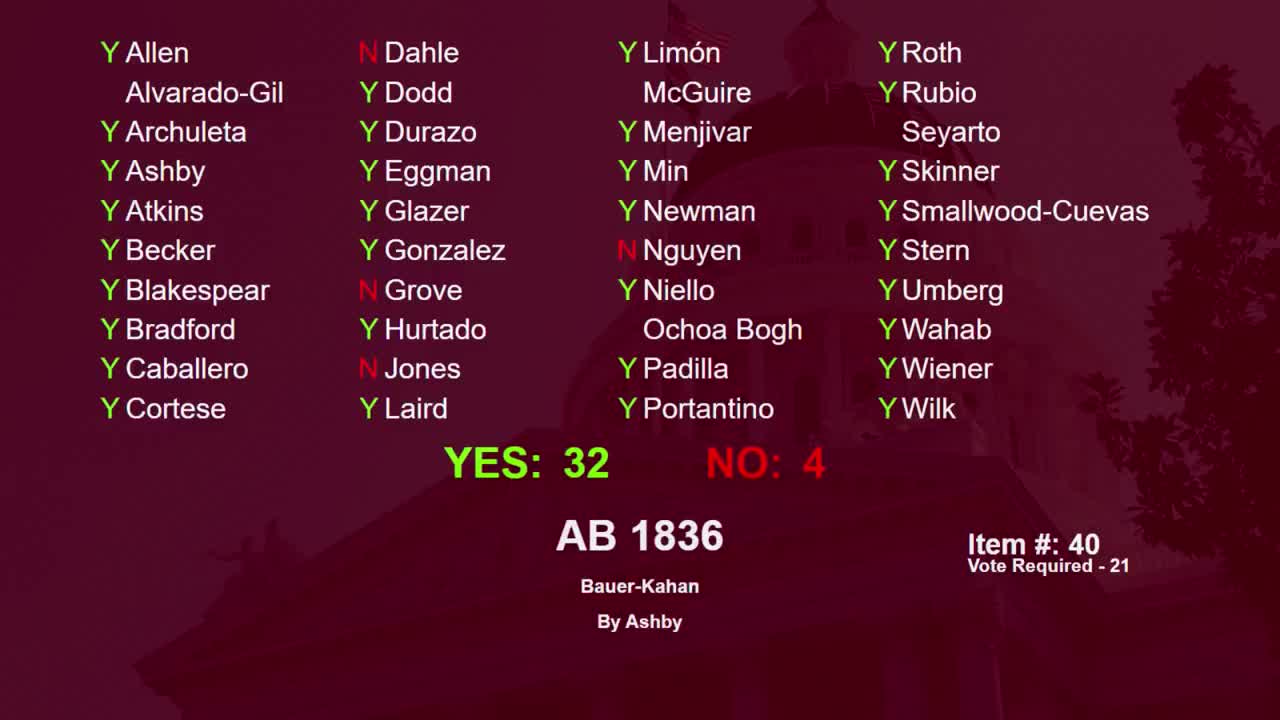 2MIN
Senate Floor
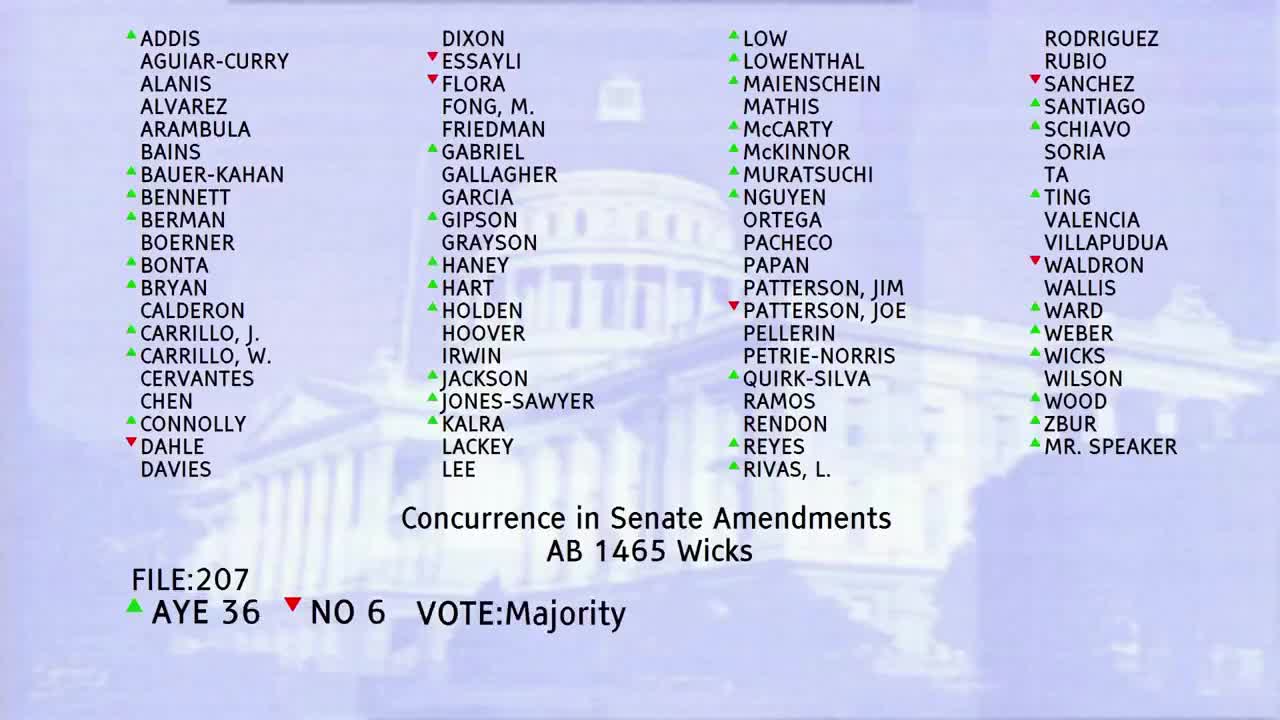 42SEC
Assembly Floor
 4MIN
Senate Standing Committee on Revenue and Taxation
 14MIN
Assembly Standing Committee on Revenue and Taxation
Bill Author

Bill Co-Author(s):