AB 3138: License plates and registration cards: alternative devices.
- Session Year: 2023-2024
- House: Assembly
- Latest Version Date: 2024-09-27
Current Status:
Passed
(2024-09-27: Chaptered by Secretary of State - Chapter 756, Statutes of 2024.)
Introduced
In Committee
First Chamber
In Committee
Second Chamber
Enacted
Existing law requires a vehicle to display a license plate, issued by the Department of Motor Vehicles, with tabs that indicate the month and year the vehicle registration expires. Existing law requires the department to issue a registration card upon registering a vehicle that includes, among other information, the name of the owner and the vehicle registration number. Existing law authorizes the department to establish a program allowing an entity to issue devices as alternatives to the conventional license plates, stickers, tabs, and registration cards, subject to specific requirements that include limitations on how vehicle location technology is used with an alternative device and how an alternative device may display certain specialized license plates. Existing law imposes requirements and restrictions on electronic information generated by an alternative device.
Commencing January 1, 2027, this bill would modify the limitations on the use of vehicle location technology.
This bill would authorize any vehicle, beginning on January 1, 2027, to be offered an alternative device to a license plate or registration card that includes vehicle location technology. The bill would specify requirements for how vehicle location technology is disabled or enabled and prohibit an alternative device from recording or transmitting personal identifiable information, as specified. The bill would require the department to delete data from an alternative device or the provider of an alternative device that the department is not authorized to receive. The bill would expand the types of specialized license plates that may be replicated on an alternative device.
Existing law requires a vehicle to display a license plate, issued by the Department of Motor Vehicles, with tabs that indicate the month and year the vehicle registration expires. Existing law requires the department to issue a registration card upon registering a vehicle that includes, among other information, the name of the owner and the vehicle registration number. Existing law authorizes the department to establish a program allowing an entity to issue devices as alternatives to the conventional license plates, stickers, tabs, and registration cards, subject to specific requirements that include limitations on how vehicle location technology is used with an alternative device and how an alternative device may display certain specialized license plates. Existing law imposes requirements and restrictions on electronic information generated by an alternative device.
Commencing January 1, 2027, this bill would modify the limitations on the use of vehicle location technology. The bill would also require the department to submit, by December 31, 2025, a report to the Legislature discussing the states authority to regulate the content and messaging on license plates.
This bill would authorize any vehicle, beginning on January 1, 2027, to be offered an alternative device to a license plate or registration card that includes vehicle location technology. The bill would specify requirements for how vehicle location technology is disabled or enabled and prohibit an alternative device from recording or transmitting personal identifiable information, as specified. The bill would require the department to delete data from an alternative device or the provider of an alternative device that the department is not authorized to receive. The bill would expand the types of specialized license plates that may be replicated on an alternative device.
Existing law requires a vehicle to display a license plate, issued by the Department of Motor Vehicles, with tabs that indicate the month and year the vehicle registration expires. Existing law requires the department to issue a registration card upon registering a vehicle that includes, among other information, the name of the owner and the vehicle registration number. Existing law authorizes the department to establish a program allowing an entity to issue devices as alternatives to the conventional license plates, stickers, tabs, and registration cards, subject to specific requirements that include limitations on how vehicle location technology is used with an alternative device and how an alternative device may display certain specialized license plates. Existing law imposes requirements and restrictions on electronic information generated by an alternative device.
This bill would authorize the department to approve the use of an alternative device to replicate a specialized license plate or a license plate requiring an occupational license, as specified.Commencing January 1, 2027, this bill would modify the limitations on the use of vehicle location technology. The bill would also require the department to submit, by December 31, 2025, a report to the Legislature discussing the states authority to regulate the content and messaging on license plates.
This bill would authorize any vehicle, beginning on January 1, 2027, to be offered an alternative device to a license plate or registration card that includes vehicle location technology. The bill would specify requirements for how vehicle location technology is disabled or enabled and prohibit an alternative device from recording or transmitting personal identifiable information, as specified. The bill would require the department to delete data from an alternative device or the provider of an alternative device that the department is not authorized to receive. The bill would expand the types of specialized license plates that may be replicated on an alternative device.
Existing law requires a vehicle to display a license plate, issued by the Department of Motor Vehicles, with tabs that indicate the month and year the vehicle registration expires. Existing law requires the department to issue a registration card upon registering a vehicle that includes, among other information, the name of the owner and the vehicle registration number. Existing law authorizes the department to establish a program allowing an entity to issue devices as alternatives to the conventional license plates, stickers, tabs, and registration cards, subject to specific requirements that include limitations on how vehicle location technology is used with an alternative device and how an alternative device may display certain specialized license plates.
This bill would authorize the department to approve the use of an alternative device to replicate a specialized license plate or a license plate requiring an occupational license, as specified.
ThisCommencing January 1, 2027, this bill would modify the limitations on the use of vehicle location technology and the replication of specialized license plates. technology. The bill would also require the department to submit, by December 31, 2025, a report to the Legislature discussing the states authority to regulate the content and messaging on license plates.
Existing law requires a vehicle to display a license plate, issued by the Department of Motor Vehicles, with tabs that indicate the month and year the vehicle registration expires. Existing law requires the department to issue a registration card upon registering a vehicle that includes, among other information, the name of the owner and the vehicle registration number. Existing law authorizes the department to establish a program allowing an entity to issue devices as alternatives to the conventional license plates, stickers, tabs, and registration cards, subject to specific requirements that include limitations on how vehicle location technology is used with an alternative device and how an alternative device may display certain specialized license plates. Existing law requires an alternative device to be subject to the approval of the Department of the California Highway Patrol.
This bill would instead require the department to consult with the Department of the California Highway Patrol when approving an alternative device. The bill would modify the limitations on the use of vehicle location technology and the replication of specialized license plates. The bill would authorize the department to approve an alternative device that displays banner messages, as specified. also require the department to submit, by December 31, 2025, a report to the Legislature discussing the states authority to regulate the content and messaging on license plates.
Existing law requires a vehicle to display a license plate, issued by the Department of Motor Vehicles, with tabs that indicate the month and year the vehicle registration expires. Existing law requires the department to issue a registration card upon registering a vehicle that includes, among other information, the name of the owner and the vehicle registration number. Existing law authorizes the department to establish a program allowing an entity to issue devices as alternatives to the conventional license plates, stickers, tabs, and registration cards, subject to specific requirements that include limitations on how vehicle location technology is used with an alternative device and how an alternative device may display certain specialized license plates. Existing law requires an alternative device to be subject to the approval of the Department of the California Highway Patrol.
This bill would instead require the department to consult with the Department of the California Highway Patrol when approving an alternative device. The bill would modify the limitations on the use of vehicle location technology and the replication of specialized license plates. The bill would authorize the department to approve an alternative device that displays banner messages, as specified.
The Legislature finds that a recent court decision, Ogilvie v. Gordon (2020) 540 F.Supp.3d 920, has raised questions about the constitutionality of Californias laws and regulations regarding appropriate messages on license plates.
SEC. 2.Section 4854 of the Vehicle Code is amended to read:4854.(a)The department shall establish a program authorizing an entity to issue devices as alternatives to the conventional license plates, stickers, tabs, and registration cards authorized by this code, subject to all of the following requirements:
(1)The alternative device is subject to the approval of the department and the Department of the California Highway Patrol and shall not be used in lieu of a device issued by the Department of Motor Vehicles until that approval has been granted.
(2)(A)Except as specifically authorized in subparagraph (B), an alternative device shall not include vehicle location technology.
(B)(1)(i)Vehicle location technology may be offered for vehicles registered as fleet vehicles, pursuant to Article 9.5 (commencing with Section 5301), commercial vehicles, as defined in Section 260, and those operating under an occupational license, pursuant to Division 5 (commencing with Section 11100).
(ii)Vehicles that began using an alternative device that included vehicle location technology during an authorized pilot program established by Section 4853 may continue to use that alternative device if the vehicle location technology meets the requirements set forth in this section and applicable regulations.
(iii)Beginning on January 1, 2027, and thereafter, any vehicle may be offered an alternative device that includes vehicle location technology.
(2)An alternative device that includes vehicle location technology shall comply with all of the following:
(i)The vehicle location technology shall be capable of being permanently disabled by means of a nonreversible method that ceases all vehicle location functionality and tracking information capabilities.
(ii)The vehicle location technology shall be capable of being manually disabled and enabled by a driver of the vehicle who is inside the vehicle.
(iii)The method of manually disabling and enabling the vehicle location technology shall be prominently located inside the vehicle and easy to use, and shall not require access to a remote or online application, password, or any form of log-in information.
(iv)Once a driver has manually disabled the vehicle location technology from inside the vehicle, the only method of enabling the vehicle location technology shall be to manually enable the technology from inside the vehicle. The registered owner of the license plate, the vehicle manufacturer, the department, or any other entity shall not have the capability of enabling the vehicle location technology through remote means.
(3)If an alternative device is equipped with vehicle location technology, the alternative device shall display a visual indication when the vehicle location technology is in active use.
(4)Data exchanged between the department and the alternative device, or the provider of the alternative device, is limited to that data necessary to display evidence of registration compliance, including the payment of registration fees, plate configurations, and the information or images displayed on the alternative product. If the department receives data from an alternative device or the provider of an alternative device in violation of this paragraph, the department shall immediately delete that data.
(5)Use of an alternative device is optional, and users shall affirmatively opt in to using the alternative device instead of a conventional license plate, sticker, tab, or registration card.
(b)(1)The department shall adopt regulations to carry out this program, including, but not limited to, all of the following:
(A)Determining standards necessary for the safe use of alternative products.
(B)Requirements for product oversight and consumer support.
(C)Requirements for product size, design, display, and functionality.
(D)Introduction of new products through a pilot program.
(E)Transitioning pilot products, and approved enhancements to existing alternative products, to a statewide product offering.
(F)Approval of products for statewide use.
(G)Determining data sharing, privacy, and security protocols pursuant to Section 1 of Article I of the California Constitutions right to privacy and other applicable privacy laws.
(H)Processes for revoking an alternative products authority for use.
(I)Testing enhancements to approved alternative products.
(J)Determining the types of plates eligible to participate and associated approval processes.
(K)Establishing reasonable fees to reimburse the department for the costs to implement the program.
(L)Reporting requirements.
(M)Requirements to ensure registered users of a device are aware of GPS capability and usage and can deactivate the function.
(N)Requirements to ensure nonregistered vehicle operators are aware of GPS capability and usage. This may include, but is not limited to, live notifications of the GPS function, toll-free communication with the device provider for vehicle location function status and deactivation, or visual indicators of GPS capability or usage.
(2)In developing these regulations, the department may consult with the Department of the California Highway Patrol and shall conduct hearings with the opportunity for public comment on the adoption of any regulation applicable to alternative registration products.
(3)In developing these regulations, the department may specify timeframes for compliance and temporary operating authority for products piloted under Section 4853 that are submitted for approval under this section.
(4)An entity seeking approval to issue an alternative device or electronic vehicle registration card for pilot or statewide use under this section shall submit a business plan for the device to the department for approval that includes, but is not limited to, all of the following:
(A)An administrative oversight plan.
(B)A product support plan, including, but not limited to, methods of providing proof of registration that are not subject to technological failures to be used in the event of the alternative device malfunctioning or failing.
(C)Information technology security, privacy, and cybersecurity evaluations and measures to protect against unauthorized access to information and the device.
(D)Procedures to comply with applicable privacy and security requirements, including, but not limited to, the California Consumer Privacy Act of 2018 (Title 1.81.5 (commencing with Section 1798.100) of Part 4 of Division 3 of the Civil Code). For purposes of this section, a provider of the device shall not share or sell the information obtained to provide the device, or any other information obtained by virtue of contracting with the department to provide the device, including, but not limited to, information collected by the device itself, nor shall it use the information for any purpose other than as strictly necessary to provide the device and show proof of vehicle registration.
(E)Ensuring that the information transmitted between the alternative device or electronic vehicle registration card, the department, and the provider, as well as any mobile application required for the alternative device or electronic vehicle registration card, including storage, is encrypted and protected to the highest reasonable security standards broadly available.
(5)An alternative device intended to serve in lieu of a license plate shall be subject to all of the following requirements:
(A)Have a minimum effective viewable area that meets the size specifications of Section 4852.
(B)Provide legibility and visibility according to standards consistent with those applied to standard metal reflectorized license plates, as set forth in this article.
(C)Be displayed in a manner consistent with Article 9 (commencing with Section 5200).
(D)Display only information and images approved by the department or deemed necessary by the department.
(E)Be readable by automated license plate readers used by the Department of the California Highway Patrol and any other automated enforcement system.
(F)Be readable by the human eye during hours of both daylight and darkness at a distance of no less than 75 feet.
(G)The alphanumeric characters assigned to the vehicle by the department and evidence of valid registration are capable of and shall be displayed on the device whenever a vehicle is in motion, stationary, parked on or off of a road or highway, or unoccupied.
(6)An alternative device intended to serve in lieu of a registration card is subject to both of the following requirements:
(A)Meets the requirements of Section 4453.
(B)May be used to comply with Section 4462.
(7)An alternative device intended to serve in lieu of a license plate or a registration card shall not record or transmit personal identifiable information and shall only record or transmit data limited to what is necessary to display evidence of registration compliance.
(8)The department may establish additional requirements it deems necessary to implement this subdivision.
(9)The department may authorize an alternative device to replicate the appearance of a license plate approved pursuant to any of the following:
(A)Section 5007.
(B)Article 8.4 (commencing with Section 5060).
(C)Article 8.5 (commencing with Section 5100).
(D)Article 8.6 (commencing with Section 5151).
(c)An alternative device failure or malfunction may be deemed a correctable violation if all of the provisions of Section 40610 are met.
(d)The provider of the device, if the device has digital capabilities, shall build into the device a process for frequent notification if the device becomes defective. The provider of the device shall seek to replace defective devices as soon as possible.
(e)Alternative devices issued pursuant to this section may emit diffused nonglaring light only to the extent necessary to meet the visibility requirements of Sections 5201 and 24601.
(f)(1)An employer, or a person acting on behalf of the employer, shall not use an alternative device to monitor employees except during work hours, and only if strictly necessary for the performance of the employees duties. For purposes of this section, monitor includes, but is not limited to, locating, tracking, watching, listening to, or otherwise surveilling the employee.
(2)An employer, or a person acting on behalf of the employer, shall not retaliate against an employee for removing or disabling an alternative devices monitoring capabilities, including vehicle location technology, outside of work hours. An employee who believes they have been subject to a violation of this paragraph may file a complaint with the Labor Commissioner pursuant to Section 98.7 of the Labor Code. In addition to the civil penalties described in this provision, an employee retaliated against in violation of this section shall be entitled to all available penalties, remedies, and compensation, including, but not limited to, reinstatement and reimbursement of lost wages, work benefits, or other compensation caused by the retaliation.
(3)An employer or a person acting on behalf of the employer shall provide an employee with a notice stating that monitoring will occur before conducting any monitoring with an alternative device. The notice shall include, at a minimum, all of the following elements:
(A)A description of the specific activities that will be monitored.
(B)A description of the worker data that will be collected as a part of the monitoring.
(C)A notification of whether the data gathered through monitoring will be used to make or inform any employment-related decisions, including, but not limited to, disciplinary and termination decisions, and, if so, how, including any associated benchmarks.
(D)A description of the vendors or other third parties, if any, to which information collected through monitoring will be disclosed or transferred. The description shall include the name of the vendor or third party and the purpose for the data transfer.
(E)A description of the organizational positions that are authorized to access the data gathered through the alternative device.
(F)A description of the dates, times, and frequency that the monitoring will occur.
(G)A description of where the data will be stored and the length of time it will be retained.
(H)A notification of the employees right to disable monitoring, including vehicle location technology, outside of work hours.
(4)(A)An employer who violates this subdivision shall be subject to a civil penalty of two hundred fifty dollars ($250) for an initial violation and one thousand dollars ($1,000) per employee for each subsequent violation.
(B)For purposes of determining the penalty described in subparagraph (A), the penalty shall be assessed per employee, per violation, and per day that monitoring without proper notice is conducted.
(C)The Labor Commissioner shall enforce this section using the procedures set forth in Section 1197.1 of the Labor Code, as applicable, including through the issuance of citations against employers who violate this section. The procedures for issuing and contesting citations, and enforcing judgments for civil penalties, that are issued by the Labor Commissioner pursuant to this section shall be the same as those set forth in Section 1197.1 of the Labor Code.
(D)An employer, and any third-party vendor that contracts with an employer to provide GPS tracking of vehicles through an alternative device as described in this section, upon request, shall furnish any report or information that the Labor Commissioner or the Division of Labor Standards Enforcement requires to carry out this section.
SEC. 3.Section 4855 is added to the Vehicle Code, to read:4855.(a)By December 31, 2025, the department shall report to the Legislature, consistent with Section 9795 of the Government Code, on the states authority to regulate the content and messaging on traditional and digital license plates. The report shall consider the states authority under both state and federal law, including the Communications Decency Act of 1996 (47 U.S.C. Sec. 230). The report shall include an analysis regarding the seven identifying characters and any additional messaging or signage that may be authorized.(b)The report submitted pursuant to subdivision (a) may also include recommendations on relevant state policy regarding authorization of messaging on digital license plates, including any restrictions or constraints.The Legislature finds that a recent court decision, Ogilvie v. Gordon (2020) 540 F.Supp.3d 920, has raised questions about the constitutionality of Californias laws and regulations regarding appropriate messages on license plates.
SEC. 2.Section 4854 of the Vehicle Code is amended to read:4854.(a)The department shall establish a program authorizing an entity to issue devices as alternatives to the conventional license plates, stickers, tabs, and registration cards authorized by this code, subject to all of the following requirements:(1)The alternative device is subject to the approval of the department and the Department of the California Highway Patrol and shall not be used in lieu of a device issued by the Department of Motor Vehicles until that approval has been granted.(2)(A)Except as specifically authorized in subparagraph (B), an alternate device shall not include vehicle location technology. The department shall, by no later than January 1, 2024, in a manner determined by the department, recall any devices with vehicle location technology that have been issued pursuant to Section 4853, to vehicles other than those described in subparagraph (B). The department may adopt regulations to carry out this requirement.(B)Vehicle location technology may be offered for vehicles registered as fleet vehicles, pursuant to Article 9.5 (commencing with Section 5301), commercial vehicles, as defined in Section 260, and those operating under an occupational license, pursuant to Division 5 (commencing with Section 11100).(C)The vehicle location technology, if any, shall be capable of being disabled by the user.(D)The vehicle location technology, if any, may be capable of being manually disabled by a driver of the vehicle while that driver is in the vehicle.(3)If the device is equipped with vehicle location technology, an alternative device shall display a visual indication that vehicle location technology is in active use.(4)Data exchanged between the department and the device, or the provider of the device, is limited to that data necessary to display evidence of registration compliance, including the payment of registration fees, plate configurations, and the information or images displayed on the alternative product.(5)The department shall not receive or retain directly from an alternative device authorized by this section or the provider of the alternative device any electronic information regarding the movement, location, or use of a vehicle or person with an alternative device.(6)Use of the alternative device is optional, and users shall affirmatively opt in to using the alternative device instead of a conventional license plate, sticker, tab, or registration card.(b)(1)The department shall adopt regulations to carry out this program, including, but not limited to, all of the following:(A)Determining standards necessary for the safe use of alternative products.(B)Requirements for product oversight and consumer support.(C)Requirements for product size, design, display, and functionality.(D)Introduction of new products through a pilot program.(E)Transitioning pilot products, and approved enhancements to existing alternative products, to a statewide product offering.(F)Approval of products for statewide use.(G)Determining data sharing, privacy, and security protocols pursuant to Section 1 of Article I of the California Constitutions right to privacy and other applicable privacy laws.(H)Processes for revoking an alternative products authority for use.(I)Testing enhancements to approved alternative products.(J)Determining the types of plates eligible to participate and associated approval processes.(K)Establishing reasonable fees to reimburse the department for the costs to implement the program.(L)Reporting requirements.(M)Requirements to ensure registered users of a device are aware of GPS capability and usage and can deactivate the function.(N)Requirements to ensure nonregistered vehicle operators are aware of GPS capability and usage. This may include, but is not limited to, live notifications of the GPS function, toll-free communication with the device provider for vehicle location function status and deactivation, or visual indicators of GPS capability or usage.(2)In developing these regulations, the department may consult with the Department of the California Highway Patrol and shall conduct hearings with the opportunity for public comment on the adoption of any regulation applicable to alternative registration products.(3)In developing these regulations, the department may specify timeframes for compliance and temporary operating authority for products piloted under Section 4853 that are submitted for approval under this section.(4)An entity seeking approval to issue an alternative device or electronic vehicle registration card for pilot or statewide use under this section shall submit a business plan for the device to the department for approval that includes, but is not limited to, all of the following:(A)An administrative oversight plan.(B)A product support plan, including, but not limited to, methods of providing proof of registration that are not subject to technological failures to be used in the event of the alternative device malfunctioning or failing.(C)Information technology security, privacy, and cybersecurity evaluations and measures to protect against unauthorized access to information and the device.(D)Procedures to comply with applicable privacy and security requirements, including, but not limited to, the California Consumer Privacy Act of 2018 (Title 1.81.5 (commencing with Section 1798.100) of Part 4 of Division 3 of the Civil Code). For purposes of this section, a provider of the device shall not share or sell the information obtained to provide the device, or any other information obtained by virtue of contracting with the department to provide the device, including, but not limited to, information collected by the device itself, nor shall it use the information for any purpose other than as strictly necessary to provide the device and show proof of vehicle registration.(E)Ensuring that the information transmitted between the alternative device or electronic vehicle registration card, the department, and the provider, as well as any mobile application required for the alternative device or electronic vehicle registration card, including storage, is encrypted and protected to the highest reasonable security standards broadly available.(5)An alternative device intended to serve in lieu of a license plate shall be subject to all of the following requirements:(A)Have a minimum effective viewable area that meets the size specifications of Section 4852.(B)Provide legibility and visibility according to standards consistent with those applied to standard metal license plates.(C)Be displayed in a manner consistent with Article 9 (commencing with Section 5200).(D)Display only information and images approved by the department or deemed necessary by the department.(E)Be readable by automated license plate readers used by the Department of the California Highway Patrol and any other automated enforcement system.(F)Be readable by the human eye during hours of both daylight and darkness at a distance of no less than 75 feet.(G)The alphanumeric characters assigned to the vehicle by the department and evidence of valid registration are capable of and shall be displayed on the device whenever a vehicle is in motion, stationary, parked on or off of a road or highway, or unoccupied.(6)An alternative device intended to serve in lieu of a registration card is subject to both of the following requirements:(A)Meets the requirements of Section 4453.(B)May be used to comply with Section 4462.(7)The department may establish additional requirements it deems necessary to implement this subdivision.(8)The department may authorize an alternative device to replicate a specialized license plate or a license plate requiring an occupational license that the department has approved pursuant to this code.(c)An alternative device failure or malfunction may be deemed a correctable violation if all of the provisions of Section 40610 are met.(d)The provider of the device, if the device has digital capabilities, shall build into the device a process for frequent notification if the device becomes defective. The provider of the device shall seek to replace defective devices as soon as possible.(e)Alternative devices issued pursuant to this section may emit diffused nonglaring light only to the extent necessary to meet the visibility requirements of Sections 5201 and 24601.(f)(1)An employer, or a person acting on behalf of the employer, shall not use an alternative device to monitor employees except during work hours, and only if strictly necessary for the performance of the employees duties. For purposes of this section, monitor includes, but is not limited to, locating, tracking, watching, listening to, or otherwise surveilling the employee.(2)An employer, or a person acting on behalf of the employer, shall not retaliate against an employee for removing or disabling an alternative devices monitoring capabilities, including vehicle location technology, outside of work hours. An employee who believes they have been subject to a violation of this paragraph may file a complaint with the Labor Commissioner pursuant to Section 98.7 of the Labor Code. In addition to the civil penalties described in this provision, an employee retaliated against in violation of this section shall be entitled to all available penalties, remedies, and compensation, including, but not limited to, reinstatement and reimbursement of lost wages, work benefits, or other compensation caused by the retaliation.(3)An employer or a person acting on behalf of the employer shall provide an employee with a notice stating that monitoring will occur before conducting any monitoring with an alternative device. The notice shall include, at a minimum, all of the following elements:(A)A description of the specific activities that will be monitored.(B)A description of the worker data that will be collected as a part of the monitoring.(C)A notification of whether the data gathered through monitoring will be used to make or inform any employment-related decisions, including, but not limited to, disciplinary and termination decisions, and, if so, how, including any associated benchmarks.(D)A description of the vendors or other third parties, if any, to which information collected through monitoring will be disclosed or transferred. The description shall include the name of the vendor or third party and the purpose for the data transfer.(E)A description of the organizational positions that are authorized to access the data gathered through the alternative device.(F)A description of the dates, times, and frequency that the monitoring will occur.(G)A description of where the data will be stored and the length of time it will be retained.(H)A notification of the employees right to disable monitoring, including vehicle location technology, outside of work hours.(4)(A)An employer who violates this subdivision shall be subject to a civil penalty of two hundred fifty dollars ($250) for an initial violation and one thousand dollars ($1,000) per employee for each subsequent violation.(B)For purposes of determining the penalty described in subparagraph (A), the penalty shall be assessed per employee, per violation, and per day that monitoring without proper notice is conducted.(C)The Labor Commissioner shall enforce this section using the procedures set forth in Section 1197.1 of the Labor Code, as applicable, including through the issuance of citations against employers who violate this section. The procedures for issuing and contesting citations, and enforcing judgments for civil penalties, that are issued by the Labor Commissioner pursuant to this section shall be the same as those set forth in Section 1197.1 of the Labor Code.(D)An employer, and any third-party vendor that contracts with an employer to provide GPS tracking of vehicles through an alternative device as described in this section, upon request, shall furnish any report or information that the Labor Commissioner or the Division of Labor Standards Enforcement requires to carry out this section.(g)This section shall remain in effect only until January 1, 2027, and as of that date is repealed.SEC. 3.Section 4854 is added to the Vehicle Code, to read:4854.(a)The department shall establish a program authorizing an entity to issue devices as alternatives to the conventional license plates, stickers, tabs, and registration cards authorized by this code, subject to all of the following requirements:(1)The alternative device is subject to the approval of the department and the Department of the California Highway Patrol, and shall not be used in lieu of a device issued by the Department of Motor Vehicles until that approval has been granted.(2)An alternative device shall not include vehicle location technology, unless the vehicle location technology complies with the requirements of this section and has all of the following features:(A)The vehicle location technology shall be capable of being permanently disabled by means of a nonreversible method that ceases all vehicle location functionality and tracking information capabilities.(B)(i)The vehicle location technology shall be capable of being manually disabled and enabled by a driver of the vehicle while that driver is inside the vehicle.(ii)The method of manually disabling and enabling the vehicle location technology shall be prominently located and easy to disable, without requiring access to a remote, online application.(iii)The method of manually disabling and enabling the vehicle location technology shall not require a password or login information.(iv)Once the vehicle location technology is manually disabled from inside the car, the only method of reenabling the technology shall be manually from inside the car. The registered owner of the license plate, the manufacturer, the Department of Motor Vehicles, or any other entity shall not have the capability of reenabling the vehicle location technology through remote means.(3)Data exchanged between the department and the device, or the provider of the device, is limited to that data necessary to display evidence of registration compliance, including the payment of registration fees, plate configurations, and the information or images displayed on the alternative product.(4)The department shall not receive or retain directly from an alternative device authorized by this section or the provider of the alternative device any electronic information regarding the movement, location, or use of a vehicle or person with an alternative device.(5)Use of the alternative device is optional, and users shall affirmatively opt in to using the alternative device instead of a conventional license plate, sticker, tab, or registration card.(b)(1)The department shall adopt regulations to carry out this program, including, but not limited to, all of the following:(A)Determining standards necessary for the safe use of alternative products.(B)Requirements for product oversight and consumer support.(C)Requirements for product size, design, display, and functionality.(D)Introduction of new products through a pilot program.(E)Transitioning pilot products, and approved enhancements to existing alternative products, to a statewide product offering.(F)Approval of products for statewide use.(G)Determining data sharing, privacy, and security protocols pursuant to Section 1 of Article I of the California Constitutions right to privacy and other applicable privacy laws.(H)Processes for revoking an alternative products authority for use.(I)Testing enhancements to approved alternative products.(J)Determining the types of plates eligible to participate and associated approval processes.(K)Establishing reasonable fees to reimburse the department for the costs to implement the program.(L)Reporting requirements.(M)Requirements to ensure registered users of a device are aware of GPS capability and usage and can deactivate the function.(N)Requirements to ensure nonregistered vehicle operators are aware of GPS capability and usage. This may include, but is not limited to, live notifications of the GPS function, toll-free communication with the device provider for vehicle location function status and deactivation, or visual indicators of GPS capability or usage.(2)In developing these regulations, the department may consult with the Department of the California Highway Patrol and shall conduct hearings with the opportunity for public comment on the adoption of any regulation applicable to alternative registration products.(3)In developing these regulations, the department may specify timeframes for compliance and temporary operating authority for products piloted under Section 4853 that are submitted for approval under this section.(4)An entity seeking approval to issue an alternative device or electronic vehicle registration card for pilot or statewide use under this section shall submit a business plan for the device to the department for approval that includes, but is not limited to, all of the following:(A)An administrative oversight plan.(B)A product support plan, including, but not limited to, methods of providing proof of registration that are not subject to technological failures to be used in the event of the alternative device malfunctioning or failing.(C)Information technology security, privacy, and cybersecurity evaluations and measures to protect against unauthorized access to information and the device.(D)Procedures to comply with applicable privacy and security requirements, including, but not limited to, the California Consumer Privacy Act of 2018 (Title 1.81.5 (commencing with Section 1798.100) of Part 4 of Division 3 of the Civil Code). For purposes of this section, a provider of the device shall not share or sell the information obtained to provide the device, or any other information obtained by virtue of contracting with the department to provide the device, including, but not limited to, information collected by the device itself, nor shall it use the information for any purpose other than as strictly necessary to provide the device and show proof of vehicle registration.(E)Ensuring that the information transmitted between the alternative device or electronic vehicle registration card, the department, and the provider, as well as any mobile application required for the alternative device or electronic vehicle registration card, including storage, is encrypted and protected to the highest reasonable security standards broadly available.(5)An alternative device intended to serve in lieu of a license plate shall be subject to all of the following requirements:(A)Have a minimum effective viewable area that meets the size specifications of Section 4852.(B)Provide legibility and visibility according to standards consistent with those applied to standard metal license plates.(C)Be displayed in a manner consistent with Article 9 (commencing with Section 5200).(D)Display only information and images approved by the department or deemed necessary by the department.(E)Be readable by automated license plate readers used by the Department of the California Highway Patrol and any other automated enforcement system.(F)Be readable by the human eye during hours of both daylight and darkness at a distance of no less than 75 feet.(G)The alphanumeric characters assigned to the vehicle by the department and evidence of valid registration are capable of and shall be displayed on the device whenever a vehicle is in motion, stationary, parked on or off of a road or highway, or unoccupied.(6)An alternative device intended to serve in lieu of a registration card is subject to both of the following requirements:(A)Meets the requirements of Section 4453.(B)May be used to comply with Section 4462.(7)The department may establish additional requirements it deems necessary to implement this subdivision.(8)The department may authorize an alternative device to replicate a specialized license plate or a license plate requiring an occupational license that the department has approved pursuant to this code.(c)An alternative device failure or malfunction may be deemed a correctable violation if all of the provisions of Section 40610 are met.(d)The provider of the device, if the device has digital capabilities, shall build into the device a process for frequent notification if the device becomes defective. The provider of the device shall seek to replace defective devices as soon as possible.(e)Alternative devices issued pursuant to this section may emit diffused nonglaring light only to the extent necessary to meet the visibility requirements of Sections 5201 and 24601.(f)(1)An employer, or a person acting on behalf of the employer, shall not use an alternative device to monitor employees except during work hours, and only if strictly necessary for the performance of the employees duties. For purposes of this section, monitor includes, but is not limited to, locating, tracking, watching, listening to, or otherwise surveilling the employee.(2)An employer, or a person acting on behalf of the employer, shall not retaliate against an employee for removing or disabling an alternative devices monitoring capabilities, including vehicle location technology, outside of work hours. An employee who believes they have been subject to a violation of this paragraph may file a complaint with the Labor Commissioner pursuant to Section 98.7 of the Labor Code. In addition to the civil penalties described in this provision, an employee retaliated against in violation of this section shall be entitled to all available penalties, remedies, and compensation, including, but not limited to, reinstatement and reimbursement of lost wages, work benefits, or other compensation caused by the retaliation.(3)An employer or a person acting on behalf of the employer shall provide an employee with a notice stating that monitoring will occur before conducting any monitoring with an alternative device. The notice shall include, at a minimum, all of the following elements:(A)A description of the specific activities that will be monitored.(B)A description of the worker data that will be collected as a part of the monitoring.(C)A notification of whether the data gathered through monitoring will be used to make or inform any employment-related decisions, including, but not limited to, disciplinary and termination decisions, and, if so, how, including any associated benchmarks.(D)A description of the vendors or other third parties, if any, to which information collected through monitoring will be disclosed or transferred. The description shall include the name of the vendor or third party and the purpose for the data transfer.(E)A description of the organizational positions that are authorized to access the data gathered through the alternative device.(F)A description of the dates, times, and frequency that the monitoring will occur.(G)A description of where the data will be stored and the length of time it will be retained.(H)A notification of the employees right to disable monitoring, including vehicle location technology, outside of work hours.(4)(A)An employer who violates this subdivision shall be subject to a civil penalty of two hundred fifty dollars ($250) for an initial violation and one thousand dollars ($1,000) per employee for each subsequent violation.(B)For purposes of determining the penalty described in subparagraph (A), the penalty shall be assessed per employee, per violation, and per day that monitoring without proper notice is conducted.(C)The Labor Commissioner shall enforce this section using the procedures set forth in Section 1197.1 of the Labor Code, as applicable, including through the issuance of citations against employers who violate this section. The procedures for issuing and contesting citations, and enforcing judgments for civil penalties, that are issued by the Labor Commissioner pursuant to this section shall be the same as those set forth in Section 1197.1 of the Labor Code.(D)An employer, and any third-party vendor that contracts with an employer to provide GPS tracking of vehicles through an alternative device as described in this section, upon request, shall furnish any report or information that the Labor Commissioner or the Division of Labor Standards Enforcement requires to carry out this section.(g)This section shall become operative on January 1, 2027.SEC. 2.Section 4854 of the Vehicle Code is amended to read:4854.(a)The department shall establish a program authorizing an entity to issue devices as alternatives to the conventional license plates, stickers, tabs, and registration cards authorized by this code, subject to all of the following requirements:
(1)The alternative device is subject to the approval of the department and the Department of the California Highway Patrol and shall not be used in lieu of a device issued by the Department of Motor Vehicles until that approval has been granted.
(2)(A)Except as specifically authorized in subparagraph (B), an alternate device shall not include vehicle location technology. The department shall, by no later than January 1, 2024, in a manner determined by the department, recall any devices with vehicle location technology that have been issued pursuant to Section 4853, to vehicles other than those described in subparagraph (B). The department may adopt regulations to carry out this requirement.(B)Vehicle location technology may be offered for vehicles registered as fleet vehicles, pursuant to Article 9.5 (commencing with Section 5301), commercial vehicles, as defined in Section 260, and those operating under an occupational license, pursuant to Division 5 (commencing with Section 11100).(C)The vehicle location technology, if any, shall be capable of being disabled by the user.(D)The vehicle location technology, if any, may be capable of being manually disabled by a driver of the vehicle while that driver is in the vehicle.(2)(A)Except as specifically authorized in subparagraph (B), an alternative device shall not include vehicle location technology.
(B)(1)(i)Vehicle location technology may be offered for vehicles registered as fleet vehicles, pursuant to Article 9.5 (commencing with Section 5301), commercial vehicles, as defined in Section 260, and those operating under an occupational license, pursuant to Division 5 (commencing with Section 11100).
(ii)Vehicles that began using an alternative device that included vehicle location technology during an authorized pilot program established by Section 4853 may continue to use that alternative device if the vehicle location technology meets the requirements set forth in this section and applicable regulations.
(iii)Beginning on January 1, 2027, and thereafter, any vehicle may be offered an alternative device that includes vehicle location technology.
(2)An alternative device that includes vehicle location technology shall comply with all of the following:
(i)The vehicle location technology shall be capable of being permanently disabled by means of a nonreversible method that ceases all vehicle location functionality and tracking information capabilities.
(ii)The vehicle location technology shall be capable of being manually disabled and enabled by a driver of the vehicle who is inside the vehicle.
(iii)The method of manually disabling and enabling the vehicle location technology shall be prominently located inside the vehicle and easy to use, and shall not require access to a remote or online application, password, or any form of log-in information.
(iv)Once a driver has manually disabled the vehicle location technology from inside the vehicle, the only method of enabling the vehicle location technology shall be to manually enable the technology from inside the vehicle. The registered owner of the license plate, the vehicle manufacturer, the department, or any other entity shall not have the capability of enabling the vehicle location technology through remote means.
(3)If the an alternative device is equipped with vehicle location technology, an the alternative device shall display a visual indication that when the vehicle location technology is in active use.
(4)Data exchanged between the department and the alternative device, or the provider of the alternative device, is limited to that data necessary to display evidence of registration compliance, including the payment of registration fees, plate configurations, and the information or images displayed on the alternative product. If the department receives data from an alternative device or the provider of an alternative device in violation of this paragraph, the department shall immediately delete that data.
(5)The department shall not receive or retain directly from an alternative device authorized by this section or the provider of the alternative device any electronic information regarding the movement, location, or use of a vehicle or person with an alternative device.(6)(5)Use of the an alternative device is optional, and users shall affirmatively opt in to using the alternative device instead of a conventional license plate, sticker, tab, or registration card.
(b)(1)The department shall adopt regulations to carry out this program, including, but not limited to, all of the following:
(A)Determining standards necessary for the safe use of alternative products.
(B)Requirements for product oversight and consumer support.
(C)Requirements for product size, design, display, and functionality.
(D)Introduction of new products through a pilot program.
(E)Transitioning pilot products, and approved enhancements to existing alternative products, to a statewide product offering.
(F)Approval of products for statewide use.
(G)Determining data sharing, privacy, and security protocols pursuant to Section 1 of Article I of the California Constitutions right to privacy and other applicable privacy laws.
(H)Processes for revoking an alternative products authority for use.
(I)Testing enhancements to approved alternative products.
(J)Determining the types of plates eligible to participate and associated approval processes.
(K)Establishing reasonable fees to reimburse the department for the costs to implement the program.
(L)Reporting requirements.
(M)Requirements to ensure registered users of a device are aware of GPS capability and usage and can deactivate the function.
(N)Requirements to ensure nonregistered vehicle operators are aware of GPS capability and usage. This may include, but is not limited to, live notifications of the GPS function, toll-free communication with the device provider for vehicle location function status and deactivation, or visual indicators of GPS capability or usage.
(2)In developing these regulations, the department may consult with the Department of the California Highway Patrol and shall conduct hearings with the opportunity for public comment on the adoption of any regulation applicable to alternative registration products.
(3)In developing these regulations, the department may specify timeframes for compliance and temporary operating authority for products piloted under Section 4853 that are submitted for approval under this section.
(4)An entity seeking approval to issue an alternative device or electronic vehicle registration card for pilot or statewide use under this section shall submit a business plan for the device to the department for approval that includes, but is not limited to, all of the following:
(A)An administrative oversight plan.
(B)A product support plan, including, but not limited to, methods of providing proof of registration that are not subject to technological failures to be used in the event of the alternative device malfunctioning or failing.
(C)Information technology security, privacy, and cybersecurity evaluations and measures to protect against unauthorized access to information and the device.
(D)Procedures to comply with applicable privacy and security requirements, including, but not limited to, the California Consumer Privacy Act of 2018 (Title 1.81.5 (commencing with Section 1798.100) of Part 4 of Division 3 of the Civil Code). For purposes of this section, a provider of the device shall not share or sell the information obtained to provide the device, or any other information obtained by virtue of contracting with the department to provide the device, including, but not limited to, information collected by the device itself, nor shall it use the information for any purpose other than as strictly necessary to provide the device and show proof of vehicle registration.
(E)Ensuring that the information transmitted between the alternative device or electronic vehicle registration card, the department, and the provider, as well as any mobile application required for the alternative device or electronic vehicle registration card, including storage, is encrypted and protected to the highest reasonable security standards broadly available.
(5)An alternative device intended to serve in lieu of a license plate shall be subject to all of the following requirements:
(A)Have a minimum effective viewable area that meets the size specifications of Section 4852.
(B)Provide legibility and visibility according to standards consistent with those applied to license plates. standard metal reflectorized license plates, as set forth in this article.
(C)Be displayed in a manner consistent with Article 9 (commencing with Section 5200).
(D)Display only information and images approved by the department or deemed necessary by the department.
(E)Be readable by automated license plate readers used by the Department of the California Highway Patrol and any other automated enforcement system.
(F)Be readable by the human eye during hours of both daylight and darkness at a distance of no less than 75 feet.
(G)The alphanumeric characters assigned to the vehicle by the department and evidence of valid registration are capable of and shall be displayed on the device whenever a vehicle is in motion, stationary, parked on or off of a road or highway, or unoccupied.
(6)An alternative device intended to serve in lieu of a registration card is subject to both of the following requirements:
(A)Meets the requirements of Section 4453.
(B)May be used to comply with Section 4462.
(7)The department may establish additional requirements it deems necessary to implement this subdivision.(8)The department may authorize both of the following to be displayed on an alternative device:(A)Approved environmental license plates pursuant to Article 8.5 (commencing with Section 5100).(B)Approved specialized license plates pursuant to Article 8.6 (commencing with Section 5151).(7)An alternative device intended to serve in lieu of a license plate or a registration card shall not record or transmit personal identifiable information and shall only record or transmit data limited to what is necessary to display evidence of registration compliance.
(8)The department may establish additional requirements it deems necessary to implement this subdivision.
(9)The department may authorize an alternative device to replicate the appearance of a license plate approved pursuant to any of the following:
(A)Section 5007.
(B)Article 8.4 (commencing with Section 5060).
(C)Article 8.5 (commencing with Section 5100).
(D)Article 8.6 (commencing with Section 5151).
(c)An alternative device failure or malfunction may be deemed a correctable violation if all of the provisions of Section 40610 are met.
(d)The provider of the device, if the device has digital capabilities, shall build into the device a process for frequent notification if the device becomes defective. The provider of the device shall seek to replace defective devices as soon as possible.
(e)Alternative devices issued pursuant to this section may emit diffused nonglaring light only to the extent necessary to meet the visibility requirements of Sections 5201 and 24601.
(f)(1)An employer, or a person acting on behalf of the employer, shall not use an alternative device to monitor employees except during work hours, and only if strictly necessary for the performance of the employees duties. For purposes of this section, monitor includes, but is not limited to, locating, tracking, watching, listening to, or otherwise surveilling the employee.
(2)An employer, or a person acting on behalf of the employer, shall not retaliate against an employee for removing or disabling an alternative devices monitoring capabilities, including vehicle location technology, outside of work hours. An employee who believes they have been subject to a violation of this paragraph may file a complaint with the Labor Commissioner pursuant to Section 98.7 of the Labor Code. In addition to the civil penalties described in this provision, an employee retaliated against in violation of this section shall be entitled to all available penalties, remedies, and compensation, including, but not limited to, reinstatement and reimbursement of lost wages, work benefits, or other compensation caused by the retaliation.
(3)An employer or a person acting on behalf of the employer shall provide an employee with a notice stating that monitoring will occur before conducting any monitoring with an alternative device. The notice shall include, at a minimum, all of the following elements:
(A)A description of the specific activities that will be monitored.
(B)A description of the worker data that will be collected as a part of the monitoring.
(C)A notification of whether the data gathered through monitoring will be used to make or inform any employment-related decisions, including, but not limited to, disciplinary and termination decisions, and, if so, how, including any associated benchmarks.
(D)A description of the vendors or other third parties, if any, to which information collected through monitoring will be disclosed or transferred. The description shall include the name of the vendor or third party and the purpose for the data transfer.
(E)A description of the organizational positions that are authorized to access the data gathered through the alternative device.
(F)A description of the dates, times, and frequency that the monitoring will occur.
(G)A description of where the data will be stored and the length of time it will be retained.
(H)A notification of the employees right to disable monitoring, including vehicle location technology, outside of work hours.
(4)(A)An employer who violates this subdivision shall be subject to a civil penalty of two hundred fifty dollars ($250) for an initial violation and one thousand dollars ($1,000) per employee for each subsequent violation.
(B)For purposes of determining the penalty described in subparagraph (A), the penalty shall be assessed per employee, per violation, and per day that monitoring without proper notice is conducted.
(C)The Labor Commissioner shall enforce this section using the procedures set forth in Section 1197.1 of the Labor Code, as applicable, including through the issuance of citations against employers who violate this section. The procedures for issuing and contesting citations, and enforcing judgments for civil penalties, that are issued by the Labor Commissioner pursuant to this section shall be the same as those set forth in Section 1197.1 of the Labor Code.
(D)An employer, and any third-party vendor that contracts with an employer to provide GPS tracking of vehicles through an alternative device as described in this section, upon request, shall furnish any report or information that the Labor Commissioner or the Division of Labor Standards Enforcement requires to carry out this section.
SEC. 4.SEC. 3.Section 4855 is added to the Vehicle Code, to read:4855.(a)By December 31, 2025, the department shall report to the Legislature, consistent with Section 9795 of the Government Code, on the states authority to regulate the content and messaging on traditional and digital license plates. The report shall consider the states authority under both state and federal law, including the Communications Decency Act of 1996 (47 U.S.C. Sec. 230). The report shall include an analysis regarding the seven identifying characters and any additional messaging or signage that may be authorized.
(b)The report submitted pursuant to subdivision (a) may also include recommendations on relevant state policy regarding authorization of messaging on digital license plates, including any restrictions or constraints.
The Legislature finds that a recent court decision, Ogilvie v. Gordon (2020) 540 F.Supp.3d 920, has raised questions about the constitutionality of Californias laws and regulations regarding appropriate messages on license plates.
SEC. 2.Section 4854 of the Vehicle Code is amended to read:4854.(a)The department shall establish a program authorizing an entity to issue devices as alternatives to the conventional license plates, stickers, tabs, and registration cards authorized by this code, subject to all of the following requirements:(1)The alternative device is subject to the approval of the department and the Department of the California Highway Patrol, and shall not be used in lieu of a device issued by the Department of Motor Vehicles until that approval has been granted.(2)An alternative device shall not include vehicle location technology, unless the vehicle location technology complies with the requirements of this section and has all of the following features:(A)The vehicle location technology shall be capable of being permanently disabled by means of a nonreversible method that ceases all vehicle location functionality and tracking information capabilities.(B)(i)The vehicle location technology shall be capable of being manually disabled and enabled by a driver of the vehicle while that driver is inside the vehicle.(ii)The method of manually disabling and enabling the vehicle location technology shall be prominently located and easy to disable, without requiring access to a remote, online application.(iii)The method of manually disabling and enabling the vehicle location technology shall not require a password or log-in information.(iv)Once the vehicle location technology is manually disabled from inside the car, the only method of reenabling the technology shall be manually from inside the car. The registered owner of the license plate, the manufacturer, the Department of Motor Vehicles, or any other entity shall not have the capability of reenabling the vehicle location technology through remote means.(3)Data exchanged between the department and the device, or the provider of the device, is limited to that data necessary to display evidence of registration compliance, including the payment of registration fees, plate configurations, and the information or images displayed on the alternative product.(4)The department shall not receive or retain directly from an alternative device authorized by this section or the provider of the alternative device any electronic information regarding the movement, location, or use of a vehicle or person with an alternative device.(5)Use of the alternative device is optional, and users shall affirmatively opt in to using the alternative device instead of a conventional license plate, sticker, tab, or registration card.(b)(1)The department shall adopt regulations to carry out this program, including, but not limited to, all of the following:(A)Determining standards necessary for the safe use of alternative products.(B)Requirements for product oversight and consumer support.(C)Requirements for product size, design, display, and functionality.(D)Introduction of new products through a pilot program.(E)Transitioning pilot products, and approved enhancements to existing alternative products, to a statewide product offering.(F)Approval of products for statewide use.(G)Determining data sharing, privacy, and security protocols pursuant to Section 1 of Article I of the California Constitutions right to privacy and other applicable privacy laws.(H)Processes for revoking an alternative products authority for use.(I)Testing enhancements to approved alternative products.(J)Determining the types of plates eligible to participate and associated approval processes.(K)Establishing reasonable fees to reimburse the department for the costs to implement the program.(L)Reporting requirements.(M)Requirements to ensure registered users of a device are aware of GPS capability and usage and can deactivate the function.(N)Requirements to ensure nonregistered vehicle operators are aware of GPS capability and usage. This may include, but is not limited to, live notifications of the GPS function, toll-free communication with the device provider for vehicle location function status and deactivation, or visual indicators of GPS capability or usage.(2)In developing these regulations, the department may consult with the Department of the California Highway Patrol and shall conduct hearings with the opportunity for public comment on the adoption of any regulation applicable to alternative registration products.(3)In developing these regulations, the department may specify timeframes for compliance and temporary operating authority for products piloted under Section 4853 that are submitted for approval under this section.(4)An entity seeking approval to issue an alternative device or electronic vehicle registration card for pilot or statewide use under this section shall submit a business plan for the device to the department for approval that includes, but is not limited to, all of the following:(A)An administrative oversight plan.(B)A product support plan, including, but not limited to, methods of providing proof of registration that are not subject to technological failures to be used in the event of the alternative device malfunctioning or failing.(C)Information technology security, privacy, and cybersecurity evaluations and measures to protect against unauthorized access to information and the device.(D)Procedures to comply with applicable privacy and security requirements, including, but not limited to, the California Consumer Privacy Act of 2018 (Title 1.81.5 (commencing with Section 1798.100) of Part 4 of Division 3 of the Civil Code). For purposes of this section, a provider of the device shall not share or sell the information obtained to provide the device, or any other information obtained by virtue of contracting with the department to provide the device, including, but not limited to, information collected by the device itself, nor shall it use the information for any purpose other than as strictly necessary to provide the device and show proof of vehicle registration.(E)Ensuring that the information transmitted between the alternative device or electronic vehicle registration card, the department, and the provider, as well as any mobile application required for the alternative device or electronic vehicle registration card, including storage, is encrypted and protected to the highest reasonable security standards broadly available.(5)An alternative device intended to serve in lieu of a license plate shall be subject to all of the following requirements:(A)Have a minimum effective viewable area that meets the size specifications of Section 4852.(B)Provide legibility and visibility according to standards consistent with those applied to standard metal license plates.(C)Be displayed in a manner consistent with Article 9 (commencing with Section 5200).(D)Display only information and images approved by the department or deemed necessary by the department.(E)Be readable by automated license plate readers used by the Department of the California Highway Patrol and any other automated enforcement system.(F)Be readable by the human eye during hours of both daylight and darkness at a distance of no less than 75 feet.(G)The alphanumeric characters assigned to the vehicle by the department and evidence of valid registration are capable of and shall be displayed on the device whenever a vehicle is in motion, stationary, parked on or off of a road or highway, or unoccupied.(6)An alternative device intended to serve in lieu of a registration card is subject to both of the following requirements:(A)Meets the requirements of Section 4453.(B)May be used to comply with Section 4462.(7)The department may establish additional requirements it deems necessary to implement this subdivision.(8)The department may authorize an alternative device to replicate a specialized license plate or a license plate requiring an occupational license that the department has approved pursuant to this code.(c)An alternative device failure or malfunction may be deemed a correctable violation if all of the provisions of Section 40610 are met.(d)The provider of the device, if the device has digital capabilities, shall build into the device a process for frequent notification if the device becomes defective. The provider of the device shall seek to replace defective devices as soon as possible.(e)Alternative devices issued pursuant to this section may emit diffused nonglaring light only to the extent necessary to meet the visibility requirements of Sections 5201 and 24601.(f)(1)An employer, or a person acting on behalf of the employer, shall not use an alternative device to monitor employees except during work hours, and only if strictly necessary for the performance of the employees duties. For purposes of this section, monitor includes, but is not limited to, locating, tracking, watching, listening to, or otherwise surveilling the employee.(2)An employer, or a person acting on behalf of the employer, shall not retaliate against an employee for removing or disabling an alternative devices monitoring capabilities, including vehicle location technology, outside of work hours. An employee who believes they have been subject to a violation of this paragraph may file a complaint with the Labor Commissioner pursuant to Section 98.7 of the Labor Code. In addition to the civil penalties described in this provision, an employee retaliated against in violation of this section shall be entitled to all available penalties, remedies, and compensation, including, but not limited to, reinstatement and reimbursement of lost wages, work benefits, or other compensation caused by the retaliation.(3)An employer or a person acting on behalf of the employer shall provide an employee with a notice stating that monitoring will occur before conducting any monitoring with an alternative device. The notice shall include, at a minimum, all of the following elements:(A)A description of the specific activities that will be monitored.(B)A description of the worker data that will be collected as a part of the monitoring.(C)A notification of whether the data gathered through monitoring will be used to make or inform any employment-related decisions, including, but not limited to, disciplinary and termination decisions, and, if so, how, including any associated benchmarks.(D)A description of the vendors or other third parties, if any, to which information collected through monitoring will be disclosed or transferred. The description shall include the name of the vendor or third party and the purpose for the data transfer.(E)A description of the organizational positions that are authorized to access the data gathered through the alternative device.(F)A description of the dates, times, and frequency that the monitoring will occur.(G)A description of where the data will be stored and the length of time it will be retained.(H)A notification of the employees right to disable monitoring, including vehicle location technology, outside of work hours.(4)(A)An employer who violates this subdivision shall be subject to a civil penalty of two hundred fifty dollars ($250) for an initial violation and one thousand dollars ($1,000) per employee for each subsequent violation.(B)For purposes of determining the penalty described in subparagraph (A), the penalty shall be assessed per employee, per violation, and per day that monitoring without proper notice is conducted.(C)The Labor Commissioner shall enforce this section using the procedures set forth in Section 1197.1 of the Labor Code, as applicable, including through the issuance of citations against employers who violate this section. The procedures for issuing and contesting citations, and enforcing judgments for civil penalties, that are issued by the Labor Commissioner pursuant to this section shall be the same as those set forth in Section 1197.1 of the Labor Code.(D)An employer, and any third-party vendor that contracts with an employer to provide GPS tracking of vehicles through an alternative device as described in this section, upon request, shall furnish any report or information that the Labor Commissioner or the Division of Labor Standards Enforcement requires to carry out this section.SEC. 2.Section 4854 of the Vehicle Code is amended to read:4854.(a)The department shall establish a program authorizing an entity to issue devices as alternatives to the conventional license plates, stickers, tabs, and registration cards authorized by this code, subject to all of the following requirements:
(1)The alternative device is subject to the approval of the department and the Department of the California Highway Patrol and shall not be used in lieu of a device issued by the Department of Motor Vehicles until that approval has been granted.
(2)(A)Except as specifically authorized in subparagraph (B), an alternate device shall not include vehicle location technology. The department shall, by no later than January 1, 2024, in a manner determined by the department, recall any devices with vehicle location technology that have been issued pursuant to Section 4853, to vehicles other than those described in subparagraph (B). The department may adopt regulations to carry out this requirement.
(B)Vehicle location technology may be offered for vehicles registered as fleet vehicles, pursuant to Article 9.5 (commencing with Section 5301), commercial vehicles, as defined in Section 260, and those operating under an occupational license, pursuant to Division 5 (commencing with Section 11100).
(C)The vehicle location technology, if any, shall be capable of being disabled by the user.
(D)The vehicle location technology, if any, may be capable of being manually disabled by a driver of the vehicle while that driver is in the vehicle.
(3)If the device is equipped with vehicle location technology, an alternative device shall display a visual indication that vehicle location technology is in active use.
(4)Data exchanged between the department and the device, or the provider of the device, is limited to that data necessary to display evidence of registration compliance, including the payment of registration fees, plate configurations, and the information or images displayed on the alternative product.
(5)The department shall not receive or retain directly from an alternative device authorized by this section or the provider of the alternative device any electronic information regarding the movement, location, or use of a vehicle or person with an alternative device.
(6)Use of the alternative device is optional, and users shall affirmatively opt in to using the alternative device instead of a conventional license plate, sticker, tab, or registration card.
(b)(1)The department shall adopt regulations to carry out this program, including, but not limited to, all of the following:
(A)Determining standards necessary for the safe use of alternative products.
(B)Requirements for product oversight and consumer support.
(C)Requirements for product size, design, display, and functionality.
(D)Introduction of new products through a pilot program.
(E)Transitioning pilot products, and approved enhancements to existing alternative products, to a statewide product offering.
(F)Approval of products for statewide use.
(G)Determining data sharing, privacy, and security protocols pursuant to Section 1 of Article I of the California Constitutions right to privacy and other applicable privacy laws.
(H)Processes for revoking an alternative products authority for use.
(I)Testing enhancements to approved alternative products.
(J)Determining the types of plates eligible to participate and associated approval processes.
(K)Establishing reasonable fees to reimburse the department for the costs to implement the program.
(L)Reporting requirements.
(M)Requirements to ensure registered users of a device are aware of GPS capability and usage and can deactivate the function.
(N)Requirements to ensure nonregistered vehicle operators are aware of GPS capability and usage. This may include, but is not limited to, live notifications of the GPS function, toll-free communication with the device provider for vehicle location function status and deactivation, or visual indicators of GPS capability or usage.
(2)In developing these regulations, the department may consult with the Department of the California Highway Patrol and shall conduct hearings with the opportunity for public comment on the adoption of any regulation applicable to alternative registration products.
(3)In developing these regulations, the department may specify timeframes for compliance and temporary operating authority for products piloted under Section 4853 that are submitted for approval under this section.
(4)An entity seeking approval to issue an alternative device or electronic vehicle registration card for pilot or statewide use under this section shall submit a business plan for the device to the department for approval that includes, but is not limited to, all of the following:
(A)An administrative oversight plan.
(B)A product support plan, including, but not limited to, methods of providing proof of registration that are not subject to technological failures to be used in the event of the alternative device malfunctioning or failing.
(C)Information technology security, privacy, and cybersecurity evaluations and measures to protect against unauthorized access to information and the device.
(D)Procedures to comply with applicable privacy and security requirements, including, but not limited to, the California Consumer Privacy Act of 2018 (Title 1.81.5 (commencing with Section 1798.100) of Part 4 of Division 3 of the Civil Code). For purposes of this section, a provider of the device shall not share or sell the information obtained to provide the device, or any other information obtained by virtue of contracting with the department to provide the device, including, but not limited to, information collected by the device itself, nor shall it use the information for any purpose other than as strictly necessary to provide the device and show proof of vehicle registration.
(E)Ensuring that the information transmitted between the alternative device or electronic vehicle registration card, the department, and the provider, as well as any mobile application required for the alternative device or electronic vehicle registration card, including storage, is encrypted and protected to the highest reasonable security standards broadly available.
(5)An alternative device intended to serve in lieu of a license plate shall be subject to all of the following requirements:
(A)Have a minimum effective viewable area that meets the size specifications of Section 4852.
(B)Provide legibility and visibility according to standards consistent with those applied to standard metal license plates.
(C)Be displayed in a manner consistent with Article 9 (commencing with Section 5200).
(D)Display only information and images approved by the department or deemed necessary by the department.
(E)Be readable by automated license plate readers used by the Department of the California Highway Patrol and any other automated enforcement system.
(F)Be readable by the human eye during hours of both daylight and darkness at a distance of no less than 75 feet.
(G)The alphanumeric characters assigned to the vehicle by the department and evidence of valid registration are capable of and shall be displayed on the device whenever a vehicle is in motion, stationary, parked on or off of a road or highway, or unoccupied.
(6)An alternative device intended to serve in lieu of a registration card is subject to both of the following requirements:
(A)Meets the requirements of Section 4453.
(B)May be used to comply with Section 4462.
(7)The department may establish additional requirements it deems necessary to implement this subdivision.
(8)The department may authorize both of the following to be displayed on an alternative device: an alternative device to replicate a specialized license plate or a license plate requiring an occupational license that the department has approved pursuant to this code.
(A)Approved environmental license plates pursuant to Article 8.5 (commencing with Section 5100).(B)Approved specialized license plates pursuant to Article 8.6 (commencing with Section 5151).(c)An alternative device failure or malfunction may be deemed a correctable violation if all of the provisions of Section 40610 are met.
(d)The provider of the device, if the device has digital capabilities, shall build into the device a process for frequent notification if the device becomes defective. The provider of the device shall seek to replace defective devices as soon as possible.
(e)Alternative devices issued pursuant to this section may emit diffused nonglaring light only to the extent necessary to meet the visibility requirements of Sections 5201 and 24601.
(f)(1)An employer, or a person acting on behalf of the employer, shall not use an alternative device to monitor employees except during work hours, and only if strictly necessary for the performance of the employees duties. For purposes of this section, monitor includes, but is not limited to, locating, tracking, watching, listening to, or otherwise surveilling the employee.
(2)An employer, or a person acting on behalf of the employer, shall not retaliate against an employee for removing or disabling an alternative devices monitoring capabilities, including vehicle location technology, outside of work hours. An employee who believes they have been subject to a violation of this paragraph may file a complaint with the Labor Commissioner pursuant to Section 98.7 of the Labor Code. In addition to the civil penalties described in this provision, an employee retaliated against in violation of this section shall be entitled to all available penalties, remedies, and compensation, including, but not limited to, reinstatement and reimbursement of lost wages, work benefits, or other compensation caused by the retaliation.
(3)An employer or a person acting on behalf of the employer shall provide an employee with a notice stating that monitoring will occur before conducting any monitoring with an alternative device. The notice shall include, at a minimum, all of the following elements:
(A)A description of the specific activities that will be monitored.
(B)A description of the worker data that will be collected as a part of the monitoring.
(C)A notification of whether the data gathered through monitoring will be used to make or inform any employment-related decisions, including, but not limited to, disciplinary and termination decisions, and, if so, how, including any associated benchmarks.
(D)A description of the vendors or other third parties, if any, to which information collected through monitoring will be disclosed or transferred. The description shall include the name of the vendor or third party and the purpose for the data transfer.
(E)A description of the organizational positions that are authorized to access the data gathered through the alternative device.
(F)A description of the dates, times, and frequency that the monitoring will occur.
(G)A description of where the data will be stored and the length of time it will be retained.
(H)A notification of the employees right to disable monitoring, including vehicle location technology, outside of work hours.
(4)(A)An employer who violates this subdivision shall be subject to a civil penalty of two hundred fifty dollars ($250) for an initial violation and one thousand dollars ($1,000) per employee for each subsequent violation.
(B)For purposes of determining the penalty described in subparagraph (A), the penalty shall be assessed per employee, per violation, and per day that monitoring without proper notice is conducted.
(C)The Labor Commissioner shall enforce this section using the procedures set forth in Section 1197.1 of the Labor Code, as applicable, including through the issuance of citations against employers who violate this section. The procedures for issuing and contesting citations, and enforcing judgments for civil penalties, that are issued by the Labor Commissioner pursuant to this section shall be the same as those set forth in Section 1197.1 of the Labor Code.
(D)An employer, and any third-party vendor that contracts with an employer to provide GPS tracking of vehicles through an alternative device as described in this section, upon request, shall furnish any report or information that the Labor Commissioner or the Division of Labor Standards Enforcement requires to carry out this section.
(g)This section shall remain in effect only until January 1, 2027, and as of that date is repealed.
SEC. 3.Section 4854 is added to the Vehicle Code, to read:4854.(a)The department shall establish a program authorizing an entity to issue devices as alternatives to the conventional license plates, stickers, tabs, and registration cards authorized by this code, subject to all of the following requirements:
(1)The alternative device is subject to the approval of the department and the Department of the California Highway Patrol, and shall not be used in lieu of a device issued by the Department of Motor Vehicles until that approval has been granted.
(2)An alternative device shall not include vehicle location technology, unless the vehicle location technology complies with the requirements of this section and has all of the following features:
(A)The vehicle location technology shall be capable of being permanently disabled by means of a nonreversible method that ceases all vehicle location functionality and tracking information capabilities.
(B)(i)The vehicle location technology shall be capable of being manually disabled and enabled by a driver of the vehicle while that driver is inside the vehicle.
(ii)The method of manually disabling and enabling the vehicle location technology shall be prominently located and easy to disable, without requiring access to a remote, online application.
(iii)The method of manually disabling and enabling the vehicle location technology shall not require a password or login information.
(iv)Once the vehicle location technology is manually disabled from inside the car, the only method of reenabling the technology shall be manually from inside the car. The registered owner of the license plate, the manufacturer, the Department of Motor Vehicles, or any other entity shall not have the capability of reenabling the vehicle location technology through remote means.
(3)Data exchanged between the department and the device, or the provider of the device, is limited to that data necessary to display evidence of registration compliance, including the payment of registration fees, plate configurations, and the information or images displayed on the alternative product.
(4)The department shall not receive or retain directly from an alternative device authorized by this section or the provider of the alternative device any electronic information regarding the movement, location, or use of a vehicle or person with an alternative device.
(5)Use of the alternative device is optional, and users shall affirmatively opt in to using the alternative device instead of a conventional license plate, sticker, tab, or registration card.
(b)(1)The department shall adopt regulations to carry out this program, including, but not limited to, all of the following:
(A)Determining standards necessary for the safe use of alternative products.
(B)Requirements for product oversight and consumer support.
(C)Requirements for product size, design, display, and functionality.
(D)Introduction of new products through a pilot program.
(E)Transitioning pilot products, and approved enhancements to existing alternative products, to a statewide product offering.
(F)Approval of products for statewide use.
(G)Determining data sharing, privacy, and security protocols pursuant to Section 1 of Article I of the California Constitutions right to privacy and other applicable privacy laws.
(H)Processes for revoking an alternative products authority for use.
(I)Testing enhancements to approved alternative products.
(J)Determining the types of plates eligible to participate and associated approval processes.
(K)Establishing reasonable fees to reimburse the department for the costs to implement the program.
(L)Reporting requirements.
(M)Requirements to ensure registered users of a device are aware of GPS capability and usage and can deactivate the function.
(N)Requirements to ensure nonregistered vehicle operators are aware of GPS capability and usage. This may include, but is not limited to, live notifications of the GPS function, toll-free communication with the device provider for vehicle location function status and deactivation, or visual indicators of GPS capability or usage.
(2)In developing these regulations, the department may consult with the Department of the California Highway Patrol and shall conduct hearings with the opportunity for public comment on the adoption of any regulation applicable to alternative registration products.
(3)In developing these regulations, the department may specify timeframes for compliance and temporary operating authority for products piloted under Section 4853 that are submitted for approval under this section.
(4)An entity seeking approval to issue an alternative device or electronic vehicle registration card for pilot or statewide use under this section shall submit a business plan for the device to the department for approval that includes, but is not limited to, all of the following:
(A)An administrative oversight plan.
(B)A product support plan, including, but not limited to, methods of providing proof of registration that are not subject to technological failures to be used in the event of the alternative device malfunctioning or failing.
(C)Information technology security, privacy, and cybersecurity evaluations and measures to protect against unauthorized access to information and the device.
(D)Procedures to comply with applicable privacy and security requirements, including, but not limited to, the California Consumer Privacy Act of 2018 (Title 1.81.5 (commencing with Section 1798.100) of Part 4 of Division 3 of the Civil Code). For purposes of this section, a provider of the device shall not share or sell the information obtained to provide the device, or any other information obtained by virtue of contracting with the department to provide the device, including, but not limited to, information collected by the device itself, nor shall it use the information for any purpose other than as strictly necessary to provide the device and show proof of vehicle registration.
(E)Ensuring that the information transmitted between the alternative device or electronic vehicle registration card, the department, and the provider, as well as any mobile application required for the alternative device or electronic vehicle registration card, including storage, is encrypted and protected to the highest reasonable security standards broadly available.
(5)An alternative device intended to serve in lieu of a license plate shall be subject to all of the following requirements:
(A)Have a minimum effective viewable area that meets the size specifications of Section 4852.
(B)Provide legibility and visibility according to standards consistent with those applied to standard metal license plates.
(C)Be displayed in a manner consistent with Article 9 (commencing with Section 5200).
(D)Display only information and images approved by the department or deemed necessary by the department.
(E)Be readable by automated license plate readers used by the Department of the California Highway Patrol and any other automated enforcement system.
(F)Be readable by the human eye during hours of both daylight and darkness at a distance of no less than 75 feet.
(G)The alphanumeric characters assigned to the vehicle by the department and evidence of valid registration are capable of and shall be displayed on the device whenever a vehicle is in motion, stationary, parked on or off of a road or highway, or unoccupied.
(6)An alternative device intended to serve in lieu of a registration card is subject to both of the following requirements:
(A)Meets the requirements of Section 4453.
(B)May be used to comply with Section 4462.
(7)The department may establish additional requirements it deems necessary to implement this subdivision.
(8)The department may authorize an alternative device to replicate a specialized license plate or a license plate requiring an occupational license that the department has approved pursuant to this code.
(c)An alternative device failure or malfunction may be deemed a correctable violation if all of the provisions of Section 40610 are met.
(d)The provider of the device, if the device has digital capabilities, shall build into the device a process for frequent notification if the device becomes defective. The provider of the device shall seek to replace defective devices as soon as possible.
(e)Alternative devices issued pursuant to this section may emit diffused nonglaring light only to the extent necessary to meet the visibility requirements of Sections 5201 and 24601.
(f)(1)An employer, or a person acting on behalf of the employer, shall not use an alternative device to monitor employees except during work hours, and only if strictly necessary for the performance of the employees duties. For purposes of this section, monitor includes, but is not limited to, locating, tracking, watching, listening to, or otherwise surveilling the employee.
(2)An employer, or a person acting on behalf of the employer, shall not retaliate against an employee for removing or disabling an alternative devices monitoring capabilities, including vehicle location technology, outside of work hours. An employee who believes they have been subject to a violation of this paragraph may file a complaint with the Labor Commissioner pursuant to Section 98.7 of the Labor Code. In addition to the civil penalties described in this provision, an employee retaliated against in violation of this section shall be entitled to all available penalties, remedies, and compensation, including, but not limited to, reinstatement and reimbursement of lost wages, work benefits, or other compensation caused by the retaliation.
(3)An employer or a person acting on behalf of the employer shall provide an employee with a notice stating that monitoring will occur before conducting any monitoring with an alternative device. The notice shall include, at a minimum, all of the following elements:
(A)A description of the specific activities that will be monitored.
(B)A description of the worker data that will be collected as a part of the monitoring.
(C)A notification of whether the data gathered through monitoring will be used to make or inform any employment-related decisions, including, but not limited to, disciplinary and termination decisions, and, if so, how, including any associated benchmarks.
(D)A description of the vendors or other third parties, if any, to which information collected through monitoring will be disclosed or transferred. The description shall include the name of the vendor or third party and the purpose for the data transfer.
(E)A description of the organizational positions that are authorized to access the data gathered through the alternative device.
(F)A description of the dates, times, and frequency that the monitoring will occur.
(G)A description of where the data will be stored and the length of time it will be retained.
(H)A notification of the employees right to disable monitoring, including vehicle location technology, outside of work hours.
(4)(A)An employer who violates this subdivision shall be subject to a civil penalty of two hundred fifty dollars ($250) for an initial violation and one thousand dollars ($1,000) per employee for each subsequent violation.
(B)For purposes of determining the penalty described in subparagraph (A), the penalty shall be assessed per employee, per violation, and per day that monitoring without proper notice is conducted.
(C)The Labor Commissioner shall enforce this section using the procedures set forth in Section 1197.1 of the Labor Code, as applicable, including through the issuance of citations against employers who violate this section. The procedures for issuing and contesting citations, and enforcing judgments for civil penalties, that are issued by the Labor Commissioner pursuant to this section shall be the same as those set forth in Section 1197.1 of the Labor Code.
(D)An employer, and any third-party vendor that contracts with an employer to provide GPS tracking of vehicles through an alternative device as described in this section, upon request, shall furnish any report or information that the Labor Commissioner or the Division of Labor Standards Enforcement requires to carry out this section.
(g)This section shall become operative on January 1, 2027.
SEC. 3.SEC. 4.Section 4855 is added to the Vehicle Code, to read:4855.(a)By December 31, 2025, the department shall report to the Legislature, consistent with Section 9795 of the Government Code, on the states authority to regulate the content and messaging on traditional and digital license plates. The report shall consider the states authority under both state and federal law, including the Communications Decency Act of 1996 (47 U.S.C. Sec. 230). The report shall include an analysis regarding the seven identifying characters and any additional messaging or signage that may be authorized.
(b)The report submitted pursuant to subdivision (a) may also include recommendations on relevant state policy regarding authorization of messaging on digital license plates, including any restrictions or constraints.
The Legislature finds that a recent court decision, Ogilvie v. Gordon (2020) 540 F.Supp.3d 920, has raised questions about the constitutionality of Californias laws and regulations regarding appropriate messages on license plates.
SECTION 1.SEC. 2.Section 4854 of the Vehicle Code is amended to read:4854.(a)The department shall establish a program authorizing an entity to issue devices as alternatives to the conventional license plates, stickers, tabs, and registration cards authorized by this code, subject to all of the following requirements:
(1)The alternative device is subject to the approval of the department, in consultation with department and the Department of the California Highway Patrol, and shall not be used in lieu of a device issued by the Department of Motor Vehicles until that approval has been granted.
(2)An alternative device shall not include vehicle location technology, unless the vehicle location technology complies with the requirements of this section and has all of the following features:
(A)The vehicle location technology shall be capable of being permanently disabled by means of a nonreversible method that ceases all vehicle location functionality and tracking information capabilities.
(B)(i)The vehicle location technology shall be capable of being manually disabled and enabled by a driver of the vehicle while that driver is inside the vehicle.
(ii)The method of manually disabling and enabling the vehicle location technology shall be prominently located and easy to disable, without requiring access to a remote, online application.
(iii)The method of manually disabling and enabling the vehicle location technology shall not require a password or log-in information.
(iv)Once the vehicle location technology is manually disabled from inside the car, the only method of reenabling the technology shall be manually from inside the car. The registered owner of the license plate, the manufacturer, the Department of Motor Vehicles, or any other entity shall not have the capability of reenabling the vehicle location technology through remote means.
(3)Data exchanged between the department and the device, or the provider of the device, is limited to that data necessary to display evidence of registration compliance, including the payment of registration fees, plate configurations, and the information or images displayed on the alternative product.
(4)The department shall not receive or retain directly from an alternative device authorized by this section or the provider of the alternative device any electronic information regarding the movement, location, or use of a vehicle or person with an alternative device.
(5)Use of the alternative device is optional, and users shall affirmatively opt in to using the alternative device instead of a conventional license plate, sticker, tab, or registration card.
(b)(1)The department shall adopt regulations to carry out this program, including, but not limited to, all of the following:
(A)Determining standards necessary for the safe use of alternative products.
(B)Requirements for product oversight and consumer support.
(C)Requirements for product size, design, display, and functionality.
(D)Introduction of new products through a pilot program.
(E)Transitioning pilot products, and approved enhancements to existing alternative products, to a statewide product offering.
(F)Approval of products for statewide use.
(G)Determining data sharing, privacy, and security protocols pursuant to Section 1 of Article I of the California Constitutions right to privacy and other applicable privacy laws.
(H)Processes for revoking an alternative products authority for use.
(I)Testing enhancements to approved alternative products.
(J)Determining the types of plates eligible to participate and associated approval processes.
(K)Establishing reasonable fees to reimburse the department for the costs to implement the program.
(L)Reporting requirements.
(M)Requirements to ensure registered users of a device are aware of GPS capability and usage and can deactivate the function.
(N)Requirements to ensure nonregistered vehicle operators are aware of GPS capability and usage. This may include, but is not limited to, live notifications of the GPS function, toll-free communication with the device provider for vehicle location function status and deactivation, or visual indicators of GPS capability or usage.
(2)In developing these regulations, the department may consult with the Department of the California Highway Patrol and shall conduct hearings with the opportunity for public comment on the adoption of any regulation applicable to alternative registration products.
(3)In developing these regulations, the department may specify timeframes for compliance and temporary operating authority for products piloted under Section 4853 that are submitted for approval under this section.
(4)An entity seeking approval to issue an alternative device or electronic vehicle registration card for pilot or statewide use under this section shall submit a business plan for the device to the department for approval that includes, but is not limited to, all of the following:
(A)An administrative oversight plan.
(B)A product support plan, including, but not limited to, methods of providing proof of registration that are not subject to technological failures to be used in the event of the alternative device malfunctioning or failing.
(C)Information technology security, privacy, and cybersecurity evaluations and measures to protect against unauthorized access to information and the device.
(D)Procedures to comply with applicable privacy and security requirements, including, but not limited to, the California Consumer Privacy Act of 2018 (Title 1.81.5 (commencing with Section 1798.100) of Part 4 of Division 3 of the Civil Code). For purposes of this section, a provider of the device shall not share or sell the information obtained to provide the device, or any other information obtained by virtue of contracting with the department to provide the device, including, but not limited to, information collected by the device itself, nor shall it use the information for any purpose other than as strictly necessary to provide the device and show proof of vehicle registration.
(E)Ensuring that the information transmitted between the alternative device or electronic vehicle registration card, the department, and the provider, as well as any mobile application required for the alternative device or electronic vehicle registration card, including storage, is encrypted and protected to the highest reasonable security standards broadly available.
(5)An alternative device intended to serve in lieu of a license plate shall be subject to all of the following requirements:
(A)Have a minimum effective viewable area that meets the size specifications of Section 4852.
(B)Provide legibility and visibility according to standards consistent with those applied to standard metal license plates.
(C)Be displayed in a manner consistent with Article 9 (commencing with Section 5200).
(D)Display only information and images approved by the department or deemed necessary by the department.
(E)Be readable by automated license plate readers used by the Department of the California Highway Patrol and any other automated enforcement system.
(F)Be readable by the human eye during hours of both daylight and darkness at a distance of no less than 75 feet.
(G)The alphanumeric characters assigned to the vehicle by the department and evidence of valid registration are capable of and shall be displayed on the device whenever a vehicle is in motion, stationary, parked on or off of a road or highway, or unoccupied.
(6)An alternative device intended to serve in lieu of a registration card is subject to both of the following requirements:
(A)Meets the requirements of Section 4453.
(B)May be used to comply with Section 4462.
(7)The department may establish additional requirements it deems necessary to implement this subdivision.
(8)The department may authorize an alternative device to replicate a specialized license plate or a license plate requiring an occupational license that the department has approved pursuant to this code.
(c)An alternative device failure or malfunction may be deemed a correctable violation if all of the provisions of Section 40610 are met.
(d)The provider of the device, if the device has digital capabilities, shall build into the device a process for frequent notification if the device becomes defective. The provider of the device shall seek to replace defective devices as soon as possible.
(e)Alternative devices issued pursuant to this section may emit diffused nonglaring light only to the extent necessary to meet the visibility requirements of Sections 5201 and 24601.
(f)(1)An employer, or a person acting on behalf of the employer, shall not use an alternative device to monitor employees except during work hours, and only if strictly necessary for the performance of the employees duties. For purposes of this section, monitor includes, but is not limited to, locating, tracking, watching, listening to, or otherwise surveilling the employee.
(2)An employer, or a person acting on behalf of the employer, shall not retaliate against an employee for removing or disabling an alternative devices monitoring capabilities, including vehicle location technology, outside of work hours. An employee who believes they have been subject to a violation of this paragraph may file a complaint with the Labor Commissioner pursuant to Section 98.7 of the Labor Code. In addition to the civil penalties described in this provision, an employee retaliated against in violation of this section shall be entitled to all available penalties, remedies, and compensation, including, but not limited to, reinstatement and reimbursement of lost wages, work benefits, or other compensation caused by the retaliation.
(3)An employer or a person acting on behalf of the employer shall provide an employee with a notice stating that monitoring will occur before conducting any monitoring with an alternative device. The notice shall include, at a minimum, all of the following elements:
(A)A description of the specific activities that will be monitored.
(B)A description of the worker data that will be collected as a part of the monitoring.
(C)A notification of whether the data gathered through monitoring will be used to make or inform any employment-related decisions, including, but not limited to, disciplinary and termination decisions, and, if so, how, including any associated benchmarks.
(D)A description of the vendors or other third parties, if any, to which information collected through monitoring will be disclosed or transferred. The description shall include the name of the vendor or third party and the purpose for the data transfer.
(E)A description of the organizational positions that are authorized to access the data gathered through the alternative device.
(F)A description of the dates, times, and frequency that the monitoring will occur.
(G)A description of where the data will be stored and the length of time it will be retained.
(H)A notification of the employees right to disable monitoring, including vehicle location technology, outside of work hours.
(4)(A)An employer who violates this subdivision shall be subject to a civil penalty of two hundred fifty dollars ($250) for an initial violation and one thousand dollars ($1,000) per employee for each subsequent violation.
(B)For purposes of determining the penalty described in subparagraph (A), the penalty shall be assessed per employee, per violation, and per day that monitoring without proper notice is conducted.
(C)The Labor Commissioner shall enforce this section using the procedures set forth in Section 1197.1 of the Labor Code, as applicable, including through the issuance of citations against employers who violate this section. The procedures for issuing and contesting citations, and enforcing judgments for civil penalties, that are issued by the Labor Commissioner pursuant to this section shall be the same as those set forth in Section 1197.1 of the Labor Code.
(D)An employer, and any third-party vendor that contracts with an employer to provide GPS tracking of vehicles through an alternative device as described in this section, upon request, shall furnish any report or information that the Labor Commissioner or the Division of Labor Standards Enforcement requires to carry out this section.
(g)The department may approve an alternative device that meets the requirements of this section and allows banner messages to appear on the bottom of the alternative device.SEC. 3.Section 4855 is added to the Vehicle Code, to read:4855.(a)By December 31, 2025, the department shall report to the Legislature, consistent with Section 9795 of the Government Code, on the states authority to regulate the content and messaging on traditional and digital license plates. The report shall consider the states authority under both state and federal law, including the Communications Decency Act of 1996 (47 U.S.C. Sec. 230). The report shall include an analysis regarding the seven identifying characters and any additional messaging or signage that may be authorized.
(b)The report submitted pursuant to subdivision (a) may also include recommendations on relevant state policy regarding authorization of messaging on digital license plates, including any restrictions or constraints.
(a)The department shall establish a program authorizing an entity to issue devices as alternatives to the conventional license plates, stickers, tabs, and registration cards authorized by this code, subject to all of the following requirements:
(1)The alternative device is subject to the approval of the department, in consultation with the Department of the California Highway Patrol, and shall not be used in lieu of a device issued by the Department of Motor Vehicles until that approval has been granted.
(2)An alternate alternative device shall not include vehicle location technology, unless the vehicle location technology complies with the requirements of this section and has all of the following features:
(A)The vehicle location technology shall be capable of being permanently disabled by means of a nonreversible method that ceases all vehicle location functionality and tracking information capabilities.
(B)(i)The vehicle location technology shall be capable of being manually disabled and enabled by a driver of the vehicle while that driver is inside the vehicle.
(ii)The method of manually disabling and enabling the vehicle location technology shall be prominently located and easy to disable, without requiring access to a remote, online application.
(iii)The method of manually disabling and enabling the vehicle location technology shall not require a password or log-in information.
(iv)Once the vehicle location technology is manually disabled from inside the car, the only method of reenabling the technology shall be manually from inside the car. The registered owner of the license plate, the manufacturer, the Department of Motor Vehicles, or any other entity shall not have the capability of reenabling the vehicle location technology through remote means.
(3)Data exchanged between the department and the device, or the provider of the device, is limited to that data necessary to display evidence of registration compliance, including the payment of registration fees, plate configurations, and the information or images displayed on the alternative product.
(4)The department shall not receive or retain directly from an alternative device authorized by this section or the provider of the alternative device any electronic information regarding the movement, location, or use of a vehicle or person with an alternative device.
(5)Use of the alternative device is optional, and users shall affirmatively opt in to using the alternative device instead of a conventional license plate, sticker, tab, or registration card.
(b)(1)The department shall adopt regulations to carry out this program, including, but not limited to, all of the following:
(A)Determining standards necessary for the safe use of alternative products.
(B)Requirements for product oversight and consumer support.
(C)Requirements for product size, design, display, and functionality.
(D)Introduction of new products through a pilot program.
(E)Transitioning pilot products, and approved enhancements to existing alternative products, to a statewide product offering.
(F)Approval of products for statewide use.
(G)Determining data sharing, privacy, and security protocols pursuant to Section 1 of Article I of the California Constitutions right to privacy and other applicable privacy laws.
(H)Processes for revoking an alternative products authority for use.
(I)Testing enhancements to approved alternative products.
(J)Determining the types of plates eligible to participate and associated approval processes.
(K)Establishing reasonable fees to reimburse the department for the costs to implement the program.
(L)Reporting requirements.
(M)Requirements to ensure registered users of a device are aware of GPS capability and usage and can deactivate the function.
(N)Requirements to ensure nonregistered vehicle operators are aware of GPS capability and usage. This may include, but is not limited to, live notifications of the GPS function, toll-free communication with the device provider for vehicle location function status and deactivation, or visual indicators of GPS capability or usage.
(2)In developing these regulations, the department may consult with the Department of the California Highway Patrol and shall conduct hearings with the opportunity for public comment on the adoption of any regulation applicable to alternative registration products.
(3)In developing these regulations, the department may specify timeframes for compliance and temporary operating authority for products piloted under Section 4853 that are submitted for approval under this section.
(4)An entity seeking approval to issue an alternative device or electronic vehicle registration card for pilot or statewide use under this section shall submit a business plan for the device to the department for approval that includes, but is not limited to, all of the following:
(A)An administrative oversight plan.
(B)A product support plan, including, but not limited to, methods of providing proof of registration that are not subject to technological failures to be used in the event of the alternative device malfunctioning or failing.
(C)Information technology security, privacy, and cybersecurity evaluations and measures to protect against unauthorized access to information and the device.
(D)Procedures to comply with applicable privacy and security requirements, including, but not limited to, the California Consumer Privacy Act of 2018 (Title 1.81.5 (commencing with Section 1798.100) of Part 4 of Division 3 of the Civil Code). For purposes of this section, a provider of the device shall not share or sell the information obtained to provide the device, or any other information obtained by virtue of contracting with the department to provide the device, including, but not limited to, information collected by the device itself, nor shall it use the information for any purpose other than as strictly necessary to provide the device and show proof of vehicle registration.
(E)Ensuring that the information transmitted between the alternative device or electronic vehicle registration card, the department, and the provider, as well as any mobile application required for the alternative device or electronic vehicle registration card, including storage, is encrypted and protected to the highest reasonable security standards broadly available.
(5)An alternative device intended to serve in lieu of a license plate shall be subject to all of the following requirements:
(A)Have a minimum effective viewable area that meets the size specifications of Section 4852.
(B)Provide legibility and visibility according to standards consistent with those applied to standard metal license plates.
(C)Be displayed in a manner consistent with Article 9 (commencing with Section 5200).
(D)Display only information and images approved by the department or deemed necessary by the department.
(E)Be readable by automated license plate readers used by the Department of the California Highway Patrol and any other automated enforcement system.
(F)Be readable by the human eye during hours of both daylight and darkness at a distance of no less than 75 feet.
(G)The alphanumeric characters assigned to the vehicle by the department and evidence of valid registration are capable of and shall be displayed on the device whenever a vehicle is in motion, stationary, parked on or off of a road or highway, or unoccupied.
(6)An alternative device intended to serve in lieu of a registration card is subject to both of the following requirements:
(A)Meets the requirements of Section 4453.
(B)May be used to comply with Section 4462.
(7)The department may establish additional requirements it deems necessary to implement this subdivision.
(8)The department may authorize an alternative device to replicate a specialized license plate or a license plate requiring an occupational license that the department has approved pursuant to this code.
(c)An alternative device failure or malfunction may be deemed a correctable violation if all of the provisions of Section 40610 are met.
(d)The provider of the device, if the device has digital capabilities, shall build into the device a process for frequent notification if the device becomes defective. The provider of the device shall seek to replace defective devices as soon as possible.
(e)Alternative devices issued pursuant to this section may emit diffused nonglaring light only to the extent necessary to meet the visibility requirements of Sections 5201 and 24601.
(f)(1)An employer, or a person acting on behalf of the employer, shall not use an alternative device to monitor employees except during work hours, and only if strictly necessary for the performance of the employees duties. For purposes of this section, monitor includes, but is not limited to, locating, tracking, watching, listening to, or otherwise surveilling the employee.
(2)An employer, or a person acting on behalf of the employer, shall not retaliate against an employee for removing or disabling an alternative devices monitoring capabilities, including vehicle location technology, outside of work hours. An employee who believes they have been subject to a violation of this paragraph may file a complaint with the Labor Commissioner pursuant to Section 98.7 of the Labor Code. In addition to the civil penalties described in this provision, an employee retaliated against in violation of this section shall be entitled to all available penalties, remedies, and compensation, including, but not limited to, reinstatement and reimbursement of lost wages, work benefits, or other compensation caused by the retaliation.
(3)An employer or a person acting on behalf of the employer shall provide an employee with a notice stating that monitoring will occur before conducting any monitoring with an alternative device. The notice shall include, at a minimum, all of the following elements:
(A)A description of the specific activities that will be monitored.
(B)A description of the worker data that will be collected as a part of the monitoring.
(C)A notification of whether the data gathered through monitoring will be used to make or inform any employment-related decisions, including, but not limited to, disciplinary and termination decisions, and, if so, how, including any associated benchmarks.
(D)A description of the vendors or other third parties, if any, to which information collected through monitoring will be disclosed or transferred. The description shall include the name of the vendor or third party and the purpose for the data transfer.
(E)A description of the organizational positions that are authorized to access the data gathered through the alternative device.
(F)A description of the dates, times, and frequency that the monitoring will occur.
(G)A description of where the data will be stored and the length of time it will be retained.
(H)A notification of the employees right to disable monitoring, including vehicle location technology, outside of work hours.
(4)(A)An employer who violates this subdivision shall be subject to a civil penalty of two hundred fifty dollars ($250) for an initial violation and one thousand dollars ($1,000) per employee for each subsequent violation.
(B)For purposes of determining the penalty described in subparagraph (A), the penalty shall be assessed per employee, per violation, and per day that monitoring without proper notice is conducted.
(C)The Labor Commissioner shall enforce this section using the procedures set forth in Section 1197.1 of the Labor Code, as applicable, including through the issuance of citations against employers who violate this section. The procedures for issuing and contesting citations, and enforcing judgments for civil penalties, that are issued by the Labor Commissioner pursuant to this section shall be the same as those set forth in Section 1197.1 of the Labor Code.
(D)An employer, and any third-party vendor that contracts with an employer to provide GPS tracking of vehicles through an alternative device as described in this section, upon request, shall furnish any report or information that the Labor Commissioner or the Division of Labor Standards Enforcement requires to carry out this section.
(g)The department may approve an alternative device that meets the requirements of this section and allows banner messages to appear on the bottom of the alternate alternative device.
(a)The department shall establish a program authorizing an entity to issue devices as alternatives to the conventional license plates, stickers, tabs, and registration cards authorized by this code, subject to all of the following requirements:
(1)The alternative device is subject to the approval of the department, in consultation with the Department of the California Highway Patrol, and shall not be used in lieu of a device issued by the Department of Motor Vehicles until that approval has been granted.
(2)An alternate device shall not include vehicle location technology, unless the vehicle location technology complies with the requirements of this section and has all of the following features:
(A)The vehicle location technology shall be capable of being permanently disabled by means of a nonreversible method that ceases all vehicle location functionality and tracking information capabilities.
(B)The vehicle location technology shall be capable of being manually disabled and enabled by a driver of the vehicle while that driver is inside the vehicle.
(3)Data exchanged between the department and the device, or the provider of the device, is limited to that data necessary to display evidence of registration compliance, including the payment of registration fees, plate configurations, and the information or images displayed on the alternative product.
(4)The department shall not receive or retain directly from an alternative device authorized by this section or the provider of the alternative device any electronic information regarding the movement, location, or use of a vehicle or person with an alternative device.
(5)Use of the alternative device is optional, and users shall affirmatively opt in to using the alternative device instead of a conventional license plate, sticker, tab, or registration card.
(b)(1)The department shall adopt regulations to carry out this program, including, but not limited to, all of the following:
(A)Determining standards necessary for the safe use of alternative products.
(B)Requirements for product oversight and consumer support.
(C)Requirements for product size, design, display, and functionality.
(D)Introduction of new products through a pilot program.
(E)Transitioning pilot products, and approved enhancements to existing alternative products, to a statewide product offering.
(F)Approval of products for statewide use.
(G)Determining data sharing, privacy, and security protocols pursuant to Section 1 of Article I of the California Constitutions right to privacy and other applicable privacy laws.
(H)Processes for revoking an alternative products authority for use.
(I)Testing enhancements to approved alternative products.
(J)Determining the types of plates eligible to participate and associated approval processes.
(K)Establishing reasonable fees to reimburse the department for the costs to implement the program.
(L)Reporting requirements.
(M)Requirements to ensure registered users of a device are aware of GPS capability and usage and can deactivate the function.
(N)Requirements to ensure nonregistered vehicle operators are aware of GPS capability and usage. This may include, but is not limited to, live notifications of the GPS function, toll-free communication with the device provider for vehicle location function status and deactivation, or visual indicators of GPS capability or usage.
(2)In developing these regulations, the department may consult with the Department of the California Highway Patrol and shall conduct hearings with the opportunity for public comment on the adoption of any regulation applicable to alternative registration products.
(3)In developing these regulations, the department may specify timeframes for compliance and temporary operating authority for products piloted under Section 4853 that are submitted for approval under this section.
(4)An entity seeking approval to issue an alternative device or electronic vehicle registration card for pilot or statewide use under this section shall submit a business plan for the device to the department for approval that includes, but is not limited to, all of the following:
(A)An administrative oversight plan.
(B)A product support plan, including, but not limited to, methods of providing proof of registration that are not subject to technological failures to be used in the event of the alternative device malfunctioning or failing.
(C)Information technology security, privacy, and cybersecurity evaluations and measures to protect against unauthorized access to information and the device.
(D)Procedures to comply with applicable privacy and security requirements, including, but not limited to, the California Consumer Privacy Act of 2018 (Title 1.81.5 (commencing with Section 1798.100) of Part 4 of Division 3 of the Civil Code). For purposes of this section, a provider of the device shall not share or sell the information obtained to provide the device, or any other information obtained by virtue of contracting with the department to provide the device, including, but not limited to, information collected by the device itself, nor shall it use the information for any purpose other than as strictly necessary to provide the device and show proof of vehicle registration.
(E)Ensuring that the information transmitted between the alternative device or electronic vehicle registration card, the department, and the provider, as well as any mobile application required for the alternative device or electronic vehicle registration card, including storage, is encrypted and protected to the highest reasonable security standards broadly available.
(5)An alternative device intended to serve in lieu of a license plate shall be subject to all of the following requirements:
(A)Have a minimum effective viewable area that meets the size specifications of Section 4852.
(B)Provide legibility and visibility according to standards consistent with those applied to standard metal license plates.
(C)Be displayed in a manner consistent with Article 9 (commencing with Section 5200).
(D)Display only information and images approved by the department or deemed necessary by the department.
(E)Be readable by automated license plate readers used by the Department of the California Highway Patrol and any other automated enforcement system, as defined in Section 210. For purposes of this subparagraph, the term readable means able to obtain a legible photograph of the vehicles license plate registration number. system.
(F)Be readable by the human eye during hours of both daylight and darkness at a distance of no less than 75 feet.
(G)The alphanumeric characters assigned to the vehicle by the department and evidence of valid registration are capable of and shall be displayed on the device whenever a vehicle is in motion, stationary, parked on or off of a road or highway, or unoccupied.
(6)An alternative device intended to serve in lieu of a registration card is subject to both of the following requirements:
(A)Meets the requirements of Section 4453.
(B)May be used to comply with Section 4462.
(7)The department may establish additional requirements it deems necessary to implement this subdivision.
(8)The department may authorize an alternative device to replicate a specialized license plate or a license plate requiring an occupational license that the department has approved pursuant to this code.
(c)An alternative device failure or malfunction may be deemed a correctable violation if all of the provisions of Section 40610 are met.
(d)The provider of the device, if the device has digital capabilities, shall build into the device a process for frequent notification if the device becomes defective. The provider of the device shall seek to replace defective devices as soon as possible.
(e)Alternative devices issued pursuant to this section may emit diffused nonglaring light only to the extent necessary to meet the visibility requirements of Sections 5201 and 24601.
(f)(1)An employer, or a person acting on behalf of the employer, shall not use an alternative device to monitor employees except during work hours, and only if strictly necessary for the performance of the employees duties. For purposes of this section, monitor includes, but is not limited to, locating, tracking, watching, listening to, or otherwise surveilling the employee.
(2)An employer, or a person acting on behalf of the employer, shall not retaliate against an employee for removing or disabling an alternative devices monitoring capabilities, including vehicle location technology, outside of work hours. An employee who believes they have been subject to a violation of this paragraph may file a complaint with the Labor Commissioner pursuant to Section 98.7 of the Labor Code. In addition to the civil penalties described in this provision, an employee retaliated against in violation of this section shall be entitled to all available penalties, remedies, and compensation, including, but not limited to, reinstatement and reimbursement of lost wages, work benefits, or other compensation caused by the retaliation.
(3)An employer or a person acting on behalf of the employer shall provide an employee with a notice stating that monitoring will occur before conducting any monitoring with an alternative device. The notice shall include, at a minimum, all of the following elements:
(A)A description of the specific activities that will be monitored.
(B)A description of the worker data that will be collected as a part of the monitoring.
(C)A notification of whether the data gathered through monitoring will be used to make or inform any employment-related decisions, including, but not limited to, disciplinary and termination decisions, and, if so, how, including any associated benchmarks.
(D)A description of the vendors or other third parties, if any, to which information collected through monitoring will be disclosed or transferred. The description shall include the name of the vendor or third party and the purpose for the data transfer.
(E)A description of the organizational positions that are authorized to access the data gathered through the alternative device.
(F)A description of the dates, times, and frequency that the monitoring will occur.
(G)A description of where the data will be stored and the length of time it will be retained.
(H)A notification of the employees right to disable monitoring, including vehicle location technology, outside of work hours.
(4)(A)An employer who violates this subdivision shall be subject to a civil penalty of two hundred fifty dollars ($250) for an initial violation and one thousand dollars ($1,000) per employee for each subsequent violation.
(B)For purposes of determining the penalty described in subparagraph (A), the penalty shall be assessed per employee, per violation, and per day that monitoring without proper notice is conducted.
(C)The Labor Commissioner shall enforce this section using the procedures set forth in Section 1197.1 of the Labor Code, as applicable, including through the issuance of citations against employers who violate this section. The procedures for issuing and contesting citations, and enforcing judgments for civil penalties, that are issued by the Labor Commissioner pursuant to this section shall be the same as those set forth in Section 1197.1 of the Labor Code.
(D)An employer, and any third-party vendor that contracts with an employer to provide GPS tracking of vehicles through an alternative device as described in this section, upon request, shall furnish any report or information that the Labor Commissioner or the Division of Labor Standards Enforcement requires to carry out this section.
(g)The department may approve an alternative device that meets the requirements of this section and allows banner messages to appear on the bottom of the alternate device.
(a)The department shall establish a program authorizing an entity to issue devices as alternatives to the conventional license plates, stickers, tabs, and registration cards authorized by this code, subject to all of the following requirements:
(1)The alternative device is subject to the approval of the department and department, in consultation with the Department of the California Highway Patrol Patrol, and shall not be used in lieu of a device issued by the Department of Motor Vehicles until that approval has been granted.
(2)(A)Except as specifically authorized in subparagraph (B), an alternate device shall not include vehicle location technology. The department shall, by no later than January 1, 2024, in a manner determined by the department, recall any devices with vehicle location technology that have been issued pursuant to Section 4853, to vehicles other than those described in subparagraph (B). The department may adopt regulations to carry out this requirement.(B)Vehicle location technology may be offered for vehicles registered as fleet vehicles, pursuant to Article 9.5 (commencing with Section 5301), commercial vehicles, as defined in Section 260, and those operating under an occupational license, pursuant to Division 5 (commencing with Section 11100).(C)The vehicle location technology, if any, shall be capable of being disabled by the user.(D)The vehicle location technology, if any, may be capable of being manually disabled by a driver of the vehicle while that driver is in the vehicle.(3)If the device is equipped with vehicle location technology, an alternative device shall display a visual indication that vehicle location technology is in active use.(2)An alternate device shall not include vehicle location technology, unless the vehicle location technology complies with the requirements of this section and has all of the following features:
(A)The vehicle location technology shall be capable of being permanently disabled by means of a nonreversible method that ceases all vehicle location functionality and tracking information capabilities.
(B)The vehicle location technology shall be capable of being manually disabled and enabled by a driver of the vehicle while that driver is inside the vehicle.
(4)(3)Data exchanged between the department and the device, or the provider of the device, is limited to that data necessary to display evidence of registration compliance, including the payment of registration fees, plate configurations, and the information or images displayed on the alternative product.
(5)(4)The department shall not receive or retain directly from an alternative device authorized by this section or the provider of the alternative device any electronic information regarding the movement, location, or use of a vehicle or person with an alternative device.
(6)(5)Use of the alternative device is optional, and users shall affirmatively opt in to using the alternative device instead of a conventional license plate, sticker, tab, or registration card.
(b)(1)The department shall adopt regulations to carry out this program, including, but not limited to, all of the following:
(A)Determining standards necessary for the safe use of alternative products.
(B)Requirements for product oversight and consumer support.
(C)Requirements for product size, design, display, and functionality.
(D)Introduction of new products through a pilot program.
(E)Transitioning pilot products, and approved enhancements to existing alternative products, to a statewide product offering.
(F)Approval of products for statewide use.
(G)Determining data sharing, privacy, and security protocols pursuant to Section 1 of Article I of the California Constitutions right to privacy and other applicable privacy laws.
(H)Processes for revoking an alternative products authority for use.
(I)Testing enhancements to approved alternative products.
(J)Determining the types of plates eligible to participate and associated approval processes.
(K)Establishing reasonable fees to reimburse the department for the costs to implement the program.
(L)Reporting requirements.
(M)Requirements to ensure registered users of a device are aware of GPS capability and usage and can deactivate the function.
(N)Requirements to ensure nonregistered vehicle operators are aware of GPS capability and usage. This may include, but is not limited to, live notifications of the GPS function, toll-free communication with the device provider for vehicle location function status and deactivation, or visual indicators of GPS capability or usage.
(2)In developing these regulations, the department may consult with the Department of the California Highway Patrol and shall conduct hearings with the opportunity for public comment on the adoption of any regulation applicable to alternative registration products.
(3)In developing these regulations, the department may specify timeframes for compliance and temporary operating authority for products piloted under Section 4853 that are submitted for approval under this section.
(4)An entity seeking approval to issue an alternative device or electronic vehicle registration card for pilot or statewide use under this section shall submit a business plan for the device to the department for approval that includes, but is not limited to, all of the following:
(A)An administrative oversight plan.
(B)A product support plan, including, but not limited to, methods of providing proof of registration that are not subject to technological failures to be used in the event of the alternative device malfunctioning or failing.
(C)Information technology security, privacy, and cybersecurity evaluations and measures to protect against unauthorized access to information and the device.
(D)Procedures to comply with applicable privacy and security requirements, including, but not limited to, the California Consumer Privacy Act of 2018 (Title 1.81.5 (commencing with Section 1798.100) of Part 4 of Division 3 of the Civil Code). For purposes of this section, a provider of the device shall not share or sell the information obtained to provide the device, or any other information obtained by virtue of contracting with the department to provide the device, including, but not limited to, information collected by the device itself, nor shall it use the information for any purpose other than as strictly necessary to provide the device and show proof of vehicle registration.
(E)Ensuring that the information transmitted between the alternative device or electronic vehicle registration card, the department, and the provider, as well as any mobile application required for the alternative device or electronic vehicle registration card, including storage, is encrypted and protected to the highest reasonable security standards broadly available.
(5)An alternative device intended to serve in lieu of a license plate shall be subject to all of the following requirements:
(A)Have a minimum effective viewable area that meets the size specifications of Section 4852.
(B)Provide legibility and visibility according to standards consistent with those applied to standard metal license plates.
(C)Be displayed in a manner consistent with Article 9 (commencing with Section 5200).
(D)Display only information and images approved by the department or deemed necessary by the department.
(E)Be readable by automated license plate readers used by the Department of the California Highway Patrol and any other automated enforcement system. system, as defined in Section 210. For purposes of this subparagraph, the term readable means able to obtain a legible photograph of the vehicles license plate registration number.
(F)Be readable by the human eye during hours of both daylight and darkness at a distance of no less than 75 feet.
(G)The alphanumeric characters assigned to the vehicle by the department and evidence of valid registration are capable of and shall be displayed on the device whenever a vehicle is in motion, stationary, parked on or off of a road or highway, or unoccupied.
(6)An alternative device intended to serve in lieu of a registration card is subject to both of the following requirements:
(A)Meets the requirements of Section 4453.
(B)May be used to comply with Section 4462.
(7)The department may establish additional requirements it deems necessary to implement this subdivision.
(8)The department may authorize both of the following to be displayed on an alternative device:(A)Approved environmental license plates pursuant to Article 8.5 (commencing with Section 5100).(B)Approved specialized license plates pursuant to Article 8.6 (commencing with Section 5151).(8)The department may authorize an alternative device to replicate a specialized license plate or a license plate requiring an occupational license that the department has approved pursuant to this code.
(c)An alternative device failure or malfunction may be deemed a correctable violation if all of the provisions of Section 40610 are met.
(d)The provider of the device, if the device has digital capabilities, shall build into the device a process for frequent notification if the device becomes defective. The provider of the device shall seek to replace defective devices as soon as possible.
(e)Alternative devices issued pursuant to this section may emit diffused nonglaring light only to the extent necessary to meet the visibility requirements of Sections 5201 and 24601.
(f)(1)An employer, or a person acting on behalf of the employer, shall not use an alternative device to monitor employees except during work hours, and only if strictly necessary for the performance of the employees duties. For purposes of this section, monitor includes, but is not limited to, locating, tracking, watching, listening to, or otherwise surveilling the employee.
(2)An employer, or a person acting on behalf of the employer, shall not retaliate against an employee for removing or disabling an alternative devices monitoring capabilities, including vehicle location technology, outside of work hours. An employee who believes they have been subject to a violation of this paragraph may file a complaint with the Labor Commissioner pursuant to Section 98.7 of the Labor Code. In addition to the civil penalties described in this provision, an employee retaliated against in violation of this section shall be entitled to all available penalties, remedies, and compensation, including, but not limited to, reinstatement and reimbursement of lost wages, work benefits, or other compensation caused by the retaliation.
(3)An employer or a person acting on behalf of the employer shall provide an employee with a notice stating that monitoring will occur before conducting any monitoring with an alternative device. The notice shall include, at a minimum, all of the following elements:
(A)A description of the specific activities that will be monitored.
(B)A description of the worker data that will be collected as a part of the monitoring.
(C)A notification of whether the data gathered through monitoring will be used to make or inform any employment-related decisions, including, but not limited to, disciplinary and termination decisions, and, if so, how, including any associated benchmarks.
(D)A description of the vendors or other third parties, if any, to which information collected through monitoring will be disclosed or transferred. The description shall include the name of the vendor or third party and the purpose for the data transfer.
(E)A description of the organizational positions that are authorized to access the data gathered through the alternative device.
(F)A description of the dates, times, and frequency that the monitoring will occur.
(G)A description of where the data will be stored and the length of time it will be retained.
(H)A notification of the employees right to disable monitoring, including vehicle location technology, outside of work hours.
(4)(A)An employer who violates this subdivision shall be subject to a civil penalty of two hundred fifty dollars ($250) for an initial violation and one thousand dollars ($1,000) per employee for each subsequent violation.
(B)For purposes of determining the penalty described in subparagraph (A), the penalty shall be assessed per employee, per violation, and per day that monitoring without proper notice is conducted.
(C)The Labor Commissioner shall enforce this section using the procedures set forth in Section 1197.1 of the Labor Code, as applicable, including through the issuance of citations against employers who violate this section. The procedures for issuing and contesting citations, and enforcing judgments for civil penalties, that are issued by the Labor Commissioner pursuant to this section shall be the same as those set forth in Section 1197.1 of the Labor Code.
(D)An employer, and any third-party vendor that contracts with an employer to provide GPS tracking of vehicles through an alternative device as described in this section, upon request, shall furnish any report or information that the Labor Commissioner or the Division of Labor Standards Enforcement requires to carry out this section.
(g)The department may approve an alternative device that meets the requirements of this section and allows banner messages to appear on the bottom of the alternate device.
|
Date
|
Status
|
|---|---|
| Sep 27, 2024 | Chaptered by Secretary of State - Chapter 756, Statutes of 2024. |
| Sep 27, 2024 | Approved by the Governor. |
| Sep 16, 2024 | Enrolled and presented to the Governor at 3:30 p.m. |
| Aug 31, 2024 | Senate amendments concurred in. To Engrossing and Enrolling. (Ayes 67. Noes 0.). |
| Aug 31, 2024 | In Assembly. Concurrence in Senate amendments pending. |
| Aug 31, 2024 | Read third time. Passed. Ordered to the Assembly. (Ayes 26. Noes 4.). |
| Aug 26, 2024 | Read second time. Ordered to third reading. |
| Aug 23, 2024 | Read third time and amended. Ordered to second reading. |
| Aug 13, 2024 | Read second time. Ordered to third reading. |
| Aug 12, 2024 | From committee: Do pass. (Ayes 6. Noes 1.) (August 12). |
| Aug 7, 2024 | From committee chair, with author's amendments: Amend, and re-refer to committee. Read second time, amended, and re-referred to Com. on APPR. |
| Jul 31, 2024 | In committee: Hearing postponed by committee. |
| Jul 3, 2024 | Read second time and amended. Re-referred to Com. on APPR. |
| Jul 3, 2024 | From committee: Amend, and do pass as amended and re-refer to Com. on APPR. (Ayes 10. Noes 0.) (July 2). |
| Jun 26, 2024 | From committee: Do pass and re-refer to Com. on JUD. (Ayes 14. Noes 0.) (June 25). Re-referred to Com. on JUD. |
| Jun 18, 2024 | From committee chair, with author's amendments: Amend, and re-refer to committee. Read second time, amended, and re-referred to Com. on TRANS. |
| Jun 11, 2024 | In committee: Set, first hearing. Hearing canceled at the request of author. |
| Jun 5, 2024 | Referred to Coms. on TRANS. and JUD. |
| May 24, 2024 | In Senate. Read first time. To Com. on RLS. for assignment. |
| May 23, 2024 | Read third time. Passed. Ordered to the Senate. (Ayes 65. Noes 0. Page 5597.) |
| May 16, 2024 | Read second time. Ordered to third reading. |
| May 15, 2024 | From committee: Do pass. (Ayes 13. Noes 2.) (May 15). |
| Apr 25, 2024 | Re-referred to Com. on APPR. |
| Apr 24, 2024 | Read second time and amended. |
| Apr 23, 2024 | From committee: Amend, and do pass as amended and re-refer to Com. on APPR. (Ayes 11. Noes 0.) (April 16). |
| Apr 9, 2024 | From committee: Do pass and re-refer to Com. on P. & C.P. (Ayes 11. Noes 0.) (April 8). Re-referred to Com. on P. & C.P. |
| Apr 2, 2024 | Re-referred to Com. on TRANS. |
| Apr 1, 2024 | From committee chair, with author's amendments: Amend, and re-refer to Com. on TRANS. Read second time and amended. |
| Mar 21, 2024 | In committee: Hearing postponed by committee. |
| Mar 11, 2024 | Referred to Coms. on TRANS. and P. & C.P. |
| Feb 17, 2024 | From printer. May be heard in committee March 18. |
| Feb 16, 2024 | Read first time. To print. |
|
Date
|
Description
|
Location
|
Votes
|
|
|---|---|---|---|---|
| Aug 31, 2024 | AB 3138 Wilson Concurrence in Senate Amendments | Assembly Floor |
Passed |
|
| Aug 31, 2024 | Assembly 3rd Reading AB3138 Wilson By Cortese | Senate Floor |
Passed |
|
| Aug 12, 2024 | Do pass | Senate Standing Committee on Appropriations |
Passed |
|
| Jul 2, 2024 | Do pass as amended, but first amend, and re-refer to the Committee on [Appropriations] | Senate Standing Committee on Judiciary |
Passed |
|
| Jun 25, 2024 | Do pass, but first be re-referred to the Committee on [Judiciary] | Senate Standing Committee on Transportation |
Passed |
|
| May 23, 2024 | AB 3138 Wilson Assembly Third Reading | Assembly Floor |
Passed |
|
| May 15, 2024 | Do pass. | Assembly Standing Committee on Appropriations |
Passed |
|
| Apr 16, 2024 | Do pass as amended and be re-referred to the Committee on [Appropriations] | Assembly Standing Committee on Privacy and Consumer Protection |
Passed |
|
| Apr 8, 2024 | Do pass and be re-referred to the Committee on [Privacy and Consumer Protection] | Assembly Standing Committee on Transportation |
Passed |
This list shows positions taken on this bill by organizations on the date displayed, which is linked to the original source.
Positions by individuals are not included.
|
Organization
|
Position
|
Date
|
|---|---|---|
| Aclu California Action | ** Against | |
| American Civil Liberties Union California Action | ** Against | |
| Anti Police-Terror Project | ** Against | |
| Ca Black Chamber Of Commerce | ** Support | |
| California Black Chamber of Commerce | ** Support | |
| California New Car Dealers Association | ** Support | |
| California Partnership To End Domestic Violence | ** Against | |
| California Police Chiefs Association | ** Support | |
| Consumer Federation of America | ** Against | |
| Electronic Frontier Foundation | ** Against | |
| Gender Justice Los Angeles | ** Against | |
| National Center for Lesbian Rights | ** Against | |
| National Center for Youth Law | ** Against | |
| North Bay Landscape Management, Inc. | ** Support | |
| North Bay Landscaping Management | ** Support | |
| Oakland Privacy | ** Against | |
| Privacy Rights Clearinghouse | ** Against | |
| Reviver | ** Support | |
| Revivermx | ** Support | |
| Secure Justice | ** Against |
CONCURRENCE IN SENATE AMENDMENTS
CSA1 Bill Id:AB 3138
Author:(Wilson)
As Amended Ver:August 23, 2024
Majority vote
SUMMARY
Authorizes any vehicle, beginning January 1, 2027, to offer an alternative device to a license plate or registration card that includes vehicle location technology and authorizes vehicles with existing alternative license plates established under the pilot program to continue to use vehicle location technology.
Senate Amendments
- Remove the provisions of the bill authorizing the use of customizable banners on the bottom of the license plate.
- Delay implementation on permitting vehicle location technology for new license plates issued until January 1, 2027.
- Require DMV to immediately delete location data provided to them in the case that the data is erroneously shared.
- Make technical, conforming changes on the types of license plates an alternative device may display.
COMMENTS
License plates have been used in the United States since 1901 when New York required individuals to make their plates of any size or material showcasing the owner's initials. Massachusetts became the first state to issue manufactured license plates in 1903. California followed suit in 1913. In 1956, the U.S. Government came to an agreement with the auto manufacturers to have a fixed size for plates with standardized mounting holes and a six-digit registration number format.
California's plates have changed slightly over the years with different colors and backgrounds and the number of digits on the plate increased to seven. As we entered the digital age, a new idea emerged to completely reimagine the license plate: digital license plates. In 2013, the Legislature passed and Governor Brown signed SB 806 (Hueso), Chapter 569, Statutes of 2013, authorizing DMV to establish a pilot program to evaluate the use of alternatives to license plates, registration stickers, and registration cards.
SB 806 required DMV to complete the pilot by January 1, 2017, and report its findings to the Legislature by July 1, 2018. At the time, the author sought to facilitate DMV's ability to explore alternatives to traditional metal license plates, plastic-coated registration stickers, and paper registration cards to improve efficiency and lower the cost of DMV vehicle registration services.
The pilot program was extended three times, and sunset on January 1, 2023. The program was made permanent in 2022 with the passage of AB 984 (Wilson), Chapter 746. The extensions were primarily because of low participation both by companies making the alternative products and by users of the products. Three companies ultimately participated in the pilot: one for a digital plate, one for a vinyl frontal plate, and one for a digital registration card.
Reviver was the only company to bid for a digital plate during the pilot program. The plate costs consumers $599 and the company has begun offering a monthly subscription service for the plate at a cost of nearly $29 a month.
When AB 984 became law, several features that were permitted for the alternative devices under the pilot program were removed. Under the pilot program, alternative devices were authorized to use GPS technology for passenger vehicles. The ability to use GPS technology on the plates was ultimately removed by an amendment taken on the Senate floor.
This bill authorizes digital license plate holders who received their license plate under the pilot program to continue to use their location settings, while authorizing others to use location technology in 2027. Alternative devices with vehicle location technology must be capable of being permanently disabling by means of a nonreversible method that ceases vehicle location functionality and tracking information capabilities.
In addition, tracking technology has to be capable of being manually disabled and enabled by a driver of the vehicle who is inside the vehicle. The disabling technology cannot require access to a remote or online application, password or any form of log-in information.
According to the Author
"AB 3138 will provide consumers with the choice of opting into GPS enabled alternative registration devices, or digital plates while providing levels of privacy protections above and beyond those that exist in current law for comparable GPS enabled products, including cars themselves."
Arguments in Support
According to Reviver, "These digital license plates are safe and secure. All communication between the RPLATE and Reviver Cloud Platform occurs over encrypted TLS/SSL channels. Both the device and the platform authenticate themselves using banking-standard PKI X509 techniques before any communication can proceed. Reviver also uses state-of-the-art security with in-built security hardware for certificate management. All ports are disabled on the plate, so the only way to hack it would be to deconstruct the plate and hack the chip itself."
Arguments in Opposition
According to the ACLU, Consumer Federation of America and the California Partnership to End Domestic Violence, "…These plates raise software security concerns. While any qualified company can apply to provide these plates, currently the only vendor in California is Reviver. Shortly after A.B. 984 became law, researchers uncovered that Reviver had an alarming security vulnerability in its systems that made it possible for infiltrators to track vehicles by GPS in real time and even change what the plates displayed. The company's goal is to modernize personalization and safety with digital license plate technology for passenger vehicles. Yet it has failed once to competently secure the location data collected by its products. How can we trust this company to completely protect the sensitive location information for people seeking abortions, LGBTQI teens, immigrants, and survivors of domestic violence today?"
FISCAL COMMENTS
According to Senate Appropriations Committee, the Department of Motor Vehicles (DMV) estimates one-time costs in the range of $115,000 to develop and adopt regulations regarding the use of alternative license plates beginning in 2027, as specified. (Motor Vehicle Account)
DMV estimates costs in the range of $20,000 to complete the report to the Legislature on the state's authority to regulate the content and messaging on traditional and digital license plates. (Motor Vehicle Account)
VOTES:
ASM TRANSPORTATION: 11-0-4
YES: Wilson, Aguiar-Curry, Berman, Juan Carrillo, Hart, Jackson, Lowenthal, Papan, Ting, Ward, Wicks
ABS, ABST OR NV: Davies, Hoover, Sanchez, Wallis
ASM PRIVACY AND CONSUMER PROTECTION: 11-0-0
YES: Bauer-Kahan, Joe Patterson, Bryan, Dixon, Hoover, Irwin, Lowenthal, Ortega, Ward, Wicks, Wilson
ASM APPROPRIATIONS: 13-2-0
YES: Wicks, Arambula, Bryan, Calderon, Wendy Carrillo, Dixon, Mike Fong, Grayson, Haney, Hart, Jim Patterson, Pellerin, Villapudua
NO: Sanchez, Ta
ASSEMBLY FLOOR: 65-0-15
YES: Addis, Aguiar-Curry, Alanis, Alvarez, Arambula, Bains, Bauer-Kahan, Bennett, Berman, Boerner, Bryan, Calderon, Juan Carrillo, Wendy Carrillo, Chen, Connolly, Dixon, Flora, Mike Fong, Vince Fong, Friedman, Gallagher, Garcia, Gipson, Grayson, Haney, Hart, Hoover, Irwin, Jackson, Jones-Sawyer, Lee, Low, Lowenthal, Maienschein, McCarty, McKinnor, Muratsuchi, Stephanie Nguyen, Ortega, Pacheco, Papan, Jim Patterson, Joe Patterson, Pellerin, Petrie-Norris, Quirk-Silva, Ramos, Rendon, Reyes, Rodriguez, Santiago, Schiavo, Soria, Ting, Valencia, Villapudua, Waldron, Wallis, Ward, Wicks, Wilson, Wood, Zbur, Robert Rivas
ABS, ABST OR NV: Bonta, Cervantes, Megan Dahle, Davies, Essayli, Gabriel, Holden, Kalra, Lackey, Mathis, Luz Rivas, Blanca Rubio, Sanchez, Ta, Weber
UPDATED
VERSION: August 23, 2024
CONSULTANT: David Sforza / TRANS. / (916) 319-2093 FN: 0004996
SENATE RULES COMMITTEE Office of Senate Floor Analyses (916) 651-1520 Fax: (916) 327-4478 | AB 3138 |
THIRD READING
Bill No: AB 3138
Author: Wilson (D)
Amended: 8/23/24 in Senate
Vote: 21
SENATE TRANSPORTATION COMMITTEE: 14-0, 6/25/24
AYES: Cortese, Niello, Allen, Archuleta, Becker, Blakespear, Dahle, Dodd, Gonzalez, Laird, Limón, Newman, Nguyen, Seyarto
NO VOTE RECORDED: Umberg
SENATE JUDICIARY COMMITTEE: 10-0, 7/2/24
AYES: Umberg, Wilk, Allen, Caballero, Durazo, Laird, Niello, Roth, Stern, Wahab
NO VOTE RECORDED: Ashby
SENATE APPROPRIATIONS COMMITTEE: 6-1, 8/12/24
AYES: Caballero, Jones, Ashby, Becker, Bradford, Seyarto
NOES: Wahab
ASSEMBLY FLOOR: 65-0, 5/23/24 - See last page for vote
SUBJECT: License plates and registration cards: alternative devices
SOURCE: Author
DIGEST:
This bill allows personal vehicles to be equipped with digital license plates that include vehicle location technology.
Senate Floor Amendments of 8/23/24 remove a requirement that the DMV analyze the state’s ability to regulate the messages displayed on license plates, given a recent court decision bringing that ability into question. The DMV contends that such an analysis is unnecessary because they have already done such an analysis and do not allow additional messages on license plates.
ANALYSIS:
Existing law:
- Requires the Department of Motor Vehicles (DMV) to issue two reflectorized license plates for vehicles and specifies that:
- Each plate must display the word “California,” the vehicle's registration number, and the year for which the vehicle's registration is valid; and,
- For license plates other than motorcycles, the license must be rectangular in shape, 12 inches in length, and six inches in width. (Vehicle Code Section (VEH) 4850)
- Authorizes DMV to establish a pilot program to evaluate the use of alternatives to traditional license plates and registration cards. The alternatives must be approved by the California Highway Patrol (CHP). The pilot program ceases upon adoption of permanent regulations. (VEH 4853)
- Prohibits an alternative device from including vehicle location technology, except for fleet vehicles. The DMV shall recall any devices with vehicle location technology by January 1, 2024 except those devices installed on fleet vehicles, commercial vehicles, and those operating under an occupational license. (VEH 4854)
- Requires that vehicle location technology, if any, be capable of being disabled by the user; provide that vehicle location technology, if any, may be capable of being manually disabled by a driver of the vehicle while that driver is in the vehicle; and require that the alternative device display a visual indication that vehicle location technology is in active use. (VEH 4854)
- Prohibits the provider of an alternative device from sharing or selling any information obtained by virtue of contracting with the department to provide the device, including, but not limited to, information collected by the device itself. (VEH 4854)
- Requires that an alternative device intended to serve in lieu of a license plate be subject to specified visibility and readability requirements, be readable by automated license plate readers used by the CHP and any other automated enforcement system, and display only information and images approved by or deemed necessary by the DMV. (VEH 4854)
- Prohibits an employer from using an alternative device to monitor employees except during work hours, and unless strictly necessary for the performance of the employee’s duties; prohibit an employer from retaliating against an employee for removing or disabling an alternative device’s monitoring capabilities outside of work hours; and authorize an employee who believes they have been subject to a violation of this provision to file a complaint with the Labor Commissioner as specified, and to receive specified penalties, remedies, and compensation. (VEH 4854)
- Authorizes the Labor Commissioner to enforce the provisions specified above and subjects an employer who violates those provisions to a civil penalty of $250 for an initial violation and $1,000 per employee for each subsequent violation. (VEH 4854)
This bill:
- Allows alternative devices with vehicle location technology to be used on all vehicles beginning January 1, 2027.
- Deletes the requirement to recall all alternative devices equipped with vehicle location technology that were issued during the pilot program.
- Provides that an alternative device equipped with vehicle location technology shall be capable of having the location technology permanently disabled, that the vehicle location technology shall be capable of being manually disabled and enabled by the driver while the driver is inside the vehicle, and that the method of disabling and enabling the technology shall be prominently located and easy to disable, without requiring access to an online application, password, or log-in information.
- Provides that once the vehicle location technology is disabled from inside the vehicle, the only way to re-enable the vehicle location technology shall be manually from inside the vehicle.
- Allows the DMV to authorize an alternative device to replicate the appearance of a special license plate, a special interest license plate, an environmental license plate, and a specialized license plate.
Comments
- Pilot Program. The DMV has an ongoing pilot program for alternative (e.g. digital) license plates. These are offered by Reviver for $699 plus an annual fee. Thirty thousand of these plates are in use, which is about 0.1% of registered vehicles. The pilot program is ongoing and will end once the DMV issues final regulations. At that point, any devices that do not comply with those regulations will need to be withdrawn, subject to the new provisions in this bill. In 2019, the DMV issued its report on the pilot program, finding “no significant law enforcement, DMV, or customer concerns”.[1]
- Banners. License plates serve an important public safety purpose. They are required on every vehicle that uses public roads and are subject to readability requirements including character size, positioning, retro-reflectivity, and readability by automated license plate readers. Unlike traditional license plates, digital license plates are changeable and flexible with endless opportunities for messages and images. The DMV currently prohibits additional messages on digital license plates.
- Privacy Protections. The opposition to the bill is based on concerns that the new privacy provisions are less protective than current law and could lead to harm. Current law contains stringent protections to protect the privacy of vulnerable groups, including a prohibition on the use of vehicle location technology on personal vehicles. These protections were contentious and the result of many weeks of negotiations in 2022.
This bill revises those privacy protections beginning on January 1, 2027, deleting the personal vehicle prohibition and the requirement that if the device is equipped with vehicle location technology, there shall be a visual indicator when it is in use. Instead, the bill requires that the vehicle location technology can be disabled by a nonreversible method, that the technology shall be capable of being manually disabled and enabled by the driver while inside the vehicle, that the method of enabling and disabling the vehicle location technology shall be prominently located inside the vehicle and easy to use without requiring access to an online application or password, and that the only way to re-enable the location technology shall be manually from inside the vehicle.
Opponents believe these new provisions turn digital license plates into surveillance trackers, making them potentially harmful to domestic violence survivors, the LGBTQI community, and immigrants.
- No Recall. This bill deletes the requirement to recall all alternative devices issued during the pilot that were equipped with location technology, provided that technology meets the privacy protections established by the bill. Under the pilot program only fleet and commercial vehicles are permitted to have the location technology, not personal vehicles.
- All plates. This bill authorizes the DMV to issue digital license plates that replicate the appearance of California’s specialty license plates, including plates for the disabled as well as environmental and special interest license plates.
FISCAL EFFECT: Appropriation: No Fiscal Com.: Yes Local: No
According to the Senate Appropriations Committee:
- The Department of Motor Vehicles (DMV) estimates one-time costs in the range of $115,000 to develop and adopt regulations regarding the use of alternative license plates beginning in 2027, as specified. (Motor Vehicle Account)
- DMV estimates costs in the range of $20,000 to complete the report to the Legislature on the state’s authority to regulate the content and messaging on traditional and digital license plates. (Motor Vehicle Account)
SUPPORT: (Verified 8/23/24)
CA Black Chamber of Commerce
California Black Chamber of Commerce
California New Car Dealers Association
California Police Chiefs Association
North Bay Landscape Management, INC.
North Bay Landscaping Managment
Revivermx
OPPOSITION: (Verified 8/23/24)
American Civil Liberties Union California Action
Anti Police-terror Project
California Partnership to End Domestic Violence
Consumer Federation of America
Electronic Frontier Foundation
Gender Justice Los Angeles
National Center for Lesbian Rights
Oakland Privacy
Privacy Rights Clearinghouse
Secure Justice
ARGUMENTS IN SUPPORT: Revivermx’s digital license plates are operational, durable, safe, and secure, readable by tolling authorities and law enforcement License Plate Readers. In addition, the owner of the vehicle can either enable or disable the GPS functionalities. California, Texas, and Arizona have tested Reviver’s Digital License Plates with Low-level Automated License Plate Readers. Each found that Reviver's Digital License Plates are readable during the day and night, and visible to the human eye from a distance of 100 feet during daylight. California leads the way in technology and innovation, but as the Legislature works to further our advancement and modernization technologically, the privacy of residents must remain top of mind. AB 3138 – Digital License Plates – will help to do this by improving the parameters around vehicle location technology in alternative devices. It will do this by requiring compliance of these devices to ensure they are capable of the following:
- Being permanently disabled, immediately stopping all location and tracking functionality; and
- Being manually disabled and enabled by the driver while inside the vehicle.
ARGUMENTS IN OPPOSITION: Organizations listed in opposition of this bill state that digital license plates are part of a growing list of GPS-enabled technology options that have turned into surveillance trackers. While well-intended, those exploited by this technology are individuals from our most vulnerable communities: domestic violence survivors, the LGBTQI community, immigrants, people seeking abortions, rural communities, and communities of color more broadly. Including GPS tracking capability into digital license plates threatens to hurt people in vulnerable positions. For example, A.B. 3138 would jeopardize the safety of those traveling to California from a state that criminalizes abortions. People may not be aware that a rideshare vehicle is recording their drive to a Planned Parenthood clinic, or be unable to convince a driver to disable tracking that could generate data that can be used as evidence against them in a state where abortion is criminalized. Similarly, Immigrations and Customs Enforcement (ICE) could use the GPS surveillance technology to track and locate immigrants, as it has done with other location tracking devices. Unsupportive parents of queer youth could use GPS-loaded plates to monitor whether teens are going to local LGBTQI Centers or events—or use the threat of pervasive tracking as a way to keep young people from seeking support in the first place. Finally, there are serious implications in domestic violence situations, where GPS tracking is already being abused.
ASSEMBLY FLOOR: 65-0, 5/23/24
AYES: Addis, Aguiar-Curry, Alanis, Alvarez, Arambula, Bains, Bauer-Kahan, Bennett, Berman, Boerner, Bryan, Calderon, Juan Carrillo, Wendy Carrillo, Chen, Connolly, Dixon, Flora, Mike Fong, Vince Fong, Friedman, Gallagher, Garcia, Gipson, Grayson, Haney, Hart, Hoover, Irwin, Jackson, Jones-Sawyer, Lee, Low, Lowenthal, Maienschein, McCarty, McKinnor, Muratsuchi, Stephanie Nguyen, Ortega, Pacheco, Papan, Jim Patterson, Joe Patterson, Pellerin, Petrie-Norris, Quirk-Silva, Ramos, Rendon, Reyes, Rodriguez, Santiago, Schiavo, Soria, Ting, Valencia, Villapudua, Waldron, Wallis, Ward, Wicks, Wilson, Wood, Zbur, Robert Rivas
NO VOTE RECORDED: Bonta, Cervantes, Megan Dahle, Davies, Essayli, Gabriel, Holden, Kalra, Lackey, Mathis, Luz Rivas, Blanca Rubio, Sanchez, Ta, Weber
Prepared by: Randy Chinn / TRANS. / (916) 651-4121
8/25/24 13:35:59
**** END ****
“Report on Alternative Registration Products Pilot Program”; DMV, August 2019. ↑
SENATE RULES COMMITTEE Office of Senate Floor Analyses (916) 651-1520 Fax: (916) 327-4478 | AB 3138 |
THIRD READING
Bill No: AB 3138
Author: Wilson (D)
Amended: 8/7/24 in Senate
Vote: 21
SENATE TRANSPORTATION COMMITTEE: 14-0, 6/25/24
AYES: Cortese, Niello, Allen, Archuleta, Becker, Blakespear, Dahle, Dodd, Gonzalez, Laird, Limón, Newman, Nguyen, Seyarto
NO VOTE RECORDED: Umberg
SENATE JUDICIARY COMMITTEE: 10-0, 7/2/24
AYES: Umberg, Wilk, Allen, Caballero, Durazo, Laird, Niello, Roth, Stern, Wahab
NO VOTE RECORDED: Ashby
SENATE APPROPRIATIONS COMMITTEE: 6-1, 8/12/24
AYES: Caballero, Jones, Ashby, Becker, Bradford, Seyarto
NOES: Wahab
ASSEMBLY FLOOR: 65-0, 5/23/24 - See last page for vote
SUBJECT: License plates and registration cards: alternative devices
SOURCE: Author
DIGEST:
This bill allows personal vehicles to be equipped with digital license plates that include vehicle location technology and requires the Department of Motor Vehicles to analyze the state’s authority to regulate the messages on license plates.
ANALYSIS:
Existing law:
- Requires the Department of Motor Vehicles (DMV) to issue two reflectorized license plates for vehicles and specifies that:
- Each plate must display the word “California,” the vehicle's registration number, and the year for which the vehicle's registration is valid; and,
- For license plates other than motorcycles, the license must be rectangular in shape, 12 inches in length, and six inches in width. (Vehicle Code Section (VEH) 4850)
- Authorizes DMV to establish a pilot program to evaluate the use of alternatives to traditional license plates and registration cards. The alternatives must be approved by the California Highway Patrol (CHP). The pilot program ceases upon adoption of permanent regulations. (VEH 4853)
- Prohibits an alternative device from including vehicle location technology, except for fleet vehicles. The DMV shall recall any devices with vehicle location technology by January 1, 2024 except those devices installed on fleet vehicles, commercial vehicles, and those operating under an occupational license. (VEH 4854)
- Requires that vehicle location technology, if any, be capable of being disabled by the user; provide that vehicle location technology, if any, may be capable of being manually disabled by a driver of the vehicle while that driver is in the vehicle; and require that the alternative device display a visual indication that vehicle location technology is in active use. (VEH 4854)
- Prohibits the provider of an alternative device from sharing or selling any information obtained by virtue of contracting with the department to provide the device, including, but not limited to, information collected by the device itself. (VEH 4854)
- Requires that an alternative device intended to serve in lieu of a license plate be subject to specified visibility and readability requirements, be readable by automated license plate readers used by the CHP and any other automated enforcement system, and display only information and images approved by or deemed necessary by the DMV. (VEH 4854)
- Prohibits an employer from using an alternative device to monitor employees except during work hours, and unless strictly necessary for the performance of the employee’s duties; prohibit an employer from retaliating against an employee for removing or disabling an alternative device’s monitoring capabilities outside of work hours; and authorize an employee who believes they have been subject to a violation of this provision to file a complaint with the Labor Commissioner as specified, and to receive specified penalties, remedies, and compensation. (VEH 4854)
- Authorizes the Labor Commissioner to enforce the provisions specified above and subjects an employer who violates those provisions to a civil penalty of $250 for an initial violation and $1,000 per employee for each subsequent violation. (VEH 4854)
This bill:
- Allows alternative devices with vehicle location technology to be used on all vehicles beginning January 1, 2027.
- Deletes the requirement to recall all alternative devices equipped with vehicle location technology that were issued during the pilot program.
- Provides that an alternative device equipped with vehicle location technology shall be capable of having the location technology permanently disabled, that the vehicle location technology shall be capable of being manually disabled and enabled by the driver while the driver is inside the vehicle, and that the method of disabling and enabling the technology shall be prominently located and easy to disable, without requiring access to an online application, password, or log-in information.
- Provides that once the vehicle location technology is disabled from inside the vehicle, the only way to re-enable the vehicle location technology shall be manually from inside the vehicle.
- Allows the DMV to authorize an alternative device to replicate the appearance of a special license plate, a special interest license plate, an environmental license plate, and a specialized license plate.
- Requires the DMV to report to the Legislature by December 31, 2025 on the state’s authority to regulate the content and messaging on license plates.
Comments
- Pilot Program. The DMV has an ongoing pilot program for alternative (e.g. digital) license plates. These are offered by Reviver for $699 plus an annual fee. Thirty thousand of these plates are in use, which is about 0.1% of registered vehicles. The pilot program is ongoing and will end once the DMV issues final regulations. At that point, any devices that do not comply with those regulations will need to be withdrawn, subject to the new provisions in this bill. In 2019, the DMV issued its report on the pilot program, finding “no significant law enforcement, DMV, or customer concerns”.[1]
- Banners. License plates serve an important public safety purpose. They are required on every vehicle that uses public roads and are subject to readability requirements including character size, positioning, retro-reflectivity, and readability by automated license plate readers.
Unlike traditional license plates, digital license plates are changeable and flexible with endless opportunities for messages and images. Should license plates also be allowed to display messages other than the traditional identifying characters? This is a practical question of how these images effect the readability of the license plate and whether it distracts drivers, as well as a policy question of whether the license plate should be a place where an individual can express an opinion or affiliation.
Unfortunately, the law is unclear on the limits of state editorial control over license plates. Case law covers the letters and numbers of the plate itself, but a banner or scroll on the plate is new so it has not been tested in the courts. However, a recent court decision[2] found that the DMV’s regulation prohibiting a personalized license plate that displays a combination of letters and numbers, which are “offensive to good taste and decency”, established pursuant to specific state law, violates the First Amendment to the United States Constitution. This opens the door to a prohibition of any regulation of messages on license plates. Once could imagine targeted advertising or political speech on a digital license plate. Enforcement is also an issue as the language on the banner could be changed and the DMV would never know.
Getting to the practical question of whether a banner is safe or impairs public safety, there is no evidence either way because so few plates have banners and the messages have been regulated to be uncontroversial. Political and offense messages aren’t permitted and commercial messages are minimal. However, one can imagine that banners with moving script, flashing lights, colors and catchy messages could be distracting.
This bill recognizes the uncertain status of state regulation of the content of banners and tasks the DMV with performing an analysis and providing recommendations going forward.
- Privacy Protections. The opposition to the bill is based on concerns that the new privacy provisions are less protective than current law and could lead to harm. Current law contains stringent protections to protect the privacy of vulnerable groups, including a prohibition on the use of vehicle location technology on personal vehicles. These protections were contentious and the result of many weeks of negotiations in 2022.
This bill revises those privacy protections beginning on January 1, 2027, deleting the personal vehicle prohibition and the requirement that if the device is equipped with vehicle location technology, there shall be a visual indicator when it is in use. Instead, the bill requires that the vehicle location technology can be disabled by a nonreversible method, that the technology shall be capable of being manually disabled and enabled by the driver while inside the vehicle, that the method of enabling and disabling the vehicle location technology shall be prominently located inside the vehicle and easy to use without requiring access to an online application or password, and that the only way to re-enable the location technology shall be manually from inside the vehicle.
- No Recall. This bill deletes the requirement to recall all alternative devices issued during the pilot that were equipped with location technology, provided that technology meets the privacy protections established by the bill. Under the pilot program only fleet and commercial vehicles are permitted to have the location technology, not personal vehicles.
- All plates. This bill authorizes the DMV to issue digital license plates that replicate the appearance of California’s specialty license plates, including plates for the disabled as well as environmental and special interest license plates.
FISCAL EFFECT: Appropriation: No Fiscal Com.: Yes Local: No
According to the Senate Appropriations Committee:
- The Department of Motor Vehicles (DMV) estimates one-time costs in the range of $115,000 to develop and adopt regulations regarding the use of alternative license plates beginning in 2027, as specified. (Motor Vehicle Account)
- DMV estimates costs in the range of $20,000 to complete the report to the Legislature on the state’s authority to regulate the content and messaging on traditional and digital license plates. (Motor Vehicle Account)
SUPPORT: (Verified 8/12/24)
CA Black Chamber of Commerce
California Black Chamber of Commerce
California Police Chiefs Association
North Bay Landscape Management, INC.
North Bay Landscaping Managment
Revivermx
OPPOSITION: (Verified 8/12/24)
American Civil Liberties Union California Action
Anti Police-terror Project
California Partnership to End Domestic Violence
Consumer Federation of America
Electronic Frontier Foundation
Gender Justice Los Angeles
Oakland Privacy
Privacy Rights Clearinghouse
Secure Justice
ARGUMENTS IN SUPPORT: Revivermx’s digital license plates are operational, durable, safe, and secure, readable by tolling authorities and law enforcement License Plate Readers. In addition, the owner of the vehicle can either enable or disable the GPS functionalities. California, Texas, and Arizona have tested Reviver’s Digital License Plates with Low-level Automated License Plate Readers. Each found that Reviver's Digital License Plates are readable during the day and night, and visible to the human eye from a distance of 100 feet during daylight. California leads the way in technology and innovation, but as the Legislature works to further our advancement and modernization technologically, the privacy of residents must remain top of mind. AB 3138 – Digital License Plates – will help to do this by improving the parameters around vehicle location technology in alternative devices. It will do this by requiring compliance of these devices to ensure they are capable of the following:
- Being permanently disabled, immediately stopping all location and tracking functionality; and
- Being manually disabled and enabled by the driver while inside the vehicle.
ARGUMENTS IN OPPOSITION: Digital license plates are part of a growing list of GPS-enabled technology options that have turned into surveillance trackers. While well-intended, those exploited by this technology are individuals from our most vulnerable communities: domestic violence survivors, the LGBTQI community, immigrants, people seeking abortions, rural communities, and communities of color more broadly. Including GPS tracking capability into digital license plates threatens to hurt people in vulnerable positions. For example, A.B. 3138 would jeopardize the safety of those traveling to California from a state that criminalizes abortions. People may not be aware that a rideshare vehicle is recording their drive to a Planned Parenthood clinic, or be unable to convince a driver to disable tracking that could generate data that can be used as evidence against them in a state where abortion is criminalized. Similarly, Immigrations and Customs Enforcement (ICE) could use the GPS surveillance technology to track and locate immigrants, as it has done with other location tracking devices. Unsupportive parents of queer youth could use GPS-loaded plates to monitor whether teens are going to local LGBTQI Centers or events—or use the threat of pervasive tracking as a way to keep young people from seeking support in the first place. Finally, there are serious implications in domestic violence situations, where GPS tracking is already being abused.
ASSEMBLY FLOOR: 65-0, 5/23/24
AYES: Addis, Aguiar-Curry, Alanis, Alvarez, Arambula, Bains, Bauer-Kahan, Bennett, Berman, Boerner, Bryan, Calderon, Juan Carrillo, Wendy Carrillo, Chen, Connolly, Dixon, Flora, Mike Fong, Vince Fong, Friedman, Gallagher, Garcia, Gipson, Grayson, Haney, Hart, Hoover, Irwin, Jackson, Jones-Sawyer, Lee, Low, Lowenthal, Maienschein, McCarty, McKinnor, Muratsuchi, Stephanie Nguyen, Ortega, Pacheco, Papan, Jim Patterson, Joe Patterson, Pellerin, Petrie-Norris, Quirk-Silva, Ramos, Rendon, Reyes, Rodriguez, Santiago, Schiavo, Soria, Ting, Valencia, Villapudua, Waldron, Wallis, Ward, Wicks, Wilson, Wood, Zbur, Robert Rivas
NO VOTE RECORDED: Bonta, Cervantes, Megan Dahle, Davies, Essayli, Gabriel, Holden, Kalra, Lackey, Mathis, Luz Rivas, Blanca Rubio, Sanchez, Ta, Weber
Prepared by: Randy Chinn / TRANS. / (916) 651-4121
8/14/24 16:40:27
**** END ****
SENATE COMMITTEE ON
Senator Anna Caballero, Chair
2023 - 2024 Regular Session
AB 3138 (Wilson) - License plates and registration cards: alternative devices
Version: | Policy Vote: |
Urgency: | Mandate: |
Hearing Date: | Consultant: |
Bill Summary:
AB 3138 would authorize alternative, digital license plates that include vehicle location technology to be offered for use on any vehicle beginning on January 1, 2027. The bill would also require the vehicle location technology to be capable of being permanently disabled, and manually disabled and enabled by a driver solely from inside the vehicle, and not by remote means, as specified.
Fiscal Impact:
- The Department of Motor Vehicles (DMV) estimates one-time costs in the range of $115,000 to develop and adopt regulations regarding the use of alternative license plates beginning in 2027, as specified. (Motor Vehicle Account)
- DMV estimates costs in the range of $20,000 to complete the report to the Legislature on the state’s authority to regulate the content and messaging on traditional and digital license plates. (Motor Vehicle Account)
Background:
Existing law, since 1959, has authorized DMV to issue stickers, tabs, or other suitable devices in lieu of license plates. DMV issues a set of license plates when a vehicle is initially registered, and provides a renewal sticker annually thereafter to indicate the registration is current. DMV also provides the vehicle owner with a registration card to show that the vehicle is currently registered.
Existing law authorized DMV to establish a pilot program until January 1, 2023 to evaluate alternatives to the stickers, tabs, license plates, and registration cards that are currently authorized, with alternative products being tested at no cost to the state. By 2021, there were nearly 5,000 vehicles displaying a digital license plate, which participants purchased directly from the vendor, in addition to payment of a recurring service fee. One version of the digital plates was GPS-enabled and added telematics functionality. Existing law required DMV to submit a report to the Legislature by July 1, 2021 that includes an evaluation of the cost-effectiveness of the alternatives used in the pilot, a review of all the products evaluated in the pilot and their features, and recommendations for any subsequent actions.
In August of 2019, DMV issued its Report on Alternative Registration Products Pilot Program, which describes DMV’s experience testing, in collaboration with the California Highway Patrol, the operational capability and functionality of three products to determine the cost-effectiveness and feasibility of statewide implementation – the electronic registration card, the license plate wrap, and the digital license plate. DMV found that, “in general, there were no significant law enforcement, DMV, or customer concerns with any of the three pilot products. As optional products, the cost is borne by the consumers, with minor fiscal impact to the state.” Ultimately DMV indicated in the report that all three products can be feasibly implemented through a collaborative effort and recommended that they be fully authorized in statute for permanent use.
The Legislature subsequently enacted AB 984 (Wilson), Chap. 746/2022, which required DMV, through the adoption of regulations, to establish a program authorizing an entity to issue devices as alternatives to conventional license plates, stickers, tabs, and registration cards, subject to certain requirements. Generally, an alternative device must not include vehicle location technology, and existing law requires DMV to recall any devices previously issued that include that technology by January 1, 2024. Existing law provides an exemption to this provision, authorizing vehicle location technology to be offered for vehicles registered as fleet vehicles, commercial vehicles, and those operating under an occupational license if capable of being disabled by the user, subject to the following requirements:
- Any device with vehicle location technology must display a visual indication that it is in active use.
- Any data exchanged between the DMV and the device, or the provider of the device, must be limited to that data necessary to display evidence of registration compliance, including the payment of registration fees, plate configurations, and the information or images displayed on the alternative product.
- DMV must not receive or retain directly from an authorized alternative device or the provider of the alternative device any electronic information regarding the movement, location, or use of a vehicle or person with an alternative device.
- The provider of an alternative device is prohibited from sharing or selling any information obtained by virtue of contracting with the department to provide the device, including, but not limited to, information collected by the device.
Proposed Law:
AB 3138 would authorize alternative, digital license plates that include vehicle location technology to be offered for use on any vehicle beginning on January 1, 2027. Specifically, this bill would:
- Delete the requirement for DMV to recall any devices with vehicle location technology that have been issued to specified vehicles by January 1, 2024, and explicitly authorize vehicles that began using such an alternative device during the authorized pilot program to continue to use the device if the vehicle location technology meets the requirements of this bill.
- Authorize any vehicle to be offered an alternative device that includes vehicle location technology, beginning on January 1, 2027, and requires the device to comply with all of the following:
- The technology is capable of being permanently disabled by means of a nonreversible method that ceases all vehicle location functionality and tracking information capabilities.
- The technology is capable of being manually disabled and enabled by a driver of the vehicle while that driver is inside the vehicle.
- The method of manually disabling and enabling the vehicle location technology is prominently located and easy to disable, without requiring access to a remote online application, password, or log-in information.
- Once a driver has manually disabled the vehicle location technology, the only method of re-enabling the technology shall be manually from inside the car, and the registered owner of the license plate, the vehicle manufacturer, DMV, or any other entity must not have the capability of enabling the vehicle location technology through remote means.
- Require DMV to delete any data received from an alternative device or the provider of an alternative device, except the data DMV receives under current law necessary to display registration compliance, as specified.
- Prohibit an alternative device intended to serve in lieu of a license plate or registration card from recording or transmitting personal identifiable information, and limit recording or transmission of data to what is necessary to display evidence of registration compliance.
- Authorize an alternative device to replicate the appearance of license plates for disabled persons and disabled veterans, and special interest license plates, as specified, in addition to environmental license plates and specialized license plates.
- Require DMV to report to the Legislature by December 31, 2025 on the state’s authority to regulate the content and messaging on traditional and digital license plates. The report must consider the state’s authority under both state and federal law, and include an analysis regarding the seven identifying characters and any additional messaging or signage that may be authorized. The report may also include recommendations on relevant state policy regarding authorization of messaging on digital license plates, including any restrictions or constraints.
Related Legislation:
AB 984 (Wilson), Chap. 746/2022, required DMV to establish a program authorizing an entity to issue devices as alternatives to conventional license plates, stickers, tabs, and registration cards that meet specified criteria, and established requirements for piloting and adopting new alternative devices.
SB 806 (Hueso), Chap. 569/2013, authorized DMV to conduct a pilot program to evaluate alternatives to license plates, registration stickers, and registration cards. The pilot program was extended numerous times by SB 1399 (Hueso), Chap. 155/2016, SB 1387 (Beall), Chap. 520/2018, AB 1614 (Gipson), Chap. 319/2019, and AB 2285 (Transportation Committee), Chap. 100/2020, and ultimately ended on January 1, 2023.
-- END --
Senator Thomas Umberg, Chair
2023-2024 Regular Session
Bill No: AB 3138 (Author:Wilson)
Version: June 18, 2024
Hearing Date: July 2, 2024
Fiscal: Yes
Urgency: No
Consultant: CK
SUBJECT
Vehicle identification and registration: license plates
DIGEST
This bill authorizes alternative, digital license plates to include vehicle location technology.
EXECUTIVE SUMMARY
SB 806 (Hueso, Ch. 569, Stats. 2013) provided the DMV authorization to establish a pilot program to evaluate the use of alternatives to the stickers, tabs, license plates, and registration cards that were already authorized by the Vehicle Code, subject to specified requirements. Any pilot program so established was to be completed by January 1, 2017 with required reporting due July 1, 2018. Those dates were pushed back by a series of bills over the years due to low participation by users and the companies making the products. Three companies participated in the pilot: one for a digital plate, one for a vinyl frontal plate, and one for a digital registration card. AB 984 (Wilson, Ch. 746, Stats. 2022) established a permanent program as of January 1, 2023, for the adoption of alternative devices, including digital license plates and registration cards.
One major concern with AB 984 was its authorization of vehicle location technology being used in the digital plates and the serious privacy and safety concerns attendant with that. Ultimately, a compromise was reached that such technology could only be used in certain fleet or commercial vehicles with protections against employers monitoring employees, but otherwise such technology was barred in other plates.
This bill now explicitly authorizes vehicle location technology to be placed in these plates. Most of these plates are provided by one company in California, Reviver, which recently had a major security vulnerability exposed. No timely support was received by the Committee. The bill is opposed by a coalition of privacy, consumer, and domestic violence prevention groups, including the California Partnership to End Domestic Violence, that raise privacy, security, and equitability concerns with the bill. The bill passed out of the Senate Transportation Committee on a 14 to 0 vote.
PROPOSED CHANGES TO THE LAW
Existing law:
- Authorizes the DMV to issue one or more stickers, tabs, or other suitable devices in lieu of the license plates provided for under the Vehicle Code. Except when the physical differences between the stickers, tabs, or devices and license plates by their nature render the provisions of the Vehicle Code inapplicable, all provisions relating to license plates may apply to stickers, tabs, or devices. (Veh. Code § 4853(a).)
- Requires the DMV to establish a program authorizing an entity to issue devices as alternatives to the conventional license plates, stickers, tabs, and registration cards authorized by the Vehicle Code, subject to all of the following requirements:
- The alternative device is subject to the approval of the DMV and CHP and may be used in lieu of a device issued by the DMV.
- Except as specifically authorized, an alternate device shall not include vehicle location technology. The DMV is required, by no later than January 1, 2024, to recall any devices with vehicle location technology that have been issued, to vehicles other than those below.
- Notwithstanding the above, vehicle location technology may be offered for vehicles registered as fleet vehicles, commercial vehicles, and those operating under an occupational license if capable of being disabled by the user. (Veh. Code § 4854(a).)
- Requires any device with vehicle location technology to display a visual indication that it is in active use. (Veh. Code § 4854(a).)
- Requires any data exchanged between the DMV and the device, or the provider of the device, to be limited to that data necessary to display evidence of registration compliance, including the payment of registration fees, plate configurations, and the information or images displayed on the alternative product. (Veh. Code § 4854(a).)
- Prohibits the DMV from receiving or retaining directly from an alternative device authorized hereby or the provider of the alternative device any electronic information regarding the movement, location, or use of a vehicle or person with an alternative device. (Veh. Code § 4854(a).)
- Provides that use of the alternative device must be optional, and users shall affirmatively opt in to using the alternative device instead of a conventional license plate, sticker, tab, or registration card. (Veh. Code § 4854(a).)
- Requires the DMV to adopt regulations to carry out this program. (Veh. Code § 4854(b).)
- Permits the DMV to authorize approved environmental or specialized license plates to be displayed on an alternative device. (Veh. Code § 4854(b)(8).)
- Establishes the California Consumer Privacy Act of 2018 (CCPA), which grants consumers certain rights with regard to their personal information, including enhanced notice, access, and disclosure; the right to deletion; the right to restrict the sale of information; and protection from discrimination for exercising these rights. It places attendant obligations on businesses to respect those rights. (Civ. Code § 1798.100 et seq.)
This bill:
- Removes the prohibition on equipping these digital plates with vehicle location technology and authorizes such technology in these plates that complies with the requirements of the bill and has all of the following features:
- The technology is capable of being permanently disabled by means of a nonreversible method that ceases all vehicle location functionality and tracking information capabilities.
- The technology is capable of being manually disabled and enabled by a driver of the vehicle while that driver is inside the vehicle.
- The method of manually disabling and enabling the vehicle location technology shall be prominently located and easy to disable, without requiring access to a remote, online application and shall not require a password or log-in information.
- Once the vehicle location technology is manually disabled from inside the car, the only method of reenabling the technology shall be manually from inside the car. The registered owner of the license plate, the manufacturer, the Department of Motor Vehicles, or any other entity shall not have the capability of reenabling the vehicle location technology through remote means.
- Permits the DMV to authorize an alternative plate to replicate a specialized license plate or a license plate requiring an occupational license.
- Requires the DMV, by December 31, 2025, to report to the Legislature on the state’s authority to regulate the content and messaging on traditional and digital license plates. The report shall consider the state’s authority under both state and federal law, including the Communications Decency Act of 1996 (47 U.S.C. Sec. 230). The report shall include an analysis regarding the seven identifying characters and any additional messaging or signage that may be authorized. This report may include recommendations on relevant state policy regarding authorization of messaging on digital license plates, including any restrictions or constraints.
COMMENTS
- Authorization of digital license plates
As indicated, the DMV was authorized and did establish a pilot program to evaluate alternative devices. In conjunction with CHP, the DMV tested three products, an electronic registration card, a license plate wrap, and a digital license plate. Participation in the pilot for the first two devices only grew to approximately 100 and 300 vehicles, respectively, from the start of the program to the cutoff for the DMV’s required report. The digital license plate pilot started with five vehicles and only reached 85 by 2017. However, over the following two years the pilot expanded to 1,500 vehicles.
AB 984 provided authority for the permanent establishment of such alternative device programs. It laid out a series of requirements that the program will need to comply with. The alternative license plates must also abide by all provisions of the Vehicle Code relating to license plates, except where physical differences render them inapplicable. The digital registration cards must also comply with the laws currently applying to registration cards. The law applies various visibility and legibility requirements on the devices intended to serve in lieu of license plates. Where there is an identified need, the DMV is authorized to establish additional requirements and regulations to implement the program.
- Authorizing vehicle location technology despite the risks
Relevant here, the law currently prohibits these alternative, digital license plates from including vehicle location technology except in limited circumstances for fleet vehicles and other commercial vehicles. This language was added to AB 984 after a large coalition of privacy, consumer, and domestic violence prevention organizations came out in strong opposition to the language in the bill that allowed for this technology. The coalition highlighted that it puts certain vulnerable groups at serious risk, including domestic violence survivors, LGBTQ teens, those seeking reproductive care, and undocumented Californians.
These concerns were well-founded as more reports have found that vehicle location technology has serious privacy and security issues that can lead to constant surveillance and victimizes individuals through their vehicles. This troubling trend was also reported on by the New York Times:
A car, to its driver, can feel like a sanctuary. A place to sing favorite songs off key, to cry, to vent or to drive somewhere no one knows you’re going.
But in truth, there are few places in our lives less private.
Modern cars have been called “smartphones with wheels” because they are internet-connected and have myriad methods of data collection, from cameras and seat weight sensors to records of how hard you brake and corner. Most drivers don’t realize how much information their cars are collecting and who has access to it, said Jen Caltrider, a privacy researcher at Mozilla who reviewed the privacy policies of more than 25 car brands and found surprising disclosures, such as Nissan saying it might collect information about “sexual activity.”[1]
One horrifying example involved a woman tracked through her Tesla by her abusive husband who placed a baseball bat in her backseat.[2] This is a growing problem:
Cases of technology-enabled stalking involving cars are emerging as automakers add ever-more-sophisticated features, such as location tracking and remote control of functions such as locking doors or honking the horn, according to interviews with divorce lawyers, private investigators and anti-domestic-violence advocates. Such abusive behavior using other devices, such as phone spyware or tracking devices, has long been a concern, prompting technology companies including Google and Apple to design safeguards into their products.[3]
In fact, a number of bills have sought to place guardrails on the remote vehicle technology used in vehicles to protect against these serious concerns, including SB 1000 (Ashby, 2024), SB 1394 (Min, 2024), and AB 3139 (Weber, 2024).
Ultimately, a compromise was reached on AB 984 in 2022 limiting the use of such technology only to plates for specified commercial vehicles. The coalition went neutral and wrote commending the author for ensuring “that these license plates cannot be used to track domestic violence survivors, LGBTQ teens, people coming to California for healthcare banned in their state, and others.”
Now, less than two years later, this bill, championed by the maker of these plates, Reviver, again authorizes the use of vehicle location technology.
According to the author: “AB 3138 will provide consumers with the choice of opting into GPS enabled alternative registration devices, or digital plates while providing levels of privacy protections above and beyond those that exist in current law for comparable GPS enabled products, including cars themselves.”
A coalition in opposition, including the California Partnership to End Domestic Violence, the Consumer Federation of America, and the Electronic Frontier Foundation, expresses their grave concerns with the bill:
Including GPS tracking capability into digital license plates threatens to hurt people in vulnerable positions. For example, A.B. 3138 would jeopardize the safety of those traveling to California from a state that criminalizes abortions. People may not be aware that a rideshare vehicle is recording their drive to a Planned Parenthood clinic, or be unable to convince a driver to disable tracking that could generate data that can be used as evidence against them in a state where abortion is criminalized. Similarly, Immigrations and Customs Enforcement (ICE) could use the GPS surveillance technology to track and locate immigrants, as it has done with other location tracking devices. Unsupportive parents of queer youth could use GPS-loaded plates to monitor whether teens are going to local LGBTQI Centers or events—or use the threat of pervasive tracking as a way to keep young people from seeking support in the first place. Finally, there are serious implications in domestic violence situations, where GPS tracking is already being abused. For example, two Kansas City families are jointly suing the company Spytec GPS after its technology was used in a double-murder suicide, in which a man used GPS trackers to find and kill his ex-girlfriend, her current boyfriend, and then himself. The families say the lawsuit is, in part, to raise awareness about the danger of making this technology and location information more easily available.
Additionally, these plates raise software security concerns. While any qualified company can apply to provide these plates, currently the only vendor in California is Reviver. Shortly after A.B. 984 became law, researchers uncovered that Reviver had an alarming security vulnerability in its systems that made it possible for infiltrators to track vehicles by GPS in real time and even change what the plates displayed. The company's goal is to modernize personalization and safety with digital license plate technology for passenger vehicles. Yet it has failed once to competently secure the location data collected by its products. How can we trust this company to completely protect the sensitive location information for people seeking abortions, LGBTQI teens, immigrants, and survivors of domestic violence today?
As mentioned by opposition, the company behind nearly all of these plates in California and the champion of this bill, Reviver, was recently subject to a massive security compromise:
California is the latest adopter of the technology, following Arizona, Michigan, and Texas in launching its own digital license plate program in October 2022. But residents should think twice before opting into the new technology.
That's because a team of web security researchers led by Sam Curry found weaknesses in the software built into the Reviver-supplied California license plates, the company leading the push for digital plates. Thanks to the SIM card found in the plates, these web security experts were able to easily hack into the administrative back end of Reviver.
The team explained their hacking process in a thoroughly technical blog post and, while the developer jargon doesn't mean much to the average car owner, it's clear just how vulnerable these digital plates are.
Once the team established full administrative access, they could see the details of every user's account, including vehicle type and physical address. Every vehicle with a Reviver plate could also be tracked by GPS in real-time, and the hackers could change or add any slogan to the plate. Additionally, the security function of the plates that label the car as stolen could be abused, allowing hackers to mislabel the vehicle as stolen at a moment's notice.
Fleet management functions were also easy targets, with the hackers able to locate and manage all vehicles across a number of companies' fleets. This could become problematic for vehicles bearing dealer tags, as the hackers could easily wipe those identifications away. One of the most glaring issues found in the investigation was that consumer and commercial tags could be simply deleted by bad actors.[4]
Despite the provisions outlining certain disabling mechanisms in connection with these plates, the Committee may wish to consider whether more research should be done into whether these plates are safe and whether authorization for a company to embed more intrusive technology is appropriate given the recent, widespread security compromise at that very company in connection with this product.
Oakland Privacy writes in opposition:
To add a massive collection of highly sensitive geolocation data - by a company that has already experienced a severe breach of security - as an official act of the state – is ill-advised and Irresponsible. Regardless of whether the vendor solemnly assures us that it will never happen again, just as they solemnly advised us it could never happen before it did.
California has to be able to assure people that the products they are referred to from the Department of Motor Vehicles are safe and secure and that is simply impossible to say after the 2023 hacking. This should not be a “buyer-beware” situation. There is absolutely no convincing reason to make the situation degrees more dangerous for Californians by including the collection of “highly sensitive personal information”, as defined under California law.
Drivers have made clear for some time that they resent the collection of excess information from their car technology, and their inability to control where that information ends up. Just last week, General Motors announced they would stop sending driver data to the data broker Lexis Nexis after the NY Times revealed the practice. People don’t like it and they won’t like it the next time Reviver has a security problem and a river of Californian’s geo-location data ends up for sale to the highest bidder.
SUPPORT
None received
OPPOSITION
Anti Police-Terror Project
California Partnership to End Domestic Violence
Consumer Federation of America
Electronic Frontier Foundation
Oakland Privacy
Privacy Rights Clearinghouse
Secure Justice
RELATED LEGISLATION
Pending Legislation:
SB 1000 (Ashby, 2024) See Comment 2.
SB 1394 (Min, 2024) See Comment 2.
AB 3139 (Weber, 2024) See Comment 2.
Prior Legislation:
SB 806 (Hueso, Ch. 569, Stats. 2013) See Executive Summary.
AB 984 (Wilson, Ch. 746, Stats. 2022) See Executive Summary and Comment 2.
PRIOR VOTES:
Assembly Floor (Ayes 65, Noes 0)
Assembly Appropriations Committee (Ayes 13, Noes 2)
Assembly Privacy and Consumer Protection Committee (Ayes 11, Noes 0)
Assembly Transportation Committee (Ayes 11, Noes 0)
**************
Kashmir Hill, Your Car Is Tracking You. Abusive Partners May Be, Too. (December 31, 2023) The New York Times, https://www.nytimes.com/2023/12/31/technology/car-trackers-gps-abuse.html. All internet citations are current as of June 25, 2024. ↑
Kristina Cooke & Dan Levine, An abused wife took on Tesla over tracking tech. She lost. (December 19, 2023) Reuters, https://www.reuters.com/technology/an-abused-wife-took-tesla-over-tracking-tech-she-lost-2023-12-19/. ↑
Ibid. ↑
Emmet White, Hackers Gained Access To California’s Digital License Plates (January 11, 2023) Autoweek, https://www.autoweek.com/news/technology/a42444153/california-digital-license-plates-hacked/. Emphasis added. ↑
SENATE COMMITTEE ON TRANSPORTATION
Senator Dave Cortese, Chair
2023 - 2024 Regular
Bill No: Hearing Date: 6/25/2024
Author: | Wilson | ||
Version: | 6/18/2024 Amended | ||
Urgency: | No | Fiscal: | Yes |
Consultant: | Randy Chinn | ||
SUBJECT:
DIGEST: This bill allows personal vehicles to be equipped with digital license plates that include vehicle location technology and requires the Department of Motor Vehicles to analyze the state’s authority to regulate the messages on license plates.
ANALYSIS:
Existing law:
- Requires the Department of Motor Vehicles (DMV) to issue two reflectorized license plates for vehicles and specifies that:
- Each plate must display the word “California,” the vehicle's registration number, and the year for which the vehicle's registration is valid; and,
- For license plates other than motorcycles, the license must be rectangular in shape, 12 inches in length, and six inches in width. (Vehicle Code Section (VEH) 4850)
- Authorizes DMV to establish a pilot program to evaluate the use of alternatives to traditional license plates and registration cards. The alternatives must be approved by the California Highway Patrol (CHP). The pilot program ceases upon adoption of permanent regulations. (VEH 4853)
- Prohibits an alternative device from including vehicle location technology, except for fleet vehicles. The DMV shall recall any devices with vehicle location technology by January 1, 2024 except those devices installed on fleet vehicles, commercial vehicles, and those operating under an occupational license. (VEH 4854)
- Requires that vehicle location technology, if any, be capable of being disabled by the user; provide that vehicle location technology, if any, may be capable of being manually disabled by a driver of the vehicle while that driver is in the vehicle; and require that the alterative device display a visual indication that vehicle location technology is in active use. (VEH 4854)
- Prohibits the provider of an alternative device from sharing or selling any information obtained by virtue of contracting with the department to provide the device, including, but not limited to, information collected by the device itself. (VEH 4854)
- Requires that an alternative device intended to serve in lieu of a license plate be subject to specified visibility and readability requirements, be readable by automated license plate readers used by the CHP and any other automated enforcement system, and display only information and images approved by or deemed necessary by the DMV. (VEH 4854)
- Provides that an alternative device failure or malfunction may be deemed a correctable violation under specified circumstances; and require the provider of the device, if the device has digital capabilities, to build into the device a process for frequent notification if the device becomes defective, and to seek to replace defective devices as soon as possible. (VEH 4854)
- Prohibits an employer from using an alternative device to monitor employees except during work hours, and unless strictly necessary for the performance of the employee’s duties; prohibit an employer from retaliating against an employee for removing or disabling an alternative device’s monitoring capabilities outside of work hours; and authorize an employee who believes they have been subject to a violation of this provision to file a complaint with the Labor Commissioner as specified, and to receive specified penalties, remedies, and compensation. (VEH 4854)
- Authorizes the Labor Commissioner to enforce the provisions specified above and subjects an employer who violates those provisions to a civil penalty of $250 for an initial violation and $1,000 per employee for each subsequent violation. (VEH 4854)
This bill:
- Allows alternative devices with vehicle location technology to be used on all vehicles, eliminating the limitation to fleet or commercial vehicles.
- Deletes the requirement that a vehicle using an alternative device equipped with vehicle location technology must display a visual indication that the technology is in use.
- Provides that the alternative device equipped with vehicle location technology shall be capable of having the location technology permanently disabled.
- Provides that the vehicle location technology shall be capable of being manually disabled and enabled by the driver while the driver is inside the vehicle. The method of disabling and enabling the technology shall be prominently located and easy to disable, without requiring access to an online application, password, or log-in information.
- Requires the DMV to report to the Legislature by December 31, 2025 on the state’s authority to regulate the content and messaging on license plates.
COMMENTS:
- Pilot Program. The DMV has an ongoing pilot program for alternative license plates. These are offered by Reviver for $699 plus an annual fee. 30,000 of these plates are in use, which is about 0.1% of registered vehicles. The pilot program is ongoing and will end once the DMV issues final regulations. At that point, any devices that do not comply with those regulations will need to be withdrawn. In 2019, the DMV issued its report on the pilot program, finding “no significant law enforcement, DMV, or customer concerns”.[1]
- Banners. License plates serve an important public safety purpose. They are required on every vehicle that uses public roads and are subject to readability requirements including character size, positioning, retro-reflectivity, and readability by automated license plate readers.
Should license plates also be allowed to display messages, as proposed by this bill? This is a practical question of how a banner affects the readability of the license plate and whether it distracts drivers, as well as a policy question of whether the license plate should be a place where an individual can express an opinion or affiliation.
Unfortunately, the law is unclear on the limits of state editorial control over license plates. Case law covers the letters and numbers of the plate itself, but a banner or scroll on the plate is new so it has not been tested in the courts. However, a recent court decision[2] found that the DMV’s regulation prohibiting a personalized license plate that displays a combination of letters and numbers, which are “offensive to good taste and decency”, established pursuant to specific state law, violates the First Amendment to the United States Constitution. This opens the door to a prohibition of any regulation of messages on license plates. Once could imagine targeted advertising or political speech on a digital license plate. Enforcement is also an issue as the language on the banner could be changed and the DMV would never know.
Getting to the practical question of whether a banner is safe or impairs public safety, there is no evidence either way because so few plates have banners and the messages have been regulated to be uncontroversial. However, one can imagine banners with moving script, flashing lights, colors and catchy messages could be distracting. The practical and political risk of having banners appears to overwhelm the relatively small benefit, particularly when those same messages could be placed on bumper stickers or license plate frames without controversy.
This bill recognizes the uncertain status of state regulation of the content of banners and tasks the DMV with performing an analysis and providing recommendations going forward.
- Privacy Protections. Current law contains stringent protections to protect the privacy of vulnerable groups, including a prohibition on the use of vehicle location technology on personal vehicles. These protections were contentious and the result of many weeks of negotiations in 2022. This bill revises those privacy protections, deleting the personal vehicle prohibition and the requirement that if the device is equipped with vehicle location technology, there shall be a visual indicator when it is in use. Instead, the bill requires that the vehicle location technology can be disabled by a nonreversible method, the method of enabling and disabling the vehicle location technology shall be prominently located and easy to disable, and a password shall not be required.
- Double Referral. This bill has been double referred to the Judiciary Committee.
Related Legislation:
AB 984 (Wilson, Chapter 746, Statutes of 2022). Required DMV to establish a program authorizing an entity to issue devices as alternatives to conventional license plates, stickers, tabs, and registration cards that meet specified criteria (henceforth, "alternative devices"); and establishes requirements for piloting and adopting new alternative devices.
AB 2285 (Transportation Committee, Chapter 100, Statutes of 2020). Extended the sunset on the DMV pilot program evaluating alternatives to license plates, registration stickers, and registration cards from January 1, 2021 to January 1, 2023, amongst other things.
AB 1614 (Gipson, Chapter 319, Statutes of 2019). Extended the sunset on the DMV pilot program evaluating alternatives to license plates, registration stickers, and registration cards from January 1, 2010 to January 1, 2021.
SB 1387 (Beall, Chapter 520, Statutes of 2018). Extended the sunset on the DMV pilot program evaluating alternatives to license plates, registration stickers, and registration cards from January 1, 2019 to January 1, 2020.
SB 1399 (Hueso, Chapter 155, Statutes of 2016). Extended the sunset on the DMV pilot program evaluating alternatives to license plates, registration stickers, and registration cards to January 1, 2019, and the deadline for DMV to report on the pilot to July 1, 2020.
SB 806 (Hueso, Chapter 569, Statutes of 2013). Authorized DMV to conduct a pilot program to evaluate alternatives to license plates, registration stickers, and registration cards.
FISCAL EFFECT: Appropriation: No Fiscal Com.: Yes Local: No
(From the Assembly Appropriations Committee)
DMV has already conducted extensive rulemaking related to alternative devices to conventional license plates, stickers, tabs and registration cards. Therefore, it should be able to accommodate any additional work created by this bill within existing resources.
POSITIONS: (Communicated to the committee before noon on Wednesday,
June 19, 2024.)
SUPPORT:
CA Black Chamber of Commerce
California Police Chiefs Association
North Bay Landscape Management, INC.
North Bay Landscaping Management
Revivermx
OPPOSITION:
American Civil Liberties Union California Action
Anti Police-terror Project
California Partnership to End Domestic Violence
Electronic Frontier Foundation
Oakland Privacy
Privacy Rights Clearinghouse
Secure Justice
-- END --
SENATE COMMITTEE ON TRANSPORTATION
Senator Dave Cortese, Chair
2023 - 2024 Regular
Bill No: Hearing Date: 6/11/2024
Author: | Wilson | ||
Version: | 4/24/2024 Amended | ||
Urgency: | No | Fiscal: | Yes |
Consultant: | Randy Chinn | ||
SUBJECT:
DIGEST: This bill allows personal vehicles to be equipped with digital license plates that include vehicle location technology. In addition, allows digital license plates to have banner messages along the bottom of the plate.
ANALYSIS:
Existing law:
- Requires DMV to issue two reflectorized license plates for vehicles and specifies that:
- Each plate must display the word “California,” the vehicle's registration number, and the year for which the vehicle's registration is valid; and,
- For license plates other than motorcycles, the license must be rectangular in shape, 12 inches in length, and six inches in width. (Vehicle Code Section (VEH) 4850)
- Authorizes DMV to establish a pilot program to evaluate the use of alternatives to traditional license plates and registration cards. The alternatives must be approved by the California Highway Patrol (CHP). The pilot program ceases upon adoption of permanent regulations. (VEH 4853)
- Prohibits an alternative device from including vehicle location technology, except for fleet vehicles. The DMV shall recall any devices with vehicle location technology by January 1, 2024 except those devices installed on fleet vehicles, commercial vehicles, and those operating under an occupational license. (VEH 4854)
- Requires that vehicle location technology, if any, be capable of being disabled by the user; provide that vehicle location technology, if any, may be capable of being manually disabled by a driver of the vehicle while that driver is in the vehicle; and require that the alterative device display a visual indication that vehicle location technology is in active use. (VEH 4854)
- Prohibits the provider of an alternative device from sharing or selling any information obtained by virtue of contracting with the department to provide the device, including, but not limited to, information collected by the device itself. (VEH 4854)
- Requires that an alternative device intended to serve in lieu of a license plate be subject to specified visibility and readability requirements, be readable by automated license plate readers used by the CHP and any other automated enforcement system, and display only information and images approved by or deemed necessary by the DMV. (VEH 4854)
- Provide that an alternative device failure or malfunction may be deemed a correctable violation under specified circumstances; and require the provider of the device, if the device has digital capabilities, to build into the device a process for frequent notification if the device becomes defective, and to seek to replace defective devices as soon as possible. (VEH 4854)
- Prohibit an employer from using an alternative device to monitor employees except during work hours, and unless strictly necessary for the performance of the employee’s duties; prohibit an employer from retaliating against an employee for removing or disabling an alternative device’s monitoring capabilities outside of work hours; and authorize an employee who believes they have been subject to a violation of this provision to file a complaint with the Labor Commissioner as specified, and to receive specified penalties, remedies, and compensation. (VEH 4854)
- Authorize the Labor Commissioner to enforce the provisions specified above and subjects an employer who violates those provisions to a civil penalty of $250 for an initial violation and $1,000 per employee for each subsequent violation. (VEH 4854)
This bill:
- Allows alternative devices with vehicle location technology to be used on all vehicles, eliminating the limitation to fleet or commercial vehicles.
- Deletes the requirement that the CHP approve the alternative device.
- Deletes the requirement that a vehicle using an alternative device equipped with vehicle location technology must display a visual indication that the technology is in use.
- Provides that the alternative device equipped with vehicle location technology shall be capable of having the location technology permanently disabled.
- Provides that the vehicle location technology shall be capable of being manually disabled and enabled by the driver while the driver is inside the vehicle. The method of disabling and enabling the technology shall be prominently located and easy to disable, without requiring access to an online application, password, or log-in information.
- Authorizes the DMV to permit banner messages at the bottom of the alternative device.
- Deletes the requirement for DMV to recall alternative devices with vehicle location technology that were deployed on non-commercial vehicles.
COMMENTS:
- Pilot Program. The DMV has an ongoing pilot program for alternative license plates. These are offered by Reviver for $699 plus an annual fee. 30,000 of these plates are in use, which is about 0.1% of registered vehicles. The pilot program is ongoing and will end once the DMV issues final regulations. At that point any devices that do not comply with those regulations will need to be withdrawn. In 2019, the DMV issued its report on the pilot program, finding “no significant law enforcement, DMV, or customer concerns”.[1]
- Banners. License plates serve an important public safety purpose. They are required on every vehicle that uses public roads and are subject to readability requirements including character size, positioning, retro-reflectivity, and readability by automated license plate readers.
Should license plates also be allowed to display messages, as proposed by this bill? This is a practical question of how a banner affects the readability of the license plate and whether it distracts drivers, as well as a policy question of whether the license plate should be a place where an individual can express an opinion or affiliation.
DMV regulations permit banners under the pilot program and the vast majority of the banners submitted to DMV were approved. Most of them were uncontroversial. A few expressed an affiliation with a particular religion or an endorsement of a political point of view. While such statements would be unremarkable on a bumper sticker or license plate frame, when they appear on a license plate, it can give the appearance of a government endorsement. Should the government appear to endorse a candidate or political opinion? What about advertising a product or service? Moreover, the law is unclear on the limits of state editorial control over license plates. Case law covers the letters and numbers of the plate itself, but a banner or scroll on the plate is new so it hasn’t been tested in the courts. However, a recent court decision[2] found that the DMV’s regulation prohibiting a personalized license plate that displays a combination of letters and numbers which are “offensive to good taste and decency”, established pursuant to specific state law, violates the First Amendment to the United States Constitution. This opens the door to a prohibition of any regulation of messages on license plates; imagine targeted advertising or political speech on a digital license plate. Enforcement is also an issue as the language on the banner could be changed and the DMV would never know.
Getting to the practical question of whether a banner is safe or impairs public safety, there is no evidence either way because so few plates have banners and the messages have been regulated to be uncontroversial. However, one can imagine banners with moving script, flashing lights, colors and catchy messages could be distracting. The practical and political risk of having banners appears to overwhelm the relatively small benefit, particularly when those same messages could be placed on bumper stickers or license plate frames without controversy. The author may wish to delete the provision of the bill allowing banners and replace it with a requirement for the DMV to provide a Constitutional and policy analysis of how it can police messages on a digital license plate, should it be allowed in state law.
- CHP Approval. This bill deletes the provision that the digital license plate, or other alternative device, must be approved by the CHP and instead downgrades their role to consultative to the DMV. The CHP is the entity that tests these devices to ensure that they meet the statutory readability requirements, ensuring that they do not impair public safety. The author may wish to delete this provision.
- Privacy Protections. Current law contains stringent protections to protect the privacy of vulnerable groups, including a prohibition on the use of vehicle location technology on personal vehicles. These amendments occurred on the Senate Floor in the last days of the 2021-22 session and resulted in most of the opposition being removed. This bill revises those privacy protections, deleting the personal vehicle prohibition and the requirement that if the device is equipped with vehicle location technology, there shall be a visual indicator when it is in use. Instead, the bill requires that the vehicle location technology can be disabled by a nonreversible method, the method of enabling and disabling the vehicle location technology shall be prominently located and easy to disable, and a password shall not be required.
- Double Referral. This bill has been double referred to the Judiciary Committee.
Related Legislation:
AB 984 (Wilson, Chapter 746, Statutes of 2022). Required DMV to establish a program authorizing an entity to issue devices as alternatives to conventional license plates, stickers, tabs, and registration cards that meet specified criteria (henceforth, "alternative devices"); and establishes requirements for piloting and adopting new alternative devices.
AB 2285 (Transportation Committee, Chapter 100, Statutes of 2020). Extended the sunset on the DMV pilot program evaluating alternatives to license plates, registration stickers, and registration cards from January 1, 2021 to January 1, 2023, amongst other things.
AB 1614 (Gipson, Chapter 319, Statutes of 2019). Extended the sunset on the DMV pilot program evaluating alternatives to license plates, registration stickers, and registration cards from January 1, 2010 to January 1, 2021.
SB 1387 (Beall, Chapter 520, Statutes of 2018). Extended the sunset on the DMV pilot program evaluating alternatives to license plates, registration stickers, and registration cards from January 1, 2019 to January 1, 2020.
SB 1399 (Hueso, Chapter 155, Statutes of 2016). Extended the sunset on the DMV pilot program evaluating alternatives to license plates, registration stickers, and registration cards to January 1, 2019, and the deadline for DMV to report on the pilot to July 1, 2020.
SB 806 (Hueso, Chapter 569, Statutes of 2013). Authorized DMV to conduct a pilot program to evaluate alternatives to license plates, registration stickers, and registration cards.
FISCAL EFFECT: Appropriation: No Fiscal Com.: Yes Local: No
(From the Assembly Appropriations Committee)
DMV has already conducted extensive rulemaking related to alternative devices to conventional license plates, stickers, tabs and registration cards. Therefore, it should be able to accommodate any additional work created by this bill within existing resources.
POSITIONS: (Communicated to the committee before noon on Wednesday,
June 5, 2024.)
SUPPORT:
(From Assembly Analysis; no letters submitted to Senate)
CA Black Chamber of Commerce
California Black Chamber of Commerce
California Police Chiefs Association
North Bay Landscape Management, INC.
North Bay Landscaping Managment
Revivermx
California New Car Dealers Association
OPPOSITION:
American Civil Liberties Union California Action
Anti Police-terror Project
California Partnership to End Domestic Violence
Electronic Frontier Foundation
Oakland Privacy
Privacy Rights Clearinghouse
Secure Justice
-- END --
ASSEMBLY THIRD READING
ATR Bill Id:AB 3138
Author:(Wilson)
As Amended Ver:April 24, 2024
Majority vote
SUMMARY
Reauthorizes alternative license plates with vehicle location technology, and authorizes the Department of Motor Vehicles (DMV) to approve an alternative device that displays banner messages.
Major Provisions
Provides that DMV has the sole ability to approve an alternative license plate, stickers, tabs and registration codes, in consultation with the California Highway Patrol (CHP).
- Authorizes an alternative device to have vehicle location technology if it does the following:
- The vehicle location technology is capable of being permanently disabled by means of a nonreversible method that cease all vehicle location functionality and tracking information capabilities.
- The vehicle location technology is capable of being manually disabled and enabled by a driver of the vehicle while that driver is inside the vehicle. The method of disabling and enabling the vehicle location technology is required to be prominently located and easily to disable, without requiring access to a remote, online application, or a password. Prohibits the location from being enabled from outside the car.
- Authorizes DMV to authorize an alternative device to replicate a specialized license plate or a license plate requiring an occupational license that DMV has approved pursuant to law instead of authorizing DMV to permit an approved environmental license plate or specialized license plate.
- Authorizes DMV to approve an alternative device that allows banner messages to appear on the bottom of the alternate device.
COMMENTS
License plates have been used in the United States since 1901 when New York required individuals to make their plates of any size or material showcasing the owner's initials. Massachusetts became the first state to issue manufactured license plates in 1903. California followed suit in 1913. In 1956, the U.S. Government came to an agreement with the auto manufacturers to have a fixed size for plates with standardized mounting holes and a six-digit registration number format.
California's plates have changed slightly over the years with different colors and backgrounds and the number of digits on the plate increased to seven. As we entered the digital age, a new idea emerged to completely reimagine the license plate: digital license plates. In 2013, the Legislature passed and Governor Brown signed SB 806 (Hueso), Chapter 569, Statutes of 2013, authorizing DMV to establish a pilot program to evaluate the use of alternatives to license plates, registration stickers, and registration cards.
SB 806 required DMV to complete the pilot by January 1, 2017, and report its findings to the Legislature by July 1, 2018. At the time, the author sought to facilitate DMV's ability to explore alternatives to traditional metal license plates, plastic-coated registration stickers, and paper registration cards to improve efficiency and lower the cost of DMV vehicle registration services.
The pilot program was extended three times, and sunset on January 1, 2023. The program was made permanent in 2022 with the passage of AB 984 (Wilson), Chapter 746, Statutes of 2022. The extensions were primarily because of low participation both by companies making the alternative products and by users of the products. Three companies ultimately participated in the pilot: one for a digital plate, one for a vinyl frontal plate, and one for a digital registration card.
Reviver was the only company to bid for a digital plate during the pilot program. The plate costs consumers $599 and the company has begun offering a monthly subscription service for the plate at a cost of nearly $29 a month.
When AB 984 became law, several features that were permitted for the alternative devices under the pilot program were removed. Under the pilot program, alternative devices were authorized to use GPS technology for passenger vehicles and plates were permitted to display banners at the bottom, subject to DMV approval. The ability to use GPS technology on the plates was ultimately removed by an amendment taken on the Senate floor, while the ability to display banners was removed by an amendment made in this committee.
Banners and the First Amendment: the U.S. Supreme Court, in Walker v. Texas Division, Sons of Confederate Veterans, determined that specialized license plates are government speech, not private speech, and upheld a Texas law that was similar to California's previous process of establishing specialized license plates. That case was intentionally silent on the issue of whether personalized plates were government speech or private speech.
A 2020 federal court case in the United States District Court Northern District of California has brought this decision into question. Ogilvie v. Gordon made the determination that personalized plates are not government speech and therefore the DMV cannot place restrictions on plates that may carry connotations offensive to good taste and decency, or which would be misleading.
DMV is currently in the process of trying to come up with restrictions on personal license plates that would comport with the ruling in Ogilvie v. Gordon.
The vast majority of the banners submitted to DMV for approval during the pilot stage were approved. Most of them were innocuous, with many simply listing a company name or website, expressing love for their parents, or inspirational quotes. Others may imply a government endorsement of religion like "Bayside is my church...Jesus Christ is my Savior." Others included political messages like "Defend Don't Defund" or "#Reopen California." One approved message was "#saveourchildren", an internet hashtag popular at the time with QAnon, a conspiracy-based group whose core belief is that there is a cabal of satanic, cannibalistic child molesters operating a global child sex trafficking ring that conspired against former President Donald Trump.
GPS for Passenger vehicles: After a negotiated settlement with privacy organizations, AB 984 removed the ability for digital license plates to have GPS tracking for non-fleet operated vehicles. This bill would restore the authority for the use of GPS tracking for digital license plates so long as there is an ability to turn off the GPS tracking within the vehicle that is not password protected nor capable of having it enabled outside of the vehicle.
According to the Author
"AB 3138 will provide consumers with the choice of opting into and purchasing GPS-enabled alternative registration devices or digital license plates. The bill will also provide privacy protections above and beyond those that exist in current law for comparable GPS-enabled products, including cars themselves. These protections include that all devices must be both capable of being permanently disabled, immediately stopping all location and tracking functionality, and capable of being manually disabled and enabled by the driver while inside the vehicle."
Arguments in Support
According to Reviver, the sponsors of this bill, "California leads the way in technology and innovation, but as the Legislature works to further our advancement and modernization technologically, the privacy of residents must remain top of mind. AB 3138 – Digital License Plates – will help to do this by improving the parameters around vehicle location technology in alternative devices. It will do this by requiring compliance of these devices to ensure they are capable of the following:
- Being permanently disabled, immediately stopping all location and tracking functionality; and,
- Being manually disabled and enabled by the driver while inside the vehicle.
The language of the bill clearly states, if the alternative device fails to meet these requirements, vehicle location technology shall not be included in the device."
Arguments in Opposition
The California Partnership to End Domestic Violence, writing in opposition to this bill, argues "GPS surveillance trackers in personal vehicle license plates can be used by abusers to track domestic violence survivors. Survivors may not know how to disable the GPS tracker or may fear the consequences of doing so, and removing an electronic license plate all togethermay result in a survivor being pulled over by law enforcement.
Fundamentally, California needs to prevent domestic violence and restrict those tools, such as vehicle location technology, that can be used by those who exert coercive control over their intimate partners in exercising and maintaining that control. Technologies such as vehicle location technology obviously are useful in certain contexts, but they also can be tools of abuse and control. It is the government's responsibility to ensure that appropriate safeguards are put into place to limit potential misuse of these technologies, especially when those technologies are enabled in something that is required by the state government, such as a license plate."
FISCAL COMMENTS
According to the Assembly Appropriations Committee, "DMV has already conducted extensive rulemaking related to alternative devices to conventional license plates, stickers, tabs and registration cards. Therefore, it should be able to accommodate any additional work created by this bill within existing resources."
VOTES
ASM TRANSPORTATION: 11-0-4
YES: Wilson, Aguiar-Curry, Berman, Juan Carrillo, Hart, Jackson, Lowenthal, Papan, Ting, Ward, Wicks
ABS, ABST OR NV: Davies, Hoover, Sanchez, Wallis
ASM PRIVACY AND CONSUMER PROTECTION: 11-0-0
YES: Bauer-Kahan, Joe Patterson, Bryan, Dixon, Hoover, Irwin, Lowenthal, Ortega, Ward, Wicks, Wilson
ASM APPROPRIATIONS: 13-2-0
YES: Wicks, Arambula, Bryan, Calderon, Wendy Carrillo, Dixon, Mike Fong, Grayson, Haney, Hart, Jim Patterson, Pellerin, Villapudua
NO: Sanchez, Ta
UPDATED
VERSION: April 24, 2024
CONSULTANT: David Sforza / TRANS. / (916) 319-2093 FN: 0002951
Date of Hearing: May 15, 2024
ASSEMBLY COMMITTEE ON APPROPRIATIONS
Buffy Wicks, Chair
ABPCA Bill Id:AB 3138
Author:(Wilson) – As Amended Ver:April 24, 2024
Policy Committee: | Transportation | Vote: | 11 - 0 |
Privacy and Consumer Protection | 11 - 0 | ||
|
|
Urgency: No State Mandated Local Program: No Reimbursable: No
SUMMARY:
This bill creates requirements for an alternative device to conventional license plates, stickers, tabs and registration cards that is approved for issuance by the Department of Motor Vehicles (DMV).
Specifically, this bill prohibits an alternative to conventional license plates, stickers, tabs and registration cards approved for issuance by DMV from having location technology, unless the location technology includes specified features that allow the location technology to be permanently disabled, and to be disabled and enabled from inside the car and not remotely.
The bill also allows DMV to authorize an alternative device that allows banner messages to appear on the bottom of the alternative device.
FISCAL EFFECT:
DMV has already conducted extensive rulemaking related to alternative devices to conventional license plates, stickers, tabs and registration cards. Therefore, it should be able to accommodate any additional work created by this bill within existing resources.
COMMENTS:
Existing law directed DMV to establish a program authorizing an entity to issue devices as alternatives to conventional license plates, stickers, tabs and registration cards that meet specified criteria and establishes requirements for piloting and adopting new alternative devices. Such a device may not include vehicle location technology, except for fleet vehicles. DMV is to, no later than January 1, 2024, recall any devices with vehicle location technology that have been issued pursuant to the existing pilot program. This bill allows such devices to include vehicle location technology, provided certain criteria are met. According to the author:
AB 3138 will provide consumers with the choice of opting into GPS enabled alternative registration devices, or digital plates while providing levels of privacy protections above and beyond those that exist in current law for comparable GPS enabled products, including cars themselves.
Analysis Prepared by: Jay Dickenson / APPR. / (916) 319-2081
Date of Hearing: April 16, 2024
ASSEMBLY COMMITTEE ON PRIVACY AND CONSUMER PROTECTION
Rebecca Bauer-Kahan, Chair
ABPCA Bill Id:AB 3138 (
Author:Wilson) – As Amended Ver:April 1, 2024
AS PROPOSED TO BE AMENDED
SUBJECT: Vehicle identification and registration: alternative devices
SYNOPSIS
In 2013, the Legislature passed and Governor Brown signed SB 806 (Hueso, Ch. 569, Stats. 2013) authorizing the Department of Motor Vehicles (DMV) to establish a pilot program to evaluate the use of alternatives to license plates, registration stickers, and registration cards. At the time, the author sought to facilitate the DMV’s ability to explore alternatives to the traditional metal license plate, plastic-coated registration stickers, and paper registration cards in order to improve efficiency and lower the cost of the DMV vehicle registration services.
The pilot program was extended three times, and ended on December 31, 2022. The extensions were primarily because of low participation both by companies making the alternative products and by users of the products. Three companies ultimately participated in the pilot: one for a digital plate, one for a vinyl frontal plate, and one for a digital registration card. AB 984 (Wilson; Chap. 746, Stats. 2022) established a permanent program as of January 1, 2023, for the adoption of alternative devices, including digital license plates and registration cards.
Since the initiation of the pilot program, privacy, civil liberties, civil justice, and domestic violence victims’ advocacy groups raised privacy concerns related to the use of digital technology for digital license plates. Along with general privacy concerns related to allowing vehicle location technology enabled license plates, serious concerns were raised with respect to the safety and security of victims of domestic violence – allowing an abuser to track the location of a victim either without the victim’s knowledge or without the victim’s ability to disable tracking (either due to technology or due to circumstance) presents a clear risk to these individuals.
When AB 984 passed in 2022, it expressly restricted the use of vehicle location technology in digital license plates to fleet vehicles after an agreement was struck between the author, sponsor, and opposition to include a number of privacy protections, including prohibiting the use of vehicle location technology on digital plates placed on personal vehicles. The current bill removes this prohibition.
Given that the purchase and use of the GPS-enabled, digital license plates is voluntary and the owner of the plate can enable and disable the vehicle location tracking at any time, for the majority of consumers, this arguably gives them sufficient control over where and under what circumstances to allow the vehicle’s location to be tracked. In addition, there does not appear to be a high demand for this type of license plate. Further, one could reasonably determine that allowing digital license plates that include location technology to be installed on privately owned vehicles is unlikely to make a significant difference when it comes to the ability of abusers to exert coercive control over people they are in relationships with or over those who have recently fled. Even without these devices, abusers who are determined to control the movements of their intimate partners will have plenty of other options for doing so, including by purchasing vehicles that are already equipped with similar remote vehicle location technology, placing an inexpensive tracking device somewhere in the car, or tracking them through their smartphones.
In order to further protect fleeing survivors from their abusers, committee amendments strengthen the provisions that allow someone fleeing an abuser to disable the vehicle location technology, including ensuring that when a driver disables the vehicle location tracking feature while in the car that it does not require a login or password and that the technology cannot be enabled remotely.
This bill is sponsored by digital license plate company, Reviver, and is supported by the Black Chamber of Commerce and the California Police Chiefs Association. The opposition includes a coalition of privacy, criminal justice reform and domestic violence prevention organizations.
The bill passed 11-0-4 in the Transportation Committee.
SUMMARY: Allows personal vehicles to be equipped with alternative, digital license plates that include vehicle location technology. In addition, allows alternative, digital license plates to have banner messages along the bottom of the plate. Specifically, this bill:
- Removes the current restriction that only vehicles registered as fleet vehicles can be equipped with digital license plates that include vehicle location technology.
- Requires the device to have the following features:
- Allows the vehicle location technology to be permanently disabled by means of a nonreversible method that ceases all vehicle location functionality and tracking information capabilities.
- Allows the vehicle location technology to be manually disabled and enabled by a driver of the vehicle while that driver is inside the vehicle.
- Manually disabling and enabling the vehicle location technology must easy for a reasonable person to locate and enable or disable, without requiring access to a remote, online application.
- Manually disabling and enabling the vehicle location technology shall not require a password or any log-in information.
- Once the vehicle location technology is manually disabled from inside the car the only method of re-enabling the technology shall be manually from inside the car. The registered owner of the license plate, the manufacturer, the Department of Motor Vehicles, or any other entity shall not have the capability to re-engage the vehicle location technology through any remote means.
- Removes the requirement that an alternative device display a visual indication that the vehicle location technology is in active use.
- Allows the Department of DMV to authorize digital license plates that allow banner messages to appear on the bottom of the plates.
EXISTING LAW:
- Requires the DMV to establish a program authorizing an entity to issue devices as alternatives to conventional license plates, stickers, tabs, and registration cards that meet specified criteria (henceforth, "alternative devices"); and establishes requirements for piloting and adopting new alternative devices. (Veh. Code §§ 4853 and 4854.)
- Prohibits an alternative device from including vehicle location technology, except for fleet vehicles; and requires the DMV to, no later than January 1, 2024, to recall any devices with vehicle location technology that have been issued pursuant to the existing pilot program. (Veh. Code § 4854.)
- Provides that vehicle location technology may be offered for vehicles registered as fleet vehicles, commercial vehicles, and those operating under an occupational license, and that such devices need not be recalled from these vehicles. (Veh. Code § 4854.)
- Requires that vehicle location technology, if any, be capable of being disabled by the user; provide that vehicle location technology, if any, may be capable of being manually disabled by a driver of the vehicle while that driver is in the vehicle; and require that the alterative device display a visual indication that vehicle location technology is in active use. (Veh. Code § 4854.)
FISCAL EFFECT: As currently in print, this bill is keyed fiscal.
COMMENTS:
1) Purpose of this bill. When the original pilot project was expanded statewide in January 2023, several features that were permitted for the alternative devices under the pilot program were removed. Under the pilot program, (1) alternative devices were authorized to use GPS technology for passenger vehicles and (2) plates were permitted to display banners at the bottom, subject to DMV approval. The purpose of this bill is to restore those features.
2) Author’s statement. According to the author:
AB 3138 will provide consumers with the choice of opting into GPS enabled alternative registration devices, or digital plates while providing levels of privacy protections above and beyond those that exist in current law for comparable GPS enabled products, including cars themselves.
3) History of digital license plates in California: In 2013, the Legislature passed and Governor Brown signed SB 806 (Hueso, Ch. 569, Stats. 2013) authorizing the DMV to establish a pilot program to evaluate the use of alternatives to license plates, registration stickers, and registration cards. SB 806 required DMV to complete the pilot by January 1, 2017, and report its findings to the Legislature by July 1, 2018. At the time, the author sought to facilitate the DMV’s ability to explore alternatives to the traditional metal license plate, plastic-coated registration stickers, and paper registration cards in order to improve efficiency and lower the cost of the DMV vehicle registration services.
The “Report on Alternative Registration Products Pilot Program” was released by the DMV in 2019. According to the report, “The pilot largely remained at approximately five vehicles from late 2015 to 2016. In 2017, it rose to approximately 28 vehicles. The pilot participation started to increase rapidly in March 2018 to 1,400 vehicles. For the remainder of the pilot, the participation continued to increase up to approximately 1,500 vehicles.” There were 5 reported instances where law enforcement pulled over a driver with a digital plate believing it was an unauthorized plate, two of which the officer issued a ticket. The DMV reissued memos to law enforcement and the courts about the pilot after these incidents. [1]
The pilot program was extended three times, and ended on December 31, 2022. The extensions were primarily because of low participation both by companies making the alternative products and by users of the products. Three companies ultimately participated in the pilot: one for a digital plate, one for a vinyl frontal plate, and one for a digital registration card. AB 984 (Wilson; Chap. 746, Stats. 2022) established a permanent program as of January 1, 2023, for the adoption of alternative devices, including digital license plates and registration cards. According to the Transportation Committee analysis, Reviver, the sponsor of this bill, was the only company to bid for a digital plate during the pilot program. The plate costs consumers $599 and the company has begun offering a monthly subscription service for the plate at a cost of nearly $29 a month.
4) AB 984 (Wilson; Chap. 746, Stats. 2022).
When AB 984 was before this Committee on concurrence in 2022, it expressly restricted the use of vehicle location technology in digital license plates to fleet vehicles. This Committee’s analysis of that bill explained an agreement struck between the author, sponsor, and opposition to include a number of privacy protections. That analysis stated:
Since the initiation of the pilot program, several bills have been considered by this Legislature that have sought to make permanent the authorization of an alternative device program. Generally speaking, these bills have faced vehement opposition from privacy, civil liberties, civil justice, and domestic violence victims’ advocacy groups due to potential privacy concerns that arise from the use of digital technology for this purpose. Among the products tested during the pilot program were GPS-enabled digital license plates that allowed individuals to locate their vehicles, which raised significant concerns with respect to geolocation tracking by the DMV and/or law enforcement. Additionally, this product raised concerns with respect to the safety and security of victims of domestic violence – allowing an abuser to track the location of a victim either without the victim’s knowledge or without the victim’s ability to disable tracking (either due to technology or due to circumstance) presents a clear risk to these individuals. The lack of sufficient, explicit privacy protections in previous bills concerning this topic also surfaced concerns that data collected by providers of alternative devices would be sold or shared, or otherwise used for purposes other than the strict provision of the service requested.
After negotiating with the opposition coalition, the author and sponsor agreed to the following specific privacy protections:
- A prohibition on equipping an alternative device with vehicle location technology, except in the case of registered fleet vehicles, commercial vehicles, or those operating under an occupational license.
The bill before this Committee removes that limitation and instead allows any vehicle to be equipped with a digital license plate that includes vehicle location technology information that is provided to a remote device, such as a smartphone, through an app.
- Requirements that, if vehicle location technology is included under the aforementioned circumstances, it is capable of being disabled by the user, may be manually disabled by the driver of the vehicle while the driver is in the vehicle, and displays a visual indication that it is in active use.
The bill before this Committee strengthens the requirement that the technology must be capable of being permanently disabled by means of a nonreversible method that ceases all vehicle location functionality and tracking information capabilities. In addition, it requires that the functionality must be able to be disabled and enabled by the driver inside the car.
However, this bill removes the requirement that the device display a visual indication that the location technology is in active use.
The following protections contained in AB 984 remain in place:
- A prohibition on employer use of an alternative device to monitor employees outside of work hours, and unless the monitoring is strictly necessary for the performance of the employee’s duties; a prohibition on retaliating against an employee for removing or disabling an alternative device’s monitoring capabilities outside of work hours; and a requirement that an employer provide an employee with a notice stating that monitoring will occur before conducting any monitoring with an alternative device, including specified information.
- A requirement that an entity seeking approval to issue an alternative device or electronic vehicle registration card submit a business plan for the device to the DMV for approval that includes, among other things, information technology security, privacy, and cybersecurity evaluations and measures to protect against access to information and the device, and procedures to comply with applicable privacy and security requirements, including, but not limited to, the California Consumer Privacy Act.
- A prohibition on a provider of the device sharing or selling the information obtained to provide the device, or any other information obtained by virtue of contracting with the DMV to provide the device, including information collected by the device itself; and a prohibition on the use of that information for any purpose other than as strictly necessary to provide the device and show proof of vehicle registration.
- A requirement that information transmitted between the device, the DMV, and the provider, as well as any mobile application required for the device, including storage, be encrypted and protected to the highest reasonable security standards broadly available.
- A prohibition on the DMV directly receiving or retaining from an alternative device or the provider of the alternative device any electronic information regarding the movement, location, or use of a vehicle or person with an alternative device.
- A requirement that data exchanged between the DMV and the device, or the provider of the device, is limited to that data necessary to display evidence of registration compliance.
- A clarification that the use of an alternative device is optional and that users must affirmatively opt in to using the alternative device instead of a conventional license plate, sticker, tab, or registration card.
- A requirement that the DMV adopt regulations to carry out the program that include, among other things, standards necessary for the safe use of alternative devices, data sharing, privacy, and security protocols pursuant to California’s constitutional right to privacy and other applicable privacy laws, and requirements to ensure that both registered and non-registered users are aware of GPS capability and usage if applicable and that registered users can deactivate the function.
5) Analysis. This bill includes three primary provisions:
1. Allowing the license plates to display personalized banner messages along the bottom of the digital plates.
2. Allowing the devices on personal vehicles to be equipped with remote vehicle location technology.
3. Removing the requirement that an indicator in the car alert the driver that the location technology is activated.
Considerations related to allowing the banners on the bottom of the devices are primarily the purview of the Transportation Committee and concerns about that policy are discussed at length in this analysis. Under the purview of this Committee is the potential privacy risks associated with allowing the remote vehicle location technology.
Given that this bill proposes to remove an important privacy protection—the restriction on the use of vehicle location technology—included in AB 984, which was enacted just over one year ago, there a number of issues for this Committee to consider. Chief among them, is one year enough time to determine that the prohibition against enabling vehicle location technology on personal vehicles was overly restrictive and unnecessary?
According to Reviver, the data gathered by the digital plates is encrypted and securely transferred to Reviver’s cloud platform. In addition, they note, “Both the device and the platform authenticate themselves using banking-standard PKI X509 techniques before any communication can proceed.” In addition, the sponsor points out that the owner of the plate has the choice to allow for vehicle location tracking or they can easily disable it from inside the car.
However, despite these assertions of security, according to a Vice article, in 2022, shortly after the passage of AB 984, a team of security researchers managed to hack into Reviver’s system and gain “super administrative access,” which allowed them to track the physical GPS location of all Reviver customers and change the text at the bottom of the license plate that was designed for personalized messages.[2]
Not to diminish the serious cybersecurity weaknesses related to Reviver’s technology that were highlighted in the Vice article, a review of the blog posted by the security researchers shows that they found serious cybersecurity vulnerabilities related to Kia, Honda, Infiniti, Nissan, Acura, Mercedes-Benz, Hyundai, Genesis, BMW, Rolls Royce, Ferrari, Ford, Spireon, Porsche, Toyota, Jaguar, Land Rover and SiriusXM connected vehicle services.[3] Clearly, the security of both the data and the remote capabilities related to many automobiles should raise significant concerns for consumers and policymakers.
Given that the purchase and use of the GPS-enabled digital license plates are voluntary and the owner of the plate can enable and disable the vehicle location tracking at any time, for the majority of consumers, this arguably gives them sufficient control over where and under what circumstances to allow the vehicle’s location to be tracked.
Whether authorizing these alternative devices creates an unacceptable risk for intimate partner violence survivors who could be tracked by their abuser through these devices is an important issue worthy of serious consideration. Arguably, being able to disable the location technology when someone is fleeing an abuser is a vital protection for someone in that position. However, it is in the realm of possibility that for those people who are still living with an abuser or for LGBTQ young people who are seeking outside support and cannot safely disclose their sexual or gender identity, concerning gaps remain. Turning off and on the technology in order to shield where they are going could result in red flags for parents or abusers who are closely monitoring the location data and know that the car was being used by the individual during a certain time and the location information is not available. These gaps could in fact lead to an escalation of abuse and control, rather than helping to shield the individual. A coalition of opponents to the bill, including the California Partnership to End Domestic Violence and the Electronic Frontier Foundation share this concern. They note:
People who abuse have no incentive to let their partner know their car has become a tracking device, so survivors of domestic violence may not even be aware that the person who abuses them has access to their location, including driving to domestic violence shelters. Even if they are aware of the GPS tracking capabilities, people who suffer abuse may have no choice but to allow this tracking because they may not know how to disable the tracker and doing so could put them at risk of further violence.
The opponents rightly highlight the dangers of adding yet one more piece of tracking technology to automobiles, even if installing the digital license plates on cars is voluntary and the devices did not prove to be terribly popular during the pilot project.
However, one could reasonably determine that allowing digital license plates that include location technology to be installed on privately owned vehicles is unlikely to make a significant difference when it comes to the ability of abusers to exert coercive control over people they are in relationships with or over those who have recently fled. Even without these devices, abusers who are determined to control the movements of their intimate partners will have plenty of other options for doing so, including by purchasing vehicles that are already equipped with similar remote vehicle location technology, placing an inexpensive tracking device somewhere in the car, or tracking them through their smartphones.
6) Larger policy questions. The concerns raised by the opposition, and the multitude of options available for tracking someone’s movements, leads to larger policy considerations that would benefit from additional attention. With the proliferation of surveillance and tracking technology, including built in vehicle location technology, tracking devices that can easily be concealed in a car or in someone’s belongings, in home and public surveillance cameras, automated license plate recognition tools, not to mention the ability to track someone using the smartphones that are virtually universal, at what point has surveillance gone too far? Should Californians simply accept the complete loss of privacy as people move through their lives in public and private spaces?
Much like the focus that is being placed on the impact of social media, advancement in artificial technology, and the collection and sale of personal information for profit, constant surveillance by private individuals, businesses, and government has a profound impact on Californians’ lives. Rather than considering the risks of one device or technological advancement at a time, at some point, it might behoove the Legislature, and this Committee in particular, to explore the larger surveillance policy questions, including the dangers associated with the unchecked proliferation of surveillance tools and their impact on Californians’ privacy rights, especially for those who are at risk of abuse.
7) Proposed Committee amendments. In order to strengthen the provisions that allow someone fleeing an abuser to disable the vehicle location technology, the Committee suggests the following amendments:
4854. (a) The department shall establish a program authorizing an entity to issue devices as alternatives to the conventional license plates, stickers, tabs, and registration cards authorized by this code, subject to all of the following requirements:
(1) The alternative device is subject to the approval of the department, in consultation with the Department of the California Highway Patrol, and shall not be used in lieu of a device issued by the Department of Motor Vehicles until that approval has been granted.
(2) An alternate device shall not include vehicle location technology, unless the vehicle location technology complies with the requirements of this section and has all of the following features:
(A) The vehicle location technology shall be capable of being permanently disabled by means of a nonreversible method that ceases all vehicle location functionality and tracking information capabilities.
(B) (i) The vehicle location technology shall be capable of being manually disabled and enabled by a driver of the vehicle while that driver is inside the vehicle.
(ii) The method of manually disabling and enabling the vehicle location technology shall be prominently located and easy to disable and enable, without requiring access to a remote, online application.
(iii) The method of manually disabling and enabling the vehicle location technology shall not require a password or any log-in information.
(iv) Once the vehicle location technology is manually disabled from inside the car the only method of re-enabling the technology shall be manual from inside the car. The registered owner of the license plate, the manufacturer, the Department of Motor Vehicles, or any other entity shall not have the capability to re-engage the vehicle location technology through any remote means.
6) Related legislation. AB 3139 (Weber, 2024) requires a vehicle manufacturer to separate access to remote vehicle technology from a vehicle no later than two days after receiving a separation request from a survivor of intimate partner violence. That bill is currently pending before this Committee.
SB 1000 (Ashby and Rubio, 2024) commencing January 1, 2026, requires an account manager, as defined, to deny an abuser, as defined, access to a connected device commencing no later than 2 days after a device protection request is submitted to the account manager by a victim of that abuser, and would set forth the requirements for a victim to submit a device protection request. That bill is currently pending before the Senate Judiciary Committee.
SB 1394 (Min, 2024) requires a vehicle manufacturer to terminate a person’s access to remote vehicle technology upon a completed request from a driver who establishes legal possession of the vehicle or a domestic violence restraining order naming the person whose access is sought to be terminated. The bill would prohibit a vehicle manufacturer from charging a fee to a driver for completing their request to terminate a person’s access to remote vehicle technology. That bill is pending before the Senate Judiciary Committee.
AB 984 (Wilson, Chap. 746, Stats. 2022) required DMV to establish a program authorizing an entity to issue devices as alternatives to conventional license plates, stickers, tabs, and registration cards that meet specified criteria (henceforth, "alternative devices"); and establishes requirements for piloting and adopting new alternative devices.
AB 2285 (Transportation Committee, Chap. 100, Stats. 2020) extended the sunset on the DMV pilot program evaluating alternatives to license plates, registration stickers, and registration cards from January 1, 2021 to January 1, 2023, amongst other things.
AB 1614 (Gipson, Chap. 319, Stats. 2019) extended the sunset on the DMV pilot program evaluating alternatives to license plates, registration stickers, and registration cards from January 1, 2010 to January 1, 2021.
SB 1387 (Beall, Chap. 520, Stats. 2018) extended the sunset on the DMV pilot program evaluating alternatives to license plates, registration stickers, and registration cards from January 1, 2019 to January 1, 2020.
SB 1399 (Hueso, Chap.155, Stats.2016) extended the sunset on the DMV pilot program evaluating alternatives to license plates, registration stickers, and registration cards to January 1, 2019, and the deadline for DMV to report on the pilot to July 1, 2020.
SB 806 (Hueso, Chap. 569, Stats. 2013) authorized DMV to conduct a pilot program to evaluate alternatives to license plates, registration stickers, and registration cards.
ARGUMENTS IN SUPPORT: In support of the bill, the Black Chamber of Commerce writes:
California leads the way in technology and innovation, but as the Legislature works to further our advancement and modernization technologically, the privacy of residents must remain top of mind. AB 3138 – Digital License Plates – will help to do this by improving the parameters around vehicle location technology in alternative devices.
ARGUMENTS IN OPPOSITION: In opposition to the bill, a coalition that includes Secure Justice, the ACLU California Action, and the California Partnership to End Domestic Violence argue:
Domestic violence survivors are not the only people put at risk by AB 3138. AB 3138 would jeopardize the safety of someone traveling to California from a state that criminalizes abortions. The person may not be aware that their vehicle or rideshare is recording the drive to a Planned Parenthood clinic – data that could be used as evidence against them. ICE could also use the GPS surveillance technology to track and locate immigrants, as it has done with other location tracking devices. Unsupportive parents of queer youth could use GPS-loaded plates to monitor whether teens are going to local LGBTQI Centers. All these harms of allowing GPS trackers in passenger vehicle digital license plates remain true today. What has changed, however, are additional concerns. Shortly after AB 984 was signed into law, Reviver, the company pushing for GPS-loaded digital license plates in California, experienced an alarming security breach:
“Every vehicle with a Reviver plate could also be tracked by GPS in real-time, and the hackers could change or add any slogan to the plate. Additionally, the security function of the plates that label the car as stolen could be abused, allowing hackers to mislabel the vehicle as stolen at a moment's notice…consumer and commercial tags could be simply deleted by bad actors.”
If the company producing digital license plates for passenger vehicles cannot keep secure the location data collected by its products, its promises that it can protect the sensitive location information for people seeking abortions, LGBTQI teens, immigrants, and survivors of domestic violence ring hollow.
REGISTERED SUPPORT / OPPOSITION:
Support
ReviverMX (Co-Sponsor)
California Black Chamber of Commerce
California Police Chiefs Association
North Bay Landscaping Management
Opposition
ACLU California Action
Anti Police-terror Project
California Partnership to End Domestic Violence
Electronic Frontier Foundation
National Center for Youth Law
Oakland Privacy
Privacy Rights Clearinghouse
Secure Justice
Analysis Prepared by: Julie Salley / P. & C.P. / (916) 319-2200
Report to the Legislature of the State of California on Alternative Registration Products Pilot Program - October 2013 through June 2019, California Department of Motor Vehicles (August 2019) https://www.dmv.ca.gov/portal/uploads/2020/04/AlternativeRegistrationProducts.pdf. ↑
Cox, Joseph, “Location of All of California’s New Digital License Plates,” Motherboard Tech by Vice (Jan. 9, 2023) https://www.vice.com/en/article/wxn9vx/researchers-track-reviver-digital-license-plate-gps-location. ↑
Web Hackers vs. The Auto Industry: Critical Vulnerabilities in Ferrari, BMW, Rolls Royce, Porsche, and More (Jan. 3, 2023) https://samcurry.net/web-hackers-vs-the-auto-industry/. ↑
Date of Hearing: April 16, 2024
ASSEMBLY COMMITTEE ON PRIVACY AND CONSUMER PROTECTION
Rebecca Bauer-Kahan, Chair
ABPCA Bill Id:AB 3138 (
Author:Wilson) – As Amended Ver:April 1, 2024
AS PROPOSED TO BE AMENDED
SUBJECT: Vehicle identification and registration: alternative devices
SYNOPSIS
In 2013, the Legislature passed and Governor Brown signed SB 806 (Hueso, Ch. 569, Stats. 2013) authorizing the Department of Motor Vehicles (DMV) to establish a pilot program to evaluate the use of alternatives to license plates, registration stickers, and registration cards. At the time, the author sought to facilitate the DMV’s ability to explore alternatives to the traditional metal license plate, plastic-coated registration stickers, and paper registration cards in order to improve efficiency and lower the cost of the DMV vehicle registration services.
The pilot program was extended three times, and ended on December 31, 2022. The extensions were primarily because of low participation both by companies making the alternative products and by users of the products. Three companies ultimately participated in the pilot: one for a digital plate, one for a vinyl frontal plate, and one for a digital registration card. AB 984 (Wilson; Chap. 746, Stats. 2022) established a permanent program as of January 1, 2023, for the adoption of alternative devices, including digital license plates and registration cards.
Since the initiation of the pilot program, privacy, civil liberties, civil justice, and domestic violence victims’ advocacy groups raised privacy concerns related to the use of digital technology for digital license plates. Along with general privacy concerns related to allowing vehicle location technology enabled license plates, serious concerns were raised with respect to the safety and security of victims of domestic violence – allowing an abuser to track the location of a victim either without the victim’s knowledge or without the victim’s ability to disable tracking (either due to technology or due to circumstance) presents a clear risk to these individuals.
When AB 984 passed in 2022, it expressly restricted the use of vehicle location technology in digital license plates to fleet vehicles after an agreement was struck between the author, sponsor, and opposition to include a number of privacy protections, including prohibiting the use of vehicle location technology on digital plates placed on personal vehicles. The current bill removes this prohibition.
Given that the purchase and use of the GPS-enabled, digital license plates is voluntary and the owner of the plate can enable and disable the vehicle location tracking at any time, for the majority of consumers, this arguably gives them sufficient control over where and under what circumstances to allow the vehicle’s location to be tracked. In addition, there does not appear to be a high demand for this type of license plate. Further, one could reasonably determine that allowing digital license plates that include location technology to be installed on privately owned vehicles is unlikely to make a significant difference when it comes to the ability of abusers to exert coercive control over people they are in relationships with or over those who have recently fled. Even without these devices, abusers who are determined to control the movements of their intimate partners will have plenty of other options for doing so, including by purchasing vehicles that are already equipped with similar remote vehicle location technology, placing an inexpensive tracking device somewhere in the car, or tracking them through their smartphones.
In order to further protect fleeing survivors from their abusers, committee amendments strengthen the provisions that allow someone fleeing an abuser to disable the vehicle location technology, including ensuring that when a driver disables the vehicle location tracking feature while in the car that it does not require a login or password and that the technology cannot be enabled remotely.
This bill is sponsored by digital license plate company, Reviver, and is supported by the Black Chamber of Commerce and the California Police Chiefs Association. The opposition includes a coalition of privacy, criminal justice reform and domestic violence prevention organizations.
The bill passed 11-0-4 in the Transportation Committee.
SUMMARY: Allows personal vehicles to be equipped with alternative, digital license plates that include vehicle location technology. In addition, allows alternative, digital license plates to have banner messages along the bottom of the plate. Specifically, this bill:
- Removes the current restriction that only vehicles registered as fleet vehicles can be equipped with digital license plates that include vehicle location technology.
- Requires the device to have the following features:
- Allows the vehicle location technology to be permanently disabled by means of a nonreversible method that ceases all vehicle location functionality and tracking information capabilities.
- Allows the vehicle location technology to be manually disabled and enabled by a driver of the vehicle while that driver is inside the vehicle.
- Manually disabling and enabling the vehicle location technology must easy for a reasonable person to locate and enable or disable, without requiring access to a remote, online application.
- Manually disabling and enabling the vehicle location technology shall not require a password or any log-in information.
- Once the vehicle location technology is manually disabled from inside the car the only method of re-enabling the technology shall be manually from inside the car. The registered owner of the license plate, the manufacturer, the Department of Motor Vehicles, or any other entity shall not have the capability to re-engage the vehicle location technology through any remote means.
- Removes the requirement that an alternative device display a visual indication that the vehicle location technology is in active use.
- Allows the Department of DMV to authorize digital license plates that allow banner messages to appear on the bottom of the plates.
EXISTING LAW:
- Requires the DMV to establish a program authorizing an entity to issue devices as alternatives to conventional license plates, stickers, tabs, and registration cards that meet specified criteria (henceforth, "alternative devices"); and establishes requirements for piloting and adopting new alternative devices. (Veh. Code §§ 4853 and 4854.)
- Prohibits an alternative device from including vehicle location technology, except for fleet vehicles; and requires the DMV to, no later than January 1, 2024, to recall any devices with vehicle location technology that have been issued pursuant to the existing pilot program. (Veh. Code § 4854.)
- Provides that vehicle location technology may be offered for vehicles registered as fleet vehicles, commercial vehicles, and those operating under an occupational license, and that such devices need not be recalled from these vehicles. (Veh. Code § 4854.)
- Requires that vehicle location technology, if any, be capable of being disabled by the user; provide that vehicle location technology, if any, may be capable of being manually disabled by a driver of the vehicle while that driver is in the vehicle; and require that the alterative device display a visual indication that vehicle location technology is in active use. (Veh. Code § 4854.)
FISCAL EFFECT: As currently in print, this bill is keyed fiscal.
COMMENTS:
1) Purpose of this bill. When the original pilot project was expanded statewide in January 2023, several features that were permitted for the alternative devices under the pilot program were removed. Under the pilot program, (1) alternative devices were authorized to use GPS technology for passenger vehicles and (2) plates were permitted to display banners at the bottom, subject to DMV approval. The purpose of this bill is to restore those features.
2) Author’s statement. According to the author:
AB 3138 will provide consumers with the choice of opting into GPS enabled alternative registration devices, or digital plates while providing levels of privacy protections above and beyond those that exist in current law for comparable GPS enabled products, including cars themselves.
3) History of digital license plates in California: In 2013, the Legislature passed and Governor Brown signed SB 806 (Hueso, Ch. 569, Stats. 2013) authorizing the DMV to establish a pilot program to evaluate the use of alternatives to license plates, registration stickers, and registration cards. SB 806 required DMV to complete the pilot by January 1, 2017, and report its findings to the Legislature by July 1, 2018. At the time, the author sought to facilitate the DMV’s ability to explore alternatives to the traditional metal license plate, plastic-coated registration stickers, and paper registration cards in order to improve efficiency and lower the cost of the DMV vehicle registration services.
The “Report on Alternative Registration Products Pilot Program” was released by the DMV in 2019. According to the report, “The pilot largely remained at approximately five vehicles from late 2015 to 2016. In 2017, it rose to approximately 28 vehicles. The pilot participation started to increase rapidly in March 2018 to 1,400 vehicles. For the remainder of the pilot, the participation continued to increase up to approximately 1,500 vehicles.” There were 5 reported instances where law enforcement pulled over a driver with a digital plate believing it was an unauthorized plate, two of which the officer issued a ticket. The DMV reissued memos to law enforcement and the courts about the pilot after these incidents. [1]
The pilot program was extended three times, and ended on December 31, 2022. The extensions were primarily because of low participation both by companies making the alternative products and by users of the products. Three companies ultimately participated in the pilot: one for a digital plate, one for a vinyl frontal plate, and one for a digital registration card. AB 984 (Wilson; Chap. 746, Stats. 2022) established a permanent program as of January 1, 2023, for the adoption of alternative devices, including digital license plates and registration cards. According to the Transportation Committee analysis, Reviver, the sponsor of this bill, was the only company to bid for a digital plate during the pilot program. The plate costs consumers $599 and the company has begun offering a monthly subscription service for the plate at a cost of nearly $29 a month.
4) AB 984 (Wilson; Chap. 746, Stats. 2022).
When AB 984 was before this Committee on concurrence in 2022, it expressly restricted the use of vehicle location technology in digital license plates to fleet vehicles. This Committee’s analysis of that bill explained an agreement struck between the author, sponsor, and opposition to include a number of privacy protections. That analysis stated:
Since the initiation of the pilot program, several bills have been considered by this Legislature that have sought to make permanent the authorization of an alternative device program. Generally speaking, these bills have faced vehement opposition from privacy, civil liberties, civil justice, and domestic violence victims’ advocacy groups due to potential privacy concerns that arise from the use of digital technology for this purpose. Among the products tested during the pilot program were GPS-enabled digital license plates that allowed individuals to locate their vehicles, which raised significant concerns with respect to geolocation tracking by the DMV and/or law enforcement. Additionally, this product raised concerns with respect to the safety and security of victims of domestic violence – allowing an abuser to track the location of a victim either without the victim’s knowledge or without the victim’s ability to disable tracking (either due to technology or due to circumstance) presents a clear risk to these individuals. The lack of sufficient, explicit privacy protections in previous bills concerning this topic also surfaced concerns that data collected by providers of alternative devices would be sold or shared, or otherwise used for purposes other than the strict provision of the service requested.
After negotiating with the opposition coalition, the author and sponsor agreed to the following specific privacy protections:
- A prohibition on equipping an alternative device with vehicle location technology, except in the case of registered fleet vehicles, commercial vehicles, or those operating under an occupational license.
The bill before this Committee removes that limitation and instead allows any vehicle to be equipped with a digital license plate that includes vehicle location technology information that is provided to a remote device, such as a smartphone, through an app.
- Requirements that, if vehicle location technology is included under the aforementioned circumstances, it is capable of being disabled by the user, may be manually disabled by the driver of the vehicle while the driver is in the vehicle, and displays a visual indication that it is in active use.
The bill before this Committee strengthens the requirement that the technology must be capable of being permanently disabled by means of a nonreversible method that ceases all vehicle location functionality and tracking information capabilities. In addition, it requires that the functionality must be able to be disabled and enabled by the driver inside the car.
However, this bill removes the requirement that the device display a visual indication that the location technology is in active use.
The following protections contained in AB 984 remain in place:
- A prohibition on employer use of an alternative device to monitor employees outside of work hours, and unless the monitoring is strictly necessary for the performance of the employee’s duties; a prohibition on retaliating against an employee for removing or disabling an alternative device’s monitoring capabilities outside of work hours; and a requirement that an employer provide an employee with a notice stating that monitoring will occur before conducting any monitoring with an alternative device, including specified information.
- A requirement that an entity seeking approval to issue an alternative device or electronic vehicle registration card submit a business plan for the device to the DMV for approval that includes, among other things, information technology security, privacy, and cybersecurity evaluations and measures to protect against access to information and the device, and procedures to comply with applicable privacy and security requirements, including, but not limited to, the California Consumer Privacy Act.
- A prohibition on a provider of the device sharing or selling the information obtained to provide the device, or any other information obtained by virtue of contracting with the DMV to provide the device, including information collected by the device itself; and a prohibition on the use of that information for any purpose other than as strictly necessary to provide the device and show proof of vehicle registration.
- A requirement that information transmitted between the device, the DMV, and the provider, as well as any mobile application required for the device, including storage, be encrypted and protected to the highest reasonable security standards broadly available.
- A prohibition on the DMV directly receiving or retaining from an alternative device or the provider of the alternative device any electronic information regarding the movement, location, or use of a vehicle or person with an alternative device.
- A requirement that data exchanged between the DMV and the device, or the provider of the device, is limited to that data necessary to display evidence of registration compliance.
- A clarification that the use of an alternative device is optional and that users must affirmatively opt in to using the alternative device instead of a conventional license plate, sticker, tab, or registration card.
- A requirement that the DMV adopt regulations to carry out the program that include, among other things, standards necessary for the safe use of alternative devices, data sharing, privacy, and security protocols pursuant to California’s constitutional right to privacy and other applicable privacy laws, and requirements to ensure that both registered and non-registered users are aware of GPS capability and usage if applicable and that registered users can deactivate the function.
5) Analysis. This bill includes three primary provisions:
1. Allowing the license plates to display personalized banner messages along the bottom of the digital plates.
2. Allowing the devices on personal vehicles to be equipped with remote vehicle location technology.
3. Removing the requirement that an indicator in the car alert the driver that the location technology is activated.
Considerations related to allowing the banners on the bottom of the devices are primarily the purview of the Transportation Committee and concerns about that policy are discussed at length in this analysis. Under the purview of this Committee is the potential privacy risks associated with allowing the remote vehicle location technology.
Given that this bill proposes to remove an important privacy protection—the restriction on the use of vehicle location technology—included in AB 984, which was enacted just over one year ago, there a number of issues for this Committee to consider. Chief among them, is one year enough time to determine that the prohibition against enabling vehicle location technology on personal vehicles was overly restrictive and unnecessary?
According to Reviver, the data gathered by the digital plates is encrypted and securely transferred to Reviver’s cloud platform. In addition, they note, “Both the device and the platform authenticate themselves using banking-standard PKI X509 techniques before any communication can proceed.” In addition, the sponsor points out that the owner of the plate has the choice to allow for vehicle location tracking or they can easily disable it from inside the car.
However, despite these assertions of security, according to a Vice article, in 2022, shortly after the passage of AB 984, a team of security researchers managed to hack into Reviver’s system and gain “super administrative access,” which allowed them to track the physical GPS location of all Reviver customers and change the text at the bottom of the license plate that was designed for personalized messages.[2]
Not to diminish the serious cybersecurity weaknesses related to Reviver’s technology that were highlighted in the Vice article, a review of the blog posted by the security researchers shows that they found serious cybersecurity vulnerabilities related to Kia, Honda, Infiniti, Nissan, Acura, Mercedes-Benz, Hyundai, Genesis, BMW, Rolls Royce, Ferrari, Ford, Spireon, Porsche, Toyota, Jaguar, Land Rover and SiriusXM connected vehicle services.[3] Clearly, the security of both the data and the remote capabilities related to many automobiles should raise significant concerns for consumers and policymakers.
Given that the purchase and use of the GPS-enabled digital license plates are voluntary and the owner of the plate can enable and disable the vehicle location tracking at any time, for the majority of consumers, this arguably gives them sufficient control over where and under what circumstances to allow the vehicle’s location to be tracked.
Whether authorizing these alternative devices creates an unacceptable risk for intimate partner violence survivors who could be tracked by their abuser through these devices is an important issue worthy of serious consideration. Arguably, being able to disable the location technology when someone is fleeing an abuser is a vital protection for someone in that position. However, it is in the realm of possibility that for those people who are still living with an abuser or for LGBTQ young people who are seeking outside support and cannot safely disclose their sexual or gender identity, concerning gaps remain. Turning off and on the technology in order to shield where they are going could result in red flags for parents or abusers who are closely monitoring the location data and know that the car was being used by the individual during a certain time and the location information is not available. These gaps could in fact lead to an escalation of abuse and control, rather than helping to shield the individual. A coalition of opponents to the bill, including the California Partnership to End Domestic Violence and the Electronic Frontier Foundation share this concern. They note:
People who abuse have no incentive to let their partner know their car has become a tracking device, so survivors of domestic violence may not even be aware that the person who abuses them has access to their location, including driving to domestic violence shelters. Even if they are aware of the GPS tracking capabilities, people who suffer abuse may have no choice but to allow this tracking because they may not know how to disable the tracker and doing so could put them at risk of further violence.
The opponents rightly highlight the dangers of adding yet one more piece of tracking technology to automobiles, even if installing the digital license plates on cars is voluntary and the devices did not prove to be terribly popular during the pilot project.
However, one could reasonably determine that allowing digital license plates that include location technology to be installed on privately owned vehicles is unlikely to make a significant difference when it comes to the ability of abusers to exert coercive control over people they are in relationships with or over those who have recently fled. Even without these devices, abusers who are determined to control the movements of their intimate partners will have plenty of other options for doing so, including by purchasing vehicles that are already equipped with similar remote vehicle location technology, placing an inexpensive tracking device somewhere in the car, or tracking them through their smartphones.
6) Larger policy questions. The concerns raised by the opposition, and the multitude of options available for tracking someone’s movements, leads to larger policy considerations that would benefit from additional attention. With the proliferation of surveillance and tracking technology, including built in vehicle location technology, tracking devices that can easily be concealed in a car or in someone’s belongings, in home and public surveillance cameras, automated license plate recognition tools, not to mention the ability to track someone using the smartphones that are virtually universal, at what point has surveillance gone too far? Should Californians simply accept the complete loss of privacy as people move through their lives in public and private spaces?
Much like the focus that is being placed on the impact of social media, advancement in artificial technology, and the collection and sale of personal information for profit, constant surveillance by private individuals, businesses, and government has a profound impact on Californians’ lives. Rather than considering the risks of one device or technological advancement at a time, at some point, it might behoove the Legislature, and this Committee in particular, to explore the larger surveillance policy questions, including the dangers associated with the unchecked proliferation of surveillance tools and their impact on Californians’ privacy rights, especially for those who are at risk of abuse.
7) Proposed Committee amendments. In order to strengthen the provisions that allow someone fleeing an abuser to disable the vehicle location technology, the Committee suggests the following amendments:
4854. (a) The department shall establish a program authorizing an entity to issue devices as alternatives to the conventional license plates, stickers, tabs, and registration cards authorized by this code, subject to all of the following requirements:
(1) The alternative device is subject to the approval of the department, in consultation with the Department of the California Highway Patrol, and shall not be used in lieu of a device issued by the Department of Motor Vehicles until that approval has been granted.
(2) An alternate device shall not include vehicle location technology, unless the vehicle location technology complies with the requirements of this section and has all of the following features:
(A) The vehicle location technology shall be capable of being permanently disabled by means of a nonreversible method that ceases all vehicle location functionality and tracking information capabilities.
(B) (i) The vehicle location technology shall be capable of being manually disabled and enabled by a driver of the vehicle while that driver is inside the vehicle.
(ii) The method of manually disabling and enabling the vehicle location technology shall be easy for a reasonable person to locate and enable or disable, without requiring access to a remote, online application.
(iii) The method of manually disabling and enabling the vehicle location technology shall not require a password or any log-in information.
(iv) Once the vehicle location technology is manually disabled from inside the car the only method of re-enabling the technology shall be manual from inside the car. The registered owner of the license plate, the manufacturer, the Department of Motor Vehicles, or any other entity shall not have the capability to re-engage the vehicle location technology through any remote means.
6) Related legislation. AB 3139 (Weber) requires a vehicle manufacturer to separate access to remote vehicle technology from a vehicle no later than two days after receiving a separation request from a survivor of intimate partner violence. That bill is currently pending before this Committee.
SB 1000 (Ashby and Rubio) commencing January 1, 2026, requires an account manager, as defined, to deny an abuser, as defined, access to a connected device commencing no later than 2 days after a device protection request is submitted to the account manager by a victim of that abuser, and would set forth the requirements for a victim to submit a device protection request. That bill is currently pending before the Senate Judiciary Committee.
SB 1394 (Min) requires a vehicle manufacturer to terminate a person’s access to remote vehicle technology upon a completed request from a driver who establishes legal possession of the vehicle or a domestic violence restraining order naming the person whose access is sought to be terminated. The bill would prohibit a vehicle manufacturer from charging a fee to a driver for completing their request to terminate a person’s access to remote vehicle technology. That bill is pending before the Senate Judiciary Committee.
AB 984 (Wilson, Chap. 746, Stats. 2022) required DMV to establish a program authorizing an entity to issue devices as alternatives to conventional license plates, stickers, tabs, and registration cards that meet specified criteria (henceforth, "alternative devices"); and establishes requirements for piloting and adopting new alternative devices.
AB 2285 (Transportation Committee, Chap. 100, Stats. 2020) extended the sunset on the DMV pilot program evaluating alternatives to license plates, registration stickers, and registration cards from January 1, 2021 to January 1, 2023, amongst other things.
AB 1614 (Gipson, Chap. 319, Stats. 2019) extended the sunset on the DMV pilot program evaluating alternatives to license plates, registration stickers, and registration cards from January 1, 2010 to January 1, 2021.
SB 1387 (Beall, Chap. 520, Stats. 2018) extended the sunset on the DMV pilot program evaluating alternatives to license plates, registration stickers, and registration cards from January 1, 2019 to January 1, 2020.
SB 1399 (Hueso, Chap.155, Stats.2016) extended the sunset on the DMV pilot program evaluating alternatives to license plates, registration stickers, and registration cards to January 1, 2019, and the deadline for DMV to report on the pilot to July 1, 2020.
SB 806 (Hueso, Chap. 569, Stats. 2013) authorized DMV to conduct a pilot program to evaluate alternatives to license plates, registration stickers, and registration cards.
ARGUMENTS IN SUPPORT: In support of the bill, the Black Chamber of Commerce writes:
California leads the way in technology and innovation, but as the Legislature works to further our advancement and modernization technologically, the privacy of residents must remain top of mind. AB 3138 – Digital License Plates – will help to do this by improving the parameters around vehicle location technology in alternative devices.
ARGUMENTS IN OPPOSITION: In opposition to the bill, a coalition that includes Secure Justice, the ACLU California Action, and the California Partnership to End Domestic Violence argue:
Domestic violence survivors are not the only people put at risk by AB 3138. AB 3138 would jeopardize the safety of someone traveling to California from a state that criminalizes abortions. The person may not be aware that their vehicle or rideshare is recording the drive to a Planned Parenthood clinic – data that could be used as evidence against them. ICE could also use the GPS surveillance technology to track and locate immigrants, as it has done with other location tracking devices. Unsupportive parents of queer youth could use GPS-loaded plates to monitor whether teens are going to local LGBTQI Centers. All these harms of allowing GPS trackers in passenger vehicle digital license plates remain true today. What has changed, however, are additional concerns. Shortly after AB 984 was signed into law, Reviver, the company pushing for GPS-loaded digital license plates in California, experienced an alarming security breach:
“Every vehicle with a Reviver plate could also be tracked by GPS in real-time, and the hackers could change or add any slogan to the plate. Additionally, the security function of the plates that label the car as stolen could be abused, allowing hackers to mislabel the vehicle as stolen at a moment's notice…consumer and commercial tags could be simply deleted by bad actors.”
If the company producing digital license plates for passenger vehicles cannot keep secure the location data collected by its products, its promises that it can protect the sensitive location information for people seeking abortions, LGBTQI teens, immigrants, and survivors of domestic violence ring hollow.
REGISTERED SUPPORT / OPPOSITION:
Support
ReviverMX (Co-Sponsor)
California Black Chamber of Commerce
California Police Chiefs Association
North Bay Landscaping Management
Opposition
ACLU California Action
Anti Police-terror Project
California Partnership to End Domestic Violence
Electronic Frontier Foundation
National Center for Youth Law
Oakland Privacy
Privacy Rights Clearinghouse
Secure Justice
Analysis Prepared by: Julie Salley / P. & C.P. / (916) 319-2200
Report to the Legislature of the State of California on Alternative Registration Products Pilot Program - October 2013 through June 2019, California Department of Motor Vehicles (August 2019) https://www.dmv.ca.gov/portal/uploads/2020/04/AlternativeRegistrationProducts.pdf. ↑
Cox, Joseph, “Location of All of California’s New Digital License Plates,” Motherboard Tech by Vice (Jan. 9, 2023) https://www.vice.com/en/article/wxn9vx/researchers-track-reviver-digital-license-plate-gps-location. ↑
Web Hackers vs. The Auto Industry: Critical Vulnerabilities in Ferrari, BMW, Rolls Royce, Porsche, and More (Jan. 3, 2023) https://samcurry.net/web-hackers-vs-the-auto-industry/. ↑
Date of Hearing: April 8, 2024
ASSEMBLY COMMITTEE ON TRANSPORTATION
Lori D. Wilson, Chair
ABPCA Bill Id:AB 3138 (
Author:Wilson) – As Amended Ver:April 1, 2024
SUBJECT: Vehicle identification and registration: alternative devices
SUMMARY: Reauthorizes alternative license plates with vehicle location technology, and authorizes the Department of Motor Vehicles (DMV) to approve an alternative device that displays banner messages. Specifically, this bill:
- Provides that DMV has the sole ability to approve an alternative license plate, stickers, tabs and registration codes, in consultation with the California Highway Patrol (CHP).
- Authorizes an alternative device to have vehicle location technology if it does the following:
- The vehicle location technology is capable of being permanently disabled by means of a nonreversible method that cease all vehicle location functionality and tracking information capabilities.
- The vehicle location technology is capable of being manually disabled and enabled by a driver of the vehicle while that driver is inside the vehicle.
- Authorizes DMV to authorize an alternative device to replicate a specialized license plate or a license plate requiring an occupational license that DMV has approved pursuant to law instead of authorizing DMV to permit an approved environmental license plate or specialized license plate.
- Authorizes DMV to approve an alternative device that allows banner messages to appear on the bottom of the alternate device.
EXISTING LAW:
- Requires DMV to issue two reflectorized license plates for vehicles and specifies that:
- Each plate must display the word “California,” the vehicle's registration number, and the year for which the vehicle's registration is valid; and,
- For license plates other than motorcycles, the license must be rectangular in shape, 12 inches in length, and six inches in width. (Vehicle Code Section (VEH) 4850)
- Prohibits DMV from contracting with any non-governmental entity for purposes of manufacturing license plates. (VEH 4850)
- Requires the DMV to establish a program authorizing an entity to issue devices as alternatives to conventional license plates, stickers, tabs, and registration cards that meet specified criteria (henceforth, "alternative devices"); and establishes requirements for piloting and adopting new alternative devices. (VEH 4853 and 4854)
- Prohibits an alternative device from including vehicle location technology, except for fleet vehicles; and requires the DMV to, no later than January 1, 2024, to recall any devices with vehicle location technology that have been issued pursuant to the existing pilot program. (VEH 4854)
- Provides that vehicle location technology may be offered for vehicles registered as fleet vehicles, commercial vehicles, and those operating under an occupational license, and that such devices need not be recalled from these vehicles. (VEH 4854)
- Requires that vehicle location technology, if any, be capable of being disabled by the user; provide that vehicle location technology, if any, may be capable of being manually disabled by a driver of the vehicle while that driver is in the vehicle; and require that the alterative device display a visual indication that vehicle location technology is in active use. (VEH 4854)
- Requires the DMV to conduct hearings with the opportunity for public comment and to adopt specified regulations to carry out the program, including pertaining to, among other things, introduction of new products through a pilot program; transitioning pilot products to a statewide product offering; determining data sharing, privacy, and security protocols; and requirements to ensure users of a device are aware of GPS capability and usage and can deactivate the function. (VEH 4854)
- Requires the business plan submitted by an entity seeking approval to issue an alternative device or electronic vehicle registration card for pilot or statewide use to include, among other things, assurance that the information transmitted between the alternative device, the DMV, and the provider is encrypted and protected to the highest reasonable security standards broadly available. (VEH 4854)
- Prohibits the provider of an alternative device from sharing or selling any information obtained by virtue of contracting with the department to provide the device, including, but not limited to, information collected by the device itself. (VEH 4854)
- Requires that an alternative device intended to serve in lieu of a license plate be subject to specified visibility and readability requirements, and be readable by automated license plate readers used by the CHP and any other automated enforcement system. (VEH 4854)
- Require that an alternative device intended to serve in lieu of a registration card meet existing requirements pertaining to evidence of registration and be capable of being presented as evidence of registration for examination upon demand of a peace officer. (VEH 4854)
- Permit the DMV to authorize the display of approved environmental license plates and approved specialized license plates to be displayed on alternative devices. (VEH 4854)
- Provide that an alternative device failure or malfunction may be deemed a correctable violation under specified circumstances; and require the provider of the device, if the device has digital capabilities, to build into the device a process for frequent notification if the device becomes defective, and to seek to replace defective devices as soon as possible. (VEH 4854)
- Prohibit an employer, or person acting on behalf of the employer, from using an alternative device to monitor employees except during work hours, and unless strictly necessary for the performance of the employee’s duties; prohibit an employer from retaliating against an employee for removing or disabling an alternative device’s monitoring capabilities outside of work hours; and authorize an employee who believes they have been subject to a violation of this provision to file a complaint with the Labor Commissioner as specified, and to receive specified penalties, remedies, and compensation. (VEH 4854)
- Require an employer, or person acting on behalf of the employer, to provide an employee with a notice stating that monitoring will occur before conducting any monitoring with an alternative device that includes specified information pertaining to the nature of that monitoring. (VEH 4854)
- Authorize the Labor Commissioner to enforce the provisions specified in 14) and 15), above; and subject an employer who violates those provisions to a civil penalty of $250 for an initial violation and $1,000 per employee for each subsequent violation. (VEH 4854)
- Require an employer, and any third-party vendor that contracts with an employer to provide GPS tracking of vehicles through an alternative device to furnish upon request any report or information that the Labor Commissioner or the Division of Labor Standards Enforcement requires to carry out the provisions in 14) and 15), above. (VEH 4854)
- Requires the CHP to approve any DMV-selected alternative to license plates or registration stickers and cards. (VEH 4854)
FISCAL EFFECT: Unknown
COMMENTS: License plates have been used in the United States since 1901 when New York required individuals to make their plates of any size or material showcasing the owner’s initials. Massachusetts became the first state to issue manufactured license plates in 1903. California followed suit in 1913. In 1956, the U.S. Government came to an agreement with the auto manufacturers to have a fixed size for plates with standardized mounting holes and a 6-digit registration number format.
California’s plates have changed slightly over the years with different colors and backgrounds and the number of digits on the plate increased to seven. As we entered the digital age, a new idea emerged to completely reimagine the license plate: digital license plates. In 2013, the Legislature passed and Governor Brown signed SB 806 (Hueso), Chapter 569, Statutes of 2013, authorizing DMV to establish a pilot program to evaluate the use of alternatives to license plates, registration stickers, and registration cards.
SB 806 required DMV to complete the pilot by January 1, 2017, and report its findings to the Legislature by July 1, 2018. At the time, the author sought to facilitate DMV’s ability to explore alternatives to traditional metal license plates, plastic-coated registration stickers, and paper registration cards to improve efficiency and lower the cost of DMV vehicle registration services.
The pilot program was extended three times, and sunset on January 1, 2023. The program was made permanent in 2022 with the passage of AB 984 (Wilson), Chapter 746. The extensions were primarily because of low participation both by companies making the alternative products and by users of the products. Three companies ultimately participated in the pilot: one for a digital plate, one for a vinyl frontal plate, and one for a digital registration card.
Reviver was the only company to bid for a digital plate during the pilot program. The plate costs consumers $599 and the company has begun offering a monthly subscription service for the plate at a cost of nearly $29 a month.
According to the author “AB 3138 will provide consumers with the choice of opting into and purchasing GPS-enabled alternative registration devices or digital license plates. The bill will also provide privacy protections above and beyond those that exist in current law for comparable GPS-enabled products, including cars themselves. These protections include that all devices must be both capable of being permanently disabled, immediately stopping all location and tracking functionality and capable of being manually disabled and enabled by the driver while inside the vehicle.”
When AB 984 became law, several features that were permitted for the alternative devices under the pilot program were removed. Under the pilot program, alternative devices were authorized to use GPS technology for passenger vehicles and plates were permitted to display banners at the bottom, subject to DMV approval. The ability to use GPS technology on the plates was ultimately removed by an amendment taken on the Senate floor, while the ability to display banners was removed by an amendment made in this committee.
Reviver, the sponsors of this bill argue “California leads the way in technology and innovation, but as the Legislature works to further our advancement and modernization technologically, the privacy of residents must remain top of mind. AB 3138 – Digital License Plates – will help to do this by improving the parameters around vehicle location technology in alternative devices. It will do this by requiring compliance of these devices to ensure they are capable of the following:
• Being permanently disabled, immediately stopping all location and tracking functionality; and,
• Being manually disabled and enabled by the driver while inside the vehicle.
The language of the bill clearly states, if the alternative device fails to meet these requirements, vehicle location technology shall not be included in the device.”
The California Partnership to End Domestic Violence, writing in opposition to this bill, argues “GPS surveillance trackers in personal vehicle license plates can be used by abusers to track domestic violence survivors. Survivors may not know how to disable the GPS tracker or may fear the consequences of doing so, and removing an electronic license plate all together
may result in a survivor being pulled over by law enforcement.
Fundamentally, California needs to prevent domestic violence and restrict those tools, such as vehicle location technology, that can be used by those who exert coercive control over their intimate partners in exercising and maintaining that control. Technologies such as vehicle location technology obviously are useful in certain contexts, but they also can be tools of abuse and control. It is the government’s responsibility to ensure that appropriate safeguards are put into place to limit potential misuse of these technologies, especially when those technologies are enabled in something that is required by the state government, such as a license plate.”
This bill is double referred to the Assembly Privacy and Consumer Protection Committee which will analyze the provisions of the bill reinstating the ability to use GPS technology on non-fleet vehicles.
Banners and the First Amendment: the U.S. Supreme Court, in Walker v. Texas Division, Sons of Confederate Veterans, determined that specialized license plates are government speech, not private speech, and upheld a Texas law that was similar to California’s previous process of establishing specialized license plates. That case was intentionally silent on the issue of whether personalized plates were government speech or private speech.
A 2020 federal court case in the United States District Court Northern District of California has brought this decision into question. Ogilvie v. Gordon made the determination that personalized plates are not government speech and therefore the DMV cannot place restrictions on plates that may carry connotations offensive to good taste and decency, or which would be misleading. Walker v. Texas Division, Sons of Confederate Veterans explicitly placed aside the issue of whether personalized plates are government speech. DMV did not appeal this decision.
Instead, the DMV is currently proposing a change to its regulations to more narrowly tailor what types of configurations for personalized plates it will and will not allow. It may not be possible for DMV to write a regulation and enforce a regulation that would conform with the court ruling.
Committee Comments: DMV is currently in the process of trying to come up with restrictions on personal license plates that would comport with the ruling in Ogilvie v. Gordon. The new regulations may be also struck down on First Amendment grounds. By opening up banners to be permitted on license plates, it is within the realm of possibility a court determines the state created a new public forum for free speech and is unable to restrict what is stated on that forum. The Legislature should weigh in on if it is comfortable permitting messages they may find offensive or disagree with on a California license plate.
The vast majority of the banners submitted to DMV for approval during the pilot stage were approved. Most of them were innocuous, with many simply listing a company name or website, expressing love for their parents, or inspirational quotes. Others may imply a government endorsement of religion like “Bayside is my church...Jesus Christ is my Savior.” Others included political messages like “Defend Don’t Defund” or “#Reopen California.” One approved message was “#saveourchildren”, an internet hashtag popular at the time with Qanon, a conspiracy-based group whose core belief is that there is a cabal of satanic, cannibalistic child molesters operating a global child sex trafficking ring that conspired against former President Donald Trump.
Related Legislation: SB 1394 (Min) requires a vehicle manufacturer to terminate a person’s access to remote vehicle technology upon a completed request from a driver who establishes legal possession of the vehicle or a domestic violence restraining order naming the person whose access is sought to be terminated. The bill would prohibit a vehicle manufacturer from charging a fee to a driver for completing their request to terminate a person’s access to remote vehicle technology. That bill is pending before Senate Transportation Committee.
Previous Legislation: AB 984 (Wilson), Chapter 746, Statutes of 2022, required DMV to establish a program authorizing an entity to issue devices as alternatives to conventional license plates, stickers, tabs, and registration cards that meet specified criteria (henceforth, "alternative devices"); and establishes requirements for piloting and adopting new alternative devices.
AB 2285 (Transportation Committee), Chapter 100, Statutes of 2020, extended the sunset on the DMV pilot program evaluating alternatives to license plates, registration stickers, and registration cards from January 1, 2021 to January 1, 2023, amongst other things.
AB 1614 (Gipson), Chapter 319, Statutes of 2019, extended the sunset on the DMV pilot program evaluating alternatives to license plates, registration stickers, and registration cards from January 1, 2010 to January 1, 2021.
SB 1387 (Beall), Chapter 520, Statutes of 2018, extended the sunset on the DMV pilot program evaluating alternatives to license plates, registration stickers, and registration cards from January 1, 2019 to January 1, 2020.
SB 1399 (Hueso), Chapter 155, Statutes of 2016, extended the sunset on the DMV pilot program evaluating alternatives to license plates, registration stickers, and registration cards to January 1, 2019, and the deadline for DMV to report on the pilot to July 1, 2020.
SB 806 (Hueso), Chapter 569, Statutes of 2013, authorized DMV to conduct a pilot program to evaluate alternatives to license plates, registration stickers, and registration cards.
REGISTERED SUPPORT / OPPOSITION:
Support
Reviver (sponsor)
California Black Chamber of Commerce
North Bay Landscape Management, Inc.
Opposition
American Civil Liberties Union California Action
Anti Police-Terror Project
California Partnership to End Domestic Violence
Electronic Frontier Foundation
National Center for Youth Law
Oakland Privacy
Privacy Rights Clearinghouse
Secure Justice
Analysis Prepared by: David Sforza / TRANS. / (916) 319-2093
Discussed in Hearing
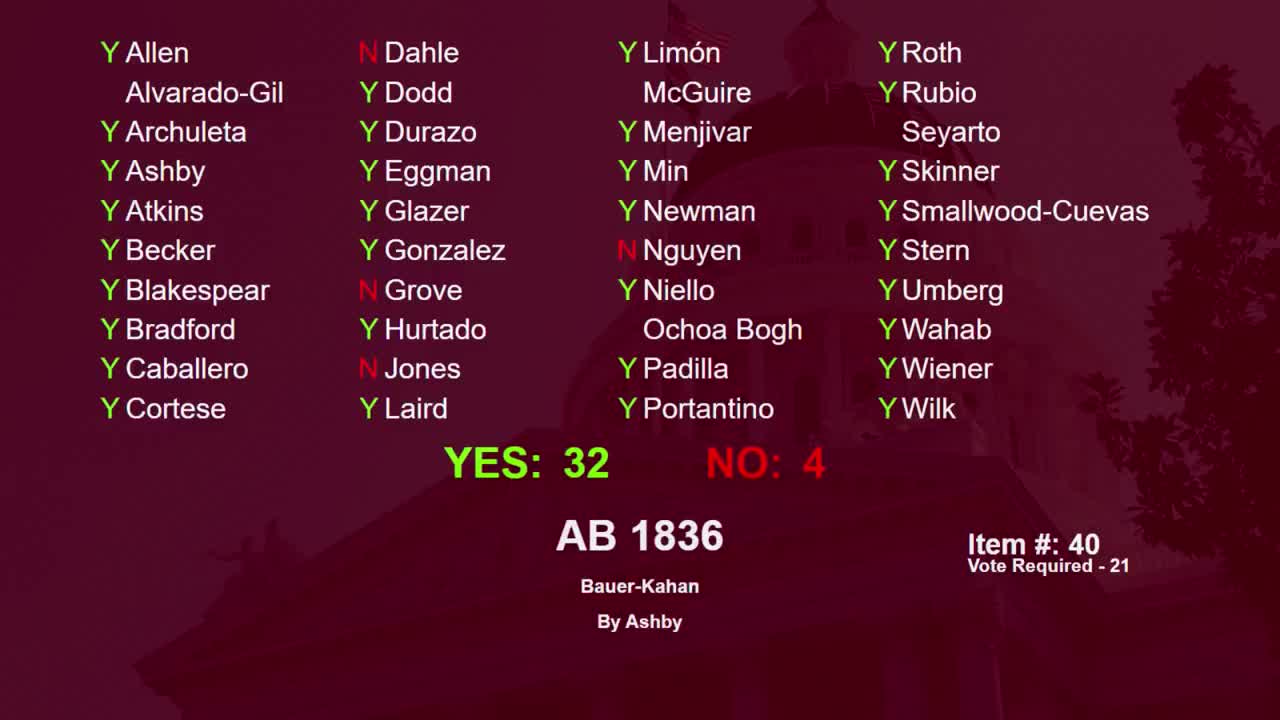 7MIN
Senate Floor
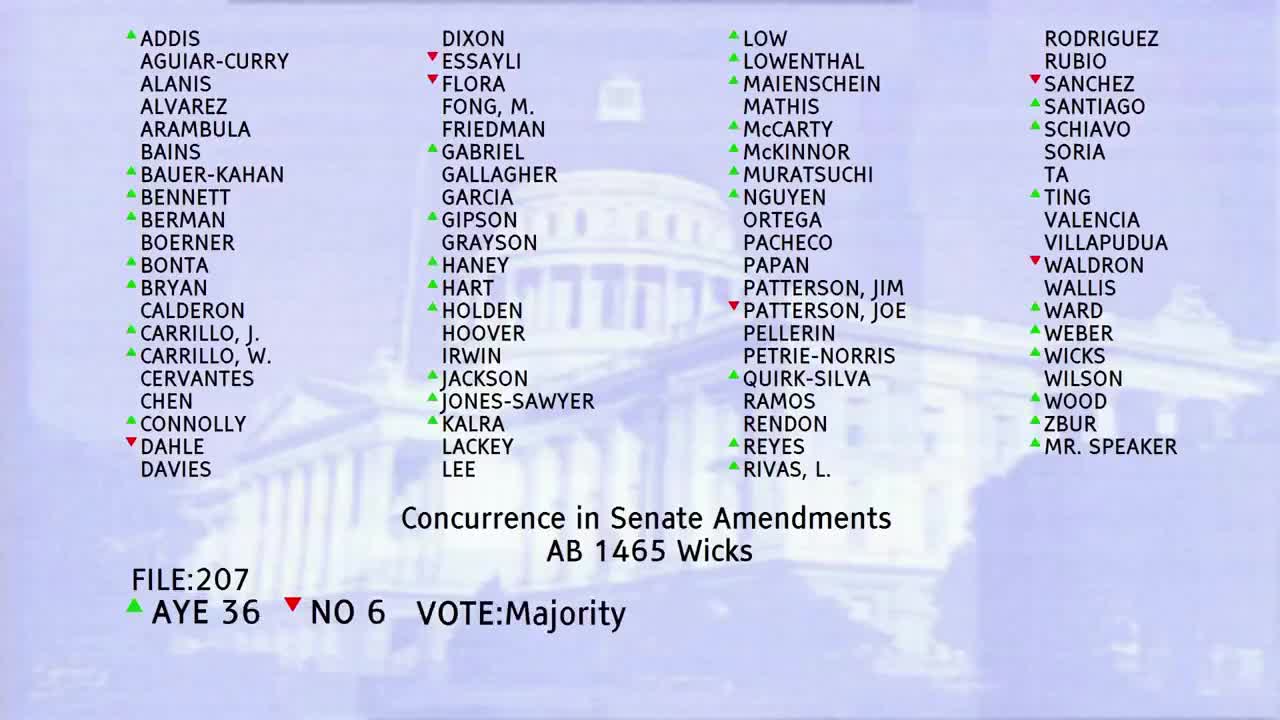 41SEC
Assembly Floor
 6MIN
Senate Standing Committee on Appropriations
 20MIN
Senate Standing Committee on Judiciary
 14MIN
Senate Standing Committee on Transportation
 5MIN
Assembly Standing Committee on Appropriations
 40MIN
Assembly Standing Committee on Privacy and Consumer Protection
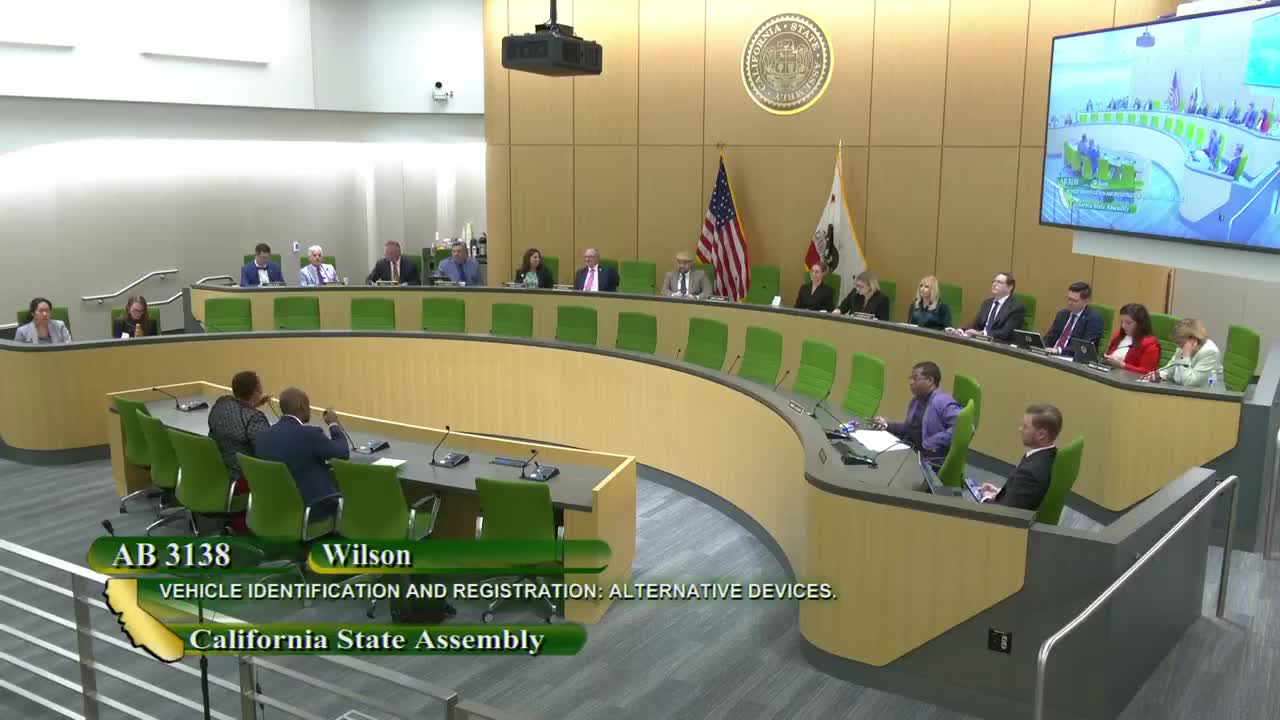 44MIN
Assembly Standing Committee on Transportation
Bill Author

Bill Co-Author(s):