AB 3160: Insurance, income, and corporation taxes: credits: low-income housing.
- Session Year: 2023-2024
- House: Assembly
- Latest Version Date: 2024-09-04
Current Status:
Failed
(2024-09-27: Vetoed by Governor.)
Introduced
In Committee
First Chamber
In Committee
Second Chamber
Enacted
Existing law establishes a low-income housing tax credit program pursuant to which the California Tax Credit Allocation Committee provides procedures and requirements for the allocation, in modified conformity with federal law, of state insurance, personal income, and corporation tax credit amounts to qualified low-income housing projects that have been allocated, or qualify for, a federal low-income housing tax credit, and farmworker housing. Existing law limits the total annual amount of the state low-income housing credit for which a federal low-income housing credit is required to the sum of $70,000,000, as increased by any percentage increase in the Consumer Price Index for the preceding calendar year, any unused credit for the preceding calendar years, and the amount of housing credit ceiling returned in the calendar year.
Existing law provides for an additional allocation of $500,000,000 in low-income housing tax credits for the 2020 calendar year and up to $500,000,000 for the 2021 calendar year and thereafter. Existing law provides that the additional amount for the 2021 calendar year and thereafter is available only if the Budget Act or related legislation specifies an amount available for allocation.
This bill would instead require that this additional allocation of low-income housing tax credits be $500,000,000 for the 2020 calendar year through the 2030 calendar year, and up to $500,000,000 for the 2031 calendar year and every year thereafter. The bill would limit the requirement that this additional allocation is subject to the Budget Act or related legislation to allocations for the 2021 through the 2025 calendar years, and the 2031 calendar year and every year thereafter, thereby eliminating this requirement for the 2026 calendar year through the 2030 calendar year.
Existing law requires any bill authorizing a new tax expenditure to contain, among other things, specific goals that the tax expenditure will achieve, detailed performance indicators, and data collection requirements.
This bill would include additional information required for any bill authorizing a new tax expenditure.
This bill would provide that its provisions would become operative only if AB 3190 is enacted and becomes effective on or before January 1, 2025.
This bill would incorporate additional changes to Sections 12206, 17058, and 23610.5 of the Revenue and Taxation Code proposed by AB 3035 to be operative only if this bill and AB 3035 are enacted and this bill is enacted last.
This bill would take effect immediately as a tax levy.
Existing law establishes a low-income housing tax credit program pursuant to which the California Tax Credit Allocation Committee provides procedures and requirements for the allocation, in modified conformity with federal law, of state insurance, personal income, and corporation tax credit amounts to qualified low-income housing projects that have been allocated, or qualify for, a federal low-income housing tax credit, and farmworker housing. Existing law limits the total annual amount of the state low-income housing credit for which a federal low-income housing credit is required to the sum of $70,000,000, as increased by any percentage increase in the Consumer Price Index for the preceding calendar year, any unused credit for the preceding calendar years, and the amount of housing credit ceiling returned in the calendar year.
Existing law provides for an additional allocation of $500,000,000 in low-income housing tax credits for the 2020 calendar year and up to $500,000,000 for the 2021 calendar year and thereafter. Existing law provides that the additional amount for the 2021 calendar year and thereafter is available only if the Budget Act or related legislation specifies an amount available for allocation.
This bill would instead require that this additional allocation of low-income housing tax credits be $500,000,000 for the 2020 calendar year through the 2030 calendar year, and up to $500,000,000 for the 2031 calendar year and every year thereafter. The bill would limit the requirement that this additional allocation is subject to the Budget Act or related legislation to allocations for the 2021 through the 2025 calendar years, and the 2031 calendar year and every year thereafter, thereby eliminating this requirement for the 2026 calendar year through the 2030 calendar year.
Existing law requires any bill authorizing a new tax expenditure to contain, among other things, specific goals that the tax expenditure will achieve, detailed performance indicators, and data collection requirements.
This bill would include additional information required for any bill authorizing a new tax expenditure.
This bill would provide that its provisions would become operative only if AB 3190 is enacted and becomes effective on or before January 1, 2025.
This bill would incorporate additional changes to Sections 12206, 17058, and 23610.5 of the Revenue and Taxation Code proposed by AB 3035 to be operative only if this bill and AB 3035 are enacted and this bill is enacted last.
This bill would take effect immediately as a tax levy.
Existing law establishes a low-income housing tax credit program pursuant to which the California Tax Credit Allocation Committee provides procedures and requirements for the allocation, in modified conformity with federal law, of state insurance, personal income, and corporation tax credit amounts to qualified low-income housing projects that have been allocated, or qualify for, a federal low-income housing tax credit, and farmworker housing. Existing law limits the total annual amount of the state low-income housing credit for which a federal low-income housing credit is required to the sum of $70,000,000, as increased by any percentage increase in the Consumer Price Index for the preceding calendar year, any unused credit for the preceding calendar years, and the amount of housing credit ceiling returned in the calendar year.
Existing law provides for an additional allocation of $500,000,000 in low-income housing tax credits for the 2020 calendar year and up to $500,000,000 for the 2021 calendar year and thereafter. Existing law provides that the additional amount for the 2021 calendar year and thereafter is available only if the Budget Act or related legislation specifies an amount available for allocation.
This bill would instead require that this additional allocation of low-income housing tax credits be $500,000,000 for the 2020 calendar year through the 2030 calendar year, and up to $500,000,000 for the 2031 calendar year and every year thereafter. The bill would limit the requirement that this additional allocation is subject to the Budget Act or related legislation to allocations for the 2021 through the 2024 2025 calendar years, and the 2031 calendar year and every year thereafter, thereby eliminating this requirement for the 2025 2026 calendar year through the 2030 calendar year.
Existing law requires any bill authorizing a new tax expenditure to contain, among other things, specific goals that the tax expenditure will achieve, detailed performance indicators, and data collection requirements.
This bill would include additional information required for any bill authorizing a new tax expenditure.
This bill would provide that its provisions would become operative only if AB 3190 is enacted and becomes effective on or before January 1, 2025.
This bill would take effect immediately as a tax levy.
Existing law establishes a low-income housing tax credit program pursuant to which the California Tax Credit Allocation Committee provides procedures and requirements for the allocation, in modified conformity with federal law, of state insurance, personal income, and corporation tax credit amounts to qualified low-income housing projects that have been allocated, or qualify for, a federal low-income housing tax credit, and farmworker housing. Existing law limits the total annual amount of the state low-income housing credit for which a federal low-income housing credit is required to the sum of $70,000,000, as increased by any percentage increase in the Consumer Price Index for the preceding calendar year, any unused credit for the preceding calendar years, and the amount of housing credit ceiling returned in the calendar year.
Existing law provides for an additional allocation of $500,000,000 in low-income housing tax credits for the 2020 calendar year and up to $500,000,000 for the 2021 calendar year and thereafter. Existing law provides that the additional amount for the 2021 calendar year and thereafter is available only if the Budget Act or related legislation specifies an amount available for allocation.
This bill would instead require that this additional allocation of low-income housing tax credits be $500,000,000 for the 2020 calendar year through the 2030 calendar year, and up to $500,000,000 for the 2031 calendar year and every year thereafter. The bill would limit the requirement that this additional allocation is subject to the Budget Act or related legislation to allocations for the 2021 through the 2024 calendar years, and the 2031 calendar year and every year thereafter, thereby eliminating this requirement for the 2025 calendar year through the 2030 calendar year.
Existing law requires any bill authorizing a new tax expenditure to contain, among other things, specific goals that the tax expenditure will achieve, detailed performance indicators, and data collection requirements.
This bill would include additional information required for any bill authorizing a new tax expenditure.
This bill would provide that its provisions would become operative only if AB 3190 is enacted and becomes effective on or before January 1, 2025.
This bill would take effect immediately as a tax levy.
Existing law establishes a low-income housing tax credit program pursuant to which the California Tax Credit Allocation Committee provides procedures and requirements for the allocation, in modified conformity with federal law, of state insurance, personal income, and corporation tax credit amounts to qualified low-income housing projects that have been allocated, or qualify for, a federal low-income housing tax credit, and farmworker housing. Existing law limits the total annual amount of the state low-income housing credit for which a federal low-income housing credit is required to the sum of $70,000,000, as increased by any percentage increase in the Consumer Price Index for the preceding calendar year, any unused credit for the preceding calendar years, and the amount of housing credit ceiling returned in the calendar year.
Existing law provides for an additional allocation of $500,000,000 in low-income housing tax credits for the 2020 calendar year and up to $500,000,000 for the 2021 calendar year and thereafter. Existing law provides that the additional amount for the 2021 calendar year and thereafter is available only if the Budget Act or related legislation specifies an amount available for allocation.
This bill would instead require that this additional allocation of low-income housing tax credits be $500,000,000. $500,000,000 for the 2020 calendar year through the 2030 calendar year, and up to $500,000,000 for the 2031 calendar year and every year thereafter. The bill would limit the requirement that this additional allocation is subject to the Budget Act or related legislation to allocations for the 2021 through the 2024 calendar years, and the 2031 calendar year and every year thereafter, thereby eliminating this requirement beginning with the 2025 calendar year. for the 2025 calendar year through the 2030 calendar year.
Existing law requires any bill authorizing a new tax expenditure to contain, among other things, specific goals that the tax expenditure will achieve, detailed performance indicators, and data collection requirements.
This bill would include additional information required for any bill authorizing a new tax expenditure.
This bill would take effect immediately as a tax levy.
Existing law establishes a low-income housing tax credit program pursuant to which the California Tax Credit Allocation Committee provides procedures and requirements for the allocation, in modified conformity with federal law, of state insurance, personal income, and corporation tax credit amounts to qualified low-income housing projects that have been allocated, or qualify for, a federal low-income housing tax credit, and farmworker housing. Existing law limits the total annual amount of the state low-income housing credit for which a federal low-income housing credit is required to the sum of $70,000,000, as increased by any percentage increase in the Consumer Price Index for the preceding calendar year, any unused credit for the preceding calendar years, and the amount of housing credit ceiling returned in the calendar year.
Existing law provides for an additional allocation of $500,000,000 in low-income housing tax credits for the 2020 calendar year and up to $500,000,000 for the 2021 calendar year and thereafter. Existing law provides that the additional amount for the 2021 calendar year and thereafter is available only if the Budget Act or related legislation specifies an amount available for allocation.
This bill would instead require that this additional allocation of low-income housing tax credits be $500,000,000. The bill would limit the requirement that this additional allocation is subject to the Budget Act or related legislation to allocations for the 2021 through the 2024 calendar years, thereby eliminating this requirement beginning with the 2025 calendar year.
This bill would take effect immediately as a tax levy.
Existing law, the Sales and Use Tax Law, requires each person who desires to engage in business as a seller in this state to file an application for a permit with the California Department of Tax and Fee Administration. Existing law also authorizes cities and counties to require each person desiring to engage in business in that jurisdiction for the purposes of selling tangible personal property to provide their sellers permit account number, if any.This bill would make a nonsubstantive change to these provisions.Existing law, the Sales and Use Tax Law, requires each person who desires to engage in business as a seller in this state to file an application for a permit with the California Department of Tax and Fee Administration. Existing law also authorizes cities and counties to require each person desiring to engage in business in that jurisdiction for the purposes of selling tangible personal property to provide their sellers permit account number, if any.
This bill would make a nonsubstantive change to these provisions.
(a)(1)There shall be allowed as a credit against the tax, described by Section 12201, a state low-income housing tax credit in an amount equal to the amount determined in subdivision (c), computed in accordance with Section 42 of the Internal Revenue Code, relating to low-income housing credit, except as otherwise provided in this section.
(2)Taxpayer, for purposes of this section, means the sole owner in the case of a C corporation, the partners in the case of a partnership, and the shareholders in the case of an S corporation.
(3)Housing sponsor, for purposes of this section, means the sole owner in the case of a C corporation, the partnership in the case of a partnership, and the S corporation in the case of an S corporation.
(b)(1)The amount of the credit allocated to any housing sponsor shall be authorized by the California Tax Credit Allocation Committee, or any successor thereof, based on a projects need for the credit for economic feasibility in accordance with the requirements of this section.
(A)Except for projects to provide farmworker housing, as defined in subdivision (h) of Section 50199.7 of the Health and Safety Code, that are allocated credits solely under the set-aside described in subdivision (c) of Section 50199.20 of the Health and Safety Code, the low-income housing project shall be located in California and shall meet either of the following requirements:
(i)The projects housing sponsor has been allocated by the California Tax Credit Allocation Committee a credit for federal income tax purposes under Section 42 of the Internal Revenue Code, relating to low-income housing credit.
(ii)It qualifies for a credit under Section 42(h)(4)(B) of the Internal Revenue Code, relating to special rule where 50 percent or more of building is financed with tax-exempt bonds subject to volume cap.
(B)The California Tax Credit Allocation Committee shall not require fees for the credit under this section in addition to those fees required for applications for the tax credit pursuant to Section 42 of the Internal Revenue Code, relating to low-income housing credit. The committee may require a fee if the application for the credit under this section is submitted in a calendar year after the year the application is submitted for the federal tax credit.
(C)(i)For a project that receives a preliminary reservation of the state low-income housing tax credit, allowed pursuant to subdivision (a), on or after January 1, 2009, the credit shall be allocated to the partners of a partnership owning the project in accordance with the partnership agreement, regardless of how the federal low-income housing tax credit with respect to the project is allocated to the partners, or whether the allocation of the credit under the terms of the agreement has substantial economic effect, within the meaning of Section 704(b) of the Internal Revenue Code, relating to determination of distributive share.
(ii)This subparagraph shall not apply to a project that receives a preliminary reservation of state low-income housing tax credits under the set-aside described in subdivision (c) of Section 50199.20 of the Health and Safety Code unless the project also receives a preliminary reservation of federal low-income housing tax credits.
(2)(A)The California Tax Credit Allocation Committee shall certify to the housing sponsor the amount of tax credit under this section allocated to the housing sponsor for each credit period.
(B)In the case of a partnership or an S corporation, the housing sponsor shall provide a copy of the California Tax Credit Allocation Committee certification to the taxpayer.
(C)(i)A taxpayer shall be eligible to claim the credit commencing in the taxable year the building is placed in service and the federal credit period commences, notwithstanding that the certification pursuant to subparagraph (A) has not been issued by the California Tax Credit Allocation Committee, provided that the housing sponsor has filed a taxpayer certification with the California Tax Credit Allocation Committee and delivered a copy to the taxpayer. The amount of credit claimed by the taxpayer shall not exceed the pro rata share with respect to the amount of credit that the taxpayer purchased or is allocated per the partnership agreement, as applicable, of the lesser of either of the following:
(I)The applicable percentages for each of the four credit years, as specified in subdivision (c), multiplied by the qualified basis of the building set forth in the preliminary reservation.
(II)The amount of credit the project is eligible for as stated in the taxpayer certification.
(ii)The California Tax Credit Allocation Committee may, but is not required to, review the taxpayer certification and other information provided by the housing sponsor to confirm both of the following:
(I)The calculations set forth in the taxpayer certification.
(II)The amount of credits allocated to the project is consistent with applicable California Tax Credit Allocation Committee rules and regulations for the purposes of making the certification required pursuant to subparagraph (A).
(iii)If the California Tax Credit Allocation Committee issues a certification pursuant to subparagraph (A) that is inconsistent with the taxpayer certification upon which a credit has been claimed, the taxpayer shall amend any previously filed tax returns to reflect the credit amount certified by the California Tax Credit Allocation Committee pursuant to subparagraph (A).
(iv)For purposes of this subparagraph, taxpayer certification means a certified statement from the certified public accountant of the housing sponsor. The taxpayer certification shall contain the amount of the credit the project is eligible for, the taxable year the building is placed in service, and the taxable year in which the federal credit period for the building has commenced.
(v)The taxpayer shall, upon request, provide a copy of the taxpayer certification pursuant to clause (iv) or the California Tax Credit Allocation Committees certification pursuant to subparagraph (A), as applicable, to the Department of Insurance.
(vi)In the case of a failure to provide a copy of the taxpayer certification pursuant to clause (iv) or the California Tax Credit Allocation Committees certification pursuant to subparagraph (A), if the Department of Insurance so requires, no credit under this section shall be allowed for that taxable year until a copy of that certification is provided.
(vii)The changes made to this subparagraph by the act adding this clause shall apply for taxable years beginning on or after January 1, 2023.
(D)All elections made by the taxpayer pursuant to Section 42 of the Internal Revenue Code, relating to low-income housing credit, shall apply to this section.
(E)(i)Except as described in clause (ii) or (iii), for buildings located in designated difficult development areas (DDAs) or qualified census tracts (QCTs), as defined in Section 42(d)(5)(B) of the Internal Revenue Code, relating to increase in credit for buildings in high-cost areas, credits may be allocated under this section in the amounts prescribed in subdivision (c), provided that the amount of credit allocated under Section 42 of the Internal Revenue Code, relating to low-income housing credit, is computed on 100 percent of the qualified basis of the building.
(ii)Notwithstanding clause (i), the California Tax Credit Allocation Committee may allocate the credit for buildings located in DDAs or QCTs that are restricted to having 50 percent of the buildings occupants be special needs households, as defined in the California Code of Regulations by the California Tax Credit Allocation Committee, or receiving an allocation pursuant to subparagraph (B) of paragraph (1) of subdivision (g), even if the taxpayer receives federal credits pursuant to Section 42(d)(5)(B) of the Internal Revenue Code, relating to increase in credit for buildings in high-cost areas, provided that the credit allowed under this section shall not exceed 30 percent of the eligible basis of the building.
(iii)On and after January 1, 2018, notwithstanding clause (i), the California Tax Credit Allocation Committee may allocate the credit pursuant to paragraph (6) of subdivision (c) even if the taxpayer receives federal credits, pursuant to Section 42(d)(5)(B) of the Internal Revenue Code, relating to increase in credit for buildings in high-cost areas.
(F)(i)The California Tax Credit Allocation Committee may allocate a credit under this section in exchange for a credit allocated pursuant to Section 42(d)(5)(B) of the Internal Revenue Code, relating to increase in credit for buildings in high-cost areas, in amounts up to 30 percent of the eligible basis of a building if the credits allowed under Section 42 of the Internal Revenue Code, relating to low-income housing credit, are reduced by an equivalent amount.
(ii)An equivalent amount shall be determined by the California Tax Credit Allocation Committee based upon the relative amount required to produce an equivalent state tax credit to the taxpayer.
(c)Section 42(b) of the Internal Revenue Code, relating to applicable percentage: 70 percent present value credit for certain new buildings; 30 percent present value credit for certain other buildings, shall be modified as follows:
(1)In the case of any qualified low-income building that receives an allocation after 1989 and is a new building not federally subsidized, the term applicable percentage means the following:
(A)For each of the first three years, the percentage prescribed by the Secretary of the Treasury for new buildings that are not federally subsidized for the taxable year, determined in accordance with the requirements of Section 42(b)(2) of the Internal Revenue Code, relating to temporary minimum credit rate for nonfederally subsidized new buildings, in lieu of the percentage prescribed in Section 42(b)(1)(A) of the Internal Revenue Code.
(B)For the fourth year, the difference between 30 percent and the sum of the applicable percentages for the first three years.
(2)In the case of any qualified low-income building that is a new building and is federally subsidized and receiving an allocation pursuant to subparagraph (B) of paragraph (1) of subdivision (g), the term applicable percentage means for the first three years, 9 percent of the qualified basis of the building, and for the fourth year, 3 percent of the qualified basis of the building.
(3)In the case of any qualified low-income building that receives an allocation after 1989 pursuant to subparagraph (A) of paragraph (1) of subdivision (g) and that is a new building that is federally subsidized or that is an existing building that is at risk of conversion, the term applicable percentage means the following:
(A)For each of the first three years, the percentage prescribed by the Secretary of the Treasury for new buildings that are federally subsidized for the taxable year.
(B)For the fourth year, the difference between 13 percent and the sum of the applicable percentages for the first three years.
(4)In the case of any qualified low-income building that meets all of the requirements of subparagraphs (A) through (D), inclusive, the term applicable percentage means 30 percent for each of the first three years and 5 percent for the fourth year. A qualified low-income building receiving an allocation under this paragraph is ineligible to also receive an allocation under paragraph (2).
(A)The qualified low-income building is at least 15 years old.
(B)The qualified low-income building is either:
(i)Serving households of very low income or extremely low income such that the average maximum household income as restricted, pursuant to an existing regulatory agreement with a federal, state, county, local, or other governmental agency, is not more than 45 percent of the area median gross income, as determined under Section 42 of the Internal Revenue Code, relating to low-income housing credit, adjusted by household size, and a tax credit regulatory agreement is entered into for a period of not less than 55 years restricting the average targeted household income to no more than 45 percent of the area median income.
(ii)Financed under Section 514 or 521 of the National Housing Act of 1949 (42 U.S.C. Sec. 1485).
(C)The qualified low-income building would have insufficient credits under paragraphs (2) and (3) to complete substantial rehabilitation due to a low appraised value.
(D)The qualified low-income building will complete the substantial rehabilitation in connection with the credit allocation herein.
(5)For purposes of this section, the term at risk of conversion, with respect to an existing property, means a property that satisfies all of the following criteria:
(A)The property is a multifamily rental housing development in which at least 50 percent of the units receive governmental assistance pursuant to any of the following:
(i)New construction, substantial rehabilitation, moderate rehabilitation, property disposition, and loan management set-aside programs, or any other program providing project-based assistance pursuant to Section 8 of the United States Housing Act of 1937, Section 1437f of Title 42 of the United States Code, as amended.
(ii)The Below-Market-Interest-Rate Program pursuant to Section 221(d)(3) of the National Housing Act, Sections 1715l(d)(3) and (5) of Title 12 of the United States Code.
(iii)Section 236 of the National Housing Act, Section 1715z-1 of Title 12 of the United States Code.
(iv)Programs for rent supplement assistance pursuant to Section 101 of the Housing and Urban Development Act of 1965, Section 1701s of Title 12 of the United States Code, as amended.
(v)Programs under Sections 514, 515, 516, 533, and 538 of the Housing Act of 1949 (Public Law 81-171), as amended.
(vi)The low-income housing credit program set forth in Section 42 of the Internal Revenue Code, relating to low-income housing credit, this section, and Sections 17058 and 23610.5.
(vii)Programs for loans or grants administered by the Department of Housing and Community Development.
(viii)Section 202 of the Housing Act of 1959 (12 U.S.C. Sec. 1701q), as amended.
(ix)Section 142(d) of the Internal Revenue Code or its predecessors.
(x)Section 147 of the Internal Revenue Code, as enacted by the Tax Reform Act of 1986 (Public Law 99-514), or as subsequently amended, including as amended by the Tax Cuts and Jobs Act of 2017 (Public Law 115-97) and all amendments enacted prior to the Tax Cuts and Jobs Act of 2017 (Public Law 115-97).
(xi)Title I of the Housing and Community Development Act of 1974, as amended.
(xii)Title II of the Cranston-Gonzalez National Affordable Housing Act of 1990, as amended.
(xiii)Titles IV and V of the McKinney-Vento Homeless Assistance Act of 1987, as amended, including the Department of Housing and Urban Developments Supportive Housing Program, Shelter Plus Care Program, and surplus federal property disposition program.
(xiv)The following assistance provided by counties and cities in exchange for restrictions on the maximum rents that may be charged for units within a multifamily rental housing development and on the maximum tenant income as a condition of eligibility for occupancy of the unit subject to the rent restriction, as reflected by a recorded agreement with a county or city:
(I)Loans or grants provided using tax increment financing pursuant to the Community Redevelopment Law (Part 1 (commencing with Section 33000) of Division 24 of the Health and Safety Code).
(II)Local housing trust funds, as referred to in paragraph (3) of subdivision (a) of Section 50843 of the Health and Safety Code.
(III)The sale or lease of public property at or below market rates.
(IV)The granting of density bonuses, or concessions or incentives, including fee waivers, parking variances, or amendments to general plans, zoning, or redevelopment project area plans, pursuant to Chapter 4.3 (commencing with Section 65915) of Division 1 of Title 7 of the Government Code.
(B)As used in subparagraph (A), government assistance shall not include the use of tenant-based housing choice vouchers under subsection (o) of Section 1437f of Title 42 of the United States Code, excluding paragraph (13), relating to project-based assistance. Restrictions shall not include any rent control or rent stabilization ordinance imposed by a county or city.
(C)If the development is subject to restrictions on rent and income levels, 50 percent of the units are also restricted to initial occupancy by lower income households, as defined in Section 50079.5 of the Health and Safety Code.
(D)The restrictions on rent and income levels, excluding any restrictions recorded pursuant to paragraph (2) of subdivision (e) of Section 65863.11 or Section 65863.13 of the Government Code or in connection with interim or acquisition financing, will terminate or the federally insured mortgage or rent subsidy contract on the property is eligible for prepayment or termination any time within five years before or after the date of application to the California Tax Credit Allocation Committee.
(E)The entity acquiring the property enters into a regulatory agreement that requires the property to be operated in accordance with the requirements of Section 42 of the Internal Revenue Code and any further requirements added by the California Tax Credit Allocation Committee to implement the low-income housing tax credit established by Section 42 of the Internal Revenue Code (26 U.S.C. Sec. 42), this section, and Sections 17058 and 23610.5 pursuant to Chapter 3.6 (commencing with Section 50199.4) of Part 1 of Division 31 of the Health and Safety Code.
(F)The property satisfies the requirements of Section 42(e) of the Internal Revenue Code, relating to rehabilitation expenditures treated as separate new building, except that the provisions of Section 42(e)(3)(A)(ii)(I) shall not apply.
(6)On and after January 1, 2018, in the case of any qualified low-income building that is (A) farmworker housing, as defined by paragraph (2) of subdivision (h) of Section 50199.7 of the Health and Safety Code, and (B) is federally subsidized, the term applicable percentage means for each of the first three years, 20 percent of the qualified basis of the building, and for the fourth year, 15 percent of the qualified basis of the building.
(d)The term qualified low-income housing project as defined in Section 42(c)(2) of the Internal Revenue Code, relating to qualified low-income building, is modified by adding the following requirements:
(1)The taxpayer shall be entitled to receive a cash distribution from the operations of the project, after funding required reserves, that, at the election of the taxpayer, is equal to:
(A)An amount not to exceed 8 percent of the lesser of:
(i)The owner equity that shall include the amount of the capital contributions actually paid to the housing sponsor and shall not include any amounts until they are paid on an investor note.
(ii)Twenty percent of the adjusted basis of the building as of the close of the first taxable year of the credit period.
(B)The amount of the cashflow from those units in the building that are not low-income units. For purposes of computing cashflow under this subparagraph, operating costs shall be allocated to the low-income units using the floor space fraction, as defined in Section 42 of the Internal Revenue Code, relating to low-income housing credit.
(C)Any amount allowed to be distributed under subparagraph (A) that is not available for distribution during the first 5 years of the compliance period may be accumulated and distributed any time during the first 15 years of the compliance period but not thereafter.
(2)The limitation on return shall apply in the aggregate to the partners if the housing sponsor is a partnership and in the aggregate to the shareholders if the housing sponsor is an S corporation.
(3)The housing sponsor shall apply any cash available for distribution in excess of the amount eligible to be distributed under paragraph (1) to reduce the rent on rent-restricted units or to increase the number of rent-restricted units subject to the tests of Section 42(g)(1) of the Internal Revenue Code, relating to in general.
(e)The provisions of Section 42(f) of the Internal Revenue Code, relating to definition and special rules relating to credit period, shall be modified as follows:
(1)The term credit period as defined in Section 42(f)(1) of the Internal Revenue Code, relating to credit period defined, is modified by substituting four taxable years for 10 taxable years.
(2)The special rule for the first taxable year of the credit period under Section 42(f)(2) of the Internal Revenue Code, relating to special rule for 1st year of credit period, shall not apply to the tax credit under this section.
(3)Section 42(f)(3) of the Internal Revenue Code, relating to determination of applicable percentage with respect to increases in qualified basis after 1st year of credit period, is modified to read:
If, as of the close of any taxable year in the compliance period, after the first year of the credit period, the qualified basis of any building exceeds the qualified basis of that building as of the close of the first year of the credit period, the housing sponsor, to the extent of its tax credit allocation, shall be eligible for a credit on the excess in an amount equal to the applicable percentage determined pursuant to subdivision (c) for the four-year period beginning with the later of the taxable years in which the increase in qualified basis occurs.
(f)The provisions of Section 42(h) of the Internal Revenue Code, relating to limitation on aggregate credit allowable with respect to projects located in a state, shall be modified as follows:
(1)Section 42(h)(2) of the Internal Revenue Code, relating to allocated credit amount to apply to all taxable years ending during or after credit allocation year, does not apply and instead the following provisions apply:
The total amount for the four-year credit period of the housing credit dollars allocated in a calendar year to any building shall reduce the aggregate housing credit dollar amount of the California Tax Credit Allocation Committee for the calendar year in which the allocation is made.
(2)Paragraphs (3), (4), (5), (6)(E)(i)(II), (6)(F), (6)(G), (6)(I), (7), and (8) of Section 42(h) of the Internal Revenue Code, relating to limitation on aggregate credit allowable with respect to projects located in a state, do not apply to this section.
(g)The aggregate housing credit dollar amount that may be allocated annually by the California Tax Credit Allocation Committee pursuant to this section, Section 17058, and Section 23610.5 shall be an amount equal to the sum of all the following:
(1)(A)Seventy million dollars ($70,000,000) for the 2001 calendar year, and, for the 2002 calendar year and each calendar year thereafter, seventy million dollars ($70,000,000) increased by the percentage, if any, by which the Consumer Price Index for the preceding calendar year exceeds the Consumer Price Index for the 2001 calendar year. For the purposes of this paragraph, the term Consumer Price Index means the last Consumer Price Index for All Urban Consumers published by the federal Department of Labor.
(B)Five hundred million dollars ($500,000,000) for the 2020 calendar year through the 2030 calendar year, and up to five hundred million dollars ($500,000,000) for the 2031 calendar year and every year thereafter. Allocations shall only be available pursuant to this subparagraph in the 2021 through the 2025 calendar years, and in the 2031 calendar year and every calendar year thereafter, if the annual Budget Act, or if any bill providing for appropriations related to the Budget Act, specifies an amount to be available for allocation in that calendar year by the California Tax Credit Allocation Committee, after the California Tax Credit Allocation Committee and the California Debt Limit Allocation Committee have adopted regulations, rules, or guidelines to align the programs of both committees with the objective of increasing production and containing costs as described in clause (iii). The California Tax Credit Allocation Committee shall accept applications for the 2021 calendar year not sooner than 30 days after these regulations, rules, or guidelines have been adopted. The California Debt Limit Allocation Committee shall not accept applications for the 2021 calendar year for bond allocations for an eligible project under this section prior to issuing, reviewing, and publishing a new tax-exempt private activity bond demand survey. A housing sponsor receiving a nonfederally subsidized allocation under subdivision (c) shall not be eligible for receipt of the housing credit allocated from the increased amount under this subparagraph. Except as provided in clause (vi), a housing sponsor receiving a nonfederally subsidized allocation under subdivision (c) shall remain eligible for receipt of the housing credit allocated from the credit ceiling amount under subparagraph (A).
(i)Eligible projects for allocations under this subparagraph include any new building, as defined in Section 42(i)(4) of the Internal Revenue Code, relating to newly constructed buildings, and the regulations promulgated thereunder, excluding rehabilitation expenditures under Section 42(e) of the Internal Revenue Code, relating to rehabilitation expenditures treated as separate new building, and is federally subsidized. Eligible projects for allocations under this subparagraph also include any retrofitting and repurposing of existing nonresidential structures, including, but not limited to, hotels and motels, that were converted to residential use within the previous five years from the date of the application.
(ii)Notwithstanding any other provision of this section, for allocations pursuant to this subparagraph for the 2020 calendar year, the California Tax Credit Allocation Committee shall consider projects located throughout the state and shall allocate housing credits, subject to the minimum federal requirements as set forth in Sections 42 and 142 of the Internal Revenue Code, the minimum requirements set forth in Sections 5033 and 5190 of the California Debt Limit Allocation Committee regulations, and the minimum set forth in Section 10326 of the Tax Credit Allocation Committee regulations, for projects that can begin construction within 180 days from award, subject to availability of funds.
(iii)(I)Notwithstanding any other provision of this section, for allocations pursuant to this subparagraph for the 2021 calendar year and thereafter, the California Tax Credit Allocation Committee and the California Debt Limit Allocation Committee shall develop and prescribe regulations, rules, or guidelines necessary to implement a new allocation methodology that is aimed at increasing production and containing costs, which would include a scoring system that maximizes the efficient use of public subsidy and benefit created through the private activity bond and low-income housing tax credit programs. The factors for determining the efficient use of public subsidy and benefit shall include, but not be limited to, all of the following:
(ia)The number and size of units developed including local incentives provided to increase density.
(ib)The proximity to amenities, jobs, and public transportation.
(ic)The location of the development.
(id)The delivery of housing affordable to very low and extremely low income households by the development.
(II)The efficient use of public subsidy and benefit criteria specified in this clause shall take into account the total state subsidy provided and prioritize cost containment and increased unit production. These regulations, rules, or guidelines developed pursuant to this subparagraph shall also consider updated definitions for at-risk preservation and new construction.
(III)For bond allocations for the 2021 calendar year to projects eligible for an allocation under this subparagraph, the California Debt Limit Allocation Committee may adopt emergency regulations.
(IV)The California Tax Credit Allocation Committee shall consider amending the regulations establishing a scoring system, as required by this clause, to also grant, for farmworker housing as defined in subdivision (h) of Section 50199.7 of the Health and Safety Code, maximum points to farmworker housing projects under the housing needs category, and an initial five points in the category for site amenities beyond those required as additional thresholds.
(iv)Of the amount available pursuant to this subparagraph, and notwithstanding any other requirement of this section, the California Tax Credit Allocation Committee may allocate up to two hundred million dollars ($200,000,000) for housing financed by the California Housing Finance Agency under its Mixed-Income Program.
(v)(I)For the calendar years of 2024 to 2034, inclusive, of the amount available pursuant to this subparagraph, the lesser of 5 percent of that amount or twenty-five million dollars ($25,000,000) per calendar year shall be set aside for projects to provide farmworker housing, as defined in subdivision (h) of Section 50199.7 of the Health and Safety Code, and administered consistent with the credits available pursuant to paragraph (4).
(II)Any credits pursuant to this clause that remain unallocated following the conclusion of a funding round shall roll over to consecutive subsequent funding rounds in that calendar year with the exception that any credits that remain unallocated prior to the final funding round in that calendar year shall be added back to the aggregate amount of credits that may be allocated pursuant to this subparagraph.
(III)For the 2035 calendar year, and every year thereafter, of the amount available pursuant to this subparagraph, a portion of the amount allocated shall be set aside for projects to provide farmworker housing, as defined in subdivision (h) of Section 50199.7 of the Health and Safety Code. The amount set aside shall be determined by the Legislature upon consideration of the comprehensive strategy, or most recent update thereof, provided by the Department of Housing and Community Development pursuant to subdivision (c) of Section 50408.5 of the Health and Safety Code.
(vi)(I)For any calendar year in which the California Debt Limit Allocation Committee has declared a competition for the award of tax-exempt bond authority for qualified residential rental projects, the California Tax Credit Allocation Committee may allocate some or all of the credits allocated under this subparagraph, except for any credits allocated for housing financed by the California Housing Finance Agency under its Mixed-Income Program, for nonfederally subsidized buildings eligible for credits under Section 42 of the Internal Revenue Code, relating to low-income housing credit, and shall allocate the remainder of these credits for new buildings, as defined in Section 42(i)(4) of the Internal Revenue Code, relating to new buildings, that are federally subsidized and that can begin construction within a reasonable time, as determined by the California Tax Credit Allocation Committee.
(II)For any calendar year in which the California Debt Limit Allocation Committee has not declared a competition for the award of tax-exempt bond authority for qualified residential rental projects, projects receiving an award of credits pursuant to this subparagraph shall begin construction within a reasonable time, as determined by the California Tax Credit Allocation Committee.
(III)Notwithstanding subclauses (I) and (II), if credits available under this subparagraph remain unallocated after the final California Debt Limit Allocation Committee round for qualified residential rental projects in a given calendar year, the California Tax Credit Allocation Committee may allocate some or all of the remaining credits for nonfederally subsidized buildings eligible for credits under Section 42 of the Internal Revenue Code, relating to low-income housing credit.
(2)The unused housing credit ceiling, if any, for the preceding calendar years.
(3)The amount of housing credit ceiling returned in the calendar year. For purposes of this paragraph, the amount of housing credit dollar amount returned in the calendar year equals the housing credit dollar amount previously allocated to any project that does not become a qualified low-income housing project within the period required by this section or to any project with respect to which an allocation is canceled by mutual consent of the California Tax Credit Allocation Committee and the allocation recipient.
(4)Five hundred thousand dollars ($500,000) per calendar year for projects to provide farmworker housing, as defined in subdivision (h) of Section 50199.7 of the Health and Safety Code.
(5)The amount of any unallocated or returned credits under former Sections 17053.14, 23608.2, and 23608.3, as those sections read prior to January 1, 2009, until fully exhausted for projects to provide farmworker housing, as defined in subdivision (h) of Section 50199.7 of the Health and Safety Code.
(h)The term compliance period as defined in Section 42(i)(1) of the Internal Revenue Code, relating to compliance period, is modified to mean, with respect to any building, the period of 30 consecutive taxable years beginning with the first taxable year of the credit period with respect thereto.
(i)(1)Section 42(j) of the Internal Revenue Code, relating to recapture of credit, shall not be applicable and the provisions in paragraph (2) shall be substituted in its place.
(2)The requirements of this section shall be set forth in a regulatory agreement between the California Tax Credit Allocation Committee and the housing sponsor, and the regulatory agreement shall be subordinated, when required, to any lien or encumbrance of any banks or other institutional lenders to the project. The regulatory agreement entered into pursuant to subdivision (f) of Section 50199.14 of the Health and Safety Code, shall apply, provided that the agreement includes all of the following provisions:
(A)A term not less than the compliance period.
(B)A requirement that the agreement be recorded in the official records of the county in which the qualified low-income housing project is located.
(C)A provision stating which state and local agencies can enforce the regulatory agreement in the event the housing sponsor fails to satisfy any of the requirements of this section.
(D)A provision that the regulatory agreement shall be deemed a contract enforceable by tenants as third-party beneficiaries thereto and that allows individuals, whether prospective, present, or former occupants of the building, who meet the income limitation applicable to the building, the right to enforce the regulatory agreement in any state court.
(E)A provision incorporating the requirements of Section 42 of the Internal Revenue Code, relating to low-income housing credit, as modified by this section.
(F)A requirement that the housing sponsor notify the California Tax Credit Allocation Committee or its designee and the local agency that can enforce the regulatory agreement if there is a determination by the Internal Revenue Service that the project is not in compliance with Section 42(g) of the Internal Revenue Code, relating to qualified low-income housing project.
(G)A requirement that the housing sponsor, as security for the performance of the housing sponsors obligations under the regulatory agreement, assign the housing sponsors interest in rents that it receives from the project, provided that until there is a default under the regulatory agreement, the housing sponsor is entitled to collect and retain the rents.
(H)A provision that the remedies available in the event of a default under the regulatory agreement that is not cured within a reasonable cure period include, but are not limited to, allowing any of the parties designated to enforce the regulatory agreement to collect all rents with respect to the project; taking possession of the project and operating the project in accordance with the regulatory agreement until the enforcer determines the housing sponsor is in a position to operate the project in accordance with the regulatory agreement; applying to any court for specific performance; securing the appointment of a receiver to operate the project; or any other relief as may be appropriate.
(j)(1)The committee shall allocate the housing credit on a regular basis consisting of two or more periods in each calendar year during which applications may be filed and considered. The committee shall establish application filing deadlines, the maximum percentage of federal and state low-income housing tax credit ceiling that may be allocated by the committee in that period, and the approximate date on which allocations shall be made. If the enactment of federal or state law, the adoption of rules or regulations, or other similar events prevent the use of two allocation periods, the committee may reduce the number of periods and adjust the filing deadlines, maximum percentage of credit allocated, and the allocation dates.
(2)The committee shall adopt a qualified allocation plan, as provided in Section 42(m)(1) of the Internal Revenue Code, relating to plans for allocation of credit among projects. In adopting this plan, the committee shall comply with the provisions of Sections 42(m)(1)(B) and 42(m)(1)(C) of the Internal Revenue Code, relating to qualified allocation plan and relating to certain selection criteria must be used, respectively.
(3)Notwithstanding Section 42(m) of the Internal Revenue Code, relating to responsibilities of housing credit agencies, the California Tax Credit Allocation Committee shall allocate housing credits in accordance with the qualified allocation plan and regulations, which shall include the following provisions:
(A)All housing sponsors, as defined by paragraph (3) of subdivision (a), shall demonstrate at the time the application is filed with the committee that the project meets the following threshold requirements:
(i)The housing sponsor shall demonstrate there is a need and demand for low-income housing in the community or region for which it is proposed.
(ii)The projects proposed financing, including tax credit proceeds, shall be sufficient to complete the project and that the proposed operating income shall be adequate to operate the project for the extended use period.
(iii)The project shall have enforceable financing commitments, either construction or permanent financing, for at least 50 percent of the total estimated financing of the project.
(iv)The housing sponsor shall have and maintain control of the site for the project.
(v)The housing sponsor shall demonstrate that the project complies with all applicable local land use and zoning ordinances.
(vi)The housing sponsor shall demonstrate that the project development team has the experience and the financial capacity to ensure project completion and operation for the extended use period.
(vii)The housing sponsor shall demonstrate the amount of tax credit that is necessary for the financial feasibility of the project and its viability as a qualified low-income housing project throughout the extended use period, taking into account operating expenses, a supportable debt service, reserves, funds set aside for rental subsidies and required equity, and a development fee that does not exceed a specified percentage of the eligible basis of the project prior to inclusion of the development fee in the eligible basis, as determined by the committee.
(B)The committee shall give a preference to those projects satisfying all of the threshold requirements of subparagraph (A) if both of the following apply:
(i)The project serves the lowest income tenants at rents affordable to those tenants.
(ii)The project is obligated to serve qualified tenants for the longest period.
(C)In addition to the provisions of subparagraphs (A) and (B), the committee shall use the following criteria in allocating housing credits:
(i)Projects serving large families in which a substantial number, as defined by the committee, of all residential units are low-income units with three or more bedrooms.
(ii)Projects providing single-room occupancy units serving very low income tenants.
(iii)Existing projects that are at risk of conversion, as defined by paragraph (5) of subdivision (c).
(iv)Projects for which a public agency provides direct or indirect long-term financial support for at least 15 percent of the total project development costs or projects for which the owners equity constitutes at least 30 percent of the total project development costs.
(v)Projects that provide tenant amenities not generally available to residents of low-income housing projects.
(D)Subparagraphs (B) and (C) shall not apply to projects receiving an allocation pursuant to subparagraph (B) of paragraph (1) of subdivision (g).
(4)For purposes of allocating credits pursuant to this section, the committee shall not give preference to any project by virtue of the date of submission of its application except to break a tie when two or more of the projects have an equal rating.
(k)Section 42(l) of the Internal Revenue Code, relating to certifications and other reports to secretary, shall be modified as follows:
The term secretary shall be replaced by the term Franchise Tax Board.
(l)In the case in which the credit allowed under this section exceeds the tax, the excess may be carried over to reduce the tax in the following year, and succeeding years if necessary, until the credit has been exhausted.
(m)The provisions of Section 11407(a) of Public Law 101-508, relating to the effective date of the extension of the low-income housing credit, apply to calendar years after 1993.
(n)The provisions of Section 11407(c) of Public Law 101-508, relating to election to accelerate credit, shall not apply.
(o)(1)(A)For a project that receives a preliminary reservation under this section beginning on or after January 1, 2016, a taxpayer may elect in its application to the California Tax Credit Allocation Committee to sell all or any portion of any credit allowed under this section to one or more unrelated parties for each taxable year in which the credit is allowed, subject to subparagraphs (B) and (C). The taxpayer may, only once, revoke an election to sell pursuant to this subdivision at any time before the California Tax Credit Allocation Committee allocates a final credit amount for the project pursuant to this section, at which point the election shall become irrevocable.
(B)A credit that a taxpayer elects to sell all or a portion of pursuant to this subdivision shall be sold for consideration that is not less than 80 percent of the amount of the credit.
(C)A taxpayer shall not elect to sell all or any portion of any credit pursuant to this subdivision if the taxpayer did not make that election in its application submitted to the California Tax Credit Allocation Committee.
(2)(A)The taxpayer that originally received the credit shall report to the California Tax Credit Allocation Committee within 10 days of the sale of the credit, in the form and manner specified by the California Tax Credit Allocation Committee, all required information regarding the purchase and sale of the credit, including the social security or other taxpayer identification number of the unrelated party or parties to whom the credit has been sold, the face amount of the credit sold, and the amount of consideration received by the taxpayer for the sale of the credit.
(B)The California Tax Credit Allocation Committee shall provide an annual listing to the Franchise Tax Board, in a form and manner agreed upon by the California Tax Credit Allocation Committee and the Franchise Tax Board, of the taxpayers that have sold or purchased a credit pursuant to this subdivision.
(3)A credit may be sold pursuant to this subdivision to more than one unrelated party.
(4)Notwithstanding any other law, the taxpayer that originally received the credit that is sold pursuant to paragraph (1) shall remain solely liable for all obligations and liabilities imposed on the taxpayer by this section with respect to the credit, none of which shall apply to a party to whom the credit has been sold or subsequently transferred. Parties that purchase credits pursuant to paragraph (1) shall be entitled to utilize the purchased credits in the same manner in which the taxpayer that originally received the credit could utilize them.
(p)The California Tax Credit Allocation Committee may prescribe rules, guidelines, or procedures necessary or appropriate to carry out the purposes of this section, including any guidelines regarding the allocation of the credit allowed under this section. Chapter 3.5 (commencing with Section 11340) of Part 1 of Division 3 of Title 2 of the Government Code shall not apply to any rule, guideline, or procedure prescribed by the California Tax Credit Allocation Committee pursuant to this section.
(q)For purposes of complying with Section 41, the Legislature finds and declares the following with respect to the additional five hundred million dollars ($500,000,000) in state low-income housing tax credits made available pursuant to subparagraph (B) of paragraph (1) of subdivision (g) of Sections 12206, 17058, and 23610.5, respectively, hereafter referred to as the enhanced state housing tax credits:
(1)The specific goals, purposes, and objectives that the enhanced state housing tax credits will achieve are as follows:
(A)Increasing the supply of affordable housing.
(B)Drawing down federal low-income housing tax credits.
(2)Detailed performance indicators for the Legislature to use in determining whether the enhanced state housing tax credits meet those goals, purposes, and objectives are as follows:
(A)The number of units made feasible and starting construction due to an award of the enhanced state housing tax credits.
(B)The amount of federal low-income housing tax credits also awarded to developments receiving the enhanced state housing tax credits.
(3)The Legislative Analysts Office shall, on an annual basis beginning January 1, 2026, and each January 1 thereafter, collaborate with the California Tax Credit Allocation Committee to review the effectiveness of the enhanced state housing tax credits. The review shall include, but not be limited to, the metrics described in paragraph (2).
(4)The data collection requirements for determining whether the enhanced state housing tax credits are meeting, failing to meet, or exceeding the specified goals, purposes, and objectives are as follows:
(A)To assist the Legislature in determining whether the enhanced state housing tax credits meet the goals, purposes, and objectives specified in paragraph (1), and in carrying out their duties under paragraph (2), the Legislative Analysts Office may request information from the California Tax Credit Allocation Committee.
(B)The California Tax Credit Allocation Committee shall provide any data requested by the Legislative Analysts Office pursuant to this paragraph.
(r)This section shall remain in effect for as long as Section 42 of the Internal Revenue Code, relating to low-income housing credit, remains in effect.
SEC. 1.5.Section 12206 of the Revenue and Taxation Code is amended to read:12206.(a)(1)There shall be allowed as a credit against the tax, described by Section 12201, a state low-income housing tax credit in an amount equal to the amount determined in subdivision (c), computed in accordance with Section 42 of the Internal Revenue Code, relating to low-income housing credit, except as otherwise provided in this section.
(2)Taxpayer, for purposes of this section, means the sole owner in the case of a C corporation, the partners in the case of a partnership, and the shareholders in the case of an S corporation.
(3)Housing sponsor, for purposes of this section, means the sole owner in the case of a C corporation, the partnership in the case of a partnership, and the S corporation in the case of an S corporation.
(b)(1)The amount of the credit allocated to any housing sponsor shall be authorized by the California Tax Credit Allocation Committee, or any successor thereof, based on a projects need for the credit for economic feasibility in accordance with the requirements of this section.
(A)Except for projects to provide farmworker housing, as defined in subdivision (h) of Section 50199.7 of the Health and Safety Code, that are allocated credits solely under the set-aside described in subdivision (c) of Section 50199.20 of the Health and Safety Code, the low-income housing project shall be located in California and shall meet either of the following requirements:
(i)The projects housing sponsor has been allocated by the California Tax Credit Allocation Committee a credit for federal income tax purposes under Section 42 of the Internal Revenue Code, relating to low-income housing credit.
(ii)It qualifies for a credit under Section 42(h)(4)(B) of the Internal Revenue Code, relating to special rule where 50 percent or more of building is financed with tax-exempt bonds subject to volume cap.
(B)The California Tax Credit Allocation Committee shall not require fees for the credit under this section in addition to those fees required for applications for the tax credit pursuant to Section 42 of the Internal Revenue Code, relating to low-income housing credit. The committee may require a fee if the application for the credit under this section is submitted in a calendar year after the year the application is submitted for the federal tax credit.
(C)(i)For a project that receives a preliminary reservation of the state low-income housing tax credit, allowed pursuant to subdivision (a), on or after January 1, 2009, the credit shall be allocated to the partners of a partnership owning the project in accordance with the partnership agreement, regardless of how the federal low-income housing tax credit with respect to the project is allocated to the partners, or whether the allocation of the credit under the terms of the agreement has substantial economic effect, within the meaning of Section 704(b) of the Internal Revenue Code, relating to determination of distributive share.
(ii)This subparagraph shall not apply to a project that receives a preliminary reservation of state low-income housing tax credits under the set-aside described in subdivision (c) of Section 50199.20 of the Health and Safety Code unless the project also receives a preliminary reservation of federal low-income housing tax credits.
(2)(A)The California Tax Credit Allocation Committee shall certify to the housing sponsor the amount of tax credit under this section allocated to the housing sponsor for each credit period.
(B)In the case of a partnership or an S corporation, the housing sponsor shall provide a copy of the California Tax Credit Allocation Committee certification to the taxpayer.
(C)(i)A taxpayer shall be eligible to claim the credit commencing in the taxable year the building is placed in service and the federal credit period commences, notwithstanding that the certification pursuant to subparagraph (A) has not been issued by the California Tax Credit Allocation Committee, provided that the housing sponsor has filed a taxpayer certification with the California Tax Credit Allocation Committee and delivered a copy to the taxpayer. The amount of credit claimed by the taxpayer shall not exceed the pro rata share with respect to the amount of credit that the taxpayer purchased or is allocated per the partnership agreement, as applicable, of the lesser of either of the following:
(I)The applicable percentages for each of the four credit years, as specified in subdivision (c), multiplied by the qualified basis of the building set forth in the preliminary reservation.
(II)The amount of credit the project is eligible for as stated in the taxpayer certification.
(ii)The California Tax Credit Allocation Committee may, but is not required to, review the taxpayer certification and other information provided by the housing sponsor to confirm both of the following:
(I)The calculations set forth in the taxpayer certification.
(II)The amount of credits allocated to the project is consistent with applicable California Tax Credit Allocation Committee rules and regulations for the purposes of making the certification required pursuant to subparagraph (A).
(iii)If the California Tax Credit Allocation Committee issues a certification pursuant to subparagraph (A) that is inconsistent with the taxpayer certification upon which a credit has been claimed, the taxpayer shall amend any previously filed tax returns to reflect the credit amount certified by the California Tax Credit Allocation Committee pursuant to subparagraph (A).
(iv)For purposes of this subparagraph, taxpayer certification means a certified statement from the certified public accountant of the housing sponsor. The taxpayer certification shall contain the amount of the credit the project is eligible for, the taxable year the building is placed in service, and the taxable year in which the federal credit period for the building has commenced.
(v)The taxpayer shall, upon request, provide a copy of the taxpayer certification pursuant to clause (iv) or the California Tax Credit Allocation Committees certification pursuant to subparagraph (A), as applicable, to the Department of Insurance.
(vi)In the case of a failure to provide a copy of the taxpayer certification pursuant to clause (iv) or the California Tax Credit Allocation Committees certification pursuant to subparagraph (A), if the Department of Insurance so requires, no credit under this section shall be allowed for that taxable year until a copy of that certification is provided.
(vii)The changes made to this subparagraph by the act adding this clause shall apply for taxable years beginning on or after January 1, 2023.
(D)All elections made by the taxpayer pursuant to Section 42 of the Internal Revenue Code, relating to low-income housing credit, shall apply to this section.
(E)(i)Except as described in clause (ii) or (iii), for buildings located in designated difficult development areas (DDAs) or qualified census tracts (QCTs), as defined in Section 42(d)(5)(B) of the Internal Revenue Code, relating to increase in credit for buildings in high-cost areas, credits may be allocated under this section in the amounts prescribed in subdivision (c), provided that the amount of credit allocated under Section 42 of the Internal Revenue Code, relating to low-income housing credit, is computed on 100 percent of the qualified basis of the building.
(ii)Notwithstanding clause (i), the California Tax Credit Allocation Committee may allocate the credit for buildings located in DDAs or QCTs that are restricted to having 50 percent of the buildings occupants be special needs households, as defined in the California Code of Regulations by the California Tax Credit Allocation Committee, or receiving an allocation pursuant to subparagraph (B) of paragraph (1) of subdivision (g), even if the taxpayer receives federal credits pursuant to Section 42(d)(5)(B) of the Internal Revenue Code, relating to increase in credit for buildings in high-cost areas, provided that the credit allowed under this section shall not exceed 30 percent of the eligible basis of the building.
(iii)On and after January 1, 2018, notwithstanding clause (i), the California Tax Credit Allocation Committee may allocate the credit pursuant to paragraph (6) of subdivision (c) even if the taxpayer receives federal credits, pursuant to Section 42(d)(5)(B) of the Internal Revenue Code, relating to increase in credit for buildings in high-cost areas.
(F)(i)The California Tax Credit Allocation Committee may allocate a credit under this section in exchange for a credit allocated pursuant to Section 42(d)(5)(B) of the Internal Revenue Code, relating to increase in credit for buildings in high-cost areas, in amounts up to 30 percent of the eligible basis of a building if the credits allowed under Section 42 of the Internal Revenue Code, relating to low-income housing credit, are reduced by an equivalent amount.
(ii)An equivalent amount shall be determined by the California Tax Credit Allocation Committee based upon the relative amount required to produce an equivalent state tax credit to the taxpayer.
(c)Section 42(b) of the Internal Revenue Code, relating to applicable percentage: 70 percent present value credit for certain new buildings; 30 percent present value credit for certain other buildings, shall be modified as follows:
(1)In the case of any qualified low-income building that receives an allocation after 1989 and is a new building not federally subsidized, the term applicable percentage means the following:
(A)For each of the first three years, the percentage prescribed by the Secretary of the Treasury for new buildings that are not federally subsidized for the taxable year, determined in accordance with the requirements of Section 42(b)(2) of the Internal Revenue Code, relating to temporary minimum credit rate for nonfederally subsidized new buildings, in lieu of the percentage prescribed in Section 42(b)(1)(A) of the Internal Revenue Code.
(B)For the fourth year, the difference between 30 percent and the sum of the applicable percentages for the first three years.
(2)In the case of any qualified low-income building that is a new building and is federally subsidized and receiving an allocation pursuant to subparagraph (B) of paragraph (1) of subdivision (g), the term applicable percentage means for the first three years, 9 percent of the qualified basis of the building, and for the fourth year, 3 percent of the qualified basis of the building.
(3)In the case of any qualified low-income building that receives an allocation after 1989 pursuant to subparagraph (A) of paragraph (1) of subdivision (g) and that is a new building that is federally subsidized or that is an existing building that is at risk of conversion, the term applicable percentage means the following:
(A)For each of the first three years, the percentage prescribed by the Secretary of the Treasury for new buildings that are federally subsidized for the taxable year.
(B)For the fourth year, the difference between 13 percent and the sum of the applicable percentages for the first three years.
(4)In the case of any qualified low-income building that meets all of the requirements of subparagraphs (A) through (D), inclusive, the term applicable percentage means 30 percent for each of the first three years and 5 percent for the fourth year. A qualified low-income building receiving an allocation under this paragraph is ineligible to also receive an allocation under paragraph (2).
(A)The qualified low-income building is at least 15 years old.
(B)The qualified low-income building is either:
(i)Serving households of very low income or extremely low income such that the average maximum household income as restricted, pursuant to an existing regulatory agreement with a federal, state, county, local, or other governmental agency, is not more than 45 percent of the area median gross income, as determined under Section 42 of the Internal Revenue Code, relating to low-income housing credit, adjusted by household size, and a tax credit regulatory agreement is entered into for a period of not less than 55 years restricting the average targeted household income to no more than 45 percent of the area median income.
(ii)Financed under Section 514 or 521 of the National Housing Act of 1949 (42 U.S.C. Sec. 1485).
(C)The qualified low-income building would have insufficient credits under paragraphs (2) and (3) to complete substantial rehabilitation due to a low appraised value.
(D)The qualified low-income building will complete the substantial rehabilitation in connection with the credit allocation herein.
(5)For purposes of this section, the term at risk of conversion, with respect to an existing property, means a property that satisfies all of the following criteria:
(A)The property is a multifamily rental housing development in which at least 50 percent of the units receive governmental assistance pursuant to any of the following:
(i)New construction, substantial rehabilitation, moderate rehabilitation, property disposition, and loan management set-aside programs, or any other program providing project-based assistance pursuant to Section 8 of the United States Housing Act of 1937, Section 1437f of Title 42 of the United States Code, as amended.
(ii)The Below-Market-Interest-Rate Program pursuant to Section 221(d)(3) of the National Housing Act, Sections 1715l(d)(3) and (5) of Title 12 of the United States Code.
(iii)Section 236 of the National Housing Act, Section 1715z-1 of Title 12 of the United States Code.
(iv)Programs for rent supplement assistance pursuant to Section 101 of the Housing and Urban Development Act of 1965, Section 1701s of Title 12 of the United States Code, as amended.
(v)Programs under Sections 514, 515, 516, 533, and 538 of the Housing Act of 1949 (Public Law 81-171), as amended.
(vi)The low-income housing credit program set forth in Section 42 of the Internal Revenue Code, relating to low-income housing credit, this section, and Sections 17058 and 23610.5.
(vii)Programs for loans or grants administered by the Department of Housing and Community Development.
(viii)Section 202 of the Housing Act of 1959 (12 U.S.C. Sec. 1701q), as amended.
(ix)Section 142(d) of the Internal Revenue Code or its predecessors.
(x)Section 147 of the Internal Revenue Code, as enacted by the Tax Reform Act of 1986 (Public Law 99-514), or as subsequently amended, including as amended by the Tax Cuts and Jobs Act of 2017 (Public Law 115-97) and all amendments enacted prior to the Tax Cuts and Jobs Act of 2017 (Public Law 115-97).
(xi)Title I of the Housing and Community Development Act of 1974, as amended.
(xii)Title II of the Cranston-Gonzalez National Affordable Housing Act of 1990, as amended.
(xiii)Titles IV and V of the McKinney-Vento Homeless Assistance Act of 1987, as amended, including the Department of Housing and Urban Developments Supportive Housing Program, Shelter Plus Care Program, and surplus federal property disposition program.
(xiv)The following assistance provided by counties and cities in exchange for restrictions on the maximum rents that may be charged for units within a multifamily rental housing development and on the maximum tenant income as a condition of eligibility for occupancy of the unit subject to the rent restriction, as reflected by a recorded agreement with a county or city:
(I)Loans or grants provided using tax increment financing pursuant to the Community Redevelopment Law (Part 1 (commencing with Section 33000) of Division 24 of the Health and Safety Code).
(II)Local housing trust funds, as referred to in paragraph (3) of subdivision (a) of Section 50843 of the Health and Safety Code.
(III)The sale or lease of public property at or below market rates.
(IV)The granting of density bonuses, or concessions or incentives, including fee waivers, parking variances, or amendments to general plans, zoning, or redevelopment project area plans, pursuant to Chapter 4.3 (commencing with Section 65915) of Division 1 of Title 7 of the Government Code.
(B)As used in subparagraph (A), government assistance shall not include the use of tenant-based housing choice vouchers under subsection (o) of Section 1437f of Title 42 of the United States Code, excluding paragraph (13), relating to project-based assistance. Restrictions shall not include any rent control or rent stabilization ordinance imposed by a county or city.
(C)If the development is subject to restrictions on rent and income levels, 50 percent of the units are also restricted to initial occupancy by lower income households, as defined in Section 50079.5 of the Health and Safety Code.
(D)The restrictions on rent and income levels, excluding any restrictions recorded pursuant to paragraph (2) of subdivision (e) of Section 65863.11 or Section 65863.13 of the Government Code or in connection with interim or acquisition financing, will terminate or the federally insured mortgage or rent subsidy contract on the property is eligible for prepayment or termination any time within five years before or after the date of application to the California Tax Credit Allocation Committee.
(E)The entity acquiring the property enters into a regulatory agreement that requires the property to be operated in accordance with the requirements of Section 42 of the Internal Revenue Code and any further requirements added by the California Tax Credit Allocation Committee to implement the low-income housing tax credit established by Section 42 of the Internal Revenue Code (26 U.S.C. Sec. 42), this section, and Sections 17058 and 23610.5 pursuant to Chapter 3.6 (commencing with Section 50199.4) of Part 1 of Division 31 of the Health and Safety Code.
(F)The property satisfies the requirements of Section 42(e) of the Internal Revenue Code, relating to rehabilitation expenditures treated as separate new building, except that the provisions of Section 42(e)(3)(A)(ii)(I) shall not apply.
(6)On and after January 1, 2018, in the case of any qualified low-income building that is (A) farmworker housing, as defined by paragraph (2) of subdivision (h) of Section 50199.7 of the Health and Safety Code, and (B) is federally subsidized, the term applicable percentage means for each of the first three years, 20 percent of the qualified basis of the building, and for the fourth year, 15 percent of the qualified basis of the building.
(d)The term qualified low-income housing project as defined in Section 42(c)(2) of the Internal Revenue Code, relating to qualified low-income building, is modified by adding the following requirements:
(1)The taxpayer shall be entitled to receive a cash distribution from the operations of the project, after funding required reserves, that, at the election of the taxpayer, is equal to:
(A)An amount not to exceed 8 percent of the lesser of:
(i)The owner equity that shall include the amount of the capital contributions actually paid to the housing sponsor and shall not include any amounts until they are paid on an investor note.
(ii)Twenty percent of the adjusted basis of the building as of the close of the first taxable year of the credit period.
(B)The amount of the cashflow from those units in the building that are not low-income units. For purposes of computing cashflow under this subparagraph, operating costs shall be allocated to the low-income units using the floor space fraction, as defined in Section 42 of the Internal Revenue Code, relating to low-income housing credit.
(C)Any amount allowed to be distributed under subparagraph (A) that is not available for distribution during the first 5 years of the compliance period may be accumulated and distributed any time during the first 15 years of the compliance period but not thereafter.
(2)The limitation on return shall apply in the aggregate to the partners if the housing sponsor is a partnership and in the aggregate to the shareholders if the housing sponsor is an S corporation.
(3)The housing sponsor shall apply any cash available for distribution in excess of the amount eligible to be distributed under paragraph (1) to reduce the rent on rent-restricted units or to increase the number of rent-restricted units subject to the tests of Section 42(g)(1) of the Internal Revenue Code, relating to in general.
(e)The provisions of Section 42(f) of the Internal Revenue Code, relating to definition and special rules relating to credit period, shall be modified as follows:
(1)The term credit period as defined in Section 42(f)(1) of the Internal Revenue Code, relating to credit period defined, is modified by substituting four taxable years for 10 taxable years.
(2)The special rule for the first taxable year of the credit period under Section 42(f)(2) of the Internal Revenue Code, relating to special rule for 1st year of credit period, shall not apply to the tax credit under this section.
(3)Section 42(f)(3) of the Internal Revenue Code, relating to determination of applicable percentage with respect to increases in qualified basis after 1st year of credit period, is modified to read:
If, as of the close of any taxable year in the compliance period, after the first year of the credit period, the qualified basis of any building exceeds the qualified basis of that building as of the close of the first year of the credit period, the housing sponsor, to the extent of its tax credit allocation, shall be eligible for a credit on the excess in an amount equal to the applicable percentage determined pursuant to subdivision (c) for the four-year period beginning with the later of the taxable years in which the increase in qualified basis occurs.
(f)The provisions of Section 42(h) of the Internal Revenue Code, relating to limitation on aggregate credit allowable with respect to projects located in a state, shall be modified as follows:
(1)Section 42(h)(2) of the Internal Revenue Code, relating to allocated credit amount to apply to all taxable years ending during or after credit allocation year, does not apply and instead the following provisions apply:
The total amount for the four-year credit period of the housing credit dollars allocated in a calendar year to any building shall reduce the aggregate housing credit dollar amount of the California Tax Credit Allocation Committee for the calendar year in which the allocation is made.
(2)Paragraphs (3), (4), (5), (6)(E)(i)(II), (6)(F), (6)(G), (6)(I), (7), and (8) of Section 42(h) of the Internal Revenue Code, relating to limitation on aggregate credit allowable with respect to projects located in a state, do not apply to this section.
(g)The aggregate housing credit dollar amount that may be allocated annually by the California Tax Credit Allocation Committee pursuant to this section, Section 17058, and Section 23610.5 shall be an amount equal to the sum of all the following:
(1)(A)Seventy million dollars ($70,000,000) for the 2001 calendar year, and, for the 2002 calendar year and each calendar year thereafter, seventy million dollars ($70,000,000) increased by the percentage, if any, by which the Consumer Price Index for the preceding calendar year exceeds the Consumer Price Index for the 2001 calendar year. For the purposes of this paragraph, the term Consumer Price Index means the last Consumer Price Index for All Urban Consumers published by the federal Department of Labor.
(B)Five hundred million dollars ($500,000,000) for the 2020 calendar year through the 2030 calendar year, and up to five hundred million dollars ($500,000,000) for the 2031 calendar year and every year thereafter. Allocations shall only be available pursuant to this subparagraph in the 2021 through the 2025 calendar years, and in the 2031 calendar year and every calendar year thereafter, if the annual Budget Act, or if any bill providing for appropriations related to the Budget Act, specifies an amount to be available for allocation in that calendar year by the California Tax Credit Allocation Committee, after the California Tax Credit Allocation Committee and the California Debt Limit Allocation Committee have adopted regulations, rules, or guidelines to align the programs of both committees with the objective of increasing production and containing costs as described in clause (iii). The California Tax Credit Allocation Committee shall accept applications for the 2021 calendar year not sooner than 30 days after these regulations, rules, or guidelines have been adopted. The California Debt Limit Allocation Committee shall not accept applications for the 2021 calendar year for bond allocations for an eligible project under this section prior to issuing, reviewing, and publishing a new tax-exempt private activity bond demand survey. A housing sponsor receiving a nonfederally subsidized allocation under subdivision (c) shall not be eligible for receipt of the housing credit allocated from the increased amount under this subparagraph. Except as provided in clause (vi), a housing sponsor receiving a nonfederally subsidized allocation under subdivision (c) shall remain eligible for receipt of the housing credit allocated from the credit ceiling amount under subparagraph (A).
(i)Eligible projects for allocations under this subparagraph include any new building, as defined in Section 42(i)(4) of the Internal Revenue Code, relating to newly constructed buildings, and the regulations promulgated thereunder, excluding rehabilitation expenditures under Section 42(e) of the Internal Revenue Code, relating to rehabilitation expenditures treated as separate new building, and is federally subsidized. Eligible projects for allocations under this subparagraph also include any retrofitting and repurposing of existing nonresidential structures, including, but not limited to, hotels and motels, that were converted to residential use within the previous five years from the date of the application.
(ii)Notwithstanding any other provision of this section, for allocations pursuant to this subparagraph for the 2020 calendar year, the California Tax Credit Allocation Committee shall consider projects located throughout the state and shall allocate housing credits, subject to the minimum federal requirements as set forth in Sections 42 and 142 of the Internal Revenue Code, the minimum requirements set forth in Sections 5033 and 5190 of the California Debt Limit Allocation Committee regulations, and the minimum set forth in Section 10326 of the Tax Credit Allocation Committee regulations, for projects that can begin construction within 180 days from award, subject to availability of funds.
(iii)(I)Notwithstanding any other provision of this section, for allocations pursuant to this subparagraph for the 2021 calendar year and thereafter, the California Tax Credit Allocation Committee and the California Debt Limit Allocation Committee shall develop and prescribe regulations, rules, or guidelines necessary to implement a new allocation methodology that is aimed at increasing production and containing costs, which would include a scoring system that maximizes the efficient use of public subsidy and benefit created through the private activity bond and low-income housing tax credit programs. The factors for determining the efficient use of public subsidy and benefit shall include, but not be limited to, all of the following:
(ia)The number and size of units developed including local incentives provided to increase density.
(ib)The proximity to amenities, jobs, and public transportation.
(ic)The location of the development.
(id)The delivery of housing affordable to very low and extremely low income households by the development.
(II)The efficient use of public subsidy and benefit criteria specified in this clause shall take into account the total state subsidy provided and prioritize cost containment and increased unit production. These regulations, rules, or guidelines developed pursuant to this subparagraph shall also consider updated definitions for at-risk preservation and new construction.
(III)For bond allocations for the 2021 calendar year to projects eligible for an allocation under this subparagraph, the California Debt Limit Allocation Committee may adopt emergency regulations.
(IV)The California Tax Credit Allocation Committee shall consider amending the regulations establishing a scoring system, as required by this clause, to also grant, for farmworker housing as defined in subdivision (h) of Section 50199.7 of the Health and Safety Code, maximum points to farmworker housing projects under the housing needs category, and an initial five points in the category for site amenities beyond those required as additional thresholds.
(iv)Of the amount available pursuant to this subparagraph, and notwithstanding any other requirement of this section, the California Tax Credit Allocation Committee may allocate up to two hundred million dollars ($200,000,000) for housing financed by the California Housing Finance Agency under its Mixed-Income Program.
(v)(I)For the calendar years of 2024 to 2034, inclusive, of the amount available pursuant to this subparagraph, the lesser of 5 percent of that amount or twenty-five million dollars ($25,000,000) per calendar year shall be set aside for projects to provide farmworker housing, as defined in subdivision (h) of Section 50199.7 of the Health and Safety Code, and administered consistent with the credits available pursuant to paragraph (4).
(II)Any credits pursuant to this clause that remain unallocated following the conclusion of a funding round shall roll over to consecutive subsequent funding rounds in that calendar year with the exception that any credits that remain unallocated after the final funding round in that calendar year shall be added back to the aggregate amount of credits that may be allocated pursuant to this subparagraph.
(III)For the 2035 calendar year, and every year thereafter, of the amount available pursuant to this subparagraph, a portion of the amount allocated shall be set aside for projects to provide farmworker housing, as defined in subdivision (h) of Section 50199.7 of the Health and Safety Code. The amount set aside shall be determined by the Legislature upon consideration of the comprehensive strategy, or most recent update thereof, provided by the Department of Housing and Community Development pursuant to subdivision (c) of Section 50408.5 of the Health and Safety Code.
(vi)(I)For any calendar year in which the California Debt Limit Allocation Committee has declared a competition for the award of tax-exempt bond authority for qualified residential rental projects, the California Tax Credit Allocation Committee may allocate some or all of the credits allocated under this subparagraph, except for any credits allocated for housing financed by the California Housing Finance Agency under its Mixed-Income Program, for nonfederally subsidized buildings eligible for credits under Section 42 of the Internal Revenue Code, relating to low-income housing credit, and shall allocate the remainder of these credits for new buildings, as defined in Section 42(i)(4) of the Internal Revenue Code, relating to new buildings, that are federally subsidized and that can begin construction within a reasonable time, as determined by the California Tax Credit Allocation Committee.
(II)For any calendar year in which the California Debt Limit Allocation Committee has not declared a competition for the award of tax-exempt bond authority for qualified residential rental projects, projects receiving an award of credits pursuant to this subparagraph shall begin construction within a reasonable time, as determined by the California Tax Credit Allocation Committee.
(III)Notwithstanding subclauses (I) and (II), if credits available under this subparagraph remain unallocated after the final California Debt Limit Allocation Committee round for qualified residential rental projects in a given calendar year, the California Tax Credit Allocation Committee may allocate some or all of the remaining credits for nonfederally subsidized buildings eligible for credits under Section 42 of the Internal Revenue Code, relating to low-income housing credit.
(2)The unused housing credit ceiling, if any, for the preceding calendar years.
(3)The amount of housing credit ceiling returned in the calendar year. For purposes of this paragraph, the amount of housing credit dollar amount returned in the calendar year equals the housing credit dollar amount previously allocated to any project that does not become a qualified low-income housing project within the period required by this section or to any project with respect to which an allocation is canceled by mutual consent of the California Tax Credit Allocation Committee and the allocation recipient.
(4)Five hundred thousand dollars ($500,000) per calendar year for projects to provide farmworker housing, as defined in subdivision (h) of Section 50199.7 of the Health and Safety Code.
(5)The amount of any unallocated or returned credits under former Sections 17053.14, 23608.2, and 23608.3, as those sections read prior to January 1, 2009, until fully exhausted for projects to provide farmworker housing, as defined in subdivision (h) of Section 50199.7 of the Health and Safety Code.
(h)The term compliance period as defined in Section 42(i)(1) of the Internal Revenue Code, relating to compliance period, is modified to mean, with respect to any building, the period of 30 consecutive taxable years beginning with the first taxable year of the credit period with respect thereto.
(i)(1)Section 42(j) of the Internal Revenue Code, relating to recapture of credit, shall not be applicable and the provisions in paragraph (2) shall be substituted in its place.
(2)The requirements of this section shall be set forth in a regulatory agreement between the California Tax Credit Allocation Committee and the housing sponsor, and the regulatory agreement shall be subordinated, when required, to any lien or encumbrance of any banks or other institutional lenders to the project. The regulatory agreement entered into pursuant to subdivision (f) of Section 50199.14 of the Health and Safety Code, shall apply, provided that the agreement includes all of the following provisions:
(A)A term not less than the compliance period.
(B)A requirement that the agreement be recorded in the official records of the county in which the qualified low-income housing project is located.
(C)A provision stating which state and local agencies can enforce the regulatory agreement in the event the housing sponsor fails to satisfy any of the requirements of this section.
(D)A provision that the regulatory agreement shall be deemed a contract enforceable by tenants as third-party beneficiaries thereto and that allows individuals, whether prospective, present, or former occupants of the building, who meet the income limitation applicable to the building, the right to enforce the regulatory agreement in any state court.
(E)A provision incorporating the requirements of Section 42 of the Internal Revenue Code, relating to low-income housing credit, as modified by this section.
(F)A requirement that the housing sponsor notify the California Tax Credit Allocation Committee or its designee and the local agency that can enforce the regulatory agreement if there is a determination by the Internal Revenue Service that the project is not in compliance with Section 42(g) of the Internal Revenue Code, relating to qualified low-income housing project.
(G)A requirement that the housing sponsor, as security for the performance of the housing sponsors obligations under the regulatory agreement, assign the housing sponsors interest in rents that it receives from the project, provided that until there is a default under the regulatory agreement, the housing sponsor is entitled to collect and retain the rents.
(H)A provision that the remedies available in the event of a default under the regulatory agreement that is not cured within a reasonable cure period include, but are not limited to, allowing any of the parties designated to enforce the regulatory agreement to collect all rents with respect to the project; taking possession of the project and operating the project in accordance with the regulatory agreement until the enforcer determines the housing sponsor is in a position to operate the project in accordance with the regulatory agreement; applying to any court for specific performance; securing the appointment of a receiver to operate the project; or any other relief as may be appropriate.
(j)(1)The committee shall allocate the housing credit on a regular basis consisting of two or more periods in each calendar year during which applications may be filed and considered. The committee shall establish application filing deadlines, the maximum percentage of federal and state low-income housing tax credit ceiling that may be allocated by the committee in that period, and the approximate date on which allocations shall be made. If the enactment of federal or state law, the adoption of rules or regulations, or other similar events prevent the use of two allocation periods, the committee may reduce the number of periods and adjust the filing deadlines, maximum percentage of credit allocated, and the allocation dates.
(2)The committee shall adopt a qualified allocation plan, as provided in Section 42(m)(1) of the Internal Revenue Code, relating to plans for allocation of credit among projects. In adopting this plan, the committee shall comply with the provisions of Sections 42(m)(1)(B) and 42(m)(1)(C) of the Internal Revenue Code, relating to qualified allocation plan and relating to certain selection criteria must be used, respectively.
(3)Notwithstanding Section 42(m) of the Internal Revenue Code, relating to responsibilities of housing credit agencies, the California Tax Credit Allocation Committee shall allocate housing credits in accordance with the qualified allocation plan and regulations, which shall include the following provisions:
(A)All housing sponsors, as defined by paragraph (3) of subdivision (a), shall demonstrate at the time the application is filed with the committee that the project meets the following threshold requirements:
(i)The housing sponsor shall demonstrate there is a need and demand for low-income housing in the community or region for which it is proposed.
(ii)The projects proposed financing, including tax credit proceeds, shall be sufficient to complete the project and that the proposed operating income shall be adequate to operate the project for the extended use period.
(iii)The project shall have enforceable financing commitments, either construction or permanent financing, for at least 50 percent of the total estimated financing of the project.
(iv)The housing sponsor shall have and maintain control of the site for the project.
(v)The housing sponsor shall demonstrate that the project complies with all applicable local land use and zoning ordinances.
(vi)The housing sponsor shall demonstrate that the project development team has the experience and the financial capacity to ensure project completion and operation for the extended use period.
(vii)The housing sponsor shall demonstrate the amount of tax credit that is necessary for the financial feasibility of the project and its viability as a qualified low-income housing project throughout the extended use period, taking into account operating expenses, a supportable debt service, reserves, funds set aside for rental subsidies and required equity, and a development fee that does not exceed a specified percentage of the eligible basis of the project prior to inclusion of the development fee in the eligible basis, as determined by the committee.
(B)The committee shall give a preference to those projects satisfying all of the threshold requirements of subparagraph (A) if both of the following apply:
(i)The project serves the lowest income tenants at rents affordable to those tenants.
(ii)The project is obligated to serve qualified tenants for the longest period.
(C)In addition to the provisions of subparagraphs (A) and (B), the committee shall use the following criteria in allocating housing credits:
(i)Projects serving large families in which a substantial number, as defined by the committee, of all residential units are low-income units with three or more bedrooms.
(ii)Projects providing single-room occupancy units serving very low income tenants.
(iii)Existing projects that are at risk of conversion, as defined by paragraph (5) of subdivision (c).
(iv)Projects for which a public agency provides direct or indirect long-term financial support for at least 15 percent of the total project development costs or projects for which the owners equity constitutes at least 30 percent of the total project development costs.
(v)Projects that provide tenant amenities not generally available to residents of low-income housing projects.
(D)Subparagraphs (B) and (C) shall not apply to projects receiving an allocation pursuant to subparagraph (B) of paragraph (1) of subdivision (g).
(4)For purposes of allocating credits pursuant to this section, the committee shall not give preference to any project by virtue of the date of submission of its application except to break a tie when two or more of the projects have an equal rating.
(k)Section 42(l) of the Internal Revenue Code, relating to certifications and other reports to secretary, shall be modified as follows:
The term secretary shall be replaced by the term Franchise Tax Board.
(l)In the case in which the credit allowed under this section exceeds the tax, the excess may be carried over to reduce the tax in the following year, and succeeding years if necessary, until the credit has been exhausted.
(m)The provisions of Section 11407(a) of Public Law 101-508, relating to the effective date of the extension of the low-income housing credit, apply to calendar years after 1993.
(n)The provisions of Section 11407(c) of Public Law 101-508, relating to election to accelerate credit, shall not apply.
(o)(1)(A)For a project that receives a preliminary reservation under this section beginning on or after January 1, 2016, a taxpayer may elect in its application to the California Tax Credit Allocation Committee to sell all or any portion of any credit allowed under this section to one or more unrelated parties for each taxable year in which the credit is allowed, subject to subparagraphs (B) and (C). The taxpayer may, only once, revoke an election to sell pursuant to this subdivision at any time before the California Tax Credit Allocation Committee allocates a final credit amount for the project pursuant to this section, at which point the election shall become irrevocable.
(B)A credit that a taxpayer elects to sell all or a portion of pursuant to this subdivision shall be sold for consideration that is not less than 80 percent of the amount of the credit.
(C)A taxpayer shall not elect to sell all or any portion of any credit pursuant to this subdivision if the taxpayer did not make that election in its application submitted to the California Tax Credit Allocation Committee.
(2)(A)The taxpayer that originally received the credit shall report to the California Tax Credit Allocation Committee within 10 days of the sale of the credit, in the form and manner specified by the California Tax Credit Allocation Committee, all required information regarding the purchase and sale of the credit, including the social security or other taxpayer identification number of the unrelated party or parties to whom the credit has been sold, the face amount of the credit sold, and the amount of consideration received by the taxpayer for the sale of the credit.
(B)The California Tax Credit Allocation Committee shall provide an annual listing to the Franchise Tax Board, in a form and manner agreed upon by the California Tax Credit Allocation Committee and the Franchise Tax Board, of the taxpayers that have sold or purchased a credit pursuant to this subdivision.
(3)A credit may be sold pursuant to this subdivision to more than one unrelated party.
(4)Notwithstanding any other law, the taxpayer that originally received the credit that is sold pursuant to paragraph (1) shall remain solely liable for all obligations and liabilities imposed on the taxpayer by this section with respect to the credit, none of which shall apply to a party to whom the credit has been sold or subsequently transferred. Parties that purchase credits pursuant to paragraph (1) shall be entitled to utilize the purchased credits in the same manner in which the taxpayer that originally received the credit could utilize them.
(p)The California Tax Credit Allocation Committee may prescribe rules, guidelines, or procedures necessary or appropriate to carry out the purposes of this section, including any guidelines regarding the allocation of the credit allowed under this section. Chapter 3.5 (commencing with Section 11340) of Part 1 of Division 3 of Title 2 of the Government Code shall not apply to any rule, guideline, or procedure prescribed by the California Tax Credit Allocation Committee pursuant to this section.
(q)For purposes of complying with Section 41, the Legislature finds and declares the following with respect to the additional five hundred million dollars ($500,000,000) in state low-income housing tax credits made available pursuant to subparagraph (B) of paragraph (1) of subdivision (g) of Sections 12206, 17058, and 23610.5, respectively, hereafter referred to as the enhanced state housing tax credits:
(1)The specific goals, purposes, and objectives that the enhanced state housing tax credits will achieve are as follows:
(A)Increasing the supply of affordable housing.
(B)Drawing down federal low-income housing tax credits.
(2)Detailed performance indicators for the Legislature to use in determining whether the enhanced state housing tax credits meet those goals, purposes, and objectives are as follows:
(A)The number of units made feasible and starting construction due to an award of the enhanced state housing tax credits.
(B)The amount of federal low-income housing tax credits also awarded to developments receiving the enhanced state housing tax credits.
(3)The Legislative Analysts Office shall, on an annual basis beginning January 1, 2026, and each January 1 thereafter, collaborate with the California Tax Credit Allocation Committee to review the effectiveness of the enhanced state housing tax credits. The review shall include, but not be limited to, the metrics described in paragraph (2).
(4)The data collection requirements for determining whether the enhanced state housing tax credits are meeting, failing to meet, or exceeding the specified goals, purposes, and objectives are as follows:
(A)To assist the Legislature in determining whether the enhanced state housing tax credits meet the goals, purposes, and objectives specified in paragraph (1), and in carrying out their duties under paragraph (2), the Legislative Analysts Office may request information from the California Tax Credit Allocation Committee.
(B)The California Tax Credit Allocation Committee shall provide any data requested by the Legislative Analysts Office pursuant to this paragraph.
(r)This section shall remain in effect for as long as Section 42 of the Internal Revenue Code, relating to low-income housing credit, remains in effect.
SEC. 2.Section 17058 of the Revenue and Taxation Code is amended to read:17058.(a)(1)There shall be allowed as a credit against the net tax, defined in Section 17039, a state low-income housing tax credit in an amount equal to the amount determined in subdivision (c), computed in accordance with Section 42 of the Internal Revenue Code, relating to low-income housing credit, except as otherwise provided in this section.
(2)Taxpayer, for purposes of this section, means the sole owner in the case of an individual, the partners in the case of a partnership, and the shareholders in the case of an S corporation.
(3)Housing sponsor, for purposes of this section, means the sole owner in the case of an individual, the partnership in the case of a partnership, and the S corporation in the case of an S corporation.
(b)(1)The amount of the credit allocated to any housing sponsor shall be authorized by the California Tax Credit Allocation Committee, or any successor thereof, based on a projects need for the credit for economic feasibility in accordance with the requirements of this section.
(A)The low-income housing project shall be located in California and shall meet either of the following requirements:
(i)Except for projects to provide farmworker housing, as defined in subdivision (h) of Section 50199.7 of the Health and Safety Code, that are allocated credits solely under the set-aside described in subdivision (c) of Section 50199.20 of the Health and Safety Code, the projects housing sponsor has been allocated by the California Tax Credit Allocation Committee a credit for federal income tax purposes under Section 42 of the Internal Revenue Code, relating to low-income housing credit.
(ii)It qualifies for a credit under Section 42(h)(4)(B) of the Internal Revenue Code, relating to special rule where 50 percent or more of building is financed with tax-exempt bonds subject to volume cap.
(B)The California Tax Credit Allocation Committee shall not require fees for the credit under this section in addition to those fees required for applications for the tax credit pursuant to Section 42 of the Internal Revenue Code, relating to low-income housing credit. The committee may require a fee if the application for the credit under this section is submitted in a calendar year after the year the application is submitted for the federal tax credit.
(C)(i)For a project that receives a preliminary reservation of the state low-income housing tax credit, allowed pursuant to subdivision (a), on or after January 1, 2009, the credit shall be allocated to the partners of a partnership owning the project in accordance with the partnership agreement, regardless of how the federal low-income housing tax credit with respect to the project is allocated to the partners, or whether the allocation of the credit under the terms of the agreement has substantial economic effect, within the meaning of Section 704(b) of the Internal Revenue Code, relating to determination of distributive share.
(ii)To the extent the allocation of the credit to a partner under this section lacks substantial economic effect, any loss or deduction otherwise allowable under this part that is attributable to the sale or other disposition of that partners partnership interest made prior to the expiration of the federal credit shall not be allowed in the taxable year in which the sale or other disposition occurs, but shall instead be deferred until and treated as if it occurred in the first taxable year immediately following the taxable year in which the federal credit period expires for the project described in clause (i).
(iii)This subparagraph shall not apply to a project that receives a preliminary reservation of state low-income housing tax credits under the set-aside described in subdivision (c) of Section 50199.20 of the Health and Safety Code unless the project also receives a preliminary reservation of federal low-income housing tax credits.
(2)(A)The California Tax Credit Allocation Committee shall certify to the housing sponsor the amount of tax credit under this section allocated to the housing sponsor for each credit period.
(B)In the case of a partnership or an S corporation, the housing sponsor shall provide a copy of the California Tax Credit Allocation Committee certification to the taxpayer.
(C)(i)A taxpayer shall be eligible to claim the credit commencing in the taxable year the building is placed in service and the federal credit period commences, notwithstanding that the certification pursuant to subparagraph (A) has not been issued by the California Tax Credit Allocation Committee, provided that the housing sponsor has filed a taxpayer certification with the California Tax Credit Allocation Committee and delivered a copy to the taxpayer. The amount of credit claimed by the taxpayer shall not exceed the pro rata share with respect to the amount of credit that the taxpayer purchased or is allocated per the partnership agreement, as applicable, of the lesser of either of the following:
(I)The applicable percentages for each of the four credit years, as specified in subdivision (c), multiplied by the qualified basis of the building set forth in the preliminary reservation.
(II)The amount of credit the project is eligible for as stated in the taxpayer certification.
(ii)The California Tax Credit Allocation Committee may, but is not required to, review the taxpayer certification and other information provided by the housing sponsor to confirm both of the following:
(I)The calculations set forth in the taxpayer certification.
(II)The amount of credits allocated to the project is consistent with applicable California Tax Credit Allocation Committee rules and regulations for the purposes of making the certification required pursuant to subparagraph (A).
(iii)If the California Tax Credit Allocation Committee issues a certification pursuant to subparagraph (A) that is inconsistent with the taxpayer certification upon which a credit has been claimed, the taxpayer shall amend any previously filed tax returns to reflect the credit amount certified by the California Tax Credit Allocation Committee pursuant to subparagraph (A).
(iv)For purposes of this subparagraph, taxpayer certification means a certified statement from the certified public accountant of the housing sponsor. The taxpayer certification shall contain the amount of the credit the project is eligible for, the taxable year the building is placed in service, and the taxable year in which the federal credit period for the building has commenced.
(v)The taxpayer shall, upon request, provide a copy of the taxpayer certification pursuant to clause (iv) or the California Tax Credit Allocation Committees certification pursuant to subparagraph (A), as applicable, to the Franchise Tax Board.
(vi)In the case of a failure to provide a copy of the taxpayer certification pursuant to clause (iv) or the California Tax Credit Allocation Committees certification pursuant to subparagraph (A), if the Franchise Tax Board so requires, no credit under this section shall be allowed for that taxable year until a copy of that certification is provided.
(vii)The changes made to this subparagraph by the act adding this clause shall apply for taxable years beginning on or after January 1, 2023.
(D)All elections made by the taxpayer pursuant to Section 42 of the Internal Revenue Code, relating to low-income housing credit, apply to this section.
(E)(i)Except as described in clause (ii) or (iii), for buildings located in designated difficult development areas (DDAs) or qualified census tracts (QCTs), as defined in Section 42(d)(5)(B) of the Internal Revenue Code, relating to increase in credit for buildings in high-cost areas, credits may be allocated under this section in the amounts prescribed in subdivision (c), provided that the amount of credit allocated under Section 42 of the Internal Revenue Code, relating to low-income housing credit, is computed on 100 percent of the qualified basis of the building.
(ii)Notwithstanding clause (i), the California Tax Credit Allocation Committee may allocate the credit for buildings located in DDAs or QCTs that are restricted to having 50 percent of the buildings occupants be special needs households, as defined in the California Code of Regulations by the California Tax Credit Allocation Committee, or receiving an allocation pursuant to subparagraph (B) of paragraph (1) of subdivision (g), even if the taxpayer receives federal credits pursuant to Section 42(d)(5)(B) of the Internal Revenue Code, relating to increase in credit for buildings in high-cost areas, provided that the credit allowed under this section shall not exceed 30 percent of the eligible basis of the building.
(iii)On and after January 1, 2018, notwithstanding clause (i), the California Tax Credit Allocation Committee may allocate the credit pursuant to paragraph (7) of subdivision (c) even if the taxpayer receives federal credits, pursuant to Section 42(d)(5)(B) of the Internal Revenue Code, relating to increase in credit for buildings in high-cost areas.
(F)(i)The California Tax Credit Allocation Committee may allocate a credit under this section in exchange for a credit allocated pursuant to Section 42(d)(5)(B) of the Internal Revenue Code, relating to increase in credit for buildings in high-cost areas, in amounts up to 30 percent of the eligible basis of a building if the credits allowed under Section 42 of the Internal Revenue Code, relating to low-income housing credit, are reduced by an equivalent amount.
(ii)An equivalent amount shall be determined by the California Tax Credit Allocation Committee based upon the relative amount required to produce an equivalent state tax credit to the taxpayer.
(c)Section 42(b) of the Internal Revenue Code, relating to applicable percentage: 70 percent present value credit for certain new buildings; 30 percent present value credit for certain other buildings, shall be modified as follows:
(1)In the case of any qualified low-income building placed in service by the housing sponsor during 1987, the term applicable percentage means 9 percent for each of the first three years and 3 percent for the fourth year for new buildings (whether or not the building is federally subsidized) and for existing buildings.
(2)In the case of any qualified low-income building that receives an allocation after 1989 and is a new building not federally subsidized, the term applicable percentage means the following:
(A)For each of the first three years, the percentage prescribed by the Secretary of the Treasury for new buildings that are not federally subsidized for the taxable year, determined in accordance with the requirements of Section 42(b)(2) of the Internal Revenue Code, relating to temporary minimum credit rate for nonfederally subsidized new buildings, in lieu of the percentage prescribed in Section 42(b)(1)(A) of the Internal Revenue Code.
(B)For the fourth year, the difference between 30 percent and the sum of the applicable percentages for the first three years.
(3)In the case of any qualified low-income building that is a new building that is federally subsidized and receiving an allocation pursuant to subparagraph (B) of paragraph (1) of subdivision (g), the term applicable percentage means for the first three years, 9 percent of the qualified basis of the building, and for the fourth year, 3 percent of the qualified basis of the building.
(4)In the case of any qualified low-income building that receives an allocation after 1989 pursuant to subparagraph (A) of paragraph (1) of subdivision (g) and that is a new building that is federally subsidized or that is an existing building that is at risk of conversion, the term applicable percentage means the following:
(A)For each of the first three years, the percentage prescribed by the Secretary of the Treasury for new buildings that are federally subsidized for the taxable year.
(B)For the fourth year, the difference between 13 percent and the sum of the applicable percentages for the first three years.
(5)In the case of any qualified low-income building that meets all of the requirements of subparagraphs (A) through (D), inclusive, the term applicable percentage means 30 percent for each of the first three years and 5 percent for the fourth year. A qualified low-income building receiving an allocation under this paragraph is ineligible to also receive an allocation under paragraph (3).
(A)The qualified low-income building is at least 15 years old.
(B)The qualified low-income building is either:
(i)Serving households of very low income or extremely low income such that the average maximum household income as restricted, pursuant to an existing regulatory agreement with a federal, state, county, local, or other governmental agency, is not more than 45 percent of the area median gross income, as determined under Section 42 of the Internal Revenue Code, relating to low-income housing credit, adjusted by household size, and a tax credit regulatory agreement is entered into for a period of not less than 55 years restricting the average targeted household income to no more than 45 percent of the area median income.
(ii)Financed under Section 514 or 521 of the National Housing Act of 1949 (42 U.S.C. Sec. 1485).
(C)The qualified low-income building would have insufficient credits under paragraphs (2) and (3) to complete substantial rehabilitation due to a low appraised value.
(D)The qualified low-income building will complete the substantial rehabilitation in connection with the credit allocation herein.
(6)For purposes of this section, the term at risk of conversion, with respect to an existing property, means a property that satisfies all of the following criteria:
(A)The property is a multifamily rental housing development in which at least 50 percent of the units receive governmental assistance pursuant to any of the following:
(i)New construction, substantial rehabilitation, moderate rehabilitation, property disposition, and loan management set-aside programs, or any other program providing project-based assistance pursuant to Section 8 of the United States Housing Act of 1937, Section 1437f of Title 42 of the United States Code, as amended.
(ii)The Below-Market-Interest-Rate Program pursuant to Section 221(d)(3) of the National Housing Act, Sections 1715l(d)(3) and (5) of Title 12 of the United States Code.
(iii)Section 236 of the National Housing Act, Section 1715z-1 of Title 12 of the United States Code.
(iv)Programs for rent supplement assistance pursuant to Section 101 of the Housing and Urban Development Act of 1965, Section 1701s of Title 12 of the United States Code, as amended.
(v)Programs under Sections 514, 515, 516, 533, and 538 of the Housing Act of 1949 (Public Law 81-171), as amended.
(vi)The low-income housing credit program set forth in Section 42 of the Internal Revenue Code, relating to low-income housing credit, this section, and Sections 12206 and 23610.5.
(vii)Programs for loans or grants administered by the Department of Housing and Community Development.
(viii)Section 202 of the Housing Act of 1959 (12 U.S.C. Sec. 1701q), as amended.
(ix)Section 142(d) of the Internal Revenue Code or its predecessors.
(x)Section 147 of the Internal Revenue Code, as enacted by the Tax Reform Act of 1986 (Public Law 99-514), or as subsequently amended, including as amended by the Tax Cuts and Jobs Act of 2017 (Public Law 115-97) and all amendments enacted prior to the Tax Cuts and Jobs Act of 2017 (Public Law 115-97).
(xi)Title I of the Housing and Community Development Act of 1974, as amended.
(xii)Title II of the Cranston-Gonzalez National Affordable Housing Act of 1990, as amended.
(xiii)Titles IV and V of the McKinney-Vento Homeless Assistance Act of 1987, as amended, including the Department of Housing and Urban Developments Supportive Housing Program, Shelter Plus Care Program, and surplus federal property disposition program.
(xiv)The following assistance provided by counties and cities in exchange for restrictions on the maximum rents that may be charged for units within a multifamily rental housing development and on the maximum tenant income as a condition of eligibility for occupancy of the unit subject to the rent restriction, as reflected by a recorded agreement with a county or city:
(I)Loans or grants provided using tax increment financing pursuant to the Community Redevelopment Law (Part 1 (commencing with Section 33000) of Division 24 of the Health and Safety Code).
(II)Local housing trust funds, as referred to in Section 50843 of the Health and Safety Code.
(III)The sale or lease of public property at or below market rates.
(IV)The granting of density bonuses, or concessions or incentives, including fee waivers, parking variances, or amendments to general plans, zoning, or redevelopment project area plans, pursuant to Chapter 4.3 (commencing with Section 65915) of Division 1 of Title 7 of the Government Code.
(B)As used in subparagraph (A), government assistance shall not include the use of tenant-based housing choice vouchers under subsection (o) of Section 1437f of Title 42 of the United States Code, excluding paragraph (13) relating to project-based assistance. Restrictions shall not include any rent control or rent stabilization ordinance imposed by a county or city.
(C)If the development is subject to restrictions on rent and income levels, 50 percent of the units are also restricted to initial occupancy by lower income households, as defined in Section 50079.5 of the Health and Safety Code.
(D)The restrictions on rent and income levels, excluding any restrictions recorded pursuant to paragraph (2) of subdivision (e) of Section 65863.11 or Section 65863.13 of the Government Code or in connection with interim or acquisition financing, will terminate or the federally insured mortgage or rent subsidy contract on the property is eligible for prepayment or termination any time within five years before or after the date of application to the California Tax Credit Allocation Committee.
(E)The entity acquiring the property enters into a regulatory agreement that requires the property to be operated in accordance with the requirements of Section 42 of the Internal Revenue Code and any further requirements added by the California Tax Credit Allocation Committee to implement the low-income housing tax credit established by Section 42 of the Internal Revenue Code (26 U.S.C. Sec. 42), this section, and Sections 12206 and 23610.5 pursuant to Chapter 3.6 (commencing with Section 50199.4) of Part 1 of Division 31 of the Health and Safety Code.
(F)The property satisfies the requirements of Section 42(e) of the Internal Revenue Code, relating to rehabilitation expenditures treated as separate new building, except that the provisions of Section 42(e)(3)(A)(ii)(I) shall not apply.
(7)On and after January 1, 2018, in the case of any qualified low-income building that is (A) farmworker housing, as defined by paragraph (2) of subdivision (h) of Section 50199.7 of the Health and Safety Code, and (B) is federally subsidized, the term applicable percentage means for each of the first three years, 20 percent of the qualified basis of the building, and for the fourth year, 15 percent of the qualified basis of the building.
(d)The term qualified low-income housing project as defined in Section 42(c)(2) of the Internal Revenue Code, relating to qualified low-income building, is modified by adding the following requirements:
(1)The taxpayer shall be entitled to receive a cash distribution from the operations of the project, after funding required reserves, that, at the election of the taxpayer, is equal to:
(A)An amount not to exceed 8 percent of the lesser of:
(i)The owner equity, which shall include the amount of the capital contributions actually paid to the housing sponsor and shall not include any amounts until they are paid on an investor note.
(ii)Twenty percent of the adjusted basis of the building as of the close of the first taxable year of the credit period.
(B)The amount of the cashflow from those units in the building that are not low-income units. For purposes of computing cashflow under this subparagraph, operating costs shall be allocated to the low-income units using the floor space fraction, as defined in Section 42 of the Internal Revenue Code, relating to low-income housing credit.
(C)Any amount allowed to be distributed under subparagraph (A) that is not available for distribution during the first 5 years of the compliance period may be accumulated and distributed any time during the first 15 years of the compliance period but not thereafter.
(2)The limitation on return shall apply in the aggregate to the partners if the housing sponsor is a partnership and in the aggregate to the shareholders if the housing sponsor is an S corporation.
(3)The housing sponsor shall apply any cash available for distribution in excess of the amount eligible to be distributed under paragraph (1) to reduce the rent on rent-restricted units or to increase the number of rent-restricted units subject to the tests of Section 42(g)(1) of the Internal Revenue Code, relating to in general.
(e)The provisions of Section 42(f) of the Internal Revenue Code, relating to definition and special rules relating to credit period, shall be modified as follows:
(1)The term credit period as defined in Section 42(f)(1) of the Internal Revenue Code, relating to credit period defined, is modified by substituting four taxable years for 10 taxable years.
(2)The special rule for the first taxable year of the credit period under Section 42(f)(2) of the Internal Revenue Code, relating to special rules for 1st year of credit period, shall not apply to the tax credit under this section.
(3)Section 42(f)(3) of the Internal Revenue Code, relating to determination of applicable percentage with respect to increases in qualified basis after 1st year of credit period, is modified to read:
If, as of the close of any taxable year in the compliance period, after the first year of the credit period, the qualified basis of any building exceeds the qualified basis of that building as of the close of the first year of the credit period, the housing sponsor, to the extent of its tax credit allocation, shall be eligible for a credit on the excess in an amount equal to the applicable percentage determined pursuant to subdivision (c) for the four-year period beginning with the taxable year in which the increase in qualified basis occurs.
(f)The provisions of Section 42(h) of the Internal Revenue Code, relating to limitation on aggregate credit allowable with respect to projects located in a state, shall be modified as follows:
(1)Section 42(h)(2) of the Internal Revenue Code, relating to allocated credit amount to apply to all taxable years ending during or after credit allocation year, does not apply and instead the following provisions apply:
The total amount for the four-year credit period of the housing credit dollars allocated in a calendar year to any building shall reduce the aggregate housing credit dollar amount of the California Tax Credit Allocation Committee for the calendar year in which the allocation is made.
(2)Paragraphs (3), (4), (5), (6)(E)(i)(II), (6)(F), (6)(G), (6)(I), (7), and (8) of Section 42(h) of the Internal Revenue Code, relating to limitation on aggregate credit allowable with respect to projects located in a state, do not apply to this section.
(g)The aggregate housing credit dollar amount that may be allocated annually by the California Tax Credit Allocation Committee pursuant to this section, Section 12206, and Section 23610.5 shall be an amount equal to the sum of all the following:
(1)(A)Seventy million dollars ($70,000,000) for the 2001 calendar year, and, for the 2002 calendar year and each calendar year thereafter, seventy million dollars ($70,000,000) increased by the percentage, if any, by which the Consumer Price Index for the preceding calendar year exceeds the Consumer Price Index for the 2001 calendar year. For the purposes of this paragraph, the term Consumer Price Index means the last Consumer Price Index for All Urban Consumers published by the federal Department of Labor.
(B)Five hundred million dollars ($500,000,000) for the 2020 calendar year through the 2030 calendar year, and up to five hundred million dollars ($500,000,000) for the 2031 calendar year and every year thereafter. Allocations shall only be available pursuant to this subparagraph in the 2021 through the 2025 calendar years, and in the 2031 calendar year and every calendar year thereafter, if the annual Budget Act, or if any bill providing for appropriations related to the Budget Act, specifies an amount to be available for allocation in that calendar year by the California Tax Credit Allocation Committee, and after the California Tax Credit Allocation Committee and the California Debt Limit Allocation Committee have adopted regulations, rules, or guidelines to align the programs of both committees with the objective of increasing production and containing costs as described in clause (iii). The California Tax Credit Allocation Committee shall accept applications for the 2021 calendar year not sooner than 30 days after these regulations, rules, or guidelines have been adopted. The California Debt Limit Allocation Committee shall not accept applications for the 2021 calendar year for bond allocations for an eligible project under this section prior to issuing, reviewing, and publishing a new tax-exempt private activity bond demand survey. A housing sponsor receiving a nonfederally subsidized allocation under subdivision (c) shall not be eligible for receipt of the housing credit allocated from the increased amount under this subparagraph. Except as provided in clause (vi), a housing sponsor receiving a nonfederally subsidized allocation under subdivision (c) shall remain eligible for receipt of the housing credit allocated from the credit ceiling amount under subparagraph (A).
(i)Eligible projects for allocations under this subparagraph include any new building, as defined in Section 42(i)(4) of the Internal Revenue Code, relating to newly constructed buildings, and the regulations promulgated thereunder, excluding rehabilitation expenditures under Section 42(e) of the Internal Revenue Code, relating to rehabilitation expenditures treated as separate new building, and is federally subsidized. Eligible projects for allocations under this subparagraph also include any retrofitting and repurposing of existing nonresidential structures, including, but not limited to, hotels and motels, that were converted to residential use within the previous five years from the date of the application.
(ii)Notwithstanding any other provision of this section, for allocations pursuant to this subparagraph for the 2020 calendar year, the California Tax Credit Allocation Committee shall consider projects located throughout the state and shall allocate housing credits, subject to the minimum federal requirements as set forth in Sections 42 and 142 of the Internal Revenue Code, the minimum requirements set forth in Sections 5033 and 5190 of the California Debt Limit Allocation Committee regulations, and the minimum set forth in Section 10326 of the Tax Credit Allocation Committee regulations, for projects that can begin construction within 180 days from award, subject to availability of funds.
(iii)(I)Notwithstanding any other provision of this section, for allocations pursuant to this subparagraph for the 2021 calendar year and thereafter, the California Tax Credit Allocation Committee and the California Debt Limit Allocation Committee shall develop and prescribe regulations, rules, or guidelines necessary to implement a new allocation methodology that is aimed at increasing production and containing costs, which would include a scoring system that maximizes the efficient use of public subsidy and benefit created through the private activity bond and low-income housing tax credit programs. The factors for determining the efficient use of public subsidy and benefit shall include, but not be limited to, all of the following:
(ia)The number and size of units developed including local incentives provided to increase density.
(ib)The proximity to amenities, jobs, and public transportation.
(ic)The location of the development.
(id)The delivery of housing affordable to very low and extremely low income households by the development.
(II)The efficient use of public subsidy and benefit criteria specified in this clause shall take into account the total state subsidy provided and prioritize cost containment and increased unit production. These regulations, rules, or guidelines developed pursuant to this subparagraph shall also consider updated definitions for at-risk preservation and new construction.
(III)For bond allocations for the 2021 calendar year to projects eligible for an allocation under this subparagraph, the California Debt Limit Allocation Committee may adopt emergency regulations.
(IV)The California Tax Credit Allocation Committee shall consider amending the regulations establishing a scoring system, as required by this clause, to also grant, for farmworker housing as defined in subdivision (h) of Section 50199.7 of the Health and Safety Code, maximum points to farmworker housing projects under the housing needs category, and an initial five points in the category for site amenities beyond those required as additional thresholds.
(iv)Of the amount available pursuant to this subparagraph, and notwithstanding any other requirement of this section, the California Tax Credit Allocation Committee may allocate up to two hundred million dollars ($200,000,000) for housing financed by the California Housing Finance Agency under its Mixed-Income Program.
(v)(I)For the calendar years of 2024 to 2034, inclusive, of the amount available pursuant to this subparagraph, the lesser of 5 percent of that amount or twenty-five million dollars ($25,000,000) per calendar year shall be set aside for projects to provide farmworker housing, as defined in subdivision (h) of Section 50199.7 of the Health and Safety Code, and administered consistent with the credits available pursuant to paragraph (4).
(II)Any credits pursuant to this clause that remain unallocated following the conclusion of a funding round shall roll over to consecutive subsequent funding rounds in that calendar year with the exception that any credits that remain unallocated prior to the final funding round in that calendar year shall be added back to the aggregate amount of credits that may be allocated pursuant to this subparagraph.
(III)For the 2035 calendar year, and every year thereafter, of the amount available pursuant to this subparagraph, a portion of the amount allocated shall be set aside for projects to provide farmworker housing, as defined in subdivision (h) of Section 50199.7 of the Health and Safety Code. The amount set aside shall be determined by the Legislature upon consideration of the comprehensive strategy, or most recent update thereof, provided by the Department of Housing and Community Development pursuant to subdivision (c) of Section 50408.5 of the Health and Safety Code.
(vi)(I)For any calendar year in which the California Debt Limit Allocation Committee has declared a competition for the award of tax-exempt bond authority for qualified residential rental projects, the California Tax Credit Allocation Committee may allocate some or all of the credits allocated under this subparagraph, except for any credits allocated for housing financed by the California Housing Finance Agency under its Mixed-Income Program, for nonfederally subsidized buildings eligible for credits under Section 42 of the Internal Revenue Code, relating to low-income housing credit, and shall allocate the remainder of these credits for new buildings, as defined in Section 42(i)(4) of the Internal Revenue Code, relating to new buildings, that are federally subsidized and that can begin construction within a reasonable time, as determined by the California Tax Credit Allocation Committee.
(II)For any calendar year in which the California Debt Limit Allocation Committee has not declared a competition for the award of tax-exempt bond authority for qualified residential rental projects, projects receiving an award of credits pursuant to this subparagraph shall begin construction within a reasonable time, as determined by the California Tax Credit Allocation Committee.
(III)Notwithstanding subclauses (I) and (II), if credits available under this subparagraph remain unallocated after the final California Debt Limit Allocation Committee round for qualified residential rental projects in a given calendar year, the California Tax Credit Allocation Committee may allocate some or all of the remaining credits for nonfederally subsidized buildings eligible for credits under Section 42 of the Internal Revenue Code, relating to low-income housing credit.
(2)The unused housing credit ceiling, if any, for the preceding calendar years.
(3)The amount of housing credit ceiling returned in the calendar year. For purposes of this paragraph, the amount of housing credit dollar amount returned in the calendar year equals the housing credit dollar amount previously allocated to any project that does not become a qualified low-income housing project within the period required by this section or to any project with respect to which an allocation is canceled by mutual consent of the California Tax Credit Allocation Committee and the allocation recipient.
(4)Five hundred thousand dollars ($500,000) per calendar year for projects to provide farmworker housing, as defined in subdivision (h) of Section 50199.7 of the Health and Safety Code.
(5)The amount of any unallocated or returned credits under former Sections 17053.14, 23608.2, and 23608.3, as those sections read prior to January 1, 2009, until fully exhausted for projects to provide farmworker housing, as defined in subdivision (h) of Section 50199.7 of the Health and Safety Code.
(h)The term compliance period as defined in Section 42(i)(1) of the Internal Revenue Code, relating to compliance period, is modified to mean, with respect to any building, the period of 30 consecutive taxable years beginning with the first taxable year of the credit period with respect thereto.
(i)Section 42(j) of the Internal Revenue Code, relating to recapture of credit, shall not be applicable and the following requirements of this section shall be set forth in a regulatory agreement between the California Tax Credit Allocation Committee and the housing sponsor, and the regulatory agreement shall be subordinated, when required, to any lien or encumbrance of any banks or other institutional lenders to the project. The regulatory agreement entered into pursuant to subdivision (f) of Section 50199.14 of the Health and Safety Code shall apply, provided that the agreement includes all of the following provisions:
(1)A term not less than the compliance period.
(2)A requirement that the agreement be recorded in the official records of the county in which the qualified low-income housing project is located.
(3)A provision stating which state and local agencies can enforce the regulatory agreement in the event the housing sponsor fails to satisfy any of the requirements of this section.
(4)A provision that the regulatory agreement shall be deemed a contract enforceable by tenants as third-party beneficiaries thereto and that allows individuals, whether prospective, present, or former occupants of the building, who meet the income limitation applicable to the building, the right to enforce the regulatory agreement in any state court.
(5)A provision incorporating the requirements of Section 42 of the Internal Revenue Code, relating to low-income housing credit, as modified by this section.
(6)A requirement that the housing sponsor notify the California Tax Credit Allocation Committee or its designee if there is a determination by the Internal Revenue Service that the project is not in compliance with Section 42(g) of the Internal Revenue Code, relating to qualified low-income housing project.
(7)A requirement that the housing sponsor, as security for the performance of the housing sponsors obligations under the regulatory agreement, assign the housing sponsors interest in rents that it receives from the project, provided that until there is a default under the regulatory agreement, the housing sponsor is entitled to collect and retain the rents.
(8)A provision that the remedies available in the event of a default under the regulatory agreement that is not cured within a reasonable cure period include, but are not limited to, allowing any of the parties designated to enforce the regulatory agreement to collect all rents with respect to the project; taking possession of the project and operating the project in accordance with the regulatory agreement until the enforcer determines the housing sponsor is in a position to operate the project in accordance with the regulatory agreement; applying to any court for specific performance; securing the appointment of a receiver to operate the project; or any other relief as may be appropriate.
(j)(1)The committee shall allocate the housing credit on a regular basis consisting of two or more periods in each calendar year during which applications may be filed and considered. The committee shall establish application filing deadlines, the maximum percentage of federal and state low-income housing tax credit ceiling that may be allocated by the committee in that period, and the approximate date on which allocations shall be made. If the enactment of federal or state law, the adoption of rules or regulations, or other similar events prevent the use of two allocation periods, the committee may reduce the number of periods and adjust the filing deadlines, maximum percentage of credit allocated, and the allocation dates.
(2)The committee shall adopt a qualified allocation plan, as provided in Section 42(m)(1) of the Internal Revenue Code, relating to plans for allocation of credit among projects. In adopting this plan, the committee shall comply with the provisions of Sections 42(m)(1)(B) and 42(m)(1)(C) of the Internal Revenue Code, relating to qualified allocation plan and relating to certain selection criteria must be used, respectively.
(3)Notwithstanding Section 42(m) of the Internal Revenue Code, relating to responsibilities of housing credit agencies, the California Tax Credit Allocation Committee shall allocate housing credits in accordance with the qualified allocation plan and regulations, which shall include the following provisions:
(A)All housing sponsors, as defined by paragraph (3) of subdivision (a), shall demonstrate at the time the application is filed with the committee that the project meets the following threshold requirements:
(i)The housing sponsor shall demonstrate that there is a need and demand for low-income housing in the community or region for which it is proposed.
(ii)The projects proposed financing, including tax credit proceeds, shall be sufficient to complete the project and that the proposed operating income shall be adequate to operate the project for the extended use period.
(iii)The project shall have enforceable financing commitments, either construction or permanent financing, for at least 50 percent of the total estimated financing of the project.
(iv)The housing sponsor shall have and maintain control of the site for the project.
(v)The housing sponsor shall demonstrate that the project complies with all applicable local land use and zoning ordinances.
(vi)The housing sponsor shall demonstrate that the project development team has the experience and the financial capacity to ensure project completion and operation for the extended use period.
(vii)The housing sponsor shall demonstrate the amount of tax credit that is necessary for the financial feasibility of the project and its viability as a qualified low-income housing project throughout the extended use period, taking into account operating expenses, a supportable debt service, reserves, funds set aside for rental subsidies and required equity, and a development fee that does not exceed a specified percentage of the eligible basis of the project prior to inclusion of the development fee in the eligible basis, as determined by the committee.
(B)The committee shall give a preference to those projects satisfying all of the threshold requirements of subparagraph (A) if both of the following apply:
(i)The project serves the lowest income tenants at rents affordable to those tenants.
(ii)The project is obligated to serve qualified tenants for the longest period.
(C)In addition to the provisions of subparagraphs (A) and (B), the committee shall use the following criteria in allocating housing credits:
(i)Projects serving large families in which a substantial number, as defined by the committee, of all residential units are low-income units with three or more bedrooms.
(ii)Projects providing single-room occupancy units serving very low income tenants.
(iii)Existing projects that are at risk of conversion, as defined by paragraph (6) of subdivision (c).
(iv)Projects for which a public agency provides direct or indirect long-term financial support for at least 15 percent of the total project development costs or projects for which the owners equity constitutes at least 30 percent of the total project development costs.
(v)Projects that provide tenant amenities not generally available to residents of low-income housing projects.
(4)For purposes of allocating credits pursuant to this section, the committee shall not give preference to any project by virtue of the date of submission of its application.
(D)Subparagraphs (B) and (C) shall not apply to projects receiving an allocation pursuant to subparagraph (B) of paragraph (1) of subdivision (g).
(k)Section 42(l) of the Internal Revenue Code, relating to certifications and other reports to secretary, shall be modified as follows:
The term secretary shall be replaced by the term Franchise Tax Board.
(l)In the case in which the credit allowed under this section exceeds the net tax, the excess may be carried over to reduce the net tax in the following year, and succeeding years, if necessary, until the credit has been exhausted.
(m)A project that received an allocation of a 1989 federal housing credit dollar amount shall be eligible to receive an allocation of a 1990 state housing credit dollar amount, subject to all of the following conditions:
(1)The project was not placed in service prior to 1990.
(2)To the extent the amendments made to this section by the Statutes of 1990 conflict with any provisions existing in this section prior to those amendments, the prior provisions of law shall prevail.
(3)Notwithstanding paragraph (2), a project applying for an allocation under this subdivision shall be subject to the requirements of paragraph (3) of subdivision (j).
(n)The credit period with respect to an allocation of credit in 1989 by the California Tax Credit Allocation Committee of which any amount is attributable to unallocated credit from 1987 or 1988 shall not begin until after December 31, 1989.
(o)The provisions of Section 11407(a) of Public Law 101-508, relating to the effective date of the extension of the low-income housing credit, apply to calendar years after 1989.
(p)The provisions of Section 11407(c) of Public Law 101-508, relating to election to accelerate credit, shall not apply.
(q)(1)(A)For a project that receives a preliminary reservation under this section beginning on or after January 1, 2016, a taxpayer may elect in its application to the California Tax Credit Allocation Committee to sell all or any portion of any credit allowed, subject to subparagraphs (B) and (C). The taxpayer may, only once, revoke an election to sell pursuant to this subdivision at any time before the California Tax Credit Allocation Committee allocates a final credit amount for the project pursuant to this section, at which point the election shall become irrevocable.
(B)A credit that a taxpayer elects to sell all or a portion of pursuant to this subdivision shall be sold for consideration that is not less than 80 percent of the amount of the credit.
(C)A taxpayer shall not elect to sell all or any portion of any credit pursuant to this subdivision if the taxpayer did not make that election in its application submitted to the California Tax Credit Allocation Committee.
(2)(A)The taxpayer that originally received the credit shall report to the California Tax Credit Allocation Committee within 10 days of the sale of the credit, in the form and manner specified by the California Tax Credit Allocation Committee, all required information regarding the purchase and sale of the credit, including the social security or other taxpayer identification number of the unrelated party or parties to whom the credit has been sold, the face amount of the credit sold, and the amount of consideration received by the taxpayer for the sale of the credit.
(B)The California Tax Credit Allocation Committee shall provide an annual listing to the Franchise Tax Board, in a form and manner agreed upon by the California Tax Credit Allocation Committee and the Franchise Tax Board, of the taxpayers that have sold or purchased a credit pursuant to this subdivision.
(3)A credit may be sold pursuant to this subdivision to more than one unrelated party.
(4)Notwithstanding any other law, the taxpayer that originally received the credit that is sold pursuant to paragraph (1) shall remain solely liable for all obligations and liabilities imposed on the taxpayer by this section with respect to the credit, none of which shall apply to a party to whom the credit has been sold or subsequently transferred. Parties that purchase credits pursuant to paragraph (1) shall be entitled to utilize the purchased credits in the same manner in which the taxpayer that originally received the credit could utilize them.
(5)A taxpayer shall not sell a credit allowed by this section if the taxpayer was allowed the credit on any tax return of the taxpayer.
(r)The California Tax Credit Allocation Committee may prescribe rules, guidelines, or procedures necessary or appropriate to carry out the purposes of this section, including any guidelines regarding the allocation of the credit allowed under this section. Chapter 3.5 (commencing with Section 11340) of Part 1 of Division 3 of Title 2 of the Government Code shall not apply to any rule, guideline, or procedure prescribed by the California Tax Credit Allocation Committee pursuant to this section.
(s)The amendments to this section made by Chapter 1222 of the Statutes of 1993 apply only to taxable years beginning on or after January 1, 1994.
(t)This section shall remain in effect on and after December 1, 1990, for as long as Section 42 of the Internal Revenue Code, relating to low-income housing credit, remains in effect. Any unused credit may continue to be carried forward, as provided in subdivision (l), until the credit has been exhausted.
SEC. 2.5.Section 17058 of the Revenue and Taxation Code is amended to read:17058.(a)(1)There shall be allowed as a credit against the net tax, defined in Section 17039, a state low-income housing tax credit in an amount equal to the amount determined in subdivision (c), computed in accordance with Section 42 of the Internal Revenue Code, relating to low-income housing credit, except as otherwise provided in this section.
(2)Taxpayer, for purposes of this section, means the sole owner in the case of an individual, the partners in the case of a partnership, and the shareholders in the case of an S corporation.
(3)Housing sponsor, for purposes of this section, means the sole owner in the case of an individual, the partnership in the case of a partnership, and the S corporation in the case of an S corporation.
(b)(1)The amount of the credit allocated to any housing sponsor shall be authorized by the California Tax Credit Allocation Committee, or any successor thereof, based on a projects need for the credit for economic feasibility in accordance with the requirements of this section.
(A)The low-income housing project shall be located in California and shall meet either of the following requirements:
(i)Except for projects to provide farmworker housing, as defined in subdivision (h) of Section 50199.7 of the Health and Safety Code, that are allocated credits solely under the set-aside described in subdivision (c) of Section 50199.20 of the Health and Safety Code, the projects housing sponsor has been allocated by the California Tax Credit Allocation Committee a credit for federal income tax purposes under Section 42 of the Internal Revenue Code, relating to low-income housing credit.
(ii)It qualifies for a credit under Section 42(h)(4)(B) of the Internal Revenue Code, relating to special rule where 50 percent or more of building is financed with tax-exempt bonds subject to volume cap.
(B)The California Tax Credit Allocation Committee shall not require fees for the credit under this section in addition to those fees required for applications for the tax credit pursuant to Section 42 of the Internal Revenue Code, relating to low-income housing credit. The committee may require a fee if the application for the credit under this section is submitted in a calendar year after the year the application is submitted for the federal tax credit.
(C)(i)For a project that receives a preliminary reservation of the state low-income housing tax credit, allowed pursuant to subdivision (a), on or after January 1, 2009, the credit shall be allocated to the partners of a partnership owning the project in accordance with the partnership agreement, regardless of how the federal low-income housing tax credit with respect to the project is allocated to the partners, or whether the allocation of the credit under the terms of the agreement has substantial economic effect, within the meaning of Section 704(b) of the Internal Revenue Code, relating to determination of distributive share.
(ii)To the extent the allocation of the credit to a partner under this section lacks substantial economic effect, any loss or deduction otherwise allowable under this part that is attributable to the sale or other disposition of that partners partnership interest made prior to the expiration of the federal credit shall not be allowed in the taxable year in which the sale or other disposition occurs, but shall instead be deferred until and treated as if it occurred in the first taxable year immediately following the taxable year in which the federal credit period expires for the project described in clause (i).
(iii)This subparagraph shall not apply to a project that receives a preliminary reservation of state low-income housing tax credits under the set-aside described in subdivision (c) of Section 50199.20 of the Health and Safety Code unless the project also receives a preliminary reservation of federal low-income housing tax credits.
(2)(A)The California Tax Credit Allocation Committee shall certify to the housing sponsor the amount of tax credit under this section allocated to the housing sponsor for each credit period.
(B)In the case of a partnership or an S corporation, the housing sponsor shall provide a copy of the California Tax Credit Allocation Committee certification to the taxpayer.
(C)(i)A taxpayer shall be eligible to claim the credit commencing in the taxable year the building is placed in service and the federal credit period commences, notwithstanding that the certification pursuant to subparagraph (A) has not been issued by the California Tax Credit Allocation Committee, provided that the housing sponsor has filed a taxpayer certification with the California Tax Credit Allocation Committee and delivered a copy to the taxpayer. The amount of credit claimed by the taxpayer shall not exceed the pro rata share with respect to the amount of credit that the taxpayer purchased or is allocated per the partnership agreement, as applicable, of the lesser of either of the following:
(I)The applicable percentages for each of the four credit years, as specified in subdivision (c), multiplied by the qualified basis of the building set forth in the preliminary reservation.
(II)The amount of credit the project is eligible for as stated in the taxpayer certification.
(ii)The California Tax Credit Allocation Committee may, but is not required to, review the taxpayer certification and other information provided by the housing sponsor to confirm both of the following:
(I)The calculations set forth in the taxpayer certification.
(II)The amount of credits allocated to the project is consistent with applicable California Tax Credit Allocation Committee rules and regulations for the purposes of making the certification required pursuant to subparagraph (A).
(iii)If the California Tax Credit Allocation Committee issues a certification pursuant to subparagraph (A) that is inconsistent with the taxpayer certification upon which a credit has been claimed, the taxpayer shall amend any previously filed tax returns to reflect the credit amount certified by the California Tax Credit Allocation Committee pursuant to subparagraph (A).
(iv)For purposes of this subparagraph, taxpayer certification means a certified statement from the certified public accountant of the housing sponsor. The taxpayer certification shall contain the amount of the credit the project is eligible for, the taxable year the building is placed in service, and the taxable year in which the federal credit period for the building has commenced.
(v)The taxpayer shall, upon request, provide a copy of the taxpayer certification pursuant to clause (iv) or the California Tax Credit Allocation Committees certification pursuant to subparagraph (A), as applicable, to the Franchise Tax Board.
(vi)In the case of a failure to provide a copy of the taxpayer certification pursuant to clause (iv) or the California Tax Credit Allocation Committees certification pursuant to subparagraph (A), if the Franchise Tax Board so requires, no credit under this section shall be allowed for that taxable year until a copy of that certification is provided.
(vii)The changes made to this subparagraph by the act adding this clause shall apply for taxable years beginning on or after January 1, 2023.
(D)All elections made by the taxpayer pursuant to Section 42 of the Internal Revenue Code, relating to low-income housing credit, apply to this section.
(E)(i)Except as described in clause (ii) or (iii), for buildings located in designated difficult development areas (DDAs) or qualified census tracts (QCTs), as defined in Section 42(d)(5)(B) of the Internal Revenue Code, relating to increase in credit for buildings in high-cost areas, credits may be allocated under this section in the amounts prescribed in subdivision (c), provided that the amount of credit allocated under Section 42 of the Internal Revenue Code, relating to low-income housing credit, is computed on 100 percent of the qualified basis of the building.
(ii)Notwithstanding clause (i), the California Tax Credit Allocation Committee may allocate the credit for buildings located in DDAs or QCTs that are restricted to having 50 percent of the buildings occupants be special needs households, as defined in the California Code of Regulations by the California Tax Credit Allocation Committee, or receiving an allocation pursuant to subparagraph (B) of paragraph (1) of subdivision (g), even if the taxpayer receives federal credits pursuant to Section 42(d)(5)(B) of the Internal Revenue Code, relating to increase in credit for buildings in high-cost areas, provided that the credit allowed under this section shall not exceed 30 percent of the eligible basis of the building.
(iii)On and after January 1, 2018, notwithstanding clause (i), the California Tax Credit Allocation Committee may allocate the credit pursuant to paragraph (7) of subdivision (c) even if the taxpayer receives federal credits, pursuant to Section 42(d)(5)(B) of the Internal Revenue Code, relating to increase in credit for buildings in high-cost areas.
(F)(i)The California Tax Credit Allocation Committee may allocate a credit under this section in exchange for a credit allocated pursuant to Section 42(d)(5)(B) of the Internal Revenue Code, relating to increase in credit for buildings in high-cost areas, in amounts up to 30 percent of the eligible basis of a building if the credits allowed under Section 42 of the Internal Revenue Code, relating to low-income housing credit, are reduced by an equivalent amount.
(ii)An equivalent amount shall be determined by the California Tax Credit Allocation Committee based upon the relative amount required to produce an equivalent state tax credit to the taxpayer.
(c)Section 42(b) of the Internal Revenue Code, relating to applicable percentage: 70 percent present value credit for certain new buildings; 30 percent present value credit for certain other buildings, shall be modified as follows:
(1)In the case of any qualified low-income building placed in service by the housing sponsor during 1987, the term applicable percentage means 9 percent for each of the first three years and 3 percent for the fourth year for new buildings (whether or not the building is federally subsidized) and for existing buildings.
(2)In the case of any qualified low-income building that receives an allocation after 1989 and is a new building not federally subsidized, the term applicable percentage means the following:
(A)For each of the first three years, the percentage prescribed by the Secretary of the Treasury for new buildings that are not federally subsidized for the taxable year, determined in accordance with the requirements of Section 42(b)(2) of the Internal Revenue Code, relating to temporary minimum credit rate for nonfederally subsidized new buildings, in lieu of the percentage prescribed in Section 42(b)(1)(A) of the Internal Revenue Code.
(B)For the fourth year, the difference between 30 percent and the sum of the applicable percentages for the first three years.
(3)In the case of any qualified low-income building that is a new building that is federally subsidized and receiving an allocation pursuant to subparagraph (B) of paragraph (1) of subdivision (g), the term applicable percentage means for the first three years, 9 percent of the qualified basis of the building, and for the fourth year, 3 percent of the qualified basis of the building.
(4)In the case of any qualified low-income building that receives an allocation after 1989 pursuant to subparagraph (A) of paragraph (1) of subdivision (g) and that is a new building that is federally subsidized or that is an existing building that is at risk of conversion, the term applicable percentage means the following:
(A)For each of the first three years, the percentage prescribed by the Secretary of the Treasury for new buildings that are federally subsidized for the taxable year.
(B)For the fourth year, the difference between 13 percent and the sum of the applicable percentages for the first three years.
(5)In the case of any qualified low-income building that meets all of the requirements of subparagraphs (A) through (D), inclusive, the term applicable percentage means 30 percent for each of the first three years and 5 percent for the fourth year. A qualified low-income building receiving an allocation under this paragraph is ineligible to also receive an allocation under paragraph (3).
(A)The qualified low-income building is at least 15 years old.
(B)The qualified low-income building is either:
(i)Serving households of very low income or extremely low income such that the average maximum household income as restricted, pursuant to an existing regulatory agreement with a federal, state, county, local, or other governmental agency, is not more than 45 percent of the area median gross income, as determined under Section 42 of the Internal Revenue Code, relating to low-income housing credit, adjusted by household size, and a tax credit regulatory agreement is entered into for a period of not less than 55 years restricting the average targeted household income to no more than 45 percent of the area median income.
(ii)Financed under Section 514 or 521 of the National Housing Act of 1949 (42 U.S.C. Sec. 1485).
(C)The qualified low-income building would have insufficient credits under paragraphs (2) and (3) to complete substantial rehabilitation due to a low appraised value.
(D)The qualified low-income building will complete the substantial rehabilitation in connection with the credit allocation herein.
(6)For purposes of this section, the term at risk of conversion, with respect to an existing property, means a property that satisfies all of the following criteria:
(A)The property is a multifamily rental housing development in which at least 50 percent of the units receive governmental assistance pursuant to any of the following:
(i)New construction, substantial rehabilitation, moderate rehabilitation, property disposition, and loan management set-aside programs, or any other program providing project-based assistance pursuant to Section 8 of the United States Housing Act of 1937, Section 1437f of Title 42 of the United States Code, as amended.
(ii)The Below-Market-Interest-Rate Program pursuant to Section 221(d)(3) of the National Housing Act, Sections 1715l(d)(3) and (5) of Title 12 of the United States Code.
(iii)Section 236 of the National Housing Act, Section 1715z-1 of Title 12 of the United States Code.
(iv)Programs for rent supplement assistance pursuant to Section 101 of the Housing and Urban Development Act of 1965, Section 1701s of Title 12 of the United States Code, as amended.
(v)Programs under Sections 514, 515, 516, 533, and 538 of the Housing Act of 1949 (Public Law 81-171), as amended.
(vi)The low-income housing credit program set forth in Section 42 of the Internal Revenue Code, relating to low-income housing credit, this section, and Sections 12206 and 23610.5.
(vii)Programs for loans or grants administered by the Department of Housing and Community Development.
(viii)Section 202 of the Housing Act of 1959 (12 U.S.C. Sec. 1701q), as amended.
(ix)Section 142(d) of the Internal Revenue Code or its predecessors.
(x)Section 147 of the Internal Revenue Code, as enacted by the Tax Reform Act of 1986 (Public Law 99-514), or as subsequently amended, including as amended by the Tax Cuts and Jobs Act of 2017 (Public Law 115-97) and all amendments enacted prior to the Tax Cuts and Jobs Act of 2017 (Public Law 115-97).
(xi)Title I of the Housing and Community Development Act of 1974, as amended.
(xii)Title II of the Cranston-Gonzalez National Affordable Housing Act of 1990, as amended.
(xiii)Titles IV and V of the McKinney-Vento Homeless Assistance Act of 1987, as amended, including the Department of Housing and Urban Developments Supportive Housing Program, Shelter Plus Care Program, and surplus federal property disposition program.
(xiv)The following assistance provided by counties and cities in exchange for restrictions on the maximum rents that may be charged for units within a multifamily rental housing development and on the maximum tenant income as a condition of eligibility for occupancy of the unit subject to the rent restriction, as reflected by a recorded agreement with a county or city:
(I)Loans or grants provided using tax increment financing pursuant to the Community Redevelopment Law (Part 1 (commencing with Section 33000) of Division 24 of the Health and Safety Code).
(II)Local housing trust funds, as referred to in Section 50843 of the Health and Safety Code.
(III)The sale or lease of public property at or below market rates.
(IV)The granting of density bonuses, or concessions or incentives, including fee waivers, parking variances, or amendments to general plans, zoning, or redevelopment project area plans, pursuant to Chapter 4.3 (commencing with Section 65915) of Division 1 of Title 7 of the Government Code.
(B)As used in subparagraph (A), government assistance shall not include the use of tenant-based housing choice vouchers under subsection (o) of Section 1437f of Title 42 of the United States Code, excluding paragraph (13) relating to project-based assistance. Restrictions shall not include any rent control or rent stabilization ordinance imposed by a county or city.
(C)If the development is subject to restrictions on rent and income levels, 50 percent of the units are also restricted to initial occupancy by lower income households, as defined in Section 50079.5 of the Health and Safety Code.
(D)The restrictions on rent and income levels, excluding any restrictions recorded pursuant to paragraph (2) of subdivision (e) of Section 65863.11 or Section 65863.13 of the Government Code or in connection with interim or acquisition financing, will terminate or the federally insured mortgage or rent subsidy contract on the property is eligible for prepayment or termination any time within five years before or after the date of application to the California Tax Credit Allocation Committee.
(E)The entity acquiring the property enters into a regulatory agreement that requires the property to be operated in accordance with the requirements of Section 42 of the Internal Revenue Code and any further requirements added by the California Tax Credit Allocation Committee to implement the low-income housing tax credit established by Section 42 of the Internal Revenue Code (26 U.S.C. Sec. 42), this section, and Sections 12206 and 23610.5 pursuant to Chapter 3.6 (commencing with Section 50199.4) of Part 1 of Division 31 of the Health and Safety Code.
(F)The property satisfies the requirements of Section 42(e) of the Internal Revenue Code, relating to rehabilitation expenditures treated as separate new building, except that the provisions of Section 42(e)(3)(A)(ii)(I) shall not apply.
(7)On and after January 1, 2018, in the case of any qualified low-income building that is (A) farmworker housing, as defined by paragraph (2) of subdivision (h) of Section 50199.7 of the Health and Safety Code, and (B) is federally subsidized, the term applicable percentage means for each of the first three years, 20 percent of the qualified basis of the building, and for the fourth year, 15 percent of the qualified basis of the building.
(d)The term qualified low-income housing project as defined in Section 42(c)(2) of the Internal Revenue Code, relating to qualified low-income building, is modified by adding the following requirements:
(1)The taxpayer shall be entitled to receive a cash distribution from the operations of the project, after funding required reserves, that, at the election of the taxpayer, is equal to:
(A)An amount not to exceed 8 percent of the lesser of:
(i)The owner equity, which shall include the amount of the capital contributions actually paid to the housing sponsor and shall not include any amounts until they are paid on an investor note.
(ii)Twenty percent of the adjusted basis of the building as of the close of the first taxable year of the credit period.
(B)The amount of the cashflow from those units in the building that are not low-income units. For purposes of computing cashflow under this subparagraph, operating costs shall be allocated to the low-income units using the floor space fraction, as defined in Section 42 of the Internal Revenue Code, relating to low-income housing credit.
(C)Any amount allowed to be distributed under subparagraph (A) that is not available for distribution during the first 5 years of the compliance period may be accumulated and distributed any time during the first 15 years of the compliance period but not thereafter.
(2)The limitation on return shall apply in the aggregate to the partners if the housing sponsor is a partnership and in the aggregate to the shareholders if the housing sponsor is an S corporation.
(3)The housing sponsor shall apply any cash available for distribution in excess of the amount eligible to be distributed under paragraph (1) to reduce the rent on rent-restricted units or to increase the number of rent-restricted units subject to the tests of Section 42(g)(1) of the Internal Revenue Code, relating to in general.
(e)The provisions of Section 42(f) of the Internal Revenue Code, relating to definition and special rules relating to credit period, shall be modified as follows:
(1)The term credit period as defined in Section 42(f)(1) of the Internal Revenue Code, relating to credit period defined, is modified by substituting four taxable years for 10 taxable years.
(2)The special rule for the first taxable year of the credit period under Section 42(f)(2) of the Internal Revenue Code, relating to special rules for 1st year of credit period, shall not apply to the tax credit under this section.
(3)Section 42(f)(3) of the Internal Revenue Code, relating to determination of applicable percentage with respect to increases in qualified basis after 1st year of credit period, is modified to read:
If, as of the close of any taxable year in the compliance period, after the first year of the credit period, the qualified basis of any building exceeds the qualified basis of that building as of the close of the first year of the credit period, the housing sponsor, to the extent of its tax credit allocation, shall be eligible for a credit on the excess in an amount equal to the applicable percentage determined pursuant to subdivision (c) for the four-year period beginning with the taxable year in which the increase in qualified basis occurs.
(f)The provisions of Section 42(h) of the Internal Revenue Code, relating to limitation on aggregate credit allowable with respect to projects located in a state, shall be modified as follows:
(1)Section 42(h)(2) of the Internal Revenue Code, relating to allocated credit amount to apply to all taxable years ending during or after credit allocation year, does not apply and instead the following provisions apply:
The total amount for the four-year credit period of the housing credit dollars allocated in a calendar year to any building shall reduce the aggregate housing credit dollar amount of the California Tax Credit Allocation Committee for the calendar year in which the allocation is made.
(2)Paragraphs (3), (4), (5), (6)(E)(i)(II), (6)(F), (6)(G), (6)(I), (7), and (8) of Section 42(h) of the Internal Revenue Code, relating to limitation on aggregate credit allowable with respect to projects located in a state, do not apply to this section.
(g)The aggregate housing credit dollar amount that may be allocated annually by the California Tax Credit Allocation Committee pursuant to this section, Section 12206, and Section 23610.5 shall be an amount equal to the sum of all the following:
(1)(A)Seventy million dollars ($70,000,000) for the 2001 calendar year, and, for the 2002 calendar year and each calendar year thereafter, seventy million dollars ($70,000,000) increased by the percentage, if any, by which the Consumer Price Index for the preceding calendar year exceeds the Consumer Price Index for the 2001 calendar year. For the purposes of this paragraph, the term Consumer Price Index means the last Consumer Price Index for All Urban Consumers published by the federal Department of Labor.
(B)Five hundred million dollars ($500,000,000) for the 2020 calendar year through the 2030 calendar year, and up to five hundred million dollars ($500,000,000) for the 2031 calendar year and every year thereafter. Allocations shall only be available pursuant to this subparagraph in the 2021 through the 2025 calendar years, and in the 2031 calendar year and every calendar year thereafter, if the annual Budget Act, or if any bill providing for appropriations related to the Budget Act, specifies an amount to be available for allocation in that calendar year by the California Tax Credit Allocation Committee, and after the California Tax Credit Allocation Committee and the California Debt Limit Allocation Committee have adopted regulations, rules, or guidelines to align the programs of both committees with the objective of increasing production and containing costs as described in clause (iii). The California Tax Credit Allocation Committee shall accept applications for the 2021 calendar year not sooner than 30 days after these regulations, rules, or guidelines have been adopted. The California Debt Limit Allocation Committee shall not accept applications for the 2021 calendar year for bond allocations for an eligible project under this section prior to issuing, reviewing, and publishing a new tax-exempt private activity bond demand survey. A housing sponsor receiving a nonfederally subsidized allocation under subdivision (c) shall not be eligible for receipt of the housing credit allocated from the increased amount under this subparagraph. Except as provided in clause (vi), a housing sponsor receiving a nonfederally subsidized allocation under subdivision (c) shall remain eligible for receipt of the housing credit allocated from the credit ceiling amount under subparagraph (A).
(i)Eligible projects for allocations under this subparagraph include any new building, as defined in Section 42(i)(4) of the Internal Revenue Code, relating to newly constructed buildings, and the regulations promulgated thereunder, excluding rehabilitation expenditures under Section 42(e) of the Internal Revenue Code, relating to rehabilitation expenditures treated as separate new building, and is federally subsidized. Eligible projects for allocations under this subparagraph also include any retrofitting and repurposing of existing nonresidential structures, including, but not limited to, hotels and motels, that were converted to residential use within the previous five years from the date of the application.
(ii)Notwithstanding any other provision of this section, for allocations pursuant to this subparagraph for the 2020 calendar year, the California Tax Credit Allocation Committee shall consider projects located throughout the state and shall allocate housing credits, subject to the minimum federal requirements as set forth in Sections 42 and 142 of the Internal Revenue Code, the minimum requirements set forth in Sections 5033 and 5190 of the California Debt Limit Allocation Committee regulations, and the minimum set forth in Section 10326 of the Tax Credit Allocation Committee regulations, for projects that can begin construction within 180 days from award, subject to availability of funds.
(iii)(I)Notwithstanding any other provision of this section, for allocations pursuant to this subparagraph for the 2021 calendar year and thereafter, the California Tax Credit Allocation Committee and the California Debt Limit Allocation Committee shall develop and prescribe regulations, rules, or guidelines necessary to implement a new allocation methodology that is aimed at increasing production and containing costs, which would include a scoring system that maximizes the efficient use of public subsidy and benefit created through the private activity bond and low-income housing tax credit programs. The factors for determining the efficient use of public subsidy and benefit shall include, but not be limited to, all of the following:
(ia)The number and size of units developed including local incentives provided to increase density.
(ib)The proximity to amenities, jobs, and public transportation.
(ic)The location of the development.
(id)The delivery of housing affordable to very low and extremely low income households by the development.
(II)The efficient use of public subsidy and benefit criteria specified in this clause shall take into account the total state subsidy provided and prioritize cost containment and increased unit production. These regulations, rules, or guidelines developed pursuant to this subparagraph shall also consider updated definitions for at-risk preservation and new construction.
(III)For bond allocations for the 2021 calendar year to projects eligible for an allocation under this subparagraph, the California Debt Limit Allocation Committee may adopt emergency regulations.
(IV)The California Tax Credit Allocation Committee shall consider amending the regulations establishing a scoring system, as required by this clause, to also grant, for farmworker housing as defined in subdivision (h) of Section 50199.7 of the Health and Safety Code, maximum points to farmworker housing projects under the housing needs category, and an initial five points in the category for site amenities beyond those required as additional thresholds.
(iv)Of the amount available pursuant to this subparagraph, and notwithstanding any other requirement of this section, the California Tax Credit Allocation Committee may allocate up to two hundred million dollars ($200,000,000) for housing financed by the California Housing Finance Agency under its Mixed-Income Program.
(v)(I)For the calendar years of 2024 to 2034, inclusive, of the amount available pursuant to this subparagraph, the lesser of 5 percent of that amount or twenty-five million dollars ($25,000,000) per calendar year shall be set aside for projects to provide farmworker housing, as defined in subdivision (h) of Section 50199.7 of the Health and Safety Code, and administered consistent with the credits available pursuant to paragraph (4).
(II)Any credits pursuant to this clause that remain unallocated following the conclusion of a funding round shall roll over to consecutive subsequent funding rounds in that calendar year with the exception that any credits that remain unallocated after the final funding round in that calendar year shall be added back to the aggregate amount of credits that may be allocated pursuant to this subparagraph.
(III)For the 2035 calendar year, and every year thereafter, of the amount available pursuant to this subparagraph, a portion of the amount allocated shall be set aside for projects to provide farmworker housing, as defined in subdivision (h) of Section 50199.7 of the Health and Safety Code. The amount set aside shall be determined by the Legislature upon consideration of the comprehensive strategy, or most recent update thereof, provided by the Department of Housing and Community Development pursuant to subdivision (c) of Section 50408.5 of the Health and Safety Code.
(vi)(I)For any calendar year in which the California Debt Limit Allocation Committee has declared a competition for the award of tax-exempt bond authority for qualified residential rental projects, the California Tax Credit Allocation Committee may allocate some or all of the credits allocated under this subparagraph, except for any credits allocated for housing financed by the California Housing Finance Agency under its Mixed-Income Program, for nonfederally subsidized buildings eligible for credits under Section 42 of the Internal Revenue Code, relating to low-income housing credit, and shall allocate the remainder of these credits for new buildings, as defined in Section 42(i)(4) of the Internal Revenue Code, relating to new buildings, that are federally subsidized and that can begin construction within a reasonable time, as determined by the California Tax Credit Allocation Committee.
(II)For any calendar year in which the California Debt Limit Allocation Committee has not declared a competition for the award of tax-exempt bond authority for qualified residential rental projects, projects receiving an award of credits pursuant to this subparagraph shall begin construction within a reasonable time, as determined by the California Tax Credit Allocation Committee.
(III)Notwithstanding subclauses (I) and (II), if credits available under this subparagraph remain unallocated after the final California Debt Limit Allocation Committee round for qualified residential rental projects in a given calendar year, the California Tax Credit Allocation Committee may allocate some or all of the remaining credits for nonfederally subsidized buildings eligible for credits under Section 42 of the Internal Revenue Code, relating to low-income housing credit.
(2)The unused housing credit ceiling, if any, for the preceding calendar years.
(3)The amount of housing credit ceiling returned in the calendar year. For purposes of this paragraph, the amount of housing credit dollar amount returned in the calendar year equals the housing credit dollar amount previously allocated to any project that does not become a qualified low-income housing project within the period required by this section or to any project with respect to which an allocation is canceled by mutual consent of the California Tax Credit Allocation Committee and the allocation recipient.
(4)Five hundred thousand dollars ($500,000) per calendar year for projects to provide farmworker housing, as defined in subdivision (h) of Section 50199.7 of the Health and Safety Code.
(5)The amount of any unallocated or returned credits under former Sections 17053.14, 23608.2, and 23608.3, as those sections read prior to January 1, 2009, until fully exhausted for projects to provide farmworker housing, as defined in subdivision (h) of Section 50199.7 of the Health and Safety Code.
(h)The term compliance period as defined in Section 42(i)(1) of the Internal Revenue Code, relating to compliance period, is modified to mean, with respect to any building, the period of 30 consecutive taxable years beginning with the first taxable year of the credit period with respect thereto.
(i)Section 42(j) of the Internal Revenue Code, relating to recapture of credit, shall not be applicable and the following requirements of this section shall be set forth in a regulatory agreement between the California Tax Credit Allocation Committee and the housing sponsor, and the regulatory agreement shall be subordinated, when required, to any lien or encumbrance of any banks or other institutional lenders to the project. The regulatory agreement entered into pursuant to subdivision (f) of Section 50199.14 of the Health and Safety Code shall apply, provided that the agreement includes all of the following provisions:
(1)A term not less than the compliance period.
(2)A requirement that the agreement be recorded in the official records of the county in which the qualified low-income housing project is located.
(3)A provision stating which state and local agencies can enforce the regulatory agreement in the event the housing sponsor fails to satisfy any of the requirements of this section.
(4)A provision that the regulatory agreement shall be deemed a contract enforceable by tenants as third-party beneficiaries thereto and that allows individuals, whether prospective, present, or former occupants of the building, who meet the income limitation applicable to the building, the right to enforce the regulatory agreement in any state court.
(5)A provision incorporating the requirements of Section 42 of the Internal Revenue Code, relating to low-income housing credit, as modified by this section.
(6)A requirement that the housing sponsor notify the California Tax Credit Allocation Committee or its designee if there is a determination by the Internal Revenue Service that the project is not in compliance with Section 42(g) of the Internal Revenue Code, relating to qualified low-income housing project.
(7)A requirement that the housing sponsor, as security for the performance of the housing sponsors obligations under the regulatory agreement, assign the housing sponsors interest in rents that it receives from the project, provided that until there is a default under the regulatory agreement, the housing sponsor is entitled to collect and retain the rents.
(8)A provision that the remedies available in the event of a default under the regulatory agreement that is not cured within a reasonable cure period include, but are not limited to, allowing any of the parties designated to enforce the regulatory agreement to collect all rents with respect to the project; taking possession of the project and operating the project in accordance with the regulatory agreement until the enforcer determines the housing sponsor is in a position to operate the project in accordance with the regulatory agreement; applying to any court for specific performance; securing the appointment of a receiver to operate the project; or any other relief as may be appropriate.
(j)(1)The committee shall allocate the housing credit on a regular basis consisting of two or more periods in each calendar year during which applications may be filed and considered. The committee shall establish application filing deadlines, the maximum percentage of federal and state low-income housing tax credit ceiling that may be allocated by the committee in that period, and the approximate date on which allocations shall be made. If the enactment of federal or state law, the adoption of rules or regulations, or other similar events prevent the use of two allocation periods, the committee may reduce the number of periods and adjust the filing deadlines, maximum percentage of credit allocated, and the allocation dates.
(2)The committee shall adopt a qualified allocation plan, as provided in Section 42(m)(1) of the Internal Revenue Code, relating to plans for allocation of credit among projects. In adopting this plan, the committee shall comply with the provisions of Sections 42(m)(1)(B) and 42(m)(1)(C) of the Internal Revenue Code, relating to qualified allocation plan and relating to certain selection criteria must be used, respectively.
(3)Notwithstanding Section 42(m) of the Internal Revenue Code, relating to responsibilities of housing credit agencies, the California Tax Credit Allocation Committee shall allocate housing credits in accordance with the qualified allocation plan and regulations, which shall include the following provisions:
(A)All housing sponsors, as defined by paragraph (3) of subdivision (a), shall demonstrate at the time the application is filed with the committee that the project meets the following threshold requirements:
(i)The housing sponsor shall demonstrate that there is a need and demand for low-income housing in the community or region for which it is proposed.
(ii)The projects proposed financing, including tax credit proceeds, shall be sufficient to complete the project and that the proposed operating income shall be adequate to operate the project for the extended use period.
(iii)The project shall have enforceable financing commitments, either construction or permanent financing, for at least 50 percent of the total estimated financing of the project.
(iv)The housing sponsor shall have and maintain control of the site for the project.
(v)The housing sponsor shall demonstrate that the project complies with all applicable local land use and zoning ordinances.
(vi)The housing sponsor shall demonstrate that the project development team has the experience and the financial capacity to ensure project completion and operation for the extended use period.
(vii)The housing sponsor shall demonstrate the amount of tax credit that is necessary for the financial feasibility of the project and its viability as a qualified low-income housing project throughout the extended use period, taking into account operating expenses, a supportable debt service, reserves, funds set aside for rental subsidies and required equity, and a development fee that does not exceed a specified percentage of the eligible basis of the project prior to inclusion of the development fee in the eligible basis, as determined by the committee.
(B)The committee shall give a preference to those projects satisfying all of the threshold requirements of subparagraph (A) if both of the following apply:
(i)The project serves the lowest income tenants at rents affordable to those tenants.
(ii)The project is obligated to serve qualified tenants for the longest period.
(C)In addition to the provisions of subparagraphs (A) and (B), the committee shall use the following criteria in allocating housing credits:
(i)Projects serving large families in which a substantial number, as defined by the committee, of all residential units are low-income units with three or more bedrooms.
(ii)Projects providing single-room occupancy units serving very low income tenants.
(iii)Existing projects that are at risk of conversion, as defined by paragraph (6) of subdivision (c).
(iv)Projects for which a public agency provides direct or indirect long-term financial support for at least 15 percent of the total project development costs or projects for which the owners equity constitutes at least 30 percent of the total project development costs.
(v)Projects that provide tenant amenities not generally available to residents of low-income housing projects.
(4)For purposes of allocating credits pursuant to this section, the committee shall not give preference to any project by virtue of the date of submission of its application.
(D)Subparagraphs (B) and (C) shall not apply to projects receiving an allocation pursuant to subparagraph (B) of paragraph (1) of subdivision (g).
(k)Section 42(l) of the Internal Revenue Code, relating to certifications and other reports to secretary, shall be modified as follows:
The term secretary shall be replaced by the term Franchise Tax Board.
(l)In the case in which the credit allowed under this section exceeds the net tax, the excess may be carried over to reduce the net tax in the following year, and succeeding years, if necessary, until the credit has been exhausted.
(m)A project that received an allocation of a 1989 federal housing credit dollar amount shall be eligible to receive an allocation of a 1990 state housing credit dollar amount, subject to all of the following conditions:
(1)The project was not placed in service prior to 1990.
(2)To the extent the amendments made to this section by the Statutes of 1990 conflict with any provisions existing in this section prior to those amendments, the prior provisions of law shall prevail.
(3)Notwithstanding paragraph (2), a project applying for an allocation under this subdivision shall be subject to the requirements of paragraph (3) of subdivision (j).
(n)The credit period with respect to an allocation of credit in 1989 by the California Tax Credit Allocation Committee of which any amount is attributable to unallocated credit from 1987 or 1988 shall not begin until after December 31, 1989.
(o)The provisions of Section 11407(a) of Public Law 101-508, relating to the effective date of the extension of the low-income housing credit, apply to calendar years after 1989.
(p)The provisions of Section 11407(c) of Public Law 101-508, relating to election to accelerate credit, shall not apply.
(q)(1)(A)For a project that receives a preliminary reservation under this section beginning on or after January 1, 2016, a taxpayer may elect in its application to the California Tax Credit Allocation Committee to sell all or any portion of any credit allowed, subject to subparagraphs (B) and (C). The taxpayer may, only once, revoke an election to sell pursuant to this subdivision at any time before the California Tax Credit Allocation Committee allocates a final credit amount for the project pursuant to this section, at which point the election shall become irrevocable.
(B)A credit that a taxpayer elects to sell all or a portion of pursuant to this subdivision shall be sold for consideration that is not less than 80 percent of the amount of the credit.
(C)A taxpayer shall not elect to sell all or any portion of any credit pursuant to this subdivision if the taxpayer did not make that election in its application submitted to the California Tax Credit Allocation Committee.
(2)(A)The taxpayer that originally received the credit shall report to the California Tax Credit Allocation Committee within 10 days of the sale of the credit, in the form and manner specified by the California Tax Credit Allocation Committee, all required information regarding the purchase and sale of the credit, including the social security or other taxpayer identification number of the unrelated party or parties to whom the credit has been sold, the face amount of the credit sold, and the amount of consideration received by the taxpayer for the sale of the credit.
(B)The California Tax Credit Allocation Committee shall provide an annual listing to the Franchise Tax Board, in a form and manner agreed upon by the California Tax Credit Allocation Committee and the Franchise Tax Board, of the taxpayers that have sold or purchased a credit pursuant to this subdivision.
(3)A credit may be sold pursuant to this subdivision to more than one unrelated party.
(4)Notwithstanding any other law, the taxpayer that originally received the credit that is sold pursuant to paragraph (1) shall remain solely liable for all obligations and liabilities imposed on the taxpayer by this section with respect to the credit, none of which shall apply to a party to whom the credit has been sold or subsequently transferred. Parties that purchase credits pursuant to paragraph (1) shall be entitled to utilize the purchased credits in the same manner in which the taxpayer that originally received the credit could utilize them.
(5)A taxpayer shall not sell a credit allowed by this section if the taxpayer was allowed the credit on any tax return of the taxpayer.
(r)The California Tax Credit Allocation Committee may prescribe rules, guidelines, or procedures necessary or appropriate to carry out the purposes of this section, including any guidelines regarding the allocation of the credit allowed under this section. Chapter 3.5 (commencing with Section 11340) of Part 1 of Division 3 of Title 2 of the Government Code shall not apply to any rule, guideline, or procedure prescribed by the California Tax Credit Allocation Committee pursuant to this section.
(s)The amendments to this section made by Chapter 1222 of the Statutes of 1993 apply only to taxable years beginning on or after January 1, 1994.
(t)This section shall remain in effect on and after December 1, 1990, for as long as Section 42 of the Internal Revenue Code, relating to low-income housing credit, remains in effect. Any unused credit may continue to be carried forward, as provided in subdivision (l), until the credit has been exhausted.
SEC. 3.Section 23610.5 of the Revenue and Taxation Code is amended to read:23610.5.(a)(1)There shall be allowed as a credit against the tax, defined in Section 23036, a state low-income housing tax credit in an amount equal to the amount determined in subdivision (c), computed in accordance with Section 42 of the Internal Revenue Code, relating to low-income housing credit, except as otherwise provided in this section.
(2)Taxpayer, for purposes of this section, means the sole owner in the case of a C corporation, the partners in the case of a partnership, and the shareholders in the case of an S corporation.
(3)Housing sponsor, for purposes of this section, means the sole owner in the case of a C corporation, the partnership in the case of a partnership, and the S corporation in the case of an S corporation.
(b)(1)The amount of the credit allocated to any housing sponsor shall be authorized by the California Tax Credit Allocation Committee, or any successor thereof, based on a projects need for the credit for economic feasibility in accordance with the requirements of this section.
(A)The low-income housing project shall be located in California and shall meet either of the following requirements:
(i)Except for projects to provide farmworker housing, as defined in subdivision (h) of Section 50199.7 of the Health and Safety Code, that are allocated credits solely under the set-aside described in subdivision (c) of Section 50199.20 of the Health and Safety Code, the projects housing sponsor has been allocated by the California Tax Credit Allocation Committee a credit for federal income tax purposes under Section 42 of the Internal Revenue Code, relating to low-income housing credit.
(ii)It qualifies for a credit under Section 42(h)(4)(B) of the Internal Revenue Code, relating to special rule where 50 percent or more of building is financed with tax-exempt bonds subject to volume cap.
(B)The California Tax Credit Allocation Committee shall not require fees for the credit under this section in addition to those fees required for applications for the tax credit pursuant to Section 42 of the Internal Revenue Code, relating to low-income housing credit. The committee may require a fee if the application for the credit under this section is submitted in a calendar year after the year the application is submitted for the federal tax credit.
(C)(i)For a project that receives a preliminary reservation of the state low-income housing tax credit, allowed pursuant to subdivision (a), on or after January 1, 2009, the credit shall be allocated to the partners of a partnership owning the project in accordance with the partnership agreement, regardless of how the federal low-income housing tax credit with respect to the project is allocated to the partners, or whether the allocation of the credit under the terms of the agreement has substantial economic effect, within the meaning of Section 704(b) of the Internal Revenue Code, relating to determination of distributive share.
(ii)To the extent the allocation of the credit to a partner under this section lacks substantial economic effect, any loss or deduction otherwise allowable under this part that is attributable to the sale or other disposition of that partners partnership interest made prior to the expiration of the federal credit shall not be allowed in the taxable year in which the sale or other disposition occurs, but shall instead be deferred until and treated as if it occurred in the first taxable year immediately following the taxable year in which the federal credit period expires for the project described in clause (i).
(iii)This subparagraph shall not apply to a project that receives a preliminary reservation of state low-income housing tax credits under the set-aside described in subdivision (c) of Section 50199.20 of the Health and Safety Code unless the project also receives a preliminary reservation of federal low-income housing tax credits.
(2)(A)The California Tax Credit Allocation Committee shall certify to the housing sponsor the amount of tax credit under this section allocated to the housing sponsor for each credit period.
(B)In the case of a partnership or an S corporation, the housing sponsor shall provide a copy of the California Tax Credit Allocation Committee certification to the taxpayer.
(C)(i)A taxpayer shall be eligible to claim the credit commencing in the taxable year the building is placed in service and the federal credit period commences, notwithstanding that the certification pursuant to subparagraph (A) has not been issued by the California Tax Credit Allocation Committee, provided that the housing sponsor has filed a taxpayer certification with the California Tax Credit Allocation Committee and delivered a copy to the taxpayer. The amount of credit claimed by the taxpayer shall not exceed the pro rata share with respect to the amount of credit that the taxpayer purchased or is allocated per the partnership agreement, as applicable, of the lesser of either of the following:
(I)The applicable percentages for each of the four credit years, as specified in subdivision (c), multiplied by the qualified basis of the building set forth in the preliminary reservation.
(II)The amount of credit the project is eligible for as stated in the taxpayer certification.
(ii)The California Tax Credit Allocation Committee may, but is not required to, review the taxpayer certification and other information provided by the housing sponsor to confirm both of the following:
(I)The calculations set forth in the taxpayer certification.
(II)The amount of credits allocated to the project is consistent with applicable California Tax Credit Allocation Committee rules and regulations for the purposes of making the certification required pursuant to subparagraph (A).
(iii)If the California Tax Credit Allocation Committee issues a certification pursuant to subparagraph (A) that is inconsistent with the taxpayer certification upon which a credit has been claimed, the taxpayer shall amend any previously filed tax returns to reflect the credit amount certified by the California Tax Credit Allocation Committee pursuant to subparagraph (A).
(iv)For purposes of this subparagraph, taxpayer certification means a certified statement from the certified public accountant of the housing sponsor. The taxpayer certification shall contain the amount of the credit the project is eligible for, the taxable year the building is placed in service, and the taxable year in which the federal credit period for the building has commenced.
(v)The taxpayer shall, upon request, provide a copy of the taxpayer certification pursuant to clause (iv) or the California Tax Credit Allocation Committees certification pursuant to subparagraph (A), as applicable, to the Franchise Tax Board.
(vi)In the case of a failure to provide a copy of the taxpayer certification pursuant to clause (iv) or the California Tax Credit Allocation Committees certification pursuant to subparagraph (A), if the Franchise Tax Board so requires, no credit under this section shall be allowed for that taxable year until a copy of that certification is provided.
(vii)The changes made to this subparagraph by the act adding this clause shall apply for taxable years beginning on or after January 1, 2023.
(D)All elections made by the taxpayer pursuant to Section 42 of the Internal Revenue Code, relating to low-income housing credit, shall apply to this section.
(E)(i)Except as described in clause (ii) or (iii), for buildings located in designated difficult development areas (DDAs) or qualified census tracts (QCTs), as defined in Section 42(d)(5)(B) of the Internal Revenue Code, relating to increase in credit for buildings in high-cost areas, credits may be allocated under this section in the amounts prescribed in subdivision (c), provided that the amount of credit allocated under Section 42 of the Internal Revenue Code, relating to low-income housing credit, is computed on 100 percent of the qualified basis of the building.
(ii)Notwithstanding clause (i), the California Tax Credit Allocation Committee may allocate the credit for buildings located in DDAs or QCTs that are restricted to having 50 percent of the buildings occupants be special needs households, as defined in the California Code of Regulations by the California Tax Credit Allocation Committee, or receiving an allocation pursuant to subparagraph (B) of paragraph (1) of subdivision (g), even if the taxpayer receives federal credits pursuant to Section 42(d)(5)(B) of the Internal Revenue Code, relating to increase in credit for buildings in high-cost areas, provided that the credit allowed under this section shall not exceed 30 percent of the eligible basis of the building.
(iii)On and after January 1, 2018, notwithstanding clause (i), the California Tax Credit Allocation Committee may allocate the credit pursuant to paragraph (7) of subdivision (c) even if the taxpayer receives federal credits, pursuant to Section 42(d)(5)(B) of the Internal Revenue Code, relating to increase in credit for buildings in high-cost areas.
(F)(i)The California Tax Credit Allocation Committee may allocate a credit under this section in exchange for a credit allocated pursuant to Section 42(d)(5)(B) of the Internal Revenue Code, relating to increase in credit for buildings in high-cost areas, in amounts up to 30 percent of the eligible basis of a building if the credits allowed under Section 42 of the Internal Revenue Code, relating to low-income housing credit, are reduced by an equivalent amount.
(ii)An equivalent amount shall be determined by the California Tax Credit Allocation Committee based upon the relative amount required to produce an equivalent state tax credit to the taxpayer.
(c)Section 42(b) of the Internal Revenue Code, relating to applicable percentage: 70 percent present value credit for certain new buildings; 30 percent present value credit for certain other buildings, shall be modified as follows:
(1)In the case of any qualified low-income building placed in service by the housing sponsor during 1987, the term applicable percentage means 9 percent for each of the first three years and 3 percent for the fourth year for new buildings (whether or not the building is federally subsidized) and for existing buildings.
(2)In the case of any qualified low-income building that receives an allocation after 1989 and is a new building not federally subsidized, the term applicable percentage means the following:
(A)For each of the first three years, the percentage prescribed by the Secretary of the Treasury for new buildings that are not federally subsidized for the taxable year, determined in accordance with the requirements of Section 42(b)(2) of the Internal Revenue Code, relating to temporary minimum credit rate for nonfederally subsidized new buildings, in lieu of the percentage prescribed in Section 42(b)(1)(A) of the Internal Revenue Code.
(B)For the fourth year, the difference between 30 percent and the sum of the applicable percentages for the first three years.
(3)In the case of any qualified low-income building that is a new building and is federally subsidized and receiving an allocation pursuant to subparagraph (B) of paragraph (1) of subdivision (g), the term applicable percentage means for the first three years, 9 percent of the qualified basis of the building, and for the fourth year, 3 percent of the qualified basis of the building.
(4)In the case of any qualified low-income building that receives an allocation after 1989 pursuant to subparagraph (A) of paragraph (1) of subdivision (g) and that is a new building that is federally subsidized or that is an existing building that is at risk of conversion, the term applicable percentage means the following:
(A)For each of the first three years, the percentage prescribed by the Secretary of the Treasury for new buildings that are federally subsidized for the taxable year.
(B)For the fourth year, the difference between 13 percent and the sum of the applicable percentages for the first three years.
(5)In the case of any qualified low-income building that meets all of the requirements of subparagraphs (A) through (D), inclusive, the term applicable percentage means 30 percent for each of the first three years and 5 percent for the fourth year. A qualified low-income building receiving an allocation under this paragraph is ineligible to also receive an allocation under paragraph (3).
(A)The qualified low-income building is at least 15 years old.
(B)The qualified low-income building is either:
(i)Serving households of very low income or extremely low income such that the average maximum household income as restricted, pursuant to an existing regulatory agreement with a federal, state, county, local, or other governmental agency, is not more than 45 percent of the area median gross income, as determined under Section 42 of the Internal Revenue Code, relating to low-income housing credit, adjusted by household size, and a tax credit regulatory agreement is entered into for a period of not less than 55 years restricting the average targeted household income to no more than 45 percent of the area median income.
(ii)Financed under Section 514, or 521 of the National Housing Act of 1949 (42 U.S.C. Sec. 1485).
(C)The qualified low-income building would have insufficient credits under paragraphs (2) and (3) to complete substantial rehabilitation due to a low appraised value.
(D)The qualified low-income building will complete the substantial rehabilitation in connection with the credit allocation herein.
(6)For purposes of this section, the term at risk of conversion, with respect to an existing property, means a property that satisfies all of the following criteria:
(A)The property is a multifamily rental housing development in which at least 50 percent of the units receive governmental assistance pursuant to any of the following:
(i)New construction, substantial rehabilitation, moderate rehabilitation, property disposition, and loan management set-aside programs, or any other program providing project-based assistance pursuant to Section 8 of the United States Housing Act of 1937, Section 1437f of Title 42 of the United States Code, as amended.
(ii)The Below-Market-Interest-Rate Program pursuant to Section 221(d)(3) of the National Housing Act, Sections 1715l(d)(3) and (5) of Title 12 of the United States Code.
(iii)Section 236 of the National Housing Act, Section 1715z-1 of Title 12 of the United States Code.
(iv)Programs for rent supplement assistance pursuant to Section 101 of the Housing and Urban Development Act of 1965, Section 1701s of Title 12 of the United States Code, as amended.
(v)Programs under Sections 514, 515, 516, 533, and 538 of the Housing Act of 1949 (Public Law 81-171), as amended.
(vi)The low-income housing credit program set forth in Section 42 of the Internal Revenue Code, relating to low-income housing credit, this section, and Sections 12206 and 17058.
(vii)Programs for loans or grants administered by the Department of Housing and Community Development.
(viii)Section 202 of the Housing Act of 1959 (12 U.S.C. Sec. 1701q), as amended.
(ix)Section 142(d) of the Internal Revenue Code or its predecessors.
(x)Section 147 of the Internal Revenue Code, as enacted by the Tax Reform Act of 1986 (Public Law 99-514), or as subsequently amended, including as amended by the Tax Cuts and Jobs Act of 2017 (Public Law 115-97) and all amendments enacted prior to the Tax Cuts and Jobs Act of 2017 (Public Law 115-97).
(xi)Title I of the Housing and Community Development Act of 1974, as amended.
(xii)Title II of the Cranston-Gonzalez National Affordable Housing Act of 1990, as amended.
(xiii)Titles IV and V of the McKinney-Vento Homeless Assistance Act of 1987, as amended, including the Department of Housing and Urban Developments Supportive Housing Program, Shelter Plus Care Program, and surplus federal property disposition program.
(xiv)The following assistance provided by counties and cities in exchange for restrictions on the maximum rents that may be charged for units within a multifamily rental housing development and on the maximum tenant income as a condition of eligibility for occupancy of the unit subject to the rent restriction, as reflected by a recorded agreement with a county or city:
(I)Loans or grants provided using tax increment financing pursuant to the Community Redevelopment Law (Part 1 (commencing with Section 33000) of Division 24 of the Health and Safety Code).
(II)Local housing trust funds, as referred to in Section 50843 of the Health and Safety Code.
(III)The sale or lease of public property at or below market rates.
(IV)The granting of density bonuses, or concessions or incentives, including fee waivers, parking variances, or amendments to general plans, zoning, or redevelopment project area plans, pursuant to Chapter 4.3 (commencing with Section 65915) of Division 1 of Title 7 of the Government Code.
(B)As used in subparagraph (A), government assistance shall not include the use of tenant-based housing choice vouchers under subsection (o) of Section 1437f of Title 42 of the United States Code, excluding paragraph (13) relating to project-based assistance. Restrictions shall not include any rent control or rent stabilization ordinance imposed by a county or city.
(C)If the development is subject to restrictions on rent and income levels, 50 percent of the units are also restricted to initial occupancy by lower income households, as defined in Section 50079.5 of the Health and Safety Code.
(D)The restrictions on rent and income levels, excluding any restrictions recorded pursuant to paragraph (2) of subdivision (e) of Section 65863.11 or Section 65863.13 of the Government Code or in connection with interim or acquisition financing, will terminate or the federally insured mortgage or rent subsidy contract on the property is eligible for prepayment or termination any time within five years before or after the date of application to the California Tax Credit Allocation Committee.
(E)The entity acquiring the property enters into a regulatory agreement that requires the property to be operated in accordance with the requirements of Section 42 of the Internal Revenue Code and any further requirements added by the California Tax Credit Allocation Committee to implement the low-income housing tax credit established by Section 42 of the Internal Revenue Code (26 U.S.C. Sec. 42), this section, and Sections 12206 and 17058 pursuant to Chapter 3.6 (commencing with Section 50199.4) of Part 1 of Division 31 of the Health and Safety Code.
(F)The property satisfies the requirements of Section 42(e) of the Internal Revenue Code, relating to rehabilitation expenditures treated as separate new building, except that the provisions of Section 42(e)(3)(A)(ii)(I) shall not apply.
(7)On and after January 1, 2018, in the case of any qualified low-income building that is (A) farmworker housing, as defined by paragraph (2) of subdivision (h) of Section 50199.7 of the Health and Safety Code, and (B) is federally subsidized, the term applicable percentage means for each of the first three years, 20 percent of the qualified basis of the building, and for the fourth year, 15 percent of the qualified basis of the building.
(d)The term qualified low-income housing project as defined in Section 42(c)(2) of the Internal Revenue Code, relating to qualified low-income building, is modified by adding the following requirements:
(1)The taxpayer shall be entitled to receive a cash distribution from the operations of the project, after funding required reserves, that, at the election of the taxpayer, is equal to:
(A)An amount not to exceed 8 percent of the lesser of:
(i)The owner equity, which shall include the amount of the capital contributions actually paid to the housing sponsor and shall not include any amounts until they are paid on an investor note.
(ii)Twenty percent of the adjusted basis of the building as of the close of the first taxable year of the credit period.
(B)The amount of the cashflow from those units in the building that are not low-income units. For purposes of computing cashflow under this subparagraph, operating costs shall be allocated to the low-income units using the floor space fraction, as defined in Section 42 of the Internal Revenue Code, relating to low-income housing credit.
(C)Any amount allowed to be distributed under subparagraph (A) that is not available for distribution during the first 5 years of the compliance period may be accumulated and distributed any time during the first 15 years of the compliance period but not thereafter.
(2)The limitation on return shall apply in the aggregate to the partners if the housing sponsor is a partnership and in the aggregate to the shareholders if the housing sponsor is an S corporation.
(3)The housing sponsor shall apply any cash available for distribution in excess of the amount eligible to be distributed under paragraph (1) to reduce the rent on rent-restricted units or to increase the number of rent-restricted units subject to the tests of Section 42(g)(1) of the Internal Revenue Code, relating to in general.
(e)The provisions of Section 42(f) of the Internal Revenue Code, relating to definition and special rules relating to credit period, shall be modified as follows:
(1)The term credit period as defined in Section 42(f)(1) of the Internal Revenue Code, relating to credit period defined, is modified by substituting four taxable years for 10 taxable years.
(2)The special rule for the first taxable year of the credit period under Section 42(f)(2) of the Internal Revenue Code, relating to special rule for 1st year of credit period, shall not apply to the tax credit under this section.
(3)Section 42(f)(3) of the Internal Revenue Code, relating to determination of applicable percentage with respect to increases in qualified basis after 1st year of credit period, is modified to read:
If, as of the close of any taxable year in the compliance period, after the first year of the credit period, the qualified basis of any building exceeds the qualified basis of that building as of the close of the first year of the credit period, the housing sponsor, to the extent of its tax credit allocation, shall be eligible for a credit on the excess in an amount equal to the applicable percentage determined pursuant to subdivision (c) for the four-year period beginning with the later of the taxable years in which the increase in qualified basis occurs.
(f)The provisions of Section 42(h) of the Internal Revenue Code, relating to limitation on aggregate credit allowable with respect to projects located in a state, shall be modified as follows:
(1)Section 42(h)(2) of the Internal Revenue Code, relating to allocated credit amount to apply to all taxable years ending during or after credit allocation year, does not apply and instead the following provisions apply:
The total amount for the four-year credit period of the housing credit dollars allocated in a calendar year to any building shall reduce the aggregate housing credit dollar amount of the California Tax Credit Allocation Committee for the calendar year in which the allocation is made.
(2)Paragraphs (3), (4), (5), (6)(E)(i)(II), (6)(F), (6)(G), (6)(I), (7), and (8) of Section 42(h) of the Internal Revenue Code, relating to limitation on aggregate credit allowable with respect to projects located in a state, do not apply to this section.
(g)The aggregate housing credit dollar amount that may be allocated annually by the California Tax Credit Allocation Committee pursuant to this section, Section 12206, and Section 17058 shall be an amount equal to the sum of all the following:
(1)(A)Seventy million dollars ($70,000,000) for the 2001 calendar year, and, for the 2002 calendar year and each calendar year thereafter, seventy million dollars ($70,000,000) increased by the percentage, if any, by which the Consumer Price Index for the preceding calendar year exceeds the Consumer Price Index for the 2001 calendar year. For the purposes of this paragraph, the term Consumer Price Index means the last Consumer Price Index for All Urban Consumers published by the federal Department of Labor.
(B)Five hundred million dollars ($500,000,000) for the 2020 calendar year through the 2030 calendar year, and up to five hundred million dollars ($500,000,000) for the 2031 calendar year and every year thereafter. Allocations shall only be available pursuant to this subparagraph in the 2021 through the 2025 calendar years, and in the 2031 calendar year and every calendar year thereafter, if the annual Budget Act, or if any bill providing for appropriations related to the Budget Act, specifies an amount to be available for allocation in that calendar year by the California Tax Credit Allocation Committee, and after the California Tax Credit Allocation Committee and the California Debt Limit Allocation Committee have adopted increasing production and containing regulations, rules, or guidelines to align the programs of both committees with the objective of increasing production and containing costs as described in clause (iii). The California Tax Credit Allocation Committee shall accept applications for the 2021 calendar year not sooner than 30 days after these regulations, rules, or guidelines have been adopted. The California Debt Limit Allocation Committee shall not accept applications for the 2021 calendar year for bond allocations for an eligible project under this section prior to issuing, reviewing, and publishing a new tax-exempt private activity bond demand survey. Except as provided in clause (vi), a housing sponsor receiving a nonfederally subsidized allocation under subdivision (c) shall not be eligible for receipt of the housing credit allocated from the increased amount under this subparagraph. A housing sponsor receiving a nonfederally subsidized allocation under subdivision (c) shall remain eligible for receipt of the housing credit allocated from the credit ceiling amount under subparagraph (A).
(i)Eligible projects for allocations under this subparagraph include any new building, as defined in Section 42(i)(4) of the Internal Revenue Code, relating to newly constructed buildings, and the regulations promulgated thereunder, excluding rehabilitation expenditures under Section 42(e) of the Internal Revenue Code, relating to rehabilitation expenditures treated as separate new building, and is federally subsidized. Eligible projects for allocations under this subparagraph also include any retrofitting and repurposing of existing nonresidential structures, including, but not limited to, hotels and motels, that were converted to residential use within the previous five years from the date of the application.
(ii)Notwithstanding any other provision of this section, for allocations pursuant to this subparagraph for the 2020 calendar year, the California Tax Credit Allocation Committee shall consider projects located throughout the state and shall allocate housing credits, subject to the minimum federal requirements as set forth in Sections 42 and 142 of the Internal Revenue Code, the minimum requirements set forth in Sections 5033 and 5190 of the California Debt Limit Allocation Committee regulations, and the minimum set forth in Section 10326 of the Tax Credit Allocation Committee regulations, for projects that can begin construction within 180 days from award, subject to availability of funds.
(iii)(I)Notwithstanding any other provision of this section, for allocations pursuant to this subparagraph for the 2021 calendar year and thereafter, the California Tax Credit Allocation Committee and the California Debt Limit Allocation Committee shall develop and prescribe regulations, rules, or guidelines, necessary to implement a new allocation methodology that is aimed at increasing production and containing costs, which would include a scoring system that maximizes the efficient use of public subsidy and benefit created through the private activity bond and low-income housing tax credit programs. The factors for determining the efficient use of public subsidy and benefit shall include, but not be limited to, all of the following:
(ia)The number and size of units developed including local incentives provided to increase density.
(ib)The proximity to amenities, jobs, and public transportation.
(ic)The location of the development.
(id)The delivery of housing affordable to very low and extremely low income households by the development.
(II)The efficient use of public subsidy and benefit criteria specified in this clause shall take into account the total state subsidy provided and prioritize cost containment and increased unit production. These regulations, rules, or guidelines developed pursuant to this subparagraph shall also consider updated definitions for at-risk preservation and new construction.
(III)For bond allocations for the 2021 calendar year to projects eligible for an allocation under this subparagraph, the California Debt Limit Allocation Committee may adopt emergency regulations.
(IV)The California Tax Credit Allocation Committee shall consider amending the regulations establishing a scoring system, as required by this clause, to also grant, for farmworker housing as defined in subdivision (h) of Section 50199.7 of the Health and Safety Code, maximum points to farmworker housing projects under the housing needs category, and an initial five points in the category for site amenities beyond those required as additional thresholds.
(iv)Of the amount available pursuant to this subparagraph, and notwithstanding any other requirement of this section, the California Tax Credit Allocation Committee may allocate up to two hundred million dollars ($200,000,000) for housing financed by the California Housing Finance Agency under its Mixed-Income Program.
(v)(I)For the calendar years of 2024 to 2034, inclusive, of the amount available pursuant to this subparagraph, the lesser of 5 percent of that amount or twenty-five million dollars ($25,000,000) per calendar year shall be set aside for projects to provide farmworker housing, as defined in subdivision (h) of Section 50199.7 of the Health and Safety Code, and administered consistent with the credits available pursuant to paragraph (4).
(II)Any credits pursuant to this clause that remain unallocated following the conclusion of a funding round shall roll over to consecutive subsequent funding rounds in that calendar year with the exception that any credits that remain unallocated prior to the final funding round in that calendar year shall be added back to the aggregate amount of credits that may be allocated pursuant to this subparagraph.
(III)For the 2035 calendar year, and every year thereafter, of the amount available pursuant to this subparagraph, a portion of the amount allocated shall be set aside for projects to provide farmworker housing, as defined in subdivision (h) of Section 50199.7 of the Health and Safety Code. The amount set aside shall be determined by the Legislature upon consideration of the comprehensive strategy, or most recent update thereof, provided by the Department of Housing and Community Development pursuant to subdivision (c) of Section 50408.5 of the Health and Safety Code.
(vi)(I)For any calendar year in which the California Debt Limit Allocation Committee has declared a competition for the award of tax-exempt bond authority for qualified residential rental projects, the California Tax Credit Allocation Committee may allocate some or all of the credits allocated under this subparagraph, except for any credits allocated for housing financed by the California Housing Finance Agency under its Mixed-Income Program, for nonfederally subsidized buildings eligible for credits under Section 42 of the Internal Revenue Code, relating to low-income housing credit, and shall allocate the remainder of these credits for new buildings, as defined in Section 42(i)(4) of the Internal Revenue Code, relating to new buildings, that are federally subsidized and that can begin construction within a reasonable time, as determined by the California Tax Credit Allocation Committee.
(II)For any calendar year in which the California Debt Limit Allocation Committee has not declared a competition for the award of tax-exempt bond authority for qualified residential rental projects, projects receiving an award of credits pursuant to this subparagraph shall begin construction within a reasonable time, as determined by the California Tax Credit Allocation Committee.
(III)Notwithstanding subclauses (I) and (II), if credits available under this subparagraph remain unallocated after the final California Debt Limit Allocation Committee round for qualified residential rental projects in a given calendar year, the California Tax Credit Allocation Committee may allocate some or all of the remaining credits for nonfederally subsidized buildings eligible for credits under Section 42 of the Internal Revenue Code, relating to low-income housing credit.
(2)The unused housing credit ceiling, if any, for the preceding calendar years.
(3)The amount of housing credit ceiling returned in the calendar year. For purposes of this paragraph, the amount of housing credit dollar amount returned in the calendar year equals the housing credit dollar amount previously allocated to any project that does not become a qualified low-income housing project within the period required by this section or to any project with respect to which an allocation is canceled by mutual consent of the California Tax Credit Allocation Committee and the allocation recipient.
(4)Five hundred thousand dollars ($500,000) per calendar year for projects to provide farmworker housing, as defined in subdivision (h) of Section 50199.7 of the Health and Safety Code.
(5)The amount of any unallocated or returned credits under former Sections 17053.14, 23608.2, and 23608.3, as those sections read prior to January 1, 2009, until fully exhausted for projects to provide farmworker housing, as defined in subdivision (h) of Section 50199.7 of the Health and Safety Code.
(h)The term compliance period as defined in Section 42(i)(1) of the Internal Revenue Code, relating to compliance period, is modified to mean, with respect to any building, the period of 30 consecutive taxable years beginning with the first taxable year of the credit period with respect thereto.
(i)Section 42(j) of the Internal Revenue Code, relating to recapture of credit, shall not be applicable and the following shall be substituted in its place:
The requirements of this section shall be set forth in a regulatory agreement between the California Tax Credit Allocation Committee and the housing sponsor, and the regulatory agreement shall be subordinated, when required, to any lien or encumbrance of any banks or other institutional lenders to the project. The regulatory agreement entered into pursuant to subdivision (f) of Section 50199.14 of the Health and Safety Code shall apply, provided that the agreement includes all of the following provisions:
(1)A term not less than the compliance period.
(2)A requirement that the agreement be recorded in the official records of the county in which the qualified low-income housing project is located.
(3)A provision stating which state and local agencies can enforce the regulatory agreement in the event the housing sponsor fails to satisfy any of the requirements of this section.
(4)A provision that the regulatory agreement shall be deemed a contract enforceable by tenants as third-party beneficiaries thereto and that allows individuals, whether prospective, present, or former occupants of the building, who meet the income limitation applicable to the building, the right to enforce the regulatory agreement in any state court.
(5)A provision incorporating the requirements of Section 42 of the Internal Revenue Code, relating to low-income housing credit, as modified by this section.
(6)A requirement that the housing sponsor notify the California Tax Credit Allocation Committee or its designee if there is a determination by the Internal Revenue Service that the project is not in compliance with Section 42(g) of the Internal Revenue Code, relating to qualified low-income housing project.
(7)A requirement that the housing sponsor, as security for the performance of the housing sponsors obligations under the regulatory agreement, assign the housing sponsors interest in rents that it receives from the project, provided that until there is a default under the regulatory agreement, the housing sponsor is entitled to collect and retain the rents.
(8)A provision that the remedies available in the event of a default under the regulatory agreement that is not cured within a reasonable cure period include, but are not limited to, allowing any of the parties designated to enforce the regulatory agreement to collect all rents with respect to the project; taking possession of the project and operating the project in accordance with the regulatory agreement until the enforcer determines the housing sponsor is in a position to operate the project in accordance with the regulatory agreement; applying to any court for specific performance; securing the appointment of a receiver to operate the project; or any other relief as may be appropriate.
(j)(1)The committee shall allocate the housing credit on a regular basis consisting of two or more periods in each calendar year during which applications may be filed and considered. The committee shall establish application filing deadlines, the maximum percentage of federal and state low-income housing tax credit ceiling that may be allocated by the committee in that period, and the approximate date on which allocations shall be made. If the enactment of federal or state law, the adoption of rules or regulations, or other similar events prevent the use of two allocation periods, the committee may reduce the number of periods and adjust the filing deadlines, maximum percentage of credit allocated, and allocation dates.
(2)The committee shall adopt a qualified allocation plan, as provided in Section 42(m)(1) of the Internal Revenue Code, relating to plans for allocation of credit among projects. In adopting this plan, the committee shall comply with the provisions of Sections 42(m)(1)(B) and 42(m)(1)(C) of the Internal Revenue Code, relating to qualified allocation plan and relating to certain selection criteria must be used, respectively.
(3)Notwithstanding Section 42(m) of the Internal Revenue Code, relating to responsibilities of housing credit agencies, the California Tax Credit Allocation Committee shall allocate housing credits in accordance with the qualified allocation plan and regulations, which shall include the following provisions:
(A)All housing sponsors, as defined by paragraph (3) of subdivision (a), shall demonstrate at the time the application is filed with the committee that the project meets the following threshold requirements:
(i)The housing sponsor shall demonstrate there is a need and demand for low-income housing in the community or region for which it is proposed.
(ii)The projects proposed financing, including tax credit proceeds, shall be sufficient to complete the project and that the proposed operating income shall be adequate to operate the project for the extended use period.
(iii)The project shall have enforceable financing commitments, either construction or permanent financing, for at least 50 percent of the total estimated financing of the project.
(iv)The housing sponsor shall have and maintain control of the site for the project.
(v)The housing sponsor shall demonstrate that the project complies with all applicable local land use and zoning ordinances.
(vi)The housing sponsor shall demonstrate that the project development team has the experience and the financial capacity to ensure project completion and operation for the extended use period.
(vii)The housing sponsor shall demonstrate the amount of tax credit that is necessary for the financial feasibility of the project and its viability as a qualified low-income housing project throughout the extended use period, taking into account operating expenses, a supportable debt service, reserves, funds set aside for rental subsidies and required equity, and a development fee that does not exceed a specified percentage of the eligible basis of the project prior to inclusion of the development fee in the eligible basis, as determined by the committee.
(B)The committee shall give a preference to those projects satisfying all of the threshold requirements of subparagraph (A) if both of the following apply:
(i)The project serves the lowest income tenants at rents affordable to those tenants.
(ii)The project is obligated to serve qualified tenants for the longest period.
(C)In addition to the provisions of subparagraphs (A) and (B), the committee shall use the following criteria in allocating housing credits:
(i)Projects serving large families in which a substantial number, as defined by the committee, of all residential units are low-income units with three or more bedrooms.
(ii)Projects providing single-room occupancy units serving very low income tenants.
(iii)Existing projects that are at risk of conversion, as defined by paragraph (6) of subdivision (c).
(iv)Projects for which a public agency provides direct or indirect long-term financial support for at least 15 percent of the total project development costs or projects for which the owners equity constitutes at least 30 percent of the total project development costs.
(v)Projects that provide tenant amenities not generally available to residents of low-income housing projects.
(D)Subparagraph (B) and (C) shall not apply to projects receiving an allocation pursuant to subparagraph (B) of paragraph (1) of subdivision (g).
(4)For purposes of allocating credits pursuant to this section, the committee shall not give preference to any project by virtue of the date of submission of its application except to break a tie when two or more of the projects have an equal rating.
(5)Not less than 20 percent of the low-income housing tax credits available annually under this section, Section 12206, and Section 17058 shall be set aside for allocation to rural areas as defined in Section 50199.21 of the Health and Safety Code. Any amount of credit set aside for rural areas remaining on or after October 31 of any calendar year shall be available for allocation to any eligible project. No amount of credit set aside for rural areas shall be considered available for any eligible project so long as there are eligible rural applications pending on October 31.
(k)Section 42(l) of the Internal Revenue Code, relating to certifications and other reports to secretary, shall be modified as follows:
The term secretary shall be replaced by the term Franchise Tax Board.
(l)In the case in which the credit allowed under this section exceeds the tax, the excess may be carried over to reduce the tax in the following year, and succeeding years, if necessary, until the credit has been exhausted.
(m)A project that received an allocation of a 1989 federal housing credit dollar amount shall be eligible to receive an allocation of a 1990 state housing credit dollar amount, subject to all of the following conditions:
(1)The project was not placed in service prior to 1990.
(2)To the extent the amendments made to this section by the Statutes of 1990 conflict with any provisions existing in this section prior to those amendments, the prior provisions of law shall prevail.
(3)Notwithstanding paragraph (2), a project applying for an allocation under this subdivision shall be subject to the requirements of paragraph (3) of subdivision (j).
(n)The credit period with respect to an allocation of credit in 1989 by the California Tax Credit Allocation Committee of which any amount is attributable to unallocated credit from 1987 or 1988 shall not begin until after December 31, 1989.
(o)The provisions of Section 11407(a) of Public Law 101-508, relating to the effective date of the extension of the low-income housing credit, apply to calendar years after 1989.
(p)The provisions of Section 11407(c) of Public Law 101-508, relating to election to accelerate credit, shall not apply.
(q)(1)A corporation may elect to assign any portion of any credit allowed under this section to one or more affiliated corporations for each taxable year in which the credit is allowed. For purposes of this subdivision, affiliated corporation has the meaning provided in subdivision (b) of Section 25110, as that section was amended by Chapter 881 of the Statutes of 1993, as of the last day of the taxable year in which the credit is allowed, except that 100 percent is substituted for more than 50 percent wherever it appears in the section, as that section was amended by Chapter 881 of the Statutes of 1993, and voting common stock is substituted for voting stock wherever it appears in the section, as that section was amended by Chapter 881 of the Statutes of 1993.
(2)The election provided in paragraph (1):
(A)May be based on any method selected by the corporation that originally receives the credit.
(B)Shall be irrevocable for the taxable year the credit is allowed, once made.
(C)May be changed for any subsequent taxable year if the election to make the assignment is expressly shown on each of the returns of the affiliated corporations that assign and receive the credits.
(r)(1)(A)For a project that receives a preliminary reservation under this section beginning on or after January 1, 2016, a taxpayer may elect in its application to the California Tax Credit Allocation Committee to sell all or any portion of any credit allowed, subject to subparagraphs (B) and (C). The taxpayer may, only once, revoke an election to sell pursuant to this subdivision at any time before the California Tax Credit Allocation Committee allocates a final credit amount for the project pursuant to this section, at which point the election shall become irrevocable.
(B)A credit that a taxpayer elects to sell all or a portion of pursuant to this subdivision shall be sold for consideration that is not less than 80 percent of the amount of the credit.
(C)A taxpayer shall not elect to sell all or any portion of any credit pursuant to this subdivision if the taxpayer did not make that election in its application submitted to the California Tax Credit Allocation Committee.
(2)(A)The taxpayer that originally received the credit shall report to the California Tax Credit Allocation Committee within 10 days of the sale of the credit, in the form and manner specified by the California Tax Credit Allocation Committee, all required information regarding the purchase and sale of the credit, including the social security or other taxpayer identification number of the unrelated party or parties to whom the credit has been sold, the face amount of the credit sold, and the amount of consideration received by the taxpayer for the sale of the credit.
(B)The California Tax Credit Allocation Committee shall provide an annual listing to the Franchise Tax Board, in a form and manner agreed upon by the California Tax Credit Allocation Committee and the Franchise Tax Board, of the taxpayers that have sold or purchased a credit pursuant to this subdivision.
(3)A credit may be sold pursuant to this subdivision to more than one unrelated party.
(4)Notwithstanding any other law, the taxpayer that originally received the credit that is sold pursuant to paragraph (1) shall remain solely liable for all obligations and liabilities imposed on the taxpayer by this section with respect to the credit, none of which shall apply to a party to whom the credit has been sold or subsequently transferred. Parties that purchase credits pursuant to paragraph (1) shall be entitled to utilize the purchased credits in the same manner in which the taxpayer that originally received the credit could utilize them.
(5)A taxpayer shall not sell a credit allowed by this section if the taxpayer was allowed the credit on any tax return of the taxpayer.
(s)The California Tax Credit Allocation Committee may prescribe rules, guidelines, or procedures necessary or appropriate to carry out the purposes of this section, including any guidelines regarding the allocation of the credit allowed under this section. Chapter 3.5 (commencing with Section 11340) of Part 1 of Division 3 of Title 2 of the Government Code shall not apply to any rule, guideline, or procedure prescribed by the California Tax Credit Allocation Committee pursuant to this section.
(t)Any unused credit may continue to be carried forward, as provided in subdivision (l), until the credit has been exhausted.
(u)This section shall remain in effect on and after December 1, 1990, for as long as Section 42 of the Internal Revenue Code, relating to low-income housing credit, remains in effect.
(v)The amendments to this section made by Chapter 1222 of the Statutes of 1993 shall apply only to taxable years beginning on or after January 1, 1994, except that paragraph (1) of subdivision (q), as amended, shall apply to taxable years beginning on or after January 1, 1993.
SEC. 3.5.Section 23610.5 of the Revenue and Taxation Code is amended to read:23610.5.(a)(1)There shall be allowed as a credit against the tax, defined in Section 23036, a state low-income housing tax credit in an amount equal to the amount determined in subdivision (c), computed in accordance with Section 42 of the Internal Revenue Code, relating to low-income housing credit, except as otherwise provided in this section.
(2)Taxpayer, for purposes of this section, means the sole owner in the case of a C corporation, the partners in the case of a partnership, and the shareholders in the case of an S corporation.
(3)Housing sponsor, for purposes of this section, means the sole owner in the case of a C corporation, the partnership in the case of a partnership, and the S corporation in the case of an S corporation.
(b)(1)The amount of the credit allocated to any housing sponsor shall be authorized by the California Tax Credit Allocation Committee, or any successor thereof, based on a projects need for the credit for economic feasibility in accordance with the requirements of this section.
(A)The low-income housing project shall be located in California and shall meet either of the following requirements:
(i)Except for projects to provide farmworker housing, as defined in subdivision (h) of Section 50199.7 of the Health and Safety Code, that are allocated credits solely under the set-aside described in subdivision (c) of Section 50199.20 of the Health and Safety Code, the projects housing sponsor has been allocated by the California Tax Credit Allocation Committee a credit for federal income tax purposes under Section 42 of the Internal Revenue Code, relating to low-income housing credit.
(ii)It qualifies for a credit under Section 42(h)(4)(B) of the Internal Revenue Code, relating to special rule where 50 percent or more of building is financed with tax-exempt bonds subject to volume cap.
(B)The California Tax Credit Allocation Committee shall not require fees for the credit under this section in addition to those fees required for applications for the tax credit pursuant to Section 42 of the Internal Revenue Code, relating to low-income housing credit. The committee may require a fee if the application for the credit under this section is submitted in a calendar year after the year the application is submitted for the federal tax credit.
(C)(i)For a project that receives a preliminary reservation of the state low-income housing tax credit, allowed pursuant to subdivision (a), on or after January 1, 2009, the credit shall be allocated to the partners of a partnership owning the project in accordance with the partnership agreement, regardless of how the federal low-income housing tax credit with respect to the project is allocated to the partners, or whether the allocation of the credit under the terms of the agreement has substantial economic effect, within the meaning of Section 704(b) of the Internal Revenue Code, relating to determination of distributive share.
(ii)To the extent the allocation of the credit to a partner under this section lacks substantial economic effect, any loss or deduction otherwise allowable under this part that is attributable to the sale or other disposition of that partners partnership interest made prior to the expiration of the federal credit shall not be allowed in the taxable year in which the sale or other disposition occurs, but shall instead be deferred until and treated as if it occurred in the first taxable year immediately following the taxable year in which the federal credit period expires for the project described in clause (i).
(iii)This subparagraph shall not apply to a project that receives a preliminary reservation of state low-income housing tax credits under the set-aside described in subdivision (c) of Section 50199.20 of the Health and Safety Code unless the project also receives a preliminary reservation of federal low-income housing tax credits.
(2)(A)The California Tax Credit Allocation Committee shall certify to the housing sponsor the amount of tax credit under this section allocated to the housing sponsor for each credit period.
(B)In the case of a partnership or an S corporation, the housing sponsor shall provide a copy of the California Tax Credit Allocation Committee certification to the taxpayer.
(C)(i) A taxpayer shall be eligible to claim the credit commencing in the taxable year the building is placed in service and the federal credit period commences, notwithstanding that the certification pursuant to subparagraph (A) has not been issued by the California Tax Credit Allocation Committee, provided that the housing sponsor has filed a taxpayer certification with the California Tax Credit Allocation Committee and delivered a copy to the taxpayer. The amount of credit claimed by the taxpayer shall not exceed the pro rata share with respect to the amount of credit that the taxpayer purchased or is allocated per the partnership agreement, as applicable, of the lesser of either of the following:
(I)The applicable percentages for each of the four credit years, as specified in subdivision (c), multiplied by the qualified basis of the building set forth in the preliminary reservation.
(II)The amount of credit the project is eligible for as stated in the taxpayer certification.
(ii)The California Tax Credit Allocation Committee may, but is not required to, review the taxpayer certification and other information provided by the housing sponsor to confirm both of the following:
(I)The calculations set forth in the taxpayer certification.
(II)The amount of credits allocated to the project is consistent with applicable California Tax Credit Allocation Committee rules and regulations for the purposes of making the certification required pursuant to subparagraph (A).
(iii)If the California Tax Credit Allocation Committee issues a certification pursuant to subparagraph (A) that is inconsistent with the taxpayer certification upon which a credit has been claimed, the taxpayer shall amend any previously filed tax returns to reflect the credit amount certified by the California Tax Credit Allocation Committee pursuant to subparagraph (A).
(iv)For purposes of this subparagraph, taxpayer certification means a certified statement from the certified public accountant of the housing sponsor. The taxpayer certification shall contain the amount of the credit the project is eligible for, the taxable year the building is placed in service, and the taxable year in which the federal credit period for the building has commenced.
(v)The taxpayer shall, upon request, provide a copy of the taxpayer certification pursuant to clause (iv) or the California Tax Credit Allocation Committees certification pursuant to subparagraph (A), as applicable, to the Franchise Tax Board.
(vi)In the case of a failure to provide a copy of the taxpayer certification pursuant to clause (iv) or the California Tax Credit Allocation Committees certification pursuant to subparagraph (A), if the Franchise Tax Board so requires, no credit under this section shall be allowed for that taxable year until a copy of that certification is provided.
(vii)The changes made to this subparagraph by the act adding this clause shall apply for taxable years beginning on or after January 1, 2023.
(D)All elections made by the taxpayer pursuant to Section 42 of the Internal Revenue Code, relating to low-income housing credit, shall apply to this section.
(E)(i)Except as described in clause (ii) or (iii), for buildings located in designated difficult development areas (DDAs) or qualified census tracts (QCTs), as defined in Section 42(d)(5)(B) of the Internal Revenue Code, relating to increase in credit for buildings in high-cost areas, credits may be allocated under this section in the amounts prescribed in subdivision (c), provided that the amount of credit allocated under Section 42 of the Internal Revenue Code, relating to low-income housing credit, is computed on 100 percent of the qualified basis of the building.
(ii)Notwithstanding clause (i), the California Tax Credit Allocation Committee may allocate the credit for buildings located in DDAs or QCTs that are restricted to having 50 percent of the buildings occupants be special needs households, as defined in the California Code of Regulations by the California Tax Credit Allocation Committee, or receiving an allocation pursuant to subparagraph (B) of paragraph (1) of subdivision (g), even if the taxpayer receives federal credits pursuant to Section 42(d)(5)(B) of the Internal Revenue Code, relating to increase in credit for buildings in high-cost areas, provided that the credit allowed under this section shall not exceed 30 percent of the eligible basis of the building.
(iii)On and after January 1, 2018, notwithstanding clause (i), the California Tax Credit Allocation Committee may allocate the credit pursuant to paragraph (7) of subdivision (c) even if the taxpayer receives federal credits, pursuant to Section 42(d)(5)(B) of the Internal Revenue Code, relating to increase in credit for buildings in high-cost areas.
(F)(i)The California Tax Credit Allocation Committee may allocate a credit under this section in exchange for a credit allocated pursuant to Section 42(d)(5)(B) of the Internal Revenue Code, relating to increase in credit for buildings in high-cost areas, in amounts up to 30 percent of the eligible basis of a building if the credits allowed under Section 42 of the Internal Revenue Code, relating to low-income housing credit, are reduced by an equivalent amount.
(ii)An equivalent amount shall be determined by the California Tax Credit Allocation Committee based upon the relative amount required to produce an equivalent state tax credit to the taxpayer.
(c)Section 42(b) of the Internal Revenue Code, relating to applicable percentage: 70 percent present value credit for certain new buildings; 30 percent present value credit for certain other buildings, shall be modified as follows:
(1)In the case of any qualified low-income building placed in service by the housing sponsor during 1987, the term applicable percentage means 9 percent for each of the first three years and 3 percent for the fourth year for new buildings (whether or not the building is federally subsidized) and for existing buildings.
(2)In the case of any qualified low-income building that receives an allocation after 1989 and is a new building not federally subsidized, the term applicable percentage means the following:
(A)For each of the first three years, the percentage prescribed by the Secretary of the Treasury for new buildings that are not federally subsidized for the taxable year, determined in accordance with the requirements of Section 42(b)(2) of the Internal Revenue Code, relating to temporary minimum credit rate for nonfederally subsidized new buildings, in lieu of the percentage prescribed in Section 42(b)(1)(A) of the Internal Revenue Code.
(B)For the fourth year, the difference between 30 percent and the sum of the applicable percentages for the first three years.
(3)In the case of any qualified low-income building that is a new building and is federally subsidized and receiving an allocation pursuant to subparagraph (B) of paragraph (1) of subdivision (g), the term applicable percentage means for the first three years, 9 percent of the qualified basis of the building, and for the fourth year, 3 percent of the qualified basis of the building.
(4)In the case of any qualified low-income building that receives an allocation after 1989 pursuant to subparagraph (A) of paragraph (1) of subdivision (g) and that is a new building that is federally subsidized or that is an existing building that is at risk of conversion, the term applicable percentage means the following:
(A)For each of the first three years, the percentage prescribed by the Secretary of the Treasury for new buildings that are federally subsidized for the taxable year.
(B)For the fourth year, the difference between 13 percent and the sum of the applicable percentages for the first three years.
(5)In the case of any qualified low-income building that meets all of the requirements of subparagraphs (A) through (D), inclusive, the term applicable percentage means 30 percent for each of the first three years and 5 percent for the fourth year. A qualified low-income building receiving an allocation under this paragraph is ineligible to also receive an allocation under paragraph (3).
(A)The qualified low-income building is at least 15 years old.
(B)The qualified low-income building is either:
(i)Serving households of very low income or extremely low income such that the average maximum household income as restricted, pursuant to an existing regulatory agreement with a federal, state, county, local, or other governmental agency, is not more than 45 percent of the area median gross income, as determined under Section 42 of the Internal Revenue Code, relating to low-income housing credit, adjusted by household size, and a tax credit regulatory agreement is entered into for a period of not less than 55 years restricting the average targeted household income to no more than 45 percent of the area median income.
(ii)Financed under Section 514, or 521 of the National Housing Act of 1949 (42 U.S.C. Sec. 1485).
(C)The qualified low-income building would have insufficient credits under paragraphs (2) and (3) to complete substantial rehabilitation due to a low appraised value.
(D)The qualified low-income building will complete the substantial rehabilitation in connection with the credit allocation herein.
(6)For purposes of this section, the term at risk of conversion, with respect to an existing property, means a property that satisfies all of the following criteria:
(A)The property is a multifamily rental housing development in which at least 50 percent of the units receive governmental assistance pursuant to any of the following:
(i)New construction, substantial rehabilitation, moderate rehabilitation, property disposition, and loan management set-aside programs, or any other program providing project-based assistance pursuant to Section 8 of the United States Housing Act of 1937, Section 1437f of Title 42 of the United States Code, as amended.
(ii)The Below-Market-Interest-Rate Program pursuant to Section 221(d)(3) of the National Housing Act, Sections 1715l(d)(3) and (5) of Title 12 of the United States Code.
(iii)Section 236 of the National Housing Act, Section 1715z-1 of Title 12 of the United States Code.
(iv)Programs for rent supplement assistance pursuant to Section 101 of the Housing and Urban Development Act of 1965, Section 1701s of Title 12 of the United States Code, as amended.
(v)Programs under Sections 514, 515, 516, 533, and 538 of the Housing Act of 1949 (Public Law 81-171), as amended.
(vi)The low-income housing credit program set forth in Section 42 of the Internal Revenue Code, relating to low-income housing credit, this section, and Sections 12206 and 17058.
(vii)Programs for loans or grants administered by the Department of Housing and Community Development.
(viii)Section 202 of the Housing Act of 1959 (12 U.S.C. Sec. 1701q), as amended.
(ix)Section 142(d) of the Internal Revenue Code or its predecessors.
(x)Section 147 of the Internal Revenue Code, as enacted by the Tax Reform Act of 1986 (Public Law 99-514), or as subsequently amended, including as amended by the Tax Cuts and Jobs Act of 2017 (Public Law 115-97) and all amendments enacted prior to the Tax Cuts and Jobs Act of 2017 (Public Law 115-97).
(xi)Title I of the Housing and Community Development Act of 1974, as amended.
(xii)Title II of the Cranston-Gonzalez National Affordable Housing Act of 1990, as amended.
(xiii)Titles IV and V of the McKinney-Vento Homeless Assistance Act of 1987, as amended, including the Department of Housing and Urban Developments Supportive Housing Program, Shelter Plus Care Program, and surplus federal property disposition program.
(xiv)The following assistance provided by counties and cities in exchange for restrictions on the maximum rents that may be charged for units within a multifamily rental housing development and on the maximum tenant income as a condition of eligibility for occupancy of the unit subject to the rent restriction, as reflected by a recorded agreement with a county or city:
(I)Loans or grants provided using tax increment financing pursuant to the Community Redevelopment Law (Part 1 (commencing with Section 33000) of Division 24 of the Health and Safety Code).
(II)Local housing trust funds, as referred to in Section 50843 of the Health and Safety Code.
(III)The sale or lease of public property at or below market rates.
(IV)The granting of density bonuses, or concessions or incentives, including fee waivers, parking variances, or amendments to general plans, zoning, or redevelopment project area plans, pursuant to Chapter 4.3 (commencing with Section 65915) of Division 1 of Title 7 of the Government Code.
(B)As used in subparagraph (A), government assistance shall not include the use of tenant-based housing choice vouchers under subsection (o) of Section 1437f of Title 42 of the United States Code, excluding paragraph (13) relating to project-based assistance. Restrictions shall not include any rent control or rent stabilization ordinance imposed by a county or city.
(C)If the development is subject to restrictions on rent and income levels, 50 percent of the units are also restricted to initial occupancy by lower income households, as defined in Section 50079.5 of the Health and Safety Code.
(D)The restrictions on rent and income levels, excluding any restrictions recorded pursuant to paragraph (2) of subdivision (e) of Section 65863.11 or Section 65863.13 of the Government Code or in connection with interim or acquisition financing, will terminate or the federally insured mortgage or rent subsidy contract on the property is eligible for prepayment or termination any time within five years before or after the date of application to the California Tax Credit Allocation Committee.
(E)The entity acquiring the property enters into a regulatory agreement that requires the property to be operated in accordance with the requirements of Section 42 of the Internal Revenue Code and any further requirements added by the California Tax Credit Allocation Committee to implement the low-income housing tax credit established by Section 42 of the Internal Revenue Code (26 U.S.C. Sec. 42), this section, and Sections 12206 and 17058 pursuant to Chapter 3.6 (commencing with Section 50199.4) of Part 1 of Division 31 of the Health and Safety Code.
(F)The property satisfies the requirements of Section 42(e) of the Internal Revenue Code, relating to rehabilitation expenditures treated as separate new building, except that the provisions of Section 42(e)(3)(A)(ii)(I) shall not apply.
(7)On and after January 1, 2018, in the case of any qualified low-income building that is (A) farmworker housing, as defined by paragraph (2) of subdivision (h) of Section 50199.7 of the Health and Safety Code, and (B) is federally subsidized, the term applicable percentage means for each of the first three years, 20 percent of the qualified basis of the building, and for the fourth year, 15 percent of the qualified basis of the building.
(d)The term qualified low-income housing project as defined in Section 42(c)(2) of the Internal Revenue Code, relating to qualified low-income building, is modified by adding the following requirements:
(1)The taxpayer shall be entitled to receive a cash distribution from the operations of the project, after funding required reserves, that, at the election of the taxpayer, is equal to:
(A)An amount not to exceed 8 percent of the lesser of:
(i)The owner equity, which shall include the amount of the capital contributions actually paid to the housing sponsor and shall not include any amounts until they are paid on an investor note.
(ii)Twenty percent of the adjusted basis of the building as of the close of the first taxable year of the credit period.
(B)The amount of the cashflow from those units in the building that are not low-income units. For purposes of computing cashflow under this subparagraph, operating costs shall be allocated to the low-income units using the floor space fraction, as defined in Section 42 of the Internal Revenue Code, relating to low-income housing credit.
(C)Any amount allowed to be distributed under subparagraph (A) that is not available for distribution during the first 5 years of the compliance period may be accumulated and distributed any time during the first 15 years of the compliance period but not thereafter.
(2)The limitation on return shall apply in the aggregate to the partners if the housing sponsor is a partnership and in the aggregate to the shareholders if the housing sponsor is an S corporation.
(3)The housing sponsor shall apply any cash available for distribution in excess of the amount eligible to be distributed under paragraph (1) to reduce the rent on rent-restricted units or to increase the number of rent-restricted units subject to the tests of Section 42(g)(1) of the Internal Revenue Code, relating to in general.
(e)The provisions of Section 42(f) of the Internal Revenue Code, relating to definition and special rules relating to credit period, shall be modified as follows:
(1)The term credit period as defined in Section 42(f)(1) of the Internal Revenue Code, relating to credit period defined, is modified by substituting four taxable years for 10 taxable years.
(2)The special rule for the first taxable year of the credit period under Section 42(f)(2) of the Internal Revenue Code, relating to special rule for 1st year of credit period, shall not apply to the tax credit under this section.
(3)Section 42(f)(3) of the Internal Revenue Code, relating to determination of applicable percentage with respect to increases in qualified basis after 1st year of credit period, is modified to read:
If, as of the close of any taxable year in the compliance period, after the first year of the credit period, the qualified basis of any building exceeds the qualified basis of that building as of the close of the first year of the credit period, the housing sponsor, to the extent of its tax credit allocation, shall be eligible for a credit on the excess in an amount equal to the applicable percentage determined pursuant to subdivision (c) for the four-year period beginning with the later of the taxable years in which the increase in qualified basis occurs.
(f)The provisions of Section 42(h) of the Internal Revenue Code, relating to limitation on aggregate credit allowable with respect to projects located in a state, shall be modified as follows:
(1)Section 42(h)(2) of the Internal Revenue Code, relating to allocated credit amount to apply to all taxable years ending during or after credit allocation year, does not apply and instead the following provisions apply:
The total amount for the four-year credit period of the housing credit dollars allocated in a calendar year to any building shall reduce the aggregate housing credit dollar amount of the California Tax Credit Allocation Committee for the calendar year in which the allocation is made.
(2)Paragraphs (3), (4), (5), (6)(E)(i)(II), (6)(F), (6)(G), (6)(I), (7), and (8) of Section 42(h) of the Internal Revenue Code, relating to limitation on aggregate credit allowable with respect to projects located in a state, do not apply to this section.
(g)The aggregate housing credit dollar amount that may be allocated annually by the California Tax Credit Allocation Committee pursuant to this section, Section 12206, and Section 17058 shall be an amount equal to the sum of all the following:
(1)(A)Seventy million dollars ($70,000,000) for the 2001 calendar year, and, for the 2002 calendar year and each calendar year thereafter, seventy million dollars ($70,000,000) increased by the percentage, if any, by which the Consumer Price Index for the preceding calendar year exceeds the Consumer Price Index for the 2001 calendar year. For the purposes of this paragraph, the term Consumer Price Index means the last Consumer Price Index for All Urban Consumers published by the federal Department of Labor.
(B)Five hundred million dollars ($500,000,000) for the 2020 calendar year through the 2030 calendar year, and up to five hundred million dollars ($500,000,000) for the 2031 calendar year and every year thereafter. Allocations shall only be available pursuant to this subparagraph in the 2021 through the 2025 calendar years, and in the 2031 calendar year and every calendar year thereafter, if the annual Budget Act, or if any bill providing for appropriations related to the Budget Act, specifies an amount to be available for allocation in that calendar year by the California Tax Credit Allocation Committee, and after the California Tax Credit Allocation Committee and the California Debt Limit Allocation Committee have adopted increasing production and containing regulations, rules, or guidelines to align the programs of both committees with the objective of increasing production and containing costs as described in clause (iii). The California Tax Credit Allocation Committee shall accept applications for the 2021 calendar year not sooner than 30 days after these regulations, rules, or guidelines have been adopted. The California Debt Limit Allocation Committee shall not accept applications for the 2021 calendar year for bond allocations for an eligible project under this section prior to issuing, reviewing, and publishing a new tax-exempt private activity bond demand survey. Except as provided in clause (vi), a housing sponsor receiving a nonfederally subsidized allocation under subdivision (c) shall not be eligible for receipt of the housing credit allocated from the increased amount under this subparagraph. A housing sponsor receiving a nonfederally subsidized allocation under subdivision (c) shall remain eligible for receipt of the housing credit allocated from the credit ceiling amount under subparagraph (A).
(i)Eligible projects for allocations under this subparagraph include any new building, as defined in Section 42(i)(4) of the Internal Revenue Code, relating to newly constructed buildings, and the regulations promulgated thereunder, excluding rehabilitation expenditures under Section 42(e) of the Internal Revenue Code, relating to rehabilitation expenditures treated as separate new building, and is federally subsidized. Eligible projects for allocations under this subparagraph also include any retrofitting and repurposing of existing nonresidential structures, including, but not limited to, hotels and motels, that were converted to residential use within the previous five years from the date of the application.
(ii)Notwithstanding any other provision of this section, for allocations pursuant to this subparagraph for the 2020 calendar year, the California Tax Credit Allocation Committee shall consider projects located throughout the state and shall allocate housing credits, subject to the minimum federal requirements as set forth in Sections 42 and 142 of the Internal Revenue Code, the minimum requirements set forth in Sections 5033 and 5190 of the California Debt Limit Allocation Committee regulations, and the minimum set forth in Section 10326 of the Tax Credit Allocation Committee regulations, for projects that can begin construction within 180 days from award, subject to availability of funds.
(iii)(I)Notwithstanding any other provision of this section, for allocations pursuant to this subparagraph for the 2021 calendar year and thereafter, the California Tax Credit Allocation Committee and the California Debt Limit Allocation Committee shall develop and prescribe regulations, rules, or guidelines, necessary to implement a new allocation methodology that is aimed at increasing production and containing costs, which would include a scoring system that maximizes the efficient use of public subsidy and benefit created through the private activity bond and low-income housing tax credit programs. The factors for determining the efficient use of public subsidy and benefit shall include, but not be limited to, all of the following:
(ia)The number and size of units developed including local incentives provided to increase density.
(ib)The proximity to amenities, jobs, and public transportation.
(ic)The location of the development.
(id)The delivery of housing affordable to very low and extremely low income households by the development.
(II)The efficient use of public subsidy and benefit criteria specified in this clause shall take into account the total state subsidy provided and prioritize cost containment and increased unit production. These regulations, rules, or guidelines developed pursuant to this subparagraph shall also consider updated definitions for at-risk preservation and new construction.
(III)For bond allocations for the 2021 calendar year to projects eligible for an allocation under this subparagraph, the California Debt Limit Allocation Committee may adopt emergency regulations.
(IV)The California Tax Credit Allocation Committee shall consider amending the regulations establishing a scoring system, as required by this clause, to also grant, for farmworker housing as defined in subdivision (h) of Section 50199.7 of the Health and Safety Code, maximum points to farmworker housing projects under the housing needs category, and an initial five points in the category for site amenities beyond those required as additional thresholds.
(iv)Of the amount available pursuant to this subparagraph, and notwithstanding any other requirement of this section, the California Tax Credit Allocation Committee may allocate up to two hundred million dollars ($200,000,000) for housing financed by the California Housing Finance Agency under its Mixed-Income Program.
(v)(I)For the calendar years of 2024 to 2034, inclusive, of the amount available pursuant to this subparagraph, the lesser of 5 percent of that amount or twenty-five million dollars ($25,000,000) per calendar year shall be set aside for projects to provide farmworker housing, as defined in subdivision (h) of Section 50199.7 of the Health and Safety Code, and administered consistent with the credits available pursuant to paragraph (4).
(II)Any credits pursuant to this clause that remain unallocated following the conclusion of a funding round shall roll over to consecutive subsequent funding rounds in that calendar year with the exception that any credits that remain unallocated after the final funding round in that calendar year shall be added back to the aggregate amount of credits that may be allocated pursuant to this subparagraph.
(III)For the 2035 calendar year, and every year thereafter, of the amount available pursuant to this subparagraph, a portion of the amount allocated shall be set aside for projects to provide farmworker housing, as defined in subdivision (h) of Section 50199.7 of the Health and Safety Code. The amount set aside shall be determined by the Legislature upon consideration of the comprehensive strategy, or most recent update thereof, provided by the Department of Housing and Community Development pursuant to subdivision (c) of Section 50408.5 of the Health and Safety Code.
(vi)(I)For any calendar year in which the California Debt Limit Allocation Committee has declared a competition for the award of tax-exempt bond authority for qualified residential rental projects, the California Tax Credit Allocation Committee may allocate some or all of the credits allocated under this subparagraph, except for any credits allocated for housing financed by the California Housing Finance Agency under its Mixed-Income Program, for nonfederally subsidized buildings eligible for credits under Section 42 of the Internal Revenue Code, relating to low-income housing credit, and shall allocate the remainder of these credits for new buildings, as defined in Section 42(i)(4) of the Internal Revenue Code, relating to new buildings, that are federally subsidized and that can begin construction within a reasonable time, as determined by the California Tax Credit Allocation Committee.
(II)For any calendar year in which the California Debt Limit Allocation Committee has not declared a competition for the award of tax-exempt bond authority for qualified residential rental projects, projects receiving an award of credits pursuant to this subparagraph shall begin construction within a reasonable time, as determined by the California Tax Credit Allocation Committee.
(III)Notwithstanding subclauses (I) and (II), if credits available under this subparagraph remain unallocated after the final California Debt Limit Allocation Committee round for qualified residential rental projects in a given calendar year, the California Tax Credit Allocation Committee may allocate some or all of the remaining credits for nonfederally subsidized buildings eligible for credits under Section 42 of the Internal Revenue Code, relating to low-income housing credit.
(2)The unused housing credit ceiling, if any, for the preceding calendar years.
(3)The amount of housing credit ceiling returned in the calendar year. For purposes of this paragraph, the amount of housing credit dollar amount returned in the calendar year equals the housing credit dollar amount previously allocated to any project that does not become a qualified low-income housing project within the period required by this section or to any project with respect to which an allocation is canceled by mutual consent of the California Tax Credit Allocation Committee and the allocation recipient.
(4)Five hundred thousand dollars ($500,000) per calendar year for projects to provide farmworker housing, as defined in subdivision (h) of Section 50199.7 of the Health and Safety Code.
(5)The amount of any unallocated or returned credits under former Sections 17053.14, 23608.2, and 23608.3, as those sections read prior to January 1, 2009, until fully exhausted for projects to provide farmworker housing, as defined in subdivision (h) of Section 50199.7 of the Health and Safety Code.
(h)The term compliance period as defined in Section 42(i)(1) of the Internal Revenue Code, relating to compliance period, is modified to mean, with respect to any building, the period of 30 consecutive taxable years beginning with the first taxable year of the credit period with respect thereto.
(i)Section 42(j) of the Internal Revenue Code, relating to recapture of credit, shall not be applicable and the following shall be substituted in its place:
The requirements of this section shall be set forth in a regulatory agreement between the California Tax Credit Allocation Committee and the housing sponsor, and the regulatory agreement shall be subordinated, when required, to any lien or encumbrance of any banks or other institutional lenders to the project. The regulatory agreement entered into pursuant to subdivision (f) of Section 50199.14 of the Health and Safety Code shall apply, provided that the agreement includes all of the following provisions:
(1)A term not less than the compliance period.
(2)A requirement that the agreement be recorded in the official records of the county in which the qualified low-income housing project is located.
(3)A provision stating which state and local agencies can enforce the regulatory agreement in the event the housing sponsor fails to satisfy any of the requirements of this section.
(4)A provision that the regulatory agreement shall be deemed a contract enforceable by tenants as third-party beneficiaries thereto and that allows individuals, whether prospective, present, or former occupants of the building, who meet the income limitation applicable to the building, the right to enforce the regulatory agreement in any state court.
(5)A provision incorporating the requirements of Section 42 of the Internal Revenue Code, relating to low-income housing credit, as modified by this section.
(6)A requirement that the housing sponsor notify the California Tax Credit Allocation Committee or its designee if there is a determination by the Internal Revenue Service that the project is not in compliance with Section 42(g) of the Internal Revenue Code, relating to qualified low-income housing project.
(7)A requirement that the housing sponsor, as security for the performance of the housing sponsors obligations under the regulatory agreement, assign the housing sponsors interest in rents that it receives from the project, provided that until there is a default under the regulatory agreement, the housing sponsor is entitled to collect and retain the rents.
(8)A provision that the remedies available in the event of a default under the regulatory agreement that is not cured within a reasonable cure period include, but are not limited to, allowing any of the parties designated to enforce the regulatory agreement to collect all rents with respect to the project; taking possession of the project and operating the project in accordance with the regulatory agreement until the enforcer determines the housing sponsor is in a position to operate the project in accordance with the regulatory agreement; applying to any court for specific performance; securing the appointment of a receiver to operate the project; or any other relief as may be appropriate.
(j)(1)The committee shall allocate the housing credit on a regular basis consisting of two or more periods in each calendar year during which applications may be filed and considered. The committee shall establish application filing deadlines, the maximum percentage of federal and state low-income housing tax credit ceiling that may be allocated by the committee in that period, and the approximate date on which allocations shall be made. If the enactment of federal or state law, the adoption of rules or regulations, or other similar events prevent the use of two allocation periods, the committee may reduce the number of periods and adjust the filing deadlines, maximum percentage of credit allocated, and allocation dates.
(2)The committee shall adopt a qualified allocation plan, as provided in Section 42(m)(1) of the Internal Revenue Code, relating to plans for allocation of credit among projects. In adopting this plan, the committee shall comply with the provisions of Sections 42(m)(1)(B) and 42(m)(1)(C) of the Internal Revenue Code, relating to qualified allocation plan and relating to certain selection criteria must be used, respectively.
(3)Notwithstanding Section 42(m) of the Internal Revenue Code, relating to responsibilities of housing credit agencies, the California Tax Credit Allocation Committee shall allocate housing credits in accordance with the qualified allocation plan and regulations, which shall include the following provisions:
(A)All housing sponsors, as defined by paragraph (3) of subdivision (a), shall demonstrate at the time the application is filed with the committee that the project meets the following threshold requirements:
(i)The housing sponsor shall demonstrate there is a need and demand for low-income housing in the community or region for which it is proposed.
(ii)The projects proposed financing, including tax credit proceeds, shall be sufficient to complete the project and that the proposed operating income shall be adequate to operate the project for the extended use period.
(iii)The project shall have enforceable financing commitments, either construction or permanent financing, for at least 50 percent of the total estimated financing of the project.
(iv)The housing sponsor shall have and maintain control of the site for the project.
(v)The housing sponsor shall demonstrate that the project complies with all applicable local land use and zoning ordinances.
(vi)The housing sponsor shall demonstrate that the project development team has the experience and the financial capacity to ensure project completion and operation for the extended use period.
(vii)The housing sponsor shall demonstrate the amount of tax credit that is necessary for the financial feasibility of the project and its viability as a qualified low-income housing project throughout the extended use period, taking into account operating expenses, a supportable debt service, reserves, funds set aside for rental subsidies and required equity, and a development fee that does not exceed a specified percentage of the eligible basis of the project prior to inclusion of the development fee in the eligible basis, as determined by the committee.
(B)The committee shall give a preference to those projects satisfying all of the threshold requirements of subparagraph (A) if both of the following apply:
(i)The project serves the lowest income tenants at rents affordable to those tenants.
(ii)The project is obligated to serve qualified tenants for the longest period.
(C)In addition to the provisions of subparagraphs (A) and (B), the committee shall use the following criteria in allocating housing credits:
(i)Projects serving large families in which a substantial number, as defined by the committee, of all residential units are low-income units with three or more bedrooms.
(ii)Projects providing single-room occupancy units serving very low income tenants.
(iii)Existing projects that are at risk of conversion, as defined by paragraph (6) of subdivision (c).
(iv)Projects for which a public agency provides direct or indirect long-term financial support for at least 15 percent of the total project development costs or projects for which the owners equity constitutes at least 30 percent of the total project development costs.
(v)Projects that provide tenant amenities not generally available to residents of low-income housing projects.
(D)Subparagraph (B) and (C) shall not apply to projects receiving an allocation pursuant to subparagraph (B) of paragraph (1) of subdivision (g).
(4)For purposes of allocating credits pursuant to this section, the committee shall not give preference to any project by virtue of the date of submission of its application except to break a tie when two or more of the projects have an equal rating.
(5)Not less than 20 percent of the low-income housing tax credits available annually under this section, Section 12206, and Section 17058 shall be set aside for allocation to rural areas as defined in Section 50199.21 of the Health and Safety Code. Any amount of credit set aside for rural areas remaining on or after October 31 of any calendar year shall be available for allocation to any eligible project. No amount of credit set aside for rural areas shall be considered available for any eligible project so long as there are eligible rural applications pending on October 31.
(k)Section 42(l) of the Internal Revenue Code, relating to certifications and other reports to secretary, shall be modified as follows:
The term secretary shall be replaced by the term Franchise Tax Board.
(l)In the case in which the credit allowed under this section exceeds the tax, the excess may be carried over to reduce the tax in the following year, and succeeding years, if necessary, until the credit has been exhausted.
(m)A project that received an allocation of a 1989 federal housing credit dollar amount shall be eligible to receive an allocation of a 1990 state housing credit dollar amount, subject to all of the following conditions:
(1)The project was not placed in service prior to 1990.
(2)To the extent the amendments made to this section by the Statutes of 1990 conflict with any provisions existing in this section prior to those amendments, the prior provisions of law shall prevail.
(3)Notwithstanding paragraph (2), a project applying for an allocation under this subdivision shall be subject to the requirements of paragraph (3) of subdivision (j).
(n)The credit period with respect to an allocation of credit in 1989 by the California Tax Credit Allocation Committee of which any amount is attributable to unallocated credit from 1987 or 1988 shall not begin until after December 31, 1989.
(o)The provisions of Section 11407(a) of Public Law 101-508, relating to the effective date of the extension of the low-income housing credit, apply to calendar years after 1989.
(p)The provisions of Section 11407(c) of Public Law 101-508, relating to election to accelerate credit, shall not apply.
(q)(1)A corporation may elect to assign any portion of any credit allowed under this section to one or more affiliated corporations for each taxable year in which the credit is allowed. For purposes of this subdivision, affiliated corporation has the meaning provided in subdivision (b) of Section 25110, as that section was amended by Chapter 881 of the Statutes of 1993, as of the last day of the taxable year in which the credit is allowed, except that 100 percent is substituted for more than 50 percent wherever it appears in the section, as that section was amended by Chapter 881 of the Statutes of 1993, and voting common stock is substituted for voting stock wherever it appears in the section, as that section was amended by Chapter 881 of the Statutes of 1993.
(2)The election provided in paragraph (1):
(A)May be based on any method selected by the corporation that originally receives the credit.
(B)Shall be irrevocable for the taxable year the credit is allowed, once made.
(C)May be changed for any subsequent taxable year if the election to make the assignment is expressly shown on each of the returns of the affiliated corporations that assign and receive the credits.
(r)(1)(A)For a project that receives a preliminary reservation under this section beginning on or after January 1, 2016, a taxpayer may elect in its application to the California Tax Credit Allocation Committee to sell all or any portion of any credit allowed, subject to subparagraphs (B) and (C). The taxpayer may, only once, revoke an election to sell pursuant to this subdivision at any time before the California Tax Credit Allocation Committee allocates a final credit amount for the project pursuant to this section, at which point the election shall become irrevocable.
(B)A credit that a taxpayer elects to sell all or a portion of pursuant to this subdivision shall be sold for consideration that is not less than 80 percent of the amount of the credit.
(C)A taxpayer shall not elect to sell all or any portion of any credit pursuant to this subdivision if the taxpayer did not make that election in its application submitted to the California Tax Credit Allocation Committee.
(2)(A)The taxpayer that originally received the credit shall report to the California Tax Credit Allocation Committee within 10 days of the sale of the credit, in the form and manner specified by the California Tax Credit Allocation Committee, all required information regarding the purchase and sale of the credit, including the social security or other taxpayer identification number of the unrelated party or parties to whom the credit has been sold, the face amount of the credit sold, and the amount of consideration received by the taxpayer for the sale of the credit.
(B)The California Tax Credit Allocation Committee shall provide an annual listing to the Franchise Tax Board, in a form and manner agreed upon by the California Tax Credit Allocation Committee and the Franchise Tax Board, of the taxpayers that have sold or purchased a credit pursuant to this subdivision.
(3)A credit may be sold pursuant to this subdivision to more than one unrelated party.
(4)Notwithstanding any other law, the taxpayer that originally received the credit that is sold pursuant to paragraph (1) shall remain solely liable for all obligations and liabilities imposed on the taxpayer by this section with respect to the credit, none of which shall apply to a party to whom the credit has been sold or subsequently transferred. Parties that purchase credits pursuant to paragraph (1) shall be entitled to utilize the purchased credits in the same manner in which the taxpayer that originally received the credit could utilize them.
(5)A taxpayer shall not sell a credit allowed by this section if the taxpayer was allowed the credit on any tax return of the taxpayer.
(s)The California Tax Credit Allocation Committee may prescribe rules, guidelines, or procedures necessary or appropriate to carry out the purposes of this section, including any guidelines regarding the allocation of the credit allowed under this section. Chapter 3.5 (commencing with Section 11340) of Part 1 of Division 3 of Title 2 of the Government Code shall not apply to any rule, guideline, or procedure prescribed by the California Tax Credit Allocation Committee pursuant to this section.
(t)Any unused credit may continue to be carried forward, as provided in subdivision (l), until the credit has been exhausted.
(u)This section shall remain in effect on and after December 1, 1990, for as long as Section 42 of the Internal Revenue Code, relating to low-income housing credit, remains in effect.
(v)The amendments to this section made by Chapter 1222 of the Statutes of 1993 shall apply only to taxable years beginning on or after January 1, 1994, except that paragraph (1) of subdivision (q), as amended, shall apply to taxable years beginning on or after January 1, 1993.
SEC. 4.Sections 1, 2, and 3 of this bill, amending Sections 12206, 17058, and 23610.5 of the Revenue and Taxation Code, shall only become operative if Assembly Bill 3190 is enacted and becomes effective on or before January 1, 2025.
SEC. 5.Sections 1.5, 2.5, and 3.5 of this bill incorporate amendments to Sections 12206, 17058, and 23610.5, respectively, of the Revenue and Taxation Code proposed by both this bill and Assembly Bill 3035. Those sections of this bill shall only become operative if (1) both bills are enacted and become effective on or before January 1, 2025, but this bill becomes operative first, (2) each bill amends Section 12206, 17058, and 23610.5 of the Revenue and Taxation Code, and (3) this bill is enacted after Assembly Bill 3035, in which case Sections 12206, 17058, and 23610.5 of the Revenue and Taxation Code, as amended by Sections 1, 2, and 3, respectively, of this bill, shall remain operative only until the operative date of Assembly Bill 3035, at which time Sections 1.5, 2.5, and 3.5 of this bill shall become operative.
SEC. 6.This act provides for a tax levy within the meaning of Article IV of the California Constitution and shall go into immediate effect.
(a)(1)There shall be allowed as a credit against the tax, described by Section 12201, a state low-income housing tax credit in an amount equal to the amount determined in subdivision (c), computed in accordance with Section 42 of the Internal Revenue Code, relating to low-income housing credit, except as otherwise provided in this section.
(2)Taxpayer, for purposes of this section, means the sole owner in the case of a C corporation, the partners in the case of a partnership, and the shareholders in the case of an S corporation.
(3)Housing sponsor, for purposes of this section, means the sole owner in the case of a C corporation, the partnership in the case of a partnership, and the S corporation in the case of an S corporation.
(b)(1)The amount of the credit allocated to any housing sponsor shall be authorized by the California Tax Credit Allocation Committee, or any successor thereof, based on a projects need for the credit for economic feasibility in accordance with the requirements of this section.
(A)Except for projects to provide farmworker housing, as defined in subdivision (h) of Section 50199.7 of the Health and Safety Code, that are allocated credits solely under the set-aside described in subdivision (c) of Section 50199.20 of the Health and Safety Code, the low-income housing project shall be located in California and shall meet either of the following requirements:
(i)The projects housing sponsor has been allocated by the California Tax Credit Allocation Committee a credit for federal income tax purposes under Section 42 of the Internal Revenue Code, relating to low-income housing credit.
(ii)It qualifies for a credit under Section 42(h)(4)(B) of the Internal Revenue Code, relating to special rule where 50 percent or more of building is financed with tax-exempt bonds subject to volume cap.
(B)The California Tax Credit Allocation Committee shall not require fees for the credit under this section in addition to those fees required for applications for the tax credit pursuant to Section 42 of the Internal Revenue Code, relating to low-income housing credit. The committee may require a fee if the application for the credit under this section is submitted in a calendar year after the year the application is submitted for the federal tax credit.
(C)(i)For a project that receives a preliminary reservation of the state low-income housing tax credit, allowed pursuant to subdivision (a), on or after January 1, 2009, the credit shall be allocated to the partners of a partnership owning the project in accordance with the partnership agreement, regardless of how the federal low-income housing tax credit with respect to the project is allocated to the partners, or whether the allocation of the credit under the terms of the agreement has substantial economic effect, within the meaning of Section 704(b) of the Internal Revenue Code, relating to determination of distributive share.
(ii)This subparagraph shall not apply to a project that receives a preliminary reservation of state low-income housing tax credits under the set-aside described in subdivision (c) of Section 50199.20 of the Health and Safety Code unless the project also receives a preliminary reservation of federal low-income housing tax credits.
(2)(A)The California Tax Credit Allocation Committee shall certify to the housing sponsor the amount of tax credit under this section allocated to the housing sponsor for each credit period.
(B)In the case of a partnership or an S corporation, the housing sponsor shall provide a copy of the California Tax Credit Allocation Committee certification to the taxpayer.
(C)(i)A taxpayer shall be eligible to claim the credit commencing in the taxable year the building is placed in service and the federal credit period commences, notwithstanding that the certification pursuant to subparagraph (A) has not been issued by the California Tax Credit Allocation Committee, provided that the housing sponsor has filed a taxpayer certification with the California Tax Credit Allocation Committee and delivered a copy to the taxpayer. The amount of credit claimed by the taxpayer shall not exceed the pro rata share with respect to the amount of credit that the taxpayer purchased or is allocated per the partnership agreement, as applicable, of the lesser of either of the following:
(I)The applicable percentages for each of the four credit years, as specified in subdivision (c), multiplied by the qualified basis of the building set forth in the preliminary reservation.
(II)The amount of credit the project is eligible for as stated in the taxpayer certification.
(ii)The California Tax Credit Allocation Committee may, but is not required to, review the taxpayer certification and other information provided by the housing sponsor to confirm both of the following:
(I)The calculations set forth in the taxpayer certification.
(II)The amount of credits allocated to the project is consistent with applicable California Tax Credit Allocation Committee rules and regulations for the purposes of making the certification required pursuant to subparagraph (A).
(iii)If the California Tax Credit Allocation Committee issues a certification pursuant to subparagraph (A) that is inconsistent with the taxpayer certification upon which a credit has been claimed, the taxpayer shall amend any previously filed tax returns to reflect the credit amount certified by the California Tax Credit Allocation Committee pursuant to subparagraph (A).
(iv)For purposes of this subparagraph, taxpayer certification means a certified statement from the certified public accountant of the housing sponsor. The taxpayer certification shall contain the amount of the credit the project is eligible for, the taxable year the building is placed in service, and the taxable year in which the federal credit period for the building has commenced.
(v)The taxpayer shall, upon request, provide a copy of the taxpayer certification pursuant to clause (iv) or the California Tax Credit Allocation Committees certification pursuant to subparagraph (A), as applicable, to the Department of Insurance.
(vi)In the case of a failure to provide a copy of the taxpayer certification pursuant to clause (iv) or the California Tax Credit Allocation Committees certification pursuant to subparagraph (A), if the Department of Insurance so requires, no credit under this section shall be allowed for that taxable year until a copy of that certification is provided.
(vii)The changes made to this subparagraph by the act adding this clause shall apply for taxable years beginning on or after January 1, 2023.
(D)All elections made by the taxpayer pursuant to Section 42 of the Internal Revenue Code, relating to low-income housing credit, shall apply to this section.
(E)(i)Except as described in clause (ii) or (iii), for buildings located in designated difficult development areas (DDAs) or qualified census tracts (QCTs), as defined in Section 42(d)(5)(B) of the Internal Revenue Code, relating to increase in credit for buildings in high-cost areas, credits may be allocated under this section in the amounts prescribed in subdivision (c), provided that the amount of credit allocated under Section 42 of the Internal Revenue Code, relating to low-income housing credit, is computed on 100 percent of the qualified basis of the building.
(ii)Notwithstanding clause (i), the California Tax Credit Allocation Committee may allocate the credit for buildings located in DDAs or QCTs that are restricted to having 50 percent of the buildings occupants be special needs households, as defined in the California Code of Regulations by the California Tax Credit Allocation Committee, or receiving an allocation pursuant to subparagraph (B) of paragraph (1) of subdivision (g), even if the taxpayer receives federal credits pursuant to Section 42(d)(5)(B) of the Internal Revenue Code, relating to increase in credit for buildings in high-cost areas, provided that the credit allowed under this section shall not exceed 30 percent of the eligible basis of the building.
(iii)On and after January 1, 2018, notwithstanding clause (i), the California Tax Credit Allocation Committee may allocate the credit pursuant to paragraph (6) of subdivision (c) even if the taxpayer receives federal credits, pursuant to Section 42(d)(5)(B) of the Internal Revenue Code, relating to increase in credit for buildings in high-cost areas.
(F)(i)The California Tax Credit Allocation Committee may allocate a credit under this section in exchange for a credit allocated pursuant to Section 42(d)(5)(B) of the Internal Revenue Code, relating to increase in credit for buildings in high-cost areas, in amounts up to 30 percent of the eligible basis of a building if the credits allowed under Section 42 of the Internal Revenue Code, relating to low-income housing credit, are reduced by an equivalent amount.
(ii)An equivalent amount shall be determined by the California Tax Credit Allocation Committee based upon the relative amount required to produce an equivalent state tax credit to the taxpayer.
(c)Section 42(b) of the Internal Revenue Code, relating to applicable percentage: 70 percent present value credit for certain new buildings; 30 percent present value credit for certain other buildings, shall be modified as follows:
(1)In the case of any qualified low-income building that receives an allocation after 1989 and is a new building not federally subsidized, the term applicable percentage means the following:
(A)For each of the first three years, the percentage prescribed by the Secretary of the Treasury for new buildings that are not federally subsidized for the taxable year, determined in accordance with the requirements of Section 42(b)(2) of the Internal Revenue Code, relating to temporary minimum credit rate for nonfederally subsidized new buildings, in lieu of the percentage prescribed in Section 42(b)(1)(A) of the Internal Revenue Code.
(B)For the fourth year, the difference between 30 percent and the sum of the applicable percentages for the first three years.
(2)In the case of any qualified low-income building that is a new building and is federally subsidized and receiving an allocation pursuant to subparagraph (B) of paragraph (1) of subdivision (g), the term applicable percentage means for the first three years, 9 percent of the qualified basis of the building, and for the fourth year, 3 percent of the qualified basis of the building.
(3)In the case of any qualified low-income building that receives an allocation after 1989 pursuant to subparagraph (A) of paragraph (1) of subdivision (g) and that is a new building that is federally subsidized or that is an existing building that is at risk of conversion, the term applicable percentage means the following:
(A)For each of the first three years, the percentage prescribed by the Secretary of the Treasury for new buildings that are federally subsidized for the taxable year.
(B)For the fourth year, the difference between 13 percent and the sum of the applicable percentages for the first three years.
(4)In the case of any qualified low-income building that meets all of the requirements of subparagraphs (A) through (D), inclusive, the term applicable percentage means 30 percent for each of the first three years and 5 percent for the fourth year. A qualified low-income building receiving an allocation under this paragraph is ineligible to also receive an allocation under paragraph (2).
(A)The qualified low-income building is at least 15 years old.
(B)The qualified low-income building is either:
(i)Serving households of very low income or extremely low income such that the average maximum household income as restricted, pursuant to an existing regulatory agreement with a federal, state, county, local, or other governmental agency, is not more than 45 percent of the area median gross income, as determined under Section 42 of the Internal Revenue Code, relating to low-income housing credit, adjusted by household size, and a tax credit regulatory agreement is entered into for a period of not less than 55 years restricting the average targeted household income to no more than 45 percent of the area median income.
(ii)Financed under Section 514 or 521 of the National Housing Act of 1949 (42 U.S.C. Sec. 1485).
(C)The qualified low-income building would have insufficient credits under paragraphs (2) and (3) to complete substantial rehabilitation due to a low appraised value.
(D)The qualified low-income building will complete the substantial rehabilitation in connection with the credit allocation herein.
(5)For purposes of this section, the term at risk of conversion, with respect to an existing property, means a property that satisfies all of the following criteria:
(A)The property is a multifamily rental housing development in which at least 50 percent of the units receive governmental assistance pursuant to any of the following:
(i)New construction, substantial rehabilitation, moderate rehabilitation, property disposition, and loan management set-aside programs, or any other program providing project-based assistance pursuant to Section 8 of the United States Housing Act of 1937, Section 1437f of Title 42 of the United States Code, as amended.
(ii)The Below-Market-Interest-Rate Program pursuant to Section 221(d)(3) of the National Housing Act, Sections 1715l(d)(3) and (5) of Title 12 of the United States Code.
(iii)Section 236 of the National Housing Act, Section 1715z-1 of Title 12 of the United States Code.
(iv)Programs for rent supplement assistance pursuant to Section 101 of the Housing and Urban Development Act of 1965, Section 1701s of Title 12 of the United States Code, as amended.
(v)Programs under Sections 514, 515, 516, 533, and 538 of the Housing Act of 1949 (Public Law 81-171), as amended.
(vi)The low-income housing credit program set forth in Section 42 of the Internal Revenue Code, relating to low-income housing credit, this section, and Sections 17058 and 23610.5.
(vii)Programs for loans or grants administered by the Department of Housing and Community Development.
(viii)Section 202 of the Housing Act of 1959 (12 U.S.C. Sec. 1701q), as amended.
(ix)Section 142(d) of the Internal Revenue Code or its predecessors.
(x)Section 147 of the Internal Revenue Code, as enacted by the Tax Reform Act of 1986 (Public Law 99-514), or as subsequently amended, including as amended by the Tax Cuts and Jobs Act of 2017 (Public Law 115-97) and all amendments enacted prior to the Tax Cuts and Jobs Act of 2017 (Public Law 115-97).
(xi)Title I of the Housing and Community Development Act of 1974, as amended.
(xii)Title II of the Cranston-Gonzalez National Affordable Housing Act of 1990, as amended.
(xiii)Titles IV and V of the McKinney-Vento Homeless Assistance Act of 1987, as amended, including the Department of Housing and Urban Developments Supportive Housing Program, Shelter Plus Care Program, and surplus federal property disposition program.
(xiv)The following assistance provided by counties and cities in exchange for restrictions on the maximum rents that may be charged for units within a multifamily rental housing development and on the maximum tenant income as a condition of eligibility for occupancy of the unit subject to the rent restriction, as reflected by a recorded agreement with a county or city:
(I)Loans or grants provided using tax increment financing pursuant to the Community Redevelopment Law (Part 1 (commencing with Section 33000) of Division 24 of the Health and Safety Code).
(II)Local housing trust funds, as referred to in paragraph (3) of subdivision (a) of Section 50843 of the Health and Safety Code.
(III)The sale or lease of public property at or below market rates.
(IV)The granting of density bonuses, or concessions or incentives, including fee waivers, parking variances, or amendments to general plans, zoning, or redevelopment project area plans, pursuant to Chapter 4.3 (commencing with Section 65915) of Division 1 of Title 7 of the Government Code.
(B)As used in subparagraph (A), government assistance shall not include the use of tenant-based housing choice vouchers under subsection (o) of Section 1437f of Title 42 of the United States Code, excluding paragraph (13), relating to project-based assistance. Restrictions shall not include any rent control or rent stabilization ordinance imposed by a county or city.
(C)If the development is subject to restrictions on rent and income levels, 50 percent of the units are also restricted to initial occupancy by lower income households, as defined in Section 50079.5 of the Health and Safety Code.
(D)The restrictions on rent and income levels, excluding any restrictions recorded pursuant to paragraph (2) of subdivision (e) of Section 65863.11 or Section 65863.13 of the Government Code or in connection with interim or acquisition financing, will terminate or the federally insured mortgage or rent subsidy contract on the property is eligible for prepayment or termination any time within five years before or after the date of application to the California Tax Credit Allocation Committee.
(E)The entity acquiring the property enters into a regulatory agreement that requires the property to be operated in accordance with the requirements of Section 42 of the Internal Revenue Code and any further requirements added by the California Tax Credit Allocation Committee to implement the low-income housing tax credit established by Section 42 of the Internal Revenue Code (26 U.S.C. Sec. 42), this section, and Sections 17058 and 23610.5 pursuant to Chapter 3.6 (commencing with Section 50199.4) of Part 1 of Division 31 of the Health and Safety Code.
(F)The property satisfies the requirements of Section 42(e) of the Internal Revenue Code, relating to rehabilitation expenditures treated as separate new building, except that the provisions of Section 42(e)(3)(A)(ii)(I) shall not apply.
(6)On and after January 1, 2018, in the case of any qualified low-income building that is (A) farmworker housing, as defined by paragraph (2) of subdivision (h) of Section 50199.7 of the Health and Safety Code, and (B) is federally subsidized, the term applicable percentage means for each of the first three years, 20 percent of the qualified basis of the building, and for the fourth year, 15 percent of the qualified basis of the building.
(d)The term qualified low-income housing project as defined in Section 42(c)(2) of the Internal Revenue Code, relating to qualified low-income building, is modified by adding the following requirements:
(1)The taxpayer shall be entitled to receive a cash distribution from the operations of the project, after funding required reserves, that, at the election of the taxpayer, is equal to:
(A)An amount not to exceed 8 percent of the lesser of:
(i)The owner equity that shall include the amount of the capital contributions actually paid to the housing sponsor and shall not include any amounts until they are paid on an investor note.
(ii)Twenty percent of the adjusted basis of the building as of the close of the first taxable year of the credit period.
(B)The amount of the cashflow from those units in the building that are not low-income units. For purposes of computing cashflow under this subparagraph, operating costs shall be allocated to the low-income units using the floor space fraction, as defined in Section 42 of the Internal Revenue Code, relating to low-income housing credit.
(C)Any amount allowed to be distributed under subparagraph (A) that is not available for distribution during the first 5 years of the compliance period may be accumulated and distributed any time during the first 15 years of the compliance period but not thereafter.
(2)The limitation on return shall apply in the aggregate to the partners if the housing sponsor is a partnership and in the aggregate to the shareholders if the housing sponsor is an S corporation.
(3)The housing sponsor shall apply any cash available for distribution in excess of the amount eligible to be distributed under paragraph (1) to reduce the rent on rent-restricted units or to increase the number of rent-restricted units subject to the tests of Section 42(g)(1) of the Internal Revenue Code, relating to in general.
(e)The provisions of Section 42(f) of the Internal Revenue Code, relating to definition and special rules relating to credit period, shall be modified as follows:
(1)The term credit period as defined in Section 42(f)(1) of the Internal Revenue Code, relating to credit period defined, is modified by substituting four taxable years for 10 taxable years.
(2)The special rule for the first taxable year of the credit period under Section 42(f)(2) of the Internal Revenue Code, relating to special rule for 1st year of credit period, shall not apply to the tax credit under this section.
(3)Section 42(f)(3) of the Internal Revenue Code, relating to determination of applicable percentage with respect to increases in qualified basis after 1st year of credit period, is modified to read:
If, as of the close of any taxable year in the compliance period, after the first year of the credit period, the qualified basis of any building exceeds the qualified basis of that building as of the close of the first year of the credit period, the housing sponsor, to the extent of its tax credit allocation, shall be eligible for a credit on the excess in an amount equal to the applicable percentage determined pursuant to subdivision (c) for the four-year period beginning with the later of the taxable years in which the increase in qualified basis occurs.
(f)The provisions of Section 42(h) of the Internal Revenue Code, relating to limitation on aggregate credit allowable with respect to projects located in a state, shall be modified as follows:
(1)Section 42(h)(2) of the Internal Revenue Code, relating to allocated credit amount to apply to all taxable years ending during or after credit allocation year, does not apply and instead the following provisions apply:
The total amount for the four-year credit period of the housing credit dollars allocated in a calendar year to any building shall reduce the aggregate housing credit dollar amount of the California Tax Credit Allocation Committee for the calendar year in which the allocation is made.
(2)Paragraphs (3), (4), (5), (6)(E)(i)(II), (6)(F), (6)(G), (6)(I), (7), and (8) of Section 42(h) of the Internal Revenue Code, relating to limitation on aggregate credit allowable with respect to projects located in a state, do not apply to this section.
(g)The aggregate housing credit dollar amount that may be allocated annually by the California Tax Credit Allocation Committee pursuant to this section, Section 17058, and Section 23610.5 shall be an amount equal to the sum of all the following:
(1)(A)Seventy million dollars ($70,000,000) for the 2001 calendar year, and, for the 2002 calendar year and each calendar year thereafter, seventy million dollars ($70,000,000) increased by the percentage, if any, by which the Consumer Price Index for the preceding calendar year exceeds the Consumer Price Index for the 2001 calendar year. For the purposes of this paragraph, the term Consumer Price Index means the last Consumer Price Index for All Urban Consumers published by the federal Department of Labor.
(B)Five hundred million dollars ($500,000,000) for the 2020 calendar year through the 2030 calendar year, and up to five hundred million dollars ($500,000,000) for the 2031 calendar year and every year thereafter. Allocations shall only be available pursuant to this subparagraph in the 2021 through the 2025 calendar years, and in the 2031 calendar year and every calendar year thereafter, if the annual Budget Act, or if any bill providing for appropriations related to the Budget Act, specifies an amount to be available for allocation in that calendar year by the California Tax Credit Allocation Committee, after the California Tax Credit Allocation Committee and the California Debt Limit Allocation Committee have adopted regulations, rules, or guidelines to align the programs of both committees with the objective of increasing production and containing costs as described in clause (iii). The California Tax Credit Allocation Committee shall accept applications for the 2021 calendar year not sooner than 30 days after these regulations, rules, or guidelines have been adopted. The California Debt Limit Allocation Committee shall not accept applications for the 2021 calendar year for bond allocations for an eligible project under this section prior to issuing, reviewing, and publishing a new tax-exempt private activity bond demand survey. A housing sponsor receiving a nonfederally subsidized allocation under subdivision (c) shall not be eligible for receipt of the housing credit allocated from the increased amount under this subparagraph. Except as provided in clause (vi), a housing sponsor receiving a nonfederally subsidized allocation under subdivision (c) shall remain eligible for receipt of the housing credit allocated from the credit ceiling amount under subparagraph (A).
(i)Eligible projects for allocations under this subparagraph include any new building, as defined in Section 42(i)(4) of the Internal Revenue Code, relating to newly constructed buildings, and the regulations promulgated thereunder, excluding rehabilitation expenditures under Section 42(e) of the Internal Revenue Code, relating to rehabilitation expenditures treated as separate new building, and is federally subsidized. Eligible projects for allocations under this subparagraph also include any retrofitting and repurposing of existing nonresidential structures, including, but not limited to, hotels and motels, that were converted to residential use within the previous five years from the date of the application.
(ii)Notwithstanding any other provision of this section, for allocations pursuant to this subparagraph for the 2020 calendar year, the California Tax Credit Allocation Committee shall consider projects located throughout the state and shall allocate housing credits, subject to the minimum federal requirements as set forth in Sections 42 and 142 of the Internal Revenue Code, the minimum requirements set forth in Sections 5033 and 5190 of the California Debt Limit Allocation Committee regulations, and the minimum set forth in Section 10326 of the Tax Credit Allocation Committee regulations, for projects that can begin construction within 180 days from award, subject to availability of funds.
(iii)(I)Notwithstanding any other provision of this section, for allocations pursuant to this subparagraph for the 2021 calendar year and thereafter, the California Tax Credit Allocation Committee and the California Debt Limit Allocation Committee shall develop and prescribe regulations, rules, or guidelines necessary to implement a new allocation methodology that is aimed at increasing production and containing costs, which would include a scoring system that maximizes the efficient use of public subsidy and benefit created through the private activity bond and low-income housing tax credit programs. The factors for determining the efficient use of public subsidy and benefit shall include, but not be limited to, all of the following:
(ia)The number and size of units developed including local incentives provided to increase density.
(ib)The proximity to amenities, jobs, and public transportation.
(ic)The location of the development.
(id)The delivery of housing affordable to very low and extremely low income households by the development.
(II)The efficient use of public subsidy and benefit criteria specified in this clause shall take into account the total state subsidy provided and prioritize cost containment and increased unit production. These regulations, rules, or guidelines developed pursuant to this subparagraph shall also consider updated definitions for at-risk preservation and new construction.
(III)For bond allocations for the 2021 calendar year to projects eligible for an allocation under this subparagraph, the California Debt Limit Allocation Committee may adopt emergency regulations.
(IV)The California Tax Credit Allocation Committee shall consider amending the regulations establishing a scoring system, as required by this clause, to also grant, for farmworker housing as defined in subdivision (h) of Section 50199.7 of the Health and Safety Code, maximum points to farmworker housing projects under the housing needs category, and an initial five points in the category for site amenities beyond those required as additional thresholds.
(iv)Of the amount available pursuant to this subparagraph, and notwithstanding any other requirement of this section, the California Tax Credit Allocation Committee may allocate up to two hundred million dollars ($200,000,000) for housing financed by the California Housing Finance Agency under its Mixed-Income Program.
(v)(I)For the calendar years of 2024 to 2034, inclusive, of the amount available pursuant to this subparagraph, the lesser of 5 percent of that amount or twenty-five million dollars ($25,000,000) per calendar year shall be set aside for projects to provide farmworker housing, as defined in subdivision (h) of Section 50199.7 of the Health and Safety Code, and administered consistent with the credits available pursuant to paragraph (4).
(II)Any credits pursuant to this clause that remain unallocated following the conclusion of a funding round shall roll over to consecutive subsequent funding rounds in that calendar year with the exception that any credits that remain unallocated prior to the final funding round in that calendar year shall be added back to the aggregate amount of credits that may be allocated pursuant to this subparagraph.
(III)For the 2035 calendar year, and every year thereafter, of the amount available pursuant to this subparagraph, a portion of the amount allocated shall be set aside for projects to provide farmworker housing, as defined in subdivision (h) of Section 50199.7 of the Health and Safety Code. The amount set aside shall be determined by the Legislature upon consideration of the comprehensive strategy, or most recent update thereof, provided by the Department of Housing and Community Development pursuant to subdivision (c) of Section 50408.5 of the Health and Safety Code.
(vi)(I)For any calendar year in which the California Debt Limit Allocation Committee has declared a competition for the award of tax-exempt bond authority for qualified residential rental projects, the California Tax Credit Allocation Committee may allocate some or all of the credits allocated under this subparagraph, except for any credits allocated for housing financed by the California Housing Finance Agency under its Mixed-Income Program, for nonfederally subsidized buildings eligible for credits under Section 42 of the Internal Revenue Code, relating to low-income housing credit, and shall allocate the remainder of these credits for new buildings, as defined in Section 42(i)(4) of the Internal Revenue Code, relating to new buildings, that are federally subsidized and that can begin construction within a reasonable time, as determined by the California Tax Credit Allocation Committee.
(II)For any calendar year in which the California Debt Limit Allocation Committee has not declared a competition for the award of tax-exempt bond authority for qualified residential rental projects, projects receiving an award of credits pursuant to this subparagraph shall begin construction within a reasonable time, as determined by the California Tax Credit Allocation Committee.
(III)Notwithstanding subclauses (I) and (II), if credits available under this subparagraph remain unallocated after the final California Debt Limit Allocation Committee round for qualified residential rental projects in a given calendar year, the California Tax Credit Allocation Committee may allocate some or all of the remaining credits for nonfederally subsidized buildings eligible for credits under Section 42 of the Internal Revenue Code, relating to low-income housing credit.
(2)The unused housing credit ceiling, if any, for the preceding calendar years.
(3)The amount of housing credit ceiling returned in the calendar year. For purposes of this paragraph, the amount of housing credit dollar amount returned in the calendar year equals the housing credit dollar amount previously allocated to any project that does not become a qualified low-income housing project within the period required by this section or to any project with respect to which an allocation is canceled by mutual consent of the California Tax Credit Allocation Committee and the allocation recipient.
(4)Five hundred thousand dollars ($500,000) per calendar year for projects to provide farmworker housing, as defined in subdivision (h) of Section 50199.7 of the Health and Safety Code.
(5)The amount of any unallocated or returned credits under former Sections 17053.14, 23608.2, and 23608.3, as those sections read prior to January 1, 2009, until fully exhausted for projects to provide farmworker housing, as defined in subdivision (h) of Section 50199.7 of the Health and Safety Code.
(h)The term compliance period as defined in Section 42(i)(1) of the Internal Revenue Code, relating to compliance period, is modified to mean, with respect to any building, the period of 30 consecutive taxable years beginning with the first taxable year of the credit period with respect thereto.
(i)(1)Section 42(j) of the Internal Revenue Code, relating to recapture of credit, shall not be applicable and the provisions in paragraph (2) shall be substituted in its place.
(2)The requirements of this section shall be set forth in a regulatory agreement between the California Tax Credit Allocation Committee and the housing sponsor, and the regulatory agreement shall be subordinated, when required, to any lien or encumbrance of any banks or other institutional lenders to the project. The regulatory agreement entered into pursuant to subdivision (f) of Section 50199.14 of the Health and Safety Code, shall apply, provided that the agreement includes all of the following provisions:
(A)A term not less than the compliance period.
(B)A requirement that the agreement be recorded in the official records of the county in which the qualified low-income housing project is located.
(C)A provision stating which state and local agencies can enforce the regulatory agreement in the event the housing sponsor fails to satisfy any of the requirements of this section.
(D)A provision that the regulatory agreement shall be deemed a contract enforceable by tenants as third-party beneficiaries thereto and that allows individuals, whether prospective, present, or former occupants of the building, who meet the income limitation applicable to the building, the right to enforce the regulatory agreement in any state court.
(E)A provision incorporating the requirements of Section 42 of the Internal Revenue Code, relating to low-income housing credit, as modified by this section.
(F)A requirement that the housing sponsor notify the California Tax Credit Allocation Committee or its designee and the local agency that can enforce the regulatory agreement if there is a determination by the Internal Revenue Service that the project is not in compliance with Section 42(g) of the Internal Revenue Code, relating to qualified low-income housing project.
(G)A requirement that the housing sponsor, as security for the performance of the housing sponsors obligations under the regulatory agreement, assign the housing sponsors interest in rents that it receives from the project, provided that until there is a default under the regulatory agreement, the housing sponsor is entitled to collect and retain the rents.
(H)A provision that the remedies available in the event of a default under the regulatory agreement that is not cured within a reasonable cure period include, but are not limited to, allowing any of the parties designated to enforce the regulatory agreement to collect all rents with respect to the project; taking possession of the project and operating the project in accordance with the regulatory agreement until the enforcer determines the housing sponsor is in a position to operate the project in accordance with the regulatory agreement; applying to any court for specific performance; securing the appointment of a receiver to operate the project; or any other relief as may be appropriate.
(j)(1)The committee shall allocate the housing credit on a regular basis consisting of two or more periods in each calendar year during which applications may be filed and considered. The committee shall establish application filing deadlines, the maximum percentage of federal and state low-income housing tax credit ceiling that may be allocated by the committee in that period, and the approximate date on which allocations shall be made. If the enactment of federal or state law, the adoption of rules or regulations, or other similar events prevent the use of two allocation periods, the committee may reduce the number of periods and adjust the filing deadlines, maximum percentage of credit allocated, and the allocation dates.
(2)The committee shall adopt a qualified allocation plan, as provided in Section 42(m)(1) of the Internal Revenue Code, relating to plans for allocation of credit among projects. In adopting this plan, the committee shall comply with the provisions of Sections 42(m)(1)(B) and 42(m)(1)(C) of the Internal Revenue Code, relating to qualified allocation plan and relating to certain selection criteria must be used, respectively.
(3)Notwithstanding Section 42(m) of the Internal Revenue Code, relating to responsibilities of housing credit agencies, the California Tax Credit Allocation Committee shall allocate housing credits in accordance with the qualified allocation plan and regulations, which shall include the following provisions:
(A)All housing sponsors, as defined by paragraph (3) of subdivision (a), shall demonstrate at the time the application is filed with the committee that the project meets the following threshold requirements:
(i)The housing sponsor shall demonstrate there is a need and demand for low-income housing in the community or region for which it is proposed.
(ii)The projects proposed financing, including tax credit proceeds, shall be sufficient to complete the project and that the proposed operating income shall be adequate to operate the project for the extended use period.
(iii)The project shall have enforceable financing commitments, either construction or permanent financing, for at least 50 percent of the total estimated financing of the project.
(iv)The housing sponsor shall have and maintain control of the site for the project.
(v)The housing sponsor shall demonstrate that the project complies with all applicable local land use and zoning ordinances.
(vi)The housing sponsor shall demonstrate that the project development team has the experience and the financial capacity to ensure project completion and operation for the extended use period.
(vii)The housing sponsor shall demonstrate the amount of tax credit that is necessary for the financial feasibility of the project and its viability as a qualified low-income housing project throughout the extended use period, taking into account operating expenses, a supportable debt service, reserves, funds set aside for rental subsidies and required equity, and a development fee that does not exceed a specified percentage of the eligible basis of the project prior to inclusion of the development fee in the eligible basis, as determined by the committee.
(B)The committee shall give a preference to those projects satisfying all of the threshold requirements of subparagraph (A) if both of the following apply:
(i)The project serves the lowest income tenants at rents affordable to those tenants.
(ii)The project is obligated to serve qualified tenants for the longest period.
(C)In addition to the provisions of subparagraphs (A) and (B), the committee shall use the following criteria in allocating housing credits:
(i)Projects serving large families in which a substantial number, as defined by the committee, of all residential units are low-income units with three or more bedrooms.
(ii)Projects providing single-room occupancy units serving very low income tenants.
(iii)Existing projects that are at risk of conversion, as defined by paragraph (5) of subdivision (c).
(iv)Projects for which a public agency provides direct or indirect long-term financial support for at least 15 percent of the total project development costs or projects for which the owners equity constitutes at least 30 percent of the total project development costs.
(v)Projects that provide tenant amenities not generally available to residents of low-income housing projects.
(D)Subparagraphs (B) and (C) shall not apply to projects receiving an allocation pursuant to subparagraph (B) of paragraph (1) of subdivision (g).
(4)For purposes of allocating credits pursuant to this section, the committee shall not give preference to any project by virtue of the date of submission of its application except to break a tie when two or more of the projects have an equal rating.
(k)Section 42(l) of the Internal Revenue Code, relating to certifications and other reports to secretary, shall be modified as follows:
The term secretary shall be replaced by the term Franchise Tax Board.
(l)In the case in which the credit allowed under this section exceeds the tax, the excess may be carried over to reduce the tax in the following year, and succeeding years if necessary, until the credit has been exhausted.
(m)The provisions of Section 11407(a) of Public Law 101-508, relating to the effective date of the extension of the low-income housing credit, apply to calendar years after 1993.
(n)The provisions of Section 11407(c) of Public Law 101-508, relating to election to accelerate credit, shall not apply.
(o)(1)(A)For a project that receives a preliminary reservation under this section beginning on or after January 1, 2016, a taxpayer may elect in its application to the California Tax Credit Allocation Committee to sell all or any portion of any credit allowed under this section to one or more unrelated parties for each taxable year in which the credit is allowed, subject to subparagraphs (B) and (C). The taxpayer may, only once, revoke an election to sell pursuant to this subdivision at any time before the California Tax Credit Allocation Committee allocates a final credit amount for the project pursuant to this section, at which point the election shall become irrevocable.
(B)A credit that a taxpayer elects to sell all or a portion of pursuant to this subdivision shall be sold for consideration that is not less than 80 percent of the amount of the credit.
(C)A taxpayer shall not elect to sell all or any portion of any credit pursuant to this subdivision if the taxpayer did not make that election in its application submitted to the California Tax Credit Allocation Committee.
(2)(A)The taxpayer that originally received the credit shall report to the California Tax Credit Allocation Committee within 10 days of the sale of the credit, in the form and manner specified by the California Tax Credit Allocation Committee, all required information regarding the purchase and sale of the credit, including the social security or other taxpayer identification number of the unrelated party or parties to whom the credit has been sold, the face amount of the credit sold, and the amount of consideration received by the taxpayer for the sale of the credit.
(B)The California Tax Credit Allocation Committee shall provide an annual listing to the Franchise Tax Board, in a form and manner agreed upon by the California Tax Credit Allocation Committee and the Franchise Tax Board, of the taxpayers that have sold or purchased a credit pursuant to this subdivision.
(3)A credit may be sold pursuant to this subdivision to more than one unrelated party.
(4)Notwithstanding any other law, the taxpayer that originally received the credit that is sold pursuant to paragraph (1) shall remain solely liable for all obligations and liabilities imposed on the taxpayer by this section with respect to the credit, none of which shall apply to a party to whom the credit has been sold or subsequently transferred. Parties that purchase credits pursuant to paragraph (1) shall be entitled to utilize the purchased credits in the same manner in which the taxpayer that originally received the credit could utilize them.
(p)The California Tax Credit Allocation Committee may prescribe rules, guidelines, or procedures necessary or appropriate to carry out the purposes of this section, including any guidelines regarding the allocation of the credit allowed under this section. Chapter 3.5 (commencing with Section 11340) of Part 1 of Division 3 of Title 2 of the Government Code shall not apply to any rule, guideline, or procedure prescribed by the California Tax Credit Allocation Committee pursuant to this section.
(q)For purposes of complying with Section 41, the Legislature finds and declares the following with respect to the additional five hundred million dollars ($500,000,000) in state low-income housing tax credits made available pursuant to subparagraph (B) of paragraph (1) of subdivision (g) of Sections 12206, 17058, and 23610.5, respectively, hereafter referred to as the enhanced state housing tax credits:
(1)The specific goals, purposes, and objectives that the enhanced state housing tax credits will achieve are as follows:
(A)Increasing the supply of affordable housing.
(B)Drawing down federal low-income housing tax credits.
(2)Detailed performance indicators for the Legislature to use in determining whether the enhanced state housing tax credits meet those goals, purposes, and objectives are as follows:
(A)The number of units made feasible and starting construction due to an award of the enhanced state housing tax credits.
(B)The amount of federal low-income housing tax credits also awarded to developments receiving the enhanced state housing tax credits.
(3)The Legislative Analysts Office shall, on an annual basis beginning January 1, 2026, and each January 1 thereafter, collaborate with the California Tax Credit Allocation Committee to review the effectiveness of the enhanced state housing tax credits. The review shall include, but not be limited to, the metrics described in paragraph (2).
(4)The data collection requirements for determining whether the enhanced state housing tax credits are meeting, failing to meet, or exceeding the specified goals, purposes, and objectives are as follows:
(A)To assist the Legislature in determining whether the enhanced state housing tax credits meet the goals, purposes, and objectives specified in paragraph (1), and in carrying out their duties under paragraph (2), the Legislative Analysts Office may request information from the California Tax Credit Allocation Committee.
(B)The California Tax Credit Allocation Committee shall provide any data requested by the Legislative Analysts Office pursuant to this paragraph.
(r)This section shall remain in effect for as long as Section 42 of the Internal Revenue Code, relating to low-income housing credit, remains in effect.
SEC. 1.5.Section 12206 of the Revenue and Taxation Code is amended to read:12206.(a)(1)There shall be allowed as a credit against the tax, described by Section 12201, a state low-income housing tax credit in an amount equal to the amount determined in subdivision (c), computed in accordance with Section 42 of the Internal Revenue Code, relating to low-income housing credit, except as otherwise provided in this section.
(2)Taxpayer, for purposes of this section, means the sole owner in the case of a C corporation, the partners in the case of a partnership, and the shareholders in the case of an S corporation.
(3)Housing sponsor, for purposes of this section, means the sole owner in the case of a C corporation, the partnership in the case of a partnership, and the S corporation in the case of an S corporation.
(b)(1)The amount of the credit allocated to any housing sponsor shall be authorized by the California Tax Credit Allocation Committee, or any successor thereof, based on a projects need for the credit for economic feasibility in accordance with the requirements of this section.
(A)Except for projects to provide farmworker housing, as defined in subdivision (h) of Section 50199.7 of the Health and Safety Code, that are allocated credits solely under the set-aside described in subdivision (c) of Section 50199.20 of the Health and Safety Code, the low-income housing project shall be located in California and shall meet either of the following requirements:
(i)The projects housing sponsor has been allocated by the California Tax Credit Allocation Committee a credit for federal income tax purposes under Section 42 of the Internal Revenue Code, relating to low-income housing credit.
(ii)It qualifies for a credit under Section 42(h)(4)(B) of the Internal Revenue Code, relating to special rule where 50 percent or more of building is financed with tax-exempt bonds subject to volume cap.
(B)The California Tax Credit Allocation Committee shall not require fees for the credit under this section in addition to those fees required for applications for the tax credit pursuant to Section 42 of the Internal Revenue Code, relating to low-income housing credit. The committee may require a fee if the application for the credit under this section is submitted in a calendar year after the year the application is submitted for the federal tax credit.
(C)(i)For a project that receives a preliminary reservation of the state low-income housing tax credit, allowed pursuant to subdivision (a), on or after January 1, 2009, the credit shall be allocated to the partners of a partnership owning the project in accordance with the partnership agreement, regardless of how the federal low-income housing tax credit with respect to the project is allocated to the partners, or whether the allocation of the credit under the terms of the agreement has substantial economic effect, within the meaning of Section 704(b) of the Internal Revenue Code, relating to determination of distributive share.
(ii)This subparagraph shall not apply to a project that receives a preliminary reservation of state low-income housing tax credits under the set-aside described in subdivision (c) of Section 50199.20 of the Health and Safety Code unless the project also receives a preliminary reservation of federal low-income housing tax credits.
(2)(A)The California Tax Credit Allocation Committee shall certify to the housing sponsor the amount of tax credit under this section allocated to the housing sponsor for each credit period.
(B)In the case of a partnership or an S corporation, the housing sponsor shall provide a copy of the California Tax Credit Allocation Committee certification to the taxpayer.
(C)(i)A taxpayer shall be eligible to claim the credit commencing in the taxable year the building is placed in service and the federal credit period commences, notwithstanding that the certification pursuant to subparagraph (A) has not been issued by the California Tax Credit Allocation Committee, provided that the housing sponsor has filed a taxpayer certification with the California Tax Credit Allocation Committee and delivered a copy to the taxpayer. The amount of credit claimed by the taxpayer shall not exceed the pro rata share with respect to the amount of credit that the taxpayer purchased or is allocated per the partnership agreement, as applicable, of the lesser of either of the following:
(I)The applicable percentages for each of the four credit years, as specified in subdivision (c), multiplied by the qualified basis of the building set forth in the preliminary reservation.
(II)The amount of credit the project is eligible for as stated in the taxpayer certification.
(ii)The California Tax Credit Allocation Committee may, but is not required to, review the taxpayer certification and other information provided by the housing sponsor to confirm both of the following:
(I)The calculations set forth in the taxpayer certification.
(II)The amount of credits allocated to the project is consistent with applicable California Tax Credit Allocation Committee rules and regulations for the purposes of making the certification required pursuant to subparagraph (A).
(iii)If the California Tax Credit Allocation Committee issues a certification pursuant to subparagraph (A) that is inconsistent with the taxpayer certification upon which a credit has been claimed, the taxpayer shall amend any previously filed tax returns to reflect the credit amount certified by the California Tax Credit Allocation Committee pursuant to subparagraph (A).
(iv)For purposes of this subparagraph, taxpayer certification means a certified statement from the certified public accountant of the housing sponsor. The taxpayer certification shall contain the amount of the credit the project is eligible for, the taxable year the building is placed in service, and the taxable year in which the federal credit period for the building has commenced.
(v)The taxpayer shall, upon request, provide a copy of the taxpayer certification pursuant to clause (iv) or the California Tax Credit Allocation Committees certification pursuant to subparagraph (A), as applicable, to the Department of Insurance.
(vi)In the case of a failure to provide a copy of the taxpayer certification pursuant to clause (iv) or the California Tax Credit Allocation Committees certification pursuant to subparagraph (A), if the Department of Insurance so requires, no credit under this section shall be allowed for that taxable year until a copy of that certification is provided.
(vii)The changes made to this subparagraph by the act adding this clause shall apply for taxable years beginning on or after January 1, 2023.
(D)All elections made by the taxpayer pursuant to Section 42 of the Internal Revenue Code, relating to low-income housing credit, shall apply to this section.
(E)(i)Except as described in clause (ii) or (iii), for buildings located in designated difficult development areas (DDAs) or qualified census tracts (QCTs), as defined in Section 42(d)(5)(B) of the Internal Revenue Code, relating to increase in credit for buildings in high-cost areas, credits may be allocated under this section in the amounts prescribed in subdivision (c), provided that the amount of credit allocated under Section 42 of the Internal Revenue Code, relating to low-income housing credit, is computed on 100 percent of the qualified basis of the building.
(ii)Notwithstanding clause (i), the California Tax Credit Allocation Committee may allocate the credit for buildings located in DDAs or QCTs that are restricted to having 50 percent of the buildings occupants be special needs households, as defined in the California Code of Regulations by the California Tax Credit Allocation Committee, or receiving an allocation pursuant to subparagraph (B) of paragraph (1) of subdivision (g), even if the taxpayer receives federal credits pursuant to Section 42(d)(5)(B) of the Internal Revenue Code, relating to increase in credit for buildings in high-cost areas, provided that the credit allowed under this section shall not exceed 30 percent of the eligible basis of the building.
(iii)On and after January 1, 2018, notwithstanding clause (i), the California Tax Credit Allocation Committee may allocate the credit pursuant to paragraph (6) of subdivision (c) even if the taxpayer receives federal credits, pursuant to Section 42(d)(5)(B) of the Internal Revenue Code, relating to increase in credit for buildings in high-cost areas.
(F)(i)The California Tax Credit Allocation Committee may allocate a credit under this section in exchange for a credit allocated pursuant to Section 42(d)(5)(B) of the Internal Revenue Code, relating to increase in credit for buildings in high-cost areas, in amounts up to 30 percent of the eligible basis of a building if the credits allowed under Section 42 of the Internal Revenue Code, relating to low-income housing credit, are reduced by an equivalent amount.
(ii)An equivalent amount shall be determined by the California Tax Credit Allocation Committee based upon the relative amount required to produce an equivalent state tax credit to the taxpayer.
(c)Section 42(b) of the Internal Revenue Code, relating to applicable percentage: 70 percent present value credit for certain new buildings; 30 percent present value credit for certain other buildings, shall be modified as follows:
(1)In the case of any qualified low-income building that receives an allocation after 1989 and is a new building not federally subsidized, the term applicable percentage means the following:
(A)For each of the first three years, the percentage prescribed by the Secretary of the Treasury for new buildings that are not federally subsidized for the taxable year, determined in accordance with the requirements of Section 42(b)(2) of the Internal Revenue Code, relating to temporary minimum credit rate for nonfederally subsidized new buildings, in lieu of the percentage prescribed in Section 42(b)(1)(A) of the Internal Revenue Code.
(B)For the fourth year, the difference between 30 percent and the sum of the applicable percentages for the first three years.
(2)In the case of any qualified low-income building that is a new building and is federally subsidized and receiving an allocation pursuant to subparagraph (B) of paragraph (1) of subdivision (g), the term applicable percentage means for the first three years, 9 percent of the qualified basis of the building, and for the fourth year, 3 percent of the qualified basis of the building.
(3)In the case of any qualified low-income building that receives an allocation after 1989 pursuant to subparagraph (A) of paragraph (1) of subdivision (g) and that is a new building that is federally subsidized or that is an existing building that is at risk of conversion, the term applicable percentage means the following:
(A)For each of the first three years, the percentage prescribed by the Secretary of the Treasury for new buildings that are federally subsidized for the taxable year.
(B)For the fourth year, the difference between 13 percent and the sum of the applicable percentages for the first three years.
(4)In the case of any qualified low-income building that meets all of the requirements of subparagraphs (A) through (D), inclusive, the term applicable percentage means 30 percent for each of the first three years and 5 percent for the fourth year. A qualified low-income building receiving an allocation under this paragraph is ineligible to also receive an allocation under paragraph (2).
(A)The qualified low-income building is at least 15 years old.
(B)The qualified low-income building is either:
(i)Serving households of very low income or extremely low income such that the average maximum household income as restricted, pursuant to an existing regulatory agreement with a federal, state, county, local, or other governmental agency, is not more than 45 percent of the area median gross income, as determined under Section 42 of the Internal Revenue Code, relating to low-income housing credit, adjusted by household size, and a tax credit regulatory agreement is entered into for a period of not less than 55 years restricting the average targeted household income to no more than 45 percent of the area median income.
(ii)Financed under Section 514 or 521 of the National Housing Act of 1949 (42 U.S.C. Sec. 1485).
(C)The qualified low-income building would have insufficient credits under paragraphs (2) and (3) to complete substantial rehabilitation due to a low appraised value.
(D)The qualified low-income building will complete the substantial rehabilitation in connection with the credit allocation herein.
(5)For purposes of this section, the term at risk of conversion, with respect to an existing property, means a property that satisfies all of the following criteria:
(A)The property is a multifamily rental housing development in which at least 50 percent of the units receive governmental assistance pursuant to any of the following:
(i)New construction, substantial rehabilitation, moderate rehabilitation, property disposition, and loan management set-aside programs, or any other program providing project-based assistance pursuant to Section 8 of the United States Housing Act of 1937, Section 1437f of Title 42 of the United States Code, as amended.
(ii)The Below-Market-Interest-Rate Program pursuant to Section 221(d)(3) of the National Housing Act, Sections 1715l(d)(3) and (5) of Title 12 of the United States Code.
(iii)Section 236 of the National Housing Act, Section 1715z-1 of Title 12 of the United States Code.
(iv)Programs for rent supplement assistance pursuant to Section 101 of the Housing and Urban Development Act of 1965, Section 1701s of Title 12 of the United States Code, as amended.
(v)Programs under Sections 514, 515, 516, 533, and 538 of the Housing Act of 1949 (Public Law 81-171), as amended.
(vi)The low-income housing credit program set forth in Section 42 of the Internal Revenue Code, relating to low-income housing credit, this section, and Sections 17058 and 23610.5.
(vii)Programs for loans or grants administered by the Department of Housing and Community Development.
(viii)Section 202 of the Housing Act of 1959 (12 U.S.C. Sec. 1701q), as amended.
(ix)Section 142(d) of the Internal Revenue Code or its predecessors.
(x)Section 147 of the Internal Revenue Code, as enacted by the Tax Reform Act of 1986 (Public Law 99-514), or as subsequently amended, including as amended by the Tax Cuts and Jobs Act of 2017 (Public Law 115-97) and all amendments enacted prior to the Tax Cuts and Jobs Act of 2017 (Public Law 115-97).
(xi)Title I of the Housing and Community Development Act of 1974, as amended.
(xii)Title II of the Cranston-Gonzalez National Affordable Housing Act of 1990, as amended.
(xiii)Titles IV and V of the McKinney-Vento Homeless Assistance Act of 1987, as amended, including the Department of Housing and Urban Developments Supportive Housing Program, Shelter Plus Care Program, and surplus federal property disposition program.
(xiv)The following assistance provided by counties and cities in exchange for restrictions on the maximum rents that may be charged for units within a multifamily rental housing development and on the maximum tenant income as a condition of eligibility for occupancy of the unit subject to the rent restriction, as reflected by a recorded agreement with a county or city:
(I)Loans or grants provided using tax increment financing pursuant to the Community Redevelopment Law (Part 1 (commencing with Section 33000) of Division 24 of the Health and Safety Code).
(II)Local housing trust funds, as referred to in paragraph (3) of subdivision (a) of Section 50843 of the Health and Safety Code.
(III)The sale or lease of public property at or below market rates.
(IV)The granting of density bonuses, or concessions or incentives, including fee waivers, parking variances, or amendments to general plans, zoning, or redevelopment project area plans, pursuant to Chapter 4.3 (commencing with Section 65915) of Division 1 of Title 7 of the Government Code.
(B)As used in subparagraph (A), government assistance shall not include the use of tenant-based housing choice vouchers under subsection (o) of Section 1437f of Title 42 of the United States Code, excluding paragraph (13), relating to project-based assistance. Restrictions shall not include any rent control or rent stabilization ordinance imposed by a county or city.
(C)If the development is subject to restrictions on rent and income levels, 50 percent of the units are also restricted to initial occupancy by lower income households, as defined in Section 50079.5 of the Health and Safety Code.
(D)The restrictions on rent and income levels, excluding any restrictions recorded pursuant to paragraph (2) of subdivision (e) of Section 65863.11 or Section 65863.13 of the Government Code or in connection with interim or acquisition financing, will terminate or the federally insured mortgage or rent subsidy contract on the property is eligible for prepayment or termination any time within five years before or after the date of application to the California Tax Credit Allocation Committee.
(E)The entity acquiring the property enters into a regulatory agreement that requires the property to be operated in accordance with the requirements of Section 42 of the Internal Revenue Code and any further requirements added by the California Tax Credit Allocation Committee to implement the low-income housing tax credit established by Section 42 of the Internal Revenue Code (26 U.S.C. Sec. 42), this section, and Sections 17058 and 23610.5 pursuant to Chapter 3.6 (commencing with Section 50199.4) of Part 1 of Division 31 of the Health and Safety Code.
(F)The property satisfies the requirements of Section 42(e) of the Internal Revenue Code, relating to rehabilitation expenditures treated as separate new building, except that the provisions of Section 42(e)(3)(A)(ii)(I) shall not apply.
(6)On and after January 1, 2018, in the case of any qualified low-income building that is (A) farmworker housing, as defined by paragraph (2) of subdivision (h) of Section 50199.7 of the Health and Safety Code, and (B) is federally subsidized, the term applicable percentage means for each of the first three years, 20 percent of the qualified basis of the building, and for the fourth year, 15 percent of the qualified basis of the building.
(d)The term qualified low-income housing project as defined in Section 42(c)(2) of the Internal Revenue Code, relating to qualified low-income building, is modified by adding the following requirements:
(1)The taxpayer shall be entitled to receive a cash distribution from the operations of the project, after funding required reserves, that, at the election of the taxpayer, is equal to:
(A)An amount not to exceed 8 percent of the lesser of:
(i)The owner equity that shall include the amount of the capital contributions actually paid to the housing sponsor and shall not include any amounts until they are paid on an investor note.
(ii)Twenty percent of the adjusted basis of the building as of the close of the first taxable year of the credit period.
(B)The amount of the cashflow from those units in the building that are not low-income units. For purposes of computing cashflow under this subparagraph, operating costs shall be allocated to the low-income units using the floor space fraction, as defined in Section 42 of the Internal Revenue Code, relating to low-income housing credit.
(C)Any amount allowed to be distributed under subparagraph (A) that is not available for distribution during the first 5 years of the compliance period may be accumulated and distributed any time during the first 15 years of the compliance period but not thereafter.
(2)The limitation on return shall apply in the aggregate to the partners if the housing sponsor is a partnership and in the aggregate to the shareholders if the housing sponsor is an S corporation.
(3)The housing sponsor shall apply any cash available for distribution in excess of the amount eligible to be distributed under paragraph (1) to reduce the rent on rent-restricted units or to increase the number of rent-restricted units subject to the tests of Section 42(g)(1) of the Internal Revenue Code, relating to in general.
(e)The provisions of Section 42(f) of the Internal Revenue Code, relating to definition and special rules relating to credit period, shall be modified as follows:
(1)The term credit period as defined in Section 42(f)(1) of the Internal Revenue Code, relating to credit period defined, is modified by substituting four taxable years for 10 taxable years.
(2)The special rule for the first taxable year of the credit period under Section 42(f)(2) of the Internal Revenue Code, relating to special rule for 1st year of credit period, shall not apply to the tax credit under this section.
(3)Section 42(f)(3) of the Internal Revenue Code, relating to determination of applicable percentage with respect to increases in qualified basis after 1st year of credit period, is modified to read:
If, as of the close of any taxable year in the compliance period, after the first year of the credit period, the qualified basis of any building exceeds the qualified basis of that building as of the close of the first year of the credit period, the housing sponsor, to the extent of its tax credit allocation, shall be eligible for a credit on the excess in an amount equal to the applicable percentage determined pursuant to subdivision (c) for the four-year period beginning with the later of the taxable years in which the increase in qualified basis occurs.
(f)The provisions of Section 42(h) of the Internal Revenue Code, relating to limitation on aggregate credit allowable with respect to projects located in a state, shall be modified as follows:
(1)Section 42(h)(2) of the Internal Revenue Code, relating to allocated credit amount to apply to all taxable years ending during or after credit allocation year, does not apply and instead the following provisions apply:
The total amount for the four-year credit period of the housing credit dollars allocated in a calendar year to any building shall reduce the aggregate housing credit dollar amount of the California Tax Credit Allocation Committee for the calendar year in which the allocation is made.
(2)Paragraphs (3), (4), (5), (6)(E)(i)(II), (6)(F), (6)(G), (6)(I), (7), and (8) of Section 42(h) of the Internal Revenue Code, relating to limitation on aggregate credit allowable with respect to projects located in a state, do not apply to this section.
(g)The aggregate housing credit dollar amount that may be allocated annually by the California Tax Credit Allocation Committee pursuant to this section, Section 17058, and Section 23610.5 shall be an amount equal to the sum of all the following:
(1)(A)Seventy million dollars ($70,000,000) for the 2001 calendar year, and, for the 2002 calendar year and each calendar year thereafter, seventy million dollars ($70,000,000) increased by the percentage, if any, by which the Consumer Price Index for the preceding calendar year exceeds the Consumer Price Index for the 2001 calendar year. For the purposes of this paragraph, the term Consumer Price Index means the last Consumer Price Index for All Urban Consumers published by the federal Department of Labor.
(B)Five hundred million dollars ($500,000,000) for the 2020 calendar year through the 2030 calendar year, and up to five hundred million dollars ($500,000,000) for the 2021 2031 calendar year and every year thereafter. Allocations shall only be available pursuant to this subparagraph in the 2021 calendar year and thereafter through the 2025 calendar years, and in the 2031 calendar year and every calendar year thereafter, if the annual Budget Act, or if any bill providing for appropriations related to the Budget Act, specifies an amount to be available for allocation in that calendar year by the California Tax Credit Allocation Committee, after the California Tax Credit Allocation Committee and the California Debt Limit Allocation Committee have adopted regulations, rules, or guidelines to align the programs of both committees with the objective of increasing production and containing costs as described in clause (iii). The California Tax Credit Allocation Committee shall accept applications for the 2021 calendar year not sooner than 30 days after these regulations, rules, or guidelines have been adopted. The California Debt Limit Allocation Committee shall not accept applications for the 2021 calendar year for bond allocations for an eligible project under this section prior to issuing, reviewing, and publishing a new tax-exempt private activity bond demand survey. A housing sponsor receiving a nonfederally subsidized allocation under subdivision (c) shall not be eligible for receipt of the housing credit allocated from the increased amount under this subparagraph. Except as provided in clause (vi), a housing sponsor receiving a nonfederally subsidized allocation under subdivision (c) shall remain eligible for receipt of the housing credit allocated from the credit ceiling amount under subparagraph (A).
(i)Eligible projects for allocations under this subparagraph include any new building, as defined in Section 42(i)(4) of the Internal Revenue Code, relating to newly constructed buildings, and the regulations promulgated thereunder, excluding rehabilitation expenditures under Section 42(e) of the Internal Revenue Code, relating to rehabilitation expenditures treated as separate new building, and is federally subsidized. Eligible projects for allocations under this subparagraph also include any retrofitting and repurposing of existing nonresidential structures, including, but not limited to, hotels and motels, that were converted to residential use within the previous five years from the date of the application.
(ii)Notwithstanding any other provision of this section, for allocations pursuant to this subparagraph for the 2020 calendar year, the California Tax Credit Allocation Committee shall consider projects located throughout the state and shall allocate housing credits, subject to the minimum federal requirements as set forth in Sections 42 and 142 of the Internal Revenue Code, the minimum requirements set forth in Sections 5033 and 5190 of the California Debt Limit Allocation Committee regulations, and the minimum set forth in Section 10326 of the Tax Credit Allocation Committee regulations, for projects that can begin construction within 180 days from award, subject to availability of funds.
(iii)(I)Notwithstanding any other provision of this section, for allocations pursuant to this subparagraph for the 2021 calendar year and thereafter, the California Tax Credit Allocation Committee and the California Debt Limit Allocation Committee shall develop and prescribe regulations, rules, or guidelines necessary to implement a new allocation methodology that is aimed at increasing production and containing costs, which would include a scoring system that maximizes the efficient use of public subsidy and benefit created through the private activity bond and low-income housing tax credit programs. The factors for determining the efficient use of public subsidy and benefit shall include, but not be limited to, all of the following:
(ia)The number and size of units developed including local incentives provided to increase density.
(ib)The proximity to amenities, jobs, and public transportation.
(ic)The location of the development.
(id)The delivery of housing affordable to very low and extremely low income households by the development.
(II)The efficient use of public subsidy and benefit criteria specified in this clause shall take into account the total state subsidy provided and prioritize cost containment and increased unit production. These regulations, rules, or guidelines developed pursuant to this subparagraph shall also consider updated definitions for at-risk preservation and new construction.
(III)For bond allocations for the 2021 calendar year to projects eligible for an allocation under this subparagraph, the California Debt Limit Allocation Committee may adopt emergency regulations.
(IV)The California Tax Credit Allocation Committee shall consider amending the regulations establishing a scoring system, as required by this clause, to also grant, for farmworker housing as defined in subdivision (h) of Section 50199.7 of the Health and Safety Code, maximum points to farmworker housing projects under the housing needs category, and an initial five points in the category for site amenities beyond those required as additional thresholds.
(iv)Of the amount available pursuant to this subparagraph, and notwithstanding any other requirement of this section, the California Tax Credit Allocation Committee may allocate up to two hundred million dollars ($200,000,000) for housing financed by the California Housing Finance Agency under its Mixed-Income Program.
(v)(I)For the calendar years of 2024 to 2034, inclusive, of the amount available pursuant to this subparagraph, the lesser of 5 percent of that amount or twenty-five million dollars ($25,000,000) per calendar year shall be set aside for projects to provide farmworker housing, as defined in subdivision (h) of Section 50199.7 of the Health and Safety Code, and administered consistent with the credits available pursuant to paragraph (4).
(II)Any credits pursuant to this clause that remain unallocated following the conclusion of a funding round shall roll over to consecutive subsequent funding rounds in that calendar year with the exception that any credits that remain unallocated prior to after the final funding round in that calendar year shall be added back to the aggregate amount of credits that may be allocated pursuant to this subparagraph.
(III)For the 2035 calendar year, and every year thereafter, of the amount available pursuant to this subparagraph, a portion of the amount allocated shall be set aside for projects to provide farmworker housing, as defined in subdivision (h) of Section 50199.7 of the Health and Safety Code. The amount set aside shall be determined by the Legislature upon consideration of the comprehensive strategy, or most recent update thereof, provided by the Department of Housing and Community Development pursuant to subdivision (c) of Section 50408.5 of the Health and Safety Code.
(vi)(I)For any calendar year in which the California Debt Limit Allocation Committee has declared a competition for the award of tax-exempt bond authority for qualified residential rental projects, the California Tax Credit Allocation Committee may allocate some or all of the credits allocated under this subparagraph, except for any credits allocated for housing financed by the California Housing Finance Agency under its Mixed-Income Program, for nonfederally subsidized buildings eligible for credits under Section 42 of the Internal Revenue Code, relating to low-income housing credit, and shall allocate the remainder of these credits for new buildings, as defined in Section 42(i)(4) of the Internal Revenue Code, relating to new buildings, that are federally subsidized and that can begin construction within a reasonable time, as determined by the California Tax Credit Allocation Committee.
(II)For any calendar year in which the California Debt Limit Allocation Committee has not declared a competition for the award of tax-exempt bond authority for qualified residential rental projects, projects receiving an award of credits pursuant to this subparagraph shall begin construction within a reasonable time, as determined by the California Tax Credit Allocation Committee.
(III)Notwithstanding subclauses (I) and (II), if credits available under this subparagraph remain unallocated after the final California Debt Limit Allocation Committee round for qualified residential rental projects in a given calendar year, the California Tax Credit Allocation Committee may allocate some or all of the remaining credits for nonfederally subsidized buildings eligible for credits under Section 42 of the Internal Revenue Code, relating to low-income housing credit.
(2)The unused housing credit ceiling, if any, for the preceding calendar years.
(3)The amount of housing credit ceiling returned in the calendar year. For purposes of this paragraph, the amount of housing credit dollar amount returned in the calendar year equals the housing credit dollar amount previously allocated to any project that does not become a qualified low-income housing project within the period required by this section or to any project with respect to which an allocation is canceled by mutual consent of the California Tax Credit Allocation Committee and the allocation recipient.
(4)Five hundred thousand dollars ($500,000) per calendar year for projects to provide farmworker housing, as defined in subdivision (h) of Section 50199.7 of the Health and Safety Code.
(5)The amount of any unallocated or returned credits under former Sections 17053.14, 23608.2, and 23608.3, as those sections read prior to January 1, 2009, until fully exhausted for projects to provide farmworker housing, as defined in subdivision (h) of Section 50199.7 of the Health and Safety Code.
(h)The term compliance period as defined in Section 42(i)(1) of the Internal Revenue Code, relating to compliance period, is modified to mean, with respect to any building, the period of 30 consecutive taxable years beginning with the first taxable year of the credit period with respect thereto.
(i)(1)Section 42(j) of the Internal Revenue Code, relating to recapture of credit, shall not be applicable and the provisions in paragraph (2) shall be substituted in its place.
(2)The requirements of this section shall be set forth in a regulatory agreement between the California Tax Credit Allocation Committee and the housing sponsor, and the regulatory agreement shall be subordinated, when required, to any lien or encumbrance of any banks or other institutional lenders to the project. The regulatory agreement entered into pursuant to subdivision (f) of Section 50199.14 of the Health and Safety Code, shall apply, provided that the agreement includes all of the following provisions:
(A)A term not less than the compliance period.
(B)A requirement that the agreement be recorded in the official records of the county in which the qualified low-income housing project is located.
(C)A provision stating which state and local agencies can enforce the regulatory agreement in the event the housing sponsor fails to satisfy any of the requirements of this section.
(D)A provision that the regulatory agreement shall be deemed a contract enforceable by tenants as third-party beneficiaries thereto and that allows individuals, whether prospective, present, or former occupants of the building, who meet the income limitation applicable to the building, the right to enforce the regulatory agreement in any state court.
(E)A provision incorporating the requirements of Section 42 of the Internal Revenue Code, relating to low-income housing credit, as modified by this section.
(F)A requirement that the housing sponsor notify the California Tax Credit Allocation Committee or its designee and the local agency that can enforce the regulatory agreement if there is a determination by the Internal Revenue Service that the project is not in compliance with Section 42(g) of the Internal Revenue Code, relating to qualified low-income housing project.
(G)A requirement that the housing sponsor, as security for the performance of the housing sponsors obligations under the regulatory agreement, assign the housing sponsors interest in rents that it receives from the project, provided that until there is a default under the regulatory agreement, the housing sponsor is entitled to collect and retain the rents.
(H)A provision that the remedies available in the event of a default under the regulatory agreement that is not cured within a reasonable cure period include, but are not limited to, allowing any of the parties designated to enforce the regulatory agreement to collect all rents with respect to the project; taking possession of the project and operating the project in accordance with the regulatory agreement until the enforcer determines the housing sponsor is in a position to operate the project in accordance with the regulatory agreement; applying to any court for specific performance; securing the appointment of a receiver to operate the project; or any other relief as may be appropriate.
(j)(1)The committee shall allocate the housing credit on a regular basis consisting of two or more periods in each calendar year during which applications may be filed and considered. The committee shall establish application filing deadlines, the maximum percentage of federal and state low-income housing tax credit ceiling that may be allocated by the committee in that period, and the approximate date on which allocations shall be made. If the enactment of federal or state law, the adoption of rules or regulations, or other similar events prevent the use of two allocation periods, the committee may reduce the number of periods and adjust the filing deadlines, maximum percentage of credit allocated, and the allocation dates.
(2)The committee shall adopt a qualified allocation plan, as provided in Section 42(m)(1) of the Internal Revenue Code, relating to plans for allocation of credit among projects. In adopting this plan, the committee shall comply with the provisions of Sections 42(m)(1)(B) and 42(m)(1)(C) of the Internal Revenue Code, relating to qualified allocation plan and relating to certain selection criteria must be used, respectively.
(3)Notwithstanding Section 42(m) of the Internal Revenue Code, relating to responsibilities of housing credit agencies, the California Tax Credit Allocation Committee shall allocate housing credits in accordance with the qualified allocation plan and regulations, which shall include the following provisions:
(A)All housing sponsors, as defined by paragraph (3) of subdivision (a), shall demonstrate at the time the application is filed with the committee that the project meets the following threshold requirements:
(i)The housing sponsor shall demonstrate there is a need and demand for low-income housing in the community or region for which it is proposed.
(ii)The projects proposed financing, including tax credit proceeds, shall be sufficient to complete the project and that the proposed operating income shall be adequate to operate the project for the extended use period.
(iii)The project shall have enforceable financing commitments, either construction or permanent financing, for at least 50 percent of the total estimated financing of the project.
(iv)The housing sponsor shall have and maintain control of the site for the project.
(v)The housing sponsor shall demonstrate that the project complies with all applicable local land use and zoning ordinances.
(vi)The housing sponsor shall demonstrate that the project development team has the experience and the financial capacity to ensure project completion and operation for the extended use period.
(vii)The housing sponsor shall demonstrate the amount of tax credit that is necessary for the financial feasibility of the project and its viability as a qualified low-income housing project throughout the extended use period, taking into account operating expenses, a supportable debt service, reserves, funds set aside for rental subsidies and required equity, and a development fee that does not exceed a specified percentage of the eligible basis of the project prior to inclusion of the development fee in the eligible basis, as determined by the committee.
(B)The committee shall give a preference to those projects satisfying all of the threshold requirements of subparagraph (A) if both of the following apply:
(i)The project serves the lowest income tenants at rents affordable to those tenants.
(ii)The project is obligated to serve qualified tenants for the longest period.
(C)In addition to the provisions of subparagraphs (A) and (B), the committee shall use the following criteria in allocating housing credits:
(i)Projects serving large families in which a substantial number, as defined by the committee, of all residential units are low-income units with three or more bedrooms.
(ii)Projects providing single-room occupancy units serving very low income tenants.
(iii)Existing projects that are at risk of conversion, as defined by paragraph (5) of subdivision (c).
(iv)Projects for which a public agency provides direct or indirect long-term financial support for at least 15 percent of the total project development costs or projects for which the owners equity constitutes at least 30 percent of the total project development costs.
(v)Projects that provide tenant amenities not generally available to residents of low-income housing projects.
(D)Subparagraphs (B) and (C) shall not apply to projects receiving an allocation pursuant to subparagraph (B) of paragraph (1) of subdivision (g).
(4)For purposes of allocating credits pursuant to this section, the committee shall not give preference to any project by virtue of the date of submission of its application except to break a tie when two or more of the projects have an equal rating.
(k)Section 42(l) of the Internal Revenue Code, relating to certifications and other reports to secretary, shall be modified as follows:
The term secretary shall be replaced by the term Franchise Tax Board.
(l)In the case in which the credit allowed under this section exceeds the tax, the excess may be carried over to reduce the tax in the following year, and succeeding years if necessary, until the credit has been exhausted.
(m)The provisions of Section 11407(a) of Public Law 101-508, relating to the effective date of the extension of the low-income housing credit, apply to calendar years after 1993.
(n)The provisions of Section 11407(c) of Public Law 101-508, relating to election to accelerate credit, shall not apply.
(o)(1)(A)For a project that receives a preliminary reservation under this section beginning on or after January 1, 2016, a taxpayer may elect in its application to the California Tax Credit Allocation Committee to sell all or any portion of any credit allowed under this section to one or more unrelated parties for each taxable year in which the credit is allowed, subject to subparagraphs (B) and (C). The taxpayer may, only once, revoke an election to sell pursuant to this subdivision at any time before the California Tax Credit Allocation Committee allocates a final credit amount for the project pursuant to this section, at which point the election shall become irrevocable.
(B)A credit that a taxpayer elects to sell all or a portion of pursuant to this subdivision shall be sold for consideration that is not less than 80 percent of the amount of the credit.
(C)A taxpayer shall not elect to sell all or any portion of any credit pursuant to this subdivision if the taxpayer did not make that election in its application submitted to the California Tax Credit Allocation Committee.
(2)(A)The taxpayer that originally received the credit shall report to the California Tax Credit Allocation Committee within 10 days of the sale of the credit, in the form and manner specified by the California Tax Credit Allocation Committee, all required information regarding the purchase and sale of the credit, including the social security or other taxpayer identification number of the unrelated party or parties to whom the credit has been sold, the face amount of the credit sold, and the amount of consideration received by the taxpayer for the sale of the credit.
(B)The California Tax Credit Allocation Committee shall provide an annual listing to the Franchise Tax Board, in a form and manner agreed upon by the California Tax Credit Allocation Committee and the Franchise Tax Board, of the taxpayers that have sold or purchased a credit pursuant to this subdivision.
(3)A credit may be sold pursuant to this subdivision to more than one unrelated party.
(4)Notwithstanding any other law, the taxpayer that originally received the credit that is sold pursuant to paragraph (1) shall remain solely liable for all obligations and liabilities imposed on the taxpayer by this section with respect to the credit, none of which shall apply to a party to whom the credit has been sold or subsequently transferred. Parties that purchase credits pursuant to paragraph (1) shall be entitled to utilize the purchased credits in the same manner in which the taxpayer that originally received the credit could utilize them.
(p)The California Tax Credit Allocation Committee may prescribe rules, guidelines, or procedures necessary or appropriate to carry out the purposes of this section, including any guidelines regarding the allocation of the credit allowed under this section. Chapter 3.5 (commencing with Section 11340) of Part 1 of Division 3 of Title 2 of the Government Code shall not apply to any rule, guideline, or procedure prescribed by the California Tax Credit Allocation Committee pursuant to this section.
(q)For purposes of complying with Section 41, the Legislature finds and declares the following with respect to the additional five hundred million dollars ($500,000,000) in state low-income housing tax credits made available pursuant to subparagraph (B) of paragraph (1) of subdivision (g) of Sections 12206, 17058, and 23610.5, respectively, hereafter referred to as the enhanced state housing tax credits:
(1)The specific goals, purposes, and objectives that the enhanced state housing tax credits will achieve are as follows:
(A)Increasing the supply of affordable housing.
(B)Drawing down federal low-income housing tax credits.
(2)Detailed performance indicators for the Legislature to use in determining whether the enhanced state housing tax credits meet those goals, purposes, and objectives are as follows:
(A)The number of units made feasible and starting construction due to an award of the enhanced state housing tax credits.
(B)The amount of federal low-income housing tax credits also awarded to developments receiving the enhanced state housing tax credits.
(3)The Legislative Analysts Office shall, on an annual basis beginning January 1, 2026, and each January 1 thereafter, collaborate with the California Tax Credit Allocation Committee to review the effectiveness of the enhanced state housing tax credits. The review shall include, but not be limited to, the metrics described in paragraph (2).
(4)The data collection requirements for determining whether the enhanced state housing tax credits are meeting, failing to meet, or exceeding the specified goals, purposes, and objectives are as follows:
(A)To assist the Legislature in determining whether the enhanced state housing tax credits meet the goals, purposes, and objectives specified in paragraph (1), and in carrying out their duties under paragraph (2), the Legislative Analysts Office may request information from the California Tax Credit Allocation Committee.
(B)The California Tax Credit Allocation Committee shall provide any data requested by the Legislative Analysts Office pursuant to this paragraph.
(q)(r)This section shall remain in effect for as long as Section 42 of the Internal Revenue Code, relating to low-income housing credit, remains in effect.
SEC. 2.Section 17058 of the Revenue and Taxation Code is amended to read:17058.(a)(1)There shall be allowed as a credit against the net tax, defined in Section 17039, a state low-income housing tax credit in an amount equal to the amount determined in subdivision (c), computed in accordance with Section 42 of the Internal Revenue Code, relating to low-income housing credit, except as otherwise provided in this section.
(2)Taxpayer, for purposes of this section, means the sole owner in the case of an individual, the partners in the case of a partnership, and the shareholders in the case of an S corporation.
(3)Housing sponsor, for purposes of this section, means the sole owner in the case of an individual, the partnership in the case of a partnership, and the S corporation in the case of an S corporation.
(b)(1)The amount of the credit allocated to any housing sponsor shall be authorized by the California Tax Credit Allocation Committee, or any successor thereof, based on a projects need for the credit for economic feasibility in accordance with the requirements of this section.
(A)The low-income housing project shall be located in California and shall meet either of the following requirements:
(i)Except for projects to provide farmworker housing, as defined in subdivision (h) of Section 50199.7 of the Health and Safety Code, that are allocated credits solely under the set-aside described in subdivision (c) of Section 50199.20 of the Health and Safety Code, the projects housing sponsor has been allocated by the California Tax Credit Allocation Committee a credit for federal income tax purposes under Section 42 of the Internal Revenue Code, relating to low-income housing credit.
(ii)It qualifies for a credit under Section 42(h)(4)(B) of the Internal Revenue Code, relating to special rule where 50 percent or more of building is financed with tax-exempt bonds subject to volume cap.
(B)The California Tax Credit Allocation Committee shall not require fees for the credit under this section in addition to those fees required for applications for the tax credit pursuant to Section 42 of the Internal Revenue Code, relating to low-income housing credit. The committee may require a fee if the application for the credit under this section is submitted in a calendar year after the year the application is submitted for the federal tax credit.
(C)(i)For a project that receives a preliminary reservation of the state low-income housing tax credit, allowed pursuant to subdivision (a), on or after January 1, 2009, the credit shall be allocated to the partners of a partnership owning the project in accordance with the partnership agreement, regardless of how the federal low-income housing tax credit with respect to the project is allocated to the partners, or whether the allocation of the credit under the terms of the agreement has substantial economic effect, within the meaning of Section 704(b) of the Internal Revenue Code, relating to determination of distributive share.
(ii)To the extent the allocation of the credit to a partner under this section lacks substantial economic effect, any loss or deduction otherwise allowable under this part that is attributable to the sale or other disposition of that partners partnership interest made prior to the expiration of the federal credit shall not be allowed in the taxable year in which the sale or other disposition occurs, but shall instead be deferred until and treated as if it occurred in the first taxable year immediately following the taxable year in which the federal credit period expires for the project described in clause (i).
(iii)This subparagraph shall not apply to a project that receives a preliminary reservation of state low-income housing tax credits under the set-aside described in subdivision (c) of Section 50199.20 of the Health and Safety Code unless the project also receives a preliminary reservation of federal low-income housing tax credits.
(2)(A)The California Tax Credit Allocation Committee shall certify to the housing sponsor the amount of tax credit under this section allocated to the housing sponsor for each credit period.
(B)In the case of a partnership or an S corporation, the housing sponsor shall provide a copy of the California Tax Credit Allocation Committee certification to the taxpayer.
(C)(i)A taxpayer shall be eligible to claim the credit commencing in the taxable year the building is placed in service and the federal credit period commences, notwithstanding that the certification pursuant to subparagraph (A) has not been issued by the California Tax Credit Allocation Committee, provided that the housing sponsor has filed a taxpayer certification with the California Tax Credit Allocation Committee and delivered a copy to the taxpayer. The amount of credit claimed by the taxpayer shall not exceed the pro rata share with respect to the amount of credit that the taxpayer purchased or is allocated per the partnership agreement, as applicable, of the lesser of either of the following:
(I)The applicable percentages for each of the four credit years, as specified in subdivision (c), multiplied by the qualified basis of the building set forth in the preliminary reservation.
(II)The amount of credit the project is eligible for as stated in the taxpayer certification.
(ii)The California Tax Credit Allocation Committee may, but is not required to, review the taxpayer certification and other information provided by the housing sponsor to confirm both of the following:
(I)The calculations set forth in the taxpayer certification.
(II)The amount of credits allocated to the project is consistent with applicable California Tax Credit Allocation Committee rules and regulations for the purposes of making the certification required pursuant to subparagraph (A).
(iii)If the California Tax Credit Allocation Committee issues a certification pursuant to subparagraph (A) that is inconsistent with the taxpayer certification upon which a credit has been claimed, the taxpayer shall amend any previously filed tax returns to reflect the credit amount certified by the California Tax Credit Allocation Committee pursuant to subparagraph (A).
(iv)For purposes of this subparagraph, taxpayer certification means a certified statement from the certified public accountant of the housing sponsor. The taxpayer certification shall contain the amount of the credit the project is eligible for, the taxable year the building is placed in service, and the taxable year in which the federal credit period for the building has commenced.
(v)The taxpayer shall, upon request, provide a copy of the taxpayer certification pursuant to clause (iv) or the California Tax Credit Allocation Committees certification pursuant to subparagraph (A), as applicable, to the Franchise Tax Board.
(vi)In the case of a failure to provide a copy of the taxpayer certification pursuant to clause (iv) or the California Tax Credit Allocation Committees certification pursuant to subparagraph (A), if the Franchise Tax Board so requires, no credit under this section shall be allowed for that taxable year until a copy of that certification is provided.
(vii)The changes made to this subparagraph by the act adding this clause shall apply for taxable years beginning on or after January 1, 2023.
(D)All elections made by the taxpayer pursuant to Section 42 of the Internal Revenue Code, relating to low-income housing credit, apply to this section.
(E)(i)Except as described in clause (ii) or (iii), for buildings located in designated difficult development areas (DDAs) or qualified census tracts (QCTs), as defined in Section 42(d)(5)(B) of the Internal Revenue Code, relating to increase in credit for buildings in high-cost areas, credits may be allocated under this section in the amounts prescribed in subdivision (c), provided that the amount of credit allocated under Section 42 of the Internal Revenue Code, relating to low-income housing credit, is computed on 100 percent of the qualified basis of the building.
(ii)Notwithstanding clause (i), the California Tax Credit Allocation Committee may allocate the credit for buildings located in DDAs or QCTs that are restricted to having 50 percent of the buildings occupants be special needs households, as defined in the California Code of Regulations by the California Tax Credit Allocation Committee, or receiving an allocation pursuant to subparagraph (B) of paragraph (1) of subdivision (g), even if the taxpayer receives federal credits pursuant to Section 42(d)(5)(B) of the Internal Revenue Code, relating to increase in credit for buildings in high-cost areas, provided that the credit allowed under this section shall not exceed 30 percent of the eligible basis of the building.
(iii)On and after January 1, 2018, notwithstanding clause (i), the California Tax Credit Allocation Committee may allocate the credit pursuant to paragraph (7) of subdivision (c) even if the taxpayer receives federal credits, pursuant to Section 42(d)(5)(B) of the Internal Revenue Code, relating to increase in credit for buildings in high-cost areas.
(F)(i)The California Tax Credit Allocation Committee may allocate a credit under this section in exchange for a credit allocated pursuant to Section 42(d)(5)(B) of the Internal Revenue Code, relating to increase in credit for buildings in high-cost areas, in amounts up to 30 percent of the eligible basis of a building if the credits allowed under Section 42 of the Internal Revenue Code, relating to low-income housing credit, are reduced by an equivalent amount.
(ii)An equivalent amount shall be determined by the California Tax Credit Allocation Committee based upon the relative amount required to produce an equivalent state tax credit to the taxpayer.
(c)Section 42(b) of the Internal Revenue Code, relating to applicable percentage: 70 percent present value credit for certain new buildings; 30 percent present value credit for certain other buildings, shall be modified as follows:
(1)In the case of any qualified low-income building placed in service by the housing sponsor during 1987, the term applicable percentage means 9 percent for each of the first three years and 3 percent for the fourth year for new buildings (whether or not the building is federally subsidized) and for existing buildings.
(2)In the case of any qualified low-income building that receives an allocation after 1989 and is a new building not federally subsidized, the term applicable percentage means the following:
(A)For each of the first three years, the percentage prescribed by the Secretary of the Treasury for new buildings that are not federally subsidized for the taxable year, determined in accordance with the requirements of Section 42(b)(2) of the Internal Revenue Code, relating to temporary minimum credit rate for nonfederally subsidized new buildings, in lieu of the percentage prescribed in Section 42(b)(1)(A) of the Internal Revenue Code.
(B)For the fourth year, the difference between 30 percent and the sum of the applicable percentages for the first three years.
(3)In the case of any qualified low-income building that is a new building that is federally subsidized and receiving an allocation pursuant to subparagraph (B) of paragraph (1) of subdivision (g), the term applicable percentage means for the first three years, 9 percent of the qualified basis of the building, and for the fourth year, 3 percent of the qualified basis of the building.
(4)In the case of any qualified low-income building that receives an allocation after 1989 pursuant to subparagraph (A) of paragraph (1) of subdivision (g) and that is a new building that is federally subsidized or that is an existing building that is at risk of conversion, the term applicable percentage means the following:
(A)For each of the first three years, the percentage prescribed by the Secretary of the Treasury for new buildings that are federally subsidized for the taxable year.
(B)For the fourth year, the difference between 13 percent and the sum of the applicable percentages for the first three years.
(5)In the case of any qualified low-income building that meets all of the requirements of subparagraphs (A) through (D), inclusive, the term applicable percentage means 30 percent for each of the first three years and 5 percent for the fourth year. A qualified low-income building receiving an allocation under this paragraph is ineligible to also receive an allocation under paragraph (3).
(A)The qualified low-income building is at least 15 years old.
(B)The qualified low-income building is either:
(i)Serving households of very low income or extremely low income such that the average maximum household income as restricted, pursuant to an existing regulatory agreement with a federal, state, county, local, or other governmental agency, is not more than 45 percent of the area median gross income, as determined under Section 42 of the Internal Revenue Code, relating to low-income housing credit, adjusted by household size, and a tax credit regulatory agreement is entered into for a period of not less than 55 years restricting the average targeted household income to no more than 45 percent of the area median income.
(ii)Financed under Section 514 or 521 of the National Housing Act of 1949 (42 U.S.C. Sec. 1485).
(C)The qualified low-income building would have insufficient credits under paragraphs (2) and (3) to complete substantial rehabilitation due to a low appraised value.
(D)The qualified low-income building will complete the substantial rehabilitation in connection with the credit allocation herein.
(6)For purposes of this section, the term at risk of conversion, with respect to an existing property, means a property that satisfies all of the following criteria:
(A)The property is a multifamily rental housing development in which at least 50 percent of the units receive governmental assistance pursuant to any of the following:
(i)New construction, substantial rehabilitation, moderate rehabilitation, property disposition, and loan management set-aside programs, or any other program providing project-based assistance pursuant to Section 8 of the United States Housing Act of 1937, Section 1437f of Title 42 of the United States Code, as amended.
(ii)The Below-Market-Interest-Rate Program pursuant to Section 221(d)(3) of the National Housing Act, Sections 1715l(d)(3) and (5) of Title 12 of the United States Code.
(iii)Section 236 of the National Housing Act, Section 1715z-1 of Title 12 of the United States Code.
(iv)Programs for rent supplement assistance pursuant to Section 101 of the Housing and Urban Development Act of 1965, Section 1701s of Title 12 of the United States Code, as amended.
(v)Programs under Sections 514, 515, 516, 533, and 538 of the Housing Act of 1949 (Public Law 81-171), as amended.
(vi)The low-income housing credit program set forth in Section 42 of the Internal Revenue Code, relating to low-income housing credit, this section, and Sections 12206 and 23610.5.
(vii)Programs for loans or grants administered by the Department of Housing and Community Development.
(viii)Section 202 of the Housing Act of 1959 (12 U.S.C. Sec. 1701q), as amended.
(ix)Section 142(d) of the Internal Revenue Code or its predecessors.
(x)Section 147 of the Internal Revenue Code, as enacted by the Tax Reform Act of 1986 (Public Law 99-514), or as subsequently amended, including as amended by the Tax Cuts and Jobs Act of 2017 (Public Law 115-97) and all amendments enacted prior to the Tax Cuts and Jobs Act of 2017 (Public Law 115-97).
(xi)Title I of the Housing and Community Development Act of 1974, as amended.
(xii)Title II of the Cranston-Gonzalez National Affordable Housing Act of 1990, as amended.
(xiii)Titles IV and V of the McKinney-Vento Homeless Assistance Act of 1987, as amended, including the Department of Housing and Urban Developments Supportive Housing Program, Shelter Plus Care Program, and surplus federal property disposition program.
(xiv)The following assistance provided by counties and cities in exchange for restrictions on the maximum rents that may be charged for units within a multifamily rental housing development and on the maximum tenant income as a condition of eligibility for occupancy of the unit subject to the rent restriction, as reflected by a recorded agreement with a county or city:
(I)Loans or grants provided using tax increment financing pursuant to the Community Redevelopment Law (Part 1 (commencing with Section 33000) of Division 24 of the Health and Safety Code).
(II)Local housing trust funds, as referred to in Section 50843 of the Health and Safety Code.
(III)The sale or lease of public property at or below market rates.
(IV)The granting of density bonuses, or concessions or incentives, including fee waivers, parking variances, or amendments to general plans, zoning, or redevelopment project area plans, pursuant to Chapter 4.3 (commencing with Section 65915) of Division 1 of Title 7 of the Government Code.
(B)As used in subparagraph (A), government assistance shall not include the use of tenant-based housing choice vouchers under subsection (o) of Section 1437f of Title 42 of the United States Code, excluding paragraph (13) relating to project-based assistance. Restrictions shall not include any rent control or rent stabilization ordinance imposed by a county or city.
(C)If the development is subject to restrictions on rent and income levels, 50 percent of the units are also restricted to initial occupancy by lower income households, as defined in Section 50079.5 of the Health and Safety Code.
(D)The restrictions on rent and income levels, excluding any restrictions recorded pursuant to paragraph (2) of subdivision (e) of Section 65863.11 or Section 65863.13 of the Government Code or in connection with interim or acquisition financing, will terminate or the federally insured mortgage or rent subsidy contract on the property is eligible for prepayment or termination any time within five years before or after the date of application to the California Tax Credit Allocation Committee.
(E)The entity acquiring the property enters into a regulatory agreement that requires the property to be operated in accordance with the requirements of Section 42 of the Internal Revenue Code and any further requirements added by the California Tax Credit Allocation Committee to implement the low-income housing tax credit established by Section 42 of the Internal Revenue Code (26 U.S.C. Sec. 42), this section, and Sections 12206 and 23610.5 pursuant to Chapter 3.6 (commencing with Section 50199.4) of Part 1 of Division 31 of the Health and Safety Code.
(F)The property satisfies the requirements of Section 42(e) of the Internal Revenue Code, relating to rehabilitation expenditures treated as separate new building, except that the provisions of Section 42(e)(3)(A)(ii)(I) shall not apply.
(7)On and after January 1, 2018, in the case of any qualified low-income building that is (A) farmworker housing, as defined by paragraph (2) of subdivision (h) of Section 50199.7 of the Health and Safety Code, and (B) is federally subsidized, the term applicable percentage means for each of the first three years, 20 percent of the qualified basis of the building, and for the fourth year, 15 percent of the qualified basis of the building.
(d)The term qualified low-income housing project as defined in Section 42(c)(2) of the Internal Revenue Code, relating to qualified low-income building, is modified by adding the following requirements:
(1)The taxpayer shall be entitled to receive a cash distribution from the operations of the project, after funding required reserves, that, at the election of the taxpayer, is equal to:
(A)An amount not to exceed 8 percent of the lesser of:
(i)The owner equity, which shall include the amount of the capital contributions actually paid to the housing sponsor and shall not include any amounts until they are paid on an investor note.
(ii)Twenty percent of the adjusted basis of the building as of the close of the first taxable year of the credit period.
(B)The amount of the cashflow from those units in the building that are not low-income units. For purposes of computing cashflow under this subparagraph, operating costs shall be allocated to the low-income units using the floor space fraction, as defined in Section 42 of the Internal Revenue Code, relating to low-income housing credit.
(C)Any amount allowed to be distributed under subparagraph (A) that is not available for distribution during the first 5 years of the compliance period may be accumulated and distributed any time during the first 15 years of the compliance period but not thereafter.
(2)The limitation on return shall apply in the aggregate to the partners if the housing sponsor is a partnership and in the aggregate to the shareholders if the housing sponsor is an S corporation.
(3)The housing sponsor shall apply any cash available for distribution in excess of the amount eligible to be distributed under paragraph (1) to reduce the rent on rent-restricted units or to increase the number of rent-restricted units subject to the tests of Section 42(g)(1) of the Internal Revenue Code, relating to in general.
(e)The provisions of Section 42(f) of the Internal Revenue Code, relating to definition and special rules relating to credit period, shall be modified as follows:
(1)The term credit period as defined in Section 42(f)(1) of the Internal Revenue Code, relating to credit period defined, is modified by substituting four taxable years for 10 taxable years.
(2)The special rule for the first taxable year of the credit period under Section 42(f)(2) of the Internal Revenue Code, relating to special rules for 1st year of credit period, shall not apply to the tax credit under this section.
(3)Section 42(f)(3) of the Internal Revenue Code, relating to determination of applicable percentage with respect to increases in qualified basis after 1st year of credit period, is modified to read:
If, as of the close of any taxable year in the compliance period, after the first year of the credit period, the qualified basis of any building exceeds the qualified basis of that building as of the close of the first year of the credit period, the housing sponsor, to the extent of its tax credit allocation, shall be eligible for a credit on the excess in an amount equal to the applicable percentage determined pursuant to subdivision (c) for the four-year period beginning with the taxable year in which the increase in qualified basis occurs.
(f)The provisions of Section 42(h) of the Internal Revenue Code, relating to limitation on aggregate credit allowable with respect to projects located in a state, shall be modified as follows:
(1)Section 42(h)(2) of the Internal Revenue Code, relating to allocated credit amount to apply to all taxable years ending during or after credit allocation year, does not apply and instead the following provisions apply:
The total amount for the four-year credit period of the housing credit dollars allocated in a calendar year to any building shall reduce the aggregate housing credit dollar amount of the California Tax Credit Allocation Committee for the calendar year in which the allocation is made.
(2)Paragraphs (3), (4), (5), (6)(E)(i)(II), (6)(F), (6)(G), (6)(I), (7), and (8) of Section 42(h) of the Internal Revenue Code, relating to limitation on aggregate credit allowable with respect to projects located in a state, do not apply to this section.
(g)The aggregate housing credit dollar amount that may be allocated annually by the California Tax Credit Allocation Committee pursuant to this section, Section 12206, and Section 23610.5 shall be an amount equal to the sum of all the following:
(1)(A)Seventy million dollars ($70,000,000) for the 2001 calendar year, and, for the 2002 calendar year and each calendar year thereafter, seventy million dollars ($70,000,000) increased by the percentage, if any, by which the Consumer Price Index for the preceding calendar year exceeds the Consumer Price Index for the 2001 calendar year. For the purposes of this paragraph, the term Consumer Price Index means the last Consumer Price Index for All Urban Consumers published by the federal Department of Labor.
(B)Five hundred million dollars ($500,000,000) for the 2020 calendar year through the 2030 calendar year, and up to five hundred million dollars ($500,000,000) for the 2031 calendar year and every year thereafter. Allocations shall only be available pursuant to this subparagraph in the 2021 through the 2025 calendar years, and in the 2031 calendar year and every calendar year thereafter, if the annual Budget Act, or if any bill providing for appropriations related to the Budget Act, specifies an amount to be available for allocation in that calendar year by the California Tax Credit Allocation Committee, and after the California Tax Credit Allocation Committee and the California Debt Limit Allocation Committee have adopted regulations, rules, or guidelines to align the programs of both committees with the objective of increasing production and containing costs as described in clause (iii). The California Tax Credit Allocation Committee shall accept applications for the 2021 calendar year not sooner than 30 days after these regulations, rules, or guidelines have been adopted. The California Debt Limit Allocation Committee shall not accept applications for the 2021 calendar year for bond allocations for an eligible project under this section prior to issuing, reviewing, and publishing a new tax-exempt private activity bond demand survey. A housing sponsor receiving a nonfederally subsidized allocation under subdivision (c) shall not be eligible for receipt of the housing credit allocated from the increased amount under this subparagraph. Except as provided in clause (vi), a housing sponsor receiving a nonfederally subsidized allocation under subdivision (c) shall remain eligible for receipt of the housing credit allocated from the credit ceiling amount under subparagraph (A).
(i)Eligible projects for allocations under this subparagraph include any new building, as defined in Section 42(i)(4) of the Internal Revenue Code, relating to newly constructed buildings, and the regulations promulgated thereunder, excluding rehabilitation expenditures under Section 42(e) of the Internal Revenue Code, relating to rehabilitation expenditures treated as separate new building, and is federally subsidized. Eligible projects for allocations under this subparagraph also include any retrofitting and repurposing of existing nonresidential structures, including, but not limited to, hotels and motels, that were converted to residential use within the previous five years from the date of the application.
(ii)Notwithstanding any other provision of this section, for allocations pursuant to this subparagraph for the 2020 calendar year, the California Tax Credit Allocation Committee shall consider projects located throughout the state and shall allocate housing credits, subject to the minimum federal requirements as set forth in Sections 42 and 142 of the Internal Revenue Code, the minimum requirements set forth in Sections 5033 and 5190 of the California Debt Limit Allocation Committee regulations, and the minimum set forth in Section 10326 of the Tax Credit Allocation Committee regulations, for projects that can begin construction within 180 days from award, subject to availability of funds.
(iii)(I)Notwithstanding any other provision of this section, for allocations pursuant to this subparagraph for the 2021 calendar year and thereafter, the California Tax Credit Allocation Committee and the California Debt Limit Allocation Committee shall develop and prescribe regulations, rules, or guidelines necessary to implement a new allocation methodology that is aimed at increasing production and containing costs, which would include a scoring system that maximizes the efficient use of public subsidy and benefit created through the private activity bond and low-income housing tax credit programs. The factors for determining the efficient use of public subsidy and benefit shall include, but not be limited to, all of the following:
(ia)The number and size of units developed including local incentives provided to increase density.
(ib)The proximity to amenities, jobs, and public transportation.
(ic)The location of the development.
(id)The delivery of housing affordable to very low and extremely low income households by the development.
(II)The efficient use of public subsidy and benefit criteria specified in this clause shall take into account the total state subsidy provided and prioritize cost containment and increased unit production. These regulations, rules, or guidelines developed pursuant to this subparagraph shall also consider updated definitions for at-risk preservation and new construction.
(III)For bond allocations for the 2021 calendar year to projects eligible for an allocation under this subparagraph, the California Debt Limit Allocation Committee may adopt emergency regulations.
(IV)The California Tax Credit Allocation Committee shall consider amending the regulations establishing a scoring system, as required by this clause, to also grant, for farmworker housing as defined in subdivision (h) of Section 50199.7 of the Health and Safety Code, maximum points to farmworker housing projects under the housing needs category, and an initial five points in the category for site amenities beyond those required as additional thresholds.
(iv)Of the amount available pursuant to this subparagraph, and notwithstanding any other requirement of this section, the California Tax Credit Allocation Committee may allocate up to two hundred million dollars ($200,000,000) for housing financed by the California Housing Finance Agency under its Mixed-Income Program.
(v)(I)For the calendar years of 2024 to 2034, inclusive, of the amount available pursuant to this subparagraph, the lesser of 5 percent of that amount or twenty-five million dollars ($25,000,000) per calendar year shall be set aside for projects to provide farmworker housing, as defined in subdivision (h) of Section 50199.7 of the Health and Safety Code, and administered consistent with the credits available pursuant to paragraph (4).
(II)Any credits pursuant to this clause that remain unallocated following the conclusion of a funding round shall roll over to consecutive subsequent funding rounds in that calendar year with the exception that any credits that remain unallocated prior to the final funding round in that calendar year shall be added back to the aggregate amount of credits that may be allocated pursuant to this subparagraph.
(III)For the 2035 calendar year, and every year thereafter, of the amount available pursuant to this subparagraph, a portion of the amount allocated shall be set aside for projects to provide farmworker housing, as defined in subdivision (h) of Section 50199.7 of the Health and Safety Code. The amount set aside shall be determined by the Legislature upon consideration of the comprehensive strategy, or most recent update thereof, provided by the Department of Housing and Community Development pursuant to subdivision (c) of Section 50408.5 of the Health and Safety Code.
(vi)(I)For any calendar year in which the California Debt Limit Allocation Committee has declared a competition for the award of tax-exempt bond authority for qualified residential rental projects, the California Tax Credit Allocation Committee may allocate some or all of the credits allocated under this subparagraph, except for any credits allocated for housing financed by the California Housing Finance Agency under its Mixed-Income Program, for nonfederally subsidized buildings eligible for credits under Section 42 of the Internal Revenue Code, relating to low-income housing credit, and shall allocate the remainder of these credits for new buildings, as defined in Section 42(i)(4) of the Internal Revenue Code, relating to new buildings, that are federally subsidized and that can begin construction within a reasonable time, as determined by the California Tax Credit Allocation Committee.
(II)For any calendar year in which the California Debt Limit Allocation Committee has not declared a competition for the award of tax-exempt bond authority for qualified residential rental projects, projects receiving an award of credits pursuant to this subparagraph shall begin construction within a reasonable time, as determined by the California Tax Credit Allocation Committee.
(III)Notwithstanding subclauses (I) and (II), if credits available under this subparagraph remain unallocated after the final California Debt Limit Allocation Committee round for qualified residential rental projects in a given calendar year, the California Tax Credit Allocation Committee may allocate some or all of the remaining credits for nonfederally subsidized buildings eligible for credits under Section 42 of the Internal Revenue Code, relating to low-income housing credit.
(2)The unused housing credit ceiling, if any, for the preceding calendar years.
(3)The amount of housing credit ceiling returned in the calendar year. For purposes of this paragraph, the amount of housing credit dollar amount returned in the calendar year equals the housing credit dollar amount previously allocated to any project that does not become a qualified low-income housing project within the period required by this section or to any project with respect to which an allocation is canceled by mutual consent of the California Tax Credit Allocation Committee and the allocation recipient.
(4)Five hundred thousand dollars ($500,000) per calendar year for projects to provide farmworker housing, as defined in subdivision (h) of Section 50199.7 of the Health and Safety Code.
(5)The amount of any unallocated or returned credits under former Sections 17053.14, 23608.2, and 23608.3, as those sections read prior to January 1, 2009, until fully exhausted for projects to provide farmworker housing, as defined in subdivision (h) of Section 50199.7 of the Health and Safety Code.
(h)The term compliance period as defined in Section 42(i)(1) of the Internal Revenue Code, relating to compliance period, is modified to mean, with respect to any building, the period of 30 consecutive taxable years beginning with the first taxable year of the credit period with respect thereto.
(i)Section 42(j) of the Internal Revenue Code, relating to recapture of credit, shall not be applicable and the following requirements of this section shall be set forth in a regulatory agreement between the California Tax Credit Allocation Committee and the housing sponsor, and the regulatory agreement shall be subordinated, when required, to any lien or encumbrance of any banks or other institutional lenders to the project. The regulatory agreement entered into pursuant to subdivision (f) of Section 50199.14 of the Health and Safety Code shall apply, provided that the agreement includes all of the following provisions:
(1)A term not less than the compliance period.
(2)A requirement that the agreement be recorded in the official records of the county in which the qualified low-income housing project is located.
(3)A provision stating which state and local agencies can enforce the regulatory agreement in the event the housing sponsor fails to satisfy any of the requirements of this section.
(4)A provision that the regulatory agreement shall be deemed a contract enforceable by tenants as third-party beneficiaries thereto and that allows individuals, whether prospective, present, or former occupants of the building, who meet the income limitation applicable to the building, the right to enforce the regulatory agreement in any state court.
(5)A provision incorporating the requirements of Section 42 of the Internal Revenue Code, relating to low-income housing credit, as modified by this section.
(6)A requirement that the housing sponsor notify the California Tax Credit Allocation Committee or its designee if there is a determination by the Internal Revenue Service that the project is not in compliance with Section 42(g) of the Internal Revenue Code, relating to qualified low-income housing project.
(7)A requirement that the housing sponsor, as security for the performance of the housing sponsors obligations under the regulatory agreement, assign the housing sponsors interest in rents that it receives from the project, provided that until there is a default under the regulatory agreement, the housing sponsor is entitled to collect and retain the rents.
(8)A provision that the remedies available in the event of a default under the regulatory agreement that is not cured within a reasonable cure period include, but are not limited to, allowing any of the parties designated to enforce the regulatory agreement to collect all rents with respect to the project; taking possession of the project and operating the project in accordance with the regulatory agreement until the enforcer determines the housing sponsor is in a position to operate the project in accordance with the regulatory agreement; applying to any court for specific performance; securing the appointment of a receiver to operate the project; or any other relief as may be appropriate.
(j)(1)The committee shall allocate the housing credit on a regular basis consisting of two or more periods in each calendar year during which applications may be filed and considered. The committee shall establish application filing deadlines, the maximum percentage of federal and state low-income housing tax credit ceiling that may be allocated by the committee in that period, and the approximate date on which allocations shall be made. If the enactment of federal or state law, the adoption of rules or regulations, or other similar events prevent the use of two allocation periods, the committee may reduce the number of periods and adjust the filing deadlines, maximum percentage of credit allocated, and the allocation dates.
(2)The committee shall adopt a qualified allocation plan, as provided in Section 42(m)(1) of the Internal Revenue Code, relating to plans for allocation of credit among projects. In adopting this plan, the committee shall comply with the provisions of Sections 42(m)(1)(B) and 42(m)(1)(C) of the Internal Revenue Code, relating to qualified allocation plan and relating to certain selection criteria must be used, respectively.
(3)Notwithstanding Section 42(m) of the Internal Revenue Code, relating to responsibilities of housing credit agencies, the California Tax Credit Allocation Committee shall allocate housing credits in accordance with the qualified allocation plan and regulations, which shall include the following provisions:
(A)All housing sponsors, as defined by paragraph (3) of subdivision (a), shall demonstrate at the time the application is filed with the committee that the project meets the following threshold requirements:
(i)The housing sponsor shall demonstrate that there is a need and demand for low-income housing in the community or region for which it is proposed.
(ii)The projects proposed financing, including tax credit proceeds, shall be sufficient to complete the project and that the proposed operating income shall be adequate to operate the project for the extended use period.
(iii)The project shall have enforceable financing commitments, either construction or permanent financing, for at least 50 percent of the total estimated financing of the project.
(iv)The housing sponsor shall have and maintain control of the site for the project.
(v)The housing sponsor shall demonstrate that the project complies with all applicable local land use and zoning ordinances.
(vi)The housing sponsor shall demonstrate that the project development team has the experience and the financial capacity to ensure project completion and operation for the extended use period.
(vii)The housing sponsor shall demonstrate the amount of tax credit that is necessary for the financial feasibility of the project and its viability as a qualified low-income housing project throughout the extended use period, taking into account operating expenses, a supportable debt service, reserves, funds set aside for rental subsidies and required equity, and a development fee that does not exceed a specified percentage of the eligible basis of the project prior to inclusion of the development fee in the eligible basis, as determined by the committee.
(B)The committee shall give a preference to those projects satisfying all of the threshold requirements of subparagraph (A) if both of the following apply:
(i)The project serves the lowest income tenants at rents affordable to those tenants.
(ii)The project is obligated to serve qualified tenants for the longest period.
(C)In addition to the provisions of subparagraphs (A) and (B), the committee shall use the following criteria in allocating housing credits:
(i)Projects serving large families in which a substantial number, as defined by the committee, of all residential units are low-income units with three or more bedrooms.
(ii)Projects providing single-room occupancy units serving very low income tenants.
(iii)Existing projects that are at risk of conversion, as defined by paragraph (6) of subdivision (c).
(iv)Projects for which a public agency provides direct or indirect long-term financial support for at least 15 percent of the total project development costs or projects for which the owners equity constitutes at least 30 percent of the total project development costs.
(v)Projects that provide tenant amenities not generally available to residents of low-income housing projects.
(4)For purposes of allocating credits pursuant to this section, the committee shall not give preference to any project by virtue of the date of submission of its application.
(D)Subparagraphs (B) and (C) shall not apply to projects receiving an allocation pursuant to subparagraph (B) of paragraph (1) of subdivision (g).
(k)Section 42(l) of the Internal Revenue Code, relating to certifications and other reports to secretary, shall be modified as follows:
The term secretary shall be replaced by the term Franchise Tax Board.
(l)In the case in which the credit allowed under this section exceeds the net tax, the excess may be carried over to reduce the net tax in the following year, and succeeding years, if necessary, until the credit has been exhausted.
(m)A project that received an allocation of a 1989 federal housing credit dollar amount shall be eligible to receive an allocation of a 1990 state housing credit dollar amount, subject to all of the following conditions:
(1)The project was not placed in service prior to 1990.
(2)To the extent the amendments made to this section by the Statutes of 1990 conflict with any provisions existing in this section prior to those amendments, the prior provisions of law shall prevail.
(3)Notwithstanding paragraph (2), a project applying for an allocation under this subdivision shall be subject to the requirements of paragraph (3) of subdivision (j).
(n)The credit period with respect to an allocation of credit in 1989 by the California Tax Credit Allocation Committee of which any amount is attributable to unallocated credit from 1987 or 1988 shall not begin until after December 31, 1989.
(o)The provisions of Section 11407(a) of Public Law 101-508, relating to the effective date of the extension of the low-income housing credit, apply to calendar years after 1989.
(p)The provisions of Section 11407(c) of Public Law 101-508, relating to election to accelerate credit, shall not apply.
(q)(1)(A)For a project that receives a preliminary reservation under this section beginning on or after January 1, 2016, a taxpayer may elect in its application to the California Tax Credit Allocation Committee to sell all or any portion of any credit allowed, subject to subparagraphs (B) and (C). The taxpayer may, only once, revoke an election to sell pursuant to this subdivision at any time before the California Tax Credit Allocation Committee allocates a final credit amount for the project pursuant to this section, at which point the election shall become irrevocable.
(B)A credit that a taxpayer elects to sell all or a portion of pursuant to this subdivision shall be sold for consideration that is not less than 80 percent of the amount of the credit.
(C)A taxpayer shall not elect to sell all or any portion of any credit pursuant to this subdivision if the taxpayer did not make that election in its application submitted to the California Tax Credit Allocation Committee.
(2)(A)The taxpayer that originally received the credit shall report to the California Tax Credit Allocation Committee within 10 days of the sale of the credit, in the form and manner specified by the California Tax Credit Allocation Committee, all required information regarding the purchase and sale of the credit, including the social security or other taxpayer identification number of the unrelated party or parties to whom the credit has been sold, the face amount of the credit sold, and the amount of consideration received by the taxpayer for the sale of the credit.
(B)The California Tax Credit Allocation Committee shall provide an annual listing to the Franchise Tax Board, in a form and manner agreed upon by the California Tax Credit Allocation Committee and the Franchise Tax Board, of the taxpayers that have sold or purchased a credit pursuant to this subdivision.
(3)A credit may be sold pursuant to this subdivision to more than one unrelated party.
(4)Notwithstanding any other law, the taxpayer that originally received the credit that is sold pursuant to paragraph (1) shall remain solely liable for all obligations and liabilities imposed on the taxpayer by this section with respect to the credit, none of which shall apply to a party to whom the credit has been sold or subsequently transferred. Parties that purchase credits pursuant to paragraph (1) shall be entitled to utilize the purchased credits in the same manner in which the taxpayer that originally received the credit could utilize them.
(5)A taxpayer shall not sell a credit allowed by this section if the taxpayer was allowed the credit on any tax return of the taxpayer.
(r)The California Tax Credit Allocation Committee may prescribe rules, guidelines, or procedures necessary or appropriate to carry out the purposes of this section, including any guidelines regarding the allocation of the credit allowed under this section. Chapter 3.5 (commencing with Section 11340) of Part 1 of Division 3 of Title 2 of the Government Code shall not apply to any rule, guideline, or procedure prescribed by the California Tax Credit Allocation Committee pursuant to this section.
(s)The amendments to this section made by Chapter 1222 of the Statutes of 1993 apply only to taxable years beginning on or after January 1, 1994.
(t)This section shall remain in effect on and after December 1, 1990, for as long as Section 42 of the Internal Revenue Code, relating to low-income housing credit, remains in effect. Any unused credit may continue to be carried forward, as provided in subdivision (l), until the credit has been exhausted.
SEC. 2.5.Section 17058 of the Revenue and Taxation Code is amended to read:17058.(a)(1)There shall be allowed as a credit against the net tax, defined in Section 17039, a state low-income housing tax credit in an amount equal to the amount determined in subdivision (c), computed in accordance with Section 42 of the Internal Revenue Code, relating to low-income housing credit, except as otherwise provided in this section.
(2)Taxpayer, for purposes of this section, means the sole owner in the case of an individual, the partners in the case of a partnership, and the shareholders in the case of an S corporation.
(3)Housing sponsor, for purposes of this section, means the sole owner in the case of an individual, the partnership in the case of a partnership, and the S corporation in the case of an S corporation.
(b)(1)The amount of the credit allocated to any housing sponsor shall be authorized by the California Tax Credit Allocation Committee, or any successor thereof, based on a projects need for the credit for economic feasibility in accordance with the requirements of this section.
(A)The low-income housing project shall be located in California and shall meet either of the following requirements:
(i)Except for projects to provide farmworker housing, as defined in subdivision (h) of Section 50199.7 of the Health and Safety Code, that are allocated credits solely under the set-aside described in subdivision (c) of Section 50199.20 of the Health and Safety Code, the projects housing sponsor has been allocated by the California Tax Credit Allocation Committee a credit for federal income tax purposes under Section 42 of the Internal Revenue Code, relating to low-income housing credit.
(ii)It qualifies for a credit under Section 42(h)(4)(B) of the Internal Revenue Code, relating to special rule where 50 percent or more of building is financed with tax-exempt bonds subject to volume cap.
(B)The California Tax Credit Allocation Committee shall not require fees for the credit under this section in addition to those fees required for applications for the tax credit pursuant to Section 42 of the Internal Revenue Code, relating to low-income housing credit. The committee may require a fee if the application for the credit under this section is submitted in a calendar year after the year the application is submitted for the federal tax credit.
(C)(i)For a project that receives a preliminary reservation of the state low-income housing tax credit, allowed pursuant to subdivision (a), on or after January 1, 2009, the credit shall be allocated to the partners of a partnership owning the project in accordance with the partnership agreement, regardless of how the federal low-income housing tax credit with respect to the project is allocated to the partners, or whether the allocation of the credit under the terms of the agreement has substantial economic effect, within the meaning of Section 704(b) of the Internal Revenue Code, relating to determination of distributive share.
(ii)To the extent the allocation of the credit to a partner under this section lacks substantial economic effect, any loss or deduction otherwise allowable under this part that is attributable to the sale or other disposition of that partners partnership interest made prior to the expiration of the federal credit shall not be allowed in the taxable year in which the sale or other disposition occurs, but shall instead be deferred until and treated as if it occurred in the first taxable year immediately following the taxable year in which the federal credit period expires for the project described in clause (i).
(iii)This subparagraph shall not apply to a project that receives a preliminary reservation of state low-income housing tax credits under the set-aside described in subdivision (c) of Section 50199.20 of the Health and Safety Code unless the project also receives a preliminary reservation of federal low-income housing tax credits.
(2)(A)The California Tax Credit Allocation Committee shall certify to the housing sponsor the amount of tax credit under this section allocated to the housing sponsor for each credit period.
(B)In the case of a partnership or an S corporation, the housing sponsor shall provide a copy of the California Tax Credit Allocation Committee certification to the taxpayer.
(C)(i)A taxpayer shall be eligible to claim the credit commencing in the taxable year the building is placed in service and the federal credit period commences, notwithstanding that the certification pursuant to subparagraph (A) has not been issued by the California Tax Credit Allocation Committee, provided that the housing sponsor has filed a taxpayer certification with the California Tax Credit Allocation Committee and delivered a copy to the taxpayer. The amount of credit claimed by the taxpayer shall not exceed the pro rata share with respect to the amount of credit that the taxpayer purchased or is allocated per the partnership agreement, as applicable, of the lesser of either of the following:
(I)The applicable percentages for each of the four credit years, as specified in subdivision (c), multiplied by the qualified basis of the building set forth in the preliminary reservation.
(II)The amount of credit the project is eligible for as stated in the taxpayer certification.
(ii)The California Tax Credit Allocation Committee may, but is not required to, review the taxpayer certification and other information provided by the housing sponsor to confirm both of the following:
(I)The calculations set forth in the taxpayer certification.
(II)The amount of credits allocated to the project is consistent with applicable California Tax Credit Allocation Committee rules and regulations for the purposes of making the certification required pursuant to subparagraph (A).
(iii)If the California Tax Credit Allocation Committee issues a certification pursuant to subparagraph (A) that is inconsistent with the taxpayer certification upon which a credit has been claimed, the taxpayer shall amend any previously filed tax returns to reflect the credit amount certified by the California Tax Credit Allocation Committee pursuant to subparagraph (A).
(iv)For purposes of this subparagraph, taxpayer certification means a certified statement from the certified public accountant of the housing sponsor. The taxpayer certification shall contain the amount of the credit the project is eligible for, the taxable year the building is placed in service, and the taxable year in which the federal credit period for the building has commenced.
(v)The taxpayer shall, upon request, provide a copy of the taxpayer certification pursuant to clause (iv) or the California Tax Credit Allocation Committees certification pursuant to subparagraph (A), as applicable, to the Franchise Tax Board.
(vi)In the case of a failure to provide a copy of the taxpayer certification pursuant to clause (iv) or the California Tax Credit Allocation Committees certification pursuant to subparagraph (A), if the Franchise Tax Board so requires, no credit under this section shall be allowed for that taxable year until a copy of that certification is provided.
(vii)The changes made to this subparagraph by the act adding this clause shall apply for taxable years beginning on or after January 1, 2023.
(D)All elections made by the taxpayer pursuant to Section 42 of the Internal Revenue Code, relating to low-income housing credit, apply to this section.
(E)(i)Except as described in clause (ii) or (iii), for buildings located in designated difficult development areas (DDAs) or qualified census tracts (QCTs), as defined in Section 42(d)(5)(B) of the Internal Revenue Code, relating to increase in credit for buildings in high-cost areas, credits may be allocated under this section in the amounts prescribed in subdivision (c), provided that the amount of credit allocated under Section 42 of the Internal Revenue Code, relating to low-income housing credit, is computed on 100 percent of the qualified basis of the building.
(ii)Notwithstanding clause (i), the California Tax Credit Allocation Committee may allocate the credit for buildings located in DDAs or QCTs that are restricted to having 50 percent of the buildings occupants be special needs households, as defined in the California Code of Regulations by the California Tax Credit Allocation Committee, or receiving an allocation pursuant to subparagraph (B) of paragraph (1) of subdivision (g), even if the taxpayer receives federal credits pursuant to Section 42(d)(5)(B) of the Internal Revenue Code, relating to increase in credit for buildings in high-cost areas, provided that the credit allowed under this section shall not exceed 30 percent of the eligible basis of the building.
(iii)On and after January 1, 2018, notwithstanding clause (i), the California Tax Credit Allocation Committee may allocate the credit pursuant to paragraph (7) of subdivision (c) even if the taxpayer receives federal credits, pursuant to Section 42(d)(5)(B) of the Internal Revenue Code, relating to increase in credit for buildings in high-cost areas.
(F)(i)The California Tax Credit Allocation Committee may allocate a credit under this section in exchange for a credit allocated pursuant to Section 42(d)(5)(B) of the Internal Revenue Code, relating to increase in credit for buildings in high-cost areas, in amounts up to 30 percent of the eligible basis of a building if the credits allowed under Section 42 of the Internal Revenue Code, relating to low-income housing credit, are reduced by an equivalent amount.
(ii)An equivalent amount shall be determined by the California Tax Credit Allocation Committee based upon the relative amount required to produce an equivalent state tax credit to the taxpayer.
(c)Section 42(b) of the Internal Revenue Code, relating to applicable percentage: 70 percent present value credit for certain new buildings; 30 percent present value credit for certain other buildings, shall be modified as follows:
(1)In the case of any qualified low-income building placed in service by the housing sponsor during 1987, the term applicable percentage means 9 percent for each of the first three years and 3 percent for the fourth year for new buildings (whether or not the building is federally subsidized) and for existing buildings.
(2)In the case of any qualified low-income building that receives an allocation after 1989 and is a new building not federally subsidized, the term applicable percentage means the following:
(A)For each of the first three years, the percentage prescribed by the Secretary of the Treasury for new buildings that are not federally subsidized for the taxable year, determined in accordance with the requirements of Section 42(b)(2) of the Internal Revenue Code, relating to temporary minimum credit rate for nonfederally subsidized new buildings, in lieu of the percentage prescribed in Section 42(b)(1)(A) of the Internal Revenue Code.
(B)For the fourth year, the difference between 30 percent and the sum of the applicable percentages for the first three years.
(3)In the case of any qualified low-income building that is a new building that is federally subsidized and receiving an allocation pursuant to subparagraph (B) of paragraph (1) of subdivision (g), the term applicable percentage means for the first three years, 9 percent of the qualified basis of the building, and for the fourth year, 3 percent of the qualified basis of the building.
(4)In the case of any qualified low-income building that receives an allocation after 1989 pursuant to subparagraph (A) of paragraph (1) of subdivision (g) and that is a new building that is federally subsidized or that is an existing building that is at risk of conversion, the term applicable percentage means the following:
(A)For each of the first three years, the percentage prescribed by the Secretary of the Treasury for new buildings that are federally subsidized for the taxable year.
(B)For the fourth year, the difference between 13 percent and the sum of the applicable percentages for the first three years.
(5)In the case of any qualified low-income building that meets all of the requirements of subparagraphs (A) through (D), inclusive, the term applicable percentage means 30 percent for each of the first three years and 5 percent for the fourth year. A qualified low-income building receiving an allocation under this paragraph is ineligible to also receive an allocation under paragraph (3).
(A)The qualified low-income building is at least 15 years old.
(B)The qualified low-income building is either:
(i)Serving households of very low income or extremely low income such that the average maximum household income as restricted, pursuant to an existing regulatory agreement with a federal, state, county, local, or other governmental agency, is not more than 45 percent of the area median gross income, as determined under Section 42 of the Internal Revenue Code, relating to low-income housing credit, adjusted by household size, and a tax credit regulatory agreement is entered into for a period of not less than 55 years restricting the average targeted household income to no more than 45 percent of the area median income.
(ii)Financed under Section 514 or 521 of the National Housing Act of 1949 (42 U.S.C. Sec. 1485).
(C)The qualified low-income building would have insufficient credits under paragraphs (2) and (3) to complete substantial rehabilitation due to a low appraised value.
(D)The qualified low-income building will complete the substantial rehabilitation in connection with the credit allocation herein.
(6)For purposes of this section, the term at risk of conversion, with respect to an existing property, means a property that satisfies all of the following criteria:
(A)The property is a multifamily rental housing development in which at least 50 percent of the units receive governmental assistance pursuant to any of the following:
(i)New construction, substantial rehabilitation, moderate rehabilitation, property disposition, and loan management set-aside programs, or any other program providing project-based assistance pursuant to Section 8 of the United States Housing Act of 1937, Section 1437f of Title 42 of the United States Code, as amended.
(ii)The Below-Market-Interest-Rate Program pursuant to Section 221(d)(3) of the National Housing Act, Sections 1715l(d)(3) and (5) of Title 12 of the United States Code.
(iii)Section 236 of the National Housing Act, Section 1715z-1 of Title 12 of the United States Code.
(iv)Programs for rent supplement assistance pursuant to Section 101 of the Housing and Urban Development Act of 1965, Section 1701s of Title 12 of the United States Code, as amended.
(v)Programs under Sections 514, 515, 516, 533, and 538 of the Housing Act of 1949 (Public Law 81-171), as amended.
(vi)The low-income housing credit program set forth in Section 42 of the Internal Revenue Code, relating to low-income housing credit, this section, and Sections 12206 and 23610.5.
(vii)Programs for loans or grants administered by the Department of Housing and Community Development.
(viii)Section 202 of the Housing Act of 1959 (12 U.S.C. Sec. 1701q), as amended.
(ix)Section 142(d) of the Internal Revenue Code or its predecessors.
(x)Section 147 of the Internal Revenue Code, as enacted by the Tax Reform Act of 1986 (Public Law 99-514), or as subsequently amended, including as amended by the Tax Cuts and Jobs Act of 2017 (Public Law 115-97) and all amendments enacted prior to the Tax Cuts and Jobs Act of 2017 (Public Law 115-97).
(xi)Title I of the Housing and Community Development Act of 1974, as amended.
(xii)Title II of the Cranston-Gonzalez National Affordable Housing Act of 1990, as amended.
(xiii)Titles IV and V of the McKinney-Vento Homeless Assistance Act of 1987, as amended, including the Department of Housing and Urban Developments Supportive Housing Program, Shelter Plus Care Program, and surplus federal property disposition program.
(xiv)The following assistance provided by counties and cities in exchange for restrictions on the maximum rents that may be charged for units within a multifamily rental housing development and on the maximum tenant income as a condition of eligibility for occupancy of the unit subject to the rent restriction, as reflected by a recorded agreement with a county or city:
(I)Loans or grants provided using tax increment financing pursuant to the Community Redevelopment Law (Part 1 (commencing with Section 33000) of Division 24 of the Health and Safety Code).
(II)Local housing trust funds, as referred to in Section 50843 of the Health and Safety Code.
(III)The sale or lease of public property at or below market rates.
(IV)The granting of density bonuses, or concessions or incentives, including fee waivers, parking variances, or amendments to general plans, zoning, or redevelopment project area plans, pursuant to Chapter 4.3 (commencing with Section 65915) of Division 1 of Title 7 of the Government Code.
(B)As used in subparagraph (A), government assistance shall not include the use of tenant-based housing choice vouchers under subsection (o) of Section 1437f of Title 42 of the United States Code, excluding paragraph (13) relating to project-based assistance. Restrictions shall not include any rent control or rent stabilization ordinance imposed by a county or city.
(C)If the development is subject to restrictions on rent and income levels, 50 percent of the units are also restricted to initial occupancy by lower income households, as defined in Section 50079.5 of the Health and Safety Code.
(D)The restrictions on rent and income levels, excluding any restrictions recorded pursuant to paragraph (2) of subdivision (e) of Section 65863.11 or Section 65863.13 of the Government Code or in connection with interim or acquisition financing, will terminate or the federally insured mortgage or rent subsidy contract on the property is eligible for prepayment or termination any time within five years before or after the date of application to the California Tax Credit Allocation Committee.
(E)The entity acquiring the property enters into a regulatory agreement that requires the property to be operated in accordance with the requirements of Section 42 of the Internal Revenue Code and any further requirements added by the California Tax Credit Allocation Committee to implement the low-income housing tax credit established by Section 42 of the Internal Revenue Code (26 U.S.C. Sec. 42), this section, and Sections 12206 and 23610.5 pursuant to Chapter 3.6 (commencing with Section 50199.4) of Part 1 of Division 31 of the Health and Safety Code.
(F)The property satisfies the requirements of Section 42(e) of the Internal Revenue Code, relating to rehabilitation expenditures treated as separate new building, except that the provisions of Section 42(e)(3)(A)(ii)(I) shall not apply.
(7)On and after January 1, 2018, in the case of any qualified low-income building that is (A) farmworker housing, as defined by paragraph (2) of subdivision (h) of Section 50199.7 of the Health and Safety Code, and (B) is federally subsidized, the term applicable percentage means for each of the first three years, 20 percent of the qualified basis of the building, and for the fourth year, 15 percent of the qualified basis of the building.
(d)The term qualified low-income housing project as defined in Section 42(c)(2) of the Internal Revenue Code, relating to qualified low-income building, is modified by adding the following requirements:
(1)The taxpayer shall be entitled to receive a cash distribution from the operations of the project, after funding required reserves, that, at the election of the taxpayer, is equal to:
(A)An amount not to exceed 8 percent of the lesser of:
(i)The owner equity, which shall include the amount of the capital contributions actually paid to the housing sponsor and shall not include any amounts until they are paid on an investor note.
(ii)Twenty percent of the adjusted basis of the building as of the close of the first taxable year of the credit period.
(B)The amount of the cashflow from those units in the building that are not low-income units. For purposes of computing cashflow under this subparagraph, operating costs shall be allocated to the low-income units using the floor space fraction, as defined in Section 42 of the Internal Revenue Code, relating to low-income housing credit.
(C)Any amount allowed to be distributed under subparagraph (A) that is not available for distribution during the first 5 years of the compliance period may be accumulated and distributed any time during the first 15 years of the compliance period but not thereafter.
(2)The limitation on return shall apply in the aggregate to the partners if the housing sponsor is a partnership and in the aggregate to the shareholders if the housing sponsor is an S corporation.
(3)The housing sponsor shall apply any cash available for distribution in excess of the amount eligible to be distributed under paragraph (1) to reduce the rent on rent-restricted units or to increase the number of rent-restricted units subject to the tests of Section 42(g)(1) of the Internal Revenue Code, relating to in general.
(e)The provisions of Section 42(f) of the Internal Revenue Code, relating to definition and special rules relating to credit period, shall be modified as follows:
(1)The term credit period as defined in Section 42(f)(1) of the Internal Revenue Code, relating to credit period defined, is modified by substituting four taxable years for 10 taxable years.
(2)The special rule for the first taxable year of the credit period under Section 42(f)(2) of the Internal Revenue Code, relating to special rules for 1st year of credit period, shall not apply to the tax credit under this section.
(3)Section 42(f)(3) of the Internal Revenue Code, relating to determination of applicable percentage with respect to increases in qualified basis after 1st year of credit period, is modified to read:
If, as of the close of any taxable year in the compliance period, after the first year of the credit period, the qualified basis of any building exceeds the qualified basis of that building as of the close of the first year of the credit period, the housing sponsor, to the extent of its tax credit allocation, shall be eligible for a credit on the excess in an amount equal to the applicable percentage determined pursuant to subdivision (c) for the four-year period beginning with the taxable year in which the increase in qualified basis occurs.
(f)The provisions of Section 42(h) of the Internal Revenue Code, relating to limitation on aggregate credit allowable with respect to projects located in a state, shall be modified as follows:
(1)Section 42(h)(2) of the Internal Revenue Code, relating to allocated credit amount to apply to all taxable years ending during or after credit allocation year, does not apply and instead the following provisions apply:
The total amount for the four-year credit period of the housing credit dollars allocated in a calendar year to any building shall reduce the aggregate housing credit dollar amount of the California Tax Credit Allocation Committee for the calendar year in which the allocation is made.
(2)Paragraphs (3), (4), (5), (6)(E)(i)(II), (6)(F), (6)(G), (6)(I), (7), and (8) of Section 42(h) of the Internal Revenue Code, relating to limitation on aggregate credit allowable with respect to projects located in a state, do not apply to this section.
(g)The aggregate housing credit dollar amount that may be allocated annually by the California Tax Credit Allocation Committee pursuant to this section, Section 12206, and Section 23610.5 shall be an amount equal to the sum of all the following:
(1)(A)Seventy million dollars ($70,000,000) for the 2001 calendar year, and, for the 2002 calendar year and each calendar year thereafter, seventy million dollars ($70,000,000) increased by the percentage, if any, by which the Consumer Price Index for the preceding calendar year exceeds the Consumer Price Index for the 2001 calendar year. For the purposes of this paragraph, the term Consumer Price Index means the last Consumer Price Index for All Urban Consumers published by the federal Department of Labor.
(B)Five hundred million dollars ($500,000,000) for the 2020 calendar year through the 2030 calendar year, and up to five hundred million dollars ($500,000,000) for the 2021 2031 calendar year and every year thereafter. Allocations shall only be available pursuant to this subparagraph in the 2021 calendar year and thereafter through the 2025 calendar years, and in the 2031 calendar year and every calendar year thereafter, if the annual Budget Act, or if any bill providing for appropriations related to the Budget Act, specifies an amount to be available for allocation in that calendar year by the California Tax Credit Allocation Committee, and after the California Tax Credit Allocation Committee and the California Debt Limit Allocation Committee have adopted regulations, rules, or guidelines to align the programs of both committees with the objective of increasing production and containing costs as described in clause (iii). The California Tax Credit Allocation Committee shall accept applications for the 2021 calendar year not sooner than 30 days after these regulations, rules, or guidelines have been adopted. The California Debt Limit Allocation Committee shall not accept applications for the 2021 calendar year for bond allocations for an eligible project under this section prior to issuing, reviewing, and publishing a new tax-exempt private activity bond demand survey. A housing sponsor receiving a nonfederally subsidized allocation under subdivision (c) shall not be eligible for receipt of the housing credit allocated from the increased amount under this subparagraph. Except as provided in clause (vi), a housing sponsor receiving a nonfederally subsidized allocation under subdivision (c) shall remain eligible for receipt of the housing credit allocated from the credit ceiling amount under subparagraph (A).
(i)Eligible projects for allocations under this subparagraph include any new building, as defined in Section 42(i)(4) of the Internal Revenue Code, relating to newly constructed buildings, and the regulations promulgated thereunder, excluding rehabilitation expenditures under Section 42(e) of the Internal Revenue Code, relating to rehabilitation expenditures treated as separate new building, and is federally subsidized. Eligible projects for allocations under this subparagraph also include any retrofitting and repurposing of existing nonresidential structures, including, but not limited to, hotels and motels, that were converted to residential use within the previous five years from the date of the application.
(ii)Notwithstanding any other provision of this section, for allocations pursuant to this subparagraph for the 2020 calendar year, the California Tax Credit Allocation Committee shall consider projects located throughout the state and shall allocate housing credits, subject to the minimum federal requirements as set forth in Sections 42 and 142 of the Internal Revenue Code, the minimum requirements set forth in Sections 5033 and 5190 of the California Debt Limit Allocation Committee regulations, and the minimum set forth in Section 10326 of the Tax Credit Allocation Committee regulations, for projects that can begin construction within 180 days from award, subject to availability of funds.
(iii)(I)Notwithstanding any other provision of this section, for allocations pursuant to this subparagraph for the 2021 calendar year and thereafter, the California Tax Credit Allocation Committee and the California Debt Limit Allocation Committee shall develop and prescribe regulations, rules, or guidelines necessary to implement a new allocation methodology that is aimed at increasing production and containing costs, which would include a scoring system that maximizes the efficient use of public subsidy and benefit created through the private activity bond and low-income housing tax credit programs. The factors for determining the efficient use of public subsidy and benefit shall include, but not be limited to, all of the following:
(ia)The number and size of units developed including local incentives provided to increase density.
(ib)The proximity to amenities, jobs, and public transportation.
(ic)The location of the development.
(id)The delivery of housing affordable to very low and extremely low income households by the development.
(II)The efficient use of public subsidy and benefit criteria specified in this clause shall take into account the total state subsidy provided and prioritize cost containment and increased unit production. These regulations, rules, or guidelines developed pursuant to this subparagraph shall also consider updated definitions for at-risk preservation and new construction.
(III)For bond allocations for the 2021 calendar year to projects eligible for an allocation under this subparagraph, the California Debt Limit Allocation Committee may adopt emergency regulations.
(IV)The California Tax Credit Allocation Committee shall consider amending the regulations establishing a scoring system, as required by this clause, to also grant, for farmworker housing as defined in subdivision (h) of Section 50199.7 of the Health and Safety Code, maximum points to farmworker housing projects under the housing needs category, and an initial five points in the category for site amenities beyond those required as additional thresholds.
(iv)Of the amount available pursuant to this subparagraph, and notwithstanding any other requirement of this section, the California Tax Credit Allocation Committee may allocate up to two hundred million dollars ($200,000,000) for housing financed by the California Housing Finance Agency under its Mixed-Income Program.
(v)(I)For the calendar years of 2024 to 2034, inclusive, of the amount available pursuant to this subparagraph, the lesser of 5 percent of that amount or twenty-five million dollars ($25,000,000) per calendar year shall be set aside for projects to provide farmworker housing, as defined in subdivision (h) of Section 50199.7 of the Health and Safety Code, and administered consistent with the credits available pursuant to paragraph (4).
(II)Any credits pursuant to this clause that remain unallocated following the conclusion of a funding round shall roll over to consecutive subsequent funding rounds in that calendar year with the exception that any credits that remain unallocated prior to after the final funding round in that calendar year shall be added back to the aggregate amount of credits that may be allocated pursuant to this subparagraph.
(III)For the 2035 calendar year, and every year thereafter, of the amount available pursuant to this subparagraph, a portion of the amount allocated shall be set aside for projects to provide farmworker housing, as defined in subdivision (h) of Section 50199.7 of the Health and Safety Code. The amount set aside shall be determined by the Legislature upon consideration of the comprehensive strategy, or most recent update thereof, provided by the Department of Housing and Community Development pursuant to subdivision (c) of Section 50408.5 of the Health and Safety Code.
(vi)(I)For any calendar year in which the California Debt Limit Allocation Committee has declared a competition for the award of tax-exempt bond authority for qualified residential rental projects, the California Tax Credit Allocation Committee may allocate some or all of the credits allocated under this subparagraph, except for any credits allocated for housing financed by the California Housing Finance Agency under its Mixed-Income Program, for nonfederally subsidized buildings eligible for credits under Section 42 of the Internal Revenue Code, relating to low-income housing credit, and shall allocate the remainder of these credits for new buildings, as defined in Section 42(i)(4) of the Internal Revenue Code, relating to new buildings, that are federally subsidized and that can begin construction within a reasonable time, as determined by the California Tax Credit Allocation Committee.
(II)For any calendar year in which the California Debt Limit Allocation Committee has not declared a competition for the award of tax-exempt bond authority for qualified residential rental projects, projects receiving an award of credits pursuant to this subparagraph shall begin construction within a reasonable time, as determined by the California Tax Credit Allocation Committee.
(III)Notwithstanding subclauses (I) and (II), if credits available under this subparagraph remain unallocated after the final California Debt Limit Allocation Committee round for qualified residential rental projects in a given calendar year, the California Tax Credit Allocation Committee may allocate some or all of the remaining credits for nonfederally subsidized buildings eligible for credits under Section 42 of the Internal Revenue Code, relating to low-income housing credit.
(2)The unused housing credit ceiling, if any, for the preceding calendar years.
(3)The amount of housing credit ceiling returned in the calendar year. For purposes of this paragraph, the amount of housing credit dollar amount returned in the calendar year equals the housing credit dollar amount previously allocated to any project that does not become a qualified low-income housing project within the period required by this section or to any project with respect to which an allocation is canceled by mutual consent of the California Tax Credit Allocation Committee and the allocation recipient.
(4)Five hundred thousand dollars ($500,000) per calendar year for projects to provide farmworker housing, as defined in subdivision (h) of Section 50199.7 of the Health and Safety Code.
(5)The amount of any unallocated or returned credits under former Sections 17053.14, 23608.2, and 23608.3, as those sections read prior to January 1, 2009, until fully exhausted for projects to provide farmworker housing, as defined in subdivision (h) of Section 50199.7 of the Health and Safety Code.
(h)The term compliance period as defined in Section 42(i)(1) of the Internal Revenue Code, relating to compliance period, is modified to mean, with respect to any building, the period of 30 consecutive taxable years beginning with the first taxable year of the credit period with respect thereto.
(i)Section 42(j) of the Internal Revenue Code, relating to recapture of credit, shall not be applicable and the following requirements of this section shall be set forth in a regulatory agreement between the California Tax Credit Allocation Committee and the housing sponsor, and the regulatory agreement shall be subordinated, when required, to any lien or encumbrance of any banks or other institutional lenders to the project. The regulatory agreement entered into pursuant to subdivision (f) of Section 50199.14 of the Health and Safety Code shall apply, provided that the agreement includes all of the following provisions:
(1)A term not less than the compliance period.
(2)A requirement that the agreement be recorded in the official records of the county in which the qualified low-income housing project is located.
(3)A provision stating which state and local agencies can enforce the regulatory agreement in the event the housing sponsor fails to satisfy any of the requirements of this section.
(4)A provision that the regulatory agreement shall be deemed a contract enforceable by tenants as third-party beneficiaries thereto and that allows individuals, whether prospective, present, or former occupants of the building, who meet the income limitation applicable to the building, the right to enforce the regulatory agreement in any state court.
(5)A provision incorporating the requirements of Section 42 of the Internal Revenue Code, relating to low-income housing credit, as modified by this section.
(6)A requirement that the housing sponsor notify the California Tax Credit Allocation Committee or its designee if there is a determination by the Internal Revenue Service that the project is not in compliance with Section 42(g) of the Internal Revenue Code, relating to qualified low-income housing project.
(7)A requirement that the housing sponsor, as security for the performance of the housing sponsors obligations under the regulatory agreement, assign the housing sponsors interest in rents that it receives from the project, provided that until there is a default under the regulatory agreement, the housing sponsor is entitled to collect and retain the rents.
(8)A provision that the remedies available in the event of a default under the regulatory agreement that is not cured within a reasonable cure period include, but are not limited to, allowing any of the parties designated to enforce the regulatory agreement to collect all rents with respect to the project; taking possession of the project and operating the project in accordance with the regulatory agreement until the enforcer determines the housing sponsor is in a position to operate the project in accordance with the regulatory agreement; applying to any court for specific performance; securing the appointment of a receiver to operate the project; or any other relief as may be appropriate.
(j)(1)The committee shall allocate the housing credit on a regular basis consisting of two or more periods in each calendar year during which applications may be filed and considered. The committee shall establish application filing deadlines, the maximum percentage of federal and state low-income housing tax credit ceiling that may be allocated by the committee in that period, and the approximate date on which allocations shall be made. If the enactment of federal or state law, the adoption of rules or regulations, or other similar events prevent the use of two allocation periods, the committee may reduce the number of periods and adjust the filing deadlines, maximum percentage of credit allocated, and the allocation dates.
(2)The committee shall adopt a qualified allocation plan, as provided in Section 42(m)(1) of the Internal Revenue Code, relating to plans for allocation of credit among projects. In adopting this plan, the committee shall comply with the provisions of Sections 42(m)(1)(B) and 42(m)(1)(C) of the Internal Revenue Code, relating to qualified allocation plan and relating to certain selection criteria must be used, respectively.
(3)Notwithstanding Section 42(m) of the Internal Revenue Code, relating to responsibilities of housing credit agencies, the California Tax Credit Allocation Committee shall allocate housing credits in accordance with the qualified allocation plan and regulations, which shall include the following provisions:
(A)All housing sponsors, as defined by paragraph (3) of subdivision (a), shall demonstrate at the time the application is filed with the committee that the project meets the following threshold requirements:
(i)The housing sponsor shall demonstrate that there is a need and demand for low-income housing in the community or region for which it is proposed.
(ii)The projects proposed financing, including tax credit proceeds, shall be sufficient to complete the project and that the proposed operating income shall be adequate to operate the project for the extended use period.
(iii)The project shall have enforceable financing commitments, either construction or permanent financing, for at least 50 percent of the total estimated financing of the project.
(iv)The housing sponsor shall have and maintain control of the site for the project.
(v)The housing sponsor shall demonstrate that the project complies with all applicable local land use and zoning ordinances.
(vi)The housing sponsor shall demonstrate that the project development team has the experience and the financial capacity to ensure project completion and operation for the extended use period.
(vii)The housing sponsor shall demonstrate the amount of tax credit that is necessary for the financial feasibility of the project and its viability as a qualified low-income housing project throughout the extended use period, taking into account operating expenses, a supportable debt service, reserves, funds set aside for rental subsidies and required equity, and a development fee that does not exceed a specified percentage of the eligible basis of the project prior to inclusion of the development fee in the eligible basis, as determined by the committee.
(B)The committee shall give a preference to those projects satisfying all of the threshold requirements of subparagraph (A) if both of the following apply:
(i)The project serves the lowest income tenants at rents affordable to those tenants.
(ii)The project is obligated to serve qualified tenants for the longest period.
(C)In addition to the provisions of subparagraphs (A) and (B), the committee shall use the following criteria in allocating housing credits:
(i)Projects serving large families in which a substantial number, as defined by the committee, of all residential units are low-income units with three or more bedrooms.
(ii)Projects providing single-room occupancy units serving very low income tenants.
(iii)Existing projects that are at risk of conversion, as defined by paragraph (6) of subdivision (c).
(iv)Projects for which a public agency provides direct or indirect long-term financial support for at least 15 percent of the total project development costs or projects for which the owners equity constitutes at least 30 percent of the total project development costs.
(v)Projects that provide tenant amenities not generally available to residents of low-income housing projects.
(4)For purposes of allocating credits pursuant to this section, the committee shall not give preference to any project by virtue of the date of submission of its application.
(D)Subparagraphs (B) and (C) shall not apply to projects receiving an allocation pursuant to subparagraph (B) of paragraph (1) of subdivision (g).
(k)Section 42(l) of the Internal Revenue Code, relating to certifications and other reports to secretary, shall be modified as follows:
The term secretary shall be replaced by the term Franchise Tax Board.
(l)In the case in which the credit allowed under this section exceeds the net tax, the excess may be carried over to reduce the net tax in the following year, and succeeding years, if necessary, until the credit has been exhausted.
(m)A project that received an allocation of a 1989 federal housing credit dollar amount shall be eligible to receive an allocation of a 1990 state housing credit dollar amount, subject to all of the following conditions:
(1)The project was not placed in service prior to 1990.
(2)To the extent the amendments made to this section by the Statutes of 1990 conflict with any provisions existing in this section prior to those amendments, the prior provisions of law shall prevail.
(3)Notwithstanding paragraph (2), a project applying for an allocation under this subdivision shall be subject to the requirements of paragraph (3) of subdivision (j).
(n)The credit period with respect to an allocation of credit in 1989 by the California Tax Credit Allocation Committee of which any amount is attributable to unallocated credit from 1987 or 1988 shall not begin until after December 31, 1989.
(o)The provisions of Section 11407(a) of Public Law 101-508, relating to the effective date of the extension of the low-income housing credit, apply to calendar years after 1989.
(p)The provisions of Section 11407(c) of Public Law 101-508, relating to election to accelerate credit, shall not apply.
(q)(1)(A)For a project that receives a preliminary reservation under this section beginning on or after January 1, 2016, a taxpayer may elect in its application to the California Tax Credit Allocation Committee to sell all or any portion of any credit allowed, subject to subparagraphs (B) and (C). The taxpayer may, only once, revoke an election to sell pursuant to this subdivision at any time before the California Tax Credit Allocation Committee allocates a final credit amount for the project pursuant to this section, at which point the election shall become irrevocable.
(B)A credit that a taxpayer elects to sell all or a portion of pursuant to this subdivision shall be sold for consideration that is not less than 80 percent of the amount of the credit.
(C)A taxpayer shall not elect to sell all or any portion of any credit pursuant to this subdivision if the taxpayer did not make that election in its application submitted to the California Tax Credit Allocation Committee.
(2)(A)The taxpayer that originally received the credit shall report to the California Tax Credit Allocation Committee within 10 days of the sale of the credit, in the form and manner specified by the California Tax Credit Allocation Committee, all required information regarding the purchase and sale of the credit, including the social security or other taxpayer identification number of the unrelated party or parties to whom the credit has been sold, the face amount of the credit sold, and the amount of consideration received by the taxpayer for the sale of the credit.
(B)The California Tax Credit Allocation Committee shall provide an annual listing to the Franchise Tax Board, in a form and manner agreed upon by the California Tax Credit Allocation Committee and the Franchise Tax Board, of the taxpayers that have sold or purchased a credit pursuant to this subdivision.
(3)A credit may be sold pursuant to this subdivision to more than one unrelated party.
(4)Notwithstanding any other law, the taxpayer that originally received the credit that is sold pursuant to paragraph (1) shall remain solely liable for all obligations and liabilities imposed on the taxpayer by this section with respect to the credit, none of which shall apply to a party to whom the credit has been sold or subsequently transferred. Parties that purchase credits pursuant to paragraph (1) shall be entitled to utilize the purchased credits in the same manner in which the taxpayer that originally received the credit could utilize them.
(5)A taxpayer shall not sell a credit allowed by this section if the taxpayer was allowed the credit on any tax return of the taxpayer.
(r)The California Tax Credit Allocation Committee may prescribe rules, guidelines, or procedures necessary or appropriate to carry out the purposes of this section, including any guidelines regarding the allocation of the credit allowed under this section. Chapter 3.5 (commencing with Section 11340) of Part 1 of Division 3 of Title 2 of the Government Code shall not apply to any rule, guideline, or procedure prescribed by the California Tax Credit Allocation Committee pursuant to this section.
(s)The amendments to this section made by Chapter 1222 of the Statutes of 1993 apply only to taxable years beginning on or after January 1, 1994.
(t)This section shall remain in effect on and after December 1, 1990, for as long as Section 42 of the Internal Revenue Code, relating to low-income housing credit, remains in effect. Any unused credit may continue to be carried forward, as provided in subdivision (l), until the credit has been exhausted.
SEC. 3.Section 23610.5 of the Revenue and Taxation Code is amended to read:23610.5.(a)(1)There shall be allowed as a credit against the tax, defined in Section 23036, a state low-income housing tax credit in an amount equal to the amount determined in subdivision (c), computed in accordance with Section 42 of the Internal Revenue Code, relating to low-income housing credit, except as otherwise provided in this section.
(2)Taxpayer, for purposes of this section, means the sole owner in the case of a C corporation, the partners in the case of a partnership, and the shareholders in the case of an S corporation.
(3)Housing sponsor, for purposes of this section, means the sole owner in the case of a C corporation, the partnership in the case of a partnership, and the S corporation in the case of an S corporation.
(b)(1)The amount of the credit allocated to any housing sponsor shall be authorized by the California Tax Credit Allocation Committee, or any successor thereof, based on a projects need for the credit for economic feasibility in accordance with the requirements of this section.
(A)The low-income housing project shall be located in California and shall meet either of the following requirements:
(i)Except for projects to provide farmworker housing, as defined in subdivision (h) of Section 50199.7 of the Health and Safety Code, that are allocated credits solely under the set-aside described in subdivision (c) of Section 50199.20 of the Health and Safety Code, the projects housing sponsor has been allocated by the California Tax Credit Allocation Committee a credit for federal income tax purposes under Section 42 of the Internal Revenue Code, relating to low-income housing credit.
(ii)It qualifies for a credit under Section 42(h)(4)(B) of the Internal Revenue Code, relating to special rule where 50 percent or more of building is financed with tax-exempt bonds subject to volume cap.
(B)The California Tax Credit Allocation Committee shall not require fees for the credit under this section in addition to those fees required for applications for the tax credit pursuant to Section 42 of the Internal Revenue Code, relating to low-income housing credit. The committee may require a fee if the application for the credit under this section is submitted in a calendar year after the year the application is submitted for the federal tax credit.
(C)(i)For a project that receives a preliminary reservation of the state low-income housing tax credit, allowed pursuant to subdivision (a), on or after January 1, 2009, the credit shall be allocated to the partners of a partnership owning the project in accordance with the partnership agreement, regardless of how the federal low-income housing tax credit with respect to the project is allocated to the partners, or whether the allocation of the credit under the terms of the agreement has substantial economic effect, within the meaning of Section 704(b) of the Internal Revenue Code, relating to determination of distributive share.
(ii)To the extent the allocation of the credit to a partner under this section lacks substantial economic effect, any loss or deduction otherwise allowable under this part that is attributable to the sale or other disposition of that partners partnership interest made prior to the expiration of the federal credit shall not be allowed in the taxable year in which the sale or other disposition occurs, but shall instead be deferred until and treated as if it occurred in the first taxable year immediately following the taxable year in which the federal credit period expires for the project described in clause (i).
(iii)This subparagraph shall not apply to a project that receives a preliminary reservation of state low-income housing tax credits under the set-aside described in subdivision (c) of Section 50199.20 of the Health and Safety Code unless the project also receives a preliminary reservation of federal low-income housing tax credits.
(2)(A)The California Tax Credit Allocation Committee shall certify to the housing sponsor the amount of tax credit under this section allocated to the housing sponsor for each credit period.
(B)In the case of a partnership or an S corporation, the housing sponsor shall provide a copy of the California Tax Credit Allocation Committee certification to the taxpayer.
(C)(i)A taxpayer shall be eligible to claim the credit commencing in the taxable year the building is placed in service and the federal credit period commences, notwithstanding that the certification pursuant to subparagraph (A) has not been issued by the California Tax Credit Allocation Committee, provided that the housing sponsor has filed a taxpayer certification with the California Tax Credit Allocation Committee and delivered a copy to the taxpayer. The amount of credit claimed by the taxpayer shall not exceed the pro rata share with respect to the amount of credit that the taxpayer purchased or is allocated per the partnership agreement, as applicable, of the lesser of either of the following:
(I)The applicable percentages for each of the four credit years, as specified in subdivision (c), multiplied by the qualified basis of the building set forth in the preliminary reservation.
(II)The amount of credit the project is eligible for as stated in the taxpayer certification.
(ii)The California Tax Credit Allocation Committee may, but is not required to, review the taxpayer certification and other information provided by the housing sponsor to confirm both of the following:
(I)The calculations set forth in the taxpayer certification.
(II)The amount of credits allocated to the project is consistent with applicable California Tax Credit Allocation Committee rules and regulations for the purposes of making the certification required pursuant to subparagraph (A).
(iii)If the California Tax Credit Allocation Committee issues a certification pursuant to subparagraph (A) that is inconsistent with the taxpayer certification upon which a credit has been claimed, the taxpayer shall amend any previously filed tax returns to reflect the credit amount certified by the California Tax Credit Allocation Committee pursuant to subparagraph (A).
(iv)For purposes of this subparagraph, taxpayer certification means a certified statement from the certified public accountant of the housing sponsor. The taxpayer certification shall contain the amount of the credit the project is eligible for, the taxable year the building is placed in service, and the taxable year in which the federal credit period for the building has commenced.
(v)The taxpayer shall, upon request, provide a copy of the taxpayer certification pursuant to clause (iv) or the California Tax Credit Allocation Committees certification pursuant to subparagraph (A), as applicable, to the Franchise Tax Board.
(vi)In the case of a failure to provide a copy of the taxpayer certification pursuant to clause (iv) or the California Tax Credit Allocation Committees certification pursuant to subparagraph (A), if the Franchise Tax Board so requires, no credit under this section shall be allowed for that taxable year until a copy of that certification is provided.
(vii)The changes made to this subparagraph by the act adding this clause shall apply for taxable years beginning on or after January 1, 2023.
(D)All elections made by the taxpayer pursuant to Section 42 of the Internal Revenue Code, relating to low-income housing credit, shall apply to this section.
(E)(i)Except as described in clause (ii) or (iii), for buildings located in designated difficult development areas (DDAs) or qualified census tracts (QCTs), as defined in Section 42(d)(5)(B) of the Internal Revenue Code, relating to increase in credit for buildings in high-cost areas, credits may be allocated under this section in the amounts prescribed in subdivision (c), provided that the amount of credit allocated under Section 42 of the Internal Revenue Code, relating to low-income housing credit, is computed on 100 percent of the qualified basis of the building.
(ii)Notwithstanding clause (i), the California Tax Credit Allocation Committee may allocate the credit for buildings located in DDAs or QCTs that are restricted to having 50 percent of the buildings occupants be special needs households, as defined in the California Code of Regulations by the California Tax Credit Allocation Committee, or receiving an allocation pursuant to subparagraph (B) of paragraph (1) of subdivision (g), even if the taxpayer receives federal credits pursuant to Section 42(d)(5)(B) of the Internal Revenue Code, relating to increase in credit for buildings in high-cost areas, provided that the credit allowed under this section shall not exceed 30 percent of the eligible basis of the building.
(iii)On and after January 1, 2018, notwithstanding clause (i), the California Tax Credit Allocation Committee may allocate the credit pursuant to paragraph (7) of subdivision (c) even if the taxpayer receives federal credits, pursuant to Section 42(d)(5)(B) of the Internal Revenue Code, relating to increase in credit for buildings in high-cost areas.
(F)(i)The California Tax Credit Allocation Committee may allocate a credit under this section in exchange for a credit allocated pursuant to Section 42(d)(5)(B) of the Internal Revenue Code, relating to increase in credit for buildings in high-cost areas, in amounts up to 30 percent of the eligible basis of a building if the credits allowed under Section 42 of the Internal Revenue Code, relating to low-income housing credit, are reduced by an equivalent amount.
(ii)An equivalent amount shall be determined by the California Tax Credit Allocation Committee based upon the relative amount required to produce an equivalent state tax credit to the taxpayer.
(c)Section 42(b) of the Internal Revenue Code, relating to applicable percentage: 70 percent present value credit for certain new buildings; 30 percent present value credit for certain other buildings, shall be modified as follows:
(1)In the case of any qualified low-income building placed in service by the housing sponsor during 1987, the term applicable percentage means 9 percent for each of the first three years and 3 percent for the fourth year for new buildings (whether or not the building is federally subsidized) and for existing buildings.
(2)In the case of any qualified low-income building that receives an allocation after 1989 and is a new building not federally subsidized, the term applicable percentage means the following:
(A)For each of the first three years, the percentage prescribed by the Secretary of the Treasury for new buildings that are not federally subsidized for the taxable year, determined in accordance with the requirements of Section 42(b)(2) of the Internal Revenue Code, relating to temporary minimum credit rate for nonfederally subsidized new buildings, in lieu of the percentage prescribed in Section 42(b)(1)(A) of the Internal Revenue Code.
(B)For the fourth year, the difference between 30 percent and the sum of the applicable percentages for the first three years.
(3)In the case of any qualified low-income building that is a new building and is federally subsidized and receiving an allocation pursuant to subparagraph (B) of paragraph (1) of subdivision (g), the term applicable percentage means for the first three years, 9 percent of the qualified basis of the building, and for the fourth year, 3 percent of the qualified basis of the building.
(4)In the case of any qualified low-income building that receives an allocation after 1989 pursuant to subparagraph (A) of paragraph (1) of subdivision (g) and that is a new building that is federally subsidized or that is an existing building that is at risk of conversion, the term applicable percentage means the following:
(A)For each of the first three years, the percentage prescribed by the Secretary of the Treasury for new buildings that are federally subsidized for the taxable year.
(B)For the fourth year, the difference between 13 percent and the sum of the applicable percentages for the first three years.
(5)In the case of any qualified low-income building that meets all of the requirements of subparagraphs (A) through (D), inclusive, the term applicable percentage means 30 percent for each of the first three years and 5 percent for the fourth year. A qualified low-income building receiving an allocation under this paragraph is ineligible to also receive an allocation under paragraph (3).
(A)The qualified low-income building is at least 15 years old.
(B)The qualified low-income building is either:
(i)Serving households of very low income or extremely low income such that the average maximum household income as restricted, pursuant to an existing regulatory agreement with a federal, state, county, local, or other governmental agency, is not more than 45 percent of the area median gross income, as determined under Section 42 of the Internal Revenue Code, relating to low-income housing credit, adjusted by household size, and a tax credit regulatory agreement is entered into for a period of not less than 55 years restricting the average targeted household income to no more than 45 percent of the area median income.
(ii)Financed under Section 514, or 521 of the National Housing Act of 1949 (42 U.S.C. Sec. 1485).
(C)The qualified low-income building would have insufficient credits under paragraphs (2) and (3) to complete substantial rehabilitation due to a low appraised value.
(D)The qualified low-income building will complete the substantial rehabilitation in connection with the credit allocation herein.
(6)For purposes of this section, the term at risk of conversion, with respect to an existing property, means a property that satisfies all of the following criteria:
(A)The property is a multifamily rental housing development in which at least 50 percent of the units receive governmental assistance pursuant to any of the following:
(i)New construction, substantial rehabilitation, moderate rehabilitation, property disposition, and loan management set-aside programs, or any other program providing project-based assistance pursuant to Section 8 of the United States Housing Act of 1937, Section 1437f of Title 42 of the United States Code, as amended.
(ii)The Below-Market-Interest-Rate Program pursuant to Section 221(d)(3) of the National Housing Act, Sections 1715l(d)(3) and (5) of Title 12 of the United States Code.
(iii)Section 236 of the National Housing Act, Section 1715z-1 of Title 12 of the United States Code.
(iv)Programs for rent supplement assistance pursuant to Section 101 of the Housing and Urban Development Act of 1965, Section 1701s of Title 12 of the United States Code, as amended.
(v)Programs under Sections 514, 515, 516, 533, and 538 of the Housing Act of 1949 (Public Law 81-171), as amended.
(vi)The low-income housing credit program set forth in Section 42 of the Internal Revenue Code, relating to low-income housing credit, this section, and Sections 12206 and 17058.
(vii)Programs for loans or grants administered by the Department of Housing and Community Development.
(viii)Section 202 of the Housing Act of 1959 (12 U.S.C. Sec. 1701q), as amended.
(ix)Section 142(d) of the Internal Revenue Code or its predecessors.
(x)Section 147 of the Internal Revenue Code, as enacted by the Tax Reform Act of 1986 (Public Law 99-514), or as subsequently amended, including as amended by the Tax Cuts and Jobs Act of 2017 (Public Law 115-97) and all amendments enacted prior to the Tax Cuts and Jobs Act of 2017 (Public Law 115-97).
(xi)Title I of the Housing and Community Development Act of 1974, as amended.
(xii)Title II of the Cranston-Gonzalez National Affordable Housing Act of 1990, as amended.
(xiii)Titles IV and V of the McKinney-Vento Homeless Assistance Act of 1987, as amended, including the Department of Housing and Urban Developments Supportive Housing Program, Shelter Plus Care Program, and surplus federal property disposition program.
(xiv)The following assistance provided by counties and cities in exchange for restrictions on the maximum rents that may be charged for units within a multifamily rental housing development and on the maximum tenant income as a condition of eligibility for occupancy of the unit subject to the rent restriction, as reflected by a recorded agreement with a county or city:
(I)Loans or grants provided using tax increment financing pursuant to the Community Redevelopment Law (Part 1 (commencing with Section 33000) of Division 24 of the Health and Safety Code).
(II)Local housing trust funds, as referred to in Section 50843 of the Health and Safety Code.
(III)The sale or lease of public property at or below market rates.
(IV)The granting of density bonuses, or concessions or incentives, including fee waivers, parking variances, or amendments to general plans, zoning, or redevelopment project area plans, pursuant to Chapter 4.3 (commencing with Section 65915) of Division 1 of Title 7 of the Government Code.
(B)As used in subparagraph (A), government assistance shall not include the use of tenant-based housing choice vouchers under subsection (o) of Section 1437f of Title 42 of the United States Code, excluding paragraph (13) relating to project-based assistance. Restrictions shall not include any rent control or rent stabilization ordinance imposed by a county or city.
(C)If the development is subject to restrictions on rent and income levels, 50 percent of the units are also restricted to initial occupancy by lower income households, as defined in Section 50079.5 of the Health and Safety Code.
(D)The restrictions on rent and income levels, excluding any restrictions recorded pursuant to paragraph (2) of subdivision (e) of Section 65863.11 or Section 65863.13 of the Government Code or in connection with interim or acquisition financing, will terminate or the federally insured mortgage or rent subsidy contract on the property is eligible for prepayment or termination any time within five years before or after the date of application to the California Tax Credit Allocation Committee.
(E)The entity acquiring the property enters into a regulatory agreement that requires the property to be operated in accordance with the requirements of Section 42 of the Internal Revenue Code and any further requirements added by the California Tax Credit Allocation Committee to implement the low-income housing tax credit established by Section 42 of the Internal Revenue Code (26 U.S.C. Sec. 42), this section, and Sections 12206 and 17058 pursuant to Chapter 3.6 (commencing with Section 50199.4) of Part 1 of Division 31 of the Health and Safety Code.
(F)The property satisfies the requirements of Section 42(e) of the Internal Revenue Code, relating to rehabilitation expenditures treated as separate new building, except that the provisions of Section 42(e)(3)(A)(ii)(I) shall not apply.
(7)On and after January 1, 2018, in the case of any qualified low-income building that is (A) farmworker housing, as defined by paragraph (2) of subdivision (h) of Section 50199.7 of the Health and Safety Code, and (B) is federally subsidized, the term applicable percentage means for each of the first three years, 20 percent of the qualified basis of the building, and for the fourth year, 15 percent of the qualified basis of the building.
(d)The term qualified low-income housing project as defined in Section 42(c)(2) of the Internal Revenue Code, relating to qualified low-income building, is modified by adding the following requirements:
(1)The taxpayer shall be entitled to receive a cash distribution from the operations of the project, after funding required reserves, that, at the election of the taxpayer, is equal to:
(A)An amount not to exceed 8 percent of the lesser of:
(i)The owner equity, which shall include the amount of the capital contributions actually paid to the housing sponsor and shall not include any amounts until they are paid on an investor note.
(ii)Twenty percent of the adjusted basis of the building as of the close of the first taxable year of the credit period.
(B)The amount of the cashflow from those units in the building that are not low-income units. For purposes of computing cashflow under this subparagraph, operating costs shall be allocated to the low-income units using the floor space fraction, as defined in Section 42 of the Internal Revenue Code, relating to low-income housing credit.
(C)Any amount allowed to be distributed under subparagraph (A) that is not available for distribution during the first 5 years of the compliance period may be accumulated and distributed any time during the first 15 years of the compliance period but not thereafter.
(2)The limitation on return shall apply in the aggregate to the partners if the housing sponsor is a partnership and in the aggregate to the shareholders if the housing sponsor is an S corporation.
(3)The housing sponsor shall apply any cash available for distribution in excess of the amount eligible to be distributed under paragraph (1) to reduce the rent on rent-restricted units or to increase the number of rent-restricted units subject to the tests of Section 42(g)(1) of the Internal Revenue Code, relating to in general.
(e)The provisions of Section 42(f) of the Internal Revenue Code, relating to definition and special rules relating to credit period, shall be modified as follows:
(1)The term credit period as defined in Section 42(f)(1) of the Internal Revenue Code, relating to credit period defined, is modified by substituting four taxable years for 10 taxable years.
(2)The special rule for the first taxable year of the credit period under Section 42(f)(2) of the Internal Revenue Code, relating to special rule for 1st year of credit period, shall not apply to the tax credit under this section.
(3)Section 42(f)(3) of the Internal Revenue Code, relating to determination of applicable percentage with respect to increases in qualified basis after 1st year of credit period, is modified to read:
If, as of the close of any taxable year in the compliance period, after the first year of the credit period, the qualified basis of any building exceeds the qualified basis of that building as of the close of the first year of the credit period, the housing sponsor, to the extent of its tax credit allocation, shall be eligible for a credit on the excess in an amount equal to the applicable percentage determined pursuant to subdivision (c) for the four-year period beginning with the later of the taxable years in which the increase in qualified basis occurs.
(f)The provisions of Section 42(h) of the Internal Revenue Code, relating to limitation on aggregate credit allowable with respect to projects located in a state, shall be modified as follows:
(1)Section 42(h)(2) of the Internal Revenue Code, relating to allocated credit amount to apply to all taxable years ending during or after credit allocation year, does not apply and instead the following provisions apply:
The total amount for the four-year credit period of the housing credit dollars allocated in a calendar year to any building shall reduce the aggregate housing credit dollar amount of the California Tax Credit Allocation Committee for the calendar year in which the allocation is made.
(2)Paragraphs (3), (4), (5), (6)(E)(i)(II), (6)(F), (6)(G), (6)(I), (7), and (8) of Section 42(h) of the Internal Revenue Code, relating to limitation on aggregate credit allowable with respect to projects located in a state, do not apply to this section.
(g)The aggregate housing credit dollar amount that may be allocated annually by the California Tax Credit Allocation Committee pursuant to this section, Section 12206, and Section 17058 shall be an amount equal to the sum of all the following:
(1)(A)Seventy million dollars ($70,000,000) for the 2001 calendar year, and, for the 2002 calendar year and each calendar year thereafter, seventy million dollars ($70,000,000) increased by the percentage, if any, by which the Consumer Price Index for the preceding calendar year exceeds the Consumer Price Index for the 2001 calendar year. For the purposes of this paragraph, the term Consumer Price Index means the last Consumer Price Index for All Urban Consumers published by the federal Department of Labor.
(B)Five hundred million dollars ($500,000,000) for the 2020 calendar year through the 2030 calendar year, and up to five hundred million dollars ($500,000,000) for the 2031 calendar year and every year thereafter. Allocations shall only be available pursuant to this subparagraph in the 2021 through the 2025 calendar years, and in the 2031 calendar year and every calendar year thereafter, if the annual Budget Act, or if any bill providing for appropriations related to the Budget Act, specifies an amount to be available for allocation in that calendar year by the California Tax Credit Allocation Committee, and after the California Tax Credit Allocation Committee and the California Debt Limit Allocation Committee have adopted increasing production and containing regulations, rules, or guidelines to align the programs of both committees with the objective of increasing production and containing costs as described in clause (iii). The California Tax Credit Allocation Committee shall accept applications for the 2021 calendar year not sooner than 30 days after these regulations, rules, or guidelines have been adopted. The California Debt Limit Allocation Committee shall not accept applications for the 2021 calendar year for bond allocations for an eligible project under this section prior to issuing, reviewing, and publishing a new tax-exempt private activity bond demand survey. Except as provided in clause (vi), a housing sponsor receiving a nonfederally subsidized allocation under subdivision (c) shall not be eligible for receipt of the housing credit allocated from the increased amount under this subparagraph. A housing sponsor receiving a nonfederally subsidized allocation under subdivision (c) shall remain eligible for receipt of the housing credit allocated from the credit ceiling amount under subparagraph (A).
(i)Eligible projects for allocations under this subparagraph include any new building, as defined in Section 42(i)(4) of the Internal Revenue Code, relating to newly constructed buildings, and the regulations promulgated thereunder, excluding rehabilitation expenditures under Section 42(e) of the Internal Revenue Code, relating to rehabilitation expenditures treated as separate new building, and is federally subsidized. Eligible projects for allocations under this subparagraph also include any retrofitting and repurposing of existing nonresidential structures, including, but not limited to, hotels and motels, that were converted to residential use within the previous five years from the date of the application.
(ii)Notwithstanding any other provision of this section, for allocations pursuant to this subparagraph for the 2020 calendar year, the California Tax Credit Allocation Committee shall consider projects located throughout the state and shall allocate housing credits, subject to the minimum federal requirements as set forth in Sections 42 and 142 of the Internal Revenue Code, the minimum requirements set forth in Sections 5033 and 5190 of the California Debt Limit Allocation Committee regulations, and the minimum set forth in Section 10326 of the Tax Credit Allocation Committee regulations, for projects that can begin construction within 180 days from award, subject to availability of funds.
(iii)(I)Notwithstanding any other provision of this section, for allocations pursuant to this subparagraph for the 2021 calendar year and thereafter, the California Tax Credit Allocation Committee and the California Debt Limit Allocation Committee shall develop and prescribe regulations, rules, or guidelines, necessary to implement a new allocation methodology that is aimed at increasing production and containing costs, which would include a scoring system that maximizes the efficient use of public subsidy and benefit created through the private activity bond and low-income housing tax credit programs. The factors for determining the efficient use of public subsidy and benefit shall include, but not be limited to, all of the following:
(ia)The number and size of units developed including local incentives provided to increase density.
(ib)The proximity to amenities, jobs, and public transportation.
(ic)The location of the development.
(id)The delivery of housing affordable to very low and extremely low income households by the development.
(II)The efficient use of public subsidy and benefit criteria specified in this clause shall take into account the total state subsidy provided and prioritize cost containment and increased unit production. These regulations, rules, or guidelines developed pursuant to this subparagraph shall also consider updated definitions for at-risk preservation and new construction.
(III)For bond allocations for the 2021 calendar year to projects eligible for an allocation under this subparagraph, the California Debt Limit Allocation Committee may adopt emergency regulations.
(IV)The California Tax Credit Allocation Committee shall consider amending the regulations establishing a scoring system, as required by this clause, to also grant, for farmworker housing as defined in subdivision (h) of Section 50199.7 of the Health and Safety Code, maximum points to farmworker housing projects under the housing needs category, and an initial five points in the category for site amenities beyond those required as additional thresholds.
(iv)Of the amount available pursuant to this subparagraph, and notwithstanding any other requirement of this section, the California Tax Credit Allocation Committee may allocate up to two hundred million dollars ($200,000,000) for housing financed by the California Housing Finance Agency under its Mixed-Income Program.
(v)(I)For the calendar years of 2024 to 2034, inclusive, of the amount available pursuant to this subparagraph, the lesser of 5 percent of that amount or twenty-five million dollars ($25,000,000) per calendar year shall be set aside for projects to provide farmworker housing, as defined in subdivision (h) of Section 50199.7 of the Health and Safety Code, and administered consistent with the credits available pursuant to paragraph (4).
(II)Any credits pursuant to this clause that remain unallocated following the conclusion of a funding round shall roll over to consecutive subsequent funding rounds in that calendar year with the exception that any credits that remain unallocated prior to the final funding round in that calendar year shall be added back to the aggregate amount of credits that may be allocated pursuant to this subparagraph.
(III)For the 2035 calendar year, and every year thereafter, of the amount available pursuant to this subparagraph, a portion of the amount allocated shall be set aside for projects to provide farmworker housing, as defined in subdivision (h) of Section 50199.7 of the Health and Safety Code. The amount set aside shall be determined by the Legislature upon consideration of the comprehensive strategy, or most recent update thereof, provided by the Department of Housing and Community Development pursuant to subdivision (c) of Section 50408.5 of the Health and Safety Code.
(vi)(I)For any calendar year in which the California Debt Limit Allocation Committee has declared a competition for the award of tax-exempt bond authority for qualified residential rental projects, the California Tax Credit Allocation Committee may allocate some or all of the credits allocated under this subparagraph, except for any credits allocated for housing financed by the California Housing Finance Agency under its Mixed-Income Program, for nonfederally subsidized buildings eligible for credits under Section 42 of the Internal Revenue Code, relating to low-income housing credit, and shall allocate the remainder of these credits for new buildings, as defined in Section 42(i)(4) of the Internal Revenue Code, relating to new buildings, that are federally subsidized and that can begin construction within a reasonable time, as determined by the California Tax Credit Allocation Committee.
(II)For any calendar year in which the California Debt Limit Allocation Committee has not declared a competition for the award of tax-exempt bond authority for qualified residential rental projects, projects receiving an award of credits pursuant to this subparagraph shall begin construction within a reasonable time, as determined by the California Tax Credit Allocation Committee.
(III)Notwithstanding subclauses (I) and (II), if credits available under this subparagraph remain unallocated after the final California Debt Limit Allocation Committee round for qualified residential rental projects in a given calendar year, the California Tax Credit Allocation Committee may allocate some or all of the remaining credits for nonfederally subsidized buildings eligible for credits under Section 42 of the Internal Revenue Code, relating to low-income housing credit.
(2)The unused housing credit ceiling, if any, for the preceding calendar years.
(3)The amount of housing credit ceiling returned in the calendar year. For purposes of this paragraph, the amount of housing credit dollar amount returned in the calendar year equals the housing credit dollar amount previously allocated to any project that does not become a qualified low-income housing project within the period required by this section or to any project with respect to which an allocation is canceled by mutual consent of the California Tax Credit Allocation Committee and the allocation recipient.
(4)Five hundred thousand dollars ($500,000) per calendar year for projects to provide farmworker housing, as defined in subdivision (h) of Section 50199.7 of the Health and Safety Code.
(5)The amount of any unallocated or returned credits under former Sections 17053.14, 23608.2, and 23608.3, as those sections read prior to January 1, 2009, until fully exhausted for projects to provide farmworker housing, as defined in subdivision (h) of Section 50199.7 of the Health and Safety Code.
(h)The term compliance period as defined in Section 42(i)(1) of the Internal Revenue Code, relating to compliance period, is modified to mean, with respect to any building, the period of 30 consecutive taxable years beginning with the first taxable year of the credit period with respect thereto.
(i)Section 42(j) of the Internal Revenue Code, relating to recapture of credit, shall not be applicable and the following shall be substituted in its place:
The requirements of this section shall be set forth in a regulatory agreement between the California Tax Credit Allocation Committee and the housing sponsor, and the regulatory agreement shall be subordinated, when required, to any lien or encumbrance of any banks or other institutional lenders to the project. The regulatory agreement entered into pursuant to subdivision (f) of Section 50199.14 of the Health and Safety Code shall apply, provided that the agreement includes all of the following provisions:
(1)A term not less than the compliance period.
(2)A requirement that the agreement be recorded in the official records of the county in which the qualified low-income housing project is located.
(3)A provision stating which state and local agencies can enforce the regulatory agreement in the event the housing sponsor fails to satisfy any of the requirements of this section.
(4)A provision that the regulatory agreement shall be deemed a contract enforceable by tenants as third-party beneficiaries thereto and that allows individuals, whether prospective, present, or former occupants of the building, who meet the income limitation applicable to the building, the right to enforce the regulatory agreement in any state court.
(5)A provision incorporating the requirements of Section 42 of the Internal Revenue Code, relating to low-income housing credit, as modified by this section.
(6)A requirement that the housing sponsor notify the California Tax Credit Allocation Committee or its designee if there is a determination by the Internal Revenue Service that the project is not in compliance with Section 42(g) of the Internal Revenue Code, relating to qualified low-income housing project.
(7)A requirement that the housing sponsor, as security for the performance of the housing sponsors obligations under the regulatory agreement, assign the housing sponsors interest in rents that it receives from the project, provided that until there is a default under the regulatory agreement, the housing sponsor is entitled to collect and retain the rents.
(8)A provision that the remedies available in the event of a default under the regulatory agreement that is not cured within a reasonable cure period include, but are not limited to, allowing any of the parties designated to enforce the regulatory agreement to collect all rents with respect to the project; taking possession of the project and operating the project in accordance with the regulatory agreement until the enforcer determines the housing sponsor is in a position to operate the project in accordance with the regulatory agreement; applying to any court for specific performance; securing the appointment of a receiver to operate the project; or any other relief as may be appropriate.
(j)(1)The committee shall allocate the housing credit on a regular basis consisting of two or more periods in each calendar year during which applications may be filed and considered. The committee shall establish application filing deadlines, the maximum percentage of federal and state low-income housing tax credit ceiling that may be allocated by the committee in that period, and the approximate date on which allocations shall be made. If the enactment of federal or state law, the adoption of rules or regulations, or other similar events prevent the use of two allocation periods, the committee may reduce the number of periods and adjust the filing deadlines, maximum percentage of credit allocated, and allocation dates.
(2)The committee shall adopt a qualified allocation plan, as provided in Section 42(m)(1) of the Internal Revenue Code, relating to plans for allocation of credit among projects. In adopting this plan, the committee shall comply with the provisions of Sections 42(m)(1)(B) and 42(m)(1)(C) of the Internal Revenue Code, relating to qualified allocation plan and relating to certain selection criteria must be used, respectively.
(3)Notwithstanding Section 42(m) of the Internal Revenue Code, relating to responsibilities of housing credit agencies, the California Tax Credit Allocation Committee shall allocate housing credits in accordance with the qualified allocation plan and regulations, which shall include the following provisions:
(A)All housing sponsors, as defined by paragraph (3) of subdivision (a), shall demonstrate at the time the application is filed with the committee that the project meets the following threshold requirements:
(i)The housing sponsor shall demonstrate there is a need and demand for low-income housing in the community or region for which it is proposed.
(ii)The projects proposed financing, including tax credit proceeds, shall be sufficient to complete the project and that the proposed operating income shall be adequate to operate the project for the extended use period.
(iii)The project shall have enforceable financing commitments, either construction or permanent financing, for at least 50 percent of the total estimated financing of the project.
(iv)The housing sponsor shall have and maintain control of the site for the project.
(v)The housing sponsor shall demonstrate that the project complies with all applicable local land use and zoning ordinances.
(vi)The housing sponsor shall demonstrate that the project development team has the experience and the financial capacity to ensure project completion and operation for the extended use period.
(vii)The housing sponsor shall demonstrate the amount of tax credit that is necessary for the financial feasibility of the project and its viability as a qualified low-income housing project throughout the extended use period, taking into account operating expenses, a supportable debt service, reserves, funds set aside for rental subsidies and required equity, and a development fee that does not exceed a specified percentage of the eligible basis of the project prior to inclusion of the development fee in the eligible basis, as determined by the committee.
(B)The committee shall give a preference to those projects satisfying all of the threshold requirements of subparagraph (A) if both of the following apply:
(i)The project serves the lowest income tenants at rents affordable to those tenants.
(ii)The project is obligated to serve qualified tenants for the longest period.
(C)In addition to the provisions of subparagraphs (A) and (B), the committee shall use the following criteria in allocating housing credits:
(i)Projects serving large families in which a substantial number, as defined by the committee, of all residential units are low-income units with three or more bedrooms.
(ii)Projects providing single-room occupancy units serving very low income tenants.
(iii)Existing projects that are at risk of conversion, as defined by paragraph (6) of subdivision (c).
(iv)Projects for which a public agency provides direct or indirect long-term financial support for at least 15 percent of the total project development costs or projects for which the owners equity constitutes at least 30 percent of the total project development costs.
(v)Projects that provide tenant amenities not generally available to residents of low-income housing projects.
(D)Subparagraph (B) and (C) shall not apply to projects receiving an allocation pursuant to subparagraph (B) of paragraph (1) of subdivision (g).
(4)For purposes of allocating credits pursuant to this section, the committee shall not give preference to any project by virtue of the date of submission of its application except to break a tie when two or more of the projects have an equal rating.
(5)Not less than 20 percent of the low-income housing tax credits available annually under this section, Section 12206, and Section 17058 shall be set aside for allocation to rural areas as defined in Section 50199.21 of the Health and Safety Code. Any amount of credit set aside for rural areas remaining on or after October 31 of any calendar year shall be available for allocation to any eligible project. No amount of credit set aside for rural areas shall be considered available for any eligible project so long as there are eligible rural applications pending on October 31.
(k)Section 42(l) of the Internal Revenue Code, relating to certifications and other reports to secretary, shall be modified as follows:
The term secretary shall be replaced by the term Franchise Tax Board.
(l)In the case in which the credit allowed under this section exceeds the tax, the excess may be carried over to reduce the tax in the following year, and succeeding years, if necessary, until the credit has been exhausted.
(m)A project that received an allocation of a 1989 federal housing credit dollar amount shall be eligible to receive an allocation of a 1990 state housing credit dollar amount, subject to all of the following conditions:
(1)The project was not placed in service prior to 1990.
(2)To the extent the amendments made to this section by the Statutes of 1990 conflict with any provisions existing in this section prior to those amendments, the prior provisions of law shall prevail.
(3)Notwithstanding paragraph (2), a project applying for an allocation under this subdivision shall be subject to the requirements of paragraph (3) of subdivision (j).
(n)The credit period with respect to an allocation of credit in 1989 by the California Tax Credit Allocation Committee of which any amount is attributable to unallocated credit from 1987 or 1988 shall not begin until after December 31, 1989.
(o)The provisions of Section 11407(a) of Public Law 101-508, relating to the effective date of the extension of the low-income housing credit, apply to calendar years after 1989.
(p)The provisions of Section 11407(c) of Public Law 101-508, relating to election to accelerate credit, shall not apply.
(q)(1)A corporation may elect to assign any portion of any credit allowed under this section to one or more affiliated corporations for each taxable year in which the credit is allowed. For purposes of this subdivision, affiliated corporation has the meaning provided in subdivision (b) of Section 25110, as that section was amended by Chapter 881 of the Statutes of 1993, as of the last day of the taxable year in which the credit is allowed, except that 100 percent is substituted for more than 50 percent wherever it appears in the section, as that section was amended by Chapter 881 of the Statutes of 1993, and voting common stock is substituted for voting stock wherever it appears in the section, as that section was amended by Chapter 881 of the Statutes of 1993.
(2)The election provided in paragraph (1):
(A)May be based on any method selected by the corporation that originally receives the credit.
(B)Shall be irrevocable for the taxable year the credit is allowed, once made.
(C)May be changed for any subsequent taxable year if the election to make the assignment is expressly shown on each of the returns of the affiliated corporations that assign and receive the credits.
(r)(1)(A)For a project that receives a preliminary reservation under this section beginning on or after January 1, 2016, a taxpayer may elect in its application to the California Tax Credit Allocation Committee to sell all or any portion of any credit allowed, subject to subparagraphs (B) and (C). The taxpayer may, only once, revoke an election to sell pursuant to this subdivision at any time before the California Tax Credit Allocation Committee allocates a final credit amount for the project pursuant to this section, at which point the election shall become irrevocable.
(B)A credit that a taxpayer elects to sell all or a portion of pursuant to this subdivision shall be sold for consideration that is not less than 80 percent of the amount of the credit.
(C)A taxpayer shall not elect to sell all or any portion of any credit pursuant to this subdivision if the taxpayer did not make that election in its application submitted to the California Tax Credit Allocation Committee.
(2)(A)The taxpayer that originally received the credit shall report to the California Tax Credit Allocation Committee within 10 days of the sale of the credit, in the form and manner specified by the California Tax Credit Allocation Committee, all required information regarding the purchase and sale of the credit, including the social security or other taxpayer identification number of the unrelated party or parties to whom the credit has been sold, the face amount of the credit sold, and the amount of consideration received by the taxpayer for the sale of the credit.
(B)The California Tax Credit Allocation Committee shall provide an annual listing to the Franchise Tax Board, in a form and manner agreed upon by the California Tax Credit Allocation Committee and the Franchise Tax Board, of the taxpayers that have sold or purchased a credit pursuant to this subdivision.
(3)A credit may be sold pursuant to this subdivision to more than one unrelated party.
(4)Notwithstanding any other law, the taxpayer that originally received the credit that is sold pursuant to paragraph (1) shall remain solely liable for all obligations and liabilities imposed on the taxpayer by this section with respect to the credit, none of which shall apply to a party to whom the credit has been sold or subsequently transferred. Parties that purchase credits pursuant to paragraph (1) shall be entitled to utilize the purchased credits in the same manner in which the taxpayer that originally received the credit could utilize them.
(5)A taxpayer shall not sell a credit allowed by this section if the taxpayer was allowed the credit on any tax return of the taxpayer.
(s)The California Tax Credit Allocation Committee may prescribe rules, guidelines, or procedures necessary or appropriate to carry out the purposes of this section, including any guidelines regarding the allocation of the credit allowed under this section. Chapter 3.5 (commencing with Section 11340) of Part 1 of Division 3 of Title 2 of the Government Code shall not apply to any rule, guideline, or procedure prescribed by the California Tax Credit Allocation Committee pursuant to this section.
(t)Any unused credit may continue to be carried forward, as provided in subdivision (l), until the credit has been exhausted.
(u)This section shall remain in effect on and after December 1, 1990, for as long as Section 42 of the Internal Revenue Code, relating to low-income housing credit, remains in effect.
(v)The amendments to this section made by Chapter 1222 of the Statutes of 1993 shall apply only to taxable years beginning on or after January 1, 1994, except that paragraph (1) of subdivision (q), as amended, shall apply to taxable years beginning on or after January 1, 1993.
SEC. 3.5.Section 23610.5 of the Revenue and Taxation Code is amended to read:23610.5.(a)(1)There shall be allowed as a credit against the tax, defined in Section 23036, a state low-income housing tax credit in an amount equal to the amount determined in subdivision (c), computed in accordance with Section 42 of the Internal Revenue Code, relating to low-income housing credit, except as otherwise provided in this section.
(2)Taxpayer, for purposes of this section, means the sole owner in the case of a C corporation, the partners in the case of a partnership, and the shareholders in the case of an S corporation.
(3)Housing sponsor, for purposes of this section, means the sole owner in the case of a C corporation, the partnership in the case of a partnership, and the S corporation in the case of an S corporation.
(b)(1)The amount of the credit allocated to any housing sponsor shall be authorized by the California Tax Credit Allocation Committee, or any successor thereof, based on a projects need for the credit for economic feasibility in accordance with the requirements of this section.
(A)The low-income housing project shall be located in California and shall meet either of the following requirements:
(i)Except for projects to provide farmworker housing, as defined in subdivision (h) of Section 50199.7 of the Health and Safety Code, that are allocated credits solely under the set-aside described in subdivision (c) of Section 50199.20 of the Health and Safety Code, the projects housing sponsor has been allocated by the California Tax Credit Allocation Committee a credit for federal income tax purposes under Section 42 of the Internal Revenue Code, relating to low-income housing credit.
(ii)It qualifies for a credit under Section 42(h)(4)(B) of the Internal Revenue Code, relating to special rule where 50 percent or more of building is financed with tax-exempt bonds subject to volume cap.
(B)The California Tax Credit Allocation Committee shall not require fees for the credit under this section in addition to those fees required for applications for the tax credit pursuant to Section 42 of the Internal Revenue Code, relating to low-income housing credit. The committee may require a fee if the application for the credit under this section is submitted in a calendar year after the year the application is submitted for the federal tax credit.
(C)(i)For a project that receives a preliminary reservation of the state low-income housing tax credit, allowed pursuant to subdivision (a), on or after January 1, 2009, the credit shall be allocated to the partners of a partnership owning the project in accordance with the partnership agreement, regardless of how the federal low-income housing tax credit with respect to the project is allocated to the partners, or whether the allocation of the credit under the terms of the agreement has substantial economic effect, within the meaning of Section 704(b) of the Internal Revenue Code, relating to determination of distributive share.
(ii)To the extent the allocation of the credit to a partner under this section lacks substantial economic effect, any loss or deduction otherwise allowable under this part that is attributable to the sale or other disposition of that partners partnership interest made prior to the expiration of the federal credit shall not be allowed in the taxable year in which the sale or other disposition occurs, but shall instead be deferred until and treated as if it occurred in the first taxable year immediately following the taxable year in which the federal credit period expires for the project described in clause (i).
(iii)This subparagraph shall not apply to a project that receives a preliminary reservation of state low-income housing tax credits under the set-aside described in subdivision (c) of Section 50199.20 of the Health and Safety Code unless the project also receives a preliminary reservation of federal low-income housing tax credits.
(2)(A)The California Tax Credit Allocation Committee shall certify to the housing sponsor the amount of tax credit under this section allocated to the housing sponsor for each credit period.
(B)In the case of a partnership or an S corporation, the housing sponsor shall provide a copy of the California Tax Credit Allocation Committee certification to the taxpayer.
(C)(i) A taxpayer shall be eligible to claim the credit commencing in the taxable year the building is placed in service and the federal credit period commences, notwithstanding that the certification pursuant to subparagraph (A) has not been issued by the California Tax Credit Allocation Committee, provided that the housing sponsor has filed a taxpayer certification with the California Tax Credit Allocation Committee and delivered a copy to the taxpayer. The amount of credit claimed by the taxpayer shall not exceed the pro rata share with respect to the amount of credit that the taxpayer purchased or is allocated per the partnership agreement, as applicable, of the lesser of either of the following:
(I)The applicable percentages for each of the four credit years, as specified in subdivision (c), multiplied by the qualified basis of the building set forth in the preliminary reservation.
(II)The amount of credit the project is eligible for as stated in the taxpayer certification.
(ii)The California Tax Credit Allocation Committee may, but is not required to, review the taxpayer certification and other information provided by the housing sponsor to confirm both of the following:
(I)The calculations set forth in the taxpayer certification.
(II)The amount of credits allocated to the project is consistent with applicable California Tax Credit Allocation Committee rules and regulations for the purposes of making the certification required pursuant to subparagraph (A).
(iii)If the California Tax Credit Allocation Committee issues a certification pursuant to subparagraph (A) that is inconsistent with the taxpayer certification upon which a credit has been claimed, the taxpayer shall amend any previously filed tax returns to reflect the credit amount certified by the California Tax Credit Allocation Committee pursuant to subparagraph (A).
(iv)For purposes of this subparagraph, taxpayer certification means a certified statement from the certified public accountant of the housing sponsor. The taxpayer certification shall contain the amount of the credit the project is eligible for, the taxable year the building is placed in service, and the taxable year in which the federal credit period for the building has commenced.
(v)The taxpayer shall, upon request, provide a copy of the taxpayer certification pursuant to clause (iv) or the California Tax Credit Allocation Committees certification pursuant to subparagraph (A), as applicable, to the Franchise Tax Board.
(vi)In the case of a failure to provide a copy of the taxpayer certification pursuant to clause (iv) or the California Tax Credit Allocation Committees certification pursuant to subparagraph (A), if the Franchise Tax Board so requires, no credit under this section shall be allowed for that taxable year until a copy of that certification is provided.
(vii)The changes made to this subparagraph by the act adding this clause shall apply for taxable years beginning on or after January 1, 2023.
(D)All elections made by the taxpayer pursuant to Section 42 of the Internal Revenue Code, relating to low-income housing credit, shall apply to this section.
(E)(i)Except as described in clause (ii) or (iii), for buildings located in designated difficult development areas (DDAs) or qualified census tracts (QCTs), as defined in Section 42(d)(5)(B) of the Internal Revenue Code, relating to increase in credit for buildings in high-cost areas, credits may be allocated under this section in the amounts prescribed in subdivision (c), provided that the amount of credit allocated under Section 42 of the Internal Revenue Code, relating to low-income housing credit, is computed on 100 percent of the qualified basis of the building.
(ii)Notwithstanding clause (i), the California Tax Credit Allocation Committee may allocate the credit for buildings located in DDAs or QCTs that are restricted to having 50 percent of the buildings occupants be special needs households, as defined in the California Code of Regulations by the California Tax Credit Allocation Committee, or receiving an allocation pursuant to subparagraph (B) of paragraph (1) of subdivision (g), even if the taxpayer receives federal credits pursuant to Section 42(d)(5)(B) of the Internal Revenue Code, relating to increase in credit for buildings in high-cost areas, provided that the credit allowed under this section shall not exceed 30 percent of the eligible basis of the building.
(iii)On and after January 1, 2018, notwithstanding clause (i), the California Tax Credit Allocation Committee may allocate the credit pursuant to paragraph (7) of subdivision (c) even if the taxpayer receives federal credits, pursuant to Section 42(d)(5)(B) of the Internal Revenue Code, relating to increase in credit for buildings in high-cost areas.
(F)(i)The California Tax Credit Allocation Committee may allocate a credit under this section in exchange for a credit allocated pursuant to Section 42(d)(5)(B) of the Internal Revenue Code, relating to increase in credit for buildings in high-cost areas, in amounts up to 30 percent of the eligible basis of a building if the credits allowed under Section 42 of the Internal Revenue Code, relating to low-income housing credit, are reduced by an equivalent amount.
(ii)An equivalent amount shall be determined by the California Tax Credit Allocation Committee based upon the relative amount required to produce an equivalent state tax credit to the taxpayer.
(c)Section 42(b) of the Internal Revenue Code, relating to applicable percentage: 70 percent present value credit for certain new buildings; 30 percent present value credit for certain other buildings, shall be modified as follows:
(1)In the case of any qualified low-income building placed in service by the housing sponsor during 1987, the term applicable percentage means 9 percent for each of the first three years and 3 percent for the fourth year for new buildings (whether or not the building is federally subsidized) and for existing buildings.
(2)In the case of any qualified low-income building that receives an allocation after 1989 and is a new building not federally subsidized, the term applicable percentage means the following:
(A)For each of the first three years, the percentage prescribed by the Secretary of the Treasury for new buildings that are not federally subsidized for the taxable year, determined in accordance with the requirements of Section 42(b)(2) of the Internal Revenue Code, relating to temporary minimum credit rate for nonfederally subsidized new buildings, in lieu of the percentage prescribed in Section 42(b)(1)(A) of the Internal Revenue Code.
(B)For the fourth year, the difference between 30 percent and the sum of the applicable percentages for the first three years.
(3)In the case of any qualified low-income building that is a new building and is federally subsidized and receiving an allocation pursuant to subparagraph (B) of paragraph (1) of subdivision (g), the term applicable percentage means for the first three years, 9 percent of the qualified basis of the building, and for the fourth year, 3 percent of the qualified basis of the building.
(4)In the case of any qualified low-income building that receives an allocation after 1989 pursuant to subparagraph (A) of paragraph (1) of subdivision (g) and that is a new building that is federally subsidized or that is an existing building that is at risk of conversion, the term applicable percentage means the following:
(A)For each of the first three years, the percentage prescribed by the Secretary of the Treasury for new buildings that are federally subsidized for the taxable year.
(B)For the fourth year, the difference between 13 percent and the sum of the applicable percentages for the first three years.
(5)In the case of any qualified low-income building that meets all of the requirements of subparagraphs (A) through (D), inclusive, the term applicable percentage means 30 percent for each of the first three years and 5 percent for the fourth year. A qualified low-income building receiving an allocation under this paragraph is ineligible to also receive an allocation under paragraph (3).
(A)The qualified low-income building is at least 15 years old.
(B)The qualified low-income building is either:
(i)Serving households of very low income or extremely low income such that the average maximum household income as restricted, pursuant to an existing regulatory agreement with a federal, state, county, local, or other governmental agency, is not more than 45 percent of the area median gross income, as determined under Section 42 of the Internal Revenue Code, relating to low-income housing credit, adjusted by household size, and a tax credit regulatory agreement is entered into for a period of not less than 55 years restricting the average targeted household income to no more than 45 percent of the area median income.
(ii)Financed under Section 514, or 521 of the National Housing Act of 1949 (42 U.S.C. Sec. 1485).
(C)The qualified low-income building would have insufficient credits under paragraphs (2) and (3) to complete substantial rehabilitation due to a low appraised value.
(D)The qualified low-income building will complete the substantial rehabilitation in connection with the credit allocation herein.
(6)For purposes of this section, the term at risk of conversion, with respect to an existing property, means a property that satisfies all of the following criteria:
(A)The property is a multifamily rental housing development in which at least 50 percent of the units receive governmental assistance pursuant to any of the following:
(i)New construction, substantial rehabilitation, moderate rehabilitation, property disposition, and loan management set-aside programs, or any other program providing project-based assistance pursuant to Section 8 of the United States Housing Act of 1937, Section 1437f of Title 42 of the United States Code, as amended.
(ii)The Below-Market-Interest-Rate Program pursuant to Section 221(d)(3) of the National Housing Act, Sections 1715l(d)(3) and (5) of Title 12 of the United States Code.
(iii)Section 236 of the National Housing Act, Section 1715z-1 of Title 12 of the United States Code.
(iv)Programs for rent supplement assistance pursuant to Section 101 of the Housing and Urban Development Act of 1965, Section 1701s of Title 12 of the United States Code, as amended.
(v)Programs under Sections 514, 515, 516, 533, and 538 of the Housing Act of 1949 (Public Law 81-171), as amended.
(vi)The low-income housing credit program set forth in Section 42 of the Internal Revenue Code, relating to low-income housing credit, this section, and Sections 12206 and 17058.
(vii)Programs for loans or grants administered by the Department of Housing and Community Development.
(viii)Section 202 of the Housing Act of 1959 (12 U.S.C. Sec. 1701q), as amended.
(ix)Section 142(d) of the Internal Revenue Code or its predecessors.
(x)Section 147 of the Internal Revenue Code, as enacted by the Tax Reform Act of 1986 (Public Law 99-514), or as subsequently amended, including as amended by the Tax Cuts and Jobs Act of 2017 (Public Law 115-97) and all amendments enacted prior to the Tax Cuts and Jobs Act of 2017 (Public Law 115-97).
(xi)Title I of the Housing and Community Development Act of 1974, as amended.
(xii)Title II of the Cranston-Gonzalez National Affordable Housing Act of 1990, as amended.
(xiii)Titles IV and V of the McKinney-Vento Homeless Assistance Act of 1987, as amended, including the Department of Housing and Urban Developments Supportive Housing Program, Shelter Plus Care Program, and surplus federal property disposition program.
(xiv)The following assistance provided by counties and cities in exchange for restrictions on the maximum rents that may be charged for units within a multifamily rental housing development and on the maximum tenant income as a condition of eligibility for occupancy of the unit subject to the rent restriction, as reflected by a recorded agreement with a county or city:
(I)Loans or grants provided using tax increment financing pursuant to the Community Redevelopment Law (Part 1 (commencing with Section 33000) of Division 24 of the Health and Safety Code).
(II)Local housing trust funds, as referred to in Section 50843 of the Health and Safety Code.
(III)The sale or lease of public property at or below market rates.
(IV)The granting of density bonuses, or concessions or incentives, including fee waivers, parking variances, or amendments to general plans, zoning, or redevelopment project area plans, pursuant to Chapter 4.3 (commencing with Section 65915) of Division 1 of Title 7 of the Government Code.
(B)As used in subparagraph (A), government assistance shall not include the use of tenant-based housing choice vouchers under subsection (o) of Section 1437f of Title 42 of the United States Code, excluding paragraph (13) relating to project-based assistance. Restrictions shall not include any rent control or rent stabilization ordinance imposed by a county or city.
(C)If the development is subject to restrictions on rent and income levels, 50 percent of the units are also restricted to initial occupancy by lower income households, as defined in Section 50079.5 of the Health and Safety Code.
(D)The restrictions on rent and income levels, excluding any restrictions recorded pursuant to paragraph (2) of subdivision (e) of Section 65863.11 or Section 65863.13 of the Government Code or in connection with interim or acquisition financing, will terminate or the federally insured mortgage or rent subsidy contract on the property is eligible for prepayment or termination any time within five years before or after the date of application to the California Tax Credit Allocation Committee.
(E)The entity acquiring the property enters into a regulatory agreement that requires the property to be operated in accordance with the requirements of Section 42 of the Internal Revenue Code and any further requirements added by the California Tax Credit Allocation Committee to implement the low-income housing tax credit established by Section 42 of the Internal Revenue Code (26 U.S.C. Sec. 42), this section, and Sections 12206 and 17058 pursuant to Chapter 3.6 (commencing with Section 50199.4) of Part 1 of Division 31 of the Health and Safety Code.
(F)The property satisfies the requirements of Section 42(e) of the Internal Revenue Code, relating to rehabilitation expenditures treated as separate new building, except that the provisions of Section 42(e)(3)(A)(ii)(I) shall not apply.
(7)On and after January 1, 2018, in the case of any qualified low-income building that is (A) farmworker housing, as defined by paragraph (2) of subdivision (h) of Section 50199.7 of the Health and Safety Code, and (B) is federally subsidized, the term applicable percentage means for each of the first three years, 20 percent of the qualified basis of the building, and for the fourth year, 15 percent of the qualified basis of the building.
(d)The term qualified low-income housing project as defined in Section 42(c)(2) of the Internal Revenue Code, relating to qualified low-income building, is modified by adding the following requirements:
(1)The taxpayer shall be entitled to receive a cash distribution from the operations of the project, after funding required reserves, that, at the election of the taxpayer, is equal to:
(A)An amount not to exceed 8 percent of the lesser of:
(i)The owner equity, which shall include the amount of the capital contributions actually paid to the housing sponsor and shall not include any amounts until they are paid on an investor note.
(ii)Twenty percent of the adjusted basis of the building as of the close of the first taxable year of the credit period.
(B)The amount of the cashflow from those units in the building that are not low-income units. For purposes of computing cashflow under this subparagraph, operating costs shall be allocated to the low-income units using the floor space fraction, as defined in Section 42 of the Internal Revenue Code, relating to low-income housing credit.
(C)Any amount allowed to be distributed under subparagraph (A) that is not available for distribution during the first 5 years of the compliance period may be accumulated and distributed any time during the first 15 years of the compliance period but not thereafter.
(2)The limitation on return shall apply in the aggregate to the partners if the housing sponsor is a partnership and in the aggregate to the shareholders if the housing sponsor is an S corporation.
(3)The housing sponsor shall apply any cash available for distribution in excess of the amount eligible to be distributed under paragraph (1) to reduce the rent on rent-restricted units or to increase the number of rent-restricted units subject to the tests of Section 42(g)(1) of the Internal Revenue Code, relating to in general.
(e)The provisions of Section 42(f) of the Internal Revenue Code, relating to definition and special rules relating to credit period, shall be modified as follows:
(1)The term credit period as defined in Section 42(f)(1) of the Internal Revenue Code, relating to credit period defined, is modified by substituting four taxable years for 10 taxable years.
(2)The special rule for the first taxable year of the credit period under Section 42(f)(2) of the Internal Revenue Code, relating to special rule for 1st year of credit period, shall not apply to the tax credit under this section.
(3)Section 42(f)(3) of the Internal Revenue Code, relating to determination of applicable percentage with respect to increases in qualified basis after 1st year of credit period, is modified to read:
If, as of the close of any taxable year in the compliance period, after the first year of the credit period, the qualified basis of any building exceeds the qualified basis of that building as of the close of the first year of the credit period, the housing sponsor, to the extent of its tax credit allocation, shall be eligible for a credit on the excess in an amount equal to the applicable percentage determined pursuant to subdivision (c) for the four-year period beginning with the later of the taxable years in which the increase in qualified basis occurs.
(f)The provisions of Section 42(h) of the Internal Revenue Code, relating to limitation on aggregate credit allowable with respect to projects located in a state, shall be modified as follows:
(1)Section 42(h)(2) of the Internal Revenue Code, relating to allocated credit amount to apply to all taxable years ending during or after credit allocation year, does not apply and instead the following provisions apply:
The total amount for the four-year credit period of the housing credit dollars allocated in a calendar year to any building shall reduce the aggregate housing credit dollar amount of the California Tax Credit Allocation Committee for the calendar year in which the allocation is made.
(2)Paragraphs (3), (4), (5), (6)(E)(i)(II), (6)(F), (6)(G), (6)(I), (7), and (8) of Section 42(h) of the Internal Revenue Code, relating to limitation on aggregate credit allowable with respect to projects located in a state, do not apply to this section.
(g)The aggregate housing credit dollar amount that may be allocated annually by the California Tax Credit Allocation Committee pursuant to this section, Section 12206, and Section 17058 shall be an amount equal to the sum of all the following:
(1)(A)Seventy million dollars ($70,000,000) for the 2001 calendar year, and, for the 2002 calendar year and each calendar year thereafter, seventy million dollars ($70,000,000) increased by the percentage, if any, by which the Consumer Price Index for the preceding calendar year exceeds the Consumer Price Index for the 2001 calendar year. For the purposes of this paragraph, the term Consumer Price Index means the last Consumer Price Index for All Urban Consumers published by the federal Department of Labor.
(B)Five hundred million dollars ($500,000,000) for the 2020 calendar year through the 2030 calendar year, and up to five hundred million dollars ($500,000,000) for the 2021 2031 calendar year and every year thereafter. Allocations shall only be available pursuant to this subparagraph in the 2021 calendar year and thereafter through the 2025 calendar years, and in the 2031 calendar year and every calendar year thereafter, if the annual Budget Act, or if any bill providing for appropriations related to the Budget Act, specifies an amount to be available for allocation in that calendar year by the California Tax Credit Allocation Committee, and after the California Tax Credit Allocation Committee and the California Debt Limit Allocation Committee have adopted increasing production and containing regulations, rules, or guidelines to align the programs of both committees with the objective of increasing production and containing costs as described in clause (iii). The California Tax Credit Allocation Committee shall accept applications for the 2021 calendar year not sooner than 30 days after these regulations, rules, or guidelines have been adopted. The California Debt Limit Allocation Committee shall not accept applications for the 2021 calendar year for bond allocations for an eligible project under this section prior to issuing, reviewing, and publishing a new tax-exempt private activity bond demand survey. Except as provided in clause (vi), a housing sponsor receiving a nonfederally subsidized allocation under subdivision (c) shall not be eligible for receipt of the housing credit allocated from the increased amount under this subparagraph. A housing sponsor receiving a nonfederally subsidized allocation under subdivision (c) shall remain eligible for receipt of the housing credit allocated from the credit ceiling amount under subparagraph (A).
(i)Eligible projects for allocations under this subparagraph include any new building, as defined in Section 42(i)(4) of the Internal Revenue Code, relating to newly constructed buildings, and the regulations promulgated thereunder, excluding rehabilitation expenditures under Section 42(e) of the Internal Revenue Code, relating to rehabilitation expenditures treated as separate new building, and is federally subsidized. Eligible projects for allocations under this subparagraph also include any retrofitting and repurposing of existing nonresidential structures, including, but not limited to, hotels and motels, that were converted to residential use within the previous five years from the date of the application.
(ii)Notwithstanding any other provision of this section, for allocations pursuant to this subparagraph for the 2020 calendar year, the California Tax Credit Allocation Committee shall consider projects located throughout the state and shall allocate housing credits, subject to the minimum federal requirements as set forth in Sections 42 and 142 of the Internal Revenue Code, the minimum requirements set forth in Sections 5033 and 5190 of the California Debt Limit Allocation Committee regulations, and the minimum set forth in Section 10326 of the Tax Credit Allocation Committee regulations, for projects that can begin construction within 180 days from award, subject to availability of funds.
(iii)(I)Notwithstanding any other provision of this section, for allocations pursuant to this subparagraph for the 2021 calendar year and thereafter, the California Tax Credit Allocation Committee and the California Debt Limit Allocation Committee shall develop and prescribe regulations, rules, or guidelines, necessary to implement a new allocation methodology that is aimed at increasing production and containing costs, which would include a scoring system that maximizes the efficient use of public subsidy and benefit created through the private activity bond and low-income housing tax credit programs. The factors for determining the efficient use of public subsidy and benefit shall include, but not be limited to, all of the following:
(ia)The number and size of units developed including local incentives provided to increase density.
(ib)The proximity to amenities, jobs, and public transportation.
(ic)The location of the development.
(id)The delivery of housing affordable to very low and extremely low income households by the development.
(II)The efficient use of public subsidy and benefit criteria specified in this clause shall take into account the total state subsidy provided and prioritize cost containment and increased unit production. These regulations, rules, or guidelines developed pursuant to this subparagraph shall also consider updated definitions for at-risk preservation and new construction.
(III)For bond allocations for the 2021 calendar year to projects eligible for an allocation under this subparagraph, the California Debt Limit Allocation Committee may adopt emergency regulations.
(IV)The California Tax Credit Allocation Committee shall consider amending the regulations establishing a scoring system, as required by this clause, to also grant, for farmworker housing as defined in subdivision (h) of Section 50199.7 of the Health and Safety Code, maximum points to farmworker housing projects under the housing needs category, and an initial five points in the category for site amenities beyond those required as additional thresholds.
(iv)Of the amount available pursuant to this subparagraph, and notwithstanding any other requirement of this section, the California Tax Credit Allocation Committee may allocate up to two hundred million dollars ($200,000,000) for housing financed by the California Housing Finance Agency under its Mixed-Income Program.
(v)(I)For the calendar years of 2024 to 2034, inclusive, of the amount available pursuant to this subparagraph, the lesser of 5 percent of that amount or twenty-five million dollars ($25,000,000) per calendar year shall be set aside for projects to provide farmworker housing, as defined in subdivision (h) of Section 50199.7 of the Health and Safety Code, and administered consistent with the credits available pursuant to paragraph (4).
(II)Any credits pursuant to this clause that remain unallocated following the conclusion of a funding round shall roll over to consecutive subsequent funding rounds in that calendar year with the exception that any credits that remain unallocated prior to after the final funding round in that calendar year shall be added back to the aggregate amount of credits that may be allocated pursuant to this subparagraph.
(III)For the 2035 calendar year, and every year thereafter, of the amount available pursuant to this subparagraph, a portion of the amount allocated shall be set aside for projects to provide farmworker housing, as defined in subdivision (h) of Section 50199.7 of the Health and Safety Code. The amount set aside shall be determined by the Legislature upon consideration of the comprehensive strategy, or most recent update thereof, provided by the Department of Housing and Community Development pursuant to subdivision (c) of Section 50408.5 of the Health and Safety Code.
(vi)(I)For any calendar year in which the California Debt Limit Allocation Committee has declared a competition for the award of tax-exempt bond authority for qualified residential rental projects, the California Tax Credit Allocation Committee may allocate some or all of the credits allocated under this subparagraph, except for any credits allocated for housing financed by the California Housing Finance Agency under its Mixed-Income Program, for nonfederally subsidized buildings eligible for credits under Section 42 of the Internal Revenue Code, relating to low-income housing credit, and shall allocate the remainder of these credits for new buildings, as defined in Section 42(i)(4) of the Internal Revenue Code, relating to new buildings, that are federally subsidized and that can begin construction within a reasonable time, as determined by the California Tax Credit Allocation Committee.
(II)For any calendar year in which the California Debt Limit Allocation Committee has not declared a competition for the award of tax-exempt bond authority for qualified residential rental projects, projects receiving an award of credits pursuant to this subparagraph shall begin construction within a reasonable time, as determined by the California Tax Credit Allocation Committee.
(III)Notwithstanding subclauses (I) and (II), if credits available under this subparagraph remain unallocated after the final California Debt Limit Allocation Committee round for qualified residential rental projects in a given calendar year, the California Tax Credit Allocation Committee may allocate some or all of the remaining credits for nonfederally subsidized buildings eligible for credits under Section 42 of the Internal Revenue Code, relating to low-income housing credit.
(2)The unused housing credit ceiling, if any, for the preceding calendar years.
(3)The amount of housing credit ceiling returned in the calendar year. For purposes of this paragraph, the amount of housing credit dollar amount returned in the calendar year equals the housing credit dollar amount previously allocated to any project that does not become a qualified low-income housing project within the period required by this section or to any project with respect to which an allocation is canceled by mutual consent of the California Tax Credit Allocation Committee and the allocation recipient.
(4)Five hundred thousand dollars ($500,000) per calendar year for projects to provide farmworker housing, as defined in subdivision (h) of Section 50199.7 of the Health and Safety Code.
(5)The amount of any unallocated or returned credits under former Sections 17053.14, 23608.2, and 23608.3, as those sections read prior to January 1, 2009, until fully exhausted for projects to provide farmworker housing, as defined in subdivision (h) of Section 50199.7 of the Health and Safety Code.
(h)The term compliance period as defined in Section 42(i)(1) of the Internal Revenue Code, relating to compliance period, is modified to mean, with respect to any building, the period of 30 consecutive taxable years beginning with the first taxable year of the credit period with respect thereto.
(i)Section 42(j) of the Internal Revenue Code, relating to recapture of credit, shall not be applicable and the following shall be substituted in its place:
The requirements of this section shall be set forth in a regulatory agreement between the California Tax Credit Allocation Committee and the housing sponsor, and the regulatory agreement shall be subordinated, when required, to any lien or encumbrance of any banks or other institutional lenders to the project. The regulatory agreement entered into pursuant to subdivision (f) of Section 50199.14 of the Health and Safety Code shall apply, provided that the agreement includes all of the following provisions:
(1)A term not less than the compliance period.
(2)A requirement that the agreement be recorded in the official records of the county in which the qualified low-income housing project is located.
(3)A provision stating which state and local agencies can enforce the regulatory agreement in the event the housing sponsor fails to satisfy any of the requirements of this section.
(4)A provision that the regulatory agreement shall be deemed a contract enforceable by tenants as third-party beneficiaries thereto and that allows individuals, whether prospective, present, or former occupants of the building, who meet the income limitation applicable to the building, the right to enforce the regulatory agreement in any state court.
(5)A provision incorporating the requirements of Section 42 of the Internal Revenue Code, relating to low-income housing credit, as modified by this section.
(6)A requirement that the housing sponsor notify the California Tax Credit Allocation Committee or its designee if there is a determination by the Internal Revenue Service that the project is not in compliance with Section 42(g) of the Internal Revenue Code, relating to qualified low-income housing project.
(7)A requirement that the housing sponsor, as security for the performance of the housing sponsors obligations under the regulatory agreement, assign the housing sponsors interest in rents that it receives from the project, provided that until there is a default under the regulatory agreement, the housing sponsor is entitled to collect and retain the rents.
(8)A provision that the remedies available in the event of a default under the regulatory agreement that is not cured within a reasonable cure period include, but are not limited to, allowing any of the parties designated to enforce the regulatory agreement to collect all rents with respect to the project; taking possession of the project and operating the project in accordance with the regulatory agreement until the enforcer determines the housing sponsor is in a position to operate the project in accordance with the regulatory agreement; applying to any court for specific performance; securing the appointment of a receiver to operate the project; or any other relief as may be appropriate.
(j)(1)The committee shall allocate the housing credit on a regular basis consisting of two or more periods in each calendar year during which applications may be filed and considered. The committee shall establish application filing deadlines, the maximum percentage of federal and state low-income housing tax credit ceiling that may be allocated by the committee in that period, and the approximate date on which allocations shall be made. If the enactment of federal or state law, the adoption of rules or regulations, or other similar events prevent the use of two allocation periods, the committee may reduce the number of periods and adjust the filing deadlines, maximum percentage of credit allocated, and allocation dates.
(2)The committee shall adopt a qualified allocation plan, as provided in Section 42(m)(1) of the Internal Revenue Code, relating to plans for allocation of credit among projects. In adopting this plan, the committee shall comply with the provisions of Sections 42(m)(1)(B) and 42(m)(1)(C) of the Internal Revenue Code, relating to qualified allocation plan and relating to certain selection criteria must be used, respectively.
(3)Notwithstanding Section 42(m) of the Internal Revenue Code, relating to responsibilities of housing credit agencies, the California Tax Credit Allocation Committee shall allocate housing credits in accordance with the qualified allocation plan and regulations, which shall include the following provisions:
(A)All housing sponsors, as defined by paragraph (3) of subdivision (a), shall demonstrate at the time the application is filed with the committee that the project meets the following threshold requirements:
(i)The housing sponsor shall demonstrate there is a need and demand for low-income housing in the community or region for which it is proposed.
(ii)The projects proposed financing, including tax credit proceeds, shall be sufficient to complete the project and that the proposed operating income shall be adequate to operate the project for the extended use period.
(iii)The project shall have enforceable financing commitments, either construction or permanent financing, for at least 50 percent of the total estimated financing of the project.
(iv)The housing sponsor shall have and maintain control of the site for the project.
(v)The housing sponsor shall demonstrate that the project complies with all applicable local land use and zoning ordinances.
(vi)The housing sponsor shall demonstrate that the project development team has the experience and the financial capacity to ensure project completion and operation for the extended use period.
(vii)The housing sponsor shall demonstrate the amount of tax credit that is necessary for the financial feasibility of the project and its viability as a qualified low-income housing project throughout the extended use period, taking into account operating expenses, a supportable debt service, reserves, funds set aside for rental subsidies and required equity, and a development fee that does not exceed a specified percentage of the eligible basis of the project prior to inclusion of the development fee in the eligible basis, as determined by the committee.
(B)The committee shall give a preference to those projects satisfying all of the threshold requirements of subparagraph (A) if both of the following apply:
(i)The project serves the lowest income tenants at rents affordable to those tenants.
(ii)The project is obligated to serve qualified tenants for the longest period.
(C)In addition to the provisions of subparagraphs (A) and (B), the committee shall use the following criteria in allocating housing credits:
(i)Projects serving large families in which a substantial number, as defined by the committee, of all residential units are low-income units with three or more bedrooms.
(ii)Projects providing single-room occupancy units serving very low income tenants.
(iii)Existing projects that are at risk of conversion, as defined by paragraph (6) of subdivision (c).
(iv)Projects for which a public agency provides direct or indirect long-term financial support for at least 15 percent of the total project development costs or projects for which the owners equity constitutes at least 30 percent of the total project development costs.
(v)Projects that provide tenant amenities not generally available to residents of low-income housing projects.
(D)Subparagraph (B) and (C) shall not apply to projects receiving an allocation pursuant to subparagraph (B) of paragraph (1) of subdivision (g).
(4)For purposes of allocating credits pursuant to this section, the committee shall not give preference to any project by virtue of the date of submission of its application except to break a tie when two or more of the projects have an equal rating.
(5)Not less than 20 percent of the low-income housing tax credits available annually under this section, Section 12206, and Section 17058 shall be set aside for allocation to rural areas as defined in Section 50199.21 of the Health and Safety Code. Any amount of credit set aside for rural areas remaining on or after October 31 of any calendar year shall be available for allocation to any eligible project. No amount of credit set aside for rural areas shall be considered available for any eligible project so long as there are eligible rural applications pending on October 31.
(k)Section 42(l) of the Internal Revenue Code, relating to certifications and other reports to secretary, shall be modified as follows:
The term secretary shall be replaced by the term Franchise Tax Board.
(l)In the case in which the credit allowed under this section exceeds the tax, the excess may be carried over to reduce the tax in the following year, and succeeding years, if necessary, until the credit has been exhausted.
(m)A project that received an allocation of a 1989 federal housing credit dollar amount shall be eligible to receive an allocation of a 1990 state housing credit dollar amount, subject to all of the following conditions:
(1)The project was not placed in service prior to 1990.
(2)To the extent the amendments made to this section by the Statutes of 1990 conflict with any provisions existing in this section prior to those amendments, the prior provisions of law shall prevail.
(3)Notwithstanding paragraph (2), a project applying for an allocation under this subdivision shall be subject to the requirements of paragraph (3) of subdivision (j).
(n)The credit period with respect to an allocation of credit in 1989 by the California Tax Credit Allocation Committee of which any amount is attributable to unallocated credit from 1987 or 1988 shall not begin until after December 31, 1989.
(o)The provisions of Section 11407(a) of Public Law 101-508, relating to the effective date of the extension of the low-income housing credit, apply to calendar years after 1989.
(p)The provisions of Section 11407(c) of Public Law 101-508, relating to election to accelerate credit, shall not apply.
(q)(1)A corporation may elect to assign any portion of any credit allowed under this section to one or more affiliated corporations for each taxable year in which the credit is allowed. For purposes of this subdivision, affiliated corporation has the meaning provided in subdivision (b) of Section 25110, as that section was amended by Chapter 881 of the Statutes of 1993, as of the last day of the taxable year in which the credit is allowed, except that 100 percent is substituted for more than 50 percent wherever it appears in the section, as that section was amended by Chapter 881 of the Statutes of 1993, and voting common stock is substituted for voting stock wherever it appears in the section, as that section was amended by Chapter 881 of the Statutes of 1993.
(2)The election provided in paragraph (1):
(A)May be based on any method selected by the corporation that originally receives the credit.
(B)Shall be irrevocable for the taxable year the credit is allowed, once made.
(C)May be changed for any subsequent taxable year if the election to make the assignment is expressly shown on each of the returns of the affiliated corporations that assign and receive the credits.
(r)(1)(A)For a project that receives a preliminary reservation under this section beginning on or after January 1, 2016, a taxpayer may elect in its application to the California Tax Credit Allocation Committee to sell all or any portion of any credit allowed, subject to subparagraphs (B) and (C). The taxpayer may, only once, revoke an election to sell pursuant to this subdivision at any time before the California Tax Credit Allocation Committee allocates a final credit amount for the project pursuant to this section, at which point the election shall become irrevocable.
(B)A credit that a taxpayer elects to sell all or a portion of pursuant to this subdivision shall be sold for consideration that is not less than 80 percent of the amount of the credit.
(C)A taxpayer shall not elect to sell all or any portion of any credit pursuant to this subdivision if the taxpayer did not make that election in its application submitted to the California Tax Credit Allocation Committee.
(2)(A)The taxpayer that originally received the credit shall report to the California Tax Credit Allocation Committee within 10 days of the sale of the credit, in the form and manner specified by the California Tax Credit Allocation Committee, all required information regarding the purchase and sale of the credit, including the social security or other taxpayer identification number of the unrelated party or parties to whom the credit has been sold, the face amount of the credit sold, and the amount of consideration received by the taxpayer for the sale of the credit.
(B)The California Tax Credit Allocation Committee shall provide an annual listing to the Franchise Tax Board, in a form and manner agreed upon by the California Tax Credit Allocation Committee and the Franchise Tax Board, of the taxpayers that have sold or purchased a credit pursuant to this subdivision.
(3)A credit may be sold pursuant to this subdivision to more than one unrelated party.
(4)Notwithstanding any other law, the taxpayer that originally received the credit that is sold pursuant to paragraph (1) shall remain solely liable for all obligations and liabilities imposed on the taxpayer by this section with respect to the credit, none of which shall apply to a party to whom the credit has been sold or subsequently transferred. Parties that purchase credits pursuant to paragraph (1) shall be entitled to utilize the purchased credits in the same manner in which the taxpayer that originally received the credit could utilize them.
(5)A taxpayer shall not sell a credit allowed by this section if the taxpayer was allowed the credit on any tax return of the taxpayer.
(s)The California Tax Credit Allocation Committee may prescribe rules, guidelines, or procedures necessary or appropriate to carry out the purposes of this section, including any guidelines regarding the allocation of the credit allowed under this section. Chapter 3.5 (commencing with Section 11340) of Part 1 of Division 3 of Title 2 of the Government Code shall not apply to any rule, guideline, or procedure prescribed by the California Tax Credit Allocation Committee pursuant to this section.
(t)Any unused credit may continue to be carried forward, as provided in subdivision (l), until the credit has been exhausted.
(u)This section shall remain in effect on and after December 1, 1990, for as long as Section 42 of the Internal Revenue Code, relating to low-income housing credit, remains in effect.
(v)The amendments to this section made by Chapter 1222 of the Statutes of 1993 shall apply only to taxable years beginning on or after January 1, 1994, except that paragraph (1) of subdivision (q), as amended, shall apply to taxable years beginning on or after January 1, 1993.
SEC. 4.Sections 1, 2, and 3 of this bill, amending Sections 12206, 17058, and 23610.5 of the Revenue and Taxation Code, shall only become operative if Assembly Bill 3190 is enacted and becomes effective on or before January 1, 2025.
SEC. 5.Sections 1.5, 2.5, and 3.5 of this bill incorporate amendments to Sections 12206, 17058, and 23610.5, respectively, of the Revenue and Taxation Code proposed by both this bill and Assembly Bill 3035. Those sections of this bill shall only become operative if (1) both bills are enacted and become effective on or before January 1, 2025, but this bill becomes operative first, (2) each bill amends Section 12206, 17058, and 23610.5 of the Revenue and Taxation Code, and (3) this bill is enacted after Assembly Bill 3035, in which case Sections 12206, 17058, and 23610.5 of the Revenue and Taxation Code, as amended by Sections 1, 2, and 3, respectively, of this bill, shall remain operative only until the operative date of Assembly Bill 3035, at which time Sections 1.5, 2.5, and 3.5 of this bill shall become operative.
SEC. 5.SEC. 6.This act provides for a tax levy within the meaning of Article IV of the California Constitution and shall go into immediate effect.
(a)(1)There shall be allowed as a credit against the tax, described by Section 12201, a state low-income housing tax credit in an amount equal to the amount determined in subdivision (c), computed in accordance with Section 42 of the Internal Revenue Code, relating to low-income housing credit, except as otherwise provided in this section.
(2)Taxpayer, for purposes of this section, means the sole owner in the case of a C corporation, the partners in the case of a partnership, and the shareholders in the case of an S corporation.
(3)Housing sponsor, for purposes of this section, means the sole owner in the case of a C corporation, the partnership in the case of a partnership, and the S corporation in the case of an S corporation.
(b)(1)The amount of the credit allocated to any housing sponsor shall be authorized by the California Tax Credit Allocation Committee, or any successor thereof, based on a projects need for the credit for economic feasibility in accordance with the requirements of this section.
(A)Except for projects to provide farmworker housing, as defined in subdivision (h) of Section 50199.7 of the Health and Safety Code, that are allocated credits solely under the set-aside described in subdivision (c) of Section 50199.20 of the Health and Safety Code, the low-income housing project shall be located in California and shall meet either of the following requirements:
(i)The projects housing sponsor has been allocated by the California Tax Credit Allocation Committee a credit for federal income tax purposes under Section 42 of the Internal Revenue Code, relating to low-income housing credit.
(ii)It qualifies for a credit under Section 42(h)(4)(B) of the Internal Revenue Code, relating to special rule where 50 percent or more of building is financed with tax-exempt bonds subject to volume cap.
(B)The California Tax Credit Allocation Committee shall not require fees for the credit under this section in addition to those fees required for applications for the tax credit pursuant to Section 42 of the Internal Revenue Code, relating to low-income housing credit. The committee may require a fee if the application for the credit under this section is submitted in a calendar year after the year the application is submitted for the federal tax credit.
(C)(i)For a project that receives a preliminary reservation of the state low-income housing tax credit, allowed pursuant to subdivision (a), on or after January 1, 2009, the credit shall be allocated to the partners of a partnership owning the project in accordance with the partnership agreement, regardless of how the federal low-income housing tax credit with respect to the project is allocated to the partners, or whether the allocation of the credit under the terms of the agreement has substantial economic effect, within the meaning of Section 704(b) of the Internal Revenue Code, relating to determination of distributive share.
(ii)This subparagraph shall not apply to a project that receives a preliminary reservation of state low-income housing tax credits under the set-aside described in subdivision (c) of Section 50199.20 of the Health and Safety Code unless the project also receives a preliminary reservation of federal low-income housing tax credits.
(2)(A)The California Tax Credit Allocation Committee shall certify to the housing sponsor the amount of tax credit under this section allocated to the housing sponsor for each credit period.
(B)In the case of a partnership or an S corporation, the housing sponsor shall provide a copy of the California Tax Credit Allocation Committee certification to the taxpayer.
(C)(i)A taxpayer shall be eligible to claim the credit commencing in the taxable year the building is placed in service and the federal credit period commences, notwithstanding that the certification pursuant to subparagraph (A) has not been issued by the California Tax Credit Allocation Committee, provided that the housing sponsor has filed a taxpayer certification with the California Tax Credit Allocation Committee and delivered a copy to the taxpayer. The amount of credit claimed by the taxpayer shall not exceed the pro rata share with respect to the amount of credit that the taxpayer purchased or is allocated per the partnership agreement, as applicable, of the lesser of either of the following:
(I)The applicable percentages for each of the four credit years, as specified in subdivision (c), multiplied by the qualified basis of the building set forth in the preliminary reservation.
(II)The amount of credit the project is eligible for as stated in the taxpayer certification.
(ii)The California Tax Credit Allocation Committee may, but is not required to, review the taxpayer certification and other information provided by the housing sponsor to confirm both of the following:
(I)The calculations set forth in the taxpayer certification.
(II)The amount of credits allocated to the project is consistent with applicable California Tax Credit Allocation Committee rules and regulations for the purposes of making the certification required pursuant to subparagraph (A).
(iii)If the California Tax Credit Allocation Committee issues a certification pursuant to subparagraph (A) that is inconsistent with the taxpayer certification upon which a credit has been claimed, the taxpayer shall amend any previously filed tax returns to reflect the credit amount certified by the California Tax Credit Allocation Committee pursuant to subparagraph (A).
(iv)For purposes of this subparagraph, taxpayer certification means a certified statement from the certified public accountant of the housing sponsor. The taxpayer certification shall contain the amount of the credit the project is eligible for, the taxable year the building is placed in service, and the taxable year in which the federal credit period for the building has commenced.
(v)The taxpayer shall, upon request, provide a copy of the taxpayer certification pursuant to clause (iv) or the California Tax Credit Allocation Committees certification pursuant to subparagraph (A), as applicable, to the Department of Insurance.
(vi)In the case of a failure to provide a copy of the taxpayer certification pursuant to clause (iv) or the California Tax Credit Allocation Committees certification pursuant to subparagraph (A), if the Department of Insurance so requires, no credit under this section shall be allowed for that taxable year until a copy of that certification is provided.
(vii)The changes made to this subparagraph by the act adding this clause shall apply for taxable years beginning on or after January 1, 2023.
(D)All elections made by the taxpayer pursuant to Section 42 of the Internal Revenue Code, relating to low-income housing credit, shall apply to this section.
(E)(i)Except as described in clause (ii) or (iii), for buildings located in designated difficult development areas (DDAs) or qualified census tracts (QCTs), as defined in Section 42(d)(5)(B) of the Internal Revenue Code, relating to increase in credit for buildings in high-cost areas, credits may be allocated under this section in the amounts prescribed in subdivision (c), provided that the amount of credit allocated under Section 42 of the Internal Revenue Code, relating to low-income housing credit, is computed on 100 percent of the qualified basis of the building.
(ii)Notwithstanding clause (i), the California Tax Credit Allocation Committee may allocate the credit for buildings located in DDAs or QCTs that are restricted to having 50 percent of the buildings occupants be special needs households, as defined in the California Code of Regulations by the California Tax Credit Allocation Committee, or receiving an allocation pursuant to subparagraph (B) of paragraph (1) of subdivision (g), even if the taxpayer receives federal credits pursuant to Section 42(d)(5)(B) of the Internal Revenue Code, relating to increase in credit for buildings in high-cost areas, provided that the credit allowed under this section shall not exceed 30 percent of the eligible basis of the building.
(iii)On and after January 1, 2018, notwithstanding clause (i), the California Tax Credit Allocation Committee may allocate the credit pursuant to paragraph (6) of subdivision (c) even if the taxpayer receives federal credits, pursuant to Section 42(d)(5)(B) of the Internal Revenue Code, relating to increase in credit for buildings in high-cost areas.
(F)(i)The California Tax Credit Allocation Committee may allocate a credit under this section in exchange for a credit allocated pursuant to Section 42(d)(5)(B) of the Internal Revenue Code, relating to increase in credit for buildings in high-cost areas, in amounts up to 30 percent of the eligible basis of a building if the credits allowed under Section 42 of the Internal Revenue Code, relating to low-income housing credit, are reduced by an equivalent amount.
(ii)An equivalent amount shall be determined by the California Tax Credit Allocation Committee based upon the relative amount required to produce an equivalent state tax credit to the taxpayer.
(c)Section 42(b) of the Internal Revenue Code, relating to applicable percentage: 70 percent present value credit for certain new buildings; 30 percent present value credit for certain other buildings, shall be modified as follows:
(1)In the case of any qualified low-income building that receives an allocation after 1989 and is a new building not federally subsidized, the term applicable percentage means the following:
(A)For each of the first three years, the percentage prescribed by the Secretary of the Treasury for new buildings that are not federally subsidized for the taxable year, determined in accordance with the requirements of Section 42(b)(2) of the Internal Revenue Code, relating to temporary minimum credit rate for nonfederally subsidized new buildings, in lieu of the percentage prescribed in Section 42(b)(1)(A) of the Internal Revenue Code.
(B)For the fourth year, the difference between 30 percent and the sum of the applicable percentages for the first three years.
(2)In the case of any qualified low-income building that is a new building and is federally subsidized and receiving an allocation pursuant to subparagraph (B) of paragraph (1) of subdivision (g), the term applicable percentage means for the first three years, 9 percent of the qualified basis of the building, and for the fourth year, 3 percent of the qualified basis of the building.
(3)In the case of any qualified low-income building that receives an allocation after 1989 pursuant to subparagraph (A) of paragraph (1) of subdivision (g) and that is a new building that is federally subsidized or that is an existing building that is at risk of conversion, the term applicable percentage means the following:
(A)For each of the first three years, the percentage prescribed by the Secretary of the Treasury for new buildings that are federally subsidized for the taxable year.
(B)For the fourth year, the difference between 13 percent and the sum of the applicable percentages for the first three years.
(4)In the case of any qualified low-income building that meets all of the requirements of subparagraphs (A) through (D), inclusive, the term applicable percentage means 30 percent for each of the first three years and 5 percent for the fourth year. A qualified low-income building receiving an allocation under this paragraph is ineligible to also receive an allocation under paragraph (2).
(A)The qualified low-income building is at least 15 years old.
(B)The qualified low-income building is either:
(i)Serving households of very low income or extremely low income such that the average maximum household income as restricted, pursuant to an existing regulatory agreement with a federal, state, county, local, or other governmental agency, is not more than 45 percent of the area median gross income, as determined under Section 42 of the Internal Revenue Code, relating to low-income housing credit, adjusted by household size, and a tax credit regulatory agreement is entered into for a period of not less than 55 years restricting the average targeted household income to no more than 45 percent of the area median income.
(ii)Financed under Section 514 or 521 of the National Housing Act of 1949 (42 U.S.C. Sec. 1485).
(C)The qualified low-income building would have insufficient credits under paragraphs (2) and (3) to complete substantial rehabilitation due to a low appraised value.
(D)The qualified low-income building will complete the substantial rehabilitation in connection with the credit allocation herein.
(5)For purposes of this section, the term at risk of conversion, with respect to an existing property, means a property that satisfies all of the following criteria:
(A)The property is a multifamily rental housing development in which at least 50 percent of the units receive governmental assistance pursuant to any of the following:
(i)New construction, substantial rehabilitation, moderate rehabilitation, property disposition, and loan management set-aside programs, or any other program providing project-based assistance pursuant to Section 8 of the United States Housing Act of 1937, Section 1437f of Title 42 of the United States Code, as amended.
(ii)The Below-Market-Interest-Rate Program pursuant to Section 221(d)(3) of the National Housing Act, Sections 1715l(d)(3) and (5) of Title 12 of the United States Code.
(iii)Section 236 of the National Housing Act, Section 1715z-1 of Title 12 of the United States Code.
(iv)Programs for rent supplement assistance pursuant to Section 101 of the Housing and Urban Development Act of 1965, Section 1701s of Title 12 of the United States Code, as amended.
(v)Programs under Sections 514, 515, 516, 533, and 538 of the Housing Act of 1949 (Public Law 81-171), as amended.
(vi)The low-income housing credit program set forth in Section 42 of the Internal Revenue Code, relating to low-income housing credit, this section, and Sections 17058 and 23610.5.
(vii)Programs for loans or grants administered by the Department of Housing and Community Development.
(viii)Section 202 of the Housing Act of 1959 (12 U.S.C. Sec. 1701q), as amended.
(ix)Section 142(d) of the Internal Revenue Code or its predecessors.
(x)Section 147 of the Internal Revenue Code, as enacted by the Tax Reform Act of 1986 (Public Law 99-514), or as subsequently amended, including as amended by the Tax Cuts and Jobs Act of 2017 (Public Law 115-97) and all amendments enacted prior to the Tax Cuts and Jobs Act of 2017 (Public Law 115-97).
(xi)Title I of the Housing and Community Development Act of 1974, as amended.
(xii)Title II of the Cranston-Gonzalez National Affordable Housing Act of 1990, as amended.
(xiii)Titles IV and V of the McKinney-Vento Homeless Assistance Act of 1987, as amended, including the Department of Housing and Urban Developments Supportive Housing Program, Shelter Plus Care Program, and surplus federal property disposition program.
(xiv)The following assistance provided by counties and cities in exchange for restrictions on the maximum rents that may be charged for units within a multifamily rental housing development and on the maximum tenant income as a condition of eligibility for occupancy of the unit subject to the rent restriction, as reflected by a recorded agreement with a county or city:
(I)Loans or grants provided using tax increment financing pursuant to the Community Redevelopment Law (Part 1 (commencing with Section 33000) of Division 24 of the Health and Safety Code).
(II)Local housing trust funds, as referred to in paragraph (3) of subdivision (a) of Section 50843 of the Health and Safety Code.
(III)The sale or lease of public property at or below market rates.
(IV)The granting of density bonuses, or concessions or incentives, including fee waivers, parking variances, or amendments to general plans, zoning, or redevelopment project area plans, pursuant to Chapter 4.3 (commencing with Section 65915) of Division 1 of Title 7 of the Government Code.
(B)As used in subparagraph (A), government assistance shall not include the use of tenant-based housing choice vouchers under subsection (o) of Section 1437f of Title 42 of the United States Code, excluding paragraph (13), relating to project-based assistance. Restrictions shall not include any rent control or rent stabilization ordinance imposed by a county or city.
(C)If the development is subject to restrictions on rent and income levels, 50 percent of the units are also restricted to initial occupancy by lower income households, as defined in Section 50079.5 of the Health and Safety Code.
(D)The restrictions on rent and income levels, excluding any restrictions recorded pursuant to paragraph (2) of subdivision (e) of Section 65863.11 or Section 65863.13 of the Government Code or in connection with interim or acquisition financing, will terminate or the federally insured mortgage or rent subsidy contract on the property is eligible for prepayment or termination any time within five years before or after the date of application to the California Tax Credit Allocation Committee.
(E)The entity acquiring the property enters into a regulatory agreement that requires the property to be operated in accordance with the requirements of Section 42 of the Internal Revenue Code and any further requirements added by the California Tax Credit Allocation Committee to implement the low-income housing tax credit established by Section 42 of the Internal Revenue Code (26 U.S.C. Sec. 42), this section, and Sections 17058 and 23610.5 pursuant to Chapter 3.6 (commencing with Section 50199.4) of Part 1 of Division 31 of the Health and Safety Code.
(F)The property satisfies the requirements of Section 42(e) of the Internal Revenue Code, relating to rehabilitation expenditures treated as separate new building, except that the provisions of Section 42(e)(3)(A)(ii)(I) shall not apply.
(6)On and after January 1, 2018, in the case of any qualified low-income building that is (A) farmworker housing, as defined by paragraph (2) of subdivision (h) of Section 50199.7 of the Health and Safety Code, and (B) is federally subsidized, the term applicable percentage means for each of the first three years, 20 percent of the qualified basis of the building, and for the fourth year, 15 percent of the qualified basis of the building.
(d)The term qualified low-income housing project as defined in Section 42(c)(2) of the Internal Revenue Code, relating to qualified low-income building, is modified by adding the following requirements:
(1)The taxpayer shall be entitled to receive a cash distribution from the operations of the project, after funding required reserves, that, at the election of the taxpayer, is equal to:
(A)An amount not to exceed 8 percent of the lesser of:
(i)The owner equity that shall include the amount of the capital contributions actually paid to the housing sponsor and shall not include any amounts until they are paid on an investor note.
(ii)Twenty percent of the adjusted basis of the building as of the close of the first taxable year of the credit period.
(B)The amount of the cashflow from those units in the building that are not low-income units. For purposes of computing cashflow under this subparagraph, operating costs shall be allocated to the low-income units using the floor space fraction, as defined in Section 42 of the Internal Revenue Code, relating to low-income housing credit.
(C)Any amount allowed to be distributed under subparagraph (A) that is not available for distribution during the first 5 years of the compliance period may be accumulated and distributed any time during the first 15 years of the compliance period but not thereafter.
(2)The limitation on return shall apply in the aggregate to the partners if the housing sponsor is a partnership and in the aggregate to the shareholders if the housing sponsor is an S corporation.
(3)The housing sponsor shall apply any cash available for distribution in excess of the amount eligible to be distributed under paragraph (1) to reduce the rent on rent-restricted units or to increase the number of rent-restricted units subject to the tests of Section 42(g)(1) of the Internal Revenue Code, relating to in general.
(e)The provisions of Section 42(f) of the Internal Revenue Code, relating to definition and special rules relating to credit period, shall be modified as follows:
(1)The term credit period as defined in Section 42(f)(1) of the Internal Revenue Code, relating to credit period defined, is modified by substituting four taxable years for 10 taxable years.
(2)The special rule for the first taxable year of the credit period under Section 42(f)(2) of the Internal Revenue Code, relating to special rule for 1st year of credit period, shall not apply to the tax credit under this section.
(3)Section 42(f)(3) of the Internal Revenue Code, relating to determination of applicable percentage with respect to increases in qualified basis after 1st year of credit period, is modified to read:
If, as of the close of any taxable year in the compliance period, after the first year of the credit period, the qualified basis of any building exceeds the qualified basis of that building as of the close of the first year of the credit period, the housing sponsor, to the extent of its tax credit allocation, shall be eligible for a credit on the excess in an amount equal to the applicable percentage determined pursuant to subdivision (c) for the four-year period beginning with the later of the taxable years in which the increase in qualified basis occurs.
(f)The provisions of Section 42(h) of the Internal Revenue Code, relating to limitation on aggregate credit allowable with respect to projects located in a state, shall be modified as follows:
(1)Section 42(h)(2) of the Internal Revenue Code, relating to allocated credit amount to apply to all taxable years ending during or after credit allocation year, does not apply and instead the following provisions apply:
The total amount for the four-year credit period of the housing credit dollars allocated in a calendar year to any building shall reduce the aggregate housing credit dollar amount of the California Tax Credit Allocation Committee for the calendar year in which the allocation is made.
(2)Paragraphs (3), (4), (5), (6)(E)(i)(II), (6)(F), (6)(G), (6)(I), (7), and (8) of Section 42(h) of the Internal Revenue Code, relating to limitation on aggregate credit allowable with respect to projects located in a state, do not apply to this section.
(g)The aggregate housing credit dollar amount that may be allocated annually by the California Tax Credit Allocation Committee pursuant to this section, Section 17058, and Section 23610.5 shall be an amount equal to the sum of all the following:
(1)(A)Seventy million dollars ($70,000,000) for the 2001 calendar year, and, for the 2002 calendar year and each calendar year thereafter, seventy million dollars ($70,000,000) increased by the percentage, if any, by which the Consumer Price Index for the preceding calendar year exceeds the Consumer Price Index for the 2001 calendar year. For the purposes of this paragraph, the term Consumer Price Index means the last Consumer Price Index for All Urban Consumers published by the federal Department of Labor.
(B)Five hundred million dollars ($500,000,000) for the 2020 calendar year through the 2030 calendar year, and up to five hundred million dollars ($500,000,000) for the 2031 calendar year and every year thereafter. Allocations shall only be available pursuant to this subparagraph in the 2021 through the 2024 2025 calendar years, and in the 2031 calendar year and every calendar year thereafter, if the annual Budget Act, or if any bill providing for appropriations related to the Budget Act, specifies an amount to be available for allocation in that calendar year by the California Tax Credit Allocation Committee, after the California Tax Credit Allocation Committee and the California Debt Limit Allocation Committee have adopted regulations, rules, or guidelines to align the programs of both committees with the objective of increasing production and containing costs as described in clause (iii). The California Tax Credit Allocation Committee shall accept applications for the 2021 calendar year not sooner than 30 days after these regulations, rules, or guidelines have been adopted. The California Debt Limit Allocation Committee shall not accept applications for the 2021 calendar year for bond allocations for an eligible project under this section prior to issuing, reviewing, and publishing a new tax-exempt private activity bond demand survey. A housing sponsor receiving a nonfederally subsidized allocation under subdivision (c) shall not be eligible for receipt of the housing credit allocated from the increased amount under this subparagraph. Except as provided in clause (vi), a housing sponsor receiving a nonfederally subsidized allocation under subdivision (c) shall remain eligible for receipt of the housing credit allocated from the credit ceiling amount under subparagraph (A).
(i)Eligible projects for allocations under this subparagraph include any new building, as defined in Section 42(i)(4) of the Internal Revenue Code, relating to newly constructed buildings, and the regulations promulgated thereunder, excluding rehabilitation expenditures under Section 42(e) of the Internal Revenue Code, relating to rehabilitation expenditures treated as separate new building, and is federally subsidized. Eligible projects for allocations under this subparagraph also include any retrofitting and repurposing of existing nonresidential structures, including, but not limited to, hotels and motels, that were converted to residential use within the previous five years from the date of the application.
(ii)Notwithstanding any other provision of this section, for allocations pursuant to this subparagraph for the 2020 calendar year, the California Tax Credit Allocation Committee shall consider projects located throughout the state and shall allocate housing credits, subject to the minimum federal requirements as set forth in Sections 42 and 142 of the Internal Revenue Code, the minimum requirements set forth in Sections 5033 and 5190 of the California Debt Limit Allocation Committee regulations, and the minimum set forth in Section 10326 of the Tax Credit Allocation Committee regulations, for projects that can begin construction within 180 days from award, subject to availability of funds.
(iii)(I)Notwithstanding any other provision of this section, for allocations pursuant to this subparagraph for the 2021 calendar year and thereafter, the California Tax Credit Allocation Committee and the California Debt Limit Allocation Committee shall develop and prescribe regulations, rules, or guidelines necessary to implement a new allocation methodology that is aimed at increasing production and containing costs, which would include a scoring system that maximizes the efficient use of public subsidy and benefit created through the private activity bond and low-income housing tax credit programs. The factors for determining the efficient use of public subsidy and benefit shall include, but not be limited to, all of the following:
(ia)The number and size of units developed including local incentives provided to increase density.
(ib)The proximity to amenities, jobs, and public transportation.
(ic)The location of the development.
(id)The delivery of housing affordable to very low and extremely low income households by the development.
(II)The efficient use of public subsidy and benefit criteria specified in this clause shall take into account the total state subsidy provided and prioritize cost containment and increased unit production. These regulations, rules, or guidelines developed pursuant to this subparagraph shall also consider updated definitions for at-risk preservation and new construction.
(III)For bond allocations for the 2021 calendar year to projects eligible for an allocation under this subparagraph, the California Debt Limit Allocation Committee may adopt emergency regulations.
(IV)The California Tax Credit Allocation Committee shall consider amending the regulations establishing a scoring system, as required by this clause, to also grant, for farmworker housing as defined in subdivision (h) of Section 50199.7 of the Health and Safety Code, maximum points to farmworker housing projects under the housing needs category, and an initial five points in the category for site amenities beyond those required as additional thresholds.
(iv)Of the amount available pursuant to this subparagraph, and notwithstanding any other requirement of this section, the California Tax Credit Allocation Committee may allocate up to two hundred million dollars ($200,000,000) for housing financed by the California Housing Finance Agency under its Mixed-Income Program.
(v)(I)For the calendar years of 2024 to 2034, inclusive, of the amount available pursuant to this subparagraph, the lesser of 5 percent of that amount or twenty-five million dollars ($25,000,000) per calendar year shall be set aside for projects to provide farmworker housing, as defined in subdivision (h) of Section 50199.7 of the Health and Safety Code, and administered consistent with the credits available pursuant to paragraph (4).
(II)Any credits pursuant to this clause that remain unallocated following the conclusion of a funding round shall roll over to consecutive subsequent funding rounds in that calendar year with the exception that any credits that remain unallocated prior to the final funding round in that calendar year shall be added back to the aggregate amount of credits that may be allocated pursuant to this subparagraph.
(III)For the 2035 calendar year, and every year thereafter, of the amount available pursuant to this subparagraph, a portion of the amount allocated shall be set aside for projects to provide farmworker housing, as defined in subdivision (h) of Section 50199.7 of the Health and Safety Code. The amount set aside shall be determined by the Legislature upon consideration of the comprehensive strategy, or most recent update thereof, provided by the Department of Housing and Community Development pursuant to subdivision (c) of Section 50408.5 of the Health and Safety Code.
(vi)(I)For any calendar year in which the California Debt Limit Allocation Committee has declared a competition for the award of tax-exempt bond authority for qualified residential rental projects, the California Tax Credit Allocation Committee may allocate some or all of the credits allocated under this subparagraph, except for any credits allocated for housing financed by the California Housing Finance Agency under its Mixed-Income Program, for nonfederally subsidized buildings eligible for credits under Section 42 of the Internal Revenue Code, relating to low-income housing credit, and shall allocate the remainder of these credits for new buildings, as defined in Section 42(i)(4) of the Internal Revenue Code, relating to new buildings, that are federally subsidized and that can begin construction within a reasonable time, as determined by the California Tax Credit Allocation Committee.
(II)For any calendar year in which the California Debt Limit Allocation Committee has not declared a competition for the award of tax-exempt bond authority for qualified residential rental projects, projects receiving an award of credits pursuant to this subparagraph shall begin construction within a reasonable time, as determined by the California Tax Credit Allocation Committee.
(III)Notwithstanding subclauses (I) and (II), if credits available under this subparagraph remain unallocated after the final California Debt Limit Allocation Committee round for qualified residential rental projects in a given calendar year, the California Tax Credit Allocation Committee may allocate some or all of the remaining credits for nonfederally subsidized buildings eligible for credits under Section 42 of the Internal Revenue Code, relating to low-income housing credit.
(2)The unused housing credit ceiling, if any, for the preceding calendar years.
(3)The amount of housing credit ceiling returned in the calendar year. For purposes of this paragraph, the amount of housing credit dollar amount returned in the calendar year equals the housing credit dollar amount previously allocated to any project that does not become a qualified low-income housing project within the period required by this section or to any project with respect to which an allocation is canceled by mutual consent of the California Tax Credit Allocation Committee and the allocation recipient.
(4)Five hundred thousand dollars ($500,000) per calendar year for projects to provide farmworker housing, as defined in subdivision (h) of Section 50199.7 of the Health and Safety Code.
(5)The amount of any unallocated or returned credits under former Sections 17053.14, 23608.2, and 23608.3, as those sections read prior to January 1, 2009, until fully exhausted for projects to provide farmworker housing, as defined in subdivision (h) of Section 50199.7 of the Health and Safety Code.
(h)The term compliance period as defined in Section 42(i)(1) of the Internal Revenue Code, relating to compliance period, is modified to mean, with respect to any building, the period of 30 consecutive taxable years beginning with the first taxable year of the credit period with respect thereto.
(i)(1)Section 42(j) of the Internal Revenue Code, relating to recapture of credit, shall not be applicable and the provisions in paragraph (2) shall be substituted in its place.
(2)The requirements of this section shall be set forth in a regulatory agreement between the California Tax Credit Allocation Committee and the housing sponsor, and the regulatory agreement shall be subordinated, when required, to any lien or encumbrance of any banks or other institutional lenders to the project. The regulatory agreement entered into pursuant to subdivision (f) of Section 50199.14 of the Health and Safety Code, shall apply, provided that the agreement includes all of the following provisions:
(A)A term not less than the compliance period.
(B)A requirement that the agreement be recorded in the official records of the county in which the qualified low-income housing project is located.
(C)A provision stating which state and local agencies can enforce the regulatory agreement in the event the housing sponsor fails to satisfy any of the requirements of this section.
(D)A provision that the regulatory agreement shall be deemed a contract enforceable by tenants as third-party beneficiaries thereto and that allows individuals, whether prospective, present, or former occupants of the building, who meet the income limitation applicable to the building, the right to enforce the regulatory agreement in any state court.
(E)A provision incorporating the requirements of Section 42 of the Internal Revenue Code, relating to low-income housing credit, as modified by this section.
(F)A requirement that the housing sponsor notify the California Tax Credit Allocation Committee or its designee and the local agency that can enforce the regulatory agreement if there is a determination by the Internal Revenue Service that the project is not in compliance with Section 42(g) of the Internal Revenue Code, relating to qualified low-income housing project.
(G)A requirement that the housing sponsor, as security for the performance of the housing sponsors obligations under the regulatory agreement, assign the housing sponsors interest in rents that it receives from the project, provided that until there is a default under the regulatory agreement, the housing sponsor is entitled to collect and retain the rents.
(H)A provision that the remedies available in the event of a default under the regulatory agreement that is not cured within a reasonable cure period include, but are not limited to, allowing any of the parties designated to enforce the regulatory agreement to collect all rents with respect to the project; taking possession of the project and operating the project in accordance with the regulatory agreement until the enforcer determines the housing sponsor is in a position to operate the project in accordance with the regulatory agreement; applying to any court for specific performance; securing the appointment of a receiver to operate the project; or any other relief as may be appropriate.
(j)(1)The committee shall allocate the housing credit on a regular basis consisting of two or more periods in each calendar year during which applications may be filed and considered. The committee shall establish application filing deadlines, the maximum percentage of federal and state low-income housing tax credit ceiling that may be allocated by the committee in that period, and the approximate date on which allocations shall be made. If the enactment of federal or state law, the adoption of rules or regulations, or other similar events prevent the use of two allocation periods, the committee may reduce the number of periods and adjust the filing deadlines, maximum percentage of credit allocated, and the allocation dates.
(2)The committee shall adopt a qualified allocation plan, as provided in Section 42(m)(1) of the Internal Revenue Code, relating to plans for allocation of credit among projects. In adopting this plan, the committee shall comply with the provisions of Sections 42(m)(1)(B) and 42(m)(1)(C) of the Internal Revenue Code, relating to qualified allocation plan and relating to certain selection criteria must be used, respectively.
(3)Notwithstanding Section 42(m) of the Internal Revenue Code, relating to responsibilities of housing credit agencies, the California Tax Credit Allocation Committee shall allocate housing credits in accordance with the qualified allocation plan and regulations, which shall include the following provisions:
(A)All housing sponsors, as defined by paragraph (3) of subdivision (a), shall demonstrate at the time the application is filed with the committee that the project meets the following threshold requirements:
(i)The housing sponsor shall demonstrate there is a need and demand for low-income housing in the community or region for which it is proposed.
(ii)The projects proposed financing, including tax credit proceeds, shall be sufficient to complete the project and that the proposed operating income shall be adequate to operate the project for the extended use period.
(iii)The project shall have enforceable financing commitments, either construction or permanent financing, for at least 50 percent of the total estimated financing of the project.
(iv)The housing sponsor shall have and maintain control of the site for the project.
(v)The housing sponsor shall demonstrate that the project complies with all applicable local land use and zoning ordinances.
(vi)The housing sponsor shall demonstrate that the project development team has the experience and the financial capacity to ensure project completion and operation for the extended use period.
(vii)The housing sponsor shall demonstrate the amount of tax credit that is necessary for the financial feasibility of the project and its viability as a qualified low-income housing project throughout the extended use period, taking into account operating expenses, a supportable debt service, reserves, funds set aside for rental subsidies and required equity, and a development fee that does not exceed a specified percentage of the eligible basis of the project prior to inclusion of the development fee in the eligible basis, as determined by the committee.
(B)The committee shall give a preference to those projects satisfying all of the threshold requirements of subparagraph (A) if both of the following apply:
(i)The project serves the lowest income tenants at rents affordable to those tenants.
(ii)The project is obligated to serve qualified tenants for the longest period.
(C)In addition to the provisions of subparagraphs (A) and (B), the committee shall use the following criteria in allocating housing credits:
(i)Projects serving large families in which a substantial number, as defined by the committee, of all residential units are low-income units with three or more bedrooms.
(ii)Projects providing single-room occupancy units serving very low income tenants.
(iii)Existing projects that are at risk of conversion, as defined by paragraph (5) of subdivision (c).
(iv)Projects for which a public agency provides direct or indirect long-term financial support for at least 15 percent of the total project development costs or projects for which the owners equity constitutes at least 30 percent of the total project development costs.
(v)Projects that provide tenant amenities not generally available to residents of low-income housing projects.
(D)Subparagraphs (B) and (C) shall not apply to projects receiving an allocation pursuant to subparagraph (B) of paragraph (1) of subdivision (g).
(4)For purposes of allocating credits pursuant to this section, the committee shall not give preference to any project by virtue of the date of submission of its application except to break a tie when two or more of the projects have an equal rating.
(k)Section 42(l) of the Internal Revenue Code, relating to certifications and other reports to secretary, shall be modified as follows:
The term secretary shall be replaced by the term Franchise Tax Board.
(l)In the case in which the credit allowed under this section exceeds the tax, the excess may be carried over to reduce the tax in the following year, and succeeding years if necessary, until the credit has been exhausted.
(m)The provisions of Section 11407(a) of Public Law 101-508, relating to the effective date of the extension of the low-income housing credit, apply to calendar years after 1993.
(n)The provisions of Section 11407(c) of Public Law 101-508, relating to election to accelerate credit, shall not apply.
(o)(1)(A)For a project that receives a preliminary reservation under this section beginning on or after January 1, 2016, a taxpayer may elect in its application to the California Tax Credit Allocation Committee to sell all or any portion of any credit allowed under this section to one or more unrelated parties for each taxable year in which the credit is allowed, subject to subparagraphs (B) and (C). The taxpayer may, only once, revoke an election to sell pursuant to this subdivision at any time before the California Tax Credit Allocation Committee allocates a final credit amount for the project pursuant to this section, at which point the election shall become irrevocable.
(B)A credit that a taxpayer elects to sell all or a portion of pursuant to this subdivision shall be sold for consideration that is not less than 80 percent of the amount of the credit.
(C)A taxpayer shall not elect to sell all or any portion of any credit pursuant to this subdivision if the taxpayer did not make that election in its application submitted to the California Tax Credit Allocation Committee.
(2)(A)The taxpayer that originally received the credit shall report to the California Tax Credit Allocation Committee within 10 days of the sale of the credit, in the form and manner specified by the California Tax Credit Allocation Committee, all required information regarding the purchase and sale of the credit, including the social security or other taxpayer identification number of the unrelated party or parties to whom the credit has been sold, the face amount of the credit sold, and the amount of consideration received by the taxpayer for the sale of the credit.
(B)The California Tax Credit Allocation Committee shall provide an annual listing to the Franchise Tax Board, in a form and manner agreed upon by the California Tax Credit Allocation Committee and the Franchise Tax Board, of the taxpayers that have sold or purchased a credit pursuant to this subdivision.
(3)A credit may be sold pursuant to this subdivision to more than one unrelated party.
(4)Notwithstanding any other law, the taxpayer that originally received the credit that is sold pursuant to paragraph (1) shall remain solely liable for all obligations and liabilities imposed on the taxpayer by this section with respect to the credit, none of which shall apply to a party to whom the credit has been sold or subsequently transferred. Parties that purchase credits pursuant to paragraph (1) shall be entitled to utilize the purchased credits in the same manner in which the taxpayer that originally received the credit could utilize them.
(p)The California Tax Credit Allocation Committee may prescribe rules, guidelines, or procedures necessary or appropriate to carry out the purposes of this section, including any guidelines regarding the allocation of the credit allowed under this section. Chapter 3.5 (commencing with Section 11340) of Part 1 of Division 3 of Title 2 of the Government Code shall not apply to any rule, guideline, or procedure prescribed by the California Tax Credit Allocation Committee pursuant to this section.
(q)For purposes of complying with Section 41, the Legislature finds and declares the following with respect to the additional five hundred million dollars ($500,000,000) in state low-income housing tax credits made available pursuant to subparagraph (B) of paragraph (1) of subdivision (g) of Sections 12206, 17058, and 23610.5, respectively, hereafter referred to as the enhanced state housing tax credits:
(1)The specific goals, purposes, and objectives that the enhanced state housing tax credits will achieve are as follows:
(A)Increasing the supply of affordable housing.
(B)Drawing down federal low-income housing tax credits.
(2)Detailed performance indicators for the Legislature to use in determining whether the enhanced state housing tax credits meet those goals, purposes, and objectives are as follows:
(A)The number of units made feasible and starting construction due to an award of the enhanced state housing tax credits.
(B)The amount of federal low-income housing tax credits also awarded to developments receiving the enhanced state housing tax credits.
(3)The Legislative Analysts Office shall, on an annual basis beginning January 1, 2026, and each January 1 thereafter, collaborate with the California Tax Credit Allocation Committee to review the effectiveness of the enhanced state housing tax credits. The review shall include, but not be limited to, the metrics described in paragraph (2).
(4)The data collection requirements for determining whether the enhanced state housing tax credits are meeting, failing to meet, or exceeding the specified goals, purposes, and objectives are as follows:
(A)To assist the Legislature in determining whether the enhanced state housing tax credits meet the goals, purposes, and objectives specified in paragraph (1), and in carrying out their duties under paragraph (2), the Legislative Analysts Office may request information from the California Tax Credit Allocation Committee.
(B)The California Tax Credit Allocation Committee shall provide any data requested by the Legislative Analysts Office pursuant to this paragraph.
(r)This section shall remain in effect for as long as Section 42 of the Internal Revenue Code, relating to low-income housing credit, remains in effect.
SEC. 2.Section 17058 of the Revenue and Taxation Code is amended to read:17058.(a)(1)There shall be allowed as a credit against the net tax, defined in Section 17039, a state low-income housing tax credit in an amount equal to the amount determined in subdivision (c), computed in accordance with Section 42 of the Internal Revenue Code, relating to low-income housing credit, except as otherwise provided in this section.
(2)Taxpayer, for purposes of this section, means the sole owner in the case of an individual, the partners in the case of a partnership, and the shareholders in the case of an S corporation.
(3)Housing sponsor, for purposes of this section, means the sole owner in the case of an individual, the partnership in the case of a partnership, and the S corporation in the case of an S corporation.
(b)(1)The amount of the credit allocated to any housing sponsor shall be authorized by the California Tax Credit Allocation Committee, or any successor thereof, based on a projects need for the credit for economic feasibility in accordance with the requirements of this section.
(A)The low-income housing project shall be located in California and shall meet either of the following requirements:
(i)Except for projects to provide farmworker housing, as defined in subdivision (h) of Section 50199.7 of the Health and Safety Code, that are allocated credits solely under the set-aside described in subdivision (c) of Section 50199.20 of the Health and Safety Code, the projects housing sponsor has been allocated by the California Tax Credit Allocation Committee a credit for federal income tax purposes under Section 42 of the Internal Revenue Code, relating to low-income housing credit.
(ii)It qualifies for a credit under Section 42(h)(4)(B) of the Internal Revenue Code, relating to special rule where 50 percent or more of building is financed with tax-exempt bonds subject to volume cap.
(B)The California Tax Credit Allocation Committee shall not require fees for the credit under this section in addition to those fees required for applications for the tax credit pursuant to Section 42 of the Internal Revenue Code, relating to low-income housing credit. The committee may require a fee if the application for the credit under this section is submitted in a calendar year after the year the application is submitted for the federal tax credit.
(C)(i)For a project that receives a preliminary reservation of the state low-income housing tax credit, allowed pursuant to subdivision (a), on or after January 1, 2009, the credit shall be allocated to the partners of a partnership owning the project in accordance with the partnership agreement, regardless of how the federal low-income housing tax credit with respect to the project is allocated to the partners, or whether the allocation of the credit under the terms of the agreement has substantial economic effect, within the meaning of Section 704(b) of the Internal Revenue Code, relating to determination of distributive share.
(ii)To the extent the allocation of the credit to a partner under this section lacks substantial economic effect, any loss or deduction otherwise allowable under this part that is attributable to the sale or other disposition of that partners partnership interest made prior to the expiration of the federal credit shall not be allowed in the taxable year in which the sale or other disposition occurs, but shall instead be deferred until and treated as if it occurred in the first taxable year immediately following the taxable year in which the federal credit period expires for the project described in clause (i).
(iii)This subparagraph shall not apply to a project that receives a preliminary reservation of state low-income housing tax credits under the set-aside described in subdivision (c) of Section 50199.20 of the Health and Safety Code unless the project also receives a preliminary reservation of federal low-income housing tax credits.
(2)(A)The California Tax Credit Allocation Committee shall certify to the housing sponsor the amount of tax credit under this section allocated to the housing sponsor for each credit period.
(B)In the case of a partnership or an S corporation, the housing sponsor shall provide a copy of the California Tax Credit Allocation Committee certification to the taxpayer.
(C)(i)A taxpayer shall be eligible to claim the credit commencing in the taxable year the building is placed in service and the federal credit period commences, notwithstanding that the certification pursuant to subparagraph (A) has not been issued by the California Tax Credit Allocation Committee, provided that the housing sponsor has filed a taxpayer certification with the California Tax Credit Allocation Committee and delivered a copy to the taxpayer. The amount of credit claimed by the taxpayer shall not exceed the pro rata share with respect to the amount of credit that the taxpayer purchased or is allocated per the partnership agreement, as applicable, of the lesser of either of the following:
(I)The applicable percentages for each of the four credit years, as specified in subdivision (c), multiplied by the qualified basis of the building set forth in the preliminary reservation.
(II)The amount of credit the project is eligible for as stated in the taxpayer certification.
(ii)The California Tax Credit Allocation Committee may, but is not required to, review the taxpayer certification and other information provided by the housing sponsor to confirm both of the following:
(I)The calculations set forth in the taxpayer certification.
(II)The amount of credits allocated to the project is consistent with applicable California Tax Credit Allocation Committee rules and regulations for the purposes of making the certification required pursuant to subparagraph (A).
(iii)If the California Tax Credit Allocation Committee issues a certification pursuant to subparagraph (A) that is inconsistent with the taxpayer certification upon which a credit has been claimed, the taxpayer shall amend any previously filed tax returns to reflect the credit amount certified by the California Tax Credit Allocation Committee pursuant to subparagraph (A).
(iv)For purposes of this subparagraph, taxpayer certification means a certified statement from the certified public accountant of the housing sponsor. The taxpayer certification shall contain the amount of the credit the project is eligible for, the taxable year the building is placed in service, and the taxable year in which the federal credit period for the building has commenced.
(v)The taxpayer shall, upon request, provide a copy of the taxpayer certification pursuant to clause (iv) or the California Tax Credit Allocation Committees certification pursuant to subparagraph (A), as applicable, to the Franchise Tax Board.
(vi)In the case of a failure to provide a copy of the taxpayer certification pursuant to clause (iv) or the California Tax Credit Allocation Committees certification pursuant to subparagraph (A), if the Franchise Tax Board so requires, no credit under this section shall be allowed for that taxable year until a copy of that certification is provided.
(vii)The changes made to this subparagraph by the act adding this clause shall apply for taxable years beginning on or after January 1, 2023.
(D)All elections made by the taxpayer pursuant to Section 42 of the Internal Revenue Code, relating to low-income housing credit, apply to this section.
(E)(i)Except as described in clause (ii) or (iii), for buildings located in designated difficult development areas (DDAs) or qualified census tracts (QCTs), as defined in Section 42(d)(5)(B) of the Internal Revenue Code, relating to increase in credit for buildings in high-cost areas, credits may be allocated under this section in the amounts prescribed in subdivision (c), provided that the amount of credit allocated under Section 42 of the Internal Revenue Code, relating to low-income housing credit, is computed on 100 percent of the qualified basis of the building.
(ii)Notwithstanding clause (i), the California Tax Credit Allocation Committee may allocate the credit for buildings located in DDAs or QCTs that are restricted to having 50 percent of the buildings occupants be special needs households, as defined in the California Code of Regulations by the California Tax Credit Allocation Committee, or receiving an allocation pursuant to subparagraph (B) of paragraph (1) of subdivision (g), even if the taxpayer receives federal credits pursuant to Section 42(d)(5)(B) of the Internal Revenue Code, relating to increase in credit for buildings in high-cost areas, provided that the credit allowed under this section shall not exceed 30 percent of the eligible basis of the building.
(iii)On and after January 1, 2018, notwithstanding clause (i), the California Tax Credit Allocation Committee may allocate the credit pursuant to paragraph (7) of subdivision (c) even if the taxpayer receives federal credits, pursuant to Section 42(d)(5)(B) of the Internal Revenue Code, relating to increase in credit for buildings in high-cost areas.
(F)(i)The California Tax Credit Allocation Committee may allocate a credit under this section in exchange for a credit allocated pursuant to Section 42(d)(5)(B) of the Internal Revenue Code, relating to increase in credit for buildings in high-cost areas, in amounts up to 30 percent of the eligible basis of a building if the credits allowed under Section 42 of the Internal Revenue Code, relating to low-income housing credit, are reduced by an equivalent amount.
(ii)An equivalent amount shall be determined by the California Tax Credit Allocation Committee based upon the relative amount required to produce an equivalent state tax credit to the taxpayer.
(c)Section 42(b) of the Internal Revenue Code, relating to applicable percentage: 70 percent present value credit for certain new buildings; 30 percent present value credit for certain other buildings, shall be modified as follows:
(1)In the case of any qualified low-income building placed in service by the housing sponsor during 1987, the term applicable percentage means 9 percent for each of the first three years and 3 percent for the fourth year for new buildings (whether or not the building is federally subsidized) and for existing buildings.
(2)In the case of any qualified low-income building that receives an allocation after 1989 and is a new building not federally subsidized, the term applicable percentage means the following:
(A)For each of the first three years, the percentage prescribed by the Secretary of the Treasury for new buildings that are not federally subsidized for the taxable year, determined in accordance with the requirements of Section 42(b)(2) of the Internal Revenue Code, relating to temporary minimum credit rate for nonfederally subsidized new buildings, in lieu of the percentage prescribed in Section 42(b)(1)(A) of the Internal Revenue Code.
(B)For the fourth year, the difference between 30 percent and the sum of the applicable percentages for the first three years.
(3)In the case of any qualified low-income building that is a new building that is federally subsidized and receiving an allocation pursuant to subparagraph (B) of paragraph (1) of subdivision (g), the term applicable percentage means for the first three years, 9 percent of the qualified basis of the building, and for the fourth year, 3 percent of the qualified basis of the building.
(4)In the case of any qualified low-income building that receives an allocation after 1989 pursuant to subparagraph (A) of paragraph (1) of subdivision (g) and that is a new building that is federally subsidized or that is an existing building that is at risk of conversion, the term applicable percentage means the following:
(A)For each of the first three years, the percentage prescribed by the Secretary of the Treasury for new buildings that are federally subsidized for the taxable year.
(B)For the fourth year, the difference between 13 percent and the sum of the applicable percentages for the first three years.
(5)In the case of any qualified low-income building that meets all of the requirements of subparagraphs (A) through (D), inclusive, the term applicable percentage means 30 percent for each of the first three years and 5 percent for the fourth year. A qualified low-income building receiving an allocation under this paragraph is ineligible to also receive an allocation under paragraph (3).
(A)The qualified low-income building is at least 15 years old.
(B)The qualified low-income building is either:
(i)Serving households of very low income or extremely low income such that the average maximum household income as restricted, pursuant to an existing regulatory agreement with a federal, state, county, local, or other governmental agency, is not more than 45 percent of the area median gross income, as determined under Section 42 of the Internal Revenue Code, relating to low-income housing credit, adjusted by household size, and a tax credit regulatory agreement is entered into for a period of not less than 55 years restricting the average targeted household income to no more than 45 percent of the area median income.
(ii)Financed under Section 514 or 521 of the National Housing Act of 1949 (42 U.S.C. Sec. 1485).
(C)The qualified low-income building would have insufficient credits under paragraphs (2) and (3) to complete substantial rehabilitation due to a low appraised value.
(D)The qualified low-income building will complete the substantial rehabilitation in connection with the credit allocation herein.
(6)For purposes of this section, the term at risk of conversion, with respect to an existing property, means a property that satisfies all of the following criteria:
(A)The property is a multifamily rental housing development in which at least 50 percent of the units receive governmental assistance pursuant to any of the following:
(i)New construction, substantial rehabilitation, moderate rehabilitation, property disposition, and loan management set-aside programs, or any other program providing project-based assistance pursuant to Section 8 of the United States Housing Act of 1937, Section 1437f of Title 42 of the United States Code, as amended.
(ii)The Below-Market-Interest-Rate Program pursuant to Section 221(d)(3) of the National Housing Act, Sections 1715l(d)(3) and (5) of Title 12 of the United States Code.
(iii)Section 236 of the National Housing Act, Section 1715z-1 of Title 12 of the United States Code.
(iv)Programs for rent supplement assistance pursuant to Section 101 of the Housing and Urban Development Act of 1965, Section 1701s of Title 12 of the United States Code, as amended.
(v)Programs under Sections 514, 515, 516, 533, and 538 of the Housing Act of 1949 (Public Law 81-171), as amended.
(vi)The low-income housing credit program set forth in Section 42 of the Internal Revenue Code, relating to low-income housing credit, this section, and Sections 12206 and 23610.5.
(vii)Programs for loans or grants administered by the Department of Housing and Community Development.
(viii)Section 202 of the Housing Act of 1959 (12 U.S.C. Sec. 1701q), as amended.
(ix)Section 142(d) of the Internal Revenue Code or its predecessors.
(x)Section 147 of the Internal Revenue Code, as enacted by the Tax Reform Act of 1986 (Public Law 99-514), or as subsequently amended, including as amended by the Tax Cuts and Jobs Act of 2017 (Public Law 115-97) and all amendments enacted prior to the Tax Cuts and Jobs Act of 2017 (Public Law 115-97).
(xi)Title I of the Housing and Community Development Act of 1974, as amended.
(xii)Title II of the Cranston-Gonzalez National Affordable Housing Act of 1990, as amended.
(xiii)Titles IV and V of the McKinney-Vento Homeless Assistance Act of 1987, as amended, including the Department of Housing and Urban Developments Supportive Housing Program, Shelter Plus Care Program, and surplus federal property disposition program.
(xiv)The following assistance provided by counties and cities in exchange for restrictions on the maximum rents that may be charged for units within a multifamily rental housing development and on the maximum tenant income as a condition of eligibility for occupancy of the unit subject to the rent restriction, as reflected by a recorded agreement with a county or city:
(I)Loans or grants provided using tax increment financing pursuant to the Community Redevelopment Law (Part 1 (commencing with Section 33000) of Division 24 of the Health and Safety Code).
(II)Local housing trust funds, as referred to in Section 50843 of the Health and Safety Code.
(III)The sale or lease of public property at or below market rates.
(IV)The granting of density bonuses, or concessions or incentives, including fee waivers, parking variances, or amendments to general plans, zoning, or redevelopment project area plans, pursuant to Chapter 4.3 (commencing with Section 65915) of Division 1 of Title 7 of the Government Code.
(B)As used in subparagraph (A), government assistance shall not include the use of tenant-based housing choice vouchers under subsection (o) of Section 1437f of Title 42 of the United States Code, excluding paragraph (13) relating to project-based assistance. Restrictions shall not include any rent control or rent stabilization ordinance imposed by a county or city.
(C)If the development is subject to restrictions on rent and income levels, 50 percent of the units are also restricted to initial occupancy by lower income households, as defined in Section 50079.5 of the Health and Safety Code.
(D)The restrictions on rent and income levels, excluding any restrictions recorded pursuant to paragraph (2) of subdivision (e) of Section 65863.11 or Section 65863.13 of the Government Code or in connection with interim or acquisition financing, will terminate or the federally insured mortgage or rent subsidy contract on the property is eligible for prepayment or termination any time within five years before or after the date of application to the California Tax Credit Allocation Committee.
(E)The entity acquiring the property enters into a regulatory agreement that requires the property to be operated in accordance with the requirements of Section 42 of the Internal Revenue Code and any further requirements added by the California Tax Credit Allocation Committee to implement the low-income housing tax credit established by Section 42 of the Internal Revenue Code (26 U.S.C. Sec. 42), this section, and Sections 12206 and 23610.5 pursuant to Chapter 3.6 (commencing with Section 50199.4) of Part 1 of Division 31 of the Health and Safety Code.
(F)The property satisfies the requirements of Section 42(e) of the Internal Revenue Code, relating to rehabilitation expenditures treated as separate new building, except that the provisions of Section 42(e)(3)(A)(ii)(I) shall not apply.
(7)On and after January 1, 2018, in the case of any qualified low-income building that is (A) farmworker housing, as defined by paragraph (2) of subdivision (h) of Section 50199.7 of the Health and Safety Code, and (B) is federally subsidized, the term applicable percentage means for each of the first three years, 20 percent of the qualified basis of the building, and for the fourth year, 15 percent of the qualified basis of the building.
(d)The term qualified low-income housing project as defined in Section 42(c)(2) of the Internal Revenue Code, relating to qualified low-income building, is modified by adding the following requirements:
(1)The taxpayer shall be entitled to receive a cash distribution from the operations of the project, after funding required reserves, that, at the election of the taxpayer, is equal to:
(A)An amount not to exceed 8 percent of the lesser of:
(i)The owner equity, which shall include the amount of the capital contributions actually paid to the housing sponsor and shall not include any amounts until they are paid on an investor note.
(ii)Twenty percent of the adjusted basis of the building as of the close of the first taxable year of the credit period.
(B)The amount of the cashflow from those units in the building that are not low-income units. For purposes of computing cashflow under this subparagraph, operating costs shall be allocated to the low-income units using the floor space fraction, as defined in Section 42 of the Internal Revenue Code, relating to low-income housing credit.
(C)Any amount allowed to be distributed under subparagraph (A) that is not available for distribution during the first 5 years of the compliance period may be accumulated and distributed any time during the first 15 years of the compliance period but not thereafter.
(2)The limitation on return shall apply in the aggregate to the partners if the housing sponsor is a partnership and in the aggregate to the shareholders if the housing sponsor is an S corporation.
(3)The housing sponsor shall apply any cash available for distribution in excess of the amount eligible to be distributed under paragraph (1) to reduce the rent on rent-restricted units or to increase the number of rent-restricted units subject to the tests of Section 42(g)(1) of the Internal Revenue Code, relating to in general.
(e)The provisions of Section 42(f) of the Internal Revenue Code, relating to definition and special rules relating to credit period, shall be modified as follows:
(1)The term credit period as defined in Section 42(f)(1) of the Internal Revenue Code, relating to credit period defined, is modified by substituting four taxable years for 10 taxable years.
(2)The special rule for the first taxable year of the credit period under Section 42(f)(2) of the Internal Revenue Code, relating to special rules for 1st year of credit period, shall not apply to the tax credit under this section.
(3)Section 42(f)(3) of the Internal Revenue Code, relating to determination of applicable percentage with respect to increases in qualified basis after 1st year of credit period, is modified to read:
If, as of the close of any taxable year in the compliance period, after the first year of the credit period, the qualified basis of any building exceeds the qualified basis of that building as of the close of the first year of the credit period, the housing sponsor, to the extent of its tax credit allocation, shall be eligible for a credit on the excess in an amount equal to the applicable percentage determined pursuant to subdivision (c) for the four-year period beginning with the taxable year in which the increase in qualified basis occurs.
(f)The provisions of Section 42(h) of the Internal Revenue Code, relating to limitation on aggregate credit allowable with respect to projects located in a state, shall be modified as follows:
(1)Section 42(h)(2) of the Internal Revenue Code, relating to allocated credit amount to apply to all taxable years ending during or after credit allocation year, does not apply and instead the following provisions apply:
The total amount for the four-year credit period of the housing credit dollars allocated in a calendar year to any building shall reduce the aggregate housing credit dollar amount of the California Tax Credit Allocation Committee for the calendar year in which the allocation is made.
(2)Paragraphs (3), (4), (5), (6)(E)(i)(II), (6)(F), (6)(G), (6)(I), (7), and (8) of Section 42(h) of the Internal Revenue Code, relating to limitation on aggregate credit allowable with respect to projects located in a state, do not apply to this section.
(g)The aggregate housing credit dollar amount that may be allocated annually by the California Tax Credit Allocation Committee pursuant to this section, Section 12206, and Section 23610.5 shall be an amount equal to the sum of all the following:
(1)(A)Seventy million dollars ($70,000,000) for the 2001 calendar year, and, for the 2002 calendar year and each calendar year thereafter, seventy million dollars ($70,000,000) increased by the percentage, if any, by which the Consumer Price Index for the preceding calendar year exceeds the Consumer Price Index for the 2001 calendar year. For the purposes of this paragraph, the term Consumer Price Index means the last Consumer Price Index for All Urban Consumers published by the federal Department of Labor.
(B)Five hundred million dollars ($500,000,000) for the 2020 calendar year through the 2030 calendar year, and up to five hundred million dollars ($500,000,000) for the 2031 calendar year and every year thereafter. Allocations shall only be available pursuant to this subparagraph in the 2021 through the 2024 2025 calendar years, and in the 2031 calendar year and every calendar year thereafter, if the annual Budget Act, or if any bill providing for appropriations related to the Budget Act, specifies an amount to be available for allocation in that calendar year by the California Tax Credit Allocation Committee, and after the California Tax Credit Allocation Committee and the California Debt Limit Allocation Committee have adopted regulations, rules, or guidelines to align the programs of both committees with the objective of increasing production and containing costs as described in clause (iii). The California Tax Credit Allocation Committee shall accept applications for the 2021 calendar year not sooner than 30 days after these regulations, rules, or guidelines have been adopted. The California Debt Limit Allocation Committee shall not accept applications for the 2021 calendar year for bond allocations for an eligible project under this section prior to issuing, reviewing, and publishing a new tax-exempt private activity bond demand survey. A housing sponsor receiving a nonfederally subsidized allocation under subdivision (c) shall not be eligible for receipt of the housing credit allocated from the increased amount under this subparagraph. Except as provided in clause (vi), a housing sponsor receiving a nonfederally subsidized allocation under subdivision (c) shall remain eligible for receipt of the housing credit allocated from the credit ceiling amount under subparagraph (A).
(i)Eligible projects for allocations under this subparagraph include any new building, as defined in Section 42(i)(4) of the Internal Revenue Code, relating to newly constructed buildings, and the regulations promulgated thereunder, excluding rehabilitation expenditures under Section 42(e) of the Internal Revenue Code, relating to rehabilitation expenditures treated as separate new building, and is federally subsidized. Eligible projects for allocations under this subparagraph also include any retrofitting and repurposing of existing nonresidential structures, including, but not limited to, hotels and motels, that were converted to residential use within the previous five years from the date of the application.
(ii)Notwithstanding any other provision of this section, for allocations pursuant to this subparagraph for the 2020 calendar year, the California Tax Credit Allocation Committee shall consider projects located throughout the state and shall allocate housing credits, subject to the minimum federal requirements as set forth in Sections 42 and 142 of the Internal Revenue Code, the minimum requirements set forth in Sections 5033 and 5190 of the California Debt Limit Allocation Committee regulations, and the minimum set forth in Section 10326 of the Tax Credit Allocation Committee regulations, for projects that can begin construction within 180 days from award, subject to availability of funds.
(iii)(I)Notwithstanding any other provision of this section, for allocations pursuant to this subparagraph for the 2021 calendar year and thereafter, the California Tax Credit Allocation Committee and the California Debt Limit Allocation Committee shall develop and prescribe regulations, rules, or guidelines necessary to implement a new allocation methodology that is aimed at increasing production and containing costs, which would include a scoring system that maximizes the efficient use of public subsidy and benefit created through the private activity bond and low-income housing tax credit programs. The factors for determining the efficient use of public subsidy and benefit shall include, but not be limited to, all of the following:
(ia)The number and size of units developed including local incentives provided to increase density.
(ib)The proximity to amenities, jobs, and public transportation.
(ic)The location of the development.
(id)The delivery of housing affordable to very low and extremely low income households by the development.
(II)The efficient use of public subsidy and benefit criteria specified in this clause shall take into account the total state subsidy provided and prioritize cost containment and increased unit production. These regulations, rules, or guidelines developed pursuant to this subparagraph shall also consider updated definitions for at-risk preservation and new construction.
(III)For bond allocations for the 2021 calendar year to projects eligible for an allocation under this subparagraph, the California Debt Limit Allocation Committee may adopt emergency regulations.
(IV)The California Tax Credit Allocation Committee shall consider amending the regulations establishing a scoring system, as required by this clause, to also grant, for farmworker housing as defined in subdivision (h) of Section 50199.7 of the Health and Safety Code, maximum points to farmworker housing projects under the housing needs category, and an initial five points in the category for site amenities beyond those required as additional thresholds.
(iv)Of the amount available pursuant to this subparagraph, and notwithstanding any other requirement of this section, the California Tax Credit Allocation Committee may allocate up to two hundred million dollars ($200,000,000) for housing financed by the California Housing Finance Agency under its Mixed-Income Program.
(v)(I)For the calendar years of 2024 to 2034, inclusive, of the amount available pursuant to this subparagraph, the lesser of 5 percent of that amount or twenty-five million dollars ($25,000,000) per calendar year shall be set aside for projects to provide farmworker housing, as defined in subdivision (h) of Section 50199.7 of the Health and Safety Code, and administered consistent with the credits available pursuant to paragraph (4).
(II)Any credits pursuant to this clause that remain unallocated following the conclusion of a funding round shall roll over to consecutive subsequent funding rounds in that calendar year with the exception that any credits that remain unallocated prior to the final funding round in that calendar year shall be added back to the aggregate amount of credits that may be allocated pursuant to this subparagraph.
(III)For the 2035 calendar year, and every year thereafter, of the amount available pursuant to this subparagraph, a portion of the amount allocated shall be set aside for projects to provide farmworker housing, as defined in subdivision (h) of Section 50199.7 of the Health and Safety Code. The amount set aside shall be determined by the Legislature upon consideration of the comprehensive strategy, or most recent update thereof, provided by the Department of Housing and Community Development pursuant to subdivision (c) of Section 50408.5 of the Health and Safety Code.
(vi)(I)For any calendar year in which the California Debt Limit Allocation Committee has declared a competition for the award of tax-exempt bond authority for qualified residential rental projects, the California Tax Credit Allocation Committee may allocate some or all of the credits allocated under this subparagraph, except for any credits allocated for housing financed by the California Housing Finance Agency under its Mixed-Income Program, for nonfederally subsidized buildings eligible for credits under Section 42 of the Internal Revenue Code, relating to low-income housing credit, and shall allocate the remainder of these credits for new buildings, as defined in Section 42(i)(4) of the Internal Revenue Code, relating to new buildings, that are federally subsidized and that can begin construction within a reasonable time, as determined by the California Tax Credit Allocation Committee.
(II)For any calendar year in which the California Debt Limit Allocation Committee has not declared a competition for the award of tax-exempt bond authority for qualified residential rental projects, projects receiving an award of credits pursuant to this subparagraph shall begin construction within a reasonable time, as determined by the California Tax Credit Allocation Committee.
(III)Notwithstanding subclauses (I) and (II), if credits available under this subparagraph remain unallocated after the final California Debt Limit Allocation Committee round for qualified residential rental projects in a given calendar year, the California Tax Credit Allocation Committee may allocate some or all of the remaining credits for nonfederally subsidized buildings eligible for credits under Section 42 of the Internal Revenue Code, relating to low-income housing credit.
(2)The unused housing credit ceiling, if any, for the preceding calendar years.
(3)The amount of housing credit ceiling returned in the calendar year. For purposes of this paragraph, the amount of housing credit dollar amount returned in the calendar year equals the housing credit dollar amount previously allocated to any project that does not become a qualified low-income housing project within the period required by this section or to any project with respect to which an allocation is canceled by mutual consent of the California Tax Credit Allocation Committee and the allocation recipient.
(4)Five hundred thousand dollars ($500,000) per calendar year for projects to provide farmworker housing, as defined in subdivision (h) of Section 50199.7 of the Health and Safety Code.
(5)The amount of any unallocated or returned credits under former Sections 17053.14, 23608.2, and 23608.3, as those sections read prior to January 1, 2009, until fully exhausted for projects to provide farmworker housing, as defined in subdivision (h) of Section 50199.7 of the Health and Safety Code.
(h)The term compliance period as defined in Section 42(i)(1) of the Internal Revenue Code, relating to compliance period, is modified to mean, with respect to any building, the period of 30 consecutive taxable years beginning with the first taxable year of the credit period with respect thereto.
(i)Section 42(j) of the Internal Revenue Code, relating to recapture of credit, shall not be applicable and the following requirements of this section shall be set forth in a regulatory agreement between the California Tax Credit Allocation Committee and the housing sponsor, and the regulatory agreement shall be subordinated, when required, to any lien or encumbrance of any banks or other institutional lenders to the project. The regulatory agreement entered into pursuant to subdivision (f) of Section 50199.14 of the Health and Safety Code shall apply, provided that the agreement includes all of the following provisions:
(1)A term not less than the compliance period.
(2)A requirement that the agreement be recorded in the official records of the county in which the qualified low-income housing project is located.
(3)A provision stating which state and local agencies can enforce the regulatory agreement in the event the housing sponsor fails to satisfy any of the requirements of this section.
(4)A provision that the regulatory agreement shall be deemed a contract enforceable by tenants as third-party beneficiaries thereto and that allows individuals, whether prospective, present, or former occupants of the building, who meet the income limitation applicable to the building, the right to enforce the regulatory agreement in any state court.
(5)A provision incorporating the requirements of Section 42 of the Internal Revenue Code, relating to low-income housing credit, as modified by this section.
(6)A requirement that the housing sponsor notify the California Tax Credit Allocation Committee or its designee if there is a determination by the Internal Revenue Service that the project is not in compliance with Section 42(g) of the Internal Revenue Code, relating to qualified low-income housing project.
(7)A requirement that the housing sponsor, as security for the performance of the housing sponsors obligations under the regulatory agreement, assign the housing sponsors interest in rents that it receives from the project, provided that until there is a default under the regulatory agreement, the housing sponsor is entitled to collect and retain the rents.
(8)A provision that the remedies available in the event of a default under the regulatory agreement that is not cured within a reasonable cure period include, but are not limited to, allowing any of the parties designated to enforce the regulatory agreement to collect all rents with respect to the project; taking possession of the project and operating the project in accordance with the regulatory agreement until the enforcer determines the housing sponsor is in a position to operate the project in accordance with the regulatory agreement; applying to any court for specific performance; securing the appointment of a receiver to operate the project; or any other relief as may be appropriate.
(j)(1)The committee shall allocate the housing credit on a regular basis consisting of two or more periods in each calendar year during which applications may be filed and considered. The committee shall establish application filing deadlines, the maximum percentage of federal and state low-income housing tax credit ceiling that may be allocated by the committee in that period, and the approximate date on which allocations shall be made. If the enactment of federal or state law, the adoption of rules or regulations, or other similar events prevent the use of two allocation periods, the committee may reduce the number of periods and adjust the filing deadlines, maximum percentage of credit allocated, and the allocation dates.
(2)The committee shall adopt a qualified allocation plan, as provided in Section 42(m)(1) of the Internal Revenue Code, relating to plans for allocation of credit among projects. In adopting this plan, the committee shall comply with the provisions of Sections 42(m)(1)(B) and 42(m)(1)(C) of the Internal Revenue Code, relating to qualified allocation plan and relating to certain selection criteria must be used, respectively.
(3)Notwithstanding Section 42(m) of the Internal Revenue Code, relating to responsibilities of housing credit agencies, the California Tax Credit Allocation Committee shall allocate housing credits in accordance with the qualified allocation plan and regulations, which shall include the following provisions:
(A)All housing sponsors, as defined by paragraph (3) of subdivision (a), shall demonstrate at the time the application is filed with the committee that the project meets the following threshold requirements:
(i)The housing sponsor shall demonstrate that there is a need and demand for low-income housing in the community or region for which it is proposed.
(ii)The projects proposed financing, including tax credit proceeds, shall be sufficient to complete the project and that the proposed operating income shall be adequate to operate the project for the extended use period.
(iii)The project shall have enforceable financing commitments, either construction or permanent financing, for at least 50 percent of the total estimated financing of the project.
(iv)The housing sponsor shall have and maintain control of the site for the project.
(v)The housing sponsor shall demonstrate that the project complies with all applicable local land use and zoning ordinances.
(vi)The housing sponsor shall demonstrate that the project development team has the experience and the financial capacity to ensure project completion and operation for the extended use period.
(vii)The housing sponsor shall demonstrate the amount of tax credit that is necessary for the financial feasibility of the project and its viability as a qualified low-income housing project throughout the extended use period, taking into account operating expenses, a supportable debt service, reserves, funds set aside for rental subsidies and required equity, and a development fee that does not exceed a specified percentage of the eligible basis of the project prior to inclusion of the development fee in the eligible basis, as determined by the committee.
(B)The committee shall give a preference to those projects satisfying all of the threshold requirements of subparagraph (A) if both of the following apply:
(i)The project serves the lowest income tenants at rents affordable to those tenants.
(ii)The project is obligated to serve qualified tenants for the longest period.
(C)In addition to the provisions of subparagraphs (A) and (B), the committee shall use the following criteria in allocating housing credits:
(i)Projects serving large families in which a substantial number, as defined by the committee, of all residential units are low-income units with three or more bedrooms.
(ii)Projects providing single-room occupancy units serving very low income tenants.
(iii)Existing projects that are at risk of conversion, as defined by paragraph (6) of subdivision (c).
(iv)Projects for which a public agency provides direct or indirect long-term financial support for at least 15 percent of the total project development costs or projects for which the owners equity constitutes at least 30 percent of the total project development costs.
(v)Projects that provide tenant amenities not generally available to residents of low-income housing projects.
(4)For purposes of allocating credits pursuant to this section, the committee shall not give preference to any project by virtue of the date of submission of its application.
(D)Subparagraphs (B) and (C) shall not apply to projects receiving an allocation pursuant to subparagraph (B) of paragraph (1) of subdivision (g).
(k)Section 42(l) of the Internal Revenue Code, relating to certifications and other reports to secretary, shall be modified as follows:
The term secretary shall be replaced by the term Franchise Tax Board.
(l)In the case in which the credit allowed under this section exceeds the net tax, the excess may be carried over to reduce the net tax in the following year, and succeeding years, if necessary, until the credit has been exhausted.
(m)A project that received an allocation of a 1989 federal housing credit dollar amount shall be eligible to receive an allocation of a 1990 state housing credit dollar amount, subject to all of the following conditions:
(1)The project was not placed in service prior to 1990.
(2)To the extent the amendments made to this section by the Statutes of 1990 conflict with any provisions existing in this section prior to those amendments, the prior provisions of law shall prevail.
(3)Notwithstanding paragraph (2), a project applying for an allocation under this subdivision shall be subject to the requirements of paragraph (3) of subdivision (j).
(n)The credit period with respect to an allocation of credit in 1989 by the California Tax Credit Allocation Committee of which any amount is attributable to unallocated credit from 1987 or 1988 shall not begin until after December 31, 1989.
(o)The provisions of Section 11407(a) of Public Law 101-508, relating to the effective date of the extension of the low-income housing credit, apply to calendar years after 1989.
(p)The provisions of Section 11407(c) of Public Law 101-508, relating to election to accelerate credit, shall not apply.
(q)(1)(A)For a project that receives a preliminary reservation under this section beginning on or after January 1, 2016, a taxpayer may elect in its application to the California Tax Credit Allocation Committee to sell all or any portion of any credit allowed, subject to subparagraphs (B) and (C). The taxpayer may, only once, revoke an election to sell pursuant to this subdivision at any time before the California Tax Credit Allocation Committee allocates a final credit amount for the project pursuant to this section, at which point the election shall become irrevocable.
(B)A credit that a taxpayer elects to sell all or a portion of pursuant to this subdivision shall be sold for consideration that is not less than 80 percent of the amount of the credit.
(C)A taxpayer shall not elect to sell all or any portion of any credit pursuant to this subdivision if the taxpayer did not make that election in its application submitted to the California Tax Credit Allocation Committee.
(2)(A)The taxpayer that originally received the credit shall report to the California Tax Credit Allocation Committee within 10 days of the sale of the credit, in the form and manner specified by the California Tax Credit Allocation Committee, all required information regarding the purchase and sale of the credit, including the social security or other taxpayer identification number of the unrelated party or parties to whom the credit has been sold, the face amount of the credit sold, and the amount of consideration received by the taxpayer for the sale of the credit.
(B)The California Tax Credit Allocation Committee shall provide an annual listing to the Franchise Tax Board, in a form and manner agreed upon by the California Tax Credit Allocation Committee and the Franchise Tax Board, of the taxpayers that have sold or purchased a credit pursuant to this subdivision.
(3)A credit may be sold pursuant to this subdivision to more than one unrelated party.
(4)Notwithstanding any other law, the taxpayer that originally received the credit that is sold pursuant to paragraph (1) shall remain solely liable for all obligations and liabilities imposed on the taxpayer by this section with respect to the credit, none of which shall apply to a party to whom the credit has been sold or subsequently transferred. Parties that purchase credits pursuant to paragraph (1) shall be entitled to utilize the purchased credits in the same manner in which the taxpayer that originally received the credit could utilize them.
(5)A taxpayer shall not sell a credit allowed by this section if the taxpayer was allowed the credit on any tax return of the taxpayer.
(r)The California Tax Credit Allocation Committee may prescribe rules, guidelines, or procedures necessary or appropriate to carry out the purposes of this section, including any guidelines regarding the allocation of the credit allowed under this section. Chapter 3.5 (commencing with Section 11340) of Part 1 of Division 3 of Title 2 of the Government Code shall not apply to any rule, guideline, or procedure prescribed by the California Tax Credit Allocation Committee pursuant to this section.
(s)The amendments to this section made by Chapter 1222 of the Statutes of 1993 apply only to taxable years beginning on or after January 1, 1994.
(t)This section shall remain in effect on and after December 1, 1990, for as long as Section 42 of the Internal Revenue Code, relating to low-income housing credit, remains in effect. Any unused credit may continue to be carried forward, as provided in subdivision (l), until the credit has been exhausted.
SEC. 3.Section 23610.5 of the Revenue and Taxation Code is amended to read:23610.5.(a)(1)There shall be allowed as a credit against the tax, defined in Section 23036, a state low-income housing tax credit in an amount equal to the amount determined in subdivision (c), computed in accordance with Section 42 of the Internal Revenue Code, relating to low-income housing credit, except as otherwise provided in this section.
(2)Taxpayer, for purposes of this section, means the sole owner in the case of a C corporation, the partners in the case of a partnership, and the shareholders in the case of an S corporation.
(3)Housing sponsor, for purposes of this section, means the sole owner in the case of a C corporation, the partnership in the case of a partnership, and the S corporation in the case of an S corporation.
(b)(1)The amount of the credit allocated to any housing sponsor shall be authorized by the California Tax Credit Allocation Committee, or any successor thereof, based on a projects need for the credit for economic feasibility in accordance with the requirements of this section.
(A)The low-income housing project shall be located in California and shall meet either of the following requirements:
(i)Except for projects to provide farmworker housing, as defined in subdivision (h) of Section 50199.7 of the Health and Safety Code, that are allocated credits solely under the set-aside described in subdivision (c) of Section 50199.20 of the Health and Safety Code, the projects housing sponsor has been allocated by the California Tax Credit Allocation Committee a credit for federal income tax purposes under Section 42 of the Internal Revenue Code, relating to low-income housing credit.
(ii)It qualifies for a credit under Section 42(h)(4)(B) of the Internal Revenue Code, relating to special rule where 50 percent or more of building is financed with tax-exempt bonds subject to volume cap.
(B)The California Tax Credit Allocation Committee shall not require fees for the credit under this section in addition to those fees required for applications for the tax credit pursuant to Section 42 of the Internal Revenue Code, relating to low-income housing credit. The committee may require a fee if the application for the credit under this section is submitted in a calendar year after the year the application is submitted for the federal tax credit.
(C)(i)For a project that receives a preliminary reservation of the state low-income housing tax credit, allowed pursuant to subdivision (a), on or after January 1, 2009, the credit shall be allocated to the partners of a partnership owning the project in accordance with the partnership agreement, regardless of how the federal low-income housing tax credit with respect to the project is allocated to the partners, or whether the allocation of the credit under the terms of the agreement has substantial economic effect, within the meaning of Section 704(b) of the Internal Revenue Code, relating to determination of distributive share.
(ii)To the extent the allocation of the credit to a partner under this section lacks substantial economic effect, any loss or deduction otherwise allowable under this part that is attributable to the sale or other disposition of that partners partnership interest made prior to the expiration of the federal credit shall not be allowed in the taxable year in which the sale or other disposition occurs, but shall instead be deferred until and treated as if it occurred in the first taxable year immediately following the taxable year in which the federal credit period expires for the project described in clause (i).
(iii)This subparagraph shall not apply to a project that receives a preliminary reservation of state low-income housing tax credits under the set-aside described in subdivision (c) of Section 50199.20 of the Health and Safety Code unless the project also receives a preliminary reservation of federal low-income housing tax credits.
(2)(A)The California Tax Credit Allocation Committee shall certify to the housing sponsor the amount of tax credit under this section allocated to the housing sponsor for each credit period.
(B)In the case of a partnership or an S corporation, the housing sponsor shall provide a copy of the California Tax Credit Allocation Committee certification to the taxpayer.
(C)(i)A taxpayer shall be eligible to claim the credit commencing in the taxable year the building is placed in service and the federal credit period commences, notwithstanding that the certification pursuant to subparagraph (A) has not been issued by the California Tax Credit Allocation Committee, provided that the housing sponsor has filed a taxpayer certification with the California Tax Credit Allocation Committee and delivered a copy to the taxpayer. The amount of credit claimed by the taxpayer shall not exceed the pro rata share with respect to the amount of credit that the taxpayer purchased or is allocated per the partnership agreement, as applicable, of the lesser of either of the following:
(I)The applicable percentages for each of the four credit years, as specified in subdivision (c), multiplied by the qualified basis of the building set forth in the preliminary reservation.
(II)The amount of credit the project is eligible for as stated in the taxpayer certification.
(ii)The California Tax Credit Allocation Committee may, but is not required to, review the taxpayer certification and other information provided by the housing sponsor to confirm both of the following:
(I)The calculations set forth in the taxpayer certification.
(II)The amount of credits allocated to the project is consistent with applicable California Tax Credit Allocation Committee rules and regulations for the purposes of making the certification required pursuant to subparagraph (A).
(iii)If the California Tax Credit Allocation Committee issues a certification pursuant to subparagraph (A) that is inconsistent with the taxpayer certification upon which a credit has been claimed, the taxpayer shall amend any previously filed tax returns to reflect the credit amount certified by the California Tax Credit Allocation Committee pursuant to subparagraph (A).
(iv)For purposes of this subparagraph, taxpayer certification means a certified statement from the certified public accountant of the housing sponsor. The taxpayer certification shall contain the amount of the credit the project is eligible for, the taxable year the building is placed in service, and the taxable year in which the federal credit period for the building has commenced.
(v)The taxpayer shall, upon request, provide a copy of the taxpayer certification pursuant to clause (iv) or the California Tax Credit Allocation Committees certification pursuant to subparagraph (A), as applicable, to the Franchise Tax Board.
(vi)In the case of a failure to provide a copy of the taxpayer certification pursuant to clause (iv) or the California Tax Credit Allocation Committees certification pursuant to subparagraph (A), if the Franchise Tax Board so requires, no credit under this section shall be allowed for that taxable year until a copy of that certification is provided.
(vii)The changes made to this subparagraph by the act adding this clause shall apply for taxable years beginning on or after January 1, 2023.
(D)All elections made by the taxpayer pursuant to Section 42 of the Internal Revenue Code, relating to low-income housing credit, shall apply to this section.
(E)(i)Except as described in clause (ii) or (iii), for buildings located in designated difficult development areas (DDAs) or qualified census tracts (QCTs), as defined in Section 42(d)(5)(B) of the Internal Revenue Code, relating to increase in credit for buildings in high-cost areas, credits may be allocated under this section in the amounts prescribed in subdivision (c), provided that the amount of credit allocated under Section 42 of the Internal Revenue Code, relating to low-income housing credit, is computed on 100 percent of the qualified basis of the building.
(ii)Notwithstanding clause (i), the California Tax Credit Allocation Committee may allocate the credit for buildings located in DDAs or QCTs that are restricted to having 50 percent of the buildings occupants be special needs households, as defined in the California Code of Regulations by the California Tax Credit Allocation Committee, or receiving an allocation pursuant to subparagraph (B) of paragraph (1) of subdivision (g), even if the taxpayer receives federal credits pursuant to Section 42(d)(5)(B) of the Internal Revenue Code, relating to increase in credit for buildings in high-cost areas, provided that the credit allowed under this section shall not exceed 30 percent of the eligible basis of the building.
(iii)On and after January 1, 2018, notwithstanding clause (i), the California Tax Credit Allocation Committee may allocate the credit pursuant to paragraph (7) of subdivision (c) even if the taxpayer receives federal credits, pursuant to Section 42(d)(5)(B) of the Internal Revenue Code, relating to increase in credit for buildings in high-cost areas.
(F)(i)The California Tax Credit Allocation Committee may allocate a credit under this section in exchange for a credit allocated pursuant to Section 42(d)(5)(B) of the Internal Revenue Code, relating to increase in credit for buildings in high-cost areas, in amounts up to 30 percent of the eligible basis of a building if the credits allowed under Section 42 of the Internal Revenue Code, relating to low-income housing credit, are reduced by an equivalent amount.
(ii)An equivalent amount shall be determined by the California Tax Credit Allocation Committee based upon the relative amount required to produce an equivalent state tax credit to the taxpayer.
(c)Section 42(b) of the Internal Revenue Code, relating to applicable percentage: 70 percent present value credit for certain new buildings; 30 percent present value credit for certain other buildings, shall be modified as follows:
(1)In the case of any qualified low-income building placed in service by the housing sponsor during 1987, the term applicable percentage means 9 percent for each of the first three years and 3 percent for the fourth year for new buildings (whether or not the building is federally subsidized) and for existing buildings.
(2)In the case of any qualified low-income building that receives an allocation after 1989 and is a new building not federally subsidized, the term applicable percentage means the following:
(A)For each of the first three years, the percentage prescribed by the Secretary of the Treasury for new buildings that are not federally subsidized for the taxable year, determined in accordance with the requirements of Section 42(b)(2) of the Internal Revenue Code, relating to temporary minimum credit rate for nonfederally subsidized new buildings, in lieu of the percentage prescribed in Section 42(b)(1)(A) of the Internal Revenue Code.
(B)For the fourth year, the difference between 30 percent and the sum of the applicable percentages for the first three years.
(3)In the case of any qualified low-income building that is a new building and is federally subsidized and receiving an allocation pursuant to subparagraph (B) of paragraph (1) of subdivision (g), the term applicable percentage means for the first three years, 9 percent of the qualified basis of the building, and for the fourth year, 3 percent of the qualified basis of the building.
(4)In the case of any qualified low-income building that receives an allocation after 1989 pursuant to subparagraph (A) of paragraph (1) of subdivision (g) and that is a new building that is federally subsidized or that is an existing building that is at risk of conversion, the term applicable percentage means the following:
(A)For each of the first three years, the percentage prescribed by the Secretary of the Treasury for new buildings that are federally subsidized for the taxable year.
(B)For the fourth year, the difference between 13 percent and the sum of the applicable percentages for the first three years.
(5)In the case of any qualified low-income building that meets all of the requirements of subparagraphs (A) through (D), inclusive, the term applicable percentage means 30 percent for each of the first three years and 5 percent for the fourth year. A qualified low-income building receiving an allocation under this paragraph is ineligible to also receive an allocation under paragraph (3).
(A)The qualified low-income building is at least 15 years old.
(B)The qualified low-income building is either:
(i)Serving households of very low income or extremely low income such that the average maximum household income as restricted, pursuant to an existing regulatory agreement with a federal, state, county, local, or other governmental agency, is not more than 45 percent of the area median gross income, as determined under Section 42 of the Internal Revenue Code, relating to low-income housing credit, adjusted by household size, and a tax credit regulatory agreement is entered into for a period of not less than 55 years restricting the average targeted household income to no more than 45 percent of the area median income.
(ii)Financed under Section 514, or 521 of the National Housing Act of 1949 (42 U.S.C. Sec. 1485).
(C)The qualified low-income building would have insufficient credits under paragraphs (2) and (3) to complete substantial rehabilitation due to a low appraised value.
(D)The qualified low-income building will complete the substantial rehabilitation in connection with the credit allocation herein.
(6)For purposes of this section, the term at risk of conversion, with respect to an existing property, means a property that satisfies all of the following criteria:
(A)The property is a multifamily rental housing development in which at least 50 percent of the units receive governmental assistance pursuant to any of the following:
(i)New construction, substantial rehabilitation, moderate rehabilitation, property disposition, and loan management set-aside programs, or any other program providing project-based assistance pursuant to Section 8 of the United States Housing Act of 1937, Section 1437f of Title 42 of the United States Code, as amended.
(ii)The Below-Market-Interest-Rate Program pursuant to Section 221(d)(3) of the National Housing Act, Sections 1715l(d)(3) and (5) of Title 12 of the United States Code.
(iii)Section 236 of the National Housing Act, Section 1715z-1 of Title 12 of the United States Code.
(iv)Programs for rent supplement assistance pursuant to Section 101 of the Housing and Urban Development Act of 1965, Section 1701s of Title 12 of the United States Code, as amended.
(v)Programs under Sections 514, 515, 516, 533, and 538 of the Housing Act of 1949 (Public Law 81-171), as amended.
(vi)The low-income housing credit program set forth in Section 42 of the Internal Revenue Code, relating to low-income housing credit, this section, and Sections 12206 and 17058.
(vii)Programs for loans or grants administered by the Department of Housing and Community Development.
(viii)Section 202 of the Housing Act of 1959 (12 U.S.C. Sec. 1701q), as amended.
(ix)Section 142(d) of the Internal Revenue Code or its predecessors.
(x)Section 147 of the Internal Revenue Code, as enacted by the Tax Reform Act of 1986 (Public Law 99-514), or as subsequently amended, including as amended by the Tax Cuts and Jobs Act of 2017 (Public Law 115-97) and all amendments enacted prior to the Tax Cuts and Jobs Act of 2017 (Public Law 115-97).
(xi)Title I of the Housing and Community Development Act of 1974, as amended.
(xii)Title II of the Cranston-Gonzalez National Affordable Housing Act of 1990, as amended.
(xiii)Titles IV and V of the McKinney-Vento Homeless Assistance Act of 1987, as amended, including the Department of Housing and Urban Developments Supportive Housing Program, Shelter Plus Care Program, and surplus federal property disposition program.
(xiv)The following assistance provided by counties and cities in exchange for restrictions on the maximum rents that may be charged for units within a multifamily rental housing development and on the maximum tenant income as a condition of eligibility for occupancy of the unit subject to the rent restriction, as reflected by a recorded agreement with a county or city:
(I)Loans or grants provided using tax increment financing pursuant to the Community Redevelopment Law (Part 1 (commencing with Section 33000) of Division 24 of the Health and Safety Code).
(II)Local housing trust funds, as referred to in Section 50843 of the Health and Safety Code.
(III)The sale or lease of public property at or below market rates.
(IV)The granting of density bonuses, or concessions or incentives, including fee waivers, parking variances, or amendments to general plans, zoning, or redevelopment project area plans, pursuant to Chapter 4.3 (commencing with Section 65915) of Division 1 of Title 7 of the Government Code.
(B)As used in subparagraph (A), government assistance shall not include the use of tenant-based housing choice vouchers under subsection (o) of Section 1437f of Title 42 of the United States Code, excluding paragraph (13) relating to project-based assistance. Restrictions shall not include any rent control or rent stabilization ordinance imposed by a county or city.
(C)If the development is subject to restrictions on rent and income levels, 50 percent of the units are also restricted to initial occupancy by lower income households, as defined in Section 50079.5 of the Health and Safety Code.
(D)The restrictions on rent and income levels, excluding any restrictions recorded pursuant to paragraph (2) of subdivision (e) of Section 65863.11 or Section 65863.13 of the Government Code or in connection with interim or acquisition financing, will terminate or the federally insured mortgage or rent subsidy contract on the property is eligible for prepayment or termination any time within five years before or after the date of application to the California Tax Credit Allocation Committee.
(E)The entity acquiring the property enters into a regulatory agreement that requires the property to be operated in accordance with the requirements of Section 42 of the Internal Revenue Code and any further requirements added by the California Tax Credit Allocation Committee to implement the low-income housing tax credit established by Section 42 of the Internal Revenue Code (26 U.S.C. Sec. 42), this section, and Sections 12206 and 17058 pursuant to Chapter 3.6 (commencing with Section 50199.4) of Part 1 of Division 31 of the Health and Safety Code.
(F)The property satisfies the requirements of Section 42(e) of the Internal Revenue Code, relating to rehabilitation expenditures treated as separate new building, except that the provisions of Section 42(e)(3)(A)(ii)(I) shall not apply.
(7)On and after January 1, 2018, in the case of any qualified low-income building that is (A) farmworker housing, as defined by paragraph (2) of subdivision (h) of Section 50199.7 of the Health and Safety Code, and (B) is federally subsidized, the term applicable percentage means for each of the first three years, 20 percent of the qualified basis of the building, and for the fourth year, 15 percent of the qualified basis of the building.
(d)The term qualified low-income housing project as defined in Section 42(c)(2) of the Internal Revenue Code, relating to qualified low-income building, is modified by adding the following requirements:
(1)The taxpayer shall be entitled to receive a cash distribution from the operations of the project, after funding required reserves, that, at the election of the taxpayer, is equal to:
(A)An amount not to exceed 8 percent of the lesser of:
(i)The owner equity, which shall include the amount of the capital contributions actually paid to the housing sponsor and shall not include any amounts until they are paid on an investor note.
(ii)Twenty percent of the adjusted basis of the building as of the close of the first taxable year of the credit period.
(B)The amount of the cashflow from those units in the building that are not low-income units. For purposes of computing cashflow under this subparagraph, operating costs shall be allocated to the low-income units using the floor space fraction, as defined in Section 42 of the Internal Revenue Code, relating to low-income housing credit.
(C)Any amount allowed to be distributed under subparagraph (A) that is not available for distribution during the first 5 years of the compliance period may be accumulated and distributed any time during the first 15 years of the compliance period but not thereafter.
(2)The limitation on return shall apply in the aggregate to the partners if the housing sponsor is a partnership and in the aggregate to the shareholders if the housing sponsor is an S corporation.
(3)The housing sponsor shall apply any cash available for distribution in excess of the amount eligible to be distributed under paragraph (1) to reduce the rent on rent-restricted units or to increase the number of rent-restricted units subject to the tests of Section 42(g)(1) of the Internal Revenue Code, relating to in general.
(e)The provisions of Section 42(f) of the Internal Revenue Code, relating to definition and special rules relating to credit period, shall be modified as follows:
(1)The term credit period as defined in Section 42(f)(1) of the Internal Revenue Code, relating to credit period defined, is modified by substituting four taxable years for 10 taxable years.
(2)The special rule for the first taxable year of the credit period under Section 42(f)(2) of the Internal Revenue Code, relating to special rule for 1st year of credit period, shall not apply to the tax credit under this section.
(3)Section 42(f)(3) of the Internal Revenue Code, relating to determination of applicable percentage with respect to increases in qualified basis after 1st year of credit period, is modified to read:
If, as of the close of any taxable year in the compliance period, after the first year of the credit period, the qualified basis of any building exceeds the qualified basis of that building as of the close of the first year of the credit period, the housing sponsor, to the extent of its tax credit allocation, shall be eligible for a credit on the excess in an amount equal to the applicable percentage determined pursuant to subdivision (c) for the four-year period beginning with the later of the taxable years in which the increase in qualified basis occurs.
(f)The provisions of Section 42(h) of the Internal Revenue Code, relating to limitation on aggregate credit allowable with respect to projects located in a state, shall be modified as follows:
(1)Section 42(h)(2) of the Internal Revenue Code, relating to allocated credit amount to apply to all taxable years ending during or after credit allocation year, does not apply and instead the following provisions apply:
The total amount for the four-year credit period of the housing credit dollars allocated in a calendar year to any building shall reduce the aggregate housing credit dollar amount of the California Tax Credit Allocation Committee for the calendar year in which the allocation is made.
(2)Paragraphs (3), (4), (5), (6)(E)(i)(II), (6)(F), (6)(G), (6)(I), (7), and (8) of Section 42(h) of the Internal Revenue Code, relating to limitation on aggregate credit allowable with respect to projects located in a state, do not apply to this section.
(g)The aggregate housing credit dollar amount that may be allocated annually by the California Tax Credit Allocation Committee pursuant to this section, Section 12206, and Section 17058 shall be an amount equal to the sum of all the following:
(1)(A)Seventy million dollars ($70,000,000) for the 2001 calendar year, and, for the 2002 calendar year and each calendar year thereafter, seventy million dollars ($70,000,000) increased by the percentage, if any, by which the Consumer Price Index for the preceding calendar year exceeds the Consumer Price Index for the 2001 calendar year. For the purposes of this paragraph, the term Consumer Price Index means the last Consumer Price Index for All Urban Consumers published by the federal Department of Labor.
(B)Five hundred million dollars ($500,000,000) for the 2020 calendar year through the 2030 calendar year, and up to five hundred million dollars ($500,000,000) for the 2031 calendar year and every year thereafter. Allocations shall only be available pursuant to this subparagraph in the 2021 through the 2024 2025 calendar years, and in the 2031 calendar year and every calendar year thereafter, if the annual Budget Act, or if any bill providing for appropriations related to the Budget Act, specifies an amount to be available for allocation in that calendar year by the California Tax Credit Allocation Committee, and after the California Tax Credit Allocation Committee and the California Debt Limit Allocation Committee have adopted increasing production and containing regulations, rules, or guidelines to align the programs of both committees with the objective of increasing production and containing costs as described in clause (iii). The California Tax Credit Allocation Committee shall accept applications for the 2021 calendar year not sooner than 30 days after these regulations, rules, or guidelines have been adopted. The California Debt Limit Allocation Committee shall not accept applications for the 2021 calendar year for bond allocations for an eligible project under this section prior to issuing, reviewing, and publishing a new tax-exempt private activity bond demand survey. Except as provided in clause (vi), a housing sponsor receiving a nonfederally subsidized allocation under subdivision (c) shall not be eligible for receipt of the housing credit allocated from the increased amount under this subparagraph. A housing sponsor receiving a nonfederally subsidized allocation under subdivision (c) shall remain eligible for receipt of the housing credit allocated from the credit ceiling amount under subparagraph (A).
(i)Eligible projects for allocations under this subparagraph include any new building, as defined in Section 42(i)(4) of the Internal Revenue Code, relating to newly constructed buildings, and the regulations promulgated thereunder, excluding rehabilitation expenditures under Section 42(e) of the Internal Revenue Code, relating to rehabilitation expenditures treated as separate new building, and is federally subsidized. Eligible projects for allocations under this subparagraph also include any retrofitting and repurposing of existing nonresidential structures, including, but not limited to, hotels and motels, that were converted to residential use within the previous five years from the date of the application.
(ii)Notwithstanding any other provision of this section, for allocations pursuant to this subparagraph for the 2020 calendar year, the California Tax Credit Allocation Committee shall consider projects located throughout the state and shall allocate housing credits, subject to the minimum federal requirements as set forth in Sections 42 and 142 of the Internal Revenue Code, the minimum requirements set forth in Sections 5033 and 5190 of the California Debt Limit Allocation Committee regulations, and the minimum set forth in Section 10326 of the Tax Credit Allocation Committee regulations, for projects that can begin construction within 180 days from award, subject to availability of funds.
(iii)(I)Notwithstanding any other provision of this section, for allocations pursuant to this subparagraph for the 2021 calendar year and thereafter, the California Tax Credit Allocation Committee and the California Debt Limit Allocation Committee shall develop and prescribe regulations, rules, or guidelines, necessary to implement a new allocation methodology that is aimed at increasing production and containing costs, which would include a scoring system that maximizes the efficient use of public subsidy and benefit created through the private activity bond and low-income housing tax credit programs. The factors for determining the efficient use of public subsidy and benefit shall include, but not be limited to, all of the following:
(ia)The number and size of units developed including local incentives provided to increase density.
(ib)The proximity to amenities, jobs, and public transportation.
(ic)The location of the development.
(id)The delivery of housing affordable to very low and extremely low income households by the development.
(II)The efficient use of public subsidy and benefit criteria specified in this clause shall take into account the total state subsidy provided and prioritize cost containment and increased unit production. These regulations, rules, or guidelines developed pursuant to this subparagraph shall also consider updated definitions for at-risk preservation and new construction.
(III)For bond allocations for the 2021 calendar year to projects eligible for an allocation under this subparagraph, the California Debt Limit Allocation Committee may adopt emergency regulations.
(IV)The California Tax Credit Allocation Committee shall consider amending the regulations establishing a scoring system, as required by this clause, to also grant, for farmworker housing as defined in subdivision (h) of Section 50199.7 of the Health and Safety Code, maximum points to farmworker housing projects under the housing needs category, and an initial five points in the category for site amenities beyond those required as additional thresholds.
(iv)Of the amount available pursuant to this subparagraph, and notwithstanding any other requirement of this section, the California Tax Credit Allocation Committee may allocate up to two hundred million dollars ($200,000,000) for housing financed by the California Housing Finance Agency under its Mixed-Income Program.
(v)(I)For the calendar years of 2024 to 2034, inclusive, of the amount available pursuant to this subparagraph, the lesser of 5 percent of that amount or twenty-five million dollars ($25,000,000) per calendar year shall be set aside for projects to provide farmworker housing, as defined in subdivision (h) of Section 50199.7 of the Health and Safety Code, and administered consistent with the credits available pursuant to paragraph (4).
(II)Any credits pursuant to this clause that remain unallocated following the conclusion of a funding round shall roll over to consecutive subsequent funding rounds in that calendar year with the exception that any credits that remain unallocated prior to the final funding round in that calendar year shall be added back to the aggregate amount of credits that may be allocated pursuant to this subparagraph.
(III)For the 2035 calendar year, and every year thereafter, of the amount available pursuant to this subparagraph, a portion of the amount allocated shall be set aside for projects to provide farmworker housing, as defined in subdivision (h) of Section 50199.7 of the Health and Safety Code. The amount set aside shall be determined by the Legislature upon consideration of the comprehensive strategy, or most recent update thereof, provided by the Department of Housing and Community Development pursuant to subdivision (c) of Section 50408.5 of the Health and Safety Code.
(vi)(I)For any calendar year in which the California Debt Limit Allocation Committee has declared a competition for the award of tax-exempt bond authority for qualified residential rental projects, the California Tax Credit Allocation Committee may allocate some or all of the credits allocated under this subparagraph, except for any credits allocated for housing financed by the California Housing Finance Agency under its Mixed-Income Program, for nonfederally subsidized buildings eligible for credits under Section 42 of the Internal Revenue Code, relating to low-income housing credit, and shall allocate the remainder of these credits for new buildings, as defined in Section 42(i)(4) of the Internal Revenue Code, relating to new buildings, that are federally subsidized and that can begin construction within a reasonable time, as determined by the California Tax Credit Allocation Committee.
(II)For any calendar year in which the California Debt Limit Allocation Committee has not declared a competition for the award of tax-exempt bond authority for qualified residential rental projects, projects receiving an award of credits pursuant to this subparagraph shall begin construction within a reasonable time, as determined by the California Tax Credit Allocation Committee.
(III)Notwithstanding subclauses (I) and (II), if credits available under this subparagraph remain unallocated after the final California Debt Limit Allocation Committee round for qualified residential rental projects in a given calendar year, the California Tax Credit Allocation Committee may allocate some or all of the remaining credits for nonfederally subsidized buildings eligible for credits under Section 42 of the Internal Revenue Code, relating to low-income housing credit.
(2)The unused housing credit ceiling, if any, for the preceding calendar years.
(3)The amount of housing credit ceiling returned in the calendar year. For purposes of this paragraph, the amount of housing credit dollar amount returned in the calendar year equals the housing credit dollar amount previously allocated to any project that does not become a qualified low-income housing project within the period required by this section or to any project with respect to which an allocation is canceled by mutual consent of the California Tax Credit Allocation Committee and the allocation recipient.
(4)Five hundred thousand dollars ($500,000) per calendar year for projects to provide farmworker housing, as defined in subdivision (h) of Section 50199.7 of the Health and Safety Code.
(5)The amount of any unallocated or returned credits under former Sections 17053.14, 23608.2, and 23608.3, as those sections read prior to January 1, 2009, until fully exhausted for projects to provide farmworker housing, as defined in subdivision (h) of Section 50199.7 of the Health and Safety Code.
(h)The term compliance period as defined in Section 42(i)(1) of the Internal Revenue Code, relating to compliance period, is modified to mean, with respect to any building, the period of 30 consecutive taxable years beginning with the first taxable year of the credit period with respect thereto.
(i)Section 42(j) of the Internal Revenue Code, relating to recapture of credit, shall not be applicable and the following shall be substituted in its place:
The requirements of this section shall be set forth in a regulatory agreement between the California Tax Credit Allocation Committee and the housing sponsor, and the regulatory agreement shall be subordinated, when required, to any lien or encumbrance of any banks or other institutional lenders to the project. The regulatory agreement entered into pursuant to subdivision (f) of Section 50199.14 of the Health and Safety Code shall apply, provided that the agreement includes all of the following provisions:
(1)A term not less than the compliance period.
(2)A requirement that the agreement be recorded in the official records of the county in which the qualified low-income housing project is located.
(3)A provision stating which state and local agencies can enforce the regulatory agreement in the event the housing sponsor fails to satisfy any of the requirements of this section.
(4)A provision that the regulatory agreement shall be deemed a contract enforceable by tenants as third-party beneficiaries thereto and that allows individuals, whether prospective, present, or former occupants of the building, who meet the income limitation applicable to the building, the right to enforce the regulatory agreement in any state court.
(5)A provision incorporating the requirements of Section 42 of the Internal Revenue Code, relating to low-income housing credit, as modified by this section.
(6)A requirement that the housing sponsor notify the California Tax Credit Allocation Committee or its designee if there is a determination by the Internal Revenue Service that the project is not in compliance with Section 42(g) of the Internal Revenue Code, relating to qualified low-income housing project.
(7)A requirement that the housing sponsor, as security for the performance of the housing sponsors obligations under the regulatory agreement, assign the housing sponsors interest in rents that it receives from the project, provided that until there is a default under the regulatory agreement, the housing sponsor is entitled to collect and retain the rents.
(8)A provision that the remedies available in the event of a default under the regulatory agreement that is not cured within a reasonable cure period include, but are not limited to, allowing any of the parties designated to enforce the regulatory agreement to collect all rents with respect to the project; taking possession of the project and operating the project in accordance with the regulatory agreement until the enforcer determines the housing sponsor is in a position to operate the project in accordance with the regulatory agreement; applying to any court for specific performance; securing the appointment of a receiver to operate the project; or any other relief as may be appropriate.
(j)(1)The committee shall allocate the housing credit on a regular basis consisting of two or more periods in each calendar year during which applications may be filed and considered. The committee shall establish application filing deadlines, the maximum percentage of federal and state low-income housing tax credit ceiling that may be allocated by the committee in that period, and the approximate date on which allocations shall be made. If the enactment of federal or state law, the adoption of rules or regulations, or other similar events prevent the use of two allocation periods, the committee may reduce the number of periods and adjust the filing deadlines, maximum percentage of credit allocated, and allocation dates.
(2)The committee shall adopt a qualified allocation plan, as provided in Section 42(m)(1) of the Internal Revenue Code, relating to plans for allocation of credit among projects. In adopting this plan, the committee shall comply with the provisions of Sections 42(m)(1)(B) and 42(m)(1)(C) of the Internal Revenue Code, relating to qualified allocation plan and relating to certain selection criteria must be used, respectively.
(3)Notwithstanding Section 42(m) of the Internal Revenue Code, relating to responsibilities of housing credit agencies, the California Tax Credit Allocation Committee shall allocate housing credits in accordance with the qualified allocation plan and regulations, which shall include the following provisions:
(A)All housing sponsors, as defined by paragraph (3) of subdivision (a), shall demonstrate at the time the application is filed with the committee that the project meets the following threshold requirements:
(i)The housing sponsor shall demonstrate there is a need and demand for low-income housing in the community or region for which it is proposed.
(ii)The projects proposed financing, including tax credit proceeds, shall be sufficient to complete the project and that the proposed operating income shall be adequate to operate the project for the extended use period.
(iii)The project shall have enforceable financing commitments, either construction or permanent financing, for at least 50 percent of the total estimated financing of the project.
(iv)The housing sponsor shall have and maintain control of the site for the project.
(v)The housing sponsor shall demonstrate that the project complies with all applicable local land use and zoning ordinances.
(vi)The housing sponsor shall demonstrate that the project development team has the experience and the financial capacity to ensure project completion and operation for the extended use period.
(vii)The housing sponsor shall demonstrate the amount of tax credit that is necessary for the financial feasibility of the project and its viability as a qualified low-income housing project throughout the extended use period, taking into account operating expenses, a supportable debt service, reserves, funds set aside for rental subsidies and required equity, and a development fee that does not exceed a specified percentage of the eligible basis of the project prior to inclusion of the development fee in the eligible basis, as determined by the committee.
(B)The committee shall give a preference to those projects satisfying all of the threshold requirements of subparagraph (A) if both of the following apply:
(i)The project serves the lowest income tenants at rents affordable to those tenants.
(ii)The project is obligated to serve qualified tenants for the longest period.
(C)In addition to the provisions of subparagraphs (A) and (B), the committee shall use the following criteria in allocating housing credits:
(i)Projects serving large families in which a substantial number, as defined by the committee, of all residential units are low-income units with three or more bedrooms.
(ii)Projects providing single-room occupancy units serving very low income tenants.
(iii)Existing projects that are at risk of conversion, as defined by paragraph (6) of subdivision (c).
(iv)Projects for which a public agency provides direct or indirect long-term financial support for at least 15 percent of the total project development costs or projects for which the owners equity constitutes at least 30 percent of the total project development costs.
(v)Projects that provide tenant amenities not generally available to residents of low-income housing projects.
(D)Subparagraph (B) and (C) shall not apply to projects receiving an allocation pursuant to subparagraph (B) of paragraph (1) of subdivision (g).
(4)For purposes of allocating credits pursuant to this section, the committee shall not give preference to any project by virtue of the date of submission of its application except to break a tie when two or more of the projects have an equal rating.
(5)Not less than 20 percent of the low-income housing tax credits available annually under this section, Section 12206, and Section 17058 shall be set aside for allocation to rural areas as defined in Section 50199.21 of the Health and Safety Code. Any amount of credit set aside for rural areas remaining on or after October 31 of any calendar year shall be available for allocation to any eligible project. No amount of credit set aside for rural areas shall be considered available for any eligible project so long as there are eligible rural applications pending on October 31.
(k)Section 42(l) of the Internal Revenue Code, relating to certifications and other reports to secretary, shall be modified as follows:
The term secretary shall be replaced by the term Franchise Tax Board.
(l)In the case in which the credit allowed under this section exceeds the tax, the excess may be carried over to reduce the tax in the following year, and succeeding years, if necessary, until the credit has been exhausted.
(m)A project that received an allocation of a 1989 federal housing credit dollar amount shall be eligible to receive an allocation of a 1990 state housing credit dollar amount, subject to all of the following conditions:
(1)The project was not placed in service prior to 1990.
(2)To the extent the amendments made to this section by the Statutes of 1990 conflict with any provisions existing in this section prior to those amendments, the prior provisions of law shall prevail.
(3)Notwithstanding paragraph (2), a project applying for an allocation under this subdivision shall be subject to the requirements of paragraph (3) of subdivision (j).
(n)The credit period with respect to an allocation of credit in 1989 by the California Tax Credit Allocation Committee of which any amount is attributable to unallocated credit from 1987 or 1988 shall not begin until after December 31, 1989.
(o)The provisions of Section 11407(a) of Public Law 101-508, relating to the effective date of the extension of the low-income housing credit, apply to calendar years after 1989.
(p)The provisions of Section 11407(c) of Public Law 101-508, relating to election to accelerate credit, shall not apply.
(q)(1)A corporation may elect to assign any portion of any credit allowed under this section to one or more affiliated corporations for each taxable year in which the credit is allowed. For purposes of this subdivision, affiliated corporation has the meaning provided in subdivision (b) of Section 25110, as that section was amended by Chapter 881 of the Statutes of 1993, as of the last day of the taxable year in which the credit is allowed, except that 100 percent is substituted for more than 50 percent wherever it appears in the section, as that section was amended by Chapter 881 of the Statutes of 1993, and voting common stock is substituted for voting stock wherever it appears in the section, as that section was amended by Chapter 881 of the Statutes of 1993.
(2)The election provided in paragraph (1):
(A)May be based on any method selected by the corporation that originally receives the credit.
(B)Shall be irrevocable for the taxable year the credit is allowed, once made.
(C)May be changed for any subsequent taxable year if the election to make the assignment is expressly shown on each of the returns of the affiliated corporations that assign and receive the credits.
(r)(1)(A)For a project that receives a preliminary reservation under this section beginning on or after January 1, 2016, a taxpayer may elect in its application to the California Tax Credit Allocation Committee to sell all or any portion of any credit allowed, subject to subparagraphs (B) and (C). The taxpayer may, only once, revoke an election to sell pursuant to this subdivision at any time before the California Tax Credit Allocation Committee allocates a final credit amount for the project pursuant to this section, at which point the election shall become irrevocable.
(B)A credit that a taxpayer elects to sell all or a portion of pursuant to this subdivision shall be sold for consideration that is not less than 80 percent of the amount of the credit.
(C)A taxpayer shall not elect to sell all or any portion of any credit pursuant to this subdivision if the taxpayer did not make that election in its application submitted to the California Tax Credit Allocation Committee.
(2)(A)The taxpayer that originally received the credit shall report to the California Tax Credit Allocation Committee within 10 days of the sale of the credit, in the form and manner specified by the California Tax Credit Allocation Committee, all required information regarding the purchase and sale of the credit, including the social security or other taxpayer identification number of the unrelated party or parties to whom the credit has been sold, the face amount of the credit sold, and the amount of consideration received by the taxpayer for the sale of the credit.
(B)The California Tax Credit Allocation Committee shall provide an annual listing to the Franchise Tax Board, in a form and manner agreed upon by the California Tax Credit Allocation Committee and the Franchise Tax Board, of the taxpayers that have sold or purchased a credit pursuant to this subdivision.
(3)A credit may be sold pursuant to this subdivision to more than one unrelated party.
(4)Notwithstanding any other law, the taxpayer that originally received the credit that is sold pursuant to paragraph (1) shall remain solely liable for all obligations and liabilities imposed on the taxpayer by this section with respect to the credit, none of which shall apply to a party to whom the credit has been sold or subsequently transferred. Parties that purchase credits pursuant to paragraph (1) shall be entitled to utilize the purchased credits in the same manner in which the taxpayer that originally received the credit could utilize them.
(5)A taxpayer shall not sell a credit allowed by this section if the taxpayer was allowed the credit on any tax return of the taxpayer.
(s)The California Tax Credit Allocation Committee may prescribe rules, guidelines, or procedures necessary or appropriate to carry out the purposes of this section, including any guidelines regarding the allocation of the credit allowed under this section. Chapter 3.5 (commencing with Section 11340) of Part 1 of Division 3 of Title 2 of the Government Code shall not apply to any rule, guideline, or procedure prescribed by the California Tax Credit Allocation Committee pursuant to this section.
(t)Any unused credit may continue to be carried forward, as provided in subdivision (l), until the credit has been exhausted.
(u)This section shall remain in effect on and after December 1, 1990, for as long as Section 42 of the Internal Revenue Code, relating to low-income housing credit, remains in effect.
(v)The amendments to this section made by Chapter 1222 of the Statutes of 1993 shall apply only to taxable years beginning on or after January 1, 1994, except that paragraph (1) of subdivision (q), as amended, shall apply to taxable years beginning on or after January 1, 1993.
SEC. 4.Sections 1, 2, and 3 of this bill, amending Sections 12206, 17058, and 23610.5 of the Revenue and Taxation Code, shall only become operative if Assembly Bill 3190 is enacted and becomes effective on or before January 1, 2025.
SEC. 5.This act provides for a tax levy within the meaning of Article IV of the California Constitution and shall go into immediate effect.
(a)(1)There shall be allowed as a credit against the tax, described by Section 12201, a state low-income housing tax credit in an amount equal to the amount determined in subdivision (c), computed in accordance with Section 42 of the Internal Revenue Code, relating to low-income housing credit, except as otherwise provided in this section.
(2)Taxpayer, for purposes of this section, means the sole owner in the case of a C corporation, the partners in the case of a partnership, and the shareholders in the case of an S corporation.
(3)Housing sponsor, for purposes of this section, means the sole owner in the case of a C corporation, the partnership in the case of a partnership, and the S corporation in the case of an S corporation.
(b)(1)The amount of the credit allocated to any housing sponsor shall be authorized by the California Tax Credit Allocation Committee, or any successor thereof, based on a projects need for the credit for economic feasibility in accordance with the requirements of this section.
(A)Except for projects to provide farmworker housing, as defined in subdivision (h) of Section 50199.7 of the Health and Safety Code, that are allocated credits solely under the set-aside described in subdivision (c) of Section 50199.20 of the Health and Safety Code, the low-income housing project shall be located in California and shall meet either of the following requirements:
(i)The projects housing sponsor has been allocated by the California Tax Credit Allocation Committee a credit for federal income tax purposes under Section 42 of the Internal Revenue Code, relating to low-income housing credit.
(ii)It qualifies for a credit under Section 42(h)(4)(B) of the Internal Revenue Code, relating to special rule where 50 percent or more of building is financed with tax-exempt bonds subject to volume cap.
(B)The California Tax Credit Allocation Committee shall not require fees for the credit under this section in addition to those fees required for applications for the tax credit pursuant to Section 42 of the Internal Revenue Code, relating to low-income housing credit. The committee may require a fee if the application for the credit under this section is submitted in a calendar year after the year the application is submitted for the federal tax credit.
(C)(i)For a project that receives a preliminary reservation of the state low-income housing tax credit, allowed pursuant to subdivision (a), on or after January 1, 2009, the credit shall be allocated to the partners of a partnership owning the project in accordance with the partnership agreement, regardless of how the federal low-income housing tax credit with respect to the project is allocated to the partners, or whether the allocation of the credit under the terms of the agreement has substantial economic effect, within the meaning of Section 704(b) of the Internal Revenue Code, relating to determination of distributive share.
(ii)This subparagraph shall not apply to a project that receives a preliminary reservation of state low-income housing tax credits under the set-aside described in subdivision (c) of Section 50199.20 of the Health and Safety Code unless the project also receives a preliminary reservation of federal low-income housing tax credits.
(2)(A)The California Tax Credit Allocation Committee shall certify to the housing sponsor the amount of tax credit under this section allocated to the housing sponsor for each credit period.
(B)In the case of a partnership or an S corporation, the housing sponsor shall provide a copy of the California Tax Credit Allocation Committee certification to the taxpayer.
(C)(i)A taxpayer shall be eligible to claim the credit commencing in the taxable year the building is placed in service and the federal credit period commences, notwithstanding that the certification pursuant to subparagraph (A) has not been issued by the California Tax Credit Allocation Committee, provided that the housing sponsor has filed a taxpayer certification with the California Tax Credit Allocation Committee and delivered a copy to the taxpayer. The amount of credit claimed by the taxpayer shall not exceed the pro rata share with respect to the amount of credit that the taxpayer purchased or is allocated per the partnership agreement, as applicable, of the lesser of either of the following:
(I)The applicable percentages for each of the four credit years, as specified in subdivision (c), multiplied by the qualified basis of the building set forth in the preliminary reservation.
(II)The amount of credit the project is eligible for as stated in the taxpayer certification.
(ii)The California Tax Credit Allocation Committee may, but is not required to, review the taxpayer certification and other information provided by the housing sponsor to confirm both of the following:
(I)The calculations set forth in the taxpayer certification.
(II)The amount of credits allocated to the project is consistent with applicable California Tax Credit Allocation Committee rules and regulations for the purposes of making the certification required pursuant to subparagraph (A).
(iii)If the California Tax Credit Allocation Committee issues a certification pursuant to subparagraph (A) that is inconsistent with the taxpayer certification upon which a credit has been claimed, the taxpayer shall amend any previously filed tax returns to reflect the credit amount certified by the California Tax Credit Allocation Committee pursuant to subparagraph (A).
(iv)For purposes of this subparagraph, taxpayer certification means a certified statement from the certified public accountant of the housing sponsor. The taxpayer certification shall contain the amount of the credit the project is eligible for, the taxable year the building is placed in service, and the taxable year in which the federal credit period for the building has commenced.
(v)The taxpayer shall, upon request, provide a copy of the taxpayer certification pursuant to clause (iv) or the California Tax Credit Allocation Committees certification pursuant to subparagraph (A), as applicable, to the Department of Insurance.
(vi)In the case of a failure to provide a copy of the taxpayer certification pursuant to clause (iv) or the California Tax Credit Allocation Committees certification pursuant to subparagraph (A), if the Department of Insurance so requires, no credit under this section shall be allowed for that taxable year until a copy of that certification is provided.
(vii)The changes made to this subparagraph by the act adding this clause shall apply for taxable years beginning on or after January 1, 2023.
(D)All elections made by the taxpayer pursuant to Section 42 of the Internal Revenue Code, relating to low-income housing credit, shall apply to this section.
(E)(i)Except as described in clause (ii) or (iii), for buildings located in designated difficult development areas (DDAs) or qualified census tracts (QCTs), as defined in Section 42(d)(5)(B) of the Internal Revenue Code, relating to increase in credit for buildings in high-cost areas, credits may be allocated under this section in the amounts prescribed in subdivision (c), provided that the amount of credit allocated under Section 42 of the Internal Revenue Code, relating to low-income housing credit, is computed on 100 percent of the qualified basis of the building.
(ii)Notwithstanding clause (i), the California Tax Credit Allocation Committee may allocate the credit for buildings located in DDAs or QCTs that are restricted to having 50 percent of the buildings occupants be special needs households, as defined in the California Code of Regulations by the California Tax Credit Allocation Committee, or receiving an allocation pursuant to subparagraph (B) of paragraph (1) of subdivision (g), even if the taxpayer receives federal credits pursuant to Section 42(d)(5)(B) of the Internal Revenue Code, relating to increase in credit for buildings in high-cost areas, provided that the credit allowed under this section shall not exceed 30 percent of the eligible basis of the building.
(iii)On and after January 1, 2018, notwithstanding clause (i), the California Tax Credit Allocation Committee may allocate the credit pursuant to paragraph (6) of subdivision (c) even if the taxpayer receives federal credits, pursuant to Section 42(d)(5)(B) of the Internal Revenue Code, relating to increase in credit for buildings in high-cost areas.
(F)(i)The California Tax Credit Allocation Committee may allocate a credit under this section in exchange for a credit allocated pursuant to Section 42(d)(5)(B) of the Internal Revenue Code, relating to increase in credit for buildings in high-cost areas, in amounts up to 30 percent of the eligible basis of a building if the credits allowed under Section 42 of the Internal Revenue Code, relating to low-income housing credit, are reduced by an equivalent amount.
(ii)An equivalent amount shall be determined by the California Tax Credit Allocation Committee based upon the relative amount required to produce an equivalent state tax credit to the taxpayer.
(c)Section 42(b) of the Internal Revenue Code, relating to applicable percentage: 70 percent present value credit for certain new buildings; 30 percent present value credit for certain other buildings, shall be modified as follows:
(1)In the case of any qualified low-income building that receives an allocation after 1989 and is a new building not federally subsidized, the term applicable percentage means the following:
(A)For each of the first three years, the percentage prescribed by the Secretary of the Treasury for new buildings that are not federally subsidized for the taxable year, determined in accordance with the requirements of Section 42(b)(2) of the Internal Revenue Code, relating to temporary minimum credit rate for nonfederally subsidized new buildings, in lieu of the percentage prescribed in Section 42(b)(1)(A) of the Internal Revenue Code.
(B)For the fourth year, the difference between 30 percent and the sum of the applicable percentages for the first three years.
(2)In the case of any qualified low-income building that is a new building and is federally subsidized and receiving an allocation pursuant to subparagraph (B) of paragraph (1) of subdivision (g), the term applicable percentage means for the first three years, 9 percent of the qualified basis of the building, and for the fourth year, 3 percent of the qualified basis of the building.
(3)In the case of any qualified low-income building that receives an allocation after 1989 pursuant to subparagraph (A) of paragraph (1) of subdivision (g) and that is a new building that is federally subsidized or that is an existing building that is at risk of conversion, the term applicable percentage means the following:
(A)For each of the first three years, the percentage prescribed by the Secretary of the Treasury for new buildings that are federally subsidized for the taxable year.
(B)For the fourth year, the difference between 13 percent and the sum of the applicable percentages for the first three years.
(4)In the case of any qualified low-income building that meets all of the requirements of subparagraphs (A) through (D), inclusive, the term applicable percentage means 30 percent for each of the first three years and 5 percent for the fourth year. A qualified low-income building receiving an allocation under this paragraph is ineligible to also receive an allocation under paragraph (2).
(A)The qualified low-income building is at least 15 years old.
(B)The qualified low-income building is either:
(i)Serving households of very low income or extremely low income such that the average maximum household income as restricted, pursuant to an existing regulatory agreement with a federal, state, county, local, or other governmental agency, is not more than 45 percent of the area median gross income, as determined under Section 42 of the Internal Revenue Code, relating to low-income housing credit, adjusted by household size, and a tax credit regulatory agreement is entered into for a period of not less than 55 years restricting the average targeted household income to no more than 45 percent of the area median income.
(ii)Financed under Section 514 or 521 of the National Housing Act of 1949 (42 U.S.C. Sec. 1485).
(C)The qualified low-income building would have insufficient credits under paragraphs (2) and (3) to complete substantial rehabilitation due to a low appraised value.
(D)The qualified low-income building will complete the substantial rehabilitation in connection with the credit allocation herein.
(5)For purposes of this section, the term at risk of conversion, with respect to an existing property, means a property that satisfies all of the following criteria:
(A)The property is a multifamily rental housing development in which at least 50 percent of the units receive governmental assistance pursuant to any of the following:
(i)New construction, substantial rehabilitation, moderate rehabilitation, property disposition, and loan management set-aside programs, or any other program providing project-based assistance pursuant to Section 8 of the United States Housing Act of 1937, Section 1437f of Title 42 of the United States Code, as amended.
(ii)The Below-Market-Interest-Rate Program pursuant to Section 221(d)(3) of the National Housing Act, Sections 1715l(d)(3) and (5) of Title 12 of the United States Code.
(iii)Section 236 of the National Housing Act, Section 1715z-1 of Title 12 of the United States Code.
(iv)Programs for rent supplement assistance pursuant to Section 101 of the Housing and Urban Development Act of 1965, Section 1701s of Title 12 of the United States Code, as amended.
(v)Programs under Sections 514, 515, 516, 533, and 538 of the Housing Act of 1949 (Public Law 81-171), as amended.
(vi)The low-income housing credit program set forth in Section 42 of the Internal Revenue Code, relating to low-income housing credit, this section, and Sections 17058 and 23610.5.
(vii)Programs for loans or grants administered by the Department of Housing and Community Development.
(viii)Section 202 of the Housing Act of 1959 (12 U.S.C. Sec. 1701q), as amended.
(ix)Section 142(d) of the Internal Revenue Code or its predecessors.
(x)Section 147 of the Internal Revenue Code, as enacted by the Tax Reform Act of 1986 (Public Law 99-514), or as subsequently amended, including as amended by the Tax Cuts and Jobs Act of 2017 (Public Law 115-97) and all amendments enacted prior to the Tax Cuts and Jobs Act of 2017 (Public Law 115-97).
(xi)Title I of the Housing and Community Development Act of 1974, as amended.
(xii)Title II of the Cranston-Gonzalez National Affordable Housing Act of 1990, as amended.
(xiii)Titles IV and V of the McKinney-Vento Homeless Assistance Act of 1987, as amended, including the Department of Housing and Urban Developments Supportive Housing Program, Shelter Plus Care Program, and surplus federal property disposition program.
(xiv)The following assistance provided by counties and cities in exchange for restrictions on the maximum rents that may be charged for units within a multifamily rental housing development and on the maximum tenant income as a condition of eligibility for occupancy of the unit subject to the rent restriction, as reflected by a recorded agreement with a county or city:
(I)Loans or grants provided using tax increment financing pursuant to the Community Redevelopment Law (Part 1 (commencing with Section 33000) of Division 24 of the Health and Safety Code).
(II)Local housing trust funds, as referred to in paragraph (3) of subdivision (a) of Section 50843 of the Health and Safety Code.
(III)The sale or lease of public property at or below market rates.
(IV)The granting of density bonuses, or concessions or incentives, including fee waivers, parking variances, or amendments to general plans, zoning, or redevelopment project area plans, pursuant to Chapter 4.3 (commencing with Section 65915) of Division 1 of Title 7 of the Government Code.
(B)As used in subparagraph (A), government assistance shall not include the use of tenant-based housing choice vouchers under subsection (o) of Section 1437f of Title 42 of the United States Code, excluding paragraph (13), relating to project-based assistance. Restrictions shall not include any rent control or rent stabilization ordinance imposed by a county or city.
(C)If the development is subject to restrictions on rent and income levels, 50 percent of the units are also restricted to initial occupancy by lower income households, as defined in Section 50079.5 of the Health and Safety Code.
(D)The restrictions on rent and income levels, excluding any restrictions recorded pursuant to paragraph (2) of subdivision (e) of Section 65863.11 or Section 65863.13 of the Government Code or in connection with interim or acquisition financing, will terminate or the federally insured mortgage or rent subsidy contract on the property is eligible for prepayment or termination any time within five years before or after the date of application to the California Tax Credit Allocation Committee.
(E)The entity acquiring the property enters into a regulatory agreement that requires the property to be operated in accordance with the requirements of Section 42 of the Internal Revenue Code and any further requirements added by the California Tax Credit Allocation Committee to implement the low-income housing tax credit established by Section 42 of the Internal Revenue Code (26 U.S.C. Sec. 42), this section, and Sections 17058 and 23610.5 pursuant to Chapter 3.6 (commencing with Section 50199.4) of Part 1 of Division 31 of the Health and Safety Code.
(F)The property satisfies the requirements of Section 42(e) of the Internal Revenue Code, relating to rehabilitation expenditures treated as separate new building, except that the provisions of Section 42(e)(3)(A)(ii)(I) shall not apply.
(6)On and after January 1, 2018, in the case of any qualified low-income building that is (A) farmworker housing, as defined by paragraph (2) of subdivision (h) of Section 50199.7 of the Health and Safety Code, and (B) is federally subsidized, the term applicable percentage means for each of the first three years, 20 percent of the qualified basis of the building, and for the fourth year, 15 percent of the qualified basis of the building.
(d)The term qualified low-income housing project as defined in Section 42(c)(2) of the Internal Revenue Code, relating to qualified low-income building, is modified by adding the following requirements:
(1)The taxpayer shall be entitled to receive a cash distribution from the operations of the project, after funding required reserves, that, at the election of the taxpayer, is equal to:
(A)An amount not to exceed 8 percent of the lesser of:
(i)The owner equity that shall include the amount of the capital contributions actually paid to the housing sponsor and shall not include any amounts until they are paid on an investor note.
(ii)Twenty percent of the adjusted basis of the building as of the close of the first taxable year of the credit period.
(B)The amount of the cashflow from those units in the building that are not low-income units. For purposes of computing cashflow under this subparagraph, operating costs shall be allocated to the low-income units using the floor space fraction, as defined in Section 42 of the Internal Revenue Code, relating to low-income housing credit.
(C)Any amount allowed to be distributed under subparagraph (A) that is not available for distribution during the first 5 years of the compliance period may be accumulated and distributed any time during the first 15 years of the compliance period but not thereafter.
(2)The limitation on return shall apply in the aggregate to the partners if the housing sponsor is a partnership and in the aggregate to the shareholders if the housing sponsor is an S corporation.
(3)The housing sponsor shall apply any cash available for distribution in excess of the amount eligible to be distributed under paragraph (1) to reduce the rent on rent-restricted units or to increase the number of rent-restricted units subject to the tests of Section 42(g)(1) of the Internal Revenue Code, relating to in general.
(e)The provisions of Section 42(f) of the Internal Revenue Code, relating to definition and special rules relating to credit period, shall be modified as follows:
(1)The term credit period as defined in Section 42(f)(1) of the Internal Revenue Code, relating to credit period defined, is modified by substituting four taxable years for 10 taxable years.
(2)The special rule for the first taxable year of the credit period under Section 42(f)(2) of the Internal Revenue Code, relating to special rule for 1st year of credit period, shall not apply to the tax credit under this section.
(3)Section 42(f)(3) of the Internal Revenue Code, relating to determination of applicable percentage with respect to increases in qualified basis after 1st year of credit period, is modified to read:
If, as of the close of any taxable year in the compliance period, after the first year of the credit period, the qualified basis of any building exceeds the qualified basis of that building as of the close of the first year of the credit period, the housing sponsor, to the extent of its tax credit allocation, shall be eligible for a credit on the excess in an amount equal to the applicable percentage determined pursuant to subdivision (c) for the four-year period beginning with the later of the taxable years in which the increase in qualified basis occurs.
(f)The provisions of Section 42(h) of the Internal Revenue Code, relating to limitation on aggregate credit allowable with respect to projects located in a state, shall be modified as follows:
(1)Section 42(h)(2) of the Internal Revenue Code, relating to allocated credit amount to apply to all taxable years ending during or after credit allocation year, does not apply and instead the following provisions apply:
The total amount for the four-year credit period of the housing credit dollars allocated in a calendar year to any building shall reduce the aggregate housing credit dollar amount of the California Tax Credit Allocation Committee for the calendar year in which the allocation is made.
(2)Paragraphs (3), (4), (5), (6)(E)(i)(II), (6)(F), (6)(G), (6)(I), (7), and (8) of Section 42(h) of the Internal Revenue Code, relating to limitation on aggregate credit allowable with respect to projects located in a state, do not apply to this section.
(g)The aggregate housing credit dollar amount that may be allocated annually by the California Tax Credit Allocation Committee pursuant to this section, Section 17058, and Section 23610.5 shall be an amount equal to the sum of all the following:
(1)(A)Seventy million dollars ($70,000,000) for the 2001 calendar year, and, for the 2002 calendar year and each calendar year thereafter, seventy million dollars ($70,000,000) increased by the percentage, if any, by which the Consumer Price Index for the preceding calendar year exceeds the Consumer Price Index for the 2001 calendar year. For the purposes of this paragraph, the term Consumer Price Index means the last Consumer Price Index for All Urban Consumers published by the federal Department of Labor.
(B)Five hundred million dollars ($500,000,000) for the 2020 calendar year through the 2030 calendar year, and up to five hundred million dollars ($500,000,000) for the 2031 calendar year and every year thereafter. Allocations shall only be available pursuant to this subparagraph in the 2021 through the 2024 calendar years, and in the 2031 calendar year and every calendar year thereafter, if the annual Budget Act, or if any bill providing for appropriations related to the Budget Act, specifies an amount to be available for allocation in that calendar year by the California Tax Credit Allocation Committee, after the California Tax Credit Allocation Committee and the California Debt Limit Allocation Committee have adopted regulations, rules, or guidelines to align the programs of both committees with the objective of increasing production and containing costs as described in clause (iii). The California Tax Credit Allocation Committee shall accept applications for the 2021 calendar year not sooner than 30 days after these regulations, rules, or guidelines have been adopted. The California Debt Limit Allocation Committee shall not accept applications for the 2021 calendar year for bond allocations for an eligible project under this section prior to issuing, reviewing, and publishing a new tax-exempt private activity bond demand survey. A housing sponsor receiving a nonfederally subsidized allocation under subdivision (c) shall not be eligible for receipt of the housing credit allocated from the increased amount under this subparagraph. Except as provided in clause (vi), a housing sponsor receiving a nonfederally subsidized allocation under subdivision (c) shall remain eligible for receipt of the housing credit allocated from the credit ceiling amount under subparagraph (A).
(i)Eligible projects for allocations under this subparagraph include any new building, as defined in Section 42(i)(4) of the Internal Revenue Code, relating to newly constructed buildings, and the regulations promulgated thereunder, excluding rehabilitation expenditures under Section 42(e) of the Internal Revenue Code, relating to rehabilitation expenditures treated as separate new building, and is federally subsidized. Eligible projects for allocations under this subparagraph also include any retrofitting and repurposing of existing nonresidential structures, including, but not limited to, hotels and motels, that were converted to residential use within the previous five years from the date of the application.
(ii)Notwithstanding any other provision of this section, for allocations pursuant to this subparagraph for the 2020 calendar year, the California Tax Credit Allocation Committee shall consider projects located throughout the state and shall allocate housing credits, subject to the minimum federal requirements as set forth in Sections 42 and 142 of the Internal Revenue Code, the minimum requirements set forth in Sections 5033 and 5190 of the California Debt Limit Allocation Committee regulations, and the minimum set forth in Section 10326 of the Tax Credit Allocation Committee regulations, for projects that can begin construction within 180 days from award, subject to availability of funds.
(iii)(I)Notwithstanding any other provision of this section, for allocations pursuant to this subparagraph for the 2021 calendar year and thereafter, the California Tax Credit Allocation Committee and the California Debt Limit Allocation Committee shall develop and prescribe regulations, rules, or guidelines necessary to implement a new allocation methodology that is aimed at increasing production and containing costs, which would include a scoring system that maximizes the efficient use of public subsidy and benefit created through the private activity bond and low-income housing tax credit programs. The factors for determining the efficient use of public subsidy and benefit shall include, but not be limited to, all of the following:
(ia)The number and size of units developed including local incentives provided to increase density.
(ib)The proximity to amenities, jobs, and public transportation.
(ic)The location of the development.
(id)The delivery of housing affordable to very low and extremely low income households by the development.
(II)The efficient use of public subsidy and benefit criteria specified in this clause shall take into account the total state subsidy provided and prioritize cost containment and increased unit production. These regulations, rules, or guidelines developed pursuant to this subparagraph shall also consider updated definitions for at-risk preservation and new construction.
(III)For bond allocations for the 2021 calendar year to projects eligible for an allocation under this subparagraph, the California Debt Limit Allocation Committee may adopt emergency regulations.
(IV)The California Tax Credit Allocation Committee shall consider amending the regulations establishing a scoring system, as required by this clause, to also grant, for farmworker housing as defined in subdivision (h) of Section 50199.7 of the Health and Safety Code, maximum points to farmworker housing projects under the housing needs category, and an initial five points in the category for site amenities beyond those required as additional thresholds.
(iv)Of the amount available pursuant to this subparagraph, and notwithstanding any other requirement of this section, the California Tax Credit Allocation Committee may allocate up to two hundred million dollars ($200,000,000) for housing financed by the California Housing Finance Agency under its Mixed-Income Program.
(v)(I)For the calendar years of 2024 to 2034, inclusive, of the amount available pursuant to this subparagraph, the lesser of 5 percent of that amount or twenty-five million dollars ($25,000,000) per calendar year shall be set aside for projects to provide farmworker housing, as defined in subdivision (h) of Section 50199.7 of the Health and Safety Code, and administered consistent with the credits available pursuant to paragraph (4).
(II)Any credits pursuant to this clause that remain unallocated following the conclusion of a funding round shall roll over to consecutive subsequent funding rounds in that calendar year with the exception that any credits that remain unallocated prior to the final funding round in that calendar year shall be added back to the aggregate amount of credits that may be allocated pursuant to this subparagraph.
(III)For the 2035 calendar year, and every year thereafter, of the amount available pursuant to this subparagraph, a portion of the amount allocated shall be set aside for projects to provide farmworker housing, as defined in subdivision (h) of Section 50199.7 of the Health and Safety Code. The amount set aside shall be determined by the Legislature upon consideration of the comprehensive strategy, or most recent update thereof, provided by the Department of Housing and Community Development pursuant to subdivision (c) of Section 50408.5 of the Health and Safety Code.
(vi)(I)For any calendar year in which the California Debt Limit Allocation Committee has declared a competition for the award of tax-exempt bond authority for qualified residential rental projects, the California Tax Credit Allocation Committee may allocate some or all of the credits allocated under this subparagraph, except for any credits allocated for housing financed by the California Housing Finance Agency under its Mixed-Income Program, for nonfederally subsidized buildings eligible for credits under Section 42 of the Internal Revenue Code, relating to low-income housing credit, and shall allocate the remainder of these credits for new buildings, as defined in Section 42(i)(4) of the Internal Revenue Code, relating to new buildings, that are federally subsidized and that can begin construction within a reasonable time, as determined by the California Tax Credit Allocation Committee.
(II)For any calendar year in which the California Debt Limit Allocation Committee has not declared a competition for the award of tax-exempt bond authority for qualified residential rental projects, projects receiving an award of credits pursuant to this subparagraph shall begin construction within a reasonable time, as determined by the California Tax Credit Allocation Committee.
(III)Notwithstanding subclauses (I) and (II), if credits available under this subparagraph remain unallocated after the final California Debt Limit Allocation Committee round for qualified residential rental projects in a given calendar year, the California Tax Credit Allocation Committee may allocate some or all of the remaining credits for nonfederally subsidized buildings eligible for credits under Section 42 of the Internal Revenue Code, relating to low-income housing credit.
(2)The unused housing credit ceiling, if any, for the preceding calendar years.
(3)The amount of housing credit ceiling returned in the calendar year. For purposes of this paragraph, the amount of housing credit dollar amount returned in the calendar year equals the housing credit dollar amount previously allocated to any project that does not become a qualified low-income housing project within the period required by this section or to any project with respect to which an allocation is canceled by mutual consent of the California Tax Credit Allocation Committee and the allocation recipient.
(4)Five hundred thousand dollars ($500,000) per calendar year for projects to provide farmworker housing, as defined in subdivision (h) of Section 50199.7 of the Health and Safety Code.
(5)The amount of any unallocated or returned credits under former Sections 17053.14, 23608.2, and 23608.3, as those sections read prior to January 1, 2009, until fully exhausted for projects to provide farmworker housing, as defined in subdivision (h) of Section 50199.7 of the Health and Safety Code.
(h)The term compliance period as defined in Section 42(i)(1) of the Internal Revenue Code, relating to compliance period, is modified to mean, with respect to any building, the period of 30 consecutive taxable years beginning with the first taxable year of the credit period with respect thereto.
(i)(1)Section 42(j) of the Internal Revenue Code, relating to recapture of credit, shall not be applicable and the provisions in paragraph (2) shall be substituted in its place.
(2)The requirements of this section shall be set forth in a regulatory agreement between the California Tax Credit Allocation Committee and the housing sponsor, and the regulatory agreement shall be subordinated, when required, to any lien or encumbrance of any banks or other institutional lenders to the project. The regulatory agreement entered into pursuant to subdivision (f) of Section 50199.14 of the Health and Safety Code, shall apply, provided that the agreement includes all of the following provisions:
(A)A term not less than the compliance period.
(B)A requirement that the agreement be recorded in the official records of the county in which the qualified low-income housing project is located.
(C)A provision stating which state and local agencies can enforce the regulatory agreement in the event the housing sponsor fails to satisfy any of the requirements of this section.
(D)A provision that the regulatory agreement shall be deemed a contract enforceable by tenants as third-party beneficiaries thereto and that allows individuals, whether prospective, present, or former occupants of the building, who meet the income limitation applicable to the building, the right to enforce the regulatory agreement in any state court.
(E)A provision incorporating the requirements of Section 42 of the Internal Revenue Code, relating to low-income housing credit, as modified by this section.
(F)A requirement that the housing sponsor notify the California Tax Credit Allocation Committee or its designee and the local agency that can enforce the regulatory agreement if there is a determination by the Internal Revenue Service that the project is not in compliance with Section 42(g) of the Internal Revenue Code, relating to qualified low-income housing project.
(G)A requirement that the housing sponsor, as security for the performance of the housing sponsors obligations under the regulatory agreement, assign the housing sponsors interest in rents that it receives from the project, provided that until there is a default under the regulatory agreement, the housing sponsor is entitled to collect and retain the rents.
(H)A provision that the remedies available in the event of a default under the regulatory agreement that is not cured within a reasonable cure period include, but are not limited to, allowing any of the parties designated to enforce the regulatory agreement to collect all rents with respect to the project; taking possession of the project and operating the project in accordance with the regulatory agreement until the enforcer determines the housing sponsor is in a position to operate the project in accordance with the regulatory agreement; applying to any court for specific performance; securing the appointment of a receiver to operate the project; or any other relief as may be appropriate.
(j)(1)The committee shall allocate the housing credit on a regular basis consisting of two or more periods in each calendar year during which applications may be filed and considered. The committee shall establish application filing deadlines, the maximum percentage of federal and state low-income housing tax credit ceiling that may be allocated by the committee in that period, and the approximate date on which allocations shall be made. If the enactment of federal or state law, the adoption of rules or regulations, or other similar events prevent the use of two allocation periods, the committee may reduce the number of periods and adjust the filing deadlines, maximum percentage of credit allocated, and the allocation dates.
(2)The committee shall adopt a qualified allocation plan, as provided in Section 42(m)(1) of the Internal Revenue Code, relating to plans for allocation of credit among projects. In adopting this plan, the committee shall comply with the provisions of Sections 42(m)(1)(B) and 42(m)(1)(C) of the Internal Revenue Code, relating to qualified allocation plan and relating to certain selection criteria must be used, respectively.
(3)Notwithstanding Section 42(m) of the Internal Revenue Code, relating to responsibilities of housing credit agencies, the California Tax Credit Allocation Committee shall allocate housing credits in accordance with the qualified allocation plan and regulations, which shall include the following provisions:
(A)All housing sponsors, as defined by paragraph (3) of subdivision (a), shall demonstrate at the time the application is filed with the committee that the project meets the following threshold requirements:
(i)The housing sponsor shall demonstrate there is a need and demand for low-income housing in the community or region for which it is proposed.
(ii)The projects proposed financing, including tax credit proceeds, shall be sufficient to complete the project and that the proposed operating income shall be adequate to operate the project for the extended use period.
(iii)The project shall have enforceable financing commitments, either construction or permanent financing, for at least 50 percent of the total estimated financing of the project.
(iv)The housing sponsor shall have and maintain control of the site for the project.
(v)The housing sponsor shall demonstrate that the project complies with all applicable local land use and zoning ordinances.
(vi)The housing sponsor shall demonstrate that the project development team has the experience and the financial capacity to ensure project completion and operation for the extended use period.
(vii)The housing sponsor shall demonstrate the amount of tax credit that is necessary for the financial feasibility of the project and its viability as a qualified low-income housing project throughout the extended use period, taking into account operating expenses, a supportable debt service, reserves, funds set aside for rental subsidies and required equity, and a development fee that does not exceed a specified percentage of the eligible basis of the project prior to inclusion of the development fee in the eligible basis, as determined by the committee.
(B)The committee shall give a preference to those projects satisfying all of the threshold requirements of subparagraph (A) if both of the following apply:
(i)The project serves the lowest income tenants at rents affordable to those tenants.
(ii)The project is obligated to serve qualified tenants for the longest period.
(C)In addition to the provisions of subparagraphs (A) and (B), the committee shall use the following criteria in allocating housing credits:
(i)Projects serving large families in which a substantial number, as defined by the committee, of all residential units are low-income units with three or more bedrooms.
(ii)Projects providing single-room occupancy units serving very low income tenants.
(iii)Existing projects that are at risk of conversion, as defined by paragraph (5) of subdivision (c).
(iv)Projects for which a public agency provides direct or indirect long-term financial support for at least 15 percent of the total project development costs or projects for which the owners equity constitutes at least 30 percent of the total project development costs.
(v)Projects that provide tenant amenities not generally available to residents of low-income housing projects.
(D)Subparagraphs (B) and (C) shall not apply to projects receiving an allocation pursuant to subparagraph (B) of paragraph (1) of subdivision (g).
(4)For purposes of allocating credits pursuant to this section, the committee shall not give preference to any project by virtue of the date of submission of its application except to break a tie when two or more of the projects have an equal rating.
(k)Section 42(l) of the Internal Revenue Code, relating to certifications and other reports to secretary, shall be modified as follows:
The term secretary shall be replaced by the term Franchise Tax Board.
(l)In the case in which the credit allowed under this section exceeds the tax, the excess may be carried over to reduce the tax in the following year, and succeeding years if necessary, until the credit has been exhausted.
(m)The provisions of Section 11407(a) of Public Law 101-508, relating to the effective date of the extension of the low-income housing credit, apply to calendar years after 1993.
(n)The provisions of Section 11407(c) of Public Law 101-508, relating to election to accelerate credit, shall not apply.
(o)(1)(A)For a project that receives a preliminary reservation under this section beginning on or after January 1, 2016, a taxpayer may elect in its application to the California Tax Credit Allocation Committee to sell all or any portion of any credit allowed under this section to one or more unrelated parties for each taxable year in which the credit is allowed, subject to subparagraphs (B) and (C). The taxpayer may, only once, revoke an election to sell pursuant to this subdivision at any time before the California Tax Credit Allocation Committee allocates a final credit amount for the project pursuant to this section, at which point the election shall become irrevocable.
(B)A credit that a taxpayer elects to sell all or a portion of pursuant to this subdivision shall be sold for consideration that is not less than 80 percent of the amount of the credit.
(C)A taxpayer shall not elect to sell all or any portion of any credit pursuant to this subdivision if the taxpayer did not make that election in its application submitted to the California Tax Credit Allocation Committee.
(2)(A)The taxpayer that originally received the credit shall report to the California Tax Credit Allocation Committee within 10 days of the sale of the credit, in the form and manner specified by the California Tax Credit Allocation Committee, all required information regarding the purchase and sale of the credit, including the social security or other taxpayer identification number of the unrelated party or parties to whom the credit has been sold, the face amount of the credit sold, and the amount of consideration received by the taxpayer for the sale of the credit.
(B)The California Tax Credit Allocation Committee shall provide an annual listing to the Franchise Tax Board, in a form and manner agreed upon by the California Tax Credit Allocation Committee and the Franchise Tax Board, of the taxpayers that have sold or purchased a credit pursuant to this subdivision.
(3)A credit may be sold pursuant to this subdivision to more than one unrelated party.
(4)Notwithstanding any other law, the taxpayer that originally received the credit that is sold pursuant to paragraph (1) shall remain solely liable for all obligations and liabilities imposed on the taxpayer by this section with respect to the credit, none of which shall apply to a party to whom the credit has been sold or subsequently transferred. Parties that purchase credits pursuant to paragraph (1) shall be entitled to utilize the purchased credits in the same manner in which the taxpayer that originally received the credit could utilize them.
(p)The California Tax Credit Allocation Committee may prescribe rules, guidelines, or procedures necessary or appropriate to carry out the purposes of this section, including any guidelines regarding the allocation of the credit allowed under this section. Chapter 3.5 (commencing with Section 11340) of Part 1 of Division 3 of Title 2 of the Government Code shall not apply to any rule, guideline, or procedure prescribed by the California Tax Credit Allocation Committee pursuant to this section.
(q)For purposes of complying with Section 41, the Legislature finds and declares the following with respect to the additional five hundred million dollars ($500,000,000) in state low-income housing tax credits made available pursuant to subparagraph (B) of paragraph (1) of subdivision (g) of Sections 12206, 17058, and 23610.5, respectively, hereafter referred to as the enhanced state housing tax credits:
(1)The specific goals, purposes, and objectives that the enhanced state housing tax credits will achieve are as follows:
(A)Increasing the supply of affordable housing.
(B)Drawing down federal low-income housing tax credits.
(2)Detailed performance indicators for the Legislature to use in determining whether the enhanced state housing tax credits meet those goals, purposes, and objectives are as follows:
(A)The number of units made feasible and starting construction due to an award of the enhanced state housing tax credits.
(B)The amount of federal low-income housing tax credits also awarded to developments receiving the enhanced state housing tax credits.
(3)The Legislative Analysts Office shall, on an annual basis beginning January 1, 2026, and each January 1 thereafter, collaborate with the California Tax Credit Allocation Committee to review the effectiveness of the enhanced state housing tax credits. The review shall include, but not be limited to, the metrics described in paragraph (2).
(4)The data collection requirements for determining whether the enhanced state housing tax credits are meeting, failing to meet, or exceeding the specified goals, purposes, and objectives are as follows:
(A)To assist the Legislature in determining whether the enhanced state housing tax credits meet the goals, purposes, and objectives specified in paragraph (1), and in carrying out their duties under paragraph (2), the Legislative Analysts Office may request information from the California Tax Credit Allocation Committee.
(B)The California Tax Credit Allocation Committee shall provide any data requested by the Legislative Analysts Office pursuant to this paragraph.
(r)This section shall remain in effect for as long as Section 42 of the Internal Revenue Code, relating to low-income housing credit, remains in effect.
SEC. 2.Section 17058 of the Revenue and Taxation Code is amended to read:17058.(a)(1)There shall be allowed as a credit against the net tax, defined in Section 17039, a state low-income housing tax credit in an amount equal to the amount determined in subdivision (c), computed in accordance with Section 42 of the Internal Revenue Code, relating to low-income housing credit, except as otherwise provided in this section.
(2)Taxpayer, for purposes of this section, means the sole owner in the case of an individual, the partners in the case of a partnership, and the shareholders in the case of an S corporation.
(3)Housing sponsor, for purposes of this section, means the sole owner in the case of an individual, the partnership in the case of a partnership, and the S corporation in the case of an S corporation.
(b)(1)The amount of the credit allocated to any housing sponsor shall be authorized by the California Tax Credit Allocation Committee, or any successor thereof, based on a projects need for the credit for economic feasibility in accordance with the requirements of this section.
(A)The low-income housing project shall be located in California and shall meet either of the following requirements:
(i)Except for projects to provide farmworker housing, as defined in subdivision (h) of Section 50199.7 of the Health and Safety Code, that are allocated credits solely under the set-aside described in subdivision (c) of Section 50199.20 of the Health and Safety Code, the projects housing sponsor has been allocated by the California Tax Credit Allocation Committee a credit for federal income tax purposes under Section 42 of the Internal Revenue Code, relating to low-income housing credit.
(ii)It qualifies for a credit under Section 42(h)(4)(B) of the Internal Revenue Code, relating to special rule where 50 percent or more of building is financed with tax-exempt bonds subject to volume cap.
(B)The California Tax Credit Allocation Committee shall not require fees for the credit under this section in addition to those fees required for applications for the tax credit pursuant to Section 42 of the Internal Revenue Code, relating to low-income housing credit. The committee may require a fee if the application for the credit under this section is submitted in a calendar year after the year the application is submitted for the federal tax credit.
(C)(i)For a project that receives a preliminary reservation of the state low-income housing tax credit, allowed pursuant to subdivision (a), on or after January 1, 2009, the credit shall be allocated to the partners of a partnership owning the project in accordance with the partnership agreement, regardless of how the federal low-income housing tax credit with respect to the project is allocated to the partners, or whether the allocation of the credit under the terms of the agreement has substantial economic effect, within the meaning of Section 704(b) of the Internal Revenue Code, relating to determination of distributive share.
(ii)To the extent the allocation of the credit to a partner under this section lacks substantial economic effect, any loss or deduction otherwise allowable under this part that is attributable to the sale or other disposition of that partners partnership interest made prior to the expiration of the federal credit shall not be allowed in the taxable year in which the sale or other disposition occurs, but shall instead be deferred until and treated as if it occurred in the first taxable year immediately following the taxable year in which the federal credit period expires for the project described in clause (i).
(iii)This subparagraph shall not apply to a project that receives a preliminary reservation of state low-income housing tax credits under the set-aside described in subdivision (c) of Section 50199.20 of the Health and Safety Code unless the project also receives a preliminary reservation of federal low-income housing tax credits.
(2)(A)The California Tax Credit Allocation Committee shall certify to the housing sponsor the amount of tax credit under this section allocated to the housing sponsor for each credit period.
(B)In the case of a partnership or an S corporation, the housing sponsor shall provide a copy of the California Tax Credit Allocation Committee certification to the taxpayer.
(C)(i)A taxpayer shall be eligible to claim the credit commencing in the taxable year the building is placed in service and the federal credit period commences, notwithstanding that the certification pursuant to subparagraph (A) has not been issued by the California Tax Credit Allocation Committee, provided that the housing sponsor has filed a taxpayer certification with the California Tax Credit Allocation Committee and delivered a copy to the taxpayer. The amount of credit claimed by the taxpayer shall not exceed the pro rata share with respect to the amount of credit that the taxpayer purchased or is allocated per the partnership agreement, as applicable, of the lesser of either of the following:
(I)The applicable percentages for each of the four credit years, as specified in subdivision (c), multiplied by the qualified basis of the building set forth in the preliminary reservation.
(II)The amount of credit the project is eligible for as stated in the taxpayer certification.
(ii)The California Tax Credit Allocation Committee may, but is not required to, review the taxpayer certification and other information provided by the housing sponsor to confirm both of the following:
(I)The calculations set forth in the taxpayer certification.
(II)The amount of credits allocated to the project is consistent with applicable California Tax Credit Allocation Committee rules and regulations for the purposes of making the certification required pursuant to subparagraph (A).
(iii)If the California Tax Credit Allocation Committee issues a certification pursuant to subparagraph (A) that is inconsistent with the taxpayer certification upon which a credit has been claimed, the taxpayer shall amend any previously filed tax returns to reflect the credit amount certified by the California Tax Credit Allocation Committee pursuant to subparagraph (A).
(iv)For purposes of this subparagraph, taxpayer certification means a certified statement from the certified public accountant of the housing sponsor. The taxpayer certification shall contain the amount of the credit the project is eligible for, the taxable year the building is placed in service, and the taxable year in which the federal credit period for the building has commenced.
(v)The taxpayer shall, upon request, provide a copy of the taxpayer certification pursuant to clause (iv) or the California Tax Credit Allocation Committees certification pursuant to subparagraph (A), as applicable, to the Franchise Tax Board.
(vi)In the case of a failure to provide a copy of the taxpayer certification pursuant to clause (iv) or the California Tax Credit Allocation Committees certification pursuant to subparagraph (A), if the Franchise Tax Board so requires, no credit under this section shall be allowed for that taxable year until a copy of that certification is provided.
(vii)The changes made to this subparagraph by the act adding this clause shall apply for taxable years beginning on or after January 1, 2023.
(D)All elections made by the taxpayer pursuant to Section 42 of the Internal Revenue Code, relating to low-income housing credit, apply to this section.
(E)(i)Except as described in clause (ii) or (iii), for buildings located in designated difficult development areas (DDAs) or qualified census tracts (QCTs), as defined in Section 42(d)(5)(B) of the Internal Revenue Code, relating to increase in credit for buildings in high-cost areas, credits may be allocated under this section in the amounts prescribed in subdivision (c), provided that the amount of credit allocated under Section 42 of the Internal Revenue Code, relating to low-income housing credit, is computed on 100 percent of the qualified basis of the building.
(ii)Notwithstanding clause (i), the California Tax Credit Allocation Committee may allocate the credit for buildings located in DDAs or QCTs that are restricted to having 50 percent of the buildings occupants be special needs households, as defined in the California Code of Regulations by the California Tax Credit Allocation Committee, or receiving an allocation pursuant to subparagraph (B) of paragraph (1) of subdivision (g), even if the taxpayer receives federal credits pursuant to Section 42(d)(5)(B) of the Internal Revenue Code, relating to increase in credit for buildings in high-cost areas, provided that the credit allowed under this section shall not exceed 30 percent of the eligible basis of the building.
(iii)On and after January 1, 2018, notwithstanding clause (i), the California Tax Credit Allocation Committee may allocate the credit pursuant to paragraph (7) of subdivision (c) even if the taxpayer receives federal credits, pursuant to Section 42(d)(5)(B) of the Internal Revenue Code, relating to increase in credit for buildings in high-cost areas.
(F)(i)The California Tax Credit Allocation Committee may allocate a credit under this section in exchange for a credit allocated pursuant to Section 42(d)(5)(B) of the Internal Revenue Code, relating to increase in credit for buildings in high-cost areas, in amounts up to 30 percent of the eligible basis of a building if the credits allowed under Section 42 of the Internal Revenue Code, relating to low-income housing credit, are reduced by an equivalent amount.
(ii)An equivalent amount shall be determined by the California Tax Credit Allocation Committee based upon the relative amount required to produce an equivalent state tax credit to the taxpayer.
(c)Section 42(b) of the Internal Revenue Code, relating to applicable percentage: 70 percent present value credit for certain new buildings; 30 percent present value credit for certain other buildings, shall be modified as follows:
(1)In the case of any qualified low-income building placed in service by the housing sponsor during 1987, the term applicable percentage means 9 percent for each of the first three years and 3 percent for the fourth year for new buildings (whether or not the building is federally subsidized) and for existing buildings.
(2)In the case of any qualified low-income building that receives an allocation after 1989 and is a new building not federally subsidized, the term applicable percentage means the following:
(A)For each of the first three years, the percentage prescribed by the Secretary of the Treasury for new buildings that are not federally subsidized for the taxable year, determined in accordance with the requirements of Section 42(b)(2) of the Internal Revenue Code, relating to temporary minimum credit rate for nonfederally subsidized new buildings, in lieu of the percentage prescribed in Section 42(b)(1)(A) of the Internal Revenue Code.
(B)For the fourth year, the difference between 30 percent and the sum of the applicable percentages for the first three years.
(3)In the case of any qualified low-income building that is a new building that is federally subsidized and receiving an allocation pursuant to subparagraph (B) of paragraph (1) of subdivision (g), the term applicable percentage means for the first three years, 9 percent of the qualified basis of the building, and for the fourth year, 3 percent of the qualified basis of the building.
(4)In the case of any qualified low-income building that receives an allocation after 1989 pursuant to subparagraph (A) of paragraph (1) of subdivision (g) and that is a new building that is federally subsidized or that is an existing building that is at risk of conversion, the term applicable percentage means the following:
(A)For each of the first three years, the percentage prescribed by the Secretary of the Treasury for new buildings that are federally subsidized for the taxable year.
(B)For the fourth year, the difference between 13 percent and the sum of the applicable percentages for the first three years.
(5)In the case of any qualified low-income building that meets all of the requirements of subparagraphs (A) through (D), inclusive, the term applicable percentage means 30 percent for each of the first three years and 5 percent for the fourth year. A qualified low-income building receiving an allocation under this paragraph is ineligible to also receive an allocation under paragraph (3).
(A)The qualified low-income building is at least 15 years old.
(B)The qualified low-income building is either:
(i)Serving households of very low income or extremely low income such that the average maximum household income as restricted, pursuant to an existing regulatory agreement with a federal, state, county, local, or other governmental agency, is not more than 45 percent of the area median gross income, as determined under Section 42 of the Internal Revenue Code, relating to low-income housing credit, adjusted by household size, and a tax credit regulatory agreement is entered into for a period of not less than 55 years restricting the average targeted household income to no more than 45 percent of the area median income.
(ii)Financed under Section 514 or 521 of the National Housing Act of 1949 (42 U.S.C. Sec. 1485).
(C)The qualified low-income building would have insufficient credits under paragraphs (2) and (3) to complete substantial rehabilitation due to a low appraised value.
(D)The qualified low-income building will complete the substantial rehabilitation in connection with the credit allocation herein.
(6)For purposes of this section, the term at risk of conversion, with respect to an existing property, means a property that satisfies all of the following criteria:
(A)The property is a multifamily rental housing development in which at least 50 percent of the units receive governmental assistance pursuant to any of the following:
(i)New construction, substantial rehabilitation, moderate rehabilitation, property disposition, and loan management set-aside programs, or any other program providing project-based assistance pursuant to Section 8 of the United States Housing Act of 1937, Section 1437f of Title 42 of the United States Code, as amended.
(ii)The Below-Market-Interest-Rate Program pursuant to Section 221(d)(3) of the National Housing Act, Sections 1715l(d)(3) and (5) of Title 12 of the United States Code.
(iii)Section 236 of the National Housing Act, Section 1715z-1 of Title 12 of the United States Code.
(iv)Programs for rent supplement assistance pursuant to Section 101 of the Housing and Urban Development Act of 1965, Section 1701s of Title 12 of the United States Code, as amended.
(v)Programs under Sections 514, 515, 516, 533, and 538 of the Housing Act of 1949 (Public Law 81-171), as amended.
(vi)The low-income housing credit program set forth in Section 42 of the Internal Revenue Code, relating to low-income housing credit, this section, and Sections 12206 and 23610.5.
(vii)Programs for loans or grants administered by the Department of Housing and Community Development.
(viii)Section 202 of the Housing Act of 1959 (12 U.S.C. Sec. 1701q), as amended.
(ix)Section 142(d) of the Internal Revenue Code or its predecessors.
(x)Section 147 of the Internal Revenue Code, as enacted by the Tax Reform Act of 1986 (Public Law 99-514), or as subsequently amended, including as amended by the Tax Cuts and Jobs Act of 2017 (Public Law 115-97) and all amendments enacted prior to the Tax Cuts and Jobs Act of 2017 (Public Law 115-97).
(xi)Title I of the Housing and Community Development Act of 1974, as amended.
(xii)Title II of the Cranston-Gonzalez National Affordable Housing Act of 1990, as amended.
(xiii)Titles IV and V of the McKinney-Vento Homeless Assistance Act of 1987, as amended, including the Department of Housing and Urban Developments Supportive Housing Program, Shelter Plus Care Program, and surplus federal property disposition program.
(xiv)The following assistance provided by counties and cities in exchange for restrictions on the maximum rents that may be charged for units within a multifamily rental housing development and on the maximum tenant income as a condition of eligibility for occupancy of the unit subject to the rent restriction, as reflected by a recorded agreement with a county or city:
(I)Loans or grants provided using tax increment financing pursuant to the Community Redevelopment Law (Part 1 (commencing with Section 33000) of Division 24 of the Health and Safety Code).
(II)Local housing trust funds, as referred to in Section 50843 of the Health and Safety Code.
(III)The sale or lease of public property at or below market rates.
(IV)The granting of density bonuses, or concessions or incentives, including fee waivers, parking variances, or amendments to general plans, zoning, or redevelopment project area plans, pursuant to Chapter 4.3 (commencing with Section 65915) of Division 1 of Title 7 of the Government Code.
(B)As used in subparagraph (A), government assistance shall not include the use of tenant-based housing choice vouchers under subsection (o) of Section 1437f of Title 42 of the United States Code, excluding paragraph (13) relating to project-based assistance. Restrictions shall not include any rent control or rent stabilization ordinance imposed by a county or city.
(C)If the development is subject to restrictions on rent and income levels, 50 percent of the units are also restricted to initial occupancy by lower income households, as defined in Section 50079.5 of the Health and Safety Code.
(D)The restrictions on rent and income levels, excluding any restrictions recorded pursuant to paragraph (2) of subdivision (e) of Section 65863.11 or Section 65863.13 of the Government Code or in connection with interim or acquisition financing, will terminate or the federally insured mortgage or rent subsidy contract on the property is eligible for prepayment or termination any time within five years before or after the date of application to the California Tax Credit Allocation Committee.
(E)The entity acquiring the property enters into a regulatory agreement that requires the property to be operated in accordance with the requirements of Section 42 of the Internal Revenue Code and any further requirements added by the California Tax Credit Allocation Committee to implement the low-income housing tax credit established by Section 42 of the Internal Revenue Code (26 U.S.C. Sec. 42), this section, and Sections 12206 and 23610.5 pursuant to Chapter 3.6 (commencing with Section 50199.4) of Part 1 of Division 31 of the Health and Safety Code.
(F)The property satisfies the requirements of Section 42(e) of the Internal Revenue Code, relating to rehabilitation expenditures treated as separate new building, except that the provisions of Section 42(e)(3)(A)(ii)(I) shall not apply.
(7)On and after January 1, 2018, in the case of any qualified low-income building that is (A) farmworker housing, as defined by paragraph (2) of subdivision (h) of Section 50199.7 of the Health and Safety Code, and (B) is federally subsidized, the term applicable percentage means for each of the first three years, 20 percent of the qualified basis of the building, and for the fourth year, 15 percent of the qualified basis of the building.
(d)The term qualified low-income housing project as defined in Section 42(c)(2) of the Internal Revenue Code, relating to qualified low-income building, is modified by adding the following requirements:
(1)The taxpayer shall be entitled to receive a cash distribution from the operations of the project, after funding required reserves, that, at the election of the taxpayer, is equal to:
(A)An amount not to exceed 8 percent of the lesser of:
(i)The owner equity, which shall include the amount of the capital contributions actually paid to the housing sponsor and shall not include any amounts until they are paid on an investor note.
(ii)Twenty percent of the adjusted basis of the building as of the close of the first taxable year of the credit period.
(B)The amount of the cashflow from those units in the building that are not low-income units. For purposes of computing cashflow under this subparagraph, operating costs shall be allocated to the low-income units using the floor space fraction, as defined in Section 42 of the Internal Revenue Code, relating to low-income housing credit.
(C)Any amount allowed to be distributed under subparagraph (A) that is not available for distribution during the first 5 years of the compliance period may be accumulated and distributed any time during the first 15 years of the compliance period but not thereafter.
(2)The limitation on return shall apply in the aggregate to the partners if the housing sponsor is a partnership and in the aggregate to the shareholders if the housing sponsor is an S corporation.
(3)The housing sponsor shall apply any cash available for distribution in excess of the amount eligible to be distributed under paragraph (1) to reduce the rent on rent-restricted units or to increase the number of rent-restricted units subject to the tests of Section 42(g)(1) of the Internal Revenue Code, relating to in general.
(e)The provisions of Section 42(f) of the Internal Revenue Code, relating to definition and special rules relating to credit period, shall be modified as follows:
(1)The term credit period as defined in Section 42(f)(1) of the Internal Revenue Code, relating to credit period defined, is modified by substituting four taxable years for 10 taxable years.
(2)The special rule for the first taxable year of the credit period under Section 42(f)(2) of the Internal Revenue Code, relating to special rules for 1st year of credit period, shall not apply to the tax credit under this section.
(3)Section 42(f)(3) of the Internal Revenue Code, relating to determination of applicable percentage with respect to increases in qualified basis after 1st year of credit period, is modified to read:
If, as of the close of any taxable year in the compliance period, after the first year of the credit period, the qualified basis of any building exceeds the qualified basis of that building as of the close of the first year of the credit period, the housing sponsor, to the extent of its tax credit allocation, shall be eligible for a credit on the excess in an amount equal to the applicable percentage determined pursuant to subdivision (c) for the four-year period beginning with the taxable year in which the increase in qualified basis occurs.
(f)The provisions of Section 42(h) of the Internal Revenue Code, relating to limitation on aggregate credit allowable with respect to projects located in a state, shall be modified as follows:
(1)Section 42(h)(2) of the Internal Revenue Code, relating to allocated credit amount to apply to all taxable years ending during or after credit allocation year, does not apply and instead the following provisions apply:
The total amount for the four-year credit period of the housing credit dollars allocated in a calendar year to any building shall reduce the aggregate housing credit dollar amount of the California Tax Credit Allocation Committee for the calendar year in which the allocation is made.
(2)Paragraphs (3), (4), (5), (6)(E)(i)(II), (6)(F), (6)(G), (6)(I), (7), and (8) of Section 42(h) of the Internal Revenue Code, relating to limitation on aggregate credit allowable with respect to projects located in a state, do not apply to this section.
(g)The aggregate housing credit dollar amount that may be allocated annually by the California Tax Credit Allocation Committee pursuant to this section, Section 12206, and Section 23610.5 shall be an amount equal to the sum of all the following:
(1)(A)Seventy million dollars ($70,000,000) for the 2001 calendar year, and, for the 2002 calendar year and each calendar year thereafter, seventy million dollars ($70,000,000) increased by the percentage, if any, by which the Consumer Price Index for the preceding calendar year exceeds the Consumer Price Index for the 2001 calendar year. For the purposes of this paragraph, the term Consumer Price Index means the last Consumer Price Index for All Urban Consumers published by the federal Department of Labor.
(B)Five hundred million dollars ($500,000,000) for the 2020 calendar year through the 2030 calendar year, and up to five hundred million dollars ($500,000,000) for the 2031 calendar year and every year thereafter. Allocations shall only be available pursuant to this subparagraph in the 2021 through the 2024 calendar years, and in the 2031 calendar year and every calendar year thereafter, if the annual Budget Act, or if any bill providing for appropriations related to the Budget Act, specifies an amount to be available for allocation in that calendar year by the California Tax Credit Allocation Committee, and after the California Tax Credit Allocation Committee and the California Debt Limit Allocation Committee have adopted regulations, rules, or guidelines to align the programs of both committees with the objective of increasing production and containing costs as described in clause (iii). The California Tax Credit Allocation Committee shall accept applications for the 2021 calendar year not sooner than 30 days after these regulations, rules, or guidelines have been adopted. The California Debt Limit Allocation Committee shall not accept applications for the 2021 calendar year for bond allocations for an eligible project under this section prior to issuing, reviewing, and publishing a new tax-exempt private activity bond demand survey. A housing sponsor receiving a nonfederally subsidized allocation under subdivision (c) shall not be eligible for receipt of the housing credit allocated from the increased amount under this subparagraph. Except as provided in clause (vi), a housing sponsor receiving a nonfederally subsidized allocation under subdivision (c) shall remain eligible for receipt of the housing credit allocated from the credit ceiling amount under subparagraph (A).
(i)Eligible projects for allocations under this subparagraph include any new building, as defined in Section 42(i)(4) of the Internal Revenue Code, relating to newly constructed buildings, and the regulations promulgated thereunder, excluding rehabilitation expenditures under Section 42(e) of the Internal Revenue Code, relating to rehabilitation expenditures treated as separate new building, and is federally subsidized. Eligible projects for allocations under this subparagraph also include any retrofitting and repurposing of existing nonresidential structures, including, but not limited to, hotels and motels, that were converted to residential use within the previous five years from the date of the application.
(ii)Notwithstanding any other provision of this section, for allocations pursuant to this subparagraph for the 2020 calendar year, the California Tax Credit Allocation Committee shall consider projects located throughout the state and shall allocate housing credits, subject to the minimum federal requirements as set forth in Sections 42 and 142 of the Internal Revenue Code, the minimum requirements set forth in Sections 5033 and 5190 of the California Debt Limit Allocation Committee regulations, and the minimum set forth in Section 10326 of the Tax Credit Allocation Committee regulations, for projects that can begin construction within 180 days from award, subject to availability of funds.
(iii)(I)Notwithstanding any other provision of this section, for allocations pursuant to this subparagraph for the 2021 calendar year and thereafter, the California Tax Credit Allocation Committee and the California Debt Limit Allocation Committee shall develop and prescribe regulations, rules, or guidelines necessary to implement a new allocation methodology that is aimed at increasing production and containing costs, which would include a scoring system that maximizes the efficient use of public subsidy and benefit created through the private activity bond and low-income housing tax credit programs. The factors for determining the efficient use of public subsidy and benefit shall include, but not be limited to, all of the following:
(ia)The number and size of units developed including local incentives provided to increase density.
(ib)The proximity to amenities, jobs, and public transportation.
(ic)The location of the development.
(id)The delivery of housing affordable to very low and extremely low income households by the development.
(II)The efficient use of public subsidy and benefit criteria specified in this clause shall take into account the total state subsidy provided and prioritize cost containment and increased unit production. These regulations, rules, or guidelines developed pursuant to this subparagraph shall also consider updated definitions for at-risk preservation and new construction.
(III)For bond allocations for the 2021 calendar year to projects eligible for an allocation under this subparagraph, the California Debt Limit Allocation Committee may adopt emergency regulations.
(IV)The California Tax Credit Allocation Committee shall consider amending the regulations establishing a scoring system, as required by this clause, to also grant, for farmworker housing as defined in subdivision (h) of Section 50199.7 of the Health and Safety Code, maximum points to farmworker housing projects under the housing needs category, and an initial five points in the category for site amenities beyond those required as additional thresholds.
(iv)Of the amount available pursuant to this subparagraph, and notwithstanding any other requirement of this section, the California Tax Credit Allocation Committee may allocate up to two hundred million dollars ($200,000,000) for housing financed by the California Housing Finance Agency under its Mixed-Income Program.
(v)(I)For the calendar years of 2024 to 2034, inclusive, of the amount available pursuant to this subparagraph, the lesser of 5 percent of that amount or twenty-five million dollars ($25,000,000) per calendar year shall be set aside for projects to provide farmworker housing, as defined in subdivision (h) of Section 50199.7 of the Health and Safety Code, and administered consistent with the credits available pursuant to paragraph (4).
(II)Any credits pursuant to this clause that remain unallocated following the conclusion of a funding round shall roll over to consecutive subsequent funding rounds in that calendar year with the exception that any credits that remain unallocated prior to the final funding round in that calendar year shall be added back to the aggregate amount of credits that may be allocated pursuant to this subparagraph.
(III)For the 2035 calendar year, and every year thereafter, of the amount available pursuant to this subparagraph, a portion of the amount allocated shall be set aside for projects to provide farmworker housing, as defined in subdivision (h) of Section 50199.7 of the Health and Safety Code. The amount set aside shall be determined by the Legislature upon consideration of the comprehensive strategy, or most recent update thereof, provided by the Department of Housing and Community Development pursuant to subdivision (c) of Section 50408.5 of the Health and Safety Code.
(vi)(I)For any calendar year in which the California Debt Limit Allocation Committee has declared a competition for the award of tax-exempt bond authority for qualified residential rental projects, the California Tax Credit Allocation Committee may allocate some or all of the credits allocated under this subparagraph, except for any credits allocated for housing financed by the California Housing Finance Agency under its Mixed-Income Program, for nonfederally subsidized buildings eligible for credits under Section 42 of the Internal Revenue Code, relating to low-income housing credit, and shall allocate the remainder of these credits for new buildings, as defined in Section 42(i)(4) of the Internal Revenue Code, relating to new buildings, that are federally subsidized and that can begin construction within a reasonable time, as determined by the California Tax Credit Allocation Committee.
(II)For any calendar year in which the California Debt Limit Allocation Committee has not declared a competition for the award of tax-exempt bond authority for qualified residential rental projects, projects receiving an award of credits pursuant to this subparagraph shall begin construction within a reasonable time, as determined by the California Tax Credit Allocation Committee.
(III)Notwithstanding subclauses (I) and (II), if credits available under this subparagraph remain unallocated after the final California Debt Limit Allocation Committee round for qualified residential rental projects in a given calendar year, the California Tax Credit Allocation Committee may allocate some or all of the remaining credits for nonfederally subsidized buildings eligible for credits under Section 42 of the Internal Revenue Code, relating to low-income housing credit.
(2)The unused housing credit ceiling, if any, for the preceding calendar years.
(3)The amount of housing credit ceiling returned in the calendar year. For purposes of this paragraph, the amount of housing credit dollar amount returned in the calendar year equals the housing credit dollar amount previously allocated to any project that does not become a qualified low-income housing project within the period required by this section or to any project with respect to which an allocation is canceled by mutual consent of the California Tax Credit Allocation Committee and the allocation recipient.
(4)Five hundred thousand dollars ($500,000) per calendar year for projects to provide farmworker housing, as defined in subdivision (h) of Section 50199.7 of the Health and Safety Code.
(5)The amount of any unallocated or returned credits under former Sections 17053.14, 23608.2, and 23608.3, as those sections read prior to January 1, 2009, until fully exhausted for projects to provide farmworker housing, as defined in subdivision (h) of Section 50199.7 of the Health and Safety Code.
(h)The term compliance period as defined in Section 42(i)(1) of the Internal Revenue Code, relating to compliance period, is modified to mean, with respect to any building, the period of 30 consecutive taxable years beginning with the first taxable year of the credit period with respect thereto.
(i)Section 42(j) of the Internal Revenue Code, relating to recapture of credit, shall not be applicable and the following requirements of this section shall be set forth in a regulatory agreement between the California Tax Credit Allocation Committee and the housing sponsor, and the regulatory agreement shall be subordinated, when required, to any lien or encumbrance of any banks or other institutional lenders to the project. The regulatory agreement entered into pursuant to subdivision (f) of Section 50199.14 of the Health and Safety Code shall apply, provided that the agreement includes all of the following provisions:
(1)A term not less than the compliance period.
(2)A requirement that the agreement be recorded in the official records of the county in which the qualified low-income housing project is located.
(3)A provision stating which state and local agencies can enforce the regulatory agreement in the event the housing sponsor fails to satisfy any of the requirements of this section.
(4)A provision that the regulatory agreement shall be deemed a contract enforceable by tenants as third-party beneficiaries thereto and that allows individuals, whether prospective, present, or former occupants of the building, who meet the income limitation applicable to the building, the right to enforce the regulatory agreement in any state court.
(5)A provision incorporating the requirements of Section 42 of the Internal Revenue Code, relating to low-income housing credit, as modified by this section.
(6)A requirement that the housing sponsor notify the California Tax Credit Allocation Committee or its designee if there is a determination by the Internal Revenue Service that the project is not in compliance with Section 42(g) of the Internal Revenue Code, relating to qualified low-income housing project.
(7)A requirement that the housing sponsor, as security for the performance of the housing sponsors obligations under the regulatory agreement, assign the housing sponsors interest in rents that it receives from the project, provided that until there is a default under the regulatory agreement, the housing sponsor is entitled to collect and retain the rents.
(8)A provision that the remedies available in the event of a default under the regulatory agreement that is not cured within a reasonable cure period include, but are not limited to, allowing any of the parties designated to enforce the regulatory agreement to collect all rents with respect to the project; taking possession of the project and operating the project in accordance with the regulatory agreement until the enforcer determines the housing sponsor is in a position to operate the project in accordance with the regulatory agreement; applying to any court for specific performance; securing the appointment of a receiver to operate the project; or any other relief as may be appropriate.
(j)(1)The committee shall allocate the housing credit on a regular basis consisting of two or more periods in each calendar year during which applications may be filed and considered. The committee shall establish application filing deadlines, the maximum percentage of federal and state low-income housing tax credit ceiling that may be allocated by the committee in that period, and the approximate date on which allocations shall be made. If the enactment of federal or state law, the adoption of rules or regulations, or other similar events prevent the use of two allocation periods, the committee may reduce the number of periods and adjust the filing deadlines, maximum percentage of credit allocated, and the allocation dates.
(2)The committee shall adopt a qualified allocation plan, as provided in Section 42(m)(1) of the Internal Revenue Code, relating to plans for allocation of credit among projects. In adopting this plan, the committee shall comply with the provisions of Sections 42(m)(1)(B) and 42(m)(1)(C) of the Internal Revenue Code, relating to qualified allocation plan and relating to certain selection criteria must be used, respectively.
(3)Notwithstanding Section 42(m) of the Internal Revenue Code, relating to responsibilities of housing credit agencies, the California Tax Credit Allocation Committee shall allocate housing credits in accordance with the qualified allocation plan and regulations, which shall include the following provisions:
(A)All housing sponsors, as defined by paragraph (3) of subdivision (a), shall demonstrate at the time the application is filed with the committee that the project meets the following threshold requirements:
(i)The housing sponsor shall demonstrate that there is a need and demand for low-income housing in the community or region for which it is proposed.
(ii)The projects proposed financing, including tax credit proceeds, shall be sufficient to complete the project and that the proposed operating income shall be adequate to operate the project for the extended use period.
(iii)The project shall have enforceable financing commitments, either construction or permanent financing, for at least 50 percent of the total estimated financing of the project.
(iv)The housing sponsor shall have and maintain control of the site for the project.
(v)The housing sponsor shall demonstrate that the project complies with all applicable local land use and zoning ordinances.
(vi)The housing sponsor shall demonstrate that the project development team has the experience and the financial capacity to ensure project completion and operation for the extended use period.
(vii)The housing sponsor shall demonstrate the amount of tax credit that is necessary for the financial feasibility of the project and its viability as a qualified low-income housing project throughout the extended use period, taking into account operating expenses, a supportable debt service, reserves, funds set aside for rental subsidies and required equity, and a development fee that does not exceed a specified percentage of the eligible basis of the project prior to inclusion of the development fee in the eligible basis, as determined by the committee.
(B)The committee shall give a preference to those projects satisfying all of the threshold requirements of subparagraph (A) if both of the following apply:
(i)The project serves the lowest income tenants at rents affordable to those tenants.
(ii)The project is obligated to serve qualified tenants for the longest period.
(C)In addition to the provisions of subparagraphs (A) and (B), the committee shall use the following criteria in allocating housing credits:
(i)Projects serving large families in which a substantial number, as defined by the committee, of all residential units are low-income units with three or more bedrooms.
(ii)Projects providing single-room occupancy units serving very low income tenants.
(iii)Existing projects that are at risk of conversion, as defined by paragraph (6) of subdivision (c).
(iv)Projects for which a public agency provides direct or indirect long-term financial support for at least 15 percent of the total project development costs or projects for which the owners equity constitutes at least 30 percent of the total project development costs.
(v)Projects that provide tenant amenities not generally available to residents of low-income housing projects.
(4)For purposes of allocating credits pursuant to this section, the committee shall not give preference to any project by virtue of the date of submission of its application.
(D)Subparagraphs (B) and (C) shall not apply to projects receiving an allocation pursuant to subparagraph (B) of paragraph (1) of subdivision (g).
(k)Section 42(l) of the Internal Revenue Code, relating to certifications and other reports to secretary, shall be modified as follows:
The term secretary shall be replaced by the term Franchise Tax Board.
(l)In the case in which the credit allowed under this section exceeds the net tax, the excess may be carried over to reduce the net tax in the following year, and succeeding years, if necessary, until the credit has been exhausted.
(m)A project that received an allocation of a 1989 federal housing credit dollar amount shall be eligible to receive an allocation of a 1990 state housing credit dollar amount, subject to all of the following conditions:
(1)The project was not placed in service prior to 1990.
(2)To the extent the amendments made to this section by the Statutes of 1990 conflict with any provisions existing in this section prior to those amendments, the prior provisions of law shall prevail.
(3)Notwithstanding paragraph (2), a project applying for an allocation under this subdivision shall be subject to the requirements of paragraph (3) of subdivision (j).
(n)The credit period with respect to an allocation of credit in 1989 by the California Tax Credit Allocation Committee of which any amount is attributable to unallocated credit from 1987 or 1988 shall not begin until after December 31, 1989.
(o)The provisions of Section 11407(a) of Public Law 101-508, relating to the effective date of the extension of the low-income housing credit, apply to calendar years after 1989.
(p)The provisions of Section 11407(c) of Public Law 101-508, relating to election to accelerate credit, shall not apply.
(q)(1)(A)For a project that receives a preliminary reservation under this section beginning on or after January 1, 2016, a taxpayer may elect in its application to the California Tax Credit Allocation Committee to sell all or any portion of any credit allowed, subject to subparagraphs (B) and (C). The taxpayer may, only once, revoke an election to sell pursuant to this subdivision at any time before the California Tax Credit Allocation Committee allocates a final credit amount for the project pursuant to this section, at which point the election shall become irrevocable.
(B)A credit that a taxpayer elects to sell all or a portion of pursuant to this subdivision shall be sold for consideration that is not less than 80 percent of the amount of the credit.
(C)A taxpayer shall not elect to sell all or any portion of any credit pursuant to this subdivision if the taxpayer did not make that election in its application submitted to the California Tax Credit Allocation Committee.
(2)(A)The taxpayer that originally received the credit shall report to the California Tax Credit Allocation Committee within 10 days of the sale of the credit, in the form and manner specified by the California Tax Credit Allocation Committee, all required information regarding the purchase and sale of the credit, including the social security or other taxpayer identification number of the unrelated party or parties to whom the credit has been sold, the face amount of the credit sold, and the amount of consideration received by the taxpayer for the sale of the credit.
(B)The California Tax Credit Allocation Committee shall provide an annual listing to the Franchise Tax Board, in a form and manner agreed upon by the California Tax Credit Allocation Committee and the Franchise Tax Board, of the taxpayers that have sold or purchased a credit pursuant to this subdivision.
(3)A credit may be sold pursuant to this subdivision to more than one unrelated party.
(4)Notwithstanding any other law, the taxpayer that originally received the credit that is sold pursuant to paragraph (1) shall remain solely liable for all obligations and liabilities imposed on the taxpayer by this section with respect to the credit, none of which shall apply to a party to whom the credit has been sold or subsequently transferred. Parties that purchase credits pursuant to paragraph (1) shall be entitled to utilize the purchased credits in the same manner in which the taxpayer that originally received the credit could utilize them.
(5)A taxpayer shall not sell a credit allowed by this section if the taxpayer was allowed the credit on any tax return of the taxpayer.
(r)The California Tax Credit Allocation Committee may prescribe rules, guidelines, or procedures necessary or appropriate to carry out the purposes of this section, including any guidelines regarding the allocation of the credit allowed under this section. Chapter 3.5 (commencing with Section 11340) of Part 1 of Division 3 of Title 2 of the Government Code shall not apply to any rule, guideline, or procedure prescribed by the California Tax Credit Allocation Committee pursuant to this section.
(s)The amendments to this section made by Chapter 1222 of the Statutes of 1993 apply only to taxable years beginning on or after January 1, 1994.
(t)This section shall remain in effect on and after December 1, 1990, for as long as Section 42 of the Internal Revenue Code, relating to low-income housing credit, remains in effect. Any unused credit may continue to be carried forward, as provided in subdivision (l), until the credit has been exhausted.
SEC. 3.Section 23610.5 of the Revenue and Taxation Code is amended to read:23610.5.(a)(1)There shall be allowed as a credit against the tax, defined in Section 23036, a state low-income housing tax credit in an amount equal to the amount determined in subdivision (c), computed in accordance with Section 42 of the Internal Revenue Code, relating to low-income housing credit, except as otherwise provided in this section.
(2)Taxpayer, for purposes of this section, means the sole owner in the case of a C corporation, the partners in the case of a partnership, and the shareholders in the case of an S corporation.
(3)Housing sponsor, for purposes of this section, means the sole owner in the case of a C corporation, the partnership in the case of a partnership, and the S corporation in the case of an S corporation.
(b)(1)The amount of the credit allocated to any housing sponsor shall be authorized by the California Tax Credit Allocation Committee, or any successor thereof, based on a projects need for the credit for economic feasibility in accordance with the requirements of this section.
(A)The low-income housing project shall be located in California and shall meet either of the following requirements:
(i)Except for projects to provide farmworker housing, as defined in subdivision (h) of Section 50199.7 of the Health and Safety Code, that are allocated credits solely under the set-aside described in subdivision (c) of Section 50199.20 of the Health and Safety Code, the projects housing sponsor has been allocated by the California Tax Credit Allocation Committee a credit for federal income tax purposes under Section 42 of the Internal Revenue Code, relating to low-income housing credit.
(ii)It qualifies for a credit under Section 42(h)(4)(B) of the Internal Revenue Code, relating to special rule where 50 percent or more of building is financed with tax-exempt bonds subject to volume cap.
(B)The California Tax Credit Allocation Committee shall not require fees for the credit under this section in addition to those fees required for applications for the tax credit pursuant to Section 42 of the Internal Revenue Code, relating to low-income housing credit. The committee may require a fee if the application for the credit under this section is submitted in a calendar year after the year the application is submitted for the federal tax credit.
(C)(i)For a project that receives a preliminary reservation of the state low-income housing tax credit, allowed pursuant to subdivision (a), on or after January 1, 2009, the credit shall be allocated to the partners of a partnership owning the project in accordance with the partnership agreement, regardless of how the federal low-income housing tax credit with respect to the project is allocated to the partners, or whether the allocation of the credit under the terms of the agreement has substantial economic effect, within the meaning of Section 704(b) of the Internal Revenue Code, relating to determination of distributive share.
(ii)To the extent the allocation of the credit to a partner under this section lacks substantial economic effect, any loss or deduction otherwise allowable under this part that is attributable to the sale or other disposition of that partners partnership interest made prior to the expiration of the federal credit shall not be allowed in the taxable year in which the sale or other disposition occurs, but shall instead be deferred until and treated as if it occurred in the first taxable year immediately following the taxable year in which the federal credit period expires for the project described in clause (i).
(iii)This subparagraph shall not apply to a project that receives a preliminary reservation of state low-income housing tax credits under the set-aside described in subdivision (c) of Section 50199.20 of the Health and Safety Code unless the project also receives a preliminary reservation of federal low-income housing tax credits.
(2)(A)The California Tax Credit Allocation Committee shall certify to the housing sponsor the amount of tax credit under this section allocated to the housing sponsor for each credit period.
(B)In the case of a partnership or an S corporation, the housing sponsor shall provide a copy of the California Tax Credit Allocation Committee certification to the taxpayer.
(C)(i)A taxpayer shall be eligible to claim the credit commencing in the taxable year the building is placed in service and the federal credit period commences, notwithstanding that the certification pursuant to subparagraph (A) has not been issued by the California Tax Credit Allocation Committee, provided that the housing sponsor has filed a taxpayer certification with the California Tax Credit Allocation Committee and delivered a copy to the taxpayer. The amount of credit claimed by the taxpayer shall not exceed the pro rata share with respect to the amount of credit that the taxpayer purchased or is allocated per the partnership agreement, as applicable, of the lesser of either of the following:
(I)The applicable percentages for each of the four credit years, as specified in subdivision (c), multiplied by the qualified basis of the building set forth in the preliminary reservation.
(II)The amount of credit the project is eligible for as stated in the taxpayer certification.
(ii)The California Tax Credit Allocation Committee may, but is not required to, review the taxpayer certification and other information provided by the housing sponsor to confirm both of the following:
(I)The calculations set forth in the taxpayer certification.
(II)The amount of credits allocated to the project is consistent with applicable California Tax Credit Allocation Committee rules and regulations for the purposes of making the certification required pursuant to subparagraph (A).
(iii)If the California Tax Credit Allocation Committee issues a certification pursuant to subparagraph (A) that is inconsistent with the taxpayer certification upon which a credit has been claimed, the taxpayer shall amend any previously filed tax returns to reflect the credit amount certified by the California Tax Credit Allocation Committee pursuant to subparagraph (A).
(iv)For purposes of this subparagraph, taxpayer certification means a certified statement from the certified public accountant of the housing sponsor. The taxpayer certification shall contain the amount of the credit the project is eligible for, the taxable year the building is placed in service, and the taxable year in which the federal credit period for the building has commenced.
(v)The taxpayer shall, upon request, provide a copy of the taxpayer certification pursuant to clause (iv) or the California Tax Credit Allocation Committees certification pursuant to subparagraph (A), as applicable, to the Franchise Tax Board.
(vi)In the case of a failure to provide a copy of the taxpayer certification pursuant to clause (iv) or the California Tax Credit Allocation Committees certification pursuant to subparagraph (A), if the Franchise Tax Board so requires, no credit under this section shall be allowed for that taxable year until a copy of that certification is provided.
(vii)The changes made to this subparagraph by the act adding this clause shall apply for taxable years beginning on or after January 1, 2023.
(D)All elections made by the taxpayer pursuant to Section 42 of the Internal Revenue Code, relating to low-income housing credit, shall apply to this section.
(E)(i)Except as described in clause (ii) or (iii), for buildings located in designated difficult development areas (DDAs) or qualified census tracts (QCTs), as defined in Section 42(d)(5)(B) of the Internal Revenue Code, relating to increase in credit for buildings in high-cost areas, credits may be allocated under this section in the amounts prescribed in subdivision (c), provided that the amount of credit allocated under Section 42 of the Internal Revenue Code, relating to low-income housing credit, is computed on 100 percent of the qualified basis of the building.
(ii)Notwithstanding clause (i), the California Tax Credit Allocation Committee may allocate the credit for buildings located in DDAs or QCTs that are restricted to having 50 percent of the buildings occupants be special needs households, as defined in the California Code of Regulations by the California Tax Credit Allocation Committee, or receiving an allocation pursuant to subparagraph (B) of paragraph (1) of subdivision (g), even if the taxpayer receives federal credits pursuant to Section 42(d)(5)(B) of the Internal Revenue Code, relating to increase in credit for buildings in high-cost areas, provided that the credit allowed under this section shall not exceed 30 percent of the eligible basis of the building.
(iii)On and after January 1, 2018, notwithstanding clause (i), the California Tax Credit Allocation Committee may allocate the credit pursuant to paragraph (7) of subdivision (c) even if the taxpayer receives federal credits, pursuant to Section 42(d)(5)(B) of the Internal Revenue Code, relating to increase in credit for buildings in high-cost areas.
(F)(i)The California Tax Credit Allocation Committee may allocate a credit under this section in exchange for a credit allocated pursuant to Section 42(d)(5)(B) of the Internal Revenue Code, relating to increase in credit for buildings in high-cost areas, in amounts up to 30 percent of the eligible basis of a building if the credits allowed under Section 42 of the Internal Revenue Code, relating to low-income housing credit, are reduced by an equivalent amount.
(ii)An equivalent amount shall be determined by the California Tax Credit Allocation Committee based upon the relative amount required to produce an equivalent state tax credit to the taxpayer.
(c)Section 42(b) of the Internal Revenue Code, relating to applicable percentage: 70 percent present value credit for certain new buildings; 30 percent present value credit for certain other buildings, shall be modified as follows:
(1)In the case of any qualified low-income building placed in service by the housing sponsor during 1987, the term applicable percentage means 9 percent for each of the first three years and 3 percent for the fourth year for new buildings (whether or not the building is federally subsidized) and for existing buildings.
(2)In the case of any qualified low-income building that receives an allocation after 1989 and is a new building not federally subsidized, the term applicable percentage means the following:
(A)For each of the first three years, the percentage prescribed by the Secretary of the Treasury for new buildings that are not federally subsidized for the taxable year, determined in accordance with the requirements of Section 42(b)(2) of the Internal Revenue Code, relating to temporary minimum credit rate for nonfederally subsidized new buildings, in lieu of the percentage prescribed in Section 42(b)(1)(A) of the Internal Revenue Code.
(B)For the fourth year, the difference between 30 percent and the sum of the applicable percentages for the first three years.
(3)In the case of any qualified low-income building that is a new building and is federally subsidized and receiving an allocation pursuant to subparagraph (B) of paragraph (1) of subdivision (g), the term applicable percentage means for the first three years, 9 percent of the qualified basis of the building, and for the fourth year, 3 percent of the qualified basis of the building.
(4)In the case of any qualified low-income building that receives an allocation after 1989 pursuant to subparagraph (A) of paragraph (1) of subdivision (g) and that is a new building that is federally subsidized or that is an existing building that is at risk of conversion, the term applicable percentage means the following:
(A)For each of the first three years, the percentage prescribed by the Secretary of the Treasury for new buildings that are federally subsidized for the taxable year.
(B)For the fourth year, the difference between 13 percent and the sum of the applicable percentages for the first three years.
(5)In the case of any qualified low-income building that meets all of the requirements of subparagraphs (A) through (D), inclusive, the term applicable percentage means 30 percent for each of the first three years and 5 percent for the fourth year. A qualified low-income building receiving an allocation under this paragraph is ineligible to also receive an allocation under paragraph (3).
(A)The qualified low-income building is at least 15 years old.
(B)The qualified low-income building is either:
(i)Serving households of very low income or extremely low income such that the average maximum household income as restricted, pursuant to an existing regulatory agreement with a federal, state, county, local, or other governmental agency, is not more than 45 percent of the area median gross income, as determined under Section 42 of the Internal Revenue Code, relating to low-income housing credit, adjusted by household size, and a tax credit regulatory agreement is entered into for a period of not less than 55 years restricting the average targeted household income to no more than 45 percent of the area median income.
(ii)Financed under Section 514, or 521 of the National Housing Act of 1949 (42 U.S.C. Sec. 1485).
(C)The qualified low-income building would have insufficient credits under paragraphs (2) and (3) to complete substantial rehabilitation due to a low appraised value.
(D)The qualified low-income building will complete the substantial rehabilitation in connection with the credit allocation herein.
(6)For purposes of this section, the term at risk of conversion, with respect to an existing property, means a property that satisfies all of the following criteria:
(A)The property is a multifamily rental housing development in which at least 50 percent of the units receive governmental assistance pursuant to any of the following:
(i)New construction, substantial rehabilitation, moderate rehabilitation, property disposition, and loan management set-aside programs, or any other program providing project-based assistance pursuant to Section 8 of the United States Housing Act of 1937, Section 1437f of Title 42 of the United States Code, as amended.
(ii)The Below-Market-Interest-Rate Program pursuant to Section 221(d)(3) of the National Housing Act, Sections 1715l(d)(3) and (5) of Title 12 of the United States Code.
(iii)Section 236 of the National Housing Act, Section 1715z-1 of Title 12 of the United States Code.
(iv)Programs for rent supplement assistance pursuant to Section 101 of the Housing and Urban Development Act of 1965, Section 1701s of Title 12 of the United States Code, as amended.
(v)Programs under Sections 514, 515, 516, 533, and 538 of the Housing Act of 1949 (Public Law 81-171), as amended.
(vi)The low-income housing credit program set forth in Section 42 of the Internal Revenue Code, relating to low-income housing credit, this section, and Sections 12206 and 17058.
(vii)Programs for loans or grants administered by the Department of Housing and Community Development.
(viii)Section 202 of the Housing Act of 1959 (12 U.S.C. Sec. 1701q), as amended.
(ix)Section 142(d) of the Internal Revenue Code or its predecessors.
(x)Section 147 of the Internal Revenue Code, as enacted by the Tax Reform Act of 1986 (Public Law 99-514), or as subsequently amended, including as amended by the Tax Cuts and Jobs Act of 2017 (Public Law 115-97) and all amendments enacted prior to the Tax Cuts and Jobs Act of 2017 (Public Law 115-97).
(xi)Title I of the Housing and Community Development Act of 1974, as amended.
(xii)Title II of the Cranston-Gonzalez National Affordable Housing Act of 1990, as amended.
(xiii)Titles IV and V of the McKinney-Vento Homeless Assistance Act of 1987, as amended, including the Department of Housing and Urban Developments Supportive Housing Program, Shelter Plus Care Program, and surplus federal property disposition program.
(xiv)The following assistance provided by counties and cities in exchange for restrictions on the maximum rents that may be charged for units within a multifamily rental housing development and on the maximum tenant income as a condition of eligibility for occupancy of the unit subject to the rent restriction, as reflected by a recorded agreement with a county or city:
(I)Loans or grants provided using tax increment financing pursuant to the Community Redevelopment Law (Part 1 (commencing with Section 33000) of Division 24 of the Health and Safety Code).
(II)Local housing trust funds, as referred to in Section 50843 of the Health and Safety Code.
(III)The sale or lease of public property at or below market rates.
(IV)The granting of density bonuses, or concessions or incentives, including fee waivers, parking variances, or amendments to general plans, zoning, or redevelopment project area plans, pursuant to Chapter 4.3 (commencing with Section 65915) of Division 1 of Title 7 of the Government Code.
(B)As used in subparagraph (A), government assistance shall not include the use of tenant-based housing choice vouchers under subsection (o) of Section 1437f of Title 42 of the United States Code, excluding paragraph (13) relating to project-based assistance. Restrictions shall not include any rent control or rent stabilization ordinance imposed by a county or city.
(C)If the development is subject to restrictions on rent and income levels, 50 percent of the units are also restricted to initial occupancy by lower income households, as defined in Section 50079.5 of the Health and Safety Code.
(D)The restrictions on rent and income levels, excluding any restrictions recorded pursuant to paragraph (2) of subdivision (e) of Section 65863.11 or Section 65863.13 of the Government Code or in connection with interim or acquisition financing, will terminate or the federally insured mortgage or rent subsidy contract on the property is eligible for prepayment or termination any time within five years before or after the date of application to the California Tax Credit Allocation Committee.
(E)The entity acquiring the property enters into a regulatory agreement that requires the property to be operated in accordance with the requirements of Section 42 of the Internal Revenue Code and any further requirements added by the California Tax Credit Allocation Committee to implement the low-income housing tax credit established by Section 42 of the Internal Revenue Code (26 U.S.C. Sec. 42), this section, and Sections 12206 and 17058 pursuant to Chapter 3.6 (commencing with Section 50199.4) of Part 1 of Division 31 of the Health and Safety Code.
(F)The property satisfies the requirements of Section 42(e) of the Internal Revenue Code, relating to rehabilitation expenditures treated as separate new building, except that the provisions of Section 42(e)(3)(A)(ii)(I) shall not apply.
(7)On and after January 1, 2018, in the case of any qualified low-income building that is (A) farmworker housing, as defined by paragraph (2) of subdivision (h) of Section 50199.7 of the Health and Safety Code, and (B) is federally subsidized, the term applicable percentage means for each of the first three years, 20 percent of the qualified basis of the building, and for the fourth year, 15 percent of the qualified basis of the building.
(d)The term qualified low-income housing project as defined in Section 42(c)(2) of the Internal Revenue Code, relating to qualified low-income building, is modified by adding the following requirements:
(1)The taxpayer shall be entitled to receive a cash distribution from the operations of the project, after funding required reserves, that, at the election of the taxpayer, is equal to:
(A)An amount not to exceed 8 percent of the lesser of:
(i)The owner equity, which shall include the amount of the capital contributions actually paid to the housing sponsor and shall not include any amounts until they are paid on an investor note.
(ii)Twenty percent of the adjusted basis of the building as of the close of the first taxable year of the credit period.
(B)The amount of the cashflow from those units in the building that are not low-income units. For purposes of computing cashflow under this subparagraph, operating costs shall be allocated to the low-income units using the floor space fraction, as defined in Section 42 of the Internal Revenue Code, relating to low-income housing credit.
(C)Any amount allowed to be distributed under subparagraph (A) that is not available for distribution during the first 5 years of the compliance period may be accumulated and distributed any time during the first 15 years of the compliance period but not thereafter.
(2)The limitation on return shall apply in the aggregate to the partners if the housing sponsor is a partnership and in the aggregate to the shareholders if the housing sponsor is an S corporation.
(3)The housing sponsor shall apply any cash available for distribution in excess of the amount eligible to be distributed under paragraph (1) to reduce the rent on rent-restricted units or to increase the number of rent-restricted units subject to the tests of Section 42(g)(1) of the Internal Revenue Code, relating to in general.
(e)The provisions of Section 42(f) of the Internal Revenue Code, relating to definition and special rules relating to credit period, shall be modified as follows:
(1)The term credit period as defined in Section 42(f)(1) of the Internal Revenue Code, relating to credit period defined, is modified by substituting four taxable years for 10 taxable years.
(2)The special rule for the first taxable year of the credit period under Section 42(f)(2) of the Internal Revenue Code, relating to special rule for 1st year of credit period, shall not apply to the tax credit under this section.
(3)Section 42(f)(3) of the Internal Revenue Code, relating to determination of applicable percentage with respect to increases in qualified basis after 1st year of credit period, is modified to read:
If, as of the close of any taxable year in the compliance period, after the first year of the credit period, the qualified basis of any building exceeds the qualified basis of that building as of the close of the first year of the credit period, the housing sponsor, to the extent of its tax credit allocation, shall be eligible for a credit on the excess in an amount equal to the applicable percentage determined pursuant to subdivision (c) for the four-year period beginning with the later of the taxable years in which the increase in qualified basis occurs.
(f)The provisions of Section 42(h) of the Internal Revenue Code, relating to limitation on aggregate credit allowable with respect to projects located in a state, shall be modified as follows:
(1)Section 42(h)(2) of the Internal Revenue Code, relating to allocated credit amount to apply to all taxable years ending during or after credit allocation year, does not apply and instead the following provisions apply:
The total amount for the four-year credit period of the housing credit dollars allocated in a calendar year to any building shall reduce the aggregate housing credit dollar amount of the California Tax Credit Allocation Committee for the calendar year in which the allocation is made.
(2)Paragraphs (3), (4), (5), (6)(E)(i)(II), (6)(F), (6)(G), (6)(I), (7), and (8) of Section 42(h) of the Internal Revenue Code, relating to limitation on aggregate credit allowable with respect to projects located in a state, do not apply to this section.
(g)The aggregate housing credit dollar amount that may be allocated annually by the California Tax Credit Allocation Committee pursuant to this section, Section 12206, and Section 17058 shall be an amount equal to the sum of all the following:
(1)(A)Seventy million dollars ($70,000,000) for the 2001 calendar year, and, for the 2002 calendar year and each calendar year thereafter, seventy million dollars ($70,000,000) increased by the percentage, if any, by which the Consumer Price Index for the preceding calendar year exceeds the Consumer Price Index for the 2001 calendar year. For the purposes of this paragraph, the term Consumer Price Index means the last Consumer Price Index for All Urban Consumers published by the federal Department of Labor.
(B)Five hundred million dollars ($500,000,000) for the 2020 calendar year through the 2030 calendar year, and up to five hundred million dollars ($500,000,000) for the 2031 calendar year and every year thereafter. Allocations shall only be available pursuant to this subparagraph in the 2021 through the 2024 calendar years, and in the 2031 calendar year and every calendar year thereafter, if the annual Budget Act, or if any bill providing for appropriations related to the Budget Act, specifies an amount to be available for allocation in that calendar year by the California Tax Credit Allocation Committee, and after the California Tax Credit Allocation Committee and the California Debt Limit Allocation Committee have adopted increasing production and containing regulations, rules, or guidelines to align the programs of both committees with the objective of increasing production and containing costs as described in clause (iii). The California Tax Credit Allocation Committee shall accept applications for the 2021 calendar year not sooner than 30 days after these regulations, rules, or guidelines have been adopted. The California Debt Limit Allocation Committee shall not accept applications for the 2021 calendar year for bond allocations for an eligible project under this section prior to issuing, reviewing, and publishing a new tax-exempt private activity bond demand survey. Except as provided in clause (vi), a housing sponsor receiving a nonfederally subsidized allocation under subdivision (c) shall not be eligible for receipt of the housing credit allocated from the increased amount under this subparagraph. A housing sponsor receiving a nonfederally subsidized allocation under subdivision (c) shall remain eligible for receipt of the housing credit allocated from the credit ceiling amount under subparagraph (A).
(i)Eligible projects for allocations under this subparagraph include any new building, as defined in Section 42(i)(4) of the Internal Revenue Code, relating to newly constructed buildings, and the regulations promulgated thereunder, excluding rehabilitation expenditures under Section 42(e) of the Internal Revenue Code, relating to rehabilitation expenditures treated as separate new building, and is federally subsidized. Eligible projects for allocations under this subparagraph also include any retrofitting and repurposing of existing nonresidential structures, including, but not limited to, hotels and motels, that were converted to residential use within the previous five years from the date of the application.
(ii)Notwithstanding any other provision of this section, for allocations pursuant to this subparagraph for the 2020 calendar year, the California Tax Credit Allocation Committee shall consider projects located throughout the state and shall allocate housing credits, subject to the minimum federal requirements as set forth in Sections 42 and 142 of the Internal Revenue Code, the minimum requirements set forth in Sections 5033 and 5190 of the California Debt Limit Allocation Committee regulations, and the minimum set forth in Section 10326 of the Tax Credit Allocation Committee regulations, for projects that can begin construction within 180 days from award, subject to availability of funds.
(iii)(I)Notwithstanding any other provision of this section, for allocations pursuant to this subparagraph for the 2021 calendar year and thereafter, the California Tax Credit Allocation Committee and the California Debt Limit Allocation Committee shall develop and prescribe regulations, rules, or guidelines, necessary to implement a new allocation methodology that is aimed at increasing production and containing costs, which would include a scoring system that maximizes the efficient use of public subsidy and benefit created through the private activity bond and low-income housing tax credit programs. The factors for determining the efficient use of public subsidy and benefit shall include, but not be limited to, all of the following:
(ia)The number and size of units developed including local incentives provided to increase density.
(ib)The proximity to amenities, jobs, and public transportation.
(ic)The location of the development.
(id)The delivery of housing affordable to very low and extremely low income households by the development.
(II)The efficient use of public subsidy and benefit criteria specified in this clause shall take into account the total state subsidy provided and prioritize cost containment and increased unit production. These regulations, rules, or guidelines developed pursuant to this subparagraph shall also consider updated definitions for at-risk preservation and new construction.
(III)For bond allocations for the 2021 calendar year to projects eligible for an allocation under this subparagraph, the California Debt Limit Allocation Committee may adopt emergency regulations.
(IV)The California Tax Credit Allocation Committee shall consider amending the regulations establishing a scoring system, as required by this clause, to also grant, for farmworker housing as defined in subdivision (h) of Section 50199.7 of the Health and Safety Code, maximum points to farmworker housing projects under the housing needs category, and an initial five points in the category for site amenities beyond those required as additional thresholds.
(iv)Of the amount available pursuant to this subparagraph, and notwithstanding any other requirement of this section, the California Tax Credit Allocation Committee may allocate up to two hundred million dollars ($200,000,000) for housing financed by the California Housing Finance Agency under its Mixed-Income Program.
(v)(I)For the calendar years of 2024 to 2034, inclusive, of the amount available pursuant to this subparagraph, the lesser of 5 percent of that amount or twenty-five million dollars ($25,000,000) per calendar year shall be set aside for projects to provide farmworker housing, as defined in subdivision (h) of Section 50199.7 of the Health and Safety Code, and administered consistent with the credits available pursuant to paragraph (4).
(II)Any credits pursuant to this clause that remain unallocated following the conclusion of a funding round shall roll over to consecutive subsequent funding rounds in that calendar year with the exception that any credits that remain unallocated prior to the final funding round in that calendar year shall be added back to the aggregate amount of credits that may be allocated pursuant to this subparagraph.
(III)For the 2035 calendar year, and every year thereafter, of the amount available pursuant to this subparagraph, a portion of the amount allocated shall be set aside for projects to provide farmworker housing, as defined in subdivision (h) of Section 50199.7 of the Health and Safety Code. The amount set aside shall be determined by the Legislature upon consideration of the comprehensive strategy, or most recent update thereof, provided by the Department of Housing and Community Development pursuant to subdivision (c) of Section 50408.5 of the Health and Safety Code.
(vi)(I)For any calendar year in which the California Debt Limit Allocation Committee has declared a competition for the award of tax-exempt bond authority for qualified residential rental projects, the California Tax Credit Allocation Committee may allocate some or all of the credits allocated under this subparagraph, except for any credits allocated for housing financed by the California Housing Finance Agency under its Mixed-Income Program, for nonfederally subsidized buildings eligible for credits under Section 42 of the Internal Revenue Code, relating to low-income housing credit, and shall allocate the remainder of these credits for new buildings, as defined in Section 42(i)(4) of the Internal Revenue Code, relating to new buildings, that are federally subsidized and that can begin construction within a reasonable time, as determined by the California Tax Credit Allocation Committee.
(II)For any calendar year in which the California Debt Limit Allocation Committee has not declared a competition for the award of tax-exempt bond authority for qualified residential rental projects, projects receiving an award of credits pursuant to this subparagraph shall begin construction within a reasonable time, as determined by the California Tax Credit Allocation Committee.
(III)Notwithstanding subclauses (I) and (II), if credits available under this subparagraph remain unallocated after the final California Debt Limit Allocation Committee round for qualified residential rental projects in a given calendar year, the California Tax Credit Allocation Committee may allocate some or all of the remaining credits for nonfederally subsidized buildings eligible for credits under Section 42 of the Internal Revenue Code, relating to low-income housing credit.
(2)The unused housing credit ceiling, if any, for the preceding calendar years.
(3)The amount of housing credit ceiling returned in the calendar year. For purposes of this paragraph, the amount of housing credit dollar amount returned in the calendar year equals the housing credit dollar amount previously allocated to any project that does not become a qualified low-income housing project within the period required by this section or to any project with respect to which an allocation is canceled by mutual consent of the California Tax Credit Allocation Committee and the allocation recipient.
(4)Five hundred thousand dollars ($500,000) per calendar year for projects to provide farmworker housing, as defined in subdivision (h) of Section 50199.7 of the Health and Safety Code.
(5)The amount of any unallocated or returned credits under former Sections 17053.14, 23608.2, and 23608.3, as those sections read prior to January 1, 2009, until fully exhausted for projects to provide farmworker housing, as defined in subdivision (h) of Section 50199.7 of the Health and Safety Code.
(h)The term compliance period as defined in Section 42(i)(1) of the Internal Revenue Code, relating to compliance period, is modified to mean, with respect to any building, the period of 30 consecutive taxable years beginning with the first taxable year of the credit period with respect thereto.
(i)Section 42(j) of the Internal Revenue Code, relating to recapture of credit, shall not be applicable and the following shall be substituted in its place:
The requirements of this section shall be set forth in a regulatory agreement between the California Tax Credit Allocation Committee and the housing sponsor, and the regulatory agreement shall be subordinated, when required, to any lien or encumbrance of any banks or other institutional lenders to the project. The regulatory agreement entered into pursuant to subdivision (f) of Section 50199.14 of the Health and Safety Code shall apply, provided that the agreement includes all of the following provisions:
(1)A term not less than the compliance period.
(2)A requirement that the agreement be recorded in the official records of the county in which the qualified low-income housing project is located.
(3)A provision stating which state and local agencies can enforce the regulatory agreement in the event the housing sponsor fails to satisfy any of the requirements of this section.
(4)A provision that the regulatory agreement shall be deemed a contract enforceable by tenants as third-party beneficiaries thereto and that allows individuals, whether prospective, present, or former occupants of the building, who meet the income limitation applicable to the building, the right to enforce the regulatory agreement in any state court.
(5)A provision incorporating the requirements of Section 42 of the Internal Revenue Code, relating to low-income housing credit, as modified by this section.
(6)A requirement that the housing sponsor notify the California Tax Credit Allocation Committee or its designee if there is a determination by the Internal Revenue Service that the project is not in compliance with Section 42(g) of the Internal Revenue Code, relating to qualified low-income housing project.
(7)A requirement that the housing sponsor, as security for the performance of the housing sponsors obligations under the regulatory agreement, assign the housing sponsors interest in rents that it receives from the project, provided that until there is a default under the regulatory agreement, the housing sponsor is entitled to collect and retain the rents.
(8)A provision that the remedies available in the event of a default under the regulatory agreement that is not cured within a reasonable cure period include, but are not limited to, allowing any of the parties designated to enforce the regulatory agreement to collect all rents with respect to the project; taking possession of the project and operating the project in accordance with the regulatory agreement until the enforcer determines the housing sponsor is in a position to operate the project in accordance with the regulatory agreement; applying to any court for specific performance; securing the appointment of a receiver to operate the project; or any other relief as may be appropriate.
(j)(1)The committee shall allocate the housing credit on a regular basis consisting of two or more periods in each calendar year during which applications may be filed and considered. The committee shall establish application filing deadlines, the maximum percentage of federal and state low-income housing tax credit ceiling that may be allocated by the committee in that period, and the approximate date on which allocations shall be made. If the enactment of federal or state law, the adoption of rules or regulations, or other similar events prevent the use of two allocation periods, the committee may reduce the number of periods and adjust the filing deadlines, maximum percentage of credit allocated, and allocation dates.
(2)The committee shall adopt a qualified allocation plan, as provided in Section 42(m)(1) of the Internal Revenue Code, relating to plans for allocation of credit among projects. In adopting this plan, the committee shall comply with the provisions of Sections 42(m)(1)(B) and 42(m)(1)(C) of the Internal Revenue Code, relating to qualified allocation plan and relating to certain selection criteria must be used, respectively.
(3)Notwithstanding Section 42(m) of the Internal Revenue Code, relating to responsibilities of housing credit agencies, the California Tax Credit Allocation Committee shall allocate housing credits in accordance with the qualified allocation plan and regulations, which shall include the following provisions:
(A)All housing sponsors, as defined by paragraph (3) of subdivision (a), shall demonstrate at the time the application is filed with the committee that the project meets the following threshold requirements:
(i)The housing sponsor shall demonstrate there is a need and demand for low-income housing in the community or region for which it is proposed.
(ii)The projects proposed financing, including tax credit proceeds, shall be sufficient to complete the project and that the proposed operating income shall be adequate to operate the project for the extended use period.
(iii)The project shall have enforceable financing commitments, either construction or permanent financing, for at least 50 percent of the total estimated financing of the project.
(iv)The housing sponsor shall have and maintain control of the site for the project.
(v)The housing sponsor shall demonstrate that the project complies with all applicable local land use and zoning ordinances.
(vi)The housing sponsor shall demonstrate that the project development team has the experience and the financial capacity to ensure project completion and operation for the extended use period.
(vii)The housing sponsor shall demonstrate the amount of tax credit that is necessary for the financial feasibility of the project and its viability as a qualified low-income housing project throughout the extended use period, taking into account operating expenses, a supportable debt service, reserves, funds set aside for rental subsidies and required equity, and a development fee that does not exceed a specified percentage of the eligible basis of the project prior to inclusion of the development fee in the eligible basis, as determined by the committee.
(B)The committee shall give a preference to those projects satisfying all of the threshold requirements of subparagraph (A) if both of the following apply:
(i)The project serves the lowest income tenants at rents affordable to those tenants.
(ii)The project is obligated to serve qualified tenants for the longest period.
(C)In addition to the provisions of subparagraphs (A) and (B), the committee shall use the following criteria in allocating housing credits:
(i)Projects serving large families in which a substantial number, as defined by the committee, of all residential units are low-income units with three or more bedrooms.
(ii)Projects providing single-room occupancy units serving very low income tenants.
(iii)Existing projects that are at risk of conversion, as defined by paragraph (6) of subdivision (c).
(iv)Projects for which a public agency provides direct or indirect long-term financial support for at least 15 percent of the total project development costs or projects for which the owners equity constitutes at least 30 percent of the total project development costs.
(v)Projects that provide tenant amenities not generally available to residents of low-income housing projects.
(D)Subparagraph (B) and (C) shall not apply to projects receiving an allocation pursuant to subparagraph (B) of paragraph (1) of subdivision (g).
(4)For purposes of allocating credits pursuant to this section, the committee shall not give preference to any project by virtue of the date of submission of its application except to break a tie when two or more of the projects have an equal rating.
(5)Not less than 20 percent of the low-income housing tax credits available annually under this section, Section 12206, and Section 17058 shall be set aside for allocation to rural areas as defined in Section 50199.21 of the Health and Safety Code. Any amount of credit set aside for rural areas remaining on or after October 31 of any calendar year shall be available for allocation to any eligible project. No amount of credit set aside for rural areas shall be considered available for any eligible project so long as there are eligible rural applications pending on October 31.
(k)Section 42(l) of the Internal Revenue Code, relating to certifications and other reports to secretary, shall be modified as follows:
The term secretary shall be replaced by the term Franchise Tax Board.
(l)In the case in which the credit allowed under this section exceeds the tax, the excess may be carried over to reduce the tax in the following year, and succeeding years, if necessary, until the credit has been exhausted.
(m)A project that received an allocation of a 1989 federal housing credit dollar amount shall be eligible to receive an allocation of a 1990 state housing credit dollar amount, subject to all of the following conditions:
(1)The project was not placed in service prior to 1990.
(2)To the extent the amendments made to this section by the Statutes of 1990 conflict with any provisions existing in this section prior to those amendments, the prior provisions of law shall prevail.
(3)Notwithstanding paragraph (2), a project applying for an allocation under this subdivision shall be subject to the requirements of paragraph (3) of subdivision (j).
(n)The credit period with respect to an allocation of credit in 1989 by the California Tax Credit Allocation Committee of which any amount is attributable to unallocated credit from 1987 or 1988 shall not begin until after December 31, 1989.
(o)The provisions of Section 11407(a) of Public Law 101-508, relating to the effective date of the extension of the low-income housing credit, apply to calendar years after 1989.
(p)The provisions of Section 11407(c) of Public Law 101-508, relating to election to accelerate credit, shall not apply.
(q)(1)A corporation may elect to assign any portion of any credit allowed under this section to one or more affiliated corporations for each taxable year in which the credit is allowed. For purposes of this subdivision, affiliated corporation has the meaning provided in subdivision (b) of Section 25110, as that section was amended by Chapter 881 of the Statutes of 1993, as of the last day of the taxable year in which the credit is allowed, except that 100 percent is substituted for more than 50 percent wherever it appears in the section, as that section was amended by Chapter 881 of the Statutes of 1993, and voting common stock is substituted for voting stock wherever it appears in the section, as that section was amended by Chapter 881 of the Statutes of 1993.
(2)The election provided in paragraph (1):
(A)May be based on any method selected by the corporation that originally receives the credit.
(B)Shall be irrevocable for the taxable year the credit is allowed, once made.
(C)May be changed for any subsequent taxable year if the election to make the assignment is expressly shown on each of the returns of the affiliated corporations that assign and receive the credits.
(r)(1)(A)For a project that receives a preliminary reservation under this section beginning on or after January 1, 2016, a taxpayer may elect in its application to the California Tax Credit Allocation Committee to sell all or any portion of any credit allowed, subject to subparagraphs (B) and (C). The taxpayer may, only once, revoke an election to sell pursuant to this subdivision at any time before the California Tax Credit Allocation Committee allocates a final credit amount for the project pursuant to this section, at which point the election shall become irrevocable.
(B)A credit that a taxpayer elects to sell all or a portion of pursuant to this subdivision shall be sold for consideration that is not less than 80 percent of the amount of the credit.
(C)A taxpayer shall not elect to sell all or any portion of any credit pursuant to this subdivision if the taxpayer did not make that election in its application submitted to the California Tax Credit Allocation Committee.
(2)(A)The taxpayer that originally received the credit shall report to the California Tax Credit Allocation Committee within 10 days of the sale of the credit, in the form and manner specified by the California Tax Credit Allocation Committee, all required information regarding the purchase and sale of the credit, including the social security or other taxpayer identification number of the unrelated party or parties to whom the credit has been sold, the face amount of the credit sold, and the amount of consideration received by the taxpayer for the sale of the credit.
(B)The California Tax Credit Allocation Committee shall provide an annual listing to the Franchise Tax Board, in a form and manner agreed upon by the California Tax Credit Allocation Committee and the Franchise Tax Board, of the taxpayers that have sold or purchased a credit pursuant to this subdivision.
(3)A credit may be sold pursuant to this subdivision to more than one unrelated party.
(4)Notwithstanding any other law, the taxpayer that originally received the credit that is sold pursuant to paragraph (1) shall remain solely liable for all obligations and liabilities imposed on the taxpayer by this section with respect to the credit, none of which shall apply to a party to whom the credit has been sold or subsequently transferred. Parties that purchase credits pursuant to paragraph (1) shall be entitled to utilize the purchased credits in the same manner in which the taxpayer that originally received the credit could utilize them.
(5)A taxpayer shall not sell a credit allowed by this section if the taxpayer was allowed the credit on any tax return of the taxpayer.
(s)The California Tax Credit Allocation Committee may prescribe rules, guidelines, or procedures necessary or appropriate to carry out the purposes of this section, including any guidelines regarding the allocation of the credit allowed under this section. Chapter 3.5 (commencing with Section 11340) of Part 1 of Division 3 of Title 2 of the Government Code shall not apply to any rule, guideline, or procedure prescribed by the California Tax Credit Allocation Committee pursuant to this section.
(t)Any unused credit may continue to be carried forward, as provided in subdivision (l), until the credit has been exhausted.
(u)This section shall remain in effect on and after December 1, 1990, for as long as Section 42 of the Internal Revenue Code, relating to low-income housing credit, remains in effect.
(v)The amendments to this section made by Chapter 1222 of the Statutes of 1993 shall apply only to taxable years beginning on or after January 1, 1994, except that paragraph (1) of subdivision (q), as amended, shall apply to taxable years beginning on or after January 1, 1993.
SEC. 4.Sections 1, 2, and 3 of this bill, amending Sections 12206, 17058, and 23610.5 of the Revenue and Taxation Code, shall only become operative if Assembly Bill 3190 is enacted and becomes effective on or before January 1, 2025.
SEC. 4.SEC. 5.This act provides for a tax levy within the meaning of Article IV of the California Constitution and shall go into immediate effect.
(a)(1)There shall be allowed as a credit against the tax, described by Section 12201, a state low-income housing tax credit in an amount equal to the amount determined in subdivision (c), computed in accordance with Section 42 of the Internal Revenue Code, relating to low-income housing credit, except as otherwise provided in this section.
(2)Taxpayer, for purposes of this section, means the sole owner in the case of a C corporation, the partners in the case of a partnership, and the shareholders in the case of an S corporation.
(3)Housing sponsor, for purposes of this section, means the sole owner in the case of a C corporation, the partnership in the case of a partnership, and the S corporation in the case of an S corporation.
(b)(1)The amount of the credit allocated to any housing sponsor shall be authorized by the California Tax Credit Allocation Committee, or any successor thereof, based on a projects need for the credit for economic feasibility in accordance with the requirements of this section.
(A)Except for projects to provide farmworker housing, as defined in subdivision (h) of Section 50199.7 of the Health and Safety Code, that are allocated credits solely under the set-aside described in subdivision (c) of Section 50199.20 of the Health and Safety Code, the low-income housing project shall be located in California and shall meet either of the following requirements:
(i)The projects housing sponsor has been allocated by the California Tax Credit Allocation Committee a credit for federal income tax purposes under Section 42 of the Internal Revenue Code, relating to low-income housing credit.
(ii)It qualifies for a credit under Section 42(h)(4)(B) of the Internal Revenue Code, relating to special rule where 50 percent or more of building is financed with tax-exempt bonds subject to volume cap.
(B)The California Tax Credit Allocation Committee shall not require fees for the credit under this section in addition to those fees required for applications for the tax credit pursuant to Section 42 of the Internal Revenue Code, relating to low-income housing credit. The committee may require a fee if the application for the credit under this section is submitted in a calendar year after the year the application is submitted for the federal tax credit.
(C)(i)For a project that receives a preliminary reservation of the state low-income housing tax credit, allowed pursuant to subdivision (a), on or after January 1, 2009, the credit shall be allocated to the partners of a partnership owning the project in accordance with the partnership agreement, regardless of how the federal low-income housing tax credit with respect to the project is allocated to the partners, or whether the allocation of the credit under the terms of the agreement has substantial economic effect, within the meaning of Section 704(b) of the Internal Revenue Code, relating to determination of distributive share.
(ii)This subparagraph shall not apply to a project that receives a preliminary reservation of state low-income housing tax credits under the set-aside described in subdivision (c) of Section 50199.20 of the Health and Safety Code unless the project also receives a preliminary reservation of federal low-income housing tax credits.
(2)(A)The California Tax Credit Allocation Committee shall certify to the housing sponsor the amount of tax credit under this section allocated to the housing sponsor for each credit period.
(B)In the case of a partnership or an S corporation, the housing sponsor shall provide a copy of the California Tax Credit Allocation Committee certification to the taxpayer.
(C)(i)A taxpayer shall be eligible to claim the credit commencing in the taxable year the building is placed in service and the federal credit period commences, notwithstanding that the certification pursuant to subparagraph (A) has not been issued by the California Tax Credit Allocation Committee, provided that the housing sponsor has filed a taxpayer certification with the California Tax Credit Allocation Committee and delivered a copy to the taxpayer. The amount of credit claimed by the taxpayer shall not exceed the pro rata share with respect to the amount of credit that the taxpayer purchased or is allocated per the partnership agreement, as applicable, of the lesser of either of the following:
(I)The applicable percentages for each of the four credit years, as specified in subdivision (c), multiplied by the qualified basis of the building set forth in the preliminary reservation.
(II)The amount of credit the project is eligible for as stated in the taxpayer certification.
(ii)The California Tax Credit Allocation Committee may, but is not required to, review the taxpayer certification and other information provided by the housing sponsor to confirm both of the following:
(I)The calculations set forth in the taxpayer certification.
(II)The amount of credits allocated to the project is consistent with applicable California Tax Credit Allocation Committee rules and regulations for the purposes of making the certification required pursuant to subparagraph (A).
(iii)If the California Tax Credit Allocation Committee issues a certification pursuant to subparagraph (A) that is inconsistent with the taxpayer certification upon which a credit has been claimed, the taxpayer shall amend any previously filed tax returns to reflect the credit amount certified by the California Tax Credit Allocation Committee pursuant to subparagraph (A).
(iv)For purposes of this subparagraph, taxpayer certification means a certified statement from the certified public accountant of the housing sponsor. The taxpayer certification shall contain the amount of the credit the project is eligible for, the taxable year the building is placed in service, and the taxable year in which the federal credit period for the building has commenced.
(v)The taxpayer shall, upon request, provide a copy of the taxpayer certification pursuant to clause (iv) or the California Tax Credit Allocation Committees certification pursuant to subparagraph (A), as applicable, to the Department of Insurance.
(vi)In the case of a failure to provide a copy of the taxpayer certification pursuant to clause (iv) or the California Tax Credit Allocation Committees certification pursuant to subparagraph (A), if the Department of Insurance so requires, no credit under this section shall be allowed for that taxable year until a copy of that certification is provided.
(vii)The changes made to this subparagraph by the act adding this clause shall apply for taxable years beginning on or after January 1, 2023.
(D)All elections made by the taxpayer pursuant to Section 42 of the Internal Revenue Code, relating to low-income housing credit, shall apply to this section.
(E)(i)Except as described in clause (ii) or (iii), for buildings located in designated difficult development areas (DDAs) or qualified census tracts (QCTs), as defined in Section 42(d)(5)(B) of the Internal Revenue Code, relating to increase in credit for buildings in high-cost areas, credits may be allocated under this section in the amounts prescribed in subdivision (c), provided that the amount of credit allocated under Section 42 of the Internal Revenue Code, relating to low-income housing credit, is computed on 100 percent of the qualified basis of the building.
(ii)Notwithstanding clause (i), the California Tax Credit Allocation Committee may allocate the credit for buildings located in DDAs or QCTs that are restricted to having 50 percent of the buildings occupants be special needs households, as defined in the California Code of Regulations by the California Tax Credit Allocation Committee, or receiving an allocation pursuant to subparagraph (B) of paragraph (1) of subdivision (g), even if the taxpayer receives federal credits pursuant to Section 42(d)(5)(B) of the Internal Revenue Code, relating to increase in credit for buildings in high-cost areas, provided that the credit allowed under this section shall not exceed 30 percent of the eligible basis of the building.
(iii)On and after January 1, 2018, notwithstanding clause (i), the California Tax Credit Allocation Committee may allocate the credit pursuant to paragraph (6) of subdivision (c) even if the taxpayer receives federal credits, pursuant to Section 42(d)(5)(B) of the Internal Revenue Code, relating to increase in credit for buildings in high-cost areas.
(F)(i)The California Tax Credit Allocation Committee may allocate a credit under this section in exchange for a credit allocated pursuant to Section 42(d)(5)(B) of the Internal Revenue Code, relating to increase in credit for buildings in high-cost areas, in amounts up to 30 percent of the eligible basis of a building if the credits allowed under Section 42 of the Internal Revenue Code, relating to low-income housing credit, are reduced by an equivalent amount.
(ii)An equivalent amount shall be determined by the California Tax Credit Allocation Committee based upon the relative amount required to produce an equivalent state tax credit to the taxpayer.
(c)Section 42(b) of the Internal Revenue Code, relating to applicable percentage: 70 percent present value credit for certain new buildings; 30 percent present value credit for certain other buildings, shall be modified as follows:
(1)In the case of any qualified low-income building that receives an allocation after 1989 and is a new building not federally subsidized, the term applicable percentage means the following:
(A)For each of the first three years, the percentage prescribed by the Secretary of the Treasury for new buildings that are not federally subsidized for the taxable year, determined in accordance with the requirements of Section 42(b)(2) of the Internal Revenue Code, relating to temporary minimum credit rate for nonfederally subsidized new buildings, in lieu of the percentage prescribed in Section 42(b)(1)(A) of the Internal Revenue Code.
(B)For the fourth year, the difference between 30 percent and the sum of the applicable percentages for the first three years.
(2)In the case of any qualified low-income building that is a new building and is federally subsidized and receiving an allocation pursuant to subparagraph (B) of paragraph (1) of subdivision (g), the term applicable percentage means for the first three years, 9 percent of the qualified basis of the building, and for the fourth year, 3 percent of the qualified basis of the building.
(3)In the case of any qualified low-income building that receives an allocation after 1989 pursuant to subparagraph (A) of paragraph (1) of subdivision (g) and that is a new building that is federally subsidized or that is an existing building that is at risk of conversion, the term applicable percentage means the following:
(A)For each of the first three years, the percentage prescribed by the Secretary of the Treasury for new buildings that are federally subsidized for the taxable year.
(B)For the fourth year, the difference between 13 percent and the sum of the applicable percentages for the first three years.
(4)In the case of any qualified low-income building that meets all of the requirements of subparagraphs (A) through (D), inclusive, the term applicable percentage means 30 percent for each of the first three years and 5 percent for the fourth year. A qualified low-income building receiving an allocation under this paragraph is ineligible to also receive an allocation under paragraph (2).
(A)The qualified low-income building is at least 15 years old.
(B)The qualified low-income building is either:
(i)Serving households of very low income or extremely low income such that the average maximum household income as restricted, pursuant to an existing regulatory agreement with a federal, state, county, local, or other governmental agency, is not more than 45 percent of the area median gross income, as determined under Section 42 of the Internal Revenue Code, relating to low-income housing credit, adjusted by household size, and a tax credit regulatory agreement is entered into for a period of not less than 55 years restricting the average targeted household income to no more than 45 percent of the area median income.
(ii)Financed under Section 514 or 521 of the National Housing Act of 1949 (42 U.S.C. Sec. 1485).
(C)The qualified low-income building would have insufficient credits under paragraphs (2) and (3) to complete substantial rehabilitation due to a low appraised value.
(D)The qualified low-income building will complete the substantial rehabilitation in connection with the credit allocation herein.
(5)For purposes of this section, the term at risk of conversion, with respect to an existing property, means a property that satisfies all of the following criteria:
(A)The property is a multifamily rental housing development in which at least 50 percent of the units receive governmental assistance pursuant to any of the following:
(i)New construction, substantial rehabilitation, moderate rehabilitation, property disposition, and loan management set-aside programs, or any other program providing project-based assistance pursuant to Section 8 of the United States Housing Act of 1937, Section 1437f of Title 42 of the United States Code, as amended.
(ii)The Below-Market-Interest-Rate Program pursuant to Section 221(d)(3) of the National Housing Act, Sections 1715l(d)(3) and (5) of Title 12 of the United States Code.
(iii)Section 236 of the National Housing Act, Section 1715z-1 of Title 12 of the United States Code.
(iv)Programs for rent supplement assistance pursuant to Section 101 of the Housing and Urban Development Act of 1965, Section 1701s of Title 12 of the United States Code, as amended.
(v)Programs under Sections 514, 515, 516, 533, and 538 of the Housing Act of 1949 (Public Law 81-171), as amended.
(vi)The low-income housing credit program set forth in Section 42 of the Internal Revenue Code, relating to low-income housing credit, this section, and Sections 17058 and 23610.5.
(vii)Programs for loans or grants administered by the Department of Housing and Community Development.
(viii)Section 202 of the Housing Act of 1959 (12 U.S.C. Sec. 1701q), as amended.
(ix)Section 142(d) of the Internal Revenue Code or its predecessors.
(x)Section 147 of the Internal Revenue Code, as enacted by the Tax Reform Act of 1986 (Public Law 99-514), or as subsequently amended, including as amended by the Tax Cuts and Jobs Act of 2017 (Public Law 115-97) and all amendments enacted prior to the Tax Cuts and Jobs Act of 2017 (Public Law 115-97).
(xi)Title I of the Housing and Community Development Act of 1974, as amended.
(xii)Title II of the Cranston-Gonzalez National Affordable Housing Act of 1990, as amended.
(xiii)Titles IV and V of the McKinney-Vento Homeless Assistance Act of 1987, as amended, including the Department of Housing and Urban Developments Supportive Housing Program, Shelter Plus Care Program, and surplus federal property disposition program.
(xiv)The following assistance provided by counties and cities in exchange for restrictions on the maximum rents that may be charged for units within a multifamily rental housing development and on the maximum tenant income as a condition of eligibility for occupancy of the unit subject to the rent restriction, as reflected by a recorded agreement with a county or city:
(I)Loans or grants provided using tax increment financing pursuant to the Community Redevelopment Law (Part 1 (commencing with Section 33000) of Division 24 of the Health and Safety Code).
(II)Local housing trust funds, as referred to in paragraph (3) of subdivision (a) of Section 50843 of the Health and Safety Code.
(III)The sale or lease of public property at or below market rates.
(IV)The granting of density bonuses, or concessions or incentives, including fee waivers, parking variances, or amendments to general plans, zoning, or redevelopment project area plans, pursuant to Chapter 4.3 (commencing with Section 65915) of Division 1 of Title 7 of the Government Code.
(B)As used in subparagraph (A), government assistance shall not include the use of tenant-based housing choice vouchers under subsection (o) of Section 1437f of Title 42 of the United States Code, excluding paragraph (13), relating to project-based assistance. Restrictions shall not include any rent control or rent stabilization ordinance imposed by a county or city.
(C)If the development is subject to restrictions on rent and income levels, 50 percent of the units are also restricted to initial occupancy by lower income households, as defined in Section 50079.5 of the Health and Safety Code.
(D)The restrictions on rent and income levels, excluding any restrictions recorded pursuant to paragraph (2) of subdivision (e) of Section 65863.11 or Section 65863.13 of the Government Code or in connection with interim or acquisition financing, will terminate or the federally insured mortgage or rent subsidy contract on the property is eligible for prepayment or termination any time within five years before or after the date of application to the California Tax Credit Allocation Committee.
(E)The entity acquiring the property enters into a regulatory agreement that requires the property to be operated in accordance with the requirements of Section 42 of the Internal Revenue Code and any further requirements added by the California Tax Credit Allocation Committee to implement the low-income housing tax credit established by Section 42 of the Internal Revenue Code (26 U.S.C. Sec. 42), this section, and Sections 17058 and 23610.5 pursuant to Chapter 3.6 (commencing with Section 50199.4) of Part 1 of Division 31 of the Health and Safety Code.
(F)The property satisfies the requirements of Section 42(e) of the Internal Revenue Code, relating to rehabilitation expenditures treated as separate new building, except that the provisions of Section 42(e)(3)(A)(ii)(I) shall not apply.
(6)On and after January 1, 2018, in the case of any qualified low-income building that is (A) farmworker housing, as defined by paragraph (2) of subdivision (h) of Section 50199.7 of the Health and Safety Code, and (B) is federally subsidized, the term applicable percentage means for each of the first three years, 20 percent of the qualified basis of the building, and for the fourth year, 15 percent of the qualified basis of the building.
(d)The term qualified low-income housing project as defined in Section 42(c)(2) of the Internal Revenue Code, relating to qualified low-income building, is modified by adding the following requirements:
(1)The taxpayer shall be entitled to receive a cash distribution from the operations of the project, after funding required reserves, that, at the election of the taxpayer, is equal to:
(A)An amount not to exceed 8 percent of the lesser of:
(i)The owner equity that shall include the amount of the capital contributions actually paid to the housing sponsor and shall not include any amounts until they are paid on an investor note.
(ii)Twenty percent of the adjusted basis of the building as of the close of the first taxable year of the credit period.
(B)The amount of the cashflow from those units in the building that are not low-income units. For purposes of computing cashflow under this subparagraph, operating costs shall be allocated to the low-income units using the floor space fraction, as defined in Section 42 of the Internal Revenue Code, relating to low-income housing credit.
(C)Any amount allowed to be distributed under subparagraph (A) that is not available for distribution during the first 5 years of the compliance period may be accumulated and distributed any time during the first 15 years of the compliance period but not thereafter.
(2)The limitation on return shall apply in the aggregate to the partners if the housing sponsor is a partnership and in the aggregate to the shareholders if the housing sponsor is an S corporation.
(3)The housing sponsor shall apply any cash available for distribution in excess of the amount eligible to be distributed under paragraph (1) to reduce the rent on rent-restricted units or to increase the number of rent-restricted units subject to the tests of Section 42(g)(1) of the Internal Revenue Code, relating to in general.
(e)The provisions of Section 42(f) of the Internal Revenue Code, relating to definition and special rules relating to credit period, shall be modified as follows:
(1)The term credit period as defined in Section 42(f)(1) of the Internal Revenue Code, relating to credit period defined, is modified by substituting four taxable years for 10 taxable years.
(2)The special rule for the first taxable year of the credit period under Section 42(f)(2) of the Internal Revenue Code, relating to special rule for 1st year of credit period, shall not apply to the tax credit under this section.
(3)Section 42(f)(3) of the Internal Revenue Code, relating to determination of applicable percentage with respect to increases in qualified basis after 1st year of credit period, is modified to read:
If, as of the close of any taxable year in the compliance period, after the first year of the credit period, the qualified basis of any building exceeds the qualified basis of that building as of the close of the first year of the credit period, the housing sponsor, to the extent of its tax credit allocation, shall be eligible for a credit on the excess in an amount equal to the applicable percentage determined pursuant to subdivision (c) for the four-year period beginning with the later of the taxable years in which the increase in qualified basis occurs.
(f)The provisions of Section 42(h) of the Internal Revenue Code, relating to limitation on aggregate credit allowable with respect to projects located in a state, shall be modified as follows:
(1)Section 42(h)(2) of the Internal Revenue Code, relating to allocated credit amount to apply to all taxable years ending during or after credit allocation year, does not apply and instead the following provisions apply:
The total amount for the four-year credit period of the housing credit dollars allocated in a calendar year to any building shall reduce the aggregate housing credit dollar amount of the California Tax Credit Allocation Committee for the calendar year in which the allocation is made.
(2)Paragraphs (3), (4), (5), (6)(E)(i)(II), (6)(F), (6)(G), (6)(I), (7), and (8) of Section 42(h) of the Internal Revenue Code, relating to limitation on aggregate credit allowable with respect to projects located in a state, do not apply to this section.
(g)The aggregate housing credit dollar amount that may be allocated annually by the California Tax Credit Allocation Committee pursuant to this section, Section 17058, and Section 23610.5 shall be an amount equal to the sum of all the following:
(1)(A)Seventy million dollars ($70,000,000) for the 2001 calendar year, and, for the 2002 calendar year and each calendar year thereafter, seventy million dollars ($70,000,000) increased by the percentage, if any, by which the Consumer Price Index for the preceding calendar year exceeds the Consumer Price Index for the 2001 calendar year. For the purposes of this paragraph, the term Consumer Price Index means the last Consumer Price Index for All Urban Consumers published by the federal Department of Labor.
(B)Five hundred million dollars ($500,000,000) for the 2020 calendar year through the 2030 calendar year, and up to five hundred million dollars ($500,000,000) for the 2031 calendar year and every year thereafter. Allocations shall only be available pursuant to this subparagraph in the 2021 through the 2024 calendar years, and in the 2031 calendar year and every calendar year thereafter, if the annual Budget Act, or if any bill providing for appropriations related to the Budget Act, specifies an amount to be available for allocation in that calendar year by the California Tax Credit Allocation Committee, after the California Tax Credit Allocation Committee and the California Debt Limit Allocation Committee have adopted regulations, rules, or guidelines to align the programs of both committees with the objective of increasing production and containing costs as described in clause (iii). The California Tax Credit Allocation Committee shall accept applications for the 2021 calendar year not sooner than 30 days after these regulations, rules, or guidelines have been adopted. The California Debt Limit Allocation Committee shall not accept applications for the 2021 calendar year for bond allocations for an eligible project under this section prior to issuing, reviewing, and publishing a new tax-exempt private activity bond demand survey. A housing sponsor receiving a nonfederally subsidized allocation under subdivision (c) shall not be eligible for receipt of the housing credit allocated from the increased amount under this subparagraph. Except as provided in clause (vi), a housing sponsor receiving a nonfederally subsidized allocation under subdivision (c) shall remain eligible for receipt of the housing credit allocated from the credit ceiling amount under subparagraph (A).
(i)Eligible projects for allocations under this subparagraph include any new building, as defined in Section 42(i)(4) of the Internal Revenue Code, relating to newly constructed buildings, and the regulations promulgated thereunder, excluding rehabilitation expenditures under Section 42(e) of the Internal Revenue Code, relating to rehabilitation expenditures treated as separate new building, and is federally subsidized. Eligible projects for allocations under this subparagraph also include any retrofitting and repurposing of existing nonresidential structures, including, but not limited to, hotels and motels, that were converted to residential use within the previous five years from the date of the application.
(ii)Notwithstanding any other provision of this section, for allocations pursuant to this subparagraph for the 2020 calendar year, the California Tax Credit Allocation Committee shall consider projects located throughout the state and shall allocate housing credits, subject to the minimum federal requirements as set forth in Sections 42 and 142 of the Internal Revenue Code, the minimum requirements set forth in Sections 5033 and 5190 of the California Debt Limit Allocation Committee regulations, and the minimum set forth in Section 10326 of the Tax Credit Allocation Committee regulations, for projects that can begin construction within 180 days from award, subject to availability of funds.
(iii)(I)Notwithstanding any other provision of this section, for allocations pursuant to this subparagraph for the 2021 calendar year and thereafter, the California Tax Credit Allocation Committee and the California Debt Limit Allocation Committee shall develop and prescribe regulations, rules, or guidelines necessary to implement a new allocation methodology that is aimed at increasing production and containing costs, which would include a scoring system that maximizes the efficient use of public subsidy and benefit created through the private activity bond and low-income housing tax credit programs. The factors for determining the efficient use of public subsidy and benefit shall include, but not be limited to, all of the following:
(ia)The number and size of units developed including local incentives provided to increase density.
(ib)The proximity to amenities, jobs, and public transportation.
(ic)The location of the development.
(id)The delivery of housing affordable to very low and extremely low income households by the development.
(II)The efficient use of public subsidy and benefit criteria specified in this clause shall take into account the total state subsidy provided and prioritize cost containment and increased unit production. These regulations, rules, or guidelines developed pursuant to this subparagraph shall also consider updated definitions for at-risk preservation and new construction.
(III)For bond allocations for the 2021 calendar year to projects eligible for an allocation under this subparagraph, the California Debt Limit Allocation Committee may adopt emergency regulations.
(IV)The California Tax Credit Allocation Committee shall consider amending the regulations establishing a scoring system, as required by this clause, to also grant, for farmworker housing as defined in subdivision (h) of Section 50199.7 of the Health and Safety Code, maximum points to farmworker housing projects under the housing needs category, and an initial five points in the category for site amenities beyond those required as additional thresholds.
(iv)Of the amount available pursuant to this subparagraph, and notwithstanding any other requirement of this section, the California Tax Credit Allocation Committee may allocate up to two hundred million dollars ($200,000,000) for housing financed by the California Housing Finance Agency under its Mixed-Income Program.
(v)(I)For the calendar years of 2024 to 2034, inclusive, of the amount available pursuant to this subparagraph, the lesser of 5 percent of that amount or twenty-five million dollars ($25,000,000) per calendar year shall be set aside for projects to provide farmworker housing, as defined in subdivision (h) of Section 50199.7 of the Health and Safety Code, and administered consistent with the credits available pursuant to paragraph (4).
(II)Any credits pursuant to this clause that remain unallocated following the conclusion of a funding round shall roll over to consecutive subsequent funding rounds in that calendar year with the exception that any credits that remain unallocated prior to the final funding round in that calendar year shall be added back to the aggregate amount of credits that may be allocated pursuant to this subparagraph.
(III)For the 2035 calendar year, and every year thereafter, of the amount available pursuant to this subparagraph, a portion of the amount allocated shall be set aside for projects to provide farmworker housing, as defined in subdivision (h) of Section 50199.7 of the Health and Safety Code. The amount set aside shall be determined by the Legislature upon consideration of the comprehensive strategy, or most recent update thereof, provided by the Department of Housing and Community Development pursuant to subdivision (c) of Section 50408.5 of the Health and Safety Code.
(vi)(I)For any calendar year in which the California Debt Limit Allocation Committee has declared a competition for the award of tax-exempt bond authority for qualified residential rental projects, the California Tax Credit Allocation Committee may allocate some or all of the credits allocated under this subparagraph, except for any credits allocated for housing financed by the California Housing Finance Agency under its Mixed-Income Program, for nonfederally subsidized buildings eligible for credits under Section 42 of the Internal Revenue Code, relating to low-income housing credit, and shall allocate the remainder of these credits for new buildings, as defined in Section 42(i)(4) of the Internal Revenue Code, relating to new buildings, that are federally subsidized and that can begin construction within a reasonable time, as determined by the California Tax Credit Allocation Committee.
(II)For any calendar year in which the California Debt Limit Allocation Committee has not declared a competition for the award of tax-exempt bond authority for qualified residential rental projects, projects receiving an award of credits pursuant to this subparagraph shall begin construction within a reasonable time, as determined by the California Tax Credit Allocation Committee.
(III)Notwithstanding subclauses (I) and (II), if credits available under this subparagraph remain unallocated after the final California Debt Limit Allocation Committee round for qualified residential rental projects in a given calendar year, the California Tax Credit Allocation Committee may allocate some or all of the remaining credits for nonfederally subsidized buildings eligible for credits under Section 42 of the Internal Revenue Code, relating to low-income housing credit.
(2)The unused housing credit ceiling, if any, for the preceding calendar years.
(3)The amount of housing credit ceiling returned in the calendar year. For purposes of this paragraph, the amount of housing credit dollar amount returned in the calendar year equals the housing credit dollar amount previously allocated to any project that does not become a qualified low-income housing project within the period required by this section or to any project with respect to which an allocation is canceled by mutual consent of the California Tax Credit Allocation Committee and the allocation recipient.
(4)Five hundred thousand dollars ($500,000) per calendar year for projects to provide farmworker housing, as defined in subdivision (h) of Section 50199.7 of the Health and Safety Code.
(5)The amount of any unallocated or returned credits under former Sections 17053.14, 23608.2, and 23608.3, as those sections read prior to January 1, 2009, until fully exhausted for projects to provide farmworker housing, as defined in subdivision (h) of Section 50199.7 of the Health and Safety Code.
(h)The term compliance period as defined in Section 42(i)(1) of the Internal Revenue Code, relating to compliance period, is modified to mean, with respect to any building, the period of 30 consecutive taxable years beginning with the first taxable year of the credit period with respect thereto.
(i)(1)Section 42(j) of the Internal Revenue Code, relating to recapture of credit, shall not be applicable and the provisions in paragraph (2) shall be substituted in its place.
(2)The requirements of this section shall be set forth in a regulatory agreement between the California Tax Credit Allocation Committee and the housing sponsor, and the regulatory agreement shall be subordinated, when required, to any lien or encumbrance of any banks or other institutional lenders to the project. The regulatory agreement entered into pursuant to subdivision (f) of Section 50199.14 of the Health and Safety Code, shall apply, provided that the agreement includes all of the following provisions:
(A)A term not less than the compliance period.
(B)A requirement that the agreement be recorded in the official records of the county in which the qualified low-income housing project is located.
(C)A provision stating which state and local agencies can enforce the regulatory agreement in the event the housing sponsor fails to satisfy any of the requirements of this section.
(D)A provision that the regulatory agreement shall be deemed a contract enforceable by tenants as third-party beneficiaries thereto and that allows individuals, whether prospective, present, or former occupants of the building, who meet the income limitation applicable to the building, the right to enforce the regulatory agreement in any state court.
(E)A provision incorporating the requirements of Section 42 of the Internal Revenue Code, relating to low-income housing credit, as modified by this section.
(F)A requirement that the housing sponsor notify the California Tax Credit Allocation Committee or its designee and the local agency that can enforce the regulatory agreement if there is a determination by the Internal Revenue Service that the project is not in compliance with Section 42(g) of the Internal Revenue Code, relating to qualified low-income housing project.
(G)A requirement that the housing sponsor, as security for the performance of the housing sponsors obligations under the regulatory agreement, assign the housing sponsors interest in rents that it receives from the project, provided that until there is a default under the regulatory agreement, the housing sponsor is entitled to collect and retain the rents.
(H)A provision that the remedies available in the event of a default under the regulatory agreement that is not cured within a reasonable cure period include, but are not limited to, allowing any of the parties designated to enforce the regulatory agreement to collect all rents with respect to the project; taking possession of the project and operating the project in accordance with the regulatory agreement until the enforcer determines the housing sponsor is in a position to operate the project in accordance with the regulatory agreement; applying to any court for specific performance; securing the appointment of a receiver to operate the project; or any other relief as may be appropriate.
(j)(1)The committee shall allocate the housing credit on a regular basis consisting of two or more periods in each calendar year during which applications may be filed and considered. The committee shall establish application filing deadlines, the maximum percentage of federal and state low-income housing tax credit ceiling that may be allocated by the committee in that period, and the approximate date on which allocations shall be made. If the enactment of federal or state law, the adoption of rules or regulations, or other similar events prevent the use of two allocation periods, the committee may reduce the number of periods and adjust the filing deadlines, maximum percentage of credit allocated, and the allocation dates.
(2)The committee shall adopt a qualified allocation plan, as provided in Section 42(m)(1) of the Internal Revenue Code, relating to plans for allocation of credit among projects. In adopting this plan, the committee shall comply with the provisions of Sections 42(m)(1)(B) and 42(m)(1)(C) of the Internal Revenue Code, relating to qualified allocation plan and relating to certain selection criteria must be used, respectively.
(3)Notwithstanding Section 42(m) of the Internal Revenue Code, relating to responsibilities of housing credit agencies, the California Tax Credit Allocation Committee shall allocate housing credits in accordance with the qualified allocation plan and regulations, which shall include the following provisions:
(A)All housing sponsors, as defined by paragraph (3) of subdivision (a), shall demonstrate at the time the application is filed with the committee that the project meets the following threshold requirements:
(i)The housing sponsor shall demonstrate there is a need and demand for low-income housing in the community or region for which it is proposed.
(ii)The projects proposed financing, including tax credit proceeds, shall be sufficient to complete the project and that the proposed operating income shall be adequate to operate the project for the extended use period.
(iii)The project shall have enforceable financing commitments, either construction or permanent financing, for at least 50 percent of the total estimated financing of the project.
(iv)The housing sponsor shall have and maintain control of the site for the project.
(v)The housing sponsor shall demonstrate that the project complies with all applicable local land use and zoning ordinances.
(vi)The housing sponsor shall demonstrate that the project development team has the experience and the financial capacity to ensure project completion and operation for the extended use period.
(vii)The housing sponsor shall demonstrate the amount of tax credit that is necessary for the financial feasibility of the project and its viability as a qualified low-income housing project throughout the extended use period, taking into account operating expenses, a supportable debt service, reserves, funds set aside for rental subsidies and required equity, and a development fee that does not exceed a specified percentage of the eligible basis of the project prior to inclusion of the development fee in the eligible basis, as determined by the committee.
(B)The committee shall give a preference to those projects satisfying all of the threshold requirements of subparagraph (A) if both of the following apply:
(i)The project serves the lowest income tenants at rents affordable to those tenants.
(ii)The project is obligated to serve qualified tenants for the longest period.
(C)In addition to the provisions of subparagraphs (A) and (B), the committee shall use the following criteria in allocating housing credits:
(i)Projects serving large families in which a substantial number, as defined by the committee, of all residential units are low-income units with three or more bedrooms.
(ii)Projects providing single-room occupancy units serving very low income tenants.
(iii)Existing projects that are at risk of conversion, as defined by paragraph (5) of subdivision (c).
(iv)Projects for which a public agency provides direct or indirect long-term financial support for at least 15 percent of the total project development costs or projects for which the owners equity constitutes at least 30 percent of the total project development costs.
(v)Projects that provide tenant amenities not generally available to residents of low-income housing projects.
(D)Subparagraphs (B) and (C) shall not apply to projects receiving an allocation pursuant to subparagraph (B) of paragraph (1) of subdivision (g).
(4)For purposes of allocating credits pursuant to this section, the committee shall not give preference to any project by virtue of the date of submission of its application except to break a tie when two or more of the projects have an equal rating.
(k)Section 42(l) of the Internal Revenue Code, relating to certifications and other reports to secretary, shall be modified as follows:
The term secretary shall be replaced by the term Franchise Tax Board.
(l)In the case in which the credit allowed under this section exceeds the tax, the excess may be carried over to reduce the tax in the following year, and succeeding years if necessary, until the credit has been exhausted.
(m)The provisions of Section 11407(a) of Public Law 101-508, relating to the effective date of the extension of the low-income housing credit, apply to calendar years after 1993.
(n)The provisions of Section 11407(c) of Public Law 101-508, relating to election to accelerate credit, shall not apply.
(o)(1)(A)For a project that receives a preliminary reservation under this section beginning on or after January 1, 2016, a taxpayer may elect in its application to the California Tax Credit Allocation Committee to sell all or any portion of any credit allowed under this section to one or more unrelated parties for each taxable year in which the credit is allowed, subject to subparagraphs (B) and (C). The taxpayer may, only once, revoke an election to sell pursuant to this subdivision at any time before the California Tax Credit Allocation Committee allocates a final credit amount for the project pursuant to this section, at which point the election shall become irrevocable.
(B)A credit that a taxpayer elects to sell all or a portion of pursuant to this subdivision shall be sold for consideration that is not less than 80 percent of the amount of the credit.
(C)A taxpayer shall not elect to sell all or any portion of any credit pursuant to this subdivision if the taxpayer did not make that election in its application submitted to the California Tax Credit Allocation Committee.
(2)(A)The taxpayer that originally received the credit shall report to the California Tax Credit Allocation Committee within 10 days of the sale of the credit, in the form and manner specified by the California Tax Credit Allocation Committee, all required information regarding the purchase and sale of the credit, including the social security or other taxpayer identification number of the unrelated party or parties to whom the credit has been sold, the face amount of the credit sold, and the amount of consideration received by the taxpayer for the sale of the credit.
(B)The California Tax Credit Allocation Committee shall provide an annual listing to the Franchise Tax Board, in a form and manner agreed upon by the California Tax Credit Allocation Committee and the Franchise Tax Board, of the taxpayers that have sold or purchased a credit pursuant to this subdivision.
(3)A credit may be sold pursuant to this subdivision to more than one unrelated party.
(4)Notwithstanding any other law, the taxpayer that originally received the credit that is sold pursuant to paragraph (1) shall remain solely liable for all obligations and liabilities imposed on the taxpayer by this section with respect to the credit, none of which shall apply to a party to whom the credit has been sold or subsequently transferred. Parties that purchase credits pursuant to paragraph (1) shall be entitled to utilize the purchased credits in the same manner in which the taxpayer that originally received the credit could utilize them.
(p)The California Tax Credit Allocation Committee may prescribe rules, guidelines, or procedures necessary or appropriate to carry out the purposes of this section, including any guidelines regarding the allocation of the credit allowed under this section. Chapter 3.5 (commencing with Section 11340) of Part 1 of Division 3 of Title 2 of the Government Code shall not apply to any rule, guideline, or procedure prescribed by the California Tax Credit Allocation Committee pursuant to this section.
(q)For purposes of complying with Section 41, the Legislature finds and declares the following with respect to the additional five hundred million dollars ($500,000,000) in state low-income housing tax credits made available pursuant to subparagraph (B) of paragraph (1) of subdivision (g) of Sections 12206, 17058, and 23610.5, respectively, hereafter referred to as the enhanced state housing tax credits:
(1)The specific goals, purposes, and objectives that the enhanced state housing tax credits will achieve are as follows:
(A)Increasing the supply of affordable housing.
(B)Drawing down federal low-income housing tax credits.
(2)Detailed performance indicators for the Legislature to use in determining whether the enhanced state housing tax credits meet those goals, purposes, and objectives are as follows:
(A)The number of units made feasible and starting construction due to an award of the enhanced state housing tax credits.
(B)The amount of federal low-income housing tax credits also awarded to developments receiving the enhanced state housing tax credits.
(3)The Legislative Analysts Office shall, on an annual basis beginning January 1, 2026, and each January 1 thereafter, collaborate with the California Tax Credit Allocation Committee to review the effectiveness of the enhanced state housing tax credits. The review shall include, but not be limited to, the metrics described in paragraph (2).
(4)The data collection requirements for determining whether the enhanced state housing tax credits are meeting, failing to meet, or exceeding the specified goals, purposes, and objectives are as follows:
(A)To assist the Legislature in determining whether the enhanced state housing tax credits meet the goals, purposes, and objectives specified in paragraph (1), and in carrying out their duties under paragraph (2), the Legislative Analysts Office may request information from the California Tax Credit Allocation Committee.
(B)The California Tax Credit Allocation Committee shall provide any data requested by the Legislative Analysts Office pursuant to this paragraph.
(q)(r)This section shall remain in effect for as long as Section 42 of the Internal Revenue Code, relating to low-income housing credit, remains in effect.
SEC. 2.Section 17058 of the Revenue and Taxation Code is amended to read:17058.(a)(1)There shall be allowed as a credit against the net tax, defined in Section 17039, a state low-income housing tax credit in an amount equal to the amount determined in subdivision (c), computed in accordance with Section 42 of the Internal Revenue Code, relating to low-income housing credit, except as otherwise provided in this section.
(2)Taxpayer, for purposes of this section, means the sole owner in the case of an individual, the partners in the case of a partnership, and the shareholders in the case of an S corporation.
(3)Housing sponsor, for purposes of this section, means the sole owner in the case of an individual, the partnership in the case of a partnership, and the S corporation in the case of an S corporation.
(b)(1)The amount of the credit allocated to any housing sponsor shall be authorized by the California Tax Credit Allocation Committee, or any successor thereof, based on a projects need for the credit for economic feasibility in accordance with the requirements of this section.
(A)The low-income housing project shall be located in California and shall meet either of the following requirements:
(i)Except for projects to provide farmworker housing, as defined in subdivision (h) of Section 50199.7 of the Health and Safety Code, that are allocated credits solely under the set-aside described in subdivision (c) of Section 50199.20 of the Health and Safety Code, the projects housing sponsor has been allocated by the California Tax Credit Allocation Committee a credit for federal income tax purposes under Section 42 of the Internal Revenue Code, relating to low-income housing credit.
(ii)It qualifies for a credit under Section 42(h)(4)(B) of the Internal Revenue Code, relating to special rule where 50 percent or more of building is financed with tax-exempt bonds subject to volume cap.
(B)The California Tax Credit Allocation Committee shall not require fees for the credit under this section in addition to those fees required for applications for the tax credit pursuant to Section 42 of the Internal Revenue Code, relating to low-income housing credit. The committee may require a fee if the application for the credit under this section is submitted in a calendar year after the year the application is submitted for the federal tax credit.
(C)(i)For a project that receives a preliminary reservation of the state low-income housing tax credit, allowed pursuant to subdivision (a), on or after January 1, 2009, the credit shall be allocated to the partners of a partnership owning the project in accordance with the partnership agreement, regardless of how the federal low-income housing tax credit with respect to the project is allocated to the partners, or whether the allocation of the credit under the terms of the agreement has substantial economic effect, within the meaning of Section 704(b) of the Internal Revenue Code, relating to determination of distributive share.
(ii)To the extent the allocation of the credit to a partner under this section lacks substantial economic effect, any loss or deduction otherwise allowable under this part that is attributable to the sale or other disposition of that partners partnership interest made prior to the expiration of the federal credit shall not be allowed in the taxable year in which the sale or other disposition occurs, but shall instead be deferred until and treated as if it occurred in the first taxable year immediately following the taxable year in which the federal credit period expires for the project described in clause (i).
(iii)This subparagraph shall not apply to a project that receives a preliminary reservation of state low-income housing tax credits under the set-aside described in subdivision (c) of Section 50199.20 of the Health and Safety Code unless the project also receives a preliminary reservation of federal low-income housing tax credits.
(2)(A)The California Tax Credit Allocation Committee shall certify to the housing sponsor the amount of tax credit under this section allocated to the housing sponsor for each credit period.
(B)In the case of a partnership or an S corporation, the housing sponsor shall provide a copy of the California Tax Credit Allocation Committee certification to the taxpayer.
(C)(i)A taxpayer shall be eligible to claim the credit commencing in the taxable year the building is placed in service and the federal credit period commences, notwithstanding that the certification pursuant to subparagraph (A) has not been issued by the California Tax Credit Allocation Committee, provided that the housing sponsor has filed a taxpayer certification with the California Tax Credit Allocation Committee and delivered a copy to the taxpayer. The amount of credit claimed by the taxpayer shall not exceed the pro rata share with respect to the amount of credit that the taxpayer purchased or is allocated per the partnership agreement, as applicable, of the lesser of either of the following:
(I)The applicable percentages for each of the four credit years, as specified in subdivision (c), multiplied by the qualified basis of the building set forth in the preliminary reservation.
(II)The amount of credit the project is eligible for as stated in the taxpayer certification.
(ii)The California Tax Credit Allocation Committee may, but is not required to, review the taxpayer certification and other information provided by the housing sponsor to confirm both of the following:
(I)The calculations set forth in the taxpayer certification.
(II)The amount of credits allocated to the project is consistent with applicable California Tax Credit Allocation Committee rules and regulations for the purposes of making the certification required pursuant to subparagraph (A).
(iii)If the California Tax Credit Allocation Committee issues a certification pursuant to subparagraph (A) that is inconsistent with the taxpayer certification upon which a credit has been claimed, the taxpayer shall amend any previously filed tax returns to reflect the credit amount certified by the California Tax Credit Allocation Committee pursuant to subparagraph (A).
(iv)For purposes of this subparagraph, taxpayer certification means a certified statement from the certified public accountant of the housing sponsor. The taxpayer certification shall contain the amount of the credit the project is eligible for, the taxable year the building is placed in service, and the taxable year in which the federal credit period for the building has commenced.
(v)The taxpayer shall, upon request, provide a copy of the taxpayer certification pursuant to clause (iv) or the California Tax Credit Allocation Committees certification pursuant to subparagraph (A), as applicable, to the Franchise Tax Board.
(vi)In the case of a failure to provide a copy of the taxpayer certification pursuant to clause (iv) or the California Tax Credit Allocation Committees certification pursuant to subparagraph (A), if the Franchise Tax Board so requires, no credit under this section shall be allowed for that taxable year until a copy of that certification is provided.
(vii)The changes made to this subparagraph by the act adding this clause shall apply for taxable years beginning on or after January 1, 2023.
(D)All elections made by the taxpayer pursuant to Section 42 of the Internal Revenue Code, relating to low-income housing credit, apply to this section.
(E)(i)Except as described in clause (ii) or (iii), for buildings located in designated difficult development areas (DDAs) or qualified census tracts (QCTs), as defined in Section 42(d)(5)(B) of the Internal Revenue Code, relating to increase in credit for buildings in high-cost areas, credits may be allocated under this section in the amounts prescribed in subdivision (c), provided that the amount of credit allocated under Section 42 of the Internal Revenue Code, relating to low-income housing credit, is computed on 100 percent of the qualified basis of the building.
(ii)Notwithstanding clause (i), the California Tax Credit Allocation Committee may allocate the credit for buildings located in DDAs or QCTs that are restricted to having 50 percent of the buildings occupants be special needs households, as defined in the California Code of Regulations by the California Tax Credit Allocation Committee, or receiving an allocation pursuant to subparagraph (B) of paragraph (1) of subdivision (g), even if the taxpayer receives federal credits pursuant to Section 42(d)(5)(B) of the Internal Revenue Code, relating to increase in credit for buildings in high-cost areas, provided that the credit allowed under this section shall not exceed 30 percent of the eligible basis of the building.
(iii)On and after January 1, 2018, notwithstanding clause (i), the California Tax Credit Allocation Committee may allocate the credit pursuant to paragraph (7) of subdivision (c) even if the taxpayer receives federal credits, pursuant to Section 42(d)(5)(B) of the Internal Revenue Code, relating to increase in credit for buildings in high-cost areas.
(F)(i)The California Tax Credit Allocation Committee may allocate a credit under this section in exchange for a credit allocated pursuant to Section 42(d)(5)(B) of the Internal Revenue Code, relating to increase in credit for buildings in high-cost areas, in amounts up to 30 percent of the eligible basis of a building if the credits allowed under Section 42 of the Internal Revenue Code, relating to low-income housing credit, are reduced by an equivalent amount.
(ii)An equivalent amount shall be determined by the California Tax Credit Allocation Committee based upon the relative amount required to produce an equivalent state tax credit to the taxpayer.
(c)Section 42(b) of the Internal Revenue Code, relating to applicable percentage: 70 percent present value credit for certain new buildings; 30 percent present value credit for certain other buildings, shall be modified as follows:
(1)In the case of any qualified low-income building placed in service by the housing sponsor during 1987, the term applicable percentage means 9 percent for each of the first three years and 3 percent for the fourth year for new buildings (whether or not the building is federally subsidized) and for existing buildings.
(2)In the case of any qualified low-income building that receives an allocation after 1989 and is a new building not federally subsidized, the term applicable percentage means the following:
(A)For each of the first three years, the percentage prescribed by the Secretary of the Treasury for new buildings that are not federally subsidized for the taxable year, determined in accordance with the requirements of Section 42(b)(2) of the Internal Revenue Code, relating to temporary minimum credit rate for nonfederally subsidized new buildings, in lieu of the percentage prescribed in Section 42(b)(1)(A) of the Internal Revenue Code.
(B)For the fourth year, the difference between 30 percent and the sum of the applicable percentages for the first three years.
(3)In the case of any qualified low-income building that is a new building that is federally subsidized and receiving an allocation pursuant to subparagraph (B) of paragraph (1) of subdivision (g), the term applicable percentage means for the first three years, 9 percent of the qualified basis of the building, and for the fourth year, 3 percent of the qualified basis of the building.
(4)In the case of any qualified low-income building that receives an allocation after 1989 pursuant to subparagraph (A) of paragraph (1) of subdivision (g) and that is a new building that is federally subsidized or that is an existing building that is at risk of conversion, the term applicable percentage means the following:
(A)For each of the first three years, the percentage prescribed by the Secretary of the Treasury for new buildings that are federally subsidized for the taxable year.
(B)For the fourth year, the difference between 13 percent and the sum of the applicable percentages for the first three years.
(5)In the case of any qualified low-income building that meets all of the requirements of subparagraphs (A) through (D), inclusive, the term applicable percentage means 30 percent for each of the first three years and 5 percent for the fourth year. A qualified low-income building receiving an allocation under this paragraph is ineligible to also receive an allocation under paragraph (3).
(A)The qualified low-income building is at least 15 years old.
(B)The qualified low-income building is either:
(i)Serving households of very low income or extremely low income such that the average maximum household income as restricted, pursuant to an existing regulatory agreement with a federal, state, county, local, or other governmental agency, is not more than 45 percent of the area median gross income, as determined under Section 42 of the Internal Revenue Code, relating to low-income housing credit, adjusted by household size, and a tax credit regulatory agreement is entered into for a period of not less than 55 years restricting the average targeted household income to no more than 45 percent of the area median income.
(ii)Financed under Section 514 or 521 of the National Housing Act of 1949 (42 U.S.C. Sec. 1485).
(C)The qualified low-income building would have insufficient credits under paragraphs (2) and (3) to complete substantial rehabilitation due to a low appraised value.
(D)The qualified low-income building will complete the substantial rehabilitation in connection with the credit allocation herein.
(6)For purposes of this section, the term at risk of conversion, with respect to an existing property, means a property that satisfies all of the following criteria:
(A)The property is a multifamily rental housing development in which at least 50 percent of the units receive governmental assistance pursuant to any of the following:
(i)New construction, substantial rehabilitation, moderate rehabilitation, property disposition, and loan management set-aside programs, or any other program providing project-based assistance pursuant to Section 8 of the United States Housing Act of 1937, Section 1437f of Title 42 of the United States Code, as amended.
(ii)The Below-Market-Interest-Rate Program pursuant to Section 221(d)(3) of the National Housing Act, Sections 1715l(d)(3) and (5) of Title 12 of the United States Code.
(iii)Section 236 of the National Housing Act, Section 1715z-1 of Title 12 of the United States Code.
(iv)Programs for rent supplement assistance pursuant to Section 101 of the Housing and Urban Development Act of 1965, Section 1701s of Title 12 of the United States Code, as amended.
(v)Programs under Sections 514, 515, 516, 533, and 538 of the Housing Act of 1949 (Public Law 81-171), as amended.
(vi)The low-income housing credit program set forth in Section 42 of the Internal Revenue Code, relating to low-income housing credit, this section, and Sections 12206 and 23610.5.
(vii)Programs for loans or grants administered by the Department of Housing and Community Development.
(viii)Section 202 of the Housing Act of 1959 (12 U.S.C. Sec. 1701q), as amended.
(ix)Section 142(d) of the Internal Revenue Code or its predecessors.
(x)Section 147 of the Internal Revenue Code, as enacted by the Tax Reform Act of 1986 (Public Law 99-514), or as subsequently amended, including as amended by the Tax Cuts and Jobs Act of 2017 (Public Law 115-97) and all amendments enacted prior to the Tax Cuts and Jobs Act of 2017 (Public Law 115-97).
(xi)Title I of the Housing and Community Development Act of 1974, as amended.
(xii)Title II of the Cranston-Gonzalez National Affordable Housing Act of 1990, as amended.
(xiii)Titles IV and V of the McKinney-Vento Homeless Assistance Act of 1987, as amended, including the Department of Housing and Urban Developments Supportive Housing Program, Shelter Plus Care Program, and surplus federal property disposition program.
(xiv)The following assistance provided by counties and cities in exchange for restrictions on the maximum rents that may be charged for units within a multifamily rental housing development and on the maximum tenant income as a condition of eligibility for occupancy of the unit subject to the rent restriction, as reflected by a recorded agreement with a county or city:
(I)Loans or grants provided using tax increment financing pursuant to the Community Redevelopment Law (Part 1 (commencing with Section 33000) of Division 24 of the Health and Safety Code).
(II)Local housing trust funds, as referred to in Section 50843 of the Health and Safety Code.
(III)The sale or lease of public property at or below market rates.
(IV)The granting of density bonuses, or concessions or incentives, including fee waivers, parking variances, or amendments to general plans, zoning, or redevelopment project area plans, pursuant to Chapter 4.3 (commencing with Section 65915) of Division 1 of Title 7 of the Government Code.
(B)As used in subparagraph (A), government assistance shall not include the use of tenant-based housing choice vouchers under subsection (o) of Section 1437f of Title 42 of the United States Code, excluding paragraph (13) relating to project-based assistance. Restrictions shall not include any rent control or rent stabilization ordinance imposed by a county or city.
(C)If the development is subject to restrictions on rent and income levels, 50 percent of the units are also restricted to initial occupancy by lower income households, as defined in Section 50079.5 of the Health and Safety Code.
(D)The restrictions on rent and income levels, excluding any restrictions recorded pursuant to paragraph (2) of subdivision (e) of Section 65863.11 or Section 65863.13 of the Government Code or in connection with interim or acquisition financing, will terminate or the federally insured mortgage or rent subsidy contract on the property is eligible for prepayment or termination any time within five years before or after the date of application to the California Tax Credit Allocation Committee.
(E)The entity acquiring the property enters into a regulatory agreement that requires the property to be operated in accordance with the requirements of Section 42 of the Internal Revenue Code and any further requirements added by the California Tax Credit Allocation Committee to implement the low-income housing tax credit established by Section 42 of the Internal Revenue Code (26 U.S.C. Sec. 42), this section, and Sections 12206 and 23610.5 pursuant to Chapter 3.6 (commencing with Section 50199.4) of Part 1 of Division 31 of the Health and Safety Code.
(F)The property satisfies the requirements of Section 42(e) of the Internal Revenue Code, relating to rehabilitation expenditures treated as separate new building, except that the provisions of Section 42(e)(3)(A)(ii)(I) shall not apply.
(7)On and after January 1, 2018, in the case of any qualified low-income building that is (A) farmworker housing, as defined by paragraph (2) of subdivision (h) of Section 50199.7 of the Health and Safety Code, and (B) is federally subsidized, the term applicable percentage means for each of the first three years, 20 percent of the qualified basis of the building, and for the fourth year, 15 percent of the qualified basis of the building.
(d)The term qualified low-income housing project as defined in Section 42(c)(2) of the Internal Revenue Code, relating to qualified low-income building, is modified by adding the following requirements:
(1)The taxpayer shall be entitled to receive a cash distribution from the operations of the project, after funding required reserves, that, at the election of the taxpayer, is equal to:
(A)An amount not to exceed 8 percent of the lesser of:
(i)The owner equity, which shall include the amount of the capital contributions actually paid to the housing sponsor and shall not include any amounts until they are paid on an investor note.
(ii)Twenty percent of the adjusted basis of the building as of the close of the first taxable year of the credit period.
(B)The amount of the cashflow from those units in the building that are not low-income units. For purposes of computing cashflow under this subparagraph, operating costs shall be allocated to the low-income units using the floor space fraction, as defined in Section 42 of the Internal Revenue Code, relating to low-income housing credit.
(C)Any amount allowed to be distributed under subparagraph (A) that is not available for distribution during the first 5 years of the compliance period may be accumulated and distributed any time during the first 15 years of the compliance period but not thereafter.
(2)The limitation on return shall apply in the aggregate to the partners if the housing sponsor is a partnership and in the aggregate to the shareholders if the housing sponsor is an S corporation.
(3)The housing sponsor shall apply any cash available for distribution in excess of the amount eligible to be distributed under paragraph (1) to reduce the rent on rent-restricted units or to increase the number of rent-restricted units subject to the tests of Section 42(g)(1) of the Internal Revenue Code, relating to in general.
(e)The provisions of Section 42(f) of the Internal Revenue Code, relating to definition and special rules relating to credit period, shall be modified as follows:
(1)The term credit period as defined in Section 42(f)(1) of the Internal Revenue Code, relating to credit period defined, is modified by substituting four taxable years for 10 taxable years.
(2)The special rule for the first taxable year of the credit period under Section 42(f)(2) of the Internal Revenue Code, relating to special rules for 1st year of credit period, shall not apply to the tax credit under this section.
(3)Section 42(f)(3) of the Internal Revenue Code, relating to determination of applicable percentage with respect to increases in qualified basis after 1st year of credit period, is modified to read:
If, as of the close of any taxable year in the compliance period, after the first year of the credit period, the qualified basis of any building exceeds the qualified basis of that building as of the close of the first year of the credit period, the housing sponsor, to the extent of its tax credit allocation, shall be eligible for a credit on the excess in an amount equal to the applicable percentage determined pursuant to subdivision (c) for the four-year period beginning with the taxable year in which the increase in qualified basis occurs.
(f)The provisions of Section 42(h) of the Internal Revenue Code, relating to limitation on aggregate credit allowable with respect to projects located in a state, shall be modified as follows:
(1)Section 42(h)(2) of the Internal Revenue Code, relating to allocated credit amount to apply to all taxable years ending during or after credit allocation year, does not apply and instead the following provisions apply:
The total amount for the four-year credit period of the housing credit dollars allocated in a calendar year to any building shall reduce the aggregate housing credit dollar amount of the California Tax Credit Allocation Committee for the calendar year in which the allocation is made.
(2)Paragraphs (3), (4), (5), (6)(E)(i)(II), (6)(F), (6)(G), (6)(I), (7), and (8) of Section 42(h) of the Internal Revenue Code, relating to limitation on aggregate credit allowable with respect to projects located in a state, do not apply to this section.
(g)The aggregate housing credit dollar amount that may be allocated annually by the California Tax Credit Allocation Committee pursuant to this section, Section 12206, and Section 23610.5 shall be an amount equal to the sum of all the following:
(1)(A)Seventy million dollars ($70,000,000) for the 2001 calendar year, and, for the 2002 calendar year and each calendar year thereafter, seventy million dollars ($70,000,000) increased by the percentage, if any, by which the Consumer Price Index for the preceding calendar year exceeds the Consumer Price Index for the 2001 calendar year. For the purposes of this paragraph, the term Consumer Price Index means the last Consumer Price Index for All Urban Consumers published by the federal Department of Labor.
(B)Five hundred million dollars ($500,000,000) for the 2020 calendar year through the 2030 calendar year, and up to five hundred million dollars ($500,000,000) for the 2031 calendar year and every year thereafter. Allocations shall only be available pursuant to this subparagraph in the 2021 through the 2024 calendar years, and in the 2031 calendar year and every calendar year thereafter, if the annual Budget Act, or if any bill providing for appropriations related to the Budget Act, specifies an amount to be available for allocation in that calendar year by the California Tax Credit Allocation Committee, and after the California Tax Credit Allocation Committee and the California Debt Limit Allocation Committee have adopted regulations, rules, or guidelines to align the programs of both committees with the objective of increasing production and containing costs as described in clause (iii). The California Tax Credit Allocation Committee shall accept applications for the 2021 calendar year not sooner than 30 days after these regulations, rules, or guidelines have been adopted. The California Debt Limit Allocation Committee shall not accept applications for the 2021 calendar year for bond allocations for an eligible project under this section prior to issuing, reviewing, and publishing a new tax-exempt private activity bond demand survey. A housing sponsor receiving a nonfederally subsidized allocation under subdivision (c) shall not be eligible for receipt of the housing credit allocated from the increased amount under this subparagraph. Except as provided in clause (vi), a housing sponsor receiving a nonfederally subsidized allocation under subdivision (c) shall remain eligible for receipt of the housing credit allocated from the credit ceiling amount under subparagraph (A).
(i)Eligible projects for allocations under this subparagraph include any new building, as defined in Section 42(i)(4) of the Internal Revenue Code, relating to newly constructed buildings, and the regulations promulgated thereunder, excluding rehabilitation expenditures under Section 42(e) of the Internal Revenue Code, relating to rehabilitation expenditures treated as separate new building, and is federally subsidized. Eligible projects for allocations under this subparagraph also include any retrofitting and repurposing of existing nonresidential structures, including, but not limited to, hotels and motels, that were converted to residential use within the previous five years from the date of the application.
(ii)Notwithstanding any other provision of this section, for allocations pursuant to this subparagraph for the 2020 calendar year, the California Tax Credit Allocation Committee shall consider projects located throughout the state and shall allocate housing credits, subject to the minimum federal requirements as set forth in Sections 42 and 142 of the Internal Revenue Code, the minimum requirements set forth in Sections 5033 and 5190 of the California Debt Limit Allocation Committee regulations, and the minimum set forth in Section 10326 of the Tax Credit Allocation Committee regulations, for projects that can begin construction within 180 days from award, subject to availability of funds.
(iii)(I)Notwithstanding any other provision of this section, for allocations pursuant to this subparagraph for the 2021 calendar year and thereafter, the California Tax Credit Allocation Committee and the California Debt Limit Allocation Committee shall develop and prescribe regulations, rules, or guidelines necessary to implement a new allocation methodology that is aimed at increasing production and containing costs, which would include a scoring system that maximizes the efficient use of public subsidy and benefit created through the private activity bond and low-income housing tax credit programs. The factors for determining the efficient use of public subsidy and benefit shall include, but not be limited to, all of the following:
(ia)The number and size of units developed including local incentives provided to increase density.
(ib)The proximity to amenities, jobs, and public transportation.
(ic)The location of the development.
(id)The delivery of housing affordable to very low and extremely low income households by the development.
(II)The efficient use of public subsidy and benefit criteria specified in this clause shall take into account the total state subsidy provided and prioritize cost containment and increased unit production. These regulations, rules, or guidelines developed pursuant to this subparagraph shall also consider updated definitions for at-risk preservation and new construction.
(III)For bond allocations for the 2021 calendar year to projects eligible for an allocation under this subparagraph, the California Debt Limit Allocation Committee may adopt emergency regulations.
(IV)The California Tax Credit Allocation Committee shall consider amending the regulations establishing a scoring system, as required by this clause, to also grant, for farmworker housing as defined in subdivision (h) of Section 50199.7 of the Health and Safety Code, maximum points to farmworker housing projects under the housing needs category, and an initial five points in the category for site amenities beyond those required as additional thresholds.
(iv)Of the amount available pursuant to this subparagraph, and notwithstanding any other requirement of this section, the California Tax Credit Allocation Committee may allocate up to two hundred million dollars ($200,000,000) for housing financed by the California Housing Finance Agency under its Mixed-Income Program.
(v)(I)For the calendar years of 2024 to 2034, inclusive, of the amount available pursuant to this subparagraph, the lesser of 5 percent of that amount or twenty-five million dollars ($25,000,000) per calendar year shall be set aside for projects to provide farmworker housing, as defined in subdivision (h) of Section 50199.7 of the Health and Safety Code, and administered consistent with the credits available pursuant to paragraph (4).
(II)Any credits pursuant to this clause that remain unallocated following the conclusion of a funding round shall roll over to consecutive subsequent funding rounds in that calendar year with the exception that any credits that remain unallocated prior to the final funding round in that calendar year shall be added back to the aggregate amount of credits that may be allocated pursuant to this subparagraph.
(III)For the 2035 calendar year, and every year thereafter, of the amount available pursuant to this subparagraph, a portion of the amount allocated shall be set aside for projects to provide farmworker housing, as defined in subdivision (h) of Section 50199.7 of the Health and Safety Code. The amount set aside shall be determined by the Legislature upon consideration of the comprehensive strategy, or most recent update thereof, provided by the Department of Housing and Community Development pursuant to subdivision (c) of Section 50408.5 of the Health and Safety Code.
(vi)(I)For any calendar year in which the California Debt Limit Allocation Committee has declared a competition for the award of tax-exempt bond authority for qualified residential rental projects, the California Tax Credit Allocation Committee may allocate some or all of the credits allocated under this subparagraph, except for any credits allocated for housing financed by the California Housing Finance Agency under its Mixed-Income Program, for nonfederally subsidized buildings eligible for credits under Section 42 of the Internal Revenue Code, relating to low-income housing credit, and shall allocate the remainder of these credits for new buildings, as defined in Section 42(i)(4) of the Internal Revenue Code, relating to new buildings, that are federally subsidized and that can begin construction within a reasonable time, as determined by the California Tax Credit Allocation Committee.
(II)For any calendar year in which the California Debt Limit Allocation Committee has not declared a competition for the award of tax-exempt bond authority for qualified residential rental projects, projects receiving an award of credits pursuant to this subparagraph shall begin construction within a reasonable time, as determined by the California Tax Credit Allocation Committee.
(III)Notwithstanding subclauses (I) and (II), if credits available under this subparagraph remain unallocated after the final California Debt Limit Allocation Committee round for qualified residential rental projects in a given calendar year, the California Tax Credit Allocation Committee may allocate some or all of the remaining credits for nonfederally subsidized buildings eligible for credits under Section 42 of the Internal Revenue Code, relating to low-income housing credit.
(2)The unused housing credit ceiling, if any, for the preceding calendar years.
(3)The amount of housing credit ceiling returned in the calendar year. For purposes of this paragraph, the amount of housing credit dollar amount returned in the calendar year equals the housing credit dollar amount previously allocated to any project that does not become a qualified low-income housing project within the period required by this section or to any project with respect to which an allocation is canceled by mutual consent of the California Tax Credit Allocation Committee and the allocation recipient.
(4)Five hundred thousand dollars ($500,000) per calendar year for projects to provide farmworker housing, as defined in subdivision (h) of Section 50199.7 of the Health and Safety Code.
(5)The amount of any unallocated or returned credits under former Sections 17053.14, 23608.2, and 23608.3, as those sections read prior to January 1, 2009, until fully exhausted for projects to provide farmworker housing, as defined in subdivision (h) of Section 50199.7 of the Health and Safety Code.
(h)The term compliance period as defined in Section 42(i)(1) of the Internal Revenue Code, relating to compliance period, is modified to mean, with respect to any building, the period of 30 consecutive taxable years beginning with the first taxable year of the credit period with respect thereto.
(i)Section 42(j) of the Internal Revenue Code, relating to recapture of credit, shall not be applicable and the following requirements of this section shall be set forth in a regulatory agreement between the California Tax Credit Allocation Committee and the housing sponsor, and the regulatory agreement shall be subordinated, when required, to any lien or encumbrance of any banks or other institutional lenders to the project. The regulatory agreement entered into pursuant to subdivision (f) of Section 50199.14 of the Health and Safety Code shall apply, provided that the agreement includes all of the following provisions:
(1)A term not less than the compliance period.
(2)A requirement that the agreement be recorded in the official records of the county in which the qualified low-income housing project is located.
(3)A provision stating which state and local agencies can enforce the regulatory agreement in the event the housing sponsor fails to satisfy any of the requirements of this section.
(4)A provision that the regulatory agreement shall be deemed a contract enforceable by tenants as third-party beneficiaries thereto and that allows individuals, whether prospective, present, or former occupants of the building, who meet the income limitation applicable to the building, the right to enforce the regulatory agreement in any state court.
(5)A provision incorporating the requirements of Section 42 of the Internal Revenue Code, relating to low-income housing credit, as modified by this section.
(6)A requirement that the housing sponsor notify the California Tax Credit Allocation Committee or its designee if there is a determination by the Internal Revenue Service that the project is not in compliance with Section 42(g) of the Internal Revenue Code, relating to qualified low-income housing project.
(7)A requirement that the housing sponsor, as security for the performance of the housing sponsors obligations under the regulatory agreement, assign the housing sponsors interest in rents that it receives from the project, provided that until there is a default under the regulatory agreement, the housing sponsor is entitled to collect and retain the rents.
(8)A provision that the remedies available in the event of a default under the regulatory agreement that is not cured within a reasonable cure period include, but are not limited to, allowing any of the parties designated to enforce the regulatory agreement to collect all rents with respect to the project; taking possession of the project and operating the project in accordance with the regulatory agreement until the enforcer determines the housing sponsor is in a position to operate the project in accordance with the regulatory agreement; applying to any court for specific performance; securing the appointment of a receiver to operate the project; or any other relief as may be appropriate.
(j)(1)The committee shall allocate the housing credit on a regular basis consisting of two or more periods in each calendar year during which applications may be filed and considered. The committee shall establish application filing deadlines, the maximum percentage of federal and state low-income housing tax credit ceiling that may be allocated by the committee in that period, and the approximate date on which allocations shall be made. If the enactment of federal or state law, the adoption of rules or regulations, or other similar events prevent the use of two allocation periods, the committee may reduce the number of periods and adjust the filing deadlines, maximum percentage of credit allocated, and the allocation dates.
(2)The committee shall adopt a qualified allocation plan, as provided in Section 42(m)(1) of the Internal Revenue Code, relating to plans for allocation of credit among projects. In adopting this plan, the committee shall comply with the provisions of Sections 42(m)(1)(B) and 42(m)(1)(C) of the Internal Revenue Code, relating to qualified allocation plan and relating to certain selection criteria must be used, respectively.
(3)Notwithstanding Section 42(m) of the Internal Revenue Code, relating to responsibilities of housing credit agencies, the California Tax Credit Allocation Committee shall allocate housing credits in accordance with the qualified allocation plan and regulations, which shall include the following provisions:
(A)All housing sponsors, as defined by paragraph (3) of subdivision (a), shall demonstrate at the time the application is filed with the committee that the project meets the following threshold requirements:
(i)The housing sponsor shall demonstrate that there is a need and demand for low-income housing in the community or region for which it is proposed.
(ii)The projects proposed financing, including tax credit proceeds, shall be sufficient to complete the project and that the proposed operating income shall be adequate to operate the project for the extended use period.
(iii)The project shall have enforceable financing commitments, either construction or permanent financing, for at least 50 percent of the total estimated financing of the project.
(iv)The housing sponsor shall have and maintain control of the site for the project.
(v)The housing sponsor shall demonstrate that the project complies with all applicable local land use and zoning ordinances.
(vi)The housing sponsor shall demonstrate that the project development team has the experience and the financial capacity to ensure project completion and operation for the extended use period.
(vii)The housing sponsor shall demonstrate the amount of tax credit that is necessary for the financial feasibility of the project and its viability as a qualified low-income housing project throughout the extended use period, taking into account operating expenses, a supportable debt service, reserves, funds set aside for rental subsidies and required equity, and a development fee that does not exceed a specified percentage of the eligible basis of the project prior to inclusion of the development fee in the eligible basis, as determined by the committee.
(B)The committee shall give a preference to those projects satisfying all of the threshold requirements of subparagraph (A) if both of the following apply:
(i)The project serves the lowest income tenants at rents affordable to those tenants.
(ii)The project is obligated to serve qualified tenants for the longest period.
(C)In addition to the provisions of subparagraphs (A) and (B), the committee shall use the following criteria in allocating housing credits:
(i)Projects serving large families in which a substantial number, as defined by the committee, of all residential units are low-income units with three or more bedrooms.
(ii)Projects providing single-room occupancy units serving very low income tenants.
(iii)Existing projects that are at risk of conversion, as defined by paragraph (6) of subdivision (c).
(iv)Projects for which a public agency provides direct or indirect long-term financial support for at least 15 percent of the total project development costs or projects for which the owners equity constitutes at least 30 percent of the total project development costs.
(v)Projects that provide tenant amenities not generally available to residents of low-income housing projects.
(4)For purposes of allocating credits pursuant to this section, the committee shall not give preference to any project by virtue of the date of submission of its application.
(D)Subparagraphs (B) and (C) shall not apply to projects receiving an allocation pursuant to subparagraph (B) of paragraph (1) of subdivision (g).
(k)Section 42(l) of the Internal Revenue Code, relating to certifications and other reports to secretary, shall be modified as follows:
The term secretary shall be replaced by the term Franchise Tax Board.
(l)In the case in which the credit allowed under this section exceeds the net tax, the excess may be carried over to reduce the net tax in the following year, and succeeding years, if necessary, until the credit has been exhausted.
(m)A project that received an allocation of a 1989 federal housing credit dollar amount shall be eligible to receive an allocation of a 1990 state housing credit dollar amount, subject to all of the following conditions:
(1)The project was not placed in service prior to 1990.
(2)To the extent the amendments made to this section by the Statutes of 1990 conflict with any provisions existing in this section prior to those amendments, the prior provisions of law shall prevail.
(3)Notwithstanding paragraph (2), a project applying for an allocation under this subdivision shall be subject to the requirements of paragraph (3) of subdivision (j).
(n)The credit period with respect to an allocation of credit in 1989 by the California Tax Credit Allocation Committee of which any amount is attributable to unallocated credit from 1987 or 1988 shall not begin until after December 31, 1989.
(o)The provisions of Section 11407(a) of Public Law 101-508, relating to the effective date of the extension of the low-income housing credit, apply to calendar years after 1989.
(p)The provisions of Section 11407(c) of Public Law 101-508, relating to election to accelerate credit, shall not apply.
(q)(1)(A)For a project that receives a preliminary reservation under this section beginning on or after January 1, 2016, a taxpayer may elect in its application to the California Tax Credit Allocation Committee to sell all or any portion of any credit allowed, subject to subparagraphs (B) and (C). The taxpayer may, only once, revoke an election to sell pursuant to this subdivision at any time before the California Tax Credit Allocation Committee allocates a final credit amount for the project pursuant to this section, at which point the election shall become irrevocable.
(B)A credit that a taxpayer elects to sell all or a portion of pursuant to this subdivision shall be sold for consideration that is not less than 80 percent of the amount of the credit.
(C)A taxpayer shall not elect to sell all or any portion of any credit pursuant to this subdivision if the taxpayer did not make that election in its application submitted to the California Tax Credit Allocation Committee.
(2)(A)The taxpayer that originally received the credit shall report to the California Tax Credit Allocation Committee within 10 days of the sale of the credit, in the form and manner specified by the California Tax Credit Allocation Committee, all required information regarding the purchase and sale of the credit, including the social security or other taxpayer identification number of the unrelated party or parties to whom the credit has been sold, the face amount of the credit sold, and the amount of consideration received by the taxpayer for the sale of the credit.
(B)The California Tax Credit Allocation Committee shall provide an annual listing to the Franchise Tax Board, in a form and manner agreed upon by the California Tax Credit Allocation Committee and the Franchise Tax Board, of the taxpayers that have sold or purchased a credit pursuant to this subdivision.
(3)A credit may be sold pursuant to this subdivision to more than one unrelated party.
(4)Notwithstanding any other law, the taxpayer that originally received the credit that is sold pursuant to paragraph (1) shall remain solely liable for all obligations and liabilities imposed on the taxpayer by this section with respect to the credit, none of which shall apply to a party to whom the credit has been sold or subsequently transferred. Parties that purchase credits pursuant to paragraph (1) shall be entitled to utilize the purchased credits in the same manner in which the taxpayer that originally received the credit could utilize them.
(5)A taxpayer shall not sell a credit allowed by this section if the taxpayer was allowed the credit on any tax return of the taxpayer.
(r)The California Tax Credit Allocation Committee may prescribe rules, guidelines, or procedures necessary or appropriate to carry out the purposes of this section, including any guidelines regarding the allocation of the credit allowed under this section. Chapter 3.5 (commencing with Section 11340) of Part 1 of Division 3 of Title 2 of the Government Code shall not apply to any rule, guideline, or procedure prescribed by the California Tax Credit Allocation Committee pursuant to this section.
(s)The amendments to this section made by Chapter 1222 of the Statutes of 1993 apply only to taxable years beginning on or after January 1, 1994.
(t)This section shall remain in effect on and after December 1, 1990, for as long as Section 42 of the Internal Revenue Code, relating to low-income housing credit, remains in effect. Any unused credit may continue to be carried forward, as provided in subdivision (l), until the credit has been exhausted.
SEC. 3.Section 23610.5 of the Revenue and Taxation Code is amended to read:23610.5.(a)(1)There shall be allowed as a credit against the tax, defined in Section 23036, a state low-income housing tax credit in an amount equal to the amount determined in subdivision (c), computed in accordance with Section 42 of the Internal Revenue Code, relating to low-income housing credit, except as otherwise provided in this section.
(2)Taxpayer, for purposes of this section, means the sole owner in the case of a C corporation, the partners in the case of a partnership, and the shareholders in the case of an S corporation.
(3)Housing sponsor, for purposes of this section, means the sole owner in the case of a C corporation, the partnership in the case of a partnership, and the S corporation in the case of an S corporation.
(b)(1)The amount of the credit allocated to any housing sponsor shall be authorized by the California Tax Credit Allocation Committee, or any successor thereof, based on a projects need for the credit for economic feasibility in accordance with the requirements of this section.
(A)The low-income housing project shall be located in California and shall meet either of the following requirements:
(i)Except for projects to provide farmworker housing, as defined in subdivision (h) of Section 50199.7 of the Health and Safety Code, that are allocated credits solely under the set-aside described in subdivision (c) of Section 50199.20 of the Health and Safety Code, the projects housing sponsor has been allocated by the California Tax Credit Allocation Committee a credit for federal income tax purposes under Section 42 of the Internal Revenue Code, relating to low-income housing credit.
(ii)It qualifies for a credit under Section 42(h)(4)(B) of the Internal Revenue Code, relating to special rule where 50 percent or more of building is financed with tax-exempt bonds subject to volume cap.
(B)The California Tax Credit Allocation Committee shall not require fees for the credit under this section in addition to those fees required for applications for the tax credit pursuant to Section 42 of the Internal Revenue Code, relating to low-income housing credit. The committee may require a fee if the application for the credit under this section is submitted in a calendar year after the year the application is submitted for the federal tax credit.
(C)(i)For a project that receives a preliminary reservation of the state low-income housing tax credit, allowed pursuant to subdivision (a), on or after January 1, 2009, the credit shall be allocated to the partners of a partnership owning the project in accordance with the partnership agreement, regardless of how the federal low-income housing tax credit with respect to the project is allocated to the partners, or whether the allocation of the credit under the terms of the agreement has substantial economic effect, within the meaning of Section 704(b) of the Internal Revenue Code, relating to determination of distributive share.
(ii)To the extent the allocation of the credit to a partner under this section lacks substantial economic effect, any loss or deduction otherwise allowable under this part that is attributable to the sale or other disposition of that partners partnership interest made prior to the expiration of the federal credit shall not be allowed in the taxable year in which the sale or other disposition occurs, but shall instead be deferred until and treated as if it occurred in the first taxable year immediately following the taxable year in which the federal credit period expires for the project described in clause (i).
(iii)This subparagraph shall not apply to a project that receives a preliminary reservation of state low-income housing tax credits under the set-aside described in subdivision (c) of Section 50199.20 of the Health and Safety Code unless the project also receives a preliminary reservation of federal low-income housing tax credits.
(2)(A)The California Tax Credit Allocation Committee shall certify to the housing sponsor the amount of tax credit under this section allocated to the housing sponsor for each credit period.
(B)In the case of a partnership or an S corporation, the housing sponsor shall provide a copy of the California Tax Credit Allocation Committee certification to the taxpayer.
(C)(i)A taxpayer shall be eligible to claim the credit commencing in the taxable year the building is placed in service and the federal credit period commences, notwithstanding that the certification pursuant to subparagraph (A) has not been issued by the California Tax Credit Allocation Committee, provided that the housing sponsor has filed a taxpayer certification with the California Tax Credit Allocation Committee and delivered a copy to the taxpayer. The amount of credit claimed by the taxpayer shall not exceed the pro rata share with respect to the amount of credit that the taxpayer purchased or is allocated per the partnership agreement, as applicable, of the lesser of either of the following:
(I)The applicable percentages for each of the four credit years, as specified in subdivision (c), multiplied by the qualified basis of the building set forth in the preliminary reservation.
(II)The amount of credit the project is eligible for as stated in the taxpayer certification.
(ii)The California Tax Credit Allocation Committee may, but is not required to, review the taxpayer certification and other information provided by the housing sponsor to confirm both of the following:
(I)The calculations set forth in the taxpayer certification.
(II)The amount of credits allocated to the project is consistent with applicable California Tax Credit Allocation Committee rules and regulations for the purposes of making the certification required pursuant to subparagraph (A).
(iii)If the California Tax Credit Allocation Committee issues a certification pursuant to subparagraph (A) that is inconsistent with the taxpayer certification upon which a credit has been claimed, the taxpayer shall amend any previously filed tax returns to reflect the credit amount certified by the California Tax Credit Allocation Committee pursuant to subparagraph (A).
(iv)For purposes of this subparagraph, taxpayer certification means a certified statement from the certified public accountant of the housing sponsor. The taxpayer certification shall contain the amount of the credit the project is eligible for, the taxable year the building is placed in service, and the taxable year in which the federal credit period for the building has commenced.
(v)The taxpayer shall, upon request, provide a copy of the taxpayer certification pursuant to clause (iv) or the California Tax Credit Allocation Committees certification pursuant to subparagraph (A), as applicable, to the Franchise Tax Board.
(vi)In the case of a failure to provide a copy of the taxpayer certification pursuant to clause (iv) or the California Tax Credit Allocation Committees certification pursuant to subparagraph (A), if the Franchise Tax Board so requires, no credit under this section shall be allowed for that taxable year until a copy of that certification is provided.
(vii)The changes made to this subparagraph by the act adding this clause shall apply for taxable years beginning on or after January 1, 2023.
(D)All elections made by the taxpayer pursuant to Section 42 of the Internal Revenue Code, relating to low-income housing credit, shall apply to this section.
(E)(i)Except as described in clause (ii) or (iii), for buildings located in designated difficult development areas (DDAs) or qualified census tracts (QCTs), as defined in Section 42(d)(5)(B) of the Internal Revenue Code, relating to increase in credit for buildings in high-cost areas, credits may be allocated under this section in the amounts prescribed in subdivision (c), provided that the amount of credit allocated under Section 42 of the Internal Revenue Code, relating to low-income housing credit, is computed on 100 percent of the qualified basis of the building.
(ii)Notwithstanding clause (i), the California Tax Credit Allocation Committee may allocate the credit for buildings located in DDAs or QCTs that are restricted to having 50 percent of the buildings occupants be special needs households, as defined in the California Code of Regulations by the California Tax Credit Allocation Committee, or receiving an allocation pursuant to subparagraph (B) of paragraph (1) of subdivision (g), even if the taxpayer receives federal credits pursuant to Section 42(d)(5)(B) of the Internal Revenue Code, relating to increase in credit for buildings in high-cost areas, provided that the credit allowed under this section shall not exceed 30 percent of the eligible basis of the building.
(iii)On and after January 1, 2018, notwithstanding clause (i), the California Tax Credit Allocation Committee may allocate the credit pursuant to paragraph (7) of subdivision (c) even if the taxpayer receives federal credits, pursuant to Section 42(d)(5)(B) of the Internal Revenue Code, relating to increase in credit for buildings in high-cost areas.
(F)(i)The California Tax Credit Allocation Committee may allocate a credit under this section in exchange for a credit allocated pursuant to Section 42(d)(5)(B) of the Internal Revenue Code, relating to increase in credit for buildings in high-cost areas, in amounts up to 30 percent of the eligible basis of a building if the credits allowed under Section 42 of the Internal Revenue Code, relating to low-income housing credit, are reduced by an equivalent amount.
(ii)An equivalent amount shall be determined by the California Tax Credit Allocation Committee based upon the relative amount required to produce an equivalent state tax credit to the taxpayer.
(c)Section 42(b) of the Internal Revenue Code, relating to applicable percentage: 70 percent present value credit for certain new buildings; 30 percent present value credit for certain other buildings, shall be modified as follows:
(1)In the case of any qualified low-income building placed in service by the housing sponsor during 1987, the term applicable percentage means 9 percent for each of the first three years and 3 percent for the fourth year for new buildings (whether or not the building is federally subsidized) and for existing buildings.
(2)In the case of any qualified low-income building that receives an allocation after 1989 and is a new building not federally subsidized, the term applicable percentage means the following:
(A)For each of the first three years, the percentage prescribed by the Secretary of the Treasury for new buildings that are not federally subsidized for the taxable year, determined in accordance with the requirements of Section 42(b)(2) of the Internal Revenue Code, relating to temporary minimum credit rate for nonfederally subsidized new buildings, in lieu of the percentage prescribed in Section 42(b)(1)(A) of the Internal Revenue Code.
(B)For the fourth year, the difference between 30 percent and the sum of the applicable percentages for the first three years.
(3)In the case of any qualified low-income building that is a new building and is federally subsidized and receiving an allocation pursuant to subparagraph (B) of paragraph (1) of subdivision (g), the term applicable percentage means for the first three years, 9 percent of the qualified basis of the building, and for the fourth year, 3 percent of the qualified basis of the building.
(4)In the case of any qualified low-income building that receives an allocation after 1989 pursuant to subparagraph (A) of paragraph (1) of subdivision (g) and that is a new building that is federally subsidized or that is an existing building that is at risk of conversion, the term applicable percentage means the following:
(A)For each of the first three years, the percentage prescribed by the Secretary of the Treasury for new buildings that are federally subsidized for the taxable year.
(B)For the fourth year, the difference between 13 percent and the sum of the applicable percentages for the first three years.
(5)In the case of any qualified low-income building that meets all of the requirements of subparagraphs (A) through (D), inclusive, the term applicable percentage means 30 percent for each of the first three years and 5 percent for the fourth year. A qualified low-income building receiving an allocation under this paragraph is ineligible to also receive an allocation under paragraph (3).
(A)The qualified low-income building is at least 15 years old.
(B)The qualified low-income building is either:
(i)Serving households of very low income or extremely low income such that the average maximum household income as restricted, pursuant to an existing regulatory agreement with a federal, state, county, local, or other governmental agency, is not more than 45 percent of the area median gross income, as determined under Section 42 of the Internal Revenue Code, relating to low-income housing credit, adjusted by household size, and a tax credit regulatory agreement is entered into for a period of not less than 55 years restricting the average targeted household income to no more than 45 percent of the area median income.
(ii)Financed under Section 514, or 521 of the National Housing Act of 1949 (42 U.S.C. Sec. 1485).
(C)The qualified low-income building would have insufficient credits under paragraphs (2) and (3) to complete substantial rehabilitation due to a low appraised value.
(D)The qualified low-income building will complete the substantial rehabilitation in connection with the credit allocation herein.
(6)For purposes of this section, the term at risk of conversion, with respect to an existing property, means a property that satisfies all of the following criteria:
(A)The property is a multifamily rental housing development in which at least 50 percent of the units receive governmental assistance pursuant to any of the following:
(i)New construction, substantial rehabilitation, moderate rehabilitation, property disposition, and loan management set-aside programs, or any other program providing project-based assistance pursuant to Section 8 of the United States Housing Act of 1937, Section 1437f of Title 42 of the United States Code, as amended.
(ii)The Below-Market-Interest-Rate Program pursuant to Section 221(d)(3) of the National Housing Act, Sections 1715l(d)(3) and (5) of Title 12 of the United States Code.
(iii)Section 236 of the National Housing Act, Section 1715z-1 of Title 12 of the United States Code.
(iv)Programs for rent supplement assistance pursuant to Section 101 of the Housing and Urban Development Act of 1965, Section 1701s of Title 12 of the United States Code, as amended.
(v)Programs under Sections 514, 515, 516, 533, and 538 of the Housing Act of 1949 (Public Law 81-171), as amended.
(vi)The low-income housing credit program set forth in Section 42 of the Internal Revenue Code, relating to low-income housing credit, this section, and Sections 12206 and 17058.
(vii)Programs for loans or grants administered by the Department of Housing and Community Development.
(viii)Section 202 of the Housing Act of 1959 (12 U.S.C. Sec. 1701q), as amended.
(ix)Section 142(d) of the Internal Revenue Code or its predecessors.
(x)Section 147 of the Internal Revenue Code, as enacted by the Tax Reform Act of 1986 (Public Law 99-514), or as subsequently amended, including as amended by the Tax Cuts and Jobs Act of 2017 (Public Law 115-97) and all amendments enacted prior to the Tax Cuts and Jobs Act of 2017 (Public Law 115-97).
(xi)Title I of the Housing and Community Development Act of 1974, as amended.
(xii)Title II of the Cranston-Gonzalez National Affordable Housing Act of 1990, as amended.
(xiii)Titles IV and V of the McKinney-Vento Homeless Assistance Act of 1987, as amended, including the Department of Housing and Urban Developments Supportive Housing Program, Shelter Plus Care Program, and surplus federal property disposition program.
(xiv)The following assistance provided by counties and cities in exchange for restrictions on the maximum rents that may be charged for units within a multifamily rental housing development and on the maximum tenant income as a condition of eligibility for occupancy of the unit subject to the rent restriction, as reflected by a recorded agreement with a county or city:
(I)Loans or grants provided using tax increment financing pursuant to the Community Redevelopment Law (Part 1 (commencing with Section 33000) of Division 24 of the Health and Safety Code).
(II)Local housing trust funds, as referred to in Section 50843 of the Health and Safety Code.
(III)The sale or lease of public property at or below market rates.
(IV)The granting of density bonuses, or concessions or incentives, including fee waivers, parking variances, or amendments to general plans, zoning, or redevelopment project area plans, pursuant to Chapter 4.3 (commencing with Section 65915) of Division 1 of Title 7 of the Government Code.
(B)As used in subparagraph (A), government assistance shall not include the use of tenant-based housing choice vouchers under subsection (o) of Section 1437f of Title 42 of the United States Code, excluding paragraph (13) relating to project-based assistance. Restrictions shall not include any rent control or rent stabilization ordinance imposed by a county or city.
(C)If the development is subject to restrictions on rent and income levels, 50 percent of the units are also restricted to initial occupancy by lower income households, as defined in Section 50079.5 of the Health and Safety Code.
(D)The restrictions on rent and income levels, excluding any restrictions recorded pursuant to paragraph (2) of subdivision (e) of Section 65863.11 or Section 65863.13 of the Government Code or in connection with interim or acquisition financing, will terminate or the federally insured mortgage or rent subsidy contract on the property is eligible for prepayment or termination any time within five years before or after the date of application to the California Tax Credit Allocation Committee.
(E)The entity acquiring the property enters into a regulatory agreement that requires the property to be operated in accordance with the requirements of Section 42 of the Internal Revenue Code and any further requirements added by the California Tax Credit Allocation Committee to implement the low-income housing tax credit established by Section 42 of the Internal Revenue Code (26 U.S.C. Sec. 42), this section, and Sections 12206 and 17058 pursuant to Chapter 3.6 (commencing with Section 50199.4) of Part 1 of Division 31 of the Health and Safety Code.
(F)The property satisfies the requirements of Section 42(e) of the Internal Revenue Code, relating to rehabilitation expenditures treated as separate new building, except that the provisions of Section 42(e)(3)(A)(ii)(I) shall not apply.
(7)On and after January 1, 2018, in the case of any qualified low-income building that is (A) farmworker housing, as defined by paragraph (2) of subdivision (h) of Section 50199.7 of the Health and Safety Code, and (B) is federally subsidized, the term applicable percentage means for each of the first three years, 20 percent of the qualified basis of the building, and for the fourth year, 15 percent of the qualified basis of the building.
(d)The term qualified low-income housing project as defined in Section 42(c)(2) of the Internal Revenue Code, relating to qualified low-income building, is modified by adding the following requirements:
(1)The taxpayer shall be entitled to receive a cash distribution from the operations of the project, after funding required reserves, that, at the election of the taxpayer, is equal to:
(A)An amount not to exceed 8 percent of the lesser of:
(i)The owner equity, which shall include the amount of the capital contributions actually paid to the housing sponsor and shall not include any amounts until they are paid on an investor note.
(ii)Twenty percent of the adjusted basis of the building as of the close of the first taxable year of the credit period.
(B)The amount of the cashflow from those units in the building that are not low-income units. For purposes of computing cashflow under this subparagraph, operating costs shall be allocated to the low-income units using the floor space fraction, as defined in Section 42 of the Internal Revenue Code, relating to low-income housing credit.
(C)Any amount allowed to be distributed under subparagraph (A) that is not available for distribution during the first 5 years of the compliance period may be accumulated and distributed any time during the first 15 years of the compliance period but not thereafter.
(2)The limitation on return shall apply in the aggregate to the partners if the housing sponsor is a partnership and in the aggregate to the shareholders if the housing sponsor is an S corporation.
(3)The housing sponsor shall apply any cash available for distribution in excess of the amount eligible to be distributed under paragraph (1) to reduce the rent on rent-restricted units or to increase the number of rent-restricted units subject to the tests of Section 42(g)(1) of the Internal Revenue Code, relating to in general.
(e)The provisions of Section 42(f) of the Internal Revenue Code, relating to definition and special rules relating to credit period, shall be modified as follows:
(1)The term credit period as defined in Section 42(f)(1) of the Internal Revenue Code, relating to credit period defined, is modified by substituting four taxable years for 10 taxable years.
(2)The special rule for the first taxable year of the credit period under Section 42(f)(2) of the Internal Revenue Code, relating to special rule for 1st year of credit period, shall not apply to the tax credit under this section.
(3)Section 42(f)(3) of the Internal Revenue Code, relating to determination of applicable percentage with respect to increases in qualified basis after 1st year of credit period, is modified to read:
If, as of the close of any taxable year in the compliance period, after the first year of the credit period, the qualified basis of any building exceeds the qualified basis of that building as of the close of the first year of the credit period, the housing sponsor, to the extent of its tax credit allocation, shall be eligible for a credit on the excess in an amount equal to the applicable percentage determined pursuant to subdivision (c) for the four-year period beginning with the later of the taxable years in which the increase in qualified basis occurs.
(f)The provisions of Section 42(h) of the Internal Revenue Code, relating to limitation on aggregate credit allowable with respect to projects located in a state, shall be modified as follows:
(1)Section 42(h)(2) of the Internal Revenue Code, relating to allocated credit amount to apply to all taxable years ending during or after credit allocation year, does not apply and instead the following provisions apply:
The total amount for the four-year credit period of the housing credit dollars allocated in a calendar year to any building shall reduce the aggregate housing credit dollar amount of the California Tax Credit Allocation Committee for the calendar year in which the allocation is made.
(2)Paragraphs (3), (4), (5), (6)(E)(i)(II), (6)(F), (6)(G), (6)(I), (7), and (8) of Section 42(h) of the Internal Revenue Code, relating to limitation on aggregate credit allowable with respect to projects located in a state, do not apply to this section.
(g)The aggregate housing credit dollar amount that may be allocated annually by the California Tax Credit Allocation Committee pursuant to this section, Section 12206, and Section 17058 shall be an amount equal to the sum of all the following:
(1)(A)Seventy million dollars ($70,000,000) for the 2001 calendar year, and, for the 2002 calendar year and each calendar year thereafter, seventy million dollars ($70,000,000) increased by the percentage, if any, by which the Consumer Price Index for the preceding calendar year exceeds the Consumer Price Index for the 2001 calendar year. For the purposes of this paragraph, the term Consumer Price Index means the last Consumer Price Index for All Urban Consumers published by the federal Department of Labor.
(B)Five hundred million dollars ($500,000,000) for the 2020 calendar year through the 2030 calendar year, and up to five hundred million dollars ($500,000,000) for the 2031 calendar year and every year thereafter. Allocations shall only be available pursuant to this subparagraph in the 2021 through the 2024 calendar years, and in the 2031 calendar year and every calendar year thereafter, if the annual Budget Act, or if any bill providing for appropriations related to the Budget Act, specifies an amount to be available for allocation in that calendar year by the California Tax Credit Allocation Committee, and after the California Tax Credit Allocation Committee and the California Debt Limit Allocation Committee have adopted increasing production and containing regulations, rules, or guidelines to align the programs of both committees with the objective of increasing production and containing costs as described in clause (iii). The California Tax Credit Allocation Committee shall accept applications for the 2021 calendar year not sooner than 30 days after these regulations, rules, or guidelines have been adopted. The California Debt Limit Allocation Committee shall not accept applications for the 2021 calendar year for bond allocations for an eligible project under this section prior to issuing, reviewing, and publishing a new tax-exempt private activity bond demand survey. Except as provided in clause (vi), a housing sponsor receiving a nonfederally subsidized allocation under subdivision (c) shall not be eligible for receipt of the housing credit allocated from the increased amount under this subparagraph. A housing sponsor receiving a nonfederally subsidized allocation under subdivision (c) shall remain eligible for receipt of the housing credit allocated from the credit ceiling amount under subparagraph (A).
(i)Eligible projects for allocations under this subparagraph include any new building, as defined in Section 42(i)(4) of the Internal Revenue Code, relating to newly constructed buildings, and the regulations promulgated thereunder, excluding rehabilitation expenditures under Section 42(e) of the Internal Revenue Code, relating to rehabilitation expenditures treated as separate new building, and is federally subsidized. Eligible projects for allocations under this subparagraph also include any retrofitting and repurposing of existing nonresidential structures, including, but not limited to, hotels and motels, that were converted to residential use within the previous five years from the date of the application.
(ii)Notwithstanding any other provision of this section, for allocations pursuant to this subparagraph for the 2020 calendar year, the California Tax Credit Allocation Committee shall consider projects located throughout the state and shall allocate housing credits, subject to the minimum federal requirements as set forth in Sections 42 and 142 of the Internal Revenue Code, the minimum requirements set forth in Sections 5033 and 5190 of the California Debt Limit Allocation Committee regulations, and the minimum set forth in Section 10326 of the Tax Credit Allocation Committee regulations, for projects that can begin construction within 180 days from award, subject to availability of funds.
(iii)(I)Notwithstanding any other provision of this section, for allocations pursuant to this subparagraph for the 2021 calendar year and thereafter, the California Tax Credit Allocation Committee and the California Debt Limit Allocation Committee shall develop and prescribe regulations, rules, or guidelines, necessary to implement a new allocation methodology that is aimed at increasing production and containing costs, which would include a scoring system that maximizes the efficient use of public subsidy and benefit created through the private activity bond and low-income housing tax credit programs. The factors for determining the efficient use of public subsidy and benefit shall include, but not be limited to, all of the following:
(ia)The number and size of units developed including local incentives provided to increase density.
(ib)The proximity to amenities, jobs, and public transportation.
(ic)The location of the development.
(id)The delivery of housing affordable to very low and extremely low income households by the development.
(II)The efficient use of public subsidy and benefit criteria specified in this clause shall take into account the total state subsidy provided and prioritize cost containment and increased unit production. These regulations, rules, or guidelines developed pursuant to this subparagraph shall also consider updated definitions for at-risk preservation and new construction.
(III)For bond allocations for the 2021 calendar year to projects eligible for an allocation under this subparagraph, the California Debt Limit Allocation Committee may adopt emergency regulations.
(IV)The California Tax Credit Allocation Committee shall consider amending the regulations establishing a scoring system, as required by this clause, to also grant, for farmworker housing as defined in subdivision (h) of Section 50199.7 of the Health and Safety Code, maximum points to farmworker housing projects under the housing needs category, and an initial five points in the category for site amenities beyond those required as additional thresholds.
(iv)Of the amount available pursuant to this subparagraph, and notwithstanding any other requirement of this section, the California Tax Credit Allocation Committee may allocate up to two hundred million dollars ($200,000,000) for housing financed by the California Housing Finance Agency under its Mixed-Income Program.
(v)(I)For the calendar years of 2024 to 2034, inclusive, of the amount available pursuant to this subparagraph, the lesser of 5 percent of that amount or twenty-five million dollars ($25,000,000) per calendar year shall be set aside for projects to provide farmworker housing, as defined in subdivision (h) of Section 50199.7 of the Health and Safety Code, and administered consistent with the credits available pursuant to paragraph (4).
(II)Any credits pursuant to this clause that remain unallocated following the conclusion of a funding round shall roll over to consecutive subsequent funding rounds in that calendar year with the exception that any credits that remain unallocated prior to the final funding round in that calendar year shall be added back to the aggregate amount of credits that may be allocated pursuant to this subparagraph.
(III)For the 2035 calendar year, and every year thereafter, of the amount available pursuant to this subparagraph, a portion of the amount allocated shall be set aside for projects to provide farmworker housing, as defined in subdivision (h) of Section 50199.7 of the Health and Safety Code. The amount set aside shall be determined by the Legislature upon consideration of the comprehensive strategy, or most recent update thereof, provided by the Department of Housing and Community Development pursuant to subdivision (c) of Section 50408.5 of the Health and Safety Code.
(vi)(I)For any calendar year in which the California Debt Limit Allocation Committee has declared a competition for the award of tax-exempt bond authority for qualified residential rental projects, the California Tax Credit Allocation Committee may allocate some or all of the credits allocated under this subparagraph, except for any credits allocated for housing financed by the California Housing Finance Agency under its Mixed-Income Program, for nonfederally subsidized buildings eligible for credits under Section 42 of the Internal Revenue Code, relating to low-income housing credit, and shall allocate the remainder of these credits for new buildings, as defined in Section 42(i)(4) of the Internal Revenue Code, relating to new buildings, that are federally subsidized and that can begin construction within a reasonable time, as determined by the California Tax Credit Allocation Committee.
(II)For any calendar year in which the California Debt Limit Allocation Committee has not declared a competition for the award of tax-exempt bond authority for qualified residential rental projects, projects receiving an award of credits pursuant to this subparagraph shall begin construction within a reasonable time, as determined by the California Tax Credit Allocation Committee.
(III)Notwithstanding subclauses (I) and (II), if credits available under this subparagraph remain unallocated after the final California Debt Limit Allocation Committee round for qualified residential rental projects in a given calendar year, the California Tax Credit Allocation Committee may allocate some or all of the remaining credits for nonfederally subsidized buildings eligible for credits under Section 42 of the Internal Revenue Code, relating to low-income housing credit.
(2)The unused housing credit ceiling, if any, for the preceding calendar years.
(3)The amount of housing credit ceiling returned in the calendar year. For purposes of this paragraph, the amount of housing credit dollar amount returned in the calendar year equals the housing credit dollar amount previously allocated to any project that does not become a qualified low-income housing project within the period required by this section or to any project with respect to which an allocation is canceled by mutual consent of the California Tax Credit Allocation Committee and the allocation recipient.
(4)Five hundred thousand dollars ($500,000) per calendar year for projects to provide farmworker housing, as defined in subdivision (h) of Section 50199.7 of the Health and Safety Code.
(5)The amount of any unallocated or returned credits under former Sections 17053.14, 23608.2, and 23608.3, as those sections read prior to January 1, 2009, until fully exhausted for projects to provide farmworker housing, as defined in subdivision (h) of Section 50199.7 of the Health and Safety Code.
(h)The term compliance period as defined in Section 42(i)(1) of the Internal Revenue Code, relating to compliance period, is modified to mean, with respect to any building, the period of 30 consecutive taxable years beginning with the first taxable year of the credit period with respect thereto.
(i)Section 42(j) of the Internal Revenue Code, relating to recapture of credit, shall not be applicable and the following shall be substituted in its place:
The requirements of this section shall be set forth in a regulatory agreement between the California Tax Credit Allocation Committee and the housing sponsor, and the regulatory agreement shall be subordinated, when required, to any lien or encumbrance of any banks or other institutional lenders to the project. The regulatory agreement entered into pursuant to subdivision (f) of Section 50199.14 of the Health and Safety Code shall apply, provided that the agreement includes all of the following provisions:
(1)A term not less than the compliance period.
(2)A requirement that the agreement be recorded in the official records of the county in which the qualified low-income housing project is located.
(3)A provision stating which state and local agencies can enforce the regulatory agreement in the event the housing sponsor fails to satisfy any of the requirements of this section.
(4)A provision that the regulatory agreement shall be deemed a contract enforceable by tenants as third-party beneficiaries thereto and that allows individuals, whether prospective, present, or former occupants of the building, who meet the income limitation applicable to the building, the right to enforce the regulatory agreement in any state court.
(5)A provision incorporating the requirements of Section 42 of the Internal Revenue Code, relating to low-income housing credit, as modified by this section.
(6)A requirement that the housing sponsor notify the California Tax Credit Allocation Committee or its designee if there is a determination by the Internal Revenue Service that the project is not in compliance with Section 42(g) of the Internal Revenue Code, relating to qualified low-income housing project.
(7)A requirement that the housing sponsor, as security for the performance of the housing sponsors obligations under the regulatory agreement, assign the housing sponsors interest in rents that it receives from the project, provided that until there is a default under the regulatory agreement, the housing sponsor is entitled to collect and retain the rents.
(8)A provision that the remedies available in the event of a default under the regulatory agreement that is not cured within a reasonable cure period include, but are not limited to, allowing any of the parties designated to enforce the regulatory agreement to collect all rents with respect to the project; taking possession of the project and operating the project in accordance with the regulatory agreement until the enforcer determines the housing sponsor is in a position to operate the project in accordance with the regulatory agreement; applying to any court for specific performance; securing the appointment of a receiver to operate the project; or any other relief as may be appropriate.
(j)(1)The committee shall allocate the housing credit on a regular basis consisting of two or more periods in each calendar year during which applications may be filed and considered. The committee shall establish application filing deadlines, the maximum percentage of federal and state low-income housing tax credit ceiling that may be allocated by the committee in that period, and the approximate date on which allocations shall be made. If the enactment of federal or state law, the adoption of rules or regulations, or other similar events prevent the use of two allocation periods, the committee may reduce the number of periods and adjust the filing deadlines, maximum percentage of credit allocated, and allocation dates.
(2)The committee shall adopt a qualified allocation plan, as provided in Section 42(m)(1) of the Internal Revenue Code, relating to plans for allocation of credit among projects. In adopting this plan, the committee shall comply with the provisions of Sections 42(m)(1)(B) and 42(m)(1)(C) of the Internal Revenue Code, relating to qualified allocation plan and relating to certain selection criteria must be used, respectively.
(3)Notwithstanding Section 42(m) of the Internal Revenue Code, relating to responsibilities of housing credit agencies, the California Tax Credit Allocation Committee shall allocate housing credits in accordance with the qualified allocation plan and regulations, which shall include the following provisions:
(A)All housing sponsors, as defined by paragraph (3) of subdivision (a), shall demonstrate at the time the application is filed with the committee that the project meets the following threshold requirements:
(i)The housing sponsor shall demonstrate there is a need and demand for low-income housing in the community or region for which it is proposed.
(ii)The projects proposed financing, including tax credit proceeds, shall be sufficient to complete the project and that the proposed operating income shall be adequate to operate the project for the extended use period.
(iii)The project shall have enforceable financing commitments, either construction or permanent financing, for at least 50 percent of the total estimated financing of the project.
(iv)The housing sponsor shall have and maintain control of the site for the project.
(v)The housing sponsor shall demonstrate that the project complies with all applicable local land use and zoning ordinances.
(vi)The housing sponsor shall demonstrate that the project development team has the experience and the financial capacity to ensure project completion and operation for the extended use period.
(vii)The housing sponsor shall demonstrate the amount of tax credit that is necessary for the financial feasibility of the project and its viability as a qualified low-income housing project throughout the extended use period, taking into account operating expenses, a supportable debt service, reserves, funds set aside for rental subsidies and required equity, and a development fee that does not exceed a specified percentage of the eligible basis of the project prior to inclusion of the development fee in the eligible basis, as determined by the committee.
(B)The committee shall give a preference to those projects satisfying all of the threshold requirements of subparagraph (A) if both of the following apply:
(i)The project serves the lowest income tenants at rents affordable to those tenants.
(ii)The project is obligated to serve qualified tenants for the longest period.
(C)In addition to the provisions of subparagraphs (A) and (B), the committee shall use the following criteria in allocating housing credits:
(i)Projects serving large families in which a substantial number, as defined by the committee, of all residential units are low-income units with three or more bedrooms.
(ii)Projects providing single-room occupancy units serving very low income tenants.
(iii)Existing projects that are at risk of conversion, as defined by paragraph (6) of subdivision (c).
(iv)Projects for which a public agency provides direct or indirect long-term financial support for at least 15 percent of the total project development costs or projects for which the owners equity constitutes at least 30 percent of the total project development costs.
(v)Projects that provide tenant amenities not generally available to residents of low-income housing projects.
(D)Subparagraph (B) and (C) shall not apply to projects receiving an allocation pursuant to subparagraph (B) of paragraph (1) of subdivision (g).
(4)For purposes of allocating credits pursuant to this section, the committee shall not give preference to any project by virtue of the date of submission of its application except to break a tie when two or more of the projects have an equal rating.
(5)Not less than 20 percent of the low-income housing tax credits available annually under this section, Section 12206, and Section 17058 shall be set aside for allocation to rural areas as defined in Section 50199.21 of the Health and Safety Code. Any amount of credit set aside for rural areas remaining on or after October 31 of any calendar year shall be available for allocation to any eligible project. No amount of credit set aside for rural areas shall be considered available for any eligible project so long as there are eligible rural applications pending on October 31.
(k)Section 42(l) of the Internal Revenue Code, relating to certifications and other reports to secretary, shall be modified as follows:
The term secretary shall be replaced by the term Franchise Tax Board.
(l)In the case in which the credit allowed under this section exceeds the tax, the excess may be carried over to reduce the tax in the following year, and succeeding years, if necessary, until the credit has been exhausted.
(m)A project that received an allocation of a 1989 federal housing credit dollar amount shall be eligible to receive an allocation of a 1990 state housing credit dollar amount, subject to all of the following conditions:
(1)The project was not placed in service prior to 1990.
(2)To the extent the amendments made to this section by the Statutes of 1990 conflict with any provisions existing in this section prior to those amendments, the prior provisions of law shall prevail.
(3)Notwithstanding paragraph (2), a project applying for an allocation under this subdivision shall be subject to the requirements of paragraph (3) of subdivision (j).
(n)The credit period with respect to an allocation of credit in 1989 by the California Tax Credit Allocation Committee of which any amount is attributable to unallocated credit from 1987 or 1988 shall not begin until after December 31, 1989.
(o)The provisions of Section 11407(a) of Public Law 101-508, relating to the effective date of the extension of the low-income housing credit, apply to calendar years after 1989.
(p)The provisions of Section 11407(c) of Public Law 101-508, relating to election to accelerate credit, shall not apply.
(q)(1)A corporation may elect to assign any portion of any credit allowed under this section to one or more affiliated corporations for each taxable year in which the credit is allowed. For purposes of this subdivision, affiliated corporation has the meaning provided in subdivision (b) of Section 25110, as that section was amended by Chapter 881 of the Statutes of 1993, as of the last day of the taxable year in which the credit is allowed, except that 100 percent is substituted for more than 50 percent wherever it appears in the section, as that section was amended by Chapter 881 of the Statutes of 1993, and voting common stock is substituted for voting stock wherever it appears in the section, as that section was amended by Chapter 881 of the Statutes of 1993.
(2)The election provided in paragraph (1):
(A)May be based on any method selected by the corporation that originally receives the credit.
(B)Shall be irrevocable for the taxable year the credit is allowed, once made.
(C)May be changed for any subsequent taxable year if the election to make the assignment is expressly shown on each of the returns of the affiliated corporations that assign and receive the credits.
(r)(1)(A)For a project that receives a preliminary reservation under this section beginning on or after January 1, 2016, a taxpayer may elect in its application to the California Tax Credit Allocation Committee to sell all or any portion of any credit allowed, subject to subparagraphs (B) and (C). The taxpayer may, only once, revoke an election to sell pursuant to this subdivision at any time before the California Tax Credit Allocation Committee allocates a final credit amount for the project pursuant to this section, at which point the election shall become irrevocable.
(B)A credit that a taxpayer elects to sell all or a portion of pursuant to this subdivision shall be sold for consideration that is not less than 80 percent of the amount of the credit.
(C)A taxpayer shall not elect to sell all or any portion of any credit pursuant to this subdivision if the taxpayer did not make that election in its application submitted to the California Tax Credit Allocation Committee.
(2)(A)The taxpayer that originally received the credit shall report to the California Tax Credit Allocation Committee within 10 days of the sale of the credit, in the form and manner specified by the California Tax Credit Allocation Committee, all required information regarding the purchase and sale of the credit, including the social security or other taxpayer identification number of the unrelated party or parties to whom the credit has been sold, the face amount of the credit sold, and the amount of consideration received by the taxpayer for the sale of the credit.
(B)The California Tax Credit Allocation Committee shall provide an annual listing to the Franchise Tax Board, in a form and manner agreed upon by the California Tax Credit Allocation Committee and the Franchise Tax Board, of the taxpayers that have sold or purchased a credit pursuant to this subdivision.
(3)A credit may be sold pursuant to this subdivision to more than one unrelated party.
(4)Notwithstanding any other law, the taxpayer that originally received the credit that is sold pursuant to paragraph (1) shall remain solely liable for all obligations and liabilities imposed on the taxpayer by this section with respect to the credit, none of which shall apply to a party to whom the credit has been sold or subsequently transferred. Parties that purchase credits pursuant to paragraph (1) shall be entitled to utilize the purchased credits in the same manner in which the taxpayer that originally received the credit could utilize them.
(5)A taxpayer shall not sell a credit allowed by this section if the taxpayer was allowed the credit on any tax return of the taxpayer.
(s)The California Tax Credit Allocation Committee may prescribe rules, guidelines, or procedures necessary or appropriate to carry out the purposes of this section, including any guidelines regarding the allocation of the credit allowed under this section. Chapter 3.5 (commencing with Section 11340) of Part 1 of Division 3 of Title 2 of the Government Code shall not apply to any rule, guideline, or procedure prescribed by the California Tax Credit Allocation Committee pursuant to this section.
(t)Any unused credit may continue to be carried forward, as provided in subdivision (l), until the credit has been exhausted.
(u)This section shall remain in effect on and after December 1, 1990, for as long as Section 42 of the Internal Revenue Code, relating to low-income housing credit, remains in effect.
(v)The amendments to this section made by Chapter 1222 of the Statutes of 1993 shall apply only to taxable years beginning on or after January 1, 1994, except that paragraph (1) of subdivision (q), as amended, shall apply to taxable years beginning on or after January 1, 1993.
SEC. 4.This act provides for a tax levy within the meaning of Article IV of the California Constitution and shall go into immediate effect.
CORRECTIONS: HeadingLine 2.(a)(1)There shall be allowed as a credit against the tax, described by Section 12201, a state low-income housing tax credit in an amount equal to the amount determined in subdivision (c), computed in accordance with Section 42 of the Internal Revenue Code, relating to low-income housing credit, except as otherwise provided in this section.
(2)Taxpayer, for purposes of this section, means the sole owner in the case of a C corporation, the partners in the case of a partnership, and the shareholders in the case of an S corporation.
(3)Housing sponsor, for purposes of this section, means the sole owner in the case of a C corporation, the partnership in the case of a partnership, and the S corporation in the case of an S corporation.
(b)(1)The amount of the credit allocated to any housing sponsor shall be authorized by the California Tax Credit Allocation Committee, or any successor thereof, based on a projects need for the credit for economic feasibility in accordance with the requirements of this section.
(A)Except for projects to provide farmworker housing, as defined in subdivision (h) of Section 50199.7 of the Health and Safety Code, that are allocated credits solely under the set-aside described in subdivision (c) of Section 50199.20 of the Health and Safety Code, the low-income housing project shall be located in California and shall meet either of the following requirements:
(i)The projects housing sponsor has been allocated by the California Tax Credit Allocation Committee a credit for federal income tax purposes under Section 42 of the Internal Revenue Code, relating to low-income housing credit.
(ii)It qualifies for a credit under Section 42(h)(4)(B) of the Internal Revenue Code, relating to special rule where 50 percent or more of building is financed with tax-exempt bonds subject to volume cap.
(B)The California Tax Credit Allocation Committee shall not require fees for the credit under this section in addition to those fees required for applications for the tax credit pursuant to Section 42 of the Internal Revenue Code, relating to low-income housing credit. The committee may require a fee if the application for the credit under this section is submitted in a calendar year after the year the application is submitted for the federal tax credit.
(C)(i)For a project that receives a preliminary reservation of the state low-income housing tax credit, allowed pursuant to subdivision (a), on or after January 1, 2009, the credit shall be allocated to the partners of a partnership owning the project in accordance with the partnership agreement, regardless of how the federal low-income housing tax credit with respect to the project is allocated to the partners, or whether the allocation of the credit under the terms of the agreement has substantial economic effect, within the meaning of Section 704(b) of the Internal Revenue Code, relating to determination of distributive share.
(ii)This subparagraph shall not apply to a project that receives a preliminary reservation of state low-income housing tax credits under the set-aside described in subdivision (c) of Section 50199.20 of the Health and Safety Code unless the project also receives a preliminary reservation of federal low-income housing tax credits.
(2)(A)The California Tax Credit Allocation Committee shall certify to the housing sponsor the amount of tax credit under this section allocated to the housing sponsor for each credit period.
(B)In the case of a partnership or an S corporation, the housing sponsor shall provide a copy of the California Tax Credit Allocation Committee certification to the taxpayer.
(C)(i)A taxpayer shall be eligible to claim the credit commencing in the taxable year the building is placed in service and the federal credit period commences, notwithstanding that the certification pursuant to subparagraph (A) has not been issued by the California Tax Credit Allocation Committee, provided that the housing sponsor has filed a taxpayer certification with the California Tax Credit Allocation Committee and delivered a copy to the taxpayer. The amount of credit claimed by the taxpayer shall not exceed the pro rata share with respect to the amount of credit that the taxpayer purchased or is allocated per the partnership agreement, as applicable, of the lesser of either of the following:
(I)The applicable percentages for each of the four credit years, as specified in subdivision (c), multiplied by the qualified basis of the building set forth in the preliminary reservation.
(II)The amount of credit the project is eligible for as stated in the taxpayer certification.
(ii)The California Tax Credit Allocation Committee may, but is not required to, review the taxpayer certification and other information provided by the housing sponsor to confirm both of the following:
(I)The calculations set forth in the taxpayer certification.
(II)The amount of credits allocated to the project is consistent with applicable California Tax Credit Allocation Committee rules and regulations for the purposes of making the certification required pursuant to subparagraph (A).
(iii)If the California Tax Credit Allocation Committee issues a certification pursuant to subparagraph (A) that is inconsistent with the taxpayer certification upon which a credit has been claimed, the taxpayer shall amend any previously filed tax returns to reflect the credit amount certified by the California Tax Credit Allocation Committee pursuant to subparagraph (A).
(iv)For purposes of this subparagraph, taxpayer certification means a certified statement from the certified public accountant of the housing sponsor. The taxpayer certification shall contain the amount of the credit the project is eligible for, the taxable year the building is placed in service, and the taxable year in which the federal credit period for the building has commenced.
(v)The taxpayer shall, upon request, provide a copy of the taxpayer certification pursuant to clause (iv) or the California Tax Credit Allocation Committees certification pursuant to subparagraph (A), as applicable, to the Department of Insurance.
(vi)In the case of a failure to provide a copy of the taxpayer certification pursuant to clause (iv) or the California Tax Credit Allocation Committees certification pursuant to subparagraph (A), if the Department of Insurance so requires, no credit under this section shall be allowed for that taxable year until a copy of that certification is provided.
(vii)The changes made to this subparagraph by the act adding this clause shall apply for taxable years beginning on or after January 1, 2023.
(D)All elections made by the taxpayer pursuant to Section 42 of the Internal Revenue Code, relating to low-income housing credit, shall apply to this section.
(E)(i)Except as described in clause (ii) or (iii), for buildings located in designated difficult development areas (DDAs) or qualified census tracts (QCTs), as defined in Section 42(d)(5)(B) of the Internal Revenue Code, relating to increase in credit for buildings in high-cost areas, credits may be allocated under this section in the amounts prescribed in subdivision (c), provided that the amount of credit allocated under Section 42 of the Internal Revenue Code, relating to low-income housing credit, is computed on 100 percent of the qualified basis of the building.
(ii)Notwithstanding clause (i), the California Tax Credit Allocation Committee may allocate the credit for buildings located in DDAs or QCTs that are restricted to having 50 percent of the buildings occupants be special needs households, as defined in the California Code of Regulations by the California Tax Credit Allocation Committee, or receiving an allocation pursuant to subparagraph (B) of paragraph (1) of subdivision (g), even if the taxpayer receives federal credits pursuant to Section 42(d)(5)(B) of the Internal Revenue Code, relating to increase in credit for buildings in high-cost areas, provided that the credit allowed under this section shall not exceed 30 percent of the eligible basis of the building.
(iii)On and after January 1, 2018, notwithstanding clause (i), the California Tax Credit Allocation Committee may allocate the credit pursuant to paragraph (6) of subdivision (c) even if the taxpayer receives federal credits, pursuant to Section 42(d)(5)(B) of the Internal Revenue Code, relating to increase in credit for buildings in high-cost areas.
(F)(i)The California Tax Credit Allocation Committee may allocate a credit under this section in exchange for a credit allocated pursuant to Section 42(d)(5)(B) of the Internal Revenue Code, relating to increase in credit for buildings in high-cost areas, in amounts up to 30 percent of the eligible basis of a building if the credits allowed under Section 42 of the Internal Revenue Code, relating to low-income housing credit, are reduced by an equivalent amount.
(ii)An equivalent amount shall be determined by the California Tax Credit Allocation Committee based upon the relative amount required to produce an equivalent state tax credit to the taxpayer.
(c)Section 42(b) of the Internal Revenue Code, relating to applicable percentage: 70 percent present value credit for certain new buildings; 30 percent present value credit for certain other buildings, shall be modified as follows:
(1)In the case of any qualified low-income building that receives an allocation after 1989 and is a new building not federally subsidized, the term applicable percentage means the following:
(A)For each of the first three years, the percentage prescribed by the Secretary of the Treasury for new buildings that are not federally subsidized for the taxable year, determined in accordance with the requirements of Section 42(b)(2) of the Internal Revenue Code, relating to temporary minimum credit rate for nonfederally subsidized new buildings, in lieu of the percentage prescribed in Section 42(b)(1)(A) of the Internal Revenue Code.
(B)For the fourth year, the difference between 30 percent and the sum of the applicable percentages for the first three years.
(2)In the case of any qualified low-income building that is a new building and is federally subsidized and receiving an allocation pursuant to subparagraph (B) of paragraph (1) of subdivision (g), the term applicable percentage means for the first three years, 9 percent of the qualified basis of the building, and for the fourth year, 3 percent of the qualified basis of the building.
(3)In the case of any qualified low-income building that receives an allocation after 1989 pursuant to subparagraph (A) of paragraph (1) of subdivision (g) and that is a new building that is federally subsidized or that is an existing building that is at risk of conversion, the term applicable percentage means the following:
(A)For each of the first three years, the percentage prescribed by the Secretary of the Treasury for new buildings that are federally subsidized for the taxable year.
(B)For the fourth year, the difference between 13 percent and the sum of the applicable percentages for the first three years.
(4)In the case of any qualified low-income building that meets all of the requirements of subparagraphs (A) through (D), inclusive, the term applicable percentage means 30 percent for each of the first three years and 5 percent for the fourth year. A qualified low-income building receiving an allocation under this paragraph is ineligible to also receive an allocation under paragraph (2).
(A)The qualified low-income building is at least 15 years old.
(B)The qualified low-income building is either:
(i)Serving households of very low income or extremely low income such that the average maximum household income as restricted, pursuant to an existing regulatory agreement with a federal, state, county, local, or other governmental agency, is not more than 45 percent of the area median gross income, as determined under Section 42 of the Internal Revenue Code, relating to low-income housing credit, adjusted by household size, and a tax credit regulatory agreement is entered into for a period of not less than 55 years restricting the average targeted household income to no more than 45 percent of the area median income.
(ii)Financed under Section 514 or 521 of the National Housing Act of 1949 (42 U.S.C. Sec. 1485).
(C)The qualified low-income building would have insufficient credits under paragraphs (2) and (3) to complete substantial rehabilitation due to a low appraised value.
(D)The qualified low-income building will complete the substantial rehabilitation in connection with the credit allocation herein.
(5)For purposes of this section, the term at risk of conversion, with respect to an existing property, means a property that satisfies all of the following criteria:
(A)The property is a multifamily rental housing development in which at least 50 percent of the units receive governmental assistance pursuant to any of the following:
(i)New construction, substantial rehabilitation, moderate rehabilitation, property disposition, and loan management set-aside programs, or any other program providing project-based assistance pursuant to Section 8 of the United States Housing Act of 1937, Section 1437f of Title 42 of the United States Code, as amended.
(ii)The Below-Market-Interest-Rate Program pursuant to Section 221(d)(3) of the National Housing Act, Sections 1715l(d)(3) and (5) of Title 12 of the United States Code.
(iii)Section 236 of the National Housing Act, Section 1715z-1 of Title 12 of the United States Code.
(iv)Programs for rent supplement assistance pursuant to Section 101 of the Housing and Urban Development Act of 1965, Section 1701s of Title 12 of the United States Code, as amended.
(v)Programs under Sections 514, 515, 516, 533, and 538 of the Housing Act of 1949 (Public Law 81-171), as amended.
(vi)The low-income housing credit program set forth in Section 42 of the Internal Revenue Code, relating to low-income housing credit, this section, and Sections 17058 and 23610.5.
(vii)Programs for loans or grants administered by the Department of Housing and Community Development.
(viii)Section 202 of the Housing Act of 1959 (12 U.S.C. Sec. 1701q), as amended.
(ix)Section 142(d) of the Internal Revenue Code or its predecessors.
(x)Section 147 of the Internal Revenue Code, as enacted by the Tax Reform Act of 1986 (Public Law 99-514), or as subsequently amended, including as amended by the Tax Cuts and Jobs Act of 2017 (Public Law 115-97) and all amendments enacted prior to the Tax Cuts and Jobs Act of 2017 (Public Law 115-97).
(xi)Title I of the Housing and Community Development Act of 1974, as amended.
(xii)Title II of the Cranston-Gonzalez National Affordable Housing Act of 1990, as amended.
(xiii)Titles IV and V of the McKinney-Vento Homeless Assistance Act of 1987, as amended, including the Department of Housing and Urban Developments Supportive Housing Program, Shelter Plus Care Program, and surplus federal property disposition program.
(xiv)The following assistance provided by counties and cities in exchange for restrictions on the maximum rents that may be charged for units within a multifamily rental housing development and on the maximum tenant income as a condition of eligibility for occupancy of the unit subject to the rent restriction, as reflected by a recorded agreement with a county or city:
(I)Loans or grants provided using tax increment financing pursuant to the Community Redevelopment Law (Part 1 (commencing with Section 33000) of Division 24 of the Health and Safety Code).
(II)Local housing trust funds, as referred to in paragraph (3) of subdivision (a) of Section 50843 of the Health and Safety Code.
(III)The sale or lease of public property at or below market rates.
(IV)The granting of density bonuses, or concessions or incentives, including fee waivers, parking variances, or amendments to general plans, zoning, or redevelopment project area plans, pursuant to Chapter 4.3 (commencing with Section 65915) of Division 1 of Title 7 of the Government Code.
(B)As used in subparagraph (A), government assistance shall not include the use of tenant-based housing choice vouchers under subsection (o) of Section 1437f of Title 42 of the United States Code, excluding paragraph (13), relating to project-based assistance. Restrictions shall not include any rent control or rent stabilization ordinance imposed by a county or city.
(C)If the development is subject to restrictions on rent and income levels, 50 percent of the units are also restricted to initial occupancy by lower income households, as defined in Section 50079.5 of the Health and Safety Code.
(D)The restrictions on rent and income levels, excluding any restrictions recorded pursuant to paragraph (2) of subdivision (e) of Section 65863.11 or Section 65863.13 of the Government Code or in connection with interim or acquisition financing, will terminate or the federally insured mortgage or rent subsidy contract on the property is eligible for prepayment or termination any time within five years before or after the date of application to the California Tax Credit Allocation Committee.
(E)The entity acquiring the property enters into a regulatory agreement that requires the property to be operated in accordance with the requirements of Section 42 of the Internal Revenue Code and any further requirements added by the California Tax Credit Allocation Committee to implement the low-income housing tax credit established by Section 42 of the Internal Revenue Code (26 U.S.C. Sec. 42), this section, and Sections 17058 and 23610.5 pursuant to Chapter 3.6 (commencing with Section 50199.4) of Part 1 of Division 31 of the Health and Safety Code.
(F)The property satisfies the requirements of Section 42(e) of the Internal Revenue Code, relating to rehabilitation expenditures treated as separate new building, except that the provisions of Section 42(e)(3)(A)(ii)(I) shall not apply.
(6)On and after January 1, 2018, in the case of any qualified low-income building that is (A) farmworker housing, as defined by paragraph (2) of subdivision (h) of Section 50199.7 of the Health and Safety Code, and (B) is federally subsidized, the term applicable percentage means for each of the first three years, 20 percent of the qualified basis of the building, and for the fourth year, 15 percent of the qualified basis of the building.
(d)The term qualified low-income housing project as defined in Section 42(c)(2) of the Internal Revenue Code, relating to qualified low-income building, is modified by adding the following requirements:
(1)The taxpayer shall be entitled to receive a cash distribution from the operations of the project, after funding required reserves, that, at the election of the taxpayer, is equal to:
(A)An amount not to exceed 8 percent of the lesser of:
(i)The owner equity that shall include the amount of the capital contributions actually paid to the housing sponsor and shall not include any amounts until they are paid on an investor note.
(ii)Twenty percent of the adjusted basis of the building as of the close of the first taxable year of the credit period.
(B)The amount of the cashflow from those units in the building that are not low-income units. For purposes of computing cashflow under this subparagraph, operating costs shall be allocated to the low-income units using the floor space fraction, as defined in Section 42 of the Internal Revenue Code, relating to low-income housing credit.
(C)Any amount allowed to be distributed under subparagraph (A) that is not available for distribution during the first 5 years of the compliance period may be accumulated and distributed any time during the first 15 years of the compliance period but not thereafter.
(2)The limitation on return shall apply in the aggregate to the partners if the housing sponsor is a partnership and in the aggregate to the shareholders if the housing sponsor is an S corporation.
(3)The housing sponsor shall apply any cash available for distribution in excess of the amount eligible to be distributed under paragraph (1) to reduce the rent on rent-restricted units or to increase the number of rent-restricted units subject to the tests of Section 42(g)(1) of the Internal Revenue Code, relating to in general.
(e)The provisions of Section 42(f) of the Internal Revenue Code, relating to definition and special rules relating to credit period, shall be modified as follows:
(1)The term credit period as defined in Section 42(f)(1) of the Internal Revenue Code, relating to credit period defined, is modified by substituting four taxable years for 10 taxable years.
(2)The special rule for the first taxable year of the credit period under Section 42(f)(2) of the Internal Revenue Code, relating to special rule for 1st year of credit period, shall not apply to the tax credit under this section.
(3)Section 42(f)(3) of the Internal Revenue Code, relating to determination of applicable percentage with respect to increases in qualified basis after 1st year of credit period, is modified to read:
If, as of the close of any taxable year in the compliance period, after the first year of the credit period, the qualified basis of any building exceeds the qualified basis of that building as of the close of the first year of the credit period, the housing sponsor, to the extent of its tax credit allocation, shall be eligible for a credit on the excess in an amount equal to the applicable percentage determined pursuant to subdivision (c) for the four-year period beginning with the later of the taxable years in which the increase in qualified basis occurs.
(f)The provisions of Section 42(h) of the Internal Revenue Code, relating to limitation on aggregate credit allowable with respect to projects located in a state, shall be modified as follows:
(1)Section 42(h)(2) of the Internal Revenue Code, relating to allocated credit amount to apply to all taxable years ending during or after credit allocation year, does not apply and instead the following provisions apply:
The total amount for the four-year credit period of the housing credit dollars allocated in a calendar year to any building shall reduce the aggregate housing credit dollar amount of the California Tax Credit Allocation Committee for the calendar year in which the allocation is made.
(2)Paragraphs (3), (4), (5), (6)(E)(i)(II), (6)(F), (6)(G), (6)(I), (7), and (8) of Section 42(h) of the Internal Revenue Code, relating to limitation on aggregate credit allowable with respect to projects located in a state, do not apply to this section.
(g)The aggregate housing credit dollar amount that may be allocated annually by the California Tax Credit Allocation Committee pursuant to this section, Section 17058, and Section 23610.5 shall be an amount equal to the sum of all the following:
(1)(A)Seventy million dollars ($70,000,000) for the 2001 calendar year, and, for the 2002 calendar year and each calendar year thereafter, seventy million dollars ($70,000,000) increased by the percentage, if any, by which the Consumer Price Index for the preceding calendar year exceeds the Consumer Price Index for the 2001 calendar year. For the purposes of this paragraph, the term Consumer Price Index means the last Consumer Price Index for All Urban Consumers published by the federal Department of Labor.
(B)Five hundred million dollars ($500,000,000) for the 2020 calendar year, and up to five hundred million dollars ($500,000,000) for the 2021 calendar year and every year thereafter. Allocations shall only be available pursuant to this subparagraph in the 2021 through the 2024 calendar year and thereafter years, if the annual Budget Act, or if any bill providing for appropriations related to the Budget Act, specifies an amount to be available for allocation in that calendar year by the California Tax Credit Allocation Committee, after the California Tax Credit Allocation Committee and the California Debt Limit Allocation Committee have adopted regulations, rules, or guidelines to align the programs of both committees with the objective of increasing production and containing costs as described in clause (iii). The California Tax Credit Allocation Committee shall accept applications for the 2021 calendar year not sooner than 30 days after these regulations, rules, or guidelines have been adopted. The California Debt Limit Allocation Committee shall not accept applications for the 2021 calendar year for bond allocations for an eligible project under this section prior to issuing, reviewing, and publishing a new tax-exempt private activity bond demand survey. A housing sponsor receiving a nonfederally subsidized allocation under subdivision (c) shall not be eligible for receipt of the housing credit allocated from the increased amount under this subparagraph. Except as provided in clause (vi), a housing sponsor receiving a nonfederally subsidized allocation under subdivision (c) shall remain eligible for receipt of the housing credit allocated from the credit ceiling amount under subparagraph (A).
(i)Eligible projects for allocations under this subparagraph include any new building, as defined in Section 42(i)(4) of the Internal Revenue Code, relating to newly constructed buildings, and the regulations promulgated thereunder, excluding rehabilitation expenditures under Section 42(e) of the Internal Revenue Code, relating to rehabilitation expenditures treated as separate new building, and is federally subsidized. Eligible projects for allocations under this subparagraph also include any retrofitting and repurposing of existing nonresidential structures, including, but not limited to, hotels and motels, that were converted to residential use within the previous five years from the date of the application.
(ii)Notwithstanding any other provision of this section, for allocations pursuant to this subparagraph for the 2020 calendar year, the California Tax Credit Allocation Committee shall consider projects located throughout the state and shall allocate housing credits, subject to the minimum federal requirements as set forth in Sections 42 and 142 of the Internal Revenue Code, the minimum requirements set forth in Sections 5033 and 5190 of the California Debt Limit Allocation Committee regulations, and the minimum set forth in Section 10326 of the Tax Credit Allocation Committee regulations, for projects that can begin construction within 180 days from award, subject to availability of funds.
(iii)(I)Notwithstanding any other provision of this section, for allocations pursuant to this subparagraph for the 2021 calendar year and thereafter, the California Tax Credit Allocation Committee and the California Debt Limit Allocation Committee shall develop and prescribe regulations, rules, or guidelines necessary to implement a new allocation methodology that is aimed at increasing production and containing costs, which would include a scoring system that maximizes the efficient use of public subsidy and benefit created through the private activity bond and low-income housing tax credit programs. The factors for determining the efficient use of public subsidy and benefit shall include, but not be limited to, all of the following:
(ia)The number and size of units developed including local incentives provided to increase density.
(ib)The proximity to amenities, jobs, and public transportation.
(ic)The location of the development.
(id)The delivery of housing affordable to very low and extremely low income households by the development.
(II)The efficient use of public subsidy and benefit criteria specified in this clause shall take into account the total state subsidy provided and prioritize cost containment and increased unit production. These regulations, rules, or guidelines developed pursuant to this subparagraph shall also consider updated definitions for at-risk preservation and new construction.
(III)For bond allocations for the 2021 calendar year to projects eligible for an allocation under this subparagraph, the California Debt Limit Allocation Committee may adopt emergency regulations.
(IV)The California Tax Credit Allocation Committee shall consider amending the regulations establishing a scoring system, as required by this clause, to also grant, for farmworker housing as defined in subdivision (h) of Section 50199.7 of the Health and Safety Code, maximum points to farmworker housing projects under the housing needs category, and an initial five points in the category for site amenities beyond those required as additional thresholds.
(iv)Of the amount available pursuant to this subparagraph, and notwithstanding any other requirement of this section, the California Tax Credit Allocation Committee may allocate up to two hundred million dollars ($200,000,000) for housing financed by the California Housing Finance Agency under its Mixed-Income Program.
(v)(I)For the calendar years of 2024 to 2034, inclusive, of the amount available pursuant to this subparagraph, the lesser of 5 percent of that amount or twenty-five million dollars ($25,000,000) per calendar year shall be set aside for projects to provide farmworker housing, as defined in subdivision (h) of Section 50199.7 of the Health and Safety Code, and administered consistent with the credits available pursuant to paragraph (4).
(II)Any credits pursuant to this clause that remain unallocated following the conclusion of a funding round shall roll over to consecutive subsequent funding rounds in that calendar year with the exception that any credits that remain unallocated prior to the final funding round in that calendar year shall be added back to the aggregate amount of credits that may be allocated pursuant to this subparagraph.
(III)For the 2035 calendar year, and every year thereafter, of the amount available pursuant to this subparagraph, a portion of the amount allocated shall be set aside for projects to provide farmworker housing, as defined in subdivision (h) of Section 50199.7 of the Health and Safety Code. The amount set aside shall be determined by the Legislature upon consideration of the comprehensive strategy, or most recent update thereof, provided by the Department of Housing and Community Development pursuant to subdivision (c) of Section 50408.5 of the Health and Safety Code.
(vi)(I)For any calendar year in which the California Debt Limit Allocation Committee has declared a competition for the award of tax-exempt bond authority for qualified residential rental projects, the California Tax Credit Allocation Committee may allocate some or all of the credits allocated under this subparagraph, except for any credits allocated for housing financed by the California Housing Finance Agency under its Mixed-Income Program, for nonfederally subsidized buildings eligible for credits under Section 42 of the Internal Revenue Code, relating to low-income housing credit, and shall allocate the remainder of these credits for new buildings, as defined in Section 42(i)(4) of the Internal Revenue Code, relating to new buildings, that are federally subsidized and that can begin construction within a reasonable time, as determined by the California Tax Credit Allocation Committee.
(II)For any calendar year in which the California Debt Limit Allocation Committee has not declared a competition for the award of tax-exempt bond authority for qualified residential rental projects, projects receiving an award of credits pursuant to this subparagraph shall begin construction within a reasonable time, as determined by the California Tax Credit Allocation Committee.
(III)Notwithstanding subclauses (I) and (II), if credits available under this subparagraph remain unallocated after the final California Debt Limit Allocation Committee round for qualified residential rental projects in a given calendar year, the California Tax Credit Allocation Committee may allocate some or all of the remaining credits for nonfederally subsidized buildings eligible for credits under Section 42 of the Internal Revenue Code, relating to low-income housing credit.
(2)The unused housing credit ceiling, if any, for the preceding calendar years.
(3)The amount of housing credit ceiling returned in the calendar year. For purposes of this paragraph, the amount of housing credit dollar amount returned in the calendar year equals the housing credit dollar amount previously allocated to any project that does not become a qualified low-income housing project within the period required by this section or to any project with respect to which an allocation is canceled by mutual consent of the California Tax Credit Allocation Committee and the allocation recipient.
(4)Five hundred thousand dollars ($500,000) per calendar year for projects to provide farmworker housing, as defined in subdivision (h) of Section 50199.7 of the Health and Safety Code.
(5)The amount of any unallocated or returned credits under former Sections 17053.14, 23608.2, and 23608.3, as those sections read prior to January 1, 2009, until fully exhausted for projects to provide farmworker housing, as defined in subdivision (h) of Section 50199.7 of the Health and Safety Code.
(h)The term compliance period as defined in Section 42(i)(1) of the Internal Revenue Code, relating to compliance period, is modified to mean, with respect to any building, the period of 30 consecutive taxable years beginning with the first taxable year of the credit period with respect thereto.
(i)(1)Section 42(j) of the Internal Revenue Code, relating to recapture of credit, shall not be applicable and the provisions in paragraph (2) shall be substituted in its place.
(2)The requirements of this section shall be set forth in a regulatory agreement between the California Tax Credit Allocation Committee and the housing sponsor, and the regulatory agreement shall be subordinated, when required, to any lien or encumbrance of any banks or other institutional lenders to the project. The regulatory agreement entered into pursuant to subdivision (f) of Section 50199.14 of the Health and Safety Code, shall apply, provided that the agreement includes all of the following provisions:
(A)A term not less than the compliance period.
(B)A requirement that the agreement be recorded in the official records of the county in which the qualified low-income housing project is located.
(C)A provision stating which state and local agencies can enforce the regulatory agreement in the event the housing sponsor fails to satisfy any of the requirements of this section.
(D)A provision that the regulatory agreement shall be deemed a contract enforceable by tenants as third-party beneficiaries thereto and that allows individuals, whether prospective, present, or former occupants of the building, who meet the income limitation applicable to the building, the right to enforce the regulatory agreement in any state court.
(E)A provision incorporating the requirements of Section 42 of the Internal Revenue Code, relating to low-income housing credit, as modified by this section.
(F)A requirement that the housing sponsor notify the California Tax Credit Allocation Committee or its designee and the local agency that can enforce the regulatory agreement if there is a determination by the Internal Revenue Service that the project is not in compliance with Section 42(g) of the Internal Revenue Code, relating to qualified low-income housing project.
(G)A requirement that the housing sponsor, as security for the performance of the housing sponsors obligations under the regulatory agreement, assign the housing sponsors interest in rents that it receives from the project, provided that until there is a default under the regulatory agreement, the housing sponsor is entitled to collect and retain the rents.
(H)A provision that the remedies available in the event of a default under the regulatory agreement that is not cured within a reasonable cure period include, but are not limited to, allowing any of the parties designated to enforce the regulatory agreement to collect all rents with respect to the project; taking possession of the project and operating the project in accordance with the regulatory agreement until the enforcer determines the housing sponsor is in a position to operate the project in accordance with the regulatory agreement; applying to any court for specific performance; securing the appointment of a receiver to operate the project; or any other relief as may be appropriate.
(j)(1)The committee shall allocate the housing credit on a regular basis consisting of two or more periods in each calendar year during which applications may be filed and considered. The committee shall establish application filing deadlines, the maximum percentage of federal and state low-income housing tax credit ceiling that may be allocated by the committee in that period, and the approximate date on which allocations shall be made. If the enactment of federal or state law, the adoption of rules or regulations, or other similar events prevent the use of two allocation periods, the committee may reduce the number of periods and adjust the filing deadlines, maximum percentage of credit allocated, and the allocation dates.
(2)The committee shall adopt a qualified allocation plan, as provided in Section 42(m)(1) of the Internal Revenue Code, relating to plans for allocation of credit among projects. In adopting this plan, the committee shall comply with the provisions of Sections 42(m)(1)(B) and 42(m)(1)(C) of the Internal Revenue Code, relating to qualified allocation plan and relating to certain selection criteria must be used, respectively.
(3)Notwithstanding Section 42(m) of the Internal Revenue Code, relating to responsibilities of housing credit agencies, the California Tax Credit Allocation Committee shall allocate housing credits in accordance with the qualified allocation plan and regulations, which shall include the following provisions:
(A)All housing sponsors, as defined by paragraph (3) of subdivision (a), shall demonstrate at the time the application is filed with the committee that the project meets the following threshold requirements:
(i)The housing sponsor shall demonstrate there is a need and demand for low-income housing in the community or region for which it is proposed.
(ii)The projects proposed financing, including tax credit proceeds, shall be sufficient to complete the project and that the proposed operating income shall be adequate to operate the project for the extended use period.
(iii)The project shall have enforceable financing commitments, either construction or permanent financing, for at least 50 percent of the total estimated financing of the project.
(iv)The housing sponsor shall have and maintain control of the site for the project.
(v)The housing sponsor shall demonstrate that the project complies with all applicable local land use and zoning ordinances.
(vi)The housing sponsor shall demonstrate that the project development team has the experience and the financial capacity to ensure project completion and operation for the extended use period.
(vii)The housing sponsor shall demonstrate the amount of tax credit that is necessary for the financial feasibility of the project and its viability as a qualified low-income housing project throughout the extended use period, taking into account operating expenses, a supportable debt service, reserves, funds set aside for rental subsidies and required equity, and a development fee that does not exceed a specified percentage of the eligible basis of the project prior to inclusion of the development fee in the eligible basis, as determined by the committee.
(B)The committee shall give a preference to those projects satisfying all of the threshold requirements of subparagraph (A) if both of the following apply:
(i)The project serves the lowest income tenants at rents affordable to those tenants.
(ii)The project is obligated to serve qualified tenants for the longest period.
(C)In addition to the provisions of subparagraphs (A) and (B), the committee shall use the following criteria in allocating housing credits:
(i)Projects serving large families in which a substantial number, as defined by the committee, of all residential units are low-income units with three or more bedrooms.
(ii)Projects providing single-room occupancy units serving very low income tenants.
(iii)Existing projects that are at risk of conversion, as defined by paragraph (5) of subdivision (c).
(iv)Projects for which a public agency provides direct or indirect long-term financial support for at least 15 percent of the total project development costs or projects for which the owners equity constitutes at least 30 percent of the total project development costs.
(v)Projects that provide tenant amenities not generally available to residents of low-income housing projects.
(D)Subparagraphs (B) and (C) shall not apply to projects receiving an allocation pursuant to subparagraph (B) of paragraph (1) of subdivision (g).
(4)For purposes of allocating credits pursuant to this section, the committee shall not give preference to any project by virtue of the date of submission of its application except to break a tie when two or more of the projects have an equal rating.
(k)Section 42(l) of the Internal Revenue Code, relating to certifications and other reports to secretary, shall be modified as follows:
The term secretary shall be replaced by the term Franchise Tax Board.
(l)In the case in which the credit allowed under this section exceeds the tax, the excess may be carried over to reduce the tax in the following year, and succeeding years if necessary, until the credit has been exhausted.
(m)The provisions of Section 11407(a) of Public Law 101-508, relating to the effective date of the extension of the low-income housing credit, apply to calendar years after 1993.
(n)The provisions of Section 11407(c) of Public Law 101-508, relating to election to accelerate credit, shall not apply.
(o)(1)(A)For a project that receives a preliminary reservation under this section beginning on or after January 1, 2016, a taxpayer may elect in its application to the California Tax Credit Allocation Committee to sell all or any portion of any credit allowed under this section to one or more unrelated parties for each taxable year in which the credit is allowed, subject to subparagraphs (B) and (C). The taxpayer may, only once, revoke an election to sell pursuant to this subdivision at any time before the California Tax Credit Allocation Committee allocates a final credit amount for the project pursuant to this section, at which point the election shall become irrevocable.
(B)A credit that a taxpayer elects to sell all or a portion of pursuant to this subdivision shall be sold for consideration that is not less than 80 percent of the amount of the credit.
(C)A taxpayer shall not elect to sell all or any portion of any credit pursuant to this subdivision if the taxpayer did not make that election in its application submitted to the California Tax Credit Allocation Committee.
(2)(A)The taxpayer that originally received the credit shall report to the California Tax Credit Allocation Committee within 10 days of the sale of the credit, in the form and manner specified by the California Tax Credit Allocation Committee, all required information regarding the purchase and sale of the credit, including the social security or other taxpayer identification number of the unrelated party or parties to whom the credit has been sold, the face amount of the credit sold, and the amount of consideration received by the taxpayer for the sale of the credit.
(B)The California Tax Credit Allocation Committee shall provide an annual listing to the Franchise Tax Board, in a form and manner agreed upon by the California Tax Credit Allocation Committee and the Franchise Tax Board, of the taxpayers that have sold or purchased a credit pursuant to this subdivision.
(3)A credit may be sold pursuant to this subdivision to more than one unrelated party.
(4)Notwithstanding any other law, the taxpayer that originally received the credit that is sold pursuant to paragraph (1) shall remain solely liable for all obligations and liabilities imposed on the taxpayer by this section with respect to the credit, none of which shall apply to a party to whom the credit has been sold or subsequently transferred. Parties that purchase credits pursuant to paragraph (1) shall be entitled to utilize the purchased credits in the same manner in which the taxpayer that originally received the credit could utilize them.
(p)The California Tax Credit Allocation Committee may prescribe rules, guidelines, or procedures necessary or appropriate to carry out the purposes of this section, including any guidelines regarding the allocation of the credit allowed under this section. Chapter 3.5 (commencing with Section 11340) of Part 1 of Division 3 of Title 2 of the Government Code shall not apply to any rule, guideline, or procedure prescribed by the California Tax Credit Allocation Committee pursuant to this section.
(q)This section shall remain in effect for as long as Section 42 of the Internal Revenue Code, relating to low-income housing credit, remains in effect.
SEC. 2.Section 17058 of the Revenue and Taxation Code is amended to read:17058.(a)(1)There shall be allowed as a credit against the net tax, defined in Section 17039, a state low-income housing tax credit in an amount equal to the amount determined in subdivision (c), computed in accordance with Section 42 of the Internal Revenue Code, relating to low-income housing credit, except as otherwise provided in this section.
(2)Taxpayer, for purposes of this section, means the sole owner in the case of an individual, the partners in the case of a partnership, and the shareholders in the case of an S corporation.
(3)Housing sponsor, for purposes of this section, means the sole owner in the case of an individual, the partnership in the case of a partnership, and the S corporation in the case of an S corporation.
(b)(1)The amount of the credit allocated to any housing sponsor shall be authorized by the California Tax Credit Allocation Committee, or any successor thereof, based on a projects need for the credit for economic feasibility in accordance with the requirements of this section.
(A)The low-income housing project shall be located in California and shall meet either of the following requirements:
(i)Except for projects to provide farmworker housing, as defined in subdivision (h) of Section 50199.7 of the Health and Safety Code, that are allocated credits solely under the set-aside described in subdivision (c) of Section 50199.20 of the Health and Safety Code, the projects housing sponsor has been allocated by the California Tax Credit Allocation Committee a credit for federal income tax purposes under Section 42 of the Internal Revenue Code, relating to low-income housing credit.
(ii)It qualifies for a credit under Section 42(h)(4)(B) of the Internal Revenue Code, relating to special rule where 50 percent or more of building is financed with tax-exempt bonds subject to volume cap.
(B)The California Tax Credit Allocation Committee shall not require fees for the credit under this section in addition to those fees required for applications for the tax credit pursuant to Section 42 of the Internal Revenue Code, relating to low-income housing credit. The committee may require a fee if the application for the credit under this section is submitted in a calendar year after the year the application is submitted for the federal tax credit.
(C)(i)For a project that receives a preliminary reservation of the state low-income housing tax credit, allowed pursuant to subdivision (a), on or after January 1, 2009, the credit shall be allocated to the partners of a partnership owning the project in accordance with the partnership agreement, regardless of how the federal low-income housing tax credit with respect to the project is allocated to the partners, or whether the allocation of the credit under the terms of the agreement has substantial economic effect, within the meaning of Section 704(b) of the Internal Revenue Code, relating to determination of distributive share.
(ii)To the extent the allocation of the credit to a partner under this section lacks substantial economic effect, any loss or deduction otherwise allowable under this part that is attributable to the sale or other disposition of that partners partnership interest made prior to the expiration of the federal credit shall not be allowed in the taxable year in which the sale or other disposition occurs, but shall instead be deferred until and treated as if it occurred in the first taxable year immediately following the taxable year in which the federal credit period expires for the project described in clause (i).
(iii)This subparagraph shall not apply to a project that receives a preliminary reservation of state low-income housing tax credits under the set-aside described in subdivision (c) of Section 50199.20 of the Health and Safety Code unless the project also receives a preliminary reservation of federal low-income housing tax credits.
(2)(A)The California Tax Credit Allocation Committee shall certify to the housing sponsor the amount of tax credit under this section allocated to the housing sponsor for each credit period.
(B)In the case of a partnership or an S corporation, the housing sponsor shall provide a copy of the California Tax Credit Allocation Committee certification to the taxpayer.
(C)(i)A taxpayer shall be eligible to claim the credit commencing in the taxable year the building is placed in service and the federal credit period commences, notwithstanding that the certification pursuant to subparagraph (A) has not been issued by the California Tax Credit Allocation Committee, provided that the housing sponsor has filed a taxpayer certification with the California Tax Credit Allocation Committee and delivered a copy to the taxpayer. The amount of credit claimed by the taxpayer shall not exceed the pro rata share with respect to the amount of credit that the taxpayer purchased or is allocated per the partnership agreement, as applicable, of the lesser of either of the following:
(I)The applicable percentages for each of the four credit years, as specified in subdivision (c), multiplied by the qualified basis of the building set forth in the preliminary reservation.
(II)The amount of credit the project is eligible for as stated in the taxpayer certification.
(ii)The California Tax Credit Allocation Committee may, but is not required to, review the taxpayer certification and other information provided by the housing sponsor to confirm both of the following:
(I)The calculations set forth in the taxpayer certification.
(II)The amount of credits allocated to the project is consistent with applicable California Tax Credit Allocation Committee rules and regulations for the purposes of making the certification required pursuant to subparagraph (A).
(iii)If the California Tax Credit Allocation Committee issues a certification pursuant to subparagraph (A) that is inconsistent with the taxpayer certification upon which a credit has been claimed, the taxpayer shall amend any previously filed tax returns to reflect the credit amount certified by the California Tax Credit Allocation Committee pursuant to subparagraph (A).
(iv)For purposes of this subparagraph, taxpayer certification means a certified statement from the certified public accountant of the housing sponsor. The taxpayer certification shall contain the amount of the credit the project is eligible for, the taxable year the building is placed in service, and the taxable year in which the federal credit period for the building has commenced.
(v)The taxpayer shall, upon request, provide a copy of the taxpayer certification pursuant to clause (iv) or the California Tax Credit Allocation Committees certification pursuant to subparagraph (A), as applicable, to the Franchise Tax Board.
(vi)In the case of a failure to provide a copy of the taxpayer certification pursuant to clause (iv) or the California Tax Credit Allocation Committees certification pursuant to subparagraph (A), if the Franchise Tax Board so requires, no credit under this section shall be allowed for that taxable year until a copy of that certification is provided.
(vii)The changes made to this subparagraph by the act adding this clause shall apply for taxable years beginning on or after January 1, 2023.
(D)All elections made by the taxpayer pursuant to Section 42 of the Internal Revenue Code, relating to low-income housing credit, apply to this section.
(E)(i)Except as described in clause (ii) or (iii), for buildings located in designated difficult development areas (DDAs) or qualified census tracts (QCTs), as defined in Section 42(d)(5)(B) of the Internal Revenue Code, relating to increase in credit for buildings in high-cost areas, credits may be allocated under this section in the amounts prescribed in subdivision (c), provided that the amount of credit allocated under Section 42 of the Internal Revenue Code, relating to low-income housing credit, is computed on 100 percent of the qualified basis of the building.
(ii)Notwithstanding clause (i), the California Tax Credit Allocation Committee may allocate the credit for buildings located in DDAs or QCTs that are restricted to having 50 percent of the buildings occupants be special needs households, as defined in the California Code of Regulations by the California Tax Credit Allocation Committee, or receiving an allocation pursuant to subparagraph (B) of paragraph (1) of subdivision (g), even if the taxpayer receives federal credits pursuant to Section 42(d)(5)(B) of the Internal Revenue Code, relating to increase in credit for buildings in high-cost areas, provided that the credit allowed under this section shall not exceed 30 percent of the eligible basis of the building.
(iii)On and after January 1, 2018, notwithstanding clause (i), the California Tax Credit Allocation Committee may allocate the credit pursuant to paragraph (7) of subdivision (c) even if the taxpayer receives federal credits, pursuant to Section 42(d)(5)(B) of the Internal Revenue Code, relating to increase in credit for buildings in high-cost areas.
(F)(i)The California Tax Credit Allocation Committee may allocate a credit under this section in exchange for a credit allocated pursuant to Section 42(d)(5)(B) of the Internal Revenue Code, relating to increase in credit for buildings in high-cost areas, in amounts up to 30 percent of the eligible basis of a building if the credits allowed under Section 42 of the Internal Revenue Code, relating to low-income housing credit, are reduced by an equivalent amount.
(ii)An equivalent amount shall be determined by the California Tax Credit Allocation Committee based upon the relative amount required to produce an equivalent state tax credit to the taxpayer.
(c)Section 42(b) of the Internal Revenue Code, relating to applicable percentage: 70 percent present value credit for certain new buildings; 30 percent present value credit for certain other buildings, shall be modified as follows:
(1)In the case of any qualified low-income building placed in service by the housing sponsor during 1987, the term applicable percentage means 9 percent for each of the first three years and 3 percent for the fourth year for new buildings (whether or not the building is federally subsidized) and for existing buildings.
(2)In the case of any qualified low-income building that receives an allocation after 1989 and is a new building not federally subsidized, the term applicable percentage means the following:
(A)For each of the first three years, the percentage prescribed by the Secretary of the Treasury for new buildings that are not federally subsidized for the taxable year, determined in accordance with the requirements of Section 42(b)(2) of the Internal Revenue Code, relating to temporary minimum credit rate for nonfederally subsidized new buildings, in lieu of the percentage prescribed in Section 42(b)(1)(A) of the Internal Revenue Code.
(B)For the fourth year, the difference between 30 percent and the sum of the applicable percentages for the first three years.
(3)In the case of any qualified low-income building that is a new building that is federally subsidized and receiving an allocation pursuant to subparagraph (B) of paragraph (1) of subdivision (g), the term applicable percentage means for the first three years, 9 percent of the qualified basis of the building, and for the fourth year, 3 percent of the qualified basis of the building.
(4)In the case of any qualified low-income building that receives an allocation after 1989 pursuant to subparagraph (A) of paragraph (1) of subdivision (g) and that is a new building that is federally subsidized or that is an existing building that is at risk of conversion, the term applicable percentage means the following:
(A)For each of the first three years, the percentage prescribed by the Secretary of the Treasury for new buildings that are federally subsidized for the taxable year.
(B)For the fourth year, the difference between 13 percent and the sum of the applicable percentages for the first three years.
(5)In the case of any qualified low-income building that meets all of the requirements of subparagraphs (A) through (D), inclusive, the term applicable percentage means 30 percent for each of the first three years and 5 percent for the fourth year. A qualified low-income building receiving an allocation under this paragraph is ineligible to also receive an allocation under paragraph (3).
(A)The qualified low-income building is at least 15 years old.
(B)The qualified low-income building is either:
(i)Serving households of very low income or extremely low income such that the average maximum household income as restricted, pursuant to an existing regulatory agreement with a federal, state, county, local, or other governmental agency, is not more than 45 percent of the area median gross income, as determined under Section 42 of the Internal Revenue Code, relating to low-income housing credit, adjusted by household size, and a tax credit regulatory agreement is entered into for a period of not less than 55 years restricting the average targeted household income to no more than 45 percent of the area median income.
(ii)Financed under Section 514 or 521 of the National Housing Act of 1949 (42 U.S.C. Sec. 1485).
(C)The qualified low-income building would have insufficient credits under paragraphs (2) and (3) to complete substantial rehabilitation due to a low appraised value.
(D)The qualified low-income building will complete the substantial rehabilitation in connection with the credit allocation herein.
(6)For purposes of this section, the term at risk of conversion, with respect to an existing property, means a property that satisfies all of the following criteria:
(A)The property is a multifamily rental housing development in which at least 50 percent of the units receive governmental assistance pursuant to any of the following:
(i)New construction, substantial rehabilitation, moderate rehabilitation, property disposition, and loan management set-aside programs, or any other program providing project-based assistance pursuant to Section 8 of the United States Housing Act of 1937, Section 1437f of Title 42 of the United States Code, as amended.
(ii)The Below-Market-Interest-Rate Program pursuant to Section 221(d)(3) of the National Housing Act, Sections 1715l(d)(3) and (5) of Title 12 of the United States Code.
(iii)Section 236 of the National Housing Act, Section 1715z-1 of Title 12 of the United States Code.
(iv)Programs for rent supplement assistance pursuant to Section 101 of the Housing and Urban Development Act of 1965, Section 1701s of Title 12 of the United States Code, as amended.
(v)Programs under Sections 514, 515, 516, 533, and 538 of the Housing Act of 1949 (Public Law 81-171), as amended.
(vi)The low-income housing credit program set forth in Section 42 of the Internal Revenue Code, relating to low-income housing credit, this section, and Sections 12206 and 23610.5.
(vii)Programs for loans or grants administered by the Department of Housing and Community Development.
(viii)Section 202 of the Housing Act of 1959 (12 U.S.C. Sec. 1701q), as amended.
(ix)Section 142(d) of the Internal Revenue Code or its predecessors.
(x)Section 147 of the Internal Revenue Code, as enacted by the Tax Reform Act of 1986 (Public Law 99-514), or as subsequently amended, including as amended by the Tax Cuts and Jobs Act of 2017 (Public Law 115-97) and all amendments enacted prior to the Tax Cuts and Jobs Act of 2017 (Public Law 115-97).
(xi)Title I of the Housing and Community Development Act of 1974, as amended.
(xii)Title II of the Cranston-Gonzalez National Affordable Housing Act of 1990, as amended.
(xiii)Titles IV and V of the McKinney-Vento Homeless Assistance Act of 1987, as amended, including the Department of Housing and Urban Developments Supportive Housing Program, Shelter Plus Care Program, and surplus federal property disposition program.
(xiv)The following assistance provided by counties and cities in exchange for restrictions on the maximum rents that may be charged for units within a multifamily rental housing development and on the maximum tenant income as a condition of eligibility for occupancy of the unit subject to the rent restriction, as reflected by a recorded agreement with a county or city:
(I)Loans or grants provided using tax increment financing pursuant to the Community Redevelopment Law (Part 1 (commencing with Section 33000) of Division 24 of the Health and Safety Code).
(II)Local housing trust funds, as referred to in Section 50843 of the Health and Safety Code.
(III)The sale or lease of public property at or below market rates.
(IV)The granting of density bonuses, or concessions or incentives, including fee waivers, parking variances, or amendments to general plans, zoning, or redevelopment project area plans, pursuant to Chapter 4.3 (commencing with Section 65915) of Division 1 of Title 7 of the Government Code.
(B)As used in subparagraph (A), government assistance shall not include the use of tenant-based housing choice vouchers under subsection (o) of Section 1437f of Title 42 of the United States Code, excluding paragraph (13) relating to project-based assistance. Restrictions shall not include any rent control or rent stabilization ordinance imposed by a county or city.
(C)If the development is subject to restrictions on rent and income levels, 50 percent of the units are also restricted to initial occupancy by lower income households, as defined in Section 50079.5 of the Health and Safety Code.
(D)The restrictions on rent and income levels, excluding any restrictions recorded pursuant to paragraph (2) of subdivision (e) of Section 65863.11 or Section 65863.13 of the Government Code or in connection with interim or acquisition financing, will terminate or the federally insured mortgage or rent subsidy contract on the property is eligible for prepayment or termination any time within five years before or after the date of application to the California Tax Credit Allocation Committee.
(E)The entity acquiring the property enters into a regulatory agreement that requires the property to be operated in accordance with the requirements of Section 42 of the Internal Revenue Code and any further requirements added by the California Tax Credit Allocation Committee to implement the low-income housing tax credit established by Section 42 of the Internal Revenue Code (26 U.S.C. Sec. 42), this section, and Sections 12206 and 23610.5 pursuant to Chapter 3.6 (commencing with Section 50199.4) of Part 1 of Division 31 of the Health and Safety Code.
(F)The property satisfies the requirements of Section 42(e) of the Internal Revenue Code, relating to rehabilitation expenditures treated as separate new building, except that the provisions of Section 42(e)(3)(A)(ii)(I) shall not apply.
(7)On and after January 1, 2018, in the case of any qualified low-income building that is (A) farmworker housing, as defined by paragraph (2) of subdivision (h) of Section 50199.7 of the Health and Safety Code, and (B) is federally subsidized, the term applicable percentage means for each of the first three years, 20 percent of the qualified basis of the building, and for the fourth year, 15 percent of the qualified basis of the building.
(d)The term qualified low-income housing project as defined in Section 42(c)(2) of the Internal Revenue Code, relating to qualified low-income building, is modified by adding the following requirements:
(1)The taxpayer shall be entitled to receive a cash distribution from the operations of the project, after funding required reserves, that, at the election of the taxpayer, is equal to:
(A)An amount not to exceed 8 percent of the lesser of:
(i)The owner equity, which shall include the amount of the capital contributions actually paid to the housing sponsor and shall not include any amounts until they are paid on an investor note.
(ii)Twenty percent of the adjusted basis of the building as of the close of the first taxable year of the credit period.
(B)The amount of the cashflow from those units in the building that are not low-income units. For purposes of computing cashflow under this subparagraph, operating costs shall be allocated to the low-income units using the floor space fraction, as defined in Section 42 of the Internal Revenue Code, relating to low-income housing credit.
(C)Any amount allowed to be distributed under subparagraph (A) that is not available for distribution during the first 5 years of the compliance period may be accumulated and distributed any time during the first 15 years of the compliance period but not thereafter.
(2)The limitation on return shall apply in the aggregate to the partners if the housing sponsor is a partnership and in the aggregate to the shareholders if the housing sponsor is an S corporation.
(3)The housing sponsor shall apply any cash available for distribution in excess of the amount eligible to be distributed under paragraph (1) to reduce the rent on rent-restricted units or to increase the number of rent-restricted units subject to the tests of Section 42(g)(1) of the Internal Revenue Code, relating to in general.
(e)The provisions of Section 42(f) of the Internal Revenue Code, relating to definition and special rules relating to credit period, shall be modified as follows:
(1)The term credit period as defined in Section 42(f)(1) of the Internal Revenue Code, relating to credit period defined, is modified by substituting four taxable years for 10 taxable years.
(2)The special rule for the first taxable year of the credit period under Section 42(f)(2) of the Internal Revenue Code, relating to special rules for 1st year of credit period, shall not apply to the tax credit under this section.
(3)Section 42(f)(3) of the Internal Revenue Code, relating to determination of applicable percentage with respect to increases in qualified basis after 1st year of credit period, is modified to read:
If, as of the close of any taxable year in the compliance period, after the first year of the credit period, the qualified basis of any building exceeds the qualified basis of that building as of the close of the first year of the credit period, the housing sponsor, to the extent of its tax credit allocation, shall be eligible for a credit on the excess in an amount equal to the applicable percentage determined pursuant to subdivision (c) for the four-year period beginning with the taxable year in which the increase in qualified basis occurs.
(f)The provisions of Section 42(h) of the Internal Revenue Code, relating to limitation on aggregate credit allowable with respect to projects located in a state, shall be modified as follows:
(1)Section 42(h)(2) of the Internal Revenue Code, relating to allocated credit amount to apply to all taxable years ending during or after credit allocation year, does not apply and instead the following provisions apply:
The total amount for the four-year credit period of the housing credit dollars allocated in a calendar year to any building shall reduce the aggregate housing credit dollar amount of the California Tax Credit Allocation Committee for the calendar year in which the allocation is made.
(2)Paragraphs (3), (4), (5), (6)(E)(i)(II), (6)(F), (6)(G), (6)(I), (7), and (8) of Section 42(h) of the Internal Revenue Code, relating to limitation on aggregate credit allowable with respect to projects located in a state, do not apply to this section.
(g)The aggregate housing credit dollar amount that may be allocated annually by the California Tax Credit Allocation Committee pursuant to this section, Section 12206, and Section 23610.5 shall be an amount equal to the sum of all the following:
(1)(A)Seventy million dollars ($70,000,000) for the 2001 calendar year, and, for the 2002 calendar year and each calendar year thereafter, seventy million dollars ($70,000,000) increased by the percentage, if any, by which the Consumer Price Index for the preceding calendar year exceeds the Consumer Price Index for the 2001 calendar year. For the purposes of this paragraph, the term Consumer Price Index means the last Consumer Price Index for All Urban Consumers published by the federal Department of Labor.
(B)Five hundred million dollars ($500,000,000) for the 2020 calendar year, and up to five hundred million dollars ($500,000,000) for the 2021 calendar year and every year thereafter. Allocations shall only be available pursuant to this subparagraph in the 2021 through the 2024 calendar year and thereafter years, if the annual Budget Act, or if any bill providing for appropriations related to the Budget Act, specifies an amount to be available for allocation in that calendar year by the California Tax Credit Allocation Committee, and after the California Tax Credit Allocation Committee and the California Debt Limit Allocation Committee have adopted regulations, rules, or guidelines to align the programs of both committees with the objective of increasing production and containing costs as described in clause (iii). The California Tax Credit Allocation Committee shall accept applications for the 2021 calendar year not sooner than 30 days after these regulations, rules, or guidelines have been adopted. The California Debt Limit Allocation Committee shall not accept applications for the 2021 calendar year for bond allocations for an eligible project under this section prior to issuing, reviewing, and publishing a new tax-exempt private activity bond demand survey. A housing sponsor receiving a nonfederally subsidized allocation under subdivision (c) shall not be eligible for receipt of the housing credit allocated from the increased amount under this subparagraph. Except as provided in clause (vi), a housing sponsor receiving a nonfederally subsidized allocation under subdivision (c) shall remain eligible for receipt of the housing credit allocated from the credit ceiling amount under subparagraph (A).
(i)Eligible projects for allocations under this subparagraph include any new building, as defined in Section 42(i)(4) of the Internal Revenue Code, relating to newly constructed buildings, and the regulations promulgated thereunder, excluding rehabilitation expenditures under Section 42(e) of the Internal Revenue Code, relating to rehabilitation expenditures treated as separate new building, and is federally subsidized. Eligible projects for allocations under this subparagraph also include any retrofitting and repurposing of existing nonresidential structures, including, but not limited to, hotels and motels, that were converted to residential use within the previous five years from the date of the application.
(ii)Notwithstanding any other provision of this section, for allocations pursuant to this subparagraph for the 2020 calendar year, the California Tax Credit Allocation Committee shall consider projects located throughout the state and shall allocate housing credits, subject to the minimum federal requirements as set forth in Sections 42 and 142 of the Internal Revenue Code, the minimum requirements set forth in Sections 5033 and 5190 of the California Debt Limit Allocation Committee regulations, and the minimum set forth in Section 10326 of the Tax Credit Allocation Committee regulations, for projects that can begin construction within 180 days from award, subject to availability of funds.
(iii)(I)Notwithstanding any other provision of this section, for allocations pursuant to this subparagraph for the 2021 calendar year and thereafter, the California Tax Credit Allocation Committee and the California Debt Limit Allocation Committee shall develop and prescribe regulations, rules, or guidelines necessary to implement a new allocation methodology that is aimed at increasing production and containing costs, which would include a scoring system that maximizes the efficient use of public subsidy and benefit created through the private activity bond and low-income housing tax credit programs. The factors for determining the efficient use of public subsidy and benefit shall include, but not be limited to, all of the following:
(ia)The number and size of units developed including local incentives provided to increase density.
(ib)The proximity to amenities, jobs, and public transportation.
(ic)The location of the development.
(id)The delivery of housing affordable to very low and extremely low income households by the development.
(II)The efficient use of public subsidy and benefit criteria specified in this clause shall take into account the total state subsidy provided and prioritize cost containment and increased unit production. These regulations, rules, or guidelines developed pursuant to this subparagraph shall also consider updated definitions for at-risk preservation and new construction.
(III)For bond allocations for the 2021 calendar year to projects eligible for an allocation under this subparagraph, the California Debt Limit Allocation Committee may adopt emergency regulations.
(IV)The California Tax Credit Allocation Committee shall consider amending the regulations establishing a scoring system, as required by this clause, to also grant, for farmworker housing as defined in subdivision (h) of Section 50199.7 of the Health and Safety Code, maximum points to farmworker housing projects under the housing needs category, and an initial five points in the category for site amenities beyond those required as additional thresholds.
(iv)Of the amount available pursuant to this subparagraph, and notwithstanding any other requirement of this section, the California Tax Credit Allocation Committee may allocate up to two hundred million dollars ($200,000,000) for housing financed by the California Housing Finance Agency under its Mixed-Income Program.
(v)(I)For the calendar years of 2024 to 2034, inclusive, of the amount available pursuant to this subparagraph, the lesser of 5 percent of that amount or twenty-five million dollars ($25,000,000) per calendar year shall be set aside for projects to provide farmworker housing, as defined in subdivision (h) of Section 50199.7 of the Health and Safety Code, and administered consistent with the credits available pursuant to paragraph (4).
(II)Any credits pursuant to this clause that remain unallocated following the conclusion of a funding round shall roll over to consecutive subsequent funding rounds in that calendar year with the exception that any credits that remain unallocated prior to the final funding round in that calendar year shall be added back to the aggregate amount of credits that may be allocated pursuant to this subparagraph.
(III)For the 2035 calendar year, and every year thereafter, of the amount available pursuant to this subparagraph, a portion of the amount allocated shall be set aside for projects to provide farmworker housing, as defined in subdivision (h) of Section 50199.7 of the Health and Safety Code. The amount set aside shall be determined by the Legislature upon consideration of the comprehensive strategy, or most recent update thereof, provided by the Department of Housing and Community Development pursuant to subdivision (c) of Section 50408.5 of the Health and Safety Code.
(vi)(I)For any calendar year in which the California Debt Limit Allocation Committee has declared a competition for the award of tax-exempt bond authority for qualified residential rental projects, the California Tax Credit Allocation Committee may allocate some or all of the credits allocated under this subparagraph, except for any credits allocated for housing financed by the California Housing Finance Agency under its Mixed-Income Program, for nonfederally subsidized buildings eligible for credits under Section 42 of the Internal Revenue Code, relating to low-income housing credit, and shall allocate the remainder of these credits for new buildings, as defined in Section 42(i)(4) of the Internal Revenue Code, relating to new buildings, that are federally subsidized and that can begin construction within a reasonable time, as determined by the California Tax Credit Allocation Committee.
(II)For any calendar year in which the California Debt Limit Allocation Committee has not declared a competition for the award of tax-exempt bond authority for qualified residential rental projects, projects receiving an award of credits pursuant to this subparagraph shall begin construction within a reasonable time, as determined by the California Tax Credit Allocation Committee.
(III)Notwithstanding subclauses (I) and (II), if credits available under this subparagraph remain unallocated after the final California Debt Limit Allocation Committee round for qualified residential rental projects in a given calendar year, the California Tax Credit Allocation Committee may allocate some or all of the remaining credits for nonfederally subsidized buildings eligible for credits under Section 42 of the Internal Revenue Code, relating to low-income housing credit.
(2)The unused housing credit ceiling, if any, for the preceding calendar years.
(3)The amount of housing credit ceiling returned in the calendar year. For purposes of this paragraph, the amount of housing credit dollar amount returned in the calendar year equals the housing credit dollar amount previously allocated to any project that does not become a qualified low-income housing project within the period required by this section or to any project with respect to which an allocation is canceled by mutual consent of the California Tax Credit Allocation Committee and the allocation recipient.
(4)Five hundred thousand dollars ($500,000) per calendar year for projects to provide farmworker housing, as defined in subdivision (h) of Section 50199.7 of the Health and Safety Code.
(5)The amount of any unallocated or returned credits under former Sections 17053.14, 23608.2, and 23608.3, as those sections read prior to January 1, 2009, until fully exhausted for projects to provide farmworker housing, as defined in subdivision (h) of Section 50199.7 of the Health and Safety Code.
(h)The term compliance period as defined in Section 42(i)(1) of the Internal Revenue Code, relating to compliance period, is modified to mean, with respect to any building, the period of 30 consecutive taxable years beginning with the first taxable year of the credit period with respect thereto.
(i)Section 42(j) of the Internal Revenue Code, relating to recapture of credit, shall not be applicable and the following requirements of this section shall be set forth in a regulatory agreement between the California Tax Credit Allocation Committee and the housing sponsor, and the regulatory agreement shall be subordinated, when required, to any lien or encumbrance of any banks or other institutional lenders to the project. The regulatory agreement entered into pursuant to subdivision (f) of Section 50199.14 of the Health and Safety Code shall apply, provided that the agreement includes all of the following provisions:
(1)A term not less than the compliance period.
(2)A requirement that the agreement be recorded in the official records of the county in which the qualified low-income housing project is located.
(3)A provision stating which state and local agencies can enforce the regulatory agreement in the event the housing sponsor fails to satisfy any of the requirements of this section.
(4)A provision that the regulatory agreement shall be deemed a contract enforceable by tenants as third-party beneficiaries thereto and that allows individuals, whether prospective, present, or former occupants of the building, who meet the income limitation applicable to the building, the right to enforce the regulatory agreement in any state court.
(5)A provision incorporating the requirements of Section 42 of the Internal Revenue Code, relating to low-income housing credit, as modified by this section.
(6)A requirement that the housing sponsor notify the California Tax Credit Allocation Committee or its designee if there is a determination by the Internal Revenue Service that the project is not in compliance with Section 42(g) of the Internal Revenue Code, relating to qualified low-income housing project.
(7)A requirement that the housing sponsor, as security for the performance of the housing sponsors obligations under the regulatory agreement, assign the housing sponsors interest in rents that it receives from the project, provided that until there is a default under the regulatory agreement, the housing sponsor is entitled to collect and retain the rents.
(8)A provision that the remedies available in the event of a default under the regulatory agreement that is not cured within a reasonable cure period include, but are not limited to, allowing any of the parties designated to enforce the regulatory agreement to collect all rents with respect to the project; taking possession of the project and operating the project in accordance with the regulatory agreement until the enforcer determines the housing sponsor is in a position to operate the project in accordance with the regulatory agreement; applying to any court for specific performance; securing the appointment of a receiver to operate the project; or any other relief as may be appropriate.
(j)(1)The committee shall allocate the housing credit on a regular basis consisting of two or more periods in each calendar year during which applications may be filed and considered. The committee shall establish application filing deadlines, the maximum percentage of federal and state low-income housing tax credit ceiling that may be allocated by the committee in that period, and the approximate date on which allocations shall be made. If the enactment of federal or state law, the adoption of rules or regulations, or other similar events prevent the use of two allocation periods, the committee may reduce the number of periods and adjust the filing deadlines, maximum percentage of credit allocated, and the allocation dates.
(2)The committee shall adopt a qualified allocation plan, as provided in Section 42(m)(1) of the Internal Revenue Code, relating to plans for allocation of credit among projects. In adopting this plan, the committee shall comply with the provisions of Sections 42(m)(1)(B) and 42(m)(1)(C) of the Internal Revenue Code, relating to qualified allocation plan and relating to certain selection criteria must be used, respectively.
(3)Notwithstanding Section 42(m) of the Internal Revenue Code, relating to responsibilities of housing credit agencies, the California Tax Credit Allocation Committee shall allocate housing credits in accordance with the qualified allocation plan and regulations, which shall include the following provisions:
(A)All housing sponsors, as defined by paragraph (3) of subdivision (a), shall demonstrate at the time the application is filed with the committee that the project meets the following threshold requirements:
(i)The housing sponsor shall demonstrate that there is a need and demand for low-income housing in the community or region for which it is proposed.
(ii)The projects proposed financing, including tax credit proceeds, shall be sufficient to complete the project and that the proposed operating income shall be adequate to operate the project for the extended use period.
(iii)The project shall have enforceable financing commitments, either construction or permanent financing, for at least 50 percent of the total estimated financing of the project.
(iv)The housing sponsor shall have and maintain control of the site for the project.
(v)The housing sponsor shall demonstrate that the project complies with all applicable local land use and zoning ordinances.
(vi)The housing sponsor shall demonstrate that the project development team has the experience and the financial capacity to ensure project completion and operation for the extended use period.
(vii)The housing sponsor shall demonstrate the amount of tax credit that is necessary for the financial feasibility of the project and its viability as a qualified low-income housing project throughout the extended use period, taking into account operating expenses, a supportable debt service, reserves, funds set aside for rental subsidies and required equity, and a development fee that does not exceed a specified percentage of the eligible basis of the project prior to inclusion of the development fee in the eligible basis, as determined by the committee.
(B)The committee shall give a preference to those projects satisfying all of the threshold requirements of subparagraph (A) if both of the following apply:
(i)The project serves the lowest income tenants at rents affordable to those tenants.
(ii)The project is obligated to serve qualified tenants for the longest period.
(C)In addition to the provisions of subparagraphs (A) and (B), the committee shall use the following criteria in allocating housing credits:
(i)Projects serving large families in which a substantial number, as defined by the committee, of all residential units are low-income units with three or more bedrooms.
(ii)Projects providing single-room occupancy units serving very low income tenants.
(iii)Existing projects that are at risk of conversion, as defined by paragraph (6) of subdivision (c).
(iv)Projects for which a public agency provides direct or indirect long-term financial support for at least 15 percent of the total project development costs or projects for which the owners equity constitutes at least 30 percent of the total project development costs.
(v)Projects that provide tenant amenities not generally available to residents of low-income housing projects.
(4)For purposes of allocating credits pursuant to this section, the committee shall not give preference to any project by virtue of the date of submission of its application.
(D)Subparagraphs (B) and (C) shall not apply to projects receiving an allocation pursuant to subparagraph (B) of paragraph (1) of subdivision (g).
(k)Section 42(l) of the Internal Revenue Code, relating to certifications and other reports to secretary, shall be modified as follows:
The term secretary shall be replaced by the term Franchise Tax Board.
(l)In the case in which the credit allowed under this section exceeds the net tax, the excess may be carried over to reduce the net tax in the following year, and succeeding years, if necessary, until the credit has been exhausted.
(m)A project that received an allocation of a 1989 federal housing credit dollar amount shall be eligible to receive an allocation of a 1990 state housing credit dollar amount, subject to all of the following conditions:
(1)The project was not placed in service prior to 1990.
(2)To the extent the amendments made to this section by the Statutes of 1990 conflict with any provisions existing in this section prior to those amendments, the prior provisions of law shall prevail.
(3)Notwithstanding paragraph (2), a project applying for an allocation under this subdivision shall be subject to the requirements of paragraph (3) of subdivision (j).
(n)The credit period with respect to an allocation of credit in 1989 by the California Tax Credit Allocation Committee of which any amount is attributable to unallocated credit from 1987 or 1988 shall not begin until after December 31, 1989.
(o)The provisions of Section 11407(a) of Public Law 101-508, relating to the effective date of the extension of the low-income housing credit, apply to calendar years after 1989.
(p)The provisions of Section 11407(c) of Public Law 101-508, relating to election to accelerate credit, shall not apply.
(q)(1)(A)For a project that receives a preliminary reservation under this section beginning on or after January 1, 2016, a taxpayer may elect in its application to the California Tax Credit Allocation Committee to sell all or any portion of any credit allowed, subject to subparagraphs (B) and (C). The taxpayer may, only once, revoke an election to sell pursuant to this subdivision at any time before the California Tax Credit Allocation Committee allocates a final credit amount for the project pursuant to this section, at which point the election shall become irrevocable.
(B)A credit that a taxpayer elects to sell all or a portion of pursuant to this subdivision shall be sold for consideration that is not less than 80 percent of the amount of the credit.
(C)A taxpayer shall not elect to sell all or any portion of any credit pursuant to this subdivision if the taxpayer did not make that election in its application submitted to the California Tax Credit Allocation Committee.
(2)(A)The taxpayer that originally received the credit shall report to the California Tax Credit Allocation Committee within 10 days of the sale of the credit, in the form and manner specified by the California Tax Credit Allocation Committee, all required information regarding the purchase and sale of the credit, including the social security or other taxpayer identification number of the unrelated party or parties to whom the credit has been sold, the face amount of the credit sold, and the amount of consideration received by the taxpayer for the sale of the credit.
(B)The California Tax Credit Allocation Committee shall provide an annual listing to the Franchise Tax Board, in a form and manner agreed upon by the California Tax Credit Allocation Committee and the Franchise Tax Board, of the taxpayers that have sold or purchased a credit pursuant to this subdivision.
(3)A credit may be sold pursuant to this subdivision to more than one unrelated party.
(4)Notwithstanding any other law, the taxpayer that originally received the credit that is sold pursuant to paragraph (1) shall remain solely liable for all obligations and liabilities imposed on the taxpayer by this section with respect to the credit, none of which shall apply to a party to whom the credit has been sold or subsequently transferred. Parties that purchase credits pursuant to paragraph (1) shall be entitled to utilize the purchased credits in the same manner in which the taxpayer that originally received the credit could utilize them.
(5)A taxpayer shall not sell a credit allowed by this section if the taxpayer was allowed the credit on any tax return of the taxpayer.
(r)The California Tax Credit Allocation Committee may prescribe rules, guidelines, or procedures necessary or appropriate to carry out the purposes of this section, including any guidelines regarding the allocation of the credit allowed under this section. Chapter 3.5 (commencing with Section 11340) of Part 1 of Division 3 of Title 2 of the Government Code shall not apply to any rule, guideline, or procedure prescribed by the California Tax Credit Allocation Committee pursuant to this section.
(s)The amendments to this section made by Chapter 1222 of the Statutes of 1993 apply only to taxable years beginning on or after January 1, 1994.
(t)This section shall remain in effect on and after December 1, 1990, for as long as Section 42 of the Internal Revenue Code, relating to low-income housing credit, remains in effect. Any unused credit may continue to be carried forward, as provided in subdivision (l), until the credit has been exhausted.
SEC. 3.Section 23610.5 of the Revenue and Taxation Code is amended to read:23610.5.(a)(1)There shall be allowed as a credit against the tax, defined in Section 23036, a state low-income housing tax credit in an amount equal to the amount determined in subdivision (c), computed in accordance with Section 42 of the Internal Revenue Code, relating to low-income housing credit, except as otherwise provided in this section.
(2)Taxpayer, for purposes of this section, means the sole owner in the case of a C corporation, the partners in the case of a partnership, and the shareholders in the case of an S corporation.
(3)Housing sponsor, for purposes of this section, means the sole owner in the case of a C corporation, the partnership in the case of a partnership, and the S corporation in the case of an S corporation.
(b)(1)The amount of the credit allocated to any housing sponsor shall be authorized by the California Tax Credit Allocation Committee, or any successor thereof, based on a projects need for the credit for economic feasibility in accordance with the requirements of this section.
(A)The low-income housing project shall be located in California and shall meet either of the following requirements:
(i)Except for projects to provide farmworker housing, as defined in subdivision (h) of Section 50199.7 of the Health and Safety Code, that are allocated credits solely under the set-aside described in subdivision (c) of Section 50199.20 of the Health and Safety Code, the projects housing sponsor has been allocated by the California Tax Credit Allocation Committee a credit for federal income tax purposes under Section 42 of the Internal Revenue Code, relating to low-income housing credit.
(ii)It qualifies for a credit under Section 42(h)(4)(B) of the Internal Revenue Code, relating to special rule where 50 percent or more of building is financed with tax-exempt bonds subject to volume cap.
(B)The California Tax Credit Allocation Committee shall not require fees for the credit under this section in addition to those fees required for applications for the tax credit pursuant to Section 42 of the Internal Revenue Code, relating to low-income housing credit. The committee may require a fee if the application for the credit under this section is submitted in a calendar year after the year the application is submitted for the federal tax credit.
(C)(i)For a project that receives a preliminary reservation of the state low-income housing tax credit, allowed pursuant to subdivision (a), on or after January 1, 2009, the credit shall be allocated to the partners of a partnership owning the project in accordance with the partnership agreement, regardless of how the federal low-income housing tax credit with respect to the project is allocated to the partners, or whether the allocation of the credit under the terms of the agreement has substantial economic effect, within the meaning of Section 704(b) of the Internal Revenue Code, relating to determination of distributive share.
(ii)To the extent the allocation of the credit to a partner under this section lacks substantial economic effect, any loss or deduction otherwise allowable under this part that is attributable to the sale or other disposition of that partners partnership interest made prior to the expiration of the federal credit shall not be allowed in the taxable year in which the sale or other disposition occurs, but shall instead be deferred until and treated as if it occurred in the first taxable year immediately following the taxable year in which the federal credit period expires for the project described in clause (i).
(iii)This subparagraph shall not apply to a project that receives a preliminary reservation of state low-income housing tax credits under the set-aside described in subdivision (c) of Section 50199.20 of the Health and Safety Code unless the project also receives a preliminary reservation of federal low-income housing tax credits.
(2)(A)The California Tax Credit Allocation Committee shall certify to the housing sponsor the amount of tax credit under this section allocated to the housing sponsor for each credit period.
(B)In the case of a partnership or an S corporation, the housing sponsor shall provide a copy of the California Tax Credit Allocation Committee certification to the taxpayer.
(C)(i)A taxpayer shall be eligible to claim the credit commencing in the taxable year the building is placed in service and the federal credit period commences, notwithstanding that the certification pursuant to subparagraph (A) has not been issued by the California Tax Credit Allocation Committee, provided that the housing sponsor has filed a taxpayer certification with the California Tax Credit Allocation Committee and delivered a copy to the taxpayer. The amount of credit claimed by the taxpayer shall not exceed the pro rata share with respect to the amount of credit that the taxpayer purchased or is allocated per the partnership agreement, as applicable, of the lesser of either of the following:
(I)The applicable percentages for each of the four credit years, as specified in subdivision (c), multiplied by the qualified basis of the building set forth in the preliminary reservation.
(II)The amount of credit the project is eligible for as stated in the taxpayer certification.
(ii)The California Tax Credit Allocation Committee may, but is not required to, review the taxpayer certification and other information provided by the housing sponsor to confirm both of the following:
(I)The calculations set forth in the taxpayer certification.
(II)The amount of credits allocated to the project is consistent with applicable California Tax Credit Allocation Committee rules and regulations for the purposes of making the certification required pursuant to subparagraph (A).
(iii)If the California Tax Credit Allocation Committee issues a certification pursuant to subparagraph (A) that is inconsistent with the taxpayer certification upon which a credit has been claimed, the taxpayer shall amend any previously filed tax returns to reflect the credit amount certified by the California Tax Credit Allocation Committee pursuant to subparagraph (A).
(iv)For purposes of this subparagraph, taxpayer certification means a certified statement from the certified public accountant of the housing sponsor. The taxpayer certification shall contain the amount of the credit the project is eligible for, the taxable year the building is placed in service, and the taxable year in which the federal credit period for the building has commenced.
(v)The taxpayer shall, upon request, provide a copy of the taxpayer certification pursuant to clause (iv) or the California Tax Credit Allocation Committees certification pursuant to subparagraph (A), as applicable, to the Franchise Tax Board.
(vi)In the case of a failure to provide a copy of the taxpayer certification pursuant to clause (iv) or the California Tax Credit Allocation Committees certification pursuant to subparagraph (A), if the Franchise Tax Board so requires, no credit under this section shall be allowed for that taxable year until a copy of that certification is provided.
(vii)The changes made to this subparagraph by the act adding this clause shall apply for taxable years beginning on or after January 1, 2023.
(D)All elections made by the taxpayer pursuant to Section 42 of the Internal Revenue Code, relating to low-income housing credit, shall apply to this section.
(E)(i)Except as described in clause (ii) or (iii), for buildings located in designated difficult development areas (DDAs) or qualified census tracts (QCTs), as defined in Section 42(d)(5)(B) of the Internal Revenue Code, relating to increase in credit for buildings in high-cost areas, credits may be allocated under this section in the amounts prescribed in subdivision (c), provided that the amount of credit allocated under Section 42 of the Internal Revenue Code, relating to low-income housing credit, is computed on 100 percent of the qualified basis of the building.
(ii)Notwithstanding clause (i), the California Tax Credit Allocation Committee may allocate the credit for buildings located in DDAs or QCTs that are restricted to having 50 percent of the buildings occupants be special needs households, as defined in the California Code of Regulations by the California Tax Credit Allocation Committee, or receiving an allocation pursuant to subparagraph (B) of paragraph (1) of subdivision (g), even if the taxpayer receives federal credits pursuant to Section 42(d)(5)(B) of the Internal Revenue Code, relating to increase in credit for buildings in high-cost areas, provided that the credit allowed under this section shall not exceed 30 percent of the eligible basis of the building.
(iii)On and after January 1, 2018, notwithstanding clause (i), the California Tax Credit Allocation Committee may allocate the credit pursuant to paragraph (7) of subdivision (c) even if the taxpayer receives federal credits, pursuant to Section 42(d)(5)(B) of the Internal Revenue Code, relating to increase in credit for buildings in high-cost areas.
(F)(i)The California Tax Credit Allocation Committee may allocate a credit under this section in exchange for a credit allocated pursuant to Section 42(d)(5)(B) of the Internal Revenue Code, relating to increase in credit for buildings in high-cost areas, in amounts up to 30 percent of the eligible basis of a building if the credits allowed under Section 42 of the Internal Revenue Code, relating to low-income housing credit, are reduced by an equivalent amount.
(ii)An equivalent amount shall be determined by the California Tax Credit Allocation Committee based upon the relative amount required to produce an equivalent state tax credit to the taxpayer.
(c)Section 42(b) of the Internal Revenue Code, relating to applicable percentage: 70 percent present value credit for certain new buildings; 30 percent present value credit for certain other buildings, shall be modified as follows:
(1)In the case of any qualified low-income building placed in service by the housing sponsor during 1987, the term applicable percentage means 9 percent for each of the first three years and 3 percent for the fourth year for new buildings (whether or not the building is federally subsidized) and for existing buildings.
(2)In the case of any qualified low-income building that receives an allocation after 1989 and is a new building not federally subsidized, the term applicable percentage means the following:
(A)For each of the first three years, the percentage prescribed by the Secretary of the Treasury for new buildings that are not federally subsidized for the taxable year, determined in accordance with the requirements of Section 42(b)(2) of the Internal Revenue Code, relating to temporary minimum credit rate for nonfederally subsidized new buildings, in lieu of the percentage prescribed in Section 42(b)(1)(A) of the Internal Revenue Code.
(B)For the fourth year, the difference between 30 percent and the sum of the applicable percentages for the first three years.
(3)In the case of any qualified low-income building that is a new building and is federally subsidized and receiving an allocation pursuant to subparagraph (B) of paragraph (1) of subdivision (g), the term applicable percentage means for the first three years, 9 percent of the qualified basis of the building, and for the fourth year, 3 percent of the qualified basis of the building.
(4)In the case of any qualified low-income building that receives an allocation after 1989 pursuant to subparagraph (A) of paragraph (1) of subdivision (g) and that is a new building that is federally subsidized or that is an existing building that is at risk of conversion, the term applicable percentage means the following:
(A)For each of the first three years, the percentage prescribed by the Secretary of the Treasury for new buildings that are federally subsidized for the taxable year.
(B)For the fourth year, the difference between 13 percent and the sum of the applicable percentages for the first three years.
(5)In the case of any qualified low-income building that meets all of the requirements of subparagraphs (A) through (D), inclusive, the term applicable percentage means 30 percent for each of the first three years and 5 percent for the fourth year. A qualified low-income building receiving an allocation under this paragraph is ineligible to also receive an allocation under paragraph (3).
(A)The qualified low-income building is at least 15 years old.
(B)The qualified low-income building is either:
(i)Serving households of very low income or extremely low income such that the average maximum household income as restricted, pursuant to an existing regulatory agreement with a federal, state, county, local, or other governmental agency, is not more than 45 percent of the area median gross income, as determined under Section 42 of the Internal Revenue Code, relating to low-income housing credit, adjusted by household size, and a tax credit regulatory agreement is entered into for a period of not less than 55 years restricting the average targeted household income to no more than 45 percent of the area median income.
(ii)Financed under Section 514, or 521 of the National Housing Act of 1949 (42 U.S.C. Sec. 1485).
(C)The qualified low-income building would have insufficient credits under paragraphs (2) and (3) to complete substantial rehabilitation due to a low appraised value.
(D)The qualified low-income building will complete the substantial rehabilitation in connection with the credit allocation herein.
(6)For purposes of this section, the term at risk of conversion, with respect to an existing property, means a property that satisfies all of the following criteria:
(A)The property is a multifamily rental housing development in which at least 50 percent of the units receive governmental assistance pursuant to any of the following:
(i)New construction, substantial rehabilitation, moderate rehabilitation, property disposition, and loan management set-aside programs, or any other program providing project-based assistance pursuant to Section 8 of the United States Housing Act of 1937, Section 1437f of Title 42 of the United States Code, as amended.
(ii)The Below-Market-Interest-Rate Program pursuant to Section 221(d)(3) of the National Housing Act, Sections 1715l(d)(3) and (5) of Title 12 of the United States Code.
(iii)Section 236 of the National Housing Act, Section 1715z-1 of Title 12 of the United States Code.
(iv)Programs for rent supplement assistance pursuant to Section 101 of the Housing and Urban Development Act of 1965, Section 1701s of Title 12 of the United States Code, as amended.
(v)Programs under Sections 514, 515, 516, 533, and 538 of the Housing Act of 1949 (Public Law 81-171), as amended.
(vi)The low-income housing credit program set forth in Section 42 of the Internal Revenue Code, relating to low-income housing credit, this section, and Sections 12206 and 17058.
(vii)Programs for loans or grants administered by the Department of Housing and Community Development.
(viii)Section 202 of the Housing Act of 1959 (12 U.S.C. Sec. 1701q), as amended.
(ix)Section 142(d) of the Internal Revenue Code or its predecessors.
(x)Section 147 of the Internal Revenue Code, as enacted by the Tax Reform Act of 1986 (Public Law 99-514), or as subsequently amended, including as amended by the Tax Cuts and Jobs Act of 2017 (Public Law 115-97) and all amendments enacted prior to the Tax Cuts and Jobs Act of 2017 (Public Law 115-97).
(xi)Title I of the Housing and Community Development Act of 1974, as amended.
(xii)Title II of the Cranston-Gonzalez National Affordable Housing Act of 1990, as amended.
(xiii)Titles IV and V of the McKinney-Vento Homeless Assistance Act of 1987, as amended, including the Department of Housing and Urban Developments Supportive Housing Program, Shelter Plus Care Program, and surplus federal property disposition program.
(xiv)The following assistance provided by counties and cities in exchange for restrictions on the maximum rents that may be charged for units within a multifamily rental housing development and on the maximum tenant income as a condition of eligibility for occupancy of the unit subject to the rent restriction, as reflected by a recorded agreement with a county or city:
(I)Loans or grants provided using tax increment financing pursuant to the Community Redevelopment Law (Part 1 (commencing with Section 33000) of Division 24 of the Health and Safety Code).
(II)Local housing trust funds, as referred to in Section 50843 of the Health and Safety Code.
(III)The sale or lease of public property at or below market rates.
(IV)The granting of density bonuses, or concessions or incentives, including fee waivers, parking variances, or amendments to general plans, zoning, or redevelopment project area plans, pursuant to Chapter 4.3 (commencing with Section 65915) of Division 1 of Title 7 of the Government Code.
(B)As used in subparagraph (A), government assistance shall not include the use of tenant-based housing choice vouchers under subsection (o) of Section 1437f of Title 42 of the United States Code, excluding paragraph (13) relating to project-based assistance. Restrictions shall not include any rent control or rent stabilization ordinance imposed by a county or city.
(C)If the development is subject to restrictions on rent and income levels, 50 percent of the units are also restricted to initial occupancy by lower income households, as defined in Section 50079.5 of the Health and Safety Code.
(D)The restrictions on rent and income levels, excluding any restrictions recorded pursuant to paragraph (2) of subdivision (e) of Section 65863.11 or Section 65863.13 of the Government Code or in connection with interim or acquisition financing, will terminate or the federally insured mortgage or rent subsidy contract on the property is eligible for prepayment or termination any time within five years before or after the date of application to the California Tax Credit Allocation Committee.
(E)The entity acquiring the property enters into a regulatory agreement that requires the property to be operated in accordance with the requirements of Section 42 of the Internal Revenue Code and any further requirements added by the California Tax Credit Allocation Committee to implement the low-income housing tax credit established by Section 42 of the Internal Revenue Code (26 U.S.C. Sec. 42), this section, and Sections 12206 and 17058 pursuant to Chapter 3.6 (commencing with Section 50199.4) of Part 1 of Division 31 of the Health and Safety Code.
(F)The property satisfies the requirements of Section 42(e) of the Internal Revenue Code, relating to rehabilitation expenditures treated as separate new building, except that the provisions of Section 42(e)(3)(A)(ii)(I) shall not apply.
(7)On and after January 1, 2018, in the case of any qualified low-income building that is (A) farmworker housing, as defined by paragraph (2) of subdivision (h) of Section 50199.7 of the Health and Safety Code, and (B) is federally subsidized, the term applicable percentage means for each of the first three years, 20 percent of the qualified basis of the building, and for the fourth year, 15 percent of the qualified basis of the building.
(d)The term qualified low-income housing project as defined in Section 42(c)(2) of the Internal Revenue Code, relating to qualified low-income building, is modified by adding the following requirements:
(1)The taxpayer shall be entitled to receive a cash distribution from the operations of the project, after funding required reserves, that, at the election of the taxpayer, is equal to:
(A)An amount not to exceed 8 percent of the lesser of:
(i)The owner equity, which shall include the amount of the capital contributions actually paid to the housing sponsor and shall not include any amounts until they are paid on an investor note.
(ii)Twenty percent of the adjusted basis of the building as of the close of the first taxable year of the credit period.
(B)The amount of the cashflow from those units in the building that are not low-income units. For purposes of computing cashflow under this subparagraph, operating costs shall be allocated to the low-income units using the floor space fraction, as defined in Section 42 of the Internal Revenue Code, relating to low-income housing credit.
(C)Any amount allowed to be distributed under subparagraph (A) that is not available for distribution during the first 5 years of the compliance period may be accumulated and distributed any time during the first 15 years of the compliance period but not thereafter.
(2)The limitation on return shall apply in the aggregate to the partners if the housing sponsor is a partnership and in the aggregate to the shareholders if the housing sponsor is an S corporation.
(3)The housing sponsor shall apply any cash available for distribution in excess of the amount eligible to be distributed under paragraph (1) to reduce the rent on rent-restricted units or to increase the number of rent-restricted units subject to the tests of Section 42(g)(1) of the Internal Revenue Code, relating to in general.
(e)The provisions of Section 42(f) of the Internal Revenue Code, relating to definition and special rules relating to credit period, shall be modified as follows:
(1)The term credit period as defined in Section 42(f)(1) of the Internal Revenue Code, relating to credit period defined, is modified by substituting four taxable years for 10 taxable years.
(2)The special rule for the first taxable year of the credit period under Section 42(f)(2) of the Internal Revenue Code, relating to special rule for 1st year of credit period, shall not apply to the tax credit under this section.
(3)Section 42(f)(3) of the Internal Revenue Code, relating to determination of applicable percentage with respect to increases in qualified basis after 1st year of credit period, is modified to read:
If, as of the close of any taxable year in the compliance period, after the first year of the credit period, the qualified basis of any building exceeds the qualified basis of that building as of the close of the first year of the credit period, the housing sponsor, to the extent of its tax credit allocation, shall be eligible for a credit on the excess in an amount equal to the applicable percentage determined pursuant to subdivision (c) for the four-year period beginning with the later of the taxable years in which the increase in qualified basis occurs.
(f)The provisions of Section 42(h) of the Internal Revenue Code, relating to limitation on aggregate credit allowable with respect to projects located in a state, shall be modified as follows:
(1)Section 42(h)(2) of the Internal Revenue Code, relating to allocated credit amount to apply to all taxable years ending during or after credit allocation year, does not apply and instead the following provisions apply:
The total amount for the four-year credit period of the housing credit dollars allocated in a calendar year to any building shall reduce the aggregate housing credit dollar amount of the California Tax Credit Allocation Committee for the calendar year in which the allocation is made.
(2)Paragraphs (3), (4), (5), (6)(E)(i)(II), (6)(F), (6)(G), (6)(I), (7), and (8) of Section 42(h) of the Internal Revenue Code, relating to limitation on aggregate credit allowable with respect to projects located in a state, do not apply to this section.
(g)The aggregate housing credit dollar amount that may be allocated annually by the California Tax Credit Allocation Committee pursuant to this section, Section 12206, and Section 17058 shall be an amount equal to the sum of all the following:
(1)(A)Seventy million dollars ($70,000,000) for the 2001 calendar year, and, for the 2002 calendar year and each calendar year thereafter, seventy million dollars ($70,000,000) increased by the percentage, if any, by which the Consumer Price Index for the preceding calendar year exceeds the Consumer Price Index for the 2001 calendar year. For the purposes of this paragraph, the term Consumer Price Index means the last Consumer Price Index for All Urban Consumers published by the federal Department of Labor.
(B)Five hundred million dollars ($500,000,000) for the 2020 calendar year, and up to five hundred million dollars ($500,000,000) for the 2021 calendar year and every year thereafter. Allocations shall only be available pursuant to this subparagraph in the 2021 through the 2024 calendar year and thereafter years, if the annual Budget Act, or if any bill providing for appropriations related to the Budget Act, specifies an amount to be available for allocation in that calendar year by the California Tax Credit Allocation Committee, and after the California Tax Credit Allocation Committee and the California Debt Limit Allocation Committee have adopted increasing production and containing regulations, rules, or guidelines to align the programs of both committees with the objective of increasing production and containing costs as described in clause (iii). The California Tax Credit Allocation Committee shall accept applications for the 2021 calendar year not sooner than 30 days after these regulations, rules, or guidelines have been adopted. The California Debt Limit Allocation Committee shall not accept applications for the 2021 calendar year for bond allocations for an eligible project under this section prior to issuing, reviewing, and publishing a new tax-exempt private activity bond demand survey. Except as provided in clause (vi), a housing sponsor receiving a nonfederally subsidized allocation under subdivision (c) shall not be eligible for receipt of the housing credit allocated from the increased amount under this subparagraph. A housing sponsor receiving a nonfederally subsidized allocation under subdivision (c) shall remain eligible for receipt of the housing credit allocated from the credit ceiling amount under subparagraph (A).
(i)Eligible projects for allocations under this subparagraph include any new building, as defined in Section 42(i)(4) of the Internal Revenue Code, relating to newly constructed buildings, and the regulations promulgated thereunder, excluding rehabilitation expenditures under Section 42(e) of the Internal Revenue Code, relating to rehabilitation expenditures treated as separate new building, and is federally subsidized. Eligible projects for allocations under this subparagraph also include any retrofitting and repurposing of existing nonresidential structures, including, but not limited to, hotels and motels, that were converted to residential use within the previous five years from the date of the application.
(ii)Notwithstanding any other provision of this section, for allocations pursuant to this subparagraph for the 2020 calendar year, the California Tax Credit Allocation Committee shall consider projects located throughout the state and shall allocate housing credits, subject to the minimum federal requirements as set forth in Sections 42 and 142 of the Internal Revenue Code, the minimum requirements set forth in Sections 5033 and 5190 of the California Debt Limit Allocation Committee regulations, and the minimum set forth in Section 10326 of the Tax Credit Allocation Committee regulations, for projects that can begin construction within 180 days from award, subject to availability of funds.
(iii)(I)Notwithstanding any other provision of this section, for allocations pursuant to this subparagraph for the 2021 calendar year and thereafter, the California Tax Credit Allocation Committee and the California Debt Limit Allocation Committee shall develop and prescribe regulations, rules, or guidelines, necessary to implement a new allocation methodology that is aimed at increasing production and containing costs, which would include a scoring system that maximizes the efficient use of public subsidy and benefit created through the private activity bond and low-income housing tax credit programs. The factors for determining the efficient use of public subsidy and benefit shall include, but not be limited to, all of the following:
(ia)The number and size of units developed including local incentives provided to increase density.
(ib)The proximity to amenities, jobs, and public transportation.
(ic)The location of the development.
(id)The delivery of housing affordable to very low and extremely low income households by the development.
(II)The efficient use of public subsidy and benefit criteria specified in this clause shall take into account the total state subsidy provided and prioritize cost containment and increased unit production. These regulations, rules, or guidelines developed pursuant to this subparagraph shall also consider updated definitions for at-risk preservation and new construction.
(III)For bond allocations for the 2021 calendar year to projects eligible for an allocation under this subparagraph, the California Debt Limit Allocation Committee may adopt emergency regulations.
(IV)The California Tax Credit Allocation Committee shall consider amending the regulations establishing a scoring system, as required by this clause, to also grant, for farmworker housing as defined in subdivision (h) of Section 50199.7 of the Health and Safety Code, maximum points to farmworker housing projects under the housing needs category, and an initial five points in the category for site amenities beyond those required as additional thresholds.
(iv)Of the amount available pursuant to this subparagraph, and notwithstanding any other requirement of this section, the California Tax Credit Allocation Committee may allocate up to two hundred million dollars ($200,000,000) for housing financed by the California Housing Finance Agency under its Mixed-Income Program.
(v)(I)For the calendar years of 2024 to 2034, inclusive, of the amount available pursuant to this subparagraph, the lesser of 5 percent of that amount or twenty-five million dollars ($25,000,000) per calendar year shall be set aside for projects to provide farmworker housing, as defined in subdivision (h) of Section 50199.7 of the Health and Safety Code, and administered consistent with the credits available pursuant to paragraph (4).
(II)Any credits pursuant to this clause that remain unallocated following the conclusion of a funding round shall roll over to consecutive subsequent funding rounds in that calendar year with the exception that any credits that remain unallocated prior to the final funding round in that calendar year shall be added back to the aggregate amount of credits that may be allocated pursuant to this subparagraph.
(III)For the 2035 calendar year, and every year thereafter, of the amount available pursuant to this subparagraph, a portion of the amount allocated shall be set aside for projects to provide farmworker housing, as defined in subdivision (h) of Section 50199.7 of the Health and Safety Code. The amount set aside shall be determined by the Legislature upon consideration of the comprehensive strategy, or most recent update thereof, provided by the Department of Housing and Community Development pursuant to subdivision (c) of Section 50408.5 of the Health and Safety Code.
(vi)(I)For any calendar year in which the California Debt Limit Allocation Committee has declared a competition for the award of tax-exempt bond authority for qualified residential rental projects, the California Tax Credit Allocation Committee may allocate some or all of the credits allocated under this subparagraph, except for any credits allocated for housing financed by the California Housing Finance Agency under its Mixed-Income Program, for nonfederally subsidized buildings eligible for credits under Section 42 of the Internal Revenue Code, relating to low-income housing credit, and shall allocate the remainder of these credits for new buildings, as defined in Section 42(i)(4) of the Internal Revenue Code, relating to new buildings, that are federally subsidized and that can begin construction within a reasonable time, as determined by the California Tax Credit Allocation Committee.
(II)For any calendar year in which the California Debt Limit Allocation Committee has not declared a competition for the award of tax-exempt bond authority for qualified residential rental projects, projects receiving an award of credits pursuant to this subparagraph shall begin construction within a reasonable time, as determined by the California Tax Credit Allocation Committee.
(III)Notwithstanding subclauses (I) and (II), if credits available under this subparagraph remain unallocated after the final California Debt Limit Allocation Committee round for qualified residential rental projects in a given calendar year, the California Tax Credit Allocation Committee may allocate some or all of the remaining credits for nonfederally subsidized buildings eligible for credits under Section 42 of the Internal Revenue Code, relating to low-income housing credit.
(2)The unused housing credit ceiling, if any, for the preceding calendar years.
(3)The amount of housing credit ceiling returned in the calendar year. For purposes of this paragraph, the amount of housing credit dollar amount returned in the calendar year equals the housing credit dollar amount previously allocated to any project that does not become a qualified low-income housing project within the period required by this section or to any project with respect to which an allocation is canceled by mutual consent of the California Tax Credit Allocation Committee and the allocation recipient.
(4)Five hundred thousand dollars ($500,000) per calendar year for projects to provide farmworker housing, as defined in subdivision (h) of Section 50199.7 of the Health and Safety Code.
(5)The amount of any unallocated or returned credits under former Sections 17053.14, 23608.2, and 23608.3, as those sections read prior to January 1, 2009, until fully exhausted for projects to provide farmworker housing, as defined in subdivision (h) of Section 50199.7 of the Health and Safety Code.
(h)The term compliance period as defined in Section 42(i)(1) of the Internal Revenue Code, relating to compliance period, is modified to mean, with respect to any building, the period of 30 consecutive taxable years beginning with the first taxable year of the credit period with respect thereto.
(i)Section 42(j) of the Internal Revenue Code, relating to recapture of credit, shall not be applicable and the following shall be substituted in its place:
The requirements of this section shall be set forth in a regulatory agreement between the California Tax Credit Allocation Committee and the housing sponsor, and the regulatory agreement shall be subordinated, when required, to any lien or encumbrance of any banks or other institutional lenders to the project. The regulatory agreement entered into pursuant to subdivision (f) of Section 50199.14 of the Health and Safety Code shall apply, provided that the agreement includes all of the following provisions:
(1)A term not less than the compliance period.
(2)A requirement that the agreement be recorded in the official records of the county in which the qualified low-income housing project is located.
(3)A provision stating which state and local agencies can enforce the regulatory agreement in the event the housing sponsor fails to satisfy any of the requirements of this section.
(4)A provision that the regulatory agreement shall be deemed a contract enforceable by tenants as third-party beneficiaries thereto and that allows individuals, whether prospective, present, or former occupants of the building, who meet the income limitation applicable to the building, the right to enforce the regulatory agreement in any state court.
(5)A provision incorporating the requirements of Section 42 of the Internal Revenue Code, relating to low-income housing credit, as modified by this section.
(6)A requirement that the housing sponsor notify the California Tax Credit Allocation Committee or its designee if there is a determination by the Internal Revenue Service that the project is not in compliance with Section 42(g) of the Internal Revenue Code, relating to qualified low-income housing project.
(7)A requirement that the housing sponsor, as security for the performance of the housing sponsors obligations under the regulatory agreement, assign the housing sponsors interest in rents that it receives from the project, provided that until there is a default under the regulatory agreement, the housing sponsor is entitled to collect and retain the rents.
(8)A provision that the remedies available in the event of a default under the regulatory agreement that is not cured within a reasonable cure period include, but are not limited to, allowing any of the parties designated to enforce the regulatory agreement to collect all rents with respect to the project; taking possession of the project and operating the project in accordance with the regulatory agreement until the enforcer determines the housing sponsor is in a position to operate the project in accordance with the regulatory agreement; applying to any court for specific performance; securing the appointment of a receiver to operate the project; or any other relief as may be appropriate.
(j)(1)The committee shall allocate the housing credit on a regular basis consisting of two or more periods in each calendar year during which applications may be filed and considered. The committee shall establish application filing deadlines, the maximum percentage of federal and state low-income housing tax credit ceiling that may be allocated by the committee in that period, and the approximate date on which allocations shall be made. If the enactment of federal or state law, the adoption of rules or regulations, or other similar events prevent the use of two allocation periods, the committee may reduce the number of periods and adjust the filing deadlines, maximum percentage of credit allocated, and allocation dates.
(2)The committee shall adopt a qualified allocation plan, as provided in Section 42(m)(1) of the Internal Revenue Code, relating to plans for allocation of credit among projects. In adopting this plan, the committee shall comply with the provisions of Sections 42(m)(1)(B) and 42(m)(1)(C) of the Internal Revenue Code, relating to qualified allocation plan and relating to certain selection criteria must be used, respectively.
(3)Notwithstanding Section 42(m) of the Internal Revenue Code, relating to responsibilities of housing credit agencies, the California Tax Credit Allocation Committee shall allocate housing credits in accordance with the qualified allocation plan and regulations, which shall include the following provisions:
(A)All housing sponsors, as defined by paragraph (3) of subdivision (a), shall demonstrate at the time the application is filed with the committee that the project meets the following threshold requirements:
(i)The housing sponsor shall demonstrate there is a need and demand for low-income housing in the community or region for which it is proposed.
(ii)The projects proposed financing, including tax credit proceeds, shall be sufficient to complete the project and that the proposed operating income shall be adequate to operate the project for the extended use period.
(iii)The project shall have enforceable financing commitments, either construction or permanent financing, for at least 50 percent of the total estimated financing of the project.
(iv)The housing sponsor shall have and maintain control of the site for the project.
(v)The housing sponsor shall demonstrate that the project complies with all applicable local land use and zoning ordinances.
(vi)The housing sponsor shall demonstrate that the project development team has the experience and the financial capacity to ensure project completion and operation for the extended use period.
(vii)The housing sponsor shall demonstrate the amount of tax credit that is necessary for the financial feasibility of the project and its viability as a qualified low-income housing project throughout the extended use period, taking into account operating expenses, a supportable debt service, reserves, funds set aside for rental subsidies and required equity, and a development fee that does not exceed a specified percentage of the eligible basis of the project prior to inclusion of the development fee in the eligible basis, as determined by the committee.
(B)The committee shall give a preference to those projects satisfying all of the threshold requirements of subparagraph (A) if both of the following apply:
(i)The project serves the lowest income tenants at rents affordable to those tenants.
(ii)The project is obligated to serve qualified tenants for the longest period.
(C)In addition to the provisions of subparagraphs (A) and (B), the committee shall use the following criteria in allocating housing credits:
(i)Projects serving large families in which a substantial number, as defined by the committee, of all residential units are low-income units with three or more bedrooms.
(ii)Projects providing single-room occupancy units serving very low income tenants.
(iii)Existing projects that are at risk of conversion, as defined by paragraph (6) of subdivision (c).
(iv)Projects for which a public agency provides direct or indirect long-term financial support for at least 15 percent of the total project development costs or projects for which the owners equity constitutes at least 30 percent of the total project development costs.
(v)Projects that provide tenant amenities not generally available to residents of low-income housing projects.
(D)Subparagraph (B) and (C) shall not apply to projects receiving an allocation pursuant to subparagraph (B) of paragraph (1) of subdivision (g).
(4)For purposes of allocating credits pursuant to this section, the committee shall not give preference to any project by virtue of the date of submission of its application except to break a tie when two or more of the projects have an equal rating.
(5)Not less than 20 percent of the low-income housing tax credits available annually under this section, Section 12206, and Section 17058 shall be set aside for allocation to rural areas as defined in Section 50199.21 of the Health and Safety Code. Any amount of credit set aside for rural areas remaining on or after October 31 of any calendar year shall be available for allocation to any eligible project. No amount of credit set aside for rural areas shall be considered available for any eligible project so long as there are eligible rural applications pending on October 31.
(k)Section 42(l) of the Internal Revenue Code, relating to certifications and other reports to secretary, shall be modified as follows:
The term secretary shall be replaced by the term Franchise Tax Board.
(l)In the case in which the credit allowed under this section exceeds the tax, the excess may be carried over to reduce the tax in the following year, and succeeding years, if necessary, until the credit has been exhausted.
(m)A project that received an allocation of a 1989 federal housing credit dollar amount shall be eligible to receive an allocation of a 1990 state housing credit dollar amount, subject to all of the following conditions:
(1)The project was not placed in service prior to 1990.
(2)To the extent the amendments made to this section by the Statutes of 1990 conflict with any provisions existing in this section prior to those amendments, the prior provisions of law shall prevail.
(3)Notwithstanding paragraph (2), a project applying for an allocation under this subdivision shall be subject to the requirements of paragraph (3) of subdivision (j).
(n)The credit period with respect to an allocation of credit in 1989 by the California Tax Credit Allocation Committee of which any amount is attributable to unallocated credit from 1987 or 1988 shall not begin until after December 31, 1989.
(o)The provisions of Section 11407(a) of Public Law 101-508, relating to the effective date of the extension of the low-income housing credit, apply to calendar years after 1989.
(p)The provisions of Section 11407(c) of Public Law 101-508, relating to election to accelerate credit, shall not apply.
(q)(1)A corporation may elect to assign any portion of any credit allowed under this section to one or more affiliated corporations for each taxable year in which the credit is allowed. For purposes of this subdivision, affiliated corporation has the meaning provided in subdivision (b) of Section 25110, as that section was amended by Chapter 881 of the Statutes of 1993, as of the last day of the taxable year in which the credit is allowed, except that 100 percent is substituted for more than 50 percent wherever it appears in the section, as that section was amended by Chapter 881 of the Statutes of 1993, and voting common stock is substituted for voting stock wherever it appears in the section, as that section was amended by Chapter 881 of the Statutes of 1993.
(2)The election provided in paragraph (1):
(A)May be based on any method selected by the corporation that originally receives the credit.
(B)Shall be irrevocable for the taxable year the credit is allowed, once made.
(C)May be changed for any subsequent taxable year if the election to make the assignment is expressly shown on each of the returns of the affiliated corporations that assign and receive the credits.
(r)(1)(A)For a project that receives a preliminary reservation under this section beginning on or after January 1, 2016, a taxpayer may elect in its application to the California Tax Credit Allocation Committee to sell all or any portion of any credit allowed, subject to subparagraphs (B) and (C). The taxpayer may, only once, revoke an election to sell pursuant to this subdivision at any time before the California Tax Credit Allocation Committee allocates a final credit amount for the project pursuant to this section, at which point the election shall become irrevocable.
(B)A credit that a taxpayer elects to sell all or a portion of pursuant to this subdivision shall be sold for consideration that is not less than 80 percent of the amount of the credit.
(C)A taxpayer shall not elect to sell all or any portion of any credit pursuant to this subdivision if the taxpayer did not make that election in its application submitted to the California Tax Credit Allocation Committee.
(2)(A)The taxpayer that originally received the credit shall report to the California Tax Credit Allocation Committee within 10 days of the sale of the credit, in the form and manner specified by the California Tax Credit Allocation Committee, all required information regarding the purchase and sale of the credit, including the social security or other taxpayer identification number of the unrelated party or parties to whom the credit has been sold, the face amount of the credit sold, and the amount of consideration received by the taxpayer for the sale of the credit.
(B)The California Tax Credit Allocation Committee shall provide an annual listing to the Franchise Tax Board, in a form and manner agreed upon by the California Tax Credit Allocation Committee and the Franchise Tax Board, of the taxpayers that have sold or purchased a credit pursuant to this subdivision.
(3)A credit may be sold pursuant to this subdivision to more than one unrelated party.
(4)Notwithstanding any other law, the taxpayer that originally received the credit that is sold pursuant to paragraph (1) shall remain solely liable for all obligations and liabilities imposed on the taxpayer by this section with respect to the credit, none of which shall apply to a party to whom the credit has been sold or subsequently transferred. Parties that purchase credits pursuant to paragraph (1) shall be entitled to utilize the purchased credits in the same manner in which the taxpayer that originally received the credit could utilize them.
(5)A taxpayer shall not sell a credit allowed by this section if the taxpayer was allowed the credit on any tax return of the taxpayer.
(s)The California Tax Credit Allocation Committee may prescribe rules, guidelines, or procedures necessary or appropriate to carry out the purposes of this section, including any guidelines regarding the allocation of the credit allowed under this section. Chapter 3.5 (commencing with Section 11340) of Part 1 of Division 3 of Title 2 of the Government Code shall not apply to any rule, guideline, or procedure prescribed by the California Tax Credit Allocation Committee pursuant to this section.
(t)Any unused credit may continue to be carried forward, as provided in subdivision (l), until the credit has been exhausted.
(u)This section shall remain in effect on and after December 1, 1990, for as long as Section 42 of the Internal Revenue Code, relating to low-income housing credit, remains in effect.
(v)The amendments to this section made by Chapter 1222 of the Statutes of 1993 shall apply only to taxable years beginning on or after January 1, 1994, except that paragraph (1) of subdivision (q), as amended, shall apply to taxable years beginning on or after January 1, 1993.
SEC. 4.This act provides for a tax levy within the meaning of Article IV of the California Constitution and shall go into immediate effect.
SECTION 1.Section 6066.4 of the Revenue and Taxation Code is amended to read:6066.4.A city, county, or city and county may require each person desiring to engage in business in that jurisdiction for the purposes of selling tangible personal property to provide their sellers permit account number, if any. REVISIONS: HeadingLine 2.A city, county, or city and county may require each person desiring to engage in business in that jurisdiction for the purposes of selling tangible personal property to provide his or her their sellers permit account number, if any.
|
Date
|
Status
|
|---|---|
| Sep 27, 2024 | Vetoed by Governor. |
| Sep 11, 2024 | Enrolled and presented to the Governor at 4 p.m. |
| Aug 30, 2024 | Senate amendments concurred in. To Engrossing and Enrolling. (Ayes 69. Noes 1.). |
| Aug 30, 2024 | In Assembly. Concurrence in Senate amendments pending. |
| Aug 29, 2024 | Read third time. Passed. Ordered to the Assembly. (Ayes 33. Noes 5.). |
| Aug 26, 2024 | Read second time. Ordered to third reading. |
| Aug 23, 2024 | Read third time and amended. Ordered to second reading. |
| Aug 19, 2024 | Read second time. Ordered to third reading. |
| Aug 15, 2024 | Read second time and amended. Ordered returned to second reading. |
| Aug 15, 2024 | From committee: Amend, and do pass as amended. (Ayes 5. Noes 2.) (August 15). |
| Aug 5, 2024 | In committee: Referred to APPR suspense file. |
| Jun 26, 2024 | From committee: Do pass and re-refer to Com. on APPR. (Ayes 7. Noes 0.) (June 26). Re-referred to Com. on APPR. |
| Jun 19, 2024 | From committee: Do pass and re-refer to Com. on REV. & TAX. (Ayes 8. Noes 0.) (June 18). Re-referred to Com. on REV. & TAX. |
| Jun 5, 2024 | Referred to Coms. on HOUSING and REV. & TAX. |
| May 23, 2024 | In Senate. Read first time. To Com. on RLS. for assignment. |
| May 22, 2024 | Read third time. Passed. Ordered to the Senate. (Ayes 65. Noes 0. Page 5548.) |
| May 21, 2024 | Read second time. Ordered to third reading. |
| May 20, 2024 | Read second time and amended. Ordered returned to second reading. |
| May 20, 2024 | From committee: Amend, and do pass as amended. (Ayes 12. Noes 1.) (May 16). |
| May 16, 2024 | Joint Rule 62(a), file notice suspended. (Page 5215.) |
| May 15, 2024 | In committee: Set, first hearing. Referred to APPR. suspense file. |
| Apr 30, 2024 | From committee: Do pass and re-refer to Com. on APPR. (Ayes 6. Noes 0.) (April 29). Re-referred to Com. on APPR. |
| Apr 29, 2024 | In committee: Set, first hearing. Referred to REV. & TAX. suspense file. |
| Apr 22, 2024 | Re-referred to Com. on REV. & TAX. |
| Apr 18, 2024 | From committee chair, with author's amendments: Amend, and re-refer to Com. on REV. & TAX. Read second time and amended. |
| Apr 17, 2024 | From committee: Do pass and re-refer to Com. on REV. & TAX. (Ayes 8. Noes 0.) (April 17). Re-referred to Com. on REV. & TAX. |
| Apr 17, 2024 | Coauthors revised. |
| Apr 1, 2024 | Re-referred to Coms. on H. & C.D. and REV. & TAX. |
| Apr 1, 2024 | Re-referred to Com. on REV. & TAX. |
| Mar 21, 2024 | From committee chair, with author's amendments: Amend, and re-refer to Com. on REV. & TAX. Read second time and amended. |
| Mar 21, 2024 | Referred to Coms. on REV. & TAX. and H. & C.D. |
| Feb 17, 2024 | From printer. May be heard in committee March 18. |
| Feb 16, 2024 | Read first time. To print. |
|
Date
|
Description
|
Location
|
Votes
|
|
|---|---|---|---|---|
| Aug 30, 2024 | AB 3160 Gabriel Concurrence in Senate Amendments | Assembly Floor |
Passed |
|
| Aug 29, 2024 | Assembly 3rd Reading AB3160 Gabriel et al. By Ashby | Senate Floor |
Passed |
|
| Aug 15, 2024 | Do pass as amended | Senate Standing Committee on Appropriations |
Passed |
|
| Aug 5, 2024 | Placed on suspense file | Senate Standing Committee on Appropriations |
Passed |
|
| Jun 26, 2024 | Do pass, but first be re-referred to the Committee on [Appropriations] | Senate Standing Committee on Revenue and Taxation |
Passed |
|
| Jun 18, 2024 | Do pass, but first be re-referred to the Committee on [Revenue and Taxation] | Senate Standing Committee on Housing |
Passed |
|
| May 22, 2024 | AB 3160 Gabriel Assembly Third Reading | Assembly Floor |
Passed |
|
| May 16, 2024 | Do pass as amended. | Assembly Standing Committee on Appropriations |
Passed |
|
| Apr 29, 2024 | Do pass and be re-referred to the Committee on [Appropriations] | Assembly Standing Committee on Revenue and Taxation |
Passed |
|
| Apr 17, 2024 | Do pass and be re-referred to the Committee on [Revenue and Taxation] | Assembly Standing Committee on Housing and Community Development |
Passed |
This list shows positions taken on this bill by organizations on the date displayed, which is linked to the original source.
Positions by individuals are not included.
|
Organization
|
Position
|
Date
|
|---|---|---|
| Abode Communities | ** Support | |
| Affordable Housing Management Association-Pacific Southwest | ** Support | |
| Alliant Strategic Development | ** Support | |
| California Apartment Association | ** Support | |
| California Association Of Local Housing Finance Agencies | ** Support | |
| California community builders | ** Support | |
| California Community Foundation | ** Support | |
| California Conference of Carpenters | ** Support | |
| California Housing Consortium | ** Support | |
| California Housing Partnership Corporation | ** Support | |
| Corporation For Supportive Housing | ** Support | |
| Cty Housing, INC. | ** Support | |
| Democrats for Israel - CA | ** Support | |
| Democrats for Israel Los Angeles | ** Support | |
| East Bay Housing Organizations | ** Support | |
| Eden Housing | ** Support | |
| Enterprise Community Partners Inc | ** Support | |
| ETTA | ** Support | |
| Greenlining Institute; The | ** Support | |
| Hadassah | ** Support | |
| Hias | ** Support | |
| Holocaust Museum LA | ** Support | |
| Homes & Hope | ** Support | |
| Housing Authority of the City of Alameda | ** Support | |
| Housing California | ** Support | |
| Inner City Law Center | ** Support | |
| JCRC Bay Area | ** Support | |
| Jewish Center for Justice | ** Support | |
| Jewish Community Federation and Endowment Fund | ** Support | |
| Jewish Democratic Club of Marin | ** Support | |
| Jewish Democratic Club of Solano County | ** Support | |
| Jewish Democratic Coalition of the Bay Area | ** Support | |
| Jewish Family and Children’s Service of Long Beach and Orange County | ** Support | |
| Jewish Family and Children's Services of San Francisco, the Peninsula, Marin and Sonoma Counties | ** Support | |
| Jewish Family Service of Los Angeles | ** Support | |
| Jewish Family Service of San Diego | ** Support | |
| Jewish Family Service of the Desert | ** Support | |
| Jewish Family Services of Silicon Valley | ** Support | |
| Jewish Federation of The Greater San Gabriel and Pomona Valleys | ** Support | |
| Jewish Long Beach | ** Support | |
| Jewish Public Affairs Committee | ** Support | |
| Jewish Silicon Valley | ** Support | |
| JVS SoCal | ** Support | |
| Kingdom Development | ** Support | |
| LeadingAge California | ** Support | |
| LINC Housing | ** Support | |
| Merritt Community Capital Corporation | ** Support | |
| MidPen Housing Corporation | ** Support | |
| Murow Development Consultants | ** Support | |
| Nonprofit Housing Association of Northern California | ** Support | |
| Progressive Zionists of California | ** Support | |
| Resources for Community Development | ** Support | |
| San Francisco Housing Accelerator Fund | ** Support | |
| San Joaquin Valley Housing Collaborative | ** Support | |
| Satellite Affordable Housing Associates | ** Support | |
| Self-Help Enterprises | ** Support | |
| Sisters of St. Joseph of Orange Healthcare Foundation | ** Support | |
| Southern California Association of Nonprofit Housing | ** Support | |
| St. Mary's Center | ** Support | |
| Supportive Housing Alliance | ** Support | |
| The John Stewart Company | ** Support | |
| Thomas Safran & Associates | ** Support | |
| Ventura Social Services Task Force | ** Support | |
| Wakeland Housing and Development Corporation | ** Support | |
| Weingart Center Association | ** Support | |
| YM Architects | ** Support |
GOVERNOR'S VETO
GV Bill Id:AB 3160
Author:(Gabriel and Wicks)
As Enrolled Ver:September 4, 2024
2/3 vote. Tax Levy
SUMMARY
Provides that an additional allocation of $500 million to the Low Income Housing Tax Credit (LIHTC) is not subject to an appropriation in the annual Budget Act for calendar years 2026 through 2030.
Governor’s Veto Message
This bill would appropriate $500 million annually to the enhanced Low-Income Housing Tax Credit (LIHTC) for calendar years 2026 through 2030. This bill is contingent upon the enactment of Assembly Bill 3190 (Haney).
Codifying an allocation of $500 million per year of tax credits would result in a significant ongoing commitment of General Fund resources. Such decisions should be considered within the broader context of the state budget to ensure our collective priorities and financial commitments are balanced over both the short and long term. Additionally, without the ability to review this allocation annually through the Budget Act, the state would lose the flexibility to adjust expenditures in response to changing fiscal conditions, highlighting the importance of evaluating multi-year funding commitments during the budget process.
COMMENTS
- Need for affordable housing: Housing affordability is consistently cited by California residents as the most pressing challenge facing the state. The California Housing Partnership's Affordable Housing Needs Report 2024 finds, among other things, that:
- 78% of extremely low-income households are paying more than one-half of their income on housing costs;
- Black renter households are 33% more likely to be severely cost burdened than White renter households;
- California spends more than twice as much supporting homeowners than renters and only 23% of renter resources are permanent compared to 98% of support for homeowners; and,
- Due to declining state and local funding, production of affordable homes has dropped by almost 9,000 units (38%) in the last year.
- Overview of the LIHTC Program: In 1987, the Legislature authorized a state LIHTC program to augment the federal tax credit program. The amount of state LIHTC that may be annually allocated by CTCAC is limited to $70 million, adjusted for inflation. In 2020, the total credit amount available for allocation was about $100 million plus any unused or returned credit allocations from previous years. While the state LIHTC program is patterned after the federal LIHTC program, there are several differences. First, investors may claim the state LIHTC over four years rather than the 10-year federal allocation period. Second, the rates used to determine the total amount of the state tax credit (representing all four years of allocation) are 30% of the eligible basis of a project that is not federally subsidized and 13% of the eligible basis of a project that is federally subsidized, in contrast to 70% and 30% (representing all 10 years of allocation on a present-value basis), respectively, for purposes of the federal LIHTC.
- Enhanced state LIHTCs: AB 101 (Budget Committee), Chapter 159, Statutes of 2019, provided an additional $500 million in "enhanced" state LIHTCs in 2020 and future years, subject to appropriation. The credits are "enhanced" because they have a higher credit rate, providing more assistance to each development than the original state credits. Over their first four years, the enhanced state Housing Credits have made possible an additional 25,000 homes affordable to low-, very low-, and extremely low-income households. Moreover, these enhanced state credits allowed California to draw down an additional $5.3 billion in federal 4% Housing Credits and are leveraged overall with other federal, local, and private funds at a ratio of more than five to one. Since their inception, demand for the enhanced state credits has been oversubscribed at least two to one and as high as three to one. Unlike most tax credits that are permanent or even the film tax credits that are locked in for five years, the additional $500 million in enhanced state credits is subject to budget approval every year. Because it takes years to bring an affordable housing development to fruition, developers need certainty that funding will remain available.
According to the Author
The author has provided the following statement in support of this bill:
AB 3160 supports one of the most critical state funding sources for affordable housing: the state low-income housing tax credit. By planning for the long-term certainty of the credit, we can ensure developers can depend on this critical funding source when planning for future housing construction. The state low-income housing tax credit will allow for the construction of over 6,000 units of affordable housing each year and generate additional federal, local, and private funding at ratios as great as five to one, making this change an extremely prudent and effective use of the state's financial resources.
Arguments in Support
This bill is supported by a broad coalition of housing developers and nonprofit housing providers, including the California Housing Partnership, which notes, in part:
Unlike most tax credits that are permanent or even the film tax credits that are locked in for five years, the $500 million in enhanced state Housing Credits is subject to budget approval every year, creating troubling uncertainty and risk. AB 3160 makes the $500 million in annual enhanced state Housing Credits available for the next five years. This will not only create tens of thousands of new homes, each affordable for 55 years, but also will leverage a greater amount of federal Housing Credits as well as private mortgage financing. Moreover, whereas developers plan new developments years in advance, a long-term enhanced state Housing Credit will create the predictability that is so vital to the affordable housing development community.
Arguments in Opposition
None on file.
FISCAL COMMENTS
According to the Senate Appropriations Committee:
- Unknown annual General Fund revenue decreases of up to $500 million annually in future fiscal years related to the bill's allocation of additional LIHTCs for the 2026 through 2030 calendar years. These impacts would occur to the extent that, absent this bill, any amounts less than $500 million would have been authorized through the Budget Acts through the 2029-30 fiscal year. (General Fund)
- Minor and absorbable costs for TCAC to provide data to the Legislative Analyst's Office (LAO) for the annual review of enhanced LIHTC allocations, and to continue administration of the program at the current level of credit availability. (Tax Credit Allocation Fee Account)
- Unknown, likely minor costs for the LAO to coordinate with TCAC and conduct the annual review of the effectiveness of the additional $500 million in enhanced LIHTCs. Generally, a request to prepare an individual report would not generate significant new workload for the LAO, but staff time to conduct the annual review could displace other existing or future legislative mandates and requests. Staff notes that the LAO's budget is constrained and subject to the Legislature's constitutional spending cap. (General Fund)
VOTES
ASM HOUSING AND COMMUNITY DEVELOPMENT: 8-0-1
YES: Ward, Joe Patterson, Grayson, Kalra, Lee, Quirk-Silva, Reyes, Wilson
ABS, ABST OR NV: Sanchez
ASM REVENUE AND TAXATION: 6-0-1
YES: Irwin, Ta, Bains, Gipson, Grayson, Luz Rivas
ABS, ABST OR NV: Jim Patterson
ASM APPROPRIATIONS: 12-1-2
YES: Wicks, Arambula, Bryan, Calderon, Wendy Carrillo, Mike Fong, Grayson, Haney, Hart, Pellerin, Ta, Villapudua
NO: Dixon
ABS, ABST OR NV: Sanchez, Jim Patterson
ASSEMBLY FLOOR: 65-0-15
YES: Addis, Aguiar-Curry, Alanis, Alvarez, Arambula, Bains, Bauer-Kahan, Bennett, Berman, Boerner, Bonta, Bryan, Juan Carrillo, Wendy Carrillo, Connolly, Davies, Mike Fong, Vince Fong, Gabriel, Garcia, Gipson, Grayson, Haney, Hart, Hoover, Irwin, Jackson, Jones-Sawyer, Kalra, Lackey, Lee, Low, Lowenthal, Maienschein, McCarty, McKinnor, Muratsuchi, Stephanie Nguyen, Ortega, Pacheco, Papan, Pellerin, Petrie-Norris, Quirk-Silva, Ramos, Rendon, Reyes, Rodriguez, Blanca Rubio, Santiago, Schiavo, Soria, Ta, Ting, Valencia, Villapudua, Waldron, Wallis, Ward, Weber, Wicks, Wilson, Wood, Zbur, Robert Rivas
ABS, ABST OR NV: Calderon, Cervantes, Chen, Megan Dahle, Dixon, Essayli, Flora, Friedman, Gallagher, Holden, Mathis, Jim Patterson, Joe Patterson, Luz Rivas, Sanchez
SENATE FLOOR: 33-5-2
YES: Allen, Archuleta, Ashby, Atkins, Becker, Blakespear, Bradford, Caballero, Cortese, Dodd, Durazo, Eggman, Glazer, Gonzalez, Hurtado, Jones, Laird, Limón, McGuire, Menjivar, Min, Newman, Padilla, Portantino, Roth, Rubio, Skinner, Smallwood-Cuevas, Stern, Umberg, Wahab, Wiener, Wilk
NO: Dahle, Grove, Nguyen, Niello, Ochoa Bogh
ABS, ABST OR NV: Alvarado-Gil, Seyarto
ASSEMBLY FLOOR: 69-1-9
YES: Addis, Aguiar-Curry, Alanis, Alvarez, Arambula, Bains, Bauer-Kahan, Bennett, Berman, Boerner, Bonta, Bryan, Calderon, Juan Carrillo, Wendy Carrillo, Chen, Connolly, Megan Dahle, Davies, Mike Fong, Friedman, Gabriel, Garcia, Gipson, Grayson, Haney, Hart, Holden, Hoover, Irwin, Jackson, Jones-Sawyer, Kalra, Lee, Low, Lowenthal, Maienschein, McCarty, McKinnor, Muratsuchi, Stephanie Nguyen, Pacheco, Papan, Joe Patterson, Pellerin, Petrie-Norris, Quirk-Silva, Ramos, Rendon, Reyes, Luz Rivas, Rodriguez, Blanca Rubio, Santiago, Schiavo, Soria, Ta, Ting, Valencia, Villapudua, Waldron, Wallis, Ward, Weber, Wicks, Wilson, Wood, Zbur, Robert Rivas
NO: Essayli
ABS, ABST OR NV: Cervantes, Dixon, Flora, Gallagher, Lackey, Mathis, Ortega, Jim Patterson, Sanchez
UPDATED
VERSION: September 4, 2024
CONSULTANT: Wesley Whitaker / REV. & TAX. / (916) 319-2098 FN: 0005192
CONCURRENCE IN SENATE AMENDMENTS
CSA1 Bill Id:AB 3160
Author:(Gabriel and Wicks)
As Amended Ver:August 23, 2024
Majority vote. Tax Levy
SUMMARY
Provides that an additional allocation of $500 million to the Low Income Housing Tax Credit (LIHTC) is not subject to an appropriation in the annual Budget Act for calendar years 2026 through 2030.
Senate Amendments
Add chaptering out language and revise the dates of applicability to clarify that the additional $500 million in LIHTC allocations would not be subject to the Budget Act or related legislation for the 2026 calendar year through the 2030 calendar year, rather than the 2025 through 2030 calendar years.
COMMENTS
Need for affordable housing: Housing affordability is consistently cited by California residents as the most pressing challenge facing the state. The California Housing Partnership's Affordable Housing Needs Report 2024 finds, among other things, that:
- 78% of extremely low-income households are paying more than one-half of their income on housing costs;
- Black renter households are 33% more likely to be severely cost burdened than White renter households;
- California spends more than twice as much supporting homeowners than renters and only 23% of renter resources are permanent compared to 98% of support for homeowners; and,
- Due to declining state and local funding, production of affordable homes has dropped by almost 9,000 units (38%) in the last year.
Overview of the LIHTC Program: In 1987, the Legislature authorized a state LIHTC program to augment the federal tax credit program. The amount of state LIHTC that may be annually allocated by CTCAC is limited to $70 million, adjusted for inflation. In 2020, the total credit amount available for allocation was about $100 million plus any unused or returned credit allocations from previous years. While the state LIHTC program is patterned after the federal LIHTC program, there are several differences. First, investors may claim the state LIHTC over four years rather than the 10-year federal allocation period. Second, the rates used to determine the total amount of the state tax credit (representing all four years of allocation) are 30% of the eligible basis of a project that is not federally subsidized and 13% of the eligible basis of a project that is federally subsidized, in contrast to 70% and 30% (representing all 10 years of allocation on a present-value basis), respectively, for purposes of the federal LIHTC.
Enhanced state LIHTCs: AB 101 (Budget Committee), Chapter 159, Statutes of 2019, provided an additional $500 million in "enhanced" state LIHTCs in 2020 and future years, subject to appropriation. The credits are "enhanced" because they have a higher credit rate, providing more assistance to each development than the original state credits. Over their first four years, the enhanced state Housing Credits have made possible an additional 25,000 homes affordable to low-, very low-, and extremely low-income households. Moreover, these enhanced state credits allowed California to draw down an additional $5.3 billion in federal 4% Housing Credits and are leveraged overall with other federal, local, and private funds at a ratio of more than five to one. Since their inception, demand for the enhanced state credits has been oversubscribed at least two to one and as high as three to one. Unlike most tax credits that are permanent or even the film tax credits that are locked in for five years, the additional $500 million in enhanced state credits is subject to budget approval every year. Because it takes years to bring an affordable housing development to fruition, developers need certainty that funding will remain available.
According to the Author
AB 3160 supports one of the most critical state funding sources for affordable housing: the state low-income housing tax credit. By planning for the long-term certainty of the credit, we can ensure developers can depend on this critical funding source when planning for future housing construction. The state low-income housing tax credit will allow for the construction of over 6,000 units of affordable housing each year and generate additional federal, local, and private funding at ratios as great as five to one, making this change an extremely prudent and effective use of the state's financial resources.
Arguments in Support
This bill is supported by a broad coalition of housing developers and nonprofit housing providers, including the California Housing Partnership, which notes, in part:
Unlike most tax credits that are permanent or even the film tax credits that are locked in for five years, the $500 million in enhanced state Housing Credits is subject to budget approval every year, creating troubling uncertainty and risk. AB 3160 makes the $500 million in annual enhanced state Housing Credits available for the next five years. This will not only create tens of thousands of new homes, each affordable for 55 years, but also will leverage a greater amount of federal Housing Credits as well as private mortgage financing. Moreover, whereas developers plan new developments years in advance, a long-term enhanced state Housing Credit will create the predictability that is so vital to the affordable housing development community.
Arguments in Opposition
None on file.
FISCAL COMMENTS
According to the Senate Appropriations Committee:
- Unknown annual General Fund revenue decreases of up to $500 million annually in future fiscal years related to the bill's allocation of additional LIHTCs for the 2026 through 2030 calendar years. These impacts would occur to the extent that, absent this bill, any amounts less than $500 million would have been authorized through the Budget Acts through the 2029-30 fiscal year. (General Fund)
- Minor and absorbable costs for TCAC to provide data to the Legislative Analyst's Office (LAO) for the annual review of enhanced LIHTC allocations, and to continue administration of the program at the current level of credit availability. (Tax Credit Allocation Fee Account)
- Unknown, likely minor costs for the LAO to coordinate with TCAC and conduct the annual review of the effectiveness of the additional $500 million in enhanced LIHTCs. Generally, a request to prepare an individual report would not generate significant new workload for the LAO, but staff time to conduct the annual review could displace other existing or future legislative mandates and requests. Staff notes that the LAO's budget is constrained and subject to the Legislature's constitutional spending cap. (General Fund)
VOTES:
ASM HOUSING AND COMMUNITY DEVELOPMENT: 8-0-1
YES: Ward, Joe Patterson, Grayson, Kalra, Lee, Quirk-Silva, Reyes, Wilson
ABS, ABST OR NV: Sanchez
ASM REVENUE AND TAXATION: 6-0-1
YES: Irwin, Ta, Bains, Gipson, Grayson, Luz Rivas
ABS, ABST OR NV: Jim Patterson
ASM APPROPRIATIONS: 12-1-2
YES: Wicks, Arambula, Bryan, Calderon, Wendy Carrillo, Mike Fong, Grayson, Haney, Hart, Pellerin, Ta, Villapudua
NO: Dixon
ABS, ABST OR NV: Sanchez, Jim Patterson
ASSEMBLY FLOOR: 65-0-15
YES: Addis, Aguiar-Curry, Alanis, Alvarez, Arambula, Bains, Bauer-Kahan, Bennett, Berman, Boerner, Bonta, Bryan, Juan Carrillo, Wendy Carrillo, Connolly, Davies, Mike Fong, Vince Fong, Gabriel, Garcia, Gipson, Grayson, Haney, Hart, Hoover, Irwin, Jackson, Jones-Sawyer, Kalra, Lackey, Lee, Low, Lowenthal, Maienschein, McCarty, McKinnor, Muratsuchi, Stephanie Nguyen, Ortega, Pacheco, Papan, Pellerin, Petrie-Norris, Quirk-Silva, Ramos, Rendon, Reyes, Rodriguez, Blanca Rubio, Santiago, Schiavo, Soria, Ta, Ting, Valencia, Villapudua, Waldron, Wallis, Ward, Weber, Wicks, Wilson, Wood, Zbur, Robert Rivas
ABS, ABST OR NV: Calderon, Cervantes, Chen, Megan Dahle, Dixon, Essayli, Flora, Friedman, Gallagher, Holden, Mathis, Jim Patterson, Joe Patterson, Luz Rivas, Sanchez
SENATE FLOOR: 33-5-2
YES: Allen, Archuleta, Ashby, Atkins, Becker, Blakespear, Bradford, Caballero, Cortese, Dodd, Durazo, Eggman, Glazer, Gonzalez, Hurtado, Jones, Laird, Limón, McGuire, Menjivar, Min, Newman, Padilla, Portantino, Roth, Rubio, Skinner, Smallwood-Cuevas, Stern, Umberg, Wahab, Wiener, Wilk
NO: Dahle, Grove, Nguyen, Niello, Ochoa Bogh
ABS, ABST OR NV: Alvarado-Gil, Seyarto
UPDATED
VERSION: August 23, 2024
CONSULTANT: Wesley Whitaker / REV. & TAX. / (916) 319-2098 FN: 0004802
SENATE RULES COMMITTEE Office of Senate Floor Analyses (916) 651-1520 Fax: (916) 327-4478 | AB 3160 |
THIRD READING
Bill No: AB 3160
Author: Gabriel (D) and Wicks (D), et al.
Amended: 8/23/24 in Senate
Vote: 21- Urgency
SENATE HOUSING COMMITTEE: 8-0, 6/18/24
AYES: Skinner, Blakespear, Caballero, Cortese, Menjivar, Padilla, Umberg, Wahab
NO VOTE RECORDED: Ochoa Bogh, Seyarto
SENATE REVENUE AND TAXATION COMMITTEE: 7-0, 6/26/24
AYES: Glazer, Dahle, Ashby, Bradford, Dodd, Padilla, Skinner
SENATE APPROPRIATIONS COMMITTEE: 5-2, 8/15/24
AYES: Caballero, Ashby, Becker, Bradford, Wahab
NOES: Jones, Seyarto
ASSEMBLY FLOOR: 65-0, 5/22/24 - See last page for vote
SUBJECT: Insurance, income, and corporation taxes: credits: low-income housing
SOURCE: California Housing Partnership Corporation
DIGEST:
This bill provides that an additional allocation of $500 million to the Low Income Housing Tax Credit (LIHTC) is not subject to an appropriation in the annual Budget Act for calendar years 2026 through 2031.
Senate Floor Amendments of 8/23/24 resolve chaptering conflicts with AB 3035 (Pellerin).
ANALYSIS:
Existing law:
- Allows a state low-income housing tax credit (LIHTC) for costs related to construction, rehabilitation, or acquisition of low-income housing. This credit, which mirrors the federal LIHTC, may be used by taxpayers to offset tax under the Personal Income Tax, the Corporation Tax, and the Insurance Tax laws.
- Requires the state Tax Credit Allocation Committee (TCAC), under the State Treasurer’s Office, to annually allocate the California LIHTC based upon specified qualifications of the applicant and the proposed project. The California LIHTC is available only to projects that receive an allocation of the federal LIHTC.
- Limits the annual aggregate amount of the state LIHTC to $70 million, as adjusted for an increase in the California consumer price index, plus any unused LIHTC from the preceding calendar year and any LIHTC returned in the calendar year. The state LIHTC awarded may be claimed as a credit over a four-year period.
This bill:
- Eliminates the requirement, for calendar years 2026 through 2031, that the additional allocation of $500 million to the LIHTC is subject to an appropriation in the annual Budget Act.
- Requires the Legislative Analyst's Office (LAO) to collaborate with the California Tax Credit Allocation Committee (CTCAC) to review the effectiveness of the enhanced state housing tax credits on an annual basis beginning January 1, 2026, and annually thereafter based on the following factors:
- The number of units made feasible and starting construction due to an award of the enhanced state housing tax credits; and,
- The amount of federal low-income housing tax credits also awarded to developments receiving the enhanced state housing tax credits.
- Specifies that the provisions of this bill shall only become operative if AB 3190 (Haney, 2024) is enacted and becomes effective on or before January 1, 2025.
Background
Background of the federal and state LIHTC program. The LIHTC is an indirect federal subsidy developed in 1986 to incentivize the private development of affordable rental housing for low-income households. The federal LIHTC program enables low-income housing sponsors and developers to raise project equity through the allocation of tax benefits to investors. TCAC administers the program and awards credits to qualified developers, who can then sell those credits to private investors, who use the credits to reduce their federal tax liability. The developer in turn invests the capital into the affordable housing project.
Two types of federal tax credits are available: the 9% and 4% credits. These terms refer to the approximate percentage of a project’s “eligible basis” a taxpayer may deduct from his/her annual federal tax liability in each of 10 years. “Eligible basis” means the cost of development excluding land, transaction costs, and costs incurred for work outside the property boundary. For projects that are not financed with a federal subsidy, the applicable rate is 9%. For projects that are federally subsidized (including projects financed more than 50% with tax-exempt bonds), the applicable rate is 4%. Although the credits are known as the “9% and 4% credits,” the actual tax rates fluctuate every month, based on the determination made by the Internal Revenue Service on a monthly basis. Generally, the 9% tax credit amounts to 70% of a taxpayer’s eligible basis and the 4% tax credit amounts to 30% of a taxpayer’s eligible basis, spread over a 10-year period.
Each year, the federal government allocates funding to the states for LIHTC on the basis of a per-resident formula. In California, TCAC is the entity that reviews proposals submitted by developers and selects projects based on a variety of prescribed criteria. Only rental housing buildings, which are either undergoing rehabilitation or newly constructed, are eligible for the LIHTC. In addition, the qualified low-income housing projects must comply with both rent and income restrictions.
Each state receives an annual ceiling of 9% federal tax credits and they are oversubscribed by a 2:1 ratio. Unlike 9% LIHTC, federal 4% tax credits are not capped; however, they must be used in conjunction with tax-exempt private activity mortgage revenue bonds, administered by CDLAC, which are capped. In 2020, the state ceiling for private activity bonds was set at $4 billion. The value of the 4% tax credits is less than half of the 9% tax credits and, as a result, 4% federal credits are generally used in conjunction with another funding source, like state housing bonds or local funding sources.
In 1987, the Legislature authorized a state LIHTC program to augment the federal tax credit program. State tax credits can only be awarded to projects that have also received, or are concurrently receiving, an allocation of the federal LIHTC. The amount of state LIHTC that may be annually allocated by the TCAC is limited to $70 million, adjusted for inflation. In 2020, the total credit amount available for allocation was $111 million plus any unused or returned credit allocations from previous years. Current state tax law generally conforms to federal law with respect to the LIHTC, except that it is limited to projects located in California.
Comments
- Author’s statement. According to the author, “AB 3160 supports one of the most critical state funding sources for affordable housing: the state low-income housing tax credit. By planning for the long-term certainty of the credit, we can ensure developers can depend on this critical funding source when planning for future housing construction. The state low-income housing tax credit will allow for the construction of over 6,000 units of affordable housing each year and generate additional federal, local, and private funding at ratios as great as five to one, making this change an extremely prudent and effective use of the state’s financial resources.”
- Enhanced state LIHTCs. AB 101 (Committee on Budget, Chapter 159, Statutes of 2019), provided an additional $500 million in "enhanced" state LIHTCs in 2020 and future years, subject to appropriation. The credits are "enhanced" because they have a higher credit rate, providing more assistance to each development than the original state credits. Over their first four years, the enhanced state Housing Credits have made possible an additional 25,000 homes affordable to low-, very low-, and extremely low-income households. Moreover, these enhanced state credits allowed California to draw down an additional $5.3 billion in federal 4% Housing Credits and are leveraged overall with other federal, local, and private funds at a ratio of more than five to one. Since their inception, demand for the enhanced state credits has been oversubscribed at least two to one and as high as three to one. Unlike most tax credits that are permanent or even the film tax credits that are locked in for five years, the additional $500 million in enhanced state credits is subject to budget approval every year. Because it takes years to bring an affordable housing development to fruition, developers need certainty that funding will remain available.
This bill provides that an additional allocation of $500 million to the Low Income Housing Tax Credit (LIHTC) is not subject to an appropriation in the annual Budget Act for the 2026 through 2030 calendar years.
- Appropriations amendments. Author’s amendments made in Senate Appropriations Revise the dates of applicability to clarify that the additional $500 million in LIHTC allocations would not be subject to the Budget Act or related legislation for the 2026 calendar year through the 2030 calendar year, rather than the 2025 through 2030 calendar years.
FISCAL EFFECT: Appropriation: No Fiscal Com.: Yes Local: No
According to the Senate Appropriations Committee:
- Unknown annual General Fund revenue decreases of up to $500 million annually in future fiscal years related to the bill’s allocation of additional LIHTCs for the 2026 through 2030 calendar years. These impacts would occur to the extent that, absent this bill, any amounts less than $500 million would have been authorized through the Budget Acts through the 2029-30 fiscal year. (General Fund)
- Minor and absorbable costs for TCAC to provide data to the Legislative Analyst’s Office (LAO) for the annual review of enhanced LIHTC allocations, and to continue administration of the program at the current level of credit availability. (Tax Credit Allocation Fee Account)
- Unknown, likely minor costs for the LAO to coordinate with TCAC and conduct the annual review of the effectiveness of the additional $500 million in enhanced LIHTCs. Generally, a request to prepare an individual report would not generate significant new workload for the LAO, but staff time to conduct the annual review could displace other existing or future legislative mandates and requests. Staff notes that the LAO’s budget is constrained and subject to the Legislature’s constitutional spending cap. (General Fund)
SUPPORT: (Verified 8/15/24)
California Housing Partnership Corporation (source)
Abode Communities
Alliant Strategic Development
California Apartment Association
California Association of Local Housing Finance Agencies
California Community Builders
California Community Foundation
California Conference of Carpenters
California Housing Consortium
Corporation for Supportive Housing
Cty Housing, INC.
Democrats for Israel - CA
Democrats for Israel Los Angeles
East Bay Housing Organizations
Eden Housing
Enterprise Community Partners, INC.
Etta
Greenlining Institute; the
Hadassah
Hias
Holocaust Museum LA
Homes & Hope
Housing California
Inner City Law Center
JCRC Bay Area
Jewish Center for Justice
Jewish Community Federation and Endowment Fund
Jewish Democratic Club of Marin
Jewish Democratic Club of Solano County
Jewish Democratic Coalition of The Bay Area
Jewish Family and Children's Service of Long Beach and Orange County
Jewish Family and Children's Services of San Francisco, the Peninsula, Marin and Sonoma Counties
Jewish Family Service of Los Angeles
Jewish Family Service of San Diego
Jewish Family Service of The Desert
Jewish Family Services of Silicon Valley
Jewish Federation of The Greater San Gabriel and Pomona Valleys
Jewish Long Beach
Jewish Public Affairs Committee
Jewish Silicon Valley
JVS SoCal
Kingdom Development
LeadingAge California
Linc Housing
Merritt Community Capital Corporation
Murow Development Consultants
Progressive Zionists of California
Resources for Community Development
San Francisco Housing Accelerator Fund
San Joaquin Valley Housing Collaborative
Satellite Affordable Housing Associates
Self-Help Enterprises
Sisters of St. Joseph of Orange Healthcare Foundation
Southern California Association of Nonprofit Housing
St. Mary's Center
Supportive Housing Alliance
The John Stewart Company
Thomas Safran & Associates
Ventura Social Services Task Force
Wakeland Housing and Development Corporation
Weingart Center Association
YM Architects
OPPOSITION: (Verified 8/15/24)
None received
ASSEMBLY FLOOR: 65-0, 5/22/24
AYES: Addis, Aguiar-Curry, Alanis, Alvarez, Arambula, Bains, Bauer-Kahan, Bennett, Berman, Boerner, Bonta, Bryan, Juan Carrillo, Wendy Carrillo, Connolly, Davies, Mike Fong, Vince Fong, Gabriel, Garcia, Gipson, Grayson, Haney, Hart, Hoover, Irwin, Jackson, Jones-Sawyer, Kalra, Lackey, Lee, Low, Lowenthal, Maienschein, McCarty, McKinnor, Muratsuchi, Stephanie Nguyen, Ortega, Pacheco, Papan, Pellerin, Petrie-Norris, Quirk-Silva, Ramos, Rendon, Reyes, Rodriguez, Blanca Rubio, Santiago, Schiavo, Soria, Ta, Ting, Valencia, Villapudua, Waldron, Wallis, Ward, Weber, Wicks, Wilson, Wood, Zbur, Robert Rivas
NO VOTE RECORDED: Calderon, Cervantes, Chen, Megan Dahle, Dixon, Essayli, Flora, Friedman, Gallagher, Holden, Mathis, Jim Patterson, Joe Patterson, Luz Rivas, Sanchez
Prepared by: Alison Hughes / HOUSING / (916) 651-4124
8/25/24 13:36:00
**** END ****
SENATE RULES COMMITTEE Office of Senate Floor Analyses (916) 651-1520 Fax: (916) 327-4478 | AB 3160 |
THIRD READING
Bill No: AB 3160
Author: Gabriel (D) and Wicks (D), et al.
Amended: 8/15/24 in Senate
Vote: 21- Urgency
SENATE HOUSING COMMITTEE: 8-0, 6/18/24
AYES: Skinner, Blakespear, Caballero, Cortese, Menjivar, Padilla, Umberg, Wahab
NO VOTE RECORDED: Ochoa Bogh, Seyarto
SENATE REVENUE AND TAXATION COMMITTEE: 7-0, 6/26/24
AYES: Glazer, Dahle, Ashby, Bradford, Dodd, Padilla, Skinner
SENATE APPROPRIATIONS COMMITTEE: 5-2, 8/15/24
AYES: Caballero, Ashby, Becker, Bradford, Wahab
NOES: Jones, Seyarto
ASSEMBLY FLOOR: 65-0, 5/22/24 - See last page for vote
SUBJECT: Insurance, income, and corporation taxes: credits: low-income housing
SOURCE: California Housing Partnership Corporation
DIGEST:
This bill provides that an additional allocation of $500 million to the Low Income Housing Tax Credit (LIHTC) is not subject to an appropriation in the annual Budget Act for calendar years 2026 through 2030.
ANALYSIS:
Existing law:
- Allows a state low-income housing tax credit (LIHTC) for costs related to construction, rehabilitation, or acquisition of low-income housing. This credit, which mirrors the federal LIHTC, may be used by taxpayers to offset tax under the Personal Income Tax, the Corporation Tax, and the Insurance Tax laws.
- Requires the state Tax Credit Allocation Committee (TCAC), under the State Treasurer’s Office, to annually allocate the California LIHTC based upon specified qualifications of the applicant and the proposed project. The California LIHTC is available only to projects that receive an allocation of the federal LIHTC.
- Limits the annual aggregate amount of the state LIHTC to $70 million, as adjusted for an increase in the California consumer price index, plus any unused LIHTC from the preceding calendar year and any LIHTC returned in the calendar year. The state LIHTC awarded may be claimed as a credit over a four-year period.
This bill:
- Eliminates the requirement, for calendar years 2026 through 2030, that the additional allocation of $500 million to the LIHTC is subject to an appropriation in the annual Budget Act.
- Requires the Legislative Analyst's Office (LAO) to collaborate with the California Tax Credit Allocation Committee (CTCAC) to review the effectiveness of the enhanced state housing tax credits on an annual basis beginning January 1, 2026, and annually thereafter based on the following factors:
- The number of units made feasible and starting construction due to an award of the enhanced state housing tax credits; and,
- The amount of federal low-income housing tax credits also awarded to developments receiving the enhanced state housing tax credits.
- Specifies that the provisions of this bill shall only become operative if AB 3190 (Haney, 2024) is enacted and becomes effective on or before January 1, 2025.
Background
Background of the federal and state LIHTC program. The LIHTC is an indirect federal subsidy developed in 1986 to incentivize the private development of affordable rental housing for low-income households. The federal LIHTC program enables low-income housing sponsors and developers to raise project equity through the allocation of tax benefits to investors. TCAC administers the program and awards credits to qualified developers, who can then sell those credits to private investors, who use the credits to reduce their federal tax liability. The developer in turn invests the capital into the affordable housing project.
Two types of federal tax credits are available: the 9% and 4% credits. These terms refer to the approximate percentage of a project’s “eligible basis” a taxpayer may deduct from his/her annual federal tax liability in each of 10 years. “Eligible basis” means the cost of development excluding land, transaction costs, and costs incurred for work outside the property boundary. For projects that are not financed with a federal subsidy, the applicable rate is 9%. For projects that are federally subsidized (including projects financed more than 50% with tax-exempt bonds), the applicable rate is 4%. Although the credits are known as the “9% and 4% credits,” the actual tax rates fluctuate every month, based on the determination made by the Internal Revenue Service on a monthly basis. Generally, the 9% tax credit amounts to 70% of a taxpayer’s eligible basis and the 4% tax credit amounts to 30% of a taxpayer’s eligible basis, spread over a 10-year period.
Each year, the federal government allocates funding to the states for LIHTC on the basis of a per-resident formula. In California, TCAC is the entity that reviews proposals submitted by developers and selects projects based on a variety of prescribed criteria. Only rental housing buildings, which are either undergoing rehabilitation or newly constructed, are eligible for the LIHTC. In addition, the qualified low-income housing projects must comply with both rent and income restrictions.
Each state receives an annual ceiling of 9% federal tax credits and they are oversubscribed by a 2:1 ratio. Unlike 9% LIHTC, federal 4% tax credits are not capped; however, they must be used in conjunction with tax-exempt private activity mortgage revenue bonds, administered by CDLAC, which are capped. In 2020, the state ceiling for private activity bonds was set at $4 billion. The value of the 4% tax credits is less than half of the 9% tax credits and, as a result, 4% federal credits are generally used in conjunction with another funding source, like state housing bonds or local funding sources.
In 1987, the Legislature authorized a state LIHTC program to augment the federal tax credit program. State tax credits can only be awarded to projects that have also received, or are concurrently receiving, an allocation of the federal LIHTC. The amount of state LIHTC that may be annually allocated by the TCAC is limited to $70 million, adjusted for inflation. In 2020, the total credit amount available for allocation was $111 million plus any unused or returned credit allocations from previous years. Current state tax law generally conforms to federal law with respect to the LIHTC, except that it is limited to projects located in California.
Comments
- Author’s statement. According to the author, “AB 3160 supports one of the most critical state funding sources for affordable housing: the state low-income housing tax credit. By planning for the long-term certainty of the credit, we can ensure developers can depend on this critical funding source when planning for future housing construction. The state low-income housing tax credit will allow for the construction of over 6,000 units of affordable housing each year and generate additional federal, local, and private funding at ratios as great as five to one, making this change an extremely prudent and effective use of the state’s financial resources.”
- Enhanced state LIHTCs. AB 101 (Committee on Budget, Chapter 159, Statutes of 2019), provided an additional $500 million in "enhanced" state LIHTCs in 2020 and future years, subject to appropriation. The credits are "enhanced" because they have a higher credit rate, providing more assistance to each development than the original state credits. Over their first four years, the enhanced state Housing Credits have made possible an additional 25,000 homes affordable to low-, very low-, and extremely low-income households. Moreover, these enhanced state credits allowed California to draw down an additional $5.3 billion in federal 4% Housing Credits and are leveraged overall with other federal, local, and private funds at a ratio of more than five to one. Since their inception, demand for the enhanced state credits has been oversubscribed at least two to one and as high as three to one. Unlike most tax credits that are permanent or even the film tax credits that are locked in for five years, the additional $500 million in enhanced state credits is subject to budget approval every year. Because it takes years to bring an affordable housing development to fruition, developers need certainty that funding will remain available.
This bill provides that an additional allocation of $500 million to the Low Income Housing Tax Credit (LIHTC) is not subject to an appropriation in the annual Budget Act for the 2026 through 2030 calendar years.
- Appropriations amendments. Author’s amendments made in Senate Appropriations Revise the dates of applicability to clarify that the additional $500 million in LIHTC allocations would not be subject to the Budget Act or related legislation for the 2026 calendar year through the 2030 calendar year, rather than the 2025 through 2030 calendar years.
FISCAL EFFECT: Appropriation: No Fiscal Com.: Yes Local: No
According to the Senate Appropriations Committee:
- Unknown annual General Fund revenue decreases of up to $500 million annually in future fiscal years related to the bill’s allocation of additional LIHTCs for the 2026 through 2030 calendar years. These impacts would occur to the extent that, absent this bill, any amounts less than $500 million would have been authorized through the Budget Acts through the 2029-30 fiscal year. (General Fund)
- Minor and absorbable costs for TCAC to provide data to the Legislative Analyst’s Office (LAO) for the annual review of enhanced LIHTC allocations, and to continue administration of the program at the current level of credit availability. (Tax Credit Allocation Fee Account)
- Unknown, likely minor costs for the LAO to coordinate with TCAC and conduct the annual review of the effectiveness of the additional $500 million in enhanced LIHTCs. Generally, a request to prepare an individual report would not generate significant new workload for the LAO, but staff time to conduct the annual review could displace other existing or future legislative mandates and requests. Staff notes that the LAO’s budget is constrained and subject to the Legislature’s constitutional spending cap. (General Fund)
SUPPORT: (Verified 8/15/24)
California Housing Partnership Corporation (source)
Abode Communities
Alliant Strategic Development
California Apartment Association
California Association of Local Housing Finance Agencies
California Community Builders
California Community Foundation
California Conference of Carpenters
California Housing Consortium
Corporation for Supportive Housing
Cty Housing, INC.
Democrats for Israel - CA
Democrats for Israel Los Angeles
East Bay Housing Organizations
Eden Housing
Enterprise Community Partners, INC.
Etta
Greenlining Institute; the
Hadassah
Hias
Holocaust Museum LA
Homes & Hope
Housing California
Inner City Law Center
JCRC Bay Area
Jewish Center for Justice
Jewish Community Federation and Endowment Fund
Jewish Democratic Club of Marin
Jewish Democratic Club of Solano County
Jewish Democratic Coalition of The Bay Area
Jewish Family and Children's Service of Long Beach and Orange County
Jewish Family and Children's Services of San Francisco, the Peninsula, Marin and Sonoma Counties
Jewish Family Service of Los Angeles
Jewish Family Service of San Diego
Jewish Family Service of The Desert
Jewish Family Services of Silicon Valley
Jewish Federation of The Greater San Gabriel and Pomona Valleys
Jewish Long Beach
Jewish Public Affairs Committee
Jewish Silicon Valley
JVS SoCal
Kingdom Development
LeadingAge California
Linc Housing
Merritt Community Capital Corporation
Murow Development Consultants
Progressive Zionists of California
Resources for Community Development
San Francisco Housing Accelerator Fund
San Joaquin Valley Housing Collaborative
Satellite Affordable Housing Associates
Self-Help Enterprises
Sisters of St. Joseph of Orange Healthcare Foundation
Southern California Association of Nonprofit Housing
St. Mary's Center
Supportive Housing Alliance
The John Stewart Company
Thomas Safran & Associates
Ventura Social Services Task Force
Wakeland Housing and Development Corporation
Weingart Center Association
YM Architects
OPPOSITION: (Verified 8/15/24)
None received
ASSEMBLY FLOOR: 65-0, 5/22/24
AYES: Addis, Aguiar-Curry, Alanis, Alvarez, Arambula, Bains, Bauer-Kahan, Bennett, Berman, Boerner, Bonta, Bryan, Juan Carrillo, Wendy Carrillo, Connolly, Davies, Mike Fong, Vince Fong, Gabriel, Garcia, Gipson, Grayson, Haney, Hart, Hoover, Irwin, Jackson, Jones-Sawyer, Kalra, Lackey, Lee, Low, Lowenthal, Maienschein, McCarty, McKinnor, Muratsuchi, Stephanie Nguyen, Ortega, Pacheco, Papan, Pellerin, Petrie-Norris, Quirk-Silva, Ramos, Rendon, Reyes, Rodriguez, Blanca Rubio, Santiago, Schiavo, Soria, Ta, Ting, Valencia, Villapudua, Waldron, Wallis, Ward, Weber, Wicks, Wilson, Wood, Zbur, Robert Rivas
NO VOTE RECORDED: Calderon, Cervantes, Chen, Megan Dahle, Dixon, Essayli, Flora, Friedman, Gallagher, Holden, Mathis, Jim Patterson, Joe Patterson, Luz Rivas, Sanchez
Prepared by: Alison Hughes / HOUSING / (916) 651-4124
8/19/24 12:46:43
**** END ****
SENATE COMMITTEE ON
Senator Anna Caballero, Chair
2023 - 2024 Regular Session
AB 3160 (Gabriel) - Insurance, income, and corporation taxes: credits: low-income housing
Version: | Policy Vote: |
Urgency: | Mandate: |
Hearing Date: | Consultant: |
Bill Summary:
AB 3160 would eliminate a statutory requirement that an additional allocation of $500 million in state low income housing tax credits (LIHTCs) is subject to an authorization in the annual Budget Act for the 2025 through 2030 calendar years, as specified.
*********** ANALYSIS ADDENDUM – SUSPENSE FILE ***********
The following information is revised to reflect amendments
adopted by the committee on August 15, 2024
Fiscal Impact:
- Unknown annual General Fund revenue decreases of up to $500 million annually in future fiscal years related to the bill’s allocation of additional LIHTCs for the 2026 through 2030 calendar years. These impacts would occur to the extent that, absent this bill, any amounts less than $500 million would have been authorized through the Budget Acts through the 2029-30 fiscal year. (General Fund)
- Minor and absorbable costs for TCAC to provide data to the Legislative Analyst’s Office (LAO) for the annual review of enhanced LIHTC allocations, and to continue administration of the program at the current level of credit availability. (Tax Credit Allocation Fee Account)
- Unknown, likely minor costs for the LAO to coordinate with TCAC and conduct the annual review of the effectiveness of the additional $500 million in enhanced LIHTCs. Generally, a request to prepare an individual report would not generate significant new workload for the LAO, but staff time to conduct the annual review could displace other existing or future legislative mandates and requests. Staff notes that the LAO’s budget is constrained and subject to the Legislature’s constitutional spending cap. (General Fund)
Author Amendments:
Revise the dates of applicability to clarify that the additional $500 million in LIHTC allocations would not be subject to the Budget Act or related legislation for the 2026 calendar year through the 2030 calendar year, rather than the 2025 through 2030 calendar years.
-- END --
SENATE COMMITTEE ON
Senator Anna Caballero, Chair
2023 - 2024 Regular Session
AB 3160 (Gabriel) - Insurance, income, and corporation taxes: credits: low-income housing
Version: | Policy Vote: |
Urgency: | Mandate: |
Hearing Date: | Consultant: |
Bill Summary:
AB 3160 would eliminate a statutory requirement that an additional allocation of $500 million in state low income housing tax credits (LIHTCs) is subject to an authorization in the annual Budget Act for the 2025 through 2030 calendar years, as specified.
Fiscal Impact:
- Unknown annual General Fund revenue decreases of up to $500 million annually in future fiscal years related to the bill’s allocation of additional LIHTCs for the 2025 through 2030 calendar years. These impacts would occur to the extent that, absent this bill, any amounts less than $500 million would have been authorized through the Budget Acts through the 2029-30 fiscal year. See Staff Comments. (General Fund)
- Minor and absorbable costs for TCAC to provide data to the Legislative Analyst’s Office (LAO) for the annual review of enhanced LIHTC allocations, and to continue administration of the program at the current level of credit availability. (Tax Credit Allocation Fee Account)
- Unknown, likely minor costs for the LAO to coordinate with TCAC and conduct the annual review of the effectiveness of the additional $500 million in enhanced LIHTCs. Generally, a request to prepare an individual report would not generate significant new workload for the LAO, but staff time to conduct the annual review could displace other existing or future legislative mandates and requests. Staff notes that the LAO’s budget is constrained and subject to the Legislature’s constitutional spending cap. (General Fund)
Background:
Existing federal law provides for a federal LIHTC to incentivize private development of affordable rental housing. The tax credit enables low-income housing sponsors and developers to raise project equity through the allocation of tax benefits to investors. In 1987, the Legislature authorized the creation of a state LIHTC program to augment the federal tax credit program, and existing law authorizes TCAC to allocate $70 million in state LIHTCs each year, adjusted for inflation. The state program is generally patterned after the federal program, but project developers or housing sponsors that receive a state credit allocation must agree to specified terms, including a minimum of 55 years of rent and tenant income restrictions. Existing law designates TCAC as the entity responsible for administering both the federal and state LIHTC programs, including the allocation of tax credits to housing sponsors through a competitive application process, and authorizes TCAC to adopt, amend, or repeal rules and regulations for the allocation of LIHTCs. TCAC must submit an annual report to the Legislature on its activities related to the allocation of tax credits and the projects and units that benefit from those credits.
According to TCAC’s most recent annual report, the state LIHTC cap was nearly $119 million in 2023, plus a 2022 carry forward amount of around $30 million for a total of $148,742,850 for 2023. To augment the state tax credit cap, AB 101 (Budget Committee), Chap. 159/2019, authorized an additional $500 million in state LIHTCs for the 2020 calendar year. For the 2021 calendar year and each year thereafter, existing law specifies that up to $500 million in additional state LIHTCs is only available pursuant to an authorization in the annual Budget Act or related legislation. The Legislature has authorized the additional $500 million in LIHTC authorizations each year in the Budget Act, providing the augmentations for the 2021 through 2025 calendar years.
Proposed Law:
AB 3160 would authorize TCAC to allocate an additional $500 million in LIHTCs each year through the 2030 calendar year, and eliminate the requirement that up to $500 million in additional credits are only available if the annual Budget Act specifies an amount to be available for allocation by TCAC for those years. The requirement for additional credits to be authorized in the Budget Act would apply to subsequent calendar years beginning in 2031.
The bill would require the LAO to collaborate with TCAC by January 1, 2026 and annually thereafter to review the effectiveness of the additional $500 million in enhanced LIHTCs in increasing the supply of affordable housing and drawing down federal LIHTCs, as specified.
AB 3160 also includes a “contingent enactment” provision specifying that it would only become operative if AB 3190 (Haney) is also enacted and becomes effective by January 1, 2025.
Related Legislation:
AB 3190 (Haney), which is currently pending in this Committee, would expand the definition of “paid for in whole or in part out of public funds,” for purposes of requirements to pay prevailing wages, to include projects financed with LIHTCs, and require certain housing projects to abide by public works law if the project receives LIHTCs or a below-market interest rate loan. This bill in contingent upon the enactment of AB 3160.
AB 846 (Gabriel), which is currently pending in this Committee, would require TCAC to adopt regulations by June 30, 2025 to establish a limit on annual rent increases for tenants in existing properties that were allowed an LIHTC, and to annually assess the limit on rent increases, as specified.
Staff Comments:
As noted above, current law authorizes the allocation of up to $500 million in additional LIHTCs each year only to the extent that an additional amount is authorized in the annual Budget Act or similar legislation. This bill eliminates that discretion by requiring that an additional $500 million in LIHTCs be available to TCAC for allocation in the 2025 through 2030 calendar years. To the extent AB 3160 results in the allocation of LIHTCs that would not have been authorized in annual Budget Acts over that timeframe, this bill would result in significant General Fund impacts in the form of revenue reductions when LIHTCs allocated from 2025 through 2030 are claimed on tax returns. Staff notes that recent budget actions have provided the full $500 million in additional LIHTCs each year since 2020 to augment the statutory state LIHTC cap, but in light of the budget deficits that are projected for the foreseeable future, there is considerable uncertainty that this pattern would continue, absent this bill. AB 3160 would provide certainty to affordable housing developers that the full amount of enhanced LIHTCs would be available through the 2030 calendar year.
Staff notes that LIHTCs are only claimed after a project is placed in service and are claimed according to a schedule where taxpayers can only claim a portion of the credit over four years. It also takes several years for developers to acquire land, secure project financing, and receive a TCAC reservation. As a result, it may be several years until any General Fund impacts resulting from this bill would occur.
-- END --
SENATE COMMITTEE ON REVENUE AND TAXATION
Senator Steven Glazer, Chair
2023 - 2024 Regular
Bill No: | AB 3160 | Hearing Date: | 6/26/24 |
Author: | Gabriel | Tax Levy: | Yes |
Version: | 5/20/24 | Fiscal: | Yes |
Consultant: | Grinnell | ||
Insurance, income, and corporation taxes: credits: low-income housing
Eliminates the requirement that the additional allocation of $500 million to the Low-Income Housing Tax Credit (LIHTC) is subject to an appropriation in the annual Budget Act for calendar years 2025 through 2030.
Background
Low-Income Housing Tax Credits. Current state law allows credits against the Personal Income Tax, Corporation Tax, and Gross Premiums Tax to subsidize investors who provide project capital to affordable rental housing projects. State Low-Income Housing Tax Credits (LIHTCs) are calculated in partial conformity with federal LIHTCs, and complement federal credits in the hopes of providing capital necessary to pay costs to construct affordable housing. Federal tax credits can equal either 70% of the qualified basis—generally equal to the costs of construction—for projects that are not federally subsidized (known as 9% credits), or 30% for those that are federally subsidized (known as 4% credits). Taxpayers claim the credit over a variable period after the building is placed in service. Tax-exempt bonds are generally the source of any qualifying federal subsidy.
The California Tax Credit Allocation Committee (TCAC), comprised of the State Treasurer, the State Controller, the Director of Finance, and three non-voting members, allocates state and federal LIHTCs. Housing developers design projects and apply to TCAC for credits. If TCAC grants credits, it then enters a regulatory agreement with the housing developer setting forth income and rent restrictions. TCAC reserves the amount of credit for that application, and then the housing developer forms partnership agreements with investors who provide project capital for the housing in exchange for the credits at a discount. The developer then returns to TCAC for a final credit allocation. Investors claim the credit until it is exhausted, then can walk away from the partnership, and deduct the amount paid to the partnership in exchange for the tax credits as a capital loss.
TCAC awards 9% federal credits up to a dollar threshold set in federal law using a competitive process, which totaled $110.6 million in federal credits for 57 projects in 2023, developing 2,936 affordable rental units. TCAC allocated $387 million in 4% federal credits for 127 subsidized projects in 2023, developing 14,798 affordable rental units. While federal law caps TCAC’s authority to allocate federal 9% credits, TCAC can allocate unlimited 4% credits so long as they are awarded in conjunction with tax-exempt private activity mortgage revenue bonds. Those bonds are subject to a cap in federal law based on a population-based formula that binds a state’s issuance of tax exempt private activity bonds for most kinds of projects, including rental housing. The California Debt Limit Allocation Commission, (CDLAC) which has similar membership as TCAC, allocates authority to issue private activity bonds under the cap.
TCAC can award state LIHTCs to projects that have also received, or are concurrently receiving, an allocation of the federal LIHTC. The amount of state LIHTC that may be annually allocated by TCAC is limited to $70 million, adjusted for inflation. In 2023, TCAC could allocate almost $119 million, plus a 2022 carry forward amount of around $30 million for a total of $148,742,850 for 2023.
AB 101. In 2019, the Legislature enacted AB 101 (Committee on Budget), which authorized an additional $500 million in state LIHTCs. The Legislature enacted similar authorizations in the 2020-21, 2021-22, 2022-23, and 2023-24 Budget Acts. However, commencing in 2020, the increase was contingent on TCAC and CDLAC adopting regulations, rules, or guidelines to align the programs of both committees with the objective of increasing housing? production and containing costs (AB 83, Committee on Budget). Both TCAC and CDLAC adopted regulations revising its scoring systems in recent years. According to TCAC, it allocated $514,161,512 in enhanced state LIHTCs to 38 projects, totaling 4,750 lower-income units in 2023.
In the Governor’s Proposed Budget for 2023-24, the Governor did not include a similar state supplemental LIHTC allocation. However, the Governor did include an additional $500 million authorization in the May Revision.
Seeking additional certainty, the author wants to eliminate the requirement that the additional allocation of $500 million to the LIHTC is subject to an appropriation in the annual Budget Act for calendar years 2025 through 2030.
Proposed Law
Assembly Bill 3160 authorizes an additional $500 million in state LIHTCs from the 2024 calendar year until the 2031 calendar year without being specified in the annual Budget Act. The measure disconnects the requirement that the increase be contingent on TCAC/CDLAC regulations. Both the Budget Act and regulation requirements apply to any increased authorizations in the 2031 calendar year and beyond.
The measure applies its changes to the Corporation, Gross Premiums, and Personal Income taxes; however, its provisions are only effective if AB 3190 is also enacted. The measure also makes legislative findings and declarations necessary to comply with Section 41 of the Revenue and Taxation Code.
State Revenue Impact
The Franchise Tax Board (FTB) states that “it is assumed that the aggregate housing credit dollar amount that may be allocated each year, would include the $500 million approved under AB 83 (Chapter 15, Statues of 2020). Therefore, this bill as amended would not change the amount of credit claimed each year.”
Comments
1. Purpose of the bill. According to the author, “AB 3160 supports one of the most critical state funding sources for affordable housing: the state low-income housing tax credit. By planning for the long-term certainty of the credit, we can ensure developers can depend on this critical funding source when planning for future housing construction. The state low-income housing tax credit will allow for the construction of over 6,000 units of affordable housing each year and generate additional federal, local, and private funding at ratios as great as five to one, making this change an extremely prudent and effective use of the state’s financial resources.”
2. Take it off the table. Proceeds of the state’s general taxes – Personal Income, Corporation, and Sales and Use – flow to the General Fund, from which the Legislature appropriates them in the Budget Act. Enacting the annual Budget Act is one of the most important tasks the Legislature undertakes each year as it considers the Governor’s Proposed Budget and May Revision, then allocates the resources available to the purposes it sees fit that year. AB 3160 disconnects the requirement that the Legislature include additional state LIHTCs in the annual Budget Act, taking the issue off the table for future Legislatures. If enacted, a future Legislature could undo AB 3160, but would need a 2/3 vote as a tax increase under Section Three of Article XIIIA of the California Constitution. Proponents argue that almost all of the state’s significant tax incentives either do not have sunsets (the Research and Development Credit), or have similar authorizations that last well into the future (Motion Picture and Television Production Credit, California Competes Tax Credit, and the Sales and Use Tax exemption for manufacturing equipment). Proponents add they need the additional certainty provided by AB 3160 because it takes years to bring an affordable housing development to fruition.
3. Lag effect. LIHTCs are only claimed after a project is placed in service and are claimed according to a schedule where taxpayers can only claim a portion of the credit over four years. It also takes several years for developers to acquire land, secure financing, and receive a TCAC reservation. As a result, it may be several years until any fiscal effect from AB 3160 is felt.
4. Section 41. Section 41 of the Revenue and Taxation Code requires any bill authorizing a new tax expenditure to contain, among other things, specific goals, purposes, and objectives that the tax expenditure will achieve, detailed performance indicators, and data collection and reporting requirements (SB 1335, Leno, 2014). To satisfy these requirements, AB 3160 states:
- Its goal, purpose, and objective is to increase the supply of affordable housing, and draw down federal low-income housing tax credits.
- The performance indicators shall be the number of units made feasible and starting construction due to an award of the enhanced state housing tax credits, as well as the amount of federal low-income housing tax credits also awarded to developments receiving the enhanced state housing tax credits.
- The bill then directs the Legislative Analyst’s Office to collaborate with TCAC to review the effectiveness of the enhanced state housing tax credits.
5. Contingent enactment. AB 3160 states it only become operative if AB 3190 (Haney, 2024) is enacted and becomes effective on or before January 1, 2025. AB 3190 applies public works law to LIHTC projects by adding certain low-income housing tax credits to the definition of "paid for in whole or in part out of public funds.” It also provides that specified projects are subject to public works requirements if they are built pursuant to certain low-income housing tax credits or a below-market interest rate loan with a state agency, redevelopment agency, successor agency to a redevelopment agency, or a local housing authority. AB 3190 is currently pending in the Senate Labor, Public Employment, and Retirement Committee.
6. Incoming! The Senate Housing Committee approved AB 3160 by a vote of 8 to 0 on June 18th. The Revenue and Taxation Committee is considering the bill as the committee of second reference.
Assembly Actions
Assembly Housing and Community Development Committee: 8-0
Assembly Revenue and Taxation Committee: 6-0
Assembly Appropriations Committee: 12-1
Assembly Floor: 65-0
Support and Opposition
(6/21/24)
Support: California Housing Partnership Corporation (Sponsor)
Abode Communities
Alliant Strategic Development
California Apartment Association
California Association of Local Housing Finance Agencies
California Community Builders
California Community Foundation
California Conference of Carpenters
California Housing Consortium
Corporation for Supportive Housing
Cty Housing, INC.
Democrats for Israel - CA
Democrats for Israel Los Angeles
East Bay Housing Organizations
Eden Housing
Enterprise Community Partners, INC.
Etta
Greenlining Institute; the
Hadassah
Hias
Holocaust Museum LA
Homes & Hope
Housing California
Inner City Law Center
Jcrc Bay Area
Jewish Center for Justice
Jewish Community Federation and Endowment Fund
Jewish Democratic Club of Marin
Jewish Democratic Club of Solano County
Jewish Democratic Coalition of The Bay Area
Jewish Family and Children's Service of Long Beach and Orange County
Jewish Family and Children's Services of San Francisco, the Peninsula, Marin and Sonoma Counties
Jewish Family Service of Los Angeles
Jewish Family Service of San Diego
Jewish Family Service of The Desert
Jewish Family Services of Silicon Valley
Jewish Federation of The Greater San Gabriel and Pomona Valleys
Jewish Long Beach
Jewish Public Affairs Committee
Jewish Silicon Valley
Jvs Socal
Kingdom Development
Leadingage California
Linc Housing
Merritt Community Capital Corporation
Murow Development Consultants
Progressive Zionists of California
Resources for Community Development
San Francisco Housing Accelerator Fund
San Joaquin Valley Housing Collaborative
Satellite Affordable Housing Associates
Self-help Enterprises
Sisters of St. Joseph of Orange Healthcare Foundation
Southern California Association of Nonprofit Housing
St. Mary's Center
Supportive Housing Alliance
The John Stewart Company
Thomas Safran & Associates
Ventura Social Services Task Force
Wakeland Housing and Development Corporation
Weingart Center Association
Ym Architects
Opposition: None submitted.
-- END --
SENATE COMMITTEE ON HOUSING
Senator Nancy Skinner, Chair
2023 - 2024 Regular
Bill No: AB 3160 Hearing Date: 6/18/2024
Author: | Gabriel | ||
Version: | 5/20/2024 | ||
Urgency: | No | Fiscal: | Yes |
Consultant: | Alison Hughes | ||
SUBJECT: Insurance, income, and corporation taxes: credits: low-income housing
DIGEST: This bill provides that an additional allocation of $500 million to the Low Income Housing Tax Credit (LIHTC) is not subject to an appropriation in the annual Budget Act for calendar years 2025 through 2030.
ANALYSIS:
Existing law:
- Allows a state low-income housing tax credit (LIHTC) for costs related to construction, rehabilitation, or acquisition of low-income housing. This credit, which mirrors the federal LIHTC, may be used by taxpayers to offset tax under the Personal Income Tax, the Corporation Tax, and the Insurance Tax laws.
- Requires the state Tax Credit Allocation Committee (TCAC), under the State Treasurer’s Office, to annually allocate the California LIHTC based upon specified qualifications of the applicant and the proposed project. The California LIHTC is available only to projects that receive an allocation of the federal LIHTC.
- Limits the annual aggregate amount of the state LIHTC to $70 million, as adjusted for an increase in the California consumer price index, plus any unused LIHTC from the preceding calendar year and any LIHTC returned in the calendar year. The state LIHTC awarded may be claimed as a credit over a four-year period.
This bill:
- Eliminates the requirement, for calendar years 2025 through 2030, that the additional allocation of $500 million to the LIHTC is subject to an appropriation in the annual Budget Act.
- Requires the Legislative Analyst's Office (LAO) to collaborate with the California Tax Credit Allocation Committee (CTCAC) to review the effectiveness of the enhanced state housing tax credits on an annual basis beginning January 1, 2026, and annually thereafter based on the following factors:
- The number of units made feasible and starting construction due to an award of the enhanced state housing tax credits; and,
- The amount of federal low-income housing tax credits also awarded to developments receiving the enhanced state housing tax credits.
- Specifies that the provisions of this bill shall only become operative if AB 3190 (Haney. 2024) is enacted and becomes effective on or before January 1, 2025.
COMMENTS:
- Author’s statement. “AB 3160 supports one of the most critical state funding sources for affordable housing: the state low-income housing tax credit. By planning for the long-term certainty of the credit, we can ensure developers can depend on this critical funding source when planning for future housing construction. The state low-income housing tax credit will allow for the construction of over 6,000 units of affordable housing each year and generate additional federal, local, and private funding at ratios as great as five to one, making this change an extremely prudent and effective use of the state’s financial resources.”
- Background of the federal LIHTC program. The LIHTC is an indirect federal subsidy developed in 1986 to incentivize the private development of affordable rental housing for low-income households. The federal LIHTC program enables low-income housing sponsors and developers to raise project equity through the allocation of tax benefits to investors. TCAC administers the program and awards credits to qualified developers, who can then sell those credits to private investors, who use the credits to reduce their federal tax liability. The developer in turn invests the capital into the affordable housing project.
Two types of federal tax credits are available: the 9% and 4% credits. These terms refer to the approximate percentage of a project’s “eligible basis” a taxpayer may deduct from his/her annual federal tax liability in each of 10 years. “Eligible basis” means the cost of development excluding land, transaction costs, and costs incurred for work outside the property boundary. For projects that are not financed with a federal subsidy, the applicable rate is 9%. For projects that are federally subsidized (including projects financed more than 50% with tax-exempt bonds), the applicable rate is 4%. Although the credits are known as the “9% and 4% credits,” the actual tax rates fluctuate every month, based on the determination made by the Internal Revenue Service on a monthly basis. Generally, the 9% tax credit amounts to 70% of a taxpayer’s eligible basis and the 4% tax credit amounts to 30% of a taxpayer’s eligible basis, spread over a 10-year period.
Each year, the federal government allocates funding to the states for LIHTC on the basis of a per-resident formula. In California, TCAC is the entity that reviews proposals submitted by developers and selects projects based on a variety of prescribed criteria. Only rental housing buildings, which are either undergoing rehabilitation or newly constructed, are eligible for the LIHTC. In addition, the qualified low-income housing projects must comply with both rent and income restrictions.
Each state receives an annual ceiling of 9% federal tax credits and they are oversubscribed by a 2:1 ratio. Unlike 9% LIHTC, federal 4% tax credits are not capped; however, they must be used in conjunction with tax-exempt private activity mortgage revenue bonds, administered by CDLAC, which are capped. In 2020, the state ceiling for private activity bonds was set at $4 billion. The value of the 4% tax credits is less than half of the 9% tax credits and, as a result, 4% federal credits are generally used in conjunction with another funding source, like state housing bonds or local funding sources.
- Background of the state LIHTC program. In 1987, the Legislature authorized a state LIHTC program to augment the federal tax credit program. State tax credits can only be awarded to projects that have also received, or are concurrently receiving, an allocation of the federal LIHTC. The amount of state LIHTC that may be annually allocated by the TCAC is limited to $70 million, adjusted for inflation. In 2020, the total credit amount available for allocation was $111 million plus any unused or returned credit allocations from previous years. Current state tax law generally conforms to federal law with respect to the LIHTC, except that it is limited to projects located in California.
- Enhanced state LIHTCs. AB 101 (Budget Committee, Chapter 159, Statutes of 2019), provided an additional $500 million in "enhanced" state LIHTCs in 2020 and future years, subject to appropriation. The credits are "enhanced" because they have a higher credit rate, providing more assistance to each development than the original state credits. Over their first four years, the enhanced state Housing Credits have made possible an additional 25,000 homes affordable to low-, very low-, and extremely low-income households. Moreover, these enhanced state credits allowed California to draw down an additional $5.3 billion in federal 4% Housing Credits and are leveraged overall with other federal, local, and private funds at a ratio of more than five to one. Since their inception, demand for the enhanced state credits has been oversubscribed at least two to one and as high as three to one. Unlike most tax credits that are permanent or even the film tax credits that are locked in for five years, the additional $500 million in enhanced state credits is subject to budget approval every year. Because it takes years to bring an affordable housing development to fruition, developers need certainty that funding will remain available.
This bill provides that an additional allocation of $500 million to the Low Income Housing Tax Credit (LIHTC) is not subject to an appropriation in the annual Budget Act for the 2025 through 2030 calendar years.
- Package deal. This bill contains double jointing language and specifies that the provisions of this bill shall only become operative if AB 3190 (Haney, 2024) is enacted and becomes effective on or before January 1, 2025. AB 3190 subjects public works law to LIHTC projects by adding certain low-income housing tax credits to the definition of "paid for in whole or in part out of public funds.” It also provides that specified projects built pursuant to certain low-income housing tax credits or a below-market interest rate loan with a state agency, redevelopment agency, successor agency to a redevelopment agency, or a local housing authority, are subject to public works requirements.
- Double referral. This bill was also referred to the Revenue and Taxation Committee.
Related Legislation:
AB 101 (Committee on Budget and Fiscal Review, Chapter 159, Statues of 2019) — among other things, allocated $500 million for LIHTC in 2020, and up to $500 million, upon appropriation, in 2021 and beyond. This bill was held on suspense in the Senate Appropriations Committee.
AB 10 (Chiu, 2019) — would have increased the amount of state tax credits the California Tax Credit Allocation Committee (TCAC) can allocate for low-income housing and makes other changes to the state low-income housing tax credit (LIHTC) program.
FISCAL EFFECT: Appropriation: No Fiscal Com.: Yes Local: No
POSITIONS: (Communicated to the committee before noon on Wednesday,
June 12, 2024.)
SUPPORT:
California Housing Partnership Corporation (Sponsor)
Abode Communities
Alliant Strategic Development
California Association of Local Housing Finance Agencies
California Community Builders
California Conference of Carpenters
California Housing Consortium
Corporation for Supportive Housing
Cty Housing, INC.
Democrats for Israel - CA
Democrats for Israel Los Angeles
Enterprise Community Partners, INC.
Etta
Greenlining Institute; the
Hadassah
Hias
Holocaust Museum LA
Homes & Hope
Housing California
Inner City Law Center
JCRC Bay Area
Jewish Center for Justice
Jewish Community Federation and Endowment Fund
Jewish Democratic Club of Marin
Jewish Democratic Club of Solano County
Jewish Democratic Coalition of The Bay Area
Jewish Family and Children's Service of Long Beach and Orange County
Jewish Family and Children's Services of San Francisco, the Peninsula, Marin and Sonoma Counties
Jewish Family Service of Los Angeles
Jewish Family Service of San Diego
Jewish Family Service of The Desert
Jewish Family Services of Silicon Valley
Jewish Federation of The Greater San Gabriel and Pomona Valleys
Jewish Long Beach
Jewish Public Affairs Committee
Jewish Silicon Valley
JVS Socal
Kingdom Development
LeadingAge California
Linc Housing
Murow Development Consultants
Progressive Zionists of California
Resources for Community Development
San Francisco Housing Accelerator Fund
San Joaquin Valley Housing Collaborative
Satellite Affordable Housing Associates
Self-help Enterprises
Sisters of St. Joseph of Orange Healthcare Foundation
Southern California Association of Nonprofit Housing
St. Mary's Center
Supportive Housing Alliance
The John Stewart Company
Thomas Safran & Associates
Ventura Social Services Task Force
Wakeland Housing and Development Corporation
Weingart Center Association
YM Architects
OPPOSITION:
None received.
-- END --
ASSEMBLY THIRD READING
ATR Bill Id:AB 3160
Author:(Gabriel and Wicks)
As Amended Ver:May 20, 2024
Majority vote
SUMMARY
Provides that an additional allocation of $500 million to the Low Income Housing Tax Credit (LIHTC) is not subject to an appropriation in the annual Budget Act for the 2025 through 2030 calendar years.
Major Provisions
- Eliminates the requirement, for the 2025 through 2030 calendar years, that the additional allocation of $500 million to the LIHTC is subject to an appropriation in the annual Budget Act.
- Finds and declares the following for the purposes of satisfying the requirements of Revenue and Taxation Code (R&TC) Section 41:
- The specific goals, purposes, and objectives of this bill are to increase the supply of affordable housing and draw down federal low-income housing tax credits; and,
- The detailed performance indicators for the Legislature to use in determining whether the credit meets that goal, purpose, and objective are:
- The number of units made feasible and starting construction due to an award of the enhanced state housing tax credits; and,
- The amount of federal low-income housing tax credits also awarded to developments receiving the enhanced state housing tax credits.
- Requires the Legislative Analyst's Office (LAO) to collaborate with the California Tax Credit Allocation Committee (CTCAC) to review the effectiveness of the enhanced state housing tax credits on an annual basis beginning January 1, 2026, and annually thereafter.
- Specifies that the provisions of this bill shall only become operative if AB 3190 (Haney) is enacted and becomes effective on or before January 1, 2025.
COMMENTS
Need for affordable housing: Housing affordability is consistently cited by California residents as the most pressing challenge facing the state. The California Housing Partnership's Affordable Housing Needs Report 2024 finds, among other things, that:
- 78% of extremely low-income households are paying more than one-half of their income on housing costs;
- Black renter households are 33% more likely to be severely cost burdened than White renter households;
- California spends more than twice as much supporting homeowners than renters and only 23% of renter resources are permanent compared to 98% of support for homeowners; and,
- Due to declining state and local funding, production of affordable homes has dropped by almost 9,000 units (38%) in the last year.[1]
Overview of the LIHTC Program: In 1987, the Legislature authorized a state LIHTC program to augment the federal tax credit program. The amount of state LIHTC that may be annually allocated by CTCAC is limited to $70 million, adjusted for inflation. In 2020, the total credit amount available for allocation was about $100 million plus any unused or returned credit allocations from previous years. While the state LIHTC program is patterned after the federal LIHTC program, there are several differences. First, investors may claim the state LIHTC over four years rather than the 10-year federal allocation period. Second, the rates used to determine the total amount of the state tax credit (representing all four years of allocation) are 30% of the eligible basis of a project that is not federally subsidized and 13% of the eligible basis of a project that is federally subsidized, in contrast to 70% and 30% (representing all 10 years of allocation on a present-value basis), respectively, for purposes of the federal LIHTC.
Enhanced state LIHTCs: AB 101 (Budget Committee), Chapter 159, Statutes of 2019, provided an additional $500 million in "enhanced" state LIHTCs in 2020 and future years, subject to appropriation. The credits are "enhanced" because they have a higher credit rate, providing more assistance to each development than the original state credits. Over their first four years, the enhanced state Housing Credits have made possible an additional 25,000 homes affordable to low-, very low-, and extremely low-income households. Moreover, these enhanced state credits allowed California to draw down an additional $5.3 billion in federal 4% Housing Credits and are leveraged overall with other federal, local, and private funds at a ratio of more than five to one. Since their inception, demand for the enhanced state credits has been oversubscribed at least two to one and as high as three to one. Unlike most tax credits that are permanent or even the film tax credits that are locked in for five years, the additional $500 million in enhanced state credits is subject to budget approval every year. Because it takes years to bring an affordable housing development to fruition, developers need certainty that funding will remain available.
According to the Author
AB 3160 supports one of the most critical state funding sources for affordable housing: the state low-income housing tax credit. By planning for the long-term certainty of the credit, we can ensure developers can depend on this critical funding source when planning for future housing construction. The state low-income housing tax credit will allow for the construction of over 6,000 units of affordable housing each year and generate additional federal, local, and private funding at ratios as great as five to one, making this change an extremely prudent and effective use of the state's financial resources.
Arguments in Support
This bill is supported by a broad coalition of housing developers and nonprofit housing providers, including the California Housing Partnership, which notes, in part:
Unlike most tax credits that are permanent or even the film tax credits that are locked in for five years, the $500 million in enhanced state Housing Credits is subject to budget approval every year, creating troubling uncertainty and risk. AB 3160 makes the $500 million in annual enhanced state Housing Credits available for the next five years. This will not only create tens of thousands of new homes, each affordable for 55 years, but also will leverage a greater amount of federal Housing Credits as well as private mortgage financing. Moreover, whereas developers plan new developments years in advance, a long-term enhanced state Housing Credit will create the predictability that is so vital to the affordable housing development community.
Arguments in Opposition
None on file.
FISCAL COMMENTS
According to the Assembly Appropriations Committee:
- General Fund (GF) revenue loss of $500 million. By making the $500 million in LIHTCs specified in statute available regardless of an annual budget appropriation for calendar year 2025 through 2030, this bill essentially provides a continuous appropriation for those five years. By decreasing personal income and corporation tax revenue, this bill also likely decreases Proposition 98 GF spending by approximately 40% of the GF revenue loss (the exact amount depends on the specific amount of the annual Proposition 98 guarantee).
- Minor and absorbable costs to CTCAC to provide data to the LAO for the LAO's review, and to continue LIHTC administration at the current program level.
- Costs of an unknown, but likely absorbable, amount to the LAO to conduct the review. However, this committee sees a wide array of bills that require the LAO to measure different tax expenditures. Generally, a request to prepare an individual report would not generate significant new workload for the LAO. But, taken together, these proposals strain the ability of the LAO fulfill other existing or future legislative mandates and requests, as the LAO's budget is subject to the Legislature's constitutional spending cap.
According to the LAO, the GF faces a structural deficit in the tens of billions of dollars over the next several fiscal years.
VOTES
ASM HOUSING AND COMMUNITY DEVELOPMENT: 8-0-1
YES: Ward, Joe Patterson, Grayson, Kalra, Lee, Quirk-Silva, Reyes, Wilson
ABS, ABST OR NV: Sanchez
ASM REVENUE AND TAXATION: 6-0-1
YES: Irwin, Ta, Bains, Gipson, Grayson, Luz Rivas
ABS, ABST OR NV: Jim Patterson
ASM APPROPRIATIONS: 12-1-2
YES: Wicks, Arambula, Bryan, Calderon, Wendy Carrillo, Mike Fong, Grayson, Haney, Hart, Pellerin, Ta, Villapudua
NO: Dixon
ABS, ABST OR NV: Sanchez, Jim Patterson
UPDATED
VERSION: May 20, 2024
CONSULTANT: Wesley Whitaker / REV. & TAX. / (916) 319-2098 FN: 0003233
Mazzella, State Affordable Housing Needs Report 2024, California Housing Partnership (March 2024). https://chpc.net/wp-content/uploads/2024/03/California-Affordable-Housing-Needs-Report-2024-1.pdf. ↑
Date of Hearing: May 15, 2024
ASSEMBLY COMMITTEE ON APPROPRIATIONS
Buffy Wicks, Chair
ABPCA Bill Id:AB 3160
Author:(Gabriel) – As Amended Ver:April 18, 2024
Policy Committee: | Housing and Community Development | Vote: | 8 - 0 |
Revenue and Taxation | 6 - 0 | ||
|
|
Urgency: No State Mandated Local Program: No Reimbursable: No
SUMMARY:
This bill provides, for calendar year 2025 through 2030, that the statutory $500 million allocation to the Low Income Housing Tax Credit (LIHTC) program is available without being subject to a specific appropriation in the annual Budget Act.
This bill also declares the goals and performance indicators of the additional LIHTC allocation and requires the Legislative Analyst’s Office (LAO) to collaborate with the California Tax Credit Allocation Committee (CTCAC), beginning January 1, 2026, to annually review the effectiveness of the enhanced LIHTC.
FISCAL EFFECT:
- General Fund (GF) revenue loss of $500 million. By making the $500 million in LIHTCs specified in statute available regardless of an annual budget appropriation for calendar year 2025 through 2030, this bill essentially provides a continuous appropriation for those five years. By decreasing personal income and corporation tax revenue, this bill also likely decreases Proposition 98 GF spending by approximately 40% of the GF revenue loss (the exact amount depends on the specific amount of the annual Proposition 98 guarantee).
- Minor and absorbable costs to CTCAC to provide data to the LAO for the LAO’s review, and to continue LIHTC administration at the current program level.
- Costs of an unknown, but likely absorbable, amount to the LAO to conduct the review. However, this committee sees a wide array of bills that require the LAO to measure different tax expenditures. Generally, a request to prepare an individual report would not generate significant new workload for the LAO. But, taken together, these proposals strain the ability of the LAO fulfill other existing or future legislative mandates and requests, as the LAO’s budget is subject to the Legislature’s constitutional spending cap.
According to the LAO, the GF faces a structural deficit in the tens of billions of dollars over the next several fiscal years.
COMMENTS:
- Purpose. According to the author:
By planning for the long-term certainty of the credit, we can ensure developers can depend on this critical funding source when planning for future housing construction. The state [LIHTC] will allow for the construction of over 6,000 units of affordable housing each year and generate additional federal, local, and private funding at ratios as great as five to one, making this change an extremely prudent and effective use of the state’s financial resources.
This bill is sponsored by the California Housing Partnership and supported by a large coalition of affordable housing organizations and providers.
- LIHTC. Existing federal law provides for a 4% LIHTC and a 9% LIHTC. The terms refer to the approximate percentage of a project’s costs that may be claimed as a credit by a taxpayer. 9% credits are generally for new construction projects financed without tax-exempt bonds and 4% credits are generally for rehabilitation or new construction projects federally subsidized by tax-exempt bonds. Existing state law allows an LIHTC that generally conforms to the federal credit, administered by CTCAC. A taxpayer must qualify for the federal credit to receive the state credit.
AB 101 (Committee on Budget), Chapter 159, Statutes of 2019, allocated an additional $500 million in state LIHTCs for the 2020 calendar year and every year thereafter, if authorized in the annual Budget Act. This additional allocation is on top of the state’s original annual statutory allocation of approximately $120 million (based on the $70 million statutory allocation, as adjusted), for the 2020 calendar year and every year thereafter, if authorized in the annual Budget Act. Although $500 million has been annually allocated in subsequent years, the Governor’s proposed 2024-25 state budget does not include another $500 million LIHTC allocation. The State Treasurer’s Office indicates the state’s LIHTCs are oversubscribed by a three-to-one ratio. This bill provides, for calendar year 2025 through 2030, the additional $500 million LIHTC allocation without requiring the specific budget appropriation.
Analysis Prepared by: Irene Ho / APPR. / (916) 319-2081
Date of Hearing: April 29, 2024
ASSEMBLY COMMITTEE ON REVENUE AND TAXATION
Jacqui Irwin, Chair
ABPCA Bill Id:AB 3160 (
Author:Gabriel) – As Amended Ver:April 18, 2024
Majority vote. Tax levy. Fiscal committee.
SUBJECT: Insurance, income, and corporation taxes: credits: low-income housing
SUMMARY: Provides that an allocation of $500 million to the Low Income Housing Tax Credit (LIHTC) is not subject to an appropriation in the annual Budget Act for the 2025 through 2030 calendar years. Specifically, this bill:
- Eliminates the requirement, for the 2025 through 2030 calendar years, that the additional allocation of $500 million to the LIHTC is subject to an appropriation in the annual Budget Act.
- Finds and declares the following for the purposes of satisfying the requirements of Revenue and Taxation Code (R&TC) Section 41:
- The specific goals, purposes, and objectives of this bill are designed to increase the supply of affordable housing and draw down federal low-income housing tax credits; and,
- The detailed performance indicators for the Legislature to use in determining whether the credit meets that goal, purpose, and objective are:
- The number of units made feasible and starting construction due to an award of the enhanced state housing tax credits; and,
- The amount of federal low-income housing tax credits also awarded to developments receiving the enhanced state housing tax credits.
- Requires the Legislative Analyst's Office (LAO) to collaborate with the California Tax Credit Allocation Committee (TCAC) to review the effectiveness of the enhanced state housing tax credits on an annual basis beginning January 1, 2026, and annually thereafter.
- Takes immediate effect as a tax levy.
EXISTING LAW:
- Allocates $70 million on an ongoing basis to the TCAC to administer the LIHTC and adjusts this amount for inflation beginning in the 2002 calendar year, plus any unused amounts for the preceding calendar year and any amount returned in the calendar year. (R&TC Sections 12206, 17058, and 23620.5)
- Allocates an augmentation of $500 million to the LIHTC, as specified, beginning in the 2020 calendar year, and annually thereafter only if an appropriation is made in the Budget Act. Projects eligible for this augmentation must generally be federally subsidized. Among other provisions, TCAC is required to develop a scoring system that maximizes the efficient use of public subsidy and benefit created through private activity bonds and LIHTC programs as part of an allocation methodology that emphasizes increased production and cost containment. The factors to consider in making this determination of efficient use include, but are not limited to, the following:
- The number and size of units developed, including local incentives provided to increase density;
- The proximity to amenities, jobs, and public transportation;
- The location of the development; and,
- The delivery of housing affordable to very low- and extremely low-income households by the development.
- Requires for the 2024 through 2034 calendar years, the lesser of 5% of the $500 million augmentation or $25 million to be set aside for allocation to "farmworker housing" projects, as defined. (R&TC Sections 12206, 17058, and 23620.5)
- Requires any bill authorizing a new credit to contain all of the following:
- Specific goals, purposes, and objectives that the tax credit will achieve;
- Detailed performance indicators for the Legislature to use when measuring whether the tax credit meets the goals, purposes, and objectives stated in the bill; and,
- Data collection requirements to enable the Legislature to determine whether the tax credit is meeting, failing to meet, or exceeding those specific goals, purposes, and objectives. The requirements shall include the specific data and baseline measurements to be collected and remitted in each year the credit is in effect, for the Legislature to measure the change in performance indicators, and the specific taxpayers, state agencies, or other entities required to collect and remit data. (R&TC Section 41.)
FISCAL EFFECT: By removing the requirement that funding be appropriated for this purpose in the annual Budget Act, this bill essentially guarantees that revenues are reduced by $500 million for the 2025-2030 calendar years.
COMMENTS:
- The author has provided the following statement in support of this bill:
AB 3160 supports one of the most critical state funding sources for affordable housing: the state low-income housing tax credit. By planning for the long-term certainty of the credit, we can ensure developers can depend on this critical funding source when planning for future housing construction. The state low-income housing tax credit will allow for the construction of over 6,000 units of affordable housing each year and generate additional federal, local, and private funding at ratios as great as five to one, making this change an extremely prudent and effective use of the state's financial resources.
- This bill is sponsored by the California Housing Partnership, which notes, in part:
Not only is California failing to meet its affordable housing need, but it is also leaving billions of dollars in available federal Housing Credits on the table. The root cause for both is the lack of state subsidy for affordable housing development. Without state resources to fill financing gaps, such as the state Housing Credit, a developer cannot use the federal Housing Credits or proceed to construction. Moreover, because it takes years to bring an affordable housing development to fruition, developers need certainty that funding will remain available.
- This bill is supported by a large coalition of housing developers and nonprofit housing providers, that note, in part:
Unlike most tax credits that are permanent or even the film tax credits that are locked in for five years, the $500 million in enhanced state Housing Credits is subject to budget approval every year, creating troubling uncertainty and risk. AB 3160 makes the $500 million in annual enhanced state Housing Credits available for the next five years. This will not only create tens of thousands of new homes, each affordable for 55 years, but also will leverage a greater amount of federal Housing Credits as well as private mortgage financing. Moreover, whereas developers plan new developments years in advance, a long-term enhanced state Housing Credit will create the predictability that is so vital to the affordable housing development community.
- Committee Staff Comments:
- Need for affordable housing: Housing affordability is consistently cited by California residents as the most pressing challenge facing the state. The California Housing Partnership's Affordable Housing Needs Report 2024 finds, among things, that:
- 78% of extremely low-income households are paying more than half of their income on housing costs;
- Black renter households are 33% more likely to be severely cost burdened than white renter households;
- California spends more than twice as much supporting homeowners than renters and only 23% of renter resources are permanent compared to 98% of support for homeowners; and,
- Due to declining state and local funding, production of affordable homes has dropped by almost 9,000 units (38%) in the last year.[1]
- Overview of the LIHTC Program: In 1987, the Legislature authorized a state LIHTC program to augment the federal tax credit program. The amount of state LIHTC that may be annually allocated by TCAC is limited to $70 million, adjusted for inflation. In 2020, the total credit amount available for allocation was about $100 million plus any unused or returned credit allocations from previous years. While the state LIHTC program is patterned after the federal LIHTC program, there are several differences. First, investors may claim the state LIHTC over four years rather than the 10-year federal allocation period. Second, the rates used to determine the total amount of the state tax credit (representing all four years of allocation) are 30% of the eligible basis of a project that is not federally subsidized and 13% of the eligible basis of a project that is federally subsidized, in contrast to 70% and 30% (representing all 10 years of allocation on a present-value basis), respectively, for purposes of the federal LIHTC.
- Enhanced State LIHTCs: AB 101 (Budget Committee), Chapter 159, Statutes of 2019, providing an additional $500 million in "enhanced" state LIHTCs in 2020 and future years, subject to appropriation. The credits are "enhanced" because they have a higher credit rate, providing more assistance to each development than the original state credits. Over their first four years, the enhanced state Housing Credits have made possible an additional 25,000 homes affordable to low-, very low-, and extremely low-income households. Moreover, these enhanced state credits allowed California to draw down an additional $5.3 billion in federal 4% Housing Credits and are leveraged overall with other federal, local, and private funds at a ratio of more than five to one. Since their inception, demand for the enhanced state credits has been oversubscribed at least two to one, and as high as three to one. Unlike most tax credits that are permanent or even the film tax credits that are locked in for five years, the additional $500 million in enhanced state credits is subject to budget approval every year. While it has been authorized each year through 2024, the Governor's current proposed budget would eliminate these enhanced state credits for 2025. Because it takes years to bring an affordable housing development to fruition, developers need certainty that funding will remain available.
- Committee's tax expenditure policy: Both R&TC Section 41 and Committee policy require any tax expenditure bill to outline specific goals, purposes, and objectives that the tax expenditure will achieve, along with detailed performance indicators for the Legislature to use when measuring whether the tax expenditure meets those stated goals, purposes, and objectives. A tax expenditure bill will not be eligible for a Committee vote unless it has complied with these requirements.
- Need for affordable housing: Housing affordability is consistently cited by California residents as the most pressing challenge facing the state. The California Housing Partnership's Affordable Housing Needs Report 2024 finds, among things, that:
In its current form, this bill states that the credit augmentation is designed to increase the supply of affordable housing and draw down federal low-income housing tax credits. In addition, this bill provides that the credit's effectiveness shall be measured by the number of units made feasible and starting construction due to an award of the enhanced state housing tax credits, as well as the amount of federal low-income housing tax credits also awarded to developments receiving the enhanced state housing tax credits.
In addition to the R&TC Section 41 requirements, this Committee's policy also requires that all tax expenditure proposals contain an appropriate sunset provision to be eligible for a vote. According to this policy, an "appropriate sunset provision" means five years, except in the case of a tax expenditure measure providing relief to California veterans, in which case "appropriate sunset provision" shall mean ten years. This bill, as currently drafted, complies with the Committee's policy on sunset dates.
- Double referred: This bill was double referred to the Assembly Committee on Housing and Community Development, which passed this bill on April 17, 2024, on a vote of 8 to 0. For a more comprehensive discussion of this bill as it relates to that Committee's jurisdiction, please refer to their analysis.
REGISTERED SUPPORT / OPPOSITION:
Support
Abode Communities
Affordable Housing Management Association-Pacific Southwest
Alliant Strategic Development
California Association of Local Housing Finance Agencies
California Community Builders
California Housing Consortium
California Housing Partnership Corporation
Corporation for Supportive Housing
CTY Housing, INC.
East Bay Housing Organizations
Homes & Hope
Housing Authority of The City of Alameda
Inner City Law Center
Kingdom Development
Linc Housing
Midpen Housing Corporation
Murow Development Consultants
Nonprofit Housing Association of Northern California
Resources for Community Development
San Francisco Housing Accelerator Fund
San Joaquin Valley Housing Collaborative
Satellite Affordable Housing Associates
Self Help Enterprises
Sisters of St. Joseph of Orange Healthcare Foundation
Southern California Association of Nonprofit Housing
St. Mary's Center
Supportive Housing Alliance
The John Stewart Company
Thomas Safran & Associates
Ventura Social Services Task Force
Wakeland Housing and Development Corporation
Weingart Center Association
YM Architects
Opposition
None on file
Analysis Prepared by: Wesley Whitaker / REV. & TAX. / (916) 319-2098
Mazzella, State Affordable Housing Needs Report 2024, California Housing Partnership (March 2024). https://chpc.net/wp-content/uploads/2024/03/California-Affordable-Housing-Needs-Report-2024-1.pdf. ↑
Date of Hearing: April 17, 2024
ASSEMBLY COMMITTEE ON HOUSING AND COMMUNITY DEVELOPMENT
Christopher M. Ward, Chair
ABPCA Bill Id:AB 3160 (
Author:Gabriel) – As Amended Ver:March 21, 2024
SUBJECT: Insurance, income, and corporation taxes: credits: low-income housing
SUMMARY: Makes an allocation of $500 million to the Low Income Housing Tax Credit (LIHTC) permanent. Specifically, this bill: Deletes the limitation that an existing $500 million allocation of LIHTC is subject to the Budget Act or related legislation to allocations for the 2021 through the 2024 calendar years, thereby eliminating this requirement beginning with the 2025 calendar year.
EXISTING LAW:
- Allocates $70 million on an ongoing basis to the California Tax Credit Allocation Committee (TCAC) for the purposes of administering the LIHTC and adjusts this amount for inflation beginning in the 2002 calendar year, plus any unused amounts for the preceding calendar year and any amount returned in the calendar year. (Revenue and Taxation Code (RTC) Sections 12206, 17058, and 23620.5)
- Allocates an augmentation of $500 million to the LIHTC, as specified, beginning in the 2020 calendar year, and annually thereafter only if an appropriation is made in the Budget Act. Projects eligible for this augmentation must be federally subsidized. Among other provisions, TCAC is required to develop a scoring system that maximizes the efficient use of public subsidy and benefit created through private activity bonds and LIHTC programs as part of an allocation methodology that emphasizes increased production and cost containment. The factors to consider in making this determination of efficient use include, but are not limited to, the following:
- The number and size of units developed, including local incentives provided to increase density;
- The proximity to amenities, jobs, and public transportation;
- The location of the development; and
- The delivery of housing affordable to very low- and extremely low-income households by the development.
- Requires for the 2024 through 2034 calendar years, the lesser of 5 percent of the $500 million augmentation or $25 million must be set aside for allocation to "farmworker housing" projects, as defined. (R&TC Sections 12206, 17058, and 23620.5)
FISCAL EFFECT: Unknown.
COMMENTS:
Author’s Statement: According to the author, “AB 3160 supports one of the most critical state funding sources for affordable housing: the state low-income housing tax credit. By planning for the long-term certainty of the credit, we can ensure developers can depend on this critical funding source when planning for future housing construction. The state low-income housing tax credit will allow for the construction of over 6,000 units of affordable housing each year and generate additional federal, local, and private funding at ratios as great as five to one, making this change an extremely prudent and effective use of the state’s financial resources.”
Affordable Housing Need: According to the 2022 Statewide Housing Plan, to meet California’s unmet housing needs, the state needs an additional 2.5 million housing units, including 1.2 million for lower-income households. Decades of underbuilding have led to a lack of housing overall, particularly housing that is affordable to lower-income households. The state needs an additional 180,000 new units of housing a year to keep up with demand – including about 80,000 units of housing affordable to lower-income households. By contrast, production in the past decade has been under 100,000 units per year – including less than 20,000 units of affordable housing per year.
Furthermore, the state’s homelessness crisis is driven in large part by the lack of affordable rental housing for lower income people. According to the California Housing Partnership Corporation’s (CHPC)’s Housing Need Dashboard, in the current market, nearly 2 million extremely low-income and very low-income renter households are competing for roughly 683,000 available and affordable rental units in the state. Over three-quarters of the state’s extremely low-income households and over half of the state’s very low-income households are severely rent burdened, paying more than 50 percent of their income toward rent each month.
Despite recent investments over the last few years, state and local governments have not significantly invested in affordable housing production in decades, leading to a lack of supply. In addition, local governments have failed to adequately zone or plan for affordable housing for decades. In the last seven years, the state has taken major steps to increase the supply of housing by requiring local governments to plan and zone for 2.5 million new housing units, holding local governments accountable for approving housing, and streamlining both affordable housing and mixed-income housing.
Background on the State LIHTC Program: In 1987, the Legislature authorized a state LIHTC program to augment the federal tax credit program. The amount of state LIHTC that may be annually allocated by TCAC is limited to $70 million, adjusted for inflation. In 2020, the total credit amount available for allocation was about $100 million plus any unused or returned credit allocations from previous years. While the state LIHTC program is patterned after the federal LIHTC program, there are several differences. First, investors may claim the state LIHTC over four years rather than the 10-year federal allocation period. Second, the rates used to determine the total amount of the state tax credit (representing all four years of allocation) are 30% of the eligible basis of a project that is not federally subsidized and 13% of the eligible basis of a project that is federally subsidized, in contrast to 70% and 30% (representing all 10 years of allocation on a present-value basis), respectively, for purposes of the federal LIHTC.
Enhanced State LIHTCs: In 2019, AB 101 (Budget Committee, Chapter 159), was signed into law, providing an additional $500 million in “enhanced” state LIHTCs in 2020 and future years, subject to appropriation. The credits are “enhanced” because they have a higher credit rate, providing more assistance to each development than the original state credits. Over their first four years, the enhanced state Housing Credits have made possible an additional 25,000 homes affordable to low-, very low-, and extremely low-income households. Moreover, these enhanced state credits allowed California to draw down an additional $5.3 billion in federal 4% Housing Credits and are leveraged overall with other federal, local, and private funds at a ratio of more than five to one. Since their inception, demand for the enhanced state credits has been oversubscribed at least two to one, and as high as three to one. Unlike most tax credits that are permanent or even the film tax credits that are locked in for five years, the additional $500 million in enhanced state credits is subject to budget approval every year. While it has been authorized each year through 2024, the Governor’s current proposed budget would eliminate these enhanced state credits for 2025. Because it takes years to bring an affordable housing development to fruition, developers need certainty that funding will remain available.
Leveraging: When the additional $500 million was first made available, the federal tax-exempt bond ceiling of approximately $4 billion had not yet been reached. In 2014, for example, developers only used $80.5 million in annual federal 4% tax credits, significantly less than prior years. This is because there was little supplemental funding from housing bonds or local funding sources available to fill the remaining financing gap. The loss of redevelopment funding and state housing bond funds, which were used in combination with 4% federal credits to achieve higher affordability, had made the 4% federal credits less effective.
Thus, the additional $500 million was targeted to the 4% credit and coupled with private activity bonds (PABs), in part, to encourage developers to fully utilize any remaining PABs that were being left on the table. When the $500 million was made available, there was also a significant uptick in state and local housing construction funding, so 4% credit applications increased rapidly and the bonds became oversubscribed. As a result, the California Debt Limit Allocation Committee (CDLAC) instituted a competitive process for awarding PABs. The Legislature approved another one-time $500 million allocation in the 2021-22 budget, and a third one-time $500 million infusion in the program in 2022-23. The limitation on the 4% credit comes from the bond volume cap, not the credit. Once the cap is met, the number of additional projects (and, to a certain degree, units) that can be approved under the 4% credit substantially tapers off. Federal legislation is pending which would reduce the threshold for PAB financing in 4% LIHTC projects. A reduction in threshold from the current 50% to 25% would free up roughly $93 billion nationally in PAB volume capacity over the next 10 years. Without additional allocation of LIHTC, California will not be in a positon to maximize the PABs.
Arguments in Support: According to the sponsor, the California Housing Partnership, “AB 3160 makes the $500 million in annual enhanced state Housing Credits permanent. Based on past results, we project that these resources each year will create 6,253 additional affordable homes and draw down $1.3 billion in available federal Housing Credits, a massive impact and great return on investment. Moreover, whereas developers plan new developments years in advance, a permanent enhanced state Housing Credit will create the predictability that is so vital to the affordable housing development community.”
Arguments in Opposition: None on file.
Related Legislation:
AB 1657 (Wicks) (2023) would authorize the Affordable Housing Bond Act of 2024 to place a $10 billion housing bond on the March 5, 2024 primary ballot to fund production of affordable housing and supportive housing. This bill is in the Senate Appropriations Committee.
Double Referred: This bill was also referred to the Assembly Committee on Revenue and Taxation, where it will be heard should it pass out of this committee.
REGISTERED SUPPORT / OPPOSITION:
Support
California Housing Partnership Corporation (Sponsor)
Abode Communities
Affordable Housing Management Association -Pacific Southwest
Alliant Strategic Development
California Association of Local Housing Finance Agencies
California Community Builders
Corporation for Supportive Housing
CTY Housing, INC.
East Bay Housing Organizations
Housing Authority of the City of Alameda
Housing California
Kingdom Development
Linc Housing
MidPen Housing Corporation
Murow Development Consultants
Nonprofit Housing Association of Northern California
Resources for Community Development
San Francisco Housing Accelerator Fund
San Joaquin Valley Housing Collaborative
Satellite Affordable Housing Associates
Self Help Enterprises
Sisters of St. Joseph of Orange Healthcare Foundation
Southern California Association of Nonprofit Housing
St. Mary's Center
Supportive Housing Alliance
The John Stewart Company
Ventura Social Services Task Force
YM Architects
Opposition
None on file.
Analysis Prepared by: Lisa Engel / H. & C.D. / (916) 319-2085
Discussed in Hearing
 55SEC
Assembly Floor
 2MIN
Senate Floor
 4MIN
Senate Standing Committee on Revenue and Taxation
 4MIN
Senate Standing Committee on Housing
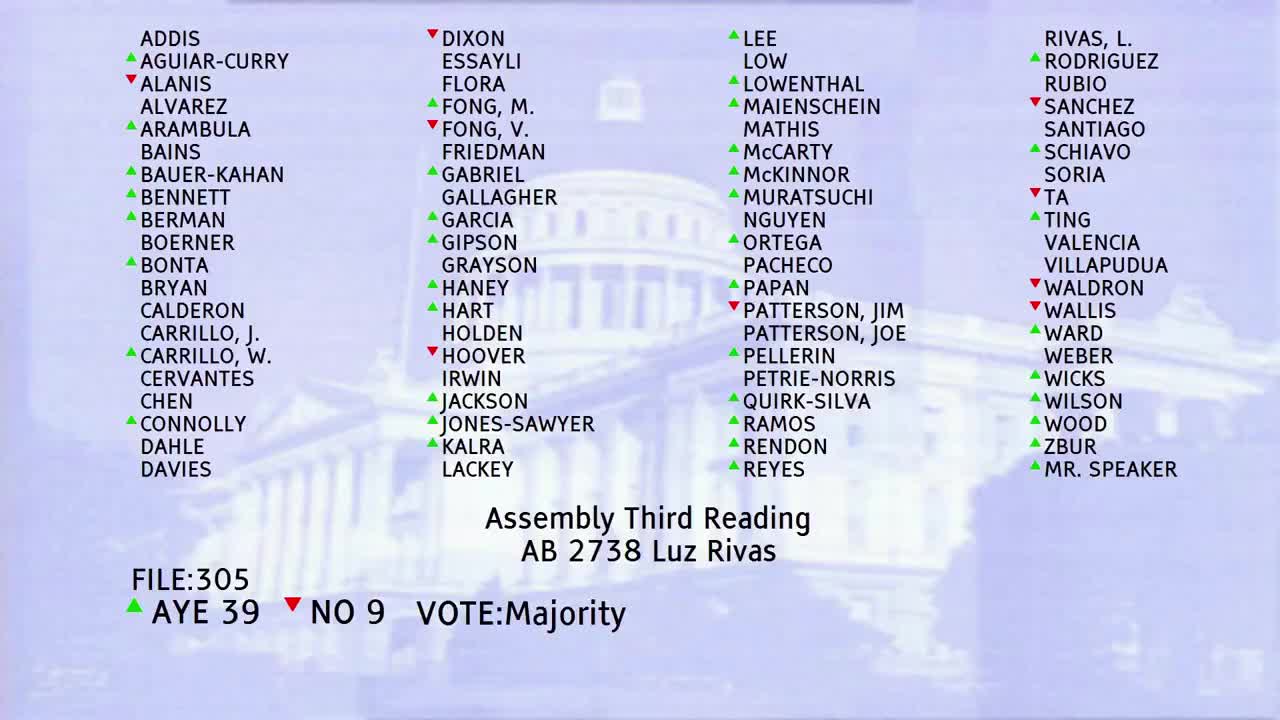 1MIN
Assembly Floor
 5MIN
Assembly Standing Committee on Revenue and Taxation
 5MIN
Assembly Standing Committee on Housing and Community Development


Bill Co-Author(s):