AB 3241: Law enforcement: police canines.
- Session Year: 2023-2024
- House: Assembly
- Latest Version Date: 2024-08-15
Current Status:
Failed
(2024-08-31: Ordered to inactive file at the request of Senator Gonzalez.)
Introduced
In Committee
First Chamber
In Committee
Second Chamber
Enacted
Existing law requires all law enforcement agencies to maintain a use of force policy, as specified, and requires the Commission on Peace Officer Standards and Training (POST) to implement courses of instruction for the training of law enforcement officers in the use of force.
This bill would require the commission, on or before January July 1, 2026, to adopt uniform, minimum guidelines regarding the use of canines by law enforcement, and, on or before July 1, 2026, to certify courses of training for all law enforcement canine handlers and those law enforcement supervisors directly overseeing canine programs, as specified. The bill would require, on or before July 1, 2027, each law enforcement agency with a canine unit to maintain a policy for the use of canines by the agency that, at a minimum, complies with the guidelines adopted by POST, and would require law enforcement agencies to establish a training regimen that includes a course certified by the commission. Because the bill would impose additional duties on local law enforcement agencies, the bill would impose a state-mandated local program. study and issue recommendations to the Legislature on the use of canines by law enforcement, as specified.
Existing law requires each law enforcement agency to monthly provide a report of, among other things, all instances of a peace officer involved in a use of force against a civilian that results in serious bodily injury or death to the Department of Justice, and requires the department to yearly post a summary of those reports on the departments OpenJustice Web portal.
This bill would require each law enforcement agency with a canine unit to annually publish a report of the use of canines, as specified, on its internet website. Because the bill would impose additional duties on local law enforcement agencies, the bill would impose a state-mandated local program.
The California Constitution requires the state to reimburse local agencies and school districts for certain costs mandated by the state. Statutory provisions establish procedures for making that reimbursement.
This bill would provide that, if the Commission on State Mandates determines that the bill contains costs mandated by the state, reimbursement for those costs shall be made pursuant to the statutory provisions noted above.
This bill would make the operation of its provisions contingent upon the enactment of AB 2042 of the 202324 Regular Session.
Existing law requires all law enforcement agencies to maintain a use of force policy, as specified, and requires the Commission on Peace Officer Standards and Training (POST) to implement courses of instruction for the training of law enforcement officers in the use of force.
This bill would require the commission, on or before January 1, 2026, to adopt uniform, minimum guidelines regarding the use of canines by law enforcement, including legal standards established by the bill, and, on or before July 1, 2026, to certify courses of training for all law enforcement canine handlers and those law enforcement supervisors directly overseeing canine programs, as specified. The bill would require, on or before July 1, 2027, each law enforcement agency with a canine unit to maintain a policy for the use of canines by the agency that, at a minimum, complies with the guidelines adopted by POST, and would require law enforcement agencies to establish a training regimen that includes a course certified by the commission. Because the bill would impose additional duties on local law enforcement agencies, the bill would impose a state-mandated local program.
Existing law requires each law enforcement agency to monthly provide a report of, among other things, all instances of a peace officer involved in a use of force against a civilian that results in serious bodily injury or death to the Department of Justice, and requires the department to yearly post a summary of those reports on the departments OpenJustice Web portal.
This bill would require each law enforcement agency with a canine unit to annually publish a report of the use of canines, as specified, on its internet website. Because the bill would impose additional duties on local law enforcement agencies, the bill would impose a state-mandated local program.
The California Constitution requires the state to reimburse local agencies and school districts for certain costs mandated by the state. Statutory provisions establish procedures for making that reimbursement.
This bill would provide that, if the Commission on State Mandates determines that the bill contains costs mandated by the state, reimbursement for those costs shall be made pursuant to the statutory provisions noted above.
This bill would make the operation of its provisions contingent upon the enactment of AB 2042 of the 202324 Regular Session.
Existing law requires law enforcement agencies to maintain a policy on the use of force, as specified.
The bill would require, on or before July 1, 2027, each law enforcement agency that utilizes canines to maintain a policy for the use of canines by the agency that, at a minimum, complies with the guidelines adopted by the Commission on Peace Officer Standards and Training, and would require law enforcement agencies to establish a training regimen that includes a course certified by the commission.
By imposing new duties on law enforcement agencies, this bill would impose a state-mandated local program.
This bill would also prescribe a legal standard for the use of a canine to apprehend a suspect.
Existing law requires each law enforcement agency to monthly provide a report of, among other things, all instances of a peace officer involved in a use of force against a civilian that results in serious bodily injury or death to the Department of Justice, and requires the department to yearly post a summary of those reports on the departments OpenJustice Web portal.
This bill would require each law enforcement agency with a canine unit to annually publish a report of the use of canines, as specified, on its internet website. Because the bill would impose additional duties on local law enforcement agencies, the bill would impose a state-mandated local program.
The California Constitution requires the state to reimburse local agencies and school districts for certain costs mandated by the state. Statutory provisions establish procedures for making that reimbursement.
This bill would provide that, if the Commission on State Mandates determines that the bill contains costs mandated by the state, reimbursement for those costs shall be made pursuant to the statutory provisions noted above.
This bill would make the operation of its provisions contingent upon the enactment of AB 2042 of the 202324 Regular Session.
Existing law requires all law enforcement agencies to maintain a use of force policy, as specified, and requires the Commission on Peace Officer Standards and Training (POST) to implement courses of instruction for the training of law enforcement officers in the use of force.
This bill would require the commission to adopt uniform, minimum guidelines regarding the use of canines by law enforcement, including legal standards established by the bill, and to certify courses of training for all law enforcement canine handlers and those law enforcement supervisors directly overseeing canine programs, as specified. The bill would require, on or before July 1, 2025, each law enforcement agency to maintain a policy for the use of canines by the agency that, at a minimum, complies with the guidelines adopted by POST, and would require law enforcement agencies to establish a training regimen that includes a course certified by the commission. Because the bill would impose additional duties on local law enforcement agencies, the bill would impose a state-mandated local program.
Existing law requires each law enforcement agency to monthly provide a report of, among other things, all instances of a peace officer involved in a use of force against a civilian that results in serious bodily injury or death to the Department of Justice, and requires the department to yearly post a summary of those reports on the departments OpenJustice Web portal.
This bill would require each law enforcement agency to annually publish a report of the use of canines, as specified, on its internet website. Because the bill would impose additional duties on local law enforcement agencies, the bill would impose a state-mandated local program.
The California Constitution requires the state to reimburse local agencies and school districts for certain costs mandated by the state. Statutory provisions establish procedures for making that reimbursement.
This bill would provide that, if the Commission on State Mandates determines that the bill contains costs mandated by the state, reimbursement for those costs shall be made pursuant to the statutory provisions noted above.
(a)Each law enforcement agency with a canine unit shall annually publish on its internet website a report of only all of the following:
(1)The number of canine units in the agency.
(2)(A)The number of deployments.
(B)Instances in which the canine was deployed for training or demonstration purposes may be reported as a separate category.
(3)The number of times the canine exited the police car inadvertently or without being removed from the police car by the handler.
(4)The number of interventions.
(5)The number of incidents of use of force involving a canine.
(b)Only information known to the agency at the time of the report shall be included.
(c)For purpose of this section, the following terms have the following meanings:
(1)Deployment means the removal of the canine from the police car for any legitimate law enforcement purpose, including, but not limited to, removing the canine from the car for training or demonstration purposes.
(2)Intervention means any use of a canine that results in the surrender or apprehension of a suspect by the mere presence of the canine. This can be established by witness statements or clearly articulated facts.
(3)Force incident means a bite or other injury to a person caused by a canine during a deployment.
(4)Law enforcement agency means any department or agency of the state or any local government, special district, or other political subdivision thereof, that employs any peace officer, as described in Section 830.
SEC. 2.Section 13519.16 is added to the Penal Code, to read:13519.16.(a)On or before July 1, 2026, the commission shall develop uniform, minimum guidelines regarding study and issue recommendations to the Legislature on the use of canines by law enforcement. The guidelines shall stress that the commission shall consider all of the following in its recommendations:
(1)The use of canines by law enforcement personnel is of important concern to the community and law enforcement and that law enforcement should safeguard the life, dignity, and liberty of all persons, without prejudice to anyone. The guidelines shall serve as a basis for each agencys canine policy that the agency is required to adopt pursuant to subdivision (c), and that reflects the needs of the agency, the jurisdiction it serves, and the law.
(b)The guidelines shall include all of the following:(1)An explicitly stated requirement that officers carry(2)Officers shall carry out duties, including use of force with respect to canines, in a manner that is fair and unbiased.
(2)Minimum patrol performance standards, including competencies in obedience,(3)Instances of appropriate patrol use with a canine, including standards for obedience, search, apprehension, and handler protection.
(3)Minimum detection performance standards, including competencies in control,(4)Instances of appropriate use with a canine for detection, including standards for control, alert, and odor detection.
(4)Requirements that all patrol canine handlers shall be equipped with a supplemental method of aiding with the release of a bite, including, but not limited to, a breaker bar, e-collar, pinch collar, or other device.(5)A requirement that, unless the officer reasonably believes it would pose an imminent threat of danger to other persons or substantially increase the risk of a suspects escape, a warning clearly audible within the deployment area announcing the potential release of a canine if the suspect does not surrender will be given prior to the release.(6)(A)A requirement that officers allow a reasonable opportunity to a suspect to comply following any warning, if feasible.(B)For the purposes of this paragraph, feasible has the same meaning as defined in Section 7286 of the Government Code.(7)(5)Factors for evaluating and reviewing all canine use of force incidents.
(8)The role of supervisors in the review of use of force canine applications.(9)A requirement that any canine team that does not meet the agencys required training regimen and guidelines will be prohibited from field assignment with the canine until such training and guidelines have been successfully satisfied.(c)(1)On or before July 1, 2027, each law enforcement agency with a canine unit shall maintain a policy for the use of canines by the agency that, at a minimum, complies with the guidelines and requirements described in subdivision (b).(2)Each canine team shall be required to meet and maintain the guidelines in the policy maintained pursuant to paragraph (1) prior to deployment.(3)Each law enforcement agency shall conduct a regular review and update of the policy maintained pursuant to paragraph (1).(6)Other considerations that will keep the public, the handler, and the canine safe, including how to provide a warning to a suspect within a deployment area upon the potential release of a canine.
(b)The recommendations issued pursuant to subdivision (a) shall be submitted in compliance with Section 9795 of the Government Code.
SEC. 3.Section 13519.17 is added to the Penal Code, to read:13519.17.(a)On or before January 1, 2027, the commission shall certify courses of training for all law enforcement canine handlers and those law enforcement supervisors directly overseeing canine programs in the use of canines by law enforcement. The training courses shall include, at a minimum, both of the following:(1)An explanation of the standards developed pursuant to Section 13519.16.(2)Requirements for canine handlers and those law enforcement supervisors directly overseeing canine programs to demonstrate knowledge and understanding of their law enforcement agencys canine policy.(b)All courses shall be certified by the commission before being implemented.(c)Each law enforcement agency with a canine unit shall establish a training regimen that includes a course certified by the commission pursuant to subdivision (a).SEC. 4.SEC. 3.If the Commission on State Mandates determines that this act contains costs mandated by the state, reimbursement to local agencies and school districts for those costs shall be made pursuant to Part 7 (commencing with Section 17500) of Division 4 of Title 2 of the Government Code.
SEC. 5.SEC. 4.This act shall become operative only if Assembly Bill 2042 of the 202324 Regular Session is enacted and becomes effective on or before January 1, 2025.
(a)Each law enforcement agency with a canine unit shall annually publish on its internet website a report of only all of the following:
(1)The number of canine units in the agency.
(2)(A)The number of deployments.
(B)Instances in which the canine was deployed for training or demonstration purposes may be reported as a separate category.
(3)The number of times the canine exited the police car inadvertently or without being removed from the police car by the handler.
(3)(4)The number of interventions.
(4)(5)The number of incidents of use of force involving a canine.
(b)Only information known to the agency at the time of the report shall be included.
(c)For purpose of this section, the following terms have the following meanings:
(1)(A)Deployment means the removal of the canine from the police car for any legitimate law enforcement purpose. purpose, including, but not limited to, removing the canine from the car for training or demonstration purposes.
(B)Allowing the canine a break, training the canine, or using the canine in a demonstration does not mean a deployment for purposes of this section.(2)Intervention means any use of a canine that results in the surrender or apprehension of a suspect by the mere presence of the canine. This can be established by witness statements or clearly articulated facts.
(3)Force incident means a bite or other injury to a person caused by a canine during a deployment.
(4)Law enforcement agency means any department or agency of the state or any local government, special district, or other political subdivision thereof, that employs any peace officer, as described in Section 830.
SEC. 2.Section 13519.16 is added to the Penal Code, to read:13519.16.(a)On or before January July 1, 2026, the commission shall develop uniform, minimum guidelines regarding the use of canines by law enforcement. The guidelines shall stress that the use of canines by law enforcement personnel is of important concern to the community and law enforcement and that law enforcement should safeguard the life, dignity, and liberty of all persons, without prejudice to anyone. The guidelines shall serve as a basis for each agencys canine policy that the agency is required to adopt pursuant to subdivision (c), and that reflects the needs of the agency, the jurisdiction it serves, and the law.
(b)The guidelines shall include all of the following:
(1)An explanation of the legal standards established pursuant to Section 13519.18 on the use of force with respect to canines.(2)(1)An explicitly stated requirement that officers carry out duties, including use of force with respect to canines, in a manner that is fair and unbiased.
(3)(2)Minimum patrol performance standards, including competencies in obedience, search, apprehension, and handler protection.
(4)(3)Minimum detection performance standards, including competencies in control, alert, and odor detection.
(5)(4)Requirements that all patrol canine handlers shall be equipped with a supplemental method of aiding with the release of a bite, including, but not limited to, a breaker bar, e-collar, pinch collar, or other device.
(6)(5)A requirement that, unless it would otherwise increase the risk of injury or escape, a clearly audible warning the officer reasonably believes it would pose an imminent threat of danger to other persons or substantially increase the risk of a suspects escape, a warning clearly audible within the deployment area announcing the potential release of a canine if the suspect does not surrender will be given prior to the release, if feasible. release.
(7)(6)(A)A requirement that officers allow a reasonable opportunity to a suspect to comply following any warning, if feasible.
(B)For the purposes of this paragraph, feasible has the same meaning as defined in Section 7286 of the Government Code.
(8)(7)Factors for evaluating and reviewing all canine use of force incidents.
(9)(8)The role of supervisors in the review of use of force canine applications.
(10)(9)A requirement that any canine team that does not meet the agencys required training regimen and guidelines will be prohibited from field assignment with the canine until such training and guidelines have been successfully satisfied.
(c)(1)On or before July 1, 2027, each law enforcement agency with a canine unit shall maintain a policy for the use of canines by the agency that, at a minimum, complies with the guidelines and requirements described in subdivision (b).
(2)Each canine team shall be required to meet and maintain the guidelines in the policy maintained pursuant to paragraph (1) prior to deployment.
(3)Each law enforcement agency shall conduct a regular review and update of the policy maintained pursuant to paragraph (1).
SEC. 3.Section 13519.17 is added to the Penal Code, to read:13519.17.(a)On or before July 1, 2026, January 1, 2027, the commission shall certify courses of training for all law enforcement canine handlers and those law enforcement supervisors directly overseeing canine programs in the use of canines by law enforcement. The training courses shall include, at a minimum, both of the following:
(1)An explanation of the standards developed pursuant to Section 13519.16.
(2)Requirements for canine handlers and those law enforcement supervisors directly overseeing canine programs to demonstrate knowledge and understanding of their law enforcement agencys canine policy.
(b)All courses shall be certified by the commission before being implemented.
(c)Each law enforcement agency with a canine unit shall establish a training regimen that includes a course certified by the commission pursuant to subdivision (a).
SEC. 4.Section 13519.18 is added to the Penal Code, to read:13519.18.(a)The release of a canine to search for or apprehend a suspect shall be based upon the handlers reasonable belief that the suspect has committed, is committing, or is threatening to commit a serious offense under any of the following conditions:(1)There is a reasonable belief that the suspect poses an imminent or immediate threat of violence or serious harm to the public or an officer.(2)The nonpassive suspect is physically resisting or threatening to physically resist arrest and the use of a canine reasonably appears necessary to overcome such resistance.(3)One or more officers reasonably believe the suspect is concealed in an area where entry by a person would pose a threat to the safety of officers or the public.SEC. 5.SEC. 4.If the Commission on State Mandates determines that this act contains costs mandated by the state, reimbursement to local agencies and school districts for those costs shall be made pursuant to Part 7 (commencing with Section 17500) of Division 4 of Title 2 of the Government Code.
SEC. 6.SEC. 5.This act shall become operative only if Assembly Bill 2042 of the 202324 Regular Session is enacted and becomes effective on or before January 1, 2025.
(a)Each law enforcement agency with a canine unit shall annually publish on its internet website a report of only all of the following:
(1)The number of canine units in the agency.
(2)The number of deployments.
(3)The number of interventions.
(4)The number of incidents of use of force involving a canine.
(b)Only information known to the agency at the time of the report shall be included.
(c)For purpose of this section, the following terms have the following meanings:
(1)(A)Deployment means the removal of the canine from a the police car for any legitimate law enforcement purpose.
(B)Allowing the canine a break, training the canine, or using the canine in a demonstration does not mean a deployment for purposes of this section.
(2)Intervention means any use of a canine that results in the surrender or apprehension of a suspect by the mere presence of the canine. This can be established by witness statements or clearly articulated facts.
(3)Force incident means a bite or other injury to a person caused by a canine during a deployment.
(4)Law enforcement agency means any department or agency of the state or any local government, special district, or other political subdivision thereof, that employs any peace officer, as described in Section 830.
SEC. 2.Section 13675 is added to the Penal Code, to read:13675.(a)(1)On or before July 1, 2027, each law enforcement agency with a canine unit shall maintain a policy for the use of canines by the agency that, at a minimum, complies with the guidelines developed pursuant to subdivision (a) of Section 13519.19.(2)Each canine team shall be required to meet and maintain the guidelines in the policy maintained pursuant to paragraph (1) prior to deployment.(3)Each law enforcement agency with a canine unit shall conduct a regular review and update of the policy maintained pursuant to paragraph (1).(b)On or before July 1, 2027, each law enforcement agency with a canine unit shall establish a training regimen that includes a course certified by the commission pursuant to subdivision (c) of Section 13519.19. SEC. 2.Section 13519.16 is added to the Penal Code, to read:13519.16.(a)On or before January 1, 2026, the commission shall develop uniform, minimum guidelines regarding the use of canines by law enforcement. The guidelines shall stress that the use of canines by law enforcement personnel is of important concern to the community and law enforcement and that law enforcement should safeguard the life, dignity, and liberty of all persons, without prejudice to anyone. The guidelines shall serve as a basis for each agencys canine policy that the agency is required to adopt pursuant to subdivision (c), and that reflects the needs of the agency, the jurisdiction it serves, and the law.
(b)The guidelines shall include all of the following:
(1)An explanation of the legal standards established pursuant to Section 13519.18 on the use of force with respect to canines.
(2)An explicitly stated requirement that officers carry out duties, including use of force with respect to canines, in a manner that is fair and unbiased.
(3)Minimum patrol performance standards, including competencies in obedience, search, apprehension, and handler protection.
(4)Minimum detection performance standards, including competencies in control, alert, and odor detection.
(5)Requirements that all patrol canine handlers shall be equipped with a supplemental method of aiding with the release of a bite, including, but not limited to, a breaker bar, e-collar, pinch collar, or other device.
(6)A requirement that, unless it would otherwise increase the risk of injury or escape, a clearly audible warning announcing the potential release of a canine if the suspect does not surrender will be given prior to the release, if feasible.
(7)A requirement that officers allow a reasonable opportunity to a suspect to comply following any warning, if feasible.
(8)Factors for evaluating and reviewing all canine use of force incidents.
(9)The role of supervisors in the review of use of force canine applications.
(10)A requirement that any canine team that does not meet the agencys required training regimen and guidelines will be prohibited from field assignment with the canine until such training and guidelines have been successfully satisfied.
(c)(1)On or before July 1, 2027, each law enforcement agency with a canine unit shall maintain a policy for the use of canines by the agency that, at a minimum, complies with the guidelines and requirements described in subdivision (b).
(2)Each canine team shall be required to meet and maintain the guidelines in the policy maintained pursuant to paragraph (1) prior to deployment.
(3)Each law enforcement agency shall conduct a regular review and update of the policy maintained pursuant to paragraph (1).
SEC. 3.Section 13519.17 is added to the Penal Code, to read:13519.17.(a)On or before July 1, 2026, the commission shall certify courses of training for all law enforcement canine handlers and those law enforcement supervisors directly overseeing canine programs in the use of canines by law enforcement. The training courses shall include, at a minimum, both of the following:
(1)An explanation of the standards developed pursuant to Section 13519.16.
(2)Requirements for canine handlers and those law enforcement supervisors directly overseeing canine programs to demonstrate knowledge and understanding of their law enforcement agencys canine policy.
(b)All courses shall be certified by the commission before being implemented.
(c)Each law enforcement agency with a canine unit shall establish a training regimen that includes a course certified by the commission pursuant to subdivision (a).
SEC. 3.Section 13675.5 is added to the Penal Code, to read:13675.5.SEC. 4.Section 13519.18 is added to the Penal Code, to read:13519.18.(a)The release of a canine to search for or apprehend a suspect shall be based upon the handlers reasonable belief that the suspect has committed, is committing, or is threatening to commit a serious offense under any of the following conditions:
(1)There is a reasonable belief that the suspect poses an imminent or immediate threat of violence or serious harm to the public or an officer.
(2)The nonpassive suspect is physically resisting or threatening to physically resist arrest and the use of a canine reasonably appears necessary to overcome such resistance.
(3)The handler One or more officers reasonably believes believe the suspect is concealed in an area where entry by a person would pose a threat to the safety of officers or the public.
SEC. 4.SEC. 5.If the Commission on State Mandates determines that this act contains costs mandated by the state, reimbursement to local agencies and school districts for those costs shall be made pursuant to Part 7 (commencing with Section 17500) of Division 4 of Title 2 of the Government Code.
SEC. 5.SEC. 6.This act shall become operative only if Assembly Bill 2042 of the 202324 Regular Session is enacted and becomes effective on or before January 1, 2025.
(a)Each law enforcement agency with a canine unit shall annually publish on its internet website a report of only all of the following:
(1)The number of canine units in the agency.
(2)The number of deployments.
(3)The number of interventions.
(4)The number of incidents of use of force involving a canine.
(b)Only information known to the agency at the time of the report shall be included.
(c)For purpose of this section, the following terms have the following meanings:
(1)(A)Deployment means the removal of the canine from the a police car for any legitimate law enforcement purpose.
(B)Allowing the canine a break, training the canine, or using the canine in a demonstration does not mean a deployment for purposes of this section.
(2)Intervention means any use of a canine that results in the surrender or apprehension of a suspect by the mere presence of the canine. This can be established by witness statements or clearly articulated facts.
(3)Force incident means a bite or other injury to a person caused by a canine during a deployment.
(4)Law enforcement agency means any department or agency of the state or any local government, special district, or other political subdivision thereof, that employs any peace officer, as described in Section 830.
SEC. 2.Section 13519.16 is added to the Penal Code, to read:13519.16.(a)The commission shall develop uniform, minimum guidelines regarding the use of canines by law enforcement. The guidelines shall stress that the use of canines by law enforcement personnel is of important concern to the community and law enforcement and that law enforcement should safeguard the life, dignity, and liberty of all persons, without prejudice to anyone. These guidelines shall be a resource for each agency executive to use in the creation of canine policy that the agency is required to adopt pursuant to subdivision (c), and that reflects the needs of the agency, the jurisdiction it serves, and the law.(b)The standards shall include all of the following:(1)An explanation of the legal standards established pursuant to Section 13519.18 on the use of force with respect to canines.(2)An explicitly stated requirement that officers carry out duties, including use of force with respect to canines, in a manner that is fair and unbiased.(3)Minimum patrol performance standards, including competencies in obedience, search, apprehension, and handler protection.(4)Minimum detection performance standards, including competencies in control, alert, and odor detection.(5)Requirements that all patrol canine handlers shall be equipped with a supplemental method of aiding with the release of a bite including, but not limited to, a breaker bar, e-collar, pinch collar or other device.(6)A requirement that, unless it would otherwise increase the risk of injury or escape, a clearly audible warning announcing the potential release of a canine if the suspect does not surrender will be given prior to the release, if feasible.(7)A requirement that officers allow a reasonable opportunity to a suspect to comply following any warning, if feasible.(8)Factors for evaluating and reviewing all canine use of force incidents.(9)The role of supervisors in the review of use of force canine applications.(10)A requirement that any canine team that does not meet the agencys required training regimen and guidelines will be prohibited from field assignment with the canine until such training and guidelines have been successfully satisfied.(c)(1)On or before July 1, 2025, each law enforcement agency shall maintain a policy for the use of canines by the agency that, at a minimum, complies with the standards developed pursuant to subdivision (b).(2)Each canine team shall be required to meet and maintain the standards in the policy maintained pursuant to paragraph (1) prior to deployment.(3)Each law enforcement agency shall conduct a regular review and update of the policy in paragraph (1).SEC. 3.Section 13519.17 is added to the Penal Code, to read:13519.17.(a)The commission shall certify courses of training for all law enforcement canine handlers and those law enforcement supervisors directly overseeing canine programs in the use of canines by law enforcement. The training courses shall include, at a minimum, both of the following:(1)An explanation of the standards in Section 13519.16.(2)Requirements for officers, investigators, and supervisors to demonstrate knowledge and understanding of their law enforcement agencys canine policy.(b)All courses shall be certified by the commission before being implemented.(c)Each law enforcement agency shall establish a training regimen that includes a course certified by the commission pursuant to subdivision (b).SEC. 2.Section 13675 is added to the Penal Code, to read:13675.(a)(1)On or before July 1, 2027, each law enforcement agency with a canine unit shall maintain a policy for the use of canines by the agency that, at a minimum, complies with the guidelines developed pursuant to subdivision (a) of Section 13519.19.
(2)Each canine team shall be required to meet and maintain the guidelines in the policy maintained pursuant to paragraph (1) prior to deployment.
(3)Each law enforcement agency with a canine unit shall conduct a regular review and update of the policy maintained pursuant to paragraph (1).
(b)On or before July 1, 2027, each law enforcement agency with a canine unit shall establish a training regimen that includes a course certified by the commission pursuant to subdivision (c) of Section 13519.19.
SEC. 4.Section 13519.18 is added to the Penal Code, to read:13519.18.SEC. 3.Section 13675.5 is added to the Penal Code, to read:13675.5.(a)The release of a canine to search for or apprehend a suspect shall be based upon the handlers reasonable belief that the suspect has committed, is committing, or is threatening to commit a serious offense under any of the following conditions:
(1)There is a reasonable belief that the suspect poses an imminent or immediate threat of violence or serious harm to the public or an officer.
(2)The nonpassive suspect is physically resisting or threatening to physically resist arrest and the use of a canine reasonably appears necessary to overcome such resistance.
(3)Officers The handler reasonably believe believes the suspect is concealed in an area where entry by a person would pose a threat to the safety of officers or the public.
SEC. 5.SEC. 4.If the Commission on State Mandates determines that this act contains costs mandated by the state, reimbursement to local agencies and school districts for those costs shall be made pursuant to Part 7 (commencing with Section 17500) of Division 4 of Title 2 of the Government Code.
SEC. 5.This act shall become operative only if Assembly Bill 2042 of the 202324 Regular Session is enacted and becomes effective on or before January 1, 2025.
CORRECTIONS: HeadingLine 2.(a)Each law enforcement agency shall annually publish on its internet website a report of only all of the following:
(1)The number of canine units in the agency.
(2)The number of deployments.
(3)The number of interventions.
(4)The number of incidents of use of force involving a canine.
(b)Only information known to the agency at the time of the report shall be included.
(c)For purpose of this section, the following terms have the following meanings:
(1)(A)Deployment means the removal of the canine from the police car for any legitimate law enforcement purpose.
(B)Allowing the canine a break, training the canine, or using the canine in a demonstration does not mean a deployment for purposes of this section.
(2)Intervention means any use of a canine that results in the surrender or apprehension of a suspect by the mere presence of the canine. This can be established by witness statements or clearly articulated facts.
(3)Force incident means a bite or other injury to a person caused by a canine during a deployment.
SEC. 2.Section 13519.16 is added to the Penal Code, to read:13519.16.(a)The commission shall develop uniform, minimum guidelines regarding the use of canines by law enforcement. The guidelines shall stress that the use of canines by law enforcement personnel is of important concern to the community and law enforcement and that law enforcement should safeguard the life, dignity, and liberty of all persons, without prejudice to anyone. These guidelines shall be a resource for each agency executive to use in the creation of canine policy that the agency is required to adopt pursuant to subdivision (c), and that reflects the needs of the agency, the jurisdiction it serves, and the law.
(b)The standards shall include all of the following:
(1)An explanation of the legal standards established pursuant to Section 13519.18 on the use of force with respect to canines.
(2)An explicitly stated requirement that officers carry out duties, including use of force with respect to canines, in a manner that is fair and unbiased.
(3)Minimum patrol performance standards, including competencies in obedience, search, apprehension, and handler protection.
(4)Minimum detection performance standards, including competencies in control, alert, and odor detection.
(5)Requirements that all patrol canine handlers shall be equipped with a supplemental method of aiding with the release of a bite including, but not limited to, a breaker bar, e-collar, pinch collar or other device.
(6)A requirement that, unless it would otherwise increase the risk of injury or escape, a clearly audible warning announcing the potential release of a canine if the suspect does not surrender will be given prior to the release, if feasible.
(7)A requirement that officers allow a reasonable opportunity to a suspect to comply following any warning, if feasible.
(8)Factors for evaluating and reviewing all canine use of force incidents.
(9)The role of supervisors in the review of use of force canine applications.
(10)A requirement that any canine team that does not meet the agencys required training regimen and guidelines will be prohibited from field assignment with the canine until such training and guidelines have been successfully satisfied.
(c)(1)On or before July 1, 2025, each law enforcement agency shall maintain a policy for the use of canines by the agency that, at a minimum, complies with the standards developed pursuant to subdivision (b).
(2)Each canine team shall be required to meet and maintain the standards in the policy maintained pursuant to paragraph (1) prior to deployment.
(3)Each law enforcement agency shall conduct a regular review and update of the policy in paragraph (1).
SEC. 3.Section 13519.17 is added to the Penal Code, to read:13519.17.(a)The commission shall certify courses of training for all law enforcement canine handlers and those law enforcement supervisors directly overseeing canine programs in the use of canines by law enforcement. The training courses shall include, at a minimum, both of the following:
(1)An explanation of the standards in Section 13519.16.
(2)Requirements for officers, investigators, and supervisors to demonstrate knowledge and understanding of their law enforcement agencys canine policy.
(b)All courses shall be certified by the commission before being implemented.
(c)Each law enforcement agency shall establish a training regimen that includes a course certified by the commission pursuant to subdivision (b).
SEC. 4.Section 13519.18 is added to the Penal Code, to read:13519.18.(a)The release of a canine to search for or apprehend a suspect shall be based upon the handlers reasonable belief that the suspect has committed, is committing, or is threatening to commit a serious offense under any of the following conditions:
(1)There is a reasonable belief that the suspect poses an imminent or immediate threat of violence or serious harm to the public or an officer.
(2)The suspect is physically resisting or threatening to resist arrest and the use of a canine reasonably appears necessary to overcome such resistance.
(3)Officers reasonably believe the suspect is concealed in an area where entry by a person would pose a threat to the safety of officers or the public.
SEC. 5.If the Commission on State Mandates determines that this act contains costs mandated by the state, reimbursement to local agencies and school districts for those costs shall be made pursuant to Part 7 (commencing with Section 17500) of Division 4 of Title 2 of the Government Code.
|
Date
|
Status
|
|---|---|
| Aug 31, 2024 | Ordered to inactive file at the request of Senator Gonzalez. |
| Aug 19, 2024 | Read second time. Ordered to third reading. |
| Aug 15, 2024 | Read second time and amended. Ordered returned to second reading. |
| Aug 15, 2024 | From committee: Amend, and do pass as amended. (Ayes 7. Noes 0.) (August 15). |
| Aug 5, 2024 | In committee: Referred to suspense file. |
| Jul 3, 2024 | Read second time and amended. Re-referred to Com. on APPR. |
| Jul 2, 2024 | From committee: Amend, and do pass as amended and re-refer to Com. on APPR. (Ayes 3. Noes 0.) (July 2). |
| Jun 12, 2024 | Re-referred to Com. on PUB S. |
| Jun 10, 2024 | From committee chair, with author's amendments: Amend, and re-refer to committee. Read second time, amended, and re-referred to Com. on RLS. |
| Jun 5, 2024 | Referred to Com. on RLS. |
| May 24, 2024 | In Senate. Read first time. To Com. on RLS. for assignment. |
| May 23, 2024 | Read third time. Passed. Ordered to the Senate. (Ayes 66. Noes 0. Page 5614.) |
| May 21, 2024 | Measure version as amended on May 16 corrected. |
| May 20, 2024 | Read second time. Ordered to third reading. |
| May 16, 2024 | Read second time and amended. Ordered returned to second reading. |
| May 16, 2024 | From committee: Amend, and do pass as amended. (Ayes 11. Noes 0.) (May 16). |
| May 16, 2024 | Assembly Rule 63 suspended. |
| May 1, 2024 | In committee: Set, first hearing. Referred to APPR. suspense file. |
| Apr 10, 2024 | From committee: Do pass and re-refer to Com. on APPR. (Ayes 8. Noes 0.) (April 9). Re-referred to Com. on APPR. |
| Mar 11, 2024 | Referred to Com. on PUB. S. |
| Feb 17, 2024 | From printer. May be heard in committee March 18. |
| Feb 16, 2024 | Read first time. To print. |
|
Date
|
Description
|
Location
|
Votes
|
|
|---|---|---|---|---|
| Aug 15, 2024 | Do pass as amended | Senate Standing Committee on Appropriations |
Passed |
|
| Aug 5, 2024 | Placed on suspense file | Senate Standing Committee on Appropriations |
Passed |
|
| Jul 2, 2024 | Do pass as amended, but first amend, and re-refer to the Committee on [Appropriations] | Senate Standing Committee on Public Safety |
Passed |
|
| May 23, 2024 | AB 3241 Pacheco Assembly Third Reading | Assembly Floor |
Passed |
|
| May 16, 2024 | Do pass as amended. | Assembly Standing Committee on Appropriations |
Passed |
|
| Apr 9, 2024 | Do pass and be re-referred to the Committee on [Appropriations] | Assembly Standing Committee on Public Safety |
Passed |
This list shows positions taken on this bill by organizations on the date displayed, which is linked to the original source.
Positions by individuals are not included.
|
Organization
|
Position
|
Date
|
|---|---|---|
| Aclu California Action | ** Against | |
| Alliance for Boys and Men of Color | ** Against | |
| All of Us or None Los Angeles | ** Against | |
| Arcadia Peace Officers Association | ** Support | |
| Asian Law Alliance | ** Against | |
| Association For Los Angeles Deputy Sheriffs | ** Support | |
| Association Of Orange County Deputy Sheriffs | ** Support | |
| Burbank Peace Officers Association | ** Support | |
| California Association Of Highway Patrolmen | ** Support | |
| California Coalition of School Safety Professionals | ** Support | |
| California District Attorneys Association | ** Support | |
| California Fish and Game Wardens Supervisors and Managers Association | ** Support | |
| California for Safety and Justice | ** Against | |
| California Fraternal Order of Police | ** Support | |
| California Narcotic Officers Association | ** Support | |
| Californians United for a Responsible Budget | ** Against | |
| California Police Chiefs Association | ** Support | |
| California Public Defenders Association | ** Against | |
| California Reserve Peace Officers Association | ** Support | |
| California State Sheriffs Association | ** Support | |
| California Statewide Law Enforcement Association | ** Support | |
| California Wildlife Officers Foundation | ** Support | |
| Care First Kern | ** Against | |
| Children's Defense Fund - CA | ** Against | |
| City Of Beverly Hills | ** Support | |
| City of Norwalk | ** Support | |
| Claremont Peace Officers Association | ** Support | |
| Communities United for Restorative Youth Justice | ** Against | |
| Corona Peace Officers Association | ** Support | |
| Culver City Peace Officers Association | ** Support | |
| Dolores Huerta Foundation | ** Support | |
| Fullerton Peace Officers Association | ** Support | |
| Initiate Justice | ** Against | |
| Legal Services for Prisoners with Children | ** Against | |
| Long Beach Police Officers Association | ** Support | |
| Los Angeles County SheriffS Department | ** Support | |
| Los Angeles School Police Association | ** Support | |
| Los Angeles School Police Management Assn | ** Support | |
| milpa | ** Against | |
| MONTEREY COUNTY DEPUTY SHERIFF ASSOCIATION | ** Support | |
| Murrieta Peace Officers Association | ** Support | |
| National Police Accountability Project | ** Against | |
| Newport Beach Police Association | ** Support | |
| Novato Peace Officers Association | ** Support | |
| Orange County Justice Initiative | ** Against | |
| Pacific Juvenile Defender Center | ** Against | |
| Palos Verdes Peace Officers Association | ** Support | |
| Peace Officers Research Association Of California | ** Support | |
| PLACER COUNTY DEPUTY SHERIFFS ASSOCIATION | ** Support | |
| Pomona Peace Officers Association | ** Support | |
| Riverside County Sheriffs’ Association | ** Support | |
| Riverside Peace Officers Association | ** Support | |
| RIVERSIDE POLICE OFFICERS ASSOCIATION | ** Support | |
| Riverside Sheriffs' Association | ** Support | |
| Sacramento County Deputy Sheriffs Association | ** Support | |
| San Bernardino County SheriffS Employees Benefit Association | ** Support | |
| San Francisco Public Defender | ** Against | |
| Santa Ana Peace Officers Association | ** Support | |
| Upland Peace Officers Association | ** Support |
SENATE RULES COMMITTEE Office of Senate Floor Analyses (916) 651-1520 Fax: (916) 327-4478 | AB 3241 |
THIRD READING
Bill No: AB 3241
Author: Pacheco (D), et al.
Amended: 8/15/24 in Senate
Vote: 21
SENATE PUBLIC SAFETY COMMITTEE: 3-0, 7/2/24
AYES: Wahab, Seyarto, Wiener
NO VOTE RECORDED: Bradford, Skinner
SENATE APPROPRIATIONS COMMITTEE: 7-0, 8/15/24
AYES: Caballero, Jones, Ashby, Becker, Bradford, Seyarto, Wahab
ASSEMBLY FLOOR: 66-0, 5/23/24 - See last page for vote
SUBJECT: Law enforcement: police canines
SOURCE: California Police Chiefs Association
DIGEST:
This bill requires the Commission on Peace Officer Standards and Training (POST), by July 1, 2026, to study and issue recommendations to the Legislature on the use of canines by law enforcement, and requires each law enforcement agency with a canine unit to annually publish a report regarding the use of canines on its internet website, as specified.
ANALYSIS:
Existing law:
- Declares the intent of the Legislature that the authority to use physical force, conferred on peace officers by existing law, is a serious responsibility that shall be exercised judiciously and with respect for human rights and dignity and for the sanctity of every human life, and that every person has a right to be free from excessive use of force by officers acting under color of law. (Pen. Code, §835a, subd. (a)(1).)
- Authorizes a peace officer who has reasonable cause to believe that a person to be arrested has committed a public offense to use objectively reasonable force to effect the arrest, to prevent escape, or to overcome resistance. (Pen. Code, § 835a, subd. (b).)
- Provides that any person owning or having custody or control of a dog trained to fight, attack, or kill is guilty of a felony or a misdemeanor, as specified, except for a veterinarian, on-duty animal control officer while in the performance of his or her duties, or to a peace officer if that officer is assigned to a canine unit. (Pen. Code, § 399.5.)
- Establishes the Commission on Peace Officer Standards and Training (POST) to set minimum standards for the recruitment and training of peace officers, develop training courses and curriculum, and establish a professional certificate program that awards different levels of certification based on training, education, experience, and other relevant prerequisites. Authorizes POST to cancel a certificate that was awarded in error or fraudulently obtained; however, POST is prohibited from canceling a properly-issued certificate. (Penal Code, §§ 830-832.10 and 13500 et seq.)
- Provides that POST has, among others, the power to develop and implement programs to increase the effectiveness of law enforcement and, when those programs involve training and education courses, to cooperate with and secure the cooperation of state-level peace officers, agencies, and bodies having jurisdiction over systems of public higher education in continuing the development of college-level training and education programs. (Pen. Code, § 13500.3, subd. (e).)
- Requires POST to submit annually a report to the Legislature on the overall effectiveness of any additional funding for improving peace officer training, including the number of peace officers trained by law enforcement agency, by course, and by how the training was delivered, as well as the training provided and the descriptions of the training. (Pen. Code, § 13500.5, subd. (a) & (b).)
- Requires POST to develop and deliver training courses for peace officers on a wide array of topics, including, the use of tear gas, SWAT operations, elder abuse, persons with disabilities, behavioral health, technology crimes, sexual assault, first aid, missing persons, gang and drug enforcement, use of force and human trafficking, among others. (Pen. Code §§13514 – 13519.15.)
- Requires POST to implement a course or courses of instruction for the training of law enforcement officers in the use of force and to develop uniform, minimum guidelines for adoption by law enforcement agencies regarding use of force, as specified. (Pen. Code, § 13519.10.)
- Requires POST to post on its internet website all current standards, policies, practices, operating procedures and education and training materials, as specified. (Pen. Code, § 13650.)
- Requires each law enforcement agency to provide to the Department of Justice, on a monthly basis, a report of all instances when a peace officer that is employed by the agency is involved in shootings and use of force incidents, as specified. (Gov. Code, § 12525.2(a).)
This bill:
- Requires each law enforcement agency with a canine unit to annually publish on its internet website a report of all of the following:
- The number of canine units in the agency.
- The number of deployments, although instances in which the canine was deployed for training or demonstration may be reported as a separate category.
- The number of times the canine exited the police car inadvertently or without being removed from the police car by the handler.
- The number of interventions.
- The number of incidents of use of force involving a canine
- Provides that only information known to the agency at the time of the report shall be included.
- Includes definitions for various terms used in the reporting requirement above.
- Requires POST, on or before July 1, 2026, to study and issue recommendations to the Legislature on the use of canines by law enforcement.
- Requires POST to consider all of the following in its recommendations:
- The use of canines by law enforcement personnel is of important concern to the community and law enforcement and that law enforcement should safeguard the life, dignity, and liberty of all persons, without prejudice to anyone.
- Officers shall carry out duties, including use of force with respect to canines, in a manner that is fair and unbiased.
- Instances of appropriate patrol use with a canine, including standards for obedience, search, apprehension, and handler protection.
- Instances of appropriate use with a canine for detection, including standards for control, alert, and odor detection.
- Factors for evaluating and reviewing all canine use of force incidents.
- Other considerations that will keep the public, the handler, and the canine safe, including how to provide a warning to a suspect within a deployment area upon the potential release of a canine.
Comments
According to the Author, “While case law, training and policy guidelines, and general legal principles apply to the development and deployment of law enforcement K9 programs, there are not statewide standards to ensure consistency across a myriad of different programs. AB 3241 resolves this issue by setting clear and comprehensive statewide standards specific to law enforcement K9 programs.”
California law enforcement agencies view the use of police canines as indispensable to protecting the both the public and law enforcement personnel in the discharge of their duties. According to the Los Angeles County Sheriff’s Department:
“The prompt and proper utilization of a trained canine team has proven to be a valuable use of a unique resource in law enforcement. When properly used, a canine team greatly increases the degree of safety to citizens within a contained search area, enhances individual officer safety, significantly increases the likelihood of suspect apprehension, and dramatically reduces the amount of time necessary to conduct a search.”
In 1992, POST approved a set of voluntary guidelines designed to assist agencies with minimum training and performance standards for two primary canine uses: patrol and detection. In January 2014, POST updated these guidelines keeping in mind the more specialized canine team functions that had developed in the two decades since initial publication, and noted that the guidelines “are sufficiently general to accommodate differing agencies’ policies regarding operational deployment of K-9 teams.” The “patrol” guidelines set forth minimum performance standards for four competencies: obedience, search, apprehension, and handler protection. Regarding “apprehension,” the guidelines provide:
Under the direction of the handler and while off leash, the K-9 will pursue and apprehend a person acting as a “suspect” (agitator/decoy). The K-9 team will demonstrate a pursuit and call off prior to apprehension. On command from the handler, the K-9 will pursue and apprehend the agitator/decoy. From a reasonable distance and on verbal command only, the K-9 will cease the apprehension.
As these guidelines are limited and provide only minimum standards, law enforcement agencies across the state have developed their own policies and practices related to canines. These policies often include standards and definitions that, while not inconsistent, are certainly not uniform, and may be amended completely at the discretion of the agency.
According to the Author, more statewide standardization of police canine programs is necessary, and would “build trust and accountability between agencies and the communities they serve.” Toward this end, this bill requires the Commission on Peace Officer Standards and Training to study and issue recommendations to the Legislature on the use of canines by law enforcement. Additionally, this bill includes data reporting requirements that resemble other recent legislative efforts to increase reporting by local agencies to the Department of Justice, including AB 953 (Weber, Ch. 466, Stats. of 2015) regarding police stops and the aforementioned AB 71. Specifically, this bill requires each law enforcement agency with a canine unit to annually publish on its internet website the following several discrete data points.
FISCAL EFFECT: Appropriation: No Fiscal Com.: Yes Local: Yes
According to the Senate Appropriations Committee:
Unknown, potentially significant one-time state costs (General Fund) to POST to study and issue recommendations.
SUPPORT: (Verified 8/14/24)
California Police Chiefs Association (source)
Arcadia Peace Officers Association
Association of Orange County Deputy Sheriffs
Burbank Peace Officers Association
California Association of Highway Patrolmen
California Coalition of School Safety Professionals
California Fraternal Order of Police
California Narcotic Officers’ Association
California Reserve Peace Officers Association
California State Sheriffs’ Association
California Statewide Law Enforcement Association
City of Beverly Hills
City of Norwalk
Claremont Peace Officers Association
Corona Peace Officers Association
Culver City Peace Officers Association
Dolores Huerta Foundation
Fullerton Peace Officers Association
Long Beach Police Officers Association
Los Angeles County Sheriff’s Department
Los Angeles Schools Police Association
Los Angeles School Police Management Assn
Monterey County Deputy Sheriffs Association
Murrieta Peace Officers Association
Newport Beach Police Association
Novato Peace Officers Association
Palos Verdes Peace Officers Association
Peace Officers Research Association of California (PORAC)
Placer County Deputy Sheriffs Association
Pomona Peace Officers Association
Riverside County Sheriffs’ Association
Riverside Peace Officers Association;
Sacramento County Deputy Sheriffs’ Association
San Bernardino County Sheriff’s Employees’ Benefit Association
Santa Ana Peace Officers Association
Upland Peace Officers Association
OPPOSITION: (Verified 8/14/24)
All of Us or None Los Angeles
Asian Law Alliance
California Public Defenders Association
Californians United for a Responsible Budget
Communities United for Restorative Youth Justice
Initiate Justice
Legal Services for Prisoner With Children
National Police Accountability Project
Orange County Justice Initiative
San Francisco Public Defender
ASSEMBLY FLOOR: 66-0, 5/23/24
AYES: Addis, Aguiar-Curry, Alanis, Alvarez, Arambula, Bains, Bauer-Kahan, Bennett, Berman, Boerner, Calderon, Juan Carrillo, Wendy Carrillo, Chen, Connolly, Davies, Dixon, Flora, Mike Fong, Vince Fong, Friedman, Gabriel, Garcia, Gipson, Grayson, Haney, Hart, Hoover, Irwin, Jackson, Lackey, Low, Lowenthal, Maienschein, McCarty, McKinnor, Muratsuchi, Stephanie Nguyen, Ortega, Pacheco, Papan, Jim Patterson, Joe Patterson, Pellerin, Petrie-Norris, Quirk-Silva, Ramos, Rendon, Reyes, Rodriguez, Sanchez, Santiago, Schiavo, Soria, Ta, Ting, Valencia, Villapudua, Waldron, Wallis, Ward, Wicks, Wilson, Wood, Zbur, Robert Rivas
NO VOTE RECORDED: Bonta, Bryan, Cervantes, Megan Dahle, Essayli, Gallagher, Holden, Jones-Sawyer, Kalra, Lee, Mathis, Luz Rivas, Blanca Rubio, Weber
Prepared by: Alex Barnett / PUB. S. /
8/19/24 17:46:33
**** END ****
SENATE COMMITTEE ON
Senator Anna Caballero, Chair
2023 - 2024 Regular Session
AB 3241 (Pacheco) - Law enforcement: police canines
Version: | Policy Vote: |
Urgency: | Mandate: |
Hearing Date: | Consultant: |
Bill Summary:
AB 3241 would require the Commission on Peace Officer Standards and Training (POST) to study and issue recommendations to the Legislature on the use of canines by law enforcement.
*********** ANALYSIS ADDENDUM – SUSPENSE FILE ***********
The following information is revised to reflect amendments
adopted by the committee on August 15, 2024
Fiscal Impact:
Unknown, potentially significant one-time state costs (General Fund) to POST to study and issue recommendations.
Committee Amendments:
The amendments delete the provisions of the bill requiring POST to adopt uniform guidelines and for law enforcement to comply with the policy. The amendments require POST to study and implement recommendations to the Legislature on the use of canines by law enforcement, as specified.
-- END --
SENATE COMMITTEE ON APPROPRIATIONS
Senator Anna Caballero, Chair
2023 - 2024 Regular Session
AB 3241 (Pacheco) - Law enforcement: police canines
Version: July 3, 2024 | Policy Vote: PUB. S. 3 - 0 |
Urgency: No | Mandate: Yes |
Hearing Date: August 5, 2024 | Consultant: Liah Burnley |
Bill Summary:
AB 3241 would require the Commission on Peace Officer Standards and Training (POST), to develop guidelines for the use of canines by law enforcement and requires law enforcement agencies to adopt a policy for the use of canines, as specified.
Fiscal Impact:
- Significant one-time state costs (General Fund) to POST to develop the guidelines required by this bill, from $250,000-$400,000. POST also indicates potential absorbable ongoing costs to occasionally update the guidelines.
- Significant one-time and ongoing state costs (General Fund) to POST to comply with the training requirements in this bill. POST indicates that if it were to develop its own training to complement the guidelines, course development would be approximately $300,000, one-time costs. There are over 600 agencies within the POST program and POST estimates a minimum one-time costs of $10 million for initial training and ongoing training could be in the millions per year, depending on the agency training cycle.
- Unknown, potentially significant state costs (General Fund) to the California Highway Patrol (CHP) to implement this bill. CHP indicates that the department may have costs exceeding existing resources to comply with the requirements of this bill. However, those costs are contingent upon the POST guidelines to be released by July 1, 2026, at which point the department may request a BCP.
- Unknown, potentially significant state costs (General Fund) to the California Department of Parks and Recreation (State Parks) to implement this bill. State Parks indicates the department may have costs exceeding existing resources to comply with the requirements in these bills. However, those costs are contingent upon the POST guidelines to be released by July 1, 2026, at which point the department may request a BCP.
- State cost pressures (General Fund) to the California Department of Corrections and Rehabilitation (CDCR) to comply with the reporting requirements in this bill. CDCR indicates that it has canines that are used in a passive manner to detect contraband. The dogs are under the control of their handler and generally on a leash; they are not used in the same manner as local law enforcement canines. CDCR will only be able to offer two of the data points required by the reporting requirements of this bill: (1) The number of canine units in the agency; and (2) the number of deployments. This information is not currently captured in a way that would allow the information to be included in an annual report as the bill requires. Accordingly CDCR estimates that the cost associated with capturing the data is approximately $800,000. Ongoing support and maintenance would likely be absorbed within existing business operations.
- Possibly reimbursable costs (local funds, General Fund) of an unknown but significant amount to local law enforcement agencies to adopt canine policies that meet POST standards. Notably, this requirement applies to each law enforcement agency in the state, regardless of whether the agency has a canine unit. In the aggregate, one-time costs may be in the hundreds of thousands to millions of dollars. General Fund costs will depend on whether the duties imposed by this bill constitute a reimbursable state mandate, as determined by the Commission on State Mandates.
Background:
Police canines used for apprehension are considered a less-than-lethal use of force option for law enforcement officers to deploy when trying to arrest or apprehend a suspect. However, police canines’ bites are very powerful, and have resulted in serious injuries to those they bite. In general, police use of force is disproportionately deployed against people of color. As pointed out in the analyses of this bill by the Senate Committee on Public Safety and the Assembly Committee on Public Safety, the lack of statewide data on use of police canines makes it difficult to analyze and evaluate outcomes from canine use in the aggregate.
Unlike other types of use of force by peace officers, there are no uniform, statewide standards that govern use of police canines for apprehension. POST has developed guidelines for minimum training and performance standards for police canine patrol and detection, but the guidelines are voluntary and were specifically designed to accommodate the varying operational policies of law enforcement agencies. Individual law enforcement agencies may develop their own policies to govern use of police canines and related training. As a result, police canine policies may vary among agencies, and are not subject to statewide standards or oversight.
Proposed Law:
- Requires each law enforcement agency with a canine unit to annually publish on its internet website a report specified information about the use of canines.
- Requires, on or before January 1, 2026, POST to develop uniform, minimum guidelines regarding the use of canines by law enforcement, which shall stress that the use of canines by law enforcement personnel is of important concern to the community and law enforcement and that law enforcement should safeguard the life, dignity, and liberty of all persons, without prejudice to anyone.
- Specifies that the guidelines shall serve as a basis for each agency’s canine policy that the agency is required to adopt pursuant to this bill, and that reflects the needs of the agency, the jurisdiction it serves, and the law.
- Provides that on or before July 1, 2027, each law enforcement agency with a canine unit shall maintain a policy for the use of canines by the agency that, at a minimum, complies with the guidelines and requirements included in the guidelines.
- Specifies that each canine team shall be required to meet and maintain the guidelines and that each law enforcement agency shall conduct a regular review and update of the policy.
- Provides that on or before July 1, 2026, POST shall certify courses of training for all law enforcement canine handlers and those law enforcement supervisors directly overseeing canine programs in the use of canines by law enforcement.
- Requires each law enforcement agency with a canine unit to establish a training regimen that includes a course certified by POST pursuant to the above.
- States that the release of a canine to search for or apprehend a suspect shall be based upon the handler’s reasonable belief that the suspect has committed, is committing, or is threatening to commit a serious offense under any of the following conditions:
- Contains a contingent enactment provision, specifying that the bill shall only become operative if AB 2042 is enacted and becomes effective on or before January 1, 2025.
Related Legislation:
- AB 2042 (Jackson) also requires POST to develop guidelines for the use of canines by law enforcement and requires law enforcement agencies to adopt a policy for the use of canines, as specified. AB 2042 is pending in this Committee.
- AB 742 (Jackson), of the 2023-2024 Legislative Session, would have prohibited the use of canines by peace officers for arrest and apprehension, or in any circumstances to bite a person, but permits their use of canines for search and rescue, explosives detection, and narcotics detection. AB 742 was ordered to the inactive file in the Assembly.
-- END --
SENATE COMMITTEE ON PUBLIC SAFETY
Senator Aisha Wahab, Chair
2023 - 2024 Regular
Bill No: AB 3241 Hearing Date: July 2, 2024
Author: | Pacheco | ||
Version: | June 10, 2024 | ||
Urgency: | No | Fiscal: | Yes |
Consultant: | AB | ||
Subject: Law enforcement: police canines
HISTORY
Source: California Police Chiefs Association
Prior Legislation: AB 742 (Jackson, 2023), died on Assembly Inactive File
Support: Association of Orange County Deputy Sheriffs; California Association of Highway Patrolmen; California Fraternal Order of Police; California State Sheriffs’ Association; California Statewide Law Enforcement Association; City of Norwalk; Long Beach Police Officers Association; Los Angeles County Sheriff’s Department; Peace Officers Research Association of California (PORAC); Sacramento County Deputy Sheriffs’ Association; San Bernardino County Sheriff’s Employees’ Benefit Association
Opposition: ACLU California Action; All of Us or None Los Angeles; Asian Law Alliance; California Public Defenders Association; Californians United for a Responsible Budget; Communities United for Restorative Youth Justice; Initiate Justice; Legal Services for Prisoner With Children; National Police Accountability Project; San Francisco Public Defender
Assembly Floor Vote: 66 - 0
PURPOSE
The purpose of this bill is to require the Commission on Peace Officer Standards and Training, on or before January 1, 2026, to develop guidelines – and, by July 1, 2026, courses of training – for the use of canines by law enforcement, and to require law enforcement agencies with a canine unit to adopt a canine use policy by July 1, 2027. The bill also authorizes the release of a police canine to search for or apprehend a suspect under specified circumstances.
Existing law declares the intent of the Legislature that the authority to use physical force, conferred on peace officers by existing law, is a serious responsibility that shall be exercised judiciously and with respect for human rights and dignity and for the sanctity of every human life, and that every person has a right to be free from excessive use of force by officers acting under color of law. (Pen. Code, §835a, subd. (a)(1).)
Existing law includes a legislative finding and declaration that the decision by a peace officer to use force shall be evaluated carefully and thoroughly, in a manner that reflects the gravity of that authority and the serious consequences of the use of force by peace officers, in order to ensure that officers use force consistent with law and agency policies. (Pen. Code, §835a, subd. (a)(3).)
Existing law authorizes a peace officer who has reasonable cause to believe that a person to be arrested has committed a public offense to use objectively reasonable force to effect the arrest, to prevent escape, or to overcome resistance. (Pen. Code, § 835a, subd. (b).)
Existing law authorizes a peace officer to use deadly force when the officer believes, based on the totality of the circumstances, that such force is necessary for either of the following reasons:
- To defend against an imminent threat of death or serious bodily injury to the officer or to another person; or
- To apprehend a fleeing person for any felony that threatened or resulted in death or serious bodily injury, if the officer reasonably believes that the person will cause death or serious bodily injury to another unless immediately apprehended. Where feasible, a peace officer shall, prior to the use of force, make reasonable efforts to identify themselves as a peace officer and to warn that deadly force may be used, unless the officer has objectively reasonable grounds to believe the person is aware of those facts. (Pen. Code, § 835a, subd. (c)(1)(A) & (B).)
- To defend against an imminent threat of death or serious bodily injury to the officer or to another person; or
Existing law prohibits a peace officer from using deadly force against a person based on the danger that person poses to themselves, if an objectively reasonable officer would believe the person does not pose an imminent threat of death or serious bodily injury to the peace officer or to another person. (Pen. Code, § 835a, subd. (c)(2).)
Existing law defines “deadly force” as any use of force that creates a substantial risk of causing death or serious bodily injury, including, but not limited to, the discharge of a firearm. (Pen. Code, § 835a, subd. (e)(1).)
Existing law permits a peace officer who is authorized to make an arrest and who has stated their intention to do so, to use all necessary means to effect the arrest if the person to be arrested either flees or forcibly resists. (Pen. Code, § 843.)
Existing law provides that any person owning or having custody or control of a dog trained to fight, attack, or kill is guilty of a felony or a misdemeanor, as specified, except for a veterinarian, on-duty animal control officer while in the performance of his or her duties, or to a peace officer if that officer is assigned to a canine unit. (Pen. Code, § 399.5.)
Existing law establishes the Commission on Peace Officer Standards and Training (POST) to set minimum standards for the recruitment and training of peace officers, develop training courses and curriculum, and establish a professional certificate program that awards different levels of certification based on training, education, experience, and other relevant prerequisites. Authorizes POST to cancel a certificate that was awarded in error or fraudulently obtained; however, POST is prohibited from canceling a properly-issued certificate. (Penal Code, §§ 830-832.10 and 13500 et seq.)
Existing law provides that POST has, among others, the power to develop and implement programs to increase the effectiveness of law enforcement and, when those programs involve training and education courses, to cooperate with and secure the cooperation of state-level peace officers, agencies, and bodies having jurisdiction over systems of public higher education in continuing the development of college-level training and education programs. (Pen. Code, § 13500.3, subd. (e).)
Existing law requires POST to submit annually a report to the Legislature on the overall effectiveness of any additional funding for improving peace officer training, including the number of peace officers trained by law enforcement agency, by course, and by how the training was delivered, as well as the training provided and the descriptions of the training. (Pen. Code, § 13500.5, subd. (a) & (b).)
Existing law requires POST to develop and deliver training courses for peace officers on a wide array of topics, including, the use of tear gas, SWAT operations, elder abuse, persons with disabilities, behavioral health, technology crimes, sexual assault, first aid, missing persons, gang and drug enforcement, use of force and human trafficking, among others. (Pen. Code §§13514 – 13519.15.)
Existing law requires POST to implement a course or courses of instruction for the training of law enforcement officers in the use of force and to develop uniform, minimum guidelines for adoption by law enforcement agencies regarding use of force, as specified. (Pen. Code, § 13519.10.)
Existing law requires POST to post on its internet website all current standards, policies, practices, operating procedures and education and training materials, as specified. (Pen. Code, § 13650.)
Existing law requires each law enforcement agency to provide to the Department of Justice, on a monthly basis, a report of all instances when a peace officer that is employed by the agency is involved in shootings and use of force incidents, as specified. (Gov. Code, § 12525.2(a).)
This bill requires each law enforcement agency with a canine unit to annually publish on its internet website a report of only all of the following:
- The number of canine units in the agency.
- The number of deployments.
- The number of interventions.
- The number of incidents of use of force involving a canine.
This bill specifies that only information known to the agency at the time of the report shall be included.
This bill sets forth the following definitions for the purpose of the above reporting requirement:
- “Deployment” means the removal of the canine from the police car for any legitimate law enforcement purpose, but allowing the canine a break, training the canine, or using the canine in demonstration does not constitute a deployment.
- “Intervention” means any use of a canine that results in the surrender or apprehension of a suspect by the mere presence of the canine, which can be established by witness statements or clearly articulated facts.
- “Force incident” means a bite or other injury to a person caused by a canine during a deployment.
- “Law enforcement agency” means any department or agency of the state or any local government, special district, or other political subdivision thereof that employs any peace officer.
This bill, on or before January 1, 2026, requires POST to develop uniform, minimum guidelines regarding the use of canines by law enforcement, which shall stress that the use of canines by law enforcement personnel is of important concern to the community and law enforcement and that law enforcement should safeguard the life, dignity, and liberty of all persons, without prejudice to anyone.
This bill specifies that the guidelines shall serve as a basis for each agency’s canine policy that the agency is required to adopt pursuant to this bill, and that reflects the needs of the agency, the jurisdiction it serves, and the law.
This bill provides that the guidelines shall include all of the following:
- An explanation of the legal standards established in existing law on the use of force with respect to canines.
- An explicitly stated requirement that officers carry out duties, including use of force with respect to canines, in a manner that is fair and unbiased.
- Minimum patrol performance standards, including competencies in obedience, search, apprehension, and handler protection.
- Minimum detection performance standards, including competencies in control, alert, and odor detection.
- Requirements that all patrol canine handlers shall be equipped with a supplemental method of aiding with the release of a bite, including, but not limited to, a breaker bar, e-collar, pinch collar, or other device.
- A requirement that, unless it would otherwise increase the risk of injury or escape, a clearly audible warning announcing the potential release of a canine if the suspect does not surrender will be given prior to the release, if feasible.
- A requirement that officers allow a reasonable opportunity to a suspect to comply following any warning, if feasible.
- Factors for evaluating and reviewing all canine use of force incidents.
- The role of supervisors in the review of use of force canine applications.
- A requirement that any canine team that does not meet the agency’s required training regimen and guidelines will be prohibited from field assignment with the canine until such training and guidelines have been successfully satisfied.
This bill provides that on or before July 1, 2027, each law enforcement agency with a canine unit shall maintain a policy for the use of canines by the agency that, at a minimum, complies with the guidelines and requirements included in the guidelines.
This bill specifies that each canine team shall be required to meet and maintain the guidelines in the policy required above, and that each law enforcement agency shall conduct a regular review and update of the policy.
This bill provides that on or before July 1, 2026, POST shall certify courses of training for all law enforcement canine handlers and those law enforcement supervisors directly overseeing canine programs in the use of canines by law enforcement.
This bill requires the training courses above to include 1) an explanation of the standards developed by POST with regard to canines pursuant to this bill, and 2) requirements for canine handlers and those law enforcement supervisors directly overseeing canine programs to demonstrate knowledge and understanding of their law enforcement agency’s canine policy. The training courses must be certified by POST before being implemented.
This bill requires each law enforcement agency with a canine unit to establish a training regimen that includes a course certified by POST pursuant to the above.
This bill states that the release of a canine to search for or apprehend a suspect shall be based upon the handler’s reasonable belief that the suspect has committed, is committing, or is threatening to commit a serious offense under any of the following conditions:
- There is a reasonable belief that the suspect poses an imminent or immediate threat of violence or serious harm to the public or an officer.
- The nonpassive suspect is physically resisting or threatening to physically resist arrest and the use of a canine reasonably appears necessary to overcome such resistance.
- One or more officers reasonably believe the suspect is concealed in an area where entry by a person would pose a threat to the safety of officers or the public.
This bill contains a contingent enactment provision, specifying that the bill shall only become operative if AB 2042 is enacted and becomes effective on or before January 1, 2025.
COMMENTS
- Need for This Bill
According to the Author:
While case law, training and policy guidelines, and general legal principles apply to the development and deployment of law enforcement K9 programs, there are not statewide standards to ensure consistency across a myriad of different programs. AB 3241 resolves this issue by setting clear and comprehensive statewide standards specific to law enforcement K9 programs.
- Background on Use of Police Canines
Brief History of Police Canines
While the use of canines in connection with personal and civil security can be traced back centuries, the practice of utilizing canines in the modern law enforcement context dates to roughly the late-19th Century. In the 1890s, police departments in France and Germany began deploying police dogs to control rampant gang activity, and in 1899, the first police canine training facility was established in the city of Ghent, Belgium in 1899, where the Malinois breed became the industry standard due to its intelligence and agility.[1] Word of the practice spread and in 1907, New York City Police Commissioner Theodore Bingham implemented a police canine program in that city, but was met with only moderate success.[2] Consequently, dogs were used only sporadically in American police work until the early 1950’s, when the successful use of canines during World War 2 and by the London police inspired renewed efforts in this county. Between 1958 and 1958, over roughly 40 new police canine programs were established in the United States, including the ‘preeminent’ St. Louis program. By the 1960s, police canine units had become ubiquitous, with hundreds of such units having been established across the county.[3]
This dramatic increase in police canine units coincided with America’s racial, political and cultural upheaval in the 1960s. Supporters of the practice lionized the use of police dogs as crime-fighters and riot controllers – one Baltimore canine officer at the time concluded that “the dog is the most potent, versatile weapon ever invented,” and noted that a gun couldn’t shoot around a corner, but a dog could.[4] However, a surge of police canine programs were discontinued in 1965 after the brutal use of dogs against civil rights and anti-war protestors. As one scholar on the topic notes:
Iconic images of German shepherds attacking students appeared in newspapers across the country. The photographs, like the protests themselves, evoked disparate meaning depending on the racial positionality of the viewer, [but] depictions of the police response to protests in the white mainstream press often failed to capture the full brutality of police dogs.[5]
Despite a brief reduction in police canine units during the Civil Rights era of the late 1960s, the mid-1970s saw a resurgence of implementation nationwide. As incarceration and police agency budgets increased into the 1980s, “the white cultural memory of police dog terror faded quickly, giving way to dogs’ role as furry police mascots.”[6] During this period, the role of police dogs expanded significantly, encompassing an array of functions including detection (primarily of narcotics and explosives), search and rescue, apprehension, and patrol, operating in scenarios where it is either too dangerous or too difficult for a human officer to accomplish an objective.
Critics of the use of police canines, including several groups in opposition to this bill, argue that the unnecessary and disparate harms that characterized the use of police dogs throughout history persist today. In particular, they argue that police use attack dogs to inflict serious injuries on people who do not in fact pose a threat to officers or the public, that canines are too often used to perpetrate racialized violence and threaten individuals experiencing behavioral health crises, that police are often unable to control canines leading to attacks on bystanders, and that state law and police canine policies fail to prevent unnecessary violence or hold operators accountable.[7]
Existing Statewide and Local Agency Canine Policies
California law enforcement agencies view the use of police canines as indispensable to protecting the both the public and law enforcement personnel in the discharge of their duties. According to the Los Angeles County Sheriff’s Department:
The prompt and proper utilization of a trained canine team has proven to be a valuable use of a unique resource in law enforcement. When properly used, a canine team greatly increases the degree of safety to citizens within a contained search area, enhances individual officer safety, significantly increases the likelihood of suspect apprehension, and dramatically reduces the amount of time necessary to conduct a search.[8]
In 1992, POST approved a set of voluntary guidelines designed to assist agencies with minimum training and performance standards for two primary canine uses: patrol and detection. In January 2014, POST updated these guidelines keeping in mind the more specialized canine team functions that had developed in the two decades since initial publication, and noted that the guidelines “are sufficiently general to accommodate differing agencies’ policies regarding operational deployment of K-9 teams.”[9] The “patrol” guidelines set forth minimum performance standards for four competencies: obedience, search, apprehension, and handler protection. Regarding “apprehension,” the guidelines provide:
Under the direction of the handler and while off leash, the K-9 will pursue and apprehend a person acting as a “suspect” (agitator/decoy). The K-9 team will demonstrate a pursuit and call off prior to apprehension. On command from the handler, the K-9 will pursue and apprehend the agitator/decoy. From a reasonable distance and on verbal command only, the K-9 will cease the apprehension.[10]
As these guidelines are limited and provide only minimum standards, law enforcement agencies across the state have developed their own policies and practices related to canines. These policies often include standards and definitions that, while not inconsistent, are certainly not uniform, and may be amended completely at the discretion of the agency. For instance, the Sacramento Police Department canine policy sets forth the following:
The SPD’s primary use of canines is to safely locate suspects in areas that are difficult or dangerous to search, while preserving the handler’s option to use minimal force or avoid force altogether, to apprehend and place the suspect in custody. […] The SPD primarily deploys canines using voice commands from the handler as a method of control. Repeated notice on the presence of a canine and request to surrender are given during a deployment when possible. The canines are deployed for suspects wanted for violent felonies, specific felonies provided in the policy, other crimes where a suspect is fleeing and officers believe the suspect is armed with a weapon, or when a suspect is actively resisting arrest.[11]
By contrast, the Los Angeles Sheriff’s Department provides for police canine deployment for ““[s]earches for felony suspects, or armed misdemeanor suspects, who are wanted for serious crimes and the circumstances of the situation presents a clear danger to deputy personnel who would otherwise conduct a search without a canine.”[12] Further, while the San Diego Police Department canine policy defines “dog bite” as ‘any gripping of a person’s body or clothing by the dog’s mouth, irrespective of injury or damage,” the Orange County Sherriff’s Office defines “canine bite” as “when there is a break in the skin, however slight.”[13]
According to the Author, more statewide standardization of police canine programs is necessary, and would “build trust and accountability between agencies and the communities they serve.” Toward this end, this bill establishes an array of new requirements in four key areas with regard to police canines: reporting of data regarding use of police canines by local agencies; police canine use guidelines to be developed by POST; police canine training courses to be developed by POST; and a statutory use-of-force standard governing the deployment of police canines.
- Relevant Existing Law Regarding POST and Police Use of Force
POST was established by the Legislature in 1959 to develop minimum recruitment and training standards for California peace officers. As of 1989, all peace officers in California are required to complete an introductory course of training prescribed by POST, and demonstrate completion of that course by passing an examination. According to the POST Web site, the Regular Basic Course Training includes 43 separate topics, ranging from juvenile law and procedure to search and seizure, taught over the course of a minimum of 664 hours of training.[14] Over the course of the training, individuals are trained not only in policing skills such as crowd control, evidence collection and patrol techniques, they are also given instruction in criminal law, requiring specific knowledge of various Penal Code and constitutional provisions. In addition to developing training courses, POST develops guidelines on an array of police topics for use by state and local law enforcement agencies, such as child abuse and domestic violence investigations, hate crimes, high speed pursuits, and noncombative methods of carrying out law enforcement duties in a diverse racial, identity and cultural environment.[15] Currently, POST offers 16 courses related to the use of police canines, but at the time this analysis was finalized, only two were available for enrollment: canine service support, and canine team evaluator’s course.[16]
In 1989 the United States Supreme Court set the standard for reasonable use of force in law enforcement. Perhaps unsurprisingly, the general rule for how much force a law enforcement officer can use in response to a given situation is determined by a reasonableness test, requiring the careful balancing of the force against the countervailing government interest at stake.[17] The central question of this legal inquiry is whether the amount and type of force applied was reasonably necessary in light of the police need to prevent the subject from engaging in whatever conduct it was that they were engaging in at the time the force was used. Three important factors to that test are 1) the severity of the crime at issue, 2) whether the suspect poses an immediate threat to the safety of the officers or others, and 3) whether the person is actively resisting arrest or attempting to evade arrest by flight. Courts have not held that the use of a police dog is considered deadly force, although the Ninth Circuit did leave open a possibility that under certain circumstances, the use of a canine may be deadly force, and at the least, it is a severe or intermediate use of force.[18]
Several years ago, California refined its use of force statutes in order to apply clearer guidance to law enforcement and the public regarding the when the use of deadly force is appropriate. Specifically, AB 392 (Weber, Chapter 170, Statutes of 2019), provided that an officer may use deadly force in order to prevent an imminent threat of death or serious bodily injury to the officer or to another person, or to apprehend a fleeing person for any felony that threatened or resulted in death or serious bodily injury, if the officer reasonably believes that the person will cause death or serious bodily injury to another unless immediately apprehended. AB 392 further specified situations in which deadly force would not be appropriate. In addition, the Legislature also passed SB 230 (Caballero, Chapter 285, Statutes of 2019), which required law enforcement agencies to update their training and policies with specific requirements regarding use of force.
Use of Force Data on Police Canines
Effective January 1, 2016, AB 71 (Rodriguez, Ch. 462, Stats. of 2015) required all law enforcement agencies in California to begin collecting specified data regarding use of force incidents and report that data to the DOJ beginning January 1, 2017. Pursuant to AB 71, law enforcement agencies have collected and reported various data elements related to the use of police canines.
In 2020, law enforcement used a police canine in a use of force incident that resulted in serious bodily injury or death 76 times in 2020, accounting for 10.2% of the total such use of force incidents by law enforcement.[19] Of those 76 incidents, 49 were against persons of color—9 Black individuals, 33 Hispanic individuals, 3 Asian/Pacific Islander individuals, and 2 multi-race individuals. In 29 of the 76 incidents, the officer did not perceive that the civilian was armed. The civilian was later confirmed armed in 24 of the 76 of incidents. In two incidents, the civilian did not resist. According to the raw data on use of force incidents in 2020, 14 use of force incidents involving canine contact also involved the discharge of a firearm by the officer, six of which resulted in fatalities and three of which resulted in critical or serious injuries. Of those 14 incidents involving the use of both a canine and a firearm, eight were against people of color.[20]
In 2021, law enforcement used a canine in a use of force incident that resulted in serious bodily injury or death 77 times, or 11.7% of the total use of force incidents by law enforcement against a civilian. Of those 77 incidents, 50 were against persons of color—13 Black individuals, 36 Hispanic individuals, and 1 American Indian individual. In 37 of the 77 incidents, the officer did not perceive that the civilian was armed. The civilian was later confirmed armed in 27 of the 77 incidents. In five of those incidents the civilian did not resist.[21]
In 2022, the most recent year for which there is data, there were 63 use of force incidents involving a canine reported to DOJ in 2022, which amounted to 10.3% of the total use of force incidents. Arrests were made in 62 of the 63 incidents, and 49 of the 63 incidents were against people of color—11 Black individuals, 36 Hispanic individuals, and 2 Asian/Pacific Islander individuals. The officer did not perceive the individual to be armed in 22 of the 63 incidents. The civilian was later confirmed to be armed in 26 of the 63 incidents.[22]
- Effect of This Bill
As referenced above, this bill includes new requirements in four key areas: data reporting by law enforcement, POST training, POST guidelines, and a legal standard governing the use of police canines.
Data Reporting
This bill includes data reporting requirements that resemble other recent legislative efforts to increase reporting by local agencies to the Department of Justice, including AB 953 (Weber, Ch. 466, Stats. of 2015) regarding police stops and the aforementioned AB 71. Specifically, this bill requires each law enforcement agency with a canine unit to annually publish on its internet website the following 4 data points: the number of canine units in the agency, the number of deployments, the number of interventions, and the number of incidents of use of force involving a canine. For the purposes of this requirement, “deployment” refers to any removal of the canine from a police vehicle, except in instances where the handler is giving the canine a break, training the canine, or using the canine in a demonstration. Given that there have been some recorded instances of handlers losing control of their canines or canines not responding to handler commands, it may be prudent to remove the exceptions to the definition of deployment so that any instance where a canine is removed from a vehicle is reported, even if training, demonstration, and canine breaks are somehow demarcated when published.
POST Guidelines
This bill requires POST, on or before January 1, 2026, to develop uniform, minimum guidelines regarding the use of canines by law enforcement, which must “stress that the use of canines by law enforcement personnel is of important concern to the community and law enforcement and that law enforcement should safeguard the life, dignity, and liberty of all persons, without prejudice to anyone.” Further, the bill requires the guidelines to serve as a basis for each agency’s canine policy that the agency is required to adopt under the bill (more below). The bill enumerates 10 specific standards and requirements that the guidelines must incorporate, which are listed on p.4 of this analysis. Of particular note, the bill provides that the guidelines must include 1) “a requirement that, unless it would otherwise increase the risk of injury or escape, a clearly audible warning announcing the potential release of a canine if the suspect does not surrender will be given prior to the release, if feasible,” and 2) “a requirement that officers allow a reasonable opportunity to a suspect to comply following any warning, if feasible.” Given the qualifying clauses in those provisions (“unless it would otherwise…” and “reasonable opportunity”) it is unclear why the “if feasible” language is needed. The Author and Committee may wish to remove that language, as it is possible that it is an exemption that may swallow the rule.
As part of the provision mandating POST guidelines, this bill requires each law enforcement agency with a canine unit, on or before July 1, 2027, to maintain a policy for the use of canines by that agency, that, at a minimum, complies with the guidelines and requirements prescribed by POST.
POST Training
The bill requires that on or before July 1, 2026, POST shall certify courses for training for all law enforcement canine handlers and supervisors directly overseeing canine programs that must include 1) an explanation of the POST guidelines above and 2) requirements for handlers and supervisors to demonstrate knowledge and understanding of their agency’s canine policy. This component of the bill requires each law enforcement agency with a canine unit to establish a training regimen that includes one of these courses.
Legal Standard
Perhaps the most consequential piece of this bill is the creation of a new legal standard governing when the use of a police canine is acceptable. The standard is as follows:
“The release of a canine to search for or apprehend a suspect shall be based upon the handler’s reasonable belief that the suspect has committed, is committing, or is threatening to commit a serious offense under any of the following conditions:
- There is a reasonable belief that the suspect poses an imminent or immediate threat of violence or serious harm to the public or an officer.
- The nonpassive suspect is physically resisting or threatening to physically resist arrest and the use of a canine reasonably appears necessary to overcome such resistance.
- One or more officers reasonably believe the suspect is concealed in an area where entry by a person would pose a threat to the safety of officers or the public.”
As police dogs are generally not considered to be deadly force, at least from a legal perspective, the use of force standard established under AB 392 is largely inapplicable to the deployment of police canines.[23] Thus, currently, the use of force standard that applies to California police officers deploying canines is the standard set forth in the Graham case (see p.9, supra), which, again, is a reasonableness inquiry under which use of force should be judged “from the perspective of a reasonable officer on the scene, rather than with the 20/20 vision of hindsight” and “in light of the facts and circumstances confronting them.”[24]
Similar to the AB 392 standard, the standard included in this bill adheres to the general idea that the inquiry be premised upon the handler’s reasonable belief regarding the situation presented to them, but builds upon it by delineating 3 specific circumstances in which the deployment of a police canine is authorized. However, unlike the AB 392 standard, the bill does not include definitions for terms used therein, which might be useful to a court in applying the standard to a specific set of facts. For instance, AB 392 incorporates the term “totality of the circumstances,” (and defines it) as well as “imminent” and “deadly force.” A central piece of this new standard is the term “serious offense,” for which there is no standard definition in existing law. In addition to including a definition of “serious offense,” this bill may benefit from attaching the “totality of the circumstances” language to its reasonable belief requirement, and possibly from importing a modified version of the AB 392 definition of “imminent” as well.[25]
Additionally, the Author and Committee may wish to consider whether it is appropriate or necessary to authorize the use of police dogs in the context of a suspect “threatening to resist arrest.” It may be sufficient to authorize such force at the moment the suspect physically resists, which could involve even minimally resistant conduct.
Finally, in the context of the third circumstance in which use of a canine is authorized (regarding a concealed suspect), is a reasonable belief that a suspect is so concealed sufficient? That is, should the knowledge requirement for this circumstance be higher? Furthermore, if the officers have a “reasonable belief” that a suspect is concealed in an area where entry by a person would pose a threat to the public, wouldn’t entry by a police canine also pose a threat to the public? Perhaps this provision should be limited to situations where entry by a police officer would pose a threat to the safety of the officer, and deployment of a police canine should not be authorized in instances in which entry by a person would pose a threat to the public at large.
- Related Legislation
AB 2042 (Jackson), which is being heard on the same day as this bill, also requires POST to develop guidelines for the use of canines by law enforcement and requires law enforcement agencies to adopt a policy for the use of canines, as specified. However, that bill only includes 4 enumerated guidelines, whereas this bill includes 10. Crucially, one of the guidelines required by AB 2042 is a “requirement that an officer may deploy a canine only if the officer reasonably believes it is proportional to the seriousness of the suspected offense or the reasonably perceived level of actual or physical threat of resistance.” This appears to impose an entirely different legal standard than the one proposed in this bill. Further, although they may not otherwise be in conflict, the fact that both bills require POST to develop guidelines and agencies to adopt canine use policies seems a less than sensible approach, especially in light of the fact that the bills contain contingent enactment clauses. That is, this bill only becomes operative if AB 2042 is enacted and becomes effective, and vice versa. Disentangling the fates of these two bills may ultimately better serve the policy goals they seek to advance.
- Argument in Support
According to the California Statewide Law Enforcement Association:
Police canines are an important asset that assist in officer safety, deterrence, and suspect apprehension. Police canines are deployed in situations in which it is too dangerous to send an officer, such as in unlit or poorly lit areas, during pursuits at night or in thickly wooded areas, and in narrow or confined spaces. These canines undergo extensive training that begins at a young age and continues throughout their careers. This training includes instruction in obedience, agility, and specialized skills relative to the canine’s particular duties. Law enforcement agencies have created training guidelines specific to their agency, with which they facilitate the training of their own police canines and police canine handlers. Since training guidelines already exist within law enforcement agencies, we are supportive of the solution proposed by AB 3241, as it would require POST to adopt uniform, minimum guidelines for the use of canines by law enforcement. This would allow agencies the opportunity to adjust their existing guidelines to comply with those adopted by POST, while keeping their existing guidelines, some of which will be more rigorous than those adopted by POST.
- Argument in Opposition
According to ACLU California Action:
AB 3241 fails to outline clear and strict limitations that POST must follow when drafting “new guidelines” for the use of police dogs by California law enforcement agencies. Historically, we have seen that when the Legislature does not offer explicit and strict statutory instructions, POST implements the bare minimum as the new standard. Without clear and strict limitations, AB 3241’s provisions maintain the status quo of this dangerous practice that results in life-threatening injuries. For example, in Richmond, police dogs caused 60% of all use of force incidents resulting in great bodily injury or death over a six-year period. As such, the Legislature must provide specific guardrails to limit the use of police dogs rather than expecting the police, through POST, to police themselves.
One notable gap in AB 3241’s language is its reference to deploying police dogs when a suspect has committed a “serious offense”. This language purports to close off the practice of siccing police dogs on people suspected only of minor crimes or no crime at all, but the phrase is vague and ambiguous. This opens the door to POST creating a weak definition of “serious offense” that maintains the unjustifiable status quo of most police departments authorizing the use of police dogs even when a person does not present an imminent threat to public safety. This is of particular concern given that by police dog attacks are often perpetrated against people who are unarmed, pose no danger to officers or others, are suspected of minor crimes or no crime at all, or are experiencing a behavioral health crisis. Instead, to effectively curb abusive uses of police dogs, AB 3241 should use the well-established phrase “serious felony” as defined in Penal Code Section 1192.7(c).
Of deep concern is AB 3241’s Section 4 subdivision (a)(2), which would allow the use of a police dog when a “suspect is physically resisting or threatening to resist arrest.” A police dog attack – which may lead to serious and often permanent damage to nerves, muscles, and bones, and even loss of organs and limbs - is not proportional as a response to any movement a person may make, or any form of physical or threatened resistance. Such an attack would obviously be inappropriate in response to a person merely flinching, cowering, verbally or passively resisting in a manner that poses no imminent threat to the officer or another person, or failing to respond to police command because the individual has a disability or is experiencing a behavioral health crisis. Because police dogs are never a reasonable or proportional response to someone resisting or threatening to resist arrest, this provision should be struck from the bill.
Additionally, AB 3241 directs POST to create guidelines that require law enforcement agencies to use police dogs in a “fair and unbiased” manner. While it is critical for law enforcement agencies to employ fair and unbiased policing, delegating this authority to POST is inappropriate – especially given POST’s history of defining illegal bias more narrowly than California law. Moreover, recent research demonstrates that police dogs are currently deployed in a biased manner, with Black Californians being 2.6 times more likely to be seriously injured by police dogs than Whites. And nearly half of Californians injured by police dogs exhibit signs of mental health disability or crisis. The Legislature cannot allow POST to pass over this stark reality by creating lackluster bias prevention guidelines. Instead, AB 3241 should contain comprehensive statutory definitions of what biases and inequities POST must address.
-- END –
Handy, William et al. “The K-9 Corps: The Use of Dogs in Police Work.” Journal of Criminal Law and Criminology, Vol. 52; Issue 3. Fall 1961, at p. 328. The K-9 Corps: The Use of Dogs in Police Work (northwestern.edu); Wasilczuk, Madalyn. “The Racialized Violence of Police Canine Force.” 11 Georgetown Law Journal. 1125, 1130, 1156-57 (2023). The Racialized Violence of Police Canine Force (georgetown.edu) ↑
Handy, supra, p. 329. ↑
Wasilczuk, supra, pp. 1140-1141 ↑
Wills, Matthew. “The Police Dog As Weapon of Racial Terror.” JSTOR Daily. 9 February 2023. The Police Dog As Weapon of Racial Terror - JSTOR Daily ↑
Wasilczuk, supra, pp. 1141-1142. ↑
Ibid. Scruff McGruff, the anthropomorphic police crime dog, created in 1980 by the National Crime Prevention Council, is emblematic of this shift. McGruff History - National Crime Prevention Council (ncpc.org) ↑
“Weaponizing Dogs: The Brutal and Outdated Practice of Police Attack Dogs.” American Civil Liberties Union. January 2024. At p. 3. ACLUReport_Weaponizing-Dogs_1.10.2024.pdf (aclucalaction.org) ↑
Los Angeles County Sheriff’s Department, Field Operations Direction (FOD): 86-037 Canine Deployment, Search and Force Policy. 86-037 Canine Deployment, Search and Force Policy - PARS Public Viewer (lasd.org) ↑
“POST Law Enforcement K-9 Guidelines.” Commission on Peace Officer Standards and Training. January 2014. POST Law Enforcement K-9 Guidelines (ca.gov) ↑
Ibid. These guidelines total roughly 15 pages of instructive content and have not been updated since January 2014. ↑
Sacramento Police Department General Orders: 580.14, “Use of Canines.” 27 June 2022. GO-58014--Use-of-Canines.pdf (cityofsacramento.gov) ↑
FOD 86-037, supra. ↑
“San Diego Police Department Canine Unite Operations Manual.” Revised August 2019, at p. 31. canineopsmanualaugust2019-redacted.pdf (sandiego.gov) ; Orange County Sherriff-Coroner Department: SD Policy Manual. Policy 318, p. 1. Policy 318 Canine Program.pdf (ocsheriff.gov) ↑
http://post.ca.gov/regular-basic-course-training-specifications.aspx ↑
Many of these guidelines are published on POST’s website, available at POST Publications and Guidelines. ; POST requirements related to training and guidelines development can be found in Penal Code §§ 13510 et. seq. ↑
These results were obtained by searching POST’s course catalog, available at: California POST Course Catalog ↑
Graham v. Connor (1989) 490 U.S. 386, 396. ↑
Smith v. City of Hemet (2005) 394 F.3d 689. ↑
The DOJ’s Use of Force Incident Reporting contains only incidents where use of force resulted in serious bodily injury or death – thus it does not reflect all canine deployments, or even all canine deployments where a canine made contact with an individual. ↑
DOJ, Use of Force Incident Reporting (2020), pp. 30-40. USE OF FORCE 2020.pdf (ca.gov) ↑
DOJ, Use of Force Incident Reporting (2021) pp. 30-40. Use of Force Incident Reporting 2021 (ca.gov) ↑
DOJ, Use of Force Incident Reporting (2022) pp. 30-40. USE OF FORCE 2022f.pdf (ca.gov) ↑
AB 392 defined “deadly force” as any use of force that creates a substantial risk of causing death or serious bodily injury, including, but not limited to, the discharge of a firearm.” See Penal Code §835a(e). ↑
Graham, supra, at. 396. ↑
The definition could be modified given that AB 392 relates to uses of deadly force, and the use of a police canine does not legally equate to deadly force. ↑
ASSEMBLY THIRD READING
ATR Bill Id:AB 3241
Author:(Pacheco)
As Amended Ver:May 16, 2024
Majority vote
SUMMARY
Establishes minimum standards for the use of a canine by law enforcement to search for and/or apprehend a suspect; and requires each law enforcement agency to publish on its website a report on the use of canines by the agency.
Major Provisions
- Requires each law enforcement agency with a canine unit to annually publish on their websites a report on the number of canine units in the agency, the number of deployments, the number of interventions, and the number of incidents of use of force involving a canine.
- Requires the agency to report only information known to the agency at the time of the report.
- Requires each law enforcement agency with a canine unite, on or before July 1, 2027, to maintain a policy for the use of canines by the agency that, at a minimum, complies with established guidelines, as specified.
- Requires each canine team to be required to meet and maintain the guidelines in the policy, as specified.
- Requires each law enforcement agency with a canine unit to conduct a regular review and update of the policy, as specified.
- Requires each law enforcement agency with a canine unit, on or before July 1, 2027, to establish a training regimen that includes a course certified by POST, as specified.
- Requires the release of a canine to search for or apprehend a suspect to be based upon the handler’s reasonable belief that the suspect has committed, is committing, or is threatening to commit a serious offense under any of the following conditions:
- There is a reasonable belief that the suspect poses an imminent or immediate threat of violence or serious harm to the public or an officer;
- The nonpassive suspect is physically resisting or threatening to physically resist arrest and the use of a canine reasonably appears necessary to overcome such resistance; or,
- The handler reasonably believes the suspect is concealed in an area where entry by a person would pose a threat to the safety of officers or the public.
COMMENTS
According to the Author
"While case law, training and policy guidelines, and general legal principles apply to the development and deployment of law enforcement K9 programs, there are not statewide standards to ensure consistency across a myriad of different programs. AB 3241 resolves this issue by setting clear and comprehensive statewide standards specific to law enforcement K9 programs."
Arguments in Support
According to the California Police Chiefs Association, the bill's sponsor, "AB 3241 represents a significant step forward in standardizing law enforcement K-9 programs to build trust and accountability between agencies and the communities they serve. This bill sets clear and comprehensive standards for law enforcement K-9 programs to ensure that all personnel are safely deploying canines while also prioritizing the protection of both canine handlers and the public.
"AB 3241 is reflective of the law enforcement community's unwavering commitment to ensure the highest level of training and accountability for K-9 programs. This bill focuses on four key areas: training, policy standards, legal principles, and reporting requirements:
- Training: Requires the Commission on Peace Officers Standards & Training (POST) to develop uniform guidelines for creation of each agency's department policies to ensure consistency. Also requires that POST certify all training courses and set a minimum standard for what must be taught.
- Policy Standards: Sets consistent policies across law enforcement agencies for the deployment and management of K-9 units.
- Legal Principles: Addresses legal considerations to ensure the use of any canine will be in response to violent crime or to otherwise protect the safety of the officer or the public.
- Reporting Requirements: Establishes standardized reporting requirements to enhance transparency and accountability in K-9 programs.
"These standards will promote responsible, consistent, and effective practices that increase professionalism and excellence in the use of police canines across the state."
Arguments in Opposition
According to ACLU California Action, "AB 3241's provisions are dangerous because they would add the legislature's approval to the status quo and entirely fail to address the undeniable problem—law enforcement has been siccing police attack dogs on innocent Californians for generations.
"AB 3241 cedes the legislature's authority to enact lifesaving reforms on this sometimes-deadly use of force to law enforcement. Under its provisions, the decision of whether to deploy a police dog will still rest solely with the handler. We know this because the dangerously broad language offers no limits at all, instead giving California Commission on Peace Officers Standards and Training (POST) unfettered discretion and denying innocent Californians the protection of clear and strict statutory limitations.
"We agree with you—the use of police attack dogs to seriously injure Californians is a critical issue. And yet AB 3241’s provisions invite vague standards that are inconsistent with best practices and will prevent departments from adopting strong policy provisions limiting the deployment of police dogs; these are policies that are already in use at other agencies.
"The practice of training and using dogs to attack people dates back to slave patrols. 1) Even after emancipation, the use of attack dogs remained and were prominently used during the Civil Rights Movement as a tool of racial terror. Today, police agencies continue to disproportionately use attack dogs against our Black and Latine communities to terrorize, harass, and injure communities of color. 2) Statewide, two-thirds of Californians severely injured by police dogs are people of color. 3) Notably, many of the attacks by police dogs are perpetrated against people who are unarmed, do not pose a danger to officers or others, are suspected of minor crimes or no crime at all, and often against people who are experiencing a behavioral health crisis. 4) The present-day use of police attack dogs is outdated and dangerous - with the potential of severe, life-altering, and deadly consequences for the public.
5) "AB 3241's delegation of authority to POST to set canine use of force standards, without meaningful guidelines or limitations, directly facilitates police special interests' efforts to perpetuate the status quo. Without clear and strict statutory limitations on the use of police dogs, AB 3241 will lead to objectively weak rules for this dangerous practice, perpetuating standards far below the federal standards for the limited permissible use of police attack dogs, that do not mirror best practices from other law enforcement agencies, and fails to account for recommendations made by the U.S. Department of Justice, 6) and California DOJ to California police departments. 7) We have observed police special interest groups such as Lexipol and the Peace Officers Research Association of California (PORAC), among others, manipulate the outcome of POST's use of force policy-making process in ways that completely undermined both public safety and the Legislature’s intent. Of additional concern is the increase to POST's budget in light of potential cuts to critical social safety net programs and other critical funding. As such, we respectfully ask that you not advance AB 3241.
"AB 3241 is gravely concerning because it entrenches into law broad language permitting the unfettered use of police dogs in ways we know are harmful to our communities, and cedes to POST the power to draft guidelines regulating the use of police dogs without establishing any limitations.
"AB 3241 contains a number of provisions that are harmful to the larger goal of regulating police use of attack dogs and will prevent departments from adopting strong policy provisions limiting the deployment of police dogs already in use at other agencies.
"Section 4 troublingly provides handlers unfettered discretion to deploy an attack dog. The language is overly broad and contains numerous escape valves that allow the deployment of police dogs to "search for or apprehend a suspect" in essentially any situation. The conditions governing the deployment of police dogs in subdivisions (a)(1) through (a)(3) do not limit their deployment in ways that would meaningfully safeguard community members from their harm; rather, it does the opposite. For example, despite ample data proving that police agencies often use dogs to bite and seriously injure people who pose no threat to officers or others, including unarmed people who are already lying down, restrained, or with their hands in the air, and individuals experiencing a behavioral health crisis, 8) subdivision (a)(1) would allow police dogsto be deployed in these situations. Of deep concern is subdivision (a)(2), which would allow the use of a police dog when a “suspect is physically resisting or threatening to resist arrest." A canine attack - which may lead to serious and often permanent damage to nerves, muscles, and bones, and even loss of organs and limbs9 - is not proportional as a response to any movement a person may make, or any form of physical or threatened resistance. Such an attack would obviously be inappropriate in response to a person merely flinching or cowering, or verbally or passively resisting in a manner that poses no threat to the officer or another person, or unable to respond to police command and in need of medical care because the individual has a mental or physical disability or is experiencing a behavioral health crisis.10Additionally, the language in Section 2, subdivision (b)(6) is troubling because it provides escape valves for when officers would be required to provide a warning prior to deploying a police dog. These broad exceptions swallow any requirement to provide a warning prior to deployment of an attack dog, thus rendering this language meaningless in its real-life application. AB 3241 thus codifies standards far below federal standards, best practices, and the terms of stipulated judgments entered between the California DOJ and California law enforcement agencies.
"Accidental maulings by police attack dogs are a serious threat to the health and safety of Californians, and AB 3241 would obscure efforts to address this threat.
"Section 1 seemingly attempts to provide insight into police agencies' use of attack dogs by requiring that they publish an annual report. However, the categories of reportable information and their accompanying definitions are concerningly hollow. For example, subdivision (c)(1)(A)'s "deployment" definition is narrow and is limited to situations where a police dog is deployed "for any legitimate law enforcement purpose." This will result in the failure to document and report critical information relating to "accidental" or "unintentional" incidents – both of which occur with regularity, such as when a police dog was accidentally released and attacked a person complying with commands by latching onto his neck and mauling him,11 or when a police dog broke out of a patrol car and attacked a woman in a parking lot causing her major bite wounds. 12) Additionally, subdivision (c)(1)(B) provides a carveout that would fail to document and report incidents like when a police dog "accidentally" attacked a child at a police dog unit demonstration. 13) The other definitions in section 1, subdivisions (c)(2) and (c)(3) are equally problematic, broad, and hollow.
"The delegation to POST to establish regulations for police attack dogs will certainly lead to weak standards, which will not safeguard the rights or well-being of our community.
"Although the Legislature has regularly delegated to POST the responsibility to develop policies related to officer use of force and other agency practices, POST's actions over the past several years have been inconsistent with the spirit, intent, and sometimes plain language of the law.
"For example, AB 846 (Burke, 2020) required POST to update their regulations and screening material for prospective police officers to help identify implicit or explicit bias. 14) In the regulations that set forth how investigators and evaluators should identify implicit and explicit bias, POST did not initially require investigators to look at applicants' social media. POST rejected public comments from the Racial and Identity Profiling Advisory (RIPA) Board recommending mandated social media review. POST blatantly refused to implement the spirit and intent of the legislature, despite RIPA highlighting that the Legislature explicitly mentioned social media as an example of where evidence of bias manifests and cited research on the relationship between bias displayed in officers' social media and misconduct complaints against them. Only after the Office of Administrative Law rejected POST's regulations because POST did not meaningfully respond to the RIPA Board's comments, did POST amend its regulations to comply.
"The Legislature also directed POST to develop guidelines and training to address peace officer bias. POST's existing training curricula do not train officers based on the existing definitions of bias enacted by the Legislature and instead uses a lower standard than California law. Existing law, as enacted by the Legislature, defines illegal profiling as "the consideration of, or reliance on, to any degree, actual or perceived race, color, ethnicity, national origin, age, religion, gender identity or expression, sexual orientation, or mental or physical disability in deciding which persons to subject to a stop or in deciding upon the scope or substance of law enforcement activities following a stop[.]"
"In its training on anti-bias, POST consistently asserts that bias exists only if an officer stops an individual solely because of their identity, and that it is not illegal profiling if there is reasonable suspicion to stop the individual—which is contrary to existing law. In addition, the Legislature in 2017 directed POST to "develop and disseminate guidelines . . . [for] effective, noncombative methods of carrying out law enforcement duties in a diverse racial, identity, and cultural environment," which agencies can use to develop their own policies implementing RIPA. POST has never created these guidelines, despite the recommendation by the RIPA Board that it complete this duty, and numerous findings of this failure in the RIPA reports. While POST has finally agreed to satisfy this obligation, it has yet to do so.
"Senate Bill 2 (Bradford, 2021) created the police decertification process and delegated to POST the duty to develop regulations defining "serious misconduct' that would render an individual ineligible to work as a peace officer in California. The Legislature set a floor for minimum conduct that would satisfy this definition and authorized POST to expand those grounds–yet POST's proposed regulations either restate this minimum or, in some cases, attempt to undercut the statutory language by permitting conduct that the Legislature determined categorically rendered an individual unfit to serve as an officer. For example, POST's initial definition of "demonstrating bias" used a definition of bias that was more permissive than illegal bias alreadyprohibited by law. POST only made the "demonstrating bias" definition consistent with the law after public comments by the ACLU and other community stakeholders noted that POST's failure to do so was an illegal exercise of authority that contradicted the statute.
"POST should not be entrusted to draft regulations to safeguard the rights and safety of our community against the use of police attack dogs because it has allowed police special interest groups, such as Lexipol and PORAC, to undermine the use of force policies and trainings in ways that endanger public safety. 16) For example, POST caved to the demands of police special interest groups (e.g., PORAC and California Police Chiefs Association) who objected to an AB 392 training video. Records indicate POST discussed the content of the training with these opponents of the new law behind closed doors and agreed to their demands to remove portions of the training, then completely de-published the training, and only republished a revised, watered-down version after these special interest groups provided their stamp of approval. 17) Concerningly, POST recently admitted that the organization always develops its curriculum and guidelines with input from, among others, Bruce Praet (i.e., co-founder of Lexipol). 18) Yet, although Lexipol touts itself as a neutral writer of policies and trainings, "Bruce Praet's communications and Lexipol's official communications make clear that there is little daylight separating the two." 19) Lexipol has continuously employed aggressive efforts to limit and undermine POST regulations, making it plain that legislation granting POST the authority to regulate the use of police attack dogs would fare no differently.
"For these reasons, strong statewide limitations on the use of attack dogs by California's police agencies must be explicitly legislated in clear statutory standards.
"Funding POST to develop standards and training, that could instead be more effectively and efficiently set by statute, is not a fiscally sound approach.
"POST's budget is bloated, and the current allocation of funds to law enforcement agencies like POST is disproportionate when compared to other critical areas like education, healthcare, and social services. POST's proposed budget for training alone (program codes 6505 and 6510), for the fiscal year 2024-2025, is $64,467,000 – which is more than half (57%) of its total budget of $112,239,000.20 Given a potential fiscal crisis in California that will likely require significant cuts to critical social safety net programs, we are compelled to oppose policies that would direct more funding to law enforcement when people are struggling to access affordable housing, quality education, community-based mental health and substance use services, and low or no-cost healthcare.
"Moreover, the Little Hoover Commission (LHC), the Legislature's own oversight agency, has called into serious doubt the efficacy of POST trainings. From 2020-2021, the LHC conducted a study examining the effect of law enforcement trainings. LHC's 2021 report raised concerns about law enforcement trainings, finding that California "spends millions of dollars on law enforcement training each year, yet there is very little evidence to demonstrate which types of training actually achieve intended goals and positively impact officer behavior in the field – and which do not." 21) LHC's report also explained the importance of assessing and improving law enforcement training courses prior to spending more taxpayer dollars on training that may have limited effectiveness. The California State Auditor has also raised similar concerns about POST training, further raising concerns about the effectiveness of training being delivered to officers. Similarly, the RIPA Board raised concerns in its 2022 and 2023 Annual Reports. 22) AB 3241 would require a convoluted, costly process for POST to create regulations for the use of police attack dogs, when instead clear and strict limitations on the use of police attack dogs could be set simply, clearly, and effectively by statute."
FISCAL COMMENTS
According to the Assembly Appropriations Committee:
- Possibly reimbursable costs (local funds, General Fund) of an unknown but, in the aggregate statewide, potentially significant amount for each law enforcement agency that has a canine unit to publish required reports, adopt canine use policies that comply POST guidelines, and establish a conforming training regimen. It is not clear whether these duties constitute a state mandate since they apply only to law enforcement agencies with canine units. If the Commission on State Mandates determines these are reimbursable state mandates, costs to the General Fund will depend on the amount of reimbursements submitted.
- Minor and absorbable costs to California Highway Patrol to update its existing canine use policy, incorporate POST-certified training into its existing training regimen, and publish annual reports.
VOTES
ASM PUBLIC SAFETY: 8-0-0
YES: McCarty, Alanis, Lackey, Stephanie Nguyen, Reyes, Ting, Wilson, Zbur
ASM APPROPRIATIONS: 11-0-4
YES: Wicks, Arambula, Bryan, Calderon, Wendy Carrillo, Mike Fong, Grayson, Haney, Hart, Pellerin, Villapudua
ABS, ABST OR NV: Sanchez, Dixon, Jim Patterson, Ta
UPDATED
VERSION: May 16, 2024
CONSULTANT: Andrew Ironside / PUB. S. / (916) 319-3744 FN: 0003431
Date of Hearing: May 1, 2024
ASSEMBLY COMMITTEE ON APPROPRIATIONS
Buffy Wicks, Chair
ABPCA Bill Id:AB 3241
Author:(Pacheco) – As Introduced Ver:February 16, 2024
Policy Committee: | Public Safety | Vote: | 8 - 0 |
|
| ||
|
|
Urgency: No State Mandated Local Program: Yes Reimbursable: Yes
SUMMARY:
This bill establishes minimum statutory standards for the use of canines by law enforcement, requires the Commission on Peace Officer Standards and Training (POST) and each law enforcement agency to adopt related policies and trainings, and requires a law enforcement agency to annually report specified information about its use of canines.
Specifically, this bill:
- Requires the release of a canine to search for or apprehend a suspect to be based upon the handler’s reasonable belief that the suspect has committed, is committing, or is threatening to commit a serious offense under any of the following conditions:
- There is a reasonable belief that the suspect poses an imminent or immediate threat of violence or serious harm to the public or an officer.
- The suspect is physically resisting or threatening to resist arrest and the use of a canine reasonably appears necessary to overcome such resistance.
- Officers reasonably believe the suspect is concealed in an area where entry by a person would pose a threat to the safety of officers or the public.
- Requires POST to develop uniform, minimum guidelines regarding the use of canines by law enforcement, including minimum patrol performance standards, minimum detection performance standards, factors for reviewing all canine use of force incidents and the role of supervisors in those reviews, and a requirement that any canine team that does not meet training regimens and guidelines will be prohibited from field assignment.
- Requires each law enforcement agency to maintain a policy for the use of canines by the agency that complies with POST standards.
- Requires POST to certify courses of training for all law enforcement canine handlers and supervisors directly overseeing canine programs, and specifies minimum required topics the courses of training must cover.
- Requires each law enforcement agency to establish a training regimen that includes a course certified by POST.
- Requires each law enforcement agency to annually publish a report on the number of canine units in the agency, the number of deployments, the number of interventions, and the number of incidents of use of force involving a canine.
FISCAL EFFECT:
- One-time costs to POST (General Fund) to establish guidelines that comply with the bill’s canine use standards, likely in the hundreds of thousands of dollars. POST estimates those costs may range from $250,000 to $400,000, plus additional, potentially significant costs to certify canine training courses.
- Possibly reimbursable costs (local funds, General Fund) of an unknown but significant amount to law enforcement agencies to adopt canine policies that meet POST standards and fulfill the bill’s data collection and publishing requirements. Notably, these requirements appear to apply to each law enforcement agency in the state, regardless of whether an agency has a canine unit. In the aggregate, costs may be in the hundreds of thousands to millions of dollars annually. General Fund costs will depend on whether the duties imposed by this bill constitute a reimbursable state mandate, as determined by the Commission on State Mandates.
- Minor and absorbable costs to California Highway Patrol to update its existing canine use policy, incorporate POST-certified training into its existing training regimen, and publish the required annual report.
- Likely non-reimbursable costs (local funds) to agencies that operate canine units and must comply with the bill’s training requirements.
According to the Legislative Analyst’s Office, the General Fund faces a structural deficit in the tens of billions of dollars over the next several fiscal years.
COMMENTS:
- Purpose. According to the author:
While case law, training and policy guidelines, and general legal principles apply to the development and deployment of law enforcement K9 programs, there are not statewide standards to ensure consistency across a myriad of different programs. AB 3241 resolves this issue by setting clear and comprehensive statewide standards specific to law enforcement K9 programs.
- Background. Police canines used for apprehension are considered a less-than-lethal use of force option for law enforcement officers to deploy when trying to arrest or apprehend a suspect. However, police canines’ bites are very powerful, and have resulted in serious injuries to those they bite. In general, police use of force is disproportionately deployed against people of color, particularly Black people. As pointed out in the analysis of this bill by the Assembly Committee of Public Safety, the lack of statewide data on use of police canines makes it difficult to analyze and evaluate outcomes from canine use in the aggregate.
Unlike other types of use of force by peace officers, there are no uniform, statewide standards that govern use of police canines for apprehension. POST has developed guidelines for minimum training and performance standards for police canine patrol and detection, but the guidelines are voluntary and were specifically designed to accommodate the varying operational policies of law enforcement agencies. Individual law enforcement agencies may develop their own policies to govern use of police canines and related training. As a result, police canine policies may vary among agencies, and are not subject to statewide standards or oversight.
This bill establishes in statute standards for use of canines by law enforcement to search or apprehend a suspect. The bill also requires each law enforcement agency to adopt a canine use policy that conforms to the guidelines developed by POST, and establish a canine training regimen that includes a POST-certified course.
- Support and Opposition. In support of the bill, its sponsor, the California Police Chiefs Association, writes:
AB 3241 represents a significant step forward in standardizing law enforcement K-9 programs to build trust and accountability between agencies and the communities they serve. This bill sets clear and comprehensive standards for law enforcement K-9 programs to ensure that all personnel are safely deploying canines while also prioritizing the protection of both canine handlers and the public…These standards will promote responsible, consistent, and effective practices that increase professionalism and excellence in the use of police canines across the state.
In opposition, the California Public Defenders Association writes:
AB 3241 would codify the decision of whether to deploy a police dog solely with the handler while providing dangerously broad language on permissible deployment circumstances. It would cede to the California Commission on Peace Officers Standards and Training (POST) the responsibility of crafting guidelines for the use of police attack dogs and certifying training courses for the dogs’ handlers without establishing any clear and strict statutory limitations.
While AB 3241 recognizes that the use of police dogs to attack and seriously injure Californians is a serious issue, its provisions are inconsistent with best practices and would disincentivize departments from adopting strong policy provisions limiting the deployment of police dogs. These stricter standards are already in use at some California police agencies.
Additionally, AB 3241 is an instance where delegating policy making to a voluntary agency (POST) is more expensive. Moreover, like the use of force limits enacted by by Legislature, the use of police attack dogs should be subject to same transparent and open debate.
- Related Legislation. AB 2042 (Jackson) requires POST to establish standards for use of police canines and standardized training guidelines for canines and their handlers, and requires law enforcement agencies to adopt conforming policies and training regimens. AB 2042 is pending hearing in this committee.
Analysis Prepared by: Annika Carlson / APPR. / (916) 319-2081
Date of Hearing: April 9, 2024
Counsel: Andrew Ironside
ASSEMBLY COMMITTEE ON
Kevin McCarty, Chair
ABPCA Bill Id:
Author:() – As Ver:
SUMMARY:
Establishes minimum standards for the use of a canine by law enforcement to search for and/or apprehend a suspect; requires the Commission on Peace Officer Standards and Training (POST) to develop minimum standards for the use of canines by law enforcement; and requires each law enforcement agency to publish on its website a report on the use of canines by the agency. Specifically, this bill:
- Requires law enforcement agencies to annually publish on their websites a report on the number of canine units in the agency, the number of deployments, the number of interventions, and the number of incidents of use of force involving a canine.
- Requires the agency to report only information known to the agency at the time of the report.
- Requires POST to develop uniform, minimum guidelines regarding the use of canines by law enforcement, including all of the following:
- An explanation of the legal standards on the use of force with a canine, as specified;
- An explicitly stated requirement that officers carry out duties, including use of force with respect to canines, in a manner that is fair and unbiased;
- Minimum patrol performance standards, including competencies in obedience, search, apprehension, and handler protection;
- Minimum detection performance standards, including competencies in control, alert, and odor detection;
- Requirements that all patrol canine handlers shall be equipped with a supplemental method of aiding with the release of a bite including, but not limited to, a breaker bar, e-collar, pinch collar or other device;
- A requirement that, unless it would otherwise increase the risk of injury or escape, a clearly audible warning announcing the potential release of a canine if the suspect does not surrender will be given prior to the release, if feasible;
- A requirement that officers allow a reasonable opportunity to a suspect to comply after a warning, if feasible;
- Factors for evaluating and reviewing all canine use of force incidents;
- The role of supervisors in the review of use of force canine applications; and,
- A requirement that any canine team that does not meet the agency’s required training regimen and guidelines will be prohibited from field assignment with the canine until such training and guidelines have been successfully satisfied.
- An explanation of the legal standards on the use of force with a canine, as specified;
- Requires a law enforcement agency, on or before July 1, 2025, to maintain a policy for the use of canines by the agency that, at a minimum, complies with POST standards, as specified.
- Provides that each canine team shall be required to meet and maintain the standards in the agency’s policy prior to deployment.
- Requires a law enforcement agency to conduct a regular review and update of its policy.
- Requires POST to certify courses of training for all law enforcement canine handlers and those law enforcement supervisors directly overseeing canine programs in the use of canines by law enforcement.
- Requires the training courses to include, at a minimum, both an explanation of POST standards, as specified, and the requirements for officers, investigators, and supervisors to demonstrate knowledge and understanding of their law enforcement agency’s canine policy.
- Requires all courses to be certified by POST before being implemented.
- Requires a law enforcement agency to establish a training regimen that includes a course certified by POST.
- Requires the release of a canine to search for or apprehend a suspect to be based upon the handler’s reasonable belief that the suspect has committed, is committing, or is threatening to commit a serious offense under any of the following conditions:
- There is a reasonable belief that the suspect poses an imminent or immediate threat of violence or serious harm to the public or an officer;
- The suspect is physically resisting or threatening to resist arrest and the use of a canine reasonably appears necessary to overcome such resistance; or,
- Officers reasonably believe the suspect is concealed in an area where entry by a person would pose a threat to the safety of officers or the public.
- There is a reasonable belief that the suspect poses an imminent or immediate threat of violence or serious harm to the public or an officer;
- Requires the POST guidelines to stress that the use of canines by law enforcement personnel is of important concern to the community and law enforcement and that law enforcement should safeguard the life, dignity, and liberty of all persons, without prejudice to anyone.
- Provides that POST guidelines shall be a resource for each agency executive to use in the creation of canine policy that the agency is required to adopt and that reflects the needs of the agency, the jurisdiction it serves, and the law.
- Defines “deployment” as the removal of the canine from the police car for any legitimate law enforcement purpose, but does not include allowing the canine a break, training the canine, or using the canine in a demonstration.
- Defines “intervention” as any use of a canine that results in the surrender or apprehension of a suspect by the mere presence of the canine, which may be established by witness statements or clearly articulated facts.
- Defines “force incident” as a bite or injury to a person caused by a canine during a deployment.
EXISTING LAW:
- Establishes POST. (Pen. Code, § 13500, et seq.)
- Provides that POST has, among others, the power to develop and implement programs to increase the effectiveness of law enforcement and, when those programs involve training and education courses, to cooperate with and secure the cooperation of state-level peace officers, agencies, and bodies having jurisdiction over systems of public higher education in continuing the development of college-level training and education programs. (Pen. Code, § 13500.3, subd. (e).)
- Requires POST to submit annually a report to the Legislature on the overall effectiveness of any additional funding for improving peace officer training, including the number of peace officers trained by law enforcement agency, by course, and by how the training was delivered, as well as the training provided and the descriptions of the training. (Pen. Code, § 13500.5, subd. (a) & (b).)
- Authorizes a peace officer who has reasonable cause to believe that a person to be arrested has committed a public offense to use objectively reasonable force to effect the arrest, to prevent escape, or to overcome resistance. (Pen. Code, § 835a, subd. (b).)
- Authorizes a peace officer to use deadly force when the officer believes, based on the totality of the circumstances, that such force is necessary for either of the following reasons:
- To defend against an imminent threat of death or serious bodily injury to the officer or to another person; or,
- To apprehend a fleeing person for any felony that threatened or resulted in death or serious bodily injury, if the officer reasonably believes that the person will cause death or serious bodily injury to another unless immediately apprehended. Where feasible, a peace officer shall, prior to the use of force, make reasonable efforts to identify themselves as a peace officer and to warn that deadly force may be used, unless the officer has objectively reasonable grounds to believe the person is aware of those facts. (Pen. Code, § 835a, subd. (c)(1)(A) & (B).)
- To defend against an imminent threat of death or serious bodily injury to the officer or to another person; or,
- Prohibits a peace officer from using deadly force against a person based on the danger that person poses to themselves, if an objectively reasonable officer would believe the person does not pose an imminent threat of death or serious bodily injury to the peace officer or to another person. (Pen. Code, § 835a, subd. (c)(2).)
- Defines “deadly force” as any use of force that creates a substantial risk of causing death or serious bodily injury, including, but not limited to, the discharge of a firearm. (Pen. Code, § 835a, subd. (e)(1).)
- Provides that an arrest is made by an actual restraint of the person, or by submission to the custody of an officer, and that the person arrested may be subjected to such restraint as is reasonable for their arrest and detention. (Pen. Code, § 835.)
- Permits a peace officer who is authorized to make an arrest and who has stated their intention to do so, to use all necessary means to effect the arrest if the person to be arrested either flees or forcibly resists. (Pen. Code, § 843.)
FISCAL EFFECT:
Unknown
COMMENTS:
- Author's Statement: According to the author, “While case law, training and policy guidelines, and general legal principles apply to the development and deployment of law enforcement K9 programs, there are not statewide standards to ensure consistency across a myriad of different programs. AB 3241 resolves this issue by setting clear and comprehensive statewide standards specific to law enforcement K9 programs.”
- Police Canine Use and Deployment Policies: Law enforcement agencies view the use of police canines as indispensable to protecting the public and law enforcement personnel. According the Los Angeles County Sheriff’s Department,
The prompt and proper utilization of a trained canine team has proven to be a valuable use of a unique resource in law enforcement. When properly used, a canine team greatly increases the degree of safety to citizens within a contained search area, enhances individual officer safety, significantly increases the likelihood of suspect apprehension, and dramatically reduces the amount of time necessary to conduct a search.
(Field Operations Direction (FOD): 86-037 Canine Deployment, Search and Force Policy, at p. 2; see also VanSickle et al., When Police Violence Is a Dog Bite, The Marshall Project (Oct. 2, 2020) <https://www.themarshallproject.org/2020/10/02/when-police-violence-is-a-dog-bite> [last viewed Apr. 4, 2024] [a joint investigation with USA Today, AL.com, and the Invisible Institute] and Kaste, Videos Reveal A Close, Gory View of Police Dog Bites, NPR (Nov. 20, 2017) <https://www.npr.org/2017/11/20/563973584/videos-reveal-a-close-gory-view-of-police-dog-bites> [last visited Apr. 4, 2024].) Despite their importance to law enforcement, the state has offered very little direction to local law enforcement on the use and deployment of police canines.
POST has minimum training and performance standards for police canines. According to POST, “Patrol K-9 teams should meet minimum standards with regards to obedience, search, apprehension, and handler protection.” (POST Law Enforcement K-9 Guidelines, p. xiii <https://post.ca.gov/Portals/0/post_docs/publications/K-9.pdf> [last viewed Apr. 4, 2024].) POST apprehension guidelines require, “[u]nder the direction of the handler and while off leash, the K-9 will pursue and apprehend a person acting as a ‘suspect’ (agitator/decoy).” It adds, “The K-9 team will demonstrate a pursuit and call off prior to apprehension. On command from the handler, the K-9 will pursue and apprehend the agitator/decoy. From a reasonable distance and on verbal command only, the K-9 will cease the apprehension.” (Id. at p. 2.) POST detection guidelines advise “[t]he evaluator [to] be fully apprised of the pertinent agency policies and regulations prior to commencement of the exercise. The ‘correct’ response or reach of the handler, the dog, or the two acting together, may differ from agency to agency, based on prevailing agency policy.” (Id. at 5.) The detection exercise duplicates the apprehension procedure, “except in [the detection] scenario the agitator/decoy will not stop and the handler will send the dog to pursue, contact, and apprehend the agitator decoy.” (Ibid.) The exercise requires the police canine to “contact and control the agitator/decoy until called off by the handler.” (Ibid.) “During the apprehension and on verbal command only from the handler, the dog will disengage the contact.” (Ibid.)
These limited training and guidelines leave local law enforcement agencies to come up with their own use and deployment practices and procedures. Some agencies have limited the use of police canines. The Oakland Police Department, for example, provides that a police canine may be used “[t]o search for and assist in the apprehension of criminal suspects when there is reasonable suspicion to believe they committed a forcible violent crime, burglary, or a weapon-related offense”; or “[t]o pursue and apprehend criminal suspects who are attempting to actively evade arrest” for a forcible violent crime, burglary, or a weapon-related offense.” (Office of Chief of Police, Oakland Police Department, Revised DGO K-9, Department Canine Program (Aug. 1, 2006) p. 1 <http://www2.oaklandnet.com/oakca1/groups/police/documents/webcontent/oak059998.pdf> [last visited Apr. 4, 2024] [emphasis in original].)
Similarly, the Los Angeles County Sheriff’s Department provides for police canine deployment for “[s]earches for felony suspects, or armed misdemeanor suspects, who are wanted for SERIOUS crimes and the circumstances of the situation presents a clear danger to deputy personnel who would otherwise conduct a search without a canine.” (FOD: 86-037, supra, at p. 2 [emphasis in original].) The department’s guidelines further provide, “Searches for suspects wanted for Grand Theft Auto shall be limited to those who are reasonably believed to be adults, and are reasonably believed to be the driver of a confirmed stolen vehicle.” (Ibid.) Despite these limitations, the Special Counsel to the department recommended “winnowing the list of crimes for which canines should be used.” (33rd Semiannual Report of Special Counsel, Los Angeles County Sheriff’s Department (Sept. 2013) p. 14 <https://scvtv.com/pdf/lasd100713.pdf> [last visited Apr. 4, 2024].)
This bill would, among other things, require POST to develop uniform, minimum guidelines regarding the use of canines by law enforcement, including: an explanation of the legal standards on the use of force with a canine; an explicitly stated requirement that officers carry out duties, including use of force with respect to canines, in a manner that is fair and unbiased; minimum patrol performance standards, including competencies in obedience, search, apprehension, and handler protection; minimum detection performance standards, including competencies in control, alert, and odor detection; requirements that all patrol canine handlers shall be equipped with a supplemental method of aiding with the release of a bite including, but not limited to, a breaker bar, e-collar, pinch collar or other device; a requirement that, unless it would otherwise increase the risk of injury or escape, a clearly audible warning announcing the potential release of a canine if the suspect does not surrender will be given prior to the release, if feasible; a requirement that officers allow a reasonable opportunity to a suspect to comply after a warning, if feasible; factors for evaluating and reviewing all canine use of force incidents; the role of supervisors in the review of use of force canine applications; and, a requirement that any canine team that does not meet the agency’s required training regimen and guidelines will be prohibited from field assignment with the canine until such training and guidelines have been successfully satisfied.
- Lack of Comprehensive Data: Efforts to examine the effect and scope of police canine use by law enforcement agencies are stymied by a familiar problem: insufficient data. There currently is no statewide data on the use of police canines. No entity is charged with collecting information that would help contextualize existing practices.
For example, supporters and opponents of the use of police canines by law enforcement dispute the effectiveness of call-off procedures. Police dog-handlers “point out that a dog can be called back after it's been unleashed — unlike the deployment of a Taser or the firing of a gun.” (Kaste, supra.) Indeed, the Los Angeles County Sheriff’s Department reasonably requires a handler to “call off the dog at the first moment the canine can be safely released.” (FOD: 86-037, supra, at p. 2.)
But opponents point to instances where police canines do not obey call-off commands by their handlers. One report states, “Although training experts said dogs should release a person after a verbal command, we found dozens of cases where handlers had to yank dogs off, hit them on the head, choke them or use shock collars.” (VanSickle et al., supra.) According to another, “Privately, handlers often talk about having trouble getting a dog to ‘out,’ or open its jaws. It's a concern that comes up on discussion boards, and in this K9 training video.” (Kaste, supra.)
Law enforcement does not appear to collect data on the frequency with which police canines obey call-off commands. Some agencies require officers to document how long a bite lasted, but that does not appear to be a consistent practice throughout the state. (See FOD: 86-037, supra, at p. 2 [providing that “[w]ithout exception, a reference to the duration of the canine’s contact with a suspect shall be included in the handler’s supplemental report”].)
This bill would require law enforcement to collect and report its website data on the number of canine units in the agency, the number of deployments, the number of interventions, and the number of incidents of use of force involving a canine. - Department of Justice Data on Use of Force Incidents Involving Police Canines: According to data collected by the DOJ’s Criminal Justice Statistics Center, law enforcement used a police canine in a use of force incident that resulted in serious bodily injury or death 76 times in 2020, accounting for 10.2% of the total such use of force incidents by law enforcement.[1] (DOJ, Use of Force Incident Reporting (2021) p. 30 <https://data-openjustice.doj.ca.gov/sites/default/files/2022-08/USE OF FORCE 2020.pdf> [last visited Apr. 1, 2024].) Of those 76 incidents, 49 were against persons of color—9 Black individuals, 33 Hispanic individuals, 3 Asian/Pacific Islander individuals, and 2 multi-race individuals. (Id. at 34 [2 individuals are identified as “other”].) In 29 of the 76 incidents, the officer did not perceive that the civilian was armed. (Id. at 37.) The civilian was later confirmed armed in 24 of the 76 of incidents. (Id. at 39.) In two incidents, the civilian did not resist. (Id. at 40.)
According to the raw data on use of force incidents in 2020, 14 use of force incidents involving canine contact also involved the discharge of a firearm by the officer, six of which resulted in fatalities and three of which resulted in critical or serious injuries. Of those 14 incidents involving the use of both a canine and a firearm, eight were against people of color. (2020 URSUS Use of Force Data.)
In 2021, law enforcement used a canine in a use of force incident that resulted in serious bodily injury or death 77 times, or 11.7% of the total use of force incidents by law enforcement against a civilian. (DOJ, Use of Force Incident Reporting (2021) p. 31 <https://data-openjustice.doj.ca.gov/sites/default/files/2022-08/USE OF FORCE 2021.pdf> [last visited Apr. 1, 2024].) Of those 77 incidents, 50 were against persons of color—13 Black individuals, 36 Hispanic individuals, and 1 American Indian individual. (Id. at 35.) In 37 of the 77 incidents, the officer did not perceive that the civilian was armed. (Id. at 38.) The civilian was later confirmed armed in 27 of the 77 incidents. (Id. at 39.) In five of those incidents the civilian did not resist. (Id. at 40.)
There were 63 use of force incidents involving a canine reported to DOJ in 2022, which amounted to 10.3% of the total use of force incidents. (DOJ, Use of Force Incident Reporting (2022) p. 38 <https://data-openjustice.doj.ca.gov/sites/default/files/2023-06/USE OF FORCE 2022f.pdf> [last visited Apr. 1, 2024].) Arrests were made in 62 of the 63 incidents, and 49 of the 63 incidents were against people of color—11 Black individuals, 36 Hispanic individuals, and 2 Asian/Pacific Islander individuals. (Id. at p. 32.) The officer did not perceive the individual to be armed in 22 of the 63 incidents. (Id. at p. 35.) The civilian was later confirmed to be armed in 26 of the 63 incidents. (Id. at p. 36.) - Past Use of Police Dogs: In July 2022, the California Task Force to Study and Develop Reparations Proposals for African Americans issued an interim report documenting the history of, among other things, the enslavement, racial terror, political disenfranchisement, and mistreatment of African Americans in the justice system. The report briefly discussed the role of police dogs in that history:
Slave patrols also used dogs to attack enslaved people by biting them but also to instill fear, and used bloodhounds to track down enslaved people. Freedom seekers learned to run without shoes and put black pepper in their socks to make the slave patrols’ bloodhounds sneeze and throw them off their scent.
Much like slave patrols, police have continued to use dogs against African Americans in the 20th century through the present. Police used dogs against demonstrators during the civil rights movement. The United States Department of Justice noted in its 2015 report that the Ferguson Police Department “exclusively set their dogs against black individuals, often in cases where doing so was not justified by the danger presented.” In Baton Rouge, Louisiana, police dogs bit at least 146 people from 2017 to 2019 and almost all of whom were Black…
In the 1980s, the Los Angeles Police Department, which is the largest police department in California and one of the largest in the country, referred to Black suspects as “dog biscuits.” Victims of police dogs sued and alleged that the department disproportionately used dogs in minority neighborhoods, which resulted in police dogs inflicting 90 percent of their reported bites on African Americans or Latinos. In 2013, the Special Counsel to the Los Angeles County Sheriff’s Department, which is the largest sheriff’s department in California and the country, found that African Americans and Latinos comprised 89 percent of the total individuals who were bitten by the department’s dogs from 2004 to 2012. During the same time, the Special Counsel found that the number of African Americans that police dogs bit increased 33 percent.
(California Task Force to Study and Develop Reparations Proposals for African Americans, Interim Report (June 2022) p. 376, 380 < https://oag.ca.gov/system/files/media/ab3121-reparations-interim-report-2022.pdf> [last visited Apr. 4, 2024].)
There remain “stark racial disparities in police interactions and use of force, particularly for Black people.” (Premkumar et al., Police Use of Force and Misconduct in California, PPIC (Oct. 2021) <https://www.ppic.org/publication/police-use-of-force-and-misconduct-in-california/> [last visited Apr. 4, 2024].)
- Police Canine Bites: Given the history and contemporary uses of police canines by law enforcement, the question is whether this particular law enforcement tool is unique.
Police canines are considered less than lethal. Law enforcement hopes that the presence of a canine will de-escalate a situation by intimidating the sought individual with the threat of a canine attack. The fear is supposed to make the person submit. If they do not surrender, and occasionally even when they do, law enforcement releases the canine who subdues the individual by biting them.
According to canine handlers, a police canine’s bite should not cause serious injury. (VanSickle et al., supra.) However, as one report observed, “police videos shows some officers using biting dogs against people who show minimal threat to officers, and a degree of violence that would be unacceptable if inflicted directly by the officers.” (Kaste, supra.).) A police canine’s bite causes more damage than a domestic dog bite. According to one study, “Police dog bite victims were usually bitten multiple times…were bitten more often in the head, neck, chest, and flank. They were hospitalized more often, underwent more operations and had more invasive diagnostic tests.” (https://www.sciencedirect.com/science/article/pii/S1572346106000596.)
Indeed, police canine bites are “strong enough to punch through sheet metal” and have been compared to shark attacks. (VanSickle et al., supra.) One article argued that “the police canine needs to be reconceptualized as the physical equivalent of a police baton with spikes three centimeters in length, the approximate length of German Shepherd teeth (i.e., a spiked impact weapon capable of sustained puncturing, compression-pressure, pulling and tearing).” (McCauley et al., The Police Canine Bite: Force, Injury, and Liability, The Center for Research in Criminology (Nov. 2008) <k9-crc-report-11-08-final-for-pds_1_.pdf (iup.edu)> [last visited Apr. 4, 2024].) By comparison, for the purpose of DOJ use of force investigations, a deadly weapon includes a billy or blackjack. (Gov. Code, § 12525.3, subd. (a)(1).)
Moreover, individuals suspected of a crime are not the only ones injured by police canines. Occasionally, a police canine bites an individual who is not a suspect of a crime. (VanSickle et al., supra.) Sometimes, a law enforcement officer is the victim. According to NPR, “In 2016, California's workers compensation system recorded 190 law enforcement officers reporting on-the-job injuries involving police dogs.” (Kaste, supra.) - Limitations on Use of Force by Law Enforcement: The legislature has acted to limit the authority of law enforcement to use specific types of force. Following the death of George Floyd in Minneapolis, MN, California banned the use of carotid restraint control holds by law enforcement. (Gov. Code, § 7286.5; AB 96 (Gipson), Chapter 324, Statutes of 2020.) According to the DOJ’s Use of Force Incident Reporting data, these holds resulted in serious bodily injury or death at similar rates as police canines, and the racial disparities among those who suffered the injuries mirrored those of police canines. For example, of the 60 carotid restraint hold incidents in the year before the ban, 37 were used on people of color (DOJ, Use of Force Incident Reporting (2019) p. 34 <https://data-openjustice.doj.ca.gov/sites/default/files/2022-08/USE OF FORCE 2019.pdf> [last visited Apr. 4, 2024].)
- Argument in Support: According to the California Police Chiefs Association, the bill’s sponsor, “AB 3241 represents a significant step forward in standardizing law enforcement K-9 programs to build trust and accountability between agencies and the communities they serve. This bill sets clear and comprehensive standards for law enforcement K-9 programs to ensure that all personnel are safely deploying canines while also prioritizing the protection of both canine handlers and the public.
“AB 3241 is reflective of the law enforcement community’s unwavering commitment to ensure the highest level of training and accountability for K-9 programs. This bill focuses on four key areas: training, policy standards, legal principles, and reporting requirements:
1. Training: Requires the Commission on Peace Officers Standards & Training (POST) to develop uniform guidelines for creation of each agency’s department policies to ensure consistency. Also requires that POST certify all training courses and set a minimum standard for what must be taught.
2. Policy Standards: Sets consistent policies across law enforcement agencies for the deployment and management of K-9 units.
3. Legal Principles: Addresses legal considerations to ensure the use of any canine will be in response to violent crime or to otherwise protect the safety of the officer or the public.
4. Reporting Requirements: Establishes standardized reporting requirements to enhance transparency and accountability in K-9 programs.
“These standards will promote responsible, consistent, and effective practices that increase professionalism and excellence in the use of police canines across the state.”
- Argument in Opposition: According to ACLU California Action, “AB 3241’s provisions are dangerous because they would add the legislature’s approval to the status quo and entirely fail to address the undeniable problem—law enforcement has been siccing police attack dogs on innocent Californians for generations.
“AB 3241 cedes the legislature’s authority to enact lifesaving reforms on this sometimes-deadly use of force to law enforcement. Under its provisions, the decision of whether to deploy a police dog will still rest solely with the handler. We know this because the dangerously broad language offers no limits at all, instead giving California Commission on Peace Officers Standards and Training (POST) unfettered discretion and denying innocent Californians the protection of clear and strict statutory limitations.
“We agree with you—the use of police attack dogs to seriously injure Californians is a critical issue. And yet AB 3241’s provisions invite vague standards that are inconsistent with best practices and will prevent departments from adopting strong policy provisions limiting the deployment of police dogs; these are policies that are already in use at other agencies.
“The practice of training and using dogs to attack people dates back to slave patrols.1 Even after emancipation, the use of attack dogs remained and were prominently used during the Civil Rights Movement as a tool of racial terror. Today, police agencies continue to disproportionately use attack dogs against our Black and Latine communities to terrorize, harass, and injure communities of color.2 Statewide, two-thirds of Californians severely injured by police dogs are people of color.3 Notably, many of the attacks by police dogs are perpetrated against people who are unarmed, do not pose a danger to officers or others, are suspected of minor crimes or no crime at all, and often against people who are experiencing a behavioral health crisis.4 The >
present-day use of police attack dogs is outdated and dangerous - with the potential of severe, life-altering, and deadly consequences for the public.5
“AB 3241’s delegation of authority to POST to set canine use of force standards, without meaningful guidelines or limitations, directly facilitates police special interests’ efforts to perpetuate the status quo. Without clear and strict statutory limitations on the use of police dogs, AB 3241 will lead to objectively weak rules for this dangerous practice, perpetuating standards far below the federal standards for the limited permissible use of police attack dogs, that do not mirror best practices from other law enforcement agencies, and fails to account for recommendations made by the U.S. Department of Justice6 and California DOJ to California police departments.7 We have observed police special interest groups such as Lexipol and the Peace Officers Research Association of California (PORAC), among others, manipulate the outcome of POST’s use of force policy-making process in ways that completely undermined both public safety and the Legislature’s intent. Of additional concern is the increase to POST’s budget in light of potential cuts to critical social safety net programs and other critical funding. As such, we respectfully ask that you not advance AB 3241.
“AB 3241 is gravely concerning because it entrenches into law broad language permitting the unfettered use of police dogs in ways we know are harmful to our communities, and cedes to POST the power to draft guidelines regulating the use of police dogs without establishing any limitations.
“AB 3241 contains a number of provisions that are harmful to the larger goal of regulating police use of attack dogs and will prevent departments from adopting strong policy provisions limiting the deployment of police dogs already in use at other agencies.
“Section 4 troublingly provides handlers unfettered discretion to deploy an attack dog. The language is overly broad and contains numerous escape valves that allow the deployment of police dogs to “search for or apprehend a suspect” in essentially any situation. The conditions governing the deployment of police dogs in subdivisions (a)(1) through (a)(3) do not limit their deployment in ways that would meaningfully safeguard community members from their harm; rather, it does the opposite. For example, despite ample data proving that police agencies often use dogs to bite and seriously injure people who pose no threat to officers or others, including unarmed people who are already lying down, restrained, or with their hands in the air, and individuals experiencing a behavioral health crisis,8 subdivision (a)(1) would allow police dogsto be deployed in these situations. Of deep concern is subdivision (a)(2), which would allow the use of a police dog when a “suspect is physically resisting or threatening to resist arrest.” A canine attack - which may lead to serious and often permanent damage to nerves, muscles, and bones, and even loss of organs and limbs9 - is not proportional as a response to any movement a person may make, or any form of physical or threatened resistance. Such an attack would obviously be inappropriate in response to a person merely flinching or cowering, or verbally or passively resisting in a manner that poses no threat to the officer or another person, or unable to respond to police command and in need of medical care because the individual has a mental or physical disability or is experiencing a behavioral health crisis.10Additionally, the language in Section 2, subdivision (b)(6) is troubling because it provides escape valves for when officers would be required to provide a warning prior to deploying a police dog. These broad exceptions swallow any requirement to provide a warning prior to deployment of an attack dog, thus rendering this language meaningless in its real-life application. AB 3241 thus codifies standards far below federal standards, best practices, and the terms of stipulated judgments entered between the California DOJ and California law enforcement agencies.
“Accidental maulings by police attack dogs are a serious threat to the health and safety of Californians, and AB 3241 would obscure efforts to address this threat.
“Section 1 seemingly attempts to provide insight into police agencies’ use of attack dogs by requiring that they publish an annual report. However, the categories of reportable information and their accompanying definitions are concerningly hollow. For example, subdivision (c)(1)(A)’s “deployment” definition is narrow and is limited to situations where a police dog is deployed “for any legitimate law enforcement purpose.” This will result in the failure to document and report critical information relating to “accidental” or “unintentional” incidents – both of which occur with regularity, such as when a police dog was accidentally released and attacked a person complying with commands by latching onto his neck and mauling him,11 or when a police dog broke out of a patrol car and attacked a woman in a parking lot causing her major bite wounds.12 Additionally, subdivision (c)(1)(B) provides a carveout that would fail to document and report incidents like when a police dog “accidentally” attacked a child at a police dog unit demonstration.13 The other definitions in section 1, subdivisions (c)(2) and (c)(3) are equally problematic, broad, and hollow.
“The delegation to POST to establish regulations for police attack dogs will certainly lead to weak standards, which will not safeguard the rights or well-being of our community.
“Although the Legislature has regularly delegated to POST the responsibility to develop policies related to officer use of force and other agency practices, POST’s actions over the past several years have been inconsistent with the spirit, intent, and sometimes plain language of the law.
“For example, AB 846 (Burke, 2020) required POST to update their regulations and screening material for prospective police officers to help identify implicit or explicit bias.14 In the regulations that set forth how investigators and evaluators should identify implicit and explicit bias, POST did not initially require investigators to look at applicants' social media. POST rejected public comments from the Racial and Identity Profiling Advisory (RIPA) Board recommending mandated social media review. POST blatantly refused to implement the spirit and intent of the legislature, despite RIPA highlighting that the Legislature explicitly mentioned social media as an example of where evidence of bias manifests and cited research on the relationship between bias displayed in officers' social media and misconduct complaints against them. Only after the Office of Administrative Law rejected POST’s regulations because POST did not meaningfully respond to the RIPA Board's comments, did POST amend its regulations to comply.
“The Legislature also directed POST to develop guidelines and training to address peace officer bias. POST's existing training curricula do not train officers based on the existing definitions of bias enacted by the Legislature and instead uses a lower standard than California law. Existing law, as enacted by the Legislature, defines illegal profiling as "the consideration of, or reliance on, to any degree, actual or perceived race, color, ethnicity, national origin, age, religion, gender identity or expression, sexual orientation, or mental or physical disability in deciding which persons to subject to a stop or in deciding upon the scope or substance of law enforcement activities following a stop[.]"
“In its training on anti-bias, POST consistently asserts that bias exists only if an officer stops an individual solely because of their identity, and that it is not illegal profiling if there is reasonable suspicion to stop the individual—which is contrary to existing law. In addition, the Legislature in 2017 directed POST to “develop and disseminate guidelines . . . [for] effective, noncombative methods of carrying out law enforcement duties in a diverse racial, identity, and cultural environment,” which agencies can use to develop their own policies implementing RIPA. POST has never created these guidelines, despite the recommendation by the RIPA Board that it complete this duty, and numerous findings of this failure in the RIPA reports. While POST has finally agreed to satisfy this obligation, it has yet to do so.
“Senate Bill 2 (Bradford, 2021) created the police decertification process and delegated to POST the duty to develop regulations defining “serious misconduct” that would render an individual ineligible to work as a peace officer in California. The Legislature set a floor for minimum conduct that would satisfy this definition and authorized POST to expand those grounds–yet POST’s proposed regulations either restate this minimum or, in some cases, attempt to undercut the statutory language by permitting conduct that the Legislature determined categorically rendered an individual unfit to serve as an officer. For example, POST’s initial definition of “demonstrating bias” used a definition of bias that was more permissive than illegal bias alreadyprohibited by law. POST only made the “demonstrating bias” definition consistent with the law after public comments by the ACLU and other community stakeholders noted that POST’s failure to do so was an illegal exercise of authority that contradicted the statute.
“POST should not be entrusted to draft regulations to safeguard the rights and safety of our community against the use of police attack dogs because it has allowed police special interest groups, such as Lexipol and PORAC, to undermine the use of force policies and trainings in ways that endanger public safety.16 For example, POST caved to the demands of police special interest groups (e.g., PORAC and California Police Chiefs Association) who objected to an AB 392 training video. Records indicate POST discussed the content of the training with these opponents of the new law behind closed doors and agreed to their demands to remove portions of the training, then completely de-published the training, and only republished a revised, watered-down version after these special interest groups provided their stamp of approval.17 Concerningly, POST recently admitted that the organization always develops its curriculum and guidelines with input from, among others, Bruce Praet (i.e., co-founder of Lexipol).18 Yet, although Lexipol touts itself as a neutral writer of policies and trainings, “Bruce Praet’s communications and Lexipol’s official communications make clear that there is little daylight separating the two.”19 Lexipol has continuously employed aggressive efforts to limit and undermine POST regulations, making it plain that legislation granting POST the authority to regulate the use of police attack dogs would fare no differently.
“For these reasons, strong statewide limitations on the use of attack dogs by California’s police agencies must be explicitly legislated in clear statutory standards.
“Funding POST to develop standards and training, that could instead be more effectively and efficiently set by statute, is not a fiscally sound approach.
“POST’s budget is bloated, and the current allocation of funds to law enforcement agencies like POST is disproportionate when compared to other critical areas like education, healthcare, and social services. POST’s proposed budget for training alone (program codes 6505 and 6510), for the fiscal year 2024-2025, is $64,467,000 – which is more than half (57%) of its total budget of $112,239,000.20 Given a potential fiscal crisis in California that will likely require significant cuts to critical social safety net programs, we are compelled to oppose policies that would direct more funding to law enforcement when people are struggling to access affordable housing, quality education, community-based mental health and substance use services, and low or no-cost healthcare.
“Moreover, the Little Hoover Commission (LHC), the Legislature’s own oversight agency, has called into serious doubt the efficacy of POST trainings. From 2020-2021, the LHC conducted a study examining the effect of law enforcement trainings. LHC’s 2021 report raised concerns about law enforcement trainings, finding that California “spends millions of dollars on law enforcement training each year, yet there is very little evidence to demonstrate which types of training actually achieve intended goals and positively impact officer behavior in the field – and which do not.” 21 LHC’s report also explained the importance of assessing and improving law enforcement training courses prior to spending more taxpayer dollars on training that may have limited effectiveness. The California State Auditor has also raised similar concerns about POST training, further raising concerns about the effectiveness of training being delivered to officers. Similarly, the RIPA Board raised concerns in its 2022 and 2023 Annual Reports.22 AB 3241 would require a convoluted, costly process for POST to create regulations for the use of police attack dogs, when instead clear and strict limitations on the use of police attack dogs could be set simply, clearly, and effectively by statute.” - Related Legislation: AB 2042 (Jackson), would require the Commission on Peace Officer Standards and Training (POST) to develop standards and standardized training guidelines for use of canines by law enforcement. AB 2042 will be heard today in this committee.
- Prior Legislation:
- AB 742 (Jackson), of the 2023-2024 Legislative Session, would have prohibited the use of canines by peace officers for arrest and apprehension, or in any circumstances to bite a person, but permits their use of canines for search and rescue, explosives detection, and narcotics detection. AB 742 was ordered to the inactive file in the Assembly.
- AB 1196 (Gibson), Chapter 324, Statutes of 2020, prohibited a law enforcement agency for authorizing the use of a carotid restraint or a choke hold, as defined, and further prohibits techniques or transport methods that involve a substantial risk of positional asphyxia, as defined.
- AB 742 (Jackson), of the 2023-2024 Legislative Session, would have prohibited the use of canines by peace officers for arrest and apprehension, or in any circumstances to bite a person, but permits their use of canines for search and rescue, explosives detection, and narcotics detection. AB 742 was ordered to the inactive file in the Assembly.
REGISTERED SUPPORT / OPPOSITION:
Support
Arcadia Police Officers' Association
Association for Los Angeles Deputy Sheriffs
Association of Orange County Deputy Sheriffs
Burbank Police Officers' Association
California Association of Highway Patrolmen
California Coalition of School Safety Professionals
California District Attorneys Association
California Fish and Game Warden Supervisors and Managers Association
California Fraternal Order of Police
California Narcotic Officers' Association
California Police Chiefs Association
California Reserve Peace Officers Association
California State Sheriffs' Association
California Statewide Law Enforcement Association
California Wildlife Officers Foundation
Claremont Police Officers Association
Corona Police Officers Association
Culver City Police Officers' Association
Deputy Sheriffs' Association of Monterey County
Fullerton Police Officers' Association
Long Beach Police Officers Association
Los Angeles School Police Management Association
Los Angeles School Police Officers Association
Murrieta Police Officers' Association
Newport Beach Police Association
Novato Police Officers Association
Palos Verdes Police Officers Association
Peace Officers Research Association of California (PORAC)
Placer County Deputy Sheriffs' Assocation
Pomona Police Officers' Association
Riverside Police Officers Association
Riverside Sheriffs' Association
Sacramento County Deputy Sheriffs' Association
San Bernardino County Sheriff's Employees' Benefit Association
Santa Ana Police Officers Association
Upland Police Officers Association
Opposition
ACLU California Action
Alliance for Boys and Men of Color
Asian Law Alliance
California for Safety and Justice
California Public Defenders Association
Californians United for A Responsible Budget
Care First Kern
Children's Defense Fund - CA
Initiate Justice Action
Legal Services for Prisoners With Children
Milpa (motivating Individual Leadership for Public Advancement)
National Police Accountability Project
Pacific Juvenile Defender Center
San Francisco Public Defender
Analysis Prepared by:
The DOJ’s Use of Force Incident Reporting contains only incidents where use of force resulted in serious bodily injury or death. DOJ, Use of Force Incident Reporting (2021) p. 1 <https://data-openjustice.doj.ca.gov/sites/default/files/2022-08/USE OF FORCE 2020.pdf> [last visited Apr. 4, 2024].) ↑
Discussed in Hearing
 51SEC
Senate Standing Committee on Appropriations
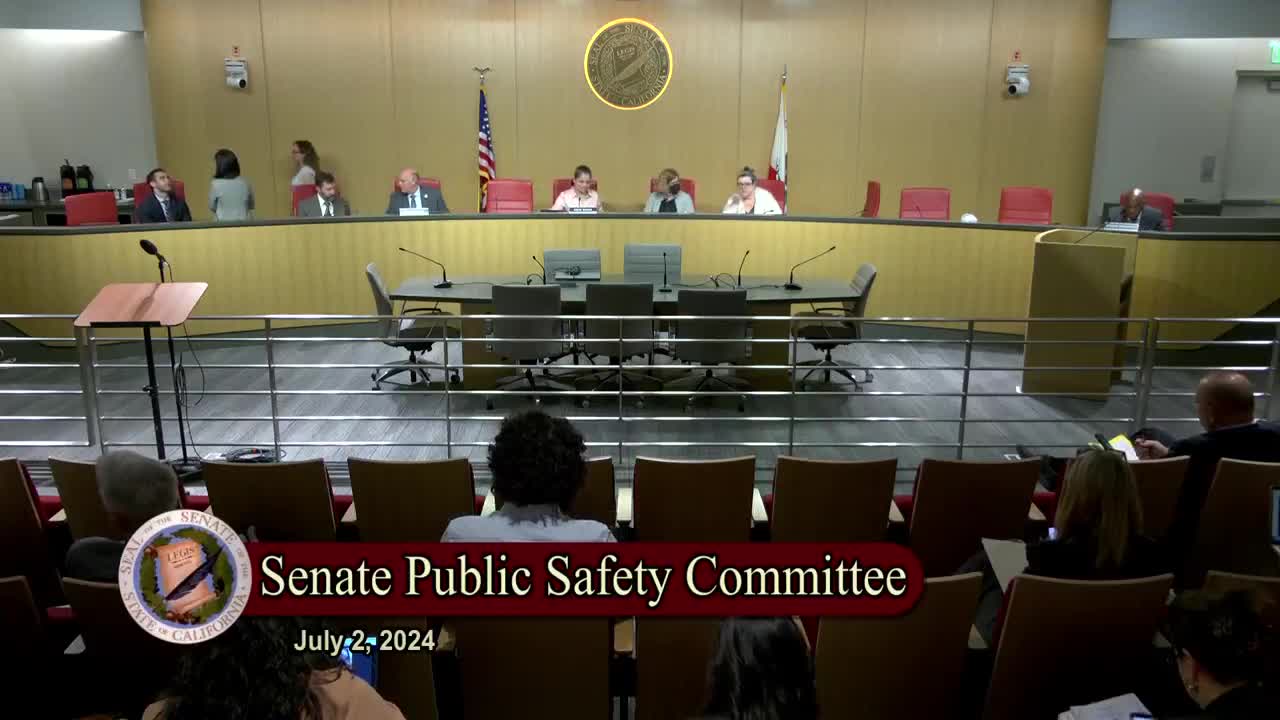 24MIN
Senate Standing Committee on Public Safety
 2MIN
Assembly Floor
 23MIN