AB 345: Habitat restoration: flood control: advance payments.
- Session Year: 2023-2024
- House: Assembly
- Latest Version Date: 2023-10-10
Current Status:
Passed
(2023-10-10: Chaptered by Secretary of State - Chapter 647, Statutes of 2023.)
Introduced
In Committee
First Chamber
In Committee
Second Chamber
Enacted
Existing law authorizes the Department of Water Resources to make examinations of lands subject to inundation and overflow by floodwaters and of the waters causing the inundation or overflow and to make plans and estimates of the cost of works to regulate and control the floodwaters. Existing law also vests in the department charge of all expenditures unless otherwise provided by law for all public works relating to general river and harbor improvements, including reclamation and drainage of lands. Existing law authorizes the department to cooperate and contract with any agency of the state or of the United States in order to carry out its powers and purposes.
Existing law establishes the Central Valley Flood Protection Board and authorizes the board to engage in various flood control activities along the Sacramento River, the San Joaquin River, their tributaries, and related areas.
This bill would authorize the department or the board to provide advance payments, as defined, to local agencies for projects that restore habitat for threatened and endangered species under state or federal law or improve flood protection, as provided. The bill would prohibit the amount of funds advanced by the department or the board to the local agency at any one time from exceeding 25% of the entire amount authorized to be provided under the funding agreement. The bill would require the project proponent to demonstrate a need for an advance payment and that the project proponent is sufficiently qualified to manage the project and the projects finances. The bill would require the funds to be spent within 6 months and would require the recipient to provide an accountability report to the department or the board on a quarterly basis, as specified.
Existing law authorizes the Department of Water Resources to make examinations of lands subject to inundation and overflow by floodwaters and of the waters causing the inundation or overflow and to make plans and estimates of the cost of works to regulate and control the floodwaters. Existing law also vests in the department charge of all expenditures unless otherwise provided by law for all public works relating to general river and harbor improvements, including reclamation and drainage of lands. Existing law authorizes the department to cooperate and contract with any agency of the state or of the United States in order to carry out its powers and purposes.
Existing law establishes the Central Valley Flood Protection Board and authorizes the board to engage in various flood control activities along the Sacramento River, the San Joaquin River, their tributaries, and related areas.
This bill would authorize the department or the board to provide advance payments, as defined, to local agencies for projects that restore habitat for threatened and endangered species under state or federal law or improve flood protection, as provided. The bill would prohibit the amount of funds advanced by the department or the board to the local agency at any one time from exceeding 25% of the entire amount authorized to be provided under the funding agreement between the department and the local agency. agreement. The bill would require the funds to be spent within 6 months and would require the recipient to provide an accountability report to the department or the board on a quarterly basis, as specified.
Existing law authorizes the Department of Water Resources to make examinations of lands subject to inundation and overflow by floodwaters and of the waters causing the inundation or overflow and to make plans and estimates of the cost of works to regulate and control the floodwaters. Existing law also vests in the department charge of all expenditures unless otherwise provided by law for all public works relating to general river and harbor improvements, including reclamation and drainage of lands. Existing law authorizes the department to cooperate and contract with any agency of the state or of the United States in order to carry out its powers and purposes.
This bill would authorize the department to provide advance payments, as defined, to local agencies for projects that restore habitat for threatened and endangered species under state or federal law or improve flood protection, as provided. The bill would prohibit the amount of funds advanced by the department to the local agency at any one time from exceeding 25% of the entire amount authorized to be provided under the funding agreement between the department and the local agency.
(a)The department and the board have discretion to provide advance payments to local agencies for projects that satisfy the following criteria:
(1)Have at least one of the following project purposes:
(A)Restoring habitat for threatened and endangered species under state or federal law.
(B)Improving flood protection.
(2)The project proponent has demonstrated, to either the departments or the boards satisfaction, a need for an advance payment.
(3)The project proponent has demonstrated, to either the departments or the boards satisfaction, that the project proponent is sufficiently qualified to manage the project and the projects finances.
(b)For a project for which an advance payment is made pursuant to this section, the amount of funds advanced by the department or the board to the local agency at any one time shall not exceed 25 percent of the entire amount authorized to be provided under the funding agreement with the local agency.
(c)A local agency may deposit funds advanced pursuant to this section in its treasury. Any interest earned on advanced funds shall be applied to the project for which funds were advanced.
(d)Funds advanced pursuant to this section shall be handled as follows:
(1)The funds shall be spent within six months of the date of receipt, unless the department or the board waives this requirement.
(2)The recipient shall, on a quarterly basis, provide an accountability report to the department or the board regarding the expenditure and use of any advanced grant funds that provides, at a minimum, the following information:
(A)An itemization as to how advance payment funds provided pursuant to this section have been expended.
(B)A project itemization as to how any remaining advance payment funds pursuant to this section will be expended over the period specified in paragraph (1).
(C)(i)Whether the funds are placed in a noninterest-bearing account and, if so, the date that occurred and the dates of withdrawals of funds from that account, if applicable.
(ii)If the funds are placed in an interest-bearing account, information on any interest that has accrued and, if the money has been expended, how it was expended.
(D)An evaluation of whether the project is on schedule. If the project is behind schedule, the report shall identify what has caused the delay and actions taken or that will be taken to remedy the delay.
(3)If the funds are not expended, the unused portion of the grant shall be returned to the department or the board within 60 days after project completion or the end of the grant performance period, whichever is earlier.
(4)The department or the board may adopt additional requirements for the recipient regarding the use of the advance payment to ensure that the funds are used properly.
(e)In light of the states interest in projects to restore habitat for threatened and endangered species or improve flood protection, the department or the board may reduce or eliminate any retention that would otherwise be withheld under a funding agreement for which funds are advanced under this section.
(f)For purposes of this section, the following terms have the following meanings:
(1)Advance payments means funds that are provided to a local agency before the local agency has incurred expenses in furtherance of a project described in subdivision (a) and that are provided by the department or the board to allow the local agency to fund the project on a cashflow basis.
(2)Board means the Central Valley Flood Protection Board.
(3)Department means the Department of Water Resources.
(a)The department and the board have discretion to provide advance payments to local agencies for projects that have at least one of the following project purposes: restoring habitat for threatened and endangered species under state or federal law or improving flood protection. For satisfy the following criteria:
(1)Have at least one of the following project purposes:
(A)Restoring habitat for threatened and endangered species under state or federal law.
(B)Improving flood protection.
(2)The project proponent has demonstrated, to either the departments or the boards satisfaction, a need for an advance payment.
(3)The project proponent has demonstrated, to either the departments or the boards satisfaction, that the project proponent is sufficiently qualified to manage the project and the projects finances.
(b)For a project for which an advanced advance payment is made pursuant to this section, the amount of funds advanced by the department or the board to the local agency at any one time shall not exceed 25 percent of the entire amount authorized to be provided under the funding agreement with the local agency.
(b)(c)A local agency may deposit funds advanced pursuant to this section in its treasury. Any interest earned on advanced funds shall be applied to the project for which funds were advanced.
(c)(d)Funds advanced pursuant to this section shall be handled as follows:
(1)The funds shall be spent within six months of the date of receipt, unless the department or the board waives this requirement.
(2)The recipient shall, on a quarterly basis, provide an accountability report to the department or the board regarding the expenditure and use of any advanced grant funds that provides, at a minimum, the following information:
(A)An itemization as to how advanced advance payment funds provided pursuant to this section have been expended.
(B)A project itemization as to how any remaining advanced advance payment funds pursuant to this section will be expended over the period specified in paragraph (1).
(C)(i)Whether the funds are placed in a noninterest-bearing account and, if so, the date that occurred and the dates of withdrawals of funds from that account, if applicable.
(ii)If the funds are placed in an interest-bearing account, information on any interest that has accrued and, if the money has been expended, how it was expended.
(D)An evaluation of whether the project is on schedule. If the project is behind schedule, the report shall identify what has caused the delay and actions taken or that will be taken to remedy the delay.
(3)If the funds are not expended, the unused portion of the grant shall be returned to the department or the board within 60 days after project completion or the end of the grant performance period, whichever is earlier.
(4)The department or the board may adopt additional requirements for the recipient regarding the use of the advanced advance payment to ensure that the funds are used properly.
(d)(e)In light of the states interest in projects to restore habitat for threatened and endangered species or improve flood protection, the department or the board may reduce or eliminate any retention that would otherwise be withheld under a funding agreement for which funds are advanced under this section.
(e)(f)For purposes of this section, the following terms have the following meanings:
(1)Advance payments means funds that are provided to a local agency before the local agency has incurred expenses in furtherance of a project described in subdivision (a) and that are provided by the department or the board to allow the local agency to fund the project on a cashflow basis.
(2)Board means the Central Valley Flood Protection Board.
(3)Department means the Department of Water Resources.
(a)The department and the board have discretion to provide advance payments to local agencies for projects that have at least one of the following project purposes: restoring habitat for threatened and endangered species under state or federal law or improving flood protection. For a project for which an advanced payment is made pursuant to this section, the amount of funds advanced by the department or the board to the local agency at any one time shall not exceed 25 percent of the entire amount authorized to be provided under the funding agreement with the local agency.
(b)A local agency may deposit funds advanced pursuant to this section in its treasury. Any interest earned on advanced funds shall be applied to the project for which funds were advanced.
(c)Funds advanced pursuant to this section shall be handled as follows:
(1)The funds shall be spent within six months of the date of receipt, unless the department or the board waives this requirement.
(2)The recipient shall, on a quarterly basis, provide an accountability report to the department or the board regarding the expenditure and use of any advanced grant funds that provides, at a minimum, the following information:
(A)An itemization as to how advanced payment funds provided pursuant to this section have been expended.
(B)A project itemization as to how any remaining advanced payment funds pursuant to this section will be expended over the period specified in paragraph (1).
(C)Whether the funds are placed in a noninterest-bearing account and, if so, the date that occurred and the dates of withdrawals of funds from that account, if applicable.
(D)An evaluation of whether the project is on schedule. If the project is behind schedule, the report shall identify what has caused the delay and actions taken or that will be taken to remedy the delay.
(3)If the funds are not expended, the unused portion of the grant shall be returned to the department or the board within 60 days after project completion or the end of the grant performance period, whichever is earlier.
(4)The department or the board may adopt additional requirements for the recipient regarding the use of the advanced payment to ensure that the funds are used properly.
(d)In light of the states interest in projects to restore habitat for threatened and endangered species or improve flood protection, the department or the board may reduce or eliminate any retention that would otherwise be withheld under a funding agreement for which funds are advanced under this section.
(e)For purposes of this section, the following terms have the following meanings:
(1)Advance payments means funds that are provided to a local agency before the local agency has incurred expenses in furtherance of a project described in subdivision (a) and that are provided by the department or the board to allow the local agency to fund the project on a cashflow basis.
(2)Board means the Central Valley Flood Protection Board.
(3)Department means the Department of Water Resources.
SECTION 1.Section 133.5 is added to the Water Code, to read:133.5.(a)The department has discretion to provide advance payments to local agencies for projects that have at least one of the following project purposes: restoring habitat for threatened and endangered species under state or federal law or improving flood protection. The amount of funds advanced by the department to the local agency at any one time shall not exceed 25 percent of the entire amount authorized to be provided under the funding agreement between the department and the local agency. In light of the states interest in these projects, the department may reduce or eliminate any retention that would otherwise be withheld under the funding agreement.(b)For purposes of this section, advance payments are funds that are provided to a local agency before the local agency has incurred expenses in furtherance of a project described in subdivision (a) and that are provided by the department to allow the local agency to fund the project on a cashflow basis. REVISIONS: HeadingLine 2.(a)The department has discretion to provide advance payments to local agencies for projects that have at least one of the following project purposes: restoring habitat for threatened and endangered species under state or federal law or improving flood protection. The amount of funds advanced by the department to the local agency at any one time shall not exceed 25 percent of the entire amount authorized to be provided under the funding agreement between the department and the local agency. In light of the states interest in these projects, the department may reduce or eliminate any retention that would otherwise be withheld under the funding agreement.
(b)For purposes of this section, advance payments are funds that are provided to a local agency before the local agency has incurred expenses in furtherance of a project described in subdivision (a) and that are provided by the department to allow the local agency to fund the project on a cashflow basis.
|
Date
|
Status
|
|---|---|
| Oct 10, 2023 | Chaptered by Secretary of State - Chapter 647, Statutes of 2023. |
| Oct 10, 2023 | Approved by the Governor. |
| Sep 20, 2023 | Enrolled and presented to the Governor at 4 p.m. |
| Sep 13, 2023 | Senate amendments concurred in. To Engrossing and Enrolling. (Ayes 79. Noes 0. Page 3440.). |
| Sep 12, 2023 | In Assembly. Concurrence in Senate amendments pending. |
| Sep 12, 2023 | Read third time. Passed. Ordered to the Assembly. (Ayes 39. Noes 0. Page 2685.). |
| Sep 8, 2023 | Ordered to special consent calendar. |
| Sep 5, 2023 | Read second time. Ordered to third reading. |
| Sep 1, 2023 | From committee: Do pass. (Ayes 7. Noes 0.) (September 1). |
| Jul 10, 2023 | In committee: Referred to APPR. suspense file. |
| Jun 26, 2023 | Read second time and amended. Re-referred to Com. on APPR. |
| Jun 22, 2023 | From committee: Amend, and do pass as amended and re-refer to Com. on APPR. (Ayes 11. Noes 0.) (June 22). |
| Jun 7, 2023 | Referred to Com. on N.R. & W. |
| May 26, 2023 | In Senate. Read first time. To Com. on RLS. for assignment. |
| May 25, 2023 | Read third time. Passed. Ordered to the Senate. (Ayes 78. Noes 0. Page 1759.) |
| May 18, 2023 | Read second time. Ordered to third reading. |
| May 18, 2023 | From committee: Do pass. (Ayes 15. Noes 0.) (May 18). |
| May 3, 2023 | In committee: Set, first hearing. Referred to APPR. suspense file. |
| Apr 26, 2023 | In committee: Hearing postponed by committee. |
| Mar 28, 2023 | From committee: Do pass and re-refer to Com. on APPR. (Ayes 15. Noes 0.) (March 28). Re-referred to Com. on APPR. |
| Mar 28, 2023 | Coauthors revised. |
| Mar 21, 2023 | Re-referred to Com. on W., P., & W. |
| Mar 20, 2023 | From committee chair, with author's amendments: Amend, and re-refer to Com. on W., P., & W. Read second time and amended. |
| Feb 9, 2023 | Referred to Com. on W., P., & W. |
| Feb 1, 2023 | From printer. May be heard in committee March 3. |
| Jan 31, 2023 | Read first time. To print. |
|
Date
|
Description
|
Location
|
Votes
|
|
|---|---|---|---|---|
| Sep 13, 2023 | AB 345 Wilson Concurrence in Senate Amendments | Assembly Floor |
Passed |
|
| Sep 12, 2023 | Special Consent AB345 Wilson et al. By Dodd | Senate Floor |
Passed |
|
| Sep 1, 2023 | Do pass | Senate Standing Committee on Appropriations |
Passed |
|
| Jul 10, 2023 | Placed on suspense file | Senate Standing Committee on Appropriations |
Passed |
|
| Jun 22, 2023 | Do pass as amended, but first amend, and re-refer to the Committee on [Appropriations] | Senate Standing Committee on Natural Resources and Water |
Passed |
|
| May 25, 2023 | AB 345 Wilson Assembly Third Reading | Assembly Floor |
Passed |
|
| May 18, 2023 | Do pass. | Assembly Standing Committee on Appropriations |
Passed |
|
| Mar 28, 2023 | Do pass and be re-referred to the Committee on [Appropriations] | Assembly Standing Committee on Water, Parks, and Wildlife |
Passed |
This list shows positions taken on this bill by organizations on the date displayed, which is linked to the original source.
Positions by individuals are not included.
|
Organization
|
Position
|
Date
|
|---|---|---|
| California Central Valley Flood Control Association | ** Support | |
| California State Association Of Counties | ** Support | |
| County of Monterey | ** Support | |
| East Bay Regional Park District | ** Support | |
| Knights Landing Ridge Drainage District | ** Support | |
| Little Egbert Joint Powers Agency | ** Support | |
| Midpeninsula Regional Open Space District | ** Support | |
| Northern California Water Association | ** Support | |
| Reclamation District 108 | ** Support | |
| Reclamation District 17 | ** Support | |
| Reclamation District 2033 | ** Support | |
| Reclamation District 2037 | ** Support | |
| Reclamation District 2068 | ** Support | |
| Reclamation District 2084 | ** Support | |
| Reclamation District 2140 | ** Support | |
| Reclamation District 3 | ** Support | |
| Reclamation District 349 | ** Support | |
| Reclamation District 999 | ** Support | |
| Sacramento River Westside Levee District | ** Support | |
| San Joaquin Area Flood Control Agency | ** Support | |
| Solano County Board of Supervisors | ** Support | |
| Solano County Water Agency | ** Support | |
| Sutter Butte Flood Control Agency | ** Support | |
| The Nature Conservancy | ** Support | |
| Three Rivers Levee Improvement Authority | ** Support | |
| Yuba Water Agency | ** Support |
CONCURRENCE IN SENATE AMENDMENTS
CSA1 Bill Id:AB 345
Author:(Wilson)
As Amended Ver:June 26, 2023
Majority vote
SUMMARY
Authorizes the Department of Water Resources (DWR) and the Central Valley Flood Protection Board (CVFPB) to provide advance payments, as specified, to local agencies for projects that restore habitat for threatened and endangered species under state or federal law or improve flood protection.
Senate Amendments
- Require the project proponent to demonstrate a need for an advance payment and that the project proponent is sufficiently qualified to manage the project and the project's finances.
- Require, as part of the accountability report required on a quarterly basis, information on any interest that has accrued if the funds are placed in an interest-bearing account, and, if the money has been expended, how it was expended.
COMMENTS
Reimbursement follows expenditure for most grants supported with state funding. For many grant recipients, it can be a financial hardship to bear the costs of a project until reimbursement. Some local agencies that develop flood or multi-benefit projects are small and have limited funds. These agencies may have annual budgets that are dwarfed by the magnitude of the capital projects they implement. In addition, Proposition 218 (California Constitution Article XIII C and Article XIII D) requires funds collected by local agencies to be used only for specific purposes, and those funds may not be eligible, or sufficient, to cover the entire cost of capital projects. This can result in cash flow challenges for the local agency.
This bill provides broad permissive authority to DWR and CVFPB to advance up to 25% of a funded project at a time for projects that restore habitat for threatened and endangered species under state or federal law or improve flood protection. DWR has many grant programs to which the new authority in this bill might apply. Eligible programs might include the Delta Levees Special Flood Control Projects, the Flood Corridor Program, the Urban Streams Restoration Program, the Urban Flood Risk Reduction Program, the Small Community Flood Risk Reduction Program, and the Flood Control Subventions Program, among others.
DWR provides advance payments of Integrated Regional Water Management Plan (IRWMP) grants for projects that meet specified criteria. The IRWMP advance payment mechanism, authorized by SB 208 (Lara), Chapter 675, Statutes of 2015, was established to eliminate reimbursement delays following the project proponent incurring expenses. For IRWMP grants, DWR provides advanced payment of the first 50% or $500,000, whichever is less, of the grant award for projects where the proponent is a nonprofit organization or a disadvantaged community (DAC), the project benefits a DAC, and the grant award is less than $1 million.
According to the Author
"As recent high water events have shown, California remains vulnerable to floods that risk life and property. While our State continues to make progress in flood protection, with the help of local agencies, there remains much work to be done. Similarly, local agencies are helping to restore habitat to protect and restore many species, including threatened and endangered species, often with State funding. However, much work remains to implement multi-benefit projects that can both protect our communities from flooding while also improving the environment. Our smaller and local agencies need advanced payment discretion provided to DWR by [this bill] to ensure that their work can be accomplished."
Arguments in Support
Numerous local agencies write in support, stating that advancing funds will eliminate a major obstacle to financing the development and delivery of these important projects, and should in turn accelerate the pace of flood risk reduction and habitat restoration.
Arguments in Opposition
No opposition on file.
FISCAL COMMENTS
According to the Senate Appropriations Committee, DWR and CVFPB anticipate minor and absorbable costs as a result of this bill. However, if DWR or CVFPB are unable to recover unused or misused advanced funds from grantees, this bill would result in losses of state monies, potentially in the hundreds of thousands of dollars (General Fund, special fund, or bond funds).
VOTES:
ASM WATER, PARKS, AND WILDLIFE: 15-0-0
YES: Bauer-Kahan, Mathis, Alanis, Bennett, Megan Dahle, Davies, Friedman, Hart, Wood, Pellerin, Blanca Rubio, Schiavo, Villapudua, Ward, Weber
ASM APPROPRIATIONS: 15-0-1
YES: Holden, Megan Dahle, Bryan, Calderon, Wendy Carrillo, Dixon, Mike Fong, Hart, Lowenthal, Mathis, Papan, Pellerin, Sanchez, Weber, Ortega
ABS, ABST OR NV: Robert Rivas
ASSEMBLY FLOOR: 78-0-2
YES: Addis, Alanis, Alvarez, Arambula, Bains, Bauer-Kahan, Bennett, Berman, Boerner, Bonta, Bryan, Calderon, Juan Carrillo, Wendy Carrillo, Cervantes, Chen, Connolly, Megan Dahle, Davies, Dixon, Essayli, Flora, Mike Fong, Vince Fong, Friedman, Gabriel, Gallagher, Garcia, Gipson, Grayson, Haney, Hart, Holden, Hoover, Irwin, Jackson, Jones‑Sawyer, Kalra, Lackey, Lee, Low, Lowenthal, Maienschein, McCarty, McKinnor, Muratsuchi, Stephanie Nguyen, Ortega, Pacheco, Papan, Jim Patterson, Joe Patterson, Pellerin, Petrie-Norris, Quirk-Silva, Ramos, Reyes, Luz Rivas, Robert Rivas, Rodriguez, Blanca Rubio, Sanchez, Santiago, Schiavo, Soria, Ta, Ting, Valencia, Villapudua, Waldron, Wallis, Ward, Weber, Wicks, Wilson, Wood, Zbur, Rendon
ABS, ABST OR NV: Aguiar-Curry, Mathis
UPDATED
VERSION: June 26, 2023
CONSULTANT: Keith Cialino / W., P., & W. / (916) 319-2096 FN: 0002267
SENATE RULES COMMITTEE Office of Senate Floor Analyses (916) 651-1520 Fax: (916) 327-4478 | AB 345 |
THIRD READING
Bill No: AB 345
Author: Wilson (D), et al.
Amended: 6/26/23 in Senate
Vote: 21
SENATE NATURAL RES. & WATER COMMITTEE: 11-0, 6/22/23
AYES: Min, Seyarto, Allen, Dahle, Grove, Hurtado, Laird, Limón, McGuire, Padilla, Stern
SENATE APPROPRIATIONS COMMITTEE: 7-0, 9/1/23
AYES: Portantino, Jones, Ashby, Bradford, Seyarto, Wahab, Wiener
ASSEMBLY FLOOR: 78-0, 5/25/23 - See last page for vote
SUBJECT: Habitat restoration: flood control: advance payments
SOURCE: Little Egbert Joint Powers Agency
DIGEST:
This bill authorizes the Department of Water Resources (DWR) or the Central Valley Flood Protection Board (CVFPB) to provide advance payments to local agencies for projects that will either restore habitat for threatened and endangered species, improve flood protection, or both, and that meet specified requirements.
ANALYSIS:
Existing law:
- Requires DWR, within 60 days of receiving specified project information relating to grants for projects included and implemented in an integrated regional water management plan, to provide advance payment of 50 percent of the grant award for projects where the project proponent is a nonprofit organization or a disadvantaged community, or the project benefits a disadvantaged community, and the grant award for the project is less than $1 million. These advance payment provisions sunset on January 1, 2025. (Water Code (Wat. C.) §§10551, 10552)
- Authorizes, until January 1, 2024, certain state entities to make grants and direct expenditures for interim or immediate relief in response to conditions arising from a drought scenario to address immediate impacts on human health and safety, address immediate impacts on fish and wildlife resources, or provide water to persons or communities that lose or are threatened with the loss or contamination of water supplies. Authorizes those entities to provide advance payment of up to 25 percent of grant funds to specified entities that have demonstrated cashflow problems. (Wat. C. §§13198.2, 13198.4)
- Establishes an advance payment pilot program which authorizes administering state agencies to make advance payments in accordance with certain requirements such as demonstrating good standing with the Internal Revenue Service, depositing the funds into a federally insured interest-bearing account that provides the ability to track interest earned, and providing quarterly progress reports, among others. This pilot program will sunset July 1, 2025. (Government Code (Govt. C.) §11019.1)
This bill:
- Authorizes DWR and CVFPB to provide advance payments to local agencies for projects that satisfy all of the following:
- Have the purpose of either restoring habitat for threatened and endangered species under state or federal law, improving flood protection, or both.
- The project proponent has demonstrated, to either DWR or CVFPB’s satisfaction, the need for an advance payment.
- The project proponent has demonstrated, either to DWR or CVFPB’s satisfaction, that the project proponent is sufficiently qualified to manage the project and the project’s finances.
- Limits the amount of funds advanced by DWR or CVFPB to the local agency at any one time to 25 percent of the entire amount authorized under the funding agreement.
- Authorizes a local agency to deposit such funds advanced in its treasury and requires that any interest earned on the advanced funds be applied to the project for which the funds were advanced.
- Requires funds advanced under these provisions to be spent within six months of the date of receipt, unless DWR or CVFPB waives this requirement.
- Requires the recipient, on a quarterly basis, to provide an accountability report to DWR or CVFPB regarding the expenditure and use of the advanced grant funds with specified information.
- Requires unexpended funds be returned to DWR or CVFPB within 60 days after project completion or the end of the grant performance period, whichever is earlier.
- Authorizes DWR or CVFPB to adopt additional requirements to ensure the funds are being used properly.
- Authorizes DWR or CVFPB to reduce or eliminate any retention that would otherwise be withheld under the funding agreement.
Background
- General background. DWR manages California’s water resources, systems, and infrastructure. Its responsibilities, among other things, include the construction and management of the State Water Resources Development System, commonly known as the State Water Project; preventing and responding to floods, droughts, and catastrophic events; restoring habitats; and planning for future water needs, climate change impacts, and flood protection.
CVFPB is the state regulatory agency responsible for ensuring that appropriate standards are met for the construction, maintenance, and protection of the flood control system that protects life, property, and wildlife habitat in the Central Valley from the effects of flooding. CVFPB issues encroachment permits and works closely with DWR and other agencies to improve flood protection structures.
- Grant payments. In the grant funding allocation process, many state agencies typically issue grant payments as reimbursements following the approval of receipts. Grantees are responsible for covering the costs of the project upfront. Local entities claim that it is not unusual for a number of months to pass between the time grant-related expenses are incurred and the reimbursement is received, which can be difficult for organizations that do not have sufficient capital.
For many grant recipients, including nonprofit organizations or disadvantaged communities, this can be a financial hardship. While many state agencies may reimburse any interest incurred for bridge loans as an allowable grant expense, some organizations do not have the resources to qualify for a market rate loan. Some organizations may decline to apply for grant funding due to the likely delays in the reimbursement processes.
Numerous water bonds, including Proposition 1 of 2014 (Chapter 188, Statutes of 2014) and Proposition 68 of 2018 (Chapter 852, Statutes of 2017), provide grant funding for projects that address habitat restoration and/or flood control. Additionally, Proposition 68 included specific advance payment requirements for integrated regional water management plan projects that received funding under the proposition.
- Advance payments. Advance payment of grant funds can help to limit issues with reimbursement timelines and the need for bridge loans. Typically, a percentage of the total grant is advanced to the recipient before or while expenses are incurred. This allows the grant recipient to use grant funds to start the grant project and requires less cash on hand to pay for grant expenses. Any remaining funds in the grant are usually repaid through the standard reimbursement process.
- Examples of the current use of advance payments. Last year in AB 156 (Committee on Budget, Chapter 569, Statutes of 2022), the Legislature established an advance payment pilot program which authorizes administering state agencies to make advance payments in accordance with certain requirements such as demonstrating good standing with the Internal Revenue Service, depositing the funds into a federally insured interest-bearing account that provides the ability to track interest earned, and providing quarterly progress reports. This pilot program will sunset July 1, 2025. (Govt. C. §11019.1)
DWR may provide advance payments of Integrated Regional Water Management Program (IRWMP) grants for projects that meet specified criteria. For IRWMP grants, advanced payment of the first 50 percent or $500,000, whichever is less, of the grant award is provided for projects that satisfy specified criteria, including that the proponent is a nonprofit organization or a disadvantaged community, or the project benefits a disadvantaged community, and that the grant award is less than $1 million.
Other examples of advance payments include:
- Specified state entities, including the California Environmental Protection Agency and the California Natural Resources Agency, are authorized to advance to a community-based private nonprofit agency up to 25 percent of the annual allocation if the Department of Finance determines that the community-based private nonprofit agency has modest reserves and potential cashflow problems. The specified state entities are required to develop a plan to establish control procedures for advance payments, subject to approval by the Department of Finance. (Govt. C.§11019)
- Under the Fire Prevention Grants Program, the director of CalFIRE may, until January 1, 2024, authorize advance payments for grants awarded under the program, not to exceed 25 percent of the total grant award. The grantee is required to expend the advanced funds within six months of receipt and is required to file an accountability report with CalFIRE every four months. (Public Resources Code (PRC) §4124.5)
- Under the California Urban Forestry Act, the director of CalFIRE may authorize advance payments, not to exceed 25 percent of the total grant award, to a nonprofit organization that is located in or providing services to disadvantaged or low-income communities. (PRC §4799.12)
- The Department of Transportation, as a part of the Clean California Local Grant Program of 2021, is authorized to provide advance payment if the applicant, among other things, is a public agency, requests an advance payment in its initial grant application, has a record of good financial management, offers sufficient capital as security, and demonstrates financial needs, as specified. (Streets & Highways Code §91.41)
Comments
- Author’s statement. According to the author, “As recent high water events have shown, California remains vulnerable to floods that risk life and property. While our State continues to make progress in flood protection, with the help of local agencies, there remains much work to be done. Similarly, local agencies are helping to restore habitat to protect and restore many species, including threatened and endangered species, often with State funding. However, much work remains to implement multi-benefit projects that can both protect our communities from flooding while also improving the environment. Our smaller and local agencies need advanced payment
- Eligible funding programs. This bill authorizes DWR and CVFPB to advance up to 25 percent of a funded project at a time for projects that restore habitat for threatened and endangered species under state or federal law or improve flood protection. DWR has many grant programs to which the new authority in this bill might apply. Eligible programs might include, among others, the Delta Levees Special Flood Control Projects, the Flood Corridor Program, the Riverine Stewardship Program, the Urban Streams Restoration Program, the Coastal Watershed Flood Risk Reduction Program, the Central Valley Tributaries Program, the Urban Flood Risk Reduction Program, the Small Community Flood Risk Reduction Program, and the Flood Control Subventions Program (see https://water.ca.gov/Work-With-Us/Grants-And-Loans for more information).
Currently active grant programs with available funding include the Division of Multi-Benefit Initiatives Delta Levees Special Flood Control Projects, the Riverine Stewardship Program, and the Urban Streams Restoration Program. According to the DWR website, the Division of Multi-Benefit Initiatives Delta Levees Special Flood Control Projects already allows for advance payments. To the extent requirements of this bill are not already a part of the Division of Multi-Benefit Initiatives Delta Levees Special Flood Projects advance payment program, the requirements of this bill would also apply to that program.
This session, the Legislature has four bond proposals (SB 638 (Eggman), SB 867(Allen), AB 305 (Villapudua), and AB 1567 (Garcia), each setting aside money for grant programs that would be covered by this bill.
- Advance payment pilot project. Last year, AB 156 created a pilot program authorizing state entities to provide advance payments of up to 25 percent for state-funded local assistance grants. The pilot program, which sunsets July 1, 2025, imposes various requirements, some of which overlap with the requirements of this bill, and some of which do not. The Legislature may wish to consider whether, at some point, the various advance payment programs provided under existing law should be harmonized with that pilot program or if specific types of projects warrant specifically-tailored advance payment programs.
FISCAL EFFECT: Appropriation: No Fiscal Com.: Yes Local: No
According to the Senate Appropriations Committee, DWR and CVFPB anticipate minor and absorbable costs as a result of this bill. However, if DWR or CVFPB were unable to recover unused or misused advanced funds from grantees, this bill would result in losses of state monies, potentially in the hundreds of thousands of dollars (General Fund, special fund, or bond funds)
SUPPORT: (Verified 9/1/23)
Little Egbert Joint Powers Agency (source)
California Central Valley Flood Control Association
California State Association of Counties
County of Monterey
East Bay Regional Park District
Knights Landing Ridge Drainage District
Midpeninsula Regional Open Space District
Northern California Water Association
Reclamation District 3
Reclamation District 17
Reclamation District 108
Reclamation District 349
Reclamation District 999
Reclamation District 2033
Reclamation District 2037
Reclamation District 2068
Reclamation District 2084
Reclamation District 2140
Sacramento River West Side Levee District
San Joaquin Area Flood Control Agency
Solano County Board of Supervisors
Solano County Water Agency
Sutter Butte Flood Control Agency
The Nature Conservancy
Three Rivers Levee Improvement Authority
Yuba Water Agency
OPPOSITION: (Verified 9/1/23)
None received
ARGUMENTS IN SUPPORT: According to the Little Egbert Joint Powers Agency (LEJPA), sponsor of the bill, “AB 345 is necessary for small, local agencies like LEJPA with limited funding to develop larger-scale flood protection and/or habitat restoration projects. These agencies commonly have annual budgets dwarfed by the magnitude of the capital projects they implement. In many cases, DWR cannot provide funds to local agencies until after the local agency has paid project expenses. This means the local agency not only pays for their share of these projects, but also finances the State share until the State provides reimbursement. These types of financial challenges stifle the development of much-needed flood protection and restoration projects. The discretion offered by AB 345 will enable DWR to resolve these issues when it determines appropriate to do so.”
ASSEMBLY FLOOR: 78-0, 5/25/23
AYES: Addis, Alanis, Alvarez, Arambula, Bains, Bauer-Kahan, Bennett, Berman, Boerner, Bonta, Bryan, Calderon, Juan Carrillo, Wendy Carrillo, Cervantes, Chen, Connolly, Megan Dahle, Davies, Dixon, Essayli, Flora, Mike Fong, Vince Fong, Friedman, Gabriel, Gallagher, Garcia, Gipson, Grayson, Haney, Hart, Holden, Hoover, Irwin, Jackson, Jones-Sawyer, Kalra, Lackey, Lee, Low, Lowenthal, Maienschein, McCarty, McKinnor, Muratsuchi, Stephanie Nguyen, Ortega, Pacheco, Papan, Jim Patterson, Joe Patterson, Pellerin, Petrie-Norris, Quirk-Silva, Ramos, Reyes, Luz Rivas, Robert Rivas, Rodriguez, Blanca Rubio, Sanchez, Santiago, Schiavo, Soria, Ta, Ting, Valencia, Villapudua, Waldron, Wallis, Ward, Weber, Wicks, Wilson, Wood, Zbur, Rendon
NO VOTE RECORDED: Aguiar-Curry, Mathis
Prepared by: Genevieve Wong / N.R. & W. / (916) 651-4116
9/4/23 8:55:06
**** END ****
SENATE COMMITTEE ON
Senator Anthony Portantino, Chair
2023 - 2024 Regular Session
AB 345 (Wilson) - Habitat restoration: flood control: advance payments
Version: | Policy Vote: |
Urgency: | Mandate: |
Hearing Date: | Consultant: |
Bill Summary:
This bill would authorize the Department of Water Resources (DWR) and the Central Valley Flood Protection Board (CVFPB) to provide advance payments to local agencies for projects that restore habitat for threatened and endangered species under state or federal law or improve flood protection.
Fiscal Impact:
- DWR and CVFPB anticipate minor and absorbable costs as a result of this bill. However, if DWR or CVFPB were unable to recover unused or misused advanced funds from grantees, this bill would result in losses of state monies, potentially in the hundreds of thousands of dollars (General Fund, special fund, or bond funds).
Background:
Numerous water bonds, including Proposition 1 of 2014 (Chapter 188, Statutes of 2014) and Proposition 68 of 2018 (Chapter 852, Statutes of 2017), provide grant funding for projects that address habitat restoration and/or flood control. Additionally, Proposition 68 included specific advance payment requirements for integrated regional water management plan projects that received funding under the proposition.
Grant payments. In the grant funding allocation process, many state agencies typically issue grant payments as reimbursements following the approval of receipts. Grantees are responsible for covering the costs of the project upfront. Local entities claim that it is not unusual for a number of months to pass between the time grant-related expenses are incurred and the reimbursement is received, which can be difficult for organizations that do not have sufficient capital.
For many grant recipients, including nonprofit organizations or disadvantaged communities, this can be a financial hardship. While many state agencies may reimburse any interest incurred for bridge loans as an allowable grant expense, some organizations do not have the resources to qualify for a market rate loan. Some organizations may decline to apply for grant funding due to the likely delays in the reimbursement processes.
Advance payments. Advance payment of grant funds can help to limit issues with reimbursement timelines and the need for bridge loans. Typically, a percentage of the total grant is advanced to the recipient before or while expenses are incurred. This allows the grant recipient to use grant funds to start the grant project and requires less cash on hand to pay for grant expenses. Any remaining funds in the grant are usually repaid through the standard reimbursement process.
Proposed Law:
This bill would authorize DWR and CVFPB to provide advance payments to local agencies for projects that restore habitat for threatened and endangered species under state or federal law or improve flood protection. Specifically, it would:
- Authorize DWR and CVFPB to provide advance payments to local agencies for projects that have the purpose of either restoring habitat for threatened and endangered species under state or federal law, improving flood protection, or both.
- Require the project proponent to demonstrate a need for an advance payment and that the project proponent is sufficiently qualified to manage the project and the project’s finances.
- Limit the amount of funds advanced by DWR or CVFPB to the local agency at any one time to 25 percent of the entire amount authorized under the funding agreement.
- Authorize a local agency to deposit such funds advanced in its treasury and requires that any interest earned on the advanced funds be applied to the project for which the funds were advanced.
- Require funds advanced under these provisions to be spent within six months of the date of receipt, unless DWR or CVFPB waives this requirement.
- Require the recipient, on a quarterly basis, to provide an accountability report to DWR or CVFPB regarding the expenditure and use of the advanced grant funds with specified information.
- Require unexpended funds be returned to DWR or CVFPB within 60 days after project completion or the end of the grant performance period, whichever is earlier.
- Authorize DWR or CVFPB to adopt additional requirements to ensure the funds are being used properly.
- Authorize DWR or CVFPB to reduce or eliminate any retention that would otherwise be withheld under the funding agreement.
Related Legislation:
AB 297 (Vince Fong) of the current legislative session, would extend the sunset date from January 1, 2024, to January 1, 2034, for the director of CalFire to authorize advance payments from a local assistance grant for fire prevention and home hardening education activities.
AB 590 (Hart) of the current legislative session, would authorize a state agency administering a grant program to provide an advance payment to a recipient 501(c)(3) non-profit organization.
AB 882 (Davies) of the current legislative session, would provide explicit authority to the California Coastal Conservancy to provide advance payments under its grant programs. AB 882 is pending before this committee.
AB 2519 (Wood, 2020) would have required advance payment of up to 25 percent of grants awarded by the California Natural Resources Agency and the State Water Resources Control Board when requested by a grant recipient. AB 2519 was not given a hearing in policy committee.
AB 2060 (E. Garcia, 2017) would have created an advanced payment mechanism for the State Water Pollution Control Revolving Fund Small Community Grant Program and specified drinking water grant programs funded by Proposition 1 administered by the State Water Resources Control Board. AB 2060 was vetoed by Governor Brown.
AB 2064 (Gloria, 2017) would have required DWR to provide advance funding of any remaining grant funds under IRWMP to project proponents that have received a prior advanced payment, satisfied all quarterly reporting requirements, and submitted a first one-half project accountability report to the DWR. AB 2064 was vetoed by Governor Brown.
SB 208 (Lara, Chapter 675, Statutes of 2015) requires DWR to provide advance funding of IRWMP grants less than $1 million when the project proponent is a nonprofit organization or a disadvantaged community, or the project benefits a disadvantaged community.
Staff Comments:
DWR has many grant programs to which the new authority in this bill might apply. Eligible programs might include, among others, the Delta Levees Special Flood Control Projects, the Flood Corridor Program, the Riverine Stewardship Program, the Urban Streams Restoration Program, the Coastal Watershed Flood Risk Reduction Program, the Central Valley Tributaries Program, the Urban Flood Risk Reduction Program, the Small Community Flood Risk Reduction Program, and the Flood Control Subventions Program.
Currently active grant programs with available funding include the Division of Multi-Benefit Initiatives Delta Levees Special Flood Control Projects, the Riverine Stewardship Program, and the Urban Streams Restoration Program. According to the DWR website, the Division of Multi-Benefit Initiatives Delta Levees Special Flood Control Projects already allows for advance payments. To the extent requirements of this bill are not already a part of the Division of Multi-Benefit Initiatives Delta Levees Special Flood Projects advance payment program, the requirements of this bill would also apply to that program.
This year, the Legislature has four bond proposals (SB 638 (Eggman), SB 867(Allen), AB 305 (Villapudua), and AB 1567 (Garcia), each setting aside money for grant programs that would be covered by this bill.
-- END --
SENATE COMMITTEE ON NATURAL RESOURCES AND WATER
Senator Dave Min, Chair
2023 - 2024 Regular
Bill No: AB 345 Hearing Date: June 22, 2023
Author: | |||
Version: | Amended | ||
Urgency: | Fiscal: | ||
Consultant: | |||
Subject: Habitat restoration: flood control: advance payments
BACKGROUND AND EXISTING LAW
The Department of Water Resources (DWR) manages California’s water resources, systems, and infrastructure. Its responsibilities, among other things, include:
- The construction and management of the State Water Resources Development System, commonly known as the State Water Project.
- Preventing and responding to floods, droughts, and catastrophic events.
- Restoring habitats.
- Planning for future water needs, climate change impacts, and flood protection.
The Central Valley Flood Protection Board (CVFPB) is the state regulatory agency responsible for ensuring that appropriate standards are met for the construction, maintenance, and protection of the flood control system that protects life, property, and wildlife habitat in the Central Valley from the effects of flooding. CVFPB issues encroachment permits and works closely with DWR and other agencies to improve flood protection structures.
Numerous water bonds, including Proposition 1 of 2014 (Chapter 188, Statutes of 2014) and Proposition 68 of 2018 (Chapter 852, Statutes of 2017), provide grant funding for projects that address habitat restoration and/or flood control. Additionally, Proposition 68 included specific advance payment requirements for integrated regional water management plan projects that received funding under the proposition.
Grant payments. In the grant funding allocation process, many state agencies typically issue grant payments as reimbursements following the approval of receipts. Grantees are responsible for covering the costs of the project upfront. Local entities claim that it is not unusual for a number of months to pass between the time grant-related expenses are incurred and the reimbursement is received, which can be difficult for organizations that do not have sufficient capital.
For many grant recipients, including nonprofit organizations or disadvantaged communities, this can be a financial hardship. While many state agencies may reimburse any interest incurred for bridge loans as an allowable grant expense, some organizations do not have the resources to qualify for a market rate loan. Some organizations may decline to apply for grant funding due to the likely delays in the reimbursement processes.
Advance payments. Advance payment of grant funds can help to limit issues with reimbursement timelines and the need for bridge loans. Typically, a percentage of the total grant is advanced to the recipient before or while expenses are incurred. This allows the grant recipient to use grant funds to start the grant project and requires less cash on hand to pay for grant expenses. Any remaining funds in the grant are usually repaid through the standard reimbursement process.
Examples of the current use of advance payments.
DWR has authority to provide advance payments of Integrated Regional Water Management Program (IRWMP) grants for projects that meet specified criteria. The IRWMP advance payment mechanism was established to eliminate reimbursement delays following the project proponent incurring expenses. For IRWMP grants, advanced payment of the first 50 percent or $500,000, whichever is less, of the grant award is provided for projects that satisfy specified criteria, including that the proponent is a nonprofit organization or a disadvantaged community, or the project benefits a disadvantaged community, and that the grant award is less than $1 million.
Last year in AB 156 (Chapter 569, Statutes of 2022), the Legislature established an advance payment pilot program which authorizes administering state agencies to make advance payments in accordance with certain requirements such as demonstrating good standing with the Internal Revenue Service, depositing the funds into a federally insured interest-bearing account that provides the ability to track interest earned, and providing quarterly progress reports, among others. This pilot program will sunset July 1, 2025. (Government Code (Govt. C.) §11019.1)
Other examples of advance payments include:
- Specified state entities, including the California Environmental Protection Agency, and its boards and departments contained within, are authorized to advance to a community-based private nonprofit agency with which it has contracted for the delivery of services up to 25 percent of the annual allocation. Permits such advance payments to be provided for services performed pursuant to a contract under a certain amount, as specified. Also permits advance payments to be made if the Department of Finance determines that the community-based private nonprofit agency has modest reserves and potential cashflow problems. The specified state entities are required to develop a plan to establish control procedures for advance payments, subject to approval by the Department of Finance. Applies these provisions to the California Natural Resources Agency with respect to grants and contracts awarded to certified local community conservation corps. (Govt. C.§11019)
- Under the Fire Prevention Grants Program, the director of CalFIRE may, until January 1, 2024, authorize advance payments for grants awarded under the program, not to exceed 25 percent of the total grant award. The grantee is required to expend the advanced funds within six months of receipt and is required to file an accountability report with CalFIRE every four months. (Public Resources Code (PRC) §4124.5)
- Additionally, the director of CalFIRE, under the California Urban Forestry Act, may authorize advance payments, not to exceed 25 percent of the total grant award, to a nonprofit organization that is located in or providing services to disadvantaged or low-income communities. (PRC §4799.12)
- The Department of Transportation, as a part of the Clean California Local Grant Program of 2021, is authorized to provide advance payment for a project funded by a grant awarded pursuant to the program. The grant program requires an applicant, among other things, to be a public agency, request an advance payment in its initial grant application, have a record of good financial management, offer sufficient capital as security for the advance payment, and demonstrate financial needs, as specified. (Streets & Highways Code §91.41)
Existing law
- Requires DWR, within 60 days of receiving specified project information relating to grants for projects included and implemented in an integrated regional water management plan, to provide advance payment of 50 percent of the grant award for projects where the project proponent is a nonprofit organization or a disadvantaged community, or the project benefits a disadvantaged community, and the grant award for the project is less than $1 million. The recipient of the funds is subject to certain requirements including, among others, that the funds be spent within six months of receipt. These advance payment provisions sunset on January 1, 2025. (Water Code (Wat. C.) §§10551, 10552)
- Authorizes, until January 1, 2024, certain state entities to make grants and direct expenditures for interim or immediate relief in response to conditions arising from a drought scenario to address immediate impacts on human health and safety, address immediate impacts on fish and wildlife resources, or provide water to persons or communities that lose or are threatened with the loss or contamination of water supplies. Authorizes those entities to provide advance payment of up to 25 percent of grant funds to specified entities that have demonstrated cashflow problems. (Wat. C. §§13198.2, 13198.4)
PROPOSED LAW
This bill:
- Authorizes DWR and CVFPB to provide advance payments to local agencies for projects that have the purpose of either restoring habitat for threatened and endangered species under state or federal law, improving flood protection, or both.
- Limits the amount of funds advanced by DWR or CVFPB to the local agency at any one time to 25 percent of the entire amount authorized under the funding agreement.
- Authorizes a local agency to deposit such funds advanced in its treasury and requires that any interest earned on the advanced funds be applied to the project for which the funds were advanced.
- Requires funds advanced under these provisions to be spent within six months of the date of receipt, unless DWR or CVFPB waives this requirement.
- Requires the recipient, on a quarterly basis, to provide an accountability report to DWR or CVFPB regarding the expenditure and use of the advanced grant funds with specified information.
- Requires unexpended funds be returned to DWR or CVFPB within 60 days after project completion or the end of the grant performance period, whichever is earlier.
- Authorizes DWR or CVFPB to adopt additional requirements to ensure the funds are being used properly.
- Authorizes DWR or CVFPB to reduce or eliminate any retention that would otherwise be withheld under the funding agreement.
ARGUMENTS IN SUPPORT
According to the author, “As recent high water events have shown, California remains vulnerable to floods that risk life and property. While our State continues to make progress in flood protection, with the help of local agencies, there remains much work to be done. Similarly, local agencies are helping to restore habitat to protect and restore many species, including threatened and endangered species, often with State funding. However, much work remains to implement multi-benefit projects that can both protect our communities from flooding while also improving the environment. Our smaller and local agencies need advanced payment discretion provided to DWR by AB 345 to ensure that their work can be accomplished.”
ARGUMENTS IN OPPOSITION
None received
COMMENTS
- Eligible funding programs. This bill authorizes DWR and CVFPB to advance up to 25 percent of a funded project at a time for projects that restore habitat for threatened and endangered species under state or federal law or improve flood protection. DWR has many grant programs to which the new authority in this bill might apply. Eligible programs might include, among others, the Delta Levees Special Flood Control Projects, the Flood Corridor Program, the Riverine Stewardship Program, the Urban Streams Restoration Program, the Coastal Watershed Flood Risk Reduction Program, the Central Valley Tributaries Program, the Urban Flood Risk Reduction Program, the Small Community Flood Risk Reduction Program, and the Flood Control Subventions Program (see https://water.ca.gov/Work-With-Us/Grants-And-Loans for more information).
Currently active grant programs with available funding include the Division of Multi-Benefit Initiatives Delta Levees Special Flood Control Projects, the Riverine Stewardship Program, and the Urban Streams Restoration Program. According to the DWR website, the Division of Multi-Benefit Initiatives Delta Levees Special Flood Control Projects already allows for advance payments. To the extent requirements of this bill are not already a part of the Division of Multi-Benefit Initiatives Delta Levees Special Flood Projects advance payment program, the requirements of this bill would also apply to that program.
This year, the Legislature has four bond proposals (SB 638 (Eggman), SB 867(Allen), AB 305 (Villapudua), and AB 1567 (Garcia), each setting aside money for grant programs that would be covered by this bill.
- Ensuring accountability. Providing funding in advance reduces the state’s ability to ensure state funds are only expended on eligible expenses. Additionally, there is concern that some smaller nonprofit organizations that lack the necessary financial capacity to implement projects before allocation of state funds may also lack necessary project and financial management expertise.
Existing law, until January 1, 2025, authorizes advance payments of grants to integrated regional water management groups if certain requirements are met, including providing accountability reports and that the advanced funds be handled in a certain way. Additionally, Proposition 84, for grant moneys provided for IRWMP projects under the proposition, imposed additional requirements for the provision of these advance payments.
Recent legislative proposals that have that have passed through this committee have included additional safeguards to protect against the possibility of fraud. AB 2060 (E. Garcia, 2017) would have created an advanced payment mechanism for the State Water Pollution Control Revolving Fund Small Community Grant Program and specified drinking water grant programs funded by Proposition 1 administered by the State Water Resources Control Board. AB 2064 (Gloria, 2017) would have added additional requirements to the existing IRWMP advanced payment program and would have required DWR to provide advance funding of any remaining grant funds under IRWMP to project proponents who met certain requirements. Both bills were vetoed by Governor Brown. The following table shows some of the safeguards contained in each.
AB 345 | IRWMP (existing law) | Proposition 84 for IRWM projects | AB 2060 (E. Garcia, 2017) | AB 2064 (Gloria, 2017) | |
Nonprofit org or DAC, or project benefits a DAC | Not included | Yes | Yes | Yes | Yes |
Demonstrated need | Not included | Not included | Not included | Not included | Yes |
Max advance funds | 25% | 50% of $1 million max grant award | 50% of $1 million max grant award | $500,000 or 50% of grant award, whichever is less | $500,000 or 50% of grant award, whichever is less |
AB 345 | IRWMP (existing law) | Proposition 84 for IRWM projects | AB 2060 (E. Garcia, 2017) | AB 2064 (Gloria, 2017) | |
Demonstrates qualified to manage the project and finances | Not included | Not included | Not included | Yes. *If not sufficiently qualified, SWRCB can impose additional requirements. SWRCB may to reject request under certain circumstances | Yes. *If not sufficiently qualified, SWRCB can impose additional requirements. SWRCB may to reject request under certain circumstances |
General authority to adopt add’l reqs to ensure funds are used properly. | Yes | Yes | Yes | Yes | Yes |
Funds placed in noninterest-bearing account until expended | No, local agency has discretion to do so but is required to use any interest earned for the project | Yes | Yes | Yes | Yes |
Funds spent w/in 6 months of receipt | Yes | Yes | Yes | Yes | Yes |
Quarterly accountability report | Yes | Yes | Yes | Yes, | Yes |
Quarterly report includes evaluation if project is on schedule | Yes | Not included | Not included | Yes | Yes |
Unexpended funds returned to department | Yes | Yes | Yes | Yes | Yes |
Penalties for misuse of advanced payments | Not included | Not included | Not included | Yes | Not included |
Civil penalty if person fails to furnish info or provides false info | Not included | Not included | Not included | Yes | Not included |
Authority to reduce/eliminate retention | Yes | Not included | Not included | Not included | Not included |
The committee may wish to amend the bill to include similar requirements to ensure that DWR and CVFPB have proper safeguards in place. Specifically, the committee may wish to require that the project proponent demonstrates a need for advanced payment and demonstrates that they are sufficiently qualified to manage the project and the finances of the project. Additionally, because the agency is permitted to place the advanced funds in an interest bearing account, the committee may wish to require the quarterly accountability report include information on any interest that accrued and, if the money was expended, how it was expended. (Amendment 1)
- Advance payment pilot project. Last year, AB 156 created a pilot program authorizing state entities to provide advance payments of up to 25 percent for state-funded local assistance grants. The pilot program, which sunsets July 1, 2025, imposes various requirements, some of which overlap with the requirements of this bill, and many of which do not. The Legislature may wish to consider whether, at some point, the various advance payment programs provided under existing law should be harmonized with that pilot program or if specific types of projects warrant specifically-tailored advance payment programs.
Related legislation
AB 297 (Vince Fong) of the current legislative session, extends the sunset date from January 1, 2024, to January 1, 2034, for the director of CAL FIRE to authorize advance payments from a local assistance grant for fire prevention and home hardening education activities. AB 297 is pending before this committee.
AB 590 (Hart) of the current legislative session, authorizes a state agency administering a grant program to provide an advance payment to a recipient 501(c)(3) non-profit organization. AB 590 is pending before the Senate Governmental Organization Committee.
AB 882 (Davies) of the current legislative session, provides explicit authority to the California Coastal Conservancy to provide advance payments under its grant programs. AB 882 is pending before this committee.
AB 2519 (Wood, 2020) would have required advance payment of up to 25 percent of grants awarded by the California Natural Resources Agency and the State Water Resources Control Board when requested by a grant recipient. AB 2519 was not given a hearing in this committee.
AB 2060 (E. Garcia, 2017) would have created an advanced payment mechanism for the State Water Pollution Control Revolving Fund Small Community Grant Program and specified drinking water grant programs funded by Proposition 1 administered by the State Water Resources Control Board. AB 2060 was vetoed by Governor Brown.
AB 2064 (Gloria, 2017) would have required DWR to provide advance funding of any remaining grant funds under IRWMP to project proponents that have received a prior advanced payment, satisfied all quarterly reporting requirements, and submitted a first one-half project accountability report to the DWR. AB 2064 was vetoed by Governor Brown.
SB 208 (Lara, Chapter 675, Statutes of 2015) requires DWR to provide advance funding of IRWMP grants less than $1 million when the project proponent is a nonprofit organization or a disadvantaged community, or the project benefits a disadvantaged community.
SUGGESTED AMENDMENTS
AMENDMENT 1
Amend Water Code §550 as follows:
550. (a) …The department and the board have discretion to provide advance payments to local agencies for projects that satisfy the following criteria:
(1) hHave at least one of the following project purposes:
(A) rRestoring habitat for threatened and endangered species under state or federal law. or
(B) iImproving flood protection.
(2) The project proponent has demonstrated to either the department or the board’s satisfaction a need for an advanced payment.
(3) The project proponent has demonstrated to the department or the board’s satisfaction that the project proponent is sufficiently qualified to manage the project and the finances of the project.
(b) For a project for which an advanced payment is made pursuant to this section …
(reletter as appropriate)
…
(C)(i)Whether the funds are placed in a noninterest-bearing account and, if so, the date that occurred and the dates of withdrawals of funds from that account, if applicable,
(ii) If the funds are placed in an interest-bearing account, information on any interest that has accrued and, if the money has been expended, how it was expended.
SUPPORT
California Central Valley Flood Control Association
County of Monterey
Little Egbert Joint Powers Agency
Midpeninsula Regional Open Space District
Northern California Water Association
Reclamation District 2084
San Joaquin Area Flood Control Agency
Solano County Water Agency
The Nature Conservancy
OPPOSITION
None Received
-- END --
ASSEMBLY THIRD READING
ATR Bill Id:AB 345
Author:(Wilson)
As Amended Ver:March 20, 2023
Majority vote
SUMMARY
Authorizes the Department of Water Resources (DWR) and the Central Valley Flood Protection Board (CVFPB) to provide advance payments to local agencies for projects that restore habitat for threatened and endangered species under state or federal law or improve flood protection.
Major Provisions
- Authorizes DWR and CVFPB to provide advance payments to local agencies for projects that have at least one of the following project purposes: restoring habitat for threatened and endangered species under state or federal law or improving flood protection.
- Specifies that the amount of funds advanced to the local agency at any one time shall not exceed 25% of the entire amount authorized to be provided under the funding agreement with the local agency.
- Allows DWR or CVFPB to reduce or eliminate any retention that would otherwise be withheld under the funding agreement.
COMMENTS
Reimbursement follows expenditure for most grants supported with state funding. For many grant recipients, it can be a financial hardship to bear the costs of a project until reimbursement. Some local agencies that develop flood or multi-benefit projects are small and have limited funds. These agencies may have annual budgets that are dwarfed by the magnitude of the capital projects they implement. In addition, Proposition 218 (California Constitution Article XIII C and Article XIII D) requires funds collected by local agencies to be used only for specific purposes, and those funds may not be eligible, or sufficient, to cover the entire cost of capital projects. This can result in cash flow challenges for the local agency.
This bill provides broad permissive authority to DWR and CVFPB to advance up to 25% of a funded project at a time for projects that restore habitat for threatened and endangered species under state or federal law or improve flood protection. DWR has many grant programs to which the new authority in this bill might apply. Eligible programs might include the Delta Levees Special Flood Control Projects, the Flood Corridor Program, the Urban Streams Restoration Program, the Coastal Watershed Flood Risk Reduction Program, the Urban Flood Risk Reduction Program, the Small Community Flood Risk Reduction Program, and the Flood Control Subventions Program, among others.
DWR provides advance payments of Integrated Regional Water Management Plan (IRWMP) grants for projects that meet specified criteria. The IRWMP advance payment mechanism, authorized by SB 208 (Lara), Chapter 675, Statutes of 2015, was established to eliminate reimbursement delays following the project proponent incurring expenses. For IRWMP grants, DWR provides advanced payment of the first 50% or $500,000, whichever is less, of the grant award, for projects that satisfy specified criteria, including that the proponent is a nonprofit organization or a disadvantaged community, or the project benefits a disadvantaged community, and the grant award is less than $1 million.
According to the Author
"As recent high water events have shown, California remains vulnerable to floods that risk life and property. While our State continues to make progress in flood protection, with the help of local agencies, there remains much work to be done. Similarly, local agencies are helping to restore habitat to protect and restore many species, including threatened and endangered species, often with State funding. However, much work remains to implement multi-benefit projects that can both protect our communities from flooding while also improving the environment. Our smaller and local agencies need advanced payment discretion provided to DWR by [this bill] to ensure that their work can be accomplished."
Arguments in Support
Numerous local agencies write in support, stating that advancing funds will eliminate a major obstacle to financing the development and delivery of these important projects, and should in turn accelerate the pace of flood risk reduction and habitat restoration.
Arguments in Opposition
No opposition on file.
FISCAL COMMENTS
According to the Assembly Appropriations Committee, DWR and CVFPB anticipate minor and absorbable costs as a result of this bill. However, if DWR or CVFPB is unable to recover unused or misused advanced funds from grantees, this bill would result in losses of state monies, potentially in the hundreds of thousands of dollars (General Fund, special fund, or bond funds).
VOTES
ASM WATER, PARKS, AND WILDLIFE: 15-0-0
YES: Bauer-Kahan, Mathis, Alanis, Bennett, Megan Dahle, Davies, Friedman, Hart, Wood, Pellerin, Blanca Rubio, Schiavo, Villapudua, Ward, Weber
ASM APPROPRIATIONS: 15-0-1
YES: Holden, Megan Dahle, Bryan, Calderon, Wendy Carrillo, Dixon, Mike Fong, Hart, Lowenthal, Mathis, Papan, Pellerin, Sanchez, Weber, Ortega
ABS, ABST OR NV: Robert Rivas
UPDATED
VERSION: March 20, 2023
CONSULTANT: Keith Cialino / W., P., & W. / (916) 319-2096 FN: 0000656
Date of Hearing: May 3, 2023
ASSEMBLY COMMITTEE ON APPROPRIATIONS
Chris Holden, Chair
ABPCA Bill Id:AB 345
Author:(Wilson) – As Amended Ver:March 20, 2023
Policy Committee: | Water, Parks and Wildlife | Vote: | 15 - 0 |
|
| ||
|
|
Urgency: No State Mandated Local Program: No Reimbursable: No
SUMMARY:
This bill authorizes the Department of Water Resources (DWR) and the Central Valley Flood Protection Board (CVFPB) to provide advance payments to local agencies for projects that restore habitat for threatened and endangered species under state or federal law or improve flood protection.
In addition, this bill:
- Specifies that the amount of funds advanced to the local agency at any one time shall not exceed 25% of the entire amount authorized to be provided under the funding agreement.
- Allows DWR or CVFPB to reduce or eliminate any retention that would otherwise be withheld under the funding agreement for which funds are advanced under this bill.
- Authorizes a local agency to deposit advanced payments in its treasury and requires the local agency to apply any interest earned to the project for which funds were advanced.
- Requires the advanced funds to be spent within six months of the date of receipt, unless DWR or CVFPB waives this requirement.
- Requires the recipient, on a quarterly basis, to provide an accountability report to DWR or CVFPB regarding the expenditure and use of any advanced funds.
- Requires, if funds are not expended, the unused portion of the grant be returned to DWR or CVFPB within 60 days after project completion or the end of the grant performance period, whichever is earlier.
- Authorizes DWR or CVFPB to adopt additional requirements for the recipient regarding the use of the advanced payment to ensure funds are used properly.
FISCAL EFFECT:
DWR and CVFPB anticipate minor and absorbable costs as a result of this bill. However, if DWR or CVFPB is unable to recover unused or misused advanced funds from grantees, this bill would result in losses of state monies, potentially in the hundreds of thousands of dollars (General Fund, special fund, or bond funds).
COMMENTS:
1) Purpose. According to the author:
While our State continues to make progress in flood protection, with the help of local agencies, there remains much work to be done. Similarly, local agencies are helping to restore habitat to protect and restore many species, including threatened and endangered species, often with State funding. However, much work remains to implement multi-benefit projects that can both protect our communities from flooding while also improving the environment. Our smaller and local agencies need advanced payment discretion provided to DWR by [this bill] to ensure that their work can be accomplished.
2) Background. Reimbursement follows expenditure for most grants supported with state funding. As detailed in the Water, Parks, and Wildlife Committee analysis of this bill, for many grant recipients, it can be a financial hardship to bear the costs of a project until reimbursement. Some local agencies that develop flood or multi-benefit projects are small and have limited funds. These agencies may have annual budgets that are dwarfed by the magnitude of the capital projects they implement. In addition, Proposition 218 (California Constitution Article XIII C and Article XIII D) requires funds collected by local agencies to be used only for specific purposes, and those funds may not be eligible, or sufficient, to cover the entire cost of capital projects. This can result in cash flow challenges for the local agency. As an example, the San Joaquin Area Flood Control Agency writes:
SJAFCA is a joint powers authority formed for the purpose of reducing flood risk in Stockton, Lathrop, Manteca, and the surrounding area. AB 345 could significantly benefit SJAFCA as it partners with DWR in the continued development of the Paradise Cut Expansion and South Delta Restoration Project in our area…In many cases, DWR cannot provide funds to local agencies until after the local agency has paid project expenses. This means the local agency not only pays for their share of these projects, but also finances the State share until the State provides a reimbursement. These types of financial challenges stifle the development of much-needed flood protection and restoration projects.
This bill provides broad permissive authority to DWR and CVFPB to advance up to 25% of a funded project at a time for projects that restore habitat for threatened and endangered species under state or federal law or improve flood protection. DWR has many grant programs to which the new authority in this bill might apply. Eligible programs might include the Delta Levees Special Flood Control Projects, the Flood Corridor Program, the Urban Streams Restoration Program, the Coastal Watershed Flood Risk Reduction Program, the Urban Flood Risk Reduction Program, the Small Community Flood Risk Reduction Program, and the Flood Control Subventions Program, among others.
DWR provides advance payments of Integrated Regional Water Management Plan (IRWMP) grants for projects that meet specified criteria. The IRWMP advance payment mechanism, authorized by SB 208 (Lara), Chapter 675, Statutes of 2015, was established to eliminate reimbursement delays following the project proponent incurring expenses. For IRWMP grants, DWR provides advanced payment of the first 50% or $500,000, whichever is less, of the grant award, for projects that satisfy specified criteria, including that the proponent is a nonprofit organization or a disadvantaged community, or the project benefits a disadvantaged community, and the grant award is less than $1 million.
3) Related Legislation. AB 297 (Vince Fong) extends the sunset date, from January 1, 2024, to January 1, 2034, for the director of the Department of Forestry and Fire Protection to authorize advance payments from a local assistance grant for fire prevention and home hardening education activities. AB 297 is pending in this committee.
AB 590 (Hart), among other things, authorizes an administering state agency to advance payment to a recipient entity subject to specified requirements. AB 590 is pending in this committee.
AB 882 (Davies) authorizes the State Coastal Conservancy to allow advance payments on specified contracts or grants awarded in accordance with the aforementioned pilot program authorized in AB 156. AB 882 is pending in this committee.
4) Prior Legislation. AB 156 (Committee on Budget), Chapter 569, Statutes of 2022, establishes, until July 1, 2025, a new pilot program to explore possible improvements to the state’s existing advance payment practices for state-funded local assistance grants.
Analysis Prepared by: Nikita Koraddi / APPR. / (916) 319-2081
Date of Hearing: March 28, 2023
ASSEMBLY COMMITTEE ON WATER, PARKS, AND WILDLIFE
Rebecca Bauer-Kahan, Chair
ABPCA Bill Id:AB 345 (
Author:Wilson) – As Amended Ver:March 20, 2023
SUBJECT: Habitat restoration: flood control: advance payments
SUMMARY: Authorizes the Department of Water Resources (DWR) and the Central Valley Flood Protection Board (CVFPB) to provide advance payments to local agencies for projects that restore habitat for threatened and endangered species under state or federal law or improve flood protection. Specifically, this bill:
- Authorizes DWR and CVFPB to provide advance payments to local agencies for projects that have at least one of the following project purposes: restoring habitat for threatened and endangered species under state or federal law or improving flood protection.
- Specifies that the amount of funds advanced to the local agency at any one time shall not exceed 25 percent of the entire amount authorized to be provided under the funding agreement with the local agency.
- Allows DWR or CVFPB to reduce or eliminate any retention that would otherwise be withheld under the funding agreement.
- Authorizes a local agency to deposit advanced payments in its treasury and requires the local agency to apply any interest earned to the project for which funds were advanced.
- Requires the advanced funds to be handled as follows:
- The funds shall be spent within six months of the date of receipt, unless DWR or CVFPB waives this requirement; and
- The recipient shall, on a quarterly basis, provide an accountability report to DWR or CVFPB regarding the expenditure and use of any advanced grant funds that provides specified information.
- Requires that if funds are not expended, the unused portion of the grant be returned to DWR or CVFPB within 60 days after project completion or the end of the grant performance period, whichever is earlier.
- Authorizes DWR or CVFPB to adopt additional requirements for the recipient regarding the use of the advanced payment to ensure that the funds are used properly.
- Defines “advance payments” as funds that are provided to a local agency before the local agency has incurred expenses in furtherance of a project to restore habitat for threatened and endangered species under state or federal law or improve flood protection and that are provided by DWR or CVFPB to allow the local agency to fund the project on a cashflow basis.
EXISTING LAW:
- Requires DWR, within 60 days of receiving specified project information relating to grants for projects included and implemented in an integrated regional water management plan (IRWMP), to provide advanced payment of 50 percent of the grant award for projects where the project proponent is a nonprofit organization or a disadvantaged community, or the project benefits a disadvantaged community, that satisfy specified criteria, including that the grant award for the project is less than $1,000,000. Requires the project proponent to handle the advanced funds as prescribed, and sunsets the advanced payment provisions as of January 1, 2025 [Water Code (WC) § 10551, § 10552].
- Authorizes specified state departments and authorities, including the California Natural Resources Agency and all boards and departments contained in that agency, to advance funds to a community-based private nonprofit agency with which it has contracted for the delivery of services upon making a determination that an advance payment is essential for the effective implementation of a program. The amount of funds advanced may not exceed25 percent of the annual allocation to be made to the agency during the fiscal year. Requires the departments and authorities to develop a plan to establish control procedures for advance payments (Government Code § 11019).
FISCAL EFFECT: Unknown. This bill is keyed fiscal.
COMMENTS:
- Purpose of this bill. This bill seeks to increase the delivery of flood and multi-benefit projects implemented by local agencies using state funding by providing the ability for DWR and CVFPB to advance grant payments. According to the author, “[…] California remains vulnerable to floods that risk life and property. While our State continues to make progress in flood protection, with the help of local agencies, there remains much work to be done. Similarly, local agencies are helping to restore habitat to protect and restore many species, including threatened and endangered species, often with State funding. However, much work remains to implement multi-benefit projects that can both protect our communities from flooding while also improving the environment. Our smaller and local agencies need advanced payment discretion provided to DWR by [this bill] to ensure that their work can be accomplished.”
- Background. Reimbursement follows expenditure for most grants supported with state funding. However, for many grant recipients, it can be a financial hardship to bear the costs of a project until reimbursement. Some of the local agencies that develop flood or multi-benefit projects are small and have limited funds. These agencies may have annual budgets that are dwarfed by the magnitude of the capital projects that they implement. In addition, Proposition 218 (see California Constitution Article XIII C and Article XIII D) requires that the funds collected by local agencies can only be used for specific purposes and those funds may not be eligible, or sufficient, to cover the entire cost of capital projects. This can result in cash flow challenges for the local agency.
CVFPB is the state regulatory agency responsible for ensuring that appropriate standards are met for the construction, maintenance, and protection of the flood control system that protects life, property, and wildlife habitat in the Central Valley from the devastating effects of flooding. CVFPB issues encroachment permits and works closely with DWR and other agencies to improve flood protection structures.
Funding programs. This bill provides broad permissive authority to DWR and CVFPB to advance up to 25 percent of a funded project at a time for projects that restore habitat for threatened and endangered species under state or federal law or improve flood protection. DWR has many grant programs to which the new authority in this bill might apply. Eligible programs might include the Delta Levees Special Flood Control Projects, the Flood Corridor Program, the Urban Streams Restoration Program, the Coastal Watershed Flood Risk Reduction Program, the Urban Flood Risk Reduction Program, the Small Community Flood Risk Reduction Program, and the Flood Control Subventions Program, among others (see https://water.ca.gov/Work-With-Us/Grants-And-Loans for more information).
Example of current use of advanced payments. DWR provides advance payments of IRWMP grants for projects that meet specified criteria. The IRWMP advance payment mechanism [SB 208 (Lara), Chapter 675, Statutes of 2015] was established to eliminate reimbursement delays following the project proponent incurring expenses. For IRWMP grants, advanced payment of the first 50 percent or $500,000, whichever is less, of the grant award is provided for projects that satisfy specified criteria, including that the proponent is a nonprofit organization or a disadvantaged community, or the project benefits a disadvantaged community, and that the grant award is less than $1,000,000.
Risks and reporting requirements. If fraud occurs with advanced funds, enforcement actions may be required. IRWMP advance funding recipients are required to provide a quarterly accountability report to DWR regarding the expenditure and use of any advanced grant funds. This bill proposes similar reporting requirements for grants receiving advance payments in order to limit the possibility of fraud. - Arguments in support. Numerous local agencies write in support, stating that advancing funds will eliminate a major obstacle to financing the development and delivery of these important projects, and should in turn accelerate the pace of flood risk reduction and habitat restoration.
- Related legislation. AB 2060 (Eduardo Garcia), 2017-18 Session, would have created an advanced payment mechanism for the State Water Pollution Control Revolving Fund Small Community Grant and specified drinking water grant programs funded by Proposition 1 administered by the State Water Resources Control Board. AB 2060 was vetoed by Governor Brown.
AB 2064 (Gloria), 2017-18 Session, would have required DWR to provide advance funding of any remaining grant funds under IRWMP to project proponents that have received a prior advanced payment, satisfied all quarterly reporting requirements, and submitted a first one-half project accountability report to the DWR. AB 2064 was vetoed by Governor Brown.
SB 208 (Lara), Chapter 675, Statutes of 2015, requires DWR to provide advance funding of IRWMP grants less than $1,000,000 when the project proponent is a nonprofit organization or a disadvantaged community, or the project benefits a disadvantaged community.
REGISTERED SUPPORT / OPPOSITION:
Support
Little Egbert Joint Powers Agency (Sponsor)
California Central Valley Flood Control Association
California State Association of Counties (CSAC)
Knights Landing Ridge Drainage District
Monterey County Board of Supervisors
Northern California Water Association
Reclamation District 3
Reclamation District 17
Reclamation District 108
Reclamation District 349
Reclamation District 999
Reclamation District 2033
Reclamation District 2037
Reclamation District 2068
Reclamation District 2084
Reclamation District 2140
Sacramento River West Side Levee District
San Joaquin Area Flood Control Agency
Solano County Board of Supervisors
Sutter Butte Flood Control Agency
The Nature Conservancy
Three Rivers Levee Improvement Authority
Yuba Water Agency
Opposition
None on file
Analysis Prepared by: Keith Cialino / W., P., & W. / (916) 319-2096
Discussed in Hearing
 1MIN
Assembly Floor
 8MIN
Senate Standing Committee on Natural Resources and Water
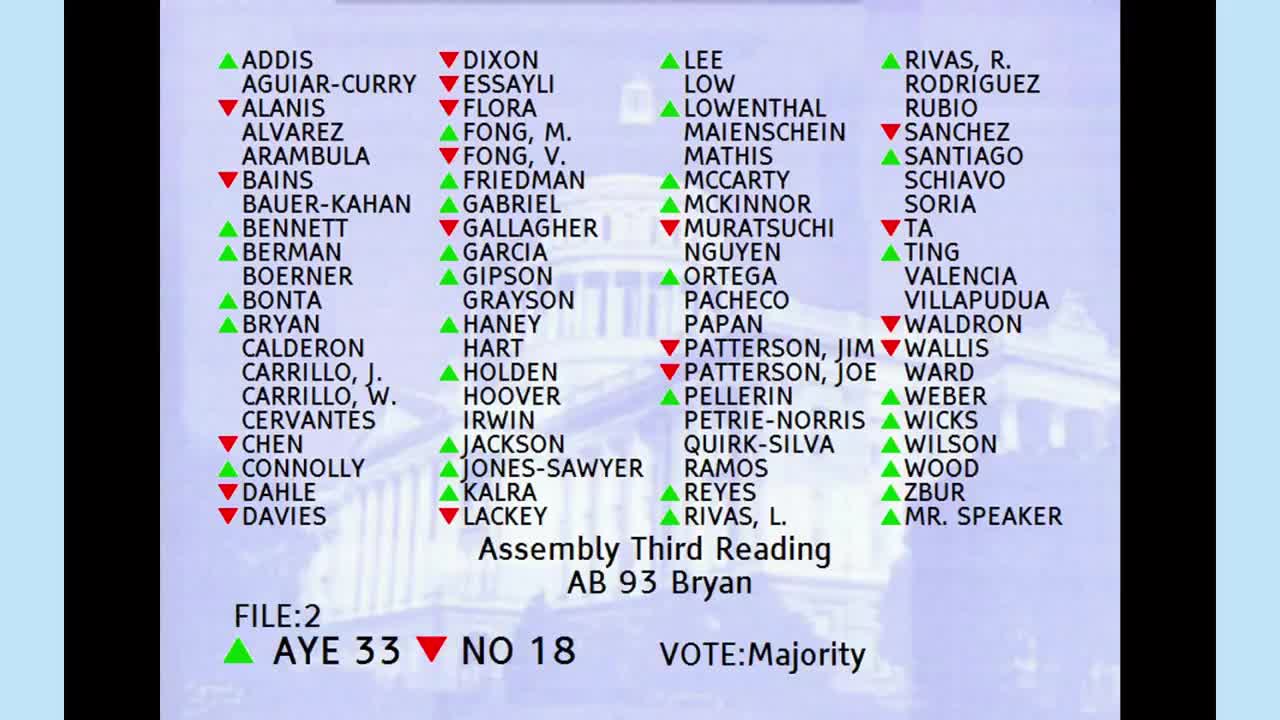 1MIN
Assembly Floor
 4MIN
Assembly Standing Committee on Water, Parks, and Wildlife
Bill Author