AB 40: Emergency medical services.
- Session Year: 2023-2024
- House: Assembly
- Latest Version Date: 2023-10-13
Current Status:
Passed
(2023-10-13: Chaptered by Secretary of State - Chapter 793, Statutes of 2023.)
Introduced
In Committee
First Chamber
In Committee
Second Chamber
Enacted
Existing law, the Emergency Medical Services System and the Prehospital Emergency Medical Care Personnel Act, creates the Emergency Medical Services Authority, which is responsible for the coordination of various state activities concerning emergency medical services. Among other duties, existing law requires the authority to develop planning and implementation guidelines for EMS systems, provide technical assistance to existing agencies, counties, and cities for the purpose of developing the components of EMS systems, and receive plans for the implementation of EMS and trauma care systems from local EMS agencies. Existing law makes a violation of the act or regulations adopted pursuant to the act punishable as a misdemeanor.
This bill, on or before December 31, 2024, would require the authority to develop and implement an electronic signature for use between the emergency department medical personnel at a receiving hospital and the transporting emergency medical personnel that captures the points in time when the ambulance arrives at the hospital emergency department bay and when transfer of care is executed for documentation of ambulance patient offload time, as defined. The bill would require every local EMS agency, by July 1, 2024, to develop a standard not to exceed 30 minutes, 90% of the time, for ambulance patient offload time and report the standardized time to the authority. The bill would authorize local EMS agencies to engage stakeholders in developing this standard, as specified. The bill would also require the authority to develop and implement by December 31, 2024, an audit tool to improve data accuracy regarding transfer of care, as specified, and to provide technical assistance and funding as needed, subject to an appropriation, for small rural hospitals and volunteer EMS providers to implement these provisions. The bill would require the authority to adopt emergency regulations to implement these provisions on or before December 31, 2024.
The bill would require a general acute care hospital with an emergency department to develop, in consultation with its emergency department staff, and its exclusive employee representatives, if any, an ambulance patient offload time reduction protocol by September 1, 2024, that addresses specified factors, including, among other things, mechanisms to improve hospital operations to reduce ambulance patient offload time. The bill would require the hospital to file its protocol with the authority and to report annually any revisions to its protocol. The bill would require the authority, on or before December 31, 2024, to monitor monthly ambulance patient offload time data for each hospital.
The bill would require the authority to, among other things, report ambulance patient offload time exceedance to the relevant local EMS agency and the Commission on Emergency Medical Services if, on or after December 31, 2024, the general acute care hospital with an emergency department has an ambulance patient offload time that exceeds the local EMS agency standard, as specified, for the preceding month.
Because the bill would create new requirements within the act, thereby expanding the scope of an existing crime, the bill would impose a state-mandated local program.
The California Constitution requires the state to reimburse local agencies and school districts for certain costs mandated by the state. Statutory provisions establish procedures for making that reimbursement.
This bill would provide that no reimbursement is required by this act for a specified reason.
Existing law, the Emergency Medical Services System and the Prehospital Emergency Medical Care Personnel Act, creates the Emergency Medical Services Authority, which is responsible for the coordination of various state activities concerning emergency medical services. Among other duties, existing law requires the authority to develop planning and implementation guidelines for EMS systems, provide technical assistance to existing agencies, counties, and cities for the purpose of developing the components of EMS systems, and receive plans for the implementation of EMS and trauma care systems from local EMS agencies. Existing law makes a violation of the act or regulations adopted pursuant to the act punishable as a misdemeanor.
This bill, on or before December 31, 2024, would require the authority to develop and implement an electronic signature for use between the emergency department medical personnel at a receiving hospital and the transporting emergency medical personnel that captures the points in time when the ambulance arrives at the hospital emergency department bay and when transfer of care is executed for documentation of ambulance patient offload time, as defined. The bill would require every local EMS agency, by July 1, 2024, to develop a standard not to exceed 30 minutes, 90% of the time, for ambulance patient offload time and report the standardized time to the authority. The bill would authorize local EMS agencies to engage stakeholders in developing this standard, as specified. The bill would also require the authority to develop and implement by December 31, 2024, an audit tool to improve data accuracy regarding transfer of care, as specified, and to provide technical assistance and funding as needed, subject to an appropriation, for small rural hospitals and volunteer EMS providers to implement these provisions. The bill would require the authority to adopt emergency regulations to implement these provisions on or before December 31, 2024.
The bill would require a general acute care hospital with an emergency department to develop, in consultation with its emergency department staff, and its exclusive employee representatives, if any, an ambulance patient offload time reduction protocol by September 1, 2024, that addresses specified factors, including, among other things, mechanisms to improve hospital operations to reduce ambulance patient offload time. The bill would require the hospital to file its protocol with the authority and to report annually any revisions to its protocol. The bill would require the authority, on or before December 31, 2024, to monitor monthly ambulance patient offload time data for each hospital.
The bill would require the authority to, among other things, report ambulance patient offload time exceedance to the relevant local EMS agency and the Commission on Emergency Medical Services if, on or after December 31, 2024, the general acute care hospital with an emergency department has an ambulance patient offload time that exceeds the local EMS agency standard, as specified, for the preceding month.
Because the bill would create new requirements within the act, thereby expanding the scope of an existing crime, the bill would impose a state-mandated local program.
The California Constitution requires the state to reimburse local agencies and school districts for certain costs mandated by the state. Statutory provisions establish procedures for making that reimbursement.
This bill would provide that no reimbursement is required by this act for a specified reason.
Existing law, the Emergency Medical Services System and the Prehospital Emergency Medical Care Personnel Act, creates the Emergency Medical Services Authority, which is responsible for the coordination of various state activities concerning emergency medical services. Among other duties, existing law requires the authority to develop planning and implementation guidelines for EMS systems, provide technical assistance to existing agencies, counties, and cities for the purpose of developing the components of EMS systems, and receive plans for the implementation of EMS and trauma care systems from local EMS agencies. Existing law makes a violation of the act or regulations adopted pursuant to the act punishable as a misdemeanor.
This bill, on or before June 1, December 31, 2024, would require the authority to develop and implement an electronic signature for use between the emergency department medical personnel at a receiving hospital and the transporting emergency medical personnel that captures the points in time when the hospital receives notification of ambulance arrival ambulance arrives at the hospital emergency department bay and when transfer of care is executed for documentation of ambulance patient offload time, as defined. The bill would require every local EMS agency, by March July 1, 2024, to develop a standard not to exceed 30 minutes, 90% of the time, for ambulance patient offload time and report the standardized time to the authority. The bill would authorize local EMS agencies to engage stakeholders in developing this standard, as specified. The bill would also require the authority to develop and implement by June 1, December 31, 2024, an audit tool to improve data accuracy regarding transfer of care, as specified, and to provide technical assistance and funding as needed, subject to an appropriation, for small rural hospitals and volunteer EMS providers to implement these provisions. The bill would require the authority to adopt emergency regulations to implement these provisions on or before March 1, December 31, 2024.
The bill would require a general acute care hospital with an emergency department to develop, in consultation with its emergency department staff staff, and its exclusive employee representatives, if any, an ambulance patient offload time reduction protocol by June September 1, 2024, that addresses specified factors, including, among other things, mechanisms to improve hospital operations to reduce ambulance patient offload time. The bill would require the hospital to file its protocol with the authority and to report annually any revisions to its protocol. The bill would require the authority, on or before March 1, December 31, 2024, to monitor monthly ambulance patient offload time data for each hospital.
The bill would require the authority to, among other things, report ambulance patient offload time exceedance to the relevant local EMS agency and the Commission on Emergency Medical Services if, on or after July 1, December 31, 2024, the general acute care hospital with an emergency department has an ambulance patient offload time that exceeds the local EMS agency standard, as specified, for the preceding month.
Because the bill would create new requirements within the act, thereby expanding the scope of an existing crime, the bill would impose a state-mandated local program.
The California Constitution requires the state to reimburse local agencies and school districts for certain costs mandated by the state. Statutory provisions establish procedures for making that reimbursement.
This bill would provide that no reimbursement is required by this act for a specified reason.
Existing law, the Emergency Medical Services System and the Prehospital Emergency Medical Care Personnel Act, creates the Emergency Medical Services Authority, which is responsible for the coordination of various state activities concerning emergency medical services. Among other duties, existing law requires the authority to develop planning and implementation guidelines for EMS systems, provide technical assistance to existing agencies, counties, and cities for the purpose of developing the components of EMS systems, and receive plans for the implementation of EMS and trauma care systems from local EMS agencies. Existing law makes a violation of the act or regulations adopted pursuant to the act punishable as a misdemeanor.
This bill bill, on or before June 1, 2024, would require the authority to develop and implement an electronic signature for use between the emergency department medical personnel at a receiving hospital and the transporting emergency medical personnel that captures the points in time when the hospital receives notification of ambulance arrival and when transfer of care is executed for documentation of ambulance patient offload time, as defined. The bill would require every local EMS agency agency, by March 1, 2024, to develop a standard not to exceed 30 minutes, 90% of the time, for ambulance patient offload time and report the standardized time to the authority. The bill would also require the authority to develop and implement by June 1, 2024, an audit tool to improve data accuracy regarding transfer of care, as specified, and to provide technical assistance and funding as needed, subject to an appropriation, for small rural hospitals and volunteer EMS providers to implement these provisions. The bill would require the authority to adopt emergency regulations to implement these provisions on or before March 1, 2024.
The bill would require a general acute care hospital with an emergency department to develop, in consultation with its emergency department staff, staff and its exclusive employee representatives, an ambulance patient offload time reduction protocol by June 1, 2024, that addresses specified factors, including, among other things, mechanisms to improve hospital operations to reduce ambulance patient offload time. The bill would require the hospital to file its protocol with the authority and to report annually any revisions to its protocol. The bill would require the authority, on or before March 1, 2024, to monitor monthly ambulance patient offload time data for each hospital. The
The bill would require the authority to, among other things, report ambulance patient offload time exceedance to the relevant local EMS agency and the Commission on Emergency Medical Services if, on or after July 1, 2024, the general acute care hospital with an emergency department has an ambulance patient offload time that exceeds the local EMS agency standard, as specified, for the preceding month.
The bill would additionally require local EMS agencies to create, in collaboration with local hospitals, a joint plan to respond to surges in demand for medical services and to submit the joint plans to the authority on or before March 1, 2024.Because the bill would create new requirements within the act, thereby expanding the scope of an existing crime, the bill would impose a state-mandated local program.
The California Constitution requires the state to reimburse local agencies and school districts for certain costs mandated by the state. Statutory provisions establish procedures for making that reimbursement.
This bill would provide that no reimbursement is required by this act for a specified reason.
Existing law, the Emergency Medical Services System and the Prehospital Emergency Medical Care Personnel Act, creates the Emergency Medical Services Authority, which is responsible for the coordination of various state activities concerning emergency medical services. Among other duties, existing law requires the authority to develop planning and implementation guidelines for EMS systems, provide technical assistance to existing agencies, counties, and cities for the purpose of developing the components of EMS systems, and receive plans for the implementation of EMS and trauma care systems from local EMS agencies. Existing law makes a violation of the act or regulations adopted pursuant to the act punishable as a misdemeanor.
This bill would require the authority to develop an electronic signature for use between the emergency department medical personnel at a receiving facility hospital and the transporting emergency medical personnel that captures the points in time when the hospital receives notification of ambulance arrival and when transfer of care is executed for documentation of ambulance patient offload time, as defined. The bill would require every local EMS agency to develop a standard not to exceed 30 minutes, 90% of the time, for ambulance patient offload time. The bill would also require the authority to develop an audit tool to improve data accuracy regarding transfer of care, as specified, and to provide technical assistance and funding as needed, subject to an appropriation, for small rural hospitals and volunteer EMS providers to implement these provisions. The bill would require the authority to adopt emergency regulations to implement these provisions on or before March 1, 2024.
The bill would require a general acute care hospital with an emergency department to develop, in consultation with its emergency department staff, an ambulance patient offload time reduction protocol by June 1, 2024, that addresses specified factors, including, among other things, mechanisms to improve hospital operations to reduce ambulance patient offload time. The bill would require the hospital to file its protocol with the authority and to report annually any revisions to its protocol. The bill would require the authority, on or after before March 1, 2024, to monitor monthly ambulance patient offload time data for each facility. hospital. The bill would require the authority to, among other things, report ambulance patient offload time exceedance to the relevant local EMS agency and the Commission on Emergency Medical Services if, on or after July 1, 2024, the general acute care hospital with an emergency department has an ambulance patient offload time that exceeds the statewide standard of 20 minutes, 90% of the time. local EMS agency standard, as specified, for the preceding month.
The bill would additionally require local EMS agencies to create, in collaboration with local hospitals, a joint plan to respond to surges in demand for medical services and to submit the joint plans to the authority on or before March 1, 2024.
Because the bill would create new requirements within the act, thereby expanding the scope of an existing crime, the bill would impose a state-mandated local program.
Existing law, the Warren-911-Emergency Assistance Act, requires each local public agency within its respective jurisdiction to establish a basic system that automatically connects a person dialing 911 to an established public safety answering point through normal telephone service facilities.This bill would require the Emergency Services Medical Authority, on or before March 1, 2024, to develop a public education campaign related to the use of the 911 service and other tools for access to care.The California Constitution requires the state to reimburse local agencies and school districts for certain costs mandated by the state. Statutory provisions establish procedures for making that reimbursement.
This bill would provide that no reimbursement is required by this act for a specified reason.
Existing law, the Emergency Medical Services System and the Prehospital Emergency Medical Care Personnel Act, creates the Emergency Medical Services Authority, which is responsible for the coordination of various state activities concerning emergency medical services. Among other duties, existing law requires the authority to develop planning and implementation guidelines for EMS systems, provide technical assistance to existing agencies, counties, and cities for the purpose of developing the components of EMS systems, and receive plans for the implementation of EMS and trauma care systems from local EMS agencies. Existing law makes a violation of the act or regulations adopted pursuant to the act punishable as a misdemeanor.
This bill would require the authority to develop an electronic signature for use between the emergency department medical personnel at a receiving facility and the transporting emergency medical personnel that captures the points in time when the hospital receives notification of ambulance arrival and when transfer of care is executed for documentation of ambulance patient offload time, as defined. The bill would require the authority to develop a statewide standard of 20 minutes, every local EMS agency to develop a standard not to exceed 30 minutes, 90% of the time, for ambulance patient offload time. The bill would also require the authority to develop an audit tool to improve data accuracy regarding transfer of care, as specified, and to provide technical assistance and funding as needed, subject to an appropriation, for small rural hospitals and volunteer EMS providers to implement these provisions. The bill would require the authority to adopt emergency regulations to implement these provisions on or before March 1, 2024.
The bill would require a general acute care hospital with an emergency department to develop, in consultation with its emergency department staff, an ambulance patient offload time reduction protocol by June 1, 2024, that addresses specified factors, including, among other things, mechanisms to improve hospital operations to reduce ambulance patient offload time. The bill would require the hospital to file its protocol with the authority and to report annually any revisions to its protocol. The bill would require the authority, on or after March 1, 2024, to monitor monthly ambulance patient offload time data for each facility. The bill would require the authority to, among other things, report ambulance patient offload time exceedance to the relevant local EMS agency and the Commission on Emergency Medical Services if, on or after July 1, 2024, the general acute care hospital with an emergency department has an ambulance patient offload time that exceeds the statewide standard of 20 minutes, 90% of the time.
The bill would additionally require local EMS agencies to create, in collaboration with local hospitals, a joint plan to respond to surges in demand for medical services and to submit the joint plans to the authority on or before March 1, 2024.
Because the bill would create new requirements within the act, thereby expanding the scope of an existing crime, the bill would impose a state-mandated local program.
Existing law, the Warren-911-Emergency Assistance Act, requires each local public agency within its respective jurisdiction to establish a basic system that automatically connects a person dialing 911 to an established public safety answering point through normal telephone service facilities.
This bill would require the Emergency Services Medical Authority, on or before March 1, 2024, to develop a public education campaign related to the use of the 911 service and other tools for access to care.
The California Constitution requires the state to reimburse local agencies and school districts for certain costs mandated by the state. Statutory provisions establish procedures for making that reimbursement.
This bill would provide that no reimbursement is required by this act for a specified reason.
Existing law, the Emergency Medical Services System and the Prehospital Emergency Medical Care Personnel Act, creates the Emergency Medical Services Authority, which is responsible for the coordination of various state activities concerning emergency medical services. Among other duties, existing law requires the authority to develop planning and implementation guidelines for EMS systems, provide technical assistance to existing agencies, counties, and cities for the purpose of developing the components of EMS systems, and receive plans for the implementation of EMS and trauma care systems from local EMS agencies. Existing law makes a violation of the act or regulations adopted pursuant to the act punishable as a misdemeanor.
This bill would require the authority to develop an electronic signature for use between the emergency department medical personnel at a receiving facility and the transporting emergency medical personnel that captures the points in time when the hospital receives notification of ambulance arrival and when transfer of care is executed for documentation of ambulance patient offload time, as defined. The bill would require the authority to develop a statewide standard of 20 minutes, 90% of the time, for ambulance patient offload time. The bill would also require the authority to develop an audit tool to improve data accuracy regarding transfer of care, as specified, and to provide technical assistance and funding as needed, subject to an appropriation, for small rural hospitals and volunteer EMS providers to implement these provisions. The bill would require the authority to adopt emergency regulations to implement these provisions on or before March 1, 2024.
The bill would require the authority, on or before March 1, 2024, to establish a working group of various stakeholders to review, update, and publish a toolkit to reduce patient offload delays in the emergency department.The bill would require a general acute care hospital with an emergency department to develop, in consultation with its emergency department staff, an ambulance patient offload time reduction protocol by June 1, 2024, that addresses specified factors, including, among other things, mechanisms to improve hospital operations to reduce ambulance patient offload time. The bill would require the hospital to file its protocol with the authority and to report annually any revisions to its protocol. The bill would require the authority, on or after March 1, 2024, to monitor monthly ambulance patient offload time data for each facility. The bill would require the authority to, among other things, report ambulance patient offload time exceedance to the relevant local EMS agency and the Commission on Emergency Medical Services if, on or after July 1, 2024, the general acute care hospital with an emergency department has an ambulance patient offload time that exceeds the statewide standard of 20 minutes, 90% of the time.
The bill would additionally require local EMS agencies to create, in collaboration with local hospitals, a joint plan to respond to surges in demand for medical services and to submit the joint plans to the authority on or before March 1, 2024.
Because the bill would create new requirements within the act, thereby expanding the scope of an existing crime, the bill would impose a state-mandated local program.
Existing law, the Warren-911-Emergency Assistance Act, requires each local public agency within its respective jurisdiction to establish a basic system that automatically connects a person dialing 911 to an established public safety answering point through normal telephone service facilities.
This bill would require the Emergency Services Medical Authority, on or before March 1, 2024, to develop a public education campaign related to the use of the 911 service and other tools for access to care.
The California Constitution requires the state to reimburse local agencies and school districts for certain costs mandated by the state. Statutory provisions establish procedures for making that reimbursement.
This bill would provide that no reimbursement is required by this act for a specified reason.
Existing law, the Emergency Medical Services System and the Prehospital Emergency Medical Care Personnel Act, creates the Emergency Medical Services Authority, which is responsible for the coordination of various state activities concerning emergency medical services. Among other duties, existing law requires the authority to develop planning and implementation guidelines for EMS systems, provide technical assistance to existing agencies, counties, and cities for the purpose of developing the components of EMS systems, and receive plans for the implementation of EMS and trauma care systems from local EMS agencies. Existing law makes a violation of the act or regulations adopted pursuant to the act punishable as a misdemeanor.
This bill would require the authority to develop an electronic signature for use between the emergency department medical personnel at a receiving facility and the transporting emergency medical personnel that captures the points in time when the hospital receives notification of ambulance arrival and when transfer of care is executed for documentation of ambulance patient offload time, as defined. The bill would require the authority to develop a statewide standard of 20 minutes, 90% of the time, for ambulance patient offload time. The bill would also require the authority to develop an audit tool to improve data accuracy regarding transfer of care, as specified, and to provide technical assistance and funding as needed, subject to an appropriation, for small rural hospitals and volunteer EMS providers to implement these provisions. The bill would require the authority to adopt emergency regulations to implement these provisions on or before March 1, 2024.
The bill would require the authority, on or before March 1, 2024, to establish a working group of various stakeholders to review, update, and publish a toolkit to reduce patient offload delays in the emergency department.
The bill would additionally require local EMS agencies to create, in collaboration with local hospitals, a joint plan to respond to surges in demand for medical services and to submit the joint plans to the authority on or before March 1, 2024.
Because the bill would create new requirements within the act, thereby expanding the scope of an existing crime, the bill would impose a state-mandated local program.
Existing law, the Warren-911-Emergency Assistance Act, requires each local public agency within its respective jurisdiction to establish a basic system that automatically connects a person dialing 911 to an established public safety answering point through normal telephone service facilities.
This bill would require the Emergency Services Medical Authority, on or before March 1, 2024, to develop a public education campaign related to the use of the 911 service and other tools for access to care.
The California Constitution requires the state to reimburse local agencies and school districts for certain costs mandated by the state. Statutory provisions establish procedures for making that reimbursement.
This bill would provide that no reimbursement is required by this act for a specified reason.
(a)(1)By no later than December 31, 2024, the authority shall develop and implement a California Emergency Medical Services Information System requirement for an electronic signature for use between the emergency department medical personnel at a receiving hospital and the Emergency Medical Technician (EMT), Advanced Emergency Medical Technician (AEMT), or Emergency Medical Technician-Paramedic (EMT-P) that captures the points in time when the ambulance arrives at the hospital emergency department bay and when transfer of care is executed for documentation of ambulance patient offload time, as defined by Section 1797.120.
(2)The signature shall be collected when physical transfer of the patient occurs and the report is given to hospital staff and shall note ambulance arrival time at the hospital.
(b)(1)By no later than July 1, 2024, every local EMS agency shall develop a standard not to exceed 30 minutes, 90 percent of the time, for ambulance patient offload time and report the adopted time to the authority.
(2)In the development of the standard required by paragraph (1), the local EMS agency may engage stakeholders, including hospital representatives, fire departments having jurisdiction, exclusive employee representatives of staff at hospitals, fire departments, EMS providers, if any, and others.
(c)By no later than December 31, 2024, the authority shall develop and implement an audit tool to improve the data accuracy of transfer of care with validation from hospitals and local EMS agencies.
(d)The authority shall provide technical assistance and funding as needed, subject to an appropriation, for small rural hospitals and volunteer EMS providers to implement this section.
(e)On or before December 31, 2024, the authority shall adopt emergency regulations to implement this section. The emergency regulations adopted pursuant to this section shall be adopted in accordance with Chapter 3.5 (commencing with Section 11340) of Part 1 of Division 3 of Title 2 of the Government Code, and, for purposes of that chapter, including Section 11349.6 of the Government Code, the adoption of the regulations is an emergency and shall be considered by the Office of Administrative Law as necessary for the immediate preservation of the public peace, health and safety, and general welfare.
SEC. 2.Section 1797.120.6 is added to the Health and Safety Code, to read:1797.120.6.(a)A licensed general acute care hospital with an emergency department shall, by September 1, 2024, develop, in consultation with its emergency department staff, and its exclusive employee representatives, if any, an ambulance patient offload time reduction protocol that addresses all of the following factors:
(1)Notification of hospital administrators, nursing staff, medical staff, and ancillary services that the local EMS agency standard for ambulance patient offload time has been exceeded for one month.
(2)Mechanisms to improve hospital operations to reduce ambulance patient offload time, which may include, but are not limited to, activating the hospitals surge plan, transferring patients to other hospitals, suspending elective admissions, discharging patients, using alternative care sites, increasing supplies, improving triage and transfer systems, and adding additional staffing.
(3)Systems to improve general hospital coordination with the emergency department, including consults for emergency department patients.
(4)Direct operational changes designed to facilitate a rapid reduction in ambulance patient offload time to meet the local EMS agency standard adopted pursuant to subdivision (b) of Section 1797.120.5.
(b)A licensed general acute care hospital with an emergency department shall file its ambulance patient offload time reduction protocol with the authority and shall annually report any revisions to its protocol.
SEC. 3.Section 1797.120.7 is added to the Health and Safety Code, to read:1797.120.7.(a)On or before December 31, 2024, the authority shall monitor monthly ambulance patient offload time data for each hospital required to report under Section 1797.120.5.
(b)If, on or after December 31, 2024, a general acute care hospital with an emergency department has an ambulance patient offload time that exceeds the local EMS agency standard adopted pursuant to subdivision (b) of Section 1797.120.5 for the preceding month, the authority shall comply with all of the following:
(1)Report the ambulance patient offload time exceedance to the relevant local EMS agency and the commission via electronic means.
(2)Direct the local EMS agency to alert all EMS providers in the jurisdiction.
(3)Direct the licensed general acute care hospital with an emergency department to implement the ambulance patient offload time reduction protocol developed pursuant to Section 1797.120.6.
(4)Host, at minimum, bi-weekly calls with the relevant hospital administration, including emergency department leadership, EMS providers, local EMS agency, and hospital employees to update and discuss implementation of the protocol and the outcomes.
SEC. 4.No reimbursement is required by this act pursuant to Section 6 of Article XIIIB of the California Constitution because the only costs that may be incurred by a local agency or school district will be incurred because this act creates a new crime or infraction, eliminates a crime or infraction, or changes the penalty for a crime or infraction, within the meaning of Section 17556 of the Government Code, or changes the definition of a crime within the meaning of Section 6 of Article XIIIB of the California Constitution.
(a)(1)By no later than December 31, 2024, the authority shall develop and implement a California Emergency Medical Services Information System requirement for an electronic signature for use between the emergency department medical personnel at a receiving hospital and the Emergency Medical Technician (EMT), Advanced Emergency Medical Technician (AEMT), or Emergency Medical Technician-Paramedic (EMT-P) that captures the points in time when the ambulance arrives at the hospital emergency department bay and when transfer of care is executed for documentation of ambulance patient offload time, as defined by Section 1797.120.
(2)The signature shall be collected when physical transfer of the patient occurs and the report is given to hospital staff and shall note ambulance arrival time at the hospital.
(b)(1)By no later than July 1, 2024, every local EMS agency shall develop a standard not to exceed 30 minutes, 90 percent of the time, for ambulance patient offload time and report the adopted time to the authority.
(2)In the development of the standard required by paragraph (1), the local EMS agency may engage stakeholders, including hospital representatives, fire departments having jurisdiction, exclusive employee representatives of staff at hospitals, fire departments, EMS providers, if any, and others.
(c)By no later than December 31, 2024, the authority shall develop and implement an audit tool to improve the data accuracy of transfer of care with validation from hospitals and local EMS agencies.
(d)The authority shall provide technical assistance and funding as needed, subject to an appropriation, for small rural hospitals and volunteer EMS providers to implement this section.
(e)On or before December 31, 2024, the authority shall adopt emergency regulations to implement this section. The emergency regulations adopted pursuant to this section shall be adopted in accordance with Chapter 3.5 (commencing with Section 11340) of Part 1 of Division 3 of Title 2 of the Government Code, and, for purposes of that chapter, including Section 11349.6 of the Government Code, the adoption of the regulations is an emergency and shall be considered by the Office of Administrative Law as necessary for the immediate preservation of the public peace, health and safety, and general welfare.
SEC. 2.Section 1797.120.6 is added to the Health and Safety Code, to read:1797.120.6.(a)A licensed general acute care hospital with an emergency department shall, by September 1, 2024, develop, in consultation with its emergency department staff, and its exclusive employee representatives, if any, an ambulance patient offload time reduction protocol that addresses all of the following factors:
(1)Notification of hospital administrators, nursing staff, medical staff, and ancillary services that the local EMS agency standard for ambulance patient offload time has been exceeded for one month.
(2)Mechanisms to improve hospital operations to reduce ambulance patient offload time, which may include, but are not limited to, activating the hospitals surge plan, transferring patients to other hospitals, suspending elective admissions, discharging patients, using alternative care sites, increasing supplies, improving triage and transfer systems, and adding additional staffing.
(3)Systems to improve general hospital coordination with the emergency department, including consults for emergency department patients.
(4)Direct operational changes designed to facilitate a rapid reduction in ambulance patient offload time to meet the local EMS agency standard adopted pursuant to subdivision (b) of Section 1797.120.5.
(b)A licensed general acute care hospital with an emergency department shall file its ambulance patient offload time reduction protocol with the authority and shall annually report any revisions to its protocol.
SEC. 3.Section 1797.120.7 is added to the Health and Safety Code, to read:1797.120.7.(a)On or before December 31, 2024, the authority shall monitor monthly ambulance patient offload time data for each hospital required to report under Section 1797.120.5.
(b)If, on or after December 31, 2024, a general acute care hospital with an emergency department has an ambulance patient offload time that exceeds the local EMS agency standard adopted pursuant to subdivision (b) of Section 1797.120.5 for the preceding month, the authority shall comply with all of the following:
(1)Report the ambulance patient offload time exceedance to the relevant local EMS agency and the commission via electronic means.
(2)Direct the local EMS agency to alert all EMS providers in the jurisdiction.
(3)Direct the licensed general acute care hospital with an emergency department to implement the ambulance patient offload time reduction protocol developed pursuant to Section 1797.120.6.
(4)Host, at minimum, bi-weekly calls with the relevant hospital administration, including emergency department leadership, EMS providers, local EMS agency, and hospital employees to update and discuss implementation of the protocol and the outcomes.
SEC. 4.No reimbursement is required by this act pursuant to Section 6 of Article XIIIB of the California Constitution because the only costs that may be incurred by a local agency or school district will be incurred because this act creates a new crime or infraction, eliminates a crime or infraction, or changes the penalty for a crime or infraction, within the meaning of Section 17556 of the Government Code, or changes the definition of a crime within the meaning of Section 6 of Article XIIIB of the California Constitution.
(a)(1)By no later than June 1, December 31, 2024, the authority shall develop and implement a California Emergency Medical Services Information System requirement for an electronic signature for use between the emergency department medical personnel at a receiving hospital and the Emergency Medical Technician (EMT), Advanced Emergency Medical Technician (AEMT), or Emergency Medical Technician-Paramedic (EMT-P) that captures the points in time when the hospital receives notification of ambulance arrival ambulance arrives at the hospital emergency department bay and when transfer of care is executed for documentation of ambulance patient offload time, as defined by Section 1797.120.
(2)The signature shall be collected when physical transfer of the patient occurs and the report is given to hospital staff and shall note ambulance arrival time at the hospital.
(b)(1)By no later than March 1, July 1, 2024, every local EMS agency shall develop a standard not to exceed 30 minutes, 90 percent of the time, for ambulance patient offload time and report the adopted time to the authority.
(2)In the development of the standard required by paragraph (1), the local EMS agency may engage stakeholders, including hospital representatives, fire departments having jurisdiction, exclusive employee representatives of staff at hospitals, fire departments, EMS providers, if any, and others.
(c)By no later than June 1, December 31, 2024, the authority shall develop and implement an audit tool to improve the data accuracy of transfer of care with validation from hospitals and local EMS agencies.
(d)The authority shall provide technical assistance and funding as needed, subject to an appropriation, for small rural hospitals and volunteer EMS providers to implement this section.
(e)On or before March 1, December 31, 2024, the authority shall adopt emergency regulations to implement this section. The emergency regulations adopted pursuant to this section shall be adopted in accordance with Chapter 3.5 (commencing with Section 11340) of Part 1 of Division 3 of Title 2 of the Government Code, and, for purposes of that chapter, including Section 11349.6 of the Government Code, the adoption of the regulations is an emergency and shall be considered by the Office of Administrative Law as necessary for the immediate preservation of the public peace, health and safety, and general welfare.
SEC. 2.Section 1797.120.6 is added to the Health and Safety Code, to read:1797.120.6.(a)A licensed general acute care hospital with an emergency department shall, by June 1, September 1, 2024, develop, in consultation with its emergency department staff staff, and its exclusive employee representatives, if any, an ambulance patient offload time reduction protocol that addresses all of the following factors:
(1)Notification of hospital administrators, nursing staff, medical staff, and ancillary services that the local EMS agency standard for ambulance patient offload time has been exceeded for one month.
(2)Mechanisms to improve hospital operations to reduce ambulance patient offload time, including, but not limited to, transfers, elective admissions, discharges, alternative care sites, supplies, improved triage and transfer systems, and additional staffing. which may include, but are not limited to, activating the hospitals surge plan, transferring patients to other hospitals, suspending elective admissions, discharging patients, using alternative care sites, increasing supplies, improving triage and transfer systems, and adding additional staffing.
(3)Systems to improve general hospital coordination with the emergency department, including consults for emergency department patients.
(4)Direct operational changes that designed to facilitate a rapid reduction in ambulance patient offload time to meet the local EMS agency standard adopted pursuant to subdivision (b) of Section 1797.120.5.
(b)A licensed general acute care hospital with an emergency department shall file its ambulance patient offload time reduction protocol with the authority and shall annually report any revisions to its protocol.
SEC. 3.Section 1797.120.7 is added to the Health and Safety Code, to read:1797.120.7.(a)On or before March 1, December 31, 2024, the authority shall monitor monthly ambulance patient offload time data for each hospital required to report under Section 1797.120.5.
(b)If, on or after July 1, December 31, 2024, a general acute care hospital with an emergency department has an ambulance patient offload time that exceeds the local EMS agency standard adopted pursuant to subdivision (b) of Section 1797.120.5 for the preceding month, the authority shall comply with all of the following:
(1)Report the ambulance patient offload time exceedance to the relevant local EMS agency and the commission via electronic means.
(2)Direct the local EMS agency to alert all EMS providers in the jurisdiction.
(3)Direct the licensed general acute care hospital with an emergency department to implement the ambulance patient offload time reduction protocol developed pursuant to Section 1797.120.6.
(4)Host weekly Host, at minimum, bi-weekly calls with the relevant hospital administration, including emergency department leadership, EMS providers, local EMS agency, and hospital employees to update and discuss implementation of the protocol and the outcomes.
SEC. 4.No reimbursement is required by this act pursuant to Section 6 of Article XIIIB of the California Constitution because the only costs that may be incurred by a local agency or school district will be incurred because this act creates a new crime or infraction, eliminates a crime or infraction, or changes the penalty for a crime or infraction, within the meaning of Section 17556 of the Government Code, or changes the definition of a crime within the meaning of Section 6 of Article XIIIB of the California Constitution.
(a)(1)The By no later than June 1, 2024, the authority shall develop and implement a California Emergency Medical Services Information System requirement for an electronic signature for use between the emergency department medical personnel at a receiving hospital and the Emergency Medical Technician (EMT), Advanced Emergency Medical Technician (AEMT), or Emergency Medical Technician-Paramedic (EMT-P) that captures the points in time when the hospital receives notification of ambulance arrival and when transfer of care is executed for documentation of ambulance patient offload time, as defined by Section 1797.120.
(2)The signature shall be collected when physical transfer of the patient occurs and the report is given to hospital staff and shall note ambulance arrival time at the hospital.
(b)Every By no later than March 1, 2024, every local EMS agency shall develop a standard not to exceed 30 minutes, 90 percent of the time, for ambulance patient offload time. time and report the adopted time to the authority.
(c)The By no later than June 1, 2024, the authority shall develop and implement an audit tool to improve the data accuracy of transfer of care with validation from hospitals and local EMS agencies.
(d)The authority shall provide technical assistance and funding as needed, subject to an appropriation, for small rural hospitals and volunteer EMS providers to implement this section.
(e)On or before March 1, 2024, the authority shall adopt emergency regulations to implement this section. The emergency regulations adopted pursuant to this section shall be adopted in accordance with Chapter 3.5 (commencing with Section 11340) of Part 1 of Division 3 of Title 2 of the Government Code, and, for purposes of that chapter, including Section 11349.6 of the Government Code, the adoption of the regulations is an emergency and shall be considered by the Office of Administrative Law as necessary for the immediate preservation of the public peace, health and safety, and general welfare.
SEC. 2.Section 1797.120.6 is added to the Health and Safety Code, to read:1797.120.6.(a)A licensed general acute care hospital with an emergency department shall, by June 1, 2024, develop, in consultation with its emergency department staff, staff and its exclusive employee representatives, an ambulance patient offload time reduction protocol that addresses all of the following factors:
(1)Notification of hospital administrators, nursing staff, medical staff, and ancillary services that the local EMS agency standard for ambulance patient offload time has been exceeded for one month.
(2)Mechanisms to improve hospital operations to reduce ambulance patient offload time, including, but not limited to, transfers, elective admissions, discharges, alternative care sites, supplies, improved triage and transfer systems, and additional staffing.
(3)Systems to improve general hospital coordination with the emergency department, including consults for emergency department patients.
(4)Direct operational changes that facilitate a rapid reduction in ambulance patient offload time to the local EMS agency standard adopted pursuant to subdivision (b) of Section 1797.120.5.
(b)A licensed general acute care hospital with an emergency department shall file its ambulance patient offload time reduction protocol with the authority and shall annually report any revisions to its protocol.
SEC. 3.Section 1797.120.7 is added to the Health and Safety Code, to read:1797.120.7.(a)On or before March 1, 2024, the authority shall monitor monthly ambulance patient offload time data for each hospital required to report under Section 1797.120.5.
(b)If, on or after July 1, 2024, a general acute care hospital with an emergency department has an ambulance patient offload time that exceeds the local EMS agency standard adopted pursuant to subdivision (b) of Section 1797.120.5 for the preceding month, the authority shall do comply with all of the following:
(1)Report the ambulance patient offload time exceedance to the relevant local EMS agency and the commission via electronic means.
(2)Direct the local EMS agency to alert all EMS providers in the jurisdiction.
(3)Direct the licensed general acute care hospital with an emergency department to implement the ambulance patient offload time reduction protocol developed pursuant to Section 1797.120.6.
(4)Host weekly calls with the relevant hospital administration, EMS providers, local EMS agency, and hospital employees to update and discuss implementation of the protocol and the outcomes.
SEC. 4.Section 1797.260 is added to the Health and Safety Code, to read:1797.260.Local EMS agencies shall create, in collaboration with local hospitals, a joint plan to respond to surges in demand for medical services. Local EMS agencies shall submit the joint plans to the authority on or before March 1, 2024.SEC. 5.SEC. 4.No reimbursement is required by this act pursuant to Section 6 of Article XIIIB of the California Constitution because the only costs that may be incurred by a local agency or school district will be incurred because this act creates a new crime or infraction, eliminates a crime or infraction, or changes the penalty for a crime or infraction, within the meaning of Section 17556 of the Government Code, or changes the definition of a crime within the meaning of Section 6 of Article XIIIB of the California Constitution.
(a)(1)The authority shall develop a California Emergency Medical Services Information System requirement for an electronic signature for use between the emergency department medical personnel at a receiving facility hospital and the Emergency Medical Technician (EMT), Advanced Emergency Medical Technician (AEMT), or Emergency Medical Technician-Paramedic (EMT-P) that captures the points in time when the hospital receives notification of ambulance arrival and when transfer of care is executed for documentation of ambulance patient offload time, as defined by Section 1797.120.
(2)The signature shall be collected when physical transfer of the patient occurs and the report is given to hospital staff and shall note ambulance arrival time at the hospital.
(b)Every local EMS agency shall develop a standard not to exceed 30 minutes, 90 percent of the time, for ambulance patient offload time.
(c)The authority shall develop an audit tool to improve data accuracy of transfer of care with validation from hospitals and local EMS agencies.
(d)The authority shall provide technical assistance and funding as needed, subject to an appropriation, for small rural hospitals and volunteer EMS providers to implement this section.
(e)On or before March 1, 2024, the authority shall adopt emergency regulations to implement this section. The emergency regulations adopted pursuant to this section shall be adopted in accordance with Chapter 3.5 (commencing with Section 11340) of Part 1 of Division 3 of Title 2 of the Government Code, and, for purposes of that chapter, including Section 11349.6 of the Government Code, the adoption of the regulations is an emergency and shall be considered by the Office of Administrative Law as necessary for the immediate preservation of the public peace, health and safety, and general welfare.
SEC. 3.SEC. 2.Section 1797.120.6 is added to the Health and Safety Code, to read:1797.120.6.(a)A licensed general acute care hospital with an emergency department shall, by June 1, 2024, develop, in consultation with its emergency department staff, an ambulance patient offload time reduction protocol that addresses all of the following factors:
(1)Notification of hospital administrators, nursing staff, medical staff, and ancillary services that the statewide local EMS agency standard for ambulance patient offload time has been exceeded for one month.
(2)Mechanisms to improve hospital operations to reduce ambulance patient offload time, including, but not limited to, transfers, elective admissions, discharges, alternative care sites, supplies, improved triage and transfer systems, and additional staffing.
(3)Systems to improve general hospital coordination with the emergency department, including consults for emergency department patients.
(4)Direct operational changes that facilitate a rapid reduction in ambulance patient offload time to the statewide local EMS agency standard of 20 minutes, 90 percent of the time. adopted pursuant to subdivision (b) of Section 1797.120.5.
(b)A licensed general acute care hospital with an emergency department shall file its ambulance patient offload time reduction protocol with the authority and shall annually report any revisions to its protocol.
SEC. 4.SEC. 3.Section 1797.120.7 is added to the Health and Safety Code, to read:1797.120.7.(a)On or after before March 1, 2024, the authority shall monitor monthly ambulance patient offload time data for each facility hospital required to report under Section 1797.120.5.
(b)If, on or after July 1, 2024, a general acute care hospital with an emergency department has an ambulance patient offload time that exceeds the standard in local EMS agency standard adopted pursuant to subdivision (b) of Section 1797.120.5, 1797.120.5 for the preceding month, the authority shall do all of the following:
(1)Report the ambulance patient offload time exceedance to the relevant local EMS agency and the commission via electronic means.
(2)Direct the local EMS agency to alert all EMS providers in the jurisdiction.
(3)Direct the licensed general acute care hospital with an emergency department to implement the ambulance patient offload time reduction protocol developed pursuant to Section 1797.120.6.
(4)Host weekly calls with the relevant hospital administration, EMS providers, local EMS agency, and hospital employees to update and discuss implementation of the protocol and the outcomes.
SEC. 5.SEC. 4.Section 1797.260 is added to the Health and Safety Code, to read:1797.260.Local EMS agencies shall create, in collaboration with local hospitals, a joint plan to respond to surges in demand for medical services. Local EMS agencies shall submit the joint plans to the authority on or before March 1, 2024.
SEC. 6.SEC. 5.No reimbursement is required by this act pursuant to Section 6 of Article XIIIB of the California Constitution because the only costs that may be incurred by a local agency or school district will be incurred because this act creates a new crime or infraction, eliminates a crime or infraction, or changes the penalty for a crime or infraction, within the meaning of Section 17556 of the Government Code, or changes the definition of a crime within the meaning of Section 6 of Article XIIIB of the California Constitution.
On or before March 1, 2024, the Emergency Medical Services Authority shall develop, in partnership with local public health departments, a public education campaign related to use of the 911 service and other tools for access to care. This shall include public service announcements and educational material.
SEC. 2.Section 1797.120.5 is added to the Health and Safety Code, to read:1797.120.5.(a)(1)The authority shall develop a California Emergency Medical Services Information System requirement for an electronic signature for use between the emergency department medical personnel at a receiving facility and the Emergency Medical Technician (EMT), Advanced Emergency Medical Technician (AEMT), or Emergency Medical Technician-Paramedic (EMT-P) that captures the points in time when the hospital receives notification of ambulance arrival and when transfer of care is executed for documentation of ambulance patient offload time, as defined by Section 1797.120.
(2)The signature shall be collected when physical transfer of the patient occurs and the report is given to hospital staff and shall note ambulance arrival time at the hospital.
(b)The authority shall develop a statewide standard of 20 minutes, Every local EMS agency shall develop a standard not to exceed 30 minutes, 90 percent of the time, for ambulance patient offload time.
(c)The authority shall develop an audit tool to improve data accuracy of transfer of care with validation from hospitals and local EMS agencies.
(d)The authority shall provide technical assistance and funding as needed, subject to an appropriation, for small rural hospitals and volunteer EMS providers to implement this section.
(e)On or before March 1, 2024, the authority shall adopt emergency regulations to implement this section. The emergency regulations adopted pursuant to this section shall be adopted in accordance with Chapter 3.5 (commencing with Section 11340) of Part 1 of Division 3 of Title 2 of the Government Code, and, for purposes of that chapter, including Section 11349.6 of the Government Code, the adoption of the regulations is an emergency and shall be considered by the Office of Administrative Law as necessary for the immediate preservation of the public peace, health and safety, and general welfare.
SEC. 3.Section 1797.120.6 is added to the Health and Safety Code, to read:1797.120.6.(a)A licensed general acute care hospital with an emergency department shall, by June 1, 2024, develop, in consultation with its emergency department staff, an ambulance patient offload time reduction protocol that addresses all of the following factors:
(1)Notification of hospital administrators, nursing staff, medical staff, and ancillary services that the statewide standard for ambulance patient offload time has been exceeded for one month.
(2)Mechanisms to improve hospital operations to reduce ambulance patient offload time, including, but not limited to, transfers, elective admissions, discharges, alternative care sites, supplies, improved triage and transfer systems, and additional staffing.
(3)Systems to improve general hospital coordination with the emergency department, including consults for emergency department patients.
(4)Direct operational changes that facilitate a rapid reduction in ambulance patient offload time to the statewide standard of 20 minutes, 90 percent of the time.
(b)A licensed general acute care hospital with an emergency department shall file its ambulance patient offload time reduction protocol with the authority and shall annually report any revisions to its protocol.
SEC. 4.Section 1797.120.7 is added to the Health and Safety Code, to read:1797.120.7.(a)On or after March 1, 2024, the authority shall monitor monthly ambulance patient offload time data for each facility required to report under Section 1797.120.5.
(b)If, on or after July 1, 2024, a general acute care hospital with an emergency department has an ambulance patient offload time that exceeds the standard in subdivision (b) of Section 1797.120.5, the authority shall do all of the following:
(1)Report the ambulance patient offload time exceedance to the relevant local EMS agency and the commission via electronic means.
(2)Direct the local EMS agency to alert all EMS providers in the jurisdiction.
(3)Direct the licensed general acute care hospital with an emergency department to implement the ambulance patient offload time reduction protocol developed pursuant to Section 1797.120.6.
(4)Host weekly calls with the relevant hospital administration, EMS providers, local EMS agency, and hospital employees to update and discuss implementation of the protocol and the outcomes.
SEC. 5.Section 1797.260 is added to the Health and Safety Code, to read:1797.260.Local EMS agencies shall create, in collaboration with local hospitals, a joint plan to respond to surges in demand for medical services. Local EMS agencies shall submit the joint plans to the authority on or before March 1, 2024.
SEC. 6.No reimbursement is required by this act pursuant to Section 6 of Article XIIIB of the California Constitution because the only costs that may be incurred by a local agency or school district will be incurred because this act creates a new crime or infraction, eliminates a crime or infraction, or changes the penalty for a crime or infraction, within the meaning of Section 17556 of the Government Code, or changes the definition of a crime within the meaning of Section 6 of Article XIIIB of the California Constitution.
On or before March 1, 2024, the Emergency Medical Services Authority shall develop, in partnership with local public health departments, a public education campaign related to use of the 911 service and other tools for access to care. This shall include public service announcements and educational material.
SEC. 2.Section 1797.120.5 is added to the Health and Safety Code, to read:1797.120.5.(a)(1)The authority shall develop a California Emergency Medical Services Information System requirement for an electronic signature for use between the emergency department medical personnel at a receiving facility and the Emergency Medical Technician (EMT), Advanced Emergency Medical Technician (AEMT), or Emergency Medical Technician-Paramedic (EMT-P) that captures the points in time when the hospital receives notification of ambulance arrival and when transfer of care is executed for documentation of ambulance patient offload time, as defined by Section 1797.120.
(2)The signature shall be collected when physical transfer of the patient occurs and the report is given to hospital staff and shall note ambulance arrival time at the hospital.
(b)The authority shall develop a statewide standard of 20 minutes, 90 percent of the time, for ambulance patient offload time.
(c)The authority shall develop an audit tool to improve data accuracy of transfer of care with validation from hospitals and local EMS agencies.
(d)The authority shall provide technical assistance and funding as needed, subject to an appropriation, for small rural hospitals and volunteer EMS providers to implement this section.
(e)On or before March 1, 2024, the authority shall adopt emergency regulations to implement this section. The emergency regulations adopted pursuant to this section shall be adopted in accordance with Chapter 3.5 (commencing with Section 11340) of Part 1 of Division 3 of Title 2 of the Government Code, and, for purposes of that chapter, including Section 11349.6 of the Government Code, the adoption of the regulations is an emergency and shall be considered by the Office of Administrative Law as necessary for the immediate preservation of the public peace, health and safety, and general welfare.
SEC. 3.Section 1797.120.6 is added to the Health and Safety Code, to read:1797.120.6.On or before March 1, 2024, the authority shall establish a working group of stakeholders representing hospital administration, EMS providers, local EMS agencies, and hospital employees in the emergency department and in the inpatient setting to review, update, and publish a toolkit to reduce patient offload delays in the emergency department.1797.120.6.(a)A licensed general acute care hospital with an emergency department shall, by June 1, 2024, develop, in consultation with its emergency department staff, an ambulance patient offload time reduction protocol that addresses all of the following factors:
(1)Notification of hospital administrators, nursing staff, medical staff, and ancillary services that the statewide standard for ambulance patient offload time has been exceeded for one month.
(2)Mechanisms to improve hospital operations to reduce ambulance patient offload time, including, but not limited to, transfers, elective admissions, discharges, alternative care sites, supplies, improved triage and transfer systems, and additional staffing.
(3)Systems to improve general hospital coordination with the emergency department, including consults for emergency department patients.
(4)Direct operational changes that facilitate a rapid reduction in ambulance patient offload time to the statewide standard of 20 minutes, 90 percent of the time.
(b)A licensed general acute care hospital with an emergency department shall file its ambulance patient offload time reduction protocol with the authority and shall annually report any revisions to its protocol.
SEC. 4.Section 1797.120.7 is added to the Health and Safety Code, to read:1797.120.7.(a)On or after March 1, 2024, the authority shall monitor monthly ambulance patient offload time data for each facility required to report under Section 1797.120.5.
(b)If, on or after July 1, 2024, a general acute care hospital with an emergency department has an ambulance patient offload time that exceeds the standard in subdivision (b) of Section 1797.120.5, the authority shall do all of the following:
(1)Report the ambulance patient offload time exceedance to the relevant local EMS agency and the commission via electronic means.
(2)Direct the local EMS agency to alert all EMS providers in the jurisdiction.
(3)Direct the licensed general acute care hospital with an emergency department to implement the ambulance patient offload time reduction protocol developed pursuant to Section 1797.120.6.
(4)Host weekly calls with the relevant hospital administration, EMS providers, local EMS agency, and hospital employees to update and discuss implementation of the protocol and the outcomes.
SEC. 4.SEC. 5.Section 1797.260 is added to the Health and Safety Code, to read:1797.260.Local EMS agencies shall create, in collaboration with local hospitals, a joint plan to respond to surges in demand for medical services. Local EMS agencies shall submit the joint plans to the authority on or before March 1, 2024.
SEC. 5.SEC. 6.No reimbursement is required by this act pursuant to Section 6 of Article XIIIB of the California Constitution because the only costs that may be incurred by a local agency or school district will be incurred because this act creates a new crime or infraction, eliminates a crime or infraction, or changes the penalty for a crime or infraction, within the meaning of Section 17556 of the Government Code, or changes the definition of a crime within the meaning of Section 6 of Article XIIIB of the California Constitution.
On or before March 1, 2024, the Emergency Medical Services Authority shall develop, in partnership with local public health departments, a public education campaign related to use of the 911 service and other tools for access to care. This shall include public service announcements and educational material.
SEC. 2.Section 1797.120.5 is added to the Health and Safety Code, to read:1797.120.5.(a)(1)The authority shall develop a California Emergency Medical Services Information System requirement for an electronic signature for use between the emergency department medical personnel at a receiving facility and the Emergency Medical Technician (EMT), Advanced Emergency Medical Technician (AEMT), or Emergency Medical Technician-Paramedic (EMT-P) that captures the points in time when the hospital receives notification of ambulance arrival and when transfer of care is executed for documentation of ambulance patient offload time, as defined by Section 1797.120.
(2)The signature shall be collected when physical transfer of the patient occurs and the report is given to hospital staff and shall note ambulance arrival time at the hospital.
(b)The authority shall develop a statewide standard of 20 minutes, 90 percent of the time, for ambulance patient offload time.
(c)The authority shall develop an audit tool to improve data accuracy of transfer of care with validation from hospitals and local EMS agencies.
(d)The authority shall provide technical assistance and funding as needed, subject to an appropriation, for small rural hospitals and volunteer EMS providers to implement this section.
(e)On or before March 1, 2024, the authority shall adopt emergency regulations to implement this section. The emergency regulations adopted pursuant to this section shall be adopted in accordance with Chapter 3.5 (commencing with Section 11340) of Part 1 of Division 3 of Title 2 of the Government Code, and, for purposes of that chapter, including Section 11349.6 of the Government Code, the adoption of the regulations is an emergency and shall be considered by the Office of Administrative Law as necessary for the immediate preservation of the public peace, health and safety, and general welfare.
SEC. 3.Section 1797.120.6 is added to the Health and Safety Code, to read:1797.120.6.On or before March 1, 2024, the authority shall establish a working group of stakeholders representing hospital administration, EMS providers, local EMS agencies, and hospital employees in the emergency department and in the inpatient setting to review, update, and publish a toolkit to reduce patient offload delays in the emergency department.
SEC. 4.Section 1797.260 is added to the Health and Safety Code, to read:1797.260.Local EMS agencies shall create, in collaboration with local hospitals, a joint plan to respond to surges in demand for medical services. Local EMS agencies shall submit the joint plans to the authority on or before March 1, 2024.
SEC. 5.No reimbursement is required by this act pursuant to Section 6 of Article XIIIB of the California Constitution because the only costs that may be incurred by a local agency or school district will be incurred because this act creates a new crime or infraction, eliminates a crime or infraction, or changes the penalty for a crime or infraction, within the meaning of Section 17556 of the Government Code, or changes the definition of a crime within the meaning of Section 6 of Article XIIIB of the California Constitution.
|
Date
|
Status
|
|---|---|
| Oct 13, 2023 | Chaptered by Secretary of State - Chapter 793, Statutes of 2023. |
| Oct 13, 2023 | Approved by the Governor. |
| Sep 15, 2023 | Enrolled and presented to the Governor at 4 p.m. |
| Sep 11, 2023 | Senate amendments concurred in. To Engrossing and Enrolling. (Ayes 74. Noes 0. Page 3185.). |
| Sep 7, 2023 | In Assembly. Concurrence in Senate amendments pending. May be considered on or after September 9 pursuant to Assembly Rule 77. |
| Sep 7, 2023 | Read third time. Passed. Ordered to the Assembly. (Ayes 31. Noes 4. Page 2461.). |
| Sep 5, 2023 | Read second time. Ordered to third reading. |
| Sep 1, 2023 | Read second time and amended. Ordered returned to second reading. |
| Sep 1, 2023 | From committee: Amend, and do pass as amended. (Ayes 6. Noes 1.) (September 1). |
| Aug 14, 2023 | In committee: Referred to APPR suspense file. |
| Jul 13, 2023 | From committee: Do pass and re-refer to Com. on APPR. (Ayes 10. Noes 0.) (July 12). Re-referred to Com. on APPR. |
| Jul 5, 2023 | From committee chair, with author's amendments: Amend, and re-refer to committee. Read second time, amended, and re-referred to Com. on HEALTH. |
| Jul 3, 2023 | In committee: Set, first hearing. Hearing canceled at the request of author. |
| Jun 7, 2023 | Referred to Com. on HEALTH. |
| May 26, 2023 | In Senate. Read first time. To Com. on RLS. for assignment. |
| May 25, 2023 | Read third time. Passed. Ordered to the Senate. (Ayes 73. Noes 0. Page 1789.) |
| May 22, 2023 | Read second time. Ordered to third reading. |
| May 18, 2023 | Read second time and amended. Ordered returned to second reading. |
| May 18, 2023 | From committee: Amend, and do pass as amended. (Ayes 12. Noes 0.) (May 18). |
| May 10, 2023 | In committee: Set, first hearing. Referred to APPR. suspense file. |
| Apr 24, 2023 | Re-referred to Com. on APPR. |
| Apr 20, 2023 | Read second time and amended. |
| Apr 19, 2023 | From committee: Amend, and do pass as amended and re-refer to Com. on APPR. (Ayes 15. Noes 0.) (April 18). |
| Mar 28, 2023 | From committee: Do pass and re-refer to Com. on HEALTH. (Ayes 5. Noes 0.) (March 27). Re-referred to Com. on HEALTH. |
| Mar 16, 2023 | Re-referred to Com. on E.M. |
| Mar 15, 2023 | From committee chair, with author's amendments: Amend, and re-refer to Com. on E.M. Read second time and amended. |
| Jan 26, 2023 | Referred to Coms. on E.M. and HEALTH. |
| Dec 6, 2022 | From printer. May be heard in committee January 5. |
| Dec 5, 2022 | Read first time. To print. |
|
Date
|
Description
|
Location
|
Votes
|
|
|---|---|---|---|---|
| Sep 11, 2023 | AB 40 Rodriguez Concurrence in Senate Amendments | Assembly Floor |
Passed |
|
| Sep 7, 2023 | Assembly 3rd Reading AB40 Rodriguez et al. | Senate Floor |
Passed |
|
| Sep 1, 2023 | Do pass as amended | Senate Standing Committee on Appropriations |
Passed |
|
| Aug 14, 2023 | Placed on suspense file | Senate Standing Committee on Appropriations |
Passed |
|
| Jul 12, 2023 | Do pass, but first be re-referred to the Committee on [Appropriations] | Senate Standing Committee on Health |
Passed |
|
| May 25, 2023 | AB 40 Rodriguez Assembly Third Reading | Assembly Floor |
Passed |
|
| May 18, 2023 | Do pass as amended. | Assembly Standing Committee on Appropriations |
Passed |
|
| Apr 18, 2023 | Do pass as amended and be re-referred to the Committee on [Appropriations] | Assembly Standing Committee on Health |
Passed |
|
| Mar 27, 2023 | Do pass and be re-referred to the Committee on [Health] | Assembly Standing Committee on Emergency Management |
Passed |
This list shows positions taken on this bill by organizations on the date displayed, which is linked to the original source.
Positions by individuals are not included.
|
Organization
|
Position
|
Date
|
|---|---|---|
| Adventist Health | ** Against | |
| Alameda City Firefighters Local 689 | ** Support | |
| Alameda County Firefighters International Association of Firefighters Local 55 | ** Support | |
| Alliance Of Catholic Health Care Inc. | ** Against | |
| American Federation of State, County and Municipal Employees | ** Support | |
| Anaheim Firefighters Association Local 2899 | ** Support | |
| Association of California Healthcare Districts | ** Against | |
| Atascadero City Firefighters Local 3600 | ** Support | |
| Banner Lassen Medical Center | ** Against | |
| Big City Mayors | ** Support | |
| California Chapter National Emergency Number Association | ** Support | |
| California Children'S Hospital Association | ** Against | |
| California Conference Of Machinists | ** Support | |
| California Fire Chiefs Association | ** Support | |
| California Hospital Association | ** Against | |
| California Labor Federation | ** Support | |
| California Professional Firefighters | ** Support | |
| California State Council of Service Employees International Union | ** Support | |
| Cedars Sinai | ** Against | |
| Chula Vista Firefighters Local 2180 | ** Support | |
| City of Berkeley, City Clerk Department | ** Support | |
| city of carlsbad | ** Support | |
| City of Chula Vista, Office of the City Manager | ** Support | |
| City of Coronado | ** Support | |
| City of Hanford Fire Departments | ** Support | |
| City of Long Beach | ** Support | |
| City of Oceanside | ** Support | |
| City Of Sacramento | ** Support | |
| City Of San Diego | ** Support | |
| City of San Jose | ** Support | |
| City of San Jose, Office of the City Manager | ** Support | |
| City of Santa Monica | ** Support | |
| City of Vista | ** Support | |
| Contra Costa County Professional Firefighters Local 1230 | ** Support | |
| Corona Firefighters Association Local 3757 | ** Support | |
| Costa Mesa Firefighters Local 1465 | ** Support | |
| County Of Solano, Board Of Supervisors | ** Against | |
| Darrell Steinberg, Mayor Of Sacramento | ** Support | |
| Davis Professional Firefighters Association Local 3494 | ** Support | |
| Dignity Health | ** Against | |
| Emergency Medical Service Administrators Association of California | ** Against | |
| Emergency Nurses Association, California State Council | ** Against | |
| Escondido Firefighters Local 3842 | ** Support | |
| Fairchild Medical Center | ** Against | |
| Fire Districts Association Of California | ** Support | |
| Glendale Professional Firefighters Local 3842 | ** Support | |
| Glendale Professional Firefighters Local 776 | ** Support | |
| Global Medical Response | ** Support | |
| Grossmont Healthcare District | ** Against | |
| Hayward Fire Fighters Local 1909 | ** Support | |
| Huntington Beach Firefighters Association Local 3354 | ** Support | |
| Huntington Hospital | ** Against | |
| International Association of EMTs and Paramedics | ** Support | |
| Kaiser Permanente | ** Against | |
| Kern County Firefighters Local 1301 Union | ** Support | |
| League Of California Cities | ** Support | |
| Long Beach Democratic Club | ** Support | |
| LONG BEACH FIRE FIGHTERS LOCAL 372 | ** Support | |
| Los Angeles County Firefighters Local 1014 | ** Support | |
| Los Angeles Division of the League of California Cities | ** Support | |
| Marin Professional Firefighters Local 1775 | ** Support | |
| MemorialCare Health System | ** Against | |
| Modesto City Firefighters Local 1289 | ** Support | |
| Monrovia Firefighters Local 2415 | ** Support | |
| Monterey Firefighters Association Local 3707 | ** Support | |
| National Association of EMS Physicians | ** Support | |
| Nevada County Professional Firefighters Local 3800 | ** Support | |
| North County Fire Protection District | ** Support | |
| Oakland Firefighters Local 55 | ** Support | |
| ontario professional firefighters, local 1430 | ** Support | |
| Orange County Professional Firefighters Association, Local 3631 | ** Support | |
| Pasadena Firefighters Local 809 | ** Support | |
| PIH Health | ** Against | |
| Plumas District Hospital | ** Against | |
| Pomona Valley Hospital Medical Center | ** Against | |
| Professional Firefighters of Sonoma County Local 1401 | ** Support | |
| Rady Children's Hospital | ** Against | |
| Redlands Professional Firefighters Association Local 1354 | ** Support | |
| Ridgecrest Regional Hospital | ** Against | |
| Rincon Band Of Luiseno Indians | ** Support | |
| Riverside City Firefighters Association Local 1067 | ** Support | |
| Sacramento Area Firefighters Local 522 | ** Support | |
| Sacramento Metropolitan Fire District | ** Support | |
| Salinas Fire Fighters Local 1270 | ** Support | |
| San Antonio Regional Hospital | ** Against | |
| San Bernardino County Firefighters Local 935 | ** Support | |
| San Jose Fire Fighters Local 230 | ** Support | |
| San Marcos Firefighters Association Local 4184 | ** Support | |
| Santa Barbara City Firefighters Association Local 525 | ** Support | |
| Santa Clara County Fire Fighters Local 1165 | ** Support | |
| Santa Fe Springs Firefighters Local 3507 | ** Support | |
| Scripps Health | ** Against | |
| Sharp Healthcare | ** Against | |
| Shasta Regional Medical Center | ** Against | |
| Sierra View Medical Center | ** Against | |
| Solano County Board of Supervisors | ** Against | |
| Stanford Health Care Tri-Valley | ** Against | |
| Stanford Health Care-ValleyCare | ** Against | |
| State Superintendent of Public Instruction Tony Thurmond | ** Support | |
| Sutter Health | ** Against | |
| Tenet Healthcare Corporation | ** Against | |
| The Association Of California Healthcare Districts | ** Against | |
| Tiburon Fire Protection District | ** Support | |
| Torrance Fire Fighters Association Local 1138 | ** Support | |
| United Firefighters of Los Angeles City | ** Support | |
| United Hospital Association | ** Against | |
| Valley Center Firefighters Local 5187 | ** Support | |
| VALLEY INDUSTRY AND COMMERCE ASSOCIATION | ** Against | |
| Ventura County Professional Firefighters Association Local 1364 | ** Support | |
| Vista Firefighters Association Local 4107 | ** Support |
CONCURRENCE IN SENATE AMENDMENTS
CSA1 Bill Id:AB 40
Author:(Rodriguez)
As Amended Ver:September 1, 2023
Majority vote
SUMMARY
Requires the Emergency Medical Services Authority (EMSA) to, among other things, to adopt emergency regulations to develop an electronic signature for use between emergency department and emergency medical personnel, a statewide 30 minute standard for patient offload times, and an audit tool to improve the accuracy of such data.
Senate Amendments
- Extends the deadline to on or before December 31, 2024, for EMSA to develop and implement an electronic signature for use between the emergency department and emergency medical services transporter to record ambulance arrival times.
- Extends the deadline for local EMS agencies to develop a 30-minute standard for ambulance patient offload time, 90 percent of the time, to on or before July 1, 2024.
- Extends the deadline for EMSA to develop an audit tool to improve data accuracy regarding the transfer of care to on or before December 31, 2024.
- Extends the deadline for a general acute care hospital with an emergency department to develop an ambulance patient offload reduction protocol to on or before September 1, 2024.
- Extends the deadline for EMSA to monitor monthly ambulance patient offload time data for each hospital to on or before December 31, 2024.
- Extends the requirement for EMSA to report ambulance patient offload time to the relevant local EMS agency and the Commission of Emergency Medical Services, as specified, to on or before December 31, 2024.
- Removes the duplicative requirement for local EMS agencies, in collaboration with local hospitals, to develop joint plans for surges in demand for emergency medical services.
COMMENTS
Defining Ambulance Patient Offload Time (APOT) and Ambulance Patient Offload Delay (APOD): The Ambulance Patient Offload Time for each transported 9-1-1 patient is defined as the "interval between the arrival of an ambulance at an ED and the time that the patient is transferred to an ED gurney, bed, chair or other acceptable location and the ED assumes responsibility for care of the patient." The Ambulance Patient Offload Delay is anything past the 20 minute guideline recommendation for APOT as provided by Emergency Medical Services Authority (EMSA). APOT is most commonly captured electronically in the patient care record from the recorded time on arrival at the hospital (defined as wheel stop at the location where the patient is off-loaded), to the time of the electronic signature of the triage nurse after the physical removal of the patient from the ambulance gurney.
Scope of the Problem: Ambulance patient offload delays have been a concern in the health care community for some time due to the potential impact on patient safety and quality of care. According to EMSA, each year, roughly 70,000 Californians wait over an hour on an ambulance gurney once they arrive at the hospital and before their care is assumed by emergency department staff and moved to a hospital bed. In a 2020 report to the Legislature, EMSA notes that the number of transports to a given hospital seems to directly correlate to their APOT. More transport typically means longer wait times. Generally, rural counties and their hospitals have significantly lower APOT than urban counties and their hospitals.
Impact on Patient Care and Experience: When pre-hospital providers must wait to transfer care to the ED staff, it creates issues of patient safety. The paramedics or emergency medical technicians (EMTs) must continue to care for the patient they brought to the ED, rather than transferring the patient to the higher level of care within a hospital ED. Waiting for an open ED bed may lead to delays in medication administration and failure to meet standard of care for various treatments. Delays in patient throughput in the ED decreases hospital cost efficacy and increases subsequent hospital stays, both of which are of concern to hospital and have negative financial impact.
According to the Author
As someone who spent over 32 years working as a first responder in emergency medical services systems, I am all too familiar with wall times. Wall times are bad for patient care, wall times are bad for the EMTs and Paramedics, and wall times are bad for the nurses and physicians. Excessive wall times has been a problem for decades. Wall times occurs when an ambulance arrives at a hospital and is forced to wait for the hospital to assume responsibility of care for the patient. Not only do wall times result in untimely care for patients experiencing an emergency, but it prevents EMTs and Paramedics from responding to other emergencies.
Arguments in Support
The California Professional Firefighters write in support, "The California Professional Firefighters (CPF), state council of the International Association of Fire Fighters, representing over 30,000 career firefighting and emergency medical service personnel statewide, is proud to sponsor AB 40, which would require that every local emergency medical services agency develop a standard for ambulance patient offload time not to exceed 30 minutes, 90% of the time and require a protocol to reduce ambulance patient offload time, should it exceed the established standard."
Arguments in Opposition
Writing in opposition, the California Hospital Association states, "While hospitals agree that ambulance patient offload delays (APOD) are a problem that should be addressed, CHA must continue to oppose AB 40 in its current form as it puts the responsibility on hospitals alone to reduce delays, incentivizes misuse of the EMS system, and includes a flawed timeline that does not allow for practical implementation."
FISCAL COMMENTS
According to the Senate Committee Appropriations, "The Emergency Medical Services Authority (EMSA) estimates the following General Fund costs: ongoing costs of $631,350 for staffing resources; one-time cost of $200,000 for contract funds to assist with drafting regulations; and one-time cost of $350,000 for system updates."
VOTES:
ASM EMERGENCY MANAGEMENT: 5-0-2
YES: Rodriguez, Waldron, Aguiar-Curry, Calderon, Schiavo
ABS, ABST OR NV: Alvarez, Megan Dahle
ASM HEALTH: 15-0-0
YES: Wood, Waldron, Aguiar-Curry, Arambula, Boerner Horvath, Wendy Carrillo, Flora, Vince Fong, Maienschein, McCarty, Joe Patterson, Rodriguez, Santiago, Villapudua, Weber
ASM APPROPRIATIONS: 12-0-4
YES: Holden, Bryan, Calderon, Wendy Carrillo, Mike Fong, Hart, Lowenthal, Mathis, Papan, Pellerin, Weber, Ortega
ABS, ABST OR NV: Megan Dahle, Dixon, Robert Rivas, Sanchez
ASSEMBLY FLOOR: 73-0-7
YES: Addis, Alanis, Arambula, Bains, Bauer-Kahan, Bennett, Berman, Boerner, Bonta, Bryan, Calderon, Juan Carrillo, Wendy Carrillo, Cervantes, Chen, Connolly, Megan Dahle, Davies, Dixon, Flora, Mike Fong, Vince Fong, Friedman, Gabriel, Gallagher, Garcia, Gipson, Grayson, Haney, Hart, Holden, Hoover, Irwin, Jackson, Jones-Sawyer, Kalra, Lackey, Lee, Low, Lowenthal, Maienschein, McCarty, McKinnor, Muratsuchi, Stephanie Nguyen, Ortega, Pacheco, Joe Patterson, Pellerin, Petrie-Norris, Quirk-Silva, Ramos, Reyes, Luz Rivas, Robert Rivas, Rodriguez, Blanca Rubio, Sanchez, Santiago, Soria, Ta, Ting, Valencia, Villapudua, Waldron, Wallis, Ward, Weber, Wicks, Wilson, Wood, Zbur, Rendon
ABS, ABST OR NV: Aguiar-Curry, Alvarez, Essayli, Mathis, Papan, Jim Patterson, Schiavo
SENATE FLOOR: 31-4-5
YES: Allen, Archuleta, Ashby, Atkins, Becker, Blakespear, Bradford, Caballero, Cortese, Dodd, Durazo, Gonzalez, Hurtado, Laird, Limón, McGuire, Menjivar, Min, Newman, Nguyen, Padilla, Portantino, Roth, Rubio, Seyarto, Skinner, Smallwood-Cuevas, Stern, Umberg, Wahab, Wiener
NO: Dahle, Glazer, Jones, Wilk
ABS, ABST OR NV: Alvarado-Gil, Eggman, Grove, Niello, Ochoa Bogh
UPDATED
VERSION: September 1, 2023
CONSULTANT: Mike Dayton / E.M. / (916) 319-3802 FN: 0001557
SENATE RULES COMMITTEE Office of Senate Floor Analyses (916) 651-1520 Fax: (916) 327-4478 | AB 40 |
THIRD READING
Bill No: AB 40
Author: Rodriguez (D), et al.
Amended: 9/1/23 in Senate
Vote: 21
SENATE HEALTH COMMITTEE: 10-0, 7/12/23
AYES: Eggman, Nguyen, Gonzalez, Hurtado, Limón, Menjivar, Roth, Rubio, Wahab, Wiener
NO VOTE RECORDED: Glazer, Grove
SENATE APPROPRIATIONS COMMITTEE: 6-1, 9/1/23
AYES: Portantino, Ashby, Bradford, Seyarto, Wahab, Wiener
NOES: Jones
ASSEMBLY FLOOR: 73-0, 5/25/23 - See last page for vote
SUBJECT: Emergency medical services
SOURCE: California Professional Firefighters
DIGEST:
This bill requires local emergency medical services agencies (LEMSAs) to adopt an ambulance patient offload time (APOT) standard, not to exceed 30 minutes, 90% of the time. This bill requires a hospital to develop an APOT reduction protocol to facility a rapid reduction in APOT to the adopted standard when the standard has been exceeded for one month. This bill requires the Emergency Medical Services Authority, when a hospital has exceeded the adopted APOT standard for the preceding month, to report the exceedance to the LEMSA which is required to alert all emergency medical services providers in their jurisdiction, direct the hospital to implement the APOT reduction protocol, and host bi-weekly calls with relevant hospital administrators and other stakeholders.
ANALYSIS:
Existing law:
- Establishes Emergency Medical Services Authority (EMSA), which is responsible for the coordination and integration of all state activities concerning emergency medical services (EMS), including the establishment of minimum standards, policies, and procedures. [HSC §1797.100, et seq.]
- Authorizes counties to develop an EMS program and designate a LEMSA responsible for planning and implementing an EMS system, which includes day-to-day operations. [HSC §1797.200, et seq.]
- Requires EMSA to develop, and after approval by the Commission on EMS, adopt a statewide standard methodology for the calculation and reporting by a LEMSA of APOT, using input from stakeholders, including, but not limited to, hospitals, LEMSAs, and public and private EMS providers. [HSC §1797.120]
- Permits a LEMSA to adopt policies and procedures for calculating and reporting APOT, and requires a LEMSA that adopts these policies and procedures to: (a) use the statewide standard methodology for calculating and reporting APOT developed by EMSA; and, (b) establish criteria for the reporting of, and quality assurance follow-up for, a “nonstandard patient offload time,” as defined. [HSC §1797.225]
- Defines “nonstandard patient offload time” as an offload time that exceeds a period of time designated in the criteria established by the LEMSA, but excludes from this definition instances in which the offload times exceeds the designated period of time due to acts of God, natural disasters, or manmade disasters. [HSC §1797.225]
- Requires LEMSAs to transmit APOT data quarterly to EMSA, consistent with policies and procedures established pursuant to 7) above. Requires EMSA, upon receipt of the quarterly data from LEMSAs, to calculate APOT by LEMSA jurisdiction and by each facility in their jurisdiction, and to make APOT reports twice per year to the Commission on EMS. [HSC §1797.123, §1797.228]
This bill:
- Requires every LEMSA, by July 1, 2024, to develop a standard not to exceed 30 minutes, 90% of the time, for APOT, and to report the adopted time to EMSA.
- Permits LEMSAs, in the development of the standard required in 1) above, to engage stakeholders, including hospital representatives, fire departments having jurisdiction, exclusive employee representatives of staff at hospitals, fire departments, EMS providers, if any, and others.
- Requires EMSA, by December 31, 2024, to develop and implement a CEMSIS requirement for an electronic signature for use between the emergency department medical personnel at a receiving hospital and the EMT, AEMT, or EMT-P that capture the points in time when the ambulance arrives at the hospital emergency department bay and when transfer of care is executed for APOT. Requires the signature to be collected when physical transfer of the patient occurs and the report is given to hospital staff, and to note ambulance arrival time at the hospital.
- Requires EMSA, by December 31, 2024, to develop and implement an audit tool to improve the data accuracy of transfer of care with validation from hospitals and LEMSAs.
- Requires EMSA to provide technical assistance and funding as needed, subject to an appropriation, for small rural hospitals and volunteer EMS providers to implement this bill.
- Requires a general acute care hospital with an emergency department, by September 1, 2024, to develop, in consultation with its emergency department staff and its exclusive employee representatives, an APOT reduction protocol that addresses all of the following factors:
- Notification of hospital administrators, nursing staff, and ancillary services that the LEMSA standard for APOT has been exceeded for one month;
- Mechanisms to improve hospital operations to reduce APOT, including, but not limited to, activating the hospital’s surge plan, transferring patients to other hospitals, suspending elective admissions, discharging patients, using alternative care sites, increasing supplies, improving triage and transfer systems, and adding additional staffing;
- Systems to improve general hospital coordination with the emergency department, including consults for emergency department patients; and,
- Direct operational changes designed to facilitate a rapid reduction in APOT to meet the LEMSA standard adopted pursuant to 1) above.
- Requires a general acute care hospital with an emergency department to file its APOT reduction protocol with EMSA and to annually report any revisions to its protocol.
- Requires EMSA, by December 31, 2024, to monitor monthly APOT data for each hospital.
- Requires EMSA, if a hospital, on or after December 31, 2024, has an APOT that exceeds the LEMSA standard for the preceding month, to do all of the following:
- Report the APOT exceedance to the relevant LEMSA and the EMS Commission via electronic means;
- Direct the LEMSA to alert all EMS providers in the jurisdiction;
- Direct the hospital to implement its APOT reduction protocol; and,
- Host, at minimum, bi-weekly calls with the relevant hospital administration, including emergency department leadership, EMS providers, LEMSA, and hospital employees to update and discuss implementation of the protocol and the outcomes.
Comments
- Author’s statement. According to the author, as someone who spent over 30 years working as a first responder in EMS systems, I am all too familiar with APOT delays, also known as wall times. Wall times occur when an ambulance arrives at a hospital and is forced to wait for the hospital to assume responsibility for care for the patient. I have personally waited on the wall for 12 hours more than two decades ago. Wall times are bad for emergency medical technicians (EMTs) and paramedics, wall times are bad for nurses and physicians, and, most importantly, wall times are bad for patient care. Not only do wall times result in untimely care for patients experiencing an emergency, but it also prevents EMTs and paramedics from responding to other emergencies. I previously authored AB 1229 in 2021, which would have directed EMSA to immediately convene a task force on wall times. Even though this bill wasn’t enacted, EMSA convened a wall time task force in November of 2021. In June of 2022, the EMSA wall time task force voted on 19 recommendations to mitigate APOT delays. This bill will codify some of the most impactful recommendations to ensure data is accurate and there are real reductions in APOT delays.
- APOT reporting and current status of APOT standards across LEMSAs. Pursuant to AB 1223 (O’Donnell, Chapter 379, Statutes of 2015), EMSA developed standardized methods for data collection and reporting of APOT, and approved these standards in December of 2016. These APOT reporting standards established two reporting metrics (APOT-1 and APOT-2). APOT-1 is a measure of how many minutes it took to transfer care of 90% of the patients in the report (i.e., if there were 100 patients in a given APOT report, and they were sorted from the shortest APOT to the longest, the APOT-1 measurement would be how long it took to transfer the 90th patient). APOT-2 is a measure of the percentage of ambulance patients with an APOT within a 20 minute target, and the percentage that exceeded that target in reference to 60, 120, and 180 minute intervals. These reports are required to be stratified by hospitals, with the number of patients transported to each hospital to provide context for the hospital reports. The reports are to be on a quarterly basis. Initially, APOT reporting was voluntary, but the Legislature passed AB 2961 (O’Donnell, Chapter 656, Statutes of 2018) to require a LEMSA to report APOT to EMSA on a quarterly basis, and required EMSA to calculate APOT by jurisdiction and by each facility within a jurisdiction, and report this data to the Commission on EMS twice per year.
According to a review of information supplied by the California Professional Firefighters, the sponsor of this bill, and the California Hospital Association, of the 34 LEMSAs, nine currently have no policy for APOT, two have a 15 minute standard (Santa Barbara and San Mateo), and the rest have 20 or 30 minute recommendations. Among the LEMSAs with a 20 minute standard (some of which are goals): Coastal Valleys (Mendocino/Sonoma), Kern, Merced, North Coast, Sacramento, Napa, San Francisco, San Joaquin, Santa Cruz, Stanislaus. Among the LEMSAs with a 30 minute standard: Alameda, Central California (Fresno, Kings, Madera, Tulare), Los Angeles, Orange, Riverside, San Diego.
- EMSA report on APOT. In December 2020, EMSA provided a report on APOT to the Legislature pursuant to a requirement in AB 2961 (O’Donnell, Chapter 656, Statutes of 2018). For purposes of evaluating APOT across the state, EMSA determined, in collaboration with EMS stakeholders, that 20 minutes is the maximum time any Californian transported to a hospital by ambulance should ever wait at any emergency department in the state before being transferred to a hospital bed. However, some LEMSAs have established a standard offload time of 30 minutes. EMSA estimated in this report that statewide, an average of 28.26% of all transports exceeded 20 minutes. The report identified that the problem was severe in Sacramento County, Los Angeles County, and Alameda County, but was not a problem in Napa, Marin, Ventura, San Mateo, or Santa Barbara counties. Looking at more recent data reported by EMSA to the Commission on EMS in 2022, many hospitals in severe areas are regularly scoring over an hour in APOT-1 (the time it takes to transfer care for the 90th percentile patient). For example, in the Sacramento area for the month of March 2022: Kaiser Permanente in South Sacramento had 1415 offloads, and APOT-1 was 0:46:51; Mercy San Juan Medical Center had 1587 offloads, and APOT-1 was 1:01:05; Sutter Medical Center had 1293 offloads, and APOT-1 was 1:06:22; and, UC Davis Medical Center had 1375 offloads, and APOT-1 was 0:58:34. In a very large urban area, such as the Los Angeles County EMS Agency, there are dozens of hospitals with a wide range of APOT times. Looking at some of the hospitals with the most patient offloads for the same month (March 2022), Los Angeles County-USC Medical Center, with 2,129 offloads, had an APOT-1 of 0:36:00, while Centinela Hospital Medical Center had 1,596 patient offloads and an APOT-1 of 0:59:00. Huntington Hospital had 899 patient offloads and had an APOT-1 of only a 0:23:12.
- Oppose unless amended. A number of hospitals and health systems oppose this bill unless amended. Sutter Health states that it is opposed unless amended to ensure hospitals will not be penalized if they cannot meet the standard due to factors that are outside their control. Sutter Health states this bill must take into account that there are challenges across the entire health care delivery system that are leading to these offload delays. Sutter points to examples of work they are doing to address APOT delays, including implementing a system-wide plan to share and enact best practices and innovative solutions, creating positions to improve efficiency, hiring emergency department patient flow consultants, and incorporating more physicians and nurses during peak volume time. Sutter states that they are willing to do their part, but given the challenges across the entire health care delivery system, hospitals cannot do this on their own and some still won’t be able to meet the local standard. Sutter Health is also requesting amendments to ensure hospitals have an opportunity to review and correct any inaccuracies before it is reported at the statewide level. The California Children’s Hospital Association (CCHA) is also opposed to this bill unless amended to remove the statewide APOT standard. Instead, CCHA states these standards must continue to be developed at the local level, and factor in the unique needs of each community. CCHA states that the lack of community discharge options, shortages of health care workers, and an increase of behavioral health patients have led to unprecedented overall ED volumes – a 42% increase in the last seven years.
FISCAL EFFECT: Appropriation: No Fiscal Com.: Yes Local: Yes
According to the Senate Appropriations Committee, General Fund costs for the EMSA including:
- Ongoing costs of $631,350 for staffing resources.
- One-time cost of $200,000 for contract funds to assist with drafting regulations.
- One-time cost of $350,000 for system updates.
SUPPORT: (Verified 8/21/23)
California Professional Firefighters (source)
Alameda City Firefighters Local 689
Alameda County Firefighters International Association of Firefighters Local 55
American Federation of State, County and Municipal Employees
Anaheim Firefighters Association Local 2899
Atascadero City Firefighters Local 3600
Big City Mayors
California Chapter National Emergency Number Association
California Conference of Machinists
California Fire Chiefs Association
California Labor Federation
California State Council of Service Employees International Union
Chula Vista Firefighters Local 2180
City of Berkeley, City Clerk Department
City of Carlsbad
City of Chula Vista, Office of the City Manager
City of Coronado
City of Hanford Fire Department
City of Long Beach
City of Oceanside
City of Sacramento
City of San Diego
City of San Jose, Office of the City Manager
City of Santa Monica
City of Vista
Contra Costa County Professional Firefighters Local 1230
Corona Firefighters Association Local 3757
Costa Mesa Firefighters Local 1465
Darrell Steinberg, Mayor of Sacramento
Davis Professional Firefighters Association Local 3494
Escondido Firefighters Local 3842
Fire Districts Association of California
Glendale Professional Firefighters Local 3842
Glendale Professional Firefighters Local 776
Global Medical Response
Hayward Fire Fighters Local 1909
Huntington Beach Firefighters Association Local 3354
International Association of EMTs and Paramedics
Kern County Firefighters Local 1301 Union
League of California Cities
Long Beach Democratic Club
Long Beach Firefighters Local 372
Los Angeles County Firefighters Local 1014
Los Angeles Division of the League of California Cities
Marin Professional Firefighters Local 1775
Modesto City Firefighters Local 1289
Monrovia Firefighters Local 2415
Monterey Firefighters Association Local 3707
National Association of EMS Physicians
Nevada County Professional Firefighters Local 3800
North County Fire Protection District
Oakland Firefighters Local 55
Ontario Professional Firefighters Local 1430
Orange County Professional Firefighters Association, Local 3631
Pasadena Firefighters Local 809
Professional Firefighters of Sonoma County Local 1401
Redlands Professional Firefighters Association Local 1354
Rincon Band of Luiseno Indians
Riverside City Firefighters Association Local 1067
Sacramento Area Firefighters Local 522
Sacramento Metropolitan Fire District
Salinas Fire Fighters Local 1270
San Bernardino County Firefighters Local 935
San Jose Fire Fighters Local 230
San Marcos Firefighters Association Local 4184
Santa Barbara City Firefighters Association Local 525
Santa Clara County Firefighters Local 1165
Santa Fe Springs Firefighters Local 3507
State Superintendent of Public Instruction Tony Thurmond
Tiburon Fire Protection District
Torrance Fire Fighters Association Local 1138
United Firefighters of Los Angeles City
Valley Center Firefighters Local 5187
Ventura County Professional Firefighters Association Local 1364
Vista Firefighters Association Local 4107
OPPOSITION: (Verified 8/21/23)
Adventist Health
Alliance of Catholic Health Care, Inc.
Association of California Healthcare Districts
Banner Lassen Medical Center
California Children's Hospital Association
California Hospital Association
Cedars Sinai
County of Solano Board of Supervisors
Dignity Health
Fairchild Medical Center
Grossmont Healthcare District
Huntington Hospital
Kaiser Permanente
Mayers Memorial Healthcare District
MemorialCare Health System
PIH Health
Plumas District Hospital
Pomona Valley Hospital Medical Center
Rady Children's Hospital
Ridgecrest Regional Hospital
San Antonio Regional Hospital
Scripps Health
Sharp Healthcare
Shasta Regional Medical Center
Sierra View Medical Center
Stanford Health Care Tri-Valley
Sutter Health
Tenet Healthcare Corporation
United Hospital Association
Valley Industry and Commerce Association
ARGUMENTS IN SUPPORT: This bill is sponsored by the California Professional Firefighters (CPF) which submitted a letter that was also signed by a long list of local affiliate unions. According to CPF, one may expect that when they or a loved one is transported to the hospital in an ambulance they will be seen expediently. Unfortunately, this is not the case in many hospitals across the state where a patient could have to wait hours before being seen by medical staff. While the patient is waiting for the hospital to assume care, the EMS unit retains care and must wait with the patient in the hallway. This is not only delaying care for the patient, but it is preventing the ambulance from going back into service to respond to the next call. CPF states that excessive APOT has persisted for more than a decade and it is clear that concrete policies must be adopted to address this. CPF states that its member have been forced to wait well beyond an hour, with some stuck at the hospital for upwards of six or seven hours at a time. CPF states that at an informational hearing last year, a representative from the Sacramento Fire Department testified about an incident where a fire department paramedic was performing CPR on a patient with two ambulances at a hospital around the corner waiting to transfer patient care for more than an hour. The fire department ultimately needed an ambulance from a neighboring jurisdiction to respond from eight miles away and three cities over because other resources weren’t available. CPF states that reducing APOT is an effort to enhance care for patients and citizens who need to use the EMS system. In addition to strengthening patient care, CPF states this bill will provide an important taxpayer protection. Each time firefighters are at a hospital for several hours, they are providing care to hospital patients while on duty instead of responding to emergencies. In essence, CPF argues that taxpayers are subsidizing hospital operations because they are caring for the patient while waiting for the hospital.
Global Medical Response (GMR), which states it is California’s largest provider of emergency ambulance services, supports this bill and states that as a provider of emergency air and ground ambulance services in more than 40 states, it can speak with absolute certainty that California by far has the worst APOT times in the nation. GMR states based on their data alone, delayed patient admissions cost patients more than $50 million per year. GMR states that this issue was not caused by COVID-19, as it has been occurring for more than a decade and has routinely gone unchallenged by regulators as hospitals have used ambulance personnel as free labor in the emergency departments.
ARGUMENTS IN OPPOSITION: The California Hospital Association (CHA), among other individual hospitals and health systems, opposes this bill, stating that over the past several months, it has engaged with the author and sponsors to work collaboratively to improve the EMS delivery system, and presented amendments that offer workable solutions while keeping the intent of the bill intact. However, CHA states that these amendments were not accepted, and must now oppose this bill. First, CHA argues it puts the responsibility on hospitals alone to reduce APOT delays. According to CHA, hospitals are already working extensively to reduce APOT delays, but given challenges across the entire health care delivery system, many hospitals, particularly those in more urban areas, would not be able to meet the local standard. Systemic challenges include hospital workforce shortages, ambulance workforce shortages, lack of primary care providers resulting in more people turning to the emergency department for care, a rise in the number of patients in a behavioral health crisis, the surge of people experiencing homelessness, delayed discharges due to lack of lower levels of care outside of the hospital, inappropriate emergency department useage, and inflexible nurse staffing ratios. CHA states it is not just a hospital problem it is a system problem, and believes that amending this bill so that hospitals would be required to meeting APOT times “to the extent practicable” would help acknowledge that there are limitations to what is in the control of the hospital. CHA also argues that this bill incentivizes the misuse of the EMS system. According to CHA, 85% of patients arrive at a hospital emergency department on their own, while only 15% arrive by ambulance. Of those patients who do arrive by ambulance, 77% are lower acuity and do NOT need emergency care, and that inappropriate use of the 911 system for issues such as back pain, a sore throat, or minor cuts only creates challenges in caring for patients who truly need emergency care. CHA states that if the public is aware they will be prioritized if they call 911, this bill has the potential to increase costly ambulance utilization by the public. Finally, CHA states that it is premature and unrealistic to establish an APOT standard when there is currently no accurate, uniform, and audited data to track the time it takes to transfer care. Although this bill contains a requirement for the development of an audit tool to improve data accuracy, this must be implemented prior to legislation.
County of Solano Board of Supervisors opposes this bill based on the March 1, 2024 target for LEMSAs to develop an APOT standard, and for EMSA to adopt emergency regulations to implement this bill. According to County of Solano Board of Supervisors, local control matters when it comes to EMS systems, and that locals should be allowed to decide time targets as they known the capability of local EMS systems far better than EMSA. Furthermore, Solano County believes there should be direct oversight from LEMSAs to oversee these APOT times versus EMSA.
ASSEMBLY FLOOR: 73-0, 5/25/23
AYES: Addis, Alanis, Arambula, Bains, Bauer-Kahan, Bennett, Berman, Boerner, Bonta, Bryan, Calderon, Juan Carrillo, Wendy Carrillo, Cervantes, Chen, Connolly, Megan Dahle, Davies, Dixon, Flora, Mike Fong, Vince Fong, Friedman, Gabriel, Gallagher, Garcia, Gipson, Grayson, Haney, Hart, Holden, Hoover, Irwin, Jackson, Jones-Sawyer, Kalra, Lackey, Lee, Low, Lowenthal, Maienschein, McCarty, McKinnor, Muratsuchi, Stephanie Nguyen, Ortega, Pacheco, Joe Patterson, Pellerin, Petrie-Norris, Quirk-Silva, Ramos, Reyes, Luz Rivas, Robert Rivas, Rodriguez, Blanca Rubio, Sanchez, Santiago, Soria, Ta, Ting, Valencia, Villapudua, Waldron, Wallis, Ward, Weber, Wicks, Wilson, Wood, Zbur, Rendon
NO VOTE RECORDED: Aguiar-Curry, Alvarez, Essayli, Mathis, Papan, Jim Patterson, Schiavo
Prepared by: Vincent D. Marchand / HEALTH / (916) 651-4111
9/2/23 14:58:30
**** END ****
SENATE COMMITTEE ON APPROPRIATIONS
Senator Anthony Portantino, Chair
2023 - 2024 Regular Session
AB 40 (Rodriguez) - Emergency medical services
Version: July 5, 2023 | Policy Vote: HEALTH 10 - 0 |
Urgency: No | Mandate: Yes |
Hearing Date: September 1, 2023 | Consultant: Agnes Lee |
Bill Summary:
AB 40 would require, among other provisions, local emergency medical services (EMS) agencies to adopt an ambulance patient offload time standard, as specified.
*********** ANALYSIS ADDENDUM – SUSPENSE FILE ***********
The following information is revised to reflect amendments
adopted by the committee on September 1, 2023
Fiscal Impact:
General Fund costs for the Emergency Medical Services Authority (EMSA) including:
- Ongoing costs of $631,350 for staffing resources.
- One-time cost of $200,000 for contract funds to assist with drafting regulations.
- One-time cost of $350,000 for system updates.
Author Amendments:
Author amendments delay implementation dates, authorize local EMS agencies to engage stakeholders in the development of the standard, and make clarifying changes.
-- END --
SENATE COMMITTEE ON APPROPRIATIONS
Senator Anthony Portantino, Chair
2023 - 2024 Regular Session
AB 40 (Rodriguez) - Emergency medical services
Version: July 5, 2023 | Policy Vote: HEALTH 10 - 0 |
Urgency: No | Mandate: Yes |
Hearing Date: August 14, 2023 | Consultant: Agnes Lee |
Bill Summary:
AB 40 would require, among other provisions, local emergency medical services agencies to adopt an ambulance patient offload time standard, as specified.
Fiscal Impact:
The Emergency Medical Services Authority (EMSA) estimates the following General Fund costs:
- Ongoing costs of $631,350 for staffing resources.
- One-time cost of $200,000 for contract funds to assist with drafting regulations.
- One-time cost of $350,000 for system updates.
Background:
Current law establishes the Emergency Medical Services (EMS) System and the Prehospital Emergency Medical Care Personnel Act to provide for a statewide system for EMS and establishes the EMSA which is responsible for the coordination and integration of all state activities concerning EMS. Current law authorizes counties to develop an EMS program and to designate a local EMS agency responsible for planning and implementing an EMS system.
Current law requires EMSA to develop a statewide standard methodology for the calculation and reporting by a local EMS agency of ambulance patient offload time (APOT). APOT is defined as the interval between the arrival of an ambulance patient at an emergency department, and the time that the patient is transferred to an emergency department gurney, bed, chair, or other acceptable location and the emergency department assumes responsibility for care of the patient. Current law authorizes a local EMS agency to adopt policies and procedures for calculating and reporting APOT.
EMSA’s APOT reporting standards include two reporting metrics (APOT-1 and APOT-2). APOT-1 is a measure of how many minutes it took to transfer care of 90 percent of the patients in the report. APOT-2 is a measure of the percentage of ambulance patients with an APOT within a 20 minute target, and the percentage that exceeded that target in reference to 60, 120, and 180 minute intervals. These reports are required to be stratified by hospitals, with the number of patients transported to each hospital to provide context for the hospital reports.
Proposed Law:
Specific provisions of the bill would:
- Require, by March 1, 2024, every local EMS agency to develop a standard not to exceed 30 minutes, 90 percent of the time, for APOT and to report the adopted time to EMSA.
- Require a licensed general acute care hospital with an emergency department to develop, by June 1, 2024, an APOT reduction protocol, as specified; and require the hospital to file its protocol with EMSA.
- Require EMSA, by June 1, 2024, to develop and implement a requirement for an electronic signature for use between the emergency department medical personnel at a receiving hospital and EMS personnel, as specified, that captures the points in time when the hospital receives notification of ambulance arrival and when transfer of care is executed for documentation of APOT, as specified.
- Require EMSA, by June 1, 2024, to develop and implement an audit tool to improve the data accuracy of transfer of care with validation from hospitals and local EMS agencies.
- Require EMSA to monitor monthly APOT data; and require that if a general acute care hospital with an emergency department has an APOT that exceeds the local EMS agency standard, the EMSA must undertake specified activities.
- Require EMSA to provide technical assistance and funding as needed, subject to an appropriation, for small rural hospitals and volunteer EMS providers.
- Require EMSA, by March 1, 2024, to adopt emergency regulations to implement these provisions.
Related Legislation:
AB 379 (Rodriguez) would, among other provisions, add requirements related to local EMS plans. The bill is scheduled to be heard August 14, 2023 in this committee.
-- END --
SENATE COMMITTEE ON HEALTH
Senator Dr. Susan Talamantes Eggman, Chair
BILL NO: AB 40
AUTHOR: | Rodriguez | ||
VERSION: | July 5, 2023 Amended | ||
HEARING DATE: | July 12, 2023 | ||
CONSULTANT: | Vincent D. Marchand | ||
SUBJECT: Emergency medical services
SUMMARY:
Requires local emergency medical services agencies (LEMSAs) to adopt an ambulance patient offload time (APOT) standard, not to exceed 30 minutes, 90% of the time. Requires a hospital to develop an APOT reduction protocol to facility a rapid reduction in APOT to the adopted standard when the standard has been exceeded for one month. Requires the Emergency Medical Services Authority, when a hospital has exceeded the adopted APOT standard for the preceding month, to report the exceedance to the LEMSA which is required to alert all emergency medical services providers in their jurisdiction, direct the hospital to implement the APOT reduction protocol, and host weekly calls with relevant hospital administrators and other stakeholders.
Existing law:
- Establishes Emergency Medical Services Authority (EMSA), which is responsible for the coordination and integration of all state activities concerning emergency medical services (EMS), including the establishment of minimum standards, policies, and procedures. [HSC §1797.100, et seq.]
- Requires EMSA, utilizing regional and local information, to assess each EMS area or the system’s service area for the purpose of determining the need for additional emergency services, and the coordination and effectiveness of EMS. Requires EMSA to develop planning and implementation guidelines for EMS systems which address specified components, including communications, system organization and management, and data collection and evaluation. [HSC §1797.102 and §1797.103]
- Authorizes counties to develop an EMS program and designate a LEMSA responsible for planning and implementing an EMS system, which includes day-to-day operations. [HSC §1797.200, et seq.]
- Establishes an 18-member Commission on EMS, within the California Health and Human Services Agency (HHSA). Defines the duties of the Commission to include reviewing regulations, standards, and guidelines developed by EMSA; advising EMSA on a data collection system; advise on emergency facilities and services, emergency communications, medical equipment, personnel training, and various aspects of the EMS system; and, to make recommendations for further development of the EMS system. [HSC §1799, et seq.]
- Requires EMSA to develop, and after approval by the Commission on EMS, adopt a statewide standard methodology for the calculation and reporting by a LEMSA of APOT, using input from stakeholders, including, but not limited to, hospitals, LEMSAs, and public and private EMS providers. [HSC §1797.120]
- Defines APOT as the interval between the arrival of an ambulance patient at an emergency department, and the time that the patient is transferred to an emergency department gurney, bed, chair, or other acceptable location and the emergency departments assumes responsibility for care of the patient. [HSC §1797.120]
- Permits a LEMSA to adopt policies and procedures for calculating and reporting APOT, and requires a LEMSA that adopts these policies and procedures to: a) use the statewide standard methodology for calculating and reporting APOT developed by EMSA; and, b) establish criteria for the reporting of, and quality assurance follow-up for, a “nonstandard patient offload time,” as defined. [HSC §1797.225]
- Defines “nonstandard patient offload time” as an offload time that exceeds a period of time designated in the criteria established by the LEMSA, but excludes from this definition instances in which the offload times exceeds the designated period of time due to acts of God, natural disasters, or manmade disasters. [HSC §1797.225]
- Requires LEMSAs to transmit APOT data quarterly to EMSA, consistent with policies and procedures established pursuant to 7) above. Requires EMSA, upon receipt of the quarterly data from LEMSAs, to calculate APOT by LEMSA jurisdiction and by each facility in their jurisdiction, and to make APOT reports twice per year to the Commission on EMS. [HSC §1797.123, §1797.228]
- Requires an EMS provider to do both of the following when collecting and submitting data to a LEMSA: a) use an electronic health record system that exports data in a format that is compliance with the current versions of the California Emergency Medical Services Information System (CEMSIS) and the National Emergency Medical Services Information System (NEMSIS) standards; and, b) ensure that the electronic health record system can be integrated with the LEMSA’s data system. [HSC §1797.227]
This bill:
- Requires every LEMSA, by March 1, 2024, to develop a standard not to exceed 30 minutes, 90% of the time, for APOT, and to report the adopted time to EMSA.
- Requires EMSA, by June 1, 2024, to develop and implement a CEMSIS requirement for an electronic signature for use between the emergency department medical personnel at a receiving hospital and the EMT, AEMT, or EMT-P that capture the points in time when the hospital receives notification of ambulance arrival and when transfer of care is executed for APOT. Requires the signature to be collected when physical transfer of the patient occurs and the report is given to hospital staff, and to note ambulance arrival time at the hospital.
- Requires EMSA, by June 1, 2024, to develop and implement an audit tool to improve the data accuracy of transfer of care with validation from hospitals and LEMSAs.
- Requires EMSA to provide technical assistance and funding as needed, subject to an appropriation, for small rural hospitals and volunteer EMS providers to implement this bill.
- Requires a general acute care hospital with an emergency department, by June 1, 2024, to develop, in consultation with its emergency department staff and its exclusive employee representatives, an APOT reduction protocol that addresses all of the following factors:
- Notification of hospital administrators, nursing staff, and ancillary services that the LEMSA standard for APOT has been exceeded for one month;
- Mechanisms to improve hospital operations to reduce APOT, including, but not limited to, transfers, elective admissions, discharges, alternative care sites, supplies, improved triage and transfer systems, and additional staffing;
- Systems to improve general hospital coordination with the emergency department, including consults for emergency department patients; and,
- Direct operational changes that facilitate a rapid reduction in APOT to the LEMSA standard adopted pursuant to 1) above.
- Requires a general acute care hospital with an emergency department to file its APOT reduction protocol with EMSA and to annually report any revisions to its protocol.
- Requires EMSA, by March 1, 2024, to monitor monthly APOT data for each hospital.
- Requires EMSA, if a hospital, on or after July 1, 2024, has an APOT that exceeds the LEMSA standard for the preceding month, to do all of the following:
- Report the APOT exceedance to the relevant LEMSA and the EMS Commission via electronic means;
- Direct the LEMSA to alert all EMS providers in the jurisdiction;
- Direct the hospital to implement its APOT reduction protocol; and,
- Host weekly calls with the relevant hospital administration, EMS providers, LEMSA, and hospital employees to update and discuss implementation of the protocol and the outcomes.
FISCAL EFFECT:
According to the Assembly Appropriations Committee: Ongoing General Fund (GF) costs of approximately $631,000 to EMSA for four additional staff positions to oversee development and implementation of this bill's procedures and standards to improve APOT, including creation of the audit tool, provision of technical assistance to LEMSAs, EMS field providers, and hospitals, and assistance with regulations. GF cost pressures of an unknown, but potentially significant, amount to appropriate funds so EMSA can provide technical assistance and funding to small rural hospitals and volunteer EMS providers. Although this bill requires a LEMSA to undertake specified duties, this bill does not create a state-mandated local program because a county is required to have a LEMSA only if the county has an EMS program, and existing law does not require (only authorizes) a county to develop an EMS program. Thus, a county does not need to follow this bill's requirements if the county does not have an EMS program.
PRIOR VOTES:
Assembly Floor: | 73 - 0 |
Assembly Appropriations Committee: | 12 - 0 |
Assembly Health Committee: | 15 - 0 |
Assembly Emergency Management Committee: | 5 - 0 |
COMMENTS:
- Author’s statement. According to the author, as someone who spent over 30 years working as a first responder in EMS systems, I am all too familiar with APOT delays, also known as wall times. Wall times occur when an ambulance arrives at a hospital and is forced to wait for the hospital to assume responsibility for care for the patient. I have personally waited on the wall for 12 hours more than two decades ago. Wall times are bad for emergency medical technicians (EMTs) and paramedics, wall times are bad for nurses and physicians, and, most importantly, wall times are bad for patient care. Not only do wall times result in untimely care for patients experiencing an emergency, but it also prevents EMTs and paramedics from responding to other emergencies. I previously authored AB 1229 in 2021, which would have directed EMSA to immediately convene a task force on wall times. Even though this bill wasn’t enacted, EMSA convened a wall time task force in November of 2021. In June of 2022, the EMSA wall time task force voted on 19 recommendations to mitigate APOT delays. This bill will codify some of the most impactful recommendations to ensure data is accurate and there are real reductions in APOT delays.
- APOT reporting and current status of APOT standards across LEMSAs. Pursuant to AB 1223 (O’Donnell, Chapter 379, Statutes of 2015), EMSA developed standardized methods for data collection and reporting of APOT, and approved these standards in December of 2016. These APOT reporting standards established two reporting metrics (APOT-1 and APOT-2). APOT-1 is a measure of how many minutes it took to transfer care of 90% of the patients in the report (i.e., if there were 100 patients in a given APOT report, and they were sorted from the shortest APOT to the longest, the APOT-1 measurement would be how long it took to transfer the 90th patient). APOT-2 is a measure of the percentage of ambulance patients with an APOT within a 20 minute target, and the percentage that exceeded that target in reference to 60, 120, and 180 minute intervals. These reports are required to be stratified by hospitals, with the number of patients transported to each hospital to provide context for the hospital reports. The reports are to be on a quarterly basis. Initially, APOT reporting was voluntary, but the Legislature passed AB 2961 (O’Donnell, Chapter 656, Statutes of 2018) to require a LEMSA to report APOT to EMSA on a quarterly basis, and required EMSA to calculate APOT by jurisdiction and by each facility within a jurisdiction, and report this data to the Commission on EMS twice per year.
According to a review of information supplied by the California Professional Firefighters, the sponsor of this bill, and the California Hospital Association, of the 34 LEMSAs, nine currently have no policy for APOT, two have a 15 minute standard (Santa Barbara and San Mateo), and the rest have 20 or 30 minute recommendations. Among the LEMSAs with a 20 minute standard (some of which are goals): Coastal Valleys (Mendocino/Sonoma), Kern, Merced, North Coast, Sacramento, Napa, San Francisco, San Joaquin, Santa Cruz, Stanislaus. Among the LEMSAs with a 30 minute standard: Alameda, Central California (Fresno, Kings, Madera, Tulare), Los Angeles, Orange, Riverside, San Diego. - EMSA report on APOT. In December 2020, EMSA provided a report on APOT to the Legislature pursuant to a requirement in AB 2961 (O’Donnell, Chapter 656, statutes of 2018). For purposes of evaluating APOT across the state, EMSA determined, in collaboration with EMS stakeholders, that 20 minutes is the maximum time any Californian transported to a hospital by ambulance should ever wait at any emergency department in the state before being transferred to a hospital bed. However, some LEMSAs have established a standard offload time of 30 minutes. EMSA estimated in this report that statewide, an average of 28.26% of all transports exceeded 20 minutes. The report identified that the problem was severe in Sacramento County, Los Angeles County, and Alameda County, but was not a problem in Napa, Marin, Ventura, San Mateo, or Santa Barbara counties. Looking at more recent data reported by EMSA to the Commission on EMS in 2022, many hospitals in severe areas are regularly scoring over an hour in APOT-1 (the time it takes to transfer care for the 90th percentile patient). For example, in the Sacramento area for the month of March 2022: Kaiser Permanente in South Sacramento had 1415 offloads, and APOT-1 was 0:46:51; Mercy San Juan Medical Center had 1587 offloads, and APOT-1 was 1:01:05; Sutter Medical Center had 1293 offloads, and APOT-1 was 1:06:22; and, UC Davis Medical Center had 1375 offloads, and APOT-1 was 0:58:34. In a very large urban area, such as the Los Angeles County EMS Agency, there are dozens of hospitals with a wide range of APOT times. Looking at some of the hospitals with the most patient offloads for the same month (March 2022), Los Angeles County-USC Medical Center, with 2,129 offloads, had an APOT-1 of 0:36:00, while Centinela Hospital Medical Center had 1,596 patient offloads and an APOT-1 of 0:59:00. Huntington Hospital had 899 patient offloads and had an APOT-1 of only a 0:23:12.
- Bill based in part on recommendations of APOT Committee established by EMSA. In November of 2021, EMSA established a committee of stakeholders to provide advisory recommendations to the California Department of Public Health (CDPH) and EMSA on how best to mitigate APOT delays. The recommendations that were ultimately adopted by the committee do not necessarily reflect the views of CDPH or EMSA. The committee was made up of 16 voting members representing private ambulance companies, fire chiefs, firefighters, emergency physicians, hospitals, nurses, and LEMSAs. Recommendations were voted on in June of 2022, and 17 were adopted covering a range of issues. The author states that this bill codifies some of the most impactful recommendations of this committee. One of the recommendations was that “Legislation should be considered authorizing a statewide standard of 20 minutes, 90% of the time for APOT calculations of all California LEMSAs.” An earlier version of this bill included this 20 minute standard, but it has since been amended to 30 minutes, 90% of the time. However, it is important to note that this was a 9-6-1 vote, with all hospital representatives plus the emergency nurse representative voting against the recommendation, and the representative from the California Nurses Association abstaining.
- Creation of toolkit to address offload delays. In 2013, the California Hospital Association and EMSA created the Ambulance Patient Offload Delay Collaborative to analyze and develop solutions for the offload delays that were increasing pressure on both hospitals and ambulance providers. The goals of this collaborative were to: a) develop standardized language, definitions, metrics and reporting opportunities for ambulance patient throughput; b) identify ways to reduce delays and improve transfer times; and, c) assist local jurisdictions in developing processes and sustainable goals to reduce the incidence of ambulance patient offload delays. In a national study involving 200 cities, including some in California, the average wait time for handing off ambulance patients has doubled from 20 minutes in 2006 to more than 45 minutes. Through survey research, the collaborative learned that the offload delay problem in California is not uniform or consistently reported. Of the 124 hospitals that responded to the survey, 74 (or 60%) said that offload delays were “neutral” or “not significant,” which was consistent with what 19 out of 33 LEMSAs (58%) reported as well. In contrast, 45 hospitals and 13 LEMSAs reported that offload delays were “extremely significant,” “very significant,” or “somewhat significant.” However, those 13 LEMSAs reporting a problem represent regions that include 70% of California’s population.
As a result of this collaborative effort, in August of 2014 the Toolkit to Reduce Ambulance Patient Offload Delays in the Emergency Department (Toolkit) was published by the California Hospital Association. The Toolkit includes definitions, process guidelines and strategies to be considered to evaluate current practices and develop specific process improvements at the local level. The theme of the Toolkit was that local EMS systems and hospitals are unique, and that collaborative problem solving should be used to identify and solve problems locally. However, the Toolkit did identify three key factors for success, starting with improving the emergency department intake process, followed by continuous quality improvement measures, and hospital and LEMSA collaboration. - Background on CEMSIS and capturing APOT data. According to EMSA, CEMSIS is a demonstration project for improving EMS data analysis across California. CEMSIS offers a secure, centralized data system for collecting data about individual EMS requests, patients treated at hospitals, and EMS provider organizations. CEMSIS uses the National Emergency Medical Services Information System (NEMSIS) standard for how patient care information resulting from a 911 call for emergency assistance is collected. EMSA states that 33 of California’s 34 LEMSAs currently send a variety of local data collections to CEMSIS, and in return, these local agencies gain access to digital tools for running comprehensive reports on their own data at no cost. Only the Los Angeles (LA) County EMS Agency is still in a testing phase, and EMSA states that it expects to start receiving LA County data through CEMSIS beginning on July 1 of this year. According to EMSA, it uses the data to develop and coordinate high quality emergency medical care in California through activities such as healthcare quality programs that monitor patient care outcomes, agency collaboration across jurisdictional boundaries, and public health surveillance.
This bill includes a requirement that EMSA develop a requirement for CEMSIS to include an electronic signature for use between emergency department personnel at a receiving hospital and the EMS provider who is transporting the patient to the hospital that captures the points in time involved in APOT. When APOT times are captured by CEMSIS, the need to validate data should be diminished, as the tool used to capture this data will be uniform statewide. Additionally, this bill contains a requirement that there be an “audit tool to improve data accuracy of transfer of care with validation from hospitals and LEMSAs.”
Related legislation. AB 379 (Rodriguez) requires LEMSAs to post their annual plans that are approved by EMSA on their website, requires EMSA to approve these plans or request changes within 90 days of receipt, and requires these plans to include the LEMSA’s annual budget. AB 379 requires EMS system guidelines developed by EMSA to include a standardized list of exemptions from meeting 911 response times, and requires LEMSAs to disclose any exemptions granted in the previous calendar year. AB 379 requires EMSA to develop an audit tool to improve data accuracy of transfer of care with validation from hospitals and LEMSAs. AB 379 is pending in the Senate Appropriations Committee.
AB 767 (Gipson) extends the sunset date of the Community Paramedicine or Triage to Alternate Destination Act of 2020, from January 1, 2024 to January 1, 2031, and adds short-term, post-discharge follow-up for persons recently discharged from a hospital due to a serious health condition to the list of program specialties that can be part of a community paramedicine program. AB 767 was held on the Senate Appropriations suspense file.
AB 716 (Boerner) limits the amount a health plan enrollee, insured, or uninsured person who receives services from a ground ambulance provider has to pay for services, prohibits the ground ambulance provider from billing more than the specified amount, and requires the health plan or insurer to directly reimburse a ground ambulance provider according to authorized reimbursement amounts, as specified. AB 716 is pending in the Senate Appropriations Committee.
AB 1168 provides the City of Oxnard, notwithstanding City of Oxnard v. County of Ventura, the right to administer or contract for prehospital EMS, establishes a process to determine who will provide prehospital EMS to the remaining portion of the exclusive operating area if the City of Oxnard exercises its right to provide prehospital EMS in the City, and clarifies going forward that a city or fire district providing prehospital EMS that enters into a joint powers of authority agreement (JPA) with a county will retain its rights to administer prehospital EMS if the city or fire district withdraws from the JPA. AB 1168 is set to be heard on July 12, 2023 in the Senate Governance and Finance Committee.
- Prior legislation. AB 1770 (Rodriguez of 2022) would have required EMSA, in collaboration with the California Office of Emergency Services, CDPH, and other specified entities, to establish several policies to reduce APOT delays and protect patients from unnecessary and life-threatening impacts to their overall health outcomes. AB 1770 was not heard in the Assembly Health Committee.
AB 389 (Grayson, Chapter 460, Statutes of 2021) permits a county to contract for emergency ambulance services with a fire agency that will provide those services, in whole or in part, through a written subcontract with a private ambulance service; and, permits a fire agency to enter into a written subcontract with a private ambulance service for the purpose of contracting with a county.
AB 1229 (Rodriguez of 2021) would have required EMSA to establish a task force to address ambulance patient offload delays. AB 1229 was held on the Assembly Appropriations Committee suspense file.
AB 1544 (Gipson, Chapter 138, Statutes of 2020) enacted the Community Paramedicine or Triage to Alternate Destination Act of 2019, which permits local emergency medical services agencies, with approval by EMSA, to develop programs to provide community paramedic or triage to alternate destination services in one of the following specialties: (1) providing directly observed tuberculosis therapy; (2) providing case management services to frequent emergency medical services users; (3) providing hospice services to treat patients in their homes; and, (4) providing patients with transport to an alternate destination, which can either be an authorized mental health facility, or an authorized sobering center. AB 1544 sunsets on January 1, 2024.
AB 2961 (O’Donnell, Chapter 656, Statutes of 2018) requires a LEMSA to report APOT to EMSA on a quarterly basis, and requires EMSA to calculate APOT by jurisdiction and by each facility within a jurisdiction, and report this data to the Commission on EMS twice per year, and to submit a report to the Legislature.
AB 1223 (O’Donnell, Chapter 379, Statutes of 2015) required EMSA to adopt a statewide standard methodology for the calculation and reporting by a LEMSA of APOT, and permits LEMSAs to adopt policies and procedures for calculating and reporting APOT using the statewide methodology.
AB 1129 (Burke, Chapter 377, Statutes of 2015) requires an emergency medical care provider, when submitting data to a LEMSA, to use an electronic health record system that is compatible with specified standards, and that includes those data elements that are required by the LEMSA.
AB 503 (Rodriguez, Chapter 362, Statutes of 2015) authorizes health facilities to release patient-identifiable medical information to an EMS provider and LEMSA when specific data elements are requested for the purpose of quality assessment and improvement. - Support. This bill is sponsored by the California Professional Firefighters (CPF) which submitted a letter that was also signed by a long list of local affiliate unions. According to CPF, one may expect that when they or a loved one is transported to the hospital in an ambulance they will be seen expediently. Unfortunately, this is not the case in many hospitals across the state where a patient could have to wait hours before being seen by medical staff. While the patient is waiting for the hospital to assume care, the EMS unit retains care and must wait with the patient in the hallway. This is not only delaying care for the patient, but it is preventing the ambulance from going back into service to respond to the next call. CPF states that excessive APOT has persisted for more than a decade and it is clear that concrete policies must be adopted to address this. CPF states that its member have been forced to wait well beyond an hour, with some stuck at the hospital for upwards of six or seven hours at a time. CPF states that at an informational hearing last year, a representative from the Sacramento Fire Department testified about an incident where a fire department paramedic was performing CPR on a patient with two ambulances at a hospital around the corner waiting to transfer patient care for more than an hour. The fire department ultimately needed an ambulance from a neighboring jurisdiction to respond from eight miles away and three cities over because other resources weren’t available. CPF states that reducing APOT is an effort to enhance care for patients and citizens who need to use the EMS system. In addition to strengthening patient care, CPF states this bill will provide an important taxpayer protection. Each time firefighters are at a hospital for several hours, they are providing care to hospital patients while on duty instead of responding to emergencies. In essence, CPF argues that taxpayers are subsidizing hospital operations because they are caring for the patient while waiting for the hospital.
Global Medical Response (GMR), which states it is California’s largest provider of emergency ambulance services, supports this bill and states that as a provider of emergency air and ground ambulance services in more than 40 states, it can speak with absolute certainty that California by far has the worst APOT times in the nation. GMR states based on their data alone, delayed patient admissions cost patients more than $50 million per year. GMR states that this issue was not caused by COVID-19, as it has been occurring for more than a decade and has routinely gone unchallenged by regulators as hospitals have used ambulance personnel as free labor in the emergency departments. - Oppose unless amended. A number of hospitals and health systems oppose this bill unless amended. Sutter Health states that it is opposed unless amended to ensure hospitals will not be penalized if they cannot meet the standard due to factors that are outside their control. Sutter Health states this bill must take into account that there are challenges across the entire health care delivery system that are leading to these offload delays. Sutter points to examples of work they are doing to address APOT delays, including implementing a system-wide plan to share and enact best practices and innovative solutions, creating positions to improve efficiency, hiring emergency department patient flow consultants, and incorporating more physicians and nurses during peak volume time. Sutter states that they are willing to do their part, but given the challenges across the entire health care delivery system, hospitals cannot do this on their own and some still won’t be able to meet the local standard. Sutter Health is also requesting amendments to ensure hospitals have an opportunity to review and correct any inaccuracies before it is reported at the statewide level. The California Children’s Hospital Association (CCHA) is also opposed to this bill unless amended to remove the statewide APOT standard. Instead, CCHA states these standards must continue to be developed at the local level, and factor in the unique needs of each community. CCHA states that the lack of community discharge options, shortages of health care workers, and an increase of behavioral health patients have led to unprecedented overall ED volumes – a 42% increase in the last seven years.
- Opposition. The California Hospital Association (CHA), among other individual hospitals and health systems, opposes this bill, stating that over the past several months, it has engaged with the author and sponsors to work collaboratively to improve the EMS delivery system, and presented amendments that offer workable solutions while keeping the intent of the bill intact. However, CHA states that these amendments were not accepted, and must now oppose this bill. First, CHA argues it puts the responsibility on hospitals alone to reduce APOT delays. According to CHA, hospitals are already working extensively to reduce APOT delays, but given challenges across the entire health care delivery system, many hospitals, particularly those in more urban areas, would not be able to meet the local standard. Systemic challenges include hospital workforce shortages, ambulance workforce shortages, lack of primary care providers resulting in more people turning to the emergency department for care, a rise in the number of patients in a behavioral health crisis, the surge of people experiencing homelessness, delayed discharges due to lack of lower levels of care outside of the hospital, inappropriate emergency department useage, and inflexible nurse staffing ratios. CHA states it is not just a hospital problem it is a system problem, and believes that amending this bill so that hospitals would be required to meeting APOT times “to the extent practicable” would help acknowledge that there are limitations to what is in the control of the hospital. CHA also argues that this bill incentivizes the misuse of the EMS system. According to CHA, 85% of patients arrive at a hospital emergency department on their own, while only 15% arrive by ambulance. Of those patients who do arrive by ambulance, 77% are lower acuity and do NOT need emergency care, and that inappropriate use of the 911 system for issues such as back pain, a sore throat, or minor cuts only creates challenges in caring for patients who truly need emergency care. CHA states that if the public is aware they will be prioritized if they call 911, this bill has the potential to increase costly ambulance utilization by the public. Finally, CHA states that it is premature and unrealistic to establish an APOT standard when there is currently no accurate, uniform, and audited data to track the time it takes to transfer care. Although this bill contains a requirement for the development of an audit tool to improve data accuracy, this must be implemented prior to legislation.
Solano County opposes this bill based on the March 1, 2024 target for LEMSAs to develop an APOT standard, and for EMSA to adopt emergency regulations to implement this bill. According to Solano County, local control matters when it comes to EMS systems, and that locals should be allowed to decide time targets as they known the capability of local EMS systems far better than EMSA. Furthermore, Solano County believes there should be direct oversight from LEMSAs to oversee these APOT times versus EMSA.
SUPPORT AND OPPOSITION:
Support: California Professional Firefighters (sponsor)
Alameda City Firefighters Local 689
Alameda County Firefighters International Association of Firefighters Local 55
American Federation of State, County and Municipal Employees
Anaheim Firefighters Association Local 2899
Atascadero City Firefighters Local 3600
Big City Mayors
California Chapter National Emergency Number Association
California Conference of Machinists
California Labor Federation
California Fire Chiefs Association
California State Council of Service Employees International Union
Chula Vista Firefighters Local 2180
City of Berkeley, City Clerk Department
City of Carlsbad
City of Chula Vista, Office of the City Manager
City of Coronado
City of Hanford Fire Department
City of Long Beach
City of Oceanside
City of Sacramento
City of San Jose, Office of the City Manager
City of Santa Monica
City of Vista
Contra Costa County Professional Firefighters Local 1230
Corona Firefighters Association Local 3757
Costa Mesa Firefighters Local 1465
Darrell Steinberg, Mayor of Sacramento
Davis Professional Firefighters Association Local 3494
Escondido Firefighters Local 3842
Fire Districts Association of California
Glendale Professional Firefighters Local 776
Global Medical Response
Hayward Fire Fighters Local 1909
Huntington Beach Firefighters Association Local 3354
International Association of EMTs and Paramedics
Kern County Firefighters Local 1301 Union
League of California Cities
Long Beach Democratic Club
Long Beach Firefighters Local 372
Los Angeles County Firefighters Local 1014
Marin Professional Firefighters Local 1775
Modesto City Firefighters Local 1289
Monrovia Firefighters Local 2415
Monterey Firefighters Association Local 3707
National Association of EMS Physicians
Nevada County Professional Firefighters Local 3800
North County Fire Protection District
Oakland Firefighters Local 55
Ontario Professional Firefighters Local 1430
Orange County Professional Firefighters Association, Local 3631
Pasadena Firefighters Local 809
Professional Firefighters of Sonoma County Local 1401
Redlands Professional Firefighters Association Local 1354
Rincon Band of Luiseno Indians
Riverside City Firefighters Association Local 1067
Sacramento Area Firefighters Local 522
Sacramento Metropolitan Fire District
Salinas Fire Fighters Local 1270
San Bernardino County Firefighters Local 935
San Jose Fire Fighters Local 230
San Marcos Firefighters Association Local 4184
Santa Barbara City Firefighters Association Local 525
Santa Clara County Firefighters Local 1165
Santa Fe Springs Firefighters Local 3507
Tiburon Fire Protection District
Torrance Fire Fighters Association Local 1138
United Firefighters of Los Angeles City
Valley Center Firefighters Local 5187
Ventura County Professional Firefighters Association Local 1364
Vista Firefighters Association Local 4107
Oppose: Adventist Health
Alliance of Catholic Health Care, INC.
Association of California Healthcare Districts (unless amended)
Banner Lassen Medical Center (unless amended)
California Children's Hospital Association (unless amended)
California Hospital Association
Cedars Sinai
County of Solano, Board of Supervisors
Dignity Health
Fairchild Medical Center (unless amended)
Grossmont Healthcare District (unless amended)
Huntington Hospital
Kaiser Permanente (unless amended)
Mayers Memorial Healthcare District
MemorialCare Health System (unless amended)
PIH Health (unless amended)
Plumas District Hospital (unless amended)
Pomona Valley Hospital Medical Center (unless amended)
Rady Children's Hospital (unless amended)
Ridgecrest Regional Hospital
San Antonio Regional Hospital (unless amended)
Scripps Health
Sharp Healthcare (unless amended)
Shasta Regional Medical Center (unless amended)
Sierra View Medical Center
Stanford Health Care Tri-Valley
Sutter Health (unless amended)
Tenet Healthcare Corporation (unless amended)
United Hospital Association (unless amended)
Valley Industry and Commerce Association (unless amended)
-- END --
SENATE COMMITTEE ON HEALTH
Senator Dr. Susan Talamantes Eggman, Chair
BILL NO: AB 40
AUTHOR: | Rodriguez | ||
VERSION: | July 5, 2023 Amended | ||
HEARING DATE: | July 12, 2023 | ||
CONSULTANT: | Vincent D. Marchand | ||
SUBJECT: Emergency medical services
SUMMARY:
Requires local emergency medical services agencies (LEMSAs) to adopt an ambulance patient offload time (APOT) standard, not to exceed 30 minutes, 90% of the time. Requires a hospital to develop an APOT reduction protocol to facility a rapid reduction in APOT to the adopted standard when the standard has been exceeded for one month. Requires the Emergency Medical Services Authority, when a hospital has exceeded the adopted APOT standard for the preceding month, to report the exceedance to the LEMSA which is required to alert all emergency medical services providers in their jurisdiction, direct the hospital to implement the APOT reduction protocol, and host weekly calls with relevant hospital administrators and other stakeholders.
Existing law:
- Establishes Emergency Medical Services Authority (EMSA), which is responsible for the coordination and integration of all state activities concerning emergency medical services (EMS), including the establishment of minimum standards, policies, and procedures. [HSC §1797.100, et seq.]
- Requires EMSA, utilizing regional and local information, to assess each EMS area or the system’s service area for the purpose of determining the need for additional emergency services, and the coordination and effectiveness of EMS. Requires EMSA to develop planning and implementation guidelines for EMS systems which address specified components, including communications, system organization and management, and data collection and evaluation. [HSC §1797.102 and §1797.103]
- Authorizes counties to develop an EMS program and designate a LEMSA responsible for planning and implementing an EMS system, which includes day-to-day operations. [HSC §1797.200, et seq.]
- Establishes an 18-member Commission on EMS, within the California Health and Human Services Agency (HHSA). Defines the duties of the Commission to include reviewing regulations, standards, and guidelines developed by EMSA; advising EMSA on a data collection system; advise on emergency facilities and services, emergency communications, medical equipment, personnel training, and various aspects of the EMS system; and, to make recommendations for further development of the EMS system. [HSC §1799, et seq.]
- Requires EMSA to develop, and after approval by the Commission on EMS, adopt a statewide standard methodology for the calculation and reporting by a LEMSA of APOT, using input from stakeholders, including, but not limited to, hospitals, LEMSAs, and public and private EMS providers. [HSC §1797.120]
- Defines APOT as the interval between the arrival of an ambulance patient at an emergency department, and the time that the patient is transferred to an emergency department gurney, bed, chair, or other acceptable location and the emergency departments assumes responsibility for care of the patient. [HSC §1797.120]
- Permits a LEMSA to adopt policies and procedures for calculating and reporting APOT, and requires a LEMSA that adopts these policies and procedures to: a) use the statewide standard methodology for calculating and reporting APOT developed by EMSA; and, b) establish criteria for the reporting of, and quality assurance follow-up for, a “nonstandard patient offload time,” as defined. [HSC §1797.225]
- Defines “nonstandard patient offload time” as an offload time that exceeds a period of time designated in the criteria established by the LEMSA, but excludes from this definition instances in which the offload times exceeds the designated period of time due to acts of God, natural disasters, or manmade disasters. [HSC §1797.225]
- Requires LEMSAs to transmit APOT data quarterly to EMSA, consistent with policies and procedures established pursuant to 7) above. Requires EMSA, upon receipt of the quarterly data from LEMSAs, to calculate APOT by LEMSA jurisdiction and by each facility in their jurisdiction, and to make APOT reports twice per year to the Commission on EMS. [HSC §1797.123, §1797.228]
- Requires an EMS provider to do both of the following when collecting and submitting data to a LEMSA: a) use an electronic health record system that exports data in a format that is compliance with the current versions of the California Emergency Medical Services Information System (CEMSIS) and the National Emergency Medical Services Information System (NEMSIS) standards; and, b) ensure that the electronic health record system can be integrated with the LEMSA’s data system. [HSC §1797.227]
This bill:
- Requires every LEMSA, by March 1, 2024, to develop a standard not to exceed 30 minutes, 90% of the time, for APOT, and to report the adopted time to EMSA.
- Requires EMSA, by June 1, 2024, to develop and implement a CEMSIS requirement for an electronic signature for use between the emergency department medical personnel at a receiving hospital and the EMT, AEMT, or EMT-P that capture the points in time when the hospital receives notification of ambulance arrival and when transfer of care is executed for APOT. Requires the signature to be collected when physical transfer of the patient occurs and the report is given to hospital staff, and to note ambulance arrival time at the hospital.
- Requires EMSA, by June 1, 2024, to develop and implement an audit tool to improve the data accuracy of transfer of care with validation from hospitals and LEMSAs.
- Requires EMSA to provide technical assistance and funding as needed, subject to an appropriation, for small rural hospitals and volunteer EMS providers to implement this bill.
- Requires a general acute care hospital with an emergency department, by June 1, 2024, to develop, in consultation with its emergency department staff and its exclusive employee representatives, an APOT reduction protocol that addresses all of the following factors:
- Notification of hospital administrators, nursing staff, and ancillary services that the LEMSA standard for APOT has been exceeded for one month;
- Mechanisms to improve hospital operations to reduce APOT, including, but not limited to, transfers, elective admissions, discharges, alternative care sites, supplies, improved triage and transfer systems, and additional staffing;
- Systems to improve general hospital coordination with the emergency department, including consults for emergency department patients; and,
- Direct operational changes that facilitate a rapid reduction in APOT to the LEMSA standard adopted pursuant to 1) above.
- Requires a general acute care hospital with an emergency department to file its APOT reduction protocol with EMSA and to annually report any revisions to its protocol.
- Requires EMSA, by March 1, 2024, to monitor monthly APOT data for each hospital.
- Requires EMSA, if a hospital, on or after July 1, 2024, has an APOT that exceeds the LEMSA standard for the preceding month, to do all of the following:
- Report the APOT exceedance to the relevant LEMSA and the EMS Commission via electronic means;
- Direct the LEMSA to alert all EMS providers in the jurisdiction;
- Direct the hospital to implement its APOT reduction protocol; and,
- Host weekly calls with the relevant hospital administration, EMS providers, LEMSA, and hospital employees to update and discuss implementation of the protocol and the outcomes.
FISCAL EFFECT:
According to the Assembly Appropriations Committee: Ongoing General Fund (GF) costs of approximately $631,000 to EMSA for four additional staff positions to oversee development and implementation of this bill's procedures and standards to improve APOT, including creation of the audit tool, provision of technical assistance to LEMSAs, EMS field providers, and hospitals, and assistance with regulations. GF cost pressures of an unknown, but potentially significant, amount to appropriate funds so EMSA can provide technical assistance and funding to small rural hospitals and volunteer EMS providers. Although this bill requires a LEMSA to undertake specified duties, this bill does not create a state-mandated local program because a county is required to have a LEMSA only if the county has an EMS program, and existing law does not require (only authorizes) a county to develop an EMS program. Thus, a county does not need to follow this bill's requirements if the county does not have an EMS program.
PRIOR VOTES:
Assembly Floor: | 73 - 0 |
Assembly Appropriations Committee: | 12 - 0 |
Assembly Health Committee: | 15 - 0 |
Assembly Emergency Management Committee: | 5 - 0 |
COMMENTS:
- Author’s statement. According to the author, as someone who spent over 30 years working as a first responder in EMS systems, I am all too familiar with APOT delays, also known as wall times. Wall times occur when an ambulance arrives at a hospital and is forced to wait for the hospital to assume responsibility for care for the patient. I have personally waited on the wall for 12 hours more than two decades ago. Wall times are bad for emergency medical technicians (EMTs) and paramedics, wall times are bad for nurses and physicians, and, most importantly, wall times are bad for patient care. Not only do wall times result in untimely care for patients experiencing an emergency, but it also prevents EMTs and paramedics from responding to other emergencies. I previously authored AB 1229 in 2021, which would have directed EMSA to immediately convene a task force on wall times. Even though this bill wasn’t enacted, EMSA convened a wall time task force in November of 2021. In June of 2022, the EMSA wall time task force voted on 19 recommendations to mitigate APOT delays. This bill will codify some of the most impactful recommendations to ensure data is accurate and there are real reductions in APOT delays.
- APOT reporting and current status of APOT standards across LEMSAs. Pursuant to AB 1223 (O’Donnell, Chapter 379, Statutes of 2015), EMSA developed standardized methods for data collection and reporting of APOT, and approved these standards in December of 2016. These APOT reporting standards established two reporting metrics (APOT-1 and APOT-2). APOT-1 is a measure of how many minutes it took to transfer care of 90% of the patients in the report (i.e., if there were 100 patients in a given APOT report, and they were sorted from the shortest APOT to the longest, the APOT-1 measurement would be how long it took to transfer the 90th patient). APOT-2 is a measure of the percentage of ambulance patients with an APOT within a 20 minute target, and the percentage that exceeded that target in reference to 60, 120, and 180 minute intervals. These reports are required to be stratified by hospitals, with the number of patients transported to each hospital to provide context for the hospital reports. The reports are to be on a quarterly basis. Initially, APOT reporting was voluntary, but the Legislature passed AB 2961 (O’Donnell, Chapter 656, Statutes of 2018) to require a LEMSA to report APOT to EMSA on a quarterly basis, and required EMSA to calculate APOT by jurisdiction and by each facility within a jurisdiction, and report this data to the Commission on EMS twice per year.
According to a review of information supplied by the California Professional Firefighters, the sponsor of this bill, and the California Hospital Association, of the 34 LEMSAs, nine currently have no policy for APOT, two have a 15 minute standard (Santa Barbara and San Mateo), and the rest have 20 or 30 minute recommendations. Among the LEMSAs with a 20 minute standard (some of which are goals): Coastal Valleys (Mendocino/Sonoma), Kern, Merced, North Coast, Sacramento, Napa, San Francisco, San Joaquin, Santa Cruz, Stanislaus. Among the LEMSAs with a 30 minute standard: Alameda, Central California (Fresno, Kings, Madera, Tulare), Los Angeles, Orange, Riverside, San Diego. - EMSA report on APOT. In December 2020, EMSA provided a report on APOT to the Legislature pursuant to a requirement in AB 2961 (O’Donnell, Chapter 656, statutes of 2018). For purposes of evaluating APOT across the state, EMSA determined, in collaboration with EMS stakeholders, that 20 minutes is the maximum time any Californian transported to a hospital by ambulance should ever wait at any emergency department in the state before being transferred to a hospital bed. However, some LEMSAs have established a standard offload time of 30 minutes. EMSA estimated in this report that statewide, an average of 28.26% of all transports exceeded 20 minutes. The report identified that the problem was severe in Sacramento County, Los Angeles County, and Alameda County, but was not a problem in Napa, Marin, Ventura, San Mateo, or Santa Barbara counties. Looking at more recent data reported by EMSA to the Commission on EMS in 2022, many hospitals in severe areas are regularly scoring over an hour in APOT-1 (the time it takes to transfer care for the 90th percentile patient). For example, in the Sacramento area for the month of March 2022: Kaiser Permanente in South Sacramento had 1415 offloads, and APOT-1 was 0:46:51; Mercy San Juan Medical Center had 1587 offloads, and APOT-1 was 1:01:05; Sutter Medical Center had 1293 offloads, and APOT-1 was 1:06:22; and, UC Davis Medical Center had 1375 offloads, and APOT-1 was 0:58:34. In a very large urban area, such as the Los Angeles County EMS Agency, there are dozens of hospitals with a wide range of APOT times. Looking at some of the hospitals with the most patient offloads for the same month (March 2022), Los Angeles County-USC Medical Center, with 2,129 offloads, had an APOT-1 of 0:36:00, while Centinela Hospital Medical Center had 1,596 patient offloads and an APOT-1 of 0:59:00. Huntington Hospital had 899 patient offloads and had an APOT-1 of only a 0:23:12.
- Bill based in part on recommendations of APOT Committee established by EMSA. In November of 2021, EMSA established a committee of stakeholders to provide advisory recommendations to the California Department of Public Health (CDPH) and EMSA on how best to mitigate APOT delays. The recommendations that were ultimately adopted by the committee do not necessarily reflect the views of CDPH or EMSA. The committee was made up of 16 voting members representing private ambulance companies, fire chiefs, firefighters, emergency physicians, hospitals, nurses, and LEMSAs. Recommendations were voted on in June of 2022, and 17 were adopted covering a range of issues. The author states that this bill codifies some of the most impactful recommendations of this committee. One of the recommendations was that “Legislation should be considered authorizing a statewide standard of 20 minutes, 90% of the time for APOT calculations of all California LEMSAs.” An earlier version of this bill included this 20 minute standard, but it has since been amended to 30 minutes, 90% of the time. However, it is important to note that this was a 9-6-1 vote, with all hospital representatives plus the emergency nurse representative voting against the recommendation, and the representative from the California Nurses Association abstaining.
- Creation of toolkit to address offload delays. In 2013, the California Hospital Association and EMSA created the Ambulance Patient Offload Delay Collaborative to analyze and develop solutions for the offload delays that were increasing pressure on both hospitals and ambulance providers. The goals of this collaborative were to: a) develop standardized language, definitions, metrics and reporting opportunities for ambulance patient throughput; b) identify ways to reduce delays and improve transfer times; and, c) assist local jurisdictions in developing processes and sustainable goals to reduce the incidence of ambulance patient offload delays. In a national study involving 200 cities, including some in California, the average wait time for handing off ambulance patients has doubled from 20 minutes in 2006 to more than 45 minutes. Through survey research, the collaborative learned that the offload delay problem in California is not uniform or consistently reported. Of the 124 hospitals that responded to the survey, 74 (or 60%) said that offload delays were “neutral” or “not significant,” which was consistent with what 19 out of 33 LEMSAs (58%) reported as well. In contrast, 45 hospitals and 13 LEMSAs reported that offload delays were “extremely significant,” “very significant,” or “somewhat significant.” However, those 13 LEMSAs reporting a problem represent regions that include 70% of California’s population.
As a result of this collaborative effort, in August of 2014 the Toolkit to Reduce Ambulance Patient Offload Delays in the Emergency Department (Toolkit) was published by the California Hospital Association. The Toolkit includes definitions, process guidelines and strategies to be considered to evaluate current practices and develop specific process improvements at the local level. The theme of the Toolkit was that local EMS systems and hospitals are unique, and that collaborative problem solving should be used to identify and solve problems locally. However, the Toolkit did identify three key factors for success, starting with improving the emergency department intake process, followed by continuous quality improvement measures, and hospital and LEMSA collaboration. - Background on CEMSIS and capturing APOT data. According to EMSA, CEMSIS is a demonstration project for improving EMS data analysis across California. CEMSIS offers a secure, centralized data system for collecting data about individual EMS requests, patients treated at hospitals, and EMS provider organizations. CEMSIS uses the National Emergency Medical Services Information System (NEMSIS) standard for how patient care information resulting from a 911 call for emergency assistance is collected. EMSA states that 33 of California’s 34 LEMSAs currently send a variety of local data collections to CEMSIS, and in return, these local agencies gain access to digital tools for running comprehensive reports on their own data at no cost. Only the Los Angeles (LA) County EMS Agency is still in a testing phase, and EMSA states that it expects to start receiving LA County data through CEMSIS beginning on July 1 of this year. According to EMSA, it uses the data to develop and coordinate high quality emergency medical care in California through activities such as healthcare quality programs that monitor patient care outcomes, agency collaboration across jurisdictional boundaries, and public health surveillance.
This bill includes a requirement that EMSA develop a requirement for CEMSIS to include an electronic signature for use between emergency department personnel at a receiving hospital and the EMS provider who is transporting the patient to the hospital that captures the points in time involved in APOT. When APOT times are captured by CEMSIS, the need to validate data should be diminished, as the tool used to capture this data will be uniform statewide. Additionally, this bill contains a requirement that there be an “audit tool to improve data accuracy of transfer of care with validation from hospitals and LEMSAs.”
Related legislation. AB 379 (Rodriguez) requires LEMSAs to post their annual plans that are approved by EMSA on their website, requires EMSA to approve these plans or request changes within 90 days of receipt, and requires these plans to include the LEMSA’s annual budget. AB 379 requires EMS system guidelines developed by EMSA to include a standardized list of exemptions from meeting 911 response times, and requires LEMSAs to disclose any exemptions granted in the previous calendar year. AB 379 requires EMSA to develop an audit tool to improve data accuracy of transfer of care with validation from hospitals and LEMSAs. AB 379 is pending in the Senate Appropriations Committee.
AB 767 (Gipson) extends the sunset date of the Community Paramedicine or Triage to Alternate Destination Act of 2020, from January 1, 2024 to January 1, 2031, and adds short-term, post-discharge follow-up for persons recently discharged from a hospital due to a serious health condition to the list of program specialties that can be part of a community paramedicine program. AB 767 was held on the Senate Appropriations suspense file.
AB 716 (Boerner) limits the amount a health plan enrollee, insured, or uninsured person who receives services from a ground ambulance provider has to pay for services, prohibits the ground ambulance provider from billing more than the specified amount, and requires the health plan or insurer to directly reimburse a ground ambulance provider according to authorized reimbursement amounts, as specified. AB 716 is pending in the Senate Appropriations Committee.
AB 1168 provides the City of Oxnard, notwithstanding City of Oxnard v. County of Ventura, the right to administer or contract for prehospital EMS, establishes a process to determine who will provide prehospital EMS to the remaining portion of the exclusive operating area if the City of Oxnard exercises its right to provide prehospital EMS in the City, and clarifies going forward that a city or fire district providing prehospital EMS that enters into a joint powers of authority agreement (JPA) with a county will retain its rights to administer prehospital EMS if the city or fire district withdraws from the JPA. AB 1168 is set to be heard on July 12, 2023 in the Senate Governance and Finance Committee.
- Prior legislation. AB 1770 (Rodriguez of 2022) would have required EMSA, in collaboration with the California Office of Emergency Services, CDPH, and other specified entities, to establish several policies to reduce APOT delays and protect patients from unnecessary and life-threatening impacts to their overall health outcomes. AB 1770 was not heard in the Assembly Health Committee.
AB 389 (Grayson, Chapter 460, Statutes of 2021) permits a county to contract for emergency ambulance services with a fire agency that will provide those services, in whole or in part, through a written subcontract with a private ambulance service; and, permits a fire agency to enter into a written subcontract with a private ambulance service for the purpose of contracting with a county.
AB 1229 (Rodriguez of 2021) would have required EMSA to establish a task force to address ambulance patient offload delays. AB 1229 was held on the Assembly Appropriations Committee suspense file.
AB 1544 (Gipson, Chapter 138, Statutes of 2020) enacted the Community Paramedicine or Triage to Alternate Destination Act of 2019, which permits local emergency medical services agencies, with approval by EMSA, to develop programs to provide community paramedic or triage to alternate destination services in one of the following specialties: (1) providing directly observed tuberculosis therapy; (2) providing case management services to frequent emergency medical services users; (3) providing hospice services to treat patients in their homes; and, (4) providing patients with transport to an alternate destination, which can either be an authorized mental health facility, or an authorized sobering center. AB 1544 sunsets on January 1, 2024.
AB 2961 (O’Donnell, Chapter 656, Statutes of 2018) requires a LEMSA to report APOT to EMSA on a quarterly basis, and requires EMSA to calculate APOT by jurisdiction and by each facility within a jurisdiction, and report this data to the Commission on EMS twice per year, and to submit a report to the Legislature.
AB 1223 (O’Donnell, Chapter 379, Statutes of 2015) required EMSA to adopt a statewide standard methodology for the calculation and reporting by a LEMSA of APOT, and permits LEMSAs to adopt policies and procedures for calculating and reporting APOT using the statewide methodology.
AB 1129 (Burke, Chapter 377, Statutes of 2015) requires an emergency medical care provider, when submitting data to a LEMSA, to use an electronic health record system that is compatible with specified standards, and that includes those data elements that are required by the LEMSA.
AB 503 (Rodriguez, Chapter 362, Statutes of 2015) authorizes health facilities to release patient-identifiable medical information to an EMS provider and LEMSA when specific data elements are requested for the purpose of quality assessment and improvement. - Support. This bill is sponsored by the California Professional Firefighters (CPF) which submitted a letter that was also signed by a long list of local affiliate unions. According to CPF, one may expect that when they or a loved one is transported to the hospital in an ambulance they will be seen expediently. Unfortunately, this is not the case in many hospitals across the state where a patient could have to wait hours before being seen by medical staff. While the patient is waiting for the hospital to assume care, the EMS unit retains care and must wait with the patient in the hallway. This is not only delaying care for the patient, but it is preventing the ambulance from going back into service to respond to the next call. CPF states that excessive APOT has persisted for more than a decade and it is clear that concrete policies must be adopted to address this. CPF states that its member have been forced to wait well beyond an hour, with some stuck at the hospital for upwards of six or seven hours at a time. CPF states that at an informational hearing last year, a representative from the Sacramento Fire Department testified about an incident where a fire department paramedic was performing CPR on a patient with two ambulances at a hospital around the corner waiting to transfer patient care for more than an hour. The fire department ultimately needed an ambulance from a neighboring jurisdiction to respond from eight miles away and three cities over because other resources weren’t available. CPF states that reducing APOT is an effort to enhance care for patients and citizens who need to use the EMS system. In addition to strengthening patient care, CPF states this bill will provide an important taxpayer protection. Each time firefighters are at a hospital for several hours, they are providing care to hospital patients while on duty instead of responding to emergencies. In essence, CPF argues that taxpayers are subsidizing hospital operations because they are caring for the patient while waiting for the hospital.
Global Medical Response (GMR), which states it is California’s largest provider of emergency ambulance services, supports this bill and states that as a provider of emergency air and ground ambulance services in more than 40 states, it can speak with absolute certainty that California by far has the worst APOT times in the nation. GMR states based on their data alone, delayed patient admissions cost patients more than $50 million per year. GMR states that this issue was not caused by COVID-19, as it has been occurring for more than a decade and has routinely gone unchallenged by regulators as hospitals have used ambulance personnel as free labor in the emergency departments. - Oppose unless amended. A number of hospitals and health systems oppose this bill unless amended. Sutter Health states that it is opposed unless amended to ensure hospitals will not be penalized if they cannot meet the standard due to factors that are outside their control. Sutter Health states this bill must take into account that there are challenges across the entire health care delivery system that are leading to these offload delays. Sutter points to examples of work they are doing to address APOT delays, including implementing a system-wide plan to share and enact best practices and innovative solutions, creating positions to improve efficiency, hiring emergency department patient flow consultants, and incorporating more physicians and nurses during peak volume time. Sutter states that they are willing to do their part, but given the challenges across the entire health care delivery system, hospitals cannot do this on their own and some still won’t be able to meet the local standard. Sutter Health is also requesting amendments to ensure hospitals have an opportunity to review and correct any inaccuracies before it is reported at the statewide level. The California Children’s Hospital Association (CCHA) is also opposed to this bill unless amended to remove the statewide APOT standard. Instead, CCHA states these standards must continue to be developed at the local level, and factor in the unique needs of each community. CCHA states that the lack of community discharge options, shortages of health care workers, and an increase of behavioral health patients have led to unprecedented overall ED volumes – a 42% increase in the last seven years.
- Opposition. The California Hospital Association (CHA), among other individual hospitals and health systems, opposes this bill, stating that over the past several months, it has engaged with the author and sponsors to work collaboratively to improve the EMS delivery system, and presented amendments that offer workable solutions while keeping the intent of the bill intact. However, CHA states that these amendments were not accepted, and must now oppose this bill. First, CHA argues it puts the responsibility on hospitals alone to reduce APOT delays. According to CHA, hospitals are already working extensively to reduce APOT delays, but given challenges across the entire health care delivery system, many hospitals, particularly those in more urban areas, would not be able to meet the local standard. Systemic challenges include hospital workforce shortages, ambulance workforce shortages, lack of primary care providers resulting in more people turning to the emergency department for care, a rise in the number of patients in a behavioral health crisis, the surge of people experiencing homelessness, delayed discharges due to lack of lower levels of care outside of the hospital, inappropriate emergency department useage, and inflexible nurse staffing ratios. CHA states it is not just a hospital problem it is a system problem, and believes that amending this bill so that hospitals would be required to meeting APOT times “to the extent practicable” would help acknowledge that there are limitations to what is in the control of the hospital. CHA also argues that this bill incentivizes the misuse of the EMS system. According to CHA, 85% of patients arrive at a hospital emergency department on their own, while only 15% arrive by ambulance. Of those patients who do arrive by ambulance, 77% are lower acuity and do NOT need emergency care, and that inappropriate use of the 911 system for issues such as back pain, a sore throat, or minor cuts only creates challenges in caring for patients who truly need emergency care. CHA states that if the public is aware they will be prioritized if they call 911, this bill has the potential to increase costly ambulance utilization by the public. Finally, CHA states that it is premature and unrealistic to establish an APOT standard when there is currently no accurate, uniform, and audited data to track the time it takes to transfer care. Although this bill contains a requirement for the development of an audit tool to improve data accuracy, this must be implemented prior to legislation.
Solano County opposes this bill based on the March 1, 2024 target for LEMSAs to develop an APOT standard, and for EMSA to adopt emergency regulations to implement this bill. According to Solano County, local control matters when it comes to EMS systems, and that locals should be allowed to decide time targets as they known the capability of local EMS systems far better than EMSA. Furthermore, Solano County believes there should be direct oversight from LEMSAs to oversee these APOT times versus EMSA.
SUPPORT AND OPPOSITION:
Support: California Professional Firefighters (sponsor)
Alameda City Firefighters Local 689
Alameda County Firefighters International Association of Firefighters Local 55
American Federation of State, County and Municipal Employees
Anaheim Firefighters Association Local 2899
Atascadero City Firefighters Local 3600
Big City Mayors
California Chapter National Emergency Number Association
California Conference of Machinists
California Labor Federation
California Fire Chiefs Association
California State Council of Service Employees International Union
Chula Vista Firefighters Local 2180
City of Berkeley, City Clerk Department
City of Carlsbad
City of Chula Vista, Office of the City Manager
City of Coronado
City of Hanford Fire Department
City of Long Beach
City of Oceanside
City of Sacramento
City of San Jose, Office of the City Manager
City of Santa Monica
City of Vista
Contra Costa County Professional Firefighters Local 1230
Corona Firefighters Association Local 3757
Costa Mesa Firefighters Local 1465
Darrell Steinberg, Mayor of Sacramento
Davis Professional Firefighters Association Local 3494
Escondido Firefighters Local 3842
Fire Districts Association of California
Glendale Professional Firefighters Local 776
Global Medical Response
Hayward Fire Fighters Local 1909
Huntington Beach Firefighters Association Local 3354
International Association of EMTs and Paramedics
Kern County Firefighters Local 1301 Union
League of California Cities
Long Beach Democratic Club
Long Beach Firefighters Local 372
Los Angeles County Firefighters Local 1014
Marin Professional Firefighters Local 1775
Modesto City Firefighters Local 1289
Monrovia Firefighters Local 2415
Monterey Firefighters Association Local 3707
National Association of EMS Physicians
Nevada County Professional Firefighters Local 3800
North County Fire Protection District
Oakland Firefighters Local 55
Ontario Professional Firefighters Local 1430
Orange County Professional Firefighters Association, Local 3631
Pasadena Firefighters Local 809
Professional Firefighters of Sonoma County Local 1401
Redlands Professional Firefighters Association Local 1354
Rincon Band of Luiseno Indians
Riverside City Firefighters Association Local 1067
Sacramento Area Firefighters Local 522
Sacramento Metropolitan Fire District
Salinas Fire Fighters Local 1270
San Bernardino County Firefighters Local 935
San Jose Fire Fighters Local 230
San Marcos Firefighters Association Local 4184
Santa Barbara City Firefighters Association Local 525
Santa Clara County Firefighters Local 1165
Santa Fe Springs Firefighters Local 3507
Tiburon Fire Protection District
Torrance Fire Fighters Association Local 1138
United Firefighters of Los Angeles City
Valley Center Firefighters Local 5187
Ventura County Professional Firefighters Association Local 1364
Vista Firefighters Association Local 4107
Oppose: Adventist Health
Alliance of Catholic Health Care, INC.
Association of California Healthcare Districts (unless amended)
Banner Lassen Medical Center (unless amended)
California Children's Hospital Association (unless amended)
California Hospital Association
Cedars Sinai
County of Solano, Board of Supervisors
Dignity Health
Emergency Nurses Association, California State Council (unless amended)
Fairchild Medical Center (unless amended)
Grossmont Healthcare District (unless amended)
Huntington Hospital
Kaiser Permanente (unless amended)
Mayers Memorial Healthcare District
MemorialCare Health System (unless amended)
PIH Health (unless amended)
Plumas District Hospital (unless amended)
Pomona Valley Hospital Medical Center (unless amended)
Rady Children's Hospital (unless amended)
Ridgecrest Regional Hospital
San Antonio Regional Hospital (unless amended)
Scripps Health
Sharp Healthcare (unless amended)
Shasta Regional Medical Center (unless amended)
Sierra View Medical Center
Stanford Health Care Tri-Valley
Sutter Health (unless amended)
Tenet Healthcare Corporation (unless amended)
United Hospital Association (unless amended)
Valley Industry and Commerce Association (unless amended)
-- END --
ASSEMBLY THIRD READING
ATR Bill Id:AB 40
Author:(Rodriguez)
As Amended Ver:May 18, 2023
Majority vote
SUMMARY
Requires the Emergency Medical Services Authority (EMSA) to develop a system for an electronic signature for use between the emergency department (ED) and an Emergency Medical Technician (EMT) or Paramedic that captures the points in time when a hospital receives notification of ambulance arrival and when transfer of care is executed for documentation of ambulance patient offload time (APOT). Requires local emergency medical service agencies (LEMSAs) to develop a statewide standard of 30 minutes, 90% of the time for APOT. Requires a general acute care hospital (GACH) with an ED, by June 1, 2024, to develop an APOT reduction protocol that addresses specified factors. Requires EMSA, on or before March 1, 2024, to monitor APOT for each facility that is required to report.
Major Provisions
- Requires EMSA to develop a California Emergency Medical Services Information System (CEMSIS) requirement for an electronic signature for use between ED medical personnel at a receiving facility and the EMT, Advanced Emergency Medical Technician (AEMT), or Emergency Medical Technician-Paramedic (EMT-P) that captures the points in time when the hospital receives notification of ambulance arrival and when transfer of care is executed for documentation of APOT, as defined in existing law. Requires the signature to be collected when physical transfer of the patient occurs and the report is given to hospital staff and to note ambulance arrival time at the hospital.
- Requires EMSA to develop a statewide standard of 30 minutes, 90% of the time, for APOT.
- Requires EMSA to develop an audit tool to improve data accuracy of transfer of care with validation from hospitals and local emergency medical services agencies (LEMSAs).
- Requires EMSA to provide technical assistance and funding as needed, subject to an appropriation, for small rural hospitals and volunteer emergency medical services (EMS) providers.
- Requires EMSA, on or before March 1, 2024, to adopt emergency regulations to implement the provisions above.
- Requires a GACH with an ED, by June 1, 2024, to develop, in consultation with its ED staff, an APOT reduction protocol that addresses all of the following factors:
- Notification of hospital administrators, nursing staff, medical staff, and ancillary services that the statewide standard for APOT has been exceeded for one month;
- Mechanisms to improve hospital operations to reduce APOT, including, but not limited to, transfers, elective admissions, discharges, alternative care sites, supplies, improved triage and transfer systems, and additional staffing;
- Systems to improve general hospital coordination with the ED, including consults for ED patients; and,
- Direct operational changes that facilitate a rapid reduction in APOT to the statewide standard of 30 minutes, 90% of the time.
- Requires a GACH with an ED to file its APOT reduction protocol with EMSA and to annually report any revisions to its protocol.
- Requires EMSA, on or before March 1, 2024, to monitor monthly APOT data for each facility required to report pursuant to 2) above.
- Requires EMSA, on or after July 1, 2024, if a GACH with an ED has an APOT that exceeds the 30 minutes 90% of the time standard, to do all of the following:
- Report the APOT exceedance to the relevant LEMSA and the Emergency Medical Services Commission (the Commission) via electronic means;
- Direct the LEMSA to alert all EMS providers in the jurisdiction;
- Direct the GACH with an ED to implement the APOT reduction protocol and,
- Host weekly calls with the relevant hospital administration, EMS providers, LEMSA, and hospital employees to update and discuss implementation of the protocol and the outcomes.
- Requires LEMSAs to create, in collaboration with local hospitals, a joint plan to respond to surges in demand for medical services. Requires LEMSAs to submit the joint plans to EMSA on or before March 1, 2024.
COMMENTS
Equity Impact: According to the author's staff, "the lack of available emergency medical services resources in the community often leads to longer response times. Unfortunately, the most vulnerable will be disproportionally impacted. This bill seeks to mitigate an inherent inequity in many EMS systems."
Defining Ambulance Patient Offload Time (APOT) and Ambulance Patient Offload Delay (APOD): The Ambulance Patient Offload Time for each transported 9-1-1 patient is defined as the "interval between the arrival of an ambulance at an ED and the time that the patient is transferred to an ED gurney, bed, chair or other acceptable location and the ED assumes responsibility for care of the patient." The Ambulance Patient Offload Delay is anything past the 20 minute guideline recommendation for APOT as provided by Emergency Medical Services Authority (EMSA). APOT is most commonly captured electronically in the patient care record from the recorded time on arrival at the hospital (defined as wheel stop at the location where the patient is off-loaded), to the time of the electronic signature of the triage nurse after the physical removal of the patient from the ambulance gurney.
Scope of the Problem: Ambulance patient offload delays have been a concern in the health care community for some time due to the potential impact on patient safety and quality of care. According to EMSA, each year, roughly 70,000 Californians wait over an hour on an ambulance gurney once they arrive at the hospital and before their care is assumed by emergency department staff and moved to a hospital bed.
In a 2020 report to the Legislature, EMSA notes that the number of transports to a given hospital seems to directly correlate to their APOT. More transport typically means longer wait times. Generally, rural counties and their hospitals have significantly lower APOT than urban counties and their hospitals. During the COVID-19 pandemic, almost all local EMS agencies experienced less transport overall but saw an increase in APOT compared to the prior year as hospitals saw an increased number of patients being admitted. With stakeholder input, EMSA targeted 20 minutes as a maximum APOT, but concluded that, with only two years of data derived from disparate sources, it is still premature to draw conclusions about what corrective measures are most practical and acceptable.
Impact on Patient Care and Experience: When pre-hospital providers must wait to transfer care to the ED staff, it creates issues of patient safety. The paramedics or emergency medical technicians (EMTs) must continue to care for the patient they brought to the ED, rather than transferring the patient to the higher level of care within a hospital ED. Waiting for an open ED bed may lead to delays in medication administration and failure to meet standard of care for various treatments. Delays in patient throughput in the ED decreases hospital cost efficacy and increases subsequent hospital stays, both of which are of concern to hospital and have negative financial impact.
According to the National Association of EMS Physicians (NAEMSP), offload delays lead to delays to definitive care, poor pain control, delayed time to antibiotics, increased morbidity, and possibly even mortality. Ultimately, there is a reasonable concern that ambulance offload delay will compromise patient safety. During last year's Emergency Management Committee hearing on wall times, a representative from the Sacramento Fire Department testified about an incident where a fire department paramedic was performing CPR on a patient with two ambulances at a hospital around the corner waiting to transfer patient care for more than an hour. The Fire Department ultimately needed an ambulance from a neighboring jurisdiction to respond from eight miles away and three cities over because other resources weren't available. The ambulance sent to the scene was the 20th pick in terms of distance, but was the closest available resource.
According to the Author
As someone who spent over 32 years working as a first responder in emergency medical services systems, I am all too familiar with wall times. Wall times are bad for patient care, wall times are bad for the EMTs and Paramedics, and wall times are bad for the nurses and physicians. Excessive wall times has been a problem for decades. Wall times occurs when an ambulance arrives at a hospital and is forced to wait for the hospital to assume responsibility of care for the patient. Not only do wall times result in untimely care for patients experiencing an emergency, but it prevents EMTs and Paramedics from responding to other emergencies. This bill will codify some of the most impactful recommendations, such as a public education campaign, ensuring data integrity, a statewide standard, as well as a mechanism for hospitals to develop ambulance patient offload time reduction protocols.
Arguments in Support
The California Professional Firefighters (CPF) write in support, "The California Professional Firefighters (CPF), state council of the International Association of Fire Fighters, representing over 30,000 career firefighting and emergency medical service personnel statewide, is proud to sponsor your AB 40, which would establish a statewide standard for ambulance patient offload time and require a protocol to reduce ambulance patient offload time, should it exceed the statewide standard."
Global Medical Response (GMR) writes in support, "On behalf of GMR, California's largest provider of emergency ambulance services, I am writing to register our support to AB 40. This bill would require the California Emergency Medical Services Authority (EMSA) to take urgent action to address the systemic issue of ambulance patient overload times (APOT) in California hospitals. Specifically, this bill would require EMSA to develop a 20-minute statewide standard for the admission of a patient brought to a hospital by ambulance under the 9-1-1 system. As a provider of emergency air and ground ambulance services in over 40 states, we can speak with absolute certainty that California by far has the worst patient offload times in the nation. GMR data alone indicates that delayed patient admissions cost patients over $50 million a year."
Oppose unless amended arguments
The California Hospital Association (CHA) writes, "There is no greater priority for California's hospitals than the safety of their patients. This means making sure those with the greatest needs are treated first and treating all patients as quickly as possible. For these reasons, the CHA and its more than 400 member hospitals and health systems have concerns with the provision in Assembly Bill 40 that would establish a statewide, ambulance patient offload standard."
Arguments in Opposition
The Chair of the Solano Board of Supervisors writes in opposition, "On behalf of the Solano County Board of Supervisors, I write to inform you that we must respectfully oppose AB 40, which would require the Emergency Medical Services Authority to develop an electronic signature for use between the emergency department medical personnel at a receiving facility and the transporting emergency medical personnel that captures the points in time when the hospital receives notification of ambulance arrival and when transfer of care is executed for documentation of ambulance patient offload time, as defined."
FISCAL COMMENTS
According to the Assembly Committee on Appropriations, "Ongoing General Fund (GF) costs of approximately $631,000 to EMSA for four additional staff positions to oversee development and implementation of this bill's procedures and standards to improve APOT, including creation of the audit tool, provision of technical assistance to LEMSAs, EMS field providers, and hospitals, and assistance with regulations. GF cost pressures of an unknown, but potentially significant, amount to appropriate funds so EMSA can provide technical assistance and funding to small rural hospitals and volunteer EMS providers. Although this bill requires a LEMSA to undertake specified duties, this bill does not create a state-mandated local program because a county is required to have a LEMSA only if the county has an EMS program, and existing law does not require (only authorizes) a county to develop an EMS program. Thus, a county does not need to follow this bill's requirements if the county does not have an EMS program."
VOTES
ASM EMERGENCY MANAGEMENT: 5-0-2
YES: Rodriguez, Waldron, Aguiar-Curry, Calderon, Schiavo
ABS, ABST OR NV: Alvarez, Megan Dahle
ASM HEALTH: 15-0-0
YES: Wood, Waldron, Aguiar-Curry, Arambula, Boerner Horvath, Wendy Carrillo, Flora, Vince Fong, Maienschein, McCarty, Joe Patterson, Rodriguez, Santiago, Villapudua, Weber
ASM APPROPRIATIONS: 12-0-4
YES: Holden, Bryan, Calderon, Wendy Carrillo, Mike Fong, Hart, Lowenthal, Mathis, Papan, Pellerin, Weber, Ortega
ABS, ABST OR NV: Megan Dahle, Dixon, Robert Rivas, Sanchez
UPDATED
VERSION: May 18, 2023
CONSULTANT: Mike Dayton / E.M. / (916) 319-3802 FN: 0000901
Date of Hearing: May 10, 2023
ASSEMBLY COMMITTEE ON APPROPRIATIONS
Chris Holden, Chair
ABPCA Bill Id:AB 40
Author:(Rodriguez) – As Amended Ver:April 20, 2023
Policy Committee: | Emergency Management | Vote: | 5 - 0 |
Health | 15 - 0 | ||
|
|
Urgency: No State Mandated Local Program: Yes Reimbursable: No
SUMMARY:
This bill requires the Emergency Medical Services Authority (EMSA) to develop procedures and standards to improve ambulance patient offload time (APOT).
Specifically, this bill:
- Requires, by March 1, 2024, EMSA to develop a public education campaign with local public health departments related to the use of 911 service and other tools for access to care.
- Requires EMSA to develop a California EMS Information System (CEMSIS) requirement for an electronic signature used between the emergency department medical personnel at a receiving facility and the transporting emergency medical personnel, which captures the points in time when the hospital receives notification of an ambulance arrival and when transfer of patient care is executed, for purposes of documenting APOT.
- Requires every local emergency medical services agency (LEMSA) to develop an APOT standard not to exceed 30 minutes, 90% of the time.
- Requires EMSA to develop an audit tool to improve data accuracy regarding transfer of care.
- Requires, upon appropriation, EMSA to provide technical assistance and funding as needed for small rural hospitals and volunteer emergency medical services (EMS) providers to implement the electronic signature system and APOT standard.
- Requires EMSA to adopt emergency regulations to implement provisions 2) through 5) by March 1, 2024.
- Requires a general acute care hospital with an emergency department to develop an APOT reduction protocol by June 1, 2024. The hospital must file this protocol with EMSA and annually report any protocol revisions.
- Requires, on or after March 1, 2024, EMSA to monitor monthly APOT data for each facility. If a hospital has an APOT in excess of the above-described standard on or after July 1, 2024, EMSA must: (a) report the APOT delay to the relevant LEMSA and the Commission on EMS, (b) direct the LEMSA to alert all EMS providers in the jurisdiction, (c) direct the hospital to implement its APOT reduction protocol, and (d) host weekly calls with relevant partners to discuss protocol implementation.
- Requires a LEMSA to create, in collaboration with local hospitals, a joint plan to respond to surges in demand for medical services and submit the joint plan to EMSA by March 1, 2024.
FISCAL EFFECT:
- Ongoing General Fund (GF) costs of approximately $631,000 to EMSA for four additional staff positions to oversee development and implementation of this bill’s procedures and standards to improve APOT, including creation of the audit tool, provision of technical assistance to LEMSAs, EMS field providers, and hospitals, and assistance with regulations.
Separately, ongoing GF costs of approximately $157,000 to EMSA for an additional staff position to implement the 911 public education campaign, as well as ongoing GF costs of approximately $2 million to envision and execute the campaign’s educational materials and marketing placements.
- GF cost pressures of an unknown, but potentially significant, amount to appropriate funds so EMSA can provide technical assistance and funding to small rural hospitals and volunteer EMS providers.
- Although this bill requires a LEMSA to undertake specified duties, this bill does not create a state-mandated local program because a county is required to have a LEMSA only if the county has an EMS program, and existing law does not require (only authorizes) a county to develop an EMS program. Thus, a county does not need to follow this bill’s requirements if the county does not have an EMS program.
COMMENTS:
- Purpose. The author notes that as “someone who spent over 32 years working as a first responder” in EMS systems, long APOTs or “wall times” are bad for patient care, emergency medical technicians and paramedics, and nurses and physicians. According to the author:
EMSA convened a wall time task force in November of 2012. In June of 2022, the EMSA wall time task force voted on 19 recommendations to mitigate ambulance patient offload delays. This bill will codify some of the most impactful recommendations, such as a public education campaign, ensuring data integrity, a statewide [APOT] standard, as well as a mechanism for hospitals to develop [APOT] reduction protocols.
- Support and Opposition. This bill is sponsored by the California Professional Firefighters, which argues “this measure will provide an important taxpayer protection. Each time firefighters are at a hospital for several hours they are providing care to hospital patients while on duty instead of responding to emergencies.” This bill is also supported by dozens of local firefighters’ unions, fire chief and fire district associations, and various cities.
This bill is opposed by the Solano County Board of Supervisors, which argues the March 1, 2024, implementation timeline should instead be set at the local level. This bill is also opposed, unless amended, by the California Hospital Association (CHA), which supports requiring hospitals to develop an APOT reduction protocol, but argues the protocol must be developed to meet the LEMSA APOT standard, not a statewide standard. CHA also supports this bill’s development of an audit tool to track APOT data, but argues the tool must be implemented and analyzed prior to establishing a statewide APOT standard. Other individual hospitals, Association of California Healthcare Districts, and California Emergency Nurses Association also oppose this bill, unless amended.
- Background.
APOT. Each year, approximately 70,000 Californians wait over an hour on an ambulance gurney once they arrive at the hospital and before care is assumed by emergency department staff and the patient is moved to a hospital bed. APOT is the interval of time between when the patient arrives at the hospital and is transferred into the hospital’s care.
LEMSAs. California has 34 LEMSAs (single county or multi-county regions) with an EMS system and plan. Essential functions performed by LEMSAs include coordinating prehospital and hospital services, certifying EMS field personnel, developing medical treatment protocols for local EMS service providers, and designating trauma centers. Many LEMSAs have their own local standards for APOT, with the majority indicating a 20-minute standard. While some LEMSAs have a 25- or 30-minute standard, those LEMSAs generally serve larger populations and have a larger number of hospitals within their jurisdictions. Beginning January 1, 2023, all LEMSA APOT reporting is sourced from CEMSIS, a secure, centralized data system for collecting data about individual EMS requests, patients treated at hospitals, and EMS provider organizations.
APOT Committee Recommendations. On November 1, 2021, the APOT Committee was established for key stakeholders across the state to provide advisory recommendations to the California Department of Public Health and EMSA on how to best mitigate APOT delays. The committee made 19 recommendations, four of which are incorporated into this bill: (a) establish electronic signature documentation in CEMSIS and an audit tool to improve accuracy of transfer of care data, with a funding source to finance use by small rural hospitals and volunteer EMS providers, (b) promulgate a statewide standard of 20 minutes, 90% of the time, for APOT calculations of all LEMSAs (recent amendments to this bill by the Assembly Health Committee modified the standard to 30 minutes, 90% of the time, developed by each LEMSA), (c) develop a joint LEMSA/hospitals surge plan, and (d) provide community education on when to use the 911 system.
To help achieve these recommendations, this bill also requires every general acute care hospital with an emergency department to develop an APOT reduction protocol by June 1, 2024, and requires EMSA to monitor APOT data and work with stakeholders on protocol implementation when a hospital has an APOT in excess of the LEMSA’s standard. This bill uses the terms “facility” and “general acute care hospital with an emergency department” interchangeably, but these terms should be conformed for consistency.
- Related Legislation. AB 379 (Rodriguez) requires, instead of authorizes, a LEMSA to adopt policies and procedures for calculating and reporting APOT and requires a LEMSA to post its annual EMS plan online. AB 379 is pending on the Assembly Consent Calendar.
AB 296 (Rodriguez) establishes the 911 Public Education Campaign administered by the Office of Emergency Services for the purpose of education the public on when it is appropriate to call 911 for assistance. AB 296 is pending hearing in this committee.
Analysis Prepared by: Irene Ho / APPR. / (916) 319-2081
Date of Hearing: April 18, 2023
ASSEMBLY COMMITTEE ON HEALTH
Jim Wood, Chair
ABPCA Bill Id:AB 40
Author:(Rodriguez) – As Amended Ver:March 15, 2023
SUBJECT: Emergency medical services.
SUMMARY: Requires the Emergency Medical Services Authority (EMSA) to develop a public education campaign related to the use of the 9-1-1 service, and to develop a system requirement for an electronic signature for use between the emergency department (ED) and an Emergency Medical Technician (EMT) that captures the points in time when a hospital receives notification of ambulance arrival and when transfer of care is executed for documentation of ambulance patient offload time (APOT). Requires EMSA to develop a statewide standard of 20 minutes, 90% of the time for APOT. Requires a general acute care hospital (GACH) with an ED, by June 1, 2024, to develop an APOT reduction protocol, that addresses specified factors. Requires EMSA, on or after March 1, 2024, to monitor APOT for each facility that is required to report. Specifically, this bill:
- Requires EMSA, on or before March 1, 2024, to develop, in partnership with local public health departments, a public education campaign related to use of the 9-1-1 service and other tools for access to care, including public service announcements and educational material.
- Requires EMSA to develop a California Emergency Medical Services Information System (CEMSIS) requirement for an electronic signature for use between ED medical personnel at a receiving facility and the EMT, Advanced Emergency Medical Technician (AEMT), or Emergency Medical Technician-Paramedic (EMT-P) that captures the points in time when the hospital receives notification of ambulance arrival and when transfer of care is executed for documentation of APOT, as defined in existing law. Requires the signature to be collected when physical transfer of the patient occurs and the report is given to hospital staff and to note ambulance arrival time at the hospital.
- Requires EMSA to develop a statewide standard of 20 minutes, 90% of the time, for APOT.
- Requires EMSA to develop an audit tool to improve data accuracy of transfer of care with validation from hospitals and local emergency medical services agencies (LEMSAs).
- Requires EMSA to provide technical assistance and funding as needed, subject to an appropriation, for small rural hospitals and volunteer emergency medical services (EMS) providers to implement the provisions described in 2), 3) and 4) above.
- Requires EMSA, on or before March 1, 2024, to adopt emergency regulations to implement the provisions described in 2), 3) and 4) above.
- Requires a GACH with an ED, by June 1, 2024, to develop, in consultation with its ED staff, an APOT reduction protocol that addresses all of the following factors:
- Notification of hospital administrators, nursing staff, medical staff, and ancillary services that the statewide standard for APOT has been exceeded for one month;
- Mechanisms to improve hospital operations to reduce APOT, including, but not limited to, transfers, elective admissions, discharges, alternative care sites, supplies, improved triage and transfer systems, and additional staffing;
- Systems to improve general hospital coordination with the ED, including consults for ED patients; and,
- Direct operational changes that facilitate a rapid reduction in APOT to the statewide standard of 20 minutes, 90% of the time.
- Requires a GACH with an ED to file its APOT reduction protocol with EMSA and to annually report any revisions to its protocol.
- Requires EMSA, on or after March 1, 2024, to monitor monthly APOT data for each facility required to report pursuant to 2) above.
- Requires EMSA, on or after July 1, 2024, if a GACH with an ED has an APOT that exceeds the 20 minutes 90% of the time standard, to do all of the following:
- Report the APOT exceedance to the relevant LEMSA and the Emergency Medical Services Commission (the Commission) via electronic means;
- Direct the LEMSA to alert all EMS providers in the jurisdiction;
- Direct the GACH with an ED to implement the APOT reduction protocol developed pursuant to 7) above; and,
- Host weekly calls with the relevant hospital administration, EMS providers, LEMSA, and hospital employees to update and discuss implementation of the protocol and the outcomes.
- Requires LEMSAs to create, in collaboration with local hospitals, a joint plan to respond to surges in demand for medical services. Requires LEMSAs to submit the joint plans to EMSA on or before March 1, 2024.
EXISTING LAW:
- Establishes EMSA, which is responsible for the coordination and integration of all state activities concerning EMS, including the establishment of minimum standards, policies, and procedures. [Health and Safety Code (HSC) § 179.100]
- Requires EMSA, utilizing regional and local information, to assess each EMS area or the system’s service area for the purpose of determining the need for additional emergency services, and the coordination and effectiveness of EMS. Requires EMSA to develop planning and implementation guidelines for EMS systems which address specified components, including communications, system organization and management, and data collection and evaluation. [HSC § 179.102]
- Authorizes counties to develop an EMS program and designate a LEMSA responsible for planning and implementing an EMS system, which includes day-to-day EMS system operations. [HSC § 1797.200]
- Requires an emergency medical care provider to do both of the following when collecting and submitting data to a LEMSA:
- Use an electronic health record system that exports data in a format that is compliant with the current versions of CEMSIS and the National Emergency Medical Services Information System (NEMSIS) standards and includes those data elements that are required by the LEMSA; and,
- Ensure that the electronic health record system can be integrated with the LEMSA’s data system, so that the LEMSA may collect data from the provider. [HSC § 1797.227]
- Prohibits a LEMSA from mandating that a provider use a specific electronic health record system to collect and share data with the LEMSA. [Id.]
- Establishes the 18-member Commission, within the California Health and Human Services Agency (HHSA). Defines the duties of the Commission to include reviewing regulations, standards, and guidelines developed by EMSA; advising EMSA on a data collection system; advising on emergency facilities and services, emergency communications, medical equipment, personnel training, and various aspects of the EMS system; and, to make recommendations for further development of the EMS system. [HSC § 1799 and 1799.2]
- Requires EMSA to develop, and after approval by the Commission, adopt a statewide standard methodology for the calculation and reporting by a LEMSA of APOT, using input from stakeholders, including, but not limited to, hospitals, LEMSAs, and public and private EMS providers. [HSC § 1797.120 (a)]
- Defines APOT as the interval between the arrival of an ambulance patient at an ED, and the time that the patient is transferred to an ED gurney, bed, chair, or other acceptable location and the ED assumes responsibility for care of the patient. [HSC § 1797.120 (b)]
- Authorizes a LEMSA to adopt policies and procedures for calculating and reporting APOT, and requires a LEMSA that does so to do all of the following:
- Use the statewide standard methodology for calculating and reporting APOT pursuant to 7) above, and,
- Establish criteria for the reporting of, and quality assurance followup for, a nonstandard patient offload time. Defines “nonstandard patient offload time” to mean that the APOT for a patient exceeds a period of time designated in the criteria established by the LEMSA. [HSC § 1797.225]
- Specifies that “nonstandard patient offload time” does not include instances in which the APOT exceeds the period set by the LEMSA due to acts of God, natural disasters, or manmade disasters. [Id.]
- Requires a LEMSA, on or before July 1, 2019, to transmit APOT data quarterly to EMSA, consistent with the policies and procedures developed under existing law, as specified. Requires the APOT data to be sufficient for EMSA to calculate APOT by LEMSA jurisdiction and by each facility in a LEMSA jurisdiction. [HSC § 1797.228]
- Requires EMSA, upon receipt of the APOT data reported by a LEMSA, to calculate APOT by LEMSA jurisdiction and by each facility in a LEMSA jurisdiction. Requires EMSA to report this data twice per year to the Commission. [HSC § 1797.123 (a) and (b)]
- Requires EMSA, on or before December 1, 2020, in collaboration with LEMSAs, to submit a report to the Legislature, in accordance with specified provisions of law governing reports to the Legislature, on APOT and recommendations to reduce or eliminate APOT. [HSC § 1797.123 (c)]
FISCAL EFFECT: Unknown. This bill has not yet been analyzed by a fiscal committee.
COMMENTS:
- PURPOSE OF THIS BILL. According to the author, last year, the Assembly Emergency Management Committee held an oversight hearing on wall times (or APOTs) and convened several stakeholder meetings between EMS providers, the Governor’s Office, the California Department of Public Health (DPH), and EMSA to identify both short- and long-term solutions. As a result of these efforts, additional EMS resources were deployed to hospitals to help transfer stable patients from ambulances to EDs. The author states that while this was a good outcome in the short-term, wall times remain a persistent challenge and he is determined to ensure ambulances, EMTs and paramedics are available to respond to urgent 9-1-1 calls. The author notes that in 2021 he authored AB 1229, which would have directed EMSA to immediately convene a task force on wall times. Even though this bill was not enacted, EMSA convened a wall time task force in November of 2021. In June of 2022, the EMSA wall time task force voted on 19 recommendations to mitigate ambulance patient offload delays (APOD). The author concludes that this bill will codify some of the most impactful recommendations, such as a public education campaign, ensuring data integrity, a statewide 20-minute standard, as well as a mechanism for hospitals to develop APOT reduction protocols.
- BACKGROUND.
- APOT and APOD. As noted in Existing Law above, the APOT for each transported 9-1-1 patient is defined as the “interval between the arrival of an ambulance at an ED and the time that the patient is transferred to an ED gurney, bed, chair or other acceptable location and the ED assumes responsibility for care of the patient.” APOD, or “nonstandard patient offload time,” means that the APOT for a patient exceeds a period of time designated in the criteria established by the LEMSA pursuant to policies and procedures for calculating and reporting APOT. APOT is most commonly captured electronically in the patient care record from the recorded time on arrival at the hospital (defined as wheel stop at the location where the patient is off-loaded), to the time of the electronic signature of the triage nurse after the physical removal of the patient from the ambulance gurney.
As of March 20, 2023 all LEMSAs have reported APOT information for quarter 3 2021 through quarter 4 2022. Beginning of January 1, 2023, all APOT reporting will be sourced from CEMSIS.
Currently LEMSAs are allowed to set their own local standards for APOT and many do. The majority of LEMSAs have indicated that their local standard is 20 minutes. A very small number have established a local standard of 25 or 30 minutes. Those LEMSAs utilizing a standard greater than 20 minutes tend to be those with larger populations and a larger number of hospitals within their LEMSA boundaries.
The 20-minute standard was referenced as part of the August 2014 “Toolkit to Reduce Ambulance Patient Offload Delays in the Emergency Department. Per the toolkit: “In a national study involving 200 cities (including California cities), the national average wait time for handing off ambulance patients has doubled, from 20 minutes to over 45 minutes since 2006, resulting in a loss of nearly 5 million hours of EMS system productivity.” - APOD report. EMSAs’ 2022 Report to the Commission, “Ambulance Patient Offload Delays,” notes that EMSA calculates the weighted average for a data set by multiplying the reported 90th percentile time for a hospital by the number of offloads to that facility (all transports hold the same value or “weight”). This value is then divided by the total count of offloads for that data set period to determine a single weighted average value. This approach gives EMSA the opportunity to compare APOT times within a jurisdiction (to calculate a single monthly APOT value for a LEMSA), across the state, or across multiple months and quarters. Due to the nature of aggregate data, EMSA is not able to calculate the Hospital, LEMSA or Statewide average.
- APOT Committee 2022 Recommendations. The APOT Committee was established on November 1, 2021 for key stakeholders across the state to provide advisory recommendations to DPH and EMSA on how best to mitigate APOD. The recommendations in the report are those of the APOT Committee and do not necessarily represent the views or opinions of EMSA or DPH. The Recommendations were grouped into three categories, which are summarized below:
- Emergency Medical Services System Recommendations:
- Electronic Signature Documentation. A CEMSIS definition requirement should be established to have an electronic signature between the ED medical personnel at the receiving facility and the EMT, AEMT or EMT-P, which captures the points in time when the hospital receives notification of ambulance arrival, and when transfer of care is executed for documentation of APOT. The signature would be collected when physical transfer of the patient occurs and the report is given to hospital staff, while notating ambulance arrival time at the hospital. EMSA should develop an audit tool/program to improve data accuracy of transfer of care with validation from both hospitals and LEMSAs. A funding source may be needed for small rural hospitals and (volunteer) EMS providers to finance. This recommendation is included in this bill as described in 2) above in what this bill does.
- Implement Multiple Options for Patient Transport. The state should open/update or create regulations/pilot programs which directly impact APOT, including but not limited to: community paramedicine and alternate destinations, assess and refer, telemedicine programs, and nurse navigation services.
- Promulgation of Statewide APOT Standard. Legislation should be considered authorizing a statewide standard of 20 minutes 90% of the time for APOT calculations of all California LEMSAs. Subsequent actions still need to be delineated for penalties, fines, etc. and waivers or flexibilities should be considered for long-term implementation. Recommendations #1 & #3 should be implemented in coordination in order to standardize the “time stamp” for APOT. This recommendation is included in this bill as described in 3) above in what this bill does.
- Enforcement of Emergency Medical Treatment and Labor Act (EMTALA) and Other State and Federal Patient Safety Protections Regulation Creation. EMSA, in coordination with DPH, should develop in regulation an EMTALA reporting standard, as well as reporting other patient safety violations that may be observed in the transport and handoff process for ambulance personnel and develop a standard document for submission to DPH. The document should allow for easy submission of the complaint, in the event of an APOD that does not meet the regulatory guidance standards.
- Federal Advocacy for Reimbursement of Transport to Alternate Destination. The state should work with Centers for Medicaid and Medicare Services for reimbursement of patient transport to an alternate destination.
- Operational Monitoring. The Regional Disaster Medical Health Coordinators and Specialist need to monitor real-time emergency department and APOT so that ambulances can be directed to ensure one facility is not being inundated while others are operating under capacity.
- Hospital System Recommendations:
- Modify Legislation to Allow Paramedics to Work in GACHs. There should be a change in legislation to permanently allow paramedics to work in all hospitals (as hospital staff) not just those GACHs with a rural designation, specifically in EDs. EMT-Ps should be allowed to work at their full scope of practice in a hospital ED environment and are currently prohibited from doing so by their licensure regulations.
- Increase Throughput Efficiency by Reducing Door-To-First Provider (DTFP) and APOT Times. The state should provide targeted funding in the state budget for hospitals to implement evidence-based strategies to improve ED wait time, throughput and output including but not limited to: funding for cost of space expansion for Rapid Medical Evaluation and/or Fast-track ED of patients triaged as low acuity for care by Nurse Practitioners, Physicians, or PAs; funding for cost of building co-located offices for 24-hour primary, geriatric, and pediatric nurse to address the low-acuity needs of both the under one-year population as well as elderly persons who present to the ED for care; funding for expansion or conversion of ED space and laboratory equipment for 24-hour point-of-care lab testing in the ED; funding for expansion of Acute Psychiatric Hospital and Psychiatric Health Facilities for the creation and provision of Psychiatric Emergency Services and funding for standby emergency medicine specialists and backup panel specialists that can be called in during times of surge. Hospitals should develop standards and training of ED registered nurses (RNs) for Nurse Initiated Protocol Standardized Procedures based on a patient’s chief complaint so that lab testing, X-rays, EKGs, etc. can be ordered before examination by a physician, nurse practitioner (NP), or physician assistant (PA).
- Public Data Reporting. The state should require GACHs to post ED wait times. (not endorsed)
- General Acute Care Hospital Should Staff EMS Arrival Team. Receiving hospitals should establish a policy for triage of ambulance arrivals to facilitate offload and continue care in compliance with regulations until a bed is available. Transfer of care to a rapid medical evaluation team made up of a physician, NP, or PA following triage would relieve ambulance personnel of responsibility for the patient, allow the ambulance to return to service, and reduce wait time to treatment for low acuity ED patients as well as patients who will require placement in an ED bed for stabilization medical and nursing care.
- Hospital Reimbursement to Providers. DPH and EMSA should establish a joint oversight program which requires hospitals to reimburse ambulance providers for wait times exceeding the current standard. Reimbursement should be provided at the current EMSA ambulance strike team rate schedule.
- Rescheduling of Elective Surgeries. DPH and EMSA should establish a joint program which requires the rescheduling of elective surgeries for patients who would require post-procedure inpatient care when boarded ED patients are repeatedly linked to APODs and/or hospitals are consistently unable to meet ambulance patient offload time minimum standards. This report recommendation was not supported by the Committee members.
- Other Recommendations:
- Develop Local APOT Committees. Require local APOT subcommittees to be established between LEMSA Administrators, LEMSA Medical Directors, all EMS provider administrators within a LEMSA, ED Medical Directors, and hospital CEO/Executive Leadership to address APOD within each LEMSA.
- Joint Plans. DPH and EMSA should require the development of a joint LEMSA/Hospitals surge plan. This recommendation is included in this bill as described in 11) of what this bill does.
- Health Information Exchange. The state should require each LEMSA to use electronic platforms (such as SAFR) to improve communication to hospitals on patients that are being transported so a hospital can pre-register or provide expedited care of patients in each ambulance.
- Workforce Development Program. DPH and EMSA should collaborate with local EMS training programs and EMS providers to establish a workforce development program through the schools (and other) system to mitigate the medical and mental health staffing workforce issue in California.
- Community ED RN Training Program. Increase hospital ED RN staffing by establishing and sponsoring regional community ED RN training programs (similar to community ICU training programs).
- Community Education. The state and local public health departments should provide education to the public/beneficiaries related to use of the 9-1-1 system and other tools for access to care. This should include public service announcements and educational material. This recommendation is not meant to discourage beneficiaries of the 9-1-1 system not to use it, but rather to educate future patients on other ways to access care. This recommendation is included in this bill as described in 1) of what this bill does.
- Review and Update the “Toolkit.” The state should establish a working group of well-balanced stakeholders representing hospital administration, EMS providers, LEMSAs, and hospital employees in the ED and in the inpatient setting to review, update and publish a new Toolkit to Reduce APOD in the ED.
- Emergency Medical Services System Recommendations:
- APOT and APOD. As noted in Existing Law above, the APOT for each transported 9-1-1 patient is defined as the “interval between the arrival of an ambulance at an ED and the time that the patient is transferred to an ED gurney, bed, chair or other acceptable location and the ED assumes responsibility for care of the patient.” APOD, or “nonstandard patient offload time,” means that the APOT for a patient exceeds a period of time designated in the criteria established by the LEMSA pursuant to policies and procedures for calculating and reporting APOT. APOT is most commonly captured electronically in the patient care record from the recorded time on arrival at the hospital (defined as wheel stop at the location where the patient is off-loaded), to the time of the electronic signature of the triage nurse after the physical removal of the patient from the ambulance gurney.
It should be noted that not all of the recommendations were supported by all of the APOT Committee members.
- NEMSIS and CEMSIS. NEMSIS was formed in 2001 by the National Association of State EMS Directors, in conjunction with the National Highway Traffic Safety Administration and the Trauma/EMS Systems program of the Health Resources and Services Administration’s Maternal Child Health Bureau, in order to develop a national EMS database. NEMSIS is the national repository that will be used to potentially store EMS data from every state in the nation, and was developed to help states collect more standardized elements to allow submission to the national database.
CEMSIS is a demonstration project for improving EMS data analysis across California. CEMSIS offers a secure, centralized data system for collecting data about individual EMS requests, patients treated at hospitals, and EMS provider organizations. CEMSIS uses the NEMSIS standard for how patient care information resulting from a 9-1-1 call for emergency assistance is collected. Thirty-three of California’s 34 LEMSAs currently send a variety of local data collections to CEMSIS on a voluntary basis, and in return, these local agencies gain access to digital tools for running comprehensive reports on their own data at no cost.
This bill requires EMSA to develop a CEMSIS requirement for an electronic signature for use between the ED medical personnel at the receiving hospital, and the EMTs that captures the point in time when the hospital receives notification of ambulance arrival, and when transfer of care is executed for documentation of ambulance patient offload time. The bill does not specify a date by when this requirement will be met.
- Current APOT standards. According to a review of information supplied by the California Professional Firefighters (CPF), the sponsor of this bill, and the California Hospital Association (CHA), of the 34 LEMSAs, nine currently have no policy for APOT, two have a 15 minute standard (Santa Barbara and San Mateo), and the rest have 20 or 30 minute recommendations, as listed below:
LEMSA | APOT Policy |
Alameda | 2022 - 30 minutes implemented by Falck. Hospital Council working with them to drop fines. |
Central California | Updated 2017 - 30 min |
Coastal Valleys (Mendocino/Sonoma) | Updated 2017 - The APOT performance standard is set at 20 minutes or less 90% of the time. All transfer of care timestamps over 20 minutes and up to 60 minutes will be considered an offload delay. |
Contra Costa | Updated 2020 - The patient transfer process performance expectations for the EMS System is 20 minutes or less 90% of the time. EMS Agency is responsible to Provide hospitals and ED leadership with reliable patient handoff performance reports. |
El Dorado | No policy |
ICEMA (Inyo, Mono, San Bernardino) | Updated 2022 - Standard: APOT of 25 minutes or less in San Bernardino County or 30 minutes or less in Riverside County. |
Imperial | Updated 2021 -APOD: The transfer of care and patient offloading from the ambulance gurney that exceeds 20 minutes. Extended Ambulance Patient Offload Delay (E-APOD): The transfer of care and patient offloading from the ambulance gurney that exceeds 40 minutes. |
Kern | 2023 - 20 minutes |
Los Angeles | The Standard for Los Angeles County is 90% of all ambulance transports have an APOT of 30 minutes or less. |
Marin | No policy |
Merced | 2018 - The standard APOT for Merced County has been set at 19 minutes, 59 seconds. |
Monterey | In 2019, No policy |
Mountain Valley (Alpine, Amador, Calaveras, Mariposa) | 2018 - APOT Standard – means an APOT standard is 30 minutes or less following Ambulance Arrival at the ED. |
Napa | 2020-20 minute goal. |
North Coast | 2022 - 20 minutes |
Northern California (Lassen, Modoc, Plumas, Sierra, Trinity) | No policy |
Orange | 2021 - 30 minutes |
Riverside | 2022 - 30 minutes |
Sacramento | 2019 - 20 minutes |
San Benito | No policy |
San Diego | 2023 - 30 minutes |
San Francisco | The goal for the offload time interval is 20 minutes or less, 90% of the time (APOT-1). The goal for the ambulance turnaround interval is 30 minutes or less, 90% of the time. |
San Joaquin | 2023 - “APOT Standard” means a 20 minute time interval by which APOT shall be completed. |
San Luis Obispo | No policy |
San Mateo | 2023 – Expectation is that at the earliest opportunity and within 15 minutes of a 9-1-1 ambulance’s arrival, hospital staff will accept report from EMS personnel, and move the patient to an emergency department bed or have the patient seated in a hallway chair or waiting room, when appropriate |
Santa Barbara | 2017 - APOT standard of 15 minutes or less. |
Santa Clara | 2021 - 20 min |
Santa Cruz | 2019 – No policy |
Sierra-Sacramento Valley (Butte, Colusa, Glenn, Nevada, Placer, Shasta, Siskiyou, Sutter, Tehama, Yuba) | 2020 - The standard APOT is 20 minutes, and 9-1-1 ambulance patients shall have an APOT time of 20 minutes or less, 90% of the time. |
Solano | No policy |
Stanislaus | 2022 - The APOT performance standard is set at 20 minutes or less 90% of the time measured monthly. |
Tuolumne | No policy |
Ventura | 2019 - Goal of 20 minutes. |
Yolo | 2020 – 20 minutes 90% of the time. |
The LEMSAs with current APOT standards generally provide guidance on when a hospital ED, or LEMSA EMS system may go on “diversion” and redirect ambulances to different hospitals; most only allow it for an internal hospital disaster, an equipment failure (such as the CT scanner not working), or if a hospital is unable to safely care for any additional patients due to a surge event.
LEMSA APOT data is reported by hospital. In the nine LEMSAs without an established recommendation on APOT, most hospitals reported average APOT times between 20 and 30 minutes, with a few outliers closer to 50 or 60 minute averages, however, “offloads,” (the number of patients) varies widely based on the size of the hospital and the make-up of the LEMSA (rural vs. urban).
- SUPPORT. CPF is the sponsor of this bill and states that one may expect that when they or a loved one is transported to the hospital in an ambulance they will be seen expediently. Unfortunately, this is not the case in many hospitals across the state where a patient could wait hours before being seen by medical staff. While the patient is waiting for the hospital to assume care, the EMS unit retain care and must wait with the patient in the hallway. This is not only delaying care for the patient, but it is also preventing the ambulance from going back into service to respond to the next call. CPF notes that excessive APOT has persisted for more than a decade and it is clear that concrete policies must be adopted to address these issues. According to a 2020 EMSA report, “roughly 70,000 Californians wait over an hour on an ambulance gurney once they arrive at the hospital before their care is assumed by the ED staff and they are moved to an emergency bed.” In 2015 and 2018, the Legislature adopted policies to enhance data collection to better inform the APOT policy discussion at EMSA. This led to the standardization of APOT data collection, reports showing APOT times statewide, and has been the basis of ongoing discussions, but has yielded little in terms of systemic reductions in APOT. At its core, this bill is about enhancing care for patients and citizens who need to use the EMS system. CPF concludes that the importance and impact of this is twofold; first, reducing ambulance patient offload time will ensure that the patient is more quickly triaged, care is transferred, and the patient is seen by a doctor or other hospital staff; and, second, getting the ambulance back into the field will help ensure that it and the emergency response personnel are available for the next call.
- OPPOSITION. The Solano County Board of Supervisors is opposed to this bill and states that when it comes to EMS, local control matters, as the day to day actions that keep individuals alive relies on the efficient and effective management of county personnel and resources. As such the time frame is a local matter that is reflective of local circumstances, and they should be allowed to decide time targets as they know the capability of local EMS far better than EMSA.
- OPPOSE UNLESS AMENDED. CHA, numerous individual hospitals, and the California Emergency Nurses Association, California State Council are among those opposed to this bill unless it is amended. CHA requests that this bill be amended to remove the statewide, 20-minute ambulance patient offload standard. CHA states that these standards must continue to be developed at the local level, and factor in the unique needs of each community. An arbitrary statewide time limit puts patients at risk and would push hospitals to prioritize those who arrive by ambulance, even if their condition is less serious than someone who was given a ride by a family member or friend. It would further strain the ability of hospitals to safely deliver care, especially given that only 15% of patients arrive at an ED by ambulance. Of those patients who arrive by ambulance, 77% are of lower acuity and do not require emergency care. Hospitals must be able to continue using a clinically driven process to evaluate and triage patients so they can care for those with severe, life-threatening conditions first. This ensures that everyone who comes to an ED receives the appropriate care at the appropriate time. CHA contends that this bill fails to acknowledge that APOD delays are a complex, long-standing issue — exacerbated by the pandemic — resulting from challenges across the entire health care delivery system. With many communities lacking primary care resources, many patients turn to the ED for non-emergency needs. At the same time, the lack of community care discharge options, shortages of health care workers, and an increase in patients in a behavioral health crisis have led to unprecedented overall ED volumes — a 42% increase in the last seven years. CHA states that their prehospital partners are experiencing the same workforce challenges, which means they are not able to operate the required number of ambulances needed to respond to 9-1-1 calls as quickly as possible.
Sutter Health is opposed to this bill unless it is amended and notes that it would be premature to establish an APOT standard as currently there are no accurate, uniform, and audited data to track the time it takes to transfer care. - RELATED LEGISLATION.
- AB 55 (Rodriguez) increases the Medi-Cal fee-for-service reimbursement rate for emergency medical transports, as specified. AB 55 is pending in the Assembly Health Committee.
- AB 296 (Rodriguez) establishes a 9-1-1 public education campaign within the California Office of Emergency Services. AB 296 is pending in the Assembly Communications and Conveyance Committee.
- AB 379 (Rodriguez) requires LEMSAs to adopt policies and procedures for calculating and reporting ambulance patient offload times, as specified. AB 379 is pending in the Assembly Committee on Emergency Management.
- AB 1001 (Haney) creates a new definition of “behavioral health emergency condition” which applies specifically to patients in the ED of a GACH. Requires GACHs to adopt policies to respond to a patient requiring behavioral health emergency services, as defined. Requires that these protocols meet standards established by DPH and consist of various parameters such as minimum staffing requirements for behavioral health emergency services, procedures for response by behavioral health emergency services personnel in a timely manner, and annual training. Creates the Behavioral Health Emergency Response and Training Fund to provide grants to fund new programs or support existing programs that increases the staffing of direct care personnel who are trained in behavioral health care and behavioral health emergency services response or intervention, in specified hospitals. AB 1001 is pending in the Assembly Appropriations Committee.
- AB 55 (Rodriguez) increases the Medi-Cal fee-for-service reimbursement rate for emergency medical transports, as specified. AB 55 is pending in the Assembly Health Committee.
- PREVIOUS LEGISLATION.
- AB 662 (Rodriguez) as introduced, would have required HHSA to convene a working group no later than July 1, 2022, to examine existing dispatch and response protocols when providing EMS to an individual who may require evaluation and treatment for a mental health disorder. AB 662 was subsequently amended to address a different subject matter.
- AB 1229 (Rodriguez) would have required the Director of EMSA to convene an advisory task force and to recommend a project plan for the task force that includes an evaluation relating to APOD due to the COVID-19 pandemic. AB 1229 was held in the Assembly Appropriations Committee.
- AB 2961 (O’Donnell), Chapter 656, Statutes of 2018, requires a LEMSA to report APOT to EMSA, and requires EMSA to calculate APOT by jurisdiction and by each facility within a jurisdiction, and report this data to the Commission twice per year, and to submit a report to the Legislature by December 1, 2020.
- AB 1223 (O’Donnell), Chapter 379, Statutes of 2015, requires EMSA to adopt a statewide standard methodology for the calculation and reporting by a LEMSA of APOT, and permits LEMSAs to adopt policies and procedures for calculating and reporting APOT using the statewide methodology.
- AB 1129 (Burke), Chapter 377, Statutes of 2015, requires an emergency medical care provider, when submitting data to a LEMSA, to use an electronic health record system that is compatible with specified standards, and that includes those data elements that are required by the LEMSA.
- AB 662 (Rodriguez) as introduced, would have required HHSA to convene a working group no later than July 1, 2022, to examine existing dispatch and response protocols when providing EMS to an individual who may require evaluation and treatment for a mental health disorder. AB 662 was subsequently amended to address a different subject matter.
- DOUBLE REFERRAL. This bill is double referred; it passed the Assembly Committee on Emergency Management with a vote of 5 - 0 on March 27, 2023.
- SUGGESTED AMENDMENTS.
- The majority of LEMSAs have recommended APOT times of 20 or 30 minutes, with two having 15 minute recommendations and averages. Because EMS services are coordinated at the local/LEMSA level based on each area’s unique needs, the Committee may wish to amend this bill to delete the requirement that EMSA establish a statewide APOT standard of 20 minutes, and instead require all LEMSAs to establish an APOT of no more than 30 minutes.
- This bill requires EMSA to monitor hospitals’ APOT beginning March 1, 2024, and by July 1, 2024, to take specified actions regarding hospitals who exceed the established APOT. However, there is no timeframe established for EMSA to provide the CEMSIS electronic signature verification requirement that will document when transfer of care is executed. Moving forward the author should clarify that EMSA will begin monitoring APOT once the CEMSIS electronic signature tool is available.
- The majority of LEMSAs have recommended APOT times of 20 or 30 minutes, with two having 15 minute recommendations and averages. Because EMS services are coordinated at the local/LEMSA level based on each area’s unique needs, the Committee may wish to amend this bill to delete the requirement that EMSA establish a statewide APOT standard of 20 minutes, and instead require all LEMSAs to establish an APOT of no more than 30 minutes.
REGISTERED SUPPORT / OPPOSITION:
Support
California Professional Firefighters (sponsor)
AFSCME
Alameda City Firefighters Local 689
Alameda County Firefighters Iaff Local 55
American Federation of State, County and Municipal Employees, AFL-CIO
Anaheim Firefighters Association Local 2899
Atascadero City Firefighters Local 3600
California Conference of Machinists
California Fire Chiefs Association
California Labor Federation, AFL-CIO
Chula Vista Firefighters Local 2180
City of Chula Vista
City of Coronado
City of Hanford Fire Departments
City of Oceanside
City of San Jose
City of Santa Monica
City of Vista
Contra Costa County Professional Firefighters Local 1230
Corona Firefighters Association Local 3757
Costa Mesa Firefighters Local 1465
Davis Professional Firefighters Association Local 3494
Escondido Firefighters Local 3842
Fire Districts Association of California
Glendale Professional Firefighters Local 3842
Global Medical Response
Hayward Fire Fighters Local 1909
Kern County Firefighters Local 1301 Union
League of California Cities
Long Beach Firefighters Local 372
Los Angeles County Firefighters Local 1014
Marin Professional Firefighters Local 1775
Modesto City Firefighters Local 1289
Monrovia Firefighters Local 2415
Monterey Firefighters Association Local 3707
Nevada County Professional Firefighters Local 3800
Oakland Firefighters Local 55
Ontario Professional Firefighters Local 1430
Orange County Professional Firefighters Association, Local 3631
Pasadena Firefighters Local 809
Professional Firefighters of Sonoma County Local 1401
Redlands Professional Firefighters Association Local 1354
Riverside City Firefighters Association Local 1067
Sacramento Area Firefighters Local 522
Sacramento Metropolitan Fire District
Salinas Fire Fighters Local 1270
San Bernardino County Firefighters Local 935
San Jose Fire Fighters Local 230
San Marcos Firefighters Association Local 4184
Santa Barbara City Firefighters Association Local 525
Santa Clara County Firefighters Local 1165
Santa Fe Springs Firefighters Local 3507
Torrance Fire Fighters Association Local 1138
United Firefighters of Los Angeles City
Valley Center Firefighters Local 5187
Ventura County Professional Firefighters Association Local 1364
Vista Firefighters Association Local 4107
Opposition
Solano County Board of Supervisors
Analysis Prepared by: Lara Flynn / HEALTH / (916) 319-2097
Date of Hearing: March 27, 2023
ASSEMBLY COMMITTEE ON EMERGENCY MANAGEMENT
Freddie Rodriguez, Chair
ABPCA Bill Id:AB 40 (
Author:Rodriguez) – As Amended Ver:March 15, 2023
SUBJECT: Emergency medical services
SUMMARY: Requires the Emergency Medical Services Authority (EMSA) to, among other things, to adopt emergency regulations to develop an electronic signature for use between emergency department and emergency medical personnel, a statewide 20 minute standard for patient offload times, and an audit tool to improve the accuracy of such data. Specifically, this bill:
1. Requires the Emergency Medical Services Authority (EMSA), on or before March 1, 2024, to develop a public education campaign related to the use of the 911 service and other tools for access to care, as specified.
2. Requires EMSA, to adopt emergency regulations on or before March 1, 2024, to do the following:
(a) develop an electronic signature for use between the emergency department medical personnel at a receiving facility and the transporting emergency medical personnel that captures the points in time when the hospital receives notification of ambulance arrival and when transfer of care is executed for documentation of ambulance patient offload time, as defined;
(b) develop a statewide standard of 20 minutes, 90% of the time, for ambulance patient offload time; and
(c) develop an audit tool to improve data accuracy regarding transfer of care, as specified, and to provide technical assistance and funding as needed, subject to an appropriation, for small rural hospitals and volunteer EMS providers to implement these provisions.
3. Requires a general acute care hospital with an emergency department to develop, in consultation with its emergency department staff, an ambulance patient offload time reduction protocol by June 1, 2024, that addresses specified factors, including, among other things, mechanisms to improve hospital operations to reduce ambulance patient offload time.
4. Requires ambulance patient offload time reduction protocols developed by hospitals, as specified, to be filed with EMSA and to report annually any revisions to its protocol.
5. Requires EMSA, on or after March 1, 2024, to monitor monthly ambulance patient offload time data for each receiving facility.
6. Requires EMSA to, among other things, report ambulance patient offload time exceedance to the relevant local EMS agency and the Commission on Emergency Medical Services if, on or after July 1, 2024, the general acute care hospital with an emergency department has an ambulance patient offload time that exceeds the statewide standard of 20 minutes, 90% of the time.
7. Requires local EMS agencies to create, in collaboration with local hospitals, a joint plan to respond to surges in demand for medical services and to submit the joint plans to the authority on or before March 1, 2024.
EXISTING LAW:
1. Establishes the Emergency Medical Services Authority, under the Emergency Medical Services System and the Prehospital Emergency Medical Care Personnel Act, which is responsible for the coordination of various state activities concerning emergency medical services. (Health and Safety Code Section 1797)
2. Requires, among other things, EMSA to develop planning and implementation guidelines for EMS systems, provide technical assistance to existing agencies, counties, and cities for the purpose of developing the components of EMS systems, and receive plans for the implementation of EMS and trauma care systems from local EMS agencies. (Health and Safety Code Section 1797.103-105)
3. Provides each county may develop an emergency medical services program. Each county developing such a program shall designate a local EMS agency which shall be the county health department, an agency established and operated by the county, an entity with which the county contracts for the purposes of local emergency medical services administration, or a joint powers agency created for the administration of emergency medical services by agreement between counties or cities and counties, as specified. (Health and Safety Code 1797.200)
4. Requires EMSA to develop and adopt, as specified, a statewide standard methodology for the calculation and reporting by a local EMS agency of ambulance patient offload time (APOT) and defines “APOT” as the interval between the arrival of an ambulance patient at an emergency department and the time that the patient is transferred to an emergency department gurney, bed, chair, or other acceptable location and the emergency department assumes responsibility for care of the patient. (Health and Safety Code 1797.120)
5. Requires local EMS agencies to transmit ambulance patient offload time data quarterly to EMSA, as specified. (Health and Safety Code Section 1797.228)
6. Requires EMSA, upon receipt of data reported by a local EMS agency to the authority pursuant to Section 1797.228, the authority shall calculate ambulance patient offload time by local EMS agency jurisdiction and by each facility in a local EMS agency jurisdiction and to annually submit a report to the Legislature with recommendations to reduce or eliminate ambulance patient offload time, as specified. (Section 1797.123)
7. Establishes the Commission on Emergency Medical Services within the California Health and Human Services Agency for the purpose of, among other things, to review and approve regulations, standards, and guidelines to be developed by EMSA. (Health and Safety Code Sections 1799 and 1799.50)
8. Establishes the 9-1-1 Emergency Assistance Act, which establishes the number “911” as the primary emergency telephone number for use in this state for any person calling the telephone number “9-1-1” seeking police, fire, medical, and other emergency services. (Government Code 53100)
FISCAL EFFECT: Unknown.
COMMENTS:
Purpose of the bill: According to the author, “As someone who spent over 32 years working as a first responder in emergency medical services systems, I am all too familiar with wall times. Wall times are bad for patient care, wall times are bad for the EMTs and Paramedics, and wall times are bad for the nurses and physicians. Excessive wall times has been a problem for decades. Wall times occurs when an ambulance arrives at a hospital and is forced to wait for the hospital to assume responsibility of care for the patient. Not only do wall times result in untimely care for patients experiencing an emergency, but it prevents EMTs and Paramedics from responding to other emergencies.”
“Last year, this committee held an oversight hearing on wall times and convened several stakeholder meetings between emergency medical services (EMS) providers, the Governor’s office, the California Department of Public Health, and the Emergency Medical Services Authority to identify both short and long term solutions. As a result of these efforts, additional EMS resources were deployed to hospitals to help transfer stable patients from ambulances to emergency departments. While this was a good outcome in the short-term, wall times remain a persistent challenge and I am determined to ensure ambulances, EMTs and Paramedics are available to respond to urgent 9-1-1 calls,” the author continues.
“I previously authored AB 1229, which would have directed EMSA to immediately convene a task force on wall times. Even though this bill wasn’t enacted, EMSA convened a wall time task force in November of 2021. In June of 2022, the EMSA wall time task force voted on 19 recommendations to mitigate ambulance patient offload delays. This bill will codify some of the most impactful recommendations, such as a public education campaign, ensuring data integrity, a statewide 20 minute standard, as well as a mechanism for hospitals to develop ambulance patient offload time reduction protocols,” concluded the author.
Equity Impact: According to the author’s staff, “the lack of available emergency medical services resources in the community often leads to longer response times. Unfortunately, the most vulnerable will be disproportionally impacted. This bill seeks to mitigate an inherent inequity in many EMS systems.”
Defining Ambulance Patient Offload Time (APOT) and Ambulance Patient Offload Delay (APOD): The Ambulance Patient Offload Time for each transported 9-1-1 patient is defined as the “interval between the arrival of an ambulance at an ED and the time that the patient is transferred to an ED gurney, bed, chair or other acceptable location and the ED assumes responsibility for care of the patient.” The Ambulance Patient Offload Delay is anything past the 20 minute guideline recommendation for APOT as provided by Emergency Medical Services Authority (EMSA). APOT is most commonly captured electronically in the patient care record from the recorded time on arrival at the hospital (defined as wheel stop at the location where the patient is off-loaded), to the time of the electronic signature of the triage nurse after the physical removal of the patient from the ambulance gurney.
Scope of the Problem: Ambulance patient offload delays have been a concern in the health care community for some time due to the potential impact on patient safety and quality of care. According to EMSA, each year, roughly 70,000 Californians wait over an hour on an ambulance gurney once they arrive at the hospital and before their care is assumed by emergency department staff and moved to a hospital bed.
In a 2020 report to the Legislature, EMSA notes that the number of transports to a given hospital seems to directly correlate to their APOT. More transport typically means longer wait times. Generally, rural counties and their hospitals have significantly lower APOT than urban counties and their hospitals.
During the COVID-19 pandemic, almost all local EMS agencies experienced less transport overall but saw an increase in APOT compared to the prior year as hospitals saw an increased number of patients being admitted. With stakeholder input, EMSA targeted 20 minutes as a maximum APOT, but concluded that, with only two years of data derived from disparate sources, it is still premature to draw conclusions about what corrective measures are most practical and acceptable.
Impact on Patient Care and Experience: When pre-hospital providers must wait to transfer care to the ED staff, it creates issues of patient safety. The paramedics or emergency medical technicians (EMTs) must continue to care for the patient they brought to the ED, rather than transferring the patient to the higher level of care within a hospital ED.
Waiting for an open ED bed may lead to delays in medication administration and failure to meet standard of care for various treatments. Delays in patient throughput in the ED decreases hospital cost efficacy and increases subsequent hospital stays, both of which are of concern to hospital and have negative financial impact.
According to the National Association of EMS Physicians (NAEMSP), offload delays lead to delays to definitive care, poor pain control, delayed time to antibiotics, increased morbidity, and possibly even mortality. Ultimately, there is a reasonable concern that ambulance offload delay will compromise patient safety.
During last year’s Emergency Management Committee hearing on wall times, a representative from the Sacramento Fire Department testified about an incident where a fire department paramedic was performing CPR on a patient with two ambulances at a hospital around the corner waiting to transfer patient care for more than an hour. The Fire Department ultimately needed an ambulance from a neighboring jurisdiction to respond from eight miles away and three cities over because other resources weren’t available. The ambulance sent to the scene was the 20th pick in terms of distance but was the closest available resource.
Impact on EMS Systems: The ambulance unit and staff that are delayed in the ED are effectively out of service, decreasing advanced life support coverage in the community, which can increase response time for subsequent critical cases, including cardiac arrest and major trauma. ED delays of the EMS professionals back up the entire system; dispatch centers have increased task times and EMS supervisors spend their time in the hospital attempting to make their units available.
The compilation of these additional non-productive unit-hours are costly to the company and to the community, since readiness accounts for a large portion of the cost associated with ambulance coverage in a community, and ambulance contracts mandate maximal response times to critical calls.
Factors Causing Delays: Ambulance offload delays are not an isolated issue, but are often symptoms of a larger problem. Research and expert opinion connect emergency department crowding, ambulance diversion, patient offload delay and emergency department patient boarding with obstructions in hospital throughput. Many factors have been identified as contributing to decreased patient throughput, including decreased inpatient capacity, hospital regulations limiting areas of care, and inability to rapidly turn over hospital beds.
Some of the other issues affecting emergency department crowding in addition to the surge of patients infected with COVID-19, are increasingly complex medical conditions, lack of hospital beds, lack of nurses, increased 5150s or psychiatric holds due to fewer mental health community resources, delays in radiology, laboratory and ancillary services, shortage of specialists, and a lack of community primary care providers.
EMSA, LEMSAs and Hospital Emergency Departments: EMSA provides statewide oversight for the 33 local emergency medical services agencies or LEMSAs. Together they form the state’s pre-hospital emergency medical system. The pre-hospital emergency medical system and hospital emergency departments operate as separate and distinct entities, but are linked through policies, procedures and regulations. Collectively, these entities provide effective patient care from the initial notification of an emergency and response in the field to the time the EMS provider drops off the patient at the emergency department and returns to the community, while the patient receives evaluation, care and hospitalization, if needed.
EMSA APOT Program Activities: In August 2014, the California Hospital Association (CHA), the EMS Authority, and a group of stakeholders published the Toolkit to Reduce Ambulance Patient Offload Delays in the Emergency Department. The publication was intended to help system participants develop metrics to better quantify and understand the problem.
The Ambulance Patient Offload Time (APOT) Committee: The Ambulance Patient Offload Time (APOT) Committee was established on November 1, 2021 for key stakeholders across the state to provide advisory recommendations to the California Department of Public Health (CDPH) and the Emergency Medical Services Authority (EMSA) on how best to mitigate ambulance patient offload delays (APOD).
According to EMSA, the mission of the APOT Committee was to develop advisory recommendations, including legislative or regulatory changes,that would assist in the preservation of the Hospital and Emergency Medical Services (EMS) system and to provide recommendations to inform potential future actions for the mitigation of APOD beyond twenty (20) minutes.
The committee was tasked with protecting California’s healthcare consumers through the identification and sharing of successful pre-hospital and hospital system efficiencies that reduce or eliminate APOD in the transfer of care from EMS providers to receiving hospital emergency clinicians.
Additionally, the APOT Committee operated under the following planning assumptions:
- Extended APOT time ties up ambulances in the Emergency Department, during which time they are unavailable to respond to 9-1-1 calls, and therefore impacts the EMS provider agency’s ability to respond to 911 calls in a timely manner.
- Extended response times may increase morbidity and mortality of critical care patients.
- Emergency department and hospital overcrowding with all associated and underlying causes is the basis of the problem for APOD and extended APOT in California.
- There is a cost to extended APOT times for EMS providers.
- Retrospectively, not all patients transported by ambulance to the emergency department need emergency care. However, Emergency Medical Treatment and Labor Act (EMTALA) allows the patient to dictate if they have an emergency or not.
- Lack of health care services and timely access to those services across the continuum of care significantly impacts the crowded hospitals, emergency departments and APOT. This is particularly true for behavioral health services and services for the uninsured and Medi-Cal patients.
EMSA’s Ambulance Patient Offload Time (APOT) Committee Report: Solutions-based recommendations for mitigation of Ambulance Patient Offload Delays (APOD): EMSA established June 30, 2022, for completion of the committee’s work, and the committee members voted on 19 recommendations on June 29, 2022.
Recommendations were grouped into three categories, which are summarized below:
Emergency Medical Services System Recommendations:
- Electronic Signature Documentation - A CEMSIS definition requirement should be established to have an electronic signature between the emergency department medical personnel at the receiving facility and the EMT, AEMT or EMT-P, which captures the points in time when the hospital receives notification of ambulance arrival, and when transfer of care is executed for documentation of APOT. The signature would be collected when physical transfer of the patient occurs and the report is given to hospital staff, while notating ambulance arrival time at the hospital. EMSA should develop an audit tool/program to improve data accuracy of transfer of care (TOC) with validation from both hospitals and LEMSAs. A funding source may be needed for small rural hospitals and (volunteer) EMS providers to finance. - (Section 1797.120.5 of this bill)
- Implement Multiple Options for Patient Transport - The state should open/update or create regulations/pilot programs which directly impact ambulance patient offload time, including but not limited to: community paramedicine and alternate destinations, assess and refer, telemedicine programs, and nurse navigation services.
- Promulgation of Statewide APOT Standard - Legislation should be considered authorizing a statewide standard of 20 minutes 90 percent of the time for APOT calculations of all California LEMSAs. Subsequent actions still need to be delineated for penalties, fines, etc. and waivers or flexibilities should be considered for long-term implementation. Recommendations #1 & #3 should be implemented in coordination in order to standardize the “time stamp” for APOT. (Section 1797.120.5 of this bill)
- Enforcement of Emergency Medical Treatment and Labor Act (EMTALA) and Other State and Federal Patient Safety Protections Regulation Creation - EMSA, in coordination with CDPH, should develop in regulation an EMTALA reporting standard, as well as reporting other patient safety violations that may be observed in the transport and handoff process for ambulance personnel and develop a standard document for submission to CDPH. The document should allow for easy submission of the complaint, in the event of an APOD that does not meet the regulatory guidance standards.
- Federal Advocacy for Reimbursement of Transport to Alternate Destination - The state should work with Centers for Medicaid and Medicare Services (CMS) for reimbursement of patient transport to an alternate destination.
- Operational Monitoring – The Regional Disaster Medical Health Coordinators and Specialist (RDMHS) needs to monitor real-time emergency department and ambulance patient offload times (APOT) so that ambulances can be directed to ensure one facility is not being inundated while others are operating under capacity.
Hospital System Recommendations:
- Modify Legislation to Allow Paramedics to Work in General Acute Care Hospitals - There should be a change in legislation to permanently allow paramedics to work in all hospitals (as hospital staff) not just those GACHs with a rural designation, specifically in emergency departments. Paramedics should be allowed to work at their full scope of practice in a hospital ED environment and are currently prohibited from doing so by their licensure regulations.
- Increase Throughput Efficiency by Reducing Door-To-First Provider (DTFP) and APOT Times - The state should provide targeted funding in the state budget for hospitals to implement evidence-based strategies to improve emergency department wait time, throughput and output including but not limited to: funding for cost of space expansion for Rapid Medical Evaluation and/or Fast-track ED of patients triaged as low acuity for care by Nurse Practitioners, Physicians, or Pas; funding for cost of building co-located offices for 24-hour primary, geriatric, and pediatric nurse to address the low-acuity needs of both the under one-year population as well as elderly persons who present to the ED for care; funding for expansion or conversion of emergency department space and laboratory equipment for 24-hour point-of-care lab testing in the emergency department; funding for expansion of Acute Psychiatric Hospital and Psychiatric Health Facilities for the creation and provision of Psychiatric Emergency Services and funding for standby emergency medicine specialists and backup panel specialists that can be called in during times of surge. Hospitals should develop standards and training of ED RNs for Nurse Initiated Protocol Standardized Procedures based on a patient’s chief complaint so that lab testing, x-rays, EKGs, etc. can be ordered before examination by a physician, nurse practitioner, or physician assistant.
- Public Data Reporting – The state should require GACHs to post ED wait times. (not endorsed)
- General Acute Care Hospital Should Staff EMS Arrival Team - Receiving hospitals should establish a policy for triage of ambulance arrivals to facilitate offload and continue care in compliance with regulation under Title 22, Division 5, and Chapter 1 General Acute Care Hospitals until bed is available. Transfer of care to a rapid medical evaluation team made up of a physician, NP, or PA following triage would relieve ambulance personnel of responsibility for the patient, allow the ambulance to return to service, and reduce wait time to treatment for low acuity emergency department patients as well as patients who will require placement in an emergency department bed for stabilization medical and nursing care.
- Hospital Reimbursement to Providers - CDPH and EMSA should establish a joint oversight program which requires hospitals to reimburse ambulance providers for wait times exceeding the current standard. Reimbursement should be provided at the current EMSA ambulance strike team rate schedule.
- Rescheduling of Elective Surgeries - CDPH and EMSA should establish a joint program which requires the rescheduling of elective surgeries for patients who would require post-procedure inpatient care when boarded emergency department patients are repeatedly linked to APODs and/or hospitals are consistently unable to meet ambulance patient offload time minimum standards. (not endorsed)
Other Recommendations:
- Develop Local APOT Committees - Require local APOT subcommittees to be established between LEMSA Administrators, LEMSA Medical Directors, all EMS provider administrators within a LEMSA, Emergency Department Medical Directors, and hospital CEO/Executive Leadership to address APOD within each LEMSA.
- Joint Plans – The CDPH and EMSA should require the development of a joint LEMSA/Hospitals surge plan. (Section 1797.260 of this bill)
- Health Information Exchange - The state should require each LEMSA to use electronic platforms (such as SAFR) to improve communication to hospitals on patients that are being transported so a hospital can pre-register or provide expedited care of patients in each ambulance.
- Workforce Development Program - The CDPH and EMSA should collaborate with local EMS training programs and EMS providers to establish a workforce development program through the schools (and other) system to mitigate the medical and mental health staffing workforce issue in California.
- Community ED RN Training Program - Increase hospital emergency department registered nurse staffing by establishing and sponsoring regional community emergency department registered nurse training programs (similar to community ICU training programs).
- Community Education - The state and local public health departments should provide education to the public/beneficiaries related to use of the 911 system and other tools at for access to care. This should include public service announcements and educational material. This recommendation is not meant to discourage beneficiaries of the 911 system not to use it, but rather to educate future patients on other ways to access care. (Section 53112.5 of the bill)
- Review and Update the “Toolkit” - The state should establish a working group of well-balanced stakeholders representing hospital administration, EMS providers, LEMSAs, and hospital employees in the ED and in the inpatient setting to review, update and publish a new Toolkit to Reduce Patient Offload Delays (APOD) in the Emergency Department.
Arguments in support: The California Professional Firefighters (CPF) write in support, “The California Professional Firefighters (CPF), state council of the International Association of Fire Fighters, representing over 30,000 career firefighting and emergency medical service personnel statewide, is proud to sponsor your AB 40, which would establish a statewide standard for ambulance patient offload time and require a protocol to reduce ambulance patient offload time, should it exceed the statewide standard.”
“One may expect that when they or a loved one is transported to the hospital in an ambulance they will be seen expediently. Unfortunately, this is not the case in many hospitals across the state where a patient could have to wait hours before being seen by medical staff. While the patient is waiting for the hospital to assume care, the emergency medical services unit retain care and must wait with the patient in the hallway. This is not only delaying care for the patient, but it is also preventing the ambulance from going back into service to respond to the next call,” CPF adds.
The California Fire Chiefs Association write in support, “APOT or “Wall Time” has been an area of tension in the emergency medical system for many years. Delays in the transfer to the emergency room personnel is both dangerous to the patient needing urgent care and to the ambulance crew that are taken off the grid to respond to other exigent emergencies while they remain “on the wall” assisting the patient while on the hospital premises. It has been shown that nearly 70,000 patients wait for more than an hour to be admitted and moved to a hospital bed. For all of these reasons, the CalChiefs and FDAC support Assembly Bill 40.”
Cal Cities writes in support, “Extensive “wall times” have been a problem for our first responders for decades. This occurs when an ambulance arrives at a hospital and must wait for the hospital to assume responsibility of care for the patient that exceeds a locally established patient offload time interval. Wall times result in untimely care for patients experiencing an emergency and prevents ambulance personnel from responding to other emergencies. The ambulance unit and staff that are waiting are effectively out of service, decreasing advanced life support coverage in the community, which can increase response time for subsequent critical cases. Cal Cities supports multidisciplinary collaboration with first responders and health agencies to better serve our communities. AB 40 is a critically needed measure to protect the health of transported patients, to prepare for surges in medical emergencies and to free up ambulances and first responder crews to offer aid to additional emergencies in communities.”
Global Medical Response (GMR) writes in support, “On behalf of GMR, California's largest provider of emergency ambulance services, I am writing to register our support to AB 40. This bill would require the California Emergency Medical Services Authority (EMSA) to take urgent action to address the systemic issue of ambulance patient overload times (APOT) in California hospitals. Specifically, this bill would require EMSA to develop a 20-minute statewide standard for the admission of a patient brought to a hospital by ambulance under the 9-1-1 system. As a provider of emergency air and ground ambulance services in over 40 states, we can speak with absolute certainty that California by far has the worst patient offload times in the nation. GMR data alone indicates that delayed patient admissions cost patients over $50 million a year.”
The American Federation of State, County and Municipal Employees (AFSCME), AFL-CIO writes in support, “According to EMS agency standards, hospitals should offload patients from ambulances within 20 minutes 90% of the time. Every minute that an ambulance is parked in front of a hospital means that those responders are unable to respond to other emergencies. Any delay in emergency response could mean a matter of life or death. The lack of enforceable statewide regulation has allowed the problem to continue largely unchecked. AB 40 will require a hospital with an emergency department to develop, along with its staff, an ambulance patient offload time protocol and report any revisions to its protocol annually. It also creates uniform guidance on the reporting of exceedance of patient offloading times for local EMS agencies.”
Oppose unless amended arguments: The California Hospital Association (CHA) writes, “There is no greater priority for California’s hospitals than the safety of their patients. This means making sure those with the greatest needs are treated first and treating all patients as quickly as possible. For these reasons, the CHA and its more than 400 member hospitals and health systems have concerns with the provision in Assembly Bill 40 that would establish a statewide, 20-minute ambulance patient offload standard. While CHA is supportive of many of the bill’s provisions, we must oppose AB 40 unless it is amended to remove the statewide, 20-minute standard.”
Sharp Health Care (Sharp) writes, “In 2022, Sharp’s four acute care hospitals – Sharp Memorial Hospital, Sharp Chula Vista Medical Center, Sharp Grossmont Hospital and Sharp Coronado Hospital – accounted for more than 314,000 emergency department (ED) visits, nearly 16,000 more ED visits than in 2019. Our care teams prioritize patients based on patient care needs, with patients with the highest acuity receiving care first. AB 40’s arbitrary 20-minute ambulance patient offload time limit puts patients at risk and would force our ED care teams to prioritize those who arrive by ambulance, even if their condition is less serious than a patient who arrives as a walk-in.”
Arguments in opposition: The Chair of the Solano Board of Supervisors writes in opposition, “On behalf of the Solano County Board of Supervisors, I write to inform you that we must respectfully oppose AB 40, which would require the Emergency Medical Services Authority to develop an electronic signature for use between the emergency department medical personnel at a receiving facility and the transporting emergency medical personnel that captures the points in time when the hospital receives notification of ambulance arrival and when transfer of care is executed for documentation of ambulance patient offload time, as defined.”
Other comments: The Association of California Healthcare Districts (ACHD) wrote, “ACHD must respectfully express concern with your Assembly Bill 40, which would establish a statewide ambulance patient offload time (APOT). Healthcare districts support the goals of AB 40 and are committed to ensuring that patients receive care as quickly and efficiently as possible. However, APOT standards should be established regionally rather than implementing a statewide standard that fails to account for regional and geographic differences.”
The Emergency Medical Services Administrators Association of California (EMSAAC) wrote the committee, “EMSAAC, representing the interests of all 34 Local EMS Agencies (LEMSAs) covering all 58 counties, is writing to express concerns with AB 40. LEMSAs ensure high quality, safe, and equitable delivery of EMS care to every one of the California’s residents and visitors. While we understand the negative impact of protracted ambulance patient off-load times (APOT) and applaud the author’s goal to address this, we are concerned that this bill does not address the core causes of these delays.”
Double referral: Should this bill be approved, it will be referred to the Assembly Committee on Health.
Related legislation: AB 55 (Rodriguez) of this Session. Would increase the Medi-Cal fee-for-service reimbursement rate for emergency medical transports, as specified. (Set to be heard in the Assembly Health Committee on April 18, 2023)
AB 296 (Rodriguez) of this Session. Establishes a 911 public education campaign within the California Office of Emergency Services. (Set to be heard by the Assembly Committee on Emergency Management on March 27, 2023)
AB 379 (Rodriguez) of this Session. Requires LEMSAs to adopt policies and procedures for calculating and reporting ambulance patient offload times, as specified. (Referred to the Assembly Committee on Emergency Management)
AB 1001 (Haney) of this Session. Would require a general acute care hospital to adopt policies to respond to a patient requiring behavioral health emergency services, as defined. (Set to be heard by the Assembly Committee on Health on April 11, 2023)
AB 1036 (Bryan) of this Session. Would require a physician, upon an individual’s arrival to an emergency department of a hospital, to certify in the treatment record whether an emergency medical condition existed, or was reasonably believed to have existed, and required emergency medical transportation services, as specified. (Set to be heard by the Assembly Committee on Health on April 11, 2023)
Prior legislation: AB 1770 (Rodriguez) of the 2021-2022 Session. Would have required the Emergency Medical Services Authority (EMSA), in collaboration with the California Office of Emergency Services (Cal OES), California Department of Public Health (CDPH), and other entities as specified, to establish several policies to reduce ambulance patient offload delays and protect patients from unnecessary and life-threatening impacts to their overall health outcomes. (Died in the Assembly Health Committee)
AB 1229 (Rodriguez) of the 2021-2022 Session. Would have required the Director of the California Emergency Services Authority (EMSA) to establish a task force to address ambulance patient offload delays. (Held in the Assembly Committee on Appropriations.)
AB 1544 (Gipson), Chapter 138, Statutes of 2020. Established the Community Paramedicine or Triage to Alternate Destination Act of 2020, which permits LEMSAs, with approval by the EMSA, to develop programs to provide community paramedic or triage to alternate destination services, as specified.
AB 2961 (O’Donnell), Chapter 656, Statutes of 2018. Requires a local EMS agency to submit quarterly data to EMSA. Also required EMSA to submit a report to the Legislature on ambulance patient offload time and recommendations to reduce or eliminate ambulance patient offload time.
AB 503 (Rodriguez), Chapter 362, Statutes of 2015. Authorizes health facilities to release patient-identifiable medical information to an EMS provider and LEMSA when specific data elements are requested for the purpose of quality assessment and improvement.
AB 1129 (Burke), Chapter 377, Statutes of 2015, requires an emergency medical care provider, when submitting data to a LEMSA, to use an electronic health record system that is compatible with specified standards, and that includes those data elements that are required by the LEMSA.
AB 1223 (O’Donnell), Chapter 379, Statutes of 2015. Authorizes a local EMS agency to adopt policies and procedures relating to ambulance patient offload time, as defined. Requires the authority to develop a statewide standard methodology for the calculation and reporting by a local EMS agency of ambulance patient offload time.
REGISTERED SUPPORT / OPPOSITION:
Support
California Professional Firefighters (Sponsor)
Alameda City Firefighters Local 689
Alameda County Firefighters IAFF Local 55
American Federation of State, County and Municipal Employees, AFL-CIO
Anaheim Firefighters Association Local 2899
California Fire Chiefs Association
Chula Vista Firefighters Local 2180
City of Santa Monica
Contra Costa County Professional Firefighters Local 1230
Corona Firefighters Association Local 3757
Costa Mesa Firefighters Local 1465
Fire Districts Association of California
Global Medical Response
Hayward Fire Fighters Local 1909
Kern County Firefighters Local 1301 Union
League of California Cities
Long Beach Firefighters Local 372
Los Angeles County Firefighters Local 1014
Marin Professional Firefighters Local 1775
Modesto City Firefighters Local 1289
Monrovia Firefighters Local 2415
Monterey Firefighters Association Local 3707
Oakland Firefighters Local 55
Ontario Professional Firefighters Local 1430
Orange County Professional Firefighters Association, Local 3631
Redlands Professional Firefighters Association Local 1354
Sacramento Area Firefighters Local 522
Salinas Fire Fighters Local 1270
San Bernardino County Firefighters Local 935
San Jose Fire Fighters Local 230
Santa Barbara City Firefighters Association Local 525
Santa Clara County Firefighters Local 1162
Santa Fe Springs Firefighters Local 3507
United Firefighters of Los Angeles City (UFLAC)
Ventura County Professional Firefighters Association Local 1364
Vista Firefighters Association Local 4107
Opposition
Solano County Board of Supervisors
Oppose Unless Amended
Banner Lassen Medical Center
California Children's Hospital Assn
California Hospital Association
Cedars Sinai
Dignity Health
Emergency Nurses Association, California State Council
Fairchild Medical Center
Kaiser Permanente
PIH Health
Plumas District Hospital
Pomona Valley Hospital Medical Center
San Antonio Regional Hospital
Scripps Health
Sharp Healthcare
Shasta Regional Medical Center
Stanford Health Care Valleycare
Sutter Health
Tenet Healthcare Corporation
United Hospital Association
Concerned
The Association of California Healthcare Districts
Emergency Medical Services Administrators' Association of California (EMSAAC)
Analysis Prepared by: Mike Dayton / E.M. / (916) 319-3802
Discussed in Hearing
 40SEC
Assembly Floor
 31MIN
Senate Floor
 2MIN
Senate Standing Committee on Appropriations
 37MIN
Senate Standing Committee on Health
 1MIN
Assembly Floor
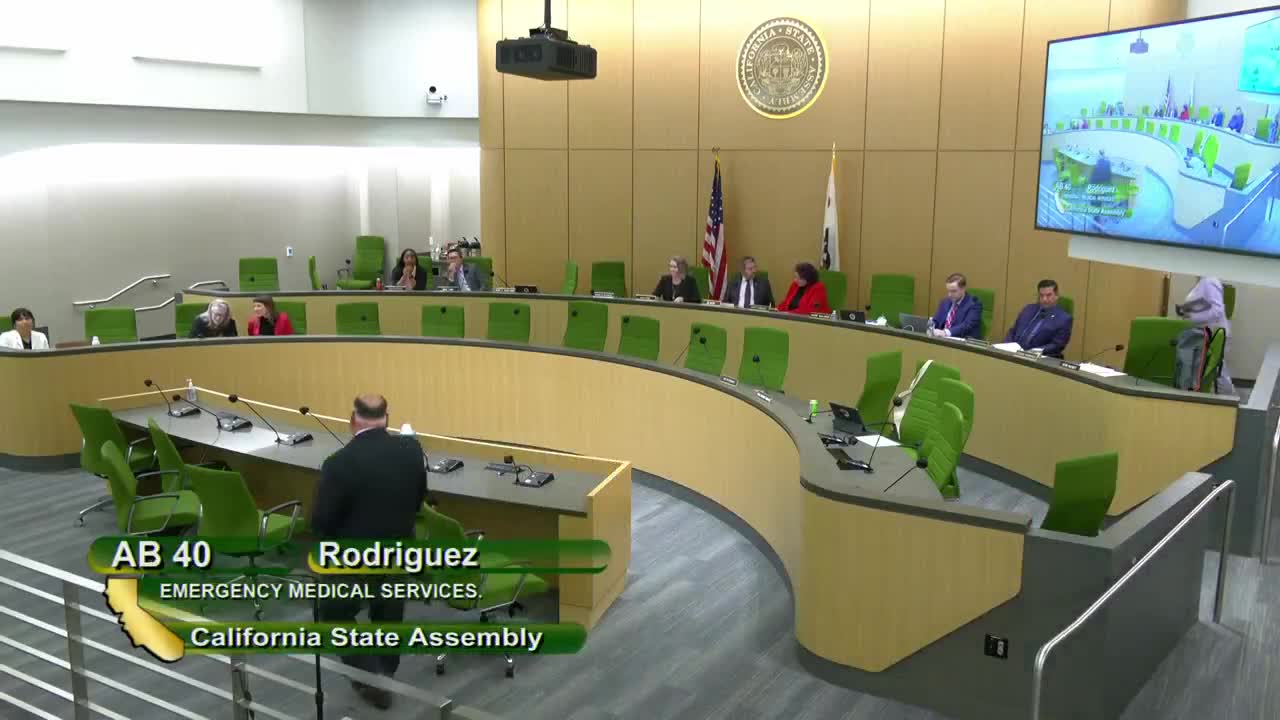 18MIN
Assembly Standing Committee on Health
 36MIN
Assembly Standing Committee on Emergency Management
Bill Author

Bill Co-Author(s):