AB 430: Community land trusts: welfare exemption: assessment: foreclosure sales: financial assistance.
- Session Year: 2023-2024
- House: Assembly
- Latest Version Date: 2023-07-10
Current Status:
Failed
(2023-09-01: In committee: Held under submission.)
Introduced
In Committee
First Chamber
In Committee
Second Chamber
Enacted
(1)Existing property tax law, pursuant to constitutional authorization, provides for a welfare exemption for property used exclusively for religious, hospital, scientific, or charitable purposes and that is owned or operated by certain types of nonprofit entities, if certain qualifying criteria are met. For the 202223 fiscal year through the 202728 fiscal year, in the case of an owner of property that is a community land trust, as defined, existing property tax law requires that a unit continue to be treated as occupied by a lower income household for these purposes if the occupants were lower income households on the lien date in the fiscal year in which their occupancy of the unit commenced and the unit continues to be rent restricted, notwithstanding an increase in the income of the occupants of the unit to 140% of area median income, adjusted for family size. Existing law requires that a lease between a community land trust and a lower income household satisfy specified requirements in order for these provisions to apply, including being a renewable 99-year ground lease and a public agency or official must make a finding that the contract serves the public interest of creating or preserving affordable housing, as provided.
This bill would eliminate specified requirements of a lease agreement between a lower income household and a community land trust in order for the unit to continue to be treated as occupied by a lower income household, as described above.
(2)Existing property tax law requires the assessor to consider in the assessment of land the effect of any enforceable restrictions to which the use of the land may be subjected, including, among others, a renewable 99-year ground lease between a community land trust and the qualified owner, as defined, of an owner-occupied single-family dwelling or an owner-occupied unit in a multifamily dwelling that meets certain other conditions. Existing property tax law defines the term community land trust for these and other purposes to mean a nonprofit corporation that satisfies specified requirements, including a requirement that all dwellings and units located on property owned by the nonprofit are either sold to a qualified owner, as defined, or leased to low- or moderate-income persons or families, and the land owned by the nonprofit corporation, on which a dwelling or unit sold to a qualified owner is situated, is leased by the nonprofit corporation to the qualified owner for the convenient occupation and use of that dwelling or unit for a renewable term of 99 years.
This bill would amend the definition of community land trust to extend these requirements to a wholly owned subsidiary of the trust. trust that is solely directed and managed by the trust.
(3)Existing law prescribes various requirements to be satisfied before the exercise of a power of sale under a mortgage or deed of trust and prescribes a procedure for the exercise of that power. Existing law prescribes certain requirements that apply in the case of sales of real property containing one to 4 residential units, inclusive, that is acquired through foreclosure under a mortgage or deed of trust by an institution or that is acquired at a foreclosure sale by an institution, as defined, including requiring that the institution only accept offers from eligible bidders during the first 30 days after the property is listed for sale. Existing law defines eligible bidder for the purposes to include, among others, a community land trust, defined by reference to the above-described provisions relating to the assessment of real property for taxation.
Existing law creates the Foreclosure Intervention Housing Preservation Program, administered by the Department of Housing and Community Development, for the purpose of preserving affordable housing and promoting resident ownership or nonprofit organization ownership of residential real property. Upon appropriation, existing law requires the department to provide loans and grants to eligible borrowers to support the acquisition of one to 25 unit properties meeting specified criteria. Existing law requires that an eligible borrower be one of 3 specified types of entities, including a limited liability company in which a community land trust, defined by reference to the above-described provisions relating to the assessment of real property for taxation, either holds a controlling interest or is the managing member.
This bill would revise the definition of the term community land trust for purposes of the above-described provisions relating to sales of real property acquired through foreclosure, and for purposes of the Foreclosure Intervention Housing Preservation Program, to incorporate the above-described changes to the definition of that term made by the bill for purposes of the assessment of real property for taxation.
(4)Existing law, the Los Angeles County Regional Housing Finance Act, establishes the Los Angeles County Affordable Housing Solutions Agency for the purpose of increasing the supply of affordable housing in the County of Los Angeles by providing for significantly enhanced funding and technical assistance at a regional level for renter protections, affordable housing preservation, and new affordable housing production, as specified. Existing law requires the agency to distribute regional housing revenue in the form of a grant, loan, or other financing tool, as provided, and specifies that grants, loans, or other financing provided to community land trusts and other similarly structured nonprofit entities to acquire, rehabilitate, and preserve existing housing is an eligible use of that funding.
Existing law establishes the CalHome Program, administered by the Department of Housing and Community Development, to enable low- and very low income households to become or remain homeowners. Existing law requires the department, under the program, to use appropriated funds to provide grant or loan funds to local public agencies or nonprofit corporations for specified purposes relating to the promotion of home ownership. Existing law provides that mutual housing, community land trusts, and limited equity cooperative housing are deemed to be forms of home ownership eligible to receive assistance under the program.
This bill would define the term community land trust for purposes of the Los Angeles County Regional Housing Finance Act and the CalHome Program by reference to the above-described provisions relating to the assessment of real property for taxation, as amended by the bill.
(5)By expanding the duties of local tax officials, this bill would establish a state-mandated local program.
The California Constitution requires the state to reimburse local agencies and school districts for certain costs mandated by the state. Statutory provisions establish procedures for making that reimbursement.
This bill would provide that, if the Commission on State Mandates determines that the bill contains costs mandated by the state, reimbursement for those costs shall be made pursuant to the statutory provisions noted above.
(1)Existing property tax law, pursuant to constitutional authorization, provides for a welfare exemption for property used exclusively for religious, hospital, scientific, or charitable purposes and that is owned or operated by certain types of nonprofit entities, if certain qualifying criteria are met. For the 202223 fiscal year through the 202728 fiscal year, in the case of an owner of property that is a community land trust, as defined, existing property tax law requires that a unit continue to be treated as occupied by a lower income household for these purposes if the occupants were lower income households on the lien date in the fiscal year in which their occupancy of the unit commenced and the unit continues to be rent restricted, notwithstanding an increase in the income of the occupants of the unit to 140% of area median income, adjusted for family size. Existing law requires that a lease between a community land trust and a lower income household satisfy specified requirements in order for these provisions to apply, including being a renewable 99-year ground lease and a public agency or official must make a finding that the contract serves the public interest of creating or preserving affordable housing, as provided.
This bill would eliminate specified requirements of a lease agreement between a lower income household and a community land trust in order for the unit to continue to be treated as occupied by a lower income household, as described above.
(2)Existing property tax law requires the assessor to consider in the assessment of land the effect of any enforceable restrictions to which the use of the land may be subjected, including, among others, a renewable 99-year ground lease between a community land trust and the qualified owner, as defined, of an owner-occupied single-family dwelling or an owner-occupied unit in a multifamily dwelling that meets certain other conditions. Existing property tax law defines the term community land trust for these and other purposes to mean a nonprofit corporation that satisfies specified requirements, including a requirement that all dwellings and units located on property owned by the nonprofit are either sold to a qualified owner, as defined, or leased to low- or moderate-income persons or families, and the land owned by the nonprofit corporation, on which a dwelling or unit sold to a qualified owner is situated, is leased by the nonprofit corporation to the qualified owner for the convenient occupation and use of that dwelling or unit for a renewable term of 99 years.
This bill would amend the definition of community land trust to extend these requirements to a wholly owned subsidiary or lessee of the trust. The bill would also require that land owned by a community land trust, its wholly owned subsidiary, or its lessee satisfy one of 3 conditions: the land is leased by the nonprofit corporation, its wholly owned subsidiary, or its lessee to the qualified owner of a dwelling or unit on the land for the convenient occupation and use of that dwelling or unit for a renewable term of 99 years; the land and any dwellings or units thereon are rented to persons or families of low or moderate income at affordable rents; or, to the extent that any parcels do not have dwellings or units on them, and are not intended for the construction of dwellings or units, the land is used for other purposes, provided that those purposes are not cause for the revocation of the nonprofits tax-exempt status.
(3)Existing law prescribes various requirements to be satisfied before the exercise of a power of sale under a mortgage or deed of trust and prescribes a procedure for the exercise of that power. Existing law prescribes certain requirements that apply in the case of sales of real property containing one to 4 residential units, inclusive, that is acquired through foreclosure under a mortgage or deed of trust by an institution or that is acquired at a foreclosure sale by an institution, as defined, including requiring that the institution only accept offers from eligible bidders during the first 30 days after the property is listed for sale. Existing law defines eligible bidder for the purposes to include, among others, a community land trust, defined by reference to the above-described provisions relating to the assessment of real property for taxation.
Existing law creates the Foreclosure Intervention Housing Preservation Program, administered by the Department of Housing and Community Development, for the purpose of preserving affordable housing and promoting resident ownership or nonprofit organization ownership of residential real property. Upon appropriation, existing law requires the department to provide loans and grants to eligible borrowers to support the acquisition of one to 25 unit properties meeting specified criteria. Existing law requires that an eligible borrower be one of 3 specified types of entities, including a limited liability company in which a community land trust, defined by reference to the above-described provisions relating to the assessment of real property for taxation, either holds a controlling interest or is the managing member.
This bill would revise the definition of the term community land trust for purposes of the above-described provisions relating to sales of real property acquired through foreclosure, and for purposes of the Foreclosure Intervention Housing Preservation Program, to incorporate the above-described changes to the definition of that term made by the bill for purposes of the assessment of real property for taxation.
(4)Existing law, the Los Angeles County Regional Housing Finance Act, establishes the Los Angeles County Affordable Housing Solutions Agency for the purpose of increasing the supply of affordable housing in the County of Los Angeles by providing for significantly enhanced funding and technical assistance at a regional level for renter protections, affordable housing preservation, and new affordable housing production, as specified. Existing law requires the agency to distribute regional housing revenue in the form of a grant, loan, or other financing tool, as provided, and specifies that grants, loans, or other financing provided to community land trusts and other similarly structured nonprofit entities to acquire, rehabilitate, and preserve existing housing is an eligible use of that funding.
Existing law establishes the CalHome Program, administered by the Department of Housing and Community Development, to enable low- and very low income households to become or remain homeowners. Existing law requires the department, under the program, to use appropriated funds to provide grant or loan funds to local public agencies or nonprofit corporations for specified purposes relating to the promotion of homeownership. home ownership. Existing law provides that mutual housing, community land trusts, and limited equity cooperative housing are deemed to be forms of homeownership home ownership eligible to receive assistance under the program.
This bill would define the term community land trust for purposes of the Los Angeles County Regional Housing Finance Act and the CalHome Program by reference to the above-described provisions relating to the assessment of real property for taxation, as amended by the bill.
(5)By expanding the duties of local tax officials, this bill would establish a state-mandated local program.
The California Constitution requires the state to reimburse local agencies and school districts for certain costs mandated by the state. Statutory provisions establish procedures for making that reimbursement.
This bill would provide that, if the Commission on State Mandates determines that the bill contains costs mandated by the state, reimbursement for those costs shall be made pursuant to the statutory provisions noted above.
(1)Existing property tax law, pursuant to constitutional authorization, provides for a welfare exemption for property used exclusively for religious, hospital, scientific, or charitable purposes and that is owned or operated by certain types of nonprofit entities, if certain qualifying criteria are met. For the 202223 fiscal year through the 202728 fiscal year, in the case of an owner of property that is a community land trust, as defined, existing property tax law requires that a unit continue to be treated as occupied by a lower income household for these purposes if the occupants were lower income households on the lien date in the fiscal year in which their occupancy of the unit commenced and the unit continues to be rent restricted, notwithstanding an increase in the income of the occupants of the unit to 140% of area median income, adjusted for family size. Existing law requires that a lease between a community land trust and a lower income household satisfy specified requirements in order for these provisions to apply, including being a renewable 99-year ground lease and a public agency or official must make a finding that the contract serves the public interest of creating or preserving affordable housing, as provided.
This bill would eliminate specified requirements of a lease agreement between a lower income household and a community land trust in order for the unit to continue to be treated as occupied by a lower income household, as described above.
(2)Existing property tax law requires the assessor to consider in the assessment of land the effect of any enforceable restrictions to which the use of the land may be subjected, including, among others, a renewable 99-year ground lease between a community land trust and the qualified owner, as defined, of an owner-occupied single-family dwelling or an owner-occupied unit in a multifamily dwelling that meets certain other conditions. Existing property tax law defines the term community land trust for these and other purposes to mean a nonprofit corporation that satisfies specified requirements, including a requirement that all dwellings and units located on property owned by the nonprofit are either sold to a qualified owner, as defined, or leased to low- or moderate-income persons or families, and the land owned by the nonprofit corporation, on which a dwelling or unit sold to a qualified owner is situated, is leased by the nonprofit corporation to the qualified owner for the convenient occupation and use of that dwelling or unit for a renewable term of 99 years.
This bill would amend the definition of community land trust to extend these requirements to a wholly owned subsidiary or lessee of the trust. The bill would also require that land owned by a community land trust, its wholly owned subsidiary, or its lessee satisfy one of 3 conditions: the land is leased by the nonprofit corporation, its wholly owned subsidiary, or its lessee to the qualified owner of a dwelling or unit on the land for the convenient occupation and use of that dwelling or unit for a renewable term of 99 years; the land and any dwellings or units thereon are rented to persons or families of low or moderate income at affordable rents; or, to the extent that any parcels do not have dwellings or units on them, and are not intended for the construction of dwellings or units, the land is used for other purposes, provided that those purposes are not cause for the revocation of the nonprofits tax-exempt status.
(3)Existing law prescribes various requirements to be satisfied before the exercise of a power of sale under a mortgage or deed of trust and prescribes a procedure for the exercise of that power. Existing law prescribes certain requirements that apply in the case of sales of real property containing one to 4 residential units, inclusive, that is acquired through foreclosure under a mortgage or deed of trust by an institution or that is acquired at a foreclosure sale by an institution, as defined, including requiring that the institution only accept offers from eligible bidders during the first 30 days after the property is listed for sale. Existing law defines eligible bidder for the purposes to include, among others, a community land trust, defined by reference to the above-described provisions relating to the assessment of real property for taxation.
Existing law creates the Foreclosure Intervention Housing Preservation Program, administered by the Department of Housing and Community Development, for the purpose of preserving affordable housing and promoting resident ownership or nonprofit organization ownership of residential real property. Upon appropriation, existing law requires the department to provide loans and grants to eligible borrowers to support the acquisition of one to 25 unit properties meeting specified criteria. Existing law requires that an eligible borrower be one of 3 specified types of entities, including a limited liability company in which a community land trust, defined by reference to the above-described provisions relating to the assessment of real property for taxation, either holds a controlling interest or is the managing member.
This bill would revise the definition of the term community land trust for purposes of the above-described provisions relating to sales of real property acquired through foreclosure, and for purposes of the Foreclosure Intervention Housing Preservation Program, to incorporate the above-described changes to the definition of that term made by the bill for purposes of the assessment of real property for taxation.
(4)Existing law, the Los Angeles County Regional Housing Finance Act, establishes the Los Angeles County Affordable Housing Solutions Agency for the purpose of increasing the supply of affordable housing in the County of Los Angeles by providing for significantly enhanced funding and technical assistance at a regional level for renter protections, affordable housing preservation, and new affordable housing production, as specified. Existing law requires the agency to distribute regional housing revenue in the form of a grant, loan, or other financing tool, as provided, and specifies that grants, loans, or other financing provided to community land trusts and other similarly structured nonprofit entities to acquire, rehabilitate, and preserve existing housing is an eligible use of that funding.
Existing law establishes the CalHome Program, administered by the Department of Housing and Community Development, to enable low- and very low income households to become or remain homeowners. Existing law requires the department, under the program, to use appropriated funds to provide grant or loan funds to local public agencies or nonprofit corporations for specified purposes relating to the promotion of homeownership. Existing law provides that mutual housing, community land trusts, and limited equity cooperative housing are deemed to be forms of homeownership eligible to receive assistance under the program.
This bill would define the term community land trust for purposes of the Los Angeles County Regional Housing Finance Act and the CalHome Program by reference to the above-described provisions relating to the assessment of real property for taxation, as amended by the bill.
(5)By expanding the duties of local tax officials, this bill would establish a state-mandated local program.
The California Constitution requires the state to reimburse local agencies and school districts for certain costs mandated by the state. Statutory provisions establish procedures for making that reimbursement.
This bill would provide that, if the Commission on State Mandates determines that the bill contains costs mandated by the state, reimbursement for those costs shall be made pursuant to the statutory provisions noted above.
Existing law requires the legislative body of each county and city to adopt a comprehensive, long-term general plan for the physical development of the county or city and requires that the plan include a land use element that addresses housing. Existing law states legislative findings and declarations regarding the need for affordable housing and the need to encourage development of new housing.This bill would make nonsubstantive changes in those legislative findings and declarations.Existing law requires the legislative body of each county and city to adopt a comprehensive, long-term general plan for the physical development of the county or city and requires that the plan include a land use element that addresses housing. Existing law states legislative findings and declarations regarding the need for affordable housing and the need to encourage development of new housing.
This bill would make nonsubstantive changes in those legislative findings and declarations.
(a)For purposes of this section, it is the intent of the Legislature to do all of the following:
(1)Allow for prospective owner-occupants and eligible bidders to have the first opportunity to purchase properties that have been acquired through the foreclosure process by an entity that annually forecloses on 175 or more residential real properties in California.
(2)Promote owner occupancy by enacting legislation consistent with the provisions of the federal First Look program that provides owner-occupants and affordable housing providers an opportunity for their offers to be considered on foreclosed properties prior to other offers.
(3)Ensure that the requirements of this section are consistent with the original stated goals of the federal First Look program, which were to expand home ownership opportunities, strengthen neighborhoods and communities, while also providing that sellers are required to respond to offers received during the first look period before accepting or considering investor offers to purchase single-family homes.
(b)For purpose of this section:
(1)Bundled sale means the sale of two or more parcels of real property containing one to four residential dwelling units, inclusive, at least two of which have been acquired through foreclosure under a mortgage or deed of trust.
(2)Eligible bidder means any of the following:
(A)A prospective owner-occupant.
(B)A nonprofit corporation that meets all of the following requirements:
(i)The nonprofit corporation has a determination letter from the Internal Revenue Service affirming its tax-exempt status pursuant to Section 501(c)(3) of the Internal Revenue Code and is not a private foundation as that term is defined in Section 509 of the Internal Revenue Code.
(ii)The nonprofit corporation is based in California.
(iii)All of the board members of the nonprofit corporation have their primary residence in California.
(iv)The primary activity of the nonprofit corporation is the development and preservation of affordable rental or home ownership housing in California.
(C)A community land trust based in California, as defined in clause (ii) of subparagraph (C) of paragraph (11) of subdivision (a) of Section 402.1 of the Revenue and Taxation Code, as amended by the act amending this subparagraph.
(D)A limited-equity housing cooperative, as defined in Section 817, that is based in California.
(E)The state, the Regents of the University of California, a county, city, district, public authority, or public agency, and any other political subdivision or public corporation in the state.
(3)Institution means any of the following, if that person or entity, during its immediately preceding annual reporting period, as established with its primary regulator, foreclosed on 175 or more residential real properties, containing no more than 4 dwelling units:
(A)A depository institution chartered under state or federal law.
(B)A person licensed pursuant to Division 9 (commencing with Section 22000) or Division 20 (commencing with Section 50000) of the Financial Code.
(C)A person licensed pursuant to Part 1 (commencing with Section 10000) of Division 4 of the Business and Professions Code.
(4)Prospective owner-occupant means a natural person whose affidavit or declaration under paragraph (2) of subdivision (c) states all of the following:
(A)They will occupy the property as their primary residence within 60 days of the trustees deed being recorded.
(B)They will maintain their occupancy for at least one year.
(C)They are not any of the following:
(i)The mortgagor or trustor.
(ii)The child, spouse, or parent of the mortgagor or trustor.
(iii)The grantor of a living trust that was named in the title to the property when the notice of default was recorded.
(iv)An employee, officer, or member of the mortgagor or trustor.
(v)A person with an ownership interest in the mortgagor, unless the mortgagor is a publicly traded company.
(D)They are not acting as the agent of any other person or entity in purchasing the real property.
(c)All of the following shall apply to sales of real property containing one to four residential dwelling units, inclusive, that is acquired through foreclosure under a mortgage or deed of trust by an institution or that is acquired at a foreclosure sale by an institution:
(1)During the first 30 days after the property is listed for sale, the institution shall only accept offers from eligible bidders.
(2)An eligible bidder shall submit with their offer to the institution an affidavit or declaration, pursuant to Section 2015.5 of the Code of Civil Procedure, that states they are either of the following:
(A)An eligible bidder pursuant to subparagraphs (B) through (E) of paragraph (2) of subdivision (b).
(B)A prospective owner-occupant purchasing the property as a primary residence pursuant to this subdivision.
(3)Any fraudulent statements may be subject to criminal or civil liability.
(4)The institution shall respond, in writing, to all offers received from eligible bidders during the first 30 days after the property is listed for sale before considering any other offers.
(5)Notwithstanding any other law, an institution shall not conduct a bundled sale.
(d)The provisions of this section are severable. If any provision of this section or its application is held invalid, that invalidity shall not affect other provisions or applications that can be given effect without the invalid provision or application.
SEC. 2.Section 64702 of the Government Code is amended to read:64702.For purposes of this title:
(a)Agency means the Los Angeles County Affordable Housing Solutions Agency established pursuant to Section 64710.
(b)Board means the governing board of the Los Angeles County Affordable Housing Solutions Agency.
(c)Community land trust has the same meaning as that term is defined in clause (ii) of subparagraph (C) of paragraph (11) of subdivision (a) of Section 402.1 of the Revenue and Taxation Code, as amended by the act adding this subdivision.
(d)Los Angeles County means the entire area within the territorial boundary of the County of Los Angeles.
SEC. 3.Section 50650.5 of the Health and Safety Code is amended to read:50650.5.For the purposes of this chapter, all of the following shall apply:
(a)Mutual housing, community land trusts, and limited equity cooperative housing shall be deemed to be forms of home ownership and developments of those types of housing, as defined in subdivision (b), shall be eligible to receive assistance under the CalHome Program. The department may require that mutual housing, community land trust, or limited equity cooperative applicants not simultaneously apply for and receive funding through the departments rental housing programs for the same projects for which CalHome assistance is sought. For mutual housing, community land trust projects that do not convey an interest in real estate to the homebuyer, and limited equity cooperative projects, all of the following shall apply:
(1)Program funds shall be used for permanent financing only.
(2)The department shall enter into a regulatory agreement limiting occupant incomes, occupancy charges, and share purchase terms for 55 years.
(3)Notwithstanding Section 50650.3, program assistance shall be provided in the form of a deferred payment loan.
(b)As used in this section, mutual housing development means a housing development owned and sponsored by a nonprofit corporation or a limited partnership in which the nonprofit corporation is the sole general partner, and all of the following requirements are met:
(1)The nonprofit corporation is exempt from taxes under Section 501(c)(3) of the Internal Revenue Code or subdivision (b) of Section 23701 of the Revenue and Taxation Code.
(2)The nonprofit corporation has as one of its principal purposes the advancement of mutual housing.
(3)A majority of the board of directors of the nonprofit corporation sponsor are residents or former residents of developments sponsored by the nonprofit corporation.
(4)The nonprofit corporation agrees to assist the residents of the development in setting up a resident council, and the operating budget for the development provides for ongoing financial support to allow the resident council to carry out its activities.
(c)Lower income participants in a qualified mutual housing development that is assisted pursuant to this chapter shall not be required to have a vested ownership interest in the property.
(d)(1)Funds provided under this chapter may be used to finance either of the following:
(A)The purchase of land beneath a manufactured home or mobilehome by the owner of the home.
(B)The purchase of both the land beneath a manufactured home or mobilehome and the home.
(2)(A)A loan to purchase a subdivided lot in a manufactured housing community or mobilehome park, or both a subdivided lot and the manufactured home or mobilehome that is located on the lot, may be secured either by the land alone or by both the land and the manufactured home or mobilehome.
(B)A loan to purchase an interest in an entity that owns a manufactured housing community or mobilehome park may be secured by an interest in the entity, a manufactured home, or a mobilehome, or both an interest in the entity and the home.
(3)A manufactured home or mobilehome shall not be required to be placed on a permanent foundation as a condition of receiving financing under this chapter.
(4)Funds provided under this chapter shall not be used for a loan to purchase the first lot or space in a manufactured housing community or mobilehome park at the time of the initial conversion of the park to resident ownership unless the conversion meets the two-thirds signature requirement in subdivision (a) of Section 66428.1 of the Government Code, or the transfer of the park to resident ownership has qualified for the change of ownership exclusion under Section 62.1 of the Revenue and Taxation Code.
(5)For purposes of this subdivision, land beneath a manufactured home or mobilehome means either a subdivided lot in a manufactured housing community or mobilehome park or a membership, share, certificate, or other interest in the entity that owns the manufactured housing community or mobilehome park, including, but not limited to, a limited equity cooperative, community land trust, or mutual housing association.
(e)Subdivision (a) shall not apply to the financing of an interest in a manufactured housing community or mobilehome park that is organized as mutual housing or a limited equity cooperative.
(f)For purposes of this section, community land trust has the same definition as that term is defined in clause (ii) of subparagraph (C) of paragraph (11) of subdivision (a) of Section 402.1 of the Revenue and Taxation Code, as amended by the act adding this subdivision.
SEC. 4.Section 50720.2 of the Health and Safety Code is amended to read:50720.2.(a)The Foreclosure Intervention Housing Preservation Program is hereby established. The department shall administer the program for the purpose of preserving affordable housing and promoting resident ownership or nonprofit organization ownership of residential real property.
(b)(1)Upon appropriation by the Legislature, the program shall be administered by the department to provide loans and grants to eligible borrowers to support the acquisition of 1 to 25 unit properties meeting any of the following criteria:
(A)Real property subject to a trustees sale pursuant to Section 2924m of the Civil Code wherein an eligible bidder has made a bid or represents an intention to bid using funds from the program.
(B)Real property subject to a preforeclosure intervention sale.
(C)Real property subject to a foreclosure risk intervention sale.
(D)Real property subject to a recorded notice of default.
(2)Eligible borrowers shall be any one of the following:
(A)Eligible bidders in Section 2924m of the Civil Code other than prospective owner-occupants as defined in paragraph (1) of subdivision (a) of Section 2924m of the Civil Code.
(B)An organization whose primary activity is the development and preservation of affordable housing that is at least one of the following:
(i)An incorporated nonprofit organization as described in Section 501(c)(3) of the Internal Revenue Code (26 U.S.C. Sec. 501(c)(3)) that is exempt from taxation under Section 501(a) of that code (26 U.S.C. Sec. 501(a)).
(ii)A nonprofit corporation as that term is defined in Section 50091.
(C)A limited liability company that satisfies both of the following criteria:
(i)A community land trust holds a controlling interest in the company.
(ii)A community land trust is the managing member of the company.
(3)Up to 20 percent of the funds appropriated for this program may be expended for the costs to administer the program. Costs to administer the program include, but are not limited to, all of the following:
(A)Costs to develop the guidelines required by this chapter, which may include, but is not limited to, the following:
(i)Department staffing expenses incurred in developing the guidelines.
(ii)Contracting with one or more program fund managers to develop the guidelines.
(iii)Contracting with third-party consultants to develop guidelines.
(B)Costs to develop lending criteria.
(C)Costs to advertise the program.
(D)Costs to develop technical assistance tools to support qualified entities in navigating the requirements and processes to apply for funding, including, but not limited to, the following:
(i)Training modules.
(ii)Acquisition-rehabilitation specific financing templates and guidance, such as pro formas and worksheets.
(iii)Best practice guides for engaging tenants before and after property acquisition, managing safe and accessible rehabilitation of occupied buildings, facilitating resident ownership, and any other topic deemed appropriate by the department.
(iv)Technical assistance with resident engagement and education, property assessment and due diligence, affordable housing operations management, acquisition-rehabilitation project financial assistance, construction, and property management.
(E)Administrative costs of fund managers to implement the program pursuant to Section 50720.6.
(4)Funds not committed to fund managers pursuant to Section 50720.6 as of December 31, 2025, or any funds returned from fund managers, shall be deposited into the Housing Rehabilitation Loan Fund to be made available for loans authorized by Chapter 5.5 (commencing with Section 50606) or for loans authorized by Chapter 6.7 (commencing with Section 50675). Notwithstanding the requirements of Chapter 5.5, uncommitted or returned funds made available for purposes of Chapter 5.5 may be used to assist projects funded by the department or other public entities.
(5)Not later than May 15, 2023, the department shall report to the chairs of the Assembly Committee on Budget and the Senate Committee on Budget and Fiscal Review on the implementation of this program, including the amount of funding disbursed and number, location, and cost of acquired properties, as well as the number of units acquired.
(c)All repayments of program funds to fund managers, including loan principal and any interest collected on those loans, and any interest earned on the funds held by the fund managers shall be deposited into separately maintained reuse accounts held by fund managers for purposes of the program. Fund managers shall use funds held in those reuse accounts for purposes of the program, which may include, but not be limited to, loans and grants to pay for repairs, maintenance, or improvements on properties acquired pursuant to the program.
SEC. 5.Section 50720.4 of the Health and Safety Code is amended to read:50720.4.As used in this chapter:
(a)Capitalized operating subsidy reserve means funds that are set aside before a property is acquired pursuant to this chapter to cover the propertys operating expenses over time.
(b)Community land trust has the same definition as that term is defined in clause (ii) of subparagraph (C) of paragraph (11) of subdivision (a) of Section 402.1 of the Revenue and Taxation Code, as amended by the act adding this subdivision.
(c)Department means the Department of Housing and Community Development.
(d)Foreclosure risk intervention sale means a sale of a 1 to 25 unit residential real property that is not owner occupied and that exhibits indicators of foreclosure risk at the time of sale, including, but not limited to, the following:
(1)There is a mortgage delinquency of at least 90 days.
(2)There is a delinquency on two or more property tax payments.
(3)The owner of the property is a debtor in a bankruptcy proceeding.
(4)There is tenant-initiated litigation against the owner of the property on the basis of lack of habitability.
(5)A local government body responsible for enforcing building codes has deemed the property partially or fully uninhabitable.
(6)There are other indicators that the department may prescribe in the guidelines adopted pursuant to this chapter.
(e)Preforeclosure intervention sale means a sale of a 1 to 25 unit residential real property that is subject to a recorded notice of default by a trustee representing a beneficiary at the time of the sale.
(f)Program means the Foreclosure Intervention Housing Preservation Program.
(g)Property acquisition costs means direct real property acquisition costs such as payment of the purchase price and any liens on eligible properties in addition to repairs required to ensure a property and its structures are in compliance with all applicable habitability, health, and safety laws.
(h)Transaction costs means costs related to acquiring a property, which may include property appraisal, transfer taxes, financing costs, underwriting, project management, broker fees, and legal fees.
SEC. 6.Section 214 of the Revenue and Taxation Code is amended to read:214.(a)Property used exclusively for religious, hospital, scientific, or charitable purposes owned and operated by community chests, funds, foundations, limited liability companies, or corporations organized and operated for religious, hospital, scientific, or charitable purposes is exempt from taxation, including ad valorem taxes to pay the interest and redemption charges on any indebtedness approved by the voters prior to July 1, 1978, or any bonded indebtedness for the acquisition or improvement of real property approved on or after July 1, 1978, by two-thirds of the votes cast by the voters voting on the proposition, if:
(1)The owner is not organized or operated for profit. However, in the case of hospitals, the organization shall not be deemed to be organized or operated for profit if, during the immediately preceding fiscal year, operating revenues, exclusive of gifts, endowments, and grants-in-aid, did not exceed operating expenses by an amount equivalent to 10 percent of those operating expenses. As used herein, operating expenses include depreciation based on cost of replacement and amortization of, and interest on, indebtedness.
(2)No part of the net earnings of the owner inures to the benefit of any private shareholder or individual.
(3)The property is used for the actual operation of the exempt activity, and does not exceed an amount of property reasonably necessary to the accomplishment of the exempt purpose.
(A)For the purposes of determining whether the property is used for the actual operation of the exempt activity, consideration shall not be given to use of the property for either or both of the following described activities if that use is occasional:
(i)The owner conducts fundraising activities on the property and the proceeds derived from those activities are not unrelated business taxable income, as defined in Section 512 of the Internal Revenue Code, of the owner and are used to further the exempt activity of the owner.
(ii)The owner permits any other organization that meets all of the requirements of this subdivision, other than ownership of the property, to conduct fundraising activities on the property and the proceeds derived from those activities are not unrelated business taxable income, as defined in Section 512 of the Internal Revenue Code, of the organization, are not subject to the tax on unrelated business taxable income that is imposed by Section 511 of the Internal Revenue Code, and are used to further the exempt activity of the organization.
(B)For purposes of subparagraph (A):
(i)Occasional use means use of the property on an irregular or intermittent basis by the qualifying owner or any other qualifying organization described in clause (ii) of subparagraph (A) that is incidental to the primary activities of the owner or the other organization.
(ii)Fundraising activities means both activities involving the direct solicitation of money or other property and the anticipated exchange of goods or services for money between the soliciting organization and the organization or person solicited.
(C)Subparagraph (A) shall have no application in determining whether paragraph (3) has been satisfied unless the owner of the property and any other organization using the property as provided in subparagraph (A) have filed with the assessor a valid organizational clearance certificate issued pursuant to Section 254.6.
(D)For the purposes of determining whether the property is used for the actual operation of the exempt activity, consideration shall not be given to the use of the property for meetings conducted by any other organization if the meetings are incidental to the other organizations primary activities, are not fundraising meetings or activities as defined in subparagraph (B), are held no more than once per week, and the other organization and its use of the property meet all other requirements of paragraphs (1) to (5), inclusive, of this subdivision. The owner or the other organization also shall file with the assessor a copy of a valid, unrevoked letter or ruling from the Internal Revenue Service or the Franchise Tax Board stating that the other organization, or the national organization of which it is a local chapter or affiliate, qualifies as an exempt organization under Section 501(c)(3) or 501(c)(4) of the Internal Revenue Code or Section 23701d, 23701f, or 23701w.
(E)Subparagraph (A), (B), (C), or (D) shall not be construed to either enlarge or restrict the exemption provided for in subdivision (b) of Section 4 and Section 5 of Article XIII of the California Constitution and this section.
(4)The property is not used or operated by the owner or by any other person so as to benefit any officer, trustee, director, shareholder, member, employee, contributor, or bondholder of the owner or operator, or any other person, through the distribution of profits, payment of excessive charges or compensations, or the more advantageous pursuit of their business or profession.
(5)The property is not used by the owner or members thereof for fraternal or lodge purposes, or for social club purposes except where that use is clearly incidental to a primary religious, hospital, scientific, or charitable purpose.
(6)The property is irrevocably dedicated to religious, charitable, scientific, or hospital purposes and, upon the liquidation, dissolution, or abandonment of the owner, will not inure to the benefit of any private person except a fund, foundation, or corporation organized and operated for religious, hospital, scientific, or charitable purposes.
(7)The property, if used exclusively for scientific purposes, is used by a foundation or institution that, in addition to complying with the foregoing requirements for the exemption of charitable organizations in general, has been chartered by the Congress of the United States (except that this requirement shall not apply when the scientific purposes are medical research), and whose objects are the encouragement or conduct of scientific investigation, research, and discovery for the benefit of the community at large.
The exemption provided for herein shall be known as the welfare exemption. This exemption is in addition to any other exemption now provided by law, and the existence of the exemption provision in paragraph (2) of subdivision (a) of Section 202 does not preclude the exemption under this section for museum or library property. Except as provided in subdivision (e), this section shall not be construed to enlarge the college exemption.
(b)Property used exclusively for school purposes of less than collegiate grade and owned and operated by religious, hospital, or charitable funds, foundations, limited liability companies, or corporations, which property and funds, foundations, limited liability companies, or corporations meet all of the requirements of subdivision (a), shall be deemed to be within the exemption provided for in subdivision (b) of Section 4 and Section 5 of Article XIII of the California Constitution and this section.
(c)Property used exclusively for nursery school purposes and owned and operated by religious, hospital, or charitable funds, foundations, limited liability companies, or corporations, which property and funds, foundations, limited liability companies, or corporations meet all the requirements of subdivision (a), shall be deemed to be within the exemption provided for in subdivision (b) of Section 4 and Section 5 of Article XIII of the California Constitution and this section.
(d)Property used exclusively for a noncommercial educational FM broadcast station or an educational television station, and owned and operated by religious, hospital, scientific, or charitable funds, foundations, limited liability companies, or corporations meeting all of the requirements of subdivision (a), shall be deemed to be within the exemption provided for in subdivision (b) of Section 4 and Section 5 of Article XIII of the California Constitution and this section.
(e)Property used exclusively for religious, charitable, scientific, or hospital purposes and owned and operated by religious, hospital, scientific, or charitable funds, foundations, limited liability companies, or corporations or educational institutions of collegiate grade, as defined in Section 203, which property and funds, foundations, limited liability companies, corporations, or educational institutions meet all of the requirements of subdivision (a), shall be deemed to be within the exemption provided for in subdivision (b) of Section 4 and Section 5 of Article XIII of the California Constitution and this section. As to educational institutions of collegiate grade, as defined in Section 203, the requirements of paragraph (6) of subdivision (a) shall be deemed to be met if both of the following are met:
(1)The property of the educational institution is irrevocably dedicated in its articles of incorporation to charitable and educational purposes, to religious and educational purposes, or to educational purposes.
(2)The articles of incorporation of the educational institution provide for distribution of its property upon its liquidation, dissolution, or abandonment to a fund, foundation, or corporation organized and operated for religious, hospital, scientific, charitable, or educational purposes meeting the requirements for exemption provided by Section 203 or this section.
(f)Property used exclusively for housing and related facilities for elderly or handicapped families and financed by, including, but not limited to, the federal government pursuant to Section 202 of Public Law 86-372 (12 U.S.C. Sec. 1701q), as amended, Section 231 of Public Law 73-479 (12 U.S.C. Sec. 1715v), Section 236 of Public Law 90-448 (12 U.S.C. Sec. 1715z), or Section 811 of Public Law 101-625 (42 U.S.C. Sec. 8013), and owned and operated by religious, hospital, scientific, or charitable funds, foundations, limited liability companies, or corporations meeting all of the requirements of this section shall be deemed to be within the exemption provided for in subdivision (b) of Section 4 and Section 5 of Article XIII of the California Constitution and this section.
The amendment of this paragraph made by Chapter 1102 of the Statutes of 1984 does not constitute a change in, but is declaratory of, existing law. However, no refund of property taxes shall be required as a result of this amendment for any fiscal year prior to the fiscal year in which the amendment takes effect.
Property used exclusively for housing and related facilities for elderly or handicapped families at which supplemental care or services designed to meet the special needs of elderly or handicapped residents are not provided, or that is not financed by the federal government pursuant to Section 202 of Public Law 86-372 (12 U.S.C. Sec. 1701q), as amended, Section 231 of Public Law 73-479 (12 U.S.C. Sec. 1715v), Section 236 of Public Law 90-448 (12 U.S.C. Sec. 1715z), or Section 811 of Public Law 101-625 (42 U.S.C. Sec. 8013), shall not be entitled to exemption pursuant to this subdivision unless the property is used for housing and related facilities for low- and moderate-income elderly or handicapped families. Property that would otherwise be exempt pursuant to this subdivision, except that it includes some housing and related facilities for other than low- or moderate-income elderly or handicapped families, shall be entitled to a partial exemption. The partial exemption shall be equal to that percentage of the value of the property that is equal to the percentage that the number of low- and moderate-income elderly and handicapped families represents of the total number of families occupying the property.
As used in this subdivision, low and moderate income has the same meaning as the term persons and families of low or moderate income as defined by Section 50093 of the Health and Safety Code.
(g)(1)Property used exclusively for rental housing and related facilities and owned and operated by religious, hospital, scientific, or charitable funds, foundations, limited liability companies, or corporations, including limited partnerships in which the managing general partner is an eligible nonprofit corporation or eligible limited liability company, meeting all of the requirements of this section, or by veterans organizations, as described in Section 215.1, meeting all the requirements of paragraphs (1) to (7), inclusive, of subdivision (a), shall be deemed to be within the exemption provided for in subdivision (b) of Section 4 and Section 5 of Article XIII of the California Constitution and this section and shall be entitled to a partial exemption equal to that percentage of the value of the property that is equal to the percentage that the number of units serving lower income households represents of the total number of residential units in any year in which any of the following criteria applies:
(A)The acquisition, rehabilitation, development, or operation of the property, or any combination of these factors, is financed with tax-exempt mortgage revenue bonds or general obligation bonds, or is financed by local, state, or federal loans or grants and the rents of the occupants who are lower income households do not exceed those prescribed by deed restrictions or regulatory agreements pursuant to the terms of the financing or financial assistance.
(B)The owner of the property is eligible for and receives low-income housing tax credits pursuant to Section 42 of the Internal Revenue Code of 1986, as added by Public Law 99-514.
(C)In the case of a claim, other than a claim with respect to property owned by a limited partnership in which the managing general partner is an eligible nonprofit corporation, that is filed for the 200001 fiscal year or any fiscal year thereafter, 90 percent or more of the occupants of the property are lower income households whose rent does not exceed the rent prescribed by Section 50053 of the Health and Safety Code. The total exemption amount allowed under this subdivision to a taxpayer, with respect to a single property or multiple properties for any fiscal year on the sole basis of the application of this subparagraph, may not exceed twenty million dollars ($20,000,000) in assessed value.
(D)(i)The property was previously purchased and owned by the Department of Transportation pursuant to a consent decree requiring housing mitigation measures relating to the construction of a freeway and is now solely owned by an organization that qualifies as an exempt organization under Section 501(c)(3) of the Internal Revenue Code.
(ii)This subparagraph does not apply to property owned by a limited partnership in which the managing partner is an eligible nonprofit corporation.
(2)In order to be eligible for the exemption provided by this subdivision, the owner of the property shall do both of the following:
(A)(i)For any claim filed for the 200001 fiscal year or any fiscal year thereafter, certify and ensure, subject to the limitation in clause (ii), that there is an enforceable and verifiable agreement with a public agency, a recorded deed restriction, or other legal document that restricts the projects usage and that provides that the units designated for use by lower income households are continuously available to or occupied by lower income households, subject to the exception in clause (iii), at rents that do not exceed those prescribed by Section 50053 of the Health and Safety Code, or, to the extent that the terms of federal, state, or local financing or financial assistance conflicts with Section 50053 of the Health and Safety Code, rents that do not exceed those prescribed by the terms of the financing or financial assistance.
(ii)In the case of a limited partnership in which the managing general partner is an eligible nonprofit corporation, the restriction and provision specified in clause (i) shall be contained in an enforceable and verifiable agreement with a public agency, or in a recorded deed restriction to which the limited partnership certifies.
(iii)(I)In the case of an owner of property that is eligible for and receives a low-income housing tax credit pursuant to Section 42 of the Internal Revenue Code, relating to low-income housing credit, a unit shall continue to be treated as occupied by a lower income household if the occupants were lower income households on the lien date in the fiscal year in which their occupancy of the unit commenced and the unit continues to be rent restricted, notwithstanding an increase in the income of the occupants of the unit to 140 percent of area median income, adjusted for family size. However, the unit shall cease to be treated as a lower income unit if the income of the occupants of the unit increases above 140 percent of area median income, adjusted for family size.
(II)This clause shall only be operative from the 201819 fiscal year through the 202728 fiscal year.
(iv)(I)In the case of an owner of property that is a community land trust and whose property is leased to a lower income household, a unit shall continue to be treated as occupied by a lower income household if the occupants were lower income households on the lien date in the fiscal year in which their occupancy of the unit commenced and the unit continues to be rent restricted, notwithstanding an increase in the income of the occupants of the unit to 140 percent of area median income, adjusted for family size. However, the unit shall cease to be treated as a lower income unit if the income of the occupants of the unit increases above 140 percent of area median income, adjusted for family size.
(II)This clause shall only be operative from the 202223 fiscal year through the 202728 fiscal year.
(B)Certify that the funds that would have been necessary to pay property taxes are used to maintain the affordability of, or reduce rents otherwise necessary for, the units occupied by lower income households.
(3)As used in this subdivision:
(A)Community land trust has the same meaning as defined in Section 402.1.
(B)Lower income households has the same meaning as the term lower income households as defined by Section 50079.5 of the Health and Safety Code.
(C)Related facilities means any managers units and any and all common area spaces that are included within the physical boundaries of the rental housing development, including, but not limited to, common area space, walkways, balconies, patios, clubhouse space, meeting rooms, laundry facilities, and parking areas, except any portions of the overall development that are nonexempt commercial space.
(D)(i)Units serving lower income households shall mean units that are occupied by lower income households at an affordable rent, as defined in Section 50053 of the Health and Safety Code or, to the extent that the terms of federal, state, or local financing or financial assistance conflicts with Section 50053 of the Health and Safety Code, rents that do not exceed those prescribed by the terms of the financing or financial assistance. Units reserved for lower income households at an affordable rent that are temporarily vacant due to tenant turnover or repairs shall be counted as occupied.
(ii)(I)Units serving lower income households shall also mean units specified in clause (iii) of subparagraph (A) of paragraph (2).
(II)This clause shall only be operative from the 201819 fiscal year through the 202728 fiscal year.
(iii)(I)Units serving lower income households shall also mean units specified in clause (iv) of subparagraph (A) of paragraph (2).
(II)This clause shall only be operative from the 202223 fiscal year through the 202728 fiscal year.
(h)Property used exclusively for an emergency or temporary shelter and related facilities for homeless persons and families and owned and operated by religious, hospital, scientific, or charitable funds, foundations, limited liability companies, or corporations meeting all of the requirements of this section shall be deemed to be within the exemption provided for in subdivision (b) of Section 4 and Section 5 of Article XIII of the California Constitution and this section. Property that otherwise would be exempt pursuant to this subdivision, except that it includes housing and related facilities for other than an emergency or temporary shelter, shall be entitled to a partial exemption.
As used in this subdivision, emergency or temporary shelter means a facility that would be eligible for funding pursuant to Chapter 11 (commencing with Section 50800) of Part 2 of Division 31 of the Health and Safety Code.
(i)Property used exclusively for housing and related facilities for employees of religious, charitable, scientific, or hospital organizations that meet all the requirements of subdivision (a) and owned and operated by funds, foundations, limited liability companies, or corporations that meet all the requirements of subdivision (a) shall be deemed to be within the exemption provided for in subdivision (b) of Section 4 and Section 5 of Article XIII of the California Constitution and this section to the extent the residential use of the property is institutionally necessary for the operation of the organization.
(j)For purposes of this section, charitable purposes include educational purposes. For purposes of this subdivision, educational purposes means those educational purposes and activities for the benefit of the community as a whole or an unascertainable and indefinite portion thereof, and do not include those educational purposes and activities that are primarily for the benefit of an organizations shareholders. Educational activities include the study of relevant information, the dissemination of that information to interested members of the general public, and the participation of interested members of the general public.
(k)In the case of property used exclusively for the exempt purposes specified in this section, owned and operated by limited liability companies that are organized and operated for those purposes, the State Board of Equalization shall adopt regulations to specify the ownership, organizational, and operational requirements for those companies to qualify for the exemption provided by this section.
(l)The amendments made by Chapter 354 of the Statutes of 2004 apply with respect to lien dates occurring on and after January 1, 2005.
(m)The amendments made by Chapter 836 of the Statutes of 2016 apply with respect to lien dates occurring on and after January 1, 2017.
(n)The amendments made by Chapter 694 of the Statutes of 2018 apply with respect to lien dates occurring on and after January 1, 2019.
(o)Notwithstanding Section 20 or any other law, the State Board of Equalization is responsible for administering the welfare exemption provided by this section, except where the law places responsibility for administering that exemption with the county assessor.
SEC. 7.Section 402.1 of the Revenue and Taxation Code is amended to read:402.1.(a)In the assessment of land, the assessor shall consider the effect upon value of any enforceable restrictions to which the use of the land may be subjected. These restrictions shall include, but are not limited to, all of the following:
(1)Zoning.
(2)Recorded contracts with governmental agencies other than those provided in Sections 422, 422.5, and 422.7.
(3)Permit authority of, and permits issued by, governmental agencies exercising land use powers concurrently with local governments, including the California Coastal Commission and regional coastal commissions, the San Francisco Bay Conservation and Development Commission, and the Tahoe Regional Planning Agency.
(4)Development controls of a local government in accordance with any local coastal program certified pursuant to Division 20 (commencing with Section 30000) of the Public Resources Code.
(5)Development controls of a local government in accordance with a local protection program, or any component thereof, certified pursuant to Division 19 (commencing with Section 29000) of the Public Resources Code.
(6)Environmental constraints applied to the use of land pursuant to provisions of statutes.
(7)Hazardous waste land use restriction pursuant to Section 25226 of the Health and Safety Code.
(8)(A)A recorded conservation, trail, or scenic easement, as described in Section 815.1 of the Civil Code, that is granted in favor of a public agency, or in favor of a nonprofit corporation organized pursuant to Section 501(c)(3) of the Internal Revenue Code that has as its primary purpose the preservation, protection, or enhancement of land in its natural, scenic, historical, agricultural, forested, or open-space condition or use.
(B)A recorded greenway easement, as described in Section 816.52 of the Civil Code, that is granted in favor of a public agency, or in favor of a nonprofit corporation organized pursuant to Section 501(c)(3) of the Internal Revenue Code that has as its primary purpose the developing and preserving of greenways.
(9)A solar-use easement pursuant to Chapter 6.9 (commencing with Section 51190) of Part 1 of Division 1 of Title 5 of the Government Code.
(10)A contract where the following apply:
(A)The contract is with a nonprofit corporation organized pursuant to Section 501(c)(3) of the Internal Revenue Code that has received a welfare exemption under Section 214.15 for properties intended to be sold to low-income families who participate in a special no-interest loan program.
(B)The contract restricts the use of the land for at least 30 years to owner-occupied housing available at affordable housing cost in accordance with Section 50052.5 of the Health and Safety Code.
(C)The contract includes a deed of trust on the property in favor of the nonprofit corporation to ensure compliance with the terms of the program, which has no value unless the owner fails to comply with the covenants and restrictions of the terms of the home sale.
(D)The local housing authority or an equivalent agency, or, if none exists, the city attorney or county counsel, has made a finding that the long-term deed restrictions in the contract serve a public purpose.
(E)The contract is recorded and provided to the assessor.
(11)(A)A contract where the following apply:
(i)The contract is a renewable 99-year ground lease between a community land trust, or a wholly owned subsidiary of a community land trust, trust that is solely directed and managed by the community land trust, and the qualified owner of an owner-occupied single-family dwelling or an owner-occupied unit in a multifamily dwelling.
(ii)The contract subjects a single-family dwelling or unit in a multifamily dwelling, and the land on which the dwelling or unit is situated that is leased to the qualified owner by a community land trust for the convenient occupation and use of that dwelling or unit, to affordability restrictions.
(iii)One of the following public agencies or officials has made a finding that the affordability restrictions in the contract serve the public interest to create and preserve the affordability of residential housing for persons and families of low or moderate income:
(I)The director of the local housing authority or equivalent agency.
(II)The county counsel.
(III)The director of a county housing department.
(IV)The city attorney.
(V)The director of a city housing department.
(iv)The contract is recorded and is provided to the assessor.
(B)(i)For purposes of this paragraph, the sale or resale price of the dwelling or unit is rebuttably presumed to include both the dwelling or unit and the leased land on which the dwelling or unit is situated. This presumption may be overcome if the assessor establishes by a preponderance of the evidence that all or a portion of the value of the leased land is not reflected in the sale or resale price of the dwelling or unit.
(ii)Notwithstanding any other law, corrections of base year values and declines in value owing to the restrictions on properties assessed under this subparagraph shall apply to all lien dates occurring after September 27, 2016.
(C)For purposes of this paragraph, all of the following definitions shall apply:
(i)Affordability restrictions mean that all of the following conditions are met:
(I)The dwelling or unit can only be sold or resold to a qualified owner to be occupied as a principal place of residence.
(II)The sale or resale price of the dwelling or unit is determined by a formula that ensures the dwelling or unit has a purchase price that is affordable to qualified owners.
(III)There is a purchase option for the dwelling or unit in favor of a community land trust intended to preserve the dwelling or unit as affordable to qualified owners.
(IV)The dwelling or unit is to remain affordable to qualified owners by a renewable 99-year ground lease.
(ii)Community land trust means a nonprofit corporation organized pursuant to Section 501(c)(3) of the Internal Revenue Code that satisfies all of the following:
(I)Has as its primary purposes the creation and maintenance of permanently affordable single-family or multifamily residences.
(II)All dwellings and units located on the land owned by the nonprofit corporation or its wholly owned subsidiary are either sold to a qualified owner to be occupied as the qualified owners primary residence or rented to persons and families of low or moderate income. In the case of dwellings or units sold to qualified owners, the land underneath said dwellings or units is leased by the nonprofit corporation or its wholly owned subsidiary to the qualified owner of a dwelling or unit on the land for the convenient occupation and use of that dwelling or unit for a renewable term of 99 years.
(iii)Limited equity housing cooperative has the same meaning as that term is defined in Section 817 of the Civil Code.
(iv)Persons and families of low or moderate income has the same meaning as that term is defined in Section 50093 of the Health and Safety Code.
(v)Qualified owner means persons and families of low or moderate income, including persons and families of low or moderate income that own a dwelling or unit collectively as member occupants or resident shareholders of a limited equity housing cooperative.
(b)There is a rebuttable presumption that restrictions will not be removed or substantially modified in the predictable future and that they will substantially equate the value of the land to the value attributable to the legally permissible use or uses.
(c)Grounds for rebutting the presumption may include, but are not necessarily limited to, the past history of like use restrictions in the jurisdiction in question and the similarity of sales prices for restricted and unrestricted land. The possible expiration of a restriction at a time certain shall not be conclusive evidence of the future removal or modification of the restriction unless there is no opportunity or likelihood of the continuation or renewal of the restriction, or unless a necessary party to the restriction has indicated an intent to permit its expiration at that time.
(d)In assessing land with respect to which the presumption is unrebutted, the assessor shall not consider sales of otherwise comparable land not similarly restricted as to use as indicative of value of land under restriction, unless the restrictions have a demonstrably minimal effect upon value.
(e)In assessing land under an enforceable use restriction wherein the presumption of no predictable removal or substantial modification of the restriction has been rebutted, but where the restriction nevertheless retains some future life and has some effect on present value, the assessor may consider, in addition to all other legally permissible information, representative sales of comparable lands that are not under restriction but upon which natural limitations have substantially the same effect as restrictions.
(f)For the purposes of this section the following definitions apply:
(1)Comparable lands are lands that are similar to the land being valued in respect to legally permissible uses and physical attributes.
(2)Representative sales information is information from sales of a sufficient number of comparable lands to give an accurate indication of the full cash value of the land being valued.
(g)It is hereby declared that the purpose and intent of the Legislature in enacting this section is to provide for a method of determining whether a sufficient amount of representative sales information is available for land under use restriction to ensure the accurate assessment of that land. It is also hereby declared that the further purpose and intent of the Legislature in enacting this section and Section 1630 is to avoid an assessment policy which, in the absence of special circumstances, considers uses for land that legally are not available to the owner and not contemplated by government, and that these sections are necessary to implement the public policy of encouraging and maintaining effective land use planning. This statute shall not be construed as requiring the assessment of any land at a value less than as required by Section 401 or as prohibiting the use of representative comparable sales information on land under similar restrictions when this information is available.
SEC. 8.If the Commission on State Mandates determines that this act contains costs mandated by the state, reimbursement to local agencies and school districts for those costs shall be made pursuant to Part 7 (commencing with Section 17500) of Division 4 of Title 2 of the Government Code.
(a)For purposes of this section, it is the intent of the Legislature to do all of the following:
(1)Allow for prospective owner-occupants and eligible bidders to have the first opportunity to purchase properties that have been acquired through the foreclosure process by an entity that annually forecloses on 175 or more residential real properties in California.
(2)Promote owner occupancy by enacting legislation consistent with the provisions of the federal First Look program that provides owner-occupants and affordable housing providers an opportunity for their offers to be considered on foreclosed properties prior to other offers.
(3)Ensure that the requirements of this section are consistent with the original stated goals of the federal First Look program, which were to expand home ownership opportunities, strengthen neighborhoods and communities, while also providing that sellers are required to respond to offers received during the first look period before accepting or considering investor offers to purchase single-family homes.
(b)For purpose of this section:
(1)Bundled sale means the sale of two or more parcels of real property containing one to four residential dwelling units, inclusive, at least two of which have been acquired through foreclosure under a mortgage or deed of trust.
(2)Eligible bidder means any of the following:
(A)A prospective owner-occupant.
(B)A nonprofit corporation that meets all of the following requirements:
(i)The nonprofit corporation has a determination letter from the Internal Revenue Service affirming its tax-exempt status pursuant to Section 501(c)(3) of the Internal Revenue Code and is not a private foundation as that term is defined in Section 509 of the Internal Revenue Code.
(ii)The nonprofit corporation is based in California.
(iii)All of the board members of the nonprofit corporation have their primary residence in California.
(iv)The primary activity of the nonprofit corporation is the development and preservation of affordable rental or home ownership housing in California.
(C)A community land trust based in California, as defined in clause (ii) of subparagraph (C) of paragraph (11) of subdivision (a) of Section 402.1 of the Revenue and Taxation Code, as amended by the act amending this subparagraph.
(D)A limited-equity housing cooperative, as defined in Section 817, that is based in California.
(E)The state, the Regents of the University of California, a county, city, district, public authority, or public agency, and any other political subdivision or public corporation in the state.
(3)Institution means any of the following, if that person or entity, during its immediately preceding annual reporting period, as established with its primary regulator, foreclosed on 175 or more residential real properties, containing no more than 4 dwelling units:
(A)A depository institution chartered under state or federal law.
(B)A person licensed pursuant to Division 9 (commencing with Section 22000) or Division 20 (commencing with Section 50000) of the Financial Code.
(C)A person licensed pursuant to Part 1 (commencing with Section 10000) of Division 4 of the Business and Professions Code.
(4)Prospective owner-occupant means a natural person whose affidavit or declaration under paragraph (2) of subdivision (c) states all of the following:
(A)They will occupy the property as their primary residence within 60 days of the trustees deed being recorded.
(B)They will maintain their occupancy for at least one year.
(C)They are not any of the following:
(i)The mortgagor or trustor.
(ii)The child, spouse, or parent of the mortgagor or trustor.
(iii)The grantor of a living trust that was named in the title to the property when the notice of default was recorded.
(iv)An employee, officer, or member of the mortgagor or trustor.
(v)A person with an ownership interest in the mortgagor, unless the mortgagor is a publicly traded company.
(D)They are not acting as the agent of any other person or entity in purchasing the real property.
(c)All of the following shall apply to sales of real property containing one to four residential dwelling units, inclusive, that is acquired through foreclosure under a mortgage or deed of trust by an institution or that is acquired at a foreclosure sale by an institution:
(1)During the first 30 days after the property is listed for sale, the institution shall only accept offers from eligible bidders.
(2)An eligible bidder shall submit with their offer to the institution an affidavit or declaration, pursuant to Section 2015.5 of the Code of Civil Procedure, that states they are either of the following:
(A)An eligible bidder pursuant to subparagraphs (B) through (E) of paragraph (2) of subdivision (b).
(B)A prospective owner-occupant purchasing the property as a primary residence pursuant to this subdivision.
(3)Any fraudulent statements may be subject to criminal or civil liability.
(4)The institution shall respond, in writing, to all offers received from eligible bidders during the first 30 days after the property is listed for sale before considering any other offers.
(5)Notwithstanding any other law, an institution shall not conduct a bundled sale.
(d)The provisions of this section are severable. If any provision of this section or its application is held invalid, that invalidity shall not affect other provisions or applications that can be given effect without the invalid provision or application.
SEC. 2.Section 64702 of the Government Code is amended to read:64702.For purposes of this title:
(a)Agency means the Los Angeles County Affordable Housing Solutions Agency established pursuant to Section 64710.
(b)Board means the governing board of the Los Angeles County Affordable Housing Solutions Agency.
(c)Community land trust has the same meaning as that term is defined in clause (ii) of subparagraph (C) of paragraph (11) of subdivision (a) of Section 402.1 of the Revenue and Taxation Code, as amended by the act adding this subdivision.
(d)Los Angeles County means the entire area within the territorial boundary of the County of Los Angeles.
SEC. 3.Section 50650.5 of the Health and Safety Code is amended to read:50650.5.For the purposes of this chapter, all of the following shall apply:
(a)Mutual housing, community land trusts, and limited equity cooperative housing shall be deemed to be forms of homeownership home ownership and developments of those types of housing, as defined in subdivision (b), shall be eligible to receive assistance under the CalHome Program. The department may require that mutual housing, community land trust, or limited equity cooperative applicants not simultaneously apply for and receive funding through the departments rental housing programs for the same projects for which CalHome assistance is sought. For mutual housing, community land trust projects that do not convey an interest in real estate to the homebuyer, and limited equity cooperative projects, all of the following shall apply:
(1)Program funds shall be used for permanent financing only.
(2)The department shall enter into a regulatory agreement limiting occupant incomes, occupancy charges, and share purchase terms for 55 years.
(3)Notwithstanding Section 50650.3, program assistance shall be provided in the form of a deferred payment loan.
(b)As used in this section, mutual housing development means a housing development owned and sponsored by a nonprofit corporation or a limited partnership in which the nonprofit corporation is the sole general partner, and all of the following requirements are met:
(1)The nonprofit corporation is exempt from taxes under Section 501(c)(3) of the Internal Revenue Code or subdivision (b) of Section 23701 of the Revenue and Taxation Code.
(2)The nonprofit corporation has as one of its principal purposes the advancement of mutual housing.
(3)A majority of the board of directors of the nonprofit corporation sponsor are residents or former residents of developments sponsored by the nonprofit corporation.
(4)The nonprofit corporation agrees to assist the residents of the development in setting up a resident council, and the operating budget for the development provides for ongoing financial support to allow the resident council to carry out its activities.
(c)Lower income participants in a qualified mutual housing development that is assisted pursuant to this chapter shall not be required to have a vested ownership interest in the property.
(d)(1)Funds provided under this chapter may be used to finance either of the following:
(A)The purchase of land beneath a manufactured home or mobilehome by the owner of the home.
(B)The purchase of both the land beneath a manufactured home or mobilehome and the home.
(2)(A)A loan to purchase a subdivided lot in a manufactured housing community or mobilehome park, or both a subdivided lot and the manufactured home or mobilehome that is located on the lot, may be secured either by the land alone or by both the land and the manufactured home or mobilehome.
(B)A loan to purchase an interest in an entity that owns a manufactured housing community or mobilehome park may be secured by an interest in the entity, a manufactured home, or a mobilehome, or both an interest in the entity and the home.
(3)A manufactured home or mobilehome shall not be required to be placed on a permanent foundation as a condition of receiving financing under this chapter.
(4)Funds provided under this chapter shall not be used for a loan to purchase the first lot or space in a manufactured housing community or mobilehome park at the time of the initial conversion of the park to resident ownership unless the conversion meets the two-thirds signature requirement in subdivision (a) of Section 66428.1 of the Government Code, or the transfer of the park to resident ownership has qualified for the change of ownership exclusion under Section 62.1 of the Revenue and Taxation Code.
(5)For purposes of this subdivision, land beneath a manufactured home or mobilehome means either a subdivided lot in a manufactured housing community or mobilehome park or a membership, share, certificate, or other interest in the entity that owns the manufactured housing community or mobilehome park, including, but not limited to, a limited equity cooperative, community land trust, or mutual housing association.
(e)Subdivision (a) shall not apply to the financing of an interest in a manufactured housing community or mobilehome park that is organized as mutual housing or a limited equity cooperative.
(f)For purposes of this section, community land trust has the same definition as that term is defined in clause (ii) of subparagraph (C) of paragraph (11) of subdivision (a) of Section 402.1 of the Revenue and Taxation Code, as amended by the act adding this subdivision.
SEC. 4.Section 50720.2 of the Health and Safety Code is amended to read:50720.2.(a)The Foreclosure Intervention Housing Preservation Program is hereby established. The department shall administer the program for the purpose of preserving affordable housing and promoting resident ownership or nonprofit organization ownership of residential real property.
(b)(1)Upon appropriation by the Legislature, the program shall be administered by the department to provide loans and grants to eligible borrowers to support the acquisition of 1 to 25 unit properties meeting any of the following criteria:
(A)Real property subject to a trustees sale pursuant to Section 2924m of the Civil Code wherein an eligible bidder has made a bid or represents an intention to bid using funds from the program.
(B)Real property subject to a preforeclosure intervention sale.
(C)Real property subject to a foreclosure risk intervention sale.
(D)Real property subject to a recorded notice of default.
(2)Eligible borrowers shall be any one of the following:
(A)Eligible bidders in Section 2924m of the Civil Code other than prospective owner-occupants as defined in paragraph (1) of subdivision (a) of Section 2924m of the Civil Code.
(B)An organization whose primary activity is the development and preservation of affordable housing that is at least one of the following:
(i)An incorporated nonprofit organization as described in Section 501(c)(3) of the Internal Revenue Code (26 U.S.C. Sec. 501(c)(3)) that is exempt from taxation under Section 501(a) of that code (26 U.S.C. Sec. 501(a)).
(ii)A nonprofit corporation as that term is defined in Section 50091.
(C)A limited liability company that satisfies both of the following criteria:
(i)A community land trust holds a controlling interest in the company.
(ii)A community land trust is the managing member of the company.
(3)Up to 20 percent of the funds appropriated for this program may be expended for the costs to administer the program. Costs to administer the program include, but are not limited to, all of the following:
(A)Costs to develop the guidelines required by this chapter, which may include, but is not limited to, the following:
(i)Department staffing expenses incurred in developing the guidelines.
(ii)Contracting with one or more program fund managers to develop the guidelines.
(iii)Contracting with third-party consultants to develop guidelines.
(B)Costs to develop lending criteria.
(C)Costs to advertise the program.
(D)Costs to develop technical assistance tools to support qualified entities in navigating the requirements and processes to apply for funding funding, including, but not limited to, the following:
(i)Training modules.
(ii)Acquisition-rehabilitation specific financing templates and guidance, such as pro formas and worksheets.
(iii)Best practice guides for engaging tenants before and after property acquisition, managing safe and accessible rehabilitation of occupied buildings, facilitating resident ownership, and any other topic deemed appropriate by the department.
(iv)Technical assistance with resident engagement and education, property assessment and due diligence, affordable housing operations management, acquisition-rehabilitation project financial assistance, construction, and property management.
(E)Administrative costs of fund managers to implement the program pursuant to Section 50720.6.
(4)Funds not committed to fund managers pursuant to Section 50720.6 as of December 31, 2025, or any funds returned from fund managers, shall be deposited into the Housing Rehabilitation Loan Fund to be made available for loans authorized by Chapter 5.5 (commencing with Section 50606) or for loans authorized by Chapter 6.7 (commencing with Section 50675). Notwithstanding the requirements of Chapter 5.5, uncommitted or returned funds made available for purposes of Chapter 5.5 may be used to assist projects funded by the department or other public entities.
(5)Not later than May 15, 2023, the department shall report to the chairs of the Assembly Committee on Budget and the Senate Committee on Budget and Fiscal Review on the implementation of this program, including the amount of funding disbursed and number, location, and cost of acquired properties, as well as the number of units acquired.
(c)All repayments of program funds to fund managers, including loan principal and any interest collected on those loans, and any interest earned on the funds held by the fund managers shall be deposited into separately maintained reuse accounts held by fund managers for purposes of the program. Fund managers shall use funds held in those reuse accounts for purposes of the program, which may include, but not be limited to, loans and grants to pay for repairs, maintenance, or improvements on properties acquired pursuant to the program.
SEC. 5.Section 50720.4 of the Health and Safety Code is amended to read:50720.4.As used in this chapter:
(a)Capitalized operating subsidy reserve means funds that are set aside before a property is acquired pursuant to this chapter to cover the propertys operating expenses over time.
(b)Community land trust has the same definition as that term is defined in clause (ii) of subparagraph (C) of paragraph (11) of subdivision (a) of Section 402.1 of the Revenue and Taxation Code, as amended by the act adding this subdivision.
(c)Department means the Department of Housing and Community Development.
(d)Foreclosure risk intervention sale means a sale of a 1 to 25 unit residential real property that is not owner occupied and that exhibits indicators of foreclosure risk at the time of sale sale, including, but not limited to, the following:
(1)There is a mortgage delinquency of at least 90 days.
(2)There is a delinquency on two or more property tax payments.
(3)The owner of the property is a debtor in a bankruptcy proceeding.
(4)There is tenant-initiated litigation against the owner of the property on the basis of lack of habitability.
(5)A local government body responsible for enforcing building codes has deemed the property partially or fully uninhabitable.
(6)There are other indicators that the department may prescribe in the guidelines adopted pursuant to this chapter.
(e)Preforeclosure intervention sale means a sale of a 1 to 25 unit residential real property that is subject to a recorded notice of default by a trustee representing a beneficiary at the time of the sale.
(f)Program means the Foreclosure Intervention Housing Preservation Program.
(g)Property acquisition costs means direct real property acquisition costs such as payment of the purchase price and any liens on eligible properties in addition to repairs required to ensure a property and its structures are in compliance with all applicable habitability, health, and safety laws.
(h)Transaction costs means costs related to acquiring a property, which may include property appraisal, transfer taxes, financing costs, underwriting, project management, broker fees, and legal fees.
SEC. 6.Section 214 of the Revenue and Taxation Code is amended to read:214.(a)Property used exclusively for religious, hospital, scientific, or charitable purposes owned and operated by community chests, funds, foundations, limited liability companies, or corporations organized and operated for religious, hospital, scientific, or charitable purposes is exempt from taxation, including ad valorem taxes to pay the interest and redemption charges on any indebtedness approved by the voters prior to July 1, 1978, or any bonded indebtedness for the acquisition or improvement of real property approved on or after July 1, 1978, by two-thirds of the votes cast by the voters voting on the proposition, if:
(1)The owner is not organized or operated for profit. However, in the case of hospitals, the organization shall not be deemed to be organized or operated for profit if, during the immediately preceding fiscal year, operating revenues, exclusive of gifts, endowments, and grants-in-aid, did not exceed operating expenses by an amount equivalent to 10 percent of those operating expenses. As used herein, operating expenses include depreciation based on cost of replacement and amortization of, and interest on, indebtedness.
(2)No part of the net earnings of the owner inures to the benefit of any private shareholder or individual.
(3)The property is used for the actual operation of the exempt activity, and does not exceed an amount of property reasonably necessary to the accomplishment of the exempt purpose.
(A)For the purposes of determining whether the property is used for the actual operation of the exempt activity, consideration shall not be given to use of the property for either or both of the following described activities if that use is occasional:
(i)The owner conducts fundraising activities on the property and the proceeds derived from those activities are not unrelated business taxable income, as defined in Section 512 of the Internal Revenue Code, of the owner and are used to further the exempt activity of the owner.
(ii)The owner permits any other organization that meets all of the requirements of this subdivision, other than ownership of the property, to conduct fundraising activities on the property and the proceeds derived from those activities are not unrelated business taxable income, as defined in Section 512 of the Internal Revenue Code, of the organization, are not subject to the tax on unrelated business taxable income that is imposed by Section 511 of the Internal Revenue Code, and are used to further the exempt activity of the organization.
(B)For purposes of subparagraph (A):
(i)Occasional use means use of the property on an irregular or intermittent basis by the qualifying owner or any other qualifying organization described in clause (ii) of subparagraph (A) that is incidental to the primary activities of the owner or the other organization.
(ii)Fundraising activities means both activities involving the direct solicitation of money or other property and the anticipated exchange of goods or services for money between the soliciting organization and the organization or person solicited.
(C)Subparagraph (A) shall have no application in determining whether paragraph (3) has been satisfied unless the owner of the property and any other organization using the property as provided in subparagraph (A) have filed with the assessor a valid organizational clearance certificate issued pursuant to Section 254.6.
(D)For the purposes of determining whether the property is used for the actual operation of the exempt activity, consideration shall not be given to the use of the property for meetings conducted by any other organization if the meetings are incidental to the other organizations primary activities, are not fundraising meetings or activities as defined in subparagraph (B), are held no more than once per week, and the other organization and its use of the property meet all other requirements of paragraphs (1) to (5), inclusive, of this subdivision. The owner or the other organization also shall file with the assessor a copy of a valid, unrevoked letter or ruling from the Internal Revenue Service or the Franchise Tax Board stating that the other organization, or the national organization of which it is a local chapter or affiliate, qualifies as an exempt organization under Section 501(c)(3) or 501(c)(4) of the Internal Revenue Code or Section 23701d, 23701f, or 23701w.
(E)Subparagraph (A), (B), (C), or (D) shall not be construed to either enlarge or restrict the exemption provided for in subdivision (b) of Section 4 and Section 5 of Article XIII of the California Constitution and this section.
(4)The property is not used or operated by the owner or by any other person so as to benefit any officer, trustee, director, shareholder, member, employee, contributor, or bondholder of the owner or operator, or any other person, through the distribution of profits, payment of excessive charges or compensations, or the more advantageous pursuit of their business or profession.
(5)The property is not used by the owner or members thereof for fraternal or lodge purposes, or for social club purposes except where that use is clearly incidental to a primary religious, hospital, scientific, or charitable purpose.
(6)The property is irrevocably dedicated to religious, charitable, scientific, or hospital purposes and, upon the liquidation, dissolution, or abandonment of the owner, will not inure to the benefit of any private person except a fund, foundation, or corporation organized and operated for religious, hospital, scientific, or charitable purposes.
(7)The property, if used exclusively for scientific purposes, is used by a foundation or institution that, in addition to complying with the foregoing requirements for the exemption of charitable organizations in general, has been chartered by the Congress of the United States (except that this requirement shall not apply when the scientific purposes are medical research), and whose objects are the encouragement or conduct of scientific investigation, research, and discovery for the benefit of the community at large.
The exemption provided for herein shall be known as the welfare exemption. This exemption is in addition to any other exemption now provided by law, and the existence of the exemption provision in paragraph (2) of subdivision (a) of Section 202 does not preclude the exemption under this section for museum or library property. Except as provided in subdivision (e), this section shall not be construed to enlarge the college exemption.
(b)Property used exclusively for school purposes of less than collegiate grade and owned and operated by religious, hospital, or charitable funds, foundations, limited liability companies, or corporations, which property and funds, foundations, limited liability companies, or corporations meet all of the requirements of subdivision (a), shall be deemed to be within the exemption provided for in subdivision (b) of Section 4 and Section 5 of Article XIII of the California Constitution and this section.
(c)Property used exclusively for nursery school purposes and owned and operated by religious, hospital, or charitable funds, foundations, limited liability companies, or corporations, which property and funds, foundations, limited liability companies, or corporations meet all the requirements of subdivision (a), shall be deemed to be within the exemption provided for in subdivision (b) of Section 4 and Section 5 of Article XIII of the California Constitution and this section.
(d)Property used exclusively for a noncommercial educational FM broadcast station or an educational television station, and owned and operated by religious, hospital, scientific, or charitable funds, foundations, limited liability companies, or corporations meeting all of the requirements of subdivision (a), shall be deemed to be within the exemption provided for in subdivision (b) of Section 4 and Section 5 of Article XIII of the California Constitution and this section.
(e)Property used exclusively for religious, charitable, scientific, or hospital purposes and owned and operated by religious, hospital, scientific, or charitable funds, foundations, limited liability companies, or corporations or educational institutions of collegiate grade, as defined in Section 203, which property and funds, foundations, limited liability companies, corporations, or educational institutions meet all of the requirements of subdivision (a), shall be deemed to be within the exemption provided for in subdivision (b) of Section 4 and Section 5 of Article XIII of the California Constitution and this section. As to educational institutions of collegiate grade, as defined in Section 203, the requirements of paragraph (6) of subdivision (a) shall be deemed to be met if both of the following are met:
(1)The property of the educational institution is irrevocably dedicated in its articles of incorporation to charitable and educational purposes, to religious and educational purposes, or to educational purposes.
(2)The articles of incorporation of the educational institution provide for distribution of its property upon its liquidation, dissolution, or abandonment to a fund, foundation, or corporation organized and operated for religious, hospital, scientific, charitable, or educational purposes meeting the requirements for exemption provided by Section 203 or this section.
(f)Property used exclusively for housing and related facilities for elderly or handicapped families and financed by, including, but not limited to, the federal government pursuant to Section 202 of Public Law 86-372 (12 U.S.C. Sec. 1701q), as amended, Section 231 of Public Law 73-479 (12 U.S.C. Sec. 1715v), Section 236 of Public Law 90-448 (12 U.S.C. Sec. 1715z), or Section 811 of Public Law 101-625 (42 U.S.C. Sec. 8013), and owned and operated by religious, hospital, scientific, or charitable funds, foundations, limited liability companies, or corporations meeting all of the requirements of this section shall be deemed to be within the exemption provided for in subdivision (b) of Section 4 and Section 5 of Article XIII of the California Constitution and this section.
The amendment of this paragraph made by Chapter 1102 of the Statutes of 1984 does not constitute a change in, but is declaratory of, existing law. However, no refund of property taxes shall be required as a result of this amendment for any fiscal year prior to the fiscal year in which the amendment takes effect.
Property used exclusively for housing and related facilities for elderly or handicapped families at which supplemental care or services designed to meet the special needs of elderly or handicapped residents are not provided, or that is not financed by the federal government pursuant to Section 202 of Public Law 86-372 (12 U.S.C. Sec. 1701q), as amended, Section 231 of Public Law 73-479 (12 U.S.C. Sec. 1715v), Section 236 of Public Law 90-448 (12 U.S.C. Sec. 1715z), or Section 811 of Public Law 101-625 (42 U.S.C. Sec. 8013), shall not be entitled to exemption pursuant to this subdivision unless the property is used for housing and related facilities for low- and moderate-income elderly or handicapped families. Property that would otherwise be exempt pursuant to this subdivision, except that it includes some housing and related facilities for other than low- or moderate-income elderly or handicapped families, shall be entitled to a partial exemption. The partial exemption shall be equal to that percentage of the value of the property that is equal to the percentage that the number of low- and moderate-income elderly and handicapped families represents of the total number of families occupying the property.
As used in this subdivision, low and moderate income has the same meaning as the term persons and families of low or moderate income as defined by Section 50093 of the Health and Safety Code.
(g)(1)Property used exclusively for rental housing and related facilities and owned and operated by religious, hospital, scientific, or charitable funds, foundations, limited liability companies, or corporations, including limited partnerships in which the managing general partner is an eligible nonprofit corporation or eligible limited liability company, meeting all of the requirements of this section, or by veterans organizations, as described in Section 215.1, meeting all the requirements of paragraphs (1) to (7), inclusive, of subdivision (a), shall be deemed to be within the exemption provided for in subdivision (b) of Section 4 and Section 5 of Article XIII of the California Constitution and this section and shall be entitled to a partial exemption equal to that percentage of the value of the property that is equal to the percentage that the number of units serving lower income households represents of the total number of residential units in any year in which any of the following criteria applies:
(A)The acquisition, rehabilitation, development, or operation of the property, or any combination of these factors, is financed with tax-exempt mortgage revenue bonds or general obligation bonds, or is financed by local, state, or federal loans or grants and the rents of the occupants who are lower income households do not exceed those prescribed by deed restrictions or regulatory agreements pursuant to the terms of the financing or financial assistance.
(B)The owner of the property is eligible for and receives low-income housing tax credits pursuant to Section 42 of the Internal Revenue Code of 1986, as added by Public Law 99-514.
(C)In the case of a claim, other than a claim with respect to property owned by a limited partnership in which the managing general partner is an eligible nonprofit corporation, that is filed for the 200001 fiscal year or any fiscal year thereafter, 90 percent or more of the occupants of the property are lower income households whose rent does not exceed the rent prescribed by Section 50053 of the Health and Safety Code. The total exemption amount allowed under this subdivision to a taxpayer, with respect to a single property or multiple properties for any fiscal year on the sole basis of the application of this subparagraph, may not exceed twenty million dollars ($20,000,000) in assessed value.
(D)(i)The property was previously purchased and owned by the Department of Transportation pursuant to a consent decree requiring housing mitigation measures relating to the construction of a freeway and is now solely owned by an organization that qualifies as an exempt organization under Section 501(c)(3) of the Internal Revenue Code.
(ii)This subparagraph does not apply to property owned by a limited partnership in which the managing partner is an eligible nonprofit corporation.
(2)In order to be eligible for the exemption provided by this subdivision, the owner of the property shall do both of the following:
(A)(i)For any claim filed for the 200001 fiscal year or any fiscal year thereafter, certify and ensure, subject to the limitation in clause (ii), that there is an enforceable and verifiable agreement with a public agency, a recorded deed restriction, or other legal document that restricts the projects usage and that provides that the units designated for use by lower income households are continuously available to or occupied by lower income households, subject to the exception in clause (iii), at rents that do not exceed those prescribed by Section 50053 of the Health and Safety Code, or, to the extent that the terms of federal, state, or local financing or financial assistance conflicts with Section 50053 of the Health and Safety Code, rents that do not exceed those prescribed by the terms of the financing or financial assistance.
(ii)In the case of a limited partnership in which the managing general partner is an eligible nonprofit corporation, the restriction and provision specified in clause (i) shall be contained in an enforceable and verifiable agreement with a public agency, or in a recorded deed restriction to which the limited partnership certifies.
(iii)(I)In the case of an owner of property that is eligible for and receives a low-income housing tax credit pursuant to Section 42 of the Internal Revenue Code, relating to low-income housing credit, a unit shall continue to be treated as occupied by a lower income household if the occupants were lower income households on the lien date in the fiscal year in which their occupancy of the unit commenced and the unit continues to be rent restricted, notwithstanding an increase in the income of the occupants of the unit to 140 percent of area median income, adjusted for family size. However, the unit shall cease to be treated as a lower income unit if the income of the occupants of the unit increases above 140 percent of area median income, adjusted for family size.
(II)This clause shall only be operative from the 201819 fiscal year through the 202728 fiscal year.
(iv)(I)In the case of an owner of property that is a community land trust and whose property is leased to a lower income household, a unit shall continue to be treated as occupied by a lower income household if the occupants were lower income households on the lien date in the fiscal year in which their occupancy of the unit commenced and the unit continues to be rent restricted, notwithstanding an increase in the income of the occupants of the unit to 140 percent of area median income, adjusted for family size. However, the unit shall cease to be treated as a lower income unit if the income of the occupants of the unit increases above 140 percent of area median income, adjusted for family size.
(II)This clause shall only be operative from the 202223 fiscal year through the 202728 fiscal year.
(B)Certify that the funds that would have been necessary to pay property taxes are used to maintain the affordability of, or reduce rents otherwise necessary for, the units occupied by lower income households.
(3)As used in this subdivision:
(A)Community land trust has the same meaning as defined in Section 402.1.
(B)Lower income households has the same meaning as the term lower income households as defined by Section 50079.5 of the Health and Safety Code.
(C)Related facilities means any managers units and any and all common area spaces that are included within the physical boundaries of the rental housing development, including, but not limited to, common area space, walkways, balconies, patios, clubhouse space, meeting rooms, laundry facilities, and parking areas, except any portions of the overall development that are nonexempt commercial space.
(D)(i)Units serving lower income households shall mean units that are occupied by lower income households at an affordable rent, as defined in Section 50053 of the Health and Safety Code or, to the extent that the terms of federal, state, or local financing or financial assistance conflicts with Section 50053 of the Health and Safety Code, rents that do not exceed those prescribed by the terms of the financing or financial assistance. Units reserved for lower income households at an affordable rent that are temporarily vacant due to tenant turnover or repairs shall be counted as occupied.
(ii)(I)Units serving lower income households shall also mean units specified in clause (iii) of subparagraph (A) of paragraph (2).
(II)This clause shall only be operative from the 201819 fiscal year through the 202728 fiscal year.
(iii)(I)Units serving lower income households shall also mean units specified in clause (iv) of subparagraph (A) of paragraph (2).
(II)This clause shall only be operative from the 202223 fiscal year through the 202728 fiscal year.
(h)Property used exclusively for an emergency or temporary shelter and related facilities for homeless persons and families and owned and operated by religious, hospital, scientific, or charitable funds, foundations, limited liability companies, or corporations meeting all of the requirements of this section shall be deemed to be within the exemption provided for in subdivision (b) of Section 4 and Section 5 of Article XIII of the California Constitution and this section. Property that otherwise would be exempt pursuant to this subdivision, except that it includes housing and related facilities for other than an emergency or temporary shelter, shall be entitled to a partial exemption.
As used in this subdivision, emergency or temporary shelter means a facility that would be eligible for funding pursuant to Chapter 11 (commencing with Section 50800) of Part 2 of Division 31 of the Health and Safety Code.
(i)Property used exclusively for housing and related facilities for employees of religious, charitable, scientific, or hospital organizations that meet all the requirements of subdivision (a) and owned and operated by funds, foundations, limited liability companies, or corporations that meet all the requirements of subdivision (a) shall be deemed to be within the exemption provided for in subdivision (b) of Section 4 and Section 5 of Article XIII of the California Constitution and this section to the extent the residential use of the property is institutionally necessary for the operation of the organization.
(j)For purposes of this section, charitable purposes include educational purposes. For purposes of this subdivision, educational purposes means those educational purposes and activities for the benefit of the community as a whole or an unascertainable and indefinite portion thereof, and do not include those educational purposes and activities that are primarily for the benefit of an organizations shareholders. Educational activities include the study of relevant information, the dissemination of that information to interested members of the general public, and the participation of interested members of the general public.
(k)In the case of property used exclusively for the exempt purposes specified in this section, owned and operated by limited liability companies that are organized and operated for those purposes, the State Board of Equalization shall adopt regulations to specify the ownership, organizational, and operational requirements for those companies to qualify for the exemption provided by this section.
(l)The amendments made by Chapter 354 of the Statutes of 2004 apply with respect to lien dates occurring on and after January 1, 2005.
(m)The amendments made by Chapter 836 of the Statutes of 2016 apply with respect to lien dates occurring on and after January 1, 2017.
(n)The amendments made by Chapter 694 of the Statutes of 2018 apply with respect to lien dates occurring on and after January 1, 2019.
(o)Notwithstanding Section 20 or any other law, the State Board of Equalization is responsible for administering the welfare exemption provided by this section, except where the law places responsibility for administering that exemption with the county assessor.
SEC. 7.Section 402.1 of the Revenue and Taxation Code is amended to read:402.1.(a)In the assessment of land, the assessor shall consider the effect upon value of any enforceable restrictions to which the use of the land may be subjected. These restrictions shall include, but are not limited to, all of the following:
(1)Zoning.
(2)Recorded contracts with governmental agencies other than those provided in Sections 422, 422.5, and 422.7.
(3)Permit authority of, and permits issued by, governmental agencies exercising land use powers concurrently with local governments, including the California Coastal Commission and regional coastal commissions, the San Francisco Bay Conservation and Development Commission, and the Tahoe Regional Planning Agency.
(4)Development controls of a local government in accordance with any local coastal program certified pursuant to Division 20 (commencing with Section 30000) of the Public Resources Code.
(5)Development controls of a local government in accordance with a local protection program, or any component thereof, certified pursuant to Division 19 (commencing with Section 29000) of the Public Resources Code.
(6)Environmental constraints applied to the use of land pursuant to provisions of statutes.
(7)Hazardous waste land use restriction pursuant to Section 25226 of the Health and Safety Code.
(8)(A)A recorded conservation, trail, or scenic easement, as described in Section 815.1 of the Civil Code, that is granted in favor of a public agency, or in favor of a nonprofit corporation organized pursuant to Section 501(c)(3) of the Internal Revenue Code that has as its primary purpose the preservation, protection, or enhancement of land in its natural, scenic, historical, agricultural, forested, or open-space condition or use.
(B)A recorded greenway easement, as described in Section 816.52 of the Civil Code, that is granted in favor of a public agency, or in favor of a nonprofit corporation organized pursuant to Section 501(c)(3) of the Internal Revenue Code that has as its primary purpose the developing and preserving of greenways.
(9)A solar-use easement pursuant to Chapter 6.9 (commencing with Section 51190) of Part 1 of Division 1 of Title 5 of the Government Code.
(10)A contract where the following apply:
(A)The contract is with a nonprofit corporation organized pursuant to Section 501(c)(3) of the Internal Revenue Code that has received a welfare exemption under Section 214.15 for properties intended to be sold to low-income families who participate in a special no-interest loan program.
(B)The contract restricts the use of the land for at least 30 years to owner-occupied housing available at affordable housing cost in accordance with Section 50052.5 of the Health and Safety Code.
(C)The contract includes a deed of trust on the property in favor of the nonprofit corporation to ensure compliance with the terms of the program, which has no value unless the owner fails to comply with the covenants and restrictions of the terms of the home sale.
(D)The local housing authority or an equivalent agency, or, if none exists, the city attorney or county counsel, has made a finding that the long-term deed restrictions in the contract serve a public purpose.
(E)The contract is recorded and provided to the assessor.
(11)(A)A contract where the following apply:
(i)The contract is a renewable 99-year ground lease between a community land trust, or a wholly owned subsidiary of a community land trust, and the qualified owner of an owner-occupied single-family dwelling or an owner-occupied unit in a multifamily dwelling.
(ii)The contract subjects a single-family dwelling or unit in a multifamily dwelling, and the land on which the dwelling or unit is situated that is leased to the qualified owner by a community land trust for the convenient occupation and use of that dwelling or unit, to affordability restrictions.
(iii)One of the following public agencies or officials has made a finding that the affordability restrictions in the contract serve the public interest to create and preserve the affordability of residential housing for persons and families of low or moderate income:
(I)The director of the local housing authority or equivalent agency.
(II)The county counsel.
(III)The director of a county housing department.
(IV)The city attorney.
(V)The director of a city housing department.
(iv)The contract is recorded and is provided to the assessor.
(B)(i)For purposes of this paragraph, the sale or resale price of the dwelling or unit is rebuttably presumed to include both the dwelling or unit and the leased land on which the dwelling or unit is situated. This presumption may be overcome if the assessor establishes by a preponderance of the evidence that all or a portion of the value of the leased land is not reflected in the sale or resale price of the dwelling or unit.
(ii)Notwithstanding any other law, corrections of base year values and declines in value owing to the restrictions on properties assessed under this subparagraph shall apply to all lien dates occurring after September 27, 2016.
(C)For purposes of this paragraph, all of the following definitions shall apply:
(i)Affordability restrictions mean that all of the following conditions are met:
(I)The dwelling or unit can only be sold or resold to a qualified owner to be occupied as a principal place of residence.
(II)The sale or resale price of the dwelling or unit is determined by a formula that ensures the dwelling or unit has a purchase price that is affordable to qualified owners.
(III)There is a purchase option for the dwelling or unit in favor of a community land trust intended to preserve the dwelling or unit as affordable to qualified owners.
(IV)The dwelling or unit is to remain affordable to qualified owners by a renewable 99-year ground lease.
(ii)Community land trust means a nonprofit corporation organized pursuant to Section 501(c)(3) of the Internal Revenue Code that satisfies all of the following:
(I)Has as its primary purposes the creation and maintenance of permanently affordable single-family or multifamily residences.
(II)All dwellings and units located on the land owned by the nonprofit corporation, its wholly owned subsidiary, or its lessee corporation or its wholly owned subsidiary are either sold to a qualified owner to be occupied as the qualified owners primary residence or rented to persons and families of low or moderate income. In the case of dwellings or units sold to qualified owners, the land underneath said dwellings or units is leased by the nonprofit corporation or its wholly owned subsidiary to the qualified owner of a dwelling or unit on the land for the convenient occupation and use of that dwelling or unit for a renewable term of 99 years.
(III)The use of land owned by the nonprofit corporation satisfies at least one of the following:(ia)The land is leased by the nonprofit corporation, its wholly owned subsidiary, or its lessee to the qualified owner of a dwelling or unit on the land for the convenient occupation and use of that dwelling or unit for a renewable term of 99 years.(ib)The land and any dwellings or units thereon are rented to persons or families of low or moderate income at affordable rents.(ic)To the extent that any parcels do not have dwellings or units on them, and are not intended for the construction of dwellings or units, the land is used for other purposes, provided that those purposes are not cause for the revocation of the nonprofits tax-exempt status under Section 501(c)(3) of the Internal Revenue Code.(iii)Limited equity housing cooperative has the same meaning as that term is defined in Section 817 of the Civil Code.
(iv)Persons and families of low or moderate income has the same meaning as that term is defined in Section 50093 of the Health and Safety Code.
(v)Qualified owner means persons and families of low or moderate income, including persons and families of low or moderate income that own a dwelling or unit collectively as member occupants or resident shareholders of a limited equity housing cooperative.
(b)There is a rebuttable presumption that restrictions will not be removed or substantially modified in the predictable future and that they will substantially equate the value of the land to the value attributable to the legally permissible use or uses.
(c)Grounds for rebutting the presumption may include, but are not necessarily limited to, the past history of like use restrictions in the jurisdiction in question and the similarity of sales prices for restricted and unrestricted land. The possible expiration of a restriction at a time certain shall not be conclusive evidence of the future removal or modification of the restriction unless there is no opportunity or likelihood of the continuation or renewal of the restriction, or unless a necessary party to the restriction has indicated an intent to permit its expiration at that time.
(d)In assessing land with respect to which the presumption is unrebutted, the assessor shall not consider sales of otherwise comparable land not similarly restricted as to use as indicative of value of land under restriction, unless the restrictions have a demonstrably minimal effect upon value.
(e)In assessing land under an enforceable use restriction wherein the presumption of no predictable removal or substantial modification of the restriction has been rebutted, but where the restriction nevertheless retains some future life and has some effect on present value, the assessor may consider, in addition to all other legally permissible information, representative sales of comparable lands that are not under restriction but upon which natural limitations have substantially the same effect as restrictions.
(f)For the purposes of this section the following definitions apply:
(1)Comparable lands are lands that are similar to the land being valued in respect to legally permissible uses and physical attributes.
(2)Representative sales information is information from sales of a sufficient number of comparable lands to give an accurate indication of the full cash value of the land being valued.
(g)It is hereby declared that the purpose and intent of the Legislature in enacting this section is to provide for a method of determining whether a sufficient amount of representative sales information is available for land under use restriction to ensure the accurate assessment of that land. It is also hereby declared that the further purpose and intent of the Legislature in enacting this section and Section 1630 is to avoid an assessment policy which, in the absence of special circumstances, considers uses for land that legally are not available to the owner and not contemplated by government, and that these sections are necessary to implement the public policy of encouraging and maintaining effective land use planning. This statute shall not be construed as requiring the assessment of any land at a value less than as required by Section 401 or as prohibiting the use of representative comparable sales information on land under similar restrictions when this information is available.
SEC. 8.If the Commission on State Mandates determines that this act contains costs mandated by the state, reimbursement to local agencies and school districts for those costs shall be made pursuant to Part 7 (commencing with Section 17500) of Division 4 of Title 2 of the Government Code.
(a)For purposes of this section, it is the intent of the Legislature to do all of the following:
(1)Allow for prospective owner-occupants and eligible bidders to have the first opportunity to purchase properties that have been acquired through the foreclosure process by an entity that annually forecloses on 175 or more residential real properties in California.
(2)Promote owner occupancy by enacting legislation consistent with the provisions of the federal First Look program that provides owner-occupants and affordable housing providers an opportunity for their offers to be considered on foreclosed properties prior to other offers.
(3)Ensure that the requirements of this section are consistent with the original stated goals of the federal First Look program, which were to expand home ownership opportunities, strengthen neighborhoods and communities, while also providing that sellers are required to respond to offers received during the first look period before accepting or considering investor offers to purchase single-family homes.
(b)For purpose of this section:
(1)Bundled sale means the sale of two or more parcels of real property containing one to four residential dwelling units, inclusive, at least two of which have been acquired through foreclosure under a mortgage or deed of trust.
(2)Eligible bidder means any of the following:
(A)A prospective owner-occupant.
(B)A nonprofit corporation that meets all of the following requirements:
(i)The nonprofit corporation has a determination letter from the Internal Revenue Service affirming its tax-exempt status pursuant to Section 501(c)(3) of the Internal Revenue Code and is not a private foundation as that term is defined in Section 509 of the Internal Revenue Code.
(ii)The nonprofit corporation is based in California.
(iii)All of the board members of the nonprofit corporation have their primary residence in California.
(iv)The primary activity of the nonprofit corporation is the development and preservation of affordable rental or home ownership housing in California.
(C)A community land trust based in California, as defined in clause (ii) of subparagraph (C) of paragraph (11) of subdivision (a) of Section 402.1 of the Revenue and Taxation Code. Code, as amended by the act amending this subparagraph.
(D)A limited-equity housing cooperative, as defined in Section 817, that is based in California.
(E)The state, the Regents of the University of California, a county, city, district, public authority, or public agency, and any other political subdivision or public corporation in the state.
(3)Institution means any of the following, if that person or entity, during its immediately preceding annual reporting period, as established with its primary regulator, foreclosed on 175 or more residential real properties, containing no more than 4 dwelling units:
(A)A depository institution chartered under state or federal law.
(B)A person licensed pursuant to Division 9 (commencing with Section 22000) or Division 20 (commencing with Section 50000) of the Financial Code.
(C)A person licensed pursuant to Part 1 (commencing with Section 10000) of Division 4 of the Business and Professions Code.
(4)Prospective owner-occupant means a natural person whose affidavit or declaration under paragraph (2) of subdivision (c) states all of the following:
(A)They will occupy the property as their primary residence within 60 days of the trustees deed being recorded.
(B)They will maintain their occupancy for at least one year.
(C)They are not any of the following:
(i)The mortgagor or trustor.
(ii)The child, spouse, or parent of the mortgagor or trustor.
(iii)The grantor of a living trust that was named in the title to the property when the notice of default was recorded.
(iv)An employee, officer, or member of the mortgagor or trustor.
(v)A person with an ownership interest in the mortgagor, unless the mortgagor is a publicly traded company.
(D)They are not acting as the agent of any other person or entity in purchasing the real property.
(c)All of the following shall apply to sales of real property containing one to four residential dwelling units, inclusive, that is acquired through foreclosure under a mortgage or deed of trust by an institution or that is acquired at a foreclosure sale by an institution:
(1)During the first 30 days after the property is listed for sale, the institution shall only accept offers from eligible bidders.
(2)An eligible bidder shall submit with their offer to the institution an affidavit or declaration, pursuant to Section 2015.5 of the Code of Civil Procedure, that states they are either of the following:
(A)An eligible bidder pursuant to subparagraphs (B) through (E) of paragraph (2) of subdivision (b).
(B)A prospective owner-occupant purchasing the property as a primary residence pursuant to this subdivision.
(3)Any fraudulent statements may be subject to criminal or civil liability.
(4)The institution shall respond, in writing, to all offers received from eligible bidders during the first 30 days after the property is listed for sale before considering any other offers.
(5)Notwithstanding any other law, an institution shall not conduct a bundled sale.
(d)The provisions of this section are severable. If any provision of this section or its application is held invalid, that invalidity shall not affect other provisions or applications that can be given effect without the invalid provision or application.
SEC. 2.Section 64702 of the Government Code is amended to read:64702.For purposes of this title:
(a)Agency means the Los Angeles County Affordable Housing Solutions Agency established pursuant to Section 64710.
(b)Board means the governing board of the Los Angeles County Affordable Housing Solutions Agency.
(c)Community land trust has the same meaning as that term is defined in clause (ii) of subparagraph (C) of paragraph (11) of subdivision (a) of Section 402.1 of the Revenue and Taxation Code, as amended by the act adding this subdivision.
(c)(d)Los Angeles County means the entire area within the territorial boundary of the County of Los Angeles.
SEC. 3.Section 50650.5 of the Health and Safety Code is amended to read:50650.5.For the purposes of this chapter, all of the following shall apply:
(a)Mutual housing, community land trusts, and limited equity cooperative housing shall be deemed to be forms of homeownership and developments of those types of housing, as defined in subdivision (b), shall be eligible to receive assistance under the CalHome Program. The department may require that mutual housing, community land trust, or limited equity cooperative applicants not simultaneously apply for and receive funding through the departments rental housing programs for the same projects for which CalHome assistance is sought. For mutual housing, community land trust projects that do not convey an interest in real estate to the homebuyer, and limited equity cooperative projects, all of the following shall apply:
(1)Program funds shall be used for permanent financing only.
(2)The department shall enter into a regulatory agreement limiting occupant incomes, occupancy charges, and share purchase terms for 55 years.
(3)Notwithstanding Section 50650.3, program assistance shall be provided in the form of a deferred payment loan.
(b)As used in this section, mutual housing development means a housing development owned and sponsored by a nonprofit corporation or a limited partnership in which the nonprofit corporation is the sole general partner, and all of the following requirements are met:
(1)The nonprofit corporation is exempt from taxes under Section 501(c)(3) of the Internal Revenue Code or subdivision (b) of Section 23701 of the Revenue and Taxation Code.
(2)The nonprofit corporation has as one of its principal purposes the advancement of mutual housing.
(3)A majority of the board of directors of the nonprofit corporation sponsor are residents or former residents of developments sponsored by the nonprofit corporation.
(4)The nonprofit corporation agrees to assist the residents of the development in setting up a resident council, and the operating budget for the development provides for ongoing financial support to allow the resident council to carry out its activities.
(c)Lower income participants in a qualified mutual housing development that is assisted pursuant to this chapter shall not be required to have a vested ownership interest in the property.
(d)(1)Funds provided under this chapter may be used to finance either of the following:
(A)The purchase of land beneath a manufactured home or mobilehome by the owner of the home.
(B)The purchase of both the land beneath a manufactured home or mobilehome and the home.
(2)(A)A loan to purchase a subdivided lot in a manufactured housing community or mobilehome park, or both a subdivided lot and the manufactured home or mobilehome that is located on the lot, may be secured either by the land alone or by both the land and the manufactured home or mobilehome.
(B)A loan to purchase an interest in an entity that owns a manufactured housing community or mobilehome park may be secured by an interest in the entity, a manufactured home, or a mobilehome, or both an interest in the entity and the home.
(3)A manufactured home or mobilehome shall not be required to be placed on a permanent foundation as a condition of receiving financing under this chapter.
(4)Funds provided under this chapter shall not be used for a loan to purchase the first lot or space in a manufactured housing community or mobilehome park at the time of the initial conversion of the park to resident ownership unless the conversion meets the two-thirds signature requirement in subdivision (a) of Section 66428.1 of the Government Code, or the transfer of the park to resident ownership has qualified for the change of ownership exclusion under Section 62.1 of the Revenue and Taxation Code.
(5)For purposes of this subdivision, land beneath a manufactured home or mobilehome means either a subdivided lot in a manufactured housing community or mobilehome park or a membership, share, certificate, or other interest in the entity that owns the manufactured housing community or mobilehome park, including, but not limited to, a limited equity cooperative, community land trust, or mutual housing association.
(e)Subdivision (a) shall not apply to the financing of an interest in a manufactured housing community or mobilehome park that is organized as mutual housing or a limited equity cooperative.
(f)For purposes of this section, community land trust has the same definition as that term is defined in clause (ii) of subparagraph (C) of paragraph (11) of subdivision (a) of Section 402.1 of the Revenue and Taxation Code, as amended by the act adding this subdivision.
SEC. 4.Section 50720.2 of the Health and Safety Code is amended to read:50720.2.(a)The Foreclosure Intervention Housing Preservation Program is hereby established. The department shall administer the program for the purpose of preserving affordable housing and promoting resident ownership or nonprofit organization ownership of residential real property.
(b)(1)Upon appropriation by the Legislature, the program shall be administered by the department to provide loans and grants to eligible borrowers to support the acquisition of 1 to 25 unit properties meeting any of the following criteria:
(A)Real property subject to a trustees sale pursuant to Section 2924m of the Civil Code wherein an eligible bidder has made a bid or represents an intention to bid using funds from the program.
(B)Real property subject to a preforeclosure intervention sale.
(C)Real property subject to a foreclosure risk intervention sale.
(D)Real property subject to a recorded notice of default.
(2)Eligible borrowers shall be any one of the following:
(A)Eligible bidders in Section 2924m of the Civil Code other than prospective owner-occupants as defined in paragraph (1) of subdivision (a) of Section 2924m of the Civil Code.
(B)An organization whose primary activity is the development and preservation of affordable housing that is at least one of the following:
(i)An incorporated nonprofit organization as described in Section 501(c)(3) of the Internal Revenue Code (26 U.S.C. Sec. 501(c)(3)) that is exempt from taxation under Section 501(a) of that code (26 U.S.C. Sec. 501(a)).
(ii)A nonprofit corporation as that term is defined in Section 50091.
(C)A limited liability company that satisfies both of the following criteria:
(i)A community land trust, as defined in clause (ii) of subparagraph (C) of paragraph (11) of subdivision (a) of Section 402.1 of the Revenue and Taxation Code, trust holds a controlling interest in the company.
(ii)A community land trust, as defined in clause (ii) of subparagraph (C) of paragraph (11) of subdivision (a) of Section 402.1 of the Revenue and Taxation Code, trust is the managing member of the company.
(3)Up to 20 percent of the funds appropriated for this program may be expended for the costs to administer the program. Costs to administer the program include, but are not limited to, all of the following:
(A)Costs to develop the guidelines required by this chapter, which may include, but is not limited to, the following:
(i)Department staffing expenses incurred in developing the guidelines.
(ii)Contracting with one or more program fund managers to develop the guidelines.
(iii)Contracting with third-party consultants to develop guidelines.
(B)Costs to develop lending criteria.
(C)Costs to advertise the program.
(D)Costs to develop technical assistance tools to support qualified entities in navigating the requirements and processes to apply for funding including, but not limited to, the following:
(i)Training modules.
(ii)Acquisition-rehabilitation specific financing templates and guidance, such as pro formas and worksheets.
(iii)Best practice guides for engaging tenants before and after property acquisition, managing safe and accessible rehabilitation of occupied buildings, facilitating resident ownership, and any other topic deemed appropriate by the department.
(iv)Technical assistance with resident engagement and education, property assessment and due diligence, affordable housing operations management, acquisition-rehabilitation project financial assistance, construction, and property management.
(E)Administrative costs of fund managers to implement the program pursuant to Section 50720.6.
(4)Funds not committed to fund managers pursuant to Section 50720.6 as of December 31, 2025, or any funds returned from fund managers, shall be deposited into the Housing Rehabilitation Loan Fund to be made available for loans authorized by Chapter 5.5 (commencing with Section 50606) or for loans authorized by Chapter 6.7 (commencing with Section 50675). Notwithstanding the requirements of Chapter 5.5, uncommitted or returned funds made available for purposes of Chapter 5.5 may be used to assist projects funded by the department or other public entities.
(5)Not later than May 15, 2023, the department shall report to the chairs of the Assembly Committee on Budget and the Senate Committee on Budget and Fiscal Review on the implementation of this program, including the amount of funding disbursed and number, location, and cost of acquired properties, as well as the number of units acquired.
(c)All repayments of program funds to fund managers, including loan principal and any interest collected on those loans, and any interest earned on the funds held by the fund managers shall be deposited into separately maintained reuse accounts held by fund managers for purposes of the program. Fund managers shall use funds held in those reuse accounts for purposes of the program, which may include, but not be limited to, loans and grants to pay for repairs, maintenance, or improvements on properties acquired pursuant to the program.
SEC. 5.Section 50720.4 of the Health and Safety Code is amended to read:50720.4.As used in this chapter:
(a)Capitalized operating subsidy reserve means funds that are set aside before a property is acquired pursuant to this chapter to cover the propertys operating expenses over time.
(b)Community land trust has the same definition as that term is defined in clause (ii) of subparagraph (C) of paragraph (11) of subdivision (a) of Section 402.1 of the Revenue and Taxation Code, as amended by the act adding this subdivision.
(b)(c)Department means the Department of Housing and Community Development.
(c)(d)Foreclosure risk intervention sale means a sale of a 1 to 25 unit residential real property that is not owner occupied and that exhibits indicators of foreclosure risk at the time of sale including, but not limited to, the following:
(1)There is a mortgage delinquency of at least 90 days.
(2)There is a delinquency on two or more property tax payments.
(3)The owner of the property is a debtor in a bankruptcy proceeding.
(4)There is tenant-initiated litigation against the owner of the property on the basis of lack of habitability.
(5)A local government body responsible for enforcing building codes has deemed the property partially or fully uninhabitable.
(6)There are other indicators that the department may prescribe in the guidelines adopted pursuant to this chapter.
(d)(e)Preforeclosure intervention sale means a sale of a 1 to 25 unit residential real property that is subject to a recorded notice of default by a trustee representing a beneficiary at the time of the sale.
(e)(f)Program means the Foreclosure Intervention Housing Preservation Program.
(f)(g)Property acquisition costs means direct real property acquisition costs such as payment of the purchase price and any liens on eligible properties in addition to repairs required to ensure a property and its structures are in compliance with all applicable habitability, health, and safety laws.
(g)(h)Transaction costs means costs related to acquiring a property, which may include property appraisal, transfer taxes, financing costs, underwriting, project management, broker fees, and legal fees.
SEC. 6.Section 214 of the Revenue and Taxation Code is amended to read:214.(a)Property used exclusively for religious, hospital, scientific, or charitable purposes owned and operated by community chests, funds, foundations, limited liability companies, or corporations organized and operated for religious, hospital, scientific, or charitable purposes is exempt from taxation, including ad valorem taxes to pay the interest and redemption charges on any indebtedness approved by the voters prior to July 1, 1978, or any bonded indebtedness for the acquisition or improvement of real property approved on or after July 1, 1978, by two-thirds of the votes cast by the voters voting on the proposition, if:
(1)The owner is not organized or operated for profit. However, in the case of hospitals, the organization shall not be deemed to be organized or operated for profit if, during the immediately preceding fiscal year, operating revenues, exclusive of gifts, endowments, and grants-in-aid, did not exceed operating expenses by an amount equivalent to 10 percent of those operating expenses. As used herein, operating expenses include depreciation based on cost of replacement and amortization of, and interest on, indebtedness.
(2)No part of the net earnings of the owner inures to the benefit of any private shareholder or individual.
(3)The property is used for the actual operation of the exempt activity, and does not exceed an amount of property reasonably necessary to the accomplishment of the exempt purpose.
(A)For the purposes of determining whether the property is used for the actual operation of the exempt activity, consideration shall not be given to use of the property for either or both of the following described activities if that use is occasional:
(i)The owner conducts fundraising activities on the property and the proceeds derived from those activities are not unrelated business taxable income, as defined in Section 512 of the Internal Revenue Code, of the owner and are used to further the exempt activity of the owner.
(ii)The owner permits any other organization that meets all of the requirements of this subdivision, other than ownership of the property, to conduct fundraising activities on the property and the proceeds derived from those activities are not unrelated business taxable income, as defined in Section 512 of the Internal Revenue Code, of the organization, are not subject to the tax on unrelated business taxable income that is imposed by Section 511 of the Internal Revenue Code, and are used to further the exempt activity of the organization.
(B)For purposes of subparagraph (A):
(i)Occasional use means use of the property on an irregular or intermittent basis by the qualifying owner or any other qualifying organization described in clause (ii) of subparagraph (A) that is incidental to the primary activities of the owner or the other organization.
(ii)Fundraising activities means both activities involving the direct solicitation of money or other property and the anticipated exchange of goods or services for money between the soliciting organization and the organization or person solicited.
(C)Subparagraph (A) shall have no application in determining whether paragraph (3) has been satisfied unless the owner of the property and any other organization using the property as provided in subparagraph (A) have filed with the assessor a valid organizational clearance certificate issued pursuant to Section 254.6.
(D)For the purposes of determining whether the property is used for the actual operation of the exempt activity, consideration shall not be given to the use of the property for meetings conducted by any other organization if the meetings are incidental to the other organizations primary activities, are not fundraising meetings or activities as defined in subparagraph (B), are held no more than once per week, and the other organization and its use of the property meet all other requirements of paragraphs (1) to (5), inclusive, of this subdivision. The owner or the other organization also shall file with the assessor a copy of a valid, unrevoked letter or ruling from the Internal Revenue Service or the Franchise Tax Board stating that the other organization, or the national organization of which it is a local chapter or affiliate, qualifies as an exempt organization under Section 501(c)(3) or 501(c)(4) of the Internal Revenue Code or Section 23701d, 23701f, or 23701w.
(E)Subparagraph (A), (B), (C), or (D) shall not be construed to either enlarge or restrict the exemption provided for in subdivision (b) of Section 4 and Section 5 of Article XIII of the California Constitution and this section.
(4)The property is not used or operated by the owner or by any other person so as to benefit any officer, trustee, director, shareholder, member, employee, contributor, or bondholder of the owner or operator, or any other person, through the distribution of profits, payment of excessive charges or compensations, or the more advantageous pursuit of their business or profession.
(5)The property is not used by the owner or members thereof for fraternal or lodge purposes, or for social club purposes except where that use is clearly incidental to a primary religious, hospital, scientific, or charitable purpose.
(6)The property is irrevocably dedicated to religious, charitable, scientific, or hospital purposes and, upon the liquidation, dissolution, or abandonment of the owner, will not inure to the benefit of any private person except a fund, foundation, or corporation organized and operated for religious, hospital, scientific, or charitable purposes.
(7)The property, if used exclusively for scientific purposes, is used by a foundation or institution that, in addition to complying with the foregoing requirements for the exemption of charitable organizations in general, has been chartered by the Congress of the United States (except that this requirement shall not apply when the scientific purposes are medical research), and whose objects are the encouragement or conduct of scientific investigation, research, and discovery for the benefit of the community at large.
The exemption provided for herein shall be known as the welfare exemption. This exemption is in addition to any other exemption now provided by law, and the existence of the exemption provision in paragraph (2) of subdivision (a) of Section 202 does not preclude the exemption under this section for museum or library property. Except as provided in subdivision (e), this section shall not be construed to enlarge the college exemption.
(b)Property used exclusively for school purposes of less than collegiate grade and owned and operated by religious, hospital, or charitable funds, foundations, limited liability companies, or corporations, which property and funds, foundations, limited liability companies, or corporations meet all of the requirements of subdivision (a), shall be deemed to be within the exemption provided for in subdivision (b) of Section 4 and Section 5 of Article XIII of the California Constitution and this section.
(c)Property used exclusively for nursery school purposes and owned and operated by religious, hospital, or charitable funds, foundations, limited liability companies, or corporations, which property and funds, foundations, limited liability companies, or corporations meet all the requirements of subdivision (a), shall be deemed to be within the exemption provided for in subdivision (b) of Section 4 and Section 5 of Article XIII of the California Constitution and this section.
(d)Property used exclusively for a noncommercial educational FM broadcast station or an educational television station, and owned and operated by religious, hospital, scientific, or charitable funds, foundations, limited liability companies, or corporations meeting all of the requirements of subdivision (a), shall be deemed to be within the exemption provided for in subdivision (b) of Section 4 and Section 5 of Article XIII of the California Constitution and this section.
(e)Property used exclusively for religious, charitable, scientific, or hospital purposes and owned and operated by religious, hospital, scientific, or charitable funds, foundations, limited liability companies, or corporations or educational institutions of collegiate grade, as defined in Section 203, which property and funds, foundations, limited liability companies, corporations, or educational institutions meet all of the requirements of subdivision (a), shall be deemed to be within the exemption provided for in subdivision (b) of Section 4 and Section 5 of Article XIII of the California Constitution and this section. As to educational institutions of collegiate grade, as defined in Section 203, the requirements of paragraph (6) of subdivision (a) shall be deemed to be met if both of the following are met:
(1)The property of the educational institution is irrevocably dedicated in its articles of incorporation to charitable and educational purposes, to religious and educational purposes, or to educational purposes.
(2)The articles of incorporation of the educational institution provide for distribution of its property upon its liquidation, dissolution, or abandonment to a fund, foundation, or corporation organized and operated for religious, hospital, scientific, charitable, or educational purposes meeting the requirements for exemption provided by Section 203 or this section.
(f)Property used exclusively for housing and related facilities for elderly or handicapped families and financed by, including, but not limited to, the federal government pursuant to Section 202 of Public Law 86-372 (12 U.S.C. Sec. 1701q), as amended, Section 231 of Public Law 73-479 (12 U.S.C. Sec. 1715v), Section 236 of Public Law 90-448 (12 U.S.C. Sec. 1715z), or Section 811 of Public Law 101-625 (42 U.S.C. Sec. 8013), and owned and operated by religious, hospital, scientific, or charitable funds, foundations, limited liability companies, or corporations meeting all of the requirements of this section shall be deemed to be within the exemption provided for in subdivision (b) of Section 4 and Section 5 of Article XIII of the California Constitution and this section.
The amendment of this paragraph made by Chapter 1102 of the Statutes of 1984 does not constitute a change in, but is declaratory of, existing law. However, no refund of property taxes shall be required as a result of this amendment for any fiscal year prior to the fiscal year in which the amendment takes effect.
Property used exclusively for housing and related facilities for elderly or handicapped families at which supplemental care or services designed to meet the special needs of elderly or handicapped residents are not provided, or that is not financed by the federal government pursuant to Section 202 of Public Law 86-372 (12 U.S.C. Sec. 1701q), as amended, Section 231 of Public Law 73-479 (12 U.S.C. Sec. 1715v), Section 236 of Public Law 90-448 (12 U.S.C. Sec. 1715z), or Section 811 of Public Law 101-625 (42 U.S.C. Sec. 8013), shall not be entitled to exemption pursuant to this subdivision unless the property is used for housing and related facilities for low- and moderate-income elderly or handicapped families. Property that would otherwise be exempt pursuant to this subdivision, except that it includes some housing and related facilities for other than low- or moderate-income elderly or handicapped families, shall be entitled to a partial exemption. The partial exemption shall be equal to that percentage of the value of the property that is equal to the percentage that the number of low- and moderate-income elderly and handicapped families represents of the total number of families occupying the property.
As used in this subdivision, low and moderate income has the same meaning as the term persons and families of low or moderate income as defined by Section 50093 of the Health and Safety Code.
(g)(1)Property used exclusively for rental housing and related facilities and owned and operated by religious, hospital, scientific, or charitable funds, foundations, limited liability companies, or corporations, including limited partnerships in which the managing general partner is an eligible nonprofit corporation or eligible limited liability company, meeting all of the requirements of this section, or by veterans organizations, as described in Section 215.1, meeting all the requirements of paragraphs (1) to (7), inclusive, of subdivision (a), shall be deemed to be within the exemption provided for in subdivision (b) of Section 4 and Section 5 of Article XIII of the California Constitution and this section and shall be entitled to a partial exemption equal to that percentage of the value of the property that is equal to the percentage that the number of units serving lower income households represents of the total number of residential units in any year in which any of the following criteria applies:
(A)The acquisition, rehabilitation, development, or operation of the property, or any combination of these factors, is financed with tax-exempt mortgage revenue bonds or general obligation bonds, or is financed by local, state, or federal loans or grants and the rents of the occupants who are lower income households do not exceed those prescribed by deed restrictions or regulatory agreements pursuant to the terms of the financing or financial assistance.
(B)The owner of the property is eligible for and receives low-income housing tax credits pursuant to Section 42 of the Internal Revenue Code of 1986, as added by Public Law 99-514.
(C)In the case of a claim, other than a claim with respect to property owned by a limited partnership in which the managing general partner is an eligible nonprofit corporation, that is filed for the 200001 fiscal year or any fiscal year thereafter, 90 percent or more of the occupants of the property are lower income households whose rent does not exceed the rent prescribed by Section 50053 of the Health and Safety Code. The total exemption amount allowed under this subdivision to a taxpayer, with respect to a single property or multiple properties for any fiscal year on the sole basis of the application of this subparagraph, may not exceed twenty million dollars ($20,000,000) in assessed value.
(D)(i)The property was previously purchased and owned by the Department of Transportation pursuant to a consent decree requiring housing mitigation measures relating to the construction of a freeway and is now solely owned by an organization that qualifies as an exempt organization under Section 501(c)(3) of the Internal Revenue Code.
(ii)This subparagraph does not apply to property owned by a limited partnership in which the managing partner is an eligible nonprofit corporation.
(2)In order to be eligible for the exemption provided by this subdivision, the owner of the property shall do both of the following:
(A)(i)For any claim filed for the 200001 fiscal year or any fiscal year thereafter, certify and ensure, subject to the limitation in clause (ii), that there is an enforceable and verifiable agreement with a public agency, a recorded deed restriction, or other legal document that restricts the projects usage and that provides that the units designated for use by lower income households are continuously available to or occupied by lower income households, subject to the exception in clause (iii), at rents that do not exceed those prescribed by Section 50053 of the Health and Safety Code, or, to the extent that the terms of federal, state, or local financing or financial assistance conflicts with Section 50053 of the Health and Safety Code, rents that do not exceed those prescribed by the terms of the financing or financial assistance.
(ii)In the case of a limited partnership in which the managing general partner is an eligible nonprofit corporation, the restriction and provision specified in clause (i) shall be contained in an enforceable and verifiable agreement with a public agency, or in a recorded deed restriction to which the limited partnership certifies.
(iii)(I)In the case of an owner of property that is eligible for and receives a low-income housing tax credit pursuant to Section 42 of the Internal Revenue Code, relating to low-income housing credit, a unit shall continue to be treated as occupied by a lower income household if the occupants were lower income households on the lien date in the fiscal year in which their occupancy of the unit commenced and the unit continues to be rent restricted, notwithstanding an increase in the income of the occupants of the unit to 140 percent of area median income, adjusted for family size. However, the unit shall cease to be treated as a lower income unit if the income of the occupants of the unit increases above 140 percent of area median income, adjusted for family size.
(II)This clause shall only be operative from the 201819 fiscal year through the 202728 fiscal year.
(iv)(I)In the case of an owner of property that is a community land trust and whose property is leased to a lower income household, subject to a contract that complies with the requirements of paragraph (11) of subdivision (a) of Section 402.1, a unit shall continue to be treated as occupied by a lower income household if the occupants were lower income households on the lien date in the fiscal year in which their occupancy of the unit commenced and the unit continues to be rent restricted, notwithstanding an increase in the income of the occupants of the unit to 140 percent of area median income, adjusted for family size. However, the unit shall cease to be treated as a lower income unit if the income of the occupants of the unit increases above 140 percent of area median income, adjusted for family size.
(II)This clause shall only be operative from the 202223 fiscal year through the 202728 fiscal year.
(B)Certify that the funds that would have been necessary to pay property taxes are used to maintain the affordability of, or reduce rents otherwise necessary for, the units occupied by lower income households.
(3)As used in this subdivision:
(A)Community land trust has the same meaning as defined in Section 402.1.
(B)Lower income households has the same meaning as the term lower income households as defined by Section 50079.5 of the Health and Safety Code.
(C)Related facilities means any managers units and any and all common area spaces that are included within the physical boundaries of the rental housing development, including, but not limited to, common area space, walkways, balconies, patios, clubhouse space, meeting rooms, laundry facilities, and parking areas, except any portions of the overall development that are nonexempt commercial space.
(D)(i)Units serving lower income households shall mean units that are occupied by lower income households at an affordable rent, as defined in Section 50053 of the Health and Safety Code or, to the extent that the terms of federal, state, or local financing or financial assistance conflicts with Section 50053 of the Health and Safety Code, rents that do not exceed those prescribed by the terms of the financing or financial assistance. Units reserved for lower income households at an affordable rent that are temporarily vacant due to tenant turnover or repairs shall be counted as occupied.
(ii)(I)Units serving lower income households shall also mean units specified in clause (iii) of subparagraph (A) of paragraph (2).
(II)This clause shall only be operative from the 201819 fiscal year through the 202728 fiscal year.
(iii)(I)Units serving lower income households shall also mean units specified in clause (iv) of subparagraph (A) of paragraph (2).
(II)This clause shall only be operative from the 202223 fiscal year through the 202728 fiscal year.
(h)Property used exclusively for an emergency or temporary shelter and related facilities for homeless persons and families and owned and operated by religious, hospital, scientific, or charitable funds, foundations, limited liability companies, or corporations meeting all of the requirements of this section shall be deemed to be within the exemption provided for in subdivision (b) of Section 4 and Section 5 of Article XIII of the California Constitution and this section. Property that otherwise would be exempt pursuant to this subdivision, except that it includes housing and related facilities for other than an emergency or temporary shelter, shall be entitled to a partial exemption.
As used in this subdivision, emergency or temporary shelter means a facility that would be eligible for funding pursuant to Chapter 11 (commencing with Section 50800) of Part 2 of Division 31 of the Health and Safety Code.
(i)Property used exclusively for housing and related facilities for employees of religious, charitable, scientific, or hospital organizations that meet all the requirements of subdivision (a) and owned and operated by funds, foundations, limited liability companies, or corporations that meet all the requirements of subdivision (a) shall be deemed to be within the exemption provided for in subdivision (b) of Section 4 and Section 5 of Article XIII of the California Constitution and this section to the extent the residential use of the property is institutionally necessary for the operation of the organization.
(j)For purposes of this section, charitable purposes include educational purposes. For purposes of this subdivision, educational purposes means those educational purposes and activities for the benefit of the community as a whole or an unascertainable and indefinite portion thereof, and do not include those educational purposes and activities that are primarily for the benefit of an organizations shareholders. Educational activities include the study of relevant information, the dissemination of that information to interested members of the general public, and the participation of interested members of the general public.
(k)In the case of property used exclusively for the exempt purposes specified in this section, owned and operated by limited liability companies that are organized and operated for those purposes, the State Board of Equalization shall adopt regulations to specify the ownership, organizational, and operational requirements for those companies to qualify for the exemption provided by this section.
(l)The amendments made by Chapter 354 of the Statutes of 2004 apply with respect to lien dates occurring on and after January 1, 2005.
(m)The amendments made by Chapter 836 of the Statutes of 2016 apply with respect to lien dates occurring on and after January 1, 2017.
(n)The amendments made by Chapter 694 of the Statutes of 2018 apply with respect to lien dates occurring on and after January 1, 2019.
(o)Notwithstanding Section 20 or any other law, the State Board of Equalization is responsible for administering the welfare exemption provided by this section, except where the law places responsibility for administering that exemption with the county assessor.
SEC. 7.Section 402.1 of the Revenue and Taxation Code is amended to read:402.1.(a)In the assessment of land, the assessor shall consider the effect upon value of any enforceable restrictions to which the use of the land may be subjected. These restrictions shall include, but are not limited to, all of the following:
(1)Zoning.
(2)Recorded contracts with governmental agencies other than those provided in Sections 422, 422.5, and 422.7.
(3)Permit authority of, and permits issued by, governmental agencies exercising land use powers concurrently with local governments, including the California Coastal Commission and regional coastal commissions, the San Francisco Bay Conservation and Development Commission, and the Tahoe Regional Planning Agency.
(4)Development controls of a local government in accordance with any local coastal program certified pursuant to Division 20 (commencing with Section 30000) of the Public Resources Code.
(5)Development controls of a local government in accordance with a local protection program, or any component thereof, certified pursuant to Division 19 (commencing with Section 29000) of the Public Resources Code.
(6)Environmental constraints applied to the use of land pursuant to provisions of statutes.
(7)Hazardous waste land use restriction pursuant to Section 25226 of the Health and Safety Code.
(8)(A)A recorded conservation, trail, or scenic easement, as described in Section 815.1 of the Civil Code, that is granted in favor of a public agency, or in favor of a nonprofit corporation organized pursuant to Section 501(c)(3) of the Internal Revenue Code that has as its primary purpose the preservation, protection, or enhancement of land in its natural, scenic, historical, agricultural, forested, or open-space condition or use.
(B)A recorded greenway easement, as described in Section 816.52 of the Civil Code, that is granted in favor of a public agency, or in favor of a nonprofit corporation organized pursuant to Section 501(c)(3) of the Internal Revenue Code that has as its primary purpose the developing and preserving of greenways.
(9)A solar-use easement pursuant to Chapter 6.9 (commencing with Section 51190) of Part 1 of Division 1 of Title 5 of the Government Code.
(10)A contract where the following apply:
(A)The contract is with a nonprofit corporation organized pursuant to Section 501(c)(3) of the Internal Revenue Code that has received a welfare exemption under Section 214.15 for properties intended to be sold to low-income families who participate in a special no-interest loan program.
(B)The contract restricts the use of the land for at least 30 years to owner-occupied housing available at affordable housing cost in accordance with Section 50052.5 of the Health and Safety Code.
(C)The contract includes a deed of trust on the property in favor of the nonprofit corporation to ensure compliance with the terms of the program, which has no value unless the owner fails to comply with the covenants and restrictions of the terms of the home sale.
(D)The local housing authority or an equivalent agency, or, if none exists, the city attorney or county counsel, has made a finding that the long-term deed restrictions in the contract serve a public purpose.
(E)The contract is recorded and provided to the assessor.
(11)(A)A contract where the following apply:
(i)The contract is a renewable 99-year ground lease between a community land trust trust, or a wholly owned subsidiary of a community land trust, and the qualified owner of an owner-occupied single-family dwelling or an owner-occupied unit in a multifamily dwelling.
(ii)The contract subjects a single-family dwelling or unit in a multifamily dwelling, and the land on which the dwelling or unit is situated that is leased to the qualified owner by a community land trust for the convenient occupation and use of that dwelling or unit, to affordability restrictions.
(iii)One of the following public agencies or officials has made a finding that the affordability restrictions in the contract serve the public interest to create and preserve the affordability of residential housing for persons and families of low or moderate income:
(I)The director of the local housing authority or equivalent agency.
(II)The county counsel.
(III)The director of a county housing department.
(IV)The city attorney.
(V)The director of a city housing department.
(iv)The contract is recorded and is provided to the assessor.
(B)(i)For purposes of this paragraph, the sale or resale price of the dwelling or unit is rebuttably presumed to include both the dwelling or unit and the leased land on which the dwelling or unit is situated. This presumption may be overcome if the assessor establishes by a preponderance of the evidence that all or a portion of the value of the leased land is not reflected in the sale or resale price of the dwelling or unit.
(ii)Notwithstanding any other law, corrections of base year values and declines in value owing to the restrictions on properties assessed under this subparagraph shall apply to all lien dates occurring after September 27, 2016.
(C)For purposes of this paragraph, all of the following definitions shall apply:
(i)Affordability restrictions mean that all of the following conditions are met:
(I)The dwelling or unit can only be sold or resold to a qualified owner to be occupied as a principal place of residence.
(II)The sale or resale price of the dwelling or unit is determined by a formula that ensures the dwelling or unit has a purchase price that is affordable to qualified owners.
(III)There is a purchase option for the dwelling or unit in favor of a community land trust intended to preserve the dwelling or unit as affordable to qualified owners.
(IV)The dwelling or unit is to remain affordable to qualified owners by a renewable 99-year ground lease.
(ii)Community land trust means a nonprofit corporation organized pursuant to Section 501(c)(3) of the Internal Revenue Code that satisfies all of the following:
(I)Has as its primary purposes the creation and maintenance of permanently affordable single-family or multifamily residences.
(II)All dwellings and units located on the land owned by the nonprofit corporation corporation, its wholly owned subsidiary, or its lessee are either sold to a qualified owner to be occupied as the qualified owners primary residence or rented to persons and families of low or moderate income.
(III)The land owned by the nonprofit corporation, on which a dwelling or unit sold to a qualified owner is situated, is leased by the nonprofit corporation to the qualified owner for the convenient occupation and use of that dwelling or unit for a renewable term of 99 years. The use of land owned by the nonprofit corporation satisfies at least one of the following:
(ia)The land is leased by the nonprofit corporation, its wholly owned subsidiary, or its lessee to the qualified owner of a dwelling or unit on the land for the convenient occupation and use of that dwelling or unit for a renewable term of 99 years.
(ib)The land and any dwellings or units thereon are rented to persons or families of low or moderate income at affordable rents.
(ic)To the extent that any parcels do not have dwellings or units on them, and are not intended for the construction of dwellings or units, the land is used for other purposes, provided that those purposes are not cause for the revocation of the nonprofits tax-exempt status under Section 501(c)(3) of the Internal Revenue Code.
(iii)Limited equity housing cooperative has the same meaning as that term is defined in Section 817 of the Civil Code.
(iv)Persons and families of low or moderate income has the same meaning as that term is defined in Section 50093 of the Health and Safety Code.
(v)Qualified owner means persons and families of low or moderate income, including persons and families of low or moderate income that own a dwelling or unit collectively as member occupants or resident shareholders of a limited equity housing cooperative.
(b)There is a rebuttable presumption that restrictions will not be removed or substantially modified in the predictable future and that they will substantially equate the value of the land to the value attributable to the legally permissible use or uses.
(c)Grounds for rebutting the presumption may include, but are not necessarily limited to, the past history of like use restrictions in the jurisdiction in question and the similarity of sales prices for restricted and unrestricted land. The possible expiration of a restriction at a time certain shall not be conclusive evidence of the future removal or modification of the restriction unless there is no opportunity or likelihood of the continuation or renewal of the restriction, or unless a necessary party to the restriction has indicated an intent to permit its expiration at that time.
(d)In assessing land with respect to which the presumption is unrebutted, the assessor shall not consider sales of otherwise comparable land not similarly restricted as to use as indicative of value of land under restriction, unless the restrictions have a demonstrably minimal effect upon value.
(e)In assessing land under an enforceable use restriction wherein the presumption of no predictable removal or substantial modification of the restriction has been rebutted, but where the restriction nevertheless retains some future life and has some effect on present value, the assessor may consider, in addition to all other legally permissible information, representative sales of comparable lands that are not under restriction but upon which natural limitations have substantially the same effect as restrictions.
(f)For the purposes of this section the following definitions apply:
(1)Comparable lands are lands that are similar to the land being valued in respect to legally permissible uses and physical attributes.
(2)Representative sales information is information from sales of a sufficient number of comparable lands to give an accurate indication of the full cash value of the land being valued.
(g)It is hereby declared that the purpose and intent of the Legislature in enacting this section is to provide for a method of determining whether a sufficient amount of representative sales information is available for land under use restriction to ensure the accurate assessment of that land. It is also hereby declared that the further purpose and intent of the Legislature in enacting this section and Section 1630 is to avoid an assessment policy which, in the absence of special circumstances, considers uses for land that legally are not available to the owner and not contemplated by government, and that these sections are necessary to implement the public policy of encouraging and maintaining effective land use planning. This statute shall not be construed as requiring the assessment of any land at a value less than as required by Section 401 or as prohibiting the use of representative comparable sales information on land under similar restrictions when this information is available.
SEC. 8.If the Commission on State Mandates determines that this act contains costs mandated by the state, reimbursement to local agencies and school districts for those costs shall be made pursuant to Part 7 (commencing with Section 17500) of Division 4 of Title 2 of the Government Code.
SECTION 1.Section 65913 of the Government Code is amended to read:65913.(a)The Legislature finds and declares that a severe shortage of affordable housing exists, especially for persons and families of low and moderate income, and that an immediate need exists to encourage the development of new housing, not only through the provision of financial assistance, but also through changes in law designed to do all of the following:(1)Expedite the local and state residential development process.(2)Assure that local governments zone sufficient land at densities high enough for production of affordable housing.(3)Assure that local governments make a diligent effort through the administration of land use and development controls and the provision of regulatory concessions and incentives to significantly reduce housing development costs and thereby facilitate the development of affordable housing, including housing for elderly persons and families, as defined by Section 50067 of the Health and Safety Code.These changes in the law are consistent with the responsibility of local government to adopt the program required by subdivision (c) of Section 65583.(b)The Legislature further finds and declares that the costs of new housing developments have been increased, in part, by the existing permit process and by existing land use regulations and that vitally needed housing developments have been halted or rendered infeasible despite the benefits to the public health, safety, and welfare of those developments and despite the absence of adverse environmental impacts. It is, therefore, necessary to enact this chapter and to amend existing statutes which govern housing development so as to provide greater encouragement for local and state governments to approve needed and sound housing developments.(a)The Legislature finds and declares that there exists a severe shortage of affordable housing, housing exists, especially for persons and families of low and moderate income, and that there is an immediate need exists to encourage the development of new housing, not only through the provision of financial assistance, but also through changes in law designed to do all of the following:
(1)Expedite the local and state residential development process.
(2)Assure that local governments zone sufficient land at densities high enough for production of affordable housing.
(3)Assure that local governments make a diligent effort through the administration of land use and development controls and the provision of regulatory concessions and incentives to significantly reduce housing development costs and thereby facilitate the development of affordable housing, including housing for elderly persons and families, as defined by Section 50067 of the Health and Safety Code.
These changes in the law are consistent with the responsibility of local government to adopt the program required by subdivision (c) of Section 65583.
(b)The Legislature further finds and declares that the costs of new housing developments have been increased, in part, by the existing permit process and by existing land use regulations and that vitally needed housing developments have been halted or rendered infeasible despite the benefits to the public health, safety, and welfare of those developments and despite the absence of adverse environmental impacts. It is, therefore, necessary to enact this chapter and to amend existing statutes which govern housing development so as to provide greater encouragement for local and state governments to approve needed and sound housing developments.
|
Date
|
Status
|
|---|---|
| Sep 1, 2023 | In committee: Held under submission. |
| Aug 21, 2023 | In committee: Referred to APPR suspense file. |
| Aug 9, 2023 | In committee: Hearing postponed by committee. |
| Jul 10, 2023 | Read second time and amended. Re-referred to Com. on APPR. |
| Jul 6, 2023 | From committee: Amend, and do pass as amended and re-refer to Com. on APPR with recommendation: To Consent Calendar. (Ayes 8. Noes 0.) (July 5). |
| Jun 21, 2023 | From committee: Do pass and re-refer to Com. on GOV. & F. with recommendation: To Consent Calendar. (Ayes 11. Noes 0.) (June 20). Re-referred to Com. on GOV. & F. |
| Jun 7, 2023 | Referred to Coms. on HOUSING and GOV. & F. |
| May 26, 2023 | In Senate. Read first time. To Com. on RLS. for assignment. |
| May 25, 2023 | Read third time. Passed. Ordered to the Senate. (Ayes 76. Noes 0. Page 1797.) |
| May 22, 2023 | Read second time. Ordered to third reading. |
| May 18, 2023 | From committee: Amend, and do pass as amended. (Ayes 11. Noes 0.) (May 18). |
| May 18, 2023 | Read second time and amended. Ordered returned to second reading. |
| May 10, 2023 | In committee: Set, first hearing. Referred to APPR. suspense file. |
| Apr 25, 2023 | From committee: Do pass and re-refer to Com. on APPR. (Ayes 11. Noes 0.) (April 24). Re-referred to Com. on APPR. |
| Apr 24, 2023 | In committee: Set, first hearing. Referred to REV. & TAX. suspense file. |
| Apr 12, 2023 | From committee: Do pass and re-refer to Com. on REV. & TAX. (Ayes 7. Noes 1.) (April 12). Re-referred to Com. on REV. & TAX. |
| Mar 27, 2023 | Re-referred to Com. on H. & C.D. |
| Mar 23, 2023 | From committee chair, with author's amendments: Amend, and re-refer to Com. on H. & C.D. Read second time and amended. |
| Mar 23, 2023 | Referred to Coms. on H. & C.D. and REV. & TAX. |
| Feb 7, 2023 | From printer. May be heard in committee March 9. |
| Feb 6, 2023 | Read first time. To print. |
|
Date
|
Description
|
Location
|
Votes
|
|
|---|---|---|---|---|
| Aug 21, 2023 | Placed on suspense file | Senate Standing Committee on Appropriations |
Passed |
|
| Jul 5, 2023 | Do pass as amended, but first amend, and re-refer to the Committee on [Appropriations] with the recommendation: To Consent Calendar | Senate Standing Committee on Governance and Finance |
Passed |
|
| Jun 20, 2023 | Do pass, but first be re-referred to the Committee on [Governance and Finance] with the recommendation: To Consent Calendar | Senate Standing Committee on Housing |
Passed |
|
| May 25, 2023 | AB 430 Bennett Assembly Third Reading | Assembly Floor |
Passed |
|
| May 18, 2023 | Do pass as amended. | Assembly Standing Committee on Appropriations |
Passed |
|
| Apr 24, 2023 | Do pass and be re-referred to the Committee on [Appropriations] | Assembly Standing Committee on Revenue and Taxation |
Passed |
|
| Apr 12, 2023 | Do pass and be re-referred to the Committee on [Revenue and Taxation] | Assembly Standing Committee on Housing and Community Development |
Passed |
This list shows positions taken on this bill by organizations on the date displayed, which is linked to the original source.
Positions by individuals are not included.
|
Organization
|
Position
|
Date
|
|---|---|---|
| Beverly-Vermont Community Land Trust | ** Support | |
| California Association Of Realtors | ** Against | |
| California Community Land Trust Network | ** Support | |
| City of Concord | ** Support | |
| Community Land Trust Association of West Marin | ** Support | |
| East Palo Alto Community Alliance Neighborhood Development Organization | ** Support | |
| Fideicomiso Comunitario Tierra Libre | ** Support | |
| Healing and Justice Center | ** Support | |
| Housing Land Trust of the North Bay | ** Support | |
| Housing Rights Initiative | ** Support | |
| Individuals | ** Against | |
| Oakland Community Land Trust | ** Support | |
| San Francisco Community Land Trust | ** Support | |
| South Bay Community Land Trust | ** Support | |
| Tenemos Que Reclamar Y Unidos Salvar LA Tierra - South LA | ** Support | |
| Tenemos Que Reclamar Y Unidos Salvar LA Tierra - T.R.U.S.T. South LA | ** Support |
SENATE COMMITTEE ON
Senator Anthony Portantino, Chair
2023 - 2024 Regular Session
AB 430 (Bennett) - Community land trusts: welfare exemption: assessment: foreclosure sales: financial assistance
Version: | Policy Vote: |
Urgency: | Mandate: |
Hearing Date: | Consultant: |
Bill Summary:
AB 430 would modify the definition of “Community Land Trust” for property tax purposes, as specified.
Fiscal Impact:
- The Board of Equalization (BOE) notes that this bill would lead to reduced property taxes of an indeterminate amount. Reductions in local property tax revenues, in turn, increase General Fund Proposition 98 spending by up to roughly 50 percent (the exact amount depends on the specific amount of the annual Proposition 98 guarantee, which in turns depends upon a variety of economic, demographic and budgetary factors).
- BOE indicates that it would incur one-time General Fund costs of $44,000, and $20,000 per year annually thereafter, to implement the provisions of the bill (General Fund).
- By imposing additional duties on county assessors related to administering the property tax welfare exemption, this bill creates a state-mandated local program. To the extent the Commission on State Mandates determines that the provisions of this bill create a new program or impose a higher level of service on local agencies, local agencies could claim reimbursement of those costs (General Fund). The magnitude is unknown, but likely minor.
Background:
The California Constitution provides that all property is taxable unless explicitly exempted by the Constitution or federal law, but also allows the Legislature to exempt property used exclusively for charitable purposes if it is owned by non-profit entities organized and operated for charitable purposes, such as universities, hospitals, and libraries. This “welfare exemption” includes property used for rental housing, provided specified requirements are met.
Community Land Trusts (CLTs) are generally non-profit organizations that seek to promote affordable housing by acquiring and retaining ownership of real property in a specific geographic area using capital or land from private donations or public sources. They can be formed by local agencies, employers, nonprofits, or grassroots organizations. Nearly 225 exist nationwide today; roughly 40 of those are in California. CLTs mostly operate in higher-income urban and suburban areas, and under federal law, must meet specified criteria. CLTs mostly operate in higher-income urban and suburban areas, and under federal law, must: (1) not be sponsored by a for-profit organization, (2) be established to acquire parcels of land, held in perpetuity, primarily for conveyance under long-term ground leases; transfer ownership of any structural improvements located on such leased parcels to the lessees; and retain a preemptive option to purchase any such structural improvement at a price determined by formula designed to ensure the improvement remains affordable to low- and moderate-income families in perpetuity, and (3) have corporate membership, as specified.
CLTs provide both owner-occupied and rental housing. In 2016, the Legislature required assessors to consider the value impact of CLT-imposed enforceable restrictions, and added a definition of a CLT into property tax law (AB 2818, Chiu). Among the requirements of the definition is that all units on the land owned by the CLT are sold or rented to persons or families of low to moderate income, and the land is subject to a 99-year ground lease.
In 2019, the Legislature provided that property owned by a CLT qualifies for the welfare exemption for a five-year period if the property is being or will be developed or rehabilitated as low income housing (SB 196, Beall), using the definition set for CLTs by AB 2818. To be eligible for the exemption, the property must be or will be developed or rehabilitated into (1) an owner-occupied single-family dwelling, (2) an owner-occupied unit in a multifamily dwelling, (3) a member-occupied unit in a limited equity housing cooperative, or (4) a rental housing development. To be eligible, improvements on the property must be available for use and ownership or for rent by persons of specified incomes. A deed restriction or other instrument, requiring a contract or contracts serving as an enforceable restriction on the sale or resale value of owner-occupied units or on the affordability of rental units must be recorded on or before the lien date following the CLT’s acquisition of the property.
SB 196 was set to sunset the exemption itself on January 1, 2025. Last year, the Legislature extended the sunset by two years (AB 2651, Petrie Norris), among other changes, and also adopted similar treatment as other affordable housing projects that continues to treat a unit as occupied by a lower income household when the income of those occupants increases (AB 1206, Bennett).
CLTs sometimes acquire occupied multifamily developments where a long-term ground lease is not part of the terms of occupancy of the renter. In these cases the CLT could not claim the exemption based on the definition in AB 2818. Additionally, like other affordable housing developers, CLTs often create wholly owned subsidiaries to finance transactions due to better lending terms.
Proposed Law:
This bill would, among other things, do the following:
- Modify the current definition of CLT to remove the requirement that property be subject to a 99-year ground lease when renting a dwelling or unit. Thus, CLTs could claim the property tax welfare exemption for affordable rental housing for units they own where the long-term lease does not exist.
- Expand the definition of CLT to provide that a wholly owned subsidiary, as specified, owns dwellings or units.
- Adds references to CLTs into specified sections of law.
Related Legislation:
- AB 2651 (Petrie-Norris, Chapter 656, Statutes of 2022) extended by two years, until January 1, 2027, the welfare exemption for CLTs on property sold to low- and middle-income households that is subject to a long-term ground lease contract.
- SB 196 (Beall, Chapter 669, Statutes of 2019) authorized the welfare exemption for CLTs selling homes to low- and middle-income households if the home is subject to a long-term ground lease contract, among other provisions.
Staff Comments:
BOE staff notes that, with respect to the bill’s language allowing CLTs to (1) own rental units that are not subject to the 99-year lease, and (2) to own parcels that that do not have dwellings or units on them, it cannot estimate the number of CLTs that would qualify under this bill. BOE does not have the requisite data to develop a reliable revenue estimate. The revenue impact would be driven by (1) the number of properties that would qualify under this bill, (2) the taxable value of the property, and (3) the location of these properties, all of which are unknown.
-- END --
SENATE COMMITTEE ON GOVERNANCE AND FINANCE
Senator Anna M. Caballero, Chair
2023 - 2024 Regular
Bill No: | AB 430 | Hearing Date: | 7/5/23 |
Author: | Bennett | Tax Levy: | No |
Version: | 5/18/23 | Fiscal: | Yes |
Consultant: | Grinnell | ||
Community land trusts: welfare exemption: assessment: foreclosure sales: financial assistance
Alters the definition of “Community Land Trust” for property tax purposes; adds references to the definition in other areas of law.
Background
Property taxation. The California Constitution provides that all property is taxable unless explicitly exempted by the Constitution or federal law, but also allows the Legislature to exempt property used exclusively for charitable purposes so long as it is owned by non-profit entities organized and operated for charitable purposes, such as universities, hospitals, and libraries. The Legislature enacted this exemption, commonly known as the “welfare exemption.” The welfare exemption has a similar policy genesis as tax-exempt status for charitable groups: revenues paid in tax to the government divert needed resources away from the organizations’ good works.
The welfare exemption includes property used for rental housing, if it meets several requirements, including that there is an enforceable and verifiable agreement with a public agency, a recorded deed restriction, or other legal document that restricts the project’s usage, and provides the units designated for use by lower income households are continuously available to or occupied by lower income households. For projects with both low-income and market rate units, the owner can claim a partial exemption, equal to the percentage of the value of the number of units serving lower income households relative to the total number of residential units.
Community Land Trusts (CLTs). Formed by local agencies, employers, nonprofits, or grassroots organizations, CLTs are typically non-profit organizations seeking to promote affordable housing by acquiring and retaining ownership of real property in a specific geographic area using capital or land from private donations or public sources. While the first CLTs were formed in rural areas in the 1970s, nearly 225 exist nationwide today, with approximately 36 in California. CLTs mostly operate in higher-income urban and suburban areas, and under federal law, must:
- Not be sponsored by a for-profit organization;
- Be established to acquire parcels of land, held in perpetuity, primarily for conveyance under long-term ground leases; transfer ownership of any structural improvements located on such leased parcels to the lessees; and retain a preemptive option to purchase any such structural improvement at a price determined by formula designed to ensure the improvement remains affordable to low- and moderate-income families in perpetuity; and
- Have corporate membership that is open to any adult resident of a particular geographic area specified in the bylaws of the organization; and whose board of directors must be equally comprised of leaseholders, community representatives, and other individuals representing the public interest.
CLTs provide both owner-occupied and rental housing. In 2016, the Legislature required assessors to consider the value impact of CLT-imposed enforceable restrictions, and added a definition of a CLT into property tax law (AB 2818, Chiu). Among the requirements of the definition is that all units on the land owned by the CLT are sold or rented to persons or families of low to moderate income, and the land is subject to a 99-year ground lease.
SB 196. In 2019, the Legislature provided that property owned by a CLT qualifies for the welfare exemption for a five-year period if the property is being or will be developed or rehabilitated as low income housing (SB 196, Beall), using the definition set for CLTs by AB 2818. To be eligible for the exemption, the property must be or will be developed or rehabilitated into:
- An owner-occupied single-family dwelling.
- An owner-occupied unit in a multifamily dwelling.
- A member-occupied unit in a limited equity housing cooperative.
- A rental housing development.
To be eligible for SB 196’s exemption, improvements on the property must be available for use and ownership or for rent by persons of specified incomes. A deed restriction or other instrument, requiring a contract or contracts serving as an enforceable restriction on the sale or resale value of owner-occupied units or on the affordability of rental units must be recorded on or before the lien date following the CLT’s acquisition of the property. The bill further provided the assessor cannot deny the exemption because construction of an eligible use of property has not yet commenced, and deems rental housing eligible for the exemption is exempt as of the date construction commences.
SB 196 was set to sunset the exemption itself on January 1, 2025. Last year, the Legislature extended the sunset by two years (AB 2651, Petrie Norris), among other changes, and also adopted similar treatment as other affordable housing projects that continues to treat a unit as occupied by a lower income household when the income of those occupants increases (AB 1206, Bennett).
CLTs sometimes acquire occupied multifamily developments where a long-term ground lease is not part of the terms of occupancy of the renter. In these cases the CLT could not claim the exemption based on AB 2818’s definition. Additionally, like other affordable housing developers, CLTs often create wholly owned subsidiaries to finance transactions due to better lending terms. The Community Land Trust Network wants to alter the definition of community land trust added by AB 2818 to ensure the ground lease requirement only applies when they sell the dwelling to a person or family of moderate income and to add references to wholly owned subsidiaries.
Proposed Law
Assembly Bill 430 modifies the current definition of “community land trust” to remove the requirement that property be subject to a 99-year ground lease when a CLT rents a dwelling or unit. As a result, CLTs could claim the welfare exemption from property tax for affordable rental housing for units they own where the long-term lease does not exist. The measure also expands the definition to provide that a wholly owned subsidiary of a CLT owns dwelling or units.
The bill also adds references to CLTs into sections of law that:
- Require an eligible financial institution that sells real property containing one to four residential units, and that acquired the property through foreclosure, to offer that property within the first 30 days of being listed for sale to certain bidders, including a CLT. (Civil Code Section §2924p.)
- Enacts the Los Angeles County Regional Housing Finance Act, which establishes the Los Angeles County Affordable Housing Solutions Agency and stipulates eligible expenditures the Agency may make, including providing certain financing to CLTs, among other provisions. (Government Code Section §64700 et seq.)
- Establish the CalHome Program to provide financial assistance to low- and very low-income households to purchase or remain in a home, among other provisions. CLTs are considered an entity eligible to receive assistance under the CalHome Program. (Health & Safety Code §50650 et seq.)
- Establishes the Foreclosure Intervention Housing Preservation Program to, upon appropriation, provide financing to certain entities, including CLTs, that wish to purchase residential property containing up to 25 units, if that property is being offered for sale as a result of a foreclosure, among other circumstances. (Health & Safety Code §50720)
State Revenue Impact
No estimate.
Comments
1. Purpose of the bill. According to the author, “California is not going to solve our low-income/affordable housing crisis by building market rate housing. We need creative solutions to bring housing cost down so we can increase the stock of low income and truly affordable housing. Community Land Trusts (CLTs) are one unique model to create additional affordable units. Last year, my AB 1206 was signed into law in an attempt to bring parity to our tax code by allowing CLTs to keep their welfare exemption if their residents income rises, treating them the same as any other type of affordable housing. However, existing law does not properly reflect all CLT models, which includes both homeownership and renting. AB 430, simply updates the existing definition of CLTs. This bill does not change any requirements on CLTs to keep housing permanently affordable, but it does ensure that existing law captures the full scope of benefits that CLTs provide.”
2. Trust the plan. The Legislature first defined CLTs in 2016 when it enacted AB 2818, a definition that was then referenced when the Legislature enacted a welfare exemption from property tax with SB 196, which it extended last year. With these three bills, the Legislature has expressed its support for the CLT model of promoting homeownership. AB 430 adds to these measures by ensuring CLTs can claim the exemption for properties beginning at the point when they acquire buildings without ground leases, before a lease is in place. Under the current definition, CLTs cannot claim the exemption until the ground lease is in place. The measure also ensures CLTs are incorporated into other state and local housing programs.
3. Technical. Committee staff recommends adding “that is solely directed and managed by the Community Land Trust” after “Community Land Trust” on Page 24, Line 26.
4. Mandate. The California Constitution requires the state to reimburse local governments for the costs of new or expanded state mandated local programs. Since AB 430 changes the methods of assessment for land owned by CLTs, Legislative Counsel says that it imposes a new state mandate. The measure provides that should the Commission on State Mandates determine that the bill imposes a reimbursable mandate, reimbursement must be made pursuant to existing statutory provisions.
5. Incoming! The Senate Rules Committee ordered a double referral for AB 430: first, to the Committee on Health, and second to the Committee on Governance and Finance. On June 21, 2023, the Committee on Health approved the measure on its consent calendar by an 11-0 vote.
Assembly Actions
Assembly Housing and Community Development Committee: 7-1
Assembly Revenue and Taxation Committee: 11-0
Assembly Appropriations Committee: 11-0
Assembly Floor: 76-0
Support and Opposition
(6/30/23)
Support: California Community Land Trust Network (Sponsor)
City of Concord
Community Land Trust Association of West Marin
Housing Land Trust of the North Bay
Opposition: None received.
-- END --
SENATE COMMITTEE ON HOUSING
Senator Scott Wiener, Chair
2023 - 2024 Regular
Bill No: AB 430 Hearing Date: 6/20/2023
Author: | Bennett | ||
Version: | 5/18/2023 | ||
Urgency: | No | Fiscal: | Yes |
Consultant: | Aiyana Cortez | ||
SUBJECT: Community land trusts: welfare exemption: assessment: foreclosure sales: financial assistance
DIGEST: This bill makes changes to the definition of a community land trust (CLT) for purposes of property tax assessment and adds cross references in various statutes to the amended definition of CLT.
ANALYSIS:
Existing law:
- Defines CLT to mean a 501(c)(3) nonprofit corporation that satisfies all of the following:
- Has as its primary purposes the creation and maintenance of permanently affordable single-family or multifamily residences.
- All dwellings and units located on the land owned by the nonprofit corporation are sold to a qualified owner to be occupied as the qualified owner’s primary residence or rented to persons and families of low- or moderate- income.
- The land owned by the nonprofit corporation, on which a dwelling or unit sold to a qualified owner is situated, is leased by the nonprofit corporation to the qualified owner for the convenient occupation and use of that dwelling or unit for a renewable term of 99 years.
- Requires sales of real property containing one to four residential dwelling units acquired through foreclosure under a mortgage or deed of trust by an institution or that is acquired at a foreclosure sale by an institution to only accept offers by an eligible bidder, including CLTs, during the first 30 days after the property is listed for sale.
- Establishes the Los Angeles County Affordable Housing Solutions Agency (LACAHSA) to increase the supply of affordable housing in Los Angeles County.
- Establishes the CalHome Program to support homeownership programs for low- and very low-income households.
- Establishes the Foreclosure Intervention Housing Preservation Program (FIHPP).
This bill:
- Expands the definition of CLT to allow dwellings and units located on land owned by a wholly owned subsidiary of a nonprofit corporation.
- Adds cross references to the updated definition of CLT to the following code sections:
- Provisions requiring foreclosed homes to be offered first to owner-occupants and eligible nonprofit corporations, including CLTs;
- Statute authorizing the LACAHSA;
- Statute governing the CalHome Program; and
- Statute governing the FIHPP.
COMMENTS:
- Author’s statement. “California is not going to our low-income/affordable housing crisis by building market rate housing. We need creative solutions to bring housing cost down so we can increase the stock of low income and truly affordable housing. Community Land Trusts (CLTs) are one unique model to create additional affordable units. Last year, my AB 1206 was signed into law in an attempt to bring parity to our tax code by allowing CLTs to keep their welfare exemption if their residents income rises, treating them the same as any other type of affordable housing. However, existing law does not properly reflect all CLT models, which includes both homeownership and renting. AB 430, simply updates the existing definition of CLTs. This bill does not change any requirements on CLTs to keep housing permanently affordable, but it does ensure that existing law captures the full scope of benefits that CLTs provide.”
- CLTs. CLTs provide an affordable housing model to help low- and moderate-income households that may not otherwise be able to purchase a home. CLTs acquire and develop properties for sale to low- and moderate-income households, but retains ownership of the underlying land and leases the land to the homeowner for a nominal fee through a long-term ground lease (usually a 99-year term). The home is therefore more affordable because the homeowner is only buying the building and not the land underneath. If the homeowner decides to sell the property, the home must be resold to another low- or moderate-income household, and the original owner will only be eligible for a smaller share of its appreciated value. Since the CLT is the owner of the land, it will be a party to all future sales and enforce resale restrictions. According to the California Community Land Trust Network, many CLTs in California also have robust rental portfolios restricted for low- and moderate-income households.
A CLT is generally formed as a membership-based, non-profit organization with a professional staff, led by a member-elected board of directors and funded by land rent fees. Members include CLT homeowners, neighbors, and other local residents, providing community buy-in over local development. Many CLTs also provide homeowners with homebuyer education and financial literacy courses. While a subsidy is often needed to start a CLT, outside funding is no longer necessary once homes are occupied.
According to the National Community Land Trust Network, virtually all CLT leases pass along the cost of property taxes to the homeowner. The homeowner is either directly assigned to pay property taxes associated with both the home and underlying land, or is directly assigned to pay property taxes associated with the home and then pays any property taxes associated with the underlying land via its lease fee to the CLT.
- Tax assessments on restricted homes. Existing law requires every assessor to assess property subject to tax at its full value. In the assessment of land, the assessor must consider the effect of any enforceable restrictions to which the use of land may be subject, such as zoning, easements, environmental restrictions, and recorded contracts with governmental agencies including those outlining affordable housing restrictions. AB 2818 (Chiu, Chapter 701, Statutes of 2016) addressed inconsistences in the assessment of CLT properties by requiring a county assessor to consider the effect of private party affordability restrictions on a property's use when determining that property's assessed valuation. In order to benefit from such consideration, a CLT must provide a recorded contract to a county assessor that subjects affordability restrictions to the property. A public agency or official must also find that the affordability restrictions in the contract serve the public interest to create and preserve the affordability of residential housing for low- and moderate-income households.
- Changing the definition. A CLT is defined as a non-profit corporation that satisfies all of the following requirements: 1) has as its primary purposes the creation and maintenance of permanently affordable single-family or multifamily residences; 2) all dwellings and units located on the land owned by the nonprofit corporation are sold to a qualified owner to be occupied as the qualified owner's primary residence or rented to persons and families of low- or moderate-income; and 3) the land owned by the nonprofit corporation, on which a dwelling or unit sold to a qualified owner is situated, is leased by the nonprofit corporation to the qualified owner for the convenient occupation and use of that dwelling or unit for a renewable term of 99 years. This bill adds to the definition of a CLT to allow a wholly owned subsidiary of the CLT to own the land and creates cross references in various laws to the definition of CLT in the Revenue and Taxation Code.
- Double-referral. This bill was also referred to the Senate Governance and Finance committee.
Related Legislation:
AB 1206 (Bennett, Chapter 636, Statutes of 2022) — required that a residential unit continue to be treated as occupied by a lower income household, as specified, if the owner is a CLT whose land is leased to low-income households, subject to a contract that complies with specified requirements, until FY 27/28.
AB 2818 (Chiu, Chapter 701, Statutes of 2016) — required the county assessor to consider, when valuing real property for property taxation purposes, affordability restrictions imposed on housing units and the land on which the units are situated, as specified.
FISCAL EFFECT: Appropriation: Fiscal Com.: Local:
POSITIONS: (Communicated to the committee before noon on Wednesday,
June 14, 2023.)
SUPPORT:
California Community Land Trust Network (Sponsor)
Beverly-Vermont Community Land Trust
Community Land Trust Association of West Marin
East Palo Alto Community Alliance Neighborhood Development Organization
Fideicomiso Comunitario Tierra Libre
Healing and Justice Center
Housing Land Trust of The North Bay
Housing Rights Initiative
Oakland Community Land Trust
San Francisco Community Land Trust
South Bay Community Land Trust
Tenemos Que Reclamar Y Unidos Salvar LA Tierra - South LA (trust South LA)
OPPOSITION:
None received.
-- END --
ASSEMBLY THIRD READING
ATR Bill Id:AB 430
Author:(Bennett)
As Amended Ver:May 18, 2023
Majority vote
SUMMARY
Makes changes to the definition of a community land trust (CLT) for purposes of property tax assessment and adds cross references in various statutes to the definition of CLT.
Major Provisions
- Adds a cross reference to the definition for community land trust (CLT) where applicable in the following code sections:
- Provisions requiring foreclosed homes to be offered first to owner-occupant buyer or non-profit corporations, including CLTs;
- The authorizing statute of the Los Angeles County Affordable Housing Solutions Agency;
- Statute governing the CalHome Program; and
- Statute governing the Foreclosure Intervention Housing Preservation Program.
- Adds to the definition of CLT a wholly owned subsidiary of the CLT.
COMMENTS
Community Land Trusts: CLTs provide an affordable housing model to help low and moderate income households that may not otherwise be able to purchase a home. The CLT acquires and develops properties for sale to low and moderate income households, but retains ownership of the underlying land and leases the land to the homeowner for a nominal fee through a long-term ground lease (usually a 99-year term). The home is therefore more affordable because the homeowner is only buying the building and not the land underneath. If the homeowner decides to sell the property, the home must be resold to another low or moderate income household, and the original owner will only be eligible for a smaller share of its appreciated value. Since the CLT is the owner of the land, it will be a party to all future sales and enforce resale restrictions. According to the California Community Land Trust Network, many CLTs in California also have robust rental portfolios restricted for low and moderate income households.
A CLT is generally formed as a membership-based, non-profit organization with a professional staff, led by a member-elected board of directors and funded by land rent fees. Members include CLT homeowners, neighbors, and other local residents, providing community buy-in over local development. Many CLTs also provide homeowners with homebuyer education and financial literacy courses. While a subsidy is often needed to start a CLT, outside funding is no longer necessary once homes are occupied.
According to the National Community Land Trust Network, virtually all CLT leases pass along the cost of property taxes to the homeowner. The homeowner is either directly assigned to pay property taxes associated with both the home and underlying land, or is directly assigned to pay property taxes associated with the home and then pays any property taxes associated with the underlying land via its lease fee to the CLT.
Assessment of Restricted Homes: Existing law requires every assessor to assess property subject to tax at its full value. In the assessment of land, the assessor must consider the effect of any enforceable restrictions to which the use of land may be subject, such as zoning, easements, environmental restrictions, and recorded contracts with governmental agencies including those outlining affordable housing restrictions. AB 2818 (Chiu), Chapter 701, Statutes of 2016, addressed inconsistences in the assessment of CLT properties by requiring a county assessor to consider the effect of private party affordability restrictions on a property's use when determining that property's assessed valuation. In order to benefit from such consideration, a CLT must provide a recorded contract to a county assessor that subjects affordability restrictions to the property. A public agency or official must also find that the affordability restrictions in the contract serve the public interest to create and preserve the affordability of residential housing for low and moderate income households.
Definition Change: A CLT is defined as a non-profit corporation that satisfies all of the following requirements: 1) has as its primary purposes the creation and maintenance of permanently affordable single-family or multifamily residences; 2) all dwellings and units located on the land owned by the nonprofit corporation are sold to a qualified owner to be occupied as the qualified owner's primary residence or rented to persons and families of low or moderate income; and 3) the land owned by the nonprofit corporation, on which a dwelling or unit sold to a qualified owner is situated, is leased by the nonprofit corporation to the qualified owner for the convenient occupation and use of that dwelling or unit for a renewable term of 99 years. This bill adds the definition of a CLT a wholly owned subsidiary of the CLT and creates cross references in various laws to the definition of CLT in Revenue and Taxation Code Section 402.1.
According to the Author
"California is not going to meet our low-income/affordable housing crisis by building market rate housing. We need creative solutions to bring housing cost down so we can increase the stock of low income and truly affordable housing. Community Land Trusts (CLTs) are one unique model to create additional affordable units. Last year, my AB 1206 was signed into law in an attempt to bring parity to our tax code by allowing CLTs to keep their welfare exemption if their residents income rises, treating them the same as any other type of affordable housing. However, existing law does not properly reflect all CLT models, which includes both homeownership and renting. AB 430, simply updates the existing definition of CLTs. This bill does not change any requirements on CLTs to keep housing permanently affordable, but it does ensure that existing law captures the full scope of benefits that CLTs provide."
Arguments in Support
According to the sponsors, the California Community Land Trust Network, this bill is needed to clarify the definition of community land trust to include not just the CLT's traditional model of homeownership through a ground lease, but also a handful of other ownership situations. These include when the CLT own rental units where there is no 99-year ground lease because the residents are renting, rather than owning, their units and have not yet transitioned into a ground leased ownership structure; when CLTs have urban farms and community gardens; and when CLTs have community facilities, including mixed use buildings with office space or small businesses on the bottom floor and dwelling units above.
Arguments in Opposition
None on file.
FISCAL COMMENTS
According to the Assembly Committee Appropriations:
- Annual property tax revenue loss of an unknown amount. The Board of Equalization (BOE) indicates revenue loss would depend on the number of properties fitting the criteria of this bill, the taxable value of those properties, and the location of those properties, all of which is indeterminable. Although property tax is a local government revenue source, reductions in property tax revenues, in turn, increases the amount of General Fund (GF) necessary to meet the state's Proposition 98 funding guarantee by up to roughly 50% (the exact amount depends on the specific amount of the annual Proposition 98 guarantee).
- BOE estimates costs of $8,500 to $10,000 (GF) to implement this bill.
- Costs to county assessors of an unknown amount, but likely minor, for additional duties in administering the welfare exemption. Although assessors could potentially charge fees to cover costs, these costs are potentially reimbursable by the state, subject to a determination by the Commission on State Mandates.
VOTES
ASM HOUSING AND COMMUNITY DEVELOPMENT: 7-1-0
YES: Wicks, Joe Patterson, Wendy Carrillo, Gabriel, Kalra, Quirk-Silva, Ward
NO: Sanchez
ASM REVENUE AND TAXATION: 11-0-0
YES: Irwin, Wallis, Bains, Grayson, Pacheco, Jim Patterson, Petrie-Norris, Luz Rivas, Ta, Valencia, Zbur
ASM APPROPRIATIONS: 11-0-5
YES: Holden, Bryan, Calderon, Wendy Carrillo, Mike Fong, Hart, Lowenthal, Papan, Pellerin, Weber, Ortega
ABS, ABST OR NV: Megan Dahle, Dixon, Mathis, Robert Rivas, Sanchez
UPDATED
VERSION: May 18, 2023
CONSULTANT: Lisa Engel / H. & C.D. / (916) 319-2085 FN: 0000565
Date of Hearing: May 10, 2023
ASSEMBLY COMMITTEE ON APPROPRIATIONS
Chris Holden, Chair
ABPCA Bill Id:AB 430
Author:(Bennett) – As Amended Ver:March 23, 2023
Policy Committee: | Housing and Community Development | Vote: | 7 - 1 |
Revenue and Taxation | 11 - 0 | ||
|
|
Urgency: No State Mandated Local Program: Yes Reimbursable: Yes
SUMMARY:
This bill modifies the definition of a community land trust (CLT) to include a CLT's wholly owned subsidiary or lessee and to expand the eligible uses of land, in order for certain properties to remain eligible for the property tax welfare exemption granted to specified property owned by a CLT.
Specifically, this bill:
- Expands the definition of a CLT to include a wholly owned subsidiary or lessee of a CLT.
- Provides a CLT may use land:
- To lease to a qualified owner of a dwelling or unit for a renewable term of 99 years.
- To rent to persons or families of low or moderate income at affordable rents.
- For other purposes that would not cause revocation of a CLT's tax-exempt status under federal law, if that land is not intended for construction of dwellings or units.
- Corrects references to CLTs elsewhere in statute to reflect the change in definition.
FISCAL EFFECT:
- Annual property tax revenue loss of an unknown amount, but potentially in excess of $150,000 (General Fund (GF)). The Board of Equalization (BOE) indicates revenue loss would depend on the number of properties fitting the criteria of this bill, the taxable value of those properties, and the location of those properties, all of which is indeterminable. Although property tax is a local government revenue source, reductions in property tax revenues, in turn, increases the amount of GF necessary to meet the state’s Proposition 98 funding guarantee by up to roughly 50% (the exact amount depends on the specific amount of the annual Proposition 98 guarantee).
- BOE estimates costs of $8,500 to $10,000 (GF) to implement the bill.
- Costs to county assessors of an unknown amount, but likely minor, for additional duties in administering the welfare exemption. Although assessors could potentially charge fees to cover costs, these costs are potentially reimbursable by the state, subject to a determination by the Commission on State Mandates.
COMMENTS:
- Purpose. According to the author:
We need creative solutions to bring housing cost down so we can increase the stock of low income and truly affordable housing. Community Land Trusts (CLTs) are one unique model to create additional affordable units. Last year, my AB 1206 was signed into law in an attempt to bring parity to our tax code by allowing CLTs to keep their welfare exemption if their residents income rises, treating them the same as any other type of affordable housing. However, existing law does not properly reflect all CLT models, which includes both homeownership and renting. [This bill] simply updates the existing definition of CLTs. This bill does not change any requirements on CLTs to keep housing permanently affordable, but it does ensure that existing law captures the full scope of benefits that CLTs provide.
- Background. Existing law provides a welfare exemption for units that a CLT rents to low-income tenants, or a property with a previously described long-term ground lease contract that is sold to low- or moderate-income households. Additionally, existing law requires county assessors to consider any enforceable restrictions to which the property may be subject, including a CLT's long-term ground lease contract with an eligible household.
According to supporters of this bill, the primary purpose of CLTs is to transition eligible households into homeownership through the CLT model. Supporters note, however, that there are times where CLTs must undertake intermediary actions, such as acquiring occupied multifamily developments and working with those existing tenants, to facilitate this transition. In these instances, the acquired property would not be subject to a long-term ground lease, and a CLT could potentially be precluded from applying the welfare exemption to separate properties that would otherwise qualify for that exemption because the CLT does not comply with the narrow definition prescribed in statute.
This bill amends the definition of a CLT to provide that a CLT, or its wholly owned subsidiary or lessee, may own land that is not intended for construction of residences unless that land is used for a purpose that would revoke the tax-exempt, non-profit status of the CLT. This modification would not amend the requirements for property owned by a CLT to qualify for the welfare exemption nor the requirements regarding enforceable restrictions on the property that must be considered by an assessor when valuing the property.
CLTs. A CLT is a nonprofit corporation that owns and develops land for housing or other community uses, including for affordable housing designed to help low- and middle-income households purchase a home they may otherwise be unable to afford. When a CLT offers for-sale affordable housing, it generally acquires and develops property for sale to eligible households, but retains ownership of the underlying land and leases the land to the household for a nominal fee through a long-term ground lease contract, generally with a 99-year term. If the household sells the property, the CLT remains a party to those transactions due to its ownership of the underlying land. Thus, the CLT can enforce resale restrictions and ensure the property continues to be resold to other eligible households.
- Prior Legislation. AB 2651 (Petrie-Norris), Chapter 656, Statutes of 2022, extended by two years, until January 1, 2027, the welfare exemption for CLTs on property sold to low- and middle-income households that is subject to a long-term ground lease contract.
SB 196 (Beall), Chapter 669, Statutes of 2019, authorized the welfare exemption for CLTs selling homes to low- and middle-income households if the home is subject to a long-term ground lease contract, among other provisions.
Analysis Prepared by: Jennifer Swenson / APPR. / (916) 319-2081
Date of Hearing: April 24, 2023
ASSEMBLY COMMITTEE ON REVENUE AND TAXATION
Jacqui Irwin, Chair
ABPCA Bill Id:AB 430 (
Author:Bennett) – As Amended Ver:March 23, 2023
Majority vote. Fiscal committee.
SUBJECT: Community land trusts: welfare exemption: assessment: foreclosure sales: financial assistance
SUMMARY: Modifies the definition of a community land trust (CLT) to include a CLT's wholly owned subsidiary or lessee and to expand the eligible uses of land. Specifically, this bill:
- Expands the definition of a CLT to include a wholly owned subsidiary or lessee of a CLT.
- Provides that a CLT may use land:
- To lease to a qualified owner of a dwelling or unit for a renewable term of 99 years;
- To rent to persons or families of low or moderate income at affordable rents; or,
- For other purposes that would not cause revocation of a CLT's tax-exempt status under federal law, if that land is not intended for construction of dwellings or units.
- Corrects references to CLTs elsewhere in statute to reflect the change in definition.
- Provides that, if the Commission on State Mandates determines that this bill mandates costs by the state, reimbursement shall be made to local agencies and school districts.
EXISTING LAW:
- Provides that all property is taxable unless otherwise provided by the California Constitution or the laws of the United States. (California Constitution, Article XIII, Section 1 and Revenue and Taxation Code (R&TC) Section 201.)
- Limits the maximum amount of ad valorem property taxation to 1% of the full cash value of the property. Generally, the Constitution restricts the full cash value of a property to the assessed value upon a change of ownership in, or new construction on, the property. This is referred to as the base year value, which may be adjusted upwards for inflation at no more than 2% annually. (California Constitution, Article XIIIA, Section 1 and 2.)
- Authorizes the Legislature to exempt from taxation property used for religious, hospital, or charitable purposes that is owned or held in trust by a non-profit organization that is organized and operated for those purposes. (California Constitution, Article XIII, Section 4.) Implements this authorization by exempting from taxation property owned by an eligible nonprofit that is rented to, or leased by, "lower income households" at "affordable rents." This exemption is commonly referred to as the "welfare exemption." (R&TC Section 214(g).)
- Defines a "lower income household" as a household with an income of 80% or less than the area median income (AMI) and an "affordable rent" as rent that is equal to 30% or less of a household's income. (Health and Safety Code (H&SC) Sections 50079.5 and 50053.)
- Provides the welfare exemption to CLTs if the property is available for rent to lower income households, or if the property is deed-restricted, as specified, and made available for ownership to households with 120% of AMI, or less. CLTs generally qualify for the exemption on property that is undergoing demolition, construction, or rehabilitation for the exempt purpose. CLTs can generally receive the welfare exemption on property that has not begun construction for a five-year period after acquiring a property. (R&TC Section 214.18.) For a specified five-year period, a unit that is subject to a specified contract and leased to a lower income household by a CLT remains exempt if the household's income increases to no more than 140% of AMI. (R&TC Section 214(g)(2)(A)(iv).)
- Defines a CLT as a nonprofit organization that:
- Has its primary purpose as the creation and maintenance of permanently affordable housing;
- Sells or rents units to households with 120% of AMI or less; and,
- Subjects to a renewable 99-year contract the property being sold to a household with 120% AMI or less that will be occupied as the household's primary residence. (R&TC Section 402.1(a)(11)(C)(ii).)
- Requires assessors to consider the effect upon value of any enforceable restrictions to which the land is subject, including, zoning, recorded contracts with certain governmental agencies, or a contract between a CLT and household with 140% of AMI or less, among others. (R&TC Section 402.1.)
- Requires an eligible financial institution that sells real property containing one to four residential units, inclusive, and that acquired the property through foreclosure, to offer that property within the first 30 days of being listed for sale to certain bidders, including a CLT. (Civil Code Section 2924p.)
- Enacts the Los Angeles County Regional Housing Finance Act, which establishes the Los Angeles County Affordable Housing Solutions Agency (Agency) and stipulates eligible expenditures that the Agency may make, including providing certain financing to CLTs, among other provisions. (Government Code Section 647000 et seq.)
- Establishes the CalHome Program to provide financial assistance to low- and very low-income households to purchase or remain in a home, among other provisions. CLTs are considered an entity eligible to receive assistance under the CalHome Program. (H&SC Section 50650 et seq.)
- Establishes the Foreclosure Intervention Housing Preservation Program to, upon appropriation, provide financing to certain entities, including CLTs, that wish to purchase residential property containing up to 25 units, if that property is being offered for sale as a result of a foreclosure, among other circumstances. (H&SC Section 50720 et seq.)
FISCAL EFFECT: Unknown, but a potential revenue loss of more than $150,000.
COMMENTS:
- The author has provided the following statement in support of this bill:
California is not going to address our low-income and affordable housing crisis by building market rate housing. We need creative solutions to bring housing costs down so we can increase the stock of low income and truly affordable housing. CLTs are one unique model to create additional affordable units. Last year, my AB 1206 was signed into law in an attempt to bring parity to our tax code by allowing CLTs to keep their welfare exemption if their residents' income rises, treating them the same as any other type of affordable housing. However, existing law does not properly reflect all CLT models, which includes both homeownership and renting. AB 430 simply updates the existing definition of CLTs. This bill does not change any requirements on CLTs to keep housing permanently affordable, but it does ensure that existing law captures the full scope of benefits that CLTs provide.
- The California Community Land Trust Network, writing as sponsors of this bill, states, in part:
What a CLT does is quite broader than the definition implies. Many CLTs are seeking to prevent the displacement of at-risk tenants by acquiring occupied multi-family buildings and working with the tenants to transition them into homeownership via limited equity cooperatives, condos, or tenancies in common on the CLT land. While the end point of the process is ground leased homeownership, as described in the statutory definition of a CLT, these buildings do not have ground leases at the moment they are acquired by the CLT. AB 430 seeks to account for that reality and ensure a single fee simple property does not disqualify an organization from being a community land trust.
- Committee Staff Comments:
- CLTs: A CLT is an affordable housing model designed to help low- and middle-income households purchase a home they may otherwise be unable to afford. The CLT acquires and develops property for sale to eligible households, but retains ownership of the underlying land and leases the land to the household for a nominal fee through a long-term ground lease contract, generally with a 99-year term. This reduces the cost of the home, as the eligible household only buys the building itself, and not the land underneath, but still allows the household to build equity in the property. Should the household choose to sell the property, the household would be entitled to the smaller share of its appreciated value, and the property would remain subject to resale restrictions, as the CLT would remain a party to those transactions given its ownership of the underlying land. Thus, the CLT can enforce resale restrictions and the property would continue to be resold to other eligible households.
- Treatment of CLTs in property tax law: Existing law provides a welfare exemption for units that a CLT rents to low-income tenants, or a property with a previously described long-term ground lease contract that is sold to low- or moderate-income households. Additionally, existing law requires county assessors to consider any enforceable restrictions to which the property may be subject, including a CLT's long-term ground lease contract with an eligible household. This requirement, enacted by AB 2818 (Chiu), Chapter 701, Statutes of 2016, provided a definition for a CLT that has been subsequently cross-referenced as the operating definition of a CLT in other programs. In that definition, a CLT must meet a list of criteria, including that the land owned by the CLT, which contains a residence sold to an eligible household, is leased by the CLT to the eligible household for a renewable term of 99 years. Part of AB 2818's underlying rationale was to provide a consistent assessment of CLT properties throughout the state.
- The problem: According to supporters of this bill, the primary purpose of CLTs is to transition eligible households into homeownership through the CLT model. Supporters note, however, that there are times where CLTs must undertake intermediary actions, such as acquiring occupied multifamily developments and working with those existing tenants, to facilitate this transition. In these instances, the acquired property would not be subject to a long-term ground lease, and a CLT could potentially be precluded from applying the welfare exemption to separate properties that would otherwise qualify for that exemption because the CLT does not comply with the narrow definition prescribed in statute.
- This bill: As drafted, this bill would amend the definition of a CLT to provide that a CLT, or its wholly owned subsidiary or lessee, may own land that is not intended for construction of residences unless that land is used for a purpose that would revoke the tax-exempt, non-profit status of the CLT. This modification would not amend the requirements for property owned by a CLT to qualify for the welfare exemption nor the requirements regarding enforceable restrictions on the property that must be considered by an assessor when valuing the property. Additionally, this bill would amend cross-references to the definition of a CLT to reflect the new definition, as applicable.
- Unintended consequences: While the author's intent is to only update the definition of a CLT, and this bill generally reflects that intent, as currently drafted, there may be unintended consequences resulting from the change in this definition. As noted above, CLTs may receive the welfare exemption without beginning construction on a property for five years after acquisition. Existing law does include a provision that requires CLTs to reimburse counties for property tax liabilities that are incurred as a result of the CLT not beginning eligible construction on the property within the prescribed window. Additionally, eligibility for tax-exempt status under Internal Revenue Code Section 501(c)(3) provides a broader scope of uses for a non-profit organization. Thus, this bill could potentially expand the welfare exemption, even if the property taxes that would arise from ineligible uses of the land are eventually reimbursed to the county.
Existing law allows property owned by CLTs and leased to a low-income household to remain eligible for the welfare exemption if the household's income rises above the 80% of AMI welfare exemption threshold, but remains below 140% of AMI, and if the unit is subject to a 99-year ground lease. This bill would remove the requirement that a unit be subject to a 99-year ground lease, which could expand the number of units eligible for this consideration, and, thereby, potentially dilute the welfare exemption, as a greater number of moderate-income units could benefit from the exemption. Generally, the welfare exemption is only provided to low-income units.
- Previous legislation:
- AB 2651 (Petrie-Norris), Chapter 656, Statutes of 2022, extended by two years, until January 1, 2027, the welfare exemption for CLTs on property that is sold to low- and middle-income households and that is subject to a long-term ground lease contract.
- SB 196 (Beall), Chapter 669, Statutes of 2019, authorized the welfare exemption for CLTs selling homes to low- and middle-income households if that home is subject to a long-term ground lease contract, among other provisions.
- AB 2818 (Chiu), Chapter 701, Statutes of 2016, required assessors to consider the long-term ground lease between a CLT and a low- or middle-income household that has purchased a residence from the CLT when valuing real property.
- Previous legislation:
REGISTERED SUPPORT / OPPOSITION:
Support
Beverly-Vermont Community Land Trust
California Community Land Trust Network
Community Land Trust Association of West Marin
East Palo Alto Community Alliance Neighborhood Development Organization
Fideicomiso Comunitario Tierra Libre
Healing and Justice Center
Housing Land Trust of the North Bay
Housing Rights Initiative
San Francisco Community Land Trust
South Bay Community Land Trust
Opposition
None on file
Analysis Prepared by: Harrison Bowlby / REV. & TAX. / (916) 319-2098
Date of Hearing: April 12, 2023
ASSEMBLY COMMITTEE ON HOUSING AND COMMUNITY DEVELOPMENT
Buffy Wicks, Chair
ABPCA Bill Id:AB 430 (
Author:Bennett) – As Amended Ver:March 23, 2023
SUBJECT: Community land trusts: welfare exemption: assessment: foreclosure sales: financial assistance
SUMMARY: Makes changes to the definition of a community land trust (CLT) for purposes of property tax assessment and adds cross references in various statutes to the definition of CLT. Specifically, this bill:
- Adds a cross reference to the definition for community land trust (CLT) where applicable in the following code sections:
- Provisions requiring foreclosed homes to be offered first to owner-occupant buyer or non-profit corporations, including CLTs;
- The authorizing statute of the Los Angeles County Affordable Housing Solutions Agency;
- Statute governing the CalHome Program; and
- Statute governing the Foreclosure Intervention Housing Preservation Program.
- Adds to the definition of CLT:
- A CLT may own rental units that are not subject to a 99 year lease; and
- A CLT may own parcels that do not have dwellings or units on them and are not intended for the construction of dwellings or units, provided that those purposes are not cause for revocation of the non-profit tax exempt status under Section 501(c)(3) of the Internal Revenue Code.
EXISTING LAW:
- “Community land trust” means a nonprofit corporation organized pursuant to Section 501(c)(3) of the Internal Revenue Code that satisfies all of the following:
- Has as its primary purpose the creation and maintenance of permanently affordable single-family or multifamily residences;
- All dwellings and units located on the land owned by the nonprofit corporation are sold to a qualified owner, to be occupied as the qualified owner’s primary residence or rented to persons and families of low or moderate income; and
- The land owned by the nonprofit corporation on which a dwelling or unit sold to a qualified owner is situated is leased by the nonprofit corporation to the qualified owner for the convenient occupation and use of that dwelling or unit for a renewable term of 99 years. (Revenue and Taxation (R&T) Code Section 402.1)
- Provides that a property is within the exemption provided by Sections 4 and 5 of Article XIII of the California Constitution if the property is owned by a CLT, otherwise qualifying for exemption under R&T Section 214, and all of the following conditions are met:
- The property is being or will be developed or rehabilitated as any of the following:
- An owner-occupied single-family dwelling;
- An owner-occupied unit in a multifamily dwelling;
- A member-occupied unit in a limited equity housing cooperative; or
- A rental housing development;
- Improvements on the property are or will be available for use and ownership or for rent by qualified persons;
- A deed restriction or other instrument, requiring a contract or contracts serving as an enforceable restriction on the sale or resale value of the owner-occupied units or on the affordability of rental units, is recorded on or before the lien date following the acquisition of the property by the CLT, as specified. (R&T Code Section 214.18)
- The property is being or will be developed or rehabilitated as any of the following:
FISCAL EFFECT: Unknown.
COMMENTS:
Author’s Statement: According to the author, “California is not going to meet our low-income/affordable housing crisis by building market rate housing. We need creative solutions to bring housing cost down so we can increase the stock of low income and truly affordable housing. Community Land Trusts (CLTs) are one unique model to create additional affordable units. Last year, my AB 1206 was signed into law in an attempt to bring parity to our tax code by allowing CLTs to keep their welfare exemption if their residents income rises, treating them the same as any other type of affordable housing. However, existing law does not properly reflect all CLT models, which includes both homeownership and renting. AB 430, simply updates the existing definition of CLTs. This bill does not change any requirements on CLTs to keep housing permanently affordable, but it does ensure that existing law captures the full scope of benefits that CLTs provide.”
Community Land Trusts: CLTs provide an affordable housing model to help low and moderate income households that may not otherwise be able to purchase a home. The CLT acquires and develops properties for sale to low and moderate income households, but retains ownership of the underlying land and leases the land to the homeowner for a nominal fee through a long-term ground lease (usually a 99-year term). The home is therefore more affordable because the homeowner is only buying the building and not the land underneath. If the homeowner decides to sell the property, the home must be resold to another low or moderate income household, and the original owner will only be eligible for a smaller share of its appreciated value. Since the CLT is the owner of the land, it will be a party to all future sales and enforce resale restrictions. According to the California Community Land Trust Network, many CLTs in California also have robust rental portfolios restricted for low and moderate income households.
A CLT is generally formed as a membership-based, non-profit organization with a professional staff, led by a member-elected board of directors and funded by land rent fees. Members include CLT homeowners, neighbors, and other local residents, providing community buy-in over local development. Many CLTs also provide homeowners with homebuyer education and financial literacy courses. While a subsidy is often needed to start a CLT, outside funding is no longer necessary once homes are occupied.
According to the National Community Land Trust Network, virtually all CLT leases pass along the cost of property taxes to the homeowner. The homeowner is either directly assigned to pay property taxes associated with both the home and underlying land, or is directly assigned to pay property taxes associated with the home and then pays any property taxes associated with the underlying land via its lease fee to the CLT.
Assessment of Restricted Homes: Existing law requires every assessor to assess property subject to tax at its full value. In the assessment of land, the assessor must consider the effect of any enforceable restrictions to which the use of land may be subject, such as zoning, easements, environmental restrictions, and recorded contracts with governmental agencies including those outlining affordable housing restrictions. AB 2818 (Chiu), Chapter 701, Statutes of 2016, addressed inconsistences in the assessment of CLT properties by requiring a county assessor to consider the effect of private party affordability restrictions on a property's use when determining that property's assessed valuation. In order to benefit from such consideration, a CLT must provide a recorded contract to a county assessor that subjects affordability restrictions to the property. A public agency or official must also find that the affordability restrictions in the contract serve the public interest to create and preserve the affordability of residential housing for low and moderate income households.
Definition Change: A CLT is defined as a non-profit corporation that satisfies all of the following requirements: 1) has as its primary purposes the creation and maintenance of permanently affordable single-family or multifamily residences; 2) all dwellings and units located on the land owned by the nonprofit corporation are sold to a qualified owner to be occupied as the qualified owner’s primary residence or rented to persons and families of low or moderate income; and 3) the land owned by the nonprofit corporation, on which a dwelling or unit sold to a qualified owner is situated, is leased by the nonprofit corporation to the qualified owner for the convenient occupation and use of that dwelling or unit for a renewable term of 99 years.
As discussed above, one of the main challenges CLTs have faced over the years is receiving an accurate evaluation of the CLT property value for purposes of property tax assessment. AB 2818 (Chiu) attempted to address this issue by amending R&T Code Section 402.1 to create a process for assessors to take into consideration the affordability restrictions on the property and the existence of a 99 year lease on the underlying land. Part of that clarification required adding a definition of CLT to R&T Code 402.1. In addition to owning and leasing dwelling units, CLTs may also own property that is used for a community garden or other community purpose consistent with the nonprofit status of the CLT. In at least one case, because the CLT owns property that it is using for non-housing purposes, an assessor challenged the CLT’s ability to qualify for a reduced property tax exemption because the definition of CLT does not include ownership of other properties. With this bill, CLTs are not requesting those properties receive a reduced property tax assessment under 402.1, but are amending the statute to make it clear that CLT can still qualify for a reduced assessment on housing units even if the CLT owns property that it is using for another purpose.
Arguments in Support: According to the sponsors, the California Community Land Trust Network, this bill is needed to clarify the definition of community land trust to include not just the CLT’s traditional model of homeownership through a ground lease, but also a handful of other ownership situations. These include when the CLT own rental units where there is no 99-year ground lease because the residents are renting, rather than owning, their units and have not yet transitioned into a ground leased ownership structure; when CLTs have urban farms and community gardens; and when CLTs have community facilities, including mixed use buildings with office space or small businesses on the bottom floor and dwelling units above.
Arguments in Opposition: The California Association of Realtors are opposed to CLTs purchasing existing one to four unit residential properties to rent or sell, subject to a 99-year ground lease, to lower and moderate income households and receiving a property tax exemption. CAR is concerned this practice reduces the number of residential properties available for purchase by first-time homebuyers.
Double Referred: This bill was also referred to the Assembly Committee on Revenue and Taxation, where it will be heard should it pass out of this committee.
REGISTERED SUPPORT / OPPOSITION:
Support
California Community Land Trust Network (Sponsor)
Beverly-Vermont Community Land Trust
Community Land Trust Association of West Marin
East Palo Alto Community Alliance Neighborhood Development Organization
Fideicomiso Comunitario Tierra Libre
Healing and Justice Center
Housing Land Trust of the North Bay
Housing Rights Initiative
Oakland Community Land Trust
San Francisco Community Land Trust
South Bay Community Land Trust
Tenemos Que Reclamar Y Unidos Salvar LA Tierra - T.R.U.S.T. South LA
Opposition
California Association of Realtors
Individuals (1)
Analysis Prepared by: Lisa Engel / H. & C.D. / (916) 319-2085
Discussed in Hearing
 1MIN
Senate Standing Committee on Appropriations
 1MIN
Assembly Floor
 5MIN
Assembly Standing Committee on Revenue and Taxation
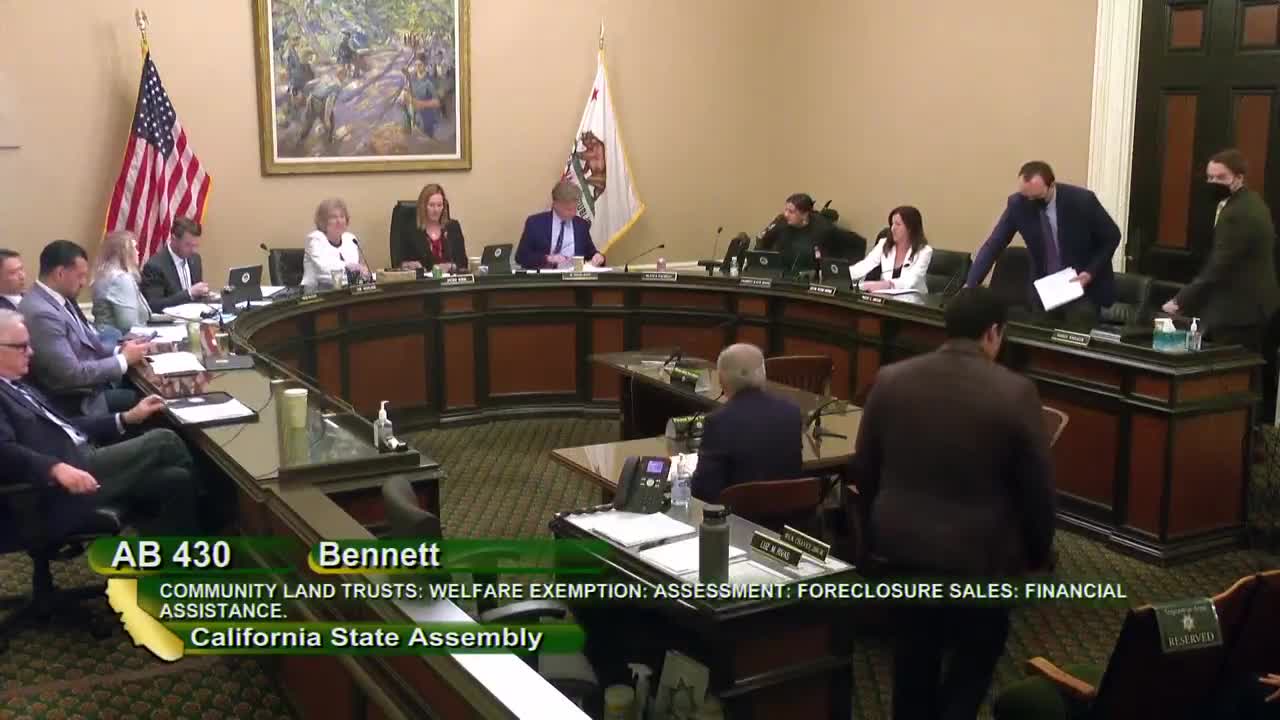 4MIN
Assembly Standing Committee on Revenue and Taxation
 8MIN
Assembly Standing Committee on Housing and Community Development
Bill Author

Bill Co-Author(s):