AB 501: Greenhouse Gas Reduction Fund: High-Speed Rail Authority: rural road safety: transfer and loan.
- Session Year: 2023-2024
- House: Assembly
- Latest Version Date: 2024-01-03
Current Status:
Failed
(2024-01-09: From committee: Without further action pursuant to Joint Rule 62(a).)
Introduced
In Committee
First Chamber
In Committee
Second Chamber
Enacted
The California Global Warming Solutions Act of 2006 designates the State Air Resources Board as the state agency charged with monitoring and regulating sources of emissions of greenhouse gases. The act authorizes the state board to include in its regulation of those emissions the use of market-based compliance mechanisms. Existing law requires all moneys, except for fines and penalties, collected by the state board from the auction or sale of allowances as part of a market-based compliance mechanism to be deposited in the Greenhouse Gas Reduction Fund. Existing law continuously appropriates 25% of the annual proceeds of the fund to the High-Speed Rail Authority for certain purposes.
This bill would suspend the appropriation to the High-Speed Rail Authority for the 202425 and 202526 and 202627 fiscal years and would require the transfer of those amounts from moneys collected by the state board to the General Fund. The bill would specify that the transferred amounts shall be available, upon appropriation, to augment funding for water conveyance, water storage infrastructure, and flood prevention. rural road safety.
This bill would require the transfer of a sum of $2,400,000,000, as a loan, from the unencumbered moneys appropriated to the authority before the 202324 202425 fiscal year from the Greenhouse Gas Reduction Fund to the General Fund. The bill would specify that the transferred moneys, upon appropriation, are available to augment funding for water conveyance, water storage infrastructure, and flood prevention. rural road safety.
The Safe, Reliable High-Speed Passenger Train Bond Act for the 21st Century, approved by the voters as Proposition 1A at the November 4, 2008, statewide general election, provides for the issuance of general obligation bonds in the amount of $9,000,000,000 for high-speed rail purposes and $950,000,000 for other related rail purposes. The act requires bonds issued and sold pursuant to the act to be deposited in the High-Speed Passenger Train Bond Fund. The California High-Speed Rail Act creates the High-Speed Rail Authority to develop and implement a high-speed rail system in the state, with specified powers and duties.
This bill would appropriate $2,400,000,000 from the High-Speed Passenger Train Bond Fund to the authority for the sole purpose of completing the minimum scope of work necessary to meet federal grant requirements and satisfy existing regional commitments, as described in the 2020 High-Speed Rail Authority Draft Business Plan, thereby making an appropriation.
The California Global Warming Solutions Act of 2006 designates the State Air Resources Board as the state agency charged with monitoring and regulating sources of emissions of greenhouse gases. The act authorizes the state board to include in its regulation of those emissions the use of market-based compliance mechanisms. Existing law requires all moneys, except for fines and penalties, collected by the state board from the auction or sale of allowances as part of a market-based compliance mechanism to be deposited in the Greenhouse Gas Reduction Fund. Existing law continuously appropriates 25% of the annual proceeds of the fund to the High-Speed Rail Authority for certain purposes.
This bill would suspend the appropriation to the High-Speed Rail Authority for the 202425 and 202526 fiscal years and would require the transfer of those amounts from moneys collected by the state board to the General Fund. The bill would specify that the transferred amounts shall be available, upon appropriation, to augment funding for water conveyance, water storage infrastructure, and flood prevention.
This bill would require the transfer of a sum of $2,400,000,000, as a loan, from the unencumbered moneys appropriated to the authority before the 202324 fiscal year from the Greenhouse Gas Reduction Fund to the General Fund. The bill would specify that the transferred moneys, upon appropriation, are available to augment funding for water conveyance, water storage infrastructure, and flood prevention.
The Safe, Reliable High-Speed Passenger Train Bond Act for the 21st Century, approved by the voters as Proposition 1A at the November 4, 2008, statewide general election, provides for the issuance of general obligation bonds in the amount of $9,000,000,000 for high-speed rail purposes and $950,000,000 for other related rail purposes. The act requires bonds issued and sold pursuant to the act to be deposited in the High-Speed Passenger Train Bond Fund. The California High-Speed Rail Act creates the High-Speed Rail Authority to develop and implement a high-speed rail system in the state, with specified powers and duties.
This bill would appropriate $2,400,000,000 from the High-Speed Passenger Train Bond Fund to the authority for the sole purpose of completing the minimum scope of work necessary to meet federal grant requirements and satisfy existing regional commitments, as described in the 2020 High-Speed Rail Authority Draft Business Plan, thereby making an appropriation.
Existing law prohibits a person from knowingly driving a bus within the City of San Diego that is transporting pupils, as specified, to or from a public or private school, unless every pupil is seated in a seat. This bill would instead prohibit a person from knowingly driving a bus that is transporting pupils, as specified, to or from a public or private school, unless every pupil is seated in a seat, irrespective of whether the bus is in the City of San Diego. By expanding the scope of a crime, this bill would impose a state-mandated local program. The California Constitution requires the state to reimburse local agencies and school districts for certain costs mandated by the state. Statutory provisions establish procedures for making that reimbursement.This bill would provide that no reimbursement is required by this act for a specified reason.Existing law prohibits a person from knowingly driving a bus within the City of San Diego that is transporting pupils, as specified, to or from a public or private school, unless every pupil is seated in a seat.
This bill would instead prohibit a person from knowingly driving a bus that is transporting pupils, as specified, to or from a public or private school, unless every pupil is seated in a seat, irrespective of whether the bus is in the City of San Diego. By expanding the scope of a crime, this bill would impose a state-mandated local program.
The California Constitution requires the state to reimburse local agencies and school districts for certain costs mandated by the state. Statutory provisions establish procedures for making that reimbursement.
This bill would provide that no reimbursement is required by this act for a specified reason.
(a)The Legislature shall appropriate the annual proceeds of the fund for the purpose of reducing greenhouse gas emissions in this state in accordance with the requirements of Section 39712.
(b)To carry out a portion of the requirements of subdivision (a), the annual proceeds of the fund are continuously appropriated for the following:
(1)Beginning in the 201516 fiscal year, and notwithstanding Section 13340 of the Government Code, 35 percent of the annual proceeds of the fund are continuously appropriated, without regard to fiscal years, for transit, affordable housing, and sustainable communities programs as follows:
(A)Ten percent of the annual proceeds of the fund is hereby continuously appropriated to the Transportation Agency for the Transit and Intercity Rail Capital Program created by Part 2 (commencing with Section 75220) of Division 44 of the Public Resources Code.
(B)Five percent of the annual proceeds of the fund is hereby continuously appropriated to the Low Carbon Transit Operations Program created by Part 3 (commencing with Section 75230) of Division 44 of the Public Resources Code. Moneys shall be allocated by the Controller, according to requirements of the program, and pursuant to the distribution formula in subdivision (b) or (c) of Section 99312 of, and Sections 99313 and 99314 of, the Public Utilities Code.
(C)Twenty percent of the annual proceeds of the fund is hereby continuously appropriated to the Strategic Growth Council for the Affordable Housing and Sustainable Communities Program created by Part 1 (commencing with Section 75200) of Division 44 of the Public Resources Code. Of the amount appropriated in this subparagraph, no less than 10 percent of the annual proceeds of the fund shall be expended for affordable housing, consistent with the provisions of that program.
(2)(A)Beginning in the 201516 fiscal year, notwithstanding Section 13340 of the Government Code, and subject to the requirements of Section 39719.3, 25 percent of the annual proceeds of the fund is hereby continuously appropriated to the High-Speed Rail Authority for the following components of the initial operating segment and Phase I Blended System as described in the 2012 business plan adopted pursuant to Section 185033 of the Public Utilities Code:
(i)Acquisition and construction costs of the project.
(ii)Environmental review and design costs of the project.
(iii)Other capital costs of the project.
(iv)Repayment of any loans made to the authority to fund the project.
(B)The appropriation in subparagraph (A) shall be suspended for the 202425 and 202526 and 202627 fiscal years, and the 25 percent of annual proceeds of the fund shall instead be transferred from moneys collected by the state board on and after January 1, 2024, 2025, to the General Fund and be available, upon appropriation, to augment funding for water conveyance, water storage infrastructure, and flood prevention. rural road safety.
(3)(A)Beginning in the 202021 fiscal year, and until June 30, 2030, 5 percent of the annual proceeds of the fund, up to the sum of one hundred thirty million dollars ($130,000,000), is hereby annually transferred to the Safe and Affordable Drinking Water Fund established pursuant to Section 116766 for the purposes of Chapter 4.6 (commencing with Section 116765) of Part 12 of Division 104.
(B)Moneys transferred under this paragraph shall be used for the purpose of facilitating the achievement of reductions of greenhouse gas emissions in this state in accordance with the requirements of Section 39712 or to improve climate change adaptation and resiliency of disadvantaged communities or low-income households or communities, consistent with Division 25.5 (commencing with Section 38500). For purposes of the moneys transferred under this paragraph, a state agency may also comply with the requirements of paragraphs (2) and (3) of subdivision (a) of Section 16428.9 of the Government Code by describing how each proposed expenditure will improve climate change adaptation and resiliency of disadvantaged communities or low-income households or communities.
(4)Notwithstanding Section 13340 of the Government Code, for each fiscal year, beginning in the 202223 fiscal year through the 2028-29 202829 fiscal year, the sum of two hundred million dollars ($200,000,000) is hereby continuously appropriated, to the Department of Forestry and Fire Protection and allocated as follows:
(A)One hundred sixty-five million dollars ($165,000,000) for healthy forest and fire prevention programs and projects that improve forest health and reduce emissions of greenhouse gases caused by uncontrolled wildfires.
(B)Thirty-five million dollars ($35,000,000) for the completion of prescribed fire and other fuel reduction projects through proven forestry practices consistent with the recommendations of the California Forest Carbon Plan, including the operation of year-round prescribed fire crews and implementation of a research and monitoring program for climate adaptation.
(c)In determining the amount of the annual proceeds of the fund for purposes of the calculation in paragraphs (1) to (3), inclusive, of subdivision (b), the funds subject to Section 39719.1 and the sum set forth in paragraph (4) of subdivision (b) shall not be included.
SEC. 2.Section 39719.4 is added to the Health and Safety Code, to read:39719.4.(a)Of the unencumbered balance of funds appropriated to the High-Speed Rail Authority pursuant to paragraph (2) of subdivision (b) of Section 39719, Section 39719.1, and Item 2665-306-3228 of Section 2.00 of the Budget Act of 2014 (Chapter 25 of the Statutes of 2014) before the 202324 202425 fiscal year, the sum of two billion four hundred million dollars ($2,400,000,000) shall be transferred by the Controller to the General Fund as a loan.
(b)The funds transferred pursuant to subdivision (a) shall be available, upon appropriation, to augment funding for water conveyance, water storage infrastructure, and flood prevention. rural road safety.
(c)The loan in subdivision (a) shall be repaid to the Greenhouse Gas Reduction Fund.
SEC. 3.(a)The sum of two billion four hundred million dollars ($2,400,000,000) is hereby appropriated from the High-Speed Passenger Train Bond Fund, which is created pursuant to Section 2704.05 of the Streets and Highways Code, to the High-Speed Rail Authority, for the sole purpose of completing the minimum scope of work necessary to meet federal grant requirements and satisfy existing regional commitments, as described in the 2020 High-Speed Rail Authority Draft Business Plan.
(b)In expending the funds appropriated pursuant to subdivision (a), the High-Speed Rail Authority shall not take any action to execute a track and systems procurement beyond the minimum scope of work described in subdivision (a), procure trainsets, or acquire rights-of-way outside of the 119-mile segment currently under construction between Madera and Poplar Avenue.
(a)The Legislature shall appropriate the annual proceeds of the fund for the purpose of reducing greenhouse gas emissions in this state in accordance with the requirements of Section 39712.
(b)To carry out a portion of the requirements of subdivision (a), the annual proceeds of the fund are continuously appropriated for the following:
(1)Beginning in the 201516 fiscal year, and notwithstanding Section 13340 of the Government Code, 35 percent of the annual proceeds of the fund are continuously appropriated, without regard to fiscal years, for transit, affordable housing, and sustainable communities programs as follows:
(A)Ten percent of the annual proceeds of the fund is hereby continuously appropriated to the Transportation Agency for the Transit and Intercity Rail Capital Program created by Part 2 (commencing with Section 75220) of Division 44 of the Public Resources Code.
(B)Five percent of the annual proceeds of the fund is hereby continuously appropriated to the Low Carbon Transit Operations Program created by Part 3 (commencing with Section 75230) of Division 44 of the Public Resources Code. Moneys shall be allocated by the Controller, according to requirements of the program, and pursuant to the distribution formula in subdivision (b) or (c) of Section 99312 of, and Sections 99313 and 99314 of, the Public Utilities Code.
(C)Twenty percent of the annual proceeds of the fund is hereby continuously appropriated to the Strategic Growth Council for the Affordable Housing and Sustainable Communities Program created by Part 1 (commencing with Section 75200) of Division 44 of the Public Resources Code. Of the amount appropriated in this subparagraph, no less than 10 percent of the annual proceeds of the fund shall be expended for affordable housing, consistent with the provisions of that program.
(2)(A)Beginning in the 201516 fiscal year, notwithstanding Section 13340 of the Government Code, and subject to the requirements of Section 39719.3, 25 percent of the annual proceeds of the fund is hereby continuously appropriated to the High-Speed Rail Authority for the following components of the initial operating segment and Phase I Blended System as described in the 2012 business plan adopted pursuant to Section 185033 of the Public Utilities Code:
(A)(i)Acquisition and construction costs of the project.
(B)(ii)Environmental review and design costs of the project.
(C)(iii)Other capital costs of the project.
(D)(iv)Repayment of any loans made to the authority to fund the project.
(B)The appropriation in subparagraph (A) shall be suspended for the 202425 and 202526 fiscal years, and the 25 percent of annual proceeds of the fund shall instead be transferred from moneys collected by the state board on and after January 1, 2024, to the General Fund and be available, upon appropriation, to augment funding for water conveyance, water storage infrastructure, and flood prevention.
(3)(A)Beginning in the 202021 fiscal year, and until June 30, 2030, 5 percent of the annual proceeds of the fund, up to the sum of one hundred thirty million dollars ($130,000,000), is hereby annually transferred to the Safe and Affordable Drinking Water Fund established pursuant to Section 116766 for the purposes of Chapter 4.6 (commencing with Section 116765) of Part 12 of Division 104.
(B)Moneys transferred under this paragraph shall be used for the purpose of facilitating the achievement of reductions of greenhouse gas emissions in this state in accordance with the requirements of Section 39712 or to improve climate change adaptation and resiliency of disadvantaged communities or low-income households or communities, consistent with Division 25.5 (commencing with Section 38500). For purposes of the moneys transferred under this paragraph, a state agency may also comply with the requirements of paragraphs (2) and (3) of subdivision (a) of Section 16428.9 of the Government Code by describing how each proposed expenditure will improve climate change adaptation and resiliency of disadvantaged communities or low-income households or communities.
(4)Notwithstanding Section 13340 of the Government Code, for each fiscal year, beginning in the 202223 fiscal year through the 2028-29 fiscal year, the sum of two hundred million dollars ($200,000,000) is hereby continuously appropriated, to the Department of Forestry and Fire Protection and allocated as follows:
(A)One hundred sixty-five million dollars ($165,000,000) for healthy forest and fire prevention programs and projects that improve forest health and reduce emissions of greenhouse gases caused by uncontrolled wildfires.
(B)Thirty-five million dollars ($35,000,000) for the completion of prescribed fire and other fuel reduction projects through proven forestry practices consistent with the recommendations of the California Forest Carbon Plan, including the operation of year-round prescribed fire crews and implementation of a research and monitoring program for climate adaptation.
(c)In determining the amount of the annual proceeds of the fund for purposes of the calculation in paragraphs (1) to (3), inclusive, of subdivision (b), the funds subject to Section 39719.1 and the sum set forth in paragraph (4) of subdivision (b) shall not be included.
SEC. 2.Section 39719.4 is added to the Health and Safety Code, to read:39719.4.(a)Of the unencumbered balance of funds appropriated to the High-Speed Rail Authority pursuant to paragraph (2) of subdivision (b) of Section 39719, Section 39719.1, and Item 2665-306-3228 of Section 2.00 of the Budget Act of 2014 (Chapter 25 of the Statutes of 2014) before the 202324 fiscal year, the sum of two billion four hundred million dollars ($2,400,000,000) shall be transferred by the Controller to the General Fund as a loan.
(b)The funds transferred pursuant to subdivision (a) shall be available, upon appropriation, to augment funding for water conveyance, water storage infrastructure, and flood prevention.
(c)The loan in subdivision (a) shall be repaid to the Greenhouse Gas Reduction Fund.
SEC. 3.(a)The sum of two billion four hundred million dollars ($2,400,000,000) is hereby appropriated from the High-Speed Passenger Train Bond Fund, which is created pursuant to Section 2704.05 of the Streets and Highways Code, to the High-Speed Rail Authority, for the sole purpose of completing the minimum scope of work necessary to meet federal grant requirements and satisfy existing regional commitments, as described in the 2020 High-Speed Rail Authority Draft Business Plan.
(b)In expending the funds appropriated pursuant to subdivision (a), the High-Speed Rail Authority shall not take any action to execute a track and systems procurement beyond the minimum scope of work described in subdivision (a), procure trainsets, or acquire rights-of-way outside of the 119-mile segment currently under construction between Madera and Poplar Avenue.
SECTION 1.Section 21700.5 of the Vehicle Code is amended to read:21700.5.A person shall not knowingly drive a bus that is transporting any public or private school pupil who is enrolled in kindergarten or any of grades 1 to 12, inclusive, to or from a public or private school, unless every pupil is seated in a seat.SEC. 2.No reimbursement is required by this act pursuant to Section 6 of Article XIIIB of the California Constitution because the only costs that may be incurred by a local agency or school district will be incurred because this act creates a new crime or infraction, eliminates a crime or infraction, or changes the penalty for a crime or infraction, within the meaning of Section 17556 of the Government Code, or changes the definition of a crime within the meaning of Section 6 of Article XIIIB of the California Constitution.No A person shall not knowingly drive a bus within the City of San Diego which that is transporting any public or private school pupil who is enrolled in kindergarten or any of grades 1 to 12, inclusive, to or from a public or private school, unless every such pupil is seated in a seat.
SEC. 2.No reimbursement is required by this act pursuant to Section 6 of Article XIIIB of the California Constitution because the only costs that may be incurred by a local agency or school district will be incurred because this act creates a new crime or infraction, eliminates a crime or infraction, or changes the penalty for a crime or infraction, within the meaning of Section 17556 of the Government Code, or changes the definition of a crime within the meaning of Section 6 of Article XIIIB of the California Constitution.
|
Date
|
Status
|
|---|---|
| Jan 9, 2024 | From committee: Without further action pursuant to Joint Rule 62(a). |
| Jan 9, 2024 | In committee: Set, second hearing. Failed passage. |
| Jan 4, 2024 | Re-referred to Com. on TRANS. |
| Jan 3, 2024 | From committee chair, with author's amendments: Amend, and re-refer to Com. on TRANS. Read second time and amended. |
| Apr 24, 2023 | In committee: Set, second hearing. Failed passage. Reconsideration granted. |
| Apr 17, 2023 | Re-referred to Com. on TRANS. |
| Apr 13, 2023 | From committee chair, with author's amendments: Amend, and re-refer to Com. on TRANS. Read second time and amended. |
| Mar 2, 2023 | In committee: Set, first hearing. Hearing canceled at the request of author. |
| Feb 17, 2023 | Referred to Com. on TRANS. |
| Feb 8, 2023 | From printer. May be heard in committee March 10. |
| Feb 7, 2023 | Read first time. To print. |
|
Date
|
Description
|
Location
|
Votes
|
|
|---|---|---|---|---|
| Jan 8, 2024 | Do pass and be re-referred to the Committee on [Appropriations] | Assembly Standing Committee on Transportation |
Failed |
|
| Apr 24, 2023 | Reconsideration. | Assembly Standing Committee on Transportation |
Passed |
|
| Apr 24, 2023 | Do pass and be re-referred to the Committee on [Appropriations] | Assembly Standing Committee on Transportation |
Failed |
This list shows positions taken on this bill by organizations on the date displayed, which is linked to the original source.
Positions by individuals are not included.
|
Organization
|
Position
|
Date
|
|---|---|---|
| Association Of California High Speed Trains | ** Against | |
| California-Nevada Conference Of Operating Engineers | ** Against | |
| District Council Of Iron Workers Of The State Of California And Vicinity | ** Against | |
| State Building And Construction Trades Council Of Ca | ** Against |
Date of Hearing: January 8, 2024
ASSEMBLY COMMITTEE ON TRANSPORTATION
Lori D. Wilson, Chair
ABPCA Bill Id:AB 501 (
Author:Vince Fong) – As Amended Ver:January 3, 2024
SUBJECT: Greenhouse Gas Reduction Fund: High-Speed Rail Authority: rural road safety: transfer and loan
SUMMARY: Transfers Greenhouse Gas Reduction Funds (GGRF) currently provided to the High-Speed Rail Authority (HSRA) to the state’s General Fund (GF) and makes the funding available for rural road safety. Specifically, this bill:
- Suspends the continuous appropriation of 25% of GGRF funds collected annually to HSRA for the 2025-26 and 2026-27 fiscal years, requires the transfer of these funds to the GF, and makes the funding available for rural road safety.
- Transfers $2.4 billion of unencumbered moneys appropriated to HSRA before the 2024-25 fiscal year from the GGRF to the GF as a loan to augment funding for rural road safety.
- Appropriates $2.4 billion from the High-Speed Rail Passenger Train Bond Fund (Proposition 1A) for the sole purpose of completing the minimum scope of work necessary to meet federal grant requirements and satisfy existing regional commitment as described in the 2020 High-Speed Rail Authority Draft Business Plan.
EXISTING LAW:
- Creates the High-Speed Rail Authority in state government. (Public Utilities Code [PUC] 185000)
- Requires CARB, pursuant to California Global Warming Solutions Act of 2006 (AB 32 [Núñez] Chapter 488, Statutes of 2006), to adopt a statewide greenhouse gas (GHG) emissions limit equivalent to 1990 levels by 2020 and to develop a scoping plan for achieving the maximum technologically feasible and cost effective reductions in GHGs. (Health and Safety Code [HSC] 38500)
- Authorizes CARB to adopt a regulation that establishes a system of market-based declining annual aggregate emissions limits for sources or categories of sources that emit GHGs, applicable from January 1, 2012 to December 31, 2030. (HSC 38562)
- Beginning in the 2015-16 fiscal year, continuously appropriates, without regard to fiscal years, 25% of the annual proceeds of the GGRF to HSRA for the initial operating segment and Phase 1 Blended System as described in the 2012 HSRA Business Plan. (HSC 39719)
- Establishes the HSRA Office of the Inspector General to initiate audits and reviews related to the delivery of the project and selection of contractors, monitor the progress towards meeting milestones, and identify best practices in the delivery of capital projects and recommend policies to adopt these when possible, among other duties. (PUC 187030)
FISCAL EFFECT: Unknown
COMMENTS: Chapter 796 of 1996 (SB 1420, Kopp) established HSRA to plan and construct a high‑speed rail system that would link the state’s major population centers. In November 2008, voters approved Proposition 1A, which authorized the state to sell $10 billion in general obligation bonds to partially fund the system, as well as related projects. $9 billion is for the high-speed rail system itself, with the remainder to support connectivity projects. Of the $9 billion, HSRA has set aside $1.1 billion to contribute to locally administered bookend projects.
Proposition 1A also specified certain criteria and conditions that the system must ultimately achieve. For example, the measure requires that the system must be designed to be capable of specified travel times along certain routes, such as nonstop travel from San Francisco to Los Angeles (Phase 1) within two hours and forty minutes. The measure also specifies that passenger rail service operated by HSRA, or pursuant to its authority, will not require an operating subsidy.
In 2014, the state began providing cap-and-trade auction proceeds—which are deposited into the GGRF—for the high-speed rail project. Since 2015-16, the project has received a continuous appropriation of about 25% of annual cap-and-trade revenues. Through September 30, 2023, the project has received about $6.2 billion from GGRF, of which HSRA has spent about $3.7 billion, leaving about $2.5 billion available for expenditure. The cap-and-trade program currently is authorized to continue through 2030 and HSRA in its 2023 Project Update Report estimated that the project will receive between $750 million to $1 billion annually from cap-and-trade revenues.
The Legislature appropriated the last of the Proposition 1A bond funds as part of the 2022-23 budget process. To date, HSRA and partner agencies have spent about $6 billion of these funds—roughly $5.2 billion on the high-speed rail project and about $830 million on connectivity projects in Los Angeles and the Bay Area. As a result, about $3.9 billion Proposition 1A funds remains to be expended.
The federal government provided the state large grants in 2009 and 2010 totaling $3.5 billion to begin construction in the Central Valley. As part of the conditions of receiving federal funding for the project, the state is required to (1) use the funds to support the construction of a segment usable for passenger intercity rail, and (2) complete all of the environmental reviews for Phase 1.
In 2023, the state received additional federal grants including $49 million for improvements near Wasco and for design of the Merced extension; $20 million for the historic Fresno Depot and station site, $202 million from the U.S. Department of Transportation to expand construction of high-speed rail by completing six grade separations; and most recently (December 2023) $3.1 billion to continue construction in the Central Valley.
Since the project’s inception it has struggled and as summarized by the High-Speed Rail Peer Review Group’s March 23, 2023 letter “In reviewing past letters and testimony, a consistent theme emerges: 1) project costs, schedules, and ridership estimates are uncertain and subject to significant risk of deteriorating, a typical experience for mega-projects; 2) the project is underfunded, and its financing is unstable, raising costs and making effective management difficult, if not impossible; 3) more legislative oversight is needed.
On April 12, 2023 the joint hearing of the Assembly Transportation Committee and Assembly Budget Subcommittee #3 raised many concerns. It found that project costs have risen year after year, and they continue with no end in sight; schedules for completion continue to stretch; ridership estimates have fallen; the unfunded gap continues to grow and will likely grow beyond $10 billion for completion of the segment between Merced and Bakersfield; and there is no federal funding partner or funding plan for the project beyond Merced to Bakersfield, whose costs could easily exceed $150 billion for completion of the project from San Francisco to Anaheim.
According to the author, “After 15 years of mismanagement and billions of dollars wasted, the California High Speed Rail project has yet to deliver on any of its promises made to voters. The program is now decades behind schedule and is projected to cost the taxpayers $128 billion, which means the High Speed Rail project is $98 billion over budget. Facing a $68 billion deficit, the Legislature needs to stop wasting taxpayer money on this failing project and redirect the billion dollar yearly funding to more pressing priorities rural road safety projects like installing passing lanes, barriers, and shoulders that will protect lives and Californian communities. Taxpayers are getting swindled. Facing out of control costs, delays and mismanagement, it is time for the Legislature to stop wasting taxpayer dollars and bolster California’s existing infrastructure to protect Californian drivers and passengers.”
Writing in strong opposition, the California-Nevada Conference of Operating Engineers states “While we fully understand and support the need for additional road safety, our support does not diminish or deter our commitment to providing and supporting on-going resources for California’s transportation infrastructure, specifically California High Speed Rail. To date, California High Speed Rail has created over 12,000 high-quality construction jobs and has ensured life changing apprenticeship opportunities that have uplifted workers across the central valley. The project has additionally received national support recently, with the Biden-Harris Administration devoting nearly $3.1 billion in federal funding to ensure our States monumental project moves forward. The fact that our High-Speed rail project has a standalone continuous source of revenue was a major selling point in ensuring support from the federal government.”
Staff concerns:
The actions this bill proposes could essentially stop construction of the high-speed rail project in the Central Valley because GGRF funds would not be available to match the Proposition 1A funds as required by the bond act, or federal funds as required by grant agreements. This bill would provide total funding of roughly $3 billion to $4 billion for rural road safety. To do so, this bill would take the GGRF that would be appropriated to HSRA in 2025-26 and 2026-27 which is estimated to total between $1.5 billion to $2 billion, and $2.4 billion of the GGRF that was appropriated to HSRA before the 2024-25 fiscal year, but not expended.
As discussed above, the high-speed rail project faces many challenges, the greatest challenge being a lack of a reliable stream of funding. However, it is premature to make the decision to stop the project and the Legislature needs more information before making such a decision.
The state recently was awarded $3.1 billion in federal funds that will be matched with approximately $800 million of state Cap and Trade funds. It is unlikely that even with this additional funding the state will have enough money to complete the Merced to Bakersfield segment of the project. The Legislature will have critical information about the cost of the project when HSRA releases its 2024 Business Plan. This plan will have the additional benefit of oversight from the newly created independent High-Speed Rail Inspector General. The Legislature established this office with the intent that it could provide it with critical independent information it needs to make key decisions about the project. It would be prudent to hear from this office before taking a drastic step such as passing this bill which could defund the project.
However, even the continuation of construction of the segment between Merced and Bakersfield is contingent upon a commitment to build the complete Phase 1 system. According to the HSRA Peer Review Group, “there are few who would argue that completing this section (Merced to Bakersfield), by itself, at a cost of up to $35 billion, can be justified.” This makes the need for the state to have conversations with the federal government to determine if it has a future federal funding partner that would provide a stable and reliable stream of funding for the completion of Phase 1 of the project from San Francisco to Anaheim critical. Otherwise, the state needs to ask itself if it wants to fill the funding gap of roughly $100 billion (which could easily grow to $150 billion to $200 billion) for Phase 1 on its own.
Finally, the Peer Review Group recently recommended that the Legislature commission an independent review of the economic and financial justifications of the project and ability to operate without a subsidy before committing to the full phase 1 of the Project. The last economic analysis was done in 2012 and it was incomplete.
In an attempt to facilitate making a decision in the future, the Legislature may want to consider requiring an independent entity to conduct a thorough benefit/cost analysis of the project and an analysis of options and tradeoffs.
Previous legislation:
SB 198 (Committee on Budget and Fiscal Review), Chapter 71, Statutes of 2022 expanded the required elements of the Project Update Report and established the HSRA Inspector General.
Kopp (SB 1420), Chapter 796, Statutes of 1996 creates HSRA in state government and prescribes the membership and development of the project.
REGISTERED SUPPORT / OPPOSITION:
Support
None on file
Opposition
California-Nevada Conference of Operating Engineers
Analysis Prepared by: Farra Bracht / TRANS. / (916) 319-2093
Date of Hearing: April 24, 2023
ASSEMBLY COMMITTEE ON TRANSPORTATION
Laura Friedman, Chair
ABPCA Bill Id:AB 501 (
Author:Vince Fong) – As Amended Ver:April 13, 2023
SUBJECT: Greenhouse Gas Reduction Fund: High-Speed Rail Authority: water infrastructure: transfer and loan
SUMMARY: Makes various changes to direct funding currently provided to the High-Speed Rail Authority (HSRA) available to fund water conveyance, water storage infrastructure, and flood prevention. Specifically, this bill:
- Suspends the continuous appropriation to HSRA for the 2024-25 and 2025-26 fiscal years and requires the transfer of these funds to the General Fund (GF) and makes the funding available for water conveyance, water storage infrastructure, and flood prevention.
- Transfers $2.4 billion of unencumbered moneys appropriated to HSRA before the 2023-24 fiscal year from the GGRF to the GF as a loan to augment funding for water conveyance, water storage infrastructure, and flood prevention.
- Appropriates $2.4 billion from the High-Speed Rail Passenger Train Bond Fund (Proposition 1A) for the sole purpose of completing the minimum scope of work necessary to meet federal grant requirements and satisfy existing regional commitment as described in the 2020 High-Speed Rail Authority Draft Business Plan.
EXISTING LAW:
- Creates the High-Speed Rail Authority in state government. (Public Utilities Code (PUC) 185000)
- Requires CARB, pursuant to California Global Warming Solutions Act of 2006 (AB 32 (Núñez) Chapter 488, Statutes of 2006), to adopt a statewide greenhouse gas (GHG) emissions limit equivalent to 1990 levels by 2020 and to develop a scoping plan for achieving the maximum technologically feasible and cost effective reductions in GHGs. (Health and Safety Code (HSC) 38500)
- Authorizes CARB to adopt a regulation that establishes a system of market-based declining annual aggregate emissions limits for sources or categories of sources that emit GHGs, applicable from January 1, 2012 to December 31, 2030. (HSC 38562)
- Beginning in the 2015-16 fiscal year, continuously appropriates, without regard to fiscal years, 25% of the annual proceeds of the Greenhouse Gas Reduction Fund (GGRF) to HSRA for the initial operating segment and Phase 1 Blended System as described in the 2012 HSRA Business Plan. (HSC 39719)
- Establishes the HSRA Office of the Inspector General to initiate audits and reviews related to the delivery of the project and selection of contractors, monitor the progress towards meeting milestones, and identify best practices in the delivery of capital projects and recommend policies to adopt these when possible, among other duties. (PUC 187030)
FISCAL EFFECT: Unknown
COMMENTS: Chapter 796 of 1996 (SB 1420, Kopp) established HSRA to plan and construct a high‑speed rail system that would link the state’s major population centers. In November 2008, voters approved Proposition 1A, which authorized the state to sell $10 billion in general obligation bonds to partially fund the system, as well as related projects. $9 billion is for the high-speed rail system itself, with the remainder to support connectivity projects. Of the $9 billion, HSRA has set aside $1.1 billion to contribute to locally administered bookend projects.
Proposition 1A also specified certain criteria and conditions that the system must ultimately achieve. For example, the measure requires that the system must be designed to be capable of specified travel times along certain routes, such as nonstop travel from San Francisco to Los Angeles (Phase 1) within two hours and forty minutes. The measure also specifies that passenger rail service operated by HSRA, or pursuant to its authority, will not require an operating subsidy.
In 2014, the state began providing cap-and-trade auction proceeds—which are deposited into the Greenhouse Gas Reduction Fund (GGRF)—for the high-speed rail project. Since 2015-16, the project has received a continuous appropriation of about 25% of annual cap-and-trade revenues. Through December 31, 2022, the project has received about $5.5 billion from GGRF, of which HSRA has spent about $3.7 billion. The cap-and-trade program currently is authorized to continue through 2030 and HSRA in its 2023 Project Update Report estimates that the project will receive between $750 million to $1 billion annually from cap and trade revenues. Previous estimates have been lower.
The Legislature appropriated the last of the Proposition 1A bond funds as part of the 2022-23 budget process. To date, HSRA and partner agencies have spent about $4.9 billion of the Prop 1A funds—just over $4 billion on the high-speed rail project (including on the “bookend” projects in Los Angeles and the Bay Area) and about $825 million on connectivity projects. As a result, about $5.1 billion remains to be expended.
The federal government provided the state large grants in 2009 and 2010 totaling $3.5 billion to begin construction in the Central Valley. As part of the conditions of receiving federal funding for the project the state is required to (1) use the funds to support the construction of a segment usable for passenger intercity rail, and (2) complete all of the environmental reviews for Phase 1.
In addition, recently the state has received a few small federal grants totaling $49 million for improvements near Wasco and for design of the Merced extension.
Since the project’s inception it has struggled and as summarized by the High-Speed Rail Peer Review Group’s March 23, 2023 letter “In reviewing past letters and testimony, a consistent theme emerges: 1) project costs, schedules, and ridership estimates are uncertain and subject to significant risk of deteriorating, a typical experience for mega-projects; 2) the project is underfunded, and its financing is unstable, raising costs and making effective management difficult, if not impossible; 3) more legislative oversight is needed.
On April 12, 2023 the joint hearing of the Assembly Transportation Committee and Assembly Budget Subcommittee #3 raised many concerns. It found that project costs have risen year after year, and they continue with no end in sight; schedules for completion continue to stretch; ridership estimates have fallen; the unfunded gap continues to grow and will likely grow beyond $10 billion; and there is no federal funding partner or funding plan for the project beyond Merced to Bakersfield, whose costs could easily exceed $150 billion for completion of the project from San Francisco to Anaheim.
According to the author, “The California High Speed Rail project has yet to deliver on any of its promises made to voters in 2008. The program is now decades behind schedule and is projected to cost the taxpayers $128 billion, which means the High Speed Rail project is $98 billion over budget. Facing an estimated $25 billion deficit, the Legislature needs to stop wasting taxpayer money on this failing project and redirect the billion dollar yearly funding to more pressing priorities like hardening levies, water storage and conveyance that will protect lives and Californian communities. Taxpayers are getting swindled. Facing out of control costs, delays and mismanagement, it is time for the Legislature to stop wasting taxpayer dollars and bolster California’s existing infrastructure to protect our state from natural disasters.”
Writing in opposition, the State Building and Construction Trades Council states “The SBCTC has always supported dedicated funding for water infrastructure. For example, the Water
Quality, Supply, and Infrastructure Improvement Act of 2014 (Proposition 1), which authorized $7.545 billion in general obligation bonds to fund surface and groundwater storage and drinking water protection projects…We supported all of these efforts for funding water infrastructure and are ready to discuss options for supporting more funding. However, our recognition and support for funding of water infrastructure does NOT diminish or deter our rock-solid commitment to providing and supporting ongoing resources for California’s transportation infrastructure, specifically California High-Speed Rail.”
Staff concerns:
The actions this bill proposes to take could essentially stop construction of the project in the Central Valley because GGRF funds would not be available to match the Prop 1A funds as required by the bond act. This bill would provide total funding of roughly $3 billion to $4 billion for water conveyance, water storage infrastructure, and flood prevention. To do so, this bill would take the GGFF that would be appropriated to HSRA in 2024-25 and 2025-26 which is estimated to be between $1.5 billion to $2 billion and the GGRF that has been appropriated to HSRA, but not expended, which is estimated to be about $1.8 billion as of December 2022.
As discussed above, the high-speed rail project faces many challenges, including the greatest challenge which is a lack of a reliable stream of funding. However, it is premature to make the decision to stop the project and the Legislature needs more information before making such a decision.
The state is on the cusp of a critical decision-making time for the project. HSRA is submitting a federal grant application for $2.8 billion (matched with $706 million of state Cap and Trade funds) to complete the useable segment of Merced to Bakersfield. HSRA also is submitting an application for $193.6 million in federal funds (matched with $48.4 million state Cap and Trade funds). Whether the state is awarded these funds, or not, will provide important information about if it should proceed with the Merced to Bakersfield segment of the project, or not.
However, even the continuation of construction of the segment between Merced and Bakersfield is contingent upon a commitment to build the complete Phase 1 system. According to the HSRA Peer Review Group, “there are few who would argue that completing this section (Merced to Bakersfield), by itself, at a cost of up to $35 billion, can be justified.” This makes the need for the state to have conversations with the federal government to determine if it has a future federal funding partner that would provide a stable and reliable stream of funding for the completion of Phase 1 of the project from San Francisco to Anaheim critical. Otherwise, the state needs to ask itself if it wants to fill the funding gap of roughly $100 billion (which could easily grow to $150 billion to $200 billion) for Phase 1 on its own.
In addition, the selection of the HSRA independent Inspector General is underway. The Legislature established this office with the intent that it could provide it with critical independent information it needs about the project to make key decisions. It would be prudent to hear from this office before taking a drastic step that could defund the project.
Finally, the Peer Review Group recently recommended that the Legislature commission an independent review of the economic and financial justifications of the project and ability to operate without a subsidy before committing to the full phase 1 of the project. The last economic analysis was done in 2012 and it was incomplete.
In an attempt to facilitate making a decision in the future, the Legislature may want to consider requiring HSRA to provide the benefit/cost analysis HSRA performs for Federal Railroad Administration/ Department of Transportation to the new Inspector General, Legislative Analyst’s Office (LAO), the Peer Review Group, and the University of California Institute for Transportation Studies for review and report to the Assembly Transportation Committee.
The author may wish to request the LAO or another appropriate agency conduct an analysis of the options and tradeoffs available to the Legislature for how to fund the gap for completion of the Merced to Bakersfield section. The analysis should also provide options for funding the gap between this section and the remainder of the Phase I system in order to facilitate future decision-making.
Previous legislation:
SB 198 (Committee on Budget and Fiscal Review), Chapter 71, Statutes of 2022 expanded the required elements of the Project Update Report and established the HSRA Inspector General.
Kopp (SB 1420), Chapter 796, Statutes of 1996 creates HSRA in state government and prescribes the membership and development of the project.
REGISTERED SUPPORT / OPPOSITION:
Support
None on file
Opposition
Association of California High Speed Trains
District Council of Iron Workers of the State of California and Vicinity
State Building and Construction Trades Council of CA
Analysis Prepared by: Farra Bracht / TRANS. / (916) 319-2093
Discussed in Hearing
 16MIN
Assembly Standing Committee on Transportation
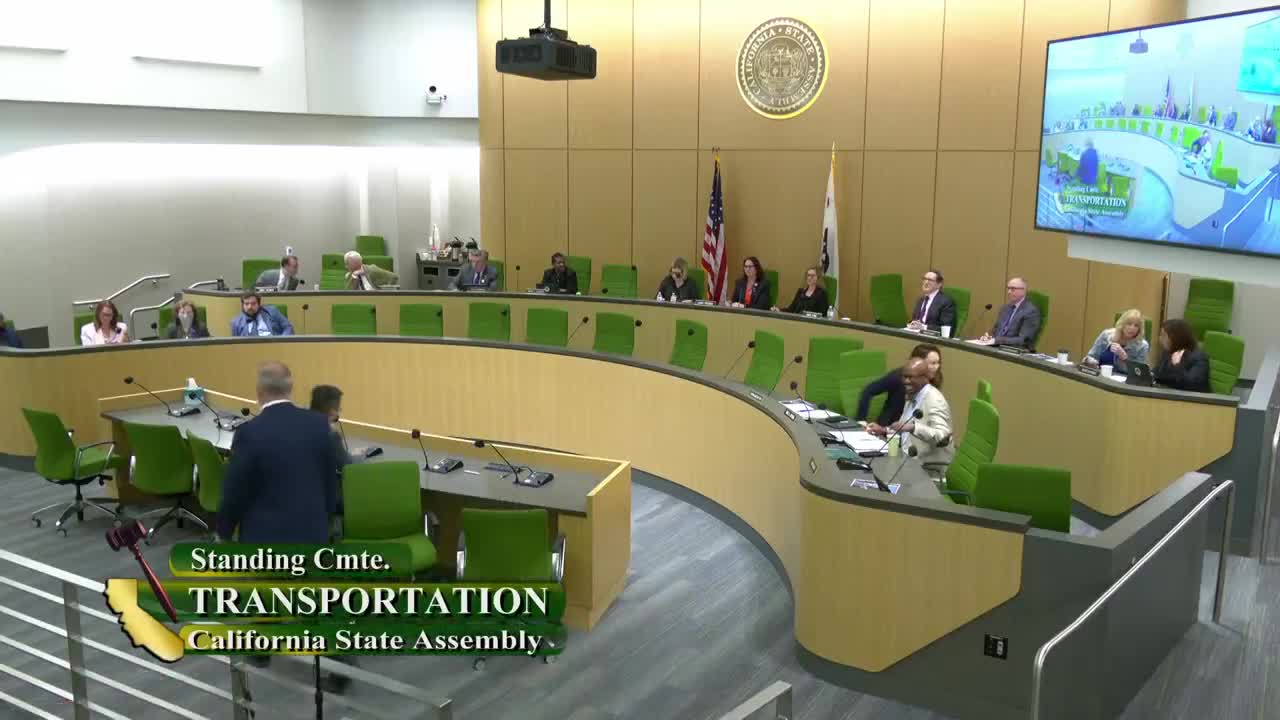 18MIN
Assembly Standing Committee on Transportation
Bill Author

Bill Co-Author(s):