AB 513: California Individual Assistance Act.
- Session Year: 2023-2024
- House: Assembly
- Latest Version Date: 2023-04-20
Current Status:
Failed
(2023-09-01: In committee: Held under submission.)
Introduced
In Committee
First Chamber
In Committee
Second Chamber
Enacted
Existing law, the California Disaster Assistance Act, requires the Director of Emergency Services to provide financial assistance to local agencies for their personnel costs, equipment costs, and the cost of supplies and materials used during disaster response activities, incurred as a result of a state of emergency proclaimed by the Governor, subject to specified criteria. The act continuously appropriates moneys in the Disaster Assistance Fund and its subsidiary account, the Earthquake Emergency Investigations Account, without regard to fiscal year, for purposes of the act.
This bill would enact the California Individual Assistance Act to establish a grant program to provide financial assistance to local agencies, community-based organizations, and individuals for specified costs related to a disaster, as prescribed. The bill would require the director to allocate from the fund, subject to specified conditions, funds to meet the cost of expenses for those purposes. By authorizing increased expenditure of moneys from a continuously appropriated fund for a new purpose, the bill would make an appropriation.
This bill would authorize the director to adopt regulations, as determined to be necessary, to govern the administration of the program. The bill would require the director to enter into agreements with local agencies or community-based organizations to retroactively provide individual and family grants for specific disaster events.
This bill would declare that it is to take effect immediately as an urgency statute.
Existing law, the California Disaster Assistance Act, requires the Director of Emergency Services to provide financial assistance to local agencies for their personnel costs, equipment costs, and the cost of supplies and materials used during disaster response activities, incurred as a result of a state of emergency proclaimed by the Governor, subject to specified criteria. The act continuously appropriates moneys in the Disaster Assistance Fund and its subsidiary account, the Earthquake Emergency Investigations Account, without regard to fiscal year, for purposes of the act.
This bill would enact the California Individual Assistance Act to establish a grant program to provide financial assistance to local agencies, community-based organizations, and individuals for specified costs related to a disaster, as prescribed. The bill would require the director to allocate from the fund, subject to specified conditions, funds to meet the cost of expenses for those purposes. By authorizing increased expenditure of moneys from a continuously appropriated fund for a new purpose, the bill would make an appropriation.
This bill would authorize the director to adopt regulations, as determined to be necessary, to govern the administration of the program. The bill would require the director to enter into agreements with local agencies or community-based organizations to retroactively provide individual and family grants for specific disaster events.
Existing law provides that a provision of a memorandum of understanding reached between the state employer and a recognized employee organization representing state civil service employees that requires the expenditure of funds does not become effective unless approved by the Legislature in the annual Budget Act.This bill would approve provisions requiring the expenditure of funds in a memorandum of understanding, to be identified by date, entered into between the state employer and State Bargaining Unit 6 (SBU 6), but would specify that the provisions will not take effect unless funds for those provisions are specifically appropriated by the Legislature. The bill would require the state employer and SBU 6 to meet and confer to renegotiate the affected provisions if funds for those provisions are not specifically appropriated by the Legislature.This bill, notwithstanding the requirement for approval in the annual Budget Act, would require the provisions of the memorandum of understanding requiring the expenditure of funds to also become effective if they are approved by the Legislature in legislation other than the annual Budget Act.Existing law provides that a provision of a memorandum of understanding reached between the state employer and a recognized employee organization representing state civil service employees that requires the expenditure of funds does not become effective unless approved by the Legislature in the annual Budget Act.
This bill would approve provisions requiring the expenditure of funds in a memorandum of understanding, to be identified by date, entered into between the state employer and State Bargaining Unit 6 (SBU 6), but would specify that the provisions will not take effect unless funds for those provisions are specifically appropriated by the Legislature. The bill would require the state employer and SBU 6 to meet and confer to renegotiate the affected provisions if funds for those provisions are not specifically appropriated by the Legislature.
This bill, notwithstanding the requirement for approval in the annual Budget Act, would require the provisions of the memorandum of understanding requiring the expenditure of funds to also become effective if they are approved by the Legislature in legislation other than the annual Budget Act.
Existing law, the Ralph C. Dills Act, grants to state employees the right to form employee organizations for the purpose of representing their members in negotiating terms and conditions of employment with the state and prescribes definitions and procedures in this regard. Existing law states the purpose of these provisions and prohibits construing them to contravene the spirit or intent of the merit system in state employment.This bill would make nonsubstantive changes to the above-described provisions regarding construction of the Ralph C. Dills Act.Existing law, the Ralph C. Dills Act, grants to state employees the right to form employee organizations for the purpose of representing their members in negotiating terms and conditions of employment with the state and prescribes definitions and procedures in this regard. Existing law states the purpose of these provisions and prohibits construing them to contravene the spirit or intent of the merit system in state employment.
This bill would make nonsubstantive changes to the above-described provisions regarding construction of the Ralph C. Dills Act.
The Legislature finds and declares the purpose of this act is to establish in California a program within the Office of Emergency Services to quickly provide assistance to California residents following the declaration of a local or state emergency that may not warrant federal disaster assistance for individuals.
SEC. 2.Article 4.5 (commencing with Section 8688) is added to Chapter 7.5 of Division 1 of Title 2 of the Government Code, to read:4.5.California Individual Assistance Act8688.This article shall be known and may be cited as the California Individual Assistance Act.
8688.1.It is the intent of the Legislature to provide local agencies, community-based organizations, and individuals with the assistance they need to quickly recover following a disaster.
8688.2.Unless the provision or context otherwise requires, the definitions in this section govern the construction of this article:
(a)Community-based organization means a public or private nonprofit organization of demonstrated effectiveness that represents a community or significant segments of a community and provides support and services to individuals in the community.
(b)Disaster means a fire, flood, storm, tidal wave or tsunami, earthquake, act of terrorism, epidemic, extreme heat or cold event, or other similar calamity that the Governor determines presents a threat to public safety.
(c)Housing assistance means assistance available to homeowners and renters to repair disaster-related damages not covered by insurance or by other governmental financial assistance programs, including, but not limited to, costs that are reasonable and necessary to make the essential living areas of a primary residence safe, sanitary, and functional.
(d)Individual means a person residing in California.
(e)Individual and family grants means housing assistance and other needs assistance provided pursuant to this article.
(f)Local emergency means a condition of extreme peril to persons or property proclaimed as such by the governing body of the local agency affected, in accordance with Section 8630.
(g)Other needs assistance means assistance to offset expenses and losses in income not covered by insurance or by other financial assistance resources, including, but not limited to, any of the following:
(1)Income losses.
(2)Costs to clean, repair, or replace essential personal property items.
(3)Medical, dental, and funeral expenses resulting from the local emergency.
(4)Other potentially eligible expenses authorized by the director.
(h)Unusual circumstances means unavoidable delays that result from recurrence of a disaster, prolonged severe weather within a one-year period, or other conditions beyond the control of the applicant.
8688.3.(a)From the Disaster Assistance Fund, and subject to the conditions specified in this article, the director shall allocate funds to meet the cost of expenses for the purposes described in subdivision (b).
(b)Moneys from the Disaster Assistance Fund may be used to provide financial assistance to local agencies, community-based organizations, and individuals for the following purposes:
(1)To fund local agency and community-based organization personnel costs, equipment costs, translation services, and the cost of supplies and materials used during disaster response activities, incurred as a result of a state of emergency proclaimed by the Governor, excluding the normal hourly wage costs of employees engaged in emergency work activities.
(2)To reimburse local agencies or community-based organizations that provide individual and family grants.
(3)To provide direct individual and family grants, including housing assistance and other needs assistance, to individuals.
(4)To fund indirect administrative costs and any other assistance deemed necessary by the director.
(5)To fund necessary and required site preparation costs for evacuation and local assistance centers as deemed necessary by the director.
8688.4.(a)When certified by the director, claims of community-based organizations and local agencies shall be presented to the Controller for payment out of funds made available for that purpose.
(b)The director shall adopt regulations, as determined to be necessary, to govern the administration of the program authorized by this article in accordance with the Administrative Procedure Act (Chapter 3.5 (commencing with Section 11340) of Part 1 of Division 3). These regulations shall include specific eligibility requirements, a procedure for local agencies and community-based organizations to request the implementation of this article, and a method for evaluating these requests by the Office of Emergency Services.
8688.5.An allocation may be made to a local agency, community-based organization, or an individual, if, within 10 days after the actual occurrence of a disaster, the local agency has proclaimed a local emergency and that proclamation is acceptable to the director, or upon the order of the Governor when a state of emergency proclamation has been issued.
8688.6.A local agency, community-based organization, or an individual shall make application to the director for state financial assistance pursuant to this article within 60 days after the date of the proclamation of a local emergency. The director may extend the time for this filing only under unusual circumstances.
8688.7.The director shall develop procedures for a local agency or community-based organization to receive an advance of funds to expedite the delivery of individual and family grants following a disaster.
8688.8.Notwithstanding any other law, including Section 8688.6, the director shall enter into agreements with local agencies or community-based organizations to retroactively provide individual and family grants for the following events:
(a)The December 20, 2022, magnitude 6.4 earthquake off the Northern California coastline near the City of Ferndale in Humboldt County.
(b)The severe winter storms, flooding, landslides, and mudslides for areas designated in the Federal Emergency Management Agency declaration DR-4683-CA for the period December 27, 2022, to January 31, 2023, inclusive.
(c)The severe winter storms, straight-line winds, flooding, landslides, and mudslides for areas designated in the Federal Emergency Management Agency declaration DR-4699-CA for the period February 21, 2023, to ____, inclusive.
SEC. 3.This act is an urgency statute necessary for the immediate preservation of the public peace, health, or safety within the meaning of Article IV of the California Constitution and shall go into immediate effect. The facts constituting the necessity are:
In order to mitigate the extent and severe impact of recent disasters on individuals and families, the Legislature finds and declares it is necessary for this act to take effect immediately.
The Legislature finds and declares the purpose of this act is to establish in California a program within the Office of Emergency Services to quickly provide assistance to California residents following the declaration of a local or state emergency that may not warrant federal disaster assistance for individuals.
SEC. 2.Article 4.5 (commencing with Section 8688) is added to Chapter 7.5 of Division 1 of Title 2 of the Government Code, to read:4.5.California Individual Assistance Act8688.This article shall be known and may be cited as the California Individual Assistance Act.
8688.1.It is the intent of the Legislature to provide local agencies, community-based organizations, and individuals with the assistance they need to quickly recover following a disaster.
8688.2.Unless the provision or context otherwise requires, the definitions in this section govern the construction of this article:
(a)Community-based organization means a public or private nonprofit organization of demonstrated effectiveness that represents a community or significant segments of a community and provides support and services to individuals in the community.
(b)Disaster means a fire, flood, storm, tidal wave or tsunami, earthquake, act of terrorism, epidemic, extreme heat or cold event, or other similar calamity that the Governor determines presents a threat to public safety.
(c)Housing assistance means assistance available to homeowners and renters to repair disaster-related damages not covered by insurance or by other governmental financial assistance programs, including, but not limited to, costs that are reasonable and necessary to make the essential living areas of a primary residence safe, sanitary, and functional.
(d)Individual means a person residing in California.
(e)Individual and family grants means housing assistance and other needs assistance provided pursuant to this article.
(f)Local emergency means a condition of extreme peril to persons or property proclaimed as such by the governing body of the local agency affected, in accordance with Section 8630.
(g)Other needs assistance means assistance to offset expenses and losses in income not covered by insurance or by other financial assistance resources, including, but not limited to, any of the following:
(1)Income losses.
(2)Costs to clean, repair, or replace essential personal property items.
(3)Medical, dental, and funeral expenses resulting from the local emergency.
(4)Other potentially eligible expenses authorized by the director.
(h)Unusual circumstances means unavoidable delays that result from recurrence of a disaster, prolonged severe weather within a one-year period, or other conditions beyond the control of the applicant.
8688.3.(a)From the Disaster Assistance Fund, and subject to the conditions specified in this article, the director shall allocate funds to meet the cost of expenses for the purposes described in subdivision (b).
(b)Moneys from the Disaster Assistance Fund may be used to provide financial assistance to local agencies, community-based organizations, and individuals for the following purposes:
(1)To fund local agency and community-based organization personnel costs, equipment costs, translation services, and the cost of supplies and materials used during disaster response activities, incurred as a result of a state of emergency proclaimed by the Governor, excluding the normal hourly wage costs of employees engaged in emergency work activities.
(2)To reimburse local agencies or community-based organizations that provide individual and family grants.
(3)To provide direct individual and family grants, including housing assistance and other needs assistance, to individuals.
(4)To fund indirect administrative costs and any other assistance deemed necessary by the director.
(5)To fund necessary and required site preparation costs for evacuation and local assistance centers as deemed necessary by the director.
8688.4.(a)When certified by the director, claims of community-based organizations and local agencies shall be presented to the Controller for payment out of funds made available for that purpose.
(b)The director shall adopt regulations, as determined to be necessary, to govern the administration of the program authorized by this article in accordance with the Administrative Procedure Act (Chapter 3.5 (commencing with Section 11340) of Part 1 of Division 3). These regulations shall include specific eligibility requirements, a procedure for local agencies and community-based organizations to request the implementation of this article, and a method for evaluating these requests by the Office of Emergency Services.
8688.5.An allocation may be made to a local agency, community-based organization, or an individual, if, within 10 days after the actual occurrence of a disaster, the local agency has proclaimed a local emergency and that proclamation is acceptable to the director, or upon the order of the Governor when a state of emergency proclamation has been issued.
8688.6.A local agency, community-based organization, or an individual shall make application to the director for state financial assistance pursuant to this article within 60 days after the date of the proclamation of a local emergency. The director may extend the time for this filing only under unusual circumstances.
8688.7.The director shall develop procedures for a local agency or community-based organization to receive an advance of funds to expedite the delivery of individual and family grants following a disaster.
8688.8.Notwithstanding any other law, including Section 8688.6, the director shall enter into agreements with local agencies or community-based organizations to retroactively provide individual and family grants for the following events:
(a)The December 20, 2022, magnitude 6.4 earthquake off the Northern California coastline near the City of Ferndale in Humboldt County.
(b)The severe winter storms, flooding, landslides, and mudslides for areas designated in the Federal Emergency Management Agency declaration DR-4683-CA for the period December 27, 2022, to January 31, 2023, inclusive.
(c)The severe winter storms, straight-line winds, flooding, landslides, and mudslides for areas designated in the Federal Emergency Management Agency declaration DR-4699-CA for the period February 21, 2023 to ____, inclusive.
SECTION 1.The Legislature finds and declares that the purpose of this act is to approve an agreement pursuant to Section 3517.5 of the Government Code entered into by the state employer and the recognized employee organization.SEC. 2.The provisions of the memorandum of understanding prepared pursuant to Section 3517.5 of the Government Code and entered into by the state employer and State Bargaining Unit 6, dated ____, and requiring the expenditure of funds, are hereby approved for the purposes of subdivision (b) of Section 3517.6 of the Government Code and Section 3517.61 of the Government Code.SEC. 3.The provisions of the memorandum of understanding approved by Section 2 of this act requiring the expenditure of funds shall not take effect unless funds for these provisions are specifically appropriated by the Legislature. If funds for these provisions are not specifically appropriated by the Legislature, the state employer and the affected employee organization shall meet and confer to renegotiate the affected provisions.SEC. 4.Notwithstanding subdivision (b) of Section 3517.6 of the Government Code and Section 3517.61 of the Government Code, the provisions of the memorandum of understanding included in Section 2 of this act requiring the expenditure of funds shall also become effective if the provisions of the memorandum of understanding are approved by the Legislature in legislation other than the annual Budget Act.The Legislature finds and declares that the purpose of this act is to approve an agreement pursuant to Section 3517.5 of the Government Code entered into by the state employer and the recognized employee organization.
SEC. 2.The provisions of the memorandum of understanding prepared pursuant to Section 3517.5 of the Government Code and entered into by the state employer and State Bargaining Unit 6, dated ____, and requiring the expenditure of funds, are hereby approved for the purposes of subdivision (b) of Section 3517.6 of the Government Code and Section 3517.61 of the Government Code.
SEC. 3.The provisions of the memorandum of understanding approved by Section 2 of this act requiring the expenditure of funds shall not take effect unless funds for these provisions are specifically appropriated by the Legislature. If funds for these provisions are not specifically appropriated by the Legislature, the state employer and the affected employee organization shall meet and confer to renegotiate the affected provisions.
SEC. 4.Notwithstanding subdivision (b) of Section 3517.6 of the Government Code and Section 3517.61 of the Government Code, the provisions of the memorandum of understanding included in Section 2 of this act requiring the expenditure of funds shall also become effective if the provisions of the memorandum of understanding are approved by the Legislature in legislation other than the annual Budget Act.
SECTION 1.Section 3512 of the Government Code is amended to read:3512.It is the purpose of this chapter to promote full communication between the state and its employees by providing a reasonable method of resolving disputes regarding wages, hours, and other terms and conditions of employment between the state and public employee organizations. It is also the purpose of this chapter to promote the improvement of personnel management and employer-employee relations within the State of California by providing a uniform basis for recognizing the right of state employees to join organizations of their own choosing and be represented by those organizations in their employment relations with the state. It is further the purpose of this chapter, in order to foster peaceful employer-employee relations, to allow state employees to select one employee organization as the exclusive representative of the employees in an appropriate unit, and to permit the exclusive representative to receive financial support from those employees who receive the benefits of this representation.This chapter shall not be construed to contravene the spirit or intent of the merit principle in state employment, nor to limit the entitlements of state civil service employees, including those designated as managerial and confidential, provided by Article VII of the California Constitution or by laws or rules enacted pursuant thereto.It is the purpose of this chapter to promote full communication between the state and its employees by providing a reasonable method of resolving disputes regarding wages, hours, and other terms and conditions of employment between the state and public employee organizations. It is also the purpose of this chapter to promote the improvement of personnel management and employer-employee relations within the State of California by providing a uniform basis for recognizing the right of state employees to join organizations of their own choosing and be represented by those organizations in their employment relations with the state. It is further the purpose of this chapter, in order to foster peaceful employer-employee relations, to allow state employees to select one employee organization as the exclusive representative of the employees in an appropriate unit, and to permit the exclusive representative to receive financial support from those employees who receive the benefits of this representation.
Nothing in thisThis chapter shall not be construed to contravene the spirit or intent of the merit principle in state employment, nor to limit the entitlements of state civil service employees, including those designated as managerial and confidential, provided by Article VII of the California Constitution or by laws or rules enacted pursuant thereto.
|
Date
|
Status
|
|---|---|
| Sep 1, 2023 | In committee: Held under submission. |
| Aug 14, 2023 | In committee: Referred to APPR suspense file. |
| Jul 11, 2023 | From committee: Do pass and re-refer to Com. on APPR. (Ayes 14. Noes 0.) (July 11). Re-referred to Com. on APPR. |
| Jun 14, 2023 | Referred to Com. on G.O. |
| Jun 1, 2023 | In Senate. Read first time. To Com. on RLS. for assignment. |
| May 31, 2023 | Read third time. Urgency clause adopted. Passed. Ordered to the Senate. (Ayes 80. Noes 0. Page 2008.). |
| May 18, 2023 | Read second time. Ordered to third reading. |
| May 18, 2023 | From committee: Do pass. (Ayes 15. Noes 0.) (May 18). |
| May 10, 2023 | In committee: Set, first hearing. Referred to APPR. suspense file. |
| May 3, 2023 | In committee: Hearing postponed by committee. |
| Apr 24, 2023 | Re-referred to Com. on APPR. |
| Apr 20, 2023 | Read second time and amended. |
| Apr 19, 2023 | From committee: Amend, and do pass as amended and re-refer to Com. on APPR. (Ayes 7. Noes 0.) (April 17). |
| Apr 10, 2023 | Re-referred to Com. on E.M. pursuant to Assembly Rule 96. |
| Apr 10, 2023 | From committee chair, with author's amendments: Amend, and re-refer to Com. on BUDGET. Read second time and amended. |
| Mar 21, 2023 | Re-referred to Com. on BUDGET. |
| Mar 20, 2023 | From committee chair, with author's amendments: Amend, and re-refer to Com. on BUDGET. Read second time and amended. |
| Mar 16, 2023 | Referred to Com. on BUDGET. |
| Feb 8, 2023 | From printer. May be heard in committee March 10. |
| Feb 7, 2023 | Read first time. To print. |
|
Date
|
Description
|
Location
|
Votes
|
|
|---|---|---|---|---|
| Aug 14, 2023 | Placed on suspense file | Senate Standing Committee on Appropriations |
Passed |
|
| Jul 11, 2023 | Do pass, but first be re-referred to the Committee on [Appropriations] | Senate Standing Committee on Governmental Organization |
Passed |
|
| May 31, 2023 | AB 513 Rodriguez Third Reading Urgency | Assembly Floor |
Passed |
|
| May 18, 2023 | Do pass. | Assembly Standing Committee on Appropriations |
Passed |
|
| Apr 17, 2023 | Do pass as amended and be re-referred to the Committee on [Appropriations] | Assembly Standing Committee on Emergency Management |
Passed |
This list shows positions taken on this bill by organizations on the date displayed, which is linked to the original source.
Positions by individuals are not included.
|
Organization
|
Position
|
Date
|
|---|---|---|
| California Peace Officer Research Association | ** Support | |
| California Rural Legal Assistance Foundation | ** Support | |
| California State Association Of Counties | ** Support | |
| Community Action Board Of Santa Cruz County, Inc. | ** Support | |
| Community Bridges | ** Support | |
| Community Water Center | ** Support | |
| County of Monterey | ** Support | |
| El Pajaro Community Corporation | ** Support | |
| El Pajaro Community Development Corporation | ** Support | |
| Genasys Corporation | ** Support | |
| Monterey Bay Economic Partnership | ** Support | |
| Regeneracion Pajaro Valley Climate Action | ** Support | |
| Regeneración - Pajaro Valley Climate Action | ** Support | |
| Second Harvest Food Bank Santa Cruz County | ** Support | |
| United Way of Santa Cruz County | ** Support | |
| Ventures | ** Support |
SENATE COMMITTEE ON APPROPRIATIONS
Senator Anthony Portantino, Chair
2023 - 2024 Regular Session
AB 513 (Rodriguez) - California Individual Assistance Act
Version: April 20, 2023 | Policy Vote: G.O. 14 - 0 |
Urgency: Yes | Mandate: No |
Hearing Date: August 14, 2023 | Consultant: Janelle Miyashiro |
Bill Summary:
AB 513 establishes the California Individual Assistance Act to provide financial assistance to local agencies, community-based organizations, and individuals to aid in disaster recovery.
Fiscal Impact:
The Office of Emergency Services (OES) estimates ongoing costs of over $1 billion (General Fund and Disaster Assistance Fund). While the bill specifies funds be allocated from the Disaster Assistance Fund to support the program, OES notes that most of these funds are earmarked for specific uses. Therefore the program will require General Fund support to backfill the Disaster Assistance Fund.
Background:
The California Disaster Assistance Act (CDAA) authorizes the Director of OES to administer a disaster assistance program that provides financial assistance from the state for costs incurred by local governments as a result of a disaster event. Funding for the repair, restoration, or replacement of public real property damaged or destroyed by a disaster is made available when the director concurs with a local emergency proclamation requesting state disaster assistance.
The CDAA also provides for the reimbursement of local government costs associated with certain emergency activities undertaken in response to a state of emergency proclaimed by the governor. In addition, the program may provide matching fund assistance for cost sharing required under federal public assistance programs in response to a presidential major disaster or emergency declaration. Both a major disaster and emergency declaration authorize the president to provide supplemental federal disaster assistance. However, the events related to the two different types of declaration and scope and amount of assistance differ.
The federal Individuals and Households Program (IHP) is the only form of individual assistance that may be authorized under a presidential emergency declaration. The IHP provides financial and/or direct assistance for housing, as well as financial assistance for other needs (referred to as Other Needs Assistance), to eligible individuals and households who have uninsured or under-insured necessary expenses and serious needs resulting from an emergency or major disaster, which cannot be met through other means or forms of assistance.
This bill establishes the California Individual Assistance Act to provide financial assistance to local agencies, community-based organizations, and individuals for specified costs related to a disaster. This bill targets those situations, which may not qualify for federal disaster aid.
Proposed Law:
- Establishes the California Individual Assistance Act, with the intent to provide local agencies, community-based organizations, and individuals with the assistance they need to quickly recover following a disaster.
- Subject to specified conditions, requires the director of OES to allocate funds from the Disaster Assistance Fund to provide financial assistance to local agencies, community-based organizations, and individuals for the following purposes:
- To fund local agency and community-based organization personnel costs, equipment costs, translation services, and the cost of supplies and materials used during disaster response activities incurred as a result of a state of emergency proclaimed by the Governor, excluding the normal hourly wage costs of employees engaged in emergency work activities.
- To reimburse local agencies or community-based organizations that provide individual and family grants.
- To provide direct individual and family grants.
- To fund indirect administrative costs and any other assistance deemed necessary by the director.
- To fund necessary and required site preparation costs for evacuation and local assistance centers as deemed necessary by the director.
- Requires claims by community-based organization and local agencies be presented to the Controller for payment when certified by the director.
- Requires the director to adopt regulations as necessary to govern the administration of the Act. Specifies these regulations shall include specific eligibility requirements, a procedure for local agencies and community-based organizations to request the implementation of the Act, and a method for evaluating these requests by OES.
- Authorizes an allocation to be made to a local agency, community-based organization, or an individual if, within 10 days after the actual occurrence of a disaster:
- The local agency has proclaimed a local emergency and that proclamation is acceptable to the director.
- Upon the order of the Governor when a state of emergency has been proclaimed.
- Provides a 60-day window after the date of the proclamation of a local emergency for a local agency, community-based organization, or an individual to apply to the director for state financial assistance. Authorizes the director to extend the time for this filing only under unusual circumstances.
- Requires the director to develop procedures for a local agency or community-based organization to receive an advance of funds to expedite the delivery of individual and family grants following a disaster.
- Requires the director to enter into agreements with local agencies or community-based organizations to retroactively provide individual and family grants for the following events:
- The December 20, 2022, magnitude 6.4 earthquake off the Northern California coastline near the City of Ferndale in Humboldt County.
- The severe winter storms, flooding, landslides, and mudslides for areas designated in the Federal Emergency Management Agency declaration DR-4683-CA for the period December 27, 2022, to January 31, 2023, inclusive.
- The severe winter storms, straight-line winds, flooding, landslides, and mudslides for areas designated in the Federal Emergency Management Agency declaration DR-4699-CA for the period February 21, 2023, to ____, inclusive.
- Establishes definitions for purposes of the Act.
- States the Act is an urgency statute necessary to mitigate the extent and severe impact of recent disasters on individuals and families.
Staff Comments:
OES notes that given the scope of uninsured property damage and repairs based on historical losses, the fiscal impact of the bill will likely total above $1 billion, ongoing. OES’s fiscal estimate includes seven additional permanent staff positions dedicated to, among other things, processing individual assistance claims, conducting and coordinating case management, and staffing disaster recovery centers.
-- END --
SENATE COMMITTEE ON GOVERNMENTAL ORGANIZATION
Senator Bill Dodd
Chair
2023 - 2024 Regular
Bill No: AB Hearing Date: 7/11/2023
Author: | Rodriguez, et al. | ||
Version: | Amended | ||
Urgency: | Fiscal: | ||
Consultant: | |||
SUBJECT:
DIGEST: This bill enacts the California Individual Assistance Act to establish a grant program to provide financial assistance to local agencies, community-based organizations, and individuals for specified costs related to a disaster, as specified.
ANALYSIS:
Existing law:
- The California Disaster Assistance Act (Act) requires the Director of Emergency Services (Director) to provide financial assistance to local agencies for their personnel costs, equipment costs, and the cost of supplies and materials used during disaster response activities, incurred as a result of a state of emergency proclaimed by the Governor, subject to specified criteria.
- Continuously appropriates moneys in the Disaster Assistance Fund and its subsidiary account, without regard to fiscal year, for purposes of the Act.
This bill:
- Requires the Director to allocate funds from the Disaster Assistance Fund to meet the cost of expenses to provide financial assistance to local agencies, community-based organizations, and individuals for the following purposes:
- To fund local agency and community-based organization personnel costs, equipment costs, translation services, and the cost of supplies and materials used during disaster response activities, incurred as a result of a state of emergency proclaimed by the Governor, excluding the normal hourly wage costs of employees engaged in emergency work activities.
- To reimburse local agencies or community-based organizations that provide individual and family grants.
- To provide direct individual and family grants, including housing assistance and other needs assistance, to individuals.
- To fund indirect administrative costs and any other assistance deemed necessary by the Director.
- To fund necessary and required site preparation costs for evacuation and local assistance centers as deemed necessary by the Director.
- Requires claims of community-based organizations and local agencies, when certified by the Director, be presented to the California State Controller (Controller) for payment out of funds made available for that purpose.
- Requires the Director to adopt regulations, as determined to be necessary, to govern the administration of the program in accordance with the Administrative Procedures Act (APA), as specified.
- Requires the regulations to include specific eligibility requirements, a procedure for local agencies and community-based organizations to request the implementation of this bill, and a method for evaluating these requests by OES.
- Authorizes allocations to local agencies, community-based organizations, and individuals, if, within 10 days after the actual occurrence of a disaster, the local agency has proclaimed a local emergency and that proclamation is acceptable to the Director, or upon the order of the governor when a state of emergency proclamation has been issued.
- Requires a local agency, community-based organization, or an individual to make an application to the Director for state financial assistance within 60 days after the date of the proclamation of a local emergency and authorizes the Director to extend the time for this filling only under unusual circumstances.
- Requires the Director to develop procedures for a local agency or community-based organization to receive an advance of funds to expedite the delivery of individual and family grants following a disaster.
- Requires the Director to enter into agreements with local agencies or community-based organizations to retroactively provide individual and family grants for the following events:
- The December 20, 2022, magnitude 6.4 earthquake off the Northern California coastline near the City of Ferndale in Humboldt County.
- The severe winter storms, flooding, landslides, and mudslides for areas designated in the Federal Emergency Management Agency (FEMA) declaration DR-4683-CA for the period December 27, 2022, to January 31, 2023, inclusive.
- The severe winter storms, straight-line winds, flooding, landslides, and mudslides for areas designated in the FEMA declaration DR-4699-CA for the period February 21, 2023, to ______ inclusive.
- Defines “community-based organization” to mean a public or private nonprofit organization of demonstrated effectiveness that represents a community or significant segments of a community and provides support and services to individuals in the community.
- Defines “disaster” to mean a fire, flood, storm, tidal wave or tsunami, earthquake, act of terrorism, epidemic, extreme heat or cold event, or other similar calamity that the Governor determines presents a threat to public safety.
- Defines “housing assistance” to mean assistance available to homeowners and renters to repair disaster-related damages not covered by insurance or by other governmental financial assistance programs, including, but not limited to, costs that are reasonable and necessary to make the essential living areas of a primary residence safe, sanitary, and functional.
- Defines “other needs assistance” to mean assistance to offset expenses and losses in income not covered by insurance or by other financial assistance resources, including, but not limited to, any of the following:
- Income losses.
- Costs to clean, repair, or replace essential personal property items.
- Medical, dental, and funeral expenses resulting from the local emergency.
- Other potentially eligible expenses authorized by the Director.
- Defines “unusual circumstances” to mean unavoidable delays that result from recurrence of a disaster, prolonged severe weather within a one-year period, or other conditions beyond the control of the applicant.
- Includes an urgency statute in order to mitigate the extent and severe impact of recent disasters on individuals and families, as specified.
Background
Author Statement. According to the author’s office, “all too often, FEMA and Cal OES have been unable to provide assistance to the most vulnerable communities where survivors have few paths to recovery. If a local disaster doesn’t meet the criteria for federal assistance, critical aid from FEMA will be out of reach for many families and individuals who have survived a disaster and California does not have a program in place to help. Unfortunately, FEMA’s Individual Assistance program prioritizes aid for major catastrophes and often determines local disasters in more populous states such as California, regardless of the severity to a local community, as too minor to necessitate federal aid. FEMA recommends states establish such a program as it is inherently beneficial to those impacted by a disaster.
Federal Disaster Declaration Types. There are two types of disaster declarations provided for in the Stafford Act: emergency declarations and major disaster declarations. Both declaration types authorize the President to provide supplemental federal disaster assistance. However, the events related to the two different types of declaration and scope and amount of assistance differ. The State of California, for the two recent winter storm incidents, first requested an emergency declaration and subsequently requested a major disaster declaration.
Emergency Declarations. The President can declare an emergency for any occasion or instance when the President determines federal assistance is needed. Emergency declarations supplement State and local or Indian tribal government efforts in providing emergency services, such as the protection of lives, property, public health, and safety, or to lessen or avert the threat of a catastrophe in any part of the United States. The total amount of assistance provided for in a single emergency may not exceed $5 million. The President shall report to Congress if this amount is exceeded.
Individual Assistance (IA). The Individuals and Households Program (IHP) is the only form of IA that may be authorized under an emergency declaration. According to FEMA, authorization of IHP under an emergency is rare. Housing Assistance under IHP is provided at a 100% federal share, while Other Needs Assistance under IHP requires a 25% non-federal cost share.
Pre-Disaster Emergency Declarations. A Governor or Tribal Chief Executive may request an emergency declaration in advance or anticipation of the imminent impact of an incident that threatens such destruction as could result in a major disaster. Such requests must meet all of the statutory and regulatory requirements for an emergency declaration request. Requests must demonstrate the existence of critical emergency protective measure needs prior to impact are beyond the capability of the State and affected local governments or Indian tribal government and identify specific unmet emergency needs that can be met through DFA.
Such DFA may include, but is not limited to, personnel, equipment, supplies, and evacuation assistance. Pre-positioning of assets generally does not require a declaration. Assistance made available under a pre-disaster emergency declaration will typically be Category B (emergency protective measures), limited to DFA.
Major Disaster Declarations. The President can declare a major disaster for any natural event, including any hurricane, tornado, storm, high water, wind-driven water, tidal wave, tsunami, earthquake, volcanic eruption, landslide, mudslide, snowstorm, or drought, or, regardless of cause, fire, flood, or explosion, that the President determines has caused damage of such severity that it is beyond the combined capabilities of state and local governments to respond. A major disaster declaration provides a wide range of federal assistance programs for individuals and public infrastructure, including funds for both emergency and permanent work.
Assistance Available Under Major Disaster Declarations. Not all programs, however, are activated for every disaster. The determination of which programs are authorized is based on the types of assistance specified in the Governor or Tribal Chief Executive’s request and the needs identified during the joint PDA and subsequent PDAs. FEMA disaster assistance programs are as follows:
FEMA’s Individual Assistance Program. When a disaster occurs, the Federal Emergency Management Agency (FEMA) may assist individuals with their recovery through the Individual Assistance (IA) program if the President authorizes such assistance pursuant to a declaration of emergency or major disaster under the Robert T. Stafford Disaster Relief and Emergency Assistance Act.
Individual Assistance (IA) Programs. The Crisis Counseling Assistance and Training Program (CCP) provides grant funding to local, state, territory, and tribal governments, which may contract with local mental health service providers, for CCP services. The CCP assists individuals and communities through community-based outreach and the provision of psycho-educational services following an emergency or major disaster.
Disaster Case Management (DCM) partners case managers with disaster survivors to develop and implement disaster recovery plans that address the survivor’s unmet needs following a major disaster. Disaster Legal Services (DLS) are provided for free to low-income individuals to assist them with securing benefits or making claims arising from a major disaster. Disaster Unemployment Assistance (DUA) provides unemployment benefits and re-employment assistance to individuals who are ineligible for regular unemployment insurance, and were previously employed or self-employed, and rendered jobless or whose employment was interrupted, as a direct result of a major disaster.
The Individuals and Households Program (IHP) provides financial and/or direct assistance for housing, as well as financial assistance for other needs (referred to as Other Needs Assistance (ONA)), to eligible individuals and households who have uninsured or under-insured necessary expenses and serious needs resulting from an emergency or major disaster, which cannot be met through other means or forms of assistance.
Public Assistance Programs. Assistance to State, Tribal, and local governments and certain private nonprofit organizations for emergency work and the repair or replacement of disaster-damaged facilities, which may include the following Categories:
- Debris removal
- Emergency protective measures
- Roads and bridges
- Water control facilities
- Buildings and equipment
- Utilities
- Parks, recreational and other facilities
Factors FEMA Considers When Evaluating a Governor’s Request. According to OES, there are several factors FEMA considers when evaluating a Governor’s request for a major Presidential Disaster Declaration. OES has recently indicated there is a statewide threshold of 1,200 individual homes being damaged or destroyed to qualify for federal individual assistance programs and over $100 million in damages to public infrastructure to merit a federal major Presidential Disaster Declaration.
However, there are several other factors FEMA considers in determining whether or not to recommend the President declares a major Presidential Disaster Declaration.
California Individual Assistance Act. This bill establishes the California Individual Assistance Act to establish a grant program to provide financial assistance to local agencies, community-based organizations, and individuals for specified costs related to a disaster. This bill targets those situations, which may not qualify for federal disaster aid.
This bill outlines procedures for community-based organizations and local agencies to claim funds, with claims certified by the director to be presented to the State Controller for payment. This bill also mandates the adoption of regulations by the Director of OES to govern the administration of the program, including specific eligibility requirements and a method for evaluating requests for the implementation of the bill.
This bill includes an urgency statute, highlighting its necessity for the immediate preservation of public peace, health, or safety.
Prior/Related Legislation
AB 973 (Rodriguez, 2021) would have required OES to provide an annual report on the funding priorities and expenditures of California Disaster Assistance Act funds. (Held on the Assembly Appropriations Committee Suspense File)
FISCAL EFFECT: Appropriation: Yes Fiscal Com.: Yes Local: No
SUPPORT:
California Rural Legal Assistance Foundation
California State Association of Counties
California Peace Officer Research Association
Community Action Board of Santa Cruz County, Inc.
Community Water Center
County of Monterey
El Pajaro Community Corporation
Genasys Corporation
Monterey Bay Economic Partnership
Regeneración – Pajaro Valley Climate Action
Second Harvest Food Bank Santa Cruz County
United Way of Santa Cruz County
Ventures
OPPOSITION:
None received
ARGUMENTS IN SUPPORT: In support of the bill, the California State Association of Counties writes that as “California faces an increase in both the frequency and intensity of weather events, such as floods and wildfires, local governments need full partnership from the state to both prepare for and rebuild from the devastating impacts of a disaster. It is for these reasons, CSAC supports AB 513 and respectfully requests your AYE vote.”
ASSEMBLY THIRD READING
ATR Bill Id:AB 513
Author:(Rodriguez and Robert Rivas)
As Amended Ver:April 20, 2023
2/3 vote. Urgency
SUMMARY
Establishes the California Individual Assistance Act within the California Office of Emergency Services (Cal OES), to provide local governments, community based organizations, and individuals, with the assistance they need to quickly recover from a disaster, as specified.
Major Provisions
- Allow funds in the California Disaster Assistance Act to be used to provide financial assistance to local agencies, community based organizations and individuals to:
- repair disaster-related damages not covered by insurance or by other governmental financial assistance programs, such as, but not limited to, costs that are reasonable and necessary to make the essential living areas of a primary residence safe, sanitary, and functional;
- losses in income not covered by insurance or by other financial assistance resources, such as, but not limited to, income losses, costs to clean, repair or replace essential personal property items, medical, dental and funeral expenses resulting from the local emergency, and other potentially eligible expenses authorized by the Director.
- Local agency and community based organization personnel costs, equipment costs, translation services, and the cost of supplies and materials used during disaster response activities, incurred as a result of a state of emergency proclaimed by the Governor, excluding the normal hourly wage costs of employees engaged in emergency work activities, as specified.
- Requires Cal OES to develop procedures for a local agency or community-based organization to receive an advance of funds to expedite the delivery of individual and family grants following a disaster.
- Requires Cal OES to enter into agreements with local agencies or community-based organizations to retroactively provide individual and family grants for the following events:
- The magnitude 6.4 earthquake off the Northern California coastline near the City of Ferndale in Humboldt County, which the Governor proclaimed a state of emergency for on December 20, 2022;
- The California Severe Winter Storms, Flooding, Landslides, and Mudslides DR-4683-CA, which was declared a major Presidential disaster on January 14, 2023; and
- The California Severe Winter Storms, Straight-line Winds, Flooding, Landslides, and Mudslides DR-4699-CA, which was declared a major Presidential disaster on April 3, 2023.
COMMENTS
Recent Disasters in California:
1) The magnitude 6.4 earthquake off the Northern California coastline near the City of Ferndale in Humboldt County, which the Governor proclaimed a state of emergency for on December 20, 2022. The Governor's Proclamation of a State of Emergency noted multiple earthquake aftershocks, the displacement of hundreds of individuals, multiple injuries and two fatalities, road closures, widespread power outages, and damages to critical lifeline infrastructure, including water lines and gas lines.
Despite the severe impact to local infrastructure in Humboldt County, Cal OES determined the disaster conditions did not meet the criteria for requesting federal assistance through a major Presidential Disaster Declaration. However, on January 5, 2023, Cal OES announced the U.S. Small Business Administration's (SBA) approval of the state's request to seek financial aid for Humboldt County and neighboring counties for an emergency declaration in response to the magnitude-6.4 earthquake near Ferndale on December 20, 2022.
The emergency declaration makes homeowners, renters, business owners and certain private non-profit organizations in Humboldt County, as well as the contiguous counties of Del Norte, Mendocino, Siskiyou and Trinity, eligible to apply for low-interest disaster loans to help cover losses due to the earthquake.
2) The December 27, 2022 to January 31, 2023 incident known as the, "California Severe Winter Storms, Flooding, Landslides, and Mudslides DR-4683-CA," which was declared on January 14, 2023. According to FEMA, individuals and households in the following designated counties are eligible to apply for financial and direct services under the federal individual assistance programs: Alameda, Amador, Calaveras, Contra Costa, Mendocino, Merced, Monterey, Sacramento, San Joaquin, San Luis Obispo, San Mateo, Santa Barbara, Santa Cruz, and Ventura.
Additionally, the following state, local, tribal and territorial governments and certain private-non-profit organizations in these designated counties are eligible for public assistance for emergency work and the repair or replacement of disaster-damaged facilities: Alameda, Alpine, Amador, Butte, Calaveras, Colusa, Contra Costa, Del Norte, El Dorado, Fresno, Glenn, Humboldt, Inyo, Los Angeles, Madera, Marin, Mariposa, Mendocino, Merced, Monterey, Napa, Nevada, Placer, Sacramento, San Benito, San Diego, San Francisco, San Joaquin, San Luis Obispo, San Mateo, Santa Barbara, Santa Clara, Santa Cruz, Siskiyou, Solano, Sonoma, Stanislaus, Sutter, Tehama, Trinity, Tulare, Tuolumne, Ventura, and Yolo.
3) The February 21, 2023 and continuing incident known as the, "California Severe Winter Storms, Straight-line Winds, Flooding, Landslides, and Mudslides DR-4699-CA," which was declared on April 3, 2023. According to FEMA, individuals and households in the following designated counties are eligible to apply for financial and direct services under the federal individual assistance programs: Kern, Mariposa, Monterey, San Benito, Santa Cruz, Tulare, and Tuolumne.
Additionally, the following state, local, tribal and territorial governments and certain private-non-profit organizations in these designated counties are eligible for public assistance for emergency work and the repair or replacement of disaster-damaged facilities: Calaveras, Los Angeles, Monterey, and Tulare.
The California Disaster Assistance Act (CDAA): The CDAA authorizes the Director of Cal OES to administer a disaster assistance program that provides financial assistance from the state for costs incurred by local governments as a result of a disaster event. CDAA provides for the reimbursement of local government costs including funding for the repair, restoration, or replacement of public real property damaged or destroyed by a disaster. As indicated above, Individual Assistance is not currently authorized under the CDAA.
Individual Assistance Program in Other States: Several states offer or have offered assistance to individuals following a disaster. Following Hurricane Michael in late 2018, Georgia announced and established the Disaster Temporary Assistance for Needy Families Program (DTANF) in 20 Georgia counties to support families as they continue to recover from the storm. The State of Arkansas established a State Individual Assistance Program, as authorized by Arkansas Code Annotated 12-75-101. The Mississippi Emergency Management Agency oversees an Office of Individual Assistance, which is comprised of their Housing Bureau and Disability Integration Advisor. The Office of Individual Assistance also works directly with the different volunteer organizations before, during and after a disaster. The State of Alaska's Department of Homeland Security and Emergency Management administers an Individual Assistance (IA) Program, which includes the Individual and Family Grants (IFG) and Temporary Housing Grants (THG).
According to the Author
All too often, FEMA and Cal OES have been unable to provide assistance to the most vulnerable communities where survivors have few paths to recovery. If a local disaster doesn't meet the criteria for federal assistance, critical aid from FEMA will be out of reach for many families and individuals who have survived a disaster and California does not have a program in place to help. Unfortunately, FEMA's Individual Assistance program prioritizes aid for major catastrophes and often determines local disasters in more populous states such as California, regardless of the severity to a local community, as too minor to necessitate federal aid. FEMA recommends states establish such a program as it is inherently beneficial to those impacted by a disaster.
Arguments in Support
The Community Action Board of Santa Cruz County, Inc. (CAB) writes in support, "Being support on the ground, CAB has seen firsthand the ramifications of the disaster on the community who are mostly immigrant, indigenous-language speaking essential works. Challenges include: lack of work due to damaged agricultural fields and lack of revenues; inability to navigate government systems for support like FEMA; fear and trauma response due to immigration status; language needs for Mixteco, Triqui, and Zapoteco; and a need for a stronger partnership between community based organizations and government partners. For all of these reasons, CAB enthusiastically supports AB 513, which establishes the much-needed California Individual Assistance Act program.
"On behalf of Regeneración - Pajaro Valley Climate Action, a com-munity based organization in Watsonville, CA, I am writing to ex-press our support for Assembly Bill ("AB") 531. The bill establishes the California Individual Assistance Act to be administered by the California Office of Emergency Services (Cal OES). Regeneración works with community partners to inspire everyone in the Pajaro Valley to respond locally to the global challenges of a dis-rupted climate. Our community is currently experiencing the devas-tating aftermath of the Pajaro River levee breach on March 11. The financial need is extreme. Policy solutions such as AB 531 are ur-gently needed," the Regeneración - Pajaro Valley Climate Action write in support.
Community Bridges writes in support, "There is no doubt that we as a state need to do a better job of supporting all residents regardless of citizenship status. This is a first step to ensure an equitable recovery for all occurs for all. We are pleased to sponsor/support AB 513, which establishes the much needed California Individual Assistance Act program."
The California Rural Legal Assistance Foundation adds in support, "On behalf of the California Rural Legal Assistance Foundation (CRLA), I am writing to express our support for Assembly Bill ("AB") 513. CRLA Foundation serves farmworking and immigrant communities of rural California. AB 513 would provide crucial aid to vulnerable families suffering as a consequence of natural disasters, but are unable to qualify for federal emergency assistance because of their immigration status. Trusted community messengers are necessary to overcome the years of confusing and conflicting information regarding immigrant eligibility for public benefits, or the potential "public charge" risks of using public benefits."
Arguments in Opposition
None on file.
FISCAL COMMENTS
According to the Assembly Appropriations Committee, "Annual costs of an unknown, but likely significant amount, in excess of $150,000, to OES to administer the Individual Assistance (IA) program envisioned by this bill (General Fund (GF)). Additionally, this bill requires the reallocation of Disaster Assistance Fund money to the IA program, which is, in itself, a significant fiscal effect. OES generally notes that most disaster-related funds are already specified for existing uses. Thus, this bill will likely result in GF cost pressures to backfill the Disaster Assistance Fund."
VOTES
ASM EMERGENCY MANAGEMENT: 7-0-0
YES: Rodriguez, Waldron, Aguiar-Curry, Alvarez, Calderon, Megan Dahle, Schiavo
ASM APPROPRIATIONS: 15-0-1
YES: Holden, Megan Dahle, Bryan, Calderon, Wendy Carrillo, Dixon, Mike Fong, Hart, Lowenthal, Mathis, Papan, Pellerin, Sanchez, Weber, Ortega
ABS, ABST OR NV: Robert Rivas
UPDATED
VERSION: April 20, 2023
CONSULTANT: Mike Dayton / E.M. / (916) 319-3802 FN: 0000659
Date of Hearing: May 10, 2023
ASSEMBLY COMMITTEE ON APPROPRIATIONS
Chris Holden, Chair
ABPCA Bill Id:AB 513
Author:(Rodriguez) – As Amended Ver:April 20, 2023
Policy Committee: | Emergency Management | Vote: | 7 - 0 |
|
| ||
|
|
Urgency: Yes State Mandated Local Program: No Reimbursable: No
SUMMARY:
This bill enacts the California Individual Assistance Act to establish a program administered by the Office of Emergency Services (OES) to provide financial assistance to local agencies, community-based organizations (CBOs), and individuals for specified costs related to a disaster.
Specifically, this bill:
- Requires the OES director to allocate funds from the Disaster Assistance Fund to provide financial assistance to local agencies, CBOs, and individuals upon the order of the Governor after issuance of a state of emergency proclamation or if, within 10 days after the occurrence of a disaster, the local agency has proclaimed a local emergency acceptable to the OES director. A local agency, CBO, or individual must apply for assistance within 60 days after proclamation of a local emergency, unless the filing time is extended by the OES director.
- Requires the presentation of claims from a local agency or CBO, when certified by the OES director, to the Controller for payment out of allocated funds.
- Requires the OES director to adopt regulations to govern program administration, including procedures for a local agency or CBO to receive an advance of funds to expedite the delivery of individual and family grants following a disaster.
- Requires the OES director to enter into agreements with local agencies or CBOs to retroactively provide individual and family grants for certain past events.
FISCAL EFFECT:
Annual costs of an unknown, but likely significant amount, in excess of $150,000, to OES to administer the Individual Assistance (IA) program envisioned by this bill (General Fund (GF)).
Additionally, this bill requires the reallocation of Disaster Assistance Fund money to the IA program, which is, in itself, a significant fiscal effect. OES generally notes that most disaster-related funds are already specified for existing uses. Thus, this bill will likely result in GF cost pressures to backfill the Disaster Assistance Fund.
COMMENTS:
- Purpose. According to the author:
All too often, [the Federal Emergency Management Agency (FEMA)] and [OES] have been unable to provide assistance to the most vulnerable communities where survivors have few paths to recovery. If a local disaster doesn’t meet the criteria for federal assistance, critical aid from FEMA will be out of reach for many families and individuals who have survived a disaster and California does not have a program in place to help.
Unfortunately, FEMA’s [IA] program prioritizes aid for major catastrophes and often determines local disasters in more populous states such as California, regardless of the severity to a local community, as too minor to necessitate federal aid. FEMA recommends states establish such a program as it is inherently beneficial to those impacted by a disaster.
This bill is supported by the California Rural Legal Assistance Foundation, Community Water Center, and groups aiding in disaster recovery efforts.
- Background.
FEMA’s IA Program. When the U.S. President declares an emergency or major disaster has occurred, FEMA may assist individuals with recovery through its IA program. Available IA services include crisis counseling assistance, legal services, unemployment assistance, and financial assistance for housing or other needs. As noted in the Assembly Emergency Management Committee’s analysis of this bill, OES indicates there is a statewide threshold of 1,200 individual homes being damaged or destroyed to qualify for federal IA. Other factors considered by FEMA include state fiscal capacity and resource availability, uninsured home and personal property losses, and impact to community infrastructure.
California Disaster Assistance Act (CDAA). FEMA also has a public assistance (PA) program to provide assistance to state, tribal, and local governments and certain private nonprofit organizations for emergency work and the repair or replacement of disaster-damaged facilities. Similarly, under the CDAA, when the OES director concurs with a local emergency proclamation requesting state disaster assistance, a state PA program provides funding for the repair, restoration, or replacement of public real property damaged or destroyed. The state PA program provides funding to cities, counties, special districts, school districts, community colleges, and certain private nonprofit organizations in the event of a state disaster.
Thus, while there is a state PA program similar to the federal PA program, there is no state IA program similar to the federal IA program. This bill requires OES to administer a state IA program, through which individuals can receive relief after a disaster, either directly from OES or through a local agency or CBO. The author intends to fill the gap when a local disaster does not meet the threshold of a federally declared disaster or an impacted individual does not meet other federal eligibility standards. This bill also requires OES to provide retroactive state IA to individuals impacted by the magnitude 6.4 earthquake off the coastline near the City of Ferndale in Humboldt County that displaced hundreds of individuals and caused multiple injuries and two fatalities, but did not qualify for federal IA, as well as to individuals impacted by the recent severe winter storms, but whose specific county or individual circumstances did not qualify for federal IA. However, this bill utilizes some inconsistent terminology to describe how the state IA program is to be implemented, which should be clarified to help achieve the proposed goal of this bill.
Analysis Prepared by: Irene Ho / APPR. / (916) 319-2081
Date of Hearing: April 17, 2023
ASSEMBLY COMMITTEE ON EMERGENCY MANAGEMENT
Freddie Rodriguez, Chair
ABPCA Bill Id:AB 513 (
Author:Rodriguez) – As Amended Ver:April 10, 2023
SUBJECT: California Individual Assistance Act
SUMMARY: Would provide local governments, community based organizations, and individuals, with the assistance they need to quickly recover from a disaster, as specified. Specifically, this bill:
- Allow funds in the California Disaster Assistance Act to be used to provide financial assistance to local agencies, community based organizations and individuals to:
- repair disaster-related damages not covered by insurance or by other governmental financial assistance programs, such as, but not limited to, costs that are reasonable and necessary to make the essential living areas of a primary residence safe, sanitary, and functional;
- losses in income not covered by insurance or by other financial assistance resources, such as, but not limited to, income losses, costs to clean, repair or replace essential personal property items, medical, dental and funeral expenses resulting from the local emergency, and other potentially eligible expenses authorized by the Director.
- Local agency and community based organization personnel costs, equipment costs, translation services, and the cost of supplies and materials used during disaster response activities, incurred as a result of a state of emergency proclaimed by the Governor, excluding the normal hourly wage costs of employees engaged in emergency work activities, as specified.
- Requires Cal OES to develop procedures for a local agency or community-based organization to receive an advance of funds to expedite the delivery of individual and family grants following a disaster.
- Requires Cal OES to enter into agreements with local agencies or community-based organizations to retroactively provide individual and family grants for the following events:
- The magnitude 6.4 earthquake off the Northern California coastline near the City of Ferndale in Humboldt County, which the Governor proclaimed a state of emergency for on December 20, 2022;
- The California Severe Winter Storms, Flooding, Landslides, and Mudslides DR-4683-CA, which was declared a major Presidential disaster on January 14, 2023; and
- The California Severe Winter Storms, Straight-line Winds, Flooding, Landslides, and Mudslides DR-4699-CA, which was declared a major Presidential disaster on April 3, 2023.
EXISTING LAW:
- Under the California Emergency Services Act, establishes the California Office of Emergency Services (Cal OES) within the office of the Governor for the purpose of mitigating the effects of natural, manmade, or war-caused emergencies. (Government Code 8550)
- Under the California Disaster Assistance Act, requires the Director of Cal OES to provide financial assistance to local agencies for their personnel costs, equipment costs, and the cost of supplies and materials used during disaster response activities, incurred as a result of a state of emergency proclaimed by the Governor, subject to specified criteria. (Government Code Section 8680)
- Provides the California Disaster Assistance Act continuously appropriates moneys in the Disaster Assistance Fund and its subsidiary account, the Earthquake Emergency Investigations Account, without regard to fiscal year. (Government Code Section 8690.25)
- Under the Federal Robert T. Stafford Disaster Relief and Emergency Assistance Act, authorizes the Federal Emergency Management Agency (FEMA) to provide emergency assistance to states and local entities impacted by disasters. In any emergency, the President may, among other things, authorize public assistance programs aimed at providing essential emergency assistance, repairing and restoring damaged public facilities and removing debris. (Public Law 100707)
- Under the Sandy Recovery Improvement Act of 2013, requires FEMA, in cooperation with State, local, and Tribal emergency management agencies, to review, update, and revise through rulemaking the factors that FEMA uses to determine whether to recommend provision of Individual Assistance (IA) during a major disaster. (Public Law 113-2, Section 1109).
FISCAL EFFECT: Unknown.
COMMENTS:
Purpose of the bill: According to the author, “All too often, FEMA and Cal OES have been unable to provide assistance to the most vulnerable communities where survivors have few paths to recovery. If a local disaster doesn’t meet the criteria for federal assistance, critical aid from FEMA will be out of reach for many families and individuals who have survived a disaster and California does not have a program in place to help.”
“Unfortunately, FEMA’s Individual Assistance program prioritizes aid for major catastrophes and often determines local disasters in more populous states such as California, regardless of the severity to a local community, as too minor to necessitate federal aid. FEMA recommends states establish such a program as it is inherently beneficial to those impacted by a disaster,” the author concludes.
Equity Impact: According to the author’s staff, “AB 513 prevents vulnerable individuals and families from being overlooked or forgotten in the aftermath of disasters.”
Federal Disaster Declaration Types
There are two types of disaster declarations provided for in the Stafford Act: emergency declarations and major disaster declarations. Both declaration types authorize the President to provide supplemental federal disaster assistance. However, the events related to the two different types of declaration and scope and amount of assistance differ. The State of California, for the two recent winter storm incidents, first requested an emergency declaration and subsequently requested a major disaster declaration.
Emergency Declarations
The President can declare an emergency for any occasion or instance when the President determines federal assistance is needed. Emergency declarations supplement State and local or Indian tribal government efforts in providing emergency services, such as the protection of lives, property, public health, and safety, or to lessen or avert the threat of a catastrophe in any part of the United States. The total amount of assistance provided for in a single emergency may not exceed $5 million. The President shall report to Congress if this amount is exceeded.
Assistance Available Under Emergency Declarations
Public Assistance (PA) – Only Categories A (debris removal) and B (emergency protective measures) may be authorized under an emergency declaration. Categories C-G (permanent work) are not available under an emergency declaration. Emergency declarations often include only Category B and will typically be limited to direct federal assistance, absent damage assessments showing significant need for financial assistance. This assistance is generally provided on a 75% federal, 25% non-federal cost sharing basis.
Individual Assistance (IA) – The Individuals and Households Program (IHP) is the only form of IA that may be authorized under an emergency declaration. According to FEMA, authorization of IHP under an emergency is rare. Housing Assistance under IHP is provided at a 100% federal share, while Other Needs Assistance under IHP requires a 25% non-federal cost share.
Pre-Disaster Emergency Declarations
A Governor or Tribal Chief Executive may request an emergency declaration in advance or anticipation of the imminent impact of an incident that threatens such destruction as could result in a major disaster. Such requests must meet all of the statutory and regulatory requirements for an emergency declaration request. Requests must demonstrate the existence of critical emergency protective measure needs prior to impact are beyond the capability of the State and affected local governments or Indian tribal government and identify specific unmet emergency needs that can be met through DFA. Such DFA may include, but is not limited to, personnel, equipment, supplies, and evacuation assistance. Pre-positioning of assets generally does not require a declaration. Assistance made available under a pre-disaster emergency declaration will typically be Category B (emergency protective measures), limited to DFA.
Major Disaster Declarations
The President can declare a major disaster for any natural event, including any hurricane, tornado, storm, high water, wind-driven water, tidal wave, tsunami, earthquake, volcanic eruption, landslide, mudslide, snowstorm, or drought, or, regardless of cause, fire, flood, or explosion, that the President determines has caused damage of such severity that it is beyond the combined capabilities of state and local governments to respond. A major disaster declaration provides a wide range of federal assistance programs for individuals and public infrastructure, including funds for both emergency and permanent work.
Assistance Available Under Major Disaster Declarations
Not all programs, however, are activated for every disaster. The determination of which programs are authorized is based on the types of assistance specified in the Governor or Tribal Chief Executive’s request and the needs identified during the joint PDA and subsequent PDAs. FEMA disaster assistance programs are as follows:
FEMA’s Individual Assistance Program
When a disaster occurs, the Federal Emergency Management Agency (FEMA) may assist individuals with their recovery through the Individual Assistance (IA) program if the President authorizes such assistance pursuant to a declaration of emergency or major disaster under the Robert T. Stafford Disaster Relief and Emergency Assistance Act.
Individual Assistance (IA) Programs
FEMA may provide the following forms of IA:
The Crisis Counseling Assistance and Training Program (CCP) provides grant funding to local, state, territory, and tribal governments, which may contract with local mental health service providers, for CCP services. The CCP assists individuals and communities through community-based outreach and the provision of psycho-educational services following an emergency or major disaster.
Disaster Case Management (DCM) partners case managers with disaster survivors to develop and implement disaster recovery plans that address the survivor’s unmet needs following a major disaster.
Disaster Legal Services (DLS) are provided for free to low-income individuals to assist them with securing benefits or making claims arising from a major disaster.
Disaster Unemployment Assistance (DUA) provides unemployment benefits and re-employment assistance to individuals who are ineligible for regular unemployment insurance, and were previously employed or self-employed, and rendered jobless or whose employment was interrupted, as a direct result of a major disaster.
The Individuals and Households Program (IHP) provides financial and/or direct assistance for housing, as well as financial assistance for other needs (referred to as Other Needs Assistance (ONA)), to eligible individuals and households who have uninsured or under-insured necessary expenses and serious needs resulting from an emergency or major disaster, which cannot be met through other means or forms of assistance.
Public Assistance Programs
Assistance to State, Tribal, and local governments and certain private nonprofit organizations for emergency work and the repair or replacement of disaster-damaged facilities, which may include the following Categories:
A - Debris removal
B - Emergency protective measures
C – Roads and bridges
D – Water control facilities
E – Buildings and equipment
F – Utilities
G – Parks, recreational and other facilities
Hazard Mitigation Assistance
Assistance to State, Tribal, and local governments and certain private nonprofit organizations for actions taken to prevent or reduce long term risk to life and property from natural hazards.
Factors FEMA Considers When Evaluating a Governor’s Request
According to Cal OES, there are several factors FEMA considers when evaluating a Governor’s request for a major Presidential Disaster Declaration. Cal OES has recently indicated there is a statewide threshold of 1,200 individual homes being damaged or destroyed to qualify for federal individual assistance programs and over $100 million in damages to public infrastructure to merit a federal major Presidential Disaster Declaration.
However, there are several other factors FEMA considers in determining whether or not to recommend the President declares a major Presidential Disaster Declaration.
Individual Assistance Factors:
- State Fiscal Capacity and Resource Availability – per capita personnel income by locality
- Uninsured home and personnel property losses
- Disaster Impacted Population profile – i.e. – is there an increased need for federal assistance?
- Impact to Community Infrastructure – disruption to “life-saving and life-sustaining infrastructure” – i.e. – sewer systems
- Disaster Related Unemployment – number of individuals who may have lost work and impact to major employers.
Public Assistance Factors:
1. Estimated Cost of the Assistance: FEMA assesses the estimated cost of PA, generally using a Preliminary Damage Assessment (PDA) when considering whether to recommend that PA be authorized. In FY2022, the per-capita threshold across a state or territory requesting PA is $1.63, and across a county is $4.10.
2. Localized Impacts: FEMA may authorize PA in cases of severe, concentrated damages, even when the statewide per capita threshold is not met.
3. Insurance Coverage in Force: FEMA reduces the estimated cost of PA based on the actual or required insurance coverage for PA-eligible work.
4. Hazard Mitigation: FEMA considers how mitigation measures may have reduced the cumulative value of damages. To encourage community resilience efforts, FEMA may authorize PA even when estimated damages do not meet the per capita thresholds because of mitigation measures.
5. Recent Multiple Disasters: FEMA considers the effects of recent disasters within the disaster-affected jurisdiction to assess need. FEMA considers incidents that received presidential or gubernatorial declarations. i.e. – the recent storms in January.
Sandy Recovery Improvement Act (SRIA) of 2013 (Public Law 113-2).
Section 1109 of SRIA requires FEMA, in cooperation with State, local, and Tribal emergency management agencies, to review, update, and revise through rulemaking the factors found at 44 CFR 206.48 that FEMA uses to determine whether to recommend provision of Individual Assistance (IA) during a major disaster. These factors help FEMA measure the severity, magnitude, and impact of a disaster, as well as the capabilities of the affected jurisdictions.
On June 1, 2019 a final rule issued FEMA became effective to comply with SRIA and to provide clarity on the IA declaration factors that FEMA currently considers in support of its recommendation to the President on whether a major disaster declaration authorizing IA is warranted. The additional clarity may reduce delays in the declaration process by decreasing the back and forth between States and FEMA during the declaration process. The final rule added new factors to help FEMA more accurately and consistently determine whether the impact of an event is beyond State and local government capabilities.
According to FEMA, “No single data point or factor will be determinative of FEMA's recommendation nor will any single factor necessarily affect the President's ultimate determination of whether a major disaster declaration authorizing IA is warranted.” During the rulemaking process FEMA indicated “disaster events can vary greatly from incident to incident, and FEMA must retain the flexibility and discretion to properly advise the President regarding situations or circumstances that FEMA may not be able to fully predict or define in a rulemaking. FEMA wants to ensure that we retain as much flexibility as possible. The final factors do not limit the President's discretion regarding major disaster declarations.”
During the rule making process FEMA stated, “FEMA strongly believes States are ultimately responsible for the well-being of their citizens and that States have a responsibility to plan for disasters, pre-identify funding and resources, and to provide assistance to their citizens after a disaster. This should include the establishment, funding, and improvement of State-level individual assistance programs. However, FEMA has not been able to develop a methodology which would effectively and consistently evaluate the State Services and Planning After Prior Disasters sub-factors to incentivize States to establish individual assistance programs or to plan and implement lessons learned from previous disasters. As a result, at this time, FEMA is unable to effectively incentivize these activities through the declarations process, and specifically in the evaluation of disaster requests. FEMA will continue to explore opportunities to encourage States to develop their own individual assistance programs.”
RECENT DISASTERS IN CALIFORNIA
1) The magnitude 6.4 earthquake off the Northern California coastline near the City of Ferndale in Humboldt County, which the Governor proclaimed a state of emergency for on December 20, 2022.
The Governor’s Proclamation of a State of Emergency noted multiple earthquake aftershocks, the displacement of hundreds of individuals, multiple injuries and two fatalities, road closures, widespread power outages, and damages to critical lifeline infrastructure, including water lines and gas lines.
Despite the severe impact to local infrastructure in Humboldt County, Cal OES determined the disaster conditions did not meet the criteria for requesting federal assistance through a major Presidential Disaster Declaration. However, on January 5, 2023, Cal OES announced the U.S. Small Business Administration’s (SBA) approval of the state’s request to seek financial aid for Humboldt County and neighboring counties for an emergency declaration in response to the magnitude-6.4 earthquake near Ferndale on December 20, 2022.
The emergency declaration makes homeowners, renters, business owners and certain private non-profit organizations in Humboldt County, as well as the contiguous counties of Del Norte, Mendocino, Siskiyou and Trinity, eligible to apply for low-interest disaster loans to help cover losses due to the earthquake.
2) The December 27, 2022 to January 31, 2023 incident known as the, “California Severe Winter Storms, Flooding, Landslides, and Mudslides DR-4683-CA,” which was declared on January 14, 2023.
According to FEMA, individuals and households in the following designated counties are eligible to apply for financial and direct services under the federal individual assistance programs: Alameda, Amador, Calaveras, Contra Costa, Mendocino, Merced, Monterey, Sacramento, San Joaquin, San Luis Obispo, San Mateo, Santa Barbara, Santa Cruz, and Ventura.
Additionally, the following state, local, tribal and territorial governments and certain private-non-profit organizations in these designated counties are eligible for public assistance for emergency work and the repair or replacement of disaster-damaged facilities: Alameda, Alpine, Amador, Butte, Calaveras, Colusa, Contra Costa, Del Norte, El Dorado, Fresno, Glenn, Humboldt, Inyo, Los Angeles, Madera, Marin, Mariposa, Mendocino, Merced, Monterey, Napa, Nevada, Placer, Sacramento, San Benito, San Diego, San Francisco, San Joaquin, San Luis Obispo, San Mateo, Santa Barbara, Santa Clara, Santa Cruz, Siskiyou, Solano, Sonoma, Stanislaus, Sutter, Tehama, Trinity, Tulare, Tuolumne, Ventura, and Yolo.
3) The February 21, 2023 and continuing incident known as the, “California Severe Winter Storms, Straight-line Winds, Flooding, Landslides, and Mudslides DR-4699-CA,” which was declared on April 3, 2023.
According to FEMA, individuals and households in the following designated counties are eligible to apply for financial and direct services under the federal individual assistance programs: Kern, Mariposa, Monterey, San Benito, Santa Cruz, Tulare, and Tuolumne.
Additionally, the following state, local, tribal and territorial governments and certain private-non-profit organizations in these designated counties are eligible for public assistance for emergency work and the repair or replacement of disaster-damaged facilities: Calaveras, Los Angeles, Monterey, and Tulare.
The California Disaster Assistance Act (CDAA): The CDAA authorizes the Director of the Cal OES to administer a disaster assistance program that provides financial assistance from the state for costs incurred by local governments as a result of a disaster event. CDAA provides for the reimbursement of local government costs including funding for the repair, restoration, or replacement of public real property damaged or destroyed by a disaster.
Federal and State cost share: For federally declared disasters, the federal government covers 75 percent of eligible reimbursed costs and the state and local governments cover the remaining 25 percent at 18.75 percent and 6.25 percent, respectively. For state declared disasters, the state covers 75 percent of total eligible costs and the local government’s share is 25 percent.
Individual Assistance Program in Other States: Several states offer or have offered assistance to individuals following a disaster.
Following Hurricane Michael in late 2018, Georgia announced and established the Disaster Temporary Assistance for Needy Families Program (DTANF) in 20 Georgia counties to support families as they continue to recover from the storm. Those determined eligible for assistance received one lump sum payment for the family size that was equal the sum of four months benefits. The program extended assistance to low-income families who suffered a loss of housing because of Hurricane Michael.
The State of Arkansas established a State Individual Assistance Program, as authorized by Arkansas Code Annotated 12-75-101. The Arkansas Department of Emergency Management administers the State Individual Assistance Program. Through the development of a disaster declaration and damage assessments, individuals may be eligible to receive disaster assistance. The assistance is for qualified homeowners/renters whose primary residence was damaged or destroyed in a declared designated area. If the damage exceeds the capabilities of local government, a state declaration will be requested through the Governor’s Office
The Mississippi Emergency Management Agency oversees an Office of Individual Assistance, which is comprised of their Housing Bureau and Disability Integration Advisor. The Office of Individual Assistance also works directly with the different volunteer organizations before, during and after a disaster. The Individual Assistance Program coordinates assistance provided to individuals, households, and businesses recovering from disaster or emergency impacts. After a severe weather event, the Office of Housing and Individual Assistance receives an influx of calls from residents of the impacted areas. If warranted, the IA Bureau will activate the Disaster Call Center to connect callers with the resources needed to return to pre-disaster status.
The State of Alaska’s Department of Homeland Security and Emergency Management administers an Individual Assistance (IA) Program, which includes the Individual and Family Grants (IFG) and Temporary Housing Grants (THG). IA provides financial assistance to disaster survivors through grants to assist individuals and families in the declared disaster area with serious losses not covered or not fully covered by their insurance or other financial sources or means. The mission of the Alaska Individual Assistance Program is to provide financial assistance to individuals or families whose: primary residence was destroyed or damaged; only means of transportation was destroyed or damaged, when alternative is not available; essential personal property was destroyed, damaged, or lost; and medical, funeral or dental expenses that were incurred as a direct result of the disaster.
Arguments in support: The Community Action Board of Santa Cruz County, Inc. (CAB) writes in support, “Being support on the ground, CAB has seen firsthand the ramifications of the disaster on the community who are mostly immigrant, indigenous-language speaking essential works. Challenges include: lack of work due to damaged agricultural fields and lack of revenues; inability to navigate government systems for support like FEMA; fear and trauma response due to immigration status; language needs for Mixteco, Triqui, and Zapoteco; and a need for a stronger partnership between community based organizations and government partners. For all of these reasons, CAB enthusiastically supports AB 513, which establishes the much-needed California Individual Assistance Act program.
“On behalf of Regeneración - Pajaro Valley Climate Action, a com-munity based organization in Watsonville, CA, I am writing to ex-press our support for Assembly Bill (“AB”) 531. The bill establishes the California Individual Assistance Act to be administered by the California Office of Emergency Services (Cal OES). Regeneración works with community partners to inspire everyone in the Pajaro Valley to respond locally to the global challenges of a dis-rupted climate. Our community is currently experiencing the devas-tating aftermath of the Pajaro River levee breach on March 11. The financial need is extreme. Policy solutions such as AB 531 are ur-gently needed,” the Regeneración - Pajaro Valley Climate Action write in support.
Community Bridges writes in support, “There is no doubt that we as a state need to do a better job of supporting all residents regardless of citizenship status. This is a first step to ensure an equitable recovery for all occurs for all. We are pleased to sponsor/support AB 513, which establishes the much needed California Individual Assistance Act program.”
The California Rural Legal Assistance Foundation adds in support, “On behalf of the California Rural Legal Assistance Foundation (CRLA), I am writing to express our support for Assembly Bill (“AB”) 513. CRLA Foundation serves farmworking and immigrant communities of rural California. AB 513 would provide crucial aid to vulnerable families suffering as a consequence of natural disasters, but are unable to qualify for federal emergency assistance because of their immigration status. Trusted community messengers are necessary to overcome the years of confusing and conflicting information regarding immigrant eligibility for public benefits, or the potential “public charge” risks of using public benefits.”
Urgency clause: On April 13, 2023, the Rules Committee approved the addition of an urgency clause to this bill.
Prior legislation: AB 973 (Rodriguez) of the 2021-2022 Session. Would have required the California Office of Emergency Services (Cal OES) to provide an annual report on the funding priorities and expenditures of California Disaster Assistance Act (CDAA) funds. (Held in the Assembly Committee on Appropriations)
REGISTERED SUPPORT / OPPOSITION:
Support
California Rural Legal Assistance Foundation
Community Action Board of Santa Cruz, Inc. (CAB)
Community Bridges
Community Water Center
El Pajaro Community Development Corporation
Regeneracion Pajaro Valley Climate Action
Second Harvest Food Bank Santa Cruz County
United Way of Santa Cruz County
Opposition
None on file.
Analysis Prepared by: Mike Dayton / E.M. / (916) 319-3802
Discussed in Hearing
 39SEC
Senate Standing Committee on Appropriations
 7MIN
Senate Standing Committee on Governmental Organization
 1MIN
Assembly Floor
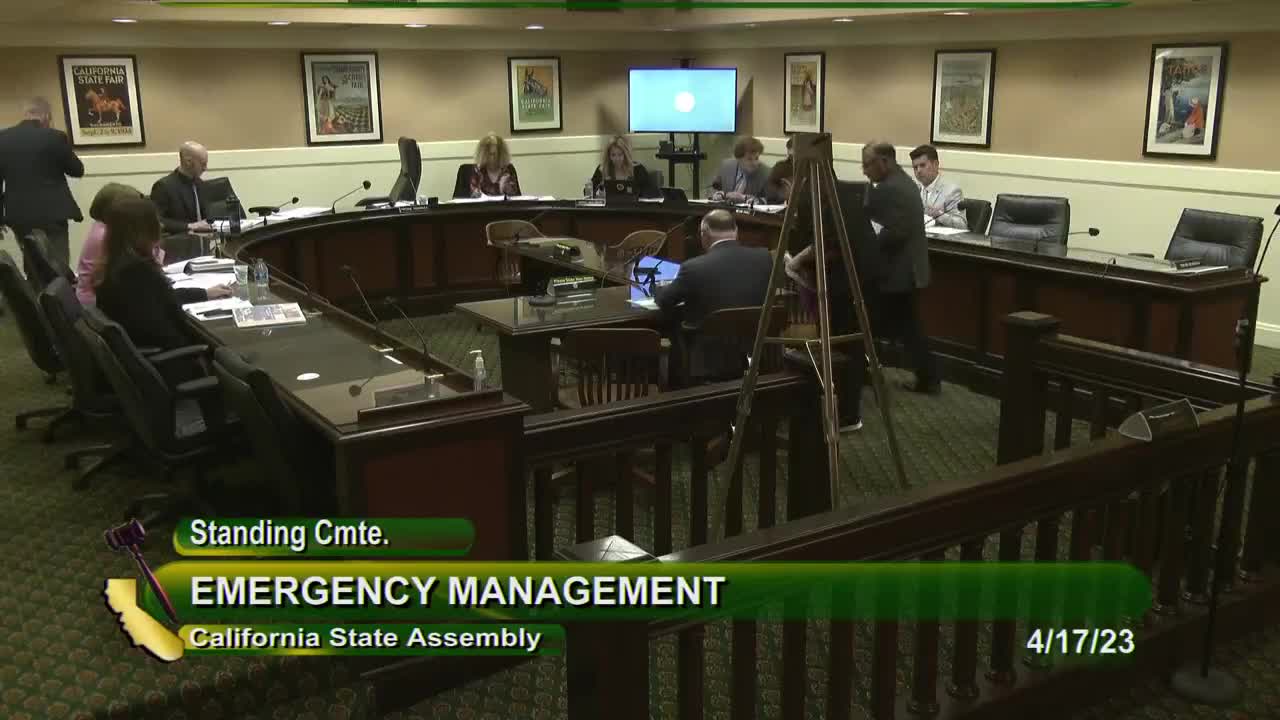 9MIN
Assembly Standing Committee on Emergency Management


Bill Co-Author(s):