AB 57: California Pocket Forest Initiative.
- Session Year: 2023-2024
- House: Assembly
- Latest Version Date: 2023-09-14
Current Status:
Failed
(2024-01-30: Consideration of Governor's veto stricken from file.)
Introduced
In Committee
First Chamber
In Committee
Second Chamber
Enacted
Existing law establishes the Department of Forestry and Fire Protection within the Natural Resources Agency. Existing law vests the department with specified responsibilities, including providing fire protection, fire prevention, pest control, and forest and range protection and enhancement implements and apparatus as necessary. Existing law, the California Urban Forestry Act of 1978, has as a stated purpose the promotion of the use of urban forest resources for purposes of increasing integrated projects with multiple benefits in urban communities.
This bill would establish the California Pocket Forest Initiative in the department and would authorize the department to coordinate implementation of the initiative in conjunction with the act. The bill would authorize the department to offer grants to cities, counties, districts, nonprofit organizations, the California Conservation Corps or certified community conservation corps, public universities, public community colleges, and public schools to establish pocket forests on public lands, as provided. The bill would require the department to prioritize disadvantaged communities and communities that lack publicly accessible green space for these grants. The bill would require the department to partner with one or more academic institutions to test, and submit a report on or before January 1, 2030, to the Legislature that evaluates, the applicability and effectiveness of the Miyawaki method, as defined, to restore degraded lands and reforest urban areas in multiple regions throughout California. The bill would repeal these provisions on January 1, 2031.
Existing law establishes the Department of Forestry and Fire Protection within the Natural Resources Agency. Existing law vests the department with specified responsibilities, including providing fire protection, fire prevention, pest control, and forest and range protection and enhancement implements and apparatus as necessary. Existing law, the California Urban Forestry Act of 1978, has as a stated purpose the promotion of the use of urban forest resources for purposes of increasing integrated projects with multiple benefits in urban communities.
This bill would establish the California Pocket Forest Initiative in the department and would authorize the department to coordinate implementation of the initiative in conjunction with the act. The bill would authorize the department to provide grants to cities, counties, districts, nonprofit organizations, the California Conservation Corps or certified community conservation corps, public universities, public community colleges, and public schools to establish pocket forests on public lands, as provided. The bill would require the department to prioritize disadvantaged communities and communities that lack publicly accessible green space for these grants. The bill would require the department to partner with one or more academic institutions to test, and submit a report on or before January 1, 2030, to the Legislature that evaluates, the applicability and effectiveness of the Miyawaki method, as defined, to restore degraded lands and reforest urban areas in multiple regions throughout California. The bill would repeal these provisions on January 1, 2031.
Existing law establishes the Department of Forestry and Fire Protection within the Natural Resources Agency. Existing law vests the department with specified responsibilities, including providing fire protection, fire prevention, pest control, and forest and range protection and enhancement implements and apparatus as necessary. Existing law, the California Urban Forestry Act of 1978, has as a stated purpose the promotion of the use of urban forest resources for purposes of increasing integrated projects with multiple benefits in urban communities.
This bill would establish the California Pocket Forest Initiative in the department and would authorize the department to coordinate implementation of the initiative in conjunction with the act. Upon an appropriation by the Legislature, the The bill would authorize the department to provide grants to cities, counties, districts, nonprofit organizations, and public schools to establish pocket forests on public lands, as provided. The bill would require the department to prioritize disadvantaged communities and communities that lack publicly accessible green space for these grants. The bill would require the department to partner with one or more academic institutions to test, and submit a report on or before January 1, 2030, to the Legislature that evaluates, the applicability and effectiveness of the Miyawaki method, as defined, to restore degraded lands and reforest urban areas in multiple regions throughout California. The bill would repeal these provisions on January 1, 2031.
Existing law establishes the Department of Forestry and Fire Protection within the Natural Resources Agency. Existing law vests the department with specified responsibilities, including providing fire protection, fire prevention, pest control, and forest and range protection and enhancement implements and apparatus as necessary. Existing law, the California Urban Forestry Act of 1978, has as a stated purpose the promotion of the use of urban forest resources for purposes of increasing integrated projects with multiple benefits in urban communities.
This bill would establish the California Pocket Forest Initiative in the department and would authorize the department to coordinate implementation of the initiative in conjunction with the act. Upon an appropriation by the Legislature, the bill would authorize the department to provide grants to cities, counties, districts, nonprofit organizations, and public schools to establish pocket forests on public lands, as provided. The bill would require the department to prioritize disadvantaged communities and communities that lack publicly accessible green space for these grants. The bill would require the department to partner with one or more academic institutions to test, and submit a report on or before January 1, 2030, to the Legislature that evaluates, the applicability and effectiveness of the Miyawaki method, as defined, to restore degraded lands and reforest urban areas in multiple regions throughout California. The bill would repeal these provisions on January 1, 2031.
The Legislature finds and declares all of the following:
(a)California is home to a wide variety of rich, biodiverse natural habitats.
(b)Natural habitats offer many benefits, including groundwater recharge.
(c)According to the Department of Fish and Wildlife, California hosts 464 rare, threatened, and endangered species of plants and animals. It is also home to thousands of other species that fill crucial roles in the states ecosystems. Many of these species require access to natural habitats in order to survive.
(d)Access to natural green spaces is beneficial to human health and happiness, especially for children and economically disadvantaged communities.
(e)According to the United States Census, 95 percent of Californias population lives in urban areas, making it the most urban state in the nation.
(f)Pocket forests can benefit society in a number of ways. First, they can confer some of the benefits of natural habitat onto urban areas. Second, they can attract and sustain species that may otherwise struggle to thrive in highly developed, low biodiversity regions. Third, they can provide easy access to natural green spaces for the growing number of urban-dwelling Californians.
(g)California works diligently to conserve its unique, biodiverse natural habitats and improve the health and happiness of its residents. Therefore, it is in the states interest to promote the creation of pocket forests.
SEC. 2.Chapter 2.1 (commencing with Section 4799.12.2) is added to Part 2.5 of Division 4 of the Public Resources Code, to read:2.1.California Pocket Forest Initiative4799.12.2.For purposes of this chapter, the following definitions apply:
(a)Initiative means the California Pocket Forest Initiative.
(b)Miyawaki method means a method of planting that first analyzes and improves a plots soil conditions, then densely plants the plot with native main tree species, subspecies, shrubs, and ground-covering herbs. The trees planted through this method should, if possible, be grown from seeds, not grafts or clones.
(c)Pocket forest means a small plot of urban land that has been planted according to the Miyawaki method.
4799.12.3.The California Pocket Forest Initiative is hereby established in the department. The department may coordinate implementation of the initiative in conjunction with the California Urban Forestry Act of 1978 (Chapter 2 (commencing with Section 4799.06)).
4799.12.4.The department shall partner with one or more academic institutions to test the applicability and effectiveness of the Miyawaki method to restore degraded lands and reforest urban areas in multiple regions throughout California.
4799.12.5.(a)The department may offer grants to cities, counties, districts, nonprofit organizations, the California Conservation Corps or certified community conservation corps, public universities, public community colleges, and public schools to establish pocket forests on public lands in order to test and demonstrate the applicability and effectiveness of the Miyawaki method in California.
(b)The department shall prioritize disadvantaged communities and communities that lack publicly accessible green space for these demonstration grants.
(c)For public school grantees, the grant may include funding to develop and offer grade-appropriate urban forestry and ecology curriculum.
4799.12.6.(a)Notwithstanding Section 10231.5 of the Government Code, on or before January 1, 2030, the department shall submit a report to the Legislature that evaluates the applicability and effectiveness of the Miyawaki method to restore degraded lands and reforest urban areas in multiple regions throughout California. The report shall include an assessment of the costs and benefits of the Miyawaki method, a discussion of appropriate species for different regions of the state, and recommendations for any modifications to the method that may be appropriate for its use in California. The department may contract with academic institutions to prepare the report, which shall be subject to the peer review process.
(b)The report to be submitted pursuant to subdivision (a) shall be submitted in compliance with Section 9795 of the Government Code.
4799.12.7.This chapter shall remain in effect only until January 1, 2031, and as of that date is repealed.
The Legislature finds and declares all of the following:
(a)California is home to a wide variety of rich, biodiverse natural habitats.
(b)Natural habitats offer many benefits, such as including groundwater recharge.
(c)According to the Department of Fish and Wildlife, California hosts 464 rare, threatened, and endangered species of plants and animals. It is also home to thousands of other species that fill crucial roles in the states ecosystems. Many of these species require access to natural habitats in order to survive.
(d)Access to natural green spaces is beneficial to human health and happiness, especially for children and economically disadvantaged communities.
(e)According to the United States Census, 95 percent of Californias population lives in urban areas. This makes areas, making it the most urban state in the nation.
(f)Pocket forests can benefit society in a number of ways. First, they can confer some of the benefits of natural habitat onto urban areas. Second, they can attract and sustain species that may otherwise struggle to thrive in highly developed, low biodiversity regions. Third, they can provide easy access to natural green spaces for the growing number of urban-dwelling Californians.
(g)California works diligently to conserve its unique, biodiverse natural habitats and improve the health and happiness of its residents. Therefore, it is in the states interest to promote the creation of pocket forests.
SEC. 2.Chapter 2.1 (commencing with Section 4799.12.2) is added to Part 2.5 of Division 4 of the Public Resources Code, to read:2.1.California Pocket Forest Initiative4799.12.2.For purposes of this chapter, the following definitions apply:
(a)Initiative means the California Pocket Forest Initiative.
(b)Miyawaki method means a method of planting that first analyzes and improves a plots soil conditions, then densely plants the plot with native main tree species, subspecies, shrubs, and ground-covering herbs. The trees planted through this method should, if possible, be grown from seeds, not grafts or clones.
(c)Pocket forest means a small plot of urban land that has been planted according to the Miyawaki method.
4799.12.3.The California Pocket Forest Initiative is hereby established in the department. The department may coordinate implementation of the initiative in conjunction with the California Urban Forestry Act of 1978 (Chapter 2 (commencing with Section 4799.06)).
4799.12.4.The department shall partner with one or more academic institutions to test the applicability and effectiveness of the Miyawaki method to restore degraded lands and reforest urban areas in multiple regions throughout California.
4799.12.5.(a)The department may offer grants to cities, counties, districts, nonprofit organizations, the California Conservation Corps or certified community conservation corps, public universities, public community colleges, and public schools to establish pocket forests on public lands in order to test and demonstrate the applicability and effectiveness of the Miyawaki method in California.
(b)The department shall prioritize disadvantaged communities and communities that lack publicly accessible green space for these demonstration grants.
(c)For public school grantees, the grant may include funding to develop and offer grade-appropriate urban forestry and ecology curriculum.
4799.12.6.(a)Notwithstanding Section 10231.5 of the Government Code, on or before January 1, 2030, the department shall submit a report to the Legislature that evaluates the applicability and effectiveness of the Miyawaki method to restore degraded lands and reforest urban areas in multiple regions throughout California. The report shall include an assessment of the costs and benefits of the Miyawaki method, a discussion of appropriate species for different regions of the state, and recommendations for any modifications to the method that may be appropriate for its use in California. The department may contract with academic institutions to prepare the report, which shall be subject to the peer review process.
(b)The report to be submitted pursuant to subdivision (a) shall be submitted in compliance with Section 9795 of the Government Code.
4799.12.7.This chapter shall remain in effect only until January 1, 2031, and as of that date is repealed.
The Legislature finds and declares all of the following:
(a)California is home to a wide variety of rich, biodiverse natural habitats.
(b)Natural habitats offer many benefits, such as groundwater recharge.
(c)According to the United States Fish and Wildlife Service Environmental Conservation Online System, Department of Fish and Wildlife, California hosts 286 threatened 464 rare, threatened, and endangered species of plants and animals. It is also home to thousands of other species that fill crucial roles in the states ecosystems. Many of these species require access to natural habitats in order to survive.
(d)Access to natural green spaces is beneficial to human health and happiness, especially for children and economically disadvantaged communities.
(e)According to the United States census, Census, 95 percent of Californias population lives in urban areas. This makes it the most urban state in the nation.
(f)Pocket forests can benefit society in a number of ways. First, they can confer some of the benefits of natural habitat onto urban areas. Second, they can attract and sustain species that may otherwise struggle to thrive in highly developed, low biodiversity regions. Third, they can provide easy access to natural green spaces for the growing number of urban-dwelling Californians.
(g)California works diligently to conserve its unique, biodiverse natural habitats and improve the health and happiness of its residents. Therefore, it is in the states interest to promote the creation of pocket forests.
SEC. 2.Chapter 2.1 (commencing with Section 4799.12.2) is added to Part 2.5 of Division 4 of the Public Resources Code, to read:2.1.California Pocket Forest Initiative4799.12.2.For purposes of this chapter, the following definitions apply:
(a)Initiative means the California Pocket Forest Initiative.
(b)Miyawaki method means a method of planting that first analyzes and improves a plots soil conditions, then densely plants the plot with native main tree species, subspecies, shrubs, and ground-covering herbs. The trees planted through this method should, if possible, be grown from seeds, not grafts or clones.
(c)Pocket forest means a small plot of urban land that has been planted according to the Miyawaki method.
4799.12.3.The California Pocket Forest Initiative is hereby established in the department. The department may coordinate implementation of the initiative in conjunction with the California Urban Forestry Act of 1978 (Chapter 2 (commencing with Section 4799.06)).
4799.12.4.The department shall partner with one or more academic institutions to test the applicability and effectiveness of the Miyawaki method to restore degraded lands and reforest urban areas in multiple regions throughout California.
4799.12.5.(a)The department may offer grants to cities, counties, districts, nonprofit organizations, the California Conservation Corps or certified community conservation corps, public universities, public community colleges, and public schools to establish pocket forests on public lands in order to test and demonstrate the applicability and effectiveness of the Miyawaki method in California.
(b)The department shall prioritize disadvantaged communities and communities that lack publicly accessible green space for these demonstration grants.
(c)For public school grantees, the grant may include funding to develop and offer grade-appropriate urban forestry and ecology curriculum.
4799.12.6.(a)Notwithstanding Section 10231.5 of the Government Code, on or before January 1, 2030, the department shall submit a report to the Legislature that evaluates the applicability and effectiveness of the Miyawaki method to restore degraded lands and reforest urban areas in multiple regions throughout California. The report shall include an assessment of the costs and benefits of the Miyawaki method, a discussion of appropriate species for different regions of the state, and recommendations for any modifications to the method that may be appropriate for its use in California. The department may contract with academic institutions to prepare the report, which shall be subject to the peer review process.
(b)The report to be submitted pursuant to subdivision (a) shall be submitted in compliance with Section 9795 of the Government Code.
4799.12.7.This chapter shall remain in effect only until January 1, 2031, and as of that date is repealed.
The Legislature finds and declares all of the following:
(a)California is home to a wide variety of rich, biodiverse natural habitats.
(b)Natural habitats offer many benefits, such as groundwater recharge.
(c)According to the United States Fish and Wildlife Service Environmental Conservation Online System, California hosts 286 threatened and endangered species of plants and animals. It is also home to thousands of other species that fill crucial roles in the states ecosystems. Many of these species require access to natural habitats in order to survive.
(d)Access to natural green spaces is beneficial to human health and happiness, especially for children and economically disadvantaged communities.
(e)According to the United States census, 95 percent of Californias population lives in urban areas. This makes it the most urban state in the nation.
(f)Pocket forests can benefit society in a number of ways. First, they can confer some of the benefits of natural habitat onto urban areas. Second, they can attract and sustain species that may otherwise struggle to thrive in highly developed, low biodiversity regions. Third, they can provide easy access to natural green spaces for the growing number of urban-dwelling Californians.
(g)California works diligently to conserve its unique, biodiverse natural habitats and improve the health and happiness of its residents. Therefore, it is in the states interest to promote the creation of pocket forests.
SEC. 2.Chapter 2.1 (commencing with Section 4799.12.2) is added to Part 2.5 of Division 4 of the Public Resources Code, to read:2.1.California Pocket Forest Initiative4799.12.2.For purposes of this chapter, the following definitions apply:
(a)Initiative means the California Pocket Forest Initiative.
(b)Miyawaki method means a method of planting that first analyzes and improves a plots soil conditions, then densely plants the plot with native main tree species, subspecies, shrubs, and ground-covering herbs. The trees planted through this method should, if possible, be grown from seeds, not grafts or clones.
(c)Pocket forest means a small plot of urban land that has been planted according to the Miyawaki method.
4799.12.3.The California Pocket Forest Initiative is hereby established in the department. The department may coordinate implementation of the initiative in conjunction with the California Urban Forestry Act of 1978 (Chapter 2 (commencing with Section 4799.06)).
4799.12.4.The department shall partner with one or more academic institutions to test the applicability and effectiveness of the Miyawaki method to restore degraded lands and reforest urban areas in multiple regions throughout California.
4799.12.5.(a)Upon appropriation of funds by the Legislature for the purposes of this section, the The department may offer grants to cities, counties, districts, nonprofit organizations, and public schools to establish pocket forests on public lands in order to test and demonstrate the applicability and effectiveness of the Miyawaki method in California.
(b)The department shall prioritize disadvantaged communities and communities that lack publicly accessible green space for these demonstration grants.
(c)For public school grantees, the grant may include funding to develop and offer grade-appropriate urban forestry and ecology curriculum.
4799.12.6.(a)Notwithstanding Section 10231.5 of the Government Code, on or before January 1, 2030, the department shall submit a report to the Legislature that evaluates the applicability and effectiveness of the Miyawaki method to restore degraded lands and reforest urban areas in multiple regions throughout California. The report shall include an assessment of the costs and benefits of the Miyawaki method, a discussion of appropriate species for different regions of the state, and recommendations for any modifications to the method that may be appropriate for its use in California. The department may contract with academic institutions to prepare the report, which shall be subject to the peer review process.
(b)The report to be submitted pursuant to subdivision (a) shall be submitted in compliance with Section 9795 of the Government Code.
4799.12.7.This chapter shall remain in effect only until January 1, 2031, and as of that date is repealed.
The Legislature finds and declares all of the following:
(a)California is home to a wide variety of rich, biodiverse natural habitats.
(b)Natural habitats offer many benefits, such as groundwater recharge.
(c)According to the United States Fish and Wildlife Service Environmental Conservation Online System, California hosts 286 threatened and endangered species of plants and animals. It is also home to thousands of other species that fill crucial roles in the states ecosystems. Many of these species require access to natural habitats in order to survive.
(d)Access to natural green spaces is beneficial to human health and happiness, especially for children and economically disadvantaged communities.
(e)According to the United States census, 95 percent of Californias population lives in urban areas. This makes it the most urban state in the nation.
(f)Pocket forests can benefit society in a number of ways. First, they can confer some of the benefits of natural habitat onto urban areas. Second, they can attract and sustain species that may otherwise struggle to thrive in highly developed, low biodiversity regions. Third, they can provide easy access to natural green spaces for the growing number of urban-dwelling Californians.
(g)California works diligently to conserve its unique, biodiverse natural habitats and improve the health and happiness of its residents. Therefore, it is in the states interest to promote the creation of pocket forests.
SEC. 2.Chapter 2.1 (commencing with Section 4799.12.2) is added to Part 2.5 of Division 4 of the Public Resources Code, to read:2.1.California Pocket Forest Initiative4799.12.2.For purposes of this chapter, the following definitions apply:
(a)Initiative means the California Pocket Forest Initiative.
(b)Miyawaki method means a method of planting that first analyzes and improves a plots soil conditions, then densely plants the plot with native main tree species, subspecies, shrubs, and ground-covering herbs. The trees planted through this method should, if possible, be grown from seeds, not grafts or clones.
(c)Pocket forest means a small plot of urban land that has been planted according to the Miyawaki method.
4799.12.3.The California Pocket Forest Initiative is hereby established in the department. The department may coordinate implementation of the initiative in conjunction with the California Urban Forestry Act of 1978 (Chapter 2 (commencing with Section 4799.06)).
4799.12.4.The department shall partner with one or more academic institutions to test the applicability and effectiveness of the Miyawaki method to restore degraded lands and reforest urban areas in multiple regions throughout California.
4799.12.5.(a)Upon appropriation of funds by the Legislature for the purposes of this section, the department may offer grants to cities, counties, districts, nonprofit organizations, and public schools to establish pocket forests on public lands in order to test and demonstrate the applicability and effectiveness of the Miyawaki method in California.
(b)The department shall prioritize disadvantaged communities and communities that lack publicly accessible green space for these demonstration grants.
(c)For public school grantees, the grant may include funding to develop and offer grade-appropriate urban forestry and ecology curriculum.
4799.12.6.(a)Notwithstanding Section 10231.5 of the Government Code, on or before January 1, 2030, the department shall submit a report to the Legislature that evaluates the applicability and effectiveness of the Miyawaki method to restore degraded lands and reforest urban areas in multiple regions throughout California. The report shall include an assessment of the costs and benefits of the Miyawaki method, a discussion of appropriate species for different regions of the state, and recommendations for any modifications to the method that may be appropriate for its use in California. The department may contract with academic institutions to prepare the report, which shall be subject to the peer review process.
(b)The report to be submitted pursuant to subdivision (a) shall be submitted in compliance with Section 9795 of the Government Code.
4799.12.7.This chapter shall remain in effect only until January 1, 2031, and as of that date is repealed.
REVISIONS: HeadingLine 2.|
Date
|
Status
|
|---|---|
| Jan 30, 2024 | Consideration of Governor's veto stricken from file. |
| Jan 3, 2024 | Consideration of Governor's veto pending. |
| Oct 8, 2023 | Vetoed by Governor. |
| Sep 19, 2023 | Enrolled and presented to the Governor at 4 p.m. |
| Sep 12, 2023 | Senate amendments concurred in. To Engrossing and Enrolling. (Ayes 68. Noes 10. Page 3228.). |
| Sep 12, 2023 | Assembly Rule 77 suspended. (Page 3228.) |
| Sep 11, 2023 | In Assembly. Concurrence in Senate amendments pending. May be considered on or after September 13 pursuant to Assembly Rule 77. |
| Sep 11, 2023 | Read third time. Passed. Ordered to the Assembly. (Ayes 36. Noes 3. Page 2590.). |
| Sep 7, 2023 | Read second time. Ordered to third reading. |
| Sep 6, 2023 | Read third time and amended. Ordered to second reading. |
| Sep 5, 2023 | Read second time. Ordered to third reading. |
| Sep 1, 2023 | From committee: Do pass. (Ayes 5. Noes 2.) (September 1). |
| Jul 10, 2023 | In committee: Referred to APPR. suspense file. |
| Jun 27, 2023 | From committee: Do pass and re-refer to Com. on APPR. (Ayes 10. Noes 0.) (June 27). Re-referred to Com. on APPR. |
| Jun 20, 2023 | From committee chair, with author's amendments: Amend, and re-refer to committee. Read second time, amended, and re-referred to Com. on N.R. & W. |
| Jun 14, 2023 | Referred to Com. on N.R. & W. |
| Jun 1, 2023 | In Senate. Read first time. To Com. on RLS. for assignment. |
| May 31, 2023 | Read third time. Passed. Ordered to the Senate. (Ayes 66. Noes 6. Page 1995.) |
| May 22, 2023 | Read second time. Ordered to third reading. |
| May 18, 2023 | Read second time and amended. Ordered returned to second reading. |
| May 18, 2023 | From committee: Amend, and do pass as amended. (Ayes 11. Noes 2.) (May 18). |
| Apr 19, 2023 | In committee: Set, first hearing. Referred to APPR. suspense file. |
| Mar 14, 2023 | From committee: Do pass and re-refer to Com. on APPR. (Ayes 10. Noes 0.) (March 13). Re-referred to Com. on APPR. |
| Mar 14, 2023 | Coauthors revised. |
| Jan 26, 2023 | Referred to Com. on NAT. RES. |
| Jan 4, 2023 | Read first time. |
| Dec 7, 2022 | From printer. May be heard in committee January 6. |
| Dec 6, 2022 | Introduced. To print. |
|
Date
|
Description
|
Location
|
Votes
|
|
|---|---|---|---|---|
| Sep 12, 2023 | AB 57 Kalra Concurrence in Senate Amendments | Assembly Floor |
Passed |
|
| Sep 11, 2023 | Assembly 3rd Reading AB57 Kalra et al. By Stern | Senate Floor |
Passed |
|
| Sep 1, 2023 | Do pass | Senate Standing Committee on Appropriations |
Passed |
|
| Jul 10, 2023 | Placed on suspense file | Senate Standing Committee on Appropriations |
Passed |
|
| Jun 27, 2023 | Do pass, but first be re-referred to the Committee on [Appropriations] | Senate Standing Committee on Natural Resources and Water |
Passed |
|
| May 31, 2023 | AB 57 Kalra Assembly Third Reading | Assembly Floor |
Passed |
|
| May 18, 2023 | Do pass as amended. | Assembly Standing Committee on Appropriations |
Passed |
|
| Mar 13, 2023 | Do pass and be re-referred to the Committee on [Appropriations] | Assembly Standing Committee on Natural Resources |
Passed |
This list shows positions taken on this bill by organizations on the date displayed, which is linked to the original source.
Positions by individuals are not included.
|
Organization
|
Position
|
Date
|
|---|---|---|
| Acterra: Action for A Healthy Planet | ** Support | |
| Active San Gabriel Valley | ** Support | |
| A Plus Tree, LLC | ** Support | |
| Associated Students of UC San Diego, Triton Lobby Corps | ** Support | |
| A Voice for Choice Advocacy | ** Support | |
| Bay Area Youth Lobbying Initiative | ** Support | |
| Breathe California of The Bay Area, Golden Gate, and Central Coast | ** Support | |
| California Association Of Local Conservation Corps | ** Support | |
| California Environmental Voters | ** Support | |
| California Institute for Biodiversity | ** Support | |
| California Native Plant Society Yerba Buena Chapter | ** Support | |
| Californians for Western Wilderness | ** Support | |
| California Urban Forests Council | ** Support | |
| City of Rancho Cucamonga | ** Support | |
| cleanearth4kids.org | ** Support | |
| Climate Action California | ** Support | |
| Climate Reality Project, Los Angeles Chapter | ** Support | |
| Climate Reality Project: San Fernando Valley Chapter | ** Support | |
| County of Santa Clara | ** Support | |
| Defenders Of Wildlife | ** Support | |
| Democrats of Rossmoor | ** Support | |
| Elders Climate Action Norcal Chapter | ** Support | |
| Elders Climate Action Socal Chapter | ** Support | |
| Forests Forever | ** Support | |
| Friends of Ballona Wetlands | ** Support | |
| Golden Gate Audubon Society | ** Support | |
| Green New Deal At UC San Diego | ** Support | |
| Green Pocket Forests | ** Support | |
| Hundreds Of Individuals | ** Support | |
| Jonas Philanthropies Trees for Climate Health | ** Support | |
| Living Classroom | ** Support | |
| Midpeninsula Regional Open Space District | ** Support | |
| One Tree Planted | ** Support | |
| Overseas Volunteer For A Better India | ** Support | |
| Resource Renewal Institute | ** Support | |
| Roseville Urban Forest Foundation | ** Support | |
| Save The Bay | ** Support | |
| Sierra Club California | ** Support | |
| Silicon Valley Youth Climate Action | ** Support | |
| Small Steps Foundation | ** Support | |
| Social Compassion In Legislation | ** Support | |
| Solano County Democratic Central Committee | ** Support | |
| Sonoma Biochar Initiative | ** Support | |
| Sonoma Ecology Center | ** Support | |
| Southern California Association Of Governments | ** Support | |
| Sunrise Silicon Valley | ** Support | |
| Sustainable Claremont | ** Support | |
| Sustainable Mill Valley | ** Support | |
| Sustainable Rossmoor | ** Support | |
| The Watershed Nursery | ** Support | |
| Trees for Climate Health | ** Support | |
| Tuolumne River Trust | ** Support | |
| YMCA of San Francisco | ** Support |
GOVERNOR'S VETO
GV Bill Id:AB 57
Author:(Kalra)
As Enrolled Ver:September 14, 2023
2/3 vote
SUMMARY
Establishes the California Pocket Forest Initiative (Initiative) at the Department of Forestry and Fire Protection (CAL FIRE).
Senate Amendments
- Update a finding to reference the Department of Fish and Wildlife's data on rare, threatened, and endangered species of plants and animals.
- Include the California Conservation Corps (CCC) or certified community conservation corps, public universities, and public community colleges as additional grant recipients to establish pocket forests on public lands.
Governor's Veto Message
This bill would establish the California Pocket Forest Initiative in CAL FIRE and require CAL FIRE to implement the initiative, as prescribed, with applicable reporting requirements.
This bill results in General Fund impacts not included in the 2023 Budget Act and likely significant ongoing General Fund cost pressure to support grants to complete projects funded through the initiative.
In partnership with the Legislature, we enacted a budget that closed a shortfall of more than $30 billion through balanced solutions that avoided deep program cuts and protected education, health care, climate, public safety, and social service programs that are relied on by millions of Californians. This year, however, the Legislature sent me bills outside of this budget process that, if all enacted, would add nearly $19 billion of unaccounted costs in the budget, of which $11 billion would be ongoing.
With our state facing continuing economic risk and revenue uncertainty, it is important to remain disciplined when considering bills with significant fiscal implications, such as this measure.
COMMENTS
The benefits of urban forestry include energy conservation, reduced urban heat island effects, reduced storm-water runoff, improvements in local air quality, support for public and mental health benefits, wildlife habitat, and increases property values. Trees not only improve, but are imperative to the quality of life in our urban environments.
Under the Urban & Community Forestry Program (Program), CAL FIRE provides urban forestry grants to help communities to advance their urban forestry efforts. AB 57 would require CAL FIRE to create guidelines for planting pocket forests and provide grants to cities, counties, districts, nonprofit organizations, and public schools to create pocket forests using the Miyawaki method on public land. To enable equitable distribution of grants, the bill would require CAL FIRE to prioritize disadvantaged communities and communities that lack publicly accessible green space for these demonstration grants.
The essential principle of the Miyawaki method is using species of trees that would occur naturally in that area and that work together to create a diverse, multi-layered forest community. This creates a resilient and thriving forest ecosystem with species that complement each other, restoring "native forests by native trees."
The grants under this bill would be provided under the current Urban Forestry Grant program for pocket forests.
According to the Author
While many install street trees and low-biodiversity parks, they often struggle to facilitate larger, more biodiverse forestry projects. This is especially true for low-income and otherwise disadvantaged communities. Small, high biodiversity pocket forests overcome these challenges by providing an impactful forestry solution designed specifically for the urban landscape… AB 57 will make grants for pocket forest creation readily available to urban Californians.
Arguments in Support
Sierra Club California writes that urban nature provides multiple benefits for local communities, including mitigating extreme heat, providing habitat for pollinators and other wildlife and supporting climate resilience. Increasing community access to greenspaces also has positive effects on human health and mental wellbeing. This bill will support increasing access to nature and its benefits in urban spaces by establishing pocket forests utilizing native species to further biodiversity benefits.
Arguments in Opposition
None on file
FISCAL COMMENTS
According to the Senate Appropriations Committee, this bill would result in:
- Ongoing costs for CAL FIRE of about $400,000 in the first year and $282,000 annually thereafter (General Fund) to administer grants, oversee projects, prepare reports, and analyze the efficiency of the prescribed method, among other things.
- Unknown, likely significant cost pressure (General Fund, special fund, or bond funds) to provide funding for CAL FIRE to offer demonstration grants to establish pocket forests on public lands in order to test and demonstrate the applicability and effectiveness of the Miyawaki method in California.
- Unknown, potentially significant cost pressure to provide future grant funding should CAL FIRE determine that the Miyawaki method would be applicable and effective in California.
- To the extent that the CCC is required to secure specified work projects with CAL FIRE via the grant process, potential costs of an unknown, but likely minor and absorbable amount for the CCC to process grant applications.
VOTES
ASM NATURAL RESOURCES: 10-0-1
YES: Luz Rivas, Chen, Bennett, Boerner Horvath, Friedman, Hoover, Pellerin, Ward, Wood, Zbur
ABS, ABST OR NV: Essayli
ASM APPROPRIATIONS: 11-2-3
YES: Holden, Bryan, Calderon, Wendy Carrillo, Mike Fong, Hart, Lowenthal, Papan, Pellerin, Weber, Ortega
NO: Megan Dahle, Mathis
ABS, ABST OR NV: Dixon, Robert Rivas, Sanchez
ASSEMBLY FLOOR: 66-6-8
YES: Addis, Aguiar-Curry, Alanis, Alvarez, Arambula, Bains, Bauer-Kahan, Bennett, Berman, Boerner, Bonta, Bryan, Calderon, Juan Carrillo, Wendy Carrillo, Cervantes, Connolly, Davies, Mike Fong, Friedman, Gabriel, Garcia, Gipson, Grayson, Haney, Hart, Holden, Hoover, Irwin, Jackson, Jones-Sawyer, Kalra, Lee, Low, Lowenthal, Maienschein, McCarty, McKinnor, Muratsuchi, Stephanie Nguyen, Ortega, Pacheco, Papan, Pellerin, Petrie-Norris, Quirk-Silva, Ramos, Reyes, Luz Rivas, Robert Rivas, Rodriguez, Blanca Rubio, Santiago, Schiavo, Soria, Ting, Valencia, Villapudua, Wallis, Ward, Weber, Wicks, Wilson, Wood, Zbur, Rendon
NO: Megan Dahle, Essayli, Vince Fong, Gallagher, Lackey, Mathis
ABS, ABST OR NV: Chen, Dixon, Flora, Jim Patterson, Joe Patterson, Sanchez, Ta, Waldron
SENATE FLOOR: 36-3-1
YES: Allen, Alvarado-Gil, Archuleta, Ashby, Atkins, Becker, Blakespear, Bradford, Cortese, Dahle, Dodd, Durazo, Eggman, Glazer, Gonzalez, Grove, Hurtado, Laird, Limón, McGuire, Menjivar, Min, Newman, Niello, Ochoa Bogh, Padilla, Portantino, Roth, Rubio, Skinner, Smallwood-Cuevas, Stern, Umberg, Wahab, Wiener, Wilk
NO: Jones, Nguyen, Seyarto
ABS, ABST OR NV: Caballero
ASSEMBLY FLOOR: 68-10-2
YES: Addis, Aguiar-Curry, Alanis, Alvarez, Arambula, Bains, Bauer-Kahan, Bennett, Berman, Boerner, Bonta, Bryan, Calderon, Juan Carrillo, Wendy Carrillo, Cervantes, Chen, Connolly, Davies, Mike Fong, Friedman, Gabriel, Garcia, Gipson, Grayson, Haney, Hart, Holden, Hoover, Irwin, Jackson, Jones-Sawyer, Kalra, Lee, Low, Lowenthal, Maienschein, McCarty, McKinnor, Muratsuchi, Stephanie Nguyen, Ortega, Pacheco, Papan, Pellerin, Petrie-Norris, Quirk-Silva, Ramos, Rendon, Reyes, Luz Rivas, Rodriguez, Blanca Rubio, Santiago, Schiavo, Soria, Ting, Valencia, Villapudua, Waldron, Wallis, Ward, Weber, Wicks, Wilson, Wood, Zbur, Robert Rivas
NO: Megan Dahle, Dixon, Essayli, Flora, Vince Fong, Gallagher, Lackey, Mathis, Jim Patterson, Joe Patterson
ABS, ABST OR NV: Sanchez, Ta
UPDATED
VERSION: September 14, 2023
CONSULTANT: Paige Brokaw / NAT. RES. / (916) 319-2092 FN: 0002492
CONCURRENCE IN SENATE AMENDMENTS
CSA1 Bill Id:AB 57
Author:(Kalra)
As Amended Ver:September 6, 2023
Majority vote
SUMMARY
Establishes the California Pocket Forest Initiative (Initiative) at the Department of Forestry and Fire Protection (CAL FIRE).
Senate Amendments
- Update a finding to reference the Department of Fish and Wildlife's data on rare, threatened, and endangered species of plants and animals.
- Include the California Conservation Corps (CCC) or certified community conservation corps, public universities, and public community colleges as additional grant recipients to establish pocket forests on public lands.
COMMENTS
The benefits of urban forestry include energy conservation, reduced urban heat island effects, reduced storm-water runoff, improvements in local air quality, support for public and mental health benefits, wildlife habitat, and increases property values. Trees not only improve, but are imperative to the quality of life in our urban environments.
Under the Urban and Community Forestry Program (Program), CAL FIRE provides urban forestry grants to help communities to advance their urban forestry efforts. This bill would require CAL FIRE to create guidelines for planting pocket forests and provide grants to cities, counties, districts, nonprofit organizations, and public schools to create pocket forests using the Miyawaki method on public land. To enable equitable distribution of grants, the bill would require CAL FIRE to prioritize disadvantaged communities and communities that lack publicly accessible green space for these demonstration grants.
The essential principle of the Miyawaki method is using species of trees that would occur naturally in that area and that work together to create a diverse, multi-layered forest community. This creates a resilient and thriving forest ecosystem with species that complement each other, restoring "native forests by native trees."
The grants under this bill would be provided under the current Urban Forestry Grant program for pocket forests.
According to the Author
While many install street trees and low-biodiversity parks, they often struggle to facilitate larger, more biodiverse forestry projects. This is especially true for low-income and otherwise disadvantaged communities. Small, high biodiversity pocket forests overcome these challenges by providing an impactful forestry solution designed specifically for the urban landscape… AB 57 will make grants for pocket forest creation readily available to urban Californians.
Arguments in Support
Sierra Club California writes that urban nature provides multiple benefits for local communities, including mitigating extreme heat, providing habitat for pollinators and other wildlife and supporting climate resilience. Increasing community access to greenspaces also has positive effects on human health and mental wellbeing. This bill will support increasing access to nature and its benefits in urban spaces by establishing pocket forests utilizing native species to further biodiversity benefits.
Arguments in Opposition
None on file
FISCAL COMMENTS
According to the Senate Appropriations Committee, this bill would result in:
- Ongoing costs for CAL FIRE of about $400,000 in the first year and $282,000 annually thereafter (General Fund) to administer grants, oversee projects, prepare reports, and analyze the efficiency of the prescribed method, among other things.
- Unknown, likely significant cost pressure (General Fund, special fund, or bond funds) to provide funding for CAL FIRE to offer demonstration grants to establish pocket forests on public lands in order to test and demonstrate the applicability and effectiveness of the Miyawaki method in California.
- Unknown, potentially significant cost pressure to provide future grant funding should CAL FIRE determine that the Miyawaki method would be applicable and effective in California.
- To the extent that the CCC is required to secure specified work projects with CAL FIRE via the grant process, potential costs of an unknown, but likely minor and absorbable amount for the CCC to process grant applications.
VOTES:
ASM NATURAL RESOURCES: 10-0-1
YES: Luz Rivas, Chen, Bennett, Boerner Horvath, Friedman, Hoover, Pellerin, Ward, Wood, Zbur
ABS, ABST OR NV: Essayli
ASM APPROPRIATIONS: 11-2-3
YES: Holden, Bryan, Calderon, Wendy Carrillo, Mike Fong, Hart, Lowenthal, Papan, Pellerin, Weber, Ortega
NO: Megan Dahle, Mathis
ABS, ABST OR NV: Dixon, Robert Rivas, Sanchez
ASSEMBLY FLOOR: 66-6-8
YES: Addis, Aguiar-Curry, Alanis, Alvarez, Arambula, Bains, Bauer-Kahan, Bennett, Berman, Boerner, Bonta, Bryan, Calderon, Juan Carrillo, Wendy Carrillo, Cervantes, Connolly, Davies, Mike Fong, Friedman, Gabriel, Garcia, Gipson, Grayson, Haney, Hart, Holden, Hoover, Irwin, Jackson, Jones-Sawyer, Kalra, Lee, Low, Lowenthal, Maienschein, McCarty, McKinnor, Muratsuchi, Stephanie Nguyen, Ortega, Pacheco, Papan, Pellerin, Petrie-Norris, Quirk-Silva, Ramos, Reyes, Luz Rivas, Robert Rivas, Rodriguez, Blanca Rubio, Santiago, Schiavo, Soria, Ting, Valencia, Villapudua, Wallis, Ward, Weber, Wicks, Wilson, Wood, Zbur, Rendon
NO: Megan Dahle, Essayli, Vince Fong, Gallagher, Lackey, Mathis
ABS, ABST OR NV: Chen, Dixon, Flora, Jim Patterson, Joe Patterson, Sanchez, Ta, Waldron
SENATE FLOOR: 36-3-1
YES: Allen, Alvarado-Gil, Archuleta, Ashby, Atkins, Becker, Blakespear, Bradford, Cortese, Dahle, Dodd, Durazo, Eggman, Glazer, Gonzalez, Grove, Hurtado, Laird, Limón, McGuire, Menjivar, Min, Newman, Niello, Ochoa Bogh, Padilla, Portantino, Roth, Rubio, Skinner, Smallwood-Cuevas, Stern, Umberg, Wahab, Wiener, Wilk
NO: Jones, Nguyen, Seyarto
ABS, ABST OR NV: Caballero
UPDATED
VERSION: September 6, 2023
CONSULTANT: Paige Brokaw / NAT. RES. / (916) 319-2092 FN: 0001686
SENATE RULES COMMITTEE Office of Senate Floor Analyses (916) 651-1520 Fax: (916) 327-4478 | AB 57 |
THIRD READING
Bill No: AB 57
Author: Kalra (D), et al.
Amended: 9/6/23 in Senate
Vote: 21
SENATE NATURAL RES. & WATER COMMITTEE: 10-0, 6/27/23
AYES: Min, Allen, Dahle, Eggman, Grove, Hurtado, Laird, Limón, Padilla, Stern
NO VOTE RECORDED: Seyarto
SENATE APPROPRIATIONS COMMITTEE: 5-2, 9/1/23
AYES: Portantino, Ashby, Bradford, Wahab, Wiener
NOES: Jones, Seyarto
ASSEMBLY FLOOR: 66-6, 5/31/23 - See last page for vote
SUBJECT: California Pocket Forest Initiative
SOURCE: California Institute for Biodiversity
DIGEST:
This bill establishes the California Pocket Forest Initiative in the Department of Forestry and Fire Protection (CalFire) until January 1, 2031.
Senate Floor Amendments of 9/6/23 add Senator Stern as a coauthor and make other nonsubstantive changes to the bill.
ANALYSIS:
Existing law:
- Establishes CalFire in the California Natural Resources Agency (CNRA) under the control of the director. Public Resources Code (PRC) §701.
- Establishes the California Urban Forestry Act of 1978, which:
- Defines “urban forest” as those native or introduced trees and related vegetation in the urban and near-urban areas, including urban watersheds, soils and related habitats, street trees, park trees, residential trees, natural riparian habitats, and trees on other private and public properties.
- Directs CalFire to implement a program in urban forestry for multiple purposes, including to reduce greenhouse gas emissions, mitigate the public health impacts of poor air and water quality, mitigate the urban heat island effect, improve stormwater capture, and address a lack of green space and urban parks.
- Authorizes the CalFire director to make grants to provide assistance of 25 - 90 percent of the costs for urban forestry projects (known as the Urban and Community Forestry Program). Eligible activities and projects under the grant program include:
- Tree planting projects.
- Demonstration projects, as specified.
- Urban forest management and improved urban forest maintenance, as specified.
- Provision of seedling and tree stock.
- Development of urban tree plans, as specified, and urban forest master plans or similar plans designed to provide comprehensive urban forest protection, maintenance, and management.
- Development of training and educational materials, as specified.
- Planning and technical assistance for eligible applicants assisting disadvantaged communities. PRC §§4799.06 et seq.
This bill establishes the California Pocket Forest Initiative in CalFire until January 1, 2031. Further, this bill:
- Authorizes CalFire to coordinate implementation of the initiative in conjunction with the California Urban Forestry Act of 1978.
- Directs CalFire to partner with one or more academic institutions to test the applicability and effectiveness of the Miyawaki method to restore degraded lands and reforest urban areas in multiple regions throughout California.
- Authorizes CalFire to offer grants to cities, counties, districts, nonprofit organizations, the California Conservation Corps or certified community corps, public universities, public community colleges, and public schools to establish pocket forests on public lands to test and demonstrate the applicability and effectiveness of the Miyawaki method in California.
- Require CalFire to prioritize disadvantaged communities and communities that lack publicly-accessible green space for these demonstration grants.
- Authorize, for public school grantees, the grant to include funding to develop and offer grade-appropriate urban forestry and ecology curriculum.
- Requires, on or before January 1, 2030, CalFire to submit a report to the Legislature that evaluates the applicability and effectiveness of the Miyawaki method to restore degraded lands and reforest urban areas in multiple regions throughout California.
- Require the report to assess the costs and benefits of the Miyawaki method, discuss appropriate species for different regions of the state, and makesrecommendations for any modifications to the method that may be appropriate for its use in California.
- Authorize CalFire to contract with academic institutions to prepare the report, which shall be subject to the peer review process.
- Defines terms, including “Miyawaki method” and “pocket forest.”
- Makes a series of findings and declarations, including that pocket forests can benefit society in a number of specified ways and that it is in the state’s interest to promote the creation of pocket forests.
Background
CalFire’s Urban and Community Forestry Program. This program seeks to optimize the benefits of urban trees and related vegetation through multiple objective projects. CalFire has seven regional urban foresters throughout the state to provide expert urban forestry support to communities, nonprofit groups, and municipal governments to create and maintain sustainable urban forests. These specialists also administer and provide technical support for grants that are offered for activities such as tree planting, municipal tree inventories and management plans, urban forest educational efforts, and innovative urban forestry projects.
This program primarily has been funded with bond funds and the Greenhouse Gas Reduction Fund. It also utilizes federal funds and has occasionally used General Fund money. According to CalFire, local communities have planted more than 80,000 trees through this program since 2015, primarily in disadvantaged communities. The program also works with CalFire’s Fire Prevention Program to advocate for fire-safe landscaping for homeowners and communities.
Recent urban forestry plans and strategies. The 2018 California Forest Carbon Plan, adopted under Governor Brown, proposes to protect and enhance the carbon sequestration potential of urban forests while producing other benefits by protecting and expanding the existing tree canopy. Specifically, the plan establishes a goal to increase urban tree canopy statewide 10 percent above 2018 levels by 2030, prioritizing investments in disadvantaged and low-income communities. The plan also seeks to protect the existing tree canopy through policies and programs targeting ongoing maintenance and utilization of industry best management practices.
The 2021 California’s Wildfire and Forest Resilience Action Plan, prepared by Governor Newsom’s Wildfire and Forest Resilience Task Force, establishes similar goals and priorities. Further, the Urban and Community Forestry Program’s 2019-2024 Strategic Plan commits to prioritizing underserved communities with limited tree canopy, championing effective management, and establishing or enhancing key performance measures for the health and management of urban forests, among other goals, objectives, and strategies.
Miyawaki method. Doctor Akira Miyawaki, botanist and professor, invented the method in 1980. From his perspective, contemporary forests in Japan created according to then-prevalent forestry principles were neither the most resilient nor the best suited for conditions in Japan. Leaning on the concept of “potential natural vegetation,” or what would naturally occur in an area without human intervention, he developed, tested, and refined a method of ecological engineering known today as the "Miyawaki method" to restore native forests on degraded soils and deforested lands.
The Miyawaki method uses species of trees and plants that would occur naturally in an area, and that, when planted together, create a diverse, multi-layered forest community. First, the project proponent analyzes the site to determine the appropriate native vegetation and the condition of the soil. The project proponent then seeks to improve the soil in order to recover the topsoil to a depth of 20-30 centimeters (approximately 8-12 inches) by mixing it with a compost from locally available organic materials, like fallen leaves. The proponent then selects 50 to 100 local tree and plant species and plants the seedlings very densely – 20,000 to 30,000 per hectare as opposed to 1,000 per hectare in commercial forestry – in a random fashion to try to resemble what would be found in nature.
For a period of two to three years, the site is monitored, watered, and weeded to give the nascent forest a chance to establish itself. During this early period, the plantings compete for space and access to light, water, and nutrients, a battle that encourages rapid growth, potentially 10 times faster than other techniques. After the initial period, the forest is left to grow on its own without interference.
There has been particular focus on planting Miyawaki forests in urban environments as there are significant benefits to tree planting in towns and cities, and this method maximizes the space available. Specifically, the minimum space needed to plant this type of forest is 10ft.x13ft.
Comments
Looks familiar? This bill is substantially similar to AB 2114 (Kalra, 2022), which was held on the suspense file in the Senate Appropriations Committee. The main differences between this bill and AB 2114 are that this bill:
- Authorizes, but does not require, CalFire to coordinate implementation of the initiative in conjunction with the California Urban Forestry Act of 1978.
- Removes the language, “upon appropriation of funds by the Legislature for the purposes of this section” from CalFire’s authority to offer demonstration grants under the program.
- Expands the entities eligible for the demonstration grants to include the California Conservation Corps or certified community corps, public universities, and public community colleges.
- Extends all dates by one year.
- Updates findings.
Related/Prior Legislation
AB 2114 (Karla, 2022) was substantial similar to this bill. The bill was held in the Senate Appropriations Committee on the suspense file.
FISCAL EFFECT: Appropriation: No Fiscal Com.: Yes Local: No
According to the Senate Appropriations Committee:
- CalFire estimates ongoing costs of about $400,000 in the first year and $282,000 annually thereafter (General Fund) to administer grants, oversee projects, prepare reports, and analyze the efficiency of the prescribed method, among other things.
- Unknown, likely significant cost pressure (General Fund, special fund, or bond funds) to provide funding for CalFire to offer demonstration grants to establish pocket forests on public lands in order to test and demonstrate the applicability and effectiveness of the Miyawaki method in California.
- Unknown, potentially significant cost pressure to provide future grant funding should CalFire determine that the Miyawaki method would be applicable and effective in California.
- To the extent that the California Conservation Corps (CCC) is required to secure specified work projects with CalFire via the grant process, potential costs of an unknown but likely minor and absorbable amount for the CCC to process grant applications. Currently, one designated staff member per center is allowed access for grant application. Depending on the amount of the grant, the CCC center applying for funding may need additional approval in the chain of command.
SUPPORT: (Verified 9/7/23)
California Institute for Biodiversity (source)
A Plus Tree, LLC
A Voice for Choice Advocacy
Acterra: Action for a Healthy Planet
Active San Gabriel Valley
Associated Students of UC San Diego, Triton Lobby Corps
Bay Area Youth Lobbying Initiative
Breathe California of the Bay Area, Golden Gate, and Central Coast
California Association of Local Conservation Corps
California Environmental Voters
California Native Plant Society, Yerba Buena Chapter
California Urban Forests Council
Californians for Western Wilderness
City of Rancho Cucamonga
CleanEarth4Kids.org
Climate Action California
Climate Reality Project, Los Angeles Chapter
Climate Reality Project, San Fernando Valley Chapter
County of Santa Clara
Defenders of Wildlife
Democrats of Rossmoor
Elders Climate Action, NorCal Chapter
Elders Climate Action, SoCal Chapter
Forests Forever
Friends of Ballona Wetlands
Golden Gate Audubon Society
Green New Deal at UC San Diego
Green Pocket Forests
Jonas Philanthropies Trees for Climate Health
Living Classroom
Midpeninsula Regional Open Space District
One Tree Planted
Overseas Volunteers for a Better India
Resource Renewal Institute
Roseville Urban Forest Foundation
Save the Bay
Sierra Club California
Silicon Valley Youth Climate Action
Small Steps Foundation
Social Compassion in Legislation
Solano County Democratic Central Committee
Sonoma Biochar Initiative
Sonoma Ecology Center
Southern California Association of Governments
Sunrise Silicon Valley
Sustainable Claremont
Sustainable Mill Valley
Sustainable Rossmoor
The Watershed Nursery
Trees for Climate Health
Tuolumne River Trust
YMCA of San Francisco
Hundreds of individuals
OPPOSITION: (Verified 9/7/23)
None received
ARGUMENTS IN SUPPORT: According to the author, “The environmental, societal, and health benefits of natural green spaces are numerous and well-documented. Unfortunately, urban communities often lose out on these benefits. While many install street trees and low-biodiversity parks, they often struggle to facilitate larger, more biodiverse forestry projects. This is especially true for low-income and otherwise disadvantaged communities.
“Small, high biodiversity pocket forests overcome these challenges by providing an impactful forestry solution designed specifically for the urban landscape. By establishing the California Pocket Forest Initiative, AB 57 will make grants for pocket forest creation readily available to urban Californians. In turn, it will also serve as a much-needed beacon for the equitable, community-orientated environmentalist movement.”
ASSEMBLY FLOOR: 66-6, 5/31/23
AYES: Addis, Aguiar-Curry, Alanis, Alvarez, Arambula, Bains, Bauer-Kahan, Bennett, Berman, Boerner, Bonta, Bryan, Calderon, Juan Carrillo, Wendy Carrillo, Cervantes, Connolly, Davies, Mike Fong, Friedman, Gabriel, Garcia, Gipson, Grayson, Haney, Hart, Holden, Hoover, Irwin, Jackson, Jones-Sawyer, Kalra, Lee, Low, Lowenthal, Maienschein, McCarty, McKinnor, Muratsuchi, Stephanie Nguyen, Ortega, Pacheco, Papan, Pellerin, Petrie-Norris, Quirk-Silva, Ramos, Reyes, Luz Rivas, Robert Rivas, Rodriguez, Blanca Rubio, Santiago, Schiavo, Soria, Ting, Valencia, Villapudua, Wallis, Ward, Weber, Wicks, Wilson, Wood, Zbur, Rendon
NOES: Megan Dahle, Essayli, Vince Fong, Gallagher, Lackey, Mathis
NO VOTE RECORDED: Chen, Dixon, Flora, Jim Patterson, Joe Patterson, Sanchez, Ta, Waldron
Prepared by: Catherine Baxter / N.R. & W. / (916) 651-4116
9/7/23 10:26:42
**** END ****
SENATE COMMITTEE ON
Senator Anthony Portantino, Chair
2023 - 2024 Regular Session
AB 57 (Kalra) - California Pocket Forest Initiative
Version: | Policy Vote: |
Urgency: | Mandate: |
Hearing Date: | Consultant: |
Bill Summary:
This bill would establish the California Pocket Forest Initiative within the Department of Forestry and Fire Protection (CalFire) until January 1, 2031.
Fiscal Impact:
- CalFire estimates ongoing costs of about $400,000 in the first year and $282,000 annually thereafter (General Fund) to administer grants, oversee projects, prepare reports, and analyze the efficiency of the prescribed method, among other things.
- Unknown, likely significant cost pressure (General Fund, special fund, or bond funds) to provide funding for CalFire to offer demonstration grants to establish pocket forests on public lands in order to test and demonstrate the applicability and effectiveness of the Miyawaki method in California.
- Unknown, potentially significant cost pressure to provide future grant funding should CalFire determine that the Miyawaki method would be applicable and effective in California.
- To the extent that the California Conservation Corps (CCC) is required to secure specified work projects with CalFire via the grant process, potential costs of an unknown but likely minor and absorbable amount for the CCC to process grant applications. Currently, one designated staff member per center is allowed access for grant application. Depending on the amount of the grant, the CCC center applying for funding may need additional approval in the chain of command.
Background:
CalFire’s Urban and Community Forestry Program. This program seeks to optimize the benefits of urban trees and related vegetation through multiple objective projects. CalFire has seven regional urban foresters throughout the state to provide expert urban forestry support to communities, nonprofit groups, and municipal governments to create and maintain sustainable urban forests. These specialists also administer and provide technical support for grants that are offered for activities such as tree planting, municipal tree inventories and management plans, urban forest educational efforts, and innovative urban forestry projects.
This program primarily has been funded with bond funds and the Greenhouse Gas Reduction Fund. It also utilizes federal funds and has occasionally used General Fund money. According to CalFire, local communities have planted more than 80,000 trees through this program since 2015, primarily in disadvantaged communities. The program also works with CalFire’s Fire Prevention Program to advocate for fire-safe landscaping for homeowners and communities.
Recent urban forestry plans and strategies. The 2018 California Forest Carbon Plan, adopted under Governor Brown, proposes to protect and enhance the carbon sequestration potential of urban forests while producing other benefits by protecting and expanding the existing tree canopy. Specifically, the plan establishes a goal to increase urban tree canopy statewide 10 percent above 2018 levels by 2030, prioritizing investments in disadvantaged and low-income communities. The plan also seeks to protect the existing tree canopy through policies and programs targeting ongoing maintenance and utilization of industry best management practices.
The 2021 California’s Wildfire and Forest Resilience Action Plan, prepared by Governor Newsom’s Wildfire and Forest Resilience Task Force, establishes similar goals and priorities. Further, the Urban and Community Forestry Program’s 2019-2024 Strategic Plan commits to prioritizing underserved communities with limited tree canopy, championing effective management, and establishing or enhancing key performance measures for the health and management of urban forests, among other goals, objectives, and strategies.
Miyawaki method. The Miyawaki method uses species of trees and plants that would occur naturally in an area, and that, when planted together, create a diverse, multi-layered forest community. First, the project proponent analyzes the site to determine the appropriate native vegetation and the condition of the soil. The project proponent then seeks to improve the soil in order to recover the topsoil to a depth of 20-30 centimeters (approximately 8-12 inches) by mixing it with a compost from locally available organic materials, like fallen leaves. The proponent then selects 50 to 100 local tree and plant species and plants the seedlings very densely – 20,000 to 30,000 per hectare as opposed to 1,000 per hectare in commercial forestry – in a random fashion to try to resemble what would be found in nature.
For a period of two to three years, the site is monitored, watered, and weeded to give the nascent forest a chance to establish itself. During this early period, the plantings compete for space and access to light, water, and nutrients, a battle that encourages rapid growth, potentially 10 times faster than other techniques. After the initial period, the forest is left to grow on its own without interference.
There has been particular focus on planting Miyawaki forests in urban environments as there are significant benefits to tree planting in towns and cities, and this method maximizes the space available. Specifically, the minimum space needed to plant this type of forest is 10ft.x13ft.
Proposed Law:
This bill would establish the California Pocket Forest Initiative in CalFire until January 1, 2031. Further, this bill would:
- Authorize CalFire to coordinate implementation of the initiative in conjunction with the California Urban Forestry Act of 1978.
- Direct CalFire to partner with one or more academic institutions to test the applicability and effectiveness of the Miyawaki method to restore degraded lands and reforest urban areas in multiple regions throughout California.
- Authorize CalFire to offer grants to cities, counties, districts, nonprofit organizations, the California Conservation Corps or certified community corps, public universities, public community colleges, and public schools to establish pocket forests on public lands to test and demonstrate the applicability and effectiveness of the Miyawaki method in California.
- Require CalFire to prioritize disadvantaged communities and communities that lack publicly-accessible green space for these demonstration grants.
- Authorize, for public school grantees, the grant to include funding to develop and offer grade-appropriate urban forestry and ecology curriculum.
- Require, on or before January 1, 2030, CalFire to submit a report to the Legislature that evaluates the applicability and effectiveness of the Miyawaki method to restore degraded lands and reforest urban areas in multiple regions throughout California.
- Require the report to assess the costs and benefits of the Miyawaki method, discuss appropriate species for different regions of the state, and make recommendations for any modifications to the method that may be appropriate for its use in California.
- Authorize CalFire to contract with academic institutions to prepare the report, which shall be subject to the peer review process.
- Define terms, including “Miyawaki method” and “pocket forest.”
- Make a series of findings and declarations, including that pocket forests can benefit society in a number of specified ways and that it is in the state’s interest to promote the creation of pocket forests.
Related Legislation:
AB 2114 (Karla) was substantial similar to this bill. This bill was held on the Suspense File in this Committee.
Staff Comments:
This bill is substantially similar to AB 2114 (Kalra, 2022), which was held on the suspense file in this committee. One difference between this bill and AB 2114 is that this bill removes the language, “upon appropriation of funds by the Legislature for the purposes of this section” from CalFire’s authority to offer demonstration grants under the program. The Committee may wish to consider the value of including the “upon appropriation” language in the bill.
-- END --
SENATE COMMITTEE ON NATURAL RESOURCES AND WATER
Senator Dave Min, Chair
2023 - 2024 Regular
Bill No: AB 57 Hearing Date: June 27, 2023
Author: | |||
Version: | Amended | ||
Urgency: | Fiscal: | ||
Consultant: | |||
Subject: California Pocket Forest Initiative
BACKGROUND AND EXISTING LAW
Existing law:
- Establishes the Department of Forestry and Fire Protection (CalFire) in the California Natural Resources Agency (CNRA) under the control of the director. Public Resources Code (PRC) §701.
- Establishes the California Urban Forestry Act of 1978, which:
- Defines “urban forest” as those native or introduced trees and related vegetation in the urban and near-urban areas, including urban watersheds, soils and related habitats, street trees, park trees, residential trees, natural riparian habitats, and trees on other private and public properties.
- Directs CalFire to implement a program in urban forestry for multiple purposes, including to reduce greenhouse gas emissions, mitigate the public health impacts of poor air and water quality, mitigate the urban heat island effect, improve stormwater capture, and address a lack of green space and urban parks.
- Authorizes the CalFire director to make grants to provide assistance of 25 - 90 percent of the costs for urban forestry projects (known as the Urban and Community Forestry Program). Eligible activities and projects under the grant program include:
- Tree planting projects.
- Demonstration projects, as specified.
- Urban forest management and improved urban forest maintenance, as specified.
- Provision of seedling and tree stock.
- Development of urban tree plans, as specified, and urban forest master plans or similar plans designed to provide comprehensive urban forest protection, maintenance, and management.
- Development of training and educational materials, as specified.
- Planning and technical assistance for eligible applicants assisting disadvantaged communities. PRC §§4799.06 et seq.
Background
- CalFire’s Urban and Community Forestry Program. This program seeks to optimize the benefits of urban trees and related vegetation through multiple objective projects. CalFire has seven regional urban foresters throughout the state to provide expert urban forestry support to communities, nonprofit groups, and municipal governments to create and maintain sustainable urban forests. These specialists also administer and provide technical support for grants that are offered for activities such as tree planting, municipal tree inventories and management plans, urban forest educational efforts, and innovative urban forestry projects.
This program primarily has been funded with bond funds and the Greenhouse Gas Reduction Fund. It also utilizes federal funds and has occasionally used General Fund money. According to CalFire, local communities have planted more than 80,000 trees through this program since 2015, primarily in disadvantaged communities. The program also works with CalFire’s Fire Prevention Program to advocate for fire-safe landscaping for homeowners and communities.
- Recent urban forestry plans and strategies. The 2018 California Forest Carbon Plan, adopted under Governor Brown, proposes to protect and enhance the carbon sequestration potential of urban forests while producing other benefits by protecting and expanding the existing tree canopy. Specifically, the plan establishes a goal to increase urban tree canopy statewide 10 percent above 2018 levels by 2030, prioritizing investments in disadvantaged and low-income communities. The plan also seeks to protect the existing tree canopy through policies and programs targeting ongoing maintenance and utilization of industry best management practices.
The 2021 California’s Wildfire and Forest Resilience Action Plan, prepared by Governor Newsom’s Wildfire and Forest Resilience Task Force, establishes similar goals and priorities. Further, the Urban and Community Forestry Program’s 2019-2024 Strategic Plan commits to prioritizing underserved communities with limited tree canopy, championing effective management, and establishing or enhancing key performance measures for the health and management of urban forests, among other goals, objectives, and strategies.
- Miyawaki method. Doctor Akira Miyawaki, botanist and professor, invented the method in 1980. From his perspective, contemporary forests in Japan created according to then-prevalent forestry principles were neither the most resilient nor the best suited for conditions in Japan. Leaning on the concept of “potential natural vegetation,” or what would naturally occur in an area without human intervention, he developed, tested, and refined a method of ecological engineering known today as the "Miyawaki method" to restore native forests on degraded soils and deforested lands.
The Miyawaki method uses species of trees and plants that would occur naturally in an area, and that, when planted together, create a diverse, multi-layered forest community. First, the project proponent analyzes the site to determine the appropriate native vegetation and the condition of the soil. The project proponent then seeks to improve the soil in order to recover the topsoil to a depth of 20-30 centimeters (approximately 8-12 inches) by mixing it with a compost from locally available organic materials, like fallen leaves. The proponent then selects 50 to 100 local tree and plant species and plants the seedlings very densely – 20,000 to 30,000 per hectare as opposed to 1,000 per hectare in commercial forestry – in a random fashion to try to resemble what would be found in nature.
For a period of two to three years, the site is monitored, watered, and weeded to give the nascent forest a chance to establish itself. During this early period, the plantings compete for space and access to light, water, and nutrients, a battle that encourages rapid growth, potentially 10 times faster than other techniques. After the initial period, the forest is left to grow on its own without interference.
There has been particular focus on planting Miyawaki forests in urban environments as there are significant benefits to tree planting in towns and cities, and this method maximizes the space available. Specifically, the minimum space needed to plant this type of forest is 10ft.x13ft.
PROPOSED LAW
This bill would establish the California Pocket Forest Initiative in CalFire until January 1, 2031. Further, this bill would:
- Authorize CalFire to coordinate implementation of the initiative in conjunction with the California Urban Forestry Act of 1978.
- Direct CalFire to partner with one or more academic institutions to test the applicability and effectiveness of the Miyawaki method to restore degraded lands and reforest urban areas in multiple regions throughout California.
- Authorize CalFire to offer grants to cities, counties, districts, nonprofit organizations, the California Conservation Corps or certified community corps, public universities, public community colleges, and public schools to establish pocket forests on public lands to test and demonstrate the applicability and effectiveness of the Miyawaki method in California.
- Require CalFire to prioritize disadvantaged communities and communities that lack publicly-accessible green space for these demonstration grants.
- Authorize, for public school grantees, the grant to include funding to develop and offer grade-appropriate urban forestry and ecology curriculum.
- Require, on or before January 1, 2030, CalFire to submit a report to the Legislature that evaluates the applicability and effectiveness of the Miyawaki method to restore degraded lands and reforest urban areas in multiple regions throughout California.
- Require the report to assess the costs and benefits of the Miyawaki method, discuss appropriate species for different regions of the state, and make recommendations for any modifications to the method that may be appropriate for its use in California.
- Authorize CalFire to contract with academic institutions to prepare the report, which shall be subject to the peer review process.
- Define terms, including “Miyawaki method” and “pocket forest.”
- Make a series of findings and declarations, including that pocket forests can benefit society in a number of specified ways and that it is in the state’s interest to promote the creation of pocket forests.
ARGUMENTS IN SUPPORT
According to the author, “The environmental, societal, and health benefits of natural green spaces are numerous and well-documented. Unfortunately, urban communities often lose out on these benefits. While many install street trees and low-biodiversity parks, they often struggle to facilitate larger, more biodiverse forestry projects. This is especially true for low-income and otherwise disadvantaged communities.
Small, high biodiversity pocket forests overcome these challenges by providing an impactful forestry solution designed specifically for the urban landscape. By establishing the California Pocket Forest Initiative, AB 57 will make grants for pocket forest creation readily available to urban Californians. In turn, it will also serve as a much-needed beacon for the equitable, community-orientated environmentalist movement.”
ARGUMENTS IN OPPOSITION
None received.
COMMENTS
Looks familiar? This bill is substantially similar to AB 2114 (Kalra, 2022), which was held on the suspense file in the Senate Appropriations Committee. This Committee passed AB 2114 7-1 on June 6, 2022. The main differences between this bill and AB 2114 are that this bill:
- Authorizes, but does not require, CalFire to coordinate implementation of the initiative in conjunction with the California Urban Forestry Act of 1978.
- Removes the language, “upon appropriation of funds by the Legislature for the purposes of this section” from CalFire’s authority to offer demonstration grants under the program.
- Expands the entities eligible for the demonstration grants to include the California Conservation Corps or certified community corps, public universities, and public community colleges.
- Extends all dates by one year.
- Updates findings.
If the bill moves forward, the Senate Appropriations Committee may wish to consider the value of removing or re-adding the “upon appropriation” language back into the bill.
Miyawaki method in California. Research has shown there are many benefits to planting a Miyawaki forest. The forest can reach maturity in as little as 20 to 30 years, instead of over the course of hundreds of years. Further, studies have shown that these forests can attract hundreds of different species of insects, birds, and other animals, making these forests micro-hot spots for biodiversity in urban areas that would otherwise have very little biodiversity. Similar to other urban forests, research also has shown that Miyawaki forests can mitigate extreme heat, reduce air pollution, and act as carbon sinks.
However, the Miyawaki method generally has been tested and applied in countries characterized by cold-temperate and tropical climatic regimes, like the Far East, Malaysia, and South America, on sites characterized by high precipitation. While the results have been very impressive in these places, allowing rapid restoration of significantly degraded areas, this method has rarely been tested or used in Mediterranean-type climates, like California’s, with flashy, highly variable precipitation from year to year, and warm to hot summers.
Staff has not found any academic studies investigating the outcomes and benefits of the Miyawaki method in California, but found one study from 2011 on the effectiveness of this method in Sardinia, Italy, a country with a Mediterranean climate. That study, which conducted assessments two years and 11 years after planting, found promising results, including fairly rapid restoration of areas using the Miyawaki method, particularly with some modifications to the method in response to local conditions. For example, the study used tillage to improve soil water storage over the winter and reduce water stress during the summer.
Staff also found four examples of communities planting Miyawaki forests in California, including:
- Alameda County. In 2021, students at three elementary schools in the city of Berkeley planted 3,300 saplings in three super-dense forests on small pockets of their schoolyards.
- Los Angeles County. The Hancock Park Garden Club partnered with the Los Angeles Parks Foundation to plant a Miyawaki forest in Griffith Park in summer 2021.
- Orange County. Beginning in 2010, the Yokohama Tire Company’s Forever Forest initiative planted 3,900 trees in Fullerton on the grounds of what was then their headquarters. The status of this forest today is unclear.
- San Luis Obispo County. Chamisal Vineyards planted a Miyawaki forest next to the vineyard’s wine grapes in spring 2021, planting 45 species of native oak trees from the area, as well as small and large native shrubs. This forest is 2,000 ft2, and has a total of 500 plants.
With the exception of the Orange County example listed above, it is premature to assess the outcomes or benefits of these projects as they were all planted in the last few years. A minimum timeline is likely at least a decade – and ideally longer – to assess how these dense, micro-forests evolve over time. Also, staff could not find any details on the project in Orange County, which, if still active after 10 years, would likely have some useful data and information.
Ultimately, however, without any studies on the applicability of the Miyawaki method in California, it is difficult to assess the value of adding this method to the state’s urban forestry toolkit and mandating its use in a new program. This is particularly relevant as parts of the method may be at odds with the needs of California’s forested ecosystems. For example, the method requires dense planting of trees, shrubs, and plants. However, overly dense forests in this state have created unhealthy conditions leading to forest health and catastrophic wildfire crises that have been compounded by climate change, drought, and pests.
Further, California’s vegetation has evolved to burn at various intervals, depending on the ecosystem. The Miyawaki method requires no management after the first few years. In a California context, these forests could eventually pose a fire hazard to communities, unless some action was taken to maintain these forests and reduce or manage that risk.
This bill addresses these issues by:
- Directing CalFire to partner with one or more academic institutions to test the applicability and effectiveness of the Miyawaki method in multiple regions throughout California.
- Authorizing CalFire to offer demonstration grants to establish pocket forests to test and demonstrate the applicability and effectiveness of the Miyawaki method in California.
- Requiring CalFire to prepare and submit a peer-reviewed report to the Legislature that evaluates the applicability and effectiveness of the Miyawaki method to restore degraded lands and reforest urban areas in multiple regions throughout California.
- Makes the initiative a pilot to allow for Legislative review after the report has been submitted.
Previous legislation
AB 2114 (Karla) was substantial similar to this bill. This bill was held in the Senate Appropriations Committee on the suspense file.
SUPPORT
California Institute for Biodiversity (sponsor)
A Plus Tree, LLC
A Voice for Choice Advocacy
Acterra: Action for a Healthy Planet
Active San Gabriel Valley
Associated Students of UC San Diego, Triton Lobby Corps
Bay Area Youth Lobbying Initiative
Breathe California of the Bay Area, Golden Gate, and Central Coast
California Environmental Voters
California Native Plant Society, Yerba Buena Chapter
California Urban Forests Council
Californians for Western Wilderness
City of Rancho Cucamonga
Climate Action California
Climate Reality Project, Los Angeles Chapter
Climate Reality Project, San Fernando Valley Chapter
County of Santa Clara
Defenders of Wildlife
Democrats of Rossmoor
Elders Climate Action, NorCal Chapter
Elders Climate Action, SoCal Chapter
Forests Forever
Friends of Ballona Wetlands
Golden Gate Audubon Society
Green New Deal at UC San Diego
Green Pocket Forests
Jonas Philanthropies Trees for Climate Health
Living Classroom
Midpeninsula Regional Open Space District
One Tree Planted
Overseas Volunteers for a Better India
Resource Renewal Institute
Roseville Urban Forest Foundation
Save the Bay
Sierra Club California
Silicon Valley Youth Climate Action
Small Steps Foundation
Social Compassion in Legislation
Solano County Democratic Central Committee
Sonoma Biochar Initiative
Sonoma Ecology Center
Southern California Association of Governments
Sunrise Silicon Valley
Sustainable Claremont
Sustainable Mill Valley
Sustainable Rossmoor
The Watershed Nursery
Trees for Climate Health
Tuolumne River Trust
YMCA of San Francisco
Hundreds of individuals
OPPOSITION
None received
-- END --
ASSEMBLY THIRD READING
ATR Bill Id:AB 57
Author:(Kalra)
As Amended Ver:May 18, 2023
Majority vote
SUMMARY
Establishes the California Pocket Forest Initiative (Initiative) at the Department of Forestry and Fire Protection (CAL FIRE).
Major Provisions
- Establishes the Initiative at CAL FIRE to coordinate implementation of the Initiative in conjunction with the California Urban Forestry Act of 1978.
- Requires CAL FIRE to partner with one or more academic institutions to test the applicability and effectiveness of the Miyawaki method to restore degraded lands and reforest urban areas in multiple regions throughout California.
- Authorizes CAL FIRE to offer grants to cities, counties, districts, nonprofit organizations, and public schools to establish pocket forests on public lands in order to test and demonstrate the applicability and effectiveness of the Miyawaki method in California.
- Authorizes, for public school grantees, the grant to include funding to develop and offer grade-appropriate urban forestry and ecology curriculum.
- Requires CAL FIRE, on or before January 1, 2030, to submit a report to the Legislature that evaluates the applicability and effectiveness of the Miyawaki method to restore degraded lands and reforest urban areas in multiple regions throughout California.
- Sunsets this bill on January 1, 2031.
COMMENTS
The benefits of urban forestry include energy conservation, reduced urban heat island effects, reduced storm-water runoff, improvements in local air quality, support for public and mental health benefits, wildlife habitat, and increases property values. Trees not only improve, but are imperative to the quality of life in our urban environments.
Under the Urban & Community Forestry Program (Program), CAL FIRE provides urban forestry grants to help communities to advance their urban forestry efforts. AB 57 would require CAL FIRE to create guidelines for planting pocket forests and provide grants to cities, counties, districts, nonprofit organizations, and public schools to create pocket forests using the Miyawaki method on public land. To enable equitable distribution of grants, the bill would require CAL FIRE to prioritize disadvantaged communities and communities that lack publicly accessible green space for these demonstration grants.
The essential principle of the Miyawaki method is using species of trees that would occur naturally in that area and that work together to create a diverse, multi-layered forest community. This creates a resilient and thriving forest ecosystem with species that complement each other, restoring "native forests by native trees."
The grants under this bill would be provided under the current Urban Forestry Grant program for pocket forests.
According to the Author
While many install street trees and low-biodiversity parks, they often struggle to facilitate larger, more biodiverse forestry projects. This is especially true for low-income and otherwise disadvantaged communities. Small, high biodiversity pocket forests overcome these challenges by providing an impactful forestry solution designed specifically for the urban landscape… AB 57 will make grants for pocket forest creation readily available to urban Californians.
Arguments in Support
Sierra Club California writes that urban nature provides multiple benefits for local communities, including mitigating extreme heat, providing habitat for pollinators and other wildlife and supporting climate resilience. Increasing community access to greenspaces also has positive effects on human health and mental wellbeing. This bill will support increasing access to nature and its benefits in urban spaces by establishing pocket forests utilizing native species to further biodiversity benefits.
Arguments in Opposition
None on file
FISCAL COMMENTS
According to the Assembly Appropriations Committee, this bill Significant one-time costs to Calfire to partner with one or more academic institutions to test the applicability and effectiveness of the Miyawaki method and to submit a report to the Legislature that evaluates the applicability and effectiveness of the Miyawaki method to restore degraded lands and reforest urban areas in multiple regions throughout California. Calfire concludes it will need one environmental scientist to complete this work, at a cost in the first year of $313,000 and $235,000 annually thereafter. Presumably, Calfire’s would experience these cost only for a limited time, as the bills requirements—partnering with an academic institution or institutions and developing a report—are one-time requirements.
Cost to Calfire to award grants pursuant to this bill should be covered by existing Calfire staff that administers grants through existing Calfire programs and the grant budgets of those programs
VOTES
ASM NATURAL RESOURCES: 10-0-1
YES: Luz Rivas, Chen, Bennett, Boerner Horvath, Friedman, Hoover, Pellerin, Ward, Wood, Zbur
ABS, ABST OR NV: Essayli
ASM APPROPRIATIONS: 11-2-3
YES: Holden, Bryan, Calderon, Wendy Carrillo, Mike Fong, Hart, Lowenthal, Papan, Pellerin, Weber, Ortega
NO: Megan Dahle, Mathis
ABS, ABST OR NV: Dixon, Robert Rivas, Sanchez
UPDATED
VERSION: May 18, 2023
CONSULTANT: Paige Brokaw / NAT. RES. / (916) 319-2092 FN: 0000926
Date of Hearing: April 19, 2023
ASSEMBLY COMMITTEE ON APPROPRIATIONS
Chris Holden, Chair
ABPCA Bill Id:AB 57
Author:(Kalra) – As Introduced Ver:December 6, 2022
Policy Committee: | Natural Resources | Vote: | 10 - 0 |
|
| ||
|
|
Urgency: No State Mandated Local Program: No Reimbursable: No
SUMMARY:
This bill establishes the California Pocket Forest Initiative within the California Department of Forestry and Fire Protection (Cal Fire).
Specifically, this bill:
- Defines the “Miyawaki method” as “a method of planting that first analyzes and improves a plot’s soil conditions, then densely plants the plot with native main tree species, subspecies, shrubs, and ground-covering herbs. The trees planted through this method should, if possible, be grown from seeds, not grafts or clones.”
- Directs Cal Fire to partner with one or more academic institutions to test the applicability and effectiveness of the method to restore degraded lands and reforest urban areas in multiple regions throughout California.
- Authorizes Cal Fire to coordinate implementation of the initiative in conjunction with the California Urban Forestry Act.
The bill also authorizes Cal Fire, upon appropriation of funds, to offer grants to local governments, nonprofit organizations and public schools to establish pocket forests—which the bill defines as a small plot of urban land that has been planted according to the Miyawaki method—on public lands to test and demonstrate the applicability and effectiveness of the Miyawaki method, and directs Cal Fire to prioritize disadvantaged communities and communities that lack publicly accessible green spaces.
Finally, the bill requires Cal Fire to submit, on or before January 1, 2030, a report to the Legislature that evaluates the applicability and effectiveness of the Miyawaki method.
FISCAL EFFECT:
- One-time costs of an unknown, but potentially significant amount (General Fund), for Cal Fire to partner with one or more academic institutions to test the applicability and effectiveness of the Miyawaki method.
- One-time cost of an unknown, but potentially significant amount (General Fund), for Cal Fire to submit a report to the Legislature that evaluates the applicability and effectiveness of the Miyawaki method to restore degraded lands and reforest urban areas in multiple regions throughout California.
- Cost pressure, likely in the millions of dollars to tens of millions of dollars (General Fund, special fund or bond funds), to fund Cal Fire grants to establish pocket forests on public lands to test and demonstrate the Miyawaki method in California.
COMMENTS:
- Purpose. The author intends this bill to foster in urban spaces the “environmental, societal, and health benefits of natural green spaces.” According to the author:
While many install street trees and low-biodiversity parks, they often struggle to facilitate larger, more biodiverse forestry projects. This is especially true for low-income and otherwise disadvantaged communities. Small, high biodiversity pocket forests overcome these challenges by providing an impactful forestry solution designed specifically for the urban landscape…AB 57 will make grants for pocket forest creation readily available to urban Californians.
- Background.
The Benefits of Urban Forests and the Urban Forest Act. 95% of California’s population lives in urban areas. An urban forest is comprised of trees and other vegetation in and around our communities, including the trees in yards and along residential streets, in parking lots and along commercial thoroughfares, on school grounds and in parks and open spaces. According to the Governor’s Office of Planning and Research, trees and the urban forests provide a variety of important benefits in the urban environment, include removing carbon from the atmosphere, reducing energy use, improving air quality, moderating stormwater flows, protecting water quality, improving economic sustainability and providing habitat for wildlife. Trees and urban forests also support the physical and mental health of residents.
In furtherance of the state’s Urban Forestry Act, Cal Fire’s Urban and Community Forestry program works to expand and improve the management of trees and related vegetation and advance the development of sustainable urban and community forests in communities throughout California. Under the program, Cal Fire provides eligible applicants with urban forestry grants to help communities advance their urban forestry efforts.
The Legislature has allocated to Cal Fire’s urban forestry program $60 million over several years, mainly to mitigate the harms caused by extreme heat. The 2023-24 Governor’s Budget proposes reductions of $30 million to the program. In reviewing the Governor’s proposal, the Legislative Analyst’s Office (LAO) notes that Cal Fire’s urban forestry program is similar to two other Cal Fire programs—the Urban Greening program and the Green Schoolyard program. The LAO observes that, even if the Legislature accepts the reductions to the urban forestry program proposed by the Governor, the state would still provide $330 million for urban greening efforts, in general.
Miyawaki Method and Pocket Forests. Developed in 1980 by Doctor Akira Miyawaki, a botanist and professor, the Miyawaki method is a method of planting that first analyzes and improves a plot’s soil conditions, then densely plants the plot with native main tree species, subspecies, shrubs and ground-covering herbs. A pocket forest, as defined in the bill, is a small plot of urban land that has been planted according to the Miyawaki Method.
- Prior Legislation. AB 2114 (Kalra), of the 2021-22 Legislative Session, similar to this bill, would have established the California Pocket Forest Initiative at Cal Fire to test the applicability and effectiveness of the Miyawaki method to restore degraded lands and reforest urban areas. The bill was held on the Senate Appropriations Committee’s suspense file.
Analysis Prepared by: Jay Dickenson / APPR. / (916) 319-2081
Date of Hearing: March 13, 2023
ASSEMBLY COMMITTEE ON NATURAL RESOURCES
Luz Rivas, Chair
ABPCA Bill Id:AB 57 (
Author:Kalra) – As Introduced Ver:December 6, 2022
SUBJECT: California Pocket Forest Initiative.
SUMMARY: Establishes the California Pocket Forest Initiative (Initiative) at the Department of Forestry and Fire Protection (CAL FIRE).
EXISTING LAW:
Pursuant California Global Warming Solutions Act of 2006 (Health and Safety Code § 38500 et seq.):
- Establishes the Air Resources Board (ARB) as the state agency responsible for monitoring and regulating sources emitting greenhouse gases (GHG).
- Requires ARB to approve a statewide GHG emissions limit equivalent to the statewide GHG emissions level in 1990 to be achieved by 2020 (AB 32, Nuñez, Chapter 488, Statutes of 2006) and to ensure that statewide GHG emissions are reduced to at least 40% below the 1990 level by 2030. (SB 32, Pavley, Chapter 249, Statutes of 2015)
- States that it is the policy of the state that the protection and management of natural and working lands is an important strategy in meeting the state’s GHG emissions reduction goals, and that the protection and management of those lands can result in the removal of carbon from the atmosphere and the sequestration of carbon in, above, and below the ground.
Pursuant to the California Urban Forestry Act of 1978 (Public Resources Code (PRC) § 4799.06-4799.12)
- Finds and declares that trees are a vital resource in the urban environment and as an important psychological link with nature for the urban dweller; trees are a valuable economic asset in our cities; trees provide shade and humidity; trees help reduce noise, provide habitat for songbirds and other wildlife; and, trees planted in urban settings play a significant role in meeting the state’s GHG emission reduction targets by sequestering carbon as well as reducing energy consumption.
- Requires CAL FIRE to implement a program in urban forestry to encourage better tree management and planting in urban areas to increase integrated, multiple benefit projects by assisting urban areas.
- Requires CAL FIRE to encourage demonstration projects that maximize the benefits of urban forests in conjunction with state and local agency programs to improve carbon sequestration, water conservation, energy conservation, stormwater capture and reuse, urban forest maintenance, urban parks and river parkways, school construction and improvements, school greening or sun-safe schoolyards, air quality, water quality, flood management, urban revitalization, solid waste prevention, and other projects.
- Requires CAL FIRE to establish local or regional targets for urban tree canopy, with emphasis on disadvantaged communities that tend to be most vulnerable to the urban heat island effect. Requires those targets to include urban forest diversity, tree species’ adaptability to anticipated climate change impacts, and other relevant factors.
- Authorizes the director of CAL FIRE to enter into agreements and contracts with a public or private organization including a local agency that has urban forestry-related jurisdictional responsibilities and an established and operating urban forestry program.
- Authorizes the director of CAL FIRE to make grants to provide assistance of 25 to 90% of costs for projects meeting guidelines upon recommendation by the director.
THIS BILL:
- Define the following terms for purposes of this bill:
- “Initiative” means the California Pocket Forest Initiative.
- “Miyawaki method” means a method of planting that first analyzes and improves a plot’s soil conditions, then densely plants the plot with native main tree species, subspecies, shrubs, and ground-covering herbs. The trees planted through this method should, if possible, be grown from seeds, not grafts or clones.
- “Pocket forest” means a small plot of urban land that has been planted according to the Miyawaki method.
- Establishes the Initiative at CAL FIRE to coordinate implementation of the Initiative in conjunction with the California Urban Forestry Act of 1978.
- Requires CAL FIRE to partner with one or more academic institutions to test the applicability and effectiveness of the Miyawaki method to restore degraded lands and reforest urban areas in multiple regions throughout California.
- Authorizes, upon appropriation of funds by the Legislature for the purposes of this bill, CAL FIRE to offer grants to cities, counties, districts, nonprofit organizations, and public schools to establish pocket forests on public lands in order to test and demonstrate the applicability and effectiveness of the Miyawaki method in California.
- Requires CAL FIRE to prioritize disadvantaged communities and communities that lack publicly accessible green space for these demonstration grants.
- Authorizes, for public school grantees, the grant to include funding to develop and offer grade-appropriate urban forestry and ecology curriculum.
- Requires CAL FIRE, on or before January 1, 2030, to submit a report to the Legislature that evaluates the applicability and effectiveness of the Miyawaki method to restore degraded lands and reforest urban areas in multiple regions throughout California. Requires the report to include an assessment of the costs and benefits of the Miyawaki method, a discussion of appropriate species for different regions of the state, and recommendations for any modifications to the method that may be appropriate for its use in California. Authorizes CAL FIRE to contract with academic institutions to prepare the report, which shall be subject to the peer review process.
- Sunsets this bill on January 1, 2031.
FISCAL EFFECT: Unknown.
COMMENTS:
- Need for the bill. According to the author:
The environmental, societal, and health benefits of natural green spaces are numerous and well-documented. Unfortunately, urban communities often lose out on these benefits. While many install street trees and low-biodiversity parks, they often struggle to facilitate larger, more biodiverse forestry projects. This is especially true for low-income and otherwise disadvantaged communities.
Small, high biodiversity pocket forests overcome these challenges by providing an impactful forestry solution designed specifically for the urban landscape. By establishing the California Pocket Forest Initiative, AB 57 will make grants for pocket forest creation readily available to urban Californians. In turn, it will also serve as a much-needed beacon for the equitable, community-orientated environmentalist movement.
- Urban Forestry. An urban forest is comprised of trees and other vegetation in and around our communities, including the trees in our yards and along residential streets, in parking lots and along commercial thoroughfares, on school grounds and in parks and open spaces.
Climate change, pollution, drought, arboreal disease, and other factors strain our urban forests. Investments in maintaining and protecting our current urban forests and developing new urban forests can help combat those threats and further the state’s goals for urban forestry.
Trees conserve energy, reduce urban heat island effects, reduce storm-water runoff, improve local air quality, support public and mental health benefits, provide wildlife habitat, and increase property values. Trees not only improve, but are imperative to the quality of life in our urban environments.
According to a 2017 study, The structure, function and value of urban forests in California communities, reduced energy use from canopy shading and cooling saves an estimated $568 million annually.
Last September, in response to a heatwave and overheated kids, Reclaim Our Schools LA — an association of parents, educators, students and community members – demanded more green space and shade on playgrounds in the Los Angeles Unified School District. Schoolyards are often the hottest locations in communities due to the large swaths of asphalt. Research has shown that heat and lack of green space can affect children’s attendance and educational performance. The coalition called for, among other things, making all schools 50% green space.
- The California Urban Forestry Act of 1978. The CAL FIRE Urban & Community Forestry Program (Program), pursuant to the California Urban Forestry Act, works to optimize the benefits of trees and related vegetation through multiple objective projects. CAL FIRE has seven Regional Urban Foresters throughout the state to provide expert urban forestry support to communities, non-profit groups, and other municipal governments to create and maintain sustainable urban forests. These specialists also administer and provide technical support for grants that are offered for activities such as tree planting, municipal tree inventories and management plans, urban forest educational efforts, and innovative urban forestry projects. California currently has 1,256 square miles of urban forest canopy.
Under the Program, CAL FIRE also provides urban forestry grants to help communities to advance their urban forestry efforts. Eligible applicants for the urban forestry grants include cities, counties, and qualifying districts, which include, but are not limited to school, park, recreation, water, and local taxing districts. Non-profit organizations are not eligible for this grant, but may be partners in the projects.
Projects are prioritized if they meet the ARB criteria for being located within disadvantaged communities identified pursuant to AB 1550 (Gomez, Chapter 369, Statutes of 2016). AB 1550 requires that at least 25% of Greenhouse Gas Reduction Fund investments that go to projects within and for the benefit of disadvantaged communities and at least an additional 10% for low-income households or communities.
- Miyawaki method. Dr. Akira Miyawaki, botanist and professor, invented the method in 1980. Miyawaki observed the trees which traditionally grew around temples, shrines, and cemeteries in Japan were native species, relics of the primary forest, and at the same time he calculated that only 0.06% of contemporary Japanese forests were indigenous forests. Contemporary forests, created according to forestry principles, are not, in his view, the most resilient nor the best suited vegetation for the geobioclimatic conditions in Japan, neither are they the most suited to address climate change. Leaning on potential natural vegetation, he developed, tested, and refined a method of ecological engineering today known as the "Miyawaki method" to restore native forests from seeds of native trees on very degraded soils, which were deforested and without humus. Using ecological theories and the results of his experiments, he was able to restore, sometimes over large areas, protective forests.
The essential principle of the Miyawaki method is using species of trees that would occur naturally in that area and that work together to create a diverse, multi-layered forest community. This creates a resilient and thriving forest ecosystem with species that complement each other, restoring “native forests by native trees.” The selection of species to plant in a given area was originally linked to the theory of potential natural vegetation, in other words the vegetation that would occur in a specific area without further human interference.
It works like this: the soil of a future forest site is analyzed and then improved, using locally available sustainable amendments—for example, rice husks from a nearby mill. About 50 to 100 local plant species are selected and planted as seedlings in a random mix like you would find growing naturally in the wild. The seedlings are planted very densely—20,000 to 30,000 per hectares as opposed to 1,000 per hectare in commercial forestry. For a period of two to three years, the site is monitored, watered, and weeded, to give the nascent forest every chance to establish itself.
During this early period, the plantings compete with each other for space and access to light and water—a battle that encourages much faster growth. Once stabilized, the forest is left to flourish on its own without further interference.
There has been particular focus on planting Miyawaki forests in urban environments as there are significant benefits to tree planting in towns and cities, and this method maximizes the space available. Urban forests reduce local temperatures (-1.3°C in one study), improve air quality by reducing pollutants, sequester carbon, and improve the wellbeing of residents, as well as creating a natural oasis for invertebrates and birds.
- Grant program. This bill would require CAL FIRE to create guidelines for planting pocket forests and provide grants to cities, counties, districts, nonprofit organizations, and public schools to create pocket forests on public land. To enable equitable distribution of grants, the bill would require CAL FIRE to prioritize disadvantaged communities and communities that lack publicly accessible green space for these demonstration grants.
Because the bill requires CAL FIRE to coordinate implementation of the Initiative in conjunction with the California Urban Forest Act of 1978, the grants under this bill would be provided under the current Urban Forestry Grant program for pocket forests.
Last year, the Legislature considered AB 2114, which was held on the Senate Suspense File. The Senate Appropriations Committee analysis noted that the anticipated fiscal for that bill was unknown, but potentially significant one-time costs (General Fund) for CAL FIRE to partner with one or more academic institutions to test the applicability and effectiveness of the Miyawaki method, plus additional costs associated with the reporting requirement. The analysis also noted the cost pressure the bill would have created to provide future grant funding should CAL FIRE determine that the Miyawaki method would be applicable and effective in California.
- State fiscal crisis. The Governor’s January 10 proposed budget reflects a $22.5 billion deficit and proposes a 40% reduction ($100 million) in urban greening funds and a 27% reduction ($30 million) from urban forestry.
The Legislative Analyst’s Office’s February 22, 2023, report, Crafting Climate, Resources, and Environmental Budget Solutions, found a compelling rationale for the Governor’s proposal to reduce funding for Urban Greening and Urban Forestry. While funding would decline substantially, there would still be a significant amount—$180 million—available for these programs. Additionally, the LAO opined, these two programs are similar to the Green Schoolyards program, which the Governor proposes to fully maintain at $150 million. Accordingly, under the Governor’s proposed approach, the state still would maintain $330 million for greening‑related programs.
- Related legislation.
AB 527 (Calderon) would require CAL FIRE to provide grants to qualified entities to support school greening. This bill is scheduled to be heard in the Assembly Natural Resources Committee on March 13.
AB 2114 (Kalra, 2022) would have established the California Pocket Forest Initiative at CAL FIRE to test the applicability and effectiveness of the Miyawaki method to restore degraded lands and reforest urban areas in multiple regions throughout California. This bill was held in the Senate Appropriations Committee.
AB 2251 (Calderon, Chapter 186, Statutes of 2022) requires CAL FIRE to develop a statewide strategic plan to achieve a 10-percent increase of tree canopy cover in urban areas by 2035.
AB 347 (Caballero, Chapter 104, Statutes of 2021) requires moneys transferred to the California Community and Neighborhood Tree Voluntary Tax Contribution Fund to be continuously appropriated and allocated to CAL FIRE to the grant program for urban forest management activities under the California Urban Forestry Act of 1978.
AB 1530 (Gonzalez Fletcher, Chapter 720, Statutes of 2017) requires CAL FIRE to update the California Urban Forestry Act to reflect its current funding mix, establish local or regional targets for urban tree canopy, and provide more focus on the maintenance of urban forests.
REGISTERED SUPPORT / OPPOSITION:
Support
Acterra: Action for A Healthy Planet
Active San Gabriel Valley
Breathe California of The Bay Area, Golden Gate, and Central Coast
California Environmental Voters
California Institute for Biodiversity
California Native Plant Society Yerba Buena Chapter
Californians for Western Wilderness
Elders Climate Action Norcal Chapter
Elders Climate Action Socal Chapter
Forests Forever
Golden Gate Audubon Society
Green Pocket Forests
Resource Renewal Institute
Roseville Urban Forest Foundation
Sierra Club California
Sunrise Silicon Valley
Sustainable Claremont
Sustainable Mill Valley
Tuolumne River Trust
YMCA of San Francisco
Opposition
None on file
Analysis Prepared by: Paige Brokaw / NAT. RES. /
Discussed in Hearing
 49SEC
Assembly Floor
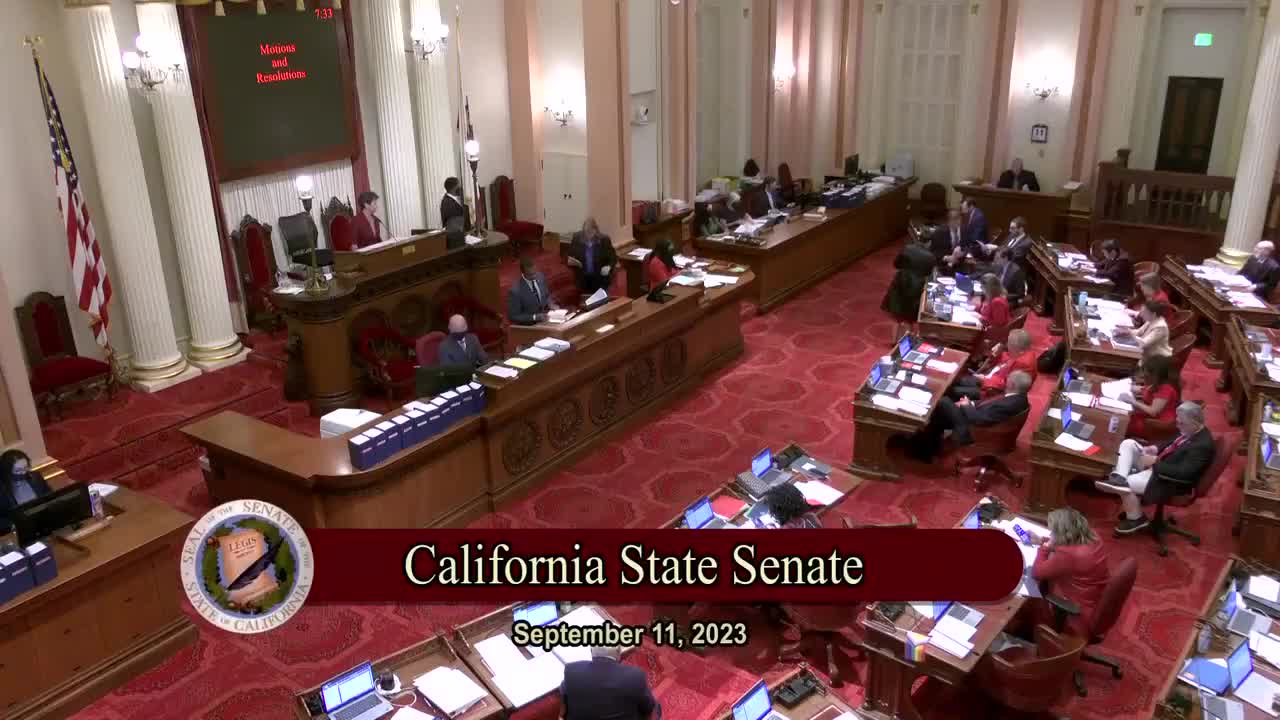 2MIN
Senate Floor
 8MIN
Senate Standing Committee on Natural Resources and Water
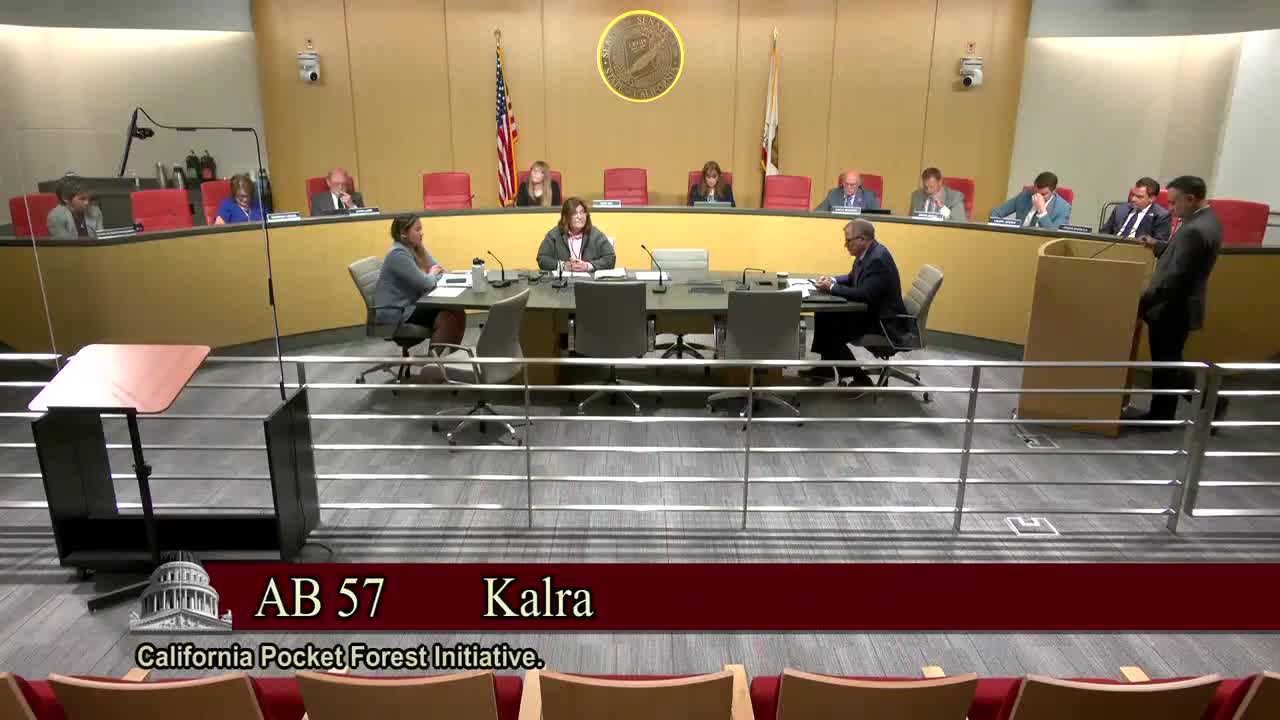 8MIN
Senate Standing Committee on Natural Resources and Water
 1MIN
Assembly Floor
 11MIN
Assembly Standing Committee on Natural Resources
Bill Author

Bill Co-Author(s):