AB 599: Suspensions and expulsions: tobacco.
- Session Year: 2023-2024
- House: Assembly
- Latest Version Date: 2023-03-28
Current Status:
Failed
(2023-09-01: In committee: Held under submission.)
Introduced
In Committee
First Chamber
In Committee
Second Chamber
Enacted
Existing law prohibits a pupil from being suspended from school or recommended for expulsion, unless the superintendent of the school district or the principal of the school in which the pupil is enrolled determines that the pupil has committed a specified act, including, among other acts, that the pupil (1) unlawfully possessed, used, sold, or otherwise furnished, or had been under the influence of, a controlled substance, an alcoholic beverage, or an intoxicant of any kind, or (2) possessed or used tobacco, or products containing tobacco or nicotine products, including, but not limited to, cigarettes, cigars, miniature cigars, clove cigarettes, smokeless tobacco, snuff, chew packets, vaping products, and betel.
This bill would, commencing July 1, 2025, remove unlawfully possessing, using, or being under the influence of a controlled substance, an alcoholic beverage, or an intoxicant of any kind from the list of acts for which a pupil, regardless of their grade of enrollment, may be suspended or recommended for expulsion for. The bill would, commencing July 1, 2025, prohibit a charter school pupil in kindergarten or any of grades 1 to 12, inclusive, from being suspended or recommended for expulsion solely on the basis of those acts.This bill would, commencing July 1, 2025, remove having possessed or used tobacco, or products containing tobacco or nicotine products, including, but not limited to, cigarettes, cigars, miniature cigars, clove cigarettes, smokeless tobacco, snuff, chew packets, vaping products, and betel from the list of acts for which a pupil, regardless of their grade of enrollment, may be suspended or recommended for expulsion for. The bill would, commencing July 1, 2025, prohibit a charter school pupil in kindergarten or any of grades 1 to 12, inclusive, from being suspended or recommended for expulsion solely on the basis of those acts.
Existing law requires the principal or superintendent of schools to recommend the expulsion of a pupil for certain acts committed at school or at a school activity off school grounds, including, among others, the unlawful possession of certain controlled substances, unless the principal or superintendent determines that expulsion should not be recommended under the circumstances or that an alternative means of correction would address the conduct.
This bill, commencing July 1, 2025, would instead no longer require the principal or superintendent of schools to recommend the expulsion of a pupil for the unlawful possession of certain controlled substances under any circumstance.
This bill would require the State Department of Education, on or before July 1, 2025, to develop and make available a model policy for a public health approach to addressing pupil possession and use of illicit drugs on school property, as specified. The bill would require the department to collaborate with stakeholders, including treatment providers, local educational agencies, and community-based organizations in the development of the model policy. The bill would require local educational agencies, as defined, to adopt, on or before July 1, 2025, a plan to address pupils who possess or use drugs on school property. The bill would require the plan to be youth informed youth-informed, reduce criminalization, and to include specific information on where on campus and in the community pupils can receive education, treatment, or support for substance use. abuse. By imposing additional duties on local educational agencies, the bill would impose a state-mandated local program.
This bill would also make Legislative findings and declarations relating to these provisions, make conforming changes, and delete obsolete provisions.
The California Constitution requires the state to reimburse local agencies and school districts for certain costs mandated by the state. Statutory provisions establish procedures for making that reimbursement.
This bill would provide that, if the Commission on State Mandates determines that the bill contains costs mandated by the state, reimbursement for those costs shall be made pursuant to the statutory provisions noted above.
Existing law prohibits a pupil from being suspended from school or recommended for expulsion, unless the superintendent of the school district or the principal of the school in which the pupil is enrolled determines that the pupil has committed a specified act, including, among other acts, that the pupil (1) unlawfully possessed, used, sold, or otherwise furnished, or had been under the influence of, a controlled substance, an alcoholic beverage, or an intoxicant of any kind, or (2) possessed or used tobacco, or products containing tobacco or nicotine products, including, but not limited to, cigarettes, cigars, miniature cigars, clove cigarettes, smokeless tobacco, snuff, chew packets, and betel.
This bill would, commencing July 1, 2025, remove unlawfully possessing, using, or being under the influence of a controlled substance, an alcoholic beverage, or an intoxicant of any kind from the list of acts for which a pupil, regardless of their grade of enrollment, may be suspended or recommended for expulsion for. The bill would, commencing July 1, 2025, prohibit a charter school pupil in kindergarten or any of grades 1 to 12, inclusive, from being suspended or recommended for expulsion solely on the basis of those acts.
This bill would, commencing July 1, 2025, remove having possessed or used tobacco, or products containing tobacco or nicotine products, including, but not limited to, cigarettes, cigars, miniature cigars, clove cigarettes, smokeless tobacco, snuff, chew packets, and betel from the list of acts for which a pupil, regardless of their grade of enrollment, may be suspended or recommended for expulsion for. The bill would, commencing July 1, 2025, prohibit a charter school pupil in kindergarten or any of grades 1 to 12, inclusive, from being suspended or recommended for expulsion solely on the basis of those acts.
This bill would require the State Department of Education, on or before July 1, 2025, to develop and make available a model policy for a public health approach to addressing pupil possession and use of illicit drugs on school property, as specified. The bill would require the department to collaborate with stakeholders, including treatment providers, local educational agencies, and community-based organizations in the development of the model policy. The bill would require local educational agencies, as defined, to adopt, on or before July 1, 2025, a plan to address pupils who possess or use drugs on school property. The bill would require the plan to be youth informed and to include specific information on where on campus and in the community pupils can receive education, treatment, or support for substance use. By imposing additional duties on local educational agencies, the bill would impose a state-mandated local program.
This bill would also make Legislative findings and declarations relating to these provisions, make conforming changes, and delete obsolete provisions.
The California Constitution requires the state to reimburse local agencies and school districts for certain costs mandated by the state. Statutory provisions establish procedures for making that reimbursement.
This bill would provide that, if the Commission on State Mandates determines that the bill contains costs mandated by the state, reimbursement for those costs shall be made pursuant to the statutory provisions noted above.
(a)The Legislature finds and declares all of the following:
(1)According to a 20172019 survey of California public school pupils, 7 percent of 7th graders, 15 percent of 9th graders, 23 percent of 11th graders, and 29 percent of pupils in nontraditional programs used alcohol or drugs in the previous 30 days.
(2)Youth alcohol, tobacco, and other drug use is a significant public health concern linked to a wide range of academic, social, and health problems.
(3)Fentanyl was responsible for one in five deaths among Californians 15 to 24 years of age, inclusive, in 2021.
(4)Adolescent substance use is highly predictive of adult substance use disorders because the adolescent brain is still developing making it more susceptible to addiction.
(5)Research notes that high feelings of school connectedness can decrease drug use, and data indicates that pupils who reported low levels of school connectedness were more likely to use drugs or alcohol.
(6)Over 60 percent of drug-related suspensions are of boys, over 75 percent are of socioeconomically disadvantaged pupils, and 59 percent are of youth of color.
(b)Therefore, it is the intent of the Legislature to do all of the following:
(1)Provide teachers and school administrators with the means to foster safe and supportive learning environments for all children in California.
(2)Reduce the number of suspensions and expulsions experienced by pupils due to illicit drug use and possession in schools.
(3)Require local educational agencies to take a public health approach when dealing with pupils who use or possess drugs on campus.
(4)Ensure that pupils who transfer between multiple classrooms, taught by multiple teachers, be allowed to attend all remaining classes from which they have not been removed for disciplinary reasons.
SEC. 2.Section 48900 of the Education Code is amended to read:48900.A pupil shall not be suspended from school or recommended for expulsion, unless the superintendent of the school district or the principal of the school in which the pupil is enrolled determines that the pupil has committed an act as defined pursuant to any of subdivisions (a) to (r), inclusive:
(a)(1)Caused, attempted to cause, or threatened to cause physical injury to another person.
(2)Willfully used force or violence upon the person of another, except in self-defense.
(b)Possessed, sold, or otherwise furnished a firearm, knife, explosive, or other dangerous object, unless, in the case of possession of an object of this type, the pupil had obtained written permission to possess the item from a certificated school employee, which is concurred in by the principal or the designee of the principal.
(c)Unlawfully possessed, used, sold, or otherwise furnished, or been under the influence of, a controlled substance listed in Chapter 2 (commencing with Section 11053) of Division 10 of the Health and Safety Code, an alcoholic beverage, or an intoxicant of any kind.
(d)Unlawfully offered, arranged, or negotiated to sell a controlled substance listed in Chapter 2 (commencing with Section 11053) of Division 10 of the Health and Safety Code, an alcoholic beverage, or an intoxicant of any kind, and either sold, delivered, or otherwise furnished to a person another liquid, substance, or material and represented the liquid, substance, or material as a controlled substance, alcoholic beverage, or intoxicant.
(e)Committed or attempted to commit robbery or extortion.
(f)Caused or attempted to cause damage to school property or private property.
(g)Stole or attempted to steal school property or private property.
(h)Possessed or used tobacco, or products containing tobacco or nicotine products, including, but not limited to, cigarettes, cigars, miniature cigars, clove cigarettes, smokeless tobacco, snuff, chew packets, and betel. However, this section does not prohibit the use or possession by a pupil of the pupils own prescription products.
(i)Committed an obscene act or engaged in habitual profanity or vulgarity.
(j)Unlawfully possessed or unlawfully offered, arranged, or negotiated to sell drug paraphernalia, as defined in Section 11014.5 of the Health and Safety Code.
(k)(1)Disrupted school activities or otherwise willfully defied the valid authority of supervisors, teachers, administrators, school officials, or other school personnel engaged in the performance of their duties.
(2)Except as provided in Section 48910, a pupil enrolled in kindergarten or any of grades 1 to 3, inclusive, shall not be suspended for any of the acts enumerated in paragraph (1), and those acts shall not constitute grounds for a pupil enrolled in kindergarten or any of grades 1 to 12, inclusive, to be recommended for expulsion. This paragraph is inoperative on July 1, 2020.
(3)Except as provided in Section 48910, commencing July 1, 2020, a pupil enrolled in kindergarten or any of grades 1 to 5, inclusive, shall not be suspended for any of the acts specified in paragraph (1), and those acts shall not constitute grounds for a pupil enrolled in kindergarten or any of grades 1 to 12, inclusive, to be recommended for expulsion.
(4)Except as provided in Section 48910, commencing July 1, 2020, a pupil enrolled in any of grades 6 to 8, inclusive, shall not be suspended for any of the acts specified in paragraph (1). This paragraph is inoperative on July 1, 2025.
(l)Knowingly received stolen school property or private property.
(m)Possessed an imitation firearm. As used in this section, imitation firearm means a replica of a firearm that is so substantially similar in physical properties to an existing firearm as to lead a reasonable person to conclude that the replica is a firearm.
(n)Committed or attempted to commit a sexual assault as defined in Section 261, 266c, 286, 287, 288, or 289 of, or former Section 288a of, the Penal Code or committed a sexual battery as defined in Section 243.4 of the Penal Code.
(o)Harassed, threatened, or intimidated a pupil who is a complaining witness or a witness in a school disciplinary proceeding for purposes of either preventing that pupil from being a witness or retaliating against that pupil for being a witness, or both.
(p)Unlawfully offered, arranged to sell, negotiated to sell, or sold the prescription drug Soma.
(q)Engaged in, or attempted to engage in, hazing. For purposes of this subdivision, hazing means a method of initiation or preinitiation into a pupil organization or body, whether or not the organization or body is officially recognized by an educational institution, that is likely to cause serious bodily injury or personal degradation or disgrace resulting in physical or mental harm to a former, current, or prospective pupil. For purposes of this subdivision, hazing does not include athletic events or school-sanctioned events.
(r)Engaged in an act of bullying. For purposes of this subdivision, the following terms have the following meanings:
(1)Bullying means any severe or pervasive physical or verbal act or conduct, including communications made in writing or by means of an electronic act, and including one or more acts committed by a pupil or group of pupils as defined in Section 48900.2, 48900.3, or 48900.4, directed toward one or more pupils that has or can be reasonably predicted to have the effect of one or more of the following:
(A)Placing a reasonable pupil or pupils in fear of harm to that pupils or those pupils person or property.
(B)Causing a reasonable pupil to experience a substantially detrimental effect on the pupils physical or mental health.
(C)Causing a reasonable pupil to experience substantial interference with the pupils academic performance.
(D)Causing a reasonable pupil to experience substantial interference with the pupils ability to participate in or benefit from the services, activities, or privileges provided by a school.
(2)(A)Electronic act means the creation or transmission originated on or off the schoolsite, by means of an electronic device, including, but not limited to, a telephone, wireless telephone, or other wireless communication device, computer, or pager, of a communication, including, but not limited to, any of the following:
(i)A message, text, sound, video, or image.
(ii)A post on a social network internet website, including, but not limited to:
(I)Posting to or creating a burn page. Burn page means an internet website created for the purpose of having one or more of the effects listed in paragraph (1).
(II)Creating a credible impersonation of another actual pupil for the purpose of having one or more of the effects listed in paragraph (1). Credible impersonation means to knowingly and without consent impersonate a pupil for the purpose of bullying the pupil and such that another pupil would reasonably believe, or has reasonably believed, that the pupil was or is the pupil who was impersonated.
(III)Creating a false profile for the purpose of having one or more of the effects listed in paragraph (1). False profile means a profile of a fictitious pupil or a profile using the likeness or attributes of an actual pupil other than the pupil who created the false profile.
(iii)(I)An act of cyber sexual bullying.
(II)For purposes of this clause, cyber sexual bullying means the dissemination of, or the solicitation or incitement to disseminate, a photograph or other visual recording by a pupil to another pupil or to school personnel by means of an electronic act that has or can be reasonably predicted to have one or more of the effects described in subparagraphs (A) to (D), inclusive, of paragraph (1). A photograph or other visual recording, as described in this subclause, shall include the depiction of a nude, semi-nude, or sexually explicit photograph or other visual recording of a minor where the minor is identifiable from the photograph, visual recording, or other electronic act.
(III)For purposes of this clause, cyber sexual bullying does not include a depiction, portrayal, or image that has any serious literary, artistic, educational, political, or scientific value or that involves athletic events or school-sanctioned activities.
(B)Notwithstanding paragraph (1) and subparagraph (A), an electronic act shall not constitute pervasive conduct solely on the basis that it has been transmitted on the internet or is currently posted on the internet.
(3)Reasonable pupil means a pupil, including, but not limited to, a pupil with exceptional needs, who exercises average care, skill, and judgment in conduct for a person of that age, or for a person of that age with the pupils exceptional needs.
(s)A pupil shall not be suspended or expelled for any of the acts enumerated in this section unless the act is related to a school activity or school attendance occurring within a school under the jurisdiction of the superintendent of the school district or principal or occurring within any other school district. A pupil may be suspended or expelled for acts that are enumerated in this section and related to a school activity or school attendance that occur at any time, including, but not limited to, any of the following:
(1)While on school grounds.
(2)While going to or coming from school.
(3)During the lunch period whether on or off the campus.
(4)During, or while going to or coming from, a school-sponsored activity.
(t)A pupil who aids or abets, as defined in Section 31 of the Penal Code, the infliction or attempted infliction of physical injury to another person may be subject to suspension, but not expulsion, pursuant to this section, except that a pupil who has been adjudged by a juvenile court to have committed, as an aider and abettor, a crime of physical violence in which the victim suffered great bodily injury or serious bodily injury shall be subject to discipline pursuant to subdivision (a).
(u)As used in this section, school property includes, but is not limited to, electronic files and databases.
(v)For a pupil subject to discipline under this section, a superintendent of the school district or principal is encouraged to provide alternatives to suspension or expulsion, using a research-based framework with strategies that improve behavioral and academic outcomes, that are age appropriate and designed to address and correct the pupils specific misbehavior as specified in Section 48900.5.
(w)(1)It is the intent of the Legislature that alternatives to suspension or expulsion be imposed against a pupil who is truant, tardy, or otherwise absent from school activities.
(2)It is further the intent of the Legislature that the Multi-Tiered System of Supports, which includes restorative justice practices, trauma-informed practices, social and emotional learning, and schoolwide positive behavior interventions and support, may be used to help pupils gain critical social and emotional skills, receive support to help transform trauma-related responses, understand the impact of their actions, and develop meaningful methods for repairing harm to the school community.
(x)This section shall become inoperative on July 1, 2025, and, as of January 1, 2026, is repealed.
SEC. 3.Section 48900 is added to the Education Code, to read:48900.A pupil shall not be suspended from school or recommended for expulsion, unless the superintendent of the school district or the principal of the school in which the pupil is enrolled determines that the pupil has committed an act as defined pursuant to any of subdivisions (a) to (r), inclusive:
(a)(1)Caused, attempted to cause, or threatened to cause physical injury to another person.
(2)Willfully used force or violence upon the person of another, except in self-defense.
(b)Possessed, sold, or otherwise furnished a firearm, knife, explosive, or other dangerous object, unless, in the case of possession of an object of this type, the pupil had obtained written permission to possess the item from a certificated school employee, which is concurred in by the principal or the designee of the principal.
(c)Unlawfully sold or otherwise furnished possessed, used, sold, or otherwise furnished, or been under the influence of a controlled substance listed in Chapter 2 (commencing with Section 11053) of Division 10 of the Health and Safety Code, an alcoholic beverage, or an intoxicant of any kind. This section does not prohibit the use or possession by a pupil of the pupils own prescription products.
(d)Unlawfully offered, arranged, or negotiated to sell a controlled substance listed in Chapter 2 (commencing with Section 11053) of Division 10 of the Health and Safety Code, an alcoholic beverage, or an intoxicant of any kind, and either sold, delivered, or otherwise furnished to a person another liquid, substance, or material and represented the liquid, substance, or material as a controlled substance, alcoholic beverage, or intoxicant.
(e)Committed or attempted to commit robbery or extortion.
(f)Caused or attempted to cause damage to school property or private property.
(g)Stole or attempted to steal school property or private property.
(h)[Reserved]
(i)Committed an obscene act or engaged in habitual profanity or vulgarity.
(j)Unlawfully possessed or unlawfully offered, arranged, or negotiated to sell drug paraphernalia, as defined in Section 11014.5 of the Health and Safety Code.
(k)(1)Disrupted school activities or otherwise willfully defied the valid authority of supervisors, teachers, administrators, school officials, or other school personnel engaged in the performance of their duties.
(2)Except as provided in Section 48910, a pupil enrolled in kindergarten or any of grades 1 to 3, inclusive, shall not be suspended for any of the acts enumerated in paragraph (1), and those acts shall not constitute grounds for a pupil enrolled in kindergarten or any of grades 1 to 12, inclusive, to be recommended for expulsion. This paragraph is inoperative on July 1, 2020.
(3)Except as provided in Section 48910, commencing July 1, 2020, a pupil enrolled in kindergarten or any of grades 1 to 5, inclusive, shall not be suspended for any of the acts specified in paragraph (1), and those acts shall not constitute grounds for a pupil enrolled in kindergarten or any of grades 1 to 12, inclusive, to be recommended for expulsion.
(4)Except as provided in Section 48910, commencing July 1, 2020, a pupil enrolled in any of grades 6 to 8, inclusive, shall not be suspended for any of the acts specified in paragraph (1). This paragraph is inoperative on July 1, 2025.
(l)Knowingly received stolen school property or private property.
(m)Possessed an imitation firearm. As used in this section, imitation firearm means a replica of a firearm that is so substantially similar in physical properties to an existing firearm as to lead a reasonable person to conclude that the replica is a firearm.
(n)Committed or attempted to commit a sexual assault as defined in Section 261, 266c, 286, 287, 288, or 289 of, or former Section 288a of, the Penal Code or committed a sexual battery as defined in Section 243.4 of the Penal Code.
(o)Harassed, threatened, or intimidated a pupil who is a complaining witness or a witness in a school disciplinary proceeding for purposes of either preventing that pupil from being a witness or retaliating against that pupil for being a witness, or both.
(p)Unlawfully offered, arranged to sell, negotiated to sell, or sold the prescription drug Soma.
(q)Engaged in, or attempted to engage in, hazing. For purposes of this subdivision, hazing means a method of initiation or preinitiation into a pupil organization or body, whether or not the organization or body is officially recognized by an educational institution, that is likely to cause serious bodily injury or personal degradation or disgrace resulting in physical or mental harm to a former, current, or prospective pupil. For purposes of this subdivision, hazing does not include athletic events or school-sanctioned events.
(r)Engaged in an act of bullying. For purposes of this subdivision, the following terms have the following meanings:
(1)Bullying means any severe or pervasive physical or verbal act or conduct, including communications made in writing or by means of an electronic act, and including one or more acts committed by a pupil or group of pupils as defined in Section 48900.2, 48900.3, or 48900.4, directed toward one or more pupils that has or can be reasonably predicted to have the effect of one or more of the following:
(A)Placing a reasonable pupil or pupils in fear of harm to that pupils or those pupils person or property.
(B)Causing a reasonable pupil to experience a substantially detrimental effect on the pupils physical or mental health.
(C)Causing a reasonable pupil to experience substantial interference with the pupils academic performance.
(D)Causing a reasonable pupil to experience substantial interference with the pupils ability to participate in or benefit from the services, activities, or privileges provided by a school.
(2)(A)Electronic act means the creation or transmission originated on or off the schoolsite, by means of an electronic device, including, but not limited to, a telephone, wireless telephone, or other wireless communication device, computer, or pager, of a communication, including, but not limited to, any of the following:
(i)A message, text, sound, video, or image.
(ii)A post on a social network internet website, including, but not limited to:
(I)Posting to or creating a burn page. Burn page means an internet website created for the purpose of having one or more of the effects listed in paragraph (1).
(II)Creating a credible impersonation of another actual pupil for the purpose of having one or more of the effects listed in paragraph (1). Credible impersonation means to knowingly and without consent impersonate a pupil for the purpose of bullying the pupil and such that another pupil would reasonably believe, or has reasonably believed, that the pupil was or is the pupil who was impersonated.
(III)Creating a false profile for the purpose of having one or more of the effects listed in paragraph (1). False profile means a profile of a fictitious pupil or a profile using the likeness or attributes of an actual pupil other than the pupil who created the false profile.
(iii)(I)An act of cyber sexual bullying.
(II)For purposes of this clause, cyber sexual bullying means the dissemination of, or the solicitation or incitement to disseminate, a photograph or other visual recording by a pupil to another pupil or to school personnel by means of an electronic act that has or can be reasonably predicted to have one or more of the effects described in subparagraphs (A) to (D), inclusive, of paragraph (1). A photograph or other visual recording, as described in this subclause, shall include the depiction of a nude, semi-nude, or sexually explicit photograph or other visual recording of a minor where the minor is identifiable from the photograph, visual recording, or other electronic act.
(III)For purposes of this clause, cyber sexual bullying does not include a depiction, portrayal, or image that has any serious literary, artistic, educational, political, or scientific value or that involves athletic events or school-sanctioned activities.
(B)Notwithstanding paragraph (1) and subparagraph (A), an electronic act shall not constitute pervasive conduct solely on the basis that it has been transmitted on the internet or is currently posted on the internet.
(3)Reasonable pupil means a pupil, including, but not limited to, a pupil with exceptional needs, who exercises average care, skill, and judgment in conduct for a person of that age, or for a person of that age with the pupils exceptional needs.
(s)A pupil shall not be suspended or expelled for any of the acts enumerated in this section unless the act is related to a school activity or school attendance occurring within a school under the jurisdiction of the superintendent of the school district or principal or occurring within any other school district. A pupil may be suspended or expelled for acts that are enumerated in this section and related to a school activity or school attendance that occur at any time, including, but not limited to, any of the following:
(1)While on school grounds.
(2)While going to or coming from school.
(3)During the lunch period whether on or off the campus.
(4)During, or while going to or coming from, a school-sponsored activity.
(t)A pupil who aids or abets, as defined in Section 31 of the Penal Code, the infliction or attempted infliction of physical injury to another person may be subject to suspension, but not expulsion, pursuant to this section, except that a pupil who has been adjudged by a juvenile court to have committed, as an aider and abettor, a crime of physical violence in which the victim suffered great bodily injury or serious bodily injury shall be subject to discipline pursuant to subdivision (a).
(u)As used in this section, school property includes, but is not limited to, electronic files and databases.
(v)For a pupil subject to discipline under this section, a superintendent of the school district or principal is encouraged to provide alternatives to suspension or expulsion, using a research-based framework with strategies that improve behavioral and academic outcomes, that are age appropriate and designed to address and correct the pupils specific misbehavior as specified in Section 48900.5.
(w)(1)It is the intent of the Legislature that alternatives to suspension or expulsion be imposed against a pupil who is truant, tardy, or otherwise absent from school activities.
(2)It is further the intent of the Legislature that the Multi-Tiered System of Supports, which includes restorative justice practices, trauma-informed practices, social and emotional learning, and schoolwide positive behavior interventions and support, may be used to help pupils gain critical social and emotional skills, receive support to help transform trauma-related responses, understand the impact of their actions, and develop meaningful methods for repairing harm to the school community.
(x)This section shall become operative on July 1, 2025.
SEC. 4.Section 48901.1 of the Education Code is amended to read:48901.1.Notwithstanding Section 47610 or any other law, commencing July 1, 2020, the following provisions apply to charter schools:
(a)A pupil enrolled in a charter school in kindergarten or any of grades 1 to 5, inclusive, shall not be suspended on the basis of having disrupted school activities or otherwise willfully defied the valid authority of supervisors, teachers, administrators, school officials, or other school personnel engaged in the performance of their duties, and those acts shall not constitute grounds for a pupil enrolled in a charter school in kindergarten or any of grades 1 to 12, inclusive, to be recommended for expulsion.
(b)A pupil enrolled in a charter school in any of grades 6 to 8, inclusive, shall not be suspended on the basis of having disrupted school activities or otherwise willfully defied the valid authority of supervisors, teachers, administrators, school officials, or other school personnel engaged in the performance of their duties. This subdivision is inoperative on July 1, 2025.
(c)This section shall become inoperative on July 1, 2025, and, as of January 1, 2026, is repealed.
SEC. 5.Section 48901.1 is added to the Education Code, to read:48901.1.Notwithstanding Section 47610 or any other law, the following provisions apply to charter schools:
(a)A pupil enrolled in a charter school in kindergarten or any of grades 1 to 5, inclusive, shall not be suspended on the basis of having disrupted school activities or otherwise willfully defied the valid authority of supervisors, teachers, administrators, school officials, or other school personnel engaged in the performance of their duties, and those acts shall not constitute grounds for a pupil enrolled in a charter school in kindergarten or any of grades 1 to 12, inclusive, to be recommended for expulsion.
(b)A pupil enrolled in a charter school in any of grades 6 to 8, inclusive, shall not be suspended on the basis of having disrupted school activities or otherwise willfully defied the valid authority of supervisors, teachers, administrators, school officials, or other school personnel engaged in the performance of their duties. This subdivision is inoperative on July 1, 2025.
(c)A pupil enrolled in a charter school in kindergarten or any of grades 1 to 12, inclusive, shall not be suspended or recommended for expulsion solely on the basis of either of the following:
(1)Having of having possessed or used tobacco, or products containing tobacco or nicotine products, including, but not limited to, cigarettes, cigars, miniature cigars, clove cigarettes, smokeless tobacco, snuff, chew packets, vaping products, and betel.
(2)Having unlawfully possessed, used, or been under the influence of, a controlled substance listed in Chapter 2 (commencing with Section 11053) of Division 10 of the Health and Safety Code, an alcoholic beverage, or an intoxicant of any kind.(d)This section shall become operative on July 1, 2025.
SEC. 6.Section 48901.2 is added to the Education Code, to read:48901.2.(a)On or before July 1, 2025, the department shall develop and make available a model policy, consistent with the requirements of subdivision (b), for a public health approach to addressing pupil possession and use of illicit drugs on school property. The department shall collaborate with stakeholders, including treatment providers, local educational agencies, and community-based organizations in the development of the model policy.
(b)(1)On or before July 1, 2025, local educational agencies shall adopt a plan to address pupils who possess or use drugs on school property. The plan shall, consistent with paragraph (2), be youth-informed youth-informed, reduce criminalization, and include specific information on where on campus and in the community pupils can receive education, treatment, or support for substance use. abuse.
(2)Local educational agencies shall make a good faith effort to adopt a plan that is youth informed.
(c)For purposes of this section, local educational agencies include school districts, county offices of education, and charter schools.
SEC. 7.Section 48915 of the Education Code is amended to read:48915.(a)(1)Except as provided in subdivisions (c) and (e), the principal or the superintendent of schools shall recommend the expulsion of a pupil for any of the following acts committed at school or at a school activity off school grounds, unless the principal or superintendent determines that expulsion should not be recommended under the circumstances or that an alternative means of correction would address the conduct:
(A)Causing serious physical injury to another person, except in self-defense.
(B)Possession of any knife or other dangerous object of no reasonable use to the pupil.
(C)Unlawful possession of any controlled substance listed in Chapter 2 (commencing with Section 11053) of Division 10 of the Health and Safety Code, except for either of the following:
(i)The first offense for the possession of not more than one avoirdupois ounce of marijuana, other than concentrated cannabis.
(ii)The possession of over-the-counter medication for use by the pupil for medical purposes or medication prescribed for the pupil by a physician.
(D)Robbery or extortion.
(E)Assault or battery, as defined in Sections 240 and 242 of the Penal Code, upon any school employee.
(2)If the principal or the superintendent of schools makes a determination as described in paragraph (1), the principal or superintendent is encouraged to do so as quickly as possible to ensure that the pupil does not lose instructional time.
(b)Upon recommendation by the principal or the superintendent of schools, or by a hearing officer or administrative panel appointed pursuant to subdivision (d) of Section 48918, the governing board of a school district may order a pupil expelled upon finding that the pupil committed an act listed in paragraph (1) of subdivision (a) or in subdivision (a), (b), (c), (d), or (e) of Section 48900. A decision to expel a pupil for any of those acts shall be based on a finding of one or both of the following:
(1)Other means of correction are not feasible or have repeatedly failed to bring about proper conduct.
(2)Due to the nature of the act, the presence of the pupil causes a continuing danger to the physical safety of the pupil or others.
(c)The principal or superintendent of schools shall immediately suspend, pursuant to Section 48911, and shall recommend expulsion of a pupil that the principal or superintendent determines has committed any of the following acts at school or at a school activity off school grounds:
(1)Possessing, selling, or otherwise furnishing a firearm. This subdivision does not apply to an act of possessing a firearm if the pupil had obtained prior written permission to possess the firearm from a certificated school employee, which is concurred in by the principal or the designee of the principal. This subdivision applies to an act of possessing a firearm only if the possession is verified by an employee of a school district. The act of possessing an imitation firearm, as defined in subdivision (m) of Section 48900, is not an offense for which suspension or expulsion is mandatory pursuant to this subdivision and subdivision (d), but it is an offense for which suspension, or expulsion pursuant to subdivision (e), may be imposed.
(2)Brandishing a knife at another person.
(3)Unlawfully selling a controlled substance listed in Chapter 2 (commencing with Section 11053) of Division 10 of the Health and Safety Code.
(4)Committing or attempting to commit a sexual assault as defined in subdivision (n) of Section 48900 or committing a sexual battery as defined in subdivision (n) of Section 48900.
(5)Possession of an explosive.
(d)The governing board of a school district shall order a pupil expelled upon finding that the pupil committed an act listed in subdivision (c), and shall refer that pupil to a program of study that meets all of the following conditions:
(1)Is appropriately prepared to accommodate pupils who exhibit discipline problems.
(2)Is not provided at a comprehensive middle, junior, or senior high school, or at any elementary school.
(3)Is not housed at the schoolsite attended by the pupil at the time of suspension.
(e)Upon recommendation by the principal or the superintendent of schools, or by a hearing officer or administrative panel appointed pursuant to subdivision (d) of Section 48918, the governing board of a school district may order a pupil expelled upon finding that the pupil, at school or at a school activity off of school grounds violated subdivision (f), (g), (h), (i), (j), (k), (l), or (m) of Section 48900, or Section 48900.2, 48900.3, or 48900.4, and either of the following:
(1)That other means of correction are not feasible or have repeatedly failed to bring about proper conduct.
(2)That due to the nature of the violation, the presence of the pupil causes a continuing danger to the physical safety of the pupil or others.
(f)The governing board of a school district shall refer a pupil who has been expelled pursuant to subdivision (b) or (e) to a program of study that meets all of the conditions specified in subdivision (d). Notwithstanding this subdivision, with respect to a pupil expelled pursuant to subdivision (e), if the county superintendent of schools certifies that an alternative program of study is not available at a site away from a comprehensive middle, junior, or senior high school, or an elementary school, and that the only option for placement is at another comprehensive middle, junior, or senior high school, or another elementary school, the pupil may be referred to a program of study that is provided at a comprehensive middle, junior, or senior high school, or at an elementary school.
(g)As used in this section, knife means any dirk, dagger, or other weapon with a fixed, sharpened blade fitted primarily for stabbing, a weapon with a blade fitted primarily for stabbing, a weapon with a blade longer than 31/2 three and one-half inches, a folding knife with a blade that locks into place, or a razor with an unguarded blade.
(h)As used in this section, the term explosive means destructive device as described in Section 921 of Title 18 of the United States Code.
(i)This section shall become inoperative on July 1, 2025, and, as of January 1, 2026, is repealed.
SEC. 8.Section 48915 is added to the Education Code, to read:48915.(a)(1)Except as provided in subdivisions (c) and (e), the principal or the superintendent of schools shall recommend the expulsion of a pupil for any of the following acts committed at school or at a school activity off school grounds, unless the principal or superintendent determines that expulsion should not be recommended under the circumstances or that an alternative means of correction would address the conduct:
(A)Causing serious physical injury to another person, except in self-defense.
(B)Possession of any knife or other dangerous object of no reasonable use to the pupil.
(C)Robbery or extortion.
(D)Assault or battery, as defined in Sections 240 and 242 of the Penal Code, upon any school employee.
(2)If the principal or the superintendent of schools makes a determination as described in paragraph (1), the principal or superintendent is encouraged to do so as quickly as possible to ensure that the pupil does not lose instructional time.
(b)Upon recommendation by the principal or the superintendent of schools, or by a hearing officer or administrative panel appointed pursuant to subdivision (d) of Section 48918, the governing board of a school district may order a pupil expelled upon finding that the pupil committed an act listed in paragraph (1) of subdivision (a) or in subdivision (a), (b), (c), (d), or (e) of Section 48900. A decision to expel a pupil for any of those acts shall be based on a finding of one or both of the following:
(1)Other means of correction are not feasible or have repeatedly failed to bring about proper conduct.
(2)Due to the nature of the act, the presence of the pupil causes a continuing danger to the physical safety of the pupil or others.
(c)The principal or superintendent of schools shall immediately suspend, pursuant to Section 48911, and shall recommend expulsion of a pupil that the principal or superintendent determines has committed any of the following acts at school or at a school activity off school grounds:
(1)Possessing, selling, or otherwise furnishing a firearm. This subdivision does not apply to an act of possessing a firearm if the pupil had obtained prior written permission to possess the firearm from a certificated school employee, which is concurred in by the principal or the designee of the principal. This subdivision applies to an act of possessing a firearm only if the possession is verified by an employee of a school district. The act of possessing an imitation firearm, as defined in subdivision (m) of Section 48900, is not an offense for which suspension or expulsion is mandatory pursuant to this subdivision and subdivision (d), but it is an offense for which suspension, or expulsion pursuant to subdivision (e), may be imposed.
(2)Brandishing a knife at another person.
(3)Unlawfully selling a controlled substance listed in Chapter 2 (commencing with Section 11053) of Division 10 of the Health and Safety Code.
(4)Committing or attempting to commit a sexual assault as defined in subdivision (n) of Section 48900 or committing a sexual battery as defined in subdivision (n) of Section 48900.
(5)Possession of an explosive.
(d)The governing board of a school district shall order a pupil expelled upon finding that the pupil committed an act listed in subdivision (c), and shall refer that pupil to a program of study that meets all of the following conditions:
(1)Is appropriately prepared to accommodate pupils who exhibit discipline problems.
(2)Is not provided at a comprehensive middle, junior, or senior high school, or at any elementary school.
(3)Is not housed at the schoolsite attended by the pupil at the time of suspension.
(e)Upon recommendation by the principal or the superintendent of schools, or by a hearing officer or administrative panel appointed pursuant to subdivision (d) of Section 48918, the governing board of a school district may order a pupil expelled upon finding that the pupil, at school or at a school activity off of school grounds violated subdivision (f), (g), (i), (j), (k), (l), or (m) of Section 48900, or Section 48900.2, 48900.3, or 48900.4, and either of the following:
(1)That other means of correction are not feasible or have repeatedly failed to bring about proper conduct.
(2)That due to the nature of the violation, the presence of the pupil causes a continuing danger to the physical safety of the pupil or others.
(f)The governing board of a school district shall refer a pupil who has been expelled pursuant to subdivision (b) or (e) to a program of study that meets all of the conditions specified in subdivision (d). Notwithstanding this subdivision, with respect to a pupil expelled pursuant to subdivision (e), if the county superintendent of schools certifies that an alternative program of study is not available at a site away from a comprehensive middle, junior, or senior high school, or an elementary school, and that the only option for placement is at another comprehensive middle, junior, or senior high school, or another elementary school, the pupil may be referred to a program of study that is provided at a comprehensive middle, junior, or senior high school, or at an elementary school.
(g)As used in this section, knife means any dirk, dagger, or other weapon with a fixed, sharpened blade fitted primarily for stabbing, a weapon with a blade fitted primarily for stabbing, a weapon with a blade longer than 31/2 three and one-half inches, a folding knife with a blade that locks into place, or a razor with an unguarded blade.
(h)As used in this section, the term explosive means destructive device as described in Section 921 of Title 18 of the United States Code.
(i)This section shall become operative on July 1, 2025.
SEC. 9.Section 49079 of the Education Code is amended to read:49079.(a)A school district shall inform the teacher of each pupil who has engaged in, or is reasonably suspected to have engaged in, any of the acts described in any of the subdivisions, except subdivision (h), of Section 48900 or in Section 48900.2, 48900.3, 48900.4, or 48900.7 that the pupil engaged in, or is reasonably suspected to have engaged in, those acts. The district shall provide the information to the teacher based upon any records that the district maintains in its ordinary course of business, or receives from a law enforcement agency, regarding a pupil described in this section.
(b)A school district, or school district officer or employee, is not civilly or criminally liable for providing information under this section unless it is proven that the information was false and that the district or district officer or employee knew or should have known that the information was false, or the information was provided with a reckless disregard for its truth or falsity.
(c)An officer or employee of a school district who knowingly fails to provide information about a pupil who has engaged in, or who is reasonably suspected to have engaged in, the acts referred to in subdivision (a) is guilty of a misdemeanor, which is punishable by confinement in the county jail for a period not to exceed six months, or by a fine not to exceed one thousand dollars ($1,000), or both.
(d)The information provided shall be from the previous three school years.
(e)Any information received by a teacher pursuant to this section shall be received in confidence for the limited purpose for which it was provided and shall not be further disseminated by the teacher.
(f)This section shall become inoperative on July 1, 2025, and, as of January 1, 2026, is repealed.
SEC. 10.Section 49079 is added to the Education Code, to read:49079.(a)A school district shall inform the teacher of each pupil who has engaged in, or is reasonably suspected to have engaged in, any of the acts described in Section 48900, 48900.2, 48900.3, 48900.4, or 48900.7 that the pupil engaged in, or is reasonably suspected to have engaged in, those acts. The district shall provide the information to the teacher based upon any records that the district maintains in its ordinary course of business, or receives from a law enforcement agency, regarding a pupil described in this section.
(b)A school district, or school district officer or employee, is not civilly or criminally liable for providing information under this section unless it is proven that the information was false and that the district or district officer or employee knew or should have known that the information was false, or the information was provided with a reckless disregard for its truth or falsity.
(c)An officer or employee of a school district who knowingly fails to provide information about a pupil who has engaged in, or who is reasonably suspected to have engaged in, the acts referred to in subdivision (a) is guilty of a misdemeanor, which is punishable by confinement in the county jail for a period not to exceed six months, or by a fine not to exceed one thousand dollars ($1,000), or both.
(d)The information provided shall be from the previous three school years.
(e)Any information received by a teacher pursuant to this section shall be received in confidence for the limited purpose for which it was provided and shall not be further disseminated by the teacher.
(f)This section shall become operative on July 1, 2025.
SEC. 11.If the Commission on State Mandates determines that this act contains costs mandated by the state, reimbursement to local agencies and school districts for those costs shall be made pursuant to Part 7 (commencing with Section 17500) of Division 4 of Title 2 of the Government Code.
(a)The Legislature finds and declares all of the following:
(1)According to a 20172019 survey of California public school pupils, 7 percent of 7th graders, 15 percent of 9th graders, 23 percent of 11th graders, and 29 percent of pupils in nontraditional programs used alcohol or drugs in the previous 30 days.
(2)Youth alcohol, tobacco, and other drug use is a significant public health concern linked to a wide range of academic, social, and health problems.
(3)Fentanyl was responsible for one in five deaths among Californians 15 to 24 years of age, inclusive, in 2021.
(4)Adolescent substance use is highly predictive of adult substance use disorders because the adolescent brain is still developing making it more susceptible to addiction.
(5)Research notes that high feelings of school connectedness can decrease drug use, and data indicates that pupils who reported low levels of school connectedness were more likely to use drugs or alcohol.
(6)Over 60 percent of drug-related suspensions are of boys, over 75 percent are of socioeconomically disadvantaged pupils, and 59 percent are of youth of color.
(b)Therefore, it is the intent of the Legislature to do all of the following:
(1)Provide teachers and school administrators with the means to foster safe and supportive learning environments for all children in California.
(2)Reduce the number of suspensions and expulsions experienced by pupils due to illicit drug use and possession in schools.
(3)Require local educational agencies to take a public health approach when dealing with pupils who use or possess drugs on campus.
(4)Ensure that pupils who transfer between multiple classrooms, taught by multiple teachers, be allowed to attend all remaining classes from which they have not been removed for disciplinary reasons.
SEC. 2.Section 48900 of the Education Code is amended to read:48900.A pupil shall not be suspended from school or recommended for expulsion, unless the superintendent of the school district or the principal of the school in which the pupil is enrolled determines that the pupil has committed an act as defined pursuant to any of subdivisions (a) to (r), inclusive:
(a)(1)Caused, attempted to cause, or threatened to cause physical injury to another person.
(2)Willfully used force or violence upon the person of another, except in self-defense.
(b)Possessed, sold, or otherwise furnished a firearm, knife, explosive, or other dangerous object, unless, in the case of possession of an object of this type, the pupil had obtained written permission to possess the item from a certificated school employee, which is concurred in by the principal or the designee of the principal.
(c)Unlawfully possessed, used, sold, or otherwise furnished, or been under the influence of, a controlled substance listed in Chapter 2 (commencing with Section 11053) of Division 10 of the Health and Safety Code, an alcoholic beverage, or an intoxicant of any kind.
(d)Unlawfully offered, arranged, or negotiated to sell a controlled substance listed in Chapter 2 (commencing with Section 11053) of Division 10 of the Health and Safety Code, an alcoholic beverage, or an intoxicant of any kind, and either sold, delivered, or otherwise furnished to a person another liquid, substance, or material and represented the liquid, substance, or material as a controlled substance, alcoholic beverage, or intoxicant.
(e)Committed or attempted to commit robbery or extortion.
(f)Caused or attempted to cause damage to school property or private property.
(g)Stole or attempted to steal school property or private property.
(h)Possessed or used tobacco, or products containing tobacco or nicotine products, including, but not limited to, cigarettes, cigars, miniature cigars, clove cigarettes, smokeless tobacco, snuff, chew packets, and betel. However, this section does not prohibit the use or possession by a pupil of the pupils own prescription products.
(i)Committed an obscene act or engaged in habitual profanity or vulgarity.
(j)Unlawfully possessed or unlawfully offered, arranged, or negotiated to sell drug paraphernalia, as defined in Section 11014.5 of the Health and Safety Code.
(k)(1)Disrupted school activities or otherwise willfully defied the valid authority of supervisors, teachers, administrators, school officials, or other school personnel engaged in the performance of their duties.
(2)Except as provided in Section 48910, a pupil enrolled in kindergarten or any of grades 1 to 3, inclusive, shall not be suspended for any of the acts enumerated in paragraph (1), and those acts shall not constitute grounds for a pupil enrolled in kindergarten or any of grades 1 to 12, inclusive, to be recommended for expulsion. This paragraph is inoperative on July 1, 2020.
(3)Except as provided in Section 48910, commencing July 1, 2020, a pupil enrolled in kindergarten or any of grades 1 to 5, inclusive, shall not be suspended for any of the acts specified in paragraph (1), and those acts shall not constitute grounds for a pupil enrolled in kindergarten or any of grades 1 to 12, inclusive, to be recommended for expulsion.
(4)Except as provided in Section 48910, commencing July 1, 2020, a pupil enrolled in any of grades 6 to 8, inclusive, shall not be suspended for any of the acts specified in paragraph (1). This paragraph is inoperative on July 1, 2025.
(l)Knowingly received stolen school property or private property.
(m)Possessed an imitation firearm. As used in this section, imitation firearm means a replica of a firearm that is so substantially similar in physical properties to an existing firearm as to lead a reasonable person to conclude that the replica is a firearm.
(n)Committed or attempted to commit a sexual assault as defined in Section 261, 266c, 286, 287, 288, or 289 of, or former Section 288a of, the Penal Code or committed a sexual battery as defined in Section 243.4 of the Penal Code.
(o)Harassed, threatened, or intimidated a pupil who is a complaining witness or a witness in a school disciplinary proceeding for purposes of either preventing that pupil from being a witness or retaliating against that pupil for being a witness, or both.
(p)Unlawfully offered, arranged to sell, negotiated to sell, or sold the prescription drug Soma.
(q)Engaged in, or attempted to engage in, hazing. For purposes of this subdivision, hazing means a method of initiation or preinitiation into a pupil organization or body, whether or not the organization or body is officially recognized by an educational institution, that is likely to cause serious bodily injury or personal degradation or disgrace resulting in physical or mental harm to a former, current, or prospective pupil. For purposes of this subdivision, hazing does not include athletic events or school-sanctioned events.
(r)Engaged in an act of bullying. For purposes of this subdivision, the following terms have the following meanings:
(1)Bullying means any severe or pervasive physical or verbal act or conduct, including communications made in writing or by means of an electronic act, and including one or more acts committed by a pupil or group of pupils as defined in Section 48900.2, 48900.3, or 48900.4, directed toward one or more pupils that has or can be reasonably predicted to have the effect of one or more of the following:
(A)Placing a reasonable pupil or pupils in fear of harm to that pupils or those pupils person or property.
(B)Causing a reasonable pupil to experience a substantially detrimental effect on the pupils physical or mental health.
(C)Causing a reasonable pupil to experience substantial interference with the pupils academic performance.
(D)Causing a reasonable pupil to experience substantial interference with the pupils ability to participate in or benefit from the services, activities, or privileges provided by a school.
(2)(A)Electronic act means the creation or transmission originated on or off the schoolsite, by means of an electronic device, including, but not limited to, a telephone, wireless telephone, or other wireless communication device, computer, or pager, of a communication, including, but not limited to, any of the following:
(i)A message, text, sound, video, or image.
(ii)A post on a social network internet website, including, but not limited to:
(I)Posting to or creating a burn page. Burn page means an internet website created for the purpose of having one or more of the effects listed in paragraph (1).
(II)Creating a credible impersonation of another actual pupil for the purpose of having one or more of the effects listed in paragraph (1). Credible impersonation means to knowingly and without consent impersonate a pupil for the purpose of bullying the pupil and such that another pupil would reasonably believe, or has reasonably believed, that the pupil was or is the pupil who was impersonated.
(III)Creating a false profile for the purpose of having one or more of the effects listed in paragraph (1). False profile means a profile of a fictitious pupil or a profile using the likeness or attributes of an actual pupil other than the pupil who created the false profile.
(iii)(I)An act of cyber sexual bullying.
(II)For purposes of this clause, cyber sexual bullying means the dissemination of, or the solicitation or incitement to disseminate, a photograph or other visual recording by a pupil to another pupil or to school personnel by means of an electronic act that has or can be reasonably predicted to have one or more of the effects described in subparagraphs (A) to (D), inclusive, of paragraph (1). A photograph or other visual recording, as described in this subclause, shall include the depiction of a nude, semi-nude, or sexually explicit photograph or other visual recording of a minor where the minor is identifiable from the photograph, visual recording, or other electronic act.
(III)For purposes of this clause, cyber sexual bullying does not include a depiction, portrayal, or image that has any serious literary, artistic, educational, political, or scientific value or that involves athletic events or school-sanctioned activities.
(B)Notwithstanding paragraph (1) and subparagraph (A), an electronic act shall not constitute pervasive conduct solely on the basis that it has been transmitted on the internet or is currently posted on the internet.
(3)Reasonable pupil means a pupil, including, but not limited to, a pupil with exceptional needs, who exercises average care, skill, and judgment in conduct for a person of that age, or for a person of that age with the pupils exceptional needs.
(s)A pupil shall not be suspended or expelled for any of the acts enumerated in this section unless the act is related to a school activity or school attendance occurring within a school under the jurisdiction of the superintendent of the school district or principal or occurring within any other school district. A pupil may be suspended or expelled for acts that are enumerated in this section and related to a school activity or school attendance that occur at any time, including, but not limited to, any of the following:
(1)While on school grounds.
(2)While going to or coming from school.
(3)During the lunch period whether on or off the campus.
(4)During, or while going to or coming from, a school-sponsored activity.
(t)A pupil who aids or abets, as defined in Section 31 of the Penal Code, the infliction or attempted infliction of physical injury to another person may be subject to suspension, but not expulsion, pursuant to this section, except that a pupil who has been adjudged by a juvenile court to have committed, as an aider and abettor, a crime of physical violence in which the victim suffered great bodily injury or serious bodily injury shall be subject to discipline pursuant to subdivision (a).
(u)As used in this section, school property includes, but is not limited to, electronic files and databases.
(v)For a pupil subject to discipline under this section, a superintendent of the school district or principal is encouraged to provide alternatives to suspension or expulsion, using a research-based framework with strategies that improve behavioral and academic outcomes, that are age appropriate and designed to address and correct the pupils specific misbehavior as specified in Section 48900.5.
(w)(1)It is the intent of the Legislature that alternatives to suspension or expulsion be imposed against a pupil who is truant, tardy, or otherwise absent from school activities.
(2)It is further the intent of the Legislature that the Multi-Tiered System of Supports, which includes restorative justice practices, trauma-informed practices, social and emotional learning, and schoolwide positive behavior interventions and support, may be used to help pupils gain critical social and emotional skills, receive support to help transform trauma-related responses, understand the impact of their actions, and develop meaningful methods for repairing harm to the school community.
(x)This section shall become inoperative on July 1, 2025, and, as of January 1, 2026, is repealed.
SEC. 3.Section 48900 is added to the Education Code, to read:48900.A pupil shall not be suspended from school or recommended for expulsion, unless the superintendent of the school district or the principal of the school in which the pupil is enrolled determines that the pupil has committed an act as defined pursuant to any of subdivisions (a) to (r), inclusive:
(a)(1)Caused, attempted to cause, or threatened to cause physical injury to another person.
(2)Willfully used force or violence upon the person of another, except in self-defense.
(b)Possessed, sold, or otherwise furnished a firearm, knife, explosive, or other dangerous object, unless, in the case of possession of an object of this type, the pupil had obtained written permission to possess the item from a certificated school employee, which is concurred in by the principal or the designee of the principal.
(c)Unlawfully sold or otherwise furnished a controlled substance listed in Chapter 2 (commencing with Section 11053) of Division 10 of the Health and Safety Code, an alcoholic beverage, or an intoxicant of any kind.
(d)Unlawfully offered, arranged, or negotiated to sell a controlled substance listed in Chapter 2 (commencing with Section 11053) of Division 10 of the Health and Safety Code, an alcoholic beverage, or an intoxicant of any kind, and either sold, delivered, or otherwise furnished to a person another liquid, substance, or material and represented the liquid, substance, or material as a controlled substance, alcoholic beverage, or intoxicant.
(e)Committed or attempted to commit robbery or extortion.
(f)Caused or attempted to cause damage to school property or private property.
(g)Stole or attempted to steal school property or private property.
(h)[Reserved]
(i)Committed an obscene act or engaged in habitual profanity or vulgarity.
(j)Unlawfully possessed or unlawfully offered, arranged, or negotiated to sell drug paraphernalia, as defined in Section 11014.5 of the Health and Safety Code.
(k)(1)Disrupted school activities or otherwise willfully defied the valid authority of supervisors, teachers, administrators, school officials, or other school personnel engaged in the performance of their duties.
(2)Except as provided in Section 48910, a pupil enrolled in kindergarten or any of grades 1 to 3, inclusive, shall not be suspended for any of the acts enumerated in paragraph (1), and those acts shall not constitute grounds for a pupil enrolled in kindergarten or any of grades 1 to 12, inclusive, to be recommended for expulsion. This paragraph is inoperative on July 1, 2020.
(3)Except as provided in Section 48910, commencing July 1, 2020, a pupil enrolled in kindergarten or any of grades 1 to 5, inclusive, shall not be suspended for any of the acts specified in paragraph (1), and those acts shall not constitute grounds for a pupil enrolled in kindergarten or any of grades 1 to 12, inclusive, to be recommended for expulsion.
(4)Except as provided in Section 48910, commencing July 1, 2020, a pupil enrolled in any of grades 6 to 8, inclusive, shall not be suspended for any of the acts specified in paragraph (1). This paragraph is inoperative on July 1, 2025.
(l)Knowingly received stolen school property or private property.
(m)Possessed an imitation firearm. As used in this section, imitation firearm means a replica of a firearm that is so substantially similar in physical properties to an existing firearm as to lead a reasonable person to conclude that the replica is a firearm.
(n)Committed or attempted to commit a sexual assault as defined in Section 261, 266c, 286, 287, 288, or 289 of, or former Section 288a of, the Penal Code or committed a sexual battery as defined in Section 243.4 of the Penal Code.
(o)Harassed, threatened, or intimidated a pupil who is a complaining witness or a witness in a school disciplinary proceeding for purposes of either preventing that pupil from being a witness or retaliating against that pupil for being a witness, or both.
(p)Unlawfully offered, arranged to sell, negotiated to sell, or sold the prescription drug Soma.
(q)Engaged in, or attempted to engage in, hazing. For purposes of this subdivision, hazing means a method of initiation or preinitiation into a pupil organization or body, whether or not the organization or body is officially recognized by an educational institution, that is likely to cause serious bodily injury or personal degradation or disgrace resulting in physical or mental harm to a former, current, or prospective pupil. For purposes of this subdivision, hazing does not include athletic events or school-sanctioned events.
(r)Engaged in an act of bullying. For purposes of this subdivision, the following terms have the following meanings:
(1)Bullying means any severe or pervasive physical or verbal act or conduct, including communications made in writing or by means of an electronic act, and including one or more acts committed by a pupil or group of pupils as defined in Section 48900.2, 48900.3, or 48900.4, directed toward one or more pupils that has or can be reasonably predicted to have the effect of one or more of the following:
(A)Placing a reasonable pupil or pupils in fear of harm to that pupils or those pupils person or property.
(B)Causing a reasonable pupil to experience a substantially detrimental effect on the pupils physical or mental health.
(C)Causing a reasonable pupil to experience substantial interference with the pupils academic performance.
(D)Causing a reasonable pupil to experience substantial interference with the pupils ability to participate in or benefit from the services, activities, or privileges provided by a school.
(2)(A)Electronic act means the creation or transmission originated on or off the schoolsite, by means of an electronic device, including, but not limited to, a telephone, wireless telephone, or other wireless communication device, computer, or pager, of a communication, including, but not limited to, any of the following:
(i)A message, text, sound, video, or image.
(ii)A post on a social network internet website, including, but not limited to:
(I)Posting to or creating a burn page. Burn page means an internet website created for the purpose of having one or more of the effects listed in paragraph (1).
(II)Creating a credible impersonation of another actual pupil for the purpose of having one or more of the effects listed in paragraph (1). Credible impersonation means to knowingly and without consent impersonate a pupil for the purpose of bullying the pupil and such that another pupil would reasonably believe, or has reasonably believed, that the pupil was or is the pupil who was impersonated.
(III)Creating a false profile for the purpose of having one or more of the effects listed in paragraph (1). False profile means a profile of a fictitious pupil or a profile using the likeness or attributes of an actual pupil other than the pupil who created the false profile.
(iii)(I)An act of cyber sexual bullying.
(II)For purposes of this clause, cyber sexual bullying means the dissemination of, or the solicitation or incitement to disseminate, a photograph or other visual recording by a pupil to another pupil or to school personnel by means of an electronic act that has or can be reasonably predicted to have one or more of the effects described in subparagraphs (A) to (D), inclusive, of paragraph (1). A photograph or other visual recording, as described in this subclause, shall include the depiction of a nude, semi-nude, or sexually explicit photograph or other visual recording of a minor where the minor is identifiable from the photograph, visual recording, or other electronic act.
(III)For purposes of this clause, cyber sexual bullying does not include a depiction, portrayal, or image that has any serious literary, artistic, educational, political, or scientific value or that involves athletic events or school-sanctioned activities.
(B)Notwithstanding paragraph (1) and subparagraph (A), an electronic act shall not constitute pervasive conduct solely on the basis that it has been transmitted on the internet or is currently posted on the internet.
(3)Reasonable pupil means a pupil, including, but not limited to, a pupil with exceptional needs, who exercises average care, skill, and judgment in conduct for a person of that age, or for a person of that age with the pupils exceptional needs.
(s)A pupil shall not be suspended or expelled for any of the acts enumerated in this section unless the act is related to a school activity or school attendance occurring within a school under the jurisdiction of the superintendent of the school district or principal or occurring within any other school district. A pupil may be suspended or expelled for acts that are enumerated in this section and related to a school activity or school attendance that occur at any time, including, but not limited to, any of the following:
(1)While on school grounds.
(2)While going to or coming from school.
(3)During the lunch period whether on or off the campus.
(4)During, or while going to or coming from, a school-sponsored activity.
(t)A pupil who aids or abets, as defined in Section 31 of the Penal Code, the infliction or attempted infliction of physical injury to another person may be subject to suspension, but not expulsion, pursuant to this section, except that a pupil who has been adjudged by a juvenile court to have committed, as an aider and abettor, a crime of physical violence in which the victim suffered great bodily injury or serious bodily injury shall be subject to discipline pursuant to subdivision (a).
(u)As used in this section, school property includes, but is not limited to, electronic files and databases.
(v)For a pupil subject to discipline under this section, a superintendent of the school district or principal is encouraged to provide alternatives to suspension or expulsion, using a research-based framework with strategies that improve behavioral and academic outcomes, that are age appropriate and designed to address and correct the pupils specific misbehavior as specified in Section 48900.5.
(w)(1)It is the intent of the Legislature that alternatives to suspension or expulsion be imposed against a pupil who is truant, tardy, or otherwise absent from school activities.
(2)It is further the intent of the Legislature that the Multi-Tiered System of Supports, which includes restorative justice practices, trauma-informed practices, social and emotional learning, and schoolwide positive behavior interventions and support, may be used to help pupils gain critical social and emotional skills, receive support to help transform trauma-related responses, understand the impact of their actions, and develop meaningful methods for repairing harm to the school community.
(x)This section shall become operative on July 1, 2025.
SEC. 4.Section 48901.1 of the Education Code is amended to read:48901.1.Notwithstanding Section 47610 or any other law, commencing July 1, 2020, the following provisions apply to charter schools:
(a)A pupil enrolled in a charter school in kindergarten or any of grades 1 to 5, inclusive, shall not be suspended on the basis of having disrupted school activities or otherwise willfully defied the valid authority of supervisors, teachers, administrators, school officials, or other school personnel engaged in the performance of their duties, and those acts shall not constitute grounds for a pupil enrolled in a charter school in kindergarten or any of grades 1 to 12, inclusive, to be recommended for expulsion.
(b)A pupil enrolled in a charter school in any of grades 6 to 8, inclusive, shall not be suspended on the basis of having disrupted school activities or otherwise willfully defied the valid authority of supervisors, teachers, administrators, school officials, or other school personnel engaged in the performance of their duties. This subdivision is inoperative on July 1, 2025.
(c)This section shall become inoperative on July 1, 2025, and, as of January 1, 2026, is repealed.
SEC. 5.Section 48901.1 is added to the Education Code, to read:48901.1.Notwithstanding Section 47610 or any other law, the following provisions apply to charter schools:
(a)A pupil enrolled in a charter school in kindergarten or any of grades 1 to 5, inclusive, shall not be suspended on the basis of having disrupted school activities or otherwise willfully defied the valid authority of supervisors, teachers, administrators, school officials, or other school personnel engaged in the performance of their duties, and those acts shall not constitute grounds for a pupil enrolled in a charter school in kindergarten or any of grades 1 to 12, inclusive, to be recommended for expulsion.
(b)A pupil enrolled in a charter school in any of grades 6 to 8, inclusive, shall not be suspended on the basis of having disrupted school activities or otherwise willfully defied the valid authority of supervisors, teachers, administrators, school officials, or other school personnel engaged in the performance of their duties. This subdivision is inoperative on July 1, 2025.
(c)A pupil enrolled in a charter school in kindergarten or any of grades 1 to 12, inclusive, shall not be suspended or recommended for expulsion solely on the basis of either of the following:
(1)Having possessed or used tobacco, or products containing tobacco or nicotine products, including, but not limited to, cigarettes, cigars, miniature cigars, clove cigarettes, smokeless tobacco, snuff, chew packets, and betel.
(2)Having unlawfully possessed, used, or been under the influence of, a controlled substance listed in Chapter 2 (commencing with Section 11053) of Division 10 of the Health and Safety Code, an alcoholic beverage, or an intoxicant of any kind.
(d)This section shall become operative on July 1, 2025.
SEC. 6.Section 48901.2 is added to the Education Code, to read:48901.2.(a)On or July 1, 2025, the department shall develop and make available a model policy, consistent with the requirements of subdivision (b), for a public health approach to addressing pupil possession and use of illicit drugs on school property. The department shall collaborate with stakeholders, including treatment providers, local educational agencies, and community-based organizations in the development of the model policy.
(b)(1)On or before July 1, 2025, local educational agencies shall adopt a plan to address pupils who possess or use drugs on school property. The plan shall, consistent with paragraph (2), be youth-informed and include specific information on where on campus and in the community pupils can receive education, treatment, or support for substance use.
(2)Local educational agencies shall make a good faith effort to adopt a plan that is youth informed.
(c)For purposes of this section, local educational agencies include school districts, county offices of education, and charter schools.
SEC. 7.Section 48915 of the Education Code is amended to read:48915.(a)(1)Except as provided in subdivisions (c) and (e), the principal or the superintendent of schools shall recommend the expulsion of a pupil for any of the following acts committed at school or at a school activity off school grounds, unless the principal or superintendent determines that expulsion should not be recommended under the circumstances or that an alternative means of correction would address the conduct:
(A)Causing serious physical injury to another person, except in self-defense.
(B)Possession of any knife or other dangerous object of no reasonable use to the pupil.
(C)Unlawful possession of any controlled substance listed in Chapter 2 (commencing with Section 11053) of Division 10 of the Health and Safety Code, except for either of the following:
(i)The first offense for the possession of not more than one avoirdupois ounce of marijuana, other than concentrated cannabis.
(ii)The possession of over-the-counter medication for use by the pupil for medical purposes or medication prescribed for the pupil by a physician.
(D)Robbery or extortion.
(E)Assault or battery, as defined in Sections 240 and 242 of the Penal Code, upon any school employee.
(2)If the principal or the superintendent of schools makes a determination as described in paragraph (1), he or she the principal or superintendent is encouraged to do so as quickly as possible to ensure that the pupil does not lose instructional time.
(b)Upon recommendation by the principal or the superintendent of schools, or by a hearing officer or administrative panel appointed pursuant to subdivision (d) of Section 48918, the governing board of a school district may order a pupil expelled upon finding that the pupil committed an act listed in paragraph (1) of subdivision (a) or in subdivision (a), (b), (c), (d), or (e) of Section 48900. A decision to expel a pupil for any of those acts shall be based on a finding of one or both of the following:
(1)Other means of correction are not feasible or have repeatedly failed to bring about proper conduct.
(2)Due to the nature of the act, the presence of the pupil causes a continuing danger to the physical safety of the pupil or others.
(c)The principal or superintendent of schools shall immediately suspend, pursuant to Section 48911, and shall recommend expulsion of a pupil that he or she the principal or superintendent determines has committed any of the following acts at school or at a school activity off school grounds:
(1)Possessing, selling, or otherwise furnishing a firearm. This subdivision does not apply to an act of possessing a firearm if the pupil had obtained prior written permission to possess the firearm from a certificated school employee, which is concurred in by the principal or the designee of the principal. This subdivision applies to an act of possessing a firearm only if the possession is verified by an employee of a school district. The act of possessing an imitation firearm, as defined in subdivision (m) of Section 48900, is not an offense for which suspension or expulsion is mandatory pursuant to this subdivision and subdivision (d), but it is an offense for which suspension, or expulsion pursuant to subdivision (e), may be imposed.
(2)Brandishing a knife at another person.
(3)Unlawfully selling a controlled substance listed in Chapter 2 (commencing with Section 11053) of Division 10 of the Health and Safety Code.
(4)Committing or attempting to commit a sexual assault as defined in subdivision (n) of Section 48900 or committing a sexual battery as defined in subdivision (n) of Section 48900.
(5)Possession of an explosive.
(d)The governing board of a school district shall order a pupil expelled upon finding that the pupil committed an act listed in subdivision (c), and shall refer that pupil to a program of study that meets all of the following conditions:
(1)Is appropriately prepared to accommodate pupils who exhibit discipline problems.
(2)Is not provided at a comprehensive middle, junior, or senior high school, or at any elementary school.
(3)Is not housed at the schoolsite attended by the pupil at the time of suspension.
(e)Upon recommendation by the principal or the superintendent of schools, or by a hearing officer or administrative panel appointed pursuant to subdivision (d) of Section 48918, the governing board of a school district may order a pupil expelled upon finding that the pupil, at school or at a school activity off of school grounds violated subdivision (f), (g), (h), (i), (j), (k), (l), or (m) of Section 48900, or Section 48900.2, 48900.3, or 48900.4, and either of the following:
(1)That other means of correction are not feasible or have repeatedly failed to bring about proper conduct.
(2)That due to the nature of the violation, the presence of the pupil causes a continuing danger to the physical safety of the pupil or others.
(f)The governing board of a school district shall refer a pupil who has been expelled pursuant to subdivision (b) or (e) to a program of study that meets all of the conditions specified in subdivision (d). Notwithstanding this subdivision, with respect to a pupil expelled pursuant to subdivision (e), if the county superintendent of schools certifies that an alternative program of study is not available at a site away from a comprehensive middle, junior, or senior high school, or an elementary school, and that the only option for placement is at another comprehensive middle, junior, or senior high school, or another elementary school, the pupil may be referred to a program of study that is provided at a comprehensive middle, junior, or senior high school, or at an elementary school.
(g)As used in this section, knife means any dirk, dagger, or other weapon with a fixed, sharpened blade fitted primarily for stabbing, a weapon with a blade fitted primarily for stabbing, a weapon with a blade longer than 31/2 inches, a folding knife with a blade that locks into place, or a razor with an unguarded blade.
(h)As used in this section, the term explosive means destructive device as described in Section 921 of Title 18 of the United States Code.
(i)This section shall become inoperative on July 1, 2025, and, as of January 1, 2026, is repealed.
SEC. 8.Section 48915 is added to the Education Code, to read:48915.(a)(1)Except as provided in subdivisions (c) and (e), the principal or the superintendent of schools shall recommend the expulsion of a pupil for any of the following acts committed at school or at a school activity off school grounds, unless the principal or superintendent determines that expulsion should not be recommended under the circumstances or that an alternative means of correction would address the conduct:
(A)Causing serious physical injury to another person, except in self-defense.
(B)Possession of any knife or other dangerous object of no reasonable use to the pupil.
(C)Robbery or extortion.
(D)Assault or battery, as defined in Sections 240 and 242 of the Penal Code, upon any school employee.
(2)If the principal or the superintendent of schools makes a determination as described in paragraph (1), the principal or superintendent is encouraged to do so as quickly as possible to ensure that the pupil does not lose instructional time.
(b)Upon recommendation by the principal or the superintendent of schools, or by a hearing officer or administrative panel appointed pursuant to subdivision (d) of Section 48918, the governing board of a school district may order a pupil expelled upon finding that the pupil committed an act listed in paragraph (1) of subdivision (a) or in subdivision (a), (b), (c), (d), or (e) of Section 48900. A decision to expel a pupil for any of those acts shall be based on a finding of one or both of the following:
(1)Other means of correction are not feasible or have repeatedly failed to bring about proper conduct.
(2)Due to the nature of the act, the presence of the pupil causes a continuing danger to the physical safety of the pupil or others.
(c)The principal or superintendent of schools shall immediately suspend, pursuant to Section 48911, and shall recommend expulsion of a pupil that the principal or superintendent determines has committed any of the following acts at school or at a school activity off school grounds:
(1)Possessing, selling, or otherwise furnishing a firearm. This subdivision does not apply to an act of possessing a firearm if the pupil had obtained prior written permission to possess the firearm from a certificated school employee, which is concurred in by the principal or the designee of the principal. This subdivision applies to an act of possessing a firearm only if the possession is verified by an employee of a school district. The act of possessing an imitation firearm, as defined in subdivision (m) of Section 48900, is not an offense for which suspension or expulsion is mandatory pursuant to this subdivision and subdivision (d), but it is an offense for which suspension, or expulsion pursuant to subdivision (e), may be imposed.
(2)Brandishing a knife at another person.
(3)Unlawfully selling a controlled substance listed in Chapter 2 (commencing with Section 11053) of Division 10 of the Health and Safety Code.
(4)Committing or attempting to commit a sexual assault as defined in subdivision (n) of Section 48900 or committing a sexual battery as defined in subdivision (n) of Section 48900.
(5)Possession of an explosive.
(d)The governing board of a school district shall order a pupil expelled upon finding that the pupil committed an act listed in subdivision (c), and shall refer that pupil to a program of study that meets all of the following conditions:
(1)Is appropriately prepared to accommodate pupils who exhibit discipline problems.
(2)Is not provided at a comprehensive middle, junior, or senior high school, or at any elementary school.
(3)Is not housed at the schoolsite attended by the pupil at the time of suspension.
(e)Upon recommendation by the principal or the superintendent of schools, or by a hearing officer or administrative panel appointed pursuant to subdivision (d) of Section 48918, the governing board of a school district may order a pupil expelled upon finding that the pupil, at school or at a school activity off of school grounds violated subdivision (f), (g), (i), (j), (k), (l), or (m) of Section 48900, or Section 48900.2, 48900.3, or 48900.4, and either of the following:
(1)That other means of correction are not feasible or have repeatedly failed to bring about proper conduct.
(2)That due to the nature of the violation, the presence of the pupil causes a continuing danger to the physical safety of the pupil or others.
(f)The governing board of a school district shall refer a pupil who has been expelled pursuant to subdivision (b) or (e) to a program of study that meets all of the conditions specified in subdivision (d). Notwithstanding this subdivision, with respect to a pupil expelled pursuant to subdivision (e), if the county superintendent of schools certifies that an alternative program of study is not available at a site away from a comprehensive middle, junior, or senior high school, or an elementary school, and that the only option for placement is at another comprehensive middle, junior, or senior high school, or another elementary school, the pupil may be referred to a program of study that is provided at a comprehensive middle, junior, or senior high school, or at an elementary school.
(g)As used in this section, knife means any dirk, dagger, or other weapon with a fixed, sharpened blade fitted primarily for stabbing, a weapon with a blade fitted primarily for stabbing, a weapon with a blade longer than 31/2 inches, a folding knife with a blade that locks into place, or a razor with an unguarded blade.
(h)As used in this section, the term explosive means destructive device as described in Section 921 of Title 18 of the United States Code.
(i)This section shall become operative on July 1, 2025.
SEC. 9.Section 49079 of the Education Code is amended to read:49079.(a)A school district shall inform the teacher of each pupil who has engaged in, or is reasonably suspected to have engaged in, any of the acts described in any of the subdivisions, except subdivision (h), of Section 48900 or in Section 48900.2, 48900.3, 48900.4, or 48900.7 that the pupil engaged in, or is reasonably suspected to have engaged in, those acts. The district shall provide the information to the teacher based upon any records that the district maintains in its ordinary course of business, or receives from a law enforcement agency, regarding a pupil described in this section.
(b)A school district, or school district officer or employee, is not civilly or criminally liable for providing information under this section unless it is proven that the information was false and that the district or district officer or employee knew or should have known that the information was false, or the information was provided with a reckless disregard for its truth or falsity.
(c)An officer or employee of a school district who knowingly fails to provide information about a pupil who has engaged in, or who is reasonably suspected to have engaged in, the acts referred to in subdivision (a) is guilty of a misdemeanor, which is punishable by confinement in the county jail for a period not to exceed six months, or by a fine not to exceed one thousand dollars ($1,000), or both.
(d)For the 199495 school year, the information provided shall be from the previous two school years. For the 199697 school year and each school year thereafter, the The information provided shall be from the previous three school years.
(e)Any information received by a teacher pursuant to this section shall be received in confidence for the limited purpose for which it was provided and shall not be further disseminated by the teacher.
(f)This section shall become inoperative on July 1, 2025, and, as of January 1, 2026, is repealed.
SEC. 10.Section 49079 is added to the Education Code, to read:49079.(a)A school district shall inform the teacher of each pupil who has engaged in, or is reasonably suspected to have engaged in, any of the acts described in Section 48900, 48900.2, 48900.3, 48900.4, or 48900.7 that the pupil engaged in, or is reasonably suspected to have engaged in, those acts. The district shall provide the information to the teacher based upon any records that the district maintains in its ordinary course of business, or receives from a law enforcement agency, regarding a pupil described in this section.
(b)A school district, or school district officer or employee, is not civilly or criminally liable for providing information under this section unless it is proven that the information was false and that the district or district officer or employee knew or should have known that the information was false, or the information was provided with a reckless disregard for its truth or falsity.
(c)An officer or employee of a school district who knowingly fails to provide information about a pupil who has engaged in, or who is reasonably suspected to have engaged in, the acts referred to in subdivision (a) is guilty of a misdemeanor, which is punishable by confinement in the county jail for a period not to exceed six months, or by a fine not to exceed one thousand dollars ($1,000), or both.
(d)The information provided shall be from the previous three school years.
(e)Any information received by a teacher pursuant to this section shall be received in confidence for the limited purpose for which it was provided and shall not be further disseminated by the teacher.
(f)This section shall become operative on July 1, 2025.
SEC. 11.If the Commission on State Mandates determines that this act contains costs mandated by the state, reimbursement to local agencies and school districts for those costs shall be made pursuant to Part 7 (commencing with Section 17500) of Division 4 of Title 2 of the Government Code.
|
Date
|
Status
|
|---|---|
| Sep 1, 2023 | In committee: Held under submission. |
| Aug 14, 2023 | In committee: Referred to APPR suspense file. |
| Jul 5, 2023 | From committee: Do pass and re-refer to Com. on APPR. (Ayes 5. Noes 0.) (July 5). Re-referred to Com. on APPR. |
| Jun 7, 2023 | Referred to Com. on ED. |
| May 31, 2023 | In Senate. Read first time. To Com. on RLS. for assignment. |
| May 30, 2023 | Read third time. Passed. Ordered to the Senate. (Ayes 78. Noes 0. Page 1896.) |
| May 18, 2023 | Read second time. Ordered to third reading. |
| May 18, 2023 | From committee: Do pass. (Ayes 15. Noes 0.) (May 18). |
| Apr 26, 2023 | In committee: Set, first hearing. Referred to APPR. suspense file. |
| Mar 29, 2023 | Re-referred to Com. on APPR. |
| Mar 28, 2023 | Read second time and amended. |
| Mar 27, 2023 | From committee: Amend, and do pass as amended and re-refer to Com. on APPR. (Ayes 7. Noes 0.) (March 22). |
| Feb 17, 2023 | Referred to Com. on ED. |
| Feb 10, 2023 | From printer. May be heard in committee March 12. |
| Feb 9, 2023 | Read first time. To print. |
|
Date
|
Description
|
Location
|
Votes
|
|
|---|---|---|---|---|
| Aug 14, 2023 | Placed on suspense file | Senate Standing Committee on Appropriations |
Passed |
|
| Jul 5, 2023 | Do pass, but first be re-referred to the Committee on [Appropriations] | Senate Standing Committee on Education |
Passed |
|
| May 30, 2023 | AB 599 Ward Assembly Third Reading | Assembly Floor |
Passed |
|
| May 18, 2023 | Do pass. | Assembly Standing Committee on Appropriations |
Passed |
|
| Mar 22, 2023 | Do pass as amended and be re-referred to the Committee on [Appropriations] | Assembly Standing Committee on Education |
Passed |
This list shows positions taken on this bill by organizations on the date displayed, which is linked to the original source.
Positions by individuals are not included.
|
Organization
|
Position
|
Date
|
|---|---|---|
| Aclu California Action | ** Support | |
| Alameda County Board of Supervisors | ** Support | |
| American Cancer Society Cancer Action Network | ** Support | |
| American Lung Association Of California | ** Support | |
| ASPIRANET | ** Support | |
| Association Of California School Administrators | ** Support | |
| California Academy of Child and Adolescent Psychiatry | ** Support | |
| California Alliance Of Child And Family Services | ** Support | |
| California Association Of Alcohol And Drug Program Executives, Inc. | ** Support | |
| California Coalition For Youth | ** Support | |
| California Community Foundation | ** Support | |
| California Public Defenders Association | ** Support | |
| California Youth Empowerment Network | ** Support | |
| Children Now | ** Support | |
| Didi Hirsch Mental Health Services | ** Support | |
| Greater Hope Foundation for Children | ** Support | |
| Helpline Youth Counseling | ** Support | |
| Mental Health America of California | ** Support | |
| National Harm Reduction Coalition | ** Support | |
| National Health Law Program | ** Support | |
| Pacific Clinics | ** Support | |
| Penny Lane Centers | ** Support | |
| Seneca Family of Agencies | ** Support | |
| Sierra Vista Child and Family Services | ** Support | |
| The California Children's Trust | ** Support | |
| the los angeles trust for children's health | ** Support | |
| Whittier Union High School District | ** Support |
SENATE COMMITTEE ON APPROPRIATIONS
Senator Anthony Portantino, Chair
2023 - 2024 Regular Session
AB 599 (Ward) - Suspensions and expulsions: tobacco
Version: March 28, 2023 | Policy Vote: ED. 5 - 0 |
Urgency: No | Mandate: Yes |
Hearing Date: August 14, 2023 | Consultant: Lenin Del Castillo |
Bill Summary:
This bill prohibits a pupil from being suspended or expelled from school for possessing or using tobacco or nicotine products beginning July 1, 2025. This bill also requires the California Department of Education (CDE) to develop and make available a model policy for a public health approach to addressing student possession and use of drugs on school property by July 1, 2025.
Fiscal Impact:
- This bill could result in one-time Proposition 98 General Fund costs for LEAs to develop and adopt a plan to address students who possess or use drugs on school property. The extent of these costs would depend on the scope of each plan and the amount of staff time involved. LEAs may also need to modify their policies and procedures to reflect the new suspension and expulsion requirements. Assuming a minimum one-time cost of $1,500 for each district and charter school to comply with the bill, the statewide costs would be at least $3 million in Proposition 98 General Fund. If the Commission on State Mandates determines the bill’s requirements to be a reimbursable state mandate, the state would need to reimburse these costs to LEAs or there could be pressure to increase the K-12 Mandate Block Grant.
- The CDE estimates that any costs to develop a model policy and make it available would be minor and absorbable within existing resources.
Background:
Existing law provides that a pupil shall not be suspended from school or recommended for expulsion unless the superintendent of the school district or the principal of the school in which the pupil is enrolled determines that the pupil possessed or used tobacco or products containing tobacco or nicotine products, including, but not limited to, cigarettes, cigars, miniature cigars, clove cigarettes, smokeless tobacco, snuff, chew packets, and betel.
Existing law authorizes a pupil to possess or use tobacco or products containing tobacco or nicotine products, including, but not limited to, cigarettes, cigars, miniature cigars, clove cigarettes, smokeless tobacco, snuff, chew packets, and betel if the pupil has their own prescription product.
Existing law provides that no school shall permit the smoking or use of a tobacco product by pupils of the school while the pupils are on campus, or while attending school-sponsored activities or while under the supervision and control of school district employees.
Existing law requires the governing board of any school district maintaining a high school shall take all steps it deems practical to discourage high school students from smoking.
Existing law requires the CDE to collaborate, to the extent possible, with other state agencies that administer drug, alcohol, and tobacco abuse prevention education programs to streamline and simplify the process whereby local educational agencies (LEAs) apply for state and federal drug, alcohol, and tobacco education funds.
Proposed Law:
This bill removes the ability for a pupil to be suspended or expelled from school for possessing or using tobacco or nicotine from the list of suspension and expulsion list beginning July 1, 2025. This bill also prohibits a charter school from suspending and expelling pupils in kindergarten or any of grades 1 to 12, solely on the basis of having possessed or used tobacco or products containing tobacco or nicotine products, including, but not limited to, cigarettes, cigars, miniature cigars, clove cigarettes, smokeless tobacco, snuff, chew packets, vaping products, and betel beginning July 1, 2025.
This bill prohibits a principal or the superintendent of the school, hearing officer, or administrative panel from recommending expulsion if a student is found, either at school or at a school activity off of grounds for possession or use of tobacco or nicotine products, including, but not limited to, cigarettes, cigars, miniature cigars, clove cigarettes, smokeless tobacco, snuff, chew packets, vaping products, and betel
This bill requires the CDE, on or before July 1, 2025, to develop, in consultation with stakeholders, including treatment providers, LEAs, and community-based organizations, a model policy for a public health approach to addressing pupil possession and use of illicit drugs on school property.
This bill requires an LEA on or before July 1, 2025, to adopt a plan to address pupils who possess or use drugs on school property that is youth informed, reduces criminalization, and includes specific information on where on campus and in the community pupils can receive education, treatment, or support for substance abuse.
Related Legislation:
AB 274 (Skinner, 2023) extends the prohibition against the suspension and expulsion of students in grades K-8, to K-12, for disrupting school activities or willfully defying the valid authority of school personnel to all grades indefinitely but retains a teacher’s existing authorization to suspend any student from class for willful defiance and prohibits the suspension or expulsion of a student based solely on the fact that they are truant, tardy, or otherwise absent from school activities. This bill is pending on the Assembly Floor.
SB 419 (Skinner, Chapter 279, Statutes of 2019) extends the prohibition against suspending a pupil enrolled in kindergarten or any of grades 1 to 3 for disrupting school activities or otherwise willfully defied the valid authority of school staff to include grades 4 and 5 permanently; and to have grades 6 to 8, inclusive, until July 1, 2025.
-- END --
SENATE COMMITTEE ON EDUCATION
Senator Josh Newman, Chair
2023 - 2024 Regular
Bill No: AB 599 Hearing Date: July 5, 2023
Author: | |||
Version: | March 28, 2023 | ||
Urgency: | No | Fiscal: | Yes |
Consultant: | Kordell Hampton | ||
Subject: Suspensions and expulsions: tobacco.
SUMMARY
This bill prohibits a pupil from being suspended or expelled from school for possessing or using tobacco or nicotine products beginning July 1, 2025. This bill also requires the California Department of Education (CDE) to develop and make available a model policy for a public health approach to addressing student possession and use of drugs on school property by July 1, 2025.
BACKGROUND
Existing Law:
Education Code (EC)
- A pupil shall not be suspended from school or recommended for expulsion unless the superintendent of the school district or the principal of the school in which the pupil is enrolled determines that the pupil possessed or used tobacco or products containing tobacco or nicotine products, including, but not limited to, cigarettes, cigars, miniature cigars, clove cigarettes, smokeless tobacco, snuff, chew packets, and betel. (EC 48900 (h))
- Authorizes a pupil to possess or use tobacco or products containing tobacco or nicotine products, including, but not limited to, cigarettes, cigars, miniature cigars, clove cigarettes, smokeless tobacco, snuff, chew packets, and betel if the pupil has their own prescription product. (EC 48900 (h))
- Requires no school to permit the smoking or use of a tobacco product by pupils of the school while the pupils are on campus, or while attending school-sponsored activities or while under the supervision and control of school district employees. (EC 48901(a))
- Requires the governing board of any school district maintaining a high school shall take all steps it deems practical to discourage high school students from smoking. (EC 48901(b))
- Requires the CDE to collaborate, to the extent possible, with other state agencies that administer drug, alcohol, and tobacco abuse prevention education programs to streamline and simplify the process whereby local educational agencies (LEAs) apply for state and federal drug, alcohol, and tobacco education funds. (EC 51269(a))
- When adopting instructional materials for use in the schools, governing boards shall include only instructional materials that accurately portray both of the following, whenever appropriate:
- Humanity’s place in ecological systems and the necessity for protecting our environment.
- The effects on the human system of using tobacco, alcohol, and narcotics and restricted dangerous drugs and other dangerous substances. (EC 60041)
Business and Profession (BPC)
- Specifies that a “Tobacco product” does not include a product that has been approved by the United States Food and Drug Administration for sale as a tobacco cessation product or for other therapeutic purposes where the product is marketed and sold solely for such an approved purpose and means any of the following:
- Product containing, made, or derived from tobacco or nicotine that is intended for human consumption, whether smoked, heated, chewed, absorbed, dissolved, inhaled, snorted, sniffed, or ingested by any other means, including, but not limited to, cigarettes, cigars, little cigars, chewing tobacco, pipe tobacco, or snuff.
- An electronic device that delivers nicotine or other vaporized liquids to the person inhaling from the device, including, but not limited to, an electronic cigarette, cigar, pipe, or hookah.
- Any component, part, or accessory of a tobacco product, whether or not sold separately.
- Defines “smoking” to mean inhaling, exhaling, burning, or carrying any lighted or heated cigar, cigarette, pipe, or any other lighted or heated tobacco or plant product intended for inhalation, whether natural or synthetic, in any manner or in any form. “Smoking” includes the use of an electronic smoking device that creates an aerosol or vapor in any manner or in any form or the use of any oral smoking device for the purpose of circumventing the prohibition of smoking.
ANALYSIS
This bill prohibits a pupil from being suspended or expelled from school for possessing or using tobacco or nicotine products beginning July 1, 2025. This bill also requires the CDE to develop and make available a model policy for a public health approach to addressing student possession and use of drugs on school property by July 1, 2025. Specifically, this bill:
Prohibiting Suspension and Expulsion: Tobacco Products and Related Uses
- Removes the ability for a pupil to be suspended or expelled from school for possessing or using tobacco or nicotine from the list of suspension and expulsion list beginning July 1, 2025.
- Prohibits a charter school from suspending and expelling pupils in kindergarten or any of grades 1 to 12, solely on the basis of having possessed or used tobacco or products containing tobacco or nicotine products, including, but not limited to, cigarettes, cigars, miniature cigars, clove cigarettes, smokeless tobacco, snuff, chew packets, vaping products, and betel beginning July 1, 2025.
- Prohibits a principal or the superintendent of the school, hearing officer, or administrative panel from recommending expulsion if a student is found, either at school or at a school activity off of grounds for possession or use of tobacco or nicotine products, including, but not limited to, cigarettes, cigars, miniature cigars, clove cigarettes, smokeless tobacco, snuff, chew packets, vaping products, and betel
Model Policy By CDE Regarding Possession and Use of Illicit Drugs on School Property
- Requires the CDE, on or before July 1, 2025, to develop, in consultation with stakeholders, including treatment providers, LEAs, and community-based organizations, a model policy for a public health approach to addressing pupil possession and use of illicit drugs on school property.
- Requires an LEA on or before July 1, 2025, to adopt a plan to address pupils who possess or use drugs on school property that is youth informed, reduces criminalization, and includes specific information on where on campus and in the community pupils can receive education, treatment, or support for substance abuse.
STAFF COMMENTS
- Need for the bill. According to the author, “AB 599 would revise school suspension and expulsion policies for drug-related infractions by requiring the California Department of Education to create a model policy using a public health approach for school districts to use as resource in lieu of suspensions and expulsions.”
- Zero Tolerance Policies Disproportionate Effects. In 1994, Congress passed the Gun-Free Schools Act (GFSA), which required states to expel students who brought firearms to campus for at least one year. While zero tolerance policies were initially intended to ensure a safe and healthy school environment (e.g., selling drugs or engaging in gang-related fights on school grounds), policies were expanded to include minor offenses that would otherwise be seen as normal behavior. These policies inadvertently created the "School to Prison Pipeline," where youth expelled or suspended for minor offenses are funneled out of public schools and into the juvenile and criminal legal systems. The school-to-prison pipeline causes a disproportionate number of students of color to drop out of school and enter the criminal justice system, which can have life-changing adverse effects.
Although California's suspension rate has decreased recently, students of color are still disproportionately suspended compared to their peers. The CDE data shows that while total suspensions dropped from 363,406 in the 2017-18 school year (SY) to 233,753 in 2019-20 SY, black students received 15.6% of all suspensions for defiance-only in the 2017-18 SY and 18.7% in the 2019-20 SY. In recent years, other statutory provisions have been designed to limit the use of suspensions and promote alternatives, as it has been shown that zero-tolerance policies are ineffective.
- Suspension and Expulsion for Illicit Drug Use or Possession. According to CDE statewide data from 2021-22, a total of 17% of all suspensions and 712 or 17% of all expulsions were illicit drug-related. These numbers are down from 2018-19 when there were 63,132 suspensions and 1,754 expulsions for illicit drug-related offenses. The data does not differentiate between possession, use, or sale of drugs. The suspensions and expulsions were disproportionately students of color, as shown in the table below.
Ethnicity | % of total statewide enrollment | % of illicit drug expulsions | Illegal drug suspensions |
African American | 5.2% | 6.2% | 7.6% |
Hispanic or Latino | 55.8% | 71.9% | 65.1% |
White | 21.0% | 15.0% | 18.7% |
Source: CDE Data Quest 2021-22 | |||
According to a reort from the American Institutes for Research (AIR), Less is More: The Effects of Suspension and Suspension Severity on Behavioral and Academic Outcomes examines the effects of the type and length of suspensions received by middle and high school students on their educational outcomes, their same-grade same-school peers’ educational outcomes and school climate. The report made several key findings:
- More severe exclusionary discipline does not serve as a deterrent to students’ future reported misbehavior, and for younger students, it may instead exacerbate it. In addition, more severe exclusionary discipline consistently negatively affects many other long-term educational outcomes for students.
- Receiving a more severe exclusionary disciplinary response to an incident increases the number of days students miss due to absence during subsequent school years, increases the number of days they miss due to suspension in subsequent school years, decreases their likelihood of earning both English language arts and math credits throughout their high school career, and decreases their likelihood of graduating.
- The severity of exclusionary disciplinary response has no effect on the reported behavior, academic outcomes, or attendance of peers in the same grade within the disciplined student’s school, nor does it impact students’ or teachers’ perceptions of school climate.
- Disciplinary Actions Other than Suspension of Expulsion From School. While the bill prohibits a school from recommending a student for suspension and expulsion for having possessed or used tobacco or products containing tobacco or nicotine products, this does not prohibit a school from taking disciplinary action or steps to discourage high school students from smoking and using tobacco products (EC 48901(b)). Some of these corrective behaviors include but are not limited to:
- A conference between school personnel, the pupil’s parent or guardian, and the pupil.
- Referrals to the school counselor, psychologist, social worker, child welfare attendance personnel, or other school support service personnel for case management and counseling.
- Study teams, guidance teams, resource panel teams, or other intervention-related teams that assess the behavior and develop and implement individualized plans to address the behavior in partnership with the pupil and the pupil’s parents.
- Referral for a comprehensive psychosocial or psychoeducational assessment, including for purposes of creating an individualized education program, or a plan adopted pursuant to Section 504 of the federal Rehabilitation Act of 1973.
- Enrollment in a program for teaching prosocial behavior or anger management.
- Participation in a restorative justice program.
- A positive behavior support approach with tiered interventions that occur during the schoolday on campus.
- After-school programs that address specific behavioral issues or expose pupils to positive activities and behaviors, including, but not limited to, those operated in collaboration with local parent and community groups. (EC 48900.5)
- Local Control Accountability Plan (LCAP) State Priority: Pupil Engagement. One of the eight state priorities required to be addressed in the LCAP is pupil engagement, measured by suspension and expulsion rates. In their LCAPs, school districts, county offices of education, and charter schools have to explain their actions to achieve their goals for each state priority, including goals for reducing suspension rates. Given that LCAPs were first implemented for the 2014-15 school year, the overall reduction in suspensions and disruption/willful defiance could also be linked to the priority of pupil engagement.
- Related Legislation
AB 274 (Skinner, 2023) extends the prohibition against the suspension and expulsion of students in grades K-8, to K-12, for disrupting school activities or willfully defying the valid authority of school personnel to all grades indefinitely but retains a teacher’s existing authorization to suspend any student from class for willful defiance and prohibits the suspension or expulsion of a student based solely on the fact that they are truant, tardy, or otherwise absent from school activities. This bill is in Assembly Education Committee.
SB 419 (Skinner), Chapter 279, Statutes of 2019, commencing July 1, 2020, extends the permanent prohibition against suspending a pupil enrolled in kindergarten or any of grades 1 to 3 for disrupting school activities or otherwise willfully defied the valid authority of school staff to include grades 4 and 5 permanently; and to have grades 6 to 8, inclusive, until July 1, 2025; and applies these prohibitions to charter schools.
AB 420 (Dickerson), Chapter 660, Statutes of 2014, eliminated the option to suspend or recommend for expulsion a pupil who disrupted school activities or otherwise willfully defied the authority of school officials and instead authorizes schools to suspend a pupil in grades 6-12 who has substantially disrupted school activities or substantially prevented instruction from occurring.
SB 1111 (Lara), Chapter 837, Statutes of 2014, requires parental consent for referrals to a county community school by a school attendance review board (SARB), school district, or probation department, except for situations where a student is expelled or under a court order. This bill also establishes the right of a student to reenroll in his/her former school or another school upon completion of the term of involuntary transfer to a county community school.
AB 1729 (Ammiano), Chapter 425, Statutes of 2012, recasts provisions relative to the suspension of a pupil upon a first offense and authorizes the use and documentation of other means of correction.
AB 2242 (Dickinson, 2012) would have prohibited pupils who are found to have disrupted school activities or otherwise willfully defied the authority of school officials from being subject to extended suspension or recommended for expulsion. AB 2242 was vetoed by Governor Brown:
I cannot support limiting the authority of local school leaders, especially at a time when budget cuts have greatly increased class sizes and reduced the number of school personnel. It is important that teachers and school officials retain broad discretion to manage and set the tone in the classroom.
The principle of subsidiarity calls for greater, not less, deference to our elected school boards which are directly accountable to the citizenry.
AB 1909 (Ammiano), Chapter 849, Statutes of 2012, requires schools to notify a foster youth’s attorney and representative of the county child welfare agency of pending expulsion or other disciplinary proceedings.
SUPPORT
California Alliance of Child and Family Services (sponsor)
ACLU California Action
Alameda County Board of Supervisors
American Cancer Society Cancer Action Network
American Lung Association of California
Aspiranet
Association of California School Administrators
California Association of Alcohol and Drug Program Executives, Inc.
California Coalition for Youth
California Community Foundation
California Youth Empowerment Network
Didi Hirsch Mental Health Services
Mental Health America of California
National Health Law Program
Pacific Clinics
Seneca Family of Agencies
The Los Angeles Trust for Children's Health
Whittier Union High School District
OPPOSITION
None Received
-- END --
ASSEMBLY THIRD READING
ATR Bill Id:AB 599
Author:(Ward)
As Amended Ver:March 28, 2023
Majority vote
SUMMARY
Beginning July 1, 2025, no longer allows a student to be suspended or expelled from school for possessing or using tobacco or nicotine products, and beginning July 1, 2025, no longer requires a student to be expelled from school for the unlawful possession of certain controlled substances. Requires the California Department of Education (CDE), by July 1, 2025, to develop and make available a model policy for a public health approach to addressing student possession and use of drugs on school property.
Major Provisions
- Removes the possession or use of tobacco or nicotine products as a basis for suspending a student or recommending that they be expelled from a school district or a charter school.
- Removes the requirement that a student be expelled for unlawful possession of any controlled substance.
- Requires the CDE to develop and make available by July 1, 2025, a model policy for a public health approach to addressing student possession and use of drugs on school property. Requires CDE to collaborate with stakeholders, including treatment providers, local educational agencies (LEAs), and community-based organizations in the development of the policy.
- Requires LEAs to adopt by July 1, 2025, a plan for addressing students who possess or use drugs on school property. Requires the plan to be youth informed, reduce criminalization, and include information about where a student can receive education, treatment, or support for substance abuse.
COMMENTS
Students are being suspended and expelled for illicit drug use or possession. According to CDE statewide data from 2021-22, a total of 50,467 or 17% of all suspensions, and 712 or 17% of all expulsions were illicit drug-related. These numbers are down from 2018-19, when there were 63,132 suspensions and 1,754 expulsions for illicit drug-related offenses. The data does not differentiate between possession, use, or sale of drugs. The suspensions and expulsions were disproportionately students of color.
Impacts of exclusionary discipline policies. Research suggests that harsh discipline practices and the over-policing of students of color that occurs in many schools has undermined the creation of safe and inclusive learning environments. Disproportionalities in suspension and expulsion rates between students of color and their white peers appear as early as preschool and continue through the K-12th grades. Black youth often receive harsher punishments for minor offenses and are more than twice as likely as white students to receive a referral to law enforcement or be subject to a school-related arrest. (LPI, March 2021).
According to the Author
"AB 599 revises school suspension and expulsion policies for drug-related infractions - by requiring schools to create policies using a public health approach instead of suspensions and expulsions. Education Code 48900 allows school officials discretion in deciding whether to suspend or expel a student that unlawfully possessed, used, furnished, or been under the influence of a controlled substance. However, this discretion is not evenly exercised by school districts throughout the state. Over 60% of drug-related suspensions and expulsions are of boys, over 80% are of socioeconomically disadvantaged students and 80% are of youth of color. We know from research that arresting or disciplining students does not actually address student drug use, and instead, these practices associate substance abuse with shame and punishment, further pushing the issue into the shadows where it has grown unaddressed. We believe that we need to rethink strategies to address the crisis, and that we can’t continue the decades long path of failed, punitive policies."
Arguments in Support
The California Alliance of Child and Family Services, sponsor of the measure, state: "Youth alcohol, tobacco, and other drug use is a significant public health concern linked to a wide range of academic, social, and health problems. Adolescent substance use is also highly predictive of adult substance use because the adolescent brain is still developing, making it more susceptible to addiction. Research notes that high feelings of school connectedness can decrease instances of drug use. Data from a 2017-19 survey reflects students who reported low levels of school connectedness were more likely to use alcohol or drugs in the last month.
Unfortunately, current school policies regarding drugs tend to widen the gap between students and high feelings of school connectedness. For students who encounter drug infractions, suspension and expulsion has proven to be ineffective and can have long-lasting consequences beyond substance use including increased dropout rates and accelerated delinquency. Current law grants school officials discretion in deciding whether to suspend or expel a student for substance use and/or possession in schools. However, this discretion has not been evenly applied: more than 60% of drug-related suspensions are applied to boys, more than 80% to socioeconomically disadvantaged students, and 80% to youth of color.
A public health approach would include identifying and referring youth with substance use needs to community-based services including mechanisms for screening and referral, education on overdose risk and training for school staff, and making connections with community-based support service providers. AB 599 would significantly improve the academic, behavioral health, and justice system outcomes for students with substance use needs. Every student deserves connectedness and support from their school to overcome substance use."
Arguments in Opposition
The California Teachers Association states, " CTA believes a pupil shall be suspended or expelled from school for drug abuse if it has been determined the pupil knowingly and willingly possessed, used, sold, or furnished any controlled substance on the grounds or a school-sponsored activities.
Our members believe an impaired student may pose a safety and/or security threat to themselves and others in a school setting. Additionally, effective discipline is unique to each student’s situation and all options should be available. If such a tool were to be removed, it is imperative it be replaced with an equally effective tool."
FISCAL COMMENTS
According to the Assembly Appropriations Committee:
- Minor and absorbable General Fund cost to CDE to develop and made available a model policy.
- One-time Proposition 98 General Fund costs to LEAs to adopt a plan by July 1, 2025. The state has almost 1,000 school districts and over 1,000 charter schools. If each LEA’s plan takes five days of one staff person’s time to develop, with an average salary of $75,000 per staff person, costs would be over $4 million statewide.
If the Commission on State Mandates determines the bill’s requirements to be a reimbursable state mandate, the state would need to reimburse these costs to LEAs or provide funding through the K-12 Mandate Block Grant.
VOTES
ASM EDUCATION: 7-0-0
YES: Muratsuchi, Megan Dahle, Juan Carrillo, Hoover, Lee, McCarty, Quirk-Silva
ASM APPROPRIATIONS: 15-0-1
YES: Holden, Megan Dahle, Bryan, Calderon, Wendy Carrillo, Dixon, Mike Fong, Hart, Lowenthal, Mathis, Papan, Pellerin, Sanchez, Weber, Ortega
ABS, ABST OR NV: Robert Rivas
UPDATED
VERSION: March 28, 2023
CONSULTANT: Debbie Look / ED. / (916) 319-2087 FN: 0000841
Date of Hearing: April 26, 2023
ASSEMBLY COMMITTEE ON APPROPRIATIONS
Chris Holden, Chair
ABPCA Bill Id:AB 599
Author:(Ward) – As Amended Ver:March 28, 2023
Policy Committee: | Education | Vote: | 7 - 0 |
|
| ||
|
|
Urgency: No State Mandated Local Program: Yes Reimbursable: Yes
SUMMARY:
This bill, beginning July 1, 2025, no longer allows a student to be suspended or expelled from school for possessing or using tobacco or nicotine products. In addition, the bill, beginning July 1, 2025, no longer requires a student to be expelled from school for the unlawful possession of certain controlled substances.
This bill requires the California Department of Education (CDE), by July 1, 2025, to develop and make available a model policy for a public health approach to addressing student possession and use of drugs on school property. The bill requires CDE to collaborate with stakeholders, including treatment providers, local educational agencies (LEAs), and community-based organizations in the development of the policy.
The bill also requires LEAs to adopt by July 1, 2025, a plan to for addressing students who possess or use drugs on school property. An LEA’s plan is to be youth informed, reduce criminalization, and include information about where a student can receive education, treatment, or support for substance abuse.
FISCAL EFFECT:
- Minor and absorbable General Fund cost to CDE to develop and made available a model policy.
- One-time Proposition 98 General Fund costs to LEAs to adopt a plan by July 1, 2025. The state has almost 1,000 school districts and over 1,000 charter schools. If each LEA’s plan takes five days of one staff person’s time to develop, with an average salary of $75,000 per staff person, costs would be over $4 million statewide.
If the Commission on State Mandates determines the bill’s requirements to be a reimbursable state mandate, the state would need to reimburse these costs to LEAs or provide funding through the K-12 Mandate Block Grant.
COMMENTS:
- Purpose. According to the author:
Education Code 48900 allows school officials discretion in deciding whether to suspend or expel a student that unlawfully possessed, used, furnished, or been under the influence of a controlled substance. However, this discretion is not evenly exercised by school districts throughout the state. Over 60% of drug-related suspensions and expulsions are of boys, over 80% are of socioeconomically disadvantaged students and 80% are of youth of color. We know from research that arresting or disciplining students does not actually address student drug use, and instead, these practices associate substance abuse with shame and punishment, further pushing the issue into the shadows where it has grown unaddressed. We believe that we need to rethink strategies to address the crisis, and that we can’t continue the decades long path of failed, punitive policies.
- Background. Current law prohibits a student from being suspended from school or recommended for expulsion unless the student’s school principal or superintendent of the student’s school district determines that the student has committed at least one of a number of specified acts. These acts include the possession or use of tobacco or nicotine products.
This bill no longer allows a student to be suspended or expelled from school for possessing or using tobacco or nicotine products.
Current law requires the principal or superintendent of schools to recommend the expulsion of a student for certain acts committed at school or at a school activity off school grounds, including the unlawful possession of certain controlled substances, such as opiates, cannabis, and cocaine, unless the principal or superintendent determines that expulsion should not be recommended under the circumstances or that an alternative means of correction would address the conduct.
This bill no longer requires a student to be expelled from school for the unlawful possession of certain controlled substances.
- Opposition. This bill is opposed by the California Teachers Association (CTA). According to CTA:
Our members believe an “impaired” student may pose a safety and/or security threat to themselves and others in a school setting. Additionally, effective discipline is unique to each student’s situation and all options should be available. If such a tool were to be removed, it is imperative it be replaced with an equally effective tool.
- Related Legislation. SB 274 (Skinner) of this session would remove disrupting school activities or otherwise willfully defying a school staff person from the list of acts for which a student may be suspended or recommended for expulsion. The bill is pending in the Senate Education Committee.
- Prior Legislation. SB 419 (Skinner), Chapter 279, Statutes of 2019, commencing July 1, 2020, permanently extended the prohibition against suspending a student enrolled in kindergarten through grade three for disrupting school activities or otherwise willfully defying a school staff person to include grades four and five permanently, and to include grades six to eight, until July 1, 2025.
Analysis Prepared by: Natasha Collins / APPR. / (916) 319-2081
Date of Hearing: March 22, 2023
ASSEMBLY COMMITTEE ON EDUCATION
Al Muratsuchi, Chair
ABPCA Bill Id:AB 599 (
Author:Ward) – As Introduced Ver:February 9, 2023
SUBJECT: Suspensions and expulsions: controlled substances: tobacco
SUMMARY: Removes the possession of tobacco products and controlled substances on school grounds or at a school activity as bases for suspension from school or recommendations for expulsion, as of July 1, 2025. Requires the California Department of Education (CDE) to develop and make available a model policy for a public health approach to addressing student possession and use of illicit drugs on school property, by July 1, 2025. Specifically, this bill:
- Removes possession of, or being under the influence of, a controlled substance as a basis for suspension from school or recommendation for expulsion, as of July 1, 2025.
- Removes possession or use of tobacco, or products containing tobacco or nicotine, as a basis for suspension from school or recommendation for expulsion, as of July 1, 2025.
- Removes the requirement for the principal or the superintendent to suspend or recommend expulsion of a student for unlawful possession of any controlled substance, as defined, at school, or at a school activity off school grounds, as of July 1, 2025.
- Removes the requirement for a school district to inform the teacher of a student who has engaged in the possession or use of tobacco or a controlled substance, as of July 1, 2025.
- Prohibits a student enrolled in a charter school from being suspended or recommended for expulsion solely based upon the possession or use of tobacco or products containing tobacco or nicotine, or possession, use, or being under the influence of a controlled substance, as specified, an alcoholic beverage, or an intoxicant of any kind, as of July 1, 2025.
- Requires the CDE to develop and make available a model policy for a public health approach to addressing student possession and use of illicit drugs on school property, by July 1, 2025. Requires the CDE to collaborate with stakeholders, including treatment providers, local educational agencies (LEAs), and community-based organizations in the development of the model policy.
- Requires LEAs, including school districts, county offices of education, and charter schools, to adopt a plan to address students who possess or use drugs on school property by July 1, 2025. Requires the plan to include specific information on where on campus and in the community students can receive education, treatment, or support for substance use. Requires LEAs to make a good faith effort to adopt a plan that is youth-informed.
- Makes other technical and clarifying changes.
EXISTING LAW:
- Prohibits a student from being suspended from school or recommended for expulsion, unless the superintendent of the school district, or the principal of the school, determines that the student has committed any of the following offenses:
- Causing, attempting to cause, or threatening to cause physical injury to another person, or willfully using force or violence upon another person, except in self-defense;
- Possessing, selling, or otherwise furnishing a firearm, knife, explosive, or other dangerous object, unless the student had obtained prior written permission to possess the item;
- Unlawfully possessing, using, selling, or otherwise furnishing a controlled substance;
- Unlawfully offering, arranging, or negotiating to sell a controlled substance, alcoholic beverage, or an intoxicant of any kind;
- Committing or attempting to commit robbery or extortion;
- Causing or attempting to cause damage to school property or private property;
- Stealing or attempting to steal school property or private property;
- Possessing or using tobacco, or products containing tobacco or nicotine products;
- Committing an obscene act or engaging in habitual profanity or vulgarity;
- Unlawfully possessing or unlawfully offering, arranging or negotiating to sell drug paraphernalia;
- Disrupting school activities or otherwise willfully defying the authority of supervisors, teachers, administrators, school officials or other school personnel engaged in the performance of their duties; (Grades 4-12 only)
- Knowingly receiving stolen school property or private property;
- Possessing an imitation firearm;
- Committing or attempting to commit a sexual assault or sexual battery;
- Harassing, threatening, or intimidating a student who is a complaining witness or a witness in a school disciplinary proceeding in order to prevent the student from being a witness or retaliating against that student for being a witness, or both;
- Unlawfully offering, arranging to sell, or negotiating to sell the prescription drug Soma;
- Engaging in or attempting to engage in hazing;
- Engaging in the act of bullying, including bullying committed by means of an electronic act;
- Committing sexual harassment (grades 4 through 12 only);
- Causing or attempting to cause, threatening to cause, or participating in an act of hate violence (grades 4 through 12 only);
- Engaging in harassment, threats, or intimidation against school district personnel or students that have the effect of disrupting classwork, creating substantial disorder, and invading the rights of either school personnel or students by creating an intimidating or hostile educational environment (grades 4 through 12 only); and,
- Making a terroristic threat against school officials, school property, or both.
(Education Code (EC) Sections 48900, 48900.2, 48900.3, 48900.4, 48900.7)
- Requires the principal or superintendent of schools to recommend the expulsion of a student for any of the following acts committed at school or at a school activity off school grounds, unless it is determined that the expulsion should not be recommended under the circumstances or that an alternative means of correction would address the conduct:
- Causing serious physical injury to another person, except in self-defense;
- Possession of any knife or other dangerous object of no reasonable use to the student;
- Unlawful possession of any controlled substance, as specified;
- Robbery or extortion; and
- Assault or battery, as defined, upon any school employee. (EC 48915)
- Prohibits a student in kindergarten through 5th grade from being suspended for disrupting school activities or otherwise willfully defying the valid authority of school personnel and prohibits these acts from being grounds for any student from kindergarten through 12th grade to be recommended for expulsion. (EC 48900).
- Prohibits a student in 6th through 8th grade from being suspended for disrupting school activities or otherwise willfully defying the valid authority of school personnel until July 1, 2025. (EC 48900)
- Requires that a suspension only be imposed when other means of correction fail to bring about proper conduct. Specifies that other means of correction may include, but are not limited to, the following:
- A conference between school personnel, the student's parent or guardian, and the student;
- Referrals to the school counselor, psychologist, social worker, child welfare attendance personnel, or other school support personnel for case management and counseling;
- Study teams, guidance teams, resource panel teams, or other intervention-related teams that assess the behavior, and develop and implement individualized plans to address the behavior in partnership with the student and his or her parents;
- Referral for a comprehensive psychosocial or psychoeducational assessment;
- Enrollment in a program for teaching prosocial behavior or anger management;
- Participation in a restorative justice program;
- A positive behavior support approach with tiered interventions that occur during the schoolday on campus; and,
- After school programs that address specific behavioral issues or expose students to positive activities and behaviors. (EC 48900.5)
- Defines Chapter 2 controlled substances as including, but not limited to:
- Opiates;
- Opium derivatives;
- Hallucinogenic substances;
- Depressants; and
- Any material, compound, mixture, or preparation which contains any quantity of the following substances having a stimulant effect on the central nervous system, including its isomers: Cocaine base, Fenethylline, including its salts, and N-Ethylamphetamine, including its salts. (Health and Safety Code 11054)
FISCAL EFFECT: The Office of Legislative Counsel has keyed this as a possible state-mandated local program.
COMMENTS:
This bill removes specified offenses as the basis for suspension or a recommendation for expulsion from a school in a school district, including possession or being under the influence of a controlled substance listed in Chapter 2, as well as possession or use of tobacco or nicotine products. It also removes the mandatory requirement (unless the administrator determines that expulsion is not warranted under the circumstances) to recommend expulsion for the unlawful possession of any controlled substance. The bill also removes these offenses as bases for suspension or expulsion from a charter school. The table on the next page illustrates these proposed changes.
Finally, the bill requires the CDE to develop a model policy for a public health approach to addressing student possession and use of illicit drugs on school property, and requires LEAs to adopt a youth-informed plan consistent with this policy by July 1, 2025.
Provisions re: suspensions and expulsions relating to illicit drugs, alcohol, and tobacco.
Current law (EC 48900) prohibits suspension or recommendation for expulsion unless student has committed a specified act, (i.e. provides discretion to administrator) | Current law (EC 48915) requires the expulsion of a student for specified acts, unless the administrator determines there are extenuating circumstances or alternative means of correction would address the conduct | AB 599 proposals |
Unlawfully possessed, used, sold, or otherwise furnished, or been under the influence of, a controlled substance listed in Chapter 2, an alcoholic beverage, or an intoxicant of any kind. | Unlawful possession of any controlled substance listed in Chapter 2, except for either of the following: (i) The first offense for the possession of not more than one avoirdupois ounce of marijuana, other than concentrated cannabis. (ii) The possession of over-the-counter medication for use by the student for medical purposes or medication prescribed for the student by a physician. | Removes “possessed, used” from the discretionary section (48900) and removes entire section on unlawful possession in the mandatory section (48915) |
Unlawfully offered, arranged, or negotiated to sell a controlled substance, an alcoholic beverage, or an intoxicant of any kind, and either sold, delivered, or otherwise furnished to a person another liquid, substance, or material and represented the liquid, substance, or material as a controlled substance, alcoholic beverage, or intoxicant. | Retains the selling of illicit substances as a basis for suspension or expulsion. | |
Possessed or used tobacco, or products containing tobacco or nicotine products, including, but not limited to, cigarettes, cigars, miniature cigars, clove cigarettes, smokeless tobacco, snuff, chew packets, and betel. However, this section does not prohibit the use or possession by a student of the student’s own prescription products. | Removes tobacco possession or use as basis for suspension or expulsion. |
Need for the bill. According to the author, “AB 599 revises school suspension and expulsion policies for drug-related infractions - by requiring schools to create policies using a public health approach instead of suspensions and expulsions. Education Code 48900 allows school officials discretion in deciding whether to suspend or expel a student that unlawfully possessed, used, furnished, or been under the influence of a controlled substance. However, this discretion is not evenly exercised by school districts throughout the state. Over 60% of drug-related suspensions and expulsions are of boys, over 80% are of socioeconomically disadvantaged students and 80% are of youth of color. We know from research that arresting or disciplining students does not actually address student drug use, and instead, these practices associate substance abuse with shame and punishment, further pushing the issue into the shadows where it has grown unaddressed. We believe that we need to rethink strategies to address the crisis, and that we can’t continue the decades long path of failed, punitive policies.”
Drug, alcohol, and tobacco use among secondary students. The Seventeenth Biennial State California Healthy Kids Survey (CHKS) which was administered to a randomly-selected, representative state sample of secondary students in grades seven, nine, and eleven between fall 2017 and spring 2019 includes the following findings as compared to previous iterations of the survey:
- Little improvement has occurred in most engagement measures, including school connectedness, academic motivation, and self-reported grades. In 11th grade, only 53% were classified as being connected to the school, compared to 62% in 7th grade.
- Lifetime marijuana use was reported by 6%, 17%, and 29% of students by ascending grade. Trends varied, increasing by two points in 7th grade, stable in 9th, and down almost three points in 11th, after large declines in 2015/17.
- Current use of prescription drugs to get “high” declined slightly in 9th and 11th grade, by 1.5 points to 2% in both grades, continuing its decline since 2013/15. There was little change in current inhalant use in any grade, which remained below 2%.
- Current heavy drug use was reported by 2%, 6%, and 10% of 7th, 9th, and 11th graders, respectively, remaining unchanged from 2015/17. Heavy drug use has declined by between two and five percentage points since 2013/15.
- Current alcohol and other drug use on school property increased slightly in all grades (to 4%, 7%, and 8%) after declining since 2011/13. The uptick occurred primarily due to the increase in marijuana use at school.
- The percentage of high school students who were ever drunk or “high” on drugs on school property was stable in 9th grade at 8% but declined two points in 11th to 12%. The rate has steadily declined since 2011/13, by about half in all grades.
The authors contend that using alcohol or other drugs at school is an indicator of both heavy substance use and disengagement from school and learning.
Students are being suspended and expelled for illicit drug use or possession. According to CDE statewide data from 2021-22, a total of 50,467 or 17% of all suspensions, and 712 or 17% of all expulsions were illicit drug-related. These numbers are down from 2018-19, when there were 63,132 suspensions and 1,754 expulsions for illicit drug-related offenses. The data does not differentiate between possession, use, or sale of drugs. The suspensions and expulsions were disproportionately students of color as shown in the table below:
Ethnicity | % of total statewide enrollment | % of illicit drug expulsions | % of illicit drug suspensions |
African American | 5.2% | 6.2% | 7.6% |
Hispanic or Latino | 55.8% | 71.9% | 65.1% |
White | 21.0% | 15.0% | 18.7% |
Source: CDE DataQuest 2021-22
Research suggests that zero tolerance policies are ineffective. A research paper, Beyond Zero Tolerance: A Reality-Based Approach to Drug Education and School Discipline, (Skager, 2013) found:
Most American high schools do not offer effective drug education, nor do they provide interventions to assist students struggling with abuse of alcohol and other drugs. Instead, they rely primarily on deterrent punishment for students who are caught violating the rules. Proponents of the “big four” consequences – exclusion from extracurricular activities, transfer to another school, suspension, and expulsion – believe that harsh consequences for those who are caught will deter other students from committing similar offenses, and too often constitute the whole of prevention. But research has shown that these punishments are not likely to change students’ behavior. Ironically, rather than serving as an effective deterrent, drug education that lacks credibility and is backed by punitive measures often fosters resentment and oppositional behavior. The few secondary schools that offer drug education often repeat messages that may have had some credence for elementary school students but lack credibility for older, more experienced teenagers.
Impacts of exclusionary discipline policies. Research suggests that harsh discipline practices and the over-policing of students of color that occurs in many schools has undermined the creation of safe and inclusive learning environments. Disproportionalities in suspension and expulsion rates between students of color and their white peers appear as early as preschool and continue through the K-12th grades. Black youth often receive harsher punishments for minor offenses and are more than twice as likely as white students to receive a referral to law enforcement or be subject to a school-related arrest. (LPI, March 2021).
One study, Educational and Criminal Justice Outcomes 12 Years After School Suspension, (Rosenbaum 2018) notes that “school suspensions aim to obtain better behavior from the punished student and maintain school norms by removing students. Suspension removes disruptive students from schools temporarily and may improve school climate by reducing peer influences to engage in deviant behavior.” The study goes on to note that a body of research has found that suspended students are more likely to:
- Engage in antisocial behavior;
- Have involvement with the criminal justice system;
- Be arrested both during the month of suspension and within a year of suspension; and
- Use marijuana and tobacco.
The study also cites various longitudinal research findings, including:
- Youth suspended in ninth grade were less likely to graduate high school, graduate on time, and enroll in postsecondary education; and
- Twelve years after suspension, suspended youth were less likely to have earned degrees or high school diplomas, and were more likely to have been arrested or on probation.
Some researchers conclude that “suspensions may act more as a reinforcer than a punisher for inappropriate behavior. Other research raises doubts as to whether harsh school discipline has a deterrent value. Frequent use of suspension alone has no measureable positive deterrent or academic benefit to either the students who are suspended or to non-suspended students.” (Losen, 2011). The American Academy of Pediatrics states, “Without the services of trained professionals, such as pediatricians, mental health professionals, and school counselors, and without a parent at home during the day, students with out-of-school suspensions and expulsions are far more likely to commit crimes.”
Researchers have pointed out that “many suspended students find school to be challenging and experience suspension from school as a reward. Suspensions may be reinforcing and even incentivizing the very behavior they are meant to correct.” (Rumberger, 2017).
According to the U.S. Department of Education: “Teachers and students deserve school environments that are safe, supportive, and conducive to teaching and learning. Creating a supportive school climate—and decreasing suspensions and expulsions—requires close attention to the social, emotional, and behavioral needs of all students. Evidence does not show that discipline practices that remove students from instruction—such as suspensions and expulsions—help to improve either student behavior or school climate.”
Disparities in the rate of school suspensions. The disproportionate incidence of suspensions and expulsions among certain populations of students, including African American students, has gained nationwide attention in recent years. A 2018 report by the U.S. Government Accountability Office (GAO), K-12 Education: Discipline Disparities for Black Students, Boys, and Students with Disabilities, found that black students, boys, and students with disabilities were disproportionately disciplined in K-12 schools, based upon an analysis of Civil Rights Data Collection (CRDC) data.
CRDC data show that there was an overall 2% decline in the use of exclusionary discipline practices in public schools in the U.S. from the 2015-16 school year to the 2017-18 school year. However, there was an increase during this period of school-related arrests, expulsions with educational services, and referrals to law enforcement. The data also shows a continued disproportionality in exclusionary practices during the 2017-18 school year:
- Black students accounted for 15.1% of total student enrollment in the U.S. and received 38.8% of expulsions with educational services and 33.3% of expulsions without educational services.
- Students with disabilities represented 13.2% of enrollment and received 23.3% of expulsions with educational services and 14.8% of expulsions without educational services.
- Boys accounted for 51.4% of enrollment and received 69.5% of in-school suspensions and 70.5% of out-of-school suspensions.
- 31.4% of Black students received one or more in-school suspensions and 38.2% received one or more out-of-school suspensions.
- 20.5% of students with disabilities received one or more in-school suspensions and 24.5% received one or more out-of-school suspensions.
- Black students with disabilities represent 2.3% of student enrollment, 6.2% received one or more in-school suspensions and 8.8% received one or more out-of-school suspensions.
- Black students accounted for 28.7% of all students referred to law enforcement and 31.6% of all students arrested at school or during a school-related activity.
The GAO report review of research on the topic of disproportionate disciplinary actions suggest that “implicit bias on the part of teachers and staff may cause them to judge students’ behaviors differently based on the students’ race and sex. Teachers and staff sometimes have discretion to make case-by-case decisions about whether to discipline, and the form of discipline to impose in response to student behaviors, such as disobedience, defiance, and classroom disruption.”
Research on student behavior, race, and discipline has found no evidence that African American over-representation in school suspension is due to higher rates of misbehavior. African American students were referred more often for behaviors that seem to require more subjective judgement on the part of the person making the referral (e.g. disrespect, excessive noise, threatening behavior, and loitering). (Losen, 2011)
Holding schools accountable for suspension and expulsion rates. California’s Local Control Funding Formula (LCFF) and Local Control and Accountability Plan (LCAP) requirements include school climate as one of the eight state priorities. All California school districts, COEs, and charter schools are required to report and examine student suspension and expulsion rates on their LCAP and annual updates. It has been suggested that this requirement to clearly report disciplinary actions, in the aggregate as well as by subgroup, increases the pressure on schools to employ alternatives to suspension and expulsion.
Alternatives to suspension and expulsion. Schoolwide strategies employed by school districts to improve school climate and reduce exclusionary discipline include Positive Behavior Interventions and Support (PBIS), which is a schoolwide approach to discipline that is intended to create safe, predictable, and positive school environments. When PBIS is implemented with fidelity, schools see fewer students with serious behavior problems and an overall improvement in school climate. The key PBIS practices include:
- Clearly defining behavioral expectations of the school community;
- Proactively teaching what those expected behaviors look like in various school settings, on a regular basis;
- Frequently recognizing students who comply with behavioral expectations;
- Administering a clearly defined continuum of consequences for behavioral violations; and
- Continuously collecting and analyzing data to assess students’ responsiveness to the behavioral supports provided.
Implementation of PBIS follows a multi-tiered response to intervention model:
- Tier 1 – Universal support is provided to all students by being exposed to explicit instruction on behavioral expectations;
- Tier 2 – Students who do not respond sufficiently to Tier 1 receive additional support, often in the form of a check-in/check-out program;
- Tier 3 – Students with significant behavioral challenges receive individualized support by a behavioral support team, or are referred for additional services.
Restorative practices in schools are also considered a non-punitive approach as an alternative to harsh zero tolerance policies.
This bill proposes the development of a public health approach to dealing with drug, alcohol, and tobacco use by students rather than a punitive discipline approach using suspensions and expulsions.
Arguments in support. The California Alliance of Child and Family Services, sponsor of the measure, state: “Youth alcohol, tobacco, and other drug use is a significant public health concern linked to a wide range of academic, social, and health problems. Adolescent substance use is also highly predictive of adult substance use because the adolescent brain is still developing, making it more susceptible to addiction. Research notes that high feelings of school connectedness can decrease instances of drug use. Data from a 2017-19 survey reflects students who reported low levels of school connectedness were more likely to use alcohol or drugs in the last month.
Unfortunately, current school policies regarding drugs tend to widen the gap between students and high feelings of school connectedness. For students who encounter drug infractions, suspension and expulsion has proven to be ineffective and can have long-lasting consequences beyond substance use including increased dropout rates and accelerated delinquency. Current law grants school officials discretion in deciding whether to suspend or expel a student for substance use and/or possession in schools. However, this discretion has not been evenly applied: more than 60% of drug-related suspensions are applied to boys, more than 80% to socioeconomically disadvantaged students, and 80% to youth of color.
Schools, school-based health programs, and community-based organizations are ideally positioned to educate, prevent, and intervene early in youth substance use. A public health approach would include identifying and referring youth with substance use needs to community-based services including mechanisms for screening and referral, education on overdose risk and training for school staff, and making connections with community-based support service providers. AB 599 would significantly improve the academic, behavioral health, and justice system outcomes for students with substance use needs. Every student deserves connectedness and support from their school to overcome substance use.”
Recommended Committee Amendments. Staff recommend that the bill be amended as follows:
- Retain the discretion of a school district administrator to suspend or recommend a student for expulsion based upon their possession of, or being under the influence of, a controlled substance in Section 48900.
- Remove the prohibition on suspension or recommendation of expulsion from a charter school on the basis of unlawful possession, use, or being under the influence of a controlled substance in Section 48901.1
- Reinstate the provisions authorizing students to possess and use their own prescription products in Sections 48900 (h).
- Other technical and clarifying changes.
Related legislation. SB 274 (Skinner) of the 2023-24 Session would remove disrupting school activities or otherwise willfully defying the valid authority of supervisors, teachers, administrators, school officials, or other school personnel engaged in the performance of their duties from the list of acts for which a student, regardless of their grade of enrollment, may be suspended or recommended for expulsion. The bill would also extend the prohibition against the suspension of charter school students for those acts to all grades, indefinitely.
AB 2598 (Akilah Weber) Chapter 914, Statutes of 2022, requires the CDE to develop and post on its website by June 1, 2024, evidence-based best practices for restorative justice practices for LEAs to implement to improve campus culture and climate.
SB 419 (Skinner) Chapter 279, Statutes of 2019, commencing July 1, 2020, permanently extends the prohibition against suspending a student enrolled in kindergarten through grade 3 for disrupting school activities or otherwise willfully defying the valid authority of school staff to include grades 4 and 5 permanently; and to include grades 6 to 8, until July 1, 2025; and applies these prohibitions to charter schools.
AB 2698 (Weber) of the 2015-16 Session would have established the School Climate and Student Achievement Act, and required low-achieving schools, to begin an assessment of school climate on or before September 1, 2017, and complete this assessment by July 1, 2018; and would have required the CDE to convene an advisory committee comprised of stakeholders and professionals who have participated in the development and expansion of alternative discipline programs, such as restorative justice and positive behavioral interventions and supports. This bill was held in the Assembly Appropriations Committee.
AB 2489 (McCarty) of the 2015-16 Session would have required the CDE to develop a standard model to implement restorative justice practices on a school campus and make the standard model available for use by any school district that chose to implement restorative justice practices as part of its campus culture. This bill was held in the Assembly Appropriations Committee.
AB 1455 (Campos) Chapter 229, Statutes of 2014, authorizes school officials to refer a victim of, witness to, or other student affected by an act of bullying, committed on or after January 1, 2015, to the school counselor, school psychologist, social worker, child welfare attendance personnel, school nurse, or other school support service personnel for case management, counseling, and participation in a restorative justice program.
AB 420 (Dickinson) Chapter 660, Statutes of 2014, eliminated the authority to suspend a student enrolled in kindergarten through 3rd grade, and the authority to recommend for expulsion a student enrolled in grades kindergarten through 12th grade, for disrupting school activities or otherwise willfully defying the valid authority of school personnel engaged in the performance of their duties. The bill sunset on July 1, 2018.
AB 1729 (Ammiano) Chapter 425, Statutes of 2012, reaffirms that superintendents and school principals have the discretion to implement alternatives to suspension and expulsion and expanded the list of other means of correction that must be implemented prior to suspension or expulsion to address most student misbehavior.
REGISTERED SUPPORT / OPPOSITION:
Support
American Lung Association of California
Aspiranet
California Association of Alcohol and Drug Executives
California Youth Empowerment Network
California Academy of Child and Adolescent Psychiatry
California Alliance of Child and Family Services
California Public Defenders Association
Children Now
Greater Hope Foundation for Children
Helpline Youth Counseling
Mental Health America of California
National Harm Reduction Coalition
Pacific Clinics
Penny Lane Centers
Sierra Vista Child and Family Services
The California Children's Trust
Opposition
None on file.
Analysis Prepared by: Debbie Look / ED. / (916) 319-2087
Discussed in Hearing
 2MIN
Senate Standing Committee on Appropriations
 50SEC
Assembly Floor
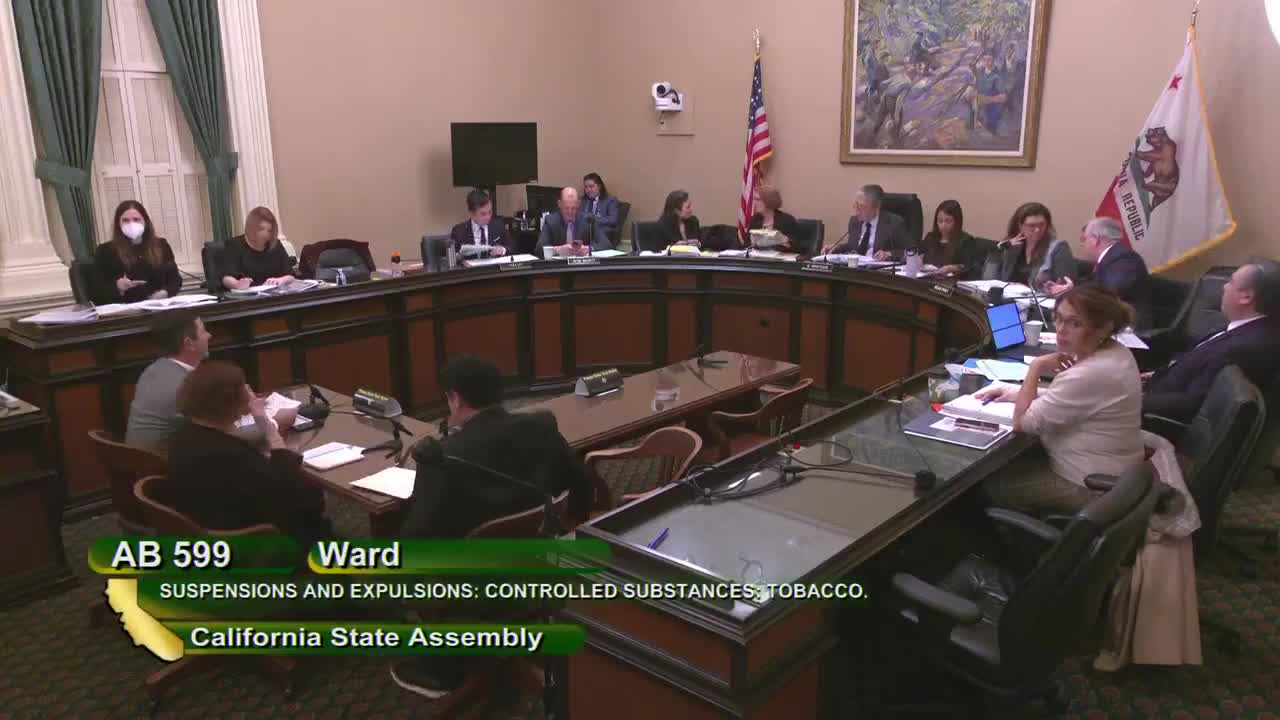 16MIN
Assembly Standing Committee on Education
Bill Author

Bill Co-Author(s):
