AB 607: Public postsecondary education: course materials.
- Session Year: 2023-2024
- House: Assembly
- Latest Version Date: 2023-10-10
Current Status:
Passed
(2023-10-10: Chaptered by Secretary of State - Chapter 660, Statutes of 2023.)
Introduced
In Committee
First Chamber
In Committee
Second Chamber
Enacted
Existing law requires each campus of the California Community Colleges and the California State University, and requests each campus of the University of California, to clearly highlight the courses that exclusively use digital course materials, as specified, and clearly communicate to students that the course materials for these courses are free of charge and therefore not required to be purchased.
This bill would, commencing July 1, 2024, require each campus of the California Community Colleges and the California State University, and request each campus of the University of California, to prominently display the estimated costs for each course of all required course materials and fees directly related to those materials, for no less than an annually increasing percentage, up to 75% by January 1, 2028, of the total number of courses on the online campus course schedule for which a faculty member or course instructor has been assigned. The bill would define, for purposes of this requirement, course materials to include digital or physical textbooks, devices such as calculators and remote attendance platforms, and software subscriptions. By imposing new duties on community college districts, the bill would impose a state-mandated local program.
The California Constitution requires the state to reimburse local agencies and school districts for certain costs mandated by the state. Statutory provisions establish procedures for making that reimbursement.
This bill would provide that, if the Commission on State Mandates determines that the bill contains costs mandated by the state, reimbursement for those costs shall be made pursuant to the statutory provisions noted above.
Existing law requires each campus of the California Community Colleges and the California State University, and requests each campus of the University of California, to clearly highlight the courses that exclusively use digital course materials, as specified, and clearly communicate to students that the course materials for these courses are free of charge and therefore not required to be purchased.
This bill would, commencing July 1, 2024, require each campus of the California Community Colleges and the California State University, and request each campus of the University of California, to prominently display the estimated costs for each course of all required course materials and fees directly related to those materials, for no less than 75% an annually increasing percentage, up to 75% by January 1, 2028, of the total number of courses on the online campus course schedule. schedule for which a faculty member or course instructor has been assigned. The bill would define, for purposes of this requirement, course materials to include digital or physical textbooks, devices such as calculators and remote attendance platforms, and software subscriptions. By imposing new duties on community college districts, the bill would impose a state-mandated local program.
The California Constitution requires the state to reimburse local agencies and school districts for certain costs mandated by the state. Statutory provisions establish procedures for making that reimbursement.
This bill would provide that, if the Commission on State Mandates determines that the bill contains costs mandated by the state, reimbursement for those costs shall be made pursuant to the statutory provisions noted above.
Existing law requires each campus of the California Community Colleges and the California State University, and requests each campus of the University of California, to clearly highlight the courses that exclusively use digital course materials, as specified, and clearly communicate to students that the course materials for these courses are free of charge and therefore not required to be purchased.
This bill would would, commencing July 1, 2024, require each campus of the California Community Colleges and the California State University, and request each campus of the University of California, to prominently display the estimated costs for each course of all required course materials and fees directly related to those materials, for no less than 75% of the total number of courses on the online campus course schedule. The bill would define, for purposes of this requirement, course materials to include digital or physical textbooks, devices such as calculators and remote attendance platforms, and software subscriptions. By imposing new duties on community college district, districts, the bill would impose a state-mandated local program.
The California Constitution requires the state to reimburse local agencies and school districts for certain costs mandated by the state. Statutory provisions establish procedures for making that reimbursement.
This bill would provide that, if the Commission on State Mandates determines that the bill contains costs mandated by the state, reimbursement for those costs shall be made pursuant to the statutory provisions noted above.
Existing law requires each campus of the California Community Colleges and the California State University, and requests each campus of the University of California, to clearly highlight the courses that exclusively use digital course materials, as specified, and clearly communicate to students that the course materials for these courses are free of charge and therefore not required to be purchased.
This bill would require each campus of the California Community Colleges and the California State University, and request each campus of the University of California, to prominently display the estimated costs for each course of all required course materials and fees directly related to those materials, for no less than 75% of the total number of courses on the online campus course schedule. The bill would define, for purposes of this requirement, course materials to include digital or physical textbooks, devices such as calculators and remote attendance platforms, and software subscriptions. By imposing new duties on community college district, the bill would impose a state-mandated local program.
The California Constitution requires the state to reimburse local agencies and school districts for certain costs mandated by the state. Statutory provisions establish procedures for making that reimbursement.
This bill would provide that, if the Commission on State Mandates determines that the bill contains costs mandated by the state, reimbursement for those costs shall be made pursuant to the statutory provisions noted above.
(a)Each campus of the California Community Colleges and the California State University shall, and each campus of the University of California is requested to, do both of the following:
(1)(A)Clearly highlight, by means that may include a symbol or logo in a conspicuous place on the online campus course schedule, the courses that exclusively use digital course materials that are free of charge to students and may have a low-cost option for print versions.
(B)The digital course materials described in subparagraph (A) may include open educational resources, institutionally licensed campus library materials that all students enrolled in the course have access to use, and other properly licensed and adopted materials. Each campus of the California State University, each participating campus of the University of California, and each community college district shall ensure that these materials comply with the federal Americans with Disabilities Act of 1990 (42 U.S.C. Sec. 12101 et seq.) and the federal Copyright Act of 1976 (Public Law 94-553).
(2)Clearly communicate to students that the digital course materials used for the courses identified pursuant to paragraph (1) are free of charge and therefore not required to be purchased.
(b)For purposes of this section, the following terms have the following meanings:
(1)Course schedule is a collection of available classes, course sections, or both, published electronically, before the start of an academic term.
(2)Open educational resources are high-quality teaching, learning, and research resources that reside in the public domain or have been released under an intellectual property license, such as a Creative Commons license, that permits their free use and repurposing by others, and may include other resources that are legally available and free of cost to students. Open educational resources include, but are not limited to, full courses, course materials, modules, textbooks, faculty-created content, streaming videos, tests, software, and any other tools, materials, or techniques used to support access to knowledge.
(c)This section shall become inoperative on July 1, 2024, and, as of January 1, 2025, is repealed.
SEC. 2.Section 66406.9 is added to the Education Code, to read:66406.9.(a)Each campus of the California Community Colleges and the California State University shall, and each campus of the University of California is requested to, do all of the following:
(1)(A)Clearly highlight, by means that may include a symbol or logo in a conspicuous place on the online campus course schedule, the courses that exclusively use digital course materials that are free of charge to students and may have a low-cost option for print versions.
(B)The digital course materials described in subparagraph (A) may include open educational resources, institutionally licensed campus library materials that all students enrolled in the course have access to use, and other properly licensed and adopted materials. Each campus of the California State University, each participating campus of the University of California, and each community college district shall ensure that these materials comply with the federal Americans with Disabilities Act of 1990 (42 U.S.C. Sec. 12101 et seq.) and the federal Copyright Act of 1976 (Public Law 94-553).
(2)Clearly communicate to students that the digital course materials used for the courses identified pursuant to paragraph (1) are free of charge and therefore not required to be purchased.
(3)Prominently display, by means that may include a link to a separate internet web page, the estimated costs for each course of all required course materials and fees directly related to those materials, for no less than 40 percent by January 1, 2025, 55 percent by January 1, 2026, 65 percent by January 1, 2027, and 75 percent by January 1, 2028, of the total number of courses on the online campus course schedule for which a faculty member or course instructor has been assigned. Course materials as used in this paragraph includes digital or physical textbooks, devices such as calculators and remote attendance platforms, and software subscriptions.
(b)For purposes of this section, the following terms have the following meanings:
(1)Course schedule is a collection of available classes, course sections, or both, published electronically, before the start of an academic term.
(2)Open educational resources are high-quality teaching, learning, and research resources that reside in the public domain or have been released under an intellectual property license, such as a Creative Commons license, that permits their free use and repurposing by others, and may include other resources that are legally available and free of cost to students. Open educational resources include, but are not limited to, full courses, course materials, modules, textbooks, faculty-created content, streaming videos, tests, software, and any other tools, materials, or techniques used to support access to knowledge.
(c)This section shall become operative on July 1, 2024.
SEC. 3.If the Commission on State Mandates determines that this act contains costs mandated by the state, reimbursement to local agencies and school districts for those costs shall be made pursuant to Part 7 (commencing with Section 17500) of Division 4 of Title 2 of the Government Code.
(a)Each campus of the California Community Colleges and the California State University shall, and each campus of the University of California is requested to, do both of the following:
(1)(A)Clearly highlight, by means that may include a symbol or logo in a conspicuous place on the online campus course schedule, the courses that exclusively use digital course materials that are free of charge to students and may have a low-cost option for print versions.
(B)The digital course materials described in subparagraph (A) may include open educational resources, institutionally licensed campus library materials that all students enrolled in the course have access to use, and other properly licensed and adopted materials. Each campus of the California State University, each participating campus of the University of California, and each community college district shall ensure that these materials comply with the federal Americans with Disabilities Act of 1990 (42 U.S.C. Sec. 12101 et seq.) and the federal Copyright Act of 1976 (Public Law 94-553).
(2)Clearly communicate to students that the digital course materials used for the courses identified pursuant to paragraph (1) are free of charge and therefore not required to be purchased.
(b)For purposes of this section, the following terms have the following meanings:
(1)Course schedule is a collection of available classes, course sections, or both, published electronically, before the start of an academic term.
(2)Open educational resources are high-quality teaching, learning, and research resources that reside in the public domain or have been released under an intellectual property license, such as a Creative Commons license, that permits their free use and repurposing by others, and may include other resources that are legally available and free of cost to students. Open educational resources include, but are not limited to, full courses, course materials, modules, textbooks, faculty-created content, streaming videos, tests, software, and any other tools, materials, or techniques used to support access to knowledge.
(c)This section shall become inoperative on July 1, 2024, and, as of January 1, 2025, is repealed.
SEC. 2.Section 66406.9 is added to the Education Code, to read:66406.9.(a)Each campus of the California Community Colleges and the California State University shall, and each campus of the University of California is requested to, do all of the following:
(1)(A)Clearly highlight, by means that may include a symbol or logo in a conspicuous place on the online campus course schedule, the courses that exclusively use digital course materials that are free of charge to students and may have a low-cost option for print versions.
(B)The digital course materials described in subparagraph (A) may include open educational resources, institutionally licensed campus library materials that all students enrolled in the course have access to use, and other properly licensed and adopted materials. Each campus of the California State University, each participating campus of the University of California, and each community college district shall ensure that these materials comply with the federal Americans with Disabilities Act of 1990 (42 U.S.C. Sec. 12101 et seq.) and the federal Copyright Act of 1976 (Public Law 94-553).
(2)Clearly communicate to students that the digital course materials used for the courses identified pursuant to paragraph (1) are free of charge and therefore not required to be purchased.
(3)Prominently display, by means that may include a link to a separate internet web page, the estimated costs for each course of all required course materials and fees directly related to those materials, for no less than 40 percent by January 1, 2025, 55 percent by January 1, 2026, 65 percent by January 1, 2027, and 75 percent by January 1, 2028, of the total number of courses on the online campus course schedule. schedule for which a faculty member or course instructor has been assigned. Course materials as used in this paragraph includes digital or physical textbooks, devices such as calculators and remote attendance platforms, and software subscriptions.
(b)For purposes of this section, the following terms have the following meanings:
(1)Course schedule is a collection of available classes, course sections, or both, published electronically, before the start of an academic term.
(2)Open educational resources are high-quality teaching, learning, and research resources that reside in the public domain or have been released under an intellectual property license, such as a Creative Commons license, that permits their free use and repurposing by others, and may include other resources that are legally available and free of cost to students. Open educational resources include, but are not limited to, full courses, course materials, modules, textbooks, faculty-created content, streaming videos, tests, software, and any other tools, materials, or techniques used to support access to knowledge.
(c)This section shall become operative on July 1, 2024.
SEC. 3.If the Commission on State Mandates determines that this act contains costs mandated by the state, reimbursement to local agencies and school districts for those costs shall be made pursuant to Part 7 (commencing with Section 17500) of Division 4 of Title 2 of the Government Code.
(a)Each campus of the California Community Colleges and the California State University shall, and each campus of the University of California is requested to, do all both of the following:
(1)(A)Clearly highlight, by means that may include a symbol or logo in a conspicuous place on the online campus course schedule, the courses that exclusively use digital course materials that are free of charge to students and may have a low-cost option for print versions.
(B)The digital course materials described in subparagraph (A) may include open educational resources, institutionally licensed campus library materials that all students enrolled in the course have access to use, and other properly licensed and adopted materials. Each campus of the California State University, each participating campus of the University of California, and each community college district shall ensure that these materials comply with the federal Americans with Disabilities Act of 1990 (42 U.S.C. Sec. 12101 et seq.) and the federal Copyright Act of 1976 (Public Law 94-553).
(2)Clearly communicate to students that the digital course materials used for the courses identified pursuant to paragraph (1) are free of charge and therefore not required to be purchased.
(3)Prominently display, by means that may include a link to a separate internet web page, the estimated costs for each course of all required course materials and fees directly related to those materials, for no less than 75 percent of the total number of courses on the online campus course schedule. Course materials as used in this paragraph includes digital or physical textbooks, devices such as calculators and remote attendance platforms, and software subscriptions.(b)For purposes of this section, the following terms have the following meanings:
(1)Course schedule is a collection of available classes, course sections, or both, published electronically, before the start of an academic term.
(2)Open educational resources are high-quality teaching, learning, and research resources that reside in the public domain or have been released under an intellectual property license, such as a Creative Commons license, that permits their free use and repurposing by others, and may include other resources that are legally available and free of cost to students. Open educational resources include, but are not limited to, full courses, course materials, modules, textbooks, faculty-created content, streaming videos, tests, software, and any other tools, materials, or techniques used to support access to knowledge.
(c)This section shall become inoperative on July 1, 2024, and, as of January 1, 2025, is repealed.
SEC. 2.Section 66406.9 is added to the Education Code, to read:66406.9.(a)Each campus of the California Community Colleges and the California State University shall, and each campus of the University of California is requested to, do all of the following:
(1)(A)Clearly highlight, by means that may include a symbol or logo in a conspicuous place on the online campus course schedule, the courses that exclusively use digital course materials that are free of charge to students and may have a low-cost option for print versions.
(B)The digital course materials described in subparagraph (A) may include open educational resources, institutionally licensed campus library materials that all students enrolled in the course have access to use, and other properly licensed and adopted materials. Each campus of the California State University, each participating campus of the University of California, and each community college district shall ensure that these materials comply with the federal Americans with Disabilities Act of 1990 (42 U.S.C. Sec. 12101 et seq.) and the federal Copyright Act of 1976 (Public Law 94-553).
(2)Clearly communicate to students that the digital course materials used for the courses identified pursuant to paragraph (1) are free of charge and therefore not required to be purchased.
(3)Prominently display, by means that may include a link to a separate internet web page, the estimated costs for each course of all required course materials and fees directly related to those materials, for no less than 75 percent of the total number of courses on the online campus course schedule. Course materials as used in this paragraph includes digital or physical textbooks, devices such as calculators and remote attendance platforms, and software subscriptions.
(b)For purposes of this section, the following terms have the following meanings:
(1)Course schedule is a collection of available classes, course sections, or both, published electronically, before the start of an academic term.
(2)Open educational resources are high-quality teaching, learning, and research resources that reside in the public domain or have been released under an intellectual property license, such as a Creative Commons license, that permits their free use and repurposing by others, and may include other resources that are legally available and free of cost to students. Open educational resources include, but are not limited to, full courses, course materials, modules, textbooks, faculty-created content, streaming videos, tests, software, and any other tools, materials, or techniques used to support access to knowledge.
(c)This section shall become operative on July 1, 2024.
SEC. 2.SEC. 3.If the Commission on State Mandates determines that this act contains costs mandated by the state, reimbursement to local agencies and school districts for those costs shall be made pursuant to Part 7 (commencing with Section 17500) of Division 4 of Title 2 of the Government Code.
(a)Each campus of the California Community Colleges and the California State University shall, and each campus of the University of California is requested to, do both all of the following:
(1)(A)Clearly highlight, by means that may include a symbol or logo in a conspicuous place on the online campus course schedule, the courses that exclusively use digital course materials that are free of charge to students and may have a low-cost option for print versions.
(B)The digital course materials described in subparagraph (A) may include open educational resources, institutionally licensed campus library materials that all students enrolled in the course have access to use, and other properly licensed and adopted materials. Each campus of the California State University, each participating campus of the University of California, and each community college district shall ensure that these materials comply with the federal Americans with Disabilities Act of 1990 (42 U.S.C. Sec. 12101 et seq.) and the federal Copyright Act of 1976 (Public Law 94-553).
(2)Clearly communicate to students that the digital course materials used for the courses identified pursuant to paragraph (1) are free of charge and therefore not required to be purchased.
(3)Prominently display, by means that may include a link to a separate internet web page, the estimated costs for each course of all required course materials and fees directly related to those materials, for no less than 75 percent of the total number of courses on the online campus course schedule. Course materials as used in this paragraph includes digital or physical textbooks, devices such as calculators and remote attendance platforms, and software subscriptions.
(b)For purposes of this section, the following terms have the following meanings:
(1)Course schedule is a collection of available classes, course sections, or both, published electronically, before the start of an academic term.
(2)Open educational resources are high-quality teaching, learning, and research resources that reside in the public domain or have been released under an intellectual property license, such as a Creative Commons license, that permits their free use and repurposing by others, and may include other resources that are legally available and free of cost to students. Open educational resources include, but are not limited to, full courses, course materials, modules, textbooks, faculty-created content, streaming videos, tests, software, and any other tools, materials, or techniques used to support access to knowledge.
(c)This section shall become operative on January 1, 2018. SEC. 2.If the Commission on State Mandates determines that this act contains costs mandated by the state, reimbursement to local agencies and school districts for those costs shall be made pursuant to Part 7 (commencing with Section 17500) of Division 4 of Title 2 of the Government Code.
REVISIONS: HeadingLine 2.|
Date
|
Status
|
|---|---|
| Oct 10, 2023 | Chaptered by Secretary of State - Chapter 660, Statutes of 2023. |
| Oct 10, 2023 | Approved by the Governor. |
| Sep 20, 2023 | Enrolled and presented to the Governor at 4 p.m. |
| Sep 13, 2023 | Senate amendments concurred in. To Engrossing and Enrolling. (Ayes 80. Noes 0. Page 3360.). |
| Sep 12, 2023 | In Assembly. Concurrence in Senate amendments pending. |
| Sep 12, 2023 | Read third time. Passed. Ordered to the Assembly. (Ayes 38. Noes 0. Page 2630.). |
| Sep 5, 2023 | Read second time. Ordered to third reading. |
| Sep 1, 2023 | From committee: Do pass. (Ayes 7. Noes 0.) (September 1). |
| Aug 21, 2023 | In committee: Referred to APPR suspense file. |
| Aug 15, 2023 | From committee chair, with author's amendments: Amend, and re-refer to committee. Read second time, amended, and re-referred to Com. on APPR. |
| Jul 19, 2023 | In committee: Hearing postponed by committee. |
| Jul 5, 2023 | From committee: Do pass and re-refer to Com. on APPR. (Ayes 6. Noes 0.) (July 5). Re-referred to Com. on APPR. |
| Jun 14, 2023 | Referred to Com. on ED. |
| Jun 1, 2023 | In Senate. Read first time. To Com. on RLS. for assignment. |
| May 31, 2023 | Read third time. Passed. Ordered to the Senate. (Ayes 80. Noes 0. Page 1991.) |
| May 22, 2023 | Read second time. Ordered to third reading. |
| May 18, 2023 | Read second time and amended. Ordered returned to second reading. |
| May 18, 2023 | From committee: Amend, and do pass as amended. (Ayes 11. Noes 0.) (May 18). |
| Apr 19, 2023 | In committee: Set, first hearing. Referred to APPR. suspense file. |
| Mar 22, 2023 | Coauthors revised. |
| Mar 22, 2023 | From committee: Do pass and re-refer to Com. on APPR. (Ayes 11. Noes 0.) (March 21). Re-referred to Com. on APPR. |
| Feb 17, 2023 | Referred to Com. on HIGHER ED. |
| Feb 10, 2023 | From printer. May be heard in committee March 12. |
| Feb 9, 2023 | Read first time. To print. |
|
Date
|
Description
|
Location
|
Votes
|
|
|---|---|---|---|---|
| Sep 13, 2023 | AB 607 Kalra Concurrence in Senate Amendments | Assembly Floor |
Passed |
|
| Sep 12, 2023 | Assembly 3rd Reading AB607 Kalra et al. By Newman | Senate Floor |
Passed |
|
| Sep 1, 2023 | Do pass | Senate Standing Committee on Appropriations |
Passed |
|
| Aug 21, 2023 | Placed on suspense file | Senate Standing Committee on Appropriations |
Passed |
|
| Jul 5, 2023 | Do pass, but first be re-referred to the Committee on [Appropriations] | Senate Standing Committee on Education |
Passed |
|
| May 31, 2023 | AB 607 Kalra Assembly Third Reading | Assembly Floor |
Passed |
|
| May 18, 2023 | Do pass as amended. | Assembly Standing Committee on Appropriations |
Passed |
|
| Mar 21, 2023 | Do pass and be re-referred to the Committee on [Appropriations] | Assembly Standing Committee on Higher Education |
Passed |
This list shows positions taken on this bill by organizations on the date displayed, which is linked to the original source.
Positions by individuals are not included.
|
Organization
|
Position
|
Date
|
|---|---|---|
| California Community Colleges Chancellor's Office | ** Support | |
| California Public Interest Research Group | ** Support | |
| Cal State Student Association | ** Support | |
| Faculty Association Of California Community Colleges | ** Support | |
| Generation Up | ** Support | |
| Govern for California | ** Support | |
| Michelson Center For Public Policy | ** Support | |
| Student Senate for California Community Colleges | ** Support |
CONCURRENCE IN SENATE AMENDMENTS
CSA1 Bill Id:AB 607
Author:(Kalra and Cervantes)
As Amended Ver:August 15, 2023
Majority vote
SUMMARY
Requires, commencing July 1, 2024, each campus of the California Community Colleges (CCC) and the California State University (CSU), and requests each campus of the University of California (UC) to prominently display, by means that may include a link to a separate internet web page, the estimated costs for each course of all required course materials and fees directly related to those materials, for no less than 40% by January 1, 2025; 55% by January 1, 2026; 65% by January 1, 2027; and, 75% by January 1, 2028, of the total number of courses on the online campus course schedule for which a faculty member or course instructor has been assigned.
Senate Amendments
- Create an annually increasing percentage, up to 75% by January 1, 2028, of the total number of courses on the online campus course schedule for which a faculty member or course instructor has been assigned.
- Specify the following percentage and annual increase, pursuant to (1) above:
- 40% by January 1, 2025;
- 55% by January 1, 2026; and,
- 65% by January 1, 2027.
COMMENTS
Higher Education Opportunity Act (HEOA) Textbook Provision. The HEOA Textbook Provision, in part, referenced in the "Existing Law" section of this analysis, went into effect on July 1, 2010.
The purpose of the HEOA Textbook Provision is to ensure that students have access to affordable course materials by decreasing costs to students and enhancing transparency and disclosure with respect to the selection, purchase, sale, and use of course materials. Additionally, the HEOA Textbook Provision seeks to encourage all of the involved parties, including faculty, students, administrators, institutions of higher education, bookstores, distributors, and publishers, to work together to identify ways to decrease the cost of college textbooks and supplemental materials for students while supporting the academic freedom of faculty members to select high quality course materials for students.
Course materials. College students, on average, spent less on their course materials during the 2021-2022 academic year (AY) even though they took more courses and acquired a slightly greater number of materials, according to the Student Watch: Attitudes and Behaviors Toward Course Materials: 2022 Report, the National Association of College Stores' (NACS) annual survey of college students.
According to NACS, the total course material spending fell to $339 per student for the year, the lowest amount since NACS began tracking student spending in 1998 and less than half the spending in 2007-2008 when students paid $701 on average for course materials.
Further, the NACS student survey found that in AY 2021-2022, more college students acquired course materials through an inclusive access (IA) program, also known as instant access or day-one access. (Inclusive access provides students with their course materials, usually in digital format, on the first day of class, at a discounted cost.) Thirty-nine percent obtained course materials through IA, compared to 33% the year before and 15% in AY 2018-2019.
Additionally, according to the NACS student survey, another factor that likely reduced college students' expenditures on course materials was that slightly more students (73% vs. 70% the previous AY) indicated that an instructor had assigned at least one course material that was either free or not directly paid for. Most (70%) of said course materials were provide to students through the campus learning management system, but other sources included, but were not limited to, instructor handouts, website articles, class notes, professional journals and articles, web searches, social media, general consumer books, and free textbooks. The survey noted that while students did not pay for the aforementioned course materials directly, some of the sources were supported by student tuition and fees, such as instructor-developed materials and journal subscriptions at the campus libraries.
Lastly, the NACS student survey found that around one in four students decided not to acquire at least one assigned course material; students who skipped buying or accessing course materials were also more likely to consider dropping out of the class and/or college altogether, suggesting these students were struggling with the total cost of attendance. However, students who skipped acquiring course materials were found to only spend $24 less on average per year than students who obtained all course materials.
At the CCC, entire academic departments traditionally collaboratively choose and select their course materials. This appears to be in part, because the majority of courses offered at the CCC are general education or introduction to specific discipline courses. Course materials traditionally are not too varied.
This measure appears to align with the priorities of the CCC Chancellors' Office (CCCCO) Burden Free Instructional Materials Taskforce, which was convened following the CCCCO's July 2022 guidance on the Zero Textbook Cost (ZTC) Program.
The Legislature appropriated $5 million in one-time funding in 2016 to pilot the ZTC Program. The Program, in part, provided grants to 34 colleges, creating 37 certificate and degree programs and 404 courses with no textbook costs, in a three-year timeframe. In 2021, the Legislature invested $115 million in one-time funding for the ZTC Program.
According to the Author
"Course material costs make up a significant portion of the costs of secondary education, especially at community colleges." The author contends that, "Unlike fees and tuition, course material costs are not fixed which makes it challenging for students to plan ahead."
The author states, "In recent years, the types of materials students are expected to purchase has widened to include digital homework platforms and other new technologies that are not captured by existing laws. AB 607 would close price transparency gaps by including these newer forms of course materials. The increased transparency will allow students to make informed decisions for course registration in a manner that works best for them financially."
Further, the author states, "A 2020 report by CSU Channel Islands examined a Hispanic Serving Institution (HSI) in Southern California and found that students from historically marginalized backgrounds pay more for textbooks than their peers. With all the costs students are expected to take on when pursuing higher education, further cost transparency and ability to plan ahead can especially benefit students from disadvantaged backgrounds as they strategize how best to account for financial aid awards or income from a minimum wage job."
Arguments in Support
According to the Michelson Center for Public Policy, "The bill would close price transparency gaps by requiring the California State Universities (CSU) and California Community Colleges (CCC), and encouraging the University of California (UC), to display estimated cost of course materials for 75% of courses offered on the online course schedule platform. Course material costs make up a significant portion of the costs of secondary education, especially at community colleges. AB 607 makes a simple but important change that will better help students understand and plan for at least one of the costs associated with their postsecondary educations."
Arguments in Opposition
None on file.
FISCAL COMMENTS
According to the Senate Committee on Appropriations:
- The Chancellor's Office estimates ongoing Proposition 98 General Fund costs that will likely start in the low hundreds of thousands of dollars and eventually escalate to $3.1 million each year by January 1, 2028. These costs reflect an additional 0.1 full time equivalent staff person per community college campus to collect and report the costs of course materials for credit and noncredit courses. However, the Chancellor's Office indicates that the community college districts are in the process of beginning to report instructional materials information as part of a newly created data element within the CCC's Management Information System (MIS). The newly created data element will not require colleges to report on the cost of instructional materials. However, to the extent the requirements of the bill align with this new reporting, the costs are likely to be lower.
- The UC estimates $780,000 in General Fund systemwide costs each year. This amount reflects an additional one-half full time equivalent staff person per UC campus to coordinate, gather, and publish the required information into all semester and quarter course schedules.
- The CSU indicates no additional costs as a result of this measure.
VOTES:
ASM HIGHER EDUCATION: 11-0-1
YES: Mike Fong, Ta, Addis, Arambula, Gabriel, Irwin, Low, Ortega, Sanchez, Santiago, Wallis
ABS, ABST OR NV: Weber
ASM APPROPRIATIONS: 11-0-5
YES: Holden, Bryan, Calderon, Wendy Carrillo, Mike Fong, Hart, Lowenthal, Papan, Pellerin, Weber, Ortega
ABS, ABST OR NV: Megan Dahle, Dixon, Mathis, Robert Rivas, Sanchez
ASSEMBLY FLOOR: 80-0-0
YES: Addis, Aguiar-Curry, Alanis, Alvarez, Arambula, Bains, Bauer-Kahan, Bennett, Berman, Boerner, Bonta, Bryan, Calderon, Juan Carrillo, Wendy Carrillo, Cervantes, Chen, Connolly, Megan Dahle, Davies, Dixon, Essayli, Flora, Mike Fong, Vince Fong, Friedman, Gabriel, Gallagher, Garcia, Gipson, Grayson, Haney, Hart, Holden, Hoover, Irwin, Jackson, Jones‑Sawyer, Kalra, Lackey, Lee, Low, Lowenthal, Maienschein, Mathis, McCarty, McKinnor, Muratsuchi, Stephanie Nguyen, Ortega, Pacheco, Papan, Jim Patterson, Joe Patterson, Pellerin, Petrie-Norris, Quirk-Silva, Ramos, Reyes, Luz Rivas, Robert Rivas, Rodriguez, Blanca Rubio, Sanchez, Santiago, Schiavo, Soria, Ta, Ting, Valencia, Villapudua, Waldron, Wallis, Ward, Weber, Wicks, Wilson, Wood, Zbur, Rendon
UPDATED
VERSION: August 15, 2023
CONSULTANT: Jeanice Warden / HIGHER ED. / (916) 319-3960 FN: 0002374
SENATE RULES COMMITTEE Office of Senate Floor Analyses (916) 651-1520 Fax: (916) 327-4478 | AB 607 |
THIRD READING
Bill No: AB 607
Author: Kalra (D) and Cervantes (D), et al.
Amended: 8/15/23 in Senate
Vote: 21
SENATE EDUCATION COMMITTEE: 6-0, 7/5/23
AYES: Newman, Ochoa Bogh, Cortese, McGuire, Smallwood-Cuevas, Wilk
NO VOTE RECORDED: Glazer
SENATE APPROPRIATIONS COMMITTEE: 7-0, 9/1/23
AYES: Portantino, Jones, Ashby, Bradford, Seyarto, Wahab, Wiener
ASSEMBLY FLOOR: 80-0, 5/31/23 - See last page for vote
SUBJECT: Public postsecondary education: course materials
SOURCE: Michelson Center for Public Policy
DIGEST:
This bill requires, commencing July 1, 2024, each campus of the California Community Colleges (CCCs) and the California State University (CSU), and requests each campus of the University of California (UC)to prominently display, by means that may include a link to a separate internet web page, the estimated costs for each course of all required course materials and fees directly related to those materials, for no less than 40 percent by January 1, 2025; 55 percent by January 1, 2026; 65 percent by January 1, 2027; and 75 percent by January 1, 2028, of the total number of courses on the online campus course schedule for which a faculty member or course instructor has been assigned.
ANALYSIS:
Existing federal law
- Authorizes an institution of higher education to include the costs of books and supplies as part of tuition and fees if the institution does one of the following:
- The institution does all of the following:
- Has an arrangement with a book publisher or other entity that enables it to make those books or supplies available to students below competitive market rates.
- Provides a way for a student to obtain those books and supplies by the seventh day of a payment period.
- Has a policy under which the student may opt-out of the way the institution provides for the student to obtain books and supplies.
- Documents on a current basis that the books or supplies, including digital or electronic course materials, are not available elsewhere or accessible by students enrolled in that program from sources other than those provided or authorized by the institution.
- The institution demonstrates there is a compelling health or safety reason. (Code of Federal Regulations, Title 34 Section 668.164)
- The institution does all of the following:
- Requires, when a publisher provides a faculty member or other person or adopting entity in charge of selecting course materials at an institution of higher education receiving Federal financial assistance with information regarding a college textbook or supplemental material, the publisher shall include, with any such information and in writing (which may include electronic communications), the following:
- The price at which the publisher would make the college textbook or supplemental material available to the bookstore on the campus of, or otherwise associated with, such institution of higher education and, if available, the price at which the publisher makes the college textbook or supplemental material available to the public.
- The copyright dates of the three previous editions of such college textbook, if any.
- A description of the substantial content revisions made between the current edition of the college textbook or supplemental material and the previous edition, if any.
- Whether the college textbook or supplemental material is available in any other format, including paperback and unbound; and, for each other format of the college textbook or supplemental material, the price at which the publisher would make the college textbook or supplemental material in the other format available to the bookstore on the campus of, or otherwise associated with, such institution of higher education and, if available, the price at which the publisher makes such other format of the college textbook or supplemental material available to the public. (U. S. Code (U.S.C.) Title 20, Chapter 28, Subchapter I, Part C, Section 1015b)
Existing state law:
- Requires the CSU Trustees and the CCC Board of Governors, and requests the UC Regents to work with the academic senates to encourage faculty to give consideration to the least costly practices in assigning textbooks; to encourage faculty to disclose to students how new editions of textbooks are different from previous editions; and, the cost to students for textbooks selected, among other things. Current law also urges textbook publishers to provide information to faculty when they are considering what textbooks to order, and to post information on the publishers’ Web sites, including “an explanation of how the newest edition is different from previous editions.” Publishers are also asked to disclose to faculty the length of time they intend to produce the current edition and provide faculty free copies of each textbook selected. (Education Code (EC) § 66406)
- Establishes the College Textbook Transparency Act, which, in part:
- Defines "textbook" as a book that contains printed material and is intended for use as a source of study material for a class or group of students, a copy of which is expected to be available for the use of each of the students in that class or group, specifying that "textbook" does not include a novel.
- Defines "adopter" as any faculty member or academic department or other adopting entity at an institution of higher education responsible for considering and choosing course materials to be used in connection with the accredited courses taught at that institution.
- Encourages adopters to consider cost as a factor when adopting a textbook.
- Requires each campus bookstore at any public postsecondary educational institution to post in its store or on its Internet Web site a disclosure of its retail pricing policy on new and used textbooks. (EC § 66406.7)
- Requires, effective January 1, 2018, each campus of the CCC and the CSU, and requests, effective January 1, 2018, each campus of the UC, to clearly highlight the courses that use digital course materials that are free of charge and have a low-cost option for printed versions; and, communicate to students that the course materials for said courses are free of charge and not required to be purchased. (EC § 66406.9)
- Establishes the California Digital Open Source Library, administered by the CSU in coordination with the CCC, for the purpose of housing open source materials while providing Web-based access for students, faculty and staff to find, adopt, utilize, or modify course materials for little or no cost. (EC § 66408)
- Establishes the California Open Education Resources Council and requires the council to be responsible for, among other things, developing a list of 50 strategically selected lower division courses in the public postsecondary segments for which high-quality, affordable, digital open source textbooks and related materials are to be developed or acquired. (EC § 66409)
This bill:
- Requires, commencing July 1, 2024, each campus of the CCCs and the CSU, and requests each campus of the UC to prominently display, by means that may include a link to a separate internet web page, the estimated costs for each course of all required course materials and fees directly related to those materials, for no less than 40 percent by January 1, 2025; 55 percent by January 1, 2026; 65 percent by January 1, 2027; and 75 percent by January 1, 2028, of the total number of courses on the online campus course schedule for which a faculty member or course instructor has been assigned.
- Defines course materials for purposes of the bill to include digital or physical textbooks, devices such as calculators and remote attendance platforms, and software subscriptions.
- Makes technical and clarifying changes to existing law.
Comments
- Need for the bill. According to the author, “Course material costs make up a significant portion of the costs of secondary education, especially at community colleges.” The author contends that, “Unlike fees and tuition, course material costs are not fixed which makes it challenging for students to plan ahead.”
The author states, “In recent years, the types of materials students are expected to purchase has widened to include digital homework platforms and other new technologies that are not captured by existing laws. AB 607 would close price transparency gaps by including these newer forms of course materials. The increased transparency will allow students to make informed decisions for course registration in a manner that works best for them financially.”
Further, the author states, “A 2020 report by CSU Channel Islands examined a Hispanic Serving Institution (HSI) in Southern California and found that students from historically marginalized backgrounds pay more for textbooks than their peers. With all the costs students are expected to take on when pursuing higher education, further cost transparency and ability to plan ahead can especially benefit students from disadvantaged backgrounds as they strategize how best to account for financial aid awards or income from a minimum wage job.”
This measure, in part, requires the CCC and CSU and requests each campus of the UC, to prominently display the estimated costs for each course of all required course materials, and fees directly related to those materials, for no less than 75% of the total number of courses on the online campus schedule.
- Textbook cost disclosure requirements. This bill requires colleges to display cost estimates for course materials for each course within their online course schedule. Faculty play a key role in determining which instructional materials are required for each course. As such, colleges must rely on information provided by faculty to produce estimated costs for course materials. Federal regulations require colleges to the maximum extent practicable, disclose on their online course schedule the retail price information of required and recommended textbooks and supplemental materials for each courses listed in the institution’s course schedule. Further, information provided by the sponsors of this bill shows that at least 19 CSUs are in compliance with the federal regulations around the selection, purchase, sale, and use of course materials (provide a direct link class page within the bookstore’s website to show pricing). Seemingly, the infrastructure has been built, but ramping up to the 75 percent threshold required by this bill could be challenging for colleges. This bill newly implements a phased-in approach to reach the 75 percent goal. CSU estimates that information is provided for only about 30 percent of courses.
The requirements in this bill would result in the disclosure of other materials required for class participation, such as lab coats, calculators, or software subscriptions not required in federal regulations. Additionally, unlike federal regulations, which require colleges to display information to the "greatest extent possible," this bill requires colleges to display the estimated costs of course materials for at least 75% of courses. This bill does not mandate exact pricing allowing for a degree of flexibility in estimating the financial implications of course materials for students.
- Arguments in support. The CCC Chancellor’s Office states, in part, in their support letter submitted to this committee, “…Students often report that they choose not to purchase textbooks altogether, which negatively affects their learning and, ultimately, success in their courses. The Chancellor’s Office recently convened a Burden-Free Instructional Course Materials Task Force to identify strategies that strengthen equitable access to instructional materials. We hope that this will facilitate systemwide adoption of cero-textbook cost policies and practices.
AB 607 is directly aligned with the priorities of our Burden-Free Instructional course materials Task Force. By requiring colleges to post required course materials online, AB 607 will close price transparency gaps and allow students to plan ahead, increasing the likelihood of timely degree completion.”
FISCAL EFFECT: Appropriation: No Fiscal Com.: Yes Local: Yes
According to the Senate Appropriations Committee:
- The Chancellor’s Office estimates ongoing Proposition 98 General Fund costs that will likely start in the low hundreds of thousands of dollars and eventually escalate to $3.1 million each year by January 1, 2028. These costs reflect an additional 0.1 full time equivalent staff person per community college campus to collect and report the costs of course materials for credit and noncredit courses. However, the Chancellor’s Office indicates that the community college districts are in the process of beginning to report instructional materials information as part of a newly created data element within the CCC’s Management Information System (MIS). The newly created data element will not require colleges to report on the cost of instructional materials. However, to the extent the requirements of the bill align with this new reporting, the costs are likely to be lower.
- The UC estimates $780,000 in General Fund systemwide costs each year. This amount reflects an additional one-half full time equivalent staff person per UC campus to coordinate, gather, and publish the required information into all semester and quarter course schedules.
- The CSU indicates no additional costs as a result of this measure.
SUPPORT: (Verified 9/1/23)
Michelson Center for Public Policy (source)
Cal State Student Association
California Community Colleges Chancellor's Office
California Public Interest Research Group
Faculty Association of California Community Colleges
Generation Up
Govern for California
Student Senate for California Community Colleges
OPPOSITION: (Verified 9/1/23)
None received
ASSEMBLY FLOOR: 80-0, 5/31/23
AYES: Addis, Aguiar-Curry, Alanis, Alvarez, Arambula, Bains, Bauer-Kahan, Bennett, Berman, Boerner, Bonta, Bryan, Calderon, Juan Carrillo, Wendy Carrillo, Cervantes, Chen, Connolly, Megan Dahle, Davies, Dixon, Essayli, Flora, Mike Fong, Vince Fong, Friedman, Gabriel, Gallagher, Garcia, Gipson, Grayson, Haney, Hart, Holden, Hoover, Irwin, Jackson, Jones-Sawyer, Kalra, Lackey, Lee, Low, Lowenthal, Maienschein, Mathis, McCarty, McKinnor, Muratsuchi, Stephanie Nguyen, Ortega, Pacheco, Papan, Jim Patterson, Joe Patterson, Pellerin, Petrie-Norris, Quirk-Silva, Ramos, Reyes, Luz Rivas, Robert Rivas, Rodriguez, Blanca Rubio, Sanchez, Santiago, Schiavo, Soria, Ta, Ting, Valencia, Villapudua, Waldron, Wallis, Ward, Weber, Wicks, Wilson, Wood, Zbur, Rendon
Prepared by: Olgalilia Ramirez / ED. / (916) 651-4105
9/2/23 16:44:08
**** END ****
SENATE COMMITTEE ON APPROPRIATIONS
Senator Anthony Portantino, Chair
2023 - 2024 Regular Session
AB 607 (Kalra) - Public postsecondary education: course materials
Version: August 15, 2023 | Policy Vote: ED. 6 - 0 |
Urgency: No | Mandate: Yes |
Hearing Date: August 21, 2023 | Consultant: Lenin Del Castillo |
Bill Summary:
This bill requires, commencing July 1, 2024, each campus of the California Community Colleges (CCC) and the California State University (CSU), and requests each campus of the University of California (UC), to prominently display the estimated costs for each course of all required materials and fees directly related to those materials, as specified.
Fiscal Impact:
- The Chancellor’s Office estimates ongoing Proposition 98 General Fund costs that will likely start in the low hundreds of thousands of dollars and eventually escalate to $3.1 million each year by January 1, 2028. These costs reflect an additional 0.1 full time equivalent staff person per community college campus to collect and report the costs of course materials for credit and noncredit courses. However, the Chancellor’s Office indicates that the community college districts are in the process of beginning to report instructional materials information as part of a newly created data element within the CCC’s Management Information System (MIS). The newly created data element will not require colleges to report on the cost of instructional materials. However, to the extent the requirements of the bill align with this new reporting, the costs are likely to be lower.
- The UC estimates $780,000 in General Fund systemwide costs each year. This amount reflects an additional one-half full time equivalent staff person per UC campus to coordinate, gather, and publish the required information into all semester and quarter course schedules.
- The CSU indicates no additional costs as a result of this measure.
Background:
Current law requires the CSU Trustees and the CCC Board of Governors, and requests the UC Regents to work with the academic senates to encourage faculty to give consideration to the least costly practices in assigning textbooks; to encourage faculty to disclose to students how new editions of textbooks are different from previous editions; and, the cost to students for textbooks selected, among other things. Current law also urges textbook publishers to provide information to faculty when they are considering what textbooks to order, and to post information on the publishers’ Web sites, including “an explanation of how the newest edition is different from previous editions.” Publishers are also asked to disclose to faculty the length of time they intend to produce the current edition and provide faculty free copies of each textbook selected.
Existing law establishes the College Textbook Transparency Act, which, in part:
a) Defines "textbook" as a book that contains printed material and is intended for use as a source of study material for a class or group of students, a copy of which is expected to be available for the use of each of the students in that class or group, specifying that "textbook" does not include a novel.
b) Defines "adopter" as any faculty member or academic department or other adopting entity at an institution of higher education responsible for considering and choosing course materials to be used in connection with the accredited courses taught at that institution.
c) Encourages adopters to consider cost as a factor when adopting a textbook.
d) Requires each campus bookstore at any public postsecondary educational institution to post in its store or on its Internet Web site a disclosure of its retail pricing policy on new and used textbooks. (EC § 66406.7)
Existing law requires, effective January 1, 2018, each campus of the CCC and the CSU, and requests, effective January 1, 2018, each campus of the UC, to clearly highlight the courses that use digital course materials that are free of charge and have a low-cost option for printed versions; and, communicate to students that the course materials for said courses are free of charge and not required to be purchased.
Existing law establishes the California Digital Open Source Library, administered by the CSU in coordination with the CCC, for the purpose of housing open source materials while providing Web-based access for students, faculty and staff to find, adopt, utilize, or modify course materials for little or no cost.
Existing law establishes the California Open Education Resources Council and requires the council to be responsible for, among other things, developing a list of 50 strategically selected lower division courses in the public postsecondary segments for which high-quality, affordable, digital open source textbooks and related materials are to be developed or acquired.
Proposed Law:
This bill requires, commencing July 1, 2024, each campus of the CCCs and the CSU, and requests each campus of the UC to prominently display, by means that may include a link to a separate internet web page, the estimated costs for each course of all required course materials and fees directly related to those materials, for no less than 40 percent by January 1, 2025; 55 percent by January 1, 2026; 65 percent by January 1, 2027; and 75 percent by January 1, 2028, of the total number of courses on the online campus course schedule for which a faculty member or course instructor has been assigned.
This bill defines course materials to include digital or physical textbooks, devices such as calculators and remote attendance platforms, and software subscriptions.
Related Legislation: AB 2624 (Kalra, 2022) was virtually identical to this measure and held on the Suspense File in the Assembly Appropriations Committee.
AB 2385 (Cunningham, Chapter 214, Statutes of 2018) urges textbook publishers to post in a prominent location on the publishers' Internet Web sites, where it is readily available to college faculty, students, and departments, a detailed description of how the newest textbook edition differs from the previous edition.
SB 1359 (Block, Chapter 343, Statutes of 2016) requires, effective January 1, 2018, each campus of the CCC and the CSU, and requests, effective January 1, 2018, each campus of the UC, to clearly highlight the courses that use digital course materials that are free of charge and have a low-cost option for printed versions.
-- END --
SENATE COMMITTEE ON EDUCATION
Senator Josh Newman, Chair
2023 - 2024 Regular
Bill No: AB 607 Hearing Date: July 5, 2023
Author: | |||
Version: | May 18, 2023 | ||
Urgency: | No | Fiscal: | Yes |
Consultant: | Olgalilia Ramirez | ||
Subject: Public postsecondary education: course materials.
SUMMARY
This bill requires, commencing July 1, 2024, each campus of the California Community Colleges (CCC) and the California State University (CSU), and requests, each campus of the University of California (UC), to prominently display the estimated costs for each course of all required materials, and fees directly related to said materials, for no less than 75% of the total number of courses on the online campus schedule.
BACKGROUND
Existing law:
Federal law
1) Authorizes an institution of higher education to include the costs of books and supplies as part of tuition and fees if the institution does one of the following:
a) The institution does all of the following:
i) Has an arrangement with a book publisher or other entity that enables it to make those books or supplies available to students below competitive market rates.
ii) Provides a way for a student to obtain those books and supplies by the seventh day of a payment period.
iii) Has a policy under which the student may opt-out of the way the institution provides for the student to obtain books and supplies.
b) Documents on a current basis that the books or supplies, including digital or electronic course materials, are not available elsewhere or accessible by students enrolled in that program from sources other than those provided or authorized by the institution.
c) The institution demonstrates there is a compelling health or safety reason. (Code of Federal Regulations, Title 34 Section 668.164)
2) Requires, when a publisher provides a faculty member or other person or adopting entity in charge of selecting course materials at an institution of higher education receiving Federal financial assistance with information regarding a college textbook or supplemental material, the publisher shall include, with any such information and in writing (which may include electronic communications), the following:
a) The price at which the publisher would make the college textbook or supplemental material available to the bookstore on the campus of, or otherwise associated with, such institution of higher education and, if available, the price at which the publisher makes the college textbook or supplemental material available to the public.
b) The copyright dates of the three previous editions of such college textbook, if any.
c) A description of the substantial content revisions made between the current edition of the college textbook or supplemental material and the previous edition, if any.
d) Whether the college textbook or supplemental material is available in any other format, including paperback and unbound; and, for each other format of the college textbook or supplemental material, the price at which the publisher would make the college textbook or supplemental material in the other format available to the bookstore on the campus of, or otherwise associated with, such institution of higher education and, if available, the price at which the publisher makes such other format of the college textbook or supplemental material available to the public. (U. S. Code (U.S.C.) Title 20, Chapter 28, Subchapter I, Part C, Section 1015b)
State law
3) Requires the CSU Trustees and the CCC Board of Governors, and requests the UC Regents to work with the academic senates to encourage faculty to give consideration to the least costly practices in assigning textbooks; to encourage faculty to disclose to students how new editions of textbooks are different from previous editions; and, the cost to students for textbooks selected, among other things. Current law also urges textbook publishers to provide information to faculty when they are considering what textbooks to order, and to post information on the publishers’ Web sites, including “an explanation of how the newest edition is different from previous editions.” Publishers are also asked to disclose to faculty the length of time they intend to produce the current edition and provide faculty free copies of each textbook selected. (Education Code (EC) Section 66406)
4) Establishes the College Textbook Transparency Act, which, in part:
a) Defines "textbook" as a book that contains printed material and is intended for use as a source of study material for a class or group of students, a copy of which is expected to be available for the use of each of the students in that class or group, specifying that "textbook" does not include a novel.
b) Defines "adopter" as any faculty member or academic department or other adopting entity at an institution of higher education responsible for considering and choosing course materials to be used in connection with the accredited courses taught at that institution.
c) Encourages adopters to consider cost as a factor when adopting a textbook.
d) Requires each campus bookstore at any public postsecondary educational institution to post in its store or on its Internet Web site a disclosure of its retail pricing policy on new and used textbooks. (EC § 66406.7)
5) Requires, effective January 1, 2018, each campus of the CCC and the CSU, and requests, effective January 1, 2018, each campus of the UC, to clearly highlight the courses that use digital course materials that are free of charge and have a low-cost option for printed versions; and, communicate to students that the course materials for said courses are free of charge and not required to be purchased. (EC § 66406.9)
6) Establishes the California Digital Open Source Library, administered by the CSU in coordination with the CCC, for the purpose of housing open source materials while providing Web-based access for students, faculty and staff to find, adopt, utilize, or modify course materials for little or no cost. (EC Section 66408)
7) Establishes the California Open Education Resources Council and requires the council to be responsible for, among other things, developing a list of 50 strategically selected lower division courses in the public postsecondary segments for which high-quality, affordable, digital open source textbooks and related materials are to be developed or acquired. (EC § 66409)
ANALYSIS
This bill:
- Requires, commencing July 1, 2024, each campus of the CCCs and the CSU, and requests each campus of the UC to prominently display, by means that may include a link to a separate internet web page, the estimated costs for each course of all required course materials and fees directly related to those materials, for no less than 75 percent of the total number of courses on the online campus course schedule.
- Defines course materials for purposes of the bill to include digital or physical textbooks, devices such as calculators and remote attendance platforms, and software subscriptions.
- Makes technical and clarifying changes to existing law.
STAFF COMMENTS
- Need for the bill. According to the author, “Course material costs make up a significant portion of the costs of secondary education, especially at community colleges.” The author contends that, “Unlike fees and tuition, course material costs are not fixed which makes it challenging for students to plan ahead.”
The author states, “In recent years, the types of materials students are expected to purchase has widened to include digital homework platforms and other new technologies that are not captured by existing laws. AB 607 would close price transparency gaps by including these newer forms of course materials. The increased transparency will allow students to make informed decisions for course registration in a manner that works best for them financially.”
Further, the author states, “A 2020 report by CSU Channel Islands examined a Hispanic Serving Institution (HSI) in Southern California and found that students from historically marginalized backgrounds pay more for textbooks than their peers. With all the costs students are expected to take on when pursuing higher education, further cost transparency and ability to plan ahead can especially benefit students from disadvantaged backgrounds as they strategize how best to account for financial aid awards or income from a minimum wage job.”
This measure, in part, requires the CCC and CSU and requests each campus of the UC, to prominently display the estimated costs for each course of all required course materials, and fees directly related to those materials, for no less than 75% of the total number of courses on the online campus schedule.
- Textbook cost disclosure requirements. This bill requires colleges to display cost estimates for course materials for each course within their online course schedule. Faculty play a key role in determining which instructional materials are required for each course. As such, colleges must rely on information provided by faculty to produce estimated costs for course materials. Concerns have been raised about a college’s ability to comply should information not be provided in a timely manner for 75 percent of courses. However, federal regulations, colleges are already required, to the maximum extent practicable, to disclose on their online course schedule the retail price information of required and recommended textbooks and supplemental materials for each courses listed in the institution’s course schedule. Further, information provided by the sponsors of this bill shows that at least 19 CSUs are in compliance with the federal regulations around the selection, purchase, sale, and use of course materials (provide a direct link class page within the bookstore’s website to show pricing). Seemingly, the infrastructure has been built, but ramping up to the 75 percent threshold required by this bill could be challenging for colleges. CSU estimates that information is provided for only about 30 percent of courses. The requirements in this bill would result in the disclosure of other materials required for class participation, such as lab coats, calculators, or software subscriptions not required in federal regulations. Additionally, unlike federal regulations, which require colleges to display information to the "greatest extent possible," this bill requires colleges to display the estimated costs of course materials for at least 75% of the total number of courses. Staff notes that this bill does not mandate exact pricing allowing for a degree of flexibility in estimating the financial implications of course materials for students.
- Arguments in support. The CCC Chancellor’s Office states, in part, in their support letter submitted to this committee, “…Students often report that they choose not to purchase textbooks altogether, which negatively affects their learning and, ultimately, success in their courses. The Chancellor’s Office recently convened a Burden-Free Instructional Course Materials Task Force to identify strategies that strengthen equitable access to instructional materials. We hope that this will facilitate systemwide adoption of cero-textbook cost policies and practices.
AB 607 is directly aligned with the priorities of our Burden-Free Instructional course materials Task Force. By requiring colleges to post required course materials online, AB 607 will close price transparency gaps and allow students to plan ahead, increasing the likelihood of timely degree completion.”
- Prior legislation
AB 2624 (Kalra, 2022), which was held on the Suspense File in the Assembly Committee on Appropriations, was virtually identical to this measure. AB 2385 (Cunningham), Chapter 214, Statutes of 2018, in part, urges textbook publishers to post in a prominent location on the publishers' Internet Web sites, where it is readily available to college faculty, students, and departments, a detailed description of how the newest textbook edition differs from the previous edition.
SB 727 (Galgiani of 2017), which was left on the Inactive File on the Senate Floor, in part, would have authorized a public postsecondary educational institution to adopt policies that allow for the use of innovative pricing techniques and payment options for textbooks and other instructional materials.
SB 1359 (Block, Chapter 343, Statutes of 2016) in part, requires, effective January 1, 2018, each campus of the CCC and the CSU, and requests, effective January 1, 2018, each campus of the UC, to clearly highlight the courses that use digital course materials that are free of charge and have a low-cost option for printed versions.
SUPPORT
Michelson Center for Public Policy (Sponsor)
Cal State Student Association
California Community Colleges Chancellor's Office
California Public Interest Research Group
Faculty Association of California Community Colleges
Generation Up
Govern for California
Student Senate for California Community Colleges
OPPOSITION
None received
-- END --
ASSEMBLY THIRD READING
ATR Bill Id:AB 607
Author:(Kalra and Cervantes)
As Amended Ver:May 18, 2023
Majority vote
SUMMARY
Requires, commencing July 1, 2024, each campus of the California Community Colleges (CCC) and the California State University (CSU), and requests, commencing July 1, 2024, each campus of the University of California (UC), to prominently display the estimated costs for each course of all required materials, and fees directly related to said materials, for no less than 75% of the total number of courses on the online campus schedule.
Major Provisions
- Requires, commencing July 1, 2024, each campus of the CCC and the CSU, and requests, commencing July 1, 2024, each campus of the UC, to prominently display, by means that may include a link to a separate internet web page, the estimated costs for each course of all required course materials and fees directly related to those materials, for no less than 75% of the total number of courses on the online campus schedule.
- Defines "course materials" for purposes of this measure, to include digital or physical textbooks, devices such as calculators and remote attendance platforms, and software subscriptions.
- Makes technical and clarifying changes to existing law.
COMMENTS
Higher Education Opportunity Act (HEOA) Textbook Provision. The HEOA Textbook Provision, in part, referenced in the "Existing Law" section of this analysis, went into effect on July 1, 2010.
The purpose of the HEOA Textbook Provision is to ensure that students have access to affordable course materials by decreasing costs to students and enhancing transparency and disclosure with respect to the selection, purchase, sale, and use of course materials. Additionally, the HEOA Textbook Provision seeks to encourage all of the involved parties, including faculty, students, administrators, institutions of higher education, bookstores, distributors, and publishers, to work together to identify ways to decrease the cost of college textbooks and supplemental materials for students while supporting the academic freedom of faculty members to select high quality course materials for students.
Course materials. College students, on average, spent less on their course materials during the 2021-2022 academic year (AY) even though they took more courses and acquired a slightly greater number of materials, according to the Student Watch: Attitudes and Behaviors Toward Course Materials: 2022 Report, the National Association of College Stores' (NACS) annual survey of college students.
According to NACS, the total course material spending fell to $339 per student for the year, the lowest amount since NACS began tracking student spending in 1998 and less than half the spending in 2007-2008 when students paid $701 on average for course materials.
Further, the NACS student survey found that in AY 2021-2022, more college students acquired course materials through an inclusive access (IA) program, also known as instant access or day-one access. (Inclusive access provides students with their course materials, usually in digital format, on the first day of class, at a discounted cost.) Thirty-nine percent obtained course materials through IA, compared to 33% the year before and 15% in AY 2018-2019.
Additionally, according to the NACS student survey, another factor that likely reduced college students' expenditures on course materials was that slightly more students (73% vs. 70% the previous AY) indicated that an instructor had assigned at least one course material that was either free or not directly paid for. Most (70%) of said course materials were provide to students through the campus learning management system, but other sources included, but were not limited to, instructor handouts, website articles, class notes, professional journals and articles, web searches, social media, general consumer books, and free textbooks. The survey noted that while students did not pay for the aforementioned course materials directly, some of the sources were supported by student tuition and fees, such as instructor-developed materials and journal subscriptions at the campus libraries.
Lastly, the NACS student survey found that around one in four students decided not to acquire at least one assigned course material; students who skipped buying or accessing course materials were also more likely to consider dropping out of the class and/or college altogether, suggesting these students were struggling with the total cost of attendance. However, students who skipped acquiring course materials were found to only spend $24 less on average per year than students who obtained all course materials.
At the CCC, entire academic departments traditionally collaboratively choose and select their course materials. This appears to be in part, because the majority of courses offered at the CCC are general education or introduction to specific discipline courses. Course materials traditionally are not too varied.
This measure appears to align with the priorities of the CCC Chancellors' Office (CCCCO) Burden Free Instructional Materials Taskforce, which was convened following the CCCCO's July 2022 guidance on the Zero Textbook Cost (ZTC) Program.
The Legislature appropriated $5 million in one-time funding in 2016 to pilot the ZTC Program. The Program, in part, provided grants to 34 colleges, creating 37 certificate and degree programs and 404 courses with no textbook costs, in a three-year timeframe. In 2021, the Legislature invested $115 million in one-time funding for the ZTC Program.
According to the Author
According to the author, "Course material costs make up a significant portion of the costs of secondary education, especially at community colleges." The author contends that, "Unlike fees and tuition, course material costs are not fixed which makes it challenging for students to plan ahead."
The author states, "In recent years, the types of materials students are expected to purchase has widened to include digital homework platforms and other new technologies that are not captured by existing laws. AB 607 would close price transparency gaps by including these newer forms of course materials. The increased transparency will allow students to make informed decisions for course registration in a manner that works best for them financially."
Further, the author states, "A 2020 report by CSU Channel Islands examined a Hispanic Serving Institution (HSI) in Southern California and found that students from historically marginalized backgrounds pay more for textbooks than their peers. With all the costs students are expected to take on when pursuing higher education, further cost transparency and ability to plan ahead can especially benefit students from disadvantaged backgrounds as they strategize how best to account for financial aid awards or income from a minimum wage job."
Arguments in Support
According to the Michelson Center for Public Policy, "The bill would close price transparency gaps by requiring the California State Universities (CSU) and California Community Colleges (CCC), and encouraging the University of California (UC), to display estimated cost of course materials for 75% of courses offered on the online course schedule platform. Course material costs make up a significant portion of the costs of secondary education, especially at community colleges. AB 607 makes a simple but important change that will better help students understand and plan for at least one of the costs associated with their postsecondary educations."
Arguments in Opposition
None on file.
FISCAL COMMENTS
According to the Assembly Appropriations Committee:
- Ongoing General Fund costs, likely in excess of $1 million annually, for UC and CSU to post the required information. This cost reflects an additional one-half full time equivalent staff person per UC and CSU campus to coordinate, gather, and publish the information outlined in the bill into campus schedules. (UC has nine campuses and CSU has 23 campuses.) Both UC and CSU note that there would be significant costs associated with academic department staff having to coordinate between faculty, course scheduling staff, and IT staff to comply with this bill.
- Ongoing Proposition 98 General Fund costs, likely in excess of $3 million annually, for CCC to post the required information. This cost reflects an additional 0.1 full time equivalent staff person per CCC campus to coordinate, gather, and publish the information outlined in the bill into campus schedules. However, according the CCC Chancellor's Office, CCCs are in the process of beginning to report certain information about instructional materials as part of a newly created data element within the CCC's Management Information System (MIS). While the newly created data element does not require CCCs to report on the cost of instructional materials, to the extent the requirements of this bill align with this new reporting, costs could be much lower.
The state would need to reimburse these costs to CCC, if the Commission on State Mandates determines the bill's requirements to be a reimbursable state mandate.
VOTES
ASM HIGHER EDUCATION: 11-0-1
YES: Mike Fong, Ta, Addis, Arambula, Gabriel, Irwin, Low, Ortega, Sanchez, Santiago, Wallis
ABS, ABST OR NV: Weber
ASM APPROPRIATIONS: 11-0-5
YES: Holden, Bryan, Calderon, Wendy Carrillo, Mike Fong, Hart, Lowenthal, Papan, Pellerin, Weber, Ortega
ABS, ABST OR NV: Megan Dahle, Dixon, Mathis, Robert Rivas, Sanchez
UPDATED
VERSION: May 18, 2023
CONSULTANT: Jeanice Warden / HIGHER ED. / (916) 319-3960 FN: 0000802
Date of Hearing: April 19, 2023
ASSEMBLY COMMITTEE ON APPROPRIATIONS
Chris Holden, Chair
ABPCA Bill Id:AB 607
Author:(Kalra) – As Introduced Ver:February 9, 2023
Policy Committee: | Higher Education | Vote: | 11 - 0 |
|
| ||
|
|
Urgency: No State Mandated Local Program: Yes Reimbursable: Yes
SUMMARY:
This bill requires each campus of the California Community Colleges (CCC) and the California State University (CSU), and requests each campus of the University of California (UC), to prominently display the estimated costs for each course of all required materials and related fees for at least 75% of the total number of courses on the online campus schedule, before the start of an academic term. The bill defines “course materials” for purposes of this measure, to include digital or physical textbooks, devices such as calculators and remote attendance platforms, and software subscriptions.
FISCAL EFFECT:
- Ongoing General Fund costs, likely in excess of $1 million annually, for UC and CSU to post the required information. This cost reflects an additional one-half full time equivalent staff person per UC and CSU campus to coordinate, gather, and publish the information outlined in the bill into campus schedules. (UC has nine campuses and CSU has 23 campuses.) Both UC and CSU note that there would be significant costs associated with academic department staff having to coordinate between faculty, course scheduling staff, and IT staff to comply with this bill.
- Ongoing Proposition 98 General Fund costs, likely in excess of $3 million annually, for CCC to post the required information. This cost reflects an additional 0.1 full time equivalent staff person per CCC campus to coordinate, gather, and publish the information outlined in the bill into campus schedules. However, according the CCC Chancellor’s Office, CCCs are in the process of beginning to report certain information about instructional materials as part of a newly created data element within the CCC’s Management Information System (MIS). While the newly created data element does not require CCCs to report on the cost of instructional materials, to the extent the requirements of this bill align with this new reporting, costs could be much lower.
The state would need to reimburse these costs to CCC, if the Commission on State Mandates determines the bill’s requirements to be a reimbursable state mandate.
COMMENTS:
- Purpose. According to the author:
In recent years, the types of materials students are expected to purchase has widened to include digital homework platforms and other new technologies that are not captured by existing laws. AB 607 would close price transparency gaps by including these newer forms of course materials. The increased transparency will allow students to make informed decisions for course registration in a manner that works best for them financially.
- Background. Federal regulations from 2008 require each college and university campus to list the costs of course materials on its campus website. However, the federal regulations indicate campuses must only list this information to the “maximum extent possible.” In addition, the federal regulations do not specify when this information must be made available.
UC and CSU note that, although many campuses comply with federal regulations, this bill might not be feasible to implement because the bill specifies that 75% of course information must be listed and because the information is to be available on the online course schedule before the start of the academic term. UC and CSU indicate the course schedule is sometimes released months before a class starts, so it is not feasible to require faculty to know what materials they will be choosing that far in advance. In addition, CSU notes that sometimes faculty are not assigned to teach a class until shortly before the class begins.
- Prior Legislation. AB 2624 (Kalra), of the 2021-2022 Legislative Session, was virtually identical to this bill. AB 2624 was held on this committee’s suspense file.
Analysis Prepared by: Natasha Collins / APPR. / (916) 319-2081
Date of Hearing: March 21, 2023
ASSEMBLY COMMITTEE ON HIGHER EDUCATION
Mike Fong, Chair
ABPCA Bill Id:AB 607 (
Author:Kalra) – As Introduced Ver:February 9, 2023
SUBJECT: Public postsecondary education: course materials.
SUMMARY: Requires each campus of the California Community Colleges (CCC) and the California State University (CSU), and requests each campus of the University of California (UC), to prominently display the estimated costs for each course of all required materials, and fees directly related to said materials, for no less than 75% of the total number of courses on the online campus schedule. Specifically, this bill:
- Requires each campus of the CCC and the CSU, and requests each campus of the UC, to prominently display, by means that may include a link to a separate internet web page, the estimated costs for each course of all required course materials and fees directly related to those materials, for no less than 75% of the total number of courses on the online campus schedule.
- Defines “course materials” for purposes of this measure, to include digital or physical textbooks, devices such as calculators and remote attendance platforms, and software subscriptions.
- Makes technical and clarifying changes to existing law.
EXISTING LAW:
Federal law.
- Authorizes an institution of higher education to include the costs of books and supplies as part of tuition and fees if the institution does one of the following:
- The institution does all of the following:
- Has an arrangement with a book publisher or other entity that enables it to make those books or supplies available to students below competitive market rates;
- Provides a way for a student to obtain those books and supplies by the seventh day of a payment period; and,
- Has a policy under which the student may opt-out of the way the institution provides for the student to obtain books and supplies.
- Documents on a current basis that the books or supplies, including digital or electronic course materials, are not available elsewhere or accessible by students enrolled in that program from sources other than those provided or authorized by the institution; or,
- The institution demonstrates there is a compelling health or safety reason (Code of Federal Regulations, Title 34 Section 668.164).
- The institution does all of the following:
- Requires, when a publisher provides a faculty member or other person or adopting entity in charge of selecting course materials at an institution of higher education receiving Federal financial assistance with information regarding a college textbook or supplemental material, the publisher shall include, with any such information and in writing (which may include electronic communications), the following:
- The price at which the publisher would make the college textbook or supplemental material available to the bookstore on the campus of, or otherwise associated with, such institution of higher education and, if available, the price at which the publisher makes the college textbook or supplemental material available to the public;
- The copyright dates of the three previous editions of such college textbook, if any;
- A description of the substantial content revisions made between the current edition of the college textbook or supplemental material and the previous edition, if any; and,
- Whether the college textbook or supplemental material is available in any other format, including paperback and unbound; and, for each other format of the college textbook or supplemental material, the price at which the publisher would make the college textbook or supplemental material in the other format available to the bookstore on the campus of, or otherwise associated with, such institution of higher education and, if available, the price at which the publisher makes such other format of the college textbook or supplemental material available to the public (U. S. Code (U.S.C.) Title 20, Chapter 28, Subchapter I, Part C, Section 1015b).
State law.
- Requires the CSU Trustees and the CCC Board of Governors, and requests the UC Regents to work with the academic senates to encourage faculty to give consideration to the least costly practices in assigning textbooks; to encourage faculty to disclose to students how new editions of textbooks are different from previous editions; and, the cost to students for textbooks selected, among other things. Current law also urges textbook publishers to provide information to faculty when they are considering what textbooks to order, and to post information on the publishers’ Web sites, including “an explanation of how the newest edition is different from previous editions.” Publishers are also asked to disclose to faculty the length of time they intend to produce the current edition and provide faculty free copies of each textbook selected (Education Code (EC) Section 66406).
- Establishes the College Textbook Transparency Act, which, in part:
- Defines "textbook" as a book that contains printed material and is intended for use as a source of study material for a class or group of students, a copy of which is expected to be available for the use of each of the students in that class or group, specifying that "textbook" does not include a novel;
- Defines "adopter" as any faculty member or academic department or other adopting entity at an institution of higher education responsible for considering and choosing course materials to be used in connection with the accredited courses taught at that institution;
- Encourages adopters to consider cost as a factor when adopting a textbook; and,
- Requires each campus bookstore at any public postsecondary educational institution to post in its store or on its Internet Web site a disclosure of its retail pricing policy on new and used textbooks (EC Section 66406.7).
- Requires, effective January 1, 2018, each campus of the CCC and the CSU, and requests, effective January 1, 2018, each campus of the UC, to clearly highlight the courses that use digital course materials that are free of charge and have a low-cost option for printed versions; and, communicate to students that the course materials for said courses are free of charge and not required to be purchased (EC Section 66406.9).
- Establishes the California Digital Open Source Library, administered by the CSU in coordination with the CCC, for the purpose of housing open source materials while providing Web-based access for students, faculty and staff to find, adopt, utilize, or modify course materials for little or no cost (EC Section 66408).
- Establishes the California Open Education Resources Council and requires the council to be responsible for, among other things, developing a list of 50 strategically selected lower division courses in the public postsecondary segments for which high-quality, affordable, digital open source textbooks and related materials are to be developed or acquired (EC Section 66409).
FISCAL EFFECT: Unknown. However, according to the Assembly Committee on Appropriations fiscal analysis of AB 2624 (Kalra) of 2022, a measure virtually identical to this measure:
- Significant ongoing General Fund (GF) costs, likely in excess of $1 million for UC and CSU to post the required information. The CSU notes that course catalogues are usually published before faculty select materials, and compliance with this bill would require a “significant workload” to coordinate academic department staff, faculty, course scheduling staff, and IT staff to post the required information. The CSU estimates 0.5 to 1 personal years for each of its 23 campuses campus, for a system wide total cost of $1.4 million to $2.8 million per year.
- Unknown, potentially significant ongoing Proposition 98 (GF) costs to the CCCs.
COMMENTS: Higher Education Opportunity Act (HEOA) Textbook Provision. The HEOA Textbook Provision, in part, referenced in the "Existing Law" section of this analysis, went into effect on July 1, 2010.
The purpose of the HEOA Textbook Provision is to ensure that students have access to affordable course materials by decreasing costs to students and enhancing transparency and disclosure with respect to the selection, purchase, sale, and use of course materials. Additionally, the HEOA Textbook Provision seeks to encourage all of the involved parties, including faculty, students, administrators, institutions of higher education, bookstores, distributors, and publishers, to work together to identify ways to decrease the cost of college textbooks and supplemental materials for students while supporting the academic freedom of faculty members to select high quality course materials for students.
Course materials. College students, on average, spent less on their course materials during the 2021-2022 academic year (AY) even though they took more courses and acquired a slightly greater number of materials, according to the Student Watch: Attitudes and Behaviors Toward Course Materials: 2022 Report, the National Association of College Stores’ (NACS) annual survey of college students.
According to NACS, the total course material spending fell to $339 per student for the year, the lowest amount since NACS began tracking student spending in 1998 and less than half the spending in 2007-2008 when students paid $701 on average for course materials.
Further, the NACS student survey found that in AY 2021-2022, more college students acquired course materials through an inclusive access (IA) program, also known as instant access or day-one access. (Inclusive access provides students with their course materials, usually in digital format, on the first day of class, at a discounted cost.) Thirty-nine percent obtained course materials through IA, compared to 33% the year before and 15% in AY 2018-2019.
Additionally, according to the NACS student survey, another factor that likely reduced college students’ expenditures on course materials was that slightly more students (73% vs. 70% the previous AY) indicated that an instructor had assigned at least one course material that was either free or not directly paid for. Most (70%) of said course materials were provide to students through the campus learning management system, but other sources included, but were not limited to, instructor handouts, website articles, class notes, professional journals and articles, web searches, social media, general consumer books, and free textbooks. The survey noted that while students did not pay for the aforementioned course materials directly, some of the sources were supported by student tuition and fees, such as instructor-developed materials and journal subscriptions at the campus libraries.
Lastly, the NACS student survey found that around one in four students decided not to acquire at least one assigned course material; students who skipped buying or accessing course materials were also more likely to consider dropping out of the class and/or college altogether, suggesting these students were struggling with the total cost of attendance. However, students who skipped acquiring course materials were found to only spend $24 less on average per year than students who obtained all course materials.
Need for the measure. According to the author, “Course material costs make up a significant portion of the costs of secondary education, especially at community colleges.” The author contends that, “Unlike fees and tuition, course material costs are not fixed which makes it challenging for students to plan ahead.”
The author states, “In recent years, the types of materials students are expected to purchase has widened to include digital homework platforms and other new technologies that are not captured by existing laws. AB 607 would close price transparency gaps by including these newer forms of course materials. The increased transparency will allow students to make informed decisions for course registration in a manner that works best for them financially.”
Further, the author states, “A 2020 report by CSU Channel Islands examined a Hispanic Serving Institution (HSI) in Southern California and found that students from historically marginalized backgrounds pay more for textbooks than their peers. With all the costs students are expected to take on when pursuing higher education, further cost transparency and ability to plan ahead can especially benefit students from disadvantaged backgrounds as they strategize how best to account for financial aid awards or income from a minimum wage job.”
This measure, in part, requires the CCC and CSU and requests each campus of the UC, to prominently display the estimated costs for each course of all required course materials, and fees directly related to those materials, for no less than 75% of the total number of courses on the online campus schedule.
Committee comments. Committee Staff understands that at the CCC, entire academic departments traditionally collaboratively choose and select their course materials. This appears to be in part, because the majority of courses offered at the CCC are general education or introduction to specific discipline courses. Course materials traditionally are not too varied.
This measure appears to align with the priorities of the CCC Chancellors’ Office (CCCCO) Burden Free Instructional Materials Taskforce, which was convened following the CCCCO’s July 2022 guidance on the Zero Textbook Cost (ZTC) Program.
The Legislature appropriated $5 million in one-time funding in 2016 to pilot the ZTC Program. The Program, in part, provided grants to 34 colleges, creating 37 certificate and degree programs and 404 courses with no textbook costs, in a three-year timeframe. In 2021, the Legislature invested $115 million in one-time funding for the ZTC Program.
However, according to the CCCCO, there could be some situations whereby colleges publish their schedules for the upcoming academic term without finalizing faculty assignments. The CCCCO believe that the 75% (as opposed to 100%) requirement contained in this measure, effectively addresses these niche cases.
Additionally, according to the CCCCO, all course schedules will have been published in advance of January 1, 2024. Most students will have already signed up for their Spring 2024 courses.
To ensure the CCC has adequate and sufficient time to publish the required information, the author may wish to delay the implementation of this measure until after the start of AY 2024 – 2025.
Committee Staff understands that at the CSU and the UC, individual faculty, even within the same department, choose and select their course materials, not the entire department. Further, in order for the CSU and UC to be in compliance with the requirements prescribed by this measure, there will need to be a great deal of coordination between faculty and each academic department in order to ensure the required information is disseminated.
Moreover, with segments facing declining enrollment and the fluctuation in the courses offered, it is somewhat commonplace that faculty may not learn what their teaching load is, based on course demand, until days leading to the start of the semester or quarter. In some cases, the decision may not be reached until after the start of the semester or quarter.
Moving forward, the author may wish to work directly with the CSU and UC in order to establish a method by which the 4-year segments can comply in a way that allows faculty members to maintain academic freedom in their course materials selection process, and yet disseminate timely and accurate information regarding course materials.
Further, while it appears that it may be more feasible to implement this measure at the CCC, moving forward, the author may wish to explore creating a pilot program at the CCC before mandating the provisions at the 4-year segments.
Additionally, as currently drafted, the measure does not specify if the provisions contained in the measure apply to the selection of both undergraduate and graduate course materials. While it is assumed the provision applies only for the notification of undergraduate course materials, it is not explicitly stated.
Moving forward, the author may wish to clearly articulate the intent of the measure; specifying to whom the provision of the measure applies.
Prior legislation. AB 2624 (Kalra) of 2022, which was held on the Suspense File in the Assembly Committee on Appropriations, was virtually identical to this measure.
AB 2385 (Cunningham), Chapter 214, Statutes of 2018, in part, urges textbook publishers to post in a prominent location on the publishers' Internet Web sites, where it is readily available to college faculty, students, and departments, a detailed description of how the newest textbook edition differs from the previous edition.
SB 727 (Galgiani) of 2017, which was left on the Inactive File on the Senate Floor, in part, would have authorized a public postsecondary educational institution to adopt policies that allow for the use of innovative pricing techniques and payment options for textbooks and other instructional materials.
SB 1359 (Block), Chapter 343, Statutes of 2016, in part, requires, effective January 1, 2018, each campus of the CCC and the CSU, and requests, effective January 1, 2018, each campus of the UC, to clearly highlight the courses that use digital course materials that are free of charge and have a low-cost option for printed versions.
REGISTERED SUPPORT / OPPOSITION:
Support
California Public Interest Research Group (CALPIRG)
CALPIRG Students
Faculty Association of California Community Colleges
Michelson Center for Public Policy
Student Senate for California Community Colleges
Opposition
None on file.
Analysis Prepared by: Jeanice Warden / HIGHER ED. / (916) 319-3960
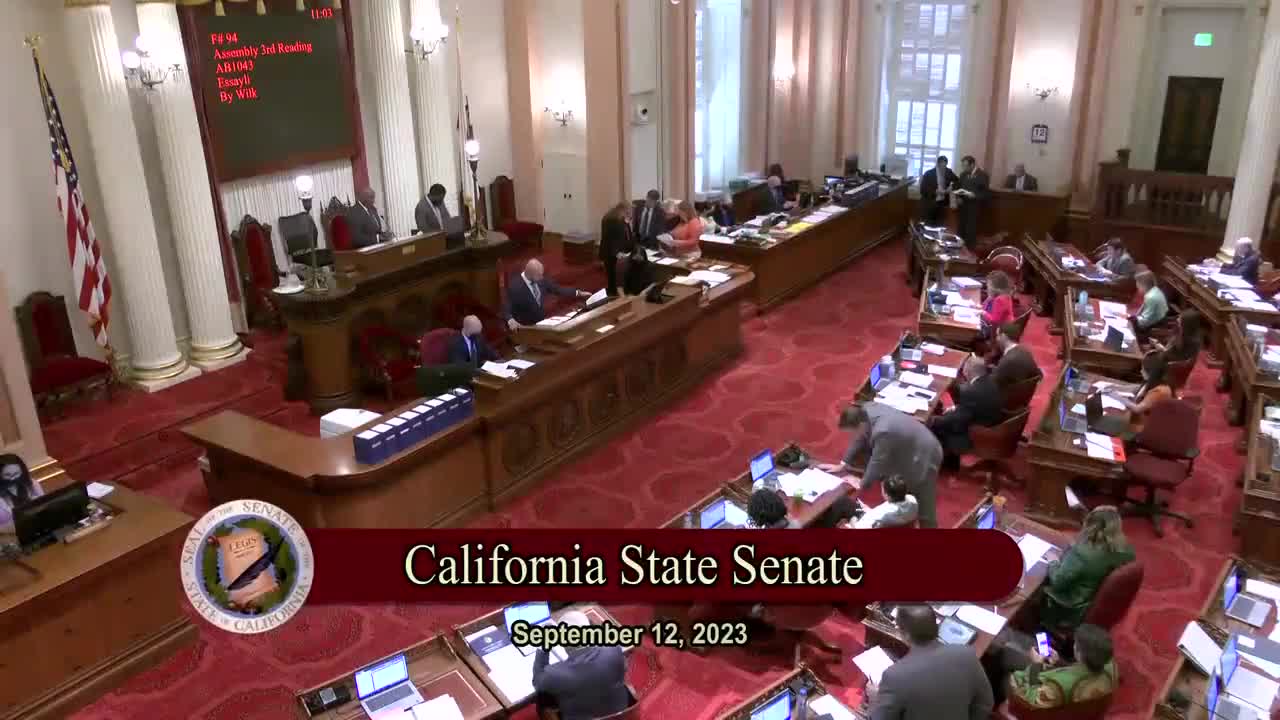


Bill Co-Author(s):
