AB 735: Workforce development: utility careers.
- Session Year: 2023-2024
- House: Assembly
- Latest Version Date: 2023-02-13
Current Status:
Failed
(2024-02-01: From committee: Filed with the Chief Clerk pursuant to Joint Rule 56.)
Introduced
In Committee
First Chamber
In Committee
Second Chamber
Enacted
(1)Existing law, the California Workforce Innovation and Opportunity Act, requires the California Workforce Development Board to assist the Governor in the development of a high road economy that offers an educated and skilled workforce with fair compensation and treatment in the workplace. In this regard, existing law requires the board to assist in the administration, promotion, and expansion of, as well as field assistance for, high road training partnerships, as defined.
This bill would establish the High Road Utility Careers (HRUC) program, to be administered by the board, to connect existing resources with individuals interested in careers in the utility sector and ensure a continued reliable workforce for California utilities. The bill would require the board to administer the HRUC program through partnerships with statewide water, wastewater, and energy utility associations and to coordinate the program with existing and future programs and initiatives administered by the board, including high road training partnerships, in order to align interested individuals with available resources. The bill would require the HRUC program, upon appropriation by the Legislature, to dedicate funding and resources toward accomplishing specified goals, including connecting workers to high-quality jobs or entry-level work with defined routes to advancement and increasing skills and opportunities while expanding pipelines for low-income populations.
(2)Existing law requires the State Department of Education to develop a career guidance model for science and technology for use in school district counseling programs in order to provide information to pupils in grades 7 through 12, regarding the potential for employment, educational requirements, and other matters pertaining to careers in the fields of science and technology.
This bill would require the department, by January 1, 2025, to partner with regional and statewide trade associations, among other groups, to develop and distribute informational materials for career guidance to pupils in grades 9 through 12, regarding the potential for employment, educational requirements, and other matters pertaining to careers in these utilities.
No later than January 1, 2025, the State Department of Education shall partner with regional and statewide trade associations and industry groups for water, wastewater, and electric utilities, and with vocational training programs offered through unions and nonprofit, community-based organizations, to develop and distribute informational materials for career guidance to pupils in grades 9 through 12, regarding the potential for employment, educational requirements, and other matters pertaining to careers in these utilities. Interested pupils shall be directed to the Employment Development Department for potential placement in utility jobs.
SEC. 2.Section 14005 of the Unemployment Insurance Code is amended to read:14005.For purposes of this division:
(a)Board means the California Workforce Development Board.
(b)Agency means the Labor and Workforce Development Agency.
(c)Career pathways, career ladders, or career lattices are an identified series of positions, work experiences, or educational benchmarks or credentials with multiple access points that offer occupational and financial advancement within a specified career field or related fields over time. Career pathways, career ladders, and career lattices offer combined programs of rigorous and high-quality education, training, and other services that do all of the following:
(1)Align with the skill needs of industries in the economy of the state or regional economy involved.
(2)Prepare an individual to be successful in any of a full range of secondary or postsecondary education options, including apprenticeships registered under the National Apprenticeship Act of 1937 (29 U.S.C. Sec. 50 et seq.), except as in Section 3226 of Title 29 of the United States Code.
(3)Include counseling to support an individual in achieving the individuals education and career goals.
(4)Include, as appropriate, education offered concurrently with and in the same context as workforce preparation activities and training for a specific occupation or occupational cluster.
(5)Organize education, training, and other services to meet the particular needs of an individual in a manner that accelerates the educational and career advancement of the individual to the extent practicable.
(6)Enable an individual to attain a secondary school diploma or its recognized equivalent, and at least one recognized postsecondary credential.
(7)Help an individual enter or advance within a specific occupation or occupational cluster.
(d)Cluster-based sector strategies mean methods of focusing workforce and economic development on those sectors that have demonstrated a capacity for economic growth and job creation in a particular geographic area.
(e)Data driven means a process of making decisions about investments and policies based on systematic analysis of data, which may include data pertaining to labor markets.
(f)Economic security means, with respect to a worker, earning a wage sufficient to support a family adequately, and, over time, to save for emergency expenses and adequate retirement income, based on factors such as household size, the cost of living in the workers community, and other factors that may vary by region.
(g)Evidence-based means making use of policy research as a basis for determining best policy practices. Evidence-based policymakers adopt policies that research has shown to produce positive outcomes, in a variety of settings, for a variety of populations over time. Successful, evidence-based programs deliver quantifiable and sustainable results. Evidence-based practices differ from approaches that are based on tradition, belief, convention, or anecdotal evidence.
(h)High-priority occupations mean occupations that have a significant presence in a targeted industry sector or industry cluster, are in demand, or projected to be in demand, by employers, and pay or lead to payment of a wage that provides economic security.
(i)(1)In-demand industry sector or occupation means either of the following:
(A)An industry sector that has a substantial current or potential impact, including through jobs that lead to economic self-sufficiency and opportunities for advancement, on the state, regional, or local economy, as appropriate, and that contributes to the growth or stability of other supporting businesses, or the growth of other industry sectors.
(B)An occupation that currently has or is projected to have a number of positions, including positions that lead to economic self-sufficiency and opportunities for advancement, in an industry sector so as to have a significant impact on the state, regional, or local economy, as appropriate.
(2)The determination of whether an industry sector or occupation is in-demand under this subdivision shall be made by the board or local board, or through the regional planning process in which local boards participate under the Workforce Innovation and Opportunity Act, as appropriate, using state and regional business and labor market projections, including the use of labor market information.
(j)Individual with employment barriers means an individual with any characteristic that substantially limits an individuals ability to obtain employment, including indicators of poor work history, lack of work experience, or access to employment in nontraditional occupations, long-term unemployment, lack of educational or occupational skills attainment, dislocation from high-wage and high-benefit employment, low levels of literacy or English proficiency, disability status, or welfare dependency, including members of all of the following groups:
(1)Displaced homemakers.
(2)Low-income individuals.
(3)Indians, Alaska Natives, and Native Hawaiians, as those terms are defined in Section 3221 of Title 29 of the United States Code.
(4)Individuals with disabilities, including youths who are individuals with disabilities.
(5)Older individuals.
(6)Ex-offenders.
(7)Homeless individuals, as defined in Section 14043e-2(6) of Title 42 of the United States Code, or homeless children and youths, as defined in Section 11434a(2) of Title 42 of the United States Code.
(8)Youth who are in, or have aged out of, the foster care system.
(9)Individuals who are English language learners, individuals who have low levels of literacy, and individuals facing substantial cultural barriers.
(10)Eligible migrant and seasonal farmworkers, as defined in Section 3322(i) of Title 29 of the United States Code.
(11)Individuals within two years of exhausting lifetime eligibility under Part A of Title IV of the Social Security Act (42 U.S.C. Sec. 601 et seq.).
(12)Single parents, including single, pregnant women.
(13)Long-term unemployed individuals.
(14)Transgender and gender nonconforming individuals.
(15)Any other groups as the Governor determines to have barriers to employment.
(k)Industry cluster means a geographic concentration or emerging concentration of interdependent industries with direct service, supplier, and research relationships, or independent industries that share common resources in a given regional economy or labor market. An industry cluster is a group of employers closely linked by common product or services, workforce needs, similar technologies, and supply chains in a given regional economy or labor market.
(l)Industry or sector partnership means a workforce collaborative, convened or acting in partnership with the board or a local board, that does the following:
(1)Organizes key stakeholders in an industry cluster into a working group that focuses on the shared goals and human resources needs of the industry cluster and that includes, at the appropriate stages of development of the partnership:
(A)Representatives of multiple businesses or other employers in the industry cluster, including small and medium-sized employers when practicable.
(B)One or more representatives of a recognized state labor organization or central labor council, or another labor representative, as appropriate.
(C)One or more representatives of an institution of higher education with, or another provider of, education or training programs that support the industry cluster.
(2)The workforce collaborative may include representatives of any of the following:
(A)State or local government.
(B)State or local economic development agencies.
(C)State boards or local boards, as appropriate.
(D)A state workforce agency or entity providing employment services.
(E)Other state or local agencies.
(F)Business or trade associations.
(G)Economic development organizations.
(H)Nonprofit organizations, community-based organizations, or intermediaries.
(I)Philanthropic associations.
(J)Industry associations.
(K)Other organizations, as determined to be necessary by the members comprising the industry sector or partnership.
(m)Industry sector means those firms that produce similar products or provide similar services using somewhat similar business processes, and are closely linked by workforce needs, within a regional labor market.
(n)Local labor federation means a central labor council that is an organization of local unions affiliated with the California Labor Federation or a local building and construction trades council affiliated with the State Building and Construction Trades Council of California.
(o)Sector strategies means methods of prioritizing investments in competitive and emerging industry sectors and industry clusters on the basis of labor market and other economic data indicating strategic growth potential, especially with regard to jobs and income, and exhibit the following characteristics:
(1)Focus workforce investment in education and workforce training programs that are likely to lead to jobs providing economic security or to an entry-level job with a well-articulated career pathway into a job providing economic security.
(2)Effectively boost labor productivity or reduce business barriers to growth and expansion stemming from workforce supply problems, including skills gaps and occupational shortages by directing resources and making investments to plug skills gaps and provide education and training programs for high-priority occupations.
(3)May be implemented using articulated career pathways or lattices and a system of stackable credentials.
(4)May target underserved communities, disconnected youths, incumbent workers, and recently separated military veterans.
(5)Frequently are implemented using industry or sector partnerships.
(6)Typically are implemented at the regional level where sector firms, those employers described in subdivisions (j) and (l), often share a common labor market and supply chains. However, sector strategies may also be implemented at the state or local level depending on sector needs and labor market conditions.
(p)Workforce Innovation and Opportunity Act of 2014 means the federal act enacted as Public Law 113-128.
(q)(1)Earn and learn includes, but is not limited to, a program that does either of the following:
(A)Combines applied learning in a workplace setting with compensation allowing workers or students to gain work experience and secure a wage as they develop skills and competencies directly relevant to the occupation or career for which they are preparing.
(B)Brings together classroom instruction with on-the-job training to combine both formal instruction and actual paid work experience.
(2)Earn and learn programs include, but are not limited to, all of the following:
(A)Apprenticeships.
(B)Preapprenticeships.
(C)Incumbent worker training.
(D)Transitional jobs, as described in paragraph (5) of subsection (d) of Section 3174 of Title 29 of the United States Code, as that section read on January 1, 2021, and subsidized employment with an employer of record, which may include, but not be limited to, an employment social enterprise or a worker cooperative, particularly for individuals with barriers to employment.
(E)Paid internships and externships.
(F)Project-based compensated learning.
(r)High road means a set of economic and workforce development strategies to achieve economic growth, economic equity, shared prosperity and a clean environment. The strategies include, but are not limited to, interventions that:
(1)Improve job quality and job access, including for women and people from underserved and underrepresented populations.
(2)Meet the skill and profitability needs of employers.
(3)Meet the economic, social, and environmental needs of the community.
(s)High road training partnership means an initiative or project that models strategies for developing industry-based, worker-focused training partnerships, including labor-management partnerships. High Road Training partnerships operate via regional, industry- or sector-based training partnerships comprised of employers, workers, and their representatives including organized labor, community-based organizations, education, training, and social services providers, and labor market intermediaries. High Road Training partnerships demonstrate job quality standards and employment practices that include, but are not limited to, the following:
(1)Provision of comparatively good wages and benefits, relative to the industry, occupation, and labor market in which participating workers are employed.
(2)Payment of workers at or above local or regional living wage standards as well as payment at or above regional prevailing wage standards where such standards exist for the occupations in question.
(3)A history of investment in employee training, growth, and development.
(4)Provision of opportunities for career advancement and wage growth.
(5)Safe and healthy working conditions.
(6)Consistent compliance with workplace laws and regulations, including proactive efforts to remedy past problems.
(7)Adoption of mechanisms to include worker voice and agency in the workplace.
(t)High road construction careers are high road training partnerships that invest in regional training partnerships comprised of local building trades councils, workforce, community, and education interests that connect to state-approved apprenticeship programs, that utilize the standard Multi-Craft Core preapprenticeship training curriculum and provide a range of supportive services and career placement assistance to women and people from underserved and underrepresented populations.
(u)Career advancement means demonstrated progression along a career ladder as evidenced by both wage growth and occupational advancement.
(v)Employment social enterprise means a nonprofit or for-profit organization that meets all of the following requirements:
(1)Is organized as a social purpose corporation or a benefit corporation, or as an organization incorporated within a larger organization.
(2)Demonstrates evidence of a mission to provide and to access employment and social supports with on-the-job and life skills training to a direct labor force comprised of individuals with a barrier to employment, as that phrase is defined in Section 3102 of Title 29 of the United States Code, as that section read on January 1, 2021.
(3)Is evidence-based and utilizes data-driven policies in implementing procedures and measuring outcomes.
(4)Produces or assembles goods or provides services, or a combination of both.
(w)Worker cooperative has the same meaning as defined in Section 12253.5 of the Corporations Code.
(x)High Road Utility Careers program or HRUC means the program established in Article 5 (commencing with Section 14050) of Chapter 3.
SEC. 3.Article 5 (commencing with Section 14050) is added to Chapter 3 of Division 7 of the Unemployment Insurance Code, to read:5.High Road Utility Careers Program14050.For purposes of this article, the following definitions apply:
(a)California Workforce Development Board or board means the California Workforce Development Board established pursuant to Article 1 (commencing with Section 14010).
(b)HRUC program or HRUC means the High Road Utility Careers program.
(c)Utilities includes private and public entities that provide electric, gas, water, wastewater, sewer, trash, recycled water, or telecommunication services in California.
14051.(a)There is hereby established the High Road Utility Careers program, to be administered by the California Workforce Development Board.
(b)The primary purpose of HRUC is to connect existing resources with individuals interested in careers in the utility sector and to ensure a continued reliable workforce for California utilities.
(c)For purposes of administering the HRUC, the board shall do all of the following:
(1)Administer the HRUC program through partnerships with statewide water, wastewater, and energy utility associations. The board shall coordinate, where possible, and share resources, tools, and information with these partners.
(2)Coordinate the HRUC program with existing and future programs and initiatives administered by the board, including high road training partnerships and the Breaking Barriers to Employment Initiative, in order to align interested individuals with available resources.
(3)Partner with public schools, including, but not limited to, high schools, technical colleges, community colleges, universities, and continuing education schools to promote career placement in the utility sector.
14052.The HRUC program shall do all of the following:
(a)Partner with regional and state trade associations, industry groups, vocational training programs offered through nonprofit, community-based organizations, and unions to promote training on essential job duties required for working in utilities and on diversity, equity, and inclusion. The board shall partner with public schools, including, but not limited to, high schools, technical colleges, community colleges, universities, and continuing education schools to promote career placement in the utility sector.
(b)Prioritize supportive services and career placement assistance to people from underserved and underrepresented populations.
(c)Provide individuals interested in employment within the utility sector with the services needed to enter, participate in, and complete broader workforce preparation, training, and education programs, and, ultimately, to obtain and retain employment.
(d)Build systems and policies to advance equity, access to skills and economic opportunity, and job quality.
(e)Through a network of trainings, workshops, classes, and presentations, seek to educate the potential workforce on regional and statewide opportunities in utility work.
(f)(1)Seek to create regional partnerships across California with utility members.
(2)These regional partnerships shall work together to collect existing content, and create new content, to reach potential candidates with an emphasis on diversity, equity, and inclusion.
14053.Upon appropriation by the Legislature for this express purpose, the HRUC program shall dedicate funding and resources toward accomplishing all of the following goals:
(a)Connecting workers to high-quality jobs or entry-level work with defined routes to advancement.
(b)Increasing skills and opportunities while expanding pipelines for low-income populations.
(c)Prioritizing upward mobility for residents of low-income communities.
(d)Addressing worker, employer, and industry needs.
(e)Developing workforce development programs or providing research, planning, and development, or both.
(f)Connecting workers to existing resources and services.
(g)Developing regional strategies to support workers and communities in adapting to and creating new workforce opportunities.
|
Date
|
Status
|
|---|---|
| Feb 1, 2024 | From committee: Filed with the Chief Clerk pursuant to Joint Rule 56. |
| Jan 31, 2024 | Died pursuant to Art. IV, Sec. 10(c) of the Constitution. |
| May 18, 2023 | In committee: Held under submission. |
| May 10, 2023 | In committee: Set, first hearing. Referred to APPR. suspense file. |
| Apr 27, 2023 | From committee: Do pass and re-refer to Com. on APPR. (Ayes 7. Noes 0.) (April 26). Re-referred to Com. on APPR. |
| Feb 23, 2023 | Referred to Com. on L. & E. |
| Feb 14, 2023 | From printer. May be heard in committee March 16. |
| Feb 13, 2023 | Read first time. To print. |
|
Date
|
Description
|
Location
|
Votes
|
|
|---|---|---|---|---|
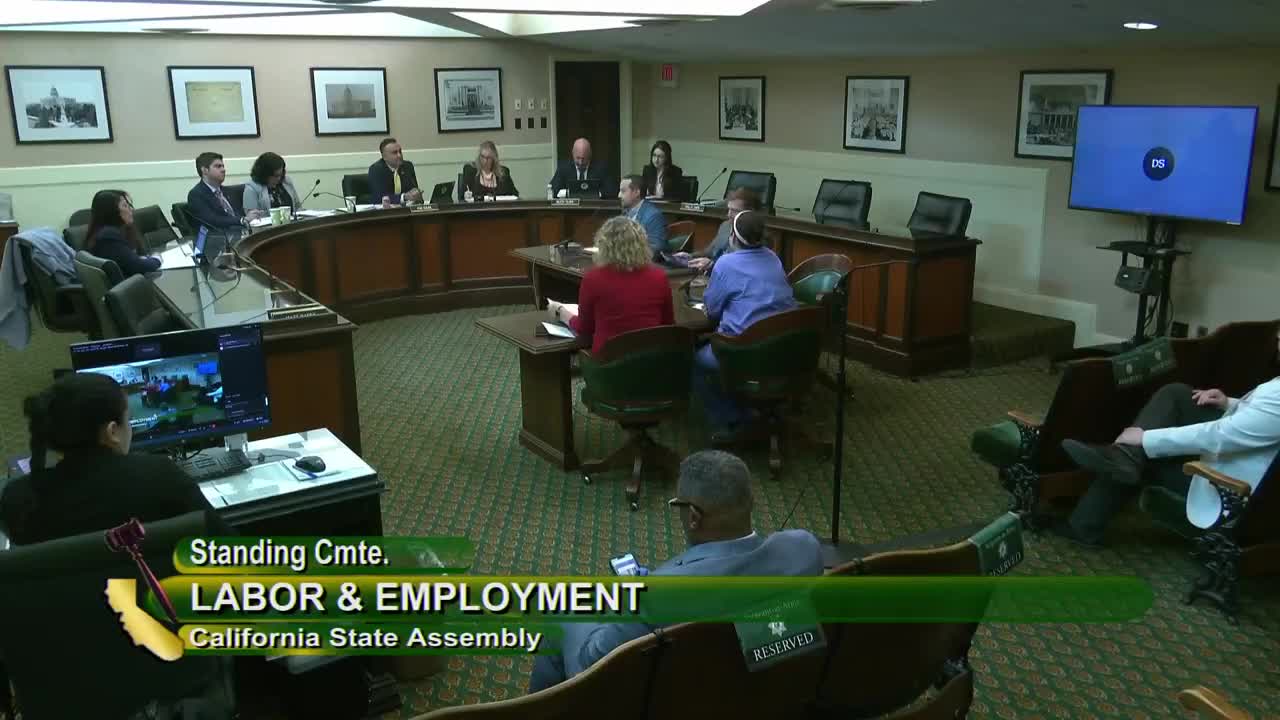
| Apr 26, 2023 | Do pass and be re-referred to the Committee on [Appropriations] | Assembly Standing Committee on Labor and Employment |
Passed |
This list shows positions taken on this bill by organizations on the date displayed, which is linked to the original source.
Positions by individuals are not included.
|
Organization
|
Position
|
Date
|
|---|---|---|
| Association Of California Water Agencies | ** Support | |
| Burbank Water and Power | ** Support | |
| California Municipal Utilities Association | ** Support | |
| California Special Districts Association | ** Support | |
| California State Association Of Counties | ** Support | |
| City Of Palo Alto | ** Support | |
| City of Roseville | ** Support | |
| City of Sacramento Department of Utilities | ** Support | |
| Edison International And Affiliates, Including Southern California Edison | ** Support | |
| Imperial Irrigation District | ** Support | |
| Irvine Ranch Water District | ** Support | |
| League Of California Cities | ** Support | |
| Rancho California Water District | ** Support | |
| Sacramento Municipal Utility District | ** Support | |
| San Diego County Water Authority | ** Support | |
| Santa Clara Valley Water District | ** Support |
Date of Hearing: May 10, 2023
ASSEMBLY COMMITTEE ON APPROPRIATIONS
Chris Holden, Chair
ABPCA Bill Id:AB 735
Author:(Berman) – As Introduced Ver:February 13, 2023
Policy Committee: | Labor and Employment | Vote: | 7 - 0 |
|
| ||
|
|
Urgency: No State Mandated Local Program: No Reimbursable: No
SUMMARY:
This bill establishes the High Road Utility Careers (HRUC) program administered by the California Workforce Development Board (CWDB) to connect existing resources with individuals interested in careers in the utilities sector.
Specifically, this bill:
- Requires the CWDB to: (a) administer HRUC through partnerships with specified statewide utilities associations, (b) coordinate HRUC with existing and future programs and initiatives administered by CWDB, including high road training partnerships and the Breaking Barriers to Employment Initiative, and (c) partner with public schools to promote utilities careers.
- Requires, upon appropriation, HRUC to dedicate funding and resources toward accomplishing specified goals, including connecting workers to high-quality jobs or entry-level work with defined routes to advancement.
- Requires, by January 1, 2025, the State Department of Education (CDE) to partner with specified statewide and regional utilities trade associations and industry groups, as well as vocational training programs, to develop and distribute career guidance informational materials for high school pupils regarding utilities careers.
- Requires interested pupils to be directed to the Employment Development Department (EDD) for potential placement in utilities jobs.
FISCAL EFFECT:
- One-time General Fund (GF) costs of at least $208,000 to CWDB to administer HRUC, as specified. Additionally, GF cost pressures of an unknown amount to appropriate funds to CWDB so HRUC can dedicate funding and resources toward specified goals.
- Minor and absorbable costs to CDE to partner with utilities groups and vocational training programs to develop and distribute specified career guidance materials.
- Absorbable costs to EDD to provide job placement services to high school students through EDD’s Employment Services program. Additionally, EDD processes and executes contracts for CWDB-administered grant programs. To the extent HRUC receives an appropriation to dedicate funding and resources toward accomplishing specified goals, which would likely be in the form of a grant program, EDD would incur costs of approximately $6,000 per new contract agreement. The total costs depend on the amount of funds appropriated and number of contract agreements awarded by CWDB.
COMMENTS:
- Purpose. According to the author, HRUC will be similar to the CWDB’s High Road Construction Careers program and is needed because “California electric and gas utilities, water and wastewater agencies, and telecommunication providers are facing a critical wave of retirements, workforce shortages, and growing demand for a skilled utility workforce.”
- Support and Opposition. This bill is sponsored by the California Municipal Utilities Association, which argues “This bill will create the much-needed pipeline to guide prospective workers to obtain the training and skillset for employment within the utility sector.” This bill is also supported by various cities and utilities providers.
This bill is opposed by the Californians for Equal Rights Foundation, which argues HRUC would “connect existing resources with individuals from certain favored groups” and thus “violate California’s constitutional principle of equal treatment for all.”
- High-Road Training Partnerships (HRTP) Initiative. CWDB has developed a number of HRTP initiatives in sectors ranging from hospitality, healthcare, distribution and logistics, and more. The industry-based, worker-focused training partnerships build skills for California’s “high-road” employers – firms that compete based on quality of product and service achieved through investment in human capital where workers have agency and voice. High-road construction careers are HRTPs investing in training partnerships comprised of local building trade councils and workforce, community, and education interests that: (a) connect to state-approved apprenticeship programs; (b) utilize a pre-apprenticeship training curriculum; and (c) provide a range of supportive services and career placement assistance to women and people from underserved and underrepresented populations.
This bill establishes HRUC to connect existing resources with individuals interested in careers in the utility sector, including partnering with public schools to promote utilities careers. While this bill defines “utilities” to include private and public entities that provide electric, gas, water, wastewater, sewer, trash, recycled water, or telecommunication services in California, other provisions of the bill only specify HRUC partnerships with water, wastewater, and energy utility associations. Addressing this discrepancy and further refining other provisions of this bill will help clarify HRUC implementation.
Analysis Prepared by: Irene Ho / APPR. / (916) 319-2081
Date of Hearing: April 26, 2023
ASSEMBLY COMMITTEE ON LABOR AND EMPLOYMENT
Ash Kalra, Chair
ABPCA Bill Id:AB 735 (
Author:Berman) – As Introduced Ver:February 13, 2023
SUBJECT: Workforce development: utility careers
SUMMARY: Establishes the High Road Utility Careers (HRUC) program, to be administered by the California Workforce Development Board (CWDB), to connect existing resources with individuals interested in careers in the utility sector and to ensure a continued reliable workforce for California utilities. Upon appropriation by the Legislature, the HRUC program shall dedicate funding toward the accomplishment of a number of goals, including connecting workers to high-quality jobs or entry-level work with defined routes to advancement. Specifically, this bill:
- Requires the California Department of Education (CDE), no later than January 1, 2025, to partner with regional and statewide trade associations and industry groups for water, wastewater, and electric utilities, and with vocational training programs offered through unions and nonprofit, community-based organizations, to develop and distribute informational materials for career guidance to pupils in grades 9 through 12, regarding the potential for employment, educational requirements, and other matters pertaining to these careers.
- States that “utilities” includes private and public entities that provide electric, gas, water, wastewater, sewer, trash, recycled water, or telecommunication services in California.
- Establishes the HRUC program, to be administered by the CWDB.
- States that the primary purpose of the HRUC is to connect existing resources with individuals interested in careers in the utility sector and to ensure a continued reliable workforce for California utilities.
- Requires the CWDB, for purposes of administering the HRUC, to do all of the following:
- Administer the HRUC program through partnerships with statewide water, wastewater, and energy utility associations. The CWDB shall coordinate, where possible, and share resources, tools, and information with these partners.
- Coordinate the HRUC program with existing and future programs and initiatives administered by the CWDB, including high road training partnerships and the Breaking Barriers to Employment Initiative, in order to align interested individuals with available resources.
- Partner with public schools, including, but not limited to, high schools, technical colleges, community colleges, universities, and continuing education schools to promote career placement in the utility sector.
- Requires the HRUC Program to do all of the following:
- Partner with regional and state trade associations, industry groups, vocational training programs offered through nonprofit, community-based organizations, and unions to promote training on essential job duties required for working in utilities and on diversity, equity, and inclusion.
- Prioritize supportive services and career placement assistance to people from underserved and underrepresented populations.
- Provide individuals interested in employment within the utility sector with the services needed to enter, participate in, and complete broader workforce preparation, training, and education programs, and, ultimately, to obtain and retain employment.
- Build systems and policies to advance equity, access to skills and economic opportunity, and job quality.
- Through a network of trainings, workshops, classes, and presentations, seek to educate the potential workforce on regional and statewide opportunities in utility work.
- Seek to create regional partnerships across California with utility members. These regional partnerships shall work together to collect existing content, and create new content, to reach potential candidates with an emphasis on diversity, equity, and inclusion.
- Requires the HRUC program, upon appropriation by the Legislature, to dedicate funding and resources toward accomplishing all of the following goals:
- Connecting workers to high-quality jobs or entry-level work with defined routes to advancement.
- Increasing skills and opportunities while expanding pipelines for low-income populations.
- Prioritizing upward mobility for residents of low-income communities.
- Addressing worker, employer, and industry needs.
- Developing workforce development programs or providing research, planning, and development, or both.
- Connecting workers to existing resources and services.
- Developing regional strategies to support workers and communities in adapting to and creating new workforce opportunities.
EXISTING LAW:
- Establishes the Workforce Innovation and Opportunity Act (WIOA) of 2014 in order to help job seekers access employment, education, training, and support services to succeed in the labor market and to match employers with skilled workers. WIOA coordinates employment and training services for adults, dislocated workers, and youth through grants to states that are implemented at the state and local level. 29 U.S.C. § 3101 et seq.
- Establishes CWDB as the body responsible for assisting the Governor in the development, oversight, and continuous improvement of California’s workforce investment system and the alignment of the education and workforce investment systems to the needs of the 21st century economy and workforce. Unemp. Ins. Code, § 14010 et seq.
- Defines “high road” for purposes of workforce development to mean a set of economic and workforce development strategies to achieve economic growth, economic equity, shared prosperity and a clean environment. The strategies include, but are not limited to, interventions that:
- Improve job quality and job access, including for women and people from underserved and underrepresented populations.
- Meet the skill and profitability needs of employers.
- Meet the economic, social, and environmental needs of the community. Unemp. Ins. Code 14005 (r).
FISCAL EFFECT: Unknown
COMMENTS: The current workforce pipeline for utilities is inadequate. A 2022 national survey of water professionals conducted by the American Water Works Association found that “the water sector is increasingly challenged by a shortage of qualified professionals due largely to the number of highly-experienced and trained workers who are retiring or have made changes due to the pandemic.[1]” The electricity sector has similar challenges for maintaining a skilled workforce. According to a 2017 report by the U.S. Department of Energy, “new technologies require new and evolving skillsets for industry employees as high levels of retirees take with them industry experience, and regional mismatches are emerging between the needed and available workforce. These changes could create skills gaps for the industry and workforce, as well as recruitment challenges in attracting appropriately trained and qualified employees.[2]”
According to the author, “California electric and gas utilities, water and wastewater agencies, and telecommunication providers are facing a critical wave of retirements, workforce shortages, and growing demand for a skilled utility workforce. Utilities must build a sustainable workforce pipeline for prospective and existing workers in order to make progress on California’s clean energy goals, maintain reliable water service, and create more resilient infrastructure, among other essential services provided by the utilities sector. AB 735 would create a statewide approach to address workforce challenges for the utility sector: a High Road Utility Careers program at the California Workforce Development Board. Similar to the Workforce Development Board’s High Road Construction Careers program, the High Road Utility Careers program will prioritize supportive services and career placement assistance to individuals from underserved populations. The program will create partnerships with regional and state trade associations, industry groups, vocational training programs offered through nonprofit, community-based organizations, and unions. It will also educate the potential workforce through a network of trainings, workshops, classes, and presentations on regional and statewide opportunities in the utility workforce.”
The author further states, “AB 735 seeks to prioritize underserved and underrepresented communities by targeting information sharing with those communities. The Workforce Development Board has ongoing programs that are dedicated to ensuring equity and the High Road Utility Careers will follow these existing models. A workforce pipeline for prospective and existing workers, including those in underrepresented populations, is critical to meet workforce needs. The utility sector offers a wide range of high-quality career pathways in a stable and growing industry. Jobs in this sector typically provide sustainable salaries, health benefits, a retirement plan, and job security.”
Arguments in Support
The California Municipal Utilities Association, sponsor of the bill, states that AB 735 “will enable the utility sector to have a consistent workforce base to maintain utility projects and operations. Maintaining a workforce is one of the top issues facing utilities in California. Our members rely on their workforce to ensure they can continue to provide reliable water, wastewater, and electric services to their customers. This bill will create the much-needed pipeline to guide prospective workers to obtain the training and skillset for employment within the utility sector.”
Prior Legislation
AB 1111 (E. Garcia) Chapter 824, Statutes of 2017 established the Breaking Barriers to Employment Initiative administered by the CWDB with the purpose of creating a grant program to provide individuals with barriers to employment the services they need to enter, participate in, and complete broader workforce preparation, training, and education programs aligned with regional labor market needs.
REGISTERED SUPPORT / OPPOSITION:
Support
Association of California Water Agencies (ACWA)
Burbank Water and Power
California Municipal Utilities Association
California Special Districts Association
California State Association of Counties
City of Palo Alto
City of Roseville
City of Sacramento Department of Utilities
Edison International and Affiliates, Including Southern California Edison
Imperial Irrigation District
Irvine Ranch Water District
League of California Cities
Rancho California Water District
Sacramento Municipal Utility District
San Diego County Water Authority
Santa Clara Valley Water District
Opposition
None on file.
Analysis Prepared by: Megan Lane / L. & E. /
State of the Water Industry 2022, American Water Works Association, p. 13, found at: State of the Water Industry | American Water Works Association (awwa.org). ↑
U.S. Department of Energy, Quadrennial Energy Review: Transforming the Nation’s Electricity System, January 2017, p. 5-10. ↑
Discussed in Hearing
 4MIN
Assembly Standing Committee on Labor and Employment
Bill Author

Bill Co-Author(s):