AB 740: Department of General Services: drone cybersecurity.
- Session Year: 2023-2024
- House: Assembly
- Latest Version Date: 2023-03-09
Current Status:
Failed
(2024-02-01: Filed with the Chief Clerk pursuant to Joint Rule 56.)
Introduced
In Committee
First Chamber
In Committee
Second Chamber
Enacted
Existing law requires the Department of General Services to perform a variety of duties in connection with the acquisition of goods and services by state agencies, and requires the department to issue rules and regulations in administering its duties.
This bill would require the department, in consultation with the Chief of the Office of Information Security, to adopt rules and regulations, no later than by January 1, 2025, to ensure that each unmanned aircraft and unmanned aircraft system used by a government entity, as defined, in part, to include local governmental entities, for any purpose meet meets appropriate safeguards to ensure the confidentiality, integrity, and availability of any data collected, transmitted, or stored by that unmanned aircraft. By aircraft or unmanned aircraft system, as specified; and to specify requirements for a comprehensive plan to be adopted by a government entity to discontinue the use of noncompliant aircraft and systems, as specified.
This bill would, beginning on the date the department adopts the rules and regulations, authorize a government entity to use unmanned aircraft or unmanned aircraft systems it did not previously use only if that aircraft or system complies with those rules and regulations. The bill would, by July 1, 2025, require a government entity that uses a noncompliant aircraft or system to submit to the department a comprehensive plan for discontinuing its use, as specified.
By January 1, 2026, the bill would would, with certain exceptions, require any government entity to discontinue cease the use of unmanned aircraft or unmanned aircraft systems not in compliance with these regulations. The bill would require the regulations to apply to unmanned aircraft operated under contract between a government entity and a third party, as provided. By requiring these regulations to apply to local governmental agencies, this bill would establish a state-mandated local program.
The bill would include findings that changes proposed by this bill address a matter of statewide concern rather than a municipal affair and, therefore, apply to all cities, including charter cities.
The California Constitution requires the state to reimburse local agencies and school districts for certain costs mandated by the state. Statutory provisions establish procedures for making that reimbursement.
This bill would provide that, if the Commission on State Mandates determines that the bill contains costs mandated by the state, reimbursement for those costs shall be made pursuant to the statutory provisions noted above.
Existing law requires the Department of General Services to perform a variety of duties in connection with the acquisition of goods and services by state agencies, and requires the department to issue rules and regulations in administering its duties.
This bill would require the department, in consultation with the Chief of the Office of Information Security, to adopt rules and regulations, no later than January 1, 2025, to ensure that unmanned aircraft used by a government entity, as defined, in part, to include local governmental entities, for any purpose meet appropriate safeguards to ensure the confidentiality, integrity, and availability of any data collected, transmitted, or stored by that unmanned aircraft. By January 1, 2026, the bill would require any government entity to discontinue the use of unmanned aircraft not in compliance with these regulations. The bill would require the regulations to apply to unmanned aircraft operated under contract between a government entity and a third party, as provided. By requiring these regulations to apply to local governmental agencies, this bill would establish a state-mandated local program.
The bill would include findings that changes proposed by this bill address a matter of statewide concern rather than a municipal affair and, therefore, apply to all cities, including charter cities.
The California Constitution requires the state to reimburse local agencies and school districts for certain costs mandated by the state. Statutory provisions establish procedures for making that reimbursement.
This bill would provide that, if the Commission on State Mandates determines that the bill contains costs mandated by the state, reimbursement for those costs shall be made pursuant to the statutory provisions noted above.
(a)As used in this section, the following terms apply:
(1)Government entity includes state agencies, the California State University, cities, counties, cities and counties, and political subdivisions thereof. all of the following:
(A)Each state agency as that term is defined in subdivision (a) of Section 8557.
(B)The California State University.
(C)Each political subdivision, as that term is defined in subdivision (b) of Section 8557.
(2)Unmanned aircraft shall have has the same meanings meaning as under defined in Section 853.5.
(3)Unmanned aircraft system has the same meaning as defined in Section 853.5.
(b)No later than By January 1, 2025, the department, in consultation with the Chief of the Office of Information Security, shall adopt rules and regulations to ensure that do all of the following:
(1)Ensure that each unmanned aircraft and unmanned aircraft system used by a government entity for any purpose meet meets appropriate safeguards to ensure the confidentiality, integrity, and availability of any data collected, transmitted, or stored by that unmanned aircraft. The department may consult state and federal agencies and departments and any relevant federal guidance in developing these rules and regulations. aircraft or unmanned aircraft system. These safeguards shall, at a minimum, do all of the following:
(A)Prohibit the use of unmanned aircraft or unmanned aircraft systems that are manufactured by an entity identified pursuant to any of the following:
(i)Section 889 of the National Defense Authorization Act for Fiscal Year 2019.
(ii)The United States Department of Defense pursuant to Section 1260H of the National Defense Authorization Act for Fiscal Year 2021.
(iii)Section 817 of the National Defense Authorization Act for Fiscal Year 2023.
(B)Prohibit use of unmanned aircraft or unmanned aircraft systems that are manufactured by an entity included on the Entity List as designated by the United States Secretary of Commerce.
(C)Prohibit use of unmanned aircraft or unmanned aircraft systems that are manufactured by a subsidiary of an entity identified pursuant to subparagraph (A) or (B).
(D)Prohibit any government entity from selling, renting, leasing, or engaging in any other commercial transaction pursuant to which the government entity receives monetary or other valuable consideration for the data.
(E)Require collection, transmission, storage, processing, and use of the data to be conducted in a manner that is reasonably necessary and proportionate to the lawful purposes for which the data is collected, transmitted, stored, processed, or used.
(2)Specify requirements for a comprehensive plan to be adopted by a government entity to discontinue the use of unmanned aircraft and unmanned aircraft systems that are not in compliance with the rules and regulations adopted under paragraph (1). The requirements for the plan shall, at a minimum, include ensuring the confidentiality, integrity, and availability of data collected, transmitted, or stored by unmanned aircraft or unmanned aircraft systems, the use of which is discontinued under this section.
(c)The department may consult with state and federal agencies and departments and any relevant federal guidance in developing the rules and regulations under subdivision (b).
(c)(d)Beginning on the date the department adopts the rules and regulations under pursuant to paragraph (1) of subdivision (b), a government entity shall only may use an unmanned aircraft that or unmanned aircraft system it did not previously use only if that unmanned aircraft or unmanned aircraft system complies with all of the requirements set by those rules and regulations.
(d)(1)By July 1, 2025, a government entity that uses unmanned aircraft not in compliance with the rules and regulations shall submit to the department a comprehensive plan for discontinuing the use of the noncompliant unmanned aircraft.(2)The department shall adopt rules and regulations identifying the requirements of the comprehensive plan required under this subdivision, which shall include ensuring the confidentiality, integrity, and availability of any data collected, transmitted, or stored by unmanned aircraft, the use of which is discontinued under this section.(e)(1)By July 1, 2025, a government entity that uses an unmanned aircraft or unmanned aircraft system not in compliance with the rules and regulations adopted pursuant to paragraph (1) of subdivision (b) shall submit to the department a comprehensive plan that complies with the rules and regulations adopted pursuant to paragraph (2) of subdivision (b) for discontinuing the use of the noncompliant unmanned aircraft or unmanned aircraft system.
(3)(2)By January 1, 2026, each government entity shall discontinue cease the use of any unmanned aircraft or unmanned aircraft system that does not comply with the rules and regulations adopted under subdivision (b). Upon
(3)Upon approval by the department, each government entity that submitted a comprehensive plan under paragraph (1) shall execute that plan.
(e)(f)(1)The requirements of this section shall apply to unmanned aircraft and unmanned aircraft systems purchased or otherwise acquired by a government entity, as well as to unmanned aircraft and unmanned aircraft systems used by a government entity pursuant to a contractual arrangement or other agreement with a third party, regardless of whether the unmanned aircraft or unmanned aircraft systems is operated by the government entity or by the third party.
(2)This subdivision shall only apply to contracts entered into, amended, or renewed on or after the effective date of this section.
(g)Notwithstanding any other requirements of this section, use of unmanned aircraft or unmanned aircraft systems that would otherwise be prohibited under this section is permitted in either of the following circumstances:
(1)If, on application by a government entity, the department finds both of the following:
(A)The proposed use is necessary or essential for the government entity.
(B)No nonprohibited unmanned aircraft or unmanned aircraft system can fulfill the proposed use.
(2)The use is for purposes of cybersecurity research.
(h)The department shall prepare an annual report setting forth each finding made pursuant to paragraph (1) of subdivision (g) during that calendar year and submit the report to the Assembly Committee on Privacy and Consumer Protection and the Senate Committee on Judiciary by February 15 of the following year.
(i)The provisions of this section are severable. If any provision of this section or its application is held invalid, that invalidity shall not affect other provisions or applications that can be given effect without the invalid provision or application.
SEC. 2.The Legislature finds and declares that cybersecurity and the transmission of sensitive information is a matter of statewide concern and is not a municipal affair as that term is used in Section 5 of Article XI of the California Constitution. Therefore, Section 1 of this act Article 9 (commencing with Section 14718) to Chapter 2 of Part 5.5 of Division 3 of Title 2 of the Government Code applies to all cities, including charter cities.
SEC. 3.If the Commission on State Mandates determines that this act contains costs mandated by the state, reimbursement to local agencies and school districts for those costs shall be made pursuant to Part 7 (commencing with Section 17500) of Division 4 of Title 2 of the Government Code.
(a)As used in this section, the following terms apply:
(1)Government entity includes state agencies, the California State University, cities, counties, cities and counties, and political subdivisions thereof.
(2)Unmanned aircraft shall have the same meanings as under Section 853.5.
(b)No later than January 1, 2025, the department, in consultation with the Chief of the Office of Information Security, shall adopt rules and regulations to ensure that unmanned aircraft used by a government entity for any purpose meet appropriate safeguards to ensure the confidentiality, integrity, and availability of any data collected, transmitted, or stored by that unmanned aircraft. The department may consult state and federal agencies and departments and any relevant federal guidance in developing these rules and regulations.
(c)Beginning on the date the department adopts the rules and regulations under subdivision (b), a government entity shall only use an unmanned aircraft that complies with all of the requirements set by those rules and regulations.
(d)(1)By July 1, 2025, a government entity that uses unmanned aircraft not in compliance with the rules and regulations shall submit to the department a comprehensive plan for discontinuing the use of the noncompliant unmanned aircraft.
(2)The department shall adopt rules and regulations identifying the requirements of the comprehensive plan required under this subdivision, which shall include ensuring the confidentiality, integrity, and availability of any data collected, transmitted, or stored by unmanned aircraft, the use of which is discontinued under this section.
(3)By January 1, 2026, each government entity shall discontinue the use of any unmanned aircraft that does not comply with the rules and regulations adopted under subdivision (b). Upon approval by the department, each government entity that submitted a comprehensive plan under paragraph (1) shall execute that plan.
(e)(1)The requirements of this section shall apply to unmanned aircraft purchased or otherwise acquired by a government entity, as well as to unmanned aircraft used by a government entity pursuant to a contractual arrangement or other agreement with a third party, regardless of whether the unmanned aircraft is operated by the government entity or by the third party.
(2)This subdivision shall only apply to contracts entered into, amended, or renewed on or after the effective date of this section.
SEC. 2.The Legislature finds and declares that cybersecurity and the transmission of sensitive information is a matter of statewide concern and is not a municipal affair as that term is used in Section 5 of Article XI of the California Constitution. Therefore, Section 1 of this act Article 9 (commencing with Section 14718) to Chapter 2 of Part 5.5 of Division 3 of Title 2 of the Government Code applies to all cities, including charter cities.
SEC. 3.If the Commission on State Mandates determines that this act contains costs mandated by the state, reimbursement to local agencies and school districts for those costs shall be made pursuant to Part 7 (commencing with Section 17500) of Division 4 of Title 2 of the Government Code.
|
Date
|
Status
|
|---|---|
| Feb 1, 2024 | Filed with the Chief Clerk pursuant to Joint Rule 56. |
| Jan 31, 2024 | Died pursuant to Art. IV, Sec. 10(c) of the Constitution. |
| Apr 19, 2023 | In committee: Set, first hearing. Hearing canceled at the request of author. |
| Mar 22, 2023 | From committee: Do pass and re-refer to Com. on A. & A.R. (Ayes 11. Noes 0.) (March 21). Re-referred to Com. on A. & A.R. |
| Mar 13, 2023 | Re-referred to Com. on P. & C.P. |
| Mar 9, 2023 | From committee chair, with author's amendments: Amend, and re-refer to Com. on P. & C.P. Read second time and amended. |
| Mar 2, 2023 | Referred to Coms. on P. & C.P. and A. & A.R. |
| Feb 14, 2023 | From printer. May be heard in committee March 16. |
| Feb 13, 2023 | Read first time. To print. |
|
Date
|
Description
|
Location
|
Votes
|
|
|---|---|---|---|---|
| Mar 21, 2023 | Do pass and be re-referred to the Committee on [Accountability and Administrative Review] | Assembly Standing Committee on Privacy and Consumer Protection |
Passed |
This list shows positions taken on this bill by organizations on the date displayed, which is linked to the original source.
Positions by individuals are not included.
|
Organization
|
Position
|
Date
|
|---|---|---|
| Alameda County Sheriff's Office Unmanned Aerial Systems Team | ** Against | |
| Association for Uncrewed Vehicle Systems International | ** Support | |
| Association Of Orange County Deputy Sheriffs | ** Against | |
| California Fraternal Order of Police | ** Against | |
| California Police Chiefs Association | ** Against | |
| California Statewide Law Enforcement Association | ** Against | |
| Deputy Sheriffs Association of Monterey County | ** Against | |
| Dronedeploy | ** Against | |
| Long Beach Police Officers Association | ** Against | |
| Oakland Privacy | ** Support | |
| PLACER COUNTY DEPUTY SHERIFFS ASSOCIATION | ** Against | |
| Riverside Sheriffs' Association | ** Against | |
| Sacramento County Deputy Sheriffs' Association | ** Against | |
| san bernardino county sheriff's employees' benefit association | ** Against | |
| Skydio | ** Support | |
| Skydio, INC. | ** Support |
Date of Hearing: April 19, 2023
ASSEMBLY COMMITTEE ON ACCOUNTABILITY AND ADMINISTRATIVE REVIEW
Cottie Petrie-Norris, Chair
ABPCA Bill Id:AB 740 (
Author:Gabriel) – As Amended Ver:March 9, 2023
SUBJECT: Department of General Services: drone cybersecurity
SUMMARY: Directs the California Department of Technology to issue regulations establishing cybersecurity and privacy requirements for data collected by drones operated by state and local government entities. Specifically, this bill:
- Defines “government entity” to include all of the following:
- Any department, division, independent establishment, or agency of the executive branch of state government.
- The California State University.
- Any city, city and county, county, district, or other local governmental agency or public agency authorized by law.
- Requires the California Department of Technology (CDT), in consultation with the Chief of the Office of Information Security, to adopt regulations to ensure that each unmanned aircraft and unmanned aircraft system used by a government entity for any purpose meets appropriate safeguards to ensure the confidentiality, integrity, and availability of any data collected, transmitted, or stored by that unmanned aircraft or unmanned aircraft system.
- Provides that the regulations under 2) must, at minimum, do all of the following:
- Prohibit the use of unmanned aircraft or unmanned aircraft systems manufactured by an entity, or a subsidiary of an entity, identified pursuant to any of the following:
- Section 889 of the National Defense Authorization Act for Fiscal Year 2019.
- The United States Department of Defense pursuant to Section 1260H of the National Defense Authorization Act for Fiscal Year 2021.
- Section 817 of the National Defense Authorization Act for Fiscal Year 2023.
- The Entity List designated by the United States Secretary of Commerce.
- Prohibit any government entity from selling, renting, leasing, or engaging in any other commercial transaction pursuant to which the entity receives monetary or other valuable consideration for the data.
- Require collection, transmission, storage, processing, and use of the data to be conducted in a manner reasonably necessary and proportionate to the lawful purposes for which the data is collected, transmitted, stored, processed, or used.
- Prohibit the use of unmanned aircraft or unmanned aircraft systems manufactured by an entity, or a subsidiary of an entity, identified pursuant to any of the following:
- Further requires CDT, in consultation with the Chief of the Office of Information Security, to adopt rules and regulations specifying requirements for a comprehensive plan to be adopted by government entities to discontinue the use of unmanned aircraft and unmanned aircraft systems not in compliance with the regulations under 2).
- Specifies that the requirements for the comprehensive plan under 4) shall, at minimum, include ensuring the confidentiality, integrity, and availability of data collected, transmitted, or stored by discontinued unmanned aircraft or unmanned aircraft systems.
- Permits CDT to consult with state and federal agencies and departments, as well as any relevant federal guidance, in developing the regulations under 2) and 4).
- Specifies that the regulations under 2) and 4) must be adopted by January 1, 2025.
- Restricts a government entity, once the regulations under 2) are adopted, from using an unmanned aircraft or unmanned aircraft system it did not previously use—unless the aircraft or aircraft system complies with all of the requirements set by the regulations under 2).
- Requires, by July 1, 2025, each government entity that uses an unmanned aircraft or unmanned aircraft system that does not comply with the regulations under 2) to submit to CDT a comprehensive plan that complies with the regulations under 4). Further requires each government entity to execute this plan upon CDT approval.
- Requires, by January 1, 2026, each government entity to cease the use of any unmanned aircraft or unmanned aircraft system that does not comply with the regulations under 2).
- Clarifies that this bill applies to unmanned aircraft and unmanned aircraft systems (i) that a government entity purchases or otherwise acquires, as well as (ii) to those it uses through contract or other agreement with a third party. The bill also applies regardless of whether the government entity or the third party operates the drone.
- Permits a government entity to use an unmanned aircraft or unmanned aircraft system that would otherwise be prohibited under this bill under either of the following circumstances:
- If the government entity applies to CDT for an exception and CDT finds (i) that the proposed use is necessary or essential for the government entity and (ii) that no nonprohibited unmanned aircraft can fulfill the proposed use.
- For cybersecurity research.
- Includes a severability clause.
EXISTING LAW:
- Defines the following terms:
- “Unmanned aircraft” means an aircraft that is operated without the possibility of direct human intervention from within or on the aircraft. (Gov. Code § 853.5(a).)
- “Unmanned aircraft system” means an unmanned aircraft and associated elements, including but not limited to, communication links and the components that control the uncrewed aircraft, which are required for the pilot in command to operate safely and efficiently in the national airspace system. (Gov. Code § 853.5(b).)
- Establishes CDT in the Government Operations Agency (GovOps). (Gov. Code § 11545.)
- Establishes the Office of Information Security within CDT to ensure the confidentiality, integrity, and availability of state systems and applications, and to promote and protect privacy as part of the development and operations of state systems and applications to ensure the trust of the residents of this state. (Gov. Code § 11549.)
FISCAL EFFECT: Unknown, this bill has not been analyzed by a fiscal committee.
COMMENTS:
1) Background. Drones—termed “unmanned aircraft” and “unmanned aircraft systems” in the Government Code—are increasingly used by all levels of California government. For example:
- CalFire uses drones to help firefighters determine where to create containment lines when fighting wildfires. (Bouchot, How Cal Fire uses drones to fight wildfires KESQ News Channel 3 (June 15, 2022), available at https://kesq.com/news/2022/06/15/how-cal-fire-uses-drones-to-fight-wildfires/.)
- Caltrans uses dozens of drones for infrastructure inspection, and is looking into using drones and video imaging to assess “bridge damage and deploying emergency resources following a major quake.” (Cal. Dept. of Transportation, Bridge, Other Inspections Taking to the Skies, available at https://dot.ca.gov/programs/public-affairs/mile-marker/spring-2020/bridge-inspections-taking-to-the-skies.)
- The Chula Vista Police Department utilizes more than two dozen drones as part of a drone-as-first-responder program. (Sisson, Welcome to Chula Vista, where police drones respond to 911 calls, MIT Technology Review (Feb 27, 2023), available at https://www.technologyreview.com/2023/02/27/1069141/welcome-to-chula-vista-where-police-drones-respond-to-911-calls/.)
Yet, surprisingly, there are virtually no cybersecurity or privacy standards in place to govern the data obtained by government drones. In response, this bill would authorize CDT to issue regulations governing drones used by government entities in California. The regulations are meant to establish appropriate safeguards to ensure the confidentiality, integrity, and availability of data that is collected, transmitted, and stored by government-operated drones.
2) Author’s statement. According to the author:
The development of drone technology over the past decade has been extraordinary. Drones are now regularly used at all levels of state and local government, including for lifesaving functions like inspecting critical infrastructure and surveilling hostage situations.
While in operation, drones collect vast amounts of data—including audio, visual, and geospatial information—in the locations where they are operated. Yet the state lacks legal standards to govern the collection, transmission, storage, and usage of this data. If data regarding critical infrastructure, a law enforcement operation, or other sensitive information were to fall into the wrong hands, the consequences could be disastrous.
AB 740 will address the current lack of cybersecurity and privacy standards for government-operated drones.
3) What this bill would do. This bill would work as follows:
- By January 1, 2025, CDT will issue regulations meant to ensure the confidentiality, integrity, and availability of data collected, transmitted, and stored by government drones. The regulations, at a minimum, must ban the use of drones made by certain entities identified by the federal government; forbid government entities from selling drone data; and require that these entities collect, process, and use drone data in a manner that is reasonably necessary and proportionate to the lawful purposes for which it is collected. These regulations would apply to both state and local governmental entities.
- By January 1, 2025, CDT will issue regulations specifying requirements for governmental entities to adopt comprehensive plans to discontinue their use of non-compliant drones. Again, these regulations would be meant to ensure the confidentiality, integrity, and availability of data collected, transmitted, or stored by any discontinued drones.
- Once the regulations under #1 are adopted, a governmental entity that wants to use a drone it did not previously use may only use a drone that complies with these regulations.
If a governmental entity wishes to use a non-compliant drone, it may apply to CDT for an exception by showing the drone’s use is necessary or essential, and that no other drone can fulfill this purpose.
- By July 1, 2025, a governmenatal entity that uses a drone which does not comply with the regulations under #1 must submit a comprehensive plan to CDT (a plan that complies with the regulations under #2) for how it will discontinue use of the drone.
- By January 1, 2026, each governmental entity must discontinue use of non-compliant drones, and once its plan is approved by CDT, implement that plan.
4) Summary of federal prohibitions. Under this bill, CDT’s regulations would ban state and local governments from using drones manufactured by entities that are identified via the following federal legislation and/or agencies:
- Section 889 of the National Defense Authorization Act for Fiscal Year 2019 (2019 NDAA).
Section 889, which can be reviewed at https://www.congress.gov/bill/115th-congress/house-bill/5515, prohibits federal agencies and their contractors from acquiring telecommunications and/or video surveillance equipment and services produced or provided by five named Chinese companies and their subsidiaries or affiliates. It also prohibits such acquisitions from companies that the Secretary of Defense reasonably believes to be owned or controlled by, or otherwise connected to, the government of a “covered foreign country,” defined under the 2019 NDAA as China. (To date, the Secretary of Defense has not identified any companies meeting this criteria.)
- Section 1260H of the 2021 NDAA, as identified by the U.S. Department of Defense.
Section 1260H, which can be reviewed at https://www.congress.gov/bill/116th-congress/house-bill/6395, requires the Secretary of Defense to “identify each entity the Secretary determines, based on the most recent information available, is operating directly or indirectly in the United States or any of its territories and possessions, that is a Chinese military company,” as defined. The most recent list is available at https://media.defense.gov/2022/Oct/05/2003091659/-1/-1/0/1260H%20COMPANIES.PDF.
- Section 817 of the 2023 NDAA.
Section 817, which can be reviewed at https://www.congress.gov/bill/117th-congress/house-bill/7776, expands on Section 848 of the 2020 NDAA (not explicitly referenced in this bill, but which can be found at https://www.congress.gov/bill/116th-congress/senate-bill/1790). Section 848 prohibited the Department of Defense from procuring drones manufactured by entities in a “covered foreign country,” initially defined as China. Section 817 of the 2023 NDAA expands on this prohibition by adding certain drone manufacturers, including Da-Jiang Innovations (DJI) and its affiliates and subsidiaries, and entities on the U.S. Department of Commerce’s Consolidated Screening List, to the list of prohibited companies. Section 817 also adds Iran, Russia, and North Korea to the definition of “covered foreign country.”
- The U.S. Secretary of Commerce’s Entity List.
The Entity List “identifies entities for which there is reasonable cause to believe, based on specific and articulable facts, that the entities have been involved, are involved, or pose a significant risk of being or becoming involved in activities contrary to the national security or foreign policy interests of the United States.” (Additions and Revisions of Entities to the Entity List (Mar. 6, 2023) 88 FR 13673.)
5) Analysis of federal prohibitions. The main issue for this Committee is whether this bill strikes an appropriate balance between providing state and local governments the flexibility to utilize drones with needed capabilities, while simultaneously safeguarding vital information from being obtained by potential malefactors.
The basic problem lies with the People’s Republic of China (PRC) National Intelligence Law of 2017. As summarized by the United States Department of Homeland Security:
This law forms the baseline of the modern data collection regime, and compels all PRC firms and entities to support, assist, and cooperate with the PRC intelligence services, creating a legal obligation for those entities to turn over data collected abroad and domestically to the PRC. Article 7 of this law states “any organization or citizen shall support, assist and cooperate with the state intelligence work in accordance with the [National Intelligence] Law, and keep the secrets of the national intelligence work from becoming known to the public.” A PRC intelligence agency may request that any PRC firm or entity secretly share access to a U.S. business or individual’s data, or otherwise face penalties. In addition, the National Intelligence Law may compel PRC firms to create backdoors and other security vulnerabilities in equipment and software sold abroad so that the PRC government can easily access data not controlled by PRC firms. The law further establishes a system of incentives for compliance and penalties for non-compliance, stating that the PRC “commends and rewards individuals and organizations that have made significant contributions to national intelligence work” and that, “whoever… obstructs the state intelligence work organization and its staff from carrying out intelligence work according to law” shall be dismissed, investigated, and/or detained. (U.S. Dept. of Homeland Security, Data Security Business Advisory: Risks and Considerations for Businesses Using Data Services and Equipment from Firms Linked to the People’s Republic of China (Dec. 20, 2020), available at https://www.dhs.gov/sites/default/files/publications/20_1222_data-security-business-advisory.pdf [internal citations omitted] [emphasis added].)
In other words, the Chinese government has the legal ability to demand data from Chinese companies without any of the due process protections required under American law, and to require these companies to build in security vulnerabilities to facilitate data extraction.
The United States Cybersecurity & Infrastructure Security Agency (CISA) has published a series of reports on Chinese cyber attacks against the United States. Its findings are summarized as follows:
Malicious cyber activities attributed to the Chinese government targeted, and continue to target, a variety of industries and organizations in the United States, including healthcare, financial services, defense industrial base, energy, government facilities, chemical, critical manufacturing (including automotive and aerospace), communications, IT (including managed service providers), international trade, education, video gaming, faith-based organizations, and law firms. (CISA, China Cyber Threat Overview and Advisories, available at https://www.cisa.gov/china.)
The sources quoted above were published by federal agencies during both the Trump and Biden Administrations.
Da-Jiang Innovations (DJI), whose drones would be banned by this bill, is the world’s largest-selling manufacturer of consumer and commercial drones. (Asia Perspective, China’s Thriving Drone Industry (Jun. 9, 2021), available at https://www.asiaperspective.com/china-thriving-drone-industry/.) Recently, a bipartisan group of sixteen U.S. Senators sent a letter to CISA’s Director which provided:
We write today regarding the cybersecurity risks posed by the widespread use of drones manufactured by Shenzhen DJI Innovation Technology Co., Ltd. (“DJI”) to operators of critical infrastructure and state and local law enforcement in the United States. In short, we believe that given the company’s identified connections to the Chinese Communist Party (“CCP”), the use of its drones in such sensitive contexts may present an unacceptable security vulnerability. We ask that the [CISA] evaluate this concern and make the results of its evaluation available to the public through the National Cyber Awareness System. (https://www.warner.senate.gov/public/_cache/files/c/8/c8dbcd57-7d3c-4842-85f2-466dc2b70f66/B56DAFD9C216FD3E54239A3E14E281EF.final-2023.03.15-letter-to-cisa-re-dji.pdf)
German researchers recently found 16 security vulnerabilities in four DJI drone models; these included “bugs allow[ing] an attacker to gain extended access rights” and a finding that “transmitted data is not encrypted, and that practically anyone can read the location of the pilot and the drone with relatively simple methods.” (Weiler, Security vulnerabilities detected in drones made by DJI (Mar. 2, 2023), available at https://news.rub.de/english/press-releases/2023-03-02-it-security-security-vulnerabilities-detected-drones-made-dji.)
There are conflicting reports on whether DJI drones have been used to turn information over to the Chinese government. According to a recent article, “[C]laims [are] thus far unsubstantiated…that the firm’s [unmanned aerial vehicle] operating systems allow private, potentially sensitive user data to be transmitted to authorities in China’s government for exploitation.” (Crumley, German research finds security flaws in four leading DJI drones (Mar. 5, 2023) Drone DJ, available at https://dronedj.com/2023/03/05/german-research-finds-security-flaws-in-four-leading-dji-drones/.) That said, the Senate letter quoted above cites a 2017 U.S. Immigration and Customs Enforcement (ICE) report which claims:
[T]he Chinese government is likely using information acquired from DJI systems as a way to target assets they are planning to purchase. For instance, a large family-owned wine producer in California purchased DJI UAS to survey its vineyards and monitor grape production. Soon afterwards, Chinese companies began purchasing vineyards in the same area. According to the [source of information], it appeared the companies were able to use DJI data to their own benefit and profit. (ICE, Da Jiang Innovations (DJI) Likely Providing U.S. Critical Infrastructure and Law Enforcement Data to Chinese Government (Aug. 9, 2017), available at https://info.publicintelligence.net/ICE-DJI-China.pdf.)
Given these conflicting reports, this bill should be viewed as prudent: given the legal obligation of Chinese companies to transfer data to their government on request, and well-documented exploitation of cybersecurity vulnerabilities by Chinese state-sponsored actors, the fact that drones are increasingly being used in sensitive operations in California strongly suggests that it would be prudent to ban government use of drones made by companies subject to the PRC National Intelligence Law. The reason to do this now, rather than waiting until security vulnerabilities are proven, is that there is no way to claw back information exploited through such vulnerabilities once it is exposed. Or, as Will Rogers said, “Lettin’ the cat outta the bag is a whole easier ‘n puttin’ it back in.”
Crucially, this bill does not impose a blanket ban on prohibited drones. Situations may arise in which a Chinese-made drone is superior to any non-Chinese-made drone for a specific purpose. In such a situation, a government entity that wishes to use the drone can apply to CDT for an exception to the ban.
Finally, while perhaps not dispositive of the issue, there are arguably moral considerations in using certain Chinese-made drones as well. The United States Treasury Department has identified DJI as “actively support[ing] the biometric surveillance and tracking of ethnic and religious minorities in China, particularly the predominantly Muslim Uyghur minority in Xinjiang.” (U.S. Dept. of Treasury, Treasury Identifies Eight Chinese Tech Firms as Part of The Chinese Military-Industrial Complex (Dec. 16, 2021), available at https://home.treasury.gov/news/press-releases/jy0538.)
Given the foregoing, these provisions appear to strike a measured, appropriate balance in ensuring the cybersecurity and privacy of data collected by government-operated drones in California.
6) Related legislation. AB 955 (Petrie-Norris, 2023) as referred to this Committee, would have prohibited any state or local agency from acquiring or using a drone made by a manufacturer covered by Section 889 of the 2019 NDAA. The bill has since been amended to impose criminal penalties for selling fentanyl on social media platforms, and re-referred to the Assembly Public Safety Committee.
AB 1129 (Chau), Chapter 749, Statutes of 2019, among other things, added “unmanned aircraft systems” to the list of devices that could be used to commit the crime of invading an individual’s privacy.
AB 527 (Caballero), Chapter 404, Statutes of 2017, allowed commercial drone operations for the purpose of pesticide application for mosquito and vector control, provided that the drone operator complies with Federal Aviation Administration (FAA) rules governing drone flight and the drone operator has approval from the California Department of Pesticide Regulation (DPR). This bill also creates a new pest control aircraft pilot certificate for drone operators, to be provided upon passage of an exam.
SB 807 (Gaines), Chapter 834, Statutes 2016, provided local public entities and their employees with immunity from civil liability for any damage to a drone, if the damage was caused while a local public entity and its employees were providing, and the drone was interfering with, the operation, support, or enabling of specified emergency services.
ARGUMENTS IN SUPPORT:
Oakland Privacy recognizes the imperative for this bill:
There is no doubt that Californians’ concerns about commercial uses of unmanned aircraft videos and the safety, security and protection of drone-captured images can potentially be better addressed than they have been to date. We appreciate the proposal for a comprehensive review of data security and data integrity in the context of unmanned aircraft use. It would not be hard for the state to enhance existing protections and strengthen regulations over the status quo.
ARGUMENTS IN OPPOSITION:
A number of local law enforcement agencies have recently come out opposed to the measure, stating that AB 740 would prohibit local public safety agencies’ use of drones manufactured in the Peoples Republic of China, specifically drones manufactured by SZ DJI Technology Company. They note that while the U.S. Department of Defense (DOD) banned the use of DJI drone technology around sensitive critical infrastructure and military sites, local public safety agencies are not in charge of such sensitive infrastructure and the data their drones collect, which is limited to flight telemetry, does not pose a risk to national, state, or local security.
DroneDeploy, a software company based in the San Francisco Bay Area, noted in its letter of opposition that:
“Security concerns for drone data should focus on the storage and use of imagery and video, not the device that collects the data. The bill’s approach is like focusing on the security of modern, Wi-Fi capable cameras, instead of the cloud services that the photos are stored on. The focus on hardware is misdirected, and risks mothballing the drone fleets used by police and fire departments, researchers and land management services, making California less safe and wasting taxpayer dollars.”
The California Statewide Law Enforcement Association argued that there are mitigation measures that would allow public safety agencies to continue using Chinese drones while protecting data from unauthorized entities. Some of these mitigation measures include, but are not limited to:
- “Ensuring all DJI drones remain off government devices that have connections to sensitive information, local, federal, and/or state government databases.
- Operating drones in a “local data” mode, which ensures the drone would never have connection to the Internet.
- Locally downloading all flight logs and storing them on secure servers and disabling the upload of all data to DJI servers. After flight logs are downloaded and stored to secure U.S. servers, the logs can be permanently deleted from the drone.”
Although AB 740 includes a provision that would allow a public safety agency to request an exemption to the prohibition from using a Chinese manufactured drone, law enforcement associations note it is unclear what criteria and regulations will be used to evaluate requested exemptions. The California Police Chiefs Association stated “[it] is critical to note that there are not comparable drones, in terms of cost and capabilities, to replace the drones this bill seeks to ban.”
REGISTERED SUPPORT / OPPOSITION:
Support
Association for Uncrewed Vehicle Systems International (AUVSI)
Oakland Privacy
Skydio, INC.
Opposition
Alameda County Sheriff's Office Unmanned Aerial Systems Team
Association of Orange County Deputy Sheriffs
California Fraternal Order of Police
California Police Chiefs Association
California Statewide Law Enforcement Association
Deputy Sheriffs' Association of Monterey County
Dronedeploy
Long Beach Police Officers Association
Placer County Deputy Sheriffs' Association
Riverside Sheriffs' Association
Sacramento County Deputy Sheriffs' Association
San Bernardino County Sheriff's Employees' Benefit Association>
Analysis Prepared by: Bernie Orozco / A. & A.R. / (916) 319-3600
Date of Hearing: March 21, 2023
ASSEMBLY COMMITTEE ON PRIVACY AND CONSUMER PROTECTION
Jesse Gabriel, Chair
ABPCA Bill Id:AB 740 (
Author:Gabriel and Petrie-Norris) – As Amended Ver:March 9, 2023
SUBJECT: Department of General Services: drone cybersecurity
SYNOPSIS
This bill would establish much-needed cybersecurity and privacy standards for data collected by drones that are operated by California state and local government entities.
It would require the California Department of Technology (CDT) to issue regulations meant to ensure the confidentiality, integrity, and availability of data collected, transmitted, and stored by government drones. The regulations, at minimum, would have to ban the use of drones made by certain entities identified by the federal government; forbid government entities from selling drone data; and require that these entities collect, process, and use drone data in a manner that is reasonably necessary and proportionate to the lawful purposes for which it is collected.
The bill would also require CDT to specify requirements for governmental entities to adopt comprehensive plans to discontinue use of non-compliant drones no later than January 1, 2026.
If a government entity requires a non-compliant drone in order to perform an important task, it may apply to CDT for an exception by showing the drone’s use is necessary or essential, and that no other drone can fulfill this purpose.
This bill is sponsored by Skydio and is supported by the Association for Uncrewed Vehicle Systems International (AUVSI) and by Oakland Privacy.
If passed by this Committee, this bill will next be heard by the Assembly Accountability and Administrative Review Committee.
SUMMARY: Directs the California Department of Technology to issue regulations establishing cybersecurity and privacy requirements for data collected by drones operated by state and local government entities. Specifically, this bill:
- Defines “government entity” to include all of the following:
- Any department, division, independent establishment, or agency of the executive branch of the state government.
- The California State University.
- Any city, city and county, county, district, or other local governmental agency or public agency authorized by law.
- Requires the California Department of Technology (CDT), in consultation with the Chief of the Office of Information Security, to adopt regulations to ensure that each unmanned aircraft and unmanned aircraft system used by a government entity for any purpose meets appropriate safeguards to ensure the confidentiality, integrity, and availability of any data collected, transmitted, or stored by that unmanned aircraft or unmanned aircraft system.
- Provides that the regulations under 2) must, at minimum, do all of the following:
- Prohibit the use of unmanned aircraft or unmanned aircraft systems manufactured by an entity, or a subsidiary of an entity, identified pursuant to any of the following:
- Section 889 of the National Defense Authorization Act for Fiscal Year 2019.
- The United States Department of Defense pursuant to Section 1260H of the National Defense Authorization Act for Fiscal Year 2021.
- Section 817 of the National Defense Authorization Act for Fiscal Year 2023.
- The Entity List designated by the United States Secretary of Commerce.
- Prohibit any government entity from selling, renting, leasing, or engaging in any other commercial transaction pursuant to which the entity receives monetary or other valuable consideration for the data.
- Require collection, transmission, storage, processing, and use of the data to be conducted in a manner reasonably necessary and proportionate to the lawful purposes for which the data is collected, transmitted, stored, processed, or used.
- Prohibit the use of unmanned aircraft or unmanned aircraft systems manufactured by an entity, or a subsidiary of an entity, identified pursuant to any of the following:
- Further requires CDT, in consultation with the Chief of the Office of Information Security, to adopt rules and regulations specifying requirements for a comprehensive plan to be adopted by government entities to discontinue the use of unmanned aircraft and unmanned aircraft systems not in compliance with the regulations under 2).
- Specifies that the requirements for the comprehensive plan under 4) shall, at minimum, include ensuring the confidentiality, integrity, and availability of data collected, transmitted, or stored by discontinued unmanned aircraft or unmanned aircraft systems.
- Permits CDT to consult with state and federal agencies and departments, as well as any relevant federal guidance, in developing the regulations under 2) and 4).
- Specifies that the regulations under 2) and 4) must be adopted by January 1, 2025.
- Restricts a government entity, once the regulations under 2) are adopted, from using an unmanned aircraft or unmanned aircraft system it did not previously use—unless the aircraft or aircraft system complies with all of the requirements set by the regulations under 2).
- Requires, by July 1, 2025, each government entity that uses an unmanned aircraft or unmanned aircraft system that does not comply with the regulations under 2) to submit to CDT a comprehensive plan that complies with the regulations under 4). Further requires each government entity to execute this plan upon CDT approval.
- Requires, by January 1, 2026, each government entity to cease the use of any unmanned aircraft or unmanned aircraft system that does not comply with the regulations under 2).
- Clarifies that this bill applies to unmanned aircraft and unmanned aircraft systems (i) that a government entity purchases or otherwise acquires, as well as (ii) to those it uses through contract or other agreement with a third party. The bill also applies regardless of whether the government entity or the third party operates the drone.
- Permits a government entity to use an unmanned aircraft or unmanned aircraft system that would otherwise be prohibited under this bill under either of the following circumstances:
- If the government entity applies to CDT for an exception and CDT finds (i) that the proposed use is necessary or essential for the government entity and (ii) that no nonprohibited unmanned aircraft can fulfill the proposed use.
- For cybersecurity research.
- Includes a severability clause.
EXISTING LAW:
- Defines the following terms:
- “Unmanned aircraft” means an aircraft that is operated without the possibility of direct human intervention from within or on the aircraft. (Gov. Code § 853.5(a).)
- “Unmanned aircraft system” means an unmanned aircraft and associated elements, including but not limited to, communication links and the components that control the uncrewed aircraft, which are required for the pilot in command to operate safely and efficiently in the national airspace system. (Gov. Code § 853.5(b).)
- Establishes CDT in the Government Operations Agency (GovOps). (Gov. Code § 11545.)
- Establishes the Office of Information Security within CDT to ensure the confidentiality, integrity, and availability of state systems and applications, and to promote and protect privacy as part of the development and operations of state systems and applications to ensure the trust of the residents of this state. (Gov. Code § 11549.)
FISCAL EFFECT: As currently in print this bill is keyed fiscal.
COMMENTS:
1) Background. Drones—termed “unmanned aircraft” and “unmanned aircraft systems” in the Government Code—are increasingly used by all levels of California government. For example:
- CalFire uses drones to help firefighters determine where to create containment lines when fighting wildfires. (Bouchot, How Cal Fire uses drones to fight wildfires KESQ News Channel 3 (June 15, 2022), available at https://kesq.com/news/2022/06/15/how-cal-fire-uses-drones-to-fight-wildfires/.)
- Caltrans uses dozens of drones for infrastructure inspection, and is looking into using drones and video imaging to assess “bridge damage and deploying emergency resources following a major quake.” (Cal. Dept. of Transportation, Bridge, Other Inspections Taking to the Skies, available at https://dot.ca.gov/programs/public-affairs/mile-marker/spring-2020/bridge-inspections-taking-to-the-skies.)
- The Chula Vista Police Department utilizes more than two dozen drones as part of a drone-as-first-responder program. (Sisson, Welcome to Chula Vista, where police drones respond to 911 calls, MIT Technology Review (Feb 27, 2023), available at https://www.technologyreview.com/2023/02/27/1069141/welcome-to-chula-vista-where-police-drones-respond-to-911-calls/.)
Yet, surprisingly, there are virtually no cybersecurity or privacy standards in place to govern the data obtained by government drones. In response, this bill would authorize the California Department of Technology (CDT) to issue regulations governing drones used by government entities in California. The regulations are meant to establish appropriate safeguards to ensure the confidentiality, integrity, and availability of data that is collected, transmitted, and stored by government-operated drones.
2) Author’s statement. According to the author:
The development of drone technology over the past decade has been extraordinary. Drones are now regularly used at all levels of state and local government, including for lifesaving functions like inspecting critical infrastructure and surveilling hostage situations.
While in operation, drones collect vast amounts of data—including audio, visual, and geospatial information—in the locations where they are operated. Yet the state lacks legal standards to govern the collection, transmission, storage, and usage of this data. If data regarding critical infrastructure, a law enforcement operation, or other sensitive information were to fall into the wrong hands, the consequences could be disastrous.
AB 740 will address the current lack of cybersecurity and privacy standards for government-operated drones.
3) What this bill would do. This bill would work as follows:
- By January 1, 2025, CDT will issue regulations meant to ensure the confidentiality, integrity, and availability of data collected, transmitted, and stored by government drones. The regulations, at a minimum, must ban the use of drones made by certain entities identified by the federal government; forbid government entities from selling drone data; and require that these entities collect, process, and use drone data in a manner that is reasonably necessary and proportionate to the lawful purposes for which it is collected. These regulations would apply to both state and local governmental entities.
- By January 1, 2025, CDT will issue regulations specifying requirements for governmental entities to adopt comprehensive plans to discontinue their use of non-compliant drones. Again, these regulations would be meant to ensure the confidentiality, integrity, and availability of data collected, transmitted, or stored by any discontinued drones.
- Once the regulations under #1 are adopted, a governmental entity that wants to use a drone it did not previously use may only use a drone that complies with these regulations.
If a governmental entity wishes to use a non-compliant drone, it may apply to CDT for an exception by showing the drone’s use is necessary or essential, and that no other drone can fulfill this purpose.
- By July 1, 2025, a governmenatal entity that uses a drone which does not comply with the regulations under #1 must submit a comprehensive plan to CDT (a plan that complies with the regulations under #2) for how it will discontinue use of the drone.
- By January 1, 2026, each governmental entity must discontinue use of non-compliant drones, and once its plan is approved by CDT, implement that plan.
4) Summary of federal prohibitions. Under this bill, CDT’s regulations would ban state and local governments from using drones manufactured by entities that are identified via the following federal legislation and/or agencies:
- Section 889 of the National Defense Authorization Act for Fiscal Year 2019 (2019 NDAA).
Section 889, which can be reviewed at https://www.congress.gov/bill/115th-congress/house-bill/5515, prohibits federal agencies and their contractors from acquiring telecommunications and/or video surveillance equipment and services produced or provided by five named Chinese companies and their subsidiaries or affiliates. It also prohibits such acquisitions from companies that the Secretary of Defense reasonably believes to be owned or controlled by, or otherwise connected to, the government of a “covered foreign country,” defined under the 2019 NDAA as China. (To date, the Secretary of Defense has not identified any companies meeting this criteria.)
- Section 1260H of the 2021 NDAA, as identified by the U.S. Department of Defense.
Section 1260H, which can be reviewed at https://www.congress.gov/bill/116th-congress/house-bill/6395, requires the Secretary of Defense to “identify each entity the Secretary determines, based on the most recent information available, is operating directly or indirectly in the United States or any of its territories and possessions, that is a Chinese military company,” as defined. The most recent list is available at https://media.defense.gov/2022/Oct/05/2003091659/-1/-1/0/1260H%20COMPANIES.PDF.
- Section 817 of the 2023 NDAA.
Section 817, which can be reviewed at https://www.congress.gov/bill/117th-congress/house-bill/7776, expands on Section 848 of the 2020 NDAA (not explicitly referenced in this bill, but which can be found at https://www.congress.gov/bill/116th-congress/senate-bill/1790). Section 848 prohibited the Department of Defense from procuring drones manufactured by entities in a “covered foreign country,” initially defined as China. Section 817 of the 2023 NDAA expands on this prohibition by adding certain drone manufacturers, including Da-Jiang Innovations (DJI) and its affiliates and subsidiaries, and entities on the U.S. Department of Commerce’s Consolidated Screening List, to the list of prohibited companies. Section 817 also adds Iran, Russia, and North Korea to the definition of “covered foreign country.”
- The U.S. Secretary of Commerce’s Entity List.
The Entity List “identifies entities for which there is reasonable cause to believe, based on specific and articulable facts, that the entities have been involved, are involved, or pose a significant risk of being or becoming involved in activities contrary to the national security or foreign policy interests of the United States.” (Additions and Revisions of Entities to the Entity List (Mar. 6, 2023) 88 FR 13673.)
5) Analysis of federal prohibitions. The main issue for this Committee is whether this bill strikes an appropriate balance between providing state and local governments the flexibility to utilize drones with needed capabilities, while simultaneously safeguarding vital information from being obtained by potential malefactors.
The basic problem lies with the People’s Republic of China (PRC) National Intelligence Law of 2017. As summarized by the United States Department of Homeland Security:
This law forms the baseline of the modern data collection regime, and compels all PRC firms and entities to support, assist, and cooperate with the PRC intelligence services, creating a legal obligation for those entities to turn over data collected abroad and domestically to the PRC. Article 7 of this law states “any organization or citizen shall support, assist and cooperate with the state intelligence work in accordance with the [National Intelligence] Law, and keep the secrets of the national intelligence work from becoming known to the public.” A PRC intelligence agency may request that any PRC firm or entity secretly share access to a U.S. business or individual’s data, or otherwise face penalties. In addition, the National Intelligence Law may compel PRC firms to create backdoors and other security vulnerabilities in equipment and software sold abroad so that the PRC government can easily access data not controlled by PRC firms. The law further establishes a system of incentives for compliance and penalties for non-compliance, stating that the PRC “commends and rewards individuals and organizations that have made significant contributions to national intelligence work” and that, “whoever… obstructs the state intelligence work organization and its staff from carrying out intelligence work according to law” shall be dismissed, investigated, and/or detained. (U.S. Dept. of Homeland Security, Data Security Business Advisory: Risks and Considerations for Businesses Using Data Services and Equipment from Firms Linked to the People’s Republic of China (Dec. 20, 2020), available at https://www.dhs.gov/sites/default/files/publications/20_1222_data-security-business-advisory.pdf [internal citations omitted] [emphasis added].)
In other words, the Chinese government has the legal ability to demand data from Chinese companies without any of the due process protections required under American law, and to require these companies to build in security vulnerabilities to facilitate data extraction.
The United States Cybersecurity & Infrastructure Security Agency (CISA) has published a series of reports on Chinese cyber attacks against the United States. Its findings are summarized as follows:
Malicious cyber activities attributed to the Chinese government targeted, and continue to target, a variety of industries and organizations in the United States, including healthcare, financial services, defense industrial base, energy, government facilities, chemical, critical manufacturing (including automotive and aerospace), communications, IT (including managed service providers), international trade, education, video gaming, faith-based organizations, and law firms. (CISA, China Cyber Threat Overview and Advisories, available at https://www.cisa.gov/china.)
The sources quoted above were published by federal agencies during both the Trump and Biden Administrations.
Da-Jiang Innovations (DJI), whose drones would be banned by this bill, is the world’s largest-selling manufacturer of consumer and commercial drones. (Asia Perspective, China’s Thriving Drone Industry (Jun. 9, 2021), available at https://www.asiaperspective.com/china-thriving-drone-industry/.) Just this week, a bipartisan group of sixteen U.S. Senators sent a letter to CISA’s Director which provided:
We write today regarding the cybersecurity risks posed by the widespread use of drones manufactured by Shenzhen DJI Innovation Technology Co., Ltd. (“DJI”) to operators of critical infrastructure and state and local law enforcement in the United States. In short, we believe that given the company’s identified connections to the Chinese Communist Party (“CCP”), the use of its drones in such sensitive contexts may present an unacceptable security vulnerability. We ask that the [CISA] evaluate this concern and make the results of its evaluation available to the public through the National Cyber Awareness System. (https://www.warner.senate.gov/public/_cache/files/c/8/c8dbcd57-7d3c-4842-85f2-466dc2b70f66/B56DAFD9C216FD3E54239A3E14E281EF.final-2023.03.15-letter-to-cisa-re-dji.pdf)
German researchers recently found 16 security vulnerabilities in four DJI drone models; these included “bugs allow[ing] an attacker to gain extended access rights” and a finding that “transmitted data is not encrypted, and that practically anyone can read the location of the pilot and the drone with relatively simple methods.” (Weiler, Security vulnerabilities detected in drones made by DJI (Mar. 2, 2023), available at https://news.rub.de/english/press-releases/2023-03-02-it-security-security-vulnerabilities-detected-drones-made-dji.)
There are conflicting reports on whether DJI drones have been used to turn information over to the Chinese government. According to a recent article, “[C]laims [are] thus far unsubstantiated…that the firm’s [unmanned aerial vehicle] operating systems allow private, potentially sensitive user data to be transmitted to authorities in China’s government for exploitation.” (Crumley, German research finds security flaws in four leading DJI drones (Mar. 5, 2023) Drone DJ, available at https://dronedj.com/2023/03/05/german-research-finds-security-flaws-in-four-leading-dji-drones/.) That said, the Senate letter quoted above cites a 2017 U.S. Immigration and Customs Enforcement (ICE) report which claims:
[T]he Chinese government is likely using information acquired from DJI systems as a way to target assets they are planning to purchase. For instance, a large family-owned wine producer in California purchased DJI UAS to survey its vineyards and monitor grape production. Soon afterwards, Chinese companies began purchasing vineyards in the same area. According to the [source of information], it appeared the companies were able to use DJI data to their own benefit and profit. (ICE, Da Jiang Innovations (DJI) Likely Providing U.S. Critical Infrastructure and Law Enforcement Data to Chinese Government (Aug. 9, 2017), available at https://info.publicintelligence.net/ICE-DJI-China.pdf.)
Given these conflicting reports, this bill should be viewed as prudential: given the legal obligation of Chinese companies to transfer data to their government on request, and well-documented exploitation of cybersecurity vulnerabilities by Chinese state-sponsored actors, the fact that drones are increasingly being used in sensitive operations in California strongly suggests that it would be prudent to ban government use of drones made by companies subject to the PRC National Intelligence Law. The reason to do this now, rather than waiting till security vulnerabilities are proven, is that there is no way to claw back information exploited through such vulnerabilities once it is exposed. Or, as Will Rogers said, “Lettin’ the cat outta the bag is a whole easier ‘n puttin’ it back in.”
Crucially, this bill does not impose a blanket ban on prohibited drones. Situations may arise in which a Chinese-made drone is superior to any non-Chinese-made drone for a specific purpose. In such a situation, a government entity that wishes to use the drone can apply to CDT for an exception to the ban.
Finally, while perhaps not dispositive of the issue, there are arguably moral considerations in using certain Chinese-made drones as well. The United States Treasury Department has identified DJI as “actively support[ing] the biometric surveillance and tracking of ethnic and religious minorities in China, particularly the predominantly Muslim Uyghur minority in Xinjiang.” (U.S. Dept. of Treasury, Treasury Identifies Eight Chinese Tech Firms as Part of The Chinese Military-Industrial Complex (Dec. 16, 2021), available at https://home.treasury.gov/news/press-releases/jy0538.)
Given the foregoing, these provisions appear to strike a measured, appropriate balance in ensuring the cybersecurity and privacy of data collected by government-operated drones in California.
6) Related legislation. AB 955 (Petrie-Norris, 2023) as referred to this Committee, would have prohibited any state or local agency from acquiring or using a drone made by a manufacturer covered by Section 889 of the 2019 NDAA. The bill has since been amended to impose criminal penalties for selling fentanyl on social media platforms, and re-referred to the Assembly Public Safety Committee.
AB 1129 (Chau, Chap. 749, Stats. 2019), among other things, added “unmanned aircraft systems” to the list of devices that could be used to commit the crime of invading an individual’s privacy.
AB 527 (Caballero, Chap. 404, Stats. 2017) allowed commercial drone operations for the purpose of pesticide application for mosquito and vector control, provided that the drone operator complies with Federal Aviation Administration (FAA) rules governing drone flight and the drone operator has approval from the California Department of Pesticide Regulation (DPR). This bill also creates a new pest control aircraft pilot certificate for drone operators, to be provided upon passage of an exam.
SB 807 (Gaines, Chap. 834, Stats. 2016) provided local public entities and their employees with immunity from civil liability for any damage to a drone, if the damage was caused while a local public entity and its employees were providing, and the drone was interfering with, the operation, support, or enabling of specified emergency services.
ARGUMENTS IN SUPPORT: Oakland Privacy recognizes the imperative for this bill:
There is no doubt that Californians’ concerns about commercial uses of unmanned aircraft videos and the safety, security and protection of drone-captured images can potentially be better addressed than they have been to date. We appreciate the proposal for a comprehensive review of data security and data integrity in the context of unmanned aircraft use. It would not be hard for the state to enhance existing protections and strengthen regulations over the status quo.
REGISTERED SUPPORT / OPPOSITION:
Support
Skydio (sponsor)
Association for Uncrewed Vehicle Systems International (AUVSI)
Oakland Privacy
Opposition
None on file
Analysis Prepared by: Jith Meganathan / P. & C.P. / (916) 319-2200
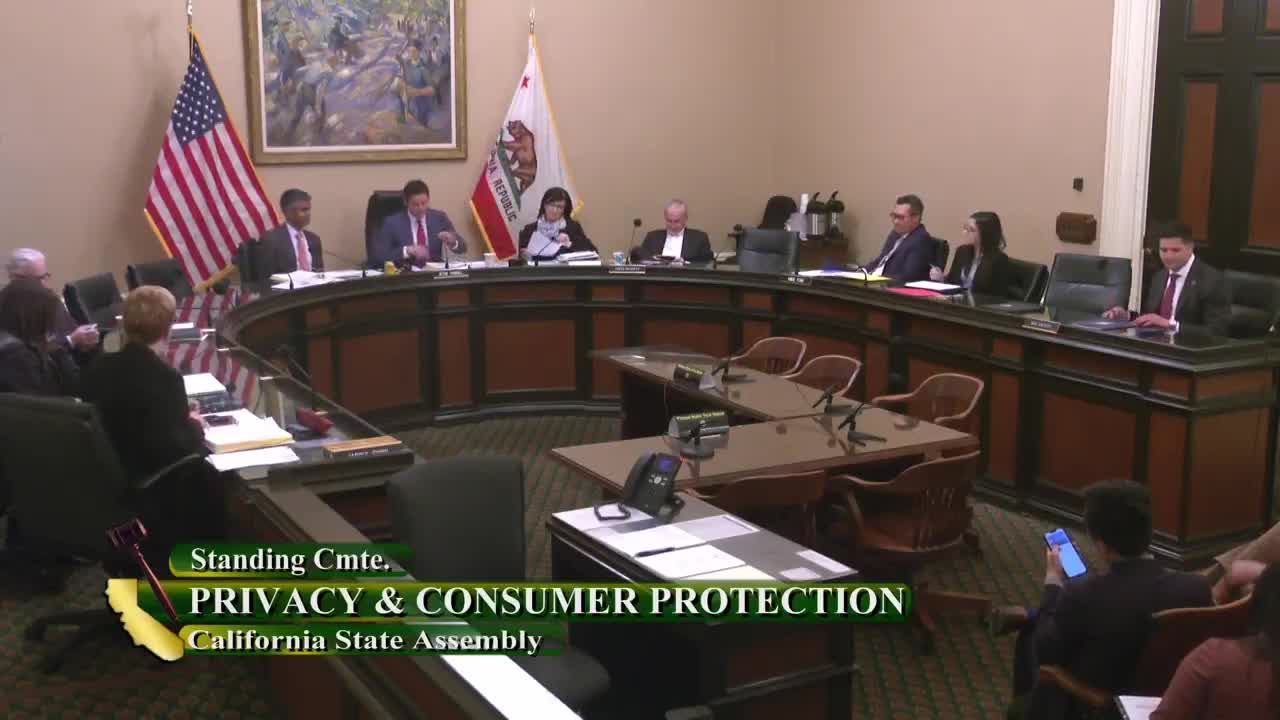
Discussed in Hearing
 13MIN
Assembly Standing Committee on Privacy and Consumer Protection


Bill Co-Author(s):