AB 75: Shoplifting: increased penalties for prior crimes.
- Session Year: 2023-2024
- House: Assembly
- Latest Version Date: 2022-12-14
Current Status:
Failed
(2024-01-03: From committee: Without further action pursuant to Joint Rule 62(a).)
Introduced
In Committee
First Chamber
In Committee
Second Chamber
Enacted
Existing law, the Safe Neighborhoods and Schools Act, enacted as an initiative statute by Proposition 47, as approved by the electors in the November 4, 2014, statewide general election, makes the theft of property that does not exceed $950 in value petty theft and makes that crime punishable as a misdemeanor, with certain exceptions. The initiative statute defines shoplifting as entering a commercial establishment with the intent to commit larceny while that establishment is open during regular hours, where the value of the property that is taken or intended to be taken does not exceed $950. The initiative statute requires that shoplifting be punished as a misdemeanor.
Existing law, as amended by Proposition 47, provides that a registered sex offender or a person with a prior conviction for certain serious or violent felonies, such as a sexually violent offense, who commits petty theft is subject to imprisonment in the county jail for up to one year or in the state prison for 16 months or 2 or 3 years.
This bill would reinstate a provision of law that was repealed by Proposition 47 that provides that a person who has been convicted 3 or more times of petty theft, grand theft, or other specified crimes and who is subsequently convicted of petty theft is subject to imprisonment in a county jail not exceeding one year or in a county jail for 18 months or 2 or 3 years. The bill would also make this provision and the provision relating to a person with serious, violent, or sexual prior offenses applicable to a person whose prior or current conviction is for shoplifting.
This bill would require the Secretary of State to place the provisions of the bill that amend the initiative statute on the ballot for the November 5, 2024, statewide general election.
(a)Notwithstanding Section 459, shoplifting is defined as entering a commercial establishment with intent to commit larceny while that establishment is open during regular business hours, where the value of the property that is taken or intended to be taken does not exceed nine hundred fifty dollars ($950). Any other entry into a commercial establishment with intent to commit larceny is burglary. Shoplifting shall be punished as a misdemeanor, except that a as follows:
(1)A person with one or more prior convictions for an offense specified in clause (iv) of subparagraph (C) of paragraph (2) of subdivision (e) of Section 667 or for an offense requiring registration pursuant to subdivision (c) of Section 290 may be punished pursuant to subdivision (h) of Section 1170.
(2)A person who meets the requirements of subdivision (a) or (b) of Section 666 may be punished pursuant to that section.
(b)Any act of shoplifting as defined in subdivision (a) shall be charged as shoplifting. No A person who is charged with shoplifting may not also be charged with burglary or theft of the same property.
SEC. 2.Section 490.2 of the Penal Code is amended to read:490.2.(a)Notwithstanding Section 487 or any other provision of law defining grand theft, obtaining any property by theft where the value of the money, labor, real or personal property taken does not exceed nine hundred fifty dollars ($950) shall be considered petty theft and shall be punished as a misdemeanor, except that such as follows:
(1)A person may instead be punished pursuant to subdivision (h) of Section 1170 if that person has one or more prior convictions for an offense specified in clause (iv) of subparagraph (C) of paragraph (2) of subdivision (e) of Section 667 or for an offense requiring registration pursuant to subdivision (c) of Section 290.
(2)A person who meets the requirements of subdivision (a) or (b) of Section 666 may be punished pursuant to that section.
(b)This section shall not be applicable does not apply to any theft that may be charged as an infraction pursuant to any other provision of law.
(c)This section shall does not apply to theft of a firearm.
SEC. 3.Section 666 of the Penal Code is amended to read:666.(a)Notwithstanding Section 490, any a person who has been convicted three or more times of petty theft, shoplifting, grand theft, a conviction pursuant to subdivision (d) or (e) of Section 368, auto theft under Section 10851 of the Vehicle Code, burglary, carjacking, robbery, or a felony conviction of Section 496, and has served a term for that crime in any penal institution or has been imprisoned therein as a condition of probation for that offense, and who is subsequently convicted of petty theft or shoplifting, shall be punished by imprisonment in the county jail not exceeding one year, or imprisonment pursuant to subdivision (h) of Section 1170.
(b)(1)Notwithstanding Section 490, a person described in subdivision (b) who, having paragraph (2) who has been convicted of petty theft, shoplifting, grand theft, a conviction pursuant to subdivision (d) or (e) of Section 368, auto theft under Section 10851 of the Vehicle Code, burglary, carjacking, robbery, or a felony violation of Section 496, and having has served a term of imprisonment therefor in any penal institution or having has been imprisoned therein as a condition of probation for that offense, and who is subsequently convicted of petty theft, is punishable theft or shoplifting, shall be punished by imprisonment in the county jail not exceeding one year, year or in the state prison.
(b)Subdivision (a) shall(2)Paragraph (1) shall apply to any person who is required to register pursuant to the Sex Offender Registration Act, or who has a prior violent or serious felony conviction, as specified in clause (iv) of subparagraph (C) of paragraph (2) of subdivision (e) of Section 667, or has a conviction pursuant to subdivision (d) or (e) of Section 368.
(c)This section shall not be construed to does not preclude prosecution or punishment pursuant to subdivisions (b) to (i), inclusive, of Section 667, 667 or Section 1170.12.
SEC. 4.(a)Sections 1, 2, and 3 of this act amend the Safe Neighborhoods and Schools Act, an initiative statute approved by the voters as Proposition 47 at the November 4, 2014, statewide general election, and shall become effective only when submitted to and approved by the voters at a statewide election.
(b)Notwithstanding the requirements of Sections 9040, 9043, 9044, 9061, 9082, and 9094 of the Elections Code, or any other law, the Secretary of State shall submit Sections 1, 2, and 3 of this act to the voters for their approval at the November 5, 2024, statewide general election.
REVISIONS: HeadingLine 2.|
Date
|
Status
|
|---|---|
| Jan 3, 2024 | From committee: Without further action pursuant to Joint Rule 62(a). |
| Feb 28, 2023 | In committee: Set, second hearing. Failed passage. |
| Feb 28, 2023 | Coauthors revised. |
| Feb 8, 2023 | In committee: Set, first hearing. Hearing canceled at the request of author. |
| Jan 26, 2023 | Referred to Com. on PUB. S. |
| Jan 4, 2023 | Read first time. |
| Dec 15, 2022 | From printer. May be heard in committee January 14. |
| Dec 14, 2022 | Introduced. To print. |
|
Date
|
Description
|
Location
|
Votes
|
|
|---|---|---|---|---|
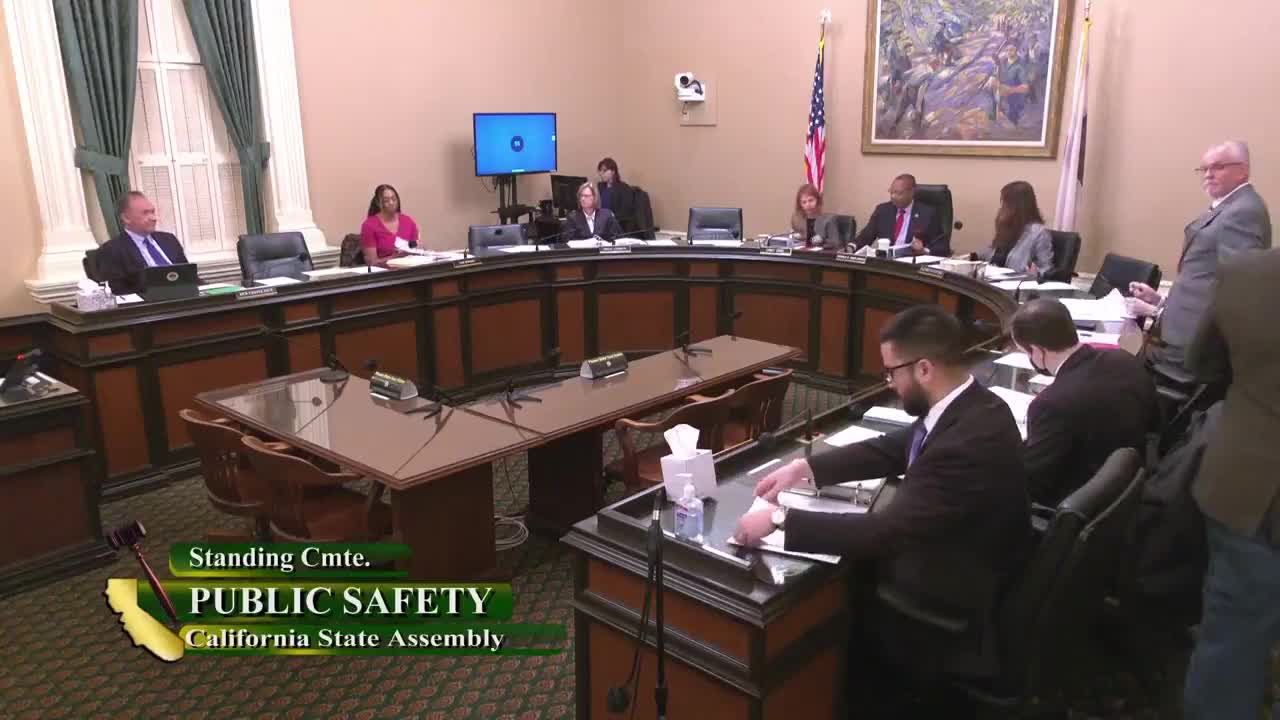
| Feb 28, 2023 | Do pass and be re-referred to the Committee on [Appropriations] | Assembly Standing Committee on Public Safety |
Failed |
This list shows positions taken on this bill by organizations on the date displayed, which is linked to the original source.
Positions by individuals are not included.
|
Organization
|
Position
|
Date
|
|---|---|---|
| Anti-Recidivism Coalition | ** Against | |
| California Attorneys For Criminal Justice | ** Against | |
| California Consortium of Addiction Programs and Professionals | ** Against | |
| California District Attorneys Association | ** Support | |
| Californians for Safety and Justice | ** Against | |
| Californians United for a Responsible Budget | ** Against | |
| California Peace Officers Association | ** Support | |
| California Public Defenders Association | ** Against | |
| California State Sheriffs' Association | ** Support | |
| Communities United for Restorative Youth Justice | ** Against | |
| Crop Organization | ** Against | |
| Defy Ventures | ** Against | |
| Drug Policy Alliance | ** Against | |
| Ella Baker Center For Human Rights | ** Against | |
| Faith in Action Bay Area | ** Against | |
| Forward Impact Dba Represent Justice | ** Against | |
| Friends Committee On Legislation Of California | ** Against | |
| Glide | ** Against | |
| HIV Education and Prevention Project of Alameda County | ** Against | |
| Initiate Justice | ** Against | |
| Last Prisoner Project | ** Against | |
| Legal Services for Prisoners with Children | ** Against | |
| Los Angeles Regional Reentry Partnership | ** Against | |
| Orange County District Attorney | ** Support | |
| Orange County Sheriff's Department | ** Support | |
| Peace Officers Research Association Of California | ** Support | |
| PICO California | ** Against | |
| Riverside All of Us or None | ** Against | |
| Riverside County Sheriff's Office | ** Support | |
| Rubicon Programs | ** Against | |
| Sacramento Youth Advocacy Fellowship Pipeline | ** Against | |
| Safe Return Project | ** Against | |
| San Francisco Public Defender | ** Against | |
| Timedone | ** Against | |
| Underground Scholars Initiative - UC Berkeley | ** Against | |
| Underground Scholars Initiative, University of California, San Diego | ** Against |
Date of Hearing:
Counsel: Cheryl Anderson
ASSEMBLY COMMITTEE ON PUBLIC SAFETY
Reginald Byron Jones-Sawyer, Sr., Chair
ABPCA Bill Id:AB 75
Author:(Hoover) – As Introduced Ver:December 14, 2022
SUMMARY:
- Reinstates the offense of petty theft with a prior as it existed before it was eliminated by Prop. 47 and makes it applicable to the offense of shoplifting created by Prop.47, subject to approval by the voters. Specifically, this bill:
- Reinstates a provision of law that was repealed by Proposition 47 providing that a person who has been convicted three or more times of specified theft-related offenses, has served time in a penal institution, and who is subsequently convicted of petty theft is to receive an enhanced punishment not exceeding one year in the county jail as a misdemeanor, or in a county jail for 16 months, or two, or three years as a felony under realignment.
- Makes this enhanced punishment applicable to a person whose prior or current conviction is for shoplifting.
- Makes the enhanced punishment of imprisonment in the county jail not to exceed one year, or in the state prison, relating to a person with specified serious or violent felony priors, specified theft-related crimes against elders or dependent adults, or who is required to register as a sex offender, applicable to a person whose prior or current conviction is for shoplifting.
- Requires the Secretary of State to submit the provisions of this bill that amend Prop. 47 to the voters for their approval at the November 5, 2024, general election.
- Declares that it is to take effect only when approved by the voters.
EXISTING LAW:
- Divides theft into two degrees, petty theft and grand theft. (Pen. Code, § 486.)
- Defines grand theft as when the money, labor, or real or personal property taken is of a value exceeding $950 dollars, except as specified. (Pen. Code, § 487.)
- Defines petty theft as obtaining any property by theft where the value of the money, labor, real or personal property taken does not exceed $950 and makes it punishable as a misdemeanor, except where a person has a prior “super strike,” [1] or a registerable sex conviction, as specified, in which case the offense is punishable as a felony by imprisonment in the county jail pursuant to realignment. This provision does not apply to theft of a firearm. (Pen. Code, § 490.2, subds. (a) & (c).)
- States that petty theft is punishable by a fine not exceeding $1,000, by imprisonment in the county jail not exceeding six months, or both. (Pen. Code, § 490.)
- Provides that, notwithstanding the punishment for petty theft, if a person is required to register as a sex offender, has a prior super strike conviction, or has a conviction for a specified theft-related offense against an elder or dependent adult, and also has been convicted of a specified theft-related offense for which he or she was imprisoned, and is subsequently convicted of petty theft, then the person is to receive an enhanced punishment of imprisonment in the county jail not to exceed one year, or in the state prison. (Pen. Code, § 666.)
- Lists the theft-related offenses which qualify a defendant for enhanced status for the crime of petty theft with a prior as:
- Petty theft;
- Grand theft;
- Theft, embezzlement, forgery, fraud, and identity theft committed against an elder or dependent adult;
- Auto theft;
- Burglary;
- Carjacking;
- Robbery; and,
- Felony receiving stolen property. (Pen. Code, § 666.)
- Petty theft;
- Defines “shoplifting” as entering a commercial establishment with intent to commit larceny while that establishment is open during regular business hours, where the value of the property that is taken or intended to be taken does not exceed $950 dollars. (Pen. Code, § 459.5, subd. (a).)
- States that any act of shoplifting must be charged as such, and that a person charged with shoplifting cannot also be charged with burglary or theft of the same property. (Pen. Code, § 459.5, subd. (b).)
- Punishes shoplifting as a misdemeanor, except where a person has a prior “super strike” or a registrable sex conviction, in which case the offense is punished as a felony by imprisonment in the county jail pursuant to realignment. (Pen. Code, § 459.5, subd. (a).)
FISCAL EFFECT:
Unknown
COMMENTS:
- Author's Statement: According to the author, “It’s time to restore accountability in the criminal justice system, and that’s what this bill aims to do. When I talk to the retailers and small businesses in my community, they are being overwhelmed by higher theft crimes in the state because of the lack consequences for repeated criminal activity. That’s why I introduced AB 75, which will allow an increase in penalties on serial theft offenders – those individuals who commit this crime over and over again and yet continue to be met with a misdemeanor. This bill will allow for greater penalties and crack down on this rising theft trend. Even though the statistics show an uptick in property theft, I believe the numbers don’t tell the whole story. The public is well aware of the light penalties being handed out over theft-related crimes, so many of these crimes go un-reported. We have all seen the news reports on smash and grabs, yet they continue to happen because of the lack of accountability for these repeat offenders who have very little to lose for their crime sprees. We owe this to our small businesses and we owe this to our communities. It’s time to restore common sense and accountability to our criminal justice system.”
- Background-Proposition 47 and Petty Theft with a Prior Theft Conviction: Proposition 47, also known as the Safe Neighborhoods and Schools Act, was approved by the voters in November 2014. According to the California Secretary of State’s web site, 59.6 percent of voters approved Proposition 47. (See http://elections.cdn.sos.ca.gov/sov/2014-general/pdf/2014-complete-sov.pdf)
Proposition 47 reduced the penalties for certain drug and property crimes and directed that the resulting state savings be directed to mental health and substance abuse treatment, truancy and dropout prevention, and victims’ services. Specifically, the initiative reduced the penalties for possession for personal use of most illegal drugs to misdemeanors. The initiative also reduced the penalties for specified theft crimes valued at $950 or less from felonies to misdemeanors. However, the measure limited the reduced penalties to offenders who do not have designated prior convictions for specified serious or violent felonies (super strikes) and who are not required to register as sex offenders. (See Legislative Analyst's Office analysis of Proposition 47 at http://www.lao.ca.gov/ballot/2014/prop-47-110414.pdf)
Prop. 47 created the new crime of shoplifting, which is defined as “entering a commercial establishment with intent to commit larceny while that establishment is open during regular business hours, where the value of the property that is taken or intended to be taken does not exceed nine hundred fifty dollars ($950).” (Pen. Code, § 459.5. subd. (a).) Any other entry into a commercial establishment with intent to commit larceny is burglary. (Ibid.)
Prop. 47 also added Penal Code section 490.2 to expressly define petty theft as “obtaining any property by theft where the value of the money, labor, real or personal property taken” does not exceed $950. Prop. 47 states that this new definition of petty theft applies notwithstanding “any other provision of law defining grand theft.” (Pen. Code, § 490.2, subd. (a).)
Among the theft crimes made misdemeanors by Prop. 47, where the value of the property is $950 or less, are: forgery (Pen. Code, § 473); making or delivering a check with insufficient funds (Pen. Code, § 476a); petty theft (Pen. Code, § 490.2); and receiving stolen property (Pen. Code, § 496). (See People v. Rivera (2015) 233 Cal.App.4th 1085, 1091.)
The offenses made misdemeanors by Proposition 47 also include: the new offense of commercial burglary where the value of the property taken or intended to be taken is $950 or less (Pen. Code, § 459.5; People v. Sherow (2015) 239 Cal.App.4th 875, 879); and petty theft with a prior theft conviction. (Pen. Code, § 666; People v. Rivera, supra, 233 Cal.App.4th at p. 1091.) Specifically, Proposition 47 eliminated the penalties formerly associated with the “petty theft with a prior” statute except for a narrow category of sex offenders, persons with qualifying “super strikes,” and those persons convicted of theft from elders or dependent adults. Those persons are still eligible for felony punishment in state prison. (Pen. Code, § 666.)
“One of Proposition 47’s primary purposes is to reduce the number of nonviolent offenders in state prisons, thereby saving money and focusing prison on offenders considered more serious under the terms of the initiative.” (Harris v. Superior Court (2016) 1 Cal.5th 984, 992, citing Voter Information Guide, Gen. Elec. (Nov. 4, 2014) text of Prop. 47, § 2, p. 70.) These policies are supported by a liberal construction clause in Proposition 47, sections 15 and 18. (http://vig.cdn.sos.ca.gov/2014/general/pdf/text-of-proposed-laws1.pdf#prop47)
Neither petty theft nor shoplifting nor any of the specified prior offenses which would elevate their punishment under this bill qualify as serious or violent felonies. (Pen. Code, §§ 667.5, subd. (c) [violent felonies], 1192.7 [serious felonies].)
Moreover, according to an article by the Public Policy Institute of California (PPIC), Proposition 47 has reduced racial disparities in criminal justice outcomes. It has decreased ethnic/racial disparities in arrest and booking. And the decrease in the overall incarceration rate produced by these criminal justice reform efforts has led to a narrowing of racial disparities in the proportion of persons institutionalized on any given day. (https://www.ppic.org/publication/proposition-47s-impact-on-racial-disparity-in-criminal-justice-outcomes/.)
This bill seeks to restore the penalties for petty theft with a prior theft conviction to pre-Proposition 47 status, and to expand it to the new crime of shoplifting created by Proposition 47. - Theft Rates after Proposition 47: In 2020, the property crime rate in California reached the lowest level observed since 1960. While it ticked up in 2021 by 2.4%, it remained low. (https://www.ppic.org/publication/crime-trends-in-california/.)
Further, some complaints of retail theft were overstated. For example, in 2021, Walgreens closed five stores in San Francisco purportedly due to retail theft. However, the San Francisco Police Department’s data on shoplifting did not support this explanation for the closures. Recently, the chief financial officer of Walgreens acknowledged the shoplifting threat had probably been overstated. The company likely spent too much on security measures and mischaracterized the amount of theft at stores. In fact, shrinkage (the inventory that was bought but couldn’t be sold primarily due to shoplifting) actually decreased to around 2.5 to 2.6 percent of sales, compared to 3.5 percent the prior year. (https://www.nytimes.com/2023/01/06/business/walgreens-shoplifting.html.) - Repeat Offenders: This bill is aimed at repeated thefts. There are currently laws that prosecutors can use to charge repeated theft crimes and that call for increased penalties.
To begin, separate offenses may generally be punished by up to six months consecutive for each offense. And a prosecutor can consolidate similar thefts, after a case has already been filed, where the offenses possess common characteristics or attributes. (Pen. Code, § 954.) Thus, while a defendant’s exposure for one theft offense might be six months in jail, an individual convicted of multiple theft offenses can face multiple six-month terms in the county jail.
Repeated acts of theft can be aggregated and prosecuted as one felony if they are conducted pursuant to one intention, one general impulse, and one plan. (See People v. Bailey (1961) 55 Cal.2d 514, 518-519.) AB 2356 (Rodriguez), Chapter 22, Statutes of 2022, codified this. It specified that if the value of property taken, or intended to be taken, exceeds $950 over the course of distinct but related acts, the value of the property taken, or intended to be taken, may properly be aggregated to charge a count of grand theft, if the acts are motivated by one intention, one general impulse, and one plan.
Further, Penal Code section 490.4 punishes “organized retail theft” – shoplifting schemes undertaken by two or more persons who have organized themselves to commit shoplifting for financial gain. (Pen. Code, § 490.4.) The punishment ranges from one year in the county jail (misdemeanor) to 16 months, or two, or three years in the county jail (felony), depending on the specific circumstances. On February 9, 2023, the California Attorney General, along with CHP and partnering agencies, announced that eight individuals involved in a statewide organized retail theft operation, resulting in a total loss of approximately $ 1 million to date, had been arrested and charged. (https://oag.ca.gov/news/press-releases/attorney-general-bonta-charges-organized-retail-theft-suspects-theft.)
In sum, while Proposition 47 did reduce certain theft offenses to misdemeanors, there are still legal options for charging repeated retail crime that call for increased penalties. - California Constitutional Limitations on Amending a Voter Initiative: Because Proposition 47 was a voter initiative, the Legislature may not amend the statute without subsequent voter approval unless the initiative permits such amendment, and then only upon whatever conditions the voters attached to the Legislature’s amendatory powers. (People v. Superior Court (Pearson) (2010) 48 Cal.4th 564, 568; see also Cal. Const., art. II, § 10, subd. (c).) The California Constitution states, “The Legislature may amend or repeal referendum statutes. It may amend or repeal an initiative statute by another statute that becomes effective only when approved by the electors unless the initiative statute permits amendment or repeal without their approval.” (Cal. Const., art. II, § 10, subd. (c).) Therefore, unless the initiative expressly authorizes the Legislature to amend, only the voters may alter statutes created by initiative.
The purpose of California’s constitutional limitation on the Legislature’s power to amend initiative statutes is to protect the people’s initiative powers by precluding the Legislature from undoing what the people have done, without the electorate’s consent. Courts have a duty to jealously guard the people’s initiative power and, hence, to apply a liberal construction to this power wherever it is challenged in order that the right to resort to the initiative process is not improperly annulled by a legislative body. (Proposition 103 Enforcement Project v. Quackenbush (1998) 64 Cal.App.4th 1473.)
As to the Legislature’s authority to amend the initiative, Proposition 47 states: “This act shall be broadly construed to accomplish its purposes. The provisions of this measure may be amended by a two‑thirds vote of the members of each house of the Legislature and signed by the Governor so long as the amendments are consistent with and further the intent of this act. The Legislature may by majority vote amend, add, or repeal provisions to further reduce the penalties for any of the offenses addressed by this act.” (<http://vig.cdn.sos.ca.gov/2014/general/pdf/text-of-proposed-laws1.pdf#prop47>.)
This bill would reinstate petty theft with a prior, a provision repealed by Proposition 47, and extend those enhanced penalties for repeat theft to the new crime of shoplifting created by Proposition 47. As such, it is inconsistent with the purpose of Proposition 47. Therefore, pursuant to the above-referenced provisions of the California Constitution, only the voters may authorize the provisions.
This bill would require the Secretary of State to submit the provisions of this bill that amend Prop. 47 to the voters for their approval at the November 5, 2024, general election.
This bill would take effect only after approved by the voters. - Proposed Initiative to Limit Proposition 47’s Criminal Justice Reform: A proposed initiative for the November 2022 ballot, initiative 21-0041, would have limited Proposition 47 by authorizing felony sentences for specified thefts reduced to misdemeanors under the criminal justice reform provisions and requiring longer sentences. In particular, the proposed initiative would have:
Authorize[d] prosecutors to file felony or misdemeanor charges for thefts of any amount under $950—currently chargeable as felonies only in certain circumstances—against any person with two or more prior specified theft convictions. Add[ed] mandatory sentencing enhancement for any felony resulting in significant property loss or damage, ranging from one additional year for losses over $50,000, to four years for losses over $3,000,000, plus one year for each additional $3,000,000. Authorize[d] prosecution for theft in any county where acts in furtherance occurred.
(https://ballotpedia.org/California_Punishment_for_Repeat_Theft_Convictions_Initiative_(2022).) To be certified for the 2022 ballot, the initiative needed 623,212 signatures by July 26, 2022. The initiative failed to qualify for the ballot. (Ibid.)
In 2020, almost 62% of voters rejected a broader effort to roll back portions of Proposition 47. Proposition 20 was a ballot initiative of the November 2020 election which, among other things, would have created the new crime of organized retail crime, defined as: “a person, acting with one or more other persons, who commits two or more thefts of retail property or merchandise with a combined value of more than $250 during a period of 180 days would be charged with organized retail crime.” (https://ballotpedia.org/California_Proposition_20,_Criminal_Sentencing,_Parole,_and_DNA_Collection_Initiative_(2020).)
- Argument in Support: According to the California State Sheriffs’ Association, “Passed by voters in November 2014, Proposition 47 brought broad and significant changes to California’s criminal justice system by classifying certain crimes as misdemeanors instead of felonies. One of these changes was to California’s serial theft statute, which limited charging options, likely leading to an increase in theft with impunity.”
- Argument in Opposition: According to Californians for Safety and Justice, “AB 75 signals a return to the failed tough on crime policies of the past and would undermine public safety by increasing the costly and counterproductive incarceration in state prison for some of the lowest level crimes in the state penal code. Repealing parts of Prop. 47 would also rob our local communities of hundreds of millions of dollars that Prop 47 will save annually. This savings is reallocated back to communities for proven crime prevention programs that address the root causes and stop the cycle of crime. As of 2022, Prop. 47 has saved the state more than $600 million.
“Prop. 47 did not affect serious or violent felonies, but instead targeted several low-level theft offenses and drug possession for personal use for reform. Political rhetoric notwithstanding, since its enactment, property crime has decreased in California. Not dissuaded, in 2020, “tough on crime” advocates tried to persuade the public to repeal Prop. 47 via Prop. 20. Again, California voters rejected the attempt to go back to mass incarceration.
“AB 75 proposes to make it easier to charge non-violent Californians with felonies and to go back to the same shortsighted ‘tough on crime’ measures that have failed California for the past three decades. It is yet another attempt to go down a path that California’s voters have already twice rejected. Significantly, reverting these crimes back to felonies would once again dramatically increase incarceration rates, leaving the state vulnerable to falling out of compliance with the prison system’s population cap mandated by the federal judiciary.
“AB 75 nonetheless proposes to impose long prison sentences which are not justified by actual crime data, flies in the face of sensible criminal justice reform, and would force the state to shoulder the cost of imprisoning more people for years, at great human and fiscal expense.”
- Related Legislation:
- AB 23 (Muratsuchi) amends Proposition 47 by reducing the threshold amount for petty theft and shoplifting from $950 to $400 and would provide that it shall become effective only when submitted to, and approved by, the voters. AB 23 is set to be heard in this committee on March 7, 2023.
- AB 329 (Ta) imposes higher penalties for shoplifting and petty theft if the crime is committed by a non-citizen of the state of California. AB 329 is set to be heard in this committee on March 7, 2023.
- AB 23 (Muratsuchi) amends Proposition 47 by reducing the threshold amount for petty theft and shoplifting from $950 to $400 and would provide that it shall become effective only when submitted to, and approved by, the voters. AB 23 is set to be heard in this committee on March 7, 2023.
- Prior Legislation:
- AB 1597 (Waldron), of the 2021-2022 Legislative Session, was practically identical to this bill. AB 1597 failed passage in this committee.
- AB 1599 (Kiley), of the 2021-2022 Legislative Session, would have repealed the changes made by Prop. 47, except those related to reducing the penalty for possession of concentrated cannabis, subject to approval of the voters. AB 1599 failed passage in this committee.
- AB 1603 (Salas), of the 2021-2022 Legislative Session, would have amended Proposition 47 by decreasing the threshold amount that constitutes grand theft and shoplifting from $950 to $400, subject to approval of the voters. AB 1603 failed passage in this committee.
- AB 1613 (Irwin), Chapter 949, Statutes of 2022, expanded the territorial jurisdiction in which the Attorney General can prosecute specified theft offenses and associated offenses connected together in their commission to those theft offenses.
- AB 1698 (Maienschein), of the 2021-2022 Legislative Session, would have created the crime of organized package theft, an alternate felony-misdemeanor. AB 1698 was held on the Assembly Appropriations Committee suspense file.
- AB 2294 (Jones-Sawyer), Chapter 856, Statutes of 2022, re-authorized the prosecuting attorney's office or county probation department to create a diversion or deferred entry of judgment (DEJ) program for persons who commit theft offenses, as modified; re-enacted various changes to existing laws related to arrest and bench warrants for theft-related offenses, as modified; and re-established a grant program to create demonstration projects to reduce recidivism to high-risk misdemeanor probationers.
- AB 2356 (Rodriguez), Chapter 22, Statutes of 2022, specified that if the value of the money, labor, real property, or personal property taken exceeds $950 over the course of distinct but related acts, whether committed against one or more victims, the value of the money, labor, real property, or personal property taken may properly be aggregated to charge a count of grand theft, if the acts are motivated by one intention, one general impulse, and one plan. These changes were declaratory of existing law.
- AB 2543 (Fong), of the 2021-2022 Legislative Session, would have amended Proposition 47 by authorizing acts of shoplifting that occur on 2 or more separate occasions within a 12-month period, and the aggregated value of the property taken exceeds $950, to be punished as an alternate felony-misdemeanor, a “wobbler.” AB 2543 was not heard in this committee at the request of the author.
- AB 2718 (Cooper), of the 2021-2022 Legislative Session, would have amended Proposition 47 by creating the new crime of “serial theft” for the theft of property valued over $500 where the offender has two or more prior convictions for specified theft offenses, and by redefining “petty theft” and “shoplifting,” subject to approval by the voters. AB 2718 failed passage in this committee.
- SB 1108 (Bates), of the 2021-2022 Legislative Session, would have reinstated a provision of law that was repealed by Proposition 47 that provides that a person who has been convicted 3 or more times of petty theft, grand theft, or other specified crimes and who is subsequently convicted of petty theft may be punished as an alternate felony-misdemeanor, a “wobbler.” SB 1108 failed passage in the Senate Public Safety Committee.
- AB 331 (Jones-Sawyer), Chapter 113, Statutes of 2021, re-established the crime of organized retail theft and the regional property crimes task force until January 1, 2026.
- AB 1065 (Jones-Sawyer), Chapter 1065, Statutes of 2018, created the crime of organized retail theft; expanded jurisdiction to prosecute cases of theft or receipt of stolen merchandise; required the California Highway Patrol (CHP) to convene a regional property task force; authorized a grant program, upon appropriation by the Legislature, to create demonstration projects to reduce recidivism to high-risk misdemeanor probationers; and established a sunset date of January 1, 2021.
- AB 875 (Cooper), of the 2017-2018 Legislative Session, would have made petty theft with a prior conviction punishable as a felony as provided in pre-Proposition 47 provisions, but would have included a deferred entry of judgment option for a defendant who has suffered three or more prior theft convictions, is a drug or alcohol addict, and has not suffered a prior serious or violent felony conviction or registerable sex offense. AB 875 was not heard in this committee.
- AB 392 (Lackey), of the 2017-2018 Legislative Session, would have made conspiracy to commit shoplifting punishable as a felony under realignment provisions by 16 months, or two or three years in the county jail, rather than alternatively as a misdemeanor of felony. AB 392 failed passage in this committee.
- AB 2369 (Patterson), of the 2015-2016 Legislative Session, would have limited Proposition 47 by making persons convicted of crimes reduced to misdemeanors under the provisions eligible for felony prosecution and sentencing if convicted of those crimes two times within a three-year period. AB 2369 failed passage in this committee.
- Proposition 47 of the November 2014 general election, the Safe Neighborhoods and Schools Act, reduced the penalties for certain drug and property crimes, including reducing petty theft with a prior theft conviction to a misdemeanor, except in the case where the person has a prior super strike conviction or a conviction for a specified theft-related offense against an elder or dependent adult.
- AB 1844 (Fletcher), Chapter 219, Statutes of 2010, amended petty theft with a prior to require three prior theft-related convictions.
- AB 1597 (Waldron), of the 2021-2022 Legislative Session, was practically identical to this bill. AB 1597 failed passage in this committee.
REGISTERED SUPPORT / OPPOSITION:
Support
California District Attorneys Association
California Peace Officers Association
California State Sheriffs' Association
Orange County District Attorney
Orange County Sheriff's Department
Peace Officers Research Association of California (PORAC)
Riverside County Sheriff's Office
Opposition
Anti-recidivism Coalition (UNREG)
California Attorneys for Criminal Justice
California Consortium of Addiction Programs and Professionals
California Public Defenders Association
Californians for Safety and Justice
Californians United for a Responsible Budget
Communities United for Restorative Youth Justice (CURYJ)
Crop Organization
Defy Ventures
Drug Policy Alliance
Ella Baker Center for Human Rights
Faith in Action Bay Area
Forward Impact Dba Represent Justice
Friends Committee on Legislation of California
Glide
Hiv Education and Prevention Project of Alameda County (HEPPAC)
Initiate Justice
Last Prisoner Project
Legal Services for Prisoners with Children
Los Angeles Regional Reentry Partnership (LARRP)
Pico California
Riverside All of Us or None
Rubicon Programs
Sacramento Youth Advocacy Fellowship Pipeline
Safe Return Project
San Francisco Public Defender
Timedone
Underground Scholars Initiative at UC Berkeley
Underground Scholars Initiative, University of California, San Diego
Analysis Prepared by:
Cheryl Anderson / PUB. S. / (916) 319-3744
A prior conviction of any of the following “serious” or “violent” felonies, now commonly
referred to as “super strikes,” will disqualify a person from receiving any benefit from the
changes brought by Proposition 47: specified sex offenses, homicide, solicitation to commit murder, assault with a machine gun on a peace officer or firefighter, possession of a weapon of mass destruction, and any serious or violent felony punishable by life imprisonment or death. (Pen. Code, § 667, subd. (e)(2)(C)(iv).) ↑
Discussed in Hearing
 33MIN
Assembly Standing Committee on Public Safety
 33MIN
Assembly Standing Committee on Public Safety


Bill Co-Author(s):