AB 752: State highways: worker safety.
- Session Year: 2023-2024
- House: Assembly
- Latest Version Date: 2023-10-13
Current Status:
Passed
(2023-10-13: Chaptered by Secretary of State - Chapter 813, Statutes of 2023.)
Introduced
In Committee
First Chamber
In Committee
Second Chamber
Enacted
(1)Existing law establishes the Department of Transportation and provides that the department has full possession and control of all state highways and property and rights in property acquired for state highway purposes. Existing law authorizes the department to construct, improve, and maintain state highways.
Existing law requires the department to update guidance by July 1, 2021, to specify the appropriate use of positive protection measures with the goal of isolating workers or work zones from traffic. Existing law requires the department to provide compensation for the use of a safety device where the updated guidance allows, but does not require, the optional safety device when requested by a contractor on a public works project. Existing law requires the department to submit a report to the Legislature by January 1, 2024, that includes findings and recommendations on the use of positive protection measures used pursuant to these provisions. Existing law repeals these provisions on January 1, 2025.
This bill would eliminate the January 1, 2025, repeal date, thereby extending these provisions indefinitely. The bill would specify that the department is only required to compensate for an optional safety device requested for use on a public works project of the department. After the submittal of the report due on January 1, 2024, the bill would require the department to prescribe standards and specifications to require the appropriate use of positive protection on all covered activities on the state highway system, as specified. The bill would authorize the department to adopt regulations as necessary or appropriate to carry out the purposes of these provisions, and would exempt those regulations from the Administrative Procedures Act.
(2)Existing law grants the Division of Occupational Safety and Health, which is within the Department of Industrial Relations, jurisdiction over all employment and places of employment, with the power necessary to enforce and administer all occupational health and safety laws and standards.
This bill would require a contractor that has requested and received compensation from the department for an optional safety device to use the optional safety device in conformance with the departments guidance. The bill would authorize the division to adopt regulations as necessary or appropriate to enforce this requirement.
(1)Existing law establishes the Department of Transportation and provides that the department has full possession and control of all state highways and property and rights in property acquired for state highway purposes. Existing law authorizes the department to construct, improve, and maintain state highways.
This bill would require the department to require, when certain criteria are met, the use of barriers and other devices placed between workers and motorized traffic for all construction, utility work, maintenance, and repair activities on state highways. The bill would require the department to require alternative methods to protect workers if the department determines that the barriers and other devices, described above, are not required. The bill would authorize the Division of Occupational Safety and Health to, in consultation with the department, adopt rules and regulations to administer and enforce these provisions.By imposing new safety requirements on local agencies performing work on state highways, this bill would create a state-mandated local program.The California Constitution requires the state to reimburse local agencies and school districts for certain costs mandated by the state. Statutory provisions establish procedures for making that reimbursement.This bill would provide that, if the Commission on State Mandates determines that the bill contains costs mandated by the state, reimbursement for those costs shall be made pursuant to the statutory provisions noted above.Existing law requires the department to update guidance by July 1, 2021, to specify the appropriate use of positive protection measures with the goal of isolating workers or work zones from traffic. Existing law requires the department to provide compensation for the use of a safety device where the updated guidance allows, but does not require, the optional safety device when requested by a contractor on a public works project. Existing law requires the department to submit a report to the Legislature by January 1, 2024, that includes findings and recommendations on the use of positive protection measures used pursuant to these provisions. Existing law repeals these provisions on January 1, 2025.
This bill would eliminate the January 1, 2025, repeal date, thereby extending these provisions indefinitely. The bill would specify that the department is only required to compensate for an optional safety device requested for use on a public works project of the department. After the submittal of the report due on January 1, 2024, the bill would require the department to prescribe standards and specifications to require the appropriate use of positive protection on all covered activities on the state highway system, as specified. The bill would authorize the department to adopt regulations as necessary or appropriate to carry out the purposes of these provisions, and would exempt those regulations from the Administrative Procedures Act.
(2)Existing law grants the Division of Occupational Safety and Health, which is within the Department of Industrial Relations, jurisdiction over all employment and places of employment, with the power necessary to enforce and administer all occupational health and safety laws and standards.
This bill would require a contractor that has requested and received compensation from the department for an optional safety device to use the optional safety device in conformance with the departments guidance. The bill would authorize the division to adopt regulations as necessary or appropriate to enforce this requirement.
Existing law establishes the Department of Transportation and provides that the department has full possession and control of all state highways and property and rights in property acquired for state highway purposes. Existing law authorizes the department to construct, improve, and maintain state highways.
This bill would require the department to require, when certain criteria are met, the use of barriers and other devices placed between workers and motorized traffic for all construction, utility work, maintenance, and repair activities on state highways. The bill would require the department to require alternative methods to protect workers if the department determines that the barriers and other devices, described above, are not required. The bill would authorize the Division of Occupational Safety and Health to, in consultation with the department, adopt rules and regulations to administer and enforce these provisions.
By imposing new safety requirements on local agencies performing work on state highways, this bill would create a state-mandated local program.
The California Constitution requires the state to reimburse local agencies and school districts for certain costs mandated by the state. Statutory provisions establish procedures for making that reimbursement.
This bill would provide that, if the Commission on State Mandates determines that the bill contains costs mandated by the state, reimbursement for those costs shall be made pursuant to the statutory provisions noted above.
Existing law establishes the Department of Transportation and provides that the department has full possession and control of all state highways and property and rights in property acquired for state highway purposes. Existing law authorizes the department to construct, improve, and maintain state highways.
This bill would require the department to require, when certain criteria are met, the use of barriers and other devices placed between workers and motorized traffic for all construction, utility work, maintenance, and repair activities on state highways. The bill would require the department to require alternative methods to protect workers if the department determines that the barriers and other devices, described above, are not required.
By imposing new safety requirements on local agencies performing work on state highways, this bill would create a state-mandated local program.
The California Constitution requires the state to reimburse local agencies and school districts for certain costs mandated by the state. Statutory provisions establish procedures for making that reimbursement.
This bill would provide that, if the Commission on State Mandates determines that the bill contains costs mandated by the state, reimbursement for those costs shall be made pursuant to the statutory provisions noted above.
(a)The department shall update guidance by July 1, 2021, to specify the appropriate use of positive protection measures, including, but not limited to, automated flagger assistance devices, buffer lanes, impact attenuator vehicles, and temporary barriers, with the goal of isolating workers or work zones from traffic.
(b)Where the departments updated guidance allows, but does not require, use of a safety device, the department shall provide compensation for the optional safety device when requested by a contractor on a public works project of the department.
(c)(1)The department shall submit a report to the Legislature by January 1, 2024, in compliance with Section 9795 of the Government Code that includes findings and recommendations on the use of positive protection measures used pursuant to this section.
(2)The requirement for submitting a report imposed under this subdivision is inoperative on January 1, 2028, pursuant to Section 10231.5 of the Government Code.
(d)After the report required by subdivision (c) is submitted to the Legislature, the department shall prescribe standards and specifications that are consistent with the updated guidance developed pursuant to subdivision (a) to require the appropriate use of positive protection on all covered activities on the state highway system. In developing these standards and specifications, the department shall solicit input from relevant stakeholders, including, but not limited to, construction labor groups, contractors, utilities, local agencies, and community organizations.
(e)The department may adopt regulations as necessary or appropriate to carry out the purposes of this section. Chapter 3.5 (commencing with Section 11340) of Part 1 of Division 3 of Title 2 of the Government Code shall not apply to any standard, criterion, procedure, determination, rule, notice, or guideline established or issued by the department pursuant to this section.
(f)(1)A contractor that has requested and received compensation for an optional safety device pursuant to subdivision (b) shall use the optional safety device in conformance with the departments guidance.
(2)The Division of Occupational Safety and Health, in consultation with the department, may adopt regulations as necessary or appropriate to administer and enforce paragraph (1).
(g)For purposes of this section, the following definitions apply:
(1)Covered activity means all construction and maintenance activities performed on a state highway right-of-way, including, but not limited to, utility work and repair activities.
(2)Positive protection means barriers or other devices placed between workers and motorized traffic that contain or redirect vehicles and meet applicable crashworthy criteria, as contained in Section 1A.13 of the California Manual on Uniform Traffic Control Devices.
(a)The department shall update guidance by July 1, 2021, to specify the appropriate use of positive protection measures, including, but not limited to, automated flagger assistance devices, buffer lanes, impact attenuator vehicles, and temporary barriers, with the goal of isolating workers or work zones from traffic.
(b)Where the departments updated guidance allows, but does not require, use of a safety device, the department shall provide compensation for the optional safety device when requested by a contractor on a public works project. project of the department.
(c)(1)The department shall submit a report to the Legislature by January 1, 2024, in compliance with Section 9795 of the Government Code that includes findings and recommendations on the use of positive protection measures used pursuant to this section.
(d)This section shall remain in effect only until January 1, 2025, and as of that date is repealed, unless a later enacted statute that is enacted before January 1, 2025, deletes or extends that date.(2)The requirement for submitting a report imposed under this subdivision is inoperative on January 1, 2028, pursuant to Section 10231.5 of the Government Code.
(d)After the report required by subdivision (c) is submitted to the Legislature, the department shall prescribe standards and specifications that are consistent with the updated guidance developed pursuant to subdivision (a) to require the appropriate use of positive protection on all covered activities on the state highway system. In developing these standards and specifications, the department shall solicit input from relevant stakeholders, including, but not limited to, construction labor groups, contractors, utilities, local agencies, and community organizations.
(e)The department may adopt regulations as necessary or appropriate to carry out the purposes of this section. Chapter 3.5 (commencing with Section 11340) of Part 1 of Division 3 of Title 2 of the Government Code shall not apply to any standard, criterion, procedure, determination, rule, notice, or guideline established or issued by the department pursuant to this section.
(f)(1)A contractor that has requested and received compensation for an optional safety device pursuant to subdivision (b) shall use the optional safety device in conformance with the departments guidance.
(2)The Division of Occupational Safety and Health, in consultation with the department, may adopt regulations as necessary or appropriate to administer and enforce paragraph (1).
(g)For purposes of this section, the following definitions apply:
(1)Covered activity means all construction and maintenance activities performed on a state highway right-of-way, including, but not limited to, utility work and repair activities.
(2)Positive protection means barriers or other devices placed between workers and motorized traffic that contain or redirect vehicles and meet applicable crashworthy criteria, as contained in Section 1A.13 of the California Manual on Uniform Traffic Control Devices.
SECTION 1.Section 14105.5 is added to the Government Code, to read:14105.5.(a)For purposes of this section, the following definitions apply:(1)Covered activity means all construction, utility work, maintenance, and repair activities performed on a state highway right of way.(2)Positive protection means barriers or other devices placed between workers and motorized traffic that contain or redirect vehicles and meet applicable crashworthy criteria, as contained in Section 1A.13 of the California Manual on Uniform Traffic Control Devices.(b)Subject to subdivision (c), the department shall require the use of positive protection for a covered activity if any of the following conditions are present: (1)The work zone for the covered activity will be in place more than two weeks and result in substantial worker exposure to motorized traffic.(2)The covered activity is on a roadway with anticipated operating speeds exceeding 45 miles per hour and average daily traffic volumes exceeding 20,000 vehicles per day.(3)The covered activity will place workers within one lane-width of travel lanes open to traffic.(4)The work zone for the covered activity will have significant roadside hazards, such as dropoffs or unfinished bridge decks, in place for more than 24 hours.(5)The work zone for the covered activity provides workers no means of escape from external motorized traffic intruding into the workspace.(6)The department determines that positive protection is appropriate for worker safety.(c)The use of positive protection is not required for a covered activity if the department determines that all of the following criteria are met:(1)The covered activity is outside an urban area, as defined in Section 80280 of the Health and Safety Code.(2)The covered activity is on a highway with an average daily traffic volume of fewer than 100 vehicles per hour.(3)The entity performing the covered activity provides a written analysis, acceptable to the department, supporting the conclusion that positive protection is not needed to ensure worker safety.(d)If the department determines that positive protection is not required, pursuant to subdivision (c), then the department shall require the entity performing the covered activity to implement alternative methods to protect workers from vehicular intrusions into work areas. Alternative methods shall be implemented before work begins and workers shall be instructed on the methods to be used.(e)The Division of Occupational Safety and Health, in consultation with the department, may promulgate rules and regulations for the administration and enforcement of this section.SEC. 2.If the Commission on State Mandates determines that this act contains costs mandated by the state, reimbursement to local agencies and school districts for those costs shall be made pursuant to Part 7 (commencing with Section 17500) of Division 4 of Title 2 of the Government Code.(a)For purposes of this section, the following definitions apply:
(1)Covered activity means all construction, utility work, maintenance, and repair activities performed on a state highway right of way.
(2)Positive protection means barriers or other devices placed between workers and motorized traffic that contain or redirect vehicles and meet applicable crashworthiness criteria. crashworthy criteria, as contained in Section 1A.13 of the California Manual on Uniform Traffic Control Devices.
(b)Subject to subdivision (c), the department shall require the use of positive protection for a covered activity if any of the following conditions are present:
(1)The work zone for the covered activity will be in place more than two weeks and result in substantial worker exposure to motorized traffic.
(2)The covered activity is on a roadway with anticipated operating speeds exceeding 45 miles per hour and average daily traffic volumes exceeding 20,000 vehicles per day.
(3)The covered activity will place workers within one lane-width of travel lanes open to traffic.
(4)The work zone for the covered activity will have significant roadside hazards, such as dropoffs or unfinished bridge decks, in place for more than 24 hours.
(5)The work zone for the covered activity provides workers no means of escape from external motorized traffic intruding into the workspace.
(6)The department determines that positive protection is appropriate for worker safety.
(c)The use of positive protection is not required for a covered activity if the department determines that all of the following criteria are met:
(1)The covered activity is outside an urban area, as defined in Section 80280 of the Health and Safety Code.
(2)The covered activity is on a highway with an average daily traffic volume of fewer than 100 vehicles per hour.
(3)The entity performing the covered activity provides a written analysis, acceptable to the department, supporting the conclusion that positive protection is not needed to ensure worker safety.
(d)If the department determines that positive protection is not required, pursuant to subdivision (c), then the department shall require the entity performing the covered activity to implement alternative methods to protect workers from vehicular intrusions into work areas. Alternative methods shall be implemented before work begins and workers shall be instructed on the methods to be used.
(e)The department Division of Occupational Safety and Health, in consultation with the department, may promulgate rules and regulations for the administration and enforcement of this section.
SEC. 2.If the Commission on State Mandates determines that this act contains costs mandated by the state, reimbursement to local agencies and school districts for those costs shall be made pursuant to Part 7 (commencing with Section 17500) of Division 4 of Title 2 of the Government Code.
REVISIONS: HeadingLine 2.(a)For purposes of this section, the following definitions apply:
(1)Covered activity means all construction, utility work, maintenance, and repair activities performed on a state highway right of way.
(2)Positive protection means barriers or other devices placed between workers and motorized traffic that contain or redirect vehicles and meet applicable crashworthiness criteria.
(b)Subject to subdivision (c), the department shall require the use of positive protection for a covered activity if any of the following conditions are present:
(1)The work zone for the covered activity will be in place more than two weeks and result in substantial worker exposure to motorized traffic.
(2)The covered activity is on a roadway with anticipated operating speeds exceeding 45 miles per hour and average daily traffic volumes exceeding 20,000 vehicles per day.
(3)The covered activity will place workers within one lane-width of travel lanes open to traffic.
(4)The work zone for the covered activity will have significant roadside hazards, such as dropoffs or unfinished bridge decks, in place for more than 24 hours.
(5)The work zone for the covered activity provides workers no means of escape from external motorized traffic intruding into the workspace.
(6)The department determines that positive protection is appropriate for worker safety.
(c)The use of positive protection is not required for a covered activity if the department determines that all of the following criteria are met:
(1)The covered activity is outside an urban area, as defined in Section 80280 of the Health and Safety Code.
(2)The covered activity is on a highway with an average daily traffic volume of fewer than 100 vehicles per hour.
(3)The entity performing the covered activity provides a written analysis, acceptable to the department, supporting the conclusion that positive protection is not needed to ensure worker safety.
(d)If the department determines that positive protection is not required, pursuant to subdivision (c), then the department shall require the entity performing the covered activity to implement alternative methods to protect workers from vehicular intrusions into work areas. Alternative methods shall be implemented before work begins and workers shall be instructed on the methods to be used.
(e)The department may promulgate rules and regulations for the administration and enforcement of this section.
SEC. 2.If the Commission on State Mandates determines that this act contains costs mandated by the state, reimbursement to local agencies and school districts for those costs shall be made pursuant to Part 7 (commencing with Section 17500) of Division 4 of Title 2 of the Government Code.
|
Date
|
Status
|
|---|---|
| Oct 13, 2023 | Chaptered by Secretary of State - Chapter 813, Statutes of 2023. |
| Oct 13, 2023 | Approved by the Governor. |
| Sep 19, 2023 | Enrolled and presented to the Governor at 4 p.m. |
| Sep 12, 2023 | Senate amendments concurred in. To Engrossing and Enrolling. (Ayes 80. Noes 0. Page 3287.). |
| Sep 12, 2023 | Assembly Rule 77 suspended. (Page 3228.) |
| Sep 11, 2023 | In Assembly. Concurrence in Senate amendments pending. May be considered on or after September 13 pursuant to Assembly Rule 77. |
| Sep 11, 2023 | Read third time. Passed. Ordered to the Assembly. (Ayes 39. Noes 0. Page 2592.). |
| Sep 7, 2023 | Read second time. Ordered to third reading. |
| Sep 6, 2023 | Read third time and amended. Ordered to second reading. |
| Sep 5, 2023 | Read second time. Ordered to third reading. |
| Sep 1, 2023 | From committee: Do pass. (Ayes 7. Noes 0.) (September 1). |
| Aug 14, 2023 | In committee: Referred to APPR suspense file. |
| Jul 6, 2023 | In committee: Hearing postponed by committee. |
| Jun 28, 2023 | From committee: Do pass and re-refer to Com. on APPR. (Ayes 16. Noes 0.) (June 27). Re-referred to Com. on APPR. |
| Jun 7, 2023 | Referred to Com. on TRANS. |
| May 31, 2023 | In Senate. Read first time. To Com. on RLS. for assignment. |
| May 30, 2023 | Read third time. Passed. Ordered to the Senate. (Ayes 80. Noes 0. Page 1868.) |
| May 18, 2023 | Read second time. Ordered to third reading. |
| May 18, 2023 | From committee: Do pass. (Ayes 15. Noes 0.) (May 18). |
| May 10, 2023 | In committee: Set, first hearing. Referred to APPR. suspense file. |
| May 3, 2023 | In committee: Hearing postponed by committee. |
| Apr 26, 2023 | In committee: Hearing postponed by committee. |
| Mar 21, 2023 | From committee: Do pass and re-refer to Com. on APPR. with recommendation: To Consent Calendar. (Ayes 15. Noes 0.) (March 20). Re-referred to Com. on APPR. |
| Mar 21, 2023 | Coauthors revised. |
| Mar 15, 2023 | Re-referred to Com. on TRANS. |
| Mar 14, 2023 | From committee chair, with author's amendments: Amend, and re-refer to Com. on TRANS. Read second time and amended. |
| Feb 23, 2023 | Referred to Com. on TRANS. |
| Feb 14, 2023 | From printer. May be heard in committee March 16. |
| Feb 13, 2023 | Read first time. To print. |
|
Date
|
Description
|
Location
|
Votes
|
|
|---|---|---|---|---|
| Sep 12, 2023 | AB 752 Blanca Rubio Concurrence in Senate Amendments | Assembly Floor |
Passed |
|
| Sep 11, 2023 | Assembly 3rd Reading AB752 Blanca Rubio et al. By Dodd | Senate Floor |
Passed |
|
| Sep 1, 2023 | Do pass | Senate Standing Committee on Appropriations |
Passed |
|
| Aug 14, 2023 | Placed on suspense file | Senate Standing Committee on Appropriations |
Passed |
|
| Jun 27, 2023 | Do pass, but first be re-referred to the Committee on [Appropriations] | Senate Standing Committee on Transportation |
Passed |
|
| May 30, 2023 | AB 752 Blanca Rubio Assembly Third Reading | Assembly Floor |
Passed |
|
| May 18, 2023 | Do pass. | Assembly Standing Committee on Appropriations |
Passed |
|
| Mar 20, 2023 | Do pass and be re-referred to the Committee on [Appropriations] with recommendation: To Consent Calendar | Assembly Standing Committee on Transportation |
Passed |
This list shows positions taken on this bill by organizations on the date displayed, which is linked to the original source.
Positions by individuals are not included.
|
Organization
|
Position
|
Date
|
|---|---|---|
| Auto Club of Southern California | ** Support | |
| California Democratic Party | ** Support | |
| California Labor Federation, Afl-Cio | ** Support | |
| California State Council Of Laborers | ** Support | |
| International Union of Operating Engineers, Cal-Nevada Conference | ** Support | |
| Professional Engineers In California Government | ** Support | |
| State Building and Construction Trades Council of California | ** Support |
CONCURRENCE IN SENATE AMENDMENTS
CSA1 Bill Id:AB 752
Author:(Blanca Rubio)
As Amended Ver:September 6, 2023
Majority vote
SUMMARY
Requires the California Department of Transportation (Caltrans) to use positive protection, as defined, in order to ensure worker safety and authorizes the Division of Occupational Safety and Health in consultation with Caltrans to adopt rules and regulations to administer and enforce these provisions.
COMMENTS
California's highway system consists of almost 400,000 lane-miles of pavement and over 25,000 bridges; Californians drove 340 billion miles in 2019. The workers who construct and maintain these roads face numerous hazards. The leading cause of workplace fatalities at road construction sites is being struck by vehicles and equipment. From 2007-16, there were 45 work zone fatalities in California, of which 15 were Caltrans workers. More recently in 2021 there were no Caltrans worker fatalities and in 2022 there were two, of which one was in an automobile accident unrelated to the work zones covered by this bill. This does not account for workers hired by Caltrans contractors.
Almost There. A physical barrier provides strong protection for workers exposed to traffic. Positive protection may include highly mobile barriers, movable and temporary steel barriers, movable concrete barriers, traditional concrete barriers, associated cushions, and other strategies to avoid traffic accidents in work zones including full road closure.
Mobile and other movable barriers enable field crews to quickly create work spaces that are physically separated from moving traffic and quickly removed from the roadway once the work is completed.
Worker safety issues and the use of physical protective barriers were raised in 2019 and resulted in a change in law. Pursuant to that legislation, in 2021 Caltrans issued a design information bulletin memo, known as DIB 91, which updates the "Guidelines on the Use of Positive Work Zone Protection (PWP) & Mitigation Measures". The memo reads, "the intent is to use approved PWP devices or mitigation measures in public works projects on the State Highway System to reduce preventable injuries and deaths to workers and drivers."
DIB 91 provides guidance to apply PWP and mitigation measures to projects on the State Highway System based on state and federal requirements. The 2019 legislation also requires Caltrans to submit a report to the Legislature by January 1, 2024, that includes findings and recommendations on the use of positive protection measures used pursuant to these provisions.
Big Expansion. The DIB 91 guidance, which applies to construction projects, assesses the need for PWP based on five factors: duration of work zone activity, degree of worker exposure, posted speed limit, volume of traffic, and conditions in the work zone location. Each factor is scored and if the total score exceeds a threshold then PWP is required.
This bill will greatly expand the use of PWP because the criteria requiring its use is very broad. For example, PWP is required when working on a road with operating speeds exceeding 45 mph and average daily traffic volumes of 20,000 vehicles per day. This describes most state highways. The bill also requires PWP for maintenance activities, which are much more common than construction.
Caltrans is deploying PWP measures, gaining experience on where, when and under what conditions it should be used. Its recommendations to the Legislature on the use of PWP is due by the end of this year. This bill establishes requirements on the use of PWP in advance of the Caltrans report.
According to the Author
"Between 2013 and 2020, highway construction work zone fatalities increased over 45%. Through the use of "positive protection," which will place a physical barrier between the workers and the flow of traffic, this bill will bring an additional layer of safety to highway construction work zones, preventing further intrusion from vehicles into the construction sites. This bill is a common-sense and cost-effective way for safety reform that will prevent death and injuries of workers on roads and highways."
Arguments in Support
The State Building and Construction Trades Council of California writes, "The time is now to implement measures to better protect our workers and the traveling public in highway work zones. AB 752 is a common-sense and cost-effective way for safety reform and to prevent deaths and injuries on roads and highways."
Arguments in Opposition
None on file
FISCAL COMMENTS
According to the Senate Committee Appropriations:
Caltrans estimates one-time costs, potentially in the low to mid hundreds of millions of dollars to procure additional safety equipment and vehicles for Caltrans maintenance crews, and additional unknown associated staff costs to procure, repair, and administer associated contracts for vehicles and safety-related equipment. In addition, Caltrans anticipates ongoing costs in the low to mid tens of millions of dollars annually related to maintenance, repair, and replacement of damaged safety equipment. Caltrans indicates that approximately 20% of this type of safety equipment installed on construction vehicles are damaged each year. (State Highway Account)
Caltrans estimates that this bill would add approximately 48,000 hours of staff time (the equivalent of approximately 26.0 PY of staff) to workload associated with encroachment permit reviews to account for an additional estimated 3 hours of safety review for 16,000 encroachment permit applications for work in the state highway right-of-way. Staff estimates that ongoing costs could be as high as the low millions for this additional workload, to the extent that additional resources are necessary to comply with statutory timeframes for acting on permit applications. (State Highway Account)
Unknown increase in overall construction and maintenance project costs to deploy positive protection devices in work zones under specified conditions. The magnitude of increased costs are not quantifiable, and dependent upon conditions of individual projects, but those costs are likely to be significant. (various transportation special funds, federal funds, local funds)
The Division of Occupational Safety and Health estimates minor costs to train personnel on the standards created by this bill, and minor and absorbable costs to conduct accident inspections and investigate complaints of workplace safety at construction zones. (Occupational Safety and Health Fund)
VOTES:
ASM TRANSPORTATION: 15-0-0
YES: Friedman, Vince Fong, Berman, Juan Carrillo, Davies, Gipson, Hart, Jackson, Kalra, Lowenthal, Stephanie Nguyen, Sanchez, Wallis, Ward, Wicks
ASM APPROPRIATIONS: 15-0-1
YES: Holden, Megan Dahle, Bryan, Calderon, Wendy Carrillo, Dixon, Mike Fong, Hart, Lowenthal, Mathis, Papan, Pellerin, Sanchez, Weber, Ortega
ABS, ABST OR NV: Robert Rivas
ASSEMBLY FLOOR: 80-0-0
YES: Addis, Aguiar-Curry, Alanis, Alvarez, Arambula, Bains, Bauer-Kahan, Bennett, Berman, Boerner, Bonta, Bryan, Calderon, Juan Carrillo, Wendy Carrillo, Cervantes, Chen, Connolly, Megan Dahle, Davies, Dixon, Essayli, Flora, Mike Fong, Vince Fong, Friedman, Gabriel, Gallagher, Garcia, Gipson, Grayson, Haney, Hart, Holden, Hoover, Irwin, Jackson, Jones- Sawyer, Kalra, Lackey, Lee, Low, Lowenthal, Maienschein, Mathis, McCarty, McKinnor, Muratsuchi, Stephanie Nguyen, Ortega, Pacheco, Papan, Jim Patterson, Joe Patterson, Pellerin, Petrie-Norris, Quirk-Silva, Ramos, Reyes, Luz Rivas, Robert Rivas, Rodriguez, Blanca Rubio, Sanchez, Santiago, Schiavo, Soria, Ta, Ting, Valencia, Villapudua, Waldron, Wallis, Ward, Weber, Wicks, Wilson, Wood, Zbur, Rendon
SENATE FLOOR: 39-0-1
YES: Allen, Alvarado-Gil, Archuleta, Ashby, Atkins, Becker, Blakespear, Bradford, Cortese, Dahle, Dodd, Durazo, Eggman, Glazer, Gonzalez, Grove, Hurtado, Jones, Laird, Limón, McGuire, Menjivar, Min, Newman, Nguyen, Niello, Ochoa Bogh, Padilla, Portantino, Roth, Rubio, Seyarto, Skinner, Smallwood-Cuevas, Stern, Umberg, Wahab, Wiener, Wilk
ABS, ABST OR NV: Caballero
UPDATED
VERSION: September 6, 2023
CONSULTANT: Julia Kingsley / TRANS. / (916) 319-2093 FN: 0001755
SENATE RULES COMMITTEE Office of Senate Floor Analyses (916) 651-1520 Fax: (916) 327-4478 | AB 752 |
THIRD READING
Bill No: AB 752
Author: Blanca Rubio (D), et al.
Amended: 9/6/23 in Senate
Vote: 21
SENATE TRANSPORTATION COMMITTEE: 16-0, 6/27/23
AYES: Gonzalez, Niello, Allen, Archuleta, Becker, Blakespear, Cortese, Dahle, Dodd, Limón, McGuire, Newman, Nguyen, Seyarto, Umberg, Wahab
SENATE APPROPRIATIONS COMMITTEE: 7-0, 9/1/23
AYES: Portantino, Jones, Ashby, Bradford, Seyarto, Wahab, Wiener
ASSEMBLY FLOOR: 80-0, 5/30/23 - See last page for vote
SUBJECT: State highways: worker safety
SOURCE: Author
DIGEST:
This bill requires the California Department of Transportation (Caltrans) to prescribe standards for the use of barriers, as defined, in specified conditions, in order to ensure worker safety.
Senate Floor Amendments of 9/6/23 address concerns raised by Caltrans.
ANALYSIS:
Existing law:
- Authorizes Caltrans to verify that all construction projects performed under its jurisdiction meet or exceed all standards and specifications included in the projects. (Government Code §14105)
- Authorizes Caltrans or its duly authorized representatives to, while engaged in the construction of a state highway, restrict the movement of traffic at or near the construction project whenever such work interferes with or endangers the safe movement of traffic through the work. (Vehicle Code §21370)
- Requires Caltrans to update its construction requirements by July 1, 2021 to specify the appropriate use of positive protection measures for its workers. When Caltrans allows, but does not require, the use of a positive protection measure, it shall compensate a contractor for the use of such devices when requested. Caltrans is required to submit a report to the Legislature by January 1, 2024 on its recommendations on the use of positive protection measures.
This bill:
- Defines “positive protection” as barriers or other devices placed between workers and motorized traffic that contain or redirect vehicles and meet applicable crashworthy criteria.
- Defines “covered activity” as all construction and maintenance on a state highway right of way.
- Requires Caltrans, after submitting the report on positive protection required under current law, to prescribe standards for the use of positive protection on covered activities consistent with that report.
- Requires contractors who have requested and received compensation for the use of positive protection to use it in conformance with Caltrans guidance. The Division of Occupational Safety and Health is authorized to develop appropriate regulations.
Comments
- Amendments. The amendments adopted on September 6, 2023 substantially revise the bill to remove the prescriptive requirements on the use of positive protection and instead requires Caltrans to develop regulations consistent with their report to the Legislature on this topic, which is due by January 1, 2024. These amendments should greatly reduce the cost of the bill.
- Author’s Statement. “Between 2013 and 2020, highway construction work zone fatalities increased over 45%. Through the use of “positive protection,” which will place a physical barrier between the workers and the flow of traffic, this bill will bring an additional layer of safety to highway construction work zones, preventing further intrusion from vehicles into the construction sites. This bill is a common-sense and cost-effective way for safety reform that will prevent death and injuries of workers on roads and highways.”
- A Big and Dangerous Office. Workers on California highways have to cover a lot of ground that is often heavily used. California’s highway system consists of almost 400,000 lane-miles of pavement and over 25,000 bridges; Californians drove 340 billion miles in 2019. The workers who construct and maintain these roads face numerous hazards. The leading cause of workplace fatalities at road construction sites is being struck by vehicles and equipment. From 2007-2016, there were 45 work zone worker fatalities in California, of which 15 were Caltrans workers.[1] More recently in 2021 there were no Caltrans worker fatalities and in 2022 there were two, of which one was in an automobile accident unrelated to the work zones covered by this bill. This does not account for workers hired by Caltrans contractors.
- Almost There. A physical barrier provides strong protection for workers exposed to traffic. Positive protection may include highly mobile barriers, movable and temporary steel barriers, movable concrete barriers, traditional concrete barriers, associated cushions, and other strategies to avoid traffic accidents in work zones including full road closure. Mobile and other movable barriers enable field crews to quickly create work spaces that are physically separated from moving traffic and quickly removed from the roadway once the work is completed.
Worker safety issues and the use of physical protective barriers were raised in 2019 and resulted in a change in law (AB 759 -- Bigelow; Chapter 617). Pursuant to that legislation, in 2021 Caltrans issued a design information bulletin memo, known as DIB 91, which updates the “Guidelines on the Use of Positive Work Zone Protection (PWP) & Mitigation Measures”. The memo reads, “the intent is to use approved PWP devices or mitigation measures in public works projects on the State Highway System to reduce preventable injuries and deaths to workers and drivers.”
DIB 91 provides guidance to apply PWP and mitigation measures to projects on the State Highway System based on state and federal requirements. The 2019 legislation also requires Caltrans to submit a report to the Legislature by January 1, 2024 that includes findings and recommendations on the use of positive protection measures.
- Developing Permanent Guidance. Once Caltrans provides the Legislature with its recommendations on the use of positive protection, this bill requires Caltrans to develop guidance that is consistent with those recommendations.
FISCAL EFFECT: Appropriation: No Fiscal Com.: Yes Local: No
According to the Senate Appropriations Committee (prior version of the bill):
- Caltrans estimates one-time costs, potentially in the low to mid hundreds of millions of dollars to procure additional safety equipment and vehicles for Caltrans maintenance crews, and additional unknown associated staff costs to procure, repair, and administer associated contracts for vehicles and safety-related equipment. In addition, Caltrans anticipates ongoing costs in the low to mid tens of millions of dollars annually related to maintenance, repair, and replacement of damaged safety equipment. Caltrans indicates that approximately 20% of this type of safety equipment installed on construction vehicles are damaged each year. (State Highway Account)
- Caltrans estimates that this bill would add approximately 48,000 hours of staff time (the equivalent of approximately 26.0 PY of staff) to workload associated with encroachment permit reviews to account for an additional estimated 3 hours of safety review for 16,000 encroachment permit applications for work in the state highway right-of-way. Staff estimates that ongoing costs could be as high as the low millions for this additional workload, to the extent that additional resources are necessary to comply with statutory timeframes for acting on permit applications. (State Highway Account)
- Unknown increase in overall construction and maintenance project costs to deploy positive protection devices in work zones under specified conditions. The magnitude of increased costs are not quantifiable, and dependent upon conditions of individual projects, but those costs are likely to be significant. (various transportation special funds, federal funds, local funds)
- The Division of Occupational Safety and Health estimates minor costs to train personnel on the standards created by this bill, and minor and absorbable costs to conduct accident inspections and investigate complaints of workplace safety at construction zones. (Occupational Safety and Health Fund)
SUPPORT: (Verified 9/1/23)
Auto Club of Southern California
California Democratic Party
California Labor Federation, AFL-CIO
California State Council of Laborers
Professional Engineers in California Government
State Building and Construction Trades Council of California
OPPOSITION: (Verified 9/1/23)
None received
ASSEMBLY FLOOR: 80-0, 5/30/23
AYES: Addis, Aguiar-Curry, Alanis, Alvarez, Arambula, Bains, Bauer-Kahan, Bennett, Berman, Boerner, Bonta, Bryan, Calderon, Juan Carrillo, Wendy Carrillo, Cervantes, Chen, Connolly, Megan Dahle, Davies, Dixon, Essayli, Flora, Mike Fong, Vince Fong, Friedman, Gabriel, Gallagher, Garcia, Gipson, Grayson, Haney, Hart, Holden, Hoover, Irwin, Jackson, Jones-Sawyer, Kalra, Lackey, Lee, Low, Lowenthal, Maienschein, Mathis, McCarty, McKinnor, Muratsuchi, Stephanie Nguyen, Ortega, Pacheco, Papan, Jim Patterson, Joe Patterson, Pellerin, Petrie-Norris, Quirk-Silva, Ramos, Reyes, Luz Rivas, Robert Rivas, Rodriguez, Blanca Rubio, Sanchez, Santiago, Schiavo, Soria, Ta, Ting, Valencia, Villapudua, Waldron, Wallis, Ward, Weber, Wicks, Wilson, Wood, Zbur, Rendon
Prepared by: Randy Chinn / TRANS. / (916) 651-4121
9/8/23 14:42:29
**** END ****
Caltrans, Worker Fatality Statistics, Retrieved April 26, 2019 https://web.archive.org/web/20190426185015/http://www.dot.ca.gov/paffairs/workersmemorial/worker-fatality-statistics.html ↑
SENATE RULES COMMITTEE Office of Senate Floor Analyses (916) 651-1520 Fax: (916) 327-4478 | AB 752 |
THIRD READING
Bill No: AB 752
Author: Blanca Rubio (D), et al.
Amended: 3/14/23 in Assembly
Vote: 21
SENATE TRANSPORTATION COMMITTEE: 16-0, 6/27/23
AYES: Gonzalez, Niello, Allen, Archuleta, Becker, Blakespear, Cortese, Dahle, Dodd, Limón, McGuire, Newman, Nguyen, Seyarto, Umberg, Wahab
SENATE APPROPRIATIONS COMMITTEE: 7-0, 9/1/23
AYES: Portantino, Jones, Ashby, Bradford, Seyarto, Wahab, Wiener
ASSEMBLY FLOOR: 80-0, 5/30/23 - See last page for vote
SUBJECT: State highways: worker safety
SOURCE: Author
DIGEST:
This bill requires the California Department of Transportation (Caltrans) to use positive protection, as defined, in specified conditions, in order to ensure worker safety.
ANALYSIS:
Existing law:
- Authorizes Caltrans to verify that all construction projects performed under its jurisdiction meet or exceed all standards and specifications included in the projects. (Government Code §14105)
- Authorizes Caltrans or its duly authorized representatives to, while engaged in the construction of a state highway, restrict the movement of traffic at or near the construction project whenever such work interferes with or endangers the safe movement of traffic through the work. (Vehicle Code §21370)
- Requires Caltrans to update its construction requirements by July 1, 2021 to specify the appropriate use of positive protection measures for its workers. When Caltrans allows, but does not require, the use of a positive protection measure, it shall compensate a contractor for the use of such devices when requested. Caltrans is required to submit a report to the Legislature by January 1, 2024 on its recommendations on the use of positive protection measures.
This bill:
- Defines “positive protection” as barriers or other devices placed between workers and motorized traffic that contain or redirect vehicles and meet applicable crashworthy criteria.
- Defines “covered activity” as all construction, utility work, maintenance, and repair activities performed on a state highway right of way.
- Requires Caltrans to use positive protection for a covered activity if any of the following conditions are present:
- The work zone for the covered activity will be in place more than two weeks and result in substantial worker exposure to motorized traffic.
- The covered activity is on a roadway with anticipated operating speeds exceeding 45 miles per hour and average daily traffic volumes exceeding 20,000 vehicles per day.
- The covered activity will place workers within one lane-width of travel lanes open to traffic.
- The work zone for the covered activity will have significant roadside hazards in place for more than 24 hours.
- The work zone for the covered activity provides workers no means of escape from external motorized traffic intruding into the workspace.
- Caltrans determines that positive protection is appropriate for worker safety.
- Provides that positive protection is not required for a covered activity if Caltrans determines that all of the following criteria are met:
- The covered activity is outside an urban area.
- The covered activity is on a highway with an average daily traffic volume of fewer than 100 vehicles per hour.
- The entity performing the covered activity provides a written analysis, acceptable to Caltrans, concluding that positive protection is not needed to ensure worker safety.
- Provides that if Caltrans determines that positive protection is not required, then it shall require the entity performing the covered activity to implement alternative methods to protect workers from vehicular intrusions into work areas.
- Authorizes the Division of Occupational Safety and Health to promulgate rules for the administration and enforcement of these provisions.
Comments
- Author’s Statement. “Between 2013 and 2020, highway construction work zone fatalities increased over 45%. Through the use of “positive protection,” which will place a physical barrier between the workers and the flow of traffic, this bill will bring an additional layer of safety to highway construction work zones, preventing further intrusion from vehicles into the construction sites. This bill is a common-sense and cost-effective way for safety reform that will prevent death and injuries of workers on roads and highways.”
- A Big and Dangerous Office. Workers on California highways have to cover a lot of ground that is often heavily used. California’s highway system consists of almost 400,000 lane-miles of pavement and over 25,000 bridges; Californians drove 340 billion miles in 2019. The workers who construct and maintain these roads face numerous hazards. The leading cause of workplace fatalities at road construction sites is being struck by vehicles and equipment. From 2007-2016, there were 45 work zone worker fatalities in California, of which 15 were Caltrans workers.[1] More recently in 2021 there were no Caltrans worker fatalities and in 2022 there were two, of which one was in an automobile accident unrelated to the work zones covered by this bill. This does not account for workers hired by Caltrans contractors.
- Almost There. A physical barrier provides strong protection for workers exposed to traffic. Positive protection may include highly mobile barriers, movable and temporary steel barriers, movable concrete barriers, traditional concrete barriers, associated cushions, and other strategies to avoid traffic accidents in work zones including full road closure. Mobile and other movable barriers enable field crews to quickly create work spaces that are physically separated from moving traffic and quickly removed from the roadway once the work is completed.
Worker safety issues and the use of physical protective barriers were raised in 2019 and resulted in a change in law (AB 759 -- Bigelow; Chapter 617). Pursuant to that legislation, in 2021 Caltrans issued a design information bulletin memo, known as DIB 91, which updates the “Guidelines on the Use of Positive Work Zone Protection (PWP) & Mitigation Measures”. The memo reads, “the intent is to use approved PWP devices or mitigation measures in public works projects on the State Highway System to reduce preventable injuries and deaths to workers and drivers.”
DIB 91 provides guidance to apply PWP and mitigation measures to projects on the State Highway System based on state and federal requirements. The 2019 legislation also requires Caltrans to submit a report to the Legislature by January 1, 2024, that includes findings and recommendations on the use of positive protection measures used pursuant to these provisions.
- Big Expansion. The DIB 91 guidance, which applies to construction projects, assesses the need for PWP based on five factors: duration of work zone activity, degree of worker exposure, posted speed limit, volume of traffic, and conditions in the work zone location. Each factor is scored and if the total score exceeds a threshold then PWP is required.
This bill will greatly expand the use of PWP because the criteria requiring its use is very broad. For example, PWP is required when working on a road with operating speeds exceeding 45 mph and average daily traffic volumes of 20,000 vehicles per day. This describes most state highways. The bill also requires PWP for maintenance activities, which are much more common than construction.
The limited availability of PWP may mean that under this bill some projects may be halted until PWP is available. Other projects will proceed but lane closures, or even road closures, will be required to protect workers in the absence of PWP. Lane or road closures could also be required because the use of PWP takes up space which could make the road too narrow to use. And projects will cost more because of the added cost of the PWP.
- Too Soon? Caltrans is deploying PWP measures, gaining experience on where, when and under what conditions it should be used. Its recommendations to the Legislature on the use of PWP is due by the end of this year. This bill establishes requirements on the use of PWP in advance of the Caltrans report.
FISCAL EFFECT: Appropriation: No Fiscal Com.: Yes Local: Yes
According to the Senate Appropriations Committee:
- Caltrans estimates one-time costs, potentially in the low to mid hundreds of millions of dollars to procure additional safety equipment and vehicles for Caltrans maintenance crews, and additional unknown associated staff costs to procure, repair, and administer associated contracts for vehicles and safety-related equipment. In addition, Caltrans anticipates ongoing costs in the low to mid tens of millions of dollars annually related to maintenance, repair, and replacement of damaged safety equipment. Caltrans indicates that approximately 20% of this type of safety equipment installed on construction vehicles are damaged each year. (State Highway Account)
- Caltrans estimates that this bill would add approximately 48,000 hours of staff time (the equivalent of approximately 26.0 PY of staff) to workload associated with encroachment permit reviews to account for an additional estimated 3 hours of safety review for 16,000 encroachment permit applications for work in the state highway right-of-way. Staff estimates that ongoing costs could be as high as the low millions for this additional workload, to the extent that additional resources are necessary to comply with statutory timeframes for acting on permit applications. (State Highway Account)
- Unknown increase in overall construction and maintenance project costs to deploy positive protection devices in work zones under specified conditions. The magnitude of increased costs are not quantifiable, and dependent upon conditions of individual projects, but those costs are likely to be significant. (various transportation special funds, federal funds, local funds)
- The Division of Occupational Safety and Health estimates minor costs to train personnel on the standards created by this bill, and minor and absorbable costs to conduct accident inspections and investigate complaints of workplace safety at construction zones. (Occupational Safety and Health Fund)
SUPPORT: (Verified 9/1/23)
Auto Club of Southern California
California Democratic Party
California Labor Federation, AFL-CIO
California State Council of Laborers
Professional Engineers in California Government
State Building and Construction Trades Council of California
OPPOSITION: (Verified 9/1/23)
None received
ASSEMBLY FLOOR: 80-0, 5/30/23
AYES: Addis, Aguiar-Curry, Alanis, Alvarez, Arambula, Bains, Bauer-Kahan, Bennett, Berman, Boerner, Bonta, Bryan, Calderon, Juan Carrillo, Wendy Carrillo, Cervantes, Chen, Connolly, Megan Dahle, Davies, Dixon, Essayli, Flora, Mike Fong, Vince Fong, Friedman, Gabriel, Gallagher, Garcia, Gipson, Grayson, Haney, Hart, Holden, Hoover, Irwin, Jackson, Jones-Sawyer, Kalra, Lackey, Lee, Low, Lowenthal, Maienschein, Mathis, McCarty, McKinnor, Muratsuchi, Stephanie Nguyen, Ortega, Pacheco, Papan, Jim Patterson, Joe Patterson, Pellerin, Petrie-Norris, Quirk-Silva, Ramos, Reyes, Luz Rivas, Robert Rivas, Rodriguez, Blanca Rubio, Sanchez, Santiago, Schiavo, Soria, Ta, Ting, Valencia, Villapudua, Waldron, Wallis, Ward, Weber, Wicks, Wilson, Wood, Zbur, Rendon
Prepared by: Randy Chinn / TRANS. / (916) 651-4121
9/2/23 12:11:05
**** END ****
Caltrans, Worker Fatality Statistics, Retrieved April 26, 2019 https://web.archive.org/web/20190426185015/http://www.dot.ca.gov/paffairs/workersmemorial/worker-fatality-statistics.html ↑
SENATE COMMITTEE ON APPROPRIATIONS
Senator Anthony Portantino, Chair
2023 - 2024 Regular Session
AB 752 (Blanca Rubio) - State highways: worker safety
Version: March 14, 2023 | Policy Vote: TRANS. 16 - 0 |
Urgency: No | Mandate: Yes |
Hearing Date: July 10, 2023 | Consultant: Mark McKenzie |
Bill Summary:
AB 752 would require the Department of Transportation (Caltrans) to mandate the use of positive protection for construction, utility work, maintenance, and repair activities performed on a state highway right-of-way, unless specified criteria are met.
Fiscal Impact:
- Caltrans estimates one-time costs, potentially in the low to mid hundreds of millions of dollars to procure additional safety equipment and vehicles for Caltrans maintenance crews, and additional unknown associated staff costs to procure, repair, and administer associated contracts for vehicles and safety-related equipment. In addition, Caltrans anticipates ongoing costs in the low to mid tens of millions of dollars annually related to maintenance, repair, and replacement of damaged safety equipment. Caltrans indicates that approximately 20% of this type of safety equipment installed on construction vehicles are damaged each year. (State Highway Account)
- Caltrans estimates that this bill would add approximately 48,000 hours of staff time (the equivalent of approximately 26.0 PY of staff) to workload associated with encroachment permit reviews to account for an additional estimated 3 hours of safety review for 16,000 encroachment permit applications for work in the state highway right-of-way. Staff estimates that ongoing costs could be as high as the low millions for this additional workload, to the extent that additional resources are necessary to comply with statutory timeframes for acting on permit applications. (State Highway Account)
- Unknown increase in overall construction and maintenance project costs to deploy positive protection devices in work zones under specified conditions. The magnitude of increased costs are not quantifiable, and dependent upon conditions of individual projects, but those costs are likely to be significant. (various transportation special funds, federal funds, local funds)
- The Division of Occupational Safety and Health estimates minor costs to train personnel on the standards created by this bill, and minor and absorbable costs to conduct accident inspections and investigate complaints of workplace safety at construction zones. (Occupational Safety and Health Fund)
Background:
Existing law authorizes the restriction and regulation of traffic during construction on streets and highways whenever the work interferes with or endangers the safe movement of traffic through a construction zone. Traffic may be regulated by warning signs, lights, appropriate traffic control devices, or by a person or persons controlling and directing the flow of traffic.
Existing law requires Caltrans to adopt statewide standards and specifications for all official traffic control devices in the California Manual on Uniform Traffic Control Devices (MUTCD). In addition, Caltrans construction and maintenance manuals provide guidance on safety. The MUTCD includes guidance for the use of “temporary traffic control” (TTC) whenever the normal function of a roadway is suspended, including for construction purposes, to provide for the reasonably safe and effective movement of road users through or around TTC zones while protecting road users, workers, responders to traffic incidents, and equipment. The TTC selected for each situation depends on type of highway, road user conditions, duration of operation, physical constraints, and the proximity of the work space or incident management activity to road users. The MUTCD includes both mandatory and optional guidance for worker safety in TTC zones under various circumstances, including the use of temporary traffic barriers, shadow vehicles that may be equipped with impact attenuators, appropriate lighting and high-visibility safety apparel, automated flagger assistance devices, and other special devices. Positive protection refers to a specific form of TTC that provides a physical barrier between workers and traffic, and may include highly mobile barriers, movable and temporary steel barriers, traditional concrete barriers, associated cushions, and other strategies to prevent accidents in work zones.
Existing law, enacted by AB 759 (Bigelow), Chap. 617/2019, requires Caltrans to update guidance on the appropriate use of positive protection measures by July 1, 2021, and to compensate a contractor, upon request, if the updated guidance authorizes, but does not require, the use of a safety device. Caltrans is required to submit a report to the Legislature by January 1, 2024 that includes findings and recommendations on the use of positive protection measures. In response to AB 759, Caltrans release Design Information Bulletin 91 (DIB 91), “Guidelines on the Use of Positive Work zone Protection (PWP) & Mitigation Measures” on June 25, 2021 with the stated intent being “to use approved PWP devices or mitigation measures in public works projects on the State Highway System to reduce preventable injuries and deaths to workers and drivers.” The DIB 91 guidance, which applies to construction projects, assesses the need for PWP based on five factors: duration of work zone activity, degree of worker exposure, posted speed limit, volume of traffic, and conditions in the work zone location. Each factor is scored, and if the total score exceeds a specified threshold, then PWP is required.
Proposed Law:
AB 752 would require Caltrans to mandate the use of positive protection devices that separate workers from motorized traffic for all construction, utility work, maintenance, and repair activities performed on a state highway right-of-way if any of the following conditions are present:
- The work zone will be in place more than two weeks and result in substantial worker exposure to motorized traffic.
- The work is on a roadway with anticipated operating speeds exceeding 45 miles per hour and average daily traffic volumes exceeding 20,000 vehicles per day.
- The work activities will place workers within one lane-width of travel lanes open to traffic.
- The work zone will have significant roadside hazards in place for more than 24 hours.
- The work zone provides workers no means of escape from external motorized traffic intruding into the workspace.
- Caltrans determines that positive protection is appropriate for worker safety.
The bill would provide an exception to the requirement to use positive protection if Caltrans determines that all of the following criteria are met:
- The work is on a state highway that is outside an urban area.
- The work is on a highway with an average daily traffic volume of fewer than 100 vehicles per hour.
- The entity performing the work provides a written analysis, acceptable to Caltrans, concluding that positive protection is not needed to ensure worker safety.
If Caltrans determines that positive protection is not required, as specified, the entity performing the work must implement alternative methods prior to work beginning to protect workers from vehicular intrusions into work areas, and instruct workers on the methods to be used.
The bill would also authorize the Division of Occupational Safety and Health, in consultation with Caltrans, to promulgate rules and regulations for the administration and enforcement of this bill.
Related Legislation:
AB 759 (Bigelow), Chap. 617/2019, required Caltrans to update guidance on the appropriate use of positive protection measures by July 1, 2021, as specified, and to compensate contractors for the use of a safety device upon request, if the updated guidance authorizes, but does not require, the use of that safety device. The bill also required Caltrans to submit a report to the Legislature by January 1, 2024 with findings and recommendations on the use of positive protection measures.
-- END --
SENATE COMMITTEE ON TRANSPORTATION
Senator Lena Gonzalez, Chair
2023 - 2024 Regular
Bill No: Hearing Date: 6/27/2023
Author: | Blanca Rubio | ||
Version: | 3/14/2023 | ||
Urgency: | No | Fiscal: | Yes |
Consultant: | Randy Chinn | ||
SUBJECT:
DIGEST: This bill requires the California Department of Transportation (Caltrans) to use positive protection, as defined, in specified conditions, in order to ensure worker safety.
ANALYSIS:
Existing law:
- Authorizes Caltrans to verify that all construction projects performed under its jurisdiction meet or exceed all standards and specifications included in the projects. (Government Code §14105)
- Authorizes Caltrans or its duly authorized representatives to, while engaged in the construction of a state highway, restrict the movement of traffic at or near the construction project whenever such work interferes with or endangers the safe movement of traffic through the work. (Vehicle Code §21370)
- Requires Caltrans to update its construction requirements by July 1, 2021 to specify the appropriate use of positive protection measures for its workers. When Caltrans allows, but does not require, the use of a positive protection measure, it shall compensate a contractor for the use of such devices when requested. Caltrans is required to submit a report to the Legislature by January 1, 2024 on its recommendations on the use of positive protection measures.
This bill:
- Defines “positive protection” as barriers or other devices placed between workers and motorized traffic that contain or redirect vehicles and meet applicable crashworthy criteria.
- Defines “covered activity” as all construction, utility work, maintenance, and repair activities performed on a state highway right of way.
- Requires Caltrans to use positive protection for a covered activity if any of the following conditions are present:
- The work zone for the covered activity will be in place more than two weeks and result in substantial worker exposure to motorized traffic.
- The covered activity is on a roadway with anticipated operating speeds exceeding 45 miles per hour and average daily traffic volumes exceeding 20,000 vehicles per day.
- The covered activity will pace workers within one lane-width of travel lanes open to traffic.
- The work zone for the covered activity will have significant roadside hazards in place for more than 24 hours.
- The work zone for the covered activity provides workers no means of escape from external motorized traffic intruding into the workspace.
- Caltrans determines that positive protection is appropriate for worker safety.
- Provides that positive protection is not required for a covered activity if Caltrans determines that all of the following criteria are met:
- The covered activity is outside an urban area.
- The covered activity is on a highway with an average daily traffic volume of fewer than 100 vehicles per hour.
- The entity performing the covered activity provides a written analysis, acceptable to Caltrans, concluding that positive protection is not needed to ensure worker safety.
- Provides that if Caltrans determines that positive protection is not required, then it shall require the entity performing the covered activity to implement alternative methods to protect workers from vehicular intrusions into work areas.
- Authorizes the Division of Occupational Safety and Health to promulgate rules for the administration and enforcement of these provisions.
COMMENTS:
- Author’s Statement. “Between 2013 and 2020, highway construction work zone fatalities increased over 45%. Through the use of “positive protection,” which will place a physical barrier between the workers and the flow of traffic, this bill will bring an additional layer of safety to highway construction work zones, preventing further intrusion from vehicles into the construction sites. This bill is a common-sense and cost-effective way for safety reform that will prevent death and injuries of workers on roads and highways.”
- A Big and Dangerous Office. Workers on California highways have to cover a lot of ground that is often heavily used. California’s highway system consists of almost 400,000 lane-miles of pavement and over 25,000 bridges; Californians drove 340 billion miles in 2019. The workers who construct and maintain these roads face numerous hazards. The leading cause of workplace fatalities at road construction sites is being struck by vehicles and equipment. From 2007-2016, there were 45 work zone worker fatalities in California, of which 15 were Caltrans workers.[1] More recently in 2021 there were no Caltrans worker fatalities and in 2022 there were two, of which one was in an automobile accident unrelated to the work zones covered by this bill. This does not account for workers hired by Caltrans contractors.
- Almost There. A physical barrier provides strong protection for workers exposed to traffic. Positive protection may include highly mobile barriers, movable and temporary steel barriers, movable concrete barriers, traditional concrete barriers, associated cushions, and other strategies to avoid traffic accidents in work zones including full road closure. Mobile and other movable barriers enable field crews to quickly create work spaces that are physically separated from moving traffic and quickly removed from the roadway once the work is completed.
Worker safety issues and the use of physical protective barriers were raised in 2019 and resulted in a change in law (AB 759 -- Bigelow; Chapter 617). Pursuant to that legislation, in 2021 Caltrans issued a design information bulletin memo, known as DIB 91, which updates the “Guidelines on the Use of Positive Work Zone Protection (PWP) & Mitigation Measures”. The memo reads, “the intent is to use approved PWP devices or mitigation measures in public works projects on the State Highway System to reduce preventable injuries and deaths to workers and drivers.”
DIB 91 provides guidance to apply PWP and mitigation measures to projects on the State Highway System based on state and federal requirements. The 2019 legislation also requires Caltrans to submit a report to the Legislature by January 1, 2024, that includes findings and recommendations on the use of positive protection measures used pursuant to these provisions.
- Big Expansion. The DIB 91 guidance, which applies to construction projects, assesses the need for PWP based on five factors: duration of work zone activity, degree of worker exposure, posted speed limit, volume of traffic, and conditions in the work zone location. Each factor is scored and if the total score exceeds a threshold then PWP is required.
This bill will greatly expand the use of PWP because the criteria requiring its use is very broad. For example, PWP is required when working on a road with operating speeds exceeding 45 mph and average daily traffic volumes of 20,000 vehicles per day. This describes most state highways. The bill also requires PWP for maintenance activities, which are much more common than construction.
The limited availability of PWP may mean that under this bill some projects may be halted until PWP is available. Other projects will proceed but lane closures, or even road closures, will be required to protect workers in the absence of PWP. Lane or road closures could also be required because the use of PWP takes up space which could make the road too narrow to use. And projects will cost more because of the added cost of the PWP.
- Too Soon? Caltrans is deploying PWP measures, gaining experience on where, when and under what conditions it should be used. Its recommendations to the Legislature on the use of PWP is due by the end of this year. Waiting on the Caltrans report may better inform this bill and provide for more appropriate use of PWP while still protecting workers.
Related Legislation:
AB 759 (Bigelow) Chapter 617, Statutes of 2019 requires Caltrans to update guidance by July 1, 2021, to specify the appropriate use of positive protection measures, and to submit a report to the Legislature by January 1, 2024, that includes findings and recommendations on the positive protection measures.
FISCAL EFFECT: Appropriation: No Fiscal Com.: Yes Local: Yes
From the Assembly Appropriations Committee: Caltrans was unable to provide the committee with an estimate of costs associated with this bill by the time this analysis was finalized. Nonetheless, it is safe to assume one reason Caltrans, or its contractors, do not always use positive protection is because doing so, in some cases, is more expensive than not doing so, at least in the immediate term. Therefore, it is safe to assume this bill might entail significant costs to Caltrans.
POSITIONS: (Communicated to the committee before noon on Wednesday,
June 21, 2023.)
SUPPORT:
Auto Club of Southern California (AAA)
California Labor Federation, Afl-cio
California State Council of Laborers
Professional Engineers in California Government (PECG)
State Building and Construction Trades Council of CA
OPPOSITION:
None reported
-- END --
Caltrans, Worker Fatality Statistics, Retrieved April 26, 2019 https://web.archive.org/web/20190426185015/http://www.dot.ca.gov/paffairs/workersmemorial/worker-fatality-statistics.html ↑
ASSEMBLY THIRD READING
ATR Bill Id:AB 752
Author:(Blanca Rubio)
As Amended Ver:March 14, 2023
Majority vote
SUMMARY
Requires the California Department of Transportation (Caltrans) to use positive protection, as defined, in specified conditions, in order to ensure worker safety.
Major Provisions
- Defines "covered activity" as all construction, utility work, maintenance, and repair activities performed on a state highway right of way.
- Defines "positive protection" as barriers or other devices placed between workers and motorized traffic that contain or redirect vehicles and meet applicable crashworthy criteria.
- Requires Caltrans to use positive protection for a covered activity if any of the following conditions are present:
- The work zone will be in place more than two weeks and result in substantial worker exposure to motorized traffic.
- The covered activity is on a roadway with anticipated operating speeds exceeding 45 miles per hour and average daily traffic volumes exceeding 20,000 vehicles per day.
- The covered activity will place workers within one lane-width of travel lanes open to traffic.
- The work zone for the covered activity will have significant roadside hazards, such as dropoffs or unfinished bridge decks, in place for more than 24 hours.
- The work zone for the covered activity provides workers no means of escape from external motorized traffic intruding into the workspace.
- Caltrans determines that positive protection is appropriate for worker safety.
- The use of positive protection is not required for a covered activity if Caltrans determines that all of the following criteria are met:
- The covered activity is outside an urban area, as defined.
- The covered activity is on a highway with an average daily traffic volume of fewer than 100 vehicles per hour.
- The entity performing the covered activity provides a written analysis, acceptable to the department, supporting the conclusion that positive protection is not needed to ensure worker safety.
If Caltrans determines that positive protection is not required, then this bill requires Caltrans to require the entity performing the covered activity to implement alternative methods to protect workers from vehicular intrusions into work areas.
COMMENTS
According to the Bureau of Labor Statistics, California employs the third highest highway maintenance workforce in the country, at 7,940 jobs. Since 1921, 191 Caltrans employees, have been killed on the job. One of the biggest hazards faced by highway workers is inattentive, or distracted, motorists.
Construction workers engaged in work along roadways and highways face risks not found at traditional jobsites. These are risks inherent to being exposed to vehicular traffic. Advances in personal electronic technology, such as cell phones, have led to an unprecedented increase in roadway construction site vehicular intrusions. Drivers now have the ability to access social media, streaming services, and other distracting apps or programs on their cellular phones while driving 70 miles per hour (or more) on California roads.
The three largest causes of fatal accidents are lane departure, speed management, and impaired driving. In 2020, over 102,000 work zone crashes were estimated to have occurred resulting in over 45,000 injuries and 857 fatalities nationwide.
In a 2022 survey, most highway contractors (64%) reported crashes into their work zones. In an earlier survey, 89% of highway contractors think positive protection would help improve safety and prevent these horrific crashes.
Commitment to worker safety. The state and federal government are committed to worker safety on the roads. Caltrans' mission, vision, and goals, places safety high among its commitments. Caltrans’ Division of Construction is committed to providing safe and efficient work zones, both for the traveling public and employees working on the state highway system. To accomplish this goal, divisions within Caltrans work with industry and federal and local agencies to enhance and strengthen safety policies and best practice guidelines. Specific construction safety goals include: reducing employee lost time accidents, reducing accidents in construction zones, identifying and implementing proven work zone safety measures, and updating and distributing the construction code of safe practices.
Caltrans and the construction industry partnered to create the Caltrans Construction Safety Award Program (CCSAP) as an annual recognition of projects that emphasize safety for both the travelling public and workers by implementing best safe practices and continually working to improve the safety of the project. The main purpose is to recognize all contract stakeholders (contractors, subcontractors, and Caltrans project staff) who exemplify best safe practices and go above the minimum safety requirements of a contract. In addition, this is an opportunity to acknowledge projects with innovative technology, work methods, use of products and materials moving towards safety improvements within construction work zones.
Under current law, standards, guidance, and specifications dealing with safety during road construction and maintenance are contained in documents and specifications maintained by Caltrans and, to some extent, local authorities. These include the California Uniform Traffic Control Devices (CA MUTCD) Manual, which contains statewide standards and specifications for traffic control devices; standard specifications, which contain requirements for contractors; and the construction and maintenance manuals, which provide guidance to Caltrans staff on how to manage the construction or maintenance phase of projects.
Positive protection is here. A physical barrier provides one of the best possible protection solutions for workers exposed to the flow of traffic. Positive protection may include highly mobile barriers, movable and temporary steel barriers, movable concrete barriers, traditional concrete barriers, associated cushions, and other strategies to avoid traffic accidents in work zones including full road closure.
Mobile and other movable barriers enable field crews to quickly create work spaces that are physically separated from moving traffic and quickly removed from the roadway once the work is completed.
Existing law requires Caltrans to update guidance by July 1, 2021, to specify the appropriate use of positive protection measures with the goal of isolating workers or work zones from traffic. Exiting law also requires Caltrans to submit a report to the Legislature by January 1, 2024, that includes findings and recommendations on the use of positive protection measures used pursuant to these provisions.
On June 25, 2021, Caltrans issued a design information bulletin memo (DIB 91), which updates the "Guidelines on the Use of Positive Work zone Protection (PWP) & Mitigation Measures," within the division of design. The memo reads, "the intent is to use approved PWP devices or mitigation measures in public works projects on the State Highway System to reduce preventable injuries and deaths to workers and drivers. Projects, where project development efforts have started, shall comply with Highway Design Manual."
Federal law and American National Standards Institute (ANSI) standards identify types of projects that need Positive Protection. For such projects, a "separate pay item" for positive protection is required under federal law and regulations. The Infrastructure Investment and Jobs Act of 2021 (IIJA) amends the Highway Safety Improvement Program (HSIP) to increase funding and protection for "Vulnerable Road Users", which includes "highway workers on foot."
DIB 91 provides guidance to apply PWP and mitigation measures to projects on the State Highway System based on state and federal requirements. Positive protection has been defined by the FHWA as "devices that contain and/or redirect vehicles and meet the crashworthiness evaluation criteria…" Under the new FHWA policy, states can directly purchase and reclaim mobile barriers and other safety and construction equipment for use by their crews and contractors.
According to the Author
"Between 2013 and 2020, highway construction work zone fatalities increased over 45%. Through the use of "positive protection," which will place a physical barrier between the workers and the flow of traffic, this bill will bring an additional layer of safety to highway construction work zones, preventing further intrusion from vehicles into the construction sites. This bill is a common-sense and cost-effective way for safety reform that will prevent death and injuries of workers on roads and highways."
Arguments in Support
State Building and Construction Trades Council writes, "AB 752 seeks to bring an important layer of safety to highway construction work to prevent vehicular intrusions into construction sites. One of the best ways to protect workers in highway work zones is the use of positive protection. Positive protection is a measure or device placed between workers and motorized traffic that contains and/or redirects vehicles. Positive protection reduces the risk of vehicle intrusion in the workspace; and is covered up to 90% by Highway Safety Improvement Program (HSIP) and other federal funds."
Arguments in Opposition
None on file.
FISCAL COMMENTS
According to the Assembly Appropriations Committee, Caltrans was unable to provide the committee with an estimate of costs associated with this bill by the time this analysis was finalized. Nonetheless, it is safe to assume one reason Caltrans, or its contractors, do not always use positive protection is because doing so, in some cases, is more expensive than not doing so, at least in the immediate term. Therefore, it is safe to assume this bill might entail significant costs to Caltrans.
VOTES
ASM TRANSPORTATION: 15-0-0
YES: Friedman, Vince Fong, Berman, Juan Carrillo, Davies, Gipson, Hart, Jackson, Kalra, Lowenthal, Stephanie Nguyen, Sanchez, Wallis, Ward, Wicks
ASM APPROPRIATIONS: 15-0-1
YES: Holden, Megan Dahle, Bryan, Calderon, Wendy Carrillo, Dixon, Mike Fong, Hart, Lowenthal, Mathis, Papan, Pellerin, Sanchez, Weber, Ortega
ABS, ABST OR NV: Robert Rivas
UPDATED
VERSION: March 14, 2023
CONSULTANT: Julia Kingsley / TRANS. / (916) 319-2093 FN: 0000610
Date of Hearing: May 10, 2023
ASSEMBLY COMMITTEE ON APPROPRIATIONS
Chris Holden, Chair
ABPCA Bill Id:AB 752
Author:(Blanca Rubio) – As Amended Ver:March 14, 2023
Policy Committee: | Transportation | Vote: | 15 - 0 |
|
| ||
|
|
Urgency: No State Mandated Local Program: Yes Reimbursable: Yes
SUMMARY:
This bill directs the Department of Transportation (Caltrans) to require the use of “positive protection” for most types of work that occur on a state highway.
Specifically, this bill:
- Defines “positive protection” as barriers or other devices placed between workers and motorized traffic that contain or redirect vehicles and meet applicable crashworthy criteria, as contained in Caltrans’ California Manual on Uniform Traffic Control Devices.
- Defines “covered activity” to mean all construction, utility work, maintenance, and repair activities performed on a state highway right of way.
- Directs Caltrans to require use of positive protection for a covered activity if certain conditions are met—generally, the exposure of workers to motorized traffic, the speed of the traffic in the work zone, roadside hazards present in the work zone, a lack of worker egress from the work zone and a determination by Caltrans that positive protection is appropriate for worker safety.
- Provides the use of positive protection is not required for a covered activity if the activity is outside an urban area, the activity is on a highway with little hourly traffic, or the entity performing the activity provides a written analysis, acceptable to Caltrans, supporting the conclusion that positive protection is not needed to ensure worker safety.
- Authorizes the Division of Occupational Safety and Health (Cal OSHA), in consultation with Caltrans, to promulgate rules and regulations to administer and enforce the bill’s provisions.
FISCAL EFFECT:
Caltrans was unable to provide the committee with an estimate of costs associated with this bill by the time this analysis was finalized. Nonetheless, it is safe to assume one reason Caltrans, or its contractors, do not always use positive protection is because doing so, in some cases, is more expensive than not doing so, at least in the immediate term. Therefore, it is safe to assume this bill might entail significant costs to Caltrans.
COMMENTS:
- Purpose. The author intends this bill to increase highway construction worker safety and decrease the number of those workers who are killed on the job. According to the author:
Between 2013 and 2020, highway construction work zone fatalities increased over 45%. Through the use of “positive protection,” which will place a physical barrier between the workers and the flow of traffic, this bill will bring an additional layer of safety to highway construction work zones, preventing further intrusion from vehicles into the construction sites. This bill is a common-sense and cost-effective way for safety reform that will prevent death and injuries of workers on roads and highways.
- Background. The U.S. Bureau of Labor Statistics reports highway construction and maintenance work to be one of the most hazardous occupations in the United States. According the bureau, nationally, drivers and passengers account for 85% of persons killed in work zones. In 2020, more than 6,500 work zone collisions occurred on California roadways, resulting in an estimated 1,964 injuries and 60 fatalities. According to Caltrans, 191 Caltrans workers have been killed in the line of duty, since 1921. (See https://dot.ca.gov/programs/public-affairs/workers-memorial-safety/in-remembrance.)
Caltrans develops and issues guidelines to maintain safety during roadway projects, principally through its California Uniform Traffic Control Devices, which provides uniform standards and specifications for all official traffic control devices in California. In 2019, the Legislature directed Caltrans to update guidance by July 1, 2021, to specify the appropriate use of positive protection measures and to submit a report to the Legislature by January 1, 2024, that includes findings and recommendations on the positive protection measures. (See AB 759 (Bigelow), Chapter 617, Statutes of 2019.) Caltrans, in response, issued on June 25, 2021, Design Information Bulletin 91 (DIB 91), “Guidelines on the Use of Positive Work zone Protection (PWP) & Mitigation Measures,” which states Caltrans’ intent “to use approved PWP devices or mitigation measures in public works projects on the State Highway System to reduce preventable injuries and deaths to workers and drivers.”
This bill seems consistent with DIB 91. However, the bill is premature, in the sense that it anticipates Caltrans’ findings and recommendations to be included in its report, which is not due to the Legislature until January 1, 2024. Nonetheless, the State Building and Construction Trades Council contends “the time is now to implement measures to better protect our workers and the traveling public in highway work zones.”
Analysis Prepared by: Jay Dickenson / APPR. / (916) 319-2081
Date of Hearing: March 20, 2023
ASSEMBLY COMMITTEE ON TRANSPORTATION
Laura Friedman, Chair
ABPCA Bill Id:AB 752 (
Author:Blanca Rubio) – As Amended Ver:March 14, 2023
SUBJECT: State highways: worker safety
SUMMARY: Requires the California Department of Transportation (Caltrans) to use positive protection, as defined, in specified conditions, in order to ensure worker safety. Specifically, this bill:
- Defines “covered activity” as all construction, utility work, maintenance, and repair activities performed on a state highway right of way.
- Defines “positive protection” as barriers or other devices placed between workers and motorized traffic that contain or redirect vehicles and meet applicable crashworthy criteria.
- Requires Caltrans to use positive protection for a covered activity if any of the following conditions are present:
- The work zone will be in place more than two weeks and result in substantial worker exposure to motorized traffic.
- The covered activity is on a roadway with anticipated operating speeds exceeding 45 miles per hour and average daily traffic volumes exceeding 20,000 vehicles per day.
- The covered activity will place workers within one lane-width of travel lanes open to traffic.
- The work zone for the covered activity will have significant roadside hazards, such as dropoffs or unfinished bridge decks, in place for more than 24 hours.
- The work zone for the covered activity provides workers no means of escape from external motorized traffic intruding into the workspace.
- Caltrans determines that positive protection is appropriate for worker safety.
- The use of positive protection is not required for a covered activity if Caltrans determines that all of the following criteria are met:
- The covered activity is outside an urban area, as defined.
- The covered activity is on a highway with an average daily traffic volume of fewer than 100 vehicles per hour.
- The entity performing the covered activity provides a written analysis, acceptable to the department, supporting the conclusion that positive protection is not needed to ensure worker safety.
- If Caltrans determines that positive protection is not required, then this bill requires Caltrans to require the entity performing the covered activity to implement alternative methods to protect workers from vehicular intrusions into work areas.
EXISTING LAW:
- Establishes Caltrans and provides that it has full possession and control of all state highways and property and rights in property acquired for state highway purposes. (Streets and Highways Code (SHC) 90)
- Implements and maintains a state highway system which supports the goals and priorities determined through the transportation planning process, which is in conformity with comprehensive statewide and regional transportation plans, and which is compatible with statewide and regional socioeconomic and environmental goals, priorities and available resources.(Government (GOV) Code 14000.5)
- Authorizes Caltrans to verify that all construction projects performed under its jurisdiction meet or exceed all standards and specifications included in the projects. (GOV Code 14105)
- Authorizes Caltrans to erect, on any highway, traffic control signals or official traffic control devices restricting the use of specified lanes or portions of the highway. (Vehicle Code (VEH) 21352)
- Authorizes Caltrans or its duly authorized representatives, to, while engaged in the construction of a state highway, restrict the movement of traffic at or near the construction project whenever such work interferes with or endangers the safe movement of traffic through the work. (VEH 21370)
- Requires Caltrans to, after consulting with local agencies and holding public hearings, adopt rules and regulations prescribing uniform standards and specifications for all official traffic control devices in the California Manual on Uniform traffic Control Devices (CA MUTCD). (VEH 21400)
- Requires the California Department of Industrial Relations to foster, promote, and develop the welfare of the wage earners of California, to improve their working conditions, and to develop and enforce of occupational safety and health standards. (Labor Code Section 50-50.7)
FISCAL EFFECT: Unknown
COMMENTS: According to the Bureau of Labor Statistics, California employs the third highest highway maintenance workforce in the country, at 7,940 jobs. Since 1921, 191 Caltrans employees, have been killed on the job. One of the biggest hazards faced by highway workers is inattentive, or distracted, motorists.
Construction workers engaged in work along roadways and highways face risks not found at traditional jobsites. These are risks inherent to being exposed to vehicular traffic. Advances in personal electronic technology, such as cell phones, have led to an unprecedented increase in roadway construction site vehicular intrusions. Drivers now have the ability to access social media, streaming services, and other distracting apps or programs on their cellular phones while driving 70 miles per hour (or more) on California roads.
The three largest causes of fatal accidents are lane departure, speed management, and impaired driving. In 2020, over 102,000 work zone crashes were estimated to have occurred resulting in over 45,000 injuries and 857 fatalities nationwide.
In a 2022 survey, most highway contractors (64%) reported crashes into their work zones. In an earlier survey, 89% of highway contractors think positive protection would help improve safety and prevent these horrific crashes.
Commitment to worker safety. The state and federal government are committed to worker safety on the roads. Caltrans' mission, vision, and goals, places safety high among its commitments. Caltrans’ Division of Construction is committed to providing safe and efficient work zones, both for the traveling public and employees working on the state highway system. To accomplish this goal, divisions within Caltrans work with industry and federal and local agencies to enhance and strengthen safety policies and best practice guidelines. Specific construction safety goals include: reducing employee lost time accidents, reducing accidents in construction zones, identifying and implementing proven work zone safety measures, and updating and distributing the construction code of safe practices.
Caltrans and the construction industry partnered to create the Caltrans Construction Safety Award Program (CCSAP) as an annual recognition of projects that emphasize safety for both the travelling public and workers by implementing best safe practices and continually working to improve the safety of the project. The main purpose is to recognize all contract stakeholders (contractors, subcontractors, and Caltrans project staff) who exemplify best safe practices and go above the minimum safety requirements of a contract. In addition, this is an opportunity to acknowledge projects with innovative technology, work methods, use of products and materials moving towards safety improvements within construction work zones.
Under current law, standards, guidance, and specifications dealing with safety during road construction and maintenance are contained in documents and specifications maintained by Caltrans and, to some extent, local authorities. These include the California Uniform Traffic Control Devices (CA MUTCD) Manual, which contains statewide standards and specifications for traffic control devices; standard specifications, which contain requirements for contractors; and the construction and maintenance manuals, which provide guidance to Caltrans staff on how to manage the construction or maintenance phase of projects.
Positive protection is here. A physical barrier provides one of the best possible protection solutions for workers exposed to the flow of traffic. Positive protection may include highly mobile barriers, movable and temporary steel barriers, movable concrete barriers, traditional concrete barriers, associated cushions, and other strategies to avoid traffic accidents in work zones including full road closure.
Mobile and other movable barriers enable field crews to quickly create work spaces that are physically separated from moving traffic and quickly removed from the roadway once the work is completed.
Existing law requires Caltrans to update guidance by July 1, 2021, to specify the appropriate use of positive protection measures with the goal of isolating workers or work zones from traffic. Exiting law also requires Caltrans to submit a report to the Legislature by January 1, 2024, that includes findings and recommendations on the use of positive protection measures used pursuant to these provisions.
On June 25, 2021, Caltrans issued a design information bulletin memo (DIB 91), which updates the “Guidelines on the Use of Positive Work zone Protection (PWP) & Mitigation Measures,” within the division of design. The memo reads, “the intent is to use approved PWP devices or mitigation measures in public works projects on the State Highway System to reduce preventable injuries and deaths to workers and drivers. Projects, where project development efforts have started, shall comply with Highway Design Manual.”
Federal law and American National Standards Institute (ANSI) standards identify types of projects that need Positive Protection. For such projects, a “separate pay item” for positive protection is required under federal law and regulations. The Infrastructure Investment and Jobs Act of 2021 (IIJA) amends the Highway Safety Improvement Program (HSIP) to increase funding and protection for "Vulnerable Road Users", which includes "highway workers on foot.”
DIB 91 provides guidance to apply PWP and mitigation measures to projects on the State Highway System based on state and federal requirements. Positive protection has been defined by the FHWA as “devices that contain and/or redirect vehicles and meet the crashworthiness evaluation criteria…” Under the new FHWA policy, states can directly purchase and reclaim mobile barriers and other safety and construction equipment for use by their crews and contractors.
Amendment considerations. This bill requires the use of positive protection in specific instances, and requires CalOSHA, in consultation with Caltrans, to promulgate rules and regulations for the administration and enforcement of the use of positive protection. This may be preemptive, and the author may wish to provide flexibility in the bill to allow Caltrans to incorporate findings and recommendations from its report on the use of positive protection measures that is forthcoming in January 1, 2024.
According to the author, “Between 2013 and 2020, highway construction work zone fatalities increased over 45%. Through the use of “positive protection,” which will place a physical barrier between the workers and the flow of traffic, this bill will bring an additional layer of safety to highway construction work zones, preventing further intrusion from vehicles into the construction sites. This bill is a common-sense and cost-effective way for safety reform that will prevent death and injuries of workers on roads and highways.”
In support, the State Building and Construction Trades Council writes, “AB 752 seeks to bring an important layer of safety to highway construction work to prevent vehicular intrusions into construction sites. One of the best ways to protect workers in highway work zones is the use of positive protection. Positive protection is a measure or device placed between workers and motorized traffic that contains and/or redirects vehicles. Positive protection reduces the risk of vehicle intrusion in the workspace; and is covered up to 90 percent by Highway Safety Improvement Program (HSIP) and other federal funds.”
Prior legislation: AB 759 (Bigelow) Chapter 617, Statutes of 2019 requires Caltrans to update guidance by July 1, 2021, to specify the appropriate use of positive protection measures, and to submit a report to the Legislature by January 1, 2024, that includes findings and recommendations on the positive protection measures.
REGISTERED SUPPORT / OPPOSITION:
Support
California State Council of Laborers
International Union of Operating Engineers, Cal-Nevada Conference
Professional Engineers in California Government
State Building and Construction Trades Council of California
Opposition
None on file
Analysis Prepared by: Julia Kingsley / TRANS. / (916) 319-2093
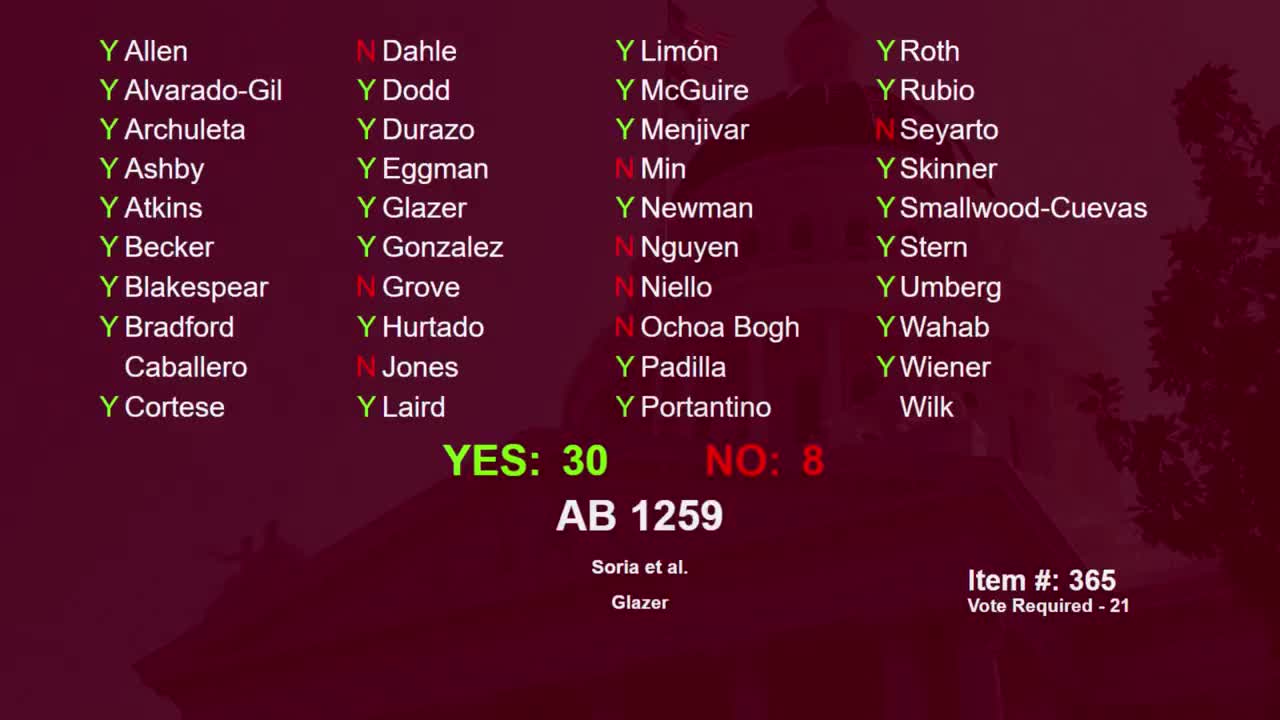
Bill Author