AB 793: Privacy: reverse demands.
- Session Year: 2023-2024
- House: Assembly
- Latest Version Date: 2023-04-19
Current Status:
Failed
(2023-06-30: In committee: Set, first hearing. Hearing canceled at the request of author.)
Introduced
In Committee
First Chamber
In Committee
Second Chamber
Enacted
The United States Constitution generally requires a state to give full faith and credit to the public acts, records, and judicial proceedings of every other state. Existing law sets forth procedures by which a person may enforce a judgment for the payment of money issued by the court of a state other than California.
Existing law, the Electronic Communications Privacy Act, determines how governmental entities may access information on electronic devices and from electronic communication service providers, as defined. Existing law requires a California corporation that provides electronic communication services or remote computing services to the general public to comply with a warrant issued by another state to produce records that would reveal the identity of the customers using those services, data stored by, or on behalf of, the customer, the customers usage of those services, the recipient or destination of communications sent to or from those customers, or the content of those communications as if that warrant had been issued by a California court, except as specified.
This bill would prohibit any government entity from seeking, or any court from enforcing, assisting, or supporting, a reverse-keyword or reverse-location demand, as defined, issued by a government entity or court in this state or any other state. The bill would prohibit a person or California entity from complying with a reverse-keyword or reverse-location demand. The bill would require a court to suppress any information obtained or retained in violation of these provisions, the United States Constitution, or California Constitution. The bill would authorize the Attorney General to commence a civil action for compliance with these provisions.
The bill would require a government entity to immediately notify any person whose information was obtained in violation of these provisions of the violation and of the legal recourse available, as specified. The bill would authorize an individual whose information was obtained, or a service provider or other recipient of the reverse-keyword or reverse-location demand to file a petition to void or modify the demand or order the destruction of information obtained in violation of these provisions. The bill would authorize an individual whose information was obtained by a government entity in violation of these provisions to bring a civil suit against the government entity for damages, injunctive or declaratory relief, or other relief that the court deems proper.
The California Constitution provides for the Right to Truth-in-Evidence, which requires a 2/3 vote of the Legislature to exclude any relevant evidence from any criminal proceeding, as specified.
Because the bill would require any information obtained or retained in violation of the bills provisions to be suppressed in a trial, hearing, or other proceeding, it would require a 2/3 vote.
The bill would make these provisions severable.
The United States Constitution generally requires a state to give full faith and credit to the public acts, records, and judicial proceedings of every other state. Existing law sets forth procedures by which a person may enforce a judgment for the payment of money issued by the court of a state other than California.
Existing law, the Electronic Communications Privacy Act, determines how governmental entities may access information on electronic devices and from electronic communication service providers, as defined. Existing law requires a California corporation that provides electronic communication services or remote computing services to the general public to comply with a warrant issued by another state to produce records that would reveal the identity of the customers using those services, data stored by, or on behalf of, the customer, the customers usage of those services, the recipient or destination of communications sent to or from those customers, or the content of those communications as if that warrant had been issued by a California court, except as specified.
This bill would prohibit any government entity from seeking, or any court from enforcing, assisting, or supporting, a reverse-keyword or reverse-location demand, as defined, issued by a government entity or court in this state or any other state. The bill would prohibit a person or California entity from complying with a reverse-keyword or reverse-location demand. The bill would authorize a court to suppress any information obtained or retained in violation of these provisions, the United States Constitution, or California Constitution. The bill would authorize the Attorney General to commence a civil action for compliance with these provisions.
The bill would require a government entity to immediately notify any person whose information was obtained in violation of these provisions of the violation and of the legal recourse available, as specified. The bill would authorize an individual whose information was obtained, or a service provider or other recipient of the reverse-keyword or reverse-location demand to file a petition to void or modify the demand or order the destruction of information obtained in violation of these provisions. The bill would authorize an individual whose information was obtained by a government entity in violation of these provisions to bring a civil suit against the government entity for damages, injunctive or declaratory relief, or other relief that the court deems proper.
The bill would make these provisions severable.
Existing law, the Reproductive Privacy Act, provides that every individual possesses a fundamental right of privacy with respect to their personal reproductive decisions. Existing federal law, the Health Insurance Portability and Accountability Act of 1996 (HIPAA), establishes provisions relating to the confidentiality of health records. Existing law, the California Privacy Rights Act of 2020 (CPRA), approved by the voters as Proposition 24 at the November 3, 2020, statewide general election, grants a consumer various rights with respect to personal information, as defined, that is collected or sold by a business, as defined, including the right to require the business to delete personal information about the consumer, as specified, unless those obligations restrict a business ability to, among other things, comply with federal, state, or local laws or comply with a court order or subpoena to provide information, or cooperate with a government agency request for emergency access to a consumers personal information if a natural person is at risk or danger of death or serious physical injury, as provided.This bill would state the intent of the Legislature to enact legislation related to protecting the privacy of those seeking reproductive and gender-affirming care.Existing law, the Reproductive Privacy Act, provides that every individual possesses a fundamental right of privacy with respect to their personal reproductive decisions. Existing federal law, the Health Insurance Portability and Accountability Act of 1996 (HIPAA), establishes provisions relating to the confidentiality of health records. Existing law, the California Privacy Rights Act of 2020 (CPRA), approved by the voters as Proposition 24 at the November 3, 2020, statewide general election, grants a consumer various rights with respect to personal information, as defined, that is collected or sold by a business, as defined, including the right to require the business to delete personal information about the consumer, as specified, unless those obligations restrict a business ability to, among other things, comply with federal, state, or local laws or comply with a court order or subpoena to provide information, or cooperate with a government agency request for emergency access to a consumers personal information if a natural person is at risk or danger of death or serious physical injury, as provided.
This bill would state the intent of the Legislature to enact legislation related to protecting the privacy of those seeking reproductive and gender-affirming care.
The Legislature finds and declares all of the following:
(a)California is proud to be a safe haven for reproductive health care access, gender-affirming care, and digital privacy, and has long been at the forefront of protecting these fundamental rights.
(b)When it comes to protecting reproductive and LGBTQI rights and safety, our digital trail is highly revealing and must be safeguarded. With states across the country passing antiabortion and antitrans antitransgender legislation, including laws that criminalize people for accessing care or helping people access care, it is vital that California continue to protect against digital tracking of vulnerable people seeking health care.
(c)Reverse-location and reverse-keyword demands can compel companies to search their records and reveal the identities of all people who looked up a particular keyword online or drove down a certain street.
(d)People in California have a fundamental, inalienable right of privacy under the California constitution with respect to personal reproductive and health care decisions and digital privacy, but dragnet surveillance from reverse-location and reverse-keyword demands severely undermines the right to privacy, especially for people seeking abortions and gender-affirming care.
(e)California also robustly protects peoples right to protest and free expression.
(f)Reverse demands can also chill the exercise of the freedom of speech, association, religion, assembly, movement, and the press.
(g)These mass surveillance demands have been used to track the locations and identities of people protesting police violence and could easily be used by local law enforcement in states across the country to request the names and identities of people whose digital trail shows they have visited California abortion or gender-affirming care providers or even searched for revealing keywords online.
(h)General warrants are expansive and invasive searches by the government that fail to identify specific persons, devices, or places to be searched with evidence of probable cause. Since our nations founding, general warrants have been deemed a significant threat to personal freedom, privacy, and liberty. The United States Supreme Court has repeatedly held that the Fourth Amendment to the United States Constitution prohibits the use of general warrants.
(i)Reverse demands have the same practical effect as unconstitutional general warrants, and courts have found reverse-location demands unconstitutional.
(j)Legislation is necessary to preserve our right to safely seek reproductive and gender-affirming care in the digital age by protecting us from these invasive, harmful, and likely unconstitutional searches of our personal information. Legislation is also necessary to prevent the chilling or punishment of people engaging in constitutionally protected protest and free expression.
SEC. 2.Chapter 3.8 (commencing with Section 1546.8) is added to Title 12 of Part 2 of the Penal Code, to read:3.8.Reverse-keyword and Reverse-location Demands1546.8.For the purposes of this chapter, the following definitions apply:
(a)Government entity means a department or agency of the state or a political subdivision thereof, or an individual acting for or on behalf of the state or a political subdivision thereof.
(b)California entity means a California corporation or a corporation whose principal executive offices are located in California.
(c)Compulsory process means any court order, including a search warrant, a subpoena or administrative subpoena, or any other legal process seeking to compel the disclosure of records or information.
(d)Reverse-keyword demand means any action by any government entity, seeking or obtaining records or information capable of identifying persons who electronically searched or queried for a particular word or words, phrase or phrases, character string or strings, or website or websites, or who visited a particular website through a link returned in response to such a search or query, regardless of whether the request is limited to a specific geographic area or timeframe. Reverse-keyword demand includes any compulsory process seeking such records or information and any action seeking to obtain such records or information in exchange for valuable consideration.
(e)Reverse-location demand means any action by a government entity, seeking records or information pertaining to the location of unspecified electronic devices or their unspecified users or owners, whose scope extends to the electronic devices present in a given geographic area at a given time, whether such device location is measured via global positioning system coordinates, cell tower connectivity, Wi-Fi positioning, or any other form of location detection. Reverse-location demands shall include any compulsory process seeking such records or information and any action seeking to obtain such records or information in exchange for valuable consideration.
1546.81.(a)A government entity shall not make a reverse-location demand or a reverse-keyword demand.
(b)A government entity shall not seek, from any court, a compulsory process to enforce a reverse-location demand or a reverse-keyword demand.
(c)A court subject to the laws of this state shall not enforce, including through a compulsory process, a reverse-location demand or a reverse-keyword demand.
(d)A government entity shall not seek, secure, obtain, borrow, purchase, use, or review any information or data obtained through a reverse-location demand or a reverse-keyword demand.
(e)A person in this state or a California entity shall not be obligated to comply with a reverse-location demand or a reverse-keyword demand issued by the State of California or a political subdivision thereof or any other state or a political subdivision thereof.
(f)A person or entity shall not be obligated to comply with a reverse-location demand issued by the State of California or a political subdivision thereof or any other state or a political subdivision thereof, when the reverse-location demand seeks information about a location within the State of California or a reverse-keyword demand where the search or query that the recipient of the demand has reason to know pertains to a location in the State of California.
(g)A court or government entity of the State of California, or a political subdivision thereof, shall not support, assist, or enforce a reverse-location demand or reverse-keyword demand issued by the State of California or a political subdivision thereof, or any other state or a political subdivision thereof, including the domestication of any such demand.
(h)A government entity shall not seek the assistance of a nongovernmental entity, an agency of the federal government, or an agency of the government of another state or subdivision thereof in obtaining information or data from a reverse-location demand or reverse-keyword demand if the government entity would be barred from directly seeking that information under this chapter.
1546.82.(a)A person in a trial, hearing, or proceeding claiming that information was obtained or retained in violation of the California or United States Constitutions or this chapter may file a motion to suppress. Any information obtained or retained in violation of the California and or United States Constitutions or this chapter shall be suppressed.
(b)The Attorney General may commence a civil action to compel a government entity to comply with the provisions of this chapter.
(c)An individual whose information is disclosed in a manner that is inconsistent with this chapter or the California or United States Constitutions, or a service provider or any other recipient of the reverse-location demand or reverse-keyword demand, may file a petition to void or modify the reverse-location demand or reverse-keyword demand, or to order the destruction of any information obtained in violation of this chapter or the California or United States Constitutions.
1546.83.(a)A person whose information was obtained by a government entity in violation of this chapter shall be immediately notified of the violation and of the legal recourse available to that person pursuant to Section 1546.82. Notice shall be provided in writing by the government entity who committed the violation and by any entity that responded to the demand.
(b)A person whose information was obtained by a government entity in violation of this chapter may institute a civil action against the government entity for one or any combination of any of the following:
(1)One thousand dollars ($1,000) per violation or actual damages, whichever is greater.
(2)Punitive damages.
(3)Injunctive or declaratory relief.
(4)Any other relief that the court deems proper.
(c)In assessing the amount of punitive damages, the court shall consider all of the following:
(1)The number of people whose information was disclosed.
(2)Whether the violation directly or indirectly targeted persons engaged in exercises of activities protected by the California or United States Constitutions.
(3)The persistence of violations by the particular government entity.
(d)In any successful action brought under this section, the court shall award reasonable attorneys fees to a prevailing plaintiff.
SEC. 3.The provisions of this act are severable. If any provision of this act or its application is held invalid, that invalidity shall not affect other provisions or applications that can be given effect without the invalid provision or application.
CORRECTIONS: DigestPage 2. DigestVote KeyPage 2. REVISIONS: HeadingLines 3 and 4.The Legislature finds and declares all of the following:
(a)California is proud to be a safe haven for reproductive rights, health care access, gender-affirming care, and digital privacy, and has long been at the forefront of protecting these fundamental rights.
(b)When it comes to protecting reproductive and LGBTQI rights and safety, our digital trail is highly revealing and must be safeguarded. With states across the country passing antiabortion and antitrans legislation, including laws that criminalize people for accessing care or helping people access care, it is vital that California continue to protect against digital tracking of vulnerable people seeking health care.
(c)Reverse-location and reverse-keyword demands can compel companies to search their records and reveal the identities of all people who looked up a particular keyword online or drove down a certain street.
(d)People in California have a fundamental, inalienable right of privacy under the California constitution with respect to personal reproductive and health care decisions and digital privacy, but dragnet surveillance from reverse-location and reverse-keyword demands severely undermines the right to privacy, especially for people seeking abortions and gender-affirming care.
(e)California also robustly protects peoples right to protest and free expression.
(e)(f)Reverse demands can also chill the exercise of the freedom of speech, association, religion, assembly, movement, and the press.
(f)(g)These mass surveillance demands have been used to track the locations and identities of people protesting police violence and could easily be used by local law enforcement in states across the country to request the names and identities of people whose digital trail shows they have visited California abortion or gender-affirming care providers or even searched for revealing keywords online.
(g)(h)General warrants are expansive and invasive searches by the government that fail to identify specific persons, devices, or places to be searched with evidence of probable cause. Since our nations founding, general warrants have been deemed a significant threat to personal freedom, privacy, and liberty. The United States Supreme Court has repeatedly held that the Fourth Amendment to the United States Constitution prohibits the use of general warrants.
(h)(i)Reverse demands have the same practical effect as unconstitutional general warrants, and courts have found reverse-location demands unconstitutional.
(i)(j)Legislation is necessary to preserve our right to safely seek reproductive and gender-affirming care in the digital age by protecting us from these invasive, harmful, and likely unconstitutional searches of our personal information. Legislation is also necessary to prevent the chilling or punishment of people engaging in constitutionally protected protest and free expression.
SEC. 2.Chapter 3.8 (commencing with Section 1546.8) is added to Title 12 of Part 2 of the Penal Code, to read:3.8.Reverse-keyword and Reverse-location Demands1546.8.For the purposes of this chapter, the following definitions apply:
(a)Government entity means a department or agency of the state or a political subdivision thereof, or an individual acting for or on behalf of the state or a political subdivision thereof.
(b)California entity means a California corporation or a corporation whose principal executive offices are located in California.
(c)Compulsory process means any court order, including a search warrant, a subpoena or administrative subpoena, or any other legal process seeking to compel the disclosure of records or information.
(d)Reverse-keyword demand means any action by any government entity, seeking or obtaining records or information capable of identifying persons who electronically searched or queried for a particular word or words, phrase or phrases, character string or strings, or website or websites, or who visited a particular website through a link returned in response to such a search or query, regardless of whether the request is limited to a specific geographic area or timeframe. Reverse-keyword demand includes any compulsory process seeking such records or information and any action seeking to obtain such records or information in exchange for valuable consideration.
(e)Reverse-location demand means any action by a government entity, seeking records or information pertaining to the location of unspecified electronic devices or their unspecified users or owners, whose scope extends to the electronic devices present in a given geographic area at a given time, whether such device location is measured via global positioning system coordinates, cell tower connectivity, Wi-Fi positioning, or any other form of location detection. Reverse-location demands shall include any compulsory process seeking such records or information and any action seeking to obtain such records or information in exchange for valuable consideration.
1546.81.(a)A government entity shall not make a reverse-location demand or a reverse-keyword demand.
(b)A government entity shall not seek, from any court, a compulsory process to enforce a reverse-location demand or a reverse-keyword demand.
(c)A court subject to the laws of this state shall not enforce, including through a compulsory process, a reverse-location demand or a reverse-keyword demand.
(d)A government entity shall not seek, secure, obtain, borrow, purchase, use, or review any information or data obtained through a reverse-location demand or a reverse-keyword demand.
(e)A person in this state or a California entity shall not be obligated to comply with a reverse-location demand or a reverse-keyword demand issued by the State of California or a political subdivision thereof or any other state or a political subdivision thereof.
(f)A person or entity shall not be obligated to comply with a reverse-location demand issued by the State of California or a political subdivision thereof or any other state or a political subdivision thereof, when the reverse-location demand seeks information about a location within the State of California or a reverse-keyword demand where the search or query that the recipient of the demand has reason to know pertains to a location in the State of California.
(g)A court or government entity of the State of California, or a political subdivision thereof, shall not support, assist, or enforce a reverse-location demand or reverse-keyword demand issued by the State of California or a political subdivision thereof, or any other state or a political subdivision thereof, including the domestication of any such demand.
(h)A government entity shall not seek the assistance of a nongovernmental entity, an agency of the federal government, or an agency of the government of another state or subdivision thereof in obtaining information or data from a reverse-location demand or reverse-keyword demand if the government entity would be barred from directly seeking that information under this chapter.
1546.82.(a)A person in a trial, hearing, or proceeding claiming that information was obtained or retained in violation of the California or United States Constitutions or this chapter may file a motion to suppress. Any information obtained or retained in violation of the California and United States Constitutions or this chapter shall be suppressed.
(b)The Attorney General may commence a civil action to compel a government entity to comply with the provisions of this chapter.
(c)An individual whose information is disclosed a manner that is inconsistent with this chapter or the California or United States Constitutions, or a service provider or any other recipient of the reverse-location demand or reverse-keyword demand, may file a petition to void or modify the reverse-location demand or reverse-keyword demand, or to order the destruction of any information obtained in violation of this chapter or the California or United States Constitutions.
1546.83.(a)A person whose information was obtained by a government entity in violation of this chapter shall be immediately notified of the violation and of the legal recourse available to that person pursuant to Section 1546.82. Notice shall be provided in writing by the government entity who committed the violation and by any entity that responded to the demand.
(b)A person whose information was obtained by a government entity in violation of this chapter may institute a civil action against the government entity for one or any combination of any of the following:
(1)One thousand dollars ($1,000) per violation or actual damages, whichever is greater.
(2)Punitive damages.
(3)Injunctive or declaratory relief.
(4)Any other relief that the court deems proper.
(c)In assessing the amount of punitive damages, the court shall consider all of the following:
(1)The number of people whose information was disclosed.
(2)Whether the violation directly or indirectly targeted persons engaged in exercises of activities protected by the California or United States Constitutions.
(3)The persistence of violations by the particular government entity.
(d)In any successful action brought under this section, the court shall award reasonable attorneys fees to a prevailing plaintiff.
SEC. 3.The provisions of this act are severable. If any provision of this act or its application is held invalid, that invalidity shall not affect other provisions or applications that can be given effect without the invalid provision or application.
SEC. 2.It is the intent of the Legislature to enact legislation to preserve our right to safely seek reproductive and gender-affirming care in the digital age by protecting us from unconstitutional reverse demands. REVISIONS: HeadingLine 2.The Legislature finds and declares all of the following:
(a)California is proud to be a safe haven for reproductive rights, gender-affirming care, and digital privacy, and has long been at the forefront of protecting these fundamental rights.
(b)When it comes to protecting reproductive and LGBTQI rights and safety, our digital trail is highly revealing and must be safeguarded. With states across the country passing antiabortion and antitrans legislation, it is vital that California continue to protect against digital tracking of vulnerable people seeking health care.
(c)Reverse-location and reverse-keyword demands can compel companies to search their records and reveal the identities of all people who looked up a particular keyword online or drove down a certain street.
(d)People in California have a fundamental, inalienable right of privacy under the California constitution with respect to personal reproductive decisions and digital privacy, but dragnet surveillance from reverse-location and reverse-keyword demands severely undermines the right to privacy, especially for people seeking abortions and gender-affirming care.
(e)Reverse demands can also chill the exercise of the freedom of speech, association, religion, assembly, movement, and the press.
(f)These mass surveillance demands have been used to track the locations and identities of people protesting police violence and could easily be used by local law enforcement in states across the country to request the names and identities of people whose digital trail shows they have visited California abortion or gender-affirming care providers or even searched for revealing keywords online.
(g)General warrants are expansive and invasive searches by the government that fail to identify specific persons, devices, or places to be searched with evidence of probable cause. Since our nations founding, general warrants have been deemed a significant threat to personal freedom, privacy, and liberty. The United States Supreme Court has repeatedly held that the Fourth Amendment to the United States Constitution prohibits the use of general warrants.
(h)Reverse demands have the same practical effect as unconstitutional general warrants, and courts have found reverse-location demands unconstitutional.
(i)Legislation is necessary to preserve our right to safely seek reproductive and gender-affirming care in the digital age by protecting us from these invasive, harmful, and likely unconstitutional searches of our personal information.
SEC. 2.It is the intent of the Legislature to enact legislation to preserve our right to safely seek reproductive and gender-affirming care in the digital age by protecting us from unconstitutional reverse demands.
|
Date
|
Status
|
|---|---|
| Jun 30, 2023 | In committee: Set, first hearing. Hearing canceled at the request of author. |
| Jun 28, 2023 | From committee: Do pass and re-refer to Com. on JUD. (Ayes 4. Noes 1.) (June 27). Re-referred to Com. on JUD. |
| Jun 14, 2023 | Referred to Coms. on PUB S. and JUD. |
| Jun 1, 2023 | In Senate. Read first time. To Com. on RLS. for assignment. |
| Jun 1, 2023 | Read third time. Passed. Ordered to the Senate. (Ayes 54. Noes 15. Page 2144.) |
| May 26, 2023 | Measure version as amended on April 19 corrected. |
| May 18, 2023 | Read second time. Ordered to third reading. |
| May 18, 2023 | From committee: Do pass. (Ayes 12. Noes 2.) (May 18). |
| May 18, 2023 | Coauthors revised. |
| May 10, 2023 | In committee: Set, first hearing. Referred to APPR. suspense file. |
| Apr 20, 2023 | Re-referred to Com. on APPR. |
| Apr 19, 2023 | Read second time and amended. |
| Apr 18, 2023 | From committee: Amend, and do pass as amended and re-refer to Com. on APPR. (Ayes 8. Noes 0.) (April 18). |
| Apr 12, 2023 | From committee: Do pass and re-refer to Com. on JUD. (Ayes 7. Noes 0.) (April 11). Re-referred to Com. on JUD. |
| Apr 12, 2023 | Coauthors revised. |
| Mar 20, 2023 | Re-referred to Com. on PUB. S. |
| Mar 16, 2023 | Referred to Coms. on PUB. S. and JUD. |
| Mar 16, 2023 | From committee chair, with author's amendments: Amend, and re-refer to Com. on PUB. S. Read second time and amended. |
| Feb 14, 2023 | From printer. May be heard in committee March 16. |
| Feb 13, 2023 | Read first time. To print. |
|
Date
|
Description
|
Location
|
Votes
|
|
|---|---|---|---|---|
| Jun 27, 2023 | Do pass, but first be re-referred to the Committee on [Judiciary] | Senate Standing Committee on Public Safety |
Passed |
|
| Jun 1, 2023 | AB 793 Bonta Assembly Third Reading | Assembly Floor |
Passed |
|
| May 18, 2023 | Do pass. | Assembly Standing Committee on Appropriations |
Passed |
|
| Apr 18, 2023 | Do pass as amended and be re-referred to the Committee on [Appropriations] | Assembly Standing Committee on Judiciary |
Passed |
|
| Apr 11, 2023 | Do pass and be re-referred to the Committee on [Judiciary] | Assembly Standing Committee on Public Safety |
Passed |
This list shows positions taken on this bill by organizations on the date displayed, which is linked to the original source.
Positions by individuals are not included.
|
Organization
|
Position
|
Date
|
|---|---|---|
| Access Reproductive Justice | ** Support | |
| Aclu California Action | ** Support | |
| All Above All | ** Support | |
| All Family Legal | ** Support | |
| American Atheists | ** Support | |
| Asian Americans Advancing Justice - Asian Law Caucus | ** Support | |
| Atheists United Los Angeles | ** Support | |
| California Church Impact | ** Support | |
| California Coalition for Women Prisoners | ** Support | |
| California Immigrant Policy Center | ** Support | |
| California Latinas for Reproductive Justice | ** Support | |
| California LGBTQ Health and Human Services Network | ** Support | |
| California News Publishers Association | ** Support | |
| California Nurse Midwives Association | ** Support | |
| California Public Defenders Association | ** Support | |
| California Women's Law Center | ** Support | |
| Citizens for Choice | ** Support | |
| Consumer Attorneys Of California | ** Support | |
| Consumer Federation Of California | ** Support | |
| Electronic Frontier Foundation | ** Support | |
| Electronic Privacy Information Center | ** Support | |
| Equality California | ** Support | |
| Equal Rights Advocates | ** Support | |
| Grace - End Child Poverty | ** Support | |
| If/when/how: Lawyering for Reproductive Justice | ** Support | |
| Indivisible Ca Statestrong | ** Support | |
| Indivisible Yolo | ** Support | |
| Lawyers Committee for Civil Rights of the San Francisco Bay Area | ** Support | |
| Los Angeles County Democratic Party | ** Support | |
| Media Alliance | ** Support | |
| Mujeres Unidas Y Activas | ** Support | |
| Mya Network | ** Support | |
| NARAL Pro-Choice California | ** Support | |
| National Abortion Federation | ** Support | |
| National Center for Youth Law | ** Support | |
| Oakland Privacy | ** Support | |
| Planned Parenthood Affiliates Of California | ** Support | |
| Privacy Rights Clearinghouse | ** Support | |
| Reproductive Health Access Project | ** Support | |
| Restore the Fourth | ** Support | |
| San Francisco Black, Jewish and Unity Group | ** Support | |
| Santa Monica Democratic Club | ** Support | |
| Secure Justice | ** Support | |
| Smart Justice California | ** Support | |
| Starting Over Inc. | ** Support | |
| St. James Infirmary | ** Support | |
| TGI Justice Project | ** Support | |
| The Greenlining Institute | ** Support | |
| The Women's Foundation California | ** Support |
SENATE COMMITTEE ON PUBLIC SAFETY
Senator Aisha Wahab, Chair
2023 - 2024 Regular
Bill No: AB 793 Hearing Date: June 27, 2023
Author: | Bonta | ||
Version: | April 19, 2023 | ||
Urgency: | No | Fiscal: | Yes |
Consultant: | SC | ||
Subject: Privacy: reverse demands
HISTORY
Source: ACLU California Action
If/When/How
Electronic Frontier Foundation
Prior Legislation: Proposition 1, approved by California voters on Nov. 8, 2022
SB 107 (Wiener), Ch. 810, Stats. 2022
AB 1242 (Bauer-Kahan), Ch. 627, Stats. 2022
AB 1666 (Bauer-Kahan), Ch. 42, Stats. 2022
AB 2091 (Bonta), Ch. 628, Stats. 2022
SB 178 (Leno), Ch. 651, Stats. 2015
Support: Access Reproductive Justice; All Above All; All Family Legal; American Atheists; American Association of University Women – California; American Nurses Association/California; Asian Americans Advancing Justice - Asian Law Caucus; Atheists United Los Angeles; Black Women for Wellness Action Project; California Church Impact; California Coalition for Women Prisoners; California Immigrant Policy Center; California Latinas for Reproductive Justice; California LGBTQ Health and Human Services Network; California News Publishers Association; California Nurse Midwives Association (CNMA); California Public Defenders Association; Chamber of Progress; Citizens for Choice; Consumer Attorneys of California; Electronic Privacy Information Center (EPIC); Equal Rights Advocates; Equality California; Grace - End Child Poverty in California; Lawyering for Reproductive Justice; Indivisible CA Statestrong; Indivisible California Statestrong; Lawyers Committee for Civil Rights of The San Francisco Bay Area; Media Alliance; Mujeres Unidas Y Activas; Mya Network; Naral Pro-Choice California; Oakland Privacy; Planned Parenthood Affiliates of California; Privacy Rights Clearinghouse; Reproductive Health Access Project (RHAP); Restore the Fourth; San Francisco Black & Jewish Unity Coalition; Santa Monica Democratic Club; Secure Justice; St James Infirmary; Starting Over, INC.; Technet-technology Network; TGI Justice Project; The Greenlining Institute; The Women's Building; Training in Early Abortion for Comprehensive Healthcare (TEACH); Women's Foundation California; Women's Health Specialists
Opposition: Arcadia Police Officers' Association; Burbank Police Officers' Association; California Association of Highway Patrolmen; California District Attorneys Association (oppose unless amended); California Police Chiefs Association; California State Sheriffs’ Association (oppose unless amended); California Reserve Peace Officers Association; Claremont Police Officers Association; Corona Police Officers Association; Culver City Police Officers' Association; Deputy Sheriffs' Association of Monterey County; Fullerton Police Officers' Association; Murrieta Police Officers' Association; Newport Beach Police Association; Novato Police Officers Association; Palos Verdes Police Officers Association; Peace Officers Research Association of California (PORAC); Placer County Deputy Sheriffs' Association; Pomona Police Officers' Association; Riverside Police Officers Association; Riverside Sheriffs' Association; Santa Ana Police Officers Association; Upland Police Officers Association
Assembly Floor Vote: 54 - 15
PURPOSE
The purpose of this bill is to ban reverse-location searches, also known as a “geofence warrant” which allow law enforcement agencies to obtain cell phone data about unspecified individuals near a certain location, and reverse-keyword searches, which allow law enforcement agencies to obtain data about unspecified individuals who used certain search terms on an internet website.
Existing law provides that the right of the people to be secure in their persons, houses, papers, and effects, against unreasonable searches and seizures, shall not be violated, and no Warrants shall issue, but upon probable cause, supported by Oath or affirmation, and particularly describing the place to be searched, and the persons or things to be seized. (U.S. Const., 4th Amend.; Cal. Const., art. I, § 13.)
Existing law prohibits exclusion of relevant evidence in a criminal proceeding on the ground that the evidence was obtained unlawfully, unless the relevant evidence must be excluded because it was obtained in violation of the federal Constitution's Fourth Amendment. (Cal. Const., art. I, § 28(f)(2).)
Existing law establishes the Reproductive Privacy Act which provides that the Legislature finds and declares that every individual possesses a fundamental right of privacy with respect to personal reproductive decisions, which entails the right to make and effectuate decisions about all matters relating to pregnancy, including prenatal care, childbirth, postpartum care, contraception, sterilization, abortion care, miscarriage management, and infertility care. Accordingly, it is the public policy of the State of California that:
- Every individual has the fundamental right to choose or refuse birth control;
- Every individual has the fundamental right to choose to bear a child or to choose to obtain an abortion, with specified limited exceptions; and,
- The state shall not deny or interfere with a person’s fundamental right to choose to bear a child or to choose to obtain an abortion, except as specifically permitted. (Health & Saf. Code, § 123462.)
Existing law provides that the state may not deny or interfere with a person’s right to choose or obtain an abortion prior to viability of the fetus or when the abortion is necessary to protect the life or health of the person. (Health & Safe. Code § 123466, subd. (a).)
Existing law provides that a law of another state that authorizes a state agency to remove a child from their parent or guardian based on the parent or guardian allowing their child to receive gender-affirming health care or gender-affirming mental health care is against the public policy of this state and shall not be enforced or applied in a case pending in a court in this state. (Fam. Code, § 3452.5.)
Existing law prohibits law enforcement agencies from knowingly making or participating in an arrest or participating in any extradition of an individual pursuant to an out-of-state arrest warrant for violation of another state’s law against providing, receiving, or allowing a child to receive gender-affirming health care of gender-affirming mental health care if the care is lawful in this state. (Pen. Code, § 819.)
Existing law provides that a law of another state that authorizes a state agency to remove a child from their parent or guardian based on the parent or guardian allowing their child to receive gender-affirming health care or gender-affirming mental health care is against the public policy of this state and shall not be enforced or applied in a case pending in a court in this state. (Pen. Code, § 1326.)
Existing law defines a "search warrant" as a written order in the name of the people, signed by a magistrate and directed to a peace officer, commanding them to search for a person or persons, a thing or things, or personal property, and in the case of a thing or things or personal property, bring the same before the magistrate. (Pen. Code, § 1523.)
Existing law provides the specific grounds upon which a search warrant may be issued, including when the property or things to be seized consist of any item or constitute any evidence that tends to show a felony has been committed, or tends to show that a particular person has committed a felony. (Pen. Code, § 1524.)
Existing law provides that a search warrant cannot be issued but upon probable cause, supported by affidavit, naming or describing the person to be searched or searched for, and particularly describing the property, thing, or things and the place to be searched. (Pen. Code, § 1525.)
Existing law requires a magistrate to issue a search warrant if they are satisfied of the existence of the grounds of the application, or that there is probable cause to believe their existence. (Pen. Code, § 1528, subd. (a).)
Existing law provides for a process for a search warrant for records that are in the actual or constructive possession of a foreign corporation that provides electronic communication services or remote computing services to the general public, where the records would reveal the identity of the customers using those services, data stored by, or on behalf of, the customer, the customer’s usage of those services, the recipient or destination of communications sent or from those customers, or the content of those communications. (Pen. Code, § 1524.2.)
Existing law requires a provider of electronic communication services or remote computing services to disclose to a governmental prosecuting or investigating agency the name, address, local and long distance telephone toll billing records, telephone number or other subscriber number or identity, and length of service of a subscriber to or customer of that service, and the types of services the subscriber or customer utilized, when the governmental entity is granted a search warrant. (Pen. Code, § 1524.3, subd. (a).)
Existing law states that a governmental entity receiving subscriber records or information is not required to provide notice of the warrant to a subscriber or customer. (Pen. Code, § 1524.3, subd. (b).)
Existing law authorizes a court issuing a search warrant, on a motion made promptly by the service provider, to quash or modify the warrant if the information or records requested are unusually voluminous in nature or compliance with the warrant otherwise would cause an undue burden on the provider. (Pen. Code, § 1524.3, subd. (c).)
Existing law requires a provider of wire or electronic communication services or a remote computing service, upon the request of a peace officer, to take all necessary steps to preserve records and other evidence in its possession pending the issuance of a search warrant or a request in writing and an affidavit declaring an intent to file a warrant to the provider. Records shall be retained for a period of 90 days, which shall be extended for an additional 90-day period upon a renewed request by the peace officer. (Pen. Code, § 1524.3, subd. (d).)
Existing law specifies that no cause of action shall be brought against any provider, its officers, employees, or agents for providing information, facilities, or assistance in good faith compliance with a search warrant. (Pen. Code, § 1524.3, subd. (e).)
This bill prohibits a governmental entity from making a reverse-location demand or a reverse-keyword demand and prohibits a governmental agency from seeking, from any court, a compulsory process to enforce a reverse-location demand or a reverse-keyword demand.
This bill prohibits a court subject to the laws of California from enforcing, including through a compulsory process, a reverse-location demand or a reverse-keyword demand.
This bill provides that a government entity shall not seek, secure, obtain, borrow, purchase, use, or review any information or data obtained through a reverse-location demand or a reverse-keyword demand.
This bill states that a person in this state or a California entity shall not be obligated to comply with a reverse-location demand or a reverse-keyword demand issued by the State of California or a political subdivision thereof or any other state or a political subdivision thereof.
This bill states that a court or government entity of the State of California, or a political subdivision thereof, shall not support, assist, or enforce a reverse-location demand or reverse-keyword demand issued by the State of California or a political subdivision thereof, or any other state or a political subdivision thereof, including the domestication of any such demand.
This bill states that a government entity shall not seek the assistance of a nongovernmental entity, an agency of the federal government, or an agency of the government of another state or subdivision thereof in obtaining information or data from a reverse-location demand or reverse-keyword demand if the government entity would be barred from directly seeking that information under the provisions of this bill.
This bill provide the following definitions:
- “Government entity” means a department or agency of the state or a political subdivision thereof, or an individual acting for or on behalf of the state or a political subdivision thereof.
- “California entity” means a California corporation or a corporation whose principal executive offices are located in California.
- “Compulsory process” means any court order, including a search warrant, a subpoena or administrative subpoena, or any other legal process seeking to compel the disclosure of records or information.
- “Reverse-keyword demand” means any action by any government entity, seeking or obtaining records or information capable of identifying persons who electronically searched or queried for a particular word or words, phrase or phrases, character string or strings, or website or websites, or who visited a particular website through a link returned in response to such a search or query, regardless of whether the request is limited to a specific geographic area or timeframe. “Reverse-keyword demand” includes any compulsory process seeking such records or information and any action seeking to obtain such records or information in exchange for valuable consideration.
- “Reverse-location demand” means any action by a government entity, seeking records or information pertaining to the location of unspecified electronic devices or their unspecified users or owners, whose scope extends to the electronic devices present in a given geographic area at a given time, whether such device location is measured via global positioning system coordinates, cell tower connectivity, Wi-Fi positioning, or any other form of location detection. “Reverse-location demands” shall include any compulsory process seeking such records or information and any action seeking to obtain such records or information in exchange for valuable consideration.
Existing law provides that a defendant may move to suppress as evidence any tangible or intangible thing obtained a result of a search or seizure on either of the following grounds:
- The search or seizure without a warrant was unreasonable; or
- The search or seizure with a warrant was unreasonable because of any of the following:
- The warrant is insufficient on its face;
- The property or evidence obtained is not that described in the warrant;
- There was not probable cause for the issuance of the warrant;
- The method of execution of the warranted violated federal or state constitutional standards; or,
- There was any other violation of federal or state constitutional grounds. (Pen. Code, § 1538.5, subs. (a)(1).)
This bill specifies that a person in a trial, hearing, or proceeding claiming that information was obtained or retained in violation of the California or United States Constitution or the provisions of this bill may file a motion to suppress and any information found to have been obtained or retained in violation of the law shall be suppressed.
This bill authorizes the Attorney General (AG) to commence a civil action to compel a government entity to comply with the provisions of this bill.
This bill authorizes an individual whose information is disclosed in a manner that is inconsistent with this chapter or the California or United States Constitutions, or a service provider or any other recipient of the reverse-location demand or reverse-keyword demand, to file a petition to void or modify the reverse-location demand or reverse-keyword demand, or to order the destruction of any information obtained in violation of this bill’s provisions or the California or United States Constitution.
This bill provides that a person whose information was obtained in violation of this bill’s provisions shall be immediately notified of the violation and of the legal recourse available to that person as specified in the bill.
This bill requires notice to be in writing by the violating government entity and by any entity that responded to the demand.
This bill authorizes a person whose information was obtained in violation of this bill’s provisions to institute a civil action against the government entity for one or any combination of the following:
- $1,000 per violation or actual damages, whichever is greater;
- Punitive damages;
- Injunctive or declaratory relief; or,
- Any other relief that the court deems proper.
This bill specifies that in assessing the amount of punitive damages, the court shall consider all of the following:
- The number of people whose information was disclosed;
- Whether the violation directly or indirectly targeted persons engaged in exercises of activities protected by the California or United States Constitutions; and,
- The persistence of violations by the particular government entity.
This bill provides that in any successful action brought under the provisions of this bill, the court shall award reasonable attorney’s fees to a prevailing plaintiff.
This bill contains various legislative findings and declarations regarding protecting reproductive and LGBTQI rights and the protecting the privacy and free expression rights of Californians.
This bill contains a severability clause so that if any provision of this bill or its application is held invalid, that invalidity shall not affect other provisions or applications that can be given effect without the invalid provision or application.
COMMENTS
- Need for This Bill
According to the author of this bill:
Current laws also do not prevent law enforcement from using increasingly common and invasive “reverse warrants” to obtain sensitive private information without sufficient legal process. A normal warrant requires police to have probable cause to investigate an individual. Reverse warrants turn this due process on its head: they compel companies to search their records and reveal the identities of all people who were present at a particular location (geofence demands) or all people who looked up a particular keyword online (keyword demands).
Reverse warrants may also violate the Fourth Amendment. Unlike typical warrants for electronic information, reverse warrants are not targeted to specific individuals or accounts. Instead, they provide access to information about all users or devices that searched for certain words or were located near a certain location. These warrants lack individualized suspicion, allow for broad officer discretion, and impact the privacy rights of countless innocent individuals. They are arguably even broader than the general warrants that inspired the Fourth Amendment’s drafters. Early test cases, such as In the Matter of the Search of Information Stored at the Premises Controlled by Google, Case No. KM-2022-79 (19th J.D. VA, February 8, 2022), have found the use of reverse warrants to be unconstitutional, as applied.
Digital surveillance is a threat to our reproductive freedoms and to vulnerable people. Since the repeal of Roe, we have seen anti-abortion states use digital data including Facebook messages to prosecute people for having abortions or helping others obtain reproductive care. Geofence demands have also been used to track the locations and identities of people protesting police violence, and could be used to track the locations and identities of people visiting reproductive health clinics as well. People in California have a fundamental, constitutional right of privacy. But fishing expeditions from reverse-geofence and reverse-keyword demands undermine that right—especially for people seeking abortions and gender-affirming care. Reverse warrants can also chill the exercise of the freedom of speech, association, religion, assembly, movement, and the press.
California-based companies are receiving more reverse warrants each year, and the demand will only rise as more states seek to criminalize abortions and gender-affirming healthcare. By passing AB 793, lawmakers can put a stop to the use of these highly invasive methods of surveillance.
This bill builds on the protections established by AB 1242 (Chapter 627, Statutes of 2022), authored by Asm. Rebecca Bauer-Kahan; AB 2091 (Chapter 628, Statutes of 2022), authored by Asm. Mia Bonta; AB 1666 (Chapter 42, Statutes of 2022), authored by Asm. Rebecca Bauer-Kahan; and SB 107 (Chapter 810, Statutes of 2022) authored by Sen. Scott Wiener. These four bills limited the ways that out-of-state law enforcement can obtain information related to abortion and gender-affirming care from entities within California.
AB 793 also builds on SB 178 (Chapter 651, Statutes of 2015), authored by Sen. Mark Leno, established strong privacy protections for digital information sought by law enforcement.
- Background on Geofencing
Geofencing is the creation of a virtual boundary in real-world geographic area. Geofencing requires communication technologies such as Global Positioning System (GPS), radio frequency identification (RFID), Wi-Fi or cellular data to trigger a virtual geographic boundary and can track when a device enters or exits that boundary. A virtual boundary can be created around a geographical location as small as a building, store or mall, and as large as a ZIP code, city or entire state.
Originally, geofencing was used by companies to provide targeted ads to their users when they are near certain businesses or services. For example, Google uses the location-based data that it collects "to target ads and measure how effective they are - checking, for instance, when people go into an advertiser's store." (Article: The Best Offense is a Good Defense: Fourth Amendment Implications of Geofence Warrants (2022) 50 Hofstra L.Rev. 829, 832.)
Law enforcement agencies started seeking data from companies that store location-based data to develop suspects after the commission of a crime. A geofence warrant seeks cell phone location information that is stored by third-party companies and identifies everyone at a location (provided that they have a cell phone and it is turned on) during a particular time. Law enforcement officials use a geofence warrant to target a crime scene instead of a specific suspect, working backwards in the hopes of developing a suspect, which is why the warrants are often referred to as "reverse-location" warrants. The third party company can establish that the suspect was at the location searched during the time period in question and provide subscriber information. (Id. at pp. 833-834.)
Typically, a geofence warrant involves a three-step process to ascertain identifying information about a user:
First, the warrant targets a specific geographic area defined by GPS coordinates, as well as a specific time frame at that location for some type of criminal offense. Based on this warrant, "Google searches its entire database of user location information - tens of millions of accounts - to extract the subset of data responsive to the warrant, giving police de-identified information on all devices within the area." This first step could lead to hundreds and even thousands of potential devices held by individuals who happened to have been within the geographical zone at the targeted time. Based on this collection, Google then provides anonymized information to the law enforcement officials.
In the second step, law enforcement officials review the initial responses from Google and resubmit requests narrowing down the devices, but receiving more information about the devices. Moreover, the information requested about these devices will include information outside of the original designated geographical area.
In the third step, law enforcement officials analyze the devices' data received in the second step. If they believe the information is related to the criminal investigation, they then request that Google provide identification related to these devices. Pursuant to such a request, Google can provide phone numbers, email addresses, and subscribers' names, as well as other information. (Id. at pp. 835-836.)
Geofence warrants are on the rise. The first geofence warrant was filed in 2016 and by the end of 2019, Google was receiving about 180 search warrant requests per week from law enforcement officials across the country. Between 2018 and 2020, Google received about 20,000 geofence warrant requests for data. During that two-year time period, over 95% of these requests came from state law enforcement officers. (Id. at p. 834.) Google’s location history database contains information about hundreds of millions of devices around the world, going back almost a decade. (Id. at p. 835.)
The proponents of this bill argue that the use of geofence warrants raises privacy concerns and questions about whether the practice violates constitutional protections against unreasonable searches and seizures. The reverse-keyword demand search works in a similar manner. Those searches operate when law enforcement requests information regarding all internet users who searched for a specific topic or keyword in a specific time period. From there, law enforcement can ascertain who was searching for information related to potentially unlawful conduct.
In the context of reproductive and gender-affirming health care, states that criminalize such health care may use geofence warrants and reverse-keyword searches to track down the locations and identities of people who come to California to access or help others access such care.
- Search Warrant Requirements
Both the United States and the California constitutions guarantee the right of all persons to be secure from unreasonable searches and seizures. (U.S. Const., amend. IV; Cal. Const., art. 1, sec. 13.) Generally, a “search” is a governmental intrusion upon, or invasion of a person’s security in an area in which they have a reasonable expectation of privacy. These constitutional provisions generally require the police to secure a warrant before conducting a search, and specify that the warrant must be issued “upon probable cause, supported by oath or affirmation, and particularly describing the place to be searched.” (Ibid.)
Penal Code section 1523 defines a “search warrant” as an order, in writing, signed by a magistrate, commanding a peace officer to search for personal property and bring it before a magistrate. Section 1524 outlines the statutory grounds for issuance of search warrants and mandates that they be supported by probable cause. The standard for probable cause to issue a search warrant is “whether, given all the circumstances set forth in the affidavit, there is a fair probability that contraband or evidence of a crime will be found in a particular place.” (Illinois v. Gates (1983) 462 U.S. 213, 238.)
The California Electronic Privacy Act (CalECPA), enacted by SB 178 (Leno), Chapter 651, Statutes of 2015, is a comprehensive digital privacy law which took effect on January 1, 2016 (§ 1546 et seq.):
[I]t requires all California state and local law enforcement agencies to obtain a search warrant or wiretap order before they can access any electronic communication information. The law defines ‘electronic communication information’ in the broadest terms possible so that it includes emails, digital documents, text messages, location information, and any digital information stored in the cloud. The law protects all aspects of electronic communication information, not just its contents, but also metadata information relating to the sender, recipient, format, time, date, and location of the communications, including IP addresses.
CalECPA also limits the ability of California law enforcement to obtain information directly from a smartphone or similar device, or to track them. Law enforcement must either obtain a warrant or get the consent of the person possessing the electronic device.
(Daniels, California Updates Privacy Rights with the Electronic Communications Privacy Act (Nov. 17, 2015) JDSupra.)
Recently, a California Court of Appeal found that a geofence warrant used by law enforcement in finding two murder suspects violated the Fourth Amendment but did not violate CalECPA. (People v. Meza (2023) 90 Cal.App.5th 520.) Meza involved two defendants who were identified as suspects in a murder after a geofence warrant directed to a technology company revealed that their cell phone data was connected to several of the same locations as the victim on the day of the victim’s murder. The defendants moved to suppress the evidence but were denied and ultimately convicted of murder. The court of Appeal found that the geofence warrant violated the Fourth Amendment but upheld the murder convictions under the good faith exception to the exclusionary rule.
In determining the validity of a warrant courts examine three main factors: probable cause, particularity and overbreadth. (Meza, supra, 90 Cal.App.5th at 535.) Probable cause will be found to support the issuance of a warrant if “‘the magistrate had a substantial basis for concluding a fair probability existed that a search would uncover wrongdoing.’” . . . . “Particularity is the requirement that the warrant must clearly state what is sought.” . . . .To satisfy this requirement, “[c]omplete precision in describing the place to be searched is not required. . . . . “Breadth deals with the requirement that the scope of the warrant be limited by the probable cause on which the warrant is based.” (Ibid.)
The Meza court found that while the geofence warrant was supported by probable cause because it was reasonable for the magistrate to conclude that the perpetrators of the murder were carrying cell phones the day of the murder and may have used them in coordinating their movements. (Id. at p. 536.) However, the court found that the geofence warrant lacked particularity and was overbroad in violation of the Fourth Amendment. Specifically, the geofence warrant “failed to meet the particularity requirement because it provided law enforcement with unbridled discretion regarding whether or how to narrow the initial list of users identified by Google. Once the step one search had been conducted, law enforcement officials were able to enlarge the geographic parameters of the search and request additional information on any of the potentially thousands of users identified without any objective criteria limiting their discretion. Again, at step three law enforcement could seek identifying information of any of the users found within the search parameters without restriction on how many users could be identified or any further showing that information concerning each individual user would be relevant to the case.” (Id. at pg. 538.)
The court found that the warrant was overbroad because law enforcement failed to draw the search boundaries as narrowly as they could have given the information that was available to them which potentially allowed a location-specific search of thousands of individuals. The court recognized that it may be impossible to exclude any uninvolved third parties, but stated that the proper inquiry is the reasonableness of the search. The court concluded that “The warrant here, authorizing the search of more than 20 acres total over a cumulative period of more than five hours in residential and commercial areas did not meet this fundamental threshold requirement.” (Meza, supra, 90 Cal.App.5th at pp. 539-541.)
This bill would ban geofence warrants and reverse-keyword searches. Specifically, this bill would prohibit any government entity from seeking, or any court from enforcing, assisting, or supporting, a reverse-keyword or reverse-location demand, as defined, issued by a government entity or court in this state or any other state. Any person or California entity would be prohibited from complying with a reverse-keyword or reverse-location demand. The bill would require a court to suppress any information obtained or retained in violation of these provisions, the United States Constitution, or California Constitution.
Proponents of this bill argue that such digital surveillance undermines the public’s fundamental, constitutional right of privacy which is especially dangerous for people seeking abortions and gender-affirming care. Additionally, they argue that the reverse-keyword search can chill the exercise of the freedom of speech, association, religion, assembly, movement, and the press.
Opponents of the bill argue that a blanket prohibition on the use of these types of warrants which have been effective in identifying suspects that commit serious crimes is overbroad and will lead to such crimes going unsolved.
- Full Faith and Credit Clause
Generally, the laws of the state regulate conduct that occurs within that state. However, situations may arise where more than one state’s laws may apply such as collection of previously-owed income taxes or child support obligations from another state. Or one state has jurisdiction to criminally prosecute an offense because someone has fled the state or committed part of the crime in the prosecuting state. Under the United States Constitution, states are required to provide full faith and credit to “to the public acts, records, and judicial proceedings of every other state. (U.S. Const. art. IV, sec. 1.)”
The Full Faith and Credit Clause may be implicated when there is a conflict between the laws of the different states. At least one court has held that any effort by a state to apply its criminal laws beyond its state borders to criminalize activity that is otherwise lawful in the other state. (Bigelow v. Virginia (1975) 421 U.S. 809.) However, the Supreme Court has also held that even when criminal conduct takes place outside of the state, extraterritorial jurisdiction may be proper when the conduct was intended to produce or did produce harmful effects within the state. (Strassheim v. Daily (1911) 221 U.S. 280.)
The Supreme Court has also made a distinction between the strength of the Full Faith and Credit Clause’s applications to judgements versus state law. “The Full Faith and Credit Clause does not compel ‘a state to substitute the statutes of other states for its own statutes dealing with a subject matter concerning which it is competent to legislate. Regarding judgments, however, the full faith and credit obligation is exacting. A final judgment in one State, if rendered by a court with adjudicatory authority over the subject matter and persons governed by the judgment, qualifies for recognition throughout the land.’” (Baker v. General Motors Co., supra, 522 U.S. at 232-233.) This concept is often referred to as the “public policy exception” meaning statutes in one state is given effect only if they do not contravene the public policy of the other state.
By rejecting out-of-state law enforcement’s attempts to seek reverse-location and reverse-keyword data in California, this bill implicates the Full Faith and Credit Clause. If this bill were challenged based on the Full Faith and Credit Clause, California would argue that assisting in the enforcement of laws in other states that restrict reproductive and gender-affirming health care is contrary to the public policy of this State, which is supported by case law. However, it is unclear whether the court would view this bill as ignoring another state’s statutory laws versus ignoring a judgement from that state.
- Proposition 8: Truth in Evidence
In 1982, the California voters passed Proposition 8. Proposition 8 enacted article I, section 28 of the California Constitution, which provides in relevant part: “Right to Truth-in-Evidence. Except as provided by statute hereafter enacted by a two-thirds vote of the membership in each house of the Legislature, relevant evidence shall not be excluded in any criminal proceeding, including pretrial and post-conviction motions and hearings.” (Cal. Const., art. I, § 28, subd. (f); People v. Lazlo (2012) 206 Cal.App.4th 1063, 1069.) The “Truth-in-Evidence” provision of Section 28 “was intended to permit exclusion of relevant, but unlawfully obtained evidence, only if exclusion is required by the United States Constitution.” (In re Lance W. (1985) 37 Cal.3d 873, 890 (Lance W.).) Thus, Section 28 federalized California’s search and seizure law. A trial court may exclude evidence under Penal Code section 1538.5 only if exclusion is mandated by the federal Constitution. (Lance W., supra, 37 Cal.3d at p. 896.)
This bill would require suppression of evidence obtained through a reverse location demand or a reverse keyword demand, even if the violation did not require exclusion under the federal Constitution. Accordingly, this bill may implicate Proposition 8 and thus requires a 2/3 vote.
- Committee Amendments
The author intends to narrow the bill to apply to reverse-location demand or reverse-keyword demand related to seeking, obtaining, providing or supporting another in seeking or obtaining sexual and reproductive health care and gender affirming health care.
- Double-Referral with Judiciary Committee
This bill would authorize the AG to commence a civil action to compel a government entity to comply with the provisions of this bill. An individual whose information is disclosed would be authorized to file a petition to void or modify the reverse-location demand or reverse-keyword demand, or to order the destruction of any information obtained in violation of this bill’s provisions or the California or United States Constitution. A person whose information was obtained in violation of this bill’s provisions would be required to be notified in writing of the violation and of any legal recourse available to that person.
Additionally, a person whose information was obtained in violation of this bill’s provisions would be authorized to institute a civil action against the government entity.
Because these provisions are within the Judiciary Committee’s jurisdiction, this bill has been double-referred and these issues will be fully analyzed by that committee.
- Argument in Support
This bill is supported by a broad coalition of advocacy organizations, which focus on reproductive justice, LGBTQI+ rights, equity, criminal justice, free expression. According to Electronic Frontier Foundation, a co-sponsor of this bill:
The bill specifically addresses the problem of “reverse demands” and would put a stop to their use in relation to reproductive care, gender-affirming care, and supportive services for that care. These demands have been used to target people exercising their rights and poses an immediate threat after the Supreme Court overturned Roe v. Wade and as more states across the country criminalize gender-affirming care nationwide.
Normal warrants seek information about a particular person police have probable cause to believe merits investigation. A reverse warrant seeks the opposite: the identity of all the people who were present at a particular location (geofence demands) or who looked up a particular term in a search engine (keyword demands) simply because of where they were or what they searched for. Thousands or even millions of people can be included in a single, overbroad request without any probable cause at all. Rather than help law enforcement find a needle in a haystack, reverse warrants give law enforcement a haystack to search through without any guarantee the needle they want is anywhere inside.
These demands can be used to conduct broad fishing expeditions for those who are seeking needed healthcare. They allow local law enforcement in states across the country to request the names and identities of people whose digital data trail shows they’ve visited California abortion or gender-affirming care providers. They could indicate if people searched for revealing particular keywords online such as “mifepristone,” “abortion drugs,” “top surgery,” or for care options in California. Or a police investigator could ask for everyone who was outside an unrelated business across the street from a reproductive health clinic–skirting around the reproductive privacy protections enacted last year. A.B. 793 also extends greater protections to those seeking gender-affirming care.
Reverse demands have the same practical effect as unconstitutional general warrant. Since our Nation’s founding, general warrants have been deemed a significant threat to personal freedom, privacy, and liberty, and the Supreme Court has repeatedly held that the Fourth Amendment to the United States Constitution prohibits the use of these general warrants. These ‘hated writs’ spurred colonists toward revolution and directly motivated James Madison’s crafting of the Fourth Amendment.” It is not surprising then that courts have found reverse-location demands unconstitutional.
This bill originally sought to take these demands off the table completely; however, in response to pushback from legislators, the author has committed to focus the scope of A.B. 793 to give the strongest possible protection to those most immediately vulnerable in the present, post-Dobbs climate. The use of reverse demands poses a threat to those who are seeking reproductive or gender-affirming care, particularly if they are coming to California from other states. Taking reverse warrants off the table in this focused context would solidify California’s place as a protector of those who are merely seeking healthcare. It would also provide needed clarity for companies that receive these warrants, which also support the bill because it addresses the lack of scrutiny applied to these demands before they are issued.
- Argument in Opposition
This bill is opposed by police officer associations, police chiefs, sheriffs and district attorneys. According to California District Attorneys Association, who are opposed unless amended:
[T]he proposed amendments (and in print version) of AB 793 would preclude law enforcement’s use of reverse demands not just in cases targeting legal reproductive or gender affirming care in California, but in virtually all other instances as well. This result would deprive investigators of critical information routinely used to help solve cases involving mass shootings, bombings, rapes, child sexual assault materials, and a host of other crimes victimizing the most vulnerable in our society.
First, the proposed language would ban law enforcement’s reverse search demands for locations for locations “within two miles of any airport, rail terminal, railway station, terminal for interstate bus, or border checkpoint or crossing.” It would also ban law enforcement’s reverse demands for locations within one mile of a site offering sensitive services. Further, because of the bill’s overly expansive definition of “sexual and reproductive health care,” such sites would include not only traditional care providing clinics and hospitals, but also all sites that provide mental health care, including jails and prisons, medical offices, including those in schools, pharmacies, sites providing infectious disease services (such as a COVID testing site), and places offering services for victims of sexual assault or hate crimes – regardless of whether those locations actually offer reproductive or gender affirming care.
This geographical ban likely encompasses the vast majority of inhabited California. Its inclusion in the bill means not only law enforcement, but judges and internet service providers as well will need to research and locate all possible service locations and transit sites before approving or responding to any reverse demand – a substantial demand on our judicial officers’ time and resources. Even with diligence the definitions are so broad is seems nearly impossible to identify all possible service or transit locations. This is especially important in combination with the bill’s other broad language that would require service and transit sites be taken into consideration for virtually all reverse demands. If, for example, law enforcement officers were investigating a kidnapping, the bill would require diligent law enforcement officers and judges eliminate all protected sites before determining whether a warrant could issue.
Next, the proponent’s proposed language (and the bill in print) would ban any reverse demand by a government entity “from which sensitive services information can be inferred.” It can always be inferred that someone traveling near or entering into a location providing sensitive service relates to someone seeking, obtaining, providing, or supporting sensitive services. It is unreasonable to expect an officer seeking a warrant or a judicial officer reviewing a warrant (or other request) in any case involving any type of crime to determine whether their request would inadvertently capture information from which sensitive services information could be inferred.
Sadly, providers and patients of reproductive and gender affirming care are among the people most likely to be negatively impacted by the negative impacts of AB 793. Protests and violence at clinic sites are frequent and escalating. For example, just last week, charges were brought against two masked men who bombed a Costa Mesa Planned Parenthood clinic at 1 a.m. in the morning. Reverse keyword searches can be used to find criminal actors who searched for information about bomb making or clinic locations. Under the proposed language however, such techniques would be off limits.
-- END –
ASSEMBLY THIRD READING
ATR Bill Id:AB 793
Author:(Bonta)
As Amended Ver:April 19, 2023
Majority vote
SUMMARY
Prohibits a government entity from seeking or obtaining information from a reverse-location demand or a reverse-keyword demand, and prohibits any person or government entity from complying with a reverse-location demand or a reverse-keyword demand.
Major Provisions
- Defines "reverse-keyword demand" as any action by any government entity seeking or obtaining records or information capable of identifying persons who electronically searched or queried for a particular word or words, phrase or phrases, character string or strings, or website or websites, or who visited a particular website through a link returned in response to such a search or query, regardless of whether the request is limited to a specific geographic area or timeframe.
- Provides that "reverse-keyword demand" includes any compulsory process, as defined, seeking such records or information and any action seeking to obtain such records or information in exchange for valuable consideration.
- Defines "reverse-location demand" as any action by a government entity seeking records or information pertaining to the location of unspecified electronic devices or their unspecified users or owners, whose scope extends to the electronic devices present in a given geographic area at a given time, whether such device location is measured via global positioning system coordinates, cell tower connectivity, Wi-Fi positioning, or any other form of location detection.
- Provides that "reverse-location demand" includes any compulsory process seeking such records or information and any action seeking to obtain such records or information in exchange for valuable consideration.
- Prohibits a government entity from making a reverse-location demand or a reverse-keyword demand.
- Prohibits a government entity from seeking, from any court, a compulsory process to enforce a reverse-location demand or a reverse-keyword demand.
- Prohibits a government entity from seeking, securing, obtaining, borrowing, purchasing, using, or reviewing any information or data obtained through a reverse-location demand or a reverse-keyword demand.
- Prohibits a court subject to the laws of this state from enforcing, including through a compulsory process, a reverse-location demand or a reverse-keyword demand.
- Provides that a person in this state or a California entity shall not be obligated to comply with a reverse-location demand or a reverse-keyword demand issued by the State, or a political subdivision thereof, or any other state or political subdivision thereof.
- Provides that a person or entity shall not be obligated to comply with a reverse-location demand issued by the State of California or a political subdivision thereof or any other state or a political subdivision thereof, when the reverse-location demand seeks information about a location within the State of California or a reverse-keyword demand where the search or query that the recipient of the demand has reason to know pertains to a location in the State of California.
- Provides that a court or government entity of the State of California, or a political subdivision thereof, shall not support, assist, or enforce a reverse-location demand or reverse-keyword demand issued by the State of California or a political subdivision thereof, or any other state or a political subdivision thereof, including the domestication of any such demand.
- Provides that a government entity shall not seek the assistance of a nongovernmental entity, an agency of the federal government, or an agency of the government of another state or subdivision thereof in obtaining information or data from a reverse-location demand or reverse-keyword demand if the government entity would be barred from directly seeking that information.
- Allows a person in a trial, hearing, or proceeding claiming that information was obtained or retained in violation of the California or United States Constitutions or these provisions to file a motion to suppress.
- Requires any information obtained or retained in violation of the California and United States Constitutions or these provision to be suppressed.
- Authorizes the Attorney General to commence a civil action to compel a government entity to comply with these provisions.
- Authorizes an individual whose information is disclosed in a manner that is inconsistent with these provisions or the California or United States Constitutions, or a service provider or any other recipient of the reverse-location demand or reverse-keyword demand, to file a petition to void or modify the reverse-location demand or reverse-keyword demand, or to order the destruction of any information obtained.
- Requires that a person whose information was obtained by a government entity in violation of these provision be immediately notified of the violation and of the legal recourse available to that person, as specified.
- Authorizes a person whose information was unlawfully obtained by a government entity to institute a civil action against the government entity for one or any combination of any of the following:
- $1,000 per violation or actual damages, whichever is greater;
- Punitive damages;
- Injunctive or declaratory relief; and/or,
- Any other relief that the court deems proper.
- Requires the court to award reasonable attorney's fees to a prevailing plaintiff in any successful action brought for a violation of the prohibition on reverse location demands or reverse keyword demands.
COMMENTS
According to the Author
"In the face of a growing slate of anti-abortion and anti-trans laws in states across the country, California must remain a safe haven for those seeking reproductive and gender-affirming care. To do that, we must say 'no' to invasive surveillance that would target people seeking needed healthcare here in California and beyond. AB 793 would preserve our right to safely seek reproductive and gender-affirming care in the digital age and protect us from invasive and harmful, 'reverse warrants' that reveal our highly personal information without sufficient legal process.
"Reverse geofence and keyword warrants request the disclosure of multiple people's private information simply because they were at a particular location during a specific time frame, or entered certain keywords into a search engine. Reverse warrants can place hundreds or thousands of unsuspecting and innocent people in the crosshairs of law enforcement, threatening their Fourth Amendment rights to be free from unreasonable government searches.
"As a worldwide leader in technology and innovation, we are uniquely positioned to divest from digital surveillance that would target people for having an abortion or seeking reproductive and gender-affirming care here in California and beyond. In order to truly protect our right to abortion, reproductive health care, and gender-affirming care, we must build on existing law and unequivocally reject the use of reverse warrants. By prohibiting reverse warrants, AB 793 puts a stop to this kind of indiscriminate government surveillance – preserving our digital privacy and protecting Californians' right to live life on our own terms."
Arguments in Support
According to the California Women's Law Center, "The legislature has recognized the threat that faces these communities, passing AB 2091 [(Bonta), Chapter 628, Statutes of 2022], AB 1242 [(Bauer-Kahan), Chapter 627, Statutes of 2022], and SB 107 [(Wiener), Chapter 810, Statutes of 2022]. Those bills were a good first step, but more must be done. Unfortunately, police can skirt the protections in last year's laws if, for example, they don't say specifically why they want the data. By taking some of the most invasive surveillance warrants off the table, A.B. 793 would continue to solidify California's status as a sanctuary for those seeking reproductive or gender-affirming care.
"The bill specifically addresses the problem of 'reverse demands' and would put a stop to them. Normal warrants seek information about a particular person police have probable cause to believe merits investigation. A reverse warrant seeks the opposite: the identity of all the people who were present at a particular location (geofence demands) or who looked up a particular term in a search engine (keyword demands) simply because of where they were or what they searched for. Reverse demands have the same practical effect as unconstitutional general warrants, and courts have found geofence demands unconstitutional.
"These demands, already used to target protestors, can be used to conduct broad fishing expeditions for those who are seeking needed healthcare. A police investigator could ask for everyone who was outside an unrelated business across the street from a reproductive health clinic, for example, and get information about who has been near that clinic's entrance—along with anyone who happened to be in the area at that moment – while skirting around the reproductive privacy protections enacted last year.
"Thousands or even millions of people can be included in a single, overbroad request without any probable cause at all. For example, a single warrant issued in Los Angeles County sought to identify all devices within a total geographic area equivalent to about 24 football fields during five morning commute hours on a Friday. The area included several of the most densely populated cities in the greater Los Angeles area, including Lynwood, with a population of 13,894 people per square mile and Paramount, with a population of 11,367 people per square mile. In this way, rather than help law enforcement find a needle in a haystack, reverse warrants give law enforcement a haystack to search through without any guarantee the needle they want is anywhere inside. Someone might have left their cellphone at home and so not be included in a geofence warrant, for example, or they could have used one of dozens of search engines to avoid inclusion in a keyword search warrant to a particular search engine company.
"Reverse demands have the same practical effect as unconstitutional general warrants. General warrants are expansive and invasive searches by the government that fail to identify specific persons, devices, or places to be searched with evidence of probable cause. They date back to pre-Revolutionary War times when the King used 'writs of assistance' to authorize his agents to 'carry out wideranging searches of anyone, anywhere, and anytime regardless of whether they were suspected of a crime. These 'hated writs' spurred colonists toward revolution and directly motivated James Madison's crafting of the Fourth Amendment.' Since our Nation's founding, general warrants have been deemed a significant threat to personal freedom, privacy, and liberty, and the Supreme Court has repeatedly held that the Fourth Amendment to the United States Constitution prohibits the use of these general warrants. It is not surprising then that courts have found reverse-location demands unconstitutional.
"The use of reverse demands poses a unique threat to those who are seeking reproductive or genderaffirming care, particularly if they are coming to California from other states. These mass surveillance demands are dangerous because they allow local law enforcement in states across the country to request the names and identities of people whose digital data trail shows they've visited California abortion or gender-affirming care providers. They could also indicate if people searched for revealing particular keywords online such as 'mifepristone,' 'abortion drugs,' 'top surgery,' or for care options in California.
"Taking reverse warrants off the table would solidify California's place as a protector of those who are merely seeking healthcare. It would also provide needed clarity for companies that receive these warrants, which have often spoken out against such requests because of the lack of scrutiny applied before they are issued."
Arguments in Opposition
According to the Yolo County District Attorney, "Specifically, the broad language of AB 793 would ban the use of location data from geofence warrants (in California and nationwide); the use of cell tower location data (CSLI) from cell tower warrants in CA; would prohibit 911 operators from using reverse location GPS software to find the location of a caller; and it would have a retroactive effect, invalidating searches that were conducted pursuant to legal warrants.
"While I am sympathetic to the desire to ensure that reproductive privacy rights, health care access, and gender-affirming care are not compromised in California, the latest version of this bill goes vastly beyond that by banning one of the most effective methods of gathering crucial data necessary to help accurately identify perpetrators of every type of crime, ensure innocent persons are not wrongly charged, and potentially exonerate those wrongly convicted.
"Given its expansive definition of a "reverse-keyword demand," AB 793 would likely prevent every government entity, including the Legislature, from engaging in a broad swathe of internal and customer-oriented functions, including auditing databases for misuse or misconduct, investigating online threats and security breaches, using maintenance software to analyze data and device usage, and having a modem website equipped with Google Analytics. Similarly, the expansive definition of a "reverse-location demand," would encompass the use of everyday technologies such as Caller ID, Bluetooth, Wi-Fi, and the Internet, as area codes, signal strength, and IP addresses provide location information on unspecified users and devices.
"It is wrong and misleading to claim that warrants for geolocation data and reverse key word searches are unconstitutional. Individual warrants seeking such information have been found unconstitutionally broad - but not on the ground that such warrants are per se unconstitutional.
Indeed, the very fact that courts currently can invalidate geolocation warrants that lack particularity or are otherwise overbroad using a standard Fourth Amendment analysis highlights one of the false premises upon which this bill is based.
"There are other less horrifically impactful problems with this bill, including its incentivizing of
attorney-fee driven lawsuits for inadvertent and innocent seizure and retention of items belonging to third parties, but they would require more extensive discussions to explain than are appropriate for inclusion in an opposition letter.
"Alternatively, a subdivision could be added to Penal Code Section 1524 providing that a government law enforcement agency shall not seek or obtain a search warrant for the purpose of assisting another state or the federal government in enforcing laws that criminalize reproductive health care access or gender-affirming care."
FISCAL COMMENTS
According to the Assembly Appropriations Committee:
- Costs to the Department of Justice (DOJ) (General Fund) of an unknown amount to enforce violations of this bill's prohibition on reverse-location and reverse-keyword searches. Costs to DOJ will depend on the number of violations of the bill's prohibitions and whether DOJ chooses to enforce those violations in court.
- Costs to the courts (Trial Court Trust Fund, General Fund) of an unknown but potentially significant amount to adjudicate litigation resulting from this bill. Costs to the courts will depend on the number of violations of this bill's prohibition on reverse-location and reverse-keyword searches, and the number of lawsuits filed as a result of those violations. Because each reverse-location or reverse-keyword search conducted in violation of this bill could conceivably result in many individual plaintiffs, this could result in significant additional workload to the courts if numerous plaintiffs seek redress from the courts.
- Cost pressures to state and local government entities (local funds, General Fund) to the extent they violate this bill's prohibitions and are held liable in court. These costs are, again, dependent on the number of violations that occur and the number of lawsuits filed. The bill allows a plaintiff to seek actual damages, punitive damages, and injunctive relief. Costs to an individual government entity could be quite high if, for example, it obtains reverse-keyword search information about 1,000 cell phone users. If all of those users filed suit and were awarded damages, costs to the government entity could be significant.
VOTES
ASM PUBLIC SAFETY: 7-0-1
YES: Jones-Sawyer, Alanis, Bonta, Jackson, Ortega, Santiago, Zbur
ABS, ABST OR NV: Lackey
ASM JUDICIARY: 8-0-3
YES: Maienschein, Connolly, Haney, Kalra, Pacheco, Papan, Reyes, Robert Rivas
ABS, ABST OR NV: Essayli, Dixon, Sanchez
ASM APPROPRIATIONS: 12-2-2
YES: Holden, Bryan, Calderon, Wendy Carrillo, Mike Fong, Hart, Lowenthal, Mathis, Papan, Pellerin, Weber, Ortega
NO: Megan Dahle, Dixon
ABS, ABST OR NV: Robert Rivas, Sanchez
UPDATED
VERSION: April 19, 2023
CONSULTANT: Andrew Ironside / PUB. S. / (916) 319-3744 FN: 0000981
Date of Hearing: May 10, 2023
ASSEMBLY COMMITTEE ON APPROPRIATIONS
Chris Holden, Chair
ABPCA Bill Id:AB 793
Author:(Bonta) – As Amended Ver:April 19, 2023
Policy Committee: | Public Safety | Vote: | 7 - 0 |
Judiciary | 8 - 0 | ||
|
|
Urgency: No State Mandated Local Program: No Reimbursable: No
SUMMARY:
This bill bans reverse-location searches, which allow law enforcement agencies to obtain cell phone data about unspecified individuals near a certain location, and reverse-keyword searches, which allow law enforcement agencies to obtain data about unspecified individuals who used certain search terms on an internet website.
FISCAL EFFECT:
- Costs to the Department of Justice (DOJ) (General Fund) of an unknown amount to enforce violations of this bill’s prohibition on reverse-location and reverse-keyword searches. Costs to DOJ will depend on the number of violations of the bill’s prohibitions and whether DOJ chooses to enforce those violations in court.
- Costs to the courts (Trial Court Trust Fund, General Fund) of an unknown but potentially significant amount to adjudicate litigation resulting from this bill. Costs to the courts will depend on the number of violations of this bill’s prohibition on reverse-location and reverse-keyword searches, and the number of lawsuits filed as a result of those violations. Because each reverse-location or reverse-keyword search conducted in violation of this bill could conceivably result in many individual plaintiffs, this could result in significant additional workload to the courts if numerous plaintiffs seek redress from the courts.
- Cost pressures to state and local government entities (local funds, General Fund) to the extent they violate this bill’s prohibitions and are held liable in court. These costs are, again, dependent on the number of violations that occur and the number of lawsuits filed. The bill allows a plaintiff to seek actual damages, punitive damages, and injunctive relief. Costs to an individual government entity could be quite high if, for example, it obtains reverse-keyword search information about 1,000 cell phone users. If all of those users filed suit and were awarded damages, costs to the government entity could be significant.
COMMENTS:
- Author’s Statement. According to the author:
Reverse geofence and keyword warrants request the disclosure of multiple people’s private information simply because they were at a particular location during a specific time frame or entered certain keywords into a search engine. Reverse warrants can place hundreds or thousands of innocent people in the crosshairs of law enforcement, threatening their Fourth Amendment rights to be free from unreasonable government searches.
As a worldwide leader in technology and innovation, we are uniquely positioned to divest from digital surveillance that would target people for having an abortion or for seeking reproductive and gender-affirming care. In order to truly protect our right to abortion, reproductive health care, and gender-affirming care, we must build on existing law and unequivocally reject the use of reverse warrants. By prohibiting reverse warrants, AB 793 puts a stop to this kind of indiscriminate government surveillance – preserving our digital privacy and protecting Californians’ right to live life on our own terms.
- Background.
Search Warrant Requirement. Under existing law, government officials are required to obtain a search warrant when their actions constitute an intrusion upon, or invasion of, a person’s security in an area where the person has a reasonable expectation of privacy. For example, a law enforcement agency must generally obtain a search warrant before searching someone’s home or place of business, unless the person consents to the search or there is an exigent circumstance that justifies the search. Search warrants must be supported by probable cause, meaning that the law enforcement agency seeking the warrant must show some evidence that there is a fair probability that contraband or evidence of a crime will be found in the place to be searched. The warrant requirement provides a measure of court oversight over police searches – generally, police must demonstrate a legitimate reason to search a particular location before a court will grant a warrant.
Reverse-Location and Reverse-Keyword Searches. Reverse-location searches (also known as geofence warrants) function very differently from traditional law enforcement searches. As explained in a recent law review note:
Geofence warrants “work in reverse” from traditional warrants. Instead of law enforcement requesting that a third-party provider produce the location history of a particular suspect’s device, geofence warrants proceed first by giving investigators access to data for all cellular devices that were present near a crime scene around the time when the crime occurred. Through a series of iterative steps between the provider and law enforcement—without the further involvement of a magistrate judge—the provider produces additional location data with the goal of (1) helping law enforcement figure out which devices could have been those of the perpetrators; and (2) ultimately revealing the identities of the suspects.
(Note, Against Geofences (2022) 74 Stan. L.Rev. 385, 388.)
Reverse-location searches can cover broad geographical areas over long periods of time, providing a law enforcement agency with access to the personal data of many users who have nothing to do with the crime the agency is purportedly investigating. For example, a law enforcement agency could obtain information about any cell phone users who were physically near a Planned Parenthood location during an eight-hour period and then use that information to determine whether any of those users were from a state that makes it a crime to seek abortion services out-of-state. Reverse-keyword demand searches work similarly – a law enforcement agency could ask Google for information about all users who searched for certain terms during a set period of time. Further detail about these invasive practices can be found in the policy committee analyses of this bill. Those analyses also contain detailed discussions of the constitutional implications of these searches and this bill.
This bill would prohibit a government entity from making a reverse-location demand or a reverse-keyword demand and would prohibit a government entity from seeking, reviewing, or using any data obtained through such demands. It applies to both state and local government entities. The bill allows the Attorney General to enforce a violation of these prohibitions in civil court and creates a private right of action so any person could sue a government agency that obtained the person’s information in violation of these prohibitions. Because the bill’s prohibitions are enforceable through civil litigation, it will likely result in cost pressures to the courts, as described above. The bill also allows plaintiffs to seek punitive damages, which could result in significant financial liabilities if a government entity performs the searches banned by this bill.
Analysis Prepared by: Annika Carlson / APPR. / (916) 319-2081
Date of Hearing: April 18, 2023
ASSEMBLY COMMITTEE ON JUDICIARY
Brian Maienschein, Chair
ABPCA Bill Id:AB 793
Author:(Bonta) – As Amended Ver:March 16, 2023
As Proposed to be Amended
SUBJECT: Privacy: reverse demands
KEY ISSUES:
- Should reverse-location demand and reverse-keyword demand searches be prohibited?
- Should a government entity that conducts an unlawful reverse-location demand or reverse-keyword demand search be subject to civil penalties for doing so?
SYNOPSIS
As smart phones and other small electronics have become ubiquitous, they are providing law enforcement with new tools for tracking the day-to-day activities of average citizens. Two such means of tracking Californians are reverse-location demand and reverse-keyword demand searches. These searches seek information regarding all persons in a given location at a given time, or all persons searching for specific terms online at a given time. This data can be used to determine a person’s whereabouts and motives, and can be tracked by law enforcement without needing specified cause to search. As more states across the country seek to limit access to necessary and safe medical care, these search tools can be utilized as a means of tracking citizens who come to California to seek health care in this state.
In order to protect Californians, and those visiting the state, this bill would prohibit reverse-location demand and reverse-keyword demand searches from being authorized or carried out by government agencies in the state. This measure would impose civil penalties on any entity found to have violated the prohibition. The bill is supported by a coalition of civil rights and privacy organizations, including the ACLU and Planned Parenthood. The proponents highlight the sweeping nature of these searches and the need to protect critical privacy interests from government overreach. This measure has no known opposition and was previously heard and approved by the Committee on Public Safety by a vote of 7-0.
SUMMARY: Prohibits a government entity from seeking or obtaining information via a reverse-location demand or a reverse-keyword demand search, prohibits compliance with a request for such a search, and imposes civil penalties on entities that fail to comply with the prohibition. Specifically, this bill:
- Prohibits a government entity from making a reverse-location demand or a reverse-keyword demand.
- Prohibits a government entity from seeking, from any court, a compulsory process to enforce a reverse-location demand or a reverse-keyword demand.
- Prohibits a government entity from seeking, securing, obtaining, borrowing, purchasing, using, or reviewing any information or data obtained through a reverse-location demand or a reverse-keyword demand.
- Provides that no person in this state is obligated to comply with a reverse-location demand issued by the State of California or a political subdivision thereof or any other state or a political subdivision thereof, when the reverse-location demand seeks information about a location within the State of California or a reverse-keyword demand where the search or query that the recipient of the demand has reason to know pertains to a location in the State of California.
- Prohibits a court or government entity of the State of California, or a political subdivision thereof, from supporting, assisting, or enforcing a reverse-location demand or reverse-keyword demand issued by the State of California or a political subdivision thereof, or any other state or a political subdivision thereof, including the domestication of any such demand.
- Prohibits a government entity from seeking the assistance of a nongovernmental entity, an agency of the federal government, or an agency of the government of another state or subdivision thereof in obtaining information or data from a reverse-location demand or reverse-keyword demand if the government entity would be barred from directly seeking that information.
- Provides that a person in a trial, hearing, or proceeding claiming that information was obtained or retained in violation of the California or United States Constitutions or this bill may file a motion to suppress and that any information obtained or retained in violation of the California or United States Constitutions or this bill must be suppressed.
- Permits the Attorney General to civilly enforce the prohibitions contained in this bill.
- Provides that an individual whose information is disclosed in a manner that is inconsistent with this bill or the California or United States Constitutions, or a service provider or any other recipient of the reverse-location demand or reverse-keyword demand, may file a petition to void or modify the reverse-location demand or reverse-keyword demand, or to order the destruction of any information obtained in violation of this bill or the California or United States Constitutions.
- Requires that a person whose information was obtained by a government entity in violation of this bill to be immediately notified of the violation and of the legal recourse available to that person in writing by the government entity who committed the violation and by any entity that responded to the demand.
- Provides that a person whose information was obtained by a government entity in violation of this bill may file a civil action against the government entity for one or any combination of any of the following:
- One thousand dollars ($1,000) per violation or actual damages, whichever is greater;
- Punitive damages;
- Injunctive or declaratory relief; and
- Any other relief that the court deems proper.
- In assessing any potential punitive damages the court must consider the following:
- The number of people whose information was disclosed;
- Whether the violation directly or indirectly targeted persons engaged in exercises of activities protected by the California or United States Constitutions; and
- The persistence of violations by the particular government entity.
- Provides for attorney’s costs and fees for a prevailing plaintiff in an action brought pursuant to 11).
- Defines the following terms:
- “Government entity” means a department or agency of the state or a political subdivision thereof, or an individual acting for or on behalf of the state or a political subdivision thereof;
- “California entity” means a California corporation or a corporation whose principal executive offices are located in California;
- “Compulsory process” means any court order, including a search warrant, a subpoena or administrative subpoena, or any other legal process seeking to compel the disclosure of records or information;
- “Reverse-keyword demand” means any action by any government entity, seeking or obtaining records or information capable of identifying persons who electronically searched or queried for a particular word or words, phrase or phrases, character string or strings, or website or websites, or who visited a particular website through a link returned in response to such a search or query, regardless of whether the request is limited to a specific geographic area or timeframe, and includes any compulsory process seeking such records or information and any action seeking to obtain such records or information in exchange for valuable consideration; and
- “Reverse-location demand” means any action by a government entity, seeking records or information pertaining to the location of unspecified electronic devices or their unspecified users or owners, whose scope extends to the electronic devices present in a given geographic area at a given time, whether such device location is measured via global positioning system coordinates, cell tower connectivity, Wi-Fi positioning, or any other form of location detection, and includes any compulsory process seeking such records or information and any action seeking to obtain such records or information in exchange for valuable consideration.
EXISTING LAW:
- Defines a "search warrant" as a written order in the name of the people, signed by a magistrate and directed to a peace officer, commanding them to search for a person or persons, a thing or things, or personal property, and in the case of a thing or things or personal property, bring the same before the magistrate. (Penal Code Section 1523.)
- Provides the specific grounds upon which a search warrant may be issued, including when the property or things to be seized consist of any item or constitute any evidence that tends to show a felony has been committed, or tends to show that a particular person has committed a felony. (Penal Code Section 1524.)
- Provides that a search warrant cannot be issued but upon probable cause, supported by affidavit, naming or describing the person to be searched or searched for, and particularly describing the property, thing, or things and the place to be searched. (Penal Code Section 1525.)
- Requires a magistrate to issue a search warrant if they are satisfied of the existence of the grounds of the application, or that there is probable cause to believe their existence. (Penal Code Section 1528 (a).)
- States that a governmental entity receiving subscriber records or information is not required to provide notice of the warrant to a subscriber or customer. (Penal Code Section 1524.3 (b).)
- Authorizes a court issuing a search warrant, on a motion made promptly by the service provider, to quash or modify the warrant if the information or records requested are unusually voluminous in nature or compliance with the warrant otherwise would cause an undue burden on the provider. (Penal Code Section 1524.3 (c).)
- Requires a provider of wire or electronic communication services or a remote computing service, upon the request of a peace officer, to take all necessary steps to preserve records and other evidence in its possession pending the issuance of a search warrant or a request in writing and an affidavit declaring an intent to file a warrant to the provider. Records shall be retained for a period of 90 days, which shall be extended for an additional 90-day period upon a renewed request by the peace officer. (Penal Code Section 1524.3 (d).)
- Specifies that no cause of action shall be brought against any provider, its officers, employees, or agents for providing information, facilities, or assistance in good faith compliance with a search warrant. (Penal Code Section1524.3 (e).)
- Provides for a process for a search warrant for records that are in the actual or constructive possession of a foreign corporation that provides electronic communication services or remote computing services to the general public, where the records would reveal the identity of the customers using those services, data stored by, or on behalf of, the customer, the customer’s usage of those services, the recipient or destination of communications sent or from those customers, or the content of those communications. (Penal Code Section 1524.2.)
- Provides that in an action for the breach of an obligation not arising from contract, where it is proven by clear and convincing evidence that the defendant has been guilty of oppression, fraud, or malice, the plaintiff, in addition to the actual damages, may recover damages for the sake of example and by way of punishing the defendant. (Civil Code Section 3924 (a).)
- Defines the following terms for the purpose of 10):
- “Malice” means conduct which is intended by the defendant to cause injury to the plaintiff or despicable conduct which is carried on by the defendant with a willful and conscious disregard of the rights or safety of others;
- “Oppression” means despicable conduct that subjects a person to cruel and unjust hardship in conscious disregard of that person’s rights; and
- “Fraud” means an intentional misrepresentation, deceit, or concealment of a material fact known to the defendant with the intention on the part of the defendant of thereby depriving a person of property or legal rights or otherwise causing injury. (Civil Code Section 3294 (c).)
- Provides that the right of the people to be secure in their persons, houses, papers, and effects against unreasonable seizures and searches may not be violated; and a warrant may not issue except on probable cause, supported by oath or affirmation, particularly describing the place to be searched and the persons and things to be seized. (Cal. Const., art. I, § 13.)
FISCAL EFFECT: As currently in print this bill is keyed fiscal.
COMMENTS: Given the ubiquity of smart phones and small electronics and the unprecedented intrusion into personal privacy facilitated by these devices, this common sense measure seeks to prohibit reverse-location demand or reverse-keyword demand searches (commonly referred to as “geofence” searches). These searches are non-particularized searches that occur when law enforcement gains access to data regarding all individuals whose mobile device were in a given vicinity at a given time, or all parties that searched for specific terms at a specific time. Given the growing number of states seeking to ban certain types of medical care, and prohibit their citizens from traveling to states like California that provide such care, one can quickly surmise how this information could be utilized improperly. In support of this measure banning the practice, the author states:
In the face of a growing slate of anti-abortion and anti-trans laws in states across the country, California must remain a safe haven for those seeking reproductive and gender-affirming care. To do that, we must say “no” to invasive surveillance that would target people seeking needed healthcare here in California and beyond. AB 793 would preserve our right to safely seek reproductive and gender-affirming care in the digital age and protect us from invasive, and harmful “reverse warrants” that reveal our highly personal information without sufficient legal process.
Reverse geofence and keyword warrants request the disclosure of multiple people’s private information simply because they were at a particular location during a specific time frame or entered certain keywords into a search engine. Reverse warrants can place hundreds or thousands of innocent people in the crosshairs of law enforcement, threatening their Fourth Amendment rights to be free from unreasonable government searches.
As a worldwide leader in technology and innovation, we are uniquely positioned to divest from digital surveillance that would target people for having an abortion or for seeking reproductive and gender-affirming care. In order to truly protect our right to abortion, reproductive health care, and gender-affirming care, we must build on existing law and unequivocally reject the use of reverse warrants. By prohibiting reverse warrants, AB 793 puts a stop to this kind of indiscriminate government surveillance – preserving our digital privacy and protecting Californians’ right to live life on our own terms.
The basics of reverse-location demand and reverse-keyword demand searches. Under existing law, government officials are required to obtain a search warrant when their actions constitute an intrusion upon, or invasion of a person’s security in an area in which they have a reasonable expectation of privacy. (People v. Mayberry (1982) 13 Cal.3d 35, 341.) These warrants must be supported by probable cause supported by some evidence that “there is a fair probability that contraband or evidence of a crime will be found in a particular place.” (Illinois v. Gates (1983) 462 U.S. 213, 238.) While a far more lengthy discussion of the history and validity of search warrants can be found in the analysis of this measure by the Assembly Committee on Public Safety, in essence a search warrant can only be obtained once a degree of specificity about an individual person’s suspected criminal activity is produced.
Conversely, reverse-location searches, also known as geofence warrants, by their nature, have no such specificity. According to a note in the Stanford Law Review, “Geofence warrants ‘work in reverse’ from traditional warrants. Instead of law enforcement requesting that a third-party provider produce the location history of a particular suspect’s device, geofence warrants proceed first by giving investigators access to data for all cellular devices that were present near a crime scene around the time when the crime occurred. Through a series of iterative steps between the provider and law enforcement—without the further involvement of a magistrate judge—the provider produces additional location data with the goal of (1) helping law enforcement figure out which devices could have been those of the perpetrators; and (2) ultimately revealing the identities of the suspects.” (Note, Against Geofences (2022) 74 Stan. L.Rev. 385, 388.) Indeed, the geographic range for these searches can be massive. The same article noted that, “one 2019 geofence warrant authorized a geofence covering a total of 29,387 square meters (or 7.4 acres—about the size of five and a half American football fields) over a period of nine hours. In response, the provider returned to law enforcement the location data of 1,494 cell phones.” (Id. at p. 389.)
The reverse-keyword demand search works in a frighteningly similar manner. Those searches operate when law enforcement requests information regarding all internet users who searched for a specific topic or keyword in a specific time period. From there, law enforcement can ascertain who was searching for information related to potentially unlawful conduct.
Reverse-location demand or a reverse-keyword demand searches could aid the growing number of states seeking to punish their citizens who seek medical care in California. Since the United States Supreme Court eliminated the constitutional right to an abortion (Dobbs v. Jackson Women’s Health Org. (2022) 141 S. Ct. 2619) 13 states have moved to effectively ban abortion, one state bans the procedure after six weeks, and another four ban the procedure between 15 and 20 weeks. (NY Times, Tracking the States Where Abortion Is Now Banned, (Apr. 2023) available at: https://www.nytimes.com/interactive/2022/us/abortion-laws-roe-v-wade.html.) In addition to banning abortion, some states are now seeking to limit their citizens’ right to travel outside of the jurisdiction to seek medical care in states where it is legal. Earlier this month, the State of Idaho became the first state in the nation to restrict some interstate travel for persons seeking an abortion. (Natasha Lennard, Idaho’s Abortion Travel Ban Shows Dangers of GOP’s “Parental Rights” Agenda, The Intercept, Apr. 6, 2023.) Given that it would be difficult to find obvious evidence a minor traveled out of Idaho to seek an abortion, reverse-location demand or a reverse-keyword demand searches could become a tool for states like Idaho to locate and eventually prosecute residents who travel to California for health care services that are illegal in their home state. For example, law enforcement could seek a blanket reverse-keyword search for terms like “abortion services in Oregon,” Idaho’s closest neighbor that protects a woman’s right to choose. Then law enforcement may be able to seek a reverse-location search for all cellular devices appearing in the vicinity of the closest abortion provider to the Idaho border. If law enforcement could then successfully merge the search and location data together and identify parties in both searches, they could seek to charge that person with leaving the jurisdiction to seek an abortion, or at a minimum use the information to get a search warrant for that specific person’s other records.
This bill. Recognizing the unprecedented intrusion into privacy that reverse-demand searches create, and the significant danger they may pose to persons who seek lawful medical care in California, this bill bans the use of such searches by California government and its political subdivisions, including state law enforcement. The bill also provides that the state and companies based in California are not obligated to comply with queries about locations within California. This bill provides that unlawfully obtained location or search information cannot be used in court. Due to the potentially sensitive nature of the information this bill seeks to protect, this bill also creates a cause of action enabling a person whose information is disclosed via an unlawful reverse-search to sue the government entity that sought and obtained the information. As noted, this bill was previously heard by the Committee on Public Safety, which analyzed the warrant issues, as well as the evidence suppression issues, mentioned above. Accordingly, the remainder of this analysis will focus on the civil and constitutional issues within the jurisdiction of this Committee.
By rejecting out-of-state law enforcement’s attempts to seek location data in California, this bill implicates the Full Faith and Credit Clause. Article IV, Section 1 of the United States Constitution, generally referred to as the Full Faith and Credit Clause, requires every state to give full faith and credit to the public acts (statutes), records, and judicial proceedings of every other state. By refusing to recognize judicially ordered search requests from other states, this bill potentially implicates the Full Faith and Credit Clause. As it pertains to judicial proceedings, dating back to 1813, the United States Supreme Court has generally held that one state must recognize and enforce the judicial determinations of another state. (Mills v. Duryee (1813) 7 Cranch 481, 484-485.) However, as it applies to the method in which a judgment is enforced, states do have some leeway in applying their own laws. (Baker v. General Motors Corp. (1998) 522 U.S. 222.) This is especially true if the underlying decision is of questionable legality.
Notably, there are significant questions surrounding the constitutionality of reverse-location demand and reverse-keyword demand searches. Although no authority binding in California has weighed in on the matter, a federal court in Virginia held that, a reverse-location search “plainly violat[ed]” the Fourth Amendment. (United States v. Chatrie (E.D.Va 2022) 590 F.Supp.3d 901, 905.) The Virginia court specifically derided the lack of probable cause associated with these searches noting, “[T]he warrant simply did not include any facts to establish probable cause to collect such broad and intrusive data from each one of these individuals.” (Id. at p. 929.) Given the questionable legality of reverse-location and reserve keyword searches and the limited flexibility provided by case law interpreting the Full Faith and Credit Clause, California would have a credible and legitimate argument why it should not be required to enforce out-of-state orders seeking reverse-location and reserve keyword searches.
Given the severity of the harm associated with released search data, the punitive damages proposed by this bill appear reasonable. In addition to recovery for actual damages, this bill authorizes a person to seek punitive damages from a government entity that releases information obtained from a reverse-location and reserve keyword search. Punitive damages are designed to punish egregious conduct. One such type of egregious conduct is considered “malice,” defined in existing law as conduct occurring with a “conscious disregard of the rights or safety of others.” The text of this bill goes above the standards in existing law and specifically requires a court evaluating potential punitive damages to determine if the violation directly or indirectly targeted persons engaged in exercises of activities protected by the California or United States Constitutions. As noted above, reverse searches can be utilized to target and punish those seeking access to abortion care, a right protected under California law. Accordingly, releasing search data can directly interfere with a person’s rights protected under the California Constitution. Given the severity of the consequences associated with the release of reverse-search data, the punitive damage provisions of this bill appear entirely appropriate.
Proposed author amendments fix minor drafting error. The author of this bill notes that a drafting error was recently discovered in the provisions of the bill related to the suppression of evidence. Accordingly, the following technical amendment will be made to Section 1546.82 of the Penal Code:
1546.82. (a) A person in a trial, hearing, or proceeding claiming that information was obtained or retained in violation of the California or United States Constitutions or this chapter may file a motion to suppress. Any information obtained or retained in violation of the California or and United States Constitutions or this chapter shall be suppressed.
ARGUMENTS IN SUPPORT: This measure is supported by a coalition of civil rights organizations, women’s rights advocates, and privacy organizations. A letter submitted by a portion of the support coalition notes:
The legislature has recognized the threat that faces these communities, passing A.B. 2091 (Bonta, 2022), A.B. 1242 (Bauer-Kahan, 2022), and S.B. 107 (Wiener, 2022). Those bills were a good first step, but more must be done. Unfortunately, police can skirt the protections in last year’s laws if, for example, they don't say specifically why they want the data. By taking some of the most invasive surveillance warrants off the table, A.B. 793 would continue to solidify California’s status as a sanctuary for those seeking reproductive or gender-affirming care.
The bill specifically addresses the problem of “reverse demands” and would put a stop to them. Normal warrants seek information about a particular person police have probable cause to believe merits investigation. A reverse warrant seeks the opposite: the identity of all the people who were present at a particular location (geofence demands) or who looked up a particular term in a search engine (keyword demands) simply because of where they were or what they searched for. Reverse demands have the same practical effect as unconstitutional general warrants, and courts have found geofence demands unconstitutional.
These demands, already used to target protestors, can be used to conduct broad fishing expeditions for those who are seeking needed healthcare. A police investigator could ask for everyone who was outside an unrelated business across the street from a reproductive health clinic, for example, and get information about who has been near that clinic’s entrance—along with anyone who happened to be in the area at that moment – while skirting around the reproductive privacy protections enacted last year.
The use of reverse demands poses a unique threat to those who are seeking reproductive or gender-affirming care, particularly if they are coming to California from other states. These mass surveillance demands are dangerous because they allow local law enforcement in states across the country to request the names and identities of people whose digital data trail shows they’ve visited California abortion or gender-affirming care providers. They could also indicate if people searched for revealing particular keywords online such as “mifepristone,” “abortion drugs,” “top surgery,” or for care options in California.
Taking reverse warrants off the table would solidify California’s place as a protector of those who are merely seeking healthcare. It would also provide needed clarity for companies that receive these warrants, which have often spoken out against such requests because of the lack of scrutiny applied before they are issued.
REGISTERED SUPPORT / OPPOSITION:
Support
Access Reproductive Justice
ACLU California Action
All Above All
All Family Legal
American Atheists
Asian Americans Advancing Justice - Asian Law Caucus
Atheists United Los Angeles
California Church Impact
California Coalition for Women Prisoners
California Immigrant Policy Center
California Latinas for Reproductive Justice
California LGBTQ Health and Human Services Network
California News Publishers Association
California Nurse Midwives Association
California Public Defenders Association
California Women's Law Center
Citizens for Choice
Consumer Attorneys of California
Consumer Federation of California
Electronic Frontier Foundation
Electronic Privacy Information Center
Equal Rights Advocates
Equality California
Grace - End Child Poverty
If/when/how: Lawyering for Reproductive Justice
Indivisible CA Statestrong
Indivisible Yolo
Lawyers Committee for Civil Rights of The San Francisco Bay Area
Los Angeles County Democratic Party
Media Alliance
Mujeres Unidas Y Activas
Mya Network
Naral Pro-choice California
National Abortion Federation
National Center for Youth Law
Oakland Privacy
Planned Parenthood Affiliates of California
Privacy Rights Clearinghouse
Reproductive Health Access Project
Restore the Fourth
San Francisco Black, Jewish and Unity Group
Santa Monica Democratic Club
Secure Justice
Smart Justice California
St James Infirmary
Starting Over INC.
TGI Justice Project
The Greenlining Institute
The Women's Foundation California
Opposition
None on file
Analysis Prepared by: Nicholas Liedtke / JUD. / (916) 319-2334
Date of Hearing: April 11, 2023
Counsel: Andrew Ironside
ASSEMBLY COMMITTEE ON
Reginald Byron Jones-Sawyer, Sr., Chair
ABPCA Bill Id:
Author:() – As Ver:
SUMMARY:
Prohibits a government entity from seeking or obtaining information from a reverse-location demand or a reverse-keyword demand, and prohibits any person or government entity from complying with a reverse-location demand or a reverse-keyword demand. Specifically, this bill:
- Defines “reverse-keyword demand” as any action by any government entity seeking or obtaining records or information capable of identifying persons who electronically searched or queried for a particular word or words, phrase or phrases, character string or strings, or website or websites, or who visited a particular website through a link returned in response to such a search or query, regardless of whether the request is limited to a specific geographic area or timeframe.
- Provides that “reverse-keyword demand” includes any compulsory process, as defined, seeking such records or information and any action seeking to obtain such records or information in exchange for valuable consideration.
- Defines “reverse-location demand” as any action by a government entity seeking records or information pertaining to the location of unspecified electronic devices or their unspecified users or owners, whose scope extends to the electronic devices present in a given geographic area at a given time, whether such device location is measured via global positioning system coordinates, cell tower connectivity, Wi-Fi positioning, or any other form of location detection.
- Provides that “reverse-location demand” includes any compulsory process seeking such records or information and any action seeking to obtain such records or information in exchange for valuable consideration.
- Prohibits a government entity from making a reverse-location demand or a reverse-keyword demand.
- Prohibits a government entity from seeking, from any court, a compulsory process to enforce a reverse-location demand or a reverse-keyword demand.
- Prohibits a government entity from seeking, securing, obtaining, borrowing, purchasing, using, or reviewing any information or data obtained through a reverse-location demand or a reverse-keyword demand.
- Prohibits a court subject to the laws of this state from enforcing, including through a compulsory process, a reverse-location demand or a reverse-keyword demand.
- Provides that a person in this state or a California entity shall not be obligated to comply with a reverse-location demand or a reverse-keyword demand issued by the State, or a political subdivision thereof, or any other state or political subdivision thereof.
- Provides that a person or entity shall not be obligated to comply with a reverse-location demand issued by the State of California or a political subdivision thereof or any other state or a political subdivision thereof, when the reverse-location demand seeks information about a location within the State of California or a reverse-keyword demand where the search or query that the recipient of the demand has reason to know pertains to a location in the State of California.
- Provides that a court or government entity of the State of California, or a political subdivision thereof, shall not support, assist, or enforce a reverse-location demand or reverse-keyword demand issued by the State of California or a political subdivision thereof, or any other state or a political subdivision thereof, including the domestication of any such demand.
- Provides that a government entity shall not seek the assistance of a nongovernmental entity, an agency of the federal government, or an agency of the government of another state or subdivision thereof in obtaining information or data from a reverse-location demand or reverse-keyword demand if the government entity would be barred from directly seeking that information.
- Allows a person in a trial, hearing, or proceeding claiming that information was obtained or retained in violation of the California or United States Constitutions or these provisions to file a motion to suppress.
- Requires any information obtained or retained in violation of the California and United States Constitutions or these provision to be suppressed.
- Authorizes the Attorney General to commence a civil action to compel a government entity to comply with these provisions.
- Authorizes an individual whose information is disclosed in a manner that is inconsistent with these provisions or the California or United States Constitutions, or a service provider or any other recipient of the reverse-location demand or reverse-keyword demand, to file a petition to void or modify the reverse-location demand or reverse-keyword demand, or to order the destruction of any information obtained.
- Requires that a person whose information was obtained by a government entity in violation of these provision be immediately notified of the violation and of the legal recourse available to that person, as specified.
- Authorizes a person whose information was unlawfully obtained by a government entity to institute a civil action against the government entity for one or any combination of any of the following:
- $1,000 per violation or actual damages, whichever is greater;
- Punitive damages;
- Injunctive or declaratory relief; and/or,
- Any other relief that the court deems proper.
- $1,000 per violation or actual damages, whichever is greater;
- Requires a court to consider all of the following in assessing the amount of punitive damages:
- The number of people whose information was disclosed;
- Whether the violation directly or indirectly targeted persons engaged in exercises of activities protected by the California or United States Constitutions; and,
- The persistence of violations by the particular government entity.
- The number of people whose information was disclosed;
- Requires the court to award reasonable attorney’s fees to a prevailing plaintiff in any successful action brought for a violation of the prohibition on reverse location demands or reverse keyword demands.
- Defines “government entity” as a department or agency of the state or a political subdivision thereof, or an individual acting for or on behalf of the state or a political subdivision thereof.
- Defines “California entity” as a California corporation or a corporation whose principal executive offices are located in California.
- Defines “compulsory process” as any court order, including a search warrant, a subpoena or administrative subpoena, or any other legal process seeking to compel the disclosure of records or information.
- Provides that the provision of this act are severable. If any provision or its application is held invalid, that invalidity shall not affect other provisions or applications that can be given effect without the invalid provision or application.
- Includes legislative findings and declarations.
EXISTING FEDERAL LAW: Provides that the right of the people to be secure in their persons, houses, papers, and effects, against unreasonable searches and seizures, shall not be violated, and no warrants shall issue, but upon probable cause, supported by oath or affirmation, and particularly describing the place to be searched and the persons or things to be seized. (U.S. Const., 4th Amend.)
EXISTING STATE LAW:
- Provides that all people are by nature free and independent and have inalienable rights, including privacy. (Cal. Const., art. I, § 1.)
- Provides that the right of the people to be secure in their persons, houses, papers, and effects against unreasonable seizures and searches may not be violated; and a warrant may not issue except on probable cause, supported by oath or affirmation, particularly describing the place to be searched and the persons and things to be seized. (Cal. Const., art. I, § 13.)
- Prohibits exclusion of relevant evidence in a criminal proceeding on the ground that the evidence was obtained unlawfully, unless the relevant evidence must be excluded because it was obtained in violation of the federal Constitution's Fourth Amendment. (Cal. Const., art. I, § 28, subd. (f), par. (2) .)
- Defines a "search warrant" as a written order in the name of the people, signed by a magistrate and directed to a peace officer, commanding them to search for a person or persons, a thing or things, or personal property, and in the case of a thing or things or personal property, bring the same before the magistrate. (Pen. Code, § 1523.)
- Provides the specific grounds upon which a search warrant may be issued, including when the property or things to be seized consist of any item or constitute any evidence that tends to show a felony has been committed, or tends to show that a particular person has committed a felony. (Pen. Code, § 1524.)
- Provides that a search warrant cannot be issued but upon probable cause, supported by affidavit, naming or describing the person to be searched or searched for, and particularly describing the property, thing, or things and the place to be searched. (Pen. Code, § 1525.)
- Requires a magistrate to issue a search warrant if they are satisfied of the existence of the grounds of the application, or that there is probable cause to believe their existence. (Pen. Code, § 1528, subd. (a).)
- Provides that a defendant may move to suppress as evidence any tangible or intangible thing obtained a result of a search or seizure on either of the following grounds:
- The search or seizure without a warrant was unreasonable; or
- The search or seizure with a warrant was unreasonable because of any of the following:
- The warrant is insufficient on its face;
- The property or evidence obtained is not that described in the warrant;
- There was not probable cause for the issuance of the warrant;
- The method of execution of the warranted violated federal or state constitutional standards; or,
- There was any other violation of federal or state constitutional grounds. (Pen. Code, § 1538.5, subs. (a)(1).)
- The warrant is insufficient on its face;
- The search or seizure without a warrant was unreasonable; or
- Requires a provider of electronic communication services or remote computing services to disclose to a governmental prosecuting or investigating agency the name, address, local and long distance telephone toll billing records, telephone number or other subscriber number or identity, and length of service of a subscriber to or customer of that service, and the types of services the subscriber or customer utilized, when the governmental entity is granted a search warrant. (Pen. Code, § 1524.3, subd. (a).)
- States that a governmental entity receiving subscriber records or information is not required to provide notice of the warrant to a subscriber or customer. (Pen. Code, § 1524.3, subd. (b).)
- Authorizes a court issuing a search warrant, on a motion made promptly by the service provider, to quash or modify the warrant if the information or records requested are unusually voluminous in nature or compliance with the warrant otherwise would cause an undue burden on the provider. (Pen. Code, § 1524.3, subd. (c).)
- Requires a provider of wire or electronic communication services or a remote computing service, upon the request of a peace officer, to take all necessary steps to preserve records and other evidence in its possession pending the issuance of a search warrant or a request in writing and an affidavit declaring an intent to file a warrant to the provider. Records shall be retained for a period of 90 days, which shall be extended for an additional 90-day period upon a renewed request by the peace officer. (Pen. Code, § 1524.3, subd. (d).)
- Specifies that no cause of action shall be brought against any provider, its officers, employees, or agents for providing information, facilities, or assistance in good faith compliance with a search warrant. (Pen. Code, § 1524.3, subd. (e).)
- Provides for a process for a search warrant for records that are in the actual or constructive possession of a foreign corporation that provides electronic communication services or remote computing services to the general public, where the records would reveal the identity of the customers using those services, data stored by, or on behalf of, the customer, the customer’s usage of those services, the recipient or destination of communications sent or from those customers, or the content of those communications. (Pen. Code, § 1524.2.)
FISCAL EFFECT:
Unknown
COMMENTS:
- Author's Statement: According to the author, “In the face of a growing slate of anti-abortion and anti-trans laws in states across the country, California must remain a safe haven for those seeking reproductive and gender-affirming care. To do that, we must say ‘no’ to invasive surveillance that would target people seeking needed healthcare here in California and beyond. AB 793 would preserve our right to safely seek reproductive and gender-affirming care in the digital age and protect us from invasive and harmful, ‘reverse warrants’ that reveal our highly personal information without sufficient legal process.
“Reverse geofence and keyword warrants request the disclosure of multiple people’s private information simply because they were at a particular location during a specific time frame, or entered certain keywords into a search engine. Reverse warrants can place hundreds or thousands of unsuspecting and innocent people in the crosshairs of law enforcement, threatening their Fourth Amendment rights to be free from unreasonable government searches.
“As a worldwide leader in technology and innovation, we are uniquely positioned to divest from digital surveillance that would target people for having an abortion or seeking reproductive and gender-affirming care here in California and beyond. In order to truly protect our right to abortion, reproductive health care, and gender-affirming care, we must build on existing law and unequivocally reject the use of reverse warrants. By prohibiting reverse warrants, AB 793 puts a stop to this kind of indiscriminate government surveillance – preserving our digital privacy and protecting Californians’ right to live life on our own terms.” - Search Warrant Requirement: The Fourth Amendment of the U.S. Constitution and Article I, Section 13 of the California Constitution provide safeguards against unreasonable search and seizures. Generally, a “search” is a governmental intrusion upon, or invasion of a person’s security in an area in which they have a reasonable expectation of privacy. (People v. Mayberry (1982) 13 Cal.3d 35, 341.) These constitutional provisions both generally require the police to secure a warrant before conducting a search, and specify that the warrant must be issued “upon probable cause, supported by oath or affirmation, and particularly describing the place to be searched.”
Penal Code section 1523 defines a “search warrant” as an order, in writing, signed by a magistrate, commanding a peace officer to search for personal property and bring it before a magistrate. Section 1524 outlines the statutory grounds for issuance of search warrants and mandates that they be supported by probable cause. The standard for probable cause to issue a search warrant is “whether, given all the circumstances set forth in the affidavit, there is a fair probability that contraband or evidence of a crime will be found in a particular place.” (Illinois v. Gates (1983) 462 U.S. 213, 238.)
The search warrant requirement is subject to some exceptions, such as warrantless vehicle searches, searches to preserve life or property, searches of probationers and parolees, temporary searches incident to detention and arrests, and school searches. Consent searches are also an exception to the warrant requirement of the Fourth Amendment.
- Geofence Warrants: This bill would prohibit a government entity from seeking, or a court from enforcing, a reverse location demand, commonly known as a “geofence warrant.” A recent article examining the use of geofence warrants by law enforcement describes how they work:
Geofence warrants “work in reverse” from traditional warrants. Instead of law enforcement requesting that a third-party provider produce the location history of a particular suspect’s device, geofence warrants proceed first by giving investigators access to data for all cellular devices that were present near a crime scene around the time when the crime occurred. Through a series of iterative steps between the provider and law enforcement—without the further involvement of a magistrate judge—the provider produces additional location data with the goal of (1) helping law enforcement figure out which devices could have been those of the perpetrators; and (2) ultimately revealing the identities of the suspects.
(Note, Against Geofences (2022) 74 Stan. L.Rev. 385, 388.)
Geofence warrants can cover large geographical areas over long periods of time, causing user data from many users to be disclosed to law enforcement without any indication that the users have committed, or have participated in the commission of, a crime. As one article observes, “Such sweeping searches can unearth the location history of a startling number of users. One 2019 geofence warrant authorized a geofence covering a total of 29,387 square meters (or 7.4 acres—about the size of five and a half American football fields) over a period of nine hours. In response, the provider returned to law enforcement the location data of 1,494 cell phones.” (Note, Against Geofences (2022) 74 Stan. L.Rev. 385, 389.)
Law enforcement has sought increasing numbers of geofence warrants in recent years, and Google has received the largest share of those warrants.
According to data released by Google, geofence warrants recently constituted more than 25% of all U.S. warrants received by the company. Good disclosed that it received 982 geofence-warrant requests in 2018. This figure, Google explained in a court document represented over a 1,500% increase in the number of geofence requests as compared to 2017. In 2019, the number of geofence warrants received by Google increased by further 755% over the previous year to 8,396. In 202, the last year for which specific statistics are publicly available at the time of writing, Google received 11,554 geofence warrants. California law enforcement represents the most frequent geofence-warrant requester, having submitted 3,655 of the 20,932 requests logged by Google over the three-year period.
(Against Geofences, supra, at 390-391.)
Google developed a three-step process for geofence warrants. First, when law enforcement requests location information for all devices in a given place at a given time, Google responds with anonymized list of devices, including the device ID, timestamps, estimated coordinates, and the data source. (Id. at 399-400; see generally U.S. v. Chatrie (E.D.Va 2022) 590 F.Supp.3d 901.) Because the location coordinates are not always precise, “law enforcement may obtain data for users outside of the warrant’s geographic parameters.” (Against Geofences, supra, at p. 401-402.) Second, law enforcement reviews the data from Google, and requests more location history for devices on the list. The subsequent request might not be reviewed by a magistrate and may exceed the geographic and temporal ranges of the original request. (Id. at 404) Finally, after reviewing this subsequent data, law enforcement requests from Google subscriber information, such as the name of the person on the account, their address, and their email address. (Id. at 405-406.)
Reverse keyword demands work in much the same way as reverse location demands, but law enforcement requests information for all devices from which a search was conducted using a certain keyword of phrase.
This bill would prohibit a government entity from seeking, or any court subject to the laws of California from enforcing, a reverse-location demand or a reverse-keyword demand in this state.
- Geofence Warrants and the Fourth Amendment: The U.S. Supreme Court has not yet decided whether geofence warrants violate the Fourth Amendment as a matter of law. The Court has applied Fourth Amendment principles to evolving technologies and law enforcement tools. (See e.g. Katz v. U.S. (1967) 389 U.S. 347 [recording devices in public telephone booths]; Kyllo v. U.S. (2001) 533 U.S. 27 [thermal-imaging equipment].) For example, the Court recently held that law enforcement conducts a search under the Fourth Amendment when it obtains cell-site location data from wireless carriers, holding that “the Government must generally obtain a warrant supported by probable cause before acquiring such records.” (Carpenter v. U.S. (2018) 138 S.Ct. 2206, 2221.)
The Ninth Circuit Court of Appeals and the California Supreme Court have not yet weighed in on the issue either. Indeed, there is limited case law on the constitutionality of such warrants. In U.S. v. Chatrie, a Virginia district court found that the geofence warrant in that case “plainly violat[ed]” the Fourth Amendment. (E.D.Va 2022) 590 F.Supp.3d 901, 905.) That case involved a defendant who was charged with the armed robbery of a local bank. (Id. at 906.) During the course of its investigation, local police reviewed security footage of the defendant entering the bank while speaking on a cell phone. (Id. at 917.) With few other leads in the case, local police sought and obtained a warrant that “drew a geofence with a 150-meter radius—with a diameter of 300 meters, longer than three football fields—in an urban environment…encompass[ing] 17.5 acres.” (Id. at 918.) “The Warrant sought location data for every device present within the geofence” for the hour during which the robbery occurred. (Id. at 919.)
The court ruled that the geofence warrant lacked sufficient probable cause to satisfy the Fourth Amendment. According to the court, “[T]he warrant simply did not include any facts to establish probable cause to collect such broad and intrusive data from each one of these individuals.” (Id. at 929.) The court observed, “To be sure, a fair probability may have existed that the Geofence Warrant would generate the suspect’s location information. However, the warrant, on its face, also swept in unrestricted location data for private citizens who had no reason to incur Government scrutiny.” (Id. at 929-930 [emphasis in original].) The court concluded:
At bottom however, particularized probable cause cannot be undercut or avoided by simply pointing to the fact that coincidentally there exists probable cause to search or seize another or to search the premises where the person may happen to be. The Court finds unpersuasive the United States’ inverted probable cause argument—that law enforcement may seek information based on probable cause that some unknown person committed an offense, and therefore search every person present nearby. In essence, the Government’s argument rests on precisely the same “mere propinquity to others” rationale the Supreme Court has already rejected as appropriate basis for a warrant. This warrant therefore cannot stand.
(Id. at 933 [internal citations omitted]; but see U.S. v. Rhine (D.D.C. Jan.24, 2023, Crim. A. No. 21-0687) 2023 U.S.Dist. Lexis 12308 [a geofence warrant is constitutionally permissible when it precludes “disclosure of deanonymized device information except after separate order of the court based on a supplemental affidavit”].) Recently, the San Francisco superior court granted a defendant’s motion to quash a geofence warrant and suppressed geolocation evidence obtained as a result. (https://www.eff.org/document/people-v-dawes-order-granting-motion-quash-geofence-warrant-california)
Rather than wait for the courts to sort out the constitutional issues, this bill would prohibit a government entity from seeking, or any court subject to the laws of California from enforcing, a reverse-location demand or a reverse-keyword demand.
- The Exclusionary Rule and Proposition 8: The exclusionary rule requires suppression of evidence seized during an unreasonable search or seizure in violation of the Fourth Amendment. (U.S. Const., amend. IV, XIV; Wong Sun v. United States (1963) 371 U.S. 471, 484-487.) Penal Code section 1538.5 requires courts to suppress evidence that was obtained in a way that violates the California Constitution or the U.S. Constitution.
In 1982, the California voters passed Proposition 8. Proposition 8 enacted article I, section 28 of the California Constitution, which provides in relevant part: “Right to Truth-in-Evidence. Except as provided by statute hereafter enacted by a two-thirds vote of the membership in each house of the Legislature, relevant evidence shall not be excluded in any criminal proceeding, including pretrial and post-conviction motions and hearings.” (Cal. Const., art. I, § 28, subd. (f); People v. Lazlo (2012) 206 Cal.App.4th 1063, 1069.) The “Truth-in-Evidence” provision of Section 28 “was intended to permit exclusion of relevant, but unlawfully obtained evidence, only if exclusion is required by the United States Constitution.” (In re Lance W. (1985) 37 Cal.3d 873, 890 (Lance W.).) Thus, Section 28 federalized California’s search and seizure law. A trial court may exclude evidence under Penal Code section 1538.5 only if exclusion is mandated by the federal Constitution. (Lance W., supra, 37 Cal.3d at p. 896.)
This bill would require suppression of evidence obtained through a reverse location demand or a reverse keyword demand, even if the violation did not require exclusion under the federal Constitution. Accordingly, this bill may implicate Proposition 8.
- Argument in Support: According to the California Women’s Law Center, “The legislature has recognized the threat that faces these communities, passing A.B. 2091 (Bonta, 2022), A.B. 1242 (Bauer-Kahan, 2022), and S.B. 107 (Wiener, 2022). Those bills were a good first step, but more must be done. Unfortunately, police can skirt the protections in last year’s laws if, for example, they don't say specifically why they want the data. By taking some of the most invasive surveillance warrants off the table, A.B. 793 would continue to solidify California’s status as a sanctuary for those seeking reproductive or gender-affirming care.
“The bill specifically addresses the problem of ‘reverse demands’ and would put a stop to them. Normal warrants seek information about a particular person police have probable cause to believe merits investigation. A reverse warrant seeks the opposite: the identity of all the people who were present at a particular location (geofence demands) or who looked up a particular term in a search engine (keyword demands) simply because of where they were or what they searched for. Reverse demands have the same practical effect as unconstitutional general warrants, and courts have found geofence demands unconstitutional.
“These demands, already used to target protestors, can be used to conduct broad fishing expeditions for those who are seeking needed healthcare. A police investigator could ask for everyone who was outside an unrelated business across the street from a reproductive health clinic, for example, and get information about who has been near that clinic’s entrance—along with anyone who happened to be in the area at that moment – while skirting around the reproductive privacy protections enacted last year.
“Thousands or even millions of people can be included in a single, overbroad request without any probable cause at all. For example, a single warrant issued in Los Angeles County sought to identify all devices within a total geographic area equivalent to about 24 football fields during five morning commute hours on a Friday. The area included several of the most densely populated cities in the greater Los Angeles area, including Lynwood, with a population of 13,894 people per square mile and Paramount, with a population of 11,367 people per square mile. In this way, rather than help law enforcement find a needle in a haystack, reverse warrants give law enforcement a haystack to search through without any guarantee the needle they want is anywhere inside. Someone might have left their cellphone at home and so not be included in a geofence warrant, for example, or they could have used one of dozens of search engines to avoid inclusion in a keyword search warrant to a particular search engine company.
“Reverse demands have the same practical effect as unconstitutional general warrants. General warrants are expansive and invasive searches by the government that fail to identify specific persons, devices, or places to be searched with evidence of probable cause. They date back to pre-Revolutionary War times when the King used ‘writs of assistance’ to authorize his agents to ‘carry out wideranging searches of anyone, anywhere, and anytime regardless of whether they were suspected of a crime. These ‘hated writs’ spurred colonists toward revolution and directly motivated James Madison’s crafting of the Fourth Amendment.’ Since our Nation’s founding, general warrants have been deemed a significant threat to personal freedom, privacy, and liberty, and the Supreme Court has repeatedly held that the Fourth Amendment to the United States Constitution prohibits the use of these general warrants. It is not surprising then that courts have found reverse-location demands unconstitutional.
“The use of reverse demands poses a unique threat to those who are seeking reproductive or genderaffirming care, particularly if they are coming to California from other states. These mass surveillance demands are dangerous because they allow local law enforcement in states across the country to request the names and identities of people whose digital data trail shows they’ve visited California abortion or gender-affirming care providers. They could also indicate if people searched for revealing particular keywords online such as ‘mifepristone,’ ‘abortion drugs,’ ‘top surgery,’ or for care options in California.
“Taking reverse warrants off the table would solidify California’s place as a protector of those who are merely seeking healthcare. It would also provide needed clarity for companies that receive these warrants, which have often spoken out against such requests because of the lack of scrutiny applied before they are issued.” (footnotes omitted) - Argument in Opposition: None submitted.
- Related Legislation:
- AB 642 (Ting), would set minimum standards for use of facial recognition technology (FRT) by law enforcement, including requiring law enforcement agencies to have a written policy for FRT use, allowing for FRT use to identify both individuals who are suspects in a crime and those that are not, and providing that an FRT-generated match of an individual may not be the sole basis for probable cause for an arrest, search, or affidavit for a warrant. AB 642 will be heard today in this committee.
- AB 79 (Weber), would prohibit a peace officer from using deadly force against or intending to injure, intimidate, or disorient a person by utilizing any unmanned, remotely piloted, powered ground or flying equipment except under specified circumstances. AB 79 is pending hearing in this committee.
- AB 1034 (Wilson), would prohibit a law enforcement officer or agency from installing, activating, or using a biometric surveillance system in connection with a law enforcement agency’s body-worn camera or any other officer camera. AB 1034 is pending hearing in the Assembly Appropriations Committee.
- AB 742 (Jackson), would prohibit the use of canines by peace officers for arrest and apprehension, or in any circumstances to bite a person, but permits their use of canines for search and rescue, explosives detection, and narcotics detection. AB 742 is pending hearing in the Assembly Appropriations Committee.
- AB 642 (Ting), would set minimum standards for use of facial recognition technology (FRT) by law enforcement, including requiring law enforcement agencies to have a written policy for FRT use, allowing for FRT use to identify both individuals who are suspects in a crime and those that are not, and providing that an FRT-generated match of an individual may not be the sole basis for probable cause for an arrest, search, or affidavit for a warrant. AB 642 will be heard today in this committee.
- Prior Legislation:
- AB 1242 (Bauer-Kahan), Chapter 627, Statutes of 2022, prohibits the issuance of, among other things, an ex parte order authorizing interception of wire or other electronic communication or a trap and trace devise for purpose of investigating or recovering evidence arising out of the lawful abortion services.
- SB 1038 (Bradford), of the 2021-2022 Legislative Session, would have deleted the January 1, 2023 sunset date on the prohibition on law enforcement from installing, activating or using a biometric surveillance system in connection with a body-worn camera or data collected by a body-worn camera. SB 1038 failed passage in the Senate.
- AB 1215 (Ting), Chapter 579, Statutes of 2019, prohibits a law enforcement officer or agency from installing, activating, or using a biometric surveillance system in connection with a law enforcement agency’s body-worn camera or any other camera.
- SB 21 (Hill), of the 2017-2018 Legislative Session, would have required local law enforcement agencies to have a policy, approved by the local governing body, in place before using surveillance technology. SB 21 was held in the Assembly Appropriations Committee.
- SB 178 (Leno), Chapter 651, Statutes of 2015, prohibits a government entity from compelling the production of, or access to, electronic-communication information or electronic-device information without a search warrant or wiretap order, except under specified emergency situations.
- SB 34 (Hill) Chapter 532, Statutes of 2015, imposes a variety of security, privacy and public hearing requirements on the use of automated license plate recognition systems, as well as a private right of action and provisions for remedies.
- SB 467 (Leno) of the 2013-2014 Legislative Session, was similar to SB 178. The Governor vetoed SB 467.
- AB 1242 (Bauer-Kahan), Chapter 627, Statutes of 2022, prohibits the issuance of, among other things, an ex parte order authorizing interception of wire or other electronic communication or a trap and trace devise for purpose of investigating or recovering evidence arising out of the lawful abortion services.
REGISTERED SUPPORT / OPPOSITION:
Support
Access Reproductive Justice
ACLU California Action
All Above All
All Family Legal
American Atheists
Asian Americans Advancing Justice - Asian Law Caucus
Atheists United Los Angeles
California Church Impact
California Coalition for Women Prisoners
California Immigrant Policy Center
California Latinas for Reproductive Justice
California LGBTQ Health and Human Services Network
California News Publishers Association
California Nurse Midwives Association (CNMA)
California Public Defenders Association
California Women's Law Center
Citizens for Choice
Consumer Attorneys of California
Consumer Federation of California
Electronic Frontier Foundation
Electronic Privacy Information Center (EPIC)
Equal Rights Advocates
Equality California
Grace - End Child Poverty
If/when/how: Lawyering for Reproductive Justice
Indivisible CA StateStrong
Indivisible Yolo
Lawyers Committee for Civil Rights of The San Francisco Bay Area
Los Angeles County Democratic Party
Media Alliance
Mujeres Unidas Y Activas
Mya Network
Naral Pro-choice California
National Abortion Federation
National Center for Youth Law
Oakland Privacy
Planned Parenthood Affiliates of California
Privacy Rights Clearinghouse
Reproductive Health Access Project
Reproductive Health Access Project (RHAP)
Restore the Fourth
San Francisco Black, Jewish and Unity Group
Santa Monica Democratic Club
Secure Justice
Smart Justice California
St James Infirmary
Starting Over INC.
Tgi Justice Project
The Greenlining Institute
The Women's Foundation California
Opposition
None
Analysis Prepared by:
Discussed in Hearing
 19MIN
Senate Standing Committee on Public Safety
 29MIN
Assembly Floor
 10MIN
Assembly Standing Committee on Judiciary
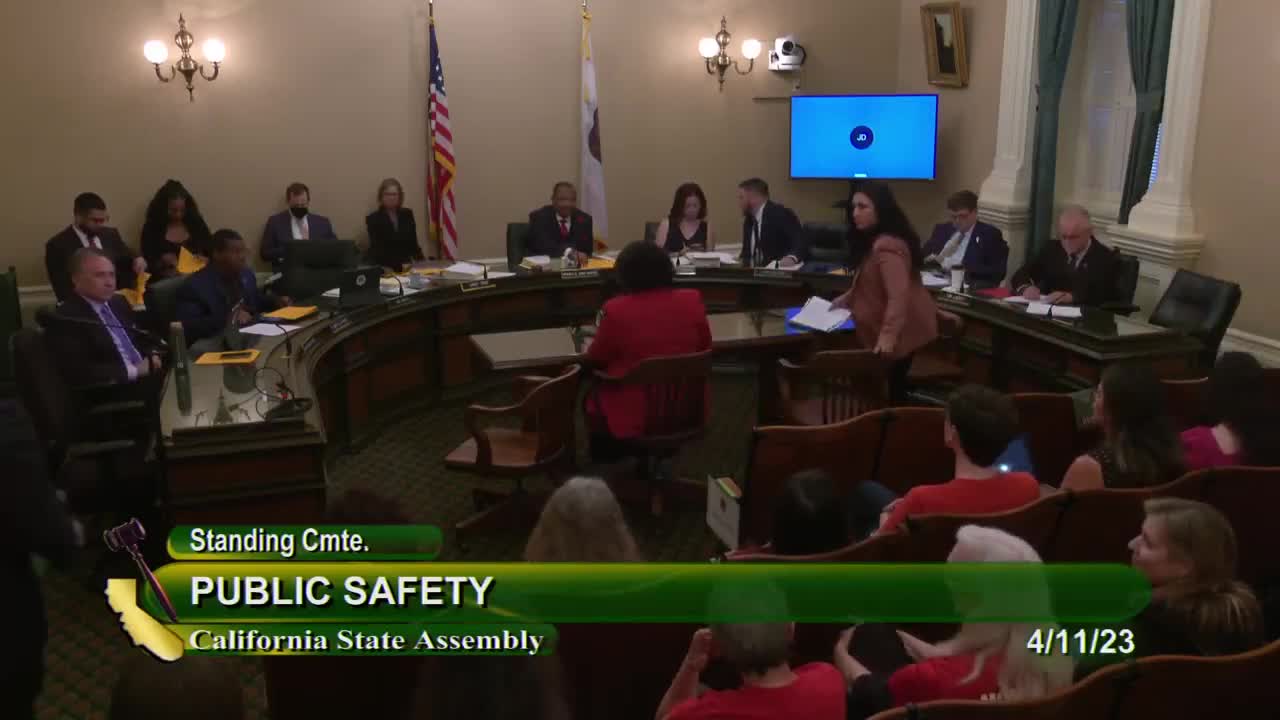 15MIN
Assembly Standing Committee on Public Safety
Bill Author

Bill Co-Author(s):






