AB 807: Police use of force.
- Session Year: 2023-2024
- House: Assembly
- Latest Version Date: 2023-02-13
Current Status:
Failed
(2024-02-01: From committee: Filed with the Chief Clerk pursuant to Joint Rule 56.)
Introduced
In Committee
First Chamber
In Committee
Second Chamber
Enacted
Existing law requires law enforcement agencies to report to the Department of Justice, as specified, any incident in which a police officer is involved in a shooting or use of force that results in death or serious bodily injury. Existing law requires the state prosecutor to investigate incidents involving a shooting by a peace officer resulting in the death of an unarmed civilian. Existing law authorizes the state prosecutor to criminally prosecute any officer that, pursuant to such an investigation, is found to have violated state law. Existing law provides that the Attorney General is the state prosecutor unless otherwise specified or named.
This bill would require the state prosecutor to investigate incidents in which the use of force by a peace officer results in the death of a civilian without regard to whether the civilian was unarmed.
Existing law requires law enforcement agencies to maintain a policy on the use of force, as specified. Existing law requires, commencing July 1, 2023, the Attorney General to operate a Police Practices Division within the Department of Justice to review, upon request by a local law enforcement agency, the use of deadly force policies of that law enforcement agency and make recommendations, as specified.
The bill would remove the requirement on the Attorney General to operate the Police Practices Division.
(a)(1)A state prosecutor shall investigate incidents of an officer-involved shooting resulting in which the use of force by a peace officer results in the death of an unarmed a civilian. The Attorney General is the state prosecutor unless otherwise specified or named.
(2)The state prosecutor is authorized to do all of the following:
(A)Investigate and gather facts in relating to an incident involving a shooting in which the use of force by a peace officer that results in the death of a civilian if the civilian was unarmed or if there is a reasonable dispute as to whether the civilian was armed. civilian.
(B)For all investigations conducted, prepare and submit a written report. The written report shall include, at a minimum, the following information:
(i)A statement of the facts.
(ii)A detailed analysis and conclusion for each investigatory issue.
(iii)Recommendations to modify the policies and practices of the law enforcement agency, as applicable.
(C)If criminal charges against the involved officer are found to be warranted, initiate and prosecute a criminal action against the officer.
(3)The state prosecutor shall post and maintain on a public internet website each written report prepared by the state prosecutor pursuant to this subdivision, appropriately redacting any information in the report that is required by law to be kept confidential.
(c)(1)Commencing on July 1, 2023, the Attorney General shall operate a Police Practices Division within the Department of Justice to, upon request of a local law enforcement agency, review the use of deadly force policies of that law enforcement agency.(2)The program described in paragraph (1) shall make specific and customized recommendations to any law enforcement agency that requests a review pursuant to paragraph (1), based on those policies identified as recommended best practices. (d)(b)This section does not limit the Attorney Generals authority under the California Constitution or any applicable state law.
(e)(c)Subject to an appropriation for this purpose by the Legislature, the department shall implement this section.
|
Date
|
Status
|
|---|---|
| Feb 1, 2024 | From committee: Filed with the Chief Clerk pursuant to Joint Rule 56. |
| Jan 31, 2024 | Died pursuant to Art. IV, Sec. 10(c) of the Constitution. |
| May 18, 2023 | In committee: Held under submission. |
| May 10, 2023 | In committee: Set, first hearing. Referred to APPR. suspense file. |
| May 3, 2023 | In committee: Hearing postponed by committee. |
| Apr 26, 2023 | In committee: Hearing postponed by committee. |
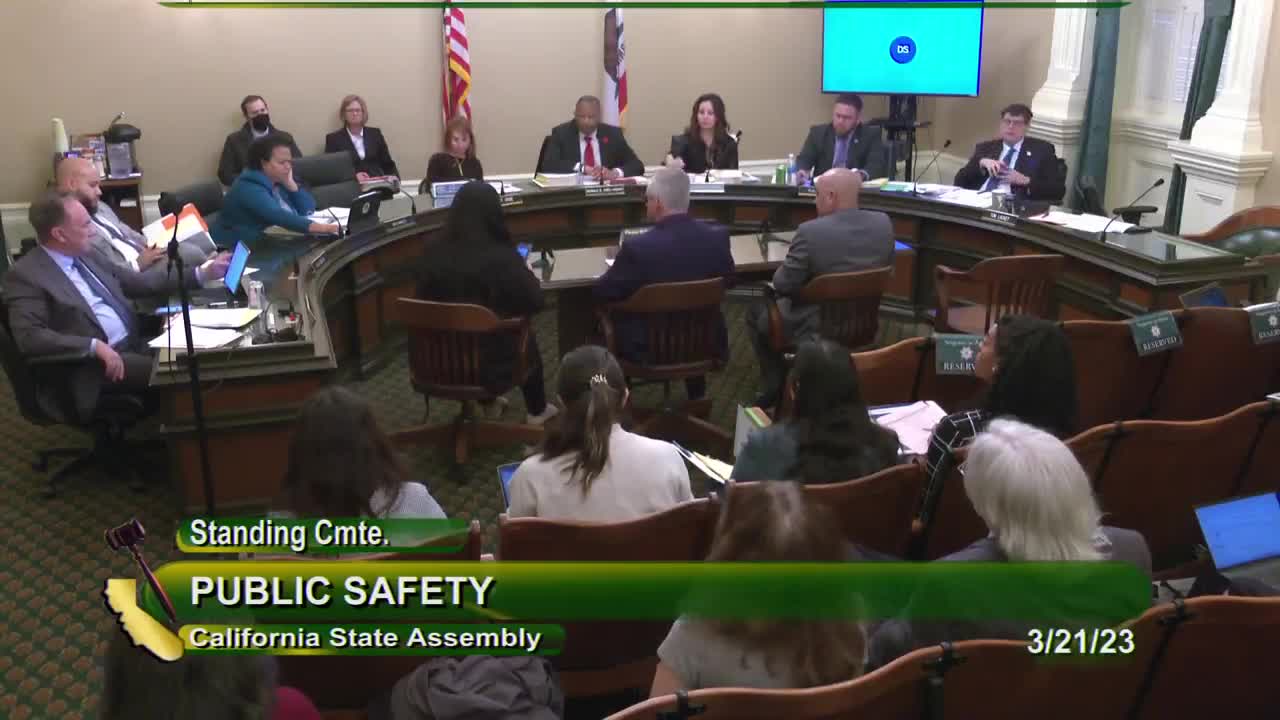
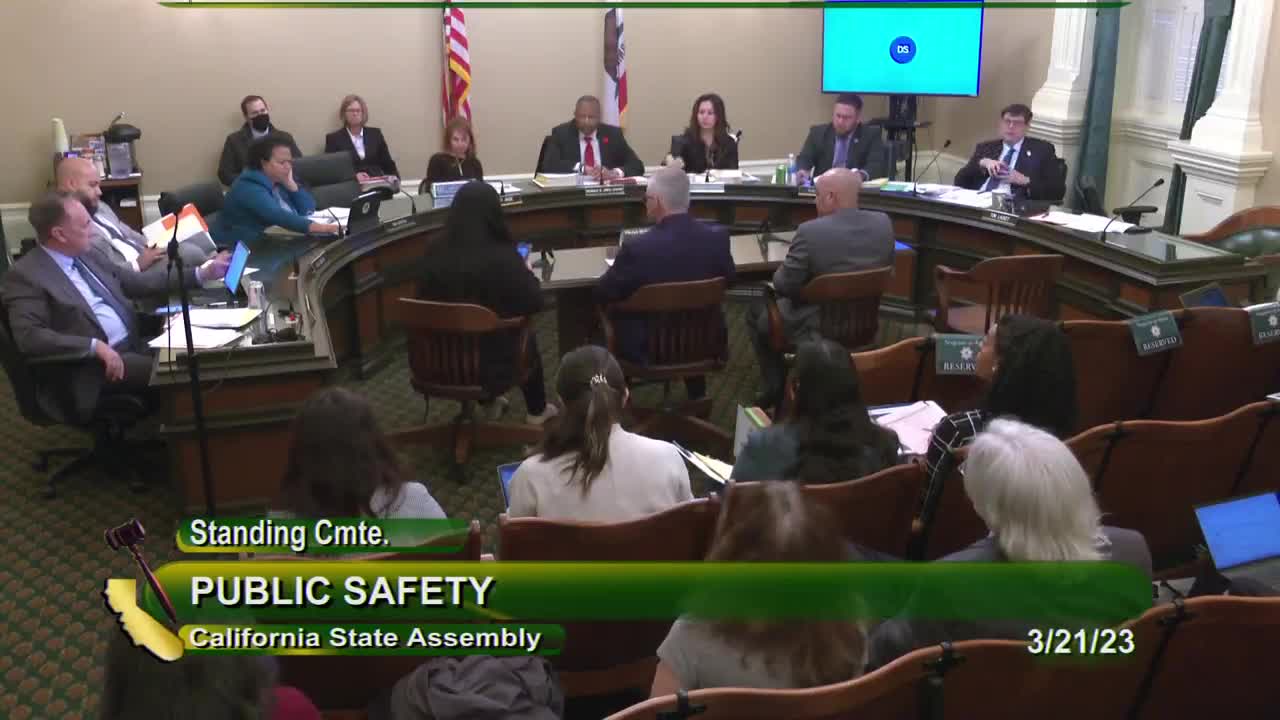
| Mar 22, 2023 | From committee: Do pass and re-refer to Com. on APPR. (Ayes 6. Noes 1.) (March 21). Re-referred to Com. on APPR. |
| Feb 23, 2023 | Referred to Com. on PUB. S. |
| Feb 14, 2023 | From printer. May be heard in committee March 16. |
| Feb 13, 2023 | Read first time. To print. |
|
Date
|
Description
|
Location
|
Votes
|
|
|---|---|---|---|---|
| Mar 21, 2023 | Do pass and be re-referred to the Committee on [Appropriations] | Assembly Standing Committee on Public Safety |
Passed |
This list shows positions taken on this bill by organizations on the date displayed, which is linked to the original source.
Positions by individuals are not included.
|
Organization
|
Position
|
Date
|
|---|---|---|
| Aclu California Action | ** Support | |
| California Association Of Highway Patrolmen | ** Against | |
| California Public Defenders Association | ** Support | |
| California State Sheriffs' Association | ** Against | |
| Oakland Privacy | ** Support | |
| Peace Officers Research Association Of California | ** Against |
Date of Hearing: May 10, 2023
ASSEMBLY COMMITTEE ON APPROPRIATIONS
Chris Holden, Chair
ABPCA Bill Id:AB 807
Author:(McCarty) – As Introduced Ver:February 13, 2023
Policy Committee: | Public Safety | Vote: | 6 - 1 |
|
| ||
|
|
Urgency: No State Mandated Local Program: No Reimbursable: No
SUMMARY:
This bill requires the Department of Justice (DOJ) to investigate additional types of use-of-force incidents resulting in death and eliminates a requirement that DOJ operate a division to review law enforcement agencies’ deadly use-of-force policies.
FISCAL EFFECT:
Costs (General Fund) to DOJ of an unknown but significant amount, possibly in the hundreds of millions of dollars. This bill would make DOJ responsible for investigating more types of use-of-force incidents and, where warranted, prosecuting cases against officers who unlawfully used force. DOJ anticipates needing an additional 632 positions to manage this increased workload, resulting in costs of approximately $161.6 million in fiscal year (FY) 2023-24 and $168 million in FY 2024-25 and ongoing. DOJ’s Criminal Law Division and Public Rights Division report that AB 807 would significantly increase the number of cases each division reviews. DOJ’s Division of Law Enforcement (DLE) currently conducts officer-involved shooting investigations as required by AB 1506 (McCarty), Chapter 326, Statutes of 2020. DLE reports that managing the investigations added by AB 807 would require hundreds of additional staff, acquisition of facilities, physical and digital evidence storage, technology and software maintenance, and laboratory equipment. DOJ also reports increased staffing needed to handle Public Records Act requests, public inquiries, facilities management, and victims’ services.
COMMENTS:
- Author’s Statement. According to the author:
Ongoing acts of deadly force at the hands of law enforcement continue to bring calls for independent investigations by the Attorney General. My AB 1506 in 2020 made strides forward by requiring DOJ to investigate officer involved shootings of unarmed civilians, but more needs to be done. I have introduced this bill to close the independent investigation gap for police deadly force so that all deaths are investigated by California DOJ, increasing law enforcement accountability and transparency in our communities.
- Background. Current law allows DOJ to conduct a de novo review of an officer’s use of deadly force to determine whether to file criminal charges against the officer. DOJ may also conduct a review to determine whether a county district attorney abused their discretion in determining whether to file criminal charges against an officer for their use of deadly force. In more narrow circumstances, DOJ is required to conduct police use-of-force investigations. Existing law requires DOJ to investigate an officer-involved shooting resulting in the death of an unarmed civilian, and requires the Attorney General to operate a Police Practices Division within DOJ to review a local law enforcement agency’s use of deadly force policies, upon request from the agency. Both of these provisions were enacted by AB 1506. That bill was passed following a series of high-profile uses of deadly force by peace officers, including some circumstances in which DOJ declined to conduct independent investigations requested by local law enforcement agencies. According to DOJ’s website, it has closed two investigations initiated under AB 1506, and has 39 ongoing investigations.
This bill eliminates the requirement that DOJ establish a division that reviews local law enforcement policies and requires DOJ to investigate additional types of use-of-force incidents. Under this bill, DOJ would be required to investigate any use of force incident that resulted in the death of any civilian. For each investigation, DOJ must publish on its website a written report about the incident and bring criminal charges against the officer if warranted.
Analysis Prepared by: Annika Carlson / APPR. / (916) 319-2081
Date of Hearing: March 21, 2023
Counsel: Liah Burnley
ASSEMBLY COMMITTEE ON
Reginald Byron Jones-Sawyer, Sr., Chair
ABPCA Bill Id:
Author:() – As Ver:
SUMMARY:
Requires a state prosecutor to investigate incidents in which the use of force by a peace officer results in the death of a civilian. Specifically, this bill:
- Requires a state prosecutor to investigate and gather facts relating to an incident in which the use of force by a peace officer results in the death of a civilian without regard to whether the civilian was unarmed.
- Deletes existing provisions of law defining “deadly weapon” and “unarmed civilian” for the purposes of peace officer use of force investigations by the Department of Justice (DOJ).
- Deletes existing provisions of law that require, commencing on July 1, 2023, the Attorney General (AG) to operate a Police Practices Division within the DOJ to, upon request of a local law enforcement agency, review the use of deadly force policies of that law enforcement agency and make specific and customized recommendations to any law enforcement agency that requests a review.
EXISTING LAW:
- Specifies that subject to the powers and duties of the Governor, the AG shall be the chief law officer of the State. (Cal. Const., Art. 5, § 13.)
- States that it shall be the duty of the AG to see that the laws of the State are uniformly and adequately enforced. (Cal. Const., Art. 5, § 13.)
- Provides that the AG shall have direct supervision over every district attorney and sheriff and over such other law enforcement officers as may be designated by law, in all matters pertaining to the duties of their respective offices, and may require any of said officers to make reports concerning the investigation, detection, prosecution, and punishment of crime in their perspective jurisdictions as to the AG may seem advisable. (Cal. Const., Art. 5, § 13.)
- Requires a state prosecutor to investigate incidents of an officer-involved shooting resulting in the death of an unarmed civilian. (Gov. Code, § 12525.3, subd. (b)(1).)
- Provides that the AG is the state prosecutor unless otherwise specified or named. (Gov. Code, § 12525.3, subd. (b)(1).)
- Authorizes the state prosecutor to do all of the following:
- Investigate and gather facts relating to an incident involving a peace officer that results in the death of a civilian if the civilian was unarmed or if there is a reasonable dispute as to whether the civilian was armed;
- For all investigations conducted, prepare and submit a written report. The written report shall include, at a minimum, the following information:
- A statement of the facts;
- A detailed analysis and conclusion for each investigatory issue; and,
- Recommendations to modify the policies and practices of the law enforcement agency.
- A statement of the facts;
- If criminal charges against the involved officer are found to be warranted, initiate and prosecute a criminal action against the officer. (Gov. Code, § 12525.3, subd. (a)(2).)
- Investigate and gather facts relating to an incident involving a peace officer that results in the death of a civilian if the civilian was unarmed or if there is a reasonable dispute as to whether the civilian was armed;
- Requires the state prosecutor to post online each written report prepared by the state prosecutor, appropriately redacting any information in the report that is required by law to be kept confidential. (Gov. Code, § 12525.3, subd. (b)(3).)
- Requires, commencing on July 1, 2023, the AG to operate a Police Practices Division within the DOJ to, upon request of a local law enforcement agency, review the use of deadly force policies of that law enforcement agency. The program shall make specific and customized recommendations to any law enforcement agency that requests a review. (Gov. Code, § 12525.3, subd. (c)(1)-(2).)
- Defines “deadly weapon,” for the purposes of peace officer use of force investigations by the DOJ, as any loaded weapon from which a shot, readily capable of producing death or other serious physical injury, may be discharged, or a switchblade knife, pilum ballistic knife, metal knuckle knife, dagger, billy, blackjack, plastic knuckles, or metal knuckles. (Gov. Code, § 12525.3, subd. (a)(1).)
- Defines “unarmed civilian,” for the purposes of peace officer use of force investigations by the DOJ, to include anyone who is not in possession of a deadly weapon. (Gov. Code, § 12525.3, subd. (a)(2).)
FISCAL EFFECT:
Unknown
COMMENTS:
- Author's Statement: According to the author, “Ongoing acts of deadly force at the hands of law enforcement continue to bring calls for independent investigations by the Attorney General. My AB 1506 in 2020 made strides forward by requiring DOJ to investigate officer involved shootings of unarmed civilians, but more needs to be done. I have introduced this bill to close the independent investigation gap for police deadly force so that all deaths are investigated by California DOJ, increasing law enforcement accountability and transparency in our communities.”
- Officer-Involved Shooting Investigations: In 2020, the Legislature passed AB 1506 (McCarty) Chapter 326, Statutes of 2020, which requires a state prosecutor to investigate incidents of an officer-involved shooting resulting in the death of an unarmed civilian. According to the DOJ:
Pursuant to [AB 1506], the California Department of Justice is required to investigate all incidents of an officer-involved shooting resulting in the death of an unarmed civilian in the state. Historically, these critical incidents in California had been primarily handled by local law enforcement agencies and the state’s 58 district attorneys.
However, signed into law on September 30, 2020 and in effect on July 1, 2021, AB 1506 provides the California Department of Justice with an important tool to directly help build and maintain trust between law enforcement and the communities they serve by creating a mandate for an independent, statewide prosecutor, moving forward, to investigate and review officer-involved shootings of unarmed civilians across California. The California Department of Justice will investigate and review for potential criminal liability all such incidents covered under AB 1506, as enacted in California Government Code section 12525.3.
When an officer-involved shooting occurs, transparent and open communication is critical to maintain public trust. As part of that and in alignment with AB 1506, the California Department of Justice will, as soon as feasible and appropriate, disseminate relevant information and materials about covered incidents and, ultimately, make public its determinations regarding the criminal prosecution of such incidents. Where criminal charges are not appropriate, the California Department of Justice will prepare and make public a written report communicating:
- A statement of facts, as revealed by the investigation;
- An analysis of those facts in light of applicable law;
- An explanation of why it was determined that criminal charges were not appropriate; and
- Where applicable, recommendations to modify the policies and practices of the involved law enforcement agency.
(AG, AB 1506: Officer-Involved Shooting Investigations and Reviews <https://oag.ca.gov/ois-incidents> [as of March 10, 2023].) For the purposes of officer involved shooting investigations, the DOJ has employed the following definitions:
“Officer-involved” - A shooting is “officer-involved” if the death to the unarmed civilian is caused by a California peace officer, within the meaning of Penal Code section 830, acting under color of authority. All shootings committed by officers while on duty are officer-involved shootings. Shootings committed by officers while off-duty are considered officer-involved shootings only if the officer is acting under color of authority. Shootings by correctional officers as defined, are excluded.
“Shooting” - A “shooting” is the discharge of a metal projectile by a firearm. A “firearm” is a “device, designed to be used as a weapon, from which is expelled through a barrel, a projectile by the force of an explosion or other form of combustion.” (Pen. Code, § 16520.) A “shooting” does not include incidents involving the use of electronic control devices, stun guns, BB, pellet, air, gas-powered guns, or weapons that discharge rubber bullets or beanbags.
“Unarmed civilian” - An “unarmed civilian” is “anyone who is not in possession of a deadly weapon.”
“Deadly weapon” – A “deadly weapon’ includes, but is not limited to, any loaded weapon from which a shot, readily capable of producing death or other serious physical injury, may be discharged, or a switchblade knife, pilum, ballistic knife, metal knuckle knife, dagger, billy, blackjack, plastic knuckles, or metal knuckles.” All firearms, and BB/pellet guns, even if unloaded or inoperable, are deadly weapons. Objects that have a legitimate non-weapon purposes are considered deadly weapons only when, based on all the circumstances, they are actually being used in a manner likely to produce death or great bodily injury. The following are examples of objects that have been considered a deadly weapon when used in that manner: knives, box cutters, screwdrivers, bottles, chains, automobiles, rocks, razor blades, and iron bars. Replica firearms are not considered deadly weapons unless they are used in some particular manner likely to produce death or great bodily injury (e.g., as a bludgeon).
“Death” - Death occurs when “an individual has sustained either (1) irreversible cessation of circulatory and respiratory functions, or (2) irreversible cessation of all functions of the entire brain, including the brain stem.” DOJ may assume responsibility for cases where death appears to be imminent.
(AG, Informational Bulletin 2021-DLE-03: Assembly Bill (AB) 1506 Definitions and Law
Enforcement Agency’s Notification Responsibility (June 24, 2021) <https://oag.ca.gov/system/files/media/2021-dle-03.pdf> [as of March 10, 2023].)
Also, the AG has instructed:
The Office of the Attorney General, led by the Division of Criminal Law, reviews and analyzes the reports and evidence to determine if criminal charges are warranted to be sought against the involved law enforcement officer(s). […] If the Attorney General determines that the investigation has yielded sufficient legally admissible evidence to sustain a conviction by an unbiased jury weighing all relevant evidence and plausible defenses to a standard of beyond a reasonable doubt, criminal charges will be authorized and announced at the time of filing. If the Attorney General determines that criminal charges are not warranted, a report stating the facts of the incident (i.e., witness statements, audio and video recordings, physical evidence, demonstrative diagrams, etc.) with a detailed analysis and conclusion for each investigatory issue is prepared and provided to the public. The Civil Rights Enforcements Section will be consulted for any recommendations to modify the policies and practices of the law enforcement agency, and such recommendations, if any, will be included in the report. When completed, the report will be posted and maintained on the Attorney General’s public website, and may contain redactions to protect confidential information as required by law. (Gov. Code, § 12525.3(b).) Before charges are filed or a report is issued, DOJ will notify the involved agency head and family of decedent.
(DOJ, Special Prosecution Section Protocols (July 2021) <https://oag.ca.gov/system/files/media/AB%201506%20Special%20Prosecutions%20Section%20Protocols.pdf> [as of March 10, 2023].) A list of cases of officer-involved shooting investigations available on the DOJ’s website at: https://oag.ca.gov/ois-incidents/current-cases.
- Need for this Bill: Under existing law, the state prosecutor only investigates incidents of an officer-involved shooting resulting in the death of an unarmed civilian. (Gov. Code, § 12525.3.) Thus, the DOJ is not require to investigate any cases that result in an officer killing a person who is in possession of a deadly weapon. As noted above, the DOJ defines deadly weapon broadly.
In February 2023, Huntington Park Police Department officers fatally shot Anthony Lowe, a double amputee described as “hobbling away from officers” and carrying a knife. (BBC, Anthony Lowe: New Video Released in Police Killing of Double Amputee (Feb 7, 2023) <https://www.bbc.com/news/world-us-canada-64547392> [as of March 10, 2023].) According to DOJ’s website, there does not appear to be an investigation by a state prosecutor into Lowe’s shooting. This is likely because Lowe was not unarmed, pursuant to DOJ’s definition. Nearly 200 people die each year from interactions with California peace officers, with gunshots being the leading cause of death. (Public Policy Institute of California, Police Use of Force and Misconduct in California (Oct. 2021) <https://www.ppic.org/publication/police-use-of-force-and-misconduct-in-california/> [as of March 10, 2023].) In 80% of civilian gunshot injuries or deaths, the civilian was armed with a weapon. (Ibid.)
This bill would require a state prosecutor to investigate incidents in which the use of force by a peace officer results in the death of a civilian without regard to whether the civilian was unarmed.
- Argument in Support: According to Oakland Privacy, “The California Legislature enacted a requirement for the California Department of Justice investigate all deaths of unarmed civilians at the hands of police in response to the well documented failures of police agencies to effectively investigate themselves. We see no need to re-litigate that original decision and will confine this letter to addressing why an expansion of that previous law makes sense.
“A number of cases in California have recently demonstrated that a wholesale dismissal of fatalities of civilians at the hands of police if the civilian was armed with any kind of weapon does not serve the intent of the original bill nor the interests of justice. We highlight a few of those cases below:
“In March of 2018, a 31 year old homeless man Joshua Pawlick was killed in a hail of gunfire when 22 bullets were fired at him by the Oakland Police Department in a period of 2.23 seconds from behind an armored vehicle that had arrived at the scene two minutes prior. Pawlick was sleeping with a loaded gun by his side. He did not discharge the weapon. The law enforcement agency originally stated that Pawlick had pointed the weapon at the police, but video taken at the scene did not provide any evidence of Pawlick pointing the weapon at police. The local investigation has been troubled with officers fired and then restored to their jobs after a judge found errors in the City’s investigation process. The City paid $1.4 million to settle a wrongful death civil suit.
“In February of 2019, 20 year old Willie McCoy was shot 55 times in 3.5 seconds by a squad of 6 Vallejo Police Departments who had arrived at a Taco Bell parking lot only minutes earlier. McCoy was slumped unresponsive over the driving wheel in his car. There was possibly a handgun in the vehicle. Police claimed McCoy reached for a gun, which caused the fusillade of bullets, but video from the scene showed McCoy only waking and moving his hand to scratch his ear before he was killed. An investigation by the City found the shooting was justified and the county DA refused to investigate. Some of the officers involved in the shooting have been associated with other cases of excessive force including a previous fatality (Ronnell Foster), a case of using a police dog to bite a teenager, and an excessive force case placing a boot on a restrained suspects head for over a minute. The civil lawsuit was settled for $5.7 million dollars.
“What these two cases, and others like them, have in common is that the only role of any weapon that was present was perceptual. The weapon was never fired or used, even though its presence or perceived presence was the ultimate cause cited for the fatality. These kinds of cases are especially difficult to adjudicate and the internal investigations are usually dissatisfying.
“According to the Public Policy Institute, in 80% of encounters resulting in death or a gunshot wound, the civilian was armed with a weapon, underscoring that the vast majority of civilian deaths at the hands of police are not covered by the current law.
“As a policy question, we think it is clear that the presence or perceived presence of a weapon does not always make a fatality an open and shut case, nor does it mean that the internal investigation won’t be troubled. What Assembly Bill 807 is proposing is good public policy.”
- Argument in Opposition: According to California Association of Highway Patrolmen (CAHP), “AB 807 can lead to an increased workload for the Attorney General, which they are not prepared for. The current system is still new and needs more time to evaluate.”
- Related Legislation:
- AB 79 (Weber), would prohibit a peace officer from using deadly force against a person by utilizing an unmanned, remotely piloted, powered ground or flying equipment unless specified criteria are met. AB 79 is pending hearing in this Committee.
- AB 742 (Jackson) would prohibit the use of an unleashed police canine by law enforcement, as specified. AB 742 is being heard in this Committee today.
- AB 79 (Weber), would prohibit a peace officer from using deadly force against a person by utilizing an unmanned, remotely piloted, powered ground or flying equipment unless specified criteria are met. AB 79 is pending hearing in this Committee.
- Prior Legislation:
- AB 1506 (McCarty), Chapter 326, Statutes of 2020, requires a state prosecutor to investigate incidents of an officer-involved shooting resulting in the death of an unarmed civilian.
- AB 2917 (McCarty), of the 2019-2020 Legislative Session, would have required the AG, commencing on July 1, 2023, to create a program within DOJ to review the policies on the use of deadly force of a law enforcement agency that requests a review and to make recommendations. AB 2917 was never heard in this Committee.
- AB 284 (McCarty), of the 2017-2018 Legislative Session, would have required DOJ, upon appropriation, to conduct a study of peace officer-involved shootings resulting in death or serious injury within a specified two-year period. AB 284 was held on the Suspense File of the Senate Appropriates Committee.
- AB 86 (McCarty), of the 2015-2016 Legislative Session, would have required DOJ to commence an independent investigation if a peace officer uses deadly force in the performance of their duties that results in the death of an individual. AB 86 was held on the Suspense File of the Assembly Appropriations Committee.
- AB 1506 (McCarty), Chapter 326, Statutes of 2020, requires a state prosecutor to investigate incidents of an officer-involved shooting resulting in the death of an unarmed civilian.
REGISTERED SUPPORT / OPPOSITION:
Support
ACLU California Action
California Public Defenders Association (CPDA)
Oakland Privacy
Opposition
California Association of Highway Patrolmen
California State Sheriffs' Association
Peace Officers Research Association of California (PORAC)
Analysis Prepared by:
Discussed in Hearing
 20MIN
Assembly Standing Committee on Public Safety
 20MIN
Assembly Standing Committee on Public Safety
Bill Author

Bill Co-Author(s):