AB 821: Planning and zoning: general plan: zoning ordinance: conflicts.
- Session Year: 2023-2024
- House: Assembly
- Latest Version Date: 2023-10-11
Current Status:
Passed
(2023-10-11: Chaptered by Secretary of State - Chapter 748, Statutes of 2023.)
Introduced
In Committee
First Chamber
In Committee
Second Chamber
Enacted
(1)Existing law, the Planning and Zoning Law, requires each county and city to adopt a comprehensive, long-term general plan for the physical development of the county or city, and of certain land outside its boundaries. Existing law requires that county or city zoning ordinances be consistent with the general plan of the county or city by January 1, 1974. Existing law authorizes any resident or property owner to bring an action or proceeding in the superior court to enforce compliance with these provisions within 90 days of the enactment of any new zoning ordinance or the amendment of any existing zoning ordinance. Existing law requires a zoning ordinance to be amended within a reasonable time so that it is consistent with the general plan in the event that the ordinance becomes inconsistent with the plan by reason of amendment to the plan.
This bill, in the event that a zoning ordinance becomes inconsistent with a general plan due to an amendment to the general plan and a local agency receives a development application for a project that is not subject to specified provisions of law relating to housing development projects and that is consistent with the general plan but inconsistent with a zoning ordinance, would require the local agency to either amend the zoning ordinance within 180 days from the receipt of the development application to be consistent with the general plan, or to process the development application, as specified. If a local agency does not amend the zoning ordinance within 180 days from the receipt of the development application, the bill would require the local agency to process the development application. The bill would also provide that a proposed development is not deemed inconsistent with any zoning ordinance or related zoning standard or criteria, and is not required to be rezoned to accommodate the proposed development, if there is substantial evidence that would allow a reasonable person to conclude that the proposed development is consistent with objective general plan standards and criteria but the zoning for the project site is inconsistent with the general plan. The bill would authorize any resident or property owner to bring an action or proceeding in the superior court to enforce compliance with these provisions within 90 days of a local agencys failure to comply. By imposing new duties on local agencies with regard to local planning and zoning, the bill would impose a state-mandated local program.
(2)The California Constitution requires the state to reimburse local agencies and school districts for certain costs mandated by the state. Statutory provisions establish procedures for making that reimbursement.
This bill would provide that no reimbursement is required by this act for a specified reason.
(3)The bill would include findings that changes proposed by this bill address a matter of statewide concern rather than a municipal affair and, therefore, apply to all cities, including charter cities.
(1)Existing law, the Planning and Zoning Law, requires each county and city to adopt a comprehensive, long-term general plan for the physical development of the county or city, and of certain land outside its boundaries. Existing law requires that county or city zoning ordinances be consistent with the general plan of the county or city by January 1, 1974. Existing law authorizes any resident or property owner to bring an action or proceeding in the superior court to enforce compliance with these provisions within 90 days of the enactment of any new zoning ordinance or the amendment of any existing zoning ordinance. Existing law requires a zoning ordinance to be amended within a reasonable time so that it is consistent with the general plan in the event that the ordinance becomes inconsistent with the plan by reason of amendment to the plan. Existing law authorizes any resident or property owner to bring an action or proceeding in the superior court to enforce compliance with these provisions within 90 days of the enactment of any new zoning ordinance or the amendment of any existing zoning ordinance.
This bill would additionally authorize any resident or property owner to bring an action or proceeding in the superior court to enforce compliance with these provisions within 90 days of the failure of a local agency to amend a zoning ordinance within a reasonable time of the zoning ordinance becoming inconsistent with the general plan due to amendment to the plan or to any element of the plan.
This bill, in the event that a zoning ordinance becomes inconsistent with a general plan due to an amendment to the general plan and a local agency receives a development application for a project that is not subject to specified provisions of law relating to housing development projects and that is consistent with the general plan but inconsistent with a zoning ordinance, as specified, would require the local agency to either amend the zoning ordinance within 180 days from the receipt of the development application to be consistent with the general plan, or to process the development application, as provided. specified. If a local agency does not amend the zoning ordinance within 180 days, days from the receipt of the development application, the bill would require the local agency to process the development application. The bill would also provide that a proposed development is not deemed inconsistent with any zoning ordinance or related zoning standard or criteria, and is not required to be rezoned to accommodate the proposed development, if there is substantial evidence that would allow a reasonable person to conclude that the proposed development is consistent with objective general plan standards and criteria but the zoning for the project site is inconsistent with the general plan. The bill would authorize any resident or property owner to bring an action or proceeding in the superior court to enforce compliance with these provisions within 90 days. days of a local agencys failure to comply. By imposing new duties on local agencies with regard to local planning and zoning, the bill would impose a state-mandated local program.
(2)The California Constitution requires the state to reimburse local agencies and school districts for certain costs mandated by the state. Statutory provisions establish procedures for making that reimbursement.
This bill would provide that no reimbursement is required by this act for a specified reason.
(3)The bill would include findings that changes proposed by this bill address a matter of statewide concern rather than a municipal affair and, therefore, apply to all cities, including charter cities.
(1)Existing law, the Planning and Zoning Law, requires each county and city to adopt a comprehensive, long-term general plan for the physical development of the county or city, and of certain land outside its boundaries. Existing law requires that county or city zoning ordinances be consistent with the general plan of the county or city by January 1, 1974. Existing law requires a zoning ordinance to be amended within a reasonable time so that it is consistent with the general plan in the event that the ordinance becomes inconsistent with the plan by reason of amendment to the plan. Existing law authorizes any resident or property owner to bring an action or proceeding in the superior court to enforce compliance with these provisions within 90 days of the enactment of any new zoning ordinance or the amendment of any existing zoning ordinance.
This bill would additionally authorize any resident or property owner to bring an action or proceeding in the superior court to enforce compliance with these provisions within 90 days of the failure of a local agency to amend a zoning ordinance within a reasonable time of the zoning ordinance becoming inconsistent with the general plan due to amendment to the plan or to any element of the plan.
This bill, in the event that a zoning ordinance becomes inconsistent with a general plan due to amendment and a local agency receives a development application for a project that is not subject to specified provisions of law relating to housing development projects and that is consistent with the general plan but is inconsistent with a zoning ordinance, as specified, would require the local agency to either amend the zoning ordinance within 90 180 days to be consistent with the general plan, or to process the development application, as provided. If a local agency does not amend the zoning ordinance within 90 180 days, the bill would require the local agency to process the development application. The bill would also provide that a proposed development is not deemed inconsistent with any zoning ordinance or related zoning standard or criteria, and is not required to be rezoned to accommodate the proposed development, if there is substantial evidence that would allow a reasonable person to conclude that the proposed development is consistent with objective general plan standards and criteria but the zoning for the project site is inconsistent with the general plan. The bill would authorize any resident or property owner to bring an action or proceeding in the superior court to enforce compliance with these provisions within 90 days. By imposing new duties on local agencies with regard to local planning and zoning, the bill would impose a state-mandated local program.
(2)The California Constitution requires the state to reimburse local agencies and school districts for certain costs mandated by the state. Statutory provisions establish procedures for making that reimbursement.
This bill would provide that no reimbursement is required by this act for a specified reason.
(3)The bill would include findings that changes proposed by this bill address a matter of statewide concern rather than a municipal affair and, therefore, apply to all cities, including charter cities.
(1)Existing law, the Planning and Zoning Law, requires each county and city to adopt a comprehensive, long-term general plan for the physical development of the county or city, and of certain land outside its boundaries. Existing law requires that county or city zoning ordinances be consistent with the general plan of the county or city by January 1, 1974. Existing law requires a zoning ordinance to be amended within a reasonable time so that it is consistent with the general plan in the event that the ordinance becomes inconsistent with the plan by reason of amendment to the plan. Existing law authorizes any resident or property owner to bring an action or proceeding in the superior court to enforce compliance with these provisions within 90 days of the enactment of any new zoning ordinance or the amendment of any existing zoning ordinance.
This bill would additionally authorize any resident or property owner to bring an action or proceeding in the superior court to enforce compliance with these provisions within 90 days of the failure of a local agency to amend a zoning ordinance within a reasonable time of the zoning ordinance becoming inconsistent with the general plan due to amendment to the plan or to any element of the plan.
This bill, among other things, would provide that, in the event that a city or county fails to amend an inconsistent zoning ordinance within 90 days after receiving written notice of the inconsistency, a proposed development project shall not be deemed inconsistent with that zoning ordinance and related zoning standard or criteria and shall not be required to be rezoned, if there is substantial evidence that would allow a reasonable person to conclude that the proposed development project is consistent with objective general plan standards and criteria but the zoning for the project site is inconsistent with the general plan. a zoning ordinance becomes inconsistent with a general plan due to amendment and a local agency receives a development application that is consistent with the general plan but is inconsistent with a zoning ordinance, as specified, would require the local agency to either amend the zoning ordinance within 90 days to be consistent with the general plan, or to process the development application, as provided. If a local agency does not amend the zoning ordinance within 90 days, the bill would require the local agency to process the development application. The bill would also provide that a proposed development is not deemed inconsistent with any zoning ordinance or related zoning standard or criteria, and is not required to be rezoned to accommodate the proposed development, if there is substantial evidence that would allow a reasonable person to conclude that the proposed development is consistent with objective general plan standards and criteria but the zoning for the project site is inconsistent with the general plan. The bill would authorize any resident or property owner to bring an action or proceeding in the superior court to enforce compliance with these provisions within 90 days. By imposing new duties on local agencies with regard to local planning and zoning, the bill would impose a state-mandated local program.
(2)The California Constitution requires the state to reimburse local agencies and school districts for certain costs mandated by the state. Statutory provisions establish procedures for making that reimbursement.
This bill would provide that no reimbursement is required by this act for a specified reason.
(3)The bill would include findings that changes proposed by this bill address a matter of statewide concern rather than a municipal affair and, therefore, apply to all cities, including charter cities.
(1)Existing law, the Planning and Zoning Law, requires each county and city to adopt a comprehensive, long-term general plan for the physical development of the county or city, and of certain land outside its boundaries. Existing law requires that county or city zoning ordinances be consistent with the general plan of the county or city by January 1, 1974. Existing law requires a zoning ordinance to be amended within a reasonable time so that it is consistent with the general plan in the event that the ordinance becomes inconsistent with the plan by reason of amendment to the plan.
This bill, among other things, would provide that, in the event that a city or county fails to amend an inconsistent zoning ordinance within 90 days after receiving written notice of the inconsistency, a proposed development project shall not be deemed inconsistent with that zoning ordinance and related zoning standard or criteria and shall not be required to be rezoned, if there is substantial evidence that would allow a reasonable person to conclude that the proposed development project is consistent with objective general plan standards and criteria but the zoning for the project site is inconsistent with the general plan. By imposing new duties on local agencies with regard to local planning and zoning, the bill would impose a state-mandated local program.
(2)Existing law, the Permit Streamlining Act, requires each public agency to provide a development project applicant with a list that specifies the information that will be required from any applicant for a development project. The act requires a public agency that has received an application for a development project to determine in writing whether the application is complete within 30 calendar days and to immediately transmit the determination to the applicant of the development project. The act requires the public agency to provide the applicant with an exhaustive list of items that were not complete if the application is determined to be incomplete. Under existing law, a new 30-day period begins upon receipt of any resubmittal of the application, during which the public agency must determine the completeness of the application.This bill, until January 1, 2034, would specify that an application submitted before January 1, 2030 for a housing development project that requires a general plan amendment or other legislative approval and meets specified criteria, including being proposed on an infill site or qualifying infill area, as defined, is deemed an application for a housing development project for purposes of the Permit Streamlining Act. The bill would require the city, county, or city and county to consider and either approve or disapprove the application at any of the 5 hearings required by the act. The bill would prohibit the city, county, or city and county from disapproving the application or imposing a condition that the housing development project associated with the application be developed at a lower density, unless it first makes specified written findings supported by a preponderance of the evidence in the record. By imposing new duties on local agencies with regard to development applications, the bill would impose a state-mandated local program. (3)(2)The California Constitution requires the state to reimburse local agencies and school districts for certain costs mandated by the state. Statutory provisions establish procedures for making that reimbursement.
This bill would provide that no reimbursement is required by this act for a specified reason.
(4)(3)The bill would include findings that changes proposed by this bill address a matter of statewide concern rather than a municipal affair and, therefore, apply to all cities, including charter cities.
(1)Existing law, the Planning and Zoning Law, requires each county and city to adopt a comprehensive, long-term general plan for the physical development of the county or city, and of certain land outside its boundaries. Existing law requires that county or city zoning ordinances be consistent with the general plan of the county or city by January 1, 1974. Existing law requires a zoning ordinance to be amended within a reasonable time so that it is consistent with the general plan in the event that the ordinance becomes inconsistent with the plan by reason of amendment to the plan.
This bill, among other things, would provide that, in the event that a city or county fails to amend an inconsistent zoning ordinance within 90 days after receiving written notice of the inconsistency, a proposed development project shall not be deemed inconsistent with that zoning ordinance and related zoning standard or criteria and shall not be required to be rezoned, if there is substantial evidence that would allow a reasonable person to conclude that the proposed development project is consistent with objective general plan standards and criteria but the zoning for the project site is inconsistent with the general plan. By imposing new duties on local agencies with regard to local planning and zoning, the bill would impose a state-mandated local program.
(2)Existing law, the Permit Streamlining Act, requires each public agency to provide a development project applicant with a list that specifies the information that will be required from any applicant for a development project. The act requires a public agency that has received an application for a development project to determine in writing whether the application is complete within 30 calendar days and to immediately transmit the determination to the applicant of the development project. The act requires the public agency to provide the applicant with an exhaustive list of items that were not complete if the application is determined to be incomplete. Under existing law, a new 30-day period begins upon receipt of any resubmittal of the application, during which the public agency must determine the completeness of the application.
This bill, until January 1, 2034, would specify that an application submitted before January 1, 2030 for a housing development project that requires a general plan amendment or other legislative approval and meets specified criteria, including being proposed on an infill site or qualifying infill area, as defined, is deemed an application for a housing development project for purposes of the Permit Streamlining Act. The bill would require the city, county, or city and county to consider and either approve or disapprove the application at any of the 5 hearings required by the act. The bill would prohibit the city, county, or city and county from disapproving the application or imposing a condition that the housing development project associated with the application be developed at a lower density, unless it first makes specified written findings supported by a preponderance of the evidence in the record. By imposing new duties on local agencies with regard to development applications, the bill would impose a state-mandated local program.
(3)The California Constitution requires the state to reimburse local agencies and school districts for certain costs mandated by the state. Statutory provisions establish procedures for making that reimbursement.
This bill would provide that no reimbursement is required by this act for a specified reason.
(4)The bill would include findings that changes proposed by this bill address a matter of statewide concern rather than a municipal affair and, therefore, apply to all cities, including charter cities.
(a)County or city zoning ordinances shall be consistent with the general plan of the county or city by January 1, 1974. A zoning ordinance shall be consistent with a city or county general plan only if both of the following conditions are met:
(1)The city or county has officially adopted a plan.
(2)The various land uses authorized by the ordinance are compatible with the objectives, policies, general land uses, and programs specified in the plan.
(b)A resident or property owner within a city or a county, as the case may be, may bring an action or proceeding in the superior court to enforce compliance with this section. An action or proceeding shall be governed by Chapter 2 (commencing with Section 1084) of Title 1 of Part 3 of the Code of Civil Procedure. An action or proceeding shall not be maintained pursuant to this section by a person unless the action or proceeding is commenced and service is made on the legislative body within 90 days of any of the following:
(1)The enactment of any new zoning ordinance.
(2)The amendment of any existing zoning ordinance.
(3)The failure of a local agency to comply with this section.
(c)(1)In the event that a zoning ordinance becomes inconsistent with a general plan by reason of amendment to the general plan, or to any element of the plan, the zoning ordinance shall be amended within a reasonable time so that it is consistent with the general plan, as amended.
(2)If a zoning ordinance becomes inconsistent with the general plan due to amendment to the general plan or to any element of the general plan, and a local agency receives a development application for a project that is not subject to Section 65589.5 and that is consistent with the general plan, but inconsistent with the zoning ordinance, the local agency shall do one of the following:
(A)For any provision of the zoning ordinance that is applicable to the proposed development and inconsistent with the general plan, amend the zoning ordinance within 180 days from the receipt of the development application to be consistent with the general plan.
(B)Process the development application in accordance with all applicable laws. When processing the development application, the local agency shall apply the objective general plan standards, but not inconsistent zoning standards, to the proposed development project to facilitate and accommodate development at the density allowed on the site by the general plan. A proposed development shall not be deemed inconsistent with any zoning ordinance or related zoning standard or criteria and shall not be required to be rezoned to accommodate the proposed development, if there is substantial evidence that would allow a reasonable person to conclude that the proposed development is consistent with objective general plan standards and criteria but the zoning for the project site is inconsistent with the general plan. The objective general plan standards shall be applied to facilitate and accommodate development at the density allowed on the site by the general plan and proposed by the development project.
(3)If a local agency fails to amend the zoning ordinance within 180 days from the receipt of the development application pursuant to subparagraph (A) of paragraph (2), the local agency shall process the development application pursuant to subparagraph (B) of paragraph (2).
(d)Notwithstanding Section 65803, this section shall also apply to a charter city.
SEC. 2.No reimbursement is required by this act pursuant to Section 6 of Article XIIIB of the California Constitution because a local agency or school district has the authority to levy service charges, fees, or assessments sufficient to pay for the program or level of service mandated by this act, within the meaning of Section 17556 of the Government Code.
SEC. 3.The Legislature finds and declares that lowering costs by preventing delays in the development process is a matter of statewide concern and is not a municipal affair as that term is used in Section 5 of Article XI of the California Constitution. Therefore, Section 1 of this act amending Section 65860 of the Government Code applies to all cities, including charter cities.
(a)County or city zoning ordinances shall be consistent with the general plan of the county or city by January 1, 1974. A zoning ordinance shall be consistent with a city or county general plan only if both of the following conditions are met:
(1)The city or county has officially adopted such a plan.
(2)The various land uses authorized by the ordinance are compatible with the objectives, policies, general land uses, and programs specified in the plan.
(b)A resident or property owner within a city or a county, as the case may be, may bring an action or proceeding in the superior court to enforce compliance with this section. Any such An action or proceeding shall be governed by Chapter 2 (commencing with Section 1084) of Title 1 of Part 3 of the Code of Civil Procedure. An action or proceeding shall not be maintained pursuant to this section by a person unless the action or proceeding is commenced and service is made on the legislative body within 90 days of any of the following:
(1)The enactment of any new zoning ordinance.
(2)The amendment of any existing zoning ordinance.
(3)The failure of a local agency to comply with this section.
(c)(1)In the event that a zoning ordinance becomes inconsistent with a general plan by reason of amendment to the general plan, or to any element of the plan, the zoning ordinance shall be amended within a reasonable time so that it is consistent with the general plan plan, as amended.
(2)If a zoning ordinance becomes inconsistent with the general plan due to amendment to the general plan or to any element of the general plan, and a local agency receives a development application for a project that is not subject to Section 65589.5 and that is consistent with the general plan plan, but inconsistent with the zoning ordinance, the local agency shall do one of the following:
(A)For any provision of the zoning ordinance that is applicable to the proposed development and inconsistent with the general plan, amend the zoning ordinance within 180 days from the receipt of the development application to be consistent with the general plan.
(B)Process the development application in accordance with all applicable laws. When processing the development application, the local agency shall apply the objective general plan standards, but not inconsistent zoning standards, to the proposed development project to facilitate and accommodate development at the density allowed on the site by the general plan. A proposed development shall not be deemed inconsistent with any zoning ordinance or related zoning standard or criteria and shall not be required to be rezoned to accommodate the proposed development, if there is substantial evidence that would allow a reasonable person to conclude that the proposed development is consistent with objective general plan standards and criteria but the zoning for the project site is inconsistent with the general plan. The objective general plan standards shall be applied to facilitate and accommodate development at the density allowed on the site by the general plan and proposed by the development project.
(3)If a local agency fails to amend the zoning ordinance within 180 days from the receipt of the development application pursuant to subparagraph (A) of paragraph (2), the local agency shall process the development application pursuant to subparagraph (B) of paragraph (2).
(d)Notwithstanding Section 65803, this section shall also apply to a charter city.
SEC. 2.No reimbursement is required by this act pursuant to Section 6 of Article XIIIB of the California Constitution because a local agency or school district has the authority to levy service charges, fees, or assessments sufficient to pay for the program or level of service mandated by this act, within the meaning of Section 17556 of the Government Code.
SEC. 3.The Legislature finds and declares that Section 1 of this act amending Section 65860 of the Government Code addresses lowering costs by preventing delays in the development process is a matter of statewide concern and is not a municipal affair as that term is used in Section 5 of Article XI of the California Constitution. Therefore, Section 1 of this act amending Section 65860 of the Government Code applies to all cities, including charter cities.
(a)County or city zoning ordinances shall be consistent with the general plan of the county or city by January 1, 1974. A zoning ordinance shall be consistent with a city or county general plan only if both of the following conditions are met:
(1)The city or county has officially adopted such a plan.
(2)The various land uses authorized by the ordinance are compatible with the objectives, policies, general land uses, and programs specified in the plan.
(b)A resident or property owner within a city or a county, as the case may be, may bring an action or proceeding in the superior court to enforce compliance with this section. Any such action or proceeding shall be governed by Chapter 2 (commencing with Section 1084) of Title 1 of Part 3 of the Code of Civil Procedure. An action or proceeding shall not be maintained pursuant to this section by a person unless the action or proceeding is commenced and service is made on the legislative body within 90 days of any of the following:
(1)The enactment of any new zoning ordinance.
(2)The amendment of any existing zoning ordinance.
(3)The failure of a local agency to comply with this section.
(c)(1)In the event that a zoning ordinance becomes inconsistent with a general plan by reason of amendment to the general plan, or to any element of the plan, the zoning ordinance shall be amended within a reasonable time so that it is consistent with the general plan as amended.
(2)If a zoning ordinance becomes inconsistent with the general plan due to amendment to the general plan or to any element of the general plan, and a local agency receives a development application for a project that is not subject to Section 65589.5 and that is consistent with the general plan but is inconsistent with the zoning ordinance, the local agency shall do one of the following:
(A)Amend For any provision of the zoning ordinance that is applicable to the proposed development and inconsistent with the general plan, amend the zoning ordinance within 90 180 days to be consistent with the general plan.
(B)Process the development application in accordance with all applicable laws. When processing the development application, the local agency shall apply the objective general plan standards, but not inconsistent zoning standards, to the proposed development project to facilitate and accommodate development at the density allowed on the site by the general plan. A proposed development shall not be deemed inconsistent with any zoning ordinance or related zoning standard or criteria and shall not be required to be rezoned to accommodate the proposed development, if there is substantial evidence that would allow a reasonable person to conclude that the proposed development is consistent with objective general plan standards and criteria but the zoning for the project site is inconsistent with the general plan. The objective general plan standards shall be applied to facilitate and accommodate development at the density allowed on the site by the general plan and proposed by the development project.
(3)If a local agency fails to amend the zoning ordinance within 90 180 days pursuant to subparagraph (A) of paragraph (2), the local agency shall process the development application pursuant to subparagraph (B) of paragraph (2).
(d)Notwithstanding Section 65803, this section shall also apply to a charter city.
SEC. 2.No reimbursement is required by this act pursuant to Section 6 of Article XIIIB of the California Constitution because a local agency or school district has the authority to levy service charges, fees, or assessments sufficient to pay for the program or level of service mandated by this act, within the meaning of Section 17556 of the Government Code.
SEC. 3.The Legislature finds and declares that Section 1 of this act amending Section 65860 of the Government Code addresses a matter of statewide concern and is not a municipal affair as that term is used in Section 5 of Article XI of the California Constitution. Therefore, Section 1 of this act amending Section 65860 of the Government Code applies to all cities, including charter cities.
(a)County or city zoning ordinances shall be consistent with the general plan of the county or city by January 1, 1974. A zoning ordinance shall be consistent with a city or county general plan only if both of the following conditions are met:
(1)The city or county has officially adopted such a plan.
(2)The various land uses authorized by the ordinance are compatible with the objectives, policies, general land uses, and programs specified in the plan.
(b)A resident or property owner within a city or a county, as the case may be, may bring an action or proceeding in the superior court to enforce compliance with this section. Any such action or proceeding shall be governed by Chapter 2 (commencing with Section 1084) of Title 1 of Part 3 of the Code of Civil Procedure. An action or proceeding shall not be maintained pursuant to this section by a person unless the action or proceeding is commenced and service is made on the legislative body within 90 days of the any of the following:
(1)The enactment of any new zoning ordinance, the ordinance.
(2)The amendment of any existing zoning ordinance, the expiration of the notice period in paragraph (2) of subdivision (c), or the city or countys final decision on a proposed development project pursuant to paragraph (2) of subdivision (c). ordinance.
(3)The failure of a local agency to comply with this section.
(c)(1)In the event that a zoning ordinance becomes inconsistent with a general plan by reason of amendment to the general plan, or to any element of the plan, the zoning ordinance shall be amended within a reasonable time so that it is consistent with the general plan as amended.
(2)In the event that a city or county fails to amend an inconsistent zoning ordinance within 90 days after receiving written notice of the inconsistency, a proposed development project shall not be deemed inconsistent with that zoning ordinance and related zoning standard or criteria and shall not be required to be rezoned to accommodate the proposed development project, if there is substantial evidence that would allow a reasonable person to conclude that the proposed development project is consistent with objective general plan standards and criteria but the zoning for the project site is inconsistent with the general plan. The objective general plan standards shall be applied to facilitate and accommodate development at the density allowed on the site by the general plan and proposed by the development project.(2)If a zoning ordinance becomes inconsistent with the general plan due to amendment to the general plan or to any element of the general plan, and a local agency receives a development application that is consistent with the general plan but is inconsistent with the zoning ordinance, the local agency shall do one of the following:
(A)Amend the zoning ordinance within 90 days to be consistent with the general plan.
(B)Process the development application in accordance with all applicable laws. When processing the development application, the local agency shall apply the objective general plan standards, but not inconsistent zoning standards, to the proposed development project to facilitate and accommodate development at the density allowed on the site by the general plan. A proposed development shall not be deemed inconsistent with any zoning ordinance or related zoning standard or criteria and shall not be required to be rezoned to accommodate the proposed development, if there is substantial evidence that would allow a reasonable person to conclude that the proposed development is consistent with objective general plan standards and criteria but the zoning for the project site is inconsistent with the general plan. The objective general plan standards shall be applied to facilitate and accommodate development at the density allowed on the site by the general plan and proposed by the development project.
(3)If a local agency fails to amend the zoning ordinance within 90 days pursuant to subparagraph (A) of paragraph (2), the local agency shall process the development application pursuant to subparagraph (B) of paragraph (2).
(d)Notwithstanding Section 65803, this section shall also apply to a charter city.
SEC. 2.No reimbursement is required by this act pursuant to Section 6 of Article XIIIB of the California Constitution because a local agency or school district has the authority to levy service charges, fees, or assessments sufficient to pay for the program or level of service mandated by this act, within the meaning of Section 17556 of the Government Code.
SEC. 3.The Legislature finds and declares that Section 1 of this act amending Section 65860 of the Government Code addresses a matter of statewide concern and is not a municipal affair as that term is used in Section 5 of Article XI of the California Constitution. Therefore, Section 1 of this act amending Section 65860 of the Government Code applies to all cities, including charter cities.
(a)County or city zoning ordinances shall be consistent with the general plan of the county or city by January 1, 1974. A zoning ordinance shall be consistent with a city or county general plan only if both of the following conditions are met:
(1)The city or county has officially adopted such a plan.
(2)The various land uses authorized by the ordinance are compatible with the objectives, policies, general land uses, and programs specified in the plan.
(b)A resident or property owner within a city or a county, as the case may be, may bring an action or proceeding in the superior court to enforce compliance with this section. Any such action or proceeding shall be governed by Chapter 2 (commencing with Section 1084) of Title 1 of Part 3 of the Code of Civil Procedure. An action or proceeding shall not be maintained pursuant to this section by a person unless the action or proceeding is commenced and service is made on the legislative body within 90 days of the enactment of any new zoning ordinance, the amendment of any existing zoning ordinance, the expiration of the notice period in paragraph (2) of subdivision (c), or the city or countys final decision on a proposed development project pursuant to paragraph (2) of subdivision (c).
(c)(1)In the event that a zoning ordinance becomes inconsistent with a general plan by reason of amendment to the plan, or to any element of the plan, the zoning ordinance shall be amended within a reasonable time so that it is consistent with the general plan as amended.
(2)In the event that a city or county fails to amend an inconsistent zoning ordinance within 90 days after receiving written notice of the inconsistency, a proposed development project shall not be deemed inconsistent with that zoning ordinance and related zoning standard or criteria and shall not be required to be rezoned to accommodate the proposed development project, if there is substantial evidence that would allow a reasonable person to conclude that the proposed development project is consistent with objective general plan standards and criteria but the zoning for the project site is inconsistent with the general plan. The objective general plan standards shall be applied to facilitate and accommodate development at the density allowed on the site by the general plan and proposed by the development project.
(d)Notwithstanding Section 65803, this section shall also apply to a charter city.
SEC. 2.Section 65905.6 is added to the Government Code, to read:65905.6.(a)For purposes of this section, all of the following definitions apply:(1)Gatekeeper policy means a policy, practice, procedure, or terms and conditions used by a city, county, or city and county to determine whether it will accept and consider an application for a general plan or other legislative approval.(2)Housing development project has the same meaning as the term is defined in Section 65905.5.(3)Infill site has the same meaning as the term is defined in Section 21099 of the Public Resources Code.(4)Qualifying infill area has the same meaning as the term is defined in Section 53559 of Health and Safety Code.(5)Specific, adverse impact means a significant, quantifiable, direct, and unavoidable impact, based on objective, identified written public health or safety standards, policies, or conditions as they existed on the date the application was deemed complete.(b)Notwithstanding any other law, an application submitted before January 1, 2030, for a housing development project that requires a general plan amendment or other legislative approval and meets at least one of the following criteria shall be subject to subdivision (c).(1)The housing development project is consistent with the use designation, density, and building intensity specified for the project area in either a sustainable communities strategy or an alternative planning strategy for which the State Air Resources Board pursuant to subparagraph (I) of paragraph (2) of subdivision (b) of Section 65080 has accepted the metropolitan planning organizations determination that the sustainable communities strategy or the alternative planning strategy would, if implemented, achieve the greenhouse gas emission reduction targets. A housing development project is consistent with a sustainable communities strategy or alternative planning strategy if there is substantial evidence that would allow a reasonable person to conclude that the housing development project is consistent.(2)The housing development project is proposed on an infill site.(3)The housing development project is proposed in a qualifying infill area.(c)(1)The application shall be deemed an application for a housing development project for purposes of Section 65943. The application shall not be subject to any local procedures or standards, including any local gatekeeper policy, not expressly required by state law for the type of legislative land use approval being sought.(2)The city, county, or city and county shall consider and either approve or disapprove the application at any of the five hearings allowed under Section 65905.5 consistent with the applicable timelines under the Permit Streamlining Act (Chapter 4.5 (commencing with Section 65920)). Failure to comply with the time periods specified in Section 65950 shall be deemed an approval of the application.(3)The city, county, or city and county shall not disapprove the application or impose a condition that the housing development project associated with the application be developed at a lower density, unless it first makes written findings supported by a preponderance of the evidence in the record that both of the following conditions exist:(A)The housing development project associated with the application would have a specific, adverse impact upon the public health or safety unless the application is disapproved or approved upon the condition that the housing development project be developed at a lower density.(B)There is no feasible method to satisfactorily mitigate or avoid the adverse impact identified pursuant to paragraph (A), other than the disapproval of the application or the approval of the housing development project associated with the application upon the condition that it be developed at a lower density.(4)If the housing development project associated with the application qualifies for a density bonus under subdivision (b) of Section 65915, the maximum allowable density for purposes of calculating the amount of the density bonus shall be based on the use designation, density, and building intensity assumed for the project area in the development of either the sustainable communities strategy or alternative planning strategy, as applicable.(5)This section shall be subject to the enforcement provisions of Section 65589.5. This section shall be interpreted in the manner described in subparagraph (L) of paragraph (2) of subdivision (a) of Section 65589.5 and paragraph (3) of subdivision (a) of Section 65589.5.(6)A general plan amendment approved pursuant to this section shall not count toward the maximum allowable number of general plan amendments specified in Section 65358.(d)This section shall not be interpreted to expand the circumstances under which a general plan amendment or other legislative approval is required for a proposed housing development project.(e)This section does not supersede, limit, or otherwise modify the requirements of, or the standards of review pursuant to, Division 13 (commencing with Section 21000) of the Public Resources Code.(f)This section shall remain in effect only until January 1, 2034, and as of that date is repealed.SEC. 3.SEC. 2.No reimbursement is required by this act pursuant to Section 6 of Article XIIIB of the California Constitution because a local agency or school district has the authority to levy service charges, fees, or assessments sufficient to pay for the program or level of service mandated by this act, within the meaning of Section 17556 of the Government Code.
SEC. 4.SEC. 3.The Legislature finds and declares that the provision of adequate housing, in light of the severe shortage of housing at all income levels in this state, is Section 1 of this act amending Section 65860 of the Government Code addresses a matter of statewide concern and is not a municipal affair as that term is used in Section 5 of Article XI of the California Constitution. Therefore, Section 1 of this act amending Section 65860 of, and Section 2 of this act adding Section 65905.6 to, of the Government Code apply applies to all cities, including charter cities.
(a)County or city zoning ordinances shall be consistent with the general plan of the county or city by January 1, 1974. A zoning ordinance shall be consistent with a city or county general plan only if both of the following conditions are met:
(1)The city or county has officially adopted such a plan.
(2)The various land uses authorized by the ordinance are compatible with the objectives, policies, general land uses, and programs specified in the plan.
(b)Any A resident or property owner within a city or a county, as the case may be, may bring an action or proceeding in the superior court to enforce compliance with subdivision (a). this section. Any such action or proceeding shall be governed by Chapter 2 (commencing with Section 1084) of Title 1 of Part 3 of the Code of Civil Procedure. No An action or proceeding shall not be maintained pursuant to this section by any a person unless the action or proceeding is commenced and service is made on the legislative body within 90 days of the enactment of any new zoning ordinance or ordinance, the amendment of any existing zoning ordinance. ordinance, the expiration of the notice period in paragraph (2) of subdivision (c), or the city or countys final decision on a proposed development project pursuant to paragraph (2) of subdivision (c).
(c)(1)In the event that a zoning ordinance becomes inconsistent with a general plan by reason of amendment to the plan, or to any element of the plan, the zoning ordinance shall be amended within a reasonable time so that it is consistent with the general plan as amended.
(2)In the event that a city or county fails to amend an inconsistent zoning ordinance within 90 days after receiving written notice of the inconsistency, a proposed development project shall not be deemed inconsistent with that zoning ordinance and related zoning standard or criteria and shall not be required to be rezoned to accommodate the proposed development project, if there is substantial evidence that would allow a reasonable person to conclude that the proposed development project is consistent with objective general plan standards and criteria but the zoning for the project site is inconsistent with the general plan. The objective general plan standards shall be applied to facilitate and accommodate development at the density allowed on the site by the general plan and proposed by the development project.
(d)Notwithstanding Section 65803, this section shall also apply to a charter city.
SEC. 2.Section 65905.6 is added to the Government Code, to read:65905.6.(a)For purposes of this section, all of the following definitions apply:
(1)Gatekeeper policy means a policy, practice, procedure, or terms and conditions used by a city, county, or city and county to determine whether it will accept and consider an application for a general plan or other legislative approval.
(2)Housing development project has the same meaning as the term is defined in Section 65905.5.
(3)Infill site has the same meaning as the term is defined in Section 21099 of the Public Resources Code.
(4)Qualifying infill area has the same meaning as the term is defined in Section 53559 of Health and Safety Code.
(5)Specific, adverse impact means a significant, quantifiable, direct, and unavoidable impact, based on objective, identified written public health or safety standards, policies, or conditions as they existed on the date the application was deemed complete.
(b)Notwithstanding any other law, an application submitted before January 1, 2030, for a housing development project that requires a general plan amendment or other legislative approval and meets at least one of the following criteria shall be subject to subdivision (c).
(1)The housing development project is consistent with the use designation, density, and building intensity specified for the project area in either a sustainable communities strategy or an alternative planning strategy for which the State Air Resources Board pursuant to subparagraph (I) of paragraph (2) of subdivision (b) of Section 65080 has accepted the metropolitan planning organizations determination that the sustainable communities strategy or the alternative planning strategy would, if implemented, achieve the greenhouse gas emission reduction targets. A housing development project is consistent with a sustainable communities strategy or alternative planning strategy if there is substantial evidence that would allow a reasonable person to conclude that the housing development project is consistent.
(2)The housing development project is proposed on an infill site.
(3)The housing development project is proposed in a qualifying infill area.
(c)(1)The application shall be deemed an application for a housing development project for purposes of Section 65943. The application shall not be subject to any local procedures or standards, including any local gatekeeper policy, not expressly required by state law for the type of legislative land use approval being sought.
(2)The city, county, or city and county shall consider and either approve or disapprove the application at any of the five hearings allowed under Section 65905.5 consistent with the applicable timelines under the Permit Streamlining Act (Chapter 4.5 (commencing with Section 65920)). Failure to comply with the time periods specified in Section 65950 shall be deemed an approval of the application.
(3)The city, county, or city and county shall not disapprove the application or impose a condition that the housing development project associated with the application be developed at a lower density, unless it first makes written findings supported by a preponderance of the evidence in the record that both of the following conditions exist:
(A)The housing development project associated with the application would have a specific, adverse impact upon the public health or safety unless the application is disapproved or approved upon the condition that the housing development project be developed at a lower density.
(B)There is no feasible method to satisfactorily mitigate or avoid the adverse impact identified pursuant to paragraph (A), other than the disapproval of the application or the approval of the housing development project associated with the application upon the condition that it be developed at a lower density.
(4)If the housing development project associated with the application qualifies for a density bonus under subdivision (b) of Section 65915, the maximum allowable density for purposes of calculating the amount of the density bonus shall be based on the use designation, density, and building intensity assumed for the project area in the development of either the sustainable communities strategy or alternative planning strategy, as applicable.
(5)This section shall be subject to the enforcement provisions of Section 65589.5. This section shall be interpreted in the manner described in subparagraph (L) of paragraph (2) of subdivision (a) of Section 65589.5 and paragraph (3) of subdivision (a) of Section 65589.5.
(6)A general plan amendment approved pursuant to this section shall not count toward the maximum allowable number of general plan amendments specified in Section 65358.
(d)This section shall not be interpreted to expand the circumstances under which a general plan amendment or other legislative approval is required for a proposed housing development project.
(e)This section does not supersede, limit, or otherwise modify the requirements of, or the standards of review pursuant to, Division 13 (commencing with Section 21000) of the Public Resources Code.
(f)This section shall remain in effect only until January 1, 2034, and as of that date is repealed.
SEC. 3.No reimbursement is required by this act pursuant to Section 6 of Article XIIIB of the California Constitution because a local agency or school district has the authority to levy service charges, fees, or assessments sufficient to pay for the program or level of service mandated by this act, within the meaning of Section 17556 of the Government Code.
SEC. 4.The Legislature finds and declares that the provision of adequate housing, in light of the severe shortage of housing at all income levels in this state, is a matter of statewide concern and is not a municipal affair as that term is used in Section 5 of Article XI of the California Constitution. Therefore, Section 1 of this act amending Section 65860 of, and Section 2 of this act adding Section 65905.6 to, the Government Code apply to all cities, including charter cities.
|
Date
|
Status
|
|---|---|
| Oct 11, 2023 | Chaptered by Secretary of State - Chapter 748, Statutes of 2023. |
| Oct 11, 2023 | Approved by the Governor. |
| Sep 14, 2023 | Enrolled and presented to the Governor at 4:30 p.m. |
| Sep 7, 2023 | Senate amendments concurred in. To Engrossing and Enrolling. (Ayes 78. Noes 0. Page 3046.). |
| Sep 7, 2023 | Assembly Rule 77 suspended. (Page 3011.) |
| Sep 6, 2023 | In Assembly. Concurrence in Senate amendments pending. May be considered on or after September 8 pursuant to Assembly Rule 77. |
| Sep 6, 2023 | Read third time. Passed. Ordered to the Assembly. (Ayes 38. Noes 0. Page 2417.). |
| Sep 5, 2023 | Read second time. Ordered to third reading. |
| Sep 1, 2023 | From committee: Do pass. (Ayes 6. Noes 0.) (September 1). |
| Aug 21, 2023 | In committee: Referred to APPR suspense file. |
| Aug 9, 2023 | In committee: Hearing postponed by committee. |
| Jul 6, 2023 | From committee: Do pass and re-refer to Com. on APPR. (Ayes 11. Noes 0.) (July 6). Re-referred to Com. on APPR. |
| Jun 22, 2023 | Read second time and amended. Re-referred to Com. on JUD. |
| Jun 21, 2023 | From committee: Amend, and do pass as amended and re-refer to Com. on JUD. (Ayes 7. Noes 0.) (June 21). |
| Jun 7, 2023 | Referred to Coms. on GOV. & F. and JUD. |
| May 31, 2023 | In Senate. Read first time. To Com. on RLS. for assignment. |
| May 30, 2023 | Read third time. Passed. Ordered to the Senate. (Ayes 79. Noes 1. Page 1872.) |
| May 18, 2023 | Read second time. Ordered to third reading. |
| May 18, 2023 | From committee: Do pass. (Ayes 15. Noes 0.) (May 18). |
| May 18, 2023 | Joint Rule 62(a), file notice suspended. (Page 1580.) |
| May 17, 2023 | In committee: Set, first hearing. Referred to APPR. suspense file. |
| May 2, 2023 | Re-referred to Com. on APPR. |
| May 1, 2023 | Read second time and amended. |
| Apr 27, 2023 | From committee: Amend, and do pass as amended and re-refer to Com. on APPR. (Ayes 7. Noes 0.) (April 26). |
| Apr 20, 2023 | From committee: Do pass and re-refer to Com. on H. & C.D. (Ayes 7. Noes 1.) (April 19). Re-referred to Com. on H. & C.D. |
| Apr 12, 2023 | Re-referred to Com. on L. GOV. |
| Apr 11, 2023 | From committee chair, with author's amendments: Amend, and re-refer to Com. on L. GOV. Read second time and amended. |
| Apr 7, 2023 | Re-referred to Com. on L. GOV. |
| Apr 6, 2023 | From committee chair, with author's amendments: Amend, and re-refer to Com. on L. GOV. Read second time and amended. |
| Feb 23, 2023 | Referred to Coms. on L. GOV. and H. & C.D. |
| Feb 14, 2023 | From printer. May be heard in committee March 16. |
| Feb 13, 2023 | Read first time. To print. |
|
Date
|
Description
|
Location
|
Votes
|
|
|---|---|---|---|---|
| Sep 7, 2023 | AB 821 Grayson Concurrence in Senate Amendments | Assembly Floor |
Passed |
|
| Sep 6, 2023 | Assembly 3rd Reading AB821 Grayson | Senate Floor |
Passed |
|
| Sep 1, 2023 | Do pass | Senate Standing Committee on Appropriations |
Passed |
|
| Aug 21, 2023 | Placed on suspense file | Senate Standing Committee on Appropriations |
Passed |
|
| Jul 6, 2023 | Do pass, but first be re-referred to the Committee on [Appropriations] | Senate Standing Committee on Judiciary |
Passed |
|
| Jun 21, 2023 | Do pass as amended, but first amend, and re-refer to the Committee on [Judiciary] | Senate Standing Committee on Governance and Finance |
Passed |
|
| May 30, 2023 | AB 821 Grayson Assembly Third Reading | Assembly Floor |
Passed |
|
| May 18, 2023 | Do pass. | Assembly Standing Committee on Appropriations |
Passed |
|
| Apr 26, 2023 | Do pass as amended and be re-referred to the Committee on [Appropriations] | Assembly Standing Committee on Housing and Community Development |
Passed |
|
| Apr 19, 2023 | Do pass and be re-referred to the Committee on [Housing and Community Development] | Assembly Standing Committee on Local Government |
Passed |
This list shows positions taken on this bill by organizations on the date displayed, which is linked to the original source.
Positions by individuals are not included.
|
Organization
|
Position
|
Date
|
|---|---|---|
| California Apartment Association | ** Support | |
| California Housing Consortium | ** Support | |
| California YIMBY | ** Support | |
| CBIA | ** Support | |
| Circulate San Diego | ** Support | |
| City of Gilroy Council Member Zach Hilton | ** Support | |
| City Of Pleasanton | ** Against | |
| City of San Marcos | ** Against | |
| CivicWell | ** Support | |
| Council of Infill Builders | ** Support | |
| East Bay YIMBY | ** Support | |
| Eden Housing | ** Support | |
| Facebook, Inc. | ** Support | |
| Fieldstead And Company, Inc. | ** Support | |
| Grow the Richmond | ** Support | |
| Habitat For Humanity California | ** Support | |
| Home Building Alliance Coalition | ** Support | |
| How to ADU | ** Support | |
| Marin County Council of Mayors and Council Members | ** Against | |
| Meta | ** Support | |
| Mountain View YIMBY | ** Support | |
| Napa-Solano for Everyone | ** Support | |
| Northern Neighbors | ** Support | |
| Peninsula for Everyone | ** Support | |
| People For Housing Orange County | ** Support | |
| Progress Noe Valley | ** Support | |
| Sand Hill Property Company | ** Support | |
| San Francisco Yimby | ** Support | |
| Santa Cruz Yimby | ** Support | |
| Santa Rosa Yimby | ** Support | |
| SLO County YIMBY | ** Support | |
| South Bay Yimby | ** Support | |
| Southside Forward | ** Support | |
| SPUR | ** Support | |
| Ventura County YIMBY | ** Support | |
| Yimby Action | ** Support | |
| YIMBY Law | ** Support |
CONCURRENCE IN SENATE AMENDMENTS
CSA1 Bill Id:AB 821
Author:(Grayson)
As Amended Ver:June 22, 2023
Majority vote
SUMMARY
Requires a local agency to approve developments that are consistent with its general plan but not the applicable zoning ordinance, or to make the zoning ordinance consistent with the general plan within 180 days, and provides a legal remedy to ensure compliance.
Senate Amendments
Clarify that the 180-day clock starts when the local agency receives the development application, and make technical and conforming changes.
COMMENTS
This bill expands the opportunity for residents and property owners to pursue legal remedies to require their local agency to make its zoning ordinances consistent with its general plan. This bill also requires local agencies to approve developments that are consistent with the general plan but not the applicable zoning ordinance, or to make the zoning ordinance consistent with the general plan within 180 days, as specified.
State law requires the zoning ordinances of a city or county a city to be consistent with its general plan. If a city or county takes an action to amend its zoning ordinances in a manner that makes it inconsistent with its general plan, state law allows local property owners and residents to take the jurisdiction to court to enforce compliance with the law, if they do so within 90 days of the laws becoming inconsistent. However, if the city or county amends the general plan in a manner that that makes it inconsistent with the zoning ordinance, there is no built-in enforcement mechanism. The law only requires the city or county to amend its zoning ordinance "within a reasonable time" so that it is once again consistent with the general plan. Because of the subjective nature of the law, and the lack of enforcement mechanisms, many cities and counties have general plans that are inconsistent with their zoning ordinances. This creates uncertainty, adds risk for developers, and makes it more difficult for decision makers and members of the public to assess these projects.
The HAA provides a remedy for this issue for housing development projects (i.e., developments that are at least two-thirds residential). The HAA provides that a proposed housing development project is not inconsistent with the applicable zoning standards if those zoning standards are inconsistent with objective standards in the general plan. When there are inconsistencies, the HAA allows the local government to require the project to adhere to the zoning ordinance's objective standards, as long as it still allows the development to be built to the density allowed in the general plan. The HAA also requires housing development projects to be subject only to the ordinances, policies, and standards adopted and in effect when it applied. The result is that, on the day of its application, everyone involved can understand the rules that will apply to a housing development project.
According to the Author
"California is in a severe housing crisis. Several actions have been taken to remove barriers that slow down the production of housing in California. One barrier that has not been addressed are instances where local governments must amend a zoning ordinance to be in compliance with a general plan. Under existing law, a local government must amend their zoning ordinances within a 'reasonable time', but that time is undefined. This could result in allowing a local governments to take months to years to complete a rezoning. AB 821 would allow a development project to move forward in a timely manner where the project complies with the general plan but the local government's zoning ordinance is inconsistent. The bill would provide that, upon written notice, if a local government fails to amend an inconsistent zoning ordinance within 90 days, a project shall not be deemed to be inconsistent if there is substantial evidence that would allow a reasonable person to conclude that the project complies with the general plan."
Arguments in Support
San Francisco Bay Area Planning and Urban Research Association writes in support of the bill, "AB 821 would allow a development project to move forward in a timely manner where the project complies with the general plan but the local government's zoning ordinance is inconsistent. The bill would provide that, upon written notice, if a local government fails to amend an inconsistent zoning ordinance within 90 days, a project shall not be deemed to be inconsistent if there is substantial evidence that would allow a reasonable person to conclude that the project complies with the general plan. This bill would apply to developments that are less than two-thirds residential, as these projects are not covered under the [HAA]".
Arguments in Opposition
The City of San Marcos writes in opposition, "This bill, among other things, would provide that, in the event that a city or county fails to amend an inconsistent zoning ordinance within 90 days after receiving written notice of the inconsistency, a proposed development project shall not be deemed inconsistent with that zoning ordinance and related zoning standard or criteria and shall not be required to be rezoned... This undermines tried and true development processes established to ensure sustainable and community friendly developments are built."
FISCAL COMMENTS
According to the Senate Appropriations Committee:
- Unknown, potentially significant court workload cost pressures for superior courts to hear and adjudicate new actions and proceedings that are brought under the provisions of this bill (Trial Court Trust Fund, General Fund). See Staff Comments.
- The bill imposes a state mandate on cities and counties by requiring approval of projects that are consistent with the general plan but not zoning ordinances, or requiring the local agency to change zoning ordinances to ensure consistency within 180 days. These costs are not subject to state reimbursement because local agencies have general authority to charge and adjust planning and permitting fees to cover their administrative expenses associated with new planning mandates. Local funds)
VOTES:
ASM LOCAL GOVERNMENT: 7-1-0
YES: Aguiar-Curry, Dixon, Pacheco, Ramos, Robert Rivas, Waldron, Wilson
NO:
ASM HOUSING AND COMMUNITY DEVELOPMENT: 7-0-1
YES: Wicks, Wendy Carrillo, Gabriel, Kalra, Quirk-Silva, Sanchez, Ward
ABS, ABST OR NV: Joe Patterson
ASM APPROPRIATIONS: 15-0-1
YES: Holden, Megan Dahle, Bryan, Calderon, Wendy Carrillo, Dixon, Mike Fong, Hart, Lowenthal, Mathis, Papan, Pellerin, Sanchez, Weber, Ortega
ABS, ABST OR NV: Robert Rivas
ASSEMBLY FLOOR: 79-1-0
YES: Addis, Aguiar-Curry, Alanis, Alvarez, Arambula, Bains, Bauer-Kahan, Bennett, Berman, Bonta, Bryan, Calderon, Juan Carrillo, Wendy Carrillo, Cervantes, Chen, Connolly, Megan Dahle, Davies, Dixon, Essayli, Flora, Mike Fong, Vince Fong, Friedman, Gabriel, Gallagher, Garcia, Gipson, Grayson, Haney, Hart, Holden, Hoover, Irwin, Jackson, Jones‑Sawyer, Kalra, Lackey, Lee, Low, Lowenthal, Maienschein, Mathis, McCarty, McKinnor, Muratsuchi, Stephanie Nguyen, Ortega, Pacheco, Papan, Jim Patterson, Joe Patterson, Pellerin, Petrie-Norris, Quirk-Silva, Ramos, Reyes, Luz Rivas, Robert Rivas, Rodriguez, Blanca Rubio, Sanchez, Santiago, Schiavo, Soria, Ta, Ting, Valencia, Villapudua, Waldron, Wallis, Ward, Weber, Wicks, Wilson, Wood, Zbur, Rendon
NO: Boerner
SENATE FLOOR: 38-0-2
YES: Allen, Alvarado-Gil, Archuleta, Ashby, Atkins, Becker, Blakespear, Bradford, Caballero, Cortese, Dahle, Dodd, Durazo, Eggman, Glazer, Gonzalez, Grove, Hurtado, Jones, Laird, Limón, McGuire, Menjivar, Min, Newman, Niello, Ochoa Bogh, Padilla, Portantino, Roth, Rubio, Skinner, Smallwood-Cuevas, Stern, Umberg, Wahab, Wiener, Wilk
ABS, ABST OR NV: Nguyen, Seyarto
UPDATED
VERSION: June 22, 2023
CONSULTANT: Angela Mapp / L. GOV. / (916) 319-3958 FN: 0001912
SENATE RULES COMMITTEE Office of Senate Floor Analyses (916) 651-1520 Fax: (916) 327-4478 | AB 821 |
THIRD READING
Bill No: AB 821
Author: Grayson (D)
Amended: 6/22/23 in Senate
Vote: 21
SENATE GOVERNANCE & FIN. COMMITTEE: 7-0, 6/21/23
AYES: Caballero, Blakespear, Dahle, Durazo, Glazer, Skinner, Wiener
NO VOTE RECORDED: Seyarto
SENATE JUDICIARY COMMITTEE: 11-0, 7/6/23
AYES: Umberg, Wilk, Allen, Ashby, Caballero, Durazo, Laird, Min, Niello, Stern, Wiener
SENATE APPROPRIATIONS COMMITTEE: 6-0, 9/1/23
AYES: Portantino, Jones, Ashby, Bradford, Wahab, Wiener
NO VOTE RECORDED: Seyarto
ASSEMBLY FLOOR: 79-1, 5/30/23 - See last page for vote
SUBJECT: Planning and zoning: general plan: zoning ordinance: conflicts
SOURCE: SPUR
DIGEST:
This bill requires a local agency to approve developments that are consistent with its general plan but not the applicable zoning ordinance, or to make the zoning ordinance consistent with the general plan within 180 days.
ANALYSIS:
Existing law:
- Requires each city and county to prepare, adopt, and administer a general plan for their jurisdiction.
- Enables the legislative body of any county or city to adopt zoning ordinances that regulate the use of land and the size, shape, location, and intensity of any buildings and structures on that land.
- Specifies the following regarding the consistency of a local government’s general plan and zoning ordinance:
- Requires that both be consistent as of January 1, 1974;
- Specifies that a zoning ordinance is consistent with a city or county general plan only if both of the following conditions are met:
- The city or county has officially adopted such a plan; and
- The various land uses authorized by the ordinance are compatible with the objectives, policies, general land uses, and programs specified in the plan.
- Provides that, in the event that a zoning ordinance becomes inconsistent with a general plan because of an amendment to the plan, or to any element of the plan, the local government must amend the zoning ordinance within a reasonable time so that it is consistent with the general plan as amended;
- Allows any resident or property owner within a city or a county to bring an action or proceeding in the superior court to enforce the requirement that zoning ordinances are consistent with the general plan, as long as such an action or proceeding occurs within 90 days of the enactment of any new zoning ordinance or the amendment of any existing zoning ordinance.
This bill:
- Provides that, if a zoning ordinance becomes inconsistent with the general plan due to an amendment to the general plan or to any element of the general plan, and a local agency receives a development application that is consistent with the general plan but is inconsistent with the zoning ordinance, the local agency must either:
- Process the development application and apply the objective general plan standards, but not inconsistent zoning standards, to the proposed development project, as specified; or
- Amend the zoning ordinance to make it consistent with the general plan within 90 days. If a local agency fails to amend its zoning ordinance within 90 days, then the local agency must process the development application pursuant to a).
- Specifies that, a development application will not be deemed in consistent with any zoning ordinance and shall not be required to be rezoned, if there is substantial evidence that would allow a reasonable person to conclude that the proposed agreement is consistent with objective general plan standards.
- Allows a resident or property owner within a city or county to bring a suit against the jurisdiction for failure to comply with statute, if the suit is filed within 90 days of any of the following:
- The enactment of any new zoning ordinance;
- The amendment to any existing zoning ordinance;
- The failure of a local agency to comply with the statute.
- Finds and declares that lowering costs by preventing delays in the development process is a matter of statewide concern and is not a municipal affair and therefore applies to all cities, including charter cities.
Background
Planning and approving new housing is mainly a local responsibility. The California Constitution allows cities and counties to “make and enforce within its limits, all local, police, sanitary and other ordinances and regulations not in conflict with general laws.” It is from this fundamental power (commonly called the police power) that cities and counties derive their authority to regulate behavior to preserve the health, safety, and welfare of the public—including land use authority.
Planning and Zoning Law. State law provides additional powers and duties for cities and counties regarding land use. Each city and county must prepare and periodically update a comprehensive, long-range general plan to guide future planning decisions. The general plan has seven mandatory elements: land use, circulation, housing, conservation, open-space, noise, and safety. General plans must also either include an eighth element on environmental justice, or incorporate environmental justice concerns throughout the other elements. Cities and counties may adopt optional elements that address issues of their choosing, and once adopted, those elements have the same legal force as the mandatory elements. The general plan must be “internally consistent,” which means the various elements cannot have conflicting information or assumptions.
Although state law spells out the plans’ minimum contents, it also says local officials can address these topics to the extent to which they exist in their cities and counties, and with a specificity and level of detail reflecting local circumstances. Similarly, state law doesn’t require cities and counties to regularly revise their general plans (except for the housing element, which must generally be revised every eight years).
Local land use policies and decisions, including zoning, specific plans, development agreements, and subdivision map approvals, of general law cities (and counties) must be consistent with their general plan. However, charter cities are exempt from many provisions in law that apply to local planning and zoning ordinances, except where state law specifically states it applies to charter cities. Charter cities may also adopt an ordinance or charter amendment that requires compliance with state planning and zoning laws, including the requirement for consistency. Approximately one-quarter of charter cities have adopted such a requirement.
City or county zoning ordinances, including charter cities, must be consistent with the general plan. To comply with this requirement, a county or city must adopt a general plan, and ensure the various land uses the ordinance authorizes are compatible with the objectives, policies, general land uses, and programs the plan specifies. Any resident or property owner in the city or county can bring an action in superior court to enforce compliance within 90 days of a new zoning ordinance or amendment’s enactment. If a zoning ordinance becomes inconsistent with a general plan due to an amendment to the general plan, or any of its elements, the city or county must amend the zoning ordinance in a reasonable time so it is consistent with the amended general plan.
Comments
- Purpose of the bill. According to the author, “California is in a severe housing crisis. Several actions have been taken to remove barriers that slow down the production of housing in California. One barrier that has not been addressed are instances where local governments must amend a zoning ordinance to be in compliance with a general plan. Under existing law, a local government must amend their zoning ordinances within a ‘reasonable time’, but that time is undefined. This could result in allowing a local governments to take months to years to complete a rezoning. AB 821 would allow a development project to move forward in a timely manner where the project complies with the general plan but the local government’s zoning ordinance is inconsistent. The bill would provide that, upon written notice, if a local government fails to amend an inconsistent zoning ordinance within 180 days, a project shall not be deemed to be inconsistent if there is substantial evidence that would allow a reasonable person to conclude that the project complies with the general plan.”
- Home rule. Local officials are elected to represent the interests of all their constituents and to look broadly at how new development might impact their community. For example, concerns over the encroachment of wildfire may prompt some local governments to impose parking requirements to ensure streets are open for evacuation and emergency response. When zoning ordinances become inconsistent with a local agency’s general plan, current law allows agencies a reasonable time to amend their zoning ordinances. What is reasonable for larger, well-resourced local agencies might not be as reasonable for smaller local agencies that may not have the resources necessary to draft a zoning ordinance compliant with the general plan as quickly. Despite the different resources that local agencies have, AB 821 requires every agency to amend inconsistent zoning ordinances within 180 days of a receiving an application for a project not subject to the HAA that is in an inconsistently zoned area. If they cannot meet the 180-day window, they must process the development application without applying the inconsistent zoning standards. Should the Legislature take these decisions about what constitutes a reasonable time to amend zoning ordinances out of the hands of local elected officials?
FISCAL EFFECT: Appropriation: No Fiscal Com.: Yes Local: Yes
According to the Senate Appropriations Committee:
- Unknown, potentially significant court workload cost pressures for superior courts to hear and adjudicate new actions and proceedings that are brought under the provisions of this bill (Trial Court Trust Fund, General Fund).
- This bill imposes a state mandate on cities and counties by requiring approval of projects that are consistent with the general plan but not zoning ordinances, or requiring the local agency to change zoning ordinances to ensure consistency within 180 days. These costs are not subject to state reimbursement because local agencies have general authority to charge and adjust planning and permitting fees to cover their administrative expenses associated with new planning mandates. (Local funds)
SUPPORT: (Verified 9/1/23)
SPUR (source)
California Apartment Association
California Housing Consortium
California YIMBY
CBIA
Circulate San Diego
City of Gilroy Council Member Zach Hilton
CivicWell
Council of Infill Builders
East Bay Yimby
Eden Housing
Facebook, Inc.
Fieldstead and Company, Inc.
Grow the Richmond
Habitat for Humanity California
How to ADU
Meta
Mountain View YIMBY
Napa-Solano for Everyone
Northern Neighbors
Peninsula for Everyone
People for Housing Orange County
Progress Noe Valley
San Francisco YIMBY
Sand Hill Property Company
Santa Cruz YIMBY
Santa Rosa YIMBY
SLO County YIMBY
South Bay YIMBY
Southside Forward
Ventura County YIMBY
YIMBY Action
YIMBY Law
OPPOSITION: (Verified 9/1/23)
City of Pleasanton
City of San Marcos
Marin County Council of Mayors and Council Members
ASSEMBLY FLOOR: 79-1, 5/30/23
AYES: Addis, Aguiar-Curry, Alanis, Alvarez, Arambula, Bains, Bauer-Kahan, Bennett, Berman, Bonta, Bryan, Calderon, Juan Carrillo, Wendy Carrillo, Cervantes, Chen, Connolly, Megan Dahle, Davies, Dixon, Essayli, Flora, Mike Fong, Vince Fong, Friedman, Gabriel, Gallagher, Garcia, Gipson, Grayson, Haney, Hart, Holden, Hoover, Irwin, Jackson, Jones-Sawyer, Kalra, Lackey, Lee, Low, Lowenthal, Maienschein, Mathis, McCarty, McKinnor, Muratsuchi, Stephanie Nguyen, Ortega, Pacheco, Papan, Jim Patterson, Joe Patterson, Pellerin, Petrie-Norris, Quirk-Silva, Ramos, Reyes, Luz Rivas, Robert Rivas, Rodriguez, Blanca Rubio, Sanchez, Santiago, Schiavo, Soria, Ta, Ting, Valencia, Villapudua, Waldron, Wallis, Ward, Weber, Wicks, Wilson, Wood, Zbur, Rendon
NOES: Boerner
Prepared by: Anton Favorini-Csorba / GOV. & F. / (916) 651-4119
9/2/23 15:01:46
**** END ****
SENATE COMMITTEE ON
Senator Anthony Portantino, Chair
2023 - 2024 Regular Session
AB 821 (Grayson) - Planning and zoning: general plan: zoning ordinance: conflicts
Version: | Policy Vote: |
Urgency: | Mandate: |
Hearing Date: | Consultant: |
Bill Summary:
AB 821 would require a local agency to approve an application for a specified development project that is consistent with its general plan but non consistent with the applicable zoning ordinance, or to make the zoning ordinance consistent with the general plan within 180 days from the receipt of the application. The bill would also authorize any resident or property owner to bring an action in superior court to enforce compliance.
Fiscal Impact:
- Unknown, potentially significant court workload cost pressures for superior courts to hear and adjudicate new actions and proceedings that are brought under the provisions of this bill (Trial Court Trust Fund, General Fund). See Staff Comments.
- The bill imposes a state mandate on cities and counties by requiring approval of projects that are consistent with the general plan but not zoning ordinances, or requiring the local agency to change zoning ordinances to ensure consistency within 180 days. These costs are not subject to state reimbursement because local agencies have general authority to charge and adjust planning and permitting fees to cover their administrative expenses associated with new planning mandates. Local funds)
Background:
The Planning and Zoning Law requires every county and city to adopt a general plan that sets out planned uses for all of the area covered by the plan. A general plan must include seven mandatory elements, including a housing element that establishes the locations and densities of housing, among other requirements. Cities’ and counties’ major land use decisions—including most zoning ordinances and other aspects of development permitting—must be consistent with their general plans. Zoning ordinances establish the type of land uses that are authorized in a designated area, often identifying a primary use for parcels in an area, or “principally permitted uses,” as well as other uses that may be allowed if they meet conditions imposed by the local agency to address aesthetics, community impacts, or other site-specific considerations.
As noted above, city or county zoning ordinances, including those of charter cities, must be consistent with the general plan. To comply with this requirement, a county or city must adopt a general plan, and ensure the various land uses the ordinance authorizes are compatible with the objectives, policies, general land uses, and programs the plan specifies. Any resident or property owner in the city or county can bring an action in superior court to enforce compliance within 90 days of a new zoning ordinance or amendment’s enactment. If a zoning ordinance becomes inconsistent with a general plan due to an amendment to the general plan, or any of its elements, the city or county must amend the zoning ordinance “within a reasonable time” so it is consistent with the amended general plan, as amended.
Under the Housing Accountability Act (HAA), when a proposed development complies with applicable, objective general plan, zoning and subdivision standards and criteria in effect when the application is complete, a local agency cannot deny a project, or reduce its density, unless it finds the project would have a specific, adverse impact on public health or safety, and no methods exist to mitigate those impacts, other than rejecting the project. Inconsistency with the zoning ordinance or general plan land use designation cannot be considered an adverse impact on public health or safety. A local agency must consider a proposed development to be consistent with the applicable zoning standards and criteria, and does not require a rezoning, if the project is consistent with the objective general plan standards and criteria, but the zoning for the project site is inconsistent with the general plan.
If a court finds a local agency in violation of the HAA, a court may issue an order or judgement compelling compliance with the HAA within 60 days. The HAA also allows a court, upon a determination the locality has failed to comply with the order or judgment within 60 days, to impose fines on a local agency that has violated the HAA and to deposit any fine into a local housing trust fund or elect to deposit the fine in a state account. The fine shall be a minimum of $10,000 per unit. Additional fines may be imposed if the court finds the locality acted in bad faith.
Proposed Law:
AB 821 would require a local agency to take either of the following actions, if a zoning ordinance becomes inconsistent with a general plan due to an amendment to the general plan, or any of its elements, and the local agency receives a development application for a project that is not subject to the HAA, and the project is consistent with the general plan, but inconsistent with the zoning ordinance:
- Amend the zoning ordinance, as specified, within 180 days from the receipt of the development application to be consistent with the general plan.
- Process the development application by applying the objective general plan standards, but not the inconsistent zoning standards, to the proposed development project to facilitate and accommodate development at the density allowed on the site by the general plan. A proposed development must not be deemed inconsistent with any zoning ordinance and not rezoned if there is substantial evidence that the development is consistent with objective general plan standards and criteria. If the local agency fails to amend the zoning ordinance within 180 days, it must use this option.
AB 821 would also allow a resident or property owner within a city or county to bring an action in superior court challenging consistency between a zoning ordinance and a general plan within 90 days of the failure of a local agency to comply with the requirement that zoning ordinances and general plans are consistent.
Staff Comments:
It is unknown how many additional actions will be brought in superior court as a result of AB 821. Staff notes that the bill authorizes any resident or property owner within the city or county to bring an action to enforce compliance. It generally costs about $8,000 to operate a courtroom for one eight-hour day. If civil cases brought as a result of this bill take an additional 50 hours of court time in the aggregate in a given year, the cost pressures to the courts would surpass the Suspense File threshold. Although courts are not funded on the basis of workload, increased staff time and resources may create a need for increased funding for courts from the General Fund to perform existing duties. Numerous trial court operations are funded through the imposition and collection of criminal fines and fees. However, the Legislature has reduced and eliminated criminal fines and fees over the past decade. As a result, the 2023-24 Budget includes an ongoing annual allocation of $105.1 million from the GF to backfill declining revenue to the Trial Court Trust Fund.
The bill’s mandated local costs would not be subject to state reimbursement because local agencies have the authority to charge and adjust planning and permitting fees as necessary to cover administrative costs. Existing law authorizes planning and zoning fees to “include the costs reasonably necessary to prepare and revise the plans and policies that a local agency is required to adopt before it can make any necessary findings and determinations.” Case law and previous decisions by the Commission on State Mandates support the position that local governments’ planning costs are not reimbursable when the state imposes new planning mandates.
-- END --
Senator Thomas Umberg, Chair
2023-2024 Regular Session
Bill No: AB 821 (Author:Grayson)
Version: June 22, 2023
Hearing Date: July 6, 2023
Fiscal: Yes
Urgency: No
Consultant: ID
SUBJECT
Planning and zoning: general plan: zoning ordinance: conflicts
DIGEST
Requires local agencies that have zoning ordinances that are inconsistent with their general plan, and that receive a development application, to apply the objective development standards in the general plan or to rezone within 180 days to create consistency between the zoning ordinance and general plan, and allows for residents or property owners to sue the jurisdiction to enforce the bill’s provisions.
EXECUTIVE SUMMARY
Current law under the Government Code requires cities’ and counties’ general plans and their local zoning ordinances to be consistent. If the plan and a zoning ordinance is inconsistent, and the inconsistency is due to an amendment or enactment of a zoning ordinance, any resident or property owner can sue the local planning agency to require it to amend its general plan and zoning ordinances to make them consistent. However, if the inconsistency is a result of an amendment to the general plan, current law simply requires that the city or county amend the inconsistent zoning ordinance within a reasonable time. AB 821 amends these provisions of the Government Code to require that, if the inconsistency is the result of an amendment to a city or county’s general plan, and the planning agency receives a development application consistent with the general plan, the planning agency must amend the zoning ordinance within 180 days to make it conform to the development project and general plan, or process the development application according to law. AB 821 allows that a resident or property owner may sue to enforce compliance with these provisions of the law as long as the resident or property owner provides notice to the city or county within 90 days of a variety of occurrences.
AB 821 is sponsored by San Francisco Bay Area Planning and Urban Research Association (SPUR), and is supported by the California Apartment Association, California Housing Consortium, California YIMBY, and a number of other organizations, local government leaders, and companies. It is opposed by the City of San Marcos and Pleasanton. This bill passed out of the Senate Governance and Finance Committee on a vote of 7 to 0.
PROPOSED CHANGES TO THE LAW
Existing law:
- Requires each city and county to prepare, adopt, and administer a general plan for their jurisdiction, which must include a housing element, to shape the future growth of its community. (Gov. Code §§ 65300 – 65404).
- Enables the legislative body of any county or city to adopt zoning ordinances that regulate the use of land and the size, shape, location, and intensity of any buildings and structures on that land. (Gov. Code § 65850.)
- Specifies the following regarding the consistency of a local government’s general plan and zoning ordinance:
- requires that both be consistent as of January 1, 1974;
- specifies that a zoning ordinance is consistent with a city or county general plan only if both of the following conditions are met:
- the city or county has officially adopted such a plan; and
- the various land uses authorized by the ordinance are compatible with the objectives, policies, general land uses, and programs specified in the plan.
- provides that, in the event that a zoning ordinance becomes inconsistent with a general plan because of an amendment to the plan, or to any element of the plan, the local government must amend the zoning ordinance within a reasonable time so that it is consistent with the general plan as amended;
- allows any resident or property owner within a city or a county to bring an action or proceeding in the superior court to enforce the requirement that zoning ordinances are consistent with the general plan, as long as such an action or proceeding occurs within 90 days of the enactment of any new zoning ordinance or the amendment of any existing zoning ordinance. (Gov. Code § 65860.)
This bill:
- Provides that, if a zoning ordinance becomes inconsistent with the general plan due to an amendment to the general plan or to any element of the general plan, and a local agency receives a development application that is consistent with the general plan but is inconsistent with the zoning ordinance, the local agency must either:
- process the development application and apply the objective general plan standards, but not inconsistent zoning standards, to the proposed development project, as specified; or
- amend the zoning ordinance to make it consistent with the general plan within 90 days. If a local agency fails to amend its zoning ordinance within 90 days, then the local agency must process the development application pursuant to a).
- Specifies that, a development application will not be deemed in consistent with any zoning ordinance and shall not be required to be rezoned, if there is substantial evidence that would allow a reasonable person to conclude that the proposed agreement is consistent with objective general plan standards.
- Allows a resident or property owner within a city or county to bring a suit against the jurisdiction for failure to comply with statute, if the suit is filed within 90 days of any of the following:
- the enactment of any new zoning ordinance;
- the amendment to any existing zoning ordinance;
- the failure of a local agency to comply with the statute.
- Finds and declares that lowering costs by preventing delays in the development process is a matter of statewide concern and is not a municipal affair and therefore applies to all cities, including charter cities.
COMMENTS
- Author’s statement
According to the author:
California is in a severe housing crisis. Several actions have been taken to remove barriers that slow down the production of housing in California. One barrier that has not yet been addressed for mixed-use developments are instances where local governments must amend a zoning ordinance to be in compliance with a general plan. Under existing law, a local government must amend its zoning ordinance ‘within a reasonable time,’ but that time is undefined. This could result in allowing local governments to take many months or years to complete a required rezoning. AB 821 would help provide a clearer definition to what constitutes a “reasonable time”. Under the bill, if an application is submitted for a development that is consistent with a general plan but not a local jurisdiction’s zoning ordinances, the local jurisdiction would either need to amend the zoning ordinances to make them consistent with the general plan in order to accommodate the specific development within 180 days, or allow the development to move forward. AB 821 will help prevent costly delays, and facilitate the much needed housing that California needs.
- General Plans
State law requires each city and county to develop and adopt a comprehensive, long-term general plan for the physical development of the county or city and any lands outside that bear relation to the city or county’s planning. (Gov. Code § 65300.) This plan must include a statement of development policies and a description of the objectives, principles, standards, and plan proposals. (Gov. Code § 65302.) It must also include certain elements, including transportation, housing, conservation, open-space, noise, safety, environmental justice, and land use elements. For the housing element of the general plan, the law specifies a variety of components that must be included, such as a statement of the community’s goals, objectives, and policies for furthering fair housing and the maintenance, preservation, improvement, and development of housing. (Gov. Code § 65583.)
The planning agency can include additional elements to the plan, and the general plan may address each element to the extent to which that element exists in the planning area. How a city can adopt or amend a city or county’s general plan is likewise described by statute. The statute requires that the planning body drafting the general plan share it with numerous stakeholders, and consult a variety of groups and related planning documents (like a groundwater sustainability plan). (Gov. Code § 65350.5.) The housing element of a city or county’s general plan must be revised every four years, but otherwise state law does not specify exactly how regularly cities or counties must revise their general plans. (Gov. Code § 65588(e)(4)(A).)
Despite these rather specific enumeration of elements and subparts to each element, the statute also provides planning agencies with great latitude. It states that the general plan “shall address each of the elements … to the extent that the subject of the element exists in the planning area. The degree of specificity and level of detail of the discussion of each element shall reflect local conditions and circumstances.” (Gov. Code § 65301(c).)
- Local zoning ordinances
The California Constitution provides cities and counties with broad powers to “make and enforce within its limits all local, police, sanitary, and other ordinances and regulations not in conflict with general laws.” (Cal. Const. Art. XI, Sec. 7.) This provision, commonly called the police power, gives cities and counties broad authority to regulate behavior to preserve the health, safety, and welfare of the public.
Cities and counties use this police power to enact zoning ordinances to restrict the use or development of specific areas or blocks within their jurisdiction. Such ordinances can set maximum building heights, mandate density requirements for housing units, or proscribe the appropriate or designated uses for particular zones or blocks.
- Sometimes General Plans and Zoning Ordinances conflict
Sometimes the zoning ordinances in a city or on certain areas of the city may conflict with the city’s general plan. For example, the general plan may state that a high-density residential building be built, but a local zoning ordinance for a lot eligible for a high-density residential building is subject to an ordinance limiting its density or residential use. State law requires a county or city’s zoning ordinances to be consistent with the general plan of the city or county. (Gov. Code § 65860.) A zoning ordinance is not consistent with a general plan if the land uses authorized by it are not compatible with the objectives, policies, general land uses, and programs in their general plan.
If a zoning ordinance becomes inconsistent with a general plan because the city or county amends the zoning ordinance, the law allows any resident or property owner within a city or county to bring an action to enforce compliance with the law, as long as the resident or property owner files their suit within 90 days of the zoning ordinance being enacted or amended. (Gov. Code § 65860(b).)
However, if the zoning ordinance and general plan becomes inconsistent by reason of an amendment to the general plan, the city or county is required to amend the zoning ordinance within a reasonable time. (Gov. Code § 65860(c).)
- AB 821 creates strict processes for dealing with conflicts between the General Plan and a Zoning Ordinance
The proponents of AB 821 assert that this provision, while requiring that general plans and zoning ordinances be consistent, does not provide much of a remedy. They claim that is because “within a reasonable time” is not specific enough to place much of a requirement on cities or counties at all, allowing them to drag on the process of amending their zoning ordinances to align with a new general plan, and in the meantime, deny the development of housing that is otherwise consistent with the general plan.
To resolve this issue, AB 821 adds provisions to the Government Code stating that, if the inconsistency develops because of an amendment to the general plan, and a development application is submitted to the city that is consistent with the general plan, the local planning agency has two choices: it can amend the inconsistent zoning ordinance within 180 days from receipt of the development application so that the ordinance is consistent with the development and general plan, or it can simply process the development application and apply the general plan over the inconsistent zoning ordinance. For option two, a proposed development will not be deemed inconsistent with the zoning ordinance and required to be rezoned if there is “substantial evidence” that would allow a reasonable person to conclude that the proposed development is consistent with the objective general plan standards.
If the planning agency does not amend the inconsistent zoning ordinance within 180 days from the receipt of the development application, AB 821 requires that the planning agency process the development application under option two.
AB 821 also amends the process for suing a city or county when the inconsistency occurs due to an amendment to or enactment of the zoning ordinance. AB 821 allows for the lawsuit to be filed within 90 days of any occurrence: the enactment of any new zoning ordinance, the amendment of any existing zoning ordinance, or the failure of the local planning agency to comply with the requirements of that section.
By so doing, AB 821 allows for a concrete timeline to come into force for a city or county to amend their inconsistent zoning ordinance, and prohibits cities and counties from blocking a development application otherwise consistent with the city or county’s general plan. While the “within a reasonable time” standard will still exist for a city or county to amend a zoning ordinance made inconsistent through amendment of the general plan, AB 821 clarifies that, when a development application is submitted to the city or county, it must promptly act, despite the inconsistency or the city’s failure to fix it. By amending the 90 day timeline limitation on suits to enforce the provisions of the statute, AB 821 would allow for suits whenever a city or its planning agency fails to make its general plan and zoning ordinances consistent or process a development application inconsistent with the zoning ordinance.
- Arguments in support
According to the Home Building Alliance Coalition, who support the bill:
Existing law requires local governments to have local zoning ordinances consistent with their general plan, however many local governments have failed to modify their ordinances to create consistency. This conflict creates uncertainty for developers and housing project approvals. AB 821 will require a local agency that receives a development application that is consistent with the general plan to either amend the zoning ordinance within 90 days to resolve the conflict, or process the development application, as provided.
Our organizations are committed to supporting legislation that will rapidly and predictably increase housing production in our state and address our affordability and availability crisis. AB 821 will provide greater assurance for developers, reduce the need for litigation and judicial review, and facilitate desperately needed housing development.
SUPPORT
Home Building Alliance Coalition (sponsor)
San Francisco Bay Area Planning and Urban Research Association
Habitat for Humanity California
San Hill Property Company
Fieldstead and Company
CivicWell
Council of Infill Builders
California Housing Consortium
California Building Industry Association
YIMBY Action
California YIMBY
Meta
Eden Housing
California Apartment Association
Zach Hilton, Gilroy City Council Member
OPPOSITION
City of San Marcos
City of Pleasanton
RELATED LEGISLATION
Pending Legislation:
AB 1409 (Lowenthal, 2023) makes non-substantive changes to section 65860 of the Government Code relating to the requirement that a city or county’s zoning ordinances and general plan be consistent. The bill was never referred to a committee.
AB 1176 (Zbur, 2023) adds a requirement to the general plan that cities and counties are required by law to develop, adopt, or incorporate a plan to identify opportunities to expand the city or county’s electric vehicle charging. The bill is pending before the Senate Governance and Finance Committee.
SB 576 (Nguyen, 2023) requires a city or county, when reviewing its general plan, to modify it to prohibit high-density housing within five miles of a military installation or other site sensitive to the national security. The bill was held in the Assembly Governance and Finance Committee.
Prior Legislation:
SB 330 (Skinner, Ch. 654, Stats. 2019) – Established the Housing Crisis Act of 2019, which among other things, required housing developments to be subject only to the ordinances, policies, and standards adopted and in effect when it applied.
SB 1333 (Wieckowski, Ch. 856, Stats. 2018) – Applied several laws related to planning and zoning to charter cities.
PRIOR VOTES:
Senate Governance and Finance Committee (Ayes 7, Noes 0)
Assembly Floor (Ayes 79, Noes 1)
Assembly Appropriations Committee (Ayes 15, Noes 0)
Assembly Housing and Community Development Committee (Ayes 7, Noes 0)
Assembly Local Government Committee (Ayes 7, Noes 1)
**************
SENATE COMMITTEE ON GOVERNANCE AND FINANCE
Senator Anna M. Caballero, Chair
2023 - 2024 Regular
Bill No: | AB 821 | Hearing Date: | 6/21/23 |
Author: | Grayson | Tax Levy: | No |
Version: | 5/1/23 | Fiscal: | Yes |
Consultant: | Peterson | ||
Planning and zoning: general plan: zoning ordinance: conflicts
Requires a local agency to approve developments that are consistent with its general plan but not the applicable zoning ordinance, or to make the zoning ordinance consistent with the general plan within 180 days.
Background
Planning and approving new housing is mainly a local responsibility. The California Constitution allows cities and counties to “make and enforce within its limits, all local, police, sanitary and other ordinances and regulations not in conflict with general laws.” It is from this fundamental power (commonly called the police power) that cities and counties derive their authority to regulate behavior to preserve the health, safety, and welfare of the public—including land use authority.
Zoning and approval processes. Local governments use their police power to enact zoning ordinances that shape development, such as setting maximum heights and densities for housing units, minimum numbers of required parking spaces, setbacks to preserve privacy, lot coverage ratios to increase open space, and others. These ordinances can also include imposing conditions on developments to address aesthetics, community impacts, or other particular site-specific considerations.
Planning and Zoning Law. State law provides additional powers and duties for cities and counties regarding land use. Each city and county must prepare and periodically update a comprehensive, long-range general plan to guide future planning decisions. The general plan has seven mandatory elements: land use, circulation, housing, conservation, open-space, noise, and safety. General plans must also either include an eighth element on environmental justice, or incorporate environmental justice concerns throughout the other elements. Cities and counties may adopt optional elements that address issues of their choosing, and once adopted, those elements have the same legal force as the mandatory elements. The general plan must be “internally consistent,” which means the various elements cannot have conflicting information or assumptions.
Although state law spells out the plans’ minimum contents, it also says local officials can address these topics to the extent to which they exist in their cities and counties, and with a specificity and level of detail reflecting local circumstances. Similarly, state law doesn’t require cities and counties to regularly revise their general plans (except for the housing element, which must generally be revised every eight years).
Local governments have broad authority to define the specific approval processes needed to satisfy these considerations. Some housing projects can be permitted by city or county planning staff “ministerially” or without further approval from elected officials, but most large housing projects require “discretionary” approvals from local governments, such as a conditional use permit or a change in zoning laws. This process requires hearings by the local planning commission and public notice and may require additional approvals.
The Planning and Zoning Law also establishes a planning agency in each city and county, which may be a separate planning commission, administrative body, or the legislative body of the city or county itself. Public notice must be given at least 10 days in advance of hearings where most permitting decisions will be made. The law also allows residents to appeal permitting decisions and other actions to either a board of appeals or the legislative body of the city or county. Cities and counties may adopt ordinances governing the appeals process, which can entail appeals of decisions by planning officials to the planning commission and the city council or county board of supervisors.
Local land use policies and decisions, including zoning, specific plans, development agreements, and subdivision map approvals, of general law cities (and counties) must be consistent with their general plan. However, charter cities are exempt from many provisions in law that apply to local planning and zoning ordinances, except where state law specifically states it applies to charter cities. Charter cities may also adopt an ordinance or charter amendment that requires compliance with state planning and zoning laws, including the requirement for consistency. Approximately one-quarter of charter cities have adopted such a requirement.
City or county zoning ordinances, including charter cities, must be consistent with the general plan. To comply with this requirement, a county or city must adopt a general plan, and ensure the various land uses the ordinance authorizes are compatible with the objectives, policies, general land uses, and programs the plan specifies. Any resident or property owner in the city or county can bring an action in superior court to enforce compliance within 90 days of a new zoning ordinance or amendment’s enactment. If a zoning ordinance becomes inconsistent with a general plan due to an amendment to the general plan, or any of its elements, the city or county must amend the zoning ordinance in a reasonable time so it is consistent with the amended general plan.
California’s Housing Crisis. California faces a severe housing shortage. A variety of factors have contributed to the lack of housing production. Recent reports by the Legislative Analyst’s Office and others point to local approval processes as a major factor. They argue local governments control most of the decisions about where, when, and how to build new housing, and those governments are quick to respond to vocal community members whomay not want new neighbors. The building industry also points to the California Environmental Quality Act as an impediment, and housing advocates note a lack of a dedicated source of funds for affordable housing.
A major cause of the housing crisis is the mismatch between the supply and demand for housing. The Statewide Housing Plan adopted by the Department of Housing and Community Development in 2022 found California needs approximately 2.5 million units of housing, including one million units affordable to lower income households, to address this mismatch over the next eight years. That would require production of over 300,000 units a year, including over 120,000 units a year of housing affordable to lower income households. However, production in the past decade has lagged at under 100,000 units per year – including less than 10,000 units of affordable housing per year.
Housing Accountability Act. The Legislature has enacted a variety of statutes to facilitate and encourage the provision of housing, particularly affordable housing and housing to support individuals with disabilities or other needs. Among them is the Housing Accountability Act (HAA), enacted in 1982 in response to concerns over a growing rejection of housing development by local governments due to not-in-my-backyard (NIMBY) sentiments among local residents (SB 2011, Greene). The HAA restricts a local agency’s ability to disapprove, or require density reductions in, housing projects that devote at least 2/3rds of their floor area to residential units.
Under the HAA, when a proposed development complies with applicable, objective general plan, zoning and subdivision standards and criteria in effect when the application is complete, a local agency cannot deny a project, or reduce its density, unless it finds the project would have a specific, adverse impact on public health or safety, and no methods exist to mitigate those impacts, other than rejecting the project. Inconsistency with the zoning ordinance or general plan land use designation cannot be considered an adverse impact on public health or safety. A local agency must consider a proposed development to be consistent with the applicable zoning standards and criteria, and does not require a rezoning, if the project is consistent with the objective general plan standards and criteria, but the zoning for the project site is inconsistent with the general plan.
If a court finds a local agency in violation of the HAA, a court may issue an order or judgement compelling compliance with the HAA within 60 days. The HAA also allows a court, upon a determination the locality has failed to comply with the order or judgment within 60 days, to impose fines on a local agency that has violated the HAA and to deposit any fine into a local housing trust fund or elect to deposit the fine in a state account. The fine shall be a minimum of $10,000 per unit. Additional fines may be imposed if the court finds the locality acted in bad faith.
The author wants to provide housing developments not subject to the HAA with similar protections.
Proposed Law
Assembly Bill 821 requires a local agency – if a zoning ordinance becomes inconsistent with a general plan due to an amendment to the general plan, or any of its elements, and the local agency receives a development application that is (1) not subject to the HAA, (2) is consistent with the general plan, and (3) is inconsistent with the zoning ordinance – to either :
- For any provision of the zoning ordinance applicable to the proposed development and inconsistent with the general plan, amend the zoning ordinance within 180 days to be consistent with the general plan; or
- Process the development application by applying the objective general plan standards, but not applying the inconsistent zoning standards. This must facilitate and accommodate development at the density the general plan allows on the site. A local agency cannot deem a project to be inconsistent with any zoning, or require a rezoning, if there is substantial evidence for a reasonable person to conclude that the project is consistent with objective general plan standards, but the zoning is inconsistent with the general plan. If the local agency fails to amend the zoning ordinance within 180 days, it must use this option.
AB 821 allows a resident or property owner to bring an action in superior court challenging consistency between a zoning ordinance and a general plan within 90 days of the failure of a local agency to comply with the requirement that zoning ordinances and general plans are consistent.
State Revenue Impact
No estimate.
Comments
1. Purpose of the bill. According to the author, “California is in a severe housing crisis. Several actions have been taken to remove barriers that slow down the production of housing in California. One barrier that has not been addressed are instances where local governments must amend a zoning ordinance to be in compliance with a general plan. Under existing law, a local government must amend their zoning ordinances within a ‘reasonable time’, but that time is undefined. This could result in allowing a local governments to take months to years to complete a rezoning. AB 821 would allow a development project to move forward in a timely manner where the project complies with the general plan but the local government’s zoning ordinance is inconsistent. The bill would provide that, upon written notice, if a local government fails to amend an inconsistent zoning ordinance within 180 days, a project shall not be deemed to be inconsistent if there is substantial evidence that would allow a reasonable person to conclude that the project complies with the general plan.”
2. Home rule. Local officials are elected to represent the interests of all their constituents and to look broadly at how new development might impact their community. For example, concerns over the encroachment of wildfire may prompt some local governments to impose parking requirements to ensure streets are open for evacuation and emergency response. When zoning ordinances become inconsistent with a local agency’s general plan, current law allows agencies a reasonable time to amend their zoning ordinances. What is reasonable for larger, well-resourced local agencies might not be as reasonable for smaller local agencies that may not have the resources necessary to draft a zoning ordinance compliant with the general plan as quickly. Despite the different resources that local agencies have, AB 821 requires every agency to amend inconsistent zoning ordinances within 180 days of a receiving an application for a project not subject to the HAA that is in an inconsistently zoned area. If they cannot meet the 180-day window, they must process the development application without applying the inconsistent zoning standards. Should the Legislature take these decisions about what constitutes a reasonable time to amend zoning ordinances out of the hands of local elected officials?
3. When does the clock start? AB 821 requires a local agency to amend the zoning ordinance within 180 days to be consistent with the general plan for any provision of the zoning ordinance applicable to the proposed development and inconsistent with the general plan. However, AB 821 does not clearly state what event starts the 180-day clock. The Committee may wish to consider amending the bill to start the 180-day clock when the local agency receives the development application.
4. Charter city. The California Constitution allows cities that adopt charters to control their own “municipal affairs.” In all other matters, charter cities must follow the general, statewide laws. Because the Constitution does not define “municipal affairs,” the courts determine whether a topic is a municipal affair or an issue of statewide concern. AB 821 says that its statutory provisions apply to charter cities. However, the measure does not state a reason why the bill’s provisions constitute a matter of statewide concern. The Committee may wish to consider amending the bill to clarify why AB 821’s provisions constitute a matter of statewide concern.
5. Mandate. The California Constitution requires the state to reimburse local governments for the costs of new or expanded state mandated local programs. Because AB 821 imposes new duties on local officials, Legislative Counsel says that it imposes a new state mandate. AB 821 disclaims the state's responsibility for providing reimbursement by citing local governments’ authority to charge for the costs of implementing the bill's provisions.
6. Coming and going. The Senate Rules Committee ordered a double-referral of AB 821: first, to the Governance and Finance Committee to consider its impact on local governments, and second to the Judiciary Committee.
Assembly Actions
Assembly Local Government Committee: 7-0
Assembly Housing and Community Development Committee: 7-0
Assembly Appropriations Committee: 15-0
Assembly Floor: 79-1
Support and Opposition
(6/16/23)
Support:
City of Gilroy Council Member Zach Hilton
California Apartment Association
California Housing Consortium
California Yimby
CBIA
Civicwell
Council of Infill Builders
East Bay Yimby
Eden Housing
Facebook, INC.
Fieldstead and Company, INC.
Grow the Richmond
Habitat for Humanity California
How to Adu
Meta
Mountain View Yimby
Napa-solano for Everyone
Northern Neighbors
Peninsula for Everyone
People for Housing Orange County
Progress Noe Valley
San Francisco Yimby
Sand Hill Property Company
Santa Cruz Yimby
Santa Rosa Yimby
Slo County Yimby
South Bay Yimby
Southside Forward
Spur
Ventura County Yimby
Yimby Action
Yimby Law
Opposition: None submitted.
-- END --
ASSEMBLY THIRD READING
ATR Bill Id:AB 821
Author:(Grayson)
As Amended Ver:May 1, 2023
Majority vote
SUMMARY
This bill requires a local agency to approve developments that are consistent with its general plan but not the applicable zoning ordinance, or to make the zoning ordinance consistent with the general plan within 180 days. This bill also provides a legal remedy to ensure compliance.
Major Provisions
- Provides, for proposed developments not subject to the Housing Accountability Act (HHA), if a zoning ordinance is inconsistent with the general plan due to an amendment to the general plan or to any element of the general plan, and a local agency receives a development application consistent with the general plan, but inconsistent with the zoning ordinance, the local agency must either:
- Apply the objective general plan standards, but not inconsistent zoning standards, to the proposed development project.
- Amend the zoning ordinance to be consistent with the general plan within 180 days. If a local agency fails to amend its zoning ordinance within 180 days, then the local agency must process the development application pursuant to a), above.
- Allows a resident or property owner within a city or county to bring a suit against the jurisdiction within 90 days of failure to comply with 1), above.
COMMENTS
This bill expands the opportunity for residents and property owners to pursue legal remedies to require their local agency to make its zoning ordinances consistent with its general plan. This bill also requires local agencies to approve developments that are consistent with the general plan but not the applicable zoning ordinance, or to make the zoning ordinance consistent with the general plan within 180 days, as specified.
State law requires the zoning ordinances of a city or county a city to be consistent with its general plan. If a city or county takes an action to amend its zoning ordinances in a manner that makes it inconsistent with its general plan, state law allows local property owners and residents to take the jurisdiction to court to enforce compliance with the law, if they do so within 90 days of the laws becoming inconsistent. However, if the city or county amends the general plan in a manner that that makes it inconsistent with the zoning ordinance, there is no built-in enforcement mechanism. The law only requires the city or county to amend its zoning ordinance "within a reasonable time" so that it is once again consistent with the general plan. Because of the subjective nature of the law, and the lack of enforcement mechanisms, many cities and counties have general plans that are inconsistent with their zoning ordinances. This creates uncertainty, adds risk for developers, and makes it more difficult for decision makers and members of the public to assess these projects.
The HAA provides a remedy for this issue for housing development projects (i.e., developments that are at least two-thirds residential). The HAA provides that a proposed housing development project is not inconsistent with the applicable zoning standards if those zoning standards are inconsistent with objective standards in the general plan. When there are inconsistencies, the HAA allows the local government to require the project to adhere to the zoning ordinance's objective standards, as long as it still allows the development to be built to the density allowed in the general plan. The HAA also requires housing development projects to be subject only to the ordinances, policies, and standards adopted and in effect when it applied. The result is that, on the day of its application, everyone involved can understand the rules that will apply to a housing development project.
According to the Author
"California is in a severe housing crisis. Several actions have been taken to remove barriers that slow down the production of housing in California. One barrier that has not been addressed are instances where local governments must amend a zoning ordinance to be in compliance with a general plan. Under existing law, a local government must amend their zoning ordinances within a 'reasonable time', but that time is undefined. This could result in allowing a local governments to take months to years to complete a rezoning. AB 821 would allow a development project to move forward in a timely manner where the project complies with the general plan but the local government's zoning ordinance is inconsistent. The bill would provide that, upon written notice, if a local government fails to amend an inconsistent zoning ordinance within 90 days, a project shall not be deemed to be inconsistent if there is substantial evidence that would allow a reasonable person to conclude that the project complies with the general plan."
Arguments in Support
San Francisco Bay Area Planning and Urban Research Association writes in support of the bill, "AB 821 would allow a development project to move forward in a timely manner where the project complies with the general plan but the local government's zoning ordinance is inconsistent. The bill would provide that, upon written notice, if a local government fails to amend an inconsistent zoning ordinance within 90 days, a project shall not be deemed to be inconsistent if there is substantial evidence that would allow a reasonable person to conclude that the project complies with the general plan. This bill would apply to developments that are less than two-thirds residential, as these projects are not covered under the [HAA]".
Arguments in Opposition
The City of San Marcos writes in opposition, "This bill, among other things, would provide that, in the event that a city or county fails to amend an inconsistent zoning ordinance within 90 days after receiving written notice of the inconsistency, a proposed development project shall not be deemed inconsistent with that zoning ordinance and related zoning standard or criteria and shall not be required to be rezoned... This undermines tried and true development processes established to ensure sustainable and community friendly developments are built."
FISCAL COMMENTS
According to the Assembly Appropriations Committee:
- Cost pressures (Trial Court Trust Fund) in the low-hundreds of thousands of dollars annually for trial courts to hear and adjudicate additional civil actions for alleged violations pursuant this bill. This bill allows any resident or property owner to sue a local agency within 90 days for violations. If five cases are filed in civil court annually requiring seven to 10 days (56 to 80 hours) of court time, at an average cost per hour of $1,000 in workload costs, the cost to the trial courts would be between $280,000 and $400,000 annually. Actual costs would vary depending on the number of cases filed and the amount of court time required in each case. Although courts are not funded on the basis of workload, increased pressure on the courts and staff may create a need for increased funding for courts to perform existing duties.
- Costs to local agencies as a result of this bill are not reimbursable by the state because cities and counties have general authority to charge fees and assessments to cover costs associated with new planning and zoning mandates.
VOTES
ASM LOCAL GOVERNMENT: 7-1-0
YES: Aguiar-Curry, Dixon, Pacheco, Ramos, Robert Rivas, Waldron, Wilson
NO:
ASM HOUSING AND COMMUNITY DEVELOPMENT: 7-0-1
YES: Wicks, Wendy Carrillo, Gabriel, Kalra, Quirk-Silva, Sanchez, Ward
ABS, ABST OR NV: Joe Patterson
ASM APPROPRIATIONS: 15-0-1
YES: Holden, Megan Dahle, Bryan, Calderon, Wendy Carrillo, Dixon, Mike Fong, Hart, Lowenthal, Mathis, Papan, Pellerin, Sanchez, Weber, Ortega
ABS, ABST OR NV: Robert Rivas
UPDATED
VERSION: May 1, 2023
CONSULTANT: Hank Brady / L. GOV. / (916) 319-3958 FN: 0000457
Date of Hearing: May 17, 2023
ASSEMBLY COMMITTEE ON APPROPRIATIONS
Chris Holden, Chair
ABPCA Bill Id:AB 821
Author:(Grayson) – As Amended Ver:May 1, 2023
Policy Committee: | Local Government | Vote: | 7 - 1 |
Housing and Community Development | 7 - 0 | ||
|
|
Urgency: No State Mandated Local Program: Yes Reimbursable: No
SUMMARY:
This bill requires a local agency to approve developments that are consistent with its general plan but not the applicable zoning ordinance, or to make the zoning ordinance consistent with the general plan within 180 days. This bill also provides a legal remedy to ensure compliance.
Specifically, this bill:
- Provides, for proposed developments not subject to the Housing Accountability Act (HHA), if a zoning ordinance is inconsistent with the general plan due to an amendment to the general plan or to any element of the general plan, and a local agency receives a development application consistent with the general plan, but inconsistent with the zoning ordinance, the local agency must either:
- Apply the objective general plan standards, but not inconsistent zoning standards, to the proposed development project.
- Amend the zoning ordinance to be consistent with the general plan within 180 days. If a local agency fails to amend its zoning ordinance within 180 days, then the local agency must process the development application pursuant to a).
- Allows a resident or property owner within a city or county to bring a suit against the jurisdiction within 90 days of failure to comply with 1).
FISCAL EFFECT:
- Cost pressures (Trial Court Trust Fund) in the low-hundreds of thousands of dollars annually for trial courts to hear and adjudicate additional civil actions for alleged violations pursuant this bill. This bill allows any resident or property owner to sue a local agency within 90 days for violations. If five cases are filed in civil court annually requiring seven to 10 days (56 to 80 hours) of court time, at an average cost per hour of $1,000 in workload costs, the cost to the trial courts would be between $280,000 and $400,000 annually. Actual costs would vary depending on the number of cases filed and the amount of court time required in each case. Although courts are not funded on the basis of workload, increased pressure on the courts and staff may create a need for increased funding for courts to perform existing duties.
- Costs to local agencies as a result of this bill are not reimbursable by the state because cities and counties have general authority to charge fees and assessments to cover costs associated with new planning and zoning mandates.
COMMENTS:
- Purpose. According to the author:
California is in a severe housing crisis. Several actions have been taken to remove barriers that slow down the production of housing in California. One barrier that has not yet been addressed for mixed-use developments are instances where local governments must amend a zoning ordinance to be in compliance with a general plan. Under existing law, a local government must amend its zoning ordinance ‘within a reasonable time,’ but that time is undefined. The bill would provide that, upon written notice, if a local government fails to amend an inconsistent zoning ordinance within 180 days, a project shall not be deemed to be inconsistent if there is substantial evidence that would allow a reasonable person to conclude that the project complies with the general plan. These changes will help to facilitate desperately-needed housing development by providing greater certainty and predictability in the entitlement process.
- Background. State law requires the zoning ordinances of a city or county to be consistent with its general plan. If a city or county takes an action to amend its zoning ordinances in a manner that makes it inconsistent with its general plan, state law allows local property owners and residents to sue within 90 days to enforce compliance with the law. However, if the city or county amends the general plan in a manner that makes it inconsistent with the zoning ordinance, the law requires the city or county to amend its zoning ordinance “within a reasonable time” to again be consistent with its general plan. There is no enforcement mechanism to ensure this occurs. Observers suggest many cities and counties have general plans that are inconsistent with their zoning ordinances, creating uncertainty and added risk for developers, and making it difficult for decision makers and members of the public to assess proposed projects.
When a city or county receives an application for a non-residential development project, or a residential or mixed-use project not covered by HHA, where this type of inconsistency exists, this bill provides two options for how to proceed. The city or county can either amend the zoning ordinance to be consistent with the general plan within 180 days, after which time the newly consistent zoning standards would apply, or the local government can apply objective general plan standards rather than the inconsistent zoning standards. This bill also empowers local property owners and residents to take legal action through the courts to enforce compliance, if they do so within 90 days of the failure of the local government to abide by one of the two options just described.
- Arguments in Support. According to the San Francisco Bay Area Planning and Urban Research Association (SPUR), the bill’s sponsor:
Existing law requires local governments to have local zoning ordinances consistent with their general plan, however many local governments have failed to modify their ordinances to create consistency. This conflict creates uncertainty for developers and housing project approvals. [This bill] will provide greater assurance for developers, reduce the need for litigation and judicial review, and facilitate desperately needed housing development.
- Arguments in Opposition. The City of San Marcos argues that requiring projects to be reviewed pursuant to the general plan when it is inconsistent with the zoning ordinances undermines “tried and true development processes established to ensure sustainable and community friendly developments are built.”
Analysis Prepared by: Jennifer Swenson / APPR. / (916) 319-2081
Date of Hearing: April 26, 2023
ASSEMBLY COMMITTEE ON HOUSING AND COMMUNITY DEVELOPMENT
Buffy Wicks, Chair
ABPCA Bill Id:AB 821 (
Author:Grayson) – As Amended Ver:April 11, 2023
SUBJECT: Planning and zoning: general plan: zoning ordinance: conflicts
SUMMARY: Requires local agencies that have zoning ordinances that are inconsistent with their general plan, and that receive a development application, to apply the objective development standards in the general plan or to rezone within 90 days to create consistency between the zoning ordinance and general plan. Specifically, this bill:
- Provides that, if a zoning ordinance becomes inconsistent with the general plan due to an amendment to the general plan or to any element of the general plan, and a local agency receives a development application that is consistent with the general plan but is inconsistent with the zoning ordinance, the local agency must either:
- Apply the objective general plan standards, but not inconsistent zoning standards, to the proposed development project, as specified; or
- Make the zoning ordinance consistent with the general plan within 90 days. If a local agency fails to amend its zoning ordinance within 90 days, then the local agency must process the development application pursuant to a).
- Allows a resident or property owner within a city or county to bring a suit against the jurisdiction within 90 days of failure to comply with 1).
- Finds and declares that the bill is a matter of statewide concern and is not a municipal affair and therefore applies to all cities, including charter cities.
EXISTING LAW:
- Requires each city and county to prepare, adopt, and administer a general plan for their jurisdiction, which must include a housing element, to shape the future growth of its community. (Government Code (GC) Sections 65300 – 65404)
- Enables the legislative body of any county or city to adopt zoning ordinances that regulate the use of land and the size, shape, location, and intensity of any buildings and structures on that land. (GC 65850)
- Specifies the following regarding the consistency of a local government’s general plan and zoning ordinance:
- Requires that both be consistent as of January 1, 1974;
- Specifies that a zoning ordinance is consistent with a city or county general plan only if both of the following conditions are met:
- The city or county has officially adopted such a plan; and
- The various land uses authorized by the ordinance are compatible with the objectives, policies, general land uses, and programs specified in the plan.
- Provides that, in the event that a zoning ordinance becomes inconsistent with a general plan because of an amendment to the plan, or to any element of the plan, the local government must amend the zoning ordinance within a reasonable time so that it is consistent with the general plan as amended; and
- Allows any resident or property owner within a city or a county to bring an action or proceeding in the superior court to enforce the requirement that zoning ordinances are consistent with the general plan, as long as such an action or proceeding occurs within 90 days of the enactment of any new zoning ordinance or the amendment of any existing zoning ordinance. (GC 65860)
- Establishes the Housing Accountability Act (HAA) which, among other provisions, establishes the following:
- When a proposed housing development project, as defined, complies with applicable, objective general plan, zoning, and subdivision standards and criteria in effect at the time that the project’s application is complete, but the local agency proposes to disapprove the project or to impose a condition that the project be developed at a lower density, the local agency must base its decision regarding the proposed project upon specified written findings;
- A proposed housing development project, as defined, is not inconsistent with the applicable zoning standards and criteria, and will not require a rezoning, if the project is consistent with the objective general plan standards and criteria but the zoning for the project site is inconsistent with the general plan, as specified; and
- A housing development project, as defined, or emergency shelter is deemed consistent, compliant, and in conformity with an applicable plan, program, policy, ordinance, standard, requirement, or other similar provision if there is substantial evidence that would allow a reasonable person to conclude that the project is consistent, compliant, or in conformity. (GC 65589.5)
FISCAL EFFECT: Unknown.
COMMENTS:
Author’s Statement: According to the author, “California is in a severe housing crisis. Several actions have been taken to remove barriers that slow down the production of housing in California. One barrier that has not yet been addressed for mixed-use developments are instances where local governments must amend a zoning ordinance to be in compliance with a general plan. Under existing law, a local government must amend its zoning ordinance ‘within a reasonable time,’ but that time is undefined. This could result in allowing a local governments to take many months or years to complete a required rezoning. AB 821 would allow a development project to move forward in a timely manner where the project complies with the general plan but the local government’s zoning ordinance is inconsistent. The bill would provide that, upon written notice, if a local government fails to amend an inconsistent zoning ordinance within 180 days, a project shall not be deemed to be inconsistent if there is substantial evidence that would allow a reasonable person to conclude that the project complies with the general plan. These changes will help to facilitate desperately-needed housing development by providing greater certainty and predictability in the entitlement process.”
General Plans: Each city and county must prepare and periodically update a comprehensive, long-range general plan to guide future planning decisions. Seven mandatory elements comprise the general plan: land use, circulation, housing, conservation, open-space, noise, and safety. General plans must also either include an eighth element on environmental justice, or incorporate environmental justice concerns throughout the other elements. Cities and counties may adopt optional elements that address issues of their choosing, and once adopted, those elements have the same legal force as the mandatory elements. The general plan must be internally consistent, in that their various elements cannot contain conflicting information or assumptions.
Although state law spells out the plans’ minimum contents, it also specifies that local officials can address these topics to the extent to which they exist in their cities and counties, and with a level of detail that reflects local circumstances. Similarly, state law does not require cities and counties to regularly revise their general plans, except for the housing element, which must be revised every eight years.
Zoning Ordinances: The California Constitution provides cities and counties the authority to regulate behavior to preserve the health, safety, and welfare of the public. This provision, commonly called the police power, gives cities and counties broad authority to regulate land use and other matters, provided that the local policy is “not in conflict with general laws.”
Cities and counties use their police power to enact zoning ordinances that shape development, such as setting maximum heights and densities for housing units, setbacks to preserve privacy, lot coverage ratios to increase open space, and others. Through this authority, cities and counties may also establish parking requirements for nonresidential and residential buildings.
Inconsistencies between General Plans and Zoning Ordinances: State law requires the zoning ordinances of a city or county a city to be consistent with its general plan. If a city or county takes an action to amend its zoning ordinances in a manner that makes it inconsistent with its general plan, state law allows local property owners and residents to take the jurisdiction to court to enforce compliance with the law, if they do so within 90 days of the laws becoming inconsistent. However, if the city or county amends the general plan in a manner that that makes it inconsistent with the zoning ordinance, there is no built-in enforcement mechanism. The law only requires the city or county to amend its zoning ordinance “within a reasonable time” so that it is once again consistent with the general plan. Because of the subjective nature of the law, and the lack of enforcement mechanisms, many cities and counties have general plans that are inconsistent with their zoning ordinances. This creates uncertainty, adds risk for developers, and makes it more difficult for decision makers and members of the public to assess these projects.
The HAA provides a remedy for this issue for housing development projects (i.e., developments that are at least two-thirds residential). The HAA provides that a proposed housing development project is not inconsistent with the applicable zoning standards if those zoning standards are inconsistent with objective standards in the general plan. When there are inconsistencies, the HAA allows the local government to require the project to adhere to the zoning ordinance’s objective standards, as long as it still allows the development to be built to the density allowed in the general plan. The HAA also requires housing development projects to be subject only to the ordinances, policies, and standards adopted and in effect when it applied. The result is that, on the day of its application, everyone involved can understand the rules that will apply to a housing development project.
This bill would create similar clarity for projects that are less than two-thirds residential, including non-residential projects. It would do so by giving a city or county two options for how to proceed when it receives an application for such a development. One option would be to amend their zoning to be consistent with the general plan within 90 days, after which time the newly consistent zoning standards would apply. The other option would be for the local government to not apply any inconsistent zoning standards, but instead apply objective general plan standards. The bill would also empower local property owners and residents to take the jurisdiction to court to enforce compliance with the law, if they do so within 90 days of the failure of the local government to abide by one of the two options provided by the bill.
Arguments in Support: Supporters of the bill argue that it would create clarity for all parties. According to the San Francisco Bay Area Planning and Urban Research Association (SPUR), the bill’s sponsor, “Existing law requires local governments to have local zoning ordinances consistent with their general plan, however many local governments have failed to modify their ordinances to create consistency. This conflict creates uncertainty for developers and housing project approvals. AB 821 will provide greater assurance for developers, reduce the need for litigation and judicial review, and facilitate desperately needed housing development.”
Arguments in Opposition: The City of San Marcos argues that requiring projects to be reviewed pursuant to the general plan when it is inconsistent with the zoning ordinances undermines their process to ensure sustainable and community friendly developments are built.
Committee Amendments: This bill requires the city or county to rectify all the inconsistencies between the general plan and the zoning whenever a development application is received when there is inconsistency between the general plan and the zoning ordinance, and the city opts to rectify this by amending its zoning ordinance. This is the case even if the inconsistencies do not relate to the project. Additionally, the city or county must complete this process within 90 days. This timeline will make it very difficult for cities and counties to choose this option, even though the current and future development projects would likely benefit from having such consistency. For these reasons, the Committee may wish to amend the bill to require the city or county only to amend inconsistent provisions of the zoning ordinance that are applicable to the proposed project, and to allow 180 days to do so.
This bill would apply to all development projects. However, as discussed above, projects that are at least two-thirds residential already have a path forward pursuant to the HAA. These two paths are divergent, in that the HAA locks in the development rules at the day of application, and does not allot a city or county a grace period to align their zoning and general plan. Reflecting that there are different paths, and to avoid confusion, the Committee may wish to amend the bill to specify that its provisions do not apply to projects that are at least two-thirds residential.
Related Legislation:
SB 330 (Skinner), Chapter 654, Statutes of 2019: Established the Housing Crisis Act of 2019, which, among other provisions, required housing development projects to be subject only to the ordinances, policies, and standards adopted and in effect when it applied.
SB 1333 (Wieckowski), Chapter 856, Statutes of 2018: Applied several laws related to planning and zoning to charter cities, including the requirement that local agencies make their zoning ordinances consistent with their general plan.
Double Referred: This bill is double referred. It was heard in the Assembly Committee on Local Government and passed on a vote of 7-1.
REGISTERED SUPPORT / OPPOSITION:
Support
San Francisco Bay Area Planning and Urban Research Association (Sponsor)
California Housing Consortium
CBIA
City of Gilroy Council Member Zach Hilton
CivicWell
Council of Infill Builders
East Bay YIMBY
Eden Housing
Fieldstead and Company
Grow the Richmond
Habitat for Humanity California
How to ADU
Mountain View YIMBY
Napa-Solano for Everyone
Northern Neighbors
Peninsula for Everyone
People for Housing Orange County
Progress Noe Valley
San Francisco Yimby
San Luis Obispo Yimby
Sand Hill Property Company
Santa Cruz YIMBY
Santa Rosa YIMBY
South Bay YIMBY
Southside Forward
Ventura County YIMBY
YIMBY Action
YIMBY Law
Opposition
City of San Marcos
Analysis Prepared by: Steve Wertheim / H. & C.D. / (916) 319-2085
Date of Hearing: April 19, 2023
ASSEMBLY COMMITTEE ON LOCAL GOVERNMENT
Cecilia Aguiar-Curry, Chair
ABPCA Bill Id:AB 821 (
Author:Grayson) – As Amended Ver:April 11, 2023
SUBJECT: Planning and zoning: general plan: zoning ordinance: conflicts.
SUMMARY: Requires local agencies that fail to make their zoning ordinances consistent with the general plan, as required by existing law, to approve development projects at a density that is consistent with the local agency’s general plan. Specifically, this bill:
- Expands the circumstances under which a resident or property owner within a city or a county may bring an action or proceeding in superior court to compel their local agency to make its zoning ordinance consistent with its general plan. Specifically, the bill will allow a suit to be brought within 90 days of a zoning ordinance becoming inconsistent with the general plan due to amendment of the general plan or to any element of the plan.
- Provides that, if a zoning ordinance becomes inconsistent with the general plan due to an amendment to the general plan or to any element of the general plan, and a local agency receives a development application that is consistent with the general plan but is inconsistent with the zoning ordinance, the local agency shall either:
- Make the zoning ordinance consistent with the general plan within 90 days.
- Process the development application in accordance with all applicable laws. The local agency processing the development application shall apply the objective general plan standards, but not inconsistent zoning standards, to the proposed development project to facilitate and accommodate development at the density allowed on the site by the general plan. For the purposes of this provision, the bill specifies that:
- A proposed development shall not be deemed inconsistent with any zoning ordinance or related zoning standard or criteria and shall not be required to be rezoned to accommodate the proposed development, if there is substantial evidence that would allow a reasonable person to conclude that the proposed development is consistent with objective general plan standards and criteria but the zoning for the project site is inconsistent with the general plan.
- The objective general plan standards shall be applied to facilitate and accommodate development at the density allowed on the site by the general plan and proposed by the development project.
- Provides that, if a local agency subject to the provisions in paragraph 2) above fails to amend its zoning ordinance within 90 days, then the local agency shall process the development application per the requirements of that paragraph.
- Finds and declares that the bill is a matter of statewide concern and is not a municipal affair as that term is used in Section 5 of Article XI of the California Constitution. Therefore, the bill applies to all cities, including charter cities.
- Provides that no reimbursement is required by this bill, pursuant to Section 6 of Article XIII B of the California Constitution, because a local agency or school district has the authority to levy service charges, fees, or assessments sufficient to pay for the program or level of service mandated by this bill.
EXISTING LAW:
- Requires each city and county to prepare, adopt, and administer a general plan for their jurisdiction, which must include a housing element, to shape the future growth of its community (Government Code (GC) § 65300 – 65404).
- Requires a county or a city, including a charter city, zoning ordinance to be consistent with the general plan of the county or city by January 1, 1974. Provides that, in the event that a zoning ordinance becomes inconsistent with a general plan by reason of amendment to the plan, or to any element of the plan, the zoning ordinance shall be amended within a reasonable time so that it is consistent with the general plan as amended (GC § 65860).
- Specifies that a zoning ordinance shall be consistent with a city or county general plan only if both of the following conditions are met:
- The city or county has officially adopted such a plan.
- The various land uses authorized by the ordinance are compatible with the objectives, policies, general land uses, and programs specified in the plan (GC § 65860).
- Provides that any resident or property owner within a city or a county, as the case may be, may bring an action or proceeding in the superior court to enforce compliance with requirement that zoning ordinances are consistent with the general plan. Provides that any such action or proceeding shall be governed by Chapter 2 (commencing with Section 1084) of Title 1 of Part 3 of the Code of Civil Procedure. Provides that no action or proceeding shall be maintained pursuant to this section by any person unless the action or proceeding is commenced and service is made on the legislative body within 90 days of the enactment of any new zoning ordinance or the amendment of any existing zoning ordinance (GC § 65860).
- Establishes the Housing Accountability Act (HAA) which, among other provisions, establishes the following:
- When a proposed housing development project, as defined, complies with applicable, objective general plan, zoning, and subdivision standards and criteria in effect at the time that the project’s application is complete, but the local agency proposes to disapprove the project or to impose a condition that the project be developed at a lower density, the local agency shall base its decision regarding the proposed project upon specified written findings.
- A proposed housing development project, as defined, is not inconsistent with the applicable zoning standards and criteria, and shall not require a rezoning, if the project is consistent with the objective general plan standards and criteria but the zoning for the project site is inconsistent with the general plan, as specified.
- A housing development project, as defined, or emergency shelter shall be deemed consistent, compliant, and in conformity with an applicable plan, program, policy, ordinance, standard, requirement, or other similar provision if there is substantial evidence that would allow a reasonable person to conclude that the project is consistent, compliant, or in conformity (GC § 65589.5).
FISCAL EFFECT: This bill is keyed fiscal and contains a state-mandated local program.
COMMENTS:
- Bill Summary and Author’s Statement. This bill expands the opportunity for residents and property owners to pursue legal remedies to require their local agency to make its zoning ordinances consistent with its general plan. This bill also requires local agencies to approve developments that are consistent with the general plan but not the applicable zoning ordinance, or to make the zoning ordinance consistent with the general plan within 90 days, as specified.
According to the author, “California is in a severe housing crisis. Several actions have been taken to remove barriers that slow down the production of housing in California. One barrier that has not been addressed are instances where local governments must amend a zoning ordinance to be in compliance with a general plan. Under existing law, a local government must amend their zoning ordinances within a ‘reasonable time’, but that time is undefined. This could result in allowing a local governments to take months to years to complete a rezoning. AB 821 would allow a development project to move forward in a timely manner where the project complies with the general plan but the local government’s zoning ordinance is inconsistent. The bill would provide that, upon written notice, if a local government fails to amend an inconsistent zoning ordinance within 90 days, a project shall not be deemed to be inconsistent if there is substantial evidence that would allow a reasonable person to conclude that the project complies with the general plan.”
This bill is sponsored by the San Francisco Bay Area Planning and Urban Research Association (SPUR).
- Housing Accountability. The HAA, also known as the “Anti-NIMBY” law, limits the ability of local agencies to reject or make infeasible housing developments without a thorough analysis of the economic, social, and environmental effects of the action. A person who would be eligible to apply for residency in a housing development or emergency shelter, or a housing organization, as defined, may bring an action to enforce the HAA.
Specifically, when a proposed development complies with objective general plan and zoning standards, including design review standards, a local agency that intends to disapprove the project, or approve it on the condition that it be developed at a lower density, must make written findings based on a preponderance of the evidence that the project would have a specific, adverse impact on the public health or safety and that there are no feasible methods to mitigate or avoid those impacts other than disapproval of the project. If a local agency is found by a court to be in violation of the HAA, a court may issue an order or judgement compelling compliance with the HAA within 60 days.
The HAA also allows a court, upon a determination that the locality has failed to comply with the order or judgment compelling compliance with the HAA within 60 days, to impose fines on a local agency that has violated the HAA and to deposit any fine into a local housing trust fund or elect to deposit the fine in a state account. The fine shall be a minimum of $10,000 per unit. Additional fines may be imposed if the court finds that the locality acted in bad faith.
- California’s Housing Crisis. California faces a severe housing shortage. A variety of causes have contributed to the lack of housing production. Recent reports by the Legislative Analyst’s Office and others point to local approval processes as a major factor. They argue that local governments control most of the decisions about where, when, and how to build new housing, and those governments are quick to respond to vocal community members that may not want new neighbors. The building industry also points to The California Environmental Quality Act as an impediment, and housing advocates note a lack of a dedicated source of funds for affordable housing.
A major cause of the housing crisis is the mismatch between the supply of housing and the need for housing. The Statewide Housing Plan adopted by the Department of Housing and Community Development in 2022 found that California needs approximately 2.5 million units of housing, including one million units affordable to lower income households, in order to address this mismatch over the next eight years. That would require production of over 300,000 units a year, including over 120,000 units a year of housing affordable to lower income households. By contrast, production in the past decade has been under 100,000 units per year – including less than 10,000 units of affordable housing per year.
- Policy Consideration. As noted above, California is in a housing crisis. As a result, the state has enacted a series of measures intended to address this crisis. The provisions in this bill would ensure that housing development projects that are not already protected by the HAA can move forward if they are consistent with the general plan but not compliant with an applicable zoning ordinance that is inconsistent with the general plan. The bill provides that, in this scenario, the objective general plan standards shall be applied to facilitate and accommodate development at the density allowed on the site by the general plan. As written, it is implied that these provisions apply exclusively to housing development projects as housing projects are the only projects typically regulated at a density prescribed by the local agency. However, the bill does not specifically state that its provisions apply to housing development projects. Therefore, it could be interpreted to apply to nonresidential development. It is unclear that allowing this bill’s provisions to apply to commercial properties will help alleviate the state’s housing crisis. In order to address the author’s stated intent to “remove barriers that slow down the production of housing in California,” the author may wish to consider clarifying the scope of projects subject to the bill.
- Previous Legislation. SB 8 (Skinner), Chapter 161, Statutes of 2021, extended the sunset on the Housing Crisis Act of 2019 by five years and made a number of minor changes to the Act, including clarifying the provisions for demolition and replacement.
SB 330 (Skinner), Chapter 654, Statutes of 2019, established the Housing Crisis Act of 2019 and restricted, for a period of five years, actions by cities and counties that would reduce the production of housing, including demolition of housing that would result in less total units and less units affordable to lower income households.
SB 1333 (Wieckowski), Chapter 856, Statutes of 2018, applied several laws related to planning and zoning to charter cities, including the requirement that local agencies make their zoning ordinances consistent with their general plan.
- Double-Referral. This bill is double-referred to the Housing and Community Development Committee.
- Arguments in Support. SPUR writes in support of the bill, “When a local government does not maintain its zoning ordinance consistent with the general plan, it can limit the production of housing. If a housing development project meets the standards of a local government’s general plan, but the zoning ordinance hasn’t been updated, the project can be denied or delayed and even subject to litigation...
“AB 821 would allow a development project to move forward in a timely manner where the project complies with the general plan but the local government’s zoning ordinance is inconsistent. The bill would provide that, upon written notice, if a local government fails to amend an inconsistent zoning ordinance within 90 days, a project shall not be deemed to be inconsistent if there is substantial evidence that would allow a reasonable person to conclude that the project complies with the general plan. This bill would apply to developments that are less than two-thirds residential, as these projects are not covered under the [HAA]”.
- Arguments in Opposition. The City of San Marcos writes in opposition, “This bill, among other things, would provide that, in the event that a city or county fails to amend an inconsistent zoning ordinance within 90 days after receiving written notice of the inconsistency, a proposed development project shall not be deemed inconsistent with that zoning ordinance and related zoning standard or criteria and shall not be required to be rezoned... This undermines tried and true development processes established to ensure sustainable and community friendly developments are built.”
REGISTERED SUPPORT / OPPOSITION:
Support
SPUR [SPONSOR]
California Housing Consortium
California Building Industry Association
City of Gilroy Council Member Zach Hilton
Civicwell
Council of Infill Builders
East Bay Yimby
Fieldstead and Company, INC.
Grow the Richmond
Habitat for Humanity California
How to ADU
Meta
Mountain View Yimby
Napa-solano for Everyone
Northern Neighbors
Peninsula for Everyone
People for Housing Orange County
Progress Noe Valley
San Francisco Yimby
San Luis Obispo Yimby
Sand Hill Property Company
Santa Cruz Yimby
Santa Rosa Yimby
South Bay Yimby
Southside Forward
Ventura County Yimby
Yimby Action
Yimby Law
Opposition
City of San Marcos
Analysis Prepared by: Hank Brady / L. GOV. / (916) 319-3958
Discussed in Hearing
 39SEC
Assembly Floor
 3MIN
Senate Floor
 1MIN
Senate Standing Committee on Appropriations
 5MIN
Senate Standing Committee on Judiciary
 6MIN
Senate Standing Committee on Governance and Finance
 1MIN
Assembly Floor
 3MIN
Assembly Standing Committee on Housing and Community Development
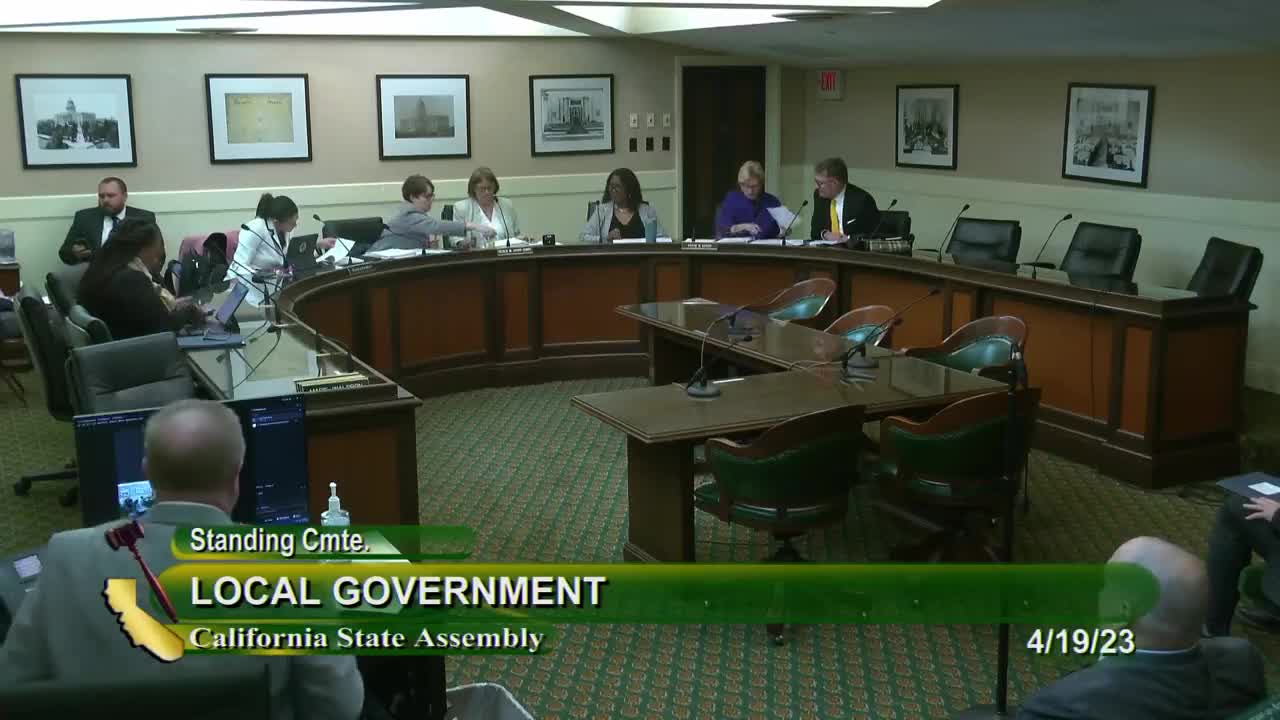 7MIN
Assembly Standing Committee on Local Government
Bill Author

Bill Co-Author(s):