AB 823: Clean Transportation Program: eligible projects.
- Session Year: 2023-2024
- House: Assembly
- Latest Version Date: 2023-03-02
Current Status:
Failed
(2024-02-01: From committee: Filed with the Chief Clerk pursuant to Joint Rule 56.)
Introduced
In Committee
First Chamber
In Committee
Second Chamber
Enacted
Existing law establishes the Clean Transportation Program, administered by the State Energy Resources Conservation and Development Commission, to provide funding, upon appropriation by the Legislature, to certain entities to develop and deploy innovative technologies that transform Californias fuel and vehicle types to help attain the states climate change policies. Existing law requires the commission to give preference to those projects that maximize the goals of the program based on specified criteria and to fund specified eligible projects, including, among others, alternative and renewable fuel infrastructure, fueling stations, and equipment.
This bill would expand the list of eligible projects to include, among other things, roadway integrated fueling and parking surface integrated fueling projects.
Existing law requires the California Transportation Commission, in consultation with the Department of Transportation and the State Air Resources Board, to maintain guidelines for travel demand models used in the development of regional transportation plans by federally designated metropolitan transportation organizations.This bill would make nonsubstantive changes to that provision.Existing law requires the California Transportation Commission, in consultation with the Department of Transportation and the State Air Resources Board, to maintain guidelines for travel demand models used in the development of regional transportation plans by federally designated metropolitan transportation organizations.
This bill would make nonsubstantive changes to that provision.
(a)The Clean Transportation Program is hereby created. The program shall be administered by the commission. The commission shall implement the program by regulation pursuant to the requirements of Chapter the Administrative Procedure Act (Chapter 3.5 (commencing with Section 11340) of Part 1 of Division 3 of Title 2 of the Government Code. Code). The program shall provide, upon appropriation by the Legislature, competitive grants, revolving loans, loan guarantees, loans, or other appropriate funding measures to public agencies, California federally recognized tribes, tribal organizations, vehicle and technology entities, businesses and projects, public-private partnerships, workforce training partnerships and collaboratives, fleet owners, consumers, recreational boaters, and academic institutions to develop and deploy innovative technologies that transform Californias fuel and vehicle types to help attain the states climate change policies. The emphasis of this program shall be to develop and deploy technology and alternative and renewable fuels in the marketplace, without adopting any one preferred fuel or technology.
(b)A project that receives more than seventy-five thousand dollars ($75,000) in funds from the commission shall be approved at a noticed public meeting of the commission and shall be consistent with the priorities established by the investment plan adopted pursuant to Section 44272.5. Under this article, the commission may delegate to the commissions executive director, or the executive directors designee, the authority to approve either of the following:
(1)A contract, grant, loan, or other agreement or award that receives seventy-five thousand dollars ($75,000) or less in funds from the commission.
(2)Amendments to a contract, grant, loan, or other agreement or award as long as the amendments do not increase the amount of the award, change the scope of the project, or modify the purpose of the agreement.
(c)The commission shall provide preferences to those projects that maximize the goals of the Clean Transportation Program, based on the following criteria, as applicable:
(1)The projects ability to provide a measurable transition from the nearly exclusive use of petroleum fuels to a diverse portfolio of viable alternative fuels that meet petroleum reduction and alternative fuel use goals.
(2)The projects consistency with existing and future state climate change policy and low-carbon fuel standards.
(3)The projects ability to reduce criteria air pollutants and air toxics and reduce or avoid multimedia environmental impacts.
(4)The projects ability to decrease, on a life-cycle basis, the discharge of water pollutants or any other substances known to damage human health or the environment, in comparison to the production and use of California Phase 2 Reformulated Gasoline or diesel fuel produced and sold pursuant to California diesel fuel regulations set forth in Article 2 (commencing with Section 2280) of Chapter 5 of Division 3 of Title 13 of the California Code of Regulations.
(5)The project does not adversely impact the sustainability of the states natural resources, especially state and federal lands.
(6)The project provides nonstate matching funds. Costs incurred from the date a proposed award is noticed may be counted as nonstate matching funds. The commission may adopt further requirements for the purposes of this paragraph. The commission is not liable for costs incurred pursuant to this paragraph if the commission does not give final approval for the project or the proposed recipient does not meet requirements adopted by the commission pursuant to this paragraph.
(7)The project provides economic benefits for California by promoting California-based technology firms, jobs, and businesses.
(8)The project uses existing or proposed fueling infrastructure to maximize the outcome of the project.
(9)The projects ability to reduce on a life-cycle assessment greenhouse gas emissions by at least 10 percent, and higher percentages in the future, from current reformulated gasoline and diesel fuel standards established by the state board.
(10)The projects use of alternative fuel blends of at least 20 percent, and higher blend ratios in the future, with a preference for projects with higher blends.
(11)The project drives new technology advancement for vehicles, vessels, engines, and other equipment, and promotes the deployment of that technology in the marketplace.
(12)The projects ability to transition workers to, or promote employment in, the alternative and renewable fuel and vehicle technology sector.
(13)The project is in a nonattainment area pursuant to the federal Clean Air Act (42 U.S.C. Sec. 7401 et seq.), and, if applicable, preference shall be given to projects in the highest designation of nonattainment.
(14)The project advances the comprehensive strategy for vehicles pursuant to Section 43024.2.
(d)The commission shall rank applications for projects proposed for funding awards based on solicitation criteria developed in accordance with subdivision (c), and shall give additional preference to funding those projects with higher benefit-cost scores.
(e)Only the following shall be eligible for funding:
(1)Alternative and renewable fuel projects to develop and improve alternative and renewable low-carbon fuels, including electricity, ethanol, dimethyl ether, renewable diesel, natural gas, hydrogen, and biomethane, among others, and their feedstocks that have high potential for long-term or short-term commercialization, including projects that lead to sustainable feedstocks.
(2)Demonstration and deployment projects that optimize alternative and renewable fuels for existing and developing engine technologies.
(3)Projects to produce alternative and renewable low-carbon fuels in California.
(4)Projects to decrease the overall impact of an alternative and renewable fuels life-cycle carbon footprint and increase sustainability.
(5)Alternative and renewable fuel infrastructure, fueling stations, roadway integrated fueling projects, parking surface integrated fueling projects, and equipment. The preference in paragraph (10) of subdivision (c) shall not apply to renewable diesel or biodiesel infrastructure, fueling stations, and equipment used solely for renewable diesel or biodiesel fuel.
(6)Projects to develop and improve light-, medium-, and heavy-duty vehicle technologies that provide for better fuel efficiency and lower greenhouse gas emissions, alternative fuel usage and storage, or emission reductions, including propulsion systems, advanced internal combustion engines with a 40 percent or better efficiency level over the current market standard, lightweight materials, intelligent transportation systems, energy storage, control systems and system integration, physical measurement and metering systems and software, development of design standards and testing and certification protocols, battery recycling and reuse, engine and fuel optimization electronic and electrified components, hybrid technology, plug-in hybrid technology, battery electric vehicle technology, fuel cell technology, and conversions of hybrid technology to plug-in technology through the installation of safety certified supplemental battery modules.
(7)Programs and projects that accelerate the commercialization of vehicles and alternative and renewable fuels, including buy-down programs through near-market and market-path deployments, advanced technology warranty or replacement insurance, development of market niches, supply-chain development, and research related to the pedestrian safety impacts of vehicle technologies and alternative and renewable fuels.
(8)Programs and projects to retrofit medium- and heavy-duty on-road and nonroad vehicle fleets with technologies that create higher fuel efficiencies, including alternative and renewable fuel vehicles and technologies, idle management technology, and aerodynamic retrofits that decrease fuel consumption.
(9)Infrastructure projects that promote alternative and renewable fuel infrastructure development connected with existing fleets, public transit, parking surfaces, and existing transportation corridors, including physical measurement or metering equipment equipment, roadway integrated fueling, and truck stop electrification.
(10)Workforce training programs related to the development and deployment of technologies that transform Californias fuel and vehicle types and assist the state in implementing its climate change policies, including, but not limited to, alternative and renewable fuel feedstock production and extraction; renewable fuel production, distribution, transport, and storage; high-performance and low-emission vehicle technology and high tower electronics; automotive computer systems; mass transit fleet conversion, servicing, and maintenance; and other sectors or occupations related to the purposes of this chapter, including training programs to transition dislocated workers affected by the states greenhouse gas emission policies, including those from fossil fuel sectors, or training programs for low-skilled workers to enter or continue in a career pathway that leads to middle skill, industry-recognized credentials or state-approved apprenticeship opportunities in occupations related to the purposes of this chapter.
(11)Block grants or incentive programs administered by public entities or not-for-profit technology entities for multiple projects, education and program promotion within California, and development of alternative and renewable fuel and vehicle technology centers. The commission may adopt guidelines for implementing the block grant or incentive program, which shall be approved at a noticed public meeting of the commission.
(12)Life-cycle and multimedia analyses, sustainability and environmental impact evaluations, and market, financial, and technology assessments performed by a state agency to determine the impacts of increasing the use of low-carbon transportation fuels and technologies, and to assist in the preparation of the investment plan and program implementation.
(13)A program to provide funding for homeowners who purchase a plug-in electric vehicle to offset costs associated with modifying electrical sources to include a residential plug-in electric vehicle charging station. In establishing this program, the commission shall consider funding criteria to maximize the public benefit of the program.
(f)The commission may make a single source or sole source award pursuant to this section for applied research. The same requirements set forth in Section 25620.5 of the Public Resources Code shall apply to awards made on a single source basis or a sole source basis. This subdivision does not authorize the commission to make a single source or sole source award for a project or activity other than for applied research.
(g)The commission may do all of the following:
(1)Contract with the Treasurer to expend funds through programs implemented by the Treasurer, if the expenditure is consistent with all of the requirements of this article and Article 1 (commencing with Section 44270).
(2)Contract with small business financial development corporations established by the Governors Office of Business and Economic Development to expend funds through the Small Business Loan Guarantee Program if the expenditure is consistent with all of the requirements of this article and Article 1 (commencing with Section 44270).
(3)Advance funds, pursuant to an agreement with the commission, to any of the following:
(A)A public entity.
(B)A recipient to enable it to make advance payments to a public entity that is a subrecipient of the funds and under a binding and enforceable subagreement with the recipient.
(C)An administrator of a block grant program.
(h)The commission shall collaborate with entities that have expertise in workforce development to implement the workforce development components of this section, including, but not limited to, the California Workforce Development Board, the Employment Training Panel, the Employment Development Department, and the Division of Apprenticeship Standards.
SECTION 1.Section 14522.1 of the Government Code is amended to read:14522.1.(a)(1)The California Transportation Commission, in consultation with the Department of Transportation and the State Air Resources Board, shall maintain guidelines for travel demand models used in the development of regional transportation plans by federally designated metropolitan planning organizations.(2)Any revision of the guidelines shall include the formation of an advisory committee that shall include representatives of the metropolitan planning organizations, the department, organizations knowledgeable in the creation and use of travel demand models, local governments, and organizations concerned with the impacts of transportation investments on communities and the environment. Before amending the guidelines, the commission shall hold two workshops on the guidelines, one in northern California and one in southern California. The workshops shall be incorporated into regular commission meetings.(b)The guidelines shall, at a minimum and to the extent practicable, taking into account such factors as the size and available resources of the metropolitan planning organization, account for all of the following:(1)The relationship between land use density and household vehicle ownership and vehicle miles traveled in a way that is consistent with statistical research.(2)The impact of enhanced transit service levels on household vehicle ownership and vehicle miles traveled.(3)Changes in travel and land development likely to result from highway or passenger rail expansion.(4)Mode splitting that allocates trips between automobile, transit, carpool, and bicycle and pedestrian trips. If a travel demand model is unable to forecast bicycle and pedestrian trips, another means may be used to estimate those trips.(5)Speed and frequency, days, and hours of operation of transit service.(a)(1)The commission, California Transportation Commission, in consultation with the department Department of Transportation and the State Air Resources Board, shall maintain guidelines for travel demand models used in the development of regional transportation plans by federally designated metropolitan planning organizations.
(2)Any revision of the guidelines shall include the formation of an advisory committee that shall include representatives of the metropolitan planning organizations, the department, organizations knowledgeable in the creation and use of travel demand models, local governments, and organizations concerned with the impacts of transportation investments on communities and the environment. Before amending the guidelines, the commission shall hold two workshops on the guidelines, one in northern California and one in southern California. The workshops shall be incorporated into regular commission meetings.
(b)The guidelines shall, at a minimum and to the extent practicable, taking into account such factors as the size and available resources of the metropolitan planning organization, account for all of the following:
(1)The relationship between land use density and household vehicle ownership and vehicle miles traveled in a way that is consistent with statistical research.
(2)The impact of enhanced transit service levels on household vehicle ownership and vehicle miles traveled.
(3)Changes in travel and land development likely to result from highway or passenger rail expansion.
(4)Mode splitting that allocates trips between automobile, transit, carpool, and bicycle and pedestrian trips. If a travel demand model is unable to forecast bicycle and pedestrian trips, another means may be used to estimate those trips.
(5)Speed and frequency, days, and hours of operation of transit service.
|
Date
|
Status
|
|---|---|
| Feb 1, 2024 | From committee: Filed with the Chief Clerk pursuant to Joint Rule 56. |
| Jan 31, 2024 | Died pursuant to Art. IV, Sec. 10(c) of the Constitution. |
| May 18, 2023 | In committee: Held under submission. |
| Apr 19, 2023 | In committee: Set, first hearing. Referred to APPR. suspense file. |
| Mar 21, 2023 | From committee: Do pass and re-refer to Com. on APPR. (Ayes 15. Noes 0.) (March 20). Re-referred to Com. on APPR. |
| Mar 6, 2023 | Re-referred to Com. on TRANS. |
| Mar 2, 2023 | From committee chair, with author's amendments: Amend, and re-refer to Com. on TRANS. Read second time and amended. |
| Mar 2, 2023 | Referred to Com. on TRANS. |
| Feb 14, 2023 | From printer. May be heard in committee March 16. |
| Feb 13, 2023 | Read first time. To print. |
|
Date
|
Description
|
Location
|
Votes
|
|
|---|---|---|---|---|
| Mar 20, 2023 | Do pass and be re-referred to the Committee on [Appropriations] | Assembly Standing Committee on Transportation |
Passed |
This list shows positions taken on this bill by organizations on the date displayed, which is linked to the original source.
Positions by individuals are not included.
Date of Hearing: April 19, 2023
ASSEMBLY COMMITTEE ON APPROPRIATIONS
Chris Holden, Chair
ABPCA Bill Id:AB 823
Author:(Schiavo) – As Amended Ver:March 2, 2023
Policy Committee: | Transportation | Vote: | 15 - 0 |
|
| ||
|
|
Urgency: No State Mandated Local Program: No Reimbursable: No
SUMMARY:
This bill expands the types of projects eligible for funding through the Clean Transportation Program (CTP) to include roadway integrated fueling projects and parking surface integrated fueling projects.
FISCAL EFFECT:
Funding for CTP is fixed; the program receives about $110 million annually, as described below. This bill creates the possibility that finite CTP resources would go to fund roadway integrated fueling projects and parking surface integrated fueling projects that otherwise would have funded other CTP-eligible projects. For this reason, the bill creates cost pressure of an unknown, but potentially significant amount to fund those projects that would have received CTP funding were it not for this bill.
COMMENTS:
- Purpose. The author describes roadway integrated fueling projects and parking surface integrated fueling projects, or “electric roads” as having:
The potential to provide both charging flexibility and integration with existing right-of-ways that, if deployed strategically, could address many of the equity concerns surrounding current EV charging. California leads the nation electric car sales, and the state should take every opportunity to lead the nation in the technology development and deployment to support this rapidly expanding fleet.
- Background. The CTP is a longstanding statutory program, administered by the California Energy Commission to provide grants to accelerate development and deployment of clean vehicles, including zero-emission vehicle fueling infrastructure, alternative vehicle technologies and alternative fuels. The program receives about $110 million annually from a portion of a variety of annual and biennial taxes on vehicles and vessels, as follows: the biennial vessel registration fee ($10); the annual smog abatement fee ($4); the annual vehicle identification fee ($2.50) and the annual vehicle registration fee ($2.00). Statute in 2008 authorized collection of these fees and established the Advanced and Renewable Fuel and Vehicle Technology Program, since renamed as the much-more-wieldy CTP, and collection of the fees was reauthorized in 2013.
Authority to collect the fees that support the program will expire at the end of 2023. The 2023-24 Governor’s Budget proposes reauthorizing the fees and recasting the program to focus only on zero-emission vehicles and technologies.
Statute governing the CTP states “only the following shall be eligible for funding” and lists a variety of eligible project types, including “alternative and renewable fuel infrastructure, fueling stations and equipment.” This bill adds to this description “roadway integrated fueling projects” and “parking surface integrated fueling projects.”
The bill does not define roadway integrated fueling projects or parking surface integrated fueling projects. However, the Committee on Transportation’s analysis of this bill describes the concepts as able to “eliminate the need for plug-in charging by allowing for wireless EV charging, also known as inductive charging, in a parking space, a bus stop, a city street or highway.” The policy committee analysis provides examples, too: a charging pad embedded in a roadway could charge the battery of an EV parked above the roadway using “wireless charging” and “high-power, in-road, dynamic wireless charging.”
The CTP has not funded roadway integrated fueling projects or parking surface integrated fueling projects. Arguably, however, it could under current law.
Analysis Prepared by: Jay Dickenson / APPR. / (916) 319-2081
Date of Hearing: March 20, 2023
ASSEMBLY COMMITTEE ON TRANSPORTATION
Laura Friedman, Chair
ABPCA Bill Id:AB 823 (
Author:Schiavo) – As Amended Ver:March 2, 2023
SUBJECT: Clean Transportation Program: eligible projects
SUMMARY: Adds roadway integrated fueling and parking surface integrated fueling projects to the list of projects eligible for funding from the Clean Transportation Program (CTP).
EXISTING LAW:
- Creates CTP, administered by the Energy Resources Conservation and Development Commission (also known as the California Energy Commission or CEC), to provide competitive grants, revolving loans, loan guarantees, or loans to various entities to develop and deploy innovative technologies that transform California’s fuel and vehicle types to help attain the state’s climate change policies. The fees that fund CTP sunset January 1, 2024. (Health and Safety Code (HSC) 44272)
- Requires CEC to provide preference to projects that maximize the goals of the CTP, based on specified criteria.
- Requires CEC to rank applications for projects proposed for funding awards based on solicitation criteria developed and give additional preference to funding projects with higher benefit-cost scores.
- Limits the activities funded under the CTP to only those explicitly named in statute.
FISCAL EFFECT: Unknown
COMMENTS:
Since 2006, California has set several goals to reduce greenhouse gas (GHG) emissions, address climate change, and improve the public health of its residents. These goals require incremental progress that are intended to result in large emission reductions, including:
- Reduce GHG emissions to 40% below 1990 levels by 2030. SB 32 (Pavley) Chapter 488, Statutes of 2016.
- Reduce short-lived climate pollutant emissions, such as methane, to 40 to 50% below 2013 levels by 2030. SB 1383 (Lara) Chapter 395, Statutes of 2016.
- Achieve a carbon-neutral economy by 2045. AB 1279 (Muratsuchi) Chapter 337, Statutes of 2022.
Additionally, California has led on the transition to zero-emission vehicles (ZEVs), setting specific goals to boost the supply of ZEVs as well as charging and fueling stations, including:
- By 2025:
- 1.5 million ZEVs on the road (Executive Order. (EO) B-16-12)
- Installation of 200 hydrogen-fueling stations and 250,000 battery-electric vehicle chargers, including 10,000 direct-current fast chargers, by 2025. (EO B-48-18)
- By 2030:
- 5 million ZEVs on the road. (EO B-48-18)
- 8 million ZEVs on the road. (California Air Resources Board (CARB) estimate to meet EO N-79-20)
- By 2035:
- Transition 100% of new sales of passenger vehicles and trucks to ZEVs. (EO N-79-20)
- Transition 100 percent of drayage trucks to zero emission. (EO N-79-20)
- Transition 100% of operating off-road vehicles and equipment to zero emission everywhere feasible. (EO N-79-20)
- By 2045:
- Transition 100% of operating medium- and heavy-duty trucks and buses to zero emission everywhere feasible. (EO N-79-20)
State needs significantly more EV chargers to meet projected EV needs. Based on the AB 2127 Analysis, CEC projects that approximately 700,000 to 1.2 million public and shared-private chargers will be needed by 2030 to support 5 million to 8 million light-duty ZEVs, respectively. According to the Zero-Emission Vehicle Infrastructure Plan, 80,000 light-duty public and shared-private EV chargers currently operate statewide, with another estimated 17,000 on the way.
What is roadway/parking surface integrated fueling? Roadway/ parking surface integrated fueling can eliminate the need for plug-in charging by allowing for wireless EV charging, also known as inductive charging, in a parking space, a bus stop, a city street or highway. This approach could help address the state’s significant charging infrastructure needs. For example, a charging pad embedded in a roadway could charge the battery of an EV parked above it using wireless charging, eliminating the need to be plugged in. High-power, in-road, dynamic wireless charging could assist charge-sustaining EV operation (i.e. unlimited range with in-route recharge) while enabling the use of smaller, cheaper batteries. Wireless charging technology is not a new phenomenon. The Tesla coil, designed in 1891 by its namesake Nikola Tesla, was the first known system that could wirelessly transmit electricity. However, when it comes to wireless EV charging, it is still in the early market stages, and there are many questions surrounding this technology.
The National Renewable Energy Laboratory (NREL) is investigating the requirements and feasibility of wireless EV charging. Research at NREL focuses on associated hardware, communication, system planning, and control strategies, as well as the potential for in-road wireless charging to be cost-competitive with conventional fast charging technologies. NREL researchers are looking at various interrelated variables to design an optimized system; such as roadway classes to be electrified, roadway charging segment locations and lengths, charging power levels, system interoperability to serve a range of vehicle classes, appropriate battery capacity to enable charge-sustaining operation for long-distance travel, and feasibility of wireless charging for shared automated EVs.
Clean Transportation Program expiring soon. Authorized under AB 118 (Nunez) Chapter 750, Statutes of 2007 and reauthorized by AB 8 (Perea) Chapter 401, Statutes of 2013, CTP invests up to $100 million annually in a broad portfolio of transportation and fuel transportation projects throughout the state. CEC leverages public and private investments to support adoption of cleaner transportation powered by alternative and renewable fuels. The program plays an important role in achieving California’s ambitious goals on climate change, petroleum reduction, and adoption of ZEVs, as well as efforts to reach air quality standards. The program also supports the state’s sustainable, long-term economic development. In recent years, CEC has recently focused CTP investments on ZEV infrastructure.
Funding for the CTP will expire January 1, 2024 unless it is reauthorized. The Administration proposed to reauthorize CTP in its January 2023 budget and to change the emphasis of the program to the development and deployment of zero-emission technology and fuels in the marketplace where feasible, and near-zero-emission technology and fuels elsewhere. Reauthorization presents an opportunity for the Legislature to change the activities the program funds.
Federal funding not available for induction charging. The 2021 federal Bipartisan Infrastructure Law provides $5 billion nationwide to build a network of EV charging stations every 50 miles along federally designated highways. None of the federal money is for induction charging road pilots. Other states are using their own money to test inductive charging or are relying on companies that make the technology to share the cost. Michigan, Indiana, Florida, Utah, and Pennsylvania have pilots of various cost and scope for in-road charging. California currently limits activities funded under the CTP to only those explicitly named in statute, although this could change depending on how the reauthorization bills recast the program.
Committee comments. It may seem premature for the state to seriously consider integrated roadway or parking surface charging in advance of automakers adopting this technology into new vehicle builds. However, this bill provides flexibility for the CEC to potentially pilot a project for specific use cases, such as for transit buses with frequent layover stops at regular locations. For example, transport agency Link Transit from Wenatchee, Washington, is wirelessly charging electric buses using inductive charging systems. After three years in daily use, the authority states the operating cost of the electric buses is about 51% of a diesel-fueled bus and claims the “wireless chargers have been a game-changer… They charge our electric buses for a few minutes on the layover between routes and provide additional range, allowing our buses to stay in service for 12 to 14 hours a day.”
The Legislature is in the process of considering the reauthorization of CTP, and policy bills have been introduced in both houses. Therefore, any changes made to CTP by this bill would need to be reconciled with those bills prior to being sent to the Governor.
According to the author, “[This bill] opens new possibilities to address the imminent need for electric vehicle charging infrastructure. [This bill] does so by expanding the scope of eligible projects that the Clean Transportation Program can support. One potential technology in the expanded scope are “electric roads.” This technology has the potential to provide both charging flexibility and integration with existing right-of-ways that, if deployed strategically, could address many of the equity concerns surrounding current EV charging. California leads the nation electric car sales, and the state should take every opportunity to lead the nation in the technology development and deployment to support this rapidly expanding fleet.”
Related and previous legislation: AB 241 (Reyes) of this session states the intent of the Legislature to enact future legislation related to the CTP.
SB 84 (Gonzalez) of this session states the intent of the Legislature to enact future legislation related to the CTP.
SB 589 (Hueso) Chapter 732, Statutes of 2021 adds a new project type eligible for funding under the CTP and expands existing workforce development requirements.
REGISTERED SUPPORT / OPPOSITION:
Support
None on file
Opposition
None on file
Analysis Prepared by: Christine Casey / TRANS. / (916) 319-2093
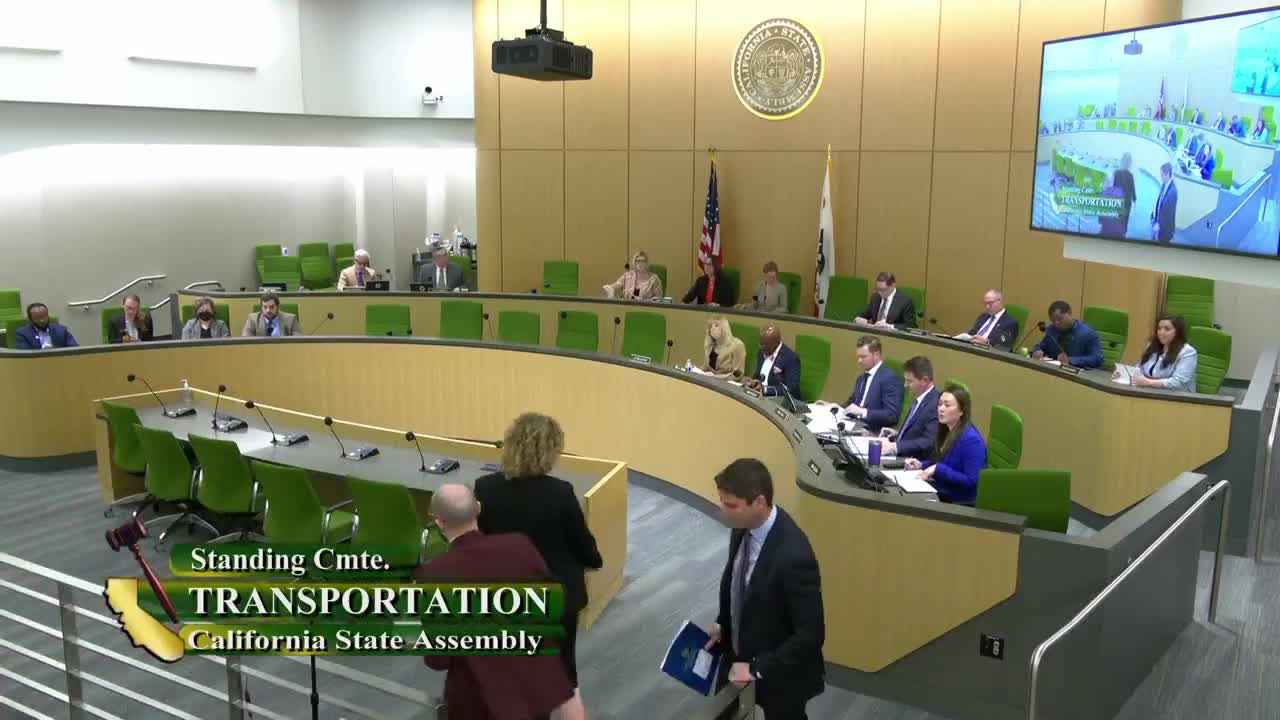
Discussed in Hearing
 6MIN
Assembly Standing Committee on Transportation
Bill Author

Bill Co-Author(s):